Eureka Math Precalculus Module 2 Answer Key | Engage NY Math Precalculus Module 2 Answer Key

EngageNY Math Precalculus Module 2 Answer Key | Precalculus Eureka Math Module 2 Answer Key

Eureka Math Precalculus Module 2 Vectors and Matrices

Eureka Math Precalculus Module 2 Topic A Networks and Matrices

Engage NY Math Precalculus Module 2 Topic B Linear Transformations of Planes and Space

Precalculus Eureka Math Module 2 Topic C Systems of Linear Equations

Eureka Math Precalculus Module 2 Mid Module Assessment Answer Key

EngageNY Precalculus Math Module 2 Topic D Vectors in Plane and Space

Great Minds Eureka Math Precalculus Module 2 Topic E First-Person Video Games—Projection Matrices

Eureka Math Precalculus Module 2 End of Module Assessment Answer Key

Eureka Math Precalculus Module 1 Answer Key | Engage NY Math Precalculus Module 1 Answer Key

EngageNY Math Precalculus Module 1 Answer Key | Precalculus Eureka Math Module 1 Answer Key

Eureka Math Precalculus Module 1 Complex Numbers and Transformations

Eureka Math Precalculus Module 1 Topic A A Question of Linearity

Engage NY Math Precalculus Module 1 Topic B Complex Number Operations as Transformations

Eureka Math Precalculus Module 1 Mid Module Assessment Answer Key

Precalculus Eureka Math Module 1 Topic C The Power of the Right Notation

Eureka Math Precalculus Module 1 End of Module Assessment Answer Key

Eureka Math Grade 2 Module 5 End of Module Assessment Answer Key

Engage NY Eureka Math 2nd Grade Module 5 End of Module Assessment Answer Key

Eureka Math Grade 2 Module 5 End of Module Assessment Answer Key

Question 1.
Solve each problem with a written strategy such as a tape diagram, a number bond, the arrow way, the vertical form, or chips on a place value chart.
a. 460 + 200 = _______

Answer:
460 + 200 = 660.

Explanation:
In the above-given question,
given that,
solve each problem with a written strategy such as tape diagram, a number bond.
460 + 200.
460 = 450 + 10.
200 + 10 = 210.
210 + 450 = 660.
Eureka-Math-Grade-2-Module-5-End Module Assessment Answer Key-1

b. _______ = 865 – 300

Answer:
865 – 300 = 565.

Explanation:
In the above-given question,
given that,
solve each problem with a written strategy such as tape diagram, a number bond.
865 – 300.
865 = 860 + 5.
300 + 5 = 305.
860 – 305 = 565.
Eureka-Math-Grade-2-Module-5-End Module Assessment Answer Key-2

c. _______ + 400 = 598

Answer:
198 + 400 = 598.

Explanation:
In the above-given question,
given that,
solve each problem with a written strategy such as tape diagram, a number bond.
198 + 400.
400 = 398 + 2.
198 + 2 = 200.
200 + 398 = 598.
Eureka-Math-Grade-2-Module-5-End Module Assessment Answer Key-3

d. 240 – 190 = _______

Answer:
240 – 190 = 50.

Explanation:
In the above-given question,
given that,
solve each problem with a written strategy such as tape diagram, a number bond.
240 – 190.
240 = 230 + 10.
190 + 10 = 200.
200 + 230 = 430.
Eureka-Math-Grade-2-Module-5-End Module Assessment Answer Key-4

e. _______ = 760 – 280

Answer:
760 – 280 = 480.

Explanation:
In the above-given question,
given that,
solve each problem with a written strategy such as tape diagram, a number bond.
760 – 280.
760 = 740 + 20.
280 + 20 = 300.
740 – 280 = 480.
Eureka-Math-Grade-2-Module-5-End Module Assessment Answer Key-5

f. 330 – 170 = _______

Answer:
330 – 170 = 160.

Explanation:
In the above-given question,
given that,
solve each problem with a written strategy such as tape diagram, a number bond.
330 – 170.
330 = 300 + 30.
170 + 30 = 200.
200 – 360 = 160.
Eureka-Math-Grade-2-Module-5-End Module Assessment Answer Key-6

Question 2.
Use the arrow way to fill in the blanks and solve. Use place value drawings if that will help you.
a.
Eureka Math Grade 2 Module 5 End of Module Assessment Answer Key 1

Answer:
630 – 400 = 230.
230 + 10 = 240.
630 – 240 = 390.

Explanation:
In the above-given question,
given that,
use the arrow way to fill in the blanks.
630 – 400 = 230.
230 + 10 = 240.
630 – 240 = 390.
Eureka-Math-Grade-2-Module-5-End Module Assessment Answer Key-7

b.
Eureka Math Grade 2 Module 5 End of Module Assessment Answer Key 2

Answer:
570 – 300 = 270.
270 + 20 = 290.
570 – 280 = 290.

Explanation:
In the above-given question,
given that,
use the arrow way to fill in the blanks.
570 – 300 = 270.
270 + 20 = 290.
570 – 280 = 290.
Eureka-Math-Grade-2-Module-5-End Module Assessment Answer Key-8

c.
Eureka Math Grade 2 Module 5 End of Module Assessment Answer Key 3

Answer:
958 – 400 = 558.
558 – 40 = 518.
958 – 440 = 518.

Explanation:
In the above-given question,
given that,
use the arrow way to fill in the blanks.
958 – 400 = 558.
558 – 40 = 518.
958 – 440 = 518.
Eureka-Math-Grade-2-Module-5-End Module Assessment Answer Key-9

Question 3.
Solve.
Draw a place value chart with chips to model the problems. Show a written subtraction method to check your work.
a. 756 + 136 = ______

Subtraction number sentence:

Answer:
756 + 136 = 892.

Explanation:
In the above-given question,
given that,
draw a place value chart with chips to model the problems.
show a written subtraction method to check your work.
756 + 136 = 892.
892 – 136 = 756.
Eureka-Math-Grade-2-Module-5-End Module Assessment Answer Key-10

b. 267 + 545 = ______

Subtraction number sentence:

Answer:
267 + 545 = 812.

Explanation:
In the above-given question,
given that,
draw a place value chart with chips to model the problems.
show a written subtraction method to check your work.
267 + 545 = 812.
812 – 545 = 267.
Eureka-Math-Grade-2-Module-5-End Module Assessment Answer Key-11

Draw a place value chart with chips to model the problems. Show a written addition method to check your work.

c. 617 – 229 = ______

Check:

Answer:
617 – 229 = 398.

Explanation:
In the above-given question,
given that,
draw a place value chart with chips to model the problems.
show a written addition method to check your work.
617 – 229 = 398.
398 + 229 = 617.
Eureka-Math-Grade-2-Module-5-End Module Assessment Answer Key-12

d. 700 – 463 = ______

Check:
Answer:
700 – 463 = 437.

Explanation:
In the above-given question,
given that,
draw a place value chart with chips to model the problems.
show a written addition method to check your work.
700 – 463 = 437.
437 + 463 = 700.
Eureka-Math-Grade-2-Module-5-End Module Assessment Answer Key-13

Question 4.
Find the missing numbers to make each statement true. Show your strategy to solve.
a. 300 – 106 = ________

Answer:
300 – 106 = 194.

Explanation:
In the above-given question,
given that,
find the missing numbers to make each statement true.
300 – 106 = 194.
194 + 106 = 300.

b. ________ = 407 – 159

Answer:
407 – 159 = 248.

Explanation:
In the above-given question,
given that,
find the missing numbers to make each statement true.
407 – 159 = 248.
248 + 159 = 407.

c. 410 – 190 = 420 – ___200_____

Answer:
410 – 190 = 220.

Explanation:
In the above-given question,
given that,
find the missing numbers to make each statement true.
410 – 190 = 220.
220 + 190 = 410.

d. 750 – 180 = ________ – 200

Answer:
750 – 180 = 570.

Explanation:
In the above-given question,
given that,
find the missing numbers to make each statement true.
750 – 180 = 570.
770 – 200 = 570.
570 + 180 = 750.

e. 900 – ________ = 600 – 426

Answer:
600 – 426 = 174.

Explanation:
In the above-given question,
given that,
find the missing numbers to make each statement true.
600 – 426 = 174.
174 + 426 = 600.

Question 5.
Martha answered the problem 456 – 378 incorrectly. She does not understand her mistake.
a. Explain to Martha what she did wrong using place value language.
Eureka Math Grade 2 Module 5 End of Module Assessment Answer Key 4
Explanation:
________________________________________
________________________________________
________________________________________

Answer:
456 – 378 = 78.

Explanation:
In the above-given question,
given that,
Martha answered the problem incorrectly.
456 – 378.
4 hundred = 400.
5 tens = 50.
6 ones = 6.
400 + 50 + 6 = 456.
3 hundred = 300.
7 tens = 70.
8 ones = 8.
300 + 70 + 8 = 378.
456 – 378 = 78.
Eureka-Math-Grade-2-Module-5-End Module Assessment Answer Key-14

b. Model an alternative strategy for 456 – 378 to help Martha avoid making this mistake again.

Answer:
456 – 378 = 78.

Explanation:
In the above-given question,
given that,
456 = 454 + 2.
378 + 2 = 380.
454 – 380 = 78.

Eureka Math Grade 2 Module 5 Lesson 18 Answer Key

Engage NY Eureka Math 2nd Grade Module 5 Lesson 18 Answer Key

Eureka Math Grade 2 Module 5 Lesson 18 Problem Set Answer Key

Question 1.
Use the arrow way and counting on to solve.
a. 300 – 247

Answer:
300 – 247 = 53.

Explanation:
In the above-given question,
given that,
use the arrow way and counting on to solve.
300 – 247.
3 hundred = 300.
2 hundred = 200.
4 tens = 40.
7 ones = 7.
200 + 40 + 7 = 247.
300 – 247 = 53.
Eureka-Math-Grade-2-Module-5-Lesson-18- Answer Key-1

b. 600 – 465

Answer:
600 – 465 = 135.

Explanation:
In the above-given question,
given that,
use the arrow way and counting on to solve.
600 – 465.
600 – 100 = 500.
500 – 35 = 465.
600 – 465 = 135.
Eureka-Math-Grade-2-Module-5-Lesson-18- Answer Key-2

Question 2.
Solve vertically, and draw a place value chart and chips. Rename in one step.
a. 507 – 359

Answer:
507 – 359 = 148.

Explanation:
In the above-given question,
given that,
solve vertically, and draw a place value chart and chips.
507 – 359.
5 hundred = 500.
7 ones = 7.
500 + 7 = 507.
3 hundred = 300.
5 tens = 50.
9 ones = 9.
300 + 50 + 9 = 359.
507 – 359 = 148.
Eureka-Math-Grade-2-Module-5-Lesson-18- Answer Key-3

b. 708 – 529

Answer:
708 – 529 = 179.

Explanation:
In the above-given question,
given that,
solve vertically, and draw a place value chart and chips.
708 – 529.
7 hundred = 700.
8 ones = 8.
700 + 8 = 708.
5 hundred = 500.
2 tens = 20.
9 ones = 9.
500 + 20 + 9 = 529.
708 – 529 = 179.
Eureka-Math-Grade-2-Module-5-Lesson-18- Answer Key-4

Question 3.
Choose a strategy to solve, and explain why you chose that strategy.

a. 600 – 437Explanation:


Answer:
600 – 437 = 163.

Explanation:
In the above-given question,
given that,
600 – 437.
600 – 100 = 500.
500 – 100 = 400.
400 + 37 = 437.
600 – 437 = 163.
Eureka-Math-Grade-2-Module-5-Lesson-18- Answer Key-5

b. 808 – 597Explanation:


Answer:
808 – 597 = 211.

Explanation:
In the above-given question,
given that,
808 – 597.
8 hundred = 800.
8 ones = 8.
800 + 8 = 808.
5 hundred = 500.
9 tens = 90.
7 ones = 7.
500 + 90 + 7 = 597.
808 – 597 = 211.
Eureka-Math-Grade-2-Module-5-Lesson-18- Answer Key-6

Question 4.
Prove the student’s strategy by solving both problems to check that their solutions are the same. Explain to your partner why this way works.
Eureka Math Grade 2 Module 5 Lesson 18 Problem Set Answer Key 1

Answer:
800 – 543 = 257.
799 – 542 = 257.

Explanation:
In the above-given question,
given that,
the student’s strategy is the same.
800 – 543 = 257.
799 – 542 = 257.
257 + 542 = 799.

Question 5.
Use the simplifying strategy from Problem 4 to solve the following two problems.
a. 600 – 547

Answer:
600 – 547 = 53.

Explanation:
In the above-given question,
given that,
600 – 547.
600 – 100 = 500.
500 + 47 = 547.
600 – 547 = 53.
Eureka-Math-Grade-2-Module-5-Lesson-18- Answer Key-7

b. 700 – 513

Answer:
700 – 513 = 187.

Explanation:
In the above-given question,
given that,
700 – 513.
700 – 100 = 600.
600 – 100 = 500.
500 + 13 = 513.
700 – 513 = 187.
Eureka-Math-Grade-2-Module-5-Lesson-18- Answer Key-8

Eureka Math Grade 2 Module 5 Lesson 18 Exit Ticket Answer Key

Choose a strategy to solve, and explain why you chose that strategy.

Question 1.

1. 400 – 265Explanation:


Answer:
400 – 265 = 135.

Explanation:
In the above-given question,
given that,
400 – 265.
400 – 100 = 300.
300 – 35 = 265.
265 + 35 = 300.
400 – 265 = 135.
Eureka-Math-Grade-2-Module-5-Lesson-18- Answer Key-9

Question 2.

2. 507 – 198Explanation:


Answer:
507 – 198 = 309.

Explanation:
In the above-given question,
given that,
507 – 198.
507 – 100 = 407.
407 – 100 = 307.
307 – 100 = 207.
207 – 9 = 198.
507 – 198 = 309.
Eureka-Math-Grade-2-Module-5-Lesson-18- Answer Key-10

Eureka Math Grade 2 Module 5 Lesson 18 Homework Answer Key

Question 1.
Use the arrow way and counting on to solve.
a. 700 – 462

Answer:
700 – 462 = 238.

Explanation:
In the above-given question,
given that,
700 – 462.
700 – 100 = 600.
600 – 100 = 500.
500 – 100 = 400.
400 + 62 = 462.
700 – 462 = 238.
Eureka-Math-Grade-2-Module-5-Lesson-18- Answer Key-11

b. 900 – 232

Answer:
900 – 232 = 668.

Explanation:
In the above-given question,
given that,
900 – 232.
900 – 100 = 700.
700 – 100 = 600.
600 + 68 = 668.
900 – 232 = 668.
Eureka-Math-Grade-2-Module-5-Lesson-18- Answer Key-12

Question 2.
Solve vertically, and draw a place value chart and chips. Rename in one step.
a. 907 – 467

Answer:
907 – 467 = 440.

Explanation:
In the above-given question,
given that,
907 – 467.
9 hundred = 900.
7 ones = 7.
900 + 7 = 907.
4 hundred = 400.
6 tens = 60.
7 ones = 7.
400 + 60 + 7 = 467.
907 – 467 = 440.
Eureka-Math-Grade-2-Module-5-Lesson-18- Answer Key-13

b. 803 – 667

Answer:
803 – 667 = 136.

Explanation:
In the above-given question,
given that,
803 – 667.
8 hundred = 800.
3 ones = 3.
800 + 3 = 803.
6 hundred = 600.
6 tens = 60.
7 ones = 7.
600 + 60 + 7 = 667.
803 – 667 = 136.
Eureka-Math-Grade-2-Module-5-Lesson-18- Answer Key-14

Question 3.
Choose a strategy to solve, and explain why you chose that strategy.

a. 700 – 390Explanation:


Answer:
700 – 390 = 310.

Explanation:
In the above-given question,
given that,
700 – 390.
7 hundred = 700.
3 hundred = 300.
9 tens = 90.
300 + 90 = 390.
700 – 390 = 310.
Eureka-Math-Grade-2-Module-5-Lesson-18- Answer Key-15

b. 919 – 657Explanation:


Answer:
919 – 657 = 262.

Explanation:
In the above-given question,
given that,
919 – 657.
9 hundred = 900.
1 ten = 10.
9 ones = 9.
900 + 10 + 9 = 919.
6 hundred = 600.
5 tens = 50.
7 ones = 7.
600 + 50 + 7 = 657.
919 – 657 = 262.
Eureka-Math-Grade-2-Module-5-Lesson-18- Answer Key-16

Question 4.
Explain why 300 – 186 is the same as 299 – 185.
Explanation:

Answer:
300 – 186 = 114.
299 – 185 = 114.

Explanation:
In the above-given question,
given that,
yes both the problems get the same answer.
300 – 186 = 114.
299 – 185 = 114.

Question 5.
Solve 500 – 278 using the simplifying strategy from Problem 4.
Solution:

Answer:
500 – 278 = 222.

Explanation:
In the above-given question,
given that,
5 hundred = 500.
2 hundred = 200.
7 tens = 70.
8 ones = 8.
200 + 70 + 8 = 278.
500 – 278 = 222.

Eureka Math Grade 2 Module 5 Mid Module Assessment Answer Key

Engage NY Eureka Math 2nd Grade Module 5 Mid Module Assessment Answer Key

Eureka Math Grade 2 Module 5 Mid Module Assessment Answer Key

Question 1.
Solve each problem with a written strategy such as a tape diagram, a number bond, the arrow way, the vertical form, or chips on a place value chart.
a. 220 + 30 = _____________

Answer:
220 + 30 = 250.

Explanation:
In the above-given question,
given that,
solve each problem with a written strategy such as a tape diagram, a number bond.
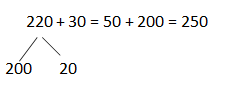
220 + 30.
220 = 10 + 210.
30 + 10 = 40.
40 + 210 = 250.
Eureka-Math-Grade-2-Module-5-Mid Module Assessment Answer Key-1

b. 200 + 380 = _____________

Answer:
200 + 380 = 580.

Explanation:
In the above-given question,
given that,
solve each problem with a written strategy such as a tape diagram, a number bond.
200 + 380.
200 = 20 + 180.
380 + 20 = 400.
400 + 180 = 580.
Eureka-Math-Grade-2-Module-5-Mid Module Assessment Answer Key-2

c. 450 + 210 = _____________

Answer:
450 + 210 = 660.

Explanation:
In the above-given question,
given that,
solve each problem with a written strategy such as a tape diagram, a number bond.
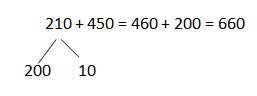
450 + 210.
210 = 10 + 200.
450 + 10 = 460.
460 + 200 = 660.
Eureka-Math-Grade-2-Module-5-Mid Module Assessment Answer Key-3

d. 490 + 12 = _____________

Answer:
490 + 12 = 502.

Explanation:
In the above-given question,
given that,
solve each problem with a written strategy such as a tape diagram, a number bond.
490 + 12.
12 = 10 + 2.
490 + 10 = 500.
500 + 2 = 502.
Eureka-Math-Grade-2-Module-5-Mid Module Assessment Answer Key-4

e. _____________ = 380 + 220

Answer:
220 + 380 = 600.

Explanation:
In the above-given question,
given that,
solve each problem with a written strategy such as a tape diagram, a number bond.
220 + 380.
220 = 20 + 200.
380 + 20 = 400.
400 + 200 = 600.
Eureka-Math-Grade-2-Module-5-Mid Module Assessment Answer Key-5

f. 750 – 590 = _____________

Answer:
750 – 590 = 160.

Explanation:
In the above-given question,
given that,
solve each problem with a written strategy such as a tape diagram, a number bond.
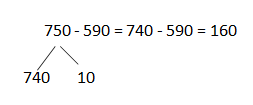
750 – 590.
750 = 740 + 10.
10 + 590 = 600.
600 – 580 = 160.
Eureka-Math-Grade-2-Module-5-Mid Module Assessment Answer Key-6

Question 2.
Use the arrow way to solve.
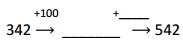
a. Eureka Math Grade 2 Module 5 Mid Module Assessment Answer Key 1

Answer:
342 + 100 + 142 = 542.

Explanation:
In the above-given question,
given that,
use the arrow way to solve.
342 + 100 = 400.
400 + 100 = 500.
500 + 42 = 542.
Eureka-Math-Grade-2-Module-5-Mid Module Assessment Answer Key-7

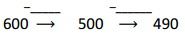
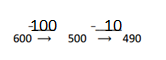
b. Eureka Math Grade 2 Module 5 Mid Module Assessment Answer Key 2

Answer:
600 – 100 – 10 = 490.

Explanation:
In the above-given question,
given that,
use the arrow way to solve.
600 – 100 = 500.
500 – 10 = 490.
Eureka-Math-Grade-2-Module-5-Mid Module Assessment Answer Key-8

c. Eureka Math Grade 2 Module 5 Mid Module Assessment Answer Key 3

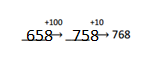
Answer:
658 + 100 + 10 = 768.

Explanation:
In the above-given question,
given that,
use the arrow way to solve.
658 + 100 = 758.
758 + 10 = 768.
Eureka-Math-Grade-2-Module-5-Mid Module Assessment Answer Key-9

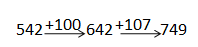
d. 542 + 207 = __________

Answer:
542 + 100 + 107 = 749.

Explanation:
In the above-given question,
given that,
use the arrow way to solve.
542 + 100 = 642.
642 + 100 = 742.
742 + 7 = 749.
Eureka-Math-Grade-2-Module-5-Mid Module Assessment Answer Key-10

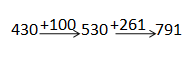
e. 430 + 361 = __________

Answer:
430 + 361 = 791.

Explanation:
In the above-given question,
given that,
use the arrow way to solve.
430 + 100 = 530.
530 + 261 = 791.
Eureka-Math-Grade-2-Module-5-Mid Module Assessment Answer Key-11

f. 660 – 190 = __________

Answer:
660 – 190 = 470.

Explanation:
In the above-given question,
given that,
use the arrow way to solve.
660 – 100 = 560.
560 – 100 = 460.
460 + 10 = 470.
Eureka-Math-Grade-2-Module-5-Mid Module Assessment Answer Key-12

Question 3.
Solve each by drawing a model of a place value chart with chips and using the vertical form.
a. 328 + 259 = ________

Answer:
328 + 259 = 587.

Explanation:
In the above-given question,
given that,
solve each by drawing a model of a place value chart.
328 + 259.
3 hundred = 300.
2 tens = 20.
8 ones = 8.
300 + 20 + 8 = 328.
2 hundred = 200.
5 tens = 50.
9 ones = 9.
200 + 50 + 9 = 259.
328 + 259 = 587.
Eureka-Math-Grade-2-Module-5-Mid Module Assessment Answer Key-13

b. 575 + 345 = ________

Answer:
575 + 345 = 920.

Explanation:
In the above-given question,
given that,
solve each by drawing a model of a place value chart.
575 + 345.
5 hundred = 500.
7 tens = 70.
5 ones = 5.
500 + 70 + 5 = 575.
3 hundred = 300.
4 tens = 40.
5 ones = 5.
300 + 40 + 5 = 345.
575 + 345 = 920.
Eureka-Math-Grade-2-Module-5-Mid Module Assessment Answer Key-14

Circle True or False for each number sentence. Explain your thinking using pictures, words, or numbers.

c. 466 + 244 = 600 + 100 (True / False)

Answer:
466 + 244 = 710.

Explanation:
In the above-given question,
given that,
circle true or false for each number sentence.
466 + 244.
466 + 244 = 710.
710 is not equal to 700.

d. 690 + 179 = 700 + 169 (True / False)

Answer:
690 + 179 = 869.

Explanation:
In the above-given question,
given that,
circle true or false for each number sentence.
690 + 179 = 869.
700 + 169 = 869.
869 is equal to 869.

e. 398 + 6 = 400 + 5 (True / False)

Answer:
398 + 6 = 404.

Explanation:
In the above-given question,
given that,
circle true or false for each number sentence.
398 + 6 = 404.
400 + 5 = 405.
404 is not equal to 405.

f. 724 – 298 = 722 – 300 (True / False)

Answer:
724 – 298 = 426.

Explanation:
In the above-given question,
given that,
circle true or false for each number sentence.
724 – 298 = 426.
722 – 300 = 422.
426 is not equal to 422.

Question 4.
Solve each problem with two written strategies such as a tape diagram, a number bond, the arrow way, the vertical form, or chips on a place value chart.
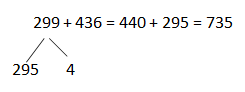
a. 299 + 436 = _______

Answer:
299 + 436 = 735.

Explanation:
In the above-given question,
given that,
solve each problem with a written strategy such as a tape diagram, a number bond.
299 + 436.
299 = 4 + 295.
436 + 4 = 440.
440 + 295 = 735.
Eureka-Math-Grade-2-Module-5-Mid Module Assessment Answer Key-15

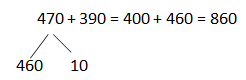
b. 470 + 390 = _______

Answer:
470 + 390 = 860.

Explanation:
In the above-given question,
given that,
solve each problem with a written strategy such as a tape diagram, a number bond.
470 + 390.
470 = 10 + 460.
390 + 10 = 400.
400 + 460 = 860.
Eureka-Math-Grade-2-Module-5-Mid Module Assessment Answer Key-16

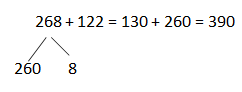
c. 268 + 122 = _______

Answer:
268 + 122 = 490.

Explanation:
In the above-given question,
given that,
solve each problem with a written strategy such as a tape diagram, a number bond.
268 + 122.
268 = 8 + 260.
122 + 8 = 130.
130 + 260 = 390.
Eureka-Math-Grade-2-Module-5-Mid Module Assessment Answer Key-17

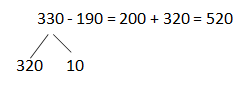
d. 330 – 190 = _______

Answer:
330 – 190 = 140.

Explanation:
In the above-given question,
given that,
solve each problem with a written strategy such as a tape diagram, a number bond.
330 – 190.
330 = 10 + 320.
190 + 10 = 200.
200 – 320 = 140.
Eureka-Math-Grade-2-Module-5-Mid Module Assessment Answer Key-18

Eureka Math Grade 2 Module 5 Lesson 20 Answer Key

Engage NY Eureka Math 2nd Grade Module 5 Lesson 20 Answer Key

Eureka Math Grade 2 Module 5 Lesson 20 Problem Set Answer Key

Question 1.
399 + 237 = _________
Eureka Math Grade 2 Module 5 Lesson 20 Problem Set Answer Key 1

Answer:
399 + 237 = 636.

Explanation:
In the above-given question,
given that,
solve the problem using two different strategies.
399 + 237.
I solved using the number bond.
my friend solved using the arrow way.
3 hundreds = 300.
9 tens = 90.
9 ones = 9.
300 + 90 + 9 = 399.
2 hundred = 200.
3 tens = 30.
7 ones = 7.
200 + 30 + 7 = 237.
399 + 237 = 636.
Eureka-Math-Grade-2-Module-5-Lesson-20- Answer Key-1

Question 2.
400 – 298 = ________
Eureka Math Grade 2 Module 5 Lesson 20 Problem Set Answer Key 1

Answer:
400 – 298 = 102.

Explanation:
In the above-given question,
given that,
solve the problem using two different strategies.
400 – 298.
I solved using the number bond.
my friend solved using the place value strategies.
4 hundred = 400.
2 hundred = 200.
9 tens = 90.
8 ones = 8.
200 + 90 + 8 = 298.
400 – 298 = 102.
Eureka-Math-Grade-2-Module-5-Lesson-20- Answer Key-2

Question 3.
548 + 181 = _________
Eureka Math Grade 2 Module 5 Lesson 20 Problem Set Answer Key 1

Answer:
548 + 181 = 729.

Explanation:
In the above-given question,
given that,
solve the problem using two different strategies.
548 + 181.
I solved using the number bond.
my friend solved using the place value strategies.
5 hundred = 500.
4 tens = 40.
8 ones = 8.
500 + 40 + 8 = 548.
1 hundred = 100.
8 tens = 80.
1 one = 1.
100 + 80 + 1 = 181.
548 + 181 = 729.
Eureka-Math-Grade-2-Module-5-Lesson-20- Answer Key-3

Question 4.
360 + ______ = 754
Eureka Math Grade 2 Module 5 Lesson 20 Problem Set Answer Key 1

Answer:
754 – 360 = 394.

Explanation:
In the above-given question,
given that,
solve the problem using two different strategies.
394 + 360.
I solved using the number bond.
my friend solved using the place value strategies.
3 hundred = 300.
6 tens = 60.
300 + 60 = 360.
3 hundred = 300.
9 tens = 90.
4 ones = 4.
300 + 90 + 4 = 394.
394 + 360 = 754.
Eureka-Math-Grade-2-Module-5-Lesson-20- Answer Key-4

Question 5.
862 – ______ = 690
Eureka Math Grade 2 Module 5 Lesson 20 Problem Set Answer Key 1

Answer:
862 – 172 = 690.

Explanation:
In the above-given question,
given that,
solve the problem using two different strategies.
862 – 172.
I solved using the number bond.
my friend solved using the place value strategies.
8 hundred = 800.
6 tens = 60.
2 ones = 2.
800 + 60 + 2 = 862.
1 hundred = 100.
7 tens = 70.
2 ones = 2.
100 + 70 + 2 = 172.
862 – 172 = 690.
Eureka-Math-Grade-2-Module-5-Lesson-20- Answer Key-5

Eureka Math Grade 2 Module 5 Lesson 20 Exit Ticket Answer Key

Solve each problem using two different strategies.

Question 1.
299 + 156 = _________
Eureka Math Grade 2 Module 5 Lesson 20 Exit Ticket Answer Key 2

Answer:
299 + 156 = 455.

Explanation:
In the above-given question,
given that,
solve the problem using two different strategies.
299 + 156.
1st strategy is the number bond.
2nd strategy solved using the place value strategies.
2 hundred = 200.
9 tens = 90.
9 ones = 9.
200 + 90 + 9 = 299.
1 hundred = 100.
5 tens = 50.
6 ones = 6.
100 + 50 + 6 = 156.
299 + 156 = 455.
Eureka-Math-Grade-2-Module-5-Lesson-20- Answer Key-6

Question 2.
547 + ______ = 841
Eureka Math Grade 2 Module 5 Lesson 20 Exit Ticket Answer Key 2

Answer:
547 + 294 = 841.

Explanation:
In the above-given question,
given that,
solve the problem using two different strategies.
547 + 294.
1st strategy is the number bond.
2nd strategy solved using the place value strategies.
5 hundred = 500.
4 tens = 40.
7 ones = 7.
500 + 40 + 7 = 547.
2 hundred = 200.
9 tens = 90.
4 ones = 4.
200 + 90 + 4 = 294.
547 + 294 = 841.
Eureka-Math-Grade-2-Module-5-Lesson-20- Answer Key-7

Eureka Math Grade 2 Module 5 Lesson 20 Homework Answer Key

Question 1.
456 + 244 = _________
Eureka Math Grade 2 Module 5 Lesson 20 Homework Answer Key 3

Answer:
456 + 244 = 700.

Explanation:
In the above-given question,
given that,
solve the problem using two different strategies.
456 + 244.
1st strategy is the number bond.
2nd strategy solved using the place value strategies.
4 hundred = 400.
5 tens = 50.
6 ones = 6.
400 + 50 + 6 = 456.
2 hundred = 200.
4 tens = 40.
4 ones = 4.
200 + 40 + 4 = 244.
456 + 244 = 700.
Eureka-Math-Grade-2-Module-5-Lesson-20- Answer Key-8

Question 2.
698 + ______ = 945
Eureka Math Grade 2 Module 5 Lesson 20 Homework Answer Key 3

Answer:
698 + 247 = 945.

Explanation:
In the above-given question,
given that,
solve the problem using two different strategies.
698 + 247.
1st strategy is the number bond.
2nd strategy solved using the place value strategies.
6 hundred = 600.
9 tens = 90.
8 ones = 8.
600 + 90 + 8 = 698.
698 + 247 = 945.
Eureka-Math-Grade-2-Module-5-Lesson-20- Answer Key-9

Circle a strategy to solve, and explain why you chose that strategy.

Question 3.
257 + 160 = _____
a. Arrow way or vertical form

b. SolveExplanation:
__________________________
__________________________
__________________________
__________________________

Answer:
257 + 160 = 317.

Explanation:
In the above-given question,
given that,
solve the problem using arrow way or vertical form.
2 hundred = 200.
5 tens = 50.
7 ones = 7.
200 + 50 + 7 = 257.
1 hundred = 100.
6 tens = 60.
100 + 60 = 160.
257 – 160 = 317.
Eureka-Math-Grade-2-Module-5-Lesson-20- Answer Key-10

Question 4.
754 – 597 = _____

Answer:
754 – 597 = 157.

Explanation:
In the above-given question,
given that,
solve the problem using arrow way or vertical form.
7 hundred = 700.
5 tens = 50.
4 ones = 4.
700 + 50 + 4 = 754.
5 hundred = 500.
9 tens = 90.
7 ones = 7.
500 + 90 + 7 = 597.
754 – 597 = 157.
Eureka-Math-Grade-2-Module-5-Lesson-20- Answer Key-11

a. Number bond or arrow way

b. SolveExplanation:
__________________________
__________________________
__________________________
__________________________

Answer:
754 – 597 = 157.

Explanation:
In the above-given question,
given that,
solve the problem using arrow way or number bond.
7 hundred = 700.
5 tens = 50.
4 ones = 4.
700 + 50 + 4 = 754.
5 hundred = 500.
9 tens = 90.
7 ones = 7.
500 + 90 + 7 = 597.
754 – 597 = 157.
Eureka-Math-Grade-2-Module-5-Lesson-20- Answer Key-12

Eureka Math Grade 2 Module 5 Lesson 19 Answer Key

Engage NY Eureka Math 2nd Grade Module 5 Lesson 19 Answer Key

Eureka Math Grade 2 Module 5 Lesson 19 Problem Set Answer Key

Question 1.
Explain how the two strategies to solve 500 – 211 are related.
Eureka Math Grade 2 Module 5 Lesson 19 Problem Set Answer Key 1
__________________________________________________________________________
_____the __two___strategies____are___same._______________________________________________________
_____because while we are solving._____________________________________________________________________
_____we__get___the__same___answer.___________________________________________________________
______the__two___models___are__different.
__but___the___answer__is___same_____________________________________________
__________________________________________________________________________
__________________________________________________________________________

Answer:
500 – 211 = 289.

Explanation:
In the above-given question,
given that,
the two strategies are the same.
why because the answer for the two strategies is the same.
5 hundred = 500.
2 hundred = 200.
1 ten = 10.
1 ones = 1.
200 + 10 + 1 = 211.
500 – 211 = 289.

Question 2.
Solve and explain why you chose that strategy.

a. 220 + 390 = ________
220 = 210 + 10.
390 + 10 = 400.
400 + 210 = 610
Explanation:
__220_=__210__+__10________________
_____390__+__10_=__400______________
___400__+__210__=__610_______________
__________________________
b. 547 – 350 = ________Explanation:
__________________________
__________________________
__________________________
__________________________
c. 464 + 146 = ________Explanation:
__________________________
__________________________
__________________________
__________________________
d. 600 – 389 = ________Explanation:
__________________________
__________________________
__________________________
__________________________

Answer:
220 + 390 = 610.

Explanation:
In the above-given question,
given that,
I choose the number bond strategy.
220 = 10 + 210.
390 + 10 = 400.
400 + 210 = 610.
Eureka-Math-Grade-2-Module-5-Lesson-19- Answer Key-1

Answer:
547 – 350 = 197.

Explanation:
In the above-given question,
given that,
I choose the number bond strategy.
547 = 10 + 537.
350 + 10 = 360.
360 + 537 = 897.
Eureka-Math-Grade-2-Module-5-Lesson-19- Answer Key-2

Answer:
464 + 146 = 610.

Explanation:
In the above-given question,
given that,
I choose the number bond strategy.
146 = 6 + 140.
464 + 6 = 470.
470 + 140 = 610.
Eureka-Math-Grade-2-Module-5-Lesson-19- Answer Key-3

Answer:
600 – 389 = 211.

Explanation:
In the above-given question,
given that,
I choose the number bond strategy.
600 = 1 + 599.
389 + 1 = 390.
390 – 601 = 211.
Eureka-Math-Grade-2-Module-5-Lesson-19- Answer Key-4

Eureka Math Grade 2 Module 5 Lesson 19 Exit Ticket Answer Key

Solve and explain why you chose that strategy.

1. 400 + 590 = ________Explanation:
__________________________
__________________________
__________________________
__________________________
2. 775 – 497 = ________Explanation:
__________________________
__________________________
__________________________
__________________________

Answer:
400 + 590 = 990.

Explanation:
In the above-given question,
given that,
I choose the number bond strategy.
590 = 10 + 580.
400 + 10 = 410.
580 + 410 = 990.
Eureka-Math-Grade-2-Module-5-Lesson-19- Answer Key-5

Answer:
775 – 497 = 278.

Explanation:
In the above-given question,
given that,
I choose the number bond strategy.
497 = 5 + 492.
775 + 10 = 780.
780 – 492 = 278.
Eureka-Math-Grade-2-Module-5-Lesson-19- Answer Key-6

Eureka Math Grade 2 Module 5 Lesson 19 Homework Answer Key

Question 1.
Solve and explain why you chose that strategy.

a. 340 + 250 = ________Explanation:
__________________________
__________________________
__________________________
__________________________
b. 490 + 350 = ________Explanation:
__________________________
__________________________
__________________________
__________________________
c. 519 + 342 = ________Explanation:
__________________________
__________________________
__________________________
__________________________
d. 610 + _________ = 784Explanation:
__________________________
__________________________
__________________________
__________________________
e. 700 – 456 = ________Explanation:
__________________________
__________________________
__________________________
__________________________
f. 904 – 395 = ________Explanation:
__________________________
__________________________
__________________________
__________________________

Answer:
250 + 340 = 590.

Explanation:
In the above-given question,
given that,
I choose the number bond strategy.
250 = 10 + 240.
340 + 10 = 350.
350 + 240 = 590.
Eureka-Math-Grade-2-Module-5-Lesson-19- Answer Key-7

Answer:
350 + 490 = 840.

Explanation:
In the above-given question,
given that,
I choose the number bond strategy.
350 = 10 + 340.
490 + 10 = 500.
500 + 340 = 840.
Eureka-Math-Grade-2-Module-5-Lesson-19- Answer Key-8

Answer:
784 – 610 = 174.

Explanation:
In the above-given question,
given that,
I choose the number bond strategy.
610 = 6 + 604.
784 + 6 = 790.
790 – 610 = 174.
Eureka-Math-Grade-2-Module-5-Lesson-19- Answer Key-9

Answer:
700 + 456 = 244.

Explanation:
In the above-given question,
given that,
I choose the number bond strategy.
700 = 4 + 696.
456 + 4 = 500.
500 + 700 = 244.
Eureka-Math-Grade-2-Module-5-Lesson-19- Answer Key-10

Answer:
904 – 395 = 509.

Explanation:
In the above-given question,
given that,
I choose the number bond strategy.
904 = 5 + 899.
395 + 5 = 400.
899 – 400 = 599.

Eureka Math Grade 2 Module 5 Lesson 17 Answer Key

Engage NY Eureka Math 2nd Grade Module 5 Lesson 17 Answer Key

Eureka Math Grade 2 Module 5 Lesson 17 Sprint Answer Key

A. Subtract Crossing the Ten
Eureka Math Grade 2 Module 5 Lesson 17 Sprint Answer Key 1

Answer:
10 – 1 = 9, 10 – 2 = 8, 20 – 2 = 18, 40 – 2 = 38, 10 – 2 = 8, 11 – 2 = 9, 21 – 2 = 19, 51 – 2 = 49, 10 – 3 = 7, 11 – 3 = 8, 21 – 3 = 18, 61 – 3 = 58, 10 – 4 = 6, 11 – 4 = 7, 21 – 4 = 17, 71 – 4 = 67, 10 – 5 = 5, 11 – 5 = 6, 21 – 5 = 16, 81 – 5 = 76, 10 – 6 = 4, 11 – 6 = 5, 21 – 6 = 15, 91 – 6 = 85, 10 – 7 = 3, 11 – 7 = 4, 31 – 7 = 24, 10 – 8 = 2, 11 – 8 = 3, 41 – 8 = 33, 10 – 9 = 1, 11 – 9 = 2, 51 – 9 = 42, 12 – 3 = 9, 82 – 3 = 79, 13 – 5 = 8, 73 – 5 = 68, 14 – 6 = 8, 84 – 6 = 78, 15 – 8 = 7, 95 – 8 = 87, 16 – 7 = 9, 46 – 7 = 39, 68 – 9 = 59.

Explanation:
In the above-given question,
given that,
subtract crossing the ten.
10 – 1 = 9, 10 – 2 = 8, 20 – 2 = 18, 40 – 2 = 38, 10 – 2 = 8, 11 – 2 = 9, 21 – 2 = 19, 51 – 2 = 49, 10 – 3 = 7, 11 – 3 = 8, 21 – 3 = 18, 61 – 3 = 58, 10 – 4 = 6, 11 – 4 = 7, 21 – 4 = 17, 71 – 4 = 67, 10 – 5 = 5, 11 – 5 = 6, 21 – 5 = 16, 81 – 5 = 76, 10 – 6 = 4, 11 – 6 = 5, 21 – 6 = 15, 91 – 6 = 85, 10 – 7 = 3, 11 – 7 = 4, 31 – 7 = 24, 10 – 8 = 2, 11 – 8 = 3, 41 – 8 = 33, 10 – 9 = 1, 11 – 9 = 2, 51 – 9 = 42, 12 – 3 = 9, 82 – 3 = 79, 13 – 5 = 8, 73 – 5 = 68, 14 – 6 = 8, 84 – 6 = 78, 15 – 8 = 7, 95 – 8 = 87, 16 – 7 = 9, 46 – 7 = 39, 68 – 9 = 59.
Eureka-Math-Grade-2-Module-5-Lesson-17- Answer Key-1

Question 1.
10 – 1 =

Answer:
10 – 1 = 9.

Explanation:
In the above-given question,
given that,
subtraction of two numbers.
10 – 1 = 9.
9 + 1 = 10.

Question 2.
10 – 2 =

Answer:
10 – 2 = 8.

Explanation:
In the above-given question,
given that,
subtraction of two numbers.
10 – 2 = 8.
8 + 2 = 10.

Question 3.
20 – 2 =

Answer:
20 – 2 = 18.

Explanation:
In the above-given question,
given that,
subtraction of two numbers.
20 – 2 = 18.
18 + 2 = 20.

Question 4.
40 – 2 =

Answer:
40 – 2 = 38.

Explanation:
In the above-given question,
given that,
subtraction of two numbers.
40 – 2 = 38.
38 + 2 = 40.

Question 5.
10 – 2 =

Answer:
10 – 2 = 8.

Explanation:
In the above-given question,
given that,
subtraction of two numbers.
10 – 2 = 8.
8 + 2 = 10.

Question 6.
11 – 2 =

Answer:
11 – 2 = 9.

Explanation:
In the above-given question,
given that,
subtraction of two numbers.
11 – 2 = 9.
9 + 2 = 11.

Question 7.
21 – 2 =

Answer:
21 – 2 = 19.

Explanation:
In the above-given question,
given that,
subtraction of two numbers.
21 – 2 = 19.
19 + 2 = 21.

Question 8.
51 – 2 =

Answer:
51 – 2 = 49.

Explanation:
In the above-given question,
given that,
subtraction of two numbers.
51 – 2 = 49.
49 + 2 = 51.

Question 9.
10 – 3 =

Answer:
10 – 3 = 7.

Explanation:
In the above-given question,
given that,
subtraction of two numbers.
10 – 3 = 7.
7 + 3 = 10.

Question 10.
11 – 3 =

Answer:
11 – 3 = 8.

Explanation:
In the above-given question,
given that,
subtraction of two numbers.
11 – 3 = 8.
8 + 3 = 11.

Question 11.
21 – 3 =

Answer:
21 – 3 = 18.

Explanation:
In the above-given question,
given that,
subtraction of two numbers.
21 – 3 = 18.
18 + 3 = 21.

Question 12.
61 – 3 =

Answer:
61 – 3 = 58.

Explanation:
In the above-given question,
given that,
subtraction of two numbers.
61 – 3 = 58.
58 + 3 = 61.

Question 13.
10 – 4 =

Answer:
10 – 4 = 6.

Explanation:
In the above-given question,
given that,
subtraction of two numbers.
10 – 4 = 6.
6 + 4 = 10.

Question 14.
11 – 4 =

Answer:
10 – 1 = 9.

Explanation:
In the above-given question,
given that,
subtraction of two numbers.
10 – 1 = 9.
9 + 1 = 10.

Question 15.
21 – 4 =

Answer:
21 – 4 = 17.

Explanation:
In the above-given question,
given that,
subtraction of two numbers.
21 – 4 = 17.
17 + 4 = 21.

Question 16.
71 – 4 =

Answer:
71 – 4 = 68.

Explanation:
In the above-given question,
given that,
subtraction of two numbers.
71 – 4 = 68.
68 + 4 = 71.

Question 17.
10 – 5 =

Answer:
10 – 5 = 5.

Explanation:
In the above-given question,
given that,
subtraction of two numbers.
10 – 5 = 5.
5 + 5 = 10.

Question 18.
11 – 5 =

Answer:
11 – 5 = 6.

Explanation:
In the above-given question,
given that,
subtraction of two numbers.
11 – 5 = 6.
6 + 5 = 11.

Question 19.
21 – 5 =

Answer:
21 – 5 = 16.

Explanation:
In the above-given question,
given that,
subtraction of two numbers.
21 – 5 = 16.
16 + 5 = 21.

Question 20.
81 – 5 =

Answer:
81 – 5 = 76.

Explanation:
In the above-given question,
given that,
subtraction of two numbers.
81 – 5 = 76.
76 + 5 = 81.

Question 21.
10 – 6 = 4.

Answer:
10 – 6 = 4.

Explanation:
In the above-given question,
given that,
subtraction of two numbers.
10 – 6 = 4.
4 + 6 = 10.

Question 22.
11 – 6 =

Answer:
11 – 6 = 5.

Explanation:
In the above-given question,
given that,
subtraction of two numbers.
11 – 6 = 5.
5 + 6 = 11.

Question 23.
21 – 6 =

Answer:
21 – 6 = 15.

Explanation:
In the above-given question,
given that,
subtraction of two numbers.
21 – 6 = 15.
15 + 6 = 21.

Question 24.
91 – 6 =

Answer:
91 – 6 = 85.

Explanation:
In the above-given question,
given that,
subtraction of two numbers.
91 – 6 = 85.
85 + 6 = 91.

Question 25.
10 – 7 =

Answer:
10 – 7 = 3.

Explanation:
In the above-given question,
given that,
subtraction of two numbers.
10 – 7 = 3.
3 + 7 = 10.

Question 26.
11 – 7 =

Answer:
11 – 7 = 4.

Explanation:
In the above-given question,
given that,
subtraction of two numbers.
11 – 7 = 4.
4 + 7 = 11.

Question 27.
31 – 7 =

Answer:
31 – 7 = 25.

Explanation:
In the above-given question,
given that,
subtraction of two numbers.
31 – 7 = 25.
25 + 7 = 31.

Question 28.
10 – 8 =

Answer:
10 – 8 = 2.

Explanation:
In the above-given question,
given that,
subtraction of two numbers.
10 – 8 = 2.
2 + 8 = 10.

Question 29.
11 – 8 =

Answer:
11 – 8 = 3.

Explanation:
In the above-given question,
given that,
subtraction of two numbers.
11 – 8 = 3.
3 + 8 = 11.

Question 30.
41 – 8 =

Answer:
41 – 8 = 33.

Explanation:
In the above-given question,
given that,
subtraction of two numbers.
41 – 8 = 33.
33 + 8 = 41.

Question 31.
10 – 9 =

Answer:
10 – 9 = 1.

Explanation:
In the above-given question,
given that,
subtraction of two numbers.
10 – 9 = 1.
9 + 1 = 10.

Question 32.
11 – 9 =

Answer:
11 – 9 = 2.

Explanation:
In the above-given question,
given that,
subtraction of two numbers.
11 – 9 = 2.
2 + 9 = 11.

Question 33.
51 – 9 =

Answer:
51 – 9 = 42.

Explanation:
In the above-given question,
given that,
subtraction of two numbers.
51 – 9 = 42.
42 + 9 = 51.

Question 34.
12 – 3 =

Answer:
12 – 3 = 9.

Explanation:
In the above-given question,
given that,
subtraction of two numbers.
12 – 3 = 9.
9 + 3 = 12.

Question 35.
82 – 3 =

Answer:
82 – 3 = 79.

Explanation:
In the above-given question,
given that,
subtraction of two numbers.
82 – 3 = 79.
79 + 3 = 82.

Question 36.
13 – 5 =

Answer:
13 – 5 = 8.

Explanation:
In the above-given question,
given that,
subtraction of two numbers.
13 – 5 = 8.
8 + 5 = 13.

Question 37.
73 – 5 =

Answer:
73 – 5 = 68.

Explanation:
In the above-given question,
given that,
subtraction of two numbers.
73 – 5 = 68.
68 + 5 = 73.

Question 38.
14 – 6 =

Answer:
14 – 6 = 8.

Explanation:
In the above-given question,
given that,
subtraction of two numbers.
14 – 6 = 8.
8 + 6 = 14.

Question 39.
84 – 6 =

Answer:
84 – 6 = 78.

Explanation:
In the above-given question,
given that,
subtraction of two numbers.
84 – 6 = 78.
78 + 6 = 84.

Question 40.
15 – 8 =

Answer:
15 – 8 = 7.

Explanation:
In the above-given question,
given that,
subtraction of two numbers.
15 – 8 = 7.
7 + 8 = 15.

Question 41.
95 – 8 =

Answer:
95 – 8 = 87.

Explanation:
In the above-given question,
given that,
subtraction of two numbers.
95 – 8 = 87.
87 + 8 = 95.

Question 42.
16 – 7 =

Answer:
16 – 7 = 9.

Explanation:
In the above-given question,
given that,
subtraction of two numbers.
16 – 7 = 9.
9 + 7 = 16.

Question 43.
46 – 7 =

Answer:
46 – 7 = 9.

Explanation:
In the above-given question,
given that,
subtraction of two numbers.
46 – 7 = 9.
9 + 7 = 46.

Question 44.
68 – 9 =

Answer:
68 – 9 = 57.

Explanation:
In the above-given question,
given that,
subtraction of two numbers.
68 – 9 = 57.
57 + 9 = 68.

B. Subtract Crossing the Ten
Eureka Math Grade 2 Module 5 Lesson 17 Sprint Answer Key 2

Answer:
10 – 2 = 8, 20 – 2 = 18, 30 – 2 = 28, 50 – 2 = 48, 10 – 2 = 8, 11 – 2 = 9, 21 – 2 = 19, 61 – 2 = 59, 10 – 3 = 7, 11 – 3 = 8, 21 – 3 = 18, 71 – 3 = 68, 10 – 4 = 6, 11 – 4 = 7, 21 – 4 = 17, 81 – 4 = 77, 10 – 5 = 5, 11 – 5 = 6, 21 – 5 = 16, 91 – 5 = 86, 10 – 6 = 4, 11 – 6 = 5, 21 – 6 = 15, 41 – 6 = 35, 10 – 7 = 3, 11 – 7 = 4, 51 – 7 = 44, 10 – 8 = 2, 11 – 8 = 3, 61 – 8 = 53, 10 – 9 = 1, 11 – 9 = 3, 31 – 9 = 22, 12 – 3 = 9, 92 – 3 = 89, 13 – 5 = 8, 43 – 5 = 38, 14 – 6 = 8, 64 – 6 = 58, 15 – 8 = 7, 85 – 8 = 77, 16 – 7 = 9, 76 – 7 = 69, 58 – 9 = 49.

Explanation:
In the above-given question,
given that,
subtract crossing the ten.
10 – 2 = 8, 20 – 2 = 18, 30 – 2 = 28, 50 – 2 = 48, 10 – 2 = 8, 11 – 2 = 9, 21 – 2 = 19, 61 – 2 = 59, 10 – 3 = 7, 11 – 3 = 8, 21 – 3 = 18, 71 – 3 = 68, 10 – 4 = 6, 11 – 4 = 7, 21 – 4 = 17, 81 – 4 = 77, 10 – 5 = 5, 11 – 5 = 6, 21 – 5 = 16, 91 – 5 = 86, 10 – 6 = 4, 11 – 6 = 5, 21 – 6 = 15, 41 – 6 = 35, 10 – 7 = 3, 11 – 7 = 4, 51 – 7 = 44, 10 – 8 = 2, 11 – 8 = 3, 61 – 8 = 53, 10 – 9 = 1, 11 – 9 = 3, 31 – 9 = 22, 12 – 3 = 9, 92 – 3 = 89, 13 – 5 = 8, 43 – 5 = 38, 14 – 6 = 8, 64 – 6 = 58, 15 – 8 = 7, 85 – 8 = 77, 16 – 7 = 9, 76 – 7 = 69, 58 – 9 = 49.
Eureka-Math-Grade-2-Module-5-Lesson-17- Answer Key-2

Question 1.
10 – 2 =

Answer:
10 – 2 = 8.

Explanation:
In the above-given question,
given that,
subtraction crossing the ten.
10 – 2 = 8.
8 + 2 = 10.

Question 2.
20 – 2 =

Answer:
20 – 2 = 18.

Explanation:
In the above-given question,
given that,
subtraction crossing the ten.
20 – 2 = 18.
18 + 2 = 20.

Question 3.
30 – 2 =

Answer:
30 – 2 = 28.

Explanation:
In the above-given question,
given that,
subtraction crossing the ten.
30 – 2 = 28.
28 + 2 = 30.

Question 4.
50 – 2 =

Answer:
50 – 2 = 48.

Explanation:
In the above-given question,
given that,
subtraction crossing the ten.
50 – 2 = 48.
48 + 2 = 50.

Question 5.
10 – 2 =

Answer:
10 – 2 = 8.

Explanation:
In the above-given question,
given that,
subtraction crossing the ten.
10 – 2 = 8.
8 + 2 = 10.

Question 6.
11 – 2 =

Answer:
11 – 2 = 9.

Explanation:
In the above-given question,
given that,
subtraction crossing the ten.
11 – 2 = 9.
9 + 2 = 11.

Question 7.
21 – 2 =

Answer:
21 – 2 = 19.

Explanation:
In the above-given question,
given that,
subtraction crossing the ten.
21 – 2 = 19.
19 + 2 = 21.

Question 8.
61 – 2 =

Answer:
61 – 2 = 59.

Explanation:
In the above-given question,
given that,
subtraction crossing the ten.
61 – 2 = 59.
59 + 2 = 61.

Question 9.
10 – 3 =

Answer:
10 – 3 = 7.

Explanation:
In the above-given question,
given that,
subtraction crossing the ten.
10 – 3 = 7.
7 + 3 = 10.

Question 10.
11 – 3 =

Answer:
11 – 3 = 8.

Explanation:
In the above-given question,
given that,
subtraction crossing the ten.
11 – 3 = 8.
8 + 3 = 11.

Question 11.
21 – 3 =

Answer:
21 – 3 = 18.

Explanation:
In the above-given question,
given that,
subtraction crossing the ten.
21 – 3 = 18.
18 + 3 = 21.

Question 12.
71 – 3 =

Answer:
71 – 3 = 68.

Explanation:
In the above-given question,
given that,
subtraction crossing the ten.
71 – 3 = 68.
68 + 3 = 71.

Question 13.
10 – 4 =

Answer:
10 – 4 = 6.

Explanation:
In the above-given question,
given that,
subtraction crossing the ten.
10 – 4 = 6.
6 + 4 = 10.

Question 14.
11 – 4 =

Answer:
11 – 4 = 7.

Explanation:
In the above-given question,
given that,
subtraction crossing the ten.
11 – 4 = 7.
7 + 4 = 11.

Question 15.
21 – 4 =

Answer:
21 – 4 = 17.

Explanation:
In the above-given question,
given that,
subtraction crossing the ten.
21 – 4 = 17.
17 + 4 = 21.

Question 16.
81 – 4 =

Answer:
81 – 4 = 77.

Explanation:
In the above-given question,
given that,
subtraction crossing the ten.
81 – 4 = 77.
77 + 4 = 81.

Question 17.
10 – 5 =

Answer:
10 – 5 = 5.

Explanation:
In the above-given question,
given that,
subtraction crossing the ten.
10 – 5 = 5.
5 + 5 = 10.

Question 18.
11 – 5 =

Answer:
11 – 5 = 6.

Explanation:
In the above-given question,
given that,
subtraction crossing the ten.
11 – 5 = 6.
6 + 5 = 11.

Question 19.
21 – 5 =

Answer:
21 – 5 = 16.

Explanation:
In the above-given question,
given that,
subtraction crossing the ten.
21 – 5 = 16.
16 + 5 = 21.

Question 20.
91 – 5 =

Answer:
91 – 5 = 86.

Explanation:
In the above-given question,
given that,
subtraction crossing the ten.
91 – 5 = 86.
86 + 5 = 91.

Question 21.
10 – 6 =

Answer:
10 – 6 = 4.

Explanation:
In the above-given question,
given that,
subtraction crossing the ten.
10 – 6 = 4.
4 + 6 = 10.

Question 22.
11 – 6 =

Answer:
11 – 6 = 5.

Explanation:
In the above-given question,
given that,
subtraction crossing the ten.
11 – 6 = 5.
5 + 6 = 11.

Question 23.
21 – 6 =

Answer:
21 – 6 = 15.

Explanation:
In the above-given question,
given that,
subtraction crossing the ten.
21 – 6 = 15.
15 + 6 = 21.

Question 24.
41 – 6 =

Answer:
41 – 6 = 35.

Explanation:
In the above-given question,
given that,
subtraction crossing the ten.
41 – 6 = 35.
35 + 6 = 41.

Question 25.
10 – 7 =

Answer:
10 – 7 = 3.

Explanation:
In the above-given question,
given that,
subtraction crossing the ten.
10 – 7 = 3.
3 + 7 = 10.

Question 26.
11 – 7 =

Answer:
11 – 7 = 4.

Explanation:
In the above-given question,
given that,
subtraction crossing the ten.
11 – 7 = 4.
4 + 7 = 11.

Question 27.
51 – 7 =

Answer:
51 – 7 = 44.

Explanation:
In the above-given question,
given that,
subtraction crossing the ten.
51 – 7 = 44.
44 + 7 = 51.

Question 28.
10 – 8 =

Answer:
10 – 8 = 2.

Explanation:
In the above-given question,
given that,
subtraction crossing the ten.
10 – 8 = 2.
2 + 8 = 10.

Question 29.
11 – 8 =

Answer:
11 – 8 = 3.

Explanation:
In the above-given question,
given that,
subtraction crossing the ten.
11 – 8 = 3.
3 + 8 = 11.

Question 30.
61 – 8 =

Answer:
61 – 8 = 53.

Explanation:
In the above-given question,
given that,
subtraction crossing the ten.
61 – 8 = 53.
53 + 8 = 61.

Question 31.
10 – 9 =

Answer:
10 – 9 = 1.

Explanation:
In the above-given question,
given that,
subtraction crossing the ten.
10 – 9 = 1.
1 + 9 = 10.

Question 32.
11 – 9 =

Answer:
11 – 9 = 2.

Explanation:
In the above-given question,
given that,
subtraction crossing the ten.
11 – 9 = 2.
2 + 8 = 11.

Question 33.
31 – 9 =

Answer:
31 – 9 = 22.

Explanation:
In the above-given question,
given that,
subtraction crossing the ten.
31 – 9 = 22.
22 + 9 = 31.

Question 34.
12 – 3 =

Answer:
12 – 3 = 9.

Explanation:
In the above-given question,
given that,
subtraction crossing the ten.
12 – 3 = 9.
9 + 3 = 12.

Question 35.
92 – 3 =

Answer:
10 – 2 = 8.

Explanation:
In the above-given question,
given that,
subtraction crossing the ten.
10 – 2 = 8.
8 + 2 = 10.

Question 36.
13 – 5 =

Answer:
13 – 5 = 8.

Explanation:
In the above-given question,
given that,
subtraction crossing the ten.
13 – 5 = 8.
8 + 5 = 13.

Question 37.
43 – 5 =

Answer:
43 – 5 = 38.

Explanation:
In the above-given question,
given that,
subtraction crossing the ten.
43 – 5 = 38.
38 + 5 = 43.

Question 38.
14 – 6 =

Answer:
14 – 6 = 8.

Explanation:
In the above-given question,
given that,
subtraction crossing the ten.
14 – 6 = 8.
8 + 6 = 14.

Question 39.
64 – 6 =

Answer:
64 – 6 = 58.

Explanation:
In the above-given question,
given that,
subtraction crossing the ten.
64 – 6 = 58.
58 + 6 = 64.

Question 40.
15 – 8 =

Answer:
15 – 8 = 7.

Explanation:
In the above-given question,
given that,
subtraction crossing the ten.
15 – 8 = 7.
7 + 8 = 15.

Question 41.
85 – 8 =

Answer:
85 – 8 = 77.

Explanation:
In the above-given question,
given that,
subtraction crossing the ten.
85 – 8 = 77.
77 + 8 = 85.

Question 42.
16 – 7 =

Answer:
16 – 7 = 9.

Explanation:
In the above-given question,
given that,
subtraction crossing the ten.
16 – 7 = 9.
9 + 7 = 16.

Question 43.
76 – 7 =

Answer:
76 – 7 = 69.

Explanation:
In the above-given question,
given that,
subtraction crossing the ten.
76 – 7 = 69.
69 + 7 = 76.

Question 44.
58 – 9 =

Answer:
58 – 9 = 49.

Explanation:
In the above-given question,
given that,
subtraction crossing the ten.
58 – 9 = 49.
49 + 9 = 58.

Eureka Math Grade 2 Module 5 Lesson 17 Problem Set Answer Key

Question 1.
Solve vertically or using mental math. Draw chips on the place value chart and unbundle, if needed.
a. 200 – 113 = __________
Eureka Math Grade 2 Module 5 Lesson 17 Problem Set Answer Key 3

Answer:
200 – 113 = 87.

Explanation:
In the above-given question,
given that,
solve vertically or using mental math.
draw chips on the place value chart.
200 – 113.
2 hundred = 200.
1 hundred = 100.
1 ten = 10.
3 ones = 3.
100 + 10 + 3 = 113.
200 – 113 = 87.
Eureka-Math-Grade-2-Module-5-Lesson-17- Answer Key-3

b. 400 – 247 = __________
Eureka Math Grade 2 Module 5 Lesson 17 Problem Set Answer Key 3

Answer:
400 – 247 = 153.

Explanation:
In the above-given question,
given that,
solve vertically or using mental math.
draw chips on the place value chart.
4 hundred = 400.
2 hundred = 200.
4 tens = 40.
7 ones = 7.
200 + 40 + 7 = 247.
400 – 247 = 153.
Eureka-Math-Grade-2-Module-5-Lesson-17- Answer Key-4

c. 700 – 428 = __________
Eureka Math Grade 2 Module 5 Lesson 17 Problem Set Answer Key 3

Answer:
700 – 428 = 272.

Explanation:
In the above-given question,
given that,
solve vertically or using mental math.
draw chips on the place value chart.
700 – 428.
7 hundred = 700.
4 hundred = 400.
2 ten = 20.
8 ones = 8.
400 + 20 + 8 = 428.
700 – 428 = 272.
Eureka-Math-Grade-2-Module-5-Lesson-17- Answer Key-5

d. 800 – 606 = __________
Eureka Math Grade 2 Module 5 Lesson 17 Problem Set Answer Key 3

Answer:
800 – 606 = 194.

Explanation:
In the above-given question,
given that,
solve vertically or using mental math.
draw chips on the place value chart.
800 – 606.
8 hundred = 800.
6 hundred = 600.
6 ones = 6.
600 + 6 = 606.
800 – 606 = 194.
Eureka-Math-Grade-2-Module-5-Lesson-17- Answer Key-6

e. 901 – 404 = __________
Eureka Math Grade 2 Module 5 Lesson 17 Problem Set Answer Key 3

Answer:
901 – 404 = 497.

Explanation:
In the above-given question,
given that,
solve vertically or using mental math.
draw chips on the place value chart.
901 – 404.
9 hundred = 900.
1 ones = 1.
900 + 1 = 901.
4 hundred = 400.
4 ones = 4.
400 + 4 = 404.
901 – 404 = 497.
Eureka-Math-Grade-2-Module-5-Lesson-17- Answer Key-7

Question 2.
Solve 600 – 367. Then, check your work using addition.

Solution:Check:


Answer:
600 – 367 = 233.

Explanation:
In the above-given question,
given that,
solve vertically or using mental math.
draw chips on the place value chart.
600 – 367.
6 hundred = 600.
3 hundred = 300.
6 tens = 60.
7 ones = 7.
300 + 60 + 7 = 367.
600 – 367 = 233.
Eureka-Math-Grade-2-Module-5-Lesson-17- Answer Key-8

Eureka Math Grade 2 Module 5 Lesson 17 Exit Ticket Answer Key
Solve vertically or using mental math. Draw chips on the place value chart and unbundle, if needed.

Question 1.
600 – 432 = __________
Eureka Math Grade 2 Module 5 Lesson 17 Exit Ticket Answer Key 4

Answer:
600 – 432 = 168.

Explanation:
In the above-given question,
given that,
solve vertically or using mental math.
draw chips on the place value chart.
600 – 432.
6 hundred = 600.
4 hundred = 400.
3 tens = 30.
2 ones = 2.
400 + 30 + 2 = 432.
600 – 432 = 168.
Eureka-Math-Grade-2-Module-5-Lesson-17- Answer Key-9

Question 2.
303 – 254 = __________
Eureka Math Grade 2 Module 5 Lesson 17 Exit Ticket Answer Key 4
Answer:
303 – 254 = 46.

Explanation:
In the above-given question,
given that,
solve vertically or using mental math.
draw chips on the place value chart.
303 – 254.
3 hundred = 300.
2 hundred = 200.
5 tens = 50.
4 ones = 4.
200 + 50 + 4 = 254.
303 – 254 = 46.
Eureka-Math-Grade-2-Module-5-Lesson-17- Answer Key-10

Eureka Math Grade 2 Module 5 Lesson 17 Homework Answer Key

Question 1.
Solve vertically or using mental math. Draw chips on the place value chart and unbundle, if needed.
a. 200 – 123 = __________
Eureka Math Grade 2 Module 5 Lesson 17 Homework Answer Key 5

Answer:
200 – 123 = 77.

Explanation:
In the above-given question,
given that,
solve vertically or using mental math.
draw chips on the place value chart.
200 – 123.
2 hundred = 200.
1 hundred = 100.
2 tens = 20.
3 ones = 3.
100 + 20 + 3 = 123.
200 – 123 = 77.
Eureka-Math-Grade-2-Module-5-Lesson-17- Answer Key-11

b. 400 – 219 = __________
Eureka Math Grade 2 Module 5 Lesson 17 Homework Answer Key 5

Answer:
400 – 219 = 181.

Explanation:
In the above-given question,
given that,
solve vertically or using mental math.
draw chips on the place value chart.
400 – 219.
4 hundred = 400.
2 hundred = 200.
1 ten = 10.
9 ones = 9.
200 + 10 + 9 = 219.
400 – 219 = 181.
Eureka-Math-Grade-2-Module-5-Lesson-17- Answer Key-12

c. 700 – 542 = __________
Eureka Math Grade 2 Module 5 Lesson 17 Homework Answer Key 5

Answer:
700 -542 = 158.

Explanation:
In the above-given question,
given that,
solve vertically or using mental math.
draw chips on the place value chart.
700 – 542.
7 hundred = 700.
5 hundred = 500.
4 tens = 40.
2 ones = 2.
500 + 40 + 2 = 542.
700 – 542 = 158.
Eureka-Math-Grade-2-Module-5-Lesson-17- Answer Key-13

d. 800 – 409 = __________
Eureka Math Grade 2 Module 5 Lesson 17 Homework Answer Key 5

Answer:
800 – 409 = 301.

Explanation:
In the above-given question,
given that,
solve vertically or using mental math.
draw chips on the place value chart.
800 – 409.
8 hundred = 800.
4 hundred = 400.
9 ones = 9.
400 + 9 = 409.
800 – 409 = 301.
Eureka-Math-Grade-2-Module-5-Lesson-17- Answer Key-14

e. 905 – 606 = __________
Eureka Math Grade 2 Module 5 Lesson 17 Homework Answer Key 5

Answer:
905 – 606 = 299.

Explanation:
In the above-given question,
given that,
solve vertically or using mental math.
draw chips on the place value chart.
905 – 606.
9 hundred = 900.
5 ones = 5.
900 + 5 = 905.
6 hundred = 600.
6 ones = 6.
600 + 6 = 606.
905 – 606 = 299.
Eureka-Math-Grade-2-Module-5-Lesson-17- Answer Key-15

Question 2.
Solve 800 – 567. Then, check your work using addition.

Solution:Check:


Answer:
800 – 567 = 233.

Explanation:
In the above-given question,
given that,
solve vertically or using mental math.
draw chips on the place value chart.
800 – 567.
8 hundred = 800.
5 hundred = 500.
6 tens = 60.
7 ones = 7.
500 + 60 + 7 = 567.
800 – 567 = 233.
Eureka-Math-Grade-2-Module-5-Lesson-17- Answer Key-16

Eureka Math Algebra 2 Module 3 Lesson 4 Answer Key

Engage NY Eureka Math Algebra 2 Module 3 Lesson 4 Answer Key

Eureka Math Algebra 2 Module 3 Lesson 4 Opening Exercise Answer Key

Opening Exercise:

Write each exponential expression as a radical expression, and then use the definition and properties of radicals to write the resulting expression as an integer.

a. \(7^{\frac{1}{2}}\) . \(7^{\frac{1}{2}}\)
Answer:
√7 . √7 = √49 = 7

b. \(3^{\frac{1}{3}} \cdot 3^{\frac{1}{3}} \cdot 3^{\frac{1}{3}}\)
Answer:
\(\sqrt[3]{3}\) . \(\sqrt[3]{3}\) . \(\sqrt[3]{3}\) = \(\sqrt[3]{9}\) . \(\sqrt[3]{3}\) = \(\sqrt[3]{27}\) = 3

c. \(12^{\frac{1}{2}} \cdot 3^{\frac{1}{2}}\)
Answer:
√12 . √3 = \(\sqrt{12 \cdot 3}\) = √36 = 6

d. \(\left(64^{\frac{1}{3}}\right)^{\frac{1}{2}}\)
Answer:
\(\sqrt{\sqrt[3]{64}}\) = √64 = 8

Eureka Math Algebra 2 Module 3 Lesson 4 Example Answer Key

Examples 1 – 3:

Write each expression in the form \(b^{\frac{m}{n}}\) for positive real numbers b and integers m and n with n > 0 by applying the properties of radicals and the definition of th root.

Example 1.
\(b^{\frac{1}{4}}\) \(b^{\frac{1}{4}}\)
Answer:
By the definition of nth root,
\(b^{\frac{1}{4}}\) \(b^{\frac{1}{4}}\) = \(\sqrt[4]{b}\) . \(\sqrt[4]{b}\)
= \(\sqrt[4]{b \cdot b}\) By the properties of radicals and properties of exponents
= \(\sqrt[4]{b^{2}}\)
= \(b^{\frac{2}{4}}\) By the definition of \(b^{\frac{m}{n}}\)

The rational number \(b^{\frac{2}{4}}\) is equal to \(b^{\frac{1}{2}}\). Thus,
\(b^{\frac{1}{4}}\) . \(b^{\frac{1}{4}}\) = \(b^{\frac{1}{2}}\)

Example 2.
\(b^{\frac{1}{3}}\) . \(b^{\frac{4}{3}}\)
Answer:
Eureka Math Algebra 2 Module 3 Lesson 4 Example Answer Key 1

Example 3.
\(b^{\frac{1}{5}}\) . \(b^{\frac{3}{4}}\)
Answer:
Write the exponents as equivalent fractions with the same denominator.
\(b^{\frac{1}{5}}\) . \(b^{\frac{3}{4}}\) = \(b^{\frac{4}{20}}\) . \(b^{\frac{15}{20}}\)

Rewrite in radicalform = \(\sqrt[20]{b^{4}} \cdot \sqrt[20]{b^{15}}\)

Rewrite as a single radical expression = \(\sqrt[20]{b^{4} \cdot b^{15}}\)
= \(\sqrt[20]{b^{19}}\)

Rewrite in exponent form using the definition = \(b^{\frac{19}{20}}\)
Thus,
\(b^{\frac{1}{5}}\) . \(b^{\frac{3}{4}}\) = \(b^{\frac{19}{20}}\)

Example 4.
Rewrite the radical expression \(\sqrt{48 x^{5} y^{4} z^{2}}\) so that no perfect square factors remain inside the radical.
Answer:
Eureka Math Algebra 2 Module 3 Lesson 4 Example Answer Key 2

Eureka Math Algebra 2 Module 3 Lesson 4 Exercise Answer Key

Exercises 1-4:

Write each expression in form b. If a numeric expression is a rational number, then write your answer without exponents.

Exercise 1.
\(b^{\frac{2}{3}}\) . \(b^{\frac{1}{2}}\)
Answer:
\(b^{\frac{2}{3}+\frac{1}{2}}=b^{\frac{7}{6}}\)

Exercise 2.
\(\left(b^{-\frac{1}{5}}\right)^{\frac{2}{3}}\)
Answer:
\(b^{-\frac{1}{5} \cdot \frac{2}{3}}=b^{-\frac{2}{15}}\)

Exercise 3.
\(64^{\frac{1}{3}}\) . \(64^{\frac{1}{3}}\)
Answer:
\(64^{\frac{1}{3}+\frac{3}{2}}=64^{\frac{11}{6}}\)
= \((\sqrt[6]{64})^{11}\)
= 211
= 2048

Exercise 4.
\(\left(\frac{9^{3}}{4^{2}}\right)^{\frac{3}{2}}\)
Answer:
\(\left(\frac{9^{3}}{4^{2}}\right)^{\frac{3}{2}}=\frac{9^{\frac{9}{2}}}{4^{3}}\)

= \(\frac{(\sqrt[2]{9})^{9}}{64}\)

= \(\frac{3^{9}}{64}\)

= \(\frac{19683}{64}\)

Exercise 5.
Use the definition of rational exponents and properties of exponents to rewrite each expression with rational exponents containing as few fractions as possible. Then, evaluate each resulting expression for x = 50, y = 12, and z = 3.

a. \(\sqrt{8 x^{3} y^{2}}\)
Answer:
\(\sqrt{8 x^{3} y^{2}}\) = \(2^{\frac{3}{2}} x^{\frac{3}{2}} y^{\frac{2}{2}}\)
= 2xy . \((2 x)^{\frac{1}{2}}\)

Evaluating, we get 2(50) (12) (2.50)\(\frac{1}{2}\) = 100 . 12 . 10 = 12000.

b. \(\sqrt[3]{54 y^{7} z^{2}}\)
Answer:
\(\sqrt[3]{54 y^{7} z^{2}}\) = \(27^{\frac{1}{3}}\) . \(2^{\frac{1}{3}}\) . \(y^{\frac{1}{3}}\) . \(z^{\frac{1}{3}\)
= 3y2 . (2yz2)\(\frac{1}{3}\)
Evaluating, we get 3(12)2 (2 . 12 . 32)\(\frac{1}{3}\)
= 3(144)(216)\(\frac{1}{3}\) = 3 . 144 . 6 = 2592

Exercise 6.
Order these numbers from smallest to largest. Explain your reasoning.
162.5  93.6  321.2
Answer:
The number 162.5 is between 256 and 4,096. We can rewrite 162.5 = (24)2.5, which is 210, so 162.5 = 210 = 1024.

The number 321.2 is between 32 and 1,024. We can rewrite 321.2 = (25)1.2, which is 26, so 321.2 = 26 = 64.

The number 93.6 is larger than 93, so 93.6 is larger than 729.

Thus, 321.2 is clearly the smallest number, but we need to determine if 93.6 is greater than or less than 1,024. To do this, we know that 93.6 = 93 + 0.6 = 93 . 90.6 This means that 93.6 > 93 90.5, and 93 . 90.5 = 729.3, which is greater than 1,024.

Thus, the numbers in order from smallest to largest are 321.2, 162.5, and 93.6

Eureka Math Algebra 2 Module 3 Lesson 4 Problem Set Answer Key

Question 1.
Evaluate each expression for a = 27 and b = 64.

a. \(\sqrt[3]{a} \sqrt{b}\)
Answer:
\(\sqrt[3]{27}\) . √64 = 3 . 8 = 24

b. \((3 \sqrt[3]{a} \sqrt{b})^{2}\)
Answer:
(3 . 3 . 8)2 = 5184

c. \((\sqrt[3]{a}+2 \sqrt{b})^{2}\)
Answer:
(3 + 2.8)2 = 361

d. \(a^{-\frac{2}{3}}+b^{\frac{3}{2}}\)
Answer:
\(\frac{1}{(\sqrt[3]{27})^{2}}\) + \((\sqrt{64})^{3}\)
= \(\frac{1}{9}\) + 512 = \(512 \frac{1}{9}\)

e. \(\left(a^{-\frac{2}{3}} \cdot b^{\frac{3}{2}}\right)^{-1}\)
Answer:
(\(\frac{1}{9}\) . 512)-1 = \(\frac{9}{512}\)

f. \(\left(a^{-\frac{2}{3}}-\frac{1}{8} b^{\frac{3}{2}}\right)^{-1}\)
Answer:
\(\left(\frac{1}{9}-\frac{1}{8} \cdot 512\right)^{-1}\) = \(\left(-\frac{575}{9}\right)^{-1}\)
= –\(\frac{9}{575}\)

Question 2.
Rewrite each expression so that each term is in the form kxn, where k is a real number, x is a positive real number, and n is a rational number.

a. \(x^{-\frac{2}{3}} \cdot x^{\frac{1}{3}}\)
Answer:
x\(-\frac{1}{3}\)

b. 2x\(\frac{1}{2}\) . 4x\(-\frac{5}{2}\)
Answer:
8x-2

c. \(\frac{10 x^{\frac{1}{3}}}{2 x^{2}}\)
Answer:
\(5 x^{-\frac{5}{3}}\)

d. \(\left(3 x^{\frac{1}{4}}\right)^{-2}\)
Answer:
\(\frac{1}{9} x^{-\frac{1}{2}}\)

e. \(\mathbf{x}^{\frac{1}{2}}\) (2x2 – \(\frac{4}{x}\))
Answer:
2x\(\frac{5}{2}\) – 4x\(\frac{1}{2}\)

f. \(\sqrt[3]{\frac{27}{x^{6}}}\)
Answer:
3x-2

g. \(\sqrt[3]{x}\) . \(\sqrt[3]{-8 x^{2}}\) . \(\sqrt[3]{27 x^{4}}\)
Answer:
-6x\(\frac{7}{3}\)

h. \(\frac{2 x^{4}-x^{2}-3 x}{\sqrt{x}}\)
Answer:
2x\(\frac{7}{2}\) – x\(\frac{3}{2}\) – 3x\(\frac{1}{2}\)

i. \(\frac{\sqrt{x}-2 x^{-3}}{4 x^{2}}\)
Answer:
\(\frac{1}{4} x^{-\frac{3}{2}}\) – \(\frac{1}{2} x^{-5}\)

Question 3.
Show that (√x + √y)2 is not equal to x1 + y1 when x = 9 and y = 16.
Answer:
When x = 9 and y = 16, the two expressions are (√9 + √16)2 and 9 + 16. The first expression simplifies to 49, and the second simplifies to 25. The two expressions are not equal.

Question 4.
Show that (x\(\frac{1}{2}\) + y\(\frac{1}{2}\))-1 is not equal to \(\frac{1}{x^{\frac{1}{2}}}+\frac{1}{y^{\frac{1}{2}}}\) when x = 9 and y = 16.
Answer:
When x = 9 and y= 16, the two expressions are (√9 + √16)-1 and \(\frac{1}{\sqrt{9}}+\frac{1}{\sqrt{16}}\). The first expression is \(\frac{1}{7^{\prime}}\) and the second one is \(\frac{1}{3}+\frac{1}{4}=\frac{7}{12}\). The two expressions are not equal.

Question 5.
From these numbers, select (a) one that is negative, (b) one that is irrational, (c) one that is not a real number, and (d) one that is a perfect square:

Eureka Math Algebra 2 Module 3 Lesson 4 Problem Set Answer Key 3

Answer:
the first number, 3\(\frac{1}{2}\) . 9\(\frac{1}{2}\), is irrational;
the second number, 27\(\frac{1}{3}\) . 144\(\frac{1}{2}\), is a perfect square; the third number , 64\(\frac{1}{3}\) – 64\(\frac{2}{3}\), is a negative; and the last number, (4–\(\frac{1}{2}\) – 4\(\frac{1}{2}\))\(\frac{1}{2}\), is not a real number.

Question 6.
Show that for any rational number n, the expression 2n 4n + 1 . (\(\frac{1}{8}\))n equal to 4.
Answer:8
2n . 22n + 2 . 2-3n = 22 = 4

Question 7.
Let n be any rational number. Express each answer as a power of 10.

a. Multiply 10n by 10.
Answer:
10n . 10 = 10n + 1

b. Multiply √10 by 10n.
Answer:
10\(\frac{1}{2}\) . 10n = 10\(\frac{1}{2}\) + n

c. Square 10n
Answer:
(10n)2 = 102n

d. Divide 100 . 10n by 102n.
Answer:
\(\frac{100 \cdot 10^{n}}{10^{2 n}}\) = 102 + n – 2n = 102 – n

e. Show that 10n = 11 . 10n – 10n + 1
Answer:
11 . 10n – 10n + 1 = 11 . 10n – 10n . 10n
= 10n(11 – 10)
= 10n . 1
= 10n

Question 8.
Rewrite each of the following radical expressions as an equivalent exponential expression in which each variable occurs no more than once.

a. \(\sqrt{8 x^{2} y}\)
Answer:
\(\sqrt{8 x^{2} y}\) = \(2^{\frac{2}{2}} x^{\frac{2}{2}}(2 y)^{\frac{1}{2}}\)
= 2x . (2y)\(\frac{1}{2}\)
= 2\(\frac{3z}{2}\) x y\(\frac{1}{2}\)

b. \(\sqrt[5]{96 x^{3} y^{15} z^{6}}\)
Answer:
\(\sqrt[5]{96 x^{3} y^{15} z^{6}}\) = (32 . 3 . x3 . y15 .z6)\(\frac{1}{5}\)

= \(32^{\frac{1}{5}} \cdot 3^{\frac{1}{5}} \cdot x^{\frac{3}{5}} \cdot y^{\frac{15}{5}} \cdot z^{\frac{6}{5}}\)

= 2 . \(3^{\frac{1}{5}} \cdot x^{\frac{3}{5}} \cdot y^{3} \cdot z^{\frac{6}{5}}\)

Question 9.
Use properties of exponents to find two integers that are upper and lower estimates of the value of 41.6.
Answer:
41.5 < 41.6 < 42
41.5 = 23 = 8 and 42 = 16, so 8 < 41.6 < 16.

Question 10.
Use properties of exponents to find two integers that are upper and lower estimates of the value of 82.3.
Answer:
82 < 82.3 < 82 + \(\frac{1}{3}\)
82 = 64 and 8\(\frac{1}{3}\) = 2, so 82 + \(\frac{1}{3}\) = 82 . 8\(\frac{1}{3}\) = 128. Thus, 64 < 82.3 < 128.

Question 11.
Kepler’s third law of planetary motion relates the average distance, a, of a planet from the sun to the time, t, it takes the planet to complete one full orbit around the sun according to the equation t2 = a3. When the time, t, is measured in Earth years, the distance, a, is measured in astronomical units (AU5). (One AU is equal to the average distance from Earth to the sun.)

a. Find an equation for t in terms of a and an equation for a in terms of t.
Answer:
t2 = a3
t = a\(\frac{3}{2}\)
a = t\(\frac{2}{3}\)

b. Venus takes about 0. 616 Earth year to orbit the sun. What is its average distance from the sun?
Answer:
Because a = (0.616)\(\frac{2}{3}\) ≈ 0.724, the average distance from Venus to the sun is 0.724 AU.

c. Mercury is an average distance of 0.387 AU from the sun. About how long is its orbit in Earth years?
Answer:
Because t = (0.387)\(\frac{2}{3}\) ≈ 0.241, the length of Mercury’s orbit is approximately 0.241 Earth years.

Eureka Math Algebra 2 Module 3 Lesson 4 Exit Ticket Answer Key

Question 1.
Find the exact value of \(9^{\frac{11}{10}} \cdot 9^{\frac{2}{5}}\) without using a calculator.
Answer:
\(9^{\frac{11}{10}} \cdot 9^{\frac{2}{5}}\) = \(9^{\frac{11}{10}+\frac{2}{5}}\)
= 9\(\frac{15}{10}\)
= 9\(\frac{3}{2}\)
= \((\sqrt[2]{9})^{3}\) = 27

Question 2.
Justify that \(\sqrt[3]{8} \cdot \sqrt[3]{8}\) = √16 using the properties of exponents in at least two different ways.
Answer:
\(\sqrt[3]{8} \cdot \sqrt[3]{8}\) = 8\(\frac{2}{3}\)

= \(\left(2^{3}\right)^{\frac{2}{3}}\) = 22

= \(2^{\frac{4}{2}}\)
= \(\left(2^{4}\right)^{\frac{1}{2}}\)
= √16

16\(\frac{1}{2}\) = (4 . 4)\(\frac{1}{2}\)
= 4\(\frac{2}{3}\) . 4\(\frac{2}{3}\)
= 2 .2
= 8\(\frac{1}{3}\) . 8\(\frac{1}{3}\)
= \(\sqrt[3]{8} \cdot \sqrt[3]{8}\)

Eureka Math Algebra 2 Module 3 Lesson 3 Answer Key

Engage NY Eureka Math Algebra 2 Module 3 Lesson 3 Answer Key

Eureka Math Algebra 2 Module 3 Lesson 3 Opening Exercise Answer Key

Opening Exercise:

a. What is the value of 2\(\frac{1}{2}\)? Justify your answer.
Answer:
A possible student response follows: I think it will be around 1.5 because 20 = 1 and 21 = 2.

b. Graph f(x) = 2x for each integer x from x = -2 to x = 5. Connect the points on your graph with a smooth curve.

Eureka Math Algebra 2 Module 3 Lesson 3 Opening Exercise Answer Key 1

Answer:

Eureka Math Algebra 2 Module 3 Lesson 3 Opening Exercise Answer Key 2

c. The graph on the right shows a close-up view of f(x) 2x for -0. 5 < x < 1.5.

Eureka Math Algebra 2 Module 3 Lesson 3 Opening Exercise Answer Key 3

c. Find two consecutive integers that are under and over estimates of the value of 2\(\frac{1}{2}\).
Answer:
20 < 2\(\frac{1}{2}\) < 21

1 < 2\(\frac{1}{2}\) < 2

d. Does it appear that 2\(\frac{1}{2}\) is halfway between the integers you specified in Exercise 1?
Answer:
No. It looks like 2\(\frac{1}{2}\) is a little less than halfway between 1 and 2.

e. Use the graph of f(x) = 2 to estimate the value of 2\(\frac{1}{2}\).
Answer:
2\(\frac{1}{2}\) ≈ 1.4

f. Use the graph of f(x) = 2x to estimate the value of 2\(\frac{1}{3}\).
Answer:
2\(\frac{1}{3}\) ≈ 1.25

Eureka Math Algebra 2 Module 3 Lesson 3 Example Answer Key

a. What is the 4th root of 16?
Answer:
x4 = 16 when x = 2 because 24 = 16. Thus, \(\sqrt[4]{16}\) = 2.

b. What is the cube root of 125?
Answer:
x3 = 125 when x = 5 because 53 = 125. Thus, \(\sqrt[3]{125}\) = 5.

c. What is the 5th root of 100,000?
Answer:
x5 = 100,000 when x = 10 because 105 = 100000. Thus, \(\sqrt[5]{100,000}\) = 10.

Eureka Math Algebra 2 Module 3 Lesson 3 Exercise Answer Key

Exercise 1:

Exercise 1.
Evaluate each expression.

a. \(\sqrt[4]{16}\)
Answer:
3

b. \(\sqrt[5]{32}\)
Answer:
2

c. \(\sqrt[3]{9} \cdot \sqrt[3]{3}\)
Answer:
\(\sqrt[3]{27}\) = 3

d. \(\sqrt[4]{25} \cdot \sqrt[4]{100} \cdot \sqrt[4]{4}\)
Answer:
\(\sqrt[4]{10,000}\) = 10

Discussion:

1.
If 2\(\frac{1}{2}\) = √2 and 2\(\frac{1}{3}\) = \(\sqrt[3]{2}\) what does 2\(\frac{3}{4}\) equal? Explain your reasoning.
Answer:
Student solutions and explanations will vary. One possible solution would be 2\(\frac{3}{4}\) = (2\(\frac{1}{4}\))3 , soit must mean that 2\(\frac{3}{4}\) = \((\sqrt[4]{2})^{3}\). Since the properties of exponents and the meaning of an exponent made sense with integers and now for rational numbers in the form \(\frac{1}{n}\), it would make sense that they would work for all rational numbers, too.

Exercises 2 – 12:

Rewrite each exponential expression as a radical expression.

Exercise 2.
3\(\frac{1}{2}\)
Answer:
3\(\frac{1}{2}\) = √3

Exercise 3.
11\(\frac{1}{5}\)
Answer:
11\(\frac{1}{5}\) = \(\sqrt[5]{11}\)

Exercise 4.
\(\left(\frac{1}{4}\right)^{\frac{1}{5}}\)
Answer:
\(\left(\frac{1}{4}\right)^{\frac{1}{5}}\) = \(\sqrt[5]{\frac{1}{4}}\)

Exercise 5.
6\(\frac{1}{10}\)
Answer:
6\(\frac{1}{10}\) = \(\sqrt[10]{6}\)

Rewrite the following exponential expressions as equivalent radical expressions. If the number is rational, write it without radicals or exponents.

Exercise 6.
2\(\frac{3}{2}\)
Answer:
2\(\frac{3}{2}\) = \(\sqrt{2^{3}}\) = 2√2

Exercise 7.
4\(\frac{5}{2}\)
Answer:
4\(\frac{5}{2}\) = \(\sqrt{4^{5}}\) = (√4)5 = 25 = 32

Exercise 8.
\(\left(\frac{1}{8}\right)^{\frac{5}{3}}\)
Answer:
\(\left(\frac{1}{8}\right)^{\frac{5}{3}}\) = \(\sqrt[3]{\left(\frac{1}{8}\right)^{5}}\)
= \(\left(\sqrt[3]{\frac{1}{8}}\right)^{5}\) = (\(\frac{1}{2}\))5
= \(\frac{1}{32}\)

Exercise 9.
Show why the following statement is true:
\(2^{-\frac{1}{2}}=\frac{1}{2^{\frac{1}{2}}}\)
Answer:
Student solutions and explanations will vary. One possible solution would be

Eureka Math Algebra 2 Module 3 Lesson 3 Exercise Answer Key 4

Rewrite the following exponential expressions as equivalent radical expressions. If the number is rational, write it without radicals or exponents.

Exercise 10.
4\(-\frac{3}{2}\)
Answer:
4\(-\frac{3}{2}\) = \(\frac{1}{\sqrt{4^{3}}}=\frac{1}{(\sqrt{4})^{3}}=\frac{1}{8}\)

Exercise 11.
27\(-\frac{2}{3}\)
Answer:
27\(-\frac{2}{3}\) = \(=\frac{1}{27^{\frac{2}{3}}}=\frac{1}{(\sqrt[3]{27})^{2}}=\frac{1}{3^{2}}=\frac{1}{9}\)

Exercise 12.
\(\left(\frac{1}{4}\right)^{-\frac{1}{2}}\)
Answer:
we have \(\left(\frac{1}{4}\right)^{-\frac{1}{2}}\) = \(\left(\sqrt{\frac{1}{4}}\right)^{-1}\) = \(\left(\frac{1}{2}\right)^{-1}\) = 2,

Alternatively, \(\left(\frac{1}{4}\right)^{-\frac{1}{2}}\) = \(\left(\left(\frac{1}{4}\right)^{-1}\right)^{\frac{1}{2}}\)
= (4)\(\frac{1}{2}\) = √4 = 2.

Eureka Math Algebra 2 Module 3 Lesson 3 Problem Set Answer Key

Question 1.
Select the expression from (A), (B), and (C) that correctly completes the statement.

a. x\(\frac{1}{3}\) is equivalent to ____.
(A) \(\frac{1}{3}\)x
(B) \(\sqrt[3]{x}\)
(C) \(\frac{3}{x}\)
Answer:
(B)

b. x\(\frac{2}{3}\)
(A) \(\frac{2}{3}\)x
(B) \(\sqrt[3]{x^{2}}\)
(C) \((\sqrt{x})^{3}\)
Answer:
(B)

c \(x^{-\frac{1}{4}}\)
(A) –\(\frac{1}{4}\)x
(B) \(\frac{4}{x}\)
(C) \(\frac{1}{\sqrt[4]{x}}\)
Answer:
(C)

d. \(\left(\frac{4}{x}\right)^{\frac{1}{2}}\)
(A) \(\frac{2}{x}\)
(B) \(\frac{4}{x^{2}}\)
(C) \(\frac{2}{\sqrt{x}}\)
Answer:
(C)

Question 2.
Identify which of the expressions (A), (B), and (C) are equivalent to the given expression.

a. \(16^{\frac{1}{2}}\)
(A) \(\left(\frac{1}{16}\right)^{-\frac{1}{2}}\)
(B) \(8^{\frac{2}{3}}\)
(C) \(64^{\frac{3}{2}}\)
Answer:
(A) and (B)

b. \(\left(\frac{2}{3}\right)^{-1}\)
(A) \(-\frac{3}{2}\)
(B) \(\left(\frac{9}{4}\right)^{\frac{1}{2}}\)
(C) \(\frac{27^{\frac{1}{3}}}{6}\)
Answer:
(B) only

Question 3.
Rewrite in radical form. If the number is rational, write it without using radicals.

a. \(6^{\frac{3}{2}}\)
Answer:
√216

b. \(\left(\frac{1}{2}\right)^{\frac{1}{4}}\)
Answer:
\(\sqrt[4]{\frac{1}{2}}\)

c. 3\((8)^{\frac{1}{3}}\)
Answer:
\(3 \sqrt[3]{8}\) = 6

d. \(\left(\frac{64}{125}\right)^{-\frac{2}{3}}\)
Answer:
\(\left(\sqrt[3]{\frac{125}{64}}\right)^{2}=\frac{25}{16}\)

e. \(81^{-\frac{1}{4}}\)
Answer:
\(\frac{1}{\sqrt[4]{81}}=\frac{1}{3}\)

Question 4.
Rewrite the following expressions in exponent form.

a. √5
Answer:
5\(\frac{1}{2}\)

b. \(\sqrt[3]{5^{2}}\)
Answer:
5\(\frac{2}{3}\)

c. \(\sqrt{5^{3}}\)
Answer:
5\(\frac{3}{2}\)

d. \((\sqrt[3]{5})^{2}\)
Answer:
5\(\frac{2}{3}\)

Question 5.
Use the graph of f(x) = 2X shown to the right to estimate the following powers of 2.

Eureka Math Algebra 2 Module 3 Lesson 3 Problem Set Answer Key 5

a. 2\(\frac{1}{4}\)
Answer:
≈ 1.2

b. 2\(\frac{2}{3}\)
Answer:
≈ 1.6

c. 2\(\frac{3}{4}\)
Answer:
≈ 1.7

d. 20.2
Answer:
≈ 1.15

e. 21.2
Answer:
≈ 2.3

f. 2–\(\frac{1}{5}\)
Answer:
≈ 0.85

Question 6.
Rewrite each expression in the form kxn, where k is a real number, x is a positive real number, and n is rational.

a. \(\sqrt[4]{16 x^{3}}\)
Answer:
\(2 x^{\frac{3}{4}}\)

b.\(\frac{5}{\sqrt{x}}\)
Answer:
\(5 x^{-\frac{1}{2}}\)

c. \(\sqrt[3]{ x}\)
Answer:
\(x^{-\frac{4}{3}}\)

d.\(\frac{4}{\sqrt[3]{8 x^{3}}}\)
Answer:
\(2 x^{-1}\)

e. \(\frac{27}{\sqrt{9 x^{4}}}\)
Answer:
\(9 x^{-2}\)

f. \(\left(\frac{125}{x^{2}}\right)^{-\frac{1}{3}}\)
Answer:
\(\frac{1}{5} x^{\frac{2}{3}}\)

Question 7.
Find the value of x for which 2\(x^{\frac{1}{2}}\) = 32
Answer:
256

Question 8.
Find the value of x for which x\(x^{\frac{4}{3}}\) = 81
Answer:
27

Question 9.
If \(x^{\frac{3}{2}}\) = 64, find the value of 4\(x^{\frac{3}{4}}\).
Answer:
x = 16, so 4\((16)^{-\frac{3}{4}}\) = 4(2)-3 = \(\frac{4}{8}\) = \(\frac{1}{2}\)

Question 10.
Evaluate the following expressions when b = \(\frac{1}{9}\)

a. \(b^{-\frac{1}{2}}\)
Answer:
\(\left(\frac{1}{9}\right)^{-\frac{1}{2}} = 9^{\frac{1}{2}}\) = 3

b. \(b^{\frac{5}{2}}\)
Answer:
\(\left(\frac{1}{9}\right)^{\frac{5}{2}}=\left(\frac{1}{3}\right)^{5}=\frac{1}{243}\)

c. \(\sqrt[3]{3 b^{-1}}\)
Answer:
\(\sqrt[3]{3\left(\frac{1}{9}\right)^{-1}}=\sqrt[3]{27}\) = 3

Question 11.
Show that each expression is equivalent to 2x. Assume x is a positive real number.

a. \(\sqrt[4]{16 x^{4}}\)
Answer:
\(\sqrt[4]{16} \cdot \sqrt[4]{x^{4}}\) = 2x

b. \(\frac{\left(\sqrt[3]{8 x^{3}}\right)^{2}}{\sqrt{4 x^{2}}}\)
Answer:
\(\frac{(2 x)^{2}}{\left(4 x^{2}\right)^{\frac{1}{2}}}=\frac{4 x^{2}}{2 x}\) = 2x

c. \(\frac{6 x^{3}}{\sqrt[3]{27 x^{6}}}\)
Answer:
\(\frac{6 x^{3}}{3 x^{\frac{6}{3}}}=\frac{6 x^{3}}{3 x^{2}}\) = 2x

Question 12.
Yoshiko said that 164 = 4 because 4 is one-fourth of 16. Use properties of exponents to explain why she is or is not correct.
Answer:
Yoshiko’s reasoning is not correct. By our exponent properties, \(\left(16^{\frac{1}{4}}\right)^{4}\) = \(16^{\left(\frac{1}{4}\right) \cdot 4}\) = 161 = 16, but 44 = 256.
Since \(\left(16^{\frac{1}{4}}\right)^{4}\) ≠ 44, we know that \(16^{\frac{1}{4}}\) ≠ 4.

Question 13.
Jefferson said that \(8^{\frac{4}{3}}\) = 16 because \(8^{\frac{1}{3}}\) = 2 and 24 = 16. Use properties of exponents to explain why he is or is not correct.
Answer:
Jefferson’s reasoning is correct. We know that \(8^{\frac{4}{3}}\) = \(\left(8^{\frac{1}{3}}\right)^{4}\), so \(8^{\frac{4}{3}}\) = 24, and thus \(8^{\frac{4}{3}}\) = 16.

Question 14.
Rita said that \(8^{\frac{2}{3}}\) = 128 because \(8^{\frac{2}{3}}\) = 82 \(8^{\frac{1}{3}}\), so \(8^{\frac{2}{3}}\) = 64 . 2, and then \(8^{\frac{2}{3}}\) = 128. Use properties of exponents to explain why she is or is not correct.
Answer:
Rita’s reasoning is not correct because she did not apply the properties of exponents correctly. She should also realize that raising 8 to a positive power less than 1 would produce a number less than 8. The correct calculation is below.

\(8^{\frac{2}{3}}\) = \(\left(8^{\frac{1}{3}}\right)^{2}\) = 22 = 4

Question 15.
Suppose for some positive real number a that \(\left(a^{\frac{1}{4}} \cdot a^{\frac{1}{2}} \cdot a^{\frac{1}{4}}\right)^{2}\) = 3.

a. What is the value of a?
Answer:

Eureka Math Algebra 2 Module 3 Lesson 3 Problem Set Answer Key 6

b. Which exponent properties did you use to find your answer to part (a)?
Answer:
We used the properties bn . bm = bm + n and b\(\left(\boldsymbol{b}^{m}\right)^{n}\) = bmn

Question 16.
In the lesson, you made the following argument:
Eureka Math Algebra 2 Module 3 Lesson 3 Problem Set Answer Key 7

Since \(\sqrt[3]{2}\) is a number so that (\(\sqrt[3]{2}\))3 = 2 and \(2^{\frac{1}{3}}\) is a number so that \(\left(2^{\frac{1}{3}}\right)^{3}\) = 2, you concluded that \(2^{\frac{1}{3}}\) = \(\sqrt[3]{2}\). Which exponent property was used to make this argument?
Answer:
We used the property bn . bm = bm + n. (Students may also mention the uniqueness of nth roots.)

Eureka Math Algebra 2 Module 3 Lesson 3 Exit Ticket Answer Key

Question 1.
Rewrite the following exponential expressions as equivalent radical expressions.

a. \(2^{\frac{1}{2}}\)
Answer:
\(2^{\frac{1}{2}}\) = √2

b. \(2^{\frac{3}{4}}\)
Answer:
\(2^{\frac{3}{4}}\) = \(\sqrt[4]{2^{3}}\) = \(\sqrt[4]{8}\)

c. \(3^{-\frac{2}{3}}\)
Answer:
\(3^{-\frac{2}{3}}\) = \(\frac{1}{\sqrt[3]{3^{2}}}=\frac{1}{\sqrt[3]{9}}\)

Question 2.
Rewrite the following radical expressions as equivalent exponential expressions.

a. √5
Answer:
√5 = \(5^{\frac{1}{2}}\)

b. \(2 \sqrt[4]{3}\)
Answer:
\(2 \sqrt[4]{3}\) = \(\sqrt[4]{2^{4} \cdot 3}=\sqrt[4]{48}=48^{\frac{1}{4}}\)

c. \(\frac{1}{\sqrt[3]{16}}\)
Answer:
\(\frac{1}{\sqrt[3]{16}}=\left(2^{4}\right)^{-\frac{1}{3}}=2^{-\frac{4}{3}}\)
\(\frac{1}{\sqrt[3]{16}}=(16)^{-\frac{1}{3}}\)

Question 3.
Provide a written explanation for each question below.

a. Is it true that \(\left(1000^{\frac{1}{3}}\right)^{3}=\left(1000^{3}\right)^{\frac{1}{3}}\)? Explain how you know.
Answer:
\(\left(1000^{\frac{1}{3}}\right)^{3}=(\sqrt[3]{1000})^{3}\)
= 103 = 1000
\(\left(1000^{3}\right)^{\frac{1}{3}}=(1000000000)^{\frac{1}{3}}\) = 1000
So, this statement is true.

b. Is it true that \(\left(4^{\frac{1}{2}}\right)^{3}=\left(4^{3}\right)^{\frac{1}{2}}\)? Explain how you know.
Answer:
\(\left(4^{\frac{1}{2}}\right)^{3}\) = (√4)3 = 23 = 8
\(\left(4^{3}\right)^{\frac{1}{2}}=64^{\frac{1}{2}}\) = √64 = 8
So, this statement is true.

c. Suppose that m and n are positive integers and b is a real number so that the principal nth root of b exists. In general, does \(\left(b^{\frac{1}{n}}\right)^{m}=\left(b^{m}\right)^{\frac{1}{n}}\)? Explain how you know.
Answer:
From the two examples we have seen, it appears that we can extend the property (\(\left(b^{\frac{1}{n}}\right)^{m}=\left(b^{m}\right)^{\frac{1}{n}}\) for integers m and n to rational exponents.

We know that, in general, we have
\(\left(b^{\frac{1}{n}}\right)^{m}=(\sqrt[n]{b})^{m}\)
= \(\sqrt[n]{\boldsymbol{b}^{m}}\)
= \(\left(\boldsymbol{b}^{m}\right)^{\frac{1}{n}}\)