Eureka Math Precalculus Module 3 Mid Module Assessment Answer Key

Engage NY Eureka Math Precalculus Module 3 Mid Module Assessment Answer Key

Eureka Math Precalculus Module 3 Mid Module Assessment Task Answer Key

Question 1.
a. Write (1 + i)7 – (1 – i)7 in the form a+bi for some real numbers a and b.
Answer:
The seventh row of Pascal’s triangle is 1 7 21 35 35 21 7 1. Thus:
(1 + i)7 = 1 + 7i + 21i2 + 35i3 + 35i4 + 21i5 + 7i6 + i7
= 1 + 7i – 21 – 35i + 35 + 21i – 7 – i
and
(1 – i)7 = 1 – 7i + 21i2 – 35i3 + 35i4 – 21i5 + 7i6 –i7
= 1 – 7i – 21 + 35i + 35 – 21i – 7 + i.
Their difference is
(1 + i)7 – (1 – i)7 = 14i – 70i + 42i – 2i = –16i.
This answer is in the form a + bi with a = 0 and b = –16.

b. Explain how Pascal’s triangle allows you to compute the coefficient of x2 y2 when (x – y)5 is expanded.
Answer:
The fifth row of Pascal’s triangle is 1 5 10 10 5 1 . Thus:
(x – y)5 = (x + (–y ))5
= x5 + 5 x4 (–y ) + 10 x3 (–y )2 + 10 x2 (–y )3 + 5x (–y )4 + (–y )5
= x5 – 5 x4 y + 10 x3 y2 – 10 x2 y3 + 5x y4 – y5
The coefficient of x2 y3 is –10 .

Question 2.
Verify that the fundamental theorem of algebra holds for the fourth-degree polynomial p given by p(z) = z4 + 1 by finding four zeros of the polynomial and writing the polynomial as a product of four linear terms. Be sure to make use of the polynomial identity given below.
x4 – a4 = (x – a)(x + a)(x – ai)(x + ai)
Answer:
We have p (z ) = z4 – (–1) suggesting we need to find a number a so that a4 = –1 . This means a2 = i or a2 = –i . Since we need to find only one value for a that works, let’s select a2 = i .
Now i has modulus 1 and argument \(\frac{\pi}{2}\) , so a complex number a with modulus 1 and argument \(\frac{\pi}{4}\) satisfies a2 = i . So, a = cos ⁡(\(\frac{\pi}{4}\)) + i sin ⁡(\(\frac{\pi}{4}\)) = \(\frac{1+i}{\sqrt{2}}\).
(And we check: (\(\frac{1+i}{\sqrt{2}}\))2 = \(\frac{1+2 i-1}{2}\) = i .)
So, p (z ) = z4 – (\(\frac{1+i}{\sqrt{2}}\))4 = (z – \(\frac{1+i}{\sqrt{2}}\))(z + \(\frac{1+i}{\sqrt{2}}\))(z – \(\frac{1-i}{\sqrt{2}}\))(z + \(\frac{1-i}{\sqrt{2}}\)) following the polynomial identity given. Thus, we see that p does indeed factor into four linear terms and has four roots: \(\frac{1+i}{\sqrt{2}}\), – \(\frac{1+i}{\sqrt{2}}\), \(\frac{1-i}{\sqrt{2}}\), and –\(\frac{1-i}{\sqrt{2}}\).

Question 3.
Consider the cubic polynomial p given p(z)= z3-8.
a. Find a real number root to the polynomial.
Answer:
z = 2 is a root.

b. Write p(z) as a product of three linear terms.
Answer:
We have z3 – 8 = (z – 2)( z2 + 2z + 4) .
Now z2 + 2z + 4 = 0 when z = \(\frac{-2 \pm \sqrt{4-1.6}}{2}\) = –1 ± \(\sqrt{3}\)i showing that z2 + 2z + 4 factors as (z + 1 + \(\sqrt{3}\)i)(z + 1 – \(\sqrt{3}\)i) .
Thus:
p (z ) = (z – 2)(z + 1 + \(\sqrt{3}\)i)(z + 1 – \(\sqrt{3}\)i) .

Consider the degree-eight polynomial q given by q(z)=z8-28.
c. What is the largest possible number of distinct roots the polynomial q could possess? Briefly explain your answer.
Answer:
By the fundamental theorem of algebra, a degree-eight polynomial has at most 8 distinct roots.

d. Find all the solutions to q(z)=0.
Answer:
We have
q (z )=z8 – 28
=( z4 – 24)( z4 + 24)
=(z2 – 22)(z2 + 22 )(z4 + 24)
=(z – 2)(z + 2)(z – 2i )(z + 2i )(z2 – 4i )(z2 + 4i ).
We see the zeros:
z = 2,z = –2,z = 2i, and z = –2i .
Going further, we need to also solve z2 – 4i = 0 and z2 + 4i = 0 .

Now if (a + bi) = 4i , we have a2 – b2 = 0 (giving a = ±b ) and 2ab = 4 (i.e., ab = 2 ). If a = b , we get a2 = 2 ; so, a = b = \(\sqrt{2}\)or a = b = – \(\sqrt{2}\). If a = –b we get a2 = –2 , which has no solution. So we see
If z2 – 4i = 0 , then z = \(\sqrt{2}\) + \(\sqrt{2}\)i or z = – \(\sqrt{2}\) – \(\sqrt{2}\)i .

The same work shows the following:
If z2 + 4i = 0 , then z = \(\sqrt{2}\) – \(\sqrt{2}\)i or z = – \(\sqrt{2}\) + \(\sqrt{2}\)i .

We have thus identified the eight zeros of q .

Question 4.
a. A right circular cylinder of radius 5 cm and height 5 cm contains half a sphere of radius 5 cm as shown.
Engage NY Math Precalculus Module 3 Mid Module Assessment Answer Key 1
Use Cavalieri’s principle to explain why the volume inside this cylinder but outside the hemisphere is equivalent to the volume of a circular cone with base of radius 5 cm and height 5 cm.
Answer:
Look at a horizontal cross-section of the region inside the cylinder but outside the hemisphere. It is ring-shaped—the region between two circular discs.
Engage NY Math Precalculus Module 3 Mid Module Assessment Answer Key 3
If the height of the cross-section in centimeters is x as shown (0 ≤ x ≤ 5), and the length r in centimeters is the distance from the vertical line of symmetry of the figure to the surface of the hemisphere as shown, then the area of the horizontal cross-section in square centimeters is π 52 – π r2 , or π(25 – r2). By the Pythagorean theorem, (look at another radius of the sphere) this equals π x2 , which is the area of a circle of radius x .
If we draw the solid figure whose horizontal cross-section at height x in centimeters for 0 ≤ x ≤ 5 is a circle of radius x , we get a circular cone of height 5 cm and base radius of 5 cm.
Engage NY Math Precalculus Module 3 Mid Module Assessment Answer Key 4
By Cavalieri’s principle, the volume of the region inside the cylinder but outside the hemisphere is equivalent to the volume of this circular cone.

b. Three congruent solid balls are packaged in a cardboard cylindrical tube. The cylindrical space inside the tube has dimensions such that the three balls fit snugly inside that tube as shown.

Each ball is composed of material with density 15 grams per cubic centimeter. The space around the balls inside the cylinder is filled with aerated foam with a density of 0.1 grams per cubic centimeter.
Engage NY Math Precalculus Module 3 Mid Module Assessment Answer Key 2
i. Ignoring the cardboard of the tube, what is the average density of the contents inside of the tube?
ii. If the contents inside the tube, the three balls and the foam, weigh 150 grams to one decimal place, what is the weight of one ball in grams?
Answer:
From part (a), since the volume of a cone is one-third the volume of a cylinder with the same base and same height, the space inside the cylinder and outside the hemisphere in that question is one-third the volume of the cylinder. This means that the volume of the hemisphere is double the volume of this space.

For three balls packed in a cylinder, we have six copies of the situation analyzed in part (a). Thus, the volume of foam inside the package and outside of the balls is one-half the total volume of the balls.

Let Vf denote the total volume of the foam and Vb the total volume of the balls. Then we have Vf = \(\frac{1}{2}\) Vb, or Vb = 2 Vf.

Let Mf be the total mass of the foam and Mb be the total mass of the balls. Density is mass per volume, so the densities in grams per cubic centimeter are as follows:
density of the foam: \(\frac{M_{f}}{V_{f}}\) = 0.1
density of the balls: \(\frac{M_{b}}{V_{b}}\) = 15 .

i) Densityaverage = \(\frac{M_{f}+M_{b}}{V_{f}+V_{b}}\)
= \(\frac{M_{f}+M_{b}}{3 V_{f}}\)
= \(\frac{1}{3}\) ∙ \(\frac{M_{f}}{V_{f}}\) + \(\frac{M_{b}}{3 V_{f}}\)
= \(\frac{1}{3}\) (0.1 ) + \(\frac{2}{3}\) ∙ \(\frac{M_{b}}{V_{b}}\)
= \(\frac{1}{3}\) (0.1 ) + \(\frac{2}{3}\) (15 )
= \(\frac{1}{30}\) + 10
≈ 10.033
The average density of the contents is approximately 10.033 grams/cubic centimeter.

ii) As the weight of the foam is negligible, we expect each ball to weigh approximately 50 grams. To get the exact weight, use
Total mass = total volume × average density.
(10 + \(\frac{1}{30}\)) × (Vf + Vb) = 150
(10 + \(\frac{1}{30}\)) × \(\frac{3}{2}\) Vb = 150
Vb = \(\) = \(\frac{3000}{301}\)
Since we have 3 balls, we must divide by 3: \(\frac{1}{3}\) × \(\frac{3000}{301}\) = \(\frac{1000}{301}\). The volume of one ball is \(\frac{1000}{301}\) cubic centimeters.
As the density of each ball is 15 grams per cubic centimeter: 15 × \(\frac{1000}{301}\) ≈ 49.8 .
The weight of one ball is approximately 49.8 grams.

Question 5.
a. Consider the two points F(-9,0) and G(9,0) in the coordinate plane. What is the equation of the ellipse given as the set of all points P in the coordinate plane satisfying FP+PG=30? Write the equation in the form \(\frac{x^{2}}{a^{2}}+\frac{y^{2}}{b^{2}}\)=1 with a and b real numbers, and explain how you obtain your answer.
Answer:
Suppose the ellipse described crosses the positive x-axis at x = a and the positive y-axis at b . Let k be the distance between G and the positive x-intercept as shown.
Engage NY Math Precalculus Module 3 Mid Module Assessment Answer Key 5
For the point P(0,b) on the ellipse, we have FP + PG = 30 . By symmetry, this means PG = 15 , and by the Pythagorean theorem, b = \(\sqrt{15^{2}-9^{2}}\) = 12 .

For the point Q(a,0) on the ellipse, we have GP + PF = 18 + 2k = 30 , giving
k = 6 and a = 9 + k = 15 . Thus, the equation of the ellipse is \(\frac{x^{2}}{15^{2}}+\frac{y^{2}}{1.2^{2}}\) = 1 .
OR
For any point P(x,y) on the ellipse:
FP = \(\sqrt{(x+9)^{2}+y^{2}}\)
PG = \(\sqrt{(x-9)^{2}+y^{2}}\)
and FP + PG = 30 reads
\(\sqrt{(x+9)^{2}+y^{2}}\) + \(\sqrt{(x-9)^{2}+y^{2}}\) = 30.
This can be rewritten as follows:
\(\sqrt{(x-9)^{2}+y^{2}}\) = 30 – \(\sqrt{(x+9)^{2}+y^{2}}\).

Squaring gives the following:
(x – 9 )2 + y 2 =900 + (x + 9 )2 + y 2 – \(60 \sqrt{(x+9)^{2}+y^{2}}\)
–18x=900 + 18x – \(60 \sqrt{(x+9)^{2}+y^{2}}\)
\(60 \sqrt{(x+9)^{2}+y^{2}}\) = 900 + 36x
\(10 \sqrt{(x+9)^{2}+y^{2}}\) = 150 + 6x.

Squaring one more time produces the following:
100 ((x + 9 )2 + y 2 )=22500 + 36 x 2 + 1800x
100 x 2 + 1800x + 8100 + 100 y 2 =22500 + 36 x 2 + 1800x
64 x 2 + 100 y 2 = 14400
\(\frac{x^{2}}{225}+\frac{y^{2}}{1.44}\) =1.

Thus, any point P(x,y) on the ellipse must be a solution to the equation
\(\frac{x^{2}}{15^{2}}+\frac{y^{2}}{12^{2}}\) = 1.

b. Consider again the two points F(-9,0) and G(9,0) in the coordinate plane. The equation of the hyperbola defined by |FP-PG|=k for some constant k is given by \(\frac{x^{2}}{25}-\frac{y^{2}}{56}\) = 1. What is the value of k?
Answer:
Consider the equation
\(\frac{x^{2}}{25}-\frac{y^{2}}{56}\) = 1.
Setting y = 0 shows that P(5,0) is a point on the hyperbola. Then FP = 4 and PG = 14 , so k = |FP – PG | = 10 .

Eureka Math Precalculus Module 3 Lesson 14 Answer Key

Engage NY Eureka Math Precalculus Module 3 Lesson 14 Answer Key

Eureka Math Precalculus Module 3 Lesson 14 Example Answer Key

Example 1.
Sketch the graph of the rational function f(x) = \(\frac{2 x^{2} – x}{x^{2} – 16}\) showing all the key features of the graph. Label the key features on your graph.
Answer:
D: set of all real numbers except x = 4, – 4
Vertical asymptotes: x = 4 and x = – 4
Test values near the vertical asymptotes:
Engage NY Math Precalculus Module 3 Lesson 14 Example Answer Key 1
Engage NY Math Precalculus Module 3 Lesson 14 Example Answer Key 2
End behavior: As x → ∞, y → 2.
Horizontal asymptote: y = 2
x – intercepts: 2x2 – x = 0 → x = 0, \(\frac{1}{2}\) → (0,0) and (\(\frac{1}{2}\),0)
y – intercept: (0, 0)

Example 2.
Graph the function f(x) = \(\frac{x^{2} + 5 x – 6}{x + 1}\) showing all the key features.
Answer:
Engage NY Math Precalculus Module 3 Lesson 14 Example Answer Key 3
D: set of all real numbers except x = – 1
Vertical asymptote: x = – 1
Test values near the vertical asymptote:
Engage NY Math Precalculus Module 3 Lesson 14 Example Answer Key 4
End behavior: As x → ∞, y → ∞. As x → – ∞, y → – ∞.
x – intercepts: x2 + 5x – 6 = 0 → x = – 6, 1 → ( – 6,0)and (1,0)
y – intercept: (0, – 6)

Eureka Math Precalculus Module 3 Lesson 14 Exercise Answer Key

Opening Exercise
State the domain of each of the following functions. Then, determine whether or not the excluded value(s) of x are vertical asymptotes on the graph of the function. Give a reason for your answer.
a. f(x) = \(\frac{x^{2} – 3 x + 2}{x – 2}\)
Answer:
D: the set of all real numbers except x = 2
x = 2 is not a vertical asymptote on the graph of f because as x → 2, f(x) → 1.

b. f(x) = \(\frac{x^{2} + 3 x + 2}{x – 2}\)
Answer:
D: the set of all real numbers except x = 2
x = 2 is a vertical asymptote on the graph of f because as x → 2, f(x) → ∞ on one side and –∞ on one side.

Exercises
Sketch the graph of each rational function showing all the key features. Verify your graph by graphing the function on the graphing calculator.
Exercise 1.
f(x) = \(\frac{4 x – 6}{2 x + 5}\)
Answer:
D: set of all real numbers except x = – \(\frac{5}{2}\)
Vertical asymptotes: x = – \(\frac{5}{2}\)
End behavior: As x → ∞, y → 2.
Horizontal asymptote: y = 2
x – intercept: (\(\frac{3}{2}\), 0)
y – intercept: (0, – \(\frac{6}{5}\))
Engage NY Math Precalculus Module 3 Lesson 14 Exercise Answer Key 1

Exercise 2.
f(x) = \(\frac{(3 x – 6)(x – 4)}{x(x – 4)}\)
Answer:
Equivalent form: f(x) = \(\frac{3 x – 6}{x}\) with x ≠ 4
D: set of all real numbers except x = 0, 4
Vertical asymptotes: x = 0
End behavior: As x → ∞, y → 3.
Horizontal asymptote: y = 3
x – intercept: (2, 0)
y – intercept: none
Engage NY Math Precalculus Module 3 Lesson 14 Exercise Answer Key 2

Exercise 3.
f(x) = \(\frac{3 x – 2 x^{2}}{x – 2}\)
Answer:
D: set of all real numbers except x = 2
Vertical asymptotes: x = 2
End behavior: As x → ∞, y → – ∞. As x → – ∞, y → ∞.
x – intercept: (0, 0) and (\(\frac{3}{2}\), 0)
y – intercept: (0, 0)
Engage NY Math Precalculus Module 3 Lesson 14 Exercise Answer Key 3

Exercise 4.
f(x) = \(\frac{x – 2}{3 x – 2 x^{2}}\)
Answer:
D: set of all real numbers except x = 0, \(\frac{3}{2}\)
Vertical asymptotes: x = 0 and x = \(\frac{3}{2}\)
End behavior: As x → ∞,y → 0.
Horizontal asymptote: y = 0
x – intercept: (2, 0)
y – intercept: none
Engage NY Math Precalculus Module 3 Lesson 14 Exercise Answer Key 4

Exercise 5.
f(x) = \(\frac{x}{x^{2} – 9}\)
Answer:
D: set of all real numbers except x = – 3, 3
Vertical asymptotes: x = – 3 and x = 3
End behavior: As x → ∞, y → 0.
Horizontal asymptote: y = 0
x – intercept: (0, 0)
y – intercept: (0, 0)
Engage NY Math Precalculus Module 3 Lesson 14 Exercise Answer Key 5

Exercise 6.
f(x) = \(\frac{x^{2}}{x^{2} – 9}\)
Answer:
D: set of all real numbers except x = – 3, 3
Vertical asymptotes: x = – 3 and x = 3
End behavior: As x → ∞, y → 1.
Horizontal asymptote: y = 1
x – intercept: (0, 0)
y – intercept: (0, 0)
Engage NY Math Precalculus Module 3 Lesson 14 Exercise Answer Key 6

Exercise 7.
f(x) = \(\frac{x^{2} – 9}{x}\)
Answer:
D: set of all real numbers except x = 0
Vertical asymptotes: x = 0
End behavior: As x → ∞, y → ∞. As x → – ∞, y → – ∞.
x – intercept: ( – 3, 0) and (3, 0)
y – intercept: none
Engage NY Math Precalculus Module 3 Lesson 14 Exercise Answer Key 7

Exercise 8.
f(x) = \(\frac{x^{2} – 9 x}{x}\)
Answer:
D: set of all real numbers except x = 0
Equivalent function: f(x) = x – 9, x ≠ 0
End behavior: As x → ∞, y → ∞. As x → – ∞, y → – ∞.
x – intercept: (9, 0)
y – intercept: none
Engage NY Math Precalculus Module 3 Lesson 14 Exercise Answer Key 8

Exercise 9.
f(x) = \(\frac{x^{3} – 8}{x – 2}\)
Answer:
D: set of all real numbers except x = 2
Equivalent function: f(x) = x2 + 2x + 4, x ≠ 2
End behavior: As x → ∞, y → ∞. As x → – ∞, y → ∞.
x – intercept: none
y – intercept: (0, 4)
Engage NY Math Precalculus Module 3 Lesson 14 Exercise Answer Key 9

Exercise 10.
f(x) = \(\frac{x^{3} – 8}{x – 1}\)
Answer:
D: set of all real numbers except x = 1
Vertical asymptote: x = 1
End behavior: As x → ∞, y → ∞. As x → – ∞, y → – ∞.
x – intercept: (2, 0)
y – intercept: (0, 8)
Engage NY Math Precalculus Module 3 Lesson 14 Exercise Answer Key 10

Eureka Math Precalculus Module 3 Lesson 14 Problem Set Answer Key

Question 1.
List all of the key features of each rational function and its graph, and then sketch the graph showing the key features.
a. y = \(\frac{x}{x – 1}\)
Answer:
D: set of all real numbers except x = 1
Vertical asymptote: x = 1
End behavior: As x → ∞, y → 1.
Horizontal asymptote: y = 1
x – intercept: (0, 0)
y – intercept: (0, 0)
Eureka Math Precalculus Module 3 Lesson 14 Problem Set Answer Key 1

b. y = \(\frac{x^{2} – 7 x + 6}{x^{2} – 36}\)
D: set of all real numbers except x = 6 and x = – 6
Equivalent function: f(x) = \(\frac{x – 1}{x + 6}\) with x ≠ 6
Vertical asymptote: x = – 6
End behavior: As x → ∞, y → 1.
Horizontal asymptote: y = 1
x – intercept: (0, 0)
y – intercept: (0, 0)
Eureka Math Precalculus Module 3 Lesson 14 Problem Set Answer Key 2

c. y = \(\frac{x^{3} – 3 x^{2} – 10 x}{x^{2} + 8 x – 65}\)
D: set of all real numbers except x = – 13 and x = 5
Equivalent function: f(x) = \(\frac{x(x + 2)}{x + 13}\) with x ≠ 5
Vertical asymptote: x = – 13
End behavior: As x → ∞, y → ∞.
Horizontal asymptote: None—there is a slant asymptote.
x – intercepts: (0, 0), ( – 2, 0)
y – intercept: (0, 0)
Eureka Math Precalculus Module 3 Lesson 14 Problem Set Answer Key 3

Question 2.
y = \(\frac{3 x}{x^{2} – 1}\)
Answer:
D: set of all real numbers except x = – 1 and x = 1
Vertical asymptotes: x = – 1 and x = 1
End behavior: As x → ∞, y → 0.
Horizontal asymptote: y = 0
x – intercept: (0, 0)
y – intercept: (0, 0)
Eureka Math Precalculus Module 3 Lesson 14 Problem Set Answer Key 4

Question 3.
Graph y = \(\frac{1}{x^{2}}\) and y = \(\frac{1}{x}\). Compare and contrast the two graphs.
Answer:
Eureka Math Precalculus Module 3 Lesson 14 Problem Set Answer Key 5
Neither graph has any intercepts. The graphs have the same vertical asymptote (x = 0) and horizontal asymptote (y = 0). The difference is that the graph of y = \(\frac{1}{x^{2}}\) is always positive while the graph of y = \(\frac{1}{x}\) is negative for x – values less than 0.

Extension:
Question 3.
Consider the function f(x) = \(\frac{x^{3} + 1}{x}\)
a. Use the distributive property to rewrite f as the sum of two rational functions g and h.
Answer:
f(x) = x2 + \(\frac{1}{x}\); g(x) = x2 ; h(x) = \(\frac{1}{x}\)

b. What is the end behavior of g? What is the end behavior of h?
Answer:
As x → ±∞, g(x) → ∞. As x → ±∞, h(x) → 0.

c. Graph y = f(x) and y = x2 on the same set of axes. What do you notice?
Answer:
Eureka Math Precalculus Module 3 Lesson 14 Problem Set Answer Key 6

d. Summarize what you have discovered in parts (b) and (c).
Answer:
As x increases without bound, the graph of f approaches the graph of g, and similarly, as x decreases without bound.

Question 4.
Number theory is a branch of mathematics devoted primarily to the study of integers. Some discoveries in number theory involve numbers that are impossibly large such as Skewes’ numbers and Graham’s number. One Skewes’ number is approximately e((e((e79)))), and Graham’s number is so large that to even write it requires 64 lines of writing with a new operation (one that can be thought of as the shortcut for repeated exponentiation). In fact, both of these numbers are so large that the decimal representation of the numbers would be larger than the known universe and dwarf popular large numbers such as googol and googolplex (10100 and 10(10100)), respectively). These large numbers, although nearly impossible to comprehend, are still not at the “end” of the real numbers, which have no end. Consider the function f(x) = x2 – 10100.
a. Consider only positive values of x; how long until f(x) > 0?
Answer:
x2 > 10100
x > (10100 )(\(\frac{1}{2}\))
x > 1050

b. If your answer to part (a) represented seconds, how many billions of years would it take for f(x) > 0? (Note: One billion years is approximately 3.15×10¹⁶seconds.) How close is this to the estimated geological age of the earth (4.54 billion years)?
Answer:
1050 ÷ (3.15×10¹⁶)≈3.17×1030
It would take 3.17 thousand billion billion billion years. This is about 3.17 thousand billion billion billion years older than the earth.

c. Number theorists frequently only concern themselves with the term of a function that has the most influence as x → ∞. Let f(x) = x3 + 10x2 + 100x + 1000, and answer the following questions.
i. Fill out the following table:
Eureka Math Precalculus Module 3 Lesson 14 Problem Set Answer Key 7
Answer:
Eureka Math Precalculus Module 3 Lesson 14 Problem Set Answer Key 8

ii. As x → ∞, which term of f dominates the value of the function?
Answer:
The term x3 grows to dominate the function. By x = 1000, x3 comprises 99% of the function’s value.

iii. Find g(x) = \(\frac{f(x)}{x}\). Which term dominates g as x → ∞?
Answer:
g(x) = x2 + 10x + 100 + \(\frac{1000}{x}\)
Again, the leading term dominates the function as x → ∞.

d. Consider the formula for a general polynomial, f(x) = anxn + an – 1x(n – 1) + ⋯ + a1x + a0 for real numbers a_i, 0≤i≤n. Which single term dominates the value of f as x → ∞?
Answer:
The leading term dominates the function as x → ∞.

Eureka Math Precalculus Module 3 Lesson 14 Exit Ticket Answer Key

Question 1.
Sketch the graph of y = \(\frac{x – 3}{x^{2} + x – 12}\). Label horizontal and vertical asymptotes, and identify any discontinuities, x – intercepts, and the y – intercept if they exist. Describe the end behavior of the function.
Eureka Math Precalculus Module 3 Lesson 14 Exit Ticket Answer Key 1
Answer:
Eureka Math Precalculus Module 3 Lesson 14 Exit Ticket Answer Key 2
Horizontal asymptote at y = 0; vertical asymptote at x = – 4; y – intercept at (0,1/4); no x – intercepts; discontinuity at x = 3; as x → ±∞, y → 0.

Question 2.
Does the graph of the function f(x) = \(\frac{x^{2} – 8 x – 9}{x + 1}\) have a vertical asymptote or a point missing at x = – 1? Explain your reasoning, and support your answer numerically.
Answer:
The graph of f has a point missing at x = – 1. I knew this because the function can simplify to f(x) = x – 9, x ≠ – 1, which means the graph looks like the line y = x – 9 at every x – value except x = – 1. This can also be seen by analyzing a table of values.
Eureka Math Precalculus Module 3 Lesson 14 Exit Ticket Answer Key 3
As x → – 1, f(x) → – 10, which means the graph does not have a vertical asymptote at x = – 1.

Eureka Math Precalculus Module 3 Lesson 12 Answer Key

Engage NY Eureka Math Precalculus Module 3 Lesson 12 Answer Key

Eureka Math Precalculus Module 3 Lesson 12 Exercise Answer Key

Opening Exercise
Analyze the end behavior of each function below. Then, choose one of the functions, and explain how you determined the end behavior.
a. f(x) = x4
Answer:
As x → ∞, f(x) → ∞. As x → – ∞, f(x) → ∞.
We have 24 = 16, and 34 = 81. In general, as we use larger and larger inputs, this function produces larger and larger outputs, exceeding all bounds.
f is an even function, so the same remarks apply to negative inputs.

b. g(x) = – x4
Answer:
As x → ∞, g(x) → – ∞. As x → – ∞, g(x) → – ∞.
We have – 24 = – 16, and – 34 = – 81. In general, as we use larger and larger inputs, this function produces larger and larger negative outputs, exceeding all bounds.
g is an even function, so the same remarks apply to negative inputs.

c. h(x) = x3
Answer:
As x → ∞, h(x) → ∞. As x → – ∞, h(x) → – ∞.
We have 23 = 8, and 33 = 27. In general, as we use larger and larger inputs, this function produces larger and larger outputs, exceeding all bounds.
We also have ( – 2)3 = – 8, and ( – 3)3 = – 27. In general, as we use lesser and lesser inputs, this function produces larger and larger negative outputs, exceeding all bounds.

d. k(x) = – x3
Answer:
As x → ∞, k(x) → – ∞. As x → – ∞, k(x) → ∞.
We have – 23 = – 8, and – 33 = – 27. In general, as we use larger and larger inputs, this function produces larger and larger negative outputs, exceeding all bounds.
We also have – ( – 2)3 = 8, and – ( – 3)3 = 27. In general, as we use lesser and lesser inputs, this function produces larger and larger outputs, exceeding all bounds.

Exercises
Determine the end behavior of each rational function below.
Exercise 1.
f(x) = \(\frac{7 x^{5} – 3 x + 1}{4 x^{3} + 2}\)
Answer:
This function has the same end behavior as
\(\frac{7 x^{5}}{4 x^{3}}\) = \(\frac{7}{4}\)x2
Using this model as a guide, we conclude that f(x) → ∞ as x → ∞ and that f(x) → ∞ as x → – ∞.

Exercise 2.
f(x) = \(\frac{7 x^{3} – 3 x + 1}{4 x^{3} + 2}\)
Answer:
This function has the same end behavior as
\(\frac{7 x^{3}}{4 x^{3}}\) = \(\frac{7}{4}\)
Using this model as a guide, we conclude that f(x) → \(\frac{7}{4}\) as x → ∞ and that f(x) → \(\frac{7}{4}\) as x → – ∞.

Exercise 3.
f(x) = \(\frac{7 x^{3} + 2}{4 x^{5} – 3 x + 1}\)
Answer:
This function has the same end behavior as
\(\frac{7 x^{3}}{4 x^{5}}\) = \(\frac{7}{4 x^{2}}\)
Using this model as a guide, we conclude that f(x) → 0 as x → ∞ and that f(x) → 0 as x → – ∞.

Eureka Math Precalculus Module 3 Lesson 12 Problem Set Answer Key

Question 1.
Analyze the end behavior of both functions.
a. f(x) = x, g(x) = \(\frac{1}{x}\)
Answer:
For f(x): f(x) → ∞ as x → ∞, and f(x) → – ∞ as x → – ∞.
For g(x): g(x) → ∞ as x → 0, and g(x) → – ∞ as x → 0.

b. f(x) = x3, g(x) = \(\frac{1}{x^{3}}\)
Answer:
For f(x): f(x) → ∞ as x → ∞, and f(x) → – ∞ as x → – ∞.
For g(x): g(x) → ∞ as x → 0, and g(x) → – ∞ as x → 0.

c. f(x) = x2, g(x) = \(\frac{1}{x^{2}}\)
Answer:
For f(x): f(x) → ∞ as x → ∞, and f(x) → ∞ as x → – ∞.
For g(x): g(x) → ∞ as x → 0, and g(x) → ∞ as x → 0.

d. f(x) = x4, g(x) = \(\frac{1}{x^{4}}\)
Answer:
For f(x): f(x) → ∞ as x → ∞, and f(x) → – ∞ as x → – ∞.
For g(x): g(x) → ∞ as x → 0, and g(x) → – ∞ as x → 0.

e. f(x) = x – 1, g(x) = \(\frac{1}{x – 1}\)
Answer:
For f(x): f(x) → ∞ as x → ∞, and f(x) → – ∞ as x → – ∞.
For g(x): g(x) → ∞ as x → 0, and g(x) → – ∞ as x → 0.

f. f(x) = x + 2, g(x) = \(\frac{1}{x + 2}\)
Answer:
For f(x): f(x) → ∞ as x → ∞, and f(x) → – ∞ as x → – ∞.
For g(x): g(x) → 0 as x → ∞, and g(x) → 0 as x → – ∞.

g. f(x) = x2 – 4, g(x) = \(\frac{1}{x^{2} – 4}\)
Answer:
For f(x): f(x) → ∞ as x → ∞, and f(x) → – ∞ as x → – ∞.
For g(x): g(x) → ∞ a x → 0, and g(x) → – ∞ as x → 0.

Question 2.
For the following functions, determine the end behavior. Confirm your answer with a table of values.
a. f(x) = \(\frac{3x – 6}{x + 2}\)
Answer:
f has the same end behavior as \(\frac{3x}{x}\) = 3. Using this model as a guide, we conclude that
f(x) → 3 as x → ∞, and f(x) → 3 as x → – ∞.
Eureka Math Precalculus Module 3 Lesson 12 Problem Set Answer Key 1

b. f(x) = \(\frac{5 x + 1}{x^{2} – x – 6}\)
Answer:
f has the same end behavior as \(\frac{5 x}{x^{2}}\) = \(\frac{5}{x}\). Using this model as a guide, we conclude that
f(x) → 0 as x → ∞, and f(x) → 0 as x → – ∞.
Eureka Math Precalculus Module 3 Lesson 12 Problem Set Answer Key 2

c. f(x) = \(\frac{x^{3} – 8}{x^{2} – 4}\)
Answer:
f has the same end behavior as \(\frac{x^{3}}{x^{2}}\) = x. Using this model as a guide, we conclude that
f(x) → ∞ as x → ∞, and f(x) → – ∞ as x → – ∞.
Eureka Math Precalculus Module 3 Lesson 12 Problem Set Answer Key 3

d. f(x) = \(\frac{x^{3} – 1}{x^{4} – 1}\)
Answer:
f has the same end behavior as \(\frac{x^{3}}{x^{4}}\) = \(\frac{1}{x^{\circ}}\). Using this model as a guide, we conclude that
f(x) → 0 as x → ∞, and f(x) → 0 as x → – ∞.
Eureka Math Precalculus Module 3 Lesson 12 Problem Set Answer Key 4

e. f(x) = \(\frac{(2 x + 1)^{3}}{\left(x^{2} – x\right)^{2}}\)
Answer:
f has the same end behavior as \(\frac{8 x^{3}}{x^{4}}\) = \(\frac{8}{x}\). Using this model as a guide, we conclude that
f(x) → 0 as x → ∞, and f(x) → 0 as x → – ∞.
Eureka Math Precalculus Module 3 Lesson 12 Problem Set Answer Key 5

Question 3.
For the following functions, determine the end behavior.
a. f(x) = \(\frac{5 x^{6} – 3 x^{3} + x – 2}{5 x^{4} – 3 x^{3} + x – 2}\)
Answer:
f has the same end behavior as \(\frac{5 x^{6}}{5 x^{4}}\) = x2. Using this model as a guide, we conclude that
f(x) → ∞ as x → ∞, and f(x) → ∞ as x → – ∞.

b. f(x) = \(\frac{5 x^{4} – 3 x^{3} + x – 2}{5 x^{6} – 3 x^{3} + x – 2}\)
Answer:
f has the same end behavior as \(\frac{5 x^{4}}{5 x^{6}}\) = \(\frac{1}{x^{2}}\) . Using this model as a guide, we conclude that
f(x) → 0 as x → ∞, and f(x) → 0 as x → – ∞.

c. f(x) = \(\frac{5 x^{4} – 3 x^{3} + x – 2}{5 x^{4} – 3 x^{3} + x – 2}\)
Answer:
f has the same end behavior as \(\frac{5 x^{4}}{5 x^{4}}\) = 1. Using this model as a guide, we conclude that
f(x) → 1 as x → ∞, and f(x) → 1 as x → – ∞.

d. f(x) = \(\frac{\sqrt{2} x^{2} + x + 1}{3 x + 1}\)
Answer:
f has the same end behavior as \(\frac{\sqrt{2} x^{2}}{3 x}\) = \(\frac{\sqrt{2}}{3}\) x. Using this model as a guide, we conclude that
f(x) → ∞ as x → ∞, and f(x) → – ∞ as x → – ∞.

e. f(x) = \(\frac{4 x^{2} – 3 x – 7}{2 x^{3} + x – 2}\)
Answer:
f has the same end behavior as \(\frac{4 x^{2}}{2 x^{3}}\) = \(\frac{2}{x}\).
f(x) → 0 as x → ∞, and f(x) → 0 as x → – ∞.

Question 4.
Determine the end behavior of each function.
a. f(x) = \(\frac{\sin (x)}{x}\)
Answer:
– 1≤sin x≤1,
f(x) → 0 as x → ∞, and f(x) → 0 as x → – ∞.

b. f(x) = \(\frac{\cos (x)}{x}\)
Answer:
– 1≤cos x≤1,
f(x) → 0 as x → ∞, and f(x) → 0 as x → – ∞.

c. f(x) = \(\frac{2^{x}}{x}\)
Answer:
f(x) → ∞ as x → ∞, and f(x) → 0 as x → – ∞.

d. f(x) = \(\frac{x}{2^{x}}\)
Answer:
f(x) → 0 as x → ∞, and f(x) → – ∞ as x → – ∞.

e. f(x) = \(\frac{4}{1 + e^{ – x}}\)
Answer:
f(x) → 4 as x → ∞, and f(x) → 0 as x → – ∞.

f. f(x) = \(\frac{10}{1 + e^{ – x}}\)
Answer:
f(x) → 10 as x → ∞, and f(x) → 0 as x → – ∞.

Question 5.
Consider the functions f(x) = x! and g(x) = x5 for natural numbers x.
a. What are the values of f(x) and g(x) for x = 5, 10, 15, 20, 25?
Answer:
f(x) = {120,3 628 800,1 307 674 368 000,2.4×1018,1.6×1025}
g(x) = {3125,100 000,759 375,3 200 000,9 765 625}

b. What is the end behavior of f(x) as x → ∞?
Answer:
f(x) → ∞

c. What is the end behavior of g(x) as x → ∞?
Answer:
g(x) → ∞

d. Make an argument for the end behavior of \(\) as x → ∞.
Answer:
Since y = f(x) increases so much faster than y = g(x), f(x) overpowers the division by g(x). By x = 25, \(\frac{f(x)}{g(x)}\)≈1.6×10¹⁸. Thus, \(\frac{f(x)}{g(x)}\) → ∞.

e. Make an argument for the end behavior of \(\frac{g(x)}{f(x)}\) as x → ∞.
Answer:
For the same reasons as in part (d), division by f(x) overpowers g(x) in the numerator. By x = 25, \(\frac{g(x)}{f(x)}\) ≈0.000 000 000 000 000. Thus, \(\frac{g(x)}{f(x)}\) → 0.

Question 6.
Determine the end behavior of the functions.
a. f(x) = \(\frac{x}{x^{2}}\), g(x) = \(\frac{1}{x}\)
Answer:
f(x) → 0 as x → ∞, and f(x) → 0 as x → – ∞.
g(x) → 0 as x → ∞, and g(x) → 0 as x → – ∞.

b. f(x) = \(\frac{x + 1}{x^{2} – 1}\), g(x) = \(\frac{1}{x – 1}\)
Answer:
f(x) → 0 as x → ∞, and f(x) → 0 as x → – ∞.
g(x) → 0 as x → ∞, and g(x) → 0 as x → – ∞.

c. f(x) = \(\frac{x – 2}{x^{2} – x – 2}\), g(x) = \(\frac{1}{x + 1}\)
Answer:
f(x) → 0 as x → ∞, and f(x) → 0 as x → – ∞.
g(x) → 0 as x → ∞, and g(x) → 0 as x → – ∞.

d. f(x) = \(\frac{x^{3} – 1}{x – 1}\), g(x) = x2 + x + 1
Answer:
f(x) → ∞ as x → ∞, and f(x) → ∞ as x → – ∞.
g(x) → ∞ as x → ∞, and g(x) → ∞ as x → – ∞.

Question 7.
Use a graphing utility to graph the following functions f and g. Explain why they have the same graphs. Determine the end behavior of the functions and whether the graphs have any horizontal asymptotes.
a. f(x) = \(\frac{x + 1}{x – 1}\), g(x) = 1 + \(\frac{2}{x – 1}\)
Answer:
The graphs are the same because the expressions are equivalent: 1 + \(\frac{2}{x – 1}\) = \(\frac{x – 1}{x – 1}\) + \(\frac{2}{x – 1}\) = \(\frac{x + 1}{x – 1}\) for all x≠1.
f(x) → 1 as x → ∞, and f(x) → 1 as x → – ∞.
g(x) → 1 as x → ∞, and g(x) → 1 as x → – ∞.

b. f(x) = \(\frac{ – 2 x + 1}{x + 1}\), g(x) = \(\frac{3}{x + 1}\) – 2
Answer:
The graphs are the same because the expressions are equivalent:
\(\frac{3}{x + 1}\) – 2 = \(\frac{3}{x + 1}\) – \(\frac{2(x + 1)}{x + 1}\) = \(\frac{3 – 2 x – 2}{x + 1}\) = \(\frac{ – 2 x + 1}{x + 1}\) for all x≠ – 1
f(x) → – 2 as x → ∞, and f(x) → – 2 as x → – ∞.
g(x) → – 2 as x → ∞, and g(x) → – 2 as x → – ∞.

Eureka Math Precalculus Module 3 Lesson 12 Exit Ticket Answer Key

Question 1.
Given f(x) = \(\frac{x + 2}{x^{2} – 1}\), find the following, and justify your findings.
a. The end – behavior model for the numerator
Answer:
x
The end – behavior model is f(x) = xn where n is the greatest power of the expression. Here, the numerator is x + 2, so n = 1, and the model is f(x) = x.

b. The end – behavior model for the denominator
Answer:
x2
The end – behavior model is f(x) = xn where n is the greatest power of the expression. Here, the denominator is x2 – 1, so n = 2, and the model is f(x) = x2.

c. The end – behavior model for f
Answer:
\(\frac{x}{x^{2}}\) = \(\frac{1}{x}\)
I replaced the numerator and denominator with the end – behavior models of each and simplified.

d. What is the value of f(x) as x → ∞?
Answer:
f(x) → 0
As
x → ∞, f(x) → \(\frac{1}{\infty}\) = 0.

e. What is the value of f(x) as x → – ∞?
Answer:
f(x) → 0
As
x → – ∞, f(x) → \(\frac{1}{ – \infty}\) = 0.

f. What is the value of f(x) as x → 1 from the positive and negative sides?
Answer:
f(x) → ∞ as x → 1 from the positive side. As x nears 1 from the positive side, the numerator of the function approaches 3, and the denominator becomes a tiny positive number. The ratio of these is a very large positive number that exceeds any bounds.
f(x) → – ∞ as x → 1 from the negative side. As x nears 1 from the negative side, the numerator of the function approaches 3, and the denominator becomes a tiny negative number. The ratio of these is a very large negative number that exceeds any bounds.

g. What is the value of f(x) as x → – 1 from the positive and negative sides?
Answer:
f(x) → – ∞ as x → – 1 from the positive side. As x nears – 1 from the positive side, the numerator of the function approaches 1, and the denominator becomes a tiny negative number. The ratio of these is a very large negative number that exceeds any bounds.
f(x) → ∞ as x → – 1 from the negative side. As x nears – 1 from the negative side, the numerator of the function approaches 1, and the denominator becomes a tiny positive number. The ratio of these is a very large positive number that exceeds any bounds.

Eureka Math Precalculus Module 3 Lesson 11 Answer Key

Engage NY Eureka Math Precalculus Module 3 Lesson 11 Answer Key

Eureka Math Precalculus Module 3 Lesson 11 Example Answer Key

Example 1.
Simplify the expression \(\) to lowest terms, and identify the value(s) of x that must be excluded to avoid division by zero.
Answer:
Since x2-5x + 6 = (x-2)(x-3), our original expression can be written as \(\frac{x^{2}-5 x + 6}{x-3}\) = \(\frac{(x-2)(x-3)}{x-3}\). To simplify this expression to lowest terms, we need to divide the numerator and denominator by any common factors. The only common factor in this example is x-3. However, we can only divide by x-3 if x-3 ≠ 0, which means that we have to exclude 3 as a possible value of x.
Thus, if x ≠ 3, we have
\(\frac{x^{2}-5 x + 6}{x-3}\) = \(\frac{(x-2)(x-3)}{x-3}\) =
= \(\frac{(x-2)(x-3)}{x-3}\)⋅\(\frac{\frac{1}{x-3}}{\frac{1}{x-3}}\)
= x-2.
So, as long as x ≠ 3, the expressions \(\frac{x^{2}-5 x + 6}{x-3}\) and x-2 are equivalent.

Example 2.
Let f(x) = \(\frac{2 x^{4} + 6 x^{3} + 6 x^{2} + 2 x}{3 x^{2} + 3 x}\). Simplify the rational expression \(\frac{2 x^{4} + 6 x^{3} + 6 x^{2} + 2 x}{3 x^{2} + 3 x}\) to lowest terms, and use the simplified form to express the rule of f. Be sure to indicate any restrictions on the domain.
Answer:
\(\frac{2 x^{4} + 6 x^{3} + 6 x^{2} + 2 x}{3 x^{2} + 3 x}\) = \(\frac{2 x\left(x^{3} + 3 x^{2} + 3 x + 1\right)}{3 x(x + 1)}\) = \(\frac{2 x(x + 1)^{3}}{3 x(x + 1)}\) = \(\frac{2(x + 1)^{2}}{3}\) if x ≠ -1 and x ≠ 0.
Then, f(x) = \(\frac{2(x + 1)^{2}}{3}\) for x ≠ 0 and x ≠ -1.

Eureka Math Precalculus Module 3 Lesson 11 Exercise Answer Key

Opening Exercise
Factor each expression completely:
a. 9x4-16x2
Answer:
x2 (3x + 4)(3x-4)

b. 2x3 + 5x2-8x-20
Answer:
(x2-4)(2x + 5) = (x + 2)(x-2)(2x + 5)

c. x3 + 3x2 + 3x + 1
Answer:
(x + 1)3

d. 8x3-1
Answer:
(2x-1)(4x2 + 2x + 1)

Exercise 1: Simplifying Rational Expressions to Lowest Terms
Exercise 1.
Simplify each rational expression to lowest terms, specifying the values of x that must be excluded to avoid division by zero.
a. \(\frac{x^{2}-6 x + 5}{x^{2}-3 x-10}\)
Answer:
The denominator factors into x2-3x-10 = (x-5)(x + 2), so to avoid division by zero, we must have
x ≠ 5 and x ≠ -2. Thus, \(\frac{x^{2}-6 x + 5}{x^{2}-3 x-10}\) = \(\frac{(x-5)(x-1)}{(x-5)(x + 2)}\) = \(\frac{x-1}{x + 2}\), where x ≠ -2 and x ≠ 5.

b. \(\frac{x^{3} + 3 x^{2} + 3 x + 1}{x^{3} + 2 x^{2} + x}\)
The denominator factors into x3 + 2x2 + x = x(x + 1)2, so to avoid division by zero, we must have x ≠ 0 and x ≠ -1. Thus, \(\frac{x^{3} + 3 x^{2} + 3 x + 1}{x^{3} + 2 x^{2} + x}\) = \(\frac{(x + 1)^{3}}{x(x + 1)^{2}}\) = \(\frac{x + 1}{x}\), where x ≠ 0 and x ≠ 1.

c. \(\frac{x^{2}-16}{x^{2} + 2 x-8}\)
The denominator factors into x2 + 2x-8 = (x-2)(x + 4), so to avoid division by zero, we must have x ≠ 2 and x ≠ -4. Thus, \(\frac{x^{2}-16}{x^{2} + 2 x-8}\) = \(\frac{(x-4)(x + 4)}{(x-2)(x + 4)}\) = \(\frac{x-4}{x-2}\), where x ≠ 2 and x ≠ -4.

d. \(\frac{x^{2}-3 x-10}{x^{3} + 6 x^{2} + 12 x + 8}\)
Answer:
The denominator factors into x3 + 6x2 + 12x + 8 = (x + 2)3, so to avoid division by zero, we must have x ≠ -2. Thus, \(\frac{x^{2}-3 x-10}{x^{3} + 6 x^{2} + 12 x + 8}\) = \(\frac{(x-5)(x + 2)}{(x + 2)^{3}}\) = \(\frac{x-5}{(x + 2)^{2}}\), where x ≠ -2.

e. \(\frac{x^{3} + 1}{x^{2} + 1}\)
Answer:
While x3 + 1 = (x + 1)(x2-x + 1), the polynomial expression in the denominator does not factor. Thus, this expression is already simplified to lowest terms. Since x2 + 1≥1 for all values of x, the denominator is never zero. Thus, there are no values of x that need to be excluded.

Exercise 2.
Determine the domain of each rational function, and express the rule for each function in an equivalent form in lowest terms.
a. f(x) = \(\frac{(x + 2)^{2}(x-3)(x + 1)}{(x + 2)(x + 1)}\)
Answer:
The domain is all real numbers x so that x ≠ -1 and x ≠ -2.
f(x) = \(\frac{(x + 2)^{2}(x-3)(x + 1)}{(x + 2)(x + 1)}\) = (x + 2)(x-3) for x ≠ -1 and x ≠ -2

b. f(x) = \(\frac{x^{2}-6 x + 9}{x-3}\)
Answer:
The domain is all real numbers x so that x ≠ 3.
f(x) = \(\frac{(x-3)^{2}}{x-3}\) = x-3 for x ≠ 3

c. f(x) = \(\frac{3 x^{3}-75 x}{x^{3} + 15 x^{2} + 75 x + 125}\)
Answer:
The domain is all real numbers x so that x ≠ -5.
f(x) = \(\frac{3 x\left(x^{2}-25\right)}{(x + 5)^{3}}\) = \(\frac{3 x(x + 5)(x-5)}{(x + 5)^{3}}\) = \(\frac{3 x(x-5)}{(x + 5)^{2}}\) for x ≠ -5

Eureka Math Precalculus Module 3 Lesson 11 Problem Set Answer Key

Question 1.
For each pair of functions f and g, find the domain of f and the domain of g. Indicate whether f and g are the same function.
a. f(x) = \(\frac{x^{2}}{x}\), g(x) = x
Answer:
The domain of f is all real numbers x with x ≠ 0. The domain of g is all real numbers x.
No, functions f and g are not the same function.

b. f(x) = \(\frac{x}{x}\), g(x) = 1
Answer:
The domain of f is all real numbers x with x ≠ 0. The domain of g is all real numbers x.
No, functions f and g are not the same function.

c. f(x) = \(\frac{2 x^{2} + 6 x + 8}{2}\), g(x) = x2 + 6x + 8
Answer:
The domain of f is all real numbers x. The domain of g is all real numbers x.
Yes, functions f and g are the same function.

d. f(x) = \(\frac{x^{2} + 3 x + 2}{x + 2}\), g(x) = x + 1
Answer:
The domain of f is all real numbers x with x ≠ -2. The domain of g is all real numbers x.
No, functions f and g are not the same function.

e. f(x) = \(\frac{x + 2}{x^{2} + 3 x + 2}\), g(x) = \(\frac{1}{x + 1}\)
Answer:
The domain of f is all real numbers x with x ≠ -2 and x ≠ -1. The domain of g is all real numbers x with x ≠ -1.
No, functions f and g are not the same function.

f. f(x) = \(\frac{x^{4}-1}{x^{2}-1}\), g(x) = x2 + 1
Answer:
The domain of f is all real numbers x with x ≠ 1 and x ≠ -1. The domain of g is all real numbers x.
No, functions f and g are not the same function.

g. f(x) = \(\frac{x^{4}-1}{x^{2} + 1}\), g(x) = x2-1
Answer:
Because x2 + 1 is never zero, the domain of f is all real numbers x. The domain of g is all real numbers x.
Yes, functions f and g are the same function.

h. f(x) = \(\frac{x^{4}-x}{x^{2} + x}\), g(x) = \(\frac{x^{3}-1}{x + 1}\)
Answer:
The domain of f is all real numbers x with x ≠ 0 and x ≠ -1. The domain of g is all real numbers x with x ≠ -1.
No, functions f and g are not the same function.

i. f(x) = \(\frac{x^{4} + x^{3} + x^{2}}{x^{2} + x + 1}\), g(x) = x2
Answer:
Because x2 + x + 1 doesn’t factor, the denominator of f is never zero, and the domain of f is all real numbers x. The domain of g is also all real numbers x.
Yes, functions f and g are the same function.

Question 2.
Determine the domain of each rational function, and express the rule for each function in an equivalent form in lowest terms.
a. f(x) = \(\frac{x^{4}}{x^{2}}\)
Answer:
The domain of f is all real numbers x with x ≠ 0.
f(x) = \(\frac{x^{4}}{x^{2}}\) = x2, where x ≠ 0

b. f(x) = \(\frac{3 x + 3}{15 x-6}\)
Answer:
Because 15x-6 = 3(5x-2), the domain of f is all real numbers x with x ≠ \(\frac{2}{5}\).
f(x) = \(\frac{3(x + 1)}{3(5 x-2)}\) = \(\frac{x + 1}{5 x-2}\), where x ≠ \(\frac{2}{5}\)

c. f(x) = \(\frac{x^{2}-x-2}{x^{2} + x}\)
Answer:
Because x2 + x = x(x + 1), the domain of f is all real numbers x with x ≠ 0 and x ≠ -1.
f(x) = \(\frac{x^{2}-x-2}{x^{2} + x}\) = \(\frac{(x-2)(x + 1)}{x(x + 1)}\) = \(\frac{x-2}{x}\), where x ≠ 0 and x ≠ -1

d. f(x) = \(\frac{8 x^{2} + 2 x-15}{4 x^{2}-4 x-15}\)
Answer:
Because 4x2-4x-15 = (2x + 3)(2x-5), the domain of f is all real numbers x with x ≠ –\(\frac{3}{2}\) and x ≠ \(\frac{5}{2}\).
f(x) = \(\frac{8 x^{2} + 2 x-15}{4 x^{2}-4 x-15}\) = \(\frac{(2 x + 3)(4 x-5)}{(2 x + 3)(2 x-5)}\) = \(\frac{(4 x-5)}{(2 x-5)}\), where x ≠ \(\frac{5}{2}\) and x ≠ –\(\frac{3}{2}\)

e. f(x) = \(\frac{2 x^{3}-3 x^{2}-2 x + 3}{x^{3}-x}\)
Answer:
Because x3-x = x(x-1)(x + 1), the domain of f is all real numbers x with x ≠ 0, x ≠ 1 and x ≠ -1.
f(x) = \(\frac{2 x^{3}-3 x^{2}-2 x + 3}{x^{3}-x}\) = \(\frac{(2 x-3)\left(x^{2}-1\right)}{x\left(x^{2}-1\right)}\) = \(\frac{2 x-3}{x}\), where x ≠ 0 and x ≠ ±1

f. f(x) = \(\frac{3 x^{3} + x^{2} + 3 x + 1}{x^{3} + x}\)
Answer:
Because x3 + x = x(x2 + 1), the domain of f is all real numbers x with x ≠ 0.
f(x) = \(\frac{3 x^{3} + x^{2} + 3 x + 1}{x^{3} + x}\) = \(\frac{(3 x + 1)\left(x^{2} + 1\right)}{x\left(x^{2} + 1\right)}\) = \(\frac{3 x + 1}{x}\), where x ≠ 0

Question 3.
For each pair of functions below, calculate f(x) + g(x), f(x)-g(x), f(x)⋅g(x), and \(\frac{f(x)}{g(x)}\). Indicate restrictions on the domain of the resulting functions.
a. f(x) = \(\frac{2}{x}\), g(x) = \(\frac{x}{x + 2}\)
Answer:
Eureka Math Precalculus Module 3 Lesson 11 Problem Set Answer Key 1

b. f(x) = \(\frac{3}{x + 1}\), g(x) = \(\frac{x}{x^{3} + 1}\)
Answer:
Eureka Math Precalculus Module 3 Lesson 11 Problem Set Answer Key 2

Eureka Math Precalculus Module 3 Lesson 11 Exit Ticket Answer Key

Question 1.
Identify whether the functions shown are rational:
a. f(x) = \(\frac{x}{x^{2} + 1}\)
Answer:
Yes. Both P(x) = x and Q(x) = x2 + 1 are polynomial functions.

b. f(x) = \(\frac{\sqrt{\boldsymbol{x}}}{x^{2} + 1}\)
Answer:
No. The function P(x) = \(\sqrt{x}\) is not a polynomial function.

c. f(x) = \(\frac{x}{x^{0.4} + 1}\)
Answer:
No. The function Q(x) = x(0.4) + 1 is not a polynomial function.

d. f(x) = (\(\frac{x}{x^{2} + 1}\))2
Answer:
Yes. When multiplied out, f(x) = \(\frac{x^{2}}{x^{4} + 2 x^{2} + 1}\), so f is the quotient of two polynomial functions.

e. f(x) = \(\frac{\sqrt{2} x}{e x^{2} + \sqrt{\pi}}\)
Answer:
Yes. While the coefficients are not integers, P(x) = \(\sqrt{2}\) x and Q(x) = ex2 + \(\sqrt{\pi}\) are both polynomial functions since all the powers of x are whole numbers.

Question 2.
Anmol says f(x) = \(\frac{x + 1}{x^{2}-1}\) and g(x) = \(\frac{1}{x-1}\)represent the same function. Is she correct? Justify your answer.
Answer:
She is not correct.
The function f(x) = \(\frac{x + 1}{x^{2}-1}\) is not defined for x = 1 and x = -1. However, the function g(x) = \(\frac{1}{x-1}\) is not defined for x = 1. These two functions do not have the same domain, so they are not the same function.

Eureka Math Precalculus Module 3 Lesson 20 Answer Key

Engage NY Eureka Math Precalculus Module 3 Lesson 20 Answer Key

Eureka Math Precalculus Module 3 Lesson 20 Example Answer Key

Example
Given f(x) = 2x, use the definition of the inverse of a function and the definition of a logarithm to write a formula for f-1(x).
y = 2x
If g is the inverse of f, then y = f(x) implies that g(y) = x, so you exchange the x and y variables.
x = 2y
We use this definition of logarithm to rewrite x = 2y to be
log2⁡(x) = y
y = log2⁡(x)
f-1(x) = log2⁡(x)

Eureka Math Precalculus Module 3 Lesson 20 Exercise Answer Key

Opening Exercise
Let f(x) = 2x.
a. Complete the table, and use the points (x,f(x)) to create a sketch of the graph of y = f(x).
Engage NY Math Precalculus Module 3 Lesson 20 Exercise Answer Key 1
Answer:
Engage NY Math Precalculus Module 3 Lesson 20 Exercise Answer Key 2

b. Create a table of values for the function f-1, and sketch the graph of y = f-1 (x) on the grid above.
Answer:
The inverse is sketched above.
Engage NY Math Precalculus Module 3 Lesson 20 Exercise Answer Key 3

c. What type of function is f-1? Explain how you know.
Answer:
It appears to be a logarithmic function. We are plotting powers of 2 on the horizontal axis and the corresponding exponents on the vertical axis. This is how we define a logarithmic function.

Exercises
Exercise 1.
Find the value of y in each equation. Explain how you determined the value of y.
a. y = log2⁡(22)
Answer:
y = 2 because the logarithm of 22 is the exponent to which you would raise 2 to get 22.

b. y = log2⁡(25)
Answer:
y = 5 because the logarithm of 25 is the exponent to which you would raise 2 to get 25.

c. y = log2⁡(2-1)
Answer:
y = – 1 because the logarithm of 2-1 is the exponent to which you would raise 2 to get 2-1.

d. y = log2⁡(2x)
Answer:
y = x because the logarithm of 2x is the exponent to which you would raise 2 to get 2x.

Exercise 2.
Let f(x) = log2⁡(x) and g(x) = 2x.
a. What is f(g(x))?
Answer:
f(g(x)) = log2⁡(2x )
Thus, f(g(x)) = x.

b. Based on the results of part (a), what can you conclude about the functions f and g?
Answer:
The two functions would be inverses.

Exercise 3.
Find the value of y in each equation. Explain how you determined the value of y.
a. y = 3log3⁡(3)
Answer:
y = 3 because log3⁡(3) = 1, and by substituting, we get y = 31 = 3.

b. y = 3log3⁡(9)
Answer:
y = 9 because log3⁡(9) = 2, and by substituting, we get y = 32 = 9.

c. y = 3log3⁡(81)
Answer:
y = 81 because log3⁡(81) = 4, and by substituting, we get y = 34 = 81.

d. y = 3log3⁡(x)
Answer:
y = x because if we rewrite the equation in logarithm form, we get log3⁡(y) = log3⁡(x), which shows that y = x.

Exercise 4.
Let f(x) = log3⁡(x) and g(x) = 3x.
a. What is g(f(x))?
Answer:
g(f(x)) = 3log3⁡(x)
Thus, g(f(x)) = x.

b. Based on the results in part (a), what can you conclude about the functions f and g?
Answer:
The functions f and g are inverses.

Exercise 5.
Verify by composition that the functions f(x) = bx and g(x) = logb⁡(x) for b>0 are inverses of one another.
We need to show that f(g(x)) = blogb⁡(x) = x.
Let y = blogb⁡(x).
Then, using the definition of logarithm,
logb⁡(y) = logb⁡(x),
which means that y = x. Substituting into the equation above,
x = blogb⁡(x).
We also need to show that g(f(x)) = logb⁡(bx) = x.
Let y = logb⁡(bx).
Then, using the definition of logarithm,
by = bx,
which means that y = x. Substituting into the equation above,
x = logb⁡(bx).

Exercise 6.
The graph of y = f(x), a logarithmic function, is shown below.
Engage NY Math Precalculus Module 3 Lesson 20 Exercise Answer Key 4
a. Construct the graph of y = f-1(x).
Answer:
Engage NY Math Precalculus Module 3 Lesson 20 Exercise Answer Key 5

b. Estimate the base b of these functions. Explain how you got your answer.
Answer:
f(b) = 1 gives a value for b≈2.75. Thus, the base appears to be about 2.75 because logb⁡b = 1 for any base b. You can see on the exponential graph that x is 1, and the corresponding y – value is 2.75.

Exercise 7.
Use a calculator to get a very accurate estimate of the irrational number e.
Answer:
On the calculator, e≈2.718 281 828 46.

Exercise 8.
Is the graph of y = f-1(x) in Exercise 6 a good approximation of the function g(x) = ex? Explain your reasoning.
Answer:
We estimated that the base was 2.75, so it is close to the value of e.

Exercise 9.
Show that f(x) = ln⁡(x) and g(x) = ex are inverse functions by graphing y = f(g(x)) and y = g(f(x)) on a graphing calculator. Explain how your graphs support the fact that these two functions are indeed inverses of one another.
Answer:
When graphed, the graphs of y = f(g(x)) and y = g(f(x)) are the same as the graph of y = x for all values of x.

Exercise 10.
What is the base of the natural logarithm function f(x) = ln⁡(x)? Explain how you know.
Answer:
Based on the results of Exercise 9, we can conclude that the base of the natural logarithm function is the irrational number e.

Exercise 11.
Find the inverse of each function.
a. f(x) = 2x – 3
Answer:
y = 2x – 3
x = 2y – 3
log2⁡(x) = y – 3
y = 3 + log2⁡(x)
f-1(x) = 3 + log2⁡(x)

b. g(x) = 2 log⁡(x – 1)
Answer:
y = 2 log⁡(x – 1)
x = 2 log⁡(y – 1)
\(\frac{x}{2}\) = log⁡(y – 1)
\(10^{\frac{x}{2}}\) = y – 1
y = \(10^{\frac{x}{2}}\) + 1
g-1(x) = \(10^{\frac{x}{2}}\) + 1

c. h(x) = ln⁡(x) – ln⁡(x – 1)
Answer:
y = ln⁡(x) – ln⁡(x – 1)
x = ln⁡(y) – ln⁡(y – 1)
x = \(\ln \left(\frac{y}{y – 1}\right)\)
ex = \(\frac{y}{y – 1}\)
ex (y – 1) = y
ex y – y = ex
y(ex – 1) = ex
y = \(\frac{e^{x}}{e^{x} – 1}\)
h-1(x) = \(\frac{e^{x}}{e^{x} – 1}\)

d. k(x) = \(5 – 3^{ – \frac{x}{2}}\)
Answer:
y = \(5 – 3^{ – \frac{x}{2}}\)
x = \(5 – 3^{ – \frac{y}{2}}\)
5 – x = \(3^{ – \frac{y}{2}}\)
log3⁡(5 – x) = – \(\frac{y}{2}\)
– 2 log3⁡(5 – x) = y
k-1(x) = – 2 log3⁡(5 – x)

Exercise 12.
Check your solutions to Exercise 11 by graphing the functions and the inverses that you found and verifying visually that the reflection property holds.
Answer:
Engage NY Math Precalculus Module 3 Lesson 20 Exercise Answer Key 6

Eureka Math Precalculus Module 3 Lesson 20 Problem Set Answer Key

Question 1.
Find the inverse of each function.
a. f(x) = 3x
Answer:
f-1(x) = log3⁡(x)

b. f(x) = (1/2)x
Answer:
f-1(x) = log0.5⁡(x)
Or students may rewrite this as f(x) = 2 – x and then exchange x and y and solve for y getting
f-1(x) = – log2⁡(x).

c. g(x) = ln⁡(x – 7)
Answer:
g-1(x) = ex + 7

d. h(x) = \(\frac{\log _{3}(x + 2)}{\log _{3}(5)}\)
Answer:
By rewriting using the change of base property, h(x) = log5⁡(x + 2), so
h-1(x) = 5x – 2.

e. f(x) = 3(1.8)0.2x + 3
Answer:
f-1(x) = 5 log(1.8)\(\left(\frac{x – 3}{3}\right)\)

f. g(x) = \(\log _{2}(\sqrt[3]{x – 4})\)
Answer:
g-1(x) = (2 – x)3 + 4
= 23x + 4

g. h(x) = \(\frac{5^{x}}{5^{x} + 1}\)
Answer:
x(5y + 1) = 5y
x⋅5y + x = 5y
x⋅5y – 5y = – x
5y (x – 1) = – x
5y = – \(\frac{x}{x – 1}\)
h-1(x) = \(\log _{5}\left( – \frac{x}{x – 1}\right)\)

h. f(x) = 2 – x + 1
Answer:
f-1(x) = – log2⁡(x) + 1

i. g(x) = \(\sqrt{\ln (3 x)}\)
Answer:
g-1(x) = \(\frac{1}{3} e^{\left(x^{2}\right)}\)

j. h(x) = \(e^{\frac{1}{5} x + 3} – 4\)
Answer:
h-1(x) = 5 ln⁡(x + 4) – 15

Question 2.
Consider the composite function f∘g, composed of invertible functions f and g.
a. Either f-1 ∘ g-1or g-1 ∘ f-1is the inverse of the composite function. Which one is it? Explain.
Answer:
g-1 ∘ f-1is the inverse of the composite function. In this order, the g and g-1match up, or the f and f-1match up.

b. Show via composition of functions that your choice of (f ∘ g)-1 was the correct choice. (Hint: Function composition is associative.)
Answer:
(g-1 ∘ f-1 ) ∘ (f ∘ g) = g-1∘(f-1 ∘ f) ∘ g
= g-1 ∘ g
(f ∘ g) ∘ (g-1 ∘ f-1 ) = f ∘ (g ∘ g-1 ) ∘ f-1
= f ∘ f-1
Each time we were able to group the base functions and their inverses together, the result is the identity function. Alternatively, we could have applied the functions to a point x and used the same argument to have a final result of x.

Question 3.
Let m(x) = \(\frac{x}{ x – 1}\).
a. Find the inverse of m.
Answer:
x = \(\frac{y}{y – 1}\)
x(y – 1) = y
xy – x = y
xy – y = x
y(x – 1) = x
y = \(\frac{x}{x – 1}\)
The function is its own inverse.

b. Graph m. How does the graph of m explain why this function is its own inverse?
Answer:
Eureka Math Precalculus Module 3 Lesson 20 Problem Set Answer Key 1
Each point on the graph of m reflects to another point on the graph of m when reflected about the line y = x.

c. Think of another function that is its own inverse.
Answer:
f(x) = \(\frac{1}{x}\) has this same reflective property.

Extension:
Question 4.
One of the definitions of e involves the infinite series \(1 + 1 + \frac{1}{2} + \frac{1}{6} + \frac{1}{24} + \cdots + \frac{1}{n !} + \cdots\) A generalization exists to define e – x:
\(e^{x} = 1 + x + \frac{x^{2}}{2} + \frac{x^{3}}{6} + \frac{x^{4}}{24} + \cdots + \frac{x^{n}}{n !} + \cdots\)
This series definition of e – x allows us to approximate powers of the transcendental number e using strictly rational numbers. This definition is accurate for all real numbers.
a. Verify that the formula given for e can be obtained by substituting 1 for x into the formula for e – x.
Answer:
\(e^{1} = 1 + (1) + \frac{(1)^{2}}{2} + \frac{(1)^{3}}{6} + \frac{(1)^{4}}{24} + \cdots + \frac{(1)^{n}}{n !} + \cdots\)

b. Use the first seven terms of the series to calculate e, e2, and e3.
Answer:
Eureka Math Precalculus Module 3 Lesson 20 Problem Set Answer Key 2

c. Use the inverse of y = e – x to see how accurate your answer to part (b) is.
Answer:
\(\ln (6.3 \overline{5})\)≈1.849
ln⁡(17.1625) ≈ 2.843

d. Newer calculators and computers use these types of series carried out to as many terms as needed to produce their results for operations that are not otherwise obvious. It may seem cumbersome to calculate these by hand knowing that computers can calculate hundreds and thousands of terms of these series in a single second. Use a calculator or computer to compare how accurate your results from part (b) were to the value given by your technology.
Answer:
e2 ≈ 7.389
e3 ≈ 20.086
We were off by about 1 \(\frac{1}{2}\) and by about 3.

e. \(\ln \left(\frac{x}{x – 1}\right) = \frac{1}{x} + \frac{1}{2 x^{2}} + \frac{1}{3 x^{3}} + \frac{1}{4 x^{4}} + \cdots + \frac{1}{n x^{n}}\) + ⋯ for |x| > 1. What does your response to Exercise 3
part (a) tell you that ln⁡(x) is equal to?
Answer:
Since y = \(\frac{x}{x + 1}\) is its own inverse, you can compose it inside the logarithm to get ln⁡(x). That means substituting the expression \(\frac{x}{x + 1}\) for each x in both sides of the equation results in
Eureka Math Precalculus Module 3 Lesson 20 Problem Set Answer Key 3

Eureka Math Precalculus Module 3 Lesson 20 Exit Ticket Answer Key

Question 1.
Find the inverse of each function.
a. f(x) = log2⁡(x) + 2
Answer:
f-1(x) = 2x – 2

b. g(x) = ex – 4
Answer:
g-1(x) = ln⁡(x) + 4

c. h(x) = 3 log⁡(2 + 3x)
Answer:
h-1(x) = \(\frac{1}{3}\left(10^{\frac{x}{3}} – 2\right)\)

Question 2.
Verify by composition that the given functions are inverses.
a. f(x) = 2 – log⁡(3x + 2); g(x) = \(\frac{1}{3}\)(100⋅10 – x – 2)
Answer:
f(g(x)) = f(\(\frac{1}{3}\) (100⋅10 – x – 2))
= 2 – log⁡(3(\(\frac{1}{3}\) (100⋅10 – x – 2)) + 2)
= 2 – log⁡(100⋅10 – x – 2 + 2)
= 2 – log⁡(102 – x)
= 2 – (2 – x)
= x
g(f(x)) = \(\frac{1}{3}\left(100 \cdot 10^{ – (2 – \log (3 x + 2))} – 2\right)\)
= \(\frac{1}{3}\left(100 \cdot \frac{3 x + 2}{100} – 2\right)\)
= \(\frac{1}{3}\) (3x + 2 – 2)
= \(\frac{1}{3}\) (3x)
= x

b. f(x) = ln(x) – ln(x + 1); g(x) = \(\frac{e^{x}}{1 – e^{x}}\)
Answer:
Eureka Math Precalculus Module 3 Lesson 20 Exit Ticket Answer Key 1

Eureka Math Precalculus Module 3 Lesson 10 Answer Key

Engage NY Eureka Math Precalculus Module 3 Lesson 10 Answer Key

Eureka Math Precalculus Module 3 Lesson 10 Exercise Answer Key

Opening Exercise
a. Add the fractions: \(\frac{3}{5}\) + \(\frac{2}{7}\).
Answer:
\(\frac{3}{5}\) + \(\frac{2}{7}\) = \(\frac{3}{5}\) ∙ \(\frac{7}{7}\) + \(\frac{2}{7}\) ∙ \(\frac{5}{5}\) = \(\frac{21}{35}\) + \(\frac{10}{35}\) = \(\frac{31}{35}\)

b. Subtract the fractions: \(\frac{5}{2}\) – \(\frac{4}{3}\).
Answer:
\(\frac{5}{2}\) – \(\frac{4}{3}\) = \(\frac{5}{2}\) ∙ \(\frac{3}{3}\) – \(\frac{4}{3}\) ∙ \(\frac{2}{2}\) = \(\frac{15}{6}\) – \(\frac{8}{6}\) = \(\frac{7}{6}\)

c. Add the expressions: \(\frac{3}{x}\) + \(\frac{x}{5}\).
Answer:
\(\frac{3}{x}\) + \(\frac{x}{5}\) = \(\frac{3}{x}\) ∙ \(\frac{5}{5}\) + \(\frac{x}{5}\) ∙ \(\frac{x}{x}\) = \(\frac{15}{5 x}\) + \(\frac{x^{2}}{5 x}\) = \(\frac{15 + x^{2}}{5 x}\)

d. Subtract the expressions: \(\frac{x}{x + 2}\) – \(\frac{3}{x + 1}\).
Answer:
\(\frac{x}{x + 2}\) – \(\frac{3}{x + 1}\) = \(\frac{x}{x + 2}\) ∙ \(\frac{x + 1}{x + 1}\) – \(\frac{3}{x + 1}\) ∙ \(\frac{x + 2}{x + 2}\) = \(\frac{x^{2} + x}{(x + 2)(x + 1)}\) – \(\frac{3 x + 6}{(x + 1)(x + 2)}\) = \(\frac{\left(x^{2} + x\right) – (3 x + 6)}{(x + 2)(x + 1)}\) = \(\frac{x^{2} – 2 x – 6}{(x + 2)(x + 1)}\)

Exercises
Exercise 1.
Construct an argument that shows that the set of rational numbers is closed under addition. That is, if x and y are rational numbers and w = x + y, prove that w must also be a rational number.
Answer:
Since x and y are rational numbers, there are four integers, a, b, c, and d, with x = \(\frac{a}{b}\) and y = \(\frac{c}{d}\), and neither b nor d is 0.
Now we need to check to see if w is a rational number:
w = x + y = \(\frac{a}{b}\) + \(\frac{c}{d}\) = \(\frac{a}{b}\) ∙ \(\frac{d}{d}\) + \(\frac{c}{d}\) ∙ \(\frac{b}{b}\) = \(\frac{ad + cb}{bd}\)
The numerator is formed by multiplying and adding integers, so it must be an integer. Similarly, the denominator must be an integer. Lastly, bd cannot be 0 since neither b nor d is 0. This proves that w is a rational number.

Exercise 2.
How could you modify your argument to show that the set of rational numbers is also closed under subtraction? Discuss your response with another student.
Answer:
This time, we start with \(\frac{a}{b}\) – \(\frac{c}{d}\) and end up with \(\frac{ad – cb}{bd}\). We just notice that subtracting two integers yields an integer and then apply the same reasoning as before.

Exercise 3.
Multiply the fractions: \(\frac{2}{5}\) ∙ \(\frac{3}{4}\).
Answer:
\(\frac{2}{5}\) ∙ \(\frac{3}{4}\) = \(\frac{6}{20}\)

Exercise 4.
Divide the fractions: \(\frac{2}{5}\) ÷ \(\frac{3}{4}\).
Answer:
\(\frac{2}{5}\) ÷ \(\frac{3}{4}\) = \(\frac{2}{5}\) ∙ \(\frac{4}{3}\) = \(\frac{8}{15}\)

Exercise 5.
Multiply the expressions: \(\frac{x + 1}{x + 2}\) ∙ \(\frac{3x}{x – 4}\).
Answer:
\(\frac{x + 1}{x + 2}\) ∙ \(\frac{3x}{x – 4}\) = \(\frac{(x + 1) \cdot 3 x}{(x + 2)(x – 4)}\)

Exercise 6.
Divide the expressions: \(\frac{x + 1}{x + 2}\) ÷ \(\frac{3x}{x – 4}\).
Answer:
\(\frac{x + 1}{x + 2}\) ÷ \(\frac{3x}{x – 4}\) = \(\frac{x + 1}{x + 2}\) ∙ \(\frac{x – 4}{3x}\) = \(\frac{(x + 1)(x – 4)}{(x + 2) \cdot 3 x}\)

Exercise 7.
Construct an argument that shows that the set of rational numbers is closed under division. That is, if x and y are rational numbers (with y nonzero) and w = \(\frac{x}{y}\), prove that w must also be a rational number.
Answer:
Let x = \(\frac{a}{b}\) and let y = \(\frac{c}{d}\), with both b and d nonzero.
\(\frac{a}{b}\) ÷ \(\frac{c}{d}\) = \(\frac{a}{b}\) ∙ \(\frac{d}{c}\) = \(\frac{ad}{bc}\)
This is indeed a rational number. Thus, the set of rational numbers is closed under division by a nonzero number.

Exercise 8.
How could you modify your argument to show that the set of rational expressions is also closed under division by a nonzero rational expression? Discuss your response with another student.
Answer:
The only change is that a, b, c, and d represent polynomials rather than integers. The numerator and denominator of the quotient are polynomials because they both represent the product of polynomials, and polynomials are closed under multiplication. This means that the quotient is a ratio of polynomials, which fits our definition of a rational expression.

Eureka Math Precalculus Module 3 Lesson 10 Problem Set Answer Key

Question 1.
Given \(\frac{x + 1}{x – 2}\) and \(\frac{x – 1}{x^{2} – 4}\), show that performing the following operations results in another rational expression.
a. Addition
Answer:
\(\frac{x + 1}{x – 2}\) + \(\frac{x – 1}{x^{2} – 4}\) = \(\frac{x^{2} + 3 x + 2 + x – 1}{x^{2} – 4}\) = \(\frac{x^{2} + 4 x + 1}{x^{2} – 4}\)

b. Subtraction
Answer:
\(\frac{x + 1}{x – 2}\) – \(\frac{x – 1}{x^{2} – 4}\) = \(\frac{x^{2} + 3 x + 2 – x + 1}{x^{2} – 4}\) = \(\frac{x^{2} + 2 x + 3}{x^{2} – 4}\)

c. Multiplication
Answer:
\(\frac{x + 1}{x – 2}\) ∙ \(\frac{x – 1}{x^{2} – 4}\) = \(\frac{x^{2} – 1}{(x – 2)\left(x^{2} – 4\right)}\)

d. Division
Answer:
\(\frac{x + 1}{x – 2}\) ÷ \(\frac{x – 1}{x^{2} – 4}\) = \(\frac{x^{2} + 3 x + 2}{x – 1}\)

Question 2.
Find two rational expressions \(\frac{a}{b}\) and \(\frac{c}{d}\) that produce the result \(\frac{x – 1}{x^{2}}\) when using the following operations. Answers for each type of operation may vary. Justify your answers.
a. Addition
Answer:
\(\frac{x}{x^{2}}\) + \(\frac{ – 1}{x^{2}}\) = \(\frac{x – 1}{x^{2}}\)

b. Subtraction
Answer:
\(\frac{x}{x^{2}}\) – \(\frac{1}{x^{2}}\) = \(\frac{x – 1}{x^{2}}\)

c. Multiplication
Answer:
\(\frac{1}{x}\) ∙ \(\frac{x – 1}{x}\) = \(\frac{x – 1}{x^{2}}\)

d. Division
Answer:
\(\frac{1}{x}\) ÷ \(\frac{x}{x – 1}\) = \(\frac{x – 1}{x^{2}}\)

Question 3.
Find two rational expressions \(\frac{a}{b}\) and \(\frac{c}{d}\) that produce the result \(\frac{2 x + 2}{x^{2} – x}\) when using the following operations. Answers for each type of operation may vary. Justify your answers.
a. Addition
Answer:
\(\frac{2 x}{x^{2} – x}\) + \(\frac{2}{x^{2} – x}\) = \(\frac{2 x + 2}{x^{2} – x}\)

b. Subtraction
Answer:
\(\frac{2 x}{x^{2} – x}\) – \(\frac{ – 2}{x^{2} – x}\) = \(\frac{2 x + 2}{x^{2} – x}\)

c. Multiplication
Answer:
\(\frac{2}{x}\) ∙ \(\frac{x + 1}{x – 1}\) = \(\frac{2 x + 2}{x^{2} – x}\)

d. Division
Answer:
\(\frac{2}{x}\) ÷ \(\frac{x – 1}{x + 1}\) = \(\frac{2 x + 2}{x^{2} – x}\)

Question 4.
Consider the rational expressions A, B and their quotient, \(\frac{A}{B}\), where B is not equal to zero.
a. For some rational expression C, does \(\frac{AC}{BC}\) = \(\frac{A}{B}\)?
Answer:
Whenever C≠0, \(\frac{AC}{BC}\) = \(\frac{A}{B}\).

b. Let A = \(\frac{x}{y}\) + \(\frac{1}{x}\) and B = \(\frac{y}{x}\) + \(\frac{1}{y}\). What is the least common denominator of every term of each expression?
Answer:
xy

c. Find AC, BC where C is equal to your result in part (b). Then, find \(\frac{AC}{BC}\). Simplify your answer.
Answer:
AC = x2 + y
BC = y2 + x
\(\frac{AC}{BC}\) = \(\frac{x^{2} + y}{y^{2} + x}\)

d. Express each rational expression A, B as a single rational term, that is, as a division between two polynomials.
Answer:
A = \(\frac{x^{2} + y}{x y}\)
B = \(\frac{y^{2} + x}{x y}\)

e. Write \(\frac{A}{B}\) as a multiplication problem.
Answer:
\(\frac{A}{B}\) = A ∙ \(\frac{1}{B}\)

f. Use your answers to parts (d) and (e) to simplify \(\frac{A}{B}\).
Answer:
\(\frac{A}{B}\) = \(\frac{x^{2}+y}{x y}\) ∙ \(\frac{x y}{y^{2}+x}\)
= \(\frac{x^{2}+y}{y^{2}+x}\)

g. Summarize your findings. Which method do you prefer using to simplify rational expressions?
Answer:
We can simplify complex rational expressions by either multiplying both the numerators and denominators by the least common denominator, or we can use the fact that division by a number is multiplication by its reciprocal. Answers may vary on preference.

Question 5.
Simplify the following rational expressions.
a. \(\frac{\frac{1}{y} – \frac{1}{x}}{\frac{x}{y} – \frac{y}{x}}\)
Answer:
\(\frac{\frac{1}{y} – \frac{1}{x}}{\frac{x}{y} – \frac{y}{x}}\) = \(\frac{\frac{x – y}{x y}}{\frac{x^{2} – y^{2}}{x y}}\) = \(\frac{1}{x + y}\)

b. \(\frac{\frac{1}{x} + \frac{1}{y}}{\frac{1}{x^{2}} – \frac{1}{y^{2}}}\)
Answer:
\(\frac{\frac{1}{x} + \frac{1}{y}}{\frac{1}{x^{2}} – \frac{1}{y^{2}}}\) = \(\frac{1}{\frac{1}{x} – \frac{1}{y}}\) = \(\frac{x y}{y – x}\)

c. \(\frac{\frac{1}{x^{4}} – \frac{1}{y^{2}}}{\frac{1}{x^{4}} + \frac{2}{x^{2} y} + \frac{1}{y^{2}}}\)
Answer:
Eureka Math Precalculus Module 3 Lesson 10 Problem Set Answer Key 1

d. \(\frac{\frac{1}{x – 1} – \frac{1}{x}}{\frac{1}{x – 1} + \frac{1}{x}}\)
Answer:
\(\frac{\frac{x – x + 1}{(x – 1) x}}{\frac{x + x – 1}{(x – 1) x}}\) = \(\frac{1}{2 x – 1}\)

Question 6.
Find A and B that make the equation true. Verify your results.
a. \(\frac{A}{x + 1}\) + \(\frac{B}{x – 1}\) = \(\frac{2}{x^{2} – 1}\)
Answer:
\(\frac{A(x – 1) + B(x + 1)}{(x + 1)(x – 1)}\) = \(\frac{2}{(x + 1)(x – 1)}\)
Therefore,
A(x – 1) + B(x + 1) = 2.
Let x = 1, A = – 1
Let x = – 1, B = 1
– \(\frac{1}{x + 1}\) + \(\frac{1}{x – 1}\) = \(\frac{2}{x^{2} – 1}\)

b. \(\frac{A}{x + 3}\) + \(\frac{B}{x + 2}\) = \(\frac{2 x – 1}{x^{2} + 5 x + 6}\)
Answer:
\(\frac{A(x + 2) + B(x + 3)}{(x + 3)(x + 2)}\) = \(\frac{2 x – 1}{(x + 3)(x + 2)}\)
Therefore,
A(x + 2) + B(x + 3) = 2x – 1.
Let x = – 3, A = 7
Let x = – 2, B = – 5
\(\frac{7}{x + 3}\) – \(\frac{5}{x + 2}\) = \(\frac{2 x – 1}{x^{2} + 5 x + 6}\)

Question 7.
Find A, B, and C that make the equation true. Verify your result.
\(\frac{A x + B}{x^{2} + 1}\) + \(\frac{C}{x + 2}\) = \(\frac{x – 1}{\left(x^{2} + 1\right)(x + 2)}\)
Answer:
\(\frac{A x + B}{x^{2} + 1}\) + \(\frac{C}{x + 2}\) = \(\frac{x – 1}{\left(x^{2} + 1\right)(x + 2)}\), (Ax + B)(x + 2) + C(x2 + 1) = x – 1,
Ax2 + 2Ax + Bx + 2B + Cx2 + C = x – 1
Therefore,
A + C = 0, 2A + B = 1
and 2B + C = – 1.
A = \(\frac{3}{5}\), B = – \(\frac{1}{5}\), C = – \(\frac{3}{5}\)
\(\frac{\frac{3}{5} x – \frac{1}{5}}{x^{2} + 1}\) + \(\frac{ – \frac{3}{5}}{x + 2}\) = \(\frac{x – 1}{\left(x^{2} + 1\right)(x + 2)}\)

Eureka Math Precalculus Module 3 Lesson 10 Exit Ticket Answer Key

Question 1.
Payton says that rational expressions are not closed under addition, subtraction, multiplication, or division. His claim is shown below. Is he correct for each case? Justify your answers.
a. \(\frac{x}{2x + 1}\) + \(\frac{x + 1}{2x + 1}\) = 1, and 1 is a whole number, not a rational expression.
Answer:
No, he is not correct. \(\frac{x}{2x + 1}\) + \(\frac{x + 1}{2x + 1}\) = \(\frac{2x + 1}{2x + 1}\) The numerator and denominator are both polynomials.

b. \(\frac{3x – 1}{2x + 1}\) – \(\frac{3x – 1}{2x + 1}\) = 0, and 0 is a whole number, not a rational expression.
Answer:
No, he is not correct. 0 = \(\frac{0}{1}\) The numerator and denominator are both polynomials since integers are an example of polynomials.

c. \(\frac{x – 1}{x + 1}\) ∙ \(\frac{x + 1}{1}\) = x – 1, and x – 1 is a whole number, not a rational expression.
Answer:
No, he is not correct. \(\frac{x – 1}{x + 1}\)⋅\(\frac{x + 1}{x – 1}\) = \(\frac{x^{2} – 1}{x + 1}\) The numerator and denominator are both polynomials.

d. \(\frac{x – 1}{x + 1}\) ÷ \(\frac{1}{x + 1}\) = x – 1, and x – 1 is a whole number, not a rational expression.
Answer:
No, he is not correct. \(\frac{x – 1}{x + 1}\) ÷ \(\frac{1}{x + 1}\) = \(\frac{x^{2} – 1}{x + 1}\) The numerator and denominator are both polynomials.

Question 2.
Simplify the following rational expressions by rewriting them with a single polynomial denominator.
a. \(\frac{3}{x – 1}\) + \(\frac{2}{x}\)
Answer:
\(\frac{5 x – 2}{x^{2} – x}\)

b. \(\frac{2}{x – 2}\) – \(\frac{3}{x}\)
Answer:
\(\frac{ – x + 6}{x^{2} – 2 x}\)

c. \(\frac{x + 1}{x – 1}\) ∙ \(\frac{x}{x – 1}\)
Answer:
\(\frac{x^{2} + x}{(x – 1)^{2}}\)

d. \(\frac{x + 2}{x – 1}\) ÷ \(\frac{x – 2}{x^{2} – 1}\)
Answer:
\(\frac{x^{2} + 3 x + 2}{x – 2}\)

Eureka Math Precalculus Module 3 Lesson 19 Answer Key

Engage NY Eureka Math Precalculus Module 3 Lesson 19 Answer Key

Eureka Math Precalculus Module 3 Lesson 19 Exercise Answer Key

Opening Exercise
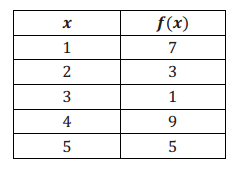
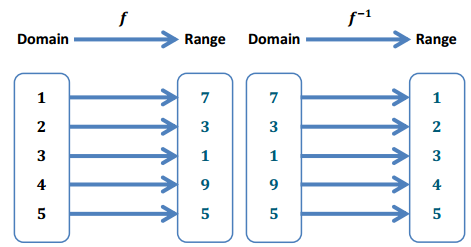
The function f with domain {1, 2, 3, 4, 5} is shown in the table below.
Engage NY Math Precalculus Module 3 Lesson 19 Exercise Answer Key 1
a. What is f(1)? Explain how you know.
Answer:
f(1) = 7 The table shows how the domain values and range values correspond for this function.

b. What is f-1 (1)? Explain how you know.
Answer:
f-1 (1) = 3 Since this is the inverse function, the range values of f are the domain values of f-1.

c. What is the domain of f-1? Explain how you know.
Answer:
The domain of f-1 is the range of f, so the domain of f-1 is the set of numbers {1, 3, 5, 7, 9}.

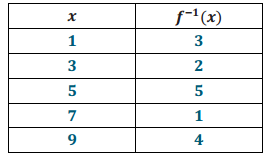
d. Construct a table for the function f-1, the inverse of f.
Answer:
Engage NY Math Precalculus Module 3 Lesson 19 Exercise Answer Key 2

Exercises
Exercise 1.
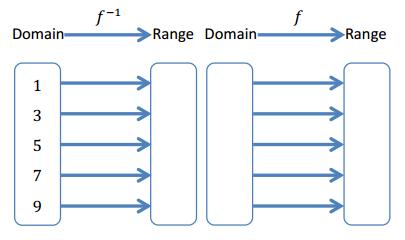
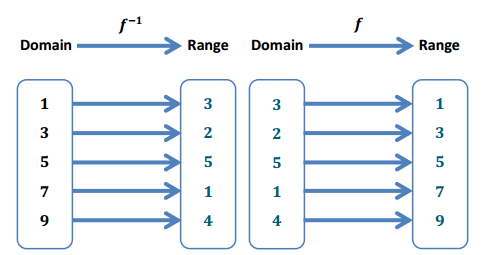
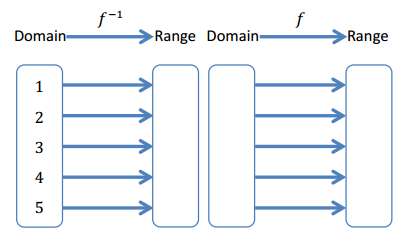
Complete the mapping diagram to show that f(f-1(x)) = x.
Engage NY Math Precalculus Module 3 Lesson 19 Exercise Answer Key 3
Answer:
Engage NY Math Precalculus Module 3 Lesson 19 Exercise Answer Key 4

Exercise 2.
Complete the mapping diagram to show that f-1(f(x)) = x.
Engage NY Math Precalculus Module 3 Lesson 19 Exercise Answer Key 5
Answer:
Engage NY Math Precalculus Module 3 Lesson 19 Exercise Answer Key 6

Exercise 3.
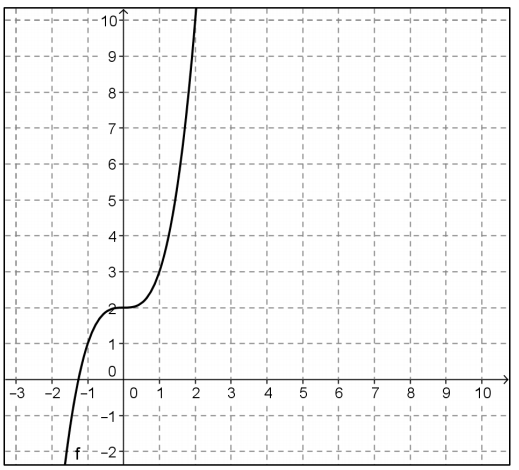
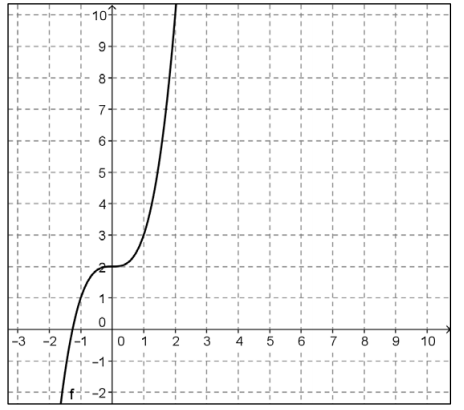
The graph of f is shown below.
Engage NY Math Precalculus Module 3 Lesson 19 Exercise Answer Key 7
a. Select several ordered pairs on the graph of f, and use those to construct a graph of f-1 in part b.
Answer:
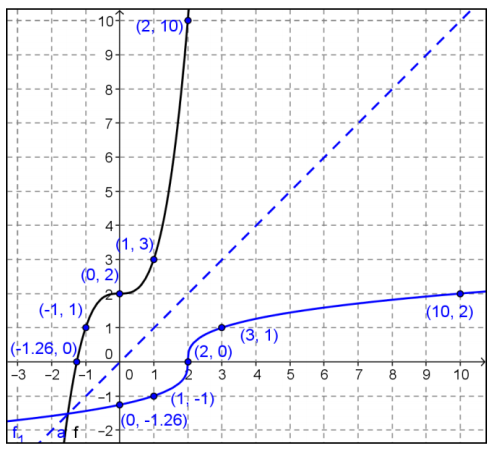
( – 1, 1), (0, 2), (1, 3), (2, 10)

b. Draw the line y = x, and use it to construct the graph of f-1 below.
Engage NY Math Precalculus Module 3 Lesson 19 Exercise Answer Key 8
Answer:
Engage NY Math Precalculus Module 3 Lesson 19 Exercise Answer Key 9

c. The algebraic function for f is given by f(x) = x3 + 2. Is the formula for f-1(x) = \(\sqrt[3]{x – 2}\)? Explain why or why not.
Answer:
No. The formula for f-1is not correct because you don’t get 0 when you substitute 2 into the formula for f3. The correct formula would be f-1(x) = \(\sqrt[3]{x – 2}\).

Exercise 4.
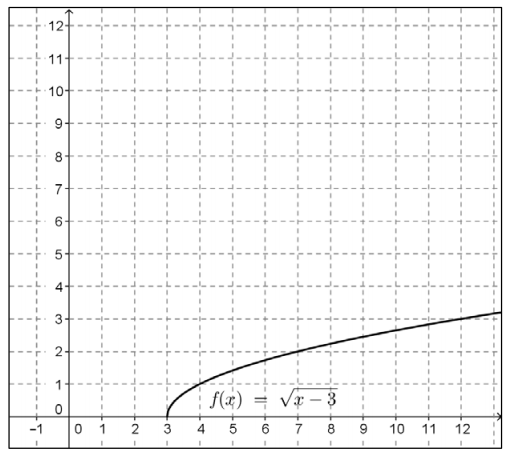
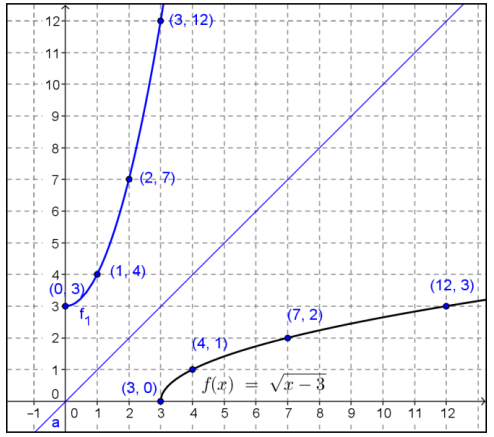
The graph of f(x) = \(\sqrt{x – 3}\) is shown below. Construct the graph of f3.
Engage NY Math Precalculus Module 3 Lesson 19 Exercise Answer Key 10
Answer:
Engage NY Math Precalculus Module 3 Lesson 19 Exercise Answer Key 11

Exercise 5.
Morgan used the procedures learned in Lesson 18 to define f-1(x) = x2 + 3. How does the graph of this function compare to the one you made in Exercise 5?
Answer:
The graph of Morgan’s function, f-1(x) = x2 + 3, is the inverse graph that we drew in Exercise 5. It has a domain that is assumed to be all real numbers. However, the inverse of f must have a domain equal to the range of f, which is f(x) ≥ 0. Thus, the inverse’s domain is not all real numbers but is instead restricted to x ≥ 0. The graphs of these functions are identical for x ≥ 0.

Exercise 6.
Construct the inverse of the function f given by the table below. Is the inverse a function? Explain your reasoning.
Engage NY Math Precalculus Module 3 Lesson 19 Exercise Answer Key 12
Answer:
Engage NY Math Precalculus Module 3 Lesson 19 Exercise Answer Key 13
No, the inverse is not a function. Each element in the domain must have only one element in the range assigned to it. You can see that the number 4 is paired with – 3 and 3.

Exercise 7.
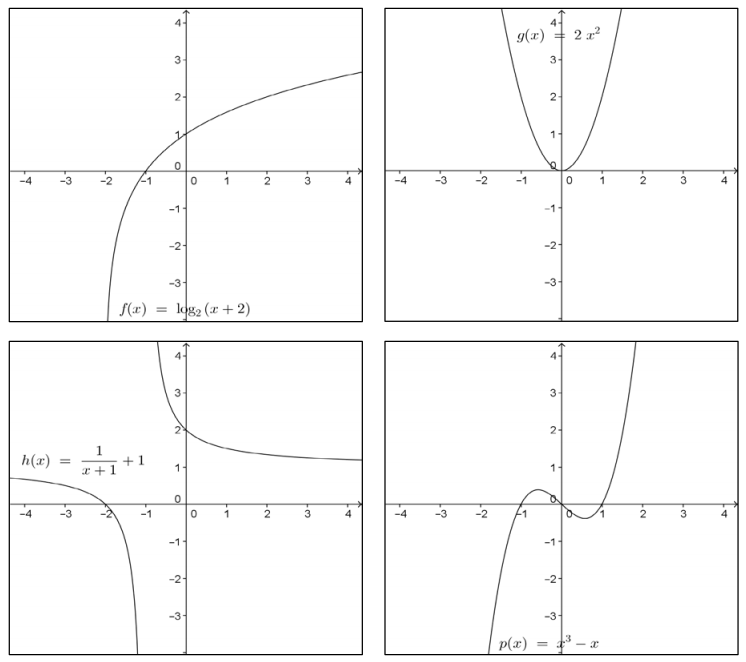
The graphs of several functions are shown below. Which ones are invertible? Explain your reasoning.
Engage NY Math Precalculus Module 3 Lesson 19 Exercise Answer Key 14
Engage NY Math Precalculus Module 3 Lesson 19 Exercise Answer Key 15
Answer:
The functions g, p, and r are not invertible. You can see that multiple elements of the domain are paired with a single range element. When the domain and range are exchanged to form the inverse, the result does not satisfy the definition of a function.

Exercise 8.
Given the function f(x) = x2 – 4:
a. Select a suitable domain for f that makes it an invertible function. State the range of f.
Answer:
A graph shows that the function f has a minimum point at (0, – 4). One possible domain would start with the x – value of the minimum, x ≥ 0. The range of f given this domain would be f(x) ≥ – 4.

b. Write a formula for f-1. State the domain and range of f-1.
Answer:
Since we know the vertex is (0, – 4), we can rewrite this function in vertex form and then create and solve an equation to find the inverse.
f(x) = x2 – 4
y = x2 – 4
x = y2 – 4
x + 4 = y2
y = \(\sqrt{x + 4}\) or y = – \(\sqrt{x + 4}\)
However, select the positive branch because we want the range to be y ≥ 0.
y = \(\sqrt{x + 4}\), x ≥ – 4

c. Verify graphically that f, with the domain you selected, and f-1 are indeed inverses.
Answer:
Engage NY Math Precalculus Module 3 Lesson 19 Exercise Answer Key 16

d. Verify that f and f-1 are indeed inverses by showing that f(f-1 (x)) = x and f-1 (f(x)) = x.
Answer:
f(f-1 (x)) = (\(\sqrt{x + 4}\))2 – 4
= x + 4 – 4
= x
f-1 (f(x)) = \(\sqrt{x + 4}\)
= \(\sqrt{x^{2} + 4 – 4}\)
= x, x ≥ 0

Exercise 9.
Three pairs of functions are given below. For which pairs are f and g inverses of each other? Show work to support your reasoning. If a domain is not specified, assume it is the set of real numbers.
a. f(x) = \(\frac{x}{x + 1}\), x≠ – 1 and g(x) = \(\frac{ – x}{x – 1}\), x≠1
Answer:
Engage NY Math Precalculus Module 3 Lesson 19 Exercise Answer Key 17
The two functions are inverses.

b. f(x) = \(\sqrt{x}\) – 1, x ≥ 0 and g(x) = (x + 1)2
Answer:
f(g(x)) = \(\sqrt{(x + 1)^{2}}\) – 1 = x + 1 – 1 = x
g(f(x)) = (\(\sqrt{x}\) – 1 + 1)2 = \(\) = x
These two functions are inverses as long as we restrict the domain of g to be x ≥ – 1 since the range of f is f(x) ≥ – 1.

c. f(x) = – 0.75x + 1 and g(x) = – \(\frac{4}{3}\) x – \(\frac{4}{3}\)
Answer:
f(g(x)) = – \(\frac{3}{4}\) ( – \(\frac{4}{3}\) x – \(\frac{4}{3}\)) + 1 = x + 1 + 1 = x + 2
These two functions are not inverses.

Eureka Math Precalculus Module 3 Lesson 19 Problem Set Answer Key

Question 1.
Let f be the function that assigns to each student in the class her biological mother.
a. In order for f to have an inverse, what condition must be true about students in your class?
Answer:
No students in the class can share the same biological mother.

b. If we enlarged the domain to include all students in the school, would this larger domain function have an inverse? Explain.
Answer:
Probably not. Most schools contain siblings.

Question 2.
Consider a linear function of the form f(x) = mx + b, where m and b are real numbers, and m≠0.
a. Explain why linear functions of this form always have an inverse that is also a function.
Answer:
The graphs of these functions are lines. When a line is reflected over the line y = x, the image is also a line and, therefore, can be represented as a linear function.

b. State the general form of a line that does not have an inverse.
Answer:
y = k for some real number k That is, only linear functions whose graphs are horizontal lines do not have inverse functions.

c. What kind of function is the inverse of an invertible linear function (e.g., linear, quadratic, exponential, logarithmic, rational)?
Answer:
The inverse of an invertible linear function would also be a linear function.

d. Find the inverse of a linear function of the form f(x) = mx + b, where m and b are real numbers, and
Answer:
m≠0.
x = my + b
y = \(\frac{x – b}{m}\)
So, f-1(x) = \(\frac{x – b}{m}\) for any linear function f(x) = mx + b, with m≠0.

Question 3.
Consider a quadratic function of the form f(x) = \(b\left(\frac{x – h}{a}\right)^{2} + k\) + k for real numbers a, b, h, k, and a, b≠0.
a. Explain why quadratic functions never have an inverse without restricting the domain.
Every quadratic function is represented by the graph of a parabola, which always reflects over the y = x line in such a way that one input maps to two outputs, violating the definition of a function. Thus, a quadratic function could only have an inverse if its domain is restricted.

b. What are the coordinates of the vertex of the graph of f?
Answer:
(h, k)

c.
State the possible domains you can restrict f on so that it has an inverse.
Answer:
The function f on the domains ( – ∞, h] and [h, ∞) is invertible.

d. What kind of function is the inverse of a quadratic function on an appropriate domain?
Answer:
The inverse of a quadratic function on an appropriate domain is a square root function.

e. Find f-1for each of the domains you gave in part (c).
Answer:
x = \(b\left(\frac{y – h}{a}\right)^{2} + k\)
\(\frac{x – k}{b} = \left(\frac{y – h}{a}\right)^{2}\)
y = \(\pm a \sqrt{\frac{x – k}{b}} + h\)
The inverse function is either described by y = \(a \sqrt{\frac{x – k}{b}} + h\) or y = – \(a \sqrt{\frac{x – k}{b}} + h\) depending on which domain is chosen for f.

Question 4.
Show that f(x) = mx + b for real numbers m and b with m≠0 has an inverse that is also a function.
y = mx + b
x = my + b
x – b = my
\(\frac{1}{m} x – \frac{b}{m}\) = y
Thus, f-1(x) = \(\frac{1}{m} x – \frac{b}{m}\), which is a linear function. One can see from the graph of a line that each input in the domain is paired with one output.

Question 5.
Explain why f(x) = a(x – h)2 + k for real numbers a, h, and k with a≠0 does not have an inverse that is a function. Support your answer in at least two different ways (numerically, algebraically, or graphically).
Answer:
y = a(x – h)2 + k
x = a(y – h)2 + k
\(\frac{x – k}{a}\) = (y – h)2
This equation has two solutions when you take the square root:
y – h = \(\sqrt{\frac{x – k}{a}}\) or y – h = – \(\sqrt{\frac{x – k}{a}}\)
You can see that selecting a single value for x results in two corresponding values of y for all x≠k. Thus, the inverse is not a function.
Graphically, the graph of f is a quadratic function with a vertex at (h, k). The symmetry of this graph means that there are two domain values with the same range value for all x≠h. When the graph of this function is reflected over the line y = x, the resulting graph does not meet the definition of a function.

Extension:
Question 6.
Consider the function f(x) = sin⁡(x).
a. Graph y = f(x) on the domain [ – 2π, 2π].
Answer:
Eureka Math Precalculus Module 3 Lesson 19 Problem Set Answer Key 1

b. If we require a restricted domain on f to be continuous and cover the entirety of the range of f, how many possible choices for a domain are there in your graph from part (a)? What are they?
Answer:
There are three possible choices: [ – \(\frac{3\pi}{2}\), – \(\frac{\pi}{2}\)], [ – \(\frac{\pi}{2}\), \(\frac{\pi}{2}\)], [\(\frac{\pi}{2}\), \(\frac{3\pi}{2}\)].

c. Make a decision on which restricted domain you listed in part (b) makes the most sense to choose. Explain your decision.
Answer:
Answers may vary, but it is expected most students choose [ – \(\frac{\pi}{2}\), \(\frac{\pi}{2}\)] since it includes the origin.

d. Use a calculator to evaluate sin-1⁡(0.75) to three decimal places. How can you use your answer to find other values ψ such that sin(ψ) = 1? Verify that your technique works by checking it against your graph in
part (a).
Answer:
sin-1⁡(0.75) ≈ 0.848
On the unit circle, sine values are equal for supplementary angles of rotation, so π – 0.848 gives another approximate result. Infinitely many values can be found from these two values by adding integer multiples of 2π to either value.

Eureka Math Precalculus Module 3 Lesson 19 Exit Ticket Answer Key

Question 1.
Let f(x) = x2 – 3x + 2.
a. Give a restricted domain for f where it is invertible.
Answer:
The vertex of this parabola is at x = \(\frac{3}{2}\), so either ( – ∞, \(\frac{3}{2}\)] or [\(\frac{3}{2}\), ∞) would be acceptable. The remaining answers assume [\(\frac{3}{2}\), ∞) was chosen.

b. Find the inverse of f for the domain you gave in part (a).
Answer:
f(x) = (x – 1.5)2 – 0.25
x = (y – 1.5)2 – 0.25
y = ±\(\sqrt{x + 0.25}\) + 1.5
For f(x) on the domain [\(\frac{3}{2}\), ∞), f-1(x) = \(\sqrt{x + 0.25}\) + 1.5.

c. State the domain and range of the function you found in part (b).
Answer:
For f-1, the domain is all real numbers greater than or equal to – 0.25, and the range is all real numbers greater than or equal to 1.5.

d. Verify through function composition that the function you found in part (b) is the inverse of f.
Answer:
For x ≥ – 0.25, we have:
f(f-1 (x)) = f(\(\sqrt{x + 0.25}\) + 1.5)
= (\(\sqrt{x + 0.25}\) + 1.5)2 – 3(\(\sqrt{x + 0.25}\) + 1.5) + 2
= x + 0.25 + 3\(\sqrt{x + 0.25}\) + 2.25 – 3\(\sqrt{x + 0.25}\) – 4.5 + 2
= x
For x ≥ 1.5, we have:
f-1 (f(x)) = f-1(x2 – 3x + 2)
= \(\sqrt{x^{2} – 3 x + 2 + 0.25} + 1.5\)
= \(\sqrt{x^{2} – 3 x + \frac{9}{4}} + \frac{3}{2}\)
= \(\sqrt{\left(x – \frac{3}{2}\right)^{2}} + \frac{3}{2}\)
= \(x – \frac{3}{2} + \frac{3}{2}\)
= x
Thus, f(f-1 (x)) = f-1 (f(x)) = x.

e. Graph both functions on the domains specified.
Answer:
Eureka Math Precalculus Module 3 Lesson 19 Exit Ticket Answer Key 1
Answer:
Eureka Math Precalculus Module 3 Lesson 19 Exit Ticket Answer Key 2

Eureka Math Precalculus Module 3 Lesson 9 Answer Key

Engage NY Eureka Math Precalculus Module 3 Lesson 9 Answer Key

Eureka Math Precalculus Module 3 Lesson 9 Exercise Answer Key

Exercises
Exercise 1.
Let R = 5, and let A(x) represent the area of a cross section for a circle at a distance x from the center of the sphere.
Engage NY Math Precalculus Module 3 Lesson 9 Exercise Answer Key 1
“Sphere with Cross Section” by Theneb 314 is licensed under CC BY-SA 3.0
http://creativecommons.org/licenses/by-sa/3.0/deed.en
a. Find A(0). What is special about this particular cross section?
Answer:
A(0) = π∙52 = 25π. This is the largest cross section in the sphere; it’s the area of a “great circle.”

b. Find A(1).
Answer:
When x = 1, we have r2+12 = 52. Thus, A(1) = π∙r2 = π∙(52-12 ) = π∙(25-1) = 24π.

c. Find A(3).
Answer:
When x = 3, we have r2+32 = 52. Thus, A(3) = π∙r2 = π∙(52-32 ) = π∙(25-9) = 16π.

d. Find A(4).
Answer:
When x = 4, we have r2+42 = 52. Thus, A(4) = π∙r2 = π∙(52-42 ) = π∙(25-16) = 9π.

e. Find A(5). What is special about this particular cross section?
Answer:
A(5) = 0. When the plane reaches the point where x = 5, the cross section is a single point, so the area vanishes.

Exercise 2.
Let the radius of the cylinder be R = 5, and let B(x) represent the area of the blue ring when the slicing plane is at a distance x from the top of the cylinder.
Engage NY Math Precalculus Module 3 Lesson 9 Exercise Answer Key 2
© Roberto Cardil, Matematicas Visuales
http://www.matematicasvisuales.com
a. Find B(1). Compare this area with A(1), the area of the corresponding slice of the sphere.
Answer:
B(1) = π∙52-π∙12 = 25π-1π = 24π This is equivalent to A(1).

b. Find B(2). Compare this area with A(2), the area of the corresponding slice of the sphere.
Answer:
B(2) = π∙52-π∙22 = 25π-4π = 21π This is equivalent to A(2).

c. Find B(3). Compare this area with A(3), the area of the corresponding slice of the sphere.
Answer:
B(3) = π∙52-π∙32 = 25π-9π = 16π This is equivalent to A(3).

Exercise 3.
Explain how to derive the formula for the volume of a sphere with radius r.
Engage NY Math Precalculus Module 3 Lesson 9 Exercise Answer Key 3
© Joe Mercer
http://www.ceemrr.com
Answer:
If we pass a plane through the sphere that is parallel to the bases of the cylinder at a distance x from the center of the sphere, we get a circle with area A(x) = π∙(r2-x2).
When the same plane intersects the cylinder, a ring is formed around the double cone. The area of this ring is B(x) = π∙r2-π∙x2.
It’s easy to see that A(x) = B(x), and since both solids have height 2r, it follows from Cavalieri’s principle that the volume of the sphere is equal to the volume of the space outside the double cone.
The volume of the cylinder is V = π∙r2∙2r = 2π∙r3.
Thus, the volume of the double cone is V = \(\frac{1}{3}\)∙2π∙r3.
The volume of the space outside the double cone is therefore V = \(\frac{2}{3}\)∙2π∙r3 = \(\frac{4}{3}\) π∙r3. Since the sphere also has this volume, this is the formula for the volume of the sphere.

Eureka Math Precalculus Module 3 Lesson 9 Problem Set Answer Key

Question 1.
Consider the sphere with radius r = 4. Suppose that a plane passes through the sphere at a height y = 2 units above the center of the sphere, as shown in the figure below.
Eureka Math Precalculus Module 3 Lesson 9 Problem Set Answer Key 1
a. Find the area of the cross section of the sphere.
Answer:
The sphere has radius 4, and the cross section passes through at y = 2, which tells us that the radius at the cross section is r = \(\sqrt{4^{2}-2^{2}}\) = \(\sqrt{12}\) = 2\(\sqrt{3}\). Thus, the area of the cross section is 12π.

b. Find the area of the cross section of the cylinder that lies outside of the cone.
Answer:
The cone has radius equal to its height at the cross section, and the circle passing through it has radius equal to 4 (since the radius of the cylinder is constant).

c. Find the volume of the cylinder, the cone, and the hemisphere shown in the figure.
Answer:
The volume of the cylinder is V = πr2 h = 64π cubic units. The volume of the cone is
V = \(\frac{1}{3}\) πr2 h = \(\frac{64}{3}\) π cubic units. The volume of the hemisphere is twice the volume of the cone, so \(\frac{128}{3}\) π cubic units.

d. Find the volume of the sphere shown in the figure.
Answer:
The sphere is twice the volume of the hemisphere, so \(\frac{256}{3}\) π cubic units.

e. Explain using Cavalieri’s principle the formula for the volume of any single solid.
Answer:
Cavalieri’s principle tells us that to find the volume of a solid, we can examine cross sections of the solid. If another shape exists with the same height and equal areas of cross sections, then the two shapes have equal volume.

Question 2.
Give an argument for why the volume of a right prism is the same as an oblique prism with the same height.
Answer:
Since the cross sections of both a right prism and an oblique prism would be the same shape (same area), it does not matter if the object is on a slant or straight up and down; they have the same volume.

Question 3.
A paraboloid of revolution is a three-dimensional shape obtained by rotating a parabola around its axis. Consider the solid between a paraboloid described by the equation y = x2 and the line y = 1.
Eureka Math Precalculus Module 3 Lesson 9 Problem Set Answer Key 2
a. Cross sections perpendicular to the y-axis of this paraboloid are what shape?
Answer:
Circles

b. Find the area of the largest cross section of this solid, when y = 1.
Answer:
When y = 1,x = 1, so π12 = π.

c, Find the area of the smallest cross section of this solid, when y = 0.
Answer:
When y = 0, x = 0, so π02 = 0.

d. Consider a right triangle prism with legs of length 1, hypotenuse of length \(\sqrt{2}\), and depth π as pictured below. What shape are the cross sections of the prism perpendicular to the y-axis?
Eureka Math Precalculus Module 3 Lesson 9 Problem Set Answer Key 3
Answer:
Cross sections are rectangles.

e. Find the areas of the cross sections of the prism at y = 1 and y = 0.
Answer:
At y = 1, the width is 1, and the depth is π, so π ⋅ 1 = π.
At y = 0, the width is 0, and the depth is π, so π ⋅ 0 = 0.

f. Verify that at y = y0, the areas of the cross sections of the paraboloid and the prism are equal.
Answer:
At y0, the cross sections of the paraboloid have radius x = \(\sqrt{y_{0}}\), so the area is π(\(\sqrt{y_{0}}\))2 = y0 π.
Similarly, the width of the rectangle is equal to the height of the prism, so at y0, the width is y0, and the depth is a constant π, so the area is y0 π.

g. Find the volume of the paraboloid between y = 0 and y = 1.
Answer:
The volume of the paraboloid is equal to the volume of the right triangular prism, which has volume V = \(\frac{1}{2}\) abh = \(\frac{1}{2}\) ⋅ 1 ⋅ 1 ⋅ π = \(\frac{\pi}{2}\).

h. Compare the volume of the paraboloid to the volume of the smallest cylinder containing it. What do you notice?
Answer:
The volume of the paraboloid is half the volume of the cylinder.

i. Let Vcyl be the volume of a cylinder, Vpar be the volume of the inscribed paraboloid, and Vcone be the volume of the inscribed cone. Arrange the three volumes in order from smallest to largest.
Answer:
Vcone < Vpar < Vcyl since Vcone = \(\frac{1}{3}\) Vcyl and Vpar = \(\frac{1}{2}\) Vcyl

Question 4.
Consider the graph of f described by the equation f(x) = \(\frac{1}{2}\) x2 for 0 ≤ x ≤ 10.
a. Find the area of the 10 rectangles with height f(i) and width 1, for i = 1, 2, 3, … , 10.
Answer:
In each case, the width is one, so the area is equal to the height of the function at that point; we get
\(\frac{1}{2}\), 2, \(\frac{9}{2}\), 8, \(\frac{25}{2}\), 18, \(\frac{49}{2}\), 32, \(\frac{81}{2}\), 50.

b. What is the total area for 0 ≤ x ≤ 10? That is, evaluate \(\sum_{i = 1}^{10}\)f(i) ⋅ Δx for Δx = 1.
Answer:
\(\sum_{i = 1}^{10}\)f(i) ⋅ Δx = 192.5

c. Draw a picture of the function and rectangles for i = 1, 2, 3.
Answer:
Eureka Math Precalculus Module 3 Lesson 9 Problem Set Answer Key 4

d. Is your approximation an overestimate or an underestimate?
Answer:
Since each rectangle contains more area than is under the parabola, the estimate is an overestimate.

e. How could you get a better approximation of the area under the curve?
Answer:
Answers may vary and may include that you could find smaller rectangles, you could find the underestimate by using the left endpoints, and you could cut off the triangles above the function to get a trapezoid.

Question 5.
Consider the three-dimensional solid that has square cross sections and whose height y at position x is given by the equation y = 2\(\sqrt{x}\) for 0 ≤ x ≤ 4.
a. Approximate the shape with four rectangular prisms of equal width. What is the height and volume of each rectangular prism? What is the total volume?
Answer:
The heights are 2, 2\(\sqrt{2}\), 2\(\sqrt{3}\), 4, and the volumes are 4, 8, 12, 16. The total volume is 40.

b. Approximate the shape with eight rectangular prisms of equal width. What is the height and volume of each rectangular prism? What is the total volume?
Answer:
The heights are 2\(\sqrt{\frac{1}{2}}\), 2, 2\(\sqrt{\frac{3}{2}}\), 2\(\sqrt{2}\), 2\(\sqrt{\frac{5}{2}}\), 2\(\sqrt{3}\), 2\(\sqrt{\frac{7}{2}}\), 4, and the volumes are 1, 2, 3, 4, 5, 6, 7, 8. The total volume is 36.

c. How much did your approximation improve? The volume of the shape is 32 cubic units. How close is your approximation from part (b)?
Answer:
The approximation improved by 4 cubic units. The approximation is off by 4 cubic units.

d. How many rectangular prisms would you need to be able to approximate the volume accurately?
Answer:
It is hard to say, but many would be needed to get significant accuracy, although this could be reduced by taking both an upper and a lower bound.

Eureka Math Precalculus Module 3 Lesson 9 Exit Ticket Answer Key

Question 1.
Explain how Cavalieri’s principle can be used to find the volume of any solid.
Answer:
Cavalieri’s principle tells us that to find the volume of a solid, we can examine cross sections of the solid. If another shape exists with the same height and equal areas of cross sections, then the two shapes will have equal volume.

Eureka Math Precalculus Module 3 Lesson 8 Answer Key

Engage NY Eureka Math Precalculus Module 3 Lesson 8 Answer Key

Eureka Math Precalculus Module 3 Lesson 8 Exercise Answer Key

Exercises
Exercise 1.
Let F(0, 5) and G(0, – 5) be the foci of a hyperbola. Let the points P(x,y) on the hyperbola satisfy either PF – PG = 6 or PG – PF = 6. Use the distance formula to derive an equation for this hyperbola, writing your answer in the form \(\frac{x^{2}}{a^{2}}\) – \(\frac{y^{2}}{b^{2}}\) = 1.
Answer:
PG – PF = 6
\(\sqrt{x^{2} + (y + 5)^{2}}\) – \(\sqrt{x^{2} + (y – 5)^{2}}\) = 6
\(\sqrt{x^{2} + (y + 5)^{2}}\) = 6 + \(\sqrt{x^{2} + (y – 5)^{2}}\)
x2 + (y2 + 10y + 25) = 36 + 12\(\sqrt{x^{2} + (y – 5)^{2}}\) + (x2 + y2 – 10y + 25)
20y – 36 = 12\(\sqrt{x^{2} + (y – 5)^{2}}\)
5y – 9 = 3\(\sqrt{x^{2} + (y – 5)^{2}}\)
25y2 – 90y + 81 = 9(x2 + y2 – 10y + 25)
25y2 – 90y + 81 = 9x2 + 9y2 – 90y + 225
16y2 – 9x2 = 144
\(\frac{y^{2}}{9}\) – \(\frac{x^{2}}{16}\) = 1

Exercise 2.
Where does the hyperbola described above intersect the y – axis?
Answer:
The curve intersects the y – axis at (0,3) and (0, – 3).

Exercise 3.
Find an equation for the line that acts as a boundary for the portion of the curve that lies in the first quadrant.
Answer:
For large values of x, \(\frac{y}{3}\)≈\(\frac{x}{4}\), so the line y = \(\frac{3}{4}\) x is the boundary for the curve in the first quadrant.

Exercise 4.
Sketch the graph of the hyperbola described above.
Answer:
Engage NY Math Precalculus Module 3 Lesson 8 Exercise Answer Key 1

Eureka Math Precalculus Module 3 Lesson 8 Problem Set Answer Key

Question 1.
For each hyperbola described below: (1) Derive an equation of the form \(\frac{x^{2}}{a^{2}}\) – \(\frac{y^{2}}{b^{2}}\) = 1 or \(\frac{y^{2}}{b^{2}}\) – \(\frac{x^{2}}{a^{2}}\) = 1. (2) State any x – or y – intercepts. (3) Find the equations for the asymptotes of the hyperbola.
a. Let the foci be A( – 2,0) and B(2,0), and let P be a point for which either PA – PB = 2 or PB – PA = 2.
Answer:
i. x2 – \(\frac{y^{2}}{3}\) = 1
ii. ( – 1,0), (1,0); no y – intercepts
iii. y≈\(\sqrt{3}\) x, so y = ±\(\sqrt{3}\) x

b. Let the foci be A( – 5,0) and B(5,0), and let P be a point for which either PA – PB = 5 or PB – PA = 5.
Answer:
i. \(\frac{x^{2}}{\frac{25}{4}}\) – \(\frac{y^{2}}{\frac{75}{4}}\) = 1
ii. ( – 2.5,0), (2.5,0); no y – intercepts
iii. y≈\(\frac{\sqrt{75}}{2}\)⋅\(\frac{2}{5}\) x = \(\sqrt{3}\) x, so y = ±\(\sqrt{3}\) x

c. Consider A(0, – 3) and B(0,3), and let P be a point for which either PA – PB = 2.5 or PB – PA = 2.5.
Answer:
i. \(\frac{y^{2}}{\frac{9}{4}}\) – \(\frac{x^{2}}{\frac{27}{4}}\) = 1
ii. (0,1.5), (0, – 1.5); no x – intercepts
iii. y≈\(\frac{3}{2}\)⋅\(\frac{2}{\sqrt{27}}\) x = \(\frac{1}{\sqrt{3}}\)x, so y = ±\(\frac{\sqrt{3}}{3}\)x

d. Consider A(0, – \(\sqrt{2}\)) and B(0,\(\sqrt{2}\)), and let P be a point for which either PA – PB = 2 or PB – PA = 2.
Answer:
i. y2 – x2 = 1
ii. (0,1), (0, – 1); no x – intercepts.
iii. y = ±x

Question 2.
Graph the hyperbolas in parts (a)–(d) in Problem 1.
Answer:
a.
Eureka Math Precalculus Module 3 Lesson 8 Problem Set Answer Key 1

b.
Eureka Math Precalculus Module 3 Lesson 8 Problem Set Answer Key 2

c.
Eureka Math Precalculus Module 3 Lesson 8 Problem Set Answer Key 3

d.
Eureka Math Precalculus Module 3 Lesson 8 Problem Set Answer Key 4

Question 3.
For each value of k specified in parts (a)–(e), plot the set of points in the plane that satisfy the equation
x2 – y2 = k.
a. k = 4
Answer:
Eureka Math Precalculus Module 3 Lesson 8 Problem Set Answer Key 5

b. k = 1
Answer:
Eureka Math Precalculus Module 3 Lesson 8 Problem Set Answer Key 6

c. k = \(\frac{1}{4}\)
Answer:
Eureka Math Precalculus Module 3 Lesson 8 Problem Set Answer Key 7

d. k = 0
Answer:
Eureka Math Precalculus Module 3 Lesson 8 Problem Set Answer Key 8

e. k = – \(\frac{1}{4}\)
Answer:
Eureka Math Precalculus Module 3 Lesson 8 Problem Set Answer Key 9

f. k = – 1
Answer:
Eureka Math Precalculus Module 3 Lesson 8 Problem Set Answer Key 10

g. k = – 4
Answer:
Eureka Math Precalculus Module 3 Lesson 8 Problem Set Answer Key 11

h. Describe the hyperbolas x2 – y2 = k for different values of k. Consider both positive and negative values of k, and consider values of k close to zero and far from zero.
Answer:
If k is close to zero, then the hyperbola is very close to the asymptotes y = x and y = – x, appearing almost to have corners as the graph crosses the x – axis. If k is far from zero, the hyperbola gets farther from the asymptotes near the center. If k > 0, then the hyperbola crosses the x – axis, opening to the right and left, and if k<0, then the hyperbola crosses the y – axis, opening up and down.

i. Are there any values of k so that the equation x2 – y2 = k has no solution?
Answer:
No. The equation x2 – y2 = k always has solutions. The solution points lie on either two intersecting lines or on a hyperbola.

Question 4.
For each value of k specified in parts (a)–(e), plot the set of points in the plane that satisfy the equation
\(\frac{x^{2}}{k}\) – y2 = 1.
a. k = – 1
Answer:
There is no solution to the equation \(\frac{x^{2}}{ – 1}\) – y2 = 1, because there are no real numbers x and y so that x2 + y2 = – 1.

b. k = 1
Answer:
Eureka Math Precalculus Module 3 Lesson 8 Problem Set Answer Key 12

c. k = 2
Answer:
Eureka Math Precalculus Module 3 Lesson 8 Problem Set Answer Key 13

d. k = 4
Answer:
Eureka Math Precalculus Module 3 Lesson 8 Problem Set Answer Key 14

e. k = 10
Answer:
Eureka Math Precalculus Module 3 Lesson 8 Problem Set Answer Key 15

f. k = 25
Answer:
Eureka Math Precalculus Module 3 Lesson 8 Problem Set Answer Key 16

g. Describe what happens to the graph of \(\frac{x^{2}}{k}\) – y2 = 1 as k → ∞.
Answer:
As k → ∞, it appears that the hyperbolas with equation \(\frac{x^{2}}{k}\) – y2 = 1 get flatter; the x – intercepts get farther from the center at the origin, and the asymptotes get less steep.

Question 5.
For each value of k specified in parts (a)–(e), plot the set of points in the plane that satisfy the equation
x2 – \(\frac{y^{2}}{k}\) = 1.
a. k = – 1
Answer:
Eureka Math Precalculus Module 3 Lesson 8 Problem Set Answer Key 17

b. k = 1
Answer:
Eureka Math Precalculus Module 3 Lesson 8 Problem Set Answer Key 18

c. k = 2
Answer:
Eureka Math Precalculus Module 3 Lesson 8 Problem Set Answer Key 19

d. k = 4
Answer:
Eureka Math Precalculus Module 3 Lesson 8 Problem Set Answer Key 20

e. k = 10
Answer:
Eureka Math Precalculus Module 3 Lesson 8 Problem Set Answer Key 21

f. Describe what happens to the graph x2 – \(\frac{y^{2}}{k}\) = 1 as k → ∞.
Answer:
As k → ∞, the hyperbola with equation x2 – \(\frac{y^{2}}{k}\) = 1 is increasingly stretched vertically. The center and intercepts do not change, but the steepness of the asymptotes increases.

Question 6.
An equation of the form ax2 + bx + cy2 + dy + e = 0 where a and c have opposite signs might represent a hyperbola.
a. Apply the process of completing the square in both x and y to convert the equation
Answer:
9x2 – 36x – 4y2 – 8y – 4 = 0 to one of the standard forms for a hyperbola: \(\frac{(x – h)^{2}}{a^{2}}\) – \(\frac{(y – k)^{2}}{b^{2}}\) = 1 or \(\frac{(y – k)^{2}}{b^{2}}\) – \(\frac{(x – h)^{2}}{a^{2}}\) = 1.
9x2 – 36x – 4y2 – 8y = 4
9(x2 – 4x) – 4(y2 + 2y) = 4
9(x2 – 4x + 4) – 4(y2 + 2y + 1) = 4 + 36 – 4
9(x – 2)2 – 4(y + 1)2 = 36
\(\frac{(x – 2)^{2}}{4}\) – \(\frac{(y + 1)^{2}}{9}\) = 1

b. Find the center of this hyperbola.
Answer:
The center is (2, – 1).

c. Find the asymptotes of this hyperbola.
Answer:
\(\frac{x – 2}{2}\) = ±\(\frac{y + 1}{3}\)
y = \(\frac{3}{2}\) x – 4 or y = – \(\frac{3}{2}\) x + 2

d. Graph the hyperbola.
Answer:
Eureka Math Precalculus Module 3 Lesson 8 Problem Set Answer Key 22

Question 7.
For each equation below, identify the graph as either an ellipse, a hyperbola, two lines, or a single point. If possible, write the equation in the standard form for either an ellipse or a hyperbola.
a. 4x2 – 8x + 25y2 – 100y + 4 = 0
Answer:
In standard form, this is the equation of an ellipse: \(\frac{(x – 1)^{2}}{25}\) + \(\frac{(y – 2)^{2}}{4}\) = 1.

b. 4x2 – 16x – 9y2 – 54y – 65 = 0
Answer:
When we try to put this equation in standard form, we find \(\frac{(x – 2)^{2}}{9}\) – \(\frac{(y + 3)^{2}}{4}\) = 0, which gives
(\(\frac{x – 2}{3}\) = ±\(\frac{y + 3}{2}\). These are the lines with equation y = \(\frac{1}{3}\) (2x – 13) and y = \(\frac{1}{3}\) ( – 2x – 5).

c. 4x2 + 8x + y2 + 2y + 5 = 0
Answer:
When we try to put this equation in standard form, we find (x + 1)2 + \(\frac{(y + 1)^{2}}{4}\) = 0. The graph of this equation is the single point ( – 1, – 1).

d. – 49x2 + 98x + 4y2 – 245 = 0
Answer:
In standard form, this is the equation of a hyperbola: \(\frac{y^{2}}{49}\) – \(\frac{(x – 1)^{2}}{4}\) = 1.

e. What can you tell about a graph of an equation of the form ax2 + bx + cy2 + dy + e = 0 by looking at the coefficients?
Answer:
There are two categories; if the coefficients a and c have the same sign, then the graph is either an ellipse, a point, or an empty set. If the coefficients a and c have opposite signs, then the graph is a hyperbola or two intersecting lines. We cannot tell just by looking at the coefficients which of these sub – cases hold.

Eureka Math Precalculus Module 3 Lesson 8 Exit Ticket Answer Key

Question 1.
Let F( – 4,0) and B(4,0) be the foci of a hyperbola. Let the points P(x,y) on the hyperbola satisfy either PF – PG = 4 or PG – PF = 4. Derive an equation for this hyperbola, writing your answer in the form \(\frac{x^{2}}{a^{2}}\) – \(\frac{y^{2}}{b^{2}}\) = 1.
Answer:
PF = \(\sqrt{(x + 4)^{2} + y^{2}}\)
PB = \(\sqrt{(x – 4)^{2} + y^{2}}\)
\(\sqrt{(x + 4)^{2} + y^{2}}\) = 4 + \(\sqrt{(x – 4)^{2} + y^{2}}\)
(x + 4)2 + y2 = 16 + 8\(\sqrt{(x – 4)^{2} + y^{2}}\) + (x – 4)2 + y2
x2 + 8x + 16 + y2 = 16 + 8\(\sqrt{(x – 4)^{2} + y^{2}}\) + x2 – 8x + 16 + y2
16x – 16 = 8\(\sqrt{(x – 4)^{2} + y^{2}}\)
2x – 2 = \(\sqrt{(x – 4)^{2} + y^{2}}\)
4x2 – 8x + 4 = (x – 4)2 + y2
4x2 – 8x + 4 = x2 – 8x + 16 + y2
3x2 – y2 = 12
\(\frac{x^{2}}{4}\) – \(\frac{y^{2}}{12}\) = 1

Eureka Math Precalculus Module 3 Lesson 7 Answer Key

Engage NY Eureka Math Precalculus Module 3 Lesson 7 Answer Key

Eureka Math Precalculus Module 3 Lesson 7 Exercise Answer Key

Exercise
Points F and G are located at (0, 3) and (0, – 3). Let P(x, y) be a point such that PF + PG = 8. Use this information to show that the equation of the ellipse is \(\frac{x^{2}}{7} + \frac{y^{2}}{16}\) = 1.
Engage NY Math Precalculus Module 3 Lesson 7 Exercise Answer Key 1
Answer:
The distance from the x – axis to point F and to point G is 3. The distance from the x – axis to point P is x; that means the vertical distance from F to P is 3 – y, and the vertical distance from G to P is 3 + y.
PF + PG = \(\sqrt{x^{2} + (3 – y)^{2}}\) + \(\sqrt{x^{2} + (y + 3)^{2}}\) = 8
\(\sqrt{x^{2} + (3 – y)^{2}}\) = 8 – \(\sqrt{x^{2} + (y + 3)^{2}}\)
x2 + (3 – y)2 = 64 – 16\(\sqrt{x^{2} + (y + 3)^{2}}\) + x2 + (y + 3)2
y2 – 6y + 9 = 64 – 16\(\sqrt{x^{2} + (y + 3)^{2}}\) + y2 + 6y + 9
16\(\sqrt{x^{2} + (y + 3)^{2}}\) = 64 + 12y
256[x2 + (y + 3)2 ] = 4096 + 1536y + 144y2
256[x2 + y2 + 6y + 9] = 4096 + 1536y + 144y2
256x2 + 256y2 + 1536y + 2304 = 4096 + 1536y + 144y2
256x2 + 112y2 = 1792
\(\frac{x^{2}}{7} + \frac{y^{2}}{16}\) = 1

Eureka Math Precalculus Module 3 Lesson 7 Problem Set Answer Key

Question 1.
Derive the equation of the ellipse with the given foci F and G that passes through point P. Write your answer in standard form: \(\) = 1.
a. The foci are F( – 2, 0) and G(2, 0), and point P(x, y) satisfies the condition PF + PG = 5.
Answer:
\(\frac{x^{2}}{\frac{25}{4}}\) + \(\frac{y^{2}}{\frac{9}{4}}\) = 1
\(\frac{4 x^{2}}{25}\) + \(\frac{4 y^{2}}{9}\)

b. The foci are F( – 1, 0) and G(1, 0), and point P(x, y) satisfies the condition PF + PG = 5.
Answer:
\(\frac{x^{2}}{\frac{25}{4}}\) + \(\frac{y^{2}}{\frac{21}{4}}\) = 1
\(\frac{4 x^{2}}{25}\) + \(\frac{4 y^{2}}{21}\)

c. The foci are F(0, – 1) and G(0, 1), and point P(x, y) satisfies the condition PF + PG = 4.
Answer:
\(\frac{x^{2}}{3}\) + \(\frac{y^{2}}{4}\) = 1

d. The foci are F( – \(\frac{2}{3}\), 0) and G(\(\frac{2}{3}\), 0), and point P(x, y) satisfies the condition PF + PG = 3.
Answer:
\(\frac{x^{2}}{\frac{9}{4}}\) + \(\frac{y^{2}}{\frac{65}{36}}\) = 1
\(\frac{4x^{2}}{9}\) + \(\frac{36y^{2}}{65}\) = 1

e. The foci are F(0, – 5) and G(0, 5), and point P(x, y) satisfies the condition PF + PG = 12.
Answer:
\(\frac{x^{2}}{11}\) + \(\frac{y^{2}}{36}\) = 1

f. The foci are F( – 6, 0) and G(6, 0), and point P(x, y) satisfies the condition PF + PG = 20.
Answer:
\(\frac{x^{2}}{100}\) + \(\frac{y^{2}}{64}\) = 1

Question 2.
Recall from Lesson 6 that the semi – major axes of an ellipse are the segments from the center to the farthest vertices, and the semi – minor axes are the segments from the center to the closest vertices. For each of the ellipses in Problem 1, find the lengths a and b of the semi – major axes.
Answer:
a. a = \(\frac{5}{2}\), b = \(\frac{3}{2}\)
b. a = \(\frac{5}{2}\), b = \(\frac{\sqrt{21}}{2}\)
c. a = \(\sqrt{3}\), b = 2
d. a = \(\frac{3}{2}\), b = \(\frac{\sqrt{65}}{6}\)
e. a = \(\sqrt{11}\), b = 6
f. a = 10, b = 8

Question 3.
Summarize what you know about equations of ellipses centered at the origin with vertices (a, 0), ( – a, 0), (0, b), and (0, – b).
Answer:
For ellipses centered at the origin, the equation is always \(\frac{x^{2}}{a^{2}}\) + \(\frac{y^{2}}{b^{2}}\) = 1, where a is the positive x – value of the
x – intercepts and b is the positive y – value of the y – intercepts. If we know the x – and y – intercepts, then we know the equation of the ellipse.

Question 4.
Use your answer to Problem 3 to find the equation of the ellipse for each of the situations below.
a. An ellipse centered at the origin with x – intercepts ( – 2, 0), (2, 0) and y – intercepts (0, 8), (0, – 8)
Answer:
\(\frac{x^{2}}{4}\) + \(\frac{y^{2}}{64}\) = 1

b. An ellipse centered at the origin with x – intercepts ( – \(\sqrt{5}\), 0), (\(\sqrt{5}\), 0) and y – intercepts (0, 3), (0, – 3)
Answer:
\(\frac{x^{2}}{5}\) + \(\frac{y^{2}}{9}\) = 1

Question 5.
Examine the ellipses and the equations of the ellipses you have worked with, and describe the ellipses with equation \(\frac{x^{2}}{a^{2}}\) + \(\frac{y^{2}}{b^{2}}\) = 1 in the three cases a > b, a = b, and b > a.
Answer:
If a > b, then the foci are on the x – axis and the ellipse is oriented horizontally, and if b > a, the foci are on the y – axis and the ellipse is oriented vertically. If a = b, then the ellipse is a circle with radius a.

Question 6.
Is it possible for \(\frac{x^{2}}{4}\) + \(\frac{y^{2}}{9}\) = 1 to have foci at ( – c, 0) and (c, 0) for some real number c?
Answer:
No. Since 9 > 4, the foci must be along the y – axis.

Question 7.
For each value of k specified in parts (a)–(e), plot the set of points in the plane that satisfy the equation
\(\frac{x^{2}}{4}\) + y2 = k.
a. k = 1
Answer:
Eureka Math Precalculus Module 3 Lesson 7 Problem Set Answer Key 1

b. k = \(\frac{1}{4}\)
Answer:
Eureka Math Precalculus Module 3 Lesson 7 Problem Set Answer Key 2

c. k = \(\frac{1}{9}\)
Answer:
Eureka Math Precalculus Module 3 Lesson 7 Problem Set Answer Key 3

d. k = \(\frac{1}{16}\)
Answer:
Eureka Math Precalculus Module 3 Lesson 7 Problem Set Answer Key 4

e. k = \(\frac{1}{25}\)
Answer:
Eureka Math Precalculus Module 3 Lesson 7 Problem Set Answer Key 5

f. k = \(\frac{1}{100}\)
Answer:
Eureka Math Precalculus Module 3 Lesson 7 Problem Set Answer Key 6

g. Make a conjecture: Which points in the plane satisfy the equation \(\frac{x^{2}}{4}\) + y2 = 0?
Answer:
As k is getting smaller, the ellipse is shrinking. It seems that the only point that lies on the curve given by \(\frac{x^{2}}{4}\) + y2 = 0 would be the single point (0, 0).

h. Explain why your conjecture in part (g) makes sense algebraically.
Answer:
Both \(\frac{x^{2}}{4}\) and y2 are nonnegative numbers, and the only way to sum two nonnegative numbers and get zero would be if they were both zero. Thus, \(\frac{x^{2}}{4}\) = 0 and y2 = 0, which means that (x, y) is (0, 0).

i. Which points in the plane satisfy the equation \(\frac{x^{2}}{4}\) + y2 = – 1?
Answer:
There are no points in the plane that satisfy the equation x2 + y2 = – 1 because \(\frac{x^{2}}{4}\) + y2 ≥ 0 for all real numbers x and y.

Question 8.
For each value of k specified in parts (a)–(e), plot the set of points in the plane that satisfy the equation
\(\frac{x^{2}}{k}\) + y2 = 1.
a. k = 1
Answer:
Eureka Math Precalculus Module 3 Lesson 7 Problem Set Answer Key 7

b. k = 2
Answer:
Eureka Math Precalculus Module 3 Lesson 7 Problem Set Answer Key 8

c. k = 4
Answer:
Eureka Math Precalculus Module 3 Lesson 7 Problem Set Answer Key 9

d. k = 10
Answer:
Eureka Math Precalculus Module 3 Lesson 7 Problem Set Answer Key 10

e. k = 25
Answer:
Eureka Math Precalculus Module 3 Lesson 7 Problem Set Answer Key 11

f. Describe what happens to the graph of \(\frac{x^{2}}{k}\) + y2 = 1 as k→∞.
Answer:
As k gets larger and larger, the ellipse stretches more and more horizontally, while not changing vertically. The vertices are ( – \(\sqrt{k}\), 0), (\(\sqrt{k}\), 0), (0, – 1), and (0, 1).

Question 9.
For each value of k specified in parts (a)–(e), plot the set of points in the plane that satisfy the equation
x2 + \(\frac{y^{2}}{k}\) = 1.
a. k = 1
Answer:
Eureka Math Precalculus Module 3 Lesson 7 Problem Set Answer Key 12

b. k = 2
Answer:
Eureka Math Precalculus Module 3 Lesson 7 Problem Set Answer Key 13

c. k = 4
Answer:
Eureka Math Precalculus Module 3 Lesson 7 Problem Set Answer Key 14

d. k = 10
Answer:
Eureka Math Precalculus Module 3 Lesson 7 Problem Set Answer Key 15

e. k = 25
Answer:
Eureka Math Precalculus Module 3 Lesson 7 Problem Set Answer Key 16

f. Describe what happens to the graph of x2 + \(\frac{y^{2}}{k}\) = 1 as k → ∞.
Answer:
As k gets larger and larger, the ellipse stretches more and more vertically, while not changing horizontally. The vertices are ( – 1, 0), (1, 0), (0, – \(\sqrt{k}\)), and (0, \(\sqrt{k}\)).

Eureka Math Precalculus Module 3 Lesson 7 Exit Ticket Answer Key

Question 1.
Suppose that the foci of an ellipse are F( – 1, 0) and G(1, 0) and that the point P(x, y) satisfies the condition
PF + PG = 4.
a. Derive an equation of an ellipse with foci F and G that passes through P. Write your answer in standard form: \(\frac{x^{2}}{a^{2}} + \frac{y^{2}}{b^{2}}\) = 1.
Answer:
PF + PG = 4
\(\sqrt{(x – 1)^{2} + y^{2}}\) + \(\sqrt{(x + 1)^{2} + y^{2}}\) = 4
(x – 1)2 + y2 = 16 – 8\(\sqrt{(x + 1)^{2} + y^{2}}\) + (x + 1)2 + y2
(x – 1)2 – (x + 1)2 – 16 = – 8\(\sqrt{(x + 1)^{2} + y^{2}}\)
x2 – 2x + 1 – (x2 + 2x + 1) – 16 = – 8\(\sqrt{(x + 1)^{2} + y^{2}}\)
– 4x – 16 = – 8\(\sqrt{(x + 1)^{2} + y^{2}}\)
x + 4 = 2\(\sqrt{(x + 1)^{2} + y^{2}}\)
x2 + 8x + 16 = 4(x2 + 2x + 1 + y2 )
x2 + 8x + 16 = 4x2 + 8x + 4 + 4y2
– 3x2 – 4y2 = – 12
\(\frac{x^{2}}{4} + \frac{y^{2}}{3}\) = 1

b. Sketch the graph of the ellipse defined above.
Eureka Math Precalculus Module 3 Lesson 7 Exit Ticket Answer Key 1
Answer:
Eureka Math Precalculus Module 3 Lesson 7 Exit Ticket Answer Key 2

c. Verify that the x – intercepts of the graph satisfy the condition PF + PG = 4.
Answer:
For the x – intercepts (2, 0) and ( – 2, 0), we have PF + PG = 1 + 3 = 4 and PF + PG = 3 + 1 = 4.

d. Verify that the y – intercepts of the graph satisfy the condition PF + PG = 4.
Answer:
For the y – intercepts (0, \(\sqrt{3}\)) and (0, – \(\sqrt{3}\)), we have \(\sqrt{\sqrt{3}^{2} + ( – 1)^{2}}\) + \(\sqrt{\sqrt{3}^{2} + 1^{2}}\) = 2 + 2 = 4 and \(\sqrt{( – \sqrt{3})^{2} + ( – 1)^{2}}\) + \(\sqrt{( – \sqrt{3})^{2} + 1^{2}}\) = 2 + 2 = 4.