Eureka Math Precalculus Module 2 Lesson 22 Answer Key

Engage NY Eureka Math Precalculus Module 2 Lesson 22 Answer Key

Eureka Math Precalculus Module 2 Lesson 22 Exercise Answer Key

Opening Exercise
a. Find parametric equations of the line through point P(1, 1) in the direction of vector \(\left[\begin{array}{c}
– 2 \\
3
\end{array}\right]\).
Answer:
A vector form of the equation is \(\left[\begin{array}{l}
x \\
y
\end{array}\right]\) = \(\left[\begin{array}{l}
1 \\
1
\end{array}\right] + \left[\begin{array}{c}
– 2 \\
3
\end{array}\right] t\), which gives parametric equations x(t) = 1 – 2t and y(t) = 1 + 3t for any real number t.

b. Find parametric equations of the line through point P(2, 3, 1) in the direction of vector \(\left[\begin{array}{c}
4 \\
1 \\
– 1
\end{array}\right]\).
Answer:
A vector form of the equation is \(\left[\begin{array}{l}
x \\
y \\
z
\end{array}\right]\) = \(\left[\begin{array}{l}
2 \\
3 \\
1
\end{array}\right] + \left[\begin{array}{c}
4 \\
1 \\
– 1
\end{array}\right] t\), which gives parametric equations x(t) = 2 + 4t and y(t) = 3 + t and z(t) = 1 – t for any real number t.

Exercises
Exercise 1.
Consider points P(2, 1, 4) and Q(3, – 1, 2), and define a linear transformation by L\(\left(\left[\begin{array}{l}
x \\
y \\
z
\end{array}\right]\right)\) = \(\left[\begin{array}{ccc}
1 & 2 & – 1 \\
0 & 1 & 2 \\
3 & – 1 & 1
\end{array}\right]\left[\begin{array}{l}
x \\
y \\
z
\end{array}\right]\). Find parametric equations to describe the image of \(\overleftrightarrow{P Q}\) under the transformation L.
Answer:
Direction vector: \(\left[\begin{array}{c}
3 \\
– 1 \\
2
\end{array}\right] – \left[\begin{array}{l}
2 \\
1 \\
4
\end{array}\right]\) = \(\left[\begin{array}{c}
1 \\
– 2 \\
– 2
\end{array}\right]\)
Vector equation: \(\left[\begin{array}{l}
x \\
y \\
z
\end{array}\right]\) = \(\left[\begin{array}{l}
2 \\
1 \\
4
\end{array}\right] + \left[\begin{array}{c}
1 \\
– 2 \\
– 2
\end{array}\right]\) for all real numbers t
Parametric Equations: x(t) = 2 + t, y(t) = 1 – 2t, and z(t) = 4 – 2t for all real numbers t

Exercise 2.
The process that we developed for images of lines in R3 also applies to lines in R2. Consider points P(2, 3) and Q( – 1, 4). Define a linear transformation by L\(\left(\left[\begin{array}{l}
x \\
y
\end{array}\right]\right)\) = \(\left[\begin{array}{cc}
1 & 2 \\
3 & – 1
\end{array}\right]\left[\begin{array}{l}
x \\
y
\end{array}\right]\). Find parametric equations to describe the image of \(\overleftrightarrow{P Q}\) under the transformation L.
Answer:
Direction vector: \(\left[\begin{array}{c}
– 1 \\
4
\end{array}\right] – \left[\begin{array}{l}
2 \\
3
\end{array}\right]\) = \(\left[\begin{array}{c}
– 3 \\
1
\end{array}\right]\)
Vector equation: \(\left[\begin{array}{l}
x \\
y
\end{array}\right]\) = \(\left[\begin{array}{l}
2 \\
3
\end{array}\right] + \left[\begin{array}{c}
– 3 \\
1
\end{array}\right] t\) for all real numbers t
Parametric Equations: x(t) = 2 – 3t and y(t) = 3 + t for all real numbers t

Exercise 3.
Not only is the image of a line under a linear transformation another line, but the image of a line segment under a linear transformation is another line segment. Let P, Q, and L be as specified in Exercise 2. Find parametric equations to describe the image of \(\overline{P Q}\) under the transformation L.
Answer:
Direction vector: \(\left[\begin{array}{c}
– 1 \\
4
\end{array}\right] – \left[\begin{array}{l}
2 \\
3
\end{array}\right]\) = \(\left[\begin{array}{c}
– 3 \\
1
\end{array}\right]\)
Vector equation: \(\left[\begin{array}{l}
x \\
y
\end{array}\right]\) = \(\left[\begin{array}{l}
2 \\
3
\end{array}\right] + \left[\begin{array}{c}
– 3 \\
1
\end{array}\right] t\) for 0 ≤ t ≤ 1
Parametric Equations: x(t) = 2 – 3t and y(t) = 3 + t for 0 ≤ t ≤ 1

Eureka Math Precalculus Module 2 Lesson 22 Problem Set Answer Key

Question 1.
Find parametric equations of \(\overleftrightarrow{P Q}\) through points P and Q in the plane.
a. P(1, 3), Q(2, – 5)
Answer:
Direction vector: v = \(\left[\begin{array}{c}
2 \\
– 5
\end{array}\right] – \left[\begin{array}{l}
1 \\
3
\end{array}\right]\) = \(\left[\begin{array}{c}
1 \\
– 8
\end{array}\right]\)
Vector equation: \(\left[\begin{array}{l}
x \\
y
\end{array}\right]\) = \(\left[\begin{array}{l}
1 \\
3
\end{array}\right] + \left[\begin{array}{c}
1 \\
– 8
\end{array}\right] t\) for all real numbers t
Parametric Equations: x(t) = 1 + t and y(t) = 3 – 8t for all real numbers t

b. P(3, 1), Q(0, 2)
Answer:
Direction vector: v = \(\left[\begin{array}{l}
0 \\
2
\end{array}\right] – \left[\begin{array}{l}
3 \\
1
\end{array}\right]\) = \(\left[\begin{array}{c}
– 3 \\
1
\end{array}\right]\)
Vector equation: \(\left[\begin{array}{l}
x \\
y
\end{array}\right]\) = \(\left[\begin{array}{l}
3 \\
1
\end{array}\right] + \left[\begin{array}{c}
– 3 \\
1
\end{array}\right] t\) for all real numbers t
Parametric Equations: x(t) = 3 – 3t and y(t) = 1 + t for all real numbers t

c. P( – 2, 2), Q( – 3, – 4)
Answer:
Direction vector: v = \(\left[\begin{array}{l}
– 3 \\
– 4
\end{array}\right] – \left[\begin{array}{c}
– 2 \\
2
\end{array}\right]\) = \(\left[\begin{array}{l}
– 1 \\
– 6
\end{array}\right]\)
Vector equation: \(\left[\begin{array}{l}
x \\
y
\end{array}\right]\) = \(\left[\begin{array}{c}
– 2 \\
2
\end{array}\right] + \left[\begin{array}{l}
– 1 \\
– 6
\end{array}\right] t\) for all real numbers t
Parametric Equations: x(t) = – 2 – t and y(t) = 2 – 6t for all real numbers t

Question 2.
Find parametric equations of \(\overleftrightarrow{P Q}\) through points P and Q in space.
a. P(1, 0, 2), Q(4, 3, 1)
Answer:
Direction vector: v = \(\left[\begin{array}{l}
4 \\
3 \\
1
\end{array}\right] – \left[\begin{array}{l}
1 \\
0 \\
2
\end{array}\right]\) = \(\left[\begin{array}{c}
3 \\
3 \\
– 1
\end{array}\right]\)
Vector equation: \(\left[\begin{array}{l}
x \\
y \\
z
\end{array}\right]\) = \(\left[\begin{array}{l}
1 \\
0 \\
2
\end{array}\right] + \left[\begin{array}{c}
3 \\
3 \\
– 1
\end{array}\right] t\) for all real numbers t
Parametric Equations: x(t) = 1 + 3t, y(t) = 3t, and z(t) = 2 – t for all real numbers t

b. P(3, 1, 2), Q(2, 8, 3)
Answer:
Direction vector: v = \(\left[\begin{array}{l}
2 \\
8 \\
3
\end{array}\right] – \left[\begin{array}{l}
3 \\
1 \\
2
\end{array}\right]\) = \(\left[\begin{array}{c}
– 1 \\
7 \\
1
\end{array}\right]\)
Vector equation: \(\left[\begin{array}{l}
x \\
y \\
z
\end{array}\right]\) = \(\left[\begin{array}{l}
3 \\
1 \\
2
\end{array}\right] + \left[\begin{array}{c}
– 1 \\
7 \\
1
\end{array}\right] t\) for all real numbers t
Parametric Equations: x(t) = 3 – t, y(t) = 1 + 7t, and z(t) = 2 + t for all real numbers t

c. P(1, 4, 0), Q( – 2, 1, – 1)
Answer:
Direction vector: v = \(\left[\begin{array}{c}
– 2 \\
1 \\
– 1
\end{array}\right] – \left[\begin{array}{l}
1 \\
4 \\
0
\end{array}\right]\) = \(\left[\begin{array}{l}
– 3 \\
– 3 \\
– 1
\end{array}\right]\)
Vector equation: \(\left[\begin{array}{l}
x \\
y \\
z
\end{array}\right]\) = \(\left[\begin{array}{l}
1 \\
4 \\
0
\end{array}\right] + \left[\begin{array}{l}
– 3 \\
– 3 \\
– 1
\end{array}\right] t\) for all real numbers t.
Parametric Equations: x(t) = 1 – 3t, y(t) = 4 – 3t, and z(t) = – t for all real numbers t.

Question 3.
Find parametric equations of \(\overline{P Q}\) through points P and Q in the plane.
a. P(2, 0), Q(2, 10)
Answer:
Direction vector: v = \(\left[\begin{array}{c}
2 \\
10
\end{array}\right] – \left[\begin{array}{l}
2 \\
0
\end{array}\right]\) = \(\left[\begin{array}{c}
0 \\
10
\end{array}\right]\)
Vector equation: \(\left[\begin{array}{l}
x \\
y
\end{array}\right]\) = \(\left[\begin{array}{l}
2 \\
0
\end{array}\right] + \left[\begin{array}{c}
0 \\
10
\end{array}\right] t\) for 0 ≤ t ≤ 1
Parametric Equations: x(t) = 2 and y(t) = 10t for 0 ≤ t ≤ 1

b. P(1, 6), Q( – 3, 5)
Answer:
Direction vector: v = \(\left[\begin{array}{c}
– 3 \\
5
\end{array}\right] – \left[\begin{array}{l}
1 \\
6
\end{array}\right]\) = \(\left[\begin{array}{l}
– 4 \\
– 1
\end{array}\right]\)
Vector equation: \(\left[\begin{array}{l}
x \\
y
\end{array}\right]\) = \(\left[\begin{array}{l}
1 \\
6
\end{array}\right] + \left[\begin{array}{l}
– 4 \\
– 1
\end{array}\right] t\) for 0 ≤ t ≤ 1
Parametric Equations: x(t) = 1 – 4t and y(t) = 6 – t for 0 ≤ t ≤ 1

c. ( – 2, 4), Q(6, 9)
Answer:
Direction vector: v = \(\left[\begin{array}{l}
6 \\
9
\end{array}\right] – \left[\begin{array}{c}
– 2 \\
4
\end{array}\right]\) = \(\left[\begin{array}{l}
8 \\
5
\end{array}\right]\)
Vector equation: \(\left[\begin{array}{l}
x \\
y \\
z
\end{array}\right]\) = \(\left[\begin{array}{c}
– 2 \\
4
\end{array}\right] + \left[\begin{array}{l}
8 \\
5
\end{array}\right] t\) for 0 ≤ t ≤ 1
Parametric Equations: x(t) = – 2 + 8t and y(t) = 4 + 5t for 0 ≤ t ≤ 1

Question 4.
Find parametric equations of \(\overline{P Q}\) through points P and Q in space.
a. P(1, 1, 1), Q(0, 0, 0)
Answer:
Direction vector: v = \(\left[\begin{array}{l}
0 \\
0 \\
0
\end{array}\right] – \left[\begin{array}{l}
1 \\
1 \\
1
\end{array}\right]\) = \(\left[\begin{array}{l}
– 1 \\
– 1 \\
– 1
\end{array}\right]\)
Vector equation: \(\left[\begin{array}{l}
x \\
y \\
z
\end{array}\right]\) = \(\left[\begin{array}{l}
1 \\
1 \\
1
\end{array}\right] + \left[\begin{array}{l}
– 1 \\
– 1 \\
– 1
\end{array}\right] t\) for 0 ≤ t ≤ 1
Parametric Equations: x(t) = 1 – t, y(t) = 1 – t and z(t) = 1 – t for 0 ≤ t ≤ 1

b. P(2, 1, – 3), Q(1, 1, 4)
Answer:
Direction vector: v = \(\left[\begin{array}{l}
1 \\
1 \\
4
\end{array}\right] – \left[\begin{array}{c}
2 \\
1 \\
– 3
\end{array}\right]\) = \(\left[\begin{array}{c}
– 1 \\
0 \\
7
\end{array}\right]\)
Vector equation: \(\left[\begin{array}{l}
x \\
y \\
z
\end{array}\right]\) = \(\left[\begin{array}{c}
2 \\
1 \\
– 3
\end{array}\right] + \left[\begin{array}{c}
– 1 \\
0 \\
7
\end{array}\right] t\) for 0 ≤ t ≤ 1
Parametric Equations: x(t) = 2 – t, y(t) = t and z(t) = – 3 + 7t for 0 ≤ t ≤ 1

c. P(3, 2, 1), Q(1, 2, 3)
Answer:
Direction vector: v = \(\left[\begin{array}{l}
1 \\
2 \\
3
\end{array}\right] – \left[\begin{array}{l}
3 \\
2 \\
1
\end{array}\right]\) = \(\left[\begin{array}{c}
– 2 \\
0 \\
2
\end{array}\right]\)
Vector equation: \(\left[\begin{array}{l}
x \\
y \\
z
\end{array}\right]\) = \(\left[\begin{array}{l}
3 \\
2 \\
1
\end{array}\right] + \left[\begin{array}{c}
– 2 \\
0 \\
2
\end{array}\right] t\) for 0 ≤ t ≤ 1
Parametric Equations: x(t) = 3 – 2t, y(t) = 2, and z(t) = 1 + 2t for 0 ≤ t ≤ 1

Question 5.
Jeanine claims that the parametric equations x(t) = 3 – t and y(t) = 4 – 3t describe the line through points P(2, 1) and Q(3, 4). Is she correct? Explain how you know.
Answer:
Yes, she is correct. If t = 1, then x(t) = 2 and y(t) = 1, so the line passes through point P. If t = 0, then x(t) = 3 and y(t) = 4, so the line passes through point Q.

Question 6.
Kelvin claims that the parametric equations x(t) = 3 + t and y(t) = 4 + 3t describe the line through points P(2, 1) and Q(3, 4). Is he correct? Explain how you know.
Answer:
Yes, he is correct. If t = – 1, then x(t) = 2 and y(t) = 1, so the line passes through point P. If t = 0, then x(t) = 3 and y(t) = 4, so the line passes through point Q.

Question 7.
LeRoy claims that the parametric equations x(t) = 1 + 3t and y(t) = – 2 + 9t describe the line through points P(2, 1) and Q(3, 4). Is he correct? Explain how you know.
Answer:
Yes, he is correct. If = \(\frac{1}{3}\), then x(t) = 2 and y(t) = 1, so the line passes through point P. If = \(\frac{2}{3}\), then x(t) = 3 and y(t) = 4, so the line passes through point Q.

Question 8.
Miranda claims that the parametric equations x(t) = – 2 + 2t and y(t) = 3 – t describe the line through points P(2, 1) and Q(3, 4). Is she correct? Explain how you know.
Answer:
No, she is not correct. If t = 2, then x(t) = 2 and y(t) = 1, so the line passes through point P. However, when we solve –2 + 2t = 3, we find t = \(\frac{5}{2}\), and when we solve 3 – t = 4, we find that t = – 1. Thus, there is no value of t so that (x(t), y(t)) = (3, 4), so this line does not pass through point Q.

Question 9.
Find parametric equations of the image of \(\overleftrightarrow{P Q}\) under the transformation L\(\left(\left[\begin{array}{l}
x \\
y
\end{array}\right]\right)\) = A\(\left[\begin{array}{l}
x \\
y
\end{array}\right]\) for the given points P, Q, and matrix A.
a. P(2, 4), Q(5, – 1), A = \(\)
Answer:
L(P) = \(\left[\begin{array}{cc}
1 & 2 \\
– 2 & 1
\end{array}\right]\left[\begin{array}{c}
1 \\
– 2
\end{array}\right]\) = \(\left[\begin{array}{l}
– 3 \\
– 4
\end{array}\right]\) and L(Q) = \(\left[\begin{array}{cc}
1 & 2 \\
– 2 & 1
\end{array}\right]\left[\begin{array}{l}
0 \\
0
\end{array}\right]\) = \(\left[\begin{array}{l}
0 \\
0
\end{array}\right]\) so v = \(\left[\begin{array}{l}
0 \\
0
\end{array}\right] – \left[\begin{array}{l}
– 3 \\
– 4
\end{array}\right]\) = \(\left[\begin{array}{l}
3 \\
4
\end{array}\right]\)
Vector equation: \(\left[\begin{array}{l}
x \\
y
\end{array}\right]\) = \(\left[\begin{array}{l}
– 3 \\
– 4
\end{array}\right] + \left[\begin{array}{l}
3 \\
4
\end{array}\right] t\) for all real numbers t
Parametric equations: x(t) = 14 – 12t and y(t) = 10 – 7t for all real numbers t

b. P(1, – 2), Q(0, 0), A = \(\)
Answer:
L(P) = \(\) = \(\)and L(Q) = \(\) = \(\) so v = \(\) = \(\)
Vector equation: \(\) = \(\) for all real numbers t
Parametric equations: x(t) = – 3 + 3t and y(t) = – 4 + 4t for all real numbers t

c. P(2, 3), Q(1, 10), A = \(\left[\begin{array}{ll}
1 & 4 \\
0 & 1
\end{array}\right]\)
Answer:
L(P) = \(\left[\begin{array}{ll}
1 & 4 \\
0 & 1
\end{array}\right]\left[\begin{array}{l}
2 \\
3
\end{array}\right]\) = \(\left[\begin{array}{c}
14 \\
3
\end{array}\right]\) and L(Q) = \(\left[\begin{array}{ll}
1 & 4 \\
0 & 1
\end{array}\right]\left[\begin{array}{c}
1 \\
10
\end{array}\right]\) = \(\left[\begin{array}{c}
41 \\
10
\end{array}\right]\) so v = \(\left[\begin{array}{l}
41 \\
10
\end{array}\right] – \left[\begin{array}{c}
14 \\
3
\end{array}\right]\) = \(\left[\begin{array}{c}
27 \\
7
\end{array}\right]\)
Vector equation: \(\left[\begin{array}{l}
x \\
y
\end{array}\right]\) = \(\left[\begin{array}{c}
14 \\
3
\end{array}\right] + \left[\begin{array}{c}
27 \\
7
\end{array}\right] t\) for all real numbers t
Parametric equations: x(t) = 14 + 27t and y(t) = 3 + 7t for all real numbers t

Question 10.
Find parametric equations of the image of \(\overleftrightarrow{P Q}\) under the transformation L\(\left(\left[\begin{array}{l}
x \\
y \\
z
\end{array}\right]\right)\) = A\(\left[\begin{array}{l}
x \\
y \\
z
\end{array}\right]\) for the given points P, Q, and matrix A.
a. P(1, – 2, 1), Q( – 1, 1, 3), A = \(\left[\begin{array}{lll}
2 & 1 & 0 \\
0 & 1 & 1 \\
1 & 2 & 3
\end{array}\right]\)
Answer:
L(P) = \(\left[\begin{array}{lll}
2 & 1 & 0 \\
0 & 1 & 1 \\
1 & 2 & 3
\end{array}\right]\left[\begin{array}{c}
1 \\
– 2 \\
1
\end{array}\right]\) = \(\left[\begin{array}{c}
0 \\
– 1 \\
0
\end{array}\right]\)and L(Q) = \(\left[\begin{array}{lll}
2 & 1 & 0 \\
0 & 1 & 1 \\
1 & 2 & 3
\end{array}\right]\left[\begin{array}{c}
– 1 \\
1 \\
3
\end{array}\right]\) = \(\left[\begin{array}{c}
– 1 \\
4 \\
10
\end{array}\right]\) so v = \(\left[\begin{array}{c}
– 1 \\
4 \\
10
\end{array}\right] – \left[\begin{array}{c}
0 \\
– 1 \\
0
\end{array}\right]\) = \(\left[\begin{array}{c}
– 1 \\
5 \\
10
\end{array}\right]\)
Vector equation: \(\left[\begin{array}{l}
x \\
y \\
Z
\end{array}\right]\) = \(\left[\begin{array}{c}
0 \\
– 1 \\
0
\end{array}\right] + \left[\begin{array}{c}
– 1 \\
5 \\
10
\end{array}\right] t\) for all real numbers t
Parametric equations: x(t) = – t and y(t) = – 1 + 5t and z(t) = 10t for all real numbers t

b. P(2, 1, 4), Q(1, – 1, – 3), A = \(\left[\begin{array}{lll}
1 & 1 & 1 \\
1 & 1 & 2 \\
1 & 0 & 1
\end{array}\right]\)
Answer:
L(P) = \(\left[\begin{array}{lll}
1 & 1 & 1 \\
1 & 1 & 2 \\
1 & 0 & 1
\end{array}\right]\left[\begin{array}{l}
2 \\
1 \\
4
\end{array}\right]\) = \(\left[\begin{array}{c}
7 \\
11 \\
6
\end{array}\right]\) and L(Q) = \(\left[\begin{array}{lll}
1 & 1 & 1 \\
1 & 1 & 2 \\
1 & 0 & 1
\end{array}\right]\left[\begin{array}{c}
1 \\
– 1 \\
– 3
\end{array}\right]\) = \(\left[\begin{array}{l}
– 3 \\
– 6 \\
– 2
\end{array}\right]\) so v = \(\left[\begin{array}{l}
– 3 \\
– 6 \\
– 2
\end{array}\right] – \left[\begin{array}{c}
7 \\
11 \\
6
\end{array}\right]\) = \(\left[\begin{array}{c}
– 10 \\
– 17 \\
– 8
\end{array}\right]\)
Vector equation: \(\left[\begin{array}{l}
x \\
y \\
z
\end{array}\right]\) = \(\left[\begin{array}{c}
7 \\
11 \\
6
\end{array}\right] + \left[\begin{array}{c}
– 10 \\
– 17 \\
– 8
\end{array}\right] t\) for all real numbers t
Parametric equations: x(t) = 7 – 10t and y(t) = 11 – 17t and z(t) = 6 – 8t for all real numbers t

c. P(0, 0, 1), Q(4, 2, 3), A = \(\left[\begin{array}{lll}
1 & 3 & 0 \\
1 & 1 & 1 \\
0 & 2 & 1
\end{array}\right]\)
Answer:
L(P) = \(\left[\begin{array}{lll}
1 & 3 & 0 \\
1 & 1 & 1 \\
0 & 2 & 1
\end{array}\right]\left[\begin{array}{l}
0 \\
0 \\
1
\end{array}\right]\) = \(\left[\begin{array}{l}
0 \\
1 \\
1
\end{array}\right]\) and L(Q) = \(\left[\begin{array}{lll}
1 & 3 & 0 \\
1 & 1 & 1 \\
0 & 2 & 1
\end{array}\right]\left[\begin{array}{l}
4 \\
2 \\
3
\end{array}\right]\) = \(\left[\begin{array}{c}
10 \\
9 \\
7
\end{array}\right]\) so v = \(\left[\begin{array}{c}
10 \\
9 \\
7
\end{array}\right] – \left[\begin{array}{l}
0 \\
1 \\
1
\end{array}\right]\) = \(\left[\begin{array}{l}
9 \\
8 \\
6
\end{array}\right]\)
Vector equation: \(\left[\begin{array}{l}
x \\
y \\
z
\end{array}\right]\) = \(\left[\begin{array}{l}
0 \\
1 \\
1
\end{array}\right] + \left[\begin{array}{l}
9 \\
8 \\
6
\end{array}\right] t\) for all real numbers t
Parametric equations: x(t) = 9t, y(t) = 1 + 8t and z(t) = 1 + 6t for all real numbers t

Question 11.
Find parametric equations of the image of \(\overline{P Q}\) under the transformation L\(\left(\left[\begin{array}{l}
x \\
y
\end{array}\right]\right)\) = A\(\left[\begin{array}{l}
x \\
y
\end{array}\right]\) for the given points P, Q, and matrix A.
a. P(2, 1), Q( – 1, – 1), A = \(\left[\begin{array}{ll}
1 & 3 \\
1 & 2
\end{array}\right]\)
Answer:
L(P) = \(\left[\begin{array}{ll}
1 & 3 \\
1 & 2
\end{array}\right]\left[\begin{array}{l}
2 \\
1
\end{array}\right]\) = \(\left[\begin{array}{l}
5 \\
4
\end{array}\right]\) and L(Q) = \(\left[\begin{array}{ll}
1 & 3 \\
1 & 2
\end{array}\right]\left[\begin{array}{l}
– 1 \\
– 1
\end{array}\right]\) = \(\left[\begin{array}{l}
– 4 \\
– 3
\end{array}\right]\) so v = \(\left[\begin{array}{l}
– 4 \\
– 3
\end{array}\right] – \left[\begin{array}{l}
5 \\
4
\end{array}\right]\) = \(\left[\begin{array}{l}
– 9 \\
– 7
\end{array}\right]\)
Vector equation: \(\left[\begin{array}{l}
x \\
y
\end{array}\right]\) = \(\left[\begin{array}{l}
5 \\
4
\end{array}\right] + \left[\begin{array}{l}
– 9 \\
– 7
\end{array}\right] t\) for 0 ≤ t ≤ 1
Parametric equations: x(t) = 5 – 9t and y(t) = 4 – 7t for 0 ≤ t ≤ 1

b. P(0, 0), Q(4, 2), A = \(\left[\begin{array}{cc}
1 & 2 \\
– 2 & 1
\end{array}\right]\)
Answer:
L(P) = \(\left[\begin{array}{cc}
1 & 2 \\
– 2 & 1
\end{array}\right]\left[\begin{array}{l}
0 \\
0
\end{array}\right]\) = \(\left[\begin{array}{l}
0 \\
0
\end{array}\right]\) and L(Q) = \(\left[\begin{array}{cc}
1 & 2 \\
– 2 & 1
\end{array}\right]\left[\begin{array}{l}
4 \\
2
\end{array}\right]\) = \(\left[\begin{array}{c}
8 \\
– 6
\end{array}\right]\) so v = \(\left[\begin{array}{c}
8 \\
– 6
\end{array}\right] – \left[\begin{array}{l}
0 \\
0
\end{array}\right]\) = \(\left[\begin{array}{c}
8 \\
– 6
\end{array}\right]\)
Vector equation: \(\left[\begin{array}{l}
x \\
y
\end{array}\right]\) = \(\left[\begin{array}{l}
0 \\
0
\end{array}\right] + \left[\begin{array}{c}
8 \\
– 6
\end{array}\right] t\) for 0 ≤ t ≤ 1
Parametric equations: x(t) = 8t and y(t) = – 6t for 0 ≤ t ≤ 1

c. P(3, 1), Q(1, – 2), A = \(\left[\begin{array}{ll}
1 & 4 \\
0 & 1
\end{array}\right]\)
Answer:
L(P) = \(\left[\begin{array}{ll}
1 & 4 \\
0 & 1
\end{array}\right]\left[\begin{array}{l}
3 \\
1
\end{array}\right]\) = \(\left[\begin{array}{l}
7 \\
1
\end{array}\right]\) and L(Q) = \(\left[\begin{array}{c}
1 \\
– 2
\end{array}\right]]\) = \(\left[\begin{array}{l}
– 7 \\
– 2
\end{array}\right]\) so v = \(\left[\begin{array}{c}
– 7 \\
– 2
\end{array}\right] – \left[\begin{array}{l}
7 \\
1
\end{array}\right]\) = \(\left[\begin{array}{c}
– 14 \\
– 3
\end{array}\right]\)
Vector equation: \(\left[\begin{array}{l}
x \\
y
\end{array}\right]\) = \(\left[\begin{array}{l}
7 \\
1
\end{array}\right] + \left[\begin{array}{c}
– 14 \\
– 3
\end{array}\right] t\) for 0 ≤ t ≤ 1
Parametric equations: x(t) = 7 – 14t and y(t) = 1 – 3t for 0 ≤ t ≤ 1

Question 12.
Find parametric equations of the image of \(\overline{P Q}\) under the transformation L\(\left(\left[\begin{array}{l}
x \\
y \\
z
\end{array}\right]\right)\) = A\(\left[\begin{array}{l}
x \\
y \\
z
\end{array}\right]\) for the given points P, Q, and matrix A.
a. P(0, 1, 1), Q( – 1, 1, 2), A = \(\left[\begin{array}{lll}
2 & 1 & 0 \\
0 & 1 & 1 \\
1 & 2 & 3
\end{array}\right]\)
Answer:
L(P) = \(\left[\begin{array}{lll}
2 & 1 & 0 \\
0 & 1 & 1 \\
1 & 2 & 3
\end{array}\right]\left[\begin{array}{l}
0 \\
1 \\
1
\end{array}\right]\) = \(\left[\begin{array}{l}
1 \\
2 \\
5
\end{array}\right]\) and L(Q) = \(\left[\begin{array}{lll}
2 & 1 & 0 \\
0 & 1 & 1 \\
1 & 2 & 3
\end{array}\right]\left[\begin{array}{c}
– 1 \\
1 \\
2
\end{array}\right]\) = [\(\left[\begin{array}{c}
– 1 \\
3 \\
7
\end{array}\right]\) so v = \(\left[\begin{array}{c}
– 1 \\
3 \\
7
\end{array}\right] – \left[\begin{array}{l}
1 \\
2 \\
5
\end{array}\right]\) = \(\left[\begin{array}{c}
– 2 \\
1 \\
2
\end{array}\right]\)
Vector equation: \(\left[\begin{array}{l}
x \\
y \\
z
\end{array}\right]\) = \(\left[\begin{array}{l}
1 \\
2 \\
5
\end{array}\right] + \left[\begin{array}{c}
– 2 \\
1 \\
2
\end{array}\right] t\) for 0 ≤ t ≤ 1
Parametric equations: x(t) = 1 – 2t, y(t) = 2 + t, and z(t) = 5 + 2t for 0 ≤ t ≤ 1

b. P(2, 1, 1), Q(1, 1, 2), A = \(\left[\begin{array}{lll}
1 & 1 & 1 \\
1 & 1 & 2 \\
1 & 0 & 1
\end{array}\right]\)
Answer:
L(P) = \(\left[\begin{array}{lll}
1 & 1 & 1 \\
1 & 1 & 2 \\
1 & 0 & 1
\end{array}\right]\left[\begin{array}{l}
2 \\
1 \\
1
\end{array}\right]\) = \(\left[\begin{array}{l}
4 \\
5 \\
3
\end{array}\right]\)and L(Q) = \(\left[\begin{array}{lll}
1 & 1 & 1 \\
1 & 1 & 2 \\
1 & 0 & 1
\end{array}\right]\left[\begin{array}{l}
1 \\
1 \\
2
\end{array}\right]\) = \(\left[\begin{array}{l}
4 \\
6 \\
3
\end{array}\right]\) so v = \(\left[\begin{array}{l}
4 \\
6 \\
3
\end{array}\right] – \left[\begin{array}{l}
4 \\
5 \\
3
\end{array}\right]\) = \(\left[\begin{array}{l}
0 \\
1 \\
0
\end{array}\right]\)
Vector equation: \(\left[\begin{array}{l}
x \\
y \\
z
\end{array}\right]\) = \(\left[\begin{array}{l}
4 \\
5 \\
3
\end{array}\right] + \left[\begin{array}{l}
0 \\
1 \\
0
\end{array}\right] t\) for 0 ≤ t ≤ 1
Parametric equations: x(t) = 4, y(t) = 5 + t, and z(t) = 3 for 0 ≤ t ≤ 1

c. P(0, 0, 1), Q(1, 0, 0), A = \(\left[\begin{array}{lll}
1 & 3 & 0 \\
1 & 1 & 1 \\
0 & 2 & 1
\end{array}\right]\)
Answer:
L(P) = \(\left[\begin{array}{lll}
1 & 3 & 0 \\
1 & 1 & 1 \\
0 & 2 & 1
\end{array}\right]\left[\begin{array}{l}
0 \\
0 \\
1
\end{array}\right]\) = \(\left[\begin{array}{l}
0 \\
1 \\
1
\end{array}\right]\) and L(Q) = \(\left[\begin{array}{lll}
1 & 3 & 0 \\
1 & 1 & 1 \\
0 & 2 & 1
\end{array}\right]\left[\begin{array}{l}
1 \\
0 \\
0
\end{array}\right]\) = \(\left[\begin{array}{l}
1 \\
1 \\
0
\end{array}\right]\) so v = \(\left[\begin{array}{l}
1 \\
1 \\
0
\end{array}\right] – \left[\begin{array}{l}
0 \\
1 \\
1
\end{array}\right]\) = \(\left[\begin{array}{c}
1 \\
0 \\
– 1
\end{array}\right]\)
Vector equation: \(\left[\begin{array}{l}
x \\
y \\
z
\end{array}\right]\) = \(\left[\begin{array}{l}
0 \\
1 \\
1
\end{array}\right] + \left[\begin{array}{c}
1 \\
0 \\
– 1
\end{array}\right] t\) for 0 ≤ t ≤ 1
Parametric equations: x(t) = t, y(t) = 1, and z(t) = 1 – t for 0 ≤ t ≤ 1

Eureka Math Precalculus Module 2 Lesson 22 Exit Ticket Answer Key

Question 1.
Consider points P(2, 1) and Q(2, 5). Find parametric equations that describe points on \(\overline{P Q}\).
Answer:
A direction vector v is given by v = \(\left[\begin{array}{l}
2 \\
5
\end{array}\right] – \left[\begin{array}{l}
2 \\
1
\end{array}\right]\) = \(\left[\begin{array}{l}
0 \\
4
\end{array}\right]\), so a vector form of \(\overline{P Q}\) is \(\left[\begin{array}{l}
x \\
y
\end{array}\right]\) = \(\left[\begin{array}{l}
2 \\
1
\end{array}\right] + \left[\begin{array}{l}
0 \\
4
\end{array}\right] \boldsymbol{t}\)
for 0 ≤ t ≤ 1. This gives the parametric equations x(t) = 2 and y(t) = 1 + 4t for 0 ≤ t ≤ 1.

Question 2.
Suppose that points P(2, 1) and Q(2, 5) are transformed under the linear transformation L\(\left(\left[\begin{array}{l}
x \\
y
\end{array}\right]\right)\) = \(\left[\begin{array}{cc}
1 & – 3 \\
0 & 1
\end{array}\right]\left[\begin{array}{l}
x \\
y
\end{array}\right]\). Find parametric equations that describe the image of \(\overleftrightarrow{P Q}\) under this transformation.
Answer:
The images of P and Q are
L(P) = \(\left[\begin{array}{cc}
1 & – 3 \\
0 & 1
\end{array}\right]\left[\begin{array}{l}
2 \\
1
\end{array}\right]\) = \(\left[\begin{array}{c}
– 1 \\
1
\end{array}\right]\)
L(Q) = \(\left[\begin{array}{cc}
1 & – 3 \\
0 & 1
\end{array}\right]\left[\begin{array}{l}
2 \\
5
\end{array}\right]\) = \(\left[\begin{array}{c}
– 13 \\
5
\end{array}\right]\)
The direction vector v is then v = \(\left[\begin{array}{c}
– 13 \\
5
\end{array}\right] – \left[\begin{array}{c}
– 1 \\
1
\end{array}\right]\) = \(\left[\begin{array}{c}
– 12 \\
4
\end{array}\right]\), so the vector form of the image of \(\overleftrightarrow{P Q}\) is \(\left[\begin{array}{l}
x \\
y
\end{array}\right]\) = \(\left[\begin{array}{c}
– 1 \\
1
\end{array}\right] + \left[\begin{array}{c}
– 12 \\
4
\end{array}\right]\) for all real numbers t.
Parametric equations that represent the limit of \(\overleftrightarrow{P Q}\) are x(t) = – 1 – 12t and y(t) = 1 + 4t for all real numbers t.


Eureka Math Precalculus Module 2 Lesson 9 Answer Key

Engage NY Eureka Math Precalculus Module 2 Lesson 9 Answer Key

Eureka Math Precalculus Module 2 Lesson 9 Exercise Answer Key

Opening Exercise
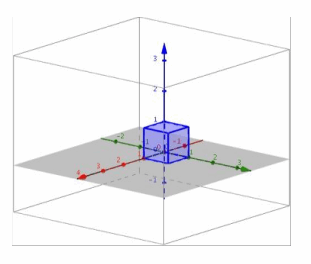
Recall from Problem 1, part (d), of the Problem Set of Lesson 7 that if you know what a linear transformation does to the three points (1,0,0), (0,1,0), and (0,0,1), you can find the matrix of the transformation. How do the images of these three points lead to the matrix of the transformation?
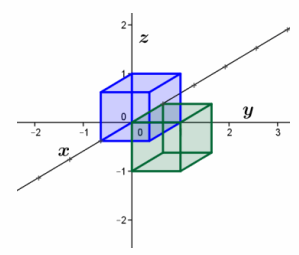
a. Suppose that a linear transformation L1 rotates the unit cube by 90° counterclockwise about the z-axis. Find the matrix A1 of the transformation L1.
Answer:
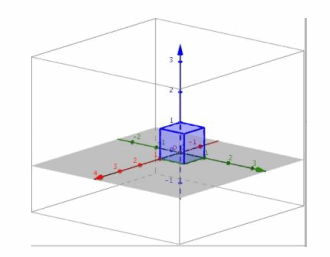
Since this transformation rotates by 90° counterclockwise in the xy-plane, a vector along the positive x-axis will be transformed to lie along the positive y-axis, a vector along the positive y-axis will be transformed to lie along the negative x-axis, and a vector along the z-axis will be left alone. Thus,
Eureka Math Precalculus Module 2 Lesson 9 Exercise Answer Key 1
so the matrix of the transformation is A1=\(\left[\begin{array}{ccc}
0 & -1 & 0 \\
1 & 0 & 0 \\
0 & 0 & 1
\end{array}\right] .\)

b. Suppose that a linear transformation L2 rotates the unit cube by 90° counterclockwise about the y-axis. Find the matrix A2 of the transformation L2.
Answer:
Since this transformation rotates by 90° counterclockwise in the xz-plane, a vector along the positive x-axis will be transformed to lie along the positive z-axis, a vector along the y-axis will be left alone, and a vector along the positive z-axis will be transformed to lie along the negative x-axis. Thus,
Eureka Math Precalculus Module 2 Lesson 9 Exercise Answer Key 2
so the matrix of the transformation is A2=\(\left[\begin{array}{ccc}
0 & 0 & -1 \\
0 & 1 & 0 \\
1 & 0 & 0
\end{array}\right]\).

c. Suppose that a linear transformation L3 scales by 2 in the x-direction, scales by 3 in the y-direction, and scales by 4 in the z-direction. Find the matrix A3 of the transformation L3.
Answer:
Since this transformation scales by 2 in the x-direction, by 3 in the y-direction, and by 4 in the z-direction, a vector along the x-axis will be multiplied by 2, a vector along the y-axis will be multiplied by 3, and a vector along the z-axis will be multiplied by 4. Thus,
Eureka Math Precalculus Module 2 Lesson 9 Exercise Answer Key 3
so the matrix of the transformation is A3=\(\left[\begin{array}{lll}
2 & 0 & 0 \\
0 & 3 & 0 \\
0 & 0 & 4
\end{array}\right]\).

d. Suppose that a linear transformation L4 projects onto the xy-plane. Find the matrix A4 of the transformation L4.
Answer:
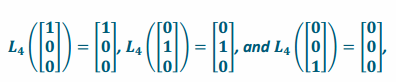
Since this transformation projects onto the xy-plane, a vector along the x-axis will be left alone, a vector along the y-axis will be left alone, and a vector along the z-axis will be transformed into the zero vector. Thus,
Eureka Math Precalculus Module 2 Lesson 9 Exercise Answer Key 4
so the matrix of the transformation is A4=\(\left[\begin{array}{lll}
1 & 0 & 0 \\
0 & 1 & 0 \\
0 & 0 & 0
\end{array}\right]\).

e. Suppose that a linear transformation L5 projects onto the xz-plane. Find the matrix A5 of the transformation L5.
Answer:
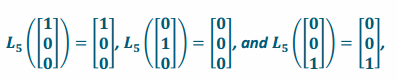
Since this transformation projects onto the xz-plane, a vector along the x-axis will be left alone, a vector along the y-axis will be transformed into the zero vector, and a vector along the z-axis will be left alone. Thus,
Eureka Math Precalculus Module 2 Lesson 9 Exercise Answer Key 5
so the matrix of the transformation is A5=\(\left[\begin{array}{lll}
1 & 0 & 0 \\
0 & 0 & 0 \\
0 & 0 & 1
\end{array}\right]\).

f. Suppose that a linear transformation L6 reflects across the plane with equation y=x. Find the matrix A6 of the transformation L6.
Answer:
Since this transformation reflects across the plane y=x, a vector along the positive x-axis will be transformed into a vector along the positive y-axis with the same length, a vector along the positive y-axis will be transformed into a vector along the positive x-axis, and a vector along the z-axis will be left alone. Thus,
Eureka Math Precalculus Module 2 Lesson 9 Exercise Answer Key 6
so the matrix of the transformation is A6=\(\left[\begin{array}{lll}
0 & 1 & 0 \\
1 & 0 & 0 \\
0 & 0 & 1
\end{array}\right]\).

g. Suppose that a linear transformation L7 satisfies Eureka Math Precalculus Module 2 Lesson 9 Exercise Answer Key 7 Find the matrix A7 of the transformation L7. What is the geometric effect of this transformation?
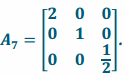
Answer:
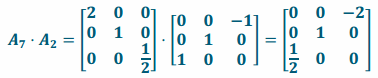
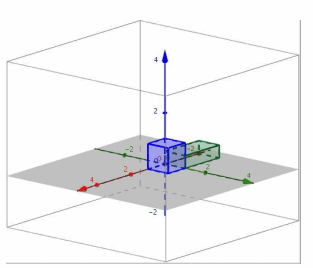
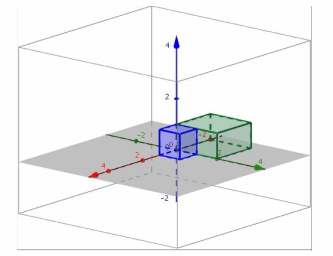
The matrix of this transformation is Eureka Math Precalculus Module 2 Lesson 9 Exercise Answer Key 9. The geometric effect of L7 is to stretch by a factor of 2 in the x-direction and scale by a factor of \(\frac{1}{2}\) in the z-direction.

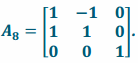
h. Suppose that a linear transformation L8 satisfies Eureka Math Precalculus Module 2 Lesson 9 Exercise Answer Key 15. Find the matrix of the transformation L8. What is the geometric effect of this transformation?
Answer:
The matrix of this transformation is Eureka Math Precalculus Module 2 Lesson 9 Exercise Answer Key 20. The geometric effect of L8 is to rotate by 45° in the xy-plane, to scale by \(\sqrt{2}\) in both the x and y directions, and to not change in the z-direction.
Eureka Math Precalculus Module 2 Lesson 9 Exploratory Challenge Answer Key

Exploratory Challenge 1
Transformations L1–L8 refer to the linear transformations from the Opening Exercise. For each pair:
i. Make a conjecture to predict the geometric effect of performing the two transformations in the order specified.
ii. Find the product of the corresponding matrices in the order that corresponds to the indicated order of composition. Remember that if we perform a transformation LB with matrix B and then LA with matrix A, the matrix that corresponds to the composition LA∘LB is AB. That is, LB is applied first, but matrix B is written second.
iii. Use the GeoGebra applet TransformCubes.ggb to draw the image of the unit cube under the transformation induced by the matrix product in part (ii). Was your conjecture in part (i) correct?

a. Perform L6 and then L6.
Answer:
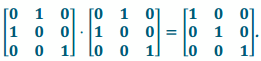
i. Since L6 reflects across the plane through y=x that is perpendicular to the xy-plane, performing L6 twice in succession will result in the identity transformation.
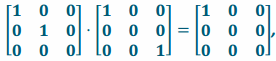
ii. A6⋅A6=Eureka Math Precalculus Module 2 Lesson 9 Exploratory Challenge Answer Key 200. Since A6⋅A6 is the identity matrix, we know that
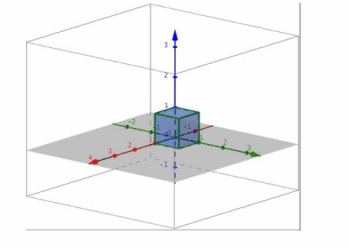
L6∘L6 is the identity transformation.
iii. The conjecture was correct.
Eureka Math Precalculus Module 2 Lesson 9 Exploratory Challenge Answer Key 26

b. Perform L1 and then L2.
Answer:
i. Sample student response: Since L1 rotates 90° about the z-axis and L2 rotates 90° about the y-axis, the composition L2∘L1 should rotate 180° about the line y=-x in the xy-plane.
ii. Eureka Math Precalculus Module 2 Lesson 9 Exploratory Challenge Answer Key 27
iii. The conjecture in part (i) is not correct. While it appears that the composition L2∘L1 is a rotation by 180° about the line y=-x, it is not because, for example, point (0,1,0) is transformed to point (0,0,-1) and does not remain on the y-axis after the transformation. Thus, this cannot be a rotation around the y-axis.
Eureka Math Precalculus Module 2 Lesson 9 Exploratory Challenge Answer Key 28

c. Perform L4 and then L5.
Answer:
i. Since L4 projects onto the xy-plane and L5 projects onto the xz-plane, the composition L5∘L4 will project onto the x-axis.
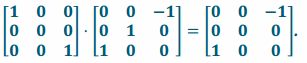
ii. Eureka Math Precalculus Module 2 Lesson 9 Exploratory Challenge Answer Key 29
iii. The conjecture in part (i) is correct. The cube is first transformed to a square in the xy-plane and then transformed onto a segment on the x-axis.
Eureka Math Precalculus Module 2 Lesson 9 Exploratory Challenge Answer Key 30

d. Perform L4 and then L3.
Answer:
i. Since L4 projects onto the xy-plane and L3 scales in the x, y, and z directions, the composition L3∘L4 will project onto the xy-plane and scale in the x and y directions.
ii. Eureka Math Precalculus Module 2 Lesson 9 Exploratory Challenge Answer Key 31
iii. The conjecture in part (i) is correct.
Eureka Math Precalculus Module 2 Lesson 9 Exploratory Challenge Answer Key 32

e. Perform L3 and then L7.
Answer:
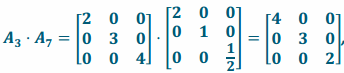
i. Since L3 scales in the x, y, and z directions and so does L7, the composition will be a transformation that also scales in all three directions but with different scale factors.
ii. Eureka Math Precalculus Module 2 Lesson 9 Exploratory Challenge Answer Key 33
iii. The conjecture from (i) is correct.
Eureka Math Precalculus Module 2 Lesson 9 Exploratory Challenge Answer Key 34

f. Perform L8 and then L4.
Answer:
i. Transformation L8 rotates the unit cube by 45° about the z-axis and stretches by a factor of \(\sqrt{2}\) in both the x and y directions, while L4 projects the image onto the xy-plane. The composition will transform the unit cube into a larger square that has been rotated 45° in the xy-plane.
ii. Eureka Math Precalculus Module 2 Lesson 9 Exploratory Challenge Answer Key 35
iii. The conjecture from part (i) is correct.
Eureka Math Precalculus Module 2 Lesson 9 Exploratory Challenge Answer Key 36

g. Perform L4 and then L6.
Answer:
i. Transformation L4 projects onto the xy-plane, and transformation L6 reflects across the plane through the line y=x in the xy-plane and is perpendicular to the xy-plane, so the composition L6∘L4 will appear to be the reflection in the xy-plane across the line y=x.
ii. Eureka Math Precalculus Module 2 Lesson 9 Exploratory Challenge Answer Key 37
iii. The conjecture in part (i) is correct.
Eureka Math Precalculus Module 2 Lesson 9 Exploratory Challenge Answer Key 38

h. Perform L2 and then L7.
Answer:
i. Since L2 rotates 90° around the y-axis and L7 scales in the x and z directions, the composition L7∘L2 will rotate and scale simultaneously.
ii. Eureka Math Precalculus Module 2 Lesson 9 Exploratory Challenge Answer Key 39
iii. The conjecture in part (i) is correct.
Eureka Math Precalculus Module 2 Lesson 9 Exploratory Challenge Answer Key 40

i. Perform L8 and then L8.
Answer:
i. Since L8 rotates by 45° about the z-axis and scales by \(\sqrt{2}\) in the x and y directions, performing this transformation twice will rotate by 90° about the z-axis and scale by 2 in the x and y directions.
ii. Eureka Math Precalculus Module 2 Lesson 9 Exploratory Challenge Answer Key 41
iii. The conjecture in part (i) is correct.
Eureka Math Precalculus Module 2 Lesson 9 Exploratory Challenge Answer Key 42

Exploratory Challenge 2
Transformations L1–L8 refer to the transformations from the Opening Exercise. For each of the following pairs of matrices A and B below, compare the transformations LA∘LB and LB∘LA.
a. L4 and L5
Answer:
Transformation L4∘L5 has matrix representation A4⋅A5= Eureka Math Precalculus Module 2 Lesson 9 Exploratory Challenge Answer Key 43 and transformation L5∘L4 has matrix representation Eureka Math Precalculus Module 2 Lesson 9 Exploratory Challenge Answer Key 44

Since the two transformations have the same matrix representation, they are the same transformation:
L5∘L4=L4∘L5

b. L2 and L5
Answer:
Transformation L2 \(\text { o }\) L5 has matrix representation Eureka Math Precalculus Module 2 Lesson 9 Exploratory Challenge Answer Key 43.2 and
transformation L5 \(\text { o }\) L2 has matrix representation A5∙A2 =Eureka Math Precalculus Module 2 Lesson 9 Exploratory Challenge Answer Key 44.3
Since the two transformations have the same matrix representation, they are the same transformation:
L2 \(\text { o }\)L5 = L5 \(\text { o }\) L2

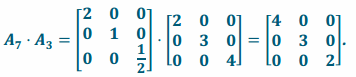
c. L3 and L7
Answer:
Transformation L3∘L7 has matrix representation Eureka Math Precalculus Module 2 Lesson 9 Exploratory Challenge Answer Key 40.3 and transformation as matrix representation Eureka Math Precalculus Module 2 Lesson 9 Exploratory Challenge Answer Key 52
Since the two transformations have the same matrix representation, they are the same transformation:
L3\(\text { o }\)L7=L7\(\text { o }\)L3

d. L3 and L6
Answer:
Transformation L3\(\text { o }\)L6 has matrix representation Eureka Math Precalculus Module 2 Lesson 9 Exploratory Challenge Answer Key 532 and transformation L6\(\text { o }\)L3 has matrix representation Eureka Math Precalculus Module 2 Lesson 9 Exploratory Challenge Answer Key 591

Since the two transformations have different matrix representations, they are not the same transformation: L3∘L6≠L6∘L3

e. L7 and L1
Answer:
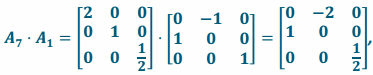
Transformation L7\(\text { o }\)L1 has matrix representation Eureka Math Precalculus Module 2 Lesson 9 Exploratory Challenge Answer Key 53.1 and transformation L1∘L7 has matrix representation Eureka Math Precalculus Module 2 Lesson 9 Exploratory Challenge Answer Key 56
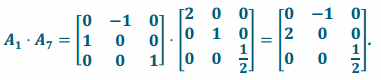
Since the two transformations have different matrix representations, they are not the same transformation: L1∘L7≠L7∘L1

f. What can you conclude about the order in which you compose two linear transformations?
Answer:
In some cases, the order of composition of two linear transformations matters. For two matrices A and B, the transformation LA∘LB is not always the same transformation as LB∘LA.

Eureka Math Precalculus Module 2 Lesson 9 Problem Set Answer Key

Question 1.
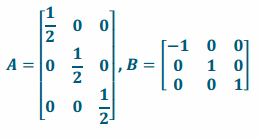
Let A be the matrix representing a dilation of \(\frac{1}{2}\), and let B be the matrix representing a reflection across the
yz-plane.
a. Write A and B.
Answer:
Eureka Math Precalculus Module 2 Lesson 9 Problem Set Answer Key 62

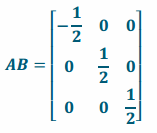
b. Evaluate AB. What does this matrix represent?
Answer:
Eureka Math Precalculus Module 2 Lesson 9 Problem Set Answer Key 63
AB is a reflection across the yz-plane followed by a dilation of \(\frac{1}{2}\).

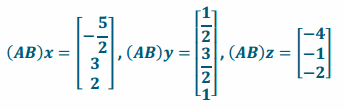
c. Let x=\(\left[\begin{array}{l}
5 \\
6 \\
4
\end{array}\right]\), y=\(\left[\begin{array}{l}
-1 \\
3 \\
2
\end{array}\right]\), and z=\(\left[\begin{array}{l}
8 \\
-2 \\
-4
\end{array}\right]\). Find (AB)x, (AB)y, and (AB)z.
Answer:
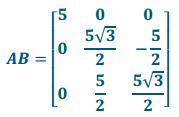
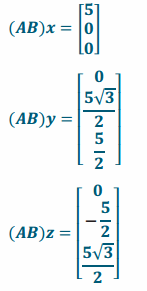
Eureka Math Precalculus Module 2 Lesson 9 Problem Set Answer Key 64

Question 2.
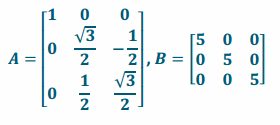
Let A be the matrix representing a rotation of 30° about the x-axis, and let B be the matrix representing a dilation of 5.
a. Write A and B.
Answer:
Eureka Math Precalculus Module 2 Lesson 9 Problem Set Answer Key 65

b. Evaluate AB. What does this matrix represent?
Answer:
Eureka Math Precalculus Module 2 Lesson 9 Problem Set Answer Key 66
AB is a dilation of 5 followed by a rotation of 30° about the x-axis.

c. Let x=\(\left[\begin{array}{l}
1 \\
0 \\
0
\end{array}\right]\), y=\(\left[\begin{array}{l}
0 \\
1 \\
0
\end{array}\right]\), z=\(\left[\begin{array}{l}
0 \\
0 \\
1
\end{array}\right]\). Find (AB)x, (AB)y, and (AB)z.
Answer:
Eureka Math Precalculus Module 2 Lesson 9 Problem Set Answer Key 67

Question 3.
Let A be the matrix representing a dilation of 3, and let B be the matrix representing a reflection across the plane y=x.
a. Write A and B.
Answer:
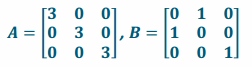
Eureka Math Precalculus Module 2 Lesson 9 Problem Set Answer Key 68

b. Evaluate AB. What does this matrix represent?
Answer:
AB=\(\left[\begin{array}{lll}
0 & 3 & 0 \\
3 & 0 & 0 \\
0 & 0 & 3
\end{array}\right]\)
AB is a reflection across the y=x plane followed by a dilation of 3.

c. Let x=\(\left[\begin{array}{c}
-2 \\
7 \\
3
\end{array}\right]\). Find (AB)x.
Answer:
(AB)x=\(\left[\begin{array}{c}
21 \\
-6 \\
9
\end{array}\right]\)

Question 4.
Let A=\(\left[\begin{array}{lll}
3 & 0 & 0 \\
3 & 3 & 0 \\
0 & 0 & 1
\end{array}\right]\), B=\(\left[\begin{array}{ccc}
0 & -1 & 0 \\
1 & 0 & 0 \\
0 & 0 & 1
\end{array}\right]\).
a. Evaluate AB.
Answer:
\(\left[\begin{array}{ccc}
0 & -3 & 0 \\
3 & -3 & 0 \\
0 & 0 & 1
\end{array}\right]\)

b. Let x=\(\left[\begin{array}{c}
-2 \\
2 \\
5
\end{array}\right]\). Find (AB)x.
Answer:
\(\left[\begin{array}{c}
-6 \\
-12 \\
5
\end{array}\right]\)

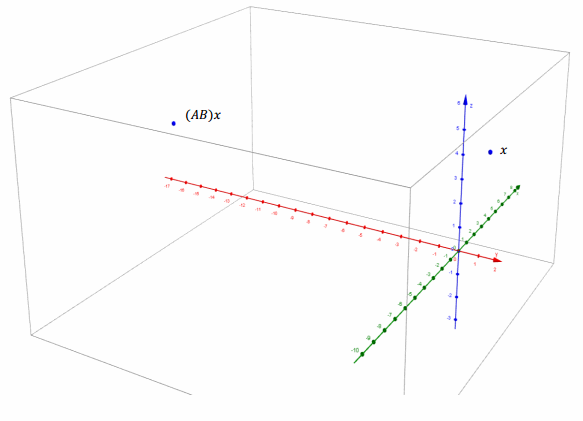
c. Graph x and (AB)x.
Answer:
Eureka Math Precalculus Module 2 Lesson 9 Problem Set Answer Key 67.2

Question 5.
Let A=\(\left[\begin{array}{lll}
\frac{1}{3} & 0 & 0 \\
0 & 1 & 0 \\
2 & 0 & \frac{1}{3}
\end{array}\right]\), B=\(\left[\begin{array}{ccc}
3 & 1 & 0 \\
1 & -3 & 0 \\
0 & 0 & 1
\end{array}\right]\)

a. Evaluate AB.
Answer:
\(\left[\begin{array}{ccc}
1 & \frac{1}{3} & 0 \\
1 & -3 & 0 \\
6 & 2 & \frac{1}{3}
\end{array}\right]\)

b. Let x=\(\left[\begin{array}{l}
\mathbf{0} \\
3 \\
2
\end{array}\right]\). Find (AB)x.
Answer:
\(\left[\begin{array}{c}
1 \\
-9 \\
\frac{20}{3}
\end{array}\right]\)

c. Graph x and (AB)x.
Answer:
Eureka Math Precalculus Module 2 Lesson 9 Problem Set Answer Key 67.3

Question 6.
Let A=\(\left[\begin{array}{lll}
2 & 0 & 0 \\
0 & 3 & 0 \\
0 & 0 & 8
\end{array}\right]\), B=\(\left[\begin{array}{lll}
1 & 0 & 0 \\
0 & 1 & 0 \\
0 & 0 & 0
\end{array}\right]\).
a. Evaluate AB.
Answer:
\(\left[\begin{array}{lll}
2 & 0 & 0 \\
0 & 3 & 0 \\
0 & 0 & 0
\end{array}\right]\)

b. Let x=\(\left[\begin{array}{c}
1 \\
-2 \\
4
\end{array}\right]\). Find (AB)x.
Answer:
\(\left[\begin{array}{c}
2 \\
-6 \\
0
\end{array}\right]\)

c. Graph x and (AB)x.
Answer:
Eureka Math Precalculus Module 2 Lesson 9 Problem Set Answer Key 64.9

d. What does AB represent geometrically?
Answer:
AB represents a projection onto the xy-plane, and a dilation of 2 in the x-direction and 3 in the y-direction.

Question 7.
Let A, B, C be 3×3 matrices representing linear transformations.
a. What does A(BC) represent?
Answer:
The linear transformation of applying the linear transformation that C represents followed by the transformation that B represents followed by the transformation that A represents

b. Will the pattern established in part (a) be true no matter how many matrices are multiplied on the left?
Answer:
Yes, in general. When you multiply by a matrix on the left, you are applying a linear transformation after all linear transformations to the right have been applied.

c. Does (AB)C represent something different from A(BC)? Explain.
Answer:
No, it does not. This is the linear transformation obtained by applying C and then AB, which is B followed by A.

Question 8.
Let AB represent any composition of linear transformations in R3. What is the value of (AB)x where x=\(\left[\begin{array}{l}
\mathbf{0} \\
\mathbf{0} \\
\mathbf{0}
\end{array}\right]\)?
Answer:
Since a composition of linear transformations in R3 is also a linear transformation, we know that applying it to the origin will result in no change.

Eureka Math Precalculus Module 2 Lesson 9 Exit Ticket Answer Key

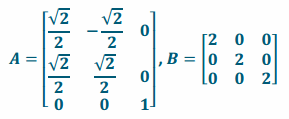
Let A be the matrix representing a rotation about the z-axis of 45° and B be the matrix representing a dilation of 2.
a. Write down A and B.
Answer:
Eureka Math Precalculus Module 2 Lesson 9 Exit Ticket Answer Key 60

b. Let x=\(\left[\begin{array}{c}
3 \\
-1 \\
2
\end{array}\right]\). Find the matrix representing a dilation of x by 2 followed by a rotation about the z-axis of 45°.
Answer:
AB=\(\left[\begin{array}{ccc}
\sqrt{2} & -\sqrt{2} & 0 \\
\sqrt{2} & \sqrt{2} & 0 \\
0 & 0 & 2
\end{array}\right]\)

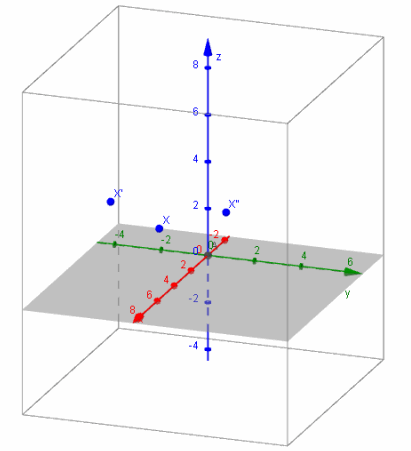
c. Do your best to sketch a picture of x, x after the first transformation, and x after both transformations. You may use technology to help you.
Answer:
Eureka Math Precalculus Module 2 Lesson 9 Exit Ticket Answer Key 61

Eureka Math Precalculus Module 2 Lesson 10 Answer Key

Engage NY Eureka Math Precalculus Module 2 Lesson 10 Answer Key

Eureka Math Precalculus Module 2 Lesson 10 Exercise Answer Key

Opening Exercise
Consider the vector v=\(\left(\begin{array}{l}
0 \\
1
\end{array}\right)\).
If v is rotated 45° counterclockwise and then reflected across the y-axis, what is the resulting vector?
Answer:
\(\left(\begin{array}{c}
\frac{\sqrt{2}}{2} \\
\frac{\sqrt{2}}{2}
\end{array}\right)\)

If v is reflected across the y-axis and then rotated 45° counterclockwise about the origin, what is the resulting vector?
Answer:
\(\left(\begin{array}{r}
-\frac{\sqrt{2}}{2} \\
\frac{\sqrt{2}}{2}
\end{array}\right)\)

Did these linear transformations commute? Explain.
Answer:
No R0,45°∘Ry≠Ry∘R0,45°

Exercises

Exercise 1.
Let A equal the matrix that corresponds to a 45° rotation counterclockwise and B equal the matrix that corresponds to a reflection across the y-axis. Verify that matrix multiplication does not commute by finding the products AB and BA.
Answer:
Eureka Math Precalculus Module 2 Lesson 10 Problem Set Answer Key 1
AB≠BA

Exercise 2.
Let A=\(\left(\begin{array}{ccc}
0 & -1 & 0 \\
1 & 0 & 0 \\
0 & 0 & 1
\end{array}\right)\) and B=\(\left(\begin{array}{ccc}
1 & 0 & 0 \\
0 & 0 & -1 \\
0 & 1 & 0
\end{array}\right)\). Verify that matrix multiplication does not commute by finding the products AB and BA.
Answer:
AB=\(\left(\begin{array}{lll}
0 & 0 & 1 \\
1 & 0 & 0 \\
0 & 1 & 0
\end{array}\right)\)
BA=\(\left(\begin{array}{ccc}
0 & -1 & 0 \\
0 & 0 & -1 \\
1 & 0 & 0
\end{array}\right)\)
AB≠BA

Exercise 3.
Consider the vector v=\(\left(\begin{array}{l}
0 \\
0 \\
1
\end{array}\right)\).
a. If v is rotated 45° counterclockwise about the z-axis and then reflected across the xy-plane, what is the resulting vector?
Answer:
\(\left(\begin{array}{c}
\mathbf{0} \\
\mathbf{0} \\
-\mathbf{1}
\end{array}\right)\)

b. If v is reflected across the xy-plane and then rotated 45° counterclockwise about the z-axis, what is the resulting vector?
Answer:
\(\left(\begin{array}{c}
0 \\
0 \\
-1
\end{array}\right)\)

c. Verify algebraically that the product of the two corresponding matrices is the same regardless of the order in which they are multiplied.
Answer:
Let A=Eureka Math Precalculus Module 2 Lesson 10 Problem Set Answer Key 30 (the matrix representing 45° rotation about the z-axis).
Let B=\(\left(\begin{array}{ccc}
1 & 0 & 0 \\
0 & 1 & 0 \\
0 & 0 & -1
\end{array}\right)\) (the matrix representing a reflection across the xy-plane).
Eureka Math Precalculus Module 2 Lesson 10 Problem Set Answer Key 31

Exercise 4.
Write two matrices in the form \(\left(\begin{array}{cc}
a & -b \\
b & a
\end{array}\right) .\)

a. Verify algebraically that the products of these two matrices are equal.
Let A=\(\left(\begin{array}{cc}
2 & -1 \\
1 & 2
\end{array}\right)\) and B=\(\left(\begin{array}{cc}
3 & -2 \\
2 & 3
\end{array}\right)\)
AB=\(\left(\begin{array}{cc}
4 & -7 \\
7 & 4
\end{array}\right)\) and BA=\(\left(\begin{array}{cc}
4 & -7 \\
7 & 4
\end{array}\right)\)
AB=BA

b. Write each of your matrices as a complex number. Find the product of the two complex numbers.
Answer:
(2+i)(3+2i)=4+7i

c. Why is it the case that any two matrices in the form \(\left(\begin{array}{cc}
a & -b \\
b & a
\end{array}\right)\) have products that are equal regardless of the order in which they are multiplied?
Answer:
Matrices in this form represent the geometric effect of complex multiplication. Multiplying a complex number z by a complex number α and then by a complex number β gives the same answer as multiplying by β and then α; that is, β(αz)=α(βz); thus, the corresponding matrix multiplication yields the same product.

Eureka Math Precalculus Module 2 Lesson 10 Problem Set Answer Key

Question 1.
Let A be the matrix representing a dilation of 2, B the matrix representing a rotation of 30°, and x=\(\left(\begin{array}{c}
-2 \\
3
\end{array}\right)\).
a. Evaluate AB.
Answer:
\(\left(\begin{array}{cc}
\sqrt{3} & -1 \\
1 & \sqrt{3}
\end{array}\right)\)

b. Evaluate BA.
Answer:
\(\left(\begin{array}{cc}
\sqrt{3} & -1 \\
1 & \sqrt{3}
\end{array}\right)\)

c. Find ABx.
Answer:
\(\left(\begin{array}{l}
-2 \sqrt{3}-3 \\
-2+3 \sqrt{3}
\end{array}\right)\)

d. Find BAx.
Answer:
\(\left(\begin{array}{l}
-2 \sqrt{3}-3 \\
-2+3 \sqrt{3}
\end{array}\right)\)

Question 2.
Let A be the matrix representing a reflection across the line y=x, B the matrix representing a rotation of 90°, and x=\(\left(\begin{array}{l}
1 \\
0
\end{array}\right)\).

a. Evaluate AB.
Answer:
\(\left(\begin{array}{cc}
1 & 0 \\
0 & -1
\end{array}\right)\)

b. Evaluate BA.
Answer:
\(\left(\begin{array}{cc}
-1 & 0 \\
0 & 1
\end{array}\right)\)

c. Find Ax.
Answer:
\(\left(\begin{array}{l}
0 \\
1
\end{array}\right)\)

d. Find Bx.
Answer:
\(\left(\begin{array}{l}
0 \\
1
\end{array}\right)\)

e. Find ABx.
Answer:
\(\left(\begin{array}{l}
1 \\
0
\end{array}\right)\)

f. Find BAx.
Answer:
\(\left(\begin{array}{l}
-1 \\
0
\end{array}\right)\)

g. Describe the linear transformation represented by AB.
Answer:
AB represents a reflection across the x-axis.

h. Describe the linear transformation represented by BA.
Answer:
BA represents a reflection across the y-axis.

Question 3.
Let matrices A,B represent scalars. Answer the following questions.
a. Would you expect AB=BA? Explain why or why not.
Answer:
Yes, scalars are real numbers, and real numbers commute.

b. Let A=\(\left(\begin{array}{cc}
a & 0 \\
0 & a
\end{array}\right)\) and B=\(\left(\begin{array}{ll}
b & 0 \\
0 & b
\end{array}\right)\). Show AB=BA through matrix multiplication, and explain why.
Answer:
AB=\(\left(\begin{array}{cc}
\boldsymbol{a} \boldsymbol{b} & \mathbf{0} \\
\mathbf{0} & \boldsymbol{a} \boldsymbol{b}
\end{array}\right)\)=\(\left(\begin{array}{cc}
b a & 0 \\
0 & b a
\end{array}\right)\)=BA
These matrices represent complex numbers and are both of the form \(\left(\begin{array}{cc}
a & -b \\
b & a
\end{array}\right)\), so their products will be the same regardless of the order.

Question 4.
Let matrices A,B represent complex numbers. Answer the following questions.
a. Let A=\(\left(\begin{array}{cc}
a & -b \\
b & a
\end{array}\right)\) and B=\(\left(\begin{array}{cc}
c & -d \\
d & c
\end{array}\right)\). Show AB=BA through matrix multiplication.
Answer:
Eureka Math Precalculus Module 2 Lesson 10 Problem Set Answer Key 50
They are equivalent.

b. Would you expect AC=CA for any matrix C? Explain.
Answer:
No, matrix multiplication is not commutative.

c. Let C be any 2×2 matrix, \(\left(\begin{array}{ll}
x & y \\
z & w
\end{array}\right)\). Show AC≠CA through matrix multiplication.
Answer:
Eureka Math Precalculus Module 2 Lesson 10 Problem Set Answer Key 51

d. Summarize your results from Problems 3 and 4.
Answer:
Matrices representing scalars commute with any other matrix, and matrices representing complex number multiplication only commute when multiplying by other complex numbers (or if b=0).

Question 5.
Quaternions are a number system that extends to complex numbers discovered by William Hamilton in 1843. Multiplication of quaternions is not commutative and is defined as the quotient of two vectors. They are useful in three-dimensional rotation calculations for computer graphics. Quaternions are formed the following way:
i22=j2=k2=ijk=-1
Multiplication by -1 and 1 works normally. We can represent all possible multiplications of quaternions through a table:
Eureka Math Precalculus Module 2 Lesson 10 Problem Set Answer Key 52
a. Is multiplication of quaternions commutative? Explain why or why not.
Answer:
No, it is not commutative. For example, ij=k, but ji=-k.

b. Is multiplication of quaternions associative? Explain why or why not.
Answer:
Yes, it is associative. i(jk)=i(i)=-1, and (ij)k=(k)k=-1 1 and -1 work normally.

Eureka Math Precalculus Module 2 Lesson 10 Exit Ticket Answer Key

Question 1.
Let A be the matrix representing a rotation about the origin by 60° and B be the matrix representing a reflection across the x-axis.
a. Give two reasons why AB≠BA.
Answer:
The linear transformations these matrices represent do not commute, and the matrices themselves do not commute.
Engage NY Math Precalculus Module 2 Lesson 10 Exit Ticket Answer Key 40

b. Let x=\(\left(\begin{array}{c}
1 \\
-1
\end{array}\right)\). Evaluate A(Bx) and B(Ax).
Answer:
Engage NY Math Precalculus Module 2 Lesson 10 Exit Ticket Answer Key 41

Question 2.
Write two matrices, A, B, that represent linear transformations where A(Bx) and B(Ax) where x=\(\left(\begin{array}{l}
3 \\
2
\end{array}\right)\). Explain why the products are the same.
Answer:
Answers may vary. Examples include any two rotations about the origin, any two matrices representing complex numbers, and a dilation with any other matrix (since scalars commute with all matrices). For example:
A=\(\left(\begin{array}{ll}
2 & 0 \\
0 & 2
\end{array}\right)\), B=\(\left(\begin{array}{cc}
1 & -1 \\
1 & 1
\end{array}\right)\)
AB=BA=\(\left(\begin{array}{cc}
2 & -2 \\
2 & 2
\end{array}\right)\)
A(Bx)=B(Ax)=\(\left(\begin{array}{c}
2 \\
10
\end{array}\right)\left(\begin{array}{cc}
a & -b \\
b & a
\end{array}\right)\)
Matrices in the form \(\left(\begin{array}{cc}
a & -b \\
b & a
\end{array}\right)\) represent the geometric effect of complex multiplication. Multiplying a complex number z by a complex number α and then by a complex number β gives the same answer as multiplying by β and then α; that is, β(αz)=α(βz); thus, the corresponding matrix multiplication yields the same product.

Eureka Math Precalculus Module 2 Lesson 24 Answer Key

Engage NY Eureka Math Precalculus Module 2 Lesson 24 Answer Key

Eureka Math Precalculus Module 2 Lesson 24 Exercise Answer Key

Opening Exercise
Two particles are moving in a coordinate plane. Particle 1 is at the point \(\left(\begin{array}{l}
1 \\
1
\end{array}\right)\) and moving along the velocity vector \(\left(\begin{array}{c}
– 2 \\
1
\end{array}\right)\). Particle 2 is at the point \(\left(\begin{array}{c}
– 1 \\
1
\end{array}\right)\) and moving along the velocity vector \(\left(\begin{array}{l}
1 \\
2
\end{array}\right) .\). Are the two particles going to collide? If so, at what point, and at what time? Assume that time is measured in seconds.
Answer:
Particle 1: \(\left(\begin{array}{l}
x(t) \\
y(t)
\end{array}\right)\) = \(\left(\begin{array}{l}
1 \\
– 4
\end{array}\right) + \left(\begin{array}{l}
– 2 \\
1
\end{array}\right) t\) x(t) = 1 – 2t, and y(t) = 1 + t y = \(\frac{3}{2} – \frac{1}{2} x\)
Particle 2: \(\left(\begin{array}{l}
x(t) \\
y(t)
\end{array}\right)\) = \(\left(\begin{array}{c}
– 1 \\
1
\end{array}\right) + \left(\begin{array}{l}
1 \\
2
\end{array}\right) t\) x(t) = – 1 + t, and y(t) = 1 + 2t y = 3 + 2x
The particles will not collide. While they do cross the same point at \(\), they do not cross this point at the same time. Particle 1 crosses this point at t = 0.4, and Particle 2 does not cross this point until t = 0.8.

Exercise 1 .
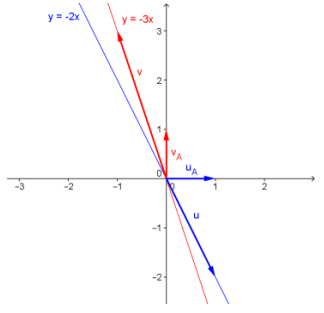
Consider lines l = {(x,y)│〈x,y〉 = t〈1, – 2〉 } and m = {(x,y)│〈x,y〉 = t〈 – 1,3〉 }.
a. To what graph does each line correspond?
Answer:
Line l corresponds to the graph of y = – 2x. Line m corresponds to the graph of y = – 3x.

b. Describe what happens to the vectors defining these lines under the transformation A = \(\left(\begin{array}{ll}
3 & 1 \\
2 & 1
\end{array}\right)\).
Answer:
Each vector is mapped to a new vector. 〈1, – 2〉→〈1,0〉, and 〈 – 1,3〉→〈0,1〉.

c. Show this transformation graphically.
Answer:
The vector that defined l shown in the diagram is u = 〈1, – 2〉, and the vector that defined m shown in the diagram is v = 〈 – 1,3〉. In the diagram, the image of l, when transformed by A, results in the graph of the line y = 0,’ and the image of m, when transformed by A, results in the graph of the line x = 0.
Engage NY Math Precalculus Module 2 Lesson 24 Exercise Answer Key 1

Exercise 2.
Consider lines l = {(x,y)│〈x,y〉 = 〈1,1〉 + t〈1, – 2〉} and m = {(x,y)│〈x,y〉 = 〈1,1〉 + t〈 – 1,3〉}.
a. What is the solution to the system of equations given by lines l and m?
Answer:
The solution is (1,1).

b. Describe what happens to the lines under the transformation A = \(\left(\begin{array}{ll}
3 & 1 \\
2 & 1
\end{array}\right)\).
Answer:
Line l becomes Al = {(x,y)│〈x,y〉 = 〈4,3〉 + t〈1,0〉}.
Line m becomes Am = {(x,y)│〈x,y〉 = 〈4,3〉 + t〈0,1〉}.

c. What is the solution to the system of equations after the transformation?
Answer:
The solution is the point (4,3).

Exercise 3.
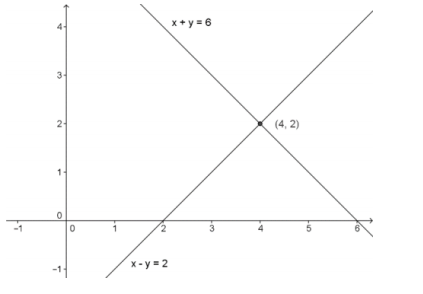
The system of equations is given below. A graph of the equations and their intersection point is also shown.
x + y = 6
x – y = 2
Engage NY Math Precalculus Module 2 Lesson 24 Exercise Answer Key 2

a. Write each line in the form L(t) = p + vt where p is the position vector whose terminal point is the solution of the system and v is the velocity vector that defines the path of a particle traveling along the line such that when t = 0, the solution to the system is (x(0),y(0)).
Answer:
L1 (t) = \(\left(\begin{array}{l}
4 \\
2
\end{array}\right) + \left(\begin{array}{c}
– 1 \\
1
\end{array}\right) t\)
L2 (t) = \(\left(\begin{array}{l}
4 \\
2
\end{array}\right) + \left(\begin{array}{l}
1 \\
1
\end{array}\right) t\)

b. Describe a translation that takes the point (x(0),y(0)) to the origin. What is the new system?
Answer:
Translate the system by the vector 〈 – 4, – 2〉.
y = – x
y = x

c. Describe a transformation matrix A that rotates the lines to the x – and y – axes. What is the new system?
Answer:
Let A = \(\left(\begin{array}{ll}
a & b \\
c & d
\end{array}\right)\). We want A∙\(\left(\begin{array}{c}
– 1 \\
1
\end{array}\right)\) = \(\left(\begin{array}{l}
1 \\
0
\end{array}\right)\), and A∙\(\left(\begin{array}{l}
1 \\
1
\end{array}\right)\) = \(\left(\begin{array}{l}
0 \\
1
\end{array}\right)\). Thus
– a + b = 1
– c + d = 0
and
a + b = 0
c + d = 1
Solving for a, b, c, and d gives
A = \(\left(\begin{array}{cc}
– \frac{1}{2} & \frac{1}{2} \\
\frac{1}{2} & \frac{1}{2}
\end{array}\right)\)
The new system is
x = 0
y = 0

d. Describe a translation that results in a system that has the same solution set as the original system. What is the new system of equations?
Answer:
Translate by the vector 〈4,2〉. The new system is
x = 4
y = 2,
which does intersect at the point (4,2), so the solution is (4,2).

Eureka Math Precalculus Module 2 Lesson 24 Problem Set Answer Key

Question 1.
Consider the system of equations \(\left\{\begin{array}{c}
y = 3 x + 2 \\
y = – x + 14
\end{array}\right.\).
a. Solve the system of equations.
Answer:
The point (3,11) is a simultaneous solution to the two equations.

b. Ilene wants to rotate the lines representing this system of equations about their solution and wishes to apply the matrix \(\left(\begin{array}{cc}
\cos (\theta) & – \sin (\theta) \\
\sin (\theta) & \cos (\theta)
\end{array}\right)\)to any point A on either of the lines. If Ilene is correct, then applying a rotation to the solution will map the solution to itself. Let θ = 90°, and find where Ilene’s strategy maps the solution you found in part (a). What is wrong with Ilene’s strategy?
Answer:
\(\left(\begin{array}{cc}
\cos \left(90^{\circ}\right) & – \sin \left(90^{\circ}\right) \\
\sin \left(90^{\circ}\right) & \cos \left(90^{\circ}\right)
\end{array}\right)\left(\begin{array}{c}
3 \\
11
\end{array}\right)\) = \(\left(\begin{array}{cc}
0 & – 1 \\
1 & 0
\end{array}\right)\left(\begin{array}{c}
3 \\
11
\end{array}\right)\)
= \(\left(\begin{array}{c}
– 11 \\
3
\end{array}\right)\)
Her transformation does not map the pivot point to itself, so the system is not rotating around the pivot point.

c. Jasmine thinks that in order to apply a rotation to some point on either of these two lines, the entire system needs to be shifted so that the pivot point is translated to the origin. For an arbitrary point A on either of the two lines, what transformation needs to be applied so that the pivot point is mapped to the origin?
Answer:
To map the pivot point to the origin, we can take a translation equal to the opposite of the pivot point. In this case, that means for A = \(\left(\begin{array}{l}
x \\
y
\end{array}\right)\)on either of the two lines, we do the following: \(\left(\begin{array}{l}
x \\
y
\end{array}\right) + \left(\begin{array}{c}
– 3 \\
– 11
\end{array}\right)\).
We see that \(\left(\begin{array}{c}
3 \\
11
\end{array}\right) + \left(\begin{array}{c}
– 3 \\
– 11
\end{array}\right)\) = \(\left(\begin{array}{l}
0 \\
0
\end{array}\right)\).

d. After applying your transformation in part (c), apply Ilene’s rotation matrix for θ = 90°. Show that the pivot point remains on the origin. What happens to the point (0,2) after both of these transformations?
Answer:
\(\left(\begin{array}{cc}
0 & – 1 \\
1 & 0
\end{array}\right)\left(\begin{array}{l}
0 \\
0
\end{array}\right)\) = \(\left(\begin{array}{l}
0 \\
0
\end{array}\right)\)
\(\left(\begin{array}{cc}
0 & – 1 \\
1 & 0
\end{array}\right)\left(\left(\begin{array}{l}
0 \\
2
\end{array}\right) + \left(\begin{array}{c}
– 3 \\
– 11
\end{array}\right)\right)\) = \(\left(\begin{array}{cc}
0 & – 1 \\
1 & 0
\end{array}\right)\left(\begin{array}{l}
– 3 \\
– 9
\end{array}\right)\)
= \(\left(\begin{array}{c}
9 \\
– 3
\end{array}\right)\)
The point is translated and then rotated 90°.

e. Although Jasmine and Ilene were able to work together to rotate the points around the pivot point, now their lines are nowhere near the original lines. What transformation brings the system of equations back so that the pivot point returns to where it started and all other points have been rotated? Find the final image of the point (0,2).
Answer:
Applying the inverse translation that we did in part (c) brings the points back to where they should be. That is, for A’ = \(\left(\begin{array}{l}
x \\
y
\end{array}\right)\), a point on the transformed system, add \(\left(\begin{array}{l}
x \\
y
\end{array}\right) + \left(\begin{array}{c}
3 \\
11
\end{array}\right)\). For \(\left(\begin{array}{l}
0 \\
2
\end{array}\right)\), we get
\(\left(\begin{array}{c}
9 \\
– 3
\end{array}\right) + \left(\begin{array}{c}
3 \\
11
\end{array}\right)\) = \(\left(\begin{array}{c}
12 \\
8
\end{array}\right)\)

f. Summarize your results in parts (a)–(e).
Answer:
To rotate a system of equations around its solution \(\left(\begin{array}{l}
a \\
b
\end{array}\right)\), we apply the following transformations to any arbitrary point \(\left(\begin{array}{l}
x \\
y
\end{array}\right)\):
\(\left(\begin{array}{cc}
\cos (\theta) & – \sin (\theta) \\
\sin (\theta) & \cos (\theta)
\end{array}\right)\left(\left(\begin{array}{l}
x \\
y
\end{array}\right) – \left(\begin{array}{l}
a \\
b
\end{array}\right)\right)\) + \(\left(\begin{array}{l}
x \\
y
\end{array}\right)\)
We translate the system so that the solution is mapped to the origin, then rotate the system, and then apply the inverse translation.

Extension:
Question 2.
Let b1 = \(\left(\begin{array}{l}
1 \\
0
\end{array}\right)\) and b2 = \(\left(\begin{array}{l}
0 \\
1
\end{array}\right)\). Then answer the following:
a. Find 1 ⋅ b1 + 0 ⋅ b2.
Answer:
1 ⋅ \(\left(\begin{array}{l}
1 \\
0
\end{array}\right)\) + 0 ⋅ \(\left(\begin{array}{l}
0 \\
1
\end{array}\right)\) = \(\left(\begin{array}{l}
1 \\
0
\end{array}\right)\) + \(\left(\begin{array}{l}
0 \\
0
\end{array}\right)\) = \(\left(\begin{array}{l}
1 \\
0
\end{array}\right)\) = b1

b. Find 0 ⋅ b1 + 1 ⋅ b2.
Answer:
0 ⋅ \(\left(\begin{array}{l}
1 \\
0
\end{array}\right)\) + 1 ⋅ \(\left(\begin{array}{l}
0 \\
1
\end{array}\right)\) = \(\left(\begin{array}{l}
0 \\
0
\end{array}\right)\) + \(\left(\begin{array}{l}
0 \\
1
\end{array}\right)\) = \(\left(\begin{array}{l}
0 \\
1
\end{array}\right)\) = b2

c. Find 1 ⋅ b1 + 1 ⋅ b2.
Answer:
1 ⋅ \(\left(\begin{array}{l}
1 \\
0
\end{array}\right)\) + 1 ⋅ \(\left(\begin{array}{l}
0 \\
1
\end{array}\right)\) = \(\left(\begin{array}{l}
1 \\
0
\end{array}\right)\) + \(\left(\begin{array}{l}
0 \\
1
\end{array}\right)\) = \(\left(\begin{array}{l}
1 \\
1
\end{array}\right)\)

d. Find 3 ⋅ b1 + 2 ⋅ b2.
Answer:
3 ⋅ \(\left(\begin{array}{l}
1 \\
0
\end{array}\right)\) + 2 ⋅ \(\left(\begin{array}{l}
0 \\
1
\end{array}\right)\) = \(\left(\begin{array}{l}
3 \\
2
\end{array}\right)\) + \(\left(\begin{array}{l}
0 \\
2
\end{array}\right)\) = \(\left(\begin{array}{l}
3 \\
2
\end{array}\right)\)

e. Find 0 ⋅ b1 + 0 ⋅ b2.
Answer:
0 ⋅ \(\left(\begin{array}{l}
1 \\
0
\end{array}\right)\) + 0 ⋅ \(\left(\begin{array}{l}
0 \\
1
\end{array}\right)\) = \(\left(\begin{array}{l}
0 \\
0
\end{array}\right)\) + \(\left(\begin{array}{l}
0 \\
0
\end{array}\right)\) = \(\left(\begin{array}{l}
0 \\
0
\end{array}\right)\)

f. Find x ⋅ b1 + y ⋅ b2 for x,y real numbers.
Answer:
x ⋅ \(\left(\begin{array}{l}
1 \\
0
\end{array}\right)\) + y ⋅ \(\left(\begin{array}{l}
0 \\
1
\end{array}\right)\) = \(\left(\begin{array}{l}
x \\
0
\end{array}\right)\) + \(\left(\begin{array}{l}
0 \\
y
\end{array}\right)\) = \(\left(\begin{array}{l}
x \\
y
\end{array}\right)\)

g. Summarize your results from parts (a)–(f). Can you use b1 and b2 to define any point in R2?
Answer:
In each case, the resultant vector was always equal to the scalar multiplied by the first vector for the
x – coordinate and the scalar multiplied by the second vector for the y – coordinate.

Question 3.
Let b1 = \(\left(\begin{array}{l}
3 \\
2
\end{array}\right)\) and b2 = \(\left(\begin{array}{c}
– 2 \\
3
\end{array}\right)\). Then answer the following:
a. Find 1 ⋅ b1 + 1 ⋅ b2.
Answer:
1 ⋅ \(\left(\begin{array}{l}
3 \\
2
\end{array}\right)\) + 1 ⋅ \(\left(\begin{array}{c}
– 2 \\
3
\end{array}\right)\) = \(\left(\begin{array}{l}
3 \\
2
\end{array}\right)\) + \(\left(\begin{array}{c}
– 2 \\
3
\end{array}\right)\) = \(\left(\begin{array}{l}
1 \\
5
\end{array}\right)\)

b. Find 0 ⋅ b1 + 1 ⋅ b2.
Answer:
0 ⋅ \(\left(\begin{array}{l}
3 \\
2
\end{array}\right)\) + 1 ⋅ \(\left(\begin{array}{c}
– 2 \\
3
\end{array}\right)\) = \(\left(\begin{array}{l}
0 \\
0
\end{array}\right)\) + \(\left(\begin{array}{c}
– 2 \\
3
\end{array}\right)\) = \(\left(\begin{array}{c}
– 2 \\
3
\end{array}\right)\) = b2

c. Find 1 ⋅ b1 + 0 ⋅ b2.
Answer:
1 ⋅ \(\left(\begin{array}{l}
3 \\
2
\end{array}\right)\) + 0 ⋅ \(\left(\begin{array}{c}
– 2 \\
3
\end{array}\right)\) = \(\left(\begin{array}{l}
3 \\
2
\end{array}\right)\) + \(\left(\begin{array}{l}
0 \\
0
\end{array}\right)\) = \(\left(\begin{array}{l}
3 \\
2
\end{array}\right)\) = b1

d. Find – 4 ⋅ b1 + 2 ⋅ b2.
Answer:
– 4 ⋅ \(\left(\begin{array}{l}
3 \\
2
\end{array}\right)\) + 2 ⋅ \(\left(\begin{array}{c}
– 2 \\
3
\end{array}\right)\) = \(\left(\begin{array}{c}
– 12 \\
– 8
\end{array}\right)\) + \(\left(\begin{array}{c}
– 4 \\
6
\end{array}\right)\) = \(\left(\begin{array}{c}
– 16 \\
– 2
\end{array}\right)\)

e. Solve r ⋅ b1 + s ⋅ b2 = 0.
Answer:
r ⋅ \(\left(\begin{array}{l}
3 \\
2
\end{array}\right)\) + s ⋅ \(\left(\begin{array}{c}
– 2 \\
3
\end{array}\right)\) = \(\left(\begin{array}{l}
0 \\
0
\end{array}\right)\)
\(\left(\begin{array}{c}
3 r \\
2 r
\end{array}\right)\) + \(\left(\begin{array}{c}
– 2 s \\
3 s
\end{array}\right)\) = \(\left(\begin{array}{l}
0 \\
0
\end{array}\right)\)
\(\left(\begin{array}{l}
3 r – 2 s \\
2 r + 3 s
\end{array}\right)\) = \(\left(\begin{array}{l}
0 \\
0
\end{array}\right)\)
3r = 2s⇒r = \(\frac{2}{3}\) s
2(\(\frac{2}{3}\) s) + 3s = 0
\(\frac{4}{3}\) s + 3s = 0
4s + 9s = 0
13s = 0
s = 0
r = \(\frac{2}{3}\) ⋅ 0 = 0
So both r and s are zero.

f. Solve r ⋅ b1 + s ⋅ b2 = \(\left(\begin{array}{c}
22 \\
-7
\end{array}\right)\).
Answer:
Engage NY Math Precalculus Module 2 Lesson 24 Exercise Answer Key 3
So, r = 4 and s = – 5.

g. Is there any point \(\left(\begin{array}{l}
x \\
y
\end{array}\right)\) that cannot be expressed as a linear combination of b1 and b2 (i.e., where r ⋅ b1 + s ⋅ b2 = \(\left(\begin{array}{l}
x \\
y
\end{array}\right)\) has real solutions, for x,y real numbers)?
Answer:
No. There was nothing special about the point \(\left(\begin{array}{l}
22 \\
– 7
\end{array}\right)\). We could have substituted in any other two values, performed the same steps, and arrived at a valid solution.

h. Explain your response to part (g) geometrically.
Answer:
Answers may vary. b1 and b2 are two vectors that intersect at the origin. They are not parallel, so through linear transformations, we can arrive at any point \(\left(\begin{array}{l}
x \\
y
\end{array}\right)\). Alternatively, you can think of the equations
3r – 2s = x and 2r – 3s = y as lines in terms of r and s; then these lines are not parallel and thus are always consistent when used in a system of linear equations.

Eureka Math Precalculus Module 2 Lesson 24 Exit Ticket Answer Key

Question 1.
Consider the system of equations \(\left\{\begin{array}{c}
y = 5 x + 2 \\
y = 3 x
\end{array}\right.\), and perform the following operations on an arbitrary point \(\left(\begin{array}{l}
x \\
y
\end{array}\right)\):
a. Rotate around the origin by θ.
Answer:
\(\left(\begin{array}{cc}
\cos (\theta) & – \sin (\theta) \\
\sin (\theta) & \cos (\theta)
\end{array}\right)\left(\begin{array}{l}
x \\
y
\end{array}\right)\) = \(\left(\begin{array}{l}
x \cos (\theta) – y \sin (\theta) \\
x \sin (\theta) + y \cos (\theta)
\end{array}\right)\)

b. Translate by the opposite of the solution to the system.
Answer:
\(\left(\begin{array}{l}
x \\
y
\end{array}\right) – \left(\begin{array}{l}
– 1 \\
– 3
\end{array}\right)\) = \(\left(\begin{array}{l}
x + 1 \\
y + 3
\end{array}\right)\)

c. Apply a dilation of \(\frac{2}{3}\).
Answer:
\(\left(\begin{array}{ll}
\frac{2}{3} & 0 \\
0 & \frac{2}{3}
\end{array}\right)\left(\begin{array}{l}
x \\
y
\end{array}\right)\) = \(\left(\begin{array}{l}
\frac{2}{3} x \\
\frac{2}{3} x
\end{array}\right)\)

Question 2.
What effect does each of the transformations in Problem 1 have on the solution of the system and on the origin?
Answer:
The solution of the system \(\left(\begin{array}{l}
– 1 \\
– 3
\end{array}\right)\) maps to \(\left(\begin{array}{l}
– \cos (\theta) + 3 \sin (\theta) \\
– \sin (\theta) – 3 \cos (\theta)
\end{array}\right),\left(\begin{array}{l}
0 \\
0
\end{array}\right)\), and \(\left(\begin{array}{r}
– \frac{2}{3} \\
– 2
\end{array}\right)\) respectively.
The origin maps to itself for the first and third transformations, which were linear transformations, and maps to the opposite of the system’s solution for the second transformation: \(\left(\begin{array}{l}
1 \\
3
\end{array}\right)\).

Eureka Math Precalculus Module 2 Lesson 25 Answer Key

Engage NY Eureka Math Precalculus Module 2 Lesson 25 Answer Key

Eureka Math Precalculus Module 2 Lesson 25 Example Answer Key

Example
When three-dimensional objects are projected onto screens with finite dimensions, it often limits the field of view (FOV), or the angle the scene represents. This limiting effect can vary based on the size of the screen and position of the observer.
a. Sketch a diagram that could be used to calculate a viewer’s field of view θ in relation to the horizontal width of the screen w and the distance the viewer is from the screen d.
Answer:
Engage NY Math Precalculus Module 2 Lesson 25 Example Answer Key 1

b. Assume that a person is sitting directly in front of a television screen whose width is 48 inches at a distance of 8 feet from the screen. Use your diagram and right-triangle trigonometry to find the viewer’s horizontal field of view θ.
Answer:
\(\tan \left(\frac{\theta}{2}\right) = \frac{\frac{w}{2}}{d}\)
\(\tan \left(\frac{\theta}{2}\right) = \frac{\frac{4}{2}}{8}\) = 0.25
tan-1(0.25) = \(\frac{\theta}{2}\)
14°≈\(\frac{\theta}{2}\)
θ≈28°

c. How far would a viewer need to be from the middle of a computer screen with a width of 15 inches to produce the same field of view as the person in front of the television?
Answer:
\(\tan \left(\frac{\theta}{2}\right) = \frac{\frac{w}{2}}{d}\)
\(\tan \left(\frac{28^{\circ}}{2}\right) = \frac{\frac{15}{2}}{d}\)
d = \(\frac{\frac{15}{2}}{\tan \left(14^{\circ}\right)}\) ≈ 30 inches

d. Write a general statement about the relationship between screen size and field of view.
Answer:
The smaller the screen, the closer a viewer must be to the screen to result in a given horizontal FOV.

Eureka Math Precalculus Module 2 Lesson 25 Exercise Answer Key

Exercise 1.
In this drawing task, the “eye” or the “camera” is the point, and the shaded figure is the “TV screen.” The cube is in the
3-D universe of the computer game.
By using lines drawn from each vertex of the cube to the point, draw the image of the 3-D cube on the screen. A horizon line and two additional vanishing points have been included to help you. The image point of the first vertex is shown.
Engage NY Math Precalculus Module 2 Lesson 25 Exercise Answer Key 1
Answer:
Draw line segments connecting the “eye” (V1) with the vertices of the cube.
Draw a vertical line segment on the screen from the given image point (P1‘) to the point where it intersects the line segment from V1 to the vertex beneath it (P2‘).
Engage NY Math Precalculus Module 2 Lesson 25 Exercise Answer Key 2
Draw dashed line segments connecting the two image points to vanishing points 2 and 3.
Engage NY Math Precalculus Module 2 Lesson 25 Exercise Answer Key 3
Plot a point where each of the line segments from V1 to the vertices intersect the line segments connecting the dashed line segments. These are the remaining image points for the vertices of the cube.
Engage NY Math Precalculus Module 2 Lesson 25 Exercise Answer Key 4
Connect the image points to form the projected image of the cube.
Engage NY Math Precalculus Module 2 Lesson 25 Exercise Answer Key 5

Exercise 2.
Let’s assume that the point V1 in our projection diagram is at the origin and the upper-right vertex of the cube is located at \(\left(\begin{array}{l}
5 \\
8 \\
4
\end{array}\right)\). If our screen represents the plane y = 2, use matrix multiplication to determine the vector that represents the line of sight from the observer to the projected point on the screen. Explain your thinking.
Answer:
The vector from the viewer to the vertex on the actual object is \(\left[\begin{array}{l}
5 \\
8 \\
4
\end{array}\right]\). Since the projected point and the actual vertex are along the same line of sight, the vector from the line of sight of the viewer to the projected point can be found by resizing the vector to the vertex so that the y-coordinate of the projected point is 2. This can be accomplished by rescaling with a factor of 0.25 using the matrix multiplication \(\left[\begin{array}{ccc}
0.25 & 0 & 0 \\
0 & 0.25 & 0 \\
0 & 0 & 0.25
\end{array}\right]\left[\begin{array}{l}
5 \\
8 \\
4
\end{array}\right] = \left[\begin{array}{c}
1.25 \\
2 \\
1
\end{array}\right]\).

Eureka Math Precalculus Module 2 Lesson 25 Problem Set Answer Key

Question 1.
Projecting the image of a three-dimensional scene onto a computer screen has the added constraint of the screen size limiting our field of view, or FOV. When we speak of FOV, we wish to know what angle of view the scene represents. Humans have remarkably good peripheral vision. In New York State, the requirement for a driver’s license is a horizontal FOV of no less than 140°. There is no restriction placed on the vertical field of vision, but humans normally have a vertical FOV greater than 120°.
a. Consider the (simulated) distance the camera is from the screen as d, the horizontal distance of the screen as w, and the horizontal FOV as θ. Then use the diagram below and right-triangle trigonometry to help you find θ in terms of w and d.
Eureka Math Precalculus Module 2 Lesson 25 Problem Set Answer Key 1
Answer:
\(\tan \left(\frac{\theta}{2}\right) = \frac{\frac{w}{2}}{d}\)
\(\frac{\theta}{2} = \tan ^{-1}\left(\frac{\frac{w}{2}}{d}\right)\)
θ = \(2 \tan ^{-1}\left(\frac{\frac{w}{2}}{d}\right)\)

b. Repeat procedures from part (a), but this time let h represent the height of the screen and ψ represent the vertical FOV.
Eureka Math Precalculus Module 2 Lesson 25 Problem Set Answer Key 2
Answer:
\(\tan \left(\frac{\psi}{2}\right) = \frac{\frac{h}{2}}{d}\)
\(\frac{\psi}{2} = \tan ^{-1}\left(\frac{\frac{h}{2}}{d}\right)\)
ψ = \(2 \tan ^{-1}\left(\frac{\frac{h}{2}}{d}\right)\)

c. If a particular game uses an aspect ratio of 16:9 as its standard view and treats the camera as though it were 8 units away, find the horizontal and vertical FOVs for this game. Round your answers to the nearest degree.
Answer:
θ = 2⋅tan-1\(\left(\frac{\frac{16}{2}}{8}\right)\)
= 2 ⋅ tan-1(1)
= 2⋅45
= 90
The horizontal field of view is 90°.
ψ = 2⋅tan-1\(\left(\frac{\frac{9}{2}}{8}\right)\)
= 2 ⋅ tan-1\(\left(\frac{4.5}{8}\right)\)
≈ 2⋅29.36
= 58.72
≈59
So, the vertical field of view is about 59°.

d. When humans sit too close to monitors with FOVs less than what they are used to in real life or in other games, they may grow dizzy and feel sick. Does the game in part (c) run the risk of that? Would you recommend this game be played on a computer or on a television with these FOVs?
Answer:
The game in part (c) has a smaller field of vision than most humans are probably used to. Since computer games are played much closer and that increases the chance of dizziness and illness, this game would probably be better on a television than a computer.

Question 2.
Computers regularly use polygon meshes to model three-dimensional objects. Most polygon meshes are a collection of triangles that approximate the shape of a three-dimensional object. If we define a face of a polygon mesh to be a triangle connecting three vertices of the shape, how many faces at minimum do the following shapes require?
a. A cube
Answer:
A cube normally has 6 square faces, but it requires 2 triangles to make a square, so a polygon mesh of a cube would have 12 faces.

b. A pyramid with a square base
Answer:
The pyramid has 4 triangular faces already, and would require 2 more to make up the base, so 6 faces.

c. A tetrahedron
Answer:
A tetrahedron is composed of 4 triangles, so 4 faces for its polygon mesh.

d. A rectangular prism
Answer:
A rectangular prism is the same as a cube: It has 12 faces.

e. A triangular prism
Answer:
A triangular prism has 2 faces make up the ends, and each side requires 2 more faces, so 2 + 2⋅3, or 8 faces.

f. An octahedron
Answer:
An octahedron is 8 triangular pieces, so 8 faces.

g. A dodecahedron
Answer:
A dodecahedron normally has 12 pentagonal faces. Each pentagon requires a minimum of 3 triangles to construct it, so a dodecahedron would have 36 faces in its polygon mesh.

h. An icosahedron
Answer:
An icosahedron has 20 triangular faces, so its polygon mesh does as well.

i. How many faces should a sphere have?
Answer:
Answers will vary. An icosahedron is a rough approximation of a sphere, so 20 is a good estimate, especially for graphics in the early years of computers and video games. Some students might suggest 360, which is a good estimate of the number of lines to approximate a circle. The best polygon mesh for a sphere would have as many faces as the computer can handle without slowing down..

Question 3.
In the beginning of 3-D graphics, objects were created only using the wireframes from a polygon mesh without shading or textures. As processing capabilities increased, 3-D models became more advanced, and shading and textures were incorporated into 3-D models. One technique that helps viewers visualize how shading works on a 3-D figure is to include both an “eye” and a “light source.” Vectors are drawn from the eye to the figure, and then reflected to the light (this technique is called ray tracing). See the diagram below.
Eureka Math Precalculus Module 2 Lesson 25 Problem Set Answer Key 3
a. Using this technique, the hue of the object depends on the sum of the magnitudes of the vectors. Assume the “eye” in the picture above is located at the origin, vsis the vector from the eye to the location \(\left(\begin{array}{l}
4 \\
5 \\
3
\end{array}\right)\), and the “light source” is located at \(\left(\begin{array}{l}
5 \\
6 \\
8
\end{array}\right)\). Then find vl, the vector from vsto the light source, and the sum of the magnitudes of the vectors.
vl is the difference between the light source and the object, so vl = \(\left(\begin{array}{l}
5 \\
6 \\
8
\end{array}\right)-\left(\begin{array}{l}
4 \\
5 \\
3
\end{array}\right)\) = \(\left(\begin{array}{l}
1 \\
1 \\
5
\end{array}\right)\)
‖vl ‖ = \(\sqrt{1^{2} + 1^{2} + 5^{2}} = \sqrt{27} = 3 \sqrt{3}\)
‖vs‖ = \(\sqrt{4^{2} + 5^{2} + 3^{2}} = \sqrt{16 + 25 + 9} = \sqrt{50} = 5 \sqrt{2}\)
‖vl ‖ + ‖v s‖ = \(3 \sqrt{3} + 5 \sqrt{2}\)

b. What direction does light travel in real life, and how does this compare to the computer model portrayed above? Can you think of any reason why the computer only traces the path of vectors that start at the “eye?”
Answer:
In reality, light travels from the light source, bouncing off objects until it reaches our eyes. If the computer starts drawing vectors at the light source, then it will draw many vectors that will never reach our “eye,” wasting resources.

Eureka Math Precalculus Module 2 Lesson 25 Exit Ticket Answer Key

Question 1.
In a computer game, the camera eye is at the origin, and the tip of a dog’s nose has coordinates \(\left(\begin{array}{c}
2 \\
10 \\
3
\end{array}\right)\). If the computer screen represents the plane y = 1, determine the coordinates of the projected point that represents the tip of the dog’s nose.
Answer:
The vector representing the line of sight from the viewer to the tip of the dog’s nose is \(\left[\begin{array}{c}
2 \\
10 \\
3
\end{array}\right]\) . To resize the vector so that the y-coordinate of the projected point is 1, we need to rescale by a factor of 0.1.
\(\left[\begin{array}{ccc}
0.1 & 0 & 0 \\
0 & 0.1 & 0 \\
0 & 0 & 0.1
\end{array}\right]\left[\begin{array}{c}
2 \\
10 \\
3
\end{array}\right] = \left[\begin{array}{c}
0.2 \\
1 \\
0.3
\end{array}\right]\), so the projected point is \(\left(\begin{array}{c}
0.2 \\
1 \\
0.3
\end{array}\right)\).

Eureka Math Precalculus Module 2 Lesson 26 Answer Key

Engage NY Eureka Math Precalculus Module 2 Lesson 26 Answer Key

Eureka Math Precalculus Module 2 Lesson 26 Exercise Answer Key

Exercises
Exercise 1.
Describe the set of points (8t,3t), where t represents a real number.
Answer:
The point (8t,3t) is a dilation of the point (8,3) with a scale factor of t. Thus, each such point lies on the line that joins (8,3) to the origin.

Exercise 2.
Project the point (8,3) onto the line x = 1.
Answer:
We need the value of t that makes 8t = 1, so t = \(\frac{1}{8}\). Thus, 3t = 3(\(\frac{1}{8}\)) = \(\frac{3}{8}\), and so the image is (1,\(\frac{3}{8}\)).

Exercise 3.
Project the point (8,3) onto the line x = 5.
Answer:
We need the value of t that makes 8t = 5, so t = \(\frac{5}{8}\). Thus, 3t = 3(\(\frac{3}{8}\)) = \(\frac{15}{8}\), and so the image is (5,\(\frac{15}{8}\)).

Exercise 4.
Project the point (-1,4,5) onto the plane y = 1.
Answer:
We need the value of t that makes 4t = 1, so t = \(\frac{1}{4}\). Thus, the image is (-\(\frac{1}{4}\),1,\(\frac{5}{4}\)).

Exercise 5.
Project the point (9,5,-8) onto the plane z = 3.
Answer:
We need the value of t that makes -8t = 3, so t = –\(\frac{3}{8}\). Thus, the image is (-\(\frac{27}{8}\),-\(\frac{15}{8}\),3).

Eureka Math Precalculus Module 2 Lesson 26 Problem Set Answer Key

Question 1.
A cube in 3-D space has vertices \(\left(\begin{array}{l}
10 \\
10 \\
10
\end{array}\right),\left(\begin{array}{l}
13 \\
10 \\
10
\end{array}\right),\left(\begin{array}{l}
10 \\
13 \\
10
\end{array}\right),\left(\begin{array}{l}
10 \\
10 \\
13
\end{array}\right),\left(\begin{array}{l}
13 \\
13 \\
10
\end{array}\right),\left(\begin{array}{l}
13 \\
10 \\
13
\end{array}\right),\left(\begin{array}{l}
10 \\
13 \\
13
\end{array}\right),\left(\begin{array}{l}
13 \\
13 \\
13
\end{array}\right)\)
a. How do we know that these vertices trace a cube?
Answer:
The edges between the vertices form right angles, and all have a length of 3 units.

b. What is the volume of the cube?
Answer:
33 = 27 cubic units

c. Let z = 1. Find the eight points on the screen that represent the vertices of this cube (some may be obscured).
Answer:
\(\left(\begin{array}{l}
1 \\
1 \\
1
\end{array}\right),\left(\begin{array}{c}
1.3 \\
1 \\
1
\end{array}\right),\left(\begin{array}{c}
1 \\
1.3 \\
1
\end{array}\right),\left(\begin{array}{c}
\frac{1}{1.3} \\
\frac{1}{1.3} \\
1
\end{array}\right),\left(\begin{array}{c}
1.3 \\
1.3 \\
1
\end{array}\right),\left(\frac{1}{1.3}\right),\left(\begin{array}{c}
\frac{1}{1.3} \\
1 \\
1
\end{array}\right),\left(\begin{array}{l}
1 \\
1 \\
1
\end{array}\right)\)

d. What do you notice about your result in part (c)?
Answer:
Some of the points went to the same position. These were points that lay along the same path from the camera. Some points were dilated by a factor of \(\frac{1}{10}\) and some by a factor of \(\frac{1}{13}\) depending on how far they were from the plane in the z-direction.

Question 2.
An object in 3-D space has vertices \(\left(\begin{array}{l}
1 \\
5 \\
0
\end{array}\right),\left(\begin{array}{l}
0 \\
6 \\
0
\end{array}\right),\left(\begin{array}{l}
0 \\
5 \\
1
\end{array}\right),\left(\begin{array}{c}
-1 \\
5 \\
0
\end{array}\right),\left(\begin{array}{l}
0 \\
4 \\
0
\end{array}\right)\).
a. What kind of shape is formed by these vertices?
Answer:
It appears this is a pyramid with a square base.

b. Let y = 1. Find the five points on the screen that represent the vertices of this shape.
Answer:
\(\left(\begin{array}{c}
0.2 \\
1 \\
0
\end{array}\right),\left(\begin{array}{l}
0 \\
1 \\
0
\end{array}\right),\left(\begin{array}{c}
0 \\
1 \\
0.2
\end{array}\right),\left(\begin{array}{c}
-0.2 \\
1 \\
0
\end{array}\right),\left(\begin{array}{l}
0 \\
1 \\
0
\end{array}\right)\)

Question 3.
Consider the shape formed by the vertices given in Problem 2.
a. Write a transformation matrix that rotates each point around the y-axis θ degrees.
Answer:
\(\left(\begin{array}{ccc}
\cos (\theta) & 0 & -\sin (\theta) \\
0 & 1 & 0 \\
\sin (\theta) & 0 & \cos (\theta)
\end{array}\right)\)

b. Project each rotated point onto the plane y = 1 if θ = 45°.
Answer:
First we rotate each point: \(\left(\begin{array}{c}
\frac{\sqrt{2}}{2} \\
5 \\
\frac{\sqrt{2}}{2}
\end{array}\right),\left(\begin{array}{c}
0 \\
6 \\
0
\end{array}\right),\left(\begin{array}{c}
-\frac{\sqrt{2}}{2} \\
5 \\
\frac{\sqrt{2}}{2}
\end{array}\right),\left(\begin{array}{c}
-\frac{\sqrt{2}}{2} \\
5 \\
-\frac{\sqrt{2}}{2}
\end{array}\right),\left(\begin{array}{l}
0 \\
4 \\
0
\end{array}\right) .\).

c. Is this the same as rotating the values you obtained in Problem 2 by 45°?
Answer:
Yes. Since the projection is interpreted as a dilation, order does not matter.

Question 4.
In technical drawings, it is frequently important to preserve the scale of the objects being represented. To accomplish this, we use an orthographic projection instead of a perspective projection. The idea behind the orthographic projection is that the points are translated at right angles to the screen (the word stem ortho- means straight or right). To project onto the xy-plane for instance, we can use the matrix \(\left(\begin{array}{lll}
1 & 0 & 0 \\
0 & 1 & 0
\end{array}\right)\).
a. Project the cube in Problem 1 onto the xy-plane by finding the 8 points that correspond to the vertices.
Answer:
\(\left(\begin{array}{l}
10 \\
10
\end{array}\right),\left(\begin{array}{l}
13 \\
10
\end{array}\right),\left(\begin{array}{l}
10 \\
13
\end{array}\right),\left(\begin{array}{l}
10 \\
10
\end{array}\right),\left(\begin{array}{l}
13 \\
13
\end{array}\right),\left(\begin{array}{l}
13 \\
10
\end{array}\right),\left(\begin{array}{l}
10 \\
13
\end{array}\right),\left(\begin{array}{l}
13 \\
13
\end{array}\right)\)

b. What do you notice about the vertices of the cube after projecting?
Answer:
They form a square with all 8 points being mapped to 4 points.

c. What shape is visible on the screen?
Answer:
It is a square with sides of length 3.

d. Is the area of the shape that is visible on the screen what you expected from the original cube? Explain.
Answer:
The area of the visible shape is 9, which is the same as the area of any of the faces of the original cube.

e. Summarize your findings from parts (a)–(d).
Answer:
Orthographic projections preserve the scale of objects but much of the original information is lost.

f. State the orthographic projection matrices for the xz-plane and the yz-plane.
Answer:
For xz-plane: \(\left(\begin{array}{lll}
1 & 0 & 0 \\
0 & 0 & 1
\end{array}\right)\)
For yz-plane: \(\left(\begin{array}{lll}
0 & 1 & 0 \\
0 & 0 & 1
\end{array}\right)\)

g. In regard to the dimensions of the orthographic projection matrices, what causes the outputs to be two-dimensional?
Answer:
The transformation matrices are 2 × 3, meaning they can operate on 3-dimensional points but generate 2-dimensional outputs.

Question 5.
Consider the point A = \(\left(\begin{array}{l}
a_{x} \\
a_{y} \\
a_{z}
\end{array}\right)\) in the field of view from the origin through the plane z = 1.
a. Find the projection of A onto the plane z = 1.
Answer:
Since the point is in the field of view, we know that az≠0, and we get: \(\left(\begin{array}{l}
\frac{a_{x}}{a_{z}} \\
\frac{a_{y}}{a_{z}} \\
1
\end{array}\right)\).

b. Find a 3 × 3 matrix P such that PA finds the projection of A onto the plane z = 1.
Answer:
\(\left(\begin{array}{ccc}
\frac{1}{a_{z}} & 0 & 0 \\
0 & \frac{1}{a_{z}} & 0 \\
0 & 0 & \frac{1}{a_{z}}
\end{array}\right)\)

c. How does the matrix change if instead of projecting onto z = 1, we project onto z = c, for some real number c≠0?
Answer:
The numerator of each fraction is c instead of 1.

d. Find the scalars that generate the image of A onto the planes x = c and y = c, assuming the image exists. Describe the scalars in words.
Answer:
\(\frac{c}{a_{x}}\) and \(\frac{c}{a_{y}}\). Whenever we are projecting onto a plane parallel to the xy-, xz-, or yz-planes, the scalar by which we multiply the point A is always going to be the reciprocal of z-, y-, or x-coordinate times the z-, y-, or x-location of the plane.

Extension:
Question 6.
Instead of considering the rotation of a point about an axis, consider the rotation of the camera. Rotations of the camera cause the screen to rotate along with it, so that to the viewer, the screen appears immobile.
a. If the camera rotates θx around the x-axis, how does the computer world appear to move?
Answer:
A rotation of -θx about the x-axis

b. State the rotation matrix we could use on a point A to simulate rotating the camera and computer screen by θx about the x-axis but in fact keeping the camera and screen fixed.
Answer:
\(\left(\begin{array}{ccc}
1 & 0 & 0 \\
0 & \cos \left(-\theta_{x}\right) & -\sin \left(-\theta_{x}\right) \\
0 & \sin \left(-\theta_{x}\right) & \cos \left(-\theta_{x}\right)
\end{array}\right)\)

c. If the camera rotates θy around the y-axis, how does the computer world appear to move?
Answer:
A rotation of -θy about the y-axis

d. State the rotation matrix we could use on a point A to simulate rotating the camera and computer screen by θy about the y-axis but in fact keeping the camera and screen fixed.
Answer:
\(\left(\begin{array}{ccc}
\cos \left(-\theta_{y}\right) & 0 & -\sin \left(-\theta_{y}\right) \\
0 & 1 & 0 \\
\sin \left(-\theta_{y}\right) & 0 & \cos \left(-\theta_{y}\right)
\end{array}\right)\)

e. If the camera rotates θz around the z-axis, how does the computer world appear to move?
Answer:
A rotation of -θz about the z-axis

f. State the rotation matrix we could use on a point A to simulate rotating the camera and computer screen by θz about the z-axis but in fact keeping the camera and screen fixed.
Answer:
\(\left(\begin{array}{ccc}
\cos \left(-\theta_{z}\right) & -\sin \left(-\theta_{z}\right) & 0 \\
\sin \left(-\theta_{z}\right) & \cos \left(-\theta_{z}\right) & 0 \\
0 & 0 & 1
\end{array}\right)\)

g. What matrix multiplication could represent the camera starting at a relative angle (θ_x,θ_y,θ_z )? Apply the transformations in the order z-y-x. Do not find the product.
Answer:
\(\left(\begin{array}{ccc}
1 & 0 & 0 \\
0 & \cos \left(-\theta_{x}\right) & -\sin \left(-\theta_{x}\right) \\
0 & \sin \left(-\theta_{x}\right) & \cos \left(-\theta_{x}\right)
\end{array}\right)\left(\begin{array}{cccc}
\cos \left(-\theta_{y}\right) & 0 & -\sin \left(-\theta_{y}\right) \\
0 & 1 & 0 \\
\sin \left(-\theta_{y}\right) & 0 & \cos \left(-\theta_{y}\right)
\end{array}\right)\left(\begin{array}{ccc}
\cos \left(-\theta_{z}\right) & -\sin \left(-\theta_{z}\right) & 0 \\
\sin \left(-\theta_{z}\right) & \cos \left(-\theta_{z}\right) & 0 \\
0 & 0 & 1
\end{array}\right)\)

Eureka Math Precalculus Module 2 Lesson 26 Exit Ticket Answer Key

Question 1.
Consider the plane defined by z = 2 and the points, x = \(\left(\begin{array}{l}
3 \\
6 \\
8
\end{array}\right)\) and y = \(\left(\begin{array}{c}
2 \\
-3 \\
5
\end{array}\right)\).
a. Find the projections of x and y onto the plane z = 2 if the eye is placed at the origin.
Answer:
x = \(\left(\begin{array}{l}
\frac{3}{4} \\
\frac{3}{2} \\
2
\end{array}\right)\), y = \(\left(\begin{array}{c}
\frac{4}{5} \\
-\frac{6}{5} \\
2
\end{array}\right)\)

b. Consider w = \(\left(\begin{array}{c}
\mathbf{1} \\
2 \\
-\mathbf{1}
\end{array}\right)\); does it make sense to find the projection of w onto z = 2? Explain.
Answer:
No, t = –\(\frac{1}{2}\).

Question 2.
Consider an object located at \(\left(\begin{array}{l}
3 \\
4 \\
0
\end{array}\right)\) and rotating around the z-axis. At what θ value is the object out of sight of the plane y = 1?
Answer:
To rotate around the z-axis and project onto y = 1, \(\left(\begin{array}{ccc}
\cos (\theta) & -\sin (\theta) & 0 \\
\sin (\theta) & \cos (\theta) & 0 \\
0 & 0 & 1
\end{array}\right)\left(\begin{array}{l}
3 \\
4 \\
0
\end{array}\right) = \left(\begin{array}{c}
3 \cos (\theta)-4 \sin (\theta) \\
3 \sin (\theta)+4 \cos (\theta) \\
0
\end{array}\right)\)
To project onto y = 1, t = \(\frac{1}{3 \sin (\theta)+4 \cos (\theta)}\). The projection would be \(\left(\begin{array}{c}
\frac{3 \cos (\theta)-4 \sin (\theta)}{3 \sin (\theta)+4 \cos (\theta)} \\
1 \\
0
\end{array}\right)\). The value of θ that would make the object out of site is when \(\frac{3 \cos (\theta)-4 \sin (\theta)}{3 \sin (\theta)+4 \cos (\theta)}\) = 0.
This occurs when 3 cos(θ)-4 sin(θ) = 0 or when θ = \(\tan ^{-1}\left(\frac{3}{4}\right)\).

Eureka Math Precalculus Module 2 Lesson 27 Answer Key

Engage NY Eureka Math Precalculus Module 2 Lesson 27 Answer Key

Eureka Math Precalculus Module 2 Lesson 27 Example Answer Key

Example
a. Select the Sea Surface as your background scene, and select the setup scene mode. From the Gallery By Class Hierarchy, select Swimmer Classes, then Marine Mammals, and a Dolphin. Name your dolphin. Describe what you see.
Answer:
We have a scene with an ocean surface and a dolphin facing forward in the center.

b. Click on the dolphin, and from the handle style buttons in the top – right corner of the screen, select translation. By selecting the arrows on the dolphin, we can move it to different locations in the screen. Move the dolphin left and right, up and down, forward and backward. Then, move it so that its coordinates are (0, 0, 0).

c. Use a matrix to describe each of the movements of the dolphin from its location at the origin.
i. Move 2 units right.
Answer:
\(\left[\begin{array}{l}
0 \\
0 \\
0
\end{array}\right] + \left[\begin{array}{c}
– 2 \\
0 \\
0
\end{array}\right]\)

ii. Move 4 units down.
Answer:
\(\left[\begin{array}{l}
0 \\
0 \\
0
\end{array}\right] + \left[\begin{array}{c}
0 \\
– 4 \\
0
\end{array}\right]\)

iii. Move 3 units forward.
Answer:
\(\left[\begin{array}{l}
0 \\
0 \\
0
\end{array}\right] + \left[\begin{array}{c}
0 \\
0 \\
– 3
\end{array}\right]\)

d. Click on the rotation button from the handle style buttons, and practice rotating the dolphin about the three axes through its center. Use a matrix to represent the motion of the dolphin described. Assume the center of rotation of the dolphin is at the origin.
i. Rotation counterclockwise one full turn about the z – axis
Answer:
\(\left[\begin{array}{ccc}
\cos \left(360^{\circ}\right) & – \sin \left(360^{\circ}\right) & 0 \\
\sin \left(360^{\circ}\right) & \cos \left(360^{\circ}\right) & 0 \\
0 & 0 & 1
\end{array}\right] = \left[\begin{array}{lll}
1 & 0 & 0 \\
0 & 1 & 0 \\
0 & 0 & 1
\end{array}\right]\)

ii. Rotation counterclockwise one half turn about the x – axis
Answer:
\(\left[\begin{array}{ccc}
1 & 0 & 0 \\
0 & \cos \left(180^{\circ}\right) & – \sin \left(180^{\circ}\right) \\
0 & \sin \left(180^{\circ}\right) & \cos \left(180^{\circ}\right)
\end{array}\right] = \left[\begin{array}{ccc}
1 & 0 & 0 \\
0 & – 1 & 0 \\
0 & 0 & – 1
\end{array}\right]\)

e. Select Edit Code from the screen. Drag and drop “this.dolphin turn” from the “Procedures” menu and drop it into the “declare procedure” region on the right. Select from the drop – down menus: this.dolphin, turn: LEFT 0.25, asSeenBy: this, duration: 2.0, animationStyle: BEGIN_AND_END_ABRUPTLY. Then run the program. Describe what you see. Represent the motion using a matrix.
Answer:
The dolphin undergoes a quarter counterclockwise rotation in a horizontal circle about the y – axis.
\(\left[\begin{array}{ccc}
\cos \left(90^{\circ}\right) & 0 & – \sin \left(90^{\circ}\right) \\
0 & 1 & 0 \\
\sin \left(90^{\circ}\right) & 0 & \cos \left(90^{\circ}\right)
\end{array}\right] = \left[\begin{array}{ccc}
0 & 0 & – 1 \\
0 & 1 & 0 \\
1 & 0 & 0
\end{array}\right]\)

f. Drag and drop “this.dolphin roll” from the “Procedures” menu, and drop it into the “declare procedure” region on the right beneath the turn procedure. Select from the drop – down menus: this.dolphin, roll: RIGHT 3.0, asSeenBy: this, duration: 2.0, animationStyle: BEGIN_AND_END_ABRUPTLY. Then run the program. Describe what you see. Represent the motion using a matrix.
Answer:
The dolphin performs three backward counterclockwise somersaults in the vertical plane about the negative z – axis.
\(\left[\begin{array}{ccc}
\cos \left(1080^{\circ}\right) & – \sin \left(1080^{\circ}\right) & 0 \\
\sin \left(1080^{\circ}\right) & \cos \left(1080^{\circ}\right) & 0 \\
0 & 0 & 1
\end{array}\right] = \left[\begin{array}{lll}
1 & 0 & 0 \\
0 & 1 & 0 \\
0 & 0 & 1
\end{array}\right]\)

Eureka Math Precalculus Module 2 Lesson 27 Exercise Answer Key

Exercises
Exercise 1.
Open ALICE 3.1. Select a background and three characters to create a scene. Describe the scene, including the coordinates of the pivot point for each character and the direction each character is facing.
Answer:
Scene description: Answers will vary. I created a sea surface scene that contains an adult walrus facing forward, a baby walrus to the left of the adult and facing it (looking to the right), and a dolphin breaching on its back, with its nose pointed up and to the right. The dolphin is behind and to the left of the walruses.
Coordinates of the pivot point for each character:
Answers will vary. For example, dolphin (4.16, 0.5, 4.1); baby walrus (0.6, 0.11, 0.55);
adult walrus ( – 0.46, – 0.03, 1.11).

Exercise 2.
a. Describe the location of a plane x = 5 in your scene from the perspective of the viewer.
Answer:
The plane x = 5 is a vertical plane 5 units to the left of the center of the screen.

b. Determine the coordinates of the pivot points for each character if they were projected onto the plane x = 5.
Answer:
Answers will vary. An example of an acceptable response is shown.
For the dolphin, 4.16t = 5, so t≈1.20 and image = \(\left[\begin{array}{c}
5 \\
6 \\
4.92
\end{array}\right]\).
For the baby walrus, 0.6t = 5, so t = \(\frac{25}{3}\) and image = \(\left[\begin{array}{c}
5 \\
0.92 \\
4.58
\end{array}\right]\).
For the adult walrus, – 0.46t = 5, so t≈ – 10.87 and image = \(\left[\begin{array}{c}
\mathbf{5} \\
\mathbf{0 . 3 3} \\
\mathbf{ – 1 2 . 0 7}
\end{array}\right]\).

Exercise 3.
Create a short scene that includes a one – step turn or roll procedure for each of the characters. The procedures should be unique. Write down the procedures in the space provided. After each procedure, describe what the character did in the context of the scene. Then describe the character’s motion using transformational language. Finally, represent each procedure using matrix operations.
Answer:
Answers will vary. An example of an acceptable response is shown.
Procedure 1, adult walrus: this.adultWalrus turn: FORWARD 4.0, asSeenBy: this, duration: 2.0.
Character motion (in scene): The adult walrus performed four forward somersaults toward the foreground.
Transformational motion: The adult walrus performed a counterclockwise rotation of four full turns about the
x – axis.
Matrix representation of motion: \(\left[\begin{array}{ccc}
1 & 0 & 0 \\
0 & \cos \left(1440^{\circ}\right) & – \sin \left(1440^{\circ}\right) \\
0 & \sin \left(1440^{\circ}\right) & \cos \left(1140^{\circ}\right)
\end{array}\right]\) A for any point A on the walrus translated to be centered around the origin.

Procedure 2, baby walrus: this.babyWalrus turn: LEFT 2.0, asSeenBy: this, duration: 2.0.
Character motion (in scene): The baby walrus spun twice in a counterclockwise circle next to the adult.
Transformational motion: The baby walrus rotated about the y – axis counterclockwise.
Matrix representation of motion: \(\left[\begin{array}{ccc}
\cos \left(720^{\circ}\right) & 0 & – \sin \left(720^{\circ}\right) \\
0 & 1 & 0 \\
\sin \left(720^{\circ}\right) & 0 & \cos \left(720^{\circ}\right)
\end{array}\right]\) B for any point B on the walrus translated to be centered around the origin.

Procedure 3, dolphin: this.dolphin roll: LEFT 4.0, asSeenBy: this, duration: 2.0.
Character motion (in scene): The dolphin performed four back somersaults out of the water.
Transformational motion: The dolphin rotated counterclockwise about the z – axis.
Matrix representation of motion:
\(\left[\begin{array}{ccc}
\cos \left(720^{\circ}\right) & – \sin \left(720^{\circ}\right) & 0 \\
\sin \left(720^{\circ}\right) & \cos \left(720^{\circ}\right) & 0 \\
0 & 0 & 1
\end{array}\right]\) C for any point C on the dolphin translated to be centered around the origin.

Eureka Math Precalculus Module 2 Lesson 27 Problem Set Answer Key

Question 1.
For the following commands, describe a matrix you can use to get the desired result. Assume the character is centered at the origin, facing in the negative z direction with positive x on its right for each command. Let c be a nonzero real number.
a. move LEFT c
Answer:
\(\left[\begin{array}{l}
0 \\
0 \\
0
\end{array}\right] + \left[\begin{array}{c}
– c \\
0 \\
0
\end{array}\right]\)

b. move RIGHT c
Answer:
\(\left[\begin{array}{l}
0 \\
0 \\
0
\end{array}\right] + \left[\begin{array}{l}
c \\
0 \\
0
\end{array}\right]\)

c. move UP c
Answer:
\(\left[\begin{array}{l}
0 \\
0 \\
0
\end{array}\right] + \left[\begin{array}{l}
0 \\
c \\
0
\end{array}\right]\)

d. move DOWN c
Answer:
\(\left[\begin{array}{l}
0 \\
0 \\
0
\end{array}\right] + \left[\begin{array}{c}
0 \\
– c \\
0
\end{array}\right]\)

e. move FORWARD c
Answer:
\(\left[\begin{array}{l}
0 \\
0 \\
0
\end{array}\right] + \left[\begin{array}{c}
0 \\
0 \\
– c
\end{array}\right]\)

f. move BACKWARD c
Answer:
\(\left[\begin{array}{l}
0 \\
0 \\
0
\end{array}\right] + \left[\begin{array}{l}
0 \\
0 \\
c
\end{array}\right]\)

g. turn LEFT c
Answer:
\(\left[\begin{array}{ccc}
\cos \left(360 c^{\circ}\right) & 0 & – \sin \left(360 c^{\circ}\right) \\
0 & 1 & 0 \\
\sin \left(360 c^{\circ}\right) & 0 & \cos \left(360 c^{\circ}\right)
\end{array}\right]\)

h. turn RIGHT c
Answer:
\(\left[\begin{array}{ccc}
\cos \left( – 360 c^{\circ}\right) & 0 & – \sin \left( – 360 c^{\circ}\right) \\
0 & 1 & 0 \\
\sin \left( – 360 c^{\circ}\right) & 0 & \cos \left( – 360 c^{\circ}\right)
\end{array}\right]\)

i. turn FORWARD c
Answer:
\(\left[\begin{array}{ccc}
1 & 0 & 0 \\
0 & \cos \left( – 360 c^{\circ}\right) & – \sin \left( – 360 c^{\circ}\right) \\
0 & \sin \left( – 360 c^{\circ}\right) & \cos \left( – 360 c^{\circ}\right)
\end{array}\right]\)

j. turn BACKWARD c
Answer:
\(\left[\begin{array}{ccc}
1 & 0 & 0 \\
0 & \cos \left(360 c^{\circ}\right) & – \sin \left(360 c^{\circ}\right) \\
0 & \sin \left(360 c^{\circ}\right) & \cos \left(360 c^{\circ}\right)
\end{array}\right]\)

k. roll LEFT c
Answer:
\(\left[\begin{array}{ccc}
\cos \left( – 360 c^{\circ}\right) & – \sin \left( – 360 c^{\circ}\right) & 0 \\
\sin \left( – 360 c^{\circ}\right) & \cos \left( – 360 c^{\circ}\right) & 0 \\
0 & 0 & 1
\end{array}\right]\)

l. roll RIGHT c
Answer:
\(\left[\begin{array}{ccc}
\cos \left(360 c^{\circ}\right) & – \sin \left(360 c^{\circ}\right) & 0 \\
\sin \left(360 c^{\circ}\right) & \cos \left(360 c^{\circ}\right) & 0 \\
0 & 0 & 1
\end{array}\right]\)

m. resize c
Answer:
\(\left[\begin{array}{lll}
c & 0 & 0 \\
0 & c & 0 \\
0 & 0 & c
\end{array}\right]\)

n. resizeWidth c
Answer:
\(\left[\begin{array}{lll}
\boldsymbol{c} & 0 & 0 \\
0 & 1 & 0 \\
0 & 0 & 1
\end{array}\right]\)

o. resizeHeight c
Answer:
\(\left[\begin{array}{lll}
1 & 0 & 0 \\
0 & c & 0 \\
0 & 0 & 1
\end{array}\right]\)

p. resizeDepth c
Answer:
\(\left[\begin{array}{lll}
1 & 0 & 0 \\
0 & 1 & 0 \\
0 & 0 & c
\end{array}\right]\)

Question 2.
In each of the transformations above, we have assumed that each animation will take one second of time. If T is the number of seconds an animation takes and t is the current running time of the animation, then rewrite the following commands as a function of t.
a. move RIGHT c duration T
Answer:
\(\left[\begin{array}{l}
0 \\
0 \\
0
\end{array}\right] + \left[\begin{array}{l}
c \\
0 \\
0
\end{array}\right] \frac{t}{T}\)

b. turn FORWARD c duration T
Answer:
\(\left[\begin{array}{ccc}
1 & 0 & 0 \\
0 & \cos \left( – 360 c^{\circ}\right) & – \sin \left( – 360 c^{\circ}\right) \\
0 & \sin \left( – 360 c^{\circ}\right) & \cos \left( – 360 c^{\circ}\right)
\end{array}\right] \frac{t}{T}\)

c. resize c duration T
Answer:
\(\left[\begin{array}{lll}
c & 0 & 0 \\
0 & c & 0 \\
0 & 0 & c
\end{array}\right] \frac{t}{T}\)

Question 3.
For computational simplicity, we have been assuming that the pivot points of our characters occur at the origin.
a. If we apply a rotation matrix like we have been when the pivot point is at the origin, what happens to characters that are not located around the origin?
Answer:
The characters trace out a circular path much like we saw in previous lessons when we were rotating points instead of objects.

b. Let x = \(\left[\begin{array}{l}
\chi \\
y \\
Z
\end{array}\right]\) be the pivot point of any three – dimensional object and A = \(\left[\begin{array}{l}
a \\
b \\
c
\end{array}\right]\) a point on the surface of the object. Moving the pivot point to the origin has what effect on A? Find A’, the image of A after moving the object so that its pivot point is the origin.
Answer:
A’ = A – x
= \(\left[\begin{array}{l}
a \\
b \\
c
\end{array}\right] – \left[\begin{array}{l}
x \\
y \\
z
\end{array}\right]\)
= \(\left[\begin{array}{l}
a – x \\
b – y \\
c – z
\end{array}\right]\)

c. Apply a rotation of θ about the x – axis to A’. Does this transformation cause a pivot or what you described in part (a)?
Answer:
\(\left[\begin{array}{ccc}
1 & 0 & 0 \\
0 & \cos (\theta) & – \sin (\theta) \\
0 & \sin (\theta) & \cos (\theta)
\end{array}\right]\left[\begin{array}{c}
a – x \\
b – y \\
c – z
\end{array}\right] = \left[\begin{array}{c}
a – x \\
\cos (\theta)(b – y) – \sin (\theta)(c – z) \\
\sin (\theta)(b – y) + \cos (\theta)(c – z)
\end{array}\right]\)
Since the pivot point has been shifted to the origin, the rotation rotates the object about itself instead of through space.

d. After applying the rotation, translate the object so that its pivot point returns to x = \(\left[\begin{array}{l}
\chi \\
y \\
Z
\end{array}\right]\). Was the
x – coordinate affected by the rotation? Was the pivot point?
Answer:
\(\left[\begin{array}{c}
a – x \\
\cos (\theta)(b – y) – \sin (\theta)(c – z) \\
\sin (\theta)(b – y) + \cos (\theta)(c – z)
\end{array}\right] + \left[\begin{array}{l}
x \\
y \\
z
\end{array}\right] = \left[\begin{array}{c}
a \\
\cos (\theta)(b – y) – \sin (\theta)(c – z) + y \\
\sin (\theta)(b – y) + \cos (\theta)(c – z) + z
\end{array}\right]\)
No, the x – coordinate stayed the same once we shifted it back to the starting point. The pivot point would also have stayed the same since we shifted it to the origin (the origin does not change during rotations) and then shifted it back in the opposite direction.

e. Summarize what you found in parts (a)–(d).
Answer:
To pivot points that are not centered on the origin, we have to translate the object so that its pivot point is at the origin, then perform the rotation, and then shift the object back. If R is the rotation matrix, A is the point on the surface of the object, and x is the pivot point, then we do the following:
R(A – x) + x
for each point A on the surface of the object.

Extension:
Question 4.
In first – person computer games, we think of the camera moving left – right, forward – backward, and up – down. For computational simplicity, the camera and screen stays fixed and the objects in the game world move in the opposite direction instead. Let the camera be located at (0, 0, 0), the screen be located at z = 1, and the point v = \(\left[\begin{array}{c}
10 \\
6 \\
5
\end{array}\right]\) represent the center of an object in the game world. If a character in ALICE is the camera, then answer the following questions.
a. What are the coordinates of the projection of v on the screen?
Answer:
v’ = \(\left[\begin{array}{c}
2 \\
1.2 \\
1
\end{array}\right]\)

b. What is the value of the image of v as the character moves 4 units closer to v in the x direction?
Answer:
v’ = \(\left[\begin{array}{l}
6 \\
6 \\
5
\end{array}\right]\)

c. What are the coordinates of the projection of v’?
Answer:
v’ = \(\left[\begin{array}{c}
1.2 \\
1.2 \\
1
\end{array}\right]\)

d. If the character jumps up 6 units, then where does the image of v move on the screen?
Answer:
v moves to the apparent position \(\left[\begin{array}{c}
10 \\
0 \\
5
\end{array}\right]\), which appears to be located at \(\left[\begin{array}{l}
2 \\
0 \\
1
\end{array}\right]\) on the screen.

e. In Lesson 26, you learned that if the camera is not in the standard orientation, that rotation matrices need to be applied to the camera first. In Lesson 27, you learned that rotation matrices only pivot an object if that object is located at the origin. If a camera is in a nonstandard orientation and not located at the origin, then should the rotation matrices be applied first or a translation to the origin?
Answer:
The translation to the origin needs to take place before the rotation or else the camera will be tracing out a circular path around the axes instead of rotating to the correct position.

Eureka Math Precalculus Module 2 Lesson 27 Exit Ticket Answer Key

Question 1.
Consider the following set of code for the ALICE program featuring a bluebird whose center is located at \(\).
this.bluebird resize 2.0
this.bluebird resizeHeight 0.5
this.bluebird turn RIGHT 0.25
this.bluebird move FORWARD 1.0
For an arbitrary point x on this bluebird, write the four matrices that represent the code above, and state where the point ends after the program runs.
Answer:
Resize 2.0: \(\left[\begin{array}{lll}
2 & 0 & 0 \\
0 & 2 & 0 \\
0 & 0 & 2
\end{array}\right]\)
ResizeHeight 0.5: \(\left[\begin{array}{ccc}
1 & 0 & 0 \\
0 & 0.5 & 0 \\
0 & 0 & 1
\end{array}\right]\)
Turn RIGHT 0.25: turning right is a rotation about the y – axis clockwise, so we get
\(\left[\begin{array}{ccc}
\cos \left( – 90^{\circ}\right) & 0 & – \sin \left( – 90^{\circ}\right) \\
0 & 1 & 0 \\
\sin \left( – 90^{\circ}\right) & 0 & \cos \left(90^{\circ}\right)
\end{array}\right] = \left[\begin{array}{ccc}
0 & 0 & 1 \\
0 & 1 & 0 \\
– 1 & 0 & 0
\end{array}\right]\)
Move forward is a translation by 1 unit in the positive x direction after the turn right. There is no linear transformation we can use, but we can write this as x’ + \(\left[\begin{array}{l}
1 \\
0 \\
0
\end{array}\right]\).
x would end at
\(\left[\begin{array}{ccc}
0 & 0 & 1 \\
0 & 1 & 0 \\
– 1 & 0 & 0
\end{array}\right]\left[\begin{array}{ccc}
1 & 0 & 0 \\
0 & 0.5 & 0 \\
0 & 0 & 1
\end{array}\right]\left[\begin{array}{lll}
2 & 0 & 0 \\
0 & 2 & 0 \\
0 & 0 & 2
\end{array}\right] x + \left[\begin{array}{l}
1 \\
0 \\
0
\end{array}\right]\)
\(\left[\begin{array}{ccc}
0 & 0 & 2 \\
0 & 1 & 0 \\
– 2 & 0 & 0
\end{array}\right] x + \left[\begin{array}{l}
1 \\
0 \\
0
\end{array}\right]\)
If x = \(\left[\begin{array}{l}
a \\
b \\
c
\end{array}\right]\), then the image of x at the end of the program would be \(\left[\begin{array}{c}
2 c + 1 \\
b \\
– 2 a
\end{array}\right]\).

Eureka Math Precalculus Module 2 Mid Module Assessment Answer Key

Engage NY Eureka Math Precalculus Module 2 Mid Module Assessment Answer Key

Eureka Math Precalculus Module 2 Mid Module Assessment Task Answer Key

Question 1.
Kyle wishes to expand his business and is entertaining four possible options. If he builds a new store, he expects to make a profit of 9 million dollars if the market remains strong; however, if market growth declines, he could incur a loss of 5 million dollars. If Kyle invests in a franchise, he could profit 4 million dollars in a strong market but lose 3 million dollars in a declining market. If he modernizes his current facilities, he could profit 4 million dollars in a strong market but lose 2 million dollars in a declining one. If he sells his business, he will make a profit of 2 million dollars irrespective of the state of the market.

a. Write down a 4×2 payoff matrix P summarizing the profits and losses Kyle could expect to see with all possible scenarios. (Record a loss as a profit in a negative amount.) Explain how to interpret your matrix.
Answer:
We have P = \(\left[\begin{array}{cc}
9 & -5 \\
4 & -3 \\
4 & -2 \\
2 & 2
\end{array}\right]\)
Here the four rows correspond to, in turn, the options of building a new store, investing in a franchise, modernizing, and selling. The first column gives the payoffs in a strong market, and the second column gives the payoffs in a declining market.
All entries are in units of millions of dollars.
Note: Other presentations for the matrix P.are possible.

b. Kyle realizes that all his figures need to be adjusted by 10% in magnitude due to inflation costs. What is the appropriate value of a real number λ so that the matrix λP represents a correctly adjusted payoff matrix? Explain your reasoning. Write down the new payoff matrix λP.
Answer:
Each entry in the matrix needs to increase 10% in magnitude. This can be accomplished by multiplying each entry by 1.10. If we set λ = 1.1 , then
λP = \(\left[\begin{array}{cc}
9.9 & -5.5 \\
4.4 & -3.3 \\
4.4 & -2.2 \\
2.2 & 2.2
\end{array}\right]\) is the appropriate new payoff matrix.

c. Kyle hopes to receive a cash donation of 1 million dollars. If he does, all the figures in his payoff matrix will increase by 1 million dollars.
Write down a matrix Q so that if Kyle does receive this donation, his new payoff matrix is given by Q+λP. Explain your thinking.
Answer:
Set Q = \(\left[\begin{array}{ll}
1 & 1 \\
1 & 1 \\
1 & 1 \\
1 & 1
\end{array}\right]\). Then Q + λP is the matrix λP with 1 added to each entry. This is the effect we seek, increasing each expected payoff by 1 million dollars.
Question 2.
The following diagram shows a map of three land masses, numbered region 1, region 2, and region 3, connected via bridges over water. Each bridge can be traversed in either direction.
Engage NY Math Precalculus Module 2 Mid Module Assessment Answer Key 1
a. Write down a 3×3 matrix A with aij, for i = 1, 2, or 3 and j = 1, 2, or 3, equal to the number of ways to walk from region i to region j by crossing exactly one bridge. Notice that there are no paths that start and end in the same region crossing exactly one bridge.
Answer:
A = \(\left[\begin{array}{lll}
0 & 1 & 1 \\
1 & 0 & 3 \\
1 & 3 & 0
\end{array}\right]\)

b. Compute the matrix product A2.
Answer:
A2 = \(\left[\begin{array}{ccc}
2 & 3 & 3 \\
3 & 10 & 1 \\
3 & 1 & 10
\end{array}\right]\)

c. Show that there are 10 walking routes that start and end in region 2, crossing over water exactly twice. Assume each bridge, when crossed, is fully traversed to the next land mass.
Answer:
The entries of A2 give the number of paths via two bridges between land regions. As the row 2, column 2 entry of A2 is 10 , this is the count of two-bridge journeys that start and end in region 2.

d. How many walking routes are there from region 3 to region 2 that cross over water exactly three times? Again, assume each bridge is fully traversed to the next land mass.
Answer:
The entries of A3 give the counts of three-bridge journeys between land masses. We seek the row 3, column 2 entry of the product.
\(\left[\begin{array}{ccc}
2 & 3 & 3 \\
3 & 10 & 1 \\
3 & 1 & 10
\end{array}\right]\left[\begin{array}{lll}
0 & 1 & 1 \\
1 & 0 & 3 \\
1 & 3 & 0
\end{array}\right]\)
This entry is (3 ⋅ 1) + (1 ⋅ 0) + (10 ⋅ 3) = 33 . Therefore, there are 33 such routes.

e. If the number of bridges between each pair of land masses is doubled, how does the answer to part (d) change? That is, what would be the new count of routes from region 3 to region 2 that cross over water exactly three times?
Answer:
We are now working with the matrix 2A . The number of routes from region 3 to region 2 via three bridges is the row 3, column 2 entry of (2A)3 = 8 A3 . As all the entries are multiplied by eight, there are 8 × 33 = 264 routes of the particular type we seek.

Question 3.
Let P = \(\left[\begin{array}{cc}
3 & -5 \\
5 & 3
\end{array}\right]\) and Q = \(\left[\begin{array}{cc}
-2 & 1 \\
-1 & -2
\end{array}\right]\).

a. Show the work needed and compute 2P-3Q.
Answer:
2P-3Q = \(\left[\begin{array}{cc}
6 & -10 \\
10 & 6
\end{array}\right]\)–\(\left[\begin{array}{cc}
-6 & 3 \\
-3 & -6
\end{array}\right]\) = \(\left[\begin{array}{cc}
12 & -13 \\
13 & 12
\end{array}\right]\)

b. Show the work needed and compute PQ.
Answer:
PQ = \(\left[\begin{array}{cc}
-6+5 & 3+10 \\
-10-3 & 5-6
\end{array}\right]\) = \(\left[\begin{array}{cc}
-1 & 13 \\
-13 & -1
\end{array}\right]\)

c. Show that P2Q = PQP.
Answer:
PQ = \(\left[\begin{array}{cc}
-1 & 13 \\
-13 & -1
\end{array}\right]\)
P2 Q = P (PQ ) = \(\left[\begin{array}{cc}
62 & 44 \\
-44 & 62
\end{array}\right]\)
PQP = (PQ )P = \(\left[\begin{array}{cc}
-1 & 13 \\
-13 & -1
\end{array}\right]\left[\begin{array}{cc}
3 & -5 \\
5 & 3
\end{array}\right]\) = \(\left[\begin{array}{cc}
62 & 44 \\
-44 & 62
\end{array}\right]\)
These are identical matrices.

Question 4.
a. Show that if the matrix equation (A + B)2 = A2 + 2AB + B2 holds for two square matrices A and B of the same dimension, then these two matrices commute under multiplication.
Answer:
We have (A + B )2 = (A + B)(A + B) .
By the distributive rule, which does hold for matrices, this equals A (A + B ) + B(A + B) , which, again by the distributive rule, equals A2 + AB + BA + B2 .
On the other hand, A 2 + 2AB + B 2 equals A2 + AB + AB + B2 .
So, if (A + B )2 = A2 + 2AB + B2 , then we have A2 + AB + BA + B2 = A2 + AB + AB + B2 .
Adding -A2 and -AB and -B2 to each side of this equation gives BA = AB .
This shows that A and B commute under multiplication in this special case when (A+B)2 = A2 + 2AB + B2 , but in general, matrix multiplication is not commutative.

b. Give an example of a pair of 2×2 matrices A and B for which (A+B)2 ≠ A2+2AB+B2.
Answer:
A pair of matrices that do not commute under multiplication, such as A = \(\left[\begin{array}{ll}
1 & 0 \\
1 & 1
\end{array}\right]\) and B = \(\left[\begin{array}{ll}
1 & 1 \\
0 & 1
\end{array}\right]\), should do the trick.
To check: (A + B )2 = \(\left[\begin{array}{ll}
2 & 1 \\
1 & 2
\end{array}\right]\)2 = \(\left[\begin{array}{ll}
5 & 4 \\
4 & 5
\end{array}\right]\)
A 2 + 2AB + B 2 = \(\left[\begin{array}{ll}
1 & 0 \\
1 & 1
\end{array}\right]\)2 + 2 \(\left[\begin{array}{ll}
1 & 0 \\
1 & 1
\end{array}\right]\left[\begin{array}{ll}
1 & 1 \\
0 & 1
\end{array}\right]\) + \(\left[\begin{array}{ll}
1 & 1 \\
0 & 1
\end{array}\right]\)2
= \(\left[\begin{array}{ll}
1 & 0 \\
2 & 1
\end{array}\right]+2\left[\begin{array}{ll}
1 & 1 \\
1 & 2
\end{array}\right]+\left[\begin{array}{ll}
1 & 2 \\
0 & 1
\end{array}\right]\)
= \(\left[\begin{array}{ll}
4 & 4 \\
4 & 6
\end{array}\right]\)
These are indeed different.

c. In general, does AB = BA? Explain.
Answer:
No. Since matrix multiplication can represent linear transformations, we know that they will not always commute since linear transformations do not always commute.

d. In general, does A(B + C) = AB + AC? Explain.
Answer:
Yes. Consider the effect on the point x made by both sides of the equation. On the left-hand side, the transformation B + C is applied to the point x , but we know that this is the same as Bx + Cx from our work with linear transformations. Applying the transformation represented by A to either Bx + Cx or (B + C )x now is ABx + ACx because they work like linear maps.

e. In general, does A(BC) = (AB)C? Explain.
Answer:
Yes. If we consider the effect the matrices on both sides make on a point x , the matrices are applied in the exact same order, C , then B , then A , regardless of whether AB is computed first or BC is computed first.

Question 5.
Let I be the 3×3 identity matrix and A the 3×3 zero matrix. Let the 3×1 column x = \(\left[\begin{array}{l}
x \\
y \\
z
\end{array}\right]\) represent a point in three-dimensional space. Also, set P = \(\left[\begin{array}{lll}
2 & 0 & 5 \\
0 & 0 & 0 \\
0 & 0 & 4
\end{array}\right]\).

a. Use examples to illustrate how matrix A plays the same role in matrix addition that the number 0 plays in real number addition. Include an explanation of this role in your response.
Answer:
The sum of two 3 × 3 matrices is determined by adding entries in corresponding positions of the two matrices to produce a new 3 × 3 matrix. Each and every entry of matrix A is zero, so a sum of the form A + P , where P is another 3 × 3 matrix, is given by adding zero to each entry of P . Thus, A + P = P. For example:
\(\left[\begin{array}{lll}
0 & 0 & 0 \\
0 & 0 & 0 \\
0 & 0 & 0
\end{array}\right]+\left[\begin{array}{lll}
1 & 4 & 7 \\
2 & 5 & 8 \\
3 & 6 & 9
\end{array}\right] = \left[\begin{array}{lll}
0+1 & 0+4 & 0+7 \\
0+2 & 0+5 & 0+8 \\
0+3 & 0+6 & 0+9
\end{array}\right] = \left[\begin{array}{lll}
1 & 4 & 7 \\
2 & 5 & 8 \\
3 & 6 & 9
\end{array}\right]\)
This is analogous to the role of zero in the real number system: 0 + p = p for every real number p.
In the same way, P + A = P for all 3 × 3 matrices P, analogous to p + 0 = p for all real numbers p.

b. Use examples to illustrate how matrix I plays the same role in matrix multiplication that the number 1 plays in real number multiplication. Include an explanation of this role in your response.
Answer:
We have I = \(\left[\begin{array}{lll}
1 & 0 & 0 \\
0 & 1 & 0 \\
0 & 0 & 1
\end{array}\right]\). By the definition of matrix multiplication, we see, for example:
Engage NY Math Precalculus Module 2 Mid Module Assessment Answer Key 2
We have, in general, that I × P = P for every 3 × 3 matrix P. We also have P × I = P .
Thus, the matrix I plays the role of the number I in real number arithmetic where 1 × p = p and p × 1 = p for each real number p.

c. What is the row 3, column 3 entry of (AP+I)2? Explain how you obtained your answer.
Answer:
Since A is the zero matrix, AP equals the zero matrix. That is, AP = A.
Thus, (AP + I )2 = (A + I )2 = I 2 = I .
So, (AP + I )2 is just the 3 × 3 identity matrix. The row 3, column 3 entry is thus 1 .

d. Show that (P – 1)(P + 1)equals P2 – I.
Answer:
We have (P – I )(P + I ) = P2 – IP + PI – I2 (using the distributive property, which holds for matrices). Since PI = P , IP = P , and I2 = I , this equals P2 – P + P – I = P2 -I .

e. Show that Px is sure to be a point in the xz-plane in three-dimensional space.
Answer:
We have
Px = \(\left[\begin{array}{lll}
2 & 0 & 5 \\
0 & 0 & 0 \\
0 & 0 & 4
\end{array}\right]\left[\begin{array}{l}
x \\
y \\
z
\end{array}\right]\) = \(\left[\begin{array}{c}
2 x+5 z \\
0 \\
4 z
\end{array}\right]\)
The image is a point with y -coordinate zero, and so it is a point in the xz -plane in three-dimensional space.

f. Is there a 3×3 matrix Q, not necessarily the matrix inverse for P, for which QPx = x for every 3×1 column x representing a point? Explain your answer.
Answer:
If there were such a matrix Q , then QPx = x for x = \(\left[\begin{array}{l}
0 \\
1 \\
0
\end{array}\right]\). But Px = \(\left[\begin{array}{lll}
2 & 0 & 5 \\
0 & 0 & 0 \\
0 & 0 & 4
\end{array}\right]\left[\begin{array}{l}
0 \\
1 \\
0
\end{array}\right]\) = \(\left[\begin{array}{l}
0 \\
0 \\
0
\end{array}\right]\), and so QPx = Q \(\left[\begin{array}{l}
0 \\
0 \\
0
\end{array}\right]\) = \(\left[\begin{array}{l}
0 \\
0 \\
0
\end{array}\right]\), which is not x = \(\left[\begin{array}{l}
0 \\
1 \\
0
\end{array}\right]\) after all. There can be no such matrix Q .

g. Does the matrix P have a matrix inverse? Explain your answer.
Answer:
If P had a matrix inverse P-1, then we would have P-1 P = I and so P-1 Px = x for all 3 × 1 columns x representing a point. By part (d), there is no such matrix.
OR
By part (c), P takes all points in the three-dimensional space and collapses them to a plane. So there are points that are taken to the same image point by P. Thus, no inverse transformation, P-1, can exist.

h. What is the determinant of the matrix P?
Answer:
The unit cube is mapped onto a plane, and so the image of the unit cube under P has zero volume. The determinant of P is thus 0.
OR
By part (e), P has no multiplicative inverse, and so its determinant must be 0.

Question 6.
What is the image of the point given by the 3×1 column matrix \(\left[\begin{array}{c}
1 \\
2 \\
-1
\end{array}\right]\) when it is rotated 45° about the z-axis in the counterclockwise direction (as according to the orientation of the xy-plane) and then 180° about the y-axis?
Answer:
A rotation about the z -axis of 45° is effected by multiplication by the matrix:
Engage NY Math Precalculus Module 2 Mid Module Assessment Answer Key 3
So, the image of the point under the first rotation is
\(R_{1}\left[\begin{array}{c}
1 \\
2 \\
-1
\end{array}\right]=\left[\begin{array}{c}
-\frac{1}{\sqrt{2}} \\
\frac{3}{\sqrt{2}} \\
-1
\end{array}\right]\)
A rotation of 180° about the y -axis is effected by multiplication by
Engage NY Math Precalculus Module 2 Mid Module Assessment Answer Key 4
The final image point we seek is thus
\(R_{2}\left[\begin{array}{c}
-\frac{1}{\sqrt{2}} \\
\frac{3}{\sqrt{2}} \\
-1
\end{array}\right] = \left[\begin{array}{c}
\frac{1}{\sqrt{2}} \\
\frac{3}{\sqrt{2}} \\
1
\end{array}\right]\)

Eureka Math Precalculus Module 2 Lesson 18 Answer Key

Engage NY Eureka Math Precalculus Module 2 Lesson 18 Answer Key

Eureka Math Precalculus Module 2 Lesson 18 Example Answer Key

Example 1: Vectors and Translation Maps in ℝ3
Translate by the vector v = 〈1, 3, 5〉 by applying the translation map Tv to the following objects in ℝ3. A sketch of the original object and the vector is shown. Sketch the image.
Tv\(\left(\left[\begin{array}{l}
x \\
y \\
z
\end{array}\right]\right) = \left[\begin{array}{l}
x + 1 \\
y + 3 \\
z + 5
\end{array}\right]\)
a. The point A(2, – 2, 4)
Engage NY Math Precalculus Module 2 Lesson 18 Example Answer Key 1
Answer:
Engage NY Math Precalculus Module 2 Lesson 18 Example Answer Key 2
The new point will be (2 + 1, – 2 + 3, 4 + 5) or (3, 1, 9).

b. The plane 2x + 3y – z = 0
Engage NY Math Precalculus Module 2 Lesson 18 Example Answer Key 3
Answer:
Engage NY Math Precalculus Module 2 Lesson 18 Example Answer Key 4
The new plane will be 2(x – 1) + 3(y – 3) – (z – 5) = 0, which is equivalent to 2x + 3y – z = 6.

c. The sphere (x – 1)2 + (y – 3)2 + z2 = 9
Engage NY Math Precalculus Module 2 Lesson 18 Example Answer Key 5
Answer:
Engage NY Math Precalculus Module 2 Lesson 18 Example Answer Key 6
The new sphere will be ((x – 1) – 1)2 + ((y – 3) – 3)2 + (z – 5)2 = 9, which is equivalent to (x – 2)2 + (y – 6)2 + (z – 5)2 = 9.

Example 2: What is the Magnitude of a Vector in ℝ3?
Engage NY Math Precalculus Module 2 Lesson 18 Example Answer Key 7
a. Find a general formula for ‖v‖2.
Answer:
‖v‖2 = \(x^{2} + y^{2} + z^{2}\)

b. Solve this equation for ‖v‖ to find the magnitude of the vector.
Answer:
‖v‖ = \(\sqrt{x^{2} + y^{2} + z^{2}}\)

Eureka Math Precalculus Module 2 Lesson 18 Exercise Answer Key

Opening Exercise
Write each vector described below in component form and find its magnitude. Draw an arrow originating from (0, 0) to represent each vector’s magnitude and direction.
Engage NY Math Precalculus Module 2 Lesson 18 Exercise Answer Key 1
Answer:
Engage NY Math Precalculus Module 2 Lesson 18 Exercise Answer Key 2
a. Translate 3 units right and 4 units down.
Answer:
u = 〈3, – 4〉, ‖u‖ = 5

b. Translate 6 units left.
Answer:
v = 〈 – 6, 0〉, ‖v‖ = 6

c. Translate 2 units left and 2 units up.
Answer:
w = 〈 – 2, 2〉, ‖w‖ = 2\(\sqrt{2}\)

d. Translate 5 units right and 7 units up.
Answer:
t = 〈5, 7〉, ‖t‖ = \(\sqrt{25 + 49}\) = \(\sqrt{74}\)

Exercises 1–3
Exercise 1.
Write a translation map defined by each vector from the opening.
Consider the vector v = 〈 – 2, 5〉 and its associated translation map:
\(T_{\mathrm{v}}\left(\left[\begin{array}{l}
x \\
y
\end{array}\right]\right) = \left[\begin{array}{l}
x – 2 \\
y + 5
\end{array}\right]\)
Answer:
Engage NY Math Precalculus Module 2 Lesson 18 Exercise Answer Key 3

Question 2.
Suppose we apply the translation map Tv to each point on the circle (x + 4)2 + (y – 3)2 = 25.
a. What is the radius and center of the original circle?
Answer:
The radius is 5 and the center is ( – 4, 3).

b. Show that the image points satisfy the equation of another circle.
Answer:
Suppose that Tv \(\left(\left[\begin{array}{l}
x \\
y
\end{array}\right]\right) = \left[\begin{array}{l}
x{\prime} \\
y{\prime}
\end{array}\right]\). Then x’ = x – 2 and y’ = y + 5, so x = x’ + 2 and y = y’ – 5.
Since (x + 4)2 + (y – 3)2 = 25, we have
(x + 4)2 + (y – 3)2 = 25
((x’ + 2) + 4)2 + ((y’ – 5) – 3)2 = 25
(x’ + 6)2 + (y’ – 8)2 = 25
So, the image points \(\left[\begin{array}{l}
x{\prime} \\
y{\prime}
\end{array}\right]\) lie on a circle.

c. What are the center and radius of this image circle?
Answer:
Engage NY Math Precalculus Module 2 Lesson 18 Exercise Answer Key 4
The radius of 5 remains unchanged. The new center is ( – 6, 8).

Exercise 3.
Suppose we apply the translation map Tv to each point on the line 2x – 3y = 10.
a. What are the slope and y – intercept of the original line?
Answer:
The slope is \(\frac{2}{3}\) and the y – intercept is (0, – \(\frac{10}{3}\)).

b. Show that the image points satisfy the equation of another line.
Answer:
Suppose that Tv\(\left(\left[\begin{array}{l}
x \\
y
\end{array}\right]\right) = \left[\begin{array}{l}
x^{\prime} \\
y^{\prime}
\end{array}\right]\). Then x’ = x – 2 and y’ = y + 5, so x = x’ + 2 and y = y’ – 5.
Since 2x – 3y = 10, we have
2(x’ + 2) – 3(y’ – 5) = 10
2x’ + 4 – 3y’ + 15 = 10
2x’ – 3y’ = – 9

c. What are the slope and y – intercept of this image line?
Answer:
Engage NY Math Precalculus Module 2 Lesson 18 Exercise Answer Key 5
The slope is \(\frac{2}{3}\) and the y – intercept is (0, 3).

Exercise 4.
Given the sphere (x + 3)2 + (y – 1)2 + (z – 3)2 = 10.
a. What are its center and radius?
Answer:
The center is ( – 3, 1, 3), and the radius is √10.

b. Write a vector and its associated translation map that would take this sphere to its image centered at the origin.
Answer:
We need to translate the center from the point ( – 3, 1, 3) to the point (0, 0, 0). This represents a translation of 3 units in the x direction, – 1 unit in the y direction, and – 3 units in the z direction.
The vector is v = 〈3, – 1, – 3〉, and the translation map would be
Tv\(\left(\left[\begin{array}{l}
x \\
y \\
z
\end{array}\right]\right) = \left[\begin{array}{l}
x + 3 \\
y – 1 \\
z – 3
\end{array}\right]\)

Exercises 5–8
Exercise 5.
Which vector has greater magnitude, v = 〈0, 5, – 4〉 or u = 〈3, – 4, 4〉? Show work to support your answer.
Answer:
‖v‖ = \(\sqrt{0^{2} + 5^{2} + ( – 4)^{2}}\) = \(\sqrt{41}\)
‖u‖ = \(\sqrt{3^{2} + ( – 4)^{2} + 4^{2}}\) = \(\sqrt{41}\)
These vectors have equal magnitude.

Exercise 6.
Explain why vectors can have equal magnitude but not be the same vector.
Answer:
A vector has both a magnitude and a direction. If you graphed the vectors from Exercise 5, you can see they point in different directions so they cannot be the same even though they have equal magnitude.

Exercise 7.
Vector arithmetic in ℝ3 is analogous to vector arithmetic in ℝ2. Complete the graphic organizer to illustrate these ideas.
Engage NY Math Precalculus Module 2 Lesson 18 Exercise Answer Key 6
Answer:
Engage NY Math Precalculus Module 2 Lesson 18 Exercise Answer Key 7

Exercise 8.
Given v = 〈2, 0, – 4〉 and u = 〈 – 1, 5, 3〉.
a. Calculate the following.
i. v + u
Answer:
v + u = 〈2 + ( – 1), 0 + 5, – 4 + 3〉 = 〈1, 5, – 1〉

ii. 2v – u
Answer:
2v – u = 〈2∙2 – ( – 1), 2∙0 – 5, 2∙( – 4) – 3〉 = 〈5, – 5, – 11〉

iii. ‖u‖
Answer:
‖u‖ = \(\sqrt{( – 1)^{2} + 5^{2} + 3^{2}}\) = \(\sqrt{35}\)

b. Suppose the point (1, 3, 5) is translated by v and then by u. Determine a vector w that would return the point back to its original location (1, 3, 5).
Answer:
From part (a), we have v + u = 〈1, 5, – 1〉. The point will be translated from (1, 3, 5) to (2, 8, 4)
since 1 + 1 = 2, 5 + 3 = 8, and 5 – 1 = 4. The vector that will return this point to its original location will be the opposite of v + u.
– (v + u) = 〈 – 1, – 5, 1〉
And this vector will translate (2, 8, 4) back to (1, 3, 5) because 2 – 1 = 1, 8 – 5 = 3, and 4 + 1 = 5.

Eureka Math Precalculus Module 2 Lesson 18 Problem Set Answer Key

Question 1.
Myishia says that when applying the translation map Tv\(\left(\left[\begin{array}{l}
x \\
y
\end{array}\right]\right) = \left[\begin{array}{l}
x + 1 \\
y – 2
\end{array}\right]\) to a set of points given by an equation relating x and y, we should replace every x that is in the equation by x + 1, and y by y – 2. For example, the equation of the parabola y = x2 would become y – 2 = (x + 1)2. Is she correct? Explain your answer.
Answer:
No, she is not correct. What she did translates the points on the parabola y = x2 in the opposite direction—one unit to the left and 2 units upward, which is not the geometric effect of Tv\(\left(\left[\begin{array}{l}
x \\
y
\end{array}\right]\right) = \left[\begin{array}{l}
x + 1 \\
y – 2
\end{array}\right]\). In order to have the correct translation based on Tv\(\left(\left[\begin{array}{l}
x \\
y
\end{array}\right]\right) = \left[\begin{array}{l}
x + 1 \\
y – 2
\end{array}\right]\), we need to set x’ = x + 1 and y’ = y – 2, which is equivalent to x = x’ – 1 and y = y’ + 2.
This process gives the transformed equation y’ + 2 = (x’ – 1)2, which we write as y + 2 = (x – 1)2.

Question 2.
Given the vector v = 〈 – 1, 3〉, find the image of the line x + y = 1 under the translation map Tv. Graph the original line and its image, and explain the geometric effect of the map Tv on the line.
Answer:
Eureka Math Precalculus Module 2 Lesson 18 Problem Set Answer Key 1
Tv\(\left(\left[\begin{array}{l}
x \\
y
\end{array}\right]\right) = \left[\begin{array}{l}
x – 1 \\
y + 3
\end{array}\right]\), (x – ( – 1)) + (y – (3)) = 1, x + 1 + y – 3 = 1, x + y = 3
Every point on the line is shifted one unit left and three units upward. The slopes of the lines remain – 1.

Question 3.
Given the vector v = 〈2, 1〉, find the image of the parabola y – 1 = x2 under the translation map Tv. Draw a graph of the original parabola and its image, and explain the geometric effect of the map Tv on the parabola. Find the vertex and x – intercepts of the graph of the image.
Answer:
Eureka Math Precalculus Module 2 Lesson 18 Problem Set Answer Key 2
Tv\(\left(\left[\begin{array}{l}
x \\
y
\end{array}\right]\right) = \left[\begin{array}{l}
x + 2 \\
y + 1
\end{array}\right]\), y – 2 = (x – 2)2
Every point on the parabola is shifted two units to the right and one unit upward.
The vertex is (2, 2), and there are no x – intercepts.

Question 4.
Given the vector v = 〈3, 2〉, find the image of the graph of y + 1 = (x + 1)3 under the translation map Tv. Draw the original graph and its image, and explain the geometric effect of the map Tv on the graph. Find the x – intercepts of the graph of the image.
Answer:
Eureka Math Precalculus Module 2 Lesson 18 Problem Set Answer Key 3
Tv\(\left(\left[\begin{array}{l}
x \\
y
\end{array}\right]\right) = \left[\begin{array}{l}
x + 3 \\
y + 2
\end{array}\right]\), y – 1 = (x – 2)3
Every point on the curve is shifted three units to the right and two units upward.
The x – intercept is 1.

Question 5.
Given the vector v = 〈3, – 3〉, find the image of the graph of y + 2 = \(\sqrt{x + 1}\) under the translation map Tv. Draw the original graph and its image, and explain the geometric effect of the map Tv on the graph. Find the x – intercepts of the graph of the image.
Answer:
Eureka Math Precalculus Module 2 Lesson 18 Problem Set Answer Key 4
Tv\(\left(\left[\begin{array}{l}
x \\
y
\end{array}\right]\right) = \left[\begin{array}{l}
x + 3 \\
y – 3
\end{array}\right]\), y + 5 = \(\sqrt{x – 2}\)
Every point on the curve is shifted three units to the right and three units downward.
The x – intercept is 27.

Question 6.
Given the vector v = 〈 – 1, – 2〉, find the image of the graph of y = \(\sqrt{9 – x^{2}}\) under the translation map Tv. Draw the original graph and its image, and explain the geometric effect of the map Tv on the graph. Find the x – intercepts of the graph of the image.
Answer:
Eureka Math Precalculus Module 2 Lesson 18 Problem Set Answer Key 5
Tv\(\left(\left[\begin{array}{l}
x \\
y
\end{array}\right]\right) = \left[\begin{array}{l}
x – 1 \\
y – 2
\end{array}\right]\), y + 2 = \(\sqrt{9 – (x + 1)^{2}}\)
Every point on the semicircle is shifted one unit to the left and two units downward.
x – intercepts: – 1 + \(\sqrt{5}\) and – 1 – \(\sqrt{5}\).

Question 7.
Given the vector v = 〈1, 3〉, find the image of the graph of y = \(\frac{1}{x + 2}\) + 1 under the translation map Tv. Draw the original graph and its image, and explain the geometric effect of the map Tv on the graph. Find the equations of the asymptotes of the graph of the image.
Answer:
Eureka Math Precalculus Module 2 Lesson 18 Problem Set Answer Key 6
Tv\(\left(\left[\begin{array}{l}
x \\
y
\end{array}\right]\right) = \left[\begin{array}{l}
x + 1 \\
y + 3
\end{array}\right]\), y = \(\frac{1}{x + 1}\) + 4
Every point on the curve is shifted one unit to the right and three units upward.
The new vertical asymptote is x = – 1, the new horizontal asymptote is y = 4.

Question 8.
Given the vector v = 〈 – 1, 2〉, find the image of the graph of y = |x + 2| + 1 under the translation map Tv. Draw the original graph and its image, and explain the geometric effect of the map Tv on the graph. Find the x – intercepts of the graph of the image.
Answer:
Eureka Math Precalculus Module 2 Lesson 18 Problem Set Answer Key 7
Tv\(\left(\left[\begin{array}{l}
x \\
y
\end{array}\right]\right) = \left[\begin{array}{l}
x – 1 \\
y + 2
\end{array}\right]\), y = |x + 3| + 3
Every point on the graph is shifted one unit to the left and two units upward.
There are no x – intercepts.

Question 9.
Given the vector v = 〈1, – 2〉, find the image of the graph of y = 2x under the translation map Tv. Draw the original graph and its image, and explain the geometric effect of the map Tv on the graph. Find the x – intercepts of the graph of the image.
Answer:
Eureka Math Precalculus Module 2 Lesson 18 Problem Set Answer Key 8
Tv\(\left(\left[\begin{array}{l}
x \\
y
\end{array}\right]\right) = \left[\begin{array}{l}
x + 1 \\
y – 2
\end{array}\right]\), y = 2x – 1 – 2
Every point on the curve is shifted one unit to the right and two units downward.
x – intercept is 2.

Question 10.
Given the vector v = 〈 – 1, 3〉, find the image of the graph of y = log2x, under the translation map Tv. Draw the original graph and its image, and explain the geometric effect of the map Tv on the graph. Find the x – intercepts of the graph of the image.
Answer:
Eureka Math Precalculus Module 2 Lesson 18 Problem Set Answer Key 9
Tv\(\left(\left[\begin{array}{l}
x \\
y
\end{array}\right]\right) = \left[\begin{array}{l}
x – 1 \\
y + 3
\end{array}\right]\), y = log2(x + 1) + 3
Every point on the curve is shifted one unit to the left and three units upward.
x – intercept: – \(\frac{7}{8}\).

Question 11.
Given the vector v = 〈2, – 3〉, find the image of the graph of \(\frac{x^{2}}{4} + \frac{y^{2}}{16}\) = 1 under the translation map Tv. Draw the original graph and its image, and explain the geometric effect of the map Tv on the graph. Find the new center, major and minor axis of the graph of the image.
Answer:
Eureka Math Precalculus Module 2 Lesson 18 Problem Set Answer Key 10
Tv\(\left(\left[\begin{array}{l}
x \\
y
\end{array}\right]\right) = \left[\begin{array}{l}
x + 2 \\
y – 3
\end{array}\right]\), \(\frac{(x – 2)^{2}}{4} + \frac{(y + 3)^{2}}{16}\) = 1
Every point on the ellipse is shifted two units to the right and three units downward.
The new center is (2, – 3), the major axis is 4, and the minor axis is 2.

Question 12.
Given the vector v, find the image of the given point P under the translation map Tv. Graph P and its image.
a. v = 〈3, 2, 1〉, P = \(\left[\begin{array}{l}
1 \\
2 \\
3
\end{array}\right]\)
Answer:
Tv\(\left(\left[\begin{array}{l}
x \\
y \\
z
\end{array}\right]\right) = \left[\begin{array}{l}
x + 3 \\
y + 2 \\
z + 1
\end{array}\right]\), the new image: \(\left[\begin{array}{l}
4 \\
4 \\
4
\end{array}\right]\)
Eureka Math Precalculus Module 2 Lesson 18 Problem Set Answer Key 11

b. v = 〈 – 2, 1, – 1〉, P = \(\left[\begin{array}{c}
2 \\
– 1 \\
– 4
\end{array}\right]\)
Answer:
Tv \(\left(\left[\begin{array}{l}
x \\
y \\
z
\end{array}\right]\right) = \left[\begin{array}{l}
x – 2 \\
y + 1 \\
z – 1
\end{array}\right]\), the new image: \(\left[\begin{array}{c}
0 \\
0 \\
– 5
\end{array}\right]\)
Eureka Math Precalculus Module 2 Lesson 18 Problem Set Answer Key 12

Question 13.
Given the vector v, find the image of the given plane under the translation map Tv. Sketch the original vector and its image.
a. v = 〈2, – 1, 3〉, 3x – 2y – z = 0
Answer:
Tv \(\left(\left[\begin{array}{l}
x \\
y \\
z
\end{array}\right]\right) = \left[\begin{array}{l}
x + 2 \\
y – 1 \\
z + 3
\end{array}\right]\), 3x – 2y – z = 5
Eureka Math Precalculus Module 2 Lesson 18 Problem Set Answer Key 13

b. v = 〈 – 1, 2, – 1〉, 2x – y + z = 1
Answer:
Tv\(\left(\left[\begin{array}{l}
x \\
y \\
z
\end{array}\right]\right) = \left[\begin{array}{l}
x – 1 \\
y + 2 \\
z – 1
\end{array}\right]\),  2x – y + z = – 4
Eureka Math Precalculus Module 2 Lesson 18 Problem Set Answer Key 14

Question 14.
Given the vector v, find the image of the given sphere under the translation map Tv. Sketch the original sphere and its image.
a. v = 〈 – 1, 2, 3〉, x2 + y2 + z2 = 1
Answer:
Tv\(\left(\left[\begin{array}{l}
x \\
y \\
z
\end{array}\right]\right) = \left[\begin{array}{l}
x – 1 \\
y + 2 \\
z + 3
\end{array}\right]\), (x + 1)2 + (y – 2)2 + (z – 3)2 = 1
Eureka Math Precalculus Module 2 Lesson 18 Problem Set Answer Key 15

b. v = 〈 – 3, – 2, 1〉, (x + 2)2 + (y – 3)2 + (z + 1)2 = 1
Answer:
Tv\(\left(\left[\begin{array}{l}
x \\
y \\
z
\end{array}\right]\right) = \left[\begin{array}{l}
x – 3 \\
y – 2 \\
z + 1
\end{array}\right]\), (x + 5)2 + (y – 1)2 + (z)2 = 1
Eureka Math Precalculus Module 2 Lesson 18 Problem Set Answer Key 16

Question 15.
Find a vector v and translation map Tv that will translate the line x – y = 1 to the line x – y = – 3. Sketch the original vector and its image.
Answer:
Answers vary. For example, v = \(\left[\begin{array}{l}
0 \\
4
\end{array}\right]\) and Tv\(\left(\left[\begin{array}{l}
x \\
y
\end{array}\right]\right) = \left[\begin{array}{l}
x + 0 \\
y + 4
\end{array}\right]\).
Eureka Math Precalculus Module 2 Lesson 18 Problem Set Answer Key 17

Question 16.
Find a vector v and translation map Tv that will translate the parabola y = x2 + 4x + 1 to the parabola y = x2
Answer:
Because y = x2 + 4x + 1 can be written as y + 3 = (x + 2)2, v = \(\left[\begin{array}{l}
2 \\
3
\end{array}\right]\) and Tv\(\left(\left[\begin{array}{l}
x \\
y
\end{array}\right]\right) = \left[\begin{array}{l}
x + 2 \\
y + 3
\end{array}\right]\).

Question 17.
Find a vector v and translation map Tv that will translate the circle with equation x2 + y2 – 4x + 2y – 4 = 0 to the circle with equation (x + 3)2 + (y – 4)2 = 9
Answer:
Because x2 – 4x + y2 + 2y = 4 can be written as (x – 2)2 + (y + 1)2 = 9, v = \(\left[\begin{array}{c}
– 5 \\
5
\end{array}\right]\) and Tv\(\left(\left[\begin{array}{l}
x \\
y
\end{array}\right]\right) = \left[\begin{array}{l}
x – 5 \\
y + 5
\end{array}\right]\).

Question 18.
Find a vector v and translation map Tv that will translate the graph of y = \(\sqrt{x – 3}\) + 2 to the graph of y = \(\sqrt{x + 2}\) – 3.
Answer:
v = \(\left[\begin{array}{l}
– 5 \\
– 5
\end{array}\right]\) and Tv\(\left(\left[\begin{array}{l}
x \\
y
\end{array}\right]\right) = \left[\begin{array}{l}
x – 5 \\
y – 5
\end{array}\right]\)

Question 19.
Find a vector v and translation map Tv that will translate the sphere (x + 2)2 + (y – 3)2 + (z + 1)2 = 1 to the sphere (x – 3)2 + (y + 1)2 + (z + 2)2 = 1
Answer:
v = \(\left[\begin{array}{c}
5 \\
– 4 \\
– 1
\end{array}\right]\) and Tv\(\left(\left[\begin{array}{l}
x \\
y \\
z
\end{array}\right]\right) = \left[\begin{array}{l}
x + 5 \\
y – 4 \\
z – 1
\end{array}\right]\)

Question 20.
Given vectors u = 〈2, – 1, 3〉, v = 〈2, 0, – 2〉, and w = 〈 – 3, 6, 0〉, find the following.
a. 3u + v + w
Answer:
〈5, 3, 7〉

b. w – 2v – u
Answer:
〈 – 9, 7, 1〉

c. 3(2u – \(\frac{1}{2}\)v) – \(\frac{1}{3}\)w
Answer:
〈10, – 8, 21〉

d. – 2u – 3(5v – 3w)
Answer:
〈 – 61, 56, 24〉

e. ‖u‖, ‖v‖, and ‖w‖
Answer:
‖u‖ = \(\sqrt{14}\), ‖v‖ = 2\(\sqrt{2}\), ‖w‖ = \(\sqrt{45}\)

f. Show that 2‖v‖ = ‖2v‖.
Answer:
2‖v‖ = 2 (2\(\sqrt{2}\)) = 4\(\sqrt{2}\),   ‖2v‖ = ‖〈4, 0, – 4〉‖ = \(\sqrt{32}\) = 4\(\sqrt{2}\)

g. Show that ‖u + v‖ ≠ ‖u‖ + ‖v‖.
Answer:
‖u + v‖ = ‖〈4, – 1, 1〉‖ = \(\sqrt{18}\),   ‖u‖ + ‖v‖ = \(\sqrt{14}\) + 2\(\sqrt{2}\)

h. Show that ‖v – w‖ ≠ ‖v‖ – ‖w‖.
Answer:
‖v – w‖ = ‖〈5, – 6, – 2〉‖ = \(\sqrt{65}\),   ‖v‖ – ‖w‖ = 2\(\sqrt{2}\) – \(\sqrt{45}\)

i. \(\frac{1}{\|\mathrm{u}\|} \mathrm{u}\) and \(\left\|\frac{1}{\|\mathrm{u}\|} \mathrm{u}\right\|\)
Answer:
Eureka Math Precalculus Module 2 Lesson 18 Problem Set Answer Key 18

Eureka Math Precalculus Module 2 Lesson 18 Exit Ticket Answer Key

Question 1.
Given the vector v = 〈 – 2, 1〉, find the image of the line 3x – 2y = 2 under the translation map Tv. Graph the original line and its image, and explain the geometric effect of the map Tv.
Answer:
Eureka Math Precalculus Module 2 Lesson 18 Exit Ticket Answer Key 1
Tv\(\left(\left[\begin{array}{l}
x \\
y
\end{array}\right]\right) = \left(\begin{array}{l}
x – 2 \\
y + 1
\end{array}\right)\); image of the original line: 3(x + 2) – 2(y – 1) = 2.
3x + 6 – 2y + 2 = 2, 3x – 2y = – 6
Every point on the line is shifted 2 units to the left and 1 unit upward.

Question 2.
Given the vector v = 〈 – 1, 2〉, find the image of the circle (x – 2)2 + (y + 1)2 = 4 under the translation map Tv. Graph the original circle and its image, and explain the geometric effect of the map Tv.
Answer:
Eureka Math Precalculus Module 2 Lesson 18 Exit Ticket Answer Key 2
Tv\(\left(\left[\begin{array}{l}
x \\
y
\end{array}\right]\right) = \left(\begin{array}{l}
x – 1 \\
y + 2
\end{array}\right)\); image of original circle: (x – 1)2 + (y – 1)2 = 4.
Every point on the circle is shifted one unit to the left and two units upward. The new center is (1, 1) and the
radius r = 2 stays the same.

Eureka Math Precalculus Module 2 Lesson 19 Answer Key

Engage NY Eureka Math Precalculus Module 2 Lesson 19 Answer Key

Eureka Math Precalculus Module 2 Lesson 19 Example Answer Key

Example: The Parallelogram Rule for Vector Addition
When the initial point of a vector is the origin, then the coordinates of the terminal point will correspond to the horizontal and vertical components of the vector. This type of vector, with initial point at the origin, is often called a position vector.
a. Draw arrows to represent the vectors v = 〈5, 3〉 and u = 〈1, 7〉 with the initial point of each vector at (0, 0).
b. Add v + u end – to – end. What is v + u? Draw the arrow that represents v + u with initial point at the origin.
c. Add u + v end – to – end. What is u + v? Draw the arrow that represents u + v with an initial point at the origin.
Engage NY Math Precalculus Module 2 Lesson 19 Example Answer Key 1
Answer:
Engage NY Math Precalculus Module 2 Lesson 19 Example Answer Key 2

Eureka Math Precalculus Module 2 Lesson 19 Exercise Answer Key

Exercises 1–7
Exercise 1.
Several vectors, represented by arrows, are shown below. For each vector, state the initial point, terminal point, component form of the vector and magnitude.
Engage NY Math Precalculus Module 2 Lesson 19 Exercise Answer Key 1
Answer:
For v,
Initial point (2, 4) and terminal point ( – 2, 5); v = 〈 – 4, 1〉 and ‖v‖ = \(\sqrt{17}\)
For u,
Initial point (0, 0) and terminal point (4, 2); u = 〈4, 2〉 and ‖u‖ = \(\sqrt{20}\) = 2\(\sqrt{5}\)
For w,
Initial point ( – 3, 2) and terminal point ( – 5, – 2); w = 〈 – 2, – 4〉 and ‖w‖ = \(\sqrt{20}\) = 2\(\sqrt{5}\)
For a,
Initial point ( – 4, – 5) and terminal point (1, – 2); a = 〈5, 3〉 and ‖a‖ = \(\sqrt{34}\)
For b,
Initial point (3, 0) and terminal point (3, – 3); b = 〈0, – 3〉 and ‖b‖ = 3

Exercise 2.
Several vectors, represented by arrows, are shown below. For each vector, state the initial point, terminal point, component form of the vector, and magnitude.
Engage NY Math Precalculus Module 2 Lesson 19 Exercise Answer Key 2
Answer:
For v,
Initial point ( – 11, 19) and terminal point (15, 24); v = 〈26, 5〉 and ‖v‖ = \(\sqrt{701}\)
For u,
Initial point (5, 15) and terminal point (28, – 7); u = 〈23, – 22〉 and ‖u‖ = \(\sqrt{1013}\)
For w,
Initial point (0, 0) and terminal point ( – 10, – 25); w = 〈 – 10, – 25〉 and ‖w‖ = \(\sqrt{725}\)

Exercise 3.
Write a rule for the component form of the vector v shown in the diagram. Explain how you got your answer.
Engage NY Math Precalculus Module 2 Lesson 19 Exercise Answer Key 3
Answer:
The component form is v = 〈x2 – x1, y2 – y1〉. The components of the vector are the distance A is translated vertically and horizontally to get to B. To find the horizontal distance from A to B, subtract the x – coordinates. To find the vertical distance from A to B, subtract the y – coordinates.

When we use the initial and terminal points to describe a vector, we often refer to the vector as a directed line segment. A vector or directed line segment with initial point A and terminal point B is denoted \(\overrightarrow{A B}\).

Exercise 4.
Write each vector in component form.
Engage NY Math Precalculus Module 2 Lesson 19 Exercise Answer Key 4
a. \(\overrightarrow{A E}\)
Answer:
\(\overrightarrow{A E}\) = 〈 – 2, 6〉

b. \(\overrightarrow{B H}\)
Answer:
\(\overrightarrow{B H}\) = 〈 – 8, – 12〉

c. \(\overrightarrow{D C}\)
Answer:
\(\overrightarrow{D C}\) = 〈4, – 2〉

d. \(\overrightarrow{G F}\)
Answer:
\(\overrightarrow{G F}\) = 〈 – 4, 2〉

e. \(\overrightarrow{I J}\)
Answer:
\(\overrightarrow{I J}\) = 〈6, 8〉

Exercise 5.
Consider points P(2, 1), Q( – 3, 3), and R(1, 4).
a. Compute \(\overrightarrow{P Q}\) and \(\overrightarrow{Q P}\) and show that \(\overrightarrow{P Q}\) + \(\overrightarrow{Q P}\) is the zero vector. Draw a diagram to show why this makes sense geometrically.
Answer:
Engage NY Math Precalculus Module 2 Lesson 19 Exercise Answer Key 5
\(\overrightarrow{P Q}\) = 〈 – 5, 2〉 and \(\overrightarrow{Q P}\) = 〈5, – 2〉
\(\overrightarrow{P Q}\) + \(\overrightarrow{Q P}\) = 〈 – 5 + 5, 2 – 2〉 = 〈0, 0〉
This makes sense because one vector translates P to Q, and then the other vector translates the point back from Q to P. The sum would be the zero vector because the original point is returned to its starting location.

b. Plot the points P, Q, and R. Use the diagram to explain why \(\overrightarrow{P Q}\) + \(\overrightarrow{Q R}\) + \(\overrightarrow{R P}\) is the zero vector. Show that this is true by computing the sum \(\overrightarrow{P Q}\) + \(\overrightarrow{Q R}\) + \(\overrightarrow{R P}\).
Answer:
Engage NY Math Precalculus Module 2 Lesson 19 Exercise Answer Key 6
The diagram shows that the sum should be the zero vector because point P is translated back to its original coordinates when you add the three vectors.
\(\overrightarrow{P Q}\) + \(\overrightarrow{Q R}\) + \(\overrightarrow{R P}\) = 〈 – 5 + 4 + 1, 2 + 1 – 3〉 = 〈0, 0〉

Exercise 6.
Show for any two points A and B that – \(\overrightarrow{A B}\) = \(\overrightarrow{B A}\).
Answer:
Consider A(x1, y1 ) and B(x2, y2 ). Then \(\overrightarrow{A B}\) = 〈x2 – x1, y2 – y2 〉
and – \(\overrightarrow{A B}\) = 〈 – x2 + x1, – y2 + y2 〉 = 〈x1 – x2, y1 – y2 〉.
This is the component form of \(\overrightarrow{B A}\) = 〈x1 – x2, y1 – y2 〉.

Exercise 7.
Given the vectors v = 〈2, – 3〉, w = 〈 – 5, 1〉, u = 〈4, – 2〉, and t = 〈 – 1, 4〉.
a. Verify that the sum of these four vectors is the zero vector.
Answer:
v + w = 〈 – 3, – 2〉 and v + w + u = 〈1, – 4〉 and v + w + u + t = 〈0, 0〉

b. Draw a diagram representing the vectors as arrows placed end – to – end to support why their sum would be the zero vector.
Answer:
Engage NY Math Precalculus Module 2 Lesson 19 Exercise Answer Key 7
If we position v to have an initial point at (0, 0) then v translates the point (0, 0) to (2, – 3). Each additional vector translates the point by its components. The result of all four translations returns the point back to the origin.

Exercises 8–10
Let u = 〈 – 2, 5〉 and v = 〈4, 3〉.
a. Draw a diagram to illustrate v and u, and then find v + u using the parallelogram rule.
Answer:
Engage NY Math Precalculus Module 2 Lesson 19 Exercise Answer Key 8
v + u = 〈2, 8〉

b. Draw a diagram to illustrate 2v, and then find 2v + u using the parallelogram rule.
Answer:
Engage NY Math Precalculus Module 2 Lesson 19 Exercise Answer Key 9
2v + u = 〈6, 11〉

c. Draw a diagram to illustrate – v, and then find u – v using the parallelogram rule.
Answer:
Engage NY Math Precalculus Module 2 Lesson 19 Exercise Answer Key 10
u – v = 〈 – 6, 2〉

d. Draw a diagram to illustrate 3v and – 3v.
Answer:
Engage NY Math Precalculus Module 2 Lesson 19 Exercise Answer Key 11

i. How do the magnitudes of these vectors compare to one another and to that of v?
Answer:
The magnitude of 3v and – 3v are the same. The magnitude of these vectors is 3 times the magnitude of v. You can see that because scalar multiplication dilates the vector by the scalar multiple.

ii. How do the directions of 3v and – 3v compare to the direction of v?
Answer:
When the scalar is positive, the direction of the scalar multiple is the same going along v. When the scalar is negative, the direction is opposite the direction of v.

Directed line segments can also be represented in ℝ3. Instead of two coordinates like we use in ℝ2, we simply use three to locate a point in space relative to the origin, denoted (0, 0, 0). Thus, the vector \(\overrightarrow{A B}\) with initial point A(x1, y1, z1) and terminal point B(x2, y2, z2 ) would have component form:
\(\overrightarrow{A B}\) = 〈x2 – x1, y2 – y1, z2 – z1 〉.
Consider points A(1, 0, – 5) and B(2, – 3, 6).
a. What is the component form of \(\overrightarrow{A B}\)?
Answer:
\(\overrightarrow{A B}\) = 〈2 – 1, – 3 – 0, 6 – ( – 5)〉 = 〈1, – 3, 11〉

b. What is the magnitude of \(\overrightarrow{A B}\)?
Answer:
‖\(\overrightarrow{A B}\)‖ = \(\sqrt{1^{2} + ( – 3)^{2} + 11^{2}}\) = \(\sqrt{131}\)

Exercise 10.
Consider points A(1, 0, – 5), B(2, – 3, 6), and C(3, 1, – 2).
a. Show that \(\overrightarrow{A B}\) + \(\overrightarrow{B A}\) = 0. Explain your answer using geometric reasoning.
Answer:
\(\overrightarrow{A B}\) = 〈1, – 3, 11〉 and \(\overrightarrow{B A}\) = 〈 – 1, 3, – 11〉
\(\overrightarrow{A B}\) + \(\overrightarrow{B A}\) = 〈1 – 1, – 3 + 3, 11 – 11〉 = 〈0, 0, 0〉
\(\overrightarrow{A B}\) translates A to B and \(\overrightarrow{B A}\) translates B back to A. The net translation effect is zero.

b. Show that \(\overrightarrow{A B}\) + \(\overrightarrow{B C}\) + \(\overrightarrow{C A}\) = 0. Explain your answer using geometric reasoning.
Answer:
We have \(\overrightarrow{A B}\) = 〈1, – 3, 11〉, \(\overrightarrow{B C}\) = 〈1, 4, – 8〉, and \(\overrightarrow{C A}\) = 〈 – 2, – 1, – 3〉.
Adding all the respective components together gives
\(\overrightarrow{A B}\) + \(\overrightarrow{B C}\) + \(\overrightarrow{C A}\) = 〈1 + 1 – 2, – 3 + 4 – 1, 11 – 8 – 3〉 = 〈0, 0, 0〉.
The sum of these three vectors translates A to B, then B to C and then C to A. The net translation effect is zero.

Eureka Math Precalculus Module 2 Lesson 19 Problem Set Answer Key

Question 1.
Vectors u, v, w, a, and b are shown at right.
Eureka Math Precalculus Module 2 Lesson 19 Problem Set Answer Key 1
a. Find the component form of u, v, w, a, and b.
Answer:
u = 〈 – 4, 1〉, v = 〈1, 2〉, w = 〈3, 1〉, a = 〈2, 0〉, b = 〈 – 3, – 2〉

b. Find the magnitudes‖u‖, ‖v‖, ‖w‖, ‖a‖, and‖b‖.
Answer:
‖u‖ = \(\sqrt{17}\), ‖v‖ = \(\sqrt{5}\), ‖w‖ = \(\sqrt{10}\), ‖a‖ = 2, ‖b‖ = \(\sqrt{13}\)

c. Find the component form of u + v and calculate‖u + v‖.
Answer:
〈 – 3, 3〉, ‖u + v‖ = 3\(\sqrt{2}\)

d. Find the component form of w – b and calculate‖w – b‖.
Answer:
〈6, 3〉, ‖w – b‖ = 3\(\sqrt{5}\)

e. Find the component form of 3u – 2v.
Answer:
〈 – 14, – 1〉

f. Find the component form of v – 2(u + b).
Answer:
〈15, 4〉

g. Find the component form of 2(u – 3v) – a.
Answer:
〈 – 16, – 10〉

h. Find the component form of u + v + w + a + b.
Answer:
〈 – 1, 2〉

i. Find the component form of u – v – w – a + b.
Answer:
〈 – 13, – 4〉

j. Find the component form of 2(u + 4v) – 3(w – 3a + 2b).
Answer:
〈27, 27〉

Question 2.
Given points A(1, 2, 3), B( – 3, 2, – 4), C( – 2, 1, 5), find component forms of the following vectors.
a. \(\overrightarrow{A B}\) and \(\overrightarrow{B A}\)
Answer:
\(\overrightarrow{A B}\) = 〈 – 4, 0, – 7〉, \(\overrightarrow{B A}\) = 〈4, 0, 7〉

b. \(\overrightarrow{B C}\) and \(\overrightarrow{C B}\)
Answer:
\(\overrightarrow{B C}\) = 〈1, – 1, 9〉, \(\overrightarrow{C B}\) = 〈 – 1, 1, – 9〉

c. \(\overrightarrow{C A}\) and \(\overrightarrow{A C}\)
Answer:
\(\overrightarrow{C A}\) = 〈3, 1, – 2〉, \(\overrightarrow{A C}\) = 〈 – 3, – 1, 2〉

d. \(\overrightarrow{A B}\) + \(\overrightarrow{B C}\) – \(\overrightarrow{A C}\)
Answer:
〈0, 0, 0〉

e. – \(\overrightarrow{B C}\) + \(\overrightarrow{B A}\) + \(\overrightarrow{A C}\)
Answer:
〈0, 0, 0〉

f. \(\overrightarrow{A B}\) – \(\overrightarrow{C B}\) + \(\overrightarrow{C A}\)
Answer:
〈0, 0, 0〉

Question 3.
Given points A(1, 2, 3), B( – 3, 2, – 4), C( – 2, 1, 5), find the following magnitudes.
a.‖\(\overrightarrow{A B}\)‖
Answer:
‖\(\overrightarrow{A B}\)‖ = \(\sqrt{65}\)

b.‖\(\overrightarrow{A B}\) + \(\overrightarrow{B C}\)‖.
Answer:
‖\(\overrightarrow{A B}\) + \(\overrightarrow{B C}\)‖ = \(\sqrt{14}\)

c.‖\(\overrightarrow{A B}\) + \(\overrightarrow{B C}\) + \(\overrightarrow{C A}\)‖
Answer:
0

Question 4.
Given vectors u = 〈 – 3, 2〉, v = 〈2, 4〉, w = 〈5, – 3〉, use the parallelogram rule to graph the following vectors.
a. u + v
Answer:
Eureka Math Precalculus Module 2 Lesson 19 Problem Set Answer Key 2

b. v + w
Answer:
Eureka Math Precalculus Module 2 Lesson 19 Problem Set Answer Key 3

c. u – v
Answer:
Eureka Math Precalculus Module 2 Lesson 19 Problem Set Answer Key 4

d. v – w
Answer:
Eureka Math Precalculus Module 2 Lesson 19 Problem Set Answer Key 5

e. 2w + v
Answer:
Eureka Math Precalculus Module 2 Lesson 19 Problem Set Answer Key 6

f. 3u – 2v
Answer:
Eureka Math Precalculus Module 2 Lesson 19 Problem Set Answer Key 7

g. u + v + w
Answer:
Eureka Math Precalculus Module 2 Lesson 19 Problem Set Answer Key 8

Question 5.
Points A, B, C, D, E, F, G, and H and vectors u, v, and w are shown below. Find the components of the following vectors.
Eureka Math Precalculus Module 2 Lesson 19 Problem Set Answer Key 9
Answer:
a. \(\overrightarrow{A B}\) + \(\overrightarrow{B C}\) + \(\overrightarrow{C A}\)
Answer:
\(\overrightarrow{A B}\) = 〈3, 6〉, \(\overrightarrow{B C}\) = 〈9, – 3〉, \(\overrightarrow{C A}\) = 〈 – 12, – 3〉, \(\overrightarrow{A B}\) + \(\overrightarrow{B C}\) + \(\overrightarrow{C A}\) = 0

b. u + v + w
Answer:
u = 〈1, 2〉, v = 〈3, – 1〉, w = 〈 – 4, – 1〉, u + v + w = 0

c. \(\overrightarrow{A D}\) + \(\overrightarrow{B E}\) + \(\overrightarrow{C G}\)
Answer:
\(\overrightarrow{A D}\) = 〈2, 4〉, \(\overrightarrow{B E}\) = 〈3, – 1〉, \(\overrightarrow{C G}\) = 〈 – 4, – 1〉, \(\overrightarrow{A B}\) + \(\overrightarrow{B C}\) + \(\overrightarrow{C A}\) = 〈1, 2〉

Question 6.
Consider Example 5, part (b) in the lesson and Problem 5, part (a) above. What can you conclude about three vectors that form a triangle when placed tip – to – tail? Explain by graphing.
Answer:
Eureka Math Precalculus Module 2 Lesson 19 Problem Set Answer Key 10
If three vectors form a triangle when placed tip – to – tail, then the sum of those three vectors is zero.

Question 7.
Consider the vectors shown below.
Eureka Math Precalculus Module 2 Lesson 19 Problem Set Answer Key 11
a. Find the components of vectors u = \(\overrightarrow{A C}\), w = \(\overrightarrow{A D}\), v = \(\overrightarrow{A B}\), and c = \(\overrightarrow{E F}\).
Answer:
u = \(\overrightarrow{A C}\) = 〈2, 1〉, w = \(\overrightarrow{A D}\) = 〈4, 2〉, v = \(\overrightarrow{A B}\) = 〈8, 4〉, c = \(\overrightarrow{E F}\) = 〈2, 1〉

b. Is vector u equal to vector c?
Answer:
Yes, u = 〈2, 1〉 = c, they have the same components and direction.

c. Jens says that if two vectors u and v have the same initial point A and lie on the same line, then one vector is a scalar multiple of the other. Do you agree with him? Explain how you know. Give an example to support your answer.
Answer:
Yes. Suppose that the terminal point of u is C and the terminal point of v is B. Then u has magnitude ‖AC‖, where ‖AC‖ ≠ 0, and v has magnitude ‖AB‖, where‖AB‖≠0. If u and v point in the same direction, then v = \(\left(\frac{\| A B}{\|A C\|}\right) \mathrm{u}\). If u and v point in opposite directions, then v = – \(\left(\frac{\| A B}{\|A C\|}\right) \mathrm{u}\). For example in the diagram above, vector u = \(\overrightarrow{A C}\) = 〈2, 1〉 and vector v = \(\overrightarrow{A B}\) = 〈8, 4〉, and we have v = \(\frac{\sqrt{80}}{\sqrt{5}} \mathrm{u}\) = 4u.

Eureka Math Precalculus Module 2 Lesson 19 Exit Ticket Answer Key

Question 1.
Consider vectors with their initial and terminal points as shown below. Find the components of the specified vectors and their magnitudes.
Eureka Math Precalculus Module 2 Lesson 19 Exit Ticket Answer Key 1
a. u = \(\overrightarrow{E F}\) and ‖u‖
Answer:
u = 〈4, 2〉, ‖u‖ = 2\(\sqrt{5}\)

b. v = \(\overrightarrow{A B}\) and ‖v‖
Answer:
v = 〈 – 1, – 3〉, ‖v‖ = \(\sqrt{10}\)

c. w = \(\overrightarrow{C D}\) and ‖w‖
Answer:
w = 〈0, – 3〉, ‖w‖ = 3

d. t = \(\overrightarrow{G F}\) and ‖t‖
Answer:
t = 〈2, 1〉, ‖t‖ = \(\sqrt{5}\)

Question 2.
For vectors u and v as in Question 1, explain how to find u + v using the parallelogram rule. Support your answer graphically below.
Eureka Math Precalculus Module 2 Lesson 19 Exit Ticket Answer Key 2
Answer:
Eureka Math Precalculus Module 2 Lesson 19 Exit Ticket Answer Key 3
To find u + v using the parallelogram rule, form a parallelogram with vectors u and v as sides. The diagonal of the parallelogram is the sum of the two vectors.