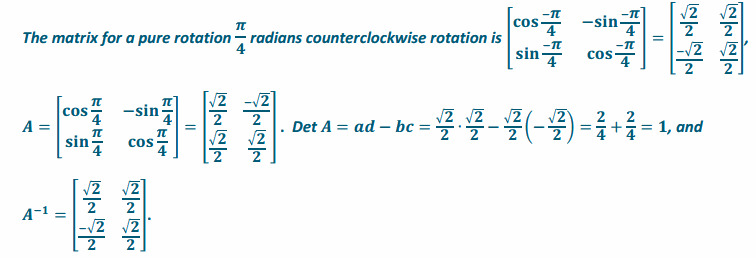
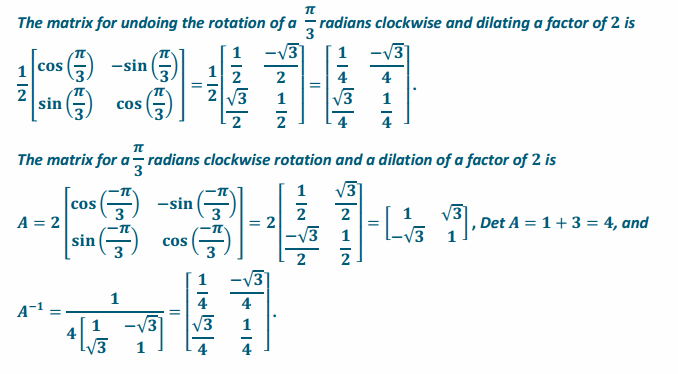
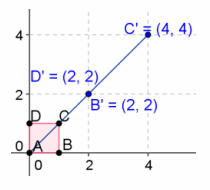
Eureka Math Geometry Module 1 Lesson 30 Answer Key

Engage NY Eureka Math Geometry Module 1 Lesson 30 Answer Key

Eureka Math Geometry Module 1 Lesson 30 Opening Exercise Answer Key

Opening Exercise:

In ∆ABC to the right, D is the midpoint of \(\overline{A B}\), E is the midpoint of \(\overline{B C}\), and F is the midpoint of \(\overline{A C}\). Complete each statement below.

Eureka Math Geometry Module 1 Lesson 30 Opening Exercise Answer Key 1

\(\overline{D E}\) is parallel to _____ and measures ______ the length of _______.
Answer:
\(\overline{A C}\), \(\frac{1}{2}\), \(\overline{A C}\)

\(\overline{D F}\) is parallel to _____ and measures ______ the length of _______.
Answer:
\(\overline{B C}\), \(\frac{1}{2}\), \(\overline{B C}\)

\(\overline{E F}\) is parallel to _____ and measures _______ the length of ______.
Answer:
\(\overline{A B}\), \(\frac{1}{2}\), \(\overline{A B}\)

Discussion:

In the previous two lessons, we proved that (a) the midsegment of a triangle is parallel to the third side and half the length of the third side and (b) diagonals of a parallelogram bisect each other. We use both of these facts to prove the following assertion:

All medians of a triangle are ____. That is, the three medians of a triangle (the segments connecting each vertex to the midpoint of the opposite side) meet at a single point. This point of concurrency is called the ____, or the center of gravity, of the triangle. The proof also shows a length relationship for each median: The length from the vertex to the centroid is ______ the length from the centroid to the midpoint of the side.
Answer:
concurrent, centroid, twice

Eureka Math Geometry Module 1 Lesson 30 Example Answer Key

Example 1:

Provide a valid reason for each step in the proof below.
Given: ∆ABC with D, E, and F the midpoints of sides \(\overline{A B}\), \(\overline{B C}\), and \(\overline{A C}\), respectively
Prove: The three medians of ABC meet at a single point.

Eureka Math Geometry Module 1 Lesson 30 Example Answer Key 2

Question (1)
Draw midsegment \(\overline{D E}\). Draw \(\overline{A E}\) and \(\overline{D C}\) label their intersection as point G.
Answer:

Question (2)
Construct and label the midpoint of \(\overline{A G}\) as point H and the midpoint of \(\overline{G C}\) as point J.
Answer:

Question (3)
\(\overline{D E}\) || \(\overline{A C}\),
Answer:
\(\overline{D E}\) is a midsegment of ∆ABC.

Question (4)
\(\overline{H J}\) || \(\overline{A C}\),
Answer:
\(\overline{H J}\) is a midsegment of ∆AGC.

Question (5)
\(\overline{D E}\) || \(\overline{H J}\),
Answer:
If two segments are parallel to the same segment, then they are parallel to each other.

Question (6)
DE = \(\frac{1}{2}\)AC and HJ = \(\frac{1}{2}\)AC,
Answer:
Definition of a midsegment.

Question (7)
DEJH is a parallelogram.
Answer:
One pair of sides of a quadrilateral are parallel and equal in length.

Question (8)
HG = EG and JG = DG,
Answer:
Diagonals of a parallelogram bisect each other.

Question (9)
AH = HG and CJ = JG,
Answer:
Definition of a midpoint

Question (10)
AH = HG = GE and CJ = JG = GD,
Answer:
Substitution property of equality

Question (11)
AG = 2GE and CG = 2GD,
Answer:
Partition property or segment addition.

Question (12)
We can complete Steps (1) – (11) to include the median from B; the third median, \(\overline{B F}\), passes through point G, which divides it into two segments such that the longer part is twice the shorter.
Answer:

Question (13)
The intersection point of the medians divides each median into two parts with lengths in a ratio of 2 : 1; therefore, all medians are concurrent at that point.

The three medians of a triangle are concurrent at the centroid _______. or the center of gravity. This point of concurrency divides the length of each median in a ratio of _______; the length from the vertex to the centroid is ________ the length from the centroid to the midpoint of the side.
Answer:
centroid, 2 : 1, twice

Example 2:

In ∆ABC, the medians are concurrent at F. DF = 4, BF = 16, AG = 30. Find each of the following measures.

Eureka Math Geometry Module 1 Lesson 30 Example Answer Key 3

a. FC =
Answer:
8

b. DC =
Answer:
12

c. AF =
Answer:
20

d. BE =
Answer:
24

e. FG =
Answer:
10

f. EF =
Answer:
8

Example 3:

In the figure to the right, ∆ABC is reflected over AB to create ∆ABD. Points P, E, and F are midpoints of AB, BD, and \(\overline{B C}\), respectively. If AH = AG, prove that PH = GP.

Eureka Math Geometry Module 1 Lesson 30 Example Answer Key 4

Answer:
ABC is reflected over \(\overline{A B}\) to create ∆ABD.
AF = AE Segments preserved, rigid motion
∠FAB ≅ ∠EAB Angles preserved, rigid motion
AH = AG Given
AP = AP Reflexive property C
∆APH ≅ ∆APG SAS
PH = GP Corresponding sides of congruent triangles are equal in measure.

Eureka Math Geometry Module 1 Lesson 30 Problem Set Answer Key

Ty is building a model of a hang glider using the template below. To place his supports accurately, Ty needs to locate the center of gravity on his model.

Eureka Math Geometry Module 1 Lesson 30 Problem Set Answer Key 5

Question 1.
Use your compass and straightedge to locate the center of gravity on Ty’s model.
Answer:

Question 2.
Explain what the center of gravity represents on Ty’s model.
Answer:
The center of gravity is the centroid.

Question 3.
Describe the relationship between the longer and shorter sections of the line segments you drew as you located the center of gravity.
Answer:
The centroid divides the length of each median in a ratio of 2 : 1.

Eureka Math Geometry Module 1 Lesson 30 Exit Ticket Answer Key

Question 1.
DQ, FP, and RE are all medians of DEF, and C is the centroid. DQ = 24, FC = 10, RC = 7. Find DC, CQ, FP, and
CE.

Eureka Math Geometry Module 1 Lesson 30 Exit Ticket Answer Key 6

Answer:
Dc = 16, CQ = 8, FP = 15, and CE = 14.

Eureka Math Geometry Module 1 Lesson 29 Answer Key

Engage NY Eureka Math Geometry Module 1 Lesson 29 Answer Key

Eureka Math Geometry Module 1 Lesson 29 Opening Exercise Answer Key

Opening Exercise:

Construct the midsegment of the triangle below. A midsegment is a line segment that joins the midpoints of two sides of a triangle or trapezoid. For the moment, we will work with a triangle.

a. Use your compass and straightedge to determine the midpoints of \(\overline{A B}\) and \(\overline{A C}\) as X and Y, respectively.
Answer:

b. Draw midsegment \(\overline{X Y}\).

Eureka Math Geometry Module 1 Lesson 29 Opening Exercise Answer Key 1

Answer:

Eureka Math Geometry Module 1 Lesson 29 Opening Exercise Answer Key 2

Compare ∠AXY and ∠ABC; compare ∠AYX and ∠ACB. Without using a protractor, what would you guess is the relationship between these two pairs of angles? What are the implications of this relationship?
Answer:
m∠AXY = m∠ABC, m∠AYX = m∠ACB; \(\overline{X Y}\) || \(\overline{B C}\)

Discussion:

Note that though we chose to determine the midsegment of \(\overline{A B}\) and \(\overline{A C}\), we could have chosen any two sides to work with. Let us now focus on the properties associated with a midsegment. The midsegment of a triangle is parallel to the third side of the triangle and half the length of the third side of the triangle.

We can prove these properties to be true. Continue to work with the figure from the Opening Exercise.
Given: \(\overline{X Y}\) is a midsegment of ΔABC.
Prove: \(\overline{X Y}\) || \(\overline{B C}\) and XY = \(\frac{1}{2}\)BC

Construct the following: In the Opening Exercise figure, draw ΔYGC according to the following steps. Extend \(\overline{X Y}\) to point G so that YG = XY. Draw \(\overline{G C}\).

Question (1)
What is the relationship between XV and YG? Explain why.
Answer:
Equal, by construction.

Question (2)
What is the relationship between m∠AYX and m∠GYC? Explain why.
Answer:
Equal, vertical angles are equal in measure.

Question (3)
What is the relationship between AY and YC? Explain why.
Answer:
Equal, Y is the midpoint of \(\overline{A C}\).

Question (4)
What is the relationship between A AXY and A CGY? Explain why.
Answer:
Congruent, SAS.

Question (5)
What is the relationship between GC and AX? Explain why.
Answer:
Equal, corresponding sides of congruent triangles are equal in length.

Question (6)
Since AX = BX, what other conclusion can be drawn? Explain why.
Answer:
GC = BX, substitution.

Question (7)
What is the relationship between m∠AXY and m∠CGV? Explain why.
Answer:
Equal, corresponding angles of congruent triangles are equal in measure.

Question (8)
Based on (7), what other conclusion can be drawn about \(\overline{A B}\) and \(\overline{G C}\)? Explain why.
Answer:
\(\overline{A B}\) || \(\overline{G C}\)

Question (9)
What conclusion can be drawn about BXGC based on (7) and (8)? Explain why.
Answer:
BXGC is a parallelogram; one pair of opposite sides is equal and parallel. Also, \(\overline{X Y}\) || \(\overline{B C}\).

Question (10)
Based on (9), what is the relationship between XG and BC?
Answer:
XG = BC, opposite sides of a parallelogram are equal.

Question (11)
Since YG = XV, XG = __ XV. Explain why.
Answer:
2, Substitution

Question (12)
This means BC = ___ XY. Explain why.
Answer:
2, Substitution

Question (13)
Or by division, XY = ___ B.
Answer:
\(\frac{1}{2}\).

Note that Steps (9) and (13) demonstrate our Prove statement.

Eureka Math Geometry Module 1 Lesson 29 Exercise Answer Key

Apply what you know about the properties of midsegments to solve the following exercises.

Exercise 1.
x = ___
Perimeter of ∆ABC = _____

Eureka Math Geometry Module 1 Lesson 29 Exercise Answer Key 3

Answer:

x = 15

Perimeter of ∆ABC = 6

Exercise 2.
x = ___
y = ___

Eureka Math Geometry Module 1 Lesson 29 Exercise Answer Key 4

Answer:
x = 50°
y = 70°

Exercise 3.
In ∆RST, the midpoints of each side have been marked by points X, Y, and Z.
→ Mark the halves of each side divided by the midpoint with a congruency mark. Remember to distinguish congruency marks for each side.
→ Draw midsegments \(\overleftrightarrow{X Y}\), \(\overleftrightarrow{Y Z}\), and \(\overleftrightarrow{X Z}\). Mark each midsegment with the appropriate congruency mark from the sides of the triangle.

Eureka Math Geometry Module 1 Lesson 29 Exercise Answer Key 5

a. What conclusion can you draw about the four triangles within ∆RST? Explain why.
Answer:
All four are congruent. SSS

b. State the appropriate correspondences among the four triangles within ∆RST.
Answer:
∆RXY, ∆YZT, ∆XSZ, ∆ZYX

c. State a correspondence between RST and any one of the four small triangles.
Answer:
∆RXY, ∆RST

Exercise 4.
Find x.
Eureka Math Geometry Module 1 Lesson 29 Exercise Answer Key 6
Answer:
x = 9°

Eureka Math Geometry Module 1 Lesson 29 Problem Set Answer Key

Exercises 1 – 4:

Use your knowledge of triangle congruence criteria to write proofs for each of the following problems.

Eureka Math Geometry Module 1 Lesson 29 Problem Set Answer Key 7

Question 1.
\(\overline{W X}\) is a midsegment of ∆ABC, and \(\overline{Y Z}\) is a midsegment of ∆CWX. BX = AW

a. What can you conclude about ∠A and ∠B? Explain why.
Answer:
∠A ≅ ∠B, BX = AW, so CX = CW; the triangle is isosceles.

b. What is the relationship of the lengths \(\overline{Y Z}\) and \(\overline{A B}\)?
Answer:
YZ = \(\frac{1}{4}\)AB or 4YZ = AB

Question 2.
\(\overline{A B}\) || \(\overline{C D}\) and \(\overline{A D}\) || \(\overline{B C}\). W, X, Y, and Z are the midpoints of \(\overline{A D}\), \(\overline{A B}\) , \(\overline{B C}\), and \(\overline{C D}\), respectively. AD = 18, WZ = 11, and BX = 5. mLWAC = 33°, m∠XBY = 73°, m∠RYX = 74°, m∠DCA = 74°.

Eureka Math Geometry Module 1 Lesson 29 Problem Set Answer Key 8

a. m∠DZW= ____
Answer:
74°

b. Perimeter of ABYW = ____
Answer:
38

c. Perimeter of ABCD = ____
Answer:
56

d. m∠WAX=____
Answer:
107°

m∠B= ____
Answer:
73°

m∠YCZ = ___
Answer:
107°

m∠D=____
Answer:
73°

e. What kind of quadrilateral is ABCD?
Answer:
Parallelogram

Eureka Math Geometry Module 1 Lesson 29 Exit Ticket Answer Key

Use the properties of midsegments to solve for the unknown value in each question.

Question 1.
R and S are the midpoints of XW and WV, respectively.

Eureka Math Geometry Module 1 Lesson 29 Exit Ticket Answer Key 9

What is the perimeter of ∆WXY?
Answer:
82

Question 2.
What is the perimeter of ∆EFG?

Eureka Math Geometry Module 1 Lesson 29 Exit Ticket Answer Key 10

Answer:
62

Eureka Math Geometry Module 1 End of Module Assessment Answer Key

Engage NY Eureka Math Geometry Module 1 End of Module Assessment Answer Key

Eureka Math Geometry Module 1 End of Module Assessment Answer Key

Question 1.
Each of the illustrations on the next page shows in black a plane figure consisting of the letters F, R, E, and D evenly spaced and arranged in a row. In each illustration, an alteration of the black figure is shown in gray. In some of the illustrations, the gray figure is obtained from the black figure by a geometric transformation consisting of a single rotation. In others, this is not the case.

Eureka Math Geometry Module 1 End of Module Assessment Answer Key 7

a. Which illustrations show a single rotation?
Answer:
Illustrations 2 and 5

b. Some of the illustrations are not rotations or even a sequence of rigid transformations. Select one such illustration, and use it to explain why it is not a sequence of rigid transformations.
Answer:
Illustrational 1 shows translations of individual letters F, R, E, and D; but each letter is translated a different distance. Since translation requires a shift of the entire plane by the same distance, illustrational does not qualify.

Question 2.
In the figure below, \(\overline{C D}\) bisects ∠ACB, AB = BC, m∠BEC = 90°, and m∠DCE = 42°. Find the measure of ∠A.

Eureka Math Geometry Module 1 End of Module Assessment Answer Key 1

Answer:
Label the angles as shown.
(∠ACD ≅ ∠DCB since \(\overline{C D}\) bisects ∠ACB)
Since AB = BC, ∆ABC is isosceless, therefore 2x = a.
m∠A + m∠ACE + m∠E = 180°
a + (x + 42) + 90 = 180
2x + x + 132 = 180
x = 16
Since a = 2x, m∠A = 32°

Question 3.
In the figure below, \(\overline{A D}\) is the angle bisector of ∠BAC. \(\overline{B A P}\) and \(\overline{B D C}\) are straight lines, and \(\overline{A D}\) || \(\overline{P C}\). Prove that AP = AC.

Eureka Math Geometry Module 1 End of Module Assessment Answer Key 2

Answer:
Label w, x, y and z as shown.

StatementsReasons
1. \(\overline{A D}\) is the angle bisector of ∠BACGiven
2. \(\overline{A D}\) || \(\overline{P C}\)Given
3. z = wDefinition of angle bisector
4. z = yIf two parallel lines are cut by a transversal, alt. internal angles are equal in measure.
5. w = xIf two parallel lines are cut by a tranversal, corr. Angles are equal in measure.
6. x = yTransitive property
7. ∆ACP is isoscelessBase angles are congruent
8. AC = APDefinition of isosceles triangle.

Question 4.
∆ ABC and ∆ DEF, in the figure below are such that \(\overline{A B}\) ≅ \(\overline{D E}\), \(\overline{A C}\) ≅ \(\overline{D F}\) and ∠A ≅∠D.

Eureka Math Geometry Module 1 End of Module Assessment Answer Key 3

a. Which criteria for triangle congruence (ASA, SAS, SSS) implies that ∆ABC ≅ ∆DEF?
Answer:
side – Angle – side

b. Describe a sequence of rigid transformations that shows ∆ ABC ≅ ∆ DEF.
Answer:

  1. Translate ∆DEF so that F is mapped onto C.
  2. Rotate the image of ∆DEF about C so that E is mapped onto B.
  3. Reflect the image of the rotation across \(\overleftrightarrow{B C}\).

Question 5.

a. Construct a square ABCD with side \(\overline{A B}\). List the steps of the construction.

Eureka Math Geometry Module 1 End of Module Assessment Answer Key 4

Answer:

  1. Extend \(\overline{A B}\) in both directions.
  2. Construct a perpendicular bisector to AB through a; Construct a perpendicular bisector to AB through B.
  3. Construct a circle with center A and radius AB; construct a circle with center B and raadius AB.
  4. Select a point where circle A meets the perpendicular through A and call that point D. on the same side of AB as D, select the point where circle B meets the perpendicular through B and call that point C.
  5. Draw segment CD.

b. Three rigid motions are to be performed on square ABCD. The first rigid motion is the reflection through \(\overline{B D}\). The second rigid motion is a 90° clockwise rotation around the center of the square.

Describe the third rigid motion that will ultimately map ABCD back to its original position. Label the image of each rigid motion A, B, C, and D in the blanks provided.

Eureka Math Geometry Module 1 End of Module Assessment Answer Key 5

Answer:
Reflection through the line connecting the midpoint of AD and the midppoint of BC.

Question 6.
Suppose that ABCD is a parallelogram and that M and N are the midpoints of \(\overline{A B}\) and \(\overline{C D}\), respectively. Prove that AMCN is a parallelogram.

Eureka Math Geometry Module 1 End of Module Assessment Answer Key 6

Answer:

StatementsReasons
1. M and N are the mid points of \(\overline{A B}\) and \(\overline{C D}\)Given
2. ABCD is a parallelogramGiven
3. AB = DCOpposite sides of parallelogram are congruent
4. NC = \(\frac{1}{2}\)DCN is the mid point of DC
5. AM = \(\frac{1}{2}\)ABM is the mid point of AB
6. AM = \(\frac{1}{2}\)DCsubstitution
7. AM = NCTransitive property
8. \(\overline{A B}\) || \(\overline{D C}\)Definition of parallelogram
9. \(\overline{A M}\) || \(\overline{N C}\)M is on line AB, N is online DC
10. AMCN is a parallelogramOpposite sides are equal in length and parallel.

Eureka Math Geometry Module 1 Mid Module Assessment Answer Key

Engage NY Eureka Math Geometry Module 1 Mid Module Assessment Answer Key

Eureka Math Geometry Module 1 Mid Module Assessment Answer Key

Question 1.
State precise definitions of angle, circle, perpendicular, parallel, and line segment based on the undefined notions of point, line, distance along a line, and distance around a circular arc.
Angle:
Circle:
Perpendicular:
Parallel:
Line segment:
Answer:
Angle:
An angle is formed by two rays that share a common vertex. An angle is proper if the two rays do not lie on the same line.

Circle:
A circle is the set of all points in a plane that are equidistant from the center point. The circle in plane P with center a and radius AB is the set of all points in P whose distance from A is the same as the distance from A to B.

Perpendicular:
Two lines are perpendicular if they have one point in common and if the four angles formed by the intersection are all right angles.

Parallel:
Two lines are parallel if they lie in the same plane and have no points in common.

Line segment:
A line segment is the set of point A and B and all points on line AB between A and B.

Question 2.
A rigid motion, J, of the plane takes a point, A, as input and gives C as output (i.e., J(A) = C). Similarly, J(B) = D for input point B and output point D.

Jerry claims that knowing nothing else about J, we can be sure that \(\overline{A C}\) ≅ \(\overline{B D}\) because rigid motions preserve distance.

a. Show that Jerry’s claim is incorrect by giving a counterexample (hint: a counterexample would be a specific rigid motion and four points A, B, C, and D in the plane such that the motion takes A to C and B to D, \(\overline{A C}\) ≅ \(\overline{B D}\) yet).
Answer:
Eureka Math Geometry Module 1 Mid Module Assessment Answer Key 4

Here, J is a reflection across a vertical line. The distance from A to a line is different from the distance from B to the line. Therefore, the distance from A to its image (c) is different from the distance from B to its image(D).

b. There is a type of rigid motion for which Jerry’s claim is always true. Which type below is it?
A. Rotation
B. Reflection
C. Translation
Answer:
C. Translation

c. Suppose Jerry claimed that \(\overline{A B}\) ≅ \(\overline{C D}\). Would this be true for any rigid motion that satisfies the conditions described in the first paragraph? Why or why not?
Answer:
Yes, because rigid motions always preserve distance.

Question 3.

a. In the diagram below, l is a line, A is a point on the line, and B is a point not on the line. C is the midpoint of \(\overline{A B}\). Show how to create a line parallel to l that passes through B by using a rotation about C.

Eureka Math Geometry Module 1 Mid Module Assessment Answer Key 1

Answer:

Eureka Math Geometry Module 1 Mid Module Assessment Answer Key 5

Eureka Math Geometry Module 1 Mid Module Assessment Answer Key 6

Take a 180° rotation about C. Line m is the image of l under this rotation. Line m passes through B and is parallel to l.

b. Suppose that four lines in a given plane, l1, l2, m1, and m2 are given, with the conditions (also given that l1 || l2, m1 || m2, and l1 is neither parallel nor perpendicular to m1.

i. Sketch (freehand) a diagram of l1, l2, m1, and m2 to illustrate the given conditions.
Answer:

Eureka Math Geometry Module 1 Mid Module Assessment Answer Key 7

ii. In any diagram that illustrates the given conditions, how many distinct angles are formed? Count only angles that measure less than 1800, and count two angles as the same only if they have the same vertex and the same edges. Among these angles, how many different angle measures are formed? Justify your answer.
Answer:
There are distinct angles with two different angle measures because alternate interior/exterior angles are congruent and corresponding angles are congruent.

Question 4.
In the figure below, there is a reflection that transforms ∆ ABC to ∆\(A^{\prime} B^{\prime} C^{\prime}\). Use a straightedge and compass to construct the line of reflection, and list the steps of the construction.

Eureka Math Geometry Module 1 Mid Module Assessment Answer Key 2

Answer:
1. Draw a segment B\(B^{\prime}\)
2. Construct circle B with radius
3. Construct circle \(B^{\prime}\) with radius
4. Connect the two intersections of circles B and \(B^{\prime}\)
5. This forms the line of reflection between ∆ABC and ∆\(A^{\prime}\)\(B^{\prime}\)\(C^{\prime}\)

Question 5.
Precisely define each of the three rigid motion transformations identified.

a. \(T_{\overrightarrow{A B}}(P)\)
Answer:
For vector \(\overrightarrow{A B}\), the translation along \(\overrightarrow{A B}\) is a translation of the plane:
(i) For every point P on line AB, \(T_{\overrightarrow{A B}}(P)\) is the point on \(\overrightarrow{A B}\) so that \(\overrightarrow{P Q}\) has the same length and direction as \(\overrightarrow{A B}\) and
(ii) For P not on \(\overrightarrow{A B}\), let l, be the line through P parallel to \(\overrightarrow{A B}\) and l2 be the line through B parallel to \(\overrightarrow{A B}\). Q is the intersection of l1 and l2.

b. rl(P)
Answer:
For a line l, a reflection across l is the transformation rl of the plane defined as follows:
(1) For any point p on line l, rl(P) = P, and
(2) For any point P no only rl(P) is the point Q so that l is the perpendicular bisector of \(\overrightarrow{P Q}\)

c. Rc, 30°(P)
Answer:
The rotation of 30° around center c is defined as follows:
(1) For the center C, Rc, 30°(C) = C, and
(2)For any other point P, Rc, 30° is the point Q that lies in the counterclockwise half-plane of ray \(\overrightarrow{C P}\) such that CQ = CP and ∠PCQ = 30°.

Question 6.
Given in the figure below, line lis the perpendicular bisector of \(\overline{A B}\) and of \(\overline{C D}\).

Eureka Math Geometry Module 1 Mid Module Assessment Answer Key 3

a. Show \(\overline{A C}\) ≅ \(\overline{B D}\)
Answer:
since l is the perpendicular bisector of \(\overline{A B}\) and \(\overline{C D}\), the reflection through line l brings A to B and C to D. Because reflections take line segments to congruent line segments \(\overline{A C}\) is the congruent to \(\overline{B D}\).

b. Show ∠ACD ≅ ∠BDC
Answer:
The reflection through line l brings A to B and C to D and D to C. Therefore ray \(\overrightarrow{C A}\) goes to ray \(\overrightarrow{D B}\), Ray \(\overrightarrow{C D}\) goes to ray \(\overrightarrow{D C}\). The image of ∠ACD is therefore congruent to ∠BDC.

c. Show \(\overline{A B}\) || \(\overline{C D}\).
Answer:
\(\overline{A B}\) || \(\overline{C D}\) because the perpendicular bisector intersects the two lines creating congruent corresponding angles.

Eureka Math Precalculus Module 2 Lesson 13 Answer Key

Engage NY Eureka Math Precalculus Module 2 Lesson 13 Answer Key

Eureka Math Precalculus Module 2 Lesson 13 Opening Exercise Answer Key

Opening:

A common way to send coded messages is to assign each letter of the alphabet to a number 1 – 26 and send the message as a string of integers. For example, If we encode the message “THE CROW FLIES AT MIDNIGHT” according to the chart below, we get the string of numbers.

20, 8, 5, 0, 3, 18, 15, 23, 0, 6, 12, 9, 5, 19, 0, 1, 20, 0, 13, 9, 4, 14, 9, 7, 8, 20.

Eureka Math Precalculus Module 2 Lesson 13 Opening Exercise Answer Key 1

However, codes such as these are easily broken using an analysis of the frequency of numbers that appear in the coded messages.

We can instead encode a message using matrix multiplication. If a matrix E has an inverse, then we can encode a message as follows.

→ First, convert the characters of the message to integers between 1 and 26 using the chart above.
→ If the encoding matrix E is an n × n matrix, then break up the numerical message into n rows of the same length. If needed, add extra zeros to make the rows the same length.
→ Place the rows into a matrix M.
→ Compute the product EM to encode the message.
→ The message is sent as the numbers in the rows of the matrix EM.

Eureka Math Precalculus Module 2 Lesson 13 Exercise Answer Key

Exercises:

Exercise 1.
You have received an encoded message: 34, 101, 13, 16, 23, 45, 10, 8, 15, 50, 8, 12. You know that the message was encoded using matrix E = \(\left[\begin{array}{lll}
1 & 2 & 3 \\
0 & 2 & 1 \\
1 & 1 & 1
\end{array}\right]\).

a. Store your message in a matrix C. What are the dimensions of C?
Answer:
There are 12 numbers in the coded message, and it was encoded using a 3 × 3 matrix. Thus, the matrix C needs to have three rows. That means C has four columns, so C is a 3 × 4 matrix.

b. You have forgotten whether the proper decoding matrix is matrix X, Y, or Z as shown below. Determine which of these is the correct matrix to use to decode this message.

Eureka Math Precalculus Module 2 Lesson 13 Exercise Answer Key 2

Answer:
Matrices used to encode and decode messages must be inverses of each other. Thus, the correct decoding matrix is the matrix D so that D . E = I. We can find the correct decoding matrix by multiplying X . E, Y . E, and Z . E.

Eureka Math Precalculus Module 2 Lesson 13 Exercise Answer Key 3

Since Z . E = I, we know that Z is the decoding matrix we need.

c. Decode the message.
Answer:
Using matrix Z to decode, we have


Eureka Math Precalculus Module 2 Lesson 13 Problem Set Answer Key 17

The decoded message is “ARCHIMEDES”.

Exercise 2.
You have been assigned a group number. The message your group receives is listed below. This message is TOP
SECRET! It Is of such importance that it has been encoded four times.

Your group’s portion of the coded message is listed below.

Group 1:
1500, 3840, 0, 3444, 3420, 4350, 0, 4824, 3672, 3474, -2592, -6660, 0, -5976, -5940, -7560, 0, -8388, -6372, -6048

Group 2:
2424, 3024, -138, 396, -558, -1890, -1752, 1512, -2946, 1458, 438, 540, -24, 72, -90, -324, -300, 270, -510, 270

Group 3:
489, 1420, 606, 355, 1151, 33, 1002, 829, 99, 1121, 180, 520, 222, 130, 422, 12, 366, 304, 36,410

Group 4:
-18, 10, -18, 44, -54, 42, -6, -74, -98, -124, 0, 10, -12, 46, -26, 42, -4, -36, -60, -82

Group 5:
-120, 0, -78, -54, -84, -30, 0, -6, -108, -30, -120, 114, 42, 0, -12, 42, 0, 36, 0, 0

Group 6:
126, 120, 60, 162, 84, 120, 192,42, 84, 192, -18, -360, -90, -324, 0, -18, -216, -36, -90, -324

a. Store your message in a matrix C with two rows. How many columns does matrix C have?
Answer:
(Sample responses are provided for Group 1.) Our message is stored in a matrix with ten columns:
C = Eureka Math Precalculus Module 2 Lesson 13 Exercise Answer Key 4

b. Begin at the station of your group number, and apply the decoding matrix at this first station.
Answer:

Eureka Math Precalculus Module 2 Lesson 13 Exercise Answer Key 5

c. Proceed to the next station in numerical order; if you are at Station 6, proceed to Station 1. Apply the decoding matrix at this second station.
Answer:

Eureka Math Precalculus Module 2 Lesson 13 Exercise Answer Key 6

d. Proceed to the next station in numerical order; if you are at Station 6, proceed to Station 1. Apply the decoding matrix at this third station.
Answer:

Eureka Math Precalculus Module 2 Lesson 13 Exercise Answer Key 7

e. Proceed to the next station in numerical order; If you are at Station 6, proceed to Station 1. Apply the decoding matrix at this fourth station.

Answer:

Eureka Math Precalculus Module 2 Lesson 13 Exercise Answer Key 8

f. If we know the original message had 21 characters and the last letter was an H, decode your message.
Answer:
The numerical message is 4, 15, 0, 14, 15, 20, 0, 23, 15, 18, 18, 25, 0, 20, 15, 15, 0, 13, 21, 3, which represents the characters “DO NOT WORRY TOO MUCH.”

Exercise 3.
Sydnie was in Group 1 and tried to decode her message by calculating the matrix (D1 . D2 . D3 . D4) and then multiplying (D1 D2 D3 D4) C. This produced the matrix.

M = Eureka Math Precalculus Module 2 Lesson 13 Exercise Answer Key 18

a. How did she know that she made a mistake?
Answer:
If Sydnie had properly decoded her message, all entries in the matrix M would be integers between 0 and 26.

b. Matrix C was encoded using matrices E1, E2, E3, and E4, where D1 decodes a message encoded by E1, D2 decodes a message encoded by E2, and so on. What is the relationship between matrices E1 and D1, between E2 and D2, etc.?
Answer:
Matrices E1 and D1 are inverse matrices, as are E2 and D2, E3, and D3, and so on.

c. The matrix that Sydnie received was encoded by C = E1 . E2 . E3 . E4 M. Explain to Sydnie how the decoding process works to recover the original matrix M, and devise a correct method for decoding using multiplication by a single decoding matrix.
Answer:
Since C = E1 . E2 . E3 . E4 . M, we can recover the original matrix M by multiplying both sides of this equation by the proper decoding matrix at each step, remembering that D1 . E1 = I, D1 . E1 = I, etc.

C = E1 . E2 . E3 . E4 . M
D1 . C = D1 . (E1 . E2 . E3 . E4 .
M)
= (D1 . E1) . (E2 . E3 . E4 . M)
= I . (E2 . E3 . E4 . M)
= (E2 . E3 . E4 . M)

D2 . D1 . C = D2 . (E2 . E3 . E4 . M)
= (D2 . E2) . (E3 . E4 . M)
= I . (E3 . E4 . M)
= (E3 . E4 . M)

D3 . D2 . D1 . C = D3 . (E3 . E4 . M)
= (D3 . E3) . (E4 . M)
= I . (E4 . M)
= E4 . M

D4 . D3 . D2 . D1. C = D4 . (E4 . M)
= (D4 . E4) . M
= I . M
= M
Since Matrix Multiplication is associative, this means that M = (D4 . D3 . D2 . D1). C

d. Apply the method you devised in part (c) to your group’s message to verify that it works.
Answer:

Eureka Math Precalculus Module 2 Lesson 13 Exercise Answer Key 10

Exercise 4.
You received a coded message in the matrix C = \(\left[\begin{array}{ccc}
30 & 30 & 69 \\
2 & 1 & 15 \\
9 & 14 & 20
\end{array}\right]\). However, the matrix D that will decode this message has been corrupted, and you do not know the value of entry d12. You know that all entries in matrix D are integers. Using x to represent this unknown entry, the decoding matrix D is given by D = \(\left[\begin{array}{ccc}
2 & x & -4 \\
-1 & 2 & 3 \\
1 & -1 & -2
\end{array}\right]\). Decode the message in matrix C.
Answer:
Decoding the message requires that we multiply D . C:
Eureka Math Precalculus Module 2 Lesson 13 Exercise Answer Key 11

Since we know all entries are integers and that the entries represent letters, we know that
0 ≤ 24 + 2x ≤ 26
0 ≤ 4 + x ≤ 26
0 ≤ 58 + 15x ≤ 26.
Solving these inequalities gives
-12 < x < 1
-4 ≤ x ≤ 22
58 32
\(-\frac{58}{15}\) ≤ x ≤ \(-\frac{32}{15}\).
Because we know that x is an integer, the third Inequality becomes -3 ≤ x ≤ -3, so we know that x = -3. Then, the decoded message is

D . C = \(\left[\begin{array}{ccc}
24+2(-3) & 4+(-3) & 58+15(-3) \\
1 & 14 & 21 \\
10 & 1 & 14
\end{array}\right]\);

thus, D . C = \(\left[\begin{array}{ccc}
18 & 1 & 13 \\
1 & 14 & 21 \\
10 & 1 & 14
\end{array}\right]\),

and the decodedd message is “RAMANUJAN”.

Eureka Math Precalculus Module 2 Lesson 12 Problem Set Answer Key

Question 1.
Let A = \(\left[\begin{array}{ll}
1 & 3 \\
2 & 5
\end{array}\right]\), B = \(\left[\begin{array}{cc}
-2 & 7 \\
3 & -4
\end{array}\right]\), C = \(\left[\begin{array}{cc}
-5 & 3 \\
2 & -1
\end{array}\right]\), Z = \(\left[\begin{array}{ll}
0 & 0 \\
0 & 0
\end{array}\right]\), and I = \(\left[\begin{array}{ll}
1 & 0 \\
0 & 1
\end{array}\right]\). Evaluate the following.

a. A + B
Answer:
\(\left[\begin{array}{cc}
-1 & 10 \\
5 & 1
\end{array}\right]\)

b. B + A
Answer:
\(\left[\begin{array}{cc}
-1 & 10 \\
5 & 1
\end{array}\right]\)

c. A + (B + C)
Answer:
\(\left[\begin{array}{cc}
-6 & 13 \\
7 & 0
\end{array}\right]\)

d. (A + B) + C
Answer:
\(\left[\begin{array}{cc}
-6 & 13 \\
7 & 0
\end{array}\right]\)

e. A + I
Answer:
\(\left[\begin{array}{ll}
2 & 3 \\
2 & 6
\end{array}\right]\)

f. A + Z
Answer:
\(\left[\begin{array}{ll}
1 & 3 \\
2 & 5
\end{array}\right]\)

g. A . Z
Answer:
\(\left[\begin{array}{ll}
0 & 0 \\
0 & 0
\end{array}\right]\)

h. Z . A
Answer:
\(\left[\begin{array}{ll}
0 & 0 \\
0 & 0
\end{array}\right]\)

i. I . A
Answer:
\(\left[\begin{array}{ll}
1 & 3 \\
2 & 5
\end{array}\right]\)

j. A . B
Answer:
\(\left[\begin{array}{cc}
7 & -5 \\
11 & -6
\end{array}\right]\)

k. B . A
Answer:
\(\left[\begin{array}{cc}
12 & 29 \\
-5 & -11
\end{array}\right]\)

l. A . C
Answer:
\(\left[\begin{array}{ll}
1 & 0 \\
0 & 1
\end{array}\right]\)

m. C . A
Answer:
\(\left[\begin{array}{ll}
1 & 0 \\
0 & 1
\end{array}\right]\)

n. A . B + A . C
Answer:
\(\left[\begin{array}{cc}
8 & -5 \\
11 & -5
\end{array}\right]\)

o. A . (B + C)
Answer:
\(\left[\begin{array}{cc}
8 & -5 \\
11 & -5
\end{array}\right]\)

p. A . B . C
Answer:
\(\left[\begin{array}{ll}
-45 & 26 \\
-67 & 39
\end{array}\right]\)

q. C . B . A
Answer:
\(\left[\begin{array}{cc}
-75 & -178 \\
29 & 69
\end{array}\right]\)

r. A . C . B
Answer:
\(\left[\begin{array}{cc}
-2 & 7 \\
3 & -4
\end{array}\right]\)

s. det(A)
Answer:
-1

t. det(B)
Answer:
-13

u. det(C)
Answer:
-1

v. det(Z)
Answer:
0

w. det(I)
Answer:
1

x. det(A . B . C)
Answer:
-13

y. det(C . B . A)
Answer:
-13

Question 2.
For any 2 × 2 matrix A and any real number k, show that if kA = \(\left[\begin{array}{ll}
0 & 0 \\
0 & 0
\end{array}\right]\). then k = 0 or A = \(\left[\begin{array}{ll}
0 & 0 \\
0 & 0
\end{array}\right]\).
Answer:
Let A = \(\left[\begin{array}{ll}
\boldsymbol{a} & \boldsymbol{b} \\
\boldsymbol{c} & \boldsymbol{d}
\end{array}\right]\); then kA = \left[\begin{array}{ll}
\boldsymbol{a} & \boldsymbol{b} \\
\boldsymbol{c} & \boldsymbol{d}
\end{array}\right]. Suppose that kA = \(\left[\begin{array}{ll}
0 & 0 \\
0 & 0
\end{array}\right]\).

Case 1:
Suppose k ≠ 0. Then, ka = 0, kb = 0, kc = 0, and kd = 0; all imply that a = b = c = d = 0. Thus, if k ≠ 0,then A = \(\left[\begin{array}{ll}
0 & 0 \\
0 & 0
\end{array}\right]\)

Case 2:
Suppose that A ≠ \(\left[\begin{array}{ll}
0 & 0 \\
0 & 0
\end{array}\right]\). Then, at least one of a, b, c, and d is not zero, so ka = 0, kb = 0, kc = 0, and kd = 0 imply that k = 0.
Thus, if kA = \(\left[\begin{array}{ll}
0 & 0 \\
0 & 0
\end{array}\right]\). then either k = 0 or A = \(\left[\begin{array}{ll}
0 & 0 \\
0 & 0
\end{array}\right]\).

Question 3.
Claire claims that she multiplied A = \(\left[\begin{array}{cc}
-3 & 2 \\
0 & 4
\end{array}\right]\) by another matrix X and obtained \(\left[\begin{array}{cc}
-3 & 2 \\
0 & 4
\end{array}\right]\) as her result. What matrix did she multiply by? How do you know?
Answer:
She multiplied A by the multiplicative identit y matrix I = \(\left[\begin{array}{ll}
1 & 0 \\
0 & 1
\end{array}\right]\). Since the product is a 2 × 2 matrix, we know that X is a 2 × 2 matrix of the form = \(\left[\begin{array}{ll}
\boldsymbol{a} & \boldsymbol{b} \\
\boldsymbol{c} & \boldsymbol{d}
\end{array}\right]\). Multiplying A . X gives A . X = \(\left[\begin{array}{cc}
-3 a+2 c & -3 b+2 d \\
0 a+4 c & 0 b+4 d
\end{array}\right]\) Since A . X = A, we have the following system of equations:
-3a + 2c = -3
-3b + 2d = 2
0a +4c = 0
0b + 4d = 4.
The third and fourth equations give c = 0 and d = 1, respectively, and substituting into the first two equations gives
-3a = -3 and -3b + 2 = 2. Thus,a = 1 and b = 0, and the matrix X must be X = I.

Question 4.
Show that the only matrix B such that A + B = A Is the zero matrix.
Answer:
Let A = \(\left[\begin{array}{ll}
a & b \\
c & d
\end{array}\right]\) and B = \(\left[\begin{array}{ll}
x & y \\
z & w
\end{array}\right]\) then, we have A + B = \(\left[\begin{array}{ll}
a+x & b+y \\
c+z & d+w
\end{array}\right]\), a + x = a, b + y = b, c + z = c, and d + w = d. In each case, solving for the elements of B, we find that B = \(\left[\begin{array}{ll}
0 & 0 \\
0 & 0
\end{array}\right]\)

Question 5.
A 2 × 2 matrix of the form \(\left[\begin{array}{ll}
\boldsymbol{a} & \mathbf{0} \\
\mathbf{0} & \boldsymbol{b}
\end{array}\right]\) is a diagonal matrix. Daniel calculated
Eureka Math Precalculus Module 2 Lesson 13 Problem Set Answer Key 12
and concluded that if X is a diagonal matrix and A is any other matrix, then X . A = A . X.

a. Is there anything wrong with Daniel’s reasoning? Prove or disprove that If X is a diagonal 2 × 2 matrix, then X . A = A . X for any other matrix A.
Answer:
Yes, there is something wrong with Daniel’s reasoning. A single example does not establish that a statement is true, and the example he calculated used a special case of a diagonal matrix in which the entries on the main diagonal are equal.
if A = \(\left[\begin{array}{ll}
1 & 2 \\
3 & 4
\end{array}\right]\) and X = \(\left[\begin{array}{ll}
2 & 0 \\
0 & 3
\end{array}\right]\), then X . A = \(\left[\begin{array}{cc}
2 & 4 \\
9 & 12
\end{array}\right]\) andA X = \(\left[\begin{array}{cc}
2 & 6 \\
6 & 12
\end{array}\right]\). Thus, it is nor true that X . A = A . X for all diagonal matrices X and all other matrices A.

b. For 3 × 3 matrices, Elda claims that only diagonal matrices of the form X = \(\left[\begin{array}{lll}
\boldsymbol{C} & 0 & 0 \\
0 & \boldsymbol{C} & 0 \\
0 & 0 & \boldsymbol{C}
\end{array}\right]\) satisfy X . A = A . X for any other 3 × 3 matrix A. Is her claim correct?
Answer:
Elda is correct since X = \(\left[\begin{array}{lll}
\boldsymbol{C} & 0 & 0 \\
0 & \boldsymbol{C} & 0 \\
0 & 0 & \boldsymbol{C}
\end{array}\right]\). Then, X . A = cI. A = c(I . A) = cA = Ac = (A . I)c = A . (cI) = A . X for all matrices A.

Question 6.
Calvin encoded a message using E = \(\left[\begin{array}{cc}
2 & 2 \\
-1 & 3
\end{array}\right]\), giving the coded message 4, 28, 42, 56, 2, -6, -1, 52. Decode the message, or explain why the original message cannot be recovered.
Answer:
Putting the message 2 × 4 matrix, we have C = \(\left[\begin{array}{cccc}
4 & 28 & 42 & 56 \\
2 & -6 & -1 & 52
\end{array}\right]\). We can decode the message with
D = E-1 = \(\frac{1}{6-(-2)}\)\(\left[\begin{array}{cc}
3 & -2 \\
1 & 2
\end{array}\right]\) = \(\left[\begin{array}{cc}
\frac{3}{8} & -\frac{2}{8} \\
\frac{1}{8} & \frac{2}{8}
\end{array}\right]\). Then, the original message is found in message M:
M = D C = \(\left[\begin{array}{cc}
\frac{3}{8} & -\frac{2}{8} \\
\frac{1}{8} & \frac{2}{8}
\end{array}\right]\) . \(\left[\begin{array}{cccc}
4 & 28 & 42 & 56 \\
2 & -6 & -1 & 52
\end{array}\right]\) = \(\left[\begin{array}{cccc}
1 & 12 & 16 & 8 \\
1 & 2 & 5 & 20
\end{array}\right]\)

The original message is “ALPHABET.”

Question 7.
Decode the message below using the matrix D = \(\left[\begin{array}{ccc}
1 & 1 & -1 \\
-1 & 0 & 2 \\
1 & 2 & 1
\end{array}\right]\):
22, 17, 24, 9, -1, 14, -9, 34, 44, 64, 47, 77.
Answer:
The decoded message is found by multiplying Eureka Math Precalculus Module 2 Lesson 13 Problem Set Answer Key 13. Then, the message is “CRYPTOGRAPHY.”

Question 8.
Brandon encoded his name with the matrix E = \(\left[\begin{array}{ll}
1 & 1 \\
2 & 2
\end{array}\right]\) producing the matrix C = \(\left[\begin{array}{cccc}
6 & 33 & 15 & 14 \\
12 & 66 & 30 & 28
\end{array}\right]\) Decode the message, or explain why the original message cannot be recovered.
Answer:
Brandon used a matrix that is not invertible. The oriqinal matrix cannot be recovered.

Question 9.
Janelle used the encoding matrix E = \(\left[\begin{array}{cc}
1 & 2 \\
1 & -1
\end{array}\right]\) to encode the message “FROG” by multiplying
C = Eureka Math Precalculus Module 2 Lesson 13 Problem Set Answer Key 15. When taylor decoded it, she computed
M = Eureka Math Precalculus Module 2 Lesson 13 Problem Set Answer Key 14. What went wrong.
Answer:
Janelle multiplied her matrices in the wrong order. When Janelle triedto decode the matrix C = \(\left[\begin{array}{ll}
24 & 30 \\
22 & 37
\end{array}\right]\) using the decoding matrix D = \(\left[\begin{array}{cc}
1 & 2 \\
1 & -1
\end{array}\right]^{-1}\), she ended up calculating
D . C = D . M . E
= E-1 . M . E
Because matrix multiplication is not commutative, E-1 . M . E ≠ M, Taylor was unable to recover the original message.

Eureka Math Precalculus Module 2 Lesson 13 Exit Ticket Answer Key

Question 1.
Morgan used matrix E = \(\left[\begin{array}{cc}
1 & -2 \\
-1 & 3
\end{array}\right]\) to encide the name of her favourite mathematician in the message -32, 7, 14, 1, 52, 2, -13, -1.

a. How can you tell whether or not her message can be decoded?
Answer:
Since the matrix E has determinant det(E) = 3 – 2 = 1, we know that det(E) ≠ 0, so then a decoding matrix D = E-1 exists.

b. Decode the message, or explain why the original message cannot be recovered.
Answer:
First, we place the coded message into a 2 × 4 matrix C. Using D = E-1 = \(\left[\begin{array}{ll}
3 & 2 \\
1 & 1
\end{array}\right]\), we have
M = D . C
Eureka Math Precalculus Module 2 Lesson 13 Exit Ticket Answer Key 16

The decoded message is “HYPATIA”

Eureka Math Precalculus Module 1 Lesson 21 Answer Key

Engage NY Eureka Math Precalculus Module 1 Lesson 21 Answer Key

Eureka Math Precalculus Module 1 Lesson 21 Exercise Answer Key

Opening Exercise

Suppose that L1(x,y)=(2x-3y,3x+2y) and L2(x,y)=(3x+4y,-4y+3x).
Find the result of performing L1and then L2on a point (p,q). That is, find L2(L1(p,q)).
Answer:
L2(L1(p,q))=L2(2p-3q,3p+2q)
=(3(2p-3q)+4(3p+2q),-4(2p-3q)+3(3p+2q))
=(6p-9q+12p+8q,-8p+12q+9p+6q)
=(18p-q,p+18q)

Exercises

Exercise 1.
Calculate each of the following products.
a. \(\left(\begin{array}{cc}
3 & -2 \\
-1 & 4
\end{array}\right)\left(\begin{array}{l}
1 \\
5
\end{array}\right)\)
Answer:
\(\left(\begin{array}{c}
3-10 \\
-1+20
\end{array}\right)\) = \(\left(\begin{array}{c}
-7 \\
19
\end{array}\right)\)

b. \(\left(\begin{array}{ll}
3 & 3 \\
3 & 3
\end{array}\right)\left(\begin{array}{c}
4 \\
-4
\end{array}\right)\)
Answer:
\(\left(\begin{array}{ll}
3 & 3 \\
3 & 3
\end{array}\right)\left(\begin{array}{c}
4 \\
-4
\end{array}\right)\)\(\left(\begin{array}{l}
12-12 \\
12-12
\end{array}\right)\) = \(\left(\begin{array}{l}
\mathbf{0} \\
0
\end{array}\right)\)

c. \(\left(\begin{array}{ll}
2 & -4 \\
5 & -1
\end{array}\right)\left(\begin{array}{c}
3 \\
-2
\end{array}\right)\)
Answer:
\(\left(\begin{array}{cc}
2 & -4 \\
5 & -1
\end{array}\right)\left(\begin{array}{c}
3 \\
-2
\end{array}\right)\) = \(\) = \(\left(\begin{array}{l}
14 \\
17
\end{array}\right)\)

Exercise 2.
Find a value of k so that \(\left(\begin{array}{ll}
1 & 2 \\
k & 1
\end{array}\right)\left(\begin{array}{c}
3 \\
-1
\end{array}\right)\)=\(\left(\begin{array}{c}
1 \\
11
\end{array}\right)\).
Answer:
Multiplying this out, we have \(\left(\begin{array}{ll}
1 & 2 \\
k & 1
\end{array}\right)\left(\begin{array}{c}
3 \\
-1
\end{array}\right)\)=\(\left(\begin{array}{c}
\mathbf{1} \\
3 \boldsymbol{k}-\mathbf{1}
\end{array}\right)\)=\(\left(\begin{array}{c}
1 \\
11
\end{array}\right)\), so 3k-1=11, and thus, k=4.

Exercise 3.
Find a matrix \(\left(\begin{array}{ll}
a & b \\
c & d
\end{array}\right)\) so that we can represent the transformation L(x,y)=(2x-3y,3x+2y) by \(\).
Answer:
The matrix is \(\left(\begin{array}{cc}
2 & -3 \\
3 & 2
\end{array}\right)\).

Exercise 4.
If a transformation L\(\left(\begin{array}{l}
x \\
y
\end{array}\right)\)=\(\left(\begin{array}{ll}
a & b \\
c & d
\end{array}\right)\left(\begin{array}{l}
x \\
y
\end{array}\right)\) has the geometric effect of rotation and dilation, what do you know about the values a,b,c, and d?
Answer:
Since the transformation L(x,y)=(ax-by,bx+ay) has matrix representation L\(\left(\begin{array}{l}
x \\
y
\end{array}\right)\)=\(\left(\begin{array}{cc}
a & -b \\
b & a
\end{array}\right)\left(\begin{array}{l}
x \\
y
\end{array}\right)\), we know that a=d and c=-b.

Exercise 5.
Describe the form of a matrix \(\left(\begin{array}{ll}
a & b \\
c & d
\end{array}\right)\) so that the transformation L\(\left(\begin{array}{l}
x \\
y
\end{array}\right)\)=\(\left(\begin{array}{ll}
a & b \\
c & d
\end{array}\right)\left(\begin{array}{l}
x \\
y
\end{array}\right)\) has the geometric effect of only dilation by a scale factor r.
Answer:
The transformation that scales by factor r has the form L(x,y)=r(x,y)=(rx,ry)=(rx-0y,0x+ry), so the matrix has the form \(\left(\begin{array}{ll}
\boldsymbol{r} & \mathbf{0} \\
\mathbf{0} & \boldsymbol{r}
\end{array}\right)\).

Exercise 6.
Describe the form of a matrix \(\left(\begin{array}{ll}
a & b \\
c & d
\end{array}\right)\) so that the transformation L\(\left(\begin{array}{l}
x \\
y
\end{array}\right)\)=\(\left(\begin{array}{ll}
a & b \\
c & d
\end{array}\right)\left(\begin{array}{l}
x \\
y
\end{array}\right)\) has the geometric effect of only rotation by θ. Describe the matrix in terms of θ.
Answer:
The matrix has the form \(\left(\begin{array}{cc}
a & -b \\
b & a
\end{array}\right)\), where arg(a+bi)=θ. Thus, a=cos(θ) and b=sin(θ), so the matrix has the form \(\left(\begin{array}{cc}
\cos (\theta) & -\sin (\theta) \\
\sin (\theta) & \cos (\theta)
\end{array}\right)\).

Exercise 7.
Describe the form of a matrix \(\left(\begin{array}{ll}
a & b \\
c & d
\end{array}\right)\) so that the transformation L\(\left(\begin{array}{l}
x \\
y
\end{array}\right)\)=\(\left(\begin{array}{ll}
a & b \\
c & d
\end{array}\right)\left(\begin{array}{l}
x \\
y
\end{array}\right)\) has the geometric effect of rotation by θ and dilation with scale factor r. Describe the matrix in terms of θ and r.
Answer:
The matrix has the form \(\left(\begin{array}{cc}
a & -b \\
b & a
\end{array}\right)\), where arg(a+bi)=θ and r=|a+bi|. Thus, a=r cos(θ) and b=r sin(θ), so the matrix has the form \(\left(\begin{array}{cc}
r \cos (\theta) & -r \sin (\theta) \\
r \sin (\theta) & r \cos (\theta)
\end{array}\right)\).

Exercise 8.
Suppose that we have a transformation L\(\) = \(\).
a. Does this transformation have the geometric effect of rotation and dilation?
Answer:
No, the matrix is not in the form \(\), so this transformation is not a rotation and dilation.

b. Transform each of the points A=\(\left(\begin{array}{l}
0 \\
0
\end{array}\right)\), B = \(\left(\begin{array}{l}
1 \\
0
\end{array}\right)\), C = \(\left(\begin{array}{l}
1 \\
1
\end{array}\right)\), and D = \(\left(\begin{array}{l}
0 \\
1
\end{array}\right)\) and plot the images in the plane shown.
Answer:
Eureka Math Precalculus Module 1 Lesson 21 Exercise Answer Key 26

Exercise 9.
Describe the geometric effect of the transformation L\(\left(\begin{array}{l}
x \\
y
\end{array}\right)\)=\(\left(\begin{array}{ll}
1 & 0 \\
0 & 1
\end{array}\right)\left(\begin{array}{l}
x \\
y
\end{array}\right)\).
Answer:
This transformation does nothing to the point (x,y) in the plane; it is the identity transformation.

Eureka Math Precalculus Module 1 Lesson 21 Problem Set Answer Key

Question 1.
Perform the indicated multiplication.
a. \(\left(\begin{array}{ll}
1 & 2 \\
4 & 8
\end{array}\right)\left(\begin{array}{c}
3 \\
-2
\end{array}\right)\)
Answer:
\(\left(\begin{array}{l}
-1 \\
-4
\end{array}\right)\)

b. \(\left(\begin{array}{cc}
3 & 5 \\
-2 & -6
\end{array}\right)\left(\begin{array}{l}
2 \\
4
\end{array}\right)\)
Answer:
\(\left(\begin{array}{c}
26 \\
-28
\end{array}\right)\)

c. \(\left(\begin{array}{cc}
1 & 1 \\
1 & -1
\end{array}\right)\left(\begin{array}{l}
6 \\
8
\end{array}\right)\)
Answer:
\(\left(\begin{array}{l}
14 \\
-2
\end{array}\right)\)

d. \(\left(\begin{array}{ll}
5 & 7 \\
4 & 9
\end{array}\right)\left(\begin{array}{c}
10 \\
100
\end{array}\right)\)
Answer:
\(\left(\begin{array}{l}
750 \\
940
\end{array}\right)\)

e. \(\left(\begin{array}{ll}
4 & 2 \\
3 & 7
\end{array}\right)\left(\begin{array}{c}
-3 \\
1
\end{array}\right)\)
Answer:
\(\left(\begin{array}{c}
-10 \\
-2
\end{array}\right)\)

f. \(\left(\begin{array}{ll}
6 & 4 \\
9 & 6
\end{array}\right)\left(\begin{array}{c}
2 \\
-3
\end{array}\right)\)
Answer:
\(\left(\begin{array}{l}
\mathbf{0} \\
0
\end{array}\right)\)

g. \(\left(\begin{array}{cc}
\cos (\theta) & -\sin (\theta) \\
\sin (\theta) & \cos (\theta)
\end{array}\right)\left(\begin{array}{l}
x \\
y
\end{array}\right)\)
Answer:
\(\left(\begin{array}{l}
x \cos (\theta)-y \sin (\theta) \\
x \sin (\theta)+y \cos (\theta)
\end{array}\right)\)

h. \(\left(\begin{array}{cc}
\pi & 1 \\
1 & -\pi
\end{array}\right)\left(\begin{array}{c}
10 \\
7
\end{array}\right)\)
Answer:
\(\left(\begin{array}{l}
10 \pi+7 \\
10-7 \pi
\end{array}\right)\)

Question 2.
Find a value of k so that Engage NY Math Precalculus Module 1 Lesson 21 Problem Set Answer Key 60.
Answer:
We have Engage NY Math Precalculus Module 1 Lesson 21 Problem Set Answer Key 61, so 4k+15=7 and 16+5k=6. Thus, 4k=-8 and 5k=-10, so
k=-2.

Question 3.
Find values of k and m so that Engage NY Math Precalculus Module 1 Lesson 21 Problem Set Answer Key 61.1.
Answer:
We have Engage NY Math Precalculus Module 1 Lesson 21 Problem Set Answer Key 62, so 5k+12=7 and -10+4m=-10. Therefore, k=-1 and m=0.

Question 4.
Find values of k and m so that Engage NY Math Precalculus Module 1 Lesson 21 Problem Set Answer Key 62.1.
Answer:
Since Engage NY Math Precalculus Module 1 Lesson 21 Problem Set Answer Key 63, we need to find values of k and m so that k+2m=0 and
-2k+5m=-9. Solving this first equation for k gives k=-2m, and substituting this expression for k into the second equation gives –9=-2(-2m)+5m=9m, so we have m=-1. Then, k=-2m gives k=2. Therefore, k=2 and m=-1.

Question 5.
Write the following transformations using matrix multiplication.
a. L(x,y)=(3x-2y,4x-5y)
Answer:
Engage NY Math Precalculus Module 1 Lesson 21 Problem Set Answer Key 65.1

b. L(x,y)=(6x+10y,-2x+y)
Answer:
Engage NY Math Precalculus Module 1 Lesson 21 Problem Set Answer Key 66

c. L(x,y)=(25x+10y,8x-64y)
Answer:
Engage NY Math Precalculus Module 1 Lesson 21 Problem Set Answer Key 67

d. L(x,y)=(πx-y,-2x+3y)
Answer:
Engage NY Math Precalculus Module 1 Lesson 21 Problem Set Answer Key 68

e. L(x,y)=(10x,100x)
Answer:
Engage NY Math Precalculus Module 1 Lesson 21 Problem Set Answer Key 69

f. L(x,y)=(2y,7x)
Answer:
Engage NY Math Precalculus Module 1 Lesson 21 Problem Set Answer Key 70

Question 6.
Identify whether or not the following transformations have the geometric effect of rotation only, dilation only, rotation and dilation only, or none of these.
a. Engage NY Math Precalculus Module 1 Lesson 21 Problem Set Answer Key 71
Answer:
The matrix Engage NY Math Precalculus Module 1 Lesson 21 Problem Set Answer Key 72 cannot be written in the form Engage NY Math Precalculus Module 1 Lesson 21 Problem Set Answer Key 73, because 3≠-5, so this is neither a rotation nor a dilation. The transformation L is not one of the specified types of transformations.

b. Engage NY Math Precalculus Module 1 Lesson 21 Problem Set Answer Key 75
Answer:
This transformation has the geometric effect of dilation by a scale factor of 42.

c. Engage NY Math Precalculus Module 1 Lesson 21 Problem Set Answer Key 76
Answer:
The matrix Engage NY Math Precalculus Module 1 Lesson 21 Problem Set Answer Key 77 has the form Engage NY Math Precalculus Module 1 Lesson 21 Problem Set Answer Key 78 with a=-4 and b=2. Therefore, this transformation has the geometric effect of rotation and dilation.

d. Engage NY Math Precalculus Module 1 Lesson 21 Problem Set Answer Key 79
The matrix Engage NY Math Precalculus Module 1 Lesson 21 Problem Set Answer Key 80 cannot be written in the form Engage NY Math Precalculus Module 1 Lesson 21 Problem Set Answer Key 81, because -1≠-(-1), so this is neither a rotation nor a dilation. The transformation L is not one of the specified types of transformations.

e. Engage NY Math Precalculus Module 1 Lesson 21 Problem Set Answer Key 81.1
Answer:
The matrix Engage NY Math Precalculus Module 1 Lesson 21 Problem Set Answer Key 82 cannot be written in the form Engage NY Math Precalculus Module 1 Lesson 21 Problem Set Answer Key 83, because -7≠7, so this is neither a rotation nor a dilation. The transformation L is not one of the specified types of transformations.

f. Engage NY Math Precalculus Module 1 Lesson 21 Problem Set Answer Key 85
Answer:
We see that Engage NY Math Precalculus Module 1 Lesson 21 Problem Set Answer Key 86, so this transformation has the geometric effect of dilation by \(\sqrt{2}\) and rotation by \(\frac{\pi}{2}\).

Question 7.
Create a matrix representation of a linear transformation that has the specified geometric effect.
a. Dilation by a factor of 4 and no rotation
Answer:
Engage NY Math Precalculus Module 1 Lesson 21 Problem Set Answer Key 89

b. Rotation by 180° and no dilation
Answer:
Engage NY Math Precalculus Module 1 Lesson 21 Problem Set Answer Key 90

c. Rotation by –\(\frac{π}{2}\)rad and dilation by a scale factor of 3
Answer:
Engage NY Math Precalculus Module 1 Lesson 21 Problem Set Answer Key 91

d. Rotation by 30° and dilation by a scale factor of 4
Answer:
Engage NY Math Precalculus Module 1 Lesson 21 Problem Set Answer Key 92

Question 8.
Identify the geometric effect of the following transformations. Justify your answers.
a. Engage NY Math Precalculus Module 1 Lesson 21 Problem Set Answer Key 93
Answer:
Since Engage NY Math Precalculus Module 1 Lesson 21 Problem Set Answer Key 94, this transformation has the form
Engage NY Math Precalculus Module 1 Lesson 21 Problem Set Answer Key 95 and, thus, represents counterclockwise rotation by \(\frac{3π}{4}\) with no dilation.

b. Engage NY Math Precalculus Module 1 Lesson 21 Problem Set Answer Key 95.1
Answer:
Since cos(\(\frac{π}{2}\))=0 and sin(\(\frac{π}{2}\))=1, this transformation has the form Engage NY Math Precalculus Module 1 Lesson 21 Problem Set Answer Key 96 and, thus, represents counterclockwise rotation by \(\frac{π}{2}\) and dilation by a scale factor 5.

c. Engage NY Math Precalculus Module 1 Lesson 21 Problem Set Answer Key 97
Answer:
Since cos(π)=-1 and sin(π)=0, this transformation has the form
Engage NY Math Precalculus Module 1 Lesson 21 Problem Set Answer Key 98 and, thus, represents counterclockwise rotation by π and dilation by a scale factor 10.

d. Engage NY Math Precalculus Module 1 Lesson 21 Problem Set Answer Key 99
Answer:
Since cos(\(\frac{5π}{3}\))=\(\frac{1}{2}\) and sin(\(\frac{5π}{3}\))=-\(\frac{\sqrt{3}}{2}\), this transformation has the form
Engage NY Math Precalculus Module 1 Lesson 21 Problem Set Answer Key 100 and, thus, represents counterclockwise rotation by \(\frac{5π}{3}\) and dilation with scale factor 12.

Eureka Math Precalculus Module 1 Lesson 21 Exit Ticket Answer Key

Question 1.
Evaluate the product \(\left(\begin{array}{cc}
10 & 2 \\
-8 & -5
\end{array}\right)\left(\begin{array}{c}
3 \\
-2
\end{array}\right)\).
Answer:
\(\left(\begin{array}{cc}
10 & 2 \\
-8 & -5
\end{array}\right)\left(\begin{array}{c}
3 \\
-2
\end{array}\right)\) = \(\left(\begin{array}{c}
30-4 \\
-24+10
\end{array}\right)\)
= \(\left(\begin{array}{c}
26 \\
-14
\end{array}\right)\)

Question 2.
Find a matrix representation of the transformation L(x,y)=(3x+4y,x-2y).
Answer:
L\(\left(\begin{array}{l}
x \\
y
\end{array}\right)\) = \(\left(\begin{array}{cc}
3 & 4 \\
1 & -2
\end{array}\right)\left(\begin{array}{l}
x \\
y
\end{array}\right)\)

Question 3.
Does the transformation L\(\left(\begin{array}{l}
x \\
y
\end{array}\right)\)= \(\left(\begin{array}{cc}
5 & 2 \\
-2 & 5
\end{array}\right)\left(\begin{array}{l}
x \\
y
\end{array}\right)\) represent a rotation and dilation in the plane? Explain how you know.
Answer:
Yes; this transformation can also be represented as L(x,y)=(5x-(-2)y,-2x+5y), which has the geometric effect of counterclockwise rotation by arg(5-2i) and dilation by |5-2i|.

Eureka Math Precalculus Module 1 Lesson 20 Answer Key

Engage NY Eureka Math Precalculus Module 1 Lesson 20 Answer Key

Eureka Math Precalculus Module 1 Lesson 20 Exercise Answer Key

Opening Exercise
a. Find a complex number w so that the transformation L1(z)=wz produces a clockwise rotation by 1° about the origin with no dilation.
Because there is no dilation, we need |w|=1, and because there is rotation by 1°, we need arg(w)=1°. Thus, we need to find the point where the terminal ray of a 1° rotation intersects the unit circle.
From Algebra II, we know the coordinates of the point are
(x,y)=(cos(1°),sin(1°)),
so that the complex number w is
w=x+iy=cos(1°)+isin(1°).
(Students may use a calculator to find the approximation w=0.99998+0.01745i.)

b. Find a complex number w so that the transformation L2(z)=wz produces a dilation with scale factor 0.1 with no rotation.
Answer:
In this case, there is no rotation, so the argument of w must be 0. This means that the complex number w corresponds to a point on the positive real axis, so w has no imaginary part; this means that w is a real number, and w=a+bi=a. Thus, |w|=a=0.1, so w=0.1.

Exercises

Exercise 1.
a. Find values of a and b so that L1(x,y)=(ax-by,bx+ay) has the effect of dilation with scale factor 2 and no rotation.
Answer:
We need arg(a+bi)=0 and \(\sqrt{a^{2}+b^{2}}\)=2. Since arg(a+bi)=0, the point corresponding to a+bi lies along the positive x-axis, so we know that b=0 and a>0. Then, we have \(\sqrt{a^{2}+b^{2}}\)=\(\sqrt{a^{2}}\)=a, so a=2. Thus, the transformation L1(x,y)=(2x-0y,0x+2y)=(2x,2y) has the geometric effect of dilation by scale factor 2.

b. Evaluate L1(L1(x,y)), and identify the resulting transformation.
Answer:
L1(L1(x,y))=L1(2x,2y)
=(4x,4y)
If we take L1(L1(x,y)), we are dilating the point (x,y) with scale factor 2 twice. This means that we are dilating with scale factor 2 ∙ 2=4.

Exercise 2.
Find values of a and b so that L2(x,y)=(ax-by,bx+ay) has the effect of rotation about the origin by 180° counterclockwise and no dilation.
Since there is no dilation, we have \(\sqrt{a^{2}+b^{2}}\)=1, and arg(a+bi)=180° means that the point (a,b) lies on the negative x-axis. Then, a<0 and b=0, so \(\sqrt{a^{2}+b^{2}}\)=\(\sqrt{a^{2}}\)=|a|=1, so a=-1. Then, the transformation L2(x,y)=(-x-0y,0x-y)=(-x,-y) has the geometric effect of rotation by 180° without dilation.

b. Evaluate L2(L2(x,y)), and identify the resulting transformation.
Answer:
L2(L2(x,y))=L2(-x,-y)
=(-(-x),-(-y))
=(x,y)
Thus, if we take L2(L2(x,y)), we are rotating the point (x,y) by 180° twice, which results in a rotation of 360° and has the net effect of doing nothing to the point (x,y). This is the identity transformation.

Exercise 3.
a. Find values of a and b so that L3(x,y)=(ax-by,bx+ay) has the effect of rotation about the origin by 90° counterclockwise and no dilation.
Answer:
Since there is no dilation, we have \(\sqrt{a^{2}+b^{2}}\)=1, and since the rotation is 90° counterclockwise, we know that a+bi must lie on the positive imaginary axis. Thus, a=0, and we must have b=1. Then, the transformation L3(x,y)=(0x-y,x+0y)=(-y,x) has the geometric effect of rotation by 90° counterclockwise with no dilation.

b. Evaluate L3(L3(x,y)), and identify the resulting transformation.
Answer:
L3(L3(x,y))=L3(-y,x)
=(-x,-y)
=L2(x,y)
Thus, if we take L3(L3(x,y)), we are rotating the point (x,y) by 90° twice, which results in a rotation of 180°. This is the transformation L2.

Exercise 4.
Find values of a and b so that L3(x,y)=(ax-by,bx+ay) has the effect of rotation about the origin by 45° counterclockwise and no dilation.
Answer:
Since there is no dilation, we have \(\)=1, and since the rotation is 45° counterclockwise, we know that the point (a,b) lies on the line y=x, and thus, a=b. Then, \(\sqrt{a^{2}+b^{2}}\)=\(\sqrt{a^{2}+a^{2}}\)=1, so 2a2=1, and thus a=\(\frac{\sqrt{2}}{2}\), so we also have b=\(\frac{\sqrt{2}}{2}\). Then, the transformation L(x,y)=(\(\frac{\sqrt{2}}{2}\) x-\(\frac{\sqrt{2}}{2}\)y,\(\frac{\sqrt{2}}{2}\)x+\(\frac{\sqrt{2}}{2}\)y) has the geometric effect of rotation by 45° counterclockwise with no dilation.
(Students may also find the values of a and b by +bi=cos(45°)+isin(45°).)

b. Evaluate L4(L4(x,y)), and identify the resulting transformation.
We then have
Answer:
L4(L4(x,y))=L4(\(\frac{\sqrt{2}}{2}\) x-\(\frac{\sqrt{2}}{2}\) y,\(\frac{\sqrt{2}}{2}\) x+\(\frac{\sqrt{2}}{2}\) y)
=(\(\frac{\sqrt{2}}{2}\) (\(\frac{\sqrt{2}}{2}\) x-\(\frac{\sqrt{2}}{2}\) y)-\(\frac{\sqrt{2}}{2}\) (\(\frac{\sqrt{2}}{2}\) x+\(\frac{\sqrt{2}}{2}\) y),\(\frac{\sqrt{2}}{2}\) (\(\frac{\sqrt{2}}{2}\) x-\(\frac{\sqrt{2}}{2}\) y)+\(\frac{\sqrt{2}}{2}\) (\(\frac{\sqrt{2}}{2}\) x+\(\frac{\sqrt{2}}{2}\) y))
=((\(\frac{1}{2}\)x-\(\frac{1}{2}\)y)-(\(\frac{1}{2}\)x+\(\frac{1}{2}\)y),(\(\frac{1}{2}\)x-\(\frac{1}{2}\)y)+(\(\frac{1}{2}\)x+\(\frac{1}{2}\)y))
=(-y,x)
=L3(x,y)
Thus, if we take L4(L4(x,y)), we are rotating the point (x,y) by 45° twice, which results in a rotation of 90°. This is the transformation L3.

Exercise 5.
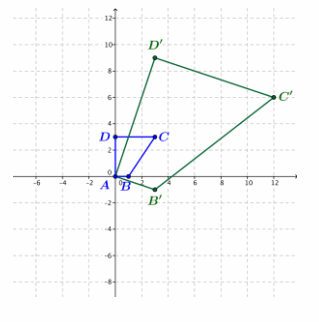
The figure below shows a quadrilateral with vertices A(0,0), B(1,0), C(3,3), and D(0,3).
a. Transform each vertex under L5=(3x+y,3y-x), and plot the transformed vertices on the figure.
Answer:
Eureka Math Precalculus Module 1 Lesson 20 Exercise Answer Key 30

b. Does L5 represent a rotation and dilation? If so, estimate the amount of rotation and the scale factor from your figure.
Answer:
The transformed image is roughly three times larger than the original and rotated about 20° clockwise.

c. If L5 represents a rotation and dilation, calculate the amount of rotation and the scale factor from the formula for L5. Do your numbers agree with your estimate in part (b)? If not, explain why there are no values of a and b so that L5 (x,y)=(ax-by,bx+ay).
Answer:
From the formula, we have a=3 and b=-1. The transformation dilates by the scale factor
|a+bi|=\(\sqrt{3^{3}+(-1)^{2}}\)=\(\sqrt{10}\)≈3.16 and rotates by
arg(a+bi)=arctan(\(\frac{\boldsymbol{b}}{\boldsymbol{a}}\))=arctan(-\(\frac{\boldsymbol{1}}{\boldsymbol{3}}\)))≈-18.435°.

Exercise 6.
The figure below shows a figure with vertices A(0,0), B(1,0), C(3,3), and D(0,3).
a. Transform each vertex under L6=(2x+2y,2x-2y), and plot the transformed vertices on the figure.
Answer:
Eureka Math Precalculus Module 1 Lesson 20 Exercise Answer Key 32

b. Does L6 represent a rotation and dilation? If so, estimate the amount of rotation and the scale factor from your figure.
Answer:
The transformed image is dilated and rotated but is also reflected, so transformation L6 is not a rotation and dilation.

c. If L5 represents a rotation and dilation, calculate the amount of rotation and the scale factor from the formula for L6. Do your numbers agree with your estimate in part (b)? If not, explain why there are no values of a and b so that L6 (x,y)=(ax-by,bx+ay).
Answer:
Suppose that (2x+2y,2x-2y)=(ax-by,bx+ay). Then, a=2 and a=-2, which is not possible. This transformation does not fit our formula for rotation and dilation.

Eureka Math Precalculus Module 1 Lesson 20 Problem Set Answer Key

Question 1.
Find real numbers a and b so that the transformation L(x,y)=(ax-by,bx+ay) produces the specified rotation and dilation.

a. Rotation by 270° counterclockwise and dilation by scale factor \(\frac{1}{2}\).
Answer:
We need to find real numbers a and b so that a+bi has modulus \(\frac{1}{2}\)and argument 270°. Then, (a,b) lies on the negative y-axis, so a=0 and b<0. We need \(\frac{1}{2}\)=|a+bi|=|bi|=|b|, so this means that b=-\(\frac{1}{2}\). Thus, the transformation L(x,y)=(\(\frac{1}{2}\)y,-\(\frac{1}{2}\)x) will rotate by 270° and dilate by a scale factor of \(\frac{1}{2}\). b. Rotation by 135° counterclockwise and dilation by scale factor \(\sqrt{2}\). Answer: We need to find real numbers a and b so that a+bi has modulus \(\sqrt{2}\) and argument 135°. Thus, (a,b) lies in the second quadrant on the diagonal line with equation y=-x, so we know that a>0 and b=-a. Since \(\sqrt{2}\)=\(\sqrt{a^{2}+(-a)^{2}}\) and a=-b, we have \(\sqrt{2}\)=\(\sqrt{2 a^{2}}\) so \(\sqrt{2}\)=\(\sqrt{2 a^{2}}\), and thus a=1. It follows that b=-1. Then, the transformation L(x,y)=(x+y,-x+y) rotates by 135° counterclockwise and dilates by a scale factor of \(\sqrt{2}\).

c. Rotation by 45° clockwise and dilation by scale factor 10.
Answer:
We need to find real numbers a and b so that a+bi has modulus 10 and argument 45°. Thus, (a,b) lies in the first quadrant on the line with equation y=x, so we know that a=b and a>0, b>0. Since 10=\(\sqrt{\left(a^{2}+b^{2}\right)}\)=\(\sqrt{a^{2}+a^{2}}\), we know that 2a2=100, and a=b=5\(\sqrt{2}\). Thus, the transformation L(x,y)=(5\(\sqrt{2}\) x-5\(\sqrt{2}\) y,5\(\sqrt{2}\) x+5\(\sqrt{2}\) y) rotates by 45° counterclockwise and dilates by a scale factor of 10.

d. Rotation by 540° counterclockwise and dilation by scale factor 4.
Answer:
Rotation by 540° counterclockwise has the same effect as rotation by 180° counterclockwise. Thus, we need to find real numbers a and b so that the argument of (a+bi) is 180° and |a+bi|=√(a2+b2 )=4. Since arg(a+bi)=180°, we know that the point (a,b) lies on the negative x-axis, and we have a<0 and b=0. We then have a=-4 and b=0, so the transformation L(x,y)=(-4x,-4y) will rotate by 540° counterclockwise and dilate with scale factor 4.

Question 2.
Determine if the following transformations represent a rotation and dilation. If so, identify the scale factor and the amount of rotation.
Eureka Math Precalculus Module 1 Lesson 20 Problem Set Answer Key 36
a. L(x,y)=(3x+4y,4x+3y)
Answer:
If L(x,y) is of the form(x,y)=(ax-by,bx+ay), then a=3 and b must be both 3 and –3. Since this is impossible, this transformation does not consist of rotation and dilation.

b. L(x,y)=(-5x+12y,-12x-5y)
Answer:
If we let a=-5 and b=-12, then L(x,y) is of the form (x,y)=(ax-by,bx+ay). Thus, this transformation does consist of rotation and dilation. The dilation has scale factor \(\sqrt{(-5)^{2}+(-12)^{2}}\)=13,
and the transformation rotates through arg(-5-12i)=arctan(\(\frac{12}{5}\))≈67.38°.

c. L(x,y)=(3x+3y,-3y+3x)
Answer:
If we let a=3 and b=-3, then L(x,y) is of the form (x,y)=(ax-by,bx+ay). Thus, the transformation does consist of rotation and dilation. The dilation has scale factor \(\sqrt{(3)^{2}+(-3)^{2}}\)=3\(\sqrt{2}\), and the transformation rotates through arg(3-3i)=315°.

Question 3.
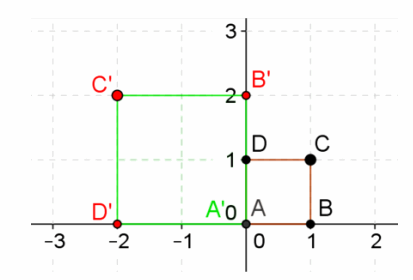
Grace and Lily have a different point of view about the transformation on cube ABCD that is shown above. Grace states that it is a reflection about the imaginary axis and a dilation of factor of 2. However, Lily argues it should be a 90° counterclockwise rotation about the origin with a dilation of a factor of 2.

a. Who is correct? Justify your answer.
Answer:
Lily is correct because the vertices of the cube stay the same with respect to each other.

b. Represent the above transformation in the form L(x,y)=(ax-by,bx+ay).
Answer:
Rotating 90° with a dilation of a factor of 2: a+bi=2(cos(90°)+i∙sin(90°))=2(0+1i)=0+2i.
Therefore, a=0,b=2,L(x,y)=(0x-2y,2x+0y)=(-2y,2x).

Question 4.
Grace and Lily still have a different point of view on this transformation on triangle ABC shown above. Grace states that it is reflected about the real axis first, then reflected about the imaginary axis, and then dilated with a factor of 2. However, Lily asserts that it is a 180° counterclockwise rotation about the origin with a dilation of a factor of 2.
Eureka Math Precalculus Module 1 Lesson 20 Problem Set Answer Key 80
a. Who is correct? Justify your answer.
Answer:
Both are correct. Both sequences of transformations result in the same image.

b. Represent the above transformation in the form L(x,y)=(ax-by,bx+ay).
Answer:
Rotating 180° with a dilation of a factor of 2:
a+bi=2(cos(180°)+i∙sin(180°))=2(-1+0i)=-2+0i.
Therefore, a-2,b=0,L(x,y)=(-2x-0y,0x-2y)=(-2x,-2y).

Question 5.
Given z=\(\sqrt{3}\)+i
a. Find the complex number w that will cause a rotation with the same number of degrees as z without a dilation.
Answer:
z=\(\sqrt{3}\)+i,|z|=2,w=\(\frac{1}{2}\)(\(\sqrt{3}\)+i)

b. Can you come up with a general formula L(x,y)=(ax-by,bx+ay) for any complex number z=x+yi to represent this condition?
Answer:
w=x+yi,|z|=\(\sqrt{x^{2}+y^{2}}\),a=x,b=y,
L(x,y)=\(\frac{1}{\sqrt{x^{2}+y^{2}}}\)(x∙x-y∙y,y∙x+x∙y)=\(\frac{1}{\sqrt{x^{2}+y^{2}}}\)(x2-y2,2xy)

Eureka Math Precalculus Module 1 Lesson 20 Exit Ticket Answer Key

Question 1.
Find the scale factor and rotation induced by the transformation L(x,y)=(-6x-8y,8x-6y).
Answer:
This is a transformation of the form L(x,y)=(ax-by,bx+ay) with a=-6 and b=8. The scale factor is then \(\sqrt{(-6)^{2}+8^{2}}\)=10.
The rotation is the arctan(\(\frac{8}{-6}\))≈-51.13°.

Question 2.
Explain how the transformation of complex numbers L(x+iy)=(a+bi)(x+iy) leads to the transformation of points in the coordinate plane L(x,y)=(ax-by,bx+ay).
Answer:
First, we associate the complex number x+iy to the point (x,y) in the coordinate plane. Then, the point associated with the complex number (a+bi)(x+iy)=(ax-by)+(bx+ay)i is (ax-by,bx+ay). Thus, we can interpret the original transformation of complex numbers as the transformation of points
L(x,y)=(ax-by,bx+ay).

Eureka Math Precalculus Module 1 Lesson 30 Answer Key

Engage NY Eureka Math Precalculus Module 1 Lesson 30 Answer Key

Eureka Math Precalculus Module 1 Lesson 30 Example Answer Key

Example
Given \(\left[\begin{array}{cc}
\frac{1}{2} & -\frac{\sqrt{3}}{2} \\
\frac{\sqrt{3}}{2} & \frac{1}{2}
\end{array}\right]\)
a. Perform this transformation on the unit square, and sketch the results on graph paper. Label the vertices.
Answer:
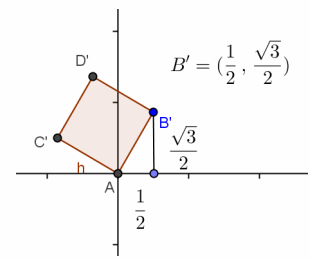
Eureka Math Precalculus Module 1 Lesson 30 Example Answer Key 13
See diagram at right.

b. Explain the transformation that occurred to the unit square.
Answer:
The transformation is a 60° rotation counterclockwise about the origin.

c. Find the area of the image.
Answer:
Eureka Math Precalculus Module 1 Lesson 30 Example Answer Key 23
The area is 1 units2.

d. Find the inverse of this transformation.
Answer:
Eureka Math Precalculus Module 1 Lesson 30 Example Answer Key 23.1

e. Explain the meaning of the inverse transformation on the unit square.
Answer:
The inverse is a -60° rotation counterclockwise about the origin.

Eureka Math Precalculus Module 1 Lesson 30 Exercise Answer Key

Opening Exercise

a. What is the geometric effect of the following matrices?
i. \(\left[\begin{array}{ll}
\boldsymbol{k} & \mathbf{0} \\
\mathbf{0} & \boldsymbol{k}
\end{array}\right]\)
Answer:
A pure dilation with a scale factor of k

ii. \(\left[\begin{array}{cc}
a & -b \\
b & a
\end{array}\right]\)
Answer:
A pure rotation

iii. \(\left[\begin{array}{cc}
\cos (\theta) & -\sin (\theta) \\
\sin (\theta) & \cos (\theta)
\end{array}\right]\)
Answer:
A pure rotation θ° counterclockwise

b. Jadavis says that the identity matrix is \(\left[\begin{array}{ll}
0 & 0 \\
0 & 0
\end{array}\right]\). Sophie disagrees and states that the identity matrix is \(\left[\begin{array}{ll}
1 & 0 \\
0 & 1
\end{array}\right]\).

i. Their teacher, Mr. Kuzy, says they are both correct and asks them to explain their thinking about matrices to each other but to also use a similar example in the real number system. Can you state each of their arguments?
Answer:
Jadavis says that any matrix added to the matrix \(\left[\begin{array}{ll}
0 & 0 \\
0 & 0
\end{array}\right]\) does not change. This matrix is similar to 0 in the real number system, so it is the additive identity matrix.
Sophie explains that when a matrix is multiplied by \(\left[\begin{array}{ll}
1 & 0 \\
0 & 1
\end{array}\right]\), the matrix does not change, just like the number 1 in the real number system; so, this matrix is the multiplicative identity.

ii. Mr. Kuzy then asks each of them to explain the geometric effect that their matrix would have on the unit square.
Answer:
\(\left[\begin{array}{ll}
0 & 0 \\
0 & 0
\end{array}\right]\) would collapse the entire square to (0,0).
\(\left[\begin{array}{ll}
1 & 0 \\
0 & 1
\end{array}\right]\) would have no effect on the unit square.

c. Given the matrices below, answer the following:
A= \(\left[\begin{array}{ll}
2 & 3 \\
1 & 4
\end{array}\right]\) B= \(\left[\begin{array}{cc}
5 & 2 \\
10 & 4
\end{array}\right]\)

i. Which matrix does not have an inverse? Explain algebraically and geometrically how you know.
Answer:
Matrix B does not have an inverse. The determinant is 0, which means it would transform the unit square to a straight line with no area.

ii. If a matrix has an inverse, find it.
Answer:
Eureka Math Precalculus Module 1 Lesson 30 Exercise Answer Key 11

Exercises

Exercise 1.
Given \(\left[\begin{array}{ll}
\frac{1}{2} & 0 \\
0 & \frac{1}{2}
\end{array}\right]\)
a. Perform this transformation on the unit square, and sketch the results on graph paper. Label the vertices.
Eureka Math Precalculus Module 1 Lesson 30 Exercise Answer Key 26

b. Explain the transformation that occurred to the unit square.
Answer:
The transformation is a dilation with a scale factor of \(\frac{1}{2}\).

c. Find the area of the image.
Answer:
Eureka Math Precalculus Module 1 Lesson 30 Exercise Answer Key 27
The area is \(\frac{1}{4}\) units2.

d. Find the inverse of this transformation.
Answer:
\(\left[\begin{array}{ll}
2 & 0 \\
0 & 2
\end{array}\right]\)

e. Explain the meaning of the inverse transformation on the unit square.
Answer:
The inverse is a dilation with a scale factor of 2.

f. If any matrix produces a dilation with a scale factor of k, what would the inverse matrix produce?
Answer:
It would produce a dilation with a scale factor of \(\frac{1}{k}\).

Exercise 2.
Given \(\left[\begin{array}{ll}
\frac{1}{\sqrt{2}} & -\frac{1}{\sqrt{2}} \\
\frac{1}{\sqrt{2}} & \frac{1}{\sqrt{2}}
\end{array}\right]\)
a. Perform this transformation on the unit square, and sketch the results on graph paper. Label the vertices.
Eureka Math Precalculus Module 1 Lesson 30 Exercise Answer Key 29

b. Explain the transformation that occurred to the unit square.
Answer:
The transformation is a 45° rotation counterclockwise about the origin.

c. Find the area of the image.
Answer:
Eureka Math Precalculus Module 1 Lesson 30 Exercise Answer Key 30
The area is 1units2.

d. Find the inverse of the transformation.
Answer:
\(\left[\begin{array}{cc}
\frac{1}{\sqrt{2}} & \frac{1}{\sqrt{2}} \\
-\frac{1}{\sqrt{2}} & \frac{1}{\sqrt{2}}
\end{array}\right]\)

e. Explain the meaning of the inverse transformation on the unit square.
Answer:
The inverse is a -45° rotation counterclockwise about the origin.

f. Rewrite the original matrix if it also included a dilation with a scale factor of 2.
Answer:
\(\left[\begin{array}{ll}
\frac{2}{\sqrt{2}} & -\frac{2}{\sqrt{2}} \\
\frac{2}{\sqrt{2}} & \frac{2}{\sqrt{2}}
\end{array}\right]\) or \(\left[\begin{array}{cc}
\sqrt{2} & -\sqrt{2} \\
\sqrt{2} & \sqrt{2}
\end{array}\right]\)

g. What is the inverse of this matrix?
Answer:
Eureka Math Precalculus Module 1 Lesson 30 Exercise Answer Key 35

Exercise 3.
Find a transformation that would create a 90° counterclockwise rotation about the origin. Set up a system of equations, and solve to find the matrix.
Answer:
Eureka Math Precalculus Module 1 Lesson 30 Exercise Answer Key 36

Exercise 4.
a. Find a transformation that would create a 180° counterclockwise rotation about the origin. Set up a system of equations, and solve to find the matrix.
Answer:
Eureka Math Precalculus Module 1 Lesson 30 Exercise Answer Key 37

b. Rewrite the matrix to also include a dilation with a scale factor of 5.
Answer:
\(\left[\begin{array}{cc}
-5 & 0 \\
0 & -5
\end{array}\right]\)

Exercise 5.
For which values of a does \(\left[\begin{array}{cc}
3 & -100 \\
900 & a
\end{array}\right]\) have an inverse matrix?
Answer:
3a-(-100)(900)≠0
3a+90000 ≠0
a≠-30000

Exercise 6.
For which values of a does \(\left[\begin{array}{cc}
a & a+4 \\
2 & a
\end{array}\right]\) have an inverse matrix?
Answer:
(a)(a)-(a+4)(2)≠0
a2-2a-8 ≠0
(a-4)(a+2)≠0
a≠4,a≠-2

Exercise 7.
For which values of a does \(\left[\begin{array}{ll}
a+2 & a-4 \\
a-3 & a+3
\end{array}\right]\) have an inverse matrix?
Answer:
(a+2)(a+3)-(a-4)(a-3)≠0
(a2+5a+6)-(a2-7a+12) ≠0
12a-6≠0
a≠\(\frac{1}{2}\)

Exercise 8.
Chethan says that the matrix \(\left[\begin{array}{cc}
\cos \left(\theta^{\circ}\right) & -\sin \left(\theta^{\circ}\right) \\
\sin \left(\theta^{\circ}\right) & \cos \left(\theta^{\circ}\right)
\end{array}\right]\) produces a rotation θ° counterclockwise. He justifies his work by showing that when θ=60, the rotation matrix is Eureka Math Precalculus Module 1 Lesson 30 Exercise Answer Key 40. Shayla disagrees and says that the matrix \(\left[\begin{array}{cc}
1 & -\sqrt{3} \\
\sqrt{3} & 1
\end{array}\right]\) produces a 60° rotation counterclockwise. Tyler says that he has found that the matrix \(\left[\begin{array}{cc}
2 & -2 \sqrt{3} \\
2 \sqrt{3} & 2
\end{array}\right]\) produces a 60° rotation counterclockwise, too.

a. Who is correct? Explain.
Answer:
They are all correct. All of the matrices produce a 60° rotation counterclockwise, but each has a different scale factor.

b. Which matrix has the largest scale factor? Explain.
Answer:
\(\left[\begin{array}{cc}
2 & -2 \sqrt{3} \\
2 \sqrt{3} & 2
\end{array}\right]\) has the largest scale factor of 4. The first matrix has a scale factor of 1, and the second matrix a scale factor of 2.

c. Create a matrix with a scale factor less than 1 that would produce the same rotation.
Answer:
Answers will vary. \(\left[\begin{array}{cc}
\frac{1}{4} & -\frac{\sqrt{3}}{4} \\
\frac{\sqrt{3}}{4} & \frac{1}{4}
\end{array}\right]\) would have a scale factor of \(\frac{1}{2}\).

Eureka Math Precalculus Module 1 Lesson 30 Exit Ticket Answer Key

A and B are 2×2 matrices. I is the 2×2 multiplicative identity matrix.

Question 1.
If AB=A, name the matrix represented by B.
Answer:
B= \(\left[\begin{array}{ll}
1 & 0 \\
0 & 1
\end{array}\right]\)

Question 2.
If A+B=A, name the matrix represented by B.
Answer:
B= \(\left[\begin{array}{ll}
0 & 0 \\
0 & 0
\end{array}\right]\)

Question 3.
If AB=I, name the matrix represented by B.
Answer:
B must be the inverse matrix of A.

Question 4.
Do the matrices have inverses? Justify your answer.
a. \(\left[\begin{array}{ll}
-2 & 6 \\
-3 & 9
\end{array}\right]\)
No. The determinant (-2)(9)-(6)(-3)=0.

b. \(\left[\begin{array}{cc}
-2 & 6 \\
3 & 9
\end{array}\right]\)
Yes. The determinant (-2)(9)-(6)(3)≠0.

Question 5.
Find a value of a, such that the given matrix has an inverse.
a. \(\left[\begin{array}{cc}
-4 & 3 a \\
2 & 9
\end{array}\right]\)
Answer:
(-4)(9)-(3a)(2)≠0
-36-6a ≠0
a≠-6

b. \(\left[\begin{array}{cc}
5 & a \\
-a & 5
\end{array}\right]\)
Answer:
(5)(5)-(a)(-a)≠0
25+a2≠0
For all real values of a

Eureka Math Precalculus Module 1 Lesson 30 Problem Set Answer Key

The first seven problems are more procedural. Assign problems based on student abilities. All students do not have to complete all problems.

Question 1.
Find a transformation that would create a 30° counterclockwise rotation about the origin and then its inverse.
Answer:
Eureka Math Precalculus Module 1 Lesson 30 Problem Set Answer Key 50

Question 2.
Find a transformation that would create a 30° counterclockwise rotation about the origin, a dilation with a scale factor of 4, and then its inverse.
Answer:
Eureka Math Precalculus Module 1 Lesson 30 Problem Set Answer Key 51

Question 3.
Find a transformation that would create a 270° counterclockwise rotation about the origin. Set up a system of equations, and solve to find the matrix.
Answer:
Eureka Math Precalculus Module 1 Lesson 30 Problem Set Answer Key 52

Question 4.
Find a transformation that would create a 270° counterclockwise rotation about the origin, a dilation with a scale factor of 3, and its inverse.
Answer:
Eureka Math Precalculus Module 1 Lesson 30 Problem Set Answer Key 53

Question 5.
For which values of a does \(\left[\begin{array}{ll}
8 & a \\
a & 2
\end{array}\right]\) have an inverse matrix?
Answer:
(8)(2)-(a)(a)≠0
16-a2 ≠0
(4-a)(4+a)≠0
a≠4,a≠-4

Question 6.
For which values of a does \(\left[\begin{array}{cc}
a & a-4 \\
a+4 & a
\end{array}\right]\) have an inverse matrix?
Answer:
(a)(a)-(a-4)(a+4)≠0
a2-(a2-16) ≠0
16≠0
All real values of a will produce an inverse matrix.

Question 7.
For which values of a does \(\left[\begin{array}{cc}
3 a & 2 a-6 \\
6 a & 4 a-12
\end{array}\right]\) have an inverse matrix?
Answer:
(3a)(4a-12)-(2a-6)(6a)≠0
(12a2-36a)-(12a2-36a) ≠0
0≠0
No real values of a will produce an inverse matrix.

Question 8.
In Lesson 27, we learned the effect of a transformation on a unit square by multiplying a matrix. For example,
Eureka Math Precalculus Module 1 Lesson 30 Problem Set Answer Key 56

a. Sasha says that we can multiply the inverse of A to those resultants of the square after the transformation to get back to the unit square. Is her conjecture correct? Justify your answer.
Answer:
Eureka Math Precalculus Module 1 Lesson 30 Problem Set Answer Key 60

b. From part (a), what would you say about the inverse matrix with regard to the geometric effect of transformations?
Answer:
Multiplying the inverse matrix, A-1, will “undo” the transformation that was done by multiplying matrix A.

c. A pure rotation matrix is \(\left[\begin{array}{cc}
\cos (\theta) & -\sin (\theta) \\
\sin (\theta) & \cos (\theta)
\end{array}\right]\). Prove the inverse matrix for a pure rotation of \(\frac{\pi}{4}\) radians counterclockwise is \(\left[\begin{array}{cc}
\cos \left(-\frac{\pi}{4}\right) & -\sin \left(-\frac{\pi}{4}\right) \\
\sin \left(-\frac{\pi}{4}\right) & \cos \left(-\frac{\pi}{4}\right)
\end{array}\right]\), which is the same as \(\left[\begin{array}{ll}
\frac{d}{a d-b c} & \frac{-c}{a d-b c} \\
\frac{-b}{a d-b c} & \frac{d}{a d-b c}
\end{array}\right]\).
Answer:
Eureka Math Precalculus Module 1 Lesson 30 Problem Set Answer Key 62

d. Prove that the inverse matrix of a pure dilation with a factor of 4 is \(\left[\begin{array}{ll}
\frac{1}{4} & 0 \\
0 & \frac{1}{4}
\end{array}\right]\), which is the same as \(\left[\begin{array}{ll}
\frac{d}{a d-b c} & \frac{-c}{a d-b c} \\
\frac{-b}{a d-b c} & \frac{d}{a d-b c}
\end{array}\right]\).
Answer:
Eureka Math Precalculus Module 1 Lesson 30 Problem Set Answer Key 63

e. Prove that the matrix used to undo a \(\frac{\pi}{3}\) radians clockwise rotation and a dilation of a factor of 2 is \(\frac{1}{2}\) \(\left[\begin{array}{ll}
\cos \left(\frac{\pi}{3}\right) & -\sin \left(\frac{\pi}{3}\right) \\
\sin \left(\frac{\pi}{3}\right) & \cos \left(\frac{\pi}{3}\right)
\end{array}\right]\), which is the same as \(\left[\begin{array}{ll}
\frac{d}{a d-b c} & \frac{-c}{a d-b c} \\
\frac{-b}{a d-b c} & \frac{d}{a d-b c}
\end{array}\right]\).
Answer:
Eureka Math Precalculus Module 1 Lesson 30 Problem Set Answer Key 66

f. Prove that any matrix whose determinant is not 0 will have an inverse matrix to “undo” a transformation. For example, use the matrix A=\(\left[\begin{array}{ll}
a & c \\
b & d
\end{array}\right]\) and the point \(\left[\begin{array}{l}
x \\
y
\end{array}\right]\).
Answer:
Eureka Math Precalculus Module 1 Lesson 30 Problem Set Answer Key 67

Question 9.
Perform the transformation \(\left[\begin{array}{ll}
2 & 2 \\
2 & 2
\end{array}\right]\) on the unit square.
Eureka Math Precalculus Module 1 Lesson 30 Problem Set Answer Key 68
a. Can you find the inverse matrix that will “undo” the transformation? Explain your reasons arithmetically.
Answer:
No. The determinant of the matrix is 0. Therefore, there is no inverse matrix that can be found to undo the transformation.

b. When all four vertices of the unit square are transformed and collapsed onto a straight line, what can be said about the inverse?
Answer:
The determinant of the matrix is 0.

c. Find the equation of the line that all four vertices of the unit square collapsed onto.
Answer:
y=x

d. Find the equation of the line that all four vertices of the unit square collapsed onto using the matrix \(\left[\begin{array}{ll}
1 & 3 \\
2 & 6
\end{array}\right]\).
Answer:
y=2x

e. A function has an inverse function if and only if it is a one-to-one function. By applying this concept, explain why we do not have an inverse matrix when the transformation is collapsed onto a straight line.
Answer:
When doing transformations, we are mapping the four vertices to new coordinates; however, when we reverse this process, there should be a one-to-one property. However, we see that the point \(\left(\begin{array}{l}
2 \\
2
\end{array}\right)\) will map onto two different points. Because there is no one-to-one property, this means there is no inverse matrix.

Question 10.
The determinants of the following matrices are 0. Describe what pattern you can find among them.
a. Eureka Math Precalculus Module 1 Lesson 30 Problem Set Answer Key 70
Answer:
If one column is the multiple of the other column, or one row is the multiple of the other row, then the determinant is 0, and there is no inverse matrix.

b. Eureka Math Precalculus Module 1 Lesson 30 Problem Set Answer Key 71
Answer:
If either column or row is 0, then the determinant is 0, and there is no inverse matrix.

Eureka Math Precalculus Module 1 Lesson 29 Answer Key

Engage NY Eureka Math Precalculus Module 1 Lesson 29 Answer Key

Eureka Math Precalculus Module 1 Lesson 29 Example Answer Key

Example 1.
Find the determinant of \(\left[\begin{array}{ll}
1 & 2 \\
2 & 4
\end{array}\right]\).
Answer:
The determinant is 0.

Eureka Math Precalculus Module 1 Lesson 29 Exercise Answer Key

Opening Exercise

Find the inverse of \(\left[\begin{array}{cc}
-7 & -2 \\
4 & 1
\end{array}\right]\). Show your work. Confirm that the matrices are inverses.
Answer:
\(\left[\begin{array}{ll}
a & c \\
b & d
\end{array}\right]\left[\begin{array}{cc}
-7 & -2 \\
4 & 1
\end{array}\right]\)=\(\left[\begin{array}{ll}
1 & 0 \\
0 & 1
\end{array}\right]\)
-7a+4c=1,-2a+c=0,-7b+4d=0,-2b+d=1
a=1,b=-4,c=2, and d=-7
\(\left[\begin{array}{cc}
1 & 2 \\
-4 & -7
\end{array}\right]\left[\begin{array}{cc}
-7 & -2 \\
4 & 1
\end{array}\right]\) = \(\left[\begin{array}{ll}
1 & 0 \\
0 & 1
\end{array}\right]\)

Exercises

Exercise 1.
Find the inverse of \(\left[\begin{array}{ll}
5 & 3 \\
2 & 4
\end{array}\right]\). Confirm your answer.
Answer:
\(\left[\begin{array}{cc}
4 & -3 \\
-2 & 5
\end{array}\right]\left[\begin{array}{ll}
5 & 3 \\
2 & 4
\end{array}\right]\)=\(\left[\begin{array}{cc}
14 & 0 \\
0 & 14
\end{array}\right]\)

→ Was the matrix that you found using the pattern the inverse? What was missing?
→ No. Where we needed 1’s, we had 14’s.
→ Let’s look at this a little further. Look at the matrices in the table. Find the determinant of the matrices. (Assign different groups/pairs different matrices from above.)
→ All of the determinants were 1.
→ Do you think that makes a difference? What was the determinant of the matrix in Exercise 1?
→ The determinant was 14.
→ How does that compare to the matrix that resulted from multiplying the matrices in Exercise 1?
→ That was the number that was in the position that should have been a 1.
→ How do you think this ties into the way we find an inverse matrix?
→ We can still use our pattern, but we need to divide each term by the determinant. (Answers may vary, but let students try out their hypotheses to come up with the right answer.)
→ Try it on the inverse matrix in Exercise 1. Write the inverse matrix.
→ \(\left[\begin{array}{cc}
\frac{4}{14} & -\frac{3}{14} \\
-\frac{2}{14} & \frac{5}{14}
\end{array}\right]\)
→ Verify that is the inverse. Were you correct?
→ \(\left[\begin{array}{cc}
\frac{4}{14} & -\frac{3}{14} \\
-\frac{2}{14} & \frac{5}{14}
\end{array}\right]\left[\begin{array}{cc}
5 & 3 \\
2 & 4
\end{array}\right]\) = \(\left[\begin{array}{ll}
1 & 0 \\
0 & 1
\end{array}\right]\)
→ Yes. We get the identify matrix again.
→ Explain to your neighbor how to find the inverse of a matrix.
→ Switch the numbers in the top left and bottom right. Change the signs of the numbers in the top right and bottom left. Divide all of the terms by the determinant of the original matrix.

Find the inverse matrix and verify.

Exercise 2.
\(\left[\begin{array}{cc}
3 & -3 \\
1 & 4
\end{array}\right]\)
Answer:
Determinant =(3)(4)-(-3)(1)=12+3=15
\(\left[\begin{array}{cc}
\frac{4}{15} & \frac{3}{15} \\
\frac{-1}{15} & \frac{3}{15}
\end{array}\right]\left[\begin{array}{cc}
3 & -3 \\
1 & 4
\end{array}\right]\) = \(\left[\begin{array}{ll}
1 & 0 \\
0 & 1
\end{array}\right]\)

Exercise 3.
\(\left[\begin{array}{ll}
5 & -2 \\
4 & -3
\end{array}\right]\)
Answer:
Determinant =(5)(-3)-(-2)(4)=-15+8=-7
\(\left[\begin{array}{ll}
\frac{3}{7} & -\frac{2}{7} \\
\frac{4}{7} & -\frac{5}{7}
\end{array}\right]\left[\begin{array}{ll}
5 & -2 \\
4 & -3
\end{array}\right]\) = \(\left[\begin{array}{ll}
1 & 0 \\
0 & 1
\end{array}\right]\)

Exercise 4.
\(\left[\begin{array}{ll}
a & c \\
b & d
\end{array}\right]\)
Answer:
Determinant =(a)(d)-(c)(b)=ad-cb
Eureka Math Precalculus Module 1 Lesson 29 Exercise Answer Key 10

Eureka Math Precalculus Module 1 Lesson 29 Problem Set Answer Key

Find the inverse matrix of the following.

a. \(\left[\begin{array}{ll}
1 & 0 \\
0 & 1
\end{array}\right]\)
Answer:
Determinant =1-0=1 Inverse matrix: \(\left[\begin{array}{ll}
1 & 0 \\
0 & 1
\end{array}\right]\)
Verify:
\(\left[\begin{array}{ll}
1 & 0 \\
0 & 1
\end{array}\right]\left[\begin{array}{ll}
1 & 0 \\
0 & 1
\end{array}\right]\) = \(\left[\begin{array}{ll}
1 & 0 \\
0 & 1
\end{array}\right]\)

b. \(\left[\begin{array}{ll}
0 & 1 \\
1 & 0
\end{array}\right]\)
Answer:
Determinant =0-1=-1 Inverse matrix: \(\left[\begin{array}{ll}
0 & 1 \\
1 & 0
\end{array}\right]\)
Verify:
\(\left[\begin{array}{ll}
0 & 1 \\
1 & 0
\end{array}\right]\left[\begin{array}{ll}
0 & 1 \\
1 & 0
\end{array}\right]\) = \(\left[\begin{array}{ll}
1 & 0 \\
0 & 1
\end{array}\right]\)

c. \(\left[\begin{array}{ll}
1 & 1 \\
1 & 1
\end{array}\right]\)
Answer:
Determinant =1-1=0 No inverse matrix

d. \(\left[\begin{array}{ll}
1 & 0 \\
1 & 0
\end{array}\right]\)
Answer:
Determinant =0 No inverse matrix

e. \(\left[\begin{array}{ll}
0 & 1 \\
0 & 1
\end{array}\right]\)
Answer:
Determinant =0 No inverse matrix

f. \(\left[\begin{array}{ll}
-2 & 2 \\
-5 & 4
\end{array}\right]\)
Answer:
Determinant =-8+10=2 Inverse matrix: \(\left[\begin{array}{ll}
2 & -1 \\
\frac{5}{2} & -1
\end{array}\right]\)
Verify:
\(\left[\begin{array}{ll}
-2 & 2 \\
-5 & 4
\end{array}\right]\left[\begin{array}{ll}
2 & -1 \\
\frac{5}{2} & -1
\end{array}\right]\) = \(\left[\begin{array}{ll}
1 & 0 \\
0 & 1
\end{array}\right]\)

g. \(\left[\begin{array}{ll}
4 & 6 \\
5 & 8
\end{array}\right]\)
Answer:
Determinant =32-30=2 Inverse matrix: \(\left[\begin{array}{cc}
4 & -3 \\
\frac{5}{2} & 2
\end{array}\right]\)
Verify:
\(\left[\begin{array}{ll}
4 & 6 \\
5 & 8
\end{array}\right]\left[\begin{array}{cc}
4 & -3 \\
5 & 2
\end{array}\right]\) = \(\left[\begin{array}{ll}
1 & 0 \\
0 & 1
\end{array}\right]\)

h. \(\left[\begin{array}{ll}
6 & -9 \\
5 & -7
\end{array}\right]\)
Answer:
Determinant =-42+45=3 Inverse matrix: \(\left[\begin{array}{ll}
-\frac{7}{3} & 3 \\
-\frac{5}{3} & 2
\end{array}\right]\)
Verify:
\(\left[\begin{array}{cc}
6 & -9 \\
5 & -7
\end{array}\right]\left[\begin{array}{cc}
-\frac{7}{3} & 3 \\
-\frac{5}{3} & 2
\end{array}\right]\)=\(\left[\begin{array}{ll}
1 & 0 \\
0 & 1
\end{array}\right]\)

i. \(\left[\begin{array}{cc}
\frac{1}{2} & -\frac{2}{3} \\
-6 & 4
\end{array}\right]\)
Answer:
Determinant =2-4=-2 Inverse matrix: \(\left[\begin{array}{ll}
-2 & -\frac{1}{3} \\
-3 & \frac{1}{4}
\end{array}\right]\)
Verify:
\(\left[\begin{array}{cc}
\frac{1}{2} & -\frac{2}{3} \\
-6 & 4
\end{array}\right]\left[\begin{array}{cc}
-2 & -\frac{1}{3} \\
-3 & \frac{1}{4}
\end{array}\right]\)=\(\left[\begin{array}{ll}
1 & 0 \\
0 & 1
\end{array}\right]\)

j.\(\left[\begin{array}{cc}
0.8 & 0.4 \\
-0.75 & -0.5
\end{array}\right]\)
Determinant =-0.4+0.3=-0.1 Inverse matrix: \(\left[\begin{array}{cc}
5 & -4 \\
-7.5 & -8
\end{array}\right]\)
Verify:
\(\left[\begin{array}{cc}
0.8 & 0.4 \\
-0.75 & -0.5
\end{array}\right]\left[\begin{array}{cc}
5 & -4 \\
-7.5 & -8
\end{array}\right]\) = \(\left[\begin{array}{ll}
1 & 0 \\
0 & 1
\end{array}\right]\)

Eureka Math Precalculus Module 1 Lesson 29 Exit Ticket Answer Key

A=\(\left[\begin{array}{cc}
4 & -2 \\
-1 & 3
\end{array}\right]\)

Question 1.
Find the inverse of A. Show your work, and confirm your answer.
Answer:
Determinant =(4)(3)-(-2)(-1)=12-2=10
\(\left[\begin{array}{cc}
\frac{3}{10} & \frac{2}{10} \\
\frac{1}{10} & \frac{4}{10}
\end{array}\right]\left[\begin{array}{cc}
4 & -2 \\
-1 & 3
\end{array}\right]\) = \(\left[\begin{array}{ll}
1 & 0 \\
0 & 1
\end{array}\right]\)

Question 2.
Explain why the matrix \(\left[\begin{array}{ll}
6 & 3 \\
4 & 2
\end{array}\right]\) has no inverse.
Answer:
Determinant =(6)(2)-(3)(4)=0
This means the area of the image is 0 because the image of the unit square maps to a straight line, which has no area. This also means that distinct points map to the same location, so the transformation cannot be reversed.

Eureka Math Precalculus Module 1 Lesson 28 Answer Key

Engage NY Eureka Math Precalculus Module 1 Lesson 28 Answer Key

Eureka Math Precalculus Module 1 Lesson 28 Example Answer Key

Example
What transformation reverses a pure dilation from the origin with a scale factor of k?
a. Write the pure dilation matrix, and multiply it by \(\left[\begin{array}{ll}
a & c \\
b & d
\end{array}\right]\).
Answer:
\(\left[\begin{array}{ll}
a & c \\
b & d
\end{array}\right]\left[\begin{array}{ll}
k & 0 \\
0 & k
\end{array}\right]\) = \(\left[\begin{array}{ll}
a k & c k \\
b k & d k
\end{array}\right]\)

b. What values of a,b,c, and d would produce the identity matrix? (Hint: Write and solve a system of equations.)
Answer:
\(\left[\begin{array}{ll}
a k & c k \\
b k & d k
\end{array}\right]\) = \(\left[\begin{array}{ll}
1 & 0 \\
0 & 1
\end{array}\right]\)
ak=1,
a= \(\frac{1}{k}\)
ck=0,
c=0,
bk=0,
b=0,
dk=1
d = \(\frac{1}{k}\)

c. Write the matrix, and confirm that it reverses the pure dilation with a scale factor of k.
Answer:
\(\left[\begin{array}{ll}
\frac{1}{k} & 0 \\
0 & \frac{1}{k}
\end{array}\right]\left[\begin{array}{cc}
k & 0 \\
0 & k
\end{array}\right]\) = \(\left[\begin{array}{ll}
1 & 0 \\
0 & 1
\end{array}\right]\)

Eureka Math Precalculus Module 1 Lesson 28 Exercise Answer Key

Opening Exercise
Perform the operation \(\left[\begin{array}{cc}
3 & -2 \\
1 & 1
\end{array}\right]\) on the unit square.

a. State the vertices of the transformation.
Answer:
(0,0), (3,1), (-2,1), and (1,2)

b. Explain the transformation in words.
Answer:
(0,0) stays at the origin, the vertex (1,0) moves to (3,1), (0,1) moves to (-2,1), and (1,1) moves to (1,2).

c. Find the area of the transformed figure.
Answer:
|(3)(1)-(-2)(1)|=5
The area is 5 units2.

d. If the original square was 2×2 instead of a unit square, how would the transformation change?
Answer:
The coordinates of the vertices of the image would all double. The vertices would be (0,0), (6,2), (-4,2), and (2,4).

e. What is the area of the image? Explain how you know.
Answer:
The area of the image is 20 square units. The area of the original square was 4 square units; multiply that by the determinant, which is 5, and the area of the new figure is 4×5=20 square units.

Exercises

Find the inverse matrix and verify.

Exercise 1.
\(\left[\begin{array}{ll}
1 & 0 \\
1 & 1
\end{array}\right]\)
Answer:
Eureka Math Precalculus Module 1 Lesson 28 Exercise Answer Key 1

Exercise 2.
\(\left[\begin{array}{ll}
3 & 1 \\
5 & 2
\end{array}\right]\)
Answer:
Eureka Math Precalculus Module 1 Lesson 28 Exercise Answer Key 12

Exercise 3.
\(\left[\begin{array}{cc}
-2 & -5 \\
1 & 2
\end{array}\right]\)
Answer:
Eureka Math Precalculus Module 1 Lesson 28 Exercise Answer Key 12.1

Eureka Math Precalculus Module 1 Lesson 28 Problem Set Answer Key

Question 1.
In this lesson, we learned RθR-θ=\(\left[\begin{array}{ll}
1 & 0 \\
0 & 1
\end{array}\right]\). Chad was saying that he found an easy way to find the inverse matrix, which is Rθ=\(\frac{\left[\begin{array}{ll}
1 & 0 \\
0 & 1
\end{array}\right]}{\bar{R}_{\theta}}\). His argument is that if we have 2x=1, then x=\(\frac{1}{2}\).

a. Is Chad correct? Explain your reason.
Answer:
Chad is not correct. Matrices cannot be divided.

b. If Chad is not correct, what is the correct way to find the inverse matrix?
Answer:
To find the inverse of Rθ, calculate the determinant, switch the terms on the forward diagonal and change the signs on the back diagonal, and then divide all terms by the absolute value of the determinant.

Question 2.
Find the inverse matrix and verify it.
a. \(\left[\begin{array}{ll}
3 & 2 \\
7 & 5
\end{array}\right]\)
Answer:
Engage NY Math Precalculus Module 1 Lesson 28 Problem Set Answer Key 20

b. \(\left[\begin{array}{cc}
-2 & -1 \\
3 & 1
\end{array}\right]\)
Answer:
Engage NY Math Precalculus Module 1 Lesson 28 Problem Set Answer Key 21

c. \(\left[\begin{array}{cc}
3 & -3 \\
-2 & 2
\end{array}\right]\)
Answer:
The determinant is 0; therefore, there is no inverse matrix.

d. \(\left[\begin{array}{cc}
0 & 1 \\
-1 & 3
\end{array}\right]\)
Answer:
Engage NY Math Precalculus Module 1 Lesson 28 Problem Set Answer Key 22

e. \(\left[\begin{array}{ll}
4 & 1 \\
2 & 1
\end{array}\right]\)
Answer:
Engage NY Math Precalculus Module 1 Lesson 28 Problem Set Answer Key 23

Question 3.
Find the starting point \(\left[\begin{array}{l}
x \\
y
\end{array}\right]\) if:
a. The point \(\left[\begin{array}{l}
4 \\
2
\end{array}\right]\) is the image of a pure dilation with a factor of 2.
Answer:
Engage NY Math Precalculus Module 1 Lesson 28 Problem Set Answer Key 24

b. The point \(\left[\begin{array}{l}
4 \\
2
\end{array}\right]\) is the image of a pure dilation with a factor of \(\frac{1}{2}\).
Answer:
Engage NY Math Precalculus Module 1 Lesson 28 Problem Set Answer Key 25

c. The point \(\left[\begin{array}{c}
-10 \\
35
\end{array}\right]\) is the image of a pure dilation with a factor of 5.
Answer:
Engage NY Math Precalculus Module 1 Lesson 28 Problem Set Answer Key 26

d. The point \(\left[\begin{array}{c}
\frac{4}{9} \\
\frac{16}{21}
\end{array}\right]\) is the image of a pure dilation with a factor of \(\frac{2}{3}\).
Answer:
Engage NY Math Precalculus Module 1 Lesson 28 Problem Set Answer Key 27

Question 4.
Find the starting point if:
a. 3+2i is the image of a reflection about the real axis.
Answer:
\(\overline{\boldsymbol{Z}}\)=3-2i

b. 3+2i is the image of a reflection about the imaginary axis.
Answer:
Engage NY Math Precalculus Module 1 Lesson 28 Problem Set Answer Key 28

c. 3+2i is the image of a reflection about the real axis and then the imaginary axis.
Answer:
Engage NY Math Precalculus Module 1 Lesson 28 Problem Set Answer Key 29

d. -3-2i is the image of a π radians counterclockwise rotation.
Answer:
Engage NY Math Precalculus Module 1 Lesson 28 Problem Set Answer Key 30

Question 5.
Let’s call the pure counterclockwise rotation of the matrix \(\left[\begin{array}{cc}
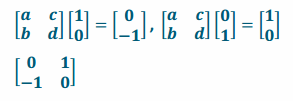
\cos (\theta) & -\sin (\theta) \\
\sin (\theta) & \cos (\theta)
\end{array}\right]\) as Rθ, and the “undo” of the pure rotation is \(\left[\begin{array}{cc}
\cos (-\theta) & -\sin (-\theta) \\
\sin (-\theta) & \cos (-\theta)
\end{array}\right]\) as Rθ.

a. Simplify \(\left[\begin{array}{cc}
\cos (-\theta) & -\sin (-\theta) \\
\sin (-\theta) & \cos (-\theta)
\end{array}\right]\).
Answer:
\(\left[\begin{array}{cc}
\cos (-\theta) & -\sin (-\theta) \\
\sin (-\theta) & \cos (-\theta)
\end{array}\right]\) = \(\left[\begin{array}{cc}
\cos (\theta) & \sin (\theta) \\
-\sin (\theta) & \cos (\theta)
\end{array}\right]\)

b. What would you get if you multiply Rθ to Rθ?
Answer:
Engage NY Math Precalculus Module 1 Lesson 28 Problem Set Answer Key 31

c. Write the matrix if you want to rotate \(\frac{\pi}{2}\) radians counterclockwise.
Answer:
Engage NY Math Precalculus Module 1 Lesson 28 Problem Set Answer Key 32

d. Write the matrix if you want to rotate \(\frac{\pi}{2}\) radians clockwise.
Answer:
Engage NY Math Precalculus Module 1 Lesson 28 Problem Set Answer Key 33

e. Write the matrix if you want to rotate \(\frac{\pi}{6}\) radians counterclockwise.
Answer:
Engage NY Math Precalculus Module 1 Lesson 28 Problem Set Answer Key 34

f. Write the matrix if you want to rotate \(\frac{\pi}{4}\) radians counterclockwise.
Answer:
Engage NY Math Precalculus Module 1 Lesson 28 Problem Set Answer Key 35

g. If the point \(\left[\begin{array}{l}
0 \\
2
\end{array}\right]\) is the image of \(\frac{\pi}{4}\) radians counterclockwise rotation, find the starting point \(\left[\begin{array}{l}
x \\
y
\end{array}\right]\).
Answer:
Engage NY Math Precalculus Module 1 Lesson 28 Problem Set Answer Key 36

h. If the point \(\left[\begin{array}{l}
\frac{1}{2} \\
\frac{\sqrt{3}}{2}
\end{array}\right]\) is the image of \(\frac{\pi}{6}\) radians counterclockwise rotation, find the starting point \(\left[\begin{array}{l}
x \\
y
\end{array}\right]\).
Answer:
Engage NY Math Precalculus Module 1 Lesson 28 Problem Set Answer Key 37

Eureka Math Precalculus Module 1 Lesson 28 Exit Ticket Answer Key

A = \(\left[\begin{array}{cc}
4 & -2 \\
-1 & 3
\end{array}\right]\) B = \(\left[\begin{array}{ll}
3 & 2 \\
1 & 4
\end{array}\right]\)

Question 1.
Is matrix A the inverse of matrix B? Show your work, and explain your answer.
Answer:
No, the product of the two matrices is not the identity matrix.
\(\left[\begin{array}{cc}
4 & -2 \\
-1 & 3
\end{array}\right]\left[\begin{array}{ll}
3 & 2 \\
1 & 4
\end{array}\right]\) = \(\left[\begin{array}{cc}
10 & 0 \\
0 & 10
\end{array}\right]\)

Question 2.
What is the determinant of matrix B? Of matrix A?
Answer:
The determinant of matrix A=|(4)(3)-(-2)(-1)|=10.
The determinant of matrix B=|(3)(4)-(2)(1)|=10.