Eureka Math Geometry Module 2 Lesson 15 Answer Key

Engage NY Eureka Math Geometry Module 2 Lesson 15 Answer Key

Eureka Math Geometry Module 2 Lesson 15 Exercise Answer Key

Exercise 1.
Draw two triangles of different sizes with two pairs of equal angles. Then, measure the lengths of the corresponding sides to verify that the ratio of their lengths is proportional. Use a ruler, compass, or protractor, as necessary.
Answer:
Students’ work will vary. Verify that students have drawn a pair of triangles with two pairs of equal angles and have shown via direct measurement that the ratios of corresponding side lengths are proportional.

Exercise 2.
Are the triangles you drew in Exercise 1 similar? Explain.
Answer:
Yes, the triangles are similar. The converse of the theorem on similar triangles states that when we have two triangles ∆ ABC and ∆ A’B’C’ with corresponding angles that are equal and corresponding side lengths that are proportional, then the triangles are similar.

Exercise 3.
Why is it that you only need to construct triangles where two pairs of angles are equal but not three?
Answer:
If we are given the measure of two angles of a triangle, then we also know the third measure because of the triangle sum theorem. All three angles must add to 180°, so showing two pairs of angles are equal in measure is just like showing all three pairs of angles are equal in measure.

Exercise 4.
Why were the ratios of the corresponding sides proportional?
Answer:
Since the triangles are similar, we know that there exists a similarity transformation that maps one triangle onto another. Then, corresponding sides of similar triangles must be in proportion because of what we know about similarity, dilation, and scale factor. Specifically, the length of a dilated segment is equal to the length of the original segment multiplied by the scale factor. For example,
\(\frac{A^{\prime} B^{\prime}}{A B}\) = r and A’B’ = rAB.

Exercise 5.
Do you think that what you observed will be true when you construct a pair of triangles with two pairs of equal angles? Explain.
Answer:
Accept any reasonable explanation. Use students’ responses as a springboard for the Opening discussion and the presentation of the AA criterion for similarity.

Exercise 6.
Draw another two triangles of different sizes with two pairs of equal angles. Then, measure the lengths of the corresponding sides to verify that the ratio of their lengths is proportional. Use a ruler, compass, or protractor, as necessary.
Answer:
Students’ work will vary. Verify that they have drawn a pair of triangles with two pairs of equal angles and have shown via direct measurement that the ratios of corresponding side lengths are proportional.

Exercise 7.
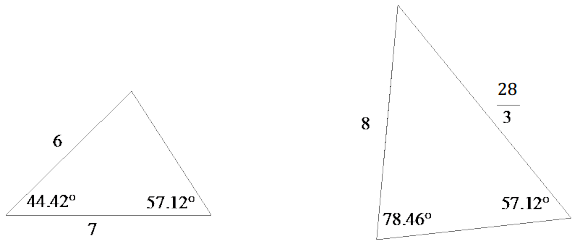
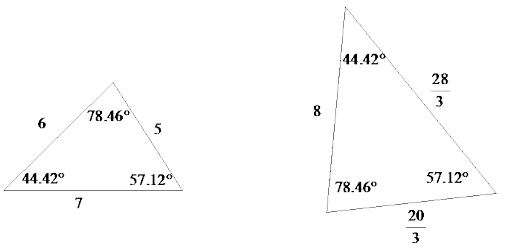
Are the triangles shown below similar? Explain. If the triangles are similar, identify any missing angle and side length measures.
Eureka Math Geometry Module 2 Lesson 15 Example Answer Key 1
Answer:
Yes, the triangles are similar because they have two pairs of equal corresponding angles. By the AA criterion, they must be similar. The angle measures and side lengths are shown below.
Eureka Math Geometry Module 2 Lesson 15 Example Answer Key 2

Exercise 8.
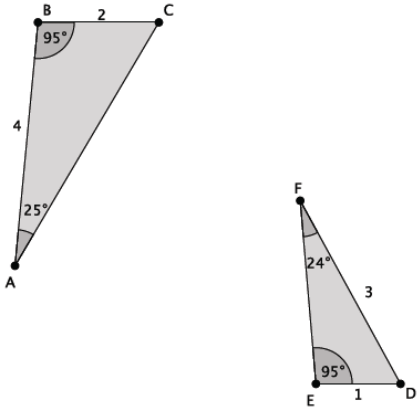
Are the triangles shown below similar? Explain. If the triangles are similar, identify any missing angle and side length measures.
Eureka Math Geometry Module 2 Lesson 15 Example Answer Key 3
Answer:
The triangles are not similar because they have just one pair of corresponding equal angles. By the triangle sum theorem, m∠C = 60° and m∠D = 61°. Since similar triangles must have equal corresponding angles, we can conclude that the triangles shown are not similar.

Exercise 9.
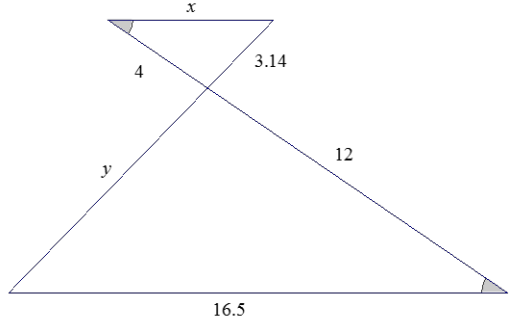
The triangles shown below are similar. Use what you know about similar triangles to find the missing side lengths x and y.
Eureka Math Geometry Module 2 Lesson 15 Example Answer Key 4
Answer:
\(\frac{12}{4}=\frac{16.5}{x}\)
12x = 66
x = 5.5

\(\frac{12}{4}=\frac{y}{3.14}\)
37.68 = 4y
9.42 = y
Side length x is 5.5 units, and side length y is 9.42 units.

Exercise 10.
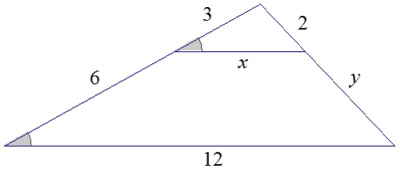
The triangles shown below are similar. Write an explanation to a student, Claudia, of how to find the lengths of x and y.
Eureka Math Geometry Module 2 Lesson 15 Example Answer Key 5
Answer:
Claudia,
We are given that the triangles are similar; therefore, we know that they have equal corresponding angles and corresponding sides that are equal in ratio. For that reason, we can write \(\frac{3}{9}=\frac{2}{2+y}\), which represents two pairs of corresponding sides of the two triangles. We can solve for y as follows:
\(\frac{3}{9}=\frac{2}{2+y}\)
6 + 3y = 18
3y = 12
y = 4
We can solve for x in a similar manners We begin by writing two pairs of corresponding sides as equal ratios, making sure that one of the ratios contains the length x.
\(\frac{x}{12}=\frac{3}{9}\)
9x = 36
x = 4
Therefore, side length x is 4 units, and side length y is 4 units.

Eureka Math Geometry Module 2 Lesson 15 Problem Set Answer Key

Question 1.
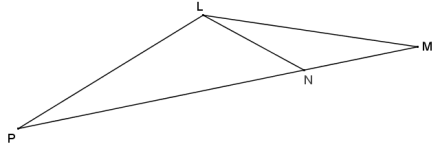
In the figure to the right, ∆ LMN ~ ∆ MPL.
Eureka Math Geometry Module 2 Lesson 15 Problem Set Answer Key 6
a. Classify ∆ LMP based on what you know about similar triangles, and justify your reasoning.
Answer:
By the given similarity statement, M and P are corresponding vertices; therefore, the angles at M and P must be congruent. This means that ∆ LMP is an isosceles triangle by base ∠‘s converse.

b. If m∠P = 20°, find the remaining angles in the diagram.
Answer:
m∠M = 20°, m∠MLN = 20°, m∠MNL = 140°, m∠NLP = 120°, m∠MLP = 140°, and m∠LNP = 40°.
Triangle MNL is also isosceles.

Question 2.
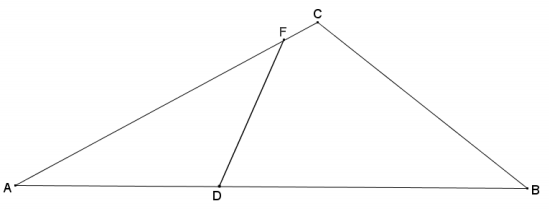
In the diagram below, ∆ ABC ~ ∆ AFD. Determine whether the following statements must be true from the given information, and explain why.
Eureka Math Geometry Module 2 Lesson 15 Problem Set Answer Key 7
a. ∆ CAB ~ ∆DAF
Answer:
This statement is true because corresponding vertices are the same as in the given similarity statement but are listed in a different order.

b. ∆ ADF ~ ∆ CAB
Answer:
There is no information given to draw this conclusion.

C. ∆ BCA ~ ∆ ADF
Answer:
There is no information given to draw this conclusion.

d. ∆ ADF ~ ∆ ACB
Answer:
This statement is true because corresponding vertices are the same as in the given similarity statement but are listed in a different order.

Question 3.
In the diagram below, D is the midpoint of \(\overline{A B}\), F is the midpoint of \(\overline{B C}\), and E is the midpoint of \(\overline{A C}\). Prove that ∆ ABC ~ ∆ FED.
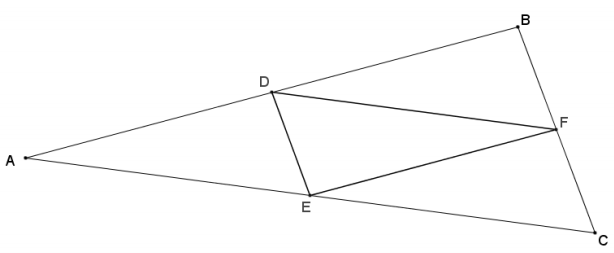
Eureka Math Geometry Module 2 Lesson 15 Problem Set Answer Key 8
Answer:
Eureka Math Geometry Module 2 Lesson 15 Problem Set Answer Key 9

Question 4.
Use the diagram below to answer each part.
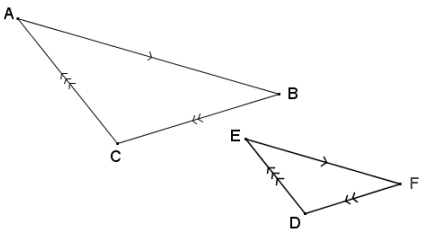
Eureka Math Geometry Module 2 Lesson 15 Problem Set Answer Key 10

a. If \(\overline{A C}\|\overline{E D}, \overline{A B}\| \overline{E F}\), and \(\overline{C B} \| \overline{D F}\), prove that the triangles are similar.
Answer:
By extending all sides of both triangles, there are several pairs of parallel lines cut by parallel transversals.
Using corresponding angles within parallel lines and transitivity, ∆ ABC ~ ∆ EFD by the AA criterion for proving similar triangles.
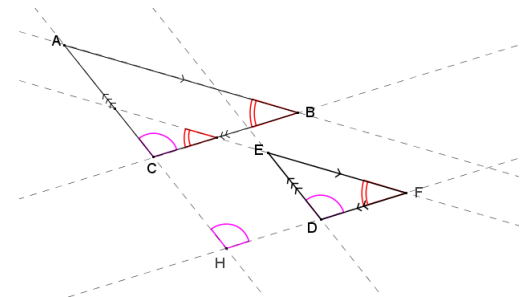
Eureka Math Geometry Module 2 Lesson 15 Problem Set Answer Key 11

b. The triangles are not congruent. Find the dilation that takes one to the other.
Answer:
Extend lines joining corresponding vertices to find their intersection O, which is the center of dilation.
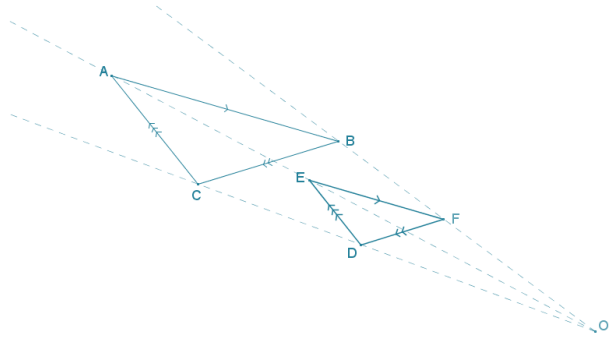
Eureka Math Geometry Module 2 Lesson 15 Problem Set Answer Key 12

Question 5.
Given trapezoid ARDE, and \(\overline{A B}\) || \(\overline{E D}\), prove that ∆ AFB ~ ∆ DEF.
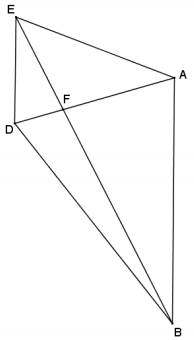
Eureka Math Geometry Module 2 Lesson 15 Problem Set Answer Key 13
Answer:
From the given information, ∠EDA ≅ ∠DAB by alternate interior ∠‘s, \(\overline{A B}\) || \(\overline{E D}\) (by the same argument, ∠DEB ≅ ∠ABE). Furthermore, ∠EFD ≅ ∠BFA because vertical angles are congruent. Therefore, ∆ AFB ~ ∆ DEF by the AA criterion for proving similar triangles.

Eureka Math Geometry Module 2 Lesson 15 Exit Ticket Answer Key

Question 1.
Given the diagram to the right, \(\overline{U X} \perp \overline{V W}\), and \(\overline{W Y} \perp \overline{U V}\). Show that ∆ UXV ~ ∆ WYV.
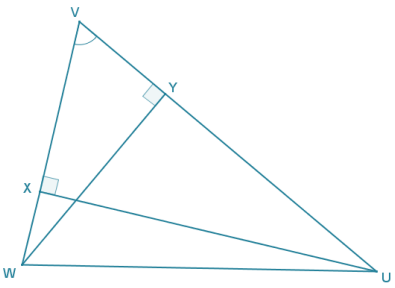
Eureka Math Geometry Module 2 Lesson 15 Exit Ticket Answer Key 14
Answer:
By the definition of perpendicular lines, ∠WYV and ∠UXV are right angles, and all right angles are congruent, so ∠WYV ≅ ∠UXV. Both ∆ UXV and ∆ WYV share ∠V, and by the reflexive property ∠V ≅ ∠V. Therefore, by the AA criterion for proving similar triangles, ∆ UXV ~ ∆ WYV.

Question 2.
Given the diagram to the right and \(\overline{D E}\) || \(\overline{K L}\). find FE and FL.
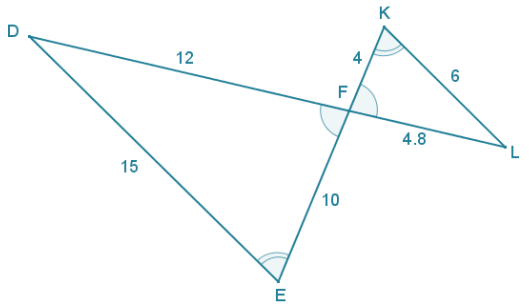
Eureka Math Geometry Module 2 Lesson 15 Exit Ticket Answer Key 15
Answer:
By alternate interior ∠‘s, \(\overline{D E}\) || \(\overline{K L}\), it follows that ∠K ≅ ∠E (and by a similar argument, ∠D ≅ ∠L). ∠DFE and ∠KFL are vertically opposite angles and therefore congruent. By AA criterion for proving similar triangles, ∆ DFE ~ ∆ LFK. Therefore,
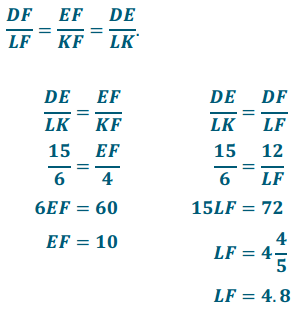
Eureka Math Geometry Module 2 Lesson 15 Exit Ticket Answer Key 16
Using the relationship of similar triangles, EF = 10, and LF = 4.8.

Eureka Math Geometry Module 2 Lesson 16 Answer Key

Engage NY Eureka Math Geometry Module 2 Lesson 16 Answer Key

Eureka Math Geometry Module 2 Lesson 16 Example Answer Key

Example 1.
Given ∆ ABC ~ ∆ A’B’C’, find the missing side lengths.
Eureka Math Geometry Module 2 Lesson 16 Example Answer Key 1
Answer:
→ (Take a poll.) How many people used the ratio of lengths 4: 12 or 12: 4 (i.e., the corresponding lengths of \(\overline{A C}\) and \(\overline{A^{\prime} C^{\prime}}\)) to determine the measurements of \(\overline{B C}\) and \(\overline{A^{\prime} B^{\prime}}\)?

→ Are there any other length relationships we could use to set up an equation and solve for the missing side lengths?
Provide students time to think about and try different equations that would lead to the same answer.

In addition to the ratio of corresponding lengths AC: A’C’, we can use a ratio of lengths within one of the triangles. For example, we could use the ratio of AC: AB to find the length of \(\overline{A^{\prime} B^{\prime}}\). Equating the values of the ratios, we get the following:
\(\frac{4}{5}=\frac{12}{A^{\prime} B^{\prime}}\)
A’B’ = 15.

To find the length of \(\overline{B C}\), we can use the ratios A’ C’: B’ C’ and AC: BC. Equating the values of the ratios, we get the following:

→ Why is it possible to use this length relationship, AC: AB, to solve for a missing side length?
Take student responses, and then offer the following explanation:

→ There are three methods that we can use to determine the missing side lengths.

Method 1 (Scale Factor): Find the scale factor, and use it to compute for the desired side lengths.
Since we know AC = 4 and the corresponding side A’C’ = 12, the scale factor of r satisfies 4r = 12. So,
r = 3, A’B’ = rAB = 3 · 5 = 15, and BC \(\frac{6}{3}\) = 2.

Method 2 (Ratios Between-Figures): Equate the values of the ratios of the corresponding sides.
Eureka Math Geometry Module 2 Lesson 16 Example Answer Key 2

Method 3 (Ratios Within-Figures): Equate the values of the ratios within each triangle.
Eureka Math Geometry Module 2 Lesson 16 Example Answer Key 3

→ Why does Method 3 work? That is, why can we use values of ratios within each triangle to find the missing side lengths?

Provide students time to explain why Method 3 works, and then offer the following explanation:

→ If ∆, ABC ~ ∆ A’B’C’, then it is true that the ratio between any two side lengths of the first triangle is equal to the ratio between the corresponding side lengths of the second triangle; for example, AB: BC = A’B’: B’C’. This is because if r is the scale factor, then AB: BC = rAB: rBC = A’B’: B’C’.

Revisit the Opening Exercise. Ask students to explain which method they used to write their equations for the height of the tree. Answers may vary, but students likely have used Method 2 because that is what is most familiar to them.

Example 2.
Eureka Math Geometry Module 2 Lesson 16 Example Answer Key 4
In the diagram above, a large flagpole stands outside of an office building. Marquis realizes that when he looks up from the ground 60 m away from the flagpole, the top of the flagpole and the top of the building line up. If the flagpole is 35 m tall and Marquis is 170 m from the building, how tall is the building?

a. Are the triangles in the diagram similar? Explain.
Answer:
Yes, the triangle formed by Marquis, the ground, and the flagpole is similar to the triangle formed by Marquis, the ground, and the building. They are similar by the AA criterion. Each of the triangles has a common angle with Marquis at the vertex, and each triangle has a right angle, where the flagpole and the building meet the ground.

b. Determine the height of the building using what you know about scale factors.
Answer:
The scale factor is \(\frac{170}{60}=\frac{17}{6}=2.8 \overline{3}\). Then, the height of the building is 35(2. 8\(\overline{3}\)) = 99.1\(\overline{6}\) m.

c. Determine the height of the building using ratios between similar figures.
Answer:
\(\frac{35}{h}=\frac{60}{170}\)
5950 = 60h
h = 99.1

d. Determine the height of the building using ratios within similar figures.
Answer:
\(\frac{35}{60}=\frac{h}{170}\)
5950 = 60h
h = 991g

Example 3
The following right triangles are similar. We will determine the unknown side lengths by using ratios within the first triangle. For each of the triangles below, we define the base as the horizontal length of the triangle and the height as the vertical length.
Eureka Math Geometry Module 2 Lesson 16 Example Answer Key 5

a. Write and find the value of the ratio that compares the height to the hypotenuse of the leftmost triangle.
Answer:
\(\frac{4}{5}\) = 0.8

b. Write and find the value of the ratio that compares the base to the hypotenuse of the leftmost triangle.
Answer:
\(\frac{3}{5}\) = 0.6

c. Write and find the value of the ratio that compares the height to the base of the leftmost triangle.
Answer:
\(\frac{4}{3}=1 . \overline{3}\)

d. Use the triangle with lengths 3 – 4 – 5 and triangle A to answer the following questions:
i. Which ratio can be used to determine the height of triangle A?
Answer:
The ratio that compares the height to the base can be used to determine the height of triangle A.

ii. Which ratio can be used to determine the hypotenuse of triangle A?
Answer:
The ratio that compares the base to the hypotenuse can be used to determine the hypotenuse of triangle A.

iii. Find the unknown lengths of triangle A.
Answer:
Let h represent the height of the triangle; then
\(\frac{h}{1.5}=1 . \overline{3}\)
h = 2.
Let c represent the length of the hypotenuse; then
\(\frac{1.5}{c}\) = 0.6
c = 2.5.

e. Use the triangle with lengths 3 – 4 – 5 and triangle B to answer the following questions:
i. Which ratio can be used to determine the base of triangle B?
Answer:
The ratio that compares the height to the base can be used to determine the base of triangle B.

ii. Which ratio can be used to determine the hypotenuse of triangle B?
Answer:
The ratio that compares the height to the hypotenuse can be used to determine the hypotenuse of triangle B.

iii. Find the unknown lengths of triangle B.
Answer:
Let b represent the length of the base; then
\(\frac{5}{b}=1 \frac{1}{3}\)
b = 3.75.
Let c represent the length of the hypotenuse; then
\(\frac{5}{c}\) = 0.8
c = 6.25.

f. Use the triangle with lengths 3-4- 5 and triangle C to answer the following questions:
i. Which ratio can be used to determine the height of triangle C?
Answer:
The ratio that compares the height to the hypotenuse can be used to determine the height of triangle C.

ii. Which ratio can be used to determine the base of triangle C?
Answer:
The ratio that compares the base to the hypotenuse can be used to determine the base of triangle C.

iii. Find the unknown lengths of triangle C.
Answer:
Let h represent the height of the triangle; then
\(\frac{h}{8}\) = 0.8
h = 6.4.
Let b represent the length of the base; then
\(\frac{b}{8}\) = 0.6
b = 4.8.

g. Explain the relationship of the ratio of the corresponding sides within a figure to the ratio of corresponding sides within a similar figure.
Answer:
Corresponding lengths of similar figures have proportional lengths, but the ratio of two lengths within a figure is equal to the corresponding ratio of two lengths in a similar figure.

h. How does the relationship you noted in part (g) allow you to determine the length of an unknown side of a triangle?
Answer:
This relationship allows us to find the length of an unknown side of a triangle. We can write the ratio of corresponding sides within the figure that contains the unknown side length. This ratio will be equal to the value of the ratio of corresponding sides where the lengths are known. Since the ratios are equal, the unknown length can be found by solving a simple equation.

Eureka Math Geometry Module 2 Lesson 16 Opening Exercise Answer Key

At a certain time of day, a 12 m flagpole casts an 8 m shadow. Write an equation that would allow you to find the height, h, of the tree that uses the length, s, of the tree’s shadow.
Eureka Math Geometry Module 2 Lesson 16 Opening Exercise Answer Key 6
Answer:
Eureka Math Geometry Module 2 Lesson 16 Opening Exercise Answer Key 7

Eureka Math Geometry Module 2 Lesson 16 Problem Set Answer Key

Question 1.
∆ DEF ~ ∆ ABC All side length measurements are in centimeters. Use between-figure ratios and/or within-figure ratios to determine the unknown side lengths.
Answer:
Eureka Math Geometry Module 2 Lesson 16 Problem Set Answer Key 8
Using the given similarity statement, ∠D corresponds with ∠A, and
∠C corresponds with ∠F, so it follows that \(\overline{A B}\) corresponds with \(\overline{D E}\), \(\overline{A C}\) with \(\overline{D F}\), and \(\overline{B C}\) with \(\overline{E F}\).
Eureka Math Geometry Module 2 Lesson 16 Problem Set Answer Key 9

Question 2.
Given ∆ ABC ∆ XYZ, answer the following questions:
Eureka Math Geometry Module 2 Lesson 16 Problem Set Answer Key 10
a. Write and find the value of the ratio that compares the height \(\overline{A C}\) to the hypotenuse of ∆ ABC.
Answer:
\(\frac{5}{13}\)

b. Write and find the value of the ratio that compares the base \(\overline{A B}\) to the hypotenuse of ∆ ABC.
Answer:
\(\frac{12}{13}\)

c. Write and find the value of the ratio that compares the height AC to the base AB of ∆ ABC.
Answer:
\(\frac{5}{12}\)

d. Use within-figure ratios to find the corresponding height of ∆ XYZ.
Answer:
\(\frac{5}{12}=\frac{X Z}{4.5}\)
XZ = 1\(\frac{7}{8}\)

e. Use within-figure ratios to find the hypotenuse of ∆ XYZ.
Answer:
\(\frac{12}{13}=\frac{4.5}{Y Z}\)
YZ = 4\(\frac{7}{8}\)

Question 3.
Right triangles A, B, C, and D are similar. Determine the unknown side lengths of each triangle by using ratios of side lengths within triangle A.
Eureka Math Geometry Module 2 Lesson 16 Problem Set Answer Key 11
a. Write and find the value of the ratio that compares the height to the hypotenuse of triangle A.
Answer:
\(\frac{\sqrt{3}}{2}\) ≈ 0.866

b. Write and find the value of the ratio that compares the base to the hypotenuse of triangle A.
Answer:
\(\frac{1}{2}\) = 0.5

c. Write and find the value of the ratio that compares the height to the base of triangle A.
Answer:
\(\frac{\sqrt{3}}{1}\) = √3 ≈ 1.73

d. Which ratio can be used to determine the height of triangle B? Find the height of triangle B.
Answer:
The ratio that compares the height to the hypotenuse of triangle A can be used to determine the height of triangle B. Let the unknown height of triangle B be m.
\(\frac{\sqrt{3}}{2}=\frac{m}{1}\)
m = \(\frac{\sqrt{3}}{2}\)

e. Which ratio can be used to determine the base of triangle B? Find the base of triangle B.
Answer:
The ratio that compares the base to the hypotenuse of triangle A can be used to determine the base of triangle B. Let the unknown base of triangle B be n.
\(\frac{1}{2}=\frac{n}{1}\)
n = \(\frac{1}{2}\)

f. Find the unknown lengths of triangle C.
Answer:
The base of triangle C is √3.
The height of triangle C is 3.

g. Find the unknown lengths of triangle D.
Answer:
The base of triangle D is \(\frac{\sqrt{3}}{3}\).
The hypotenuse of triangle D is \(\frac{2 \sqrt{3}}{3}\).

h. Triangle E Is also similar to triangles A, B, C, and D. Find the lengths of the missing sides in terms of x.
Eureka Math Geometry Module 2 Lesson 16 Problem Set Answer Key 12
Answer:
The base of triangle E is x.
The height of triangle E is x√3.
The hypotenuse of triangle E is 2x.

Question 4.
Brian is photographing the Washington Monument and wonders how tall the monument is. Brian places his 5 ft. camera tripod approximately 100 yd. from the base of the monument. Lying on the ground, he visually aligns the top of his tripod with the top of the monument and marks his location on the ground approximately 2 ft. 9 in. from the center of his tripod. Use Brian’s measurements to approximate the height of the Washington Monument.
Eureka Math Geometry Module 2 Lesson 16 Problem Set Answer Key 13
Answer:
Brian’s location on the ground is approximately 302.75 ft. from the base of the monument. His visual line forms two similar right triangles with the height of the monument and the height of his camera tripod.
\(\frac{5}{2.75}=\frac{h}{302.75}\)
1513.75 = 2.75h
550.5 ≈ h
According to Brian’s measurements, the height of the Washington Monument is approximately 550.5 ft.

Students may want to check the accuracy of this problem. The actual height of the Washington Monument is 555 ft.

Question 5.
Catarina’s boat has come untied and floated away on the lake. She ¡s standing atop a cliff that Is 35 ft. above the water in a lake. If she stands 10 ft. from the edge of the cliff, she can visually align the top of the cliff with the water at the back of her boat. Her eye level is 5\(\frac{1}{2}\) ft. above the ground. Approximately how far out from the cliff is Catarina’s boat?
Eureka Math Geometry Module 2 Lesson 16 Problem Set Answer Key 14
Catarina’s height and the height of the cliff both are measured perpendicularly to the ground (and water), so both triangles formed by her visual path are right triangles. Assuming that the ground level on the cliff and the water are parallel, Catarina’s visual path forms the same angle with the cliff as ¡t does with the surface of the water (corresponding ∠‘s, parallel lines). So, the right triangles are similar triangles by the AA criterion for showing triangle similarity, which means that the ratios within triangles will be equal. Let d represent the distance from the boat to the cliff:
\(\frac{5.5}{10}=\frac{35}{d}\)
5.5d = 350
d ≈ 63.6
Answer:
Catarina’s boat Is approximately 63.6 ft. away from the cliff.

Question 6.
Given the diagram below and ∆ ABC ~ ∆ XYZ, find the unknown lengths x, 2x, and 3x.
Eureka Math Geometry Module 2 Lesson 16 Problem Set Answer Key 15
Answer:
The triangles are given as similar, so the values of the ratios of the sides within each triangle must be equal.
\(\frac{2}{2 x}=\frac{x}{3 x}\)
The sides of the larger triangle are unknown; however, the lengths include the same factor x, which is clearly nonzero, so the ratio of the sides must then be \(\frac{1}{3}\). Similarly, the sides of the smaller triangle have the same factor 2, so the value of the ratio can be rewritten as \(\frac{1}{x}\).
\(\frac{1}{x}=\frac{1}{3}\)
x = 3
Since the value of x is 3, it follows that YZ = 3, AC = 6, and XZ = 9.

Eureka Math Geometry Module 2 Lesson 16 Exit Ticket Answer Key

Question 1.
In the diagram, ∆ ABC ~ ∆ DEF by the dilation with center O and a scale factor of r. Explain why ∆ DEF ~ ∆ ABC.
Eureka Math Geometry Module 2 Lesson 16 Exit Ticket Answer Key 16
Answer:
We know that ∆ ABC ~ ∆ DEF by a dilation with center O and a scale factor of r. A dilation with the same center O but a scale factor of \(\frac{1}{r}\) maps ∆ DEF onto ∆ ABC; this means ∆ DEF ~ ∆ ABC.

Question 2.
Radii \(\overline{C A}\) and \(\overline{T S}\) are parallel. Is circle CC,CA similar to circle CT,TS? Explain.
Eureka Math Geometry Module 2 Lesson 16 Exit Ticket Answer Key 17
Answer:
Yes, the circles are similar because a dilation with center O and
a scale factor of r exists that maps CC,CA onto CT,TS.

Question 3.
Two triangles, ∆ ABC and ∆ DEF, are in the plane so that m∠A = m∠D, m∠B = m∠E, m∠C = m∠F, and \(\frac{D E}{A B}=\frac{E F}{B C}=\frac{D F}{A C}\) Summarize the argument that proves that the triangles must be similar.
Answer:
A dilation exists such that the lengths of one triangle can be made equal to the lengths of the other triangle. Once the triangles have lengths and angles of equal measurement, or are congruent, then a sequence of rigid motions maps one triangle to the other. Therefore, a similarity transformation exists that maps one triangle onto the other, and the triangles must be similar.

Eureka Math Geometry Module 2 Lesson 13 Answer Key

Engage NY Eureka Math Geometry Module 2 Lesson 13 Answer Key

Eureka Math Geometry Module 2 Lesson 13 Example Answer Key

Example 1.
Similarity transformation G consists of a rotation about the point P by 90°, followed by a dilation centered at P with scale factor of r = 2, and then followed by a reflection across line f. Find the image of the triangle.
Answer:
→ Before getting to the actual construction process, draw a predictive sketch of the image of the triangle after transformation. You should have three sketches.

Drawing a predictive sketch helps illuminate the path ahead before getting into the details of each construction. The sketches also provide a time to reflect on how the properties are true for each transformation. For example, ask students to select a property from their lists and describe where in their sketches they see it in the transformation. For instance, a student might select property (2), which states that each point has a pre-image P and can point to each pre-image and image with each passing transformation.

Eureka Math Geometry Module 2 Lesson 13 Example Answer Key 1

Complete this example with students. Remind them that the rotation requires all three geometry tools.

Note to the teacher: As an alternative strategy, consider using coordinate geometry by placing the image over an appropriately scaled grid. Students gained familiarity with coordinate geometry as used with transformations of the plane in Grade 8. The image on the right above has been provided for this alternative. Placement of the x- and y-axes can be determined where convenient for this example. Given this flexibility, most students likely choose point P to be the origin of the coordinate plane since two of the given transformations are centered at P.

→ How will we rotate the triangle 90°?

To locate the vertices of the triangle’s image, draw rays through each vertex of the triangle originating from P. Use each ray to form three 90° angles, and then use the compass to locate each new vertex on the corresponding ray.

Point out to students that in their constructions, the ray through B’ and C’ coincides and appears to be one ray, giving an appearance of only two rays, not three.
Eureka Math Geometry Module 2 Lesson 13 Example Answer Key 2
Next, allow students time to dilate ∆ A’B’C’. If necessary, review the steps to create a dilation.
Eureka Math Geometry Module 2 Lesson 13 Example Answer Key 3

→ How will we reflect the triangle over the line?
Create the construction marks that determine the image of each vertex so that the line of reflection is the perpendicular bisector of the segment that joins each vertex with its image. In other words, we must create the construction marks so that the images of the vertices are located so that the line of reflection is the perpendicular bisector of \(\overline{A^{\prime \prime} A^{\prime \prime \prime}}, \overline{B^{\prime \prime} B^{\prime \prime \prime}}, \overline{C^{\prime \prime} C^{\prime \prime \prime}}\).

The steps to determine B” are shown below.
Eureka Math Geometry Module 2 Lesson 13 Example Answer Key 4

→ We have applied the outlined similarity transformation to ∆ ABC and found its image, that is, the similar figure ∆ A”’B”’C”’

→ Since G comprises three individual transformations and each of the transformations satisfies the known properties, we know that G also satisfies the properties.

Example 2.

A similarity transformation G applied to trapezoid ABCD consists of a translation by vector \(\overrightarrow{X Y}\), followed by a reflection across line m, and then followed by a dilation centered at P with a scale factor of r = 2. Recall that we can describe the same sequence using the following notation: Dp,2 (rm(Txy(ABCD))). Find the image of ABCD.
Eureka Math Geometry Module 2 Lesson 13 Example Answer Key 5
Answer:
Encourage students to draw a predictive sketch for each stage of the transformation before beginning the construction.

→ Describe the steps to apply the translation by vector XY to one point of the figure.
To apply the translation to A, construct C1: center A, radius XY. Then, construct C2: center Y, radius XA.
Eureka Math Geometry Module 2 Lesson 13 Example Answer Key 6
The process for locating the image of B under the translation is shown below:
Eureka Math Geometry Module 2 Lesson 13 Example Answer Key 7
Allow students time to complete the rest of the example before reviewing it.
The following image shows the reflection of vertex C’:
Eureka Math Geometry Module 2 Lesson 13 Example Answer Key 8
The following image shows the dilation of A”B”C”D”:
Eureka Math Geometry Module 2 Lesson 13 Example Answer Key 9

Eureka Math Geometry Module 2 Lesson 13 Exercise Answer Key

Exercise 1.
A similarity transformation for triangle DEF is described by rn(DA,\(\frac{1}{2}\) (RA,90°(DEF))). Locate and label the image of triangle DEF under the similarity.
Eureka Math Geometry Module 2 Lesson 13 Exercise Answer Key 10
Answer:
Eureka Math Geometry Module 2 Lesson 13 Problem Set Answer Key 11

Eureka Math Geometry Module 2 Lesson 13 Problem Set Answer Key

Question 1.
A similarity transformation consists of a reflection over line t’, followed by a dilation from O with a scale factor of r = \(\frac{3}{4}\). Use construction tools to find ∆ G”H”I”.
Eureka Math Geometry Module 2 Lesson 13 Problem Set Answer Key 12
Answer:
Eureka Math Geometry Module 2 Lesson 13 Problem Set Answer Key 13

Question 2.
A similarity transformation consists of a dilation from point O with a scale factor of r = 2\(\frac{1}{2}\), followed by a rotation about O of – 90°. Use construction tools to find kite A”B”C”D”.
Eureka Math Geometry Module 2 Lesson 13 Problem Set Answer Key 14
Answer:
Eureka Math Geometry Module 2 Lesson 13 Problem Set Answer Key 15

Question 3.
For the Figure Z, find the image of rl(Rp,90° (Dp,\(\frac{1}{2}\)(z)).
Eureka Math Geometry Module 2 Lesson 13 Problem Set Answer Key 16
Answer:
Eureka Math Geometry Module 2 Lesson 13 Problem Set Answer Key 17

Question 4.
A similarity transformation consists of a translation along vector \(\overrightarrow{U V}\), followed by a rotation of 60° about P, then followed by a dilation from P with a scale factor of r = \(\frac{1}{3}\). Use construction tools to find ∆ X”’Y”’Z”’.
Eureka Math Geometry Module 2 Lesson 13 Problem Set Answer Key 18
Answer:
Eureka Math Geometry Module 2 Lesson 13 Problem Set Answer Key 19

Question 5.
Given the quarter-circular figure determined by points A, B, and C, a similarity transformation consists of a – 65° rotation about point B, followed by a dilation from point O with a scale factor of r = \(\frac{1}{2}\). Find the image of the figure determined by points A”, B”, and C”.
Eureka Math Geometry Module 2 Lesson 13 Problem Set Answer Key 20
Answer:
Eureka Math Geometry Module 2 Lesson 13 Problem Set Answer Key 21

Describe a different similarity transformation that would map quarter-circle ABC to quarter-circle A”B”C”.
Answer:
The quarter-circular region could have first been dilated from point O using o scale factor of \(\frac{1}{2}\), followed by a rotation of 65° about point B’.

Question 6.
A similarity transformation consists of a dilation from center O with a scale factor of \(\frac{1}{2}\) followed by a rotation of 60° about point O. Complete the similarity transformation on Figure T to complete the drawing of Figure T”.
Eureka Math Geometry Module 2 Lesson 13 Problem Set Answer Key 22
Answer:
Eureka Math Geometry Module 2 Lesson 13 Problem Set Answer Key 23

Question 7.
Given Figure R on the coordinate plane shown below, a similarity transformation consists of a dilation from (0, 6) with a scale factor of \(\frac{1}{4}\), followed by a reflection over line x = – 1, and then followed by a vertical translation of 5 units down. Find the image of Figure R.
Eureka Math Geometry Module 2 Lesson 13 Problem Set Answer Key 24
Answer:
Eureka Math Geometry Module 2 Lesson 13 Problem Set Answer Key 25

Question 8.
Given ∆ ABC, with vertices A(2, – 7), B(- 2, – 1), and C(3, – 4), locate and label the image of the triangle under the similarity transformation DB’,\(\frac{1}{2}\) (RA,120°.(rx=2 (ABC))).
Answer:
Eureka Math Geometry Module 2 Lesson 13 Problem Set Answer Key 26

Question 9.
In Problem 8, describe the relationship of A”’ to \(\overline{A B^{\prime}}\), and explain your reasoning.
Answer:
A” is the midpoint of \(\overline{A B^{\prime}}\). I know this because A = A’ = A”, and since the dilation at the end of the similarity transformation was centered at B’, the image of A” must lie on the ray joining it to the center B’, which means that A” lies on \(\overline{A B^{\prime}}\). Furthermore, by the definition of dilation, A”’B’ = r(A”B’), and since the given scale factor was r = \(\frac{1}{2}\), it follows that A”’B’ = \(\frac{1}{2}\)(A”B’), so A” must, therefore, be the midpoint of \(\overline{A B^{\prime}}\).

Question 10.
Given O(-8, 3) and quadrilateral BCDE, with B(-5, 1), C(-6, -1), D(-4, -1), and E(-4, 2), what are the coordinates of the vertices of the image of BCDE under the similarity transformation rx-axis (D0,3 (BCDE))?
Answer:
Eureka Math Geometry Module 2 Lesson 13 Problem Set Answer Key 27
The coordinates of the image of BCDE are B”(1, 3), C”(-2, 9), D”(4, 9), and E”(4, 0).

Question 11.
Given triangle ABC as shown on the diagram of the coordinate plane:
Eureka Math Geometry Module 2 Lesson 13 Problem Set Answer Key 28
a. Perform a translation so that vertex A maps to the origin.
Answer:
See diagram.

b. Next, dilate the image A’B’C’ from the origin using a scale factor of \(\frac{1}{3}\).
Answer:
See diagram.

c. Finally, translate the image A”B”C” so that the vertex A” maps to the original point A.
Answer:
See diagram.
Eureka Math Geometry Module 2 Lesson 13 Problem Set Answer Key 29

d. Using transformations, describe how the resulting image A”B”C” relates to the original figure ABC.
Answer:
The image A”B”C” is a dilation of figure ABC from point A with a scale factor of \(\frac{1}{3}\).

Question 12.
a. In the coordinate plane, name the single transformation resulting from the composition of the two dilations shown below:
D(0,0),2 followed by D(0,4)\(\frac{1}{2}\)
(Hint: Try it!)
Answer:
The image can be obtained by a translation two units to the right (a vector that has half the distance as the distance between the centers of dilation).

b. In the coordinate plane, name the single transformation resulting from the composition of the two dilations shown below:
D(0,0),2 followed by D(4,4)\(\frac{1}{2}\)
(Hint: Try it!)
Answer:
The Image can be obtained by a translation two units to the right (a vector that has half the distance as the distance between the centers of dilation).

c. Using the results from parts (a) and (b), describe what happens to the origin under both similarity transformations.
Answer:
The origin maps to the midpoint of a segment joining the centers used for each dilation.

Eureka Math Geometry Module 2 Lesson 13 Exit Ticket Answer Key

A similarity transformation consists of a translation along the vector \(\overline{F G}\), followed by a dilation from point P with a scale factor of r = 2, and finally a reflection over line m. Use construction tools to find A”’C”’D”’E”’.
Eureka Math Geometry Module 2 Lesson 13 Exit Ticket Answer Key 30
Answer:
Eureka Math Geometry Module 2 Lesson 13 Exit Ticket Answer Key 31

Eureka Math Geometry Module 2 Lesson 12 Answer Key

Engage NY Eureka Math Geometry Module 2 Lesson 12 Answer Key

Eureka Math Geometry Module 2 Lesson 12 Example Answer Key

Example 1
Figure Z’ is similar to Figure Z. Describe a transformation that maps Figure Z onto Figure z’.
Eureka Math Geometry Module 2 Lesson 12 Example Answer Key 1


Answer:
→ We are not looking for specific parameters (e.g., scale factor or degree of rotation of each transformation); rather, we want to identify the series of transformations needed to map Figure Z to Figure Z’.
→ Step 1: The dilation has a scale factor of r < 1 since Z’ is smaller than Z.
→ Step 2: Notice that Z’ is flipped from Z1. So, take a reflection of Z1 to get Z2 over a line 1.
→ Step 3: Translate the plane such that a point of Z2 maps to a corresponding point in Z’. Call the new figure Z3.
→ Step 4: Rotate until Z3 coincides with Z’.
Eureka Math Geometry Module 2 Lesson 12 Example Answer Key 2
Figure Z maps to Figure Z’ by first dilating by a scale factor of r until the corresponding lengths are equal in measurement and then reflecting over line I to ensure that both figures have the same orientation. Next, translate along a vector so that one point of the image corresponds to Z’. Finally, a rotation around a center C of degree θ orients Figure Z so that it coincides with Figure Z’.

Example 2.
Show that no sequence of basic rigid motions and dilations takes the small figure to the large figure. Take measurements as needed.
Eureka Math Geometry Module 2 Lesson 12 Example Answer Key 3
Answer:
A similarity transformation that maps the small outer circle to the large outer circle would need to have scale factor of about 2. A similarity transformation that maps the small line segment AB to the large line segment CD would need to have scale factor of about 4. So, there is no similarity transformation that maps the small figure onto the large figure.

Eureka Math Geometry Module 2 Lesson 12 Opening Exercise Answer Key

Observe Figures 1 and 2 and the images of the intermediate figures between them. Figures 1 and 2 are called similar.
What observations can we make about Figures 1 and 2?
Eureka Math Geometry Module 2 Lesson 12 Opening Exercise Answer Key 4
Answer:
Answers will vary; students might say that the two figures look alike in terms of shape but not size. Accept reasonable answers at this point to start the conversation, and move on to filling out the chart below.

Definition:

A __________ ___________ (or ) ___________) is a composition of a finite number of dilations or basic rigid motions. The scale factor of a similarity transformation is the product of the scale factors of the dilations in the composition. If there are no dilations in the composition, the scale factor is defined to be 1.
Answer:
Similarity transformation, similarity

Definition:
Two figures in a plane are _____________ if there exists a similarity transformation taking one figure onto the other figure.
Answer:
Similar

Eureka Math Geometry Module 2 Lesson 12 Opening Exercise Answer Key 5
Answer:
Eureka Math Geometry Module 2 Lesson 12 Opening Exercise Answer Key 6

Eureka Math Geometry Module 2 Lesson 12 Exercise Answer Key

Exercise 1.
Figure 1 is similar to Figure 2. Which transformations compose the similarity transformation that maps Figure 1 onto Figure 2?
Eureka Math Geometry Module 2 Lesson 12 Exercise Answer Key 7
Answer:
First, dilate Figure 1 by a scale factor of r > 1 until the corresponding lengths are equal in measurement, and then reflect over a line iso that Figure 1 coincides with Figure 2.

Exercise 2.
Figure S is similar to Figure S’. Which transformations compose the similarity transformation that maps S onto S’?
Eureka Math Geometry Module 2 Lesson 12 Exercise Answer Key 8
Answer:
First, dilate S by a scale factor of r > 1 until the corresponding segment lengths are equal in measurement to those of S’. Then, S must be rotated around a center C of degree θ so that S coincides with S’.

Exercise 3.
Figure 1 is similar to Figure 2. Which transformations compose the similarity transformation that maps Figure 1 onto Figure 2?
Eureka Math Geometry Module 2 Lesson 12 Exercise Answer Key 9
Answer:
It is possible to only use two transformations: a rotation followed by a reflection. However, to do this, the correct center must be found. The solution image reflects this approach, but students may say to first rotate Figure 1 around a center C by 90° in the clockwise direction. Then, reflect Figure 1 over a vertical line t. Finally, translate Figure 1 by a vector so that Figure 1 coincides with Figure 2.

Exercise 4.
Is there a sequence of dilations and basic rigid motions that takes the large figure to the small figure? Take measurements as needed.
Eureka Math Geometry Module 2 Lesson 12 Exercise Answer Key 10
Answer:
A similarity transformation that maps segment AB to segment WX would need to have scale factor of about \(\frac{2}{3}\), but a similarity transformation that maps the small segment CD to segment YZ would need to have scale factor of about \(\frac{1}{2}\). So, there is no similarity transformation that maps the large figure onto the small figure.

Exercise 5.
What purpose do transformations serve? Compare and contrast the application of rigid motions to the application of similarity transformations.
Answer:
We use all the transformations to compare figures in the plane. Rigid motions are distance preserving while dilations, integral to similarity transformations, are not distance preserving. We use compositions of rigid motions to determine whether two figures are congruent, and we use compositions of rigid motions and dilations, specifically similarity transformations, to determine whether figures are similar.

Eureka Math Geometry Module 2 Lesson 12 Problem Set Answer Key

Question 1.
What is the relationship between scale drawings, dilations, and similar figures?
a. How are scale drawings and dilations alike?
Answer:
Scale drawings and dilated figures are alike in that all corresponding angles are congruent and all corresponding distances are in the equivalent ratio, r, called the scale factor. A dilation of a figure produces a scale drawing of that figure.

b. How can scale drawings and dilations differ?
Answer:
Dilations are a transformation of the plane in which all corresponding points from the image and pre-image are mapped along rays that originate at the center of dilation. This is not a requirement for scale drawings.

c. What is the relationship of similar figures to scale drawings and dilations?
Answer:
Similar figures are scale drawings because they can be mapped together by a series of dilations and rigid motions.

Question 2.
Given the diagram below, identify a similarity transformation, if one exists, that maps Figure A onto Figure B. If one does not exist, explain why.
Eureka Math Geometry Module 2 Lesson 12 Problem Set Answer Key 11
Answer:
(Note to the teacher: The solution below is only one of many valid solutions to this problem.)
Eureka Math Geometry Module 2 Lesson 12 Problem Set Answer Key 12

Question 3.
Teddy correctly identified a similarity transformation with at least one dilation that maps Figure I onto Figure II. Megan correctly identified a congruence transformation that maps Figure I onto Figure II. What must be true about Teddy’s similarity transformation?
Answer:
If Megan correctly identified a congruence transformation that maps Figure I onto Figure II, then Figure 1 and Figure II must be congruent. Therefore, Teddy’s similarity transformation must have either included a single dilation with a scale factor of 1 or must have included more than one dilation of which the product of all scale factors was 1 because it included at least one dilation.

Question 4.
Given the coordinate plane shown, identify a similarity transformation, if one exists, that maps X onto Y. If one does not exist, explain why.
Eureka Math Geometry Module 2 Lesson 12 Problem Set Answer Key 13
Answer:
(Note to the teacher: The solution below is only one of many valid solutions to this problem.)
Eureka Math Geometry Module 2 Lesson 12 Problem Set Answer Key 14
First, reflect X over line x = 11. Then, dilate the image from center (11, 1) with a scale factor of \(\frac{1}{2}\) to obtain Y.

Question 5.
Given the diagram below, identify a similarity transformation, if one exists, that maps G onto H. If one does not exist, explain why. Provide any necessary measurements to justify your answer.
Eureka Math Geometry Module 2 Lesson 12 Problem Set Answer Key 15
Answer:
A similarity transformation does not exist that maps G onto H because the side lengths of the figures are not all proportional. Figure G Is a rectangle (not a square), whereas Figure H is a square.

Question 6.
Given the coordinate plane shown, identify a similarity transformation, if one exists, that maps ABCD onto A”’B”’C”’D”’. If one does not exist, explain why.
Answer:
(Note to the teacher: Students need to use a protractor to obtain the correct degree measure of rotation. The solution below Is only one of many valid solutions to this problem.)
Eureka Math Geometry Module 2 Lesson 12 Problem Set Answer Key 16
ARCD can be mapped onto A”’B”’C”’D”’ by first translating along the vector \(\overrightarrow{C C^{\prime \prime \prime}}\), then rotating about point C” by 80°, and finally dilating from point C” using a scale factor of \(\frac{1}{4}\).
Eureka Math Geometry Module 2 Lesson 12 Problem Set Answer Key 17

Question 7.
The diagram below shows a dilation of the plane … or does it? Explain your answer.
Eureka Math Geometry Module 2 Lesson 12 Problem Set Answer Key 19
Answer:
The diagram does not show a dilation of the plane from point O, even though the corresponding points are collinear with the center O. To be a dilation of the plane, a constant scale factor must be used for all points from the center of dilation; however, the scale factor relating the distances from the center in the diagram range from 2 to 2.5.

Eureka Math Geometry Module 2 Lesson 12 Exit Ticket Answer Key

Question 1.
Figure A’ is similar to Figure A. Which transformations compose the similarity transformation that maps Figure A onto Figure A’?
ureka Math Geometry Module 2 Lesson 12 Exit Ticket Answer Key 20
Answer:
One possible solution: We first take a dilation of Figure A with a scale factor of r < 1 and center O, the point where the two line segments meet, until the corresponding lengths are equal to those in Figure A Next, take a rotation (180°) about O, and then, finally, take a reflection over a (vertical) line t.

Question 2.
Is there a sequence of dilations and basic rigid motions that takes the small figure to the large figure? Take measurements as needed.
ureka Math Geometry Module 2 Lesson 12 Exit Ticket Answer Key 21
Answer:
No similarity transformation exists because the circled corresponding distances and the corresponding distances marked by the arrows on Figure B are not in the same ratio.

Eureka Math Algebra 2 Module 3 Lesson 24 Answer Key

Engage NY Eureka Math Algebra 2 Module 3 Lesson 24 Answer Key

Eureka Math Algebra 2 Module 3 Lesson 24 Opening Exercise Answer Key

Opening Exercise:

In Lesson 7, we modeled a population of bacteria that doubled every day by the function P(t) = 2t, where t was the time in days. We wanted to know the value of t when there were 10 bacteria. Since we did not know about logarithms at the time, we approximated the value of t numerically, and we found that P(t) = 10 when t ≈ 3.32.

Use your knowledge of logarithms to find an exact value for t when P(t) = 10, and then use your calculator to approximate that value to 4 decimal places.
Answer:
Since P(t) = 2t, we need to solve 2t = 10.
2t = 10
tlog(2) = log(10)
t = \(\frac{1}{\log (2)}\)
t ≈ 3. 3219
Thus, the population will reach 10 bacteria in approximately 3.3219 days.

Eureka Math Algebra 2 Module 3 Lesson 24 Exercise Answer Key

Exercises:

Exercise 1.
Fiona modeled her data from the bean-flipping experiment in Lesson 23 by the function f(t) = 1.263(1.357)t, and Gregor modeled his data with the function g(t) = 0.972(1.629)t.

a. Without doing any calculating, determine which student, Fiona or Gregor, accumulated 100 beans first. Explain how you know.
Answer:
Since the base of the exponentialfunction for Gre gors model, 1.629, is larger than the base of the exponential function for Fionas model, 1.357, Gregor’s model will grow more quickly than Fiona’s, and he will accumulate 100 beans before Fiona does.

b. Using Fiona’s model …
i. How many trials would be needed for her to accumulate 100 beans?
Answer:
We need to solve the equation f(t) = 100 for t.
1.263(1.357)t = 100
1.357t = \(\frac{100}{1.263}\)
t log(1.357) = log(\(\frac{100}{1.263}\))
t log(1.357) = log(100) – log(1.263)
t = \(\frac{2-\log (1.263)}{\log (1.357)}\)
t ≈ 14.32
So, it takes 15 trials for Fiona to accumulate 100 beans.

ii. How many trials would be needed for her to accumulate 1, 000 beans?
Answer:
We need to solve the equation f(t) = 1000 for t.
1. 263(1.357)t = 1000
1.357t = \(\frac{1000}{1.263}\)
t log(1.357) = log(\(\frac{1000}{1.263}\))
t log(1.357) = log(1000) – log(1.263)
t = \(\frac{3-\log (1.263)}{\log (1.357)}\)
t ≈ 21.86
So, it takes 22 trials for Fiona to accumulate 1000 beans.

c. Using Gregor’s model …

i. How many trials would be needed for him to accumulate 100 beans?
Answer:
We need to solve the equation g(t) = 100 for t.
0.972(1.629)t = 100
1.629t = \(\frac{100}{0.972}\)
t log(1.629) = log(\(\frac{100}{0.972}\))
t log(1.629) = log(100) – log(0.972)
t = \(\frac{2-\log (0.972)}{\log (1.629)}\)
t ≈ 9.50
So, it takes 10 trials for Gregor to accumulate 100 beans.

ii. How many trials would be needed for him to accumulate 1000 beans?
Answer:
We need to solve the equation g(t) = 1000 for t.
0.972(1.629))t = 1000
1.629t = \(\frac{1000}{0.972}\)
t log(1.629) = log(\(\frac{1000}{0.972}\))
t log(1.629) = log(1000) – log(0.972)
t = \(\frac{3-\log (0.972)}{\log (1.629)}\)
t ≈ 14.21
So, it takes 15 trials for Gregor to accumulate 1000 beans.

d. Was your prediction in part (a) correct? If not, what was the error in your reasoning?
Answer:
Responses will vary. Either students made the correct prediction, or they did not recognize that the base b determines the growth rate of the exponential function so the larger base 1.629 causes Gregor’s function to grow much more quickly than Fiona’s.

Exercise 2.
Fiona wants to know when her model f(t) = 1.263(1.357)t predicts accumulations of 500, 5,000, and 50,000 beans, but she wants to find a way to figure it out without doing the same calculation three times.

a. Let the positive number c represent the number of beans that Fiona wants to have. Then solve the equation
1.263(1.357)t = c for t.
Answer:
1.263(1.357)t = c
1. 357t = \(\frac{c}{1.263}\)
t log(1.357) = log (\(\frac{c}{1.263}\))
t log(1.357) = log(c) – log(1.263)
t = \(\frac{\log (c)-\log (1.263)}{\log (1.357)}\)

b. Your answer to part (a) can be written as a function M of the number of beans c, where c > 0. Explain what this function represents.
Answer:
The function M(c) = \(\frac{\log (c)-\log (1.263)}{\log (1.357)}\) calculates the number of trials it will take for Fiona to accumulate c beans.

c. When does Fiona’s model predict that she will accumulate …

i. 500 beans?
Answer:
M(500) = \(\frac{\log (500)-\log (1.263)}{\log (1.357)}\) ≈ 19.59

According to her model, it will take Fiona 20 trials to accumulate 500 beans.

ii. 5,000 beans?
Answer:
M(5000) = \(\frac{\log (5000)-\log (1.263)}{\log (1.357)}\) ≈ 27.14
According to her model, it will take Fiona 28 trials to accumulate 5000 beans.

iii. 50,000 beans?
Answer:
M(50000) = \(\frac{\log (50000)-\log (1.263)}{\log (1.357)}\) ≈ 34.68
According to her model, It will take Fiona 35 trials to accumulate 50000 beans.

Exercise 3.
Gregor states that the function g that he found to model his bean-flipping data can be written in the form
g(t) = 0.972(10log(1.629)t). Since log(1.629) ≈ 0.2119, he is using g(t) = 0. 972(100.2119t) as his new model.

a. Is Gregor correct? Is g(t) = 0.972(10log(1.629)t) an equivalent form of his original function? Use properties of exponents and logarithms to explain how you know.
Answer:
Yes, Gregor is correct. Since 10log(1.629) = 1.629, and 10log(1.629)t = (10log(1.629))t≈ 100.2119t, Gregor is right that g(t) = 0.972(100.2119t) is a reasonable model for his data.

b. Gregor also wants to find a function to help him to calculate the number of trials his function g predicts it should take to accumulate 500, 5,000, and 50,000 beans. Let the positive number c represent the number of beans that Gregor wants to have. Solve the equation 0.972(100.2119t) = c for t.
Answer:
0.972(100.2119t) = c
100.2119t = \(\frac{c}{0.972}\)
0.2119t = log (\(\frac{c}{0.972}\))
t = \(\frac{\log (c)-\log (0.972)}{0.2119}\)

c. Your answer to part (b) can be written as a function N of the number of beans C, where c > 0. Explain what this function represents.
Answer:
The function N(c) = \(\frac{\log (c)-\log (0.972)}{0.2119}\) calculates the number of trials it will take for Gregor to accumulate c beans.

d. When does Gregor’s model predict that he will accumulate …

i. 500 beans?
Answer:
N(500) = \(\frac{\log (500)-\log (0.972)}{0.2119}\) ≈ 12.80
According to his model, it will take Gregor 13 trials to accumulate 500 beans.

ii. 5,000 beans?
Answer:
N(5000) = \(\frac{\log (5000)-\log (0.972)}{0.2119}\) ≈ 17.51
According to his model, it will take Gregor 18 trials to accumulate 5,000 beans.

iii. 50,000 beans?
Answer:
N(50000) = \(\frac{\log (50000)-\log (0.972)}{0.2119}\) ≈ 22.23
According to his model, ¡t will take Gregor 23 trials to accumulate 50,000 beans.

Exercise 4.
Helena and Karl each change the rules for the bean experiment. Helena started with four beans in her cup and added one bean for each that landed marked-side up for each trial. Karl started with one bean in his cup but added two beans for each that landed marked-side up for each trial.

a. Helena modeled her data by the function h(t) = 4.127(1.468t). Explain why her values of a = 4.127 and b = 1.468 are reasonable.
Answer:
Since Helena starts with four beans, we should expect that a ≈ 4, so a value a = 4.127 is reasonable. Because she is using the same rule for adding beans fo the cup as we did in Lesson 23, we should expect that b ≈ 1.5. Thus, her value of b = 1.468 is reasonable.

b. Karl modeled his data by the function k(t) = 0.897(1.992t). Explain why his values of a = 0.897 and b = 1.992 are reasonable.
Answer:
Since Karl starts with one bean, we should expect that a ≈ 1, so a value a = 0.897 is reasonable. Because Karl adds two beans to the cup for each that lands marked-side up, we should expect that the number of beans roughly doubles with each trial. That is, we should expect b ≈ 2. Thus, his value of b = 1.992 is reasonable.

c. At what value of t do karl and Helena have the same number of beans?
Answer:
we need to solve the equation h(t) = k(t) for t.
4.127(1.468t) = 0.897(1.992t)
log(4.127(1.468t) = log(0.897(1.992t))
log(4.127) + log(1.468t) = log(0.897) + log(1.992t)
log(4.127) + t log(1.468) = log(0.897) + t log(1.992)
t log(1.992) – t log(1.468) = log(4.127) – log(0.897)
t(log(\(\frac{1.992}{1.468}\))) = log(\(\frac{4.127}{0.897}\))
t(0.13256) ≈ 0.66284
t ≈ 5.0003

d. Use a graphing utility to graph y = h(t) and y = k(t) for 0 < t < 10.
Answer:
Eureka Math Algebra 2 Module 3 Lesson 24 Exercise Answer Key 1

e. Explain the meaning of the intersection point of the two curves y = h(t) and y = k(t) in the context of this problem.
Answer:
The two curves intersect at the t-value where Helena and Karl have the same number of beans. The y-value indicates the number of beans they both have after five trials.

f. Which student reaches 20 beans first? Does the reasoning used in deciding whether Gregor or Fiona would get 100 beans first hold true here? Why or why not?
Answer:
Helena reaches 20 beans first. Although the function modeling Helena’s beans has a smaller base, Karl’s does not catch up to Helena until after five trials. After five trials, Karl’s will always be greater, and he will reach 100 beans first. The logic we applied to comparing Gregor’s model and Fiona’s model does not apply here because Helena and Karl do not start with the same initial number of beans.

For the following functions f and g, solve the equation f(x) = g(x). Express your solutions in terms of logarithms.

Exercise 5.
f(x) = 10(3.7)x + 1, g(x) = 5(7.4)x
Answer:
10(3.7)x + 1 = 5(7.4)x
2(3.7)x + 1 = 7.4x
log(2) + log(3.7x + 1) = log(7.4x)
log(2) + (x + 1) log(3.7) = x log(7.4)
log(2) + x log(3.7) + log(3.7) = x log(7.4)
log(2) + log(3.7) = x(log(7.4) – log(3.7))
log(7.4) = xlog(\(\frac{7.4}{3.7}\))
log(7.4) = xlog(2)
x = \(\frac{\log (7.4)}{\log (2)}\)

Exercise 6.
f(x) = 135(5)3x + 1, g(x) = 75(3)4 – 3x
Answer:
135(5)3x + 1 = 75(3)4 – 3x
9(5)3x + 1 = 5(3)4 – 3x
log(9) + (3x + 1)log(5) = log(5) + (4 – 3x)log(3)
2 log(3) + 3x log(5) + log(5) = log(5) + 4 log(3) – 3x log(3)
3x(log(5) + log(3)) = 4 log(3) – 2 log(3)
3x l(15) = 2 log(3)
x = \(\frac{2 \log (3)}{3 \log (15)}\)

Exercise 7.
f(x) = \(100^{x^{3}+x^{2}-4 x}\), g(x) = \(10^{2 x^{2}-6 x}\)
Answer:
\(100^{x^{3}+x^{2}-4 x}\) = \(10^{2 x^{2}-6 x}\)
\(\left(10^{2}\right)^{x^{3}+x^{2}-4 x}\) = \(10^{2 x^{2}-6 x}\)
2(x3 + x2 – 4x) = 2x2 – 6x
x3 + x2 – 4x = x2 – 3x
x3 – x = 0
x(x2 – 1) = 0
x(x + 1)(x – 1) = 0
x = 0, x = -1, or x = 1

Exercise 8.
f(x) = 48(\(4^{x^{2}+3 x}\)), g(x) = \(8^{x^{2}+4 x+4}\)
Answer:
48(\(4^{x^{2}+3 x}\)) = 3(\(8^{x^{2}+4 x+4}\))
16(\(4^{x^{2}+3 x}\)) = \(8^{x^{2}+4 x+4}\)
\(2^{4}\left(\left(2^{2}\right)^{x^{2}+3 x}\right)\) = \(\left(2^{3}\right)^{x^{2}+4 x+4}\)
\(2^{2 x^{2}+6 x+4}=2^{3 x^{2}+12 x+12}\)
2x2 + 6x + 4 = 3x2 + 12x + 12
x2 + 6x + 8 = 0
(x + 4)(x + 2) = 0
x = -4 or x = -2

Exercise 9.
f(x) = \(e^{\sin ^{2}(x)}\), g(x) = \(e^{\cos ^{2}(x)}\)
Answer:
\(e^{\sin ^{2}(x)}\) = \(e^{\cos ^{2}(x)}\)
sin2(x) = cos2(x)
sin(x) = cos(x) or sin(x) = -cos(x)
x = \(\frac{\pi}{4}\) + kπ or x = \(\frac{3 \pi}{4}\) + kπ for all integers k

Exercise 10.
f(x) = (0.49)cos(x)+sin(x), g(x) = (0.7)2 sin(x)
Answer:
(0.49)cos(x)+sin(x) = (0.7)2 sin(x)
log((0.49)cos(x)+sin(x)) = log(0.7)2 sin(x)
(cos(x) + sin(x))log(0.49) = 2 sin(x)log(0.7)
(cos(x) + sin(x))log(0.72) = 2 sin(x) log(0.7)
2(cos(x) + sin(x))log(0.7) = 2 sin(x) log(0.7)
2 cos(x) + 2 sin(x) = 2 sin(x)
cos(x) = 0
x = \(\frac{\pi}{2}\) + kπ for all integers k

Eureka Math Algebra 2 Module 3 Lesson 24 Problem Set Answer Key

Question 1.
Solve the following equations.

a. 2 . 5x + 3 = 6250
Answer:
5x + 3 = 3125
5x + 3 = 55
x + 3 = 5
x = 2

b. 3 . 62x = 648
Answer:
62x = 216
62x = 63
2x = 3
x = \(\frac{3}{2}\)

c. 5 . 23x + 5 = 10240
Answer:
23x + 5 = 2048
23x + 5 = 211
3x + 5 = 11
3x = 6
x = 2

d. 43x – 1 = 32
Answer:
43x – 1 = 25
22 . (3x – 1) = 25
6x – 2 = 5
6x = 7
x = \(\frac{7}{6}\)

e. 3 . 25x = 216
Answer:
25x = 72
5x . ln(2) = ln(72)
x = \(\frac{\ln (72)}{5 \cdot \ln (2)}\)
x ≈ 1.234
Note:
Students can also use the common logarithm to find the solution.

f. 5 . 113x = 120
Answer:
113x = 24
3x . ln(11) = ln(24)
x = \(\frac{\ln (24)}{3 \cdot \ln (11)}\)
x ≈ 0.442
Note:
Students can also use the common logarithm to find the solution.

g. 7 . 9x = 5405
Answer:
9x = \(\frac{5405}{7}\)
x . ln(9) = ln(\(\frac{5405}{7}\))
x = \(\frac{\ln \left(\frac{5405}{7}\right)}{\ln (9)}\)
x ≈ 3.026
Note:
Students can also use the common logarithm to find the solution.

h. √3 . 3x = 9
Answer:
Solution using poperties of exponents:
3\(\frac{1}{2}\) . 33x = 32
3\(\frac{1}{2}\) + 3x 32
\(\frac{1}{2}\) + 3x = 2
x = \(\frac{1}{2}\)

i. log(400) . 85x = log(160000)
Answer:
85x = \(\frac{\log (160000)}{\log (400)}\)
85x = 2
85x = 8\(\frac{1}{3}\)
5x = \(\frac{1}{3}\)
x = \(\frac{1}{15}\)

Question 2.
Lucy came up with the model f(t) = 0.701(1.382)t for the first bean activity. When does her model predict that she would have 1,000 beans?
Answer:
1000 = 0.701(1.382)t
log(1000) = log(0.701) + t log(1.382)
t = \(\frac{\log (1000)-\log (0.701)}{\log (1.382)}\)
t ≈ 22.45
Lucy’s model predicts that it will take 23 trials to have over 1000 beans.

Question 3.
Jack came up with the model g(t) = 1.033(1.707)t for the first bean activity. When does his model predict that he would have 50,000 beans?
Answer:
50000 = 1.033(1.707)t
log(50000) = log(1.033) + t log(1.707)
t = \(\frac{\log (50000)-\log (1.033)}{\log (1.707)}\)
t ≈ 20.17
Jack’s model predicts that it will take 21 trials to have over 50,000 beans.

Question 4.
If instead of beans in the first bean activity you were using fair pennies, when would you expect to have $1, 000,000?
Answer:
One million dollars is 108 pennies. Using fair pennies, we can model the situation by f(t) = 5t.
108 = 1.5t
8 = tlog(1.5)
t = \(\frac{8}{\log (1.5)}\)
t ≈ 45.43
We should expect it to take 46 trials to reach more than $1 million using fair pennies.

Question 5.
Let f(x) = 2 . 3x and g(x) = 3 . 2x.

a. Which function is growing faster as x increases? Why?
Answer:
The function f is growing faster due to its larger base, even though g(0) > f(0).

b. When will f(x) = g(x)?
Answer:
f(x) = g(x)
2 3x. = 3 . 2x.
ln(2 . 3x.) = ln(3 . 2x.)
ln(2) + x ln(3) = ln(3) + x ln(2)
xln(3) – xln(2) = ln(3) – ln(2)
x ln(\(\frac{3}{2}\)) = ln(\(\frac{3}{2}\))
Note:
Students can also use the common logarithm to find the solution.

Question 6.
The growth of a population of E. coli bacteria can be modeled by the function E(t) = 500(11.547)t, and the growth of a population of Salmonella bacteria can be modeled by the function S(t) = 4000(3.668)t, where t measures time in hours.

a. Graph these two functions on the same set of axes. At which value of t does it appear that the graphs intersect?
Answer:
Eureka Math Algebra 2 Module 3 Lesson 24 Problem Set Answer Key 2

From the graph, it appears that the two curves intersect at t ≈ 1.8

b. Use properties of logarithms to find the time t when these two populations are the same size. Give your answer to two decimal places.
Answer:
E(t) = S(t)
500(11.547)t = 4000(3.668)t
11.547t = 8(3.668)t
t log(11.547) = log(8) + t log(3.668)
t(log(11.547) – log(3. 668)) = log(8)
t = \(\frac{\log (8)}{\log (11.547)-\log (3.668)}\)
t ≈ 1.81 329.
It takes approximately 1.81 hours for the populations to be the same size.

Question 7.
Chain emails contain a message suggesting you will have bad luck if you do not forward the email to others. Suppose a student started a chain email by sending the message to 10 friends and asking those friends to each send the same email to 3 more friends exactly one day after receiving the message.

Assuming that everyone that gets the email participates in the chain, we can model the number of people who receive the email on the th day by the formula E(n) = 10(3n), where n = 0 indicates the day the original email was sent.

a. If we assume the population of the United States is 318 million people and everyone who receives the email sends it to 3 people who have not received it previously, how many days until there are as many emails being sent out as there are people ¡n the United States?
Answer:
318(106) = 10 . 3n
318(105) = 3n
log(318) + log(105) = n . log(3)
log(318) + 5 = n . log(3)
n = \(\frac{5+\log (318)}{\log (3)}\)
n ≈ 15.72
so by 16th day, more than 318 million emails are being sent out.

b. The population of earth is approximately 7.1 billion people. On what day will 7.1 billion emails be sent out?
Answer:
7.1(109) = 10(3n)
7.1(108) = 3n
log(7.1(108)) = n . log(3)
n = \(\frac{8+\log (7.1)}{\log (3)}\)
n ≈ 18.5514
By the 19th day, more than 7.1 billion emails will be sent.

Question 8.
Solve the following exponential equations.

a. 10(3x – 5) = 7x
Answer:
103x – 5 = 7x
3x – 5 = x log(7)
x(3 – log(7)) = 5
x = \(\frac{5}{3-\log (7)}\)

b. 3\(\frac{x}{5}\) = 24x – 2
Answer:
\(\frac{x}{5}\)log(3) = (4x – 2) log(2)
4xlog(2) – x\(\frac{\log (3)}{5}\) = 2 log(2)
x(4 log(2) – \(\frac{\log (3)}{5}\)) = 2 log|(2)
x = \(\frac{2 \log (2)}{4 \log (2)-\frac{\log (3)}{5}}\)

c. 10x2 + 5 = 100x2 + x + 2
Answer:
10x2 + 5 = 100x2 + x + 2
x2 + 5 = (2x2 + x + 2)log(100)
x2 + 5 = 4x2 + 2x + 4
3x2 + 2x – 1 = 0
(3x – 1)(x + 1) = 0
x = \(\frac{1}{3}\) or x = -1

d. \(4^{x^{2}-3 x+4}=2^{5 x-4}\)
Answer:
\(4^{x^{2}-3 x+4}=2^{5 x-4}\)
(x2 – 3x + 4)log2(4) = (5x – 4)log2(2)
2(x2 – 3x + 4) = 5x – 4
2x2 – 6x + 8 = 5x – 4
2x2 – 11x + 12 = 0
(2x – 3)(x – 4) = 0
x = \(\frac{3}{2}\) or x = 4

Question 9.
Solve the following exponential equations.

a. (2x)x = 8x
Answer:
x2log2(2) = x log2(8)
x2 = 3x
x2 – 3x = 0
x(x – 3) = 0
x = 0 or x = 3

b. (3x)x = 12
Answer:
3x2 = 12
x2 log(3) = log(12)
x2 = \(\frac{\log (12)}{\log (3)}\)
x = \(\sqrt{\frac{\log (12)}{\log (3)}}\) or –\(\sqrt{\frac{\log (12)}{\log (3)}}\)

Question 10.
Solve the following exponential equations.

a. 10x + 1 + 10x – 1 = 1287
Answer:
10x + 1 – 10x – 1 = 1287
100(10x – 1) – 10x – 1 = 1287
10x – 1(100 – 1) = 1287
99(10x – 1) = 1287
10x – 1 = 13
x – 1 = log(13)
x = log(13) + 1

b. 2(4x)+ 4x + 1 = 342
Answer:
2(4x) + 4x + 1 = 342
2(4x) + 4(4x) = 342
6(4x) = 342
4x = 57
x = log4(57) = \( = [latex]\frac{1}{2}\)log2(57)

Question 11.
Solve the following exponential equations.

a. (10x)2 – 3(10x) + 2 = 0
Hint: Let u = 10x, and solve for u before solving for x.
Answer:
Let u = 10x. Then
u2 – 3u + 2 = 0
(u – 2)(u – 1) = 0
u = 2 or u = 1
If u = 2, we have 2 = 10x, and then x = log(2).
If u = 1, we have 1 = 10x, and then x = 0.
Thus, the two solutions to this equation are 0 and log(2).

b. (2x)2 3(x) – 4 = 0
Answer:
Let u = 2x.
u2 – 3u – 4 = 0
(u – 4 )(u + 1) = 0
u = 4 or u = -1
If u = 4, we have 2x = 4, and then x = 2.
If u = —1, we have 2x = -1, which has no solution.
Thus, the only solution to this equation is 2.

c. 3(ex)2 – 8(ex) – 3 = 0
Answer:
Let u = ex
3u2 – 8u – 3 = 0
(u – 3)(3u + 1) = 0
u = 3 or u = –\(\frac{1}{3}\)
If u = 3, we have ex = 3, and then x = ln(3).
If u =-\(\frac{1}{3}\), we have ex = –\(\frac{1}{3}\), which has no solution ex > 0 for every value of x.
Thus, the only solution to this equation is ln(3).

d. 4x + 7(2x) + 12 = 0
Answer:
Let u = 2x
(2x)2 + 7(2x) + 12 = 0
u2 + 7u + 12 = 0
(u + 3)(u + 4) = 0
u = -3 or -4
But 2x > 0 for every value of x, thus there are no solutions to this equation.

e. (10x)2 – 2(10x) – 1 = 0
Answer:
Let u = 101x
u2 – 2u – 1 = 0
u = 1 + √2 or u = 1 – √2
If u = 1 + √2, we have 10x = 1 + √2, and then x = log(1 + √2)
If u = 1 – √2, we have 10x = 1 – √2, which has no solution 1 – √2 < 0
Thus, the only solution to this equation is log(1 + √2).

Question 12.
Solve the following systems of equations.

a. 2x + 2y = 8
42x + y = 1
Answer:
2x + 2y = 23
42x + y = 40
x + 2y = 3
2x + y = 0

x + 2y = 3
4x + 2y = 0

y = 2
x = -1

b. 22x + y – 1 = 32
(22)x – 2y = 2
Answer:
22x + y – 1 = 25
4x – 2y = 21
2x + y – 1 = 5
2(x – 2y) = 1
2x + y = 6
2x – 4y = 1
y = 1
x = \(\frac{5}{2}\)

c. 23x = 82y + 1
92y = 33x – 9
Answer:
23x = 82y + 1
(32)2y = 33x – 9
3x = 3(2y + 1)
2(2y) = (3x – 9)
3x – 6y = 3
3x – 4y = 9
y = 3
x = 7

Question 13.
Because f(x) = logb(x) is an increasing function, we know that if p < q, then logb(p) < logb(q). Thus, if we take logarithms of both sides of an inequality, then the inequality is preserved. Use this property to solve the following inequalities.

a. 4x > \(\frac{5}{3}\)
Answer:
4x > \(\frac{5}{3}\)
log(4x) > log(\(\frac{5}{3}\))
x log(4) > log(5) – log(3)
x > \(\frac{\log (5)-\log (3)}{\log (4)}\)

b. (\(\frac{2}{7}\))x > 9
Answer:
(\(\frac{2}{7}\))x > 9
xlog((\(\frac{2}{7}\)) > log(9)
But remember that log(\(\frac{2}{7}\)) < 0, so we need to divide by a negative number. we then have x < \(\frac{\log (9)}{\log (2)-\log (7)}\)

c. 4x > 8x – 1
Answer:
(22)x > (23)x – 1
22x > 23x – 3
2x > 3x – 3
3 > x

d. 3x + 2 > 53 – 2x
Answer:
3x + 2 > 53 – 2x
(x + 2)log(3) > (3 – 2x)log(5)
2x log(5) + x log(3) > 3 log(5) – 2 log(3)
x > \(\frac{3 \log (5)-2 \log (3)}{2 \log (5)+\log (3)}\)
x > \(

e. [latex]\frac{3}{4}\)x > \(\frac{4}{3}\)x + 1
Answer:
\(\frac{3}{4}\)x > \(\frac{4}{3}\)x + 1
x log(\(\frac{3}{4}\) > (x + 1)log(\(\frac{4}{3}\))
x(log\(\frac{3}{4}\)) – log(\(\frac{4}{3}\))) > log(\(\frac{4}{3}\))
But, log(log\(\frac{3}{4}\)) = -log(log\(\frac{4}{3}\)), we have
x(-log(log\(\frac{4}{3}\)) – log((log\(\frac{4}{3}\))) > log(log\(\frac{4}{3}\))
x(-2log(\(\frac{4}{3}\))) > log(\(\frac{4}{3}\))
But, -2log(\(\frac{4}{3}\)) < 0, so we need to divide by a negative number, so we have
x < \(\frac{\log \left(\frac{4}{3}\right)}{-2 \log \left(\frac{4}{3}\right)}\)
x < –\(\frac{1}{2}\)

Eureka Math Algebra 2 Module 3 Lesson 24 Exit Ticket Answer Key

Question 1.
Consider the functions f(x) = 2x + 6 and g(x) = 52x

a. Use properties of logarithms to solve the equation f(x) = g(x). Give your answer as a logarithmic expression, and approximate it to two decimal places.
Answer:
2x + 6 = 52x
(x + 6)log(2) = 2xlog(5)
2xlog(5) – x log(2) = 6 log(2)
x = \(\frac{6 \log (2)}{2 \log (5)-\log (2)}\)
x = \(\frac{\log (64)}{\log (25)-\log (2)}\)
x = \(\frac{\log (64)}{\log \left(\frac{25}{2}\right)}\)
x ≈ 1.65
Any of the final three forms are acceptable, and other correct forms using logarithms with other bases (such as base 2) are possible.

b. Verify your answer by graphing the functions y = f(x) and y = g(x) in the same window on a calculator, and sketch your graphs below. Explain how the graph validates your solution to part (a).
Answer:
Eureka Math Algebra 2 Module 3 Lesson 24 Exit Ticket Answer Key 3
Because the graphs of y = f(x) and y = g(x) intersect when x ≈ 1.65, we know that the equation f(x) = g(x) has a solution at approximately x = 1.65.

Eureka Math Algebra 2 Module 3 Lesson 26 Answer Key

Engage NY Eureka Math Algebra 2 Module 3 Lesson 26 Answer Key

Eureka Math Algebra 2 Module 3 Lesson 26 Exercise Answer Key

Exercise 1:

Answer the following questions.

The youth group from Example 1 is given the option of investing their money at 2.976% interest per year, compounded monthly instead of depositing it in the original account earning 3. 0% compounded yearly.

a. With an initial deposit of $800, how much would be in each account after two years?
Answer:
The account from the beginning of the lesson would contain $848.72, and the new account would contain
$800 \(\left(1+\frac{0.02976}{12}\right)^{12 \cdot 2}\) ≈ $849.00

b. Compare the total amount from part (a) to how much they would have made using the interest rate of 3% compounded yearly for two years. Which account would you recommend the youth group invest its money in? Why?
Answer:
The 3% compounded yearly yields $848. 72, while the 2.976% compounded monthly yields $849.00 after two years. The yield from the two accounts are very close to each other, but the account compounded monthly earns $0.28 more over the two-year period.

Eureka Math Algebra 2 Module 3 Lesson 26 Problem Set Answer Key

Question 1.
Write each recursive sequence in explicit form. Identify each sequence as arithmetic, geometric, or neither.

a. a1 = 3, an + 1 = an + 5
Answer:
an = 3 + 5(n – 1), arithmetic

b. a1 = -1, an + 1 = -2an
Answer:
an = -(-2)n – 1, geometric

c. a1 = 30, an + 1 = a – 3
Answer:
an = 30 – 3(n – 1), arithmetic

d. a1 = ± √2 an + 1 = \(\frac{a_{n}}{\sqrt{2}}\)
Answer:
an = √2\(\left(\frac{1}{\sqrt{2}}\right)^{n-1}\), geometric.

e. a1 = 1 , an + 1 = cos(πan)
Answer:
a1 = 1, an = -1 for n > 1, neither.

Question 2.
Write each sequence in recursive form. Assume the first term is when n = 1.

a. an = \(\frac{3}{2}\)n + 3
Answer:
a1 = \(\frac{9}{2}\), an + 1 = an + \(\frac{3}{2}\)

b. an = 3(\(\frac{3}{2}\))n
Answer:
a1 = \(\frac{9}{2}\), an + 1 = \(\frac{3}{2}\) . an

c. an = n2
Answer:
a1 = 1, an + 1 = an + 2n + 1

d. an = cos(2πn)
Answer:
a1 = 1, an + 1 = an

Question 3.
Consider two bank accounts. Bank A gives simple interest on an initial investment in savings accounts at a rate of 3% per year. Bank B gives compound interest on savings accounts at a rate of 2.5% per year. Fill out the following table.

Eureka Math Algebra 2 Module 3 Lesson 26 Problem Set Answer Key 1

Answer:

Eureka Math Algebra 2 Module 3 Lesson 26 Problem Set Answer Key 2

a. What type of sequence do the Bank A balances represent?
Answer:
The balances in Bank A represent an arithmetic sequence with constant difference of $30.

b. Give both a recursive and an explicit formula for the Bank A balances.
Answer:
Recursive: a0 = 1000, an = an – 1 + 30
Explicit: an = 1000 + 30n or fA(n) = 1000 + 30n.

c. What type of sequence do the Bank B balances represent?
Answer:
The balances in Bank B represent a geometric sequence with common ratio of 1.025.

d. Give both a recursive and an explicit formula for the Bank B balances.
Answer:
Recursive: b1 = 1000, bn = bn – 1 . 1.025
Explicit: bn = 1000 . 1.025n or f8(n)= 1000 . 1.025n

e. Which bank account balance is increasing faster in the first five years?
Answer:
During the first five years, the balance in Bank A is increasing faster at a constant rate of $30 per year.

f. If you were to recommend a bank account for a long-term investment, which would you recommend?
Answer:
The balance in Bank B would eventually outpace the balance in Bank A since the balance in Bank B is increasing geometrically.

g. At what point is the balance in Bank B larger than the balance in Bank A?
Answer:
Once the balance in Bank B overtakes the balance in Bank A, It will always be larger, so we just have to find when they are equal. This can only be done by graphing functions fA and fB and estimating the intersection point.

Eureka Math Algebra 2 Module 3 Lesson 26 Problem Set Answer Key 3

It appears that the balance in Bank B overtakes the balance in Bank A in the l6th year and be larger from then on. Any investment made for 0 to 15 years would perform better in Bank A than Bank B.

Question 4.
You decide to invest your money in a bank that uses continuous compounding at 5.5% Interest per year. You have $500.

a. Ja’mie decides to invest $1,000 in the same bank for one year. She predicts she will have double the amount in her account than you will have. Is this prediction correct? Explain.
Answer:
F = 1000 . e0.055 ≈ 1056.54
F = 500 . e0.055 ≈ 528.27
Her prediction is correct. Evaluating the formula with 1,000, we can see that 1000e0.055 = 2 . 500 . e0.055

b. Jonas decides to invest $500 in the same bank as well, but for two years. He predicts that after two years he will have double the amount of cash that you will after one year. Is this prediction correct? Explain.
Answer:
Jonas will earn more than double the amount of interest since the value increasing is in the exponent but will not have more than double the amount of cash.

Question 5.
Use the properties of exponents to identify the percent rate of change of the functions below, and classify them as modeling exponential growth or decay. (The first two problems are done for you.)

a. f(t) = (1.02)t
Answer:
The percent rate of change is 2% and models exponential growth.

b. f(t) = (1.01)12t
Answer:
Since (1.01)t = ((1.01)12)t ≈ (1.1268)t, the percent rate of change is 12.68% and models exponential growth.

c. f(t) = (0.97))t
Answer:
Since (0.97))t = (1 – 0.03))t, the percent rate of change is -3% and models exponential decay.

d. f(t) = 1000(1.2))t
Answer:
The percent rate of change is 20% and models exponential growth.

e. f(t) = \(\frac{(1.07)^{t}}{1000}\)
Answer:
The percent rate of change is 7% and models exponential growth.

f. f(t) = 100 . 3t
Answer:
Since 3t = (1 + 2)t, the percent rate of change is 200% and models exponential growth.

g. f(t) = 1.05.\(\left(\frac{1}{2}\right)^{t}\)
Answer:
Since \(\left(\frac{1}{2}\right)^{t}\) = (o.5)t = (1 – 0.5)t, the percent rate of change is -50% and models exponential decay.

h. f(t) = 80\(\left(\frac{49}{64}\right)^{\frac{1}{2} t}\)
Answer:
Since \(\left(\frac{49}{64}\right)^{\frac{1}{2} t}\) = \(\left(\left(\frac{49}{64}\right)^{\frac{1}{2}}\right)^{t}=\left(\frac{7}{8}\right)^{t}\) = (1 – \(\frac{1}{8}\))t = (1 – 0.125)t, the percent rate of change is -12.5% and models exponential decay.

i. f(t) = 1.02 . (1.13)πt
Answer:
Since (1.13)πt = ((1.13)π)t ≈ (1.468)πt, the percent rate of change is 46.8% and models exponential growth.

Question 6.
The effective rate of an investment is the percent rate of change per year associated with the nominal APR. The effective rate is very useful in comparing accounts with different interest rates and compounding periods. In general, the effective rate can be found with the following formula: rE = \(\left(1+\frac{r}{k}\right)^{k}\) – 1. The effective rate presented here is the interest rate needed for annual compounding to be equal to compounding n times per year.

a. For investing, which account Is better: an account earning a nominal APR of 7% compounded monthly or an account earning a nominal APR of 6. 875% compounded daily? Why?
Answer:
The 7% account is better. The effective rate for the 7% account is \($\left(1+\frac{0.07}{12}\right)^{12}$\) – 1 ≈ 0.07229 compared to the effective rate for the 6.875% account, which is 0.07116.

b. The effective rate formula for an account compounded continuously is rE = er – 1. Would an account earning 6. 875% interest compounded continuously be better than the accounts in part (a)?
Answer:
The effective rate of the account continuously compounded at 6.875% is e0.06875 – 1 ≈ 0.07117, which is
less than the effective rate of the 7% account, so the 7% account is better.

Question 7.
Radioactive decay is the process in which radioactive elements decay into more stable elements. A half-life is the time it takes for half of an amount of an element to decay into a more stable element. For instance, the half-life of uranium-235 is 704 million years.

This means that half of any sample of uranium-235 transforms into lead-207 in 704 million years. We can assume that radioactive decay is modeled by an exponential decay with a constant decay rate.

a. Suppose we have a sample of A g of uranium-235. Write an exponential formula that gives the amount of uranium-235 remaining after m half-lives.
Answer:
The decay rate is constant on average and is 0.5. If the present value is A, then we have
F = A(1 + (-o.50))m, which simplifies to F = A(\(\frac{1}{2}\))m.

b. Does the formula that you wrote in part (a) work for any radioactive element? Why?
Answer:
Since m represents the number of half-lives, this should be an appropriate formula for any decaying element.

c. Suppose we have a sample of A g of uranium-235. What is the decay rate per million years? Write an exponential formula that gives the amount of uranium-235 remaining after t million years.
Answer:
The decay rate is 0.5 every 704 million years. If the present value is A, then we have F = A(1 + (-0.5))\(\frac{t}{704}\) = A(0.5)\(\frac{t}{704}\). This tells us that the growth rate per million years is (0.5)\(\frac{t}{704}\) ≈ 0.9990159005, and the decay rate is 0.0009840995 per million years. Written with this decay rate, the formula becomes F = A(0.9990159005)t

d. How would you calculate the number of years it takes to get to a specific percentage of the original amount of material? For example, how many years will it take for there to be 80% of the original amount of uranium-235 remaining?
Answer:
Set F = 0.80A in our formula and solve for t. For this example, this gives
0.80A = A\(\left(\frac{1}{2}\right)^{\frac{t}{704}}\)
0.80 = \(\left(\frac{1}{2}\right)^{\frac{t}{704}}\)
ln(0.80) = \(\frac{t}{704}\)(ln(\(\frac{1}{2}\)))
t = 704 \(\frac{\ln (0.80)}{\ln (0.5)}\)
t ≈ 226.637
Remember that t represents the number of millions of years. So, it takes approximately 227,000,000 years.

e. How many millions of years would it take 2.35 kg of uranium-235 to decay to 1 kg of uranium?
Answer:
For our formula, the future value is 1 kg, and the present value is 2.35.
1 = 2.35\(\left(\frac{1}{2}\right)^{\frac{t}{704}}\)
\(\frac{1}{2.35}\) = \(\left(\frac{1}{2}\right)^{\frac{t}{704}}\)
ln(\(\frac{1}{2.35}\)) = \(\frac{t}{704}\) . ln(\(\frac{1}{2}\))
t = 704\(\frac{\ln \left(\frac{1}{2.35}\right)}{\ln \left(\frac{1}{2}\right)}\)
t ≈ 867.793
Since t is the number of millions of years, it would take approximately 868 million years for 2.35 kg of uranium-235 to decay to 1 kg.

Question 8.
Doug drank a cup of tea with 130 mg of caffeine. Each hour, the caffeine in Doug’s body diminishes by about 12%. (This rate varies between 6% and 14% depending on the person.)

a. Write a formula to model the amount of caffeine remaining in Doug’s system after each hour.
Answer:
c(t)= 130.(1 – 0.12)t
c(t) = 130 (0.88)t

b. About how long should it take for the level of caffeine in Doug’s system to drop below 30 mg?
Answer:
30 = 130 . (0.88)t
\(\frac{3}{13}\) = 0.88t
ln(\(\frac{3}{13}\)) = t. ln(0.88)
t = \(\frac{\ln \left(\frac{3}{13}\right)}{\ln (0.88)}\)
t ≈ 11.471
The caffeine level is below 30 mg after about 11 hours and 28 minutes.

c. The time it takes for the body to metabolize half of a substance is called its half-life. To the nearest 5 minutes, how long is the half-life for Doug to metabolize caffeine?
Answer:
65 = 130 . (0.88)t
\(\frac{1}{2}\) = 0.88t
ln(\(\frac{1}{2}\)) = t . ln(0.88)
t = \(\frac{\ln \left(\frac{1}{2}\right)}{\ln (0.88)}\)
t ≈ 5.422
The half – life of caffeine in Dough’s system is about 5 hours and 25 minutes.

d. Write a formula to model the amount of caffeine remaining in Doug’s system after m half-lives.
Answer:
c = 130 (\(\frac{1}{2}\))m

Question 9.
A study done from 1950 through 2000 estimated that the world population increased on average by 1.77% each year. In 1950, the world population was 2.519 billion.

a. Write a function p for the world population t years after 1950.
Answer:
p(t) = 2.519 . (1 + 0.0177)t
p(t) = 2. 519 . (1.0177)t

b. If this trend continued, when should the world population have reached 7 billion?
Answer:
7 = 2.519 . (1.0177)t
\(\frac{7}{2.519}\) = 1.0177t
ln(\(\frac{7}{2.519}\)) = t ln(1. 0177)
t = \(=\frac{\ln \left(\frac{7}{2.519}\right)}{\ln (1.0177)}\)
t ≈ 58.252
The model says that the population should reach 7 billion sometime roughly 58 years after 1950. This would be around April 2008.

c. The world population reached 7 billion October 31, 2011, according to the United Nations. Is the model reasonably accurate?
Answer:
Student responses will vary. The model was accurate to within three years, so, yes, it is reasonably accurate.

d. According to the model, when should the world population be greater than 12 billion people?
Answer:
12 = 2.519 . (1.0177)t
\(\frac{12}{2.519}\) = 1.0177t
ln(\(\frac{7}{2.519}\)) = t . ln(1.0177)
t = \(\frac{\ln \left(\frac{12}{2.519}\right)}{\ln (1.0177)}\)
t ≈ 88.973
According to the model, it will take a little less than 89 years from 1950 to get a world population of 12 billion. This would be the year 2039.

Question 10.
A particular mutual fund offers 4.5% nominal APR compounded monthly. Trevor wishes to deposit $1,000.

a. What is the percent rate of change per month for this account?
Answer:
There are twelve months in a year, so \(\frac{4.5 \%}{12}\) = 0.375% = 0.00375.

b. Write a formula for the amount Trevor will have in the account after m months.
Answer:
A = 1000 . (1 + 0.00375)m
A = 1000 . (1.00375))m

c. Doubling time is the amount of time it takes for an investment to double. What is the doubling time of Trevor’s investment?
Answer:
2000 = 1000 . (1. 00375)m
2 = 1.00375m
ln(2) = m ln(1.00375)
m = \(\frac{\ln (2)}{\ln (\mathbf{1 . 0 0 3 7 5})}\)
m ≈ 185.186
It will take 186 months for Trevor’s investment to double. This is 15 years and 6 months.

Question 11.
When paying off loans, the monthly payment first goes to any interest owed before being applied to the remaining balance. Accountants and bankers use tables to help organizing their work.

a. Consider the situation that Fred is paying off a loan of $125,000 with an interest rate of 6% per year compounded monthly. Fred pays $749.44 every month. Complete the following table:

Eureka Math Algebra 2 Module 3 Lesson 26 Problem Set Answer Key 4

Answer:

Eureka Math Algebra 2 Module 3 Lesson 26 Problem Set Answer Key 5

b. Fred’s loan is supposed to last for 30 years. How much will Fred end up paying if he pays $749.44 every month for 30 years? How much of this is interest if his loan was originally for $125,000?
Answer:
$749.44(30)(12) = $269,798.40
Fred will pay $269, 798.40 for his loan. The interest paid will be $269,798.40 – $125,000.00, which is $144,798.40.

Eureka Math Algebra 2 Module 3 Lesson 26 Exit Ticket Answer Key

Question 1.
April would like to invest $200 in the bank for one year. Three banks all have a nominal APR of 1.5% but compound the interest differently.

a. Bank A computes interest just once at the end of the year. What would April’s balance be after one year with this bank?
Answer:
I = 200 . 0.015 = 3
April would have $203 at the end of the year.

b. Bank B compounds interest at the end of each six-month period. What would April’s balance be after one year with this bank?
Answer:
F = 200e0.015 ≈ 203.01
April would have $203.01 at the end of the year.

c. Bank C compounds interest continuously. What would April’s balance be after one year with this bank?
Answer:
F = 200e0.015 ≈ 203.02
April would have $203.02 at the end of the year.

d. Each bank decides to double the nominal APR It offers for one year. That is, they offer a nominal APR of 3%. Each bank advertises, “DOUBLE THE AMOUNT YOU EARN !“ For which of the three banks, if any, is this advertised claim correct?
Answer:
Bank A:
I = 200 . 0.03 = 6

Bank B:
F = 200(1 + \(\frac{0.03}{2}\))2 ≈ 206.045

Bank C:
F = 200e0.015 ≈ 206.09
All three banks earn at least twice as much with a double interest rate. Bank A earns exactly twice as much, Bank B earns 2 cents more than twice as much, and Bank C earns 5 cents more than twice as much.

Eureka Math Algebra 2 Module 3 Lesson 25 Answer Key

Engage NY Eureka Math Algebra 2 Module 3 Lesson 25 Answer Key

Eureka Math Algebra 2 Module 3 Lesson 25 Opening Exercise Answer Key

Opening Exercise:

Suppose a ball is dropped from an initial height h0 and that each time it rebounds, its new height is 60% of its previous height.

a. What are the first four rebound heights h1, h2, h3, and h4 after being dropped from a height of h0 = 10 ft.?
Answer:
The rebound heights are h1 = 6 ft., h2 = 3.6 ft., h3 = 2.16 ft., and h4 = 1.296 ft.

b. Suppose the initial height is A ft. What are the first four rebound heights? Fill in the following table:

Eureka Math Algebra 2 Module 3 Lesson 25 Opening Exercise Answer Key 1

Answer:

Eureka Math Algebra 2 Module 3 Lesson 25 Opening Exercise Answer Key 2

c. How is each term in the sequence related to the one that came before it?
Answer:
Each term is 0.6 times the previous term.

d. Suppose the initial height is A ft. and that each rebound, rather than being 60% of the previous height, is r times the previous height, where 0 < r < 1. What are the first four rebound heights? What is the nth rebound height?
Answer:
The rebound heights are h1 = Ar ft, h2 = Ar2 ft,, h3 = Ar3 ft. and h4 = Ar4 ft. The nth rebound height is hn = ft.

e. What kind of sequence is the sequence of rebound heights?
Answer:
The sequence of rebounds is geometric (geometrically decreasing).

f. Suppose that we define a function f with domain the positive integers so that f(1) is the first rebound height, f(2) is the second rebound height, and continuing so that f(k) is the kth rebound height for positive integers kth. What type of function would you expect f to be?
Answer:
Since each bounce has a rebound height of r times the previous height, the function f should be exponentially decreasing.

g. On the coordinate plane below, sketch the height of the bouncing ball when A = 10 and r = 0.60, assuming that the highest points occur at x = 1, 2, 3, 4,…….
Eureka Math Algebra 2 Module 3 Lesson 25 Opening Exercise Answer Key 3

Answer:

Eureka Math Algebra 2 Module 3 Lesson 25 Opening Exercise Answer Key 4

h. Does the exponential function f(x) = 10(0.60)x for real numbers x model the height of the bouncing ball? Explain how you know.
Answer:

Eureka Math Algebra 2 Module 3 Lesson 25 Opening Exercise Answer Key 4

No. Exponentialfunctions do not have the same behavior as a bouncing ball. The graph off is the smooth curve that connects the points at the “top” of the rebounds, as shown in the graph at right.

i. What does the function f(n) = 10(0.60)n for integers n ≥ 0 model?
Answer:
The exponential function f(n) = 10(0.60)n models the height of the rebounds for integer values of n.

Eureka Math Algebra 2 Module 3 Lesson 25 Exercise Answer Key

Exercises:

Exercise 1.
Jane works for a video game development company that pays her a starting salary of $100 per day, and each day she works she earns $100 more than the day before.

a. How much does she earn on day 5?
Answer:
On day 5, she earns $500.

b. If you were to graph the growth of her salary for the first 10 days she worked, what would the graph look like?
Answer:
The graph would be a set of points lying on a straight line.

c. What kind of sequence is the sequence of Jane’s earnings each day?
Answer:
The sequence of her earnings is arithmetic (that is, the sequence is arithmetically increasing).

Exercise 2.
A laboratory culture begins with 1,000 bacteria at the beginning of the experiment, which we denote by time 0 hours. By time 2 hours, there are 2,890 bacteria.

a. If the number of bacteria is increasing by a common factor each hour, how many bacteria are there at time 1 hour? At time 3 hours?
Answer:
If P0 is the original population, the first three terms of the geometric sequence are P0, P0r, and P0,r2. In this case, P0, = 1000 and P2, = P0r2 = 2890, so r2 = 2.89 and r = 1.7. Therefore, P1, = P0r = 1700 and P3 = P0r3 = 2890 . 1.7 = 4913.

b. Find the explicit formula for term Pn of the sequence in this case.
Answer:
Pn = P0rn = 1000(1.7)n.

c. How would you find term Pn + 1 if you know term Pn? Write a recursive formula for Pn + 1 in terms of Pn.
Answer:
You would multiply the nth term by r, which in this case is 1.7. We have Pn + 1 = 1.7 Pn.

d. If P0 is the initial population, the growth of the population Pn at time n hours can be modeled by the sequence Pn = P(n), where P is an exponential function with the following form:
P(n) = p0 2kn where k > 0. Find the value of k and write the function P in this form. Approximate k to four decimal places.
Answer:
We know that P(n) = 1000(1.7)n and 1.7 = 2log2(1.7) with k = log2(1.7) = \(\frac{\log (1.7)}{\log (2)}\) ≈ 0.7655.
Thus, we can express P in the form: P(n) = 1000(20.7655n).

e. Use the function in part (d) to determine the value of t when the population of bacteria has doubled.
Answer:
We need to solve 2000 = 1000(20.7655t), which happens when the exponent is 1.
0.7655t = 1
t = \(\frac{1}{0.7655}\)
t ≈ 1.306
This population doubles in roughly 1.306 hours, which is about 1 hour and 18 minutes.

f. If P0 is the initial population, the growth of the population P at time t can be expressed in the following
form: P(n) = P0ekn, where k > 0. Find the value of k, and write the function P in this form. Approximate k to four decimal places.
Answer:
Substituting in the formula for t = 2, we get 2890 = 1000e2k. Solving for k, we get k = ln(1.7) ≈ 0.5306. Thus, we can express P in the form: P(t) = 1000(eo.53o6t).

g. Use the formula in part (d) to determine the value of t when the population of bacteria has doubled.
Answer:
Substituting in the formula with k = 0.5306, we get 2000 = 1000e0.5306t. Solving for t, we get
t = \(\frac{\ln (2)}{0.5306}\) ≈ 1.306, which is the same value we found in part (e).

Exercise 3.
The first term a0 of a geometric sequence is -5, and the common ratio r is -2.

a. What are the terms a0, a1, and a2?
Answer:
a0 = -5
a1 = 10
a2 = -20

b. Find a recursive formula for this sequence.
Answer:
The recursive formulais an + 1 = -2an, with a0 = -5.

c. Find an explicit formula for this sequence.
Answer:
The explicit formula is an = -5(-2)n, for n ≥ 0.

d. What is term a9?
Answer:
Using the explicit formula, we find: a9 = (-5) (-2)9 = 2560.

e. What is term a10?
Answer:
One solution is to use the explicit formula: a10 = (-5) . (-2)10 = -5120.
Another solution is to use the recursive formula: a10 = a9 . (-2) = -5120.

Exercise 4.
Term a4 of a geometric sequence is 5.8564, and term a5 is -6.44204.

a. What is the common ratio r?
Answer:
We have r = \(\frac{-6.44204}{5.8564}\) = -1.1. The common ratio is -1.1.

b. What is term a0?
Answer:
From the definition of a geometric sequence, a4 = a0r4 = 5.8564, so a0 = \(\frac{5.8564}{(-1.1)^{4}}=\frac{5.8564}{1.4641}\) = 4.

c. Find a recursive formula for this sequence.
Answer:
The recursive formulais an + 1 = -1. 1(an) with a0 = 4.

d. Find an explicit formula for this sequence.
Answer:
The explicit formulais an = 4(1.1)n, for n ≥ 0.

Exercise 5.
The recursive formula for a geometric sequence is an + 1 = 3.92(an) with a0 = 4.05. Find an explicit formula for this sequence.
Answer:
The common ratio is 3.92, and the initial value is 4.05, so the explicit formula is an = 4.05(3.92)n for n ≥ 0.

Exercise 6.
The explicit formula for a geometric sequence is an = 147(2.1)3n. Find a recursive formula for this sequence.
Answer:
First, we rewrite the sequence as an = 147(2.13)n = 147(9.261)n. We then see that the common ratio is 9.261, and the initial value is 147, so the recursive formula is an + 1 = (9.261)an with a0 = 147.

Eureka Math Algebra 2 Module 3 Lesson 25 Problem Set Answer Key

Question 1.
Convert the following recursive formulas for sequences to explicit formulas.

a. an + 1 = 4.2 + an with a0 = 12
Answer:
an = 12 + 4 . 2n for n ≥ 0.

b. an + 1 = 4. 2an with a0 = 12
Answer:
an = 12(4.2)n for n ≥ 0.

c. an + 1 = √5an with a0 = 2
Answer:
an = 2(√5)n for n ≥ 0

d. an + 1 = √5 + an with 0 = 2
Answer:
an = 2 + n√5 for n ≥ 0

e. an + 1 = πan with a0 = π
Answer:
an = π(π)n = πn + 1 for n ≥ 0.

Question 2.
Convert the following explicit formulas for sequences to recursive formulas.

a. an = \(\frac{1}{5}\)(3n)for n ≥ 0
Answer:
an + 1 = 3an with a0 = \(\frac{1}{5}\)

b. an = 16 – 2n for n ≥ 0
Answer:
an + 1 = an – 2 with a0 = 16

c. an = 16(\(\frac{1}{2}\))n for n ≥ 0
Answer:
an + 1= \(\frac{1}{2}\)an with a0 = 16

d. an = 71 – \(\frac{6}{7}\)n for n ≥ 0
Answer:
an + 1 = an – \(\frac{6}{7}\) with a0 = 71

e. an = 190(1.03)n for n ≥ 0
Answer:
an + 1 = 1.03an with a0 = 190

Question 3.
If a geometric sequence has a1 = 256 and a8 = 512, find the exact value of the common ratio r.
Answer:
The recursive formulais an + 1 = an . r, so we have
a8 = a7(r)
= a6(r2)
= a5(r3)
.
.
= a1(r7)
512 = 256(r7)
2 = r7
r = \(\sqrt[7]{2}\)

Question 4.
If a geometric sequence has a2 = 495 and a6 = 311, approximate the value of the common ratio r to four decimal places.
Answer:
The recursi ve formulais n + 1 = an . r, so we have
a6 = a5(r)
= a4(r2)
= a3(r3)
= a2(r4)
311 = 495(r4)
r4 = \(\frac{311}{495}\)
r = \(\sqrt[4]{\frac{311}{495}}\) ≈ 0.8903

Question 5.
Find the difference between the terms a10 of an arithmetic sequence and a geometric sequence, both of which begin at term a0 and have a2 = 4 and a4 = 12.
Answer:
Arithmetic: The explicit formula has the form an = a0 + nd, so a2 = a0 + 2d and a4 = a0 + 4d. Then a4 – a2 = 12 – 4 = 8 and a4 – a2 = (a0 + 4d) – (a0 + 2d), so that 8 = 2d and d = 4, we know that a0 = a2 – 2d = 4 – 8 = -4. So, the explicit formula for thos airthmetic sequence is an = -4 + 4n. we then know that a10 = -4 + 40 = 36

Geometric: The explicit formula has the form an = a0(rn), so a2 = a0(r2) and a4 = a0(r4), so \(\frac{a_{4}}{a_{2}}\)r2 and \(\frac{a_{4}}{a_{2}}=\frac{12}{4}\) = 3. Thus, r2 = 3, so r = ±√3. Since r2 = 3, we have a2 = 4 = a0(r2), so that a0 = \(\frac{4}{3}\). Then the a10 = \(\frac{4}{3}\)(±√3)<sup>10</sup> = \(\frac{4}{3}\)(35) = 4(34) = 324.
Thus, the difference between the terms a10 of these two sequence is 324 – 36 = 288.

Question 6.
Given the geometric sequence defined by the following values of a0 and r, find the value of n so that an has the specified value.

a. a0 = 64, r = \(\frac{1}{2}\), an = 2
Answer:
The explicit formula for this geometric sequence is an = 64(\(\frac{1}{2}\))n and an = 2.
2 = 64(\(\frac{1}{2}\))n
\(\frac{1}{32}\) = (\(\frac{1}{2}\))n
(\(\frac{1}{2}\))5 = (\(\frac{1}{2}\))n
n = 5
Thus, a5 = 2.

b. a0 = 13, r = 3, an = 85293
Answer:
The explicit formula for this geometric sequence is an = 13(3)n, and we have an = 85293
13(3)n = 85293
3n = 6561
3n = 38
n = 8
Thus a8 = 85293

c.a0 = 6.7, r = 1.9, an = 7804.8
Answer:
The explicit formula for this geometric sequence is an = 6.7(1.9)n, and we have an = 7804.8
6.7(1.9)n = 7804.8
(1.9)n = 1164.9
n log(1.9) = log(1164.9)
n = \(\frac{\log (1164.9)}{\log (1.9)}\) = 11
Thus, a11 = 7804.8

d. a0= 10958, r = 0.7, an = 25.5
Answer:
The explicit formula for this geometric sequence is an =10958(0.7)n, and we have an = 25.5
10958(0.7)n = 25.5
log(10958) + nlog(0.7) = log(25.5)
n = \(\frac{\log (25.5)-\log (10958)}{\log (0.7)}\)
n = 17
Thus, a17 = 25.5

Question 7.
Jenny planted a sunflower seedling that started out 5 cm tall, and she finds that the average daily growth is 3.5 cm.

a. Find a recursive formula for the height of the sunflower plant on day n.
Answer:
hn + 1 = 3.5 + hn with h0 = 5.

b. Find an explicit formula for the height of the sunflower plant on day n ≥ 0.
Answer:
h = 5 + 3.5n

Question 8.
Kevin modeled the height of his son (in inches) at age n years for n = 2,3, …, 8 by the sequence hn = 34 + 3.2(n – 2). Interpret the meaning of the constants 34 and 3.2 in his model.
Answer:
At age 2, Kevin’s son was 34 inches tall, and between the ages of 2 and 8 he grew at a rate of 3.2 inches per year.

Question 9.
Astrid sells art prints through an online retailer. She charges a flat rate per order for an order processing fee, sales tax, and the same price for each print. The formula for the cost of buying n prints is given by P, = 4.5 + 12.6n.

a. Interpret the number 4. 5 in the context of this problem.
Answer:
The number 4.5 represents a $4. 50 order processing fee.

b. Interpret the number 12.6 in the context of this problem.
Answer:
The number 12.6 represents the cost of each print, including the sales tax.

c. Find a recursive formula for the cost of buying n prints.
Answer:
Pn = 12.6 + Pn – 1 with P1 = 17.10
(Notice that it makes no sense to start the sequence with n = 0, since that would mean you need to pay the processing fee when you do not place an order.)

Question 10.
A bouncy ball rebounds to 90% of the height of the preceding bounce. Craig drops a bouncy ball from a height of 20 feet.

a. Write out the sequence of the heights h1, h2, h3, and h4 of the first four bounces, counting the initial height as h0 = 20.
Answer:
h1 = 18
h2 = 16.2
h3 = 14.58
h4 = 13.122

b. Write a recursive formula for the rebound height of a bouncy ball dropped from an initial height of 20 feet.
Answer:
hn + 1 = 0.9 hn with h0 = 20

c. Write an explicit formula for the rebound height of a bouncy ball dropped from an initial height of 20 feet.
Answer:
hn = 20(0.9)n; for n ≥ 0

d. How many bounces does it take until the rebound height is under 6 feet?
Answer:
20(0.9n < 6
n log(0.9) < log(6) – log(20) n > \(\frac{\log (6)-\log (20)}{\log (0.9)}\)
n > 11.42
So, it takes 12 bounces for the bouncy ball to rebound under 6 feet.

e. Extension: Find a formula for the minimum number of bounces needed for the rebound height to be under y, feet, for a real number 0 < y < 20.
Answer:
20(0.9)n < y
n log(0.9) < log(y) – log(20) n > \(\frac{\log (y)-\log (20)}{\log (0.9)}\)
Rounding this up to the next integer with the ceiling function, it takes |\(\frac{\log (y)-\log (20)}{\log (0.9)}\)| bounces for the bouncy ball to rebound under y feet.

Question 11.
Show that when a quantity a0 = A is increased by x%, its new value is a1 = A (1 + \(\frac{x}{100}\)) If this quantity is again increased by x%, what is its new value a2? If the operation is performed n times in succession, what is the final value of the quantity an?
Answer:
We know that x% of a number A is represented by \(\frac{x}{100}\)A. Thus, when a0 = A is increased by X%, the new quantity
a1 = A + \(\frac{x}{100}\)A = A(1 + \(\frac{x}{100}\))
If we increase it again by x%, we have
a2 = a1 + \(\frac{x}{100}\) a1
= (1 + \(\frac{x}{100}\))a1
= (1 + \(\frac{x}{100}\))(1 + \(\frac{x}{100}\))a0
= (1 + \(\frac{x}{100}\))2 a0
If we repeat this operation n times, we find that
an = (1 + \(\frac{x}{100}\))n a0.

Question 12.
When Eli and Daisy arrive at their cabin in the woods in the middle of winter, the interior temperature is 40°F.

a. Eli wants to turn up the thermostat by 2°F every 15 minutes. Find an explicit formula for the sequence that represents the thermostat settings using Eli’s plan.
Answer:
Let n represent the number of 15-minute increments. The function E(n) = 40 + 2n models the thermostat settings using Eli’s plan.

b. Daisy wants to turn up the thermostat by 4% every 15 minutes. Find an explicit formula for the sequence that represents the thermostat settings using Daisy’s plan.
Answer:
Let n represent the number of 15-minute increments. The function D(n) = 40(1.04)n models the thermostat settings using Daisy’s plan.

c. Which plan gets the thermostat to 60°F most quickly?
Answer:
Making a table of values, we see that Eli’s plan sets the thermostat to 60°F first.

Eureka Math Algebra 2 Module 3 Lesson 25 Problem Set Answer Key 6

d. Which plan gets the thermostat to 72°F most quickly?
Answer:
Continuing the table of values from part (c), we see that Daisy’s plan sets the thermostat to 72°F first.

Eureka Math Algebra 2 Module 3 Lesson 25 Problem Set Answer Key 7

Question 13.
In nuclear fission, one neutron splits an atom causing the release of two other neutrons, each of which splits an atom and produces the release of two more neutrons, and so on.

a. Write the first few terms of the sequence showing the numbers of atoms being split at each stage after a single atom splits. Use a0 = 1.
Answer:
a0 = 1, a1 = 2, a2 = 4, a3 = 8.

b. Find the explicit formula that represents your sequence in part (a).
Answer:
an = 2n

c. If the interval from one stage to the next is one-millionth of a second, write an expression for the number of atoms being split at the end of one second.
Answer:
At the end of one-second n = 1000000, s0 21000000 atoms are being split.

d. If the number from part (c) were written out, how many digits would it have?
Answer:
The number of digits in a number x is given by rounding up log(x) to the next largest integer; that is, by the ceiling of log(x), [log(x)]. Thus, there are [Iog(21000000)] digits.
Since log(21000000) = 1000000 log(2) ≈ 301030, there are 301030 digits in the number 21000000.

Eureka Math Algebra 2 Module 3 Lesson 25 Exit Ticket Answer Key

Question 1.
Every year, Mikhail receives a 3% raise in his annual salary. His starting annual salary was $40,000.

a. Does a geometric or arithmetic sequence best model Mikhail’s salary in year n? Explain how you know.
Answer:
Because Mikhail’s salary increases by a multiple of itself each year, a geometric sequence is an appropriate model.

b. Find a recursive formula for a sequence, S, which represents Mikhail’s salary in year n.
Answer:
Mikhail’s annual salary can be represented by the sequence Sn + 1 = 1.03 Sn. with S0 = $40,000.

Question 2.
Carmela’s annual salary in year n can be modeled by the recursive sequence Cn + 1 = 1.05 Cn where C0 = $75,000.

a. What does the number 1.05 represent in the context of this problem?
Answer:
The number 1.05 represents the growth rate of her salary with time; it indicates that she is receiving a 5% raise each year.

b. What does the number $75, 000 represent in the context of this problem?
Answer:
Carmela’s starting annual salary was $75, 000, before she earned any raises.

c. Find an explicit formula for a sequence that represents Carmela’s salary.
Answer:
Carmela’s salary can be represented by the sequence Cn = $75,000 (1.05)n.

Eureka Math Algebra 2 Module 3 Lesson 29 Answer Key

Engage NY Eureka Math Algebra 2 Module 3 Lesson 29 Answer Key

Eureka Math Algebra 2 Module 3 Lesson 29 Opening Exercise Answer Key

Opening Exercise:

Suppose you invested $1,000 in an account that paid an annual interest rate of 3% compounded monthly. How much would you have after 1 year?
Answer:
Since F = 1000 \(\left(1+\frac{0.03}{12}\right)^{12}\) we have F = (1.0025)12 = $1,030.42.

Eureka Math Algebra 2 Module 3 Lesson 29 Example Answer Key

Example 1:

Let a, ar, ar2, ar3, ar4, ….. be a geometric sequence with first term a and common ratio r. Show that the sum Sn, of the first n terms of the geometric series
Sn = a + ar + ar2 + ar3 + ……. +arn – 1 (r ≠ 1) is given by the equation
Sn = a\(\left(\frac{1-r^{n}}{1-r}\right)\)
Answer:
→ Multiply both sides of the equation Sn = a + ar + ar2 + ar3 + ……. +arn – 1 by r.
r . Sn = ar + ar2 + ar3 + ……. + arn – 1 + arn

→ Compare the terms on the right-hand side of the old and new equations:
Sn = a + ar + ar2 + ar3 + ……. +arn – 1
r . Sn = ar + ar2 + ar3 + ……. + arn – 1 + arn

→ What are the only terms on the right-hand side of the original equation and the new equation that are not found in both?
The only terms that are not found in both are a and arn.

→ Therefore, when we subtract Sn – rSn, all the common terms on the right-hand side of the equations subtract to zero leaving only a – arn (after applying the associative and commutative properties repeatedly):

Sn – rSn = (a + ar + ar2 + ….. + arn – 1) – (ar + ar2 + …. + arn – 1 + arn)
= a + (ar – ar) + (ar2 – ar2) + …. +(rn – 1 – arn – 1) – arn
= a – arn

→ Isolate S, in the equation Sn – rSn = a – arn to get the formula (when r ≠ 1):
Sn(1 – r) = a(1 – rn)
⇒ Sn = a\(\left(\frac{1-r^{n}}{1-r}\right)\).

Exercises 1 – 3:

Exercise 1.
Find the sum of the geometric series 3 + 6 + 12 + 24 + 48 + 96 + 192.
Answer:
The first term is 3, so a = 3. The common ratio is 6/3 = 2, so r = 2. Since there are 7 terms, n = 7.
Thus, S7 = 3 . \(\frac{1-2^{7}}{1-2}\), or S7 = 381.

Exercise 2.
Find the sum of the geometric series 40 + 40(1.005) + 40(1.005)2 + ……….. + 40(1.005)11.
Answer:
Reading directly off the sum, a = 40, r = 1.005, and n = 12.
Thus, S12 = 40 . \(\left(\frac{1-1.005^{12}}{1-1.005}\right)\), so S12 ≈ 493.42.

Exercise 3.
Describe a situation that might lead to calculating the sum of the geometric series in Exercise 2.
Answer:
Investing $40 a month into an account with an annual interest rate of 6% compounded monthly (or investing $40 a month into an account with an interest rate of 0.05% per month) can lead to the geometric series in Exercise 2.

Example 2:

A $100 deposit is made at the end of every month for 12 months in an account that earns interest at an annual interest rate of 3% compounded monthly. How much will be in the account immediately after the last payment?
Answer:
The total amount is the sum 100 + 100(1.025)+ 100(1.025)2 + ….. + 100(1.025)11. This is a geometric series with a = 100, r = 1. 025, and n = 12. Using the formula for the sum of a geometric series, S12 = 100 \(\left(\frac{1-1.025^{12}}{1-1.025}\right)\), so S ≈ 1379.56. The account will have $1, 379.56 in it immediately after the last payment.

Discussion:

An annuity is a series of payments made at fixed intervals of time. Examples of annuities include structured savings plans, lease payments, loans, and monthly home mortgage payments. The term annuity sounds like it is only a yearly payment, but annuities often require payments monthly, quarterly, or semiannually. The future amount of the annuity, denoted Af, is the sum of all the individual payments made plus all the interest generated from those payments over the specified period of time.

We can generalize the structured savings plan example above to get a generic formula for calculating the future value of an annuity Af, in terms of the recurring payment R, interest rate i, and number of payment periods n. In the example above, we had a recurring payment of R = 100, an interest rate per time period of i = 0.025, and 12 payments, so n = 12. To make things simpler, we always assume that the payments and the time period in which interest is compounded are at the same time. That is, we do not consider plans where deposits are made halfway through the month with interest compounded at the end of the month.

In the example, the amount Af, of the structured savings plan annuity was the sum of all payments plus the interest accrued for each payment:

Af = R + R(1 + i)1 + R(1 + i)2 + …. + R(1 + i)n – 1

This, of course, is a geometric series with n terms, a = R, and r = 1 + i, which after substituting into the formula for a geometric series and rearranging is,
Af = R\(\left(\frac{(1+i)^{n}-1}{i}\right)\)

Exercises 4 – 5:

Exercise 4.
Write the sum without using summation notation, and find the sum.

a. \(\sum_{k=0}^{5}\)k
Answer:
\(\sum_{k=0}^{5}\)k = 0 + 1 + 2 + 3 + 4 + 5 = 15

b. \(\sum_{k=0}^{5}\)j2
Answer:
\(\sum_{k=0}^{5}\)j2 = 52 + 62 + 72 = 25 + 36 + 49 = 110

c. \(\sum_{i=2}^{4} \frac{1}{i}\)
Answer:
\(\sum_{i=2}^{4} \frac{1}{i}\) = \(\frac{1}{2}+\frac{1}{3}+\frac{1}{4}=\frac{13}{12}\)

Exercise 5.
Write each sum using summation notation. Do not evaluate the sum.

a. 14 + 24 + 34 + 44 + 54 + 64 + 74 + 84 + 94
Answer:
\(\sum_{k=1}^{9} k^{4}\)

b. 1 + cos(π) + cos(2π) + cos(3π) + cos(4π) + cos(5π)
Answer:
\(\sum_{k=0}^{5} \cos (k \pi)\)

c. 2 + 4 + 6 + …… + 1000
Answer:
\(\sum_{k=1}^{500} 2 k\)

Eureka Math Algebra 2 Module 3 Lesson 29 Problem Set Answer Key

Question 1.
A car loan is one of the first secured loans most Americans obtain. Research used car prices and specifications in your area to find a reasonable used car that you would like to own (under $10, 000). If possible, print out a picture of the car you selected.

a. What is the year, make, and model of your vehicle?
Answer:
Answers will vary. For instance, 2006 Pontiac G6 GT.

b. What is the selling price for your vehicle?
Answer:
Answers will vary. For instance, $7,500

c. The following table gives the monthly cost per $1, 000 financed on a 5-year auto loan. Assume you have qualified for a loan with a 5% annual interest rate. What is the monthly cost of financing the vehicle you selected? (A formula is developed to find the monthly payment of a loan in Lesson 30.)

Eureka Math Algebra 2 Module 3 Lesson 29 Problem Set Answer Key 1

Answer:
Answers will vary. At 5% interest, financing a $7,500 car for 60 months costs $18.87 . 7 . 5, which is approximately $141.53 per month.

d. What is the gas mileage for your vehicle?
Answer:
Answers will vary. For instance, the gas mileage might be 29 miles per gallon.

e. Suppose that you drive 120 miles per week and gas costs $4 per gallon. How much does gas cost per month?
Answer:
Answers will vary but should be based on the answer to part (d). For instance, with gas mileage of 29 miles per gallon, the gas cost would be \(\frac{120}{29}\). 4.3 $4 ≈ $71.17 per month.

Question 2.
Write the sum without using summation notation, and find the sum.

a. \(\sum_{k=1}^{8} \boldsymbol{k}\)
Answer:
1 + 2 + 3 + 4 + 5 + 6 + 7 + 8 = 4 . 9 = 36

b. \(\sum_{k=-8}^{8}\)k
Answer:
-8 + -7 + -6 + -5 + -4 + -3 + -2 + -1 + 0 + 1 + 2 + 3 + 4 + 5 + 6 + 7 + 8 = 0

c. \(\sum_{k=1}^{4} k^{3}\)
Answer:
13 + 23 + 33 + 43 = 1 + 8 + 27 + 64 = 100

d. \(\sum_{m=0}^{6}\)2m
Answer:
2 . 0 + 2 . 1 + 2 . 2 + 2 . 3 + 2 . 4 + 2 . 5 + 2 . 6 = 0 + 2 + 4 + 6 + 8 + 10 = 3.5 . 12 = 42

e. \(\sum_{m=0}^{6} 2 m+1\)
Answer:
(2 . 0 + 1) + (2 . 1 + 1) + (2 . 2 + 1) + (2 . 3 + 1) + (2 . 4 + 1) + (2 . 5 + 1) + (2 . 6 + 1) = 42 + 7 = 49

f. \(\sum_{k=2}^{5} \frac{1}{k}\)
Answer:
\(\frac{1}{2}+\frac{1}{3}+\frac{1}{4}+\frac{1}{5}\) = \(\frac{30}{60}+\frac{20}{60}+\frac{15}{60}+\frac{12}{60}\) = \(\frac{77}{60}\)

g. \(\sum_{j=0}^{3}(-4)^{j-2}\)
Answer:
Eureka Math Algebra 2 Module 3 Lesson 29 Problem Set Answer Key 2

h. \(\sum_{m=1}^{4} 16\left(\frac{3}{2}\right)^{m}\)
Answer:
Eureka Math Algebra 2 Module 3 Lesson 29 Problem Set Answer Key 3

i. \(\sum_{i=0}^{3} \frac{105}{2 j+1}\)
Answer:
\(\frac{105}{2 \cdot 0+1}+\frac{105}{2 \cdot 1+1}+\frac{105}{2 \cdot 2+1}+\frac{105}{2 \cdot 3+1}\) = \(\frac{105}{1}+\frac{105}{3}+\frac{105}{5}+\frac{105}{7}\) = 105 + 35 + 21 + 15 = 176

j. \(\sum_{p=1}^{3} \boldsymbol{p} \cdot \mathbf{3}^{p}\)
Answer:
1 . 31 + 2 . 32 + 3 . 33 = 3 + 18 + 54 = 102

k. \(\sum_{j=1}^{6} 100\)
Answer:
100 + 100 + 100 + 100 + 100 + 100 = 600

l. \(\sum_{k=0}^{4} \sin \left(\frac{k \pi}{2}\right)\)
Answer:
sin\(\left(\frac{0 \pi}{2}\right)\) + sin\(\left(\frac{1 \pi}{2}\right)\) + sin\(\left(\frac{2 \pi}{2}\right)\) + sin\(\left(\frac{3 \pi}{2}\right)\) + sin\(\left(\frac{4 \pi}{2}\right)\) = 0 + 1 + 0 + -1 + 0 = 0

m. \(\sum_{k=1}^{9} \log \left(\frac{k}{k+1}\right)\)
(Hint: You do not need a calculator to find the sum.)
Answer:
Eureka Math Algebra 2 Module 3 Lesson 29 Problem Set Answer Key 4

Question 3.
Write the sum without using the sigma notation.

a. \(\sum_{k=0}^{4} \sqrt{k+3}\)
Answer:
Eureka Math Algebra 2 Module 3 Lesson 29 Problem Set Answer Key 5

b. \(\sum_{i=0}^{8} x^{i}\)
Answer:
1 + x1 + x2 + x3 + x4 + x5 + x6 + x7 + x8

c. \(\sum_{j=1}^{6} j x^{j-1}\)
Answer:
1x1 – 1 + 2x2 – 1 + 3x3 – 1 + 4x4 – 1 + 5x5 – 1 + 6x6 – 1
= 1 + 2x1 + 3x2 + 4x3 + 5x4 + 6x5

d. \(\sum_{k=0}^{9}(-1)^{k} x^{k}\)
Answer:
(-1)0x0 + (-1)1x1 + (-1)2x2 + (-1)3x3 + (-1)4x4 + (-1)5x5+ (-1)6x6 + (-1)7x7 + (-1)8x8 + (-1)9x9
= 1 – x + x2 – x3 + x4 – x5 + x6 – x7 + x8 – x9

Question 4.
Write each sum using summation notation.

a. 1 + 2 + 3 + 4 + ….. + 1000
Answer:
\(\sum_{k=1}^{1000}\)k^

b. 2 + 4 + 6 + 8 + ….. + 100
Answer:
\(\sum_{k=1}^{50}\)2k

c. 1 + 3 + 5 + 7 + ….. + 99
Answer:
\(\sum_{k=1}^{50} 2 k-1 \text { or } \sum_{k=0}^{49} 2 k+1\)

d. \(\frac{1}{2}+\frac{2}{3}+\frac{3}{4}+\cdots+\frac{99}{100}\)
Answer:
\(\sum_{k=1}^{99} \frac{k}{k+1} \text { or } \sum_{k=2}^{100} \frac{k-1}{k}\)

e. 12 + 22 + 32 + 42 + …. + 100002
Answer:
\(\sum_{k=1}^{10000} k^{2}\)

f. 1 + x + x2 + x3 + ….. + x200
Answer:
\(\sum_{k=0}^{200} x^{k}\)

g. \(\frac{1}{1 \cdot 2}+\frac{1}{2 \cdot 3}+\frac{1}{3 \cdot 4}+\cdots+\frac{1}{49 \cdot 50}\)
Answer:
\(\sum_{k=1}^{49} \frac{1}{k(k+1)} \text { or } \sum_{k=2}^{50} \frac{1}{(k-1) k}\)

h. 1 ln(1) + 2 ln(2) + 3 ln(3) + ….. + 10 ln(10)
Answer:
\(\sum_{k=1}^{10} k \ln (k)\)

Question 5.
Use the geometric series formula to find the sum of the geometric series.

a. 1 + 3 + 9 + …. + 2187
Answer:
\(\left(\frac{1-3^{8}}{1-3}\right)=\frac{6560}{2}\) = 3280

b. 1 + \(\frac{1}{2}+\frac{1}{4}+\frac{1}{8}+\cdots+\frac{1}{512}\)
Answer:
Eureka Math Algebra 2 Module 3 Lesson 29 Problem Set Answer Key 6

c. 1 – \(\frac{1}{2}+\frac{1}{4}+\frac{1}{8}+\cdots+\frac{1}{512}\)
Answer:
\(\left(\frac{1-\left(-\frac{1}{2}\right)^{10}}{1+\frac{1}{2}}\right)=\frac{1023}{1024} \cdot \frac{2}{3}=\frac{341}{512}\)

d. 0.8 + 0.64 + 0.512 + …. + 0.32768
Answer:
0.8(\(\frac{1-0.8^{5}}{1-0.8}\)) = 0.8 . \(\frac{0.67232}{0.2}\) = 2.68928

e. 1 + √3 + 3 + 3√3 + ….. + 243
Answer:
\(\left(\frac{1-\sqrt{3}^{11}}{1-\sqrt{3}}\right)\) ≈ 573.5781477

f. \(\sum_{k=0}^{5} 2^{k}\)
Answer:
\(\left(\frac{1-2^{6}}{1-2}\right)\) = 63

g. \(\sum_{m=1}^{4} 5\left(\frac{3}{2}\right)^{m}\)
Answer:
Eureka Math Algebra 2 Module 3 Lesson 29 Problem Set Answer Key 7

h. 1 – x + x2 – x3 + …… + x30 in terms of x
Answer:
\(\left(\frac{1-(-x)^{31}}{1-(-x)}\right)=\frac{x^{31}+1}{x+1}\)

i.\(\sum_{m=0}^{11} 4^{\frac{m}{3}}\)
Answer:
\(\left(\frac{1-\left(4^{\frac{1}{3}}\right)^{12}}{1-4^{\frac{1}{3}}}\right)\) ≈ 434.1156679

j. \(\sum_{n=0}^{14}(\sqrt[5]{6})^{n}\)
Answer:
\(\left(\frac{1-(\sqrt[5]{6})^{15}}{1-\sqrt[5]{6}}\right)\) ≈ 498.8756953

k. \(\sum_{k=0}^{6} 2 \cdot(\sqrt{3})^{k}\)
Answer:
2\(\left(\frac{1-\sqrt{3}^{7}}{1-\sqrt{3}}\right)\) ≈ 125.033321

Question 6.
Let ai represent the sequence of even natural numbers {2, 4, 6, 8, … } with a1 = 2. Evaluate the following expressions.

a. \(\sum_{i=1}^{5} a_{i}\)
Answer:
2 + 4 + 6 + 8 + 10 = 30

b. \(\sum_{i=1}^{4} a_{2 i}\)
Answer:
a2 + a4 + a6 + a8 = 4 + 8 + 12 + 16 = 40

c. \(\sum_{i=1}^{5}\left(a_{i}-1\right)\)
Answer:
(2 – 1) + (4 – 1) + (6 – 1) + (8 – 1) + (10 – 1) = 1 + 3 + 5 + 7 + 9 = 25

Question 7.
Let ai represent the sequence of integers giving the yardage gained per rush in a high school football game (3, -2, 17, 4, -8, 19, 2, 3, 3, 4, 0, 1,-7).

a. Evaluate \(\sum_{i=1}^{13} a_{i}\). What does this sum represent in the context of the situation?
Answer:
\(\sum_{i=1}^{13} a_{i}\) = 3 + -2 + 17 + 4 + -8 + 19 + 2 + 3 + 3 + 4 + 0 + 1 + -7
= 56 + -17 = 39
This sum is the total rushing yards.

b. Evaluate \(\frac{\sum_{i=1}^{13} a_{i}}{13}\). What does this expression represent in the context of the situation?
Answer:
\(\frac{39}{13}\) = 3
The average yardage per rush is 3.

c. In general, if an describes any sequence of numbers, what does \(\frac{\sum_{i=1}^{n} a_{i}}{n}\) represent?
Answer:
The total divided by the number of numbers is the arithmetic mean or average of the set.

Question 8.
Let bn represent the sequence given by the following recursive formula: b1 = 10, bn = 5bn – 1.

a. Write the first 4 terms of this sequence.
Answer:
10, 50, 250, 1250

b. Expand the sum \(\sum_{i=1}^{4} b_{i}\). Is it easier to add this series, or is it easier to use the formula for the sum of a finite geometric sequence? Explain your answer. Evaluate \(\sum_{i=1}^{4} b_{i}\)
Answer:
\(\sum_{i=1}^{4} b_{i}\) = 10 + 50 + 250 + 1250
Answers may vary based on personal opinion. Since this series consists of only four terms, it may be easier to simply add the terms together to find the sum. The sum is 1560.

c. Write an explicit form for bn.
Answer:
bn = 10 . 5n – 1, where n is a positive integer.

d. Evaluate \(\sum_{i=1}^{10} b_{i}\)
Answer:
(10) . \(\left(\frac{1-5^{10}}{1-5}\right)\) = 10 . \(\frac{9765624}{4}\) = 24414060

Question 9.
Consider the sequence given by a1 = 20, an = \(\frac{1}{2}\) . an – 1

a. Evaluate \(\sum_{i=1}^{10} a_{i}\), \(\sum_{i=1}^{100} a_{i}\), and \(\sum_{i=1}^{1000} a_{i}\).
Answer:
Eureka Math Algebra 2 Module 3 Lesson 29 Problem Set Answer Key 8

b. What value does it appear this series is approaching as n continues to increase? Why might It seem like the series is bounded?
Answer:
The series is almost exactly 40. In the numerator we are subtracting a number that is incredibly small and gets even smaller the farther we go in the sequence. So, as n → ∞, the sum approaches \(\frac{20}{\frac{1}{2}}\) = 40.

Question 10.
The sum of a geometric series with 4 terms is 60, and the common ratio is r = \(\frac{1}{2}\). Find the first term.
60 = a\(\left(\frac{1-\left(\frac{1}{2}\right)^{4}}{1-\frac{1}{2}}\right)\)
60 = a\(\left(\frac{1-\frac{1}{16}}{\frac{1}{2}}\right)\)
60 = a(\(\frac{15}{16}\) . 2)
60 = a(\(\frac{15}{8}\))
a = 4 . 8 = 32

Question 11.
The sum of the first 4 terms of a geometric series is 203, and the common ratio is 0.4. Find the first term.
Answer:
203 = \(\left(\frac{1-0.4^{4}}{1-0.4}\right)\)
a = 203\(\left(\frac{0.6}{1-0.4^{4}}\right)\) = 125

Question 12.
The third term in a geometric series is \(\frac{27}{2}\), and the common ratio is \(\frac{729}{16}\). Find the first term.
Answer:
ar2 = \(\frac{27}{2}\)
ar5 = \(\frac{729}{16}\)
r3 = \(\frac{729}{16}\) . \(\frac{2}{27}\) = \(\frac{27}{8}\)
r = \(\frac{3}{2}\)

Question 13.
The second term in a geometric series is 10, and the seventh term is 10,240. Find the sum of the first six terms.
Answer:
ar = 10
ar6 = 10240
r5 = 1024
r = 4
a = \(\frac{10}{4}\) = \(\frac{5}{2}\)
S6 = \(\frac{5}{2}\) \(\left(\frac{1-4^{6}}{1-4}\right)\)
= \(\frac{5}{2}\left(\frac{4095}{3}\right)\) = 3412.5

Question 14.
Find the interest earned and the future value of an annuity with monthly payments of $200 for two years into an
an account that pays 6% interest per year compounded monthly.
Answer:
Af = 200\(\left(\frac{\left(1+\frac{0.06}{12}\right)^{24}-1}{\frac{0.06}{12}}\right)\) ≈ 5086.39
The future value is $5,086.39, and the interest earned is $286.39.

Question 15.
Find the interest earned and the future value of an annuity with annual payments of $1,200 for 15 years into an account that pays 4% interest per year.
Answer:
Af = 1200\(\left(\frac{(1+0.04)^{15}-1}{0.04}\right)\) ≈ 24028.31
The future value is $24, 028.31, and the interest earned is $6,028.31.

Question 16.
Find the interest earned and the future value of an annuity with semiannual payments of $1,000 for 20 years into an account that pays 7% interest per year compounded semiannually.
Answer:
Af = 100\(\left(\frac{\left(1+\frac{0.07}{2}\right)^{40}-1}{\frac{0.07}{2}}\right)\) ≈ 84550.28
The future value is $84, 550.28, and the interest earned is $44,550.28.

Question 17.
Find the interest earned and the future value of an annuity with weekly payments of $100 for three years into an account that pays 5% interest per year compounded weekly.
Answer:
Af = 100\(\left(\frac{\left(1+\frac{0.05}{52}\right)^{156}-1}{\frac{0.05}{52}}\right)\) ≈ 16822.05
The future value is $16,822.05, and the interest earned is $1,222.05.

Question 18.
Find the interest earned and the future value of an annuity with quarterly payments of $500 for 12 years into an account that pays 3% interest per year compounded quarterly.
Answer:
Af = 500\(\left(\frac{\left(1+\frac{0.03}{4}\right)^{48}-1}{\frac{0.03}{4}}\right)\) ≈ 28760.36
The future value is $28,760.36, and the interest earned is $4,760.36.

Question 19.
How much money should be invested every month with 8% interest per year compounded monthly in order to save up $10, 000 in 15 months?
Answer:
10000 = R\(\left(\frac{\left(1+\frac{0.08}{12}\right)^{15}-1}{\frac{0.08}{12}}\right)\)
R = 10000\(\left(\frac{\frac{0.08}{12}}{\left(1+\frac{0.08}{12}\right)^{15}-1}\right)\) ≈ 636.11
In vest $636. 11 every month for 15 months at this interest rate to save up $10,000.

Question 20.
How much money should be invested every year with 4% interest per year in order to save up $40,000 in 18 years?
Answer:
40000 = R\(\left(\frac{(1+0.04)^{18}-1}{0.04}\right)\)
R = 40000 \(\left(\frac{0.04}{(1.04)^{18}-1}\right)\) ≈ 1559.733
Invest $1,559.73 every year for 18 years at 4% interest per year to save up $40,000.

Question 21.
Julian wants to save up to buy a car. He is told that a loan for a car costs $274 a month for five years, but Julian does not need a car presently. He decides to invest in a structured savings plan for the next three years. Every month Julian invests $274 at an annual interest rate of 2% compounded monthly.

a. How much will Julian have at the end of three years?
Answer:
Af =274\(\left(\frac{\left(1+\frac{0.02}{12}\right)^{36}-1}{\frac{0.02}{12}}\right)\) ≈ 10157.21
Julian will have $10,157.21 at the end of the three years.

b. What are the benefits of investing in a structured savings plan instead of taking a loan out? What are the drawbacks?
Answer:
The biggest benefit is that instead of paying interest on a loan, you earn interest on your savings. The drawbacks include that you have to wait to get what you want.

Question 22.
An arithmetic series is a series whose terms form an arithmetic sequence. For example, 2 + 4 + 6 + + 100 is an
arithmetic series since 2, 4, 6, 8, …, 100 is an arithmetic sequence with constant difference 2. The most famous arithmetic series is 1 + 2 + 3 + 4 + ….. + n for some positive integer n.

We studied this series in Algebra I and showed that its sum is Sn = \( = 2 . It can be shown that the general formula for the sum of an arithmetic series a + (a + d) + (a + 2d) + … + [a + (n – 1)d] is Sn = [latex]\frac{n}{2}\)[2a + (n – 1)d], where a is the first term and d is the constant difference.

a. Use the general formula to show that the sum of 1 + 2 + 3 + …. + n is Sn = \(
Answer:
Sn = [latex]\frac{n}{2}\)(2 . 1 + (n – 1) . 1) = \(\frac{n}{2}\)(2 + n – 1) = \(\frac{n}{2}\)(n + 1)

b. Use the general formula to find the sum of 2 + 4 + 6 + 8 + 10 + …. + 100.
Answer:
Sn = \(\frac{50}{2}\)(4 + (50 – 1)2) = 25(102) = 2550

Question 23.
The sum of the first five terms of an arithmetic series is 25, and the first term Is 2. Find the constant difference.
Answer:
25 = \(\frac{5}{2}\)(2 + a5)
10 = 2 + a5
a5 = 8
8 = 2 + d(4)
6 = d(4)
d = \(\frac{3}{2}\)

Question 24.
The sum of the first nine terms of an arithmetic series is 135, and the first term is 17. Find the ninth term.
Answer:
135 = \(\frac{9}{2}\)(17 + a9)
30 = 17+ a9
13 = a9
13 = 17 + d(8)
-4 = d(8)
d = –\(\frac{1}{2}\)

Question 25.
The sum of the first and 100th terms of an arithmetic series is 101. Find the sum of the first 100 terms.
Answer:
S100 = \(\frac{100}{2}\)(101) = 5050.

Eureka Math Algebra 2 Module 3 Lesson 29 Exit Ticket Answer Key

Question 1.
Martin attends a financial planning conference and creates a budget for himself, realizing that he can afford to put away $200 every month in savings and that he should be able to keep this up for two years. If Martin has the choice between an account earning an interest rate of 2.3% yearly versus an account earning an annual interest rate of 2. 125% compounded monthly, which account gives Martin the largest return in two years?
Answer:
Af = R\(\left(\frac{(1+i)^{n}-1}{i}\right)\)
Af = 2400\(\left(\frac{(1.023)^{2}-1}{0.023}\right)\) = 4855.20
Af = 200\(\left(\frac{\left(1+\frac{0.0215}{12}\right)^{24}-1}{\frac{0.0215}{12}}\right)\) ≈ 4900.21
The account earning an interest rate of 2.125% compounded monthly returns more than the yearly account.

Eureka Math Algebra 2 Module 3 Lesson 28 Answer Key

Engage NY Eureka Math Algebra 2 Module 3 Lesson 28 Answer Key

Eureka Math Algebra 2 Module 3 Lesson 28 Mathematical Modeling Exercise Answer Key

Mathematical Modeling Exercise 1:

A crime scene investigator is called to the scene of a crime where a dead body has been found. He arrives at the scene and measures the temperature of the dead body at 9:30 p.m. to be 78.3°F. He checks the thermostat and determines that the temperature of the room has been kept at 74°F. At 10:30 p.m., the investigator measures the temperature of the body again.

It is now 76.8°F. He assumes that the Initial temperature of the body was 98.6°F (normal body temperature). Using this data, the crime scene investigator proceeds to calculate the time of death. According to the data he collected, what time did the person die?

a. Can we find the time of death using only the temperature measured at 9:30 p.m.? Explain.
Answer:
No. There are two parameters that are unknown, k and t. We need to know the decay constant, k, in order to be able to find the elapsed time.

b. Set up a system of two equations using the data.
Answer:
Let t1 represent the elapsed time from the time of death until 9:30 when the first measurement was taken, and let t2 represent the elapsed time between the time of death and 10:30 when the second measurement was taken. Then t2 = t1 + 1. We have the following equations:
T(t1) = 74 + (98.6 – 74)e-kt1
T(t2) = 74 + (98.6 – 74)e-kt2
Substituting in our known value T(t1) = 78.3 and T(t2) = 76.8, we get the system:
78.3 = 74+ (98.6 – 74)e-kt1
76.8 = 74+ (98.6 – 74)e-k(t1 + 1)

c. Find the value of the decay constant, k.
Answer:
4.3 = 24e-kt1
2.8 = 24.6e-k(t1 + 1)
\(\frac{4.3}{2.8}\) = e-kt1 + k(t1 + 1)
\(\frac{4.3}{2.8}\) = ek
ln(\(\frac{4.3}{2.8}\)) = ln(ek
ln(\(\frac{4.3}{2.8}\)) = k
k ≈ 0.429

d. What was the time of death?
Answer:
4.3 = 24.6e-0.429t1
\(\frac{4.3}{24.6}\) = e-0.429t1
ln(\(\frac{4.3}{24.6}\)) = ln(e-0.429t1)
ln(\(\frac{4.3}{24.6}\)) = -0.429t1
4.0656 = t1
The person died approximately 4 hours before 9:30 p.m., so the time of death was approximately 5:30 p.m.

Mathematical Modeling Exercise 2:

A pot of tea is heated to 90°C. A cup of the tea is poured into a mug and taken outside where the temperature is 18°C. After 2 minutes, the temperature of the cup of tea is approximately 65°C.

a. Determine the value of the decay constant, k.
Answer:
T(2) = 18 + (90 – 18)ek.2 = 65
72e-2k = 47
e-2k = \(\frac{47}{72}\)
-2k = ln(\(\frac{47}{72}\))
k ≈ 0.2133

b. Write a function for the temperature of the tea in the mug, T, in °C, as a function of time, t, in minutes.
Answer:
T(t) = 18 + 72 e-0.213t

c. Graph the function T.
Answer:
Eureka Math Algebra 2 Module 3 Lesson 28 Mathematical Modeling Exercise Answer Key 1

d. Use the graph of T to describe how the temperature decreases over time.
Answer:
Because the temperature is decreasing exponentially, the temperature drops rapidly at first and then slows down. After about 25 minutes, the temperature of the tea levels off.

e. Use properties of exponents to rewrite the temperature function in the form T(t) = 18 + 72(1 + r)t.
Answer:
T(t) = 18 + 72 e-o.213t
= 18 + 72(e-o.213t)t
≈ 18 + 72(0.8082)t
≈ 18 + 72(1 – 0.1918)t

f. In Lesson 26, we saw that the value of r represents the percent change of a quantity that is changing according to an exponential function of the form f(t) = A(1 + r)t. Describe what r represents in the context of the cooling tea.
Answer:
The number r represents the percent change in the difference between the temperature of the tea and the temperature of the room. Because r = -0.1918, the temperature difference is decreasing by 19.18% each minute.

g. As more time elapses, what temperature does the tea approach? Explain using both the context of the problem and the graph of the function T.
Answer:
The temperature of the tea approaches 18°C. Within the context of the problem, this makes sense because that is the ambient temperature (the outside temperature), so when the tea reaches 18°C Stops cooling. Looking at the expression of the function T, we see that as t → ∞, (0.8082)t → 0, so T → 18.

Mathematical Modeling Exercise 3:

Two thermometers are sitting in a room that is 22°C. When each thermometer reads 22°C, the thermometers are placed in two different ovens. Data for the temperatures T1 and T2 of these thermometers (in °C) t minutes after being placed in the oven is provided below.

Thermometer 1:

Eureka Math Algebra 2 Module 3 Lesson 28 Mathematical Modeling Exercise Answer Key 2

Thermometer 2:

Eureka Math Algebra 2 Module 3 Lesson 28 Mathematical Modeling Exercise Answer Key 3

a. Do the table and graph given for each thermometer support the statement that Newton’s law of cooling also applies when the surrounding temperature is warmer? Explain.
Answer:
Yes. The graph shows a reflected exponential curve, which would indicate that a similar formula could be used. From both the table and the graph, it can be seen that the temperature increases rapidly at first and then levels off to the temperature of its surroundings; this coincides with what happens when an object is cooling (i.e., the temperature decreases rapidly and then levels off).

b. Which thermometer was placed in a hotter oven? Explain.
Answer:
Thermometer 2 was placed in a hotter oven. The graph shows its temperature leveling off at approximately 230°C, while the table indicates that thermometer I level off at approximately 176°C.

c. Using a generic decay constant, k, without finding Its value, write an equation for each thermometer expressing the temperature as a function of time.
Answer:
Thermometer 1: T1(t) = 176 + (22 – 176)e-kt
Thermometer 2: T2(t) = 230 + (22 – 230)e-kt

d. How do the equations differ when the surrounding temperature is warmer than the object rather than cooler as in previous examples?
Answer:
In the case where we are placing a cool object into a warmer space, the coefficient in front of the exponential expression is negative rather than positive.

e. How do the graphs differ when the surrounding temperature is warmer than the object rather than cooler as in previous examples?
Answer:
In the case where we are placing a cool object into a warmer space, the function increases rather than decreases.

Eureka Math Algebra 2 Module 3 Lesson 28 Problem Set Answer Key

Question 1.
Experiments with a covered cup of coffee show that the temperature (in degrees Fahrenheit) of the coffee can be modeled by the following equation:
f(t) = 112e-0.08t + 68,
where the time is measured in minutes after the coffee was poured into the cup.

a. What is the temperature of the coffee at the beginning of the experiment?
Answer:
180°F

b. What is the temperature of the room?
Answer:
68°F

c. After how many minutes is the temperature of the coffee 140°F? Give your answer to 3 decimal places.
Answer:
5.523 minutes

d. What is the temperature of the coffee after a few hours have elapsed?
Answer:
The temperature is slightly above 68°F.

e. What is the percent rate of change of the difference between the temperature of the room and the temperature of the coffee?
Answer:
f(t) = 112(e-0.08t) + 68
= 112(e-0.08)t + 68
≈ 112(0.9231)t + 68
≈ 112(1 – 0.0769)t + 68
Thus, the percent rate of change of the temperature difference is a decrease of 7.69% each minute.

Question 2.
Suppose a frozen package of hamburger meat is removed from a freezer that is set at 0°F and placed In a refrigerator that is set at 38°F. Six hours after being placed in the refrigerator, the temperature of the meat is 12°F.

a. Determine the decay constant, k.
Answer:
k = 0.063

b. Write a function for the temperature of the meat, T in Fahrenheit, as a function of time, t in hours.
Answer:
T(t) = 38 – 38e-0.063t

c. Graph the function T.
Answer:

Eureka Math Algebra 2 Module 3 Lesson 28 Problem Set Answer Key 4

d. Describe the transformations required to graph the function T beginning with the graph of the natural exponential function f(t) = et.
Answer:
The graph is stretched horizontally, reflected across the y-axis, stretched vertically, reflected across the x-axis, and translated up.

e. How long will it take the meat to thaw (reach a temperature above 32°F)? Give answer to three decimal places.
Answer:
29.299 hours

f. What is the percent rate of change of the difference between the temperature of the refrigerator and the temperature of the meat?
Answer:
T(t) = 38 – 38e-0.063t
≈ 38 – 3 8(0.9389)t
≈ 38 – 38(1 – 0.01)t
So, the percent rate of change in the difference of temperature is 6.11%.

Question 3.
The table below shows the temperature of a pot of soup that was removed from the stove at time t = 0.

Eureka Math Algebra 2 Module 3 Lesson 28 Problem Set Answer Key 5

a. What is the initial temperature of the soup?
Answer:
100°C

b. What does the ambient temperature (room temperature) appear to be?
Answer:
20°C

c. Use the temperature at t = 10 minutes to find the decay constant, k.
Answer:
k = 0.173

d. Confirm the value of k by using another data point from the table.
Answer:
T(40) = 20 + 80e-0.17340 ≈ 20.079

e. Write a function for the temperature of the soup (in Celsius) as a function of time In minutes.
Answer:
T(t) = 20 + 80e-0.173t

f. Graph the function T.
Answer:

Eureka Math Algebra 2 Module 3 Lesson 28 Problem Set Answer Key 6

Question 4.
Match each verbal description with its correct graph and write a possible equation expressing temperature as a function of time.

(i) Eureka Math Algebra 2 Module 3 Lesson 28 Problem Set Answer Key 7

(ii) Eureka Math Algebra 2 Module 3 Lesson 28 Problem Set Answer Key 8

(iii) Eureka Math Algebra 2 Module 3 Lesson 28 Problem Set Answer Key 9

a. A pot of liquid is heated to a boil and then placed on a counter to cool.
Answer:
(iii), T(t) = 75 + (212 – 75)e-kt (Equations will vary.)

b. A frozen dinner is placed in a preheated oven to cook.
Answer:
(ii), T(t) = 400 + (32 – 400)e-kt (Equations will vary.)

c. A can of room-temperature soda is placed in a refrigerator.
Answer:
(i), T(t) = 40+ (75 – 40)e-kt (Equations will vary.)

Eureka Math Algebra 2 Module 3 Lesson 28 Exit Ticket Answer Key

Question 1.
A pizza, heated to a temperature of 400° Fahrenheit, is taken out of an oven and placed in a 75°F room at time t = 0 minutes. The temperature of the pizza is changing such that its decay constant, k, is 0.325. At what time is the temperature of the pizza 150°F and, therefore, safe to eat? Give your answer in minutes.
Answer:
T(t) = 75 + (400 – 75)e-0.325t = 150
325e-0.325t = 75
e-0.325t = \(\frac{75}{325}\)
-0.325 = ln(\(\frac{75}{325}\))
t ≈ 4.512
The pizza will reach 150°F after approximately 4\(\frac{1}{2}\) minutes.

Eureka Math Algebra 2 Module 3 Lesson 27 Answer Key

Engage NY Eureka Math Algebra 2 Module 3 Lesson 27 Answer Key

Eureka Math Algebra 2 Module 3 Lesson 27 Opening Exercise Answer Key

Opening Exercise:

The following table contains U.S. population data for the two most recent census years, 2000 and 2010.

Census YearU.S. Population(in millions)
2000281.4
2010308.7

a. Steve thinks the data should be modeled by a linear function.

i. What is the average rate of change in population per year according to this data?
Answer:
The average rate of change is \(\frac{308.7-281.4}{2010-2000}\) = 2.73 million people per year.

ii. Write a formula for a linear function, L, to estimate the population t years since the year 2000.
Answer:
L(t) = 2.73t + 281.4

b. Phillip thinks the data should be modeled by an exponential function.

i. What is the growth rate of the population per year according to this data?
Answer:
Since \(\frac{308.7}{281.4}\) = 1.097, the population will increase by the factor 1.097 every 10 years. To determine the yearly rate, we would need to express 1.097 as the product of 10 equal numbers (e.g., 1.097\(\frac{1}{10}\) 1.097\(\frac{1}{10}\) … 1. 097\(\frac{1}{10}\) ten times). The annual rate would be 1.097\(\frac{1}{10}\), which is approximately 1.0093.

ii. Write a formula for an exponential function, E, to estimate the population t years since the year 2000.
Answer:
Start with E(t) = a . bt. Substitute (0, 281.4) into the formula to solve for a.
281.4 = a . b0
Thus, a = 281.4.
Next, substitute the value of a and the ordered pair (10,308.7) into the formula to solve for b.
308.7 = 281.4b10
b10 = 1.097
b = \(\sqrt[10]{1.097}\)
Thus, b = 1.0093 when you round to the ten-thousandths place and
E(t) = 281.4(1.0093)t

c. Who has the correct model? How do you know?
Answer:
You cannot determine who has the correct model without additional information. However, populations over longer intervals of time tend to grow exponentially if environmental factors do not limit the growth, so Phillip’s model is likely to be more appropriate.

Eureka Math Algebra 2 Module 3 Lesson 27 Mathematical Modeling Exercises Answer Key

Mathematical Modeling Exercises 1 – 14:

This challenge continues to examine U.S. census data to select and refine a model for the population of the United States over time.

Exercise 1.
The following table contains additional U.S. census population data. Would it be more appropriate to model this data with a linear or an exponential function? Explain your reasoning.

Eureka Math Algebra 2 Module 3 Lesson 27 Mathematical Modeling Exercises Answer Key 1

Answer:
It is not clear by looking at a graph of this data whether it lies on an exponential curve or a line. However, from the context, we know that populations tend to grow as a constant factor of the previous population, so we should use an exponentialfunction to model it. The graph below uses t = 0 to represent the year 1900. OR

The differences between consecutive population values do not remain constant and in fact get larger as time goes on, but the quotients of consecutive population values are nearly constant around 1. 1. This indicates that a linear model is not appropriate but an exponential model is.

Eureka Math Algebra 2 Module 3 Lesson 27 Mathematical Modeling Exercises Answer Key 2

Exercise 2.
Use a calculator’s regression capability to find a function, f, that models the U.S. Census Bureau data from 1900 to 2010.
Answer:
Using a graphing calculator and letting the year 1900 corresponding to t = 0 gives the following exponential regression equation.
P(t) = 81.1(1.0126)t

Exercise 3.
Find the growth factor for each 10-year period and record it in the table below. What do you observe about these growth factors?

Eureka Math Algebra 2 Module 3 Lesson 27 Mathematical Modeling Exercises Answer Key 3

Answer:

Eureka Math Algebra 2 Module 3 Lesson 27 Mathematical Modeling Exercises Answer Key 4

The growth factors are fairly constant around 1.1.

Exercise 4.
For which decade is the 10-year growth factor the lowest? What factors do you think caused that decrease?
Answer:
The 10-year growth factor is lowest in the 1930’s, which is the decade of the Great Depression.

Exercise 5.
Find an average 10-year growth factor for the population data in the table. What does that number represent? Use the average growth factor to find an exponential function, g, that can model this data.
Answer:
Averaging the 10-year growth factors gives 1.136; using our previous form of an exponentialfunction; this means that the growth rate r satisfies 1 + r = 1.136, so r = 0.136. This represents a 13.6% population increase every ten years. The function g has an initial value g(0) = 76.2, so g is then given by g(t) = 76.2(1.136)\(\frac{t}{10}\), where t represents year since 1900.

Exercise 6.
You have now computed three potential models for the population of the United States over time: functions E, f, and g. Which one do you expect would be the most accurate model based on how they were created? Explain your reasoning.
Answer:
Student responses will vary. Potential responses:
→ I expect that function f that we found through exponential regression on the calculator is the most accurate because it uses all of the data points to compute the coefficients of the function.
→ I expect that the function E is most accurate because it uses only the most recent population values.

Exercise 7.
Summarize the three formulas for exponential models that you have found so far: Write the formula, the initial populations, and the growth rates indicated by each function. What is different between the structures of these three functions?
Answer:
We have the three models:
→ E(t) = 281.4(1.0093)t: Population is 281.4 million in the year 2000; annual growth rate is 0.93%.
→ f(t) = 81. 1(1.0126)t: Population is 81.1 million in the year 1900; annual growth rate is 1.26%.
→ g(t) = 76.2(13.6)\(\frac{t}{10}\) Population is 76.2 million in the year 1900; 10-year growth rate is 13.6%.
In function E, t = 0 corresponds to the year 2000, while in functions f and g, t = 0 represents the year 1900. Function g is expressed in terms of a 10-year growth factor instead of an annual growth factor as in functions E and f. Function E has the year 2000 corresponding to t = 0, while in functions f and g the year t = 0 represents the year 1900.

Exercise 8.
Rewrite the functions E, f, and g as needed in terms of an annual growth rate.
Answer:
We need to use properties of exponents to rewrite g.
g(t) = 76.2(1.136))\(\frac{t}{10}\)
= 76.2 ((1.136))\(\frac{1}{10}\))t)
≈ 76.2(1.0128)t

Exercise 9.
Transform the functions as needed so that the time t = 0 represents the same year in functions E, f, and g. Then compare the values of the initial populations and annual growth rates indicated by each function.
Answer:
In function E, t = 0 represents the year 2000, and in functions f and g, t = 0 represents the year 1900.
Thus, we need to translate function E horizontally to the right by 100 years, giving a new function:
E(t) = 281.4(1.0093)t – 100
= 281.4(1.0093)-100(1.0093)t
≈ 111.5(1.0093)t

Then we have the three functions:
E(t) = 111.5(1.0093))t
f(t) = 81.1(1.0126))t
g(t) = 76.2(1.0128))t

→ Function E has the largest initial population and the smallest growth rate at 0.93% increase per year.
→ Function g has the smallest initial population and the largest growth rate at 1.28% increase per year.

Exercise 10.
Which of the three functions is the best model to use for the U.S. census data from 1900 to 2010? Explain your reasoning.
Answer:
Student responses will vary.
Possible response:
Graphing all three functions together with the data, we see that function f appears to be the closest to all of the data points.

Eureka Math Algebra 2 Module 3 Lesson 27 Mathematical Modeling Exercises Answer Key 5

Exercise 11.
The U.S. Census Bureau website http://www.census.gov/popclock displays the current estimate of both the United States and world populations.

a. What is today’s current estimated population of the U.S.?
Answer:
This will vary by the date. The solution shown here uses the population 318.7 million and the date August 16, 2014.

b. If time t = 0 represents the year 1900, what is the value of t for today’s date? Give your answer to two decimal places.
Answer:
August 16 is the 228th day of the year, so the time is t = 114 + \(\frac{228}{365}\). We use t = 114.62

c. Which of the functions E, f, and g gives the best estimate of today’s population? Does that match what you expected? Justify your reasoning.
Answer:
E(114.62) = 322.2
f(114.62) = 340.7
g(114.62) = 327.4
The function E gives the closest value to today’s estimated population, but all three functions produce estimates that are too high. Possible response: I had expected that function f, which was obtained through regression, to produce the closest population estimate, so this is a surprise.

d. With your group, discuss some possible reasons for the discrepancy between what you expected in Exercise 8 and the results of part (c) above.
Answer:
Student responses will vary.

Exercise 12.
Use the model that most accurately predicted today’s population In Exercise 9, part (c) to predict when the U.S. population will reach half a billion.
Answer:
Haifa billion is 500 million. Set the formula for E equal to 500 and solve for t.
111.5(1.0093)t = 500
1.0093t = \(\frac{500}{111.5}\)
1.0093t = 4.4843
log(1.0093)t = log(4.4843)
t log(1.0093) = log(4.4843)
t = \(\frac{\log (4.4843)}{\log (1.0093)}\)
t ≈ 162
Assuming the same rate of growth, the population will reach half a billion people 162 years from the year 19%, in the year 2062.

Exercise 13.
Based on your work so far, do you think this is an accurate prediction? Justify your reasoning.
Answer:
Student responses will vary. Possible response: From what we know of population growth, the data should most likely be fit with an exponential function, however, the growth rate appears to be decreasing because the models that use all of the census data produce estimates for the current population that are too high.

I think the population will reach half a billion sometime after the year 2062 because the U.S. Census Bureau expects the growth rate to slow down. Perhaps the United States is reaching its capacity and cannot sustain the same exponential rate of growth into the future.

Exercise 14.
Here is a graph of the U.S. population since the census began in 1790. Which type of function would best model this data? Explain your reasoning.

Eureka Math Algebra 2 Module 3 Lesson 27 Mathematical Modeling Exercises Answer Key 6

Answer:
The shape of the curie indicates that an exponential model would be the best choice. You could model the data for short periods of time using a series of piecewise linear functions, but the average rate of change in the early years is clearly less than that in later years. A linear model would also not make sense because at some point in the past you would have had a negative number of people living in the U.S.

Exercises 15 – 16:

Exercise 15.
The graph below shows the population of New York City during a time of rapid population growth.

Eureka Math Algebra 2 Module 3 Lesson 27 Mathematical Modeling Exercises Answer Key 7

Answer:
Finn averaged the 10-year growth rates and wrote the function f(t) = 33131\((1.44)^{\frac{t}{10}}\), where t is the time in years since 1790.
Gwen used the regression features on a graphing calculator and got the function g(t) = 48661(1.036)t, where t is the time in years since 1790.

a. Rewrite each function to determine the annual growth rate for Finn’s model and Gwen’s model.
Answer:
Finn’s function: f(t) = 33131(\(1.44^{\frac{1}{10}}\))t The annual growth rate is 3.7%. Gwen’s function has a growth rate of 3.6%.

b. What is the predicted population in the year 1790 for each model?
Answer:
It will be the value of the function when t = 0. Finn: f(0) = 33131. Gwen: g(0) = 48661.

c. Lenny calculated an exponential regression using his graphing calculator and got the same growth rate as Gwen, but his initial population was very close to 0. Explain what data Lenny may have used to find his function.
Answer:
He may have used the actual year for his time values; where Gwen represented year 1790 by t = 0, Lenny may have represented year 1790 by t = 1790. If you translate Gwen’s function 1790 units to the right write the resulting function in the form f(t) = a ht, the value of a would-be very small.
48661(1.036)t – 1790 = \(\frac{48661(1.036)^{t}}{1.036^{1790}}\) and \(\frac{48661}{1.036^{1790}}\) ≈ 1.56 × 10⁻²³

d. When does Gwen’s function predict the population will reach 1, 000, 000? How does this compare to the graph?
Answer:
Solve the equation: 48661(1.036)t = 1000000.
1.036t = \(\frac{1000000}{48661}\)
log(1.036)t = log(\(\frac{1000000}{48661}\))
t log(1.036) = log(\(\frac{1000000}{48661}\))
t = \(\frac{\log \left(\frac{1000000}{48661}\right)}{\log (1.036)}\)
t ≈ 85.5
Gwen’s model predicts that the population will exceed one million after 86 years, which would be during the year 1867. It appears that the population was close to one million around 1870 so the model does a fairly good job of estimating the population.

e. Based on the graph, do you think an exponential growth function would be useful for predicting the population of New York in the years after 1950?
Answer:
The graph appears to be increasing but curving downwards, and an exponential model with a base greater than 1 would always be increasing at an increasing rate, so its graph would curve upwards. The difference between the function and the data would be increasing, so this is probably not an appropriate model.

Exercise16.
Suppose each function below represents the population of a different U.S. city since the year 1900.

a. Complete the table below. Use the properties of exponents to rewrite expressions as needed to help support your answers.

Eureka Math Algebra 2 Module 3 Lesson 27 Mathematical Modeling Exercises Answer Key 8

Answer:

Eureka Math Algebra 2 Module 3 Lesson 27 Mathematical Modeling Exercises Answer Key 8

b. Could the function E(t) = 6520(1.219)\(\frac{t}{10}\), where t is years since 2000 also represent the population of one of these cities? Use the properties of exponents to support your answer.
Answer:
Yes, it could represent the population in the city with function D. The expression 1.219\(\frac{t}{10}\) for any real number t. Also, E(0) ≈ D(100), which would make sense if the point of reference in time is 100 years apart.

c. Which cities are growing in size, and which are decreasing according to these models?
Answer:
The cities represented by functions A, B, and D are growing because their base value is greater than 1. The city represented by function C is shrinking because 1 – 0.01 is less than 1.

d. Which of these functions might realistically represent city population growth over an extended period of time?
Answer:
Based on the United States and New York City data, it is unlikely that a city in the United States could sustain a 50% growth rate every two years for an extended period of time as indicated by function B and its predicted population in the year 2000. The other functions seem more realistic, with annual growth or decay rates similar to other city populations we examined.

Eureka Math Algebra 2 Module 3 Lesson 27 Problem Set Answer Key

Question 1.
Does each pair of formulas described below represent the same sequence? Justify your reasoning.

a. an + 1 = \(\frac{2}{3}\)an, a0= -1 and bn = -(\(\frac{2}{3}\))n for n ≥ 0
Answer:
Yes, checking the first few terms in each sequence gives the same values. Both sequences start with -1 and are repeatedly multiplied by \(\frac{2}{3}\).

b. an = 2an – 1 + 3, a0 = 3 and bn = 2(n – 1)3 + 4(n – 1) + 3 for n ≥ 1.
Answer:
No, the first two terms are the same, but the third term is different.

c. a = \(\frac{1}{3}\)(3)n for n ≥ 0 and bn = 3n – 2 for n ≥ 0.
AAnswer:
Yes, the first terms are equal a0 = \(\frac{1}{3}\) and b0 = 3-1 = \(\frac{1}{3}\), and the next term is found by multiplying the previous term by 3 in both sequences.

Question 2.
Tina is saving her babysitting money. She has $500 in the bank, and each month she deposits another $100. Her account earns 2% interest compounded monthly.

a. Complete the table showing how much money she has in the bank for the first four months.

MonthAmount(in dollars)
1
2
3
4

Answer:

Eureka Math Algebra 2 Module 3 Lesson 27 Problem Set Answer Key 10

b. Write a recursive sequence for the amount of money she has in her account after n months.
Answer:
a1 = 500, an + 1 = an(1 + \(\frac{0.02}{12}\)) + 100

Question 3.
Assume each table represents values of an exponential function of the form f(t) = a(b)ct where b is a positive real number and a and c are real numbers. Use the information in each table to write a formula for f in terms of t for parts (a) – (d).

a. Eureka Math Algebra 2 Module 3 Lesson 27 Problem Set Answer Key 11
Answer:
f(t) = 10(5)\(\frac{t}{4}\)

b. Eureka Math Algebra 2 Module 3 Lesson 27 Problem Set Answer Key 12
Answer:
f(t) = 1000(0.75)\(\frac{t}{4}\)

c. Eureka Math Algebra 2 Module 3 Lesson 27 Problem Set Answer Key 13
Answer:
f(t) = 4.287\(\left(\frac{9}{5}\right)^{\frac{t}{2}}\)

d. Eureka Math Algebra 2 Module 3 Lesson 27 Problem Set Answer Key 14
Answer:
f(t) = 62.5\(\left(\frac{4}{5}\right)^{\frac{t}{3}}\)

e. Rewrite the expressions for each function in parts (a) – (d) to determine the annual growth or decay rate.
Answer:
For part (a), 5\(\frac{t}{4}\) = (5\(\frac{1}{4}\))t s0 the annual growth factor is 5\(\frac{1}{4}\) ≈ 1.495, and the annual growth rate is 49.5%.

For part (b), 0.75\(\frac{t}{5}\) = (o.75\(\frac{1}{5}\))t ≈ 0.596 so, the annual growth factor is 0.75\(\frac{1}{5}\) ≈ 0.596, so the annual growth rate is
-40.4%, meaning that the quantity is decaying at a rate of 40.4%.

For part (c), (\(\frac{9}{5}\))\(\frac{t}{2}\) = ((\(\frac{9}{5}\))\(\frac{1}{2}\))t so the annual growth factor is (\(\frac{t}{2}\))\(\frac{1}{2}\) ≈ 1.312 and the annual growth rate is 31.2%.

For part (a), (\(\frac{4}{5}\))\(\frac{t}{3}\) = ((\(\frac{4}{5}\))\(\frac{1}{3}\))t so the annual growth factor is ()3 ≈ 0.928 and the annual growth rate is -0.072, which is a decay rate of 7.2%.

f. For parts (a) and (t), determine when the value of the function is double its initial amount.
Answer:
For part (a), solve the equation 2 = 5\(\frac{t}{4}\) for t.
log(2) = log(5\(\frac{t}{4}\))
\(\frac{t}{4}=\frac{\log (2)}{\log (5)}\)
t = 4\(\left(\frac{\log (2)}{\log (5)}\right)\)
t ≈ 1.723
For part(c), solve the equation 2 = \(\left(\frac{9}{5}\right)^{\frac{t}{2}}\) for t. The solution is 2.358.

g. For parts (b) and (d), determine when the value of the function is half of its initial function.
Answer:
For part (b), solve the equation \(\frac{1}{2}\) = (o.75)\(\frac{t}{5}\) for t. The solution is 12.047.
For part (d), solve the equation \(\frac{1}{2}\) = \(\left(\frac{4}{5}\right)^{\frac{t}{3}}\) for t. The solution is 9.319.

Question 4.
When examining the data in Example 1, Juan noticed the population doubled every five years and wrote the formula P(t) = 100(2)\(\frac{t}{5}\). Use the properties of exponents to show that both functions grow at the same rate per year.
Answer:
Using properties of exponents, 100(2)\(\frac{t}{5}\) = 100 \(\left(2^{\frac{1}{5}}\right)^{t}\). The annual growth is 2\(\frac{t}{5}\). In the other function, the annual growth is 4)\(\frac{1}{10}\) = \(\left(4^{\frac{1}{2}}\right)^{\frac{1}{5}}\) = 2)\(\frac{1}{5}\).

Question 5.
The growth of a tree seedling over a short period of time can be modeled by an exponential function. Suppose the tree starts out 3 feet tall and its height increases by 15% per year. When will the tree be 25 feet tall?
Answer:
We model the growth of the seedling by h(t) = 3(1.15)t, where t is measured in years, and we find that
3(1.15)t = 25 when t = \(\frac{\log \left(\frac{25}{3}\right)}{\log (1.15)}\) so t ≈ 15.17 years. The tree will be 25 feet tall when itis 15 years and 2 months old.

Question 6.
Loggerhead turtles reproduce every 2 – 4 years, laying approximately 120 eggs in a clutch. Studying the local population, a biologist records the following data in the second and fourth years of her study:

Eureka Math Algebra 2 Module 3 Lesson 27 Problem Set Answer Key 15

a. Find an exponential model that describes the loggerhead turtle population in year t.
Answer:
From the table, we see that P(2) = 50 and P(4) = 1250. So, the growth rate over two years is \(\frac{1250}{50}\) = 25. Since P(2) = 50, and P(t) = P0(25)\(\frac{t}{2}\), we know that 50 = p0(25), so P0 = 2. Then 50r2 = p0r4, so 50r2 = 1250. Thus, r2 = 25 and then r = 5. Since 50 = p0r2, we see that P0 = 2. Therefore, P(t) = 2(5t)

b. According to your model, when will the population of loggerhead turtles be over 5,000? Give your answer in years and months.
Answer:
2(5t) = 5000
5t = 2500
t log(5) = log(2500)
t = \(\frac{\log (2500)}{\log (5)}\)
t ≈ 4.86
The population of loggerhead turtles will be over 5,000 after year 4.86, which is roughly 4 years and 11 months.

Question 7.
The radioactive isotope seaborgium-266 has a half-life of 30 seconds, which means that if you have a sample of A grams of seaborgium-266, then after 30 seconds half of the sample has decayed (meaning it has turned into another element), and \(\frac{A}{2}\) only grams of seaborgium-266 remain. This decay happens continuously.

a. Define a sequence a0, a1, a2, …….. so that an represents the amount of a 100-gram sample that remains after n minutes.
Answer:
In one minute, the sample has been reduced by half two times, leaving only \(\frac{1}{4}\)
of the sample. We can represent this by the sequence an = 100(\(\frac{1}{2}\))2n = 100(\(\frac{1}{2}\))n. (Either form is acceptable.)

b. Define a function a(t) that describes the amount of a 100-gram sample of seaborgium-266 that remains after t minutes.
Answer:
a(t)=100(\(\frac{1}{4}\))t = 1oo(\(\frac{1}{2}\))2t

c. Do your sequence from part (a) and your function from part (b) model the same thing? Explain how you know.
Answer:
The function models the amount of seaborgium-266 as it constantly decreases every fraction of a second, and the sequence models the amount of seaborgium-266 that remains only in 30-second intervals. They model nearly the same thing, but not quite. The function is continuous and the sequence is discrete.

d. How many minutes does it take for less than 1 g of seaborgium-266 to remain from the original 100 g sample? Give your answer to the nearest minute.
Answer:
The sequence is a0 = 100, a1 = 25, a2 = 6.25, a3 = 1.5625, a4 = 0.390625, so after 4 minutes there is less than 1 g of the original sample remaining.

Question 8.
Strontium-90, magnesium-28, and bismuth all decay radioactively at different rates. Use the data provided in the graphs and tables below to answer the questions that follow.

Eureka Math Algebra 2 Module 3 Lesson 27 Problem Set Answer Key 16

Eureka Math Algebra 2 Module 3 Lesson 27 Problem Set Answer Key 17

Eureka Math Algebra 2 Module 3 Lesson 27 Problem Set Answer Key 18

a. Which element decays most rapidly? How do you know?
Answer:
Magnesium-28 decays most rapidly. It loses half its amount every 21 hours.

b. Write an exponential function for each element that shows how much of a 100 g sample will remain after t days. Rewrite these expressions to show precisely how their exponential decay rates compare to confirm your answer to part (a).
Answer:
→ Strontium-90: We model the remaining quantity by f(t) = 100(\(\frac{1}{2}\))\(\frac{t}{\frac{25}{24}}\) where t is in days.
Rewriting the expression gives a gro wth factor of \(\left(\frac{1}{2}\right)^{\frac{24}{25}}\) ≈ 0.514, so f(t) = 100(0.514)t.

→ Magnesium-28: We model the remaining quantity by f(t) = 100 (\(\frac{1}{2}\))\(\frac{t}{\frac{21}{24}}\) where t is in days.
Rewriting the expression give a gro wth factor of (\(\frac{1}{2}\)) 0.453, so f(t) = 100(0.453)1

→ Bismuth: We model the remaining quantity by f(t) = 100(\(\frac{1}{2}\))\(\frac{t}{5}\) where t is in days. Rewriting the
expression gives a growth factor (\(\frac{1}{2}\))\(\frac{1}{5}\) ≈ 0.871, so f(t) = 100(0.871)t.
The function with the smallest daily growth factor is decaying the fastest, so magnesium-24 decays the fastest.

Question 9.
The growth of two different species of fish in a lake can be modeled by the functions shown below where t is time in months since January 2000. Assume these models will be valid for at least 5 years.
Fish A: f(t) = 5,000(1.3)t
Fish B: g(t) = 10000(1.1)t
According to these models, explain why the fish population modeled by function f will eventually catch up to the fish population modeled by function g. Determine precisely when this will occur.
Answer:
The fish population with the larger growth rate will eventually exceed the population with a smaller growth rate, so eventually there will be a larger population of Fish A.

Solve the equation f(t) = g(t) for t to determine when the populations will be equal. After that point in time, the population of Fish A will exceed the population of Fish B.
The solution is
5000(1.3)t = 10000(1.1)t
\(\frac{(1.3)^{t}}{(1.1)^{t}}\) = 2
\(\left(\frac{1.3}{1.1}\right)^{t}\) = 2
t = \(\frac{\log (2)}{\log \left(\frac{1.3}{1.1}\right)}\)
t ≈ 4.15

During the fourth year, the population of Fish A will catch up to and then exceed the population of Fish B.

Question 10.
When looking at U.S. minimum wage data, you can consider the nominal minimum wage, which is the amount paid in dollars for an hour of work in the given year. You can also consider the minimum wage adjusted for inflation. Below are a table showing the nominal minimum wage and a graph of the data when the minimum wage is adjusted for inflation. Do you think an exponential function would be an appropriate model for either situation? Explain your reasoning.

Eureka Math Algebra 2 Module 3 Lesson 27 Problem Set Answer Key 19

Eureka Math Algebra 2 Module 3 Lesson 27 Problem Set Answer Key 20

Answer:
Student solutions will vary. The inflation-adjusted minimum wage is dearly not exponential because it does not strictly increase or decrease. The other data when graphed does appear roughly exponential, and a good model would be f(t) = 0.40(1.044)t

Question 11.
A dangerous bacterial compound forms in a closed environment but is immediately detected. An initial detection reading suggests the concentration of bacteria in the closed environment is one percent of the fatal exposure level. Two hours later, the concentration has increased to four percent of the fatal exposure level.

a. Develop an exponential model that gives the percentage of fatal exposure level in terms of the number of hours passed.
Answer:
P(t) = 1 . \(\left(\frac{4}{1}\right)^{\frac{t}{2}}\)
= 4\(\frac{t}{2}\)
= 2t

b. Doctors and toxicology professionals estimate that exposure to two-thirds of the bacteria’s fatal concentration level will begin to cause sickness. Offer a time limit (to the nearest minute) for the inhabitants of the infected environment to evacuate in order to avoid sickness.
Answer:
66.66 = 2t
log(66.66) = t. log(2)
t = \(\frac{\log (66.66)}{\log (2)}\) ≈ 6.0587
Inhabitants should evacuate before 6 hours and 3 minutes.

c. A more conservative approach is to evacuate the infected environment before bacteria concentration levels reach 45% of the fatal level. Offer a time limit (to the nearest minute) for evacuation in this circumstance.
Answer:
2t = 45
t log(2) = log(45)
t = \(\frac{\log (45)}{\log (2)}\) ≈ 5.492
Inhabitants should evacuate within 5 hours and 30 minutes.

d. To the nearest minute, when will the infected environment reach 100% of the fatal level of bacteria concentration
Answer:
t . log(2) = log(100)
t = \(\frac{2}{\log (2)}\)
t ≈ 6.644
The infected environment will reach 100% of the fatal level of bacteria in 6 hours and 39 minutes..

Question 12.
Data for the number of users at two different social media companies is given below. Assuming an exponential growth rate, which company is adding users at a faster annual rate? Explain how you know.

Eureka Math Algebra 2 Module 3 Lesson 27 Problem Set Answer Key 21

Answer:
Company A: The number of users (in millions) can be modeled by A(t) = a \(\left(\frac{185}{54}\right)^{\frac{t}{2}}\) where a is the initial amount and t is time in years since 2010.

Company B: The number of users (in millions) can be modeled by B(t) = b\(\left(\frac{1056}{360}\right)^{\frac{t}{3}}\) where b is the initial amount and t is time in years since 2009.

Rewriting the expressions, you can see that Company A’s annual growth factor is \(\left(\frac{185}{54}\right)^{\frac{1}{2}}\) ≈ 1.851, and Company B’s annual growth factor is \(\left(\frac{1056}{360}\right)^{\frac{1}{3}}\) ≈ 1.432. Thus, Company A is growing at the faster rate of 85.1% compared to Company B’s 43.2%.

Eureka Math Algebra 2 Module 3 Lesson 27 Exit Ticket Answer Key

Question 1.
The table below gives the average annual cost (e.g., tuition, room, and board) for four-year public colleges and universities. Explain why a linear model might not be appropriate for this situation.

Eureka Math Algebra 2 Module 3 Lesson 27 Exit Ticket Answer Key 22

Answer:
A linear function would not be appropriate because the average rate of change is not constant.

Question 2.
Write an exponential function to model this situation.
Answer:
If you calculate the growth factor every 10 years, you get the following values.
1981 – 1991: \(\frac{5243}{2550}\) = 2.056
1991 – 2001: \(\frac{8653}{5243}\) = 1.650
2001 – 2011: \(\frac{15918}{8653}\) = 1.840
The average of these growth factors is 1.85.
Then the average annual cost in dollars t years after 1981 is C(t) = 2 550(1.85)\(\frac{t}{10}\).

Question 3.
Use the properties of exponents to rewrite the function from Problem 2 to determine an annual growth rate.
Answer:
We know that 2550(1.85)\(\frac{t}{10}\) = 2250 (1.85\(\frac{1}{10}\))t and 1.85\(\frac{1}{10}\) ≈ 1.063. Thus the annual growth rate is 6.3%.

Question 4.
If this trend continues, when will the average annual cost exceed $35, 000?
Answer:
We need to solve the equation C(t) = 35000 for t.
2550(1.85)\(\frac{t}{10}\) = 35000
(1.85)\(\frac{t}{10}\) = 13.725
log((1.85)\(\frac{t}{10}\)) = log(13.725)
\(\frac{t}{10}=\frac{\log (13.725)}{\log (1.85)}\)
t = 10\(\left(\frac{\log (13.725)}{\log (1.85)}\right)\)
t ≈ 42.6
The cost will exceed $35,000 after 43 years, in the year 2024.