Similar Triangles

Similar Triangles – Definition, Properties, Theorems with Proof | Similar Vs Congruent Triangles

Similar triangles are the triangles that have the same shape, but their size may vary. The examples are all equilateral triangles and squares. Similar triangles are different from congruent triangles. In the following sections, we have provided the definition, properties, formulas and theorems of similar triangles. Also, obtain how to find similar triangles and differences between congruence and similar triangles.

Similar Triangle Definition

Two triangles are said to be similar if their corresponding angles, corresponding sides are in the same ratio or proportion. Similar triangles have different lengths of sides but their angles should be equal and their corresponding ratio of the length of the sides must be the same. If two triangles are similar, then it should have

  • All corresponding sides of the triangle are proportional.
  • All corresponding angle pairs are equal.

Example:

All equilateral triangles are the best examples of similar triangles. The following show that, here you should observe that their sizes are different and shape is the same.

To say that the above two triangles are similar, we have to follow the two important conditions. They are all corresponding sides of the triangle must be similar and corresponding angles are equal.

Similar Triangles 1

In △ABC and △DEF

  • ∠A = ∠D, ∠B = ∠E and ∠C = ∠F
  • \(\frac { AB }{ DE } \) = \(\frac { BC }{ EF } \) = \(\frac { AC }{ DF } \)

Therefore, △ABC ∼ △DEF

More Related Articles:

Similar Triangles Properties

The important properties of similar triangles are mentioned here:

  • Similar triangles have the same shape but different sizes.
  • Corresponding sides of similar triangles are in the same ratio.
  • In similar triangles, corresponding angles must be equal.
  • The ratio of areas of similar triangles is the same as the ratio of the square of any pair of the corresponding sides.

Theorems on Similar Triangles

We can find out whether two triangles are similar or not using these similarity theorems. The three major types of similarity rules, given here.

  • AA or AAA or Angle-Angle Similarity Criterion: If any two angles of one triangle are equal to the corresponding angles of another triangle, then those two triangles are similar to each other.
  • SAS or Side-Angle-Side Similarity Criterion: If two sides of the triangle are in the same proportion as the two sides of another triangle, and the angle inscribed by two sides in the triangle are equal, then two triangles are similar.
  • SSS or Side-Side-Side Similarity Criterion: If all three sides of the triangle are in proportion to the three sides of another triangle, then those are similar.

How to Find Similar Triangles?

Two triangles can be proved similar by using the similarity theorems. And make use of these steps to check if the given triangles are similar or not.

  • Note down the given dimensions of the triangles.
  • Check if these follow any of the criteria for similar triangles theorems (AA, SSS, SAS).
  • If they satisfy any of the similarity theorems, then place similarity symbol between them.

Similar Triangles Vs Congruent Trinagles

These are the differences between congruent and similar triangles.

Similar TrianglesCongruent Triangles
These triangles have the same shape but are different in size.These triangles are the same in size and shape.
It is represented by the symbol ‘~’.It is represented by the symbol ‘≅’.
The ratio of all corresponding sides is equal. The common ratio is called the scale factor.The ratio of corresponding sides is a constant value.

Solved Questions on Similar Triangles

Question 1:
Check if two triangles are similar.
Similar Triangles 2

Solution:
The sum of all internal angles in a trinagle is 180 degrees.
In triangle ABC,
∠A + ∠B + ∠C = 180°
∠A + 70° + 50° = 180°
∠A = 180° – 120°
= 60°
In triangle XYZ
∠X + ∠Y + ∠Z = 180°
60° + ∠Y + 50° = 180°
∠Y = 180° – 110°
= 70°
So, ∠B = ∠Y and ∠A = ∠X
Using AA rule, ΔABC ~ ΔXYZ.

Question 2:
In the ΔABC length of the sides are AD = 10 cm, BD = 25 cm and BC = 30 cm. Also, DE||BC. Find DE.
Similar Triangles 3

Solution:
In ΔABC and ΔADE, ∠DAE is common and ∠ADE = ∠ABC (corresponding angles)
ΔABC ~ ΔADE using AA Criterion
\(\frac { AD }{ AB } \) = \(\frac { DE }{ BC } \)
\(\frac { 10 }{ 35 } \) = \(\frac { DE }{ 30 } \)
\(\frac { 2 }{ 7 } \) = \(\frac { DE }{ 30 } \)
DE = 10 cm

Frequently Asked Question’s

1. What are three similar triangle theorems?

The three similarity theorems are AAA or Angle-Angle Similarity theorem, SAS or Side-Angle-Side Similarity theorem, SSS or Side-Side-Side similarity theorem.

2. Which type of triangles are always similar?

Equilateral triangles are always similar. Any two equilateral triangles are always similar irrespective of the length of the sides of the equilateral triangle.

3. What are the rules for similar triangles?

The two important rules for the two triangles that are similar are mentioned here. All corresponding angle pairs of triangles should be the same. All corresponding sides of triangles are in the same proportion.

4. What is the formula for similar triangles?

If all three sides of the first triangle are in proportion to the three sides of another triangle, then two triangles are similar. If \(\frac { AB }{ DE } \) = \(\frac { BC }{ EF } \) = \(\frac { AC }{ DF } \), then △ABC ~ △DEF.

All the corresponding angles should be equal. If ∠A = ∠D, ∠B = ∠E and ∠C = ∠F, then △ABC ~ △DEF.

Similarity on Reduction Transformation – Definition, Questions | Reduction Factor, Center of Reduction

Transformation is a process of changing the image actual shape by rotation, reflection, or translation method. The images before and after transformation are similar to each other. Reduction transformation is nothing but reducing the size of the image based on similarity. Check the process and definition of reduction transformation along with solved questions on this page.

What is Reduction Transformation?

Transformation is where the shape or size of the preimage is not changed and non-rigid means where the size is changed but the shape remains the same. Reduction transformation means a figure undergoes reduction by a scale factor, such that the resulting figure is similar to the original figure.

In reduction transformation, the scale factor is also known as the reduction factor. It is the ratio of the dimensions of the pre-image to the original image.

Also, Check

Similarity on Reduction Transformation

We are giving the details about the similarity on reduction transformation with examples.

Here, ∆X’Y’Z’ is the reduced image of ∆XYZ

Reduction Transformation 1

The two triangles are similar as their corresponding angles are equal.

\(\frac { X’Y’ }{ XY } \) = \(\frac { Y’Z’ }{ YZ } \) = \(\frac { Z’X’ }{ ZX } \) = k

Here,

  • k is the reduction factor
  • P is the centre of reduction

In the above ∆XYZ undergoes reduction by a reduction factor of k and the resulting figure, original figures are similar to each other. So, the image remains constant in shape.

Examples of Transformation Reduction

Problem 1:
A triangle ABC is reduced to A’B’C’ and their areas are 150 sq cm and 20 sq cm respectively. If the perimeter of A’B’C’ is 25 cm, then find the perimeter of ABC.

Solution:
Let \(\frac { Area of trinagle A’B’C’ }{ area of triangle ABC } \) = k²
So, \(\frac { 20 }{ 150 } \) = k²
k² = \(\frac { 2 }{ 15 } \)
k = 0.365
Now, \(\frac { Perimeter of trinagle A’B’C’ }{ perimeter of triangle ABC } \) = k
\(\frac { 25 }{ perimeter of triangle ABC } \) = 20.365
perimeter of triangle ABC = 0.365 x 25 = 9.128 cm

Problem 2:
A rectangle PQRS has been reduced to a rectangle P’ Q’ R’ S’ and their perimeters are 18 cm and 6 cm respectively. If Q’R’ is 3 cm, then find QR.

Solution:
Let \(\frac { Perimeter of rectangle P’Q’R’S’ }{ perimeter of rectangle PQRS } \) = k
\(\frac { 6 }{ 18 } \) = k
k = 0.33
Now, \(\frac { Q’R’ }{ QR } \) = k
\(\frac { 3 }{ QR } \) = 0.33
QR = 3 x 0.33 = 1 cm

FAQ’s on Reduction Factor

1. What is reduction factor?

Reduction is nothing but reducing the size of the image. The reduction factor is the ratio of the reduced image size to the original image size in transformation. It is popularly known as a scale factor.

2. Define reduction transformation?

The process of decreasing the size of an image without making changes in its shape is called reduction transformation.

3. What is the difference between reduction and enlargement?

Both reduction or enlargement involves a change in the size of an object. An enlargement gives the same product with a larger proportion than the original. A reduction give proportionally smaller than the original.

Enlargement Transformation

Similarity on Enlargement Transformation of Quadrilaterals | Problems on Transformation Enlargement

The geometric transformation is a bijection of a set that has a geometric structure by itself. It changes the appearance of a shape but the geometric figures can be congruent or similar to its preimage. Enlargement means enlarging the shape and changing its size. The complete details about the enlargement transformation of triangles and their solved problems are given here.

Enlargement Transformation Definition

The transformation could be rigid and non-rigid. The four types of transformations are rotation, dilation, translation, and reflection. After all the transformations, the shapes have the same size, angle, lengths and area.

Enlargement means increasing or decreasing the size of the shape. It is an example of transformation. Every triangle has been enlarged by a scale factor. To enlarge a shape, the centre of enlargement is required. The distances from the centre to each point are multiplied by the scale factor to get enlarged.

Similarity on Transformation Enlargement

Here we will discuss the similarity in enlargement transformation.

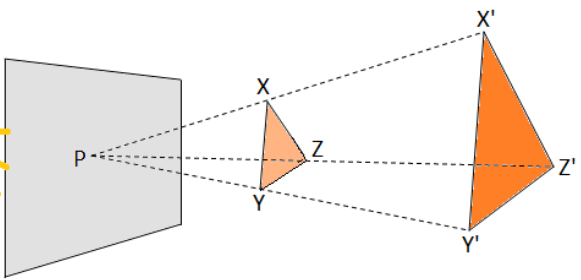
Let us cut a geometrical shape such as a triangle from a piece of cardboard. Hold those triangles one after the other between a point source of light and a wall. Check out the shadow cast by each figure on the wall. The shadows will have the same shapes as the original triangles but in a larger size. The shadows are said to be similar to the original triangles.

Enlargement Transformation 1

In the above figure, XYZ is a triangle and its shadow is X’Y’Z’.

We can say that ∠X = ∠X’, ∠Y = ∠Y’, ∠Z = ∠Z’

Two triangles are equiangular.

The shadow X’Y’Z’ is an enlarged image of XYZ. If the side X’Y’ = k x XY, Y’Z’ = k x YZ, Z’X’ = k x ZX

\(\frac { X’Y’ }{ XY } \) = \(\frac { Y’Z’ }{ YZ } \) = \(\frac { Z’X’ }{ ZX } \) = k

Here, k is the scale factor

The point p is the centre of enlargement.

Questions on Enlargement Transformation

Question 1:
A triangle ABC has been enlarged by a scale factor of 3 to a triangle A’B’C’. Find the length of A’B’ if AB = 5 cm and AC if A’C’ = 8 cm.

Solution:
Let \(\frac { A’B’ }{ AB } \) = \(\frac { B’C’ }{ BC } \) = \(\frac { A’C’ }{ AC } \) = k
\(\frac { A’B’ }{ AB } \) = k
\(\frac { A’B’ }{ 5 } \) = 3
A’B’ = 3 x 5 = 15 cm
\(\frac { A’C’ }{ AC } \) = k
\(\frac { 8 }{ AC } \) = 3
AC = 8 x 3 = 24 cm

Question 2:
A triangle XYZ has been enlarged to ∆X’Y’Z’ about the centre of enlargement O by a scale factor of 4.2. Find
(i) X’Y’ if XY = 5 cm
(ii) XZ if X’Z’ = 12 cm
(iii) OX’ and XX’ if OX = 2 cm

Solution:
(i) \(\frac { X’Y’ }{ XY } \) = k
\(\frac { X’Y’ }{ 5 } \) = 4.2
X’Y’ = 4.2 x 5
= 21
(ii) \(\frac { X’Z’ }{ XZ } \) = k
\(\frac { 12 }{ XZ } \) = 4.2
XZ = 12 x 4.2
= 50.4
(iii) \(\frac { OX’ }{ OX } \) = k
\(\frac { OX’ }{ 2 } \) = 4.2
OX’ = 4.2 x 2
= 8.4
XX’ = OX’ – OX = 8.4 – 2 = 6.4 cm

FAQ’s on Transformation Enlargement

1. What happens when a shape enlarge by a negative number?

An enlargement with a negative scale factor gives an image on the other side of the centre of enlargement.

2. What is the centre of enlargement?

Enlarging a shape changes its size. A centre of enlargement is required to enlarge a shape. When a shape is enlarged from a centre of enlargement, the distances from the centre to each point are multiplied by the scale factor.

3. Define scale factor?

The scale factor describes the size of enlargement or reduction of the shape. It is the ratio of a bigger size to a smaller size.

4. What are the types of transformations?

The different types of transformations are rotation, reflection, dilation, and translation.

Theorem on Isosceles Triangle

Theorem on Isosceles Triangle with Proof | Examples on Isosceles Triangle Theorem

Isosceles triangle theorem states that the angles opposite to equal sides of an isosceles triangle are also equal or vice versa. School going students who are learning the concept of geometry and measurement can get to know the complete details of the theorem on the isosceles triangle in the below-mentioned sections.

Theorem on Isosceles Triangle

The theorem of the isosceles triangle states that the equal sides of the isosceles triangle are produced beyond their common vertex to two different points such that the distance from the vertex to the points are equal and straight lines joining points and extremities of the base are equal. The complete proof for this statement is given here:

In ∆XYZ is an isosceles triangle with XY = XZ
XY and XZ are produced to A and B such that XA = XB. B, Y and A, Z are joined.
The above statement can be written as XY, XZ are the equal sides of the isosceles triangle XYZ and those equal sides are produced beyond the common vertex X to the points A and B such that XA and XB are equal. Show that BY is equal to AZ.
Theorem on Isosceles Triangle 1
To prove: BY = AZ.
Proof:

StatementReason
In ∆XBY and ∆XAZ,
XY = XZ
XB = XA
∠BXY = ∠AXZ
Given
Given
Vertically opposite angles
∆XBY ≅ ∆XAZSAS Criterion
BY = AZCPCTC

Hence proved.

Do Check:

Problems on Isosceles Triangle Theorem

Problem 1:
What is the value of x?
Theorem on Isosceles Triangle 2

Solution:
We know that angles opposite to the equal sides of an isosceles triangle are equal.
So, another base angle is 64°.
We also know that vertical angles are congruent in an isosceles triangle.
So, the remaining angle in the first triangle = 2x
The sum of the interior angles of a triangle is equal to 180 degrees
64 + 64 + 2x = 180
128 + 2x = 180
2x = 52
x = 26°

Problem 2:
Find the length of the altitude of an isosceles triangle whose side lengths are 3 cm, 5 cm and 5 cm.

Solution:
Given congruent sides are 5 cm and base is 3 cm
Let the congruent side be a and base is b
The formula to find the altitude of the isosceles triangle h = √(a² – \(\frac { b² }{ 4 } \))
= √(5² – \(\frac { 3² }{ 4 } \))
= \(\frac { √91 }{ 2 } \)
Therefore, the altitude of the triangle is \(\frac { √91 }{ 2 } \) cm

Frequently Asked Question’s

1. Are median, altitude is drawn on the base from the opposite vertex angle the same for an isosceles triangle?

Yes, the median and altitude of an isosceles triangle are the same if they are drawn from vertex angle to the base opposite to it.

2. Write the theorems related to the isosceles triangle?

The two important and basic theorems on the isosceles triangle are Angles opposite to the equal sides of an isosceles triangle are also equal. Another one is the sides opposite to the equal angles of the triangle are equal.

3. State one isosceles triangle theorem.

If two points on the base of an isosceles triangle are equidistant from the extremities of the base, then they are equidistant from the vertex.

Base of an Isosceles Triangle

Prove that If Points on the Base of an Isosceles Triangle Are Equidistant From Base Extremities, Then Equidistant From Vertex

In geometry, an isosceles triangle is a triangle that has two sides equal in measure. One of the theorems on the isosceles triangle states that if the provided two points on the isosceles triangle base are equidistant from the extremities of the base, then they are also equidistant from the vertex. Here we are giving detailed proof for the statement in the following sections of this page.

Points on the Isosceles Triangle Base are Equidistant From Vertex when Equidistant From Base Extremities

Here we will prove that if two points on the base of an isosceles triangle are equidistant from the extremities of the base, then they are equidistant from the vertex.

Consider ∆XYZ as an isosceles triangle and XY = XZ, M and N are the points on the base YZ so that YM = NZ
Points on the Base of an Isosceles Triangle 1

To prove: XM = XN
Proof:

StatementReason
In ∆XYM and ∆XNZ,
XY = XZ
YM = NZ
∠XYM = ∠XZN
Given
Given
Angles opposite to equal sides are equal
So, ∆XYM ≅ ∆XNZSAS Criterion
XM = XNCPCTC

Hence proved.

More Related Articles:

Example Questions on Isosceles Triangle Theorem

Question 1:
If the extremities of the base of an isosceles triangle are (2a, 0) and (0, a) and the equation of one side is x = 2a, find the area of the triangle?

Solution:
Let the vertices of triangle are A (2a, 0), B (0, a) and C (2a, t)
Given triangle is na isosceles triangle. So, AC = BC
√[(2a – 2a)² + (0 – t)²] = √[(0 – 2a)² + (a – t)²]
t = √(4a² + (a – t)²) = √(4a² + a² + t² – 2at)
t = \(\frac { 5a }{ 2 } \)
The coordinates of C are (2a, \(\frac { 5a }{ 2 } \))
The area of the triangle is = ±½| 2a  \(\frac { 5a }{ 2 } \)   1|
|2a   0   1|
|0   a   1|
= \(\frac { 5a² }{ 2 } \) sq units

Question 2:
The extremities of the base of isosceles triangle △ABC are A(3, 2) and B (1, 4). If the equation of the side AC is x = 5 then find the slope of the side BC.

Solution:
Given that,
The base points of isosceles triangle △ABC are A(3, 2) and B(1, 4)
So, AC = BC
The equation of side AC is x = 5
Let us take the vertex C as (5, a)
Equate the equal sides i.e AC = BC
√(3 – 5)² + (2 – a)² = √(1 – 5)² + (4 – a)²
√(4 + 4 + a² – 4a) = √(16 + 16 + a² – 8a)
-4a + 8a = 32 – 8
4a = 24
a = 6
Therefore, the vertex C is (5, 6)
The slope of BC = \(\frac { 6 – 4 }{ 5 – 1 } \)
= \(\frac { 2 }{ 4 } \) = ½

FAQ’s on Base of an Isosceles Triangle

1. Is the base of an isosceles triangle the shortest side?

The angles opposite to the congruent sides measure 80 degrees each. So, the angle opposite to the base is 20 degrees. This means the base may be the smallest side of the triangle.

2. If the two points on the isosceles triangle base are equidistance from its base extremities, then what is the distance between those points to the other vertex.

It is a proven statement if any two points on the base of an isosceles triangle are equidistant from its base extremities, then the distance between points and opposite vertex is also equal.

3. What are the properties of an isosceles triangle?

An isosceles triangle has two equal sides. The angles opposite to the equal sides are equal. The altitude from the apex of the triangle divides it into two congruent triangles.

Lines Joining the Extremities of the Base of an Isosceles Triangle

Prove that Straight Lines Joining the Extremities of the Base of an Isosceles Triangle to the midpoints of Opposite Sides are Equal

An isosceles triangle is a triangle that contains two sides of equal length, two angles opposite to those sides are equal in measure. We have provided proof for the many isosceles theorems and statements. Similarly, the proof for the statement straight lines joining the extremities of the base of an isosceles triangle to the midpoint of the opposite side are equal is given here.

Straight Lines Joining the Extremities of the Base of an Isosceles Triangle

Here we will prove that the straight lines joining the extremities of the base of an isosceles triangle to the midpoint of the opposite side are equal.

Let us take ∆XYZ, where XY = XZ
M, N are the midpoints of XY and XZ respectively
To prove: ZN = YM
Lines Joining the Extremities of the Base of an Isosceles Triangle 1
Proof:

StatementReason
XY = XZGiven
NY = ½XYN is the midpoint of XY
MZ = ½XZM is the midpoint of XZ
NY = MZFrom statements 1, 2, and 3
In ∆NYZ and ∆MYZ,
NY = MZ
YZ = YZ
∠XYZ = ∠XZY
From statement 4
Common side
XY = XZ
∆NYZ ≅ ∆MYZBy SAS Criterion
ZN = YMCPCTC

Hence proved.

Also, Check

Example Questions with Solutions

Question 1:
If △ABC is an isosceles triangle with base BC. The length of the median drawn from vertex C to the opposite side is 4 cm, then find what is the length of the median drawn from another vertex of the base.

Solution:
Given that,
△ABC is an isosceles triangle with base BC
The length of the median drawn from C to its opposite side = 4 cm
We know that straight lines joining the extremities of the base of an isosceles triangle to the midpoint of the opposite side are equal.
So, the length of another median drawn from vertex B to the opposite side = 4 cm

Question 2:
In an isosceles triangle, the length of the straight line drawn from one extreme base to the midpoint of the opposite side is 15 ft. Find the length of the line drawn from another base extreme.

Solution:
The length of the straight line extreme base to the midpoint of the opposite side = 15 ft
According to the isosceles triangle theorem,
The length of the straight line drawn from one extreme base to the midpoint of the opposite side = The length of a straight line drawn from the second extreme base to the midpoint of its opposite side
Therefore, the length of the line is drawn from another base extreme to the opposite side = 15 ft.

Frequently Asked Question’s

1. What is the base of an isosceles triangle?

In an isosceles triangle, the two equal sides are called legs and the third side is called the base.

2. What is the rule for an isosceles triangle?

The rule for an isosceles triangle is that the triangle must have two sides of equal length. The isosceles triangle theorem states that the angles opposite to the equal sides are also equal.

3. What is the median of a triangle?

Median of a triangle is the straight line that joins vertex to the midpoint of the side which is opposite to the respective vertex.

Problem on Two Isosceles Triangles on the Same Base

Problem on Two Isosceles Triangles on the Same Base | Proof for Isosceles Triangle Theorem

A triangle is a three-sided polygon that is having three sides, angles and vertices. An isosceles triangle is a triangle that has two sides of equal length and two angles of equal measure. Here we are providing the detailed proof for the statement If two isosceles triangles have the same base length, then the legs of one of the triangles are twice as long as the legs of the other.

If Two Isosceles Triangles on Same Base, Legs of One Triangle are Twice of Legs of Other

It is the proof for the statement Problem on Two Isosceles Triangles on the Same Base. The legs of one of the triangles are twice as long as the legs of the other.

Let us take two isosceles triangles △ABC and △BCD drawn on the same base BC and on the same side of it.
If A and D are joined, prove that each of the angles ∠BAC, ∠BDC will be divided by the line AD into two equal parts.
Problem on Two Isosceles Triangles on the Same Base 1
Given that,
AB = AC and BD = BC to prove ∠BAD = ∠CAD and ∠BDE = ∠CDE

StatementReason
In ∆ABC, ∠ABC = ∠ACB = x° (Assume)AB = AC
In ∆DBC, ∠DBC = ∠DCB = y° (Assume)DB = CD
∠ABC – ∠DBC = ∠ABC – ∠DCB = x° – y°Subtracting statement 2 from statement 1
Therefore, ∠ABD = ∠ACD = x° – y°From statement 3
In ∆ABD and ∆ACD
AB = AC
DB = DC
∠ABD = ∠ACD
Given
Given
From statement 4
∆ABD ≅ ∆ACDBy SAS Criterion
∠BAD = ∠CAD = z° (Suppose)CPCTC
∠BDE = ∠ABD + ∠BAD = x° – y° + z°The exterior angle of a triangle is equal to the sum of the interior opposite angles.
Similarly, ∠CDE = ∠ACD + ∠CAD = x° – y° + z°The exterior angle of a triangle is equal to the sum of the interior opposite angles.
∠BDE = ∠CDEFrom statements 8 and 9

Hence proved.

More Related Articles:

Problems on Two Isosceles Triangles on the Same Base

Problem 1:
How to find the lengths of the sides of the isosceles triangles on the same base, if their perimeters are 23 cm, 41 cm.

Solution:
Given that,
Let the sides of the smaller isosceles triangle be a, b, b
The perimeter of the smaller triangle = 23 cm
Two Isosceles Triangles have the same base. The legs of one of the triangles are twice as long as the legs of the other.
The sides of bigger isosceles triangles are a, 2b, 2b
Perimeter of the bigger triangle = 41 cm
a + b + b = a + 2b = 23 — (i)
a + 2b + 2b = a + 4b = 41 — (ii)
Subtracting (ii) from (i)
a + 4b – a – 2b = 41 – 23
2b = 18
b = 9
Substitute b = 9 in (i)
a + 2 x 9 = 23
a + 18 = 23
a = 23 – 18 = 5
Therefore, the sides of the smaller triangle are (5, 9, 9) and the bigger triangle is (5, 18, 18).

Problem 2:
If two isosceles triangles are on the same base. The perimeter of a bigger isosceles triangle is 80 cm, base of the triangles is 15 cm. Find a smaller triangle perimeter, sides of both triangles?

Solution:
Given that,
The perimeter of the bigger isosceles triangle = 80 cm
The base of the triangle a = 15 cm
Let the smaller isosceles triangle sides be a, b, b
Two Isosceles Triangles have the same base. The legs of one of the triangles are twice as long as the legs of the other.
Then, bigger triangle sides are a, 2b, 2b
The perimeter of larger triangle = 80 cm
a + 2b + 2b = 80 cm
15 + 4b = 80
4b = 65
b = 16.25
The smaller triangle perimeter = a + b + b = a + 2b
= 15 + 2 x 16.25 = 47.5 cm
The sides of the bigger triangles are (15, 32.5, 32.5), smaller triangles are (15, 16.25, 16.25).

Problems on Properties of Isosceles Triangles

Problems on Properties of Isosceles Triangles | Solved Questions on Isosceles Triangles

An isosceles triangle is a type of triangle that is having two sides of equal length, two equal angles. The sum of internal angles of a triangle is equal to 180°. Here we will learn about the properties of an isosceles triangle and problems on it from this page. The different types of questions and solutions on the isosceles triangle are along the lines.

Properties of Isosceles Triangle

Every isosceles triangle has the following properties.

  • It has two sides of equal length.
  • The unequal side of an isosceles triangle is called the base of the isosceles triangle.
  • The angles opposite to the equal sides are equal.
  • The angle which is not congruent to the two congruent base angles is called an apex angle.
  • The altitude drawn from the apex bisects the base into two equal parts and also divides the apex angle into two equal angles.
  • The altitude from the apex of an isosceles triangle divides the triangle into two congruent triangles.
  • The perimeter of the triangle = the sum of all three sides.
  • Area of an isosceles triangle = ½ x base x height.

Also, Read

Examples on Properties of Isosceles Triangles

Example 1:
Find the area, perimeter of an isosceles triangle whose equal sides and base length is 5 cm, 6 cm respectively.

Solution:
Given that,
Two equal sides of an isosceles triangle a = 5 cm
length of the base b = 6 cm
Perimeter of an isosceles triangle = a + a + b
= 5 + 5 + 6 = 16 cm
Area of an isosceles triangle A = \(\frac { b }{ 2 } \) √(a² – \(\frac { b² }{ 4 } \))
= \(\frac { 6 }{ 2 } \) √(5² – \(\frac { 6² }{ 4 } \))
= 3 √(25 – 9)
= 3 x √16 = 3 x 4 = 12 sq cm
Therefore, the perimeter, area of an isosceles triangle is 16 cm, 12 sq cm.

Example 2:
Find x° from the below figures.
Problems on Properties of Isosceles Triangles 1

Solution:
In ∆ABC, AB = AC
According to the theorem, Angles Opposite to Equal Sides of an Isosceles Triangle are Equal
Therefore, ∠ABC = ∠ACB = x°
The sum of internal angles in a triangle is 180 degrees
So, ∠BAC + ∠ABC + ∠ACB = 180°
76° + x° + x° = 180°
76° + 2x° = 180°
2x°= 180°- 76°
2x° = 104°
x° = 104/2 = 52
Therefore, the value of x° is 52°.

Example 3:
If an isosceles triangle has lengths of two equal sides 15 cm, base 8 cm and altitude are drawn from the apex to the base of the triangle. Then find its perimeter and area.

Solution:
Given that,
Two equal sides are 15 cm, the base is 8 cm
The area of an isosceles triangle formula is ½ x base x altitude
So first, find the altitude.
We know that the altitude from the apex divides the isosceles triangle into two equal right angles and bisects the base into two equal parts.
Using Pythagorean theorem
Hypotenuse² = base² + perpendicular²
Altitude = √(15² – 8²)
= √(225 – 64) = √161
= 12.68
Area of triangle = ½ x 8 x 12.68
= 50.72 sq cm
Perimeter of isosceles triangle = 15 + 15 + 8 = 38 cm
Therefore, area and perimeter of an isosceles triangle are 50.72 sq cm, 38 cm respectively.

Example 4:
△ABC, △BCD are isosceles triangles. Find ∠BDE.
Problems on Properties of Isosceles Triangles 2

Solution:
Given that,
△ABC, △BCD are isosceles triangles.
Angles Opposite to Equal Sides of an Isosceles Triangle are Equal
So, ∠CAB = ∠ABC
∠CAB + ∠ABC = 180° – 66°
2∠ABC = 114°
∠ABC = 57°
△BCD is a right isosceles triangle
∠CBD = ∠CDB = (180 – 90)/2 = 45°
∠ABC, ∠CBD and ∠DBE make a straight angle
So, ∠ABC + ∠CBD + ∠DBE = 180°
∠DBE = 180 – ∠ABC – ∠CBD
= 180° – 57° – 45° = 78°
DBE is a right triangle
So, ∠BDE = 90 – 78 = 12°

Example 5:
In the adjoining figure, it is given that XY = 4y, XZ = 7x, XA = 10x and XB = 12 + 2y. Find the values of x and y.
Problems on Properties of Isosceles Triangles 3

Solution:
Given that,
XY = XZ
4y = 7x
7x – 4y = 0 — (i)
XA = XB
10x = 12 + 2y
10x – 2y – 12 = 0 — (ii)
Multiply (ii) by 2
12x – 4y – 24 = 0 —- (iii)
Subtract (iii) from (i)
12x – 4y – 24 – 7x + 4y = 0
5x – 24 = 0
x = 24/5 = 4.8
Substituting x = 4.8 in (i)
7(4.8) – 4y = 0
33.6 = 4y
y = 8.4
Therefore, the values of x and y are 4.8, 8.4.

Example 6:
Find x° and y° from the given figure.
Problems on Properties of Isosceles Triangles 4

Solution:
In ∆XYP,
∠YXP = 180° – ∠QXY, as they form a linear pair.
∠YXP = 180° – 130°
∠YXP = 50°
It is given that, XP = YP
∠YXP = ∠XYP = 50°
The sum of three angles of a triangle is 180°
∠XPY + ∠YXP + ∠XYP = 180°
∠XPY = 180° – (∠YXP + ∠XYP)
∠XPY = 180° – (50° + 50°)
= 180° – 100°
∠XPY = 80°
Now, x° = ∠XPZ = 180° – ∠XPY (linear pair)
x° = 180° – 80°
x° = 100°
Also, in ∆XPZ we have,
XP = ZP
∠PXZ = ∠XZP = z°
Therefore, in ∆XPZ we have,
∠XPZ + ∠PXZ + ∠XZP = 180°
x° + z° + z° = 180°
100° + z° + z° = 180°
100° + 2z° = 180°
2z° = 180° – 100° = 80°
z° = 40°
Therefore, y° = ∠XZR = 180° – ∠XZP
y° = 180° – 40°
y° = 140°.

Sides Opposite to the Equal Angles of a Triangle are Equal

Theorem & Proof: Sides Opposite to the Equal Angles of a Triangle are Equal | Worked out Questions

A triangle is a closed polygon having three sides, three internal angles. While studying geometry and measurement, you can across some properties of a triangle that makes the concept more interesting. Here we are giving one of the isosceles triangle theorems that states that sides opposite to the equal angles of a triangle are equal. Check the following sections to know more about the concept.

Prove That Sides Opposite to the Equal Angles of a Triangle are Equal

Here we will prove that the sides opposite to the equal angles of a triangle are equal. We have already given the proof for the theorem Angles Opposite to Equal Sides of an Isosceles Triangle are Equal.

Proof:
Consider a triangle ABC, ∠CAB = ∠CBA
We have to prove AC = BC
Angles Opposite to Equal Sides of an Isosceles Triangle are Equal 1
Construction: Draw the bisector CD of ∠BCA so that it meets AB at a point D.

StatementReason
In ∆ACD and ∆BCD
∠CAB = ∠CBA
∠CAD = ∠CBD
CD = CD
Given
CD bisects ∠ACB
Common side
∆BCD ≅ ∆ACDAAS Criterion
AC = ADCPCT

Hence proved.

More Related Articles:

Solved Example Questions

Question 1:
If a : b : c = 2 : 3 : 4 and s = 27 inches, find the area of the triangle ABC.

Solution:
Given that,
a : b : c = 2 : 3 : 4
Let a = 2x, b = 3x, c = 4x
a + b + c = 2x + 3x + 4x = 9x
Therefore, 9x = 2s
9x = 2 x 27
x = 6
Therefore, the lengths of three sides are 2 x 6 = 12 inches, 3 x 6 = 18 inches, 4 x 6 = 24 inches.
Area of the triangle ABC = √(s(s – a)(s – b)(s – c))
= √(27(27 – 12)(27 – 18)(27 – 24))
= √(27 x 15 x 9 x 3)
= 27√15 sq inches

Question 2:
Find x° from the below figures.
Sides Opposite to the Equal Angles of a Triangle are Equal 1

Solution:
In ∆XYZ, XY = XZ.
angles opposite to equal sides of an isosceles triangle are equal
Therefore, ∠XYZ = ∠XZY = x°
∠YXZ + ∠XYZ + XZY = 180°
84° + x° + x° = 180°
2x° = 180° – 84° = 96
x° = 48°

FAQ’s on Isosceles Triangle Theorem

1. When two sides of the triangle are equal two of its angles are also?

In an isosceles triangle, if two sides of a triangle are equal, then two of its angles are also equal.

2. When the sides of one triangle are equal to the side of another triangle?

Two triangles are congruent if all the sides of one triangle are equivalent to the corresponding sides of another triangle?

3. What is the meaning of angle opposite to equal sides?

In an isosceles triangle, the angles opposite to equal sides are equal.

The Three Angles of an Equilateral Triangle are Equal

The Three Angles of an Equilateral Triangle are Equal with Proof | Questions on Equilateral Triangle

In geometry, a triangle with all three sides of equal length is called an equilateral triangle. In the word equilateral, the word equi means equivalent and lateral means sides. Isosceles triangle theorem states that each angle of an equilateral triangle measures 60 degrees or a triangle is called equilateral if it is equiangular. The proof for the statement of equiangular is given here.

Prove that Three Angles of an Equilateral Triangle are Equal

The following is the proof for the statement three angles of an equilateral triangle are equal.

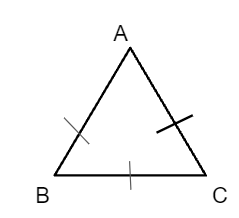
Given ABS is an equilateral triangle.
To prove: ∠ABC = ∠BAC = ∠ACB
The Three Angles of an Equilateral Triangle are Equal. 1

StatementReason
∠CAB = ∠ABCAngles opposite to equal sides BC and AC are equal
∠ABC = ∠ACBAngles opposite to equal sides AC and AB are equal
∠BAC = ∠ABC = ∠ACBFrom the above two statements

Hence proved.

Also, Check:

Note:
In an equilateral triangle ABC, let one angle be x°. Find the value of x°.
We know that the three angles of an equilateral triangle are equal.
So, ∠ABC = ∠BAC = ∠ACB = x°
The sum of 3 angles in a triangle si 180 degrees.
∠ABC + ∠BAC + ∠ACB = 180°
x° + x° + x° = 180°
3x° = 180°
x° = 180/3 = 60°
Therefore, each angle of an equilateral triangle is 60°.

Properties of an Equilateral Triangle

In an equilateral triangle, all three sides and angles are equal in measure. The value of each angle is 60 degrees, so it is called an equiangular triangle. Some of the properties of an equilateral triangle are provided here.

  • The sides of an equilateral triangle are equal.
  • It is a regular polygon with three sides.
  • Angles are congruent and are equal to 60 degrees.
  • The area of an equilateral triangle is √3side²/ 4 and the perimeter is 3side.
  • The sum of all interior angles of an equilateral triangle is 180 degrees.
  • Angle bisector, median and altitude of an equilateral triangle are the same.
  • Ortho-center, the centroid is at the same point.

Questions on Equilateral Triangle

Question 1:
What is the area, perimeter of an equilateral triangle, if the side length is 5 cm?

Solution:
Given that,
Length of the side = 5 cm
Area of an equilateral triangle = √3side²/ 4
= √3 x 5²/ 4
= 25√3/4
The perimeter = 3side
= 3 x 5 = 15
Therefore, the area, the perimeter of an equilateral triangle are 25√3/4 sq cm, 15 cm.

Question 2:
How to find the other two angles of an isosceles triangle if one angle is x°.

Solution:
Let the isosceles triangle be XYZ.
As it is an isosceles triangle, XY = XZ
And ∠XYZ = ∠XZY = x°
Take the unknown angle as y° = ∠ZXY
The sum of interior angles of a triangle is 180 degrees
∠XYZ + ∠XZY + ∠ZXY = 180
x° + x° + y° = 180
y° = 180 – 2x°
x° = (y° – 180)/2

FAQ’s on All Angles of an Equilateral Triangle are Same

1. Do equilateral triangles have 3 equal angles?

Yes, an equilateral triangle has three equal sides and equal angles. Every angle in an equilateral triangle is always 60 degrees.

2. Why all angles are equal in an equilateral triangle?

As equilateral triangles have sides of equal length, therefore three angles opposite to equal sides are also equal.

3. Are equilateral triangles equal to 180?

Equilateral triangles have 3 equal angles. The sum of interior angles of a triangle is 180 degrees. So, each angle must be equal to 60 degrees.

4. When three angles of a triangle are equal then what it is called?

If three angles of a triangle are equal then it is said to be an equilateral triangle or equiangular triangle.