Geometrical Property of Altitudes

Geometrical Property of Altitudes | Finding Altitudes of a Triangle – Properties, Formulas

A triangle is a three-sided, three angled polygon where the sum of internal angles is always 180 degrees. In a triangle, altitude is the line that begins from the vertex, extends to the opposite side of the triangle and forms a right angle with that side of the triangle. The geometrical properties of altitudes in different types of triangles are provided here. The high school students can learn the interesting topic about triangles from the following sections.

Geometrical Property of Altitudes

The altitude of a triangle is defined as the perpendicular line segment that is drawn from the vertex of the triangle to its opposite side. So, the altitude makes a right angle to the side of the triangle. Commonly, it is called the height of the triangle.

At times the opposite side is not enough long to draw an altitude, so we have to extend it to make an altitude possible. This line having the opposite side is called the extended base of the altitude. The point of intersection of altitude and the opposite side is called the foot of the altitude. The geometrical property of altitudes is along the lines:

  • If three altitudes of a triangle are concurrent. The point at which they meet is called the orthocentre of the triangle.
  • In a scalene triangle, none of the altitudes has the same length.
  • In an isosceles triangle, any two altitudes have the same length.
  • In an equilateral triangle, all three altitudes have the same length.
  • All the altitudes are inside the triangle for an acute triangle.
  • The altitude drawn from the obtuse vertex is inside the triangle, the other two altitudes connected to the acute vertices lie outside the obtuse triangle.
  • In a right triangle, the altitude perpendicular to the hypotenuse is inside the triangle and others are legs of the triangle.

Altitudes of Triangle – Definition, Properties

The altitude of a triangle is the line segment that joins vertex, opposite side at right angles. If all the altitudes meet at one point is called orthocenter O.

Triangle Altitudes

Properties of Altitude of Triangle:

  • All triangles have exactly 3 altitudes each from one vertex.
  • Altitude is the shortest distance from the vertex to its opposite side.
  • The triangle altitude may lie inside or outside the triangle.
  • The 3 altitudes always meet at a single point irrespective of triangle shape. That point is called the orthocenter of the triangle.

Altitude of Triangle – Formulas

The following are the formulas to find the height or altitude of the triangle.

  • The general formula is height = (2 x area)/base.
  • Equilateral Triangle: h = a√3/2
  • Isosceles Triangle: h = √(a² – b²/4)
  • Right Triangle: h = √(xy)
  • Scalene triangle: h = [2√[(s – a)(s – b)(s – c)]]/b

Frequently Asked Question’s on Altitude Geometrical Property

1. What is the altitude of a triangle?

The altitude of a triangle is the line segment that is drawn the vertex to the opposite side of the triangle. It is the perpendicular line that connects the base and opposite sides.

2. What is the property of altitude?

The altitude is the shortest distance from the vertex to its opposite side. It has 3 altitudes and all of them meet at one point called the ortho-centre of the triangle.

3. What is the difference between altitude and median?

The median is the line segment drawn from the vertex to the opposite side. The altitude is the perpendicular distance from the base to the opposite vertex. Median divides the triangle into two equal parts. Whereas altitudes do not divide the triangle into two equal parts.

Classification of Triangles

Classification of Triangles Based on Their Sides & Angles | Types of Triangles – Examples

In geometry, the triangle is a three-sided polygon that has three sides, three vertices and three angles. Here we will discuss classifying triangles on the basis of their sides and angles. Interested students can get the different types of triangles and their definitions with images in the following sections.

Classifying Triangles

A triangle is a closed figure made up of three line segments intersecting at their endpoints. Each triangle has three sides, three vertices and three interior angles. According to triangle sum theory, the sum of interior angles in a triangle is 180 degrees. Triangles are classified into three types on the basis of sides and interior angles.

The types of triangles based on their sides are listed here:

  • Equilateral Triangle
  • Isosceles Triangle
  • Scalene Triangle

The different types of triangles based on their interior angles are given here:

  • Acute Triangle
  • Right Triangle
  • Obtuse Triangle

Types of Triangles Based on Their Sides

The three types of triangles based on their sides are equilateral triangle, scalene triangle and isosceles triangle. The definition and other properties of each of them are given here.

  • Equilateral Triangle: A triangle that has all three sides of equal length, then it is called an equilateral triangle.
  • Isosceles Triangle: A triangle that has any two sides of equal length, then it is called an isosceles triangle.
  • Scalene Triangle: A triangle that has all three sides of different lengths, then it is called a scalene triangle.

Types of Triangles

Classification of Triangles Based on Their Angles

The classification of triangles on the basis of interior angles are provided here.

  • Acute Angles Triangle: It is a triangle that has all its angles are less than 90°.
  • Right Angled Triangle: It is a triangle where one of its angles is equal to 90° or right angle.
  • Obtuse Angled Triangle: It is a triangle that has any of its one angles more than 90°.

Classification of Triangles

Types of Triangles Based on Sides, Angles

Triangles are classified into various types based on their angles, sides as follows:

  • Equiangular or Equilateral Triangle: If all the sides and interior angles of a triangle are equal, then it is called an equilateral or equiangular triangle.
  • Obtuse Isosceles Triangle: A triangle that has 2 sides of equal length and one angle is greater than 90 degrees is called an obtuse isosceles triangle.
  • Acute Isosceles Triangle: A triangle that has one angle less than 90 degrees and any two sides of equal length is called an acute isosceles triangle.
  • Isosceles Right Triangle: When a triangle contains any 2 sides of equal length, one angle is right, then it is called an isosceles right triangle.
  • Right Scalene Triangle: A triangle that has all sides of different lengths, one angle is equal to 90 degrees is called a right scalene triangle.
  • Obtuse Scalene Triangle: A triangle that has one angle obtuse and sides of different lengths is called an obtuse scalene triangle.
  • Acute Scalene Triangle: A triangle contains 3 sides of different lengths, one angle is acute is called an acute scalene triangle.

The following are the important points that should be remembered while classifying the triangles.

  • All triangles have two acute angles.
  • The sum of internal angles is always 180 degrees.
  • In an equilateral or equiangular triangle, each angle is 60 degrees.

Examples on Classification of Triangles

Example 1:
Identify the type of the triangle, if one of its angles is 100° based on the type of triangle.

Solution:
Given that, one of the angles in the triangle is 100° which is greater than 90°.
If a triangle has one of its angles more than 90° means it is an obtuse-angled triangle.
So, it is an obtuse triangle and the other two angles are acute angles.

Example 2:
The side lengths of a triangle are different. Identify the type of triangle.

Solution:
Given that, all the sides of a triangle are different.
If a triangle that has all three sides of different lengths is called a scalene triangle.
So, it is a scalene triangle.

FAQ’s on Triangle Classification

1. What are the 3 triangle classifications?

Based on the sides, the triangles are classified into 3 types. They are Equilateral Triangle, Scalene Triangle, Isosceles Triangle.

2. Mention the classification of triangle based on its angle?

A triangle is classified into 3 types based on its angle. They are Acute Triangle, Obtuse Triangle, Right Triangle.

3. Can an acute triangle be an equilateral triangle?

Yes, but all cute triangles are not equilateral triangles. Because acute triangle means it must have one angle less than 90 degrees and equilateral or equiangular triangle means all its angles are 60 degrees.

4. Which types of triangles have 3 lines of symmetry?

Equilateral triangles have 3 lines of symmetry as three lines of symmetry can pass through the vertex of this triangle.

Geometry and Measurement – Definition, Lists, Examples | Triangles, Angles – Types, Properties

Every object in the world around us has a shape. Those shapes are described by maths geometry. School going 9th-grade math students can learn about the concept of geometry and measurement details. From this page, you can get the complete details about triangles, their types, angles, theorems, properties and many more.

What is Geometry and Measurement?

Geometry is a branch of mathematics that studies the shapes, sizes, positions and dimensions of various objects. The word geometry is derived from two Ancient Greek words Geo means Earth, metron means measurement. Geometric and spatial thinking is important as they connect the physical world, mathematics to develop and support arithmetic and number concepts and skills.

The different types of shapes in geometry is useful to understand the shapes in our day to day life. The 2 dimension geometry shapes are triangles, squares, rectangles, circles and other flat shapes. 3D shapes are cube, cuboid, cone, square pyramid, and so on. The basics of geometry depend on the angles, points, lines and planes.

Some of the important topics of geometry are discussed through the following links.

The various branches of geometry are along the lines:

  • Algebraic Geometry: It studies zeros the multivariate polynomial. Applications are cryptography, string theory and others.
  • Discrete Geometry: It deals with simple geometric objects.
  • Differential Geometry: It uses algebra and calculus for problem-solving.
  • Euclidean Geometry: It is the study of solid figures, planes and theorems. Applications in crystallography, computer science, etc.
  • Convex Geometry: It uses convex shapes in Euclidean space using techniques of real analysis.
  • Topology: It is concerned with the space properties under continuous mapping.

What are Triangles & Types?

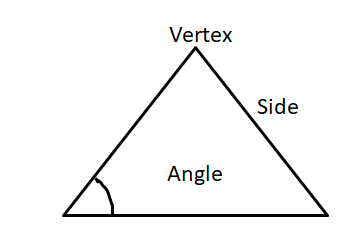
In geometry, a triangle is a type of polygon that is having three sides, three vertices and three angles. The important property of a triangle is the sum of the interior angles in it is always equal to 180 degrees. The point of intersection of two sides is called vertex and an angle is formed between two lines.

Triangle

The different types of triangles based on the sides and angles are given here.

  1. Equilateral Triangle: If all three sides, angles are equal, then it is an equilateral triangle.
  2. Isosceles Triangle: If any two sides are equal, then it is an isosceles triangle.
  3. Scalene Triangle: If all three sides measure different, then it is a scalene triangle.
  4. Acute-angled Triangle: It has all three angles are less than 90°.
  5. Obtuse-angled Triangle: It has one or more angles greater than 90°.
  6. Right-angled Triangle: Anyone angle in the triangle is right angle or 90°.

Properties of Triangles

If a geometric shape is called a triangle means it should follow all these properties without fail.

  • A triangle must and should have three sides, three angles.
  • The sum of the interior angles in a triangle is always 180 degrees.
  • The total of exterior angles of a triangle is 360 degrees.
  • The sum of the consecutive interior, the exterior angles is supplementary.
  • The shortest side of a triangle is always opposite to the smallest interior angle. Likewise, the longest side is opposite to the largest interior angle.
  • The difference between the lengths of any two sides of a triangle is less than the length of the third side. Similarly, the sum of the lengths of any two sides of a triangle is greater than the length of the third side.

Congruency of Triangles

Congruence is a term used to define an object and its mirror image. Two triangles are said to be congruent when all three corresponding sides, angles are equal in measure. There are four congruency rules that prove two triangles are congruent. Conditions for Congruence of Triangles are mentioned here:

  • SSS (Side-Side-Side)
  • SAS (Side-Angle-Side)
  • ASA (Angle-Side-Angle)
  • AAS (Angle-Angle-Side)
  • RHS (Right angle-Hypotenuese-Side)

Solved Examples

Example 1:
In ∆XYZ, ∠X = 80°, ∠Y = 50°. Find ∠Z.

Solution:
Given that,
∠X = 80°, ∠Y = 50°
In a triangle, the sum of interior angles is 180 degrees.
So, ∠X + ∠Y + ∠Z = 180°
80° + 50° + ∠Z = 180°
130° + ∠Z = 180°
∠Z = 180°- 130°
∠Z = 50°

Example 2:
If ∆ABC is a right angled triangle, ∠B = 40°. Find other two angles.

Solution:
Given that,
∆ABC is a right-angled triangle. So, any one angle is 90°.
∠B = 40°
In a triangle, the sum of interior angles is 180 degrees.
∠A + ∠B + ∠C = 180°
90° + 40° + ∠C = 180°
∠C = 180° – 130°
∠C = 50°

FAQ’s on Geometry & Measurement

1. What are the geometry applications?

Geometry is used in daily life. It has a wide range of applications in the field of construction, surveying, mapping, software industries and many more.

2. What are the different shapes in geometry?

The different shapes of geometry are lines, points, triangles, rectangles, squares, quadrilaterals, cone, cube, cuboid, square pyramid, pentagon pyramid and so on.

3. What are the angles in geometry?

In planar geometry, the angle is formed by joining two rays. The common end point of those rays is called the vertex of the angle. The four types of angles are obtuse angle, acute angle, right angle and straight angle.

Divisible by 9

Divisible by 9 | Divisibility Test for 9(Nine) | Divisibility Rule of 9 with Examples

Know the various problems on Divisibility Rules of 9 and get their solutions here. Follow the steps to divide a number by 9 and also know the cases in which it is divisible. Refer to various tricks and terms used in Divisibility Rules of 9 and make your practice efficient. Compare the problems with real-life situations and make the process easy. Refer to the entire article and become perfect in the concepts of divisibility test by 9, formulae, etc..

Also, Read:

Divisible by 9 | Test of Divisibility

The divisibility rule of 9 is the same as rule 3. The small technique to know if the digits are divisible by 9 is that we have to find the sum of digits and check if it is divisible by 9, then the number itself will be divided by the number 9.

For example, 83683 is the number, the sum of the digits is 28 which is not divisible by 9. Therefore, the number 83683 is also not divisible by 9.

How to find if the number is divisible by 9?

Condition 1: If it is a single-digit number
Step 1: In this step, we have to find if the number is a single digit.
Step 2: If the number is a single digit, then check if it is the multiple of 9.
Step 3: If it is a multiple of 9, then the number is divisible by 9 and the condition satisfies.
Else, If it is not a multiple of 9, then it is considered as the number that is not divisible by 9.

Condition 2: If it is a two-digit number
Step 1: If the number is of two digits, then we have to check if it is a direct multiple of 9.
Step 2: If it is a multiple of 9, then the number is divisible by 9 and the condition satisfies.
Else, If it is not the direct multiple of 9, then we have to follow the procedure given in the next step.
Step 3: In this step, we have to add the digits of a number.
Step 4: Now find if that resultant sum is divisible by 9.
Step 5: If the resultant sum is “9”, then the number is divisible by 9 and the condition satisfies.
Else, If the resultant sum is not “9”, then it is considered as the number that is not divisible by 9.

Condition 3: For numbers having more than two digits (Eg: 3, 4, or 5 digits)
The same procedure as of “Condition 2” should be followed for numbers having more than 2 digits.

Important Points to know if a number is divisible by 9

  • If it is said that the number is divisible by 9, then it means that it is exactly divided by 9 and leaves the remainder as 0.
  • A number is said to be divisible by 9, only and if its sum of digits is divisible by 9.
  • This technique works for all the numbers no matter how large they are.
  • If the resultant sum of digits is not a multiple of 9, then the number is either a multiple of 9 and hence it is not divisible of 9.

List of Numbers below 100 that are divisible by 9
There are 11 numbers below 100 which are divisible by 9. They are 9(nine), 18(eighteen), 27(twenty seven), 36(thirty six), 45(forty five), 54(fifty four), 63(sixty three), 72(seventy two), 81(eighty one), 90(ninety) and 99(ninety nine).
The other numbers apart from these 11 numbers are not divisible by 9.

Divisibility Test by 9 Examples

Problem 1:
Find if the number 467532 is divisible by 9?
Solution: 
Step 1: In the first step, you have to find if the number is a single-digit number.
As the number is 467532, it is not a single digit.
Step 2: If the number is not a single digit, then you must add all the digits.
In this step, we have to add each digit of number 467532.
i.e., 4 + 6 + 7 + 5 + 3 + 2 = 27
Step 3: If the resultant value is a two-digit number, then add those digits also
As the resultant sum is 27, we have to add both the digits
i.e, 2 + 7 = 9
Step 4: Check if the resultant number is a multiple of 9 or the number 9
The resultant number is 9
Step 5: If it is 9 or multiple of 9, consider the number as it is divisible by 9
The resultant number is 9, then it is considered as the number that is divisible by 9
By following all the steps above, we consider that 467532 is divisible by 9.

Example 2:
Find if the number 572563 is divisible by 9?
Solution:
Step 1: In the first step, you have to find if the number is a single-digit number.
As the number is 572563, it is not a single digit.
Step 2: If the number is not a single digit, then you must add all the digits.
In this step, we have to add each digit of number 572563.
i.e., 5 + 7 + 2 + 5 + 6 + 3 = 28
Step 3: If the resultant value is a two-digit number, then add those digits also
As the resultant sum is 28, we have to add both the digits
i.e, 2 + 8 = 10
Step 4: Check if the resultant number is a multiple of 9 or the number 9
The resultant number is 10
Step 5: If it is not 9 or multiple of 9, consider the number as it is not divisible by 9
The resultant number is 10, then it is considered as the number that is not divisible by 9

Example 3:
Find if the number 74 is divisible by 9?
Solution:
Step 1: In the first step, you have to find if the number is a single-digit number.
As the number is 74, it is not a single digit.
Step 2: If the number is not a single digit, then you must add all the digits.
In this step, we have to add each digit of the number 74.
i.e., 7 + 4 = 11
Step 3: If the resultant value is a two-digit number, then add those digits also
As the resultant sum is 11, we have to add both the digits
i.e, 1+ 1 = 2
Step 4: Check if the resultant number is a multiple of 9 or the number 9
The resultant number is 2
Step 5: If it is not 9 or multiple of 9, consider the number as it is not divisible by 9
The resultant number is 2, then it is considered as the number that is not divisible by 9

See More Divisibility Rules Related Articles:

Divisible by 2Divisible by 3Divisible by 4
Divisible by 5Divisible by 6Divisible by 7
Divisible by 8Divisible by 10
Patterns

Patterns in Math – Definition, Facts, Types, Examples | How to Solve Patterns in Math?

In mathematics, a pattern is a repeated arrangement of shapes, colors, numbers, and so on. These are also called a sequence. Students can get the different types of patterns and simple tricks to solve them in the following sections. Also, find the solved example questions on number patterns explained clearly on this page.

Also, Check:

Patterns in Mathematics

We can find many patterns in our daily life. We already know that pattern is an arrangement of objects, numbers, colors, images, in an order. If the set of numbers are related to each other in a specific rule then that rule is called a pattern. Patterns are finite or infinite numbers. Sometimes, patterns are also called a sequence.

The different types of patterns are number patterns, image patterns, logic patterns, letter patterns, word patterns, etc. Some of the examples of simple patterns are here.

Examples:
Set of Natural Numbers – 1, 2, 3, 4, . .
Set of even numbers – 2, 4, 6, 8, 10, . .
Set of odd numbers – 1, 3, 5, 7, . . .

Different Types of Patterns in Math

The three important types of patterns in mathematics are along the lines:

  • Repeating Pattern: A pattern in which the rule keeps repeating over and over is called a repeating pattern.
  • Growing Pattern: If the numbers are present in the increasing form, then the pattern is a growing pattern.
  • Shrinking Pattern: If the numbers are in the decreasing form, then it is a shrinking pattern.

The types of number patterns are arithmetic pattern, geometric pattern and Fibonacci pattern.

Tips & Tricks on How to Solve Patterns in Math?

The following are the simple tricks to compute the pattern. Students who are willing to create a new pattern can go through these steps.

1. Finding Missing Term: Let us take a pattern 2, 3, 5, 7, . . by observing this pattern, we can say that it is a pattern of prime numbers. The prime number that occurs after 7 is 11. So, the next term will be 11.

2. Difference Rule: Sometimes, it is easy to find the difference between two successive terms. Let us take a pattern 0, 5, 10, 15, . . . Here, the difference of successive pairs is 5. So, add 5 to the last term to get the next term.

Examples of Patterns in Math

Question 1:
Find the next image.
Patterns 1
Solution:
In the given pattern,
1st image has 1 circle
2nd image has 3 circles
3rd image has 5 circles
So, it is a set of odd numbers
The next image must have 7 circles.
Patterns 2

Question 2:
Find the next image of the following pattern

Solution:
In the given pattern,
1st image has 1 square
2nd image has 2 stars
3rd image has 3 squares
So, here we have square and stars one after the other and a set of natural numbers.
The next image must have 4 stars.

Question 3:
Write the next 3 terms of the pattern 7, 63, 619, 6175, . . .
Solution:
Given pattern is
7, 63, 619, 6175, . . .
By observing the pattern, we can say that
7 = 1 x 5 + 2
63 = 12 x 5 + 3
619 = 123 x 5 + 4
6175 = 1234 x 5 + 5
In, the same the next 3 terms of the pattern can be
5th term = 12345 x 5 + 6 = 61725 + 6 = 61731
6th term = 123456 x 5 + 7 = 617280 + 7 = 617287
7th term = 1234567 x 5 + 8 = 6172835 + 8 = 6172843
Therefore, the next three terms of the pattern are 61731, 617287, 6172843.

Question 4:
Complete the given series
(i) 1, 4, 9, 16, 25, . . .
(ii) 5, 55, 555, 5555, . .
(iii) 1, 2, 2, 3, 3, 3, 4, 4, 4, 4, . . .
(iv) 7, 13, 19, 25, . .
Solution:
(i) The given pattern is 1, 4, 9, 16, 25, . . .
By observing the pattern, we can say that
1st term = 1² = 1
2nd term = 2² = 4
3rd term = 3² = 9
4th term = 4²= 16
5th term = 5² = 25
6th term = 6² = 36
7th term = 7² = 49
8th term = 8² = 64
So, the series is 1, 4, 9, 16, 25, 36, 49, 64
(ii) The given pattern is 5, 55, 555, 5555, . .
By observing the pattern, we can say that every term is a divided of 5.
1st term = 5 ÷ 5 = 1
2nd term = 55 ÷ 5 = 11
3rd term = 555 ÷ 5 = 111
4th term = 5555 ÷ 5 = 1111
So, the remaining terms will be
5th term = 11111 x 5 = 55555
6th term = 111111 x 5 = 555555
7th term = 1111111 x 5 = 5555555
So, the series is 5, 55, 555, 5555, 55555, 55555, 555555, 5555555
(iii) The given pattern is 1, 2, 2, 3, 3, 3, 4, 4, 4, 4, . . .
By observing the pattern, we can say that each number written those many times
So, the series is 1, 2, 2, 3, 3, 3, 4, 4, 4, 4, 5, 5, 5, 5, 5, 6, 6, 6, 6, 6, 6, 7, 7, 7, 7, 7, 7, 7
(iv) The given pattern is 7, 13, 19, 25, . .
Find the difference between two successive terms
13 – 7 = 6
19 – 13 = 6
25 – 19 = 6
So, 5th term = 4th term + 6
= 25 + 6 = 31
6th term = 31 + 6 = 37
7th term = 37 + 6 = 43
So, the series is 7, 13, 19, 25, 31, 37, 43

Frequently Asked Questions on Patterns

1. What is a pattern rule in math?
In general, a numerical pattern is a series of numbers that is created based on a formula or method called the pattern rule. Pattern rule can use any number of mathematical operations to describe the relationship between the consecutive numbers.

2. What is a number pattern?
Number pattern is also a pattern that has numbers and develops the relationship between all numbers. The types of number patterns are arithmetic, geometric, cube numbers, square numbers, triangular numbers, Fibonacci numbers.

3. What are examples of patterns?
Some examples of patterns are 240, 120, 60, . .
The relation between numbers is 1st term divided by 2 gives the 2nd term
So, the next terms are 30, 15, 7.5, 3.75, . .
Another example is 8, 16, 24, . .
The relation between numbers is all the numbers are multiples of 8
So, the next terms are 32, 40, 48, . .

Factors and Multiples by using Multiplication Facts

Factors and Multiples by using Multiplication Facts | Examples on Finding Factors Using Multiplication Method

If you multiply a number by another number, the answer you get is called the product. The number being multiplied is called the multiplicand and the number multiplied is called the multiplier. Here, multiplicand and multiplier are the factors of the product. Students can learn about factors and multiples using the multiplication facts on this page.

More Related Articles:

Factors and Multiples by using Multiplication Facts

Multiplication is one of the basic arithmetic operations which is expressed as the repeated addition in short. Representing two numbers as a product is called the multiplication fact. We generally use the cross (x) symbol for multiplication. Any multiple has a finite number of factors.

Multiplication fact formula is multiplicand x multiplier = product or factor x factor = multiple. The numbers that are multiplied are called the factors of the multiple. Let us have a look at the examples for a better understanding.

Examples:
Multiply 4 by 7
4 x 7 = 28
4, 7 are the factors of multiple 28
Multiply 8 by 6
8 x 6 = 48
Here, 8 is the multiplicand, 6 is multiplier, and 48 is product
8, 6 are the factors of multiple 48

How to find Factors and Multiples Using Multiplication Facts?

Follow the simple guidelines to calculate the multiples and factors using multiplication facts and they are along the lines:

Factors

  • Write the multiple numbers.
  • Next, multiply the multiple by 1.
  • Get any two multiples of the multiple.
  • Repeat step 3 to get the numbers that can not be further divided.
  • The obtained multiples are called the factors of multiple.

Multiple

  • List the factors of the number.
  • Multiply all the factors.
  • The obtained product is called the multiple.

Using Multiplication Facts to find Factors and Multiples Examples

Question 1:
Find the factors of the multiple 48 by using 12 x 4 = 48
Solution:
Given multiplication fact is 12 x 4 = 48
By observing the question, 12 and 4 are the factors of 48
Using the multiplication method, 48 can be written as
1 x 48 = 48
2 x 24 = 48
3 x 16 = 48
4 x 12 = 48
6 x 8 = 48
So, the factors of 48 are 1, 2, 3, 4, 6, 8, 12, 6, 24, and 48.

Question 2:
Find the factors of the multiple 150 using 5 x 30 = 150
Solution:
Given multiplication fact is 5 x 30 = 150
By observing the multiplication fact, the factors of 150 are 30, 5
Using the multiplication method, 150 can be written as
1 x 150 = 150
3 x 50 = 150
5 x 30 = 150
6 x 25 = 150
10 x 15 = 150
So, the factors of 150 are 1, 3, 5, 6, 10, 15, 25, 30, and 150.

Question 3:
Find the multiplication fact for each division fact and write the factors of the multiple.
(i) 8 ÷ 1 = 8
(ii) 96 ÷ 12 = 8
(iii) 55 ÷ 5 = 11
Solution:
(i) Given division fact is 8 ÷ 1 = 8
The multiplication facts are 8 x 1 = 8, 1 x 8 = 8
Find the factors of 8 using the multiplication method.
1 x 8 = 8
2 x 4 = 8
4 x 2 = 8
8 x 1 = 8
Therefore, the factors of multiple 8 are 1, 2, 4, 8
(ii) Given division fact is 96 ÷ 12 = 8
The multiplication facts are 12 x 8 = 96, 8 x 12 = 96
Find the factors of multiple 96
1 x 96 = 96
2 x 48 = 96
3 x 32 = 96
4 x 24 = 96
6 x 16 = 96
8 x 12 = 96
12 x 8 = 96
16 x 6 = 96
24 x 4 = 96
32 x 3 = 96
48 x 2 = 96
96 x 1 = 96
The factors of 96 are 1, 2, 3, 4, 6, 8, 12, 16, 24, 32, 48, 96.
(iii) Given division fact is 55 ÷ 5 = 11
The multiplication facts are 5 x 11 = 55, 11 x 5 = 55
Find the factors of multiple 55
1 x 55 = 55
5 x 11 = 55
11 x 5 = 55
55 x 1 = 55
Therefore, the factors of 55 are 1, 5, 11, and 55.

Frequently Asked Question’s

1. What are factors in multiplication?
In a multiplication, the number that we multiply is called the fcators of the product. For example, 2 multipled by 3 gets 6 as product. 2 x 3 = 6, here 2 and 3 are factors of 6.

2. How do you explain factors and multiples?
A multiple is a number that can be divided by another number a certain number of times without remainder. A factor is a number that divides the multiple completely.

3. How many multiplication facts can we get from a division fact?
We can write exactly two multiplication facts for each division fact.

Factors and Multiples by using Division Facts

Factors and Multiples by using Division Facts – Definition, Examples | How to Get Factors, Multiples using Division Facts?

When a dividend divides the divisor completely, the quotient and divisor are called the factors of the dividend and the dividend called the multiple. We can also compute the factors of the multiple by using the division facts. Get the simple steps to get the multiples and factors by using the division fact along with the solved examples in the below sections.

Do Read:

Factors and Multiples by using Division Facts

In maths, a factor is a number that is an exact divisor with no remainder. Multiple is nothing but a number obtained when multiplied by other numbers. We use multiplication to find the multiples. Multiplication is the inverse operation of division. When a dividend is divided by a divisor, we get a quotient and the dividend is again divided by the quotient that gives the divisor.

We can use division facts to get the factor and multiples of the expression. The division fact formula is the dividend ÷ divisor = quotient. Here, quotient and divisor are the factors of the multiple dividend.

Examples:
Divide 64 by 4
64 ÷ 4 = 16
Here, 4 and 16 are factors of 64.
Divide 18 by 9
18 ÷ 9 = 2
Here, 9 and 2 are factors of 18.

Also, Check:

How to Find Multiples, Factors Using Division Facts?

Get a detailed explanation on how to find the factors of multiple using the division facts in the below sections.

  • Get the multiple by observing the division fact.
  • At, first divide the multiple by 1 and get the result.
  • Divide the multiple by another number which leaves the remainder zero.
  • Continue the process, till you get all the factors.

Examples on Finding Multiples and Factors Using Division Facts

Example 1:
Find the factors of the division fact 180 ÷ 6 = 30.
Solution:
Given division fact is 180 ÷ 6 = 30.
Multiple is 180
Find the factors of 180
180 ÷ 1 = 180
180 ÷ 2 = (18 ÷ 2) x 10 = 9 x 10 = 90
180 ÷ 3 = (18 ÷ 3) x 10 = 6 x 10 = 60
180 ÷ 4 = 45
180 ÷ 5 = 36
180 ÷ 6 = 30
180 ÷ 9 = 20
180 ÷ 10 = 18
180 ÷ 12 = 15
180 ÷ 15 = 12
180 ÷ 18 = 10
180 ÷ 20 = 9
180 ÷ 30 = 6
180 ÷ 36 = 5
180 ÷ 45 = 4
180 ÷ 60 = 3
180 ÷ 90 = 2
180 ÷ 180 = 1
The factors f 180 are 1, 2, 3, 4, 5, 6, 9, 10, 12, 15, 18, 20, 30, 36, 45, 60, 90, 180

Example 2:
Find the factors of 42.
Solution:
Given multiple is 42
Write the factors of 42 using the division fact.
42 ÷ 1 = 42
42 ÷ 2 = 21
42 ÷ 3 = 14
42 ÷ 6 = 7
42 ÷ 7 = 6
42 ÷ 14 = 3
42 ÷ 21 = 2
42 ÷ 42 = 1
So, the factors of multiple 42 are 1, 2, 3, 6, 7, 14, 21, and 42.

Example 3:
Is 500 is a multiple of 11? Use division.
Solution:
Given that,
Dividend = 500
Divisor = 11
Divide 500 by 11
Factors and Multiples by using Division Facts 1
500 ÷ 11 = 45 with a remainder of 5
It leaves a remainder, so 500 is not a multiple of 11.

Example 4:
Is 7 a factor of 21?
Solution:
Given that,
Dividend = 21
divisor = 7
divide 21 by 7
Factors and Multiples by using Division Facts 2
21 divided by 7 doesn’t leave a remainder.
So, 7 is a factor of 21.

FAQs’s on Factors and Multiples by using Division Facts

1. What is the division method?
The division is one of the basic arithmetic operations, which means repeated subtraction. The division method is used to split a group into a number of equal parts. The parts of division are dividend, divisor, remainder and quotient.

2. What is a basic division fact?
Division fact is nothing but a number that should be completely divisible by dividend to get the quotient. In division fact, the remainder is always zero. For any three numbers, it is possible to write exactly two division facts.

3. How do you factor a number by a division method?
Divide the multiple by the smallest possible number that divides the number exactly and repeat the process. The numbers that divide the multiple are called the factors.

Fractions in Ascending Order

Fractions in Ascending Order – Definition, Examples | How to Arrange Fractions in Ascending Order?

In math, the fraction is nothing but a ratio. Ascending order means arranging the fractions from the smallest to the greatest in value. We have two simple methods to arrange fractions in ascending order namely LCM Method and the Visualization Method. Get a detailed explanation of those methods along with the solved examples on how to write fractions in ascending order on this page.

More Related Articles:

Fractions in Ascending Order

A fraction is a part of a whole. The simple parts of the fraction are numerator, denominator and both are separated by division symbol (/). Ascending order of fractions means arranging the fractions in the order from the smallest to greatest of their value. The examples of the fractions in ascending order are provided here.

Example:
The ascending order of the fractions is \(\frac { 1 }{ 2 } \), \(\frac { 3 }{ 2 } \), \(\frac { 5 }{ 2 } \)

How to Order Fractions in Ascending Order?

Get step by step procedure to find the ascending order of the fractions in the following sections.

LCM Method:

  • Check out the fractions.
  • Find the L.C.M of denominators of all fractions to make the denominators same.
  • To make the given fractions as like fractions, divide the obtained L.C.M by the denominator of fractions, and then multiply both numerator and denominator with a number after dividing by L.C.M.
  • Compare the like fractions by comparing their numerators.
  • Arrange the given fractions in order from least to the greatest value.

Visualization Method:

  • Draw a graph for each of the given fraction.
  • Observe the drawn images carefully.
  • The graph which has the highest shaded region is the greatest fraction and the graph which has the lowest shaded region is the least fraction.
  • Now, arrange the fractions in ascending order.

Arranging Fractions in Ascending Order Examples

Question 1:
Arrange the given fractions in ascending order using the L.C.M method.
(i) \(\frac { 5 }{ 6 } \), \(\frac { 1 }{ 2 } \), \(\frac { 1 }{ 4 } \), \(\frac { 4 }{ 7 } \)
(ii) \(\frac { 7 }{ 10 } \), \(\frac { 1 }{ 8 } \), \(\frac { 6 }{ 5 } \), \(\frac { 5 }{ 3 } \)
Solution:
(i) The given fractions are
\(\frac { 5 }{ 6 } \), \(\frac { 1 }{ 2 } \), \(\frac { 1 }{ 4 } \), \(\frac { 4 }{ 7 } \)
Find the L.C.M of denominators
L.C.M of 6, 2, 4, and 7 is 84
Make the given fractions as like fractions
84 ÷ 6 = 14
\(\frac { 5 }{ 6 } \) x \(\frac { 14 }{ 14 } \) = \(\frac { 70 }{ 84 } \)
84 ÷ 2 = 42
\(\frac { 1 }{ 2 } \) x \(\frac { 42 }{ 42 } \) = \(\frac { 42 }{ 84 } \)
84 ÷ 4 = 21
\(\frac { 1 }{ 4 } \) x \(\frac { 21}{ 21 } \) = \(\frac { 21 }{ 84 } \)
84 ÷ 7 = 12
\(\frac { 4 }{ 7 } \) x \(\frac { 12 }{ 12 } \) = \(\frac { 48 }{ 84 } \)
The obtained like fractions are \(\frac { 70 }{ 84 } \), \(\frac { 42 }{ 84 } \), \(\frac { 21 }{ 84 } \), \(\frac { 48 }{ 84 } \)
Compare the numerators
21 < 42 < 48 < 70
The order of fractions is \(\frac { 21 }{ 84 } \)< \(\frac { 42 }{ 84 } \)<\(\frac { 48 }{ 84 } \)<\(\frac { 70 }{ 84 } \)
So, the ascending order of fractions is \(\frac { 1 }{ 4 } \)< \(\frac { 1 }{ 2 } \) < \(\frac { 4 }{ 7 } \) < \(\frac { 5 }{ 6 } \).
(ii) The given fractions are
\(\frac { 7 }{ 10 } \), \(\frac { 1 }{ 8 } \), \(\frac { 6 }{ 5 } \), \(\frac { 5 }{ 3 } \)
Find the L.C.M of denominators
L.C.M of 10, 8, 5, 3 is 120
Make the given fractions as like fractions
120 ÷ 10 = 12
\(\frac { 7 }{ 10 } \) x \(\frac { 12}{ 12 } \) = \(\frac { 84 }{ 120 } \)
120 ÷ 8 = 15
\(\frac { 1 }{ 8 } \) x \(\frac { 15}{ 15 } \) = \(\frac { 15 }{ 120 } \)
120 ÷ 5 = 24
\(\frac { 6 }{ 5 } \) x \(\frac { 24}{ 24 } \) = \(\frac { 144 }{ 120 } \)
120 ÷ 3 = 40
\(\frac { 5 }{ 3 } \) x \(\frac { 40}{ 40 } \) = \(\frac { 200 }{ 120 } \)
The obtained like fractions are \(\frac { 84 }{ 120 } \), \(\frac { 15 }{ 120 } \), \(\frac { 144 }{ 120 } \), and \(\frac { 200 }{ 120 } \)
Compare the numerators
15 < 84 < 144 < 200
The order of fractions is \(\frac { 15 }{ 120 } \) < \(\frac { 84 }{ 120 } \) < \(\frac { 144 }{ 120 } \) < \(\frac { 200 }{ 120 } \)
So, the ascending order of fractions is \(\frac { 1 }{ 8 } \) < \(\frac { 7 }{ 10 } \) < \(\frac { 6 }{ 5 } \) < \(\frac { 5 }{ 3 } \)

Question 2:
Find the ascending order of the following fractions.
\(\frac { 5 }{ 16 } \), \(\frac { 6 }{ 8 } \), \(\frac { 9 }{ 11 } \)
Solution:
The given fractions are \(\frac { 5 }{ 16 } \), \(\frac { 6 }{ 8 } \), \(\frac { 9 }{ 11 } \)
Draw a graph for each fraction.


Fractions in Ascending Order 3
By observing the shaded region of the fractions the order is \(\frac { 5 }{ 16 } \) < \(\frac { 6 }{ 8 } \) < \(\frac { 9 }{ 11 } \).

Comparison of Fractions having the Same Numerator

Comparison of Fractions having the Same Numerator – Definition, Examples | How to Compare Fractions with Like Numerators?

A fraction has two parts numerator and denominator which represent the part of a whole object. Here, we will learn about the steps to compare two fractions having the same numerator. Get the solved examples and two simple methods on comparing the fractions with the like numerator in the further section.

More Related Articles:

Comparing Fractions with the Same Numerator

A fraction is a part of the whole. Fractions are represented as numerator/denominator. Compare fractions having the same numerator means checking which fraction has the greatest value and which fraction has the least value.

How to Compare Fractions with the Same Numerator?

Here are the 2 simple methods to compare fractions with the same numerator value.

Method 1:

  • If all the fractions having the same numerator, then compare their denominators.
  • Write the denominators in ascending order.
  • The bigger denominator means the smaller fraction.
  • Arrange the fractions in ascending or descending order.

Method 2:

  • Get various fractions and all fractions must have the same numerator.
  • Represent those fractions visually.
  • The fraction which has the highest shaded region is the greatest fraction.

Examples on Comparing Fractions with the Same Numerator

Question 1:
Compare the below-provided fractions
(i) \(\frac { 1 }{ 2 } \), \(\frac { 1 }{ 3 } \), \(\frac { 1 }{ 5 } \), \(\frac { 1 }{ 6 } \)
(ii) \(\frac { 6 }{ 2 } \), \(\frac { 6 }{ 4 } \), \(\frac { 6 }{ 5 } \), \(\frac { 6 }{ 8 } \)
Solution:
(i) The given fractions are \(\frac { 1 }{ 2 } \), \(\frac { 1 }{ 3 } \), \(\frac { 1 }{ 5 } \), \(\frac { 1 }{ 6 } \)
As all the fractions have the same numerator, compare the denominators
2 < 3 < 5 < 6
The descending order of fractions is \(\frac { 1 }{ 6 } \) < \(\frac { 1 }{ 5 } \) < \(\frac { 1 }{ 3 } \) < \(\frac { 1 }{ 2 } \)
(ii) The given fractions are \(\frac { 6 }{ 2 } \), \(\frac { 6 }{ 4 } \), \(\frac { 6 }{ 5 } \), \(\frac { 6 }{ 8 } \)
As all the fractions have the same numerator, compare the denominators
2 < 4 < 5 < 8
The ascending order of the fractions are \(\frac { 6 }{ 2 } \) > \(\frac { 6 }{ 4 } \) > \(\frac { 6 }{ 5 } \) > \(\frac { 6 }{ 8 } \)

Question 2:
Compare the fractions by putting < or > or = symbol
(i) \(\frac { 2 }{ 7 } \), \(\frac { 2 }{ 5 } \), \(\frac { 2 }{ 3 } \)
(ii) \(\frac { 3 }{ 2 } \), \(\frac { 3 }{ 4 } \), \(\frac { 3 }{ 5 } \)
Solution:
(i) The given fractions are \(\frac { 2 }{ 7 } \), \(\frac { 2 }{ 5 } \), \(\frac { 2 }{ 3 } \)
As all the fractions have the same numerator, compare the denominators
7 > 5 > 3
The descending order of the fractions are \(\frac { 2 }{ 3 } \) > \(\frac { 2 }{ 5 } \) > \(\frac { 2 }{ 7 } \)
The ascending order of the fractions are \(\frac { 2 }{ 7 } \) < \(\frac { 2 }{ 5 } \) < \(\frac { 2 }{ 3 } \)
(ii) The given fractions are \(\frac { 3 }{ 2 } \), \(\frac { 3 }{ 4 } \), \(\frac { 3 }{ 5 } \)
As all the fractions have the same numerator, compare the denominators
2 < 4 < 5
The descending order of the fractions are \(\frac { 3 }{ 2 } \) > \(\frac { 3 }{ 4 } \) > \(\frac { 3 }{ 5 } \)
The ascending order of the fractions are \(\frac { 3 }{ 5 } \) < \(\frac { 3 }{ 4 } \) < \(\frac { 3 }{ 2 } \)

Question 3:
Compare the following fractions using the visualization method.
(a) \(\frac { 5 }{ 7 } \), \(\frac { 5 }{ 6 } \),
(b) \(\frac { 4 }{ 5 } \), \(\frac { 4 }{ 7 } \), \(\frac { 4 }{ 9 } \)
Solution:
(a) The given fractions are \(\frac { 5 }{ 7 } \), , \(\frac { 5 }{ 8 } \)
Represent all fractions visually
\(\frac { 5 }{ 7 } \) isComparison of Fractions having the Same Numerator 2
\(\frac { 5 }{ 6 } \) is Comparison of Fractions having the Same Numerator 3
\(\frac { 5 }{ 8 } \) is Comparison of Fractions having the Same Numerator 4
From the images, the fraction which has highest shaded region is \(\frac { 5 }{ 6 } \) > \(\frac { 5 }{ 7 } \) > \(\frac { 5 }{ 8 } \)
(b) The given fractions are \(\frac { 4 }{ 5 } \), \(\frac { 4 }{ 7 } \), \(\frac { 4 }{ 9 } \)
\(\frac { 4 }{ 5 } \) is
Comparison of Fractions having the Same Numerator 7
\(\frac { 4 }{ 9 } \) is
Comparison of Fractions having the Same Numerator 6
\(\frac { 4 }{ 7 } \) is
Comparison of Fractions having the Same Numerator 5
From the images, the fraction which has the highest shaded region is \(\frac { 4 }{ 5 } \) > \(\frac { 4 }{ 7 } \) > \(\frac { 4 }{ 9 } \)

Comparison of Unlike Fractions

Comparison of Unlike Fractions – Definition, Examples | How to Compare Fractions with Unlike Denominators?

We already know that fraction is a part of the whole. Unlike fractions means all the denominators of the fractions are different. Comparing fractions is helpful to find which is the bigger one and which is the smaller one. Find the definition, different methods to compare unlike fractions in the below sections. You can also get solved questions on the comparing unlike fractions on this page.

Also, Check:

Comparing Fractions with Unlike Denominators

A fraction has two parts they are numerator and denominator. The numerator is the number that is above the division symbol and the denominator is the number below the division symbol. A fraction can be defined as part of a whole also called a ratio. Unlike fractions are the fractions which are having different denominators.

Comparison of unlike fractions is nothing but determining which fraction is greater and which fraction is lesser one out of the given fractions.

Comparing Unlike Fractions Methods | How to Compare Unlike Fractions?

The four different methods of comparing unlike fractions are listed here:

  • L.C.M
  • Decimal Method
  • Cross Multiplication Method
  • Visualization

Check out the detailed steps of each of the method in the below-provided sections.

Comparing Unlike Fractions Using LCM

  • Take unlike fractions
  • Find the LCM of denominators
  • Make the unlike fractions as like fractions by multiplying the same number in the numerator, denominator.
  • Compare the numerators and fractions

Decimal Method to Compare Unlike Fractions

  • Write the given fractions in decimal form.
  • Compare the decimal values.
  • The fraction with a larger decimal value is the larger fraction.

Comparison of Unlike Fractions Using Cross Multiplication

  • The numerator of the first fraction should be multiplied by the denominator of the other fraction.
  • Compare the obtained values.
  • The larger value means the larger fraction.

Comparing Fractions Using Visualization 

  • Express the fraction using a graph or model.
  • The larger shaded area means a lesser fraction.

Examples on Comparison of Unlike Fractions

Example 1:
Compare the following fractions using the LCM method.
\(\frac { 1 }{ 2 } \), \(\frac { 5 }{ 3 } \), \(\frac { 2 }{ 7 } \), \(\frac { 6 }{ 4 } \)
Solution:
The given unlike fractions are \(\frac { 1 }{ 2 } \), \(\frac { 5 }{ 3 } \), \(\frac { 2 }{ 7 } \), \(\frac { 6 }{ 4 } \)
Find the L.C.M of denominators
LCM of 2, 3, 7, 4 = 84
So, make denominators of all fractions as
\(\frac { 1 }{ 2 } \) x \(\frac { 42 }{ 42 } \) = \(\frac { 42 }{ 84 } \)
\(\frac { 5 }{ 3 } \) x \(\frac { 28 }{ 28 } \) = \(\frac { 140 }{ 84 } \)
\(\frac { 2 }{ 7 } \) x \(\frac { 12 }{ 12 } \) = \(\frac { 24 }{ 84 } \)
\(\frac { 6 }{ 4 } \) x \(\frac { 21 }{ 21 } \) = \(\frac { 126 }{ 84 } \)
Now, all the fractions have the same denominator.
Compare numerators 24 < 42 < 126 < 140
The fractions comparison is \(\frac { 24 }{ 84 } \) < \(\frac { 42 }{ 84 } \) < \(\frac { 126 }{ 84 } \) < \(\frac { 140 }{ 84 } [/latex
The comparison of fractions is [latex]\frac { 2 }{ 7 } \) < \(\frac { 1 }{ 2 } \) < \(\frac { 6 }{ 4 } \) < \(\frac { 5 }{ 3 } \)

Example 2:
Which one is greater \(\frac { 5 }{ 3 } \) or \(\frac { 3 }{ 5 } \)?
Solution:
The given fractions are \(\frac { 5 }{ 3 } \), \(\frac { 3 }{ 5 } \)
Cross multiply the fractions
5 x 5 = 25
3 x 3 = 9
25 > 9
So, \(\frac { 5 }{ 3 } \) > \(\frac { 3 }{ 5 } \)
The greater fraction is \(\frac { 5 }{ 3 } \).

Example 3:
Which one is smaller \(\frac { 1 }{ 5 } \) or \(\frac { 6 }{ 7 } \)?
Solution:
Given fractions are \(\frac { 1 }{ 5 } \), \(\frac { 6 }{ 7 } \)
Find the decimal value of fractions.
\(\frac { 1 }{ 5 } \) = 0.2
\(\frac { 6 }{ 7 } \) = 0.85
0.85 > 0.2
So, \(\frac { 6 }{ 7 } \) > \(\frac { 1 }{ 5 } \)

Example 4:
Compare \(\frac { 2 }{ 3 } \), \(\frac { 7 }{ 9 } \) using visualisation.
Solution:
Given fractions are \(\frac { 2 }{ 3 } \), \(\frac { 7 }{ 9 } \)
The visual representation of \(\frac { 2 }{ 3 } \) is Comparison of Unlike Fractions 1
The visual representation of \(\frac { 7 }{ 9 } \) isComparison of Unlike Fractions 2
\(\frac { 2 }{ 3 } \) has lesser shaded region compared to \(\frac { 7 }{ 9 } \)
So, \(\frac { 2 }{ 3 } \) < \(\frac { 7 }{ 9 } \)