Applying Pythagoras’ Theorem

Applying Pythagoras’ Theorem – Proof, Formula | Questions on Applying Pythagorean Theorem

Pythagora’s theorem states that in a right-angled triangle the sum of the square of the two sides is equal to the square of the hypotenuse. This theorem is used to state whether the given triangle is a right triangle or not. Some of the real-time applications of the Pythagorean theorem is provided here. Get the proof of applying Pythagora’s theorem and solved problems on this page.

State & Proof Applying Pythagoras’ Theorem

Applying Pythagorean theorem states that if in ∆PQR, Q at a right angle, M and N are the midpoints of the sides PQ, QR, then PN² + RM² = 5MN².

Applying Pythagoras’ Theorem 1

Proof:
Let us take ∆PQR where ∠PQR = 90°.
Point M, N the midpoints of sides PQ, QR.
So, PM = MQ and QN = NR
Therefore, PQ = 2MQ and QR = 2QN
To prove: PN² + RM² = 5MN²

StatementReason
∆PQN, PQ² + QN² = PN²
(2MQ)² + QN² = PN²
4MQ² + QN² = PN²
By Pythagorean Theorem
PQ = 2MQ
∆RQM, MQ² + QR² = RM²
MQ² + (2QN)² = RM²
MQ² + 4QN² = RM²
By Pythogoras theorem
Given
5MQ² + 5QN² = PN² + RM²
5(MQ² + QN²) = PN² + RM²
Adding statements 1 and 2
5MN² = PN² + RM²Applying Pythagoras’ theorem in ∆QMN

Hence, proved.

Applications of Pythagoras Theorem

The applications of the Pythagorean theorem are listed here.

  • This Pythagoras theorem is commonly used to determine the lengths of sides of a right-angled triangle.
  • The theorem is used to find the diagonal length of a rectangle, square, others.
  • It is used in security cameras for face recognition.
  • This theorem is applied in surveying the mountains.
  • It is used in trigonometry to get the trigonometric ratios like sin, cos, tan, cos, sec, cot.
  • It is also used in navigation to find the shortest route.
  • By using the Pythagoras theorem, we can derive the formula, base, hypotenuse and perpendicular.
  • The theorem is used to calculate the steepness of slopes of hills or mountains.

Questions on Applying Pythagoras Theorem

Question 1:
In a right angle triangle ABC, ∠ABC = 90°, X and Y are the midpoints of the base and perpendicular sides. If AX = 5 cm, BY = 8 cm, find XY.

Solution:
Given that,
AX = 5 cm, BY = 8 cm
ABC is a right angle triangle, X and Y are the midpoints of the base and perpendicular sides
According to applying Pythagoras theorem AX² + BY² = 5XY²
Substitute the given values.
5XY² = 5² + 8²
5XY² = 25 + 64 = 89
XY² = 17.8
XY = 4.219
Therefore, XY = 4.219 cm.

Question 2:
If △PQR is a right triangle, M and N are the midpoints of two legs, the lengths of RM = 15 cm, MN = 20 cm. Find the length of PN.

Solution:
Given that,
△PQR is a right triangle
M and N are the midpoints of PQ and QR
RM = 15 cm, MN = 20 cm
By using applying Pythagoras theorem
PN² + RM² = 5MN²
PN² + 15² = 5(20)²
PN²+ 225 = 5(400)
PN² + 225 = 2000
PN² = 2000 – 225 = 1775
PN = 42.13
Therefore, the length of PN is 42.13 cm.

Frequently Asked Question’s

1. What is meant by the Pythagoras theorem?

The Pythagoras theorem states that in a right triangle, the sum of the square of the base and perpendicular is the square of the hypotenuse.

2. In which type of triangle does the Pythagoras theorem hold?

Right triangles hold the Pythagoras theorem.

3. What is the significance of the Pythagorean theorem?

After discovering Pythagorean theorem, Greeks prove that the existence of numbers that can’t be expressed as rational numbers. In a right triangle with a base, perpendicular 1 unit each is constructed then hypotenuse is √2 which is not a rational number.

4. Where did Pythagoras theorem come from?

The Pythagoras theorem was first discovered by the mathematician named Pythagoras.

Converse of Pythagoras’ Theorem

Converse of Pythagoras’ Theorem – Statement, Proof, Formula | Problems on Converse of Pythagorean Theorem

The converse of Pythagoras theorem is related to the right-angled triangles. It states that if the square of a side is equal to the sum of the squares of the remaining two sides, the triangle is the right-angled triangle. Here we are giving the proof, examples, formula, applications and problems related to the converse of Pythagoras’ theorem.

What is the Converse of Pythagoras’ Theorem?

The converse of Pythagoras theorem statement is in a triangle, if the square of one side is equal to the sum of the squares of the other two sides, then the angle opposite to the first side is a right angle and the triangle is called a right-angled triangle.

Pythagorean theorem states that the sum of the squares of the two legs is equal to the square of the hypotenuse of a right-angled triangle. And it can also be stated as if this relation satisfies, then it is a right-angled triangle. If the sides of the triangle are a, b, c and the condition is a² + b²= c², then the triangle is a right-angled triangle.

The converse of Pythagoras theorem formula is a² = b² + c².

Where,

a, b, c are the sides of the right-angle triangle.

Also, Check:

The Converse of Pythagorean Theorem Proof

Statement: If the length of the triangle is a, b, c and c² = a²+ b², then the triangle is a right-angled triangle.

Converse of Pythagoras’ Theorem 2

Proof:
Draw a triangle XYZ, such as XZ = AC = b and BC = YZ = a.
Converse of Pythagoras’ Theorem 1

In △XYZ, by Pythagoras Theorem:
XY² = XZ² + YZ² = b² + a² …………(1)
In △ABC, by Pythagoras Theorem:
AB² = AC² + BC² = b² + a² …………(2)
From equations (1) and (2), we have;
XY² = AB²
XY = AB
△ABC ≅ △XYZ (By SSS postulate)
∠G is the right angle
Thus, △XYZ is a right triangle.
Hence, we can say that the converse of Pythagorean theorem also holds.
Hence Proved.

Questions on Converse of Pythagoras’ Theorem

Question 1:
The sides are the triangle are 7, 11, and 13. Check whether the given triangle is a right triangle or not?

Solution:
Given that,
a = 7, b = 11, c = 13
By using the converse of Pythagoras’ theorem
c² = a² + b²
13²= 7²+ 11²
169 = 49 + 121
169 = 170
So, it is not satisfied with the above equation.
Therefore, the given triangle is not a right triangle.

Question 2:
If the sides of a triangle are in the ratio 13:12:5, prove that the triangle is a right triangle. Also, state which angle is the right triangle.

Solution:
Let the trinagle be ABC
The sides are AB = 12k, BC = 5k, AC = 13k
AB²+ BC² = (12k)² + (5k)²
= 144k² + 25k²
= 169k²
= (13k)²
= AC²
Therefore, by the converse of Pythagoras theorem, ABC is a right-angled triangle in which ∠B = 90°.

Question 3:
The side of a triangle is of length 8 cm, 15 cm and 17 cm. Is this triangle a right triangle? If so, which side is the hypotenuse?

Solution:
Given that,
a = 15 cm, b = 8 cm, c = 17 cm
According to the converse of Pythagoras theorem,
c² = a² + b²
17² = 15² + 8²
289 = 225 + 64
289 = 289
As the condition is satisfied. The triangle is a right-angled triangle.
The hypotenuse is the longest side. So, it is 17 cm.

FAQ’s on Converse of Pythagorean Theorem

1. What is the difference between the Pythagorean theorem and its converse?

The Pythagoras theorem is used to find the length of the missing side of a right triangle. Whereas the converse of the Pythagoras theorem is used to find if the triangle is a right-angled triangle or not.

2. How to find a hypotenuse?

The hypotenuse is the longest side of the right triangle or it is the side that is opposite to the 90 degrees of a triangle. From the Pythagoras theorem, hypotenuse = √[(base)² + (perpendicular)²].

3. What are the applications of the converse of Pythagora’s theorem?

The converse of Pythagora’s theorem is used to find whether the measurements of a triangle belong to the right triangle or not. You can also determine, three sides form a Pythagorean triplet.

Pythagoras’ Theorem

Pythagoras’ Theorem – Statement, Formula, Proof, Applications | Problems on Pythagorean Theorem

Pythagoras Theorem is a theorem that defines the relationship between the sides of a right-angled triangle. It is also called the Pythagorean theorem. According to the Pythagoras theorem, the square of the hypotenuse is the sum of the squares of the other two sides of the right-angled triangle. Get the Pythagorean theorem definition, formula, proof and example questions.

What is Pythagoras’ Theorem?

The Pythagoras theorem states that in a right-angled triangle, the square of the hypotenuse is equal to the sum of the squares of the other two sides. The sides of the right-angled triangle are base, perpendicular and hypotenuse. The hypotenuse is the longest side and is opposite to the 90° angle.

Pythagoras’ Theorem 2


This Pythagorean theorem is named after a Greek mathematician named Pythagoras. It is also known as the Pythagorean triple. Here, b is the hypotenuse, c is the perpendicular side and a is the base side.

More Related Articles:

Pythagorean Theorem Formula

The Pythagoras theorem formula states that in a right triangle ABC, the square of the hypotenuse is equal to the sum of the squares of the other two legs.

If AB, BC, AC are the sides of the triangle, then BC² = AB² + AC²

If a, b, and c are the sides of the triangle, then c² = a² + b². Here, AB is the base, AC is the perpendicular and BC is the hypotenuse.

Pythagoras’ Theorem Proof

The following is the proof for the Pythagoras theorem.

Given: Consider a right-angled triangle ABC, right-angled at B.

To prove: AC² = AB² + BC²

Construction: Draw a right-angled triangle ABC. Draw a perpendicular line BD meeting AC at point D

Pythagoras’ Theorem 3

Proof:

We know, △ADB ~ △ABC
So, \(\frac { AD }{ AB } \) = \(\frac { AB }{ BC } \) (Corresponding sides of similar triangles are equal)
AB² = AD x AC ——- (i)
Also, △BDC ~ △ABC
So, \(\frac { CD }{ BC } \) = \(\frac { BC }{ AC } \) (Corresponding sides of similar triangles are equal)
BC² = CD x AC ——- (ii)
Adding both equations
AB² + BC² = AD x Ac + CD x AC
AB² + BC² = AC(AD + CD) [AD + CD = AC]
AB² + BC² = AC²
Hence, the Pythagorean theorem is proved.

Applications of Pythagorean Theorem

The some of the applications of the pythagoras theorem are mentioned-here.

  • Face recognition in security cameras: We are more familiar with face recognition as it reduces the turmoil in investigating the crimes in the security areas.
  • Engineering and Construction fields: Most architects use the Pythagoras theorem to find the value as well as when length or breadth are known, it is easy to find the diameter of a particular sector.
  • Navigation: It’s an amazing fact but people travelling in the sea use this technique to calculate the shortest distance and route to proceed to their concerned places.
  • Woodworking and interior designing: If the cardboard being squared can be made into a triangle easily by cutting diagonally then very easily the Pythagoras concept can be applied.
  • Surveying: Surveyors use this techique to get the steep mountains region, knowing the horizontal region it would be easier for them to find the rest using the pythagoras concept.

Pythagorean Triple Questions

Question 1:
The sides of a triangle are 12, 5 and 13. Determine if it has a right angle or not.

Solution:
According to the Pythagoras Theorem, Hypotenuse² = Perpendicular² + Base²
Let, hypotenuse = 13, base = 12 and perpendicular = 5
13² = 5² + 12²
169 = 144 + 25
169 = 169
L.H.S = R.H.S
Therefore, the angle opposite to 13 units side is a right angle.

Question 2:
Aman, David, Noel were having a party at Noel’s house. After the party gets over, both went back to their respective houses. David’s house was 7 miles straight towards the east, from Noel’s house. Aman’s house is 8 miles straight south from Noel’s house. How far away were their houses?

Solution:
We can visualize this scenario as a right-angled triangle.
David, Aman are hypotenuses apart from each other.
Using the Pythagoras theorem: d² = 7² + 8²
d = 10.63
Therefore, the houses are 10.63 miles away from each other.

Question 3:
The hypotenuse, one leg of a right-angled triangle are 17 cm, 8 cm. Find the length of another leg.

Solution:
Given that,
Hypotenuse = 17 cm
Perpendicular = 8 cm
Base = b cm
As per Pythagorean Theorem, Perpendicular² + Base² = Hypotenuse²
8² + b² = 17²
64 + b² = 289
b² = 225
b = 15
Therefore, the length of the other leg is 15 cm.

FAQ’s on Pythagoras’ Theorem

1. What is the formula for Pythagoras theorem?

The formula for the Pythagoras theorem of a right-angled triangle is, c² = a² + b².

2. Who discovered Pythagoras theorem?

Pythagoras theorem was introduced by the Greek mathematician Pythagoras of Samos. He was an ancient Ionic Greek philosopher.

3. What is the use of the Pythagorean theorem?

The Pythagoras theorem works only for right-angled triangles. When any two values of the sides are known, then we can apply this rule to find the other side.

4. What is the rule for the Pythagorean theorem?

The Pythagorean theorem states that in any right triangle, the square of the length of the hypotenuse is equal to the sum of the squares of the lengths of the other two legs of the triangle.

AA Criterion of Similarly on Quadrilateral

AA Criterion of Similarly on Quadrilateral – Theorems & Proof | Problems on AA Similarly Criterion

A quadrilateral is a closed polygon that has four sides, four vertices. We can use theorems related to the AA criterion of similarly to explore the concept quadrilateral. Have a look at the following sections to know about the theorems on the angle-angle similarly criterion and the solved questions.

Theorems on AA Criterion of Similarly on Quadrilateral

Here we will provide the prove related to the theorems on the AA criterion of similarly.

Theorem 1: In quadrilateral ABCD, AB ∥ CD and O is the point of intersection of two diagonals, such that OA × OD = OB × OC.

Given: ABCD is a quadrilateral, the side AB is parallel to CD.
Point O is the intersection of two diagonals.

To Prove: OA × OD = OB × OC

AA Criterion of Similarly on Quadrilateral 1

Proof:

StatementReason
In ∆ABC, ∆BPC
∠ACB = ∠PCB
∠ABC = ∠BPC = 90°
Vertically opposite angles are equal
Alternate angles
∆OAB ∼ ∆OCDBy AA criterion of similarity
Therefore, \(\frac { OA }{ OC } \) = \(\frac { OB }{ OD } \)Corresponding sides of similar triangles are proportional

Hence, OA × OD = OB × OC.

More Related Articles:

Theorem 2: In quadrilateral PQRS, PQ ∥ RS. T is a point on PS. QT is joined and produced to meet RS produced at U, then \(\frac { PQ }{ SU } \) = \(\frac { PT }{ TS } \).

Given: PQRS is a quadrilateral, sides PQ and RS are parallel to each other. T is a point on the side PS.

Construction:
Let us take a quadrilateral PQRS, where PQ is parallel to RS.
Locate any point T on PS and join QT and extend it till U and U is a straight line extending from RS.
AA Criterion of Similarly on Quadrilateral 2

To Prove: \(\frac { PQ }{ SU } \) = \(\frac { PT }{ TS } \)

Proof:

StatementReason
In ∆PQT and ∆SUT,
∠PTQ = ∠STU
∠QPT = ∠TSU
Vertically opposite angles are equal
Alternate angles are equal
∆PQT ∼ ∆SUTBy AA criterion of similarity
Therefore, \(\frac { PQ }{ SU } \) = \(\frac { PT }{ TS } \)Corresponding sides of similar triangles are proportional

Hence, proved.

Questions on Quadrilateral AA Criterion of Similarly

Question 1:
In a quadrilateral PQRS, PQ is parallel to RS and the meeting point of diagonals. If OP = 20 cm, OR = 5 cm, OS = 6 cm, find OQ.

Solution:
Given that,
PQRS is a quadrilateral where PQ is parallel to RS
OP = 20 cm, OR = 5 cm, OS = 6 cm
According to the theorem on AA criterion on similarity on quadrilateral OP × OS = OQ × OR
20 x 6 = OQ x 5
120 = OQ x 5
OQ = 24
Therefore, OQ = 24 cm.

Question 2:
In quadrilateral ABCD, AB ∥ CD. P is a point on AD. BP is joined and produced to meet CD produced at U. If AB = 10 cm, DU = 5 cm, PD = 12 cm, find PA.

Solution:
Given that,
AB = 10 cm, DU = 5 cm, PD = 12 cm
ABCD is a quadrilateral, AB is parallel to CD
P is a point on AD. BP is joined and produced to meet CD produced at U
\(\frac { AB }{ DU } \) = \(\frac { AP }{ PD } \)
\(\frac { 10 }{ 5 } \) = \(\frac { AP }{ 12 } \)
2 = \(\frac { AP }{ 12 } \)
AP = 2 x 12 = 24

Frequently Asked Question’s

1. How to prove that two quadrilaterals are similar?

Two quadrilaterals are said to be similar quadrilaterals when the three corresponding angles are the same and two adjacent sides have equal ratios.

2. What is AA similarity criteria?

The AA criterion of similarity for triangles states that if all three angles of one triangle are equal to the corresponding three angles are equal, then the two triangles are similar.

3. What are the theorems related to AA criterion of similarly on quadrilaterals?

One theorem is any two sides of the quadrilateral are parallel, two diagonals are drawn. If the product of the diagonals meeting point to the two sides is equal to the product of the diagonals meeting point to other two sides.

Greater segment of the Hypotenuse is Equal to the Smaller Side of the Triangle

Statement & Proof for Greater segment of the Hypotenuse = Smaller Side of the Triangle

A right-angled triangle is a triangle that is having one angle equal to 90 degrees. Here we are giving one statement and proof related to the right-angled triangle statement. Get the example problems with solutions and many more useful details about the greater segment of the hypotenuse is equal to the small side of the right-angled triangle from the following sections.

Greater segment of the Hypotenuse is Equal to the Smaller Side of the Triangle

The statement is if a perpendicular is drawn from the right-angled vertex of a right-angled triangle to the hypotenuse and if the sides of the right-angled triangle are in continued proportion, then the greater segment of the hypotenuse is equal to the smaller side of the triangle.

The proof for the above statement is mentioned here.

Proof:
In ∆ABC, ∠ABC = 90°
BP ⊥ AC
AB < BC and BC < AC
Also, \(\frac { AB }{ BC } \) = \(\frac { BC }{ AC } \)
Greater segment of the Hypotenuse is Equal to the Smaller Side of the Triangle 1
To prove: AB = PC

StatementReason
In ∆ABC, ∆BPC
∠ACB = ∠PCB
∠ABC = ∠BPC = 90°
Common angle
Given
∆ABC ∼ ∆BPCBy AA criterion of similarity
So,Corresponding sides of similar triangles are proportional
But,Given
Therefore,From statements 3, 4
Therefore, AB = PCFrom statement 5

Hence proved.

Do Check:

Solved Questions

Question 1:
△ABC is a right-angled triangle where B has the right angle. Draw a line from B that is perpendicular to AC. If AB = 3 cm, BC = 6 cm, AC = 12 cm, find the length of the PC.
Greater segment of the Hypotenuse is Equal to the Smaller Side of the Triangle 3

Solution:
Given that,
△ABC is a right-angled triangle with B having a right angle.
AB = 3 cm, BC = 6 cm, AC = 12 cm
BP ⊥ AC, AB < BC and BC < AC
\(\frac { AB }{ BC } \) = \(\frac { BC }{ AC } \)
\(\frac { 3 }{ 6 } \) = \(\frac { 6 }{ 12 } \)
\(\frac { 1 }{ 2 } \) = \(\frac { 1 }{ 2 } \)
The greater segment of the hypotenuse is equal to the smaller side of the triangle
So, AB = PC
Therefore, PC = 3 cm

Question 2:
In ΔABC, D and E are points on the sides AB and AC respectively such that DE ∥ BC. If \(\frac { AD }{ DB } \) = \(\frac { 3 }{ 4 } \) and AC = 15 cm, find AE.

Solution:
According to the basic proportionality theorem,
\(\frac { AD }{ DB } \) = \(\frac { AE }{ EC } \)
AC = 15 cm
Let, AE = x and EC = 15 – x
\(\frac { 3 }{ 4 } \) = \(\frac { x }{ 15 – x } \)
3(15 – x) = 4x
45 – 3x = 4x
4x + 3x = 45
7x = 45
x = 6.43

FAQ’s on Greater segment of the Hypotenuse = Smaller Side of the Triangle

1. What are segments of a hypotenuse?

The hypotenuse of a right triangle is divided into 2 segments by the altitude to the hypotenuse. The sum of the greater segments on the hypotenuse of 2 dissimilar right triangles is equal to the perimeter of the triangle.

2. How are the hypotenuse and legs of the right triangle related?

In a right-angled triangle, the square of the hypotenuse is equal to the sum of the squares of the remaining legs.

3. What are two segments of the hypotenuse?

In a right angles-triangle, the altitude drawn from the right-angled side to the opposite side divides the hypotenuse into two segments.

Application of Basic Proportionality Theorem

Application of Basic Proportionality Theorem with Proof | Internal Bisector & Questions

The basic proportionality theorem was found by a famous greek mathematician Thales. It is also called the Thales theorem. According to the basic proportionality theorem, if a line is drawn parallel to one side of a triangle and intersect the other two sides, then the line divides the two sides in the same ratio. The application of BPT is given here for the sake of the students.

Application of Basic Proportionality Theorem

The application of the basic proportionality theorem states that the internal bisector of an angle of a triangle divides the opposite side in the ratio of the sides containing the angle.

The proof for the statement is mentioned here:

Given: XP is the internal bisector of ∠YXZ, intersecting YZ at P.
To prove: \(\frac { YP }{ PZ } \) = \(\frac { XY }{ XZ } \)
Application of Basic Proportionality Theorem 1
Construction: Draw ZQ ∥ XP such that ZQ meets YX produced at Q.
Proof:

StatementReason
∠YXP = ∠XQZXP ∥ QZ and YQ is a transversal
∠PXZ = ∠XZQXP ∥ QZ and XZ is a transversal
∠XQZ = ∠XZQ∠YXP = ∠PXZ
XQ = XZ∠XQZ = ∠XZQ
\(\frac { YX }{ XQ } \) = \(\frac { YP }{ PZ } \)XP ∥ QZ
\(\frac { YX }{ XZ } \) = \(\frac { YP }{ PZ } \)From Statement 4

Hence proved.

Also, See

Important Points:

  • The above statement is true for the external division also. So, \(\frac { YP }{ ZP } \) = \(\frac { XY }{ XZ } \)
  • Converse of the above proposition is also true. If P is the point on YZ such that \(\frac { YP }{ PZ } \) = \(\frac { XY }{ XZ } \), then XP bisects ∠YXZ internally or externally.

Solved Questions on Thales Theorem

Question 1:
In triangle ABC, DE || BC. If AD = x cm, DB = x-2 cm, AE = x +2, and EC = x-1 cm, then find the value of x.

Solution:
Given that,
In the ∆ABC, DE || BC
According to the basic proportionality theorem, \(\frac { AD }{ DB } \) = \(\frac { AE }{ EC } \)
Substitute the values in the above equation.
\(\frac { x }{ x-2 } \) = \(\frac { x+2 }{ x-1 } \)
x² – x = x² – 4
-x = -4
x = 4
Therefore, the value of x = 4.

Question 2:
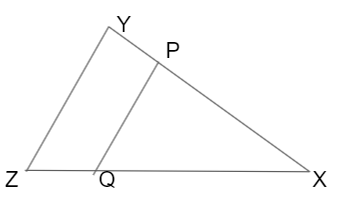
In a given ∆XYZ, the line PQ meeting the sides XY and XZ at P and Q respectively is parallel to YZ. If XP = 6 cm, XQ = 7.5 cm, PY = 2 cm, then find QZ.

Solution:
In ∆XYZ,
\(\frac { XP }{ PY } \) = \(\frac { XQ }{ QZ } \) (as per basic proportionality theorem)
\(\frac { 6 }{ 2 } \) = \(\frac { 7.5 }{ QZ } \)
3 = \(\frac { 7.5 }{ QZ } \)
QZ = \(\frac { 7.5 }{ 3 } \)
QZ = 2.5 cm

Question 3:
ABCD is a trapezium in which AB || DC and P,Q are points on AD and BC respectively, such that PQ || DC if PD = 18 cm, BQ = 35 cm and QC = 15 cm, find AD?

Solution:
Application of Basic Proportionality Theorem 2
Join D, B
Application of Basic Proportionality Theorem 3
In △DAB,
\(\frac { PD }{ PA } \) = \(\frac { DT }{ TB } \) —– (i)
In △DBC
\(\frac { BT }{ TD } \) = \(\frac { BQ }{ QC } \)
By taking the reciprocal on both sides
\(\frac { TD }{ BT } \) = \(\frac { QC }{ BQ } \) —- (ii)
Equating both statements
\(\frac { PD }{ PA } \) = \(\frac { QC }{ BQ } \)
\(\frac { 18 }{ PA } \) = \(\frac { 15 }{ 35 } \)
PA = 42
AD = 42 + 18
AD = 60 cm

FAQ’s on Application of BPT

1. What is the converse of the basic proportionality theorem?

The converse of basic proportionality theorem states that if a line divides any two sides of a triangle in the same ratio, then the line must be parallel to the third side.

2. How to use the BPT theorem?

According to Thales theorem, if a line is drawn parallel to one side of a triangle to intersect the other two sides in two different points then the other two sides are divided in the same ratio.

3. What is the application of the basic proportionality theorem?

One of the applications of BPT is the internal bisector of an angle of a triangle divides the opposite side in the ratio of the sides containing the angle.

Converse of Basic Proportionality Theorem

State & Prove Converse of Basic Proportionality Theorem | Solved Problems on Converse of BPT

The basic proportionality theorem or Thales theorem was introduced by a mathematician named Thales. The converse of Thales theorem is also true. Students who have already learnt about the Basic Proportionality Theorem related to similarity can check the statement and proof of the converse of BPT. Get the complete details about the converse of basic proportionality theorem in the following sections.

Statement of Converse of Basic Proportionality Theorem

According to the converse of basic proportionality theorem, if a line segment is drawn to cut two sides of the triangle in equal ratio, then it is parallel to the third side.

For example, in △ABC the line DE cuts the sides AB, AC in equal proportion. Such that DE is parallel to BC.

Basic Proportionality Theorem 1

Also, Check

Converse of Basic Proportionality Theorem Proof

The following is the proof for the statement of the converse of basic proportionality theorem.
Converse of Basic Proportionality Theorem 3

Given: In △ABC, the line DE cuts the sides AB, AC in equal proportion. \(\frac { AD }{ BD } \) = \(\frac { AE }{ CE } \)

Construction: In triangle ABC, draw a line that meets AB at point D, AC at point E. Also, draw a line DF.

Proof:

Consider DE is not parallel to the side BC. Hence let us draw another line DF which is parallel to BC.

By applying the basic proportionality theorem, \(\frac { AE }{ CE } \) = \(\frac { AF }{ CF } \)

Add 1 to both sides of the equation.

\(\frac { AE }{ CE } \) + 1 = \(\frac { AF }{ CF } \) + 1

\(\frac { AE + CE }{ CE } \) = \(\frac { AF + CF }{ CF } \)

\(\frac { AC }{ CE } \) = \(\frac { AC }{ CF } \)

Therefore, CE = CF

From the above statement, the points E and F are the same points and they coincide.

Hence the line DE is parallel to BC and it proves the converse of the basic proportionality theorem.

Problems Using Converse of BPT

Problem 1:
In a triangle ABC, D is a point on the side AB and E is a point on the side AC. And the lengths AB = 15 inches, AC = 17 inches, AD = 8 inches, AE = 7 inches. Is the line DE parallel to BC?
Converse of Basic Proportionality Theorem 1

Solution:
For the traingle ABC we have AB = 15 inches, AC = 17 inches, AD = 8 inches, AE = 7 inches
BD = AB – AD = 15 – 8 = 7 inches
CE = AC – AE = 17 – 7 = 10 inches
So, \(\frac { AD }{ BD } \) = \(\frac { 7 }{ 7 } \) = 1 and \(\frac { AE }{ CE } \) = 10/10 = 1. That means \(\frac { AD }{ BD } \) = \(\frac { AE }{ CE } \). Applying the converse of basic proportionality theorem, the line segment DE is parallel to the side BC of the triangle ABC.
∴ DE is parallel to BC

Problem 2:
P and Q are points on sides AB and AC respectively of △ ABC. For each of the following cases, state whether PQ ∥ BC. AP = 4cm, PB = 4.5 cm, AQ = 4 cm, QC = 5 cm.

Solution:
Given that,
AP = 4cm, PB = 4.5 cm, AQ = 4 cm, QC = 5 cm
To find PQ ∥ BC
\(\frac { AP }{ PB } \) = \(\frac { 4 }{ 4.5 } \) = \(\frac { 8 }{ 9 } \)
\(\frac { AQ }{ QC } \) = \(\frac { 4 }{ 5 } \)
\(\frac { AP }{ PB } \) ≠ \(\frac { AQ }{ QC } \)
Basic proportionality theorem states that if a line is drawn parallel to the one side of the triangle the other sides in various points, then the other two sides are divided in the same ratio.
PQ is not parallel to BC.

Problem 3:
ABCD is a trapezium in which AB || DC and its diagonals intersect each other at the point O. Show that \(\frac { AO }{ BO } \) = \(\frac { OC }{ OD } \).

Solution:
Converse of Basic Proportionality Theorem 2
Draw OM parallel to AB meeting BC at point M
In △ACB,
It is given that, OM is parallel to AB
\(\frac { OC }{ OA } \) = \(\frac { CM }{ MB } \) — (i)
In △BDC
OM is parallel to CD
\(\frac { BM }{ MC } \) = \(\frac { OB }{ OD } \)
By taking the reciprocals on both sides
\(\frac { CM }{ MB } \) = \(\frac { OD }{ OB } \) — (ii)
\(\frac { OC }{ OA } \) = \(\frac { OD }{ OB } \)
\(\frac { OC }{ OD } \) = \(\frac { OA }{ OB } \)
Hence proved.

Frequently Asked Question’s

1. What is the meaning of converse of BPT?

The converse of Thales theorem is if a line divides any two sides of a triangle in the same ratio, then the line must be parallel to the third side.

2. What is the difference between the basic proportion theorem and its converse?

Basic proportionality theorem is a line drawn parallel to one side of a triangle and cuts the other two sides in the same proportion. The converse of BPT is a line drawn to cut two sides of a triangle in the same ratio is parallel to the third side.

3. What is the BPT theorem?

Thales theorem states that a line drawn parallel to one side of a triangle and cutting the other two sides, divides the other two sides in equal proportion.

Basic Proportionality Theorem

Basic Proportionality Theorem – Statement, Examples, Proof | Solved Questions using Thales Theorem

The basic proportionality theorem was invented by the famous mathematician, Thales, so it can also be called as Thales theorem. According to the mathematician, for any two equilateral triangles, the ratio of any two corresponding sides of the given triangles are equal. This basic proportionality theorem was proposed on this concept. To know more about the BPT, check the following sections.

Basic Proportionality Theorem Definition

The basic proportionality theorem or Thales theorem states that the line drawn parallel to the one side of the triangle meets the other two sides at two points and divides the other two sides in equal proportion.

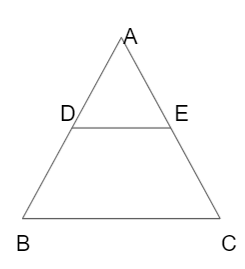
For example, in △ABC, DE is a line drawn parallel to the side BC, so that it joints the other two sides, AB and AC. According to basic proportionality theorem (BPT), it can be implied that \(\frac { AD }{ DB } \) = \(\frac { AE }{ EC } \).

Basic Proportionality Theorem 1

More Related Articles:

Proof of Basic Proportionality Theorem

The proof for the basic proportionality theorem (BPT) is provided here.

Given: Let us take a triangle ΔABC. We draw a line DE parallel to the side BC of ΔABC and cut the sides AB and AC at points D and E, respectively.

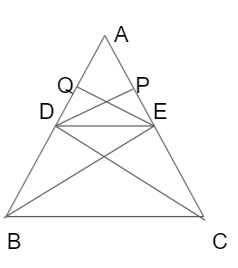
Construction: Create the imaginary lines in the triangle where you can connect C, D and B and E. Draw DP perpendicular to AE and E perpendicular to AD.

Basic Proportionality Theorem 2

Proof:

Consider the triangles ΔADE, ΔBDE. Both triangles have an equal height EQ, on the same base BC.

So, \(\frac { Area of ΔADE }{ Area of ΔBDE } \) = \(\frac { ½ x AD x EQ }{ ½ x BD x EQ } \)

\(\frac { Area of ΔADE }{ Area of ΔBDE } \) = \(\frac { AD }{ BD } \)

Now, consider the triangles ΔCDE, ΔADE. Both triangles have an equal height DP, on the same base AC.

\(\frac { Area of ΔADE }{ Area of ΔCDE } \) = \(\frac { ½ x AE x DP }{ ½ x CE x DP } \)

\(\frac { Area of ΔADE }{ Area of ΔCDE } \) = \(\frac { AE }{ CE } \)

Both triangles ΔBDE, ΔCDE are between the same set of parallel lines.

So, Area of ΔBDE = Area of ΔCDE

Therefore, \(\frac { Area of ΔADE }{ Area of ΔBDE } \) = \(\frac { Area of ΔADE }{ Area of ΔCDE } \)

\(\frac { AD }{ BD } \) = \(\frac { AE }{ CE } \)

Hence, proved.

Therefore, the line DE drawn parallel to the side BC of the triangle divides the two sides AB, AC in equal proportion.

Examples of Basic Proportionality Theorem (BPT)

Example 1:
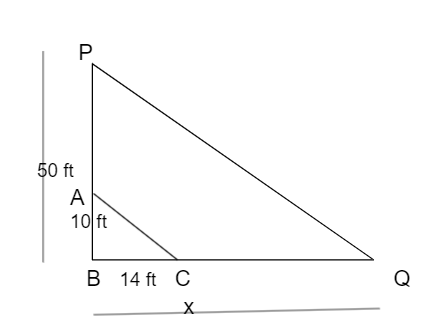
At a certain time of the day, a man, 10 feet tall, casts his shadow 14 feet long. Find the length of the shadow cast by a building 50 feet high, at the same time.

Solution:
Let the length of the shadow of the building be x.
Basic Proportionality Theorem 3
As source of light is sun, AB ∥ PQ and hence ∆BAC ∼ ∆BPQ
Therefore, \(\frac { Height of the man }{ Height of the building } \) = \(\frac { Length of the shadow cast by man }{ Length of shadow cast by the building } \)
\(\frac { 10 }{ 50 } \) = \(\frac { 14 }{ x } \)
x = 70 ft

Example 2:
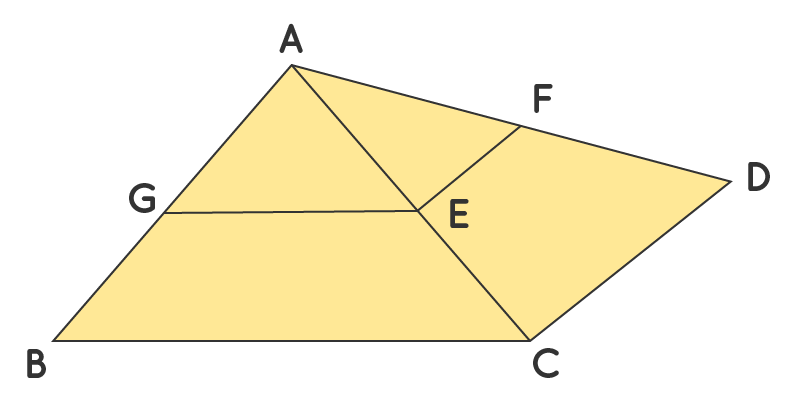
In the below figure GE//BC and EF//CD. Use basic proportionality theorem to prove AG/BG = AF/DF.

Solution:
In △ABC, we know that GE ∥ BC
Hence, \(\frac { AG }{ BG } \) = \(\frac { AE }{ CE } \)
Similarity, in △ACD we know that EF ∥ CD
So, by applying the basic proportionality theorem, \(\frac { AE }{ CE } \) = \(\frac { AF }{ DF } \)
From the above two statements, we can write that \(\frac { AG }{ BG } \) = \(\frac { AF }{ DF } \)
Hence, proved.

Example 3:
If in a ∆XYZ, P and Q are two points on XY and XZ respectively such that XP = 4 cm, PY = 3 cm, XQ = = 6 cm, QZ = 4.5 cm and ∠XPQ = 40° then find ∠XYZ.

Solution:
Given that,
XP = 4 cm, PY = 3 cm, XQ = = 6 cm, QZ = 4.5 cm and ∠XPQ = 40°
Here, \(\frac { XP }{ PY } \) = \(\frac { 4 }{ 3 } \)
\(\frac { XQ }{ QZ } \) = \(\frac { 6 }{ 4.5 } \) = \(\frac { 4 }{ 3 } \)
Therefore, \(\frac { XP }{ PY } \) = \(\frac { XQ }{ QZ } \)
PQ ∥ YZ
Therefore, ∠XYZ = ∠XPQ = 40°

Frequently Asked Question’s on Thales Theorem

1. What is the basic proportionality theorem formula?

The formula of basic proportionality theorem for a triangle ABC with points D, E on AB, AC sides and DE ∥ BC is \(\frac { AD }{ DB } \) = \(\frac { AE }{ CE } \).

2. What are the applications of the basic proportionality theorem?

The basic proportionality theorem helps to find the lengths in which two sides of a triangle are divided by a line drawn parallel to the third side. And it has applications to find the relationship between two equiangular triangles.

3. What does Thales theorem state?

Thales theorem states that when a line is drawn parallel to one side of a triangle and intersect the other two sides, then the line divides the two sides in the same ratio.

4. What is the corollary of the BPT theorem?

According to the BPT theorem, if a line divides any two sides of a triangle in the same proportion, then the line is parallel to the third side.

AA Criterion of Similarity

AA Criterion of Similarity with Proof | Solved Examples on AA Similarity Criteria

Two triangles are said to be similar if all the corresponding angles are congruent or all the corresponding sides ratios is proportional. We also have some similarity criterion theorems to prove that two triangles are similar to each other. One among those theorems is the AA Criterion of Similarity. The complete details about this Angle-Angle Similarity Criteria are provided below along with solved questions.

What is AA Similarity Criteria?

The AA criterion of similarity states that if the three angles of one triangle are equal to the three angles of the other triangle, then the two triangles are similar. It can also be stated as the equiangular triangles are similar.

The name of the theorem should be AAA(Angle-Angle-Angle) criterion, but it can be called as AA criterion as we require only two pairs of angles to be equal. So that the third pair will be automatically equal by the angle sum property of triangles.

AA Criterion of Similarity 1
In ΔABC, ΔPQR

  • ∠A = ∠P
  • ∠C = ∠R
  • ∠B = ∠Q

Using the AA criterion, ΔABC is similar to ΔPQR. So the corresponding sides are proportional.

\(\frac { AB }{ PQ } \) = \(\frac { BC }{ QR } \) = \(\frac { AC }{ PR } \)

More Related Articles:

AA Criterion of Similarity With Proof

Let us take two equiangular triangles ΔABC and ΔDEF
Given that,
∠A = ∠D, ∠B = ∠E and ∠C = ∠F
To prove: ΔABC ~ ΔDEF
Construction: Assume that AB > DE

  • Take a point X on AB so that AX = DE
  • Draw a line segment XY from X which is parallel to BC and meet AC at point Y.

AA Criterion of Similarity 2

Since XY ∥ BC,
So, ΔAXY ∼ ΔABC —– (i)
Now compare ΔAXY with ΔDEF
∠A = ∠D (given)
∠AXY = ∠E (XY ∥ BC)
AX = DE
By using ASA criterion, ΔAXY ∼ ΔDEF
ΔAXY ∼ ΔDEF —– (ii)
From (i) and (ii)
ΔDEF ∼ ΔABC.

Examples on Angle-Angle Criterion of Similarity

Example 1:
Show that both triangles are similar.
AA Criterion of Similarity 3

Solution:
Given two triangles are ΔABC, ΔBDE
∠E = 59°, ∠C = 59°
∠C = ∠E (Given)
∠B = ∠B (Common angle)
By using AA criterion of similarity, ΔABC ∼ ΔBDE.

Example 2:
In the two similar triangles PQR and XYZ, PM ⊥ QR and XN ⊥ YZ. Prove that \(\frac { PQ }{ XY } \) = \(\frac { PM }{ XN } \).

Solution:
Proof:

StatementReason
In ∆PQM and ∆XYN,
∠PQM = ∠XYN
∠PMQ = ∠XNY = 90°
Being similar triangles, they are equal.
Given
∆PQM ∼ ∆XYNBy AA criterion of similarity
\(\frac { PQ }{ XY } \) = \(\frac { PM }{ XN } \)Corresponding sides of similar triangles are proportional.

Example 3:
In a right-angled triangle, if a perpendicular is drawn from the right-angled vertex to the hypotenuse, the triangles on each side of it are similar to the whole triangle and to one another.

Solution:
Let XYZ be a right angle in which ∠YXZ = 90° and XM ⊥ YZ.
AA Criterion of Similarity 4

So, ∠XMY = ∠XMZ = 90°
To prove: ∆XYM ∼ ∆ZXM ∼ ∆ ZYX
Proof:

StatementReason
In ∆XYM and ∆XYZ,
∠XMY = ∠YXZ = 90°
∠XYM = ∠XMZ
Given
Common angle
Therefore, ∆XYM ∼ ∆ZYXBy AA criterion of similarity
In ∆XYZ and ∆XMZ,
∠YXZ = ∠XMZ = 90°
∠XZY= ∠XZM
Given
Common angle
Therefore, ∆ZYX ∼ ∆ZXMBy AA criterion of similarity
Hence, ∆XYM ∼ ∆ZXM ∼ ∆ZYX (Proved)From statements 2 and 4

Frequently Asked Question’s on AA Similarity Criteria

1. What is the difference between the AA and AAA similarity criterion?

According to AAA similarity criteria, if two triangles are equiangular, then they are similar. As per AA similarity, if two angles of the first triangle are equal to the two angles of another triangle, then they are similar.

2. What does AA similarity mean?

In two triangles, if two pairs of corresponding angles are congruent, then the triangleas are said to be similar.

3. Does the AA similarity criterion apply to quadrilaterals?

The AA similarity theorem does not apply to the quadrilaterals.

Criteria of Similarity between Triangles

Criteria of Similarity between Triangles – Examples | SAS, SSS, AA Theorems on Similar Triangles with Proof

Similar triangles are triangles that have the same shape, but their sizes may vary. Two triangles are said to be similar if they follow the conditions of similar triangles theorems. Check the different criteria of similarity between triangles along with proof. Also, get the solved example questions.

Criteria of Similarity between Triangles

Similar triangles are the triangles that look similar to each other but their sizes may vary. Two objects are called similar if they have the same shape irrespective of their size. To prove that the two triangles are similar, we need to follow some conditions. Those conditions are the different criteria for the similarity between triangles. The criterion of similarity statement with proof is mentioned here:

1. SSS Criterion of Similarity:

According to SSS (Side-Side-Side) Similarity criterion, if the corresponding sides of the ratio of two triangles are equal, then two triangles are similar to each other.

Criteria of Similarity between Triangles 1

In the above image, if \(\frac { AB }{ ZX } \) = \(\frac { BC }{ XY } \) = \(\frac { AC }{ ZY } \)

According to SSS similarity criteria, △ABC ~ △XYZ.

Also, Get

2. SAS (Side-Angle-Side) Criterion of Similarity:

SAS Similarity theorem states that, if any two sides of one triangle are in exact proportion to the two sides of the other triangle and the angle formed the two sides of the triangles are equal, then the triangles must be similar. This condition is applied only, when you know the measure of two sides and include the angle of both triangles.

Criteria of Similarity between Triangles 2

In the above image, if it is \(\frac { AB }{ PQ } \) = \(\frac { BC }{ QR } \) and ∠CBA = ∠RQP, then △ABC ~ △PQR as per SAS criterion of similarity.

3. AA (or AAA) or Angle-Angle Criterion of Similarity:

As per the Angle-Angle Similarity criterion, any two angles in the first triangle are equal to the corresponding angles of the second triangle, then those two triangles are similar triangles. This rule is applied when only we know the measure of the angles.

Criteria of Similarity between Triangles 3

In the image, If ∠B = ∠Q and ∠C = ∠R, then △ABC ~ △PQR according to the AA Similarity criterion.

Problems on Triangle Similarity Theorems

Problem 1:
A person is 120 in tall. He is standing 360 in away from the lamp post. His shadow from the light is 40 in long. Here lamp post is AB. How high is the lamp post?
Criteria of Similarity between Triangles 4

Solution:
Taking △ABD and △ECD, we can see that
∠B = ∠C = 90° and ∠D = ∠D (common angle)
By AA criterion of similarity, △ABD ~ △ECD
Therefore, \(\frac { AB }{ EC } \) = \(\frac { BD }{ CD } \) = \(\frac { AD }{ ED } \)
\(\frac { AB }{ 120 } \) = \(\frac { 360+40 }{ 40 } \)
AB = 1200
So, the height of the lamp is 1200 in.

Problem 2:
If ∆XYZ is similar to ∆PQR and XM, PN are corresponding medians of the triangles respectively, show that \(\frac { XY }{ PQ } \) = \(\frac { XM }{ PN } \).
Criteria of Similarity between Triangles 5

Solution:
In ∆XYM and ∆PQN,
∠Y = ∠Q
\(\frac { XY }{ PQ } \) = \(\frac { YM }{ QN } \) (∆XYZ ∼ ∆PQR and YM = ½YZ, QN = ½QR)
So, ∆XYM ∼ ∆PQN
Therefore, \(\frac { XY }{ PQ } \) = \(\frac { XM }{ PN } \)
Hence proved.

Problem 3:
Prove that ∆ABC ∼ ∆XYZ

Solution:
Given that,
AB = 5 in, BC = 2 in, AC = 7 in
XY = 6 in, XZ = 15 in, ZY = 21 in
\(\frac { AB }{ XZ } \) = \(\frac { 5 }{ 15 } \) = \(\frac { 1 }{ 3 } \)
\(\frac { BC }{ XY } \) = \(\frac { 2 }{ 6 } \) = \(\frac { 1 }{ 3 } \)
\(\frac { AC }{ ZY } \) = \(\frac { 7 }{ 21 } \) = \(\frac { 1 }{ 3 } \)
So, \(\frac { AB }{ XZ } \) = \(\frac { BC }{ XY } \) = \(\frac { AC }{ ZY } \)
Therefore, using SSS similarity criteria ∆ABC ∼ ∆XYZ.

FAQ’s on Criteria For Similarity Of Triangles

1. What are different similarity criteria?

The various similarity criterion of triangles of SSS similarity theorem, SAS similarity theorem and AA similarity theorem.

2. What are similar triangles?

Two triangles are similar when they have the same ratio of corresponding sides and equal pair of corresponding angles.

3. How to find the missing side of similar triangles?

The missing side of a similar triangle can be found by comparing the ratio of the corresponding sides of the triangles. We compare the ratios to get the length of the unknown side of the triangle.