Equal Sides of an Isosceles Triangle

Theorem, Proof of Equal Sides of an Isosceles Triangle are Produced, the Exterior Angles are equal

An isosceles triangle is a special kind of triangle that has two sides of equal length, no matter in what direction the peak of the triangle points. The important properties of an isosceles triangle are it has two equal sides, two equal angles (base angles). According to the isosceles triangle theorem if equal sides of an isosceles triangle are produced, then the exterior angles are equal. The detailed proof for the statement is given here.

Equal Sides of an Isosceles Triangle are Produced, Exterior Angles are Equal

Here is the proof of the statement of equal sides of an isosceles triangle are produced, the exterior angles are equal and obtuse.

Proof:
Let us take an isosceles triangle ABC. The equal sides AB, AC are produced to D and E.
To prove: ∠CBD = ∠BCE.
Equal Sides of an Isosceles Triangle 1

StatementReason
∠ABC = ∠ACBAngles opposite to equal sides are equal
∠CBD = 180 – ∠ABCLinear pair
∠BCE = 180 – ∠ACBLinear Pair
∠BCE = 180 – ∠ABCAngles opposite to equal sides are equal
Therefore, ∠CBD = ∠BCEFrom 2 & 4 statements

Hence, proved.

More Related Articles:

Problems on Isosceles Triangle

Problem 1:
If the two equal sides of an isosceles triangle are 3x – 1, 2x + 2. The third side is 2x. Find the value of x and the perimeter of the triangle.

Solution:
Given that,
Equal sides of an isosceles triangle are 3x – 1, 2x + 2. So, equate them.
3x – 1 = 2x + 2
3x – 2x = 2 + 1
x = 3
Third side of an isosceles triangle is 2x
Third side = 2 x 3 = 6
First two sides are 3x – 1, 2x + 2
= 3(3) – 1, 2(3) + 2
= 9 – 1, 6 + 2
= 8, 8
Perimeter of the triangle = 8 + 8 + 3
= 19.
Therefore, the value of x is 3 units, perimeter of the triangle is 19 units.

Problem 2:
The base BC of triangle ABC has produced both ways and the measure of exterior angles formed are 94°, 126°. Find ∠BAC.

Solution:
Given that,
Base = BC
∠ACD = 126°, ∠ABE = 94°
We know that,
∠ABE + ∠ABC = 180°
∠ABC = 180° – ∠ABE = 180° – 94°
= 86°
Again, ∠ACB + ∠ACD = 180°
∠ACB = 180° – ∠ACD = 180° – 126°
= 54°
In ΔABC
∠ABC + ∠ACB + ∠BAC = 180°
86° + 54° + ∠BAC = 180°
∠BAC = 180° – 140° = 40°

Freuently Asked Question’s

1. What are the rules of an isosceles triangle?

In an isosceles triangle, two sides are congruent, the third side is called the base. Two angles opposite to equal sides are congruent.

2. What two angles are equal in an isosceles triangle?

Two sides are equal in the measure in an isosceles triangle called legs. The angles opposite to legs are also equal.

3. What happens when equal sides of an isosceles triangle are produced?

If the equal sides of an isosceles triangle are produced, then the exterior angles are equal and obtuse.

4. What are the 3 properties of an isosceles triangle?

  • It has two sides of equal length.
  • The angles opposite to equal sides are equal in measure.
  • The altitude from one vertex to the base is the perpendicular bisector of the base.
Angles Opposite to Equal Sides of an Isosceles Triangle are Equal

Theorem , Proof of Angles Opposite to Equal Sides of an Isosceles Triangle are Equal | Sample Questions

As we already know a triangle is a three-sided polygon having three angles, vertices and sides. Isosceles Triangle is one of the types of triangles which has two sides of equal length. You have learned about the classification of triangles on the basis of their sides and got the different types of triangles. Check the isosceles triangle theorem statement and proof in the following section.

Angles Opposite to Equal Sides of an Isosceles Triangle are Equal

An isosceles triangle has two equal sides and two equal angles (base angle). When one of the angles of the isosceles triangle is 90°, then it is called the right isosceles triangle.

The first isosceles triangle theorem states that Angles Opposite to Equal Sides of an Isosceles Triangle are also Equal.

Proof: Consider an isosceles triangle ABC where AC = BC

We have to prove that the angles opposite to the sides AC, BC are equal, that is, ∠CAB = ∠CBA.

Angles Opposite to Equal Sides of an Isosceles Triangle are Equal 1

Draw an angle bisector from vertex C to the opposite side CD.
In ∆ACD and ∆BCD
AC = BC                       [Given]
∠ACD = ∠BCD            [Angle bisector divides the angle into two equal parts]
CD = CD                      [Common side]
So, ∆ACD ≅∆BCD       [By SAS congruence criterion]
Thus, ∠CAB = ∠CBA    [By CPCT]
Hence proved, that the angles opposite to equal sides of an isosceles triangle are equal.

Note: The converse of this isosceles triangle theorem is also true i.e the sides opposite to equal angles of a triangle are also equal.

Do check:

Example Problems on Isosceles Triangle Theorem

Problem 1:
The perimeter of ∆ABC is 15 cm, ∠ABC = ∠ACB, and the length of base BC is 5 cm. Find the length of sides AB, AC.

Solution:
Given that,
BC = 5 cm
Perimeter of ∆ABC = 15 cm
∠ABC = ∠ACB, by applying the isosceles triangle thorem, the sides opposite to equal angles of a triangle are equal.
So, length of sides AB = AC
Let us take AB length as s
Perimeter of ∆ABC = AB + BC + CA
15 = x + 5 + x
15 = 2x + 5
15 – 5 = 2x
10 = 2x
x = 5
Therefore, the length of sides AB and AC are 5 cm, 5 cm respectively.

Problem 2:
If the area of an isosceles triangle is 120 sq cm, the base length is 10 cm. Find the other sides length, the height of the triangle.

Solution:
Given that,
The base length of triangle b = 10 cm
Area of an isosceles triangle = 120 sq cm
Let h be the height of the isosceles triangle
Area of an isosceles triangle A = ½bh
120 = ½ x 10 x h
120 = 5 x h
h = 120/5
h = 24
The height line is also called the angle bisector.
According to the isosceles triangle theorem, the sides opposite to equal angles of a triangle are equal.
Using the Pythagorean theorem, side² = ½base² + height²
side² = (½ x 10)² + 24²
= 25 + 576 = 601
side = 24.5
Therefore, the side length, height of the isosceles triangle are 24.5 cm, 24 cm.

FAQ’s on Isosceles Triangle Theorem

1. In which triangle angles opposite to equal sides are equal?

In an isosceles triangle, the angles opposite to equal sides are also equal.

2. Is opposite angles of a triangle equal?

The sides opposite to equal angles of a triangle are equal.

3. How many sides isosceles triangle are equal?

Two sides of an isosceles triangle are equal.

Application of Congruency of Triangles

Application of Congruency of Triangles | Solved Questions on Congruence of Triangles Applications

Triangles are said to be congruent if they satisfy the conditions of CPCT. CPCT means corresponding parts of congruent triangles. While learning the geometry and measurement topic, you must know the criteria for congruency of triangles and applications of congruence of triangles. Read this complete page to get more useful details about the conditions for triangle congruence applications.

Congruency of Triangles

Two triangles are said to be congruent when their corresponding sides, corresponding angles are congruent. Congruent means figures or shapes can be flipped, rotated to coincide with the other shapes. The following are the criteria for congruency that are used to prove that two triangles are congruent.

  • SSS (Side-Side-Side): If any two triangles have three pairs of congruent sides, then those triangles are congruent to each other.
  • SAS(Side-Angle-Side): If two triangles have two pairs of congruent sides, congruent included angle (the angle between the congruent sides), then the triangles are said to be congruent.
  • AAS (Angle-Angle-Side): If two triangles have two pairs of congruent angles, and a non-common side in one triangle is congruent to the corresponding side in another triangle, then those are congruent.
  • ASA(Angle-Side-Angle): If two triangles have two pairs of angles that are congruent, the common side of the congruent angles also congruent in both triangles, then triangles are congruent.
  • RHL(Right angled-Hypotenuse-Leg): If two right triangles have one pair of congruent legs, hypotenuses congruent, then the triangles are congruent.

Applications of Congruency of Triangles

The below-mentioned are some of the applications of congruency of triangles.

Application 1:
By drawing one diagonal on a rectangle, it divides the rectangle into two congruent triangles.
Application of Congruency of Triangles 1
Diagonal BC, divides the rectangle ABCD into two triangles △ABC, △BCD
Congruent sides in both triangles are AB ≅ CD, AC ≅ BD [opposite sides of the rectangle have the same length], , BC ≅ BC [Common side in both triangles]
By using the SSS criterion, △ABC ≅ △BCD.
We can prove this by using RHL or SAS.

Application 2:
Show that both triangles are congruent in the following figure.
Application of Congruency of Triangles 2
Here, diagonal BC divides the quadrilateral ABCD into two triangles ABC, BCD.
AC ≅ BC [It is given]
∠BCD ≅ ∠CBA [It is given]
BC ≅ BC [Common side in both triangles]
By using SAS congruency criteria, △ABC ≅ △BCD.

More Related Articles:

Examples on Congruency of Triangles Applications

Example 1:
Prove that the following two triangles are congruent.
Application of Congruency of Triangles 3

Solution:
Given that,
Two triangles are △ABC, △ACD
Congruent angles are ∠BAC ≅ ∠DAC, ∠BCA ≅ ∠DCA
AC ≅ AC [Common side]
By ASA criterion, △ABC ≅ △ACD

Example 2:
In the given figure, triangle XYZ is right-angled at Y. XMNZ and YOPZ are squares. Show that XP = YN.
Application of Congruency of Triangles 4

Solution:
Given that,
∆XYZ is a right angles triangle at Y, ∠Y = 90°, XMNZ and YOPZ are squares.
To show: XP = YN

StatementReason
∠XZN = 90°Angle of square XMNZ.
∠YZN = ∠YZX + ∠XZN = x° + 90°From the image
∠YZP = 90°Angle of square YOPZ
∠XZP = ∠XZY + ∠YZP = x° + 90°Using the above statement
In ∆XZP and ∆YZN,
∠XZP = ∠YZN
ZP = YZ
XZ = ZN
Using statements 2 and 4
Sides of square YOPZ
Sides of square XMNZ
∆XZP ≅ ∆YZNBy SAS Criterion of congruency
XP = YN (Shown)CPCT

Example 3:
G is the midpoint of EH. Are the following triangles congruent?
Application of Congruency of Triangles 5

Solution:
Given that,
G is the midpoint of EH
So, EG = GH
∠FEG ≅ ∠GHI
∠EGF ≅ ∠HGI as they are vertical angles
By using ASA, ∆EFG ≅ ∆GHI.
Yes, the triangles are congruent.

Frequently Asked Question’s

1. What is the use of congruence in maths?

Two figures are congruent means they have the same shape and size or one is a mirror image of others. The use of congruency is to say they occupy the same space and the same quantity of material is used to make them.

2. Where do we use triangles in everyday life?

We can see triangles as food items like chips, samosas and traffic signs.

3. What is the application of congruent triangles?

Two triangles are congruent if they have corresponding angles, sides. The applications of congruency of triangles are rectangle with one diagonal, rhombus with diagonal, square with anyone diagonal and so on.

Bisectors of the Angles of a Triangle Meet at a Point

Proof of Bisectors of the Angles of a Triangle Meet at a Point | Incenter of a Triangle – Properties, Formula

The point where the internal angle bisectors of a triangle meet are called the incenter of a triangle. A triangle is a two-dimensional polygon that contains 3 vertices, 3 sides and 3 internal angles. Angle bisector divides the angle into two equal parts. 9th-grade students who are willing to learn the concept of geometry and measurement can get the useful details and prove for the statement bisectors of the angles of a triangle interest at a point.

Bisectors of the Angles of a Triangle Meet at a Point

This is proof for the bisectors of an angle of a triangle meet a point is the incenter of the circle.

Let us take a triangle XYZ. XI and YI bisects ∠YXZ and ∠XYZ respectively

We have to prove that IZ bisects ∠XZY

Draw IA ⊥ YZ, IB ⊥ XZ, IC ⊥ XY.

Proof:

Bisectors of the Angles of a Triangle Meet at a Point 3

StatementReason
In ∆XIC and ∆XIB
∠CXI = ∠BXI
∠XCI = ∠XBI = 90°
XI = XI
XI bisects ∠YXZ
Construction
Common Side
∆XIC ≅ ∆XIBBy AAS Criterion of Congruency
IC = IBCorresponding parts of Congruent Triangles
Similarly, ∆YIC ≅ ∆YIA
IC = IACorresponding parts of Congruent Triangles
IB = IAFrom IC = IB and IC = IA
In ∆ZIA and ∆ZIB,
IA = IB
IZ = IZ
∠ZAO = ∠ZBO = 90°
From IB = IA
Common Side
Construction
∆ZIA ≅ ∆ZIBBy RHS criterion of congruency
∠ZIA = ∠ZIBCorresponding parts of Congruent Triangles

NO bisects ∠XZY. (Proved)

Also, Check

Incenter of a Triangle

The incenter of a triangle is defined as the point of intersection of all three interior angle bisectors of the triangle. In simple words, an incenter is a point where the internal bisectors of a triangle cross. This point is equidistant from the sides of a triangle, and it lies inside the triangle. The incenter of a triangle is the centre of its inscribed circle and it is the largest circle that exactly fit inside the triangle.

Bisectors of the Angles of a Triangle Meet at a Point 2


The formula to calculate incenter of a triangle is I = (\(\frac { ax₁+bx₂+cx₃ }{ a+b+c } \), \(\frac { ay₁+by₂+cy₃ }{ a+b+c } \)).

Here, (x₁, y₁), (x₂, y₂) and (x₃, y₃) are the coordinates of vertices of a triangle ABC and a, b and c are the lengths of its sides.

Incenter of a Triangle Properties

Below provided are the important properties of the triangle incenter.

  • If I is the incenter of △ABC, then AE = AG, CG = CF and BE = BF.
  • The sides of the triangle are tangents to the circle, thus EI = FI = GI and it is the inradii of the circle.
  • If I is the incenter of △ABC, ∠BAI = ∠CAI, ∠BCI = ∠ACI and ∠ABI = ∠CBI by using angle bisector theorem.
  • The triangle incenter always lies inside the triangle.
  • If s is the semi perimeter of the triangle, r is the inradius of the triangle, then triangle area is the product of s, r.

Solved Examples on Bisectors of the Angles of a Triangle Meet at a Point

Example 1:
The coordinates of the incenter of the triangle ABC is formed by the points A(0, 3), B(3, 0), C(6, 3) is (x, y). Find (x, y).

Solution:
Given that,
Coordinates of triangle ABC are A(0, 3), B(3, 0), C(6, 3)
a = BC = √[(6 – 3)² + (3 – 0)²] = 4.24
b = AC = √[(6 – 0)² + (3 – 3)²] = 6
c = AB = √[(3 – 0)² + (0 – 3)²] = 4.24
Incenter of a triangle formula is I = (\(\frac { ax₁+bx₂+cx₃ }{ a+b+c } \), \(\frac { ay₁+by₂+cy₃ }{ a+b+c } \)).
I = (\(\frac { 4.24(0) + 6(3) + 4.24(6) }{ 4.24 + 6 + 4.24 } \), \(\frac { 4.24(3) + 6(0) + 4.24(3) }{ 4.24 + 6 + 4.24 } \)
= (\(\frac { 43.56 }{ 14.48 } \), \(\frac { 25.44 }{ 14.48 } \))
= (3, 1.75)
Therefore, (x, y) = (3, 1.75)

Example 2:
If I is the incenter of triangle ABC, ∠BAI = 37°, ∠CBI = 20°, ∠ACI = x° then find the value of x.

Solution:
Given that,
I is the incenter of the triangle
∠BAI = 37°, ∠CBI = 20°, ∠ACI = x°
AI, BI< CI are the angle bisectors.
So, ∠BAI + ∠CBI + ∠ ACI = 180°/2
37° + 20°+ x° = 90°
57° + x° = 90°
x°= 90° – 57°
= 33°
Therefore, x = 33°

Example 3:
David calculated the area of the triangular sheet as 50 sq ft. The perimeter of the sheet is 12 ft. If the circle is drawn inside the triangle such that it is touching every side of the triangle. Calculate the inradius of the triangle.

Solution:
Given that,
Area of the triangular sheet A = 50 sq ft
The perimeter of the sheet = 12 ft
Semiperimeter of the sheet s = 12/2 = 6 ft
The area of triangle A = sr
50 = 6 x r
r = 8.3
Therefore, the inradius of the triangle is 8.3 ft

Frequently Asked Question’s on Triangle Incenter

1. What is the term of the point where angles bisectors of a triangle meet?

The point where the angle bisectors of a triangle meet are called the inradius.

2. Can an incenter be outside a triangle?

No, the incenter of a triangle will always lie inside a triangle.

3. What Does Incenter Mean?

The incenter is the point where three bisectors of the interior angles of a triangle meet and it is the centre of the inscribed circle.

Altitude of an Equilateral Triangle is also a Median

Altitude of an Equilateral Triangle is also a Median – Prove | Altitude, Median – Definition, Properties

A triangle is a three-sided polygon that has 3 angles, 3 sides and 3 vertices. Depending on the length of sides, triangles are classified into three types. They are equilateral triangle, isosceles triangle, and scalene triangle. Have a look at the definition and properties of triangle altitude, median. Prove for the altitude of an equilateral triangle is a median is mentioned here.

An Altitude of an Equilateral Triangle is also a Median

Altitude is the line segment from the vertex that is perpendicular to the opposite side and median is the line from the vertex that divides the opposite side into two equal parts. In an equilateral triangle, altitude and median are the same. Here we will prove that an altitude of an equilateral triangle is also a median.

In the below figure, to prove AL is a median, take AB = AC and AL ⊥ BC
By drawing AL, two triangles are formed △ABL, △ALC
AB = AC [It is given]
AL = AL [Common side]
∠ALB = ∠ALC = 90° [AL ⊥ BC]
∆ALB ≅ ∆ALC by RHS criterion
So, BL = LC
AL is a median
As AL bisects BC, AL is an altitude.
Hence, proved
It is proved that an altitude of an equilateral triangle is also a median.

Altitude of an Equilateral Triangle is also a Median 3

Do Check:

Median of a Triangle – Definition, Properties

A median of a triangle is defined as a line segment that connects a vertex to the midpoint of the side that is opposite to that vertex. In the below figure, the line drawn from vertex A to BC is called altitude. Here, altitude AL divides BC into two parts, BL = LC. The important properties of a median are given here:

  • Every triangle has exactly 3 medians each from one vertex.
  • Each median of a triangle divides the triangle into two smaller triangles that have equal area.
  • Thus, 3 medians divide a triangle into 6 smaller triangles.
  • The three medians of a triangle always meet at a point.
  • The point of intersection of medians is called the centroid of the triangle.

Altitude of an Equilateral Triangle is also a Median 2

What is the Altitude of Triangle?

An altitude is defined as the perpendicular line that is drawn from the vertex to the opposite side of the triangle. In △ABC, a perpendicular line segment drawn from vertex B to opposite side AC is called altitude. Like median, triangle altitude also has some properties.

  • Every triangle can have at least 3 altitudes, one from each vertex.
  • All three altitudes of a triangle intersect at a point irrespective of triangle shape. That point is called ortho-centre of the triangle.
  • Altitude is the shortest distance from the vertex to its opposite side.

Altitude of an Equilateral Triangle is also a Median 1

FAQ’s on Altitude, Median of an Equilateral Triangle are Same

1. What is the difference between the altitude and median of a triangle?

  • The Median is the line segment drawn from vertex to the middle of the opposite side of the triangle. Whereas altitude is the perpendicular line drawn from vertex to the triangle opposite side.
  • The intersection of 3 medians is the centroid of the triangle. The intersection of three altitudes is the orthocenter of the triangle.
  • Median divides the triangle into two equal parts. But altitude does not divide the triangle into two equal parts.

2. Can the median of a triangle also be an altitude?

For an equilateral triangle, median and altitude are the same.

3. What is the altitude of an equilateral triangle, if its side length is 5 cm?

Altitude of an equilateral triangle h = s√3/2
= 5√3/2
= 2.5(√3) = 4.33

Point on the Bisector of an Angle

Point on the Bisector of an Angle is Equidistant from Arms | Angle Bisector – Definition, Examples

The angle bisector of the triangle divides the angle opposite side into two segments proportional to the remaining sides of the triangle. The angle bisector divides the angles into two equal parts. Get to know more about the angle bisector theorem and how it divides angles into two equal measures. Check the proof for the angle bisector is equidistant from the arms of the triangle in the following sections.

Angle Bisector Theorem

An angle bisector is a line that divides the angle and triangle into two equal quantities. The main intention of an angle bisector states that any point on the bisector of an angle is equidistant from the sides of the angle and it divides the opposite side in the ratio of the adjacent sides.

The properties of triangle angle bisector are along the lines:

  • The angle bisector can be drawn to any type of angle namely acute, obtuse or right angle.
  • The angle bisector in a triangle divides the opposite side in the proportion of the other two sides.
  • Any point of the angle bisector is equidistant from both angles and arms of the triangle.

Any Point on the Bisector of an Angle Proof

The following is the proof for any point on the bisector of an angle is equidistant from the arms of the angle.

  • Let us take a triangle ABC.
  • Draw angle bisector BZ that bisects ∠ABC.
  • Draw two lines OL ⊥ AB, OM ⊥ BC.

So, we have to prove that OM = OL.

Point on the Bisector of an Angle 1

Now we can observe two triangles △BOL, △BOM
BZ bisects ∠ABC. So, ∠LBO = ∠OBM
It is given that, ∠BLO = ∠BMO = 90°
The common vertex for both triangles is OB. So, OB = OB
△BOL ≅ △BOM by the AAS criterion
So, OM = OL
Hence, proved.

More Related Articles:

Example Questions on Angle Bisector

Question 1:
A line OB divides dives an angle PQR into two equal parts. If one part is 2x + 5 and the second part is 4x – 7, then what is the value of x?

Solution:
Given that,
OB divides angle PQR into two equal parts. Thus OB is the angle bisector.
Equate the two parts of angles.
2x + 5 = 4x – 7
4x – 2x = 5 + 7
2x = 12
x = 12/2
x = 6
Hence, the value of x is 6.

Question 2:
If an angle bisector divides an acute angle of 50°, then what is the measure of each angle?

Solution:
Given angle is 50°
We already know that the angle bisector divides the angle into two equal parts.
So, 50° is divided into two equal parts. say x
Hence, x + x = 50°
2x = 50°
x = 50°/2
x = 25°
Therefore, the angle bisector divides 50° into two 25°.

FAQ’s on Point on the Bisector of an Angle

1. What are the properties of an angle bisector in a triangle?

Every angle bisector has two propoerties. One is angle bisector divides the opposite side in the ratio of adjacent sides of the triangle. Second is any point on the bisector of an angle is equidistant from the arms of the angle.

2. Does an angle bisector divides an angle into two equal parts?

An angle bisector of a triangle divides the angle into two angles having equal measures.

3. How many angle bisectors do an angle has?

An angle has only one angle bisector.

4. What is meant by angle bisector?

An angle bisector is a ray that divides an angle into two equal measures. Each point on the angle bisector is equidistant from the sides of the nagle.

Problems on Congruency of Triangles

Problems on Congruency of Triangles | Solved Questions on Triangles Congruence

Students may feel difficult and confusing to solve triangle congruence problems. No need to worry we are here to give the complete information regarding the Congruency of Triangles that helps to solve the questions easily. If two triangles have three angles, three sides of equal measure, then they are called congruent triangles.

Solve the triangles congruency problems by referring to the six different conditions for the congruency of triangles. In the following sections, students can see the techniques and criteria applied while solving the triangles congruency problems.

Also, Check

Problems on Congruency of Triangles With Answers

Students who want to be perfect in the geometry and measurement chapter can check the below modules and solve the questions. These different solving techniques are helpful to prepare well for the exam.

Problem 1:
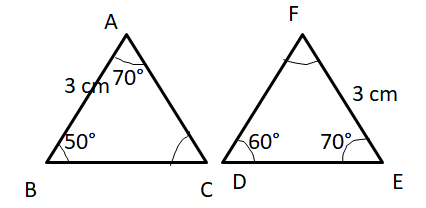
In the given figures, prove that two triangles are congruent.
Problems on Congruency of Triangles 1

Solution:
In ∆ABC, ∠BAC + ∠ABC + ∠BCA = 180°
70° + 50° + ∠BCA = 180°
120° + ∠BCA = 180°
∠BCA = 180° – 120° = 60°
In ∆ABC and ∆DEF,
AB = EF = 3 cm
∠BAC = ∠FED = 70°, ∠BCA = ∠FDE = 60°
Therefore, by AAS (Angle-Side-Angle) criterion the two triangles are congruent.

Problem 2:
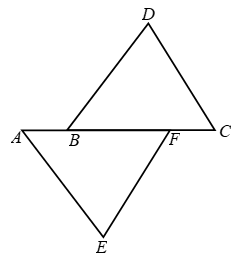
In Fig. it is given that AB = CF, EF = BD and ∠AFE = ∠DBC. Prove that ∆AFE ≅ ∆CBD.
Problems on Congruency of Triangles 2

Solution:
Given that,
AB = CF
So, AB + BF = BF + CF
AF = BC
Corresponding sides are EF = BD, AF = BC
Corresponding angle is ∠AFE = ∠DBC
Therefore, by SAS (Side-Angle-Side) criterion the two triangles are congruent.

Problem 3:
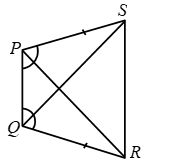
In the given figure PS = QR and ∠SPQ = ∠RQP. Prove that PR = QS and ∠QPR = ∠PQS.
Problems on Congruency of Triangles 3

Solution:
Given that,
PS = QR and ∠SPQ = ∠RQP
In both triangles ∆PQS, ∆PQR, PQ is the common side. So, PQ = PQ
Corresponding sides are PS = QR, PQ = PQ
The corresponding angle is ∠SPQ = ∠RQP
By SAS congruence criteria ∆PQS ≅ ∆PQR
So, PR = QS and ∠QPR = ∠PQS.

Problem 4:
PQR and XYZ are two triangles in which PQ = XY and ∠PRQ = 90°, ∠PQR = 50°, ∠XYZ = 40°, and ∠YXZ = 50°. Prove that the two triangles are congruent.

Solution:
In a triangle, the sum of three angles is 180°.
Therefore, in ∆XYZ, ∠XYZ + ∠YXZ + ∠YZX = 180°
40° + 50° + ∠YZX = 180°
90° + ∠YZX = 180°
∠YZX = 180° – 90°
∠YZX = 90°
In ∆PQR and ∆XYZ,
PQ = XZ, ∠PRQ = ∠XZY = 90° and ∠PQR = ∠YXZ = 50°.
Therefore, by AAS (Angle-Angle-Side) criterion, the two triangles are congruent.

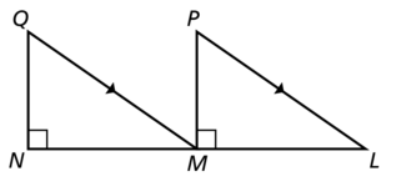
Problem 5:
Prove the following triangles are congruent using RHS Criterion. If M is the midpoint of the line.
Problems on Congruency of Triangles 5

Solution:
Given that,
M is the midpoint of the line NL.
So, MN = ML
QM = PL
∠QNM = ∠PML
Congruent hypotenuse QM = PL
Congruent side NM = ML
Congruent angle ∠QNM = ∠PML = 90°
Therefore, by RHS (Right-angled Hypotenuse Side) criterion, the two triangles are congruent.

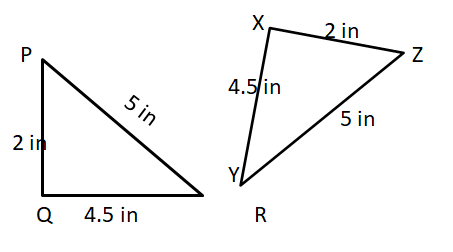
Problem 6:
Check if the given triangles below are congruent and state the criterion test for congruence in triangles.
Problems on Congruency of Triangles 5

Solution:
By observing both triangles.
Congruent sides are PQ = XZ = 2 in
PR = YZ = 5 in
QR = XY = 4.5 in
Therefore, by SSS (Side-Side-Side) criterion, the two triangles are congruent.

Criteria for Congruency

Criteria for Congruency of Triangle – Examples | CPCT Conditions (SSS, SAS, AAS, ASA, RHS)

The congruency of two or more triangles depends on the measurements of their angles and sides. The sides and angles of a triangle will determine its type and shape. If two triangles are congruent means their corresponding angles and sides are equal in measure. Students will learn other criteria for congruency of triangles in the following sections with detailed explanations.

What is Triangles Congruence?

Whenever one triangle has three angles, three sides are equal to corresponding angles, corresponding sides of the second triangle, then both triangles are congruent to each other.

Criteria for Congruency 1

Here, △ABC ≅ EFG
Because AC = EG, AB = EF, BC = FG and ∠A = ∠E, ∠F = ∠B, ∠C = ∠G
In the above figure corresponding vertices are A ≅ E, B ≅ F, C ≅ G.

Criteria for Congruency in Triangles

There are some conditions to say that two triangles are congruent. Triangles must and should satisfy those criteria to be congruent. CPCT means Corresponding Parts of Congruent Triangles. The congruency of triangles can be predicted without measuring their dimensions by following these criteria for congruency. They are along the lines:

  • SSS (Side Side Side) Criterion
  • SAS (Side Angle Side) Criterion
  • AAS (Angle Angle Side) Criterion
  • ASA (Angle Side Angle) Criterion
  • RHS (Right angle Hypotenuse Side) Criterion

Also, Read

SSS (Side-Side-Side) Criterion

If all three corresponding sides of triangles are equivalent, then two triangles are congruent by SSS Criterion. SSS Criterion stands for Side-Side-Side Criterion.

Example:

Criteria for Congruency 2
△DFG ≅ JHK by SSS Criterion.
Corresponding sides are DG = HK, DF = JK, FG = JK.

SAS (Side-Angle-Side) Criterion

SAS Criterion means Side-Angle-Side Criterion. Two triangles are said to be congruent if two sides and included angle of one triangle is equal to the corresponding sides and included angle of another triangle by SAS rule.

Example:

Criteria for Congruency 3
△LMN ≅ NQP by SAS Criterion.
Corresponding two sides are LM = NQ, MN = QP
Corresponding angle ∠M = ∠Q.

AAS (Angle-Angle-Side) Criterion

If the first triangle side is equal to the second triangle side and the corresponding angles of triangles are also equal, then they are congruent by AAS rule. AAS Criterion stands for Angle-Angle-Side Criterion.

Example:
Criteria for Congruency 4
△ABC ≅ QRS by AAS Criterion.
Corresponding two angles are ∠B = ∠R, ∠A = ∠Q
The corresponding side is AC = QS

ASA (Angle-Side-Angle) Criterion

Two triangles are congruent if any two angles and the side included between them of one triangle are equal to the corresponding angles and included side of the other triangle by ASA rule. ASA Criterion is Angle-Side-Angle Criterion.

Example:
Criteria for Congruency 5
△ABC ≅ DEF by ASA Criterion.
Corresponding angles ∠A = ∠F, ∠C = ∠E
Corresponding side AC = EF

RHS (Right angle-Hypotenuse-Side) Criterion

If the hypotenuse side, any other side of the first right-angled triangle is equal to the hypotenuse side, another corresponding side of the other right-angled triangle, then two triangles are said to be congruent by RHS rule. RHS criterion is the Right angle-Hypotenuse-Side Criterion.

Example:
Criteria for Congruency 6
△PQR ≅ XYZ by RHS Criterion.
Corresponding right angle: ∠Q = ∠Y
Corresponding sides: PR = XZ, PQ = XY

Solved Questions

Question 1:
Prove the following triangles are congruent and identify the criterion.
Criteria for Congruency 7

Solution:
At first, identify the corresponding side, angles.
Corresponding side: KM = KM
Corresponding angles: ∠L = ∠N, ∠K = ∠M
Here, Two angles and side of one triangle is equivalent to another triangle.
So, △KLM ≅ LMN by AAS Criterion.

Question 2:
Identify the rule of congruence in the triangles ABC and DCB, and prove that they are congruent triangles.
Criteria for Congruency 8

Solution:
Let us identify the corresponding sides, angles.
Corresponding sides: PQ = XZ = 3 in and PR = YZ = 5 in
Corresponding angle: ∠Q = ∠X = 90 degrees
Here, two triangles are right angles triangles. The hypotenuse and one side of the first right-angled triangle are equal to the second triangle hypotenuse and side.
△PQR ≅ XYZ by RHS Criterion.

FAQ’s on How to Prove Triangles Congruent

1. What is the full form of CPCT?

CPCT stands for Corresponding parts of Congruent Triangles. It states that if two or more triangles that are congruent to each other are taken then the corresponding angles, sides of the triangles are also congruent.

2. Is AAA criteria for congruence?

AAA (angle-angle-angle) does not work because it can produce similar angles but not congruent triangles.

3. What is the SSS rule?

If all three sides of one triangle are equivalent to the corresponding three sides of the second triangle, then those triangles are congruent by the SSS rule.

4 What are the 4 rules of congruency?

The 4 different congruency of triangles rules is SAS (Side-Angle-Side) rule, SSS (Side-Side-Side) rule, AAS (Angle-Angle-Side) rule, and RHS (Right angles Hypotenuse Side) rule.

Congruency of Triangles

Congruency of Triangles – Conditions, Examples | SSS, ASA, SAS, AAS, RHC Criterion

A triangle is a closed figure that has three sides, three vertices and three angles. Two triangles are said to be congruent when their three corresponding angles or sides are equal in measure. We have 5 congruency rules to say that two triangles are congruent. That Triangle Congruence conditions and examples are listed here.

Congruence in Triangles

Congruence is the term used to define an object and its mirror image. Two objects are called congruent if their shapes and dimensions are the same. In geometry and measurement, line segments having the same length and angles with the same measure are congruent.

The following are the conditions that are useful to say two triangles are congruent. The geometrical shapes are repositioned or flipped or rotated to coincide with other shapes. Corresponding Parts of Congruent triangles is a technique that says the different rules of congruency along the lines.

  • SSS (Side Side Side)
  • SAS (Side Angle Side)
  • ASA (Angle Side Angle)
  • AAS (Angle Angle Side)
  • RHS (Right angle Hypotenuse Side)

Congruency of Triangles by Same Side, Same Angle

If two triangles are congruent when they have exactly the same three sides and same three angles. There is no need to equal sides and angles in the same position, but it can be turned or flipped.

Same Sides

When the sides of two triangles are the same, then those are congruent.

Congruency of Triangles

In the above figure, triangle 1 is congruent to triangle 2. Because their sides have exactly the same side length.
But triangle 1 or triangle 2 is not congruent to triangle 3 as they have different side lengths.

Same Angles

Congruency of Triangles 2

In the above figure, the first triangle is congruent to the second triangle as they have the same angles.
But the second triangle is not congruent to the third triangle as they do not have exactly the same angles.

Example Questions on Triangle Congruence

Example 1:
Decide whether the following triangles are congruent or not and give the reason.
Congruency of Triangles 3

Answer:
Given two triangles are △ABC, △ACD
In both triangles AD ≅ BC, AC ≅ AC and AB ≇ CD
So, △ABC ≇ △ACD

Example 2:
Decide whether the following triangles are congruent or not and give the reason.
Congruency of Triangles 4

Answer:
Given two triangles are △ABC, △DEF
In both triangles ∠A ≅ ∠E, ∠C ≅ ∠F and ∠B ≅ ∠D
So, △ABC ≅ △DEF

FAQ’s on Congruency of Triangles

1. What is congruence of a triangle?

Two triangles are congruent menats they have corresponding sides of equal length and their corresponding anglres are equal in measure.

2. What are 5 congruence criteria for triangles?

Two triangles are said to be congruent if they satisfy these 5 conditions. They are side-side-side (SSS), side-angle-side (SAS), angle-angle-side (AAS), angle-side-angle (ASA), and right angle hypotenuse side (RHS).

3. What happens when two traingles are congruent?

When two triangles are congruent then they will have exactly the same three sides and same three angles.

4. What are the 3 properties of congruence?

The three properties of congruence are reflexive property, symmetric property and transitive property.

Properties of Angles of a Triangle

Properties of Angles of a Triangle – Examples | Triangle Sum Theorem, Exterior Angle Theorem

A triangle is a type of polygon that has three sides, angles, vertices. The point where two sides intersect is called vertex and an angle is formed between two sides. The important properties of angles of triangle detail are included here for the convenience of the students. As a part of learning geometry and measurement, you can get the complete details of triangle properties on this page.

Properties of Angles of a Triangle

Based on the angle, triangles are divided into three types. They are acute, obtuse and right triangles. The complete details of important the properties of angles of a triangle are along the lines:

Property 1: Triangle Sum Theorem

The sum of three angles in a triangle is equal to 180°.
Example:
Triangle
∠A + ∠B + ∠C = 180°

Property 2:

The sum of the interior angle and its adjacent exterior angle is 180°.
Example:
Triangle Exterior Angle
Here, b is the interior angle and d is the exterior angle.
b + d = 180°

Property 3:

The side opposite the greater angle is the longest side of all the three sides of a triangle.
Example:
Triangle
The longest angle is ∠A. So, the longest side is BC.

Property 4: Exterior Angle Theorem

The exterior angle of the triangle is equal to the sum of the two opposite interior angles.
Example:
Triangle Exterior Angle
Here, d is the exterior angle and a, c are opposite interior angles.
d = a + c.

Property 5:

  • An equilateral triangle has 3 equal angles that are 60° each.
  • An isosceles triangle has 2 equal angles, which are the angles opposite the 2 equal sides.

Triangle Properties

Every triangle will have the following properties.

  • The sum of the angles of a triangle is equal to 180 degrees.
  • The sum of lengths of any two sides is more than the length of the third side of the triangle.
  • The opposite side of the greater angle is the longest side of all three sides of a triangle.
  • The triangles are said to be similar if their corresponding angles are congruent and lengths are proportional.
  • The area of a triangle = 1/2 x base x height.
  • The perimeter of a triangle is the sum of all its sides.

Solved Questions on Properties of Angles of a Triangle

Question 1:
Properties of Angles of a Triangle 1
Find the values of x, y.

Solution:
As per the Exterior Angle Theorem, the sum of the interior angle and its adjacent angle is 180 degrees.
So, x° + 104°= 180°
x°= 180 – 104 = 76°
According to Triangle Sum Theorem, the sum of angles is 180 degrees.
x° + y° + 40°= 180°
76° + y°+ 40°= 180°
y° = 64°
Therefore, x = 76°, y = 64°.

Question 2:
Properties of Angles of a Triangle 2
Find the value of the unknown angle.

Solution:
As per Triangle Sum Theorem, the sum of angles is 180 degrees.
x° + 110° + 30°= 180°
x° = 180 – 140
x° = 40°

Question 3:
In △ABC, if the base is 15 cm, the height is 20 cm. Find its area?

Solution:
Given that,
Base = 15 cm
Height = 20 cm
Area  of the traingle = 1/2 x base x height
= 1/2 x 15 x 20
= 150 cm²
Therefore, triangle area is 150 cm².

Frequently Asked Question’s

1. What are the two properties of triangles?

  • The difference between the two sides of a triangle is less than the length of the third side.
  • The side opposite the greater angle is the longest side of all the three sides of a triangle.

2. What are the properties of angles in a triangle?

  • The sum of the interior angles in a triangle is 180 degrees.
  • The sum of the angle and its adjacent exterior angle of a triangle is 180 degrees.
  • The exterior angle is the sum of the opposite interior angles.

3. What is the area and perimeter of the triangle?

The area of the triangle is the region occupied by the triangle and the perimeter is the length of the outer boundary.

4. How many types of triangles are there in Maths?

Basically, there are six types of triangles. They are Equilateral Triangle, Scalene Triangle, Isosceles Triangle, Acute Triangle, Obtuse Triangle and Right Triangle.