Multiplied by Itself

What is Number Multiplied by Itself? – Definition, Properties, Examples

When a number multiplied by itself is called the number square. If a number having all 1’s is squared then the middle number in the square will be the number of one’s being multiplied. Get the definition of the multiplied by itself, facts, properties, and solved example questions in the following sections.

Also, Refer:

What is a Number Multiplied by Itself?

Multiplying a number with the same number is called the square of that number. The square of a number is represented with power 2 or superscript 2. If 1 multiplied by itself gives 1. Likewise, if 11 multiplied by 11 gives 121 it says that the middle number is 2 which is nothing but the number of 1’s being multiplied.

Examples:
12 x 12 = 144
111 x 111 = 12321

Properties of Squares

  • A number that is having 2, 3, 7, or 8 at its end place can never be a perfect square number.
  • The number of zeros at the end of a number determines if it is a perfect square or not. If a number ends with an even number of zeros then it can be a perfect square but if a number ends with an odd number of zeros then it can’t be a perfect square.
  • The Square of an even number is an even number and the square of an odd number is an odd number.
  • The square of a number n is equal to the sum of the first n odd natural numbers.

Multiplied a Number by Itself Examples

Question 1:
Find the product and write the middle number.
(a) 111 x 111
(b) 1111 x 1111
(c) 11111 x 11111
Solution:
(a) Given that,
111 x 111

111 x 111 = 12321
The middle number in the square is 3.
(b) Given that,
1111 x 1111
Multiplied by Itself 2
1111 x 1111 = 1234321
The middle number in the square is 4.
(c) Given that,
11111 x 11111
Multiplied by Itself 3
11111 x 11111 = 123454321
The middle number in the square is 5.
By observing these solutions, we can say that when a number having all 1’s multiplied by itself, then the product will have the number of 1’s in the middle and the remaining numbers are 1, 2, 3 in reverse order on both sides.

Question 2:
Solve the following
(a) 111111 x 111111
(b) 11 x 11
Solution:
(a) Given that,
111111 x 111111
It is a 6 digit number having all 1’s in it. So, the product has 6 in the middle and 12345 in reverse order.
Therefore, 111111 x 111111 = 12345654321
(b) Given that,
11 x 11
It is a 2 digit number having all 1’s in it. So, the product has 2 in the middle and 1 in reverse order.
Therefore, 11 x 11 = 121

Question 3:
Find the product of the following
(a) 57 x 57
(b) 88 x 88
(c) 62 x 62
Solution:
(a) Given that,
57 x 57
Find the square of 57 using the math trick.
Add the unit digit of the number to the original number.
7 + 57 = 64
Multiply the sum by the ten’s digit of the original number.
64 x 5 = 320
Find the square of the last digit of the original number.
7² = 49
Append the obtained numbers in the above two steps.
3200 + 49 = 3249
Therefore, 57 x57 = 3249
(b) Given that,
88 x 88
Find the square of 88 using the math trick.
Add the unit digit of the number to the original number.
8 + 88 = 96
Multiply the sum by the ten’s digit of the original number.
96 x 8 = 768
Find the square of the last digit of the original number.
8² = 64
Append the obtained numbers in the above two steps.
7680 + 64 = 7744
Therefore, 88 x 88 = 7744
(c) Given that,
62 x 62
Find the square of 62 using the math trick.
Add the unit digit of the number to the original number.
2 + 62 = 64
Multiply the sum by the ten’s digit of the original number.
64 x 6 = 384
Find the square of the last digit of the original number.
2² = 4
Append the obtained numbers in the above two steps.
3844
Therefore, 62 x 62 = 3844

FAQs on Number Multiplied by Itself

1. What happens when you multiply a number by itself?
In mathematics, a number being multiplied by itself is called the square of that number. We call the result of the square of a whole number is a square or a perfect square. A perfect square is any number that can be a whole number raised to power 2.

2. What is the result of a three-digit number having all 1’s multiplied by itself?
A there digit number having all 1’s is 111. When 111 is multiplied by itself the result will have 3 in the middle because it is a 3 digit number and the remaining numbers are 1, 2. So, 111 x 111 = 12321.

3. When a number is multiplied by itself twice?
A number multiplied by itself two times is called the number square. An example is 5 x 5 = 25 here 25 is the square of 5.
Puzzle

Puzzle – Definition, Types, Questions | Tips & Tricks on How to Solve Logical Puzzles?

A puzzle is a game or toy or question that test’s your knowledge. We have different types of puzzles. In general, puzzles are created for entertainment but they can also form mathematical and logical problems. For solving puzzles, students have to recognize patterns and adherence to a particular kind of order. Get to know more details about the mathematical puzzles and the solved questions in the following sections.

Puzzle Meaning

A puzzle is defined as a game or toy or problem that tests a person’s knowledge. An example of a puzzle is New York Times Cross Word.

Types of Puzzles

The different types of puzzles are cryptic puzzles, logic puzzles, math puzzles, mechanical puzzles, number puzzles, trivia puzzles, word puzzles, pattern guessing, riddles, and so on.

More Related Articles:

Benefits of Playing Puzzles

The benefits of solving the math puzzles are listed here.

  • Students who practice solving puzzle questions gain more knowledge and improve problem-solving skills
  • Solving number puzzles is helpful for the students at every stage.
  • During primary school, every student has to solve math puzzles to create interest in mathematics.
  • It not only develops kid’s mathematical skills but also logical thinking.

How to Solve Math Puzzles?

The following are basic tips & tricks to solve the math puzzles.

  • Observe the given question carefully.
  • Check the numbers, patterns of the puzzle.
  • Imagine the concept of the puzzle and the way of the puzzle theme is given.
  • Apply the arithmetic operations i.e., addition, subtractions, multiplication, division, and also square roots, etc., and the chances to the given conditions of the number puzzle.
  • The operation that satisfies the given conditions is the answer to the puzzle.

Puzzle Questions and Answers

Question 1:
Ramu has to distribute 19 sheep among 3 brothers in such a way that the eldest gets half of all the cows, the middle brother gets one fourth and the youngest one gets fifth. But no sheep should be left.
Solution:
Ramu has to borrow one sheep from any one person.
The total number of sheep becomes 19 + 1 = 20
As, stated eldest brother gets 1/2 of 20 sheep = 10 sheep
Middle brother gets 1/4 of total sheep = 1/4 x 20 = 5 sheep
Youngest brother gets 1/5 of total sheep = 1/5 of 20 = 4 sheep
The total number of sheep distributed = 10 + 5 + 4
= 19 sheep
The remaining one sheep is returned. So, no sheep has remained.

Question 2:
Write the next three numbers in the series
(i) 10, 20, 30, _, _, _
(ii) 10, 9, 8, _, _, _
(iii) 1, 3, 5, 7, 9, _, _, _
Solution:
(i) The given series is 10, 20, 30, _, _, _
The series is multiple of 10 and the list is natural numbers.
1 x 10 = 10
2 x 10 = 20
3 x 10 = 30
So, 4 x 10 = 40
5 x 10 = 50
6 x 10 = 6
The next three numbers in the series are 40, 50, 60
(ii) The given series is 10, 9, 8, _, _, _
The series in the reverse order of natural numbers starting from 10
10 – 9 = 1
9 – 8 = 1
8 – 7 = 1
7 – 6 = 1
6 – 5 = 1
Therefore, the next three numbers in the series are 7, 6, 5.
(iii) The given series is 1, 3, 5, 7, 9, _, _, _
The numbers in the series are prime numbers.
Prime numbers are the numbers that are divisible by 1 and the number itself.
The next 3 prime numbers are 11, 13, 17

Question 3:
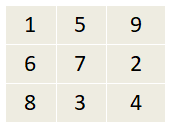
Write a 3 x 3 magic square that has numbers from 1 to 9 and sum of rows or columns or diagonals is 15.
Solution:
Given that,
The list of numbers in the 3 x 3 square should be 1, 2, 3, 4, 5, 6, 7, 8, 9
The sum of numbers in every row = 15
The sum of numbers in every column = 15
The sum of numbers in every diagonal = 15
The possibility of the arrangement of numbers is given below.

Magic Square 7
Check the condition:
The sum of numbers in 1st row = 1 + 5 + 9 = 15
The sum of numbers in 2nd row = 6 + 7 + 2 = 15
The sum of numbers in 3rd row = 8 + 3 + 4 = 15
The sum of numbers in 1st column = 1 + 6 + 8 = 15
The sum of numbers in 2nd column = 5 + 7 + 3 = 15
The sum of numbers in 3rd column = 9 + 2 + 4 = 15
The sum of numbers in one diagonal = 1 + 7 + 4 = 15
The sum of numbers in second diagonal = 9 + 7 + 8 = 15

Comparison of Like Fractions

Comparison of Like Fractions – Definition, Methods, Examples | How do you Compare Like Fractions?

In maths, the fraction is a numerical value that can be defined as a part of a whole. A fraction can be formed by cutting an apple into two equal parts. Comparing fractions means, you need to identify which is the larger fraction and which is a smaller fraction. Students can learn the different methods to compare two like fractions and example questions in the below-mentioned sections of this page.

What is meant by Comparing Like Fractions?

Fraction is nothing but a part of the whole thing. If you divide or break down an object into pieces, each piece of that particular object represents a fraction. The simple and important rule for a fraction is each part has to be equal.

The two parts of the fraction are the numerator and the denominator. Like fractions are the fractions which are having the same number in the denominator. Comparing like fractions means checking whether those fractions are equal or which one is greater or which is lesser.

Example:
The comparing sales of a particular product.

Also, Check

How to Compare Like Fractions?

It is very easy to compare the like fractions. The following are the simple steps that help you to solve the questions on comparison of like fractions.

  • Take the fractions which are having the same denominator.
  • Compare the numerators of the fractions.
  • The fraction which is having the highest numerator is the largest fraction and the fraction with the smallest numerator is the smallest fraction.

Comparing Like Fractions Examples with Answers

Question 1:
Compare the following like fractions.
(i) Comparison of Like Fractions 1
(ii) Comparison of Like Fractions 2
(iii) Comparison of Like Fractions 3
(iv)Comparison of Like Fractions 4
Solution:
(i) The shaded region in the question represents \(\frac { 3 }{ 10 } \)
(ii) The shaded region in the question represents \(\frac { 4 }{ 10 } \)
(iii) The shaded region in the question represents \(\frac { 6 }{ 10 } \)
(iv) The shaded region in the question represents \(\frac { 7 }{ 10 } \)
All the denominators having the same numbers, so compare the numerators
3 < 4 and 4 < 6 and 6 < 7
So, \(\frac { 3 }{ 10 } \) < \(\frac { 4 }{ 10 } \) < \(\frac { 6 }{ 10 } \) < \(\frac { 7 }{ 10 } \) or
We can write it as \(\frac { 7 }{ 10 } \) > \(\frac { 6 }{ 10 } \) > \(\frac { 4 }{ 10 } \) > \(\frac { 3 }{ 10 } \)

Question 2:
Arrange the following like fractions in ascending order and descending order.
(i) \(\frac { 1 }{ 7 } \), \(\frac { 5 }{ 7 } \), \(\frac { 3 }{ 7 } \), \(\frac { 2 }{ 7 } \), 1
(ii) \(\frac { 2 }{ 3 } \), 1, \(\frac { 1 }{ 3 } \), \(\frac { 5 }{ 3 } \), 2
(iii) \(\frac { 1 }{ 3 } \), \(\frac { 1 }{ 6 } \), \(\frac { 2 }{ 3 } \), 1, \(\frac { 5 }{ 6 } \)
(iv) \(\frac { 1 }{ 2 } \), \(\frac { 3 }{ 4 } \), \(\frac { 1 }{ 4 } \), \(\frac { 7 }{ 4 } \), \(\frac { 5 }{ 2 } \)
Solution:
(i) Given fractions are
\(\frac { 1 }{ 7 } \), \(\frac { 5 }{ 7 } \), \(\frac { 3 }{ 7 } \), \(\frac { 2 }{ 7 } \), 1
All the fractions are not having the same denominator.
So make the above fractions as like fractions by multiplying both numerator and denominator by the same number.
1 x \(\frac { 7 }{ 7 } \) = \(\frac { 7 }{ 7 } \)
Now, all fractions have same denominator. So, compare the numerators
1 < 2 < 3 < 5 < 7
The comparison of frcations is \(\frac { 1 }{ 7 } \) < \(\frac { 2 }{ 7 } \) < \(\frac { 3 }{ 7 } \) < \(\frac { 5 }{ 7 } \) < \(\frac { 7 }{ 7 } \)
The ascending order is \(\frac { 1 }{ 7 } \), \(\frac { 2 }{ 7 } \), \(\frac { 3 }{ 7 } \), \(\frac { 5 }{ 7 } \), 1
The descending order is 1, \(\frac { 5 }{ 7 } \), \(\frac { 3 }{ 7 } \), \(\frac { 2 }{ 7 } \), \(\frac { 1 }{ 7 } \)
(ii) Given fractions are
\(\frac { 2 }{ 3 } \), 1, \(\frac { 1 }{ 3 } \), \(\frac { 5 }{ 3 } \), 2
All the fractions are not having the same denominator.
So make the above fractions as like fractions by multiplying both numerator and denominator by the same number.
1 x \(\frac { 3 }{ 3 } \) = \(\frac { 3 }{ 3 } \)
2 x \(\frac { 3 }{ 3 } \) = \(\frac { 6 }{ 3 } \)
Now, all fractions have same denominator. So, compare the numerators
1 < 2 < 3 < 5 < 6
The comparison of fractions is \(\frac { 1 }{ 3 } \) < \(\frac { 2 }{ 3 } \) < \(\frac { 3 }{ 3 } \) < \(\frac { 5 }{ 3 } \) < \(\frac { 6 }{ 3 } \)
The ascending order is \(\frac { 1 }{ 3 } \), \(\frac { 2 }{ 3 } \), 1, \(\frac { 5 }{ 3 } \), 2
The descending order is 2, \(\frac { 5 }{ 3 } \), 1, \(\frac { 2 }{ 3 } \), \(\frac { 1 }{ 3 } \)
(iii) Given fractions are
\(\frac { 1 }{ 3 } \), \(\frac { 1 }{ 6 } \), \(\frac { 2 }{ 3 } \), 1, \(\frac { 5 }{ 6 } \)
All the fractions are not having the same denominator.
So make the above fractions as like fractions by multiplying both numerator and denominator by the same number.
\(\frac { 1 }{ 3 } \) x \(\frac { 2 }{ 2 } \) = \(\frac { 2 }{ 6 } \)
\(\frac { 2 }{ 3 } \) x \(\frac { 2 }{ 2 } \) = \(\frac { 4 }{ 6 } \)
1 x \(\frac { 6 }{ 6 } \) = \(\frac { 6 }{ 6 } \)
Now, all fractions have same denominator. So, compare the numerators
1 < 2 < 4 < 5 < 6
The comparison of fractions is \(\frac { 1 }{ 6 } \) < \(\frac { 2 }{ 6 } \) < \(\frac { 4 }{ 6 } \) < \(\frac { 5 }{ 6 } \) < \(\frac { 6 }{ 6 } \)
The ascending order is \(\frac { 1 }{ 6 } \), \(\frac { 1 }{ 3 } \), \(\frac { 2 }{ 3 } \), \(\frac { 5 }{ 6 } \), 1
The descending order is 1, \(\frac { 5 }{ 6 } \), \(\frac { 2 }{ 3 } \), \(\frac { 1 }{ 3 } \), \(\frac { 1 }{ 6 } \)
(iv) Given fractions are
\(\frac { 1 }{ 2 } \), \(\frac { 3 }{ 4 } \), \(\frac { 1 }{ 4 } \), \(\frac { 7 }{ 4 } \), \(\frac { 5 }{ 2 } \)
All the fractions are not having the same denominator.
So make the above fractions as like fractions by multiplying both numerator and denominator by the same number.
\(\frac { 1 }{ 2 } \) x \(\frac { 2 }{ 2 } \) = \(\frac { 2 }{ 4 } \)
\(\frac { 5 }{ 2 } \) x \(\frac { 2 }{ 2 } \) = \(\frac { 10 }{ 4 } \)
Now, all fractions have the same denominator. So, compare the numerators
1 < 2 < 3 < 7 < 10
The comparison of fractions is \(\frac { 1 }{ 4 } \) < \(\frac { 1 }{ 2 } \) < \(\frac { 3 }{ 4 } \) < \(\frac { 7 }{ 4 } \) < \(\frac { 5 }{ 2 } \)
The ascending order is \(\frac { 1 }{ 4 } \), \(\frac { 1 }{ 2 } \), \(\frac { 3 }{ 4 } \), \(\frac { 7 }{ 4 } \), \(\frac { 5 }{ 2 } \)
The descending order is \(\frac { 5 }{ 2 } \), \(\frac { 7 }{ 4 } \), \(\frac { 3 }{ 4 } \), \(\frac { 1 }{ 2 } \), \(\frac { 1 }{ 4 } \)

Question 3:
Compare the following like fractions and put = or < or > symbols.
(i) \(\frac { 8 }{ 10 } \), \(\frac { 15 }{ 10 } \)
(ii) \(\frac { 6 }{ 5 } \), \(\frac { 10 }{ 5 } \)
(iii) \(\frac { 2 }{ 8 } \), \(\frac { 1 }{ 4 } \)
Solution:
(i) Given fractions are
\(\frac { 8 }{ 10 } \), \(\frac { 15 }{ 10 } \)
Both fractions having the same denominator. So, compare the numerators.
8 < 15
So, \(\frac { 8 }{ 10 } \) < \(\frac { 15 }{ 10 } \)
(ii) Given fractions are
\(\frac { 6 }{ 5 } \), \(\frac { 10 }{ 5 } \)
Both fractions having the same denominator. So, compare the numerators.
10 > 6
So, \(\frac { 10 }{ 5 } \) > \(\frac { 6 }{ 5 } \)
(iii) Given fractions are
\(\frac { 2 }{ 8 } \), \(\frac { 1 }{ 4 } \)
To make like fractions multiply the same number by both numerator and denominator of the fraction.
\(\frac { 1 }{ 4 } \) x \(\frac { 2 }{ 2 } \) = \(\frac { 2 }{ 8 } \)
Now, both fractions having the same denominator. So, compare the numerators.
2 = 2
So, \(\frac { 2 }{ 8 } \) = \(\frac { 1 }{ 4 } \)

Question 4:
Arrange the below mentioned like fractions in ascending and descending order.
(i) \(\frac { 1 }{ 10 } \),  . . . \(\frac { 8 }{ 10 } \)
(ii) \(\frac { 11 }{ 9 } \), . . . \(\frac { 18 }{ 9 } \)
Solution:
(i) Given fractions are \(\frac { 1 }{ 10 } \), \(\frac { 2 }{ 10 } \), \(\frac { 3 }{ 10 } \), \(\frac { 4 }{ 10 } \), \(\frac { 5 }{ 10 } \), \(\frac { 6 }{ 10 } \), \(\frac { 7 }{ 10 } \), \(\frac { 8 }{ 10 } \)
As all the fractions are like fractions, compare the numerators
1 < 2 < 3 < 4 < 5 < 6 < 7 < 8
Comparing like fractions is \(\frac { 1 }{ 10 } \) < \(\frac { 2 }{ 10 } \) < \(\frac { 3 }{ 10 } \) < \(\frac { 4 }{ 10 } \) < \(\frac { 5 }{ 10 } \) < \(\frac { 6 }{ 10 } \) < \(\frac { 7 }{ 10 } \) < \(\frac { 8 }{ 10 } \)
The ascending order is \(\frac { 1 }{ 10 } \), \(\frac { 2 }{ 10 } \), \(\frac { 3 }{ 10 } \), \(\frac { 4 }{ 10 } \), \(\frac { 5 }{ 10 } \), \(\frac { 6 }{ 10 } \), \(\frac { 7 }{ 10 } \), \(\frac { 8 }{ 10 } \)
The descending order is \(\frac { 8 }{ 10 } \), \(\frac { 7 }{ 10 } \), \(\frac { 6 }{ 10 } \), \(\frac { 5 }{ 10 } \), \(\frac { 4 }{ 10 } \), \(\frac { 3 }{ 10 } \), \(\frac { 2 }{ 10 } \), \(\frac { 1 }{ 10 } \)
(ii) Given fractions are \(\frac { 11 }{ 9 } \), \(\frac { 12 }{ 9 } \), \(\frac { 13 }{ 9 } \), \(\frac { 14 }{ 9 } \), \(\frac { 15 }{ 9 } \), \(\frac { 16 }{ 9 } \), \(\frac { 17 }{ 9 } \), \(\frac { 18 }{ 9 } \)
As all the fractions are like fractions, compare the numerators
18 > 17 > 16 > 15 > 14 > 13 > 12
Comparing like fractions is
\(\frac { 18 }{ 9 } \) > \(\frac { 17 }{ 9 } \) > \(\frac { 16 }{ 9 } \) > \(\frac { 15 }{ 9 } \) > \(\frac { 14 }{ 9 } \) > \(\frac { 13 }{ 9 } \) > \(\frac { 12 }{ 9 } \) > \(\frac { 11 }{ 9 } \)
The ascending order is \(\frac { 11 }{ 9 } \), \(\frac { 12 }{ 9 } \), \(\frac { 13 }{ 9 } \), \(\frac { 14 }{ 9 } \), \(\frac { 15 }{ 9 } \), \(\frac { 16 }{ 9 } \), \(\frac { 17 }{ 9 } \), \(\frac { 18 }{ 9 } \)
The descending order is \(\frac { 18 }{ 9 } \), \(\frac { 17 }{ 9 } \), \(\frac { 16 }{ 9 } \), \(\frac { 15 }{ 9 } \), \(\frac { 14 }{ 9 } \), \(\frac { 13 }{ 9 } \), \(\frac { 12 }{ 9 } \), \(\frac { 11 }{ 9 } \)

Difference of The Squares

Difference of the Squares – Definition, Formula, Examples | How to Solve Difference of Two Squares?

The difference between two squares means a square number is subtracted from another squared number. You can find the difference between the two squares using the factorization method. Students can get the definition for the difference of the squares, formula, and detailed steps to calculate it in the following sections. The solved example questions provided below are helpful for a better understanding of the concept.

Also, Refer:

Difference of the Squares – Meaning

The difference of the squares is a number which means we need the square of the second number should be subtracted from the square of the first number. We have simple tricks and formulas to calculate the difference between two square numbers those are provided below.

When the square numbers are consecutive numbers, the simple trick used to find their difference is just to add those two consecutive numbers. And the formula to calculate the difference of two squares is a² – b² = (a + b)(a – b). Here a and b are two different numbers that are to be squared.

How to find the Difference of the Squares?

Have a look at the easy steps provided below to solve the difference of the squares manually and easily.

  • Find the squares of the first, second numbers.
  • Subtract the square of the second number from the first number.
  • The difference is the result.

(Or)

  • Calculate the sum of two numbers that are to be squared.
  • Also, calculate the difference between the two numbers.
  • Multiply the results obtained from the above two steps to get the final difference.

Difference of the Squares Examples

Question 1:
Solve the following:
(i) 88² – 87²
(ii) 156² – 155²
(iii) 12² – 11²
Solution:
(i) Given that,
88² – 87²
The difference of the squares of two consecutive numbers is equal to the sum of two numbers.
88² – 87² = 88 x 88 – 87 x 87
= 88 + 87
= 175
Therefore, 88² – 87² = 175
(ii) Given that,
156² – 155²
The difference of the squares of two consecutive numbers is equal to the sum of two numbers.
156² – 155² = 156 x 156 – 155 x 155
= 156 + 155
= 311
Therefore, 156² – 155² = 311
(iii) Given that,
12² – 11²
The difference of the squares of two consecutive numbers is equal to the sum of two numbers.
12² – 11² = 12 x 12 – 11 x 11
= 12 + 11
= 23
Therefore, 12² – 11² = 23

Question 2:
Find the difference of the two squares
(i) 78² – 15²
(ii) 89² – 56²
(iii) 159² – 121²
Solution:
(i) Given that,
78² – 15²
We know that, a² – b² = (a + b)(a – b)
Here, a = 78, b = 15
78² – 15² = (78 + 15) (78 – 15)
= 93 x 63
= 5859
Therefore, 78² – 15² = 5859
(ii) Given that,
89² – 56²
We know that, a² – b² = (a + b)(a – b)
Here, a = 89, b = 56
89² – 56² = (89 + 56) (89 – 56)
= 145 x 33
= 4785
Therefore, 89² – 56² = 4785
(iii) Given that,
159² – 121²
We know that, a² – b² = (a + b)(a – b)
Here, a = 159, b = 121
159² – 121² = (159 + 121) (159 – 121)
= 280 x 38
= 10640
Therefore, 159² – 121² = 10640

Question 3:
(i) 72 x 72 – 54 x 54
(ii) 756² – 755²
(iii) 81² – 14²
Solution:
(i) Given that,
72 x 72 – 54 x 54 = 72² – 54²
We know that, a² – b² = (a + b)(a – b)
Here, a = 72, b = 54
72² – 54² = (72 + 54) (72 – 54)
= 126 x 18
= 2268
Therefore, 72 x 72 – 54 x 54 = 2268
(ii) Given that,
756² – 755²
The difference of the squares of two consecutive numbers is equal to the sum of two numbers.
756² – 755² = 756 x 756 – 755 x 755
= 756 + 755
= 1511
Therefore, 756² – 755² = 1511
(iii) Given that,
81² – 14²
Difference of The Squares 1 Difference of The Squares 2
So, 81² = 6561, 14² = 196
81² – 14² = 6561 – 196
= 63651
Therefore, 81² – 14² = 63651

FAQs on Difference of the Squares

1. What is the purpose of the difference of squares?
The difference of two squares is a theorem that explains if a binomial equation is written as the product of two binomials then it shows the sum of square roots and the difference of the square roots.

2. What is the form of two squares identity?
The difference of two squares identity is a² – b² = (a + b)(a – b). Here a and b are two different numbers that are to be squared. The difference between two squares can be defined as the product of the sum and difference of these numbers.

3. How do you find the difference of squares of two consecutive numbers?
The difference of squares of two consecutive natural or whole numbers can be defined as the sum of the consecutive numbers.

Square of a Number

Square of a Number – Definition, Examples | How to Find the Square of a Number?

The square of a number means multiplying a number by itself. The perfect square numbers are the squares of a whole number. Get the important properties of the square numbers and tricks to calculate the square of a number easily in the following sections. We have also provided example questions and answers that help to understand the concept.

Also, Check:

What is the Square of a Number?

In mathematics, the square of a number is defined as the product of multiply the number by itself. The word square means raising a number to power 2 and denoted by the superscript 2. We can find a number square by using the long multiplication method.
Example:
27² = 27 x 27
Square of a Number 1
Therefore, 27² = 729

How to Find the Square of a Number?

Follow the simple guidelines and instructions to calculate the square of a number and they are along the lines:

  • Write the numbers in two different columns.
  • Multiply the unit digit of the below number by the first number.
  • Write the product below
  • Again multiply the ten’s digit of the below number by the first number.
  • Write the product in the fourth row.
  • Add the products of the third and fourth row to get the number square.

Math Trick For Finding Square of a Two-Digit Number

  • Add the unit digit of the number to the original number.
  • Multiply the sum by the ten’s digit of the original number.
  • Find the square of the last digit of the original number.
  • Append the square number (step 3) to the product calculated above (step 2).

Square Numbers Up to 15

Below mentioned is the list of squares of the numbers from 1 to 15.

Square of a Number 2

Properties of Square Numbers

  • A number ending with 2, 3, 7, or 8 is never a perfect square of a number.
  • The square of even numbers is always an even number and the square of an odd number is also an odd number.
  • The numbers ending with 2, 3, 7 or 8 is not a square number.
  • If a number has 1 or 9 in the unit’s place, then its square ends with 1.
  • If a number has 4 or 6 in the unit’s place, then its square ends with 6.
  • A perfect square number always leaves a remainder 0 or 1 when divided by 4.

Square of a Number Examples

Example 1:
Find the square of 53.
Solution:
The given number is 53
53 + 3 = 56
56 x 5 = 280
3² = 9
So, 53 x 53 = 2809
Therefore, the square of 53 is 2809.

Example 2:
The square of a number is 441. What is the original number?
Solution:
Given that,
The Square of a number is 441
Write the factors of 441
441 = 3 x 3 x 7 x 7
= (3 x 7)² = 28²
Therefore, the original number is 28.

Example 3:
Solve the square of the following number using the math trick and verify it.
(i) 76
(ii) 42
(iii) 29
Solution:
(i) Given number is 76
Find the square of 76 using the math trick.
Add the unit digit of the number to the original number.
6 + 76 = 82
Multiply the sum by the ten’s digit of the original number.
82 x 7 = 574
Find the square of the last digit of the original number.
6² = 36
Append the obtained numbers in the above two steps.
5740 + 36 = 5776
Square of a Number 3
Therefore, 76² = 5776
(ii) Given number is 42
Find the square of 42 using the math trick.
Add the unit digit of the number to the original number.
2 + 42 = 44
Multiply the sum by the ten’s digit of the original number.
4 x 44 = 176
Find the square of the last digit of the original number.
2² = 4
Append the obtained numbers in the above two steps.
42² = 1764

Therefore, square of 42 is 1764
(iii) Given number is 29
Find the square of 29 using the math trick.
Add the unit digit of the number to the original number.
9 + 29 = 38
Multiply the sum by the ten’s digit of the original number.
2 x 38 = 76
Find the square of the last digit of the original number.
9² = 81
Append the obtained numbers in the above two steps.
760 + 81 = 841
Square of a Number 5
Therefore, the square of 29 is 841.

Magic Square

Magic Square – Definition, Facts, Examples | How to Solve a Magic Square?

A magic square is a puzzle the addition of numbers in every row, column, and diagonal are the same. Every magic square has an order which is nothing but the number of rows x number of columns. Check out the rules to form a magic square and the steps to solve the magic square puzzles in the following sections. You can also find the questions on number patterns on this page.

What is Magic Square?

Magic squares are square grids with a special arrangement of numbers in those grids. The numbers are special because every row, column and the diagonal sum is the same number. No number is repeated in the magic square.

While arranging the numbers in the grids, see the sum of numbers in every row, every column and diagonal are equal. The smallest magic square possible is 3 x 3. The number of elements in the magic square is the multiplication of the square order.

Example:
Magic Square 1
The sum of numbers in all rows = 15
The sum of numbers in all columns = 15
The sum of numbers in both diagonals = 15
Therefore, it is a 3 x 3 magic square.

More Related Articles:

Interesting Facts about Magic Square Puzzles

  • We need to have 3² = 9 or 4² = 16 or 5² = 25 different numbers are required to form a magic square.
  • We can frame multiple magic squares with the given set of numbers.
  • The number of elements in the magic square is its order.
  • The order of a magic square N x N means it has N number of rows and N number of columns.

Steps for Forming a Magic Square | Magic Square Rules

Students can get the simple guidelines to form a magic square in the below-mentioned sections.

  • Get the set of numbers to be inserted in the magic square.
  • Using the trial and error method, place the numbers in the square grids.
  • Remember that the sum of numbers in every row, every column, and diagonal are equal.
  • At last, check the condition is satisfied or not.

Magic Square Puzzle Examples

Question 1:
Check whether the following is a magic square or not.
Magic Square 2
Solution:
The important rule to say a square grid is a magic square is the sum of numbers in every row, column and diagonal is the same number.
The sum of elements in first row = 9 + 6 + 3 + 16 = 34
The sum of elements in second row = 4 + 15 + 10 + 15 = 34
The sum of elements in third row = 14 + 1 + 8 + 11 = 34
The sum of elements in fourth row = 7 + 12 + 13 + 2 = 34
The sum of elements in first column = 9 + 4 + 14 + 7 = 34
The sum of elements in second column = 6 + 15 + 1 + 12 = 34
The sum of elements in third column = 3 + 10 + 8 + 13 = 34
The sum of elements in fourth column =16 + 5 + 11 + 2 = 34
The sum of elements in one diagonal = 9 + 15 + 8 + 2 = 34
The sum of elements in second diagonal = 7 + 1 + 10 + 16 = 34
Therefore, the given is a magic square 4 x 4.

Question 2:
Find the missing numbers in the given 5 x 5 magic square.

Solution:
In the given grid, one diagonal has all the elements. So, find the sum of numbers.
The sum of the numbers of 1st diagonal = 11 + 12 + 13 + 14 + 15 = 65
So, every row, column and diagonal sum should be 65.
The missing number in the 2nd diagonal = 65 – (23 + 13 + 8 + 3)
= 65 – 47 = 18
The missing elements in the 4th row = 65 – (10 + 18 + 1 + 14)
= 65 – 43 = 22
The missing element in 5th column = 65 – (3 + 9 + 22 + 15)
= 65 – 49
The sum of missing elements in the first row = 65 – (11 + 20 + 3)
= 31
Let the missing numbers be 24, 7
The missing number in 2nd column = 65 – (24 + 12 + 18 + 6)
= 5
The missing number in 3rd column = 65 – (7 + 13 + 1 + 19)
= 25
The missing number in 2nd row = 65 – (12 + 25 + 8 + 16) = 4
The missing number in 5th row = 65 – (23 + 6 + 19 + 15) = 2
So, the 5 x 5 magic square puzzle is follows.
Magic Square 5

Question 3:
Write the number of possible similar magic squares for the numbers from 1 to 9.
Solution:
The list of numbers from 1 to 9 is 1, 2, 3, 4, 5, 6, 7, 8, 9
See that the sum of numbers in all rows, columns and diagonals is 15.
The 1st possible arrangement of 3 x 3 magic square is as follows:

The 2nd possible arrangement is
Magic Square 8
The third possible arrangement of the numbers in the magic square is
Magic Square 9
4th Possible arrangement of numbers is
Magic Square 11
5th possible arrangement of numbers is
Magic Square 10
6th possible arrangement of numbers is
Magic Square 12
7th possible arrangement of numbers is
Magic Square 13
8th possible arrangement of the number is
Magic Square 14

Patterns and Mental Mathematics

Patterns and Mental Mathematics – Definition, Examples | Mental Math Tricks for Arithmetic Operations

The pattern is a scheme that helps to solve math questions easily and fastly. Mental mathematics is a skill that allows students to do maths in their heads without using pen and paper or a calculator. Get the simple patterns that make addition, subtraction, multiplication, and division problems easier. Also, find the solved examples on patterns and mental mathematics in the below-mentioned sections.

What is meant by Pattern and Mental Maths?

A pattern is a series or sequence that repeats based on the rule and the rule helps to solve a problem. Mental math is a group of skills that allow people to do maths in their head without using a calculator or pen and paper. It is useful in everyday life and school. It helps the students to understand the concepts easily and quickly.

Also, Read

Patterns in Mathematics

Below provided is the pattern for counting numbers from 1 to 100.

Patterns and Mental Mathematics

The following are the observations that can be read from a pattern.

  • The numbers in every column increase by 1.
  • The numbers in every row increase by 10.
  • The diagonally located numbers from the left to right from least to highest have a difference of 9. Those are 10, 19, 28, 37, 46, 55, 64, 73, 82, 91.
  • And the diagonally located numbers from left to right from top to bottom have a difference of 11. Those numbers are 1, 12, 23, 34, 56, 67, 78, 89, 100.
  • All the numbers in the first row have 1 in their unit’s place, the second row have 2, the third row has 3, and so on.

Mental Math Tricks – Addition, Subtraction, Multiplication, Division

Addition:
The most used and best trick to solve the addiction problem is to expand the given numbers. Add the numbers in hundred’s places, tens place, units place together. Again add the obtained numbers to get the sum of the numbers.
Example:
Solve 1256 + 563 + 78
1256 + 563 + 78 = 1000 + 200 + 50 + 6 + 500 + 60 + 3 + 70 +  8
= 1000 + 700 + 180 + 17
= 1700 + 197
= 1897

Subtraction:
For solving subtraction problems, we need to expand the given numbers and provide the sign. Subtract the numbers in the hundreds place, ten place, unit’s place.
Example:
Solve 875 – 232
875 – 232 = 800 + 70 + 5 – 200 – 30 – 2
= 600 + 40 + 3
= 643

Multiplication:
For solving the multiplication of smaller numbers, we can use the repeated addition method. For getting the product of larger numbers, expand the numbers and perform the multiplication. At the end add or subtract those numbers.
Examples:
8 x 6 = 8 + 8 + 8 + 8 + 8 + 8 = 48
82 x 5 = (90 – 8) x 5 = 90 x 5 – 8 x 5
= 450 – 40 = 410
105 x 8 = (100 + 5) x 8
= 100 x 8 + 5 x 8
= 800 + 40 = 840

Division:
For dividing the numbers, divide every digit of the dividend by the divisor and write the quotient.
Example:
156/4 = 39

Examples on Patterns and Mental Math Strategies

Question 1:
Solve the following
(i) 27 x 6
(ii) 49 x 50
(iii) 53 x 47
Solution:
(i) Given that,
27 x 6
Expand 27 = 20 + 7
27 x 6 = (20 + 7) x 6
= 120 + 42
= 162
Therefore, 27 x 6 = 162
(ii) Given that,
49 x 50
Represent 49 as 50 – 1
49 x 50 = (50 – 1) x 50
= (50 x 50) – 50
= 2500 – 50
= 2450
Therefore, 49 x 50 = 2450
(iii) Given that,
53 x 47
Represent 53 as 50 + 3 and 47 as 50 – 3
53 x 62 = (50 + 3) x (50 – 3)
= 2500 – 9 = 2491
Therefore, 53 x 47 = 2491.

Question 2:
Find the sum of the numbers.
(i) 85 + 162 + 569
(ii) 145 + 75
(iii) 1453 + 2563 + 4326
Solution:
(i) Given that,
85 + 162 + 569
Expand all the numbers
85 + 162 + 569 = 80 + 5 + 100 + 60 + 2 + 500 + 60 + 9
= 600 + 200 + 16
= 816
So, 85 + 162 + 569 = 816
(ii) Given that,
145 + 75
Expand all the numbers
145 + 75 = 100 + 40 + 5 + 70 + 5
= 100 + 110 + 10
= 220
So, 145 + 75 = 220
(iii) Given that,
1453 + 2563 + 4326
Expand all the numbers
1453 + 2563 + 4326 = 1000 + 400 + 50 + 3 + 2000 + 500 + 60 + 3 + 4000 + 300 + 20 + 6
= 7000 + 1200 + 130 + 12
= 8200 + 142
= 8342
So, 1453 + 2563 + 4326 = 8342

Question 3:
Subtract the numbers.
(i) 356 – 182
(ii) 1563 – 823
(iii) 526 – 230
Solution:
(i) Given that,
356 – 182
Expand all the numbers
356 – 182 = 300 + 50 + 6 – 100 – 80 – 2
= 200 – 30 + 4
= 170 + 4 = 174
So, 356 – 182 = 174
(ii) Given that,
1563 – 823
Expand all the numbers
1563 – 823 = 1000 + 500 + 60 + 3 – 800 – 20 – 3
= 700 + 40 = 740
So, 1563 – 823 = 740
(iii) Given that,
526 – 230
Expand all the numbers
526 – 230 = 500 + 20 + 6 – 200 – 30
= 300 – 10 + 6
= 296
So, 526 – 230 = 296

Question 4:
Divide the following numbers.
(i) \(\frac { 500 }{ 5 } \)
(ii) \(\frac { 1492 }{ 2 } \)
(iii) \(\frac { 768 }{ 8 } \)
Solution:
(i) Given that,
\(\frac { 500 }{ 5 } \) = 100
(ii) Given that,
\(\frac { 1492 }{ 2 } \) = \(\frac { 1400 }{ 2 } \) + \(\frac { 90 }{ 2 } \) + \(\frac { 2 }{ 2 } \)
= 700 + 45 + 1
= 746
(iii) Given that,
\(\frac { 768 }{ 8 } \) = 96

Division by Two-Digit Numbers

Division by Two-Digit Numbers – Definition, Examples | How to Divide a Number by 2-Digit Numbers?

The division is one of the four basic arithmetic operations that help to split into equal parts. Dividing by 2 digit number means a large quantity of data is distributing into equal groups. Here, students can know the definition of division by two-digit numbers. Also, find a detailed explanation to solve the division by two digit numbers problems along with the solutions.

Also, Check:

Division by Two-Digit Numbers

Division by Two-digit numbers means the divisor should be a two-digit number and dividend can be a two-digit or more than a two-digit number. Every two-digit number has ten’s place and one’s place in it. Get the instructions and simple steps to compute the division of a number by a two-digit number in the below-included sections of this page.

How to Divide a Number by Two-Digit Numbers?

Make use of various division methods to divide by two-digit numbers from the following sections.

Method 1:

  • Take the first 3 digits of the dividend if it is less than the divisor. Otherwise, take the first 2 digits of the dividend.
  • Write the quotient on the top of the dividend and the product below the dividend.
  • Subtract dividend from the product.
  • Bring down the next number of the dividend.
  • Repeat the process.

Method 2:

  • Write the dividend inside the division symbol and the divisor outside the division symbol.
  • Write the quotient on the top and multiply the quotient by the hundredth number.
  • Write that product below the dividend and subtract it from the dividend
  • Repeat the process.

2-Digit Division Examples with Answers

Example 1:
Divide 768 by 12 using 1st method.
Solution:
Given that,
768 ÷ 12

76 > 12. So, take the first two digits of the dividend.
Let us check 12 x 6 = 72 and 76 > 72
Subtract 72 from 76 i.e 76 – 72 = 4
Write 6 in the place of quotient
Bring down the next digit of the dividend i.e 8
It makes 48
Let us check 12 x 4 = 48
Subtract 48 from 48 i.e 48 – 48 = 0
Write 4 at the quotient after 6.
Write 0 as the remainder.
The quotient will be 64.
Therefore, 768 ÷ 12 = 64

Example 2:
Divide 1378 by 26 using the 2nd method.
Solution:
Given that,
1378 ÷ 26

1 < 13. So, consider the first two digits of the dividend
13 < 26. So, consider the first three digits of the dividend
137 > 26
26 x 50 = 1300
1378 – 1300 = 78
26 x 3 = 78
78 – 78= 0
The quotient will be 50 + 3 = 53
Therefore, 1378 ÷ 26 = 53

Example 3:
Divide 47320 by 35 and verify the quotient.
Solution:
Given that,
47320 ÷ 35
Division by Two-Digit Numbers 5
47 > 35
Consider the first two digits of the dividend for the division.
35 x 1 = 35
35 x 2 = 70
So, add 1 at the quotient part
Subtract 35 from 47
47 – 35 = 12
Bring down the next digit of the dividend i.e 3.
It becomes 123
35 x 5 = 175
So, add 5 after 13 at the quotient
Subtract 175 from 182
182 – 175 = 7
Bring down the next digit of the dividend i.e 0.
It becomes 70
35 x 2 = 70
Subtract 70 from 70
70 – 70 = 0
Therefore, quotient is 1352
Verification:
Dividend = Divisor x quotient + remainder
= 35 x 1352 + 0
= 47320
Therefore, 47320 ÷ 35 = 1352.

Dividing Numbers

Dividing Numbers – Definition, Rules, Ways, Examples | How to Divide Numbers Easily?

The division is a process of repeated subtraction. Dividing Numbers means calculating the division of two numbers. The sign of division is ÷ or /. Students can know more about the division of two numbers, get the interesting facts about the division and divisibility rules in the following sections. Here, you can also check the solved example questions on dividing numbers.

Division of Numbers – Definition

The division is one of the four basic arithmetic operations that split into equal groups or parts. It is the opposite of multiplication and it is a process of repeated subtraction. The method of division has exactly 4 parts they are dividend, divisor, quotient, and remainder.

Rules for Dividing Numbers to Help with

The important math formula of division is dividend = (divisor x quotient) + remainder. In dividing numbers, we will learn to find division by 10, 20, 30, 100, 50, 200, 300 . . . . Get the divisibility rules and facts about the division in the following sections.

  • In division problems, the remainder is always less than the divisor.
  • If a division problem has 1 as the divisor, then the quotient and dividend are sane.
  • If a division problem has 0 as the divisor, then the quotient will also be 0.
  • The quotient and divisor are factors of the dividend when there is no remainder.

Also, Check:

How to Divide Step by Step?

The below mentioned are the simple steps that are helpful to calculate the division of two numbers.

  • Remember the multiplication table of the divisor.
  • If the first digit of the dividend is greater than the divisor, then divide it by the divisor. Otherwise, take the first two digits of the dividend for the division.
  • Write the quotient above the dividend.
  • Write the product of quotient and divisor under the dividend
  • Subtract product from the dividend.
  • Bring down the next digit of the dividend.
  • Repeat the process until you left with zero digits on the right side.
  • Check the quotient and multiply it with a divisor to get the dividend.

Dividing Numbers Questions and Answers

Question 1:
Divide 100 ÷ 20 and find the quotient.
Solution:
Given that,
100 ÷ 20
100 ÷ 20 = 100 ÷ (2 x 10) = 100 ÷ 2 ÷ 10
We divide 100 by 2 and then the obtained quotient is divided by 10.
Dividing Numbers 2 then Dividing Numbers 3
Or

So, quotient = 5
Therefore, 100 ÷ 20 = 5

Question 2:
Divide 240 by 30 and check the quotient.
Solution:
Given that,
240 ÷ 30
240 ÷ 30 = 240 ÷ (3 x 10) = 240 ÷ 3 ÷ 10
We divide 240 by 3 and then the obtained quotient is divided by 10.
Dividing Numbers 4 then Dividing Numbers 5
So, the quotient is 8
Multiply 30 by 8
8 x 30 = 8 x 3 x 10
= 24 x 10 = 240
Therefore, 240 ÷ 30 = 8.

Question 3:
Divide 4500 ÷ 90.
Solution:
Given that,
4500 ÷ 90
4500 ÷ 90 = 4500 ÷ (9 x 10) = 4500 ÷ 9 ÷ 10
We divide 4500 by 9 and then the obtained quotient is divided by 10.
Dividing Numbers 6 then Dividing Numbers 7
So, the quotient is 50
Therefore, 4500 ÷ 90 = 50.

Question 4:
Divide 2184 by 26 and find the quotient.
Solution:
Given that,
2184 ÷ 26
Dividing Numbers 8
21 < 26, so take the first three digits of the dividend
218 is taken for the division
26 x 8 = 208
218 – 208 = 10
8 will be the quotient
104 is taken for division
26 x 4 = 104
104 – 104 = 0
4 will be the quotient
Therefore, the quotient is 84.
2184 ÷ 26 = 84.

Division of Four-Digit by a One-Digit Numbers

Division of Four-Digit by a One-Digit Numbers – Definition, Examples | How to Divide 4 Digit Numbers by 1 Digit Numbers?

The division is one of the arithmetic operations that separate a group into equal parts. Here, you will learn about the division of a 4-digit number by a 1-digit number. Get a detailed explanation of the division sums 4 digit by 1 digit in the following sections. By dividing any four-digit number by a one-digit number gives the quotient and remainder as result.

Also, Check:

Dividing Four Digit Number by One-Digit Number

In maths, division means the repeated subtraction, it splits a group into equal parts. To perform the division operation, we just need two numbers. The parts of division are dividend, divisor, quotient, and remainder. Division of Four-Digit by a One-Digit Numbers means divisor should be a 1-digit number, the dividend should be a four-digit number.

Examples:
1256 ÷ 2, 5642 ÷ 8

How to Divide 4 Digit Numbers by 1 Digit Numbers?

Check out the simple steps to find the division of four-digit by one-digit numbers in the following sections.

  • Get the four-digit dividend and one digit divisor.
  • Write the 4-digit number inside the division symbol and the 1-digit outside the symbol.
  • Divide the 1-digit of the dividend by the divisor, write the factor at the quotient.
  • Subtract the factor from the dividend.
  • If the first digit of the dividend is lesser than the divisor, then take the second digit also.
  • Then divide it by the divisor and write the answer on the top.
  • Subtract the result from the digit and write below.
  • Repeat the process.

Dividing 4 Digit Numbers by 1 Digit Examples

Question 1:
Divide 4263 ÷ 3 and find the quotient.
Solution:
Given that,
4263 ÷ 3
Dividend = 4263
Divisor = 3
Division of Four-Digit by a One-Digit Numbers 1
(i) 4 > 3. So, 4 is taken for division
3 x 1 = 3
4 – 3 = 1
(ii) 12 is taken for division
3 x 4 = 12
12 – 12 = 0
(iii) 6 is taken for division
3 x 2 = 6
6 – 6 = 0
(iv) 3 is taken for division
3 x 1 = 3
3 – 3 = 0
The quotient is 1421 and remainder is 0.
Therefore, 4263 ÷ 3 = 1421

Question 2:
Solve 7785 ÷ 5 and find the quotient.
Solution:
Given that,
7785 ÷ 5
Dividend = 7785
Divisor = 5
Division of Four-Digit by a One-Digit Numbers 2
(i) 7 > 5, so 7 is taken for division
5 x 1 = 5
7 – 5 = 2
Therefore, 1TH will be the quotient.
(ii) 27 is taken for division
5 x 5 = 25
27 – 25 = 2
Therefore, 2H will be the quotient.
(iii) 28 is taken for division
5 x 5 = 25
28 – 25 = 3
Therefore, 5T will be the quotient
(iv) 35 is taken for division
5 x 7 = 35
35 – 35 = 0
Therefore, 7 will be the quotient.
The quotient is 1557
remainder is 0.
So, 7785 ÷ 5 = 1557

Question 3:
Find the quotient and check the solution.
1596 ÷ 7
Solution:
Given that,
1596 ÷ 7
Dividend = 1596
Divisor = 7
Division of Four-Digit by a One-Digit Numbers 3
(i) 1 < 7, so 15 is taken for division
7 x 2 = 14
15 – 14 = 1
So, 2H will be the quotient
(ii) 19 is taken for division
7 x 2 = 14
19 – 14 = 5
So, 2T will be the quotient
(iii) 56 is taken for division
7 x 8 = 56
56 – 56 = 0
So, 8 will be the quotient
Therefore, the quotient is 228 and the remainder is 0
Verification:
Dividend = divisor x quotient + remainder
1596 = 228 x 8 + 0
= 1596 + 0
= 1596
So, the result is verified.

FAQs on Division of 4 Digit Numbers by 1 Digit Numbers

1. How do you divide a 4 digit number by a 1 digit number?
If the thousand’s digit of the dividend if it is less than the divisor, then take the first 2 digits of the dividend for division otherwise, take the first digit for division. Check which multiple divides the dividend and subtract it from the dividend. Repeat the process until you divide the one digit of the dividend. Write quotient and remainder.

2. When do we use the long division method?
The long division method is used for computing the division of large numbers. It splits the division problem into a sequence of easier steps. So, it finds the division of two larger numbers easily.

3. What is the short division method?
The short division is also called the bus stop method. It is a division algorithm that divides the division problem into a series of easier steps. The parts of division are dividend, divisor, quotient, and remainder. The formula of division is dividend = divisor x quotient + remainder.