Big Ideas Math Answers Grade 7 Chapter 9 Geometric Shapes and Angles

Big Ideas Math Answer Key for Grade 7 Chapter 9 Geometric Shapes and Angles meets the content and intent of the School Curriculum. By using the Big Ideas Math Answers Grade 7 Chapter 9 Geometric Shapes and Angles, you can understand the topics easily. So, the students who wish to improve their math skills can go through our BIM Grade 7 Chapter 9 Geometric Shapes and Angles Answer Key pdf.

Big Ideas Math Book 7th Grade Answer Key 9 Geometric Shapes and Angles

People of highly subject expertise prepared the solutions in a concise manner for easy grasping. Ace up your preparation using the Big Ideas Math Book 7th Grade Answer Key 9 Geometric Shapes and Angles. By using the Big Ideas Math Answers Grade 7 Chapter 9 Geometric Shapes and Angles, you can understand the concepts in depth and score the highest marks in the exam.

Performance Task

Lesson: 1 Circles and Circumference

Lesson: 2 Areas of Circles

Lesson: 3 Perimeters and Areas of Composite Figures

Lesson: 4 Constructing Polygons

Lesson: 5 Finding Unknown Angle Measures

Chapter 9 – Geometric Shapes and Angles

Geometric Shapes and Angles STEAM Video/Performance Task

STEAM Video

Track and Field
Different lanes on a race track have different lengths. How can competitors run in different lanes and have the same finish line?

Watch the STEAM Video “Track and Field.” Then answer the following questions.
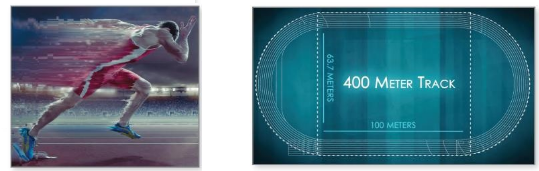
1. A track consists of a rectangle and two semicircles. The dimensions of the rectangle formed by the innermost lane are shown. What is the distance around each semicircle on the 400-meter, innermost lane?
Big Ideas Math Answer Key Grade 7 Chapter 9 Geometric Shapes and Angles 1
2. How does the width of the rectangle, 63.7 meters, compare to the distance around each semicircle? Explain.

Answer:
1. The distance around each semicircle on the 400-meter, innermost lane = 488 m
2. The distance around each semicircle = 90π + 320

Explanation:
1. The inside perimeter of the track = 400 m
the total length of the two straight portions = 90 + 90 = 180
therefore the length of the remaining portion = 400-180 = 220 m
circumference of the two remaining semi-circular portions = πr + πr = 2πr
2πr = 220
2 x 3.14 x r = 220
r = 35 m
Area of the track = 2 x 90 x 14 +3.14 x (49) x (49) – (35) x (35)
area of the track = 6216 square meter
length of the outer running track = 488 m
2. The perimeter of the track is the two circumferences of the circumferences.
The diameters of the circle and the width of the rectangle = 90 m
90 π + 320
Performance Task.
Finding the Area and Perimeter of a Track
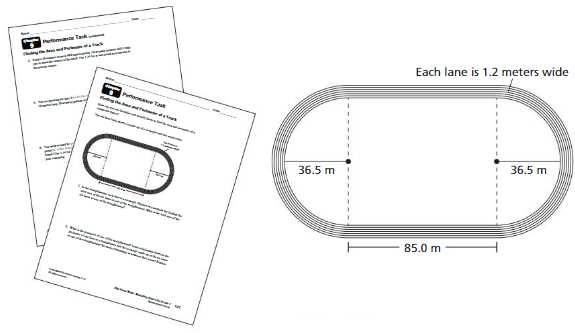
After completing this chapter, you will be able to use the concepts you learned to answer the questions in the STEAM Video Performance Task. You will be given the dimensions of a race track.
Big Ideas Math Answer Key Grade 7 Chapter 9 Geometric Shapes and Angles 2
You will be asked to solve various perimeter and area problems about the track. Given a race track, what measures do you need to find the outer perimeter?

Answer:
The outer perimeter = 11,2610 sq m

Explanation:
perimeter of the semicircle = (π + 2 ) r
p = (3.14 + 2)36.5
p= (3.16) 36.5
p = 11,2610 sq m

Geometric Shapes and Angles Getting Ready for Chapter 9

Chapter Exploration
Work with a partner.
Question 1.
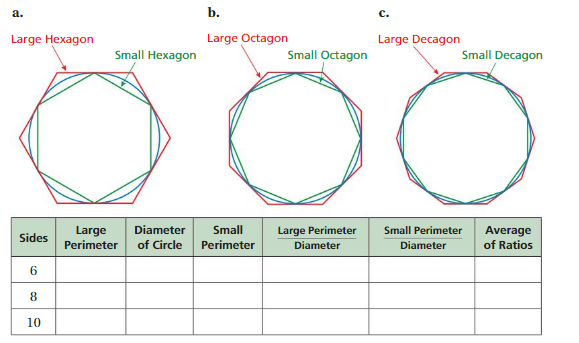
Perform the steps for each of the figures.

  • Measure the perimeter of the larger polygon to the nearest millimeter.
  • Measure the diameter of the circle to the nearest millimeter.
  • Measure the perimeter of the smaller polygon to the nearest millimeter.
  • Calculate the value of the ratio of the two perimeters to the diameter.
  • Take the average of the ratios. This average is the approximation of π(the Greek letter ).
    Big Ideas Math Answer Key Grade 7 Chapter 9 Geometric Shapes and Angles 3

Question 2.
Based on the table, what can you conclude about the value of π? Explain your reasoning.

Answer:
The value of π = 3.14

Explanation:
We can consider 3 values for the π.
they are (22/7) or 3.14
so i am considering the 3.14

Question 3.
The Greek mathematician Archimedes used the above procedure to approximate the value of π. He used polygons with 96 sides. Do you think his approximation was more or less accurate than yours? Explain your reasoning.
Answer:
The greek mathematician used polygons with the side of polygons as 12,14,48, and finally 96 sides.

Explanation:
The greek mathematician used polygons with the side of polygons as 12,14,48, and finally 96 sides.
yes the accuration is more than i think.

Vocabulary
The following vocabulary terms are defined in this chapter. Think about what each term might mean and record your thoughts.
diameter of a circle
semi circle
adjacent angles
circumference
composite figure
vertical angles

Answer:
The diameter of the circle = the diameter is the length of the line through the center that touches two points on the edge of the circle.
semi circle =  semicircle is a one-dimensional locus of points that forms half of the circle.
adjacent angles = adjacent angles are two angles that have a common vertex and a common side but do not overlap.
circumference = the circumference is the perimeter of the circle. the circumference would be the arc length of the circle.
composite figure = a figure that consists of two or more geometric shapes.
vertical angles = a pair of non-adjacent angles form when two lines intersect.

Explanation:
The diameter of the circle = the diameter is the length of the line through the center that touches two points on the edge of the circle.
semi circle =  semicircle is a one-dimensional locus of points that forms half of the circle.
adjacent angles = adjacent angles are two angles that have a common vertex and a common side but do not overlap.
circumference = the circumference is the perimeter of the circle. the circumference would be the arc length of the circle.
composite figure = a figure that consists of two or more geometric shapes.
vertical angles = a pair of non-adjacent angles form when two lines intersect.

Lesson 9.1 Circles and Circumference

EXPLORATION 1

Using a Compass to Draw a Circle
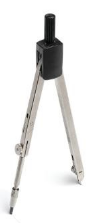
Work with a partner. Set a compass to 2 inches and draw a circle.
Big Ideas Math Answer Key Grade 7 Chapter 9 Geometric Shapes and Angles 9.1 1
a. Draw a line from one side of the circle to the other that passes through the center. What is the length of the line? This is called the diameter of the circle.
b. Estimate the distance around the circle. This is called the circumference of the circle. Explain how you found your answer.

Answer:
a. the length of the line = 4 inches
b.  The circumference of the circle = 12.56 inch

Explanation:
a. In the question they said that 2 inches
the length of the line = 4 in
b. the circumference of the circle = 2π r
circle = 2 x 3.14 x 2
circle = 12.56 in

EXPLORATION 2

Exploring Diameter and Circumference
Work with a partner.
a. Roll a cylindrical object on a flat surface to find the circumference of the circular base.
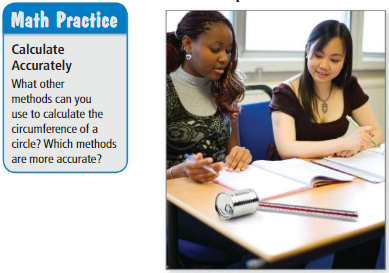
Big Ideas Math Answer Key Grade 7 Chapter 9 Geometric Shapes and Angles 9.1 2
b. Measure the diameter of the circular base. Which is greater, the diameter or the circumference? how many times greater?
c. Compare your answers in part(b) with the rest of the class. What do you notice?
d. Without measuring, how can you find the circumference of a circle with a given diameter? Use your method to estimate the circumference of the circle in Exploration 1.

Answer:
a. The circumference of the circle = 2πr
b. The circumference of the circle is 3.14 times greater than the diameter of the circle.
c. The circumference of the circle is greater than the diameter of the circle.
d. The diameter of the circle = 2r and the circumference of the circle = 2πr
Explanation:
a. The circumference of the circle = 2πr
b. The circumference of the circle is 3.14 times greater than the diameter of the circle.
c. The circumference of the circle is greater than the diameter of the circle.
d. The diameter of the circle = 2r and the circumference of the circle = 2πr

Big Ideas Math Answer Key Grade 7 Chapter 9 Geometric Shapes and Angles 9.1 3

Try It

Question 1.
The diameter of a circle is 16 centimeters. Find the radius.

Answer:
radius = 8 cm

Explanation:
The diameter of the circle = 2r
16 = 2r
r = 8 cm

Question 2.
The radius of a circle is 9 yards. Find the diameter.

Answer:
The diameter = 18 yds

Explanation:
The diameter of the circle = 2r
diameter = 2 x 9
r = 18 yds

Find the circumference of the object. Use 3.14 or \(\frac{22}{7}\) for π.
Question 3.
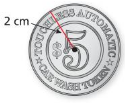
Big Ideas Math Answer Key Grade 7 Chapter 9 Geometric Shapes and Angles 9.1 4

Answer:
circumference = 12.56 cm

Explanation:
circumference of the circle =2πr
circle = 2 x 3.14 x 2 where r = 2cm given
circle = 6.28 x 2
circle = 12.56 cm

Question 4.
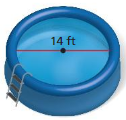
Big Ideas Math Answer Key Grade 7 Chapter 9 Geometric Shapes and Angles 9.1 5

Answer:
circumference =43.96 square feet

Explanation:
circumference of the circle =2πr
circle = 2 x 3.14 x 7 where r = 7 ft given
circle = 6.28 x 7
circle = 43.96 square feet

Question 5.
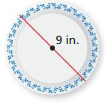
Big Ideas Math Answer Key Grade 7 Chapter 9 Geometric Shapes and Angles 9.1 6

Answer:
circumference =28.26 square in

Explanation:
circumference of the circle =2πr
circle = 2 x 3.14 x 4.5 where r = 4.5 is given
circle = 6.28 x 4.5
circle =28.26 in

Find the perimeter of the semicircular region.
Question 6.
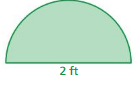
Big Ideas Math Answer Key Grade 7 Chapter 9 Geometric Shapes and Angles 9.1 7

Answer:
perimeter of the semicircle =  5.14 ft

Explanation:
perimeter of the semicircle = (π + 2 ) r
perimeter = (3.14 + 2) 1 diameter = 2 given r= 1
perimeter = 5.14 feet

Question 7.
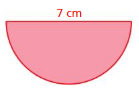
Big Ideas Math Answer Key Grade 7 Chapter 9 Geometric Shapes and Angles 9.1 8

Answer:
perimeter of the semicircle =  17.99 cm

Explanation:
perimeter of the semicircle = (π + 2 ) r
perimeter = (3.14 + 2) 3.5 diameter = 7 given r= 3.5
perimeter = 17.99 cm

Question 8.
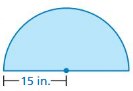
Big Ideas Math Answer Key Grade 7 Chapter 9 Geometric Shapes and Angles 9.1 9

Answer:
the perimeter of the semicircle =  33.14 in

Explanation:
perimeter of the semicircle = (π + 2 ) r
perimeter = (3.14 + 2) 15 given r= 15
perimeter = 33.14 in

Self-Assessment for Concepts & Skills
Solve each exercise. Then rate your understanding of the success criteria in your journal.

Question 9.
WRITING
Are there circles for which the value of the ratio of circumference to diameter is not equal to π? Explain.

Answer:
circumference to diameter is equal to π

Explanation:
d. The diameter of the circle = 2r and the circumference of the circle = 2πr
circumference to diameter is equal to π

Question 10.
FINDING A PERIMETER
Find the perimeter of a semicircular region with a straight side that is 8 yards long.

Answer:
perimeter = 11.14 yd

Explanation:
perimeter of the semicircle = (π + 2 ) r
perimeter = (3.14 + 2) 4 given r= 4
perimeter = 11.14 yd
Question 11.
DIFFERENT WORDS, SAME QUESTION
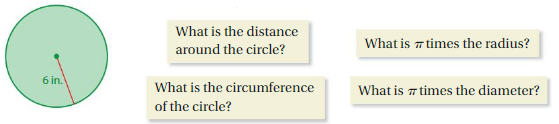
Which is different? Find “both” answers.
Big Ideas Math Answer Key Grade 7 Chapter 9 Geometric Shapes and Angles 9.1 10

Answer:
What is π times the radius?
What is π times the diameter?

Explanation:
the radius of the circle = (c/2 π )
the diameter of the circle =  2r
Self-Assessment for Problem Solving
Solve each exercise. Then rate your understanding of the success criteria in your journal.

Question 12.
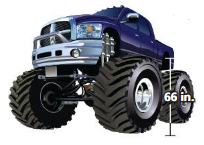
The wheels of a monster truck are 66 inches tall. Find the distance the monster truck travels when the tires make one 360-degree rotation.
Big Ideas Math Answer Key Grade 7 Chapter 9 Geometric Shapes and Angles 9.1 11

Answer:
The distance = 207.35 inches

Explanation:
The wheel is in the shape of a circle.
diameter = 66 given
radius = (66/2)
radius = 33
The circumference = 2πr
c = 2 x 3.14 x 33
c = 6.28 x 33
c = 207.24 in

Question 13.
DIG DEEPER!
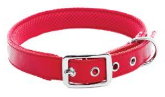
The radius of a dog’s collar should be at least 0.5 inch larger than the radius of the dog’s neck. A dog collar adjusts to a circumference of 10 to 14 inches. Should the collar be worn by a dog with a neck circumference of 12.5 inches? Explain.
Big Ideas Math Answer Key Grade 7 Chapter 9 Geometric Shapes and Angles 9.1 12

Answer:
No, the collar should not be worn by this dog.

Explanation:
Given that the collar should be at least 0.5 inches.
dog collar adjusts to a circumference of 10 to 14 inches.

Question 14.
You resize a picture so that the radius of the midday Sun appears four times larger. How much larger does the circumference of the Sun appear? Explain.

Answer:
4 times larger

Explanation:
they said that if they resize it for 4 times.
therefore the sun appears 4 times larger.

Circles and Circumference Homework & Practice 9.1

Review & Refresh

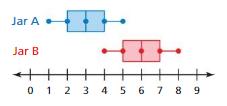
Two jars each contain 1000 numbered tiles. The double box-and-whisker plot represents a random sample of 10 numbers from each jar.
Big Ideas Math Answer Key Grade 7 Chapter 9 Geometric Shapes and Angles 9.1 13
Question 1.
Compare the samples using measures of center and variation.

Answer:
a. Jar A = median 3, starting 2.
b. Jar B = median  6, starting 2

Explanation:
In the above-given figure, the jar A is starting from 2
jar A contains median = 3
the jar B is starting from 2
jar B contains median = 6

Question 2.
Can you determine which jar contains greater numbers? Explain.

Answer:
Jar B

Explanation:
jar B contains the numbers from 4 to 9
Question 3.
Find the percent of change from 24 to 18.
A. 25% decrease
B. 25% increase
C. 75% increase
D. 75% decrease

Answer:
option A is correct

Explanation:
if the percent of jar changes from 24 to 18
the decrease in the percent = 25

Concepts, Skills, & Problem Solving
EXPLORING DIAMETER AND CIRCUMFERENCE Estimate the circumference of the circular base of the object. (See Exploration 2, p. 361.)
Question 4.
tube of lip balm with radius 0.5 mm

Answer:
c = 3.14 mm

Explanation:
circumference of the circle =2πr
circle = 2 x 3.14 x 0.5 where r = 0.5 mm given
circle = 6.28 x 0.5
circle =3.14 mm

Question 5.
D battery with radius 0.65 in.

Answer:
c = 4.082 in

Explanation:
circumference of the circle =2πr
circle = 2 x 3.14 x 0.65 where r = 0.65 ingiven
circle = 6.28 x 0.65
circle =4.082 in

FINDING A RADIUS Find the radius of the button.
Question 6.
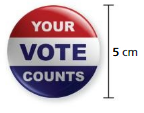
Big Ideas Math Answer Key Grade 7 Chapter 9 Geometric Shapes and Angles 9.1 14

Answer:
radius =2.5 cm

Explanation:
radius = (5/2)
radius = 2.5 cm

Question 7.
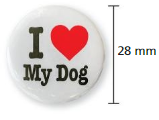
Big Ideas Math Answer Key Grade 7 Chapter 9 Geometric Shapes and Angles 9.1 15

Answer:
radius =14 mm

Explanation:
radius = (28/2)
radius = 14 mm

Question 8.
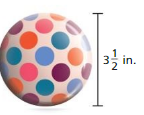
Big Ideas Math Answer Key Grade 7 Chapter 9 Geometric Shapes and Angles 9.1 16

Answer:
radius =1.75 in

Explanation:
radius = (3.5/2)
radius = 1.75 in

FINDING A DIAMETER Find the diameter of the object.
Question 9.
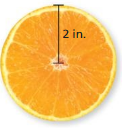
Big Ideas Math Answer Key Grade 7 Chapter 9 Geometric Shapes and Angles 9.1 17

Answer:
diameter = 4 in

Explanation:
diameter of the circle = 2r
where r = 2 given
d = 4 in

Question 10.
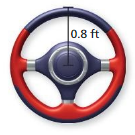
Big Ideas Math Answer Key Grade 7 Chapter 9 Geometric Shapes and Angles 9.1 18

Answer:
diameter = 0.64 ft

Explanation:
diameter of the circle = 2r
where r = 0.8 given
d = 0.64 ft

Question 11.
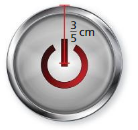
Big Ideas Math Answer Key Grade 7 Chapter 9 Geometric Shapes and Angles 9.1 19

Answer:
diameter = 1.2 cm

Explanation:
diameter of the circle = 2r
where r = 0.6 given
d = 1.2 cm

FINDING A CIRCUMFERENCE Find the circumference of the object. Use 3.14 or \(\frac{22}{7}\) for π.
Question 12.
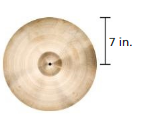
Big Ideas Math Answer Key Grade 7 Chapter 9 Geometric Shapes and Angles 9.1 20

Answer:
c = 43.96 in

Explanation:
circumference of the circle =2πr
circle = 2 x 3.14 x 7 where r = 7 ingiven
circle = 6.28 x 7
circle =43.96 in

Question 13.
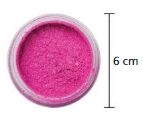
Big Ideas Math Answer Key Grade 7 Chapter 9 Geometric Shapes and Angles 9.1 21

Answer:
c = 18.84 cm

Explanation:
circumference of the circle =2πr
circle = 2 x 3.14 x 7 where r = 3 cmgiven
circle = 6.28 x 3
circle =18.84 cm

Question 14.
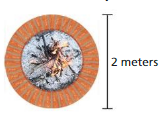
Big Ideas Math Answer Key Grade 7 Chapter 9 Geometric Shapes and Angles 9.1 22

Answer:
c = 6.28 mm

Explanation:
circumference of the circle =2πr
circle = 2 x 3.14 x 1where r = 1mgiven
circle = 6.28 x 1
circle =6.28 m

FINDING THE PERIMETER OF A SEMICIRCULAR REGION Find the perimeter of the window.
Question 15.
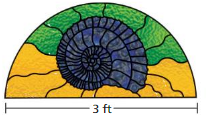
Big Ideas Math Answer Key Grade 7 Chapter 9 Geometric Shapes and Angles 9.1 23

Answer:
perimeter = 7.71 ft

Explanation:
perimeter of the semicircle = (π + 2 ) r
perimeter = (3.14 + 2) 1.5 given d =3 ,r = (d/2)
perimeter = 7.71 ft

Question 16.
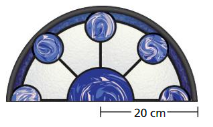
Big Ideas Math Answer Key Grade 7 Chapter 9 Geometric Shapes and Angles 9.1 24

Answer:
perimeter = 64.8 cm

Explanation:
perimeter of the semicircle = (π + 2 ) r
perimeter = (3.14 + 2) 20 given  ,r = 20 cm
perimeter = 64.8 cm

ESTIMATING A RADIUS Estimate the radius of the object.
Question 17.
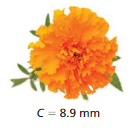
Big Ideas Math Answer Key Grade 7 Chapter 9 Geometric Shapes and Angles 9.1 25

Answer:
Radius = 1.417 mm

Explanation:
radius of the circle = (c/2π )
r = (8.9/6.28)
r = 1.417 mm

Question 18.
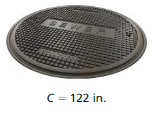
Big Ideas Math Answer Key Grade 7 Chapter 9 Geometric Shapes and Angles 9.1 26

Answer:
Radius = 19.426 in

Explanation:
radius of the circle = (c/2π )
r = (122/6.28)
r = 19.426 in

Question 19.
MODELING REAL LIFE
A circular sinkhole has a circumference of 75.36 meters. A week later, it has a circumference of 150.42 meters.
a. Estimate the diameter of the sinkhole each week.
b. How many times greater is the diameter of the sinkhole a week later?

Answer:
a. The diameter of the sinkhole each week = 4 in
b. 2 times greater is the diameter of the sinkhole a week later

Explanation:
a. The diameter of the sinkhole each week = 75.36 m
b. 2 times greater is the diameter of the sinkhole a week later
75.36 x 75.36 = 150.42 m
Question 20.
REASONING
Consider the circles A, B, C, and D.
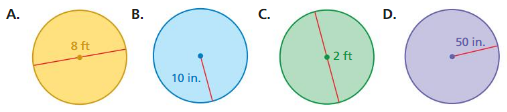
Big Ideas Math Answer Key Grade 7 Chapter 9 Geometric Shapes and Angles 9.1 27
a. Without calculating, which circle has the greatest circumference? Explain.
b. Without calculating, which circle has the least circumference? Explain.

Answer:
a. option D has the greatest circumference.
b. option C has the least circumference.

Explanation:
D. circumference of the circle =2πr
circle = 2 x 3.14 x 50where r =50 ingiven
circle = 6.28 x 50
circle =314 in
Explanation:
C. circumference of the circle =2πr
circle = 2 x 3.14 x 1where r = 1given
circle = 6.28 x1
circle = 6.28
Explanation:
A. circumference of the circle =2πr
circle = 2 x 3.14 x 4 where r = 4given
circle = 6.28 x 4
circle = 25.12
Explanation:
A. circumference of the circle =2πr
circle = 2 x 3.14 x 10 where r = 10given
circle = 6.28 x 10
circle = 62.8

FINDING CIRCUMFERENCES Find the circumferences of both circles.
Question 21.
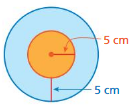
Big Ideas Math Answer Key Grade 7 Chapter 9 Geometric Shapes and Angles 9.1 28

Answer:
circumference of inside circle  =31.4 square cm
circumference of outside circle = 62.8  square cm

Explanation:
circumference of the inside circle =2πr
circle = 2 x 3.14 x 5 where r = 5 cm given
circle = 6.28 x 5
circle = 31.4 square cm
circumference of the outside circle =2πr
circle = 2 x 3.14 x 2 where r = 2 cm given
circle = 6.28 x 2
circle = 62.8 square cm

Question 22.
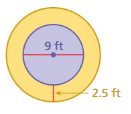
Big Ideas Math Answer Key Grade 7 Chapter 9 Geometric Shapes and Angles 9.1 29

Answer:
circumference of inside circle  =28.26 ft
circumference of outside circle = 31.4 square cm

Explanation:
circumference of the inside circle =2πr
circle = 2 x 3.14 x 4.5 where r = 4.5 feet given
circle = 6.28 x 4.5
circle = 28.26 ft
circumference of the outsideside circle =2πr
circle = 2 x 3.14 x 2.5 where r = 2.5 ft given
circle = 6.28 x 2.5
circle = 15.7 square ft

Question 23.
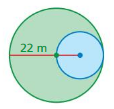
Big Ideas Math Answer Key Grade 7 Chapter 9 Geometric Shapes and Angles 9.1 30

Answer:
circumference of inside circle  =69.08  m
circumference of outside circle = 138.16 m

Explanation:
circumference of the inside circle =2πr
circle = 2 x 3.14 x 5.5 where r = 5.5 feet given
circle = 6.28 x 5.5
circle = 69.08 m
circumference of the outsideside circle =2πr
circle = 2 x 3.14 x 22 where r = 22given
circle = 6.28 x 22
circle = 138.16 m

Question 24.
MODELING REAL LIFE
A satellite is in an approximately circular orbit 36,000 kilometers from Earth’s surface. The radius of Earth is about 6400 kilometers. What is the circumference of the satellite’s orbit?
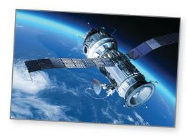
Big Ideas Math Answer Key Grade 7 Chapter 9 Geometric Shapes and Angles 9.1 31

Answer:
c = 40,192 km

Explanation:
circumference of the  satellite orbit =2πr
circle = 2 x 3.14 x 6400where r = 6400kmgiven
circle = 6.28 x 6400
circle =40,192km

Question 25.
STRUCTURE
The ratio of circumference to diameter is the same for every circle. Is the ratio of circumference to radius the same for every circle? Explain.

Answer:
The ratio of circumference to radius is  same for every circle.

Explanation:
c/r = 2πr/r
where r get canceled in both numerator and denominator.
c/r = 2π
radius = (c/2π)
the radius is same for every circle.

Question 26.
PROBLEM SOLVING
A wire is bent to form four semicircles. How long is the wire? Justify your answer.
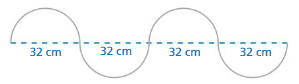
Big Ideas Math Answer Key Grade 7 Chapter 9 Geometric Shapes and Angles 9.1 32

Answer:
The wire is 128 cm long

Explanation:
Given that the four semicircles are 32 cm
32 + 32 + 32 + 32 = 64

Question 27.
CRITICAL THINKING
Explain how to draw a circle with a circumference of π2 inches. Then draw the circle.

Answer:
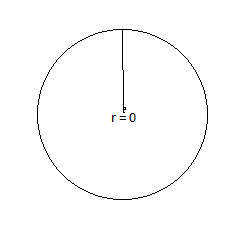
Explanation:
circumference of circle = 2πr
c = π2

Question 28.
DIG DEEPER!
“Lines” of latitude on Earth are actually circles. The Tropic of Cancer is the northernmost line of latitude at which the Sun appears directly overhead at noon. The Tropic of Cancer has a radius of 5854 kilometers.
To qualify for an around-the-world speed record, a pilot must cover a distance no less than the circumference of the Tropic of Cancer, cross all meridians, and land on the same air field where the flight began.
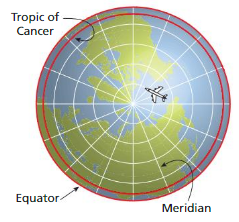
Big Ideas Math Answer Key Grade 7 Chapter 9 Geometric Shapes and Angles 9.1 33
a. What is the minimum distance that a pilot must fly to qualify for an around-the-world speed record?
b. RESEARCH Estimate the time it will take for a pilot to qualify for the speed record. Explain your reasoning.

Answer:
a. The minimum distance that a pilot must fly to qualify for an around the world-speed record = 18.3376 km
b. The pilot will take for the speed record = 18.3376 km

Explanation:
a. The minimum distance that a pilot must fly to qualify for an around the world-speed record = 18.3376 km
b. The pilot will take for the speed record = 18.3376 km
Question 29.
PROBLEM SOLVING
Bicycles in the late 1800s looked very different than they do today.
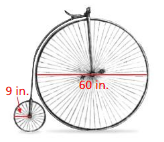
Big Ideas Math Answer Key Grade 7 Chapter 9 Geometric Shapes and Angles 9.1 34
a. How many rotations does each tire make after traveling 600 feet? Round your answers to the nearest whole number.
b. Would you rather ride a bicycle made with two large wheels or two small wheels? Explain.

Answer:
a. The rotations each tire make after traveling 600 feet = 188.4 in in
b. two large wheels = 376.8 in
two small wheels = 113.04 in

Explanation:
the rotations each tire make after travelling = 2 x 3.14 x 30  = 188.4 in
b. two large wheels = 188.4 x 2 = 376.8 in
for two small wheels = 113.04 in

Question 30.
LOGIC
The length of the minute hand is 150% of the length of the hour hand.
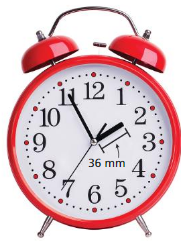
Big Ideas Math Answer Key Grade 7 Chapter 9 Geometric Shapes and Angles 9.1 35
a. What distance will the tip of the minute hand move in 45 minutes? Justify your answer.
b. In 1 hour, how much farther does the tip of the minute hand move than the tip of the hour hand? Explain how you found your answer.

Answer:
The distance will the tip of minute hand move in 45 minutes = 140 %
b. the tip of the minute hand moves 60 times faster than hour hand.

Explanation:
The distance will the tip of minute hand move in 45 minutes = 140 %
b. the tip of the minute hand moves 60 times faster than hour hand.

Lesson 9.2 Areas of Circles

EXPLORATION 1

Estimating the Area of a Circle
Work with a partner. Each grid contains a circle with a diameter of 4 centimeters. Use each grid to estimate the area of the circle. Which estimate should be closest to the actual area? Explain.
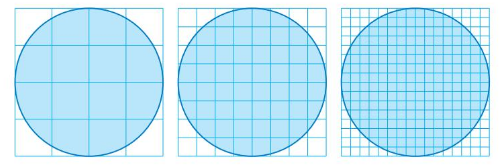
Big Ideas Math Answers 7th Grade Chapter 9 Geometric Shapes and Angles 9.2 1

Answer:
Area of 1st circle = 200.96 cm
Area of 2nd circle =803.84 cm
Area of 3rd circle =3215.36 cm

Explanation:
area of 1st circle = πr x r
area = 3.14 x 8 x 8
a = 200.96 cm
area of 2nd circle = πr x r
area= 3.14 x 16 x 16
a = 803.84 cm
area of 3rd circle = πr x r
area= 3.14 x 32 x 32
a = 3215.36
EXPLORATION 2

Writing a Formula for the Area of a Circle
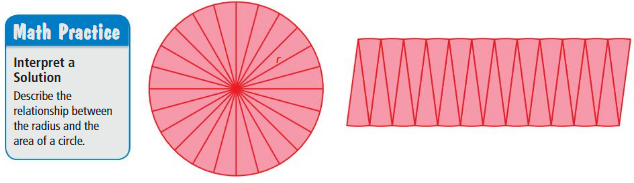
Work with a partner. A student draws a circle with radius and divides the circle into 24 equal sections. The student cuts out each section and arranges the sections to form a shape that resembles a parallelogram.
Big Ideas Math Answers 7th Grade Chapter 9 Geometric Shapes and Angles 9.2 2
a. Use the diagram to write a formula for the area of a circle in terms of the radius r. Explain your reasoning.Describe the relationship between the radius and the area of a circle.
b. Use the formula to check your estimates in Exploration 1.

Answer:
a. the area of the circle = 1808.64
b. the area of the circle in terms of radius r = 0.0084 cm

Explanation:
The area  of circle = πr x r
a = 3.14 x 24 x 24
a = 1808.64 cm
The radius of the circle = (c/2 π)
circumference = 2πr
c = 2 x 3.14 x 24
c = 150.72 cm
area = (150.72/6.28)
area = 0.0084 cm

Try It
Question 1.
Find the area of a circle with a radius of 6 feet. Use 3.14 for π.

Answer:
The area  of circle = 113.04 sq ft

Explanation:
The area  of circle = πr x r
a = 3.14 x 6 x 6
a = 113.04 square feet
Question 2.
Find the area of a circle with a diameter of 28 meters.Use \(\frac{22}{7}\) for π.

Answer:
The area  of circle = 175.84 sq meters

Explanation:
The area  of circle = πr x r
a = 3.14 x 14 x 14 where d = 28 so r = 14
a = 175.84 square meters

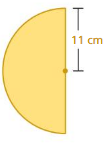
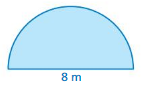
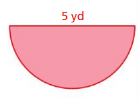
Find the area of the semicircle.
Question 3.
Big Ideas Math Answers 7th Grade Chapter 9 Geometric Shapes and Angles 9.2 3

Answer:
Area of semicircle =62.07 sq cm

Explamation:
Area of semicircle =( π+r x r/2)
area =( 3.14 +121/2)
area =(121.14/2)
area = 62.07 sq cm

Question 4.
Big Ideas Math Answers 7th Grade Chapter 9 Geometric Shapes and Angles 9.2 4

Answer:
Area of semicircle =9.57 sqm

Explamation:
Area of semicircle =( π+r x r/2)
area =( 3.14 +16/2)
area =(19.14/2)
area = 9.57 sq m

Question 5.
Big Ideas Math Answers 7th Grade Chapter 9 Geometric Shapes and Angles 9.2 5

Answer:
Area of semicircle =4.695 sq yd

Explanation:
Area of semicircle =( π+r x r/2)
area =( 3.14 +6.25/2)
area =(9.39/2)
area = 4.695 sq yd

Self-Assessment for Concepts & Skills
Solve each exercise. Then rate your understanding of the success criteria in your journal.

Question 6.
ESTIMATING AN AREA
The grid contains a circle with a diameter of 2 centimeters. Use the grid to estimate the area of the circle. How can you change the grid to improve your estimate? Explain.
Big Ideas Math Answers 7th Grade Chapter 9 Geometric Shapes and Angles 9.2 6

Answer:
The area  of circle = 50.24 sq centi meters

Explanation:
The area  of circle = πr x r
a = 3.14 x 4 x 4 where d = 8 so r = 4
a = 50.24 square centimeters

Question 7.
WRITING
Explain the relationship between the circumference and area of a circle.

Answer:
The area  of circle = πr x r
circumference of circle = 2πr

Explanation:
The circumference of the circle is 2 times greater than the area of the circle.
The area  of circle = πr x r
circumference of circle = 2πr

Question 8.
DIFFERENT WORDS, SAME QUESTION
Which is different? Find “both” answers.
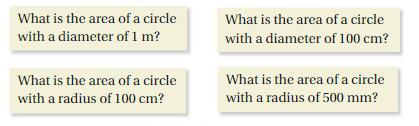
Big Ideas Math Answers 7th Grade Chapter 9 Geometric Shapes and Angles 9.2 7

Answer:
What is area of a circle with a radius of 100 cm?
What is the area of a circle with a radius  of 500 mm?

Explanation:
The area  of circle = πr x r
area = 3.14 x 100 x 100
area = 31400 sq cm
The area  of circle = πr x r
area = 3.14 x 500 x 500
area = 785000 sq mm
Self-Assessment for Problem Solving
Solve each exercise. Then rate your understanding of the success criteria in your journal.

Question 9.
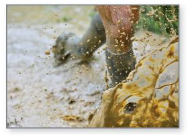
A local event planner wants to cover a circular region with mud for an obstacle course. The region has a circumference of about 157 feet. The cost to cover 1 square foot with mud is $1.50. Approximate the cost to cover the region with mud.
Big Ideas Math Answers 7th Grade Chapter 9 Geometric Shapes and Angles 9.2 8

Answer:
Cost to cover =

Question 10.
DIG DEEPER!
A manufacturer recommends that you use a frying pan with a radius that is within 1 inch of the radius of your stove top burner. The area of the bottom of your frying pan is 25π square inches. The circumference of your cook top burner is 9π inches. Does your frying pan meet the manufacturer’s recommendation?

Answer:
no the frying pan does not meet the manufacture

Explanation:
Given that frying pan has radius = 1 inch
area of frying pan = 25π square inches
circumference = 9π  inches

Areas of Circles Homework & Practice 9.2

Review & Refresh

Find the circumference of the object. Use 3.14 or \(\frac{22}{7}\) for π.
Question 1.
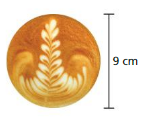
Big Ideas Math Answers 7th Grade Chapter 9 Geometric Shapes and Angles 9.2 9

Answer:
c = 28.26cm

Explanation:
circumference of the circle =2πr
circle = 2 x 3.14 x 4.5where r = 4.5cmgiven
circle = 6.28 x 4.5
circle =28.26 cm

Question 2.
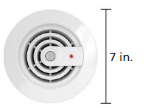
Big Ideas Math Answers 7th Grade Chapter 9 Geometric Shapes and Angles 9.2 10

Answer:
c = 21.98 sq in

Explanation:
circumference of the circle =2πr
circle = 2 x 3.14 x 3.5where r = 3.5ingiven
circle = 6.28 x 3.5
circle =21.98 sq in

You spin the spinner shown.
Big Ideas Math Answers 7th Grade Chapter 9 Geometric Shapes and Angles 9.2 11
Question 3.
How many possible outcomes are there?

Answer:
3 possible outcomes

Explanation:
There are 3 possible outcomes.
3 numbers are there in the spin.

Question 4.
In how many ways can spinning an odd number occur?

Answer:
2 ways the spinning an odd number occur.

Explanation:
There are 2 possible ways that the odd numbers can occur.

Concepts, Skills, & Problem Solving
ESTIMATING AN AREA Use the grid to estimate the area of the circle. (See Exploration 1, p. 369.)

Question 5.
diameter of 3 centimeters
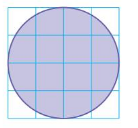
Big Ideas Math Answers 7th Grade Chapter 9 Geometric Shapes and Angles 9.2 12

Answer:
area of the circle = 6.75 sq cm

Explanation:
The area  of circle = πr x r
area = 3.14 x 1.5 x 1.5
area = 6.75 sq cm

Question 6.
diameter of 1.6 inches
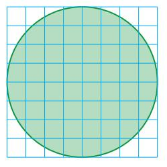
Big Ideas Math Answers 7th Grade Chapter 9 Geometric Shapes and Angles 9.2 13

Answer:
area of the circle = 141.41 sq in

Explanation:
The area  of circle = πr x r
area = 3.14 x 6.4 x 6.4
area = 141.41 sq in

FINDING AN AREA Find the area of the circle. Use 3.14 or \(\frac{22}{7}\) for π.
Question 7.
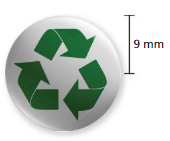
Big Ideas Math Answers 7th Grade Chapter 9 Geometric Shapes and Angles 9.2 14

Answer:
The area  of circle = 254.34 sq milli meters

Explanation:
The area  of circle = πr x r
a = 3.14 x 4 x 4 where d = 8 so r = 4
a = 254.34 square millimeters

Question 8.
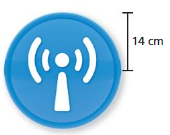
Big Ideas Math Answers 7th Grade Chapter 9 Geometric Shapes and Angles 9.2 15

Answer:
The area  of circle = 615.44 sq centi meters

Explanation:
The area  of circle = πr x r
a = 3.14 x 14 x 14 where r = 14
a = 615.44 square centimeters

Question 9.
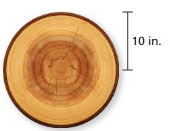
Big Ideas Math Answers 7th Grade Chapter 9 Geometric Shapes and Angles 9.2 16

Answer:
The area  of circle = 314 sq inches

Explanation:
The area  of circle = πr x r
a = 3.14 x 10 x 10 where r = 10
a = 314 square inches

Question 10.
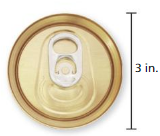
Big Ideas Math Answers 7th Grade Chapter 9 Geometric Shapes and Angles 9.2 17

Answer:
The area  of circle = 7.065 sq inches

Explanation:
The area  of circle = πr x r
a = 3.14 x 1.5 x 1.5 where r = 1.5
a = 7.065 square inches

Question 11.
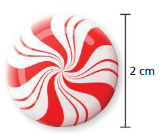
Big Ideas Math Answers 7th Grade Chapter 9 Geometric Shapes and Angles 9.2 18

Answer:
The area  of circle = 3.14 sq cm

Explanation:
The area  of circle = πr x r
a = 3.14 x 1 x 1 where r = 1
a = 3.14 square cm

Question 12.
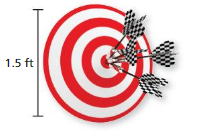
Big Ideas Math Answers 7th Grade Chapter 9 Geometric Shapes and Angles 9.2 19

Answer:
area  of circle = 1.76625sq ft

Explanation:
The area  of circle = πr x r
a = 3.14 x 0.75 x 0.75 where r = 0.75
a = 1.76625 square ft

Question 13.
YOU BE THE TEACHER
Your friend finds the area of a circle with a diameter of 7 meters. Is your friend correct? Explain.
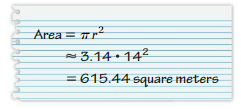
Big Ideas Math Answers 7th Grade Chapter 9 Geometric Shapes and Angles 9.2 20

Answer:
No, my friend is not correct.

Explanation:
The area  of circle = πr x r
a = 3.14 x 3.5 x 3.5 where r = 0.75
a = 38.465 square meters
Question 14.
MODELING REAL LIFE
The diameter of a flour tortilla is 12 inches. What is the total area of two tortillas?

Answer:
The area  of tortilla = 226.08 sq inches

Explanation:
The area  of tortilla = πr x r
a = 3.14 x 6 x 6 where r = 6
a = 113.04 square inches
for 2 tortilla = 226.08 sq inches

Question 15.
MODELING REAL LIFE
The diameter of a coaster is 7 centimeters. What is the total area of five coasters?

Answer:
The  total area  of coaster = 192.325 cm

Explanation:
The area  of tortilla = πr x r
a = 3.14 x 3.5 x 3.5 where r = 3.5
a = 38.465 square cm
for 5 tortilla = 192.325 centimeters

Question 16.
PROBLEM SOLVING
The HillsboroInlet Lighthouse lights up how much more area than the Jupiter Inlet Lighthouse?
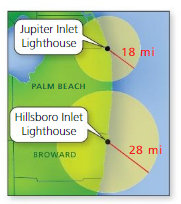
Big Ideas Math Answers 7th Grade Chapter 9 Geometric Shapes and Angles 9.2 21

Answer:
The HillsboroInlet Lighthouse lights are 2 times greater than the Jupiter Inlet Lighthouse.

Explanation:
Hillsboro inlet Lighthouse = 3.14 x 28 x 28
area = 2,461.76 sq mi
jupiter inlet Lighthouse = 3.14 x 18 x 18
area = 1,017.36 sq mi

FINDING THE AREA OF A SEMICIRCLE Find the area of the semicircle.
Question 17.
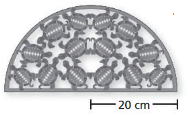
Big Ideas Math Answers 7th Grade Chapter 9 Geometric Shapes and Angles 9.2 22

Answer:
Area of semicircle = 628 sq cm

Explanation:
Area of semicircle =( π+r x r/2)
area =( 3.14 +400/2)
area =(403.14/2)
area = 628 sq cm

Question 18.
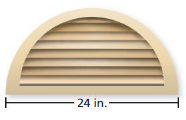
Big Ideas Math Answers 7th Grade Chapter 9 Geometric Shapes and Angles 9.2 23
Answer:
Area of semicircle =201.57 sq cm

Explanation:
Area of semicircle =( π+r x r/2)
area =( 3.14 +400/2)
area =(403.14/2)
area = 201.57 sq cm

Question 19.
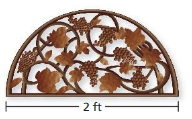
Big Ideas Math Answers 7th Grade Chapter 9 Geometric Shapes and Angles 9.2 24

Answer:
Area of semicircle =1.57 sq ft

Explanation:
Area of semicircle =( π+r x r/2)
area =( 3.14 +1/2)
area =(3.14/2)
area = 1.57 sq ft

Question 20.
MODELING REAL LIFE
The plate for a microscope has a circumference of 100π millimeters. What is the area of the plate?

Answer:
Area of the plate = 200π mm

Explanation:
Area of the plate = π x r x r
area = 3.14 x 200 x 200

Question 21.
MODELING REAL LIFE
A dog is leashed to the corner of a house. How much running area does the dog have? Explain how you found your answer.
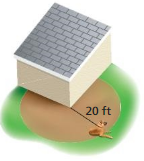
Big Ideas Math Answers 7th Grade Chapter 9 Geometric Shapes and Angles 9.2 25

Answer:
Area of the circle = 942 sq ft

Explanation:
Area of the circle = π x r x r
area = 3.14 x 20 x 20
area = 942 sq ft
The running area is 3/4 the area of a circle with a radius of 20 feet.

Question 22.
REASONING
Target A has a circumference of 20 feet. Target B has a diameter of 3 feet. Both targets are the same distance away. Which target is easier to hit? Explain your reasoning.

Answer:
Target B is easier to hit

Explanation:
Target A =2  π x r
A  = 2 x 3.14 x 3.18
A = 19.9704

Target B = 1.5

Question 23.
DIG DEEPER!
A circular oil spill has a radius of 2 miles. After a day, the radius of the oil spill increases by 3 miles. By how many square miles does the area of the oil spill increase?

Answer:
The area of oil spill increases by 65.94 miles.

Explanation:
Given that the circular oil spill has a radius of 2 miles.
The radius of the oil spill increases by 65.94 sq miles.

Question 24.
FINDING AN AREA
Find the area of the circle in square yards.
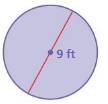
Big Ideas Math Answers 7th Grade Chapter 9 Geometric Shapes and Angles 9.2 26

Answer:
Area of the circle = 7.057935 sq yd

Explanation:
Area of the circle = π x r x r
area = 3.14 x 4.5 x 4.5
area = 63.585 sq ft
area = 7.057935 sq yd

Question 25.
REPEATED REASONING
What happens to the circumference and the area of a circle when you double the radius? triple the radius? Justify your answer.

Answer:
If we double the radius ,area  = π x r x r x r x r
If we double the radius, circumference  = 2πr x r x r
If we triple the radius ,area  = π x r x r x r x r x r
If we triple the radius, circumference  = 2πr x r x r x r x r

Explanation:
circumference doubles and area quadruples;
circumference triples and area is 9 times greater;
double the radius: circumference = 2π2r = 4πr
4πr /2πr  = 2 times larger, area =π (2r) x r =4πrx r
4πrx r/ πrx r = 4 times larger.

Question 26.
CRITICAL THINKING
Is the area of a semicircle with a diameter of x greater than, less than, or equal to the area of a circle with a diameter of \(\frac{1}{2}\)x? Explain.

Answer:
The area of a semicircle with a diameter of x is greater than the area of a circle with a diameter of (0.5)

Explanation:
Area of semicircle = (3.14 + (0.5 x 0.5)/2)
area = 1.695
Area of circle = (3.14 x 0.5 x 0.5)
area = 0.785

Lesson 9.3 Perimeters and Areas of Composite Figures

EXPLORATION 1

Submitting a Bid
Work with a partner. You want to bid on a project for the pool shown. The project involves ordering and installing the brown tile that borders the pool, and ordering a custom-made tarp to cover the surface of the pool. In the figure, each grid square represents 1 square foot. You pay $5 per linear foot for the tile.

  • You pay $4 per square foot for the tarp.
  • It takes you about 15 minutes to install each foot of tile.

a. Estimate the total cost for the tile and the tarp.
b. Write a bid for how much you will charge for the project.Include the hourly wage you will receive.Estimate your total profit.
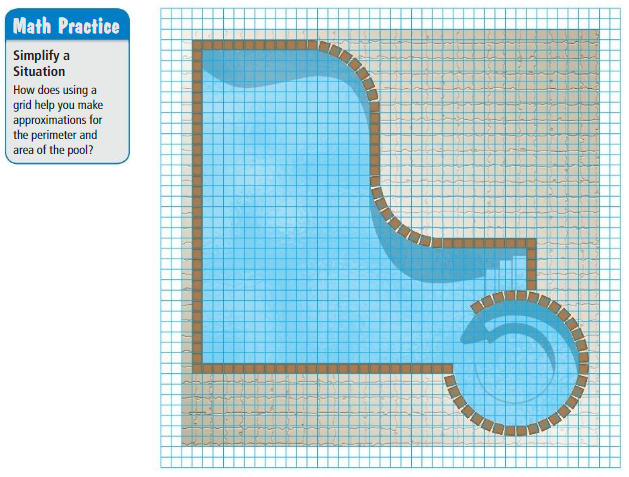
Big Ideas Math Answers Grade 7 Chapter 9 Geometric Shapes and Angles 9.3 1

Answer:

Big Ideas Math Answers Grade 7 Chapter 9 Geometric Shapes and Angles 9.3 2

Try It

Question 1.
Estimate the perimeter and the area of the figure.
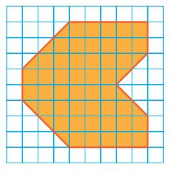
Big Ideas Math Answers Grade 7 Chapter 9 Geometric Shapes and Angles 9.3 3

Answer:
50.24 sq mm

Explanation:
The above-given figure is about  50.24 sq mm
Question 2.
Find the perimeter and the area of the figure.
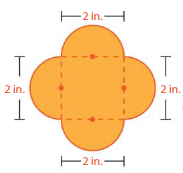
Big Ideas Math Answers Grade 7 Chapter 9 Geometric Shapes and Angles 9.3 4

Answer:
perimeter of the figure = 3.16 sq in
area of the figure = 3.14 sq in

Explanation:
perimeter of the semicircle = ( π + 2) r
p = (3.14 + 2 ) 1
p = 3.16 in
area of the figure = π x r x r
area = 3.14 x 1 x1
area = 3.14 in

Self-Assessment for Concepts & Skills
Solve each exercise. Then rate your understanding of the success criteria in your journal.

Question 3.
ESTIMATING PERIMETER AND AREA
Estimate the perimeter and area of the figure at the right.
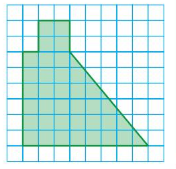
Big Ideas Math Answers Grade 7 Chapter 9 Geometric Shapes and Angles 9.3 5

Answer:
The perimeter  and area = 30 ft
area =  π  x r x r

Explanation:

The perimeter = ( π + 2) r
area =  π  x r x r

Question 4.
FINDING PERIMETER AND AREA
Identify the shapes that make up the figure at the left. Then find the perimeter and area of the figure.
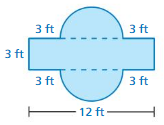
Big Ideas Math Answers Grade 7 Chapter 9 Geometric Shapes and Angles 9.3 6

Answer:
The perimeter = 9.48 sq ft
area =  27.36 sq ft

Explanation:
The perimeter = ( π + 2) r
perimeter = 3.14 +2 x 3
perimeter = 9.48 sq ft
area = 3.14 x 3 x 3
area = 27.36 sq feet

Self-Assessment for Problem Solving
Solve each exercise. Then rate your understanding of the success criteria in your journal.

Question 5.
A farmer wants to seed and fence a section of land. Fencing costs $27 per yard. Grass seed costs $2 per square foot. How much does it cost to fence and seed the pasture?
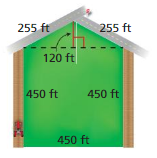
Big Ideas Math Answers Grade 7 Chapter 9 Geometric Shapes and Angles 9.3 7

Answer:
1 m

Explanation:
Given that farmer has the fencing cost = $ 27
seed cost = $ 2
5.10 $ is used to cost for  grass seed
$ 27 is used to fence = 1 m

Question 6.
DIG DEEPER!
In each room shown, you plan to put down carpet and add a wallpaper border around the ceiling. Which room needs more carpeting? more wallpaper?
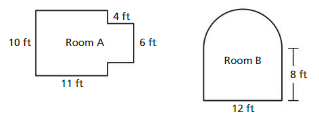
Big Ideas Math Answers Grade 7 Chapter 9 Geometric Shapes and Angles 9.3 8

Answer:
Room A needs more carpeting.

Explanation:
Room A =  10 x 11
where length = 11 , breadth = 10 given
Room A = 110
Room B = 12 x 8
B = 96

Perimeters and Areas of Composite Figures Homework & Practice 9.3

Review & Refresh

Find the area of the circle. Use 3.14 or \(\frac{22}{7}\) for π.
Question 1.
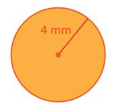
Big Ideas Math Answers Grade 7 Chapter 9 Geometric Shapes and Angles 9.3 9

Answer:
Area of the circle = 50.24 sq mm

Explanation:
Area of the circle = π x r x r
area = 3.14 x 4 x 4
area = 3.14 x 16
area = 50.24 sq mm

Question 2.
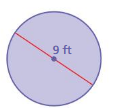
Big Ideas Math Answers Grade 7 Chapter 9 Geometric Shapes and Angles 9.3 10

Answer:
Area of the circle = 63.585 sq ft

Explanation:
Area of the plate = π x r x r
area = 3.14 x 4.5 x 4.5
area = 3.14 x
area = 63.585 sq ft

Find the missing dimension. Use the scale 1 : 5.
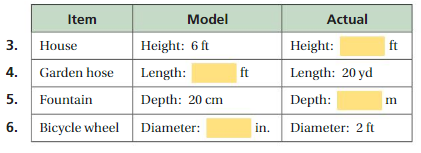
Big Ideas Math Answers Grade 7 Chapter 9 Geometric Shapes and Angles 9.3 11

Answer:
3. Height = 30 ft
4. Length = 6 ft
5. Depth = 100 cm
6. Diameter = 2 in

Explanation:
3. house : height = 6 ft , height = 30 ft given that scale = 1 : 5
4. garden hose : length = 6 ft , length = 20 yd
4. fountain : depth = 20 cm, depth = 100 cm
5. bicycle wheel :  = diameter = 2 in  diameter = 2 ft

Concepts, Skills, & Problem Solving

ESTIMATING PERIMETER AND AREA You build a patio with a brick border. (See Exploration 1, p. 375.)
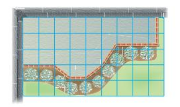
Big Ideas Math Answers Grade 7 Chapter 9 Geometric Shapes and Angles 9.3 12
Question 7.
Estimate the perimeter of the patio.

Answer:
The perimeter of a patio = 24 units

Explanation:
In the above-given figure,
the perimeter of the patio = 24

Question 8.
Estimate the area of the patio.

Answer:
area of the patio = π r

ESTIMATING PERIMETER AND AREA Estimate the perimeter and the area of the shaded figure.
Question 9.
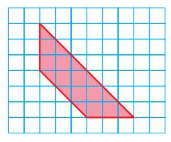
Big Ideas Math Answers Grade 7 Chapter 9 Geometric Shapes and Angles 9.3 13

Answer:
Perimeter = 19.5 units
area =13.5 units

Explanation:
given figure is trapezoid
Perimeter = a + b + c + d
area =( (a + b) x h /2)

Question 10.
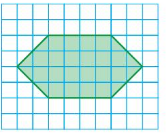
Big Ideas Math Answers Grade 7 Chapter 9 Geometric Shapes and Angles 9.3 14

Answer:
area =(  3 √ 3/2) a square
perimeter = 6 a

Explanation:
given figure is hexagon
area =(  3 √ 3/2) a square
perimeter = 6 a

Question 11.
Big Ideas Math Answers Grade 7 Chapter 9 Geometric Shapes and Angles 9.3 15

Answer:
The perimeter = 24.6 units
Area of the plate = 41.1 sq units

Explanation:
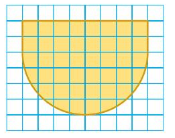
given figure is semicircle
The perimeter = ( π + 2) r
Area of the plate = π x  r x r

Question 12.
Big Ideas Math Answers Grade 7 Chapter 9 Geometric Shapes and Angles 9.3 16

Answer:
Perimeter = a + b + c + d
area =( (a + b) x h /2)

Explanation:
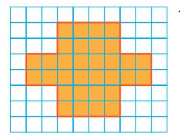
given figure is trapezoid
Perimeter = a + b + c + d
area =( (a + b) x h /2)

Question 13.
Big Ideas Math Answers Grade 7 Chapter 9 Geometric Shapes and Angles 9.3 17

Answer:
Perimeter = 19 units
area = 24  squnits

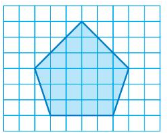
Explanation:
given figure is pentagon
Perimeter = 5 a
area = (  perimeter x apotherm /2 )

Question 14.
Big Ideas Math Answers Grade 7 Chapter 9 Geometric Shapes and Angles 9.3 18

Answer:
Perimeter = a + b + c
area = (  height x breadth /2 )

Explanation:
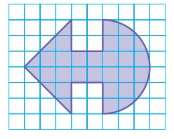
given figure is triangle
Perimeter = a + b + c
area = (  height x breadth /2 )

FINDING PERIMETER AND AREA Find the perimeter and the area of the figure.
Question 15.
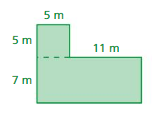
Big Ideas Math Answers Grade 7 Chapter 9 Geometric Shapes and Angles 9.3 19

Answer:
area = 137 sq m
perimeter = 56 m

Explanation:
area of the rectangle = l x w
l = length, w = width
area = 12 x 11
area = 137 sq m
perimeter of the rectangle = 2 ( l + w)
perimeter = 2 (28)
perimeter = 56 m

Question 16.
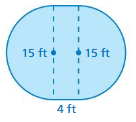
Big Ideas Math Answers Grade 7 Chapter 9 Geometric Shapes and Angles 9.3 20

Answer:
area = 114.07 sq ft
perimeter = 47.4 sq ft

Explanation:
Area of semicircle =( π+r x r/2)
area =( 3.14 +225/2)
area =(228.14/2)
area = 114.07 sq ft
perimeter of the semicircle = (π + 2 ) r
perimeter = (3.14 + 2) 15 given r= 15
perimeter = 3.16 x 15
perimeter = 47.4 sq ft

Question 17.
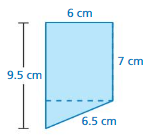
Big Ideas Math Answers Grade 7 Chapter 9 Geometric Shapes and Angles 9.3 21

Answer:
area = 49.5 cm
perimeter = 29 cm

Explanation:
area of the rectangle = l x w
l = length, w = width
area = 7 x 7
area = 49 cm
perimeter of the rectangle = 2 ( l + w)
perimeter = 2 (14)
perimeter = 29 cm

Question 18.
YOU BE THE TEACHER
Your friend finds the perimeter of the figure. Is your friend correct? Explain your reasoning.
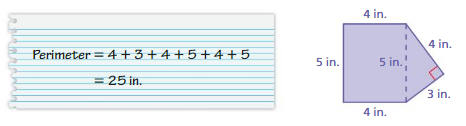
Big Ideas Math Answers Grade 7 Chapter 9 Geometric Shapes and Angles 9.3 22

Answer:
Yes my friend is correct.

Explnation:
perimeter = length + side +  height + breadth + width + base
p = 4 + 3 + 4 + 5 + 4 + 5
p = 25 in

Question 19.
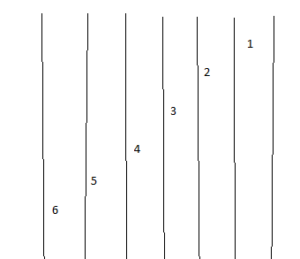
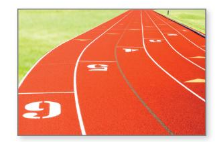
LOGIC
A running track has six lanes. Explain why the starting points for the six runners are staggered. Draw a diagram as part of your explanation.
Big Ideas Math Answers Grade 7 Chapter 9 Geometric Shapes and Angles 9.3 23

Answer:

Explanation:
The starting points for the six runners are staggered because each runner can run the same distance.

Explanation:
The starting points are staggered so that each runner can run the same distance and use the same finish line.
this is necessary because the circumference is different for each lane.
the above-diagram shows this because the diameter is greater n the outer lanes.

Question 20.
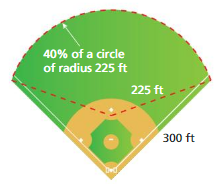
PROBLEM SOLVING
You run around the perimeter of the baseball field at a rate of 9 feet per second. How long does it take you to run around the baseball field?
Big Ideas Math Answers Grade 7 Chapter 9 Geometric Shapes and Angles 9.3 24

Answer:
It take to run around the baseball field = 1,58,962.5 sq feet

Explanation:
The area of the circle = π x r x r
area = 3.14 x 225 x 225
area = 1,58,962.5 sq feet

Question 21.
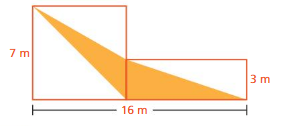
STRUCTURE
The figure at the right is made up of a square and a rectangle. Find the area of the shaded region.
Big Ideas Math Answers Grade 7 Chapter 9 Geometric Shapes and Angles 9.3 25

Answer:
The area of the shaded region =24 sq m

Ex planation:
Area of triangle = ( b x h )/2
area =( 8 x 7)/ 2
area = 48/2
area = 24 sq m
Question 22.
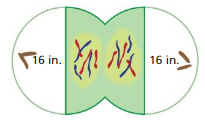
DIG DEEPER!
Your friend makes a two-dimensional model of a dividing cell as shown. The total area of the dividing cell is 350 square inches. What is the area of the shaded region?
Big Ideas Math Answers Grade 7 Chapter 9 Geometric Shapes and Angles 9.3 26

Answer:
The area of the shaded region = 1.89 sq in

Explanation :
area of semicircle = (π + r x r/2)
area = (3.14 + 64/2)
area = ( 3.78 / 2)
area = 1.89 sq in
Question 23.
CRITICAL THINKING
How can you add a figure to a composite figure without increasing its perimeter? Can this be done for all figures? Draw a diagram to support your answer.

Answer:
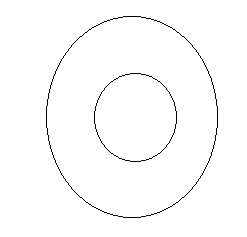
Explanation:
The perimeter does not increases.

Lesson 9.4 Constructing Polygons

EXPLORATION 1

Using Technology to Draw Polygons
Work with a partner.
a. Use geometry software to draw each polygon with the given side lengths or angle measures, if possible. Complete the table.
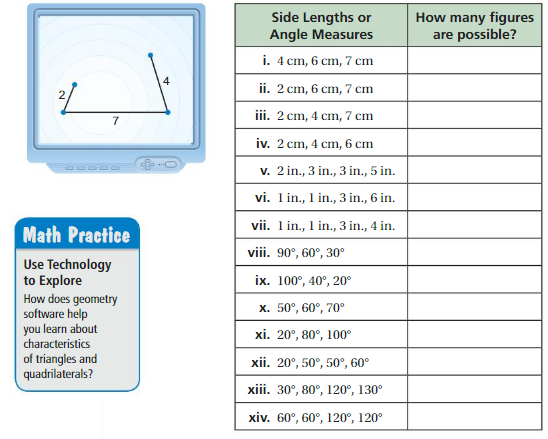
Big Ideas Math Solutions Grade 7 Chapter 9 Geometric Shapes and Angles 9.4 1
b. Without constructing, how can you tell whether it is possible to draw a triangle given three angle measures? three side lengths? Explain your reasoning.
c. Without constructing, how can you tell whether it is possible to draw a quadrilateral given four angle measures? four side lengths? Explain your reasoning.

Answer:
b. Yes it is possible to draw a triangle with the given three angles measures, three side lengths.
c. yes it is possible to draw a quadrilateral with the given 4 angle measures, four side lengths.

Explanation:
1. given that sides = 4 cm , 6 cm , 7cm
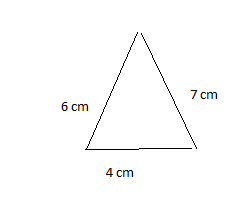
2. given that sides = 2 cm , 3 cm , 3 cm, 5 cm
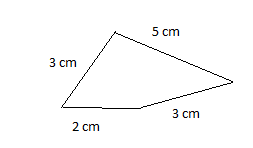
Try It

Draw a triangle with the given angle measures, if possible.
Question 1.
45°, 45°, 90°

Answer:
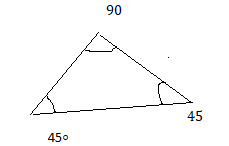
Explanation:
The above triangle is an equilateral triangle.
it forms with the given angles 45°, 45°, 90°.

Question 2.
100°, 55°, 25°

Answer:
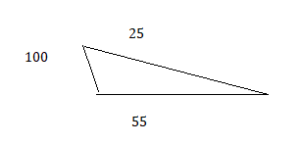
Explanation:
The above triangle is scalene  triangle.
it forms with the given angles 100°, 55°, 25°.

Question 3.
60°, 60°, 80°

Answer:
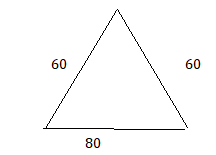
Explanation:
The above triangle is an equilateral triangle.
it forms with the given angles60°, 60°, 80°

Question 4.
Draw a triangle with side lengths of 1 inch and 2 inches that meet at a 60° angle.

Answer:
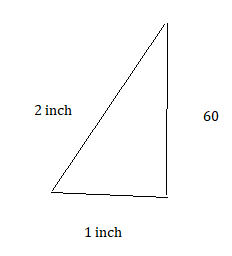
Explanation:
The above triangle is a scalene triangle.
it forms with the given angles 60° , 1 inch and 2 inch.

Draw a triangle with the given side lengths, if possible.
Question 5.
2 cm, 2 cm, 5 cm

Answer:
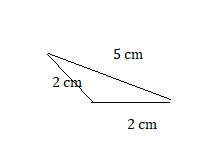
Explanation:
given the sides of a triangle 2cm , 2 cm , 5 cm

Question 6.
4 cm, 3 cm, 3 cm

Answer:
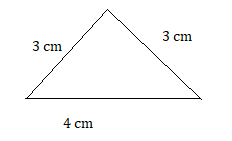
Explanation:
given that 2 sides are same and one side is different.

Question 7.
1 cm, 4 cm, 5 cm

Answer:
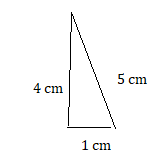
Draw a quadrilateral with the given angle measures, if possible.
Question 8.
100°, 90°, 65°, 105°

Answer:
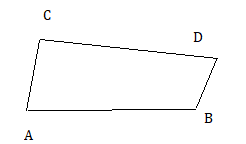
Explanation:
The quadrilateral formed with the given angles 100°, 90°, 65°, 105°.

Question 9.
100°, 40°, 20°, 20°

Answer:
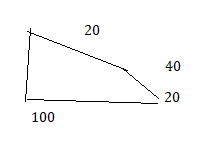
Explanation:
The quadrilateral formed with the given angles 100°, 40°, 20°, 20°.

Question 9.

Self-Assessment for Concepts & Skills
Solve each exercise. Then rate your understanding of the success criteria in your journal.

DRAWING POLYGONS Draw a polygon with the given side lengths or angle measures, if possible.
Question 10.
25 mm, 36 mm, 38 mm

Answer:
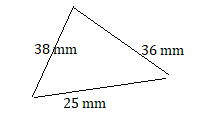
Explanation:
The polygon formed with the given sides is a triangle.

Question 11.
10°, 15°, 155°

Answer:

Explanation:
The polygon formed with the given sides is a triangle.

Question 12.
20°, 45°, 50°, 65°

Answer:
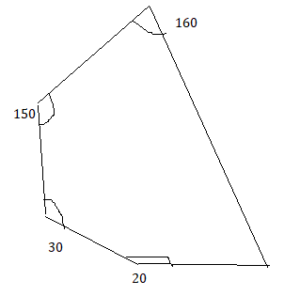
Explanation:
The polygon formed with the given sides is a  hexagon.

Question 9.
100°, 40°, 20°, 20°

Answer:

Explanation:
The polygon formed with the given sides is a  hexagon.
Question 9.
100°, 40°, 20°, 20°
Answer:

Question 9.
100°, 40°, 20°, 20°
Answer:

Explanation:
The polygon formed with the given sides is a  quadrilateral.

Question 13.
50°, 90°, 110°, 110°

Answer:
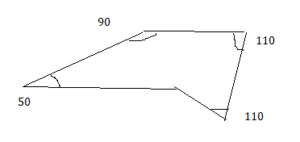
Question 14.
USING SIDE LENGTH
Can you construct one, many, or triangle(s) with side lengths of 3 inches, 4 inches, and 8 inches? Explain.
Answer:
We can construct only one triangle

Explanation:
Given the side lengths of 3 inches, 4 inches, and 8 inches.

Self-Assessment for Problem Solving
Solve each exercise. Then rate your understanding of the success criteria in your journal.

Question 15.
A triangular pen has fence lengths of 6 feet, 8 feet, and 10 feet. Create a scale drawing of the pen.
Answer:
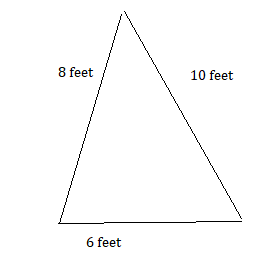
Question 16.
The front of a cabin is the shape of a triangle. The angles of the triangle are 40°, 70°, and 70°. Can you determine the height of the cabin? If not, what information do you need?
Answer:
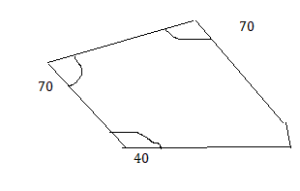
Question 17.
DIG DEEPER!
Two rooftops have triangular patios. One patio has side lengths of 9 meters,10 meters, and 11 meters.e other has side lengths of 6 meters,10 meters, and 15 meters. Which patio has a greater area? Explain.
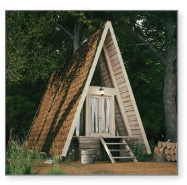
Big Ideas Math Solutions Grade 7 Chapter 9 Geometric Shapes and Angles 9.4 2
Answer:
The patio which has a side length of 6 meters, 10 meters, and 15 meters.

Explanation:
The patio has a greater side length.

Constructing Polygons Homework & Practice 9.4

Review & Refresh

Find the perimeter and area of the figure.
Question 1.
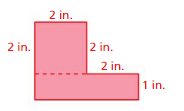
Big Ideas Math Solutions Grade 7 Chapter 9 Geometric Shapes and Angles 9.4 3
Answer:
area = 12 in
perimeter = 14 in

Explanation:
area of the rectangle = l x w
l = length, w = width
area = 4 x 3
area = 12 in
perimeter of the rectangle = 2 ( l + w)
perimeter = 2 (7)
perimeter = 14 in

Question 2.
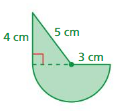
Big Ideas Math Solutions Grade 7 Chapter 9 Geometric Shapes and Angles 9.4 4
Answer:

perimeter of the figure = 9.48 sq cm
area of the figure = 28.26 sq cm

Explanation:
perimeter of the semicircle = ( π + 2) r
p = (3.14 + 2 ) 3
p = 9.48 cm
area of the figure = π x r x r
area = 3.14 x 3 x3
area = 28.26 sq cm

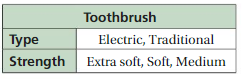
Use a tree diagram to find the sample space and the total number of possible outcomes of the indicated event.
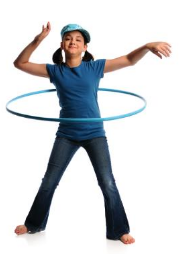
Big Ideas Math Solutions Grade 7 Chapter 9 Geometric Shapes and Angles 9.4 5
Question 3.
choosing a toothbrush
Big Ideas Math Solutions Grade 7 Chapter 9 Geometric Shapes and Angles 9.4 6
Answer:
Extra soft, soft, Medium

Explanation:
In the above given figure the strength of the toothbrush = extra soft , soft , meedium

Question 4.
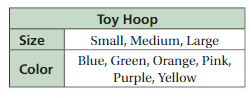
Big Ideas Math Solutions Grade 7 Chapter 9 Geometric Shapes and Angles 9.4 7
Answer:
The size of the toy hop is small, medium , large.

Explanation:
given that the colour of the toy hoop is blue , green , orange, pink, purple , yellow.

Concepts, Skills, & Problem Solving

USING TECHNOLOGY TO DRAW POLYGONS Use geometry software to draw the polygon with the given side lengths or angle measures, if possible. (See Exploration 1, p. 381.)
Question 5.
30°, 65°, 85°
Answer:

Question 6.
2 in., 3 in., 5 in.
Answer:

Question 7.
80°, 90°, 100°, 110°
Answer:
Not possible.

Question 8.
2 cm, 2 cm, 5 cm, 5 cm
Answer:
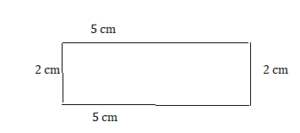
CONSTRUCTING TRIANGLES USING ANGLE MEASURES Draw a triangle with the given angle measures, if possible.
Question 9.
40°, 50°, 90°
Answer:

Question 10.
20°, 40°, 120°
Answer:

Question 11.
38°, 42°, 110°
Answer:

Question 12.
54°, 60°, 66°
Answer:

Question 13.
YOU BE THE TEACHER
Your friend determines whether he can draw a triangle with angle measures of 10°, 40°, and 130°. Is your friend correct? Explain your reasoning.
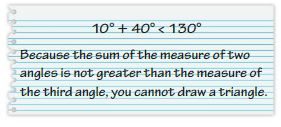
Big Ideas Math Solutions Grade 7 Chapter 9 Geometric Shapes and Angles 9.4 8
Answer:
Yes .

Explanation:
yes we cannot draw the triangle with the angle measures of 10, 40, 130

CONSTRUCTING TRIANGLES USING ANGLES AND SIDES Draw a triangle with the given description.
Question 14.
side lengths of 1 inch and 2 inches meet at a 50° angle
Answer:
yes.

Explanation:
we can draw a triangle with 1 inch 2 inch that meets at  50 degrees.

Question 15.
side lengths of 7 centimeters and 9 centimeters meet at a 120° angle
Answer:
yes.

Explanation:
we can draw a triangle with 7 cm 9 cm that meets at  120 degrees.

Question 16.
a 95° angle connects to a 15° angle by a side of length 2 inches
Answer:
no.

Explanation:
we cannot draw a triangle with 2 inches 15 degrees that meets at  120 degrees.

Question 17.
a 70° angle connects to a 70° angle by a side of length 4 centimeters
Answer:
yes.

Explanation:
we can draw an angle with 4 cm  70 degrees that meets at  120 degrees.

CONSTRUCTING TRIANGLES USING SIDE LENGTHS Draw a triangle with the given side lengths, if possible.
Question 18.
4 in., 5 in., 10 in.
Answer:
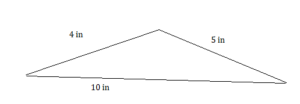
Question 19.
10 mm, 30 mm, 50 mm
Answer:

Question 20.
5 cm, 5 cm, 8 cm
Answer:
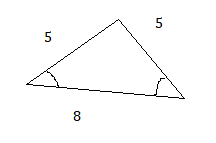
Question 21.
8 mm, 12 mm, 13 mm
Answer:
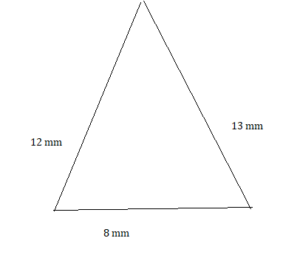
Question 22.
MODELING REAL LIFE
Can you construct a triangular case using two pieces of wood that are 12 inches long and one piece of wood that is 25 inches long? Explain.
Answer:
Yes we can construct a triangle .

Explanation:
We can costruct the triangle by using two pieces of wood that are 12 inches long and the one piece of wood is 25 inches.

Question 23.
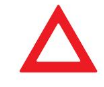
MODELING REAL LIFE
Can you construct a warning triangle using three pieces of plastic that are each 6 inches long? Explain.
Big Ideas Math Solutions Grade 7 Chapter 9 Geometric Shapes and Angles 9.4 9
Answer:
Yes.

Explanation:
we can construct the three pieces of plastic by using 3 6 inches long.

Question 24.
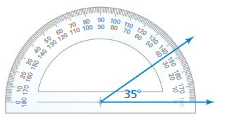
LOGIC
You are constructing a triangle. You draw the first angle, as shown. Your friend says that you must be constructing an acute triangle. Is your friend correct? Explain your reasoning.
Big Ideas Math Solutions Grade 7 Chapter 9 Geometric Shapes and Angles 9.4 10
Answer:
Yes my friend is correct.

Explanation:
it is a acute angle triangle.

USING ANGLES AND SIDES Determine whether you can construct one, many, or no triangle(s) with the given description. Explain your reasoning.
Question 25.
a triangle with one angle measure of 60and one side length of 4 centimeters
Answer:
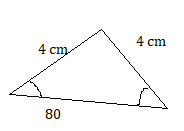
Explanation:
we cannot construct one trinangle with the help of given sidelengths.

Question 26.
a scalene triangle with side lengths of 3 centimeters and 7 centimeters
Answer:

Question 27.
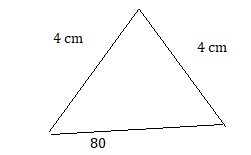
an isosceles triangle with two side lengths of 4 inches that meet at an 80° angle
Answer:
Question 28.
a triangle with one angle measure of 60°, one angle measure of 70°, and a side length of 10 centimeters between the two angles
Answer:
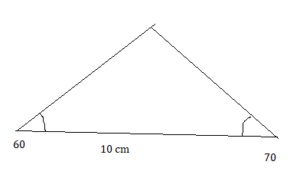
Question 29.
a triangle with one angle measure of 20°, one angle measure of 35°, and a side of length 3 inches that is between the two angles
Answer:
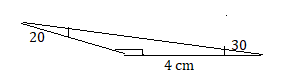
Question 29.
REASONING
A triangle is shown.
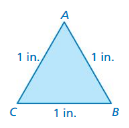
Big Ideas Math Solutions Grade 7 Chapter 9 Geometric Shapes and Angles 9.4 11
a. Construct a triangle with side lengths twice those of the triangle shown. Does the new triangle have the same angle measures?
b. How can you change the side lengths of the triangle so that the measure of ∠A increases?
Answer:
a. Yes the new triangle have the same angle.
b. angle A increases .

Explanation:
Given that the triangle with side lengths twice those of the triangle shown.
If we can change the side lengths of triangle .

CONSTRUCTING QUADRILATERALS Draw a quadrilateral with the given angle measures, if possible.
Question 31.
60°, 60°, 120°, 120°
Answer:
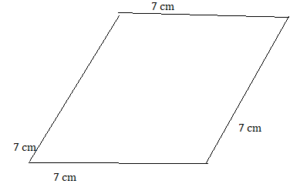
Question 32.
50°, 60°, 110°, 150°
Answer:
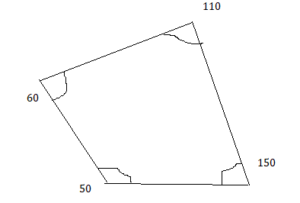
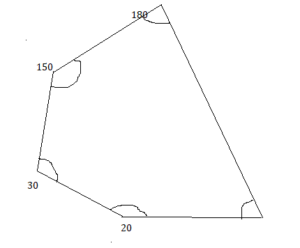
Question 33.
20°, 30°, 150°, 160°
Answer:
Question 34.
10°, 10°, 10°, 150°
Answer:
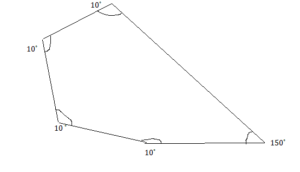
Explanation:
Given angles are 10 degrees, 10 degrees, 10 degrees, 10 degrees.

CONSTRUCTING SPECIAL QUADRILATERALS Construct a quadrilateral with the given description.
Question 35.
a rectangle with side lengths of 1 inch and 2 inches
Answer:
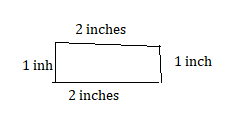
Question 36.
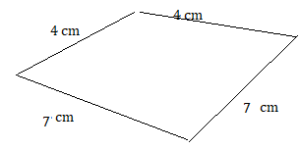
a kite with side lengths of 4 centimeters and 7 centimeters
Answer:
Question 37.
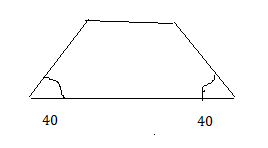
a trapezoid with base angles of 40°
Answer:
Answer
Question 38.
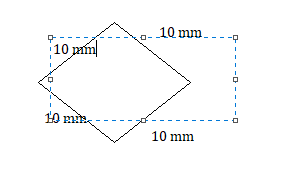
a rhombus with side lengths of 10 millimeters
Answer:
Question 39.
REASONING
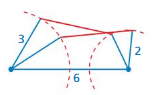
A quadrilateral has side lengths of 6 units, 2 units, and 3 units as shown. How many quadrilaterals can be formed given a fourth side with a fixed length? Explain.
Big Ideas Math Solutions Grade 7 Chapter 9 Geometric Shapes and Angles 9.4 12
Answer:
2 quadrilaterals can be formed.

Explanation:
Given that the quadrilateral has side lengths of 6 units, 2 units, and 3 units.
so 2 quadrilaterals can be formed.

Question 40.
REASONING
What types of quadrilaterals can you form using four side lengths of 7 units? Use drawings to support your conclusion.
Answer:

Question 41.
MODELING REAL LIFE
A triangular section of a farm is enclosed by fences that are 2 meters, 6 meters, and 7 meters long. Estimate the area of the section.
Answer:
Area of the section = 12 sq meters.

Question 42.
MODELING REAL LIFE
A chemical spill expert sets up a triangular caution zone using cones. Cones A and B are 14 meters apart. Cones B and C are 22 meters apart. Cones A and C are 34 meters apart. Estimate the area of the caution zone.
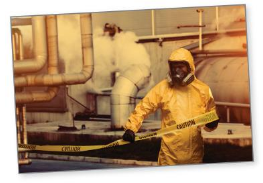
Big Ideas Math Solutions Grade 7 Chapter 9 Geometric Shapes and Angles 9.4 13
Answer:
Area of the area of the caution Zone = 308 sq meters.

Explanation:
Area of the triangle = l x b
area = 22 x 14
area = 308 sq meters.

Question 43.
MODELING REAL LIFE
A search region is in the shape of an equilateral triangle. The measure of one side of the region is 20 miles. Make a scale drawing of the search region. Estimate the area of the search region.
Answer:
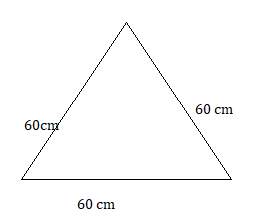
Explanation:
Given that the equilateral triangle .

Question 44.
REASONING
A triangle has fixed side lengths of 2 and 14.
a. How many triangles can you construct? Use the figure below to explain your reasoning.
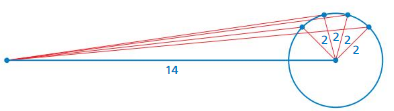
Big Ideas Math Solutions Grade 7 Chapter 9 Geometric Shapes and Angles 9.4 14
b. Is the unknown side length of the triangle also fixed? Explain.
Answer:
We can construct 14 triangles.
b. No the side length of the triangle cannot fixed.

Explanation:
a. We can construct 14 triangles.
b. No the side length of the triangl cannot fixed.

Lesson 9.5 Finding Unknown Angle Measures

EXPLORATION 1

Using Rules About Angles
Work with a partner. The diagram shows pairs of angles and vertical angles. Vertical angles cannot be adjacent.
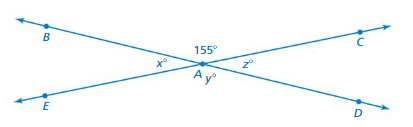
Big Ideas Math Answer Key Grade 7 Chapter 9 Geometric Shapes and Angles 9.5 1
a. Which pair(s) of angles are adjacent angles? Explain.
b. Which pair(s) of angles are vertical angles? Explain.
c. Without using a protractor, find the values of x, y, and z. Explain your reasoning.
d. Make a conjecture about the measures of any two vertical angles.
e. Test your conjecture in part(d) using the diagram below. Explain why your conjecture is or is not true.
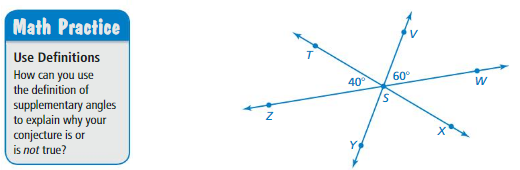
Big Ideas Math Answer Key Grade 7 Chapter 9 Geometric Shapes and Angles 9.5 2
Answer:
A. ∠ACD, ∠AEB
b. ∠ACD, ∠AEB
c. 125
d. ∠ACD, ∠AEB
Big Ideas Math Answer Key Grade 7 Chapter 9 Geometric Shapes and Angles 9.5 3

Try It

Question 1.
Name a pair of (a) adjacent angles, (b) complementary angles, (c) supplementary angles, and (d) vertical angles in the figure.
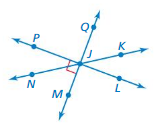
Big Ideas Math Answer Key Grade 7 Chapter 9 Geometric Shapes and Angles 9.5 4
Answer:
a. ∠JKL, ∠JKQ, . ∠MNJ,. ∠PJN
b. ∠JKQ
c. ∠JNK, ∠ JPL. ∠JMQ
D. ∠JMQ, ∠JPL.

Explanation:
The above angles are adjacent, vertical, supplementary,complementary.

Classify the pair of angles. Then find the value of x.
Question 2.
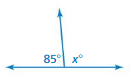
Big Ideas Math Answer Key Grade 7 Chapter 9 Geometric Shapes and Angles 9.5 5
Answer:
x = 95 ˚

Explanation:
x = (180 – 85)
x = 95 ˚

Question 3.
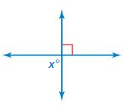
Big Ideas Math Answer Key Grade 7 Chapter 9 Geometric Shapes and Angles 9.5 6
Answer:
x =  180 ˚

Explanation:
x = 180 ˚

Question 4.
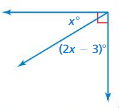
Big Ideas Math Answer Key Grade 7 Chapter 9 Geometric Shapes and Angles 9.5 7
Answer:
x = 30 ˚

Explanation:
(2x – 3) = 60
2x = (60/3)
2x = 20
x = 10

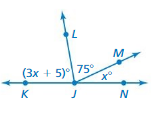
Find the measure of the indicated angle in the diagram.
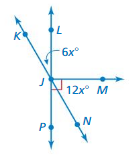
Big Ideas Math Answer Key Grade 7 Chapter 9 Geometric Shapes and Angles 9.5 8.1
Question 5.
∠NJM
Answer:
12 x ˚

Question 6.
∠KJP
Answer:
16 x ˚

Question 7.
∠KJM
Answer:
6x ˚

Self-Assessment for Concepts & Skills
Solve each exercise. Then rate your understanding of the success criteria in your journal.

Question 8.
NAMING ANGLES
Name a pair of (a) adjacent angles, (b) complementary angles, (c) supplementary angles, and (d) vertical angles in the figure at the left.
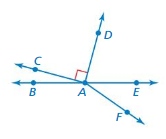
Big Ideas Math Answer Key Grade 7 Chapter 9 Geometric Shapes and Angles 9.5 8
Answer:
a. ∠ABC
b. ∠ABD
c. ∠ABE
d. ∠ABE

Explanation:
The above angles are adjacent, vertical, supplementary,complementary.

FINDING ANGLE MEASURES Find the value of x.
Question 9.
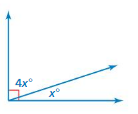
Big Ideas Math Answer Key Grade 7 Chapter 9 Geometric Shapes and Angles 9.5 9
Answer:
x = 60˚

Explanation:
4x = x
4x – x = 180
3x = 180
x = 60˚

Question 10.
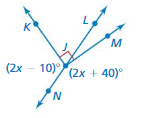
Big Ideas Math Answer Key Grade 7 Chapter 9 Geometric Shapes and Angles 9.5 10
Answer:
x = 12.5˚

Explanation:
2x  – 10= 2x + 40
4x  = 50
x = 12.5˚

Question 11.
WHICH ONE DOESN’T BELONG?
Which pair of angles does not belong with the other three? Explain your reasoning.

Big Ideas Math Answer Key Grade 7 Chapter 9 Geometric Shapes and Angles 9.5 11
Answer:
∠FBA, ∠EBD does not belong with the other three.

Explanation:
the 3 angles are different measures,

Self-Assessment for Problem Solving
Solve each exercise. Then rate your understanding of the success criteria in your journal.

Question 12.
What is the angle between any two windmill blades in the windmill at the left? Justify your answer.
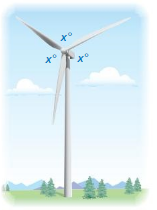
Big Ideas Math Answer Key Grade 7 Chapter 9 Geometric Shapes and Angles 9.5 12

Answer:
The angle between any two wind mills blades in the windmill at the left = 60 °

Explanation:
60 + 60 + 60 = 180

Question 13.
A hockey puck strikes a wall at an angle of 30°. The puck then travels away from the wall at the same angle. Find the value of y. Explain your reasoning.
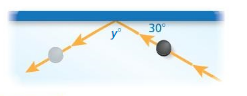
Big Ideas Math Answer Key Grade 7 Chapter 9 Geometric Shapes and Angles 9.5 13
Answer:
y = 150 °

Explanation:
In the above figure said that hockey puck strikes a wall at an angle of 30 °.
so 180 – 30 = 150

Question 14.
DIG DEEPER!
The laptop screen turns off when the angle between the keyboard and the screen is less than 20°. How many more degrees can the laptop screen close before the screen turns off?
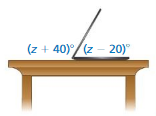
Big Ideas Math Answer Key Grade 7 Chapter 9 Geometric Shapes and Angles 9.5 14
Answer:
The laptop screen close before the screen turns off = 60 degrees.

Explanation:
(z + 40) = (z – 20)
z – z = (-  20 -40)
z = -60

Finding Unknown Angle Measures Homework & Practice 9.5

Review & Refresh

Draw a triangle with the given side lengths, if possible.
Question 1.
1 in., 3 in., 4 in.
Answer:
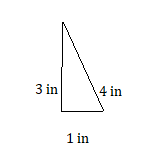
Explanation:
In the above question , they said to draw 1 in, 3 in, 4 in.

Question 2.
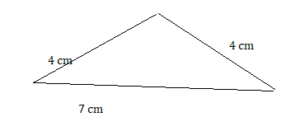
4 cm, 4 cm, 7 cm
Answer:
Solve the inequality. Graph the solution.
Question 3.
– 8y ≤ 40
Answer:
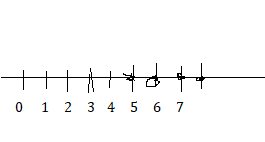
Explanation:
– 8y ≤ 40
y = (40/8)
y = 5

Question 4.
1.1z > – 3.3
Answer:
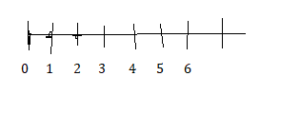
Explanation:
z = 3.3

Question 5.
\(\frac{1}{3}\)x ≥ 2.5
Answer:

Concepts, Skills, & Problem Solving

USING RULES ABOUT ANGLES The diagram shows pairs of adjacent vertical angles and angles. B(See Exploration 1, p. 389.)
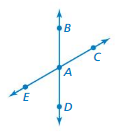
Big Ideas Math Answer Key Grade 7 Chapter 9 Geometric Shapes and Angles 9.5 15
Question 6.
Which pair(s) of angles are adjacent angles? Explain.
Answer:
angle AEC, angle ABD.

Explanation:
In the above given figure angle AEC, angle ABD are adjacent.

Question 7.
Which pair(s) of angles are vertical angles? Explain.
Answer:
angle ABC, angle ADE

Explanation:
In the above given figure angle AEC, angle ABD are adjacent.

NAMING ANGLES Use the figure shown.
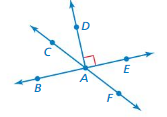
Big Ideas Math Answer Key Grade 7 Chapter 9 Geometric Shapes and Angles 9.5 16
Question 8.
Name a pair of adjacent angles.
Answer:
∠ADC, ∠AEF, ∠ABC

Question 9.
Name a pair of complementary angles.
Answer:
∠ADE, ∠ABD

Question 10.
Name a pair of supplementary angles.
Answer:
∠ABE, ∠ACF

Question 11.
Name a pair of vertical angles.
Answer:
∠AEF, ∠ABC

Question 12.
YOU BE THE TEACHER
Your friend names a pair of angles with the same measure. Is your friend correct? Explain your reasoning.
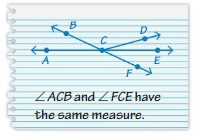
Big Ideas Math Answer Key Grade 7 Chapter 9 Geometric Shapes and Angles 9.5 17
Answer:
yes my friend is correct

Explanation:
The angles both have the same measure.

ADJACENT AND VERTICAL ANGLES Tell whether the angles are adjacent, vertical, or neither. Explain.
Question 13.
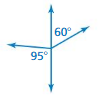
Big Ideas Math Answer Key Grade 7 Chapter 9 Geometric Shapes and Angles 9.5 18
Answer:
vertical.

Explanation:
The given angles are vertical.

Question 14.
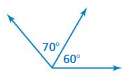
Big Ideas Math Answer Key Grade 7 Chapter 9 Geometric Shapes and Angles 9.5 19
Answer:
Adjacent.

Explanation:
The given angles are adjacent.

Question 15.
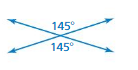
Big Ideas Math Answer Key Grade 7 Chapter 9 Geometric Shapes and Angles 9.5 20

Answer:
Adjacent, vertical

Explanation:
The given angles are adjacent, vertical.

COMPLEMENTARY AND SUPPLEMENTARY ANGLES Tell whether the angles are complementary supplementary, or neither. Explain.
Question 16.
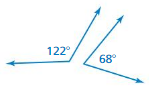
Big Ideas Math Answer Key Grade 7 Chapter 9 Geometric Shapes and Angles 9.5 21
Answer:
The angles are neither complementary nor supplementary.

Explanation:
complementary = 90 degree
supplementary = 180 degree

Question 17.
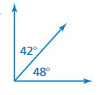
Big Ideas Math Answer Key Grade 7 Chapter 9 Geometric Shapes and Angles 9.5 22
Answer:
The angles are complementary.

Explanation:
complementary = 90 degree
supplementary = 180 degree

Question 18.
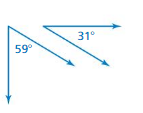
Big Ideas Math Answer Key Grade 7 Chapter 9 Geometric Shapes and Angles 9.5 23
Answer:
The angles are complementary.

Explanation:
complementary = 90 degree
supplementary = 180 degree

Question 19.
YOU BE THE TEACHER
Your friend names a pair of supplementary angles. Is your friend correct? Explain.
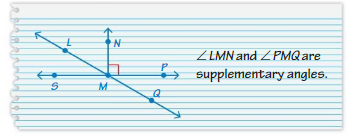
Big Ideas Math Answer Key Grade 7 Chapter 9 Geometric Shapes and Angles 9.5 24
Answer:
yes my friend is correct.

Explanation:
angle LMN and angle PMQ are supplementary angles.

USING PAIRS OF ANGLES Classify the pair of angles. Then find the value of x.
Question 20.
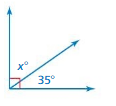
Big Ideas Math Answer Key Grade 7 Chapter 9 Geometric Shapes and Angles 9.5 25
Answer:
Acute angle.
x = 145

Explanation:
x = (180 – 35)
x = 35

Question 21.
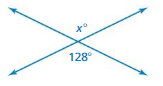
Big Ideas Math Answer Key Grade 7 Chapter 9 Geometric Shapes and Angles 9.5 26
Answer:
verticle angle.
x = 52

Explanation:
x = (180 – 128)
x = 52

Question 22.
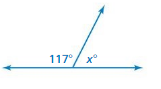
Big Ideas Math Answer Key Grade 7 Chapter 9 Geometric Shapes and Angles 9.5 27
Answer:
obtuse angle.
x = 63

Explanation:
x = (180 – 117)
x = 63

Question 23.
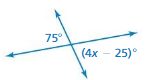
Big Ideas Math Answer Key Grade 7 Chapter 9 Geometric Shapes and Angles 9.5 28
Answer:
intersection angles
x = 25

Explanation:
(4x – 25) = 75
4x = 75 + 25
4x = 100
x = (100/4)
x = 25

Question 24.
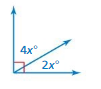
Big Ideas Math Answer Key Grade 7 Chapter 9 Geometric Shapes and Angles 9.5 29
Answer:
x = 15

Explanation:
2x = 30
x = (30/2)
x = 15
4x = 60
x = (60/4)
x = 15

Question 25.
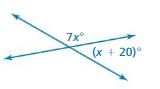
Big Ideas Math Answer Key Grade 7 Chapter 9 Geometric Shapes and Angles 9.5 30
Answer:
x = 3.33

Explanation:
(x + 20 ) = 7 x
20 = 7x – x
20 = 6x
x = (20/6)
x = 3.33

Question 26.
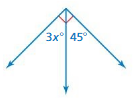
Big Ideas Math Answer Key Grade 7 Chapter 9 Geometric Shapes and Angles 9.5 31
Answer:
x = 15

Explanation:
3x = 45
x = (45/3)
x = 15

Question 27.
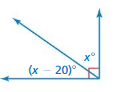
Big Ideas Math Answer Key Grade 7 Chapter 9 Geometric Shapes and Angles 9.5 32
Answer:
x = 20

Explanation:
(x – 20 ) = x
20 = x – x
x = 20

Question 28.
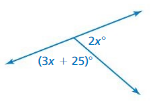
Big Ideas Math Answer Key Grade 7 Chapter 9 Geometric Shapes and Angles 9.5 33
Answer:
x = 25

Explanation:
(3x + 25) = 2x
3x – 2x = 25
x = 25

Question 29.
MODELING REAL LIFE
What is the measure of each angle formed by the intersection? Explain.
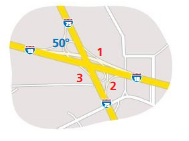
Big Ideas Math Answer Key Grade 7 Chapter 9 Geometric Shapes and Angles 9.5 34
Answer:
angle 2 = 50°
angle 3 = 40°
angle 1 = 40°

Explanation:
In the above figure the angle 4 is given.

Question 30.
MODELING REAL LIFE
A tributary joins a river at an angle x. Find the value of x. Explain.
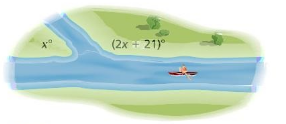
Big Ideas Math Answer Key Grade 7 Chapter 9 Geometric Shapes and Angles 9.5 35
Answer:
x = 21

Explanation:
(2x + 21 ) = x
2x – x = 21
x = 21

Question 31.
MODELING REAL LIFE
The iron cross is a skiing trick in which the tips of the skis are crossed while the skier is airborne. Find the value of x in the iron cross shown.
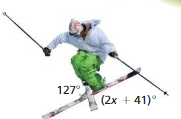
Big Ideas Math Answer Key Grade 7 Chapter 9 Geometric Shapes and Angles 9.5 36
Answer:
The value of x in the iron cross = 43

Explanation:
(2x + 41) = 127
2x = 127 – 41
2x = 86
x = 43

FINDING ANGLE MEASURES Find all angle measures in the diagram.
Question 32.
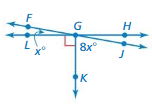
Big Ideas Math Answer Key Grade 7 Chapter 9 Geometric Shapes and Angles 9.5 37
Answer:
x = 90˚

Question 33.
Big Ideas Math Answer Key Grade 7 Chapter 9 Geometric Shapes and Angles 9.5 38
Answer:
23.33

Explanation:
(3x + 5) = 75
3x = 75 – 5
3x = 70
x = (70/3)
x = 23.33

Question 34.
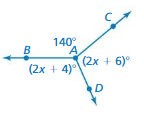
Big Ideas Math Answer Key Grade 7 Chapter 9 Geometric Shapes and Angles 9.5 39
Answer:
x = 68
x = 67

Explanation:
(2x + 4) = 140
2x = (140 – 4)
2x = 136
x = (136/2)
x = 68
(2x + 6) = 140
2x = (140 – 6)
2x = 134
x = (134/2)
x = 67

OPEN-ENDED Draw a pair of adjacent angles with the given description.
Question 35.
Both angles are acute.
Answer:
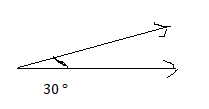
Question 36.
One angle is acute, and one is obtuse.
Answer:
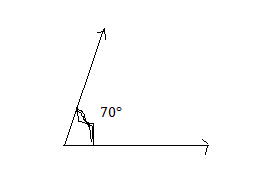
Question 37.
The sum of the angle measures is 135°.
Answer:
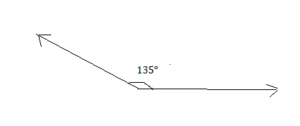
REASONING Copy and complete each sentence with always, sometimes, or never.
Question 38.
If x and y are complementary angles, then both x and y are________ acute.
Answer:
Right acute.

Explanation:
if x and y are complimentary then the x and y are right acute.

Question 39.
If x and y are supplementary angles, then is x ________ acute.
Answer:
left acute.

Explanation:
if x and y are complimentary then the x and y are right acute.

Question 40.
If x is a right angle, then is x ________ acute.
Answer:
Right acute.

Explanation:
if x and y are complimentary then the x and y are right acute.

Question 41.
If x and y are complementary angles, then x and y are ________ adjacent.
Answer:
Right adjacent.

Explanation:
if x and y are complimentary then the x and y are right adjacent.

Question 42.
If x and y are supplementary angles, then x and y are _______ vertical.
Answer:
left vertical.

Explanation:
if x and y are supplementary then the x and y are left vertical.

Question 43.
REASONING
Draw a figure in which ∠1 and ∠2 are acute vertical angles, ∠3 is a right angle adjacent to ∠2, and the sum of the measure of ∠1 and the measure of ∠4 is 180°.
Answer:
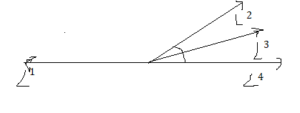
Question 44.
STRUCTURE
Describe the relationship between the two angles represented by the graph shown at the right.
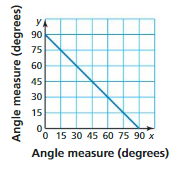
Big Ideas Math Answer Key Grade 7 Chapter 9 Geometric Shapes and Angles 9.5 40
Answer:
90°

Explanation:
The relationship between the two angles represented by the graph =90°

Question 45.
STRUCTURE
Consider the figure shown at the left. Use a ruler to extend both rays into lines. What do you notice about the three new angles that are formed?
Big Ideas Math Answer Key Grade 7 Chapter 9 Geometric Shapes and Angles 9.5 41
Answer:
The 3 angles that are formed = 30°, 60°, 90°

Explanation:
The given angles are right angles.

Question 46.
OPEN-ENDED
Give an example of an angle that can be a supplementary angle but cannot be a complementary angle to another angle. Explain.
Answer:
Acute angle

Question 47.
MODELING REAL LIFE
The vanishing point of the picture is represented by point B.
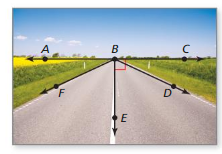
Big Ideas Math Answer Key Grade 7 Chapter 9 Geometric Shapes and Angles 9.5 42
a. The measure of ∠ABD is 6.2 times greater than the measure of ∠CBD. Find the measure of ∠CBD.
b. ∠FBE and ∠EBD are congruent. Find the measure of ∠FBE.
Answer:
a. The measure of  ∠CBD = 30°
b. The measure of ∠FBE = 60°

Explanation:
Given that the measure of ∠ABD is 6.2 times greater than the measure of ∠CBD  = 30°
∠FBE and ∠EBD are congruent so ∠FBE = 60°

Question 48.
CRITICAL THINKING
The measures of two complementary angles have a ratio of 3 : 2. What is the measure of the larger angle?
Answer:
The measure of the larger angle = 3

Explanation:
given that, the measures of two complementary angles have a ratio = 3 : 2

Question 49.
REASONING
Two angles are vertical angles. What are their measures if they are also complementary angles? supplementary angles?
Answer:
when two angles are vertical.
complementary angles = Two angles are called complementary when their measures add to 90°
supplementary angles = two angles are called supplementary when their measures add to 180°

Question 50.
PROBLEM SOLVING
Find the values of x and y.
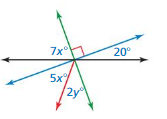
Big Ideas Math Answer Key Grade 7 Chapter 9 Geometric Shapes and Angles 9.5 43
Answer:
x = 2.857
y = 2
x = 4

Explanation:
7  x = 20
x = (20/7)
x = 2.857
2y = 20
y = (20/10)
y  = 2
5x = 20
x = (20/5)
x = 4

Geometric Shapes and Angles Connecting Concepts

Using the Problem-Solving Plan
Question 1.
A dart is equally likely to hit any point on the board shown. Find the theoretical probability that a dart hitting the board scores 100 points.
Understand the problem.
You are given the dimensions of a circular dartboard. You are asked to find the theoretical probability of hitting the center circle.
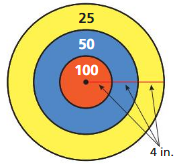
Big Ideas Math Answers 7th Grade Chapter 9 Geometric Shapes and Angles cc 1
Make a plan.
Find the area of the center circle and the area of the entire dart board. To find the theoretical probability of scoring 100 points, divide the area of the center circle by the area of the entire dart board.
Solve and check.
Use the plan to solve the problem. Then check your solution.
Answer:
Area of center =31,400 sq in
area of entire dart board = 1,962.5 sq in

Explanation:
Area of center circle = π r ²
a = 3.14 x 100 x 100
a = 31,400  sq in
area of entire dart board =  π r ²
a = 3.14 x 25 x 25
a = 3.14 x 625
a = 1,962.5 sq in

Question 2.
A scale drawing of a window is shown. Find the perimeter and the area of the actual window. Justify your answer.
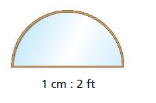
Big Ideas Math Answers 7th Grade Chapter 9 Geometric Shapes and Angles cc 2
Answer:
Area of semicircle = 1.695sq ft
perimeter of semicircle = 1.58 sq ft

Explanation:
area of the semicircle = ( π + r x r /2)
s . c = (3.14 + 0.5 x 0.5 /2)
s. c = (3.14 + 0.25 /2)
s . c = (3.39 /2
s. c = 1.695 sq ft
perimeter of the semicircle = (π + 2 ) x r
p= 3.14 + 2 x 0.5
p = 3.16 x 0.5
p = 1.58 sq ft

Question 3.
∠CAD makes up 20% of a pair of supplementary angles. Find the measure of ∠DAE. Justify your answer.
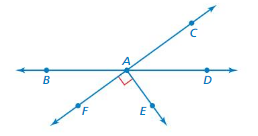
Big Ideas Math Answers 7th Grade Chapter 9 Geometric Shapes and Angles cc 3
Answer:
∠DAE = 30 %

Explanation:
Given that ∠CAD = 20%
so
∠DAE = 30 %

Performance Task

Finding the Area and Perimeter of a Track
At the beginning of the this chapter, you watched a STEAM video called “Track and Field”. You are now ready to complete the performance task related to this video, available at BigIdeasMath.com. Be sure to use the problem-solving plan as you work through the performance task.
Big Ideas Math Answers 7th Grade Chapter 9 Geometric Shapes and Angles cc 4

Geometric Shapes and Angles Chapter Review

Review Vocabulary

Write the definition and give an example of each vocabulary term.

Big Ideas Math Answers 7th Grade Chapter 9 Geometric Shapes and Angles cr 1

Graphic Organizers

You can use a Four Square to organize information about a concept. Each of the four squares can be a category, such as definition, vocabulary, example, non-example, words, algebra, table, numbers, visual, graph, or equation. Here is an example of a Four Square for circumference.
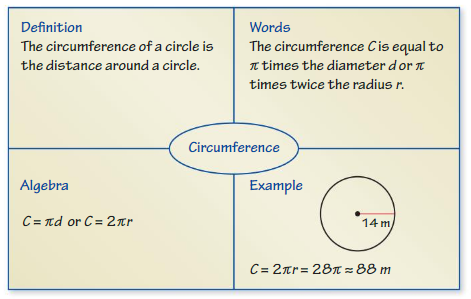
Big Ideas Math Answers 7th Grade Chapter 9 Geometric Shapes and Angles cr 2

Choose and complete a graphic organizer to help you study each topic.
Big Ideas Math Answers 7th Grade Chapter 9 Geometric Shapes and Angles cr 3
1. area of a circle
2. semicircle
3. composite figure
4. constructing triangles
5. constructing quadrilaterals
6. complementary angles
7. supplementary angles
8. vertical angles

Answer:
1. area of a circle = π r ²
2. semicircle = ( π  +  r ²/2)
3. composite figure = The figure that consists of two or more geometric shapes.
4. constructing triangles = A triangle is a 3 – sided polygon made up of three sides having 3 angles.
5. constructing quadrilateral = quadrilateral can be categorized by the lengths of its sides and the size of its angles.
6. complementary angles = Two angles are called complimentary when their measures add to 90°
7. supplementary angles = two angles are called supplementary when their measures add to 180°
8. vertical angles = The angles opposite each other when two lines cross.

Chapter Self-Assessment

As you complete the exercises, use the scale below to rate your understanding of the success criteria in your journal.

Big Ideas Math Answers 7th Grade Chapter 9 Geometric Shapes and Angles cr 4

9.1 Circles and Circumference (pp. 361–368)
Learning Target: Find the circumference of a circle.

Question 1.
What is the radius of a circular lid with a diameter of 5 centimeters?
Answer:
radius = 50 mm

Explanation:
radius  = ( d / 2)
radius  = (5/ 2) cm
r = 2.5  cm

Question 2.
The radius of a circle is 25 millimeters. Find the diameter.
Answer:
Diameter = 50 mm

Explanation:
diameter = 2 x radius
diameter = 2 x 25  mm
d = 50 mm

Find the circumference of the object. Use 3.14 or \(\frac{22}{7}\) for π.
Question 3.
Big Ideas Math Answers 7th Grade Chapter 9 Geometric Shapes and Angles cr 5
Answer:
circumference of the object = 37.68 sq mm

Explanation:
D. circumference of the circle =2πr
circle = 2 x 3.14 x 6 where r =6 given
circle = 6.28 x  6
circle =37.68 sq mm

Question 4.
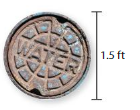
Big Ideas Math Answers 7th Grade Chapter 9 Geometric Shapes and Angles cr 6
Answer:
circumference of the object = 4.71 sq ft

Explanation:
D. circumference of the circle =2πr
circle = 2 x 3.14 x 0.75 where r =0.75 given
circle = 6.28 x  0.75
circle =4.71 sq ft

Question 5.
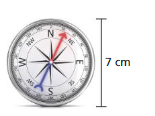
Big Ideas Math Answers 7th Grade Chapter 9 Geometric Shapes and Angles cr 7
Answer:
circumference of the object = 4.71 sq cm

Explanation:
D. circumference of the circle =2πr
circle = 2 x 3.14 x 3 .5 where r =3.5 given
circle = 6.28 x  3.5
circle =21.98  sq cm

Question 6.
You are placing non-slip tape along the perimeter of the bottom of a semicircle-shaped doormat. How much tape will you save applying the tape to the perimeter of the inside semicircle of the doormat? Justify your answer.
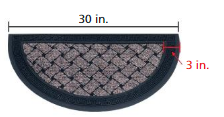
Big Ideas Math Answers 7th Grade Chapter 9 Geometric Shapes and Angles cr 8
Answer:
the tape saved = 47 .4 sq in
Explanation:
perimeter of the semicircle = ( π + 2 ) r
p = ( 3.14 + 2) 15
p = (3 .16 ) 15
p = 47.4 sq in

Question 7.
You need to carry a circular cake through a 32-inch wide doorway without tilting it. The circumference of the cake is 100 inches. Will the cake fit through the doorway? Explain.
Answer:
yes the cake fit through the doorway.
Explanation:
radius of the circle = (c/2π)
r= (100/6.28)
r = 15.923 sq in

Question 8.
Estimate the radius of the Big Ben clock face in London.
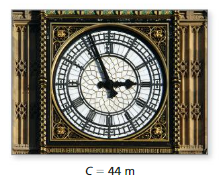
Big Ideas Math Answers 7th Grade Chapter 9 Geometric Shapes and Angles cr 9
Answer:
Radius of the Big Ben clock = 7.0063 m

Explanation:
radius of the circle = (c/2π)
r= (44/6.28)
r = 7.0063 m

Question 9.
Describe and solve a real-life problem that involves finding the circumference of a circle.
Answer:
The circumference of a circle = 2 π r

Explanation:
circle = 2 π r
where r = radius , π = 3.14

9.2 Areas of Circles (pp. 369-374)
Learning Target: Find the area of a circle.

Find the area of the circle. Use 3.14 or \(\frac{22}{7}\) for π.
Question 10.
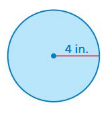
Big Ideas Math Answers 7th Grade Chapter 9 Geometric Shapes and Angles cr 10
Answer:
The area of the circle = 50.24 sq in

Explanation:
Area of the circle = π x r x r
area = 3.14 x 4 x 4
area = 3.14 x 16
area = 50.24 sq in

Question 11.
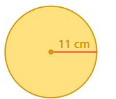
Big Ideas Math Answers 7th Grade Chapter 9 Geometric Shapes and Angles cr 11
Answer:
The area of the circle = 379.94 sq cm

Explanation:
Area of the circle = π x r x r
area = 3.14 x 11 x 11
area = 3.14 x 121
area = 379.94 sq cm

Question 12.
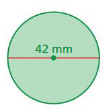
Big Ideas Math Answers 7th Grade Chapter 9 Geometric Shapes and Angles cr 12
Answer:
The area of the circle = 1384.74 sq mm

Explanation:
Area of the circle = π x r x r
area = 3.14 x 21 x 21
area = 3.14 x 441
area = 1384.74 sq mm

Question 13.
A desktop is shaped like a semicircle with a diameter of 28 inches. What is the area of the desktop?
Answer:
The area of the desktop = 615.44 sq in

Explanation:
Area of the desktop = π x r x r
area = 3.14 x 14 x 14
area = 3.14 x 196
area = 615.44 sq in

Question 14.
An ecologist is studying an algal bloom that has formed on the entire surface of a circular pond. What is the area of the surface of the pond covered by the algal bloom?
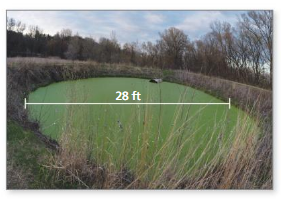
Big Ideas Math Answers 7th Grade Chapter 9 Geometric Shapes and Angles cr 14
Answer:
The area of the surface of the pond covered by the algol bloom = 615.44 ft

Explanation:
Area of the pond = π x r x r
area = 3.14 x 14 x 14
area = 3.14 x 196
area = 615.44 sq ft

Question 15.
A knitted pot holder is shaped like a circle. Its radius is 3.5 inches. What is its area?
Answer:
The area of the pot holder = 38.465 sq in

Explanation:
Area of the pot holder = π x r x r
area = 3.14 x 3.5 x 3.5
area = 3.14 x 12.25
area = 38.465 sq in

9.3 Perimeters and Areas of Composite Figures (pp. 375–380)
Learning Target: Find perimeters and areas of composite figures.

Find the perimeter and the area of the figure.
Question 16.
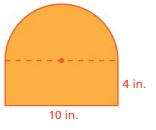
Big Ideas Math Answers 7th Grade Chapter 9 Geometric Shapes and Angles cr 16
Answer:
Area of semicircle = 1.695 sq in
perimeter of semicircle = 15.8 sq in

Explanation:
area of the semicircle = ( π + r x r /2)
s . c = (3.14 + 5 x 5 /2)
s. c = (3.14 + 25/2)
s . c = (3.39 /2 )
s. c = 1.695 sq in
perimeter of the semicircle = (π + 2 ) x r
p= 3.14 + 2 x 5
p = 3.16 x 5
p = 15.8 sq in

Question 17.
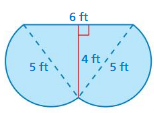
Big Ideas Math Answers 7th Grade Chapter 9 Geometric Shapes and Angles cr 17
Answer:
Area of semicircle = 6.07 sq ft
perimeter of semicircle = 9.48 sqft

Explanation:
area of the semicircle = ( π + r x r /2)
s . c = (3.14 + 3 x 3 /2)
s. c = (3.14 + 9/2)
s . c = (12.14 /2 )
s. c = 6.07 sq ft
perimeter of the semicircle = (π + 2 ) x r
p= 3.14 + 2 x 3
p = 3.16 x 3
p = 9.48 sq ft

Question 18.
GARDEN
You want to fence part of a yard to make a vegetable garden. How many feet of fencing do you need to surround the garden?
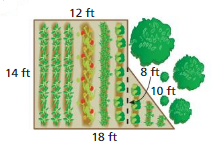
Big Ideas Math Answers 7th Grade Chapter 9 Geometric Shapes and Angles cr 18
Answer:
The fencing need to surround the garden = 32 sq feet

Explanation:
area  of the rectangle = l + b
area = 18 + 14
area = 32 sq feet

9.4 Constructing Polygons (pp. 381-388)

Learning Target: Construct a polygon with given measures.

Draw a triangle with the given description, if possible.
Question 19.
a triangle with angle measures of 15°, 75°, and 90°
Answer:
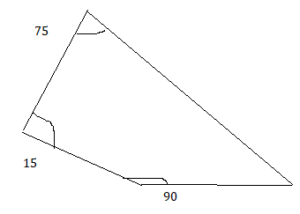
Explanation:
Given triangle with angle measures.

Question 20.
a triangle with a 3-inch side and a 4-inch side that meet at a 30° angle
Answer:
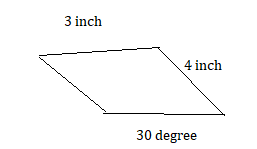
Question 21.
a triangle with side lengths of 5 centimeters, 8 centimeters, and 2 centimeters
Answer:
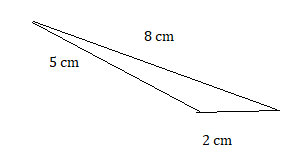
Draw a quadrilateral with the given angle measures, if possible.
Question 22.
110°, 80°, 70°, 100°
Answer:
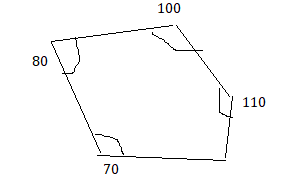
Question 23.
105°, 15°, 20°, 40°
Answer:
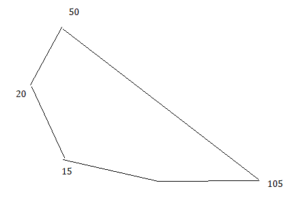
9.5 Finding Unknown Angle Measures (pp. 389–396)
Learning Target: Use facts about angle relationships to find unknown angle measures.

Use the figure shown.
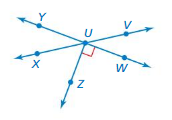
Big Ideas Math Answers 7th Grade Chapter 9 Geometric Shapes and Angles cr 24
Question 24.
Name a pair of adjacent angles.
Answer:
x , y , v , w .

Explanation:
In the above-given figure, the adjacent angles are x, y, v, w.

Question 25.
Name a pair of complementary angles.
Answer:
u and z

Explanation:
complementary angles = u , z

Question 26.
Name a pair of supplementary angles.
Answer:
x , y , v , z

Explanation:
supplementary are x , y , v , z
Question 27.
Name a pair of vertical angles.
Answer:
x , y , v, w

Explanation:
pair of vertical angles are x , y , v , w

Classify the pair of angles. Then find the value of x.
Question 28.
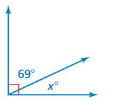
Big Ideas Math Answers 7th Grade Chapter 9 Geometric Shapes and Angles cr 28
Answer:
x = 111 degrees.

Explanation :
x = 56
x =180  – 69
x = 111 degree

Question 29.
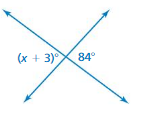
Big Ideas Math Answers 7th Grade Chapter 9 Geometric Shapes and Angles cr 29
Answer:
x = 81 degrees.

Explanation :
x + 3  = 84
x =84   – 3
x = 81  degree

Question 30.
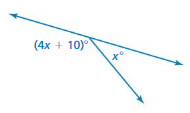
Big Ideas Math Answers 7th Grade Chapter 9 Geometric Shapes and Angles cr 30
Answer:
x = 3.33degrees.

Explanation :
(4x + 10) = x
10 = x – 4 x
3 x = 10
x = 3.33  degree

Question 31.
Describe two ways to find the measure of ∠2.
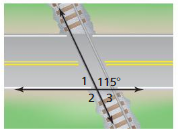
Big Ideas Math Answers 7th Grade Chapter 9 Geometric Shapes and Angles cr 31
Answer:
angle 2 = 65

Explanation:
x = 180 – 115
x = 65
2 = 65

Question 32.
Using the diagram from Exercises 24–27, find all the angle measures when ∠XUY = 40°.
Answer:

Geometric Shapes and Angles Practice Test

Question 1.
Find the radius of a circle with a diameter of 17 inches.
Answer:
radius of a circle = 8.5 in

Explanation:
radius of a circle = (d / 2)
radius =( 17 / 2)
radius = 8.5 in
Find (a) the circumference and (b) the area of the circle. Use 3.14 or \(\frac{22}{7}\) for π.
Question 2.
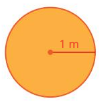
Big Ideas Math Answers Grade 7 Chapter 9 Geometric Shapes and Angles pt 2
Answer:
Area of the circle = 3.14 m
circumference of the circle = 6.28 m

Explanation:
Area of the circle = π x r x r
area = 3.14 x 1 x 1
area = 3.14 m
circumference of the circle = 2 x π x r
c = 2 x 3.14 x 1
c = 6.28 m

Question 3.
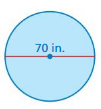
Big Ideas Math Answers Grade 7 Chapter 9 Geometric Shapes and Angles pt 3
Answer:
Area of the circle = 3846.5 sq in
circumference of the circle = 219. 8 sq in

Explanation:
Area of the circle = π x r x r
area = 3.14 x 35 x 35
area = 3.14 x 1,225 sq in
area = 3846.5 sq in
circumference of the circle = 2 x π x r
c = 2 x 3.14 x 35
c = 6.28 x 35
c = 219.8 sq in

Find (a) the perimeter and (b) the area of the figure. Use 3.14 or \(\frac{22}{7}\) for π.
Question 4.
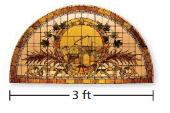
Big Ideas Math Answers Grade 7 Chapter 9 Geometric Shapes and Angles pt 4
Answer:
Area of semicircle = 2.695 sq ft
perimeter of semicircle = 4. 74 sq ft

Explanation:
area of the semicircle = ( π + r x r /2)
s . c = (3.14 + 1.5 x 1.5 /2)
s. c = (3.14 + 2.25 /2)
s . c = (5.39 /2 )
s. c = 2.695 sq ft
perimeter of the semicircle = (π + 2 ) x r
p= 3.14 + 2 x 1.5
p = 3.16 x 1.5
p = 4. 74 sq ft

Question 5.
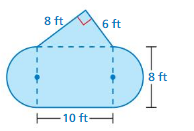
Big Ideas Math Answers Grade 7 Chapter 9 Geometric Shapes and Angles pt 5
Answer:
Area of semicircle = 9.57 sq ft
perimeter of semicircle = 12.64 sq ft

Explanation:
area of the semicircle = ( π + r x r /2)
s . c = (3.14 + 4 x 4 /2)
s. c = (3.14 + 16 /2)
s . c = (19.14 /2 )
s. c = 9.57  sq ft
perimeter of the semicircle = (π + 2 ) x r
p= 3.14 + 2 x 4
p = 3.16 x 4
p = 12.64 sq ft

Draw a figure with the given description, if possible.
Question 6.
a triangle with sides of length 5 inches and 6 inches that meet at a 50° angle.
Answer:
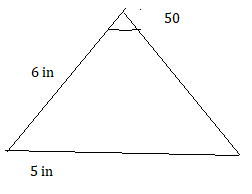
Question 7.
a triangle with side lengths of 3 inches, 4 inches, and 5 inches
Answer:
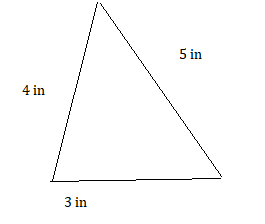
Question 8.
a quadrilateral with angle measures of 90°, 110°, 40°, and 120°
Answer:
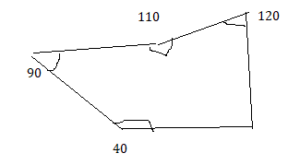
Classify each pair of angles. Then find the value of x.
Question 9.
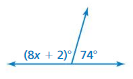
Big Ideas Math Answers Grade 7 Chapter 9 Geometric Shapes and Angles pt 9
Answer:
x = 9 degrees.

Explanation:
(8x + 2) = 74
8x = 74 – 2
8x = 72
x = (72/8)
x = 9

Question 10.
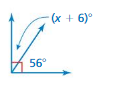
Big Ideas Math Answers Grade 7 Chapter 9 Geometric Shapes and Angles pt 10
Answer:
x = 50 degrees.

Explanation:
(x + 6) = 56
x = 56 – 6
x = 50
Question 11.
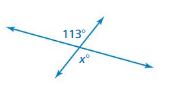
Big Ideas Math Answers Grade 7 Chapter 9 Geometric Shapes and Angles pt 11
Answer:
x = 67 degrees.

Explanation:
x = 180 – 113
x = 67 degrees.

Question 12.
A museum plans to rope off the perimeter of the 60 ftL-shaped exhibit. How much rope does it need?
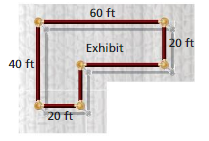
Big Ideas Math Answers Grade 7 Chapter 9 Geometric Shapes and Angles pt 12
Answer:
Area of the museum = 2,826 sq ft

Explanation:
Area of the museum  = π x r x r
area = 3.14 x 30 x 30
area = 3.14 x 900
area =  2,826 sq ft

Geometric Shapes and Angles Cumulative Practice

Question 13.
Draw a pair of adjacent angles that are neither complementary nor supplementary.
Answer:
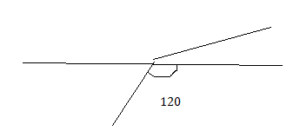
Question 14.
The circumference of a circle is 36.2 centimeters. What is the length of the diameter of the circle?
Answer:
Diameter of the circle = 11.52866 cm

Explanation:
Diameter of the circle = 2 x r
radius of the circle = (c / 2 π )
circumference = 36.2 cm
radius = (36.2 / 6.28)
radius = 5.7643
daimeter = 2 x r
diameter = 5.7643 x 2
diameter = 11.52866 cm

Question 15.
The circular rug is placed on a square floor. The rug touches all four walls. How much of the floor space is not covered by the rug?
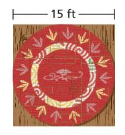
Big Ideas Math Answers Grade 7 Chapter 9 Geometric Shapes and Angles pt 15
Answer:
Area of the circle = 176.625sq ft

Explanation:
Area of the circle  = π x r x r
area = 3.14 x 7.5 x 7.5
area = 3.14 x 56.25
area =  176.625 sq ft

Geometric Shapes and Angles Cumulative Practice
Big Ideas Math Answers Grade 7 Chapter 9 Geometric Shapes and Angles cp 1
Question 1.
To make 6 servings of soup, you need 5 cup of chicken broth. You want to know how many servings you can make with 2 quarts of chicken broth. Which proportion should you use?
A. \(\frac{6}{5}=\frac{2}{x}\)
B. \(\frac{6}{5}=\frac{x}{2}\)
C. \(\frac{6}{5}=\frac{x}{8}\)
D. \(\frac{5}{6}=\frac{x}{8}\)
Answer:
option B is correct.

Explanation:
Given that in the question to make 6 servings of soup you need 5 cup of chicken broth.

Question 2.
What is the value of x?
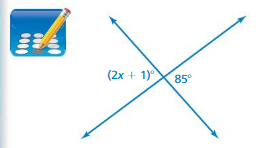
Big Ideas Math Answers Grade 7 Chapter 9 Geometric Shapes and Angles cp 2
Answer:
x = 42 degrees.

Explanation:
(2x + 1) = 85
2x = 85 – 1
2x = 84
x = (84/2)
x = 42

Question 3.
Your mathematics teacher described an inequality in words.
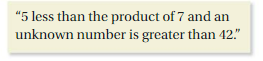
Big Ideas Math Answers Grade 7 Chapter 9 Geometric Shapes and Angles cp 3
Which inequality matches your mathematics teacher’s description?
F. 7n – 5 < 42 G. (7 – 5)n > 42
H. 5 – 7n > 42
I. 7n – 5 > 42
Answer:
option G is correct.

Explanation:
5 is less than the product of 7 and an unknown number is greater than 42.
(7 – 5)n > 42

Question 4.
What is the approximate area of the circle below? (Use \(\frac{22}{7}\) for π).
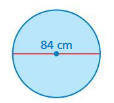
Big Ideas Math Answers Grade 7 Chapter 9 Geometric Shapes and Angles cp 4
A. 132 cm2
B. 264 cm2
C. 5544 cm2
D. 22,176 cm2
Answer:
Area of the circle = 63.585 sq ft

Explanation:
Area of the circle  = π x r x r
area = 3.14 x 42 x 42
area = 3.14 x 1,764
area =  5,538.96 cm

Question 5.
You have a 50% chance of selecting a blue marble from Bag A and a 20% chance of selecting a blue marble from Bag B. Use the provided simulation to answer the question, “What is the estimated probability of selecting a blue marble from both bags?”
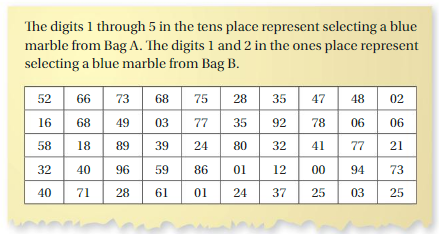
Big Ideas Math Answers Grade 7 Chapter 9 Geometric Shapes and Angles cp 5
F. 12%
G. 16%
H. 24%
I. 88%
Answer:
option F is correct.

Explanation:
The digits 1 and 2 in the ones place represent selecting a blue marble from bag B.
The digits 1 through 5  in the tens place represent selecting a blue marble from bag A.

Question 6.
Which proportion represents the problem?
“What number is 12% of 125?”
A. \(\frac{n}{125}=\frac{12}{100}\)
B. \(\frac{12}{125}=\frac{n}{100}\)
C. \(\frac{125}{n}=\frac{12}{100}\)
D. \(\frac{12}{n}=\frac{125}{100}\)
Answer:
option B is correct.

Explanation:
(12/125 ) x 100
(12/5) x 4
Question 7.
What is the approximate perimeter of the figure below? (Use 3.14 for π)
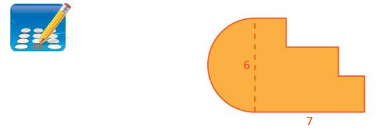
Big Ideas Math Answers Grade 7 Chapter 9 Geometric Shapes and Angles cp 7
Answer:
The perimeter of the semicircle = 18. 84

Explnation:
perimeter = ( π + 2 x r)
perimeter = (6.28 x 3 )
perimeter = 18 . 84

Question 8.
A savings account earns 2.5% simple interest per year. The principal is $850. What is the balance after 3 years?
F. $63.75
G. $871.25
H. $913.75
J. $7225
Answer:

Question 9.
Two ponds each contain about 400 fish. The double box-and-whisker plot represents the weights of a random sample of 12 fish from each pond. Which statement about the measures of center and variation is true?
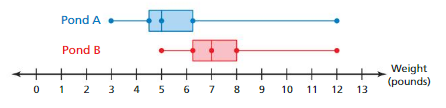
Big Ideas Math Answers Grade 7 Chapter 9 Geometric Shapes and Angles cp 9
A. The variation in the samples is about the same, but the sample from Pond A has a greater median.
B. The variation in the samples is about the same, but the sample from Pond B has a greater median.
C. The measures of center and variation are about the same for both samples.
D. Neither the measures of center nor variation are the same for the samples.
Answer:
option D is correct.

Explanation:
Neither the measures of center nor variation are same for the samples.

Question 10.
A lawn sprinkler sprays water onto part of a circular region, as shown below.
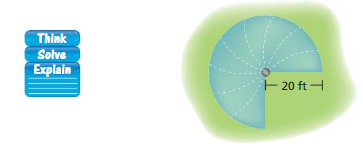
Big Ideas Math Answers Grade 7 Chapter 9 Geometric Shapes and Angles cp 11
Part A What is the area, in square feet, of the region that the sprinkler sprays with water? Explain your reasoning. (Use 3.14 for π.)
Part B What is the perimeter, in feet, of the region that the sprinkler sprays with water? Explain your reasoning. (Use 3.14 for π.)
Answer:
part A The region that sprinkler sprays with water = 1,256 ft
part B The region that sprinkler sprays with water = 125 .6 ft

Explanation:
area of the circle = π x r x r
area = 3.14 x 20 x 20
area = 1256 ft
perimeter of the circle =  2 x π x r
perimeter = 2 x 3.14 x 20
perimeter = 125. 6 ft

Question 11.
What is the least value of x for which x – 12 ≥ – 8 is true?
F. – 20
G. – 4
H. 4
I. 5
Answer:
option F is correct.

Explanation:
x – 12 ≥ – 8
x = -20

Final Words:

You can download the Big Ideas Math Book 7th Grade Answer Key 9 Geometric Shapes and Angles freely by accessing the direct links presented on this page. Hence hit the links and kickstart your preparation and test yourself by solving the questions in chapter review, practice test, cumulative practice, and overcome your difficulties. All the Best!!!

Big Ideas Math Answers Grade 6 Chapter 7 Area, Surface Area, and Volume

Are you searching for the Solution Key of Big Ideas Math 6th Grade Chapters? If your answer is yes, then you are on the right page. You can understand the concepts in-depth with the help of Big Ideas Math Book Solutions. We can provide the step by step explanations for all the questions using the Figures. Refer to our Big Ideas Math Book  6th Grade Answer Key Chapter 7 and solve the problems. You can easily understand the concepts with the help of the Big Ideas Math Book Solution Key. Get the pdf link of Big Ideas Math Answers Grade 6 Chapter 7 Area, Surface Area, and Volume from here.

Big Ideas Math Book 6th Grade Answer Key Chapter 7 Area, Surface Area, and Volume

In order to excel in the exam, we suggest the students of 6th standard to refer to the Big Ideas Math Book Answer Key Grade 6 Chapter 7 Area, Surface Area and Volume. Students who feel difficulty in solving the problems can easily and quickly understand the concepts with the help of Big Ideas Math Book Answer Key Chapter 7.

Performance

Lesson: 1 Areas of Parallelograms

Lesson: 2 Areas of Triangles

Lesson: 3 Areas of Trapezoids and Kites

Lesson: 4 Three-Dimensional Figures

Lesson: 5 Surface Areas of Prisms

Lesson: 6 Surface Areas of Pyramids

Lesson: 7 Volumes of Rectangular Prisms

Chapter 7 – Area, Surface Area, and Volume

Area, Surface Area, and Volume STEAM Video/Performance

Packaging Design

Surface area can be used to determine amounts of materials needed to create objects. Describe another situation in which you need to find the surface area of an object.

Watch the STEAM Video “Packaging Design.” Then answer the following questions. Alex is cutting a design out of paper and folding it to form a box.
Big Ideas Math Answers Grade 6 Chapter 7 Area, Surface Area, and Volume 1

Question 1.
Tory says that the length of the design is 47 inches and the width is 16 inches. Show several ways that you can arrange three of the designs on a roll of paper that is 48 inches wide. You can make the length of the paper as long as is needed.

Answer:
We can make the length of the paper = 15.6666 inches

Explanation:
Given that the length of the design = 47 inches
that the width of the design = 16 inches
area of the design = 752 inches
They can arrange the three of the design on a roll of paper that = 48 inches
(752/48)
15.6666 inches
Question 2.
Tory says that the cut-out design has an area of 619 square inches. What is the least possible amount of paper that is wasted when you cut out three of the designs?

Big Ideas Math Answers Grade 6 Chapter 7 Area, Surface Area, and Volume 2

Answer:
The least amount of paper that is wasted when you cut out three of the designs = 12.89

Explanation:
The area of the rectangle = breadth x height
619 square inches = 48 in x length
619 = 48l
l = 619/48
l = 12.89

Performance Task

Maximizing the Volumes of Boxes

After completing this chapter, you will be able to use the concepts you learned to answer the questions in the STEAM Video Performance Task. You will be given the dimensions of a small box and two larger boxes.
Big Ideas Math Answers Grade 6 Chapter 7 Area, Surface Area, and Volume 3
You will be asked to determine how many small boxes can be placed in each larger box. When a company is deciding on packaging for a product, why should the surface area of the packaging also be considered?
Big Ideas Math Answers Grade 6 Chapter 7 Area, Surface Area, and Volume 4

Area, Surface Area, and Volume Gettig Ready for chapter 7

Chapter Exploration

The formulas for the areas of polygons can be derived from one area formula, the area of a rectangle.
Big Ideas Math Answers Grade 6 Chapter 7 Area, Surface Area, and Volume 5

Work with a partner. Find (a) the dimensions of the figures and (b) the areas of the figures. What do you notice?

Question 1.
Big Ideas Math Answers Grade 6 Chapter 7 Area, Surface Area, and Volume 6

Answer:
The area of the rectangle = The product of the length and the product of the width
The area of the parallelogram = the product of the width and the product of the height

Explanation:
The area of the rectangle is equal to the area of the parallelogram
The area of the rectangle = the product of the length and the product of the width
The area of the rectangle = length x width
area = l x w
The area of the parallelogram = the product of the base and the product of the width
area = base x height
area = b x h

Question 2.
Big Ideas Math Answers Grade 6 Chapter 7 Area, Surface Area, and Volume 7

Answer:
The  area of the rectangle = the product of the length and the product of the width
The area of the parallelogram = (1/2) x the product of the base and the product of the height

Explanation:
The area of the rectangle is equal to the area of the parallelogram
The area of the rectangle = the product of the length and the product of the width
The area of the rectangle = length x width
area = l x w
The area of the triangle =(1/2) x  the product of the base and the product of the width
area =(1/2) base x height
area =(1/2) b x h

Question 3.
Big Ideas Math Answers Grade 6 Chapter 7 Area, Surface Area, and Volume 8

Answer:
The  area of the rectangle = the product of the length and the product of the width
The area of the trapezoid = (1/2) x height x (base 1 + base 2)

Explanation:
The area of the rectangle is equal to the area of the parallelogram
The area of the rectangle = the product of the length and the product of the width
The area of the rectangle = length x width
area = l x w
The area of the trapezoid =(1/2) x product of the height  and the product of the bases
area =(1/2) x height x bases
area =(1/2) x height (b1 + b2)

Vocabulary

The following vocabulary terms are defined in this chapter. Think about what each term might mean and record your thoughts.
Big Ideas Math Answers Grade 6 Chapter 7 Area, Surface Area, and Volume 9

Lesson 7.1 Areas of Parallelograms

A polygon is a closed figure in a plane that is made up of three or more line segments that intersect only at their endpoints. Several examples of polygons are parallelograms, rhombuses, triangles, trapezoids, and kites.
The formula for the area of a parallelogram can be derived from the definition of the area of a rectangle. Recall that the area of a rectangle is the product of its length ℓ and its width w. The process you use to derive this and other area formulas in this chapter is called deductive reasoning.
Big Ideas Math Answers Grade 6 Chapter 7 Area, Surface Area, and Volume 10

EXPLORATION 1
Deriving the Area Formula of a Parallelogram
Work with a partner.
a. Draw any rectangle on a piece of centimeter grid paper. Cut the rectangle into two pieces that can be arranged to form a parallelogram. What do you notice about the areas of the rectangle and the parallelogram?
b. Copy the parallelogram below on a piece of centimeter grid paper. Cut the parallelogram and rearrange the pieces to find its area.
Big Ideas Math Answers Grade 6 Chapter 7 Area, Surface Area, and Volume 11
Big Ideas Math Answers Grade 6 Chapter 7 Area, Surface Area, and Volume 12
c. Draw any parallelogram on a piece of centimeter grid paper and find its area. Does the area change when you use a different side as the base? Explain your reasoning.
d. Use your results to write a formula for the area A of a parallelogram.

Answer:
c : The area of the parallelogram = the product of the width and the product of the height
area = width x height
area = w x h
Yes the area changes.
We use the bases as equal length and width as equal length
d : the area of the parallelogram = the product of the width and the product of the height

c : The area of the parallelogram = the product of the width and the product of the height
area = width x height
area = w x h
Yes the area changes.
We use the bases as equal length and width as equal length
d : the area of the parallelogram = the product of the width and the product of the height

7.1 Lesson

The area of a polygon is the amount of surface it covers. You can find the area of a parallelogram in much the same way as you can find the area of a rectangle.
Big Ideas Math Answers Grade 6 Chapter 7 Area, Surface Area, and Volume 13

Big Ideas Math Answers Grade 6 Chapter 7 Area, Surface Area, and Volume 13.1

Try It

Find the area of the parallelogram.

Question 1.
Big Ideas Math Answers Grade 6 Chapter 7 Area, Surface Area, and Volume 14

Answer:
Area = 500 m

Explanation:
The area of the parallelogram = the product of the base b and its height h.
area = b x h
b = 20 m, h = 25 m
So the Area of the parallelogram = 500 m

Question 2.
Big Ideas Math Answers Grade 6 Chapter 7 Area, Surface Area, and Volume 15

Answer;
Area = 126 in

Explanation:
The area of the parallelogram = the product of base b and its height h
area = b x h
b = 7 in , h = 18 in
So area = 126 in

Question 3.
Big Ideas Math Answers Grade 6 Chapter 7 Area, Surface Area, and Volume 16

Answer:
615 yd

Explanation:
The area of the parallelogram = the product of base b and its height h
area = b x h
b = 30 yd, h = 20.5 yd
So area = 615 yd

When finding areas, you may need to convert square units. The diagrams at the left show that there are 9 square feet per square yard.
Big Ideas Math Answers Grade 6 Chapter 7 Area, Surface Area, and Volume 17
1 yd2 = (1 yd)(1 yd) = (3 ft)(3 ft) = 9 ft2
You can use a similar procedure to convert other square units.

Try It

Question 4.
Find the area of the parallelogram in square centimeters.
Big Ideas Math Answers Grade 6 Chapter 7 Area, Surface Area, and Volume 18

Answer:
The area of the parallelogram = the product of the base and the product of the height
Area = 400 cms

Explanation:
The area of the parallelogram = the product of the base and the product of the height
area = base x height
area = 4 m x 10 m
area = 40 m
1 meter = 100 centimeters
40 meter = 400 centimeters
area = 400 cm

Self-Assessment for Concepts & Skills

Solve each exercise. Then rate your understanding of the success criteria in your journal.

Question 5.
WRITING
Explain how to use the area of a rectangle to find the area of a parallelogram

Answer:
Area of the rectangle = length x breadth
Area of the parallelogram =   base x height

Explanation:
Area of the rectangle = length x breadth
area = l x b
Area of the parallelogram =   base x height
area =  b x h
area =  bh

FINDING AREA
Find the area of the parallelogram.

Question 6.
Big Ideas Math Answers Grade 6 Chapter 7 Area, Surface Area, and Volume 19

Answer:
area = 80 ft

Explanation:
The area of the parallelogram = the product of the base and the product of the height
area = base x height
area = b x h
b = 16 ft and h = 5 ft given
area = 16 x 5
area = 80 ft

Question 7.
Big Ideas Math Answers Grade 6 Chapter 7 Area, Surface Area, and Volume 20

Answer:
The area of the parallelogram = 14 . 4 km

Explanation:
The area of the parallelogram = the product of the base and the product of the height
area = base x height
area = b x h
b = 3 km and h = 4.8 km given
area = 3 x 4.8
area = 14.4 km

Question 8.
REASONING
Draw a parallelogram that has an area of 24 square inches.

Answer:
We have to assume that the base = 4 square inches and the height = 6 square inches

Self-Assessment for Problem Solving

Solve each exercise. Then rate your understanding of the success criteria in your journal.

Question 9.
The side of an office building in Hamburg, Germany, is in the shape of a parallelogram. The area of the side of the building is about 2150 square meters. What is the length x of the portion of the building that extends over the river?
Big Ideas Math Answers Grade 6 Chapter 7 Area, Surface Area, and Volume 21

Answer:
The length of the portion of the building that extends over the river = 45 m

Explanation:
The area of the parallelogram = the product of the bases and the product of the bases
area = 2150 square meters given
area = 25 m x (39 +47) given that height = 25 and base = 39
area = 25 x (86)
area = 2150
Thus the length of the portion of the building that extends over the river = 45 m

Question 10.
You make a photo prop for a school fair. You cut a 10-inch square out of a parallelogram-shaped piece of wood. What is the area of the photo prop?
Big Ideas Math Answers Grade 6 Chapter 7 Area, Surface Area, and Volume 22

Answer:
The area of the photo prop = 32

Explanation:
the area of the photo prop = the product of the base and the product of the height
area = h x b
area = 8 x 4
area = 32 ft

Question 11.
DIG DEEPER!
A galaxy contains a parallelogram-shaped dust field. The dust field has a base of 150 miles. The height is 14% of the base. What is the area of the dust field?

Answer:
The area of the dust field =3,150

Explanation:
The area of the parallelogram = the product of the height and the product of the base
area = h x b given that height = 14% = (14/100) x 150 = 21, base = 150 miles
area = 3150

Areas of Parallelograms Homework & Practice 7.1

Review & Refresh

Graph the equation.

Question 1.
y = 4x

Answer:
:

Explanation:
The given equation = y = 4x
for suppose x = 0, then y = 0
x = 1 , then y = 4 that means (1,4) y = 4 x 1 = 4
x = 2 , then y = 8 that means (2,8) y = 4 x 2 = 8
x = 3 , then y = 12 that means (3,12) y = 4 x 3 = 12

Question 2.
y = x + 3

Answer:

Explanation:
The given equation = y = x + 3
for suppose x = 0, then y = 3
x = 1 , then y = 4 that means (1,4) y = 1 + 3 = 4
x = 2 , then y = 5 that means (2, 5) y = 2 + 3  = 5
x = 3 , then y = 6 that means (3,16) y = 3 + 3 = 6
x = 4 , then y = 7 that means (4, 7) y = 4 + 3 = 7

Question 3.
y = 2x + 5

Answer:

Explanation:
The given equation = y = 2x + 5
for suppose x = 0, then y = 5
x = 1 , then y = 7 that means (1,7) y = 2 + 5 = 7
x = 2 , then y = 9 that means (2, 9) y = 4 + 5  = 9
x = 3 , then y = 11 that means (3,11) y = 6 + 5 = 11
x = 4 , then y = 13 that means (4, 13) y = 8 + 5 = 13

Represent the ratio relationship using a graph.

Question 4.
Big Ideas Math Answers Grade 6 Chapter 7 Area, Surface Area, and Volume 23

Answer:
1: 2 ratio

Explanation:

Question 5.
Big Ideas Math Answers Grade 6 Chapter 7 Area, Surface Area, and Volume 24

Answer:
1 : 2 ratio

Explanation:

Write the prime factorization of the number.

Question 6.
55

Answer:
5 . 11

Explanation:
5 x 11 = 55
S0 5,11

Question 7.
60

Answer:
2 x 2 x 3 x 5

Explanation:
2 x 30 = 60
2 x 15 = 30
5 x 3 = 15
3 x 1 = 3

Question 8.
150

Answer:
3 . 5 . 5 . 2

Explanation:
3 x 50 = 150
5 x 10 = 50
5 x 2 = 10
2 x 1 = 2

Question 9.
126

Answer:
2 . 3 . 3 . 7

Explanation:
2 x 63 = 126
3 x 21 = 63
3 x 7 = 21
7 x 1 = 7

Add or subtract.

Question 10.
2.36 + 15.71

Answer:
2.36 + 15.71 = 18.07

Explanation:


Question 11.
9.035 – 6.144

Answer:
9.035 – 6.144 = 2.891

Explanation:

Question 12.
28.351 – 19.3518

Answer:
28.351 = 19.3518 = 8.9992

Explanation:

Concepts, Skills, & Problem Solving
USING TOOLS
Rearrange the parallelogram as a rectangle. Then find the area. (See Exploration 1, p. 285.)

Question 13.
Big Ideas Math Answers Grade 6 Chapter 7 Area, Surface Area, and Volume 25

Answer:

Question 14.
Big Ideas Math Answers Grade 6 Chapter 7 Area, Surface Area, and Volume 26

Answer:

Question 15.
Big Ideas Math Answers Grade 6 Chapter 7 Area, Surface Area, and Volume 27

Answer:

FINDING AREA
Find the area of the parallelogram.

Question 16.
Big Ideas Math Answers Grade 6 Chapter 7 Area, Surface Area, and Volume 28

Answer:
The area of the parallelogram = 18 ft

Explanation:
The area of the parallelogram = the product of the base and the height
area = b x h given that base = 6 ft height = 3 ft
area = 18 ft
Question 17.
Big Ideas Math Answers Grade 6 Chapter 7 Area, Surface Area, and Volume 29

Answer:
The area of the parallelogram = 840 mm

Explanation:
The area of the parallelogram = the product of the base and the height
area = b x h given that base = 20 mm height = 42 ft
area = 840 mm

Question 18.
Big Ideas Math Answers Grade 6 Chapter 7 Area, Surface Area, and Volume 30

Answer:
The area of the parallelogram = 187 km

Explanation:
The area of the parallelogram = the product of the base and the height
area = b x h given that base = 17 km height = 11km
area = 187 km

Question 19.
Big Ideas Math Answers Grade 6 Chapter 7 Area, Surface Area, and Volume 31

Answer:
The area of the parallelogram = 3750 cm

Explanation:
The area of the parallelogram = the product of the base and the height
area = b x h given that base = 75 cm  height = 50 cm
area = 3750 cm

Question 20.
Big Ideas Math Answers Grade 6 Chapter 7 Area, Surface Area, and Volume 32

Answer:
The area of the parallelogram = 243 in

Explanation:
The area of the parallelogram = the product of the base and the height
area = b x h given that base = 13.5 in  height = 18 in
area = 243 in

Question 21.
Big Ideas Math Answers Grade 6 Chapter 7 Area, Surface Area, and Volume 33

Answer:
The area of the parallelogram = 894 mi

Explanation:
The area of the parallelogram = the product of the base and the height
area = b x h given that base = 24 in, height = 37 x (1/4)
area = 24 x 37.25
area = 894 mi

Question 22.
YOU BE THE TEACHER
Your friend finds the area of the parallelogram. Is your friend correct? Explain your reasoning.
Big Ideas Math Answers Grade 6 Chapter 7 Area, Surface Area, and Volume 34

Answer:
Yes my friend is correct

Explanation:
The area of the parallelogram = the product of the base and the product of the height
area = 8 m x 15 m
Given that base = 8m and height = 15 m
area = base x height
area = 8 m x 15 m
area = 120 m

Question 23.
MODELING REAL LIFE
A ceramic tile in the shape of a parallelogram has a base of 4 inches and a height of 1.5 inches. What is the area of the tile?

Answer:
The area of the tile =  6 inches

Explanation:
The area of the parallelogram = the product of the base and the product of the height
area = base x height
area = 4 x 1.5
area = 6 inches

FINDING AREA
Find the area of the parallelogram. Round to the nearest hundredth if necessary.

Question 24.
Big Ideas Math Answers Grade 6 Chapter 7 Area, Surface Area, and Volume 35

Answer:
4800 cm

Explanation:
The area of the parallelogram = the product of the base and the product of the height
area = base x height
area = 6 x 8
area = 48 m
1 meter = 100 centimeter
48 m = 4800 cm

Question 25.
Big Ideas Math Answers Grade 6 Chapter 7 Area, Surface Area, and Volume 36

Answer:
1,121.64096

Explanation:
The area of the parallelogram = the product of the base and the product of the height
area = base x height
area = 1320 yd x 1496 yd
area = 1974720yd
1 yard = 0.000568 mile
1974720 yd = 1,121.64096 miles

Question 26.
Big Ideas Math Answers Grade 6 Chapter 7 Area, Surface Area, and Volume 37

Answer:
67.4 ft

Explanation:
The area of the parallelogram = the product of the base and the product of the height
area = base x height
area = 5 m x 4 m
area = 20 m
1 meter = 3 feet 3.37 inches
20 m = 67 . 4 ft

Question 27.
OPEN-ENDED
Your deck has an area of 128 square feet. After adding a section, the area will be (s2 + 128) square feet. Draw a diagram of how this can happen.

Answer:

Question 28.
MODELING REAL LIFE
You use the parallelogram-shaped sponge to create the T-shirt design. The area of the design is 66 square inches. How many times do you use the sponge to create the design? Draw a diagram to support your answer.
Big Ideas Math Answers Grade 6 Chapter 7 Area, Surface Area, and Volume 37.1

Answer:
33 times is used to the sponge to create the design = 33
Explanation:
The area of the parallelogram = base x height
area = 3 x 1
area = 3  inches
The area of the design = 66 inches
66/3 = 33

FINDING A MISSING DIMENSION
Find the missing dimension of the parallelogram described.

Question 29.
Big Ideas Math Answers Grade 6 Chapter 7 Area, Surface Area, and Volume 38

Answer:
height = 9 ft
Explanation:
area of the parallelogram = the product of the base and the product of the height
area = base x height
area = 6 ft  x 9 ft
area = 54 ft
So height = 54

Question 30.
Big Ideas Math Answers Grade 6 Chapter 7 Area, Surface Area, and Volume 39

Answer:
base = 6.5 cm

Explanation:
area of the parallelogram = the product of the base and the product of the height
area = base x height
area = 6 . 5 cm  x 2.5 cm
area = 16 .25
So height = 2.5 cm

Question 31.
Big Ideas Math Answers Grade 6 Chapter 7 Area, Surface Area, and Volume 40

Answer:
height = 4 yd

Explanation:
5(x + 4) = 5x + 20

Question 32.
DIG DEEPER!
The staircase has three identical parallelogram-shaped panels. The horizontal distance between each panel is 4.25 inches. The area of each panel is 287 square inches. What is the value of x?
Big Ideas Math Answers Grade 6 Chapter 7 Area, Surface Area, and Volume 41

Answer:
The value of x = 14

Explanation:
(1/2)bx = 287
(1/2) x 14 x x = 287
7x = 287
x = 287/7
x = 41
50.5 -8
42.5 x 2 = 8.50

Question 33.
LOGIC
Each dimension of a parallelogram is multiplied by a positive number n. Write an expression for the area of the new parallelogram.

Answer:
The area of the parallelogram = (1/2) x b x h
area = (1/2)bn x hn
(1/2) bhn

Question 34.
CRITICAL THINKING
Rearrange the rhombus shown to write a formula for the area of a rhombus in terms of its diagonals.
Big Ideas Math Answers Grade 6 Chapter 7 Area, Surface Area, and Volume 42

Answer:
The area of the rhombus = (1/2) ab
area = (1/2) x ab

Explanation:
The area of the rhombus = (1/2) ab
area = (1/2) x ab

Lesson 7.2 Areas of Triangles

EXPLORATION 1

Deriving the Area Formula of a Triangle
Work with a partner.
a. Draw any parallelogram on a piece of centimeter grid paper. Cut the parallelogram into two identical triangles. How can you use the area of the parallelogram to find the area of each triangle?
b. Copy the triangle below on a piece of centimeter grid paper. Find the area of the triangle. Explain how you found the area.
Big Ideas Math Answers Grade 6 Chapter 7 Area, Surface Area, and Volume 43
c. Draw any acute triangle on a piece of centimeter grid paper and find its area. Repeat this process for a right triangle and an obtuse triangle.
d. Do the areas change in part(c) when you use different sides as the base? Explain your reasoning.

Answer:
a : The area of the parallelogram = (1/2) x b x h
The area of the triangle = base x height
b : The area of the triangle = base x height
area = b x h
c : The area of the acute-angled triangle = (1/2) x b x h
The area of the right-angled triangle = (1/2) x base x perpendicular
The area of the obtuse-angled triangle =(1/2) x b x h

Explanation:
a :
b :
c :


Big Ideas Math Answers Grade 6 Chapter 7 Area, Surface Area, and Volume 44
e. Use your results to write a formula for the area A of a triangle. Use the formula to find the area of the triangle shown.
Big Ideas Math Answers Grade 6 Chapter 7 Area, Surface Area, and Volume 45

Answer:
15 m

Explanation:
The area of the triangle = half x the product of the base b and the product of the height h
area = (1/2) x b x h given that b= 6 m ,h = 5 m
area = (1/2) x 30
area = 15 m

7.2 Lesson

Big Ideas Math Answers Grade 6 Chapter 7 Area, Surface Area, and Volume 46

Try It

Find the area of the triangle

Question 1.
Big Ideas Math Answers Grade 6 Chapter 7 Area, Surface Area, and Volume 47

Answer:
22 ft

Explanation:
The area of the triangle = (1/2) x bh
The area of the triangle = (1/2) x the product of base and the product of the height
b = 11 ft , h = 4 ft
area = (1/2) x bh
area = (1/2) x 11 x 4
area = (1/2) x 44
area = 22 ft

Question 2.
Big Ideas Math Answers Grade 6 Chapter 7 Area, Surface Area, and Volume 48

Answer:
Area = 60 cm

Explanation:
The area  of the triangle = (1/2) x the product of the base b and the product of the height h
b = 15 cm, h = 8cm
area = (1/2) x 15 x 8
area = (1/2) x 120
area = 60

Question 3.
Big Ideas Math Answers Grade 6 Chapter 7 Area, Surface Area, and Volume 49

Answer:
area = 110 m

Explanation:
The area of the triangle = (1/2) x the product of the base b and the product of the height h
So the b = 22m ,h= 10 m
area= (1/2) x 10 x 22
area = (1/2) x 220
area = 110 m

Question 4.
Big Ideas Math Answers Grade 6 Chapter 7 Area, Surface Area, and Volume 50

Answer:
6.5 yd

Explanation:
The area of the triangle = (1/2) x the product of base b and the product of the height h
So the b = (13/2) yd h = 2 yd
area = (1/2) x b x h
area = (1/2) x 6.5 x 2
area = (1/2) x 13
area = 6.5

Try It

Find the missing dimension of the triangle.

Question 5.
Big Ideas Math Answers Grade 6 Chapter 7 Area, Surface Area, and Volume 51

Answer:
Base = 8 cm

Explanation:
The area of the triangle =(1/2) x  the product of the base b and the product of height h
area of the triangle = 24 cm given
So the height = 6cm given
area =  (1/2) x b x h
area = (1/2) x 8 x 6
area = (1/2) x 48
area = 24
So base = 8 cm

Question 6.
Big Ideas Math Answers Grade 6 Chapter 7 Area, Surface Area, and Volume 52

Answer:
height = 17.5ft

Explanation:
The area of the triangle =(1/2) x  the product of the base b and the product of the height h
area of the triangle = 175 ft given,
So we have to find the height?
area = (1/2) x 20 x 17.5
area = (1/2) x 350
area = 175
So the height = 17.5 ft

Self-Assessment for Concepts & Skills

Solve each exercise. Then rate your understanding of the success criteria in your journal.

Question 7.
FINDING AREA
Find the area of the triangle at the left.
Big Ideas Math Answers Grade 6 Chapter 7 Area, Surface Area, and Volume 53

Answer:
The area of the triangle = 12

Explanation:
The area of the triangle = (1/2) x the product of base and the product of the height
b = 8 , h = 3
area = (1/2) x bh
area = (1/2) x 8 x 3
area = (1/2) x 24
area = 12

Question 8.
WRITING
Explain how to use the area of a parallelogram to find the area of a triangle.

Answer:
The area of the parallelogram = the product of the base and the product of the height
The area of the triangle = half x  the product of the base b and the product of the height h

Explanation:
The area of the parallelogram = the product of the base and the product of the height
area = b x h
The area of the triangle = half x the product of the base and the height
area = (1/2) x b x h
FINDING A MISSING DIMENSION
Find the missing dimension of the triangle.

Question 9.
Big Ideas Math Answers Grade 6 Chapter 7 Area, Surface Area, and Volume 54

Answer:
base = 10 mm

Explanation:
The area of the triangle = (1/2) the product of the base and the product of the height
area = (1/2) x base x height
area = (1/2) x 10 mm x 6 mm
area = (1/2) x 60 mm
area = 30 mm
So base = 10 mm
Question 10.
Big Ideas Math Answers Grade 6 Chapter 7 Area, Surface Area, and Volume 55

A composite figure is made up of triangles, squares, rectangles, and other two-dimensional figures. To find the area of a composite figure, separate it into figures with areas you know how to find. This is called decomposition.

Self-Assessment for Problem Solving

Solve each exercise. Then rate your understanding of the success criteria in your journal.

Question 11.
A wildlife conservation group buys the 9 square miles of land shown. What is the distance from Point A to Point B?
Big Ideas Math Answers Grade 6 Chapter 7 Area, Surface Area, and Volume 56

Answer:
The distance from point A to point B = 3 miles

Explanation:
The  area of the triangle = (1/2) ab
Given that  the land shown = 9 square miles
(1/2)bh = triangle ABC + triangle BCD
(3/2)b + (3/2)b = 9
(6/2)b = 9
3 b = 9
b = 3 miles
Question 12.
DIG DEEPER!
Find the area of the side of the chimney. Explain how you found the area.
Big Ideas Math Answers Grade 6 Chapter 7 Area, Surface Area, and Volume 57

Answer:
The area of the chimney = 31.5 sq. ft

Explanation:
The area of the chimney = (1/2) x base x height
area = (1/2)  x 3 x 21
area = 31.5 sq. ft

Areas of Triangles Homework & Practice 7.2

Review & Refresh

Find the area of the parallelogram.

Question 1.
Big Ideas Math Answers 6th Grade Chapter 7 Area, Surface Area, and Volume 58

Answer:  
The area of the parallelogram = 72 in

Explanation:
The area of the parallelogram = product of the height h and the product of the base b
b = 12 in, h = 6 in given
area =  12 x 6
area = 72 in

Question 2.
Big Ideas Math Answers 6th Grade Chapter 7 Area, Surface Area, and Volume 59

Answer:
The area of the parallelogram = 10.5 km

Explanation:
The area of the parallelogram = the product of the base b and the product of the height h
b = 3.5 km, h = 3km given
area = 3.5 x 3
area = 10.5 km

Question 3.
Big Ideas Math Answers 6th Grade Chapter 7 Area, Surface Area, and Volume 60

Answer:
The area of the parallelogram = 255 mi

Explanation:
The area of the parallelogram = the product of the base b and the product of the height h
b = 17 mi, h = 15 mi given
area = 17 x 15
area = 255 mi

Tell which property the statement illustrates.

Question 4.
n . 1 = n

Answer:
The product of x = the product of y

Explanation:
The product of x = n x 1 = n
the product of y = n
n = n

Question 5.
4 . m = m . 4

Answer:
The product of x = the product of y

Explanation:
The product of x = m x 4 = 4 m
the product of y = m x 4 = 4 m
4 . m = m . 4

Question 6.
(x + 2) + 5 = x + (2 + 5)

Answer:
The product of x = the product of y

Explanation:
The product of x = (x + 2) + 5
the product of y =  x + (2 +5)
(x +2) +5 = x + (2 +5)

Question 7.
What is the first step when using order of operations?
A. Multiply and divide from left to right.
B. Add and subtract from left to right.
C. Perform operations in grouping symbols.
D. Evaluate numbers with exponents.

Answer:
Evaluate numbers with exponents

Concepts, Skills, & Problem Solving

USING TOOLS
Find the area of the triangle by forming a parallelogram. (See Exploration 1, p. 291.)

Question 8.
Big Ideas Math Answers 6th Grade Chapter 7 Area, Surface Area, and Volume 61

Answer:
The area of the right angled triangle = (1/2) x ab

Explanation:

Question 9.
Big Ideas Math Answers 6th Grade Chapter 7 Area, Surface Area, and Volume 62

Answer:
obtused angled triangle = (1/2) x b xh

Explanation:

Question 10.
Big Ideas Math Answers 6th Grade Chapter 7 Area, Surface Area, and Volume 63

Answer:
acute angled triangle

Explanation:

FINDING AREA
Find the area of the triangle.

Question 11.
Big Ideas Math Answers 6th Grade Chapter 7 Area, Surface Area, and Volume 64

Answer:
The area of the triangle = 6 cm

Explanation:
Area of the triangle = (1/2) x the product of the base b and the product of the height h
area = (1/2) x b x h
So b = 3 cm , h = 4 cm
area = (1/2) x 3 x 4
area = (1/2) x 12
area = 6 cm

Question 12.
Big Ideas Math Answers 6th Grade Chapter 7 Area, Surface Area, and Volume 65

Answer:
The area of the triangle = 90 mi

Explanation:
Area of the triangle = (1/2) x the product of the base b and the product of the height h
area = (1/2) x b x h
So b = 20 mi  , h = 9 mi
area = (1/2) x 20 x 9
area = (1/2) x 180
area = 90 sq. miles

Question 13.
Big Ideas Math Answers 6th Grade Chapter 7 Area, Surface Area, and Volume 66

Answer:
The area of the triangle =1620 in

Explanation:

Area of the triangle = (1/2) x the product of the base b and the product of the height h
area = (1/2) x b x h
So b =60 in , h = 54 in
area = (1/2) x 3240
area = 1620 in

Question 14.
Big Ideas Math Answers 6th Grade Chapter 7 Area, Surface Area, and Volume 67

Answer:

The area of the triangle = 189 mm

Explanation:
Area of the triangle = (1/2) x the product of the base b and the product of the height h
area = (1/2) x b x h
So b =21 mm , h = 18 mm
area = (1/2) x 378
area = 189 mm

Question 15.
Big Ideas Math Answers 6th Grade Chapter 7 Area, Surface Area, and Volume 68

Answer:
The area of the triangle = 1125 cm

Explanation:
Area of the triangle = (1/2) x the product of the base b and the product of the height h
area = (1/2) x b x h
So b =75 cm , h = 30 cm
area = (1/2) x 2250
area = 1125 cm

Question 16.
Big Ideas Math Answers 6th Grade Chapter 7 Area, Surface Area, and Volume 69

Answer:
The area of the triangle = 132 m

Explanation:
Area of the triangle = (1/2) x the product of the base b and the product of the height h
area = (1/2) x b x h
So b =8 m , h = 33 m
area = (1/2) x 264
area = 132 m

Question 17.
YOU BE THE TEACHER
Your friend finds the area of the triangle. Is your friend correct? Explain your reasoning.
Big Ideas Math Answers 6th Grade Chapter 7 Area, Surface Area, and Volume 70

Answer:
Yes my friend is correct

Explanation:
Area of the triangle = (1/2) x the product of the base b and the product of the height h
area = (1/2) x b x h
Sob =10 m , h = 12 m
area = (1/2) x 120
area = 60 m

Question 18.
MODELING REAL LIFE
Estimate the area of the cottonwood leaf.
Big Ideas Math Answers 6th Grade Chapter 7 Area, Surface Area, and Volume 71

Answer:
The area of the cottonwood leaf = 10 in

Explanation:
Area of the triangle = (1/2) x the product of the base b and the product of the height h
area = (1/2) x b x h
Sob = 5 in , h =  4 in
area = (1/2) x 20
area = 10 in

Question 19.
MODELING REAL LIFE
A shelf has the shape of a triangle. The base of the shelf is 36 centimeters, and the height is 18 centimeters. Find the area of the shelf in square inches.

Answer:
The shape of the triangle = 324

Explanation:
Area of the triangle = (1/2) x the product of the base b and the product of the height h
area = (1/2) x b x h
Sob = 36 cm , h =  18 cm
area = (1/2) x 648
area = 324 sq. cm

Question 19.

FINDING A MISSING DIMENSION
Find the missing dimension of the triangle.

Question 20.
Big Ideas Math Answers 6th Grade Chapter 7 Area, Surface Area, and Volume 72

So base = 7 m

Question 21.
Big Ideas Math Answers 6th Grade Chapter 7 Area, Surface Area, and Volume 73

Answer:
Base of the triangle = 4.66 ft

Explanation:
The area of the triangle =(1/2) x  the product of the base b and the product of height h
area of the triangle = 14 ft given
So the height = 6 ft given
area =  (1/2) x b x h
area = (1/2) x 4.66 x 6
area = (1/2) x 27.96
area = 14
soo base = 4.66 ft

Question 22.
Big Ideas Math Answers 6th Grade Chapter 7 Area, Surface Area, and Volume 74

Answer:
Height = 2.66 in

Explanation:
The area of the triangle = (1/2) x the product of the base and the product of the height
area = (1/2) x 1.5 x h given that area = 2 in
2 = (1/2) x 1.5h
1.5 h = 4
h = (4/1.5)
h = 2.66 in
COMPOSITE FIGURES
Find the area of the figure.

Question 23.
Big Ideas Math Answers 6th Grade Chapter 7 Area, Surface Area, and Volume 75

Answer:
The area of the figure = 44 ft

Explanation:
The area of the rectangle = 2 x(length + breadth)
area = 2 x (12 +10)
area = 2 x (22)
area = 44 sq. ft

Question 24.
Big Ideas Math Answers 6th Grade Chapter 7 Area, Surface Area, and Volume 76

Answer:
The area of the figure = 52 cm

Explanation:
The area of the rectangle = 2 x(length + breadth)
area = 2 x (11 +15)
area = 2 x (26)
area = 52 cm

Question 25.
Big Ideas Math Answers 6th Grade Chapter 7 Area, Surface Area, and Volume 77

Answer:
The area of the perimeter = 5/2 x a x b

Explanation:
The area of the perimeter = (5/2) x a x b
where a = middle point
b = sides

Question 26.
WRITING
You know the height and the perimeter of an equilateral triangle. Explain how to find the area of the triangle. Draw a diagram to support your reasoning.

Answer:
The perimeter of the equilateral triangle = a  x a x a = 3a

Explanation:
The perimeter of the equilateral triangle = 3a
height of the equilateral triangle = h
the area of the triangle = (1/2) x product of base b and the product of the height h
area = (1/2) x bh

Question 27.
CRITICAL THINKING
The total area of the polygon is 176 square feet. What is the value of x?
Big Ideas Math Answers 6th Grade Chapter 7 Area, Surface Area, and Volume 78

Answer:
The value of x = 6

Explanation:
The area of the polygon = 176 square feet given
area = 16 x 8 = 128
area = 176 – 128 = 48
The area of the right angle triangle = (a x b )/2
area = (8 x X)/2
48 = 4x + 4x
8x = 48
x = (48/8)
x = 6 ft

Question 28.
REASONING
The base and the height of Triangle A are one-half the base and the height of Triangle B. How many times greater is the area of Triangle B?

Answer:
2 times

Explanation:
The triangle B is 2 times greater than the triangle A

Question 29.
STRUCTURE
Use what you know about finding areas of triangles to write a formula for the area of a rhombus in terms of its diagonals. Compare the formula with your answer to Section 7.1 Exercise 34.
Big Ideas Math Answers 6th Grade Chapter 7 Area, Surface Area, and Volume 79

Answer:
The area of the triangle = (1/2) ab
The area of the rhombus = (1/2) ab

Explanation:
The area of the triangle is equal to the area of the rhombus
area of the triangle = (1/2) ab
area of the rhombus = (1/2) ab

Lesson 7.3 Areas of Trapezoids and Kites

EXPLORATION 1
Deriving the Area Formula of a Trapezoid
Work with a partner.
a. Draw any parallelogram on a piece of centimeter grid paper. Cut the parallelogram into two identical trapezoids. How can you use the area of the parallelogram to find the area of each trapezoid?
b. Copy the trapezoid below on a piece of centimeter grid paper. Find the area of the trapezoid. Explain how you found the area.
Big Ideas Math Answers 6th Grade Chapter 7 Area, Surface Area, and Volume 80
c. Draw any trapezoid on a piece of centimeter grid paper and find its area.
d. Use your results to write a formula for the area A of a trapezoid. Use the formula to find the area of the trapezoid shown.
Big Ideas Math Answers 6th Grade Chapter 7 Area, Surface Area, and Volume 81
Big Ideas Math Answers 6th Grade Chapter 7 Area, Surface Area, and Volume 82

7.3 Lesson

Big Ideas Math Answers 6th Grade Chapter 7 Area, Surface Area, and Volume 83
You can use decomposition to find areas of trapezoids and kites. A kite is a quadrilateral that has two pairs of adjacent sides with the same length and opposite sides with different lengths.

Try It
Find the area of the figure.

Question 1.
Big Ideas Math Answers 6th Grade Chapter 7 Area, Surface Area, and Volume 87

Answer:
76.5 in

Explanation:
The area of the trapezoid = one half the product of its height h and the sum of its bases b1 and b2.
area = (1/2) x h x( b1 + b2)
area =(1/2) x h (5 + 12). Given that b1 = 5 and b2 = 12
area = (1/2) x 9(17) given that h = 9
area = (1/2) x 153
area = 76.5 sq. in

Question 2.
Big Ideas Math Answers 6th Grade Chapter 7 Area, Surface Area, and Volume 88

Answer:
65.45 sq. mi

Explanation:
The area of the trapezoid = one half the product of its height h and the sum of its bases b1 and b2.
area = (1/2) x h x( b1 + b2)
area =(1/2) x h (3 + 3). Given that b1 = 3 and b2 = 3
area = (1/2) x 7.7(17) given that h = 7.7
area = (1/2) x 130.9
area = 65.45 sq. mi

In Example 1(a), you could have used a copy of the trapezoid to form a parallelogram. As you may have discovered in the exploration, this leads to the following formula for the area of a trapezoid.

Big Ideas Math Answers 6th Grade Chapter 7 Area, Surface Area, and Volume 89

Try It
Find the area of the trapezoid.

Question 3.
Big Ideas Math Answers 6th Grade Chapter 7 Area, Surface Area, and Volume 90

Answer:
The area of the trapezoid = 22.5 sq. mm

Explanation:
The area of the trapezoid = one half the product of its height h and the sum of its bases b1 and b2.
area = (1/2) x h x( b1 + b2)
area =(1/2) x h (5 + 4). Given that b1 = 5 and b2 = 4
area = (1/2) x 8(9) given that h = 8
area = (1/2) x 45
area = 22.5 sq. mm

Question 4.
Big Ideas Math Answers 6th Grade Chapter 7 Area, Surface Area, and Volume 91

Answer:
The area of the trapezoid = 30 sq. in

Explanation:
The area of the trapezoid = one half the product of its height h and the sum of its bases b1 and b2.
area = (1/2) x h x( b1 + b2)
area =(1/2) x h (7.7 + 2.3). Given that b1 = 7.7 and b2 = 2.3
area = (1/2) x 6(10) given that h = 6 in
area = (1/2) x 60
area = 30 sq. in

Try It
Find the area of the figure.

Question 5.
Big Ideas Math Answers 6th Grade Chapter 7 Area, Surface Area, and Volume 92

Answer:
The area of the trapezoid1 = 60 sq. m
The area of the trapezoid2= 88 sq. m

Explanation:
The area of the trapezoid1 = one half the product of its height h and the sum of its bases b1 and b2.
area = (1/2) x h x( b1 + b2)
area =(1/2) x h (5 + 5). Given that b1 = 5  and b2 = 5
area = (1/2) x 12(10) given that h = 6 m
area = (1/2) x  120
area = 60 sq. m
The area of the trapezoid2 = one half the product of its height h and the sum of its bases b1 and b2.
area = (1/2) x h x( b1 + b2)
area =(1/2) x h (8 + 8). Given that b1 = 8  and b2 = 8
area = (1/2) x 11(16) given that h = 6 m
area = 88 sq. m
Question 6.
Big Ideas Math Answers 6th Grade Chapter 7 Area, Surface Area, and Volume 93

Answer:
The area of the trapezoid = 112 sq. in

Explanation:
The area of the trapezoid = one half the product of its height h and the sum of its bases b1 and b2.
area = (1/2) x h x( b1 + b2)
area =(1/2) x h (6+ 10). Given that b1 = 6 and b2 = 10
area = (1/2) x 14(16) given that h = 14 in
area = (1/2) x 224
area = 112 sq. in

Self-Assessment for Concepts & Skills
Solve each exercise. Then rate your understanding of the success criteria in your journal.

Question 7.
WRITING
Explain how to use the area of a parallelogram to find the area of a trapezoid.

Answer:
The area of the parallelogram = product of the height h and the product of the base b
The area of the trapezoid = one half the product of its height h and the sum of its bases b1 and b2.

Question 8.
REASONING
What measures do you need to find the area of a kite?

Answer:
Rhombus is used to find the area of the kite

Explanation:
The area of the rhombus = (1/2) x side x height
area = (1/2) x s x h
area = (1/2) sh
kite is also same as the rhombus

FINDING AREA
Find the area of the figure.

Question 9.
Big Ideas Math Answers 6th Grade Chapter 7 Area, Surface Area, and Volume 94

Answer:
Area = 52.5 sq. yd

Explanation:
The area of the trapezoid = (1/2) x height x the product of the base 1 and the base 2
area = (1/2) x height x (b1 + b2)
area = (1/2) x 5 x (9 + 12)
area = (1/2) x 5 x 21
area = (1/2) x 105
area = 52.5 sq. yd

Question 10.
Big Ideas Math Answers 6th Grade Chapter 7 Area, Surface Area, and Volume 95

Answer:
Area = 55 sq. m

Explanation:
The area of the trapezoid = (1/2) x height x the product of the base 1 and the base 2
area = (1/2) x height x (b1 + b2)
area = (1/2) x 10 x (7 + 4)
area = (1/2) x 10x 11
area = (1/2) x 110
area = 55 sq. m

Self-Assessment for Problem Solving

Solve each exercise. Then rate your understanding of the success criteria in your journal.

Question 11.
DIG DEEPER!
An archaeologist estimates that the manuscript shown was originally a rectangle with a length of 20 inches. Estimate the area of the fragment that is missing.
Big Ideas Math Answers 6th Grade Chapter 7 Area, Surface Area, and Volume 96

Answer:
144 square inches

Explanation:
The area of the right angle triangle = a x b where a = height b = base
area = a x b a=12 b = 18 – 6 = 12
area = 12 x 12
area = 144 sq. in

Question 12.
The stained-glass window is made of identical kite-shaped glass panes. The approximate dimensions of one pane are shown. The glass used to make the window costs $12.50 per square foot. Find the total cost of the glass used to make the window.
Big Ideas Math Answers 6th Grade Chapter 7 Area, Surface Area, and Volume 97

Answer:
The total cost of the glass used to make the window is 14.4375 $
Explanation:
The area of the rhombus = (1/2) x the product of the side s and the product of height h
area  = (1/2) x2 ft x 2.31ft
area = ( 4.62/2)
Area = 2.31 x 12.50$
area = 14.4375$

Areas of Trapezoids and Kites Homework & Practice 7.3

Review & Refresh

Find the area of the triangle.

Question 1.
Big Ideas Math Answers 6th Grade Chapter 7 Area, Surface Area, and Volume 98

Answer:
Area =63 in

Explanation:
The area of the triangle = half the product of the base and the product of the height
area = (1/2)bh
area = (1/2) x 18 x 7
area = (126/2)
area = 63 in

Question 2.
Big Ideas Math Answers 6th Grade Chapter 7 Area, Surface Area, and Volume 99

Answer:
Area =26 sq. km

Explanation:
The area of the triangle = half the product of the base and the product of the height
area = (1/2)bh
area = (1/2) x 8 x 6.5
area = (52/2)
area = 26 sq. km

Question 3.
Big Ideas Math Answers 6th Grade Chapter 7 Area, Surface Area, and Volume 100

Answer:
Area =25 sq. ft

Explanation:
The area of the triangle = half the product of the base and the product of the height
area = (1/2)bh
area = (1/2) x 4 x 12.5
area = (50/2)
area = 25 sq. ft

Classify the quadrilateral./

Question 4.
Big Ideas Math Answers 6th Grade Chapter 7 Area, Surface Area, and Volume 101

Answer:
The above quadrilateral look similar to the rectangle

Explanation:
Rectangle
the area of the rectangle = length x width
area = l x w

Question 5.
Big Ideas Math Answers 6th Grade Chapter 7 Area, Surface Area, and Volume 102

Answer:
The above diagram is  similar to the trapezoid

Explanation:
The area of the trapezoid = half the product of the base and the product of the height
area = (1/2) x b x h
Question 6.
Big Ideas Math Answers 6th Grade Chapter 7 Area, Surface Area, and Volume 103

Answer:
The above figure is similar to the parallelogram

Explanation:
The area of the parallelogram = the product of the height and the product of the base b
area = b x h

Question 7.
On a normal day, 12 airplanes arrive at an airport every 15 minutes. Which rate does not represent this situation?
A. 24 airplanes every 30 minutes
B. 4 airplanes every 5 minutes
C. 6 airplanes every 5 minutes
D. 48 airplanes each hour

Answer:
B

Explanation:
4 airplanes every 5 minutes
Concepts, Skills, & Problem Solving
USING TOOLS
Find the area of the trapezoid by forming a parallelogram. (See Exploration 1, p. 297.)

Question 8.
Big Ideas Math Answers 6th Grade Chapter 7 Area, Surface Area, and Volume 104

Answer:
The area of the trapezoid = (1/2) x b x l x h

Explanation:
The area of the trapezoid = (1/2) x b x l x h
area = (1/2) x b x h x l
area = (lxb/2)x h

Question 9.
Big Ideas Math Answers 6th Grade Chapter 7 Area, Surface Area, and Volume 105

Answer:
The area of the trapezoid = (1/2) x b x l x h

Explanation:
The area of the trapezoid = (1/2) x b x l x h
area = (1/2) x b x h x l
area = (lxb/2)x h

Question 10.
Big Ideas Math Answers 6th Grade Chapter 7 Area, Surface Area, and Volume 106

Answer:
The area of the trapezoid = (1/2) x b x l x h

Explanation:
The area of the trapezoid = (1/2) x b x l x h
area = (1/2) x b x h x l
area = (lxb/2)x h

FINDING AREA
Use decomposition to find the area of the figure.

Question 11.
Big Ideas Math Answers 6th Grade Chapter 7 Area, Surface Area, and Volume 107

Answer:
25 cm

Explanation:
The area of the triangle = (1/2) b x h
base value = 2, height = 5 given
area = (1/2) x 5 x 2
area = 5
the area of another triangle = 5
the remaining = rectangle
area of rectangle = length x breadth
area = 15 + 5 + 5 = 25 cm

Question 12.
Big Ideas Math Answers 6th Grade Chapter 7 Area, Surface Area, and Volume 108

Answer:
92 sq. yd

Explanation:
The area of the triangle = (1/2) b x h
base value = 2, height = 5 given
area = (1/2) x 8 x 2=3
area = 12
the remaining = rectangle
area of rectangle = length x breadth
area = 80 + 12 yd
area = 92 yd

Question 13.
Big Ideas Math Answers 6th Grade Chapter 7 Area, Surface Area, and Volume 109

Answer:
125 m

Explanation:
The area of the triangle = (1/2) b x h
base value = 2, height = 5 given
area = (1/2) x 8 x 5= 20
area = 20
The area of the triangle = (1/2) b x h
base value = 17, height = 5 given
area = (1/2) x 17 x 5= 20
area = 42.5
area  = 20 + 20+ 42.5 + 42.5
area = 125 m

Question 14.
Big Ideas Math Answers 6th Grade Chapter 7 Area, Surface Area, and Volume 110

Answer:
The area of the figure = 44 inches

Explanation:
The area of the triangle = (1/2) b x h
base value = 9, height = 4 given
area = (1/2) x 9 x 4= 18
area = 18
the remaining = rectangle
area of rectangle = length x breadth
area = 18 + 18 + 4 +
area = 44 inches
Question 15.
Big Ideas Math Answers 6th Grade Chapter 7 Area, Surface Area, and Volume 111

Answer:
The area of the figure = 55  miles

Explanation:
The area of the triangle = (1/2) b x h
base value = 10, height = 7 given
area = (1/2) x 10 x 7= 35
area = 35 mi
The area of the triangle = (1/2) b x h
base value = 10, height = 4 given
area = (1/2) x 10 x 4= 20
area = 20 mi
area =  20 + 35 = 55
area = 55 mi

Question 16.
Big Ideas Math Answers 6th Grade Chapter 7 Area, Surface Area, and Volume 112

Answer:
The area of the figure = 17.68 miles

Explanation:
The area of the triangle = (1/2) b x h
base value = 3.2, height = 3.8 given
area = (1/2) x 3.2 x 3.8= 35
area = 6.08
The area of the triangle = (1/2) b x h
base value = 3.2, height = 1.6given
area = (1/2) x 3.2 x 1.6= 20
area = 2.56
area =  2.56 + 2.56 + 6.08 + 6.08 = 17.68 kms
area = 17.68 miles

FINDING AREA
Find the area of the trapezoid.

Question 17.
Big Ideas Math Answers 6th Grade Chapter 7 Area, Surface Area, and Volume 113

Answer:
28 in

Explanation:
Area of trapezoid = half the product of the height and the product  of the bases
area = (1/2) x h x (b1 +b2)
area = (1/2) x 4 x  (6 + 8)/
area = (1/2) x 4 x 14
area = 28 sq. in

Question 18.
Big Ideas Math Answers 6th Grade Chapter 7 Area, Surface Area, and Volume 114

Answer:
10 sq. cm

Explanation:
Area of trapezoid = half the product of the height and the product  of the bases
area = (1/2) x h x (b1 +b2)
area = (1/2) x 4 x  (3.5 + 1.5)
area = (1/2) x 4 x 5
area = 10 sq. cm

Question 19.
Big Ideas Math Answers 6th Grade Chapter 7 Area, Surface Area, and Volume 115

Answer:
105 sq. ft

Explanation:
Area of trapezoid = half the product of the height and the product  of the bases
area = (1/2) x h x (b1 +b2)
area = (1/2) x 10 x  (13.5 + 7.5)
area = (1/2) x 10 x 21
area = 105 sq. ft

Question 20.
YOU BE THE TEACHER
Your friend finds the area of the trapezoid. Is your friend correct? Explain your reasoning.
Big Ideas Math Answers 6th Grade Chapter 7 Area, Surface Area, and Volume 116

Answer:
No my friend is not correct

Explanation:
Area of trapezoid = half the product of the height and the product  of the bases
area = (1/2) x h x (b1 +b2)
area = (1/2) x 8 x  (6 +14)
area = (1/2) x 160
area = 80 sq. m

Question 21.
MODELING REAL LIFE
Light shines through a window. What is the area of the trapezoid-shaped region created by the light?
Big Ideas Math Answers 6th Grade Chapter 7 Area, Surface Area, and Volume 117

Answer:
16 sq. ft
Explanation:
Area of trapezoid = half the product of the height and the product  of the bases
area = (1/2) x h x (b1 +b2) given that b1 = 3 and b2 = 5
area = (1/2) x 4 x  (5 +3)
area = (1/2) x 32
area = 16 sq. ft

COMPOSITE FIGURES
Find the area of the figure.

Question 22.
Big Ideas Math Answers 6th Grade Chapter 7 Area, Surface Area, and Volume 118

Answer:
178.5 sq. ft
Explanation:
Area of trapezoid = half the product of the height and the product  of the bases
area = (1/2) x h x (14 +7) given that b1 = 14 and b2 = 7
area = (1/2) x 17 x  (14 +7)
area = (1/2) x 357
area = 178.5 sq. ft

Question 23.
Big Ideas Math Answers 6th Grade Chapter 7 Area, Surface Area, and Volume 119

Question 24.
Big Ideas Math Answers 6th Grade Chapter 7 Area, Surface Area, and Volume 120

FINDING A MISSING DIMENSION
Find the height of the trapezoid.

Question 25.
Big Ideas Math Answers 6th Grade Chapter 7 Area, Surface Area, and Volume 121

Answer:
The height of the trapezoid = square root of height and bases

Question 26.
Big Ideas Math Answers 6th Grade Chapter 7 Area, Surface Area, and Volume 122

Question 27.
Big Ideas Math Answers 6th Grade Chapter 7 Area, Surface Area, and Volume 123

FINDING AREA
Find the area (in square feet) of a trapezoid with height hand bases b1 and b2.

Question 28.
h = 6 in.
b1 = 9 in.
b2 = 12 in.

Answer:
The area of the trapezoid = 0.43722 square feet

Explanation:
Area of trapezoid = half the product of the height and the product  of the bases
area = (1/2) x h x (9 +12) given that b1 = 9 and b2 = 12
area = (1/2) x 6 x  (9 + 12)
area = (1/2) x 126
area = 63 in
1 inch = 0.00694 sq feet
so 0.43722sq ft

Question 29.
h = 12 yd
b1 = 5 yd
b2 = 7 yd

Answer:
The area of the trapezoid = 648 square feet

Explanation:
Area of trapezoid = half the product of the height and the product  of the bases
area = (1/2) x h x (5 +7) given that b1 = 5 and b2 = 7
area = (1/2) x 12 x  (5 + 7)
area = (1/2) x 144
area =72 yd
1 yard = 9 sq feet
so 72 yd = 72 x 9 sq ft
area = 648 sq ft

Question 30.
h = 6 m
b1 = 3 m
b2 = 8 m

Answer:
The area of the trapezoid = 355.212 square feet

Explanation:
Area of trapezoid = half the product of the height and the product  of the bases
area = (1/2) x h x (3 +8) given that b1 = 3 and b2 = 8
area = (1/2) x 6 x  (3 + 8)
area = (1/2) x 66
area =33 m
1 m  = 10.764 sq feet
so 33 m = 33 x 10.764sq ft
area = 355.212 sq ft

Question 31.
OPEN-ENDED
The area of the trapezoidal student election sign is 5 square feet. Find two possible values for each base length.
Big Ideas Math Answers Grade 6 Chapter 7 Area, Surface Area, and Volume 123.1

Answer:
The area of the trapezoid = 4 ft

Explanation:
Area of trapezoid = half the product of the height and the product  of the bases
area = (1/2) x h x (4 +4) given that b1 = 4 and b2 = 4
area = (1/2) x 2 x  (4 + 4)
area = (1/2) x 8
area = 4 sq. ft

Question 32.
REASONING
How many times greater is the area of the floor covered by the larger speaker than by the smaller speaker?
Big Ideas Math Answers Grade 6 Chapter 7 Area, Surface Area, and Volume 124

Answer:
2 times

Explanation:
The larger speaker is 2 times greater than that of the smaller speaker

Question 33.
REASONING
The rectangle and the trapezoid have the same area. What is the length ℓ of the rectangle?
Big Ideas Math Answers Grade 6 Chapter 7 Area, Surface Area, and Volume 125

Question 34.

Answer:
The area of the triangle =36
Explanation:
In the above given trapezoid the bases b1 = 12 and b2 = 24 height = 9 ft
So the area of the trapezoid = (1/2) x h x(b1 + b2)
area = (1/2) x 9 x (12 +24)
area = (1/2) x 324
area = 162
The length of the triangle = length X w
162 = 9l
length = 36 ft

CRITICAL THINKING
In the figureshown, the area of the trapezoid is less than twice the area of the triangle. Find the possible values of x. Can the trapezoid have the same area as the triangle? Explain your reasoning.
Big Ideas Math Answers Grade 6 Chapter 7 Area, Surface Area, and Volume 126

Answer:
The possible value of x = 15 in

Explanation:
In the above statement they said that the area of the trapezoid is less than twice the area of the triangle
area of the triangle = (1/2) x b x h
area = (1/2)  x 15 x 10
area = (150/2) =75
Area of trapezoid = (1/2) x h x (b1 + b2)
area = (1/2) x 10 x (15 +15)
area = (300/2)
area = 150
So the area of the trapezoid is 2 times less than the area of the triangle.

Question 35.
STRUCTURE
In Section 7.1 Exercise 34 and Section 7.2 Exercise 29, you wrote a formula for the area of a rhombus in terms of its diagonals.
a. Use what you know about finding areas of figures to write a formula for the area of a kite in terms of its diagonals.
b. Are there any similarities between your formula in part(a) and the formula you found in Sections 7.1 and 7.2? Explain why or why not.
Big Ideas Math Answers 6th Grade Chapter 7 Area, Surface Area, and Volume 127

Answer:
The area of the rhombus = (1/2) x side x height

Explanation:
The kite is looking the same as the rhombus
area of the rhombus = (1/2) x side x height

Lesson 7.4 Three-Dimensional Figures

EXPLORATION 1
Exploring Faces, Edges and Vertices

Work with a partner. Use the rectangular prism shown.
a. Prisms have faces, edges, and vertices. What does each of these terms mean?
b. What does it mean for lines or planes to be parallel or perpendicular in three dimensions? Use drawings to identify one pair of each of the following.
Big Ideas Math Answers Grade 6 Chapter 7 Area, Surface Area, and Volume 128

  • parallel faces
  • parallel edges
  • edge parallel to a face
  • perpendicular faces
  • perpendicular edges
  • edge perpendicular to a face

Big Ideas Math Answers Grade 6 Chapter 7 Area, Surface Area, and Volume 128.1

EXPLORATION 2

Drawing Views of a Solid
Work with a partner. Draw the front, side, and top views of each stack of cubes. Then find the number of cubes in the stack. An example is shown at the left.
Big Ideas Math Answers Grade 6 Chapter 7 Area, Surface Area, and Volume 129
Big Ideas Math Answers Grade 6 Chapter 7 Area, Surface Area, and Volume 129.1

Answer:
a: the number of cubes = 4
b: the number of cubes = 4
c: the number of cubes = 5
d: the number of cubes = 6

Explanation:
a:
b::
c:
d:

7.4 Lesson

A solid is a three-dimensional figure that encloses a space. A polyhedron is a solid whose faces are all polygons.
Big Ideas Math Answers Grade 6 Chapter 7 Area, Surface Area, and Volume 130

Try It

Question 1.
Find the numbers of faces, edges, and vertices of the solid.
Big Ideas Math Answers Grade 6 Chapter 7 Area, Surface Area, and Volume 131

Answer:
faces = 5
edges = 12
vertices = 6

Explanation:
The number of faces = 5
the number of edges = 12
the number of vertices = 6

Key Ideas

Big Ideas Math Answers Grade 6 Chapter 7 Area, Surface Area, and Volume 132

Try It

Draw the solid.

Question 2.
square prism

Answer:

Question 3.
pentagonal pyramid

Answer:

Self-Assessment for Concepts & Skills

Solve each exercise. Then rate your understanding of the success criteria in your journal.

Big Ideas Math Answers Grade 6 Chapter 7 Area, Surface Area, and Volume 132.1

Question 4.
FACES, EDGES, AND VERTICES
Find the numbers of faces, edges, and vertices of the solid at the left.

Answer:
faces : 3
edges : 6
vertices : 3

Explanation:
The number of faces of solid at the left = 3
edges = 6
vertices = 3

Question 5.
DRAWING A SOLID
Draw an octagonal prism.

Answer:

Question 6.
WHICH ONE DOESN’T BELONG?
Which figuredoes not belong with the other three? Explain your reasoning.
Big Ideas Math Answers Grade 6 Chapter 7 Area, Surface Area, and Volume 133

Answer:
The 3rd figure is different from the other 3 figures

Explanation:
The 3rd figure is the same as the square prism
the other 3 figures are triangular prisms

Self-Assessment for Problem Solving

Solve each exercise. Then rate your understanding of the success criteria in your journal.

Question 7.
The Flatiron Building in New York City is in the shape of a triangular prism. Draw a sketch of the building.
Big Ideas Math Answers Grade 6 Chapter 7 Area, Surface Area, and Volume 134

Answer:

Question 8.
The Pyramid of the Niches is in El Tajín, an archaeological site in Veracruz, Mexico. Draw the front, side, and top views of the pyramid. Explain.
Big Ideas Math Answers Grade 6 Chapter 7 Area, Surface Area, and Volume 135

Answer:
Front = 2
side = 1
top = 1

Explanation:

Question 9.
Use the point-cut diamond shown.
a. Find the numbers of faces, edges, and vertices of the diamond.
b. Draw the front, side, and top views of the diamond.
c. How can a jeweler transform the point-cut diamond into a table-cut diamond as in Example 3?
Big Ideas Math Answers Grade 6 Chapter 7 Area, Surface Area, and Volume 136

Answer:
a : the number of faces = 8,edges = 16,vertices = 6
b : front = 2 , side = 2,top = 1

Explanation:
a : faces = 8
edges = 16
vertices = 6
b :

Three-Dimensional Figures Homework & Practice 7.4

Review & Refresh

Find the area of the figure.

Question 1.
Big Ideas Math Answers Grade 6 Chapter 7 Area, Surface Area, and Volume 137

Answer:
The area of the triangle = 15 ft
Explanation:
In the above given trapezoid the bases b1 = 12 and b2 = 24 height = 9 ft
So the area of the trapezoid = (1/2) x h x(b1 + b2)
area = (1/2) x 3 x (4 +6)
area = (1/2) x 30
area = 15
Question 2.
Big Ideas Math Answers Grade 6 Chapter 7 Area, Surface Area, and Volume 138

Answer:
The area of the triangle = 18 km
Explanation:
In the above given trapezoid the bases b1 = 12 and b2 = 24 height = 9 ft
So the area of the trapezoid = (1/2) x h x(b1 + b2)
area = (1/2) x 3 x (5 +7)
area = (1/2) x 36
area = 18 km

Question 3.
Big Ideas Math Answers Grade 6 Chapter 7 Area, Surface Area, and Volume 139

Answer:
The area of the triangle = 18 km
Explanation:
In the above given trapezoid the bases b1 = 12 and b2 = 24 height = 9 ft
So the area of the trapezoid = (1/2) x h x(b1 + b2)
area = (1/2) x 18 x (6 +6)
area = (1/2) x 216
area = 18 k

Find the LCM of the numbers.

Question 4.
8, 12

Answer:
24

Explanation:
Factors of 8 = 2 x 2 x2
factors of 12 = 2 x 2x 3
l.c.m. = 2 x 2 x 2x 3
l.c.m = 24

Question 5.
15, 25

Answer:
75

Explanation:
Factors of 15 = 5 x 3
factors of 25 = 5 x 5
l.c.m. = 5 x 3 x5
l.c.m = 75

Question 6.
32, 44

Answer:
352

Explanation:
Factors of 32 = 8 x 4
factors of 44 = 11 x 4
l.c.m. = 4 x 11 x 8
l.c.m = 352

Question 7.
3, 7, 10

Answer:
210

Explanation:
Factors of 3 = 3 x 1
factors of 7 = 7 x 1
factors of 10 =5 x 2
l.c.m. = 3 x 7 x 5 x 2
l.c.m = 210

A bucket contains stones and seashells. You are given the number of seashells in the bucket and the ratio of stones to seashells. Find the number of stones in the bucket.

Question 8.
18 seashells; 2 to 1

Answer:
No of stones = 12
No of seashells = 6

Explanation:
(18/3) = 6
2 : 1 = 12 : 6

Question 9.
30 seashells; 4 : 3

Answer:
No of stones = 17.14
No of seashells = 12.6

Explanation:
(30/7) = 4.2
4 : 3 = 17.4 : 12.6

Question 10.
40 seashells; 7 : 4

Answer:
No of stones = 25.45
No of seashells = 14.54

Explanation:
(40/11) = 3.63
7 : 4 = 25.45 : 14.54

Concepts, Skills, & Problem Solving

DRAWING VIEWS OF A SOLID
Draw the front, side, and top views of the stack of cubes. Then find the number of cubes in the stack. (See Exploration 2, p. 305.)

Question 11.
Big Ideas Math Answers Grade 6 Chapter 7 Area, Surface Area, and Volume 140

Answer:
front = 10
side = 3
top = 4

Explanation:

Question 12.
Big Ideas Math Answers Grade 6 Chapter 7 Area, Surface Area, and Volume 141

Answer:
front = 9
side = 3
top = 5

Explanation:

Question 13.
Big Ideas Math Answers Grade 6 Chapter 7 Area, Surface Area, and Volume 142

Answer:
front = 5
side = 5
top = 8

Explanation:

FACES, EDGES, AND VERTICES
Find the numbers of faces, edges, and vertices of the solid.

Question 14.
Big Ideas Math Answers Grade 6 Chapter 7 Area, Surface Area, and Volume 143

Answer:
faces = 10
edges = 24
vertices = 9

Explanation:
The number of faces = 10
the number of edges = 24
the number of vertices =9

Question 15.
Big Ideas Math Answers Grade 6 Chapter 7 Area, Surface Area, and Volume 144

Answer:
faces = 17
edges = 34
vertices = 13

Explanation:
The number of faces = 17
the number of edges = 34
the number of vertices =13

Question 16.
Big Ideas Math Answers Grade 6 Chapter 7 Area, Surface Area, and Volume 145

Answer:
faces = 10
edges = 20
vertices = 7

Explanation:
The number of faces = 10
the number of edges = 20
the number of vertices =7

DRAWING SOLIDS
Draw the solid.

Question 17.
triangular prism

Answer:

Question 18.
pentagonal prism

Answer:

Question 19.
rectangular pyramid

Question 20.
hexagonal pyramid

Answer:

Question 21.
MODELING REAL LIFE
The Pyramid of Cestius in Rome, Italy, is in the shape of a square pyramid. Draw a sketch of the pyramid.
Big Ideas Math Answers Grade 6 Chapter 7 Area, Surface Area, and Volume 146

Answer:

Question 22.
RESEARCH
Use the Internet to find a picture of the Washington Monument. Describe its shape.

DRAWING VIEWS OF A SOLID
Draw the front, side, and top views of the solid.

Question 23.
Big Ideas Math Answers Grade 6 Chapter 7 Area, Surface Area, and Volume 147

Answer:
front = 1
side = 2
top = 1

Explanation:

Question 24.
Big Ideas Math Answers Grade 6 Chapter 7 Area, Surface Area, and Volume 148

Answer:
front =2
side = 2
top = 1

Explanation:

Question 25.
Big Ideas Math Answers Grade 6 Chapter 7 Area, Surface Area, and Volume 149

Answer:
front =2
side = 2
top = 1

Explanation:

Question 26.
Big Ideas Math Answers Grade 6 Chapter 7 Area, Surface Area, and Volume 150

Answer:
front =2
side = 2
top = 2

Explanation:

Question 27.
Big Ideas Math Answers Grade 6 Chapter 7 Area, Surface Area, and Volume 151

Answer:
front = 1
side = 2
top = 1

Explanation:

Question 28.
Big Ideas Math Answers Grade 6 Chapter 7 Area, Surface Area, and Volume 152

Answer:
front = 1
side = 1
top = 1

Explanation:

DRAWING SOLIDS
Draw a solid with the following front, side, and top views.

Question 29.
Big Ideas Math Answers Grade 6 Chapter 7 Area, Surface Area, and Volume 153

Answer:

Explanation:
front = 2 top = 1 side = 2

Question 30.
Big Ideas Math Answers Grade 6 Chapter 7 Area, Surface Area, and Volume 154

Question 31.
MODELING REAL LIFE
Design and draw a house. Name the different solids that you can use to make a model of the house.
Big Ideas Math Answers Grade 6 Chapter 7 Area, Surface Area, and Volume 155

Question 32.
DIG DEEPER!
Two of the three views of a solid are shown.
a. What is the greatest number of cubes in the solid?
b. What is the least number of cubes in the solid?
c. Draw the front views of both solids in parts (a) and (b).
Big Ideas Math Answers Grade 6 Chapter 7 Area, Surface Area, and Volume 156

Answer:
a: The greatest number of cubes in the solid = 3
b : The least number of cubes in the solid = 2
c :

Question 33.
OPEN-ENDED
Draw two different solids with five faces.
a. Write the numbers of vertices and edges for each solid.
b. Explain how knowing the numbers of edges and vertices helps you draw a three-dimensional figure.

Question 34.
CRITICAL THINKING
The base of a pyramid has n sides. Find the numbers of faces, edges, and vertices of the pyramid. Explain your reasoning.

Lesson 7.5 Surface Areas of Prisms

EXPLORATION 1
Using Grid Paper to Construct a Solid
Work with a partner. Copy the figure shown below onto grid paper.
Big Ideas Math Answers Grade 6 Chapter 7 Area, Surface Area, and Volume 157
a. Cut out and fold the figure to form a solid. What type of solid does the figure form?
b. What is the area of the entire surface of the solid?

EXPLORATION 2
Finding the Area of the Entire Surface
Work with a partner. Find the area of the entire surface of each solid. Explain your reasoning.
Big Ideas Math Answers Grade 6 Chapter 7 Area, Surface Area, and Volume 158

Answer:

Big Ideas Math Answers Grade 6 Chapter 7 Area, Surface Area, and Volume 159

7.5 Lesson

The surface area of a solid is the sum of the areas of all of its faces. You can use a two-dimensional representation of a solid, called a net, to find the surface area of the solid. Surface area is measured in square units.
Big Ideas Math Answers Grade 6 Chapter 7 Area, Surface Area, and Volume 160

Key Idea
Net of a Rectangular Prism
A rectangular prism is a prism with rectangular bases.
Big Ideas Math Answers Grade 6 Chapter 7 Area, Surface Area, and Volume 161

Try It

Find the surface area of the rectangular prism.

Question 1.
Big Ideas Math Answers Grade 6 Chapter 7 Area, Surface Area, and Volume 162

Answer:
258 sq. m

Explanation:
The surface area of the rectangular prism = Area of the top + area of the bottom +area of front + area of back + area of side + area of a side
surface area = 9 x 5 + 9 x 5 + 6 x 9+ 6 x 9  + 6 x 5 +6 x 5
surface area = 45 + 45 + 54 + 54 + 30 +30
surface area = 258 sq. mm

Question 2.
Big Ideas Math Answers Grade 6 Chapter 7 Area, Surface Area, and Volume 163

Answer:
286 sq. ft

Explanation:
The surface area of the rectangular prism = Area of the top + area of the bottom +area of front + area of back + area of side + area of a side
surface area = 10 x 3.5 + 10 x 3.5 + 10 x 8+ 10 x 8  + 8 x 3.5 + 8 x 3.5
surface area = 35 +35+ 80 + 80 +28 +28
surface area = 286 sq. ft

Key Idea
Net of a Triangular Prism
A triangular prism is a prism with triangular bases.
Big Ideas Math Answers Grade 6 Chapter 7 Area, Surface Area, and Volume 164

Try It

Find the surface area of the triangular prism.

Question 3.
Big Ideas Math Answers Grade 6 Chapter 7 Area, Surface Area, and Volume 165

Answer:
67 sq. yd

Explanation:
Surface area = area of the bottom + area of the front +area of the back +area of a side + area of a side
surface area = 3 x 5 = 15+ (1/2) x 3 x 4 = 6 + (1/2) x 3 x 4 = 6 + 4 x 5 = 20 + 5 x 4 = 20
bottom = 3 x 5 , front = (1/2) x 3 x 4, back = (1/2) x 3 x 4, side = 4 x 5 , side = 5 x 4
surface  area = 15 +6 +6 +20 + 20
area = 67 sq. yd

Question 4.
Big Ideas Math Answers Grade 6 Chapter 7 Area, Surface Area, and Volume 166

Answer:
510 sq. m

Explanation:
Surface area = area of the bottom + area of the front +area of the back +area of a side + area of a side
surface area = 10 x 10 = 100+ (1/2) x 10 x 16=80 + (1/2) x 10 x 16 = 80+ 9 x 10 =90 + 10 x 16=160
bottom = 10 x 10 , front = (1/2) x 10 x 16, back = (1/2) x 10 x 16, side = 9 x 10 , side = 10 x 16
surface  area = 100 +80 +80+90 +160
area = 510 sq. m

When all the edges of a rectangular prism have the same length s, the rectangular prism is a cube. The net of a cube shows that each of the 6 identical square faces has an area of s2. So, a formula for the surface area of a cube is
S = 6s2. Formula for surface area of a cube
Big Ideas Math Answers Grade 6 Chapter 7 Area, Surface Area, and Volume 167
Big Ideas Math Answers Grade 6 Chapter 7 Area, Surface Area, and Volume 168

Try It
Find the surface area of the cube.

Question 5.
Big Ideas Math Answers Grade 6 Chapter 7 Area, Surface Area, and Volume 169

Answer:
96 sq. cm

Explanation:
area of the cube = 6 s2
area = 6 x side x side
area = 6 x 4  x 4
area = 96 sq. cm

Question 6.
Big Ideas Math Answers Grade 6 Chapter 7 Area, Surface Area, and Volume 170

Answer:
1.5 sq. in

Explanation:
area of the cube = 6 s2
area = 6 x side x side
area = 6 x 0.5  x 0.5
area = 1.5 sq. in

Self-Assessment for Concepts & Skills

Solve each exercise. Then rate your understanding of the success criteria in your journal.

Question 7.
FINDING SURFACE AREA
Find the surface area of a cube with edge lengths of 9 centimeters.

Answer:
486 sq. cm

Explanation:
area of the cube = 6 s2
area = 6 x side x side given that s = 9 cm
area = 6 x 9  x 9
area = 486 sq. cm

Question 8.
DIFFERENT WORDS, SAME QUESTION
Which is different? Find “both” answers.
Big Ideas Math Answers Grade 6 Chapter 7 Area, Surface Area, and Volume 171
Big Ideas Math Answers Grade 6 Chapter 7 Area, Surface Area, and Volume 172

Self-Assessment for Problem Solving

Solve each exercise. Then rate your understanding of the success criteria in your journal.

Question 9.
Light shines through a glass prism and forms a rainbow. What is the surface area of the prism?
Big Ideas Math Answers Grade 6 Chapter 7 Area, Surface Area, and Volume 173

Answer:
93 sq. cm

Explanation:
Surface area = area of the bottom + area of the front +area of the back +area of a side + area of a side
surface area = 6 x 3 = 18+ (1/2) x 5 x 6=30 + (1/2) x 5 x 6 = 30+ 3 x 5 =15+ 5 x 6= 30
bottom = 6  x 3 , front = (1/2) x 5 x 6, back = (1/2) x 5 x 6, side = 3 x 5 , side = 5 x 6
surface  area = 18 +15 +15 +15 +30
area = 93 sq. cm

Question 10.
One pint of chalkboard paint covers 60 square feet. What is the least number of pints of paint needed to paint the walls of a room in the shape of a rectangular prism with a length of 15 feet, a width of 13 feet, and a height of 10 feet? Explain.

Question 11.
DIG DEEPER!
A flexible metamaterial is developed for use in robotics and prosthetics. A block of metamaterial is in the shape of a cube with a surface area of 600 square centimeters. What is the edge length of the block of metamaterial?

Answer:
The edge length of the block of metamaterial = 25 square centimeters

Explanation:
The surface area of the cube = 6 s square
area = 6 x 25 x4
area = 6 x100
area = 600 square centimeters

Surface Areas of Prisms Homework & Practice 7.5

Review & Refresh

Draw the front, side, and top views of the solid.

Question 1.
Big Ideas Math Answers Grade 6 Chapter 7 Area, Surface Area, and Volume 174

Answer:
front = 1
side = 2
top = 1

Explanation:

Question 2.
Big Ideas Math Answers Grade 6 Chapter 7 Area, Surface Area, and Volume 174.1

Answer:
front = 1
side = 1
top = 1

Explanation:

Question 3.
Big Ideas Math Answers Grade 6 Chapter 7 Area, Surface Area, and Volume 174.2

Answer:
front = 1
side = 2
top = 2

Explanation:

Find the GCF of the numbers.

Question 4.
18, 72

Answer:
18

Explanation:
The factors of 18 are = 3 x 3 x 2
The factors of 72 are = 3 x 3 x 2 x 2 x 2
From the above the greatest common factors are = 3 x 3 x 2 =18

Question 5.
44, 110

Answer:
22

Explanation:
The factors of 44 are = 2 x 2 x 11
The factors of 110 are = 2  x  5 x 11
From the above the greatest common factors are = 2 x 11 = 22

Question 6.
78, 93

Answer:
3

Explanation:
The factors of 78 are = 2 x 3 x 13
The factors of 93 are = 3 x 31
From the above the greatest common factors are = 3

Question 7.
60, 96, 156

Answer :
12

Explanation:
The factors of 60 are = 2 x 2 x 3 x5
The factors of 96 are = 2 x 2 x 2x 2 x 2 x 3
The factors of 156 are =2 x 2 x 3 x 13
From the above the greatest common factors are = 2 x 2 x 3 = 12

Solve the equation.

Question 8.
s – 5 = 12

Answer:
17

Explanation:
s = 12 + 5
s = 17

Question 9.
x + 9 = 20

Answer:
11

Explanation:
x = 20  -9
x = 11

Question 10.
48 = 6r

Answer:
r = 8

Explanation:
48 = 6r
r = (48/6)
r = 8

Question 11.
\(\frac{m}{5}\) = 13

Answer:
65

Explanation:
(m/5) = 13
m = 13 x 5
m = 65

Divide.

Question 12.
496 ÷ 16

Answer:
31

Explanation:
(496/16) = 31

Question 13.
765 ÷ 45

Answer:
17

Explanation:
(765/45) = 17

Question 14.
1173 ÷ 23

Answer:
51

Explanation:
(1173/23) = 51

Concepts, Skills, & Problem Solving
USING TOOLS
Use a net to find the area of the entire surface of the solid. Explain your reasoning. (See Exploration 2, p. 311.)

Question 15.
Big Ideas Math Answers Grade 6 Chapter 7 Area, Surface Area, and Volume 175

Answer:
The surface area of the rectangle = length x breadth
area = l x b

Explanation:
The above figure is same as the rectangle
The surface area of the rectangle = length x breadth
area = l x b

Question 16.
Big Ideas Math Answers Grade 6 Chapter 7 Area, Surface Area, and Volume 176

Answer:
The surface area of the triangle =  (/2) x  length x breadth
area =(1/2) x l x b

Explanation:
The above figure is the same as the triangle
The surface area of the rectangle =(1/2) x length x breadth
area =(1/2) l x b

Question 17.
Big Ideas Math Answers Grade 6 Chapter 7 Area, Surface Area, and Volume 177

Answer:
The surface area of the square =  (/2) x  length x breadth
area =(1/2) x l x b

Explanation:
The above figure is the same as the triangle
The surface area of the rectangle =(1/2) x length x breadth
area =(1/2) l x b

FINDING SURFACE AREA
Find the surface area of the rectangular prism.

Question 18.
Big Ideas Math Answers Grade 6 Chapter 7 Area, Surface Area, and Volume 178

Answer:
130 ft

Explanation:
The surface area of the rectangular prism = Area of the top + area of the bottom +area of front + area of back + area of side + area of a side
surface area = 5 x 1 + 5 x 1 + 10 x 5 + 10 x 5 + 10 x 1 +10 x 1
surface area = 5 + 5 + 50 + 50 +10 +10
surface area = 130

Question 19.
Big Ideas Math Answers Grade 6 Chapter 7 Area, Surface Area, and Volume 179

Answer:
198

Explanation:
The surface area of the rectangular prism = Area of the top + area of the bottom +area of front + area of back + area of side + area of a side
surface area = 6 x 9 + 6 x 9 + 9 x 3 + 9 x 3 + 6 x 3 +6 x 3
surface area = 54 + 54 + 27 + 27 +18 +18
surface area = 198 sq. cm

Question 20.
Big Ideas Math Answers Grade 6 Chapter 7 Area, Surface Area, and Volume 180

Answer:
76

Explanation:
The surface area of the rectangular prism = Area of the top + area of the bottom +area of front + area of back + area of side + area of a side
surface area = 2 x 4+ 2 x 4 + 4 x 5 + 4 x 5 + 2 x 5 +2 x 5
surface area = 8 + 8 + 20 + 20+10+10
surface area = 76

Question 21.
Big Ideas Math Answers Grade 6 Chapter 7 Area, Surface Area, and Volume 181

Answer:
52in

Explanation:
The surface area of the rectangular prism = Area of the top + area of the bottom +area of front + area of back + area of side + area of a side
surface area = 2 x 4+ 2 x 4 + 3 x 2 + 3 x 2 + 4 x 3 +4 x 3
surface area = 8 + 8 + 6 + 6 +12 +12
surface area = 52

Question 22.
Big Ideas Math Answers Grade 6 Chapter 7 Area, Surface Area, and Volume 182

Answer:
116.375 m

Explanation:
The surface area of the rectangular prism = Area of the top + area of the bottom +area of front + area of back + area of side + area of a side
surface area = 5.5 x 3 + 5.5 x 3 + 3 x 7.25 + 3 x 7.25 + 5.5 x 7.25 + 5.5 x 7.25
surface area = 16.5+ 16.5 + 21.75 + 21.75 +39.875 +39.875
surface area = 116.375 m

Question 23.
Big Ideas Math Answers Grade 6 Chapter 7 Area, Surface Area, and Volume 183

Answer:
48.785 mi

Explanation:
The surface area of the rectangular prism = Area of the top + area of the bottom +area of front + area of back + area of side + area of a side
surface area = 6 x2 .33 + 6 x 2.33 + 2.33 x 1.25 + 2.33 x 1.25 + 6 x 1.25 + 6 x 1.25
surface area = 13.98+ 13.98 + 2.9125 + 2.9125 +7.5 +7.5
surface area = 48.785 mi

FINDING SURFACE AREA
Find the surface area of the triangular prism.

Question 24.
Big Ideas Math Answers Grade 6 Chapter 7 Area, Surface Area, and Volume 184

Answer:
102 cm

Explanation:
Surface area = area of the bottom + area of the front +area of the back +area of a side + area of a side
surface area = 3 x 4 = 12 + (1/2) x 3 x 10 = 15 + (1/2) x 3 x 10  = 15 + 4 x 5 = 20 + 4 x 10 = 40
bottom = 3 x 4 , front = (1/2) x 3 x 10, back = (1/2) x 3 x 10, side = 4 x 5 , side = 4 x 10
surface  area = 12 +15 +15+20 +40
area = 102  cm

Question 25.
Big Ideas Math Answers Grade 6 Chapter 7 Area, Surface Area, and Volume 185

Answer:
822 m

Explanation:
Surface area = area of the bottom + area of the front +area of the back +area of a side + area of a side
surface area = 16 x 10 = 160+ (1/2) x 16 x 17 = 136 + (1/2) x 16 x 17 = 136+ 15 x 10=150 + 15 x 16 = 240
bottom = 16 x 10 , front = (1/2) x16 x 17, back = (1/2) x 16 x 17, side = 15 x 10 , side =15 x 16
surface  = 160 +136+ 136 + 150 + 240
area = 822 m

Question 26.
Big Ideas Math Answers Grade 6 Chapter 7 Area, Surface Area, and Volume 186

Answer:
543 in

Explanation:
Surface area = area of the bottom + area of the front +area of the back +area of a side + area of a side
surface area = 12 x 9 = 108+ (1/2) x 12 x 10 = 60 + (1/2) x 12 x 10 = 60 + 15 x 9 = 135 + 9 x 20 = 180
bottom = 12 x 9 , front = (1/2) x12 x 10, back = (1/2) x 12 x 10, side = 115 x 9 , side = 9 x 20
surface  area =108 +60 +60+ 135 +180
area = 543 in

Question 27.
Big Ideas Math Answers Grade 6 Chapter 7 Area, Surface Area, and Volume 187

Answer:
17.8 ft

Explanation:
Surface area = area of the bottom + area of the front +area of the back +area of a side + area of a side
surface area = 1 x 3 = 3+ (1/2) x 1 x 2.2 = 1.1 + (1/2) x 1 x 2.2 = 1.1 + 2 x 3 = 6+ 3 x 2.2 = 6.6
bottom = 1 x 3 , front = (1/2) x1 x 2.2, back = (1/2) x 1 x 2.2, side = 2 x 3 , side = 3 x 2.2
surface  area =3 + 1.1 + 1.1+ 6 + 6.6
area = 17. 8 ft

Question 28.
Big Ideas Math Answers Grade 6 Chapter 7 Area, Surface Area, and Volume 188

Answer:
62 . 8 mm

Explanation:
Surface area = area of the bottom + area of the front +area of the back +area of a side + area of a side
surface area = 4 x 4 = 16+ (1/2) x 4 x 3 = 6 + (1/2) x  4 x 3 = 6 + 5.7 x 4=22.8+ 3 x 4 = 12
bottom = 4 x 4 , front = (1/2) x 4 x 3, back = (1/2) x 4 x 3, side = 5.7 x 4 , side = 3 x 4
surface  area = 16 + 6 + 6 +22.8 + 12
area = 62. 8 mm

Question 29.
Big Ideas Math Answers Grade 6 Chapter 7 Area, Surface Area, and Volume 189

Answer:
3228 . 26 m

Explanation:
Surface area = area of the bottom + area of the front +area of the back +area of a side + area of a side
surface area = 10 x (17/3) = 56.6+ (1/2) x 10 x 13 = 65 + (1/2) x  10 x 13 = 65 + 12 x (17/3) = 68+ (17/3) x 13 = 73.6
bottom = 10 x (17/3) , front = (1/2) x 10 x 13, back = (1/2) x 10 x 13, side = 12 x (17/3) , side = (17/3) x 13
surface  area = 56.6 + 65 + 65 + 68 + 73.6
area = 3228. 26 m

Question 30.
MODELING REAL LIFE
A gift box in the shape of a rectangular prism measures 8 inches by 8 inches by 10 inches. What is the least amount of wrapping paper needed to wrap the gift box? Explain

Answer:
440 inches

Explanation:
The surface area of the rectangular prism = Area of the top + area of the bottom +area of front + area of back + area of side + area of a side
surface area = 8 x 8 + 8 x 8 + 10 x 8 + 10 x 8+ 8 x 10 + 8 x 10
surface area = 64 + 64+ 80 + 80 + 80 + 80
surface area = 440 in
The least amount of wrapping paper needed to wrap the gift box = 440 in

Question 31.
MODELING REAL LIFE
What is the least amount of fabric needed to make the tent?
Big Ideas Math Answers Grade 6 Chapter 7 Area, Surface Area, and Volume 190

Answer:
102 sq. ft

Explanation:
Surface area = area of the bottom + area of the front +area of the back +area of a side + area of a side
surface area = 6 x 4 = 24+ (1/2) x 6 x 5 = 15 + (1/2) x  6 x 5 = 15+ 7 x 4 = 28+ 5 x 4 = 20
bottom = 6 x 4 , front = (1/2) x 6 x 5, back = (1/2) x 6 x 5, side = 7 x 4 , side = 5 x 4
surface  area = 24 + 15 + 15 + 28 + 20
area = 20 sq. ft

FINDING SURFACE AREA

Find the surface area of the cube.

Question 32.
Big Ideas Math Answers Grade 6 Chapter 7 Area, Surface Area, and Volume 191

Answer:
216 sq. km

Explanation:
area of the cube = 6 s2
area = 6 x side x side
area = 6 x 6  x 6
area = 216 sq. km

Question 33.
Big Ideas Math Answers Grade 6 Chapter 7 Area, Surface Area, and Volume 192

Answer:
0.66666 sq. ft

Explanation:
area of the cube = 6 s²
area = 6 x side x side
area = 6 x (1/2)  x (1/2)
area = 6 x 0.11111
area = 0.6666 sq. ft

Question 34.
Big Ideas Math Answers Grade 6 Chapter 7 Area, Surface Area, and Volume 193

Answer:
181.5 sq. yd

Explanation:
area of the cube = 6 s²
area = 6 x side x side
area = 6 x 5.5 x 5.5
area = 6 x 30.25
area = 181 .5 sq. yd

Question 35.
MODELING REAL LIFE
A piece of dry ice is in the shape of a cube with edge lengths of 7 centimeters. Find the surface area of the dry ice.
Big Ideas Math Answers Grade 6 Chapter 7 Area, Surface Area, and Volume 194

Answer:
294 centimeters
Explanation:
area of the cube = 6 s2
area = 6 x side x side
area = 6 x 7 x 7
area = 6 x 49
area = 294 sq. cm

Question 36.
YOU BE THE TEACHER
Your friend finds the surface area of the prism. Is your friend correct? Explain your reasoning.
Big Ideas Math Answers Grade 6 Chapter 7 Area, Surface Area, and Volume 195

Answer:
No, my friend is not correct because my friend did the surface area of the cube

Explanation:
My friend did the surface area of the cube
cube = 6s²

Question 37.
CRITICAL THINKING
A public library has the aquarium shown. The front piece of glass has an area of 24 square feet. How many square feet of glass were used to build the aquarium?
Big Ideas Math Answers Grade 6 Chapter 7 Area, Surface Area, and Volume 196

Answer:
The square feet of glass were used to build the aquarium = 12 ft

Explanation:
The square feet of glass were  used to build the aquarium = l x b
square = 6 x 2.5
square = 12

Question 38.
PROBLEM SOLVING
A cereal box has the dimensions shown.
a. Find the surface area of the cereal box.
b. The manufacturer decides to decrease the size of the box by reducing each of the dimensions by 1 inch. Find the decrease in surface area.
Big Ideas Math Answers Grade 6 Chapter 7 Area, Surface Area, and Volume 197

Answer:
a : 216 in
b : 144 in

Explanation:
Surface area  of a = 6 x s x s
area = 6 x 36
area = 216
surface area of b = 6 x s x s
area = 6 x 24
area = 144 because they said that cereal box is decreased by 1 inch

Question 39.
REASONING
The material used to make a storage box costs $1.25 per square foot. The boxes have the same volume. Which box might a company prefer to make? Explain your reasoning.
Big Ideas Math Answers Grade 6 Chapter 7 Area, Surface Area, and Volume 198

Question 40.
LOGIC
Which of the following are nets of a cube? Select all that apply.
Big Ideas Math Answers Grade 6 Chapter 7 Area, Surface Area, and Volume 199

Question 41.
MODELING REAL LIFE
A quart of stain covers 100 square feet. How many quarts should you buy to stain the wheelchair ramp? (Assume you do not have to stain the bottom of the ramp.)
Big Ideas Math Answers Grade 6 Chapter 7 Area, Surface Area, and Volume 200

Answer:

Question 42.
DIG DEEPER!
A cube is removed from a rectangular prism. Find the surface area of the figure after removing the cube.
Big Ideas Math Answers Grade 6 Chapter 7 Area, Surface Area, and Volume 201

Answer:
341 sq. ft

Explanation:
Surface area of the rectangular prism = area of the bottom + area of the front +area of the back +area of a side + area of a side
surface area =  9 x 8= 72 + (1/2) x 9 x 5=94.5 + (1/2) x 9 x 5 = 94.5 + 5 x 8 = 40+ 8 x 5 =40
bottom = 9 x 8 , front = (1/2) x 9 x 5, back = (1/2) x 9 x 5, side = 5 x 8 , side = 8 x 5
surface  area = 72 + 94.5 + 94.5 +40 +40
area = 341 sq. ft

Lesson 7.6 Surface Areas of Pyramids

EXPLORATION 1
Using a Net to Construct a Solid
Work with a partner. Copy the net shown below onto grid paper.
Big Ideas Math Answers Grade 6 Chapter 7 Area, Surface Area, and Volume 202
a. Cut out and fold the net to form a solid. What type of solid does the net form?
b. What is the surface area of the solid?

EXPLORATION 2
Finding Surface Areas of Solids
Work with a partner. Find the surface area of each solid. Explain your reasoning.
Big Ideas Math Answers Grade 6 Chapter 7 Area, Surface Area, and Volume 203
Big Ideas Math Answers Grade 6 Chapter 7 Area, Surface Area, and Volume 204

7.6 Lesson

Key Idea
Big Ideas Math Answers Grade 6 Chapter 7 Area, Surface Area, and Volume 205
In this book, the base of every pyramid is either a square or an equilateral triangle. So, the lateral faces are identical triangles.
Big Ideas Math Answers Grade 6 Chapter 7 Area, Surface Area, and Volume 206

Try It
Find the surface area of the square pyramid.

Question 1.
Big Ideas Math Answers Grade 6 Chapter 7 Area, Surface Area, and Volume 207

Answer:
16 sq. ft

Explanation:
surface area of the square pyramid = bottom + side + side + side + side
area = 4 + 3 + 3 + 3
bottom = 2 x 2= 4, side = (1/2) x 2 x 3 = 3,
area = 16 sq. ft

Question 2.
Big Ideas Math Answers Grade 6 Chapter 7 Area, Surface Area, and Volume 208

Answer:
62.5 sq. cm
Explanation:
surface area of the square pyramid = bottom + side + side + side + side
area = 25 + 12.5 + 12.5 + 12.5
bottom = 5 x 5 = 25, side = (1/2) x 5 x 5 = 12.5,
area = 62.5 sq. cm

Try It
Find the surface area of the triangular pyramid.

Question 3.
Big Ideas Math Answers Grade 6 Chapter 7 Area, Surface Area, and Volume 209

Answer:
area = 26 sq. cm

Explanation:
surface area of the triangular pyramid = bottom + side + side + side
area = 17 + 3 + 3 + 3
bottom = (1/2 ) x 3 x 4 = 17 , side =(1/2) x 3 x 2 = 3
area = 26 sq. cm

Question 4.
Big Ideas Math Answers Grade 6 Chapter 7 Area, Surface Area, and Volume 210

Answer:
area = 26 sq. cm

Explanation:
surface area of the triangular pyramid = bottom + side + side + side
area = 17 + 3 + 3 + 3
bottom = (1/2 ) x 3 x 4 = 17 , side =(1/2) x 3 x 2 = 3
area = 26 sq. cm

Self-Assessment for Concepts & Skills
Solve each exercise. Then rate your understanding of the success criteria in your journal.

Question 5.
PRECISION
Explain how to find the surface area of a pyramid.

Answer:
Surface area of the pyramid = area +(1/2) x p x s

Explanation:,
The surface area of the pyramid = area + (1/2) x p x s where p = perimeter of the base, s = slant height

FINDING SURFACE AREA
Find the surface area of the pyramid.

Question 6.
Big Ideas Math Answers Grade 6 Chapter 7 Area, Surface Area, and Volume 211

Answer:
Area = 21 sq. yd

Explanation:,
The surface area of the pyramid = area + (1/2) x p x s where p = perimeter of the base, s = slant height
area = 7 +(1/2) x 4 x 7
area = 7 + 14
area = 21 sq. yd

Question 7.
Big Ideas Math Answers Grade 6 Chapter 7 Area, Surface Area, and Volume 212

Answer:
Area = 31.15 sq. m

Explanation:,
The surface area of the pyramid = area + (1/2) x p x s where p = perimeter of the base, s = slant height
area = 8 +(1/2) x 7 x  6.9
area = 7 + (48.3/2)
area = 7 + 24.15
area = 31.15 sq. m

Self-Assessment for Problem Solving

Solve each exercise. Then rate your understanding of the success criteria in your journal.

Question 8.
A salt lamp is shaped like a triangular pyramid. Find the surface area of each triangular face.
Big Ideas Math Answers Grade 6 Chapter 7 Area, Surface Area, and Volume 213

Answer:
The surface area of the triangular pyramid = 115.5 sq. in

Explanation:

The surface area of the triangular pyramid = area of the faces + area of the base
area of the face1 = 3 in
area of the face2 = 3 in
area of the face3  = 3 in
area of the face4 = 3in
area of the base = 3.5
surface area = 12 + 3.5 = 15.5 sq. in

Question 9.
DIG DEEPER!
Originally, each triangular face of the Great Pyramid of Giza had a height of 612 feet and a base of 756 feet. Today, the height of each triangular face of the square pyramid is 592 feet. Find the change in the total surface area of the four triangular faces of the Great Pyramid of Giza.
Big Ideas Math Answers Grade 6 Chapter 7 Area, Surface Area, and Volume 214

Answer:
The surface area of the  four triangular faces = 612 sq. ft

Explanation:

The surface area of the triangular pyramid = area of the faces + area of the base
area of the face1 = 612 sq. ft
area of the face2 = 612 sq. ftft
area of the face3  =612 sq. ft
area of the face4 = 612 sq. ft
area of the base = 756 sq. ft
surface area = 3204 sq. ft

Surface Areas of Pyramids Homework & Practice 7.6

Review & Refresh

Find the surface area of the prism.

Question 1.
Big Ideas Math Answers Grade 6 Chapter 7 Area, Surface Area, and Volume 215

Answer:
82 sq. ft

Explanation:
The surface area of the rectangular prism = Area of the top + area of the bottom +area of front + area of back + area of side + area of a side
surface area = 7 x 2 + 7 x 2 + 7 x 3+ 7 x 3 + 3 x 2 + 3 x 2
surface area = 14 +14+ 21 + 21 +6+6
surface area = 82 sq. ft

Question 2.
Big Ideas Math Answers Grade 6 Chapter 7 Area, Surface Area, and Volume 216

Answer:
82 sq. ft

Explanation:
The surface area of the rectangular prism = Area of the top + area of the bottom +area of front + area of back + area of side + area of a side
surface area =  + 7 x 2 + 7 x 3+ 7 x 3 + 3 x 2 + 3 x 2
surface area = 14 +14+ 21 + 21 +6+6
surface area = 82 sq. ft

Question 3.
Big Ideas Math Answers Grade 6 Chapter 7 Area, Surface Area, and Volume 217

Answer:
384 sq. in

Explanation:
The surface area of the rectangular prism = Area of the top + area of the bottom +area of front + area of back + area of side + area of a side
surface area =8 x 8  + 8 x 8 + 8 x 8+ 8 x 8 + 8 x 8 + 8 x 8
surface area = 64 +64 + 64 + 64+ 64+64
surface area = 384 sq. in

Match the expression with an equivalent expression.

Question 4.
Big Ideas Math Answers Grade 6 Chapter 7 Area, Surface Area, and Volume 218

Answer:
12n + 6
A. 12n + 12

Explanation:
3 x (4n + 2 )
12n + 6
A. 2 x (6n + 6)
12n + 12

Question 5.
Big Ideas Math Answers Grade 6 Chapter 7 Area, Surface Area, and Volume 219

Answer:
12n + 18
B. 6(2n + 3)

Explanation:
6 x (2n + 3 )
12n + 18
A. 6 x (2n + 3)
12n + 18

Question 6.
Big Ideas Math Answers Grade 6 Chapter 7 Area, Surface Area, and Volume 220

Answer:
12n + 16
C. 12n + 6

Explanation:
4 x (3n + 4 )
12n + 16
C.  2 x (6n + 3)
12n + 6

Question 7.
Big Ideas Math Answers Grade 6 Chapter 7 Area, Surface Area, and Volume 221

Answer:
12n + 12
D. 2 x (6n +8)

Explanation:
4 x (3n + 3)
12n + 12
C.  2 x (6n + 8)
12n + 16

Write the fraction or mixed number as a percent.

Question 8.
\(\frac{17}{25}\)

Answer:
68%

Explanation:
(17/25) = (17/25 x 100)
(17 x 4)/(25 x 4)
(68/100)
(34/50)
68%

Question 9.
\(\frac{19}{20}\)

Answer:
95%

Explanation:
(19/20) = (19/20 x 100)
(19 x 5)/(20 x 5)
(95/100)
95%
Question 10.
6\(\frac{7}{8}\)

Answer:
6.875%

Explanation:
(7/8) = (7/8 x 100)
6 x (7/8) = 6 x (7/8 x 100)
(55/8)

Question 11.
\(\frac{3}{400}\)

Answer:
0.75%

Explanation:
(3/400) = (3/400 x 100)
(3/4) = 0.75%

Concepts, Skills, &Problem Solving
USING TOOLS
Use a net to find the surface area of the solid. Explain your reasoning. (See Exploration 2, p. 319.)

Question 12.
Big Ideas Math Answers Grade 6 Chapter 7 Area, Surface Area, and Volume 222

Answer:
The surface area of the triangular pyramid = a+(1/2) x p x s

Explanation:
The surface area of the pyramid = area + (1/2) x p x s where p = perimeter of the base, s = slant height

Question 13.
Big Ideas Math Answers 6th Grade Chapter 7 Area, Surface Area, and Volume 223

Answer:
The surface area of the triangular pyramid = a+(1/2) x p x s

Explanation:
The surface area of the pyramid = area + (1/2) x p x s where p = perimeter of the base, s = slant height

Question 14.
Big Ideas Math Answers 6th Grade Chapter 7 Area, Surface Area, and Volume 224

Answer:
The surface area of the triangular pyramid = a+(1/2) x p x s

Explanation:
The surface area of the pyramid = area + (1/2) x p x s where p = perimeter of the base, s = slant height

FINDING SURFACE AREA
Find the surface area of the pyramid.

Question 15.
Big Ideas Math Answers Grade 6 Chapter 7 Area, Surface Area, and Volume 225

Answer:
The surface area of the  pyramid = 27 in

Explanation:
The surface area of the triangular pyramid = area of the faces + area of the base
area of the face1 = 5 sq. in
area of the face2 = 5 sq. in
area of the face3  = 5 sq. in
area of the face4 = 5 sq. in
area of the base = 7 sq. in
surface area = 27 sq. in

Question 16.
Big Ideas Math Answers 6th Grade Chapter 7 Area, Surface Area, and Volume 226

Answer:
The surface area of the  pyramid = 51 .6 sq. yd

Explanation:
The surface area of the triangular pyramid = area of the faces + area of the base
area of the face1 = 11.4 sq. yd
area of the face2 = 11.4 sq. yd
area of the face3  = 11.4 sq. yd
area of the face4 = 11.4 sq. yd
area of the base = 6 sq. yd
surface area = 51.6 sq. yd

Question 17.
Big Ideas Math Answers Grade 6 Chapter 7 Area, Surface Area, and Volume 227

Answer:
The surface area of the  pyramid = 80 sq. cm

Explanation:
The surface area of the triangular pyramid = area of the faces + area of the base
area of the face1 = 17 sq. cm
area of the face2 = 17 sq. cm
area of the face3  = 17 sq. cm
area of the face4 = 17 sq. cm
area of the base = 12 sq. cm
surface area = 80 sq. cm

Question 18.
Big Ideas Math Answers 6th Grade Chapter 7 Area, Surface Area, and Volume 228

Answer:
The surface area of the  pyramid = 50.8 sq. ft

Explanation:
The surface area of the triangular pyramid = area of the faces + area of the base
area of the face1 = 10.4 sq. ft
area of the face2 = 10.4 sq. ft
area of the face3  = 9 sq. ft
area of the face4 = 9 sq. ft
area of the base = 12 sq. ft
surface area = 50.8 sq. ft

Question 19.
Big Ideas Math Answers 6th Grade Chapter 7 Area, Surface Area, and Volume 229

Answer:
The surface area of the  pyramid = 49.8 sq. in

Explanation:
The surface area of the triangular pyramid = area of the faces + area of the base
area of the face1 = 6.9 sq. in
area of the face2 = 6.9 sq. in
area of the face3  = 14 sq. in
area of the face4 = 14 sq. in
area of the base = 8 sq. in
surface area = 49.8 sq. in

Question 20.
Big Ideas Math Answers 6th Grade Chapter 7 Area, Surface Area, and Volume 230

Answer:
The surface area of the  pyramid = 27 sq. m

Explanation:
The surface area of the triangular pyramid = area of the faces + area of the base
area of the face1 = 8 sq. m
area of the face2 = 8 sq. m
area of the face3  = 3.5 sq. m
area of the face4 = 3.5 sq. m
area of the base = 4 sq. m
surface area = 27 sq. m

Question 21.
MODELING REAL LIFE
A paperweight is shaped like a triangular pyramid. Find the surface area of the paperweight.
Big Ideas Math Answers 6th Grade Chapter 7 Area, Surface Area, and Volume 231

Answer:
The surface area of the  pyramid = 9.8 sq. in

Explanation:
The surface area of the triangular pyramid = area of the faces + area of the base
area of the face1 = 2.2 sq. in
area of the face2 = 2.2 sq. in
area of the face3  = 1.7 sq. in
area of the face4 = 1.7 sq. in
area of the base = 2 sq. in
surface area = 9.8 sq. in

Question 22.
PROBLEM SOLVING
The entrance to the Louvre Museum in Paris, France, is a square pyramid. The side length of the base is 116 feet, and the height of one of the triangular faces is 91.7 feet. Find the surface area of the four triangular faces of the entrance to the LouvreMuseum.
Big Ideas Math Answers 6th Grade Chapter 7 Area, Surface Area, and Volume 232

Answer:
The surface area of the  pyramid = 48.2 sq. ft

Explanation:
The surface area of the triangular pyramid = area of the faces + area of the base
area of the face1 = 91.7 sq. ft
area of the face2 = 91.7 sq. ft
area of the face3  = 91.7 sq. ft
area of the face4 = 91.7 sq. ft
area of the base = 116 sq. ft
surface area = 482.8 sq. ft

Question 23.
MODELING REAL LIFE
A silicon wafer is textured to minimize light reflection. This results in a surface made up of square pyramids. Each triangular face of one of the pyramids has a base of 5 micrometers and a height of 5.6 micrometers.Find the surface area of the pyramid, including the base.
Big Ideas Math Answers 6th Grade Chapter 7 Area, Surface Area, and Volume 233

Answer:
Area = 42 sq. micrometers

Explanation:,
The surface area of the pyramid = area + (1/2) x p x s where p = perimeter of the base, s = slant height
area = 28 +(1/2) x 5 x 5.6
area = 28+ (28/2)
area = 28+ 14
area = 42 sq. micrometers

Question 24.
REASONING
A hanging light cover made of glass is shaped like a square pyramid. The cover does not have a bottom. One square foot of the glass weighs 2.45 pounds. The chain can support 35 pounds. Will the chain support the light cover? Explain.
Big Ideas Math Answers 6th Grade Chapter 7 Area, Surface Area, and Volume 234

Answer:
Yes the chain support the light cover

Explanation:
The surface area of the pyramid = area + (1/2) x p x s where p = perimeter of the base, s = slant height
area = 4+(1/2) x 2  x 2
area = 4+ 4
area = 8
area = 8 sq. ft

Question 25.
GEOMETRY
The surface area of the square pyramid shown is 84 square inches. What is the value of x?
Big Ideas Math Answers 6th Grade Chapter 7 Area, Surface Area, and Volume 235

Answer:
The value of x = 14 in

Explanation:
The surface area of the square pyramid = length x breadth
area = l x b
84 =6x
x =(84/6)
x =14 in

Question 26.
STRUCTURE
In the diagram of the base of the hexagonal pyramid, all the triangles are the same. Find the surface area of the hexagonal pyramid.
Big Ideas Math Answers 6th Grade Chapter 7 Area, Surface Area, and Volume 236

Answer:
The surface area of the hexagonal pyramid = 478.32 cm

Explanation:
The surface area of the hexagonal pyramid = 3ab +3bs
area = 3 x 8 x 6.93 +3 x 8 x 13 where a = 8,b =8, s = 13
area = 166.32+312
area = 478.32 sq. cm

Question 27.
CRITICAL THINKING
Can you form a square pyramid using a square with side lengths of 14 inches and four of the triangles shown? Explain your reasoning.
Big Ideas Math Answers 6th Grade Chapter 7 Area, Surface Area, and Volume 237

Answer:
yes
Explanation:
given that square has side lengths of 14 inches and four of the triangles.
so we can form the square pyramid

Lesson 7.7 Volumes of Rectangular Prisms

Recall that the volume of a three-dimensional figureis a measure of the amount of space that it occupies. Volume is measured in cubic units.

EXPLORATION 1

Using a Unit Cube
Work with a partner. A unit cube is a cube with an edge length of 1 unit. The parallel edges of the unit cube have been divided into 2, 3, and 4 equal parts to create smaller rectangular prisms that are identical.
Big Ideas Math Answers 6th Grade Chapter 7 Area, Surface Area, and Volume 238
a. The volumes of the identical prisms are equal. What else can you determine about the volumes of the prisms? Explain.
Big Ideas Math Answers 6th Grade Chapter 7 Area, Surface Area, and Volume 239

Answer:
The volume of the prism = 1 unit

Explanation:
The volume of the prism = Bh
where b = area of the base
volume = 1 x 1
volume = 1
b. Use the identical prisms in part(a) to find the volume of the prism below. Explain your reasoning.
Big Ideas Math Answers 6th Grade Chapter 7 Area, Surface Area, and Volume 240

Answer:
The volume of the prism = 4.3125 cu. unit

Explanation:
The volume of the prism = Bh
where b = area of the base
volume = (3/4) x (2/3)
volume = 0.75 x 5.75
volume = 4.3125 cu. units

c. How can you use a unit cube to find the volume of the prism below? Explain.
Big Ideas Math Answers 6th Grade Chapter 7 Area, Surface Area, and Volume 241

Answer:
The volume of the prism = 0.375 cu. m

Explanation:
The volume of the prism = Bh
where b = area of the base
volume = (1/2) x (3/4)
volume = 0.5x 0.75
volume = 0.375 cu. m

Big Ideas Math Answers 6th Grade Chapter 7 Area, Surface Area, and Volume 242
d. Do the formulas V = Bh and V = ℓwh work for rectangular prisms with fractional edge lengths? Give examples to support your answer.

7.7 Lesson

Key Idea
Volume of a Rectangular Prism
Words
The volume V of a rectangular prism is the product of the area of the base and the height of the prism.
Algebra
V = Bh or V = lwh
Big Ideas Math Answers 6th Grade Chapter 7 Area, Surface Area, and Volume 243
When a rectangular prism is a cube with an edge length of s, you can also use the formula V = s3 to find the volume V of the cube.
Big Ideas Math Answers 6th Grade Chapter 7 Area, Surface Area, and Volume 243.1

Try It
Find the volume of the prism.

Question 1.
Big Ideas Math Answers 6th Grade Chapter 7 Area, Surface Area, and Volume 244

Answer:
The volume of the prism = 0.6665 cu. ft

Explanation:
The volume of the prism = Bh where b = l x w
where b = area of the base
volume = (1.333) x (0.5)
volume = 1.33 x 0.5
volume = 0.6665 cu. ft

Question 2.
Big Ideas Math Answers 6th Grade Chapter 7 Area, Surface Area, and Volume 245

Answer:
The volume of the prism = 0.6665 cu. ft

Explanation:
The volume of the prism = Bh where b = l x w
where b = area of the base
volume = (1.333) x (0.5)
volume = 1.33 x 0.5
volume = 0.6665 cu. ft

Try It
Find the missing dimension of the prism.

Question 3.
Big Ideas Math Answers 6th Grade Chapter 7 Area, Surface Area, and Volume 246

Answer:
The missing dimension of the prism = 6 in

Explanation:
The volume of the prism = Bh where b = l x w
where b = area of the base
volume = b x l x h
volume = 6x 6 x  2
volume = 72 in
so length = 6 in

Question 4.
Big Ideas Math Answers 6th Grade Chapter 7 Area, Surface Area, and Volume 247

Answer:
The width of the prism = 12.5 cm

Explanation:
The volume of the prism = Bh where b = l x w
where b = area of the base
volume = 5 x(1/2) x 12.5 x20
volume = (11/2)x 12.5 x  20
volume = 1375 cm
so width = 12.5 cm

Self-Assessment for Concepts & Skills

Solve each exercise. Then rate your understanding of the success criteria in your journal.

Question 5.
CRITICAL THINKING
Explain how volume and surface area are different.

Answer:
Volume grows exponentially and the surface area grows  with the volume
the surface area grows with the rate of volume

Question 6.
FINDING A MISSING DIMENSION
The base of a rectangular prism has an area of 24 square millimeters. The volume of the prism is 144 cubic millimeters. Make a sketch of the prism. Then find the height of the prism.

Answer:
The height of the prism = 6 millimeters

Explanation:
The volume of the rectangular prism = Bh
where b = base area and h= height
so volume = 144 cubic millimeters given
B = 24
volume = Bh
144 = 24h
h = (144/24)
h = 6 mm

FINDING VOLUME
Find the volume of the prism.

Question 7.
Big Ideas Math Answers 6th Grade Chapter 7 Area, Surface Area, and Volume 278

Answer:
The volume of the prism = 0.2343 cu. m

Explanation:
The volume of the prism = Bh where b = l x w
where b = area of the base
volume = (3/4) x(1/2) x (5/8)
volume = 0.75 x 0.5x 0.625
volume = 0.2343 cu. m

Question 8.
Big Ideas Math Answers 6th Grade Chapter 7 Area, Surface Area, and Volume 279

Answer:
The volume of the prism = 0.343 cu. in

Explanation:
The volume of the prism = Bh where b = l x w
where b = area of the base
volume = (7/10) x(7/10) x (7/10)
volume = 0.7 x 0.7 x 0.7
volume = 0.343 cu. in

When finding volumes, you may need to convert cubic units. The diagrams at the left show that there are 27 cubic feet per cubic yard.
Big Ideas Math Answers 6th Grade Chapter 7 Area, Surface Area, and Volume 280
1 yd3 = (1 yd)(1 yd)(1 yd) = (3 ft)(3 ft)(3 ft) = 27 ft3
You can use a similar procedure to convert other cubic units.

Self-Assessment for Problem Solving

Solve each exercise. Then rate your understanding of the success criteria in your journal.

Question 9.
DIG DEEPER!
The shark cage is in the shape of a rectangular prism and has a volume of 315 cubic feet. Find a set of reasonable dimensions for the base of the cage. Justify your answer.
Big Ideas Math Answers 6th Grade Chapter 7 Area, Surface Area, and Volume 281

Answer:
The base  of the prism = 4.906 ft

Explanation:
The volume of the prism = Bh where b = l x w
where b = area of the base
314 = (8) x(8 ) x h
314 = 64h
h = (314/64)
h = 4.906 ft

Question 10.
The hot tub is in the shape of a rectangular prism. How many pounds of water can the hot tub hold? One cubic foot of water weighs about 62.4 pounds.
Big Ideas Math Answers 6th Grade Chapter 7 Area, Surface Area, and Volume 282

Answer:
The hot tub can hold = 312 pounds

Explanation:
The volume of the prism = Bh where b = l x w
where b = area of the base
hot tub = (2) x(2) x 1.25
hot tub = 4 x 1.25
hottub = 5
hot tub = 5
5 x 62.4 = 312 pounds

Volumes of Rectangular Prisms Homework & Practice 7.7

Review & Refresh

Find the surface area of the pyramid.

Question 1.
Big Ideas Math Answers 6th Grade Chapter 7 Area, Surface Area, and Volume 283

Answer:
The surface area of the pyramid = 220.5 sq. ft

Explanation:
The surface area of the pyramid = area + (1/2) x p x s
where area = l x w
surface area =21 x (1/2) x 7 x3
surface area = 21x 10.5
surface area = 220.5 sq. ft

Question 2.
Big Ideas Math Answers 6th Grade Chapter 7 Area, Surface Area, and Volume 284

Answer:
The surface area of the pyramid = 364.5 sq. m

Explanation:
The surface area of the pyramid = area + (1/2) x p x s
where area = l x w
surface area =27 x (1/2) x 4.5 x6
surface area = 27 x (27/2)=13.5
surface area = 364.5 sq. m

Question 3.
Big Ideas Math Answers 6th Grade Chapter 7 Area, Surface Area, and Volume 285

Answer:
The surface area of the pyramid = 20,760 sq. yd

Explanation:
The surface area of the pyramid = area + (1/2) x p x s
where area = l x w
surface area =346 x (1/2) x 12 x 20
surface area = 346 x (120/2)=60
surface area = 20,760 sq. yd

Write the phrase as an expression. Then evaluate the expression when x = 2 and y = 12.

Question 4.
8 more than a number x

Answer:
Yes
Explanation:
8 is more than 2
where x = 2 given

Question 5.
the difference of a number y and 9

Answer:
The difference of a number y and 9 = 3

Explanation:
difference = 12 – 9
diff = 3
where y = 12 given

Concepts, Skills, & Problem Solving
STRUCTURE
The unit cube is divided into identical rectangular prisms. What is the volume of one of the identical prisms? (See Exploration 1, p. 325.)

Question 6.
Big Ideas Math Answers 6th Grade Chapter 7 Area, Surface Area, and Volume 286

Answer:
(2/2),(2/4),(4/2)

Explanation:
In the above figure the base = (2/2) units
base = (2/2) units
height = (4/2) units

Question 7.
Big Ideas Math Answers 6th Grade Chapter 7 Area, Surface Area, and Volume 287

Answer:
(3/3),(3/2),(2/3)

Explanation:
In the above figure the base = (3/3) units
base = (3/2) units
height = (2/3) units

Question 8.
Big Ideas Math Answers 6th Grade Chapter 7 Area, Surface Area, and Volume 288

Answer:
(5/5),(5/3),(3/5)

Explanation:
In the above figure the base = (5/5) units
base = (5/3) units
height = (3/5) units

FINDING VOLUME
Find the volume of the prism.

Question 9.
Big Ideas Math Answers 6th Grade Chapter 7 Area, Surface Area, and Volume 289

Answer:
The volume of the prism = 0.297 Cu. in

Explanation:
The volume of the prism = Bh where b = l x w
where b = area of the base
volume = (0.66) x(0.6) x (0.75)
volume = 0.297 Cu. in

Question 10.
Big Ideas Math Answers 6th Grade Chapter 7 Area, Surface Area, and Volume 290

Answer:
The volume of the prism = 1.3125 Cu. cm

Explanation:
The volume of the prism = Bh where b = l x w
where b = area of the base
volume = (7/4) x(3/2) x (1/2)
volume = 1.75 x 1.5 x 0.5
volume = 1.3125 Cu. cm

Question 11.
Big Ideas Math Answers 6th Grade Chapter 7 Area, Surface Area, and Volume 291

Answer:
The volume of the prism = 0.064 Cu. ft

Explanation:
The volume of the prism = Bh where b = l x w
where b = area of the base
volume = (2/5) x(2/5) x (2/5)
volume = 0.4 x 0.4 x 0.4
volume = 0.064 Cu. ft

Question 12.
Big Ideas Math Answers 6th Grade Chapter 7 Area, Surface Area, and Volume 292

Answer:
The volume of the prism =0.75 Cu. m

Explanation:
The volume of the prism = Bh where b = l x w
where b = area of the base
volume = (5/8) x(3/4) x (2)
volume = 0.625 x 0.6 x 2
volume = 0.75 Cu. m

Question 13.
Big Ideas Math Answers 6th Grade Chapter 7 Area, Surface Area, and Volume 293

Answer:
The volume of the prism =3.111255 Cu. cm

Explanation:
The volume of the prism = Bh where b = l x w
where b = area of the base
volume = (5/3) x(5/6) x (9/4)
volume = 1.66 x 0.833 x 2.25
volume = 3.111255 Cu. cm

Question 14.
Big Ideas Math Answers 6th Grade Chapter 7 Area, Surface Area, and Volume 294

Answer:
The volume of the prism = 12.425 Cu. m

Explanation:
The volume of the prism = Bh where b = l x w
where b = area of the base
volume = (14/5) x(10/7) x (25/8)
volume = 2.8 x 1.42 x 3.125
volume = 12.425 Cu. m

FINDING A MISSING DIMENSION
Find the missing dimension of the prism.

Question 15.
Volume = 1620 cm3
Big Ideas Math Answers 6th Grade Chapter 7 Area, Surface Area, and Volume 295

Answer:
The missing dimension of the prism = 20 cm

Explanation:
The volume of the prism = Bh where b = l x w
where b = area of the base
1620 = (9) x(9) x h
1620 = 81 h
h = (1620/8)
h = 8
Question 16.
Volume = 220.5 cm3
Big Ideas Math Answers 6th Grade Chapter 7 Area, Surface Area, and Volume 296

Answer:
The missing dimension of the prism = 4.5 cm

Explanation:
The volume of the prism = Bh where b = l x w
where b = area of the base
220.5 = (7) x(7) x w
220.5 = 49 w
w = (220.5/49)
w = 4.5 cm

Question 17.
Volume = 532 in3
Big Ideas Math Answers 6th Grade Chapter 7 Area, Surface Area, and Volume 297

Answer:
The missing dimension of the prism = 16 in

Explanation:
The volume of the prism = Bh where b = l x w
where b = area of the base
532 = (7/4) x(19) x w
532 = 33.25
h = (532/33.25)
h = 16 in

Question 18.
MODELING REAL LIFE
An FBI agent orders a block of ballistics gel. The gel weighs 54 pounds per cubic foot. What is the weight of the block of gel?
Big Ideas Math Answers 6th Grade Chapter 7 Area, Surface Area, and Volume 298

Answer:
The volume of the prism = 720 in

Explanation:
The volume of the prism = Bh where b = l x w
where b = area of the base
volume = (6) x(20) x 6
volume = 720 in
Question 19.
MODELING REAL LIFE
a. Estimate the amount of casserole left in the dish.
b. Will the casserole fit in the storage container? Explain your reasoning.
Big Ideas Math Answers 6th Grade Chapter 7 Area, Surface Area, and Volume 299

Answer:
a : The amount of casserole left in the dish = 396 in

Explanation:
The volume of the prism = Bh where b = l x w
where b = area of the base
volume = (2.75) x(12) x 12
volume = 396

b : The casserole will not fit in the container

Explanation:
The length of the container is less than the casserole

Question 20.
GEOMETRY
How many \(\frac{3}{4}\)-centimeter cubes do you need to create a cube with an edge length of 12 centimeters?

Answer:
16 cubes

Explanation:
16 cubes are used to create a cube with an edge length of 12 centimeters
in the above-given question (3/4) = 0.75
0.75 x 16 = 12

Question 21.
REASONING
How many one-millimeter cubes do you need to fill a cube that has an edge length of 1 centimeter? How can this result help you convert a volume from cubic millimeters to cubic centimeters? from cubic centimeters to cubic millimeters?
Big Ideas Math Answers 6th Grade Chapter 7 Area, Surface Area, and Volume 300

Answer:
10 mm cubes are needed to fill a cube that has an edge length of 1 cm

Explanation:
1 mm =0.1 cm
0.1 x 10 = 1 cm
1 cubic mm = 0.001 cubic cm
1 cubic cm = 1000 cubic mm

Question 22.
LOGIC
The container is partially filled with unit cubes. How many unit cubes fit in the container? Explain your reasoning.
Big Ideas Math Answers 6th Grade Chapter 7 Area, Surface Area, and Volume 301

Answer:
6 cubes fit in the container

Explanation:
In the above diagram,6 units are filled with color
so 6 unit cubes fit in the container.

Question 23.
PROBLEM SOLVING
The area of the shaded face is 96 square centimeters. What is the volume of the rectangular prism?

Answer:
The volume of the rectangular prism = 4 x 3 x 8

Explanation:
The volume of the rectangular prism = length x width x height
volume = 4 x 3 x 8

Question 24.
DIG DEEPER!
Is the combined volume of a 4-foot cube and a 6-foot cube equal to the volume of a 10-foot cube? Use a diagram to justify your answer.

Question 25.
PROJECT
You have 1400 square feet of boards to use for a new tree house.
a. Design a tree house that has a volume of at least 250 cubic feet. Include sketches of your tree house.
b. Are your dimensions reasonable? Explain your reasoning.

Area, Surface Area, and Volume Connecting Concepts

Using the Problem-Solving Plan

Question 1.
A sports complex has two swimming pools that are shaped like rectangular prisms. The amount of water in the smaller pool is what percent of the amount of water in the larger pool?
Big Ideas Math Answers 6th Grade Chapter 7 Area, Surface Area, and Volume 302
Understand the problem.
You know the shape and the dimensions of the two swimming pools. You are asked to find the amount of water in the smaller pool as a percent of the amount of water in the larger pool.
Make a plan.
First, find the volume of each pool. Then represent the amount of water in the smaller pool as a fraction of the amount of water in the larger pool. Find an equivalent fraction whose denominator is 100 to find the percent.

Answer:
28% of water in the 1st pool is greater than that of the smaller pool

Explanation:
volume of the first pool = 25 x 3 x 50=3750
volume of the second pool = 25 x 21 x 2= 1050
1050 : 3750 = 0.28
0.28 = 28 %
Solve and Check
Use the plan to solve the problem. Then check your solution.

Question 2.
Use a graph to represent the relationship between the surface area S(in square meters) and the height h(in meters) of the triangular prism. Then find the height when the surface area is 260 square meters.
Big Ideas Math Answers 6th Grade Chapter 7 Area, Surface Area, and Volume 303

Answer:
The height of the triangular prism = 43.33 meters

Explanation:
The surface area  of the triangular prism = (1/2) x b x h
area = (1/2) x 12h
260 = 6h
h =(260/6)
h = 43.33 m

Question 3.
A toy company sells two different toy chests. The toy chests have different dimensions, but the same volume. What is the width w of Toy Chest 2?
Big Ideas Math Answers 6th Grade Chapter 7 Area, Surface Area, and Volume 304

Answer:
The width of the toy chest2 = 384 in

Explanation:
In the above figure the toy chest 2 has length = 24 in and volume = 16 in
width = 24 x 16
width = 384 in

Performance Task
Maximizing the Volumes of Boxes

At the beginning of this chapter, you watched a STEAM Video called “Packaging Design.” You are now ready to complete the performance task related to this video, available at BigIdeasMath.com. Be sure to use the problem-solving plan as you work through the performance task.
Big Ideas Math Answers 6th Grade Chapter 7 Area, Surface Area, and Volume 305

Area, Surface Area, and Volume Chapter Review

Review Vocabulary

Write the definition and give an example of each vocabulary term.
Big Ideas Math Answers 6th Grade Chapter 7 Area, Surface Area, and Volume 306

Answer:
polygon = a polygon is a closed figure in a plane that is made up of 3 or more line segments that intersect only at their endpoints.
composite figure = composite figure is made up of triangles, squares, rectangles and other two-dimensional figures.
kite = kite is a quadrilateral that has two pairs of adjacent sides with the same length and opposite sides with different lengths.

Graphic Organizers
You can use a Four Square to organize information about a concept. Each of the four squares can be a category, such as definition, vocabulary, example, non-example, words, algebra, table, numbers, visual, graph, or equation. Here is an example of a Four Square for the area of a parallelogram.
Big Ideas Math Answers 6th Grade Chapter 7 Area, Surface Area, and Volume 307
Choose and complete a graphic organizer to help you study the concept.

  1. area of a triangle
  2. area of a trapezoid
  3. area of a composite figure
  4. polyhedron
  5. surface area of a prism
  6. surface area of a pyramid
  7. volume of a rectangular prism

Big Ideas Math Answers 6th Grade Chapter 7 Area, Surface Area, and Volume 308

Chapter Self-Assessment

As you complete the exercises, use the scale below to rate your understanding of the success criteria in your journal.
Big Ideas Math Answers 6th Grade Chapter 7 Area, Surface Area, and Volume 309

7.1 Areas of Parallelograms (pp. 285–290)

Find the area of the parallelogram.

Question 1.
Big Ideas Math Answers 6th Grade Chapter 7 Area, Surface Area, and Volume 310

Answer:
area = 500 yd

Explanation:
area of the parallelogram = b x h
area = 25 x 20
area = 500 yd

Question 2.
Big Ideas Math Answers 6th Grade Chapter 7 Area, Surface Area, and Volume 311

Answer:
area = 242 mm

Explanation:
area of the parallelogram = b x h
area = 22 x 11
area = 242 mm

Question 3.
Big Ideas Math Answers 6th Grade Chapter 7 Area, Surface Area, and Volume 312

Answer:
area = 45 cm

Explanation:
area of the parallelogram = b x h
area = 9 x 5
area = 45 cm

Question 4.
Find the area (in square inches) of the parallelogram.
Big Ideas Math Answers 6th Grade Chapter 7 Area, Surface Area, and Volume 313

Answer:
area = 72 square in

Explanation:
area of the parallelogram = b x h
area = 2 x 3
area = 6 ft
1 feet = 12 inches
area = 72 square inches

Question 5.
The billboard shown is in the shape of a parallelogram with a base of 48 feet. What is the height of the billboard?
Big Ideas Math Answers 6th Grade Chapter 7 Area, Surface Area, and Volume 314

Answer:
The height of the billboard = 14 ft

Explanation:
The area of the parallelogram = b x h
672 = 48 h
h = (672/48)
h = 14 ft

Question 6.
The freeway noise barrier shown is made of identical parallelogram-shaped sections. The area of each section is 7.5 square meters, and the height of the barrier is 5 meters. How many meters wide is each section of the noise barrier?
Big Ideas Math Answers 6th Grade Chapter 7 Area, Surface Area, and Volume 315

Answer:
Each section of the noise barrier is 1.5 m

Explanation:
The area of the parallelogram = b x h
area = 1.5 x5
area = 7.5
so b = 1.5 m

Question 7.
Draw a parallelogram that has an area between 58 and 60 square centimeters.

Answer:
59 square centimeters

Explanation:

7.2 Areas of Triangles (pp. 291–296)

Find the area of the triangle.

Question 8.
Big Ideas Math Answers 6th Grade Chapter 7 Area, Surface Area, and Volume 316

Answer:
The area of the triangle = 80 sq. km

Explanation:
The area of the triangle = half the product of the base and the product of the height
area = (1/2) x 16 x 10
area = (1/2) x 160
area = 80 sq. km

Question 9.
Big Ideas Math Answers 6th Grade Chapter 7 Area, Surface Area, and Volume 317

Answer:
The area of the triangle = 175 sq. cm

Explanation:
The area of the triangle = half the product of the base and the product of the height
area = (1/2) x 14 x 25
area = (1/2) x 350
area = 175 sq. cm

Find the missing dimension of the triangle.

Question 10.
Big Ideas Math Answers 6th Grade Chapter 7 Area, Surface Area, and Volume 318

Answer:
base = 5 mi

Explanation:
The area of the tringle = b x h
given that h = 7 mi and area = 35 mi
base = 5 mi

Question 11.
Big Ideas Math Answers 6th Grade Chapter 7 Area, Surface Area, and Volume 319

Answer:
height = 5 cm

Explanation:
The area of the tringle = b x h
given that b = 4 cm and area = 5 mi
height = 5 cm

Find the area of the figure.

Question 12.
Big Ideas Math Answers 6th Grade Chapter 7 Area, Surface Area, and Volume 320

Answer:
The area of the trapezoid = 112.5 sq. yd

Explanation:
The area of the trapezoid = one half the product of its height h and the sum of its bases b1 and b2.
area = (1/2) x h x( b1 + b2)
area =(1/2) x h (12 + 3). Given that b1 = 12 and b2 = 3
area = (1/2) x 15(15) given that h = 15 yd
area = (1/2) x 225
area = 112.5 sq. yd

Question 13.
Big Ideas Math Answers 6th Grade Chapter 7 Area, Surface Area, and Volume 321

Answer:
The area of the trapezoid = 4 sq. mm

Explanation:
The area of the trapezoid = one half the product of its height h and the sum of its bases b1 and b2.
area = (1/2) x h x( b1 + b2)
area =(1/2) x h (8 + 8). Given that b1 = 8 and b2 = 8
area = (1/2) x 2(16) given that h = 2 yd
area = (1/2) x 8
area = 4 sq. mm

Question 14.
Draw a composite figure that has an area of less than 35 square inches.

Answer:
The area of the triangle = b x h
area = 6 x 4
area = 24 square inches

Explanation:

Question 15.
Te triangle-shaped entrance to the cavern is 2\([\frac{1}{2}/latex] feet tall and 4 feet wide. What is the area of the entrance?
Big Ideas Math Answers 6th Grade Chapter 7 Area, Surface Area, and Volume 322

Answer:
The area of the entrance = 10

Explanation:
2 x(1/2) = 5/2 = 2.5
2.5 x 4 = 10
7.3 Areas of Trapezoids and Kites (pp. 297 – 304)

Question 16.
Use decomposition to find the area of the kite.
Big Ideas Math Answers 6th Grade Chapter 7 Area, Surface Area, and Volume 323

Answer:
The area of the kite = 255 sq. in

Explanation:
The area of the trapezoid = (1/2) x 10 x 9 + 10 x 21
area = (1/2) x 90 +210
area = 45 + 210
255 sq. in
Find the area of the trapezoid.

Question 17.
Big Ideas Math Answers 6th Grade Chapter 7 Area, Surface Area, and Volume 324

Answer:
The area of the trapezoid = 105 sq. m

Explanation:
The area of the trapezoid = one half the product of its height h and the sum of its bases b1 and b2.
area = (1/2) x h x( b1 + b2)
area =(1/2) x h (15 + 6). Given that b1 = 15 and b2 = 6
area = (1/2) x 10(21) given that h = 10 in
area = (1/2) x 210
area = 105 sq. m

Question 18.
Big Ideas Math Answers 6th Grade Chapter 7 Area, Surface Area, and Volume 325

Answer:
The area of the trapezoid = 6 sq. in

Explanation:
The area of the trapezoid = one half the product of its height h and the sum of its bases b1 and b2.
area = (1/2) x h x( b1 + b2)
area =(1/2) x h (1.5 + 2.5). Given that b1 = 1(1/2) = 1.5 and b2 = 2(1/2) = 2.5
area = (1/2) x 3(4) given that h = 10 in
area = (1/2) x 12
area = 6 sq. in

Question 19.
Big Ideas Math Answers 6th Grade Chapter 7 Area, Surface Area, and Volume 326

Answer:
The area of the trapezoid =49 sq. mi

Explanation:
The area of the trapezoid = one half the product of its height h and the sum of its bases b1 and b2.
area = (1/2) x h x( b1 + b2)
area =(1/2) x h (6 + 8). Given that b1 = 6 and b2 = 8
area = (1/2) x 7(14) given that h = 7 mi
area = (1/2) x 98
area = 49 sq. mi

Find the area of the figure.

Question 20.
Big Ideas Math Answers 6th Grade Chapter 7 Area, Surface Area, and Volume 327

Answer:
The area of the trapezoid = 56 sq. ft

Explanation:
The area of the trapezoid = one half the product of its height h and the sum of its bases b1 and b2.
area = (1/2) x h x( b1 + b2)
area =(1/2) x h (6 + 7). Given that b1 = 6 and b2 = 7
area = (1/2) x 8(14) given that h = 8 ft
area = (1/2) x 112
area = 56 sq ft

Question 21.
Big Ideas Math Answers 6th Grade Chapter 7 Area, Surface Area, and Volume 328

Answer:
The area of the trapezoid = 48 sq. cm

Explanation:
The area of the trapezoid = one half the product of its height h and the sum of its bases b1 and b2.
area = (1/2) x h x( b1 + b2)
area =(1/2) x h (4 + 8). Given that b1 = 4 and b2 = 8
area = (1/2) x 8(12) given that h = 8 ft
area = (1/2) x 96
area = 48 sq. cm

Question 22.
Big Ideas Math Answers 6th Grade Chapter 7 Area, Surface Area, and Volume 329

Answer:
The area of the trapezoid = 40 sq. in

Explanation:
The area of the trapezoid = one half the product of its height h and the sum of its bases b1 and b2.
area = (1/2) x h x( b1 + b2)
area =(1/2) x h (6 +10). Given that b1 = 6 and b2 = 10
area = (1/2) x 5(16) given that h = 80
area = (1/2) x 80
area = 40 sq. in

Question 23.
You are creating a design for the side of the soapbox car. How much area do you have for the design?
Big Ideas Math Answers 6th Grade Chapter 7 Area, Surface Area, and Volume 330

Answer:
The area of the trapezoid =240 sq. in

Explanation:
The area of the trapezoid = one half the product of its height h and the sum of its bases b1 and b2.
area = (1/2) x h x( b1 + b2)
area =(1/2) x h (6 +14). Given that b1 = 6 and b2 = 14
area = (1/2) x 24(20) given that h = 24
area = (1/2) x 480
area = 240 sq. in

Question 24.
Find the area (in square centimeters) of a trapezoid with a height of 2 meters and base lengths of 3 meters and 5 meters.

Answer:
The area of the trapezoid =240 sq. in

Explanation:
The area of the trapezoid = one half the product of its height h and the sum of its bases b1 and b2.
area = (1/2) x h x( b1 + b2)
area =(1/2) x h (3 +5). Given that b1 = 3 and b2 = 5
area = (1/2) x 2(8) given that h = 2
area = (1/2) x 16
area = 8 sq. m
1 meter = 100 cm
area = 8 x 100 = 800 sq. cm

7.4 Three-Dimensional Figures (pp. 305–310)

Find the numbers of faces, edges, and vertices of the solid.

Question 25.
Big Ideas Math Answers 6th Grade Chapter 7 Area, Surface Area, and Volume 331

Answer:
faces = 6
edges = 12
vertices =7

Explanation:
The number of faces = 6
The number of edges = 12
The number of vertices =7

Question 26.
Big Ideas Math Answers 6th Grade Chapter 7 Area, Surface Area, and Volume 332

Answer:
faces = 5
edges = 10
vertices =6

Explanation:
The number of faces = 5
The number of edges = 10
The number of vertices =6

Question 27.
Big Ideas Math Answers 6th Grade Chapter 7 Area, Surface Area, and Volume 333

Answer:
faces = 9
edges = 20
vertices = 12

Explanation:
The number of faces = 9
The number of edges = 20
The number of vertices =12

Draw the solid.

Question 28.
square pyramid

Answer:

Question 29.
hexagonal prism

Draw the front, side, and top views of the solid.

Question 30.
Big Ideas Math Answers 6th Grade Chapter 7 Area, Surface Area, and Volume 334

Answer:
front = 1
side =2
top = 1

Explanation:

Question 31.
Big Ideas Math Answers 6th Grade Chapter 7 Area, Surface Area, and Volume 335

Answer:
front = 4
side =2
top = 2

Explanation:

Question 32.
Big Ideas Math Answers 6th Grade Chapter 7 Area, Surface Area, and Volume 336

Answer:
front = 1
side = 1
top = 1

7.5 Surface Areas of Prisms (pp. 311–318)

Find the surface area of the prism.

Question 33.
Big Ideas Math Answers 6th Grade Chapter 7 Area, Surface Area, and Volume 337

Answer:
The surface area of the prism = 100 sq. in

Explanation:
The surface area of the rectangular prism = Area of the top + area of the bottom +area of front + area of back + area of side + area of a side
surface area = 7 x 2 + 7 x 2 + 4x 7+ 4 x 7 + 4 x 2 + 4 x 2
surface area = 14 +14+ 28 + 28 +8+8
surface area = 100 sq. in

Question 34.
Big Ideas Math Answers 6th Grade Chapter 7 Area, Surface Area, and Volume 338

Answer:
The surface area of the prism = 243 sq. m

Explanation:
The surface area of the rectangular prism = Area of the top + area of the bottom +area of front + area of back + area of side + area of a side
surface area = 6 x 9 + 6 x 9 + 9 x 4.5+ 9 x 4.5 + 6 x 4.5 + 6 x 4.5
surface area = 54 +54+ 40.5 + 40.5 +27+ 27
surface area = 243 sq. m

Question 35.
Big Ideas Math Answers 6th Grade Chapter 7 Area, Surface Area, and Volume 339

Answer:
The surface area of the prism = 590 cm

Explanation:
The surface area of the rectangular prism = Area of the top + area of the bottom +area of front + area of back + area of side + area of a side
surface area = 8 x 7 + 8 x 7 + 15 x 8+ 15 x 8 + 17 x 7 + 17 x 7
surface area = 56 +56+ 120 + 120 +119+ 119
surface area = 590 sq. cm

Question 36.
Big Ideas Math Answers 6th Grade Chapter 7 Area, Surface Area, and Volume 340

Answer:
The surface area of the triangular prism = 49 sq. ft

Explanation:
The surface area of the triangular prism = 2 b + p s
surface area = 2 x 5 +6 x 6.5
surface area = 10 + 39
surface area = 49 sq. ft

Question 37.
Big Ideas Math Answers 6th Grade Chapter 7 Area, Surface Area, and Volume 341

Answer:
The volume of the prism = 1,17,649 cu. yd

Explanation:
The volume of the prism = Bh where b = l x w
where b = area of the base
volume = (7) x(7) x (7)
volume = 49 x 49 x 49
volume = 1,17,649 cu. yd

Question 38.
Big Ideas Math Answers 6th Grade Chapter 7 Area, Surface Area, and Volume 342

Answer:
The volume of the prism = 614.125 cu. mi

Explanation:
The volume of the prism = Bh
where b = l x w
where b = area of the base
volume = (17/2) x(17/2) x (17/2)
volume = 8.5 x 8.5 x 8.5
volume = 614.125 cu. mi

Question 39.
One quart of water-resistant paint covers 75 square feet. A swimming pool is in the shape of a rectangular prism with a length of 20 feet, a width of 10 feet, and a height of 5 feet. How many quarts should you buy to paint the swimming pool with two coats of paint?

Answer:
The volume of rectangular prism = 1000 cu. ft

Explanation:
The volume of the rectangular prism = b ase x height
volume = b x h where b = l x w
volume = 20 x 10 x 5
volume = 1000 cu. ft
7.6 Surface Areas of Pyramids (pp. 319–324)

Find the surface area of the pyramid.

Question 40.
An

Question 41.
Big Ideas Math Answers 6th Grade Chapter 7 Area, Surface Area, and Volume 344

Answer:
The surface area of the pyramid = 95.2 m

Explanation:
The surface area of the square pymarid = area + (1/2) x ps
surface area = 55.2 + (1/2) x 10 x 8
surface area = 55.2 + 40
surface area = 95.2 m

Question 42.
Big Ideas Math Answers 6th Grade Chapter 7 Area, Surface Area, and Volume 345

Answer:
The surface area of the pyramid = 88.1 cm

Explanation:
The surface area of the square pymarid = area + (1/2) x ps
surface area = 65.8 + (1/2) x 7 x 9.4
surface area = 55.2 + 32.9
surface area = 88.1 cm

Question 43.
You make a square pyramid for a school project. Find the surface area of the pyramid.
Big Ideas Math Answers 6th Grade Chapter 7 Area, Surface Area, and Volume 346

Answer:
The surface area of the pyramid = 41.25

Explanation:
The surface area of the square pyramid = area + (1/2) x ps
surface area = 27.5 + (1/2) x 5.5 x 5
surface area = 27.5 + 13.75
surface area = 41.25 in

7.7 Volumes of Rectangular Prisms (pp. 325–330)

Find volumes and missing dimensions of rectangular prisms.

Question 44.
Big Ideas Math Answers 6th Grade Chapter 7 Area, Surface Area, and Volume 347

Answer:
The volume of rectangular prism = 4.875 ft

Explanation:
The volume of the rectangular prism = b ase x height
volume = b x h where b = l x w
volume = (5/2) x (3/2) x (4/3)
volume = 2.5 x 1.5 x 1.33
volume = 4.875 ft

Question 45.
Big Ideas Math Answers 6th Grade Chapter 7 Area, Surface Area, and Volume 348

Answer:
The volume of rectangular prism = 0.605 cm

Explanation:
The volume of the rectangular prism = b ase x height
volume = b x h where b = l x w
volume = (1/2) x (2/3) x (11/6)
volume = 0.5 x 0.66 x 1.83
volume = 0.605 cm

Question 46.
Big Ideas Math Answers 6th Grade Chapter 7 Area, Surface Area, and Volume 349

Answer:
The volume of rectangular prism = 0.05272 cu. in

Explanation:
The volume of the rectangular prism = b ase x height
volume = b x h where b = l x w
volume = (3/8) x (3/8) x (3/8)
volume = 0.375 x 0.375 x 0.375
volume = 0.05273 cu. in

Question 47.
The prism has a volume of 150 cubic feet. Find the length of the prism.
Big Ideas Math Answers 6th Grade Chapter 7 Area, Surface Area, and Volume 350

Answer:
The length of rectangular prism = 7 ft

Explanation:
The volume of the rectangular prism = base x height
volume = b x h where b = l x w
volume = (5) x (4) x (7)
volume = 150
length = 7 ft

Question 48.
How many cubic inches of tissues can the box hold?
Big Ideas Math Answers 6th Grade Chapter 7 Area, Surface Area, and Volume 351

Answer:
The length of rectangular prism = 162 . 5 in

Explanation:
The volume of the rectangular prism = b ase x height
volume = b x h where b = l x w
volume = (5) x (5) x (6.5)
volume = 162.5 in

Question 49.
Draw a rectangular prism that has a volume less than 1 cubic inch.

Area, Surface Area, and Volume Practice Test

7 Practice Test

Find the area of the figure.

Question 1.
Big Ideas Math Answers 6th Grade Chapter 7 Area, Surface Area, and Volume 352

Answer:
The area of the parallelogram = 13000 cm

Explanation:
The area of the parallelogram = the product of the base and the product of the height
area = 130 x 100
area = 13000 cm

Question 2.
Big Ideas Math Answers 6th Grade Chapter 7 Area, Surface Area, and Volume 353

Answer:
The area of the triangle = 154 in

Explanation:
The area of the triangle = (1/2 ) x b x h
area = (1/2) x 14 x 22
area = (1/2) x 308
area = 154 in

Question 3.
Big Ideas Math Answers 6th Grade Chapter 7 Area, Surface Area, and Volume 354

Find the surface area of the solid.

Question 4.
Big Ideas Math Answers 6th Grade Chapter 7 Area, Surface Area, and Volume 355

Answer:
340  ft

Explanation:
Surface area = area of the bottom + area of the front +area of the back +area of a side + area of a side
surface area = 12 x 7 = 84+ (1/2) x 7 x 5 = 17.5+ (1/2) x  7 x 5 = 17.5+  13 x 5 = 65 + 12 x 13  = 156
bottom = 12 x 7 , front = (1/2) x 7 x 5, back = (1/2) x 7 x 5, side = 13 x 5 , side = 12 x 13
surface  area = 84 + 17.5 +17.5 + 65+156
area = 340 ft

Question 5.
Big Ideas Math Answers 6th Grade Chapter 7 Area, Surface Area, and Volume 356

Answer:
The volume of the prism =1567.5 m

Explanation:
The volume of the prism = Bh where b = l x w
where b = area of the base
volume = (9.5) x(11) x (15)
volume = 1567.5 m

Find the volume of the prism.

Question 6.
Big Ideas Math Answers 6th Grade Chapter 7 Area, Surface Area, and Volume 357

Answer:
The volume of the prism = 3.5 cm

Explanation:
The volume of the prism = b x h
volume = (3/2) x (7/3)
volume = 1.5 x 2.33
volume = 3.5 cm

Question 7.
Big Ideas Math Answers 6th Grade Chapter 7 Area, Surface Area, and Volume 358

Answer:
The volume of the prism = 0.64 yd

Explanation:
The volume of the prism = b x h
volume = (4/5) x (4/5)
volume = 0.8 x 0.8
volume = 0.64 yd

Question 8.
Draw an octagonal prism.

Answer:

Question 9.
Find the numbers of faces, edges, and vertices of the solid.
Big Ideas Math Answers 6th Grade Chapter 7 Area, Surface Area, and Volume 359

Answer:
faces = 8
edges = 26
vertices = 10

Explanation:
The number of faces = 8
the number of edges = 26
the number of vertices = 10

Question 10.
The area of a parallelogram is 156 square meters. What is the height of the parallelogram when the base is 13 meters?

Answer:
The base of the parallelogram = 12 square meters

Explanation:
The area of the parallelogram = b x h
area = 13 x  12
area = 156
so base = 12 square meters

Question 11.
A candle is shaped like a square pyramid. Find the surface area of the candle.
Big Ideas Math Answers 6th Grade Chapter 7 Area, Surface Area, and Volume 360

Answer:
The surface area of the candle = 21.6 in

Explanation:
The area of the square pyramid = area +(1/2) x p x s
surface area = 14.4 +(1/2) x 4 x 3.6
surface area = 14.4 + 7.2
surface area = 21.6 in

Question 12.
You are wrapping the boxed DVD collection as a present. What is the least amount of wrapping paper needed to wrap the box?
Big Ideas Math Answers 6th Grade Chapter 7 Area, Surface Area, and Volume 361

Question 13.
A cube has an edge length of 4 inches. You double the edge lengths. How many times greater is the volume of the new cube?

Answer:
2 times greater

Explanation:
Given that the cube has an edge length of 4 inches
They said to double the cube
4 x 2 = 8
the volume of the new cube is 2 times greater than that of the old cube

Question 14.
The Pentagon in Arlington, Virginia, is the headquarters of the U.S. Department of Defense. The building’s center contains a pentagon-shaped courtyard with an area of about 5 acres. Find the land areas (in square feet) of the courtyard and the building.
Big Ideas Math Answers 6th Grade Chapter 7 Area, Surface Area, and Volume 362

Area, Surface Area, and Volume Cumulative Practice

7 Cumulative Practice

Question 1.
A cruise ship is carrying a total of 4971 people. Each life boat can hold a maximum of 150 people. What is the minimum number of lifeboats needed to evacuate everyone on the cruise ship?
A. 33 lifeboats
B. 34 lifeboats
C. 54 lifeboats
D. 332 lifeboats

Answer:
option A is correct

Explanation:
150/33 = 4971 boats
In the above question, the lifeboat can hold a maximum of 150 people
The minimum no of lifeboats needed = 33

Big Ideas Math Answers 6th Grade Chapter 7 Area, Surface Area, and Volume 363

Question 2.
Which number is equivalent to the expression?
3 . 42 + 6 ÷ 2
F. 27
G. 33
H. 51
I. 75

Answer:
option H is correct

Explanation:
3 . 16 + 3
48 + 3
51
Question 3.
What is the volume of the package?
Big Ideas Math Answers 6th Grade Chapter 7 Area, Surface Area, and Volume 364

Question 4.
A housing community started with 60 homes. In each of the following years, 8 more homes were built. Let represent the number of years that have passed since the first year, and let n represent the number of homes. Which equation describes the relationship between n and y?
F. n = 8y + 60
G. n = 68y
H. n = 60y + 8
I. n = 60 + 8 + y

Answer:
option I is the correct

Explanation:
n = 60 + 8 + y
where n = no of homes
y = number of years

Question 5.
What is the value of m that makes the equation true?
Big Ideas Math Answers 6th Grade Chapter 7 Area, Surface Area, and Volume 365

4m = 6

Answer:
the value of m = (6/4)

Explanation:
m = (6/4)
4m = 6
4 x (6/4) = 6
6 = 6

Question 6.
What is the surface area of the square pyramid?
Big Ideas Math Answers 6th Grade Chapter 7 Area, Surface Area, and Volume 366

Answer:
none of the options are correct

Explanation:
surface area of the pyramid = area +(1/2)x(5x 3)
area = 15+ (1/2) (15)
area = 15 + 7.5
area = 22.5 in
Question 7.
A wooden box has a length of 12 inches, a width of 6 inches, and a height of 8 inches.
Big Ideas Math Answers 6th Grade Chapter 7 Area, Surface Area, and Volume 367
Part A
Draw and label a rectangular prism with the dimensions of the wooden box.
Part B
What is the surface area, in square inches, of the wooden box? Show your work.
Part C
You have a two-fluid ounce sample of wood stain that covers 900 square inches. Is this enough to give the entire box two coats of stain? Show your work and explain your reasoning.

Answer:
The surface area of the rectangular prism = 432 in

Explanation:
The surface area of the rectangular prism = Area of the top + area of the bottom +area of front + area of back + area of side + area of a side
surface area = 12 x 6 + 12 x 6 + 6 x 8 + 6 x 8 + 12 x 8+ 12 x 8
surface area = 72+ 72 + 48 + 48 + 96 +96
surface area = 432 in
a :

Question 8.
On Saturday, you earned $35 mowing lawns. This was dollars more than you earned on Thursday. Which expression represents the amount, in dollars, you earned mowing lawns on Thursday?
F. 35x
G. x + 35
H. x – 35
I. 35 – x

Answer:
Option G is correct

Explanation:
x + 35 is correct

Question 9.
What is the area, in square yards, of the triangle?
Big Ideas Math Answers 6th Grade Chapter 7 Area, Surface Area, and Volume 368

Answer:
The area of the triangle = 20 yd

Explanation:
Area of the triangle = (1/2) x b x h
area = (1/2) x 5 x 8 where b = 5 and h = 8 given
area = (1/2) x 40
area = 20yd

Question 10.
Which expression is equivalent to [latex]\frac{12}{35}\) ?
Big Ideas Math Answers 6th Grade Chapter 7 Area, Surface Area, and Volume 369

Answer:
option b is correct

Explanation:
(2 x 6)/(7 x 5)
12 / 35
so option b is correct
Question 11.
The description below represents the area of which polygon?
Big Ideas Math Answers 6th Grade Chapter 7 Area, Surface Area, and Volume 370
F. rectangle
G. parallelogram
H. trapezoid
I. triangle

Answer:
option h is correct

Explanation:
The formula of trapezoid = 0ne half the product of its height and the sum of its bases.

Question 12.
What is the missing quantity in the double number line?
Big Ideas Math Answers 6th Grade Chapter 7 Area, Surface Area, and Volume 371
A. 25 ounces
B. 165 ounces
C. 525 ounces
D. 600 ounces

Answer:
Option b is correct

Explanation:
6 + 15 = 21
150 + 15 = 165
so option b is correct

Conclusion:

I wish the details mentioned in the above article are helpful for you. Download Big Ideas Math Answers Grade 6 Chapter 7 Area, Surface Area, and Volume pdf for free of cost. Make use of the links and start solving the problems. Share the pdf link with your friends so that they can overcome the difficulties in grade 6 maths. Keep in touch with our page to get the solutions of all Big Ideas Math Grade 6 Chapters.

Big Ideas Math Answers Grade 6 Chapter 4 Percents

Refer to our Big Ideas Math Book 6th Grade Answer key chapter 4 Percents and solve the problems. You can understand the concepts in-depth with the help of the Big Ideas Math Book Answers 6th Grade solution key. We provide the step by step explanations for all the questions by using the figures. You can easily understand the concepts in-depth with the help of the Big Ideas Math Answers Grade 6 Chapter 4 Percents.

Big Ideas Math Book 6th Grade Answer Key Chapter 4 Percents

Students who feel difficulty in solving the problems can quickly understand the concepts with the help of our Big Ideas Math Book 6th Grade Answer key for Chapter 4 Percents. In order to excel in the exam, we suggest the students of 6th standard refer to the Big Ideas Math Book 6th Grade Chapter 4 Percents Answer key.

Performance

Lesson 1: Percents and Fractions

Lesson 2: Percents and Decimals

Lesson: 3 Comparing and Ordering Fractions, Decimals, and Percents

Lesson: 4 Solving Percent Problems

Chapter – 4: Concepts

Percents STEAM Video/Performance


Chargaff’s Rules

DNA is a molecule made up of four nucleotide bases called adenine (A), thymine (T), cytosine (C), and guanine (G). DNA contains the genetic information for a living organism. What can you learn about an organism from its DNA?
Watch the STEAM Video “Chargaff’s Rules.” Then answer the following questions.
1. Veronica says that the DNA of most mammals contains about 60 percent A and T nucleotides and 40 percent C and G nucleotides. What do you think this means?

Answer:
According to the above stated DNA structure both adenine and thymine contains 60%, cytosine and guanine contain 40%. The difference between them is 20%.

Explanation:
In the above-given DNA structure, they stated that adenine and thymine contain 60%, cytosine and guanine contain 40% and the difference is 20%.
60% – 40% = 20%

2. Use your answer in Question 1 to determine which of the following DNA samples is most likely to belong to a mammal. Explain your reasoning.
Big Ideas Math Answers Grade 6 Chapter 4 Percents 1

Big Ideas Math Answers Grade 6 Chapter 4 Percents 2

Answer:
Sample 2 satisfies the condition because the 1st question statement is near to the sample2.

Explanation:
Sample 2 is near to the 1st question.

Performance Task
Genetic Ancestry

After completing this chapter, you will be able to use the concepts you learned to answer the questions in the STEAM Video Performance Task. You will be given the results of your friend’s ancestry test.
Big Ideas Math Answer Key Grade 6 Chapter 4 Percents 3
Big Ideas Math Answer Key Grade 6 Chapter 4 Percents 3.1
You will be asked to compare the portions of your friend’s ancestry from different regions of the world. How can you order the portions of your friend’s ancestry from least to greatest?

Answer:
Native American, SouthWest Asian, Mediterranean, Northern European, African.

Explanation:
Native American = (1/50) = 0.02
African = (30/40) = 0.75
Northern European = 0.10
SouthWest Asian = (3/75) = 0.04
Mediterranean = 0.06

Percents Getting Ready for Chapter 4

Chapter Exploration

Question 1.
THE MEANING OF A WORD
Work with a partner. Match the “cent” word with its definition.
Big Ideas Math Answer Key Grade 6 Chapter 4 Percents 4

Answer:
one hundredth of a dollar

Explanation:
cent meaning

Question 2.
THE MEANING OF A WORD
Work with a partner. Describe a situation where you have seen the word perused and explain its use. In your own words, what do you think the word percent means? Use the word percent in a sentence.
Work with a partner. Represent the shaded portion of the square as
(a) a fraction whose denominator is 100,
(b) a fraction in the simplest form,
(c) a decimal, and
(d) a percent.

Answer:
A fraction whose denominator is 100.

Explanation:
Per meaning in percentage.
Question 3.
Big Ideas Math Answer Key Grade 6 Chapter 4 Percents 6

Answer:
4%

Explanation:
The Total number of boxes is 100. In the above-given boxes, 4 boxes are filled with color.
(4/100) x 100 = 4%.

Question 4.
Big Ideas Math Answer Key Grade 6 Chapter 4 Percents 7

Answer:
15%

Explanation:
The number of boxes are 100. In the above-given boxes, 15 are filled with color.
(15/100) x 100 = 15%

Question 5.
Big Ideas Math Answer Key Grade 6 Chapter 4 Percents 8

Answer:
30%

Explanation:
The number of boxes are 100. In the above-given boxes, 30 are filled with color.
(30/100) x 100 = 30%

Question 6.
Big Ideas Math Answer Key Grade 6 Chapter 4 Percents 9

Answer:
50%

Explanation:
The Total number of boxes are 100. In the above-given boxes, 50 boxes are filled with color.
(50/100) x 100 = 50

Question 7.
Big Ideas Math Answer Key Grade 6 Chapter 4 Percents 10

Answer:
100%

Explanation:
The Total number of boxes are 100. In the above given 100 boxes are filled with color.

(100/100) x 100 = 100

Question 8.
Big Ideas Math Answer Key Grade 6 Chapter 4 Percents 11

Answer:
0%

Explanation:
The number of boxes are 100. In the above given no boxes are filled with color.
(0/100) x 100 = 0

Vocabulary

The following terms are used in this chapter. Think about what each term might mean and record your thoughts.
Big Ideas Math Answer Key Grade 6 Chapter 4 Percents 12

Lesson 4.1 Percents and Fractions

Big Ideas Math Answer Key Grade 6 Chapter 4 Percents 13
Cent means one hundred, so percent means per one hundred. The symbol for percent is %.

EXPLORATION 1

Interpreting Models
Work with a partner. Write a percent, a fraction, and a ratio shown by each model. How are percents, fractions, and ratios related?
a. Big Ideas Math Answer Key Grade 6 Chapter 4 Percents 14

Answer:
Percentage = 60%
Fraction = 6/10
Ratio = 3:5

Explanation:
In the above-given boxes, 60 boxes are filled with color.
Percentage = (60/100) x 100 = 60
Fraction = (60/100) = 6/10
Ratio = 6:10 = 3:5
The Relationship between Fractions, Percentages, Ratios is since a percent can be written as a fraction as well as a ratio. The ratio and fraction are same.

b. Big Ideas Math Answer Key Grade 6 Chapter 4 Percents 15

Answer:
Percentage = 8%
Fraction = 8/100
Ratio = 2:25

Explanation:
In the above given boxes, 8 boxes are filled with color.
percentage = (8/100) x 100 = 8
Fraction = 2 : 25
Ratio = 2:5
The Relationship between percents, ratios, fractions are percents can be written as ratios. The ratios and fractions are the same.
c.Big Ideas Math Answer Key Grade 6 Chapter 4 Percents 16

Answer:
Percentage = 51%
Fraction = 51/100
Ratio = 51:100

Explanation:
percentage = (51/100) x 100 = 51%
Fraction = 51 : 100
In the above given boxes 51 boxes are filled with color.

d. Big Ideas Math Answer Key Grade 6 Chapter 4 Percents 17

Answer:
Percentage = 25%
Fraction = 1/4
Ratio = 1:4

Explanation:
percentage = (25/100)
Fraction = 0.25
In the above given boxes 51 boxes are filled with color.
Big Ideas Math Answer Key Grade 6 Chapter 4 Percents 18

4.1 Lesson

Try It
Write the percent as a fraction or mixed number in simplest form.

Question 1.
5%
Answer:
1: 20

Explanation:
(5/100) = 1: 20

Question 2.
168%
Answer:
42/25

Explanation:
(168/100 )= 42: 25

Question 3.
36%
Answer:
3/25

Explanation:
(36/100) = 3: 25

Question 4.
83%

Answer:
83/100

Explanation:
(83/100) = 83: 100

Key Idea
Writing Fractions as Percents
Words Write an equivalent fraction with a denominator of 100. Then write the numerator with the percent symbol.
Big Ideas Math Answer Key Grade 6 Chapter 4 Percents 19

Try It
Write the fraction or mixed number as a percent.

Question 5.
\(\frac{31}{50}\)

Answer:
62%

Explanation:
(31/50)  = (31 x 2)/(50 x 2) = 62/100 = 62%
Question 6.
\(\frac{19}{20}\)

Answer:
19/20

Explanation:
(19/20) = (19 x 5)/(20 x 5) = 95/100 = 95%

Question 7.
\(\frac{1}{200}\)

Answer:
1/200

Explanation:
(1/200) = (1 x 1)/(2 x 1) = 0.5%

Question 8.
1\(\frac{1}{2}\)

Answer:
3/2

Explanation:
(3/2) = (3 x 50)/(2 x 50) = 150%

Self-Assessment for Concepts & Skills

Solve each exercise. Then rate your understanding of the success criteria in your journal.

Question 9.
WRITING A FRACTION
Write 40% as a fraction in simplest form. Draw a model that represents this fraction.

Answer:
2/5

Question 10.
WRITING A PERCENT
Write \(\frac{9}{20}\) as a percent.

Answer:
45

Explanation:
9/20 x 100 = 45

Question 11.
WHICH ONE DOESN’T BELONG?
Which number does not belong with the other three? Explain your reasoning.
Big Ideas Math Answer Key Grade 6 Chapter 4 Percents 20

Answer:
0.01

Explanation:
They are in the fraction and 0.01 is in the decimal

Question 12.
OPEN-ENDED
Write three different fractions that are less than 40%.

Answer:
1/10, 1/5, 3/10

Explanation:
10%,20%,30%

Question 13.
NUMBER SENSE
Can 1\(\frac{1}{4}\) be written as a percent? Explain.

Answer:
25%

Explanation:
(1/4) x 100 = (50/2) = 25

Self-Assessment for Problem Solving

Solve each exercise. Then rate your understanding of the success criteria in your journal.

Question 14.
You and a friend fill balloons with water. Two out of every 25 balloons pop while they are being filled. What percent of the balloons do not pop while they are being filled?

Answer:
92%

Explanation:
Given that or every 25 ballons 2 ballons are popped, It means 23 ballons are not popped . For 100 ballons 92 ballons are not popped.

Big Ideas Math Answer Key Grade 6 Chapter 4 Percents 21

Question 15.
During the month of April, it rains 2 days for every 3 days that it does not rain. What percent of the days in April does it rain?

Answer:
20 Days

Explanation:
In April month there are 30 days, so for every 3 days it rains 2 days.
3 x10 = 30 days
2 x10 = 20 days

Question 16.
DIG DEEPER!
There are 100 students in a band. Forty percent are 12 years old, \(\frac{1}{2}\) are 13 years old, and the rest are 14 years old. Write the portion of the band for each age as a fraction and a percent.

Answer:
12 years old = 40%, 2:5.
13 years old = 50%, 1:2.
14 yars old = 10%,1:10.

Explanation:
In the given quesion 40% are 12 years old ,50% are 13 years old and the rest are 14 years old.
percent = 40% , fraction = 2: 5
percent = 50% , fraction = 1:2
percent = 10% , fraction = 1: 10

Percents and Fractions Practice 4.1

Review & Refresh

Copy and complete the statement. Round to the nearest hundredth if necessary.

Question 1.
Big Ideas Math Answer Key Grade 6 Chapter 4 Percents 22

Answer:
3000m

Explanation:
1 km = 1000 m so 3 x 1000 =3000m

Question 2.
Big Ideas Math Answer Key Grade 6 Chapter 4 Percents 23

Answer:
112 c

Explanation:
1 gal = 6 c so 7 gal = 112 c

Question 3.
Big Ideas Math Answer Key Grade 6 Chapter 4 Percents 24

Answer:
1.5 yd

Explanation:
1 Inch = 0.0277778 yds so 54 inches = 1.5 yds

Question 4.

Big Ideas Math Answer Key Grade 6 Chapter 4 Percents 25

Answer:
6 kilometers

Explanation:
1 mile = 1.6093kms. So 4 miles = 6.4 km ~6 kms

Question 5.
Big Ideas Math Answer Key Grade 6 Chapter 4 Percents 26

Answer:
1
Explanation:
1 liter = 0.2647 gal
6.5 liters = 1

Question 6.
Big Ideas Math Answer Key Grade 6 Chapter 4 Percents 27

Answer:
20 kgs

Explanation:
1 lb = 0.4535 kgs so 45lb = 20 kgs

Divide

Question 7.
120 ÷ 12

Answer:
10

Explanation:
12 x 10 = 120

Question 8.
208 ÷ 4

Answer:
52

Explanation:
4×52 = 208

Question 9.
195 ÷ 15

Answer:
13

Explanation:
15×13 = 195

Question 10.
1428 ÷ 34

Answer:
42

Explanation:
34×42 = 1428

Question 11.
8528 ÷ 164

Answer:
52

Explanation:
164×52 = 8528

Question 12.
295 ÷ 8

Answer:
36.875

Explanation:
36.875 x 8 = 295

Use the table to write the ratio.

USING TOOLS
Use a 10-by-10 grid to model the percent. (See Exploration 1, p. 163)

Question 17.
10%

Answer:
1/10

Explanation:
10 x (1/100) = 1/10

Question 18.
55%

Answer:
11/20

Explanation:
55 x (1/100) = 11/20

Question 19.
45%

Answer:
9/20

Explanation:
45 x (1/100) = 9/20

WRITING PERCENTS AS FRACTIONS
Write the percent as a fraction or mixed number in simplest form.

Question 20.
45%

Answer:
9:20

Explanation:
45 x (1/100) = 9:20

Question 21.
90%

Answer:
9:10

Explanation:
90 x (1/100) = 9:10

Question 22.
15%

Answer:
3:20

Explanation:
(15/100) = 3:20

Question 23.
7%

Answer:
7:100

Explanation:
(7/100) = 7:100

Question 24.
34%

Answer:
17:50

Explanation:
(34/100) = (17/50) = 17:50

Question 25.
79%

Answer:
79:100

Explanation:
(79/100) = 79:100

Question 26.
77.5%

Answer:
151:200

Explanation:
(775/1000) = 151/200 = 151:200

Question 27.
188%

Answer:
47:25

Explanation:

(188/100) = 94/50 =47/25

Question 28.
8%

Answer:
2:25

Explanation:
(8/100) = (4/500) = 2/25

Question 29.
224%

Answer:
56:25

Explanation:
(224/100) = 112/50 = 56/25

Question 30.
0.25%

Answer:
1:400

Explanation:
(25/10000) = (5/2000) = 1/400

Question 31.
0.4%

Answer:
1:250

Explanation:
(4/1000) = (2/500) = 1/250

Question 32.
YOU BE THE TEACHER
Your friend writes 225% as a fraction. Is your friend correct? Explain your reasoning.
Big Ideas Math Answer Key Grade 6 Chapter 4 Percents 28

Answer:
correct

Explanation:
(225/100) = (45/20) = 9/4

WRITING FRACTIONS AS PERCENTS
Write the fraction or mixed number as a percent.

Question 33.
\(\frac{1}{10}\)

Answer:
0.1%

Explanation:
(1/10 x 100) = (10/100) = (1/10) = 0.1%

Question 34.
\(\frac{1}{5}\)

Answer:
0.2%

Explanation:
(1/5) x 100 = (20/100) = (10/100) = (1/5) = 0.2%

Question 35.
\(\frac{11}{20}\)

Answer:
0.55%

Explanation:
(11/20) x 100 = (55/100) = 0.55%

Question 36.
\(\frac{1}{400}\)

Answer:
0.0025%

Explanation:
(1/400) x 100 = (1/400) = 0.0025%

Question 37.
\(\frac{2}{25}\)

Answer:
0.08%

Explanation:
(2/25) x 100 = (8/100) = 0.08%

Question 38.
\(\frac{27}{50}\)

Answer:
0.27

Explanation:
(27/50) x 100 = (54/200) = 0.27%

Question 39.
\(\frac{3}{250}\)

Answer:
0.3%

Explanation:
(3/250) x 100 = (12/40)  = 0.3%

Question 40.
\(\frac{18}{25}\)

Answer:
0.72%

Explanation:
(18/25) x 100 = (72/100) = 0.72%

Question 41.
1\(\frac{17}{20}\)

Answer:
0.85%

Explanation:
(17/20) x 100 = (85/100) = 0.85%

Question 42.
2\(\frac{41}{50}\)

Answer:
282%

Explanation:
2 x (41/50) =(141/50)  = 2.82 x 100 = 282%

Question 43.
3\(\frac{1}{200}\)

Answer:
300.5%

Explanation:
3 x (1/200) = (601/200) = 3.005 x 100 = 300.5

Question 44.
4\(\frac{7}{500}\)

Answer:
200700%

Explanation:
4 x (7/500) = (2007/500) = 2007 x 100 = 200700

Question 45.
YOU BE THE TEACHER
Your friend writes \(\frac{14}{25}\) as a percent. Is your friend correct? Explain your reasoning.
Big Ideas Math Answer Key Grade 6 Chapter 4 Percents 29

Answer:
correct

Explanation:
(14/25) = (56/100) = 0.56%

Question 46.
MODELING REAL LIFE
During a 10-year period, 6 out of 30 Major League Baseball teams won the World Series. What percent of Major League Baseball teams won the World Series during the 10-year period?
Big Ideas Math Answer Key Grade 6 Chapter 4 Percents 30

Answer:
5%

Explanation:
Out of 30 games, 6 matches are won for 100 games 15 matches are won
(6/30) = (X/100)
X = 5

Question 47.
MODELING REAL LIFE
A doctor conducts an experiment to test new treatments for a medical condition. Of the 16 volunteers in the experiment, 4 do not receive any treatment. What percent of the volunteers do not receive any treatment?

Answer:
25%

Explanation:
In the above-given statement out of 16 volunteers in the experiment, 4 do not receive any treatment. So (4/4) = 16. If it is 100% (100/4) = 25

Question 48.
LOGIC
Of the students in your class, 12% are left-handed and the rest are right-handed. What fraction of the students are left-handed? Are there more right-handed or left-handed students? Explain.

Answer:
12% of students are left handed = 3: 25

Explanation:
Given that 12% are left handed and remaining are right handed = 100% – 12% = 88%.
There are more right-handed students.

Question 49.
NUMBER SENSE
You have 125% of the tickets required for a prize. What fraction of the required tickets do you have? Do you need more tickets for the prize? Explain.

Answer:
5:4

Explanation:
We have 125% of the tickets required for a prize. No we do not need more tickets for the prize. We have more enough 125 percent of the tickets required for a prize.

FINDING PERCENTS
Find the percent.

Question 50.
3 is what percent of 8?

Answer:
37.5

Explanation:
(3/8)  x 100 = 37.5

Question 51.
13 is what percent of 16?

Answer:
81.25

Explanation:
(13/16) x 100 = 81.25

Question 52.
9 is what percent of 16?

Answer:
56.25

Explanation:
(9/16) x 100 = 56.25

Question 53.
33 is what percent of 40?

Answer:
82.5

Explanation:
(33/40) x 100 = 82.5

Question 54.
Modeling Real Life
A survey asked students to choose their favorite social media website.
a. What fraction of the students chose Website A?
b. What percent of the students chose Website C?
Big Ideas Math Answer Key Grade 6 Chapter 4 Percents 30.1

Answer:
a = 5:20, b = 0.22

Explanation:
The fraction of students who choose website A is 35. 35 :100 = 5:20
The percent of students who choose website c is 22.(  25/100) = 0.22

Question 55.
DIG DEEPER!
The percent of the total area of the United States that is in each of four states is shown.
Big Ideas Math Answer Key Grade 6 Chapter 4 Percents 31
a. Write the percents as fractions in simplest form.b. Compared to the map of Florida, is the map of Alaska the correct size? Explain your reasoning.
c. RESEARCH
Which of the 50 states are larger than Illinois?

Answer:
Alaska, California, Montana, New Mexico, Arizona, Nevada, Colorado, Oregon,

Question 56.
CRITICAL THINKING
A school fundraiser raised 120% of last year’s goal and 25% of this year’s goal. Did the fundraiser raise more money this year? Explain your reasoning.

Question 57.

Answer:
No

Explanation:
The fundraiser did not raise more money this year. Last year fundraiser raised 120% and this year fundraiser raised 25%,
CRITICAL THINKING
How can you use a 10-by-10 grid to model \(\frac{1}{2}\)?

Question 58.

Answer:

REASONING
Write \(\frac{1}{12}\) as a percent. Explain how you found your answer.

Answer:
8.33

Explanation:
(1/12) x 100 = 8.33

Lesson 4.2 Percents and Decimals

EXPLORATION 1
Interpreting Models
Work with a partner. Write a percent and a decimal shown by each model. How are percents and decimals related?

Big Ideas Math Answer Key Grade 6 Chapter 4 Percents 32
Big Ideas Math Answer Key Grade 6 Chapter 4 Percents 33

Answer:
a :  Fraction = 100% , Decimal = 1.0
b : Fraction = 33%, Decimal = 0.33
c : Fraction = 37%, Decimal = 0.37
d : Fraction = 64%, Decimal = 0.64
e : Fraction = 50%, Decimal = 0.5
f : Fraction = 60%, Decimal = 0.6
g : Fraction = 130%, Decimal = 0.65

Explanation:
a : 100% =  (100/100) = 1 and Decimal = 1.0. The total boxes are filled.
b : 33% = (33/100) = 0.33.  So 33% boxes are filled.
c : 37% = (37/100) = 0.37. So 37 boxes are filled.
d : 64% = (64/100) = 0.64. So 64 boxes are filled.
e : 50% = (50/100) = 0.5. So 50 boxes are filled.
f : 60% = (60/100) = 0.6. So 60 boxes are filled.
g : 130% = (130/200) = 0.65. So 130 boxes are filled.
Big Ideas Math Answer Key Grade 6 Chapter 4 Percents 33.1

4.2 Lesson

Try It

Write the percent as a decimal. Use a model to represent the decimal.

Question 1.
24%

Answer:
(24/100) = (6/25) = 0.24

Explanation:

Question 2.
3%

Answer:
(3/100) = 0.03

Explanation:

Question 3.
107%

Answer:
1.07 = (107/100)

Explanation:

Question 4.
92.5%

Answer:
92.5% = (925/1000) = 0.925

Explanation:

Key Idea
Writing Decimals as Percents
Words Multiply by 100, which moves the decimal point two places to the right. Then add a percent symbol.
Big Ideas Math Answer Key Grade 6 Chapter 4 Percents 34

Try It
Write the decimal as a percent.

Question 5.
0.94

Answer:
94%

Explanation:
94% = (94/100) = 0.94

Question 6.
1.2

Answer:
120%

Explanation:
120% = (120/100) = 1.2

Question 7.
0.316

Answer:
31.6%

Explanation:
31.6% = (31.6/100) = 0.316

Question 8.
0.005

Answer:
5%

Explanation:
5% = (5/1000) = 0.005

Try It

Question 9.
WHAT IF? You earn 90 out of a possible 100 points on the test. Write “90 out of 100” as a fraction, a decimal, and a percent.

Answer:
Fraction = 90: 100
Decimal = 0.9
percent = 90%

Explanation:
They had given that 90 out of possible 100 points on the test. So 90% = (90/100), fraction = 90 :  100, decimal = 0.9.

Self-Assessment for Concepts & Skills

Solve each exercise. Then rate your understanding of the success criteria in your journal.

WRITING PERCENTS AS DECIMALS
Write the percent as a decimal. Use a model to represent the decimal.

Question 10.
32%

Answer:
32% = (32/100) = 0.32

Explanation:

Question 11.
54.5%

54.5% = (54.5/100 = 0.545

Explanation:

Question 12.
108%

Answer:
108% = (108/100) = 1.08

Explanation:

WRITING DECIMALS AS PERCENTS
Write the decimal as a percent.

Question 13.
0.71

Answer:
71%

Explanation:
(71/100) = 71%

Question 14.
0.052

Answer:
52%

Explanation:
(52/1000) = 52%

Question 15.
9.66

Answer:
966%

Explanation:
966% = (966/100) = 9.66

Question 16.
WRITING
Explain why the decimal point moves left when dividing a number by 100.

Answer:
It moves 2 digits left because it has 2 zeros.

Explanation:
It is dividing by 100 so the decimal point moves left when dividing a number by 100.

Self-Assessment for Problem Solving

Solve each exercise. Then rate your understanding of the success criteria in your journal.

Question 17.
Write the amount of occupied space on the computer as a percent.
Big Ideas Math Answer Key Grade 6 Chapter 4 Percents 35

Answer:
0.18%

Explanation:
In the above given condition the total capacity is 150GB and the free space is 132GB. The remaining space is 18.

Question 18.
Salinity is a measure of the salt content of a body of water. One researcher measures the salinity of the Indian Ocean as 3.2%. Another researcher measures the salinity of the Dead Sea as 34%. A bucket of water from the Indian Ocean contains 56 grams of salt.
Big Ideas Math Answer Key Grade 6 Chapter 4 Percents 36
How much salt is contained in the same amount of water from the Dead Sea? Justify your answer.

Answer:
34%

Explanation:
They have said that 34% of salt is ontained in the dead water.

Percents and Decimals Practice 4.2

Review & Refresh

Write the fraction or mixed number as a percent.

Question 1.
\(\frac{7}{50}\)

Answer:
0.14%

Explanation:
(7/50) x 100 = (7 x 2)/(50 x 2) = (14/100) = 0.14

Question 2.
\(\frac{2}{5}\)

Answer:
0.4%

Explanation:
(2/5) x 100 = (2 x 20)/(5 x 100) = (40/100) = 0.4

Question 3.
\(\frac{1}{250}\)

Answer:
0.004%

Explanation:
(1/250) x 100 = (1 x 4)/(250 x 4) = (4/1000) = 0.004

Question 4.
\(\frac{1}{500}\)

Answer:
0.002%

Explanation:
(1/500) x 100 = (1 x 1)/(500 x 1) = 0.002

Represent the ratio relationship using a graph.

Question 5.
Big Ideas Math Answer Key Grade 6 Chapter 4 Percents 37

Question 6.
Big Ideas Math Answer Key Grade 6 Chapter 4 Percents 38
Multiply. Write the answer in simplest form.

Question 7.
Big Ideas Math Answer Key Grade 6 Chapter 4 Percents 39

Answer:
(6/63)

Explanation:
(3 x 2) = 6 ,(7 x 9) = 63

Question 8.
Big Ideas Math Answer Key Grade 6 Chapter 4 Percents 40

Answer:
(5/60)

Explanation:
(5 x 1) = 5,(12 x 5) = 60

Question 9.
Big Ideas Math Answer Key Grade 6 Chapter 4 Percents 41

Answer:
(126/30)

Explanation:
(14 x 9) = 126,(3 x 10) = 30

Question 10.

Big Ideas Math Answer Key Grade 6 Chapter 4 Percents 42

Answer:
(91/12)

Explanation:
(13 x 7) = 91, (6 x 2) = 12

Concepts, Skills, & Problem Solving

INTERPRETING MODELS
Write the percent and the decimal shown by the model. (See Exploration 1, p. 169.)

Question 11.
Big Ideas Math Answer Key Grade 6 Chapter 4 Percents 43

Answer:
51%, 0.51

Explanation:
In the above given box 51 boxes are filled with color. So 51% = (51/100) = 0.51

Question 12.
Big Ideas Math Answer Key Grade 6 Chapter 4 Percents 44

Answer:
144%, 0.72

Explanation:
In the above given box 144 boxes are filled with color. So 144% = (144/200) = 0.72

WRITING PERCENTS AS DECIMALS
Write the percent as a decimal.

Question 13.
78%

Answer:
0.78

Explanation:
(78/100) = 0.78

Question 14.
55%

Answer:
0.55

Explanation:
(55/100) = 0.55

Question 15.
18.5%

Answer:
0.185

Explanation:
(18.5/100) = 0.185

Question 16.
57.4%

Answer:
0.574

Explanation:

(57.4 /100) = 0.574

Question 17.
33%

Answer:
0.33

Explanation:
(33/100) = 0.33

Question 18.
9%

Answer:
0.09

Explanation:
(9/100) = 0.09

Question 19.
47.63%

Answer:
0.4763

Explanation:
(47.63/100) = 0.4763

Question 20.
91.25%

Answer:
0.9125

Explanation:
(91.25/100) = 0.9125

Question 21.
166%

Answer:
1.66

Explanation:
(166/100) = 1.66

Question 22.
217%

Answer:
2.17

Explanation:
(217/100) = 2.17

Question 23.
0.06%

Answer:
6%

Explanation:
(6/100) = 0.06

Question 24.
0.034%

Answer:

WRITING DECIMALS AS PERCENTS
Write the decimal as a percent.

Question 25.
0.74

Answer:
74%

Explanation:
(74/100) = 0.74

Question 26.
0.52

Answer:
52%

Explanation:
(52/100) = 0.52

Question 27.
0.89

Answer:
89%

Explanation:
(89/100) = 0.89

Question 28.
0.768

Answer:
768%

Explanation:
(768/1000) = 0.768

Question 29.
0.99

Answer:
99%

Explanation:
(99/100) = 0.99

Question 30.
0.49

Answer:
49%

Explanation:
(49/100) = 0.49

Question 31.
0.487

Answer:
48.7%

Explanation:
48.7% = (48.7/100) = 0.487

Question 32.
0.128

Answer:
12.8%

Explanation:
12.8% = (12.8/100) = 0.128

Question 33.
3.68

Answer:
368%

Explanation:
368% = (368/100) = 3.68

Question 34.
5.12

Answer:
512%

Explanation:
512% = (512/100) = 5.12

Question 35.
0.0371

Answer:
3.71%

Explanation:
3.71% = (3.71/100) = 0.0371

Question 36.
0.0046

Answer:
46%

Explanation:
46% = (46/1000) = 0.0046

Question 37.
YOU BE THE TEACHER
Your friend writes 0.86 as a percent. Is your friend correct? Explain your reasoning.
Big Ideas Math Answer Key Grade 6 Chapter 4 Percents 45

Answer:
No my friend is not correct.

Explanation:
0.86 = 0.086 = 0.0086.

MATCHING
Match the decimal with its equivalent percent.

Question 38.
0.42

Answer:
0.42 = 0.042 = 0.0042

Explanation:
(42/100) = 0.42

Question 39.
4.02

Answer:
4.02 = 4.002 = 4.0002

Explanation:

Question 40.
0.042

Answer:
0.042 = 0.0042 = 0.00042

Explanation:
(42/100000) = 0.00042

Question 41.
0.0402
A. 4.02%
B. 42%
C. 4.2%
D. 402%

Answer:
A

Explanation:
4.02% = (4.02/100) = 0.0402

Question 42.
MODELING REAL LIFE
About 80% of the precipitation that enters Crater Lake falls directly on the surface of the lake. Write this percent as a decimal.
Big Ideas Math Answers 6th Grade Chapter 4 Percents 46

Answer:
0.8

Explanation:
(80/100) = 0.8 . In the above-given statement, they are given in percentage and said that write it in the decimal points.

Question 43.
MODELING REAL LIFE
About 0.34 of the length of a cat is its tail. Write this decimal as a percent.

Answer:
34%

Explanation:
(34/100) = 0.34. In the given question, they are given in decimal and they said that convert it in percents.

Question 44.
OPEN-ENDED
Write three different decimals that are between 10% and 20%.

Answer:
0.13,0.16,0.19

Explanation:
In the above-given question, they said to write the decimals between 10% and 20%. So 13%,16%,19% is between the 10% and 20%.

WRITING PERCENTS AS FRACTIONS AND DECIMALS
Write the percent as a fraction in simplest form and as a decimal.

Question 45.
36%

Answer:
Decimal = 0.36, Fraction = 18 : 25

Explanation:
36% = (36/100) = 0.36 , fraction = 18: 25
Question 46.
23.5%

Answer:
Decimal = 0.235, Fraction = 47: 200

Explanation:
23.5% = (23.5/100) = 0.235 , fraction = 47 : 200

Question 47.
16.24%

Answer:
Decimal = 0.1624, Fraction =

Question 48.
DIG DEEPER!
The percents of students who travel to school by car, bus, and bicycle are shown for a school of 825 students.
Big Ideas Math Answer Key Grade 6 Chapter 4 Percents 47
a. Write the percents as decimals.

Answer:
car:0.2 , school bus:0.48 , bicycle:0.08

Explanation:
In the above-given figures, they have given in percents and said to write in decimals.
b. Write the percents as fractions.

Answer:

c. What percent of students use another method to travel to school?

Answer:
24%

Explanation:
They go by walk or either they go by bike.

d. RESEARCH
Make a bar graph that represents how the students in your class travel to school.

Question 49.
LOGIC
A running back was the MVP (most valuable player) in 0.14 of the first 50 Super Bowls.
a. What percent of the MVPs were running backs?
b. What fraction of the MVPs were not running backs?

Question 50.
CHOOSING A METHOD
Students in a class were asked to tell their favorite color.
Big Ideas Math Answer Key Grade 6 Chapter 4 Percents 48
a. Whatpercent said red, blue, or yellow?

Answer:
Red = 26% , blue = 40% , yellow = 4%

Explanation:
In the above given that the students who like red are 26%, blue is40%, yellow is 4%.
b. How many times more students said red than yellow?

Answer:
22

Explanation:
The students who like red color more than yellow color is 22%
c. Use two methods to find the percent of students who said green. Which method do you prefer? Explain.

Answer:
The students who said green is 16%.

Explanation:
In the above given the students who like red 26%, blue 40%, yellow 4%, purple 14%. So the total percentage is 100 and the remaining is 16. (100-84) = 16

Lesson 4.3 Comparing and Ordering Fractions, Decimals, and Percents

EXPLORATION 1
Using a Number Line to Order Numbers

Work with three partners. Create a number line on the floor. Have your group stand on the number line to represent the four numbers in each list. Use the results to order each list of numbers from least to greatest. How did you know where to stand?
Big Ideas Math Answer Key Grade 6 Chapter 4 Percents 49

Answer:
a =
b =
c =
d =
e =
f =

Explanation:
a = 0.25 = 25%
0.5 = (0.5/10) x 100 = 50%
b =  (3/4) = (3/4) x 100 = 75%
(1/20) = (1/20) x 100 = 5%
c = 0.125 = 12.5%
(3/10) = (3/10) x 100 = 30%
d = 1.02 = (1.02/100) x 100 = 102%
(1/100) = (1/100) x 100 = 1%
e = 0.3 = 30%
(1/8) = (1/8) x 100 = 5%
0.75 = (0.75/100) x 100 = 75%
f = (51/50) = (51/50) x 100 = 102%
(9/10) = 90%
1.5 = (1.5/10) x 100 = 150%
Big Ideas Math Answer Key Grade 6 Chapter 4 Percents 50

4.3 Lesson

When comparing and ordering fractions, decimals, and percents, write the numbers as all fractions, all decimals, or all percents.

Try It
Tell which number is greater.

Question 1.
25%, \(\frac{7}{25}\)

Answer:
(7/25) is greater

Explanation:
25% = (25/100) = 0.25, (7/25) = 0.28

Question 2.
0.49, 94%

Answer:
94% is greater

Explanation:
94% = (94/100) = 0.94

Try It
Order the numbers from least to greatest.

Question 3.
\(\frac{3}{10}\), 15%, 0.2, \(\frac{3}{8}\), 0.09

Answer:
0.09, 0.15, 0.2, 0.3, 0.375

Explanation:
(3/10) = 0.3, 15% = 0.15, (3/8) = 0.375. They said to write from least to greast. So 0.09, 0.15, 0.2, 0.3, 0.375.

Question 4.
100%, 0.95, 1.2, \(\frac{5}{4}\), 110%

Answer:
0.95, 1, 1.1, 1.2,1.25

Explanation:
100% = 1, (5/4) = 1.25, 110% = 1.1 so 0.95, 1, 1.1, 1.2, 1.25.

Question 5.
WHAT IF?
Your friend makes \(\frac{3}{4}\) of his shots. Did your friend make more shots than you? your sister?

Self-Assessment for Concepts & Skills

Solve each exercise. Then rate your understanding of the success criteria in your journal.

Big Ideas Math Answer Key Grade 6 Chapter 4 Percents 51

Answer:
72%
0.85
0.26, 26%
(31/50),62%
(9/20),0.45

Explanation:
Fraction = 18 : 25 ,decimal = 0.72, percent = 72%
Fraction = 17 : 20 , decimal = 0.85, percent = 85%
Fraction = 13 :50 , decimal = 0.26, percent = 26%
Fraction = 31 :50, decimal = 0.62, percent = 62%
Fraction = 9 : 20 , decimal = 0.45, percent = 45%

Question 6.
NUMBER SENSE
Copy and complete the table.

Answer:

Explanation:

Fraction = 18 : 25 ,decimal = 0.72, percent = 72%
Fraction = 17 : 20 , decimal = 0.85, percent = 85%
Fraction = 13 :50 , decimal = 0.26, percent = 26%
Fraction = 31 :50, decimal = 0.62, percent = 62%
Fraction = 9 : 20 , decimal = 0.45, percent = 45%

Question 7.
NUMBER SENSE
How would you decide whether \(\frac{3}{5}\) or 59% is greater? Explain.

Answer:
(3/5) is greater.

Explanation:
(3/5) = 0.6, 59% = 0.59 so 0.6 is greater than 0.59

COMPARING NUMBERS

Tell which number is greater.

Question 8.
33%, 0.34

Answer:
0.34 is greater.

Explanation:
0.34 = (34/100). 34 is greater than 33.

Question 9.
0.85, \(\frac{4}{5}\)

Answer:
0.8 is greater.

Explanation:
0.85 = (85/100)

Question 10.
\(\frac{9}{50}\), 17%

Answer:
(9/50) is greater.

Explanation:
17% = (17/100) = 0.17,(9/50) = (18/100) = 0.18. So 0.18 is greater.

ORDERING NUMBERS
Order the numbers from least to greatest.

Question 11.
12%, 0.1, \(\frac{4}{25}\)

Answer:
0.1,12%,4/25.

Explanation:
12% = 0.12, (4/25) = 0.16

Question 12.
1.35, 125%, \(\frac{6}{5}\), 1.5, 130%

Answer:
0.2, 1.25, 1.3, 1.35, 1.5.

Explanation:
125% = 1.25, (6/5) = 0.2, 130% = 1.3

Self-Assessment for Problem Solving

Solve each exercise. Then rate your understanding of the success criteria in your journal.

Question 13.
The table shows the portions of copper in three rings. Which ring has the highest portion of copper?
Big Ideas Math Answers 6th Grade Chapter 4 Percents 52

Answer:
All the 3 rings are approximately equal.

Explanation:
25% = 0.25, 0.2, (9/40) = 0.225. So the 3 rings has approximately equal values.

Question 14.
DIG DEEPER!
The table shows the results of five teams competing in a scavenger hunt. List the five teams in order by the portion of items collected from least to greatest. What is the minimum number of items in the scavenger hunt? Explain.
Big Ideas Math Answers 6th Grade Chapter 4 Percents 53

Answer:
Team 5, team 1, team 3, team 2, team 4.

Explanation:
(13/20) = 0.65, (3/4) = 0.75, 77.5% = 0.775,  0.8, 0.825. So the minimum number of items in scavenger hunt is 5.

Comparing and Ordering Fractions, Decimals, and Percents Homework & Practice 4.3

Review & Refresh

Write the percent as a decimal.

Question 1.
12%

Answer:
0.12

Explanation:
(12/100) = 0.12

Question 2.
98.37%

Answer:
0.9837

Explanation:
(98.37/100) = 0.9837

Question 3.
0.046%

Answer:
0.00046

Explanation:
(0.046/100) = 0.00046

Find the missing value(s) in the ratio table. Then write the equivalent ratios.

Question 4.
Big Ideas Math Answers 6th Grade Chapter 4 Percents 54

Answer:
45

Explanation:
(4 x 9) = 36, (5 x 9) = 45

Question 5.
Big Ideas Math Answers 6th Grade Chapter 4 Percents 55

Multiply.

Question 6.
Big Ideas Math Answers 6th Grade Chapter 4 Percents 56

Answer:
(5.3 x 6) = 31.8

Explanation:

Question 7.
Big Ideas Math Answers 6th Grade Chapter 4 Percents 57

Answer:
162.9

Explanation:

Question 8.
12.43 × 1.51

Answer:
(12.43 x 1.51) = 18.7693

Explanation:

Question 9.
0.852 × 6.7

Answer:
(0.852 x 6.7) = 5.7084

Explanation:

Find the GCF of the numbers.

Question 10.
15, 36

Answer:
3

Explanation:
(36/15) = 6 . (15/6) =3, (6/3) = 0

Question 11.
51, 85

Answer:
17

Explanation:
(85/51) = 34,(51/34) = 17, (34/17) = 0

Question 12.
88, 112

Answer:
8

Explanation:
(112/88) = 24, (88/24) = 16, (24/16) = 8, (16/8) = 0

Concepts, Skills, & Problem Solving

USING A NUMBER LINE
Use a number line to order the numbers from least to greatest. (See Exploration 1, p. 175.)

Question 13.
80%, 0.65, \(\frac{3}{10}\), 40%

Answer:

Explanation:
(3/10) = (3/10) x 100 = (3 x 10)/(10 x 10) = (30/100) =30%
0.65 = (0.65/100) x 100 = 65%

Question 14.
0.27, 20%, \(\frac{1}{25}\), 9%

Answer:

Explanation:
0.27 = (0.27/100) x 100 = 27%
(1/25) = (1/25) x 100 = (1 x 4/25 x 4) = (4/100) = 4%

Question 15.
\(\frac{1}{8}\), 0.25, 15%, \(\frac{27}{100}\)

Answer:

Explanation:
(1/8) = (1/8) x 100 = (1 x 50/4 x 50) = (50/200) = 0.25 = 25%
0.25 = (0.25 x 100) = 25%
(27/100) = (27/100) x 100 = 27%

COMPARING NUMBERS
Tell which number is greater.

Question 16.
0.9, 95%

Answer:
95%

Explanation:
95% = (95/100) = 0.95

Question 17.
20%, 0.02

Answer:
20%

Explanation:
20% = 0.2

Question 18.
\(\frac{37}{50}\), 37%

Answer:
(37/50)

Explanation:
(37/50) = 0.74, 37% = 0.37. So (37/50) is greater.

Question 19.
50%, \(\frac{13}{25}\)

Answer:
(13/25)

Explanation:
50% = (50/100) = 0.5, (13/25) = 0.52

Question 20.
0.086, 86%

Answer:
86%

Explanation:
86% = 0.86, 0.086 so 0.86 is greater

Question 21.
76%, 0.67

Answer:
76%

Explanation:
76% = 0.76, 67% = 0.67

Question 22.
60%, \(9\frac{5}{8}\)

Answer:
(5/8)

Explanation:
(5/8) = 0.625, 60% = 0.6

Question 23.
0.12, 1.2%

Answer:
0.12

Explanation:
0.12 = 12%, 1.2%

Question 24.
17%, \(\frac{4}{25}\)

Answer:
17%

Explanation:
17% = 0.17, (4/25) = 16% = 0.16

Question 25.
140%, 0.14

Answer:
140%

Explanation:
140% = 1.4

Question 26.
\(\frac{3}{8}\), 30%

Answer:
0.375

Explanation:
30% = 0.3, (3/8) = 0.375

Question 27.
80%, \(\frac{7}{10}\)

Answer:
80%

Explanation:
80% = 0.8, (7/10) = 0.7

ORDERING NUMBERS
Order the numbers from least to greatest.

Question 28.
38%, \(\frac{8}{25}\), 0.41

Answer:
(8/25) , 38%, 0.41

Explanation:
38% = 0.38, (8/25) = 0.32, 0.41

Question 29.
68%, 0.63, \(\frac{13}{20}\)

Answer:
0.63, (13/20), 68%

Explanation:
68% = 0.68, (13/20) = 0.65

Question 30.
\(\frac{43}{50}\), 0.91, \(\frac{7}{8}\), 84%

Answer:
84%, (43/50), (7/8) , 0.91

Explana;tion:
(43/50) = 0.86, (7/8) = 0.875, 84% = (84/100) = 0.84

Question 31.
0.15%, \(\frac{3}{20}\), 0.015

Answer:
0.15%, 0.015, (3/20)

Explanation:
0.15% =(0.15/100) = 0.0015, (3/20) = 2.5

Question 32.
2.62, 2\(\frac{2}{5}\), 26.8%, 2.26, 271%

Answer:
2 x (2/5) ,26.8%, 2.26, 2.62, 2.71

Explanation:
2 x (2/5) = 0.024, 26.8% = 0.268, 271% = 2.71
So 0.024, 0.268, 2.26, 2.62, 2.71

Question 33.
\(\frac{87}{200}\), 0.44, 43.7%, \(\frac{21}{50}\)

Answer:
(21/50),0.44, 43.7%, (87/200)

Explanation:
(21/50) = 0.42, (87/200) = 0.435, 43.7% = 0.437

Question 34.
NUMBER SENSE
You answer 21 out of 25 questions correctly on a test. Do you reach your goal of answering at least 80% of the questions correctly?

Answer:
yes we reach our goal of answering .

Explanation:
We answer 21 out of 25 questions correctly on a test. Yes we reach our goal of answering 80%.

Question 35.
MODELING REAL LIFE
The table shows the approximate portions of the world population that live in four countries. Order the countries by population from least to greatest.
Big Ideas Math Answers 6th Grade Chapter 4 Percents 58

PRECISION
Order the numbers from least to greatest.

Answer:
Russia, Brazil, India, United States.

Explanation:
Brazil = 2.8%
India = (7/40) = (7/40) x 100 = 17.5%
Russia = (1/50) = (1/50) x 100 = 2%
United States = 0.044 = (444/1000) x 100 = 44.4%

Question 36.
66.1%, 0.66, \(\frac{133}{200}\), 0.667

Answer:
0.66, 66.1%, (133/200), 0.667

Explanation:
66.1% = 0.661, (13/200) = 0.665

Question 37.
\(\frac{111}{500}\), 21%, 0.211, \(\frac{11}{50}\)

Answer:
21%, 0.211, (11/50), (111/500)

Explanation:
21% = 0.21, (11/50) = 0.22, (111/500) = 0.222

MATCHING
Tell which letter shows the graph of the number.

Question 38.
\(\frac{2}{5}\)

Question 39.
45.2%

Question 40.
0.435

Question 41.
\(\frac{89}{200}\)

Big Ideas Math Answers 6th Grade Chapter 4 Percents 59

Question 42.
PRECISION
The Tour de France is a bicycle road race. The whole race is made up of 21 small races called stages. The table shows how several stages compare to the whole Tour de France in a recent year. Order the stages by distance from shortest to longest.
Big Ideas Math Answers 6th Grade Chapter 4 Percents 60

Answer:
Stage21, Stage 8, Stage1, Stage17, Stage7

Explanation:
Stage 1 = (11/200 x 100) = 5.5%
Stage 7 = (444/1000 x 100 )  = 44.4%
Stage 8 = (6/125 x 100) = 4.8%
Stage 17 = (6/100 x 100) = 6%
Stage 21 = 4%

Question 43.
PRECISION
The table shows the portions of the day that several animals sleep.
a. Order the animals by sleep time from least to greatest.
b. Estimate the portion of the day that you sleep.
c. Where do you fit on the ordered list?
Big Ideas Math Answers 6th Grade Chapter 4 Percents 61

Answer:
a : Dolphin, Rabbit, Lion, Squirrel,Tiger
b : 8 hours
c : Dolhpin:

Explanation:
a : dolphin = 43.3%, rabbit = (19/40 x 100) = 47.5%, squirrel = (31/50 x 100) = 62
b : I will sieep 8 hours per a day
c : Dolhpin

Question 44.
NUMBER SENSE
Tell what whole number you can substitute for a in each list so the numbers are ordered from least to greatest. If there is none, explain why.
a. \(\frac{1}{a}\), \(\frac{a}{20}\), 28%
b. \(\frac{3}{a}\), \(\frac{a}{5}\), 75%

Answer:
a : 0.1

Lesson 4.4 Solving Percent Problems

EXPLORATION 1

Using Percent Models
Work with a partner
a. Find the missing values. What does the model represent?
Big Ideas Math Answers 6th Grade Chapter 4 Percents 62

Answer:
The missing values of 15= 16.6%, (100/3) = 22.5, 40 = 62.5, 75% = 50

Explanation:
The missing value of 15 = (0+33.5)/2 = 16.6%
The missing value of 33.5 = (15 + 30)/2 = 22.5%
The missing value of 40 = (50 + 75)/2 = 62.5%
The missing value of 75 = (40 + 60)/2 = 50%

b. Label atleast three percents and their corresponding numbers on the model below. How do you know you are correct?
Big Ideas Math Answers 6th Grade Chapter 4 Percents 63

EXPLORATION 2
Solving a Percent Problem
Big Ideas Math Answers 6th Grade Chapter 4 Percents 64
Work with a partner. You purchase a national parks annual pass for 75% of the full price of the pass.
a. Suppose you know the full price or the discounted price. How can you find the other price? Compare your answers with other students in your class.
b. Suppose the full price of the pass is $80. How can you use a percent model to find the purchase price?
Big Ideas Math Answers 6th Grade Chapter 4 Percents 65

Answer:
If we purchase national parks annual pass for 75% = (75 x 80)/100 = 6
if they give 25% discount = (25 x 80)/100 = 20

Explanation:
We purchase a national parks annual pass for 75% of the full price . If the full price is 100% then the discounted price is 25% = 100%-25% = 75%
So if we purchase annual pass for 80% = (75 x 80)/100 = 6
If we purchase it for 25% = (25 x 80) /100 = 20
Big Ideas Math Answers 6th Grade Chapter 4 Percents 66

4.4 Lesson

Try It

Find the percent of the number.

Question 1.
90% of 20

Answer:
18

Explanation:
90% = (90/100) x 20 = 18

Question 2.
75% of 32

Answer:
24
Eplanation:
(75/100) x 32 = 24

Because n% means n per 100, you can also solve percent problems using part-to-whole ratios.

Try It

Find the percent of the number.

Question 3.
10% of 110

Answer:
11
Explanation:
(10/100) x 110 = 11

Question 4.
30% of 75

Answer:
22.5

Explanation:
(30/100) x 75 = 22.5

Try It

Find the whole.

Question 5.
15% of what number is 9?

Answer:
60

Explanation:
(15/100) x 60 = 9

Question 6.
5% of what number is 10?

Answer:
200

Explanation:
(5/100) x 200 = 10

Try It

Question 7.
62% of what number is 31?

Answer:
50

Explanation:
(62/100) x 50 = 31

Question 8.
125% of what number is 50?

Answer:
40

Explanation:
(120/100) x 40 = 50

Try It

Question 9.
The width of a rectangular stage is 55% of its length. The stage is 120 feet long. What is the area of the stage?

Self-Assessment for Concepts & Skills

Solve each exercise. Then rate your understanding of the success criteria in your journal.

Question 10.
DIFFERENT WORDS, SAME QUESTION
Which is different? Find “both” answers.
Big Ideas Math Answers 6th Grade Chapter 4 Percents 67

Answer:
Twenty percent of what number is 30 is different.

Explanations:
1 : (20/100) x 150 = 30
2 : (20/100) x ? = 30 then 30 x (100/20) = 150

Question 11.
FINDING THE PERCENT OF A NUMBER
Find 12% of 75.

Answer:
9
Explanation:
(12/100) x 75 = 9

Question 12.
FINDING THE WHOLE
35% of what number is 21?

Answer:
60

Explanation:
(35/100) x 60 = 21

Question 13.
NUMBER SENSE
If 52 is 130% of a number, is the number greater than or less than 52? Explain.

Answer:
The number is less than 52

Explanation:
(130/100) x 40 = 52. So 40 is less than 52

Question 14.
STRUCTURE
How can you find 10% of any number without multiplying or dividing? Explain your reasoning.

Answer:
(10/100) = (1/10) = 0.1

Explanation:
First, we have canceled zeros we got (1/10) automatically the point moves to the front then we get 0.1

Self-Assessment for Problem Solving

Solve each exercise. Then rate your understanding of the success criteria in your journal.

Question 15.
You raise $420 during a fundraising event. The amount of money that you raise is 120% of your goal. How much more did you raise than your goal?

Answer:
70$ I raise more than my goal

Explanation:
If i raise 120% of our goal for $420
So for 100% i raise more than 20%
(420 x 20)/120 = 70$

Question 16.
Big Ideas Math Answers 6th Grade Chapter 4 Percents 68
A shirt is on sale for 60% of the original price. The original price is $28 more than the sale price. What was the original price?

Answer:
The original price is 70

Explanation:
A shirt is on sale for 60% that  means for 100% 40% is remaining.
The original price is $28 more than the sale price.
(100 x 28)/40 = 70

Question 17.
You have a meal at a restaurant. The sales tax is 8%. You leave a tip for the waitress that is 20% of the pretax price. You spend a total of $23.04. What is the pretax price of the meal?

Answer:
The pretax price of the meal =

Solving Percent Problems Homework & Practice 4.4

Review & Refresh

Order the numbers from least to greatest.

Question 1.
latex]\frac{1}{8}[/latex], 35%, 0.33

Answer:
(1/8), 0.33, 35%

Explanation:
(1/8) = 0.125, 35% = 0.35, 0.33 so 0.125, 0.33, 0.35

Question 2.
0.3, latex]\frac{9}{25}[/latex], 0.35, 33%

Answer:
0.3, 33%, 0.35, (9/25)

Explanation:
33% = 0.33, (9/25) = 0.36 . So 0.3, 0.33, 0.35, 0.36

Question 3.
latex]\frac{13}{50}[/latex], 22%, 0.28, latex]\frac{1}{5}[/latex], 0.41

Answer:
(1/5), 22%, 0.28, 0.41, (13/50)

Explanation:
(13/50) = 2.66, 22% = 0.22, (1/5) = 0.2 so (1/5), 22%, 0.28, 0.41,2.66 is from least to greatest.

Write the percent as a fraction or mixednumber in simplest form.

Question 4.
65%

Answer:
(65/100)

Explanation:
65% = (65/100)

Question 5.
0.45%

Answer:
(45/100)

Explanation:
0.45% = (45/100)

Question 6.
110%

Answer:
(110/100)

Explanation:
110% = (110/100)

Divide.

Question 7.
19.2 ÷ 1.6

Answer:
12

Explanation:
(19.2 % 1.6) = 12

Question 8.
Big Ideas Math Answers 6th Grade Chapter 4 Percents 69

Answer:
10.2459016

Explanation:
(0.244 x 0.244) = 0.059536
0.61/0.244 = 10.2459016

Question 9.
Big Ideas Math Answers 6th Grade Chapter 4 Percents 70

Answer:
2.89050757
Explanation:
(0.558 x 0.558) = 0.311364
0.9/0.311364 = 2.89050757

Question 10.
4.65 ÷ 0.003

Answer:
1550

Explanation:
(4.65 % 0.003) = 1550

The tape diagram represents the ratio of the time you spend online to the time your friend spends online. You are online for 30 minutes. How many minutes does your friend spend online?

Question 11.
Big Ideas Math Answers 6th Grade Chapter 4 Percents 71

Answer:
2 hrs

Explanation:
I spend it online for 30 minutes and my friend spends it online for 2 hrs. The above diagram shows that 1:4 ratio that is 120 minutes.

Question 12.
Big Ideas Math Answers 6th Grade Chapter 4 Percents 72

Answer:
45 minutes

Explanation:
1 spend it online for 30 minutes and my friend spends it online for 45 minutes. The above diagram shows that my friend spends 45 minutes in online.

Concepts, Skills, & Problem Solving

USING TOOLS
An annual pass to a park costs $120. Use a percent model to find the given percent of the full price of the annual pass. (See Exploration 2, p. 181.)

Question 13.
25%

Answer:
30$

Explanation:
(25/100) x 120 = 30$

Question 14.
50%

Answer::
60$

Explanation:
(50/100) x 120 = 60$

Question 15.
200%

Answer:
240$

Explanation:
(200/100) x 120 = 240$

FINDING THE PERCENT OF A NUMBER
Find the percent of the number. Explain your method.

Question 16.
20% of 60

Answer:
12

Explanation:
(20/100) x 60 = 12

Question 17.
10% of 40

Anwer:
4

Explanation:
(10/100) x 40 = 4

Question 18.
50% of 70

Answer:
35

Explanation:
(50/100) x 70 = 35

Question 19.
30% of 30

Answer:
9

Explanation:
(30/100) x 100 = 9

Question 20.
10% of 90

Answer:
9

Explanation:
(10/100) x 90 = 9

Question 21.
15% of 20

Answer:
3

Explanation:
(15/100) x 20 = 3

Question 22.
25% of 50

Answer:
12.5

Explanation:
(25/100) x 50 = 12.5

Question 23.
5% of 60

Answer:
3

Explanation:
(5/100) x 60 = 3

Question 24.
30% of 70

Answer:
21

Explanation:
(30/100) x 70 = 21

Question 25.
75% of 48

Answer:
36

Explanation:
(75/100) x 48 = 36

Question 26.
45% of 45

Answer:
20.25

Explanation:
(45/100) x 45 = 20.25

Question 27.
92% of 19

Answer:
17.48

Explanation:
(92/100) x 19 = 17.48

Question 28.
40% of 60

Answer:
24

Explanation:
(40/100) x 60 = 24

Question 29.
38% of 22

Answer:
8.36

Explanation:
(38/100) x 22 = 8.36

Question 30.
70% of 20

Answer:
14

Explanation:
(70/100) x 20 = 14

Question 31.
87% of 55

Answer:
47.85

Explanation:
(87/100) x 55 = 47.85

Question 32.
140% of 60

Answer:
84

Explanation:
(140/100) x 60 = 84

Question 33.
120% of 33

Answer:
39.6

Explanation:
(120/100) x 33 = 39.6

Question 34.
175% of 54

Answer:
94.5

Explanation:
(175/100) x 54 = 94.5

Question 35.
250% of 146

Answer:
365

Explanation:
(250/100) x 146 = 365

Question 36.
MODELING REAL LIFE
The tail of the spider monkey is 64% of the length shown. What is the length of the tail?
Big Ideas Math Answers 6th Grade Chapter 4 Percents 73

Answer:
28

Explanation:
The length of the tail is 28

Question 37.
PROBLEM SOLVING
A family pays $45 each month for cable television. The cost increases 7%.
a. How many dollars is the increase?

Answer:
3.15$

Explanation:
(7/100) x 45 = 3.15$
b. What is the new monthly cost?

Answer:
3.15$

Explanation:
The cost increases by 7% so we have to pay 3.15$ for the new month.

Question 38.
YOU BE THE TEACHER
Your friend finds 40% of 75. Is your friend correct? Explain your reasoning.
Big Ideas Math Answers 6th Grade Chapter 4 Percents 74

Answer:
correct

Explanation:
40% = 0.4 so (40/100) x 75 = 0.4 x 75 = 30. Yes my friend is correct.

FINDING THE WHOLE
Find the whole. Explain your method.

Question 39.
10% of what number is 14?

Answer:
1.4

Explanation:
(14/10) = 1.4

Question 40.
20% of what number is 18?

Answer:
0.9

Explanation:
(18/20) = 0.9

Question 41.
25% of what number is 21?

Answer:
0.84

Explanation:
(21/25) = 0.84

Question 42.
75% of what number is 27?

Answer:
0.36

Explanation:
(27/75) = 0.36

Question 43.
15% of what number is 12?

Answer:
0.8

Explanation:
(12/15) = 0.8

Question 44.
85% of what number is 17?

Answer:
0.2

Explanation:
(17/85) = 0.2

Question 45.
140% of what number is 35?

Answer:
0.25

Explanation:
(35/140) = 0.25

Question 46.
160% of what number is 32?

Answer:
0.2

Explanation:
(32/160) = 0.2

Question 47.
125% of what number is 25?

Answer:
0.2

Explanation:
(25/125) = 0.2

Question 48.
175% of what number is 42?

Answer:
0.24

Explanation:
(42/175) = 0.24

Question 49.
YOU BE THE TEACHER
Your friend answers the question “20% of what number is 5?” Is your friend correct? Explain your reasoning.
Big Ideas Math Answers 6th Grade Chapter 4 Percents 75

Answer:
correct

Explanation:
(5/20) = 0.25 = (1/4)

Question 50.
PROBLEM SOLVING
You have a coupon for a restaurant. You save $3 on a meal. What was the original cost of the meal?
Big Ideas Math Answers 6th Grade Chapter 4 Percents 76

Answer:
12$

Explanation:
The original cost of the meal is 12$ because they save 3$ on a meal.

Question 51.
PROBLEM SOLVING
The results of a survey are shown at the right. In the survey, 12 students said that they would like to learn French. How many of the students surveyed would like to learn Spanish?

Big Ideas Math Answers 6th Grade Chapter 4 Percents 77

Answer:
18

Explanation:
The students who would like to learn French is 12. The students who would like  to learn spanish is 18

Question 52.
MODELING REAL LIFE
A sixth grader weighs 90 pounds, which is 120% of what he weighed in fourth grade. How much did he weigh in fourth grade?

Answer:
60

Explanation:

Question 53.
LOGIC
In an asteroid field, 75% of the asteroids are carbonaceous asteroids. There are 375,000 carbonaceous asteroids in the asteroid field. How many asteroids are not carbonaceous?

Answer:
281250

Explanation:
(75/100) x  375,000 = 281250

Question 54.
DIG DEEPER!
A bottle contains 20 fluid ounces of lotion and sells for $5.80. The 20-fluid-ounce bottle contains 125% of the lotion in the next smallest size, which sells for $5.12. Which is the better buy? Explain.
Big Ideas Math Answers 6th Grade Chapter 4 Percents 78

COMPARING PERCENTS
Copy and complete the statement using <, >, or =

Question 55.
Big Ideas Math Answers 6th Grade Chapter 4 Percents 79

Answer:
equals to

Explanation:
80% = 0.8, (80/100) x 60 = 48
60% = 0.6, (60/100) x 80 = 48 so both the values are equal.

Question 56.
Big Ideas Math Answers 6th Grade Chapter 4 Percents 80

Answer:
6 is less than 12

Explanation:
20% = 0.2, (20/100) x 30 = 6
30% = 0.3, (30/100) x 40 = 12 so 6 is less than 12

Question 57.
Big Ideas Math Answers 6th Grade Chapter 4 Percents 81

Answer:
6 is greater than 2

Explanation:
120% = 1.2, (120/100) x 5 = 6
0.8% = 0.008, (0.8/100) x 250 = 2 so 6 is greater than 2.

Question 58.
Big Ideas Math Answers 6th Grade Chapter 4 Percents 82

Answer:
equals to

Explanation:
85% = 0.85, (85/100) x 40 = 34
25% = 0.25, (25/100) x 136 = 34 so both the values are equal

Question 59.
Time
How many minutes is 40% of 2 hours?

Answer:
48 minutes

Explanation:
120 x (40/100) = 48

Question 60.
LENGTH
How many inches is 78% of 3 feet?

Answer:

Explanation:

Question 61.
GEOMETRY
The width of the rectangle is 75% of its length.
a. What is the area of the rectangle?

Answer:
108

Explanation:
Area of the Rectangle = L x W, width =( 75/100) x 24 = 18, L = (25/100) x 24 = 6 so (18 x 6 ) = 108
b. The length of the rectangle is doubled. What percent of the length is the width now? Explain your reasoning.
Big Ideas Math Answers Grade 6 Chapter 4 Percents 83

Answer:

Question 62.
PRECISION
To pass inspection, a new basketball should bounce between 68% and 75% of the starting height. A new ball is dropped from 6 feet and bounces back 4 feet 1 inch. Does the ball pass inspection? Explain.

Answer:
Yes the ball passes the inspection.

Explanation:
If the ball is dropped from 6 feet and it bounces back 4 feet 1 inch so it bounces 68% then it satisfies the condition.

Question 63.
REASONING
You know that 15% of a number n is 12. How can you use this to find 30% of n? 45% of n? Explain.

Answer:
To find 30% = 24
To find 45% = 36

Explanation:
(15/100) x 80 = 12 = n
(30/100) x 80 = 24
(45/100) x 80 = 36

Question 64.
REASONING
You have a coupon for 10% off the sale price of a surfboard. Which is the better buy? Explain your reasoning.

  • 40% off the regular price
  • 30% off the regular price and then 10% off the sale price

Big Ideas Math Answers Grade 6 Chapter 4 Percents 84

Answer:
40% of the regular price is better to buy.

Explanation:
40% is the better buy because they are giving more discount than the other.

Question 65.
CRITICAL THINKING
Consider two different numbers x and y. Is x% of y the same as y% of x? Justify your answer

Answer:
same

Explanation:
X = 10 and Y = 50 then X% of Y = (10/100) x 50 = 5
Y% of X = (50/100) x 10 =5

Question 66.
GEOMETRY
Square ABCD and Square EFGH both have side lengths of 8 inches. The squares overlap and form Rectangle ABGH, which has a length of 10 inches. What percent of Rectangle ABGH is shaded purple?
Big Ideas Math Answers Grade 6 Chapter 4 Percents 85

Answer:
60%

Explanation:
In the above figure, the square ABCD and EFGH have 8 inches. The percent of Rectangle ABGH shaded purple is 60%. Total percent is 100% so 100-40 = 60

Question 67.
NUMBER SENSE
On three 150-point geography tests, you earned grades of 88%, 94%, and 90%. The final test is worth 250 points. What percent do you need on the final to earn 93% of the total points on all tests?
Big Ideas Math Answers Grade 6 Chapter 4 Percents 86

Answer:
97.2%

Explanation:
(88 + 94 +90) x 150 + p x 250 = 93 x (3 x 150 + 250)
40800 + 250p = 65100
250p = 24300
p = 24300/250
p = 97.2%

Percents Connecting Concepts

4 Connecting Concepts

Using the Problem-Solving Plan

Question 1.
During a football game, a total of 63 points are scored by the two teams. Team A scores 80% of the number of points that Team B scores. What is the final score of the game?
Big Ideas Math Answers Grade 6 Chapter 4 Percents 87

Understand the Problem
You know that Team A’s score is 80% of Team B’s score, and the total points scored is 63. You are asked to find the final score of the football game.
Make a Plan
Because 80% means 80 per 100, write the relationship between the scores of the teams as a ratio. Then represent the situation using a tape diagram. Use the total points to find the value of each part of the tape diagram and the final score of the game.
Solve and check
Use the plan to solve the problem.

Question 2.
A pen at a pet store contains male and female guinea pigs. The ratio of female guinea pigs to male guinea pigs is 7 to 3. Find the percent of guinea pigs in the pen that is male. Justify your answer.

Answer:
30

Explanation:
(7/10) x 100 =  30. 30 % of guinea pigs are male

Question 3.
You multiply two numbers. The first number, 21, is 6.25% of the product. What is the second number? Justify your answer.

Answer:
29.76

Explanation:
The first number x second number = product of two numbers.
21 x X = (625/100) x 100
X = 625/21= 29.76

Question 4.
You have a bag containing dollar coins, dimes, and pennies. The bag contains 40 coins. The number of dollar coins is 20% of the total number of coins. The number of pennies is \(\frac{7}{9}\) of the number of dimes. How much money is in the bag?
Big Ideas Math Solutions Grade 6 Chapter 4 Percents 88

Answer:
8 rs  are there in the bag

Explanation:
The bag contains 40 coins.
The number of dollar coins is 20% of the total number of coins that is 40 coins.

Performance Task

Genetic Ancestry
At the beginning of this chapter, you watched a STEAM video called “Chargaff’s Rules.” You are now ready to complete the performance task for this video, available at BigIdeasMath.com. Be sure to use the problem-solving plan as you work through the performance task.
Big Ideas Math Solutions Grade 6 Chapter 4 Percents 89

Percents Chapter Review

Review Vocabulary
Write the definition and give an example of the vocabulary term.
percent, p. 164

Answer:
A part of a whole expressed in hundredths.
(42/100) = 0.42

Graphic Organizers

You can use a Four Square to organize information about a concept. Each of the four squares can be a category, such as definition, vocabulary, example, non-example, words, algebra, table, numbers, visual, graph, or equation. Here is an example of a Four Square for finding the percent of a number.

Big Ideas Math Solutions Grade 6 Chapter 4 Percents 90

Choose and complete a graphic organizer to help you study the concept.
Big Ideas Math Solutions Grade 6 Chapter 4 Percents 91

  1. percent
  2. writing percents as fractions
  3. writing fractions as percents
  4. writing percents as decimals
  5. writing decimals as percents
  6. finding the whole

Chapter Self-Assessment

As you complete the exercises, use the scale below to rate your understanding of the success criteria in your journal.
Big Ideas Math Solutions Grade 6 Chapter 4 Percents 92

4.1 Percents and Fractions (pp. 163 – 168)

Question 1.
12%

Answer:
(12/100)

Explanation:
(12/100) = 12%

Question 2.
88%

Answer:
(88/100)

Explanation:
(88/100) = 88%

Question 3.
0.8%

Answer:
(0.8/100)

Explanation:
(0.8/100) = 0.8%

Question 4.
127%

Answer:
(127/100)

Explanation:
(127/100) = 127%

Question 5.
2.5%

Answer:
(2.5/100)

Explanation:
(2.5/100) = 2.5%

Question 6.
18%

Answer:
(18/100)

Explanation:
(18/100) = 18%

Write the fraction or mixed number as a percent.

Question 7.
\(\frac{3}{5}\)

Answer:

Question 8.
1\(\frac{18}{25}\)

Answer:
72%

Explanation:
(18/25) = 0.72 x 100 = 72

Question 9.
1\(\frac{21}{50}\)

Answer:
42%

Explanation:
(21/50) = 0.42 x 100 = 42

Question 10.
\(\frac{14}{35}\)

Answer:
0.04%

Explanation:
(14/35) = 0.4 x 100 = 0.04%

Question 11.
5\(\frac{7}{25}\)

Answer:
5.28

Explanation:
5 x (7/25) = (132/25) = 5.28

Question 12.
\(\frac{7}{400}\)

Answer:
1.75

Explanation:
(7/400) x 100 = (7/4) = 1.75

Question 13.
Write a fraction in simplest form that is greater than 43% and less than 47%.

Answer:
(9/20)

Explanation:
45% is greater than 43% and 47%
45% = (45/100) = (9/20)

Question 14.
Write a percent thatis greater than 3\(\frac{3}{4}\) and less than 3\(\frac{4}{5}\).

Question 15.
Your computer displays the progress of a downloading video. What fraction of the video is downloaded?
Big Ideas Math Solutions Grade 6 Chapter 4 Percents 93

Answer:
23:50
Explanation:
In the above figure it displays 46% and the remaining 54% is downloading. So (46/100) = (23/50).

Question 16.
You complete 40% of your homework problems before dinner. What fraction of the problems did you complete before dinner?

Answer:
2:5
Explanation:
40% = (40/100) = (2/5) = 2:5

Question 17.
There are nine different colonies of bacteria on the Petri dish. What percent of the bacteria on the Petri dish is from Colony 3?
Big Ideas Math Solutions Grade 6 Chapter 4 Percents 94

Answer:
33.3

Explanation:
(3/9) x 100 = 33.3

4.2 Percent and Decimals

Write the percent as a decimal.

Question 18.
76%

Answer:
0.76

Explanation:
76% = (76/100) = 0.76

Question 19.
6%

Answer:
0.06

Explanation:
6% = (6/100) = 0.06

Question 20.
17%

Answer:
0.17

Explanation:
17% = (17/100) = 0.17

Question 21.
0.8%

Answer:
0.008

Explanation:
0.8% = (0.8/100) = 0.008

Question 22.
0.016%

Answer:
0.00016

Explanation:
0.016 = (0.016/100) 0.00016

Question 23.
334%

Answer:
3.34

Explanation:
334% = (334/100) = 3.34

Write the decimal as a percent.

Question 24.
0.15

Answer:
15%

Explanation:
(15/100) = 0.15

Question 25.
0.77

Answer:
77%

Explanation:
(77/100) = 0.77

Question 26.
0.56

Answer:
56%

Explanation:
(56/100) = 0.56

Question 27.
1.06

Answer:
106%

Explanation:
(106/100) = 1.06

Question 28.
1.24

Answer:
124%

Explanation:
(124/100) = 1.24

Question 29.
0.097

Answer:

Question 30.
Write a decimal that is greater than 0.62% and less than 0.64%.

Answer:
63

Explanation:
0.63% is greater than 0.64% and less than 0.62%
0.63% = (0.63/100) = 63

Question 31.
Write a percent that is greater than 0.026 and less than 0.028.

Answer:
2.7

Explanation:
2.7 is greater than 0.026 and less than 0.028
(0.027/100) = 2.7

Question 32.
On a fishing trip, 38% of the fish that you catch are perch. Write this percent as a decimal.
Big Ideas Math Solutions Grade 6 Chapter 4 Percents 95

Answer:
0.38

Explanation:
(38/100) = 0.38

4.3 Comparing and Ordering Fractions, Decimals, and Percents (pp. 175 – 180)

Tell which number is greater.

Question 33.
\(\frac{1}{2}\), 52%

Answer:
52%

Explanation:
52% = (52/100) =0.52, (1/2) = 0.5. So 52% is greater

Question 34.
\(\frac{12}{5}\), 245%

Answer:
245%

Explanation:
245% = 2.45. (12/5) = 2.4 so 245% is greater

Question 35.
0.46, 43%

Answer:
0.46

Explanation:
43% = 0.43, 0.46 = 46%

Question 36.
0.023, 22%

Answer:
22%

Explanation:
22% = 0.22, 0.023

Order the numbers from least to greatest.

Question 37.
\(\frac{9}{4}\), 220%, 2.15, 218%

Answer:
220%, 2.15, 218%,(9/4)

Explanation:
220% = 2.2, (9/4) = 2.25, 218% = 2.18

Question 38.
0.88, \(\frac{7}{8}\), 92%, 0.89

Answer:
(7/8), 0.88, 0.89, 92%

Explanation:
(7/8) = 0.875, 92% = 0.92

Question 39.
Write a percent that is greater than \(\frac{13}{25}\) and less than 0.54.

Question 40.
The table shows the portions of students in your grade who participate in five activities. List the activities in order by number of students from least to greatest.
Big Ideas Math Solutions Grade 6 Chapter 4 Percents 96

4.4 Solving Percent Problems (pp. 181–188)

Find the percent of the number. Explain your method.

Question 41.
60% of 80

Answer:
48

Explanation:
60% = (60/100) x 80 = 0.6 x 80 =48

Question 42.
80% of 55

Answer:
44

Explanation:
80% = (80/100) x 55 = 0.8 x 55 = 44

Question 43.
150% of 48

Answer:
72

Explanation:
150% = (150/100) x 48 = 1.5 x 48 = 72

Question 44.
42% of 150

Answer:
63

Explanation:
42% = (42/100) x 150 = 0.42 x 150 = 63

Question 45.
112% of 75

Answer:
84

Explanation:
112% = (112/100) x 75  = 1.12 x 75 = 84

Question 46.
45% of 42

Answer:
18.9

Explanation:
45% = (45/100) x 42 = 0.45 x 42 = 18.9

Find the whole. Explain your method.

Question 47.
70% of what number is 35?

Answer:
0.5

Explanation:
(35/70) = 0.5

Question 48.
28% of what number is 21?

Answer:
0.75

Explanation:
(21/28) = 0.75

Question 49.
56% of what number is 84?

Answer:
1.5

Explanation:
(84/56) = 1.5

Question 50.
20% of what number is 96?

Answer:
4.8

Explanation:
(96/20) = 4.8

Question 51.
140% of what number is 56?

Answer:
0.4

Explanation:
(56/140) = 0.4

Question 52.
175% of what number is 112?

Answer:
0.64

Explanation:
(112/175) = 0.64

Question 53.
Each cell of a dog contains 78 chromosomes. Exactly 50% of the chromosomes are inherited from the father. How many chromosomes in each cell of the dog are inherited from the father?
Big Ideas Math Solutions Grade 6 Chapter 4 Percents 97

Answer:
39 chromosomes in each cell of the dog are inherited from the father

Explanation:
50% = (78/2) = 39

Question 54.
You went to the mall with $80. You spent 25% of your money on a pair of shorts and 65% of the remainder on sandals. How much did you spend on the sandals? Which country would you most like to visit?

Answer:

Question 55.
The results of the survey are shown at the left. In the survey, 7 students said that they would most like to visit Italy. How many of the students surveyed would most like to visit Ireland?
Big Ideas Math Solutions Grade 6 Chapter 4 Percents 98

Answer:
2 students

Explanation:
(8/4) = 2

Question 56.
You answer 24 questions on a 100-point test correctly and earn a 96%.
a. All of the questions are worth the same number of points. How many questions are on the test? How many points is each question worth?

Answer:
25 questions are on the test
b. Your friend earns a grade of 76% on the same test. How many questions did your friend answer correctly?

Answer:
19

Explanation:
My friend answer 19 questions correctly

Percents Practice Test

4 Practice Test

Write the fraction or mixed number as a percent.

Question 1.
\(\frac{21}{25}\)

Answer:
84%

Explanation:
(21/25) = 0.84 = 84

Question 2.
\(\frac{17}{20}\)

Answer:
85%

Explanation:
(17/20) = 0.85 = 85

Question 3.
1\(\frac{2}{5}\)

Answer:
0.4%

Explanation:
(2/5) = 0.4

Write the decimal as a percent.

Question 4.
0.42

Answer:
42%

Explanation:
42%  = (42/100) = 0.42

Question 5.
7.88

Answer:
788%

Explanation:
788% = (788/100) = 7.88

Question 6.
0.5854

Answer:
5854%

Explanation:
5854% = (5854/10000) = 0.5854

Write the percent as a fraction in simplest form and as a decimal.

Question 7.
0.96%

Answer:
Fraction= 24:25, Decimal = 0.0096

Explanation:
0.96% = (0.96/100) = 0.0096

Question 8.
65%

Answer:
Fraction = 13:20, Decimal = 0.65

Explanation:
65% = 0.65, (65/100) = 13:20

Question 9.
25.7%

Answer:
Fraction =

Tell which number is greater.

Question 10.
\(\frac{16}{25}\), 65%

Answer:
65% is greater

Explanation:
(16/25) = 0.64, 65% = (65/100) = 0.65. So 65% is greater

Question 11.
56%, 5.6

Answer:
5.6 is greater

Explanation:
56% = (56/100) = 0.56 . So 5.6 is greater

Order the numbers from least to greatest.

Question 12.
85%, \(\frac{7}{10}\), 0.74, \(\frac{4}{5}\)

Answer:
(7/10), 0.74, 0.8, 0.85

Explanation:
85% = 0.85, (7/10) = 0.7, (4/5) = 0.8

Question 13.
130%, 1.32, \(\frac{6}{5}\), \(\frac{5}{4}\), 1.28

Answer:
(6/5), (5/4), 1.28, 130%, 1.32

Explanation:
130% = (130/100) = 1.3, (6/5) = 1.2, (5/4) = 1.25

Question 14.
80% of 90 is what number?

Answer:
72

Explanation:
80% = (80/100) =0.8 x 90  =72

Question 15.
120% of 75 is what number?

Answer:
112.5

Explanation:
120% = (120/100) = 1.2 x 112.5

Question 16.
40% of what number is 34?

Answer:
0.34

Explanation:
(34/40) = 0.34

Question 17.
130% of what number is 52?

Answer:
0.4

Explanation:
(52/130) = 0.4

Question 18.
A goalie’s saves (.) and goals scored against (×) are shown. What percent of shots did the goalie save? Explain.
Big Ideas Math Solutions Grade 6 Chapter 4 Percents 99

Answer:
2%

Explanation:
Two dots are there. So 2%

Question 19.
About 62% of the human body is composed of water. Write this percent as a fraction in simplest form.

Answer:
31:50

Explanation:
62% = (62/100) = 31:50

Question 20.
You, your cousin, and a friend each take the same number of free throws at a basketball hoop. You make \(\frac{17}{20}\) of your free throws, your cousin makes 0.8 of her free throws, and your friend makes 87.5% of his free throws. Who made the most free throws?

Answer:

Question 21.
In a class of 20 students, 40% are boys. Twenty-five percent of the boys and 50% of the girls wear glasses. How many students in the class wear glasses?

Answer:
15 students in the class wear glasses.

Explanation:
In the above given question there are 20 students. So 75% of students wear glasses that means the students who wear glasses is 15.

Question 22.
Eighty percent of the picture frame is glass. What is the area of the moulding?
Big Ideas Math Solutions Grade 6 Chapter 4 Percents 101

Answer:
91.375

Explanation:
(17/2) = 8.5
(43/4) = 10.75
Area = l x b = 91.375

Percents Cumulative Practice

Question 1.
How many pints are in 8 quarts?
A. 2 pints
B. 4 pints
C. 16 pints
D. 32 pints

Big Ideas Math Solutions Grade 6 Chapter 4 Percents 102

Answer:
16 pints

Explanation:
16 pints = 8 quarts

Question 2.
Which fraction is not equivalent to 25%?
Big Ideas Math Solutions Grade 6 Chapter 4 Percents 103

Answer:
(2/5) is not equivalent to 25%

Explanation:
25% = (25/100), 25% = (5/20), 25% = (1/4). So (2/5) is not equivalent to 25%

Question 3.
What is the missing value in the ratio table?
Big Ideas Math Solutions Grade 6 Chapter 4 Percents 104

Answer:
28

Explanation:
In the above given table 2 x 2 x 2 = 8, 8 x 2 =16. 7 x 2 x 2 = 28, 28 x 2 = 56.  The  missing value in the ratio table is 28.

Question 4.
Your friend was finding the percent of a number in the box below.
Big Ideas Math Solutions Grade 6 Chapter 4 Percents 105
What should your friend do to correct the error?
A. Divide 24 by 25.
B. Divide \(\frac{1}{4}\) by 24.
C. Multiply 24 by 25.
D. Multiply 24 by \(\frac{1}{4}\).

Answer:
option b is correct

Explanation:
(25/100) x 24 = 6

Question 5.
Which percent is equivalent to \(\frac{4}{5}\)?
F. 20%
G. 45%
H. 80%
I. 125%

Answer:
80% is equivalent to (4/5)

Explanation:
80% = (80/100) 0.8 , (4/5) = 0.8. So 80% is equivalent to (4/5)

Question 6.
Which pair of numbers does not have a least common multiple less than 100?
A. 10, 15
B. 12, 16
C. 16, 18
D. 18, 24

Answer:
Option c is correct

Explanation:
16, 18 = 108 is least common multiple less than 100.

Question 7.
You are comparing the costs of buying bottles of water at the supermarket. Which of the following has the least cost per liter?
F. 6 one-liter bottles for $1.80
G. 1 two-liter bottle for $0.65
H. 8 half-liter bottles for $1.50
I. 12 half-liter bottles for $1.98

Answer:
one liter bottle for $1.80

Explanation:
one liter bottle for $1.80

Question 8.
What is 75% of 36?
Big Ideas Math Solutions Grade 6 Chapter 4 Percents 106

Answer:
27

Explanation:
(75/100) x 36 = 27

Question 9.
Which number is equivalent to \(\frac{5}{12}\) × \(\frac{4}{9}\) ?
A. \(\frac{5}{27}\)
B. \(\frac{3}{7}\)
C. \(\frac{15}{16}\)
D. \(\frac{5}{3}\)

Answer:
Option A is equivalent to (5/12) x (4/9)

Explanation:
(5/12) x (4/9) = 0.18518518. S0 (5/27) = 0.18518517. So both values are equal.

Question 10.
Which list of numbers is in order from least to greatest?
F. 0.8, \(\frac{5}{8}\), 70%, 0.09
G. \(\frac{5}{8}\), 70%, 0.8, 0.09
H. 0.09, \(\frac{5}{8}\), 0.8, 70%
I. 0.09, \(\frac{5}{8}\), 70%, 0.8

Answer:
0.09, (5/8) , 70%, 0.8

Explanation:
(5/8) = 0.625, 70% = 0.7

Question 11.+
Which number is equivalent to 1.32 ÷ 0.006?
A. 2.2
B. 22
C. 220
D. 2200

Answer:
220

Explanation:
(1.32 / 0.006) = 220

Question 12.
Which ratio is equivalent to 4 : 14?
F. 2 : 12
G. 10 : 35
H. 18 : 28
I. 8 : 18

Answer:
Option G is correct

Explanation:
4 : 14 = 2 : 7 , 10 : 35 = 2 :7

Question 13.
For a party, you make a gelatin dessert in a rectangular pan and cut the dessert into equal-sized pieces, as shown below.
Big Ideas Math Solutions Grade 6 Chapter 4 Percents 107
Big Ideas Math Solutions Grade 6 Chapter 4 Percents 108
The dessert consists of 5 layers of equal height. Each layer is a different flavor, as shown below by a side view of the pan.
Big Ideas Math Solutions Grade 6 Chapter 4 Percents 109
Your guests eat \(\frac{3}{5}\) of the pieces of the dessert.
Part A
Write the amount of cherry gelatin that your guests eat as a fraction of the total dessert. Justify your answer.
Part B
Write the amount of cherry gelatin that your guests eat as a percent of the total dessert. Justify your answer.

Conclusion:
I wish the information prevailed in the Big Ideas Math Answers Grade 6 Chapter 4 Percents is beneficial for all the students of the middle school. Get free access to Big Ideas Math Answer Key Grade 6 Chapter 4 Percents and practice for the tests. If you have any doubts regarding the subject you can post the comments in the below-given comment box. Stay tuned to our website to get the solution key for all the grade 6 Big Ideas Math Answers.

Big Ideas Math Answers Grade K Chapter 5 Compose and Decompose Numbers to 10

Get the pdf link of Big Ideas Math Answers Grade K Chapter 5 Compose and Decompose Numbers to 10 from here. Refer to our Big Ideas Math Book K Grade Answer Key Chapter 5 Compose and Decompose Numbers to 10 and solve it. You can understand the concepts in-depth with the help of the Big Ideas Math Answers Grade K. We provide the step by step explanations for all the questions by using the figures in Bigideas Math Kth Grade Answer Key Chapter 5 Compose and Decompose Numbers to 10.

Big Ideas Math Book Grade K Answer Key Chapter 5 Compose and Decompose Numbers to 10

Students who feel difficulty in solving the problems can quickly understand the concepts with the help of our Big Ideas Math Book K Grade Answer Key Chapter 5 Compose and Decompose  Numbers to 10. In order to excel in the exam, we suggest the students of K  standard refer to the Big Ideas Math Book K Grade Chapter 5 Answer Key. Hit the below-attached links to kickstart your practice.

Vocabulary

Lesson: 1 Partner Numbers to 5

Lesson: 2 Use Number Bonds to Represent Numbers to 5

Lesson: 3 Compose and Decompose 6

Lesson: 4 Compose and Decompose 7

Lesson: 5 Compose and Decompose 8

Lesson: 6 Compose and Decompose 9

Lesson: 7 Compose and Decompose 10

Lesson: 8 Compose and Decompose Using a Group of 5

Chapter 5: Compose and Decompose Numbers to 10

Compose and Decompose Numbers to 10 Vocabulary

Big Ideas Math Answers Grade K Chapter 5 Compose and Decompose Numbers to 10 1
Big Ideas Math Answers Grade K Chapter 5 Compose and Decompose Numbers to 10 2

Directions:
Count the animals in each group. Write each number. Draw a line through the number that is less than the other number.

Answer:
There are 2 groups of animals.
They are squirrels and parrots.
There are 3 squirrels and 5 parrots in the group.

Chapter 5 Vocabulary Cards

Big Ideas Math Answers Grade K Chapter 5 Compose and Decompose Numbers to 10 3
Big Ideas Math Answers Grade K Chapter 5 Compose and Decompose Numbers to 10 4

Lesson 5.1 Partner Numbers to 5

Explore and Grow

Big Ideas Math Answers Grade K Chapter 5 Compose and Decompose Numbers to 10 5

Directions:
Drop 3 two-color counters in the box. Move the counters to the correct frame. Name the parts and the whole. Repeat this process using 4 and 5 counters.

Think and Grow

Big Ideas Math Answer Key Grade K Chapter 5 Compose and Decompose Numbers to 10 6

Directions:
Count each type of object. Write each number. Count all of the objects. Write the number for the whole.

Answer:
cat = 2
tiger =1
rabbit(white) = 5
rabbit (brown) = 0

Explanation:
In the above-given figures ,
There are 2 cats.
The number of cats = 2
There are 1 tigers.
The number of tigers = 1
There are 5 white color rabbits.
The number of rabbits which are in white color = 5
There is one brown color rabbit.
The number of rabbits which are in brown color =0
Big-Ideas-Math-Solutions-Grade-K-Chapter-5-Compose and Decompose Numbers to 10-5.1-01

Apply and Grow: Practice

Question 1.
Big Ideas Math Answer Key Grade K Chapter 5 Compose and Decompose Numbers to 10 7

Answer:
dogs (white) = 1
dog( yellow) = 3

Explanation:
In the above-given figures ,
There are  4  dogs.
The number of  dogs which are in white color = 1
The number of dogs which are in yellow color = 3
Big-Ideas-Math-Solutions-Grade-K-Chapter-5-Compose and Decompose Numbers to 10-5.1-02

Question 2.
Big Ideas Math Answer Key Grade K Chapter 5 Compose and Decompose Numbers to 10 8

Answer:
The number of dogs  = 2
The  number of cats= 3
Big-Ideas-Math-Solutions-Grade-K-Chapter-5-Compose and Decompose Numbers to 10-5.1-03

Question 3.
Big Ideas Math Answer Key Grade K Chapter 5 Compose and Decompose Numbers to 10 9

Directions:
1 – 3 Count each type of animal. Write each number. Count all of the animals. Write the number for the whole.
Answer:
a. bears = 1 + 1 + 1
bears = 3
b. bears = 4
deers = 0
The number for the whole = 3
Big-Ideas-Math-Solutions-Grade-K-Chapter-5-Compare and Decompose Numbers to 10-5.1-4

Think and Grow: Modeling Real Life

Big Ideas Math Answer Key Grade K Chapter 5 Compose and Decompose Numbers to 10 10

Answer:
1.The number of spots on the left side = 2
The number of spots on the right side = 2

Explanation:
Given that show one way to draw  4 spots on the ladybug.
The number of spots on the left side = 2
The number of spots on the right side = 2
the number of spots on each wing = 4

Answer:
2.The number of spots on the left side = 3
The number of spots on the right side = 2

Explanation:
Given that show one way to draw  4 spots on the ladybug.
The number of spots on the left side = 3
The number of spots on the right side = 2
the number of spots on each wing = 5

Answer:
3.The number of spots on the left side = 2
The number of spots on the right side = 3

Explanation:
Given that show one way to draw  4 spots on the ladybug.
The number of spots on the left side = 2
The number of spots on the right side = 3
the number of spots on each wing = 5
Big-Ideas-Math-Solutions-Grade-K-Chapter-5-Compare and Decompose Numbers to 10-5.1-5

Directions:

  • Show one way to draw 4 spots on the ladybug. Write the number of spots on each wing.
  • Show two ways to draw 5 spots on the ladybug. Write the number of spots on each wing.

Partner Numbers to 5 Homework & Practice 5.1

Question 1.
Big Ideas Math Answer Key Grade K Chapter 5 Compose and Decompose Numbers to 10 11

Answer:
yellow color = 1
red color = 1

Explanation:
In the above-given figure,
There are 2 colors.
They are yellow and red in color.
The number of red color = 1
The number of yellow color = 1
Big-Ideas-Math-Solutions-Grade-K-Chapter-5-Compare and Decompose Numbers to 10-5.1-6

Question 2.
Big Ideas Math Answer Key Grade K Chapter 5 Compose and Decompose Numbers to 10 12

Answer:
white color dogs = 2
brown color dogs = 2

Explanation:
In the above-given figure,
There are dogs.
They are white and brown in color.
The number of white color dogs = 2
The number of brown color dogs = 2
2 + 2 = 4
Big-Ideas-Math-Solutions-Grade-K-Chapter-5-Compare and Decompose Numbers to 10-5.1-7

Directions:
1 and 2 Count each type of object. Write each number. Count all of the objects. Write the number for the whole.

Question 3.
Big Ideas Math Answer Key Grade K Chapter 5 Compose and Decompose Numbers to 10 13

Answer:
red color dogs = 4
1 + 1 + 1 + 1
blue color dogs = 1
1
The number for the whole =5
1 + 1 + 1+ 1 + 1

Explanation:
In 1 there are 4 red color dogs.
1 + 1 + 1 + 1
There is one blue color dog.
1
The number of all dogs which are red and blue = 5
Big-Ideas-Math-Solutions-Grade-K-Chapter-5-Compare and Decompose Numbers to 10-5.1-8

Question 4.
Big Ideas Math Answer Key Grade K Chapter 5 Compose and Decompose Numbers to 10 14

Answer:
white color dogs = 2
black color = 0
The number of dogs for whole = 2

Explanation:
In 1 there are 2 white color dogs
1 + 1 = 2
The number for the whole = 2
The total number of dogs = 2
1 + 1 = 2
Big-Ideas-Math-Solutions-Grade-K-Chapter-5-Compare and Decompose Numbers to 10-5.1-9

Question 5.
Big Ideas Math Answer Key Grade K Chapter 5 Compose and Decompose Numbers to 10 15

Answer:
The number of spots on the left side = 2
The number of spots on the right side = 1

Explanation:
Given that show one way to draw  3 spots on the ladybug.
The number of spots on the left side = 2
The number of spots on the right side = 1
the number of spots on each wing = 3
Big-Ideas-Math-Solutions-Grade-K-Chapter-5-Compare and Decompose Numbers to 10-5.1-10

Directions:
3 and 4 Count each type of dog. Write each number. Count all of the dogs. Write the number for the whole. 5 Show one way to draw 3 spots on the ladybug. Write the number of spots on each wing.

Lesson 5.2 Use Number Bonds to Represent Numbers to 5

Explore and Grow

Big Ideas Math Answer Key Grade K Chapter 5 Compose and Decompose Numbers to 10 16

Answer:
The number of berries on the bushes = 5

Explanation:
Given that use, counters to show  3 berries on one bush and 2 berries on the other bush.
the number of berries on the left = 3
the number of berries on the right = 2
the total number of berries on the bushes = 5

Big-Ideas-Math-Solutions-Grade-K-Chapter-5-Compare and Decompose Numbers to 10-5.2-1

Directions:
Use counters to show 3 berries on one bush and 2 berries on the other bush. Slide the counters to the bottom to show the whole. Name the parts and the whole.

Think and Grow

Big Ideas Math Answer Key Grade K Chapter 5 Compose and Decompose Numbers to 10 17

Answer:
There are 2 blue color berries.
There are 3 green color berries.
The whole = 5

Explanation:
In the above-given figure,
there are 5 berries.
In them, there are 2 blue color berries.
there are 3 green color berries.
Number bond

Big-Ideas-Math-Solutions-Grade-K-Chapter-5-Compare and Decompose Numbers to 10-5.2-2

Answer:
There is 1 yellow color peach.
There is 1 green color peach.
The whole = 2

Explanation:
In the above-given figure,
there are 2 peaches.
In them, there is 1 yellow color peach.
there is 1 green color peach
The whole = 1 + 1 = 2.
Number bond

Directions:
Name the parts and the whole for the group. Then complete the number bond.

Apply and Grow: Practice

Question 1.
Big Ideas Math Answer Key Grade K Chapter 5 Compose and Decompose Numbers to 10 18.1

Answer:
There are 4 blue color strawberries.
There is 1 red color strawberry.
The whole = 5

Explanation:
In the above-given figure,
there are 5 strawberries.
In them, there is 1 red color strawberry.
there is 4 blue color strawberries.
The whole = 4+ 1 = 5.
1 + 1 + 1 + 1 + 1 = 5
Number bond
Big-Ideas-Math-Solutions-Grade-K-Chapter-5-Compare and Decompose Numbers to 10-5.2-3

Question 2.
Big Ideas Math Answer Key Grade K Chapter 5 Compose and Decompose Numbers to 10 18.2

Answer:
There are 2 yellow color lemons.
There are 2 green color lemons.
The whole = 4

Explanation:
In the above-given figure,
there are 4 lemons.
In them, there are 2 green color lemons.
there are 2 yellow color lemons.
The whole = 2 + 2 = 4.
1 + 1 + 1 + 1 = 4
Number bond
Big-Ideas-Math-Solutions-Grade-K-Chapter-5-Compare and Decompose Numbers to 10-5.2-4

Question 3.
Big Ideas Math Answer Key Grade K Chapter 5 Compose and Decompose Numbers to 10 18.3

Answer:
There are 2 bananas which are not opened.
There is 1 banana which is opened.
The whole = 3

Explanation:
In the above-given figure,
there are 3 bananas.
In them, there are 2 bananas which are not opened.
there is 1 banana which is opened.
The whole = 3.
1 + 1 + 1  = 3
Number bond
Big-Ideas-Math-Solutions-Grade-K-Chapter-5-Compare and Decompose Numbers to 10-5.2-5

Directions:
1 – 3 Name the parts and the whole for the group. Then complete the number bond.

Think and Grow: Modeling Real Life

Big Ideas Math Answer Key Grade K Chapter 5 Compose and Decompose Numbers to 10 19
Big Ideas Math Answer Key Grade K Chapter 5 Compose and Decompose Numbers to 10 20

Answer:
The number of cherries = 3

Explanation:
In the above-given question,
draw three cherries on the picture.
draw some of the cherries in the tree and some of the cherries on the ground.
the number of cherries on the tree = 2
the number of cherries on the ground = 1
The number of cherries = 3

Answer:
The number of cherries = 4

Explanation:
In the above-given question,
draw three cherries on the picture.
draw some of the cherries in the tree and some of the cherries on the ground.
the number of cherries on the tree = 2
the number of cherries on the ground = 2
The number of cherries = 4

Big-Ideas-Math-Solutions-Grade-K-Chapter-5-Compare and Decompose Numbers to 10-5.2-6

Directions:

  • Draw 3 cherries on the picture. Draw some of the cherries in the tree and some of the cherries on the ground. Complete the number bond to match your picture.
  • Draw 4 cherries on the picture. Draw some of the cherries in the tree and some of the cherries on the ground. Complete the number bond to match your picture.

Use Number Bonds to Represent Numbers to 5 Homework & Practice 5.2

Question 1.
Big Ideas Math Answer Key Grade K Chapter 5 Compose and Decompose Numbers to 10 21

Answer:
There is 1 red color.
There is 1 yellow color.
The whole = 2

Explanation:
In the above-given figure,
there are 2 colors.
In them, there is 1 red color.
there is  1 yellow color
The whole = 2.
1 + 1   = 3
Number bond

Directions:
1 Name the parts and the whole for the group. Then complete the number bond.

Question 2.
Big Ideas Math Answer Key Grade K Chapter 5 Compose and Decompose Numbers to 10 22

Answer:
There are 3 red color Apples.
There is 1 yellow color Apple.
The whole = 4

Explanation:
In the above-given figure,
there are 2 colors of apples.
In them, there are 3 red color Apples
there is  1 yellow color Apple.
The whole = 4.
1 + 1 + 1 + 1   = 4
Number bond

Question 3.
Big Ideas Math Answer Key Grade K Chapter 5 Compose and Decompose Numbers to 10 23

Answer:
There are 2 oranges which are not opened.
There are 3 oranges which are opened.
The whole = 5

Explanation:
In the above-given figure,
there are 5 oranges.
In them, there are 2 oranges which are not opened.
there are 3 oranges which are opened.
The whole = 5.
1 + 1 + 1 + 1 + 1  = 5
Number bond

Question 4.
Big Ideas Math Answer Key Grade K Chapter 5 Compose and Decompose Numbers to 10 24

Directions:
2 and 3 Name the parts and the whole for the group. Then complete the number bond. 4 Draw 5 cherries on the picture. Draw some of the cherries in the tree and some of the cherries on the ground. Complete the number bond to match your picture.

Lesson 5.3 Compose and Decompose 6

Explore and Grow

Big Ideas Math Answer Key Grade K Chapter 5 Compose and Decompose Numbers to 10 25

Directions:
Use counters to show 2 vegetables in one basket and 4 vegetables in the other basket. Slide the counters to the top to show the whole. Name the parts and the whole.

Answer:
The whole = 6

Explanation:
2 vegetables in one basket and 4 vegetables in another basket.
tomatoes, brinjal, cucumber, beans.
Whole = 2 + 4 = 6
2 = 1 + 1
4 = 1 + 1 + 1 + 1

Think and Grow

Big Ideas Math Answer Key Grade K Chapter 5 Compose and Decompose Numbers to 10 26

Answer:
There are 3 yellow color capsicums.
There are 3 green color capsicums.
The whole = 6

Explanation:
In the above-given figure,
there are 2 colors of capsicums.
In them, there are 3  yellow color capsicums.
there are  3  green color capsicums.
The whole = 6.
1 + 1 + 1 + 1 +1 + 1  = 6
Number bond

Big Ideas Math Answer Key Grade K Chapter 5 Compose and Decompose Numbers to 10 27

Answer:
There are 4 white color broccoli.
There are 2 green color broccoli.
The whole = 6

Explanation:
In the above-given figure,
there are 2 colors of broccoli.
In them, there are 4  white color broccoli.
there are  2  green color broccoli.
The whole = 6.
1 + 1 + 1 + 1 +1 + 1  = 6
Number bond

Directions:
Name the parts and the whole for the group. Then complete the number bond.

Apply and Grow: Practice

Question 1.
Big Ideas Math Answer Key Grade K Chapter 5 Compose and Decompose Numbers to 10 28

Answer:
There are 5 red color chilies.
There is 1 yellow color chilies.
The whole = 6

Explanation:
In the above-given figure,
there are 2 colors of chilies.
In them, there are 5  red color chilies
there is 1  yellow color chilies.
The whole = 6.
1 + 1 + 1 + 1 +1 + 1  = 6
Number bond

Question 2.
Big Ideas Math Answer Key Grade K Chapter 5 Compose and Decompose Numbers to 10 29

Answer:
There are 3 red color onions.
There are 3 orange color onions.
The whole = 6

Explanation:
In the above-given figure,
there are 2 colors of onions.
In them, there are 3  red color onions.
there are 3 orange color onions.
The whole = 6.
1 + 1 + 1 + 1 +1 + 1  = 6
Number bond


Question 3.
Big Ideas Math Answer Key Grade K Chapter 5 Compose and Decompose Numbers to 10 30

Answer:
There are 4 corns which are not opened.
There are 2 corns which are opened.
The whole = 6

Explanation:
In the above-given figure,
there are 6 corns
In them, there are 4 corns which are not opened.
there are 2 corns which are opened.
The whole = 6.
1 + 1 + 1 +1 +1 + 1 = 6
Number bond

Directions:
1 – 3 Name the parts and the whole for the group. Then complete the number bond.

Think and Grow: Modeling Real Life

Big Ideas Math Answer Key Grade K Chapter 5 Compose and Decompose Numbers to 10 31

Answer:
Newton buys 2 tomatoes.
Descartes buys 4 tomatoes
whole = 6

Explanation:
In the above-given question
they said that newton uses fewer tomatoes than descarrtes.
Newton buys 2 tomatoes.
Descartes buys 4 tomatoes
whole = 2 + 4
6 = 1 + 1 + 1 + 1 + 1 + 1
Number bond

Directions:
There are 6 tomatoes at a farm stand. Newton and Descartes buy all of them. Newton buys fewer tomatoes than Descartes.

  • Draw tomatoes in the wagons to show how many tomatoes Newton and Descartes could buy. Then complete the number bond to match your picture.
  • Draw another way to show how many tomatoes Newton and Descartes could buy. Then complete the number bond to match your
  • picture.

Compose and Decompose 6 Homework & Practice 5.3

Question 1.
Big Ideas Math Answer Key Grade K Chapter 5 Compose and Decompose Numbers to 10 32

Answer:
There are 5 red color buttons.
There is 1yellow color button.
The whole = 6

Explanation:
In the above-given figure,
there are 2 colors of buttons.
In them, there are 5  red color buttons.
there is 1yellow color button..
The whole = 6.
1 + 1 + 1 + 1 +1 + 1  = 6
Number bond

Directions:
1 Name the parts and the whole for the group. Then complete the number bond.

Question 2.
Big Ideas Math Answer Key Grade K Chapter 5 Compose and Decompose Numbers to 10 33

Answer:
There are 4 green color roses.
There are 2 pink color roses.
The whole = 6

Explanation:
In the above-given figure,
there are 2 colors of roses.
In them, there are 4 green color roses.
there are 2 pink color roses.
The whole = 6.
1 + 1 + 1 + 1 +1 + 1  = 6
Number bond

Question 3.
Big Ideas Math Answer Key Grade K Chapter 5 Compose and Decompose Numbers to 10 34

Answer:
There are 3 pumpkins that are not opened.
There are 3 pumpkins which are opened.
The whole = 6

Explanation:
In the above-given figure,
there are 6 pumpkins.
In them, there are 3 pumpkins that are not opened.
there are 3 pumpkins which are opened.
The whole = 6.
1 + 1 + 1 +1 +1 + 1 = 6
Number bond

Question 4.
Big Ideas Math Answer Key Grade K Chapter 5 Compose and Decompose Numbers to 10 35

Answer:
2 + 3 = 5
2 = 1 + 1
3 = 1 + 1 + 1

Newton and Descartes buy all of them.
Newton buys more tomatoes than Descartes.
Newton buys 4 tomatoes and Descartes buys 2 tomatoes.
Number bond

Directions:
2 and 3 Name the parts and the whole for the group. Then complete the number bond. 4 There are 6 tomatoes at a farm stand. Newton and Descartes buy all of them. Newton buys more tomatoes than Descartes. Drawtomatoes in the wagons to show how many tomatoes Newton and Descartes could buy. Then complete the number bond to match your picture.

Lesson 5.4 Compose and Decompose 7

Explore and Grow

Big Ideas Math Answer Key Grade K Chapter 5 Compose and Decompose Numbers to 10 36

Directions:
Use counters to show 7 flowers. Slide the counters to the bottom to show 2 groups. Name the parts and the whole.

Answer:
There are 7 flowers shown in the figure.
7 = 4 + 3
whole = 7

Explanation:
There are 7 flowers shown in the figure.
7 = 1 + 1 + 1 + 1 + 1 + 1 +1
4 =1 + 1 + 1 + 1
3 = 1 + 1 + 1
whole = 7

Think and Grow

Big Ideas Math Answer Key Grade K Chapter 5 Compose and Decompose Numbers to 10 37

Answer:
There are 6 white color roses.
There is 1 yellow color roses.
The whole = 7

Explanation:
In the above-given figure,
there are 2 colors of roses.
In them, there are.6 white color roses
there are is 1 yellow color roses
The whole = 7.
1 + 1 + 1 + 1 +1 + 1 + 1  = 7
Number bond

Answer:
There are 5 sky blue color arrows.
There are 2 purple color arrows.
The whole = 7

Explanation:
In the above-given figure,
there are 2 colors of arrows.
In them, there are. 5 sky blue color arrows
there are 2 purple color arrows
The whole = 7.
1 + 1 + 1 + 1 +1 + 1 + 1  = 7
Number bond

Directions:
Name the parts and the whole for the group. Then complete the number bond.

Apply and Grow: Practice

Question 1.
Big Ideas Math Answer Key Grade K Chapter 5 Compose and Decompose Numbers to 10 38

Answer:
There are 5 pink color roses.
There are 2 yellow color roses.
The whole = 7

Explanation:
In the above-given figure,
there are 2 colors of roses.
In them, there are. 5 pink color roses.
there are 2 yellow color roses.
The whole = 7.
1 + 1 + 1 + 1 +1 + 1 + 1  = 7
Number bond

Question 2.
Big Ideas Math Answer Key Grade K Chapter 5 Compose and Decompose Numbers to 10 39

Answer:
There are 4 sky blue color water sprinklers.
There are. 3 purple color water sprinklers.
The whole = 7

Explanation:
In the above-given figure,
there are 2 colors of water sprinklers.
In them, there are.4 sky blue color water sprinklers
there are 3 purple color water sprinklers.
The whole = 7.
1 + 1 + 1 + 1 +1 + 1 + 1  = 7
Number bond

Question 3.
Big Ideas Math Answer Key Grade K Chapter 5 Compose and Decompose Numbers to 10 40

Answer:
There are 6 pots with sand.
There is 1 pot with sand is poured out.
The whole = 7

Explanation:
In the above-given figure,
there are 2 types of pots.
In them, there are 6 pots with sand.
there 1 pot with sand is poured out.
The whole = 7.
1 + 1 + 1 + 1 +1 + 1 + 1  = 7
Number bond

Directions:
1 – 3 Name the parts and the whole for the group. Then complete the number bond.

Think and Grow: Modeling Real Life

Big Ideas Math Answer Key Grade K Chapter 5 Compose and Decompose Numbers to 10 41

Answer:
There are 4 purple color flowers.
There are 3 yellow color flowers.
The whole = 7

Explanation:
In the above-given figure,
there are 2 color of flowers.
In them, there are 4 purple color flowers.
there 3 yellow color flowers.
The whole = 7.
1 + 1 + 1 + 1 +1 + 1 + 1  = 7
Number bond

Big Ideas Math Answer Key Grade K Chapter 5 Compose and Decompose Numbers to 10 42

Answer:
There are 3 purple color flowers.
There are 4 yellow color flowers.
The whole = 7

Explanation:
In the above-given figure,
there are 2 color of flowers.
In them, there are 3 purple color flowers.
there 4 yellow color flowers.
The whole = 7.
1 + 1 + 1 + 1 +1 + 1 + 1  = 7
Number bond

Directions:

  • Color some of the flowers purple and some of the flowers yellow. Complete the number bond to match your picture.
  • Color to show another way. Complete the number bond to match your picture.

Compose and Decompose 7 Homework & Practice 5.4

Question 1.
Big Ideas Math Answers Grade K Chapter 5 Compose and Decompose Numbers to 10 43

Directions:
1 Name the parts and the whole for the group. Then complete the number bond.

Answer:
There are 6 red color buttons.
There is 1yellow color button.
The whole = 7

Explanation:
In the above-given figure,
there are 2 colors of buttons.
In them, there are 6  red color buttons.
there is 1yellow color button..
The whole = 7.
1 + 1 + 1 + 1 +1 + 1 + 1  = 7
Number bond

Question 2.
Big Ideas Math Answers Grade K Chapter 5 Compose and Decompose Numbers to 10 44

Answer:
There are 4 blue color houses.
There are 3 purple color houses
The whole = 7

Explanation:
In the above-given figure,
there are 2 colors of houses.
In them, there are 4 blue color houses.
there are 3 purple color houses
The whole = 7.
1 + 1 + 1 + 1 +1 + 1 + 1  = 7
Number bond

Question 3.
Big Ideas Math Answers Grade K Chapter 5 Compose and Decompose Numbers to 10 45

Answer:
There are  5 birds which are flying.
There are 2 birds that are not flying.
The whole = 7

Explanation:
In the above-given figure,
there are 2 colors of birds.
In them, there are 5 birds which are flying.
there are 2 birds which are not flying.
The whole = 7.
1 + 1 + 1 + 1 +1 + 1 + 1  = 7
Number bond

Question 4.
Big Ideas Math Answers Grade K Chapter 5 Compose and Decompose Numbers to 10 46

Directions:
2 and 3 Name the parts and the whole for the group. Then complete the number bond. 4 Color some of the flowers yellow and some of the flowers purple. Complete the number bond to match your picture.

Lesson 5.5 Compose and Decompose 8

Explore and Grow

Big Ideas Math Answers Grade K Chapter 5 Compose and Decompose Numbers to 10 47

Directions:
Use counters to show 5 toys on the top shelf and 3 toys on the bottom shelf. Slide the counters to the side to show the whole. Name the parts and the whole.

Answer:
The number of toys on the top shelf = 5 toys
The number of toys on the bottom shelf = 3 toys
whole = 5 + 3 = 8

Explanation:
Given that,
The number of toys on the top shelf = 5 toys
The number of toys on the bottom shelf = 3 toys
whole = 5 + 3 = 8
5 = 1 +  1 + 1 + 1 + 1
3 = 1+ 1 + 1
8 = 1 + 1 + 1 + 1 + 1 + 1 + 1 +1
Number bond =

Think and Grow

Big Ideas Math Answers Grade K Chapter 5 Compose and Decompose Numbers to 10 48

Answer:
There are 5 blue color ropes.
There are 3 orange color ropes.
The whole = 8

Explanation:
In the above-given figure,
there are 2 colors of ropes.
In them, there are 4 blue color ropes
there are 3 orange color ropes
The whole = 8.
1 + 1 + 1 + 1 +1 + 1 + 1 + 1  = 8
Number bond

Big Ideas Math Answers Grade K Chapter 5 Compose and Decompose Numbers to 10 49

Directions:
Name the parts and the whole for the group. Then complete the number bond.

Answer:
There are 4 blue color teddybears.
There are 4 brown color teddybears.
The whole = 8

Explanation:
In the above-given figure,
there are 2 colors of teddy bears.
In them, there are 4 blue color teddybears.
there are 4 brown color teddybears.
The whole = 8.
1 + 1 + 1 + 1 +1 + 1 + 1 + 1  = 8
Number bond

Apply and Grow: Practice

Question 1.
Big Ideas Math Answers Grade K Chapter 5 Compose and Decompose Numbers to 10 50

Answer:
There are 2 blue color balls.
There are 6 red color balls.
The whole = 8

Explanation:
In the above-given figure,
there are 2 colors of balls.
In them, there are 2 blue color balls.
there are 6 red color balls.
The whole = 8.
1 + 1 + 1 + 1 +1 + 1 + 1 + 1  = 8
Number bond

Question 2.
Big Ideas Math Answers Grade K Chapter 5 Compose and Decompose Numbers to 10 51

Answer:
There are 3 green color flowers.
There are 5 pink color flowers.
The whole = 8

Explanation:
In the above-given figure,
there are 2 colors of flowers.
In them, there are 3 green color flowers.
there are 5 pink color flowers.
The whole = 8
1 + 1 + 1 + 1 +1 + 1 + 1 + 1  = 8
Number bond


Question 3.
Big Ideas Math Answers Grade K Chapter 5 Compose and Decompose Numbers to 10 52

Answer:
There are 6 boxes which are not opened.
There are 2 boxes which are opened.
The whole = 8

Explanation:
In the above-given figure,
there are 8 boxes.
In them, there are 6 boxes which are not opened
there are 2 boxes which are opened..
The whole = 8.
1 + 1 + 1 +1 +1 + 1 + 1 + 1 = 8
Number bond

Directions:
1 – 3 Name the parts and the whole for the group. Then complete the number bond.

Think and Grow: Modeling Real Life

Big Ideas Math Answers Grade K Chapter 5 Compose and Decompose Numbers to 10 53
Big Ideas Math Answers Grade K Chapter 5 Compose and Decompose Numbers to 10 54

Answer:
There are 6 boxes in  Group A
There are 2 boxes in Group B.
The whole = 8

Explanation:
In the above-given figure,
there are 8 boxes.
In them, there are 6 boxes in Group A.
there are 2 boxes in Group B.
The whole = 8.
1 + 1 + 1 +1 +1 + 1 + 1 + 1 = 8
Number bond

Answer:
There are 4 boxes in  Group A
There are 4 boxes in Group B.
The whole = 8

Explanation:
In the above-given figure,
there are 8 boxes.
In them, there are 4 boxes in Group A.
there are 4 boxes in Group B.
The whole = 8.
1 + 1 + 1 +1 +1 + 1 + 1 + 1 = 8
Number bond

Answer:
There are 2 boxes in  Group A
There are 6 boxes in Group B.
The whole = 8

Explanation:
In the above-given figure,
there are 8 boxes.
In them, there are 2 boxes in Group A.
there are 6 boxes in Group B.
The whole = 8.
1 + 1 + 1 +1 +1 + 1 + 1 + 1 = 8
Number bond

Directions:

  • Put the marbles into 2 groups. Circle the groups. Then complete the number bond to match your picture.
  • Show 2 other ways you can put the marbles into 2 groups. Then complete the number bonds to match your pictures.

Compose and Decompose 8 Homework & Practice 5.5

Question 1.
Big Ideas Math Answers Grade K Chapter 5 Compose and Decompose Numbers to 10 55

Directions:
1 Name the parts and the whole for the group. Then complete the number bond.

Answer:
There are 5 red color buttons.
There is 3 yellow color button.
The whole = 8

Explanation:
In the above-given figure,
there are 2 colors of buttons.
In them, there are 5  red color buttons.
there is 3 yellow color button..
The whole = 8.
1 + 1 + 1 + 1 +1 + 1 + 1 + 1 = 8
Number bond

Question 2.
Big Ideas Math Answers Grade K Chapter 5 Compose and Decompose Numbers to 10 56

Answer:
There are 4 red color cups.
There is 4 blue color cups.
The whole = 8

Explanation:
In the above-given figure,
there are 2 colors of buttons.
In them, there are 4 red color cups.
there is 4 blue color cups.
The whole = 8.
1 + 1 + 1 + 1 +1 + 1 + 1 + 1 = 8
Number bond

Question 3.
Big Ideas Math Answers Grade K Chapter 5 Compose and Decompose Numbers to 10 57

Answer:
There are 7 bands that are not opened.
There is 1 band which is opened.
The whole = 8

Explanation:
In the above-given figure,
there are 8 boxes.
In them, there are  7 bands that are not opened
there is 1 band which is opened..
The whole = 8.
1 + 1 + 1 +1 +1 + 1 + 1 + 1 = 8
Number bond

Question 4.
Big Ideas Math Answers Grade K Chapter 5 Compose and Decompose Numbers to 10 58

Directions:
2 and 3 Name the parts and the whole for the group. Then complete the number bond. 4 Put the marbles into 2 equal groups. Circle the groups. Then complete the number bond to match your picture.

Answer:
There are 8 blue color balls.
whole = 8

Explanation:
In the above-question given that,
put the marbles into 2 equal groups.
group A = 4 balls
group B = 4 balls
whole = 8
4 = 1+ 1 + 1 + 1
4 = 1 + 1 + 1 + 1
whole = 8
Number bond

Lesson 5.6 Compose and Decompose 9

Explore and Grow

Big Ideas Math Answers Grade K Chapter 5 Compose and Decompose Numbers to 10 59

Directions:
Use counters to show 3 fish in one scene of underwater vegetation and 6 fish in the other scene of underwater vegetation. Slide the counters to the side to show the whole. Name the parts and the whole.

Answer:
There are 3 fish in one scene of underwater vegetation.
There are 6 fish in other scene of underwater vegetation.
whole = 9

Explanation:
In the above-question given that,
put the fishes into 2 equal groups.
group A = 3 fishees.
group B = 6 fishs.
whole = 9
3 = 1+ 1 + 1
6 = 1 + 1 + 1 + 1 + 1 + 1
whole = 9
Number bond

Think and Grow

Big Ideas Math Answer Key Grade K Chapter 5 Compose and Decompose Numbers to 10 60

Answer:
There are 4 yellow color helicopters
There are 5 blue color helicopters.
The whole = 9

Explanation:
In the above-given figure,
there are 2 colors of helicopters.
In them, there are 4 yellow color helicopters
there are 5 blue color helicopters.
The whole = 9.
1 + 1 + 1 + 1 +1 + 1 + 1 + 1 + 1= 9
Number bond

Big Ideas Math Answers Grade K Chapter 5 Compose and Decompose Numbers to 10 61

Directions:
Name the parts and the whole for the group. Then complete the number bond.

Answer:
There are 7 red color frogs.
There are 2 blue color frogs.
The whole = 9

Explanation:
In the above-given figure,
there are 2 colors of frogs
In them, there are 7 red color frogs.
there are 2 blue color frogs.
The whole = 9.
1 + 1 + 1 + 1 +1 + 1 + 1 + 1 + 1= 9
Number bond

Apply and Grow: Practice

Question 1.
Big Ideas Math Answers Grade K Chapter 5 Compose and Decompose Numbers to 10 62

Answer:
There are 8 yellow color seahorses.
There is 1 green color seahorses.
The whole = 9

Explanation:
In the above-given figure,
there are 2 colors of frogs
In them, there are 8 yellow color seahorses.
there is 1 green color seahorse.
The whole = 9.
1 + 1 + 1 + 1 +1 + 1 + 1 + 1 + 1= 9
Number bond

Question 2.
Big Ideas Math Answers Grade K Chapter 5 Compose and Decompose Numbers to 10 63

Answer:
There are 6 purple colo snails.
There are 3 orange color snails.
The whole = 9

Explanation:
In the above-given figure,
there are 2 colors of snails.
In them, there are 6 purple colo snails.
there are 3 orange color snails.
The whole = 9.
1 + 1 + 1 + 1 +1 + 1 + 1 + 1 + 1= 9
Number bond

Question 3.
Big Ideas Math Answers Grade K Chapter 5 Compose and Decompose Numbers to 10 64

Answer:
There are 4 boxes that are not opened.
There are  5 boxes which are opened.
The whole = 9

Explanation:
In the above-given figure,
there are 9 boxes.
In them, there are 4 boxes that are not opened..
there are5 boxes which are opened.
The whole = 9.
1 + 1 + 1 +1 +1 + 1+ 1 + 1+ 1 = 9
Number bond

Directions:
1 – 3 Name the parts and the whole for the group. Then complete the number bond.

Think and Grow: Modeling Real Life

Big Ideas Math Answers Grade K Chapter 5 Compose and Decompose Numbers to 10 65
Big Ideas Math Answers Grade K Chapter 5 Compose and Decompose Numbers to 10 66

Answer:
There are 6 fish in Group A
There are 3 fish in Group A
whole = 9

Explanation:
In the above-question given that,
put the fishes into 2 unequal groups.
group A = 6 fishees.
group B = 3 fishs.
whole = 9
6= 1+ 1 + 1 +1 + 1+ 1
3 = 1 + 1 + 1
whole = 9
Number bond

Answer:
There are 5 fish in Group A
There are 4 fish in Group A
whole = 9

Explanation:
In the above-question given that,
put the fishes into 2 unequal groups.
group A = 5 fishes.
group B = 4 fishes.
whole = 9
5= 1+ 1 + 1 +1 + 1
4 = 1 + 1 + 1 + 1
whole = 9
Number bond

Directions:
You buy 9 fish for your fish tank. You buy more orange fish than yellow fish.

  • Color to show how many orange fish and yellow fish you could buy. Then complete the number bond to match your picture.
  • Color to show another way. Then complete the number bond to match your picture.

Compose and Decompose 9 Homework & Practice 5.6

Question 1.
Big Ideas Math Answers Grade K Chapter 5 Compose and Decompose Numbers to 10 67

Directions:
1 Name the parts and the whole for the group. Then complete the number bond.

Answer:
There is 1 red color button.
There are 8 yellow color buttons.
The whole = 9

Explanation:
In the above-given figure,
there are 2 colors of buttons.
In them, there is 1 red color button.
there are 8 yellow color buttons.
The whole = 9.
1 + 1 + 1 + 1 +1 + 1 + 1 + 1 + 1= 9
Number bond

Question 2.
Big Ideas Math Answers Grade K Chapter 5 Compose and Decompose Numbers to 10 68

Answer:
There are 3 purple color octopus.
There are 6 orange color octopus.
The whole = 9

Explanation:
In the above-given figure,
there are 2 colors of octopus.
In them, there are 3 purple color octopus
there are 6 orange color octopus
The whole = 9.
1 + 1 + 1 + 1 +1 + 1 + 1 + 1 + 1= 9
Number bond

Question 3.
Big Ideas Math Answers Grade K Chapter 5 Compose and Decompose Numbers to 10 69

Answer:
There are 5 fishes that do not eat.
There are 4 fishes that eat.
The whole = 9

Explanation:
In the above-given figure,
there are 2 colors of fishes.
In them, there are 5 fishes that do not eat.
there are 4 fishes that eat.
The whole = 9.
1 + 1 + 1 + 1 +1 + 1 + 1 + 1 + 1= 9
Number bond

Question 4.
Big Ideas Math Answers Grade K Chapter 5 Compose and Decompose Numbers to 10 70

Directions:
2 and 3 Name the parts and the whole for the group. Then complete the number bond. 4 You buy 9 fish for your fish tank. You buy fewer red fish than purple fish. Color to show how many red fish and purple fish you could buy. Then complete the number bond to match your picture.

Answer:
There are 3 red color fishes.
There are 6 purple color fishes.
The whole = 9

Explanation:
Given that fewer are red and some are purple.
In the above-given figure,
there are 2 colors of fishes.
In them, there are 3 red color fishes.
there are 6 purple color fishes.
The whole = 9.
1 + 1 + 1 + 1 +1 + 1 + 1 + 1 + 1= 9
Number bond

Lesson 5.7 Compose and Decompose 10

Explore and Grow

Big Ideas Math Answers Grade K Chapter 5 Compose and Decompose Numbers to 10 71

Directions:
Use counters to show 10 paint spots. Slide the counters to the side to show 2 groups. Name the parts and the whole.

Think and Grow

Big Ideas Math Answers Grade K Chapter 5 Compose and Decompose Numbers to 10 73

Answer:
There are 9 green colored pencils.
There is 1 blue color pencil.
The whole = 10

Explanation:
Given that fewer are red and some are purple.
In the above-given figure,
there are 2 colors of pencils.
In them, there are 9 green colored pencils.
there 1 blue color pencil..
The whole = 10.
1 + 1 + 1 + 1 +1 + 1 + 1 + 1 + 1= 9
1 = 1
Number bond

Big Ideas Math Answers Grade K Chapter 5 Compose and Decompose Numbers to 10 73.1

Directions:
Name the parts and the whole for the group. Then complete the number bond.

Answer:
There are 4 yellow-colored brushes.
There are 6 orange color brushes.
The whole = 10

Explanation:
Given that fewer are red and some are purple.
In the above-given figure,
there are 2 colors of brushes.
In them, there are 4 yellow-colored brushes.
there are 6 orange color brushes.
The whole = 10.
6 = 1 + 1 + 1 + 1 +1 + 1
4 = 1 + 1 + 1 + 1
Number bond

Apply and Grow: Practice

Question 1.
Big Ideas Math Solutions Grade K Chapter 5 Compose and Decompose Numbers to 10 74

Answer:
There are 5 red-colored bags.
There are 5 ash color bags.
The whole = 10

Explanation:
Given that fewer are red and some are purple.
In the above-given figure,
there are 2 colors of bags.
In them, there are 5 red-colored bags.
there are 5 ash color bags.
The whole = 10.
5 = 1 + 1 + 1 + 1 +1
5 = 1 + 1 + 1 + 1 + 1
Number bond

Question 2.
Big Ideas Math Answers Grade K Chapter 5 Compose and Decompose Numbers to 10 75

Answer:
There are 6 green-colored bottles.
There are 4 blue color bottles.
The whole = 10

Explanation:
Given that fewer are red and some are purple.
In the above-given figure,
there are 2 colors of bottles.
In them, there are 6 green-colored bottles..
there are 4 blue color bottles.
The whole = 10.
6 = 1 + 1 + 1 + 1 +1 + 1
4 = 1 + 1 + 1 + 1
Number bond

Question 3.
Big Ideas Math Solutions Grade K Chapter 5 Compose and Decompose Numbers to 10 76

Directions:
1 – 3 Name the parts and the whole for the group. Then complete the number bond.

Answer:
There are 2 bottles which are poured out.
There are 8 bottles that are not poured.
The whole = 10

Explanation:
In the above-given figure,
there are 2 colors of bottles.
In them, there 2 bottles which are poured out.
there are 8 bottles that are not poured.
The whole = 10.
8 = 1 + 1 + 1 + 1 +1 + 1 + 1+1
2 = 1 + 1
Number bond

Think and Grow: Modeling Real Life

Big Ideas Math Solutions Grade K Chapter 5 Compose and Decompose Numbers to 10 77

Answer:
There are 4 red color buttons.
There are 6 blue color buttons.
The whole = 10

Explanation:
In the above-given figure,
there are 2 colors of buttons.
In them, there 4 red color buttons.
there are 6 blue color buttons.
The whole = 10.
6 = 1 + 1 + 1 + 1 +1 + 1
4 = 1 + 1 +1 + 1
Number bond

Big Ideas Math Solutions Grade K Chapter 5 Compose and Decompose Numbers to 10 78

Answer:
There are 5 red color buttons.
There are 5 blue color buttons.
The whole = 10

Explanation:
In the above-given figure,
there are 2 colors of buttons.
In them, there 5 red color buttons.
there are 5 blue color buttons.
The whole = 10.
5= 1 + 1 + 1 + 1 +1
5 = 1 + 1 +1 + 1+ 1
Number bond

Answer:
There are 6 red color buttons.
There are 4 blue color buttons.
The whole = 10

Explanation:
In the above-given figure,
there are 2 colors of buttons.
In them, there 6 red color buttons.
there are 4 blue color buttons.
The whole = 10.
6= 1 + 1 + 1 + 1 +1+ 1
4 = 1 + 1 +1 + 1
Number bond

Directions:

  • You have 10 buttons. Classify the buttons into 2 categories. Circle the groups. Then complete the number bond to match your picture.
  • Show 2 other ways you can classify the buttons into 2 categories. Then complete the number bonds to match your pictures.

Compose and Decompose 10 Homework & Practice 5.7

Question 1.
Big Ideas Math Solutions Grade K Chapter 5 Compose and Decompose Numbers to 10 79

Answer:
There are 4  red color buttons.
There are 6 yellow color buttons.
The whole = 10

Explanation:
In the above-given figure,
there are 2 colors of buttons.
In them, there are 4 red color buttons.
there are 6 yellow color buttons.
The whole = 10.
1 +1 + 1 + 1 + 1 +1 + 1 + 1 + 1 + 1= 10
Number bond

Directions:
1 Name the parts and the whole for the group. Then complete the number bond.

Question 2.
Big Ideas Math Solutions Grade K Chapter 5 Compose and Decompose Numbers to 10 80

Answer:
There are 2 green color bottles.
There are 8 orange color bottles.
The whole = 10

Explanation:
In the above-given figure,
there are 2 colors of bottles.
In them, there are 2 green color bottles.
there are 8 orange color bottles.
The whole = 10.
1 +1 + 1 + 1 + 1 +1 + 1 + 1 + 1 + 1= 10
Number bond

Question 3.
Big Ideas Math Solutions Grade K Chapter 5 Compose and Decompose Numbers to 10 81

Answer:
There are 7 boxes that are not opened.
There are  3 boxes which are opened.
The whole = 10

Explanation:
In the above-given figure,
there are 10 boxes.
In them, there are 7 boxes that are not opened..
there are 3 boxes which are opened.
The whole = 10.
1 +1 + 1 + 1 +1 +1 + 1+ 1 + 1+ 1 = 9
Number bond

Question 4.
Big Ideas Math Solutions Grade K Chapter 5 Compose and Decompose Numbers to 10 82

Answer:
There are 5  purple color buttons.
There are 5 yellow color buttons.
The whole = 10

Explanation:
In the above-given figure,
there are 2 colors of buttons.
In them, there are 5 purple color buttons.
there are 5 yellow color buttons.
The whole = 10.
1 +1 + 1 + 1 + 1 +1 + 1 + 1 + 1 + 1= 10
Number bond

Directions:
2 and 3 Name the parts and the whole for the group. Then complete the number bond. 4 You have 10 buttons. Classify the buttons into 2 categories. Circle the groups. Then complete the number bond to match your picture.

Lesson 5.8 Compose and Decompose Using a Group of 5

Explore and Grow

Big Ideas Math Solutions Grade K Chapter 5 Compose and Decompose Numbers to 10 83

Directions:
How many frogs are on the log? Place a counter on each frog. Use more counters to show 9 frogs. Slide the counters to the bottom to show the 2 groups. Name the parts and the whole.

Answer:
There are 5 frogs in Group A
There are 4 frogs in Group B
whole = 9

Explanation:
In the above-question given that,
put the fishes into 2 unequal groups.
group A = 5 frogs
group B = 4 frogs.
whole = 9
5= 1+ 1 + 1 +1 + 1
4 = 1 + 1 + 1 + 1
whole = 9
Number bond

Think and Grow

Big Ideas Math Solutions Grade K Chapter 5 Compose and Decompose Numbers to 10 84

Answer:
Whole = 6
5 = 1 + 1 + 1 + 1 + 1
1 = 1

Explanation:
In the above-given figure,
whole = 6
5 + 1 = 6
we have to add 1 and we have to color it.
Number bond

Answer:
Whole = 9
5 = 1 + 1 + 1 + 1 + 1
4 = 1 + 1 + 1 + 1

Explanation:
In the above-given figure,
whole = 9
5 + 4 = 9
we have to add 4 dots and we have to color it.
Number bond

Directions:
Draw dots in the ten frame to make the whole. Use the ten frame to complete the number bond.

Apply and Grow: Practice

Question 1.
Big Ideas Math Solutions Grade K Chapter 5 Compose and Decompose Numbers to 10 85

Answer:
Whole = 10
5 = 1 + 1 + 1 + 1 + 1
5 = 1 + 1 + 1 + 1 + 1

Explanation:
In the above-given figure,
whole = 10
5 + 5 = 10
we have to add 5 dots and we have to color it.
Number bond

Question 2.
Big Ideas Math Solutions Grade K Chapter 5 Compose and Decompose Numbers to 10 86

Answer:
Whole = 8
5 = 1 + 1 + 1 + 1 + 1
3 = 1 + 1 + 1

Explanation:
In the above-given figure,
whole = 8
5 + 3 = 8
we have to add 3 dots and we have to color it.
Number bond

Question 3.
Big Ideas Math Solutions Grade K Chapter 5 Compose and Decompose Numbers to 10 87

Answer:
Whole = 7
5 = 1 + 1 + 1 + 1 + 1
2 = 1 + 1

Explanation:
In the above-given figure,
whole = 7
5 + 2 = 7
we have to add 2 dots and we have to color it.
Number bond

Directions:
1 – 3 Draw dots in the ten frame to make the whole. Use the ten frame to complete the number bond.

Think and Grow: Modeling Real Life

Big Ideas Math Solutions Grade K Chapter 5 Compose and Decompose Numbers to 10 88

Answer:
Whole = 7
5 = 1 + 1 + 1 + 1 + 1
2 = 1 + 1

Explanation:
In the above-given figure,
whole = 7
5 + 2 = 7
we have to add 2 dots and we have to color it.
Number bond

Answer:
Whole = 7
4 = 1 + 1 + 1 + 1
3 = 1 + 1 + 1

Explanation:
In the above-given figure,
whole = 7
4 + 3 = 7
we have to add 3 dots and we have to color it.
Number bond

Directions:
Newton has 5 balloons. Descartes has fewer balloons than Newton.

  • Draw Descarte’s balloons. Complete the number bond to match your picture.
  • Draw to show another way. Then complete the number bond to match your picture.

Compose and Decompose Using a Group of 5 Homework & Practice 5.8

Question 1.
Big Ideas Math Solutions Grade K Chapter 5 Compose and Decompose Numbers to 10 89

Directions:
1 Draw dots in the ten frame to make the whole. Use the ten frame to complete the number bond.

Answer:
Whole = 10
5 = 1 + 1 + 1 + 1 + 1
5 = 1 + 1 + 1+ 1 + 1

Explanation:
In the above-given figure,
whole = 10
5 + 5 = 10
we have to add 5 dots and we have to color it.
Number bond

Question 2.
Big Ideas Math Solutions Grade K Chapter 5 Compose and Decompose Numbers to 10 90

Answer:
Whole = 7
5 = 1 + 1 + 1 + 1 + 1
2 = 1 + 1

Explanation:
In the above-given figure,
whole = 7
5 + 2 = 7
we have to add 2 dots and we have to color it.
Number bond


Question 3.
Big Ideas Math Solutions Grade K Chapter 5 Compose and Decompose Numbers to 10 91

Answer:
Whole = 9
5 = 1 + 1 + 1 + 1 + 1
4 = 1 + 1 + 1 + 1

Explanation:
In the above-given figure,
whole = 9
5 + 4 = 9
we have to add 4 dots and we have to color it.
Number bond

Question 4.
Big Ideas Math Solutions Grade K Chapter 5 Compose and Decompose Numbers to 10 92

Directions:
2 and 3 Draw dots in the ten frame to make the whole. Use the ten frame to complete the number bond. 4 Newton has 5 balloons. Descartes has the same number of balloons as Newton. Draw Descartes’s balloons. Complete the number bond to match your picture.

Answer:
Whole = 10
5 = 1 + 1 + 1 + 1 + 1
5 = 1 + 1 + 1 + 1 + 1

Explanation:
In the above-given figure,
whole = 10
5 + 5 = 10
we have to add 5 dots and we have to color it.
Number bond

Compose and Decompose Numbers to 10 Performance Task 5

Question 1.
Big Ideas Math Solutions Grade K Chapter 5 Compose and Decompose Numbers to 10 93

Question 2.
Big Ideas Math Solutions Grade K Chapter 5 Compose and Decompose Numbers to 10 94

Answer:
Whole = 8
5 = 1 + 1 + 1 + 1 + 1
3 = 1 + 1 + 1

Explanation:
In the above-given figure,
whole = 8
5 + 3 = 8
we have to add 3 dots and we have to color it.
Number bond

Question 3.
Big Ideas Math Solutions Grade K Chapter 5 Compose and Decompose Numbers to 10 95

Answer:
Whole = 8
4 = 1 + 1 + 1 + 1
4 = 1 + 1 + 1 + 1

Explanation:
In the above-given figure,
whole = 8
4 + 4 = 8
we have to add 4 dots and we have to color it.
Number bond

Directions:
1 Color to show fewer red ladybugs than yellow ladybugs. Then complete the number bond to match your picture. 2 Use the number bond to classify the butterflies. Then complete the number bond. 3 Classify the butteries another way. Then complete the number bond.

Compose and Decompose Numbers to 10 Activity

Number Bond Spin and Cover

Big Ideas Math Solutions Grade K Chapter 5 Compose and Decompose Numbers to 10 95.1

Directions:
Take turns using the spinner to nd your partner number with 5. Use your partner numbers to find the whole on the game board. Cover the whole with a counter. Repeat this process until you have covered all of the numbers.

Compose and Decompose Numbers to 10 Chapter Practice

5.1 Partner Numbers to 5

Question 1.
Big Ideas Math Solutions Grade K Chapter 5 Compose and Decompose Numbers to 10 96

Answer:
There are 2 red color buttons.
There is 2 yellow color button.
The whole = 4

Explanation:
In the above-given figure,
there are 2 colors of buttons.
In them, there are 2  red color buttons.
there is  2 yellow color button..
The whole = 4
1 + 1 + 1 + 1   = 4

Question 2.
Big Ideas Math Solutions Grade K Chapter 5 Compose and Decompose Numbers to 10 97

Answer:
dogs= 1
puppies =4
whole = 5

Explanation:
In the above-given figures,
There are 4 dogs.
The number of puppies = 4
There is 1 dog.
The number of dogs  = 1
whole = 5
5.2 Use Number Bonds to Represent Numbers to 5

Question 3.
Big Ideas Math Solutions Grade K Chapter 5 Compose and Decompose Numbers to 10 98

Directions:
1 and 2 Count each type of object. Write each number. Count all of the objects. Write the number for the whole. 3 Name the parts and the whole for the group. Then complete the number bond.

Answer:
There are 4 red color buttons.
There is 1yellow color button.
The whole = 5

Explanation:
In the above-given figure,
there are 2 colors of buttons.
In them, there are 4 red color buttons.
there is 1yellow color button..
The whole = 5.
1 + 1 + 1 + 1 +1   = 5
Number bond

5.3 Compose and Decompose 6

Question 4.
Big Ideas Math Solutions Grade K Chapter 5 Compose and Decompose Numbers to 10 99

Answer:
There are 3 blue color plates.
There are 3 green color plates.
The whole = 6

Explanation:
In the above-given figure,
there are 2 colors of plates.
In them, there are 3 blue color plates.
there are 3 green color plates.
The whole = 6.
1 + 1 + 1 + 1 +1 + 1 = 6
Number bond

5.4 Compose and Decompose 7

Question 5.
Big Ideas Math Solutions Grade K Chapter 5 Compose and Decompose Numbers to 10 100

Answer:
There are 3 pink color flowers.
There are 4 blue color flowers.
The whole = 7

Explanation:
In the above-given figure,
there are 2 colors of flowers.
In them, there are 3 pink color flowers.
there are 3 blue color flowers.
The whole = 7.
1 + 1 + 1 + 1 +1 + 1+ 1 = 6
Number bond

5.5 Compose and Decompose 8

Question 6.
Big Ideas Math Solutions Grade K Chapter 5 Compose and Decompose Numbers to 10 101

Directions:
4 – 6 Name the parts and the whole for the group. Then complete the number bond.

Answer:
There are 4 brown color teddybears.
There are 4 blue color teddybears.
The whole = 8

Explanation:
In the above-given figure,
there are 2 colors of teddybears.
In them, there are 4 brown color teddybears.
there are 4 blue color teddybears.
The whole = 8.
1 + 1 + 1 + 1 +1 + 1+ 1 + 1= 8
Number bond

5.6 Compose and Decompose 9

Question 7.
Big Ideas Math Solutions Grade K Chapter 5 Compose and Decompose Numbers to 10 102

Answer:
There are 3 green color teddybears.
There are 6 blue color teddybears.
The whole = 9

Explanation:
In the above-given figure,
there are 2 colors of teddy bears.
In them, there are 3 green color teddybears.
there are 6 blue color teddybears.
The whole = 9.
1 +1 + 1 + 1 + 1 +1 + 1+ 1 + 1= 8
Number bond

5.7 Compose and Decompose 10

Question 8.
Big Ideas Math Solutions Grade K Chapter 5 Compose and Decompose Numbers to 10 103

Answer:
There are 4 flowers which are opened.
There are 6 flowers which are not opened.
The whole = 10

Explanation:
In the above-given figure,
there are 2 colors of flowers.
In them, there are 4 flowers which are opened.
there are 6 6 flowers which are not opened
The whole = 10.
1 +1 +1 + 1 + 1 + 1 +1 + 1+ 1 + 1= 8
Number bond

Question 9.
Big Ideas Math Solutions Grade K Chapter 5 Compose and Decompose Numbers to 10 104

Directions:
7 and 8 Name the parts and the whole for the group. Then complete the number bond. 9 You have 10 buttons. Classify the buttons into 2 categories. Circle the groups. Then complete the number bond to match your picture.

Answer:
There are 4  green color buttons.
There are 6 yellow color buttons.
The whole = 10

Explanation:
In the above-given figure,
there are 2 colors of buttons.
In them, there are 4 green color buttons.
there are 6 yellow color buttons.
The whole = 10.
1 +1 + 1 + 1 + 1 +1 + 1 + 1 + 1 + 1= 10
Number bond

5.8 Compose and Decompose Using a Group of 5

Question 10.

Big Ideas Math Solutions Grade K Chapter 5 Compose and Decompose Numbers to 10 105

Answer:
Whole = 9
5 = 1 + 1 + 1 + 1 + 1
4 = 1 + 1 + 1+ 1

Explanation:
In the above-given figure,
whole = 9
5 + 4 = 19
we have to add 4 dots and we have to color it.
Number bond

Question 11.
Big Ideas Math Solutions Grade K Chapter 5 Compose and Decompose Numbers to 10 106

Answer:
Whole = 7
5 = 1 + 1 + 1 + 1 + 1
2= 1 + 1

Explanation:
In the above-given figure,
whole = 7
5 + 2 = 7
we have to add 2 dots and we have to color it.
Number bond


Question 12.
Big Ideas Math Solutions Grade K Chapter 5 Compose and Decompose Numbers to 10 107

Directions:
10 and 11 Draw dots in the ten frame to make the whole. Use the ten frame to complete the number bond. 12 Newton has 5 balloons. Descartes has fewer balloons than Newton. Draw Descartes’s balloons. Complete the number bond to match your picture.

Answer:
Whole = 7
5 = 1 + 1 + 1 + 1 + 1
2= 1 + 1

Explanation:
In the above-given figure,
whole = 7
5 + 2 = 7
we have to add 2 dots and we have to color it.
Number bond

Conclusion:
We believe that the information provided in the above article regarding the Big Ideas Math Answers Grade K Chapter 5 Compose and Decompose Numbers to 10 is helpful for you to gain knowledge over the subject. Test yourself by solving the problems given at the end of the chapter. For any doubts please post the comments in the below given comment box. We are always ready to clarify your doubts without any delay and in a simple manner.

Big Ideas Math Answers Grade K Chapter 8 Represent Numbers 11 to 19

To those students who are looking for common core, Big Ideas Math Answers Grade K Chapter 8 Represent Numbers 11 to 19 can check here. You can find the clear-cut explanation for all the questions in a simple and easy manner on this page. Thus the students of elementary school can learn the concepts in depth by using the Big Ideas Math Book Grade K Answer Key Chapter 8 Represent Numbers 11 to 19.

Big Ideas Math Book Grade K Answer Key Chapter 8 Represent Numbers 11 to 19

Download Big Ideas Math Book Grade K Answer Key Chapter 8 Represent Numbers 11 to 19 pdf for free of cost. By Solving the Big Ideas Math Book Grade K Answers Chapter 8 Represent Numbers 11 to 19, Students can get a good grip on the subject and master Mathematical concepts. Mathematical students can construct the meaning of core concepts and principles by addressing the  Big Ideas Math Answer Key Grade K. Students can get better problem solving skills by preparing from Big Ideas Math Grade K Answer Key Chapter 8.

Vocabulary

Lesson: 1 Identify Groups of 10

Lesson: 2 Count and Write 11 and 12

Lesson: 3 Understand 11 and 12

Lesson: 4 Count and Write 13 and 14

Lesson: 5 Understand 13 and 14

Lesson: 6 Count and Write 15

Lesson: 7 Understand 15

Lesson: 8 Count and Write 16 and 17

Lesson: 9 Understand 16 and 17

Lesson: 10 Count and Write 18 and 19

Lesson: 11 Understand 18 and 19

Chapter: 8 – Represent Numbers 11 to 19

Represent Numbers 11 to 19 Vocabulary

Directions:
Count the shooting stars in the sky. Write the number. You see 2 more shooting stars in the sky. Draw the shooting stars. Then write an addition sentence to tell how many shooting stars there are in all.

Big Ideas Math Answer Key Grade K Chapter 8 Represent Numbers 11 to 19 v 1

Answer:
There are 48 shooting stars in the sky.

Explanation:
Given that, there are 2 more shooting stars in the sky.
Totally there are 48 stars in the sky.
46 + 2 = 48
Big-Ideas-Math-Solutions-Grade-K-Chapter-8-Represent Numbers 11 to 19-8.1-1

Vocabulary Cards
Big Ideas Math Answer Key Grade K Chapter 8 Represent Numbers 11 to 19 v 2
Big Ideas Math Answer Key Grade K Chapter 8 Represent Numbers 11 to 19 v 3

Vocabulary Cards
Big Ideas Math Answer Key Grade K Chapter 8 Represent Numbers 11 to 19 v 4

Answer:
The vocabulary cards are 12, 13, 14, 15, 16, 17, 18, and 19.

Explanation:
In the above-given question,
given the vocabulary cards.
The vocabulary cards are 12, 13, 14, 15, 16, 17, 18, and 19.

Big Ideas Math Answer Key Grade K Chapter 8 Represent Numbers 11 to 19 v 5

Answer:
The vocabulary cards are 12, 13, 14, 15, 16, 17, 18, and 19.

Explanation:
In the above-given question,
given the vocabulary cards.
The vocabulary cards are 12, 13, 14, 15, 16, 17, 18, and 19.

Lesson 8.1 Identify Groups of 10

Explore and Grow

Directions:
Count and circle 10 linking cubes. Color the extra linking cubes.

Big Ideas Math Answer Key Grade K Chapter 8 Represent Numbers 11 to 19 8.1 1

Answer:
The number of cubes = 15

Explanation:
Given that, circle the 10 linking cubs.
color that extra linking cubs.
The total number of cubes = 15
Big-Ideas-Math-Solutions-Grade-K-Chapter-8-Represent Numbers 11 to 19-8.1-01

Think and Grow

Directions:
Circle 10 objects. Tell how many more objects there are. Then write the numbers.

Big Ideas Math Answer Key Grade K Chapter 8 Represent Numbers 11 to 19 8.1 2

Answer:
The total number of objects is 18.

Explanation:
Given that, circle the 10 objects.
There are 8 more objects.
The total number of objects is 18.
Big-Ideas-Math-Solutions-Grade-K-Chapter-8-Represent Numbers 11 to 19-8.1-2

Apply and Grow: Practice

Directions:
1 and 2 Circle 10 objects. Tell how many more objects there are. Then write the numbers.

Question 1.
Big Ideas Math Answer Key Grade K Chapter 8 Represent Numbers 11 to 19 8.1 3

Answer:
The total number of objects is 17.

Explanation:
Given that, circle the 10 objects.
There are 7 more objects.
The total number of objects is 17.

Question 2.
Big Ideas Math Answer Key Grade K Chapter 8 Represent Numbers 11 to 19 8.1 4

Answer:
The total number of objects is 14.

Explanation:
Given that, circle the 10 objects.
There are 3 more objects.
The total number of objects is 14.
Big-Ideas-Math-Solutions-Grade-K-Chapter-8-Represent Numbers 11 to 19-8.1-03

Think and Grow: Modeling Real Life

Directions:
Draw beads on the string to show how many beads there are in all. Circle 10 beads

Big Ideas Math Answer Key Grade K Chapter 8 Represent Numbers 11 to 19 8.1 5

Answer:
The total number of beads is 11 in the first figure.

Explanation:
Given that, circle the 10 objects.
There are 1 more objects.
The total number of objects is 11.
The total number of beads is 11 in the first figure.
Given that, circle the 10 objects.
There are 6 more objects.
The total number of objects is 16.

Identify Groups of 10 Homework & Practice 8.1

Directions:
1 Circle 10 paintbrushes. Tell how many more paintbrushes there are. Then write the numbers.

Question 1.
Big Ideas Math Answer Key Grade K Chapter 8 Represent Numbers 11 to 19 8.1 6

Answer:
The total number of paintbrushes is 13.

Explanation:
Given that, circle the 10 paintbrushes.
There are 3 more objects.
The total number of paintbrushes is 13.
Big-Ideas-Math-Solutions-Grade-K-Chapter-8-Represent Numbers 11 to 19-8.1-05
Directions:
2 and 3 Circle 10 objects. Tell how many more objects there are. Then write the numbers. 4 Draw beads on the string to show how many beads there are in all. Circle 10 beads.

Question 2.
Big Ideas Math Answer Key Grade K Chapter 8 Represent Numbers 11 to 19 8.1 7

Answer:
The total number of objects is 15.

Explanation:
Given that, circle the 10 objects.
There are 5 more objects.
The total number of objects is 15.

Question 3.
Big Ideas Math Answer Key Grade K Chapter 8 Represent Numbers 11 to 19 8.1 8

Answer:
The total number of objects is 11.

Explanation:
Given that, circle the 10 objects.
There are 1 more objects.
The total number of objects is 11.

Big-Ideas-Math-Solutions-Grade-K-Chapter-8-Represent Numbers 11 to 19-8.1-07

Question 4.
Big Ideas Math Answer Key Grade K Chapter 8 Represent Numbers 11 to 19 8.1 9

Answer:
The total number of beads is 17 figure.

Explanation:
Given that, circle the 10 beads.
There are 7 more beads.
The total number of beads is 17.

Lesson 8.2 Count and Write 11 and 12

Explore and Grow

Directions:
Place a linking cube on each strawberry. Slide cubes to fill the ten frame. Slide the extra cubes to the five frame.

Big Ideas Math Answers Grade K Chapter 8 Represent Numbers 11 to 19 8.2 1
Answer:
The number of strawberries.

Explanation:
Given that there are 11 strawberries.
place the cubes in 10 frame and 1 cube in 1 frame.
Big-Ideas-Math-Solutions-Grade-K-Chapter-8-Represent Numbers 11 to 19-8.2-01

Think and Grow

Directions:

  • Count the fruit. Say the number. Trace and write the number.
  • Count the fruit. Say the number. Write the number

Big Ideas Math Answers Grade K Chapter 8 Represent Numbers 11 to 19 8.2 2

Answer:
a. The number of bananas = 12.
b. The number of watermelons = 11.

Explanation:
Given that, count the fruit.
bananas = 12
water melons = 11
12 = 1 + 1 + 1 + 1 + 1 + 1 + 1 + 1 + 1 + 1 + 1 + 1
11 = 1 + 1 + 1 + 1 + 1 + 1 + 1 + 1 + 1 + 1 + 1
Big-Ideas-Math-Solutions-Grade-K-Chapter-8-Represent Numbers 11 to 19-8.2-1

Apply and Grow:

Practice

Directions:
1 – 4 Count the objects. Say the number. Write the number.

Question 1.
Big Ideas Math Answers Grade K Chapter 8 Represent Numbers 11 to 19 8.2 3

Answer:
The total number of objects is 11.

Explanation:
Given that, count the objects.
There are 11 objects.
The total number of objects is 11.
Big-Ideas-Math-Solutions-Grade-K-Chapter-8-Represent Numbers 11 to 19-8.2-2

Question 2.
Big Ideas Math Answers Grade K Chapter 8 Represent Numbers 11 to 19 8.2 4

Answer:
The total number of objects is 11.

Explanation:
Given that, count the objects.
There are 11 objects.
The total number of objects is 11.
Big-Ideas-Math-Solutions-Grade-K-Chapter-8-Represent Numbers 11 to 19-8.2-3

Question 3.
Big Ideas Math Answers Grade K Chapter 8 Represent Numbers 11 to 19 8.2 5

Answer:
The total number of objects is 12.

Explanation:
Given that, count the objects.
There are 12 objects.
The total number of objects is 12.
Big-Ideas-Math-Solutions-Grade-K-Chapter-8-Represent Numbers 11 to 19-8.2-4

Question 4.
Big Ideas Math Answers Grade K Chapter 8 Represent Numbers 11 to 19 8.2 6

Answer:
The total number of objects is 12.

Explanation:
Given that, count the objects.
There are 12 objects.
The total number of objects is 12.
Big-Ideas-Math-Solutions-Grade-K-Chapter-8-Represent Numbers 11 to 19-8.2-5

Think and Grow: Modeling Real Life

Directions:
You have 12 oranges in your cart. There are 11 apples in the bin. Draw the oranges in the cart and the apples in the bin. Then write the numbers.

Big Ideas Math Answers Grade K Chapter 8 Represent Numbers 11 to 19 8.2 7

Answer:
The number of oranges = 12.
The number of apples = 11.

Explanation:
Given that, there are 12 oranges in the cart.
there are 11 apples in the bin.
The number of oranges = 12.
The number of apples = 11.
11 = 1 + 1 + 1 + 1 + 1 + 1 + 1 + 1 + 1 + 1 + 1
12 = 1 + 1 + 1 + 1 + 1 + 1 + 1 + 1 + 1 + 1 + 1 + 1
Big-Ideas-Math-Solutions-Grade-K-Chapter-8-Represent Numbers 11 to 19-8.2-6
Count and Write 11 and 12 Homework & Practice 8.2

Directions:
1 and 2 Count the objects. Say the number. Write the number.

Question 1.
Big Ideas Math Answers Grade K Chapter 8 Represent Numbers 11 to 19 8.2 8

Answer:
The number of objects = 12.

Explanation:
Given that, count the objects.
there are 12 objects.
The number of objects = 12.
12 = 1 + 1 + 1 + 1 + 1 + 1 + 1 + 1 + 1 + 1 + 1 + 1
Big-Ideas-Math-Solutions-Grade-K-Chapter-8-Represent Numbers 11 to 19-8.2-7

Question 2.
Big Ideas Math Answers Grade K Chapter 8 Represent Numbers 11 to 19 8.2 9

Answer:
The number of objects = 11.

Explanation:
Given that, count the objects.
there are 11 objects.
The number of objects = 11.
11 = 1 + 1 + 1 + 1 + 1 + 1 + 1 + 1 + 1 + 1 + 1
Big-Ideas-Math-Solutions-Grade-K-Chapter-8-Represent Numbers 11 to 19-8.2-8

Directions:
3 and 4 Count the fruit. Say the number. Write the number. 5 Draw 12 cherries on the tree. Write the number.

Question 3.
Big Ideas Math Answers Grade K Chapter 8 Represent Numbers 11 to 19 8.2 10

Answer:
The number of bananas = 10.

Explanation:
Given that, count the fruits.
there are 10 bananas.
The number of fruits = 10.
10 = 1 + 1 + 1 + 1 + 1 + 1 + 1 + 1 + 1 + 1
Big-Ideas-Math-Solutions-Grade-K-Chapter-8-Represent Numbers 11 to 19-8.2-9

Question 4.
Big Ideas Math Answers Grade K Chapter 8 Represent Numbers 11 to 19 8.2 11

Answer:
The number of berries = 11.

Explanation:
Given that, count the fruits.
there are 11 berries.
The number of berries = 11.
11 = 1 + 1 + 1 + 1 + 1 + 1 + 1 + 1 + 1 + 1 + 1
Big-Ideas-Math-Solutions-Grade-K-Chapter-8-Represent Numbers 11 to 19-8.2-10

Question 5.
Big Ideas Math Answers Grade K Chapter 8 Represent Numbers 11 to 19 8.2 12

Answer:
The number of cherries = 12.

Explanation:
Given that, draw the cherries on the tree.
there are 12 cherries.
The number of cherries = 12.
12 = 1 + 1 + 1 + 1 + 1 + 1 + 1 + 1 + 1 + 1 + 1+ 1
Big-Ideas-Math-Solutions-Grade-K-Chapter-8-Represent Numbers 11 to 19-8.2-11

Lesson 8.3 Understand 11 and 12

Explore and Grow

Directions:
Place the 10 and 1 cards as the parts on the number bond. Slide the cards and hide the zero with the 1 card to make the whole. Write the parts and the whole.

Big Ideas Math Solutions Grade K Chapter 8 Represent Numbers 11 to 19 8.3 1

Answer:
10 + 1 = 11
The whole = 11

Explanation:
Given that, place the 10 and 1 cards as the parts on the number bond.
slide the cards and hide the zero with the one card to make the whole.
10 + 1 = 11
10 = 1 + 1 + 1 + 1 + 1 + 1 + 1 + 1 +1 + 1
1 = 1
whole = 11
11 = 1 + 1 + 1 + 1 + 1 + 1 + 1 + 1 +1 + 1 + 1.
Big-Ideas-Math-Solutions-Grade-K-Chapter-8-Represent Numbers 11 to 19-8.3-1

Think and Grow

Directions:
Circle 10 objects. Draw dots in the ten frame to show how many objects are circled. Draw dots in the five frame to show how many more objects there are. Use the frames to write an addition sentence.

Big Ideas Math Solutions Grade K Chapter 8 Represent Numbers 11 to 19 8.3 2

Answer:
The number of cars = 12

Explanation:
Given that, there are 12 cars in the figure.
circle 10 objects.
draw dots in 10 frames to show how many objects are circled.
draw dots in 5 frames to show how many more objects there are.
12 = 10 + 2
10 = 1 + 1 + 1 + 1 + 1 + 1 + 1 + 1 +1 + 1
2 = 1 + 1
12 = 1 + 1 + 1 + 1 + 1 + 1 + 1 + 1 +1 + 1 + 1+1
Big-Ideas-Math-Solutions-Grade-K-Chapter-8-Represent Numbers 11 to 19-8.2-02

Apply and Grow: Practice

Directions:
1 and 2 Circle 10 vehicles. Draw dots in the ten frame to show how many vehicles are circled. Draw dots in the five frame to show how many more vehicles there are. Use the frames to write an addition sentence.

Question 1.
Big Ideas Math Solutions Grade K Chapter 8 Represent Numbers 11 to 19 8.3 3

Answer:
The number of bikes = 12

Explanation:
Given that, there are 12 bikes in the figure.
circle 10 vehicles.
draw dots in 10 frames to show how many objects are circled.
draw dots in 5 frames to show how many more objects there are.
12 = 10 + 2
10 = 1 + 1 + 1 + 1 + 1 + 1 + 1 + 1 +1 + 1
2 = 1 + 1
12 = 1 + 1 + 1 + 1 + 1 + 1 + 1 + 1 +1 + 1 + 1+1
Big-Ideas-Math-Solutions-Grade-K-Chapter-8-Represent Numbers 11 to 19-8.2-03

Question 2.
Big Ideas Math Solutions Grade K Chapter 8 Represent Numbers 11 to 19 8.3 4

Answer:
The number of cars = 12

Explanation:
Given that, there are 11 cars in the figure.
circle 10 vehicles.
draw dots in 10 frames to show how many objects are circled.
draw dots in 5 frames to show how many more objects there are.
11 = 10 + 1
10 = 1 + 1 + 1 + 1 + 1 + 1 + 1 + 1 +1 + 1
1 = 1
11 = 1 + 1 + 1 + 1 + 1 + 1 + 1 + 1 +1 + 1 + 1

Big-Ideas-Math-Solutions-Grade-K-Chapter-8-Represent Numbers 11 to 19-8.2-04

Think and Grow: Modeling Real Life

Directions:

  • You have blue trucks. Your friend has red trucks. Circle your trucks. Write an addition sentence to match the picture. How many trucks do you have? Circle the number.
  • You have yellow trains. Your friend has green trains. Circle your trains. Write an addition sentence to match the picture. How many trains does your friend have? Circle the number.

Big Ideas Math Solutions Grade K Chapter 8 Represent Numbers 11 to 19 8.3 5

Answer:
a. The number of trucks = 11
blue color trucks = 10
red color truck = 1

Explanation:
Given that, there are 11 trucks in the figure.
circle 10 trucks.
blue color trucks = 10
red color trucks = 1
the number of trucks = 11
11 = 10 + 1
10 = 1 + 1 + 1 + 1 + 1 + 1 + 1 + 1 +1 + 1
1 = 1
11 = 1 + 1 + 1 + 1 + 1 + 1 + 1 + 1 +1 + 1+ 1
b. The number of trains = 12
yellow color trains = 10
green color trains= 2
Explanation:
Given that, there are 12 trains in the figure.
circle 10 trains.
yellow color trains = 10
green color trucks = 2
the number of trains = 12
12 = 10 + 2
10 = 1 + 1 + 1 + 1 + 1 + 1 + 1 + 1 +1 + 1
2 = 1 + 1
12 = 1 + 1 + 1 + 1 + 1 + 1 + 1 + 1 +1 + 1+ 1 + 1
Big-Ideas-Math-Solutions-Grade-K-Chapter-8-Represent Numbers 11 to 19-8.2-05

Understand 11 and 12 Homework & Practice 8.3

Directions:
1 Circle 10 trucks. Draw dots in the ten frame to show how many trucks are circled. Draw dots in the five frame to show how many more trucks there are. Use the frames to write an addition sentence.

Question 1.
Big Ideas Math Solutions Grade K Chapter 8 Represent Numbers 11 to 19 8.3 6

Answer:
The number of cars = 11.

Explanation:
Given that, there are 11 cars in the figure.
circle 10 vehicles.
draw dots in 10 frames to show how many objects are circled.
draw dots in 5 frames to show how many more objects there are.
11 = 10 + 1
10 = 1 + 1 + 1 + 1 + 1 + 1 + 1 + 1 +1 + 1
1 = 1
11 = 1 + 1 + 1 + 1 + 1 + 1 + 1 + 1 +1 + 1 + 1

Big-Ideas-Math-Solutions-Grade-K-Chapter-8-Represent Numbers 11 to 19-8.3-011

Directions:
2 Circle 10 bicycles. Draw dots in the ten frame to show how many bicycles are circled. Draw dots in the five frame to show how many more bicycles there are. Use the frames to write an addition sentence. 3 You have red cars. Your friend has blue cars. Circle your cars. Write an addition sentence to match your picture. How many cars does your friend have? Circle the number.

Question 2.
Big Ideas Math Solutions Grade K Chapter 8 Represent Numbers 11 to 19 8.3 7
Answer:
The number of bicycles = 12.

Explanation:
Given that, there are 12 bicycles in the figure.
circle 10 bicycles.
draw dots in 10 frames to show how many objects are circled.
draw dots in 5 frames to show how many more objects there are.
12 = 10 + 2
10 = 1 + 1 + 1 + 1 + 1 + 1 + 1 + 1 +1 + 1
2 = 1 + 1
12 = 1 + 1 + 1 + 1 + 1 + 1 + 1 + 1 +1 + 1 + 1 + 1
Big-Ideas-Math-Solutions-Grade-K-Chapter-8-Represent Numbers 11 to 19-8.3-012

Question 3.
Big Ideas Math Solutions Grade K Chapter 8 Represent Numbers 11 to 19 8.3 8

Answer:
a. The number of cars = 12
blue color cars = 2
red color cars = 10

Explanation:
Given that, there are 12 cars in the figure.
circle 10 cars.
blue color cars = 2
red color cars = 10
the number of carss = 12
12 = 10 + 2
10 = 1 + 1 + 1 + 1 + 1 + 1 + 1 + 1 +1 + 1
2 = 1 + 1
12 = 1 + 1 + 1 + 1 + 1 + 1 + 1 + 1 +1 + 1+ 1 + 1

Lesson 8.4 Count and Write 13 and 14

Explore and Grow

Directions:
Place a linking cube on each carrot. Slide cubes to fill the ten frame. Slide the extra cubes to the five frame.

Big Ideas Math Answer Key Grade K Chapter 8 Represent Numbers 11 to 19 8.4 1

Answer:
The number of carrots = 13.

Explanation:
Given that, there are 13 carrots in the figure.
circle 13 carrots.
draw dots in 10 frames to show how many objects are circled.
draw dots in 5 frames to show how many more objects there are.
13 = 10 + 3
10 = 1 + 1 + 1 + 1 + 1 + 1 + 1 + 1 +1 + 1
3 = 1 + 1 + 1
13 = 1 + 1 + 1 + 1 + 1 + 1 + 1 + 1 +1 + 1 + 1 + 1 + 1
Big-Ideas-Math-Solutions-Grade-K-Chapter-8-Represent Numbers 11 to 19-8.4-01

Think and Grow

Directions:

  • Count the vegetables. Say the number. Trace and write the number.
  • Count the vegetables. Say the number. Write the number.

Big Ideas Math Answer Key Grade K Chapter 8 Represent Numbers 11 to 19 8.4 2

Answer:
a. The number of chilies = 13.
b. The number of capsicums = 14.

Explanation:
Given that, count the fruit.
chillies = 13
capsicums = 14
13 = 1 + 1 + 1 + 1 + 1 + 1 + 1 + 1 + 1 + 1 + 1 + 1 + 1
14 = 1 + 1 + 1 + 1 + 1 + 1 + 1 + 1 + 1 + 1 + 1 +1 + 1 + 1
Big-Ideas-Math-Solutions-Grade-K-Chapter-8-Represent Numbers 11 to 19-8.3-2

Apply and Grow: Practice

Directions:
1 – 4 Count the objects. Say the number. Write the number.

Question 1.
Big Ideas Math Answer Key Grade K Chapter 8 Represent Numbers 11 to 19 8.4 3

Answer:
The number of objects = 13.

Explanation:
Given that, count the objects.
there are 13 objects.
The number of objects = 13.
13 = 1 + 1 + 1 + 1 + 1 + 1 + 1 + 1 + 1 + 1 + 1 + 1 + 1
Big-Ideas-Math-Solutions-Grade-K-Chapter-8-Represent Numbers 11 to 19-8.3-3

Question 2.
Big Ideas Math Answer Key Grade K Chapter 8 Represent Numbers 11 to 19 8.4 4

Answer:
The number of objects = 14.

Explanation:
Given that, count the objects.
there are 14 objects.
The number of objects = 14.
14 = 1 + 1 + 1 + 1 + 1 + 1 + 1 + 1 + 1 + 1 + 1 + 1 + 1+ 1
Big-Ideas-Math-Solutions-Grade-K-Chapter-8-Represent Numbers 11 to 19-8.3-4

Question 3.
Big Ideas Math Answer Key Grade K Chapter 8 Represent Numbers 11 to 19 8.4 5

Answer:
The number of objects = 13.

Explanation:
Given that, count the objects.
there are 13 objects.
The number of objects = 13.
13 = 1 + 1 + 1 + 1 + 1 + 1 + 1 + 1 + 1 + 1 + 1 + 1 + 1
Big-Ideas-Math-Solutions-Grade-K-Chapter-8-Represent Numbers 11 to 19-8.3-5

Question 4.
Big Ideas Math Answer Key Grade K Chapter 8 Represent Numbers 11 to 19 8.4 6

Answer:
The number of objects = 14.

Explanation:
Given that, count the objects.
there are 14 objects.
The number of objects = 14.
14 = 1 + 1 + 1 + 1 + 1 + 1 + 1 + 1 + 1 + 1 + 1 + 1 + 1 + 1
Big-Ideas-Math-Solutions-Grade-K-Chapter-8-Represent Numbers 11 to 19-8.3-6

Think and Grow: Modeling Real Life

Directions:
A store has 14 cucumbers and 13 ears of corn in the bins. Draw the cucumbers and the ears of corn. Then write the numbers.

Big Ideas Math Answer Key Grade K Chapter 8 Represent Numbers 11 to 19 8.4 7

Answer:
The number of cucumbers = 14.
The number of corns = 13.

Explanation:
Given that, there are 14 cucumbers in the bins.
there are 13 corns in the bin.
The number of cucumbers = 12.
The number of corns = 13
13 = 1 + 1 + 1 + 1 + 1 + 1 + 1 + 1 + 1 + 1 + 1 +1 + 1
14 = 1 + 1 + 1 + 1 + 1 + 1 + 1 + 1 + 1 + 1 + 1 + 1 + 1
Big-Ideas-Math-Solutions-Grade-K-Chapter-8-Represent Numbers 11 to 19-8.3-7

Count and Write 13 and 14 Homework & Practice 8.4

Directions:
1 and 2 Count the objects. Say the number. Write the number.

Question 1.
Big Ideas Math Answer Key Grade K Chapter 8 Represent Numbers 11 to 19 8.4 8

Answer:
The number of objects = 14.

Explanation:
Given that, count the objects.
there are 14 objects.
The number of objects = 14.
14 = 1 + 1 + 1 + 1 + 1 + 1 + 1 + 1 + 1 + 1 + 1 + 1 + 1 + 1
Big-Ideas-Math-Solutions-Grade-K-Chapter-8-Represent Numbers 11 to 19-8.3-8

Question 2.
Big Ideas Math Answer Key Grade K Chapter 8 Represent Numbers 11 to 19 8.4 9

Answer:
The number of objects = 13.

Explanation:
Given that, count the objects.
there are 13 objects.
The number of objects = 13.
13 = 1 + 1 + 1 + 1 + 1 + 1 + 1 + 1 + 1 + 1 + 1 + 1 + 1
Big-Ideas-Math-Solutions-Grade-K-Chapter-8-Represent Numbers 11 to 19-8.3-9

Directions:
3 and 4 Count the vegetables. Say the number. Write the number. 5 Draw 14 heads of lettuce in the dirt. Write the number.

Question 3.
Big Ideas Math Answer Key Grade K Chapter 8 Represent Numbers 11 to 19 8.4 10

Answer:
The number of objects = 12.

Explanation:
Given that, count the objects.
there are 12 objects.
The number of objects = 12.
12 = 1 + 1 + 1 + 1 + 1 + 1 + 1 + 1 + 1 + 1 + 1 + 1
Big-Ideas-Math-Solutions-Grade-K-Chapter-8-Represent Numbers 11 to 19-8.3-10

Question 4.
Big Ideas Math Answer Key Grade K Chapter 8 Represent Numbers 11 to 19 8.4 11

Answer:
The number of objects = 13.

Explanation:
Given that, count the objects.
there are 13 objects.
The number of objects = 13.
13 = 1 + 1 + 1 + 1 + 1 + 1 + 1 + 1 + 1 + 1 + 1 + 1 + 1
Big-Ideas-Math-Solutions-Grade-K-Chapter-8-Represent Numbers 11 to 19-8.3-11

Question 5.
Big Ideas Math Answer Key Grade K Chapter 8 Represent Numbers 11 to 19 8.4 12

Answer:
The number of objects = 14.

Explanation:
Given that, draw the 14 heads of lettuce in the dirt.
there are 14 objects.
The number of objects = 14.
14 = 1 + 1 + 1 + 1 + 1 + 1 + 1 + 1 + 1 + 1 + 1 + 1 + 1 + 1
Big-Ideas-Math-Solutions-Grade-K-Chapter-8-Represent Numbers 11 to 19-8.3-12

Lesson 8.5 Understand 13 and 14

Explore and Grow

Directions:
Place the 10 and 3 cards as the parts on the number bond. Slide the cards and hide the zero with the 3 card to make the whole. Write the parts and the whole.

Big Ideas Math Answers Grade K Chapter 8 Represent Numbers 11 to 19 8.5 1

Answer:
10 + 3 = 13
The whole = 13

Explanation:
Given that, place the 10 and 3 cards as the parts on the number bond.
slide the cards and hide the zero with the one card to make the whole.
10 + 3 = 13
10 = 1 + 1 + 1 + 1 + 1 + 1 + 1 + 1 +1 + 1
3 = 1 + 1 + 1
whole = 13
13 = 1 + 1 + 1 + 1 + 1 + 1 + 1 + 1 +1 + 1 + 1+1 + 1
Big-Ideas-Math-Solutions-Grade-K-Chapter-8-Represent Numbers 11 to 19-8.4-1

Think and Grow

Directions:
Circle 10 objects. Draw dots in the ten frame to show how many objects are circled. Draw dots in the five frame to show how many more objects there are. Use the frames to write an addition sentence.

Big Ideas Math Answers Grade K Chapter 8 Represent Numbers 11 to 19 8.5 2

Answer:
The number of caps = 14

Explanation:
Given that, there are 14 caps in the figure.
circle 10 objects.
draw dots in 10 frames to show how many objects are circled.
draw dots in 5 frames to show how many more objects there are.
14 = 10 + 4
10 = 1 + 1 + 1 + 1 + 1 + 1 + 1 + 1 +1 + 1
4 = 1 + 1 + 1 + 1
14 = 1 + 1 + 1 + 1 + 1 + 1 + 1 + 1 +1 + 1 + 1+1 + 1 + 1

Big-Ideas-Math-Solutions-Grade-K-Chapter-8-Represent Numbers 11 to 19-8.5-01

Apply and Grow: Practice

Directions:
1 and 2 Circle 10 hats. Draw dots in the ten frame to show how many hats are circled. Draw dots in the five frame to show how many more hats there are. Use the frames to write an addition sentence.

Question 1.
Big Ideas Math Answers Grade K Chapter 8 Represent Numbers 11 to 19 8.5 3

Answer:
The number of caps = 13

Explanation:
Given that, there are 13 caps in the figure.
circle 10 objects.
draw dots in 10 frames to show how many objects are circled.
draw dots in 5 frames to show how many more objects there are.
13 = 10 + 3
10 = 1 + 1 + 1 + 1 + 1 + 1 + 1 + 1 +1 + 1
3 = 1 + 1 + 1
13 = 1 + 1 + 1 + 1 + 1 + 1 + 1 + 1 +1 + 1 + 1+1 + 1

Big-Ideas-Math-Solutions-Grade-K-Chapter-8-Represent Numbers 11 to 19-8.5-02

Question 2.
Big Ideas Math Answers Grade K Chapter 8 Represent Numbers 11 to 19 8.5 4

Answer:
The number of caps = 14

Explanation:
Given that, there are 14 caps in the figure.
circle 10 objects.
draw dots in 10 frames to show how many objects are circled.
draw dots in 5 frames to show how many more objects there are.
14 = 10 + 4
10 = 1 + 1 + 1 + 1 + 1 + 1 + 1 + 1 +1 + 1
4 = 1 + 1 + 1 + 1
14 = 1 + 1 + 1 + 1 + 1 + 1 + 1 + 1 +1 + 1 + 1+1 + 1 + 1
Big-Ideas-Math-Solutions-Grade-K-Chapter-8-Represent Numbers 11 to 19-8.5-03

Think and Grow: Modeling Real Life

Directions:

  • You have striped party hats. Your friend has polka-dot party hats. Circle your hats. Write an addition sentence to match the picture. How many hats do you and your friend have in all? Circle the number.
  • You have red party hats. Your friend has blue party hats. Circle your hats. Write an addition sentence to match the picture. How many hats do you have? Circle the number.

Big Ideas Math Answers Grade K Chapter 8 Represent Numbers 11 to 19 8.5 5

Answer:
a. The number of hats = 14
mixed color hats = 10
yellow color hats = 4
b. The number of red color = 10
blue color = 3

Explanation:
Given that, there are 14 trucks in the figure.
circle 10 trucks.
mixed color hats = 10
yellow color hats = 4
the number of hats = 14
14 = 10 + 4
10 = 1 + 1 + 1 + 1 + 1 + 1 + 1 + 1 +1 + 1
4 = 1 + 1 + 1 + 1
14 = 1 + 1 + 1 + 1 + 1 + 1 + 1 + 1 +1 + 1+ 1 + 1 + 1
b. The number of hats = 13
blue color hats = 3
red color hats = 10
Given that, there are 13 hats in the figure.
circle 10 hats.
blue color hatss = 3
red color hats = 10
the number of hats = 13
13 = 10 + 3
10 = 1 + 1 + 1 + 1 + 1 + 1 + 1 + 1 +1 + 1
3 = 1 + 1 + 1
13 = 1 + 1 + 1 + 1 + 1 + 1 + 1 + 1 +1 + 1+ 1 + 1
Big-Ideas-Math-Solutions-Grade-K-Chapter-8-Represent Numbers 11 to 19-8.5-04

Understand 13 and 14 Homework & Practice 8.5

Directions:
1 Circle 10 hats. Draw dots in the ten frame to show how many hats are circled. Draw dots in the five frame to show how many more hats there are. Use the frames to write an addition sentence.

Question 1.
Big Ideas Math Answers Grade K Chapter 8 Represent Numbers 11 to 19 8.5 6

Answer:
The number of caps = 13

Explanation:
Given that, there are 13 caps in the figure.
circle 10 objects.
draw dots in 10 frames to show how many objects are circled.
draw dots in 5 frames to show how many more objects there are.
13 = 10 + 3
10 = 1 + 1 + 1 + 1 + 1 + 1 + 1 + 1 +1 + 1
3 = 1 + 1 + 1
13 = 1 + 1 + 1 + 1 + 1 + 1 + 1 + 1 +1 + 1 + 1+1 + 1

Big-Ideas-Math-Solutions-Grade-K-Chapter-8-Represent Numbers 11 to 19-8.5-02


Directions:
2 Circle 10 hats. Draw dots in the ten frame to show how many hats are circled. Draw dots in the five frame to show how many more hats there are. Use the frames to write an addition sentence. 3 You have green party hats. Your friend has purple party hats. Circle your hats. Write an addition sentence to match the picture. How many hats do you have? Circle the number.

Question 2.
Big Ideas Math Answers Grade K Chapter 8 Represent Numbers 11 to 19 8.5 7

Answer:
The number of caps = 14

Explanation:
Given that, there are 14 caps in the figure.
circle 10 objects.
draw dots in 10 frames to show how many objects are circled.
draw dots in 4 frames to show how many more objects there are.
14 = 10 + 4
10 = 1 + 1 + 1 + 1 + 1 + 1 + 1 + 1 +1 + 1
4 = 1 + 1 + 1 + 1
14 = 1 + 1 + 1 + 1 + 1 + 1 + 1 + 1 +1 + 1 + 1+1 + 1 + 1

Big-Ideas-Math-Solutions-Grade-K-Chapter-8-Represent Numbers 11 to 19-8.5-03

Question 3.
Big Ideas Math Answers Grade K Chapter 8 Represent Numbers 11 to 19 8.5 8

Answer:
The number of hats = 14
blue color hats = 4
green color hats = 10
Given that, there are 13 hats in the figure.
circle 10 hats.
blue color hats = 4
green color hats = 10
the number of hats = 14
14 = 10 + 4
10 = 1 + 1 + 1 + 1 + 1 + 1 + 1 + 1 +1 + 1
4 = 1 + 1 + 1 + 1
14 = 1 + 1 + 1 + 1 + 1 + 1 + 1 + 1 +1 + 1+ 1 + 1 + 1

Big-Ideas-Math-Solutions-Grade-K-Chapter-8-Represent Numbers 11 to 19-8.5-005

Lesson 8.6 Count and Write 15

Explore and Grow

Directions:
Place a linking cube on each dolphin. Slide cubes to fill the top ten frame. Slide the extra cubes to the bottom ten frame.

Big Ideas Math Solutions Grade K Chapter 8 Represent Numbers 11 to 19 8.6 1

Answer:
The number of objects = 15.

Explanation:
Given that, there are 15 objects in the figure.
circle 15 carrots.
draw dots in 10 frames to show how many objects are circled.
draw dots in 5 frames to show how many more objects there are.
15 = 10 + 5
10 = 1 + 1 + 1 + 1 + 1 + 1 + 1 + 1 +1 + 1
5 = 1 + 1 + 1+ 1 + 1
15 = 1 + 1 + 1 + 1 + 1 + 1 + 1 + 1 +1 + 1 + 1 + 1 + 1 + 1 + 1

Think and Grow

Directions:

  • Count the fish. Say the number. Trace and write the number.
  • Count the fish. Say the number. Write the number.

Big Ideas Math Solutions Grade K Chapter 8 Represent Numbers 11 to 19 8.6 2

Answer:
a. The number of fishes = 15.

Explanation:
Given that, count the objects.
there are 15 objects.
The number of fishes = 15.
15 = 1 + 1 + 1 + 1 + 1 + 1 + 1 + 1 + 1 + 1 + 1 + 1 + 1+ 1 +1
b. The number of fishes = 15.
Given that, count the objects.
there are 15 objects.
The number of fishes = 15.
15 = 1 + 1 + 1 + 1 + 1 + 1 + 1 + 1 + 1 + 1 + 1 + 1 + 1+ 1 +1
Big-Ideas-Math-Solutions-Grade-K-Chapter-8-Represent Numbers 11 to 19-8.4-2

Apply and Grow: Practice

Directions:
1 – 4 Count the objects. Say the number. Write the number.

Question 1.
Big Ideas Math Solutions Grade K Chapter 8 Represent Numbers 11 to 19 8.6 3

Answer:
The number of objects = 15.

Explanation:
Given that, count the objects.
there are 15 objects.
The number of fishes = 15.
15 = 1 + 1 + 1 + 1 + 1 + 1 + 1 + 1 + 1 + 1 + 1 + 1 + 1+ 1 +1
Big-Ideas-Math-Solutions-Grade-K-Chapter-8-Represent Numbers 11 to 19-8.4-3

Question 2.
Big Ideas Math Solutions Grade K Chapter 8 Represent Numbers 11 to 19 8.6 4

Answer:
The number of objects = 13.

Explanation:
Given that, count the objects.
there are 13 objects.
The number of fishes = 13.
13 = 1 + 1 + 1 + 1 + 1 + 1 + 1 + 1 + 1 + 1 + 1 + 1 + 1

Question 3.
Big Ideas Math Solutions Grade K Chapter 8 Represent Numbers 11 to 19 8.6 5

Answer:
The number of objects = 15.

Explanation:
Given that, count the objects.
there are 15 objects.
The number of fishes = 15.
15 = 1 + 1 + 1 + 1 + 1 + 1 + 1 + 1 + 1 + 1 + 1 + 1 + 1+ 1 + 1
Big-Ideas-Math-Solutions-Grade-K-Chapter-8-Represent Numbers 11 to 19-8.4-5

Question 4.
Big Ideas Math Solutions Grade K Chapter 8 Represent Numbers 11 to 19 8.6 6

Answer:
The number of objects = 15.

Explanation:
Given that, count the objects.
there are 15 objects.
The number of fishes = 15.
15 = 1 + 1 + 1 + 1 + 1 + 1 + 1 + 1 + 1 + 1 + 1 + 1 + 1+ 1 + 1
Big-Ideas-Math-Solutions-Grade-K-Chapter-8-Represent Numbers 11 to 19-8.4-6
Think and Grow: Modeling Real Life

Directions:
11 blue fish swim near the top of the water. 15 red fish swim near the shipwreck. Draw the fish. Then write the numbers.

Big Ideas Math Solutions Grade K Chapter 8 Represent Numbers 11 to 19 8.6 7

Answer:
The number of fishes = 26
blue color fishes = 11
red color fishes = 15

Explanation:
Given that, there are 11 trucks in the figure.
blue color fishess = 10
red color fishes = 15
the number of blue color fishes = 11
the number of red color fishes = 15
11 = 1 + 1 + 1 + 1 + 1 + 1 + 1 + 1 +1 + 1 + 1
15 = 1 + 1 + 1 + 1 + 1 + 1 + 1 + 1 +1 + 1 + 1 + 1 + 1 + 1+ 1
Big-Ideas-Math-Solutions-Grade-K-Chapter-8-Represent Numbers 11 to 19-8.4-7
Count and Write 15 Homework & Practice 8.6

Directions:
1 and 2 Count the objects. Say the number. Write the number.

Question 1.
Big Ideas Math Solutions Grade K Chapter 8 Represent Numbers 11 to 19 8.6 8

Answer:
The number of objects = 15.

Explanation:
Given that, count the objects.
there are 15 objects.
The number of fishes = 15.
15 = 1 + 1 + 1 + 1 + 1 + 1 + 1 + 1 + 1 + 1 + 1 + 1 + 1
Big-Ideas-Math-Solutions-Grade-K-Chapter-8-Represent Numbers 11 to 19-8.4-8

Question 2.
Big Ideas Math Solutions Grade K Chapter 8 Represent Numbers 11 to 19 8.6 9

Answer:
The number of objects = 13.

Explanation:
Given that, count the objects.
there are 13 objects.
The number of objects = 13.
13 = 1 + 1 + 1 + 1 + 1 + 1 + 1 + 1 + 1 + 1 + 1 + 1 + 1
Big-Ideas-Math-Solutions-Grade-K-Chapter-8-Represent Numbers 11 to 19-8.4-9

Directions:
3 and 4 Count the sea creatures. Say the number. Write the number. 5 Draw 15 bubbles in the water. Write the number.

Question 3.
Big Ideas Math Solutions Grade K Chapter 8 Represent Numbers 11 to 19 8.6 10

Answer:
The number of objects = 11.

Explanation:
Given that, count the objects.
there are 11 objects.
The number of objects = 11.
11 = 1 + 1 + 1 + 1 + 1 + 1 + 1 + 1 + 1 + 1 + 1
Big-Ideas-Math-Solutions-Grade-K-Chapter-8-Represent Numbers 11 to 19-8.4-10

Question 4.
Big Ideas Math Solutions Grade K Chapter 8 Represent Numbers 11 to 19 8.6 11

Answer:
The number of objects = 15.

Explanation:
Given that, count the objects.
there are 15 objects.
The number of objects = 15.
15 = 1 + 1 + 1 + 1 + 1 + 1 + 1 + 1 + 1 + 1 + 1 + 1 + 1 + 1
Big-Ideas-Math-Solutions-Grade-K-Chapter-8-Represent Numbers 11 to 19-8.4-11

Question 5.
Big Ideas Math Solutions Grade K Chapter 8 Represent Numbers 11 to 19 8.6 12

Answer:
The number of bubbles = 15.

Explanation:
Given that, count the objects.
there are 15 objects.
The number of objects = 15.
15 = 1 + 1 + 1 + 1 + 1 + 1 + 1 + 1 + 1 + 1 + 1 + 1 + 1 + 1

Big-Ideas-Math-Solutions-Grade-K-Chapter-8-Represent Numbers 11 to 19-8.4-12

Lesson 8.7 Understand 15

Explore and Grow

Directions:
Place the 10and 5 cards as the parts on the number bond. Slide the cards and hide the zero with the 5 card to make the whole. Write the parts and the whole.

Big Ideas Math Answer Key Grade K Chapter 8 Represent Numbers 11 to 19 8.7 1

Answer:
The number of cards = 15

Explanation:
Given that, there are 15 caps in the figure.
circle 10 objects.
draw dots in 10 frames to show how many objects are circled.
draw dots in 5 frames to show how many more objects there are.
15 = 10 + 5
10 = 1 + 1 + 1 + 1 + 1 + 1 + 1 + 1 +1 + 1
5 = 1 + 1 + 1 + 1 + 1
15 = 1 + 1 + 1 + 1 + 1 + 1 + 1 + 1 +1 + 1 + 1+1 + 1 + 1 + 1
Big-Ideas-Math-Solutions-Grade-K-Chapter-8-Represent Numbers 11 to 19-8.7-01

Think and Grow

Directions:
Circle 10 objects. Draw dots in the top ten frame to show how many objects are circled. Draw dots in the bottom ten frame to show how many more objects there are. Use the ten frames to write an addition sentence.

Big Ideas Math Answer Key Grade K Chapter 8 Represent Numbers 11 to 19 8.7 2

Answer:

The number of objects = 15

Explanation:
Given that, there are 15 caps in the figure.
circle 10 objects.
draw dots in 10 frames to show how many objects are circled.
draw dots in 5 frames to show how many more objects there are.
15 = 10 + 5
10 = 1 + 1 + 1 + 1 + 1 + 1 + 1 + 1 +1 + 1
5 = 1 + 1 + 1 + 1 + 1
15 = 1 + 1 + 1 + 1 + 1 + 1 + 1 + 1 +1 + 1 + 1+ 1+1 + 1 + 1

Apply and Grow: Practice

Directions:
1 and 2 Circle 10owers. Draw dots in the top ten frame to show how many flowers are circled. Draw dots in the bottom ten frame to show how many more flowers there are. Use the ten frames to write an addition sentence.

Question 1.
Big Ideas Math Answer Key Grade K Chapter 8 Represent Numbers 11 to 19 8.7 3

Answer:
The number of objects = 15

Explanation:
Given that, there are 15 caps in the figure.
circle 10 objects.
draw dots in 10 frames to show how many objects are circled.
draw dots in 5 frames to show how many more objects there are.
15 = 10 + 5
10 = 1 + 1 + 1 + 1 + 1 + 1 + 1 + 1 +1 + 1
5 = 1 + 1 + 1 + 1 + 1
15 = 1 + 1 + 1 + 1 + 1 + 1 + 1 + 1 +1 + 1 + 1+ 1+1 + 1 + 1

Big-Ideas-Math-Solutions-Grade-K-Chapter-8-Represent Numbers 11 to 19-8.5-007

Question 2.
Big Ideas Math Answer Key Grade K Chapter 8 Represent Numbers 11 to 19 8.7 4

Answer:
The number of objects = 15

Explanation:
Given that, there are 15 caps in the figure.
circle 10 objects.
draw dots in 10 frames to show how many objects are circled.
draw dots in 5 frames to show how many more objects there are.
15 = 10 + 5
10 = 1 + 1 + 1 + 1 + 1 + 1 + 1 + 1 +1 + 1
5 = 1 + 1 + 1 + 1 + 1
15 = 1 + 1 + 1 + 1 + 1 + 1 + 1 + 1 +1 + 1 + 1+ 1+1 + 1 + 1

Big-Ideas-Math-Solutions-Grade-K-Chapter-8-Represent Numbers 11 to 19-8.5-008

Think and Grow: Modeling Real Life

Directions:

  • You have pink flowers. Your friend has yellow flowers. Circle your flowers. Write an addition sentence to match the picture. How many flowers does your friend have? Circle the number.
  • You have blue flowers. Your friend has orange flowers. Circle your flowers. Write an addition sentence to match the picture. How many flowers do you and your friend have in all? Circle the number.

Big Ideas Math Answer Key Grade K Chapter 8 Represent Numbers 11 to 19 8.7 5

Answer:
a. The number of flowers = 15
pink color flowers = 10
yellow color flowers = 5
b. The number of red color = 4
blue color = 10

Explanation:
Given that, there are 15 figures in the figure.
circle 10 flowers.
pink color hats = 10
yellow color hats = 5
the number of hats = 15
15 = 10 + 5
10 = 1 + 1 + 1 + 1 + 1 + 1 + 1 + 1 +1 + 1
5 = 1 + 1 + 1 + 1+ 1
15 = 1 + 1 + 1 + 1 + 1 + 1 + 1 + 1 +1 + 1+ 1 + 1 + 1 + 1
b. The number of flowers = 13
blue color flowers = 10
red color flowers = 4
Given that, there are 14 flowers in the figure.
circle 10 flowers.
blue color flowers = 4
red color flowers = 10
the number of flowers = 14
14 = 10 + 4
10 = 1 + 1 + 1 + 1 + 1 + 1 + 1 + 1 +1 + 1
4 = 1 + 1 + 1+ 1
14 = 1 + 1 + 1 + 1 + 1 + 1 + 1 + 1 +1 + 1 + 1 + 1 + 1+ 1
Big-Ideas-Math-Solutions-Grade-K-Chapter-8-Represent Numbers 11 to 19-8.5-009

Understand 15 Homework & Practice 8.7

Directions:
1 Circle 10 flowers. Draw dots in the top ten frame to show how many flowers are circled. Draw dots in the bottom ten frame to show how many more flowers there are. Use the ten frames to write an addition sentence.

Question 1.
Big Ideas Math Answer Key Grade K Chapter 8 Represent Numbers 11 to 19 8.7 6

Answer:
The number of objects = 15

Explanation:
Given that, there are 15 caps in the figure.
circle 10 objects.
draw dots in 10 frames to show how many objects are circled.
draw dots in 5 frames to show how many more objects there are.
15 = 10 + 5
10 = 1 + 1 + 1 + 1 + 1 + 1 + 1 + 1 +1 + 1
5 = 1 + 1 + 1 + 1 + 1
15 = 1 + 1 + 1 + 1 + 1 + 1 + 1 + 1 +1 + 1 + 1+ 1+1 + 1 + 1

Big-Ideas-Math-Solutions-Grade-K-Chapter-8-Represent Numbers 11 to 19-8.5-0010

Directions:
2 Circle 10 flowers. Draw dots in the top ten frame to show how many flowers are circled. Draw dots in the bottom ten frame to show how many more flowers there are. Use the ten frames to write an addition sentence. 3 You have yellow flowers. Your friend has red flowers. Circle your flowers. Write an addition sentence to match the picture. How many flowers do you and your friend have in all? Circle the number.

Question 2.
Big Ideas Math Answer Key Grade K Chapter 8 Represent Numbers 11 to 19 8.7 7

Answer:
The number of objects = 14

Explanation:
Given that, there are 14 flowers in the figure.
circle 10 objects.
draw dots in 10 frames to show how many objects are circled.
draw dots in 5 frames to show how many more objects there are.
14 = 10 + 4
10 = 1 + 1 + 1 + 1 + 1 + 1 + 1 + 1 +1 + 1
4 = 1 + 1 + 1 + 1
14 = 1 + 1 + 1 + 1 + 1 + 1 + 1 + 1 +1 + 1 + 1+ 1+1 + 1

Big-Ideas-Math-Solutions-Grade-K-Chapter-8-Represent Numbers 11 to 19-8.5-0011

Question 3.
Big Ideas Math Answer Key Grade K Chapter 8 Represent Numbers 11 to 19 8.7 8

Answer:
The number of flowers = 15
yellow color flowers = 10
red color flowers = 5
Given that, there are 15 flowers in the figure.
circle 10 flowers.
yellow color flowers = 10
red color flowers = 5
the number of flowers = 15
15 = 10 + 5
10 = 1 + 1 + 1 + 1 + 1 + 1 + 1 + 1 +1 + 1
5 = 1 + 1 + 1+ 1 + 1
15 = 1 + 1 + 1 + 1 + 1 + 1 + 1 + 1 +1 + 1 + 1 + 1 + 1+ 1 + 1
Big-Ideas-Math-Solutions-Grade-K-Chapter-8-Represent Numbers 11 to 19-8.5-0012

Lesson 8.8 Count and Write 16 and 17

Explore and Grow

Directions:
Place a linking cube on each football. Slide cubes to fill the top ten frame. Slide the extra cubes to the bottom ten frames.

Big Ideas Math Answers Grade K Chapter 8 Represent Numbers 11 to 19 8.8 1

Answer:
The number of objects = 16.

Explanation:
Given that, there are 16 objects in the figure.
circle 16 carrots.
draw dots in 10 frames to show how many objects are circled.
draw dots in 5 frames to show how many more objects there are.
16 = 10 + 6
10 = 1 + 1 + 1 + 1 + 1 + 1 + 1 + 1 +1 + 1
6 = 1 + 1 + 1+ 1 + 1 + 1
16 = 1 + 1 + 1 + 1 + 1 + 1 + 1 + 1 +1 + 1 + 1 + 1 + 1 + 1 + 1 + 1
Big-Ideas-Math-Solutions-Grade-K-Chapter-8-Represent Numbers 11 to 19-8.8-01

Think and Grow

Directions:

  • Count the objects. Say the number. Trace and write the number.
  • Count the objects. Say the number. Write the number.

Big Ideas Math Answers Grade K Chapter 8 Represent Numbers 11 to 19 8.8 2

Answer:
a.The number of objects = 17.

Explanation:
Given that, count the objects.
there are 17 objects.
The number of objects = 17.
17 = 1 + 1 + 1 + 1 + 1 + 1 + 1 + 1 + 1 + 1 + 1 + 1 + 1 + 1 + 1 + 1
b.The number of objects = 16.
Given that, count the objects.
there are 16 objects.
The number of objects = 16.
16 = 1 + 1 + 1 + 1 + 1 + 1 + 1 + 1 + 1 + 1 + 1 + 1 + 1 + 1+ 1 + 1
Big-Ideas-Math-Solutions-Grade-K-Chapter-8-Represent Numbers 11 to 19-8.7-02

Apply and Grow: Practice

Directions:
1 – 4 Count the objects. Say the number. Write the number.

Question 1.
Big Ideas Math Answers Grade K Chapter 8 Represent Numbers 11 to 19 8.8 3

Answer:
The number of objects = 16.

Explanation:
Given that, count the objects.
there are 16 objects.
The number of objects = 16.
16 = 1 + 1 + 1 + 1 + 1 + 1 + 1 + 1 + 1 + 1 + 1 + 1 + 1+ 1 + 1 + 1
Big-Ideas-Math-Solutions-Grade-K-Chapter-8-Represent Numbers 11 to 19-8.7-03

Question 2.
Big Ideas Math Answers Grade K Chapter 8 Represent Numbers 11 to 19 8.8 4

Answer:
The number of objects = 17.

Explanation:
Given that, count the objects.
there are 17 objects.
The number of objects = 17.
17 = 1 + 1 + 1 + 1 + 1 + 1 + 1 + 1 + 1 + 1 + 1 + 1 + 1+ 1 + 1 + 1 + 1
Big-Ideas-Math-Solutions-Grade-K-Chapter-8-Represent Numbers 11 to 19-8.7-04

Question 3.
Big Ideas Math Answers Grade K Chapter 8 Represent Numbers 11 to 19 8.8 5

Answer:
The number of objects = 17.

Explanation:
Given that, count the objects.
there are 17 objects.
The number of objects = 17.
17 = 1 + 1 + 1 + 1 + 1 + 1 + 1 + 1 + 1 + 1 + 1 + 1 + 1+ 1 + 1 + 1 + 1
Big-Ideas-Math-Solutions-Grade-K-Chapter-8-Represent Numbers 11 to 19-8.7-05

Question 4.
Big Ideas Math Answers Grade K Chapter 8 Represent Numbers 11 to 19 8.8 6

Answer:
The number of objects = 16.

Explanation:
Given that, count the objects.
there are 16 objects.
The number of objects = 16.
16 = 1 + 1 + 1 + 1 + 1 + 1 + 1 + 1 + 1 + 1 + 1 + 1 + 1+ 1 + 1 + 1

Big-Ideas-Math-Solutions-Grade-K-Chapter-8-Represent Numbers 11 to 19-8.7-06

Think and Grow: Modeling Real Life

Directions:
There are 17 blocks on the floor and 16 books on the shelves. Draw the blocks and the books. Then write the numbers.

Big Ideas Math Answers Grade K Chapter 8 Represent Numbers 11 to 19 8.8 7

Answer:
The number of blocks = 17
The number of books = 16

Explanation:
Given that, there are 17 blocks on the floor and 16 books on the shelves.
the number of blocks = 17
the number of books = 16
16 = 1 + 1 + 1 + 1 + 1 + 1 + 1 + 1 + 1 + 1 + 1 + 1 + 1 + 1 + 1 + 1
17 = 1 + 1 + 1 + 1 + 1 + 1 + 1 + 1 + 1 + 1 + 1 + 1 + 1 + 1 + 1 + 1
Big-Ideas-Math-Solutions-Grade-K-Chapter-8-Represent Numbers 11 to 19-8.7-07

Count and Write 16 and 17 Homework & Practice 8.8

Directions:
1 and 2 Count the objects. Say the number. Write the number.

Question 1.
Big Ideas Math Answers Grade K Chapter 8 Represent Numbers 11 to 19 8.8 8

Answer:
The number of objects = 16.

Explanation:
Given that, count the objects.
there are 16 objects.
The number of objects = 16.
16 = 1 + 1 + 1 + 1 + 1 + 1 + 1 + 1 + 1 + 1 + 1 + 1 + 1+ 1 + 1 + 1
Big-Ideas-Math-Solutions-Grade-K-Chapter-8-Represent Numbers 11 to 19-8.7-03

Question 2.
Big Ideas Math Answers Grade K Chapter 8 Represent Numbers 11 to 19 8.8 9

Answer:
The number of objects = 17.

Explanation:
Given that, count the objects.
there are 17 objects.
The number of objects = 17.
17 = 1 + 1 + 1 + 1 + 1 + 1 + 1 + 1 + 1 + 1 + 1 + 1 + 1+ 1 + 1 + 1 + 1
Big-Ideas-Math-Solutions-Grade-K-Chapter-8-Represent Numbers 11 to 19-8.8-02
Directions:
3 and 4 Count the objects. Say the number. Write the number. 5 Draw 17 balls on the ball rack. Write the number.

Question 3.
Big Ideas Math Answers Grade K Chapter 8 Represent Numbers 11 to 19 8.8 10

Answer:
The number of objects = 16.

Explanation:
Given that, count the objects.
there are 16 objects.
The number of objects = 16.
16 = 1 + 1 + 1 + 1 + 1 + 1 + 1 + 1 + 1 + 1 + 1 + 1 + 1+ 1 + 1 + 1
Big-Ideas-Math-Solutions-Grade-K-Chapter-8-Represent Numbers 11 to 19-8.8-03

Question 4.
Big Ideas Math Answers Grade K Chapter 8 Represent Numbers 11 to 19 8.8 11

Answer:
The number of objects = 14.

Explanation:
Given that, count the objects.
there are 14 objects.
The number of objects = 14.
14 = 1 + 1 + 1 + 1 + 1 + 1 + 1 + 1 + 1 + 1 + 1 + 1 + 1+ 1
Big-Ideas-Math-Solutions-Grade-K-Chapter-8-Represent Numbers 11 to 19-8.8-04

Question 5.
Big Ideas Math Answers Grade K Chapter 8 Represent Numbers 11 to 19 8.8 12

Answer:
The number of objects = 17.

Explanation:
Given that, count the objects.
there are 17 objects.
The number of objects = 17.
17 = 1 + 1 + 1 + 1 + 1 + 1 + 1 + 1 + 1 + 1 + 1 + 1 + 1+ 1+ 1 + 1 + 1
Big-Ideas-Math-Solutions-Grade-K-Chapter-8-Represent Numbers 11 to 19-8.8-05

Lesson 8.9 Understand 16 and 17

Explore and Grow

Directions:
Place the 10and 6 cards as the parts on the number bond. Slide the cards and hide the zero with the 6 card to make the whole. Write the parts and the whole.

Big Ideas Math Solutions Grade K Chapter 8 Represent Numbers 11 to 19 8.9 1

Answer:
The number of cards = 16

Explanation:
Given that, there are 16 caps in the figure.
circle 10 objects.
draw dots in 10 frames to show how many objects are circled.
draw dots in 6 frames to show how many more objects there are.
16 = 10 + 6
10 = 1 + 1 + 1 + 1 + 1 + 1 + 1 + 1 +1 + 1
6 = 1 + 1 + 1 + 1 + 1 + 1
16 = 1 + 1 + 1 + 1 + 1 + 1 + 1 + 1 +1 + 1 + 1+1 + 1 + 1 + 1 + 1
Big-Ideas-Math-Solutions-Grade-K-Chapter-8-Represent Numbers 11 to 19-8.9-01

Think and Grow

Directions:
Circle 10 objects. Draw dots in the top ten frame to show how many objects are circled. Draw dots in the bottom ten frame to show how many more objects there are. Use the ten frames to write an addition sentence.

Big Ideas Math Solutions Grade K Chapter 8 Represent Numbers 11 to 19 8.9 2

Answer:
The number of cards = 17

Explanation:
Given that, there are 17 caps in the figure.
circle 10 objects.
draw dots in 10 frames to show how many objects are circled.
draw dots in 7 frames to show how many more objects there are.
17 = 10 + 7
10 = 1 + 1 + 1 + 1 + 1 + 1 + 1 + 1 +1 + 1
7 = 1 + 1 + 1 + 1 + 1 + 1 + 1
17 = 1 + 1 + 1 + 1 + 1 + 1 + 1 + 1 +1 + 1 + 1+1 + 1 + 1 + 1 + 1 + 1
Big-Ideas-Math-Solutions-Grade-K-Chapter-8-Represent Numbers 11 to 19-8.8-02

Apply and Grow: Practice

Directions:
1 and 2 Circle 10 objects. Draw dots in the top ten frame to show how many objects are circled. Draw dots in the bottom ten frame to show how many more objects there are. Use the ten frames to write an addition sentence.

Question 1.
Big Ideas Math Solutions Grade K Chapter 8 Represent Numbers 11 to 19 8.9 3

Answer:
The number of cards = 16

Explanation:
Given that, there are 16 objects in the figure.
circle 10 objects.
draw dots in 10 frames to show how many objects are circled.
draw dots in 6 frames to show how many more objects there are.
16 = 10 + 6
10 = 1 + 1 + 1 + 1 + 1 + 1 + 1 + 1 +1 + 1
6 = 1 + 1 + 1 + 1 + 1 + 1
16 = 1 + 1 + 1 + 1 + 1 + 1 + 1 + 1 +1 + 1 + 1+1 + 1 + 1 + 1
Big-Ideas-Math-Solutions-Grade-K-Chapter-8-Represent Numbers 11 to 19-8.8-03

Question 2.
Big Ideas Math Solutions Grade K Chapter 8 Represent Numbers 11 to 19 8.9 4

Answer:
The number of cards = 17

Explanation:
Given that, there are 17 objects in the figure.
circle 10 objects.
draw dots in 10 frames to show how many objects are circled.
draw dots in 7 frames to show how many more objects there are.
17 = 10 + 7
10 = 1 + 1 + 1 + 1 + 1 + 1 + 1 + 1 +1 + 1
7 = 1 + 1 + 1 + 1 + 1 + 1 + 1
17 = 1 + 1 + 1 + 1 + 1 + 1 + 1 + 1 +1 + 1 + 1+1 + 1 + 1 + 1 + 1

Big-Ideas-Math-Solutions-Grade-K-Chapter-8-Represent Numbers 11 to 19-8.9-01

Think and Grow: Modeling Real Life

Directions:

  • You put yellow stickers on a page. Your friend puts red stickers on the same page. Circle your stickers. Write an addition sentence to match the picture. How many stickers does your friend put on the page? Circle the number.
  • You put blue stickers on a page. Your friend puts green stickers on the same page. Circle your stickers. Write an addition sentence to match the picture. How many stickers does your friend put on the page? Circle the number.

Big Ideas Math Solutions Grade K Chapter 8 Represent Numbers 11 to 19 8.9 5

Answer:
a. The number of stickers = 16
red color stickers = 6
yellow color stickers = 10
b. The number of green color = 7
blue color = 10

Explanation:
Given that, there are 16 figures in the figure.
circle 10 stickers..
red color stickers= 6
yellow color sickers= 10
the number of stickers = 16
16 = 10 + 6
10 = 1 + 1 + 1 + 1 + 1 + 1 + 1 + 1 +1 + 1
6 = 1 + 1 + 1 + 1+ 1+ 1
16 = 1 + 1 + 1 + 1 + 1 + 1 + 1 + 1 +1 + 1+ 1 + 1 + 1 + 1 + 1
b. The number of stickers = 17
blue color stickers = 10
green color stickers = 7
Given that, there are 17 flowers in the figure.
circle 10 stickerss.
blue color stickerss = 4
green color flowers = 7
the number of flowers = 10
17 = 10 + 7
10 = 1 + 1 + 1 + 1 + 1 + 1 + 1 + 1 +1 + 1
7 = 1 + 1 + 1+ 1 + 1 + 1 + 1
17 = 1 + 1 + 1 + 1 + 1 + 1 + 1 + 1 +1 + 1 + 1 + 1 + 1+ 1 + 1 + 1

Understand 16 and 17 Homework & Practice 8.9

Directions:
1 Circle 10 stars. Draw dots in the top ten frame to show how many stars are circled. Draw dots in the bottom ten frame to show how many more stars there are. Use the ten frames to write an addition sentence.

Question 1.
Big Ideas Math Solutions Grade K Chapter 8 Represent Numbers 11 to 19 8.9 6

Answer:
The number of stars = 16

Explanation:
Given that, there are 16 objects in the figure.
circle 10 objects.
draw dots in 10 frames to show how many objects are circled.
draw dots in 6 frames to show how many more objects there are.
16 = 10 + 6
10 = 1 + 1 + 1 + 1 + 1 + 1 + 1 + 1 +1 + 1
6 = 1 + 1 + 1 + 1 + 1 + 1
16 = 1 + 1 + 1 + 1 + 1 + 1 + 1 + 1 +1 + 1 + 1+1 + 1 + 1 + 1
Big-Ideas-Math-Solutions-Grade-K-Chapter-8-Represent Numbers 11 to 19-8.9-03

Directions:
2 Circle 10 butterflies. Draw dots in the top ten frame to show how many butterflies are circled. Draw dots in the bottom ten frame to show how many more butterflies there are. Use the ten frames to write an addition sentence. 3 You put orange stickers on a page. Your friend puts blue stickers on the next page. Circle your stickers. Write an addition sentence to match the picture. How many stickers does your friend put on the next page? Circle the number.

Question 2.
Big Ideas Math Solutions Grade K Chapter 8 Represent Numbers 11 to 19 8.9 7

Answer:
The number of butterflies = 16

Explanation:
Given that, there are 16 objects in the figure.
circle 10 objects.
draw dots in 10 frames to show how many objects are circled.
draw dots in 6 frames to show how many more objects there are.
16 = 10 + 6
10 = 1 + 1 + 1 + 1 + 1 + 1 + 1 + 1 +1 + 1
6 = 1 + 1 + 1 + 1 + 1 + 1
16 = 1 + 1 + 1 + 1 + 1 + 1 + 1 + 1 +1 + 1 + 1+1 + 1 + 1 + 1
Big-Ideas-Math-Solutions-Grade-K-Chapter-8-Represent Numbers 11 to 19-8.9-04

Question 3.
Big Ideas Math Solutions Grade K Chapter 8 Represent Numbers 11 to 19 8.9 8

Answer:
The number of stickers = 17
yellow color stickers = 10
blue color flowers = 7

Explanation:
Given that, there are 17 stickers in the figure.
circle 10 stickers.
yellow color stickers = 10
blue color stickers = 7
the number of stickers = 17
17 = 10 + 7
10 = 1 + 1 + 1 + 1 + 1 + 1 + 1 + 1 +1 + 1
7 = 1 + 1 + 1+ 1 + 1 + 1 + 1

Lesson 8.10 Count and Write 18 and 19

Explore and Grow

Directions:
Place a linking cube on each leaf. Slide cubes to fill the top ten frame. Slide the extra cubes to the bottom ten frame.

Big Ideas Math Answer Key Grade K Chapter 8 Represent Numbers 11 to 19 8.10 1

Answer:
The number of objects = 18.

Explanation:
Given that, there are 18 objects in the figure.
circle 18 carrots.
draw dots in 10 frames to show how many objects are circled.
draw dots in 5 frames to show how many more objects there are.
18 = 10 + 8
10 = 1 + 1 + 1 + 1 + 1 + 1 + 1 + 1 +1 + 1
8 = 1 + 1 + 1+ 1 + 1 + 1+ 1 + 1
18 = 1 + 1 + 1 + 1 + 1 + 1 + 1 + 1 +1 + 1 + 1 + 1 + 1 + 1 + 1 + 1 + 1 + 1
Big-Ideas-Math-Solutions-Grade-K-Chapter-8-Represent Numbers 11 to 19-8.9-05

Think and Grow

Directions:

  • Count the objects. Say the number. Trace and write the number.
  • Count the objects. Say the number. Write the number.

Big Ideas Math Answer Key Grade K Chapter 8 Represent Numbers 11 to 19 8.10 2

Answer:
a.The number of objects = 19.
b. The number of objects = 18.

Explanation:
Given that, count the objects.
there are 19 objects.
The number of objects = 19.
19 = 1 + 1 + 1 + 1 + 1 + 1 + 1 + 1 + 1 + 1 + 1 + 1 + 1 + 1 + 1 + 1 + 1 + 1.
b.The number of objects = 18.
Given that, count the objects.
there are 18 objects.
The number of objects = 18.
18 = 1 + 1 + 1 + 1 + 1 + 1 + 1 + 1 + 1 + 1 + 1 + 1 + 1 + 1+ 1 + 1 + 1.
Big-Ideas-Math-Solutions-Grade-K-Chapter-8-Represent Numbers 11 to 19-8.10-01

Apply and Grow: Practice

Directions:
1 – 4 Count the objects. Say the number. Write the number.

Question 1.
Big Ideas Math Answer Key Grade K Chapter 8 Represent Numbers 11 to 19 8.10 3

Answer:
The number of objects = 18.

Explanation:
Given that, count the objects.
there are 18 objects.
The number of objects = 18.
10 = 1 + 1 + 1 + 1 + 1 + 1 + 1 + 1 + 1 + 1
8 = 1 + 1 + 1 + 1 + 1 + 1 + 1 + 1
Big-Ideas-Math-Solutions-Grade-K-Chapter-8-Represent Numbers 11 to 19-8.10-02

Question 2.
Big Ideas Math Answer Key Grade K Chapter 8 Represent Numbers 11 to 19 8.10 4

Answer:
The number of objects = 18.

Explanation:
Given that, count the objects.
there are 18 objects.
The number of objects = 18.
10 = 1 + 1 + 1 + 1 + 1 + 1 + 1 + 1 + 1 + 1
8 = 1 + 1 + 1 + 1 + 1 + 1 + 1 + 1
Big-Ideas-Math-Solutions-Grade-K-Chapter-8-Represent Numbers 11 to 19-8.10-03

Question 3.
Big Ideas Math Answer Key Grade K Chapter 8 Represent Numbers 11 to 19 8.10 5

Answer:
The number of objects = 19.

Explanation:
Given that, count the objects.
there are 19 objects.
The number of objects = 19
10 = 1 + 1 + 1 + 1 + 1 + 1 + 1 + 1
9 = 1 + 1 + 1 + 1 + 1 + 1 +1

Question 4.
Big Ideas Math Answer Key Grade K Chapter 8 Represent Numbers 11 to 19 8.10 6

Answer:
The number of objects = 19.

Explanation:
Given that, count the objects.
there are 19 objects.
The number of objects = 19
10 = 1 + 1 + 1 + 1 + 1 + 1 + 1 + 1
9 = 1 + 1 + 1 + 1 + 1 + 1 +1
Big-Ideas-Math-Solutions-Grade-K-Chapter-8-Represent Numbers 11 to 19-8.10-04

Think and Grow: Modeling Real Life

Directions:
There are 19 red leaves on the ground. There are 18 orange leaves left on the tree. Draw the leaves on the ground and the leaves on the tree. Write the numbers.

Big Ideas Math Answer Key Grade K Chapter 8 Represent Numbers 11 to 19 8.10 7

Answer:
The number of red  leaves = 19
The number of green leaves = 18
green color leaves = 18
red color leaves = 19

Explanation:
Given that, there are 18 , 19trucks in the figure.
green color leaves = 18
red color leaves = 19
the number of green color leaves= 18
the number of red color leaves = 19
18 = 1 + 1 + 1 + 1 + 1 + 1 + 1 + 1 +1 + 1 + 1 + 1 + 1 + 1 + 1 + 1 + 1 + 1 + 1
19 = 1 + 1 + 1 + 1 + 1 + 1 + 1 + 1 +1 + 1 + 1 + 1 + 1 + 1+ 1 + 1 + 1 + 1 +1
Big-Ideas-Math-Solutions-Grade-K-Chapter-8-Represent Numbers 11 to 19-8.10-05

Count and Write 18 and 19 Homework & Practice 8.10

Directions:
1 and 2 Count the objects. Say the number. Write the number.

Question 1.
Big Ideas Math Answer Key Grade K Chapter 8 Represent Numbers 11 to 19 8.10 8

Answer:
The number of objects = 19.

Explanation:
Given that, count the objects.
there are 19 objects.
The number of objects = 19.
10 = 1 + 1 + 1 + 1 + 1 + 1 + 1 + 1 + 1 + 1
9 = 1 + 1 + 1 + 1 + 1 + 1 + 1 + 1 + 1
Big-Ideas-Math-Solutions-Grade-K-Chapter-8-Represent Numbers 11 to 19-8.10-06

Question 2.
Big Ideas Math Answer Key Grade K Chapter 8 Represent Numbers 11 to 19 8.10 9

Answer:
The number of objects = 18.

Explanation:
Given that, count the objects.
there are 18 objects.
The number of objects = 18.
10 = 1 + 1 + 1 + 1 + 1 + 1 + 1 + 1 + 1 + 1
8 = 1 + 1 + 1 + 1 + 1 + 1 + 1 + 1
Big-Ideas-Math-Solutions-Grade-K-Chapter-8-Represent Numbers 11 to 19-8.10-03

Directions:
3 and 4 Count the objects. Say the number. Write the number. 5 Draw 18 acorns on the ground. Write the number.

Question 3.
Big Ideas Math Answer Key Grade K Chapter 8 Represent Numbers 11 to 19 8.10 10

Answer:
The number of objects = 19.

Explanation:
Given that, count the objects.
there are 19 objects.
The number of objects = 19.
10 = 1 + 1 + 1 + 1 + 1 + 1 + 1 + 1 + 1 + 1
9 = 1 + 1 + 1 + 1 + 1 + 1 + 1 + 1 + 1
Big-Ideas-Math-Solutions-Grade-K-Chapter-8-Represent Numbers 11 to 19-8.10-07

Question 4.
Big Ideas Math Answer Key Grade K Chapter 8 Represent Numbers 11 to 19 8.10 11

Answer:
The number of objects = 17.

Explanation:
Given that, count the objects.
there are 17 objects.
The number of objects = 17.
10 = 1 + 1 + 1 + 1 + 1 + 1 + 1 + 1 + 1 + 1
7 = 1 + 1 + 1 + 1 + 1 + 1 + 1

Question 5.
Big Ideas Math Answer Key Grade K Chapter 8 Represent Numbers 11 to 19 8.10 12

Answer:
The number of objects = 18.

Explanation:
Given that, count the objects.
there are 18 objects.
The number of objects = 18.
10 = 1 + 1 + 1 + 1 + 1 + 1 + 1 + 1 + 1 + 1
8 = 1 + 1 + 1 + 1 + 1 + 1 + 1 + 1

Lesson 8.11 Understand 18 and 19

Explore and Grow

Directions:
Place the 10 and 8 cards as the parts on the number bond. Slide the cards and hide the zero with the 8 card to make the whole. Write the parts and the whole.

Big Ideas Math Answers Grade K Chapter 8 Represent Numbers 11 to 19 8.11 1

Answer:
The number of cards = 18

Explanation:
Given that, there are 18 caps in the figure.
circle 10 objects.
draw dots in 10 frames to show how many objects are circled.
draw dots in 8 frames to show how many more objects there are.
18 = 10 + 8
10 = 1 + 1 + 1 + 1 + 1 + 1 + 1 + 1 +1 + 1
8 = 1 + 1 + 1 + 1 + 1 + 1 + 1 + 1
18 = 1 + 1 + 1 + 1 + 1 + 1 + 1 + 1 +1 + 1 + 1+1 + 1 + 1 + 1 + 1 + 1 + 1
Big-Ideas-Math-Solutions-Grade-K-Chapter-8-Represent Numbers 11 to 19-8.11-1

Think and Grow

Directions:
Circle 10 objects. Draw dots in the top ten frame to show how many objects are circled. Draw dots in the bottom ten frame to show how many more objects there are. Use the ten frames to write an addition sentence.

Big Ideas Math Answers Grade K Chapter 8 Represent Numbers 11 to 19 8.11 2

Answer:
The number of object = 19

Explanation:
Given that, there are 19 objects in the figure.
circle 10 objects.
draw dots in 10 frames to show how many objects are circled.
draw dots in 9 frames to show how many more objects there are.
19 = 10 + 9
10 = 1 + 1 + 1 + 1 + 1 + 1 + 1 + 1 +1 + 1
9 = 1 + 1 + 1 + 1 + 1 + 1  + 1 + 1 + 1
19 = 1 + 1 + 1 + 1 + 1 + 1 + 1 + 1 +1 + 1 + 1+1 + 1 + 1 + 1 +1 + 1 + 1
Big-Ideas-Math-Solutions-Grade-K-Chapter-8-Represent Numbers 11 to 19-8.10-01

Apply and Grow: Practice

Directions:
1 and 2 Circle 10 gemstones. Draw dots in the top ten frame to show how many gemstones are circled. Draw dots in the bottom ten frame to show how many more gemstones there are. Use the ten frames to write an addition sentence.

Question 1.
Big Ideas Math Answers Grade K Chapter 8 Represent Numbers 11 to 19 8.11 3

Answer:
The number of objects= 18.

Explanation:
Given that, there are 18 objects in the figure.
circle 10 objects.
draw dots in 10 frames to show how many objects are circled.
draw dots in 8 frames to show how many more objects there are.
18 = 10 + 8
10 = 1 + 1 + 1 + 1 + 1 + 1 + 1 + 1 +1 + 1
8 = 1 + 1 + 1 + 1 + 1 + 1  + 1 + 1
18 = 1 + 1 + 1 + 1 + 1 + 1 + 1 + 1 +1 + 1 + 1+1 + 1 + 1 + 1 +1 + 1
Big-Ideas-Math-Solutions-Grade-K-Chapter-8-Represent Numbers 11 to 19-8.10-01

Question 2.
Big Ideas Math Answers Grade K Chapter 8 Represent Numbers 11 to 19 8.11 4

Answer:
The number of objects= 19.

Explanation:
Given that, there are 19 objects in the figure.
circle 10 objects.
draw dots in 10 frames to show how many objects are circled.
draw dots in 9 frames to show how many more objects there are.
19 = 10 + 9
10 = 1 + 1 + 1 + 1 + 1 + 1 + 1 + 1 +1 + 1
9 = 1 + 1 + 1 + 1 + 1 + 1  + 1 + 1 + 1
19 = 1 + 1 + 1 + 1 + 1 + 1 + 1 + 1 +1 + 1 + 1+1 + 1 + 1 + 1 +1 + 1 + 1

Big-Ideas-Math-Solutions-Grade-K-Chapter-8-Represent Numbers 11 to 19-8.10-02

Think and Grow: Modeling Real Life

Directions:

  • You have pink gemstones and blue gemstones. Your friend has silver gemstones and gold gemstones. Circle your gemstones. Write an addition sentence to match the picture. How many gemstones do you have? Circle the number.
  • You have gold gemstones and silver gemstones. Your friend has purple gemstones and green gemstones. Circle your gemstones. Write an addition sentence to match the picture. How many gemstones does your friend have? Circle the number.

Big Ideas Math Answers Grade K Chapter 8 Represent Numbers 11 to 19 8.11 5

Answer:
a. The number of objects = 19
pink  and blue color flowers = 10
yellow and silver color flowers = 9
b.The number of objects = 18
The number of gold and silver color = 10
blue and green  color = 8

Explanation:
Given that, there are 15 figures in the figure.
circle 10 flowers.
pink color hats = 19
yellow color hats = 9
the number of hats = 10
19 = 10 + 9
10 = 1 + 1 + 1 + 1 + 1 + 1 + 1 + 1 +1 + 1
9 = 1 + 1 + 1 + 1+ 1 + 1 + 1 + 1 + 1
19 = 1 + 1 + 1 + 1 + 1 + 1 + 1 + 1 +1 + 1+ 1 + 1 + 1 + 1 + 1 + 1 + 1 + 1
b. The number of flowers = 18
blue color flowers = 10
red color flowers = 8
Given that, there are 18 flowers in the figure.
circle 10 flowers.
pink color hats = 18
yellow color hats = 8
the number of hats = 10
18 = 10 + 8
10 = 1 + 1 + 1 + 1 + 1 + 1 + 1 + 1 +1 + 1
8 = 1 + 1 + 1 + 1+ 1 + 1 + 1 + 1
18 = 1 + 1 + 1 + 1 + 1 + 1 + 1 + 1 +1 + 1+ 1 + 1 + 1 + 1 + 1 + 1 + 1
Big-Ideas-Math-Solutions-Grade-K-Chapter-8-Represent Numbers 11 to 19-8.11-01

Understand 18 and 19 Homework & Practice 8.11

Directions:
1 Circle 10 gemstones. Draw dots in the ten frame to show how many gemstones are circled. Draw dots in the bottom ten frame to show how many more gemstones there are. Use the ten frames to write an addition sentence.

Question 1.
Big Ideas Math Answers Grade K Chapter 8 Represent Numbers 11 to 19 8.11 6

Answer:
The number of objects= 18.

Explanation:
Given that, there are 18 objects in the figure.
circle 10 objects.
draw dots in 10 frames to show how many objects are circled.
draw dots in 8 frames to show how many more objects there are.
18 = 10 + 8
10 = 1 + 1 + 1 + 1 + 1 + 1 + 1 + 1 +1 + 1
8 = 1 + 1 + 1 + 1 + 1 + 1  + 1 + 1 + 1
18 = 1 + 1 + 1 + 1 + 1 + 1 + 1 + 1 +1 + 1 + 1+1 + 1 + 1 + 1 +1 + 1

Big-Ideas-Math-Solutions-Grade-K-Chapter-8-Represent Numbers 11 to 19-8.10-02

Directions:
2 Circle 10 gemstones. Draw dots in the top ten frame to show how many gemstones are circled. Draw dots in the bottom ten frame to show how many more gemstones there are. Use the ten frames to write an addition sentence. 3 You have red gemstones and blue gemstones. Your friend has yellow gemstones and silver gemstones. Circle your gemstones. Write an addition sentence to match the picture. How many gemstones does your friend have? Circle the number.

Question 2.
Big Ideas Math Answers Grade K Chapter 8 Represent Numbers 11 to 19 8.11 7

Answer:
The number of objects= 18.

Explanation:
Given that, there are 18 objects in the figure.
circle 10 objects.
draw dots in 10 frames to show how many objects are circled.
draw dots in 8 frames to show how many more objects there are.
18 = 10 + 8
10 = 1 + 1 + 1 + 1 + 1 + 1 + 1 + 1 +1 + 1
8 = 1 + 1 + 1 + 1 + 1 + 1  + 1 + 1 + 1
18 = 1 + 1 + 1 + 1 + 1 + 1 + 1 + 1 +1 + 1 + 1+1 + 1 + 1 + 1 +1 +
Big-Ideas-Math-Solutions-Grade-K-Chapter-8-Represent Numbers 11 to 19-8.11-02

Question 3.
Big Ideas Math Answers Grade K Chapter 8 Represent Numbers 11 to 19 8.11 8

Answer:
The number of objects= 19.

Explanation:
Given that, there are 19 objects in the figure.
circle 10 objects.
draw dots in 10 frames to show how many objects are circled.
draw dots in 9 frames to show how many more objects there are.
19 = 10 + 9
10 = 1 + 1 + 1 + 1 + 1 + 1 + 1 + 1 +1 + 1
9 = 1 + 1 + 1 + 1 + 1 + 1  + 1 + 1 + 1+ 1
19 = 1 + 1 + 1 + 1 + 1 + 1 + 1 + 1 +1 + 1 + 1+1 + 1 + 1 + 1 +1 +1

Big-Ideas-Math-Solutions-Grade-K-Chapter-8-Represent Numbers 11 to 19-8.11-03

Represent Numbers 11 to 19 Performance Task

Directions:
1 Classify the stars into 2 categories. Circle to show each group. Then write an addition sentence to tell how many stars there are in all. 2 There are red stars and blue stars in the sky. The number of red stars is 1 more than 9. The number of blue stars is greater than 5, but less than the number of red stars. Draw and color the stars. Then write an addition sentence to tell how many stars there are in all.

Question 1.
Big Ideas Math Solutions Grade K Chapter 8 Represent Numbers 11 to 19 1

Answer:
The number of objects= 15.

Explanation:
Given that, there are 15 objects in the figure.
circle 10 objects.
draw dots in 10 frames to show how many objects are circled.
draw dots in 5 frames to show how many more objects there are.
15 = 10 + 5
10 = 1 + 1 + 1 + 1 + 1 + 1 + 1 + 1 +1 + 1
5 = 1 + 1 + 1 + 1 + 1
15 = 1 + 1 + 1 + 1 + 1 + 1 + 1 + 1 +1 + 1 + 1+1
Big-Ideas-Math-Solutions-Grade-K-Chapter-8-Represent Numbers 11 to 19-8.11-04

Question 2.
Big Ideas Math Solutions Grade K Chapter 8 Represent Numbers 11 to 19 2
Answer:
The number of objects= 18.

Explanation:
Given that, there are 18 objects in the figure.
circle 10 objects.
draw dots in 10 frames to show how many objects are circled.
draw dots in 8 frames to show how many more objects there are.
18 = 10 + 8
10 = 1 + 1 + 1 + 1 + 1 + 1 + 1 + 1 +1 + 1
8 = 1 + 1 + 1 + 1 + 1 + 1  + 1 + 1 + 1
18 = 1 + 1 + 1 + 1 + 1 + 1 + 1 + 1 +1 + 1 + 1+1 + 1 + 1 + 1 +1 +

Big-Ideas-Math-Solutions-Grade-K-Chapter-8-Represent Numbers 11 to 19-8.11-05

Represent Numbers 11 to 19 Activity

Number Flip and Find
Directions:
Place the Number Flip and Find Cards face down in the boxes. Take turns flipping 2 cards. If your cards show the same number, keep the cards. If your cards show different numbers, flip the cards back over. Repeat this until all cards are gone.

Big Ideas Math Solutions Grade K Chapter 8 Represent Numbers 11 to 19 3

Represent Numbers 11 to 19 Chapter Practice

Directions:
1 and 2 Circle 10 objects. Tell how many more objects there are. Then write the numbers.

8.1 Identify Groups of 10

Question 1.
Big Ideas Math Solutions Grade K Chapter 8 Represent Numbers 11 to 19 chp 1

Answer:
The number of objects = 16.

Explanation:
Given that, circle the objects.
there are 16 objects.
The number of objects = 16.
10 = 1 + 1 + 1 + 1 + 1 + 1 + 1 + 1 + 1 + 1
6 = 1 + 1 + 1 + 1 + 1 + 1
Big-Ideas-Math-Solutions-Grade-K-Chapter-8-Represent Numbers 11 to 19-8.11-06

Question 2.
Big Ideas Math Solutions Grade K Chapter 8 Represent Numbers 11 to 19 chp 2

Answer:
The number of objects = 13.

Explanation:
Given that, circle the objects.
there are 13 objects.
The number of objects = 13.
10 = 1 + 1 + 1 + 1 + 1 + 1 + 1 + 1 + 1 + 1
3 = 1 + 1 + 1

Directions:
3 and 4 Count the fruit. Say the number. Write the number. Circle 10 buses. Draw dots in the ten frame to show how many buses are circled. Draw dots in the five frame to show how many more buses there are. Use the frames to write an addition sentence.

8.2 Count and Write 11 and 12

Question 3.
Big Ideas Math Solutions Grade K Chapter 8 Represent Numbers 11 to 19 chp 3

Answer:
The number of objects= 12.

Explanation:
Given that, there are 12 objects in the figure.
circle 10 objects.
draw dots in 10 frames to show how many objects are circled.
draw dots in 2 frames to show how many more objects there are.
12 = 10 + 2
10 = 1 + 1 + 1 + 1 + 1 + 1 + 1 + 1 +1 + 1
2 = 1 + 1
12 = 1 + 1 + 1 + 1 + 1 + 1 + 1 + 1 +1 + 1 + 1+1

Big-Ideas-Math-Solutions-Grade-K-Chapter-8-Represent Numbers 11 to 19-8.11-2

Question 4.
Big Ideas Math Solutions Grade K Chapter 8 Represent Numbers 11 to 19 chp 4

Answer:
The number of objects= 11.

Explanation:
Given that, there are 11 objects in the figure.
circle 10 objects.
draw dots in 10 frames to show how many objects are circled.
draw dots in 1 frames to show how many more objects there are.
11 = 10 + 1
10 = 1 + 1 + 1 + 1 + 1 + 1 + 1 + 1 +1 + 1
1 = 1
11 = 1 + 1 + 1 + 1 + 1 + 1 + 1 + 1 +1 + 1 + 1
Big-Ideas-Math-Solutions-Grade-K-Chapter-8-Represent Numbers 11 to 19-8.11-3

8.3 Understand 11 and 12

Question 5.
Big Ideas Math Solutions Grade K Chapter 8 Represent Numbers 11 to 19 chp 5

Answer:
The number of objects= 12.

Explanation:
Given that, there are 12 objects in the figure.
circle 10 objects.
draw dots in 10 frames to show how many objects are circled.
draw dots in 2 frames to show how many more objects there are.
12 = 10 + 2
10 = 1 + 1 + 1 + 1 + 1 + 1 + 1 + 1 +1 + 1
2 = 1 + 1
12 = 1 + 1 + 1 + 1 + 1 + 1 + 1 + 1 +1 + 1 + 1 + 1

Big-Ideas-Math-Solutions-Grade-K-Chapter-8-Represent Numbers 11 to 19-8.3-012

Directions:
6 and 7 Count the vegetables. Say the number. Write the number. 8 Circle 10 hats. Draw dots in the ten frame to show how many hats are circled. Draw dots in the five frame to show how many more hats there are. Use the frames to write an addition sentence.

8.4 Count and Write 13 and 14

Question 6.
Big Ideas Math Solutions Grade K Chapter 8 Represent Numbers 11 to 19 chp 6

Answer:
The number of objects= 14.

Explanation:
Given that, there are 14 objects in the figure.
circle 10 objects.
draw dots in 10 frames to show how many objects are circled.
draw dots in 4 frames to show how many more objects there are.
14 = 10 + 4
10 = 1 + 1 + 1 + 1 + 1 + 1 + 1 + 1 +1 + 1
4 = 1 + 1 + 1 + 1
14 = 1 + 1 + 1 + 1 + 1 + 1 + 1 + 1 +1 + 1 + 1 + 1 + 1 + 1
Big-Ideas-Math-Solutions-Grade-K-Chapter-8-Represent Numbers 11 to 19-8.11-4

Question 7.
Big Ideas Math Solutions Grade K Chapter 8 Represent Numbers 11 to 19 chp 7

Answer:
The number of objects= 13.

Explanation:
Given that, there are 13 objects in the figure.
circle 10 objects.
draw dots in 10 frames to show how many objects are circled.
draw dots in 3 frames to show how many more objects there are.
13 = 10 + 3
10 = 1 + 1 + 1 + 1 + 1 + 1 + 1 + 1 +1 + 1
3 = 1 + 1 + 1
13 = 1 + 1 + 1 + 1 + 1 + 1 + 1 + 1 +1 + 1 + 1 + 1 + 1
Big-Ideas-Math-Solutions-Grade-K-Chapter-8-Represent Numbers 11 to 19-8.11-5

8.5 Understand 13 and 14

Question 8.
Big Ideas Math Solutions Grade K Chapter 8 Represent Numbers 11 to 19 chp 8

Answer:
The number of objects= 11.

Explanation:
Given that, there are 11 objects in the figure.
circle 10 objects.
draw dots in 10 frames to show how many objects are circled.
draw dots in 1 frame to show how many more objects there are.
11 = 10 + 1
10 = 1 + 1 + 1 + 1 + 1 + 1 + 1 + 1 +1 + 1
1 = 1
11 = 1 + 1 + 1 + 1 + 1 + 1 + 1 + 1 +1 + 1 + 1

Big-Ideas-Math-Solutions-Grade-K-Chapter-8-Represent Numbers 11 to 19-8.5-02

Directions:
9 Count the fish. Say the number. Write the number. 10 Circle 10 flowers. Draw dots in the top ten frame to show how many flowers are circled. Draw dots in the bottom ten frame to show how many more flowers there are. Use the ten frames to write an addition sentence.

8.6 Count and Write 15

Question 9.
Big Ideas Math Solutions Grade K Chapter 8 Represent Numbers 11 to 19 chp 9
Answer:
The number of objects= 15.

Explanation:
Given that, there are 15 objects in the figure.
circle 10 objects.
draw dots in 10 frames to show how many objects are circled.
draw dots in 5 frames to show how many more objects there are.
15 = 10 + 5
10 = 1 + 1 + 1 + 1 + 1 + 1 + 1 + 1 +1 + 1
5 = 1 + 1 + 1 + 1 + 1
15 = 1 + 1 + 1 + 1 + 1 + 1 + 1 + 1 +1 + 1 + 1 + 1 + 1 + 1 + 1
Big-Ideas-Math-Solutions-Grade-K-Chapter-8-Represent Numbers 11 to 19-8.5-0012

8.7 Understand 15

Question 10.
Big Ideas Math Solutions Grade K Chapter 8 Represent Numbers 11 to 19 chp 10

Answer:
The number of objects= 15.

Explanation:
Given that, there are 15 objects in the figure.
circle 10 objects.
draw dots in 10 frames to show how many objects are circled.
draw dots in 5 frames to show how many more objects there are.
15 = 10 + 5
10 = 1 + 1 + 1 + 1 + 1 + 1 + 1 + 1 +1 + 1
5 = 1 + 1 + 1 + 1 + 1
15 = 1 + 1 + 1 + 1 + 1 + 1 + 1 + 1 +1 + 1 + 1 + 1 + 1 + 1 + 1
Big-Ideas-Math-Solutions-Grade-K-Chapter-8-Represent Numbers 11 to 19-8.11-08

Directions:
11 Count the yo-yos. Say the number. Write the number. 12 Circle 10 stickers. Draw dots in the top ten frame to show how many stickers are circled. Draw dots in the bottom ten frame to show how many more stickers there are. Use the ten frames to write an addition sentence.

8.8 Count and Write 16 and 17

Question 11.
Big Ideas Math Solutions Grade K Chapter 8 Represent Numbers 11 to 19 chp 11

Answer:
The number of objects = 16.

Explanation:
Given that, count the objects.
there are 16 objects.
The number of objects = 16.
10 = 1 + 1 + 1 + 1 + 1 + 1 + 1 + 1 + 1 + 1
6 = 1 + 1 + 1 + 1 + 1 + 1
Big-Ideas-Math-Solutions-Grade-K-Chapter-8-Represent Numbers 11 to 19-8.11-7

8.9 Understand 16 and 17

Question 12.
Big Ideas Math Solutions Grade K Chapter 8 Represent Numbers 11 to 19 chp 12

Answer:
The number of objects= 17.

Explanation:
Given that, there are 17 objects in the figure.
circle 10 objects.
draw dots in 10 frames to show how many objects are circled.
draw dots in 7 frames to show how many more objects there are.
17 = 10 + 7
10 = 1 + 1 + 1 + 1 + 1 + 1 + 1 + 1 +1 + 1
7 = 1 + 1 + 1 + 1 + 1 + 1 + 1
17 = 1 + 1 + 1 + 1 + 1 + 1 + 1 + 1 +1 + 1 + 1 + 1 + 1 + 1 + 1 + 1 + 1

Big-Ideas-Math-Solutions-Grade-K-Chapter-8-Represent Numbers 11 to 19-8.11-09

Directions:
13 Count the leaves. Say the number. Write the number. 14 You have blue gemstones and orange gemstones. Your friend has purple gemstones and green gemstones. Circle your gemstones. Write an addition sentence to match the picture. How many gemstones do you and your friend have in all? Circle the number.

8.10 Count and Write 18 and 19

Question 13.
Big Ideas Math Solutions Grade K Chapter 8 Represent Numbers 11 to 19 chp 13

Answer:
The number of objects = 19.

Explanation:
Given that, circle the objects.
there are 19 objects.
The number of objects = 19.
10 = 1 + 1 + 1 + 1 + 1 + 1 + 1 + 1 + 1 + 1
9 = 1 + 1 + 1 + 1 + 1 + 1 + 1 + 1 + 1
Big-Ideas-Math-Solutions-Grade-K-Chapter-8-Represent Numbers 11 to 19-8.11-6

8.11 Understand 18 and 19

Question 14.
Big Ideas Math Solutions Grade K Chapter 8 Represent Numbers 11 to 19 chp 14

Answer:
The number of gemstones = 18
red color stickers = 3
sky blue color stickers = 7
The number of green color = 2
blue color = 6

Explanation:
Given that, there are 18 figures in the figure.
circle 10 stickers..
red  and skyblue color stickers= 10
green and blue color sickers= 8
the number of gemstones = 18
18 = 10 + 8
10 = 1 + 1 + 1 + 1 + 1 + 1 + 1 + 1 +1 + 1
8 = 1 + 1 + 1 + 1+ 1+ 1 + 1 + 1
18 = 1 + 1 + 1 + 1 + 1 + 1 + 1 + 1 +1 + 1+ 1 + 1 + 1 + 1 + 1 + 1 + 1
Big-Ideas-Math-Solutions-Grade-K-Chapter-8-Represent Numbers 11 to 19-8.11-07

Conclusion:

The Solutions for Big Ideas Math Book Grade K Answer Key Chapter 8 Represent Numbers 11 to 19 are prepared by the math experts. Understand the concepts first and then solve the problems. Post the comments in the below comment section if you have any doubts. Stay tuned to our website to get the Answer Key for all Big Ideas Math Grade K Chapters from 1 to 13.

Big Ideas Math Answers Grade K Chapter 2 Compare Numbers 0 to 5

Hello students! Are you looking for the Big Ideas math Grade K Answers Chapter 2 Compare Numbers 0 to 5? If yes, then you are on the right page. You can understand the concepts in-depth with the help of Big Ideas Math Book Answers K Grade Solution Key. In order to excel in the exam, we suggest the students of the K Grade standard refer to the Big Ideas Math Book K Grade Chapter 2 Compare Numbers 0 to 5 Answer key. Refer to our Big Ideas Math Answers Grade K Chapter 2 Compare Numbers 0 to 5 and solve the problems. Download BIM Kth Grade Answers Chapter 2 Compare Numbers 0 to 5 Pdf for free from here.

Big Ideas Math Book Grade K Answer Key Chapter 2 Compare Numbers 0 to 5

Students who feel difficulty in solving the problems can quickly understand the concepts with the help of our Big Ideas Math Book K Grad Answer Key for Chapter 2 Compare Numbers 0 to 5. We provide the step by step explanations for all the questions by using the figures. You can easily understand the concepts in-depth with the help of the Big Ideas Math Answer Grade K Chapter 2 Compare Numbers 0 to 5. Just click on the links given below and kickstart your preparation.

Vocabulary

Lesson: 1 Equal Groups

Lesson: 2 Greater Than

Lesson: 3 Less Than

Lesson: 4 Compare Groups to 5 by Counting

Lesson: 5 Compare Numbers to 5

Chapter 2 – Compare Numbers 0 to 5

Compare Numbers 0 to 5 Vocabulary

Big Ideas Math Answers Grade K Chapter 2 Compare Numbers 0 to 5 1
Big Ideas Math Answers Grade K Chapter 2 Compare Numbers 0 to 5 2

Answer:
The objects are:-
clouds = 3
toys = 5
slider = 1
cradle = 4

Explanation:
In the above-given figure,
given that count the objects. say the number. write the number.
clouds = 3
toys = 5
slider = 1
cradle = 4

Big-Ideas-Math-Solutions-Grade-K-Chapter-2-Compare Numbers 0 to 5-2-1
Directions:
Count the objects. Say the number. Write the number.

Chapter 2 Vocabulary Cards

Big Ideas Math Answer Key Grade K Chapter 2 Compare Numbers 0 to 5 3
Big Ideas Math Answer Key Grade K Chapter 2 Compare Numbers 0 to 5 4

Lesson 2.1 Equal Groups

Explore and Grow

Big Ideas Math Answer Key Grade K Chapter 2 Compare Numbers 0 to 5 5

Answer:
The number of paintbrushes = 3
The number of paint jars = 4

Explanation:
In the above-given figure,
the number of paintbrushes = 3
the numbers of paint jars = 4
No there are no paintbrushes for each paint jars.
There are only 3 paintbrushes.
the paintbrushes = 4
Big-Ideas-Math-Solutions-Grade-K-Chapter-2-Compare Numbers 0 to 5-2.1-1
Directions:
Use counters to show the number of paintbrushes. Use counters to show the number of paint jars. Is there a paint brush for each paint jar?

Think and Grow

Big Ideas Math Answer Key Grade K Chapter 2 Compare Numbers 0 to 5 6

Answer:
In Group A the number of objects is equal.
In Group B the number of objects is not equal.

Explanation:
In the above-given figure,
In group A the number of red pencils is equal to the number of blue pencils.
In group B the number of green pencils is not equal to the number of purple pencils.

Directions:
Draw lines between the objects in each group. Are the numbers of objects equal? Circle the thumbs up for yes or the thumbs down for no.

Apply and Grow: Practice

Question 1.
Big Ideas Math Answer Key Grade K Chapter 2 Compare Numbers 0 to 5 7

Answer:
The number of objects is not equal.

Explanation:
In the above-given figure,
the number of green pencils is not equal to the number of purple pencils.
so we have to circle down.

Big-Ideas-Math-Solutions-Grade-K-Chapter-2-Compare Numbers 0 to 5-2.1-2

Question 2.
Big Ideas Math Answer Key Grade K Chapter 2 Compare Numbers 0 to 5 8

Answer:
The number of objects is equal.

Explanation:
In the above-given figure,
the number of blue balls is equal to the number of red balls.
so we have to circle up.
Big-Ideas-Math-Solutions-Grade-K-Chapter-2-Compare Numbers 0 to 5-2.1-3

Question 3.
Big Ideas Math Answer Key Grade K Chapter 2 Compare Numbers 0 to 5 9

Answer:
The number of objects is not equal.

Explanation:
In the above-given figure,
the number of orange crayons is not equal to the number of pink crayons.
so we have to circle down.
Big-Ideas-Math-Solutions-Grade-K-Chapter-2-Compare Numbers 0 to 5-2.1-4

Question 4.
Big Ideas Math Answer Key Grade K Chapter 2 Compare Numbers 0 to 5 10

Answer:
The number of objects is equal.

Explanation:
In the above-given figure,
the number of blue balls is equal to the number of red balls.
so we have to circle up.
Big-Ideas-Math-Solutions-Grade-K-Chapter-2-Compare Numbers 0 to 5-2.1-5

Directions:
1 – 4 Draw lines between the objects in each group. Are the numbers of objects equal? Circle the thumbs up for yes or the thumbs down for no.

Think and Grow: Modeling Real Life
Big Ideas Math Answer Key Grade K Chapter 2 Compare Numbers 0 to 5 11
Big Ideas Math Answer Key Grade K Chapter 2 Compare Numbers 0 to 5 12

Answer:
In group A the number of paint tubes and the number of paint spots is equal.

Explanation:
In the above-given figure,
the number of paint tubes and the number of paint spots are equal.
so we have to circle the thumb up.
Big-Ideas-Math-Solutions-Grade-K-Chapter-2-Compare Numbers 0 to 5-2.1-6

Answer:
In group B the number of paint tubes and the number of paint spots is not equal.

Explanation:
In the above-given figure,
the number of paint tubes and the number of paint spots is not equal.
so we have to circle the thumb down.
Big-Ideas-Math-Solutions-Grade-K-Chapter-2-Compare Numbers 0 to 5-2.1-7

Directions:

  • Draw paint spots so that the numbers of paint tubes and paint spots are equal. Draw lines between the objects in each group to show that you are correct.
  • Draw paint spots so that the numbers of paint tubes and paint spots are not equal. Draw lines between the objects in each group to show that you are correct.

Equal Groups Homework & Practice 2.1

Question 1.
Big Ideas Math Answer Key Grade K Chapter 2 Compare Numbers 0 to 5 13

Answer:
The number of objects is equal.

Explanation:
In the above-given figure,
the number of blue bottles is equal to the number of yellow bottles.
so we have to circle up.
Big-Ideas-Math-Solutions-Grade-K-Chapter-2-Compare Numbers 0 to 5-2.1-8

Question 2.
Big Ideas Math Answer Key Grade K Chapter 2 Compare Numbers 0 to 5 14

Answer:
The number of objects is not equal.

Explanation:
In the above-given figure,
the number of purple pencils is not equal to the number of red pencils.
so we have to circle down
Big-Ideas-Math-Solutions-Grade-K-Chapter-2-Compare Numbers 0 to 5-2.1-9

Directions:
1 and 2 Draw lines between the counters in each group. Are the numbers of objects equal? Circle the thumbs up for yes or the thumbs down for no.

Question 3.
Big Ideas Math Answer Key Grade K Chapter 2 Compare Numbers 0 to 5 15

Answer:
The number of objects is not equal.

Explanation:
In the above-given figure,
the number of orange bottles is not equal to the number of yellow bottles.
so we have to circle down.
Big-Ideas-Math-Solutions-Grade-K-Chapter-2-Compare Numbers 0 to 5-2.1-10

Question 4.
Big Ideas Math Answer Key Grade K Chapter 2 Compare Numbers 0 to 5 16

Answer:
The number of objects is not equal.

Explanation:
In the above-given figure,
the number of blue brushes is not equal to the number of green brushes.
so we have to circle up.
Big-Ideas-Math-Solutions-Grade-K-Chapter-2-Compare Numbers 0 to 5-2.1-11

Question 5.
Big Ideas Math Answer Key Grade K Chapter 2 Compare Numbers 0 to 5 17

Answer:
the number of erasers is equal to the number of pencils.

Explanation:
In the above-given question,
we have to draw the pencils for the erasers.
so the number of erasers is equal to the number of pencils.
Big-Ideas-Math-Solutions-Grade-K-Chapter-2-Compare Numbers 0 to 5-2.1-12
Directions:
3 and 4 Draw lines between the objects in each group. Are the numbers of objects equal? Circle the thumbs up for yes or the thumbs down for no. 5 Draw pencils so that the numbers of erasers and pencils are equal. Draw lines between the objects in each group to show that you are correct.

Lesson 2.2 Greater Than

Explore and Grow

Big Ideas Math Answer Key Grade K Chapter 2 Compare Numbers 0 to 5 18

Answer:
The number of suitcases is more than the number of stuffed animals.

Explanation:
In the above-given figure,
The number of suitcases is more than the number of stuffed animals.
suitcases are greater than the stuffed animals.
Big-Ideas-Math-Solutions-Grade-K-Chapter-2-Compare Numbers 0 to 5-2.2-1

Directions:
Use counters to show the number of suitcases. Use counters to show the number of stuffed animals. Are there more suitcases or more stuffed animals?

Think and Grow
Big Ideas Math Answer Key Grade K Chapter 2 Compare Numbers 0 to 5 19

Answer:
The number of cars is more than the number of airplanes.
so we have to circle the cars.

Explanation:
In the above-given 1st figure,
given that circle, the group is greater than the number of the other group.
The number of cars is more than the number of airplanes.
so we have to circle the cars.

Answer:
The number of mobiles is more than the number of watches.
so we have to circle the mobiles.

Explanation:
In the above-given 2nt figure,
given that circle, the group is greater than the number of the other group.
The number of mobiles is more than the number of watches.
so we have to circle the mobiles.
Big-Ideas-Math-Solutions-Grade-K-Chapter-2-Compare Numbers 0 to 5-2.2-2

Directions:
Draw lines between the objects in each group. Circle the group that is greater in number than the other group.

Apply and Grow: Practice

Question 1.
Big Ideas Math Answer Key Grade K Chapter 2 Compare Numbers 0 to 5 20

Answer:
The number of pencils is more than the number of books.
so we have to circle the pencils.

Explanation:
In the above-given figure,
given that circle, the group is greater than the number of the other group.
The number of pencils is more than the number of books.
so we have to circle the pencils.
Big-Ideas-Math-Solutions-Grade-K-Chapter-2-Compare Numbers 0 to 5-2.2-3

Question 2.
Big Ideas Math Answer Key Grade K Chapter 2 Compare Numbers 0 to 5 21

Answer:
The number of bottles is more than the number of apples.
so we have to circle the bottles.

Explanation:
In the above-given figure,
given that circle, the group is greater than the number of the other group.
The number of bottles is more than the number of apples.
so we have to circle the bottles.
Big-Ideas-Math-Solutions-Grade-K-Chapter-2-Compare Numbers 0 to 5-2.2-4

Question 3.
Big Ideas Math Answer Key Grade K Chapter 2 Compare Numbers 0 to 5 22

Answer:
The number of shirts is more than the number of shorts.
so we have to circle the shirts.

Explanation:
In the above-given figure,
given that circle, the group is greater than the number of the other group.
The number of shirts is more than the number of shorts.
so we have to circle the shirts.
Big-Ideas-Math-Solutions-Grade-K-Chapter-2-Compare Numbers 0 to 5-2.2-5

Question 4.
Big Ideas Math Answer Key Grade K Chapter 2 Compare Numbers 0 to 5 23

Answer:
The number of toothbrushes is more than the number of toothpaste.
so we have to circle the brushes.

Explanation:
In the above-given figure,
given that circle, the group is greater than the number of the other group.
The number of toothbrushes is more than the number of paste.
so we have to circle the brushes.
Big-Ideas-Math-Solutions-Grade-K-Chapter-2-Compare Numbers 0 to 5-2.2-6

Directions:
1 – 4 Draw lines between the objects in each group. Circle the group that is greater in number than the other group.

Think and Grow: Modeling Real Life

Big Ideas Math Answer Key Grade K Chapter 2 Compare Numbers 0 to 5 24

Answer:
The number of photos is greater than the number of stickers.

Explanation:
In the above-given figure,
The number of photos is greater than the number of stickers.
given that draw lines between the object in each group.
Big-Ideas-Math-Solutions-Grade-K-Chapter-2-Compare Numbers 0 to 5-2.2-7

Directions:
Draw photos on the scrapbook so that the number of photos is greater than the number of stickers. Draw lines between the objects in each group to show that you are correct.

Greater Than Homework & Practice 2.2

Question 1.
Big Ideas Math Answer Key Grade K Chapter 2 Compare Numbers 0 to 5 25

Answer:
The number of grey color coins is more than the number of yellow color coins.
so we have to circle the grey color coins.

Explanation:
In the above-given figure,
given that circle, the group is greater than the number of the other group.
The number of grey color coins is more than the number of yellow color coins.
so we have to circle the grey color coins.
Big-Ideas-Math-Solutions-Grade-K-Chapter-2-Compare Numbers 0 to 5-2.2-8

Question 2.
Big Ideas Math Answer Key Grade K Chapter 2 Compare Numbers 0 to 5 26

Answer:
The number of spectacles is more than the number of toys.
so we have to circle the spectacles.

Explanation:
In the above-given figure,
given that circle, the group is greater than the number of the other group.
The number of spectacles is more than the number of toys.
so we have to circle the spectacles.
Big-Ideas-Math-Solutions-Grade-K-Chapter-2-Compare Numbers 0 to 5-2.2-9

Directions:
1 and 2 Draw lines between the counters in each group. Circle the group that is greater in number than the other group.

Question 3.
Big Ideas Math Answer Key Grade K Chapter 2 Compare Numbers 0 to 5 27

Answer:
The number of mats is more than the number of spectacles.
so we have to circle the mats.

Explanation:
In the above-given figure,
given that circle, the group is greater than the number of the other group.
The number of mats is more than the number of spectacles.
so we have to circle the mats.
Big-Ideas-Math-Solutions-Grade-K-Chapter-2-Compare Numbers 0 to 5-2.2-110

Question 4.
Big Ideas Math Answer Key Grade K Chapter 2 Compare Numbers 0 to 5 28

Answer:
The number of monitors is more than the number of pictures.
so we have to circle the monitors.

Explanation:
In the above-given figure,
given that circle, the group is greater than the number of the other group.
The number of monitors is more than the number of pictures.
so we have to circle the monitors.
Big-Ideas-Math-Solutions-Grade-K-Chapter-2-Compare Numbers 0 to 5-2.2-12

Question 5.
Big Ideas Math Answer Key Grade K Chapter 2 Compare Numbers 0 to 5 29

Answer:
The number of photos is more than the number of stickers.
so we have to draw the lines between the objects.

Explanation:
In the above-given figure,
given that circle, the group is greater than the number of the other group.
The number of photos is more than the number of stickers.
so we have to draw the lines between the objects.
Big-Ideas-Math-Solutions-Grade-K-Chapter-2-Compare Numbers 0 to 5-2.2-13

Directions:
3 and 4 Draw lines between the objects in each group. Circle the group that is greater in number than the other group. 5 Draw photos on the scrapbook so that the number of photos is greater than the number of stickers. Draw lines between the objects in each group to show that you are correct.

Lesson 2.3 Less Than

Explore and Grow

Big Ideas Math Answer Key Grade K Chapter 2 Compare Numbers 0 to 5 30

Answer:
The number of holes is less than the number of rabbits.
There are fewer holes.

Explanation:
In the above-given figure,
The number of holes is less than the number of rabbits.
There are fewer holes.
Big-Ideas-Math-Solutions-Grade-K-Chapter-2-Compare Numbers 0 to 5-2.3-1

Directions:
Use counters to show the number of rabbits. Use counters to show the number of holes. Are there fewer rabbits or fewer holes?

Think and Grow

Big Ideas Math Answer Key Grade K Chapter 2 Compare Numbers 0 to 5 31
Big Ideas Math Answer Key Grade K Chapter 2 Compare Numbers 0 to 5 32

Answer:
a.The number of pigeons is less than the number of clouds.
There are fewer pigeons.

Explanation:
In the above-given figure,
The number of pigeons is less than the number of clouds.
There are fewer pigeons.

Answer:
b.The number of aquariums is less than the number of fishes.
There are fewer aquariums.

Explanation:
In the above-given figure,
The number of aquariums is less than the number of fishes.
There are fewer aquariums.
Big-Ideas-Math-Solutions-Grade-K-Chapter-2-Compare Numbers 0 to 5-2.3-2

Directions:
Draw lines between the objects in each group. Draw a line through the group that is less in number than the other group.

Apply and Grow: Practice

Question 1.
Big Ideas Math Answer Key Grade K Chapter 2 Compare Numbers 0 to 5 33

Answer:
The number of rooms is less than the number of horses.
There are fewer rooms.

Explanation:
In the above-given figure,
The number of rooms is less than the number of horses.
There are fewer rooms.
Big-Ideas-Math-Solutions-Grade-K-Chapter-2-Compare Numbers 0 to 5-2.3-3

Question 2.
Big Ideas Math Answer Key Grade K Chapter 2 Compare Numbers 0 to 5 34

Answer:
The number of lands is less than the number of chicks.
There are fewer lands.

Explanation:
In the above-given figure,
The number of lands is less than the number of chicks.
There are fewer lands.
Big-Ideas-Math-Solutions-Grade-K-Chapter-2-Compare Numbers 0 to 5-2.3-4

Question 3.
Big Ideas Math Answers Grade K Chapter 2 Compare Numbers 0 to 5 35

Answer:
The number of spiders is less than the number of webs.
There are fewer webs.

Explanation:
In the above-given figure,
The number of spiders is less than the number of webs.
There are fewer webs.
Big-Ideas-Math-Solutions-Grade-K-Chapter-2-Compare Numbers 0 to 5-2.3-5

Question 4.
Big Ideas Math Answer Key Grade K Chapter 2 Compare Numbers 0 to 5 36

Answer:
The number of rabbits is less than the number of borrows.
There are fewer borrows.

Explanation:
In the above-given figure,
The number of rabbits is less than the number of borrows.
There are fewer borrows.
Big-Ideas-Math-Solutions-Grade-K-Chapter-2-Compare Numbers 0 to 5-2.3-6

Directions:
1 – 4 Draw lines between the objects in each group. Draw a line through the group that is less in number than the other group.

Think and Grow: Modeling Real Life

Big Ideas Math Answer Key Grade K Chapter 2 Compare Numbers 0 to 5 37

Answer:
The number of hummingbirds is less than the number of flowers.
There are fewer hummingbirds.

Explanation:
In the above-given figure,
The number of hummingbirds is less than the number of flowers.
There are fewer hummingbirds.
Big-Ideas-Math-Solutions-Grade-K-Chapter-2-Compare Numbers 0 to 5-2.3-7

Big Ideas Math Answer Key Grade K Chapter 2 Compare Numbers 0 to 5 38

Answer:
The number of flowers is less than the number of hummingbirds.
There are fewer flowers.

Explanation:
In the above-given figure,
The number of flowers is less than the number of hummingbirds.
There are fewer flowers.
Big-Ideas-Math-Solutions-Grade-K-Chapter-2-Compare Numbers 0 to 5-2.3-8

Directions

  • Draw flowers on the bush so that the number of hummingbirds is less than the number of flowers. Draw lines between the objects in each group to show that you are correct.
  • Draw flowers on the bush so that the number of owers is less than the number of hummingbirds. Draw lines between the objects in each group to show that you are correct.

Less Than Homework & Practice 2.3

Question 1.
Big Ideas Math Answer Key Grade K Chapter 2 Compare Numbers 0 to 5 39

Answer:
The number of holes is less than the number of ants.
There are fewer holes.

Explanation:
In the above-given figure,
The number of holes is less than the number of ants.
There are fewer holes.
Big-Ideas-Math-Solutions-Grade-K-Chapter-2-Compare Numbers 0 to 5-2.3-9

Question 2.
Big Ideas Math Answer Key Grade K Chapter 2 Compare Numbers 0 to 5 40

Answer:
The number of caterpillars is less than the number of leaves.
There are fewer caterpillars.

Explanation:
In the above-given figure,
The number of caterpillars is less than the number of leaves.
There are fewer caterpillars.
Big-Ideas-Math-Solutions-Grade-K-Chapter-2-Compare Numbers 0 to 5-2.3-10

Directions:
1 and 2 Draw lines between the objects in each group. Draw a line through the group that is less in number than the other group.

Question 3.
Big Ideas Math Answer Key Grade K Chapter 2 Compare Numbers 0 to 5 41

Answer:
The number of grass is less than the number of foxes.
There is fewer grass.

Explanation:
In the above-given figure,
The number of grass is less than the number of foxes.
There is fewer grass.
Big-Ideas-Math-Solutions-Grade-K-Chapter-2-Compare Numbers 0 to 5-2.3-11

Question 4.
Big Ideas Math Answer Key Grade K Chapter 2 Compare Numbers 0 to 5 42

Answer:
The number of snakes is less than the number of logs.
There are fewer logs.

Explanation:
In the above-given figure,
The number of snakes is less than the number of logs.
There are fewer logs.
Big-Ideas-Math-Solutions-Grade-K-Chapter-2-Compare Numbers 0 to 5-2.3-12

Question 5.
Big Ideas Math Answer Key Grade K Chapter 2 Compare Numbers 0 to 5 43

Answer:
The number of berries is less than the number of bears.
There is one berry and there are four bears.

Explanation:
In the above-given figure,
The number of berries is less than the number of bears.
There are fewer berries.
Big-Ideas-Math-Solutions-Grade-K-Chapter-2-Compare Numbers 0 to 5-2.3-13

Directions:
3 and 4 Draw lines between the objects in each group. Draw a line through the group that is less in number than the other group. 5 Draw berries on the bush so that the number of berries is less than the number of bears. Draw lines between the objects in each group to show that you are correct.

Lesson 2.4 Compare Groups to 5 by Counting

Explore and Grow
Big Ideas Math Answer Key Grade K Chapter 2 Compare Numbers 0 to 5 44

Answer:
Group A has more red jerseys.
Group B has fewer yellow jerseys.

Explanation:
In  the above-given figure,
There are yellow and red jerseys.
the yellow jerseys are less than the red jerseys.
Big-Ideas-Math-Solutions-Grade-K-Chapter-2-Compare Numbers 0 to 5-2.4-1
Directions:
Use counters to show the number of yellow jerseys. Use counters to show the number of red jerseys. Tell which group has more and which group has less.

Big Ideas Math Answer Key Grade K Chapter 2 Compare Numbers 0 to 5 45

Answer:
The number of bats = 3
The number of balls = 1

Explanation:
In the above-given figure,
the shuttle bats = 3
balls = 1

Answer:
The number of bats = 4
The number of balls = 3

Explanation:
In the above-given figure,
the hockey bats = 4
balls = 3
Big-Ideas-Math-Solutions-Grade-K-Chapter-2-Compare Numbers 0 to 5-2.4-2

Directions:
Count the objects in each group. Write each number.

  • Is the number of purple dots equal to the number of green dots? Circle the thumbs up for yes or the thumbs down for no.
  • Compare the numbers of tennis rackets and tennis balls. Circle the number that is greater than the other number.
  • Compare the numbers of hockey sticks and hockey pucks. Draw a line through the number that is less than the other number.

Apply and Grow: Practice

Question 1.
Big Ideas Math Answer Key Grade K Chapter 2 Compare Numbers 0 to 5 47

Answer:
The number of objects is not equal.

Explanation:
In the above-given figure,
the number of balls is not equal to the number of nets.
so we have to circle down.
Big-Ideas-Math-Solutions-Grade-K-Chapter-2-Compare Numbers 0 to 5-2.4-3

Question 2.
Big Ideas Math Answer Key Grade K Chapter 2 Compare Numbers 0 to 5 48

Answer:
The number of bubbles is greater than the number of stickers.

Explanation:
In the above-given figure,
The number of bubbles is greater than the number of stickers.
given that draw lines between the object in each group.
Big-Ideas-Math-Solutions-Grade-K-Chapter-2-Compare Numbers 0 to 5-2.4-4

Question 3.
Big Ideas Math Answer Key Grade K Chapter 2 Compare Numbers 0 to 5 49

Answer:
The number of balls is less than the number of hands.
There are fewer balls.

Explanation:
In the above-given figure,
The number of balls is less than the number of hands.
There are fewer balls.
Big-Ideas-Math-Solutions-Grade-K-Chapter-2-Compare Numbers 0 to 5-2.4-5

Directions:
Count the objects in each group. Write each number. 1 Is the number of soccer balls equal to the number of soccer goals? Circle the thumbs up for yes or the thumbs down for no. 2 Circle the number that is greater than the other number. 3 Draw a line through the number that is less than the other number.

Think and Grow: Modeling Real Life

Big Ideas Math Answer Key Grade K Chapter 2 Compare Numbers 0 to 5 50

Answer:
The number of golf balls is greater than the number of golf clubs.

Explanation:
In the above-given figure,
The number of balls is greater than the number of golf clubs.
given that draw lines between the object in each group.
Big-Ideas-Math-Solutions-Grade-K-Chapter-2-Compare Numbers 0 to 5-2.4-6

Big Ideas Math Answer Key Grade K Chapter 2 Compare Numbers 0 to 5 51

Answer:
The number of balls is less than the number of golf clubs.
There are fewer balls.

Explanation:
In the above-given figure,
The number of balls is less than the number of golf clubs.
There are fewer balls.
Big-Ideas-Math-Solutions-Grade-K-Chapter-2-Compare Numbers 0 to 5-2.4-7

Directions:

  • Draw golf balls on the ground so that the number of golf balls is greater than the number of golf clubs. Write the number of each object. Circle the number that is greater than the other number.
  • Draw golf balls on the ground so that the number of golf balls is less than the number of golf clubs. Write the number of each object. Draw a line through the number that is less than the other number.

Compare Groups to 5 by Counting Homework & Practice 2.4

Question 1.
Big Ideas Math Answer Key Grade K Chapter 2 Compare Numbers 0 to 5 52

Answer:
No.

Explanation:
In the above-given figure,
the number of basketball hoops is not equal to the number of basketballs.
Given that circle the thumbs up for yes or the thumbs down for no.
so we have to circle down.
Big-Ideas-Math-Solutions-Grade-K-Chapter-2-Compare Numbers 0 to 5-2.4-8

Directions:
1 Count the objects in each group. Write each number. Is the number of basketball hoops equal to the number of basketballs? Circle the thumbs up for yes or the thumbs down for no.

Question 2.
Big Ideas Math Answer Key Grade K Chapter 2 Compare Numbers 0 to 5 53

Answer:
The number of lamps is greater than the number of holes.

Explanation:
In the above-given figure,
The number of lamps is greater than the number of holes.
given that draw lines between the object in each group.

Big-Ideas-Math-Solutions-Grade-K-Chapter-2-Compare Numbers 0 to 5-2.4-9

Question 3.
Big Ideas Math Answer Key Grade K Chapter 2 Compare Numbers 0 to 5 54

Answer:
The number of pom-poms is less than the number of megaphones.
There is one pom-pom and there are three megaphones.

Explanation:
In the above-given figure,
The number of pom-poms is less than the number of megaphones.
There are fewer pom-poms.
Big-Ideas-Math-Solutions-Grade-K-Chapter-2-Compare Numbers 0 to 5-2.4-10

Directions:
2 Count the objects in each group. Write each number. Circle the number that is greater than the other number. 3 Draw pom-poms on the floor in the picture so that the number of pom-poms is less than the number of megaphones. Write the number of each object. Draw a line through the number that is less than the other number.

Lesson 2.5 Compare Numbers to 5

Explore and Grow

Big Ideas Math Answer Key Grade K Chapter 2 Compare Numbers 0 to 5 55

Answer:
5 is greater than the other number 3.
3 is less than the other number 5.

Explanation:
Given that the which number is greater than the other number.
given numbers are 3 and 5.
5 is greater than the other number 3.
3 is less than the other number 5.
Big-Ideas-Math-Solutions-Grade-K-Chapter-2-Compare Numbers 0 to 5-2.5-1

Directions:
Which number is greater than the other number? Which number is less than the other number? Use counters to show how you know.

Think and Grow

Big Ideas Math Answer Key Grade K Chapter 2 Compare Numbers 0 to 5 56

Answer:
Yes.
The numbers are equal.

Explanation:
Given that the numbers are equal.
yes, the numbers are equal.
so we have to circle up.
Big Ideas Math Answer Key Grade K Chapter 2 Compare Numbers 0 to 5 56.1

Answer:
5 is greater than the 1, 3, 4.

Explanation:
In the above-given figure,
given that circle the number that is greater the other number.
5 is greater than the 1, 3, 4.
Big-Ideas-Math-Solutions-Grade-K-Chapter-2-Compare Numbers 0 to 5-2.5-2

Answer:
1 is less than the other number.

Explanation:
In the above-given figure,
given that draw, a line through the number is less than the other number.
1, 3, 4 is less than 5.
Big-Ideas-Math-Solutions-Grade-K-Chapter-2-Compare Numbers 0 to 5-2.5-3

Directions:
Compare the numbers.

  • Are the numbers equal? Circle the thumbs up for yes or the thumbs down for no. Draw to show how you know.
  • Circle the number that is greater than the other number. Draw to show how you know.
  • Draw a line through the number that is less than the other number. Draw to show how you know.

Apply and Grow: Practice

Question 1.
Big Ideas Math Answer Key Grade K Chapter 2 Compare Numbers 0 to 5 57

Answer:
The numbers are not equal.

Explanation:
Given that the numbers are 3 and 2.
the numbers are not equal.
Big-Ideas-Math-Solutions-Grade-K-Chapter-2-Compare Numbers 0 to 5-2.5-4

Question 2.
Big Ideas Math Answer Key Grade K Chapter 2 Compare Numbers 0 to 5 58

Answer:
2 is greater than the other number.

Explanation:
In the above-given figure,
the number  2 is greater than the other number 1.
given that the numbers are 1 and 2.

Question 3.
Big Ideas Math Answer Key Grade K Chapter 2 Compare Numbers 0 to 5 59

Answer:
4 is less than 5.

Explanation:
In the above-given figure,
given that draw a line through the number that is less than the other number.
4 is less than 5.
the given numbers are 4 and 5.
Big-Ideas-Math-Solutions-Grade-K-Chapter-2-Compare Numbers 0 to 5-2.5-5

Directions:
Compare the numbers.
1 Are the numbers equal? Circle the thumbs up for yes or the thumbs down for no. Draw to show how you know. 2 Circle the number that is greater than the other number. Draw to show how you know. 3 Draw a line through the number that is less than the other number. Draw to show how you know.

Think and Grow: Modeling Real Life

Big Ideas Math Answer Key Grade K Chapter 2 Compare Numbers 0 to 5 60

Answer:
a.The number equals to the number on the car is 4.

Explanation:
In the above-given figure,
the number which equals the number on the car is 4.
given that the number on the car is 4.
Big-Ideas-Math-Solutions-Grade-K-Chapter-2-Compare Numbers 0 to 5-2.5-6

Answer:
b.The number greater than the number on the car is 2.

Explanation:
In the above-given figure,
the number greater than the number on the car is 2.
given that the number on the car is 1.
Big-Ideas-Math-Solutions-Grade-K-Chapter-2-Compare Numbers 0 to 5-2.5-7


Big Ideas Math Answer Key Grade K Chapter 2 Compare Numbers 0 to 5 61

Answer:
c.The number less than the number on the car is 4.

Explanation:
In the above-given figure,
the number less than the number on the car is 4.
given that the number on the car is 5.
Big-Ideas-Math-Solutions-Grade-K-Chapter-2-Compare Numbers 0 to 5-2.5-8

Directions:

  • Write the number that is equal to the number on the car. Draw to show how you know your number is correct.
  • Write a number that is greater than the number on the car. Draw to show how you know your number is correct.
  • Write a number that is less than the number on the car. Draw to show how you know your number is correct.

Compare Numbers to 5 Homework & Practice 2.5

Big Ideas Math Answers Grade K Chapter 2 Compare Numbers 0 to 5 61.1

Question 1.
Big Ideas Math Answer Key Grade K Chapter 2 Compare Numbers 0 to 5 62

Answer:
The number is equal.

Explanation:
In the above-given figure,
Given that the numbers are 1 and 1.
the numbers are equal.
so we have to circle up.
Big-Ideas-Math-Solutions-Grade-K-Chapter-2-Compare Numbers 0 to 5-2.5-9

Directions:
1 Compare the numbers. Are the numbers equal? Circle the thumbs up for yes or the thumbs down for no. Draw to show how you know.

Question 2.
Big Ideas Math Solutions Grade K Chapter 2 Compare Numbers 0 to 5 63

Answer:
The number are not equal.

Explanation:
In the above-given figure,
Given that the numbers are 4 and 2.
the numbers are not equal.
so we have to circle down.
Big-Ideas-Math-Solutions-Grade-K-Chapter-2-Compare Numbers 0 to 5-2.5-10

Question 3.
Big Ideas Math Solutions Grade K Chapter 2 Compare Numbers 0 to 5 64

Answer:
The number less than the number  5  is 2.

Explanation:
In the above-given figure,
the number less than the number 5 is 2.
given that the number are 2 and 5.
Big-Ideas-Math-Solutions-Grade-K-Chapter-2-Compare Numbers 0 to 5-2.5-11

Question 4.
Big Ideas Math Solutions Grade K Chapter 2 Compare Numbers 0 to 5 65

Answer:
c.The number greater than the number on the jersey is 4.

Explanation:
In the above-given figure,
the number greater than the number on the jersey is 4.
given that the number on the jersey is 3.
Big-Ideas-Math-Solutions-Grade-K-Chapter-2-Compare Numbers 0 to 5-2.5-12

Directions:
2 Compare the numbers. Are the numbers equal? Circle the thumbs up for yes or the thumbs down for no. Draw to show how you know. 3 Compare the numbers. Draw a line through the number that is less than the other number. Draw to show how you know. 4 Write a number that is greater than the number on the jersey. Draw to show how you know your number is correct.

Compare Numbers 0 to 5 Performance Task

Question 1.
Big Ideas Math Solutions Grade K Chapter 2 Compare Numbers 0 to 5 66

Answer:
The dots in each side of the domino = 5

Explanation:
In the above-given figure,
the dots on the left side = 1.
the dots on the right side = 4
the total number of dots on each side of the domino = 5
Big-Ideas-Math-Solutions-Grade-K-Chapter-2-Compare Numbers 0 to 5-2.5-13

Question 2.
Big Ideas Math Solutions Grade K Chapter 2 Compare Numbers 0 to 5 67

Answer:
The number of 0’s is greater than the number of x’s.

Explanation:
In the above-given figure,
we have to draw the 0’s on the game board.
The number of 0’s is greater than the number of x’s.
Big-Ideas-Math-Solutions-Grade-K-Chapter-2-Compare Numbers 0 to 5-2.5-14

Question 3.
Big Ideas Math Solutions Grade K Chapter 2 Compare Numbers 0 to 5 68

Answer:
The numbers equal are 3.

Explanation:
In the above-given figure,
the numbers not equal are 4.
the numbers equal are 3.
Big-Ideas-Math-Solutions-Grade-K-Chapter-2-Compare Numbers 0 to 5-2.5-15

Directions:
1 Count the dots on each side of the domino. Write the 2 numbers. Draw a line through the number that is less than the other number. 2 Draw O’s on the game board so that the number of O’s is greater than the number of X’s. Write each number. Circle the number that is greater than the other number. 3 Write each number. Circle the numbers that are equal.

Compare Numbers 0 to 5 Activity

Toss and Compare

Big Ideas Math Solutions Grade K Chapter 2 Compare Numbers 0 to 5 69

Directions:
Take turns tossing a counter onto the board. If the counter lands on Newton or Descartes, choose any number from 0 to 5. Write the numbers on your Toss and Compare Numbers from 0 to 5 Recording Sheet. Circle the number that is greater than the other number. Circle both numbers if they are equal. Repeat this process until you fill your sheet.

Compare Numbers 0 to 5 Chapter Practice

2.1 Equal Groups

Question 1.
Big Ideas Math Solutions Grade K Chapter 2 Compare Numbers 0 to 5 70

Answer:
The number of objects is equal.

Explanation:
In the above-given figure,
the number of blue balls is equal to the number of green balls.
so we have to circle up.
Big-Ideas-Math-Solutions-Grade-K-Chapter-2-Compare Numbers 0 to 5-2.5-16

Question 2.
Big Ideas Math Solutions Grade K Chapter 2 Compare Numbers 0 to 5 71

Answer:
The number of objects is not equal.

Explanation:
In the above-given figure,
the number of ants is not equal to the number of ant holes.
so we have to circle down.
Big-Ideas-Math-Solutions-Grade-K-Chapter-2-Compare Numbers 0 to 5-2.5-17

Question 3.
Big Ideas Math Solutions Grade K Chapter 2 Compare Numbers 0 to 5 72

Answer:
The number of objects is not equal.

Explanation:
In the above-given figure,
the number of pencils not equal to the number of crayons.
so we have to circle down.
Big-Ideas-Math-Solutions-Grade-K-Chapter-2-Compare Numbers 0 to 5-2.5-18

Directions:
1 and 2 Draw lines between the objects in each group. Are the numbers of objects equal? Circle the thumbs up for yes or the thumbs down for no. 3 Draw pencils so that the numbers of crayons and pencils are equal. Draw lines between the objects in each group to show that you are correct.

2.2 Greater Than

Question 4.
Big Ideas Math Solutions Grade K Chapter 2 Compare Numbers 0 to 5 73

Answer:
The number of houses is greater than the number of dogs.

Explanation:
In the above-given figure,
The number of houses is greater than the number of dogs.
given that draw lines between the object in each group
Big-Ideas-Math-Solutions-Grade-K-Chapter-2-Compare Numbers 0 to 5-2.5-19

2.3 Less Than

Question 5.
Big Ideas Math Solutions Grade K Chapter 2 Compare Numbers 0 to 5 74

Answer:
a.The number of logs is less than the number of dogs.
There are fewer logs.

Explanation:
In the above-given figure,
The number of logs is less than the number of dogs.
There are fewer logs.
Big-Ideas-Math-Solutions-Grade-K-Chapter-2-Compare Numbers 0 to 5-2.5-20

Directions:
Draw lines between the objects in each group.
4 Circle the group that is greater in number than the other group.
5 Draw a line through the group that is less in number than the other group

2.4 Compare Groups to 5 by Counting

Question 6.
Big Ideas Math Solutions Grade K Chapter 2 Compare Numbers 0 to 5 75

Answer:
The number of objects is not equal.

Explanation:
In the above-given figure,
the number of cycles is not equal to the number of helmets.
so we have to circle down.
Big-Ideas-Math-Solutions-Grade-K-Chapter-2-Compare Numbers 0 to 5-2.5-21

Question 7.
Big Ideas Math Solutions Grade K Chapter 2 Compare Numbers 0 to 5 76

The number of bottles is more than the number of balls.
so we have to circle the bottles.

Explanation:
In the above-given figure,
given that circle, the group is greater than the number of the other group.
The number of bottles is more than the number of balls.
so we have to circle the bottles.
Big-Ideas-Math-Solutions-Grade-K-Chapter-2-Compare Numbers 0 to 5-2.5-22

Question 8.
Big Ideas Math Solutions Grade K Chapter 2 Compare Numbers 0 to 5 77

Answer:
The number of tables is less than the number of golf.
There are fewer tables.

Explanation:
In the above-given figure,
The number of tables is less than the number of golf.
There are fewer tables.
Big-Ideas-Math-Solutions-Grade-K-Chapter-2-Compare Numbers 0 to 5-2.5-23

Directions:
Count the objects in each group. Write each number. 6 Is the number of helmets equal to the number of bikes? Circle the thumbs up for yes or the thumbs down for no. 7 Circle the number that is greater than the other number. 8 Draw a line through the number that is less than the other number.

2.5 Compare Numbers to 5

Question 9.
Big Ideas Math Solutions Grade K Chapter 2 Compare Numbers 0 to 5 78

Answer:
The number is equal.

Explanation:
In the above-given figure,
Given that the numbers are 5 and 5.
the numbers are equal.
so we have to circle up.
Big-Ideas-Math-Solutions-Grade-K-Chapter-2-Compare Numbers 0 to 5-2.5-24

Question 10.
Big Ideas Math Solutions Grade K Chapter 2 Compare Numbers 0 to 5 79

Answer:
The number greater than the number  3 is 4.

Explanation:
In the above-given figure,
the number greater than the number 3 is 4.
given that the number are 3 and 4.
Big-Ideas-Math-Solutions-Grade-K-Chapter-2-Compare Numbers 0 to 5-2.5-25

Question 11.
Big Ideas Math Solutions Grade K Chapter 2 Compare Numbers 0 to 5 80

Answer:
The number less than the number  4 is 2.

Explanation:
In the above-given figure,
the number less than the number 4 is 2.
given that the number are 2 and 4.
Big-Ideas-Math-Solutions-Grade-K-Chapter-2-Compare Numbers 0 to 5-2.5-26

Directions:
Compare the numbers.
9 Are the numbers equal? Circle the thumbs up for yes or the thumbs down for no. Draw to show how you know. 10 Circle the number that is greater than the other number. Draw to show how you know. 11 Draw a line through the number that is less than the other number. Draw to show how you know.

Conclusion:
Refer to the Big Ideas Math Answers Grade K Chapter 2 Compare Numbers 0 to 5 provided here while doing your homework. This the best platform for the students to learn the concepts quickly and easily. Get step by step explanation for all the problems from our Big Ideas Math Book Grade K Answer Key Chapter 2 Compare Numbers 0 to 5.

Big Ideas Math Answers Grade K Chapter 1 Count and Write Numbers Numbers 0 to 5

Students of Elementary School can get the BIM Grade K Chapter 1 Count and Write Numbers Numbers 0 to 5 on this page. Refer to our Big Ideas Math Book K Grade Answer Key Chapter 1 Count and Write Numbers 0 to 5 and solve the problems. You can understand the concepts in-depth with the help of the Big Ideas Math Book Answers Grade K. We provide the step by step explanations for all the questions by using the figures.

Big Ideas Math Book Grade K Answer Key Chapter 1 Count and Write Numbers Numbers 0 to 5

Students who feel difficulty in solving the problems can quickly understand the concepts with the help of our Big Ideas Math Book Grade K Answer Key for Chapter 1 Count and Write Numbers 0 to 5. In order to excel in the exam, we suggest the students of the K Grade standard refer to the Big Ideas Math Book K Grade Chapter 1  Answer Key. You can easily understand the concepts in-depth with the help of the Big Ideas Math Answer Grade K Chapter 1 Count and Write Numbers 0 to 5.

Vocabulary

Lesson: 1 Model and Count 1 and 2

Lesson: 2 Understand and Write 1 and 2

Lesson: 3 Model and Count 3 and 4

Lesson: 4 Understand and Write 3 and 4

Lesson: 5 Model and Count 5

Lesson: 6 Understand and Write 5

Lesson: 7 The Concept of Zero

Lesson: 8 Count and Order Numbers to 5

Chapter 1 – Count and Write Numbers 0 to 5

Count and Write Numbers Numbers 0 to 5 Vocabulary

Big Ideas Math Answers Grade K Chapter 1 Count and Write Numbers Numbers 0 to 5 1
Big Ideas Math Answer Key Grade K Chapter 1 Count and Write Numbers Numbers 0 to 5 2

Answer:
The ducks are two.

Explanation:
In the above-given figure,
In the pond, there are 2 ducks.
we have to color the ducks.
Big-Ideas-Math-Solutions-Grade-K-Chapter-1-Count and Write Numbers Numbers 0 to 5-1-1

Chapter 1 Vocabulary Cards

Big Ideas Math Answer Key Grade K Chapter 1 Count and Write Numbers Numbers 0 to 5 3
Big Ideas Math Answer Key Grade K Chapter 1 Count and Write Numbers Numbers 0 to 5 4
Big Ideas Math Answer Key Grade K Chapter 1 Count and Write Numbers Numbers 0 to 5 5
Big Ideas Math Answer Key Grade K Chapter 1 Count and Write Numbers Numbers 0 to 5 6

Lesson 1.1 Model and Count 1 and 2

Explore and Grow

Big Ideas Math Answer Key Grade K Chapter 1 Count and Write Numbers Numbers 0 to 5 7

Directions:

  • Place 1 counter on the blue sky. Decide which frame shows 1. Slide the counter to the frame.
  • Place 2 counters on the green grass. Decide which frame shows 2. Slide the counters to the frame.

Think and Grow

Big Ideas Math Answer Key Grade K Chapter 1 Count and Write Numbers Numbers 0 to 5 8
Big Ideas Math Answer Key Grade K Chapter 1 Count and Write Numbers Numbers 0 to 5 8.1

Answer:
The objects are 2.

Explanation:
In the above-given figure,
The given objects are 2.
so we have to fill the color for 2 boxes.
Big-Ideas-Math-Solutions-Grade-K-Chapter-1-Count and Write Numbers Numbers 0 to 5-1.1-1
Big Ideas Math Answer Key Grade K Chapter 1 Count and Write Numbers Numbers 0 to 5 8.2

Answer:
The object is one.

Explanation:
In the above-given figure,
The given object is 1.
so we have to fill the color for 1 box.
Big-Ideas-Math-Solutions-Grade-K-Chapter-1-Count and Write Numbers Numbers 0 to 5-1.1-2

Directions:
Count the objects. Color the boxes to show how many

Apply and Grow: Practice

Question 1.
Big Ideas Math Answer Key Grade K Chapter 1 Count and Write Numbers Numbers 0 to 5 9

Answer:
The objects are 2.

Explanation:
In the above-given figure,
The given objects are 2.
so we have to fill the color for 2 boxes.
Big-Ideas-Math-Solutions-Grade-K-Chapter-1-Count and Write Numbers Numbers 0 to 5-1.1-3
Question 2.
Big Ideas Math Answer Key Grade K Chapter 1 Count and Write Numbers Numbers 0 to 5 10

Answer:
The object is one.

Explanation:
In the above-given figure,
The given object is 1.
so we have to fill the color for 1 box.

Big-Ideas-Math-Solutions-Grade-K-Chapter-1-Count and Write Numbers Numbers 0 to 5-1.1-4

Question 3.
Big Ideas Math Answer Key Grade K Chapter 1 Count and Write Numbers Numbers 0 to 5 11

Answer:
The object is one.

Explanation:
In the above-given figure,
The given object is 1.
so we have to fill the color for 1 box.

Big-Ideas-Math-Solutions-Grade-K-Chapter-1-Count and Write Numbers Numbers 0 to 5-1.1-5

Question 4.
Big Ideas Math Answer Key Grade K Chapter 1 Count and Write Numbers Numbers 0 to 5 12

Answer:
The objects are 2.

Explanation:
In the above-given figure,
The given objects are 2.
so we have to fill the color for 2 boxes.
Big-Ideas-Math-Solutions-Grade-K-Chapter-1-Count and Write Numbers Numbers 0 to 5-1.1-6

Directions:
1 – 4 Count the objects. Color the boxes to show how many.

Think and Grow: Modeling Real Life

Big Ideas Math Answer Key Grade K Chapter 1 Count and Write Numbers Numbers 0 to 5 13

Answer:
a.The objects are 2.

Explanation:
In the above-given figure,
The given objects are 2.
so we have to fill the color for 2 boxes.

b.The object is one.

Explanation:
In the above-given figure,
The given object is 1.
so we have to fill the color for 1 box.
Big-Ideas-Math-Solutions-Grade-K-Chapter-1-Count and Write Numbers Numbers 0 to 5-1.1-7

Directions:
Count the objects in the picture. Color the boxes to show how many.

Model and Count 1 and 2 Homework & Practice 1.1

Big Ideas Math Answer Key Grade K Chapter 1 Count and Write Numbers Numbers 0 to 5 14

Answer:
a.The object is one.

Explanation:
In the above-given figure,
The given object is 1.
so we have to fill the color for 1 box.

Answer:
b.The objects are 2.

Explanation:
In the above-given figure,
The given objects are 2.
so we have to fill the color for 2 boxes.

Question 1.
Big Ideas Math Answer Key Grade K Chapter 1 Count and Write Numbers Numbers 0 to 5 15

Answer:
The object is one.

Explanation:
In the above-given figure,
The given object is 1.
so we have to fill the color for 1 box.
Big-Ideas-Math-Solutions-Grade-K-Chapter-1-Count and Write Numbers Numbers 0 to 5-1.1-9

Question 2.
Big Ideas Math Answer Key Grade K Chapter 1 Count and Write Numbers Numbers 0 to 5 16

Answer:
The objects are 2.

Explanation:
In the above-given figure,
The given objects are 2.
so we have to fill the color for 2 boxes.
Big-Ideas-Math-Solutions-Grade-K-Chapter-1-Count and Write Numbers Numbers 0 to 5-1.1-10
Question 3.
Big Ideas Math Answer Key Grade K Chapter 1 Count and Write Numbers Numbers 0 to 5 17

Answer:
The object is one.

Explanation:
In the above-given figure,
The given object is 1.
so we have to fill the color for 1 box.
Big-Ideas-Math-Solutions-Grade-K-Chapter-1-Count and Write Numbers Numbers 0 to 5-1.1-11

Question 4.
Big Ideas Math Answer Key Grade K Chapter 1 Count and Write Numbers Numbers 0 to 5 18

Answer:
The objects are 2.

Explanation:
In the above-given figure,
The given objects are 2.
so we have to fill the color for 2 boxes.
Big-Ideas-Math-Solutions-Grade-K-Chapter-1-Count and Write Numbers Numbers 0 to 5-1.1-12

Question 5.
Big Ideas Math Answer Key Grade K Chapter 1 Count and Write Numbers Numbers 0 to 5 19

Answer:
a.The object is one.

Explanation:
In the above-given figure,
The given object is 1.
so we have to fill the color for 1 box.

Answer:
b.The objects are 2.

Explanation:
In the above-given figure,
The given objects are 2.
so we have to fill the color for 2 boxes.

Big-Ideas-Math-Solutions-Grade-K-Chapter-1-Count and Write Numbers Numbers 0 to 5-1.1-13

Directions:
3 and 4. Count the objects. Color the boxes to show how many. 5 Count the objects in the picture. Color the boxes to show how many.

Lesson 1.2 Understand and Write 1 and 2

Explore and Grow

Big Ideas Math Answer Key Grade K Chapter 1 Count and Write Numbers Numbers 0 to 5 20
Directions:
Use counters to show how many dogs and how many fish are in the story My Pets. Write how many dogs and how many fish are in the story.

Think and Grow

Big Ideas Math Answer Key Grade K Chapter 1 Count and Write Numbers Numbers 0 to 5 21

Directions:
Count the objects. Say the number. Trace and write the number.

Apply and Grow: Practice

Question 1.
Big Ideas Math Answer Key Grade K Chapter 1 Count and Write Numbers Numbers 0 to 5 22

Answer:
The object is one.

Explanation:
In the above-given figure,
there is 1 object.
so, we have to count it and we have to write it.
Big-Ideas-Math-Solutions-Grade-K-Chapter-1-Count and Write Numbers Numbers 0 to 5-1.2-1

Question 2.
Big Ideas Math Answer Key Grade K Chapter 1 Count and Write Numbers Numbers 0 to 5 23

Answer:
The objects are two.

Explanation:
In the above-given figure,
there are 2 objects.
so, we have to count it and we have to write it.
Big-Ideas-Math-Solutions-Grade-K-Chapter-1-Count and Write Numbers Numbers 0 to 5-1.2-2

Question 3.
Big Ideas Math Answer Key Grade K Chapter 1 Count and Write Numbers Numbers 0 to 5 24

Answer:
The object is one.

Explanation:
In the above-given figure,
there is 1 object.
so, we have to count it and we have to write it.
Big-Ideas-Math-Solutions-Grade-K-Chapter-1-Count and Write Numbers Numbers 0 to 5-1.2-3

Question 4.
Big Ideas Math Answer Key Grade K Chapter 1 Count and Write Numbers Numbers 0 to 5 25

Answer:
The objects are two.

Explanation:
In the above-given figure,
there are 2 objects.
so, we have to count it and we have to write it.
Big-Ideas-Math-Solutions-Grade-K-Chapter-1-Count and Write Numbers Numbers 0 to 5-1.2-4

Question 5.
Big Ideas Math Answer Key Grade K Chapter 1 Count and Write Numbers Numbers 0 to 5 26

Answer:
The objects are two.

Explanation:
In the above-given figure,
there are 2 objects.
so, we have to count it and we have to write it.
Big-Ideas-Math-Solutions-Grade-K-Chapter-1-Count and Write Numbers Numbers 0 to 5-1.2-5

Question 6.
Big Ideas Math Answer Key Grade K Chapter 1 Count and Write Numbers Numbers 0 to 5 27

Answer:
The object is one.

Explanation:
In the above-given figure,
there is 1 object.
so, we have to count it and we have to write it.
Big-Ideas-Math-Solutions-Grade-K-Chapter-1-Count and Write Numbers Numbers 0 to 5-1.2-6

Question 7.
Big Ideas Math Answer Key Grade K Chapter 1 Count and Write Numbers Numbers 0 to 5 28

Answer:
The objects are two.

Explanation:
In the above-given figure,
there are 2 objects.
so, we have to count it and we have to write it.
Big-Ideas-Math-Solutions-Grade-K-Chapter-1-Count and Write Numbers Numbers 0 to 5-1.2-7

Question 8.
Big Ideas Math Answer Key Grade K Chapter 1 Count and Write Numbers Numbers 0 to 5 29

Answer:
The object is one.

Explanation:
In the above-given figure,
there is 1 object.
so, we have to count it and we have to write it.
Big-Ideas-Math-Solutions-Grade-K-Chapter-1-Count and Write Numbers Numbers 0 to 5-1.2-8

Directions:
1 – 8 Count the objects. Say the number. Write the number.

Think and Grow: Modeling Real Life

Big Ideas Math Answer Key Grade K Chapter 1 Count and Write Numbers Numbers 0 to 5 30

Answer:
Lizards = one.
birds = two.
tortoise = two.
snakes = two.

Explanation:
In the above-given figure,
The lizards are one.
birds = two.
tortoise = two.
snakes = two.
Big-Ideas-Math-Solutions-Grade-K-Chapter-1-Count and Write Numbers Numbers 0 to 5-1.2-9

Directions: Count the objects in the picture. Say the number. Write the number.

Understand and Write 1 and 2 Homework & Practice 1.2

Question 1.
Big Ideas Math Answer Key Grade K Chapter 1 Count and Write Numbers Numbers 0 to 5 31

Answer:
The objects are two.

Explanation:
In the above-given figure,
there are 2 objects.
so, we have to count it and we have to write it.
Big-Ideas-Math-Solutions-Grade-K-Chapter-1-Count and Write Numbers Numbers 0 to 5-1.2-10

Question 2.
Big Ideas Math Answer Key Grade K Chapter 1 Count and Write Numbers Numbers 0 to 5 32

Answer:
The object is one.

Explanation:
In the above-given figure,
there is 1 object.
so, we have to count it and we have to write it.
Big-Ideas-Math-Solutions-Grade-K-Chapter-1-Count and Write Numbers Numbers 0 to 5-1.2-11

Question 3.
Big Ideas Math Answer Key Grade K Chapter 1 Count and Write Numbers Numbers 0 to 5 33

Answer:
The object is one.

Explanation:
In the above-given figure,
there is 1 object.
so, we have to count it and we have to write it.
Big-Ideas-Math-Solutions-Grade-K-Chapter-1-Count and Write Numbers Numbers 0 to 5-1.2-12

Question 4.
Big Ideas Math Answer Key Grade K Chapter 1 Count and Write Numbers Numbers 0 to 5 34

Answer:
The objects are two.

Explanation:
In the above-given figure,
there are 2 objects.
so, we have to count it and we have to write it.
Big-Ideas-Math-Solutions-Grade-K-Chapter-1-Count and Write Numbers Numbers 0 to 5-1.2-13

Directions:
1 – 4 Count the linking cubes. Say the number. Write the number.

Question 5.
Big Ideas Math Answer Key Grade K Chapter 1 Count and Write Numbers Numbers 0 to 5 35

Answer:
The object is one.

Explanation:
In the above-given figure,
there is 1 object.
so, we have to count it and we have to write it.
Big-Ideas-Math-Solutions-Grade-K-Chapter-1-Count and Write Numbers Numbers 0 to 5-1.2-14

Question 6.
Big Ideas Math Answer Key Grade K Chapter 1 Count and Write Numbers Numbers 0 to 5 36

Answer:
The objects are two.

Explanation:
In the above-given figure,
there are 2 objects.
so, we have to count it and we have to write it.
Big-Ideas-Math-Solutions-Grade-K-Chapter-1-Count and Write Numbers Numbers 0 to 5-1.2-15

Question 7.
Big Ideas Math Answer Key Grade K Chapter 1 Count and Write Numbers Numbers 0 to 5 37

Answer:
The objects are two.

Explanation:
In the above-given figure,
there are 2 objects.
so, we have to count it and we have to write it.
Big-Ideas-Math-Solutions-Grade-K-Chapter-1-Count and Write Numbers Numbers 0 to 5-1.2-16

Question 8.
Big Ideas Math Answer Key Grade K Chapter 1 Count and Write Numbers Numbers 0 to 5 38

Answer:
The object is one.

Explanation:
In the above-given figure,
there is 1 object.
so, we have to count it and we have to write it.
Big-Ideas-Math-Solutions-Grade-K-Chapter-1-Count and Write Numbers Numbers 0 to 5-1.2-17

Question 9.
Big Ideas Math Answer Key Grade K Chapter 1 Count and Write Numbers Numbers 0 to 5 39

Answer:
snails = two.
tortoise = two.

Explanation:
In the above-given figure,
snails = two
tortoise = two.
Big-Ideas-Math-Solutions-Grade-K-Chapter-1-Count and Write Numbers Numbers 0 to 5-1.2-18

Directions:
5 – 8 Count the objects. Say the number. Write the number. 9 Count the objects in the picture. Say the number. Write the number.

Lesson 1.3 Model and Count 3 and 4

Explore and Grow
Big Ideas Math Answer Key Grade K Chapter 1 Count and Write Numbers Numbers 0 to 5 40
Directions:

  • Place 4 counters on top of the water. Decide which frame shows 4. Slide the counters to the frame.
  • Place 3 counters at the bottom of the bowl. Decide which frame shows 3. Slide the counters to the frame.

Think and Grow

Big Ideas Math Answer Key Grade K Chapter 1 Count and Write Numbers Numbers 0 to 5 41

Big Ideas Math Answer Key Grade K Chapter 1 Count and Write Numbers Numbers 0 to 5 42

Answer:
The objects are 4.

Explanation:
In the above-given figure,
The given objects are 4.
so we have to fill the color for 4 boxes.
Big-Ideas-Math-Solutions-Grade-K-Chapter-1-Count and Write Numbers Numbers 0 to 5-1.3-1

Big Ideas Math Answer Key Grade K Chapter 1 Count and Write Numbers Numbers 0 to 5 43

Answer:
The objects are 3.

Explanation:
In the above-given figure,
The given objects are 3.
so we have to fill the color for 3 boxes.
Big-Ideas-Math-Solutions-Grade-K-Chapter-1-Count and Write Numbers Numbers 0 to 5-1.3-1

Directions:
Count the objects. Color the boxes to show how many.

Apply and Grow: Practice

Question 1.
Big Ideas Math Answer Key Grade K Chapter 1 Count and Write Numbers Numbers 0 to 5 44

Answer:
The objects are 4.

Explanation:
In the above-given figure,
The given objects are 4.
so we have to fill the color for 4 boxes.
Big-Ideas-Math-Solutions-Grade-K-Chapter-1-Count and Write Numbers Numbers 0 to 5-1.3-2

Question 2.
Big Ideas Math Answer Key Grade K Chapter 1 Count and Write Numbers Numbers 0 to 5 45

Answer:
The objects are 3.

Explanation:
In the above-given figure,
The given objects are 3.
so we have to fill the color for 3 boxes.
Big-Ideas-Math-Solutions-Grade-K-Chapter-1-Count and Write Numbers Numbers 0 to 5-1.3-3

Question 3.
Big Ideas Math Answers Grade K Chapter 1 Count and Write Numbers Numbers 0 to 5 46

Answer:
The objects are 3.

Explanation:
In the above-given figure,
The given objects are 3.
so we have to fill the color for 3 boxes.
Big-Ideas-Math-Solutions-Grade-K-Chapter-1-Count and Write Numbers Numbers 0 to 5-1.3-4

Question 4.
Big Ideas Math Answers Grade K Chapter 1 Count and Write Numbers Numbers 0 to 5 47

Answer:
The objects are 4.

Explanation:
In the above-given figure,
The given objects are 4.
so we have to fill the color for 4 boxes.
Big-Ideas-Math-Solutions-Grade-K-Chapter-1-Count and Write Numbers Numbers 0 to 5-1.3-5

Directions:
1 – 4 Count the objects. Color the boxes to show how many.

Think and Grow: Modeling Real Life

Big Ideas Math Answers Grade K Chapter 1 Count and Write Numbers Numbers 0 to 5 48

Answer:
b.The objects are 4.

Explanation:
In the above-given figure,
The given objects are 4.
so we have to fill the color for 4 boxes.
Big-Ideas-Math-Solutions-Grade-K-Chapter-1-Count and Write Numbers Numbers 0 to 5-1.3-6

Answer:
a.The objects are 3.

Explanation:
In the above-given figure,
The given objects are 3.
so we have to fill the color for 3 boxes.

Directions:
Count the objects in the picture. Color the boxes to show how many.

Model and Count 3 and 4 Homework & Practice 1.3

Question 1.
Big Ideas Math Answers Grade K Chapter 1 Count and Write Numbers Numbers 0 to 5 49

Answer:
The objects are 3.

Explanation:
In the above-given figure,
The given objects are 3.
so we have to fill the color for 3 boxes.
Big-Ideas-Math-Solutions-Grade-K-Chapter-1-Count and Write Numbers Numbers 0 to 5-1.3-7

Question 2.
Big Ideas Math Answers Grade K Chapter 1 Count and Write Numbers Numbers 0 to 5 50

Answer:
The objects are 4.

Explanation:
In the above-given figure,
The given objects are 4.
so we have to fill the color for 4 boxes.

Directions:
1 and 2 Count the objects. Color the boxes to show how many.

Question 3.
Big Ideas Math Answers Grade K Chapter 1 Count and Write Numbers Numbers 0 to 5 51

Answer:
The objects are 3.

Explanation:
In the above-given figure,
The given objects are 3.
so we have to fill the color for 3 boxes.
Big-Ideas-Math-Solutions-Grade-K-Chapter-1-Count and Write Numbers Numbers 0 to 5-1.3-4

Question 4.
Big Ideas Math Answers Grade K Chapter 1 Count and Write Numbers Numbers 0 to 5 52

Answer:
The objects are 2.

Explanation:
In the above-given figure,
The given objects are 2.
so we have to fill the color for 2 boxes.
Big-Ideas-Math-Solutions-Grade-K-Chapter-1-Count and Write Numbers Numbers 0 to 5-1.3-9

Question 5.
Big Ideas Math Answers Grade K Chapter 1 Count and Write Numbers Numbers 0 to 5 53

Answer:
a.The objects are 3.

Explanation:
In the above-given figure,
The given objects are 3.
so we have to fill the color for 3 boxes.

Answer:
b.The objects are 4.

Explanation:
In the above-given figure,
The given objects are 4.
so we have to fill the color for 4 boxes.
Big-Ideas-Math-Solutions-Grade-K-Chapter-1-Count and Write Numbers Numbers 0 to 5-1.3-10

Directions:
3 and 4 Count the objects. Color the boxes to show how many. 5 Count the objects in the picture. Color the boxes to show how many.

Lesson 1.4 Understand and Write 3 and 4

Explore and Grow

Big Ideas Math Answers Grade K Chapter 1 Count and Write Numbers Numbers 0 to 5 54

Directions:
Use counters to show how many trees and how many birds are in the story We Go Camping. Write how many trees and how many birds are in the story.

Think and Grow

Big Ideas Math Answers Grade K Chapter 1 Count and Write Numbers Numbers 0 to 5 55

Directions: Count the objects. Say the number. Trace and write the number.

Apply and Grow: Practice

Question 1.
Big Ideas Math Answers Grade K Chapter 1 Count and Write Numbers Numbers 0 to 5 57

Answer:
The objects are three.

Explanation:
In the above-given figure,
there are 3 objects.
so, we have to count it and we have to write it.
Big-Ideas-Math-Solutions-Grade-K-Chapter-1-Count and Write Numbers Numbers 0 to 5-1.4-1

Question 2.
Big Ideas Math Answers Grade K Chapter 1 Count and Write Numbers Numbers 0 to 5 58

Answer:
The objects are four.

Explanation:
In the above-given figure,
there are 4 objects.
so, we have to count it and we have to write it.
Big-Ideas-Math-Solutions-Grade-K-Chapter-1-Count and Write Numbers Numbers 0 to 5-1.4-2

Question 3.
Big Ideas Math Answers Grade K Chapter 1 Count and Write Numbers Numbers 0 to 5 59

Answer:
The objects are four.

Explanation:
In the above-given figure,
there are 4 objects.
so, we have to count it and we have to write it.
Big-Ideas-Math-Solutions-Grade-K-Chapter-1-Count and Write Numbers Numbers 0 to 5-1.4-3

Question 4.
Big Ideas Math Answers Grade K Chapter 1 Count and Write Numbers Numbers 0 to 5 60

Answer:
The objects are three.

Explanation:
In the above-given figure,
there are 3 objects.
so, we have to count it and we have to write it.
Big-Ideas-Math-Solutions-Grade-K-Chapter-1-Count and Write Numbers Numbers 0 to 5-1.4-4

Question 5.
Big Ideas Math Answers Grade K Chapter 1 Count and Write Numbers Numbers 0 to 5 61

Answer:
The objects are three.

Explanation:
In the above-given figure,
there are 3 objects.
so, we have to count it and we have to write it.
Big-Ideas-Math-Solutions-Grade-K-Chapter-1-Count and Write Numbers Numbers 0 to 5-1.4-5

Question 6.
Big Ideas Math Answers Grade K Chapter 1 Count and Write Numbers Numbers 0 to 5 62

Answer:
The objects are four.

Explanation:
In the above-given figure,
there are 4 objects.
so, we have to count it and we have to write it.
Big-Ideas-Math-Solutions-Grade-K-Chapter-1-Count and Write Numbers Numbers 0 to 5-1.4-6

Directions:
1 – 6 Count the objects. Say the number. Write the number.

Think and Grow: Modeling Real Life

Big Ideas Math Answers Grade K Chapter 1 Count and Write Numbers Numbers 0 to 5 63

Answer:
a.The objects are four.

Explanation:
In the above-given figure,
there are 4 objects.
so, we have to count it and we have to write it.

Answer:
b.The objects are three.

Explanation:
In the above-given figure,
there are 3 objects.
so, we have to count it and we have to write it.

Answer:
c.The object is one.

Explanation:
In the above-given figure,
there is 1 object.
so, we have to count it and we have to write it.

Answer:
d.The objects are two.

Explanation:
In the above-given figure,
there are 2 objects.
so, we have to count it and we have to write it.
Big-Ideas-Math-Solutions-Grade-K-Chapter-1-Count and Write Numbers Numbers 0 to 5-1.4-7

Directions:
Count the objects in the picture. Say the number. Write the number.

Understand and Write 3 and 4 Homework & Practice 1.4

Question 1.
Big Ideas Math Answers Grade K Chapter 1 Count and Write Numbers Numbers 0 to 5 64

Answer:
The objects are four.

Explanation:
In the above-given figure,
there are 4 objects.
so, we have to count it and we have to write it.
Big-Ideas-Math-Solutions-Grade-K-Chapter-1-Count and Write Numbers Numbers 0 to 5-1.4-8

Question 2.
Big Ideas Math Answers Grade K Chapter 1 Count and Write Numbers Numbers 0 to 5 65

Answer:
The objects are three.

Explanation:
In the above-given figure,
there are 3 objects.
so, we have to count it and we have to write it.
Big-Ideas-Math-Solutions-Grade-K-Chapter-1-Count and Write Numbers Numbers 0 to 5-1.4-9

Question 3.
Big Ideas Math Answers Grade K Chapter 1 Count and Write Numbers Numbers 0 to 5 66

Answer:
The objects are three.

Explanation:
In the above-given figure,
there are 3 objects.
so, we have to count it and we have to write it.
Big-Ideas-Math-Solutions-Grade-K-Chapter-1-Count and Write Numbers Numbers 0 to 5-1.4-10

Question 4.
Big Ideas Math Answers Grade K Chapter 1 Count and Write Numbers Numbers 0 to 5 67

Answer:
The objects are four.

Explanation:
In the above-given figure,
there are 4 objects.
so, we have to count it and we have to write it.
Big-Ideas-Math-Solutions-Grade-K-Chapter-1-Count and Write Numbers Numbers 0 to 5-1.4-11

Directions:
1 – 4 Count the linking cubes. Say the number. Write the number.

Question 5.
Big Ideas Math Answers Grade K Chapter 1 Count and Write Numbers Numbers 0 to 5 68

Answer:
The objects are three.

Explanation:
In the above-given figure,
there are 3 objects.
so, we have to count it and we have to write it.
Big-Ideas-Math-Solutions-Grade-K-Chapter-1-Count and Write Numbers Numbers 0 to 5-1.4-12

Question 6.
Big Ideas Math Answers Grade K Chapter 1 Count and Write Numbers Numbers 0 to 5 69

Answer:
The objects are four.

Explanation:
In the above-given figure,
there are 4 objects.
so, we have to count it and we have to write it.
Big-Ideas-Math-Solutions-Grade-K-Chapter-1-Count and Write Numbers Numbers 0 to 5-1.4-13

Question 7.
Big Ideas Math Answers Grade K Chapter 1 Count and Write Numbers Numbers 0 to 5 70

Answer:
The objects are four.

Explanation:
In the above-given figure,
there are 4 objects.
so, we have to count it and we have to write it.
Big-Ideas-Math-Solutions-Grade-K-Chapter-1-Count and Write Numbers Numbers 0 to 5-1.4-14

Question 8.
Big Ideas Math Answers Grade K Chapter 1 Count and Write Numbers Numbers 0 to 5 71

Answer:
The objects are two.

Explanation:
In the above-given figure,
there are 2 objects.
so, we have to count it and we have to write it.
Big-Ideas-Math-Solutions-Grade-K-Chapter-1-Count and Write Numbers Numbers 0 to 5-1.4-15

Question 9.
Big Ideas Math Answers Grade K Chapter 1 Count and Write Numbers Numbers 0 to 5 72

Answer:
a.The objects are four.

Explanation:
In the above-given figure,
there are 4 objects.
so, we have to count it and we have to write it.

Answer:
b.The objects are three.

Explanation:
In the above-given figure,
there are 3 objects.
so, we have to count it and we have to write it.

Answer:
c.The objects are one.

Explanation:
In the above-given figure,
there is 1 object.
so, we have to count it and we have to write it.
Big-Ideas-Math-Solutions-Grade-K-Chapter-1-Count and Write Numbers Numbers 0 to 5-1.4-16

Directions:
5 – 8 Count the objects. Say the number. Write the number. 9 Count the objects in the picture. Say the number. Write the number.

Lesson 1.5 Model and Count 5

Explore and Grow

Big Ideas Math Answers Grade K Chapter 1 Count and Write Numbers Numbers 0 to 5 73

Directions:
Place 5 counters on the blanket. Slide the counters to the frame.

Think and Grow

Big Ideas Math Answers Grade K Chapter 1 Count and Write Numbers Numbers 0 to 5 74
Big Ideas Math Answers Grade K Chapter 1 Count and Write Numbers Numbers 0 to 5 74.1

Answer:
The objects are 5.

Explanation:
In the above-given figure,
The given objects are 5.
so we have to fill the color for 5 boxes.
Big-Ideas-Math-Solutions-Grade-K-Chapter-1-Count and Write Numbers Numbers 0 to 5-1.5-16

Big Ideas Math Answers Grade K Chapter 1 Count and Write Numbers Numbers 0 to 5 74.2

Answer:
The objects are 5.

Explanation:
In the above-given figure,
The given objects are 5.
so we have to fill the color for 5 boxes.
Big-Ideas-Math-Solutions-Grade-K-Chapter-1-Count and Write Numbers Numbers 0 to 5-1.5-17

Directions:
Count the objects. Color the boxes to show how many.

Apply and Grow: Practice

Question 1.
Big Ideas Math Answers Grade K Chapter 1 Count and Write Numbers Numbers 0 to 5 75

Answer:
The objects are 5.

Explanation:
In the above-given figure,
The given objects are 5.
so we have to fill the color for 5 boxes.
Big-Ideas-Math-Solutions-Grade-K-Chapter-1-Count and Write Numbers Numbers 0 to 5-1.5-18

Question 2.
Big Ideas Math Answers Grade K Chapter 1 Count and Write Numbers Numbers 0 to 5 76

Answer:
The objects are 4.

Explanation:
In the above-given figure,
The given objects are 4.
so we have to fill the color for 4 boxes.
Big-Ideas-Math-Solutions-Grade-K-Chapter-1-Count and Write Numbers Numbers 0 to 5-1.5-19

Question 3.
Big Ideas Math Answers Grade K Chapter 1 Count and Write Numbers Numbers 0 to 5 77

Answer:
The objects are 5.

Explanation:
In the above-given figure,
The given objects are 5.
so we have to fill the color for 5 boxes.
Big-Ideas-Math-Solutions-Grade-K-Chapter-1-Count and Write Numbers Numbers 0 to 5-1.5-020

Directions:
1 – 3 Count the objects. Color the boxes to show how many.

Think and Grow: Modeling Real Life
Big Ideas Math Answers Grade K Chapter 1 Count and Write Numbers Numbers 0 to 5 78

Answer:
a.The objects are 5.

Explanation:
In the above-given figure,
The given objects are 5.
so we have to fill the color for 5 boxes.

Answer:
b.The objects are 5.

Explanation:
In the above-given figure,
The given objects are 5.
so we have to fill the color for 5 boxes.
Big-Ideas-Math-Solutions-Grade-K-Chapter-1-Count and Write Numbers Numbers 0 to 5-1.5-021

Directions:
Count the objects in the picture. Color the boxes to show how many.

Model and Count 5 Homework & Practice 1.5

Big Ideas Math Answers Grade K Chapter 1 Count and Write Numbers Numbers 0 to 5 78.1

Question 1.
Big Ideas Math Answers Grade K Chapter 1 Count and Write Numbers Numbers 0 to 5 79

Answer:
The objects are 5.

Explanation:
In the above-given figure,
The given objects are 5.
so we have to fill the color for 5 boxes.
Big-Ideas-Math-Solutions-Grade-K-Chapter-1-Count and Write Numbers Numbers 0 to 5-1.5-022

Question 2.
Big Ideas Math Answers Grade K Chapter 1 Count and Write Numbers Numbers 0 to 5 80

Answer:
The objects are 3.

Explanation:
In the above-given figure,
The given objects are 3.
so we have to fill the color for 3 boxes.
Big-Ideas-Math-Solutions-Grade-K-Chapter-1-Count and Write Numbers Numbers 0 to 5-1.5-023

Directions:
1 and 2 Count the objects. Color the boxes to show how many.

Question 3.
Big Ideas Math Answer Key Grade K Chapter 1 Count and Write Numbers Numbers 0 to 5 81

Answer:
The objects are 5.

Explanation:
In the above-given figure,
The given objects are 5.
so we have to fill the color for 5 boxes.
Big-Ideas-Math-Solutions-Grade-K-Chapter-1-Count and Write Numbers Numbers 0 to 5-1.5-024

Question 4.
Big Ideas Math Answer Key Grade K Chapter 1 Count and Write Numbers Numbers 0 to 5 82

Answer:
b.The objects are 5.

Explanation:
In the above-given figure,
The given objects are 5.
so we have to fill the color for 5 boxes.

Answer:
a.The objects are 4.

Explanation:
In the above-given figure,
The given objects are 4.
so we have to fill the color for 4 boxes.
Big-Ideas-Math-Solutions-Grade-K-Chapter-1-Count and Write Numbers Numbers 0 to 5-1.5-025

Directions:
3 Count the watermelon slices. Color the boxes to show how many. 4 Count the objects in the picture. Color the boxes to show how many.

Lesson 1.6 Understand and Write 5

Explore and Grow

Big Ideas Math Answer Key Grade K Chapter 1 Count and Write Numbers Numbers 0 to 5 83
Directions:
Use counters to show how many turtles are in the story. Write how many turtles are in the story.

Think and Grow

Big Ideas Math Answer Key Grade K Chapter 1 Count and Write Numbers Numbers 0 to 5 84
Big Ideas Math Answer Key Grade K Chapter 1 Count and Write Numbers Numbers 0 to 5 84.1

Answer:
The objects are five.

Explanation:
In the above-given figure,
there are 5 objects.
so, we have to count it and we have to write it.

Big-Ideas-Math-Solutions-Grade-K-Chapter-1-Count and Write Numbers Numbers 0 to 5-1.6-1

Big Ideas Math Answer Key Grade K Chapter 1 Count and Write Numbers Numbers 0 to 5 84.2

Answer:
The objects are five.

Explanation:
In the above-given figure,
there are 5 objects.
so, we have to count it and we have to write it.
Big-Ideas-Math-Solutions-Grade-K-Chapter-1-Count and Write Numbers Numbers 0 to 5-1.6-2

Directions:

  • Count the objects. Say the number. Trace and write the number.
  • Count the objects. Say the number. Write the number.

Apply and Grow: Practice

Question 1.
Big Ideas Math Answer Key Grade K Chapter 1 Count and Write Numbers Numbers 0 to 5 85

Answer:
The objects are five.

Explanation:
In the above-given figure,
there are 5 objects.
so, we have to count it and we have to write it.
Big-Ideas-Math-Solutions-Grade-K-Chapter-1-Count and Write Numbers Numbers 0 to 5-1.6-3

Question 2.
Big Ideas Math Answer Key Grade K Chapter 1 Count and Write Numbers Numbers 0 to 5 86

Answer:
The objects are five.

Explanation:
In the above-given figure,
there are 5 objects.
so, we have to count it and we have to write it.
Big-Ideas-Math-Solutions-Grade-K-Chapter-1-Count and Write Numbers Numbers 0 to 5-1.6-4

Question 3.
Big Ideas Math Answer Key Grade K Chapter 1 Count and Write Numbers Numbers 0 to 5 87

Answer:
The objects are three.

Explanation:
In the above-given figure,
there are three objects.
so, we have to count it and we have to write it.
Big-Ideas-Math-Solutions-Grade-K-Chapter-1-Count and Write Numbers Numbers 0 to 5-1.6-5

Question 4.
Big Ideas Math Answer Key Grade K Chapter 1 Count and Write Numbers Numbers 0 to 5 88

Answer:
The objects are five.

Explanation:
In the above-given figure,
there are 5 objects.
so, we have to count it and we have to write it.
Big-Ideas-Math-Solutions-Grade-K-Chapter-1-Count and Write Numbers Numbers 0 to 5-1.6-6

Directions:
1 – 4 Count the objects. Say the number. Write the number.

Think and Grow: Modeling Real Life
Big Ideas Math Answers Grade K Chapter 1 Count and Write Numbers Numbers 0 to 5 89

Answer:
a.The objects are three.

Explanation:
In the above-given figure,
there are 3 objects.
so, we have to count it and we have to write it.

Answer:
b.The objects are five.

Explanation:
In the above-given figure,
there are 5 objects.
so, we have to count it and we have to write it.

Answer:
c.The objects are five.

Explanation:
In the above-given figure,
there are 5 objects.
so, we have to count it and we have to write it.

Answer:
d.The objects are two.

Explanation:
In the above-given figure,
there are 2 objects.
so, we have to count it and we have to write it.
Big-Ideas-Math-Solutions-Grade-K-Chapter-1-Count and Write Numbers Numbers 0 to 5-1.6-8

Directions: Count the objects in the picture. Say the number. Write the number.

Understand and Write 5 Homework & Practice 1.6

Question 1.
Big Ideas Math Answer Key Grade K Chapter 1 Count and Write Numbers Numbers 0 to 5 90

Answer:
The objects are five.

Explanation:
In the above-given figure,
there are 5 objects.
so, we have to count it and we have to write it.
Big-Ideas-Math-Solutions-Grade-K-Chapter-1-Count and Write Numbers Numbers 0 to 5-1.6-9

Question 2.
Big Ideas Math Answer Key Grade K Chapter 1 Count and Write Numbers Numbers 0 to 5 91

Answer:
The objects are five.

Explanation:
In the above-given figure,
there are 5 objects.
so, we have to count it and we have to write it.
Big-Ideas-Math-Solutions-Grade-K-Chapter-1-Count and Write Numbers Numbers 0 to 5-1.6-10

Question 3.
Big Ideas Math Answer Key Grade K Chapter 1 Count and Write Numbers Numbers 0 to 5 92

Answer:
The objects are three.

Explanation:
In the above-given figure,
there are 3 objects.
so, we have to count it and we have to write it.
Big-Ideas-Math-Solutions-Grade-K-Chapter-1-Count and Write Numbers Numbers 0 to 5-1.6-11

Question 4.
Big Ideas Math Answer Key Grade K Chapter 1 Count and Write Numbers Numbers 0 to 5 93

Answer:
The objects are five.

Explanation:
In the above-given figure,
there are 5 objects.
so, we have to count it and we have to write it.
Big-Ideas-Math-Solutions-Grade-K-Chapter-1-Count and Write Numbers Numbers 0 to 5-1.6-12

Directions: 1 – 4 Count the dots. Say the number. Write the number.

Question 5.
Big Ideas Math Answer Key Grade K Chapter 1 Count and Write Numbers Numbers 0 to 5 94

Answer:
The objects are five.

Explanation:
In the above-given figure,
there are 5 objects.
so, we have to count it and we have to write it.
Big-Ideas-Math-Solutions-Grade-K-Chapter-1-Count and Write Numbers Numbers 0 to 5-1.6-13

Question 6.
Big Ideas Math Answer Key Grade K Chapter 1 Count and Write Numbers Numbers 0 to 5 95

Answer:
The objects are four.

Explanation:
In the above-given figure,
there are 4 objects.
so, we have to count it and we have to write it.
Big-Ideas-Math-Solutions-Grade-K-Chapter-1-Count and Write Numbers Numbers 0 to 5-1.6-14

Question 7.
Big Ideas Math Answer Key Grade K Chapter 1 Count and Write Numbers Numbers 0 to 5 96

Answer:
a.The objects are five.

Explanation:
In the above-given figure,
there are 5 objects.
so, we have to count it and we have to write it.

Answer:
b.The objects are four.

Explanation:
In the above-given figure,
there are 4 objects.
so, we have to count it and we have to write it.

Answer:
c.The objects are two.

Explanation:
In the above-given figure,
there are 2 objects.
so, we have to count it and we have to write it.
Big-Ideas-Math-Solutions-Grade-K-Chapter-1-Count and Write Numbers Numbers 0 to 5-1.6-15

Directions:
5 and 6 Count the objects. Say the number. Write the number. 7 Count the objects in the picture. Say the number. Write the number.

Lesson 1.7 The Concept of Zero

Explore and Grow
Big Ideas Math Answer Key Grade K Chapter 1 Count and Write Numbers Numbers 0 to 5 97

Answer:
The box is empty.

Explanation:
In the above-given figure,
The given objects are 0.
so we have to fill the color for 0 boxes.
Big-Ideas-Math-Solutions-Grade-K-Chapter-1-Count and Write Numbers Numbers 0 to 5-1.6-16

Directions: The box is empty. Show the number of toys in the box. Write the number on a box flap.

Think and Grow

Big Ideas Math Answer Key Grade K Chapter 1 Count and Write Numbers Numbers 0 to 5 98

Answer:
a.The objects are 0.

Explanation:
In the above-given figure,
The given objects are 0.
so we have to fill the color for 0 boxes.

Answer:
1.a.The objects are 2.

Explanation:
In the above-given figure,
The given objects are 2.
so we have to fill the color for 2 boxes.

Answer:
1.b. The objects are 2.

Explanation:
In the above-given figure,
The given objects are 2.
so we have to fill the color for 2 boxes.
Big-Ideas-Math-Solutions-Grade-K-Chapter-1-Count and Write Numbers Numbers 0 to 5-1.7-1

Directions:

  • Count the leaves on the bottom branch. Say the number. Trace and write the number.
  • Count the sheep in each pen. Color the boxes to show how many.

Apply and Grow: Practice

Question 1.
Big Ideas Math Answer Key Grade K Chapter 1 Count and Write Numbers Numbers 0 to 5 99

Answer:
The objects are zero.

Explanation:
In the above-given figure,
there are 0 objects.
so, we have to count it and we have to write it
Big-Ideas-Math-Solutions-Grade-K-Chapter-1-Count and Write Numbers Numbers 0 to 5-1.7-2

Question 2.
Big Ideas Math Answer Key Grade K Chapter 1 Count and Write Numbers Numbers 0 to 5 100

Answer:
The objects are three.

Explanation:
In the above-given figure,
there are 3 objects.
so, we have to count it and we have to write it
Big-Ideas-Math-Solutions-Grade-K-Chapter-1-Count and Write Numbers Numbers 0 to 5-1.7-3

Question 3.
Big Ideas Math Solutions Grade K Chapter 1 Count and Write Numbers Numbers 0 to 5 101

Answer:
The objects are five.

Explanation:
In the above-given figure,
there are 5 objects.
so, we have to count it and we have to write it
Big-Ideas-Math-Solutions-Grade-K-Chapter-1-Count and Write Numbers Numbers 0 to 5-1.7-4

Question 4.
Big Ideas Math Solutions Grade K Chapter 1 Count and Write Numbers Numbers 0 to 5 102

Answer:
The objects are zero.

Explanation:
In the above-given figure,
there are 0 objects.
so, we have to count it and we have to write it
Big-Ideas-Math-Solutions-Grade-K-Chapter-1-Count and Write Numbers Numbers 0 to 5-1.7-5

Directions
1 – 4 Count the fireflies. Say the number. Write the number.

Think and Grow: Modeling Real Life
Big Ideas Math Answer Key Grade K Chapter 1 Count and Write Numbers Numbers 0 to 5 103

Answer:
a.The objects are two.

Explanation:
In the above-given figure,
there are 2 objects.
so, we have to count it and we have to write it

Answer:
b.The objects are five.

Explanation:
In the above-given figure,
there are 5 objects.
so, we have to count it and we have to write it

Answer:
c.The objects are zero.

Explanation:
In the above-given figure,
there are 0 objects.
so, we have to count it and we have to write it

Answer:
d.The objects are three.

Explanation:
In the above-given figure,
there are 3 objects.
so, we have to count it and we have to write it
Big-Ideas-Math-Solutions-Grade-K-Chapter-1-Count and Write Numbers Numbers 0 to 5-1.7-6

Directions: Count the objects in the picture. Say the number. Write the number.

The Concept of Zero Homework & Practice 1.7

Big Ideas Math Answer Key Grade K Chapter 1 Count and Write Numbers Numbers 0 to 5 104

Question 1.
Big Ideas Math Answer Key Grade K Chapter 1 Count and Write Numbers Numbers 0 to 5 105

Answer:
The objects are 2.

Explanation:
In the above-given figure,
The given objects are 2.
so we have to fill the color for 2 boxes.
Big-Ideas-Math-Solutions-Grade-K-Chapter-1-Count and Write Numbers Numbers 0 to 5-1.7-7

Question 2.
Big Ideas Math Solutions Grade K Chapter 1 Count and Write Numbers Numbers 0 to 5 106

Answer:
The objects are 0.

Explanation:
In the above-given figure,
The given objects are 0.
so we have to fill the color for 0 boxes.
Big Ideas Math Solutions Grade K Chapter 1 Count and Write Numbers Numbers 0 to 5 106

Directions:
1 and 2 Count the flowers. Say the number. Write the number. Color the boxes to show how many.

Question 3.
Big Ideas Math Solutions Grade K Chapter 1 Count and Write Numbers Numbers 0 to 5 107

Answer:
The objects are zero.

Explanation:
In the above-given figure,
there are 0 objects.
so, we have to count it and we have to write it
Big-Ideas-Math-Solutions-Grade-K-Chapter-1-Count and Write Numbers Numbers 0 to 5-1.7-8

Question 4.
Big Ideas Math Solutions Grade K Chapter 1 Count and Write Numbers Numbers 0 to 5 108

Answer:
The objects are four.

Explanation:
In the above-given figure,
there are 4 objects.
so, we have to count it and we have to write it
Big-Ideas-Math-Solutions-Grade-K-Chapter-1-Count and Write Numbers Numbers 0 to 5-1.7-9

Question 5.
Big Ideas Math Solutions Grade K Chapter 1 Count and Write Numbers Numbers 0 to 5 109

Answer:
a.The objects are five.

Explanation:
In the above-given figure,
there are 5 objects.
so, we have to count it and we have to write it

Answer:
b.The objects are one.

Explanation:
In the above-given figure,
there are 1 object.
so, we have to count it and we have to write it

Answer:
The objects are zero.

Explanation:
In the above-given figure,
there are 0 objects.
so, we have to count it and we have to write it.
Big-Ideas-Math-Solutions-Grade-K-Chapter-1-Count and Write Numbers Numbers 0 to 5-1.7-10

Directions: 3 and 4 Count the fireflies. Say the number. Write the number. 5 Count the objects in the picture. Say the number. Write the number.

Lesson 1.8 Count and Order Numbers to 5

Explore and Grow
Big Ideas Math Solutions Grade K Chapter 1 Count and Write Numbers Numbers 0 to 5 110

Directions: Trace the numbers. Then make linking cube trains that are 0 to 5 cubes long. Order the trains to match the numbers 0 to 5.

Think and Grow

Big Ideas Math Solutions Grade K Chapter 1 Count and Write Numbers Numbers 0 to 5 111

Answer:
b.The objects are four.

Explanation:
In the above-given figure,
there are 4 objects.
so, we have to count it and we have to write it

Answer:
c.The objects are five.

Explanation:
In the above-given figure,
there are 5 objects.
so, we have to count it and we have to write it

Answer:
e.The objects are three.

Explanation:
In the above-given figure,
there are 3 objects.
so, we have to count it and we have to write it

Answer:
1, 2, 3, 4, and 5

Explanation:
The number in order are one, two, three, four, and five.
given that write the numbers in order.
1, 2, 3, 4 and 5.
Big-Ideas-Math-Solutions-Grade-K-Chapter-1-Count and Write Numbers Numbers 0 to 5-1.8-2

Directions:

  • Count the objects in each ve frame. Say the number. Write the number.
  • Write the numbers in order. Start with the number 1.

Apply and Grow: Practice

Question 1.
Big Ideas Math Solutions Grade K Chapter 1 Count and Write Numbers Numbers 0 to 5 112

Answer:
The objects are five.

Explanation:
In the above-given figure,
there are 5 objects.
so, we have to count it and we have to write it
Big-Ideas-Math-Solutions-Grade-K-Chapter-1-Count and Write Numbers Numbers 0 to 5-1.8-3

Question 2.
Big Ideas Math Solutions Grade K Chapter 1 Count and Write Numbers Numbers 0 to 5 113

Answer:
The objects are three.

Explanation:
In the above-given figure,
there are 3 objects.
so, we have to count it and we have to write it.
Big-Ideas-Math-Solutions-Grade-K-Chapter-1-Count and Write Numbers Numbers 0 to 5-1.8-4

Question 3.
Big Ideas Math Solutions Grade K Chapter 1 Count and Write Numbers Numbers 0 to 5 114

Answer:
The objects are two.

Explanation:
In the above-given figure,
there are 2 objects.
so, we have to count it and we have to write it
Big-Ideas-Math-Solutions-Grade-K-Chapter-1-Count and Write Numbers Numbers 0 to 5-1.8-5

Question 4.
Big Ideas Math Solutions Grade K Chapter 1 Count and Write Numbers Numbers 0 to 5 115

Answer:
The objects are four.

Explanation:
In the above-given figure,
there are 4 objects.
so, we have to count it and we have to write it.
Big-Ideas-Math-Solutions-Grade-K-Chapter-1-Count and Write Numbers Numbers 0 to 5-1.8-6

Question 5.
Big Ideas Math Solutions Grade K Chapter 1 Count and Write Numbers Numbers 0 to 5 116

Answer:
The objects are one.

Explanation:
In the above-given figure,
there is 1 object.
so, we have to count it and we have to write it.
Big-Ideas-Math-Solutions-Grade-K-Chapter-1-Count and Write Numbers Numbers 0 to 5-1.8-7

Question 6.
Big Ideas Math Solutions Grade K Chapter 1 Count and Write Numbers Numbers 0 to 5 117

Answer:
1, 2, 3, 4, and 5.

Explanation:
the numbers in order are
one, two, three, four and five.
1, 2, 3, 4, and 5.
Big-Ideas-Math-Solutions-Grade-K-Chapter-1-Count and Write Numbers Numbers 0 to 5-1.8-8

Directions: 1 – 5 Count the objects. Say the number. 6 Write the number. Write the numbers in order. Start with the number 1.

Think and Grow: Modeling Real Life
Big Ideas Math Solutions Grade K Chapter 1 Count and Write Numbers Numbers 0 to 5 118

Answer:
a.Yellow = 3
blue = 1
orange = 4
green = 5
pink = 2

Explanation:
In the above-given figure,
there are different colors of stars.

Yellow = 3
blue = 1
orange = 4
green = 5
pink = 2

Answer:
b.five
four
three
two
one

Explanation:
In the above-question, given that
write the numbers in reverse order.
five
four
three
two
one
Big-Ideas-Math-Solutions-Grade-K-Chapter-1-Count and Write Numbers Numbers 0 to 5-1.8-9

Directions:

  • Count the stars in the picture. Say the number. Write the number.
  • Write the numbers in reverse order. Start with the number 5.

Count and Order Numbers to 5 Homework & Practice 1.8

Question 1.
Big Ideas Math Solutions Grade K Chapter 1 Count and Write Numbers Numbers 0 to 5 119

Answer:
The objects are two.

Explanation:
In the above-given figure,
there are 2 objects.
so, we have to count it and we have to write it.
Big-Ideas-Math-Solutions-Grade-K-Chapter-1-Count and Write Numbers Numbers 0 to 5-1.8-10

Question 2.
Big Ideas Math Solutions Grade K Chapter 1 Count and Write Numbers Numbers 0 to 5 120

Answer:
The objects are three.

Explanation:
In the above-given figure,
there are 3 objects.
so, we have to count it and we have to write it.
Big-Ideas-Math-Solutions-Grade-K-Chapter-1-Count and Write Numbers Numbers 0 to 5-1.8-11

Question 3.
Big Ideas Math Solutions Grade K Chapter 1 Count and Write Numbers Numbers 0 to 5 121

Answer:
The objects are one.

Explanation:
In the above-given figure,
there are one object.
so, we have to count it and we have to write it.
Big-Ideas-Math-Solutions-Grade-K-Chapter-1-Count and Write Numbers Numbers 0 to 5-1.8-12

Question 4.
Big Ideas Math Solutions Grade K Chapter 1 Count and Write Numbers Numbers 0 to 5 122

Answer:
one
two
three

Explanation:
Given that,
write the numbers in order. start with the number 1.
one
two
three
Big-Ideas-Math-Solutions-Grade-K-Chapter-1-Count and Write Numbers Numbers 0 to 5-1.8-13

Directions:
1 – 3 Count the birds. Say the number. Write the number. 4 Write the numbers in order. Start with the number 1.

Big Ideas Math Solutions Grade K Chapter 1 Count and Write Numbers Numbers 0 to 5 123

Question 5.
Big Ideas Math Solutions Grade K Chapter 1 Count and Write Numbers Numbers 0 to 5 124

Answer:
orange flag=3
yellow flag = 2
green flag = 4
blue flag = 5
pink flag = 1

Explanation:
In the above question given that,
count the flags in the picture.
orange flag=3
yellow flag = 2
green flag = 4
blue flag = 5
pink flag = 1
Big-Ideas-Math-Solutions-Grade-K-Chapter-1-Count and Write Numbers Numbers 0 to 5-1.8-14

Question 6.
Big Ideas Math Solutions Grade K Chapter 1 Count and Write Numbers Numbers 0 to 5 125

Answer:
pink flag = 1
yellow flag = 2
orange flag = 3
green flag = 4
blue flag = 5

Explanation:
Given that write the numbers in order.
pink flag = 1
yellow flag = 2
orange flag = 3
green flag = 4
blue flag = 5
Big-Ideas-Math-Solutions-Grade-K-Chapter-1-Count and Write Numbers Numbers 0 to 5-1.8-15

Question 7.
Big Ideas Math Solutions Grade K Chapter 1 Count and Write Numbers Numbers 0 to 5 126

Answer:
blue flag = 5
green flag = 4
orange flag = 3
yellow flag = 2
pink flag = 1

Explanation:
Given that write the numbers in reverse order.
blue flag = 5
green flag = 4
orange flag = 3
yellow flag = 2
pink flag = 1
Big-Ideas-Math-Solutions-Grade-K-Chapter-1-Count and Write Numbers Numbers 0 to 5-1.8-16

Directions:
5 Count the flags in the picture. Say the number. Write the number.
6 Write the numbers in order. Start with the number 1.
7 Write the numbers in reverse order. Start with the number 5.

Count and Write Numbers 0 to 5 Performance Task

Big Ideas Math Solutions Grade K Chapter 1 Count and Write Numbers Numbers 0 to 5 127

Question 1.
Big Ideas Math Solutions Grade K Chapter 1 Count and Write Numbers Numbers 0 to 5 128

Answer:
a.The objects are three.

Explanation:
In the above-given figure,
there are 3 objects.
so, we have to count it and we have to write it

Answer:
b.The objects are zero.

Explanation:
In the above-given figure,
there are 0 objects.
so, we have to count it and we have to write it

Answer:
c.The objects are two.

Explanation:
In the above-given figure,
there are 2 objects.
so, we have to count it and we have to write it

Answer:
d.The objects are four.

Explanation:
In the above-given figure,
there are 4 objects.
so, we have to count it and we have to write it

Answer:
e.The objects are one.

Explanation:
In the above-given figure,
there are 1 object.
so, we have to count it and we have to write it
Big-Ideas-Math-Solutions-Grade-K-Chapter-1-Count and Write Numbers Numbers 0 to 5-1.8-17

Question 2.
Big Ideas Math Solutions Grade K Chapter 1 Count and Write Numbers Numbers 0 to 5 129

Answer:
The objects are five.

Explanation:
In the above-given figure,
there are 5 objects.
so, we have to count it and we have to write it
Big-Ideas-Math-Solutions-Grade-K-Chapter-1-Count and Write Numbers Numbers 0 to 5-1.8-18

Question 3.
Big Ideas Math Solutions Grade K Chapter 1 Count and Write Numbers Numbers 0 to 5 130

Answer:
The objects are three.

Explanation:
In the above-given figure,
there are 3 objects.
so, we have to count it and we have to write it.
Big-Ideas-Math-Solutions-Grade-K-Chapter-1-Count and Write Numbers Numbers 0 to 5-1.8-19

Directions:
1 Count the objects in the picture. Say the number. Write the number. Write the numbers in order. Start with the number 0. 2 A chicken lays five eggs. Draw to show how many eggs. 3 Show how many eggs in another way.

Count and Write Numbers 0 to 5 Activity

Number Land
Big Ideas Math Solutions Grade K Chapter 1 Count and Write Numbers Numbers 0 to 5 131
Directions: Put the Subitizing Cards 0–5 into a pile. Start at Newton. Take turns drawing a card and moving your piece to the matching number. Repeat this process until you have gone around the board and back to Newton.

Count and Write Numbers 0 to 5 Chapter Practice 1

1.1 Model and Count 1 and 2

Question 1.
Big Ideas Math Solutions Grade K Chapter 1 Count and Write Numbers Numbers 0 to 5 132

Answer:
The objects are 2.

Explanation:
In the above-given figure,
The given objects are 2.
so we have to fill the color for 2 boxes.
Big-Ideas-Math-Solutions-Grade-K-Chapter-1-Count and Write Numbers Numbers 0 to 5-1.8-20

Question 2.
Big Ideas Math Solutions Grade K Chapter 1 Count and Write Numbers Numbers 0 to 5 133

Answer:
The object is one.

Explanation:
In the above-given figure,
The given object is 1.
so we have to fill the color for 1 box.

Big-Ideas-Math-Solutions-Grade-K-Chapter-1-Count and Write Numbers Numbers 0 to 5-1.8-21

1.2 Understand and Write 1 and 2

Question 3.
Big Ideas Math Solutions Grade K Chapter 1 Count and Write Numbers Numbers 0 to 5 134

Answer:
The object is one.

Explanation:
In the above-given figure,
there is 1 object.
so, we have to count it and we have to write it.
Big-Ideas-Math-Solutions-Grade-K-Chapter-1-Count and Write Numbers Numbers 0 to 5-1.8-22

Question 4.
Big Ideas Math Solutions Grade K Chapter 1 Count and Write Numbers Numbers 0 to 5 135

Answer:
The objects are two.

Explanation:
In the above-given figure,
there are 2 objects.
so, we have to count it and we have to write it.
Big-Ideas-Math-Solutions-Grade-K-Chapter-1-Count and Write Numbers Numbers 0 to 5-1.8-23

Directions: 1 and 2 Count the objects. Color the boxes to show how many. 3 and 4 Count the objects. Say the number. Write the number.

1.3 Model and Count 3 and 4

Question 5.
Big Ideas Math Solutions Grade K Chapter 1 Count and Write Numbers Numbers 0 to 5 136

Answer:
The objects are 3.

Explanation:
In the above-given figure,
The given objects are 3.
so we have to fill the color for 3 boxes.
Big-Ideas-Math-Solutions-Grade-K-Chapter-1-Count and Write Numbers Numbers 0 to 5-1.8-24

Question 6.
Big Ideas Math Solutions Grade K Chapter 1 Count and Write Numbers Numbers 0 to 5 137

Answer:
The objects are 4.

Explanation:
In the above-given figure,
The given objects are 4.
so we have to fill the color for 4 boxes.
Big-Ideas-Math-Solutions-Grade-K-Chapter-1-Count and Write Numbers Numbers 0 to 5-1.8-25

1.4 Understand and Write 3 and 4

Question 7.
Big Ideas Math Solutions Grade K Chapter 1 Count and Write Numbers Numbers 0 to 5 138

Answer:
The objects are four.

Explanation:
In the above-given figure,
there are 4 objects.
so, we have to count it and we have to write it.

Big-Ideas-Math-Solutions-Grade-K-Chapter-1-Count and Write Numbers Numbers 0 to 5-1.8-26

Question 8.
Big Ideas Math Solutions Grade K Chapter 1 Count and Write Numbers Numbers 0 to 5 139

Answer:
The objects are three.

Explanation:
In the above-given figure,
there are 3 objects.
so, we have to count it and we have to write it.

Big-Ideas-Math-Solutions-Grade-K-Chapter-1-Count and Write Numbers Numbers 0 to 5-1.8-27

Directions: 5 and 6 Count the objects. Color the boxes to show how many. 7 and 8 Count the objects. Say the number. Write the number.

1.5 Model and Count 5

Question 9
Big Ideas Math Solutions Grade K Chapter 1 Count and Write Numbers Numbers 0 to 5 140

Answer:
The objects are 5.

Explanation:
In the above-given figure,
The given objects are 5.
so we have to fill the color for 5 boxes.
Big-Ideas-Math-Solutions-Grade-K-Chapter-1-Count and Write Numbers Numbers 0 to 5-1.8-28

1.6 Understand and Write 5

Question 10.
Big Ideas Math Solutions Grade K Chapter 1 Count and Write Numbers Numbers 0 to 5 141

Answer:
The objects are five.

Explanation:
In the above-given figure,
there are 5 objects.
so, we have to count it and we have to write it.
Big-Ideas-Math-Solutions-Grade-K-Chapter-1-Count and Write Numbers Numbers 0 to 5-1.8-29

1.7 The Concept of Zero

Question 11.
Big Ideas Math Solutions Grade K Chapter 1 Count and Write Numbers Numbers 0 to 5 142

Answer:
The objects are three.

Explanation:
In the above-given figure,
there are 3 objects.
so, we have to count it and we have to write it.

Big-Ideas-Math-Solutions-Grade-K-Chapter-1-Count and Write Numbers Numbers 0 to 5-1.8-30

Question 12.
Big Ideas Math Solutions Grade K Chapter 1 Count and Write Numbers Numbers 0 to 5 143

Answer:
The objects are zero.

Explanation:
In the above-given figure,
there are 0 objects.
so, we have to count it and we have to write it.

Big-Ideas-Math-Solutions-Grade-K-Chapter-1-Count and Write Numbers Numbers 0 to 5-1.8-31

Directions: 9 Count the ears of corn. Color the boxes to show how many. 10 Count the beavers. Say the number. Write the number. 11 and 12 Count the owls. Say the number. Write the number.

1.8 Count and Order Numbers to 5

Directions:
13 – 17
Count the objects. Say the number. Write the number. 18 Write the numbers in order. Start with the number 1.

Question 13.
Big Ideas Math Solutions Grade K Chapter 1 Count and Write Numbers Numbers 0 to 5 144

Answer:
The objects are one.

Explanation:
In the above-given figure,
there is 1 object.
so, we have to count it and we have to write it.

Big-Ideas-Math-Solutions-Grade-K-Chapter-1-Count and Write Numbers Numbers 0 to 5-1.8-32

Question 14.
Big Ideas Math Solutions Grade K Chapter 1 Count and Write Numbers Numbers 0 to 5 145

Answer:
The objects are five.

Explanation:
In the above-given figure,
there are 5 objects.
so, we have to count it and we have to write it.

Big-Ideas-Math-Solutions-Grade-K-Chapter-1-Count and Write Numbers Numbers 0 to 5-1.8-33

Question 15.
Big Ideas Math Solutions Grade K Chapter 1 Count and Write Numbers Numbers 0 to 5 146

Answer:
The objects are four.

Explanation:
In the above-given figure,
there are 4 objects.
so, we have to count it and we have to write it.

Big-Ideas-Math-Solutions-Grade-K-Chapter-1-Count and Write Numbers Numbers 0 to 5-1.8-35

Question 16.
Big Ideas Math Solutions Grade K Chapter 1 Count and Write Numbers Numbers 0 to 5 147

Answer:
The objects are two.

Explanation:
In the above-given figure,
there are 2 objects.
so, we have to count it and we have to write it.

Big-Ideas-Math-Solutions-Grade-K-Chapter-1-Count and Write Numbers Numbers 0 to 5-1.8-36

Question 17.
Big Ideas Math Solutions Grade K Chapter 1 Count and Write Numbers Numbers 0 to 5 148

Answer:
The objects are three.

Explanation:
In the above-given figure,
there are 3 objects.
so, we have to count it and we have to write it.

Big-Ideas-Math-Solutions-Grade-K-Chapter-1-Count and Write Numbers Numbers 0 to 5-1.8-37

Question 18.
Big Ideas Math Solutions Grade K Chapter 1 Count and Write Numbers Numbers 0 to 5 149

Answer:
The numbers in order are 1, 2, 3, 4, and 5.

Explanation:
Given that 1.
write the numbers in order.
start with the number 1.
1
2
3
4
5.
Big-Ideas-Math-Solutions-Grade-K-Chapter-1-Count and Write Numbers Numbers 0 to 5-1.8-38

Conclusion:

Hope the above-prevailed article i.e, Big Ideas Math Answers Grade K Chapter 1 Count and Write Numbers Numbers 0 to 5 is helpful for all the students. So, the students who are unable to make their children finish homework in time can make use of the BIM Grade 6 Chapter 1 pdf. Keep in touch with us to get the Solution Key of all Big Ideas Math Grade K chapters.

Big Ideas Math Answers Grade 2 Chapter 13 Represent and Interpret Data

Build additional math skills and achieve your math learning targets without struggling. Get Big Ideas Math Answers Grade 2 Chapter 13 Represent and Interpret Data here. We help you to learn Real-time math Applications by this you relate math with everyday life. You can make use of the resources on this page to help the students with homework and to prepare for tests and exams.

Big Ideas Math Book 2nd Grade Answer Key Chapter 13 Represent and Interpret Data

The Solutions are prepared from Big Ideas Math Book. By this teachers and parents can understand the graph of the student’s performance. Students can become more comfortable with Big Ideas Math Grade 2 Answer Key Chapter 13 Represent and Interpret Data. We have provided solutions for all the chapters on CCSS Math Answers. It helps to understand the concepts in depth and score good marks in exams. You can get a good grip over the subject from the elementary itself.

Vocabulary

Lesson: 1 Sort and Organize Data

Lesson: 2 Real and Interpret Picture Graphs

Lesson: 3 Make Picture Graphs

Lesson: 4 Real and Interpret Bar Graphs

Lesson: 5 Make Bar Graphs

Lesson: 6 Make Line Plots

Lesson: 7 Measure Objects and Make Line Plots

Chapter- 13: Represent and Interpret Data

Represent and Interpret Data Vocabulary

Big Ideas Math Answer Key Grade 2 Chapter 13 Represent and Interpret Data v1
Organize It
Use the review words to complete the graphic organizer.
Big Ideas Math Answer Key Grade 2 Chapter 13 Represent and Interpret Data v2

Answer:
The number of students who choose math = 6.
The number of students who choose science = 5

Explanation:
In the above-given figure,
the number of students who choose math = 6
the number of students who choose science = 5
the more number of students choose maths than science.

.Big-Ideas-Math-Solutions-Grade-2-Chapter-13-Represent and Interpret Data-13-1

Organize It
Use your vocabulary cards to identify the word.
Big Ideas Math Answer Key Grade 2 Chapter 13 Represent and Interpret Data v3

Answer:
1. The pencil lengths of each student = 4, 5, 6, and 7.

Explanation:
The number of pencil lengths of all students = 4, 5, 6, and 7.
the max length of the pencil = 5
In the above-given figure is a line plot.
given that the pencil lengths in inches = 4, 5, 6, and 7.
Big-Ideas-Math-Solutions-Grade-2-Chapter-13-Represent and Interpret Data-13-2

Answer:
2. The more number of students whose favorite hobby is singing = 7.

Explanation:
In the above-given figure,
the total number of students = 8
the number of students whose favorite hobby dancing = 6.
the number of students whose favorite hobby running = 5.
the number of students whose favorite hobby singing = 7.
The more number of students whose favorite hobby is singing = 7.
Big-Ideas-Math-Solutions-Grade-2-Chapter-13-Represent and Interpret Data-13-3

Big Ideas Math Answer Key Grade 2 Chapter 13 Represent and Interpret Data v4.1
Big Ideas Math Answer Key Grade 2 Chapter 13 Represent and Interpret Data v4
Big Ideas Math Answer Key Grade 2 Chapter 13 Represent and Interpret Data v5.1
Big Ideas Math Answer Key Grade 2 Chapter 13 Represent and Interpret Data v5

Lesson 13.1 Sort and Organize Data

Explore and Grow

Look at your color tiles. Complete the tally chart.
Big Ideas Math Answer Key Grade 2 Chapter 13 Represent and Interpret Data 13.1 1
Answer:
The tile colors are blue, green, red, and yellow.

Explanation:
In the above-given figure,
given the tile, colors are blue, green, red, and yellow.
Big-Ideas-Math-Solutions-Grade-2-Chapter-13-Represent and Interpret Data-13.1-1

Write and answer a question about your tally chart.

Answer:
The more number of students they choose yellow = 5.

Explanation:
In the above-given figure,
the number of students who choose blue = 2.
the number of students who choose green = 3.
the number of students who choose red = 4.
the number of students who choose yellow = 5.
the more number of students who choose yellow = 5.

Show and Grow

Question 1.
Use the data to complete the tally chart.
Big Ideas Math Answer Key Grade 2 Chapter 13 Represent and Interpret Data 13.1 2
How many students chose math? ________
Which subject is the most favorite? _________

Answer:
The students who choose math = 7.
The most favorite subject = math.

Explanation:
The students who choose math = 7.
The students who choose science = 4.
The students who choose social studies = 2.
The students who choose language arts = 3.

Big-Ideas-Math-Solutions-Grade-2-Chapter-13-Represent and Interpret Data-13.1-2

Big-Ideas-Math-Solutions-Grade-2-Chapter-13-Represent and Interpret Data-13.1-3

Apply and Grow: Practice

Question 2.
Use the data to complete the tally chart.
Big Ideas Math Answer Key Grade 2 Chapter 13 Represent and Interpret Data 13.1 3
Which animal is the least favorite? ________
How many students did not choose fox? How do you know?

Answer:
The least favorite animal = owl
the students did not choose fox = 12.

Explanation:
In the above-given figure,
the least favorite animal = owl.
the students did not choose fox = 12.
the total number of students = 18
18 – 6 = 12
12 students did not choose fox.
Big-Ideas-Math-Solutions-Grade-2-Chapter-13-Represent and Interpret Data-13.1-4

Did more students choose fox or owl?
_______
How many more? ______ more

Did fewer students choose reindeer or polar bear?
________
How many fewer? ______ fewer

Answer:
The more students choose fox = 7.
the more students = 7
the fewer students choose a polar bear.
fewer = 3

Explanation:
The students who choose fox = 7.
the students who choose more = 7
the students who choose fewer = polar bear
polar bear = 3
Big-Ideas-Math-Solutions-Grade-2-Chapter-13-Represent and Interpret Data-13.1-4

Question 3.
Reasoning
Which sentences are correct?
Big Ideas Math Answer Key Grade 2 Chapter 13 Represent and Interpret Data 13.1 4
You survey 30 students.
11 students chose whale.
4 more students chose seal than penguin.
20 students did not choose seal.

Answer:
4 more students choose seal than penguin is correct.

Explanation:
In the above-given figure,
the penguin = 14
whale = 6
seal = 10

Think and Grow: Modeling Real Life

Newton wants to survey25 students. How many more students does he need to survey?
Big Ideas Math Answer Key Grade 2 Chapter 13 Represent and Interpret Data 13.1 5
Addition equation:

_______ students

Answer:
The more students does he need to survey = 6 students.

Explanation:
In the above-given figure,
the total number of students = 19.
newton wants 25 students.
19 + 6 = 25
Big-Ideas-Math-Solutions-Grade-2-Chapter-13-Represent and Interpret Data-13.1-5

Show and Grow

Question 4.
Descartes wants to survey 20 students. How many more students does he need to survey?
Big Ideas Math Answer Key Grade 2 Chapter 13 Represent and Interpret Data 13.1 6
_______ students

Answer:
The more students do he need to survey = 2 students.

Explanation:
In the above-given figure,
the total number of students = 18.
Descartes wants 20 students.
18 + 2 = 20.
Big-Ideas-Math-Solutions-Grade-2-Chapter-13-Represent and Interpret Data-13.1-6

How many more students need to choose sneakers so that the numbers of students who choose sneakers and sandals are equal?
______ students

Answer:
The students need to choose sneakers so that the number of students who choose sneakers and sandals is equal = 2 students.

Explanation:
In the above-given figure,
the sandals = 6
sneakers = 4
6 – 4 = 2
2 students.

Sort and Organize Data Homework & Practice 13.1

Question 1.
Use the data to complete the tally chart.
Big Ideas Math Answer Key Grade 2 Chapter 13 Represent and Interpret Data 13.1 7
Which activity is the most favorite? _______
Did more students choose catch or sidewalk chalk? _______
How many more?
______ more

Answer:
The activity the most favorite = tag.
The more students choose catch than sidewalk chalk.
0ne more.

Explanation:
The most favorite activity = tag.
Most students choose catch than the sidewalk.
sidewalk = 2
catch = 4
bubbles are more.
Big-Ideas-Math-Solutions-Grade-2-Chapter-13-Represent and Interpret Data-13.1-7

Question 2.
Modeling Real Life
Newton wants to survey 15 friends. How many more friends does he need to survey?
Big Ideas Math Answer Key Grade 2 Chapter 13 Represent and Interpret Data 13.1 8

Answer:
The more friends he needs to survey = 4.

Explanation:
Given that newton wants 15 friends to survey.
but in the figure, he has only 11 friends.
11 + 4 = 15
the more friends he wants to survey = 4
Big-Ideas-Math-Solutions-Grade-2-Chapter-13-Represent and Interpret Data-13.1-8

Question 3.
Writing
In Exercise 2, what question did Newton ask?
__________________
__________________

Answer:
Newton wants to survey 15 friends.

Explanation:
In the above-given question, he wants to survey more friends.
the more friends = 4
in the figure given that 11 friends.
11 + 4 = 15.
Big-Ideas-Math-Solutions-Grade-2-Chapter-13-Represent and Interpret Data-13.1-9

Question 4.
Modeling Real Life
You want to survey 30 students. How many more students do you need to survey?
Big Ideas Math Answer Key Grade 2 Chapter 13 Represent and Interpret Data 13.1 9
______ students
How many more students need to choose coloring so that the numbers of students who choose coloring and puppets are equal?
______ students

Answer:
The more students you need to survey = 10 students.

Explanation:
In the above-given figure,
The total number of students = 20
The more number of students you need to survey = 10.
Big-Ideas-Math-Solutions-Grade-2-Chapter-13-Represent and Interpret Data-13.1-10
Review & Refresh

Question 5.
153 − 10 = ______

Answer:
153 – 10 = 143

Explanation:
153 – 10 = 143
Big-Ideas-Math-Solutions-Grade-2-Chapter-13-Represent and Interpret Data-13.1-12

Question 6.
978 − 10 = ______

Answer:
978 – 10 = 968

Explanation:
978 – 10 = 968
Big-Ideas-Math-Solutions-Grade-2-Chapter-13-Represent and Interpret Data-13.1-13

Question 7.
642 − 100 = ______

Answer:
642 – 100 = 542

Explanation:
642 – 100 = 542
Big-Ideas-Math-Solutions-Grade-2-Chapter-13-Represent and Interpret Data-13.1-14

Question 8.
1,000 −100 = ______

Answer:
1000 – 100 = 900

Explanation:
1000 – 100 = 900
Big-Ideas-Math-Solutions-Grade-2-Chapter-13-Represent and Interpret Data-13.1-15

Lesson 13.2 Real and Interpret Picture Graphs

Explore and Grow

How are the tally chart and the picture graph the same? How are they different?
Big Ideas Math Answers 2nd Grade Chapter 13 Represent and Interpret Data 13.2 1
__________________
___________________

Answer:
Yes, the tally chart and picture graph represents the same.

Explanation:
The favorite bird = 2.
cat = 4
dog = 7.
So in the tally chart and the picture graph represents the same.
Big-Ideas-Math-Solutions-Grade-2-Chapter-13-Represent and Interpret Data-13.2-1

Show and Grow

Question 1.
Big Ideas Math Answers 2nd Grade Chapter 13 Represent and Interpret Data 13.2 2
How many students chose butterfly? _______
Which insect is the most favorite? ______
Which insect is the least favorite? _______

Answer:
The students who choose butterfly = 7
The most favorite insect= 8
The least favorite insect = 2

Explanation:
In the above-given figure,
The insects bumblebee = 2
ladybug = 8
grasshopper = 6
butterfly = 7
The students who choose butterfly = 7
The most favorite insect= 8
The least favorite insect = 2
Big-Ideas-Math-Solutions-Grade-2-Chapter-13-Represent and Interpret Data-13.2-2

Apply and Grow: Practice

Question 2.
Big Ideas Math Answers 2nd Grade Chapter 13 Represent and Interpret Data 13.2 3
How many students chose sporting event? _______
Which school trip is the least favorite? _______
How many more students chose science center than the park? _______

Answer:
The students who choose sporting event = 8
The least favorite school trip = park
The more students who choose science center than the park = 3

Explanation:
In the above-given figure,
the science center = 5
park = 2
sporting event = 8
museum = 3
The students who choose sporting event = 8
The least favorite school trip = park
The more students who choose science center than the park = 3
Big-Ideas-Math-Solutions-Grade-2-Chapter-13-Represent and Interpret Data-13.2-3

Question 3.

Number Sense
Use the numbers to complete the sentences.
Big Ideas Math Answers 2nd Grade Chapter 13 Represent and Interpret Data 13.2 4
Newton has ______ siblings.
Your friend has _______ siblings.
Your friend has ______ more siblings than your cousin.

Answer:
Newton has 2 siblings.
your friend has 4 siblings.
your friend has 3 more siblings than your cousin.

Explanation:
In the above-given figure,
your cousin has 1 sibling.
your friend has 4 siblings.
newton has 2 siblings.
Descartes has 3 siblings.
Big-Ideas-Math-Solutions-Grade-2-Chapter-13-Represent and Interpret Data-13.2-4

Think and Grow: Modeling Real Life

Big Ideas Math Answers 2nd Grade Chapter 13 Represent and Interpret Data 13.2 5
Do more students like crabs and sea turtles or octopuses and jellyfish?
Addition equations:
Big Ideas Math Answers 2nd Grade Chapter 13 Represent and Interpret Data 13.2 6
More students like ______ and _______.

Answer:
The more students like sea turtle = 9
More students like octopus and sea turtle.

Explanation:
In the above-given figure,
the students like crab = 6
the students who like octopus = 8
the students who like jellyfish = 3
the students who like sea turtle = 9
The more students like sea turtle = 9
More students like octopus and sea turtle.
Big-Ideas-Math-Solutions-Grade-2-Chapter-13-Represent and Interpret Data-13.2-5

Show and Grow

Question 4.
Big Ideas Math Answers 2nd Grade Chapter 13 Represent and Interpret Data 13.2 7
Do you see more cars and motorcycles or vans and trucks?
You see more _______ and ______.

Answer:
We see more cars.

Explanation:
In the above-given figure,
the cars = 9
vans = 8
truck  4
motorcycles = 2
we see more cars than other vehicles.

Real and Interpret Picture Graphs Homework & Practice 13.2

Question 1.
Big Ideas Math Answers 2nd Grade Chapter 13 Represent and Interpret Data 13.2 8
Which fruit do exactly 7 students like most? _______
How many students like the fruit with the fewest votes? _______
How many more students chose banana than pear? _____

Answer:
The fruits exactly 7 students like most = banana.
the students who like the fewest = apple.
the more students choose banana than pears = 3

Explanation:
In the above-given figure,
The students who like apple = 4
the students who like pears = 5
The students who like grapes = 7
the students who like banana = 8
The fruits exactly 7 students like most = banana.
the students who like the fewest = apple.
the more students choose banana than pears = 3
Big-Ideas-Math-Solutions-Grade-2-Chapter-13-Represent and Interpret Data-13.2-6

Question 2.
Writing
Use the picture graph.
Big Ideas Math Answers 2nd Grade Chapter 13 Represent and Interpret Data 13.2 9
Write two true statements about the picture graph.
____________________
____________________

Answer:
The students who choose bus = 6
The students who choose walk= 4
The students who choose car = 2
The students who choose subway = 5

Explanation:
In the above- given figure,
the students who choose bus = 6
The students who choose walk= 4
The students who choose car = 2
The students who choose subway = 5
the more students choose the bus.
fewer students choose cars.
Big-Ideas-Math-Solutions-Grade-2-Chapter-13-Represent and Interpret Data-13.2-7

Question 3.
Modeling Real Life
Use the picture graph.
Big Ideas Math Answers 2nd Grade Chapter 13 Represent and Interpret Data 13.2 10
Do more students like to play video games and read or play outside and watch TV?
More students like to ______ and ______.

Answer:
The more students like to play video games.

Explanation:
In the above-given figure,
the students who like to play outside = 6
the students who like to play video games = 9
the students who like to watch tv= 7
the students who like to read = 3
the more students like to play videogames and watching tv
Big-Ideas-Math-Solutions-Grade-2-Chapter-13-Represent and Interpret Data-13.2-8
Review & Refresh

Question 4.
What is the best estimate of the length of a keyboard?
Big Ideas Math Answers 2nd Grade Chapter 13 Represent and Interpret Data 13.2 11
Answer: 18 inches

Lesson 13.3 Make Picture Graphs

Explore and Grow

Look at your color tiles. Complete the tally chart and the picture graph.
Big Ideas Math Answers Grade 2 Chapter 13 Represent and Interpret Data 13.3 1

Answer:
The number of students who like blue = 2
The number of students who like green = 3
The number of students who like red = 4
The number of students who like yellow = 5
Big-Ideas-Math-Solutions-Grade-2-Chapter-13-Represent and Interpret Data-13.3-1

Show and Grow

Question 1.
Complete the picture graph.
Big Ideas Math Answers Grade 2 Chapter 13 Represent and Interpret Data 13.3 2
Which fruit is the most favorite? ______
Which fruit is the least favorite? ________
How many more students chose apple than banana? _________

Answer:
The favorite fruit = apple.
the least favorite = strawberry
The students choose apple than banana = 1

Explanation:
In the above-given figure,
The students who choose orange = 4
The students who choose strawberry = 2
The students who choose apple = 6
The students who choose banana = 5
The favorite fruit = apple.
the least favorite = strawberry
The students choose apple than banana = 1
Big-Ideas-Math-Solutions-Grade-2-Chapter-13-Represent and Interpret Data-13.3-2

Apply and Grow: Practice

Question 2.
Complete the picture graph.
Big Ideas Math Answers Grade 2 Chapter 13 Represent and Interpret Data 13.3 3
How many students chose the most favorite bird? ________
How many students chose flamingo or penguin? _______

Answer:
The students who choose penguin = 7
the students who choose flamingo or penguin = 6 or 7

Explanation:
In the above-given figure,
the students who choose penguin = 7
the students who choose flamingo = 5
the students who choose own = 3
the students who choose parrot = 2
The students who choose penguin = 7
the students who choose flamingo or penguin = 6 or 7

Big-Ideas-Math-Solutions-Grade-2-Chapter-13-Represent and Interpret Data-13.3-3

Question 3.
Complete the picture graph.
Big Ideas Math Answers Grade 2 Chapter 13 Represent and Interpret Data 13.3 4
Newton gives 4 coins to Descartes. How many coins does Newton have now? How do you know?
____________________
____________________

Answer:
Newton has zero coins.

Explanation:
In the above-given figure,
the newton has 4 coins.
Descartes has 6 coins.
I have 6 coins.
Given that newton gives 4 coins to Descartes.
so newton has 0 coins.
Big-Ideas-Math-Solutions-Grade-2-Chapter-13-Represent and Interpret Data-13.3-4

Think and Grow: Modeling Real Life

You ask 20 students to name their eye colors. 9 have brown eyes. 3 more students have brown eyes than blue eyes. The rest have green eyes. Complete the picture graph.
Big Ideas Math Answers Grade 2 Chapter 13 Represent and Interpret Data 13.3 5

Answer:
The students who have green eyes = 8

Explanation:
In the above-given question, given that
9 have brown eyes.
3 students have blue eyes.
the students who have green = 8
20 – 8 = 12
9 + 3 = 12.
Big-Ideas-Math-Solutions-Grade-2-Chapter-13-Represent and Interpret Data-13.3-5

Show and Grow

Question 4.
You ask 15 students which community helper is their favorite. 6 choose police officer. 2 fewer students choose doctor than police officer. The rest choose firefighter. Complete the picture graph.
Big Ideas Math Answers Grade 2 Chapter 13 Represent and Interpret Data 13.3 6
How did you find how many students chose firefighter?

Answer:
The students who choose firefighter = 5

Explanation:
The students who choose police officer = 6
The students who choose doctor = 2
The students who choose fire fighter= 5
8 + 5 = 15
15 – 10 = 5
Big-Ideas-Math-Solutions-Grade-2-Chapter-13-Represent and Interpret Data-13.3-6

Make Picture Graphs Homework & Practice 13.3

Question 1.
Complete the picture graph.
Big Ideas Math Answers Grade 2 Chapter 13 Represent and Interpret Data 13.3 7
Who has the least medals? _______
How many more medals do you have than your friend? _________
How many medals do Newton and Descartes have in all? ________

Answer:
Your friend has the least medals.
the medals I have more than my friend = 2
Newton and Descartes have all the medals = 11

Explanation:
In the above-given figure,
I have 4 medals.
my friend has 2 medals.
Newton has 5 medals.
descartes have 6 medals.
Big-Ideas-Math-Solutions-Grade-2-Chapter-13-Represent and Interpret Data-13.3-10

Question 2.
Complete the picture graph.
Big Ideas Math Answers Grade 2 Chapter 13 Represent and Interpret Data 13.3 8

2 more students chose tomato soup. How many students chose tomato now? How do you know?

Answer:
The students who choose tomato soup = 8

Explanation:
In the above-given figure,
The students who choose alphabet = 7
The students who choose vegetable = 3
the students who choose tomato = 6
given that 2 more students choose tomato soup.
6 + 2 = 8
Big-Ideas-Math-Solutions-Grade-2-Chapter-13-Represent and Interpret Data-13.3-11

Question 3.
Modeling Real Life
You ask 20 students about their favorite way to exercise. 4 like to walk. 6 like to swim. The rest like to bike. Complete the picture graph.
Big Ideas Math Answers Grade 2 Chapter 13 Represent and Interpret Data 13.3 9
How did you find how many students like to bike?

Answer:
The students who like to walk = 4.
The students who like to swim = 6.
Rest of the students who like bike = 10

Explanation:
In the above-given figure,
The students who like to walk = 4.
The students who like to swim = 6.
Rest of the students who like bike = 10
20 – 4 + 6
20 – 10
10
Big-Ideas-Math-Solutions-Grade-2-Chapter-13-Represent and Interpret Data-13.3-12

Review & Refresh

Question 4.
Big Ideas Math Answers Grade 2 Chapter 13 Represent and Interpret Data 13.3 10

Answer:
415 – 273 = 142

Explanation:
415 – 273 = 142
Big-Ideas-Math-Solutions-Grade-2-Chapter-13-Represent and Interpret Data-13.3-7

Question 5.
Big Ideas Math Answers Grade 2 Chapter 13 Represent and Interpret Data 13.3 11

Answer:
583 – 127 = 456

Explanation:
583 – 127 = 456
Big-Ideas-Math-Solutions-Grade-2-Chapter-13-Represent and Interpret Data-13.3-8

Question 6.
Big Ideas Math Answers Grade 2 Chapter 13 Represent and Interpret Data 13.3 12

Answer:
892 – 105 = 787

Explanation:
892 – 105 = 787
Big-Ideas-Math-Solutions-Grade-2-Chapter-13-Represent and Interpret Data-13.3-9

Lesson 13.4 Real and Interpret Bar Graphs

Explore and Grow

How are the tally chart and the bar graph the same? How are they different?
Big Ideas Math Solutions Grade 2 Chapter 13 Represent and Interpret Data 13.4 1
Based on the given values they are the same.
If they give different values they are different.

Answer:

The number of students who choose baseball = 6
The number of students who choose basketball = 5
The number of students who choose soccer = 7

Explanation:
In the above-given figure,
The number of students who choose baseball = 6
The number of students who choose basketball = 5
The number of students who choose soccer = 7
The students whose favorite spot = soccer.

Show and Grow

Question 1.
Big Ideas Math Solutions Grade 2 Chapter 13 Represent and Interpret Data 13.4 2
How many students chose computer? _______
Which activity is the least favorite? ________

Answer:
The students who choose computer = 8.
The least favorite activity = reading.

Explanation:
In the above-given figure,
The students who choose painting = 4
the students who choose computer = 8
the students who choose reading = 3
the students who choose games = 6
The students who choose computer = 8.
The least favorite activity = reading
Big-Ideas-Math-Solutions-Grade-2-Chapter-13-Represent and Interpret Data-13.4-1

Apply and Grow: Practice

Question 2.
Big Ideas Math Solutions Grade 2 Chapter 13 Represent and Interpret Data 13.4 3.1
How many students chose breakfast? _______
Which meal is the most favorite? ________
How many students chose the meal that is least favorite? ________
How many more students chose snack than lunch? _______

Answer:
The students who choose breakfast = 7.
the most favorite meal = Dinner.
The students chose the meal that is least favorite = 4
The students choose snack than lunch = 2

Explanation:
The students who choose breakfast = 7.
The students who choose lunch = 4.
The students who choose dinner = 9.
The students who choose snack = 6.
The students who choose breakfast = 7.
the most favorite meal = Dinner.
The students chose the meal that is least favorite = 4
The students choose snack than lunch = 2
Big-Ideas-Math-Solutions-Grade-2-Chapter-13-Represent and Interpret Data-13.4-2

Question 3.
DIG DEEPER!
Order the meals in Exercise 2 from the least favorite to the most favorite.
______, ______, ________, ________

Answer:
Lunch, snack, breakfast, and dinner.

Explanation:
In the above-given figure
given that order the meals from least favorite to the most favorite.
the least favorite = lunch.
the most favorite = dinner.
lunch, snack, breakfast, dinner.
Big-Ideas-Math-Solutions-Grade-2-Chapter-13-Represent and Interpret Data-13.4-3

Think and Grow: Modeling Real Life

Big Ideas Math Solutions Grade 2 Chapter 13 Represent and Interpret Data 13.4 3
A student chooses a food that has 1 more vote than eggs and toast combined. Which food does the student choose?
The student chooses ________.

Answer:
The students who choose 1 more than eggs = toast.

Explanation:
In the above-given figure,
The students who choose cereal = 9
The students who choose toast = 5
The students who choose pancakes = 8
The students who choose eggs = 3
The students who choose 1 more than eggs = toast.
Big-Ideas-Math-Solutions-Grade-2-Chapter-13-Represent and Interpret Data-13.4-4

Show and Grow

Question 4.
Big Ideas Math Solutions Grade 2 Chapter 13 Represent and Interpret Data 13.4 4
A student chooses an activity that has the same number of votes as crafts and hiking combined. Which activity does the student choose?
The student chooses ________

Answer:
The student who chooses an activity that has the same number of votes as crafts and hiking combined = Archery.

Explanation:
In the above-given figure,
the student who chooses archery = 6
the student who chooses crafts = 4
the student who chooses Hiking = 2
the student who chooses swimming = 7
The student who chooses an activity that has the same number of votes as crafts and hiking combined = Archery.
Big-Ideas-Math-Solutions-Grade-2-Chapter-13-Represent and Interpret Data-13.4-5

Real and Interpret Bar Graphs Homework & Practice 13.4

Question 1.
Big Ideas Math Solutions Grade 2 Chapter 13 Represent and Interpret Data 13.4 5
How many students chose police officer? _________
How many more students chose teacher than nurse? _________

Answer:
The students who choose police officer = 7.
The more students choose teacher than nurse = 1

Explanation:
In the above-given figure,
The students who choose teacher job = 5
The students who choose police officer job = 7
The students who choose sports player job = 8
The students who choose nurse job = 4
The students who choose police officer = 7.
The more students choose teacher than nurse = 1
Big-Ideas-Math-Solutions-Grade-2-Chapter-13-Represent and Interpret Data-13.4-6

Question 2.
Writing
How can you use a bar graph to find how many students were surveyed?
__________________
__________________

Answer:
The number of students surveyed = 24 students.

Explanation;
In the above-given graph
The students who choose teacher job = 5
The students who choose police officer job = 7
The students who choose sports player job = 8
The students who choose nurse job = 4
The total number of students were surveyed = 24 students.

Question 3.
Modeling Real Life
Use the bar graph.
Big Ideas Math Solutions Grade 2 Chapter 13 Represent and Interpret Data 13.4 6
A student chooses a writing tool that has 3 fewer votes than crayon and marker combined. Which writing tool does the student choose?
The student chooses ______.

Answer:
The student chooses a writing tool that has 3 fewer votes than crayon and marker combined = pen.

Explanation:
In the above-given graph,
the student who chooses pencil = 4
the student who chooses pen = 6
the student who chooses crayon = 2
the student who chooses marker = 5
The student chooses a writing tool that has 3 fewer votes than crayon and marker combined = pen.
Big-Ideas-Math-Solutions-Grade-2-Chapter-13-Represent and Interpret Data-13.4-7

Review & Refresh

Find the missing number.
Question 4.
Big Ideas Math Solutions Grade 2 Chapter 13 Represent and Interpret Data 13.4 7
Answer:
576 + 153  = 729

Explanation:
729 – 576 = 153
Big-Ideas-Math-Solutions-Grade-2-Chapter-13-Represent and Interpret Data-13.4-8

Question 5.
Big Ideas Math Solutions Grade 2 Chapter 13 Represent and Interpret Data 13.4 8
Answer:
431 + 389 = 820

Explanation:
820 – 431 = 389
Big-Ideas-Math-Solutions-Grade-2-Chapter-13-Represent and Interpret Data-13.4-9

Question 6.
Big Ideas Math Solutions Grade 2 Chapter 13 Represent and Interpret Data 13.4 9

Answer:
128 + 521 = 649

Explanation:
649 – 128 = 521
Big-Ideas-Math-Solutions-Grade-2-Chapter-13-Represent and Interpret Data-13.4-10

Lesson 13.5 Make Bar Graphs

Explore and Grow

Look at your Instrument Cards. Complete the tally chart and the bar graph.
Big Ideas Math Answer Key Grade 2 Chapter 13 Represent and Interpret Data 13.5 1
Answer:
The students who choose drum = 2
The students who choose trumpet = 3
The students who choose tuba = 4

Explanation:
In the above-given figure,
The students who choose drum = 2
The students who choose trumpet = 3
The students who choose tuba = 4
Big-Ideas-Math-Solutions-Grade-2-Chapter-13-Represent and Interpret Data-13.5-1

Show and Grow

Question 1.
Complete the bar graph.
Big Ideas Math Answer Key Grade 2 Chapter 13 Represent and Interpret Data 13.5 2
Which book type is the least favorite? _________
How many more students chose fiction than history? _______

Answer:
The least favorite book = history
The more students choose fiction than history = 3

Explanation:
In the above-given figure,
The students who choose history = 3
The students who choose fiction = 7
The students who choose science = 5
The students who choose poetry = 6
The least favorite book = history
The more students choose fiction than history = 3
Big-Ideas-Math-Solutions-Grade-2-Chapter-13-Represent and Interpret Data-13.5-2

Apply and Grow: Practice

Question 2.
Complete the bar graph.
Big Ideas Math Answer Key Grade 2 Chapter 13 Represent and Interpret Data 13.5 3
How many raisins are there? _________
How many more almonds are there than dried fruit? _______

Answer:
The raisins are = 6
The more almonds are there than dried fruit = 3

Explanation:
In the above-given figure,
The number of peanuts = 9
the number of raisins = 6
The number of almonds = 7
the number of dried fruit = 4
The raisins are 6
the more almonds are there than dried fruits = 3
Big-Ideas-Math-Solutions-Grade-2-Chapter-13-Represent and Interpret Data-13.5-3

Question 3.
Complete the bar graph.
Big Ideas Math Answer Key Grade 2 Chapter 13 Represent and Interpret Data 13.5 4
Which drink was chosen the most? _______
How many more people chose iced tea than water? _______

Answer:
The number of people who choose the drink most = Lemonade
The people who choose iced tea over water = 3

Explanation:
The number of people who choose water = 5
The number of people who chose fruit punch = 2
The number of people who choose lemonade = 9
The number of people who choose  iced tea 8
The number of people who choose the drink most = Lemonade
The people who choose iced tea over water = 3
Big-Ideas-Math-Solutions-Grade-2-Chapter-13-Represent and Interpret Data-13.5-4

Think and Grow: Modeling Real Life

You classify 30 animals as fish, mammals, or reptiles.11 are fish. 7 are reptiles. The rest are mammals. Complete the bar graph.
Big Ideas Math Answer Key Grade 2 Chapter 13 Represent and Interpret Data 13.5 5

Answer:
The mammals = 12.

Explanation:
In the above-given figure,
Given that the fishes are 11.
reptiles = 7
mammals = 12
11 + 7 = 18
30 – 18 = 12
Big-Ideas-Math-Solutions-Grade-2-Chapter-13-Represent and Interpret Data-13.5-5

Show and Grow

Question 4.
You ask 29 students if they want to collect seashells, fossils, or stickers. 8 said fossils. 12 said stickers. The rest said seashells. Complete the bar graph.
Big Ideas Math Answer Key Grade 2 Chapter 13 Represent and Interpret Data 13.5 6

DIG DEEPER!
You ask 3 more students which object they want to collect. 1 said fossils. 2 said seashells. How many fewer students chose fossils than seashells now?
_______ students

Answer:
The fewer students choose fossils than seashells now = 2.

Explanation:
In the above-given figure,
The number of students who choose seashells = 9
The number of students who choose fossils = 8
The number of students who choose stickers = 12
given that 29 students.
11 + 9 = 20
29 – 20 = 9
Big-Ideas-Math-Solutions-Grade-2-Chapter-13-Represent and Interpret Data-13.5-6
Make Bar Graphs Homework & Practice 13.5

Question 1.
Complete the bar graph.
Big Ideas Math Answer Key Grade 2 Chapter 13 Represent and Interpret Data 13.5 7
How many more votes did Spot receive than Sparkle? ______

Answer:
The more votes did spot receive than sparkle = 7

Explanation:
In the above-given figure,
The number of votes for spot = 9
The number of votes for sparkle = 2
The number of votes for flip = 7
The number of votes for star = 6
The more votes did spot receive than sparkle = 7
the spot receives 7 more votes than sparkle.
Big-Ideas-Math-Solutions-Grade-2-Chapter-13-Represent and Interpret Data-13.5-7

Question 2.
Complete the bar graph.
Big Ideas Math Answer Key Grade 2 Chapter 13 Represent and Interpret Data 13.5 8
How many total animals are in the pet store? _______

Answer:
The total animals in the pet store = 20.

Explanation:
In the above-given figure,
Given that fish = 7
hamster = 5
snake = 4
rabbit = 4
total animals in the pet = 20 animals.
Big-Ideas-Math-Solutions-Grade-2-Chapter-13-Represent and Interpret Data-13.5-8

Question 3.
Modeling Real Life
You, your friend, and your cousin hand out a total of 25 flyers. You hand out 12. Your friend hands out 9. Your cousin hands out the rest. Complete the bar graph.
Big Ideas Math Answer Key Grade 2 Chapter 13 Represent and Interpret Data 13.5 9
DIG DEEPER!
You hand out 1 more flyer. Your friend hands out4 more. How many fewer flyers does your cousin hand out than your friend now?
_______ flyers

Answer:
The many fewer flyers do your cousin hand out than your friend now = 9

Explanation:
In the above-given figure,
The flyers handed out by me = 12.
The flyers handed out by my friend = 9.
The flyers handed out by my cousin = 4.
given that flyers handed out by me = 12
totally there are 25 flyers.
12 + 9 = 25
Big-Ideas-Math-Solutions-Grade-2-Chapter-13-Represent and Interpret Data-13.5-9
Review & Refresh

Question 4.
861 − 410 = ______

Answer:
861 – 410 = 451

Explanation:
861 – 410 = 451
Big-Ideas-Math-Solutions-Grade-2-Chapter-13-Represent and Interpret Data-13.5-10

Question 5.
624 − 320 = ______

Answer:
624 – 320 = 304

Explanation:
624 – 320 = 304
Big-Ideas-Math-Solutions-Grade-2-Chapter-13-Represent and Interpret Data-13.5-11

Lesson 13.6 Make Line Plots

Explore and Grow

How are the thumb lengths shown on the number line?
Big Ideas Math Answers 2nd Grade Chapter 13 Represent and Interpret Data 13.6 1
Answer:
The thumb lengths for thumb 1, thumb 4, thumb 7 = 4 cms.
thumb 2 , thumb 6 = 5 cms.
thumb 3 = 3 cm
thumb 5 = 6cm

Explanation:
In the above-given figure,
given the thumb lengths.
The thumb lengths for thumb 1, thumb 4, thumb 7 = 4 cms.
thumb 2 , thumb 6 = 5 cms.
thumb 3 = 3 cm
thumb 5 = 6cm

Show and Grow

Question 1.
Complete the line plot.
Big Ideas Math Answers 2nd Grade Chapter 13 Represent and Interpret Data 13.6 2
How many long jumps are 43 inches long? _____
What is the most common long jump length? ______ inches

Answer:
One long-jump is 43 inches long = child 3.
the most common long jump length = child 1 and child 4.

Explanation:
In the above-given figure,
given that the long jump lengths.
child 1 and child 4 = 41
child 2 = 44
child 5 = 45
One long-jump is 43 inches long = child 3.
the most common long jump length = child 1 and child 4.
Big-Ideas-Math-Solutions-Grade-2-Chapter-13-Represent and Interpret Data-13.6-1

Apply and Grow: Practice

Question 2.
Complete the line plot.
Big Ideas Math Answers 2nd Grade Chapter 13 Represent and Interpret Data 13.6 3
What is the most common puppy length? ______ inches
How many fewer puppies are 11 inches long than 10 inches long? ______
How many puppies are 8 or 9 inches long? ______
How many puppies are shorter than 11 inches? How do you know?
_____________________
____________________

Answer:
The most common puppy length = puppy 2, 3, 5, 6, and 7.
The fewer puppies are 11 inches longer than 10 inches long = puppy 1.
The puppies which are 8 or 9 inches long = 3 puppies.
The puppies which are shorter than 11 inches = 6 puppies.

Explanation:
In the above-given figure,
given the puppy lengths.
the puppy lengths with puppy 1 = 11 inches.
puppy 2 = 9 inches.
puppy 3 = 10 inches.
puppy 4 = 12 inches.
puppy 5 = 9 inches.
puppy 6 = 10 inches.
puppy 7 = 10 inches.
puppy 8 = 8 inches.
The most common puppy length = puppy 2, 3, 5, 6, and 7.
The fewer puppies are 11 inches longer than 10 inches long = puppy 1.
The puppies which are 8 or 9 inches long = 3 puppies.
The puppies which are shorter than 11 inches = 6 puppies.
Big-Ideas-Math-Solutions-Grade-2-Chapter-13-Represent and Interpret Data-13.6-2

Think and Grow: Modeling Real Life

9 people measure the length of a guitar. The line plot shows the measured lengths. How long do you think the guitar is? Explain.
Big Ideas Math Answers 2nd Grade Chapter 13 Represent and Interpret Data 13.6 4.2
______ inches

Answer:
The length of the guitar = 35 inches.

Explanation:
In the above-given figure,
the number of inches in guitar lengths are:
the guitar length with 34 inches.
the guitar length with 35 inches.
the guitar length with 36 inches.

Show and Grow

Question 3.
8 people measure the length of a playground. The line plot shows the measured lengths.How long do you think the playground is? Explain.
Big Ideas Math Answers 2nd Grade Chapter 13 Represent and Interpret Data 13.6 5
______ meters
DIG DEEPER!
Why are the measurements different?

Answer:
The length o the playground = 51 meters.

Explanation:
In the above-given figure,
the number of meters of playgrounds is:
given that 8 people measure the length of the playground.
6 people choose 50 meters.
1 people choose 49 meters.
1 people choose 48 meters.

Make Line Plots Homework & Practice 13.6

Question 1.
Complete the line plot.
Big Ideas Math Answers 2nd Grade Chapter 13 Represent and Interpret Data 13.6 6
How many leaves are 13 centimeters long? _______
What is the most common leaf length? _______ centimeters
How many more leaves are 14 centimeters long than 12 centimeters long? ______
How many leaves are 14 or 15 centimeters? ________

Answer:
No leaves are 13 centimeters long.
the most common leaf lengths are leaf 2, leaf 3, and leaf 6.
the more leaves are 14 centimeters long than 12 centimeters long = leaf 1 and leaf 4.
The leaves are 14 or 15 centimeters = 5 leaves.

Explanation:
In the above-given figure,
given that, the leaf lengths.
the leaf 1 = 14 centimeters.
the leaf 2 = 15 centimeters
the leaf 3 = 15 centimeters
the leaf 4 = 14 centimeters
the leaf 5 = 12 centimeters
the leaf 6 = 15 centimeters
No leaves are 13 centimeters long.
the most common leaf lengths are leaf 2, leaf 3, and leaf 6.
the more leaves are 14 centimeters long than 12 centimeters long = leaf 1 and leaf 4.
The leaves are 14 or 15 centimeters = 5 leaves.
Big-Ideas-Math-Solutions-Grade-2-Chapter-13-Represent and Interpret Data-13.6-3
Question 2.
Complete the line plot.
Big Ideas Math Answers 2nd Grade Chapter 13 Represent and Interpret Data 13.6 7
How many sharks are longer than 14 feet? How do you know?
____________

Answer:
The sharks which are longer than 14 feet = 3 sharks.

Explanation:
In the above-given figure,
given that the shark lengths in feets.
shark 1 = 14
shark 2 = 15
shark 3 = 16
shark 4 = 14
shark 5 = 12
shark 6 = 16
The sharks which are longer than 14 feet = 3 sharks.
Big-Ideas-Math-Solutions-Grade-2-Chapter-13-Represent and Interpret Data-13.6-4

Question 3.
Modeling Real Life
8 people measure the length of a bus. The line plot shows the measured lengths. How long do you think the school bus is? Explain.
Big Ideas Math Answers 2nd Grade Chapter 13 Represent and Interpret Data 13.6 8
______ meters

Answer:
The length of the school bus = 105 meters.

Explanation:
In the above-given figure,
the lengths of the school bus is given.
given that 8 people measure the length of a bus.
the lone plot shows the measured lengths.
2 people measure the 14 meters.
1 people measure the 12 inches.
Big-Ideas-Math-Solutions-Grade-2-Chapter-13-Represent and Interpret Data-13.6-5

Review & Refresh

Question 4.
Big Ideas Math Answers 2nd Grade Chapter 13 Represent and Interpret Data 13.6 9
Answer:
127.

Explanation:
36 + 4 + 22 + 65
40 + 22 + 65
62 + 65
127
Big-Ideas-Math-Solutions-Grade-2-Chapter-13-Represent and Interpret Data-13.6-5

Question 5.
Big Ideas Math Answers 2nd Grade Chapter 13 Represent and Interpret Data 13.6 10
Answer:
208.

Explanation:
95 + 68 + 45
163 + 45
208
Big-Ideas-Math-Solutions-Grade-2-Chapter-13-Represent and Interpret Data-13.6-6

Question 6.
Big Ideas Math Answers 2nd Grade Chapter 13 Represent and Interpret Data 13.6 11
Answer:
226.

Explanation:
76 + 50 + 18 + 82
126 + 18 + 82
144 + 82
226
Big-Ideas-Math-Solutions-Grade-2-Chapter-13-Represent and Interpret Data-13.6-7

Lesson 13.7 Measure Objects and Make Line Plots

Explore and Grow

Use a ruler to measure the caterpillars on Lengths of Caterpillars. Use the lengths to complete the chart and the line plot.
Big Ideas Math Answers Grade 2 Chapter 13 Represent and Interpret Data 13.7 1

Answer:
The long length of the caterpillar = 9.

Explanation:
We have to assume the lengths of the cater pillars.
cater pillar 1 = 6 cms.
cater pillar 2 = 7 cms.
cater pillar 3 = 9 cms.
cater pillar 4 = 9 cms.
cater pillar 5 = 7 cms.
cater pillar 6 = 10 cms.
cater pillar 7 = 8 cms.
cater pillar 8 = 7 cms.
The long length of the caterpillar = 9
Big-Ideas-Math-Solutions-Grade-2-Chapter-13-Represent and Interpret Data-13.6-8

Show and Grow

Question 1.
Measure the lengths of 4 pencils. Complete the line plot.
Big Ideas Math Answers Grade 2 Chapter 13 Represent and Interpret Data 13.7 2
What is the length of the longest pencil? _______ inches
How much longer is the longest pencil than the shortest pencil? _______ inches

Answer:
The length of the longest  pencil = 10 inches.
The longer is the longest pencil than the shortest penccil = 5 inches.

Explanation:
In the above-given figure,
given that the length of the 4 pencils.
the length of the pencil 1 = 5 inches.
pencil 2 = 6 inches.
pencil 3 = 8 inches.
pencil 4 = 10 inches.
The length of the longest  pencil = 10 inches.
The longer is the longest pencil than the shortest penccil = 5 inches.
Big-Ideas-Math-Solutions-Grade-2-Chapter-13-Represent and Interpret Data-13.6-9

Apply and Grow: Practice

Question 2.
Measure the lengths of 8 shoes. Complete the line plot.
Big Ideas Math Answers Grade 2 Chapter 13 Represent and Interpret Data 13.7 3
What is the length of the longest shoe? ______ inches
What is the length of the shortest shoe? _______ inches
How much shorter is the shortest shoe than the longest shoe? _______ inches
You measure 5 more shoes and they are each6 inches long. How does the line plot change?
_________________________
_________________________

Answer:
The length of the longest shoe = 10 inches.
The length of the shortest shoe = 6 inches.
The shorter is the shortest shoe than the longest shoe = 5 inches.
The line plot changes.

Explanation:
In the above-given figure,
we have to assume  the examples.
length of the shoe 1 = 6 inches.
length of the shoe 2 = 7 inches.
length of the shoe 3 = 6 inches.
length of the shoe 4 = 7 inches.
length of the shoe 5 = 8 inches.
length of the shoe 6 = 9 inches.
length of the shoe 7 = 10 inches.
length of the shoe 8 = 8 inches.
The length of the longest shoe = 10 inches.
The length of the shortest shoe = 6 inches.
The shorter is the shortest shoe than the longest shoe = 5 inches.
The line plot changes.
Big-Ideas-Math-Solutions-Grade-2-Chapter-13-Represent and Interpret Data-13.6-10

Think and Grow: Modeling Real Life

A fire station is building a new garage for emergency vehicles. Complete the sentence. Explain.
Big Ideas Math Answers Grade 2 Chapter 13 Represent and Interpret Data 13.7 4
The garage should be more than _______ meters long.
____________________

Answer:
The garage should be more than 16 meters long.

Explanation:
In the above-given figure,
Given that the fire station is building a new garage for emergency vehicles.
the garage should be more than 6 meters long and the shorter than 16 meters long.
Big-Ideas-Math-Solutions-Grade-2-Chapter-13-Represent and Interpret Data-13.6-11

Show and Grow

Question 3.
You want to put some school supplies in a pencil box. Complete the sentence. Explain.
Big Ideas Math Answers Grade 2 Chapter 13 Represent and Interpret Data 13.7 5
The pencil box should be more than _______ centimeters long.
______________________
Answer:
Big-Ideas-Math-Solutions-Grade-2-Chapter-13-Represent and Interpret Data-13.6-11

Measure Objects and Make Line Plots Homework & Practice 13.7

Question 1.
Big Ideas Math Answers Grade 2 Chapter 13 Represent and Interpret Data 13.7 6
Measure the lengths of 5 socks. Complete the line plot.
What is the length of the longest sock? ______ inches
What is the length of the shortest sock? _______ inches
How much longer is the longest sock than the shortest sock? _______ inches

Answer:
The length of the longest sock = 10 inches.
The length of the shortest sock = 7 inches.
The longer is the longest sock than the shortest sock = 3 inches.

Explanation:
In the above-given figure,
we have to assume the:
sock 1 = 7
sock 2 = 8
sock 3 = 8
sock 4 = 9
sock 5 = 10
The length of the longest sock = 10 inches.
The length of the shortest sock = 7 inches.
The longer is the longest sock than the shortest sock = 3 inches.
Big-Ideas-Math-Solutions-Grade-2-Chapter-13-Represent and Interpret Data-13.6-12

Question 2.
Measure the lengths of 4 hands. Complete the line plot.
Big Ideas Math Answers Grade 2 Chapter 13 Represent and Interpret Data 13.7 7
How many hands are longer than 5 inches? How do you know?
__________________________
___________________________

Answer:
The hands that are longer than 5 inches = 3

Explanation:
We have to assume the hands in inches.
given that hand 1 = 7 inches.
hand 2 = 6 inches.
hand 3 = 5 inches.
hand 4 = 6 inches.
The hands that are longer than 5 inches = 3
Big-Ideas-Math-Solutions-Grade-2-Chapter-13-Represent and Interpret Data-13.6-13

Question 3.
Modeling Real Life
Newton wants to put his dog bones in a box. Complete the sentence. Explain.
Big Ideas Math Answers Grade 2 Chapter 13 Represent and Interpret Data 13.7 8
The box should be more than ______ inches long.
____________________

Answer:
The bo should be more than 11 inches.

Explanation:
In the above-given figure,
Given that newton wants to put his dog bones in a box.
the box should be more than 11 inches.
the box should be less than 4 inches.
Review & Refresh

Question 4.
10 more than 347 is _______.

Answer:
357

Explanation:
Given that,
10 more than 347 = 357.
347 + 10 = 357

Question 5.
100 less than 926 is _________.

Answer:
826

Explanation:
Given that 100 less than 926 = 826
926 – 100 = 826

Represent and Interpret Data Performance Task

You measure the lengths of 8 writing tools. The tools and their lengths are shown.
Big Ideas Math Solutions Grade 2 Chapter 13 Represent and Interpret Data 1
Question 1.
Organize the writing tool lengths on the line plot.
Big Ideas Math Solutions Grade 2 Chapter 13 Represent and Interpret Data 2

Answer:
The maximum length of the pencil = 12cms.

Explanation:
In the above-given figure,
given that
pencil 1 = 9 cm
pencil 2 = 9 cm
pencil 3 = 6 cm
pencil 4 = 9 cm
pencil 5 = 12 cm
pencil 6 = 12 cm
pencil 7 = 12 cm
pencil  8 = 12 cm
the maximum length of the pencil = 12 cms
Big-Ideas-Math-Solutions-Grade-2-Chapter-13-Represent and Interpret Data-13.7-1

Question 2.
Use the line plot to complete the equation. Why is the sum 8?
_____ + ______ + ______ = 8

Answer:
2 + 2 + 4 = 8

Question 3.
Measure your pencil. Add the length of your pencil to the line plot in Exercise 1.

Answer:
My pencil length is = 11 cms.

Explanation:
In the above-given figure,
given that
pencil 1 = 9 cm
pencil 2 = 9 cm
pencil 3 = 6 cm
pencil 4 = 9 cm
pencil 5 = 12 cm
pencil 6 = 12 cm
pencil 7 = 12 cm
pencil  8 = 12 cm
the maximum length of the pencil = 12 cms
Assuming my pencil length = 11 cms
Big-Ideas-Math-Solutions-Grade-2-Chapter-13-Represent and Interpret Data-13.7-2

Question 4.
Compare the lengths of your pencil and one of the writing tools above.

Answer:
The length of my pencil = 11 cms.

Explanation:
In the above-given figure,
given that
pencil 1 = 9 cm
pencil 2 = 9 cm
pencil 3 = 6 cm
pencil 4 = 9 cm
pencil 5 = 12 cm
pencil 6 = 12 cm
pencil 7 = 12 cm
pencil  8 = 12 cm
the maximum length of the pencil = 12 cms
Assuming my pencil length = 11 cms
Big-Ideas-Math-Solutions-Grade-2-Chapter-13-Represent and Interpret Data-13.7-2

Represent and Interpret Data Activity

Spin and Graph
To Play: Spin 10 times. Complete the tally chart. Then complete the bar graph. Answer the Spin and Graph Questions about your graph.
Big Ideas Math Solutions Grade 2 Chapter 13 Represent and Interpret Data 3

Represent and Interpret Data Chapter Practice

13.1 Sort and Organize Data

Question 1.
Use the data to complete the tally chart.
Big Ideas Math Solutions Grade 2 Chapter 13 Represent and Interpret Data chp 1
How many students chose magic show? _______
Which event is the least favorite? __________

Answer:
The students who choose the magic show = 5 students.
The last favorite = dancing.

Explanation:
In the above-given figure,
The students who choose magic show = 5
The students who choose face painting = 4
The students who choose games = 2
The students who choose dancing = 1
The students who choose the magic show = 5 students.
The last favorite = dancing.
Big-Ideas-Math-Solutions-Grade-2-Chapter-13-Represent and Interpret Data-13.7-3

Question 2.
Modeling Real Life
You want to survey30 students. How many more students do you need to ask?
Big Ideas Math Solutions Grade 2 Chapter 13 Represent and Interpret Data chp 2
______ students
How many more students need to have red hair so that the numbers of students with red hair and blonde hair are equal?
______ students

Answer:
The more students need to ask = 3 students.
The more students need to have red hair so that the numbers of students with red hair and blonde hair are equal = 7 students.

Explanation:
In the above-given figure,
the hair color which is in red = 2
the hair color which is in black = 5
the hair color which is brown = 10
the hair color which is in blonde = 9
The more students need to ask = 3 students.
The more students need to have red hair so that the numbers of students with red hair and blonde hair are equal = 7 students.
Big-Ideas-Math-Solutions-Grade-2-Chapter-13-Represent and Interpret Data-13.7-4

13.2 Read and Interpret Picture Graphs

Question 3.
Big Ideas Math Solutions Grade 2 Chapter 13 Represent and Interpret Data chp 3
Which type of book do exactly 7 students like best? _______
How many more students chose magazine than fiction? ________

Answer:
The type of book does exactly 7 students like best = comics.
The more students choose magazine than fiction = 4.

Explanation:
In the above-given figure,
The students who choose comics = 7
The students who choose fiction = 4
The students who choose nonfiction = 5
The students who choose magazine = 8
The type of book does exactly 7 students like best = comics.
The more students choose magazine than fiction = 4.
Big-Ideas-Math-Solutions-Grade-2-Chapter-13-Represent and Interpret Data-13.7-5

13.3 Make Picture Graphs

Question 4.
Complete the picture graph.
Big Ideas Math Solutions Grade 2 Chapter 13 Represent and Interpret Data chp 4
How many fewer students chose tiger than cheetah? ______
How many students chose the least favorite cat? _______
How many students chose panther or lion? __________

Answer:
The fewer students choose tiger than cheetah = 4
The students who choose least favorite cat = tiger
the students who choose panther = 5
the students who choose lion = 4

Explanation:
In the above-given figure,
Given that,
The fewer students choose tiger than cheetah = 4
The students who choose least favorite cat = tiger
the students who choose panther = 5
the students who choose lion = 4
Big-Ideas-Math-Solutions-Grade-2-Chapter-13-Represent and Interpret Data-13.7-6

13.4 Read and Interpret Bar Graphs

Question 5.
Big Ideas Math Solutions Grade 2 Chapter 13 Represent and Interpret Data chp 5
How much rain fell on Tuesday? ______
Which day did it rain the least? _______
How much more rain fell on Monday than Wednesday? _________

Answer:
The rain fell on Tuesday = 3 inches.
The day it rains the least = thursday.
the more rain fell on Monday than Wednesday = 1 inch.

Explanation:
In the above-given graph,
the rain fell on Monday = 5 inches.
the rain fell on Tuesday = 3 inches.
the rain fell on Wednesday = 4 inches.
the rain fell on Thursday = 2 inches.
The rain fell on Tuesday = 3 inches.
The day it rains the least = Thursday.
the more rain fell on Monday than Wednesday = 1 inch.

Big-Ideas-Math-Solutions-Grade-2-Chapter-13-Represent and Interpret Data-13.7-7
13.5 Make Bar Graphs

Question 6.
Complete the bar graph.
Big Ideas Math Solutions Grade 2 Chapter 13 Represent and Interpret Data chp 6
How many hurricanes were there in 2012 and 2013? _______

Answer:
The hurricanes were there in 2012 and 2013 = 12.

Explanation:
In the above-given figure,
given that the hurricanes in the north Atlantic.
in 2012 = 10
2013 = 2
2014 = 5
2015 = 4
The hurricanes were there in 2012 and 2013 = 12.
Big-Ideas-Math-Solutions-Grade-2-Chapter-13-Represent and Interpret Data-13.7-8

13.6 Read and Interpret Line Plots

Question 7.
Complete the line plot.
Big Ideas Math Solutions Grade 2 Chapter 13 Represent and Interpret Data chp 7
How many feathers are longer than 13 centimeters? How do you know?
__________________
__________________

Answer:
The feathers which are longer than 13 centimeters = 2 feathers.

Explanation:
In the above-given figure,
The feathers with the lengths in centimeters.
feather 1 = 14 cms.
feather 2 = 13 cms.
feather 3 = 15 cms.
feather 4 = 12 cms.
The feathers which are longer than 13 centimeters = 2 feathers.
Big-Ideas-Math-Solutions-Grade-2-Chapter-13-Represent and Interpret Data-13.7-9

13.7 Measure Objects and Make Line Plots

Question 8.
Use an inch ruler to measure the lengths of 5 toys to the nearest inch. Then complete the line plot.
Big Ideas Math Solutions Grade 2 Chapter 13 Represent and Interpret Data chp 8
What is the length of the longest toy? _______ inches

Answer:
The length of the longest toy = 9inches.

Explanation:
In the above-given figure,
we have to assume that
the length of the toy 1 = 6 inches.
the length of the toy 2 = 7 inches.
the length of the toy 3 = 6 inches
the length of the toy 4 = 8 inches.
the length of the toy 5 = 9 inches.
The length of the longest toy = 9inches.
Big-Ideas-Math-Solutions-Grade-2-Chapter-13-Represent and Interpret Data-13.7-10

Conclusion:

I wish the info prevailed regarding the Big Ideas Math Answers Grade 2 Chapter 13 Represent and Interpret Data PDF is beneficial for you. Share this pdf with your besties in order to help them to overcome the difficulties in maths. Students can definitely score good marks in the exam with the help of the Big Ideas Math Book 2nd Grade Answer Key Chapter 13 Represent and Interpret Data. All the Best!!!

Big Ideas Math Answers Grade 5 Chapter 13 Understand Volume

Big Ideas Math Answers Grade 5 Chapter 13 Understand Volume: To those students who are looking for common core, BigIdeas Math Answers 5th Grade Answer Key Chapter 13 Understand Volume can check here. Get open access to Download Big Ideas Math Answers Grade 5 Chapter 13 Understand Volume from the below section. The Big Ideas Math Book 5th Grade Answer Key Chapter 13 Understand Volume helps the students to score good marks in the exams.

Big Ideas Math Book 5th Grade Answer Key Chapter 13 Understand Volume

By solving the Big Ideas Math Book Answers, Students can get a good grip on the subject and master mathematical concepts. Mathematics students can construct the meaning of core concepts and principles by addressing the Big ideas Math Answer Key Grade 5th students can get better problem-solving skills by preparing from Grade 5th.

Lesson: 1 Understand the Concept of Volume

Lesson: 2 Find Volumes of Right Rectangular Prisms

Lesson: 3 Apply the Volume Formula

Lesson: 4 Find Unknown Dimensions

Lesson: 5 Find Volumes of Composite Figures

Chapter: 13 – Understand Volume

Lesson 13.1 Understand the Concept of Volume

Explore and Grow

Use centimeter cubes to make each figure.
Big Ideas Math Answers Grade 5 Chapter 13 Understand Volume 1

Which figure takes up the most space? Which figure takes up the least space? How do you know?

Answer:
Figure-3 occupies more space.

Explanation:
figure-1
volume = length x width x height
where l = length, w = width and h = height
volume = 9 x 9 x 1
In the above-given figure l=9 ft, w =9 ft and h = 1ft
volume = 9 x 9 x 1
volume = 81x 1
volume = 81 cubic ft
figure-2
volume = length x width x height
where l = length, w = width and h = height
volume = 3 x 3 x 2
In the above-given figure l=3 ft, w =3 ft and h = 2 ft
volume = 3 x 3 x 2
volume = 9 x 2
volume = 18 cubic ft
figure-3
volume = length x width x height
where l = length, w = width and h = height
volume = 7 x 3 x 5
In the above-given figure l=7 ft, w =3 ft and h = 5 ft
volume = 7 x 3 x 5
volume = 21 x 5
volume = 105 cubic ft
figure-4
volume = length x width x height
where l = length, w = width and h = height
volume = 3 x 3 x 1
In the above-given figure l=3 ft, w =3 ft and h = 1 ft
volume = 3 x 3 x 1
volume = 9 x 1
volume = 9 cubic ft

Structure
Can two different figures take up the same amount of space? Explain.

Answer:
Yes.

Explanation:
Big Ideas Math Answers Grade 5 Chapter 13 Understand Volume 3
In example  1 :if we consider l= 3 cm and w = 2 cm and h = 2cm
v = l x w x h
volume = length x width x height
v = 3 x 2 x 2
v = 6 x 2
v = 12 cubic cm
In example 2 : if we consider l= 2 cm and w = 3 cm and h = 2cm.
v = l x w x h
volume = length x width x height
v = 2 x 3 x 2
v = 6 x 2
v = 12  cubic cm.
both the volumes are same.

Think and Grow: Use Unit Cubes to Find Volume

Key Idea
Volume is a measure of the amount of space that a solid figure occupies. The volume of a unit cube is 1 cubic unit. You can count unit cubes to find the volume of a solid figure.
Big Ideas Math Answers Grade 5 Chapter 13 Understand Volume 2
Example
Find the volume of the figure.
The figure is made of __ unit cubes.
So, the volume of the figure is _1_ cubic units.

Answer:
The volume of the figure = 12 cubic feet.
The figure is made up of 7 unit cubes.
So, the volume of the figure is 1 cubic units.

Explanation:
The volume of the figure = l x w x h
where l = length, w = width and h = height.
given that l = 4 , w= 3 and h = 1
v = 4 x 3 x 1
v = 12 x 1
v = 12 cubic feet.
The figure is made up of 7 unit cubes.
So, the volume of the figure is 1 cubic units.

Example
Find the volume of the figure.
Each unit cube has an edge length of ___
Big Ideas Math Answers Grade 5 Chapter 13 Understand Volume 3
So, each unit cube has a volume of ___.
The figure is made of ___ unit cubes.
So, the volume of the figure is ___.

Answer:
Each cube has an edge length of 1 unit
So, each cube has a volume of 1 cubic unit.
The figure is made of 12 unit cubes.
So, the volume of the figure is 12 cubic cm

Explanation:
Each cube has an edge length of 1 unit
So, each cube has a volume of 1 cubic unit.
v = l x w x h
v = 1 x 1 x 1
v = 1 cubic unit
volume of figure = l x w x h
v = 3 x 2 x 2
where l = 3 cm , w = 2 cm and h = 2 cm given.
v = 3 x 2 x 2
v = 6 x 2
v = 12 cubic cm.
Show and Grow

Find the volume of the figure.

Question 1.
Volume = 6 cubic units
Big Ideas Math Answers Grade 5 Chapter 13 Understand Volume 4

Answer:
The volume of the cube = 16 cubic feet.

Explanation:
volume = length x width x height
where l = length, w = width and h = height
volume = 4 x 1 x 4
In the above-given figure l=4 ft, w =1 ft and h = 4ft
volume = 4 x 1 x 4
volume = 4 x 4
volume = 16 cubic ft

Question 2.
Volume = ___
Answer :- 16
Explanation:-  width*length*height(w*l*h)
= 2*4*2
=16
Big Ideas Math Answers Grade 5 Chapter 13 Understand Volume 5                   


Answer:
The volume of cube = 16 cubic feet.

Explanation:
volume = length x width x height
where l = length, w = width and h = height
volume = 4 x 2 x 2
In the above-given figure l=4 ft, w = 2 ft and h = 2ft
volume = 4 x 2 x 2
volume = 8 x 12
volume = 16 cubic ft

Apply and  Grow: Practice

Find the volume of the figure.

Question 3.
Volume = ___
Big Ideas Math Answers Grade 5 Chapter 13 Understand Volume 6

Answer:
The volume of the figure = 9 cubic feet.

Explanation:
volume = length x width x height
where l = length, w = width and h = height
volume = 3 x 1 x 3
In the above-given figure l=3 ft, w = 1 ft and h = 3ft
volume = 3 x 3
volume = 9 cubic ft

Question 4.
Volume = ___
Big Ideas Math Answers Grade 5 Chapter 13 Understand Volume 7

Answer:
The volume of the figure = 18 cubic feet.

Explanation:
volume = length x width x height
where l = length, w = width and h = height
volume = 3 x 3 x 2
In the above-given figure l=3 ft, w = 3 ft and h = 2ft
volume = 3 x 3 x 2
volume = 9 x 2
volume = 18 cubic feet

Question 5.
Volume = ____
Big Ideas Math Solutions Grade 5 Chapter 13 Understand Volume 8

Answer:
The volume of the figure = 9 cubic feet.

Explanation:
volume = length x width x height
where l = length, w = width and h = height
volume = 3 x 1 x 3
In the above-given figure l=3 ft, w = 1 ft and h = 3 ft
volume = 3 x 1 x 3
volume = 3 x 3
volume = 9 cubic feet

Question 6.
Volume = ____
Big Ideas Math Solutions Grade 5 Chapter 13 Understand Volume 9

Answer:
The volume of the figure = 40 cubic feet.

Explanation:
volume = length x width x height
where l = length, w = width and h = height
volume = 4 x 2 x 5
In the above-given figure l=4 ft, w = 2 ft and h = 5 ft
volume = 4 x 2 x 5
volume = 8 x 5
volume = 40 cubic feet

Question 7.
Cube-shaped shipping boxes, like the one shown, are packed into a van. They form a solid without any gaps or overlaps that is 3 feet long, 2 feet wide, and 3 feet tall. What is the volume of the solid formed?
Big Ideas Math Solutions Grade 5 Chapter 13 Understand Volume 10

Answer:
The volume of the solid formed = 40 cubic feet.

Explanation:
volume = length x width x height
where l = length, w = width and h = height
volume = 3 x 2 x 3
In the above-given figure l=3 ft, w = 2 ft and h = 3 ft
volume = 3 x 2 x 3
volume = 6 x 3
volume = 18 cubic feet

Question 8.
YOU BE THE TEACHER
Your friend says the volume of the figure is 12 cubic centimeters. Is your friend correct? Explain.
Big Ideas Math Solutions Grade 5 Chapter 13 Understand Volume 11

Answer:
No my friend is not correct.
The volume of the figure = 24 cubic cm.

Explanation:
volume = length x width x height
where l = length, w = width and h = height
volume = 4 x 2 x 3
In the above-given figure l=4 ft, w = 2 ft and h = 3 ft
volume = 4 x 2 x 3
volume = 8 x 3
volume = 24 cubic feet

Question 9.
DIG DEEPER!
What is the volume of the figure formed by the missing cubes?
Big Ideas Math Solutions Grade 5 Chapter 13 Understand Volume 12

Answer:
The volume of the figure formed by the missing cubes = 32 cubic inches.

Explanation:
volume = length x width x height
where l = length, w = width and h = height
volume = 4 x 4 x 2
In the above-given figure l=4 ft, w = 4 ft and h = 2 ft
volume = 4 x 4 x 2
volume = 16 x 2
volume = 32 cubic feet

Think and Grow: Modeling Real Life

Example
The puzzle is made of unit cubes. A box can hold 20 of the puzzles without any gaps or overlaps. What is the volume of the box?
Big Ideas Math Solutions Grade 5 Chapter 13 Understand Volume 13
Find the volume of one puzzle.
The puzzle is made of unit cubes that each have an edge length of ___.
So, each unit cube has a volume of ___.
One puzzle is made of ___ unit cubes.
So, the volume of one puzzle is ___.

Answer:
The puzzle is made of unit cubes that each have an edge length of  3cm.
so, each unit cube has a volume of 1 cm.
one puzzle is made up of  3 cm
so, the volume of one puzzle is 27 cubic cm.

Explanation:
In the above-given figure,
length = 3 cm, width = 3 cm, height = 3cm
volume of the cube = l x w x h
where l = length, w = width and h = height
volume = 3 x 3 x 3
volume = 9 x 3
volume = 27 cubic cm

Big Ideas Math Solutions Grade 5 Chapter 13 Understand Volume 14
Multiply the volume of one puzzle by the number of puzzles
___ × ___ = ____
So, the volume of the box is ___.

Answer:
The volume of the box =

Show and Grow

Question 10.
A container holds 8 of the snowglobe boxes shown, without any gaps or overlaps. What is the volume of the container?
Big Ideas Math Solutions Grade 5 Chapter 13 Understand Volume 15

Answer:
The volume of the container = 36 cubic in.

Explanation:
volume = length x width x height
where l = length, w = width and h = height
volume = 4 x 3 x 3
In the above-given figure l=4 in, w = 3 in and h = 3 in
volume = 4 x 3 x 3
volume = 13 x 3
volume = 36 cubic in

Question 11.
The shelving unit is made of six small compartments, one medium compartment, and one large compartment. Each small compartment has a length, a width, and a height of 1 foot. What is the volume of the shelving unit?
Big Ideas Math Solutions Grade 5 Chapter 13 Understand Volume 16

Answer:
The volume of the shelving unit = 4 cubic feet.

Explanation:
In the above-given question the shelving unit is made of  six small compartments, one medium compartment, and one large compartment.
volume = length x width x height
where l = length, w = width and h = height
volume = 4 x 1 x 1
In the above-given figure l=4 ft, w = 1 ft and h = 1 ft
volume = 4 x 1 x 1
volume = 4 x 1
volume = 4 cubic feet.

Understand the Concept of Volume Homework & Practice 13.1

Find the volume of the figure.

Question 1.
Volume = ___
Big Ideas Math Solutions Grade 5 Chapter 13 Understand Volume 17

Answer:
The volume of the figure = 15 cubic feet.

Explanation:
volume = length x width x height
where l = length, w = width and h = height
volume = 5 x 1 x 3
In the above-given figure l=5 ft, w = 1 ft and h = 3 ft
volume = 5 x 1 x 3
volume = 5 x 3
volume = 15 cubic feet.

Question 2.
Volume = ___
Big Ideas Math Solutions Grade 5 Chapter 13 Understand Volume 18

Answer:
The volume of the figure = 27 cubic feet.

Explanation:
volume = length x width x height
where l = length, w = width and h = height
volume = 3 x 3 x 3
In the above-given figure l=3 ft, w = 3 ft and h = 3 ft
volume = 3 x 3 x 3
volume = 9 x 3
volume = 27 cubic feet.

Question 3.
Volume = ___
Big Ideas Math Solutions Grade 5 Chapter 13 Understand Volume 19

Answer:
The volume of the figure = 10 cubic feet.

Explanation:
volume = length x width x height
where l = length, w = width and h = height
volume = 2 x 1 x 5
In the above-given figure l=2 ft, w = 1 ft and h = 5 ft
volume = 2 x 1 x 5
volume = 2 x 5
volume = 10 cubic feet.

Question 4.
Volume = ___
Big Ideas Math Solutions Grade 5 Chapter 13 Understand Volume 20

Answer:
The volume of the figure = 8 cubic cm.

Explanation:
volume = length x width x height
where l = length, w = width and h = height
volume = 2 x 2 x 2
In the above-given figure l=2 cm, w = 2 cm and h = 2 cm
volume = 2 x 2 x 2
volume = 4 x 2
volume = 8 cubic cm.

Question 5.
Cube-shaped boxes, like the one shown, are placed together for a display at a store. They form a solid without any gaps or overlaps that is 5 feet long, 4 feet wide, and 1 foot tall. What is the volume of the solid formed?
Big Ideas Math Solutions Grade 5 Chapter 13 Understand Volume 21

Answer:
The volume of the solid formed = 20 cubic ft.

Explanation:
volume = length x width x height
where l = length, w = width and h = height
volume = 5 x 4 x 1
In the above-given figure l= 5 ft , w = 4 ft and h = 1 ft
volume = 5 x 4 x 1
volume = 20  x 1
volume = 20 cubic ft.

Question 6.
YOU BE THE TEACHER
Your friend says the figures have the same volume. Is your friend correct? Explain.
Big Ideas Math Solutions Grade 5 Chapter 13 Understand Volume 22

Answer:
Yes, my friend is correct.

Explanation:
In the 1st given figure l= 4 cm, w = 1cm h = 1 cm.
volume = l x w x h
volume = 4 x 1 x 1
volume = 4 x 1
volume = 4 cubic cm
In the 2nd given figure l=  2 in , w = 1 in h = 2 in .
volume = l x w x h
volume = 2 x 1 x 2
volume = 2 x 2
volume = 4 cubic in

Question 7.
DIG DEEPER!
Newton uses 32 centimeter cubes to build a solid. The base of the solid is shown. What is the height of the solid?
Big Ideas Math Solutions Grade 5 Chapter 13 Understand Volume 23

Answer:
The height of the solid = 24 cm

Explanation:
In the above-given figure, Newton uses 32-centimeter cubes to build a solid.
The number of cubes filled in the solid = 8 cm cubes.
The remaining cubes used to fill the solid is
32 – 8
24
The height of the solid = 24 cm

Question 8.
Modeling Real Life
A container holds 27 of the spring toy boxes shown, without any gaps or overlaps. What is the volume of the container?
Big Ideas Math Solutions Grade 5 Chapter 13 Understand Volume 23.1

Answer:
The volume of the container = 8 cubic in.

Explanation:
volume = length x width x height
where l = length, w = width and h = height
volume = 2 x 2 x 2
In the above-given figure l= 2 in , w = 2 in  and h = 2 in.
volume = 2 x 2 x 2
volume = 4  x 2
volume = 8 cubic in.

Question 9.
Modeling Real Life
A store stacks boxes in an organized display. Each shaded box has a length, a width, and a height of 1 foot. What is the volume of the display?
Big Ideas Math Solutions Grade 5 Chapter 13 Understand Volume 24

Answer:
The volume of the display = 28 cubic ft.

Explanation:
In the above-given figure,
the shaded box has a length, width, and height of 1 foot.
volume = length x width x height
where l = length, w = width and h = height
volume = 7 x 2 x 2
In the above-given figure l= 7 ft , w = 2 ft  and h = 2 ft.
volume = 7 x 2 x 2
volume = 14  x 2
volume = 28 cubic ft.

Review & Refresh

Divide.

Question 10.
3 ÷ 5 = ___

Answer:
Divisor = 3
dividend = 5
Quotient = 1.6

Explanation:

Question 11.
1 ÷ 4 = ___

Answer:
Divisor = 1
dividend = 4
Quotient = 4

Explanation:

Question 12.
7 ÷ 8 = ___

Answer:
Divisor = 7
dividend = 8
Quotient = 4

Explanation:

Lesson 13.2 Find Volumes of Right Rectangular Prisms

Explore and Grow

You can stack identical layers of unit cubes to build a rectangular prism.
Big Ideas Math Solutions Grade 5 Chapter 13 Understand Volume 25
Use centimeter cubes to make one layer of a rectangular prism. Then stack identical layers and complete the table.
Big Ideas Math Solutions Grade 5 Chapter 13 Understand Volume 26

Answer:
The volume of one layer = 9 cubic cm
volume of 2 layers = 216 cubic cm
volume of 3 layers = 729 cubic cm
volume of 4 layers = 1,728 cubic cm
the volume of prism for 1 layer = 9 cubic cm
the volume of prism for 2 layers = 72 cubic cm
the volume of prism for 3 layers = 729 cubic cm
volume of prism for  4 layers = 1,728 cubic cm

Explanation:
Given that,
the number of layers are 1, 2, 3, 4.
volume of 1 layer = l x w x h
l = 3, w = 1 , h = 3
volume = 3 x 1 x 3
v = 9 cubic cm
volume of 2nd layer = l x w x h
l = 6, w = 6 , h = 6
volume = 6 x 6 x 6
v = 9 cubic cm
volume of 3rd layer = l x w x h
l = 9, w = 9 , h = 9
volume = 9 x 9 x 9
v = 729 cubic cm
volume of 4th layer = l x w x h
l = 12, w = 12 , h = 12
volume = 12 x 12 x 12
v = 1,728 cubic cm
volume of rectangular prism = l x w x h
where l= length, w = width and h= height
volume of 1 layer = l x w x h
l = 3, w = 1 , h = 3
volume = 3 x 1 x 3
v = 9 cubic cm
volume of 2nd layer = l x w x h
l = 6, w = 6 , h = 6
volume = 6 x 6 x 6
v = 9 cubic cm
volume of 3rd layer = l x w x h
l = 9, w = 9 , h = 9
volume = 9 x 9 x 9
v = 729 cubic cm
volume of 4th layer = l x w x h
l = 12, w = 12 , h = 12
volume = 12 x 12 x 12
volume = 1,728 cubic cm

Precision
Explain the relationship among the values in each row of the table.

Think and Grow: Find Volumes of Right Rectangular Prisms

Key Idea
A right rectangular prism is a solid figure with six rectangular faces.
Big Ideas Math Solutions Grade 5 Chapter 13 Understand Volume 27
To find the volume of a right rectangular prism, multiply the number of unit cubes that cover the base by the number of layers of unit cubes.

Example
Find the volume of the rectangular prism.
Each unit cube has an edge length of ___
So, each unit cube has a volume of ___.

Big Ideas Math Solutions Grade 5 Chapter 13 Understand Volume 28

Answer:
The volume of the rectangular prism = 24 cubic in.
Each unit cube has an edge length  = 1 cm
so, each unit cube has a volume = 1 cubic cm

Explanation:
The volume of the rectangular prism = l x w x h
where l = length, w = width and h = height
In the above figure, given that l = 4 in, w = 3 in, and h = 2 in.
v= 4 x 3 x 2
v = 12 x 2
v = 24 cubic in.
each cube has an edge length of 1 cm
in the above-figure shown that each cube has a length of 1 cm.
each cube has a volume of 1 cubic cm.
v = 1 x 1 x 1
v = 1 x 1
v = 1 cubic cm

Find the number of unit cubes in a base layer. Then multiply by the number of layers to find the volume.
A base layer is made of ___ × ___ = ___ unit cubes.
The prism is made of _____ layers of unit cubes.
So, the prism is made of ___ × ___ = ___ unit cubes.
The volume of the prism is ___.

Answer:
A base layer is made up of 4 x 1 = 4 cm cubes.
The prism is made up of 2 layers of unit cubes.
So, the prism is made up of  8 x 1 = 8 unit cubes.
The volume of the prism = 24 cubic in

Explanation:
In the above-given figure,
the base layer is made up of 4 cubes and it has 1 unit
4 x 1 = 4 unit cubes.
In the above-given figure,
the prism is made up of 2 layers of unit cubes.
so the prism is made up of 8 unit cubes.
8 x 1 = 8 unit cubes.
volume of the prism = length x width x height
v = l x w x h
v = 4 x 3 x 2
v = 24 cubic in

Show and Grow

Find the volume of the rectangular prism.

Question 1.
Volume = ___
Big Ideas Math Solutions Grade 5 Chapter 13 Understand Volume 29

Answer:
The volume of rectangular prism = 20 cubic  cm.

Explanation:
volume of the rectangular prism = length x width x height
where l = length, w= width and h = height
In the above-given figure, l= 5 cm , w = 2 cm , h = 2 cm.
volume = l x w x h
v = 5 x 2 x 2
v = 10 x 2
v = 20 cubic cm.

Question 2.
Volume = ___
Big Ideas Math Solutions Grade 5 Chapter 13 Understand Volume 30

Answer:
The volume of rectangular prism = 18 cubic  ft.

Explanation:
volume of the rectangular prism = length x width x height
where l = length, w= width and h = height
In the above-given figure, l= 2 ft  , w = 3 ft  , h = 3 ft .
volume = l x w x h
v = 2 x 3 x 3
v = 6 x 3
v = 18 cubic ft .

Apply and Grow: Practice

Find the volume of the rectangular prism.

Question 3.
Volume = ___
Big Ideas Math Solutions Grade 5 Chapter 13 Understand Volume 31

Answer:
The volume of rectangular prism = 60 cubic ft.

Explanation:
volume of the rectangular prism = length x width x height
where l = length, w= width and h = height
In the above-given figure, l= 4 ft  , w = 3 ft  , h = 5 ft .
volume = l x w x h
v = 4 x 3 x 5
v = 12 x 5
v = 60 cubic ft .

Question 4.
Volume = ___
Big Ideas Math Solutions Grade 5 Chapter 13 Understand Volume 32

Answer:
The volume of rectangular prism = 36 cubic cm.

Explanation:
volume of the rectangular prism = length x width x height
where l = length, w= width and h = height
In the above-given figure, l= 6cm  , w = 2 cm  , h = 3 cm.
volume = l x w x h
v = 6 x 2 x 3
v = 12 x 3
v = 36 cubic cm .

Question 5.
Volume = ___
Big Ideas Math Solutions Grade 5 Chapter 13 Understand Volume 33

Answer:
The volume of rectangular prism = 108 cubic in.

Explanation:
volume of the rectangular prism = length x width x height
where l = length, w= width and h = height
In the above-given figure, l= 9 in  , w = 3 in  , h = 4 in.
volume = l x w x h
v = 9 x 3 x 4
v = 27 x 4
v = 108  cubic in .

Question 6.
Volume = ___
Big Ideas Math Solutions Grade 5 Chapter 13 Understand Volume 34

Answer:
The volume of rectangular prism = 80 cubic ft.

Explanation:
volume of the rectangular prism = length x width x height
where l = length, w= width and h = height
In the above-given figure, l= 5 ft  , w = 8 ft  , h = 2 ft.
volume = l x w x h
v = 5 x 8 x 2
v = 40 x 2
v = 80  cubic ft .

Question 7.
A rectangular prism is made of unit cubes, like the one shown. The prism is 6 centimeters long, 3 centimeters wide, and 4 centimeters tall. What is the volume of the prism?
Big Ideas Math Solutions Grade 5 Chapter 13 Understand Volume 35

Answer:
The volume of rectangular prism = 72 cubic cm.

Explanation:
volume of the rectangular prism = length x width x height
where l = length, w= width and h = height
In the above-given question, l= 6 cm  , w = 3 cm  , h = 4 cm.
volume = l x w x h
v = 6 x 3 x 4
v = 18 x 4
v = 72  cubic cm .

Question 8.
Structure
What happens to the volume of a rectangular prism when you double its height? Justify your answer by giving an example.

Answer:
The volume of the rectangular prism is increased.

Explanation:
For example, we are assuming l = 3 in , w = 2 in and h = 2 in.
volume of the rectangular prism = l x w x h
v = 3 x 2 x 2
In the above given question height is doubled.
h = 4
v = 3 x 2 x 4
v = 6 x 4
v = 24 cubic in

Question 9.
DIG DEEPER!
How many unit cubes can fit inside the rectangular prism? Explain.

Answer:
80 unit cubes can fit inside the rectangular prism.

Explanation:
For example, we are assuming l = 5 , w = 8 and h = 2 ft .
v = l x w x h
v = 5 x 8 x 2
v = 40  x 2
v = 80 cubiic feets.

Think and Grow: Modeling Real Life

Example
A package containing video games has a volume of 150 cubic inches. The diagram shows the number of packages that can fit in a shipping box. Estimate the volume of the shipping box.
Big Ideas Math Solutions Grade 5 Chapter 13 Understand Volume 36
Find the number of packages in a base layer of the shipping box. Then multiply by the number of layers to find the total number of packages.
A base layer of the shipping box can hold 2 × 3 = 6 packages. There are 4 layers. So, the shipping box holds 4 × 6 = 24 packages.
Multiply the volume of 1 package by the number of packages that fit in the shipping box.
24 × __ = __ cubic inches
So, the volume of the shipping box is about __ cubic inches.

Answer:
a. The number of packages in a base layer of the shipping box = 6 packages.
number of layers = 4 and total number of packages = 6
6 x 4 = 24
The number of packages that fit in the shipping box = 6 boxes
1 x  6 = 6
volume of 1 package = 1 cube.

Explanation:
a. The number of packages in a base layer of the shipping box = 6 packages.
6 x 4 = 24
number of layers = 4 and total number of packages = 6
6 x 4 = 24
The number of packages that fit in the shipping box = 6 boxes
1 x  6 = 6
volume of 1 package = 1 cube.

Show and Grow

Question 10.
A book has a volume of 91 cubic inches. The diagram shows the number of books that can fit in a container.
Big Ideas Math Solutions Grade 5 Chapter 13 Understand Volume 37
Estimate the volume of the container.

Answer:
The volume of the container = 819 in

Explanation:
In the above-given figure,
A book has a volume of 91 cubic inches.
9 books can fit in the container .
91 x 9 = 819 in.

Question 11.
DIG DEEPER!
Your teacher stores 12 of the crates in a supply closet. The closet is 3 feet long, 2 feet wide, and 7 feet tall. How much extra space is in the closet?
Big Ideas Math Solutions Grade 5 Chapter 13 Understand Volume 38

Answer:
The extra space in the closet = 43 cubic ft.

Explanation:
volume of closet = l x w x h
where l = length, w = width and h = height.
l = 3 ft , w = 2 ft and h = 7 ft.
v = 3 x 2 x 7
v = 6 x 7
v = 42 cubic feet
In the above given figure,
l = 1 ft , w = 1 ft, and h = 1 ft
v = 1 x 1 x 1
v = 1 cubic cm
The extra space = 42 + 1
43 cubic ft

Find Volumes of Right Rectangular Prisms Homework & Practice 13.2

Find the volume of the rectangular prism.

Question 1.
Volume = ___
Big Ideas Math Solutions Grade 5 Chapter 13 Understand Volume 39

Answer:
The volume of the right rectangular prism = 30 cubic cm.

Explanation:
volume of the rectangular prism = length x width x height
where l = length, w= width and h = height
In the above-given figure, l= 5 cm  , w = 2 cm  , h = 3 cm.
volume = l x w x h
v = 5 x 2 x 3
v = 10 x 3
v = 30  cubic cm.

Question 2.
Volume = ___
Big Ideas Math Answers Grade 5 Chapter 13 Understand Volume 40

Answer:
The volume of the right rectangular prism = 120 cubic in.

Explanation:
volume of the rectangular prism = length x width x height
where l = length, w= width and h = height
In the above-given figure, l= 4 in  , w = 3 in  , h = 3 in.
volume = l x w x h
v = 4 x 3 x 3
v = 40 x 3
v = 120 cubic in

Question 3.
Volume = ___
Big Ideas Math Solutions Grade 5 Chapter 13 Understand Volume 41

Answer:
The volume of the right rectangular prism = 50 cubic ft.

Explanation:
volume of the rectangular prism = length x width x height
where l = length, w= width and h = height
In the above-given figure, l= 5 ft  , w = 5 ft , h = 2 ft.
volume = l x w x h
v = 5 x 5 x 2
v = 25 x 2
v = 50 cubic ft.

Question 4.
Volume = ___
Big Ideas Math Solutions Grade 5 Chapter 13 Understand Volume 42

Answer:
The volume of the right rectangular prism = 120 cubic cm.

Explanation:
volume of the rectangular prism = length x width x height
where l = length, w= width and h = height
In the above-given figure, l=10 cm  , w = 3 cm , h = 4cm.
volume = l x w x h
v = 10 x 3 x 4
v = 30 x 4
v = 120 cubic cm.

Question 5.
A rectangular prism is made of unit cubes, like the one shown. The prism is 7 inches long, 2 inches wide, and 4 inches tall. What is the volume of the prism?
Big Ideas Math Solutions Grade 5 Chapter 13 Understand Volume 43

Answer:
The volume of the right rectangular prism = 120 cubic in.

Explanation:
volume of the rectangular prism = length x width x height
where l = length, w= width and h = height
In the above-given question , l=7 in  , w = 2 in , h = 4 in.
volume = l x w x h
v = 7 x 2 x 4
v = 14 x 4
v = 176 cubic in.

Question 6.
Reasoning
A cube has a volume of 27 cubic inches. What is the edge length of the cube?

Answer:
The edge length of the cube = 3 in

Explanation:
In the above-given question,
the volume of cube = 27 cubic inches.
v = l x w x h
v = 3 x 3 x 3
The edge length of the cube = 3 in

Question 7.
Reasoning
You, Newton, and Descartes each build the rectangular prism shown. You stack all three prisms on top of each other. What is the volume of the new prism? How many times greater is the volume of the new prism than the volume of your original prism?
Big Ideas Math Solutions Grade 5 Chapter 13 Understand Volume 44

Answer:
The volume of the new prism = 24 cubic cm

Explanation:
In the above-given figure,
l = 4 cm , w = 1 cm and h = 2 cm given.
v = l x w x h
v = 4 x 1 x 2
v = 4 x 2
v = 8 cubic cm
I stack all 3 prisms on top of each other.
The volume of the new prism = 12 x 1 x 2
v = 12 x 2
v = 24 cubic cm.

Question 8.
Modeling Real Life
A shoe box has a volume of 336 cubic inches. The diagram shows the number of shoe boxes that can fit in a shipping box. Estimate the volume of the shipping box.
Big Ideas Math Solutions Grade 5 Chapter 13 Understand Volume 45

Answer:
The volume of the shipping box = 3,024 cubic in.

Explanation:
Given that a shoebox has a volume of 336 cubic inches.
In the shipping box, we can fit 9 shoe boxes.
volume of the shipping box = 336 x 9
volume = 3,024 cubic in

Question 9.
Modeling Real Life
The wooden pallet can hold a maximum of 5 layers of boxes.A worker places 48 boxes, like the one shown, on to the pallet with no gaps. How many more boxes can fit?
Big Ideas Math Solutions Grade 5 Chapter 13 Understand Volume 46

Answer:
The more boxes can fit  = 3 boxes.

Explanation:
Given that the wooden pallet can hold a maximum of 5 layers of boxes.
A worker places 48 boxes
The more boxes can fit = 5 x 9
5 x 9 = 45 cubic ft
48 – 45 = 3 boxes.

Review & Refresh

Use a common denominator to write an equivalent fraction for each fraction.

Question 10.
Big Ideas Math Answers Grade 5 Chapter 13 Understand Volume 47

Answer:
(18/27) , (15/27)

Explanation:
Factors of 3 = 1, 3
factrs of 9 =  1, 3 , 9
from those the common are 1, 3.
1 x 3 = 3
3 x 3 = 9
2 x 9 = 18
5 x 3 = 15
(18/27) , (15/27)

Question 11.
Big Ideas Math Answers Grade 5 Chapter 13 Understand Volume 48

Answer:
(7/28) , (12/28)

Explanation:
Factors of 4 = 1, 4 and 2.
factrs of 7 =  1, 7
from those the common are 1
7 x 4 = 28
7 x 1 = 7
3 x 4 = 12
(7/28) , (12/28)

Lesson 13.3 Apply the Volume Formula

Explore and Grow

Work with a partner. Use centimeter cubes to create several different rectangular prisms, each with a volume of 12 cubic centimeters. Record your results in the table.
Big Ideas Math Answers Grade 5 Chapter 13 Understand Volume 49
Big Ideas Math Answers Grade 5 Chapter 13 Understand Volume 50
What do you notice about the dimensions of each prism?

Answer:
The dimensions of each prism = 2cm, 3 cm ,2cm.
length = 2 width = 3 and height = 2.
Base length, base width, and height
2, 3, 2.
3, 2, 2.
2, 2, 3.
4, 3, 1.

Explanation:
In the above-given question,
volume of each cube = 12 cubic cm.
we can assume length = 2cm width = 3cm and height = 2cm.
otherwise we can assume length = 3 cm width = 2 cm and height = 2cm.
length = 2 cm width = 2 cm and height = 3 cm.
length = 4 cm width = 3 cm and height = 1 cm.

Structure
How can you find the volume of a rectangular prism without using unit cubes?

Answer:
we can find the volume of a rectangular prism by using cm cubes.

Explanation:
volume of the rectangular prism = length x width x height
where l = length, w= width and h = height
Assume, l= 4 in  , w = 3 in  , h = 3 in.
volume = l x w x h
v = 4 x 3 x 3
v = 40 x 3
v = 120 cubic in

Think and Grow: Use a Formula to Find Volume

Key Idea
You can use the length, width, and height of a rectangular prism to find its volume.
Big Ideas Math Answers Grade 5 Chapter 13 Understand Volume 51
Volume of a Rectangular Prism

Example
Find the volume of the rectangular prism.
Big Ideas Math Answers Grade 5 Chapter 13 Understand Volume 52

Answer:
The volume of rectangular prism = 160 cubic feet.

Explanation:
volume of the rectangular prism = length x width x height
where l = length, w= width and h = height
Assume, l= 4 in  , w = 3 in  , h = 3 in.
volume = l x w x h
v = 4 x 3 x 3
v = 40 x 3
v = 120 cubic in

Show and Grow

Find the volume of the rectangular prism.

Question 1.
Big Ideas Math Answers Grade 5 Chapter 13 Understand Volume 55

Answer:
The Volume of rectangular prism = 125 cubic cm.

Explanation:
volume of the rectangular prism = length x width x height
where l = length, w= width and h = height
Assume, l= 5 cm  , w = 5 cm  , h = 5 cm.
volume = l x w x h
v = 5 x 5 x 5
v = 25 x 5
v = 125 cubic cm.

Question 2.
Big Ideas Math Answers Grade 5 Chapter 13 Understand Volume 56

Answer:
The Volume of rectangular prism = 540 cubic in.

Explanation:
volume of the rectangular prism = length x width x height
where l = length, w= width and h = height
Assume, l= 6 in  , w = 9 in  , h = 10 in.
volume = l x w x h
v = 6 x 9 x 10
v = 54 x 10
v = 540 cubic in.

Apply and Grow: Practice

Find the volume of the rectangular prism.

Question 3.
Big Ideas Math Answers Grade 5 Chapter 13 Understand Volume 57

Answer:
The Volume of rectangular prism = 60 cubic in.

Explanation:
volume of the rectangular prism = length x width x height
where l = length, w= width and h = height
Assume, l= 5 in  , w = 2 in  , h = 5 in.
volume = l x w x h
v = 5 x 2 x 6
v = 10 x 6
v = 60 cubic in.

Question 4.
Big Ideas Math Answers Grade 5 Chapter 13 Understand Volume 58

Answer:
The Volume of rectangular prism = 108 cubic cm.

Explanation:
volume of the rectangular prism = length x width x height
where l = length, w= width and h = height
Assume, l= 9 cm  , w = 4 cm  , h = 3 cm .
volume = l x w x h
v = 9 x 4 x 3
v = 36 x 3
v = 108 cubic cm.

Question 5.
Newton’s dog house is a rectangular prism. The house is 5 feet long, 4 feet wide, and 5 feet tall. What is the volume of the house?

Answer:
The Volume of house = 100 cubic ft.

Explanation:
volume of the rectangular prism = length x width x height
where l = length, w= width and h = height
Assume, l= 5 ft  , w = 4 ft  , h = 5 ft .
volume = l x w x h
v = 5 x 4 x 5
v = 20 x 5
v = 100 cubic ft.

Question 6.
A hole dug for an in-ground swimming pool is a rectangular prism. The hole is 20 feet long, 10 feet wide, and 6 feet tall. What is the volume of the hole?

Answer:
The Volume of the hole = 1200 cubic ft.

Explanation:
volume of the rectangular prism = length x width x height
where l = length, w= width and h = height
Assume, l= 20 ft  , w = 10 ft  , h = 6 ft .
volume = l x w x h
v = 20 x 10 x 6
v = 200 x 6
v = 1200 cubic ft.

Question 7.
Structure
Compare the dimensions and volumes of the three rectangular prisms. What do you notice?
Big Ideas Math Answers Grade 5 Chapter 13 Understand Volume 59

Answer:
The dimensions and volumes of the 3 rectangular prisms are equal volumes.

Explanation:
volume of the 1st rectangular prism = length x width x height
where l = length, w= width and h = height
Assume, l= 4 in  , w = 6 in  , h = 3 in .
volume = l x w x h
v = 4 x 6 x 3
v = 24 x 3
v = 72 cubic in.
volume of the 3rd rectangular prism = length x width x height
where l = length, w= width and h = height
Assume, l= 6 in  , w = 3 in  , h = 4 in .
volume = l x w x h
v = 6 x 3 x 4
v = 18 x 4
v = 72 cubic in.
volume of the 2nd rectangular prism = length x width x height
where l = length, w= width and h = height
Assume, l= 3 in  , w = 4 in  , h = 6 in .
volume = l x w x h
v = 3 x 4 x 6
v = 12 x 6
v = 72 cubic in.

Question 8.
DIG DEEPER!
What is the volume of Newton’s rectangular prism?
Big Ideas Math Answers Grade 5 Chapter 13 Understand Volume 60

Answer:
volume of the Newtons rectangular prism = 400 cubic cm

Explanation:
volume of the Newtons rectangular prism = length x width x height
where l = length, w= width and h = height
given, l= 2 cm , w = 6 in  , h = 3 in .
height = 5times of length = 5 x 2 = 10 cm
width = 2 times of height = 10 x 2 = 20 cm
volume = l x w x h
v = 2 x 20 x 10
v = 40 x 10
v = 400 cubic cm.

Think and Grow: Modeling Real Life

Example
The dump truck bed is a rectangular prism. The area of the base is 8 square yards.The height is 2 yards. The driver needs to transport 18 cubic yards of gravel. Can he transport all of the gravel at once?
Big Ideas Math Answers Grade 5 Chapter 13 Understand Volume 61
Use a formula to find the volume of the dump truck bed.
Big Ideas Math Answers Grade 5 Chapter 13 Understand Volume 62
The volume of the dump truck bed is ___.
Compare the volume of the bed to the amount of gravel.
Big Ideas Math Answers Grade 5 Chapter 13 Understand Volume 63
So, the driver __ transport all of the gravel at once.

Answer:
The volume of dump truck bed = 16 sq yards.
the volume of bed to the amount of gravel = 16: 18
so, the driver cannot transport all of the gravel at once.

Explanation:
The volume of dump truck bed  = base x height
v = b x h
where base = 8 yds and height = 2 yards.
v = 8 x 2
v = 16 sq yds.
volume of bed to the amount of gravel is 18 yards given.
16: 18
so, the driver cannot transport all of the gravel at once.

Show and Grow

Question 9.
The aquarium is a rectangular prism. The area of the base is 288 square inches. Can the aquarium hold 4,500 cubic inches of water? Explain.
Big Ideas Math Answers Grade 5 Chapter 13 Understand Volume 64

Answer:
Yes, the aquarium can hold 4,500 cubic inches of water.

Explanation:
the volume of rectangular prism = base x height
area = 288 sq inches given . height = 16 in
volume = 288 x 16
v = 4608 cubic in.
The aquarium can hold 4,500 cubic in of water.

Question 10.
DIG DEEPER!
A principal orders two types of lockers for the school. Which locker has a greater volume? How much greater?
Big Ideas Math Answers Grade 5 Chapter 13 Understand Volume 65

Answer:
Locker B has greater volume than Locker A.

Explanation:
volume of the Locker A = length x width x height
where l = length, w= width and h = height
Assume, l= 12 in  , w = 15 in  , h = 6 in .
volume = l x w x h
v = 12 x 15 x 6
v = 180 x 6
v = 1080 cubic in.
volume of the Locker B = length x width x height
where l = length, w= width and h = height
Assume, l= 15 in  , w = 15 in  , h = 5 in .
volume = l x w x h
v = 15 x 15 x 5
v = 225 x 5
v = 1125 cubic in.

Apply the Volume Formula Homework & Practice 13.3

Find the volume of the rectangular prism.

Question 1.
Big Ideas Math Answers Grade 5 Chapter 13 Understand Volume 66

Answer:
The Volume of the rectangular prism = 64 cubic in.

Explanation:
volume of the rectangular prism = length x width x height
where l = length, w= width and h = height
Assume, l= 4 in , w = 4 in , h = 4 in .
volume = l x w x h
v = 4 x 4 x 4
v = 16 x 4
v = 64 cubic in.

Question 2.
Big Ideas Math Answers Grade 5 Chapter 13 Understand Volume 67

Answer:
The Volume of the rectangular prism = 120 cubic ft.

Explanation:
volume of the rectangular prism = length x width x height
where l = length, w= width and h = height
Assume, l= 8 ft , w = 5 ft , h = 3 ft .
volume = l x w x h
v = 8 x 5 x 3
v = 40 x 3
v = 120 cubic ft.

Question 3.
Big Ideas Math Answers Grade 5 Chapter 13 Understand Volume 68

Answer:
The Volume of the rectangular prism = 56 cubic ft.

Explanation:
volume of the rectangular prism = length x width x height
where l = length, w= width and h = height
Assume, l= 4 ft , w = 2ft , h = 7 ft .
volume = l x w x h
v = 4 x 2 x 7
v = 8 x 7
v = 56 cubic ft.

Question 4.
Big Ideas Math Answers Grade 5 Chapter 13 Understand Volume 69

Answer:
The Volume of the rectangular prism = 120 cubic cm.

Explanation:
volume of the rectangular prism = length x width x height
where l = length, w= width and h = height
Assume, l= 6 cm , w = 5 cm , h = 4 cm .
volume = l x w x h
v = 6 x 5 x 4
v = 30 x 4
v = 120 cubic cm.

Question 5.
A toy chest is a rectangular prism. The chest is 4 feet long, 2 feet wide, and 2 feet tall. What is the volume of the chest?

Answer:
The Volume of the chest = 16 cubic ft.

Explanation:
volume of the rectangular prism = length x width x height
where l = length, w= width and h = height
Assume, l= 4 ft , w = 2 ft , h = 2 ft .
volume = l x w x h
v = 4 x 2 x 2
v = 8 x 2
v = 16 cubic ft.

Question 6.
YOU BE THE TEACHER
Your friend uses the formula V = B × h and finds V = 10 × 9 = 90 cubic inches. Is your friend correct? Explain.
Big Ideas Math Answers Grade 5 Chapter 13 Understand Volume 70

Answer:
No, my friend is not correct.

Explanation:
volume = base x height
v = 9 x 5
where base = 9 in, height = 5 in given.
v = 45 cubic in.

Question 7.
Number Sense
Find the volume of the rectangular prism. Then double the dimensions of the prism and find the new volume. How does the new volume compare to the original volume?
Big Ideas Math Answers Grade 5 Chapter 13 Understand Volume 71

Answer:
The new Volume of the prism= 3600 cubic ft.

Explanation:
volume of the rectangular prism = length x width x height
where l = length, w= width and h = height
Assume, l= 4 in , w = 3 in , h = 5 in .
volume = l x w x h
v = 4 x 3 x 5
v = 12  x 5
v =  60 cubic in.
Given that the dimensions are doubled.
4 x 4 = 16 , 3 x 3 = 9, 5 x 5 = 25
volume of the new rectangular prism = length x width x height
where l = length, w= width and h = height
Assume, l= 16 in , w = 9 in , h = 25 in .
volume = l x w x h
v = 16 x 9 x 25
v = 144  x 25
v =  3600 cubic in.

Question 8.
Modeling Real Life
A sandbox is a rectangular prism. The area of the base is 3,600 square inches. The height is 11 inches. You add 38,000 cubic inches of sand to the box. Do you fill the sandbox to the top? Explain.

Answer:
Yes, we can fill the sandbox to the top.

Explanation:
volume = base x height
v = 3600 x 11
v = 39,600 cubic in.
if  we add 38,000 cubic inches of sand to the box
39,600 + 38,000
77,600  inches.

Question 9.
DIG DEEPER!
Each piece of Descartes’s clubhouse is a cube. What is the volume of the clubhouse? Explain.
Big Ideas Math Answers Grade 5 Chapter 13 Understand Volume 72

Answer:
The volume of the clubhouse = 6 cubic feet.

Explanation:
volume of the cube = length x width x height
where l = length, w= width and h = height
Assume, l= 3 ft , w = 2 ft , h = 1 ft .
volume = l x w x h
v = 3 x 2 x 1
v = 6  x 1
v =  6 cubic ft.

Review & Refresh

Find the quotient. Then check your answer.

Question 10.
3.38 ÷ 2.6 = ___

Answer:
Quotient = 1.3

Explanation:

Question 11.
6.12 ÷ 1.53 = __

Answer:
Quotient = 4.0

Explanation:

Question 12.
0.63 ÷ 0.9 = ___

Answer:
Quotient = 0.7

Explanation:

Lesson 13.4 Find Unknown Dimensions

Explore and Grow

For each row of the table, use centimeter cubes to create the rectangular prism described. Then complete the table.
Big Ideas Math Answers Grade 5 Chapter 13 Understand Volume 73
Big Ideas Math Answers Grade 5 Chapter 13 Understand Volume 74

Construct Arguments
Explain how you determined the unknown dimension for each rectangular prism.

Answer:
volume = 8, length = 2cm, width = 2 cm, height = 2 cm.
volume = 15, length = 5cm, width = 3 cm, height = 1 cm.
volume = 24, length = 8cm, width = 2 cm, height = 4 cm.
volume = 36, length = 4cm, width = 3 cm, height = 3 cm.

Explanation:
Volume of rectangular prism = l x w x h
length = 2cm, width = 2cm given.
volume = 2 x 2 x 2
v = 8 cubic cm, h = 2 cm
Volume of rectangular prism = l x w x h
length = 5cm, height= 1cm given.
volume = 2 x 3 x 1
v = 15 cubic cm, w = 3 cm
Volume of rectangular prism = l x w x h
width = 2cm, height= 4cm given.
volume =3  x 2 x 4
v = 24 cubic cm, l = 3 cm
Volume of rectangular prism = l x w x h
length = 4cm, width= 3cm given.
volume =4 x 3 x 3
v = 36 cubic cm, h = 3 cm

Think and Grow: Find Unknown Dimensions

Example
The volume of the rectangular prism is 56 cubic feet. Find the height.
Big Ideas Math Answers Grade 5 Chapter 13 Understand Volume 75

Answer:
The height of the rectangular prism = cm

Explanation:
Given that volume of rectangular prism = 56 cubic feet.
volume = base x height
v = 56 given base = 8
56 = 8 x h
h = (56/8)
h = 7 cm

Example
The volume of the rectangular prism is 180 cubic centimeters. Find the length.
Big Ideas Math Answers Grade 5 Chapter 13 Understand Volume 76

Answer:
The length of prism = 9 cm

Explanation:
volume of the rectangular prism = length x width x height
where l = length, w= width and h = height
given , w = 5 cm , h = 4 cm .
volume = l x w x h
180 = l x 5 x 4
180 = l x 20
180 = 20 l
l = (180/20)
l = 9 cm.

Show and Grow

Find the unknown dimension of the rectangular prism.

Question 1.
Big Ideas Math Answers Grade 5 Chapter 13 Understand Volume 77

Answer:
The height of prism = 1 cm

Explanation:
volume of the rectangular prism = length x width x height
where l = length, w= width and h = height
given , l = 3 cm , w = 4 cm .
volume = l x w x h
12 = 3 x 4 x h
12 = l2 x h
12 = 12h
h= (20/20)
h = 1 cm.

Question 2.
Big Ideas Math Answers Grade 5 Chapter 13 Understand Volume 78

Answer:
The width of prism = 1 cm

Explanation:
volume of the rectangular prism = length x width x height
where l = length, w= width and h = height
given , l = 3 cm , h = 9 cm .
volume = l x w x h
27 = 3 x w x 9
27 = 27 w
w= (27/27)
w = 1 cm.

Apply and Grow: Practice

Find the unknown dimension of the rectangular prism.

Question 3.
Volume = 400 cubic inches
Big Ideas Math Answers Grade 5 Chapter 13 Understand Volume 79

Answer:
The height of the rectangular prism = 8 in

Explanation:
Given that volume of rectangular prism = 56 cubic feet.
volume = base x height
v = 400 given base = 50
400 = 50 x h
h = (400/50)
h = 8 in

Question 4.
Volume = 343 cubic centimeters
Big Ideas Math Answers Grade 5 Chapter 13 Understand Volume 80

Answer:
The length of the rectangular prism = 8 in

Explanation:
Given that volume of rectangular prism = 56 cubic feet.
volume = base x height
v = 343 given base = 49 sq cm
343 = 49 x l
l = (343/49)
l = 8 in

Question 5.
Volume = 132 cubic feet
Big Ideas Math Answers Grade 5 Chapter 13 Understand Volume 81

Answer:
The height of the rectangular prism = 11 ft

Explanation:
Given that volume of rectangular prism = 132cubic feet.
volume = base x height
v = 132 given base = 12 sq ft
132 = 12 x h
h = (132/12)
h = 11 ft

Question 6.
Volume = 512 cubic inches
Big Ideas Math Answers 5th Grade Chapter 13 Understand Volume 82

Answer:
The Width of the rectangular prism = 8 in.

Explanation:
volume of the rectangular prism = length x width x height
where l = length, w= width and h = height
Assume, l=16 in , v = 512 cubicin , h = 4 in.
volume = l x w x h
512 = 16 x w x 4
512 = w x 64
512 = 64 w
w = (512/64)
w = 8 in

Question 7.
Writing
Explain how to find an unknown dimension of a rectangular prism given its volume and the other two dimensions.

Answer:
The Width of the rectangular prism = 8 in.

Explanation:
We have to assume v = 512 cubic in, l= 16 and h= 4 in
volume of the rectangular prism = length x width x height
where l = length, w= width and h = height
Assume, l=16 in , v = 512 cubicin , h = 4 in.
volume = l x w x h
512 = 16 x w x 4
512 = w x 64
512 = 64 w
w = (512/64)
w = 8 in

Question 8.
DIG DEEPER!
A rectangular prism has a volume of 720 cubic centimeters. The height of the prism is 10 centimeters. The length is twice the width. What are the dimensions of the base?

Answer:
The dimensions of the base = 72 cm

Explanation:
Given that volume of rectangular prism = 720 cubic cm.
volume = base x height
v = 720 given h = 10
720 = b x 10
720 =10 b
b = (720/10)
b = 72 cm

Think and Grow: Modeling Real Life

Example
A traveler buys the painting shown. The volume of the suitcase is 1,820 cubic inches. Can the painting lie flat inside the suitcase?
Use a formula to find the length of the suitcase.
Big Ideas Math Answers 5th Grade Chapter 13 Understand Volume 83

Answer:
Yes, the painting lies flat inside the suitcase.

Explanation:
volume of the rectangular prism = length x width x height
where l = length, w= width and h = height.
given , v = 1,820 ,  h = 7 in, w = 13 in .
volume = l x w x h
1820 = l x 13x 7
1820 = l x 91
l = (1820/91)
l = 20 in
The area of the painting = l x w
painting is in the shape of a rectangle
area of rectangle = l x w
area = 14 x 11
area = 154

Show and Grow

Question 9.
The volume of the candle is 576 cubic centimeters. Will the candle fit completely inside the glass jar? Explain.
Big Ideas Math Answers 5th Grade Chapter 13 Understand Volume 85

Answer:
Yes, the candle will fit completely inside the glass jar.

Explanation:
Given that volume of candle = 576 cubic cm.
volume = base x height
v = 576 given b = 36 sq cm
576 = 36 x h
576= 36 h
h = (576/36)
h = 16 cm
Given that volume of glass jar = 576 cubic cm.
volume = base x height
given b = 64 sq cm h = 12 cm
v = 64 x 12
v= 768 cubic cm

Question 10.
DIG DEEPER!
The popcorn boxes have the same volume, but different dimensions. What is the width of Box B?
Big Ideas Math Answers 5th Grade Chapter 13 Understand Volume 86

Answer:
The Width of the Box B  = 3 in.

Explanation:
volume of the Box A = length x width x height
where l = length, w= width and h = height
given, l=5 in , w = 2 in , h = 9 in.
volume = l x w x h
v = 5 x 2 x 9
v = 10 x 9
v = 90 cubic in
volume of the Box B = length x width x height
where l = length, w= width and h = height
given, l=5 in , v = 90 cubic in , h = 6 in.
volume = l x w x h
90 = 5 x w x 6
90 = 30 x w
90 = 30 w
w = (90/30)
w = 3 in

Find Unknown Dimensions Homework & Practice 13.4

Question 1.
Big Ideas Math Answers 5th Grade Chapter 13 Understand Volume 87

Answer:
The unknown dimensions are l= 6in, w= 2 in,and h = 1 in.

Explanation:
given that area of the base = 12 sq in
area = l x w
12 = 6 x 2
v = l x w x h
12 = 6 x 2h
12 = 12 h
h = (12/12)
h = 1 in

Question 2.
Big Ideas Math Answers 5th Grade Chapter 13 Understand Volume 88

Answer:
length of the prism = 1 cm

Explanation:
Given that volume of prism = 30 cubic cm.
volume = length x base x height
given b = 6 cm h = 5 cm
30 =  l x 6 x 5
30= 30 l
l = (30/30)
l = 1 cm

Find the unknown dimension of the rectangular prism.

Question 3.
Volume = 480 cubic feet
Big Ideas Math Answers 5th Grade Chapter 13 Understand Volume 89

Answer:
The height of the rectangular prism = 2 ft

Explanation:
Given that volume of rectangular prism = 56 cubic feet.
volume = base x height
v = 480 cubic feet given base = 240 sq ft
480 = 240 x h
480 = 240 h
h = (480/240)
h = (48/24)
h = 2 ft

Question 4.
Volume = 351 cubic inches
Big Ideas Math Answers 5th Grade Chapter 13 Understand Volume 90

Answer:
The Width of the prism =7.3125 in

Explanation:
volume of the Box B = length x width x height
where l = length, w= width and h = height
given, l=3 in , v = 351 cubic in ,  h = 13 in.
volume = l x w x h
351 = 3 x w x 16
351 = 48 x w
351 = 48 w
w = (351/48)
w = 7.3125 in

Question 5.
Open-Ended
A rectangular prism has a volume of 144 cubic feet. The height of the prism is 6 feet. Give one possible pair of dimensions for the base.

Answer:
The base of the rectangular prism = 24 ft

Explanation:
Given that volume of rectangular prism = 144 cubic feet.
volume = base x height
v = 144 cubic feet given height = 6 ft
144 = b x 6
144 = 6b
b = (144/6)
b = 24 feet

Question 6.
DIG DEEPER!
The volume of the rectangular prism is 64 cubic centimeters. What is the value of y?
Big Ideas Math Answers 5th Grade Chapter 13 Understand Volume 91

Answer:
The value of y = 4 cm

Explanation:
Given that the volume of rectangular prism = 64 cubic in.
v = l x w x h
64 = lwh
64 = 4 x 4 x 4
64 = 16  x 4
64 = 64

Question 7.
Modeling Real Life
The volume of the gift is 900 cubic inches. Can the gift fit inside the shipping box? Explain.
Big Ideas Math Answers 5th Grade Chapter 13 Understand Volume 92

Answer:
Yes, the gift will fit  inside the shipping box.

Explanation:
Given that volume of gift = 900 cubic in.
volume = base x height
v = 900 given b = 100 sq in
900 = 100 x h
900= 100h
h = (900/100)
h = 9 in
Given that base of shipping box = 576 cubic cm.
volume = base x height
given b = 144 sq in h = 10 in
v = 144 x 10
v= 1440 cubic in.

Question 8.
DIG DEEPER!
You fill the entire fish tank with water. Then you dump out some of the water.The volume of the water in the tank decreases by 96 cubic inches. How deep is the water now?
Big Ideas Math Answers 5th Grade Chapter 13 Understand Volume 93

Answer:
The water in the tank  = 480 cubic in.

Explanation:
volume of the Box A = length x width x height
where l = length, w= width and h = height
given, l=8 in , w = 6 in , h = 12 in.
volume = l x w x h
v = 8 x 6 x 12
v = 48 x 12
v = 576 cubic in
given that volume of water in the tank is decreased by 96 cubic in.
v = 576 – 96
v = 480 cubic in.

Review & Refresh

Divide.

Question 9.
Big Ideas Math Answers 5th Grade Chapter 13 Understand Volume 94

Answer:
Divisor = 0.3
Dividend = 2
Remainder = 2
Quotient = 6.6

Explanation:
(1/3) = 0.33

Question 10.
Big Ideas Math Answers 5th Grade Chapter 13 Understand Volume 95

Answer:
Divisor = 0.1
Dividend = 6
Remainder = 0
Quotient = 60

Explanation:
(1/10) = 0.1

Question 11.
Big Ideas Math Answers 5th Grade Chapter 13 Understand Volume 96

Answer:
Divisor = 0.125
Dividend = 4
Remainder = 0
Quotient = 32

Explanation:
(1/10) = 0.125

Lesson 13.5 Find Volumes of Composite Figures

Explore and Grow

Use centimeter cubes to find the volume of the figure. Explain your method.
Answer:
volume of figure 1 = 60 cubic cm.
volume of figure 2 = 36 cubic cm.

Explanation:
volume of the figure 1( left side) = length x width x height
where l = length, w= width and h = height
given, l=6 cm , w = 2 cm , h = 5 cm.
volume = l x w x h
v = 6 x 2 x 5
v = 12 x 5
v = 60 cubic cm
volume of the figure 2 (right side) = length x width x height
where l = length, w= width and h = height
given, l=6 cm , v = 3 cm , h = 2 cm.
volume = l x w x h
v = 6 x 3 x 2
v = 18 x 2
v = 36 cubic cm.

Structure
Describe another way to find the volume of the figure

Think and Grow: Find the Volume of a Composite Figure

Key Idea

A composite figure is made of two or more composite figure solid figures. You can break apart a composite figure to find its volume.
Big Ideas Math Answers 5th Grade Chapter 13 Understand Volume 98

Example
Find the volume of the composite figure.

Break apart the figure into rectangular prisms. Find the dimensions of each prism.

Answer:
volume of figure 1 = 320 cubic ft.
volume of figure 2 = 1200 cubic ft.

Explanation:
volume of the figure 2( right side) = length x width x height
where l = length, w= width and h = height
given, l=10 ft , w = 4 ft , h = 3 ft.
volume = l x w x h
v = 10 x 4 x 3
v = 40 x 3
v = 1200 cubic ft.
volume of the figure 1 (left side) = length x width x height
where l = length, w= width and h = height
given, l=10 ft , w = 4 ft , h = 8 ft.
volume = l x w x h
v = 10 x 4 x 8
v = 40 x 8
v = 320 cubic feet.

Show and Grow

Question 1.
Find the volume of the composite figure.
Big Ideas Math Answers 5th Grade Chapter 13 Understand Volume 102

Answer:
volume of figure 1 = 60 cubic cm.
volume of figure 2 = 990 cubic cm.

Explanation:
volume of the figure 1( left side) = length x width x height
where l = length, w= width and h = height
given, l=10 cm , w = 2 cm , h = 3 cm.
volume = l x w x h
v = 10 x 2 x 3
v = 20 x 3
v = 60 cubic cm.
volume of the figure 2 (right side) = length x width x height
where l = length, w= width and h = height
given, l=10 cm , w = 11 cm , h = 9 cm.
volume = l x w x h
v = 10 x 11 x 9
v = 110 x 9
v = 990 cubic cm

Apply and Grow: Practice

Find the volume of the composite figure.

Question 2.
Big Ideas Math Answers 5th Grade Chapter 13 Understand Volume 103

Answer:
volume of figure 1 = 360 cubic in.
volume of figure 2 = 360 cubic in.

Explanation:
volume of the figure 1( left side) = length x width x height
where l = length, w= width and h = height
given, l=12 in , w = 3 in , h = 10 in.
volume = l x w x h
v = 12 x 3 x 10
v = 36 x 10
v = 360 cubic in.
volume of the figure 2 (right side) = length x width x height
where l = length, w= width and h = height
given, l=12 in , w = 5 in , h = 6 in.
volume = l x w x h
v = 12 x 5 x 6
v = 60 x 6
v = 360 cubic in .

Question 3.
Big Ideas Math Answers 5th Grade Chapter 13 Understand Volume 104

Answer:
volume of figure 1 = 720 cubic ft.
volume of figure 2 = 120 cubic ft.

Explanation:
volume of the figure 1( left side) = length x width x height
where l = length, w= width and h = height
given, l=15 ft , w = 6 ft , h = 8 ft.
volume = l x w x h
v = 15 x 6 x 8
v = 90 x 8
v = 720 cubic ft.
volume of the figure 2 (right side) = length x width x height
where l = length, w= width and h = height
given, l=10 ft , w = 4 ft , h = 3 ft.
volume = l x w x h
v = 10 x 4 x 3
v = 40 x 3
v = 120 cubic ft

Question 4.
Big Ideas Math Answers 5th Grade Chapter 13 Understand Volume 105

Answer:
volume of figure 1 = 720 cubic ft.
volume of figure 2 = 120 cubic ft.

Explanation:
volume of the figure 1( left side) = length x width x height
where l = length, w= width and h = height
given, l=20 cm , w = 5 cm , h = 1 cm.
volume = l x w x h
v = 20 x 5 x 1
v = 100 x 8
v = 720 cubic ft.
volume of the figure 2 (right side) = length x width x height
where l = length, w= width and h = height
given, l=10 ft , w = 4 ft , h = 3 ft.
volume = l x w x h
v = 10 x 4 x 3
v = 40 x 3
v = 120 cubic ft

Question 5.
Big Ideas Math Answers 5th Grade Chapter 13 Understand Volume 106

Answer:
volume of figure 1 = 132 cubic ft.
volume of figure 2 = 52 cubic ft.

Explanation:
volume of the figure 2( right side) = length x width x height
where l = length, w= width and h = height
given, l=9 ft , w = 3 ft , h = 2 ft.
volume = l x w x h
v = 9 x 3 x 2
v = 27 x 2
v = 52 cubic ft.
volume of the figure 1 (left side) = length x width x height
where l = length, w= width and h = height
given, l=11ft , w = 6 ft , h = 2 ft.
volume = l x w x h
v = 11 x 6 x 2
v = 66 x 2
v = 132 cubic ft.

Question 6.
Number Sense
Write one possible equation for the volume of the composite figure.
Big Ideas Math Answers 5th Grade Chapter 13 Understand Volume 107

Answer:
4 x + 6 y = 13
4 x + 2 y = 1

Question 7.
YOU BE THE TEACHER
Your friend finds the volume of the composite figure. Is your friend correct? Explain.
Big Ideas Math Answers 5th Grade Chapter 13 Understand Volume 108

Answer:
yes, my friend is correct.

Explanation:
volume = l x w x h
v = 12 x 2 x 3
v = 72 cubic ft
v = l x w x h
v = 5 x 2 x 5
v = 10 x 5
v = 50 cubic ft.
v = 72 + 50
v = 122 cubic ft.

Think and Grow: Modeling Real Life

Example
The depth of the swimming pool is 5 feet. How many cubic feet of water can the pool hold?
Big Ideas Math Answers 5th Grade Chapter 13 Understand Volume 109
Break apart the pool into rectangular prisms. Find the dimensions of each prism.
Big Ideas Math Answers 5th Grade Chapter 13 Understand Volume 110

Answer:
so, the cube can hold 1200 cubic feet of water.

Explanation:
volume of prism A = l x w x h
l = 12 , w = 5 , h = 20
v = 12 x 5 x 20
v = 60 x 20
v = 1200 cubic feet.
volume of prism B = l x w x h
l = 40 , w = 5 v = 1200
1200 = 40 x 5 x h
1200 = 200 x h
1200 = 200h
h = (1200/200)
h = 6 ft
volume of prism C = l x w x h
h = 6, w = 5 , v = 1200
1200 = l x 5 x 6
1200 = l x 30
1200 = 30 l
l = (1200/30)
l = 40 ft

Show and Grow

Question 8.
How many cubic centimeters of wood are needed to make the game piece?
Big Ideas Math Answers 5th Grade Chapter 13 Understand Volume 112

Answer:
The game needed to make the game piece = 90 cubic cm.

Explanation:

volume  of prism A= l x w x h
v = 9 x 2 x 3
v = 18 x 3
v = 54 cubic cm
volume of pridm B= l x w x h
v = 6 x 2 x 3
v = 12 x 3
v = 36 cubic cm.

Question 9.
DIG DEEPER!
What is the volume of the building surrounding the outdoor courtyard? Explain your method.
Big Ideas Math Answers 5th Grade Chapter 13 Understand Volume 113

Answer:
The building surrounding the outdoor courtyard = 1,008 cubic m

Explanation:
volume of building surrounding inside  = l x w x h
h = 6, w = 6 m , h = 14
v = 6 x 6 x 14
v = 36 x 14
v = 504 cubic m.
The outdoor courtyard is 2 times the inside courtyard.
v = 504 x 2
v = 1,008 cubic m

Find Volumes of Composite Figures Homework & Practice 13.5

Question 1.
Find the volume of the composite figure.
Big Ideas Math Answers 5th Grade Chapter 13 Understand Volume 114

Answer:
volume of figure 1 = 160 cubic ft.
volume of figure 2 = 12 cubic ft.

Explanation:
volume of the figure 1( left side) = length x width x height
where l = length, w= width and h = height
given, l=5 ft , w = 4 ft , h = 8 ft.
volume = l x w x h
v = 5 x 4 x 8
v = 20 x 8
v = 160 cubic ft.
volume of the figure 2 (right side) = length x width x height
where l = length, w= width and h = height
given, l= 3ft , w = 2 ft , h = 2 ft.
volume = l x w x h
v = 3 x 2 x 2
v = 6 x 2
v = 12 cubic ft.

Find the volume of the composite figure.

Question 2.
Big Ideas Math Answers 5th Grade Chapter 13 Understand Volume 115

Answer:
volume of figure 1 = 40 cubic in.
volume of figure 2 = 42 cubic in.

Explanation:
volume of the figure 1( left side) = length x width x height
where l = length, w= width and h = height
given, l=10 ft , w = 2 in , h = 2 in.
volume = l x w x h
v = 10 x 2 x 2
v = 20 x 2
v = 40 cubic in.
volume of the figure 2 (right side) = length x width x height
where l = length, w= width and h = height
given, l= 3in , w = 7 in , h = 2 in.
volume = l x w x h
v = 3 x 7 x 2
v = 21 x 2
v = 42 cubic in.

Question 3.
Big Ideas Math Answers 5th Grade Chapter 13 Understand Volume 116\

Answer:
volume of figure 1 = 25 cubic cm.
volume of figure 2 = 48 cubic cm.

Explanation:
volume of the figure 1( top ) = length x width x height
where l = length, w= width and h = height
given, l=5 cm , w = 1 cm , h = 5 cm.
volume = l x w x h
v = 5 x 1 x 5
v = 5 x 5
v = 25 cubic cm.
volume of the figure 2 (bottom ) = length x width x height
where l = length, w= width and h = height
given, l= 8 cm , w = 6 cm , h = 1 cm.
volume = l x w x h
v = 8 x 6 x 1
v = 48 x 1
v = 48 cubic cm.

Question 4.
Structure
Find the volume of the composite figure two different ways.
Big Ideas Math Answers 5th Grade Chapter 13 Understand Volume 117

Answer:
volume of figure 1 = 288 cubic ft.
volume of figure 2 = 60  cubic ft.

Explanation:
volume of the figure 1( bottom) = length x width x height
where l = length, w= width and h = height
given, l= 12 ft , w = 6 ft , h = 4 ft.
volume = l x w x h
v = 12 x 6 x 4
v = 72 x 4
v = 288 cubic ft.
volume of the figure 2 (top) = length x width x height
where l = length, w= width and h = height
given, l= 5 ft , w = 4 ft , h = 3 ft.
volume = l x w x h
v = 5 x 4 x 3
v = 20 x 3
v = 60 cubic ft.

Question 5.
Modeling Real Life
The height of the garden bed is 2 feet. How many cubic feet of soil are in the garden bed?
Big Ideas Math Answers 5th Grade Chapter 13 Understand Volume 118

Answer:
The soil in the garden bed= 48 cubic feet.

Explanation:
v = l x w x h
where l = 16 – 2 (5)
l = 16 -10 = 6 ft
w = 12 – 8
w = 4 ft
h = 2 ft given
v = 6 x 4 x 2
v = 24 x 2
v = 48 cubic ft

Question 6.
DIG DEEPER!
The dimensions of each step are the same. How many cubic inches of concrete does a worker need to make the staircase?
Big Ideas Math Answers 5th Grade Chapter 13 Understand Volume 119

Answer:
The concrete does a worker need to make the staircase = 10,368 cubic in.

Explanation:
volume of the figure = length x width x height
where l = length, w= width and h = height
given, l= 36 in , w = 9 in , h = 8 in.
volume = l x w x h
v = 36 x 9 x 8
v = 324 x 8
v = 2,592 cubic in.
In the above-given figure there are  4 steps.
v = 2592 x 4
v = 10,368 cubic in

Review & Refresh

Question 7.
Big Ideas Math Answers 5th Grade Chapter 13 Understand Volume 120

Answer: 4

Question 8.
Big Ideas Math Answers 5th Grade Chapter 13 Understand Volume 121

Answer: 3

Question 9.
Big Ideas Math Answers 5th Grade Chapter 13 Understand Volume 122

Answer: 21/8

Understand Volume Performance Task 13

Mechanical engineers follow guidelines when designing and installing elevators to make sure passengers are safe and the elevators are wheelchair accessible. Many elevators have heating and air conditioning units attached to them, so it is important to know the volume inside the elevator to keep the air a comfortable temperature.
Big Ideas Math Answers 5th Grade Chapter 13 Understand Volume 123

Question 1.
The inside of the elevator shown is in the shape of a rectangular prism.
a. What is the volume of the inside of the elevator?
b. Another elevator has the same height and width. The length of the inside is doubled. How does this affect the volume?
c. Five people ride with their luggage on the elevator. Each person weighs about 200 pounds. The total combined weight of their luggage is about 425 pounds. About how many more pounds can the elevator hold?

Answer:
a. The volume of the inside elevator = 240 cubic ft
b. The volume increases.
c.The more pounds the elevator can hold = 1,875 pounds.

Explanation:
a. The volume of the inside elevator = l x w x h
given that elevator is in the shape of a rectangular prism.
v = 5 x 6 x 8
where l = 5 , w = 6 and h = 8
v = 5 x 6 x 8
v = 30 x 8
v = 240 cubic ft.
b. given that if the length is doubled = 2 x 5
l = 10
v = 10 x 6 x 8
v = 60 x 8
v = 480 cubic ft
c. Five people ride with their luggage on the elevator. Each person weighs about 200 pounds. The total combined weight of their luggage is about 425 pounds.
425 + 200
625 pounds.
Maximum capacity = 2500 pounds
2500 – 625 = 1,875 pounds

Question 2.
The inside of all new elevators must be wheelchair accessible. The minimum requirements are shown. The inside volume of an older elevator is 144 cubic feet. The base is a square and the height is 9 feet.
a. Explain why the older elevator does not meet the wheelchair requirements.
Big Ideas Math Answers 5th Grade Chapter 13 Understand Volume 125
b. A new wheelchair-accessible elevator is added to the building. Its height is 9 feet. Find the minimum volume of the new elevator. How does this compare to the volume of the old elevator?

Answer:
a. The older elevator does not meet the wheelchair requirements because the elevator is added to the building.
b. The minimum volume of the new elevator = 30 cubic ft

Explanation:
a. The older elevator does not meet the wheelchair requirements because the elevator is added to the building.
b. The minimum volume of the new elevator = base x height
h = 6 x 2/3 = 20/3 = 6.66
6.66/2 = 3.33
v = 3.33 x 9
v = 30 cubic ft.

Understand Volume Activity

Directions:

  1. Players take turns rolling a die.
  2. On your turn, move your piece the number of spaces shown on the die.
  3. Find the volume of the rectangular prism.
  4. Cover the volume with a counter. Your turn is over.
  5. The first player to get three in a row, horizontally, vertically, or diagonally, wins!

Big Ideas Math Answers 5th Grade Chapter 13 Understand Volume 126

Understand Volume Chapter Practice

13.1 Understand the Concept of Volume

Find the volume of the figure.

Question 1.
Volume = ____
Big Ideas Math Answers 5th Grade Chapter 13 Understand Volume 127

Answer:
The volume of the cube = 28 cubic feet.

Explanation:
volume = length x width x height
where l = length, w = width and h = height
volume = 7 x 4 x 1
In the above-given figure l=7 ft, w =4 ft and h = 1ft
volume = 7 x 4 x 1
volume = 28 x 1
volume = 28 cubic ft

Question 2.
Volume = ____
Big Ideas Math Answers 5th Grade Chapter 13 Understand Volume 128

Answer:
The volume of the cube = 9 cubic feet.

Explanation:
volume = length x width x height
where l = length, w = width and h = height
volume = 3 x 1 x 3
In the above-given figure l=3 ft, w =1 ft and h = 3ft
volume = 3 x 1 x 3
volume = 3 x 3
volume = 9 cubic ft

Question 3.
Volume = ____
Big Ideas Math Answers 5th Grade Chapter 13 Understand Volume 129

Answer:
The volume of the cube = 8 cubic in.

Explanation:
volume = length x width x height
where l = length, w = width and h = height
volume = 2 x 1 x 4
In the above-given figure l=2 in, w =1 in and h = 4 in.
volume = 2 x 1 x 4
volume = 2 x 4
volume = 8 cubic in.

Question 4.
Volume = ____
Big Ideas Math Answers 5th Grade Chapter 13 Understand Volume 130

Answer:
The volume of the cube = 18 cubic cm.

Explanation:
volume = length x width x height
where l = length, w = width and h = height
volume = 3 x 3 x 2
In the above-given figure l= 3 cm, w =3cm and h = 2 cm.
volume = 3 x 3 x 2
volume = 9 x 2
volume = 18 cubic cm.

Question 5.
Volume = ____
Big Ideas Math Answers 5th Grade Chapter 13 Understand Volume 131

Answer:
The volume of the cube = 16 cubic ft.

Explanation:
volume = length x width x height
where l = length, w = width and h = height
volume = 4 x 1 x 4
In the above-given figure l= 4 ft, w = 1 ft and h = 4ft.
volume = 4 x 1 x 4
volume = 4 x 4
volume = 16 cubic ft.

Question 6.
Volume = ____
Big Ideas Math Answers 5th Grade Chapter 13 Understand Volume 132

Answer:
The volume of the cube = 16 cubic ft.

Explanation:
volume = length x width x height
where l = length, w = width and h = height
volume = 4 x 2 x 2
In the above-given figure l= 4 ft, w = 2 ft and h = 2ft.
volume = 4 x 2 x 2
volume = 8 x 2
volume = 16 cubic ft.

Question 7.
Modeling Real Life
A container holds 30 of the phone boxes shown, without any gaps or overlaps. What is the volume of the container?
Big Ideas Math Answers 5th Grade Chapter 13 Understand Volume 133

Answer:
The volume of the container = 36 cubic in.

Explanation:
volume = length x width x height
where l = length, w = width and h = height
volume = 6 x 3 x 2
In the above-given figure l= 6 in, w = 3 in and h = 2 in.
volume = 6 x 3 x 2
volume = 18 x 2
volume = 36 cubic in.

13.2 Find Volumes of Right Rectangular Prisms

Question 8.
Volume =

Question 9.
Volume =___
Big Ideas Math Answers 5th Grade Chapter 13 Understand Volume 135

Answer:
The Volume of the rectangular prism = 84 cubic ft.

Explanation:
volume of the rectangular prism = length x width x height
where l = length, w= width and h = height
given, l= 4 ft , w = 3 ft, h = 7 ft .
volume = l x w x h
v = 4 x 3 x 7
v = 12 x 7
v = 84 cubic ft.

Question 10.
A rectangular prism is made of unit cubes, like the one shown. The prism is 9 centimeters long, 3 centimeters wide, and 5 centimeters tall. What is the volume of the prism?
Big Ideas Math Answers 5th Grade Chapter 13 Understand Volume 136

Answer:
The Volume of the rectangular prism = 135 cubic cm.

Explanation:
volume of the rectangular prism = length x width x height
where l = length, w= width and h = height
given, l= 9 cm , w = 3 cm, h = 5 cm.
volume = l x w x h
v = 9 x 3 x 5
v = 27 x 5
v = 135 cubic cm.

13.3 Apply the Volume Formula

Find the volume of the rectangular prism.

Question 11.
Big Ideas Math Answers 5th Grade Chapter 13 Understand Volume 137

Answer:
The Volume of the rectangular prism = 48 cubic ft.

Explanation:
volume of the rectangular prism = length x width x height
where l = length, w= width and h = height
given, l= 6 ft , w = 2 ft, h = 4 ft .
volume = l x w x h
v = 6 x 2 x 4
v = 12 x 4
v = 48 cubic ft.

Question 12.
Big Ideas Math Answers 5th Grade Chapter 13 Understand Volume 138

Answer:
The Volume of the rectangular prism = 270 cubic cm.

Explanation:
volume of the rectangular prism = length x width x height
where l = length, w= width and h = height
given, l= 9 cm , w = 6 cm, h = 5 cm .
volume = l x w x h
v = 9 x 6 x 5
v = 54 x 5
v = 270 cubic cm.

Question 13.
Descartes’s cat cave is a rectangular prism. The cave is 14 inches long, 13 inches wide, and 12 inches tall. What is the volume of the cave?
Big Ideas Math Answers 5th Grade Chapter 13 Understand Volume 139

Answer:
The Volume of the cave = 2,184 cubic in.

Explanation:
volume of the rectangular prism = length x width x height
where l = length, w= width and h = height
given, l= 14 in , w = 13 in, h = 12 in .
volume = l x w x h
v = 14 x 13 x 12
v = 182 x 12
v = 2,184 cubic in.

13.4 Find Unknown Dimensions

Find the unknown dimension of the rectangular prism.

Question 14.
Big Ideas Math Answers 5th Grade Chapter 13 Understand Volume 140

Answer:
The unknown dimensions are l= 9 ft, w= 3 ft,and h = 1 ft.

Explanation:
given that area of the base = 27 sq ft
area = l x w
27 = 9 x 3
v = l x w x h
27 = 9 x 3 x h
27 = 27 h
h = (27/27)
h = 1 ft

Question 15.
Big Ideas Math Answers 5th Grade Chapter 13 Understand Volume 141

Answer:
The unknown dimensions are l= 6 cm, w= 1 cm,and h = 8 cm.

Explanation:
given that area of the base = 48 sq cm.
area = l x w x h
48 = 6 x w x 8
v = l x w x 8
48 = 48 x w
48 = 48 w
w = (48/48)
w = 1 cm

Question 16.
Big Ideas Math Answers 5th Grade Chapter 13 Understand Volume 142

Answer:
The unknown dimensions are l=9 in , w= 9 in,and h = 1 in.

Explanation:
given that area of the base = 81 sq in.
area = l x w x h
81 = 9 x 9 x h
v = l x w x h
81 = 81 x h
81 = 81 h
h = (81/81)
h = 1 in

Question 17.
Big Ideas Math Answers 5th Grade Chapter 13 Understand Volume 143

Answer:
The unknown dimensions are l=1 ft , w= 6 ft ,and h = 3 ft.

Explanation:
given that area of the base = 18 sq ft.
area = l x w x h
18 = l x 6 x 3
v = l x w x h
18 = l x 6 x 3
18 = 18 l
l = (18/18)
h = 1 ft

Question 18.
Open-Ended
A rectangular prism has a volume of 128 cubic feet. The height of the prism is 8 feet. Give one possible set of dimensions for the base.

Answer:
The dimensions of the base = 16 sq ft.

Explanation:
Given that volume of rectangular prism = 128 cubic feet.
volume = base x height
v = 128 given height = 8 ft
128 = b x 8
b = (128/8)
b = 16 sq ft.

Question 19.
Modeling Real Life
You buy the drawing pad shown. The volume of the drawer is 800 cubic inches. Can the drawing pad lie flat inside the drawer?
Big Ideas Math Answers 5th Grade Chapter 13 Understand Volume 144

Answer:
Yes, the  drawing pad will fit  inside the drawer.

Explanation:
Given that volume of drawer = 800 cubic in.
volume =length x  width x height
v = 800 given w = 10 inand h = 8in
800 = l x w x h
800= l x 10 x 8
800 = 80 l
l = (800/80)
l = 10 in
Given that base of  drawig pad = 10 in.
volume = base x height
given b = 10 in h = 12 in
v = 10 x 12
v= 120 cubic in.

13.5 Find Volumes of Composite Figures

Find the volume of the composite figure

Question 20.
Big Ideas Math Answers 5th Grade Chapter 13 Understand Volume 145

Answer:
volume of figure 1 = 300 cubic ft.
volume of figure 2 = 480 cubic ft.

Explanation:
volume of the figure 1( left side) = length x width x height
where l = length, w= width and h = height
given, l=15 ft , w = 10 ft , h = 2 ft.
volume = l x w x h
v = 15 x 10 x 2
v = 150 x 2
v = 300 cubic ft.
volume of the figure 2 (right side) = length x width x height
where l = length, w= width and h = height
given, l=6 ft , w = 10 ft , h = 8 ft.
volume = l x w x h
v = 6 x 10 x 8
v = 60 x 8
v = 480 cubic ft.

Question 21.
Big Ideas Math Answers 5th Grade Chapter 13 Understand Volume 146

Answer:
volume of figure 1 = 88 cubic cm.
volume of figure 2 = 12 cubic cm.

Explanation:
volume of the figure 1( top) = length x width x height
where l = length, w= width and h = height
given, l=11 cm , w = 8 cm , h = 1 cm.
volume = l x w x h
v = 11 x 8 x 1
v = 88 x 1
v = 88 cubic cm.
volume of the figure 2 (bottom) = length x width x height
where l = length, w= width and h = height
given, l=4 cm , w = 3 cm , h = 1 cm.
volume = l x w x h
v = 4 x 3 x 1
v = 12 x 1
v = 12 cubic cm.

Conclusion:

The question and answers seen in the above article are prepared as per the latest syllabus. So, the students of the 5th Class can make use of the links and kickstart your preparation. Clarify your doubts by posting the comments in the below comment box. Keep in touch with us to get the Answer Key for all Big Ideas Math Grade 5 Chapters.