Big Ideas Math Answers Grade 3 Chapter 2 Multiplication Facts and Strategies

Big Ideas Math Book 3rd Grade Answer Key Chapter 2 Multiplication Facts and Strategies Pdf is available here. So, the students who are in search of BIM Grade 3 Answer Key Chapter 2 Multiplication Facts and Strategies can Download it for free of cost. Get the step by step explanation for all the questions in Big Ideas Math Answers Chapter 2 Multiplication Facts and Strategies.

Big Ideas Math Book 3rd Grade Answer Key Chapter 2 Multiplication Facts and Strategies

Multiplication Facts and Strategies chapter consists of the topics like Multiply by 2, Multiply by 5, Multiply by 10, Multiply by 0 or 1, Use the Distributive Property. The solutions in Big Ideas Math Book 3rd Grade Answer Key Chapter 2 Multiplication Facts and Strategies are prepared by the math experts according to the latest edition. Scroll down this page to get the solutions for all the questions. Tap the link to check out the topics covered in this Multiplication Facts and Strategies chapter.

Lesson 1 – Multiply by 2

Lesson 2 – Multiply by 5

Lesson 3 – Multiply by 10

Lesson 4 – Multiply by 0 or 1

Lesson 5 – Use the Distributive Property

Lesson 6 – Problem Solving: Multiplication

Performance Task

Lesson 2.1 Multiply by 2

Explore and Grow

Model 3 × 2 using equal groups.
Big Ideas Math Answer Key Grade 3 Chapter 2 Multiplication Facts and Strategies 2.1 1
3 × 2 = ____

Answer: 6
Big-Ideas-Math-Answer-Key-Grade-3-Chapter-2-Multiplication-Facts-and-Strategies-2.1-1
2 + 2 + 2 = 6
Multiplication is 3 × 2 = 6

Structure
How can you use the model to find 4 × 2?

Think and Grow Multiply by 2

Answer: 4 × 2 = 8
Big Ideas Math Grade 3 Answer Key Chapter 2 Multiplication Facts and Strategies
2 + 2 + 2 + 2 =8
4 × 2 = 8

Example Find 6 × 2.
Model six groups of two.
Big Ideas Math Answer Key Grade 3 Chapter 2 Multiplication Facts and Strategies 2.1 2

A multiple of a number is the product of that number and any other counting number.

Answer:
There are 6 groups and 2 counters in each group.
So add all the counters in each group.
2 + 2 + 2 + 2 + 2 + 2 = 12
Multiply the number of groups and the number of counters in each group.
6 × 2 = 12

Example
Complete the table and the statements.
Big Ideas Math Answer Key Grade 3 Chapter 2 Multiplication Facts and Strategies 2.1 3

Answer:
Big-Ideas-Math-Answer-Key-Grade-3-Chapter-2-Multiplication-Facts-and-Strategies-2.1-3

Show and Grow

Question 1.
Complete the equations for the model.
Big Ideas Math Answer Key Grade 3 Chapter 2 Multiplication Facts and Strategies 2.1 4

Answer:
2 + 2 + 2 + 2 = 8
4 × 2 = 8

Find the product
Question 2.
7 × 2 = ____
Answer: 14

Explanation:
2 + 2 + 2 + 2 + 2 + 2 + 2 = 14
7 × 2 = 14

Question 3.
2 × 3 = _____
Answer: 6

Explanation:
2 + 2 + 2 = 6
2 × 3 = 6

Apply and Grow: Practice

Complete the equations for the model
Question 4.
Big Ideas Math Answer Key Grade 3 Chapter 2 Multiplication Facts and Strategies 2.1 5
Answer: 2 + 2 + 2 + 2 + 2 = 10
2 × 5 = 10

Explanation:
By seeing the above figure we can say that there are 2 counters in 5 groups.
Add the number of counters in each group.
That means 2 + 2 + 2 + 2 + 2 = 10
Multiply the number of groups and number of counters in each group.
2 × 5 = 10

Question 5.
Big Ideas Math Answer Key Grade 3 Chapter 2 Multiplication Facts and Strategies 2.1 6
Answer: 9 + 9 = 18
9 × 2 = 18

Explanation:
There are 9 counters in each group
Total number of groups = 2
Add the number of groups
9 + 9 = 18
Multiply the number of groups and number of counters in each group
9 × 2 = 18

Find the product
Question 6.
Big Ideas Math Answer Key Grade 3 Chapter 2 Multiplication Facts and Strategies 2.1 7
Answer: 4
Multiply the two numbers 2 and 2.
2 × 2 = 4

Question 7.
Big Ideas Math Answer Key Grade 3 Chapter 2 Multiplication Facts and Strategies 2.1 8
Answer: 6
Multiply the two numbers 3 and 2.
3 × 2 = 6

Question 8.
Big Ideas Math Answer Key Grade 3 Chapter 2 Multiplication Facts and Strategies 2.1 9
Answer: 20

Explanation:
Multiply the two numbers 2 and 10.
2 × 10 = 20

Question 9.
Big Ideas Math Answer Key Grade 3 Chapter 2 Multiplication Facts and Strategies 2.1 10
Answer: 2
Any number multiplied with 1 will be the same number.
1 × 2 = 2

Question 10.
Big Ideas Math Answer Key Grade 3 Chapter 2 Multiplication Facts and Strategies 2.1 11
Answer: 12

Explanation:
Multiply the two numbers 6 and 2.
6 × 2 = 12

Question 11.
Big Ideas Math Answer Key Grade 3 Chapter 2 Multiplication Facts and Strategies 2.1 12
Answer: 16

Explanation:
Multiply the two numbers 2 and 8.
2 × 8 = 16

Question 12.
Big Ideas Math Answer Key Grade 3 Chapter 2 Multiplication Facts and Strategies 2.1 13
Answer: 8

Explanation:
Multiply the two numbers with 4 and 2.
4 × 2 = 8

Question 13.
Big Ideas Math Answer Key Grade 3 Chapter 2 Multiplication Facts and Strategies 2.1 14
Answer: 14

Explanation:
Multiply the two numbers 7 and 2.
7 × 2 = 14

Find the missing factor.
Question 14.
2 × ___ = 14
Answer: 7

Explanation:
Let the missing factor be x
2 × x = 14
x = 14/2 = 7
X = 7
Thus the missing factor is 7.

Question 15.
2 × ____ = 20
Answer: 10

Explanation:
Let the missing factor be y
2 × y = 20
y = 20/2
y = 10
Therefore the missing factor y is 10.

Question 16.
5 × ____ = 10
Answer: 2

Explanation:
Let a be the missing factor
5 × a = 10
a = 10/5
a = 2
Thus the missing factor is 2.

Question 17.
How many gloves are in 9 pairs of gloves?
Answer: 18

Explanation:
Given that there are 9 pairs of gloves
Each pair contains 2 gloves
9 × 2 = 18
There are 18 gloves in 9 pairs.

Question 18.
Structure
How are the models similar? How are they different?
Big Ideas Math Answer Key Grade 3 Chapter 2 Multiplication Facts and Strategies 2.1 15
Answer: There are 8 counters in 2 groups. Counters are similar but the groups are different.

Think and Grow: Modeling Real Life

A sled dog team must have at least 6 rows of 2 dogs. A musher has 15 dogs. Does he have enough dogs for a team?
Multiplication equation:
Big Ideas Math Answer Key Grade 3 Chapter 2 Multiplication Facts and Strategies 2.1 16
The musher ______ have enough dogs for a team.

Answer:
Given,
A sled dog team must have at least 6 rows of 2 dogs.
6 × 2 = 12
A musher has 15 dogs.
15 – 12 = 3 dogs
Therefore the musher has enough dogs for a team.

Show and Grow

Question 19.
Your teacher asks you to make 2 rows of 8 chairs. There are18 chairs. Do you have enough chairs?
Answer: Yes

Explanation:
Given,
Your teacher asks you to make 2 rows of 8 chairs. There are18 chairs.
2 × 8 = 16
Thus 16 chairs are enough to arrange 8 chairs in 2 rows.

Question 20.
You have 5 pairs of socks. Do you have enough socks to make 12 sock puppets?
Big Ideas Math Answer Key Grade 3 Chapter 2 Multiplication Facts and Strategies 2.1 17
DIG DEEPER!
You want to make as many sock puppets as you can with the socks that you have. You need 2 googly eyes for each puppet. How many googly eyes do you need?
Answer: 10

Explanation:
Given that, there are 5 pairs of socks.
You need 2 googly eyes for each puppet.
5 × 2 = 10
Thus you need 10 googly eyes.

Multiply by 2 Homework & Practice 2.1

Complete the equations for the model.
Question 1.
Big Ideas Math Answer Key Grade 3 Chapter 2 Multiplication Facts and Strategies 2.1 18
Answer:
Observe the figure given above,
There are 3 groups and 2 counters in each group.
Add the number of counters in each group.
2 + 2 + 2 = 6
Multiply the number of groups and number of counters in each group.
3 × 2 = 6

Question 2.
Big Ideas Math Answer Key Grade 3 Chapter 2 Multiplication Facts and Strategies 2.1 19
Answer:
There are 2 groups and 6 counters in each group.
Add the number of counters in each group.
6 + 6 = 12
Multiply the number of groups and number of counters in each group
2 × 6 = 12

Find the product.
Question 3.
Big Ideas Math Answer Key Grade 3 Chapter 2 Multiplication Facts and Strategies 2.1 20
Answer: 8

Explanation:
Multiply the two numbers 4 and 2.
4 × 2 = 8

Question 4.
Big Ideas Math Answer Key Grade 3 Chapter 2 Multiplication Facts and Strategies 2.1 21
Answer: 20

Explanation:
Multiply the two numbers 10 and 2.
10 × 2 = 20

Question 5.
Big Ideas Math Answer Key Grade 3 Chapter 2 Multiplication Facts and Strategies 2.1 22
Answer: 16

Explanation:
Multiply the two numbers 2 and 8.
2 × 8 = 16

Question 6.
Big Ideas Math Answer Key Grade 3 Chapter 2 Multiplication Facts and Strategies 2.1 23
Answer: 18

Explanation:
Multiply the two numbers 2 and 9.
2 × 9 = 18

Question 7.
Big Ideas Math Answer Key Grade 3 Chapter 2 Multiplication Facts and Strategies 2.1 24
Answer: 14

Explanation:
Multiply the two numbers 7 and 2.
7 × 2 = 14

Question 8.
Big Ideas Math Answer Key Grade 3 Chapter 2 Multiplication Facts and Strategies 2.1 25
Answer: 4
Multiply the two numbers 2 and 2.
2 × 2 = 4

Question 9.
Big Ideas Math Answer Key Grade 3 Chapter 2 Multiplication Facts and Strategies 2.1 26
Answer: 10

Explanation:
Multiply the two numbers 5 and 2.
5 × 2 = 10

Question 10.
Big Ideas Math Answer Key Grade 3 Chapter 2 Multiplication Facts and Strategies 2.1 27
Answer: 2

Explanation:
Multiply the two numbers 2 and 1.
2 × 1 = 2

Find the missing factor.
Question 11.
2 × ___ = 16
Answer: 8

Explanation:
Let the missing factor be x.
2 × x = 16
x = 16/2
x = 8
Thus the missing factors is 8.

Question 12.
2 × ___ = 18
Answer: 9

Explanation:
Let the missing factor be a.
2 × a = 18
a = 18/2
a = 9
Thus the missing factor is 9.

Question 13.
____ × 3 = 6
Answer: 2

Explanation:
Let the missing factor be y.
y × 3 = 6
y = 6/3 = 2
y = 2
Therefore the missing factor is 2.

Question 14.
A pendulum swings once every 2 seconds. How long will it take for the pendulum to swing 4 times?
Answer: 8

Explanation:
Given,
A pendulum swings once every 2 seconds.
2 × 4 = 8
x = 4/2 = 2

Question 15.
Repeated Reasoning
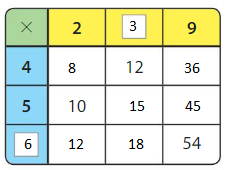
Complete the multiplication table.
Big Ideas Math Answer Key Grade 3 Chapter 2 Multiplication Facts and Strategies 2.1 28
Answer:

Big-Ideas-Math-Answer-Key-Grade-3-Chapter-2-Multiplication-Facts-and-Strategies-2.1-28

Question 16.
You buy a shirt that costs $7 and a pair of pants that costs 2 times as much. Write a multiplication equation to show the cost of the pants.
_____ × _____ = ____
How much money do you spend in all? _____
Answer: $7 × 2 = $14

Explanation:
Given,
You buy a shirt that costs $7 and a pair of pants that costs 2 times as much.
Multiply the cost of the shirt and the cost of the pants.
7 × 2 = 14

Question 17.
Modeling Real Life
A plumber needs to install handles in 9 sinks. Each sink has a hot water handle and a cold water handle. He has 19 handles. Does he have enough handles?
Answer: Yes

Explanation:
Given that,
A plumber needs to install handles in 9 sinks.
Each sink has a hot water handle and a cold water handle.
The total number of handles = 19 handles.
9 × 2 = 18
Thus he has enough handles.

Question 18.
Modeling Real Life
You have 6 pairs of chopsticks. Do you have enough chopsticks for 4 people if they each get a pair?
Big Ideas Math Answer Key Grade 3 Chapter 2 Multiplication Facts and Strategies 2.1 28

DIG DEEPER!
You want to make wrappers for each pair of chop sticks that you have. You need 2 pieces of paper for each wrapper.How many pieces of paper do you need?
Answer: 24

Explanation:
Given that there are 6 pairs of chopsticks.
Each pair has 2 chopsticks.
6 × 2 = 12
You need 2 pieces of paper for each wrapper.
12 × 2 = 24
Thus I need 24 pieces of paper for 12 chopsticks.

Review & Refresh

Compare
Question 19.
Big Ideas Math Answer Key Grade 3 Chapter 2 Multiplication Facts and Strategies 2.1 30
Answer: >
923 is greater than 854.

Question 20.
Big Ideas Math Answer Key Grade 3 Chapter 2 Multiplication Facts and Strategies 2.1 31
Answer: >
621 is greater than 63.

Question 21.
Big Ideas Math Answer Key Grade 3 Chapter 2 Multiplication Facts and Strategies 2.1 32
Answer: <
746 is less than 752.

Lesson 2.2 Multiply by 5

Explore and Grow

Question 1.
Model 3 × 5 on the number line
Big Ideas Math Answers 3rd Grade Chapter 2 Multiplication Facts and Strategies 2.2 1
3 × 5 = ____
Answer: 15

Question 2.
Model 4 × 5 on the number line
Big Ideas Math Answers 3rd Grade Chapter 2 Multiplication Facts and Strategies 2.2 2
4 × 5 = ____
Answer: 20

Structure
Compare your models. How are the models the same? How are they different?
Answer:

Think and Grow: Multiply by 5

Example
Find 8 × 5.
Skip count by 5s eight times.
Big Ideas Math Answers 3rd Grade Chapter 2 Multiplication Facts and Strategies 2.2 3

Answer: 40

Explanation:
The count starts from 0.
The counters jump for every 5s.
There are 8 jumps of 5
8 × 5 = 40

Example
Complete the table and the statements.
Big Ideas Math Answers 3rd Grade Chapter 2 Multiplication Facts and Strategies 2.2 4
• Multiples of 5 end in 5s Facts ____ or _____ .
• An odd number times 5 is always an ______ number.
• An even number times 5 is always an ______ number.

Answer:
Big-Ideas-Math-Answers-3rd-Grade-Chapter-2-Multiplication-Facts-and-Strategies-2.2-4
Multiples of 5 end in 5s Facts 0 or 5.
• An odd number times 5 is always an odd number.
• An even number times 5 is always an even number.

Show and Grow

Question 1.
Complete the model and the equation.
Big Ideas Math Answers 3rd Grade Chapter 2 Multiplication Facts and Strategies 2.2 5
Answer: 30

Big-Ideas-Math-Answers-3rd-Grade-Chapter-2-Multiplication-Facts-and-Strategies-2.2-5

Explanation:
The count starts from 0.
The counters jump for every 5s.
There are 6 jumps of 5.
6 × 5 = 30

Find the product.
Question 2.
9 × 5 = ____
Answer: 45

Explanation:
Multiply the two numbers 9 and 5.
9 × 5 = 45

Question 3.
5 × 4 = _____
Answer: 20

Explanation:
Multiply the two numbers 5 and 4.
5 × 4 = 20

Apply and Grow: Practice

Complete the model and the equation
Question 4.
Big Ideas Math Answers 3rd Grade Chapter 2 Multiplication Facts and Strategies 2.2 6
Answer: 15

Big-Ideas-Math-Answers-3rd-Grade-Chapter-2-Multiplication-Facts-and-Strategies-2.2-6

Explanation:
The count starts from 0.
The counters jump for every 5s.
There are 3 jumps of 5.
3 × 5 = 15

Question 5.
Big Ideas Math Answers 3rd Grade Chapter 2 Multiplication Facts and Strategies 2.2 7
Answer: 5 × 2 = 10

Big-Ideas-Math-Answers-3rd-Grade-Chapter-2-Multiplication-Facts-and-Strategies-2.2-7

Find the product
Question 6.
Big Ideas Math Answers 3rd Grade Chapter 2 Multiplication Facts and Strategies 2.2 8
Answer: 20

Explanation:
Multiply the two numbers 4 and 5.
4 × 5 = 20

Question 7.
Big Ideas Math Answers 3rd Grade Chapter 2 Multiplication Facts and Strategies 2.2 9
Answer: 50

Explanation:
Multiply the two numbers 5 and 10.
5 × 10 = 20

Question 8.
Big Ideas Math Answers 3rd Grade Chapter 2 Multiplication Facts and Strategies 2.2 10
Answer: 40

Explanation:
Multiply the two numbers 8 and 5.
8 × 5 = 40

Question 9.
Big Ideas Math Answers 3rd Grade Chapter 2 Multiplication Facts and Strategies 2.2 11
Answer: 45

Explanation:
Multiply the two numbers 9 and 5.
9 × 5 = 45

Question 10.
Big Ideas Math Answers 3rd Grade Chapter 2 Multiplication Facts and Strategies 2.2 12
Answer: 30

Explanation:
Multiply the two numbers 6 and 5.
6 × 5 = 30

Question 11.
Big Ideas Math Answers 3rd Grade Chapter 2 Multiplication Facts and Strategies 2.2 13
Answer: 5

Explanation:
Multiply the two numbers 5 and 1.
5 × 1 = 5

Question 12.
Big Ideas Math Answers 3rd Grade Chapter 2 Multiplication Facts and Strategies 2.2 14
Answer: 25

Explanation:
Multiply the two numbers 5 and 5.
5 × 5 = 25

Question 13.
Big Ideas Math Answers 3rd Grade Chapter 2 Multiplication Facts and Strategies 2.2 15
Answer: 35

Explanation:
Multiply the two numbers 5 and 7.
5 × 7 = 35

Find the missing factor.
Question 14.
5 × ____ = 35
Answer: 7

Explanation:
Let the missing factor be a.
5 × a = 35
a = 35/5 = 7
a = 7
Thus the missing factor is 7.

Question 15.
____ × 5 = 50
Answer: 10

Explanation:
Let the missing factor be x.
x × 5 = 50
x = 50/5
x = 10
Thus the missing factor is 10.

Question 16.
10 = 2 × ____
Answer: 5

Explanation:
Let the missing factor be p.
10 = 2 × p
p = 10/2 = 5
p = 5
Thus the missing factor is 5.

Question 17.
Number Sense
Which numbers are multiples of 5? Think: How do you know?
Big Ideas Math Answers 3rd Grade Chapter 2 Multiplication Facts and Strategies 2.2 16

Answer: The multiples of 5 are 50, 20, 5, 85.

Question 18.
DIG DEEPER!
Use each number to complete the Venn diagram
Big Ideas Math Answers 3rd Grade Chapter 2 Multiplication Facts and Strategies 2.2 17
Big Ideas Math Answers 3rd Grade Chapter 2 Multiplication Facts and Strategies 2.2 18
Answer:
Big-Ideas-Math-Answers-3rd-Grade-Chapter-2-Multiplication-Facts-and-Strategies-2.2-18

Think and Grow: Modeling Real Life

A summer camp is in session 5 days each week for 8 weeks. Each day,1 camper is chosen to lead the camp song. There are 35 campers. Can each camper lead the camp song?
Big Ideas Math Answers 3rd Grade Chapter 2 Multiplication Facts and Strategies 2.2 19
Multiplication equation:
Each camper ____ lead the camp song.

Answer: Each camper can lead the camp song.

Explanation:
Given,
A summer camp is in session 5 days each week for 8 weeks. Each day,1 camper is chosen to lead the camp song. There are 35 campers.
5 days – 1 week
? – 8 weeks
8 × 5 = 40 days
There are 35 campers.
Thus Each camper can lead the camp song.

Show and Grow

Question 19.
Your teacher has 5 packs of spinning toys. There are 5 toys in each pack. There are 27 students in your class. Does every student get a spinning toy?
Answer: No

Explanation:
Given,
Your teacher has 5 packs of spinning toys. There are 5 toys in each pack. There are 27 students in your class.
5 × 5 = 25
27 – 25 = 2
Thus 2 students will not get a spinning toy.

Question 20.
You recycle 9 bottles and receive 5¢ for each bottle. You spend 25¢ on a pack of gum. How many cents do you have left?
DIG DEEPER!
How many more bottles do you need to recycle to buy another pack of gum?
Big Ideas Math Answers 3rd Grade Chapter 2 Multiplication Facts and Strategies 2.2 20
Answer: 20 cents

Explanation:
You recycle 9 bottles and receive 5¢ for each bottle. You spend 25¢ on a pack of gum.
9 × 5 = ¢45
¢45 – ¢25 = ¢20

Multiply by 5 Homework & Practice 2.2

Complete the model and the equation.
Question 1.
Big Ideas Math Answers 3rd Grade Chapter 2 Multiplication Facts and Strategies 2.2 21
Answer: 5 × 4 = 20

Explanation:
The count starts from 0.
The count jumps for every 5.
From the figure, we can see there are 4 jumps of 5.
5 × 4 = 20

Question 2.
Big Ideas Math Answers 3rd Grade Chapter 2 Multiplication Facts and Strategies 2.2 22
Answer: 5 × 1 = 5

Big-Ideas-Math-Answers-3rd-Grade-Chapter-2-Multiplication-Facts-and-Strategies-2.2-22

Find the product
Question 3.
Big Ideas Math Answers 3rd Grade Chapter 2 Multiplication Facts and Strategies 2.2 23
Answer: 15

Explanation:
Multiply the two numbers 5 and 3.
5 × 3 = 15

Question 4.
Big Ideas Math Answers 3rd Grade Chapter 2 Multiplication Facts and Strategies 2.2 24
Answer: 50

Explanation:
Multiply the two numbers 5 and 10.
5 × 10 = 50

Question 5.
Big Ideas Math Answers 3rd Grade Chapter 2 Multiplication Facts and Strategies 2.2 25
Answer: 40

Explanation:
Multiply the two numbers 8 and 5.
8 × 5 = 40

Question 6.
Big Ideas Math Answers 3rd Grade Chapter 2 Multiplication Facts and Strategies 2.2 26
Answer: 10

Explanation:
Multiply the two numbers 5 and 2
5 × 2 = 10

Question 7.
Big Ideas Math Answers 3rd Grade Chapter 2 Multiplication Facts and Strategies 2.2 27
Answer: 45

Explanation:
Multiply the two numbers 5 and 9.
5 × 9 = 45

Question 8.

Big Ideas Math Answers 3rd Grade Chapter 2 Multiplication Facts and Strategies 2.2 28
Answer: 35

Explanation:
Multiply the two numbers 5 and 7.
5 × 7 = 35

Question 9.
Big Ideas Math Answers 3rd Grade Chapter 2 Multiplication Facts and Strategies 2.2 29
Answer: 25

Explanation:
Multiply the two numbers 5 and 5.
5 × 5 = 25

Question 10.
Big Ideas Math Answers 3rd Grade Chapter 2 Multiplication Facts and Strategies 2.2 30
Answer: 30

Explanation:
Multiply the two numbers 5 and 6.
5 × 6 = 30

Find the missing factor.
Question 11.
5 × ___ = 20
Answer: 4

Explanation:
Let the missing factor be t.
5 × t = 20
t = 20/5
t = 4
Thus the missing factor is 4.

Question 12.
45 = 5 × ____
Answer: 9

Explanation:
Let the missing factor be a.
45 = 5 × a
a = 45/5
a = 9

Question 13.
____ × 5 = 15
Answer: 3

Explanation:
Let the missing factor be x.
x × 5 = 15
x = 15/5
x = 3

Question 14.
There are 8 teams in a basketball tournament. Each team has 5 players. How many players are in the tournament?
Big Ideas Math Answers 3rd Grade Chapter 2 Multiplication Facts and Strategies 2.2 31
Answer: 40

Explanation:
Given,
There are 8 teams in a basketball tournament. Each team has 5 players.
8 × 5 = 40
Therefore there are 40 players in the tournament.

Question 15.
Reasoning
Newton has some nickels. He says they have a total value of 14 cents. Explain how you know that Newton is incorrect.
Answer:
Given,
Newton has some nickels. He says they have a total value of 14 cents.
Convert from cents to nickels.
1 nickel = 5 cents
14 cents = 2.8 nickels

Question 16.
Number Sense
Tell whether the number is a multiple of 2, 5, or both. Explain.
25 & 16
Answer:
25 is a multiple of 5.
16 is a multiple of 2.

Question 17.
Modeling Real Life
A firefighter visits 5 houses. Each house has 3 smoke detectors that need a new battery.She has 18 batteries. Does every smoke detector get a new battery?
Answer:
Given,
A firefighter visits 5 houses.
Each house has 3 smoke detectors that need a new battery.
She has 18 batteries.
5 × 3 = 15
18 – 15 = 3
So, every smoke detector gets a new battery.

Question 18.
Modeling Real Life
Descartes earns $5 for each lawn that he mows. He mows 7 lawns. He spends $20 on a video game. How much money does he have left?

DIG DEEPER!
How many more lawns does Descartes have to mow to buy another video game?
Big Ideas Math Answers 3rd Grade Chapter 2 Multiplication Facts and Strategies 2.2 32
Answer:
Given,
Descartes earns $5 for each lawn that he mows. He mows 7 lawns.
5 × 7 = $35
He spends $20 on a video game.
$35 – $20 = $15

Review & Refresh

Question 19.
Count by tens.
____, 20, ____, 40, ____, ____, 70, ____, ____, _____

Answer: 10, 20, 30, 40, 50, 60, 70, 80, 90, 100.

Lesson 2.3 Multiply by 10

Question 1.
Explore 6 × 10 on the tape diagram.
Big Ideas Math Answers Grade 3 Chapter 2 Multiplication Facts and Strategies 2.3 1
6 × 10 = ___
Answer: 60
Big-Ideas-Math-Answers-Grade-3-Chapter-2-Multiplication-Facts-and-Strategies-2.3-1

Structure
How can you see the model to find 7 × 10?
Answer: 70
Big-Ideas-Math-Answers-Grade-3-Chapter-2-Multiplication-Facts-and-Strategies-2.3-1
10 + 10 + 10 + 10 + 10 + 10 + 10 = 70
7 × 10 = 70

Think and Grow: Multiply by 10

Example
Find 4 × 10.
Model four groups of ten.
Big Ideas Math Answers Grade 3 Chapter 2 Multiplication Facts and Strategies 2.3 2

Example
Complete the table and the statements
Big Ideas Math Answers Grade 3 Chapter 2 Multiplication Facts and Strategies 2.3 3

Show and Grow

Question 1.
Complete the model and the equations.
Big Ideas Math Answers Grade 3 Chapter 2 Multiplication Facts and Strategies 2.3 4
Answer:
10 + 10 + 10 = 30
3 × 10 = 30

Find the product
Question 2.
8 × 10 = ____
Answer: 80
Explanation:
10 + 10 + 10 + 10 + 10 + 10 + 10 + 10 = 80
Thus 8 × 10 = 80

Question 3.
10 × 5 = ____
Answer: 50

Explanation:
5 + 5 + 5 + 5 + 5 + 5 + 5 + 5 + 5 + 5 = 50
Thus 10 × 5 = 50

Apply and Grow: Practice

Complete the model and the equations.
Question 4.
Big Ideas Math Answers Grade 3 Chapter 2 Multiplication Facts and Strategies 2.3 5
Answer:
10 + 10 + 10 + 10 + 10 = 50
5 × 10 = 50

Question 5.
Big Ideas Math Answers Grade 3 Chapter 2 Multiplication Facts and Strategies 2.3 6
Answer: 20

Explanation:
10 + 10 = 20
2 jumps of 10.
2 × 10 = 20

Find the product
Question 6.
Big Ideas Math Answers Grade 3 Chapter 2 Multiplication Facts and Strategies 2.3 7
Answer: 40

Explanation:
Multiply the two numbers 4 and 10.
4 × 10 = 40

Question 7.
Big Ideas Math Answers Grade 3 Chapter 2 Multiplication Facts and Strategies 2.3 8
Answer: 100

Explanation:
Multiply the two numbers 10 and 10.
10 × 10 = 100

Question 8.
Big Ideas Math Answers Grade 3 Chapter 2 Multiplication Facts and Strategies 2.3 9
Answer: 70

Explanation:
Multiply the two numbers 10 and 7
10 × 7 = 70

Question 9.
Big Ideas Math Answers Grade 3 Chapter 2 Multiplication Facts and Strategies 2.3 10
Answer: 90

Explanation:
Multiply the two numbers 9 and 10.
9 × 10 = 90

Question 10.
Big Ideas Math Answers Grade 3 Chapter 2 Multiplication Facts and Strategies 2.3 11
Answer: 60

Explanation:
Multiply the two numbers 6 and 10.
6 × 10 = 60

Question 11.
Big Ideas Math Answers Grade 3 Chapter 2 Multiplication Facts and Strategies 2.3 12
Answer: 20

Explanation:
Multiply the two numbers 2 and 10.
2 × 10 = 20

Question 12.
Big Ideas Math Answers Grade 3 Chapter 2 Multiplication Facts and Strategies 2.3 13
Answer: 30

Explanation:
Multiply the two numbers 10 and 3.
10 × 3 = 30

Question 13.
Big Ideas Math Answers Grade 3 Chapter 2 Multiplication Facts and Strategies 2.3 14
Answer: 10

Explanation:
Multiply the two numbers 10 and 1.
10 × 1 = 10

Tell Whether the product is even or odd.
Question 14.
6 × 2 = ____
Answer: Even number

Explanation:
6 × 2 = 12
An even number is an integer that can be divided by two and remain an integer or has no remainder.
12 is an even number.

Question 15.
5 × 3 = ___
Answer: Odd number

Explanation:
5 × 3 = 15
An odd number is an integer when divided by two, either leaves a remainder or the result is a fraction.
15 is an odd number.

Question 16.
8 × 10 = _____
Answer: Even number

Explanation:
8 × 10 = 80
An even number is an integer that can be divided by two and remain an integer or has no remainder.
80 is an even number.

Question 17.
5 × 10 = ____
Answer: Even number

Explanation:
5 × 10 = 50
An even number is an integer that can be divided by two and remain an integer or has no remainder.
50 is an even number.

Question 18.
10 × 7 = _____
Answer: Even number

Explanation:
7 × 10 = 70
An even number is an integer that can be divided by two and remain an integer or has no remainder.
70 is an even number.

Question 19.
5 × 7 = ____
Answer: Odd number

Explanation:
5 × 7 = 35
An odd number is an integer when divided by two, either leaves a remainder or the result is a fraction.
35 is an odd number.

Question 20.
There are 10 millimeters in 1 centimeter. The width of a cell phone is 6 centimeters. What is the width of the phone in millimeters?
Answer: 60 millimeters

Explanation:
Given,
There are 10 millimeters in 1 centimeter. The width of a cell phone is 6 centimeters
Convert from centimeters to millimeters.
1 cm = 10 mm
6 cm = 6 × 10mm = 60mm
Thus the width of the phone in millimeters is 60mm.

Question 21.
Patterns
Complete the table using the words even or odd
Big Ideas Math Answers Grade 3 Chapter 2 Multiplication Facts and Strategies 2.3 32
Answer:
Big-Ideas-Math-Answers-Grade-3-Chapter-2-Multiplication-Facts-and-Strategies-2.3-32

Think and Grow: Modeling Real Life

Newton has 8 dimes. Descartes has 75¢. Who has more money?
Multiplication equation:
Big Ideas Math Answers Grade 3 Chapter 2 Multiplication Facts and Strategies 2.3 16
_____ has more money.

Explanation:
Given,
Newton has 8 dimes. Descartes has 75¢.
1 dime =  ¢10
8 dimes = 8 × ¢10 = ¢80
¢80 – ¢75 = ¢5
Thus Newton has more money than Descartes.

Show and Grow

Question 22.
You have 10 nickels. Your friend has 46¢. Who has more money?
Answer: I have more money

Explanation:
Convert from nickels to cents.
1 Nickel = ¢5
10 Nickels = 10 × ¢5 = ¢50
¢50 – ¢46 = ¢4
Thus I have more money.

Question 23.
You have 34 trading cards. You buy 3 packs of cards. Each pack has 10 cards. How many trading cards do you have now?
Answer: 74 trading cards

Explanation:
You have 34 trading cards. You buy 3 packs of cards. Each pack has 10 cards.
1 pack = 10 cards
3 packs = 3 × 10 cards = 30 cards
34 cards + 30 cards = 74 cards

Question 24.
Your teacher has 10 calculators. Each calculator uses 4 batteries. The batteries come in packs of 10. How many packs of batteries does your teacher buy? Explain.
Big Ideas Math Answers Grade 3 Chapter 2 Multiplication Facts and Strategies 2.3 17
Answer: 4 packs

Explanation:
Given,
Your teacher has 10 calculators. Each calculator uses 4 batteries. The batteries come in packs of 10
1 calculator = 4 batteries
10 calculators = 10 × 4 batteries = 40 batteries
Each pack contains 10 batteries
Thus the teacher needs to buy 4 packs of batteries.

Multiply by 10 Homework & Practice 2.3

Complete the model and the equation
Question 1.
Big Ideas Math Answers Grade 3 Chapter 2 Multiplication Facts and Strategies 2.3 18
Answer:
10 + 10 + 10 + 10 + 10 = 50
5 × 10 = 50

Question 2.
Big Ideas Math Answers Grade 3 Chapter 2 Multiplication Facts and Strategies 2.3 19
Answer:
10 + 10 + 10 = 30
3 × 10 = 30

Find the product
Question 3.
Big Ideas Math Answers Grade 3 Chapter 2 Multiplication Facts and Strategies 2.3 20
Answer: 40

Explanation:
Multiply the two numbers 10 and 4.
First, multiply 4 with 0
Next multiply 4 with 1
4 × 0 = 0
4 × 1 = 4
10 × 4 = 40

Question 4.
Big Ideas Math Answers Grade 3 Chapter 2 Multiplication Facts and Strategies 2.3 21
Answer: 80

Explanation:
Multiply the two numbers 8 and 10.
8 × 10 = 80

Question 5.
Big Ideas Math Answers Grade 3 Chapter 2 Multiplication Facts and Strategies 2.3 22
Answer: 100

Explanation:
Multiply the two numbers 10 and 10.
10 × 10 = 100

Question 6.
Big Ideas Math Answers Grade 3 Chapter 2 Multiplication Facts and Strategies 2.3 23
Answer: 20

Explanation:
Multiply the two numbers 10 and 2.
10 × 2 = 20

Question 7.
Big Ideas Math Answers Grade 3 Chapter 2 Multiplication Facts and Strategies 2.3 24
Answer: 90

Explanation:
Multiply the two numbers 10 and 9.
10 × 9 = 90

Question 8.
Big Ideas Math Answers Grade 3 Chapter 2 Multiplication Facts and Strategies 2.3 25
Answer: 70

Explanation:
Multiply the two numbers 10 and 7.
10 × 7 = 70

Question 9.
Big Ideas Math Answers Grade 3 Chapter 2 Multiplication Facts and Strategies 2.3 26
Answer: 10

Explanation:
Multiply the two numbers 10 and 1.
10 × 1 = 10

Question 10.
Big Ideas Math Answers Grade 3 Chapter 2 Multiplication Facts and Strategies 2.3 27
Answer: 50

Explanation:
Multiply the two numbers 10 and 5.
10 × 5 = 50

Find the missing factor
Question 11.
10 × ____ = 90
Answer: 9

Explanation:
Let the missing factor be r.
10 × r = 90
r = 90/10
r = 9
Thus the missing factor is 9.

Question 12.
60 = 10 × ____
Answer: 6

Explanation:
Let the missing factor be s.
60 = 10 × s
s = 60/10
s = 6
Thus the missing factor is 6.

Question 13.
____ × 10 = 70
Answer: 7

Explanation:
Let the missing factor be t.
t × 10 = 70
t = 70/10
t = 7
Thus the missing factor is 7.

Question 14.
Structure
You buy a thank-you card for $1. You pay using all dimes. How many dimes do you use?
Answer: 10

Explanation:
Given,
You buy a thank-you card for $1. You pay using all dimes.
Convert from the dollar to dime.
1 dollar = 10 dime
Thus you use 10 dimes.

Question 15.
Number Sense
In bowling, knocking down all 10 pins at once is called a strike. You roll strikes in your first two turns and knock down 4 pins in your third turn. How many pins do you knock down in all?
Big Ideas Math Answers Grade 3 Chapter 2 Multiplication Facts and Strategies 2.3 28
Answer: 34 pins

Explanation:
Given,
In bowling, knocking down all 10 pins at once is called a strike.
You roll strikes in your first two turns and knock down 4 pins in your third turn.
1 turn = 10 pins
2 turns = 20 pins
20 + 4 = 24 pins
10 + 24 = 34 pins

Question 16.
Reasoning
Ten years is called a decade. Your neighbor is 70 years old. For how many decades has he been alive? Explain.
Answer: 7 decades

Explanation:
Given,
Ten years is called a decade. Your neighbor is 70 years old.
1 decade = 10 years
? = 70 years
70 × 1/10 = 7
Thus he has been alive for 7 decades.

Question 17.
Modeling Real Life
You have 2 dimes. Your friend has a 24¢. Who has more money?
Answer: My friend has more money

Explanation:
Given,
You have 2 dimes. Your friend has 24¢
1 dime = ¢10
2 dimes = 2 × ¢10 = ¢20
¢24 – ¢20 = ¢4

Question 18.
Modeling Real Life
Your teacher has 35 balloons. She buys 4 packs of balloons. Each pack has 10 balloons. How many balloons does she have now?
Answer: 75 balloons

Explanation:
Given,
Your teacher has 35 balloons.
She buys 4 packs of balloons.
Each pack has 10 balloons
1 pack = 10 balloons
4 packs = 4 × 10 balloons = 40 balloons
35 + 40 = 75 balloons

Review & Refresh

Find the difference.
Question 19.
Big Ideas Math Answers Grade 3 Chapter 2 Multiplication Facts and Strategies 2.3 29
Answer: 302

4 8 9
-1 8 7
3 0 2

Question 20.
Big Ideas Math Answers Grade 3 Chapter 2 Multiplication Facts and Strategies 2.3 30
Answer: 328

Big Ideas Math Grade 3 Chapter 2 img-2

Question 21.
Big Ideas Math Answers Grade 3 Chapter 2 Multiplication Facts and Strategies 2.3 31
Answer: 269

Big Ideas Math Grade 3 Chapter 2 img-1

Lesson 2.4 Multiply by 0 or 1

Explore and Grow

Question 1.
Draw an array to find the products
Big Ideas Math Solutions Grade 3 Chapter 2 Multiplication Facts and Strategies 2.4 1
Answer:

Big-Ideas-Math-Solutions-Grade-3-Chapter-2-Multiplication-Facts-and-Strategies-2.4-1

Question 2.
What pattern do you see?
Answer: We can see the multiplication pattern in the above question.

Repeated Reasoning
How can you see the pattern to find 5 × 0?
5 × 0 = _____
Answer: 0
Any number multiplied by 0 is always 0.

Think and Grow: The Multiplication Property of 0 and 1

Multiplication Property of Zero:The product of any number and 0 is 0.
Multiplication Property of One:The product of any number and 1 is that number.
Example
There are 4 groups with 1 counter in each group. How many counters are there in all?
Big Ideas Math Solutions Grade 3 Chapter 2 Multiplication Facts and Strategies 2.4 2

Example
There are 4 groups with 0 counters in each group. How many counters are there in all?
Big Ideas Math Solutions Grade 3 Chapter 2 Multiplication Facts and Strategies 2.4 3
Big Ideas Math Solutions Grade 3 Chapter 2 Multiplication Facts and Strategies 2.4 4

Show and Grow

Write an equation for the model.

Question 1.
Big Ideas Math Solutions Grade 3 Chapter 2 Multiplication Facts and Strategies 2.4 5
Answer: 7 × 0 = 0
There are no counters in the groups. So, the equation for the above figure is 7 × 0 = 0.

Question 2.
Big Ideas Math Solutions Grade 3 Chapter 2 Multiplication Facts and Strategies 2.4 6
Answer: 3 × 1 = 3
There is 1 counter in each group. Thus the equation for the above figure is 3 × 1 = 3

Find the product.
Question 3.
8 × 1 = _____
Answer: 8

Explanation:
Multiply 8 by 1.
Any number multiplied by 1 is always itself.
8 × 1 = 8

Question 4.
6 × 0 = _____
Answer: 0

Explanation:
Multiply 6 by 0.
Any number multiplied by 0 is always 0.
6 × 0 = 0

Apply and Grow: Practice

Complete the equation for the model.

Question 5
Big Ideas Math Solutions Grade 3 Chapter 2 Multiplication Facts and Strategies 2.4 7
Answer: 0

Explanation:
There are 0 counters in the group.
Number of groups = 5
Number of counters = 0
5 × 0 = 0

Question 6.
Big Ideas Math Solutions Grade 3 Chapter 2 Multiplication Facts and Strategies 2.4 8
Answer: 2

Explanation:
There are 2 counters.
Number of counters in each group = 1
Number of groups = 2
2 × 1 = 2

Find the product.
Question 7
Big Ideas Math Solutions Grade 3 Chapter 2 Multiplication Facts and Strategies 2.4 9
Answer: 1

Explanation:
Multiply 1 by 1
Any number multiplied by 1 is always itself.
1 × 1 = 1

Question 8.
Big Ideas Math Solutions Grade 3 Chapter 2 Multiplication Facts and Strategies 2.4 10
Answer: 0

Explanation:
Any number multiplied by 0 is always 0.
2 × 0 =0

Question 9.
Big Ideas Math Solutions Grade 3 Chapter 2 Multiplication Facts and Strategies 2.4 11
Answer: 0

Explanation:
Any number multiplied by 0 is always 0.
0 × 0 =0

Question 10.
Big Ideas Math Solutions Grade 3 Chapter 2 Multiplication Facts and Strategies 2.4 12
Answer: 9

Explanation:
Any number multiplied by 1 is always itself.
1 × 9 = 9

Find the missing factor.
Question 11.
10 × ____ = 0
Answer: 0

Explanation:
Let the missing factor be x
10 × x = 0
x = 0/10
x = 0
Thus the missing factor is 0

Question 12.
____ × 1 = 5
Answer: 5

Explanation:
Let the missing factor be y.
y × 1 = 5
y = 5/1
y = 5
Thus the missing factor is 5.

Question 13.
1 × _____ = 8
Answer: 8

Explanation:
Let the missing factor be z.
1 × z = 8
z = 8/1
z = 8

Compare.
Question 14.
Big Ideas Math Solutions Grade 3 Chapter 2 Multiplication Facts and Strategies 2.4 13
Answer: >

Explanation:
1 × 4 = 4
6 × 0 = 0
4 is greater than 0.
4 > 0
Thus 1 × 4 > 6 × 0

Question 15.
Big Ideas Math Solutions Grade 3 Chapter 2 Multiplication Facts and Strategies 2.4 14
Answer: =

Explanation:
9 × 0 = 0
7 × 0 =0
0 is equal to 0.
Thus 9 × 0 = 7 × 0

Question 16.
Big Ideas Math Solutions Grade 3 Chapter 2 Multiplication Facts and Strategies 2.4 15
Answer: <

Explanation:
3 × 1 = 3
6 × 1 = 6
3 is less than 6.
3 < 6
Thus 3 × 1 < 6 × 1

Question 17.
Logic
Complete each statement with always, sometimes never.
The product of any number and 0 is ______ 0.
The product of any number and 1 is ________ that number.
Answer:
The product of any number and 0 is always 0.
The product of any number and 1 is the same that number.

Question 18.
Structure
Use the model to complete the statements. Which two properties are shown?
Big Ideas Math Solutions Grade 3 Chapter 2 Multiplication Facts and Strategies 2.4 16
Answer:
There are 5 groups of 1 = 1 group of 5
5 × 1 = 1 × 5
5 = 5

Think and Grow: Modeling Real Life

There are 4 performers riding unicycles and 3 performers using balance boards in a talent show.How many wheels are used in the talent show?
Big Ideas Math Solutions Grade 3 Chapter 2 Multiplication Facts and Strategies 2.4 17
Multiplication equations:
Addition equation:
There are ______ wheels used in the talent show.

Answer: 4 wheels are used in the talent show.

Show and Grow

Question 19.
A is a performance by 1 person. A is a performance by 2 people. There are 5 students performing solos and 0 students performing duets at a school concert. How many students perform a solo or a duet?
Big Ideas Math Solutions Grade 3 Chapter 2 Multiplication Facts and Strategies 2.4 18
Answer: 5

Explanation:
Given,
A is a performance by 1 person. A is a performance by 2 people.
There are 5 students performing solos and 0 students performing duets at a school concert.
5 + 0 = 5
Therefore 5 students performing a solo or duet.

Question 20.
A group of 6 adults and 9 students attend a school concert. What is the total cost for the group?
Big Ideas Math Solutions Grade 3 Chapter 2 Multiplication Facts and Strategies 2.4 19
DIG DEEPER!
How much money would it cost the group to attend the concert if the tickets cost $1 for all ages? Explain.
Answer:
Given that,
A group of 6 adults and 9 students attend a school concert.
1 adult = $1
6 adults = 6 × $1 = $6
There is no ticket price for students.
$6 + 0 = $6
If the ticket price is $1 for all the students.
9 + 6 = 15
15 × $1 = $15
Thus the ticket price for all the students is $15.

Multiply by 0 or 1 Homework & Practice 2.4

Complete the equation for the model.
Question 1.
Big Ideas Math Solutions Grade 3 Chapter 2 Multiplication Facts and Strategies 2.4 20
Answer: 0

Explanation:
Number of groups = 3
Number of counters in each group = 0
The equation for the model is 3 × 0 = 0

Question 2.
Big Ideas Math Solutions Grade 3 Chapter 2 Multiplication Facts and Strategies 2.4 21
Answer: 8

Explanation:
Number of groups = 8
Number of counters in each group = 1
The equation for the model is 8 × 1 = 8

Find the product
Question 3.
Big Ideas Math Solutions Grade 3 Chapter 2 Multiplication Facts and Strategies 2.4 22
Answer: 10

Explanation:
Multiply the two numbers 10 and 1.
Any number multiplied by 1 is the same number.
10 × 1 = 10

Question 4.
Big Ideas Math Solutions Grade 3 Chapter 2 Multiplication Facts and Strategies 2.4 23
Answer: 0

Explanation:
Multiply the two numbers 6 and 0.
Any number multiplied by 0 is always 0.
6 × 0 = 0

Question 5.
Big Ideas Math Solutions Grade 3 Chapter 2 Multiplication Facts and Strategies 2.4 24
Answer: 7

Explanation:
Multiply the two numbers 1 and 7.
Any number multiplied by 1 is the same number.
1 × 7 = 7

Question 6.
Big Ideas Math Solutions Grade 3 Chapter 2 Multiplication Facts and Strategies 2.4 25
Answer: 0

Explanation:
Multiply the two numbers 1 and 0.
Any number multiplied by 0 is always 0.
0 × 1 = 0

Find the missing factor
Question 7.
_____ × 4 = 0
Answer: 0

Explanation:
Let the missing factor be x
x × 4 = 0
x = 0/4
x = 0
Thus the missing factor is 0

Question 8.
1 × ____ = 2
Answer: 2

Explanation:
Let the missing factor be x
1 × x = 2
x = 2/1
x = 2
Thus the missing factor is 2.

Question 9.
9 × ____ = 9
Answer: 1

Explanation:
Let the missing factor be x
9 × x = 9
x = 9/9
x = 1
Thus the missing factor is 1.

Compare
Question 10.
Big Ideas Math Solutions Grade 3 Chapter 2 Multiplication Facts and Strategies 2.4 26
Answer: =

Explanation:
Any number multiplied by 0 is always 0.
0 × 9 = 10 × 0

Question 11.
Big Ideas Math Solutions Grade 3 Chapter 2 Multiplication Facts and Strategies 2.4 27
Answer: >

Explanation:
Any number multiplied by 0 is always 0.
Any number multiplied by 1 is the same number.
4 × 1 = 4
8 × 0 = 0
4 > 0
Thus 4 × 1 > 8 × 0

Question 12.
Big Ideas Math Solutions Grade 3 Chapter 2 Multiplication Facts and Strategies 2.4 28
Answer: =

Explanation:
Any number multiplied by 1 is the same number.
6 × 1 = 1 × 6

Question 13.
Logic
Which equation is true?
Big Ideas Math Solutions Grade 3 Chapter 2 Multiplication Facts and Strategies 2.4 29
Answer: All the equations are false.
i. 8 × 0 = 8 + 0
0 = 8 (false)
ii. 3 × 1 = 3 + 1
3 = 4 (false)
iii. 6 + 1 = 6 × 1
7 = 6 (false)
iv. 4 × 1 = 4 × 0
4 = 0 (false)

Question 14.
Writing
How are the problems the same? How are they different?
5 × 1 = 5  5 + 0 = 5
Answer:
The answers for the problems are same. But the difference is the first equation is multiplication and the second equation is addition.

Question 15.
Modeling Real Life
U.S. presidents can serve two 4-year terms. A president serves the first term, but is not reelected. How many years does the president serve?
Answer: 8 years.

Explanation:
Given,
U.S. presidents can serve two 4-year terms. A president serves the first term, but is not reelected.
2 × 4 = 8
Thus the president serves 8 years.

Question 16.
Modeling Real Life
There are 5 adults and 8 children in a group. What is the total cost for the group to ride the Ferris wheel?
Big Ideas Math Solutions Grade 3 Chapter 2 Multiplication Facts and Strategies 2.4 30
DIG DEEPER!
How much money would it cost the group toride the Ferris wheel if the tickets cost $1 for all ages? Explain.
Big Ideas Math Solutions Grade 3 Chapter 2 Multiplication Facts and Strategies 2.4 31
Answer: $13

Explanation:
The ticket price for adult is $1
The ticket price for student is free
The total price is 5 × $1 = $5
The ticket price for an adult is $1
The ticket price for the student is free
Total = 5 + 8 = 13
The total price is 13 × $1 = $13

Review & Refresh

Question 17.
Use the array to fill in the blanks.
Big Ideas Math Solutions Grade 3 Chapter 2 Multiplication Facts and Strategies 2.4 32
Answer:
3 rows 6 columns
3 × 6 = 18

Lesson 2.5 Use the Distributive Property

Explore and Grow

Break apart the 4 × 7 array into two smaller arrays. Write an equation for each new array.
Big Ideas Math Answer Key Grade 3 Chapter 2 Multiplication Facts and Strategies 2.5 1
Equation: _____
Equation: ____

Structure
Find the sum of your two products. Compare the sum to the total number of objects in the original array. What do you notice?
Answer:
Equation: 2 × 7
Equation: 2 × 7

Explanation:
By using the distributive property we can find the sum of the two products of the above array.
Distribute 4 to 2 and 2.
4 × 7 = (2 + 2) × 7
= (2 × 7) + (2 × 7)

Think and Grow: Use the Distributive Property with Addition

Distributive Property (with addition)
Big Ideas Math Answer Key Grade 3 Chapter 2 Multiplication Facts and Strategies 2.5 2

Big Ideas Math Answer Key Grade 3 Chapter 2 Multiplication Facts and Strategies 2.5 3

Show and Grow
Question 1.
Use the Distributive Property to show two different ways to find 2 × 4
Big Ideas Math Answer Key Grade 3 Chapter 2 Multiplication Facts and Strategies 2.5 4
Answer:
Big-Ideas-Math-Answer-Key-Grade-3-Chapter-2-Multiplication-Facts-and-Strategies-2.5-4
In the first figure distribute 4 to 2 and 2.
In the second figure distribute 2 to 1 and 1.

Apply and Grow: Practice

Use the Distributive Property to find the product
Question 2.
Big Ideas Math Answer Key Grade 3 Chapter 2 Multiplication Facts and Strategies 2.5 5
Answer:
Distribute 4 to 2 and 2.
4 × 7 = (2 + 2) × 7
4 × 7 = (2 × 7) + (2 × 7)
4 × 7 = 14 + 14
4 × 7 = 28

Question 3.
Big Ideas Math Answer Key Grade 3 Chapter 2 Multiplication Facts and Strategies 2.5 6
Answer:
Distribute 6 to 3 and 3.
6 × 6 = 6 × (3 + 3)
6 × 6 = (6 × 3) + (6 × 3)
6 × 6 =  18 + 18
6 × 6 = 36

Use the Distributive Property to fill in the blanks.

Question 4.
7 × 4 = 7 × (___ + 2)
= (7 × ___) + (____ × 2)
= ___ + ____
= ____
Answer: 2

Explanation:
Distribute 4 to 2 and 2.
7 × 4 = 7 × (2 + 2)
= (7 × 2) + (7 × 2)
= 14 + 14
= 28

Question 5.
3 × 6 = (___ + ___) × 6
= (___ × 6) + (____ × 6)
= ___ + ____
= ____
Answer:
3 × 6 = (1 + 2) × 6
= (1 × 6) + (2 × 6)
= 6 + 12
= 18

Question 6.
Which one Doesn’t Belong? Which expression cannot be used to find 3 × 7?
Big Ideas Math Answer Key Grade 3 Chapter 2 Multiplication Facts and Strategies 2.5 7
Answer: 3 × (7 + 1)

Explanation:
i. 3 × (5 + 2) = 3 × 7
ii. 3 × (7 + 1) = 3 × 8
iii. (2 + 1) × 7 = 3 × 7
iv. (1 + 2) × 7 = 3 × 7
The second expression does not belong to 3 × 7.

Question 7.
Writing
Explain how you can use the Distributive Property to find 5 × 12.
Answer:
Given expression 5 × 12
First, distribute 12 to 6 and 6.
5 × 12 = 5 × (6 + 6)
5 × 12 = (5 × 6) + (5 × 6)
5 × 12 = 30 + 30
5 × 12 = 60

Think and Grow: Modeling Real Life

A scooter rental center has 6 rows of scooters. There are 9 scooters in each row. Can 50 people each rent a scooter at the same time?
Multiplication expression:
Distributive Property:
50 people _______ each rent a scooter at the same time.

Answer: 50 people can each rent a scooter at the same time.

Explanation:
Given,
A scooter rental center has 6 rows of scooters. There are 9 scooters in each row.
6 × 9 = (3 + 3) × 9
6 × 9 = (3 × 9) + (3 × 9)
6 × 9 = 27 + 27
6 × 9 = 54
54 – 50 = 4
Thus 50 people can each rent a scooter at the same time.

Show and Grow

Question 8.
A roller-coaster train has 9 rows of seats. There are 4 seats in each row. Can a group of 38 students ride the roller coaster at the same time?
Big Ideas Math Answer Key Grade 3 Chapter 2 Multiplication Facts and Strategies 2.5 8
Answer:
Given,
A roller-coaster train has 9 rows of seats. There are 4 seats in each row.
We can find the product by using the distributive property.
9 × 4 = 9 × (2 + 2)
9 × 4 = (9 × 2) + (9 × 2)
9 × 4 = 18 + 18
9 × 4 = 36
We have to find whether a group of 38 students ride the roller coaster at the same time.
36 – 38 = -2
Thus a group of 38 students cannot ride the roller coaster at the same time.

Question 9.
DIG DEEPER!
A joke book has 20 pages. There are 5 jokes on each page. You read 16 jokes. How many jokes do you have left to read?
Answer:
Given that,
A joke book has 20 pages.
There are 5 jokes on each page.
Total jokes = 20 × 5 = 100 jokes
You read 16 jokes.
100 – 16 = 84 jokes
∴ 84 jokes are left to read.

Use the Distributive Property Homework & Practice 2.5

Use the Distributive Property to find the product
Question 1.
Big Ideas Math Answer Key Grade 3 Chapter 2 Multiplication Facts and Strategies 2.5 9
Answer:
Distribute 4 to 2 and 2.
4 × 4 = 4 × (2 + 2)
4 × 4 = (4 × 2) + (4 × 2)
4 × 4 = 8 + 8
4 × 4 = 16

Question 2.
Big Ideas Math Answer Key Grade 3 Chapter 2 Multiplication Facts and Strategies 2.5 10
Answer:
Distribute 3 to 1 and 2.
3 × 9 = (1 + 2) × 9
3 × 9 = (1 × 9) + (2 × 9)
3 × 9 = 9 + 18
3 × 9 = 27

Use the Distributive Property to fill in the blanks.
Question 3.
8 × 6 = ___ × (5 + ____)
= (8 × 5) + (____ × ____)
= ___ + ___
= ____
Answer:
8 × 6 = 8 × (5 + 1)
= (8 × 5) + (8 × 1)
= 40 + 8
= 48

Question 4.
7 × 7 = 7 × (5 + ____)
= (____ × 5) + (7 × ____)
= ____ + ____
= ____
Answer:
7 × 7 = 7 × (5 + 2)
= (7 × 5) + (7 × 2)
= 35 + 14
= 49

Question 5.
Structure
Which ways can you break apart the array?
Big Ideas Math Answer Key Grade 3 Chapter 2 Multiplication Facts and Strategies 2.5 11
Big Ideas Math Answer Key Grade 3 Chapter 2 Multiplication Facts and Strategies 2.5 12
Answer:
(7 × 5) + (7 × 1)
(5 × 6) + (2 + 6)

Explanation:
Distribute 6 to 5 and 1.
7 × 6 = 7 × (5 + 1)
7 × 6 = (7 × 5) + (7 × 1)
7 × 6 = 35 + 7
7 × 6 = 42
Distribute 7 to 5 and 2.
7 × 6 = (5 + 2) × 6
7 × 6 = (5 × 6) + (2 + 6)
7 × 6 = 30 + 12
7 × 6 = 42

Question 6.
Logic
Your friend breaks apart an array into a 4 × 5 array and 4 × 2 array.Draw a picture to show the original array.
Answer:
Bigideas Math Grade 3 Chapter 2 img-3

Question 7.
DIG DEEPER!
Is the equation true? Does it demonstrate the Distributive Property? Explain.?
Big Ideas Math Answer Key Grade 3 Chapter 2 Multiplication Facts and Strategies 2.5 13
Answer:
The above equation is true.
4 × 8 = (4 × 5) + (4 × 2) + (4 × 1)
4 × 8 = 20 + 8 + 4
4 × 8 = 32

Question 8.
Modeling Real Life
Newton sleeps 9 hours each night. How many hours does he sleep in 1 week?
Big Ideas Math Answer Key Grade 3 Chapter 2 Multiplication Facts and Strategies 2.5 14
Answer:
Given,
Newton sleeps 9 hours each night.
1 week = 7 days
9 × 7 = 63 hours
Thus Newton sleeps 63 hours in 1 week.

Question 9.
Modeling Real Life
There are 3 lanes of cars sitting at a red light. Each lane has 6 cars in it. How many cars are sitting at the red light?
Answer:
Given that,
There are 3 lanes of cars sitting at a red light. Each lane has 6 cars in it.
3 × 6 = 3 × (3 + 3)
3 × 6 = 3 × 3 + 3 × 3
3 × 6 = 9 + 9
3 × 6 = 18
Thus 18 cars are sitting at the red light.

Review & Refresh

Question 10.
Some kids are at an arcade. Seventeen of them leave. There are 39 left. How many kids were at the arcade to start?
Answer:
Given,
Some kids are at an arcade. Seventeen of them leave. There are 39 left.
39 + 17 = 56

Lesson 2.6 Problem Solving: Multiplication

Explore and Grow

Use any strategy to solve
You, Newton, and Descartes each have 4 marbles. How many marbles are there in all?
Big Ideas Math Answers 3rd Grade Chapter 2 Multiplication Facts and Strategies 2.6 1
Big Ideas Math Answers 3rd Grade Chapter 2 Multiplication Facts and Strategies 2.6 2
Answer:
Given that,
You, Newton, and Descartes each have 4 marbles
3 × 4 = 12 marbles
Thus there are 12 marbles in all.

Repeated Reasoning
Explain to your partner how you solved the problem.
Answer:
Given that,
Each person has 4 marbles
1 = 4 marbles
3 = 4 × 3 = 12 marbles
By this, we can say that there are 12 marbles in all.

Think and Grow: Using the Problem-Solving PlanHow

Example
A bookshelf has 5 shelves. There are 8 comic books on each shelf. You take 3 of them to read. How many comic books are left on the shelves?

Understand the Problem

What do you know?
• There are ______ shelves.
• There are _____ comic books on each shelf.
• You take _____ comic books to read.

Answer:
• There are 5 shelves.
• There are 8 comic books on each shelf.
• You take 3 comic books to read.

What do you need to find?
• You need to find how many _____ are left on the shelves after you take _____ of them.

Answer: • You need to find how many comic books are left on the shelves after you take 3 of them.

Make a Plan

How will you solve?
• Multiply _____ by ______ to find how many ______ are on the shelves.
• Then subtract ______ from the product.

Answer:
• Multiply the number of shelves by the numbers of books on each shelf to find how many ______ are on the shelves.
• Then subtract the number of books read from the product.

Solve
Big Ideas Math Answers 3rd Grade Chapter 2 Multiplication Facts and Strategies 2.6 3
There are ______ comic books left on the shelves.

Answer:
5 × 8 = 40
40 – 3 = 37
There are 37 comic books left on the shelves

Show and Grow

Question 1.
A photo album has 10 pages. Each page holds 6 photos. You put 52 photos in the album. How many more photos can you put in the album?
Big Ideas Math Answers 3rd Grade Chapter 2 Multiplication Facts and Strategies 2.6 4
Answer:
Given,
A photo album has 10 pages. Each page holds 6 photos.
You put 52 photos in the album.
10 × 6 = 60 photos
60 – 52 = 8 photos
Thus you can put 8 more photos in the album.

Apply and Grow: Practice

Question 2.
Your classroom has 5 groups of desks with 5 desks in each group. There are 22 students in your class. What information do you know that would help you find how many empty desks there are?
Big Ideas Math Answers 3rd Grade Chapter 2 Multiplication Facts and Strategies 2.6 5
Answer:
Given,
Your classroom has 5 groups of desks with 5 desks in each group.
5 × 5 = 25 desks
There are 22 students in your class.
25 – 22 = 3
Thus there are 3 empty desks in the classroom.

Question 3.
You buy 2 boxes of cherry gelatin, 4 boxes of strawberry gelatin, and 3 boxes of orange gelatin. Each box contains 2 packets of gelatin. How many packets of gelatin do you buy?
Answer:
Given,
You buy 2 boxes of cherry gelatin, 4 boxes of strawberry gelatin, and 3 boxes of orange gelatin. Each box contains 2 packets of gelatin.
1 box – 2 packets of gelatin
2 box – 4 packets of gelatin
4 boxes – 4 × 2 = 8 packets of gelatin
3 boxes – 3 × 2 = 6 packets of gelatin
4 + 8 + 6 = 18 packets of gelatin.
Therefore you can buy 18 packets of gelatin.

Question 4.
A pack of gum has 5 pieces. You have 3 packs of gum and give4 friends each 1 piece. How many pieces of gum do you have left?
Big Ideas Math Answers 3rd Grade Chapter 2 Multiplication Facts and Strategies 2.6 6
Answer:
Given,
A pack of gum has 5 pieces. You have 3 packs of gum.
Total number of packs = 5 × 3 = 15 pieces
and give4 friends each 1 piece.
15 – 4 = 11 pieces
Thus 11 pieces of gum have left.

Think and Grow: Modeling Real Life

Descartes has four $10 bills, seven $5 bills, and one $2 bill. How much money does he have in all?
Big Ideas Math Answers 3rd Grade Chapter 2 Multiplication Facts and Strategies 2.6 7
Understand the problem:
Make a plan:
Solve:
Descartes has $ _____.

Answer:
Given,
Descartes has four $10 bills, seven $5 bills, and one $2 bill.
4 × $10 = $40
7 × $5 = $35
1 × $2 = $2
$40 + $35 + $2 = $72

Show and Grow

Question 5.
A teacher has 10 boxes of dry-erase markers. Five boxes have4 markers each, 2 boxes have 8 markers each, and 3 boxes have10 markers each. How many dry-erase markers does the teacher have in all?
Big Ideas Math Answers 3rd Grade Chapter 2 Multiplication Facts and Strategies 2.6 8
Answer:
Given,
A teacher has 10 boxes of dry-erase markers. Five boxes have4 markers each, 2 boxes have8 markers each, and 3 boxes have10 markers each.
5 boxes – 4 markers
2 boxes – 8 markers
3 boxes – 10 markers
Add all the markers in all 10 boxes.
4 + 8 + 10 = 22 markers
Therefore the teacher has 22 markers in all.

Question 6.
DIG DEEPER!
You sell candles as a fundraiser. You earn $2 for each small candle you sell, $5 for each medium candle, and $10 for each large candle. You pay $8 to have the candles shipped. How much money do you raise?
Big Ideas Math Answers 3rd Grade Chapter 2 Multiplication Facts and Strategies 2.6 9
Answer:
Given,
You sell candles as a fundraiser. You earn $2 for each small candle you sell, $5 for each medium candle, and $10 for each large candle. You pay $8 to have the candles shipped.
7 × $2 = $14
9 × $5 = $45
6 × $10 = 60
$119 – $8 = $111

Problem Solving: Multiplication Homework & Practice 2.6

Question 1.
You buy 2 books and 3 magazines. Each book costs $8 and each magazine costs $2. How much money do you spend in all?
Big Ideas Math Answers 3rd Grade Chapter 2 Multiplication Facts and Strategies 2.6 10
Answer:
Given,
You buy 2 books and 3 magazines. Each book costs $8 and each magazine costs $2.
1 book – $8
2 books – 2 × $8 = $16
1 magazine – $2
3 magazines – 3 × $2 = $6
$16 + $6 = $22
Thus you spend $22 in all.

Question 2.
In a game, teams earn 10 points for each correct answer and lose 5 points for each incorrect answer. Your team answers 7 questions correctly and 3 questions incorrectly. How many points does your team have?
Answer:
Given,
In a game, teams earn 10 points for each correct answer and lose 5 points for each incorrect answer.
Your team answers 7 questions correctly and 3 questions incorrectly.
1 – 10 points
7 – 10 × 7 = 70 points
1 wrong answer – 5 points
3 – 5 × 3 = 15 points
70 – 15 = 55 points

Question 3.
An origami cube requires 3 pieces of orange paper, 2 pieces of yellow paper, and 1 piece of blue paper. You make 5 cubes. How many pieces of paper do you need?
Big Ideas Math Answers 3rd Grade Chapter 2 Multiplication Facts and Strategies 2.6 11
Answer:
Given,
An origami cube requires 3 pieces of orange paper, 2 pieces of yellow paper, and 1 piece of blue paper.
You make 5 cubes.
Each cube needs 3 + 2 + 1 = 6 pieces of paper.
5 cubes – 6 × 5 = 30 pieces of papers
Thus you need 30 pieces of paper to make 5 cubes.

Question 4.
Writing
Write and solve your own word problem that involves multiplication.
Answer:
To make a cuboid you need 3 pieces of yellow paper, 3 pieces of pink paper. You need to make 7 cuboids. How many pieces of paper are required to make 7 cuboids?
Each cuboid needs 3 + 3 = 6 pieces of paper.
7 × 6 = 42 pieces of paper
Thus you need 42 pieces of paper to make 7 cuboids.

Question 5.
Modeling Real Life
A group of students orders 6 small, 5 medium, and 3 large smoothies. The students pay with five $10 bills. How much change do they receive?
Big Ideas Math Answers 3rd Grade Chapter 2 Multiplication Facts and Strategies 2.6 12
Answer:
Given,
A group of students orders 6 small, 5 medium, and 3 large smoothies.
The students pay with five $10 bills.
1 small – $2
6 small – 6 × $2 = $12
1 Medium – $4
5 medium – 5 × $4 = $20
1 large – $5
3 large – 3 × $5 = $15
12 + 20 + 15 = $47
$50 – $47 = $3
Thus the students receive $3 change.

Review & Refresh

Question 6.
Big Ideas Math Answers 3rd Grade Chapter 2 Multiplication Facts and Strategies 2.6 13
Answer:
Big Ideas Math Answers 3rd Grade Chapter 2 Multiplication Facts and Strategies 2.6 13
6      2      7

Question 7.
Big Ideas Math Answers 3rd Grade Chapter 2 Multiplication Facts and Strategies 2.6 14
Answer:
Big Ideas Math Answers 3rd Grade Chapter 2 Multiplication Facts and Strategies 2.6 14
9     2       2

Question 8.
Big Ideas Math Answers 3rd Grade Chapter 2 Multiplication Facts and Strategies 2.6 15
Answer:
Big Ideas Math Answers 3rd Grade Chapter 2 Multiplication Facts and Strategies 2.6 15
7       5       0

Multiplication Facts and Strategies Performance Task

Question 1.
Three students make a model of our solar system.
a. Student A buys foam spheres to make the Sun and the planets. He pays with a $10 bill. What is his change?
Big Ideas Math Answers Grade 3 Chapter 2 Multiplication Facts and Strategies 2.7 1

Answer:
Given,
Student A buys foam spheres to make the Sun and the planets.
$10 – $1 = $9
Thus the change is $9
b. Student B buys wooden rods to attach each planet to the sun. She pays with two $5 bills. What is her change?
Big Ideas Math Answers Grade 3 Chapter 2 Multiplication Facts and Strategies 2.7 2

Answer:
Given,
Student B buys a wooden rod for each planet and sun.
Cost of the wooden rod is $1
9 planets and 1 sun
9 × 1 + 1 × 1 = 9 + 1 = $10
Thus the change for student B is 0.

c.Student C spends $13 on 3 paintbrushes and some bottles of paint. How many bottles of paint does Student C buy?
Big Ideas Math Answers Grade 3 Chapter 2 Multiplication Facts and Strategies 2.7 3

Answer:
Cost of 1 paintbrush = $1
3 paintbrushes cost = 3 × $1 = $3
Cost of bottle of paint = $2
For $10 you get 5 bottles of paint.
Thus Student C buys 5 bottles of paint.
d. What is the total cost of the project? If the 3 students divide the cost equally, how much would they each spend?
Answer:
The total cost of the project = $1 + $ 13 + $10 = $24
$24/3 = $8

Multiplication Facts and Strategies Activity

Three in a Row: Multiplication
Directions:
1. Players take turns.
2. On your turn, spin both spinners. Multiply the two numbers and cover the product.
3.The first player to get three counters in a row, horizontally, vertically, or diagonally, wins!
Big Ideas Math Answers Grade 3 Chapter 2 Multiplication Facts and Strategies 2.7 4
Big Ideas Math Answers Grade 3 Chapter 2 Multiplication Facts and Strategies 2.7 5

Answer:
Game A:
10 × 1, 2 × 2, 1 × 2
2 × 3, 5 × 1, 10 × 2
2 × 4, 10 × 5, 0 × 3
Game B:
1 × 3, 10 × 4, 10 × 5
1 × 1, 0 × 4, 10 × 3
5 × 3, 5 × 5, 10 × 1

Multiplication Facts and Strategies Chapter Practice

2.1 Multiply by 2

Find the Product
Question 1.
Big Ideas Math Solutions Grade 3 Chapter 2 Multiplication Facts and Strategies 2.9 1
Answer: 14

Explanation:
Multiply the number by 2.
7 × 2 = 14

Question 2.
Big Ideas Math Solutions Grade 3 Chapter 2 Multiplication Facts and Strategies 2.9 2
Answer: 6

Explanation:
Multiply the number by 2.
Multiply the two numbers 3 and 2.
3 × 2 = 6

Question 3.
Big Ideas Math Solutions Grade 3 Chapter 2 Multiplication Facts and Strategies 2.9 3
Answer: 4

Explanation:
Multiply the number by 2.
Multiply the two numbers 2 and 2.
2 × 2 = 4

Question 4.
Big Ideas Math Solutions Grade 3 Chapter 2 Multiplication Facts and Strategies 2.9 4
Answer: 18

Explanation:
Multiply the number by 2.
Multiply the two numbers 2 and 9.
2 × 9 = 18

Find the missing factor.
Question 5.
2 × ___ = 2
Answer: 1

Explanation:
Let the missing factor be x.
2 × x = 2
x = 2/2 = 1
x = 1
Thus the missing is 1.

Question 6.
2 × ___ = 20
Answer: 10

Explanation:
Let the missing factor be x.
2 × x = 20
x = 20/2 = 10
x = 10
Thus the missing factor is 10.

Question 7.
____ × 4 = 8
Answer: 2

Explanation:
Let the missing factor be b.
b × 4 = 8
b = 8/4
b = 2
Thus the missing factor is 2.

2.2 Multiply by 5

Question 8.
Big Ideas Math Solutions Grade 3 Chapter 2 Multiplication Facts and Strategies 2.9 5
Answer: 15

Explanation:
Multiply the number by 5.
5 × 3 = 15

Question 9.
Big Ideas Math Solutions Grade 3 Chapter 2 Multiplication Facts and Strategies 2.9 6
Answer: 50

Explanation:
Multiply the number by 5.
5 × 10 = 50

Question 10.
Big Ideas Math Solutions Grade 3 Chapter 2 Multiplication Facts and Strategies 2.9 7
Answer: 40

Explanation:
Multiply the number by 5.
8 × 5 = 40

Question 11.
Big Ideas Math Solutions Grade 3 Chapter 2 Multiplication Facts and Strategies 2.9 8
Answer: 10

Explanation:
Multiply the number by 5.
5 × 2 = 10

Question 12.
Number Sense
Lightning strikes our planet 6 times every second. How many lightning strikes occur in 5 seconds?
Answer: 30 seconds

Explanation:
Given,
Lightning strikes our planet 6 times every second.
Lightning strikes for 5 seconds is
6 × 5 = 30 seconds

2.3 Multiply by 10

Find the product
Question 13.
Big Ideas Math Solutions Grade 3 Chapter 2 Multiplication Facts and Strategies 2.9 9
Answer: 80

Explanation:
Multiply the product by 10.
10 × 8 = 80

Question 14.
Big Ideas Math Solutions Grade 3 Chapter 2 Multiplication Facts and Strategies 2.9 10
Answer: 100

Explanation:
Multiply the product by 10.
10 × 10 = 100

Question 15.
Big Ideas Math Solutions Grade 3 Chapter 2 Multiplication Facts and Strategies 2.9 11
Answer: 40

Explanation:
Multiply the product by 10.
10 × 4 = 40

Question 16.
Big Ideas Math Solutions Grade 3 Chapter 2 Multiplication Facts and Strategies 2.9 12
Answer: 70

Explanation:
Multiply the product by 10.
10 × 7 = 70

2.4 Multiply by 0 and 1

Find the product
Question 17.
Big Ideas Math Solutions Grade 3 Chapter 2 Multiplication Facts and Strategies 2.9 13
Answer: 6

Explanation:
Any number multiplied by 1 will be the same number.
1 × 6 = 6

Question 18.
Big Ideas Math Solutions Grade 3 Chapter 2 Multiplication Facts and Strategies 2.9 14
Answer: 0

Explanation:
Any number multiplied by 0 will be always 0.
0 × 3 = 0

Question 19.
Big Ideas Math Solutions Grade 3 Chapter 2 Multiplication Facts and Strategies 2.9 15
Answer: 0

Explanation:
Any number multiplied by 0 will be always 0.
1 × 0 = 0

Question 20.
Big Ideas Math Solutions Grade 3 Chapter 2 Multiplication Facts and Strategies 2.9 16
Answer: 4

Explanation:
Any number multiplied by 1 will be the same number.
4 × 1 = 4

Compare
Question 21.
Big Ideas Math Solutions Grade 3 Chapter 2 Multiplication Facts and Strategies 2.9 17
Answer: =

Explanation:
Any number multiplied by 0 will be always 0.
0 × 10 = 0
9 × 0 = 0
0 = 0
Thus 0 × 10 = 9 × 0

Question 22.
Big Ideas Math Solutions Grade 3 Chapter 2 Multiplication Facts and Strategies 2.9 18
Answer: >

Explanation:
Any number multiplied by 0 will be always 0.
Any number multiplied by 1 will be the same number.
2 × 1 = 2
5 × 0 = 0
2 > 0
Thus 2 × 1 > 5 × 0

Question 23.
Big Ideas Math Solutions Grade 3 Chapter 2 Multiplication Facts and Strategies 2.9 19
Answer: <

Explanation:
Any number multiplied by 1 will be the same number.
7 × 1 = 7
1 × 8 = 8
7 < 8
Thus 7 × 1 < 1 × 8

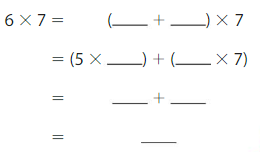
2.5 Use the Distributive Property

Use the Distributive Property to fill in the blanks.

Question 24.
7 × 3 = (____ + 2) × 3
= (____ × 3) + (2 × ____)
= ____ + ____
= ____

Answer:

7 × 3 = (5 + 2) × 3
= (5 × 3) + (2 × 3)
= 15 + 6
= 21

Question 25.
6 × 6 = 6 × (___ + ____)
= (6 × ____) + (6 × ____)
= ____ + ____
= ____

Answer:
6 × 6 = 6 × (3 + 3)
= (6 × 3) + (6 × 3)
= 18 + 18
= 36

2.5 Problem Solving: Multiplication

Question 26.
You place your trading card collection into an album that has 5 pages. You put 9 cards on each page. Some of the cards are the same, so you give 3 cards to a friend. How many trading cards do you have left?
Answer: 30

Explanation:
Given,
You place your trading card collection into an album that has 5 pages. You put 9 cards on each page. Some of the cards are the same, so you give 3 cards to a friend.
9 × 5 = 45 cards
If 3 cards are the same, then 5 × 3 = 15
45 – 15 = 30
Thus 30 trading cards are left.

Question 27.
Modeling Real Life
In a game, you start with ten $1 bills, five $5 bills, and two $10 bills. How much money do you start with in all?
Big Ideas Math Solutions Grade 3 Chapter 2 Multiplication Facts and Strategies 2.9 20
Answer: $55

Explanation:
In a game, you start with ten $1 bills, five $5 bills, and two $10 bills.
10 $1 bills = 10 × $1 = $10
5 $5 bills = 5 × $ 5 = $25
2 $10 bills = 2 × $10 = $20
10 + 25 + 20 = $55

Conclusion:
Learn the basics or fundamentals of Multiplication Facts and Strategies from Big Ideas Math Answers. Compare the solutions with real-life to understand the concepts in depth. Hope the details mentioned in Big Ideas Math Book 3rd Grade Answer Key Chapter 2 Multiplication Facts and Strategies are helpful for you. Stay tuned with our website to get the solutions for all grade 3 chapters.

Big Ideas Math Answers Grade 3 Chapter 11 Understand Fraction Equivalence and Comparison

Download Big Ideas Math Answers Grade 3 Chapter 11 Understand Fraction Equivalence and Comparison from here. The students of grade 3 can get a detailed explanation for all the questions on BIM 3rd std Chapter 11 Understand Fraction Equivalence and Comparison. We have provided the Big Ideas Math Answers for Grade 3 Chapter 11 Understand Fraction Equivalence and Comparison in the pdf format so that you can prepare in offline mode.

Big Ideas Math Book 3rd Grade Answer Key Chapter 11 Understand Fraction Equivalence and Comparison

It is mandatory for the students to check out the topics before you start preparing any chapter. Go through the topics given below and then check the solutions for those questions topic wise. To make your task easy we have attached the links to all the topics. All you have to do is to tap the links and kickstart your preparation.

Lesson 1 Equivalent Fractions

Lesson 2 Equivalent Fractions on a Number Line

Lesson 3 Relate Fractions and Whole Numbers

Lesson 4 Compare Fractions with the Same Denominator

Lesson 5 Compare Fractions with Same Numerator

Lesson 6 Compare Fractions on a Number Line

Lesson 7 Compare Fractions

Lesson 8 Compare and Order Fractions

Understand Fraction Equivalence and Comparison

Lesson 11.1 Equivalent Fractions

Explore and Grow   

Use the model to write fractions that are the same size as \(\frac{1}{2}\)
Big Ideas Math Answer Key Grade 3 Chapter 11 Understand Fraction Equivalence and Comparison 11.1 1
Answer: fraction \(\frac{4}{8}\) , fraction\(\frac{8}{16}\) are the same size as fraction \(\frac{1}{2}\).

Reasoning
Can you write a fraction with a denominator of that is the same size as \(\frac{3}{4}\)? Explain.
Answer: It is nothing but equivalent fraction \(\frac{3}{4}\) and \(\frac{21}{28}\) are equivalent fraction.

Think and Grow: Model Equivalent Fractions

Two or more numbers that have the same value are equivalent. Two or more fractions that name the same part of a whole are equivalent fractions.

Example
Use the models to find an equivalent fraction for \(\frac{2}{3}\) .
Big Ideas Math Answer Key Grade 3 Chapter 11 Understand Fraction Equivalence and Comparison 11.1 2

Answer:
Big-Ideas-Math-Answer-Key-Grade-3-Chapter-11-Understand-Fraction-Equivalence-and-Comparison-11.1-2

Show and Grow

Use the models to find an equivalent fraction. Both models show the same whole.
Question 1.
Big Ideas Math Answer Key Grade 3 Chapter 11 Understand Fraction Equivalence and Comparison 11.1 3
Answer:\(\frac{2}{8}\)

Explanation: \(\frac{1}{4}\) and 2/8 are equivalent fractions both gives the same answer.
Big-Ideas-Math-Answer-Key-Grade-3-Chapter-11-Understand-Fraction-Equivalence-and-Comparison-11.1-3

Question 2.
Big Ideas Math Answer Key Grade 3 Chapter 11 Understand Fraction Equivalence and Comparison 11.1 4
Answer: 1/3

Explanation: \(\frac{2}{6}\) and \(\frac{2}{8}\) are equivalent fractions both gives the same answer.
Big-Ideas-Math-Answer-Key-Grade-3-Chapter-11-Understand-Fraction-Equivalence-and-Comparison-11.1-4

Question 3.
Shade 1 part of the model. Then divide the model into 4 equal parts. Write the equivalent fraction.
Big Ideas Math Answer Key Grade 3 Chapter 11 Understand Fraction Equivalence and Comparison 11.1 5
Answer: \(\frac{2}{4}\)

Explanation:
Big-Ideas-Math-Answer-Key-Grade-3-Chapter-11-Understand-Fraction-Equivalence-and-Comparison-11.1-5
\(\frac{1}{4}\) and \(\frac{2}{4}\) are equivalent fractions both gives the same answer.

Apply and Grow: Practice

Use the models to find an equivalent fraction. Both models show the same whole.
Question 4.
Big Ideas Math Answer Key Grade 3 Chapter 11 Understand Fraction Equivalence and Comparison 11.1 6
Answer: \(\frac{4}{8}\)

Explanation:
Big-Ideas-Math-Answer-Key-Grade-3-Chapter-11-Understand-Fraction-Equivalence-and-Comparison-11.1-6
\(\frac{2}{4}\) and \(\frac{4}{8}\) are equivalent fractions both gives the same answer.

Question 5.
Big Ideas Math Answer Key Grade 3 Chapter 11 Understand Fraction Equivalence and Comparison 11.1 7
Answer: \(\frac{3}{3}\)
Big-Ideas-Math-Answer-Key-Grade-3-Chapter-11-Understand-Fraction-Equivalence-and-Comparison-11.1-7

Explanation: \(\frac{6}{6}\) and \(\frac{3}{3}\) are equivalent fractions both gives the same answer.

Question 6.
Shade 1 part of the model. Then divide the model into 6 equal parts. Write the equivalent fraction.
Big Ideas Math Answer Key Grade 3 Chapter 11 Understand Fraction Equivalence and Comparison 11.1 8
Answer: \(\frac{2}{6}\)
Big-Ideas-Math-Answer-Key-Grade-3-Chapter-11-Understand-Fraction-Equivalence-and-Comparison-11.1-8

Explanation: \(\frac{1}{3}\) and \(\frac{2}{6}\) are equivalent fractions both gives the same answer.

Find the equivalent fraction
Question 7.
Big Ideas Math Answer Key Grade 3 Chapter 11 Understand Fraction Equivalence and Comparison 11.1 9
Answer: \(\frac{4}{8}\)
Big-Ideas-Math-Answer-Key-Grade-3-Chapter-11-Understand-Fraction-Equivalence-and-Comparison-11.1-9

Explanation:
The equivalent fractions can be defined as fractions with different numerators and denominators that represent the same value or proportion of the whole.
Here the numerator of both the fractions is different.

Question 8.
Big Ideas Math Answer Key Grade 3 Chapter 11 Understand Fraction Equivalence and Comparison 11.1 10
Answer: \(\frac{2}{2}\)
Big-Ideas-Math-Answer-Key-Grade-3-Chapter-11-Understand-Fraction-Equivalence-and-Comparison-11.1-10

Explanation:
The equivalent fractions can be defined as fractions with different numerators and denominators that represent the same value or proportion of the whole.
Here the numerator of both the fractions is different.

Question 9.
Big Ideas Math Answer Key Grade 3 Chapter 11 Understand Fraction Equivalence and Comparison 11.1 11
Answer: \(\frac{4}{6}\)
Big-Ideas-Math-Answer-Key-Grade-3-Chapter-11-Understand-Fraction-Equivalence-and-Comparison-11.1-11

Explanation:
The equivalent fractions can be defined as fractions with different numerators and denominators that represent the same value or proportion of the whole.
Here the numerator of both the fractions is different.

Question 10.
Big Ideas Math Answer Key Grade 3 Chapter 11 Understand Fraction Equivalence and Comparison 11.1 12
Answer: \(\frac{1}{2}\)
Big-Ideas-Math-Answer-Key-Grade-3-Chapter-11-Understand-Fraction-Equivalence-and-Comparison-11.1-12

Explanation:
The equivalent fractions can be defined as fractions with different numerators and denominators that represent the same value or proportion of the whole.
Here the numerator of both the fractions is different.

Question 11.
Structure
Descartes shades \(\frac{3}{4}\) of a rectangle. Divide and shade the model to show an equivalent fraction for \(\frac{3}{4}\).
Big Ideas Math Answer Key Grade 3 Chapter 11 Understand Fraction Equivalence and Comparison 11.1 13
Answer: \(\frac{6}{8}\)
Big-Ideas-Math-Answer-Key-Grade-3-Chapter-11-Understand-Fraction-Equivalence-and-Comparison-11.1-13

Explanation:
The number equivalent to \(\frac{3}{4}\) is \(\frac{6}{8}\).
So you have to divide the rectangle into 8 equal parts and shade 6 parts among them.

Question 12.
Which One Doesn’t Belong?
Which model does not belong with the other three?
Big Ideas Math Answer Key Grade 3 Chapter 11 Understand Fraction Equivalence and Comparison 11.1 14
Answer: 4 figure is different

Explanation: From the above pictures 1 and 2 are equivalent fractions the first rectangle represent \(\frac{4}{8}\) and the second represents \(\frac{2}{4}\) both give the answer as \(\frac{1}{2}\)
The fourth figure has 4 parts and 1 part is shaded. So, the name of the fraction is \(\frac{1}{4}\)

Think and Grow: Modeling Real Life

You, Newton, and Descartes divide your posters for a science fair as shown.You finish 3 parts, Newton finishes 2 parts, and Descartes finishes 4 parts.Who has finished the same amount?
Big Ideas Math Answer Key Grade 3 Chapter 11 Understand Fraction Equivalence and Comparison 11.1 15

Answer:
Big-Ideas-Math-Answer-Key-Grade-3-Chapter-11-Understand-Fraction-Equivalence-and-Comparison-11.1-15

Show and Grow

Question 13.
You, Newton, and Descartes divide your submarine sandwiches as shown. You eat 1 part, Newton eats 2 parts, and Descartes eats 2 parts. Who eats the same amount?
Big Ideas Math Answer Key Grade 3 Chapter 11 Understand Fraction Equivalence and Comparison 11.1 16
Answer:
Given,
You eat 1 part, Newton eats 2 parts, and Descartes eats 2 parts.
You and Newton eats the same amount

Question 14.
DIG DEEPER!
You and your friend have small pizzas. You cut your pizza sixths. Your friend cuts her pizza into eighths. You eat \(\frac{3}{6}\) of your pizza. Your 6 friend eats the same amount of her pizza. What fraction of her pizza does your friend eat? How many slices does your friend eat? Explain.
Answer:
Given,
You and your friend have small pizzas. You cut your pizza sixths.
Your friend cuts her pizza into eighths. You eat \(\frac{3}{6}\) of your pizza. Your 6 friend eats the same amount of her pizza.
That means \(\frac{6}{8}\) = \(\frac{3}{4}\)
Thus your friend eats \(\frac{3}{4}\) part of the pizza.

Equivalent Fractions Homework & Practice 11.1

Use the models to find an equivalent fraction. Both models show the same whole.
Question 1.
Big Ideas Math Answer Key Grade 3 Chapter 11 Understand Fraction Equivalence and Comparison 11.1 17
Answer: \(\frac{2}{3}\)

Big-Ideas-Math-Answer-Key-Grade-3-Chapter-11-Understand-Fraction-Equivalence-and-Comparison-11.1-17

Explanation: \(\frac{4}{6}\) and \(\frac{2}{3}\) are equivalent fractions both gives the same answer.

Question 2.
Big Ideas Math Answer Key Grade 3 Chapter 11 Understand Fraction Equivalence and Comparison 11.1 18
Answer: \(\frac{3}{6}\)

Big-Ideas-Math-Answer-Key-Grade-3-Chapter-11-Understand-Fraction-Equivalence-and-Comparison-11.1-18

Explanation: \(\frac{1}{2}\) and \(\frac{3}{6}\) are equivalent fractions both gives the same answer.

Question 3.
Shade 1 part of the model. Then divide the model into 8 equal parts. Write the equivalent fraction.
Big Ideas Math Answer Key Grade 3 Chapter 11 Understand Fraction Equivalence and Comparison 11.1 19
Answer: \(\frac{2}{8}\)

Big-Ideas-Math-Answer-Key-Grade-3-Chapter-11-Understand-Fraction-Equivalence-and-Comparison-11.1-19 (1)

Big-Ideas-Math-Answer-Key-Grade-3-Chapter-11-Understand-Fraction-Equivalence-and-Comparison-11.1-19
Explanation: \(\frac{1}{4}\) and \(\frac{2}{8}\) are equivalent fractions both gives the same answer.

Find the equivalent fraction
Question 4.
Big Ideas Math Answer Key Grade 3 Chapter 11 Understand Fraction Equivalence and Comparison 11.1 20
Answer: \(\frac{8}{8}\)

Big-Ideas-Math-Answer-Key-Grade-3-Chapter-11-Understand-Fraction-Equivalence-and-Comparison-11.1-20

Explanation: \(\frac{2}{2}\) and \(\frac{8}{8}\) are equivalent fractions both gives the same answer.

Question 5.
Big Ideas Math Answer Key Grade 3 Chapter 11 Understand Fraction Equivalence and Comparison 11.1 21
Answer: \(\frac{3}{4}\)
Big-Ideas-Math-Answer-Key-Grade-3-Chapter-11-Understand-Fraction-Equivalence-and-Comparison-11.1-21
Explanation: \(\frac{6}{8}\) and \(\frac{3}{4}\) are equivalent fractions both gives the same answer.

Question 6.
Big Ideas Math Answer Key Grade 3 Chapter 11 Understand Fraction Equivalence and Comparison 11.1 22
Answer: \(\frac{2}{6}\)
Big-Ideas-Math-Answer-Key-Grade-3-Chapter-11-Understand-Fraction-Equivalence-and-Comparison-11.1-22
Explanation: \(\frac{1}{3}\) and \(\frac{2}{6}\) are equivalent fractions both gives the same answer.

Question 7.
Big Ideas Math Answer Key Grade 3 Chapter 11 Understand Fraction Equivalence and Comparison 11.1 23
Answer: \(\frac{1}{2}\)
Big-Ideas-Math-Answer-Key-Grade-3-Chapter-11-Understand-Fraction-Equivalence-and-Comparison-11.1-23
Explanation: \(\frac{2}{4}\) and \(\frac{1}{2}\) are equivalent fractions both gives the same answer.

Question 8.
Open-Ended
Divide one model into an odd number of equal parts and the other model into an even number of equal parts. Then model and write two equivalent fractions.
Big Ideas Math Answer Key Grade 3 Chapter 11 Understand Fraction Equivalence and Comparison 11.1 24
Answer: \(\frac{1}{2}\) = \(\frac{2}{4}\)
Big-Ideas-Math-Answer-Key-Grade-3-Chapter-11-Understand-Fraction-Equivalence-and-Comparison-11.1-24
Explanation: \(\frac{1}{2}\) and \(\frac{2}{4}\) are equivalent fractions both gives the same answer.

Question 9.
Modeling Real Life
You, Newton, and Descartes divide your portrait canvases as shown. You paint 2 parts, Newton paints 2 parts, and Descartes paints 8 parts. Who paints the same amount of the portrait canvas?
Big Ideas Math Answer Key Grade 3 Chapter 11 Understand Fraction Equivalence and Comparison 11.1 25
Answer: You and Descartes

Explanation:
You, Newton, and Descartes divide your portrait canvases as shown.
You paint 2 parts, Newton paints 2 parts, and Descartes paints 8 parts.
You completed 2 of 2 parts.
Descartes paints 8 of 8 parts.
\(\frac{2}{2}\) = 1
\(\frac{8}{8}\) = 1
Thus you and Descartes completes the same amount of the portrait canvas.

Question 10.
DIG DEEPER!
You and your friend paint 2 roundabouts for a park. You divide your roundabout into thirds. Your friend divides his roundabout into sixths. You paint \(\frac{1}{3}\) of your roundabout. Your friend paints the same amount of his roundabout. What fraction does your friend paint? Explain.
Big Ideas Math Answer Key Grade 3 Chapter 11 Understand Fraction Equivalence and Comparison 11.1 26
Answer:
Given,
You and your friend paint 2 roundabouts for a park. You divide your roundabout into thirds.
Your friend divides his roundabout into sixths.
You paint \(\frac{1}{3}\) of your roundabout. Your friend paints the same amount of his roundabout.
\(\frac{6}{6}\)

Review & Refresh

Question 11.
Round to the nearest ten to estimate the sum.
Big Ideas Math Answer Key Grade 3 Chapter 11 Understand Fraction Equivalence and Comparison 11.1 27
Answer: 540
Big-Ideas-Math-Answer-Key-Grade-3-Chapter-11-Understand-Fraction-Equivalence-and-Comparison-11.1-27

Explanation:
The nearest ten estimation for 431 is 430
and for 109 Nearest ten estimation  is 110
hence
430
+ 110
540

Question 12.
Round to the nearest hundred to estimate the sum.
Big Ideas Math Answer Key Grade 3 Chapter 11 Understand Fraction Equivalence and Comparison 11.1 28
Answer: 820

Explanation:
The nearest ten estimation for 551 is 550
and for 268 Nearest ten estimation  is 270
Big-Ideas-Math-Answer-Key-Grade-3-Chapter-11-Understand-Fraction-Equivalence-and-Comparison-11.1-28

Lesson 11.2 Equivalent Fractions on a Number Line

Explore and Grow

Use Fraction Strips to label thirds on the number line.
Big Ideas Math Answers 3rd Grade Chapter 11 Understand Fraction Equivalence and Comparison 11.2 1
Use Fraction Strips to label sixths on the number line.
Big Ideas Math Answers 3rd Grade Chapter 11 Understand Fraction Equivalence and Comparison 11.2 2
Use the number lines to complete the equivalent fraction.
Big Ideas Math Answers 3rd Grade Chapter 11 Understand Fraction Equivalence and Comparison 11.2 3
Answer: \(\frac{2}{6}\)
Big-Ideas-Math-Answers-3rd-Grade-Chapter-11-Understand-Fraction-Equivalence-and-Comparison-11.2-3
Explanation: \(\frac{1}{3}\) and \(\frac{2}{6}\) are equivalent fractions both gives the same answer.

Structure
How can you tell whether fractions are equivalent using a number line?
Answer:
Step 1: Locate the original fraction on the number line. We’ll first need to locate our fraction on the number line.
Step 2: Divide each your newly created divisions from step 1 into two even spaces.
Step 3: Find the equivalent fraction.
Step 4: Repeat steps 2 and 3 to find more equivalent fractions.

Think and Grow: Equivalent Fractions on a Number Line

You can use a number line to find equivalent fractions. Equivalent fractions represent the same point on a number line.

Example
Use a number line to find an equivalent fraction for \(\frac{3}{4}\).
Big Ideas Math Answers 3rd Grade Chapter 11 Understand Fraction Equivalence and Comparison 11.2 4
Step 1: Plot \(\frac{3}{4}\) on a number line.
Big Ideas Math Answers 3rd Grade Chapter 11 Understand Fraction Equivalence and Comparison 11.2 5
Step 2: Divide the number line into eighths. Label each tick mark to show eighths.
Big Ideas Math Answers 3rd Grade Chapter 11 Understand Fraction Equivalence and Comparison 11.2 6

Answer:
Big-Ideas-Math-Answers-3rd-Grade-Chapter-11-Understand-Fraction-Equivalence-and-Comparison-11.2-6

Show and Grow

Question 1.
Use the number line to find an equivalent fraction.
Big Ideas Math Answers 3rd Grade Chapter 11 Understand Fraction Equivalence and Comparison 11.2 7
Answer: \(\frac{4}{6}\)
Big-Ideas-Math-Answers-3rd-Grade-Chapter-11-Understand-Fraction-Equivalence-and-Comparison-11.2-7
The fractions \(\frac{2}{3}\) and \(\frac{4}{6}\) are on the same point.
So, \(\frac{2}{3}\) = \(\frac{4}{6}\)

Question 2.
Write two fractions that name the point shown.
Big Ideas Math Answers 3rd Grade Chapter 11 Understand Fraction Equivalence and Comparison 11.2 8
Answer: \(\frac{2}{4}\) = \(\frac{1}{2}\)
Big-Ideas-Math-Answers-3rd-Grade-Chapter-11-Understand-Fraction-Equivalence-and-Comparison-11.2-8
The fractions \(\frac{1}{2}\) and \(\frac{2}{4}\) are on the same point.
So,\(\frac{1}{2}\) = \(\frac{2}{4}\)

Apply and Grow: Practice

Write two fractions that name the point shown.
Question 3.
Big Ideas Math Answers 3rd Grade Chapter 11 Understand Fraction Equivalence and Comparison 11.2 9
Answer: \(\frac{4}{6}\) = \(\frac{1}{2}\)

Big-Ideas-Math-Answers-3rd-Grade-Chapter-11-Understand-Fraction-Equivalence-and-Comparison-11.2-9

The fractions \(\frac{4}{6}\) and \(\frac{1}{2}\) are on the same point.
So,\(\frac{4}{6}\) = \(\frac{1}{2}\)

Question 4.
Big Ideas Math Answers 3rd Grade Chapter 11 Understand Fraction Equivalence and Comparison 11.2 10
Answer: \(\frac{4}{8}\) = \(\frac{1}{2}\)

Big-Ideas-Math-Answers-3rd-Grade-Chapter-11-Understand-Fraction-Equivalence-and-Comparison-11.2-10

The fractions \(\frac{4}{8}\) and \(\frac{1}{2}\) are on the same point.
So,\(\frac{4}{8}\) = \(\frac{1}{2}\)

Question 5.
Big Ideas Math Answers 3rd Grade Chapter 11 Understand Fraction Equivalence and Comparison 11.2 11
Answer: \(\frac{1}{4}\) = \(\frac{2}{8}\)

Big-Ideas-Math-Answers-3rd-Grade-Chapter-11-Understand-Fraction-Equivalence-and-Comparison-11.2-11

The fractions \(\frac{1}{4}\) and \(\frac{2}{8}\) are on the same point.
So,\(\frac{1}{4}\) = \(\frac{2}{8}\)

Question 6.
Big Ideas Math Answers 3rd Grade Chapter 11 Understand Fraction Equivalence and Comparison 11.2 12
Answer:  \(\frac{1}{2}\) = \(\frac{2}{4}\)

Big-Ideas-Math-Answers-3rd-Grade-Chapter-11-Understand-Fraction-Equivalence-and-Comparison-11.2-12
The fractions \(\frac{1}{2}\) and \(\frac{2}{4}\) are on the same point.
So,\(\frac{1}{2}\) = \(\frac{2}{4}\)

Question 7.
YOU BE THE TEACHER
Your friend says \(\frac{3}{4}\) and \(\frac{6}{8}\) are equivalent because they are not the same distance from 0. Is your friend correct? Explain.
Big Ideas Math Answers 3rd Grade Chapter 11 Understand Fraction Equivalence and Comparison 11.2 13
Answer: No your friend is not correct. \(\frac{3}{4}\) and \(\frac{6}{8}\) are equivalent fractions irrespective of the distance on the number line.

Question 8.
Reasoning
Explain why \(\frac{1}{3}\) is equal to two \(\frac{1}{6}\)s
Answer:
Divide \(\frac{1}{3}\) by 2. You get \(\frac{1}{6}\)

Think and Grow: Modeling Real Life

Newton rests after biking \(\frac{2}{3}\) of a race. Descartes rests after biking \(\frac{2}{6}\) of the same race. Do they rest at the same point along the race path?
Big Ideas Math Answers 3rd Grade Chapter 11 Understand Fraction Equivalence and Comparison 11.2 14
Model:
Big Ideas Math Answers 3rd Grade Chapter 11 Understand Fraction Equivalence and Comparison 11.2 15
They ______ rest at the same point.
Explain: No they do not rest at the same point. Because \(\frac{2}{3}\) is not equal to \(\frac{2}{6}\)
Big-Ideas-Math-Answers-3rd-Grade-Chapter-11-Understand-Fraction-Equivalence-and-Comparison-11.2-15

Show and Grow

Question 9.
Newton hikes \(\frac{7}{8}\) of a trail. Descartes hikes \(\frac{3}{4}\) of the same trail. Do they hike the same distance along the trail?
Answer:
Newton hikes \(\frac{7}{8}\) of a trail. Descartes hikes \(\frac{3}{4}\) of the same trail.
You have to compare both the fractions.
\(\frac{7}{8}\) is greater than \(\frac{3}{4}\).
By this, we can say that does not hike the same distance along the trail.

Question 10.
Newton chases Descartes for \(\frac{3}{6}\) mile. Descartes turns around and chases Newton an equal distance.Write two equivalent fractions that can describe how far Descartes chases Newton.
Answer:
The equivalent fractions of \(\frac{3}{6}\) are
\(\frac{3}{6}\) × \(\frac{2}{2}\) = \(\frac{6}{12}\)
\(\frac{3}{6}\) = \(\frac{1}{2}\)
Thus the two The equivalent fractions of \(\frac{3}{6}\) are \(\frac{6}{12}\), \(\frac{1}{2}\)

Question 11.
DIG DEEPER!
You cut a quiche into 8 equal slices. Your family eats \(\frac{1}{2}\) of the quiche. How many slices does your family eat? Explain.
Answer:
Given,
You cut a quiche into 8 equal slices. Your family eats \(\frac{1}{2}\) of the quiche.
\(\frac{1}{2}\) × 8 = \(\frac{1}{4}\)
Thus your family eats 4 equal slices.

Equivalent Fractions on a Number Line Homework & Practice 11.2

Question 1.
Use the number line to find an equivalent fraction.
Big Ideas Math Answers 3rd Grade Chapter 11 Understand Fraction Equivalence and Comparison 11.2 16
Answer: \(\frac{1}{4}\)

Big-Ideas-Math-Answers-3rd-Grade-Chapter-11-Understand-Fraction-Equivalence-and-Comparison-11.2-16
By seeing the above number we can find the equivalent fraction of \(\frac{2}{8}\).
\(\frac{1}{4}\) and \(\frac{2}{8}\) are on the same point.

Question 2.
Write two fractions that name the point shown
Big Ideas Math Answers 3rd Grade Chapter 11 Understand Fraction Equivalence and Comparison 11.2 17
Answer: \(\frac{1}{2}\) = \(\frac{2}{4}\)

Big-Ideas-Math-Answers-3rd-Grade-Chapter-11-Understand-Fraction-Equivalence-and-Comparison-11.2-17

By seeing the above number we can find the equivalent fraction of \(\frac{1}{2}\).
\(\frac{1}{2}\) = \(\frac{2}{4}\)

Write two fractions that name the same point shown.
Question 3.
Big Ideas Math Answers 3rd Grade Chapter 11 Understand Fraction Equivalence and Comparison 11.2 18
Answer: \(\frac{6}{8}\) = \(\frac{3}{4}\)

Big-Ideas-Math-Answers-3rd-Grade-Chapter-11-Understand-Fraction-Equivalence-and-Comparison-11.2-18

By seeing the above number we can find the equivalent fraction of \(\frac{6}{8}\).
\(\frac{6}{8}\) = \(\frac{3}{4}\)

Question 4.
Big Ideas Math Answers 3rd Grade Chapter 11 Understand Fraction Equivalence and Comparison 11.2 19
Answer: \(\frac{4}{6}\) = \(\frac{2}{3}\)
Big-Ideas-Math-Answers-3rd-Grade-Chapter-11-Understand-Fraction-Equivalence-and-Comparison-11.2-19

By seeing the above number we can find the equivalent fraction of \(\frac{4}{6}\).
\(\frac{4}{6}\) = \(\frac{2}{3}\)

Question 5.
Which One Doesn’tBelong?
Which not fraction does belong with the other three? Explain.
Big Ideas Math Answers 3rd Grade Chapter 11 Understand Fraction Equivalence and Comparison 11.2 20
Answer: \(\frac{2}{3}\)

Big-Ideas-Math-Answers-3rd-Grade-Chapter-11-Understand-Fraction-Equivalence-and-Comparison-11.2-20
The fraction \(\frac{2}{3}\) does not belong to other three fractions.

Question 6.
Reasoning
How do you know that \(\frac{3}{8}\) and \(\frac{3}{4}\) are equivalent when plotting the fractions on a number line?
Answer:
No, they are not equivalent. The numerators are equals, but the denominators are not, they are not equivalent. If the first one would be 6/8, they would be equivalent, because we can simplify the fractions by 2 and we got 3/4 again.

Question 7.
Modeling Real Life
You run \(\frac{6}{8}\) of a race. Your friend runs \(\frac{3}{4}\) of the same race. Do you and your friend run the same distance?
Big Ideas Math Answers 3rd Grade Chapter 11 Understand Fraction Equivalence and Comparison 11.2 21.1
Answer:
Given,
You run \(\frac{6}{8}\) of a race. Your friend runs \(\frac{3}{4}\) of the same race.
The equivalent fraction of \(\frac{3}{4}\) is \(\frac{6}{8}\)
By this we can say that you and your friend run the same distance.

Question 8.
DIG DEEPER!
You have a frame that holds 8 pictures. You fill \(\frac{1}{4}\) of the frame. How many pictures do you put in the frame? Explain.
Answer:
Given,
You have a frame that holds 8 pictures. You fill \(\frac{1}{4}\) of the frame.
\(\frac{1}{4}\) × 8 = 2
Thus you put 2 pictures in the frame.

Review & Refresh

What fraction of the whole is shaded?
Question 9.
Big Ideas Math Answers 3rd Grade Chapter 11 Understand Fraction Equivalence and Comparison 11.2 21
Answer: \(\frac{2}{3}\)
By seeing the figure we can name the fraction of the shaded part. The box is divided into 3 parts among them 2 parts are shaded.

Big-Ideas-Math-Answers-3rd-Grade-Chapter-11-Understand-Fraction-Equivalence-and-Comparison-11.2-21

Question 10.
Big Ideas Math Answers 3rd Grade Chapter 11 Understand Fraction Equivalence and Comparison 11.2 22
Answer: \(\frac{4}{6}\)
By seeing the figure we can name the fraction of the shaded part. The circle is divided into 6 parts among them 4 parts are shaded.

Big-Ideas-Math-Answers-3rd-Grade-Chapter-11-Understand-Fraction-Equivalence-and-Comparison-11.2-22


Lesson 11.3 Relate Fractions and Whole Numbers

Explore and Grow

Use Fraction Strips to complete the fractions. Draw to show your models.
Big Ideas Math Answers Grade 3 Chapter 11 Understand Fraction Equivalence and Comparison 11.3 1
Answer:

Big-Ideas-Math-Answers-Grade-3-Chapter-11-Understand-Fraction-Equivalence-and-Comparison-11.3-1

Explanation: The equivalent fractions can be defined as fractions with different numerators and denominators that represent the same value or proportion of the whole.

Repeated Reasoning
How many more fourths did you use to model 2 than you did to model 1? How many more fourths would you need to model 3? Complete the fraction.
Big Ideas Math Answers Grade 3 Chapter 11 Understand Fraction Equivalence and Comparison 11.3 2
Answer: 12
Big-Ideas-Math-Answers-Grade-3-Chapter-11-Understand-Fraction-Equivalence-and-Comparison-11.3-2

Explanation: The equivalent fractions can be defined as fractions with different numerators and denominators that represent the same value or proportion of the whole.

Think and Grow: Equivalent Fractions and Whole Numbers

Example
Write the numbers 1 and 2 as fractions. The number line shows 2 wholes. Each whole is divided into1 equal part.
Big Ideas Math Answers Grade 3 Chapter 11 Understand Fraction Equivalence and Comparison 11.3 3

Answer:
Big-Ideas-Math-Answers-Grade-3-Chapter-11-Understand-Fraction-Equivalence-and-Comparison-11.3-3

Example
Write equivalent fractions for the numbers 1 and 2.
Big Ideas Math Answers Grade 3 Chapter 11 Understand Fraction Equivalence and Comparison 11.3 4

Answer:
Big-Ideas-Math-Answers-Grade-3-Chapter-11-Understand-Fraction-Equivalence-and-Comparison-11.3-4

Show and Grow

Question 1.
Complete the number line. Then complete the statements.
Big Ideas Math Answers Grade 3 Chapter 11 Understand Fraction Equivalence and Comparison 11.3 5
Answer:

Big-Ideas-Math-Answers-Grade-3-Chapter-11-Understand-Fraction-Equivalence-and-Comparison-11.3-5

Explanation: The equivalent fractions can be defined as fractions with different numerators and denominators that represent the same value or proportion of the whole.

Apply and Grow: Practice

Question 2.
Complete the number line. Then write equivalent fractions for the numbers 3 and 4.
Big Ideas Math Answers Grade 3 Chapter 11 Understand Fraction Equivalence and Comparison 11.3 6
Answer:

Big-Ideas-Math-Answers-Grade-3-Chapter-11-Understand-Fraction-Equivalence-and-Comparison-11.3-6

Explanation: The equivalent fractions can be defined as fractions with different numerators and denominators that represent the same value or proportion of the whole.

Write two equivalent fractions for the whole number.
Question 3.
Big Ideas Math Answers Grade 3 Chapter 11 Understand Fraction Equivalence and Comparison 11.3 7
Answer:

Big-Ideas-Math-Answers-Grade-3-Chapter-11-Understand-Fraction-Equivalence-and-Comparison-11.3-7
Explanation: The equivalent fractions can be defined as fractions with different numerators and denominators that represent the same value or proportion of the whole.

Question 4.
Big Ideas Math Answers Grade 3 Chapter 11 Understand Fraction Equivalence and Comparison 11.3 8
Answer:
Big-Ideas-Math-Answers-Grade-3-Chapter-11-Understand-Fraction-Equivalence-and-Comparison-11.3-8
Explanation: The equivalent fractions can be defined as fractions with different numerators and denominators that represent the same value or proportion of the whole.

Question 5.
Big Ideas Math Answers Grade 3 Chapter 11 Understand Fraction Equivalence and Comparison 11.3 9
Answer:
Big-Ideas-Math-Answers-Grade-3-Chapter-11-Understand-Fraction-Equivalence-and-Comparison-11.3-9
Explanation: The equivalent fractions can be defined as fractions with different numerators and denominators that represent the same value or proportion of the whole.

Write the equivalent whole number.
Question 6.
Big Ideas Math Answers Grade 3 Chapter 11 Understand Fraction Equivalence and Comparison 11.3 10
Answer:
Big-Ideas-Math-Answers-Grade-3-Chapter-11-Understand-Fraction-Equivalence-and-Comparison-11.3-10
Explanation: The equivalent fractions can be defined as fractions with different numerators and denominators that represent the same value or proportion of the whole.

Question 7.
Big Ideas Math Answers Grade 3 Chapter 11 Understand Fraction Equivalence and Comparison 11.3 11
Answer:
Big-Ideas-Math-Answers-Grade-3-Chapter-11-Understand-Fraction-Equivalence-and-Comparison-11.3-11
Explanation: The equivalent fractions can be defined as fractions with different numerators and denominators that represent the same value or proportion of the whole.

Question 8.
Big Ideas Math Answers Grade 3 Chapter 11 Understand Fraction Equivalence and Comparison 11.3 12

Answer:
Big-Ideas-Math-Answers-Grade-3-Chapter-11-Understand-Fraction-Equivalence-and-Comparison-11.3-12

Explanation: The equivalent fractions can be defined as fractions with different numerators and denominators that represent the same value or proportion of the whole.

Question 9.
You cut a sandwich into 4 pieces. You eat the whole sandwich. What fraction of the sandwich do you eat?
Big Ideas Math Answers Grade 3 Chapter 11 Understand Fraction Equivalence and Comparison 11.3 13
Answer:
Given,
You cut a sandwich into 4 pieces. You eat the whole sandwich.
\(\frac{4}{4}\) = 1
Thus you eat \(\frac{4}{4}\) fraction of the sandwich.

Question 10.
Number Sense
Write three fractions that are equivalent to 6 using the denominators 1, 2, and 6.
Answer:
\(\frac{6}{6}\) = 1
\(\frac{12}{6}\) = 2
\(\frac{36}{6}\) = 6

Question 11.
Use a number line to show \(\frac{5}{5}\) = 1.
Answer:
Big Ideas Math Book 3rd Grade Answer Key Chapter 11

Think and Grow: Modeling Real Life

You run around a track 12 times. Each lap is \(\frac{1}{4}\) mile. How many miles do you run? Write your answer as a whole number and as a fraction.
Model:
Big Ideas Math Answers Grade 3 Chapter 11 Understand Fraction Equivalence and Comparison 11.3 14
You run _____ or ______ miles.

Answer:
Given,
You run around a track 12 times. Each lap is \(\frac{1}{4}\) mile.
12 × \(\frac{1}{4}\) = 3 mile
You run 3 miles.

Show and Grow

Question 12.
You ride your bike around a city block 24 times. Each time around is \(\frac{1}{6}\) mile. How many miles do you ride? Write your answer as a 6 whole number and as a fraction.
Answer:
Given,
You ride your bike around a city block 24 times. Each time around is \(\frac{1}{6}\) mile.
24 × \(\frac{1}{6}\) = 4
Thus you ride 4 miles.

Question 13.
There are 5 Great Lakes: Lake Erie, Lake Huron, Lake Michigan, Lake Ontario, and Lake Superior. You complete a project and use 1 whole poster for each lake. Write a fraction that gives the number of posters you use in all.
Big Ideas Math Answers Grade 3 Chapter 11 Understand Fraction Equivalence and Comparison 11.3 15
Answer:
Lake Michigan is \(\frac{1}{1}\)
Lake Huron is \(\frac{2}{1}\)
Lake Erie is \(\frac{3}{1}\)
Lake Ontario is \(\frac{4}{1}\)
Lake Superior is \(\frac{5}{1}\)

Question 14.
DIG DEEPER!
You and your friends order 3 pizzas. Each pizza is cut into 8 slices. You and your friends eat \(\frac{16}{8}\) of the pizzas. Write a fraction that shows the number of eighths that are left.
Answer:
Given that,
You and your friends order 3 pizzas. Each pizza is cut into 8 slices.
You and your friends eat \(\frac{16}{8}\) of the pizzas.
3 × 8 = 24 slices
\(\frac{24}{8}\)– \(\frac{16}{8}\) = \(\frac{8}{8}\)
Thus 8 slices are left in the pizza.

Equivalent Fractions on a Number Line Homework & Practice 11.3

Question 1.
Complete the number line. Then write equivalent fractions for the numbers 3 and 4.
Big Ideas Math Answers Grade 3 Chapter 11 Understand Fraction Equivalence and Comparison 11.3 16
Answer:
Big-Ideas-Math-Answers-Grade-3-Chapter-11-Understand-Fraction-Equivalence-and-Comparison-11.3-16
Explanation: The equivalent fractions can be defined as fractions with different numerators and denominators that represent the same value or proportion of the whole.

Write two equivalent fractions for the whole number.
Question 2.
Big Ideas Math Answers Grade 3 Chapter 11 Understand Fraction Equivalence and Comparison 11.3 17
Answer:
Big-Ideas-Math-Answers-Grade-3-Chapter-11-Understand-Fraction-Equivalence-and-Comparison-11.3-17
Explanation: The equivalent fractions can be defined as fractions with different numerators and denominators that represent the same value or proportion of the whole.

Question 3.
Big Ideas Math Answers Grade 3 Chapter 11 Understand Fraction Equivalence and Comparison 11.3 18
Answer:
Big-Ideas-Math-Answers-Grade-3-Chapter-11-Understand-Fraction-Equivalence-and-Comparison-11.3-18
Explanation: The equivalent fractions can be defined as fractions with different numerators and denominators that represent the same value or proportion of the whole.

Question 4.
Big Ideas Math Answers Grade 3 Chapter 11 Understand Fraction Equivalence and Comparison 11.3 19
Answer:
Big-Ideas-Math-Answers-Grade-3-Chapter-11-Understand-Fraction-Equivalence-and-Comparison-11.3-19
Explanation: The equivalent fractions can be defined as fractions with different numerators and denominators that represent the same value or proportion of the whole.

Write the equivalent whole number.
Question 5.
Big Ideas Math Answers Grade 3 Chapter 11 Understand Fraction Equivalence and Comparison 11.3 20
Answer:
Big-Ideas-Math-Answers-Grade-3-Chapter-11-Understand-Fraction-Equivalence-and-Comparison-11.3-20
Explanation: The equivalent fractions can be defined as fractions with different numerators and denominators that represent the same value or proportion of the whole.

Question 6.
Big Ideas Math Answers Grade 3 Chapter 11 Understand Fraction Equivalence and Comparison 11.3 21
Answer:
Big-Ideas-Math-Answers-Grade-3-Chapter-11-Understand-Fraction-Equivalence-and-Comparison-11.3-21
Explanation: The equivalent fractions can be defined as fractions with different numerators and denominators that represent the same value or proportion of the whole.

Question 7.
Big Ideas Math Answers Grade 3 Chapter 11 Understand Fraction Equivalence and Comparison 11.3 22
Answer:
Big-Ideas-Math-Answers-Grade-3-Chapter-11-Understand-Fraction-Equivalence-and-Comparison-11.3-22
Explanation: The equivalent fractions can be defined as fractions with different numerators and denominators that represent the same value or proportion of the whole.

Question 8.
Precision
Match each whole number to its equivalent fractions.
Big Ideas Math Answers Grade 3 Chapter 11 Understand Fraction Equivalence and Comparison 11.3 23
Answer:
Big-Ideas-Math-Answers-Grade-3-Chapter-11-Understand-Fraction-Equivalence-and-Comparison-11.3-23
Explanation: The equivalent fractions can be defined as fractions with different numerators and denominators that represent the same value or proportion of the whole.

Question 9.
YOU BE THE TEACHER
Descartes says a fraction equivalent to 3 has a 3 in the denominator and a 1 in the numerator. Is Descartes correct? Explain.
Answer:
Descartes says a fraction equivalent to 3 has a 3 in the denominator and a 1 in the numerator.
Yes 3 is equivalent to \(\frac{3}{1}\)
Thus Descartes is correct.

Question 10.
Patterns
Describe and complete the pattern.
Big Ideas Math Answers Grade 3 Chapter 11 Understand Fraction Equivalence and Comparison 11.3 24
Answer:
Big-Ideas-Math-Answers-Grade-3-Chapter-11-Understand-Fraction-Equivalence-and-Comparison-11.3-24
The fraction is the multiples of 8. So, the pattern is 8/8, 16/8, 24/8, 32/8, 40/8.

Question 11.
Modeling Real Life
You run around a park 18 times. Each lap is \(\frac{1}{6}\) mile. How many miles do you run? Write your answer as a whole number and as a fraction.
Answer:
Given that,
You run around a park 18 times. Each lap is \(\frac{1}{6}\) mile.
18 × \(\frac{1}{6}\) = 3
Thus you run 3 miles or \(\frac{18}{6}\) miles

Question 12.
Modeling Real Life
Christopher Columbus had 3 ships on his first NiñaPintavoyage: the , the , and the Santa Maria. You complete a project and use 1 whole poster for each ship. Write a fraction that gives the number of posters you use in all.
Answer:
Given,
Christopher Columbus had 3 ships on his first NiñaPintavoyage: the , the , and the Santa Maria.
You complete a project and use 1 whole poster for each ship.
\(\frac{3}{3}\) = 1
Thus you use 1 poster for each ship.
Thus you use 3 posters for all the ships.

Question 13.
DIG DEEPER!
A teacher has 4 tables. Each table is divided into 4 sections. \(\frac{12}{4}\) of the tables have 4 supplies on them. Write a fraction that shows the number of fourths not that do have supplies on them.
Answer:
Given,
A teacher has 4 tables. Each table is divided into 4 sections.
4 × 4 = 16 sections
\(\frac{12}{4}\) of the tables have 4 supplies on them.
\(\frac{12}{4}\) = 3
3 of the tables have 4 supplies.
The fraction that shows the number of fourths not that do have supplies on them is \(\frac{3}{4}\)

Review & Refresh

Estimate. Then find the sum. Check whether your answer is reasonable.
Question 14.
Estimate: _____
Big Ideas Math Answers Grade 3 Chapter 11 Understand Fraction Equivalence and Comparison 11.3 25
Answer: 890

Explanation:
The nearest ten estimation for 837 is 840
and for 46 Nearest ten estimation  is 50
840
+  50
890

Question 15.
Estimate: _____
Big Ideas Math Answers Grade 3 Chapter 11 Understand Fraction Equivalence and Comparison 11.3 26
Answer: 510

Explanation:
The nearest ten estimation for 396 is 400
and for 108 Nearest ten estimation  is 110
400
+ 110
510

Question 16.
Estimate: _____
Big Ideas Math Answers Grade 3 Chapter 11 Understand Fraction Equivalence and Comparison 11.3 27
Answer: 830

Explanation:
The nearest ten estimation for 551 is 550
and for 279 Nearest ten estimation  is 280
550
+ 280
830

Lesson 11.4 Compare Fractions with the Same Denominator

Explore and Grow

Color to show each fraction. Circle the greater fraction.
Big Ideas Math Solutions Grade 3 Chapter 11 Understand Fraction Equivalence and Comparison 11.4 1
Answer: \(\frac{5}{6}\) is the greater fraction

Big-Ideas-Math-Solutions-Grade-3-Chapter-11-Understand-Fraction-Equivalence-and-Comparison-11.4-1

Construct Arguments
Explain to your partner how you can compare fractions with the same denominator.
Answer:
if the denominators are the same, then the fraction with the greater numerator is the greater fraction. The fraction with the lesser numerator is the lesser fraction

Think and Grow: Compare Fractions That have the Same Denominator

Example
Compare \(\frac{3}{8}\) and \(\frac{7}{8}\).
One Way: Use Fraction Strips.
The fractions have the same denominator, 8.
Big Ideas Math Solutions Grade 3 Chapter 11 Understand Fraction Equivalence and Comparison 11.4 2
Big Ideas Math Solutions Grade 3 Chapter 11 Understand Fraction Equivalence and Comparison 11.4 3

Answer:
Big-Ideas-Math-Solutions-Grade-3-Chapter-11-Understand-Fraction-Equivalence-and-Comparison-11.4-3

Another Way:
When the denominators are the same, the whole is divided into the same number of equal parts. So, look at the numerators 3 and 7 to compare.The fraction with the greater numerator is the greater fraction.
Big Ideas Math Solutions Grade 3 Chapter 11 Understand Fraction Equivalence and Comparison 11.4 4

Answer:
Big-Ideas-Math-Solutions-Grade-3-Chapter-11-Understand-Fraction-Equivalence-and-Comparison-11.4-4

Show and Grow

Shade to compare the fractions
Question 1.
Big Ideas Math Solutions Grade 3 Chapter 11 Understand Fraction Equivalence and Comparison 11.4 5
Answer:

Big-Ideas-Math-Solutions-Grade-3-Chapter-11-Understand-Fraction-Equivalence-and-Comparison-11.4-5
Explanation: if the denominators are the same, then the fraction with the greater numerator is the greater fraction. The fraction with the lesser numerator is the lesser fraction

Question 2.
Big Ideas Math Solutions Grade 3 Chapter 11 Understand Fraction Equivalence and Comparison 11.4 6
Answer:

Big-Ideas-Math-Solutions-Grade-3-Chapter-11-Understand-Fraction-Equivalence-and-Comparison-11.4-6

Explanation: if the denominators are the same, then the fraction with the greater numerator is the greater fraction. The fraction with the lesser numerator is the lesser fraction

Apply and Grow: Practice

Shade to compare the fractions.
Question 3.
Big Ideas Math Solutions Grade 3 Chapter 11 Understand Fraction Equivalence and Comparison 11.4 7
Answer:
Big-Ideas-Math-Solutions-Grade-3-Chapter-11-Understand-Fraction-Equivalence-and-Comparison-11.4-7

Explanation: if the denominators are the same, then the fraction with the greater numerator is the greater fraction. The fraction with the lesser numerator is the lesser fraction

Question 4.
Big Ideas Math Solutions Grade 3 Chapter 11 Understand Fraction Equivalence and Comparison 11.4 8
Answer:
Big-Ideas-Math-Solutions-Grade-3-Chapter-11-Understand-Fraction-Equivalence-and-Comparison-11.4-8

Explanation: Here the numerator and denominator of the fractions are the same so

Compare.
Question 5.
Big Ideas Math Solutions Grade 3 Chapter 11 Understand Fraction Equivalence and Comparison 11.4 9
Answer:
Big-Ideas-Math-Solutions-Grade-3-Chapter-11-Understand-Fraction-Equivalence-and-Comparison-11.4-9

Explanation:
Compare the fractions. The denominators of both the fractions are the same so you have to compare the numerators.
2 is less than 3.
So, \(\frac{2}{3}\) < \(\frac{3}{3}\)

Question 6.
Big Ideas Math Solutions Grade 3 Chapter 11 Understand Fraction Equivalence and Comparison 11.4 10
Answer:
Big-Ideas-Math-Solutions-Grade-3-Chapter-11-Understand-Fraction-Equivalence-and-Comparison-11.4-10
Compare the fractions. The denominators of both the fractions are the same so you have to compare the numerators.
So, \(\frac{1}{2}\) = \(\frac{1}{2}\)

Question 7.
Big Ideas Math Solutions Grade 3 Chapter 11 Understand Fraction Equivalence and Comparison 11.4 11
Answer:
Big-Ideas-Math-Solutions-Grade-3-Chapter-11-Understand-Fraction-Equivalence-and-Comparison-11.4-11

Explanation:
Compare the fractions. The denominators of both the fractions are the same so you have to compare the numerators.
3 is greater than 1.
So, \(\frac{3}{8}\) > \(\frac{1}{8}\)

Question 8.
Big Ideas Math Solutions Grade 3 Chapter 11 Understand Fraction Equivalence and Comparison 11.4 12
Answer:
Big-Ideas-Math-Solutions-Grade-3-Chapter-11-Understand-Fraction-Equivalence-and-Comparison-11.4-12

Explanation:
Compare the fractions. The denominators of both the fractions are the same so you have to compare the numerators.
4 is greater than 2.
So, \(\frac{4}{6}\) > \(\frac{2}{6}\)

Question 9.
Big Ideas Math Solutions Grade 3 Chapter 11 Understand Fraction Equivalence and Comparison 11.4 13
Answer:
Big-Ideas-Math-Solutions-Grade-3-Chapter-11-Understand-Fraction-Equivalence-and-Comparison-11.4-13

Explanation:
Compare the fractions. The denominators of both the fractions are the same so you have to compare the numerators.
5 is less than 6.
So, \(\frac{5}{8}\) < \(\frac{6}{8}\)

Question 10
Big Ideas Math Solutions Grade 3 Chapter 11 Understand Fraction Equivalence and Comparison 11.4 14
Answer:
Big-Ideas-Math-Solutions-Grade-3-Chapter-11-Understand-Fraction-Equivalence-and-Comparison-11.4-14

Explanation:
Compare the fractions. The denominators of both the fractions are the same so you have to compare the numerators.
0 is less than 1.
So, \(\frac{0}{4}\) < \(\frac{1}{4}\)

Question 11.
Number Sense
Which statements are true?
Big Ideas Math Solutions Grade 3 Chapter 11 Understand Fraction Equivalence and Comparison 11.4 15
Answer:
Big-Ideas-Math-Solutions-Grade-3-Chapter-11-Understand-Fraction-Equivalence-and-Comparison-11.4-15

Question 12.
Writing
How can you show that \(\frac{3}{8}\) is less than \(\frac{6}{8}\)?
Answer:
Big-Ideas-Math-Solutions-Grade-3-Chapter-11-Understand-Fraction-Equivalence-and-Comparison-11.4-7 (1)

Explanation:
Compare the fractions. The denominators of both the fractions are the same so you have to compare the numerators.
3 is less than 6.
So, \(\frac{3}{8}\) < \(\frac{6}{8}\)

Question 13.
Structure
Which statement correctly compares the fraction of circles shaded in Group A to the fraction of circles shaded in Group B?
Big Ideas Math Solutions Grade 3 Chapter 11 Understand Fraction Equivalence and Comparison 11.4 16
Answer:
Big-Ideas-Math-Solutions-Grade-3-Chapter-11-Understand-Fraction-Equivalence-and-Comparison-11.4-16

Think and Grow: Modeling Real Life

Newton and Descartes have the same number of chores. Newton finishes \(\frac{2}{3}\) of his chores. Descartes finishes \(\frac{1}{3}\) of his chores. Who finishes more of his chores?
Model:
______ finishes more of his chores.
Explain:

Answer: Newton finishes more of his chores

Explanation:
Given,
Newton and Descartes have the same number of chores.
Newton finishes \(\frac{2}{3}\) of his chores. Descartes finishes \(\frac{1}{3}\) of his chores.
Compare both the fractions \(\frac{2}{3}\) and \(\frac{1}{3}\)
\(\frac{2}{3}\) > \(\frac{1}{3}\)
Therefore Newton finishes more of his chores.

Show and Grow

Question 14.
At the pet store, a green lizard is \(\frac{5}{6}\) foot long. A brown lizard is \(\frac{6}{6}\) foot long. You pick up the longer lizard. Which lizard do you pick up?
Answer:
Given,
At the pet store, a green lizard is \(\frac{5}{6}\) foot long.
A brown lizard is \(\frac{6}{6}\) foot long. You pick up the longer lizard.
Compare both the fractions \(\frac{5}{6}\) and \(\frac{6}{6}\)
\(\frac{5}{6}\) < \(\frac{6}{6}\)
Therefore you pick up brown lizard.

Question 15.
You and a friend each have a burrito. The burritos are the same size. You eat \(\frac{3}{4}\) of your burrito. Your friend eats \(\frac{1}{4}\) of his burrito. Who has less burrito left to eat? Explain.
Big Ideas Math Solutions Grade 3 Chapter 11 Understand Fraction Equivalence and Comparison 11.4 17
Answer:
Given,
You and a friend each have a burrito. The burritos are the same size.
You eat \(\frac{3}{4}\) of your burrito. Your friend eats \(\frac{1}{4}\) of his burrito.
\(\frac{3}{4}\) > \(\frac{1}{4}\)
You have less burrito left to eat.

Question 16.
DIG DEEPER!
You walk \(\frac{5}{8}\) of the distance to the library from your home. Your friend walks \(\frac{5}{8}\) of the distance to school from his home. You walk a greater distance than your friend. Explain how this is possible.
Answer:
Given,
You walk \(\frac{5}{8}\) of the distance to the library from your home. Your friend walks \(\frac{5}{8}\) of the distance to school from his home.
\(\frac{5}{8}\) = \(\frac{5}{8}\)

Compare Fractions with the Same Denominator Homework & Practice 11.4

Shade to compare the fractions
Question 1.
Big Ideas Math Solutions Grade 3 Chapter 11 Understand Fraction Equivalence and Comparison 11.4 18
Answer:
Big-Ideas-Math-Solutions-Grade-3-Chapter-11-Understand-Fraction-Equivalence-and-Comparison-11.4-18

if the denominators are the same, then the fraction with the greater numerator is the greater fraction. The fraction with the lesser numerator is the lesser fraction
3 is greater than 1
So, \(\frac{3}{4}\) > \(\frac{1}{4}\)

Question 2.
Big Ideas Math Solutions Grade 3 Chapter 11 Understand Fraction Equivalence and Comparison 11.4 19
Answer:
Big-Ideas-Math-Solutions-Grade-3-Chapter-11-Understand-Fraction-Equivalence-and-Comparison-11.4-19
if the denominators are the same, then the fraction with the greater numerator is the greater fraction. The fraction with the lesser numerator is the lesser fraction
\(\frac{1}{2}\) < \(\frac{2}{2}\)

Compare
Question 3.
Big Ideas Math Solutions Grade 3 Chapter 11 Understand Fraction Equivalence and Comparison 11.4 20
Answer:
Big-Ideas-Math-Solutions-Grade-3-Chapter-11-Understand-Fraction-Equivalence-and-Comparison-11.4-20
Explanation: if the denominators are the same, then the fraction with the greater numerator is the greater fraction. The fraction with the lesser numerator is the lesser fraction.
5 is less than 7.
So, \(\frac{5}{8}\) < \(\frac{7}{8}\)

Question 4.
Big Ideas Math Solutions Grade 3 Chapter 11 Understand Fraction Equivalence and Comparison 11.4 21
Answer:
Big-Ideas-Math-Solutions-Grade-3-Chapter-11-Understand-Fraction-Equivalence-and-Comparison-11.4-21

Explanation: if the denominators are the same, then the fraction with the greater numerator is the greater fraction. The fraction with the lesser numerator is the lesser fraction.
6 is greater than 5.
So, \(\frac{6}{6}\) > \(\frac{5}{6}\)

Question 5.
Big Ideas Math Solutions Grade 3 Chapter 11 Understand Fraction Equivalence and Comparison 11.4 22
Answer:
Big-Ideas-Math-Solutions-Grade-3-Chapter-11-Understand-Fraction-Equivalence-and-Comparison-11.4-22

Explanation: if the denominators are the same, then the fraction with the greater numerator is the greater fraction. The fraction with the lesser numerator is the lesser fraction.
1 is less than 2.
So, \(\frac{1}{3}\) < \(\frac{2}{3}\)

Question 6.
Big Ideas Math Solutions Grade 3 Chapter 11 Understand Fraction Equivalence and Comparison 11.4 23
Answer:
Big-Ideas-Math-Solutions-Grade-3-Chapter-11-Understand-Fraction-Equivalence-and-Comparison-11.4-23

Explanation: if the denominators are the same, then the fraction with the greater numerator is the greater fraction. The fraction with the lesser numerator is the lesser fraction.
2 is less than 4.
So, \(\frac{2}{4}\) < \(\frac{4}{4}\)

Question 7.
Big Ideas Math Solutions Grade 3 Chapter 11 Understand Fraction Equivalence and Comparison 11.4 24
Answer:
Big-Ideas-Math-Solutions-Grade-3-Chapter-11-Understand-Fraction-Equivalence-and-Comparison-11.4-24

Explanation: if the denominators are the same, then the fraction with the greater numerator is the greater fraction. The fraction with the lesser numerator is the lesser fraction.
0 is less than 1.
So, \(\frac{0}{3}\) < \(\frac{1}{3}\)

Question 8.
Big Ideas Math Solutions Grade 3 Chapter 11 Understand Fraction Equivalence and Comparison 11.4 25
Answer:
Big-Ideas-Math-Solutions-Grade-3-Chapter-11-Understand-Fraction-Equivalence-and-Comparison-11.4-25

Explanation: if the denominators are the same, then the fraction with the greater numerator is the greater fraction. The fraction with the lesser numerator is the lesser fraction.
3 is less than 4.
So, \(\frac{3}{6}\) < \(\frac{4}{6}\)

Question 9.
YOU BE THE TEACHER
Your friend says \(\frac{3}{4}>\frac{2}{4}\). Is your friend correct? Explain.
Answer: Your friend is correct.
\(\frac{3}{4}\) = 0.75
\(\frac{1}{2}\) = 0.50
\(\frac{3}{4}>\frac{2}{4}\)

Question 10.
Logic
Two fractions are equivalent and have the same denominator. What must be true about the numerators of the fractions?
Answer:
Two fractions are equivalent fractions when they represent the same part of a whole. Since equivalent fractions do not always have the same numerator and denominator, one way to determine if two fractions are equivalent is to find a common denominator and rewrite each fraction with that denominator.

Open-Ended
Write a number to make the statement true.
Question 11.
Big Ideas Math Solutions Grade 3 Chapter 11 Understand Fraction Equivalence and Comparison 11.4 26
Answer: 5

Explanation:
Here the denominators of both the fractions are the same. You have to write the numerator of less than 6.
So, to make the statement true we are writing 5.
Big-Ideas-Math-Solutions-Grade-3-Chapter-11-Understand-Fraction-Equivalence-and-Comparison-11.4-26

Question 12.
Big Ideas Math Solutions Grade 3 Chapter 11 Understand Fraction Equivalence and Comparison 11.4 27
Answer: 4
Big-Ideas-Math-Solutions-Grade-3-Chapter-11-Understand-Fraction-Equivalence-and-Comparison-11.4-27

Explanation:
Here the denominators of both the fractions are the same. You have to write the numerator of greater than 2.
So, to make the statement true we are writing 4.

Question 13.
Big Ideas Math Solutions Grade 3 Chapter 11 Understand Fraction Equivalence and Comparison 11.4 28
Answer: 1
Big-Ideas-Math-Solutions-Grade-3-Chapter-11-Understand-Fraction-Equivalence-and-Comparison-11.4-28

Explanation:
Here the denominators of both the fractions are the same. You have to write the numerator of less than 4.
So, to make the statement true we are writing 1.

Question 14.
Modeling Real Life
You and your friend had the same number of baby teeth. You have lost \(\frac{3}{4}\) of your baby teeth. Your friend has lost \(\frac{2}{4}\) of her baby teeth. Who has lost more teeth?
Big Ideas Math Solutions Grade 3 Chapter 11 Understand Fraction Equivalence and Comparison 11.4 29
Answer: you have lost more teeth

Explanation:
Given,
You and your friend had the same number of baby teeth. You have lost \(\frac{3}{4}\) of your baby teeth. Your friend has lost \(\frac{2}{4}\) of her baby teeth.
\(\frac{3}{4}\) = 0.75
\(\frac{1}{2}\) = 0.50
\(\frac{3}{4}>\frac{2}{4}\)
Thus you lost more teeth.

Question 15.
Modeling Real Life
Two classes each paint a mural. The murals are the same size. The third-grade class paints \(\frac{5}{8}\) of one mural. The fourth-grade class paints \(\frac{7}{8}\) of the other mural. Which class has less left to paint? Explain.
Answer: The fourth-grade class has one part left to paint

Review & Refresh

Find the product.
Question 16.
9 × 80 = _____
Answer: 720

Explanation:
Multiply 9 with 80 we get 720
9 × 80 = 720

Question 17.
5 × 30 = _____
Answer: 150

Explanation:
Multiply 5 with 30 we get 150
5 × 30 = 150

Question 18.
6 × 40 = _____
Answer: 240

Explanation:
Multiply 6 with 40 we get 240
6 × 40 = 240

Lesson 11.5 Compare Fractions with Same Numerator

Explore and Grow

Color to show each fraction. Circle the greater fraction.
Big Ideas Math Answer Key Grade 3 Chapter 11 Understand Fraction Equivalence and Comparison 11.5 1
Answer:
Big-Ideas-Math-Answer-Key-Grade-3-Chapter-11-Understand-Fraction-Equivalence-and-Comparison-11.5-1

Precision
How can you use Fraction Strips to check your answer? Draw to show.
Answer:
Big Ideas Math Grade 3 Chapter 11 Answer Key

Think and Grow: Compare Fractions That Have the Same Numerator

Example
Compare \(\frac{2}{4}\) and \(\frac{2}{6}\).
One Way: Use Fraction Strips
Big Ideas Math Answer Key Grade 3 Chapter 11 Understand Fraction Equivalence and Comparison 11.5 2

Answer:
Big-Ideas-Math-Answer-Key-Grade-3-Chapter-11-Understand-Fraction-Equivalence-and-Comparison-11.5-2

Another Way:
When the numerators are the same, look at the denominators 4 and 6 to compare the sizes of the parts.
• The more parts the whole is divided into, the smaller the parts are.
• The fewer parts the whole is divided into, the larger the parts are.
The fraction with the greater denominator is the lesser fraction.
Big Ideas Math Answer Key Grade 3 Chapter 11 Understand Fraction Equivalence and Comparison 11.5 3

Answer:
Big-Ideas-Math-Answer-Key-Grade-3-Chapter-11-Understand-Fraction-Equivalence-and-Comparison-11.5-3

Show and Grow

Shade to compare the fractions.
Question 1.
Big Ideas Math Answer Key Grade 3 Chapter 11 Understand Fraction Equivalence and Comparison 11.5 4
Answer:
Big-Ideas-Math-Answer-Key-Grade-3-Chapter-11-Understand-Fraction-Equivalence-and-Comparison-11.5-4
Explanation: if the numerators are the same, denominators are different then we have to compare the Denominator of both the fractions. The fraction with the Greater denominators is the lesser fraction

Question 2.
Big Ideas Math Answer Key Grade 3 Chapter 11 Understand Fraction Equivalence and Comparison 11.5 5
Answer:
Big-Ideas-Math-Answer-Key-Grade-3-Chapter-11-Understand-Fraction-Equivalence-and-Comparison-11.5-5
Explanation: if the numerators are the same, denominators are different then we have to compare the Denominator of both the fractions. The fraction with the Greater denominators is the lesser fraction

Apply and Grow: Practice

Shade to compare the fractions
Question 3.
Big Ideas Math Answer Key Grade 3 Chapter 11 Understand Fraction Equivalence and Comparison 11.5 6
Answer:
Big-Ideas-Math-Answer-Key-Grade-3-Chapter-11-Understand-Fraction-Equivalence-and-Comparison-11.5-6
Explanation: if the numerators are the same, denominators are different then we have to compare the Denominator of both the fractions. The fraction with the Greater denominators is the lesser fraction

Question 4.
Big Ideas Math Answer Key Grade 3 Chapter 11 Understand Fraction Equivalence and Comparison 11.5 7
Answer:
Big-Ideas-Math-Answer-Key-Grade-3-Chapter-11-Understand-Fraction-Equivalence-and-Comparison-11.5-7
Explanation: if the numerators are the same, denominators are different then we have to compare the Denominator of both the fractions. The fraction with the Greater denominators is the lesser fraction

Compare
Question 5.
Big Ideas Math Answer Key Grade 3 Chapter 11 Understand Fraction Equivalence and Comparison 11.5 8
Answer:
Big-Ideas-Math-Answer-Key-Grade-3-Chapter-11-Understand-Fraction-Equivalence-and-Comparison-11.5-8
Explanation: if the numerators are the same, denominators are different then we have to compare the Denominator of both the fractions. The fraction with the Greater denominators is the lesser fraction

Question 6.
Big Ideas Math Answer Key Grade 3 Chapter 11 Understand Fraction Equivalence and Comparison 11.5 9
Answer:
Big-Ideas-Math-Answer-Key-Grade-3-Chapter-11-Understand-Fraction-Equivalence-and-Comparison-11.5-9
Explanation: if the numerators are the same, denominators are different then we have to compare the Denominator of both the fractions. The fraction with the Greater denominators is the lesser fraction

Question 7.
Big Ideas Math Answer Key Grade 3 Chapter 11 Understand Fraction Equivalence and Comparison 11.5 10
Answer:
Big-Ideas-Math-Answer-Key-Grade-3-Chapter-11-Understand-Fraction-Equivalence-and-Comparison-11.5-10
Explanation: Here the numerator and denominator of the fractions are the same so  \(\frac{6}{8}\) = \(\frac{6}{8}\)

Question 8.
Big Ideas Math Answer Key Grade 3 Chapter 11 Understand Fraction Equivalence and Comparison 11.5 11
Answer:
Big-Ideas-Math-Answer-Key-Grade-3-Chapter-11-Understand-Fraction-Equivalence-and-Comparison-11.5-11
Explanation: if the numerators are the same, denominators are different then we have to compare the Denominator of both the fractions. The fraction with the Greater denominators is the lesser fraction

Question 9.
Big Ideas Math Answer Key Grade 3 Chapter 11 Understand Fraction Equivalence and Comparison 11.5 12
Answer:
Big-Ideas-Math-Answer-Key-Grade-3-Chapter-11-Understand-Fraction-Equivalence-and-Comparison-11.5-12
Explanation: if the denominators are the same, then the fraction with the greater numerator is the greater fraction. The fraction with the lesser numerator is the lesser fraction

Question 10.
Big Ideas Math Answer Key Grade 3 Chapter 11 Understand Fraction Equivalence and Comparison 11.5 13
Answer:
Big-Ideas-Math-Answer-Key-Grade-3-Chapter-11-Understand-Fraction-Equivalence-and-Comparison-11.5-13
Explanation: if the numerators are the same, denominators are different then we have to compare the Denominator of both the fractions. The fraction with the Greater denominators is the lesser fraction

Question 11.
Use the models to compare two fractions that have the same numerators.
Big Ideas Math Answer Key Grade 3 Chapter 11 Understand Fraction Equivalence and Comparison 11.5 14
Answer:
Big-Ideas-Math-Answer-Key-Grade-3-Chapter-11-Understand-Fraction-Equivalence-and-Comparison-11.5-14
Here the numerators are the same and the denominators are different. The denominator with the highest number will be the lesser fraction.
8 > 4.
Thus 2/8 > 2/4

Question 12.
You spend \(\frac{2}{3}\) of an hour playing soccer on Wednesday. You spend \(\frac{2}{6}\) of an hour playing soccer on Friday. On which day do you spend more time playing soccer? Explain.
Answer:
Given,
You spend \(\frac{2}{3}\) of an hour playing soccer on Wednesday.
You spend \(\frac{2}{6}\) of an hour playing soccer on Friday.
\(\frac{2}{3}\) > \(\frac{2}{6}\)
Thus you spend more time playing soccer on wednesday.

Question 13.
YOU BE THE TEACHER
Your friend says \(\frac{1}{4}>\frac{1}{2}\) because \(\frac{1}{4}\) of one circle is bigger than \(\frac{1}{2}\) of the other circle. Is your friend correct? Explain.
Big Ideas Math Answer Key Grade 3 Chapter 11 Understand Fraction Equivalence and Comparison 11.5 15
Answer: Your friend is incorrect.
The size of the circles is different.
\(\frac{1}{4}>\frac{1}{2}\)

Think and Grow: Modeling Real Life

Newton and Descartes have piggy banks that are the same size. Newton fills \(\frac{3}{4}\) of his bank with pennies. Descartes fills \(\frac{3}{6}\) of his bank with pennies. Whose bank is filled more?
Model:
Big Ideas Math Answer Key Grade 3 Chapter 11 Understand Fraction Equivalence and Comparison 11.5 16
Explain:
______ bank is filled more.
Answer: Newton bank is filled more

Explanation:
Given,
Newton and Descartes have piggy banks that are the same size.
Newton fills \(\frac{3}{4}\) of his bank with pennies. Descartes fills \(\frac{3}{6}\) of his bank with pennies.
\(\frac{3}{4}\) > \(\frac{3}{6}\)
Thus Newton bank is filled more

Show and Grow

Question 14.
You use \(\frac{1}{3}\) of a bottle of glitter for an art project. Your friend uses \(\frac{1}{4}\) of a bottle for his art project. The bottles are the same size. Who uses more glitter?
Answer:
Given,
You use \(\frac{1}{3}\) of a bottle of glitter for an art project.
Your friend uses \(\frac{1}{4}\) of a bottle for his art project. The bottles are the same size.
\(\frac{1}{3}\) > \(\frac{1}{4}\)
Thus you used more glitter.

Question 15.
A train and a plane are traveling the same distance from New York to Pittsburgh. The train completes \(\frac{5}{8}\) of its journey. The plane completes \(\frac{5}{6}\) of its journey. Which is farther away from Pittsburgh? Explain.
Answer:
A train and a plane are traveling the same distance from New York to Pittsburgh.
The train completes \(\frac{5}{8}\) of its journey. The plane completes \(\frac{5}{6}\) of its journey.
\(\frac{5}{8}\) < \(\frac{5}{6}\)

Question 16.
DIG DEEPER!
You cut a piece of lasagna that is \(\frac{1}{8}\) of a tray. Your friend cuts a piece of lasagna that is \(\frac{1}{6}\) of a tray. Your piece is larger than your friend’s piece. Explain how this is possible.
Answer:
You cut a piece of lasagna that is \(\frac{1}{8}\) of a tray.
Your friend cuts a piece of lasagna that is \(\frac{1}{6}\) of a tray.
Your piece is larger than your friend’s piece.
\(\frac{1}{8}\) < \(\frac{1}{6}\)
Your piece is smaller than your friend’s piece.

Compare Fractions with Same Numerator Homework & Practice 11.5

Shade to compare the fractions
Question 1.
Big Ideas Math Answer Key Grade 3 Chapter 11 Understand Fraction Equivalence and Comparison 11.5 17
Answer:
Big-Ideas-Math-Answer-Key-Grade-3-Chapter-11-Understand-Fraction-Equivalence-and-Comparison-11.5-17
Explanation: if the numerators are the same, denominators are different then we have to compare the Denominator of both the fractions. The fraction with the Greater denominators is the lesser fraction

Question 2.
Big Ideas Math Answer Key Grade 3 Chapter 11 Understand Fraction Equivalence and Comparison 11.5 18
Answer:
Big-Ideas-Math-Answer-Key-Grade-3-Chapter-11-Understand-Fraction-Equivalence-and-Comparison-11.5-18
Explanation: if the numerators are the same, denominators are different then we have to compare the Denominator of both the fractions. The fraction with the Greater denominators is the lesser fraction

Compare
Question 3.
Big Ideas Math Answer Key Grade 3 Chapter 11 Understand Fraction Equivalence and Comparison 11.5 19
Answer:
Big-Ideas-Math-Answer-Key-Grade-3-Chapter-11-Understand-Fraction-Equivalence-and-Comparison-11.5-19
Explanation: if the numerators are the same, denominators are different then we have to compare the Denominator of both the fractions. The fraction with the Greater denominators is the lesser fraction

Question 4.
Big Ideas Math Answer Key Grade 3 Chapter 11 Understand Fraction Equivalence and Comparison 11.5 20
Answer:
Big-Ideas-Math-Answer-Key-Grade-3-Chapter-11-Understand-Fraction-Equivalence-and-Comparison-11.5-20
Explanation: if the numerators are the same, denominators are different then we have to compare the Denominator of both the fractions. The fraction with the Greater denominators is the lesser fraction

Question 5.
Big Ideas Math Answer Key Grade 3 Chapter 11 Understand Fraction Equivalence and Comparison 11.5 21
Answer:
Big-Ideas-Math-Answer-Key-Grade-3-Chapter-11-Understand-Fraction-Equivalence-and-Comparison-11.5-21
Explanation: if the numerators are the same, denominators are different then we have to compare the Denominator of both the fractions. The fraction with the Greater denominators is the lesser fraction

Question 6.
Big Ideas Math Answer Key Grade 3 Chapter 11 Understand Fraction Equivalence and Comparison 11.5 22
Answer:
Big-Ideas-Math-Answer-Key-Grade-3-Chapter-11-Understand-Fraction-Equivalence-and-Comparison-11.5-22
Explanation: if the numerators are the same, denominators are different then we have to compare the Denominator of both the fractions. The fraction with the Greater denominators is the lesser fraction

Question 7.
Big Ideas Math Answer Key Grade 3 Chapter 11 Understand Fraction Equivalence and Comparison 11.5 23
Answer:
Big-Ideas-Math-Answer-Key-Grade-3-Chapter-11-Understand-Fraction-Equivalence-and-Comparison-11.5-23
Explanation: if the numerators are the same, denominators are different then we have to compare the Denominator of both the fractions. The fraction with the Greater denominators is the lesser fraction

Question 8.
Big Ideas Math Answer Key Grade 3 Chapter 11 Understand Fraction Equivalence and Comparison 11.5 24
Answer:
Big-Ideas-Math-Answer-Key-Grade-3-Chapter-11-Understand-Fraction-Equivalence-and-Comparison-11.5-24
Explanation: if the numerators are the same, denominators are different then we have to compare the Denominator of both the fractions. The fraction with the Greater denominators is the lesser fraction

Question 9.
Use the models to compare two fractions that have the same numerators.
Big Ideas Math Answer Key Grade 3 Chapter 11 Understand Fraction Equivalence and Comparison 11.5 25
Answer:
Big-Ideas-Math-Answer-Key-Grade-3-Chapter-11-Understand-Fraction-Equivalence-and-Comparison-11.5-25
Explanation: if the Numerator and denominators are different then we have to make the denominator as common and then compare the fractions. So \(\frac{1}{2}\) Equal to \(\frac{4}{8}\).

Question 10.
Newton says that if two fractions have the same numerator, then the fraction with the greater denominator is the greater fraction. Is Newton correct? Explain.
Answer: wrong

Explanation: if the numerators are the same, denominators are different then we have to compare the Denominator of both the fractions. The fraction with the Greater denominators is the lesser fraction.
Example: \(\frac{4}{4}\) Greater than \(\frac{4}{5}\).

Question 11.
Writing
How is comparing fractions with the same numerator similar to comparing fractions with the same denominator? How is it different?
Answer:
if the numerators are the same, denominators are different then we have to compare the Denominator of both the fractions. The fraction with the Greater denominators is the lesser fraction.
Example: \(\frac{4}{4}\) Greater than \(\frac{4}{5}\).
if the denominators are the same, then the fraction with the greater numerator is the greater fraction. The fraction with the lesser numerator is the lesser fraction.
Example: \(\frac{5}{8}\) Greater than \(\frac{4}{8}\).

Question 12.
Modeling Real Life
You play a video game for \(\frac{1}{2}\) of an hour. Your friend plays the video game for \(\frac{1}{6}\) of an hour. Who plays the video 6 game longer? Explain.
Big Ideas Math Answer Key Grade 3 Chapter 11 Understand Fraction Equivalence and Comparison 11.5 26
Answer:
Given,
You play a video game for \(\frac{1}{2}\) of an hour.
Your friend plays the video game for \(\frac{1}{6}\) of an hour.
\(\frac{1}{2}\) > \(\frac{1}{6}\)
Thus you play a video game for a long time.

Question 13.
Modeling Real Life
Two cars have the same-sized gasoline tank. Tank A is \(\frac{4}{6}\) full. Tank B is \(\frac{4}{8}\) full. Which tank is less full? Explain.
Answer:
Given,
Two cars have the same-sized gasoline tank.
Tank A is \(\frac{4}{6}\) full.
Tank B is \(\frac{4}{8}\) full.
\(\frac{4}{6}\) > \(\frac{4}{8}\)
Tank B is less filled.

Review & Refresh

Plot the fraction on the number line.
Question 14.
\(\frac{1}{4}\)
Big Ideas Math Answer Key Grade 3 Chapter 11 Understand Fraction Equivalence and Comparison 11.5 27
Answer:
Plot the given fraction on the below number line..
Big-Ideas-Math-Answer-Key-Grade-3-Chapter-11-Understand-Fraction-Equivalence-and-Comparison-11.5-27

Question 15.
\(\frac{2}{3}\)
Big Ideas Math Answer Key Grade 3 Chapter 11 Understand Fraction Equivalence and Comparison 11.5 28
Answer:
Plot the given fraction on the below number line..
Big-Ideas-Math-Answer-Key-Grade-3-Chapter-11-Understand-Fraction-Equivalence-and-Comparison-11.5-28

Lesson 11.6 Compare Fractions on a Number Line

Explore and Grow

Use Fraction Strips to plot each fraction on the number line. Circle the greater fraction.
Big Ideas Math Answers 3rd Grade Chapter 11 Understand Fraction Equivalence and Comparison 11.6 1
Answer:

Explanation: if the denominators are the same, then the fraction with the greater numerator is the greater fraction. The fraction with the lesser numerator is the lesser fraction

Construct Arguments
Tell your partner how to use a number line to compare the fractions.
Big Ideas Math Answers 3rd Grade Chapter 11 Understand Fraction Equivalence and Comparison 11.6 2
Answer:
Step-1 Draw a number line from 0 to 1
Step-2 plot the fractions from \(\frac{0}{7}\) to \(\frac{7}{7}\)
Step-3 Now put a mark on \(\frac{1}{7}\) \(\frac{3}{7}\)
Step-4 Now compare the distance of both the fractions on the number line
Step-5 Here the denominators are the same, then the fraction with the greater numerator is the greater fraction. The fraction with the lesser numerator is the lesser fraction
Step-6 \(\frac{1}{7}\) less than \(\frac{3}{7}\)

Think and Grow: Compare Fractions on a Number Line

On a number line, fractions to the left are less than fractions to the right. Fractions to the right are greater than fractions to the left.
Example
Use a number line to compare \(\frac{3}{4}\) and \(\frac{1}{4}\).
Plot the fractions on a number line. Both have the same denominator.
Big Ideas Math Answers 3rd Grade Chapter 11 Understand Fraction Equivalence and Comparison 11.6 3
Big Ideas Math Answers 3rd Grade Chapter 11 Understand Fraction Equivalence and Comparison 11.6 4

Answer:
Big-Ideas-Math-Answers-3rd-Grade-Chapter-11-Understand-Fraction-Equivalence-and-Comparison-11.6-3

Example
Use number lines to compare \(\frac{2}{8}\) and \(\frac{2}{3}\).
Plot each fraction on a number line. Both fractions have the same numerator.
Big Ideas Math Answers 3rd Grade Chapter 11 Understand Fraction Equivalence and Comparison 11.6 5

Answer:
Big-Ideas-Math-Answers-3rd-Grade-Chapter-11-Understand-Fraction-Equivalence-and-Comparison-11.6-5

Show and Grow

Use the number line to compare the fractions.
Question 1.
Big Ideas Math Answers 3rd Grade Chapter 11 Understand Fraction Equivalence and Comparison 11.6 6
Answer:
Big-Ideas-Math-Answers-3rd-Grade-Chapter-11-Understand-Fraction-Equivalence-and-Comparison-11.6-6
Explanation: if the denominators are the same, then the fraction with the greater numerator is the greater fraction. The fraction with the lesser numerator is the lesser fraction. So \(\frac{5}{8}\) Greater than \(\frac{4}{6}\).

Question 2.
Big Ideas Math Answers 3rd Grade Chapter 11 Understand Fraction Equivalence and Comparison 11.6 7
Answer:
Big-Ideas-Math-Answers-3rd-Grade-Chapter-11-Understand-Fraction-Equivalence-and-Comparison-11.6-7
Explanation: if the Numerator and denominators are different then we have to make the denominator as common and then compare the fractions. So \(\frac{1}{2}\) equal to  \(\frac{2}{4}\).

Apply and Grow: Practice

Compare.
Question 3.
Big Ideas Math Answers 3rd Grade Chapter 11 Understand Fraction Equivalence and Comparison 11.6 8
Answer:
Big-Ideas-Math-Answers-3rd-Grade-Chapter-11-Understand-Fraction-Equivalence-and-Comparison-11.6-8
Explanation: if the Numerator and denominators are different then we have to make the denominator as common and then compare the fractions. So \(\frac{3}{4}\) equal to  \(\frac{6}{8}\).

Question 4.
Big Ideas Math Answers 3rd Grade Chapter 11 Understand Fraction Equivalence and Comparison 11.6 9
Answer:
Big-Ideas-Math-Answers-3rd-Grade-Chapter-11-Understand-Fraction-Equivalence-and-Comparison-11.6-9
Explanation: if the numerators are the same, denominators are different then we have to compare the Denominator of both the fractions. The fraction with the Greater denominators is the lesser fraction. So \(\frac{4}{6}\) lesser than \(\frac{4}{4}\).

Question 5.
Big Ideas Math Answers 3rd Grade Chapter 11 Understand Fraction Equivalence and Comparison 11.6 10
Answer:
Big-Ideas-Math-Answers-3rd-Grade-Chapter-11-Understand-Fraction-Equivalence-and-Comparison-11.6-10
Explanation: if the numerators are the same, denominators are different then we have to compare the Denominator of both the fractions. The fraction with the Greater denominators is the lesser fraction. So \(\frac{1}{2}\) Greater than \(\frac{4}{4}\).

Question 6.
Big Ideas Math Answers 3rd Grade Chapter 11 Understand Fraction Equivalence and Comparison 11.6 11
Answer:
Big-Ideas-Math-Answers-3rd-Grade-Chapter-11-Understand-Fraction-Equivalence-and-Comparison-11.6-11
Explanation: if the numerators are the same, denominators are different then we have to compare the Denominator of both the fractions. The fraction with the Greater denominators is the lesser fraction. So \(\frac{2}{8}\) lesser than \(\frac{2}{6}\).

Question 7.
Big Ideas Math Answers 3rd Grade Chapter 11 Understand Fraction Equivalence and Comparison 11.6 12
Answer:
Big-Ideas-Math-Answers-3rd-Grade-Chapter-11-Understand-Fraction-Equivalence-and-Comparison-11.6-12
Explanation: if the Numerator and denominators are different then we have to make the denominator as common and then compare the fractions. So \(\frac{4}{8}\) equal to \(\frac{1}{2}\).

Question 8.
Big Ideas Math Answers 3rd Grade Chapter 11 Understand Fraction Equivalence and Comparison 11.6 13
Answer:
Big-Ideas-Math-Answers-3rd-Grade-Chapter-11-Understand-Fraction-Equivalence-and-Comparison-11.6-13
Explanation: if the numerators are the same, denominators are different then we have to compare the Denominator of both the fractions. The fraction with the Greater denominators is the lesser fraction. So \(\frac{4}{4}\) Greater than \(\frac{4}{6}\).

Question 9.
Big Ideas Math Answers 3rd Grade Chapter 11 Understand Fraction Equivalence and Comparison 11.6 14
Answer:
Big-Ideas-Math-Answers-3rd-Grade-Chapter-11-Understand-Fraction-Equivalence-and-Comparison-11.6-14
Explanation: if the denominators are the same, then the fraction with the greater numerator is the greater fraction. The fraction with the lesser numerator is the lesser fraction. So \(\frac{5}{8}\) lesser than \(\frac{7}{8}\).

Question 10.
Big Ideas Math Answers 3rd Grade Chapter 11 Understand Fraction Equivalence and Comparison 11.6 15
Answer:
Big-Ideas-Math-Answers-3rd-Grade-Chapter-11-Understand-Fraction-Equivalence-and-Comparison-11.6-15
Explanation: if the denominators are the same, then the fraction with the greater numerator is the greater fraction. The fraction with the lesser numerator is the lesser fraction. So \(\frac{1}{6}\) Lesser than \(\frac{2}{6}\).

Question 11.
Write a fraction that is greater than \(\frac{5}{6}\).
Answer: \(\frac{6}{6}\).

Explanation: if the denominators are the same, then the fraction with the greater numerator is the greater fraction. The fraction with the lesser numerator is the lesser fraction. So \(\frac{6}{6}\) Greater than \(\frac{5}{6}\).

Question 12.
Write a fraction that is less than \(\frac{3}{4}\).
Answer: \(\frac{1}{4}\).

Explanation: if the denominators are the same, then the fraction with the greater numerator is the greater fraction. The fraction with the lesser numerator is the lesser fraction. So \(\frac{1}{4}\) lesser than \(\frac{3}{4}\).

Question 13.
Newton buys \(\frac{1}{4}\) pound of cheese. Descartes buys \(\frac{3}{4}\) pound of cheese. Who buys more cheese?
Big Ideas Math Answers 3rd Grade Chapter 11 Understand Fraction Equivalence and Comparison 11.6 16
Answer:  Descartes buys More \(\frac{3}{4}\) pound of cheese.

Explanation: if the denominators are the same, then the fraction with the greater numerator is the greater fraction. The fraction with the lesser numerator is the lesser fraction. So \(\frac{1}{4}\) lesser than \(\frac{3}{4}\).

Question 14.
Number Sense
Which fractions are greater than \(\frac{2}{4}\)?
Big Ideas Math Answers 3rd Grade Chapter 11 Understand Fraction Equivalence and Comparison 11.6 17
Answer:  \(\frac{4}{4}\) is greater than \(\frac{2}{4}\)

Explanation: if the denominators are the same, then the fraction with the greater numerator is the greater fraction. The fraction with the lesser numerator is the lesser fraction. So \(\frac{4}{4}\) is greater than \(\frac{2}{4}\)

Think and Grow: Modeling Real Life

Does the recipe call for more salt or more pepper?
Big Ideas Math Answers 3rd Grade Chapter 11 Understand Fraction Equivalence and Comparison 11.6 18
Models:
Big Ideas Math Answers 3rd Grade Chapter 11 Understand Fraction Equivalence and Comparison 11.6 19
The recipe calls for more _______.
Explain:

Answer:
By seeing the above table we can find the recipe call for more salt or more pepper.
The recipe calls for more salt.
\(\frac{1}{4}\) > \(\frac{1}{2}\)

Show and Grow

Question 15.
Does the recipe above call for more Creole seasoning or more lemon juice?
Answer:
By seeing the above table we can find the recipe call for more Creole seasoning or more lemon juice.
The recipe calls for more lemon juice.
\(\frac{3}{4}\) > \(\frac{3}{8}\)

Question 16.
You and your friend each catch a fish. Your fish is \(\frac{5}{3}\) feet long, and your friend’s fish is \(\frac{2}{3}\) foot long. Whose fish is shorter? Explain.
Answer:
Given,
You and your friend each catch a fish.
Your fish is \(\frac{5}{3}\) feet long, and your friend’s fish is \(\frac{2}{3}\) foot long.
\(\frac{5}{3}\) > \(\frac{2}{3}\)
5 is greater than 2.
Thus your friend’s fish is shorter.

Question 17.
DIG DEEPER!
You eat \(\frac{4}{8}\) of a quesadilla. Your friend eats \(\frac{2}{8}\) of a different quesadilla. Can you tell who ate more quesadilla? Explain
Big Ideas Math Answers 3rd Grade Chapter 11 Understand Fraction Equivalence and Comparison 11.6 20
Answer:
Given,
You eat \(\frac{4}{8}\) of a quesadilla. Your friend eats \(\frac{2}{8}\) of a different quesadilla.
\(\frac{4}{8}\) > \(\frac{2}{8}\)
Thus you ate more quesadilla.

Compare Fractions on a Number Line Homework & Practice 11.6

Use the number line to compare the fractions
Question 1.
Big Ideas Math Answers 3rd Grade Chapter 11 Understand Fraction Equivalence and Comparison 11.6 21
Answer:
Big-Ideas-Math-Answers-3rd-Grade-Chapter-11-Understand-Fraction-Equivalence-and-Comparison-11.6-21
Explanation: if the denominators are the same, then the fraction with the greater numerator is the greater fraction. The fraction with the lesser numerator is the lesser fraction. So \(\frac{2}{8}\) Lesser than \(\frac{5}{8}\).

Question 2.
Big Ideas Math Answers 3rd Grade Chapter 11 Understand Fraction Equivalence and Comparison 11.6 22
Answer:
Big-Ideas-Math-Answers-3rd-Grade-Chapter-11-Understand-Fraction-Equivalence-and-Comparison-11.6-22
Explanation: if the Numerator and denominators are different then we have to make the denominator as common and then compare the fractions. So \(\frac{2}{6}\) Equal to \(\frac{1}{3}\).

Compare
Question 3.
Big Ideas Math Answers 3rd Grade Chapter 11 Understand Fraction Equivalence and Comparison 11.6 23
Answer:
Explanation: if the numerators are the same, denominators are different then we have to compare the Denominator of both the fractions. The fraction with the Greater denominators is the lesser fraction. So \(\frac{1}{3}\) Greater than \(\frac{1}{4}\).

Question 4.
Big Ideas Math Answers 3rd Grade Chapter 11 Understand Fraction Equivalence and Comparison 11.6 24
Answer:
Big-Ideas-Math-Answers-3rd-Grade-Chapter-11-Understand-Fraction-Equivalence-and-Comparison-11.6-24
Explanation: if the denominators are the same, then the fraction with the greater numerator is the greater fraction. The fraction with the lesser numerator is the lesser fraction. So \(\frac{3}{6}\) lesser than \(\frac{4}{6}\).

Question 5.
Big Ideas Math Answers 3rd Grade Chapter 11 Understand Fraction Equivalence and Comparison 11.6 25
Answer:
Big-Ideas-Math-Answers-3rd-Grade-Chapter-11-Understand-Fraction-Equivalence-and-Comparison-11.6-25
Explanation: if the denominators are the same, then the fraction with the greater numerator is the greater fraction. The fraction with the lesser numerator is the lesser fraction. So \(\frac{1}{3}\) lesser than \(\frac{2}{3}\).

Question 6.
Big Ideas Math Answers 3rd Grade Chapter 11 Understand Fraction Equivalence and Comparison 11.6 26
Answer:
Big-Ideas-Math-Answers-3rd-Grade-Chapter-11-Understand-Fraction-Equivalence-and-Comparison-11.6-26
Explanation: if the Numerator and denominators are different then we have to make the denominator as common and then compare the fractions. So \(\frac{1}{3}\) Equal to \(\frac{2}{6}\).

Question 7.
Big Ideas Math Answers 3rd Grade Chapter 11 Understand Fraction Equivalence and Comparison 11.6 27
Answer:
Big-Ideas-Math-Answers-3rd-Grade-Chapter-11-Understand-Fraction-Equivalence-and-Comparison-11.6-27
Explanation: if the Numerator and denominators are different then we have to make the denominator as common and then compare the fractions. So \(\frac{2}{4}\) Greater than \(\frac{2}{6}\).

Question 8.
Big Ideas Math Answers 3rd Grade Chapter 11 Understand Fraction Equivalence and Comparison 11.6 28
Answer:
Big-Ideas-Math-Answers-3rd-Grade-Chapter-11-Understand-Fraction-Equivalence-and-Comparison-11.6-28
Explanation: if the denominators are the same, then the fraction with the greater numerator is the greater fraction. The fraction with the lesser numerator is the lesser fraction. So \(\frac{1}{6}\) lesser than \(\frac{3}{6}\).

Question 9.
Big Ideas Math Answers 3rd Grade Chapter 11 Understand Fraction Equivalence and Comparison 11.6 29
Answer:
Big-Ideas-Math-Answers-3rd-Grade-Chapter-11-Understand-Fraction-Equivalence-and-Comparison-11.6-29
Explanation: if the numerators are the same, denominators are different then we have to compare the Denominator of both the fractions. The fraction with the Greater denominators is the lesser fraction. So \(\frac{4}{8}\) lesser than \(\frac{4}{4}\).

Question 10.
Big Ideas Math Answers 3rd Grade Chapter 11 Understand Fraction Equivalence and Comparison 11.6 30
Answer:
Big-Ideas-Math-Answers-3rd-Grade-Chapter-11-Understand-Fraction-Equivalence-and-Comparison-11.6-30
Explanation: if the numerators are the same, denominators are different then we have to compare the Denominator of both the fractions. The fraction with the Greater denominators is the lesser fraction. So \(\frac{1}{6}\) lesser than \(\frac{1}{3}\).

Question 11.
Big Ideas Math Answers 3rd Grade Chapter 11 Understand Fraction Equivalence and Comparison 11.6 31
Answer:
Big-Ideas-Math-Answers-3rd-Grade-Chapter-11-Understand-Fraction-Equivalence-and-Comparison-11.6-31
Explanation: if the denominators are the same, then the fraction with the greater numerator is the greater fraction. The fraction with the lesser numerator is the lesser fraction. So \(\frac{3}{4}\) Greater than \(\frac{1}{4}\).

Question 12.
Write a fraction that is greater than \(\frac{1}{3}\).
Answer: \(\frac{2}{3}\)

Explanation: if the numerators are the same, denominators are different then we have to compare the Denominator of both the fractions. The fraction with the Greater denominators is the lesser fraction. So \(\frac{2}{3}\) Greater than \(\frac{1}{3}\).

Question 13.
Write a fraction that is less than \(\frac{1}{2}\).
Answer: \(\frac{1}{6}\)

Explanation: if the numerators are the same, denominators are different then we have to compare the Denominator of both the fractions. The fraction with the Greater denominators is the lesser fraction. So \(\frac{1}{6}\) lesser than \(\frac{1}{2}\).

Question 14.
Writing
Explain how to compare \(\frac{2}{3}\) and \(\frac{4}{3}\) on a number line.
Answer:
Big Ideas Math Answer Grade 3 Chapter 11
By seeing the number line we can say that \(\frac{2}{3}\) < \(\frac{4}{3}\)

Question 15.
Number Sense
Which fractions are less than \(\frac{4}{6}\)?

Big Ideas Math Answers 3rd Grade Chapter 11 Understand Fraction Equivalence and Comparison 11.6 32
Answer:
\(\frac{2}{6}\) and \(\frac{1}{6}\) are less than \(\frac{4}{6}\).

Modeling Real Life
Use the recipe shown.
Big Ideas Math Answers 3rd Grade Chapter 11 Understand Fraction Equivalence and Comparison 11.6 33
Question 16.
Does the recipe call for more butter or more sugar? Explain.
Answer:
Recipe call for butter is \(\frac{1}{3}\)
Recipe call for sugar is \(\frac{2}{3}\)
\(\frac{1}{3}\) < \(\frac{2}{3}\)
Thus the recipe call for more sugar.

Question 17.
Does the recipe call for less flour or less nuts? Explain.
Answer:
Recipe call for flour is \(\frac{3}{2}\)
Recipe call for nuts is \(\frac{3}{4}\)
\(\frac{3}{2}\) > \(\frac{3}{4}\)
Thus the recipe call for less nuts.

Review & Refresh

Find the missing number.
Question 18.
98 + ____ = 98
Answer: 0

Explanation:
Add 98 with 0 we get 98

Question 19.
52 + (____ + 16) = (52 + 28) + 16
Answer: 28

Explanation:
The associative property allows us to change groupings of addition and keep the same value. (a+b)+c = a+(b+c)
hence the missing number is 28

Question 20.
33 + _____ + 46 = 33 + 46
Answer: 0
Explanation:
Fill the blank with 0 we get 33 + 46

Question 21.
14 + 67 = 67 + ______
Answer: 148

Explanation:
Add 14,67 & 67 we get 148

Lesson 11.7 Compare Fractions

Explore and Grow

Use a strategy to find the greater fraction.
\(\frac{2}{3}\)
\(\frac{2}{8}\)

Use a different strategy to check your answer.
Answer:
if the numerators are the same, denominators are different then we have to compare the Denominator of both the fractions. The fraction with the Greater denominators is the lesser fraction

Construct Arguments
Tell your partner which strategy you prefer. Explain.
Answer:
I will compare the denominators to find which fraction is greater or lesser.
In the given fraction \(\frac{2}{3}\), \(\frac{2}{8}\)
In this case, the numerators are the same and denominators are different.
The denominator with the greatest number will be the smallest one.
\(\frac{2}{3}\) > \(\frac{2}{8}\)

Think and Grow: Compare Fractions

Example
Compare \(\frac{5}{6}\) and \(\frac{2}{3}\).
Big Ideas Math Answers Grade 3 Chapter 11 Understand Fraction Equivalence and Comparison 11.7 1
Use Fraction Strips.
In some cases, it is easier to compare the This is an image333parts that are missing. Notice that each fraction is 1 part away from being equivalent to 1. Compare the missing pieces.
Big Ideas Math Answers Grade 3 Chapter 11 Understand Fraction Equivalence and Comparison 11.7 2

Answer:
Big-Ideas-Math-Answers-Grade-3-Chapter-11-Understand-Fraction-Equivalence-and-Comparison-11.7-2

Example
Compare \(\frac{3}{8}\) and \(\frac{5}{8}\).
The denominators are the same. Compare the numerators, 3 and 5.
Big Ideas Math Answers Grade 3 Chapter 11 Understand Fraction Equivalence and Comparison 11.7 3

Answer:
Big-Ideas-Math-Answers-Grade-3-Chapter-11-Understand-Fraction-Equivalence-and-Comparison-11.7-3

Example
Compare \(\frac{4}{6}\) and \(\frac{4}{8}\).
The numerators are the same. Look at the denominators 6 and 8 to compare the sizes of the parts. The fraction with the greater denominator is the lesser fraction.
Big Ideas Math Answers Grade 3 Chapter 11 Understand Fraction Equivalence and Comparison 11.7 4

Answer:
Big-Ideas-Math-Answers-Grade-3-Chapter-11-Understand-Fraction-Equivalence-and-Comparison-11.7-4

Show and Grow

Compare.
Question 1.
Big Ideas Math Answers Grade 3 Chapter 11 Understand Fraction Equivalence and Comparison 11.7 5
Answer:

Big-Ideas-Math-Answers-Grade-3-Chapter-11-Understand-Fraction-Equivalence-and-Comparison-11.7-5

Explanation: if the numerators are the same, denominators are different then we have to compare the Denominator of both the fractions. The fraction with the Greater denominators is the lesser fraction. So \(\frac{1}{2}\) Greater than \(\frac{1}{8}\).

Question 2.
Big Ideas Math Answers Grade 3 Chapter 11 Understand Fraction Equivalence and Comparison 11.7 6
Answer:
Big-Ideas-Math-Answers-Grade-3-Chapter-11-Understand-Fraction-Equivalence-and-Comparison-11.7-6
Explanation: if the Numerator and denominators are different then we have to make the denominator as common and then compare the fractions. So \(\frac{3}{4}\) lesser than \(\frac{5}{6}\).

Question 3.
Big Ideas Math Answers Grade 3 Chapter 11 Understand Fraction Equivalence and Comparison 11.7 7
Answer:
Big-Ideas-Math-Answers-Grade-3-Chapter-11-Understand-Fraction-Equivalence-and-Comparison-11.7-7
Explanation: if the numerators are the same, denominators are different then we have to compare the Denominator of both the fractions. The fraction with the Greater denominators is the lesser fraction. So \(\frac{0}{6}\) Equal to \(\frac{0}{2}\).

Question 4.
Big Ideas Math Answers Grade 3 Chapter 11 Understand Fraction Equivalence and Comparison 11.7 8
Answer:
Big-Ideas-Math-Answers-Grade-3-Chapter-11-Understand-Fraction-Equivalence-and-Comparison-11.7-8
Explanation: if the denominators are the same, then the fraction with the greater numerator is the greater fraction. The fraction with the lesser numerator is the lesser fraction. So \(\frac{8}{8}\) Greater than \(\frac{7}{8}\).

Apply and Grow: Practice

Compare
Question 5.
Big Ideas Math Answers Grade 3 Chapter 11 Understand Fraction Equivalence and Comparison 11.7 9
Answer:
Big-Ideas-Math-Answers-Grade-3-Chapter-11-Understand-Fraction-Equivalence-and-Comparison-11.7-9
Explanation: if the denominators are the same, then the fraction with the greater numerator is the greater fraction. The fraction with the lesser numerator is the lesser fraction. So \(\frac{1}{4}\) lesser than \(\frac{2}{4}\).

Question 6.
Big Ideas Math Answers Grade 3 Chapter 11 Understand Fraction Equivalence and Comparison 11.7 10
Answer:
Big-Ideas-Math-Answers-Grade-3-Chapter-11-Understand-Fraction-Equivalence-and-Comparison-11.7-10
Explanation: if the numerators are the same, denominators are different then we have to compare the Denominator of both the fractions. The fraction with the Greater denominators is the lesser fraction. So \(\frac{3}{4}\) Greater than \(\frac{3}{6}\).

Question 7.
Big Ideas Math Answers Grade 3 Chapter 11 Understand Fraction Equivalence and Comparison 11.7 11
Answer:
Big-Ideas-Math-Answers-Grade-3-Chapter-11-Understand-Fraction-Equivalence-and-Comparison-11.7-11
Explanation: if the Numerator and denominators are different then we have to make the denominator as common and then compare the fractions. So \(\frac{7}{8}\) Greater than \(\frac{3}{4}\).

Question 8.
Big Ideas Math Answers Grade 3 Chapter 11 Understand Fraction Equivalence and Comparison 11.7 12
Answer:
Big-Ideas-Math-Answers-Grade-3-Chapter-11-Understand-Fraction-Equivalence-and-Comparison-11.7-12
Explanation: if the denominators are the same, then the fraction with the greater numerator is the greater fraction. The fraction with the lesser numerator is the lesser fraction. So \(\frac{1}{6}\) lesser than \(\frac{3}{6}\).

Question 9.
Big Ideas Math Answers Grade 3 Chapter 11 Understand Fraction Equivalence and Comparison 11.7 13
Answer:
Big-Ideas-Math-Answers-Grade-3-Chapter-11-Understand-Fraction-Equivalence-and-Comparison-11.7-13
Explanation: if the Numerator and denominators are different then we have to make the denominator as common and then compare the fractions. So \(\frac{1}{4}\) equal to \(\frac{2}{8}\).

Question 10.
Big Ideas Math Answers Grade 3 Chapter 11 Understand Fraction Equivalence and Comparison 11.7 14
Answer:
Big-Ideas-Math-Answers-Grade-3-Chapter-11-Understand-Fraction-Equivalence-and-Comparison-11.7-14
Explanation: if the Numerator and denominators are different then we have to make the denominator as common and then compare the fractions. So \(\frac{2}{4}\) equal to \(\frac{2}{8}\).

Question 11.
Big Ideas Math Answers Grade 3 Chapter 11 Understand Fraction Equivalence and Comparison 11.7 15
Answer:
Big-Ideas-Math-Answers-Grade-3-Chapter-11-Understand-Fraction-Equivalence-and-Comparison-11.7-15
Explanation: if the Numerator and denominators are different then we have to make the denominator as common and then compare the fractions. So \(\frac{1}{2}\) equal to \(\frac{4}{8}\).

Question 12.
Big Ideas Math Answers Grade 3 Chapter 11 Understand Fraction Equivalence and Comparison 11.7 16
Answer:
Big-Ideas-Math-Answers-Grade-3-Chapter-11-Understand-Fraction-Equivalence-and-Comparison-11.7-16
Explanation: if the Numerator and denominators are different then we have to make the denominator as common and then compare the fractions. So \(\frac{2}{3}\) lesser than \(\frac{5}{6}\).

Question 13.
Big Ideas Math Answers Grade 3 Chapter 11 Understand Fraction Equivalence and Comparison 11.7 17
Answer:
Big-Ideas-Math-Answers-Grade-3-Chapter-11-Understand-Fraction-Equivalence-and-Comparison-11.7-17
Explanation: if the denominators are the same, then the fraction with the greater numerator is the greater fraction. The fraction with the lesser numerator is the lesser fraction. So \(\frac{1}{3}\) lesser than \(\frac{2}{3}\).

Complete the statement.
Question 14.
Big Ideas Math Answers Grade 3 Chapter 11 Understand Fraction Equivalence and Comparison 11.7 18
Answer:
Big-Ideas-Math-Answers-Grade-3-Chapter-11-Understand-Fraction-Equivalence-and-Comparison-11.7-18
Explanation: if the denominators are the same, then the fraction with the greater numerator is the greater fraction. The fraction with the lesser numerator is the lesser fraction. So \(\frac{3}{6}\) lesser than \(\frac{5}{6}\).

Question 15.
Big Ideas Math Answers Grade 3 Chapter 11 Understand Fraction Equivalence and Comparison 11.7 19
Answer:
Big-Ideas-Math-Answers-Grade-3-Chapter-11-Understand-Fraction-Equivalence-and-Comparison-11.7-19
Explanation: if the denominators are the same, then the fraction with the greater numerator is the greater fraction. The fraction with the lesser numerator is the lesser fraction. So \(\frac{2}{8}\) Greater than \(\frac{1}{8}\).

Question 16.
Big Ideas Math Answers Grade 3 Chapter 11 Understand Fraction Equivalence and Comparison 11.7 20
Answer:
Big-Ideas-Math-Answers-Grade-3-Chapter-11-Understand-Fraction-Equivalence-and-Comparison-11.7-20
Explanation: if the denominators are the same, then the fraction with the greater numerator is the greater fraction. The fraction with the lesser numerator is the lesser fraction. So \(\frac{1}{4}\) lesser than \(\frac{3}{4}\).

Question 17.
Newton and Descartes have the same-sized lunch. Newton eats \(\frac{2}{3}\) of his lunch. Descartes eats \(\frac{1}{2}\) of his lunch. Who eats more of his lunch?
Big Ideas Math Answers Grade 3 Chapter 11 Understand Fraction Equivalence and Comparison 11.7 21
Answer:
Given,
Newton and Descartes have the same-sized lunch. Newton eats \(\frac{2}{3}\) of his lunch. Descartes eats \(\frac{1}{2}\) of his lunch.
\(\frac{2}{3}\) > \(\frac{1}{2}\)
Thus Newton eats more of his lunch.

Question 18.
DIG DEEPER!
Use the fractions and symbols to make two true statements.
Big Ideas Math Answers Grade 3 Chapter 11 Understand Fraction Equivalence and Comparison 11.7 22
Answer:
Big-Ideas-Math-Answers-Grade-3-Chapter-11-Understand-Fraction-Equivalence-and-Comparison-11.7-22

Think and Grow: Modeling Real Life

Newton walks \(\frac{3}{8}\) mile to school. Descartes walks \(\frac{5}{6}\) mile to school. Who walks farther to school?
Big Ideas Math Answers Grade 3 Chapter 11 Understand Fraction Equivalence and Comparison 11.7 23
Understand the problem:
Make a plan:
Solve:
_______ walks farther to school.

Answer:
Given,
Newton walks \(\frac{3}{8}\) mile to school.
Descartes walks \(\frac{5}{6}\) mile to school.
\(\frac{5}{6}\) > \(\frac{3}{8}\)
Thus Descartes walks farther to the school.

Show and Grow

Question 19.
Two apartment buildings have the same number of floors. New carpeting is installed on \(\frac{2}{3}\) of the floors in Building A and \(\frac{3}{6}\) of the floors in Building B. Which building has more floors with new carpeting?
Answer:
Given,
Two apartment buildings have the same number of floors.
New carpeting is installed on \(\frac{2}{3}\) of the floors in Building A and \(\frac{3}{6}\) of the floors in Building B.
\(\frac{2}{3}\) > \(\frac{3}{6}\)
Building A has more floors with new carpeting.

Question 20.
Newton buys \(\frac{5}{8}\) pound of peanuts and \(\frac{1}{2}\) pound of cashews.Which weighs less? Explain.
Big Ideas Math Answers Grade 3 Chapter 11 Understand Fraction Equivalence and Comparison 11.7 24
Answer:
Given,
Newton buys \(\frac{5}{8}\) pound of peanuts and \(\frac{1}{2}\) pound of cashews.
Compare both the fractions
\(\frac{5}{8}\) > \(\frac{1}{2}\)
Thus Cashews weights less than peanuts.

Question 21.
DIG DEEPER!
You are painting a backdrop for a school play. You paint \(\frac{1}{3}\) of the backdrop blue. You paint more of the backdrop yellow than blue. What fraction can represent the part of the backdrop that is yellow? Explain.
Answer:
Given,
You are painting a backdrop for a school play.
You paint \(\frac{1}{3}\) of the backdrop blue. You paint more of the backdrop yellow than blue.
\(\frac{3}{3}\) – \(\frac{1}{3}\) = \(\frac{2}{3}\)
Thus the fraction can represent the part of the backdrop that is yellow is \(\frac{2}{3}\)

Compare Fractions Homework & Practice 11.7

Compare
Question 1.
Big Ideas Math Answers Grade 3 Chapter 11 Understand Fraction Equivalence and Comparison 11.7 25
Answer:
Big-Ideas-Math-Answers-Grade-3-Chapter-11-Understand-Fraction-Equivalence-and-Comparison-11.7-25
Explanation: if the Numerator and denominators are different then we have to make the denominator as common and then compare the fractions. So \(\frac{2}{4}\) Greater than \(\frac{2}{6}\).

Question 2.
Big Ideas Math Answers Grade 3 Chapter 11 Understand Fraction Equivalence and Comparison 11.7 26
Answer:
Big-Ideas-Math-Answers-Grade-3-Chapter-11-Understand-Fraction-Equivalence-and-Comparison-11.7-26
Explanation: if the Numerator and denominators are different then we have to make the denominator as common and then compare the fractions. So \(\frac{1}{2}\) equal \(\frac{3}{6}\).

Question 3.
Big Ideas Math Answers Grade 3 Chapter 11 Understand Fraction Equivalence and Comparison 11.7 27
Answer:
Big-Ideas-Math-Answers-Grade-3-Chapter-11-Understand-Fraction-Equivalence-and-Comparison-11.7-27
Explanation: if the denominators are the same, then the fraction with the greater numerator is the greater fraction. The fraction with the lesser numerator is the lesser fraction. So \(\frac{1}{4}\) lesser than \(\frac{3}{4}\).

Question 4.
Big Ideas Math Answers Grade 3 Chapter 11 Understand Fraction Equivalence and Comparison 11.7 28
Answer:
Big-Ideas-Math-Answers-Grade-3-Chapter-11-Understand-Fraction-Equivalence-and-Comparison-11.7-28
Explanation: if the denominators are the same, then the fraction with the greater numerator is the greater fraction. The fraction with the lesser numerator is the lesser fraction. So \(\frac{4}{6}\) lesser than \(\frac{6}{6}\).

Question 5.
Big Ideas Math Answers Grade 3 Chapter 11 Understand Fraction Equivalence and Comparison 11.7 29
Answer:
Big-Ideas-Math-Answers-Grade-3-Chapter-11-Understand-Fraction-Equivalence-and-Comparison-11.7-29
Explanation: if the Numerator and denominators are different then we have to make the denominator as common and then compare the fractions. So \(\frac{3}{4}\) equal \(\frac{6}{8}\).

Question 6.
Big Ideas Math Answers Grade 3 Chapter 11 Understand Fraction Equivalence and Comparison 11.7 30
Answer:
Big-Ideas-Math-Answers-Grade-3-Chapter-11-Understand-Fraction-Equivalence-and-Comparison-11.7-30
Explanation: if the Numerator and denominators are different then we have to make the denominator as common and then compare the fractions. So \(\frac{1}{2}\) lesser than\(\frac{7}{8}\).

Question 7.
Big Ideas Math Answers Grade 3 Chapter 11 Understand Fraction Equivalence and Comparison 11.7 31
Answer:
Big-Ideas-Math-Answers-Grade-3-Chapter-11-Understand-Fraction-Equivalence-and-Comparison-11.7-31
Explanation: if the Numerator and denominators are different then we have to make the denominator as common and then compare the fractions. So \(\frac{3}{6}\) Greater than \(\frac{3}{8}\).

Question 8.
Big Ideas Math Answers Grade 3 Chapter 11 Understand Fraction Equivalence and Comparison 11.7 32
Answer:
Big-Ideas-Math-Answers-Grade-3-Chapter-11-Understand-Fraction-Equivalence-and-Comparison-11.7-32
Explanation: if the Numerator and denominators are different then we have to make the denominator as common and then compare the fractions. So \(\frac{2}{3}\) lesser than\(\frac{3}{4}\).

Complete the statement
Question 9.
Big Ideas Math Answers Grade 3 Chapter 11 Understand Fraction Equivalence and Comparison 11.7 33
Answer:
Big-Ideas-Math-Answers-Grade-3-Chapter-11-Understand-Fraction-Equivalence-and-Comparison-11.7-33
Explanation: if the denominators are the same, then the fraction with the greater numerator is the greater fraction. The fraction with the lesser numerator is the lesser fraction. So \(\frac{5}{6}\) lesser than \(\frac{6}{6}\).

Question 10.
Big Ideas Math Answers Grade 3 Chapter 11 Understand Fraction Equivalence and Comparison 11.7 34
Answer:
Big-Ideas-Math-Answers-Grade-3-Chapter-11-Understand-Fraction-Equivalence-and-Comparison-11.7-34
Explanation: if the denominators are the same, then the fraction with the greater numerator is the greater fraction. The fraction with the lesser numerator is the lesser fraction. So \(\frac{7}{8}\) Greater than \(\frac{6}{8}\).

Question 11.
Big Ideas Math Answers Grade 3 Chapter 11 Understand Fraction Equivalence and Comparison 11.7 35
Answer:
Big-Ideas-Math-Answers-Grade-3-Chapter-11-Understand-Fraction-Equivalence-and-Comparison-11.7-35
Explanation: if the denominators are the same, then the fraction with the greater numerator is the greater fraction. The fraction with the lesser numerator is the lesser fraction. So \(\frac{2}{4}\) lesser than \(\frac{3}{4}\).

Question 12.
Number Sense
Which statements are true?
Big Ideas Math Answers Grade 3 Chapter 11 Understand Fraction Equivalence and Comparison 11.7 36
Answer:
Big-Ideas-Math-Answers-Grade-3-Chapter-11-Understand-Fraction-Equivalence-and-Comparison-11.7-36

Question 13.
Writing
Explain how to compare \(\frac{2}{3}\) and \(\frac{7}{8}\) using missing pieces.
Answer:
The least common denominator (LCD) is: 24.
Rewriting as equivalent fractions with the LCD:
2/3 = 16/24
7/8 = 21/24
Comparing the numerators of the equivalent fractions we have:
16/24 < 21/24
\(\frac{2}{3}\) < \(\frac{7}{8}\)

Question 14.
Modeling Real Life
Newton and Descartes each have a phone with the same amount of storage. Newton’s storage is \(\frac{3}{4}\) full. Descartes’s storage is \(\frac{2}{8}\) full. Whose phone has more storage left?
Big Ideas Math Answers Grade 3 Chapter 11 Understand Fraction Equivalence and Comparison 11.7 37
Answer:
Given,
Newton and Descartes each have a phone with the same amount of storage.
Newton’s storage is \(\frac{3}{4}\) full. Descartes’s storage is \(\frac{2}{8}\) full
\(\frac{3}{4}\) > \(\frac{2}{8}\)
Descartes phone has more storage left

Question 15.
DIG DEEPER!
A restaurant wants to serve two different-sized hamburgers. The larger hamburger will be \(\frac{1}{2}\) pound. Name a fraction that could represent the other hamburger’s size.
Big Ideas Math Answers Grade 3 Chapter 11 Understand Fraction Equivalence and Comparison 11.7 38
Answer:
Given,
A restaurant wants to serve two different-sized hamburgers. The larger hamburger will be \(\frac{1}{2}\) pound.
The other size could represent \(\frac{2}{4}\)

Review & Refresh

Question 16.
There are 37 students on a bus. The bus stops 5 times. Seven students get off at each stop. How many students are left on the bus?
Answer:
Given,
There are 37 students on a bus. The bus stops 5 times. Seven students get off at each stop.
5 × 7 = 35
37 – 35 = 2
Therefore 2 students left on the bus

Lesson 11.8 Compare and Order Fractions

Explore and Grow

Plot the fractions on the number line. Order the fractions from least to greatest.
Big Ideas Math Solutions Grade 3 Chapter 11 Understand Fraction Equivalence and Comparison 11.8 1
Answer:
Big-Ideas-Math-Solutions-Grade-3-Chapter-11-Understand-Fraction-Equivalence-and-Comparison-11.8-1

Explanation: Ordering fraction simply means arranging fraction either from the smallest to the largest (ascending order) or largest to smallest (descending order). There are two common methods of ordering fractions.

Reasoning
How can you use the fraction \(\frac{1}{2}\) to compare and order fractions?
Answer: \(\frac{1}{2}\), \(\frac{2}{2}\), \(\frac{3}{2}\), \(\frac{4}{2}\)

Think and Grow: Compare and Order Fractions

Example
Order the fractions \(\frac{7}{8}, \frac{1}{8}\) and \(\frac{5}{8}\) from least to greatest.
Plot the fractions on the number line. All 3 fractions have the same denominator,8.
Big Ideas Math Solutions Grade 3 Chapter 11 Understand Fraction Equivalence and Comparison 11.8 2
Big Ideas Math Solutions Grade 3 Chapter 11 Understand Fraction Equivalence and Comparison 11.8 3

Answer:
Big-Ideas-Math-Solutions-Grade-3-Chapter-11-Understand-Fraction-Equivalence-and-Comparison-11.8-2

Example
Order the fractions \(\frac{2}{4}, \frac{2}{3}\) and \(\frac{2}{6}\) and from least to greatest.
Use Fraction Strips. All three fractions have the same numerator, 2.
Big Ideas Math Solutions Grade 3 Chapter 11 Understand Fraction Equivalence and Comparison 11.8 4

Show and Grow

Question 1.
Order the fractions \(\frac{3}{3}, \frac{3}{4}\) and \(\frac{3}{8}\) from least to greatest.
Big Ideas Math Solutions Grade 3 Chapter 11 Understand Fraction Equivalence and Comparison 11.8 5
Answer:
Big-Ideas-Math-Solutions-Grade-3-Chapter-11-Understand-Fraction-Equivalence-and-Comparison-11.8-5

Apply and Grow: Practice

Order the fractions from least to greatest
Question 2.
Big Ideas Math Solutions Grade 3 Chapter 11 Understand Fraction Equivalence and Comparison 11.8 6
Answer:
Big-Ideas-Math-Solutions-Grade-3-Chapter-11-Understand-Fraction-Equivalence-and-Comparison-11.8-6
Explanation: if the denominators are the same, then the fraction with the greater numerator is the greater fraction. The fraction with the lesser numerator is the lesser fraction
by using this statement we can write the order of fractions from least to greatest

Question 3.
Big Ideas Math Solutions Grade 3 Chapter 11 Understand Fraction Equivalence and Comparison 11.8 7
Answer:
Big-Ideas-Math-Solutions-Grade-3-Chapter-11-Understand-Fraction-Equivalence-and-Comparison-11.8-7

Explanation: if the numerators are the same, denominators are different then we have to compare the Denominator of both the fractions. The fraction with the Greater denominators is the lesser fraction
by using this statement we can write the order of fractions from least to greatest

Question 4.
Big Ideas Math Solutions Grade 3 Chapter 11 Understand Fraction Equivalence and Comparison 11.8 8
Answer:
Big-Ideas-Math-Solutions-Grade-3-Chapter-11-Understand-Fraction-Equivalence-and-Comparison-11.8-8
Explanation: if the denominators are the same, then the fraction with the greater numerator is the greater fraction. The fraction with the lesser numerator is the lesser fraction
by using this statement we can write the order of fractions from least to greatest

Question 5.
Big Ideas Math Solutions Grade 3 Chapter 11 Understand Fraction Equivalence and Comparison 11.8 9
Answer:
Big-Ideas-Math-Solutions-Grade-3-Chapter-11-Understand-Fraction-Equivalence-and-Comparison-11.8-9

Explanation: if the numerators are the same, denominators are different then we have to compare the Denominator of both the fractions. The fraction with the Greater denominators is the lesser fraction
by using this statement we can write the order of fractions from least to greatest

Order the fractions from greatest to least.
Question 6.
Big Ideas Math Solutions Grade 3 Chapter 11 Understand Fraction Equivalence and Comparison 11.8 10
Answer:
Big-Ideas-Math-Solutions-Grade-3-Chapter-11-Understand-Fraction-Equivalence-and-Comparison-11.8-10
Explanation: if the denominators are the same, then the fraction with the greater numerator is the greater fraction. The fraction with the lesser numerator is the lesser fraction
by using this statement we can write the order of fractions from Greatest to least

Question 7.
Big Ideas Math Solutions Grade 3 Chapter 11 Understand Fraction Equivalence and Comparison 11.8 11
Answer:
Big-Ideas-Math-Solutions-Grade-3-Chapter-11-Understand-Fraction-Equivalence-and-Comparison-11.8-11
Explanation: if the numerators are the same, denominators are different then we have to compare the Denominator of both the fractions. The fraction with the Greater denominators is the lesser fraction
by using this statement we can write the order of fractions from Greatest to least

Question 8.
Reasoning
Three fractions have the same denominator. How do you know which fraction is the greatest?
Answer:
Explanation: if the denominators are the same, then the fraction with the greater numerator is the greater fraction. The fraction with the lesser numerator is the lesser fraction.
Example:
Big-Ideas-Math-Solutions-Grade-3-Chapter-11-Understand-Fraction-Equivalence-and-Comparison-11.8-10

Question 9.
Open-Ended
Write a fraction that is between \(\frac{2}{8}\) and \(\frac{2}{3}\).
Answer:

Question 10.
Patterns
The fractions below are in order from least to greatest. Describe and complete the pattern.
Big Ideas Math Solutions Grade 3 Chapter 11 Understand Fraction Equivalence and Comparison 11.8 12
Answer:
Big-Ideas-Math-Solutions-Grade-3-Chapter-11-Understand-Fraction-Equivalence-and-Comparison-11.8-12

Think and Grow: Modeling Real Life

A construction crew replaces \(\frac{1}{8}\) mile of a road on Monday, \(\frac{1}{4}\)mile of the road on Tuesday, and \(\frac{1}{6}\) mile of the road on Wednesday. On which day does the crew replace the longest piece of the road? On which day does the crew replace the shortest piece? Explain.
Big Ideas Math Solutions Grade 3 Chapter 11 Understand Fraction Equivalence and Comparison 11.8 13
Model:
The crew replaces the longest piece of the road on ______ and the shortest piece on ______.
Explain:
The crew replaces the longest piece of the road on Tuesday and the shortest piece on Monday.

Explanation:
A construction crew replaces \(\frac{1}{8}\) mile of a road on Monday, \(\frac{1}{4}\)mile of the road on Tuesday, and \(\frac{1}{6}\) mile of the road on Wednesday
Order of fraction from longest piece to shortest piece is \(\frac{1}{4}\) , \(\frac{1}{6}\) \(\frac{1}{8}\)

Show and Grow

Question 11.
You place three plants in order from shortest to tallest. A cactus is \(\frac{4}{6}\) foot tall, a fern is \(\frac{4}{4}\) foot tall, and an aloe vera plant is \(\frac{4}{8}\) foot tall. Which plant is first? Which plant is last? Explain.
Answer:
Given,
place three plants in order from shortest to tallest. A cactus is \(\frac{4}{6}\) foot tall, a fern is \(\frac{4}{4}\) foot tall, and an aloe vera plant is \(\frac{4}{8}\) foot tall
\(\frac{4}{8}\) , \(\frac{4}{6}\) , \(\frac{4}{4}\)

Question 12.
You measure the lengths of three spiders. The longest one is \(\frac{3}{4}\) inch long. The shortest one is \(\frac{1}{4}\) inch long. What is a possible length for the third spider? Explain.
Big Ideas Math Solutions Grade 3 Chapter 11 Understand Fraction Equivalence and Comparison 11.8 14
Answer: \(\frac{2}{4}\)

Explanation:
Given,
You measure the lengths of three spiders. The longest one is \(\frac{3}{4}\) inch long. The shortest one is \(\frac{1}{4}\) inch long.
so possibility length for the third spider is \(\frac{2}{4}\)

Question 13.
DIG DEEPER!
You are ordering three fractions. You know which fraction is the greatest and which fraction is the least. What do you know about the third fraction?
Answer:
Example:
if You measure the lengths of three spiders. The longest one is \(\frac{3}{4}\) inch long. The shortest one is \(\frac{1}{4}\) inch long.
so possibility length for the third spider is \(\frac{2}{4}\)

Compare and Order Fractions Homework & Practice 11.8

Order the fractions from least to greatest
Question 1.
Big Ideas Math Solutions Grade 3 Chapter 11 Understand Fraction Equivalence and Comparison 11.8 15
Answer:
Big-Ideas-Math-Solutions-Grade-3-Chapter-11-Understand-Fraction-Equivalence-and-Comparison-11.8-15

Explanation: if the numerators are the same, denominators are different then we have to compare the Denominator of both the fractions. The fraction with the Greater denominators is the lesser fraction
by using this statement we can write the order of fractions from Least to Greatest

Question 2.
Big Ideas Math Solutions Grade 3 Chapter 11 Understand Fraction Equivalence and Comparison 11.8 16
Answer:
Big-Ideas-Math-Solutions-Grade-3-Chapter-11-Understand-Fraction-Equivalence-and-Comparison-11.8-16
Explanation: if the denominators are the same, then the fraction with the greater numerator is the greater fraction. The fraction with the lesser numerator is the lesser fraction
by using this statement we can write the order of fractions from Least to Greatest

Question 3.
Big Ideas Math Solutions Grade 3 Chapter 11 Understand Fraction Equivalence and Comparison 11.8 17
Answer:
Big-Ideas-Math-Solutions-Grade-3-Chapter-11-Understand-Fraction-Equivalence-and-Comparison-11.8-17
Explanation: if the denominators are the same, then the fraction with the greater numerator is the greater fraction. The fraction with the lesser numerator is the lesser fraction
by using this statement we can write the order of fractions from Least to Greatest

Question 4.
Big Ideas Math Solutions Grade 3 Chapter 11 Understand Fraction Equivalence and Comparison 11.8 18
Answer:
Big-Ideas-Math-Solutions-Grade-3-Chapter-11-Understand-Fraction-Equivalence-and-Comparison-11.8-18
Explanation: if the numerators are the same, denominators are different then we have to compare the Denominator of both the fractions. The fraction with the Greater denominators is the lesser fraction
by using this statement we can write the order of fractions from Least to Greatest

Order the fractions from greatest to least.
Question 5.
Big Ideas Math Solutions Grade 3 Chapter 11 Understand Fraction Equivalence and Comparison 11.8 19
Answer:
Big-Ideas-Math-Solutions-Grade-3-Chapter-11-Understand-Fraction-Equivalence-and-Comparison-11.8-19
Explanation: if the numerators are the same, denominators are different then we have to compare the Denominator of both the fractions. The fraction with the Greater denominators is the lesser fraction
by using this statement we can write the order of fractions from Greatest to least

Question 6.
Big Ideas Math Solutions Grade 3 Chapter 11 Understand Fraction Equivalence and Comparison 11.8 20
Answer:
Big-Ideas-Math-Solutions-Grade-3-Chapter-11-Understand-Fraction-Equivalence-and-Comparison-11.8-20
Explanation: if the denominators are the same, then the fraction with the greater numerator is the greater fraction. The fraction with the lesser numerator is the lesser fraction
by using this statement we can write the order of fractions from Greatest to least

Question 7.
Big Ideas Math Solutions Grade 3 Chapter 11 Understand Fraction Equivalence and Comparison 11.8 21
Answer:
Big-Ideas-Math-Solutions-Grade-3-Chapter-11-Understand-Fraction-Equivalence-and-Comparison-11.8-21
Explanation: if the denominators are the same, then the fraction with the greater numerator is the greater fraction. The fraction with the lesser numerator is the lesser fraction
by using this statement we can write the order of fractions from Greatest to least

Question 8.
Big Ideas Math Solutions Grade 3 Chapter 11 Understand Fraction Equivalence and Comparison 11.8 22
Answer:
Big-Ideas-Math-Solutions-Grade-3-Chapter-11-Understand-Fraction-Equivalence-and-Comparison-11.8-22
Explanation: if the numerators are the same, denominators are different then we have to compare the Denominator of both the fractions. The fraction with the Greater denominators is the lesser fraction
by using this statement we can write the order of fractions from Greatest to least

Question 9.
Reasoning
Three fractions have the same numerator. How do you know which fraction is the greatest?
Answer:if the numerators are the same, denominators are different then we have to compare the Denominator of both the fractions. The fraction with the Greater denominators is the lesser fraction.
Example:
Big-Ideas-Math-Solutions-Grade-3-Chapter-11-Understand-Fraction-Equivalence-and-Comparison-11.8-22

Question 10.
Precision
Which set of fractions is ordered from least to greatest?
Big Ideas Math Solutions Grade 3 Chapter 11 Understand Fraction Equivalence and Comparison 11.8 23
Answer:
Big-Ideas-Math-Solutions-Grade-3-Chapter-11-Understand-Fraction-Equivalence-and-Comparison-11.8-23
Explanation: if the numerators are the same, denominators are different then we have to compare the Denominator of both the fractions. The fraction with the Greater denominators is the lesser fraction
by using this statement we can write the order of fractions from least to greatest

Question 11.
Modeling Real Life
You survey your classmates about their favorite subject. \(\frac{5}{8}\) of the students choose math, \(\frac{1}{8}\) choose reading, \(\frac{2}{8}\) and choose science.Which subject receives the most votes? Which8subject receives the least votes? Explain.
Answer:
Given, You survey your classmates about their favorite subject. \(\frac{5}{8}\) of the students choose math, \(\frac{1}{8}\) choose reading, \(\frac{2}{8}\) and choose science
Math subject receives the most votes
\(\frac{5}{8}\) , \(\frac{2}{8}\) , \(\frac{1}{8}\)
Which subject receives the least vote is
reading of  \(\frac{1}{8}\) having least vote

Question 12.
Modeling Real Life
A carpenter has three drill bits. The thickest one is \(\frac{3}{4}\) inch. The thinnest one is \(\frac{3}{8}\) inch. What is a possible width for the third drill bit? Explain.
Big Ideas Math Solutions Grade 3 Chapter 11 Understand Fraction Equivalence and Comparison 11.8 24
Answer:  \(\frac{3}{6}\)

Explanation:
Given
A carpenter has three drill bits. The thickest one is \(\frac{3}{4}\) inch.
The thinnest one is \(\frac{3}{8}\) inch
The possibility of Width for the third drill bit is \(\frac{3}{6}\)

Review & Refresh

Question 13.
You clean the lunch tables. There are 6 rows of tables with 7 tables in each row. How many tables do you clean?
Answer: 42

Explanation:
Given clean lunch tables There are 6 rows of tables with 7 tables in each row
we apply the row multiply columns concept
so 6 × 7 we get 42
Therefore the number of tables cleaned is 42

Understand Fraction Equivalence and Comparison Performance Task

Question 1.
You invite five friends to dinner. You start making chili using the recipe shown at 4:00.
Big Ideas Math Answer Key Grade 3 Chapter 11 Understand Fraction Equivalence and Comparison 1
a.What time should you tell your friends the chili will be ready?
Answer: by seeing the above image you can tell to your friends that the chili will be ready in 60 minutes

b.Which ingredient do you use the same amount of as crushed garlic?
Answer: chili powder is the ingredient that use the same amount as crushed garlic

c. Do you use more chopped green pepper or onion?
Answer: we use more chopped green pepper than onion

d. How many ounces of beans do you use in all?
Answer: 2 8 ounce  cans of pinto beans and 2 8- an ounce cans of black beans
so we get 32 ounces of beans in all

e. You know there is \(\frac{1}{4}\) cup of diced tomatoes in each serving. How many cups of diced tomatoes do you need?
Answer:
No.of servings are 16
You know there is \(\frac{1}{4}\) cup of diced tomatoes in each serving
\(\frac{1}{4}\) × 16 we get 4
Thus we need 4 cups of diced tomatoes

f. You and your friends each eat 2 servings of chili. How many servings are left? Write an equation to solve. Use letters to represent unknown numbers.
Answer:  12
No.of servings are 16
You and your friends each eat 2 servings of chili we get 2+2= 4
thus 16-4 we get 12 servings are left

Big Ideas Math Answer Key Grade 3 Chapter 11 Understand Fraction Equivalence and Comparison 2

Understand Fraction Equivalence and Comparison Activity

Fraction Spin and Compare
Directions:
1.Players take turns.
2.On your turn, spin both spinners. Cover a box that makes the statement true.
3.If there are no fractions left that make the statement true, then you lose your turn.
4.Play until all boxes are covered.
5.The player with the most boxes covered wins!
Big Ideas Math Answer Key Grade 3 Chapter 11 Understand Fraction Equivalence and Comparison 3

Understand Fraction Equivalence and Comparison Chapter Practice

11.1 Equivalent Fractions

Use the models to find an equivalent fraction. Both models show the same whole.
Question 1.
Big Ideas Math Answer Key Grade 3 Chapter 11 Understand Fraction Equivalence and Comparison chp 1
Answer: \(\frac{2}{8}\)
Big-Ideas-Math-Answer-Key-Grade-3-Chapter-11-Understand-Fraction-Equivalence-and-Comparison-chp-1
Explanation: \(\frac{1}{4}\) and \(\frac{2}{8}\) are equivalent fractions both gives the same answer.

Question 2.
Big Ideas Math Answer Key Grade 3 Chapter 11 Understand Fraction Equivalence and Comparison chp 2
Answer:  \(\frac{4}{4}\)
Big-Ideas-Math-Answer-Key-Grade-3-Chapter-11-Understand-Fraction-Equivalence-and-Comparison-chp-2
Explanation: \(\frac{8}{8}\) and \(\frac{4}{4}\) are equivalent fractions both gives the same answer.

Question 3.
Which One Doesn’t Belong?
Which one does belong with the other three?
Big Ideas Math Answer Key Grade 3 Chapter 11 Understand Fraction Equivalence and Comparison chp 3
Answer:
Big-Ideas-Math-Answer-Key-Grade-3-Chapter-11-Understand-Fraction-Equivalence-and-Comparison-chp-3
Explanation: above all the figures has the fraction \(\frac{4}{6}\) except circled figure
so second doest belong to the other three

11.2 Equivalent Fractions on a Number Line

Write two fractions that name the point shown.
Question 4.
Big Ideas Math Answer Key Grade 3 Chapter 11 Understand Fraction Equivalence and Comparison chp 4
Answer:
Big-Ideas-Math-Answer-Key-Grade-3-Chapter-11-Understand-Fraction-Equivalence-and-Comparison-chp-4
Explanation: \(\frac{6}{8}\) and \(\frac{3}{4}\) are equivalent fractions both gives the same answer.

Question 5.
Big Ideas Math Answer Key Grade 3 Chapter 11 Understand Fraction Equivalence and Comparison chp 5
Answer:
Big-Ideas-Math-Answer-Key-Grade-3-Chapter-11-Understand-Fraction-Equivalence-and-Comparison-chp-5
Explanation: \(\frac{2}{4}\) and \(\frac{1}{2}\) are equivalent fractions both gives the same answer.

11.3 Relate Fractions and Whole Numbers

Question 6.
Complete the number line. Then write equivalent fractions for the numbers 1 and 2.
Big Ideas Math Answer Key Grade 3 Chapter 11 Understand Fraction Equivalence and Comparison chp 6
Answer:
Big-Ideas-Math-Answer-Key-Grade-3-Chapter-11-Understand-Fraction-Equivalence-and-Comparison-chp-6

Write two equivalent fractions for the whole number.
Question 7.
Big Ideas Math Answer Key Grade 3 Chapter 11 Understand Fraction Equivalence and Comparison chp 7
Answer:
Big-Ideas-Math-Answer-Key-Grade-3-Chapter-11-Understand-Fraction-Equivalence-and-Comparison-chp-7

Explanation:
2 is equivalent to the fractions \(\frac{8}{4}\) and \(\frac{12}{6}\).

Question 8.
Big Ideas Math Answer Key Grade 3 Chapter 11 Understand Fraction Equivalence and Comparison chp 8
Answer:
Big-Ideas-Math-Answer-Key-Grade-3-Chapter-11-Understand-Fraction-Equivalence-and-Comparison-chp-8

Explanation:
6 is equivalent to the fractions \(\frac{18}{3}\) and \(\frac{24}{4}\).

Question 9.
Big Ideas Math Answer Key Grade 3 Chapter 11 Understand Fraction Equivalence and Comparison chp 9
Answer:
Big-Ideas-Math-Answer-Key-Grade-3-Chapter-11-Understand-Fraction-Equivalence-and-Comparison-chp-9

Explanation:
4 is equivalent to the fractions \(\frac{8}{2}\) and \(\frac{32}{8}\).

Write the equivalent whole number.
Question 10.
Big Ideas Math Answer Key Grade 3 Chapter 11 Understand Fraction Equivalence and Comparison chp 10
Answer:
Big-Ideas-Math-Answer-Key-Grade-3-Chapter-11-Understand-Fraction-Equivalence-and-Comparison-chp-10

The number equivalent to \(\frac{1}{1}\) and \(\frac{4}{4}\) is 1.

Question 11.
Big Ideas Math Answer Key Grade 3 Chapter 11 Understand Fraction Equivalence and Comparison chp 11
Answer:
Big-Ideas-Math-Answer-Key-Grade-3-Chapter-11-Understand-Fraction-Equivalence-and-Comparison-chp-11
The number equivalent to \(\frac{24}{8}\) and \(\frac{12}{4}\) is 3.

Question 12.
Big Ideas Math Answer Key Grade 3 Chapter 11 Understand Fraction Equivalence and Comparison chp 12
Answer:
Big-Ideas-Math-Answer-Key-Grade-3-Chapter-11-Understand-Fraction-Equivalence-and-Comparison-chp-12
The number equivalent to \(\frac{24}{6}\) and \(\frac{16}{4}\) is 4.

11.4 Compare Fractions with the Same Denominator

Shade to compare the fractions.
Question 13.
Big Ideas Math Answer Key Grade 3 Chapter 11 Understand Fraction Equivalence and Comparison chp 13
Answer:
Big-Ideas-Math-Answer-Key-Grade-3-Chapter-11-Understand-Fraction-Equivalence-and-Comparison-chp-13
Explanation: if the denominators are the same, then the fraction with the greater numerator is the greater fraction. The fraction with the lesser numerator is the lesser fraction. So \(\frac{2}{3}\) Greater than \(\frac{1}{3}\).

Question 14.
Big Ideas Math Answer Key Grade 3 Chapter 11 Understand Fraction Equivalence and Comparison chp 14
Answer:
Big-Ideas-Math-Answer-Key-Grade-3-Chapter-11-Understand-Fraction-Equivalence-and-Comparison-chp-14
Explanation: if the denominators are the same, then the fraction with the greater numerator is the greater fraction. The fraction with the lesser numerator is the lesser fraction. So \(\frac{1}{2}\) lesser than \(\frac{2}{2}\).

Compare
Question 15.
Big Ideas Math Answer Key Grade 3 Chapter 11 Understand Fraction Equivalence and Comparison chp 15
Answer:
Big-Ideas-Math-Answer-Key-Grade-3-Chapter-11-Understand-Fraction-Equivalence-and-Comparison-chp-15
Explanation: if the denominators are the same, then the fraction with the greater numerator is the greater fraction. The fraction with the lesser numerator is the lesser fraction. So \(\frac{2}{4}\) lesser than \(\frac{3}{4}\).

Question 16.
Big Ideas Math Answer Key Grade 3 Chapter 11 Understand Fraction Equivalence and Comparison chp 16
Answer:
Big-Ideas-Math-Answer-Key-Grade-3-Chapter-11-Understand-Fraction-Equivalence-and-Comparison-chp-16
By seeing the above number we can find the equivalent fraction of
\(\frac{1}{3}\) = \(\frac{1}{3}\)

Question 17.
Big Ideas Math Answer Key Grade 3 Chapter 11 Understand Fraction Equivalence and Comparison chp 17
Answer:
Big-Ideas-Math-Answer-Key-Grade-3-Chapter-11-Understand-Fraction-Equivalence-and-Comparison-chp-17
Explanation: if the denominators are the same, then the fraction with the greater numerator is the greater fraction. The fraction with the lesser numerator is the lesser fraction. So \(\frac{1}{6}\) lesser than \(\frac{5}{6}\).

11.5 Compare Fractions with the Same Numerator

Compare.
Question 18.
Big Ideas Math Answers 3rd Grade Chapter 11 Understand Fraction Equivalence and Comparison chp 18
Answer:
Big-Ideas-Math-Answers-3rd-Grade-Chapter-11-Understand-Fraction-Equivalence-and-Comparison-chp-18
Explanation: if the numerators are the same, denominators are different then we have to compare the Denominator of both the fractions. The fraction with the Greater denominators is the lesser fraction. So \(\frac{1}{8}\) lesser than \(\frac{1}{6}\).

Question 19.
Big Ideas Math Answers 3rd Grade Chapter 11 Understand Fraction Equivalence and Comparison chp 19
Answer:
Big-Ideas-Math-Answers-3rd-Grade-Chapter-11-Understand-Fraction-Equivalence-and-Comparison-chp-19
Explanation: if the numerators are the same, denominators are different then we have to compare the Denominator of both the fractions. The fraction with the Greater denominators is the lesser fraction. So \(\frac{4}{6}\) lesser than \(\frac{4}{4}\).

Question 20.
Big Ideas Math Answers 3rd Grade Chapter 11 Understand Fraction Equivalence and Comparison chp 20
Answer:
Big-Ideas-Math-Answers-3rd-Grade-Chapter-11-Understand-Fraction-Equivalence-and-Comparison-chp-20
Explanation: if the numerators are the same, denominators are different then we have to compare the Denominator of both the fractions. The fraction with the Greater denominators is the lesser fraction. So \(\frac{2}{3}\) Greater than \(\frac{2}{4}\).

Question 21.
Big Ideas Math Answers 3rd Grade Chapter 11 Understand Fraction Equivalence and Comparison chp 21
Answer:
Big-Ideas-Math-Answers-3rd-Grade-Chapter-11-Understand-Fraction-Equivalence-and-Comparison-chp-21
Explanation: if the numerators are the same, denominators are different then we have to compare the Denominator of both the fractions. The fraction with the Greater denominators is the lesser fraction. So \(\frac{3}{6}\) Greater than \(\frac{3}{8}\).

Question 22.
Big Ideas Math Answers 3rd Grade Chapter 11 Understand Fraction Equivalence and Comparison chp 22
Answer:
Big-Ideas-Math-Answers-3rd-Grade-Chapter-11-Understand-Fraction-Equivalence-and-Comparison-chp-22
Explanation: if the numerators are the same, denominators are different then we have to compare the Denominator of both the fractions. The fraction with the Greater denominators is the lesser fraction. So \(\frac{6}{8}\) lesser than \(\frac{6}{6}

Question 23.
Big Ideas Math Answers 3rd Grade Chapter 11 Understand Fraction Equivalence and Comparison chp 23
Answer:
Big-Ideas-Math-Answers-3rd-Grade-Chapter-11-Understand-Fraction-Equivalence-and-Comparison-chp-23
Explanation: if the numerators are the same, denominators are different then we have to compare the Denominator of both the fractions. The fraction with the Greater denominators is the lesser fraction. So [latex]\frac{3}{8}\) lesser than \(\frac{3}{4}

Question 24.
Modeling Real Life
Your glass of orange juice is [latex]\frac{1}{2}\) full. Your friend’s glass of orange juice is \(\frac{1}{3}\) full. Your friend has more orange juice. Explain how this is possible.
Big Ideas Math Answers 3rd Grade Chapter 11 Understand Fraction Equivalence and Comparison chp 24
Answer:
Given,
Your glass of orange juice is \(\frac{1}{2}\) full.
Your friend’s glass of orange juice is \(\frac{1}{3}\) full. Your friend has more orange juice.
\(\frac{1}{2}\) > \(\frac{1}{3}\)
Thus your friend has more orange juice.

11.6 Compare Fractions on a Number Line

Compare
Question 25.
Big Ideas Math Answers 3rd Grade Chapter 11 Understand Fraction Equivalence and Comparison chp 25
Answer:
Big-Ideas-Math-Answers-3rd-Grade-Chapter-11-Understand-Fraction-Equivalence-and-Comparison-chp-25
Explanation: if the denominators are the same, then the fraction with the greater numerator is the greater fraction. The fraction with the lesser numerator is the lesser fraction. So \(\frac{2}{3}\) Greater than \(\frac{1}{3}\).

Question 26.
Big Ideas Math Answers 3rd Grade Chapter 11 Understand Fraction Equivalence and Comparison chp 26
Answer:
Big-Ideas-Math-Answers-3rd-Grade-Chapter-11-Understand-Fraction-Equivalence-and-Comparison-chp-26
Explanation: if the numerators are the same, denominators are different then we have to compare the Denominator of both the fractions. The fraction with the Greater denominators is the lesser fraction. So \(\frac{2}{6}\) lesser than \(\frac{2}{4}

Question 27.
Big Ideas Math Answers 3rd Grade Chapter 11 Understand Fraction Equivalence and Comparison chp 27
Answer:
Big-Ideas-Math-Answers-3rd-Grade-Chapter-11-Understand-Fraction-Equivalence-and-Comparison-chp-27
Explanation: if the numerators are the same, denominators are different then we have to compare the Denominator of both the fractions. The fraction with the Greater denominators is the lesser fraction. So [latex]\frac{4}{8}\) lesser than \(\frac{4}{6}

Question 28.
Big Ideas Math Answers 3rd Grade Chapter 11 Understand Fraction Equivalence and Comparison chp 28
Answer:
Big-Ideas-Math-Answers-3rd-Grade-Chapter-11-Understand-Fraction-Equivalence-and-Comparison-chp-28
Explanation: if the denominators are the same, then the fraction with the greater numerator is the greater fraction. The fraction with the lesser numerator is the lesser fraction. So [latex]\frac{5}{8}\) Greater than \(\frac{3}{8}\).

Question 29.
Big Ideas Math Answers 3rd Grade Chapter 11 Understand Fraction Equivalence and Comparison chp 29
Answer:
Big-Ideas-Math-Answers-3rd-Grade-Chapter-11-Understand-Fraction-Equivalence-and-Comparison-chp-29
Explanation: if the denominators are the same, then the fraction with the greater numerator is the greater fraction. The fraction with the lesser numerator is the lesser fraction. So \(\frac{5}{6}\) Greater than \(\frac{2}{6}\).

Question 30.
Write a fraction that is greater than \(\frac{1}{8}\).
Answer: \(\frac{3}{8}\).

Explanation:
The fraction greater than \(\frac{1}{8}\) is \(\frac{3}{8}\).

Question 31.
Write a fraction that is less than \(\frac{2}{3}\).
Answer: \(\frac{1}{3}\).

Explanation:
The fraction less than \(\frac{2}{3}\) is \(\frac{1}{3}\).

11.7 Compare Fractions

Compare.
Question 32.
Big Ideas Math Answers 3rd Grade Chapter 11 Understand Fraction Equivalence and Comparison chp 32
Answer:
Big-Ideas-Math-Answers-3rd-Grade-Chapter-11-Understand-Fraction-Equivalence-and-Comparison-chp-32
Explanation: if the numerators are the same, denominators are different then we have to compare the Denominator of both the fractions. The fraction with the Greater denominators is the lesser fraction. So \(\frac{1}{1}\) Greater than \(\frac{1}{2}\).

Question 33.
Big Ideas Math Answers 3rd Grade Chapter 11 Understand Fraction Equivalence and Comparison chp 33
Answer:
Big-Ideas-Math-Answers-3rd-Grade-Chapter-11-Understand-Fraction-Equivalence-and-Comparison-chp-33
Explanation: if the denominators are the same, then the fraction with the greater numerator is the greater fraction. The fraction with the lesser numerator is the lesser fraction. So \(\frac{3}{6}\) Greater than \(\frac{5}{6}\).

Question 34.
Big Ideas Math Answers 3rd Grade Chapter 11 Understand Fraction Equivalence and Comparison chp 34
Answer:
Big-Ideas-Math-Answers-3rd-Grade-Chapter-11-Understand-Fraction-Equivalence-and-Comparison-chp-34
Explanation: if the numerators are the same, denominators are different then we have to compare the Denominator of both the fractions. The fraction with the Greater denominators is the lesser fraction. So \(\frac{4}{6}\) Greater than \(\frac{4}{8}\).

Question 35.
Big Ideas Math Answers 3rd Grade Chapter 11 Understand Fraction Equivalence and Comparison chp 35
Answer:
Big-Ideas-Math-Answers-3rd-Grade-Chapter-11-Understand-Fraction-Equivalence-and-Comparison-chp-35
Explanation: if the denominators are the same, then the fraction with the greater numerator is the greater fraction. The fraction with the lesser numerator is the lesser fraction. So \(\frac{1}{3}\) lesser than \(\frac{2}{3}\).

Question 36.
Big Ideas Math Answers 3rd Grade Chapter 11 Understand Fraction Equivalence and Comparison chp 36
Answer:
Big-Ideas-Math-Answers-3rd-Grade-Chapter-11-Understand-Fraction-Equivalence-and-Comparison-chp-36
Explanation: if the numerators are the same, denominators are different then we have to compare the Denominator of both the fractions. The fraction with the Greater denominators is the lesser fraction. So \(\frac{2}{2}\) Greater than \(\frac{2}{8}\).

Question 37.
Big Ideas Math Answers 3rd Grade Chapter 11 Understand Fraction Equivalence and Comparison chp 37
Answer:
Big-Ideas-Math-Answers-3rd-Grade-Chapter-11-Understand-Fraction-Equivalence-and-Comparison-chp-37
Explanation: if the Numerator and denominators are different then we have to make the denominator as common and then compare the fractions. So \(\frac{3}{4}\) lesser than \(\frac{7}{8}\).

Question 38.
Number Sense
Which statements are true?
Big Ideas Math Answers 3rd Grade Chapter 11 Understand Fraction Equivalence and Comparison chp 38
Answer:
Big-Ideas-Math-Answers-3rd-Grade-Chapter-11-Understand-Fraction-Equivalence-and-Comparison-chp-38
all the statements are true

11.8 Compare and Order Fractions

Order the fractions from least to greatest.
Question 39.
Big Ideas Math Answers 3rd Grade Chapter 11 Understand Fraction Equivalence and Comparison chp 39
Answer:
Big-Ideas-Math-Answers-3rd-Grade-Chapter-11-Understand-Fraction-Equivalence-and-Comparison-chp-39
Explanation: if the numerators are the same, denominators are different then we have to compare the Denominator of both the fractions. The fraction with the Greater denominators is the lesser fraction.

Question 40.
Big Ideas Math Answers 3rd Grade Chapter 11 Understand Fraction Equivalence and Comparison chp 40
Answer:
Big-Ideas-Math-Answers-3rd-Grade-Chapter-11-Understand-Fraction-Equivalence-and-Comparison-chp-40
Explanation: if the denominators are the same, then the fraction with the greater numerator is the greater fraction. The fraction with the lesser numerator is the lesser fraction.

Question 41.
Big Ideas Math Answers 3rd Grade Chapter 11 Understand Fraction Equivalence and Comparison chp 41
Answer:
Big-Ideas-Math-Answers-3rd-Grade-Chapter-11-Understand-Fraction-Equivalence-and-Comparison-chp-41
Explanation: if the denominators are the same, then the fraction with the greater numerator is the greater fraction. The fraction with the lesser numerator is the lesser fraction.

Question 42.
Big Ideas Math Answers 3rd Grade Chapter 11 Understand Fraction Equivalence and Comparison chp 42
Answer:
Big-Ideas-Math-Answers-3rd-Grade-Chapter-11-Understand-Fraction-Equivalence-and-Comparison-chp-42
Explanation: if the numerators are the same, denominators are different then we have to compare the Denominator of both the fractions. The fraction with the Greater denominators is the lesser fraction.

Question 43.
Modeling Real Life
You, your friend, and your cousin have the same-sized aquarium. You fill your aquarium \(\frac{2}{3}\) full, your friend fills hers \(\frac{2}{6}\) full, and your cousin fills his \(\frac{2}{4}\) full. Which aquarium is the least full? Which aquarium is the most full? Explain.
Big Ideas Math Answers 3rd Grade Chapter 11 Understand Fraction Equivalence and Comparison chp 43
Answer:
Given,
You, your friend, and your cousin have the same-sized aquarium.
You fill your aquarium \(\frac{2}{3}\) full, your friend fills hers \(\frac{2}{6}\) full, and your cousin fills his \(\frac{2}{4}\) full.
\(\frac{2}{6}\), \(\frac{2}{4}\), \(\frac{2}{3}\)

Conclusion:
I Hope the details mentioned in this Big Ideas Math Grade 3 Understand Fraction Equivalence and Comparison Solution Key is beneficial for you. Follow this Big Ideas Math Grade 3 Chapter 11 Answer Key and score the highest marks in the exams. Feel free to clarify your doubts by posting the comments in the below comment section. And also stay tuned to get the latest pdfs of all the Big Ideas Math Grade 3 Chapters

Big Ideas Math Geometry Answers | Big Ideas Math Book Geometry Answer Key

Master Geometry and learn embedded mathematical practices easily by referring to Big Ideas Math Answers Geometry. Become proficient in the concepts of High School Geometry by availing the handy BIM Book Geometry Answer Key. All the Big Ideas Math Solutions are provided by subject experts as per the Common Core Curriculum 2019. Identify your strengths and weaknesses by practicing from the Geometry BigIdeas Math Solutions Key PDF and bridge the knowledge gap.

Big Ideas Math Geometry Answer Key | Big Ideas Math Answers Geometry Solutions Pdf

If you are stuck at some point and need Homework Help and don’t know how to approach you can always take the help of Big Ideas Math Geometry Answer Key. Clarify your doubts and use this quick guide to clear the exam with flying colors. To make your searching experience we have jotted all the topics in High School Geometry through quick links below. Just tap on the topic you wish to prepare and kick start your preparation. Explore the Questions in Big Ideas Math Geometry Answers and learn math in a fun way.

Why to Read Geometry BigIdeas Math Answer Key?

You can have numerous benefits of referring to the Geometry Big Ideas Math Answers and they are listed in the below sections.

  • Geometry Big Ideas Math Textbook Solutions are prepared by subject experts keeping in mind the Common Core Curriculum 2019.
  • You can answer any kind of question from Performance Test, Chapter Test, Practice Test, Cumulative Practice if you solve the BIM Geometry Answer Key regularly.
  • Big Ideas Math Book Answers for Geometry educates the High School Kids to become proficient in Geometry Concepts.
  • Make the most out of this quick guide and become a master in the subject and inculcate problem-solving skills.

FAQs on High School BIM Textbook Geometry Answers

1. Is there any reliable source that provides Big Ideas Math Geometry Answers for all Chapters?

eurekamathanswerkeys.com is a trusted portal that provides Big Ideas Math Geometry Answers for all Chapters in an organized manner by subject experts.

2. Where do I find Free Easy Access Student Edition of Big Ideas Math Geometry Answer Key?

You can find the Free Easy Access Student Edition of Big Ideas Math Geometry Answer Key on our page.

3. How to download High School BigIdeas Math Geometry Solutions PDF?

All you have to do is simply click on the quick links available for Geometry Big Ideas Math Answers to download them.

Big Ideas Math Answers Grade 7 Accelerated | Big Ideas Math Book 7th Grade Accelerated Answer Key

Having deeper insights about the philosophy of the Common Core State Standards and Standards for Mathematical Practice the Big Ideas Math Modeling Real Life Student Edition Grade 7 Accelerated Answer Key features various components to aid position students for success and show them the correct path for mathematical subject proficiency. Big Ideas Math 7th Grade Accelerated Answers offers students with success criteria and learning targets chapterwise. By solving the questions included in the BIM Grade 7 Accelerated Solutions pdf provided Practice Test and Cumulative Practice can develop problem-solving skills.

Big Ideas Math Book 7th Grade Accelerated Answer Key | Big Ideas Math Answers 7th Grade Accelerated Solutions Pdf

Students who are in search of BigIdeas Math 7th Grade Accelerated Answers can refer to this page. Here, you can gather chapterwise pdf formatted Solutions to Big Ideas Math Modeling Real Life Grade 7 Accelerated easily & without paying a single penny. Students are allowed to click on the below-given chapter links and download Big Ideas Math Book 7th Grade Answer Key in Pdf.

Benefits of High School BIM Grade 7 Accelerated Textbook Answers

Numerous benefits are joined with the Big Ideas Math Grade 7 Accelerated Answers. So, students from various countries are benefiting after following the BIM 7th grade accelerated solutions key. Check out from here & do follow the fashion.

  • BigIdeas Math Accelerated Grade 7 Answers are created by subject expertise according to the Common core 2019 edition.
  • Students gain a deeper understanding of math concepts by narrowing their concentration to chapterwise topics at each grade level.
  • Big Ideas Math Grade 7 Accelerated Textbook Solutions helps students to master all mathematical concepts and make them solve all the sums from Chapter Tests, Practice Tests, Performance Test, Cumulative Practice, etc.
  • Also, they can master 7th grade accelerated mathematical content via inductive reasoning opportunities, engaging activities that provide deeper understanding, concise, stepped-out examples, rich, thought-provoking exercises, and building connections to previous skills for coherence.
  • Effective practice & understanding of the concepts will clear all your doubts regarding Big Ideas Math Book 7th Grade Accelerated Answer Key A Common Core Curriculum and become a master in math concepts.

FAQs on BigIdeas Math Grade 7 Accelerated Textbook Solution Key

1. From which website can I find the 7th grade Accelerated BIM Answer Key chapterwise?

You can find the BIM Grade 7 Answer Key for all chapters from this website CCSSMathAnswers.com

2. Can I download Grade 7 Accelerated BigIdeas Math Solutions key Pdf for free?

Of course, you can download Big Ideas Math Grade 7 Accelerated Solution key in pdf format for free of cost via the provided direct links over here. Click on the respective chapter link and learn efficiently.

3. Where can I get the Free Easy Access Student Edition of 7th Grade Accelerated Big Ideas Math Answers?

You can get the Free Easy Access Student Edition of Big Ideas Math Grade 7 Accelerated Answers on our page & master in 7th accelerated grade math concepts.

Big Ideas Math Algebra 2 Answers | Big Ideas Math Book Algebra 2 Answer Key

Students who are in search of Big Ideas Math Algebra 2 Solutions can get them on this page. Free answers for Big Ideas Math Algebra 2 Common Core High School is available here. Get the answers to the homework questions from the math experts. Big Ideas Math encourages the growth mindset in students and also it helps the teachers to teach the students in a simple way. We have provided user-friendly solutions for all the questions in Big Ideas Math Answers Algebra 2.

Big Ideas Math Algebra 2 Answer Key | Big Ideas Math Answers Algebra 2 Solutions Pdf

We the team of eurekamathanswerkeys.com have prepared the solutions for all the questions in pdf format. So the students can Download Bigideas Math Answer Key for Algebra 2 Pdf for free of cost. With the help of this Big Ideas Math Algebra 2 answer key, the students can get control over the subject from surface level to the deep level. By this, you can finish your homework problems in time. By practicing the problems from our answer key students can prove their best in all types of exams like practice tests, FAs, Quiz, Chapter tests, and so on. Have a look at the list of the chapters given below and start practicing the problems.

Advantages of Big Ideas Math Answers Algebra 2 Common Core High School

The advantages of BIM Answer Key Algebra 2 are given below.

  1. The solutions are prepared as per the Algebra 2 Common Core High School Student Edition.
  2. Students can improve their performance by solving the questions in the chapter tests, assessment tests etc.
  3. In this answer key, you can get step by step explanation for all the questions.

FAQs on Big Ideas Math Answers for Algebra 2

1. Where do I get the best Big Ideas Math Book Answer Key for Algebra 2?

Students can get the best big ideas math answer key Algebra 2 on eurekamathanswerkeys.com. You can step by step explanation for all the questions chapter wise.

2. How to access BIM Answers Algebra 2?

Students can access the Bigideas Math Answer Key Algebra 2 links from our page.

3. What is the use of Big Ideas Math Textbook Algebra 2 Answers?

With the help of  Big Ideas Math Algebra 2 Answer Key students can improve their performance and score good marks in the exams.

Big Ideas Math Answers Grade 3 Chapter 6 Relate Area to Multiplication

Big Ideas Math Answers Grade 3 Chapter 6 Relate Area to Multiplication pdf is available here. We have provided the solutions to all the questions in the BIM 3rd Grade Chapter 6 Relate Area to Multiplication in the pdf format. This Big Ideas Math Answers Grade 3 Chapter 6 Relate Area to Multiplication helps you to complete the homework in time and also to enhance the knowledge. You can learn the concepts in depth.

Big Ideas Math Book 3rd Grade Answer Key Chapter 6 Relate Area to Multiplication

Check out the topics before you start your preparation. We have prepared the solutions for the entire chapter in an easy manner. The topics covered in this chapter are areas, measure area using standard units, etc. You can know how to use the formula for suitable problems from here. Hence make use of the below links and learn the fundamentals or basics from the primary level itself.

Lesson: 1 Understand Area

Lesson: 2 Measure Area Using Standard Units

Lesson: 3 Find Area by Multiplying

Lesson: 4 Area and the Distributive Property

Lesson: 5 Find Areas of More Shapes

Performance Task

Lesson 6.1 Understand Area

Explore and Grow

Try to cover the rectangle with the given number of color tiles.
Big Ideas Math Answer Key Grade 3 Chapter 6 Relate Area to Multiplication 6.1 1
How many color tiles do you need to completely cover the rectangle with no gaps or overlaps?
____ color tiles
Answer:
6 + 10 + 8 = 24 tiles are needed to cover the rectangle

Precision
Why is it important to line up the tiles side to side?
Think and Grow: Counting to Find Area

Answer:
It is important to line up tiles side to side with out gaps so that we can count tiles to find area of the shape.
Area is the amount of surface a shape covers. The area of a unit square is 1 square unit.
Big Ideas Math Answer Key Grade 3 Chapter 6 Relate Area to Multiplication 6.1 2
12 unit squares cover the rectangle with no gaps or overlaps. So, the area of the rectangle is 12 square units.
Big Ideas Math Answer Key Grade 3 Chapter 6 Relate Area to Multiplication 6.1 3

Example
Find the area of the rectangle. Count the unit squares needed to cover the rectangle.
Big Ideas Math Answer Key Grade 3 Chapter 6 Relate Area to Multiplication 6.1 4.1
Big Ideas Math Answer Key Grade 3 Chapter 6 Relate Area to Multiplication 6.1 4
___ unit squares cover the rectangle.
So, the area is ___ square units.

Answer:
18 unit squares cover the rectangle.
So, the area is 18 square units.

Explanation:
There are 3 rows with 6 color tiles each in the grid
6+6+6=18.
18 unit squares cover the rectangle.
So, The area is 18 square units.

Show and Grow

Question 1.
Find the area of the shape.
Big Ideas Math Answer Key Grade 3 Chapter 6 Relate Area to Multiplication 6.1 5
___ unit squares cover the shape.
So, the area is ___ square units.
Answer:
16 unit squares cover the shape.
So, the area is 16 square units.

Explanation:
There are 4 color tiles in row and there are 4 such rows of color tiles in the shape.
So, 4+4+4+4=16
Therefore 16 unit squares cover the shape.
So, the area is 16 square units.

Question 2.
Big Ideas Math Answer Key Grade 3 Chapter 6 Relate Area to Multiplication 6.1 6
___ unit squares cover the shape.
So, the area is ___ square units.

Answer:
10 unit squares cover the shape.
So, the area is 10 square units.

Explanation:
There are 5 color tiles in a row and there are 2 such rows in the shape.
So, 5×2=10
Therefore
10 unit squares cover the shape.
So, The area is 10 unit squares.

Apply and Grow: Practice

Find the area of the shape.
Question 3.
Big Ideas Math Answer Key Grade 3 Chapter 6 Relate Area to Multiplication 6.1 7
___ unit squares cover the shape.
So, the area is ___ square units.

Answer:
16 unit squares cover the shape.
So, the area is 16 square units.

Explanation:
So, There are 8 color tiles in a row and there are 2 such rows in the shape.
8×2=16
Therefore 16 unit squares cover the shape.
So, the area is 16 unit squares.

Question 4.
Big Ideas Math Answer Key Grade 3 Chapter 6 Relate Area to Multiplication 6.1 8
Area = ___ square units.

Answer:
Area =10 square units.

Explanation:
In the above grid there are 10 color boxes.
So, the area of the given shape is 10 square units.

Question 5.
Big Ideas Math Answer Key Grade 3 Chapter 6 Relate Area to Multiplication 6.1 9
Area = ___ square units.

Answer:
Area = 11 square units.

Explanation:

In the above grid there are 11 color boxes
so, the area of the shape is 11 square units.

Question 6.
Big Ideas Math Answer Key Grade 3 Chapter 6 Relate Area to Multiplication 6.1 10
Area = ___ square units.
Answer:
Area =18 square units.

Explanation:
There are 2 color boxes in first row and there are 4 color boxes in the following 4 rows.
So, 2+4+4+4+4=18
Therefore the area of the shape is 18 square units.

Question 7.
Big Ideas Math Answer Key Grade 3 Chapter 6 Relate Area to Multiplication 6.1 11
Area = square units.
Answer:
Area = 10 square units.

Explanation:
In the above grid there are 2 color boxes in the first row ,last row and 3 color boxes each in middle two rows.
So,2+3+3+2=10
Therefore the area of the shape is 10 square units.

Question 8.
YOU BE THE TEACHER
Big Ideas Math Answer Key Grade 3 Chapter 6 Relate Area to Multiplication 6.1 12
Newton uses 4 color tiles to cover the rectangle. He says the area is 4 square units. Is he correct? Explain.
Answer:
No, Newton is not correct. To find the area of the shape using tiles they must be arranged side by side without any gaps or overlaps. In the above picture there are gaps between the color tiles.

Question 9.
Open-Ended
Draw a shape that has an area of 16 square units
Big Ideas Math Answer Key Grade 3 Chapter 6 Relate Area to Multiplication 6.1 13
Answer:

Think and Grow: Modeling Real Life

Part of a zoo map is shown. What is the area of the lion exhibit?
Big Ideas Math Answer Key Grade 3 Chapter 6 Relate Area to Multiplication 6.1 14
The lion exhibit is ___ square units.

Answer:
The lion exhibit is  50 square units.

Explanation:
In the above zoo map the area of lion exhibit is represented using yellow colored tiles.
There are 10 yellow colored tiles in a row and there are 5 such rows of yellow color tiles.
So,10×5=50
Therefore the area of the lion exhibit in the zoo is 50 square units.

Show and Grow

Use the field day map to answer the question.
Big Ideas Math Answer Key Grade 3 Chapter 6 Relate Area to Multiplication 6.1 15

Question 10.
What is the area of the relay race section?

Answer:
Area of Relay Race section is 23 square units.

Explanation:
In the above field day map Relay Race section is represented using blue colored tiles.
There are 3 tiles in first row and 10 tiles in the following two rows.
So,3+10+10=23
Therefore the area of the Relay Race section is 23 square units.

Question 11.
Which area is greater, the ring toss section or the relay race section? Explain.

Answer:
The ring toss section is greater than relay race section.

Explanation:
The area of ring toss section is 30 square units and the area of the relay race section is 23 square units.so the ring toss section is greater than relay race section.

Understand Area Homework & practice 6.1

Find the area of the shape.
Question 1.
Big Ideas Math Answer Key Grade 3 Chapter 6 Relate Area to Multiplication 6.1 16
___ unit squares cover the shape.
So, the area is ___ square units.

Answer:
18 unit squares cover the shape.
So, the area is 18 square units.

Explanation:
In the above grid there is 1 blue color tile in first row followed by 3 tiles in the next,5 tiles in the later and 9 tiles at the end.
So,1+3+5+9=18
18 color tiles cover the area.
Therefore the area of the given shape is 18 square units.

Question 2.
Big Ideas Math Answer Key Grade 3 Chapter 6 Relate Area to Multiplication 6.1 17
Area = ___ square units.

Answer:
Area = 20 square units.

Explanation:
In the above grid there are 4 red colored tiles in a row and there are 5 such rows.
So,4×5=20
20 tiles cover the shape.
Therefore the area of the given shape is 20 square units.

Question 3.
Big Ideas Math Answer Key Grade 3 Chapter 6 Relate Area to Multiplication 6.1 18
Area = ___ square units.

Answer:
Area = 17 square units.

Explanation:
In the above grid there are 17 purple colored tiles.
Therefore the area of the given shape is 17 square units.

Question 4.
Big Ideas Math Answer Key Grade 3 Chapter 6 Relate Area to Multiplication 6.1 19
Area = ___ square units.

Answer:
Area = 14 square units.

Explanation:
There are 6 yellow colored tiles in 2 rows each followed  by 2 more tiles in the third row.
So,6+6+2=14
14 tiles cover the shape.
Therefore the area of the shape is 14 square units.

Question 5.
Big Ideas Math Answer Key Grade 3 Chapter 6 Relate Area to Multiplication 6.1 20
Area = ___ square units.

Answer:
Area = 11 square units.

Explanation:
There are 3 green colored boxes in the first and third row of the above shape and 5 boxes in the middle row.
So,3+5+3=11
11 color tiles cover the shape.
Therefore the area of the shape is 11 square units.

Question 6.
Big Ideas Math Answer Key Grade 3 Chapter 6 Relate Area to Multiplication 6.1 21
Area = ___ square units.

Answer:
Area =12 square units.

Explanation:
There are 6 color tiles each in two rows.
So,6+6=12
12 color tiles cover the shape
Therefore the area of the shape is 12 square units.

Question 7.
Big Ideas Math Answer Key Grade 3 Chapter 6 Relate Area to Multiplication 6.1 22
Area = ___ square units.

Answer:
Area = 20 square units.

Explanation:
There are 20 color tiles in the above grid.
So, the area of the shape is 20 square units.

Question 8.
Your friend says each shape has an area of 8 square units. Is your friend correct? Explain.
Big Ideas Math Answer Key Grade 3 Chapter 6 Relate Area to Multiplication 6.1 23

Answer:
My friend is incorrect.

Explanation:
One of the shape in in the above grid has gaps.

Modeling Real Life
Use the amusement park map to answer the question.
Big Ideas Math Answer Key Grade 3 Chapter 6 Relate Area to Multiplication 6.1 24
Answer:

Question 9.
What is the area of the food court section?

Answer:
The area of the food court is 51 square units.

Explanation:
There are 9 green tiles in first 2 rows each and 11 green tiles in the following 3 rows.
So,9+9+11+11+11=51
51 green tiles cover the food court area
Therefore the area of the food court is 51 square units.

Question 10.
Which area is greater, the kiddie land section or the picnic tables section? Explain.

Answer:
Area of kiddie land section is greater than area of picnic tables.

Explanation:
The kiddie land section is covered with 39 color tiles and the picnic tables section is covered with 35 color tiles.

Review & Refresh

Find the quotient.
Question 11.
Big Ideas Math Answer Key Grade 3 Chapter 6 Relate Area to Multiplication 6.1 25
Answer:6
Explanation:(2×6=12)

Question 12
Big Ideas Math Answer Key Grade 3 Chapter 6 Relate Area to Multiplication 6.1 26
Answer:4
Explanation:(7×4=28)

Question 13.
Big Ideas Math Answer Key Grade 3 Chapter 6 Relate Area to Multiplication 6.1 27
Answer:9
Explanation:(6×9=54)

Question 14.
Big Ideas Math Answer Key Grade 3 Chapter 6 Relate Area to Multiplication 6.1 28
Answer:7
Explanation:(7×7=49)

Lesson 6.2 Measure Area Using Standard Units

Explore and Grow

Use the colored squares.
How many blue squares do you think it will take to cover the rectangle?
___ blue squares
How many red squares do you think it will take to cover the rectangle?
Big Ideas Math Answer Key Grade 3 Chapter 6 Relate Area to Multiplication 6.1 29
Answer:

Find the area of the rectangle using the blue squares.
Area = ___ blue square units
Find the area of the rectangle using the red squares.
Area = ___ red square units
Answer:

Reasoning
Why is the number of blue squares needed to cover the rectangle different from the number of red squares needed?

Answer:
The number of blue squares needed to cover the rectangle is different from the number of red squares as sizes of the squares are different.

Think and Grow: Measuring Area Using Standard Units

You can measure area using different standard units. Here are some standard units of length and area.
Big Ideas Math Answer Key Grade 3 Chapter 6 Relate Area to Multiplication 6.1 31
Unit squares can represent different standard units.
Big Ideas Math Answers 3rd Grade Chapter 6 Relate Area to Multiplication 32
Each side is 1 unit. The area is 1 square unit.
Big Ideas Math Answers 3rd Grade Chapter 6 Relate Area to Multiplication 33
Each Side represents 1 inch. The area is 1 square inch.

Example
Big Ideas Math Answers 3rd Grade Chapter 6 Relate Area to Multiplication 34
Find the area of the rectangle
___ unit squares cover the rectangle.
Each unit square represents
___________________
So, the area is _____

Answer:
In the above grid there are 3 yellow colored tiles in a row and there are 4 such rows.
So,3×4=12
12 unit squares cover the rectangle.
Each unit square represents 1 square meter.
So, the area is 12 square meters.

Show and Grow

Question 1.
Big Ideas Math Answers 3rd Grade Chapter 6 Relate Area to Multiplication 35.1
Find the area of the shape.
___ unit squares cover the rectangle.
Each unit square represents
________
So, the area is ____

Answer:
In the above grid there are 7 color tiles.
7 unit squares cover the rectangle.
Each unit square represents 1 square foot.
So, the area is 7 square feet.

Apply and Grow: Practice

Find the area of the shape.
Question 2.
Big Ideas Math Answers 3rd Grade Chapter 6 Relate Area to Multiplication 35
Area = ____
Answer:

There are 14 color tiles in the above grid.
14 unit squares cover the rectangle.
Each unit square represents 1 square foot.
So, the area is 14 square feet.


Question 3.
Big Ideas Math Answers 3rd Grade Chapter 6 Relate Area to Multiplication 36
Area = ___

Answer:
There are 16 color tiles in the above grid.
16 unit squares cover the area.
Each unit square represents 1 square centimeter.
So, the area is 16 square centimeters.

Question 4.
Big Ideas Math Answers 3rd Grade Chapter 6 Relate Area to Multiplication 37
Area = ____

Answer:
There are 18 color tiles in the grid
18 square units cover the rectangle.
Each unit square represents 1 square inch.
So, the area is 18 square inches.

Question 5.
Big Ideas Math Answers 3rd Grade Chapter 6 Relate Area to Multiplication 38
Area = ___

Answer:
There are 8 color boxes in the above grid.
8 unit squares cover the shape.
Each unit square represents 1 square meter.
So, the area is 8 square meters.

Question 6.
Number Sense
Which rectangle has an area of 12 square inches?
Big Ideas Math Answers 3rd Grade Chapter 6 Relate Area to Multiplication 39

Answer:
In the above grid  the green rectangle has 12 colored tiles, Yellow rectangle has 15 colored tiles and the orange rectangle also has 12 colored tiles but the unit square representation of orange rectangle is square meter. As green rectangle unit square representation is square inch, Green colored rectangle has the area of 12 square inches.

Question 7.
Reasoning
Is the area of a blanket more likely to be 30 square feet or 30 square centimeters? Explain.
Big Ideas Math Answers 3rd Grade Chapter 6 Relate Area to Multiplication 40
Answer:
Centimeter is the smaller when compared to feet. usually we have blankets in bigger size so that a person fits in to it.
Therefore the area of the blanket will more likely be 30 square feet.

Think and Grow: Modeling Real Life

Whose puzzle has a greater area?
Big Ideas Math Answers 3rd Grade Chapter 6 Relate Area to Multiplication 41

Answer:
Newton’s puzzle is covered with 48 tiles and Descartes puzzle is covered with 40 tiles.
Area of Newton’s puzzle is 48 square inches and area of  Descartes’s puzzle is 40 square inches.
48>40.
Therefore Newton’s puzzle has the greater area.

Show and Grow

Question 8.
Compare the area of Newton’s puzzle shown above to the area of your friend’s puzzle. Whose puzzle has a greater area?
Big Ideas Math Answers 3rd Grade Chapter 6 Relate Area to Multiplication 42

Answer:
In the above given puzzle there are 49 colored tiles .
The area of my friend’s puzzle is 49 square inches.
The area of Newton’s puzzle is 48 square inches.
48<49
Therefore Area of my friend’s puzzle is greater.

Question 9.
You want to weave a rectangular rug that has an area of 12 square feet. Draw and shade a rectangle to represent the rug.
Big Ideas Math Answers 3rd Grade Chapter 6 Relate Area to Multiplication 43

Answer:

Measure Area Using Standard Units  Homework & Practice 6.2

Find the area of the shape.
Question 1.
Big Ideas Math Answers 3rd Grade Chapter 6 Relate Area to Multiplication 44

Answer:
Area = 8 square centimeters

Explanation:
There are 8 colored unit squares in the rectangle.
Each unit square represents 1 square centimeter.
So, area is 8 square centimeters.

Question 2.
Big Ideas Math Answers 3rd Grade Chapter 6 Relate Area to Multiplication 45
Area = ___

Answer:
Area = 15 square meters

Explanation:
There are 15 colored unit squares in the above rectangle.
Each unit square represents 1 square meter.
So, area is 15 square meters.

Question 3.
Big Ideas Math Answers 3rd Grade Chapter 6 Relate Area to Multiplication 46
Area = ___

Answer:
Area = 16 square feet

Explanation:
There are 16 color unit squares in the above grid.
Each unit square represents 1 square foot.
So, area of the shape is 16 square feet.

Question 4.
Big Ideas Math Answers 3rd Grade Chapter 6 Relate Area to Multiplication 47
Area = ___

Answer:
Area = 20 square centimeters

Explanation:
There are 20 colored unit squares in above grid.
Each unit square represents 1 square centimeter.
So, area of the shape is 20 square centimeters.

Question 5.
Big Ideas Math Answers 3rd Grade Chapter 6 Relate Area to Multiplication 48
Area = ___

Answer:
Area = 10 square inches

Explanation:
There are 10 colored unit squares in the above grid.
Each unit square represents 1 square inch.
So, area of the shape is 10 square inches.

Question 6.
Precision
Your friend says the area of the shape is 13. What is wrong with her answer?
Big Ideas Math Answers 3rd Grade Chapter 6 Relate Area to Multiplication 49

Answer:
My friend’s answer wrong as he/she didn’t mention the units of the area.
There are 13 color unit squares in the above grid.
Each unit square represents 1 square centimeter.
Therefore area is 13 square centimeters.

Question 7.
Number Sense
Find the area of the shape.
Big Ideas Math Answers 3rd Grade Chapter 6 Relate Area to Multiplication 50

Answer:
Area = 32 square feet

Explanation:
In the above grid there are 32 color unit squares.
Each unit square represents 1 square foot.
Therefore area of the given shape is 32 square feet.


Question 8.
Modeling Real Life
Compare the areas of your bookmark and your friend’s bookmark. Whose bookmark has a greater area?
Big Ideas Math Answers 3rd Grade Chapter 6 Relate Area to Multiplication 51

Answer:
My book mark has 12 colored unit squares and my friend’s book mark has 5 colored unit squares.
So area of my book mark is 12 square inches and my friend’s book mark is 5 square inches.
12>5
So, area of my book mark is greater.

Review & Refresh

Question 9.
Find the product of 4 × 5.
Number of jumps: ___
Size of jumps: ___
Big Ideas Math Answers 3rd Grade Chapter 6 Relate Area to Multiplication 52
4 × 5 = ___

Answer:
Number of jumps =4
Size of jumps=5
4×5=20.

Lesson 6.3 Find Area by Multiplying

Explore and Grow

Write an equation for the array.
Big Ideas Math Answers Grade 3 Chapter 6 Relate Area to Multiplication 6.3 1

Answer: 2×3=6

Cover the rectangle with color tiles. Find the area of the rectangle.
Big Ideas Math Answers Grade 3 Chapter 6 Relate Area to Multiplication 6.3 2
Answer:

Structure
How can you use an array to find the area of rectangle?

Answer:
We can count the number of unit squares in a row and number of unit squares in a column and note them in the form of an array.
The answer of the equation will be the area of the rectangle.

Think and Grow: Find Area by Multiplying

Example
Find the area of the rectangle.
Big Ideas Math Answers Grade 3 Chapter 6 Relate Area to Multiplication 6.3 3
One Way:
Count the unit squares to find the area.
Big Ideas Math Answers Grade 3 Chapter 6 Relate Area to Multiplication 6.3 4
There are ___ unit squares

Another Way:
Think of the rectangle as an array.
Then use repeated addition or multiplication to find the area.
Big Ideas Math Answers Grade 3 Chapter 6 Relate Area to Multiplication 6.3 5
3 rows of ____ unit squares
7 + 7 + 7 = ____
3 × 7 = _____
So, the area is _____.

Show and Grow

Question 1.
Find the area of the rectangle.
Big Ideas Math Answers Grade 3 Chapter 6 Relate Area to Multiplication 6.3 6

Answer:
There are 5 rows of 2 unit squares in each row.
So, 5 rows of 2 unit squares
2+2+2+2+2=10
Area=10 unit squares

Question 2.
Big Ideas Math Answers Grade 3 Chapter 6 Relate Area to Multiplication 6.3 7

Answer:
6ft×4ft=24ft
Area =24 square feet.

Apply and Grow: Practice

Find the area of the rectangle
Question 3.
Big Ideas Math Answers Grade 3 Chapter 6 Relate Area to Multiplication 6.3 8
____ × _____ = ____
Area = _____

Answer:
There are 4 rows of 1 unit square in each row.so,
4×1=4
Area=4 square centimeter.

Question 4.
Big Ideas Math Answers Grade 3 Chapter 6 Relate Area to Multiplication 6.3 9
____ × _____ = ____
Area = _____

Answer:
There are 5 rows with 3 unit squares in each roe.so,
5×3=15
Area =15 square inches.

Question 5.
Big Ideas Math Answers Grade 3 Chapter 6 Relate Area to Multiplication 6.3 10
___ × ____ = ____
Area = _____

Answer:
7ft×6ft=42ft
Area=42 square feet

Question 6.
Big Ideas Math Answers Grade 3 Chapter 6 Relate Area to Multiplication 6.3 11
____ × _____ = ____
Area = ______

Answer:
8m×4m=32m
Area=32 square meters.

Question 7.
Open-Ended
Draw and label two different rectangles that each have an area of 12 square meters.

Answer:

Question 8.
DIG DEEPER!
Explain how to find the area of the rectangle.
Big Ideas Math Answers Grade 3 Chapter 6 Relate Area to Multiplication 6.3 12

Answer:
We can find area of the given rectangle by counting the number of square units in a row and in a column and multiplication of both is the area of the rectangle.

Think and Grow: Modeling Real Life

Space Poster Your rectangular animal poster is 4 feet long and 1 foot wide. Which poster has a greater area, your animal poster or your space poster?
Big Ideas Math Answers Grade 3 Chapter 6 Relate Area to Multiplication 6.3 13
Understand the problem:
Make a plan:

Solve:
Area of my  animal poster is
4ft×1ft=4 square feet.
Area of my space poster is
3ft×2ft=6 square feet.
4<6
So, my space poster has a greater area.

Show and Grow

Question 9.
Descartes’s rectangular tablet is 10 inches long and 7 inches wide. Whose tablet has a greater area, Newton’s tablet or Descartes’s?
Big Ideas Math Answers Grade 3 Chapter 6 Relate Area to Multiplication 6.3 14

Answer:
Area of Newton’s table is
9in.×6in.=54 square inches.
Area of Descartes’s table is
10in.×7in.=70 square inches.
54<70
Therefore Descartes’s table has greater area.

Question 10.
Your friend paints a rectangular tile that is 8 inches long and 4 inches wide. You paint a square tile that is 6 inches long. Whose tile has a greater area?

Answer:
Area of rectangular tile is
8in.×4in.=32 square inches.
Area of square tile is
6in.×6in.=36 square inches.
32<36
So, square tile has greater area.


Question 11.
DIG DEEPER!
A sign has an area of 18 square feet. The sign is 6 feet long. How wide is the sign?

Answer:
There is a sign with an area of 18 square feet and length of 6 feet.
We have to find width of sign
Area=length ×width
18=6×width Or 6×width=18
Calculate and check 6 table 6×1=6,6×2=12,6×3=18
Therefore width of the sign is 3 feet.


Find Area by Multiplying Homework & Practice 6.3

Find the area of the rectangle
Question 1.
Big Ideas Math Answers Grade 3 Chapter 6 Relate Area to Multiplication 6.3 15
____ × ____ = ____
Area = _____

Answer:
There are 4 rows with 4 unit squares in each row.
4×4=16
Area =16 square feet.

Question 2.
Big Ideas Math Answers Grade 3 Chapter 6 Relate Area to Multiplication 6.3 16
____ × _____ = _____
Area = _____

Answer:
There are 3 rows with 8 unit squares in each row.
3×8=24
Area=24 square centimeters.

Question 3.
Big Ideas Math Answers Grade 3 Chapter 6 Relate Area to Multiplication 6.3 17
____ × _____ = _____
Area = _____

Answer:
6 in.×2 in.=12
Area=12 square inches.

Question 4.
Big Ideas Math Answers Grade 3 Chapter 6 Relate Area to Multiplication 6.3 18
____ × _____ = _____
Area = _____

Answer:
7 m×4 m=28
Area=28 square meters.

Question 5.
DIG DEEPER!
Find the missing side length.
Big Ideas Math Answers Grade 3 Chapter 6 Relate Area to Multiplication 6.3 19

Answer:
Given Area of rectangle =30 square centimeters
Length =10 square meters
We have to find the length of the other side called breadth or width
Area= length ×width
30=10×width or 10×width=30
Count 10 table10×1=10,10×2=20,10×3=30
Therefore width or the length of the other side is 3 square meters.

Question 6.
YOU BE THE TEACHER
Descartes says he only needs the length of one side of a square to find the area. Is he correct? Explain.

Answer:
Yes he is correct. A square has sides with equal lengths on all sides.so length of one side is sufficient to measure the area of a square.

Question 7.
Modeling Real Life
A picture of your friend is 6 inches long and 4 inches wide. Which picture has a greater area, the picture of your friend or the picture of your pets?
Big Ideas Math Answers Grade 3 Chapter 6 Relate Area to Multiplication 6.3 20

Answer:
Area of my friend’s picture is
6 in.×4 in.=24 square inches.
Area of my pets picture is
7 in.×5 in.=35 square inches.
24<35
Therefore pets picture has greater area.

Question 8.
DIG DEEPER!
A city street parking spot has an area of 72 square feet. The parking spot is 9 feet long. How wide is the parking spot?

Answer:
The city street parking spot has an area of 72 square feet. The length of the parking spot is 9 feet
We have to find the width of the parking spot.
Area =length × breadth
72=9×width or 9×width=72
So 9×1=9,9×2=18,———9×8=72
Therefore Width of the parking spot is 8 feet.

Review & Refresh

Use the Distributive Property to fill in the blanks
Question 9.
Big Ideas Math Answers Grade 3 Chapter 6 Relate Area to Multiplication 6.3 21

Answer:
9×3= 9×(2+1)
= (9×2)+(9×1)
= 18+9
= 27

Question 10.
Big Ideas Math Answers Grade 3 Chapter 6 Relate Area to Multiplication 6.3 22

Answer:
6×7 = (5+1)×7
= (5×7)+(1×7)
= 35+7
= 42

Lesson 6.4 Area and the Distributive Property

Explore and Grow

Find the area of the rectangle two different ways.
Big Ideas Math Solutions Grade 3 Chapter 6 Relate Area to Multiplication 6.4 1

Structure
How does the area of the large rectangle compare to the areas of the smaller rectangles? What property does this show?

Answer:
The area of larger rectangle is divided in two smaller rectangles so the sum of the areas of smaller rectangles will be equal to area of larger rectangle.

Think and Grow: Area and the Distributive Property

You can use the Distributive Property to find the area of a rectangle. First, break apart the large rectangle into smaller rectangles. Then find the sum of the areas of the smaller rectangles.
Big Ideas Math Solutions Grade 3 Chapter 6 Relate Area to Multiplication 6.4 2

Example
Use the Distributive Property to find the area of the rectangle.
Big Ideas Math Solutions Grade 3 Chapter 6 Relate Area to Multiplication 6.4 3
So, the area is _____.

Show and Grow

The area  of  large rectangle=sum of area of smaller rectangles
In the above grid there are 6 rows and 9 columns in the larger rectangle and this rectangle is divided into two smaller rectangles with 5 and 4 columns each.

Therefore
6×9=6×(5+4)
6×9=(6×5)+(6×4)
6×9=30+24
6×9=54
So, the area is 54 square inches.

Question 1.
Use the Distributive Property to find the area of the rectangle.
Big Ideas Math Solutions Grade 3 Chapter 6 Relate Area to Multiplication 6.4 4

Answer:
In the above rectangle there are 4 rows and 5 columns. This is divided  into smaller rectangles with 3 and 2 columns each.
Therefore
4×5=4×(3+2)
4×5=(4×3)+(4×2)
4×5=12+8
4×5=20
Area=20 square centimeters.

Apply and Grow: Practice

Use the Distributive Property to find the area of the rectangle.
Question 2.
Big Ideas Math Solutions Grade 3 Chapter 6 Relate Area to Multiplication 6.4 5

Answer:
There are 6 columns in the above large rectangle so the columns of  smaller rectangles are 4 and
2 columns each.
Therefore
7×6=7×(4+2)
7×6=(7×4)+(7×2)
7×6=28+14
7×6=42
Area=42 square meters.

Question 3.
Big Ideas Math Solutions Grade 3 Chapter 6 Relate Area to Multiplication 6.4 6

Answer:
Here we divide the rectangle using rows.
There are 3 rows in the above rectangle. so, the rows of the smaller rectangles are 2 and 1 each.
3×4=(2+1)×4
3×4=(2×4)+(1×4)
3×4=8+4
3×4=12
Area=12 square feet

Question 4.
Structure
Which equation represents the area of the rectangle?
Big Ideas Math Solutions Grade 3 Chapter 6 Relate Area to Multiplication 6.4 7
5 × 7 = 5 × (6 + 1) = (5 × 6) + (5 × 1)
5 × 8 = 5 × (6 + 2) = (5 × 6) + (5 × 2)
5 × 7 = 5 × (2 + 5) = (5 × 2) + (5 × 5)

Answer:
Form the above grid we can understand that the large rectangle has 7 columns is divided into two smaller rectangles with 2 and 5 columns each. Therefore the 3rd equation represents the area of the rectangle.

Question 5.
DIG DEEPER!Explain how to use the Distributive Property to find the area of the rectangle.
Big Ideas Math Solutions Grade 3 Chapter 6 Relate Area to Multiplication 6.4 8

Explanation:
To find the area of the rectangle using distributive property we have to divide the length of the rectangle into two and make two small rectangles.

Think and Grow: Modeling Real Life

Descartes cuts 1 rectangular piece of construction paper into2 rectangles. One rectangle is 8 inches wide and 10 inches long. The other rectangle is 8 inches wide and2 inches long. What were the dimensions and total area of the paper before it was cut?
Big Ideas Math Solutions Grade 3 Chapter 6 Relate Area to Multiplication 6.4 9
Draw a picture:
Multiplication equation:
Distributive Property:

The piece of paper was _____ inches wide and ____ inches long before it was cut.
The total area of the piece of paper was _____ square inches.

Show and Grow

Question 6.
You cut 1 rectangular piece of fabric into 2 rectangles. One rectangle is 3 feet wide and 6 feet long. The other rectangle is3 feet wide and 9 feet long. What were the dimensions and total area of the fabric before it was cut?
Answer:

The piece of paper was 3 feet wide and 15 long before it was cut.
The total area of the piece of paper was 45 square feets.

Area of rectangle 1: 3×6=18 square feet
Area of rectangle 2: 3×9=27 square feet.
Area of paper is area of rectangle 1+2=18+27=45 square feet

Area and the Distributive Property Homework & Practice 6.4

Use the Distributive Property to find the area of the rectangle.
Question 1.
Big Ideas Math Solutions Grade 3 Chapter 6 Relate Area to Multiplication 6.4 10

Answer:
In the above large rectangle there are 9 rows so, using Distributive Property we will find the area of large rectangle by dividing it  into two smaller rectangles of 5 and 4 rows each.
9×4=(5+4)×4
9×4=(5×4)+(4×4)
9×4=20+16
9×4=36
Therefore Area=36 square feet.

Question 2.
Big Ideas Math Solutions Grade 3 Chapter 6 Relate Area to Multiplication 6.4 11

Answer:
In the above large rectangle there are 5 columns so, using Distributive Property we will find the area of the large rectangle by dividing it into two smaller rectangles of 3 and 2 columns each.
6×5=6×(3+2)
6×5=(6×3)+(6×2)
6×5=18+12
6×5=30
Area=30 square centimeters.

Structure
Draw rectangle for the expression
Question 3.
6 × (4 + 5)
Big Ideas Math Solutions Grade 3 Chapter 6 Relate Area to Multiplication 6.4 12
Answer:

6x(4+5)= (6×4)+(6×5)
=24+30
=54.


Question 4.
(7 + 1) × 3
Big Ideas Math Solutions Grade 3 Chapter 6 Relate Area to Multiplication 6.4 13
Answer:


(7+1)x3=(7×3)+(1×3)
= 21+3
=24

Question 5.
Which One Doesn’t Belong?
Which is not a way to break apart the rectangle?
Big Ideas Math Solutions Grade 3 Chapter 6 Relate Area to Multiplication 6.4 14
5 × (4 + 4)
5 × (4 + 1)
(4 + 1) × 8
(2 + 3) × 8

Answer:
5×(4+1) is not a way to break apart the given rectangle as the columns given in the rectangle are 8 and the equation shows only 5 columns.

Question 6.
Modeling Real Life
You cut a rectangular piece of wrapping paper into2 rectangles. One rectangle is 10 inches wide and 6 inches long. The other rectangle is 10 inches wide and 5 inches long. What werethe dimensions and the total area of the wrapping paper before it was cut?
Big Ideas Math Solutions Grade 3 Chapter 6 Relate Area to Multiplication 6.4 15

Answer:
As we know that the area of the larger rectangle is the sum of the areas of the smaller rectangles. So the areas of 2 rectangles are
Rectangle 1: 10 in. ×6 in.=60 square inches.
Rectangle 2: 10 in. ×5 in.=50 square inches.
Therefore Total Area=110(60+50) square inches.

Review & Refresh

Write the fact family for the numbers.
Question 7.
3, 8, 24
___ × ____ = _____
___ × ____ = _____
___ ÷ ____ = _____
___ ÷ ____ = _____

Answer:
Fact family of the numbers  3,8,24 is given below.
3×8=24
8×3=42
24÷3=8
24÷8=3

Question 8.
4, 9, 36
___ × ____ = _____
___ × ____ = _____
___ ÷ ____ = _____
___ ÷ ____ = _____

Answer:
Fact family of the numbers 4,9,36 is given below.
4×9=36
9×4=36
36÷4=9
36÷9=4

Question 8.
2, 7, 14
___ × ____ = _____
___ × ____ = _____
___ ÷ ____ = _____
___ ÷ ____ = _____

Answer:
Fact family of the numbers 2,7,14 is given below.
2×7=14
7×2=14
14÷2=7
14÷7=2

Lesson 6.5 Find Areas of More Shapes

Explore and Grow

Break apart the shape into two rectangles. Color each rectangle a different color. Find the area of each rectangle. Then find the total area of the shape.
Big Ideas Math Answer Key Grade 3 Chapter 6 Relate Area to Multiplication 6.5 1
Areas of Rectangles
Rectangle 1: _____ × ____ = _____ square inches
Rectangle 2: _____ × ____ = ______ square inches
Total Area of Shape: ____ + ____ = ____ square inches

Answer:
We have broken the shape into two rectangles
Rectangle 1:3×10=30 square inches
Rectangle 2: 5×7  =35 square inches
Total Area of Shape: 30+35=75 square inches.

Reasoning
Break apart the shape into two different rectangles and find the total area. What do you notice? Why is this true?

Answer:
When we broke apart the shape into two rectangles we noticed that the counting of rows and columns or units squares became possible. yes it is right to break the shape to find the area.

Think and Grow: Find Areas of More Shapes

Example
Find the area of the shape
Big Ideas Math Answer Key Grade 3 Chapter 6 Relate Area to Multiplication 6.5 2

One Way:
Big Ideas Math Answer Key Grade 3 Chapter 6 Relate Area to Multiplication 6.5 3
Areas of Rectangles
Rectangle A: 5 × 4 = _____ square feet
Rectangle B: 2 × 4 = ______ square feet
Area of Shape: ____ + ____ = ____ square feet

Another Way:
Big Ideas Math Answer Key Grade 3 Chapter 6 Relate Area to Multiplication 6.5 4
Areas of Rectangles
Rectangle A: 3 × 4 = _____ square feet
Rectangle B: 2 × 8 = ______ square feet
Area of Shape: ____ + ____ = ____ square feet

Answer:
Areas of Rectangles
Rectangle A:3×4=12 square feet
Rectangle B:2×8=16 square feet
Area of the shape:12+16=28 square feet.

Show and Grow

Question 1.
Find the area of the shape
Big Ideas Math Answer Key Grade 3 Chapter 6 Relate Area to Multiplication 6.5 5
Areas of Rectangles
Rectangle A: _____ × ____ = _____ square meters
Rectangle B: _____ × ____ = ______ square meters
Area of Shape: ____ + ____ = ____ square meters

Answer:


Rectangle A:3×4=12 square meters
Rectangle B:4×2=8 square meters
Area of shape:12+8=20 square meters.

Apply and Grow: Practice

Find the area of the shape
Question 2.
Big Ideas Math Answer Key Grade 3 Chapter 6 Relate Area to Multiplication 6.5 6
Areas of Rectangle A: _____ × ____ = _____ square inches
Areas of Rectangle B: _____ × ____ = ______ square inches
Area of Shape: ____ + ____ = ____ square inches

Answer:


Divide the shape into two rectangles as 1st rectangle with 3 rows and 5 columns 2nd rectangle with 2 rows and 7 columns
Area of Rectangle A:3×5=15 square inches
Area of Rectangle B:2×7=14 square inches
Area of shape:15+14=29 square inches.

Question 3.
Big Ideas Math Answer Key Grade 3 Chapter 6 Relate Area to Multiplication 6.5 7
Area = _____

Answer:

Divide the shape into two rectangles as 1st rectangle with 2 rows and 6 columns 2nd rectangle with 3 rows and 3 columns
Area of Rectangle 1: 2×6=12 square centimeters
Area of Rectangle 2: 3×3=9 square centimeters
Area of shape: 12+9=21 square centimeters.

Question 4.
Big Ideas Math Answer Key Grade 3 Chapter 6 Relate Area to Multiplication 6.5 8
Area = ____

Answer:


Divide the shape into two rectangles as 1st rectangle with 1 row and 6 columns 2nd rectangle with 3 rows and 4 columns
Area of Rectangle 1: 1×6=6 square inches
Area of Rectangle 2: 3×4=12 square inches
Area of shape: 6+12=18 square inches.

Question 5.
Big Ideas Math Answer Key Grade 3 Chapter 6 Relate Area to Multiplication 6.5 9
Area = ____

Answer:


Divide the shape into two rectangles as 1st rectangle with 4 rows and 5 columns 2nd rectangle with 6 rows and 2 columns
Area Of Rectangle 1:4×5=20 square feet
Area of Rectangle 2:6×2=12 square feet
Area of shape : 20+12=32 square feet.

Question 6.
Big Ideas Math Answer Key Grade 3 Chapter 6 Relate Area to Multiplication 6.5 10
Area = _____

Answer:


Divide the shape into two rectangles as 1st rectangle with 3 rows and 8 columns 2nd rectangle with 2 rows and 5 columns
Area of Rectangle 1:3×8=24 square meters
Area of Rectangle 2:2×5=10 square meters
Area of shape:24+10=34 square meters.

Question 7.
YOU BE THE ANSWER
Your friend says there is only one way to break apart the shape. Is your friend correct? Explain.
Big Ideas Math Answer Key Grade 3 Chapter 6 Relate Area to Multiplication 6.5 11

Answer:
No my friend is correct if we break the shape in any other way we will not get 2 rectangles.we may get 1 square and 1 rectangle.

Question 8.
DIG DEEPER!
Newton uses square tiles to make the design. Each tile is 2 inches long. What is the area of the design? Explain.
Big Ideas Math Answer Key Grade 3 Chapter 6 Relate Area to Multiplication 6.5 12

Answer:
Given: Each tile is 2 inches long and tile is square shape
Therefore area of each square tile is 2×2=4 square inches.
In the above shape we have 4 tiles
So, Area of shape = 4 × (area of tile) = 4 ×4=16 square inches.
Area=16 square inches.

Think and Grow: Modeling Real Life

What is the area of the balcony?

Big Ideas Math Answer Key Grade 3 Chapter 6 Relate Area to Multiplication 6.5 13

Answer:
The area of the balcony is 46 square feet

Explanation:
Area of Rectangle A:5×8=40 square feet , Area of Rectangle B:3×2=6 square feet
Area of the balcony:46 square feet

Show and Grow

Find the area of the miniature golf hole.
Question 9.

Big Ideas Math Answer Key Grade 3 Chapter 6 Relate Area to Multiplication 6.5 14

Answer:
Area of Rectangle A:4×(8+6)=4×(14)=56 square feet
Area of Rectangle B:6×(10-4)=6×6=36 square feet
Area of the golf hole:56+36=92 square feet

Question 10.
Big Ideas Math Answer Key Grade 3 Chapter 6 Relate Area to Multiplication 6.5 15

Answer:
Area=52 square feet

Explanation:
To find area here we need to calculate the total area and subtract the middle area from it. Total shape Length =6+4=10 , width =2+3+2=7 , Area of total shape =10×7=70 square feet, Part to be subtracted length =3 ,width =6
Area =3×6=18 square feet
Therefore area of the shape =Total area-area of part to be subtracted
=70‐18=52 square feet.

Question 11.
DIG DEEPER!
The floors of the classroom and closet have an area of 98 square meters. What is the area of the closet floor? Explain
Big Ideas Math Answer Key Grade 3 Chapter 6 Relate Area to Multiplication 6.5 16

Answer:
Area of closets =8 square meters.

Explanation:
Given here that total area is 98 square meters. As shown in the figure above area of class room is 9×10=90 square meters.
Therefore Area of closets = Total area – Area of class room
=98-90=8
Area of closets =8 square meters.

Find Areas of More Shapes Homework & Practice 6.5

Find the area of the shape
Question 1.
Big Ideas Math Answer Key Grade 3 Chapter 6 Relate Area to Multiplication 6.5 17
Areas of Rectangle A: _____ × ____ = _____ square feet
Areas of Rectangle B: _____ × ____ = ______ square feet
Area of Shape: ____ + ____ = ____ square feet

Answer:


Area of Rectangle A:4×2=8 square feet
Area of Rectangle B:=1×7=7 square feet
Area of shape:=8+7=15 square feet.

Question 2.
Big Ideas Math Answer Key Grade 3 Chapter 6 Relate Area to Multiplication 6.5 18
Area = ____

Answer:


Area of Rectangle A: 2×3=6 square meters
Area of Rectangle B: 3×6=18 square meters
Area of shape: 6+18=24 square meters.

Question 3.
Big Ideas Math Answer Key Grade 3 Chapter 6 Relate Area to Multiplication 6.5 19
Area = _____

Answer:


Area of Rectangle A: 3×7=21 square feet
Area of Rectangle B: 2×3=6 square feet
Area of shape: 21+6=27 square feet.

Question 4.
Big Ideas Math Answer Key Grade 3 Chapter 6 Relate Area to Multiplication 6.5 20
Area = _____

Answer:


Area of Rectangle A:2×6=12 square inches.
Area of Rectangle B:4×8=36 square inches.
Area of shape :12+36=48 square inches.

Question 5.
Big Ideas Math Answer Key Grade 3 Chapter 6 Relate Area to Multiplication 6.5 21
Area = _____

Answer:


Area of square A:4×4=16 square centimeters
Area of square B:4×4=16 square centimeters
Area of shape:16+16=32 square centimeters.

Question 6.
Number Sense
Newton makes a design with squares. What is the total area of his design?
Big Ideas Math Answer Key Grade 3 Chapter 6 Relate Area to Multiplication 6.5 22

Answer:
Area of blue square is 2×2=4 square meters
Area of yellow square is 4×4=16 square meters
Area of green square is 6×6=36 square meters
Therefore Area of shape=4+16+36=56 square meters

Question 7.
Precision
A landscaper sketches a design for a yard.How much greater is the area of the grass than the area of the rocks?
Big Ideas Math Answer Key Grade 3 Chapter 6 Relate Area to Multiplication 6.5 23

Answer:
Area of rock is 3×4=12 square feet.
To find area of the grass we divide it into 2 rectangles with 3 rows, 7 columns and 6 rows and 3 columns.
Area=(3×7)+(7×6) =21+42=63.
Area of grass- area of rock=63‐12=51.
So, area of grass is 53 square feet more than area of rock.

Question 8.Modeling Real Life
What is the area of the counter top?
Big Ideas Math Answer Key Grade 3 Chapter 6 Relate Area to Multiplication 6.5 24

Answer:
Divide the shape into 2 parts
1:8ft×3ft=24 square feet
2:6ft×2ft=12 square feet
Area of counter top = 21+12=33 square feet.

Question 9.
DIG DEEPER!
The floors of the barn stall and feeding area havean area of 22 square meters. What is the area of the barn stall floor? Explain.
Big Ideas Math Answer Key Grade 3 Chapter 6 Relate Area to Multiplication 6.5 25

Answer:
The total area of bran stall and feeding areas 22 square meters. Feeding area =3×2=6 square meters
The area of only barn stall floor =Total area ‐feeding area
=22‐6 = 16 square meters
Therefore area of barn stall floor is 16 square meters.

Review & Refresh

Complete the table.
Question 10.
Big Ideas Math Answer Key Grade 3 Chapter 6 Relate Area to Multiplication 6.5 26
Answer:

Question 11.
Big Ideas Math Answer Key Grade 3 Chapter 6 Relate Area to Multiplication 6.5 27
Answer:

Relate Area to Multiplication Performance Task

Question 1.
The map shows the top view of an obstacle course.
a. What is the area of the net?
b. What is the area of the hopscotch track?
Big Ideas Math Answers 3rd Grade Chapter 6 Relate Area to Multiplication 53
c. The area of the mud pit under the monkey bars is 10 square feet. What is the missing side length of the mud pit?
d. Each stepping-stone in the sandbox covers 1 square foot. What not is the area of the sandbox not covered with stones?
e. What is the area of just the grass?
Answer:

a.

Area of net=length ×width =3×2=6 square feet
Therefore area of net =6 square feet

b.

To find area of hopscotch track we have to find length of the track.
Total length of obstacle course is 10 ft
Length below the hopscotch= total length-length of sand box and net ie 10-4+3=3
Length above the hopscotch is 2 ft
Therefore Length of hopscotch =total length- length above and below the track=10-(2+3)=5ft
So, area of hopscotch course =5ft×1ft=5 square feet.

c.

Area of mud pit under the monkeys bars is 10 square feet.
Length of monkeys bars is 5ft
Length of the other side of monkeys bars is total area divided by length
Width of other side=10÷5=2
Therefore length of other side of mud pit is 2 feet.

d.

The total area of sand box is
8×2=16 square feet + 2×2=4 square feet
Area=20 square feet
As given in the question each sandbox covers 1 square foot of area.
As there are 7 sandboxes area of sandboxes is 7 square feet.
Therefore area of sandbox not covered with stones is 20-7 = 13 square feet.

e.

The area of just grass is the total area subtracted with area of all courses .
Total area=10×10= 100 square feet.
Area of net=6 square feet, Area of hopscotch =5 square feet, Area of monkeys bar=10 square feet, Area of sandbox = 20 square feet
Area of just grass= 100‐(6+5+10+20)=100‐41
Therefore area of just grass=59 square feet.

Question 2.
The obstacle course opens at 1 o’clock. It is half past 12. How many more minutes until the course opens?

Answer:
1 hour = 60 minutes, Half past 12 indicates 12:30
As Obstacle course opens at 1 o’ clock so, There are 30 more minutes until the course open.

Relate Area to Multiplication Activity

Area Roll and Conquer

Directions:

  1. Players take turns rolling two dice.
  2. On your turn, create a rectangle with the numbers on the dice as the side lengths. Your rectangle cannot cover another rectangle.
  3. Shade the rectangle in your color. Record the multiplication equation for the rectangle.
  4. If you cannot create a rectangle on the board, then you lose your turn. Play 10 rounds, if possible.
  5. The player with the greatest area covered wins!

Big Ideas Math Answers 3rd Grade Chapter 6 Relate Area to Multiplication 54
Big Ideas Math Answers 3rd Grade Chapter 6 Relate Area to Multiplication 55
Answer:

Relate Area to Multiplication Chapter Practice

6.1 Understand Area

Find the area of the shape.
Question 1.
Big Ideas Math Answers 3rd Grade Chapter 6 Relate Area to Multiplication 56
Area = ___ square units

Answer:
In the above grid there are 8 color tiles.
1 tile is equal to 1 square unit.
So, area =8 square units.

Question 2.
Big Ideas Math Answers 3rd Grade Chapter 6 Relate Area to Multiplication 57
Area = ___ square units

Answer:
In the above grid there are 15 color tiles.
1 tile is equal to 1 square unit.
So, area =15 square units.

6.2 Measure Area Using Standard Units

Find the area of the shape.
Question 3.
Big Ideas Math Answers 3rd Grade Chapter 6 Relate Area to Multiplication 58
Area = ___

Answer:
In the above grid there are 4 colored unit squares.
1 unit represents 1 square meter.
Therefore Area=4 square meters.

Question 4.
Big Ideas Math Answers Grade 3 Chapter 6 Relate Area to Multiplication 59
Area = ___

Answer:
In the above grid there are 3 colored unit squares.
1 unit square represents 1 square inch.
Therefore Area=3 square inches.

Question 5.
Big Ideas Math Answers Grade 3 Chapter 6 Relate Area to Multiplication 60
Area = ___

Answer:
In the above grid there are 30 colored unit squares.
1 unit square represents 1 square centimeter.
Therefore Area=30 square centimeters.

Question 6.
Big Ideas Math Answers Grade 3 Chapter 6 Relate Area to Multiplication 61
Area = ___

Answer:
In the above grid there are 16 colored unit squares.
1 unit square represents 1 square foot.
Therefore Area=16 square feet.

6.3 Find Area by Multiplying

Question 7.
Find the area of the rectangle.
Big Ideas Math Answers Grade 3 Chapter 6 Relate Area to Multiplication 62

Answer:
The above rectangle is 7ft long and 4 feet wide
So area of the rectangle is length ×breadth
7ft×4ft=28 square feet.
Therefore Area=28 square feet.

Question 8.
Modeling Real Life
A textbook cover has an area of 80 square inches. The cover is 8 inches wide. How long is the cover?
Big Ideas Math Answers Grade 3 Chapter 6 Relate Area to Multiplication 63

Answer:
Area of the book is 80 square inches and width is 8 inches, We have to find the length of the book
Area=length × width
So, 80=length ×8 or 8×length=80 square inches
Count 8 table: 8×1=8,8×2=16,——8×10=80.
Therefore Length f the book is 10 inches.

6.4 Area and the Distributive Property

Question 9.
Use the Distributive Property to find the area of the rectangle.
Big Ideas Math Answers Grade 3 Chapter 6 Relate Area to Multiplication 64

Answer:
The above rectangle has 9 columns and to find  the area of rectangle using Distributive property this is divided into two smaller rectangles with  6 and 3 columns each.
6×9=6×(6+3)
6×9=(6×6)+(6×3)
6×9=36+18
6×9=54
Area=54 square meters.

6.5 Find Area of More Shapes

Question 10.
Find the area of the shape.
Big Ideas Math Answers Grade 3 Chapter 6 Relate Area to Multiplication 65
Area=________

Answer:
To find the area of the shape we can divide the shape into two rectangles. Rectangle A:3 rows and 8 columns Rectangle B:4 rows and 3 columns
Area of rectangle A:3×8=24 square feet
Area of rectangle B:4×3=12 square feet
Therefore area of shape:24+12=35 square feet.

Conclusion:

The Solution Key of Big Ideas Math Grade 3 Chapter 6 Relate Area to Multiplication helps the teachers and parents to explain the problems to the children. Feel free to clarify your doubts by posting the comments in the below box. Keep in touch with our ccssmath answers to get the solutions of all grade 3 chapters.

Big Ideas Math Answers Grade 3 Chapter 7 Round and Estimate Numbers

The students who are searching for the study material of grade 3 maths can get them on this page. You can get a strong foundation of maths with the help of Big Ideas Math Answers Grade 3 Chapter 7 Round and Estimate Numbers. The solutions are prepared by the highly professional math experts in a simple and easy manner. The students and teachers can find the easy methods to solve the problems with the help of Big Ideas Math Answers Grade 3 Ch 7 Round and Estimate Numbers.

Big Ideas Math Book 3rd Grade Answer Key Chapter 7 Round and Estimate Numbers

With the help of BIM 3rd Grade Answer Key Chapter 7 Round and Estimate Numbers, you can easily finish your assessments, homework, and also grab knowledge about this chapter. You can get the step by step explanation for all the chapters here. So, Download Big Ideas Math Book 3rd Grade Answer Key Chapter 7 Round and Estimate Numbers pdf and enhance your math skills. Hit the links and start practicing the problems and compare them with real-time problems.

Lesson 1: Place value

Lesson 2: Round Numbers Using a Number Line

Lesson 3: Round Numbers Using Place Value

Lesson 4: Estimate Sums

Lesson 5: Estimate Differences

Performance Task

Lesson 7.1 Place value

Explore and Grow
Model each number. Write each number in expanded form.
Big Ideas Math Answer Key Grade 3 Chapter 7 Round and Estimate Numbers 7.1 1
130
310
103

Answer:
100+30+0=130
300+10+0=310
100+00+3=103
Reasoning
Which number is the greatest? How do you know?

Answer: 310 is the greatest number because the number value of the digit in hundreds place is great compared to others numbers i.e 103 and 130.

Think and Grow: Place value

Find the value of the underlined digit.
Example
253
Big Ideas Math Answer Key Grade 3 Chapter 7 Round and Estimate Numbers 7.1 2
Expanded form: 200 + 50 + 3
The digit 5 has a value of _5 tens_, or __50__.

Example
517
Big Ideas Math Answer Key Grade 3 Chapter 7 Round and Estimate Numbers 7.1 3
Expanded form: _500__ + __10__ + ___7__
The digit 5 has a value of __5 hundreds___, or ___500__.

Show and Grow
Circle the value of the underlined digit.

Question.
Big Ideas Math Answer Key Grade 3 Chapter 7 Round and Estimate Numbers 7.1 4

Answer:


Circle the value of the underlined digit.

Question.
Big Ideas Math Answer Key Grade 3 Chapter 7 Round and Estimate Numbers 7.1 5

Answer:


Write the value of the underlined digit

Question 8.
152

Answer:

The value of the place of  one digit in the number 152.
The digit 1 has a place value of  100 because its in the hundreds place.
Question 9.
725

Answer:

The value of the place of the five digit in the number 725.
The digit 5 has a place value of one’s because its in the one’s place.

Question 10.
2o7

Answer:

The value of the place of the digit in the number 207.
The digit 0 has a place value of  tens because its in the tens place.

Identify the value of each digit.

Question 11.
Big Ideas Math Answer Key Grade 3 Chapter 7 Round and Estimate Numbers 7.1 6

Answer:

The value of 3 in 386 = 300
The value of 8 in 386 = 80
The value of 6 in 386 = 6
Question 12.
Big Ideas Math Answer Key Grade 3 Chapter 7 Round and Estimate Numbers 7.1 7

Answer:

The value of 5 in 569 = 500
The value of 6 in 569 = 60
The value of 9 in 569 = 9

Question 13.
Reasoning
Use each number card once to write the greatest three-digit number. Then use each number card once to write the least three-digit number.
Big Ideas Math Answer Key Grade 3 Chapter 7 Round and Estimate Numbers 7.1 8

Answer:
Among three digits given hundreds place= 8( its greater than other 2 three digits)
Among 2 digits three digits given tens place= 5 (its greater than other  2)
Last ones place = 2(its left out digit)

Think and Grow: Modeling Real Life
Newton spends two hundred two dollars atthe grocery store.Descartes spends $220. Who spends more money?
Make quick sketches:
Big Ideas Math Answer Key Grade 3 Chapter 7 Round and Estimate Numbers 7.1 9
Big Ideas Math Answer Key Grade 3 Chapter 7 Round and Estimate Numbers 7.1 10
_____ spends more money.

Answer:
Newton amount spent value= 2 hundred and 2 dollar
= $200+ $2=$202
Descartes amount spent value= $220
$202   <    $220
Hence, Descartes spends more money.

Show and Grow

Question 4.
Newton spends one hundred forty-two dollars at the pet store. Descartes spends $124. Who spends more money?

Answer:
Newton amount spent value= 1 hundred and forty two dollar
= $100+ $40+$2=$142
Descartes amount spent value= $124
$142   >    $124
Hence, Newton spends more money.

Question 15.
DIG DEEPER!
Order the weights of the zoo animals from least to greatest. Which animal weighs the least? Which animal weighs the most?
Big Ideas Math Answer Key Grade 3 Chapter 7 Round and Estimate Numbers 7.1 11

Answer:

Lion weighs the least of a weighting of 404 pounds.
Zebra weighs the most of weighting of 474 pounds.

Place value Property Homework & Practice 7.1

Circle the value of the underlined digit.

Question.
Big Ideas Math Answer Key Grade 3 Chapter 7 Round and Estimate Numbers 7.1 12

Answer:


The value of 2 in 325= 20
The value of 1 in 541= 1
The value of 6 in 653= 600
The value of 4 in 194= 4

Write the value of the underlined digit

Question 5.
736

Answer:

7 X 100 +3 X 10 +6 X 1=700+30+6 = 736
The value of 3 digit in the number 736 is 3 tens or 30.

Question 6.
962

Answer:

9 X 100+6 X 10+2 X 1=900+60+2 = 962
The  value of 9 digit in the number 962 is 9 hundreds or 900.

Question 7.
897

Answer:

8 X 100+9 X 10+7 X 1=800+90+7 = 897
The value of 7 digit in the number 897 is  7 one’s or 7.

Identify the value of each digit.

Question 8.
Big Ideas Math Answer Key Grade 3 Chapter 7 Round and Estimate Numbers 7.1 13

Answer:

Question 9.
Big Ideas Math Answer Key Grade 3 Chapter 7 Round and Estimate Numbers 7.1 14

Answer:

Question 10.
DIG DEEPER!
Descartes is thinking of a number. What is his number?
The three digits of my number are 2, 7, and 5.
My number is even.
My number is less than 750.
Big Ideas Math Answer Key Grade 3 Chapter 7 Round and Estimate Numbers 7.1 15

Answer:
The three digits numbers are 2,7,5
CONDITIONS :
The three digits numbers are 2,7,5
My number is even.
My number is less than 750.
So, Among three digits 2 is even, the last digit is “2”
Out of 7 and 5 digits,5 < 7. so the first digit in my number is 5.
The middle digit is going to be 7.
Hence,the three-digit my number= 572.

Question 11.
Modeling Real Life A skating rink gives out three hundred thirty glow sticks on Friday and 303 glow sticks on Saturday. On which day does the skating rink give out more glow sticks?

Answer:
Glow  sticks given on Friday = three hundred thirty
=3 x 100+3 x 10=300+30=330
Glow  sticks given on Saturday=303
Comparison:  330 > 303
Hence, the day the skating rink given out more glow sticks is on Friday.

Question 12.
DIG DEEPER!
Order the basketball field goals made in a season of the basketball players from least to greatest. Which player made the least number of field goals? Which made the most number of field goals?
Big Ideas Math Answer Key Grade 3 Chapter 7 Round and Estimate Numbers 7.1 16

Answer:

Player who made the least number of field goals is D player.
Player who made the most number of field goals is C player.

Review & Refresh
Complete the related facts

Question 13.
9 ÷ 3 = ____
3 × ____ = 9

Answer:
9 ÷ 3 = 3
3 × __3__ = 9

Question 14.
40 ÷ 8 = __5___
8 × ___5_ = 40

Answer:
40 ÷ 8 = __5___
8 × ___5_ = 40

Question 15.
63 ÷ 7 = __9__
7 × ___9_ = 63

Answer:
63 ÷ 7 = __9__
7 × __9___ = 63

Lesson 7.2 Round Numbers Using a Number Line

Explore and Grow
Plot 32 on the number line. Circle the two closest multiples of ten.
Big Ideas Math Answers 3rd Grade Chapter 7 Round and Estimate Numbers 7.2 1
Which multiple of ten is 32 closer to?

Answer:

The two closest multiples of 32 ten is 30 and 40.

Hence, the multiple of ten close to 32 is 30.

Repeated Reasoning
Which multiple of ten is closer to 38? 31? 36? How did you decide? Explain.

Answer:

38 is between 30 and 40.
38 is closer to 40 than it is to 30.
So, 38 is rounded to the nearest ten to 40.

Think and Grow: Round Numbers Using a Number Line
To round a number to the nearest ten, replace the number with its nearest multiple of ten. When a number is half way between two multiples of ten, use the greater number.
Example
Round 23 to the nearest ten.
Big Ideas Math Answers 3rd Grade Chapter 7 Round and Estimate Numbers 7.2 2
23 is between 20 and 30.
23 is closer to ___ than it is to _____. So, 23 rounded to the nearest ten is _____

Answer:
Big Ideas Math Answers 3rd Grade Chapter 7 Round and Estimate Numbers 7.2 2
23 is between 20 and 30.
23 is closer to 20 than it is to 30.
So, 23 rounded to the nearest ten is 20.

Example
Round 175 to the nearest ten
Big Ideas Math Answers 3rd Grade Chapter 7 Round and Estimate Numbers 7.2 3
175 is halfway between 170 and 180.
So, 175 rounded to the nearest ten is _____.
You can round a number to the nearest hundred in a similar way.

Answer:
Big Ideas Math Answers 3rd Grade Chapter 7 Round and Estimate Numbers 7.2 3
175 is halfway between 170 and 180.
175 rounded to the Nearest Ten is 180.
So, the Nearest Hundred  Value of 175 is 200.

Example
Round 465 to the nearest hundred
Big Ideas Math Answers 3rd Grade Chapter 7 Round and Estimate Numbers 7.2 4
465 is close to ____ than it is to ____.
So, 465 rounded to the nearest hundred is _____.

Answer:

465 is halfway in between  460 and 470.
So, the Nearest Hundred Value of 465 is 500.

Show and Grow

Question 1.
Round 59 to the nearest ten _____.
Big Ideas Math Answers 3rd Grade Chapter 7 Round and Estimate Numbers 7.2 5

Answer:

The Nearest Ten of 59  is 60.

Question 2.
Round 350 to the nearest ten _____.

Answer:

The Nearest Ten is 350 is 350.

Apply and Grow: Practice
Round the number to the nearest ten and to the nearest hundred/

Question 3.
203
Big Ideas Math Answers 3rd Grade Chapter 7 Round and Estimate Numbers 7.2 7

Answer:

Nearest Ten: 200

Nearest Hundred: 200
Question 4.
75
Big Ideas Math Answers 3rd Grade Chapter 7 Round and Estimate Numbers 7.2 8

Answer:

Nearest Ten of 75 is 80.

The nearest Hundred of 75 is 100.

Question 5.
961
Nearest ten: ______
Nearest hundred: _____

Answer:
Nearest Ten of 961 is 960.

Nearest Hundred of 961 is 1000

Question 6.
47
Nearest ten: _______
Nearest hundred: _____

Answer:

Nearest Ten of 47 is 50.

Nearest Hundred of 47 is 0.

Question 7.
DIG DEEPER!
Round ? to the nearest ten and to the nearest hundred
Big Ideas Math Answers 3rd Grade Chapter 7 Round and Estimate Numbers 7.2 9
Nearest ten: ____
Nearest hundred: ______

Answer:

Big Ideas Math Answers 3rd Grade Chapter 7 Round and Estimate Numbers 7.2 9
Nearest Ten is 550
Nearest Hundred is 600.

Think and Grow: Modeling Real Life
On which days does the school collect about 90 food items?
Big Ideas Math Answers 3rd Grade Chapter 7 Round and Estimate Numbers 7.2 10
Big Ideas Math Answers 3rd Grade Chapter 7 Round and Estimate Numbers 7.2 11
The school collects about 90 food and items on _____ and _____

Answer:

The school collects about 90 food and items on Monday and Thursday because they are nearest to 90 on number line.

Show and Grow

Question 8.
Use the table above to and on which days the school collects about 80 food items.

Answer:

The school collects about 80 food and items on Wednesday and Friday because they are nearest to 80 on number line.

Question 9.
Your teacher wants you to read a book with about 200 pages. Circle the books you can read. Explain.
Big Ideas Math Answers 3rd Grade Chapter 7 Round and Estimate Numbers 7.2 12

Answer:


Books contains 200 about pages are 272 pages and 238 pages because these books having pages of 200 pages and above.
Question 10.
DIG DEEPER!
There are 9 rows and 9 columns of soup cans on a shelf. Round the number of soup cans in all to the nearest ten and to the nearest hundred.

Answer:
Number of rows of soups=9
Number of columns of soups=9
Total number of cans of soups in all shelf=9 x 9=81
Nearest Ten of 81= 80
Nearest Hundred of 81=100

Round Numbers Using a Number Line Homework & Practice 7.2

Round the number to the nearest ten and to the nearest hundred.

Question 1.
39
Big Ideas Math Answers 3rd Grade Chapter 7 Round and Estimate Numbers 7.2 13

Answer:
Big Ideas Math Answers 3rd Grade Chapter 7 Round and Estimate Numbers 7.2 13


39 lies between 30 and 40.
So, the Nearest Ten of 39 is 40.

39 lies between 0 and 100.
So, the Nearest Hundred of 39 is 100.

Question 2.
156
Big Ideas Math Answers 3rd Grade Chapter 7 Round and Estimate Numbers 7.2 14

Answer:

156 lies in between 150 and 160.
So, the Nearest ten of 156 is 160.

156 lies in between 100 and 200.
So, the Nearest Hundred of 156 is 200.
Round the number to the nearest ten and to the nearest hundred.

Question 3.
402
Nearest ten: _____
Nearest hundred: _____

Answer:

402 lies in between 400 and 410.
So, the Nearest Ten of 402 is 400.

402 lies in between 400 and 500.
So, the Nearest Hundred of 402 is 400.

Question 4.
627
Nearest ten: _____
Nearest hundred: ______

Answer:

627 lies in between 620 and 630.
So, the Nearest Ten of 627 is 630.

627 lies in between 600 and 700.
So, the Nearest Hundred of 627 is 600.

Question 5.
Writing
Explain how to use a number line to round 24 to the nearest ten.

Answer:

A line on which numbers are marked at intervals used to illustrate simple numerical operations is known as a number line.
24 is closest to 20 because the number does not cross half way between 20 and 30 on the line. Hence, rounded 24 to the nearest ten is 20.

Question 6.
Modeling Real Life
Your class is painting stones for a garden mosaic. On which days does your class paint about 30 stones?
Big Ideas Math Answers 3rd Grade Chapter 7 Round and Estimate Numbers 7.2 15

Answer:
Big Ideas Math Answers 3rd Grade Chapter 7 Round and Estimate Numbers 7.2 15
The class paint about 30 stones on Monday and Friday because on these days the paints are above and about 30.

Question 7.
Modeling Real Life
A giant panda eats about 300 pounds of bamboo every week. Which weights of bamboo can a zookeeper buy to  feed a giant panda for a week?
Big Ideas Math Answers 3rd Grade Chapter 7 Round and Estimate Numbers 7.2 16

Answer:
Big Ideas Math Answers 3rd Grade Chapter 7 Round and Estimate Numbers 7.2 16
Weight of bamboo eats the giant panda per week= 300 pounds
Hence,weights of bamboo a zookeeper buys to  feed the giant panda for a week= 310 and 340 pounds(because these two are more than 300 pounds).
Review & Refresh
Tell whether the product is even or odd.

Question 8.
3 × 5 ______

Answer:
3 x 5 = 15

So,15 is odd number.

Question 9.
10 × 8 ______

Answer:
10 x 8 = 80
So, 80 is even number.

Question 10.
7 × 2 _____

Answer:
7 x 2 = 14
So, 14 is even number.

Lesson 7.3 Round Numbers Using Place Value

Explore and Grow
Plot 376 on each number line. Round the number to the nearest ten and to the nearest hundred.
Big Ideas Math Answers Grade 3 Chapter 7 Round and Estimate Numbers 7.3 1
Nearest ten: ______
Nearest hundred: ______

Answer:

Nearest Ten of 376 is 380

Nearest Hundred of 376 is 400.
Reasoning
How can you round the number without using the number line?

Answer:
We can round the number without using the number line by checking if it is less than 5, then the digit in the place you are rounding decreases by 1. If it is 5 or greater, then the digit in the place you are rounding increases by 1 .

Think and Grow: Round Numbers Using Place Value
Use Place Value to Round Numbers
• Find the place to which you are rounding.
• Look at the digit to the right. If it is less than 5, then the digit in the place you are rounding stays the same. If it is 5 or greater, then the digit in the place you are rounding increases by 1.
• Write Zeros for the digits to the right of the place you are rounding.
Big Ideas Math Answers Grade 3 Chapter 7 Round and Estimate Numbers 7.3 2.1
Example
Round 68 to the nearest ten.
Big Ideas Math Answers Grade 3 Chapter 7 Round and Estimate Numbers 7.3 2
68 rounded to the nearest ten is ______.

Answer:
Big Ideas Math Answers Grade 3 Chapter 7 Round and Estimate Numbers 7.3 2
The Nearest Ten  of  68 is 70.
Example
Round 235 to the nearest hundred and to the nearest ten.
Big Ideas Math Answers Grade 3 Chapter 7 Round and Estimate Numbers 7.3 3
235 rounded to the nearest hundred is ____. 235 rounded to the nearest ten is ____.

Answer:
Big Ideas Math Answers Grade 3 Chapter 7 Round and Estimate Numbers 7.3 3
The Nearest Hundred of 235 is 200.
The Nearest Ten of 235 is 240.

Show and Grow
Round the number to the nearest ten.

Question 1.
41 _____

Answer:


41 lies in between 40 and 50.
So, Nearest Ten of 41 is 40.

Question 2.
85 _____

Answer:

85 lies in between 80 and 90.
85 is the half way of 80 and 90.
So,Nearest Ten of 85 is 90.

Question 3.
153 _____

Answer:


153 lies in between 150 and 160.
Nearest Ten of 153: 150.
Round the number to the nearest hundred.

Question 4.
749 _____

Answer:


749 lies between 700 and 800.
Nearest hundred of 749 is 700.

Question 5.
372 ______

Answer:

372 lies in between 300 and 400.
Nearest Hundred of 372 is 400.

Question 6.
94 _____

Answer:

94 lies in between 0 and 100.
The nearest Hundred of 94 is 100.

Apply and Grow: Practice
Round the number to the nearest ten.

Question 7.
17 ____

Answer:

17 lies in between 10 and 20.
So, the Nearest Ten of 17 is 20.

Question 8.
52 _____

Answer:

52 lies in between 50 and 60.
So, Nearest Ten of 52 is 50.

Question 9.
79 _____

Answer:

79 lies in between 70 and 80.
So, Nearest Ten of 79 is 80.

Question 10.
673 _____

Answer:

673 lies in between 670 and 680.
So, Nearest Ten of 673 is 670.

Question 11.
521 ____

Answer:

521 lies in between 520 and 530.
So, Nearest Ten of 521 of 520.

Question 12.
208 ___

Answer:


208 lies in between 200 and 210.
So, Nearest Ten of 208 is 210.
Round the number to the nearest hundred.

Question 13.
161 ____

Answer:

161 lies in between 100 and 200.
So, the Nearest Hundred of 161 is 200.

Question 14.
738 _____

Answer:


738 lies in between 700 and 800.
So, the Nearest Hundred of 738 is 700.

Question 15.
504 ____

Answer:

504 lies in between 500 and 600.
So, Nearest Hundred of 504 is 500.

Question 16.
50 ____

Answer:

50 lies in between 0 and 100.
So, Nearest Hundred of 50 is 100.

Question 17.
22 ____

Answer:

22 lies in between 0 and 100.
So, Nearest Hundred of 22 is 0.

Question 18.
999 _____

Answer:


999 lies in between 900 and 1000.
So, the Nearest Hundred of 999 is 1000.

Round the number to the nearest ten to the nearest hundred.

Question 19.
836
Nearest ten: ______
Nearest hundred: ____

Answer:

The nearest Ten of  836 is 840.


The nearest Hundred of 836 is 800.

Question 20.
945
Nearest ten: ______
Nearest hundred: ____

Answer:

Nearest Ten of 945 is 950.


Nearest Hundred of 945 is 900.

Question 21.
72
Nearest ten: ______
Nearest hundred: ____

Answer:


Nearest Ten of  72 is 70.


Nearest Hundred of 72 is 100.

Question 22.
Number Sense
Newton rounds 587 to 590. To what place does he round?

Answer:
Newton rounds 587 to 590.

Newton rounds 587 to its Nearest ten-value 590.

Question 23.
Number Sense
Which numbers round to 400 when rounded to the nearest hundred?
Big Ideas Math Answers Grade 3 Chapter 7 Round and Estimate Numbers 7.3 4

Answer:


Numbers rounded to 400 when rounded to the nearest hundreds are 356 and 437.
Think and Grow: Modeling Real Life
On which day do about 800 people attend the concert? Explain.
Big Ideas Math Answers Grade 3 Chapter 7 Round and Estimate Numbers 7.3 5
About 800 people attend the concert on ______
Explain:
About 800 people attend the concert on all the days because in all the days people count is about n above 800.

Show and Grow

Question 24.
Use the table above to find on which days about 940 people attend the concert. Explain.

Answer:
About  940 people attend the concert on Friday and Sunday because in these days the people count is about n above 940.
DIG DEEPER!
Round the time to the nearest ten minutes.

Question 25.
Big Ideas Math Answers Grade 3 Chapter 7 Round and Estimate Numbers 7.3 6

Answer:
The nearest Ten minutes of 7:23 is 7:20.

Question 26.
Big Ideas Math Answers Grade 3 Chapter 7 Round and Estimate Numbers 7.3 7

Answer:
The nearest Ten minutes of 3:05 is 3:10.

Question 27.
Explain how using place value to round is similar to using a number line to round.

Answer:
In math, every digit in a number has a place value.
Place value can be defined as the value represented by a digit in a number on the basis of its position in the number.
A number line is a line on which numbers are placed in intervals, to show basic numerical calculations.
Using place value to round is similar to using a number line to round is THE SAME. If we’re rounding the number 111 to the nearest ten, it’s between 110 and 120 on the number line, and it’s closer to 110. Furthermore, the process is the same when we’re rounding to the nearest hundred–only now we’re asking which two multiples of 100 the number falls between.

Round Numbers Using a Place Value Homework & Practice 7.3

Round the number to the nearest ten

Question 1.
29 _____

Answer:

Nearest Ten of 29 is 30.

Question 2.
564 _____

Answer:

Nearest Ten of 564 is 560.

Question 3.
843 ____

Answer:

Nearest Ten of 843 is 840.
Round the number to the nearest hundred

Question 4.
281 ____

Answer:


The nearest Hundred of 281 is 300.

Question 5.
36 ____

Answer:


The nearest Hundred of 36 is 0.

Question 6.
975 ____

Answer:


The nearest Hundred of 975 is 1000.
Round the number to the nearest ten to the nearest hundred.

Question 7.
152
Nearest ten: ______
Nearest hundred: ____

Answer:


Nearest Ten of 152 is 150.


Nearest Hundred of 152 is 200.

Question 8.
308
Nearest ten:
Nearest hundred: ____

Answer:

The nearest ten of 308 is 310.


The nearest hundred of 308 is 300.

Question 9.
45
Nearest ten: ______
Nearest hundred: ____

Answer:


Nearest Ten of 45 is 50.


The nearest Hundred of 45 is 0.

Question 10.
What is the least number that rounds to 20 when rounded to the nearest ten? What is the greatest number?
Least: ____
Greatest: ____

Answer:

The least number that rounds to 20 when rounded to the Nearest Ten is 15.

The greatest number that rounds to 20 when rounded to the Nearest Ten is 24.

Question 11.
DIG DEEPER!
Number Sense A three-digit number has the digits 3, 5, and 6.It rounds to 700 when rounded to the nearest hundred. What is the number? Explain.

Answer:
Given: Three digit number digits are 3,5 and 6.
Three digit number rounded to 700 is 653 because in given numbers Hundred place has to be 6 as it has to be rounded to 700.
Tens place has to be equal to 5 or greater than 5, 5 taken for tens place.
Ones place is left out digit that is 3.

The number is 653.

Question 12.
YOU BE THE TEACHER
Descartes says that a number rounded to the nearest ten can be greater than the same number rounded to the nearest hundred. Is Descartes correct? Explain.

Answer:
Descartes says that a number rounded to the Nearest Ten can be greater than the same number rounded to the Nearest Hundred is correct.
For Example: Estimate the sum 1,472 + 398 + 772 + 164 by rounding each number to the nearest hundred.

1,472….1,500

398……. 400

772……..800

164……..200

Total amount rounded to hundred:2900

In the example above, the exact sum is 2,806. Note how close this is to the estimate, which is 94 greater.
Estimate the sum 1,472 + 398 + 772 + 164 by first rounding each number to the nearest ten.

1,472….1,470

398…….. 400

772………770

164………160

Total amount rounded to tens place is 2,800.

Note that the estimate is 2,800, which is only 6 less than the actual sum of 2,806.

Question 13.
Modeling Real Life
On which months are there about 450 people at the basketball courts? Explain
Big Ideas Math Answers Grade 3 Chapter 7 Round and Estimate Numbers 7.3 8

Answer:
Months about 450 people at the basketball courts are July and August because in these months only courts count is about and above 450.

DIG DEEPER!
Round the time to the nearest ten minutes.

Question 14.
Big Ideas Math Answers Grade 3 Chapter 7 Round and Estimate Numbers 7.3 9

Answer:
Nearest Ten Minutes of 5:48 is 5:50.

Question 15.
Big Ideas Math Answers Grade 3 Chapter 7 Round and Estimate Numbers 7.3 10

Answer:
Nearest Ten Minutes of 2:35 is 2:40.

Review & Refresh
Find the product

Question 16.
Big Ideas Math Answers Grade 3 Chapter 7 Round and Estimate Numbers 7.3 11

Answer:
9 X 0=0.

Question 17.
Big Ideas Math Answers Grade 3 Chapter 7 Round and Estimate Numbers 7.3 12

Answer:
10 X 9= 90.

Question 18.
Big Ideas Math Answers Grade 3 Chapter 7 Round and Estimate Numbers 7.3 13

Answer:
9 X 3= 27.

Question 19.
Big Ideas Math Answers Grade 3 Chapter 7 Round and Estimate Numbers 7.3 14

Answer:
6 X 9= 54.

Lesson 7.4 Estimate Sums

Explore and Grow
Round each addend. Then find the sum.
Big Ideas Math Solutions Grade 3 Chapter 7 Round and Estimate Numbers 7.4 1

Answer:
83 rounded=80                                                       156 rounded=200
119 rounded=120                                                   103 rounded= 100
Sum =120+80=200                                             Sum= 200+100= 300

Construct Arguments
Compare your answers to your partner’s answers. Explain why they are the same or why they are different.

Answer:
The answers are different because the numbers are given to me and my partner are completely different.

Think and Grow: Estimate Sums
An estimate is a number that is close to an exact number. You can estimate a sum by rounding or by using compatible numbers. Compatible numbers are numbers that are easy to add mentally and are close to the actual numbers.
Example
Estimate 258 + 631.
One Way: Use rounding. Round each addend to the nearest hundred. Then f ind the sum of the rounded numbers.
Big Ideas Math Solutions Grade 3 Chapter 7 Round and Estimate Numbers 7.4 2
Another Way: Use compatible numbers.
Big Ideas Math Solutions Grade 3 Chapter 7 Round and Estimate Numbers 7.4 3

Answer:

ONE WAY: Rounding system
258 rounded nearest hundred: 300
631 rounded nearest hundred: 600
Total Rounded Nearest Hundred of 258 and 631=900
OTHER WAY:  Use Compatible number
Compatible number of 258=250
Compatible number of 631= 625
Total Sum of Compatible number of  258 and 631= 250+625= 875

Show and Grow

Question 1.
Round to the nearest ten to estimate the sum.
Big Ideas Math Solutions Grade 3 Chapter 7 Round and Estimate Numbers 7.4 4

Answer:


Nearest Ten of 38= 40.


Nearest Ten of 45= 50
Total sum of Nearest Ten of 45 and 38=40+50=90.

Question 2.
Round to the nearest hundred to estimate the sum.
Big Ideas Math Solutions Grade 3 Chapter 7 Round and Estimate Numbers 7.4 5

Answer:


Nearest Hundred of 407= 400.

Nearest Hundred of 189= 200
Total Sum of Nearest Hundred of 407 and 189= 400+200=600.

Use compatible numbers to estimate the sum.

Question 3.
Big Ideas Math Solutions Grade 3 Chapter 7 Round and Estimate Numbers 7.4 6

Answer:
71 Compatible Number= 75
22 Compatible Number=  20
Total Sum of  Compatible Number of 71 and 22= 75+20=95.

Question 4.
Big Ideas Math Solutions Grade 3 Chapter 7 Round and Estimate Numbers 7.4 7

Answer:
353 Compatible Number= 355
142 Compatible Number= 140
Total Sum of Compatible Number of 353 and 142=  355+140= 495.

Apply and Grow: Practice
Round to the nearest ten to estimate the sum.

Question 5.
Big Ideas Math Solutions Grade 3 Chapter 7 Round and Estimate Numbers 7.4 8

Answer:

Nearest Ten of 214= 210.

Nearest Ten of 357= 360
Sum of Nearest Ten of 214 and 357= 210+360 =  570.

Question 6.
Big Ideas Math Solutions Grade 3 Chapter 7 Round and Estimate Numbers 7.4 9

Answer:

Nearest Ten of 465= 470.


Nearest Ten of 23= 20
Sum of Nearest Ten of 465 and 23= 470+20 = 490.

Question 7.
Big Ideas Math Solutions Grade 3 Chapter 7 Round and Estimate Numbers 7.4 10

Answer:


 Nearest Ten of 532= 530.

Nearest Ten of 241= 240
Total Sum of Nearest Ten of 214 and 357= 530+240 = 570.
Round to the nearest hundred to estimate the sum.

Question 8.
Big Ideas Math Solutions Grade 3 Chapter 7 Round and Estimate Numbers 7.4 11

Answer:


Nearest Hundred of 62 = 100.

Nearest Hundred of 75= 100
Total Sum of Nearest Hundred of 62 and 75=  100+100=200.

Question 9.
Big Ideas Math Solutions Grade 3 Chapter 7 Round and Estimate Numbers 7.4 12

Answer:

Nearest Hundred of 304 = 300.


Nearest Hundred of 381= 400
Total Sum of Nearest Hundred of 304 and 381= 300+400=700.

Question 10.
Big Ideas Math Solutions Grade 3 Chapter 7 Round and Estimate Numbers 7.4 13

Answer:


Nearest Hundred of 897 = 900.


Nearest Hundred of 126= 100
Total Sum of Nearest Hundred of 897 and 126= 900+100=1000.
Use compatible numbers to estimate the sum.

Question 11.
Big Ideas Math Solutions Grade 3 Chapter 7 Round and Estimate Numbers 7.4 14

Answer:
Compatible Number of 222= 225
Compatible Number of 678= 670
Total Sum of Compatible Number of 222 and 678= 225+670=895.

Question 12.
Big Ideas Math Solutions Grade 3 Chapter 7 Round and Estimate Numbers 7.4 15

Answer:
Compatible Number of 491= 495
Compatible Number of 407= 465
Total Sum of Compatible Number of 491 and 407= 495+465=960.

Question 13.
Big Ideas Math Solutions Grade 3 Chapter 7 Round and Estimate Numbers 7.4 16

Answer:
Compatible Number of 347= 350
Compatible Number of 52= 45
Total Sum of Compatible Number of 347 and 52= 395.

Estimate the sum.

Question 14.
326 + 472
__ + ___ = ____

Answer:
Sum of 326 + 472 = 798.

Question 15.
205 + 101
____ + ____ = _____

Answer:
Sum of 205 + 101 = 306.

Question 16.
58 + 24
____ + ____ = ____

Answer:
Sum of 58 +24 = 82.

Question 17.
Structure
Estimate the sum of 324 + 277 two different ways.

Answer:
ONE WAY: Rounding system
Nearest Ten of 324= 320
Nearest Ten of 277= 280
Total Sum of Nearest Hundred of 324 and 277= 320+280= 600.
OTHER WAY: Compatible Numbers
Compatible Numbers of  324=330
Compatible Numbers of 277= 285
Total Sum of Compatible Numbers of 324 and 277=330+285=615.
Think and Grow: Modeling Real Life
An airplane flies from Cleveland to Saint Louis. Then it flies from Saint Louis to Chicago. About how many miles does the airplane fly in all?
Big Ideas Math Solutions Grade 3 Chapter 7 Round and Estimate Numbers 7.4 17
Understand the problem:
Make a plan:
Solve:
The airplane flies about ______ miles in all.

Answer:

Distance covered by the airplane flies  overall = 262 miles+49 miles+253 miles+547 miles= 1553 miles .
Distance covered by Airplane from Cleveland to Saint Louis=491 miles
Distance covered by Airplane from Saint Louis to Chicago= 262 miles
Total  distance covered by the Airplane from Cleveland to Saint Louis and  Saint Louis to Chicago = 491 miles + 262 miles= 753 miles.
Show and Grow

Question 18.
Use the map above. An airplane flies from Dallas to Saint Louis, and then flies from Saint Louis to Nashville. About how many miles does the airplane fly in all?

Answer:
Miles covered by the airplane from Dallas to Saint Louis= 547 miles
Miles covered by the airplane from Saint Louis to Nashville= 253 miles
Total Number of miles the airplane flew in all= 547 miles+253 miles= 800 miles.

Question 19.
There are 178 third-grade students, 239 fourth-grade students, and 309 fifth-grade students at a museum. About how many students are at the museum? Explain.
Is there another way you can estimate to solve the problem? Explain.

Answer:
Number of third-grade students at a museum=178
Number of fourth-grade students at a museum=239
Number of fifth-grade students at a museum=309
Total Number of students at a museum=178+239+309=726.
No, there is no other way to estimate the solution except addition.

Estimate Sums Homework & Practice 7.4

Round to the nearest ten to estimate the sum.

Question 1.
Big Ideas Math Solutions Grade 3 Chapter 7 Round and Estimate Numbers 7.4 18

Answer:

Nearest Ten of 239= 240.


Nearest Ten of 417= 420
Total Sum of Nearest Ten of 239 and 417= 240+420 = 660.

Question 2.
Big Ideas Math Solutions Grade 3 Chapter 7 Round and Estimate Numbers 7.4 19

Answer:

Nearest Ten of 351= 350.


Nearest Ten of 164= 160
Total Sum of Nearest Ten of 351 and 164 = 350+160 = 510.

Question 3.
Big Ideas Math Solutions Grade 3 Chapter 7 Round and Estimate Numbers 7.4 20

Answer:


Nearest Ten of 55= 60.


Nearest Ten of 43= 40
Total Sum of Nearest Ten of 55 and 43 = 60+40 = 100.
Round to the nearest hundred to estimate the sum.

Question 4.
Big Ideas Math Solutions Grade 3 Chapter 7 Round and Estimate Numbers 7.4 21

Answer:

Nearest Hundred of 523= 500.


Nearest Hundred of 376=400
Total Sum of Nearest Hundred of 523 and 376= 500 + 400 = 900.

Question 5.
Big Ideas Math Solutions Grade 3 Chapter 7 Round and Estimate Numbers 7.4 22

Answer:

Nearest Hundred of 648=600


Nearest Hundred of 21=0
Total Sum of Nearest Hundred of 648 and 21= 600+0 = 600.

Question 6.
Big Ideas Math Solutions Grade 3 Chapter 7 Round and Estimate Numbers 7.4 23

Answer:

Nearest Hundred of 762=800.


Nearest Hundred of 235= 200
Total Sum of Nearest Hundred of 762 and 235 = 800+200 = 1000.

Use compatible numbers to estimate the sum.

Question 7.
Big Ideas Math Solutions Grade 3 Chapter 7 Round and Estimate Numbers 7.4 24

Answer:
Compatible Number of 26= 30
Compatible Number of 51= 55
Total Sum of Compatible Number of 26 and 51 = 30+55 = 85.

Question 8.
Big Ideas Math Solutions Grade 3 Chapter 7 Round and Estimate Numbers 7.4 25

Answer:
Compatible Number of 454= 465
Compatible Number of 448= 455
Total Sum of Compatible Number of 454 and 448 = 465+455 = 910.

Question 9.
Big Ideas Math Solutions Grade 3 Chapter 7 Round and Estimate Numbers 7.4 26

Answer:
Compatible Number of 177= 185
Compatible Number of 522= 530
Total Sum of Compatible Number of 177 and 552 =185+530 = 715.

Estimate the sum

Question 10.
621 + 314
____ + ____ = ____

Answer:
Sum of 621 + 314 = 935.

Question 11.
105 + 82
____ + ____ = _____

Answer:
Sum of 105 + 82 =187.

Question 12.
228 + 276
____ + ____ = _____

Answer:
Sum of 228 + 276 = 504.

Question 13.
DIG DEEPER!
Will Newton’s estimated sum be greater than or less than the actual sum? Explain.
Big Ideas Math Solutions Grade 3 Chapter 7 Round and Estimate Numbers 7.4 27

Answer:
Actual Sum of 486 + 379 = 486 + 379 = 865
Estimated Sum of 486 + 379 =500 + 400 = 900
Comparison:   865 >  900
Hence, the Actual Sum is lesser than the Estimated Sum because the estimated value is the value roughly calculated whereas the actual sum is the correct and accurate value.

Question 14.
Logic
Newton has $25. Descartes has $32. Do they have more than $50 in all? Use estimates to explain.

Answer:
Amount Newtons having= $ 25
Estimated value of $25= $ 30
Amount Descartes having = $32
Estimated value of $32 = $35
Total  Estimated Sum Newtons and Descartes having= $ 30 + $35 = $65.

Question 15.
Modeling Real Life
An airplane flies from San Francisco to Las Vegas and then files from Las Vegas to Los Angeles. About how many miles does the airplane fly in all?
Big Ideas Math Solutions Grade 3 Chapter 7 Round and Estimate Numbers 7.4 28

Answer:

Distance covered by Airplane from San Francisco to Las Vegas=418 miles.
Distance covered by Airplane from Las Vegas to Los Angeles= 236 miles.
Total  distance covered by the Airplane from San Francisco to Las Vegas and Las Vegas to Los Angeles= 418 miles + 236 miles = 654 miles.

Question 16.
Modeling Real Life
A beach hut owner sells 118 towels, 121 surfboards, and 162 bathing suits. About how many items does the owner sell? Explain.

Answer:
Number of towels the owner sells= 118
Number of surfboards the owner sells= 121
Number of bathing suits the owner sells= 162
Total number of items the owner sells= 118 towels + 121 surfboards +162 bathing suits = 401.
Review & Refresh
Compare

Question 17.
Big Ideas Math Solutions Grade 3 Chapter 7 Round and Estimate Numbers 7.4 29

Answer:
Big Ideas Math Solutions Grade 3 Chapter 7 Round and Estimate Numbers 7.4 29 =

Question 18.
Big Ideas Math Solutions Grade 3 Chapter 7 Round and Estimate Numbers 7.4 30

Answer:
Big Ideas Math Solutions Grade 3 Chapter 7 Round and Estimate Numbers 7.4 30 =

Question 19.
Big Ideas Math Solutions Grade 3 Chapter 7 Round and Estimate Numbers 7.4 31 =

Answer:
Big Ideas Math Solutions Grade 3 Chapter 7 Round and Estimate Numbers 7.4 31 =

Lesson 7.5 Estimate Differences

Explore & Sum
Estimate each difference.
Big Ideas Math Answer Key Grade 3 Chapter 7 Round and Estimate Numbers 7.5 1

Answer:

Use Compatible numbers

Construct Arguments—–
Compare your answers to your partner’s answers. Explain why they are the same or why they are different.

Answer: The answers differ from my partners answer because the numbers given to me and him are differ  may be the process is same which we followed to solve.
Think and Grow: Estimate Differences
You can estimate difference by rounding or by using compatible numbers
Example
Estimate 673 – 429.
One Way: Use rounding. Round each number to the nearest ten. Then find the difference of the rounded numbers.
Big Ideas Math Answer Key Grade 3 Chapter 7 Round and Estimate Numbers 7.5 2
Another Way: Use compatible numbers.
Big Ideas Math Answer Key Grade 3 Chapter 7 Round and Estimate Numbers 7.5 3

Answer:
One way: Rounding numbers
Nearest ten of 673= 670
Nearest ten of 429= 430
Difference of Nearest ten of 673 and 429= 670 – 430 = 240.
Another Way: Use compatible numbers.
Compatible number of 673 =675
Compatible number of 429=425
Difference of Compatible number of 673 and 429= 675 – 425 = 250.
Show and Grow

Question 1.
Round to the nearest ten to estimate the difference.
Big Ideas Math Answer Key Grade 3 Chapter 7 Round and Estimate Numbers 7.5 4

Answer:


Nearest Ten of 72= 70.


Nearest Ten of 37= 40
Difference of Nearest Ten of 72 and 37= 70- 40 = 30.

Question 2.
Round to the Nearest Hundred to estimate the difference.
Big Ideas Math Answer Key Grade 3 Chapter 7 Round and Estimate Numbers 7.5 5

Answer:

Nearest Hundred of 586= 600.


Nearest Hundred of 314= 300
Difference of Nearest Ten of 586 and 314= 590- 310 = 280.
Use compatible numbers to estimate the difference

Question 3.
Big Ideas Math Answer Key Grade 3 Chapter 7 Round and Estimate Numbers 7.5 6

Answer:
Compatible number of 95=100
Compatible number of 26= 25
Difference of Compatible Number of 95 and 26= 100 – 25 = 75.

Question 4.
Big Ideas Math Answer Key Grade 3 Chapter 7 Round and Estimate Numbers 7.5 7

Answer:
Compatible number of 768=775
Compatible number of 273= 270
Difference of Compatible Number of 768 and 273= 775 – 270 = 505.
Apply and Grow: Practice
Round to the nearest ten to estimate the difference.

Question 5.
Big Ideas Math Answer Key Grade 3 Chapter 7 Round and Estimate Numbers 7.5 8

Answer:

Nearest Ten of 556=560.


Nearest Ten of 129= 130
Difference of Nearest Ten of 556 and 129 = 560 – 130 = 430.

Question 6.
Big Ideas Math Answer Key Grade 3 Chapter 7 Round and Estimate Numbers 7.5 9

Answer:

Nearest Ten of 384=380.

Nearest Ten of 31= 30
Difference of Nearest Ten of 384 and 31 = 380 – 30 = 350.

Question 7.
Big Ideas Math Answer Key Grade 3 Chapter 7 Round and Estimate Numbers 7.5 10

Answer:

Nearest Ten of 702=700.


Nearest Ten of 428= 430
Difference of Nearest Ten of 702 and 428= 700 – 430 = 270.
Round to the nearest hundred to estimate the difference.

Question 8.
Big Ideas Math Answer Key Grade 3 Chapter 7 Round and Estimate Numbers 7.5 11

Answer:

Nearest Hundred of 763=800.


Nearest Hundred of 98 =100
Difference of  Nearest Hundred of 763 and 98= 800 – 100 =700.

Question 9.
Big Ideas Math Answer Key Grade 3 Chapter 7 Round and Estimate Numbers 7.5 12

Answer:

Nearest Hundred of 901= 900

Nearest Hundred of 305 = 300
Difference of  Nearest Hundred of 901 and 305= 900 – 300 = 600.

Question 10.
Big Ideas Math Answer Key Grade 3 Chapter 7 Round and Estimate Numbers 7.5 13

Answer:

Nearest Hundred of 875 = 900.


Nearest Hundred of 529 = 500
Difference of  Nearest Hundred of 875 and 529 = 900 – 500 = 400.
Use compatible numbers to estimate the difference

Question 11.
Big Ideas Math Answer Key Grade 3 Chapter 7 Round and Estimate Numbers 7.5 14

Answer:
Compatible Number of 985= 990
Compatible Number of 148=  145
Difference of Compatible Number of 985 and 148= 990 – 145 = 845.

Question 12.
Big Ideas Math Answer Key Grade 3 Chapter 7 Round and Estimate Numbers 7.5 15

Answer:
Compatible Number of 676= 680
Compatible Number of 226= 255
Difference of Compatible Number of 676 and 226 = 680 – 255 = 455.

Question 13.
Big Ideas Math Answer Key Grade 3 Chapter 7 Round and Estimate Numbers 7.5 16

Answer:
Compatible Number of 549= 550
Compatible Number of 52=  45
Difference of Compatible Number of 549 and 52 = 550 – 45 = 505.
Estimate the difference

Question 14.
455 – 221
____ – ____ = _____

Answer:
Difference of 455 – 221 = 234.

Question 15.
674 – 348
____ – ____ = ____

Answer:
Difference of 674 – 348 =  326.

Question 16.
97 – 53
____ – _____ – _____

Answer:
Difference of 97 – 53 = 44.

Question 17.
DIG DEEPER!
Write a subtraction problem using 2 three-digit numbers that have an estimated difference of 200.

Answer: A Fruit seller has 469 mangoes with him on Monday. On Tuesday he finds 269 mangoes got rotten. How many are left out with him on Tuesday?

Question 18.
Structure
Did Descartes round to the nearest ten or to the nearest hundred to estimate the difference?
Big Ideas Math Answer Key Grade 3 Chapter 7 Round and Estimate Numbers 7.5 17

Answer:
Given: 407 – 302 = 100

Nearest Ten of 407= 410


Nearest Ten of 302= 300
Difference of Nearest Ten of 407 and 302= 410 – 300 = 110.

Nearest Hundred of 407=400

Nearest Hundred of 302= 300
Difference of Nearest Hundred of 407 and 302= 400 – 300 = 100
Therefore, Descartes rounds to the nearest hundred of 407 and 302.
Think and Grow: Modeling Real Life
The diagram shows the numbers of days it takes four planets to orbit the Sun. About how many more days does it take Mars to orbit the Sun than Venus?
Estimate:
Big Ideas Math Answer Key Grade 3 Chapter 7 Round and Estimate Numbers 7.5 18
It takes Mars about _____ more days than Venus.

Answer:
Number of days Mars to orbit the sun= 687 days
Number of days Venus to orbit the sun= 225 days

Number of more days it takes Mars to orbit the Sun than Venus= 687 – 225 = 462 days.

Show and Grow

Question 19.
Use the diagram above to find about how many more days it takes Earth to orbit the Sun than Mercury.

Answer:
Number of days Earth to orbit the sun = 365 days
Number of days Mercury to orbit the sun = 88 days
Number of more days it takes Earth to orbit the Sun than Mercury= 365 – 88 = 277 days.

Question 20.
Your school gym can seat 500 people on one side and 350 people on the other side. There are 459 people in their seats. About how many more people can be seated in the gym?

Answer:
Number of people seating on one side in the gym = 500
Number of people seating on other side in the gym = 350
Total number of seats in the gym = 500 + 350 = 850
Number of people occupied in the seats in the gym = 459
Number of more people can be seated in the gym = total seats – seats occupied = 850 – 459 =  391 seats.

Question 21.
A bus is traveling 876 miles from Raleigh to New Orleans. The bus travels 264 miles in the morning and 327 miles in the afternoon. About how many more miles does the bus have left to travel? Explain.

Answer:
The distance the bus traveled from Raleigh to New Orleans = 876 miles
The distance the bus traveled in the morning = 264 miles
The distance the bus traveled in the afternoon = 327 miles
Total distance covered by the bus in the morning and afternoon= 264 miles+ 327 miles = 591 miles
The number of more miles the bus has left to travel = 876 miles – 591 miles = 285 miles.

Estimate Differences Homework & Practice 7.5

Round to the nearest ten to estimate the difference.

Question 1.
Big Ideas Math Answer Key Grade 3 Chapter 7 Round and Estimate Numbers 7.5 19

Answer:


Nearest Ten of 847= 850


Nearest Ten of 468= 470
Difference of Nearest Ten of 847 and 468= 850 – 470= 380.

Question 2.
Big Ideas Math Answer Key Grade 3 Chapter 7 Round and Estimate Numbers 7.5 20

Answer:


Nearest Ten of 153=  150

Nearest Ten of 129= 130
Difference of Nearest Ten of 153 and 129= 150 – 130 = 20.

Question 3.
Big Ideas Math Answer Key Grade 3 Chapter 7 Round and Estimate Numbers 7.5 21

Answer:

Nearest Ten of 34= 30

Nearest Ten of 21= 20
Difference of Nearest Ten of 34 and 21 = 30 – 20= 10.
Round to the nearest hundred to estimate the difference.

Question 4.
Big Ideas Math Answer Key Grade 3 Chapter 7 Round and Estimate Numbers 7.5 22

Answer:

Nearest Hundred of 598= 600

Nearest Hundred of 347= 350
Difference of Nearest Hundred of 598 and 347= 600  – 350 = 250.

Question 5.
Big Ideas Math Answer Key Grade 3 Chapter 7 Round and Estimate Numbers 7.5 23

Answer:


Nearest Hundred of  811 =800

Nearest Hundred of 67 = 100
Difference of Nearest Hundred of 811 and 67 = 800 – 100 =700.

Question 6.
Big Ideas Math Answer Key Grade 3 Chapter 7 Round and Estimate Numbers 7.5 24

Answer:


Nearest Hundred of 931 = 900


Nearest Hundred of 747 =700
Difference of Nearest Hundred of 931 and 747 = 900 – 700 = 200.
Use compatible numbers to estimate the difference

Question 7.
Big Ideas Math Answer Key Grade 3 Chapter 7 Round and Estimate Numbers 7.5 25

Answer:
Compatible Number of 96 = 100
Compatible Number of 47 = 45
Difference of Compatible Number of 96 and 47= 100 – 45 = 65.

Question 8.
Big Ideas Math Answer Key Grade 3 Chapter 7 Round and Estimate Numbers 7.5 26

Answer:
Compatible Number of 678 = 685
Compatible Number of 142 = 135
Difference of Compatible Number of 678 and 142 = 685 – 135 = 550.

Question 9.
Big Ideas Math Answer Key Grade 3 Chapter 7 Round and Estimate Numbers 7.5 27

Answer:
Compatible Number of 746 = 755
Compatible Number of 51 = 45
Difference of Compatible Number of 746 and 51 = 755 – 45 = 715.
Estimate the difference.

Question 10.
258 – 205
___ – ____ = ____

Answer:
Difference of 258 – 205 = 53.

Question 11.
781 – 62
____ – ____ = ____

Answer:
Difference of 781 – 62 = 719.

Question 12.
914 – 522
____ – ____ = ____

Answer:
Difference of 914 – 522 = 392.

Question 13.
YOU BE THE TEACHER
Your friend estimated the difference by rounding to the nearest hundred. Is your friend correct? Explain.
Big Ideas Math Answer Key Grade 3 Chapter 7 Round and Estimate Numbers 7.5 28

Answer:
Given:
Big Ideas Math Answer Key Grade 3 Chapter 7 Round and Estimate Numbers 7.5 28
Nearest Hundred of 649 = 600
Nearest Hundred of 308 =  300
Difference of Nearest Hundred of 649 and 308 = 600 – 300 = 300
My friend’s value of the difference of Nearest Hundred of 649 and 308 is wrong because he has added the numbers instead of subtracting.

Question 14.
Structure
Estimate the difference of 581 – 213 in two different ways.

Answer:
ONE WAY: Rounding System
Nearest Hundred of 581= 600
Nearest Hundred of 213= 200
The difference of Nearest Hundred of 581 and 213= 600 – 200 = 400.
OTHER WAY: Use Compatible Numbers
Compatible Number of 581= 575
Compatible Numbers of 213 = 220
Difference of Compatible Numbers of 581 and 213= 575 – 220 =  355.

Question 15.
Modeling Real Life
A drama club sold 259 tickets for a school play. So far, 103 people have arrived for the play. About how many more people are expected to arrive?
Big Ideas Math Answer Key Grade 3 Chapter 7 Round and Estimate Numbers 7.5 29

Answer:
Number of tickets sold for school play= 259
Number of people arrived for the play = 103
Number of people expected to arrive still = 259 – 103 = 156.

Question 16.
Modeling Real Life
Construction workers are building an 800-foot tall building. They complete 76 feet one month and 195 feet the next month. About how many more feet do they have left to build?

Answer:
The total length of the foot ball building = 800 feet
Number of feet workers completed in one month =76 feet
Number of feet workers completed in next month = 195 feet
Construction left out to build = Total -Completed work in one month – Completed work in next month
=800 – 76 – 195 = 529 feet.

Review & Refresh

Question 17.
Find the area of the rectangle
Big Ideas Math Answer Key Grade 3 Chapter 7 Round and Estimate Numbers 7.5 30

Answer:
Given: Length of Rectangle= 10 m
Breath of Rectangle= 2 m
Area of Rectangle= Length x Breath = 10 m X 2 m = 20 square metres.

Round and Estimate Numbers Performance Task

Question 1.
The table shows the number of photos a photographer takes each day.
Big Ideas Math Answers 3rd Grade Chapter 7 Round and Estimate Numbers 1
a. About how many more photos does the photographer take on Saturday than Sunday?
b.Estimate the total number of photos taken all four days.
c.Is the actual number of photos more than or less than your estimate from above? Explain.
d.The photographer’s camera can store 700 photos. About how many more photos can the photographer take?
Big Ideas Math Answers 3rd Grade Chapter 7 Round and Estimate Numbers 2
e. The photographer gives you all of the photos. You put some photos in an album. You have 453 photos left. How many photos are in your album?
f. Your album has 10 pages. You put an equal number of photos on each page. How many photos are on each page?
Big Ideas Math Answers 3rd Grade Chapter 7 Round and Estimate Numbers 3

Answer:
Big Ideas Math Answers 3rd Grade Chapter 7 Round and Estimate Numbers 1
a) Photos taken on Saturday by the photographer = 221
Photos taken on Sunday by the photographer = 91

Difference of photos taken on Saturday than on Sunday by the photographer= 221 – 91 = 130.
b) Photos taken on Thursday by the photographer = 157
Photos taken on Friday by the photographer = 104
Photos taken on Saturday by the photographer = 221
Photos taken on Sunday by the photographer = 91

Total Number of photos taken by the photographer in all four days= 157+104+221+91 =  573.
c)Actual total number of photos the album holds =700
Total photos were taken by the photographer = 573
The actual total number of photos is greater than the total estimated photos taken by the photographer.
d)Actual number of photos taken =573
Total number of photos camera can hold = 700
Number of more photos can the photographer take= 700 – 573 = 127.
e) Total number of photos given to me by the photographer = 573
Number of photos left with me = 453
Number of photos are in your album = 573 – 453 = 120.
f) Number of pages the album has = 10 pages
Total number of photos album holds = 700
Number of photos on each page= 700 10 =70 pages.

Round and Estimate Numbers Activity

Round to Find a Pearl
Directions:
1.Players take turns rolling a die.
2.On your turn, move your piece the number of spaces shown on the die. If the space is purple, then round the number to the nearest ten. If the space is green, then round the number to the nearest hundred.
3.Find the rounded number on a pearl and cover it with a counter.
4.Repeat this process until all of the pearls are covered.The player who covers the most pearls wins
Big Ideas Math Answers 3rd Grade Chapter 7 Round and Estimate Numbers 4

Round and Estimate Numbers Chapter Practice

7.1 Place Value
Circle the value of the underlined digit.

Question
Big Ideas Math Answers Grade 3 Chapter 7 Round and Estimate Numbers chp 1

Answer:


Identify the value of each digit.

Question 3.
Big Ideas Math Answers Grade 3 Chapter 7 Round and Estimate Numbers chp 3

Answer:

Question 4.
Big Ideas Math Answers Grade 3 Chapter 7 Round and Estimate Numbers chp 4

Answer:

7.2 Round Numbers Using a Number Line
Round the number to the nearest ten and to the nearest hundred.

Question 5.
725
Nearest ten: ____
Nearest hundred: _____

Answer:

The nearest Ten of 725 is 730.

The nearest Hundred of 725 is 700.

Question 6.
34 Nearest ten: ______
Nearest hundred: ______

Answer:

Nearest Ten of 34 is 30.

Nearest Hundred of 34 is 0.
7.3 Round Numbers Using Place Value
Round the number to the nearest ten and to the nearest hundred.

Question 7.
247
Nearest ten: ____
Nearest hundred: _____

Answer:

Nearest Ten of 247 is 250.

Nearest Hundred of 247 is 200.

Question 8.
571
Nearest ten: ____
Nearest hundred: _____

Answer:

The nearest Ten of 571 is  570.

The nearest Hundred of 571 is 600.

Question 9.
86
Nearest ten: ____
Nearest hundred: _____

Answer:

Nearest Ten of  86 is 90

The nearest Hundred of 86 is 100.

Question 4.
Number Sense
Descartes rounds 742 to 700. To what place does he round?

Answer:

Nearest Ten of 742 is 740

The nearest Hundred of 742 is 700.
Descartes rounds 742 to its Nearest Hundred.
7.4 Estimate Sums
Estimate the sum

Question 11.
33 + 59
___ + ____ = ___

Answer:
Sum of 33 + 59 = 92.

Question 12.
124 + 477
____ + ____ = ____

Answer:
Sum of  124 + 477 = 601.

Question 13.
122 + 181
____ + ____ = ____

Answer:
Sum of 122 + 181 = 303.
7.5 Estimate Differences
Estimate the difference

Question 14.
692 – 71
___ – ____ = _____

Answer:
Difference of 692 – 71 = 621

Question 15.
478 – 152
____ – ____ = ____

Answer:
Difference of 478 – 152 = 326.

Question 16.
537 – 409
____ – ____ = _____

Answer:
Difference of 537 – 409 = 128.

Question 17.
Modeling Real Life
A killer whale is 312 inches long. A striped dolphin is 102 inches long. About how much longer is the killer whale than the striped dolphin?
Big Ideas Math Answers Grade 3 Chapter 7 Round and Estimate Numbers chp 17

Answer:
Length of killer whale = 312 inches
Length of striped dolphin = 102 inches
The difference in Length of the killer whales and striped dolphin = 312 inches – 102 inches = 210 inches.

Final Words:
We believe that the information regarding the Big Ideas Math Answers Grade 3 Chapter 7 Round and Estimate Numbers is helpful for all the students of grade 3. Along with this chapter, you can get the solutions for all the chapters in ccss math answers. Download all the pdfs of Big Ideas Math Answers Grade 3 Chapters from here.

Big Ideas Math Answers Grade 3 Chapter 5 Patterns and Fluency

Get more ideas about Big Ideas Math Answers of Grade 3 Chapter 5 Patterns and Fluency from here. Learn the basics of mathematics with fun and joy with the help of Big Ideas Math Answers Grade 3 Chapter 5 Patterns and Fluency. Now it is the time to redefine yourself by using the BIM 3rd Grade 5th Chapter Patterns and Fluency. Get the solution Key for Bigideas Math Grade 3 Chapter 5 Patterns and Fluency in the pdf format for free of cost.

Big Ideas Math Book 3rd Grade Answer Key Chapter 5 Patterns and Fluency

The Big Ideas Math Book 3rd Grade Answer Key Chapter 5 Patterns and Fluency helps you to complete the homework, assignments in time. Practice the given problems more number of times so that you can score good marks in the exams. You can download Big Ideas Math 3rd Grade Answer Key Chapter 5 Patterns and Fluency pdf and prepare offline. After your preparation, you can test your knowledge by solving the question which is given at the end of the chapter.

Lesson 1: Identify Patterns in the Multiplication Table

Lesson 2: Use the Multiplication Table

Lesson 3: Complete Multiplication Tables

Lesson 4: More Problem Solving

Performance Task

Lesson 5.1 Identify Patterns in the Multiplication Table

Explore and Grow

Complete the table
Big Ideas Math Answer Key Grade 3 Chapter 5 Patterns and Fluency 5.1 1
Answer:

Structure
Describe a pattern you notice

Think and Grow: The Multiplication Table

Example
Identify the property shown by the pattern in the multiplication table.
(1 × 3) + (1 × 5) = 1 × (3 + 5)
(2 × 3) + (2 × 5) = 2 × (3 + 5)
(3 × 3) + (3 × 5) = 3 × (3 + 5)
Describe the pattern in your own words.
Big Ideas Math Answer Key Grade 3 Chapter 5 Patterns and Fluency 5.1 2
What property does the pattern show?
Answer:
It shows the Distributive property. The distributive property tells us how to solve expressions in the form of a(b + c).  The distributive property is sometimes called the distributive law of multiplication and division.
Distributive property => a(b+c)=ab+ac.

Show and Grow

Question 1.
Show how the Distributive Property works for other columns above.
Answer: As per distributive property. b and c are presented on column.It is represented in above figure clearly.

Question 2
Describe the pattern shown by the shaded products in the multiplication table.
Big Ideas Math Answer Key Grade 3 Chapter 5 Patterns and Fluency 5.1 3
Look at the factors of the shaded products that are the same. What do you notice?
What property explains this pattern?
Shade a different diagonal in the table that shows a similar pattern as the shaded products
Answer:
It shows the products are same (a x b) = (b x a) equations. whatever may be the order but multiplication of of any two numbers will always be the same in vice versa.
This is a commutative property.
The commutative property states that the numbers on which we operate can be moved or swapped from their position without making any difference to the answer. The property holds for Addition and Multiplication, but not for subtraction and division.

Apply and Grow: Practice

Use the multiplication table.
Big Ideas Math Answer Key Grade 3 Chapter 5 Patterns and Fluency 5.1 4

Question 3.
Shade the rows for 2, 4, 6, 8, and 10 one color. Describe the pattern in the products.
Answer:
The products end in 0, 2, 4, 6, and 8; the products are even.

Question 4.
Compare the rows for 2 and 4. Describe the pattern in the products.
Answer:
The products of 4 are the products of 2 doubled.

Question 5.
Shade the rows for 1, 3, 5, 7, and 9 another color. Describe the pattern in the products. What do you notice about the products and their factors?
Answer:
The products repeat–even, odd.

Question 6.
YOU BE THE TEACHER
Is Descartes correct? Explain.
Big Ideas Math Answer Key Grade 3 Chapter 5 Patterns and Fluency 5.1 5
Answer:
No, It cannot be.
Explanation:
An odd times even is always even.It means when an even number is multiplied by odd number product will be even.

Question 7.
DIG DEEPER!
Does the multiplication table above have more even products or more odd products? Explain.
Answer:
Sometimes there are even numbers next to each other in the table. However, there are never odd numbers next to each other.

Think and Grow: Modeling Real Life

Newton earns the same amount of money each week. The multiplication table shows the amount (in dollars) he earns after 2 weeks, 4 weeks, and 6 weeks. If the pattern continues, how much money will he earn after 10 weeks?
Describe the pattern.
Big Ideas Math Answer Key Grade 3 Chapter 5 Patterns and Fluency 5.1 6
Newton will earn $ _____ after 10 weeks.
Answer:
Money earned in one week = 8
Money earned in 10 weeks = 8 x 10 = 80.

Show and Grow

Question 8.
You plant a 10-inch-tall bamboo cane in the ground. It grows thesame number of inches each day. Find and shade the pattern inthe multiplication table above. How many inches does the bamboo grow each day?
Big Ideas Math Answer Key Grade 3 Chapter 5 Patterns and Fluency 5.1 7
How tall is the bamboo after 6 days? If the pattern continues, how tall will the bamboo be after 8 days?
Big Ideas Math Answer Key Grade 3 Chapter 5 Patterns and Fluency 5.1 8

Answer:
As per tablular form given for every 2 days it goes 3 inches.
Bamboo tree growth after 8 days = 3 x 8 = 24 inches.

DIG DEEPER!
A different type of bamboo grows two times as fast. Explain how you can use the multiplication table tofind how many inches this bamboo will grow in 8 days
Answer:
Bamboo tree growth is 2 times faster than old bamboo tree so, 2 days growth is 2 x 3 = 6 inches.
Bamboo tree growth after 8 days = 8 x 6 =48 inches.

Identify Patterns in the Multiplication Table Homework & Practice 5.1

Question 1.
Use the multiplication table.
Big Ideas Math Answer Key Grade 3 Chapter 5 Patterns and Fluency 5.1 9
Look at the shaded products. Describe the pattern.
Look at the factors of the shaded products that are the same. What do you notice?
What property explains this pattern?
What do you notice about the factors of the shaded product that does not repeat? Explain why you think this happens.
Shade a different diagonal in the table that shows a similar pattern as the shaded products.
Answer:
It shows the products are same (a x b) = (b x a) equations. whatever may be the order but multiplication of of any two numbers will always be the same in vice versa.
This is a cummutative property.
The commutative property states that the numbers on which we operate can be moved or swapped from their position without making any difference to the answer. The property holds for Addition and Multiplication, but not for subtraction and division.

Question 2.
YOU BE THE TEACHER
Descartes says the product of a number and 6 is double the product of that same number and 3. Is he correct? Explain.
Big Ideas Math Answer Key Grade 3 Chapter 5 Patterns and Fluency 5.1 10
Answer:
As per above condition equation formed => a x 6 = 2(a x 3)
=> 6a=6a.
Therefore, It is true.

Question
Modeling Real Life
A 10-pound GrA 10-pound great Dane puppy gains the same number of against the same number of pounds each week. The multiplication table shows how many pounds she gains after 2 weeks, 4 weeks, and 6 weeks. How many pounds does she gain each week?
Big Ideas Math Answer Key Grade 3 Chapter 5 Patterns and Fluency 5.1 11
How much does the puppy weigh after 6 weeks?
If she continues togain the same number of pounds each week, how much will she weigh after 7 weeks?
Another puppy gains 6 pounds in 2 weeks and 12 pounds in 4 weeks. How many pounds does he gain each week?
Answer:
As per table for 2 weeks it gains 4 pounds then one week it gains 2 pounds.
It is clear that each week it gains = 2 pounds.
After 7 weeks it gains = 7 x 2 =14 pounds.

Another puppy gains 6 pounds in 2 weeks and 12 pounds in 4 weeks. so it is clear that it gains 3 pounds in one week.
one week weight gain = 6 by 2 = 3 pounds.

Review & Refresh

Question 4.
A total of 20 horses are divided equally into 4 races. How many horses are in each race?
Answer:
Total number horses = 20
No. of races = 4
Number of horses in each race= 20/4 = 5 horses .

Lesson 5.2 Use the Multiplication Table

Explore and Grow

Use the multiplication table to complete the equations.
Big Ideas Math Answers 3rd Grade Chapter 5 Patterns and Fluency 5.2 1
3 × 1 = _____
5 × ____ = 15
15 ÷ ____ = 3
15 ÷ 3 = ____
Answer:
3 × 1 = _3____

5 × __3__ = 15

15 ÷ ____ = 3
__5___x 3=15

.

15 ÷ 3 = ____
3x__5__=15.

Structure
How can you use the multiplication table to divide?
Answer:
convert the equation into multiplication form.
and represent the product and factors in the multiplication table
Explanation: 12÷3=____.
3 x ____ = 12.
3 x 4 = 12.

Think and Grow: Use the Multiplication Table

Example
Use the multiplication table to find 6 × 3.
Think: Find the number where the row for 6 and the column for 3 meet.
6 × 3 = ____
Big Ideas Math Answers 3rd Grade Chapter 5 Patterns and Fluency 5.2 2
Example
Use the multiplication table to find 72 ÷ 8.
Think: Find 72 in the row for 8. In what column is 72?
A related fact is 8 × __9__ = 72.
So, 72 ÷ 8 = __9___

Show and Grow

Use the multiplication table.

Big Ideas Math Answers 3rd Grade Chapter 5 Patterns and Fluency 5.2 1

a X b = c

where a,b are factors and c is the product

a is represented in rows and b is represented in columns.

common point where a and b intersect gives c .

Question 1.
4 × 7 = ____
Answer: 28

Question 2.
10 × 9 = ____
Answer: 90

Question 3.
1 × 6 = ____
Answer:6


Question 4.
20 =5 X ____
5 × ____ = 20
Answer: 4

Question 5.
12 ÷ 2 = ____
2 × ____ = 12
Answer:6

Question 6.
27 ÷ 9 = ____
9 × _____ = 27
Answer:3

Question 7.
32 ÷ 4 = _____
4 × ____ = 32
Answer:8

Question 8.
49 ÷ 7 = ____
7 × ____ = 49
Answer:7

Question 9.
56 ÷ 8 = _____
8 × _____ = 56
Answer:7

Write the related multiplication equation. Then use the multiplication table to complete the related facts.
Question 10.
42 ÷ 6 = ____
Answer:

6 x ____ = 42

6 x 7=42

Question 11.
64 ÷ 8 = _____
Answer:

8 x ____ = 64

8 x 8 = 64

Question 12.
35 ÷ 7 = ____
Answer:

7 x ____ = 35

7 x 5 = 35

Apply and Grow: Practice

Write the related multiplication equation. Then use the multiplication table to complete the related facts.
Question 13.
8 ÷ 2 = ____
Answer:

2 x ____ = 8

2 x 4 = 8

Question 14.
21 ÷ 3 = ____
Answer:

3 x ____ = 21

3 x 7 = 21

Question 15.
50 ÷ 10 = _____
Answer:

10 x ____ = 50

10 x 5 = 50.

Question 16.
24 ÷ 8 = _____
Answer:

8 x ____ = 24

8 x 3 = 24.

Question 17.
54 ÷ 9 = _____
Answer:

9 x ____ = 54

9 x 6 = 54

Question 18.
40 ÷ 5 = _____
Answer:

5 x ____ = 40

5 x 8 = 40

Question 19.
63 ÷ 7 = _____
Answer:

7 x ____ = 63

7 x 9 = 63

Question 20.
25 ÷ 5 = ____
Answer:

5 x ____ = 25

5 x 5 = 25

Question 21.
56 ÷ 8 = _____
Answer:

8 x ____ = 56

8 x  7= 56

Question 22.
5 × 2 = ____
Answer: 10

Question 23.
6 × 6 = ____
Answer:  36

Question 24.
9 × 5 = ____
Answer: 45

Question 25.
4 × 10 = ____
Answer: 40

Question 26.
2 × 8 = ____
Answer: 16

Question 27.
10 × 10 = ____
Answer: 100

Question 28.
Precision
Explain how to use the multiplication table to solve
Big Ideas Math Answers 3rd Grade Chapter 5 Patterns and Fluency 5.2 3
Answer:
a x b = c
Where a is represented in row and b is represented in the column of the tabular form then c is the intersection point.
36 = 4 x ____
36= 4 x 9.

Question 29.
Which One Doesn’t Belong?
Which equation does not belong with the other three?
Big Ideas Math Answers 3rd Grade Chapter 5 Patterns and Fluency 5.2 4
Answer:
6 x 2 = 12 doesnot belong to other three equation here the product is 12 where other 3 equations has product as 6 .

Think and Grow: Modeling Real Life

A frozen treat tray has 12 molds arranged in 3 equal rows. How many columns of molds are in the tray?
Use the multiplication table.
Big Ideas Math Answers 3rd Grade Chapter 5 Patterns and Fluency 5.2 5
There are _______ columns of molds.
Answer:
Number of molds = 12
Number of rows = 3
Number of columns = 12 ÷  3
= 4 molds.

Show and Grow

Use the multiplication table to solve.
Question 30.
There are 28 pictures hanging on a classroom wall. They are arranged in 7 equal columns. How many rows of pictures are there?
Answer:
Total Number of pictures = 28
Number of columns = 7
Number of rows = 28 ÷  7
= 4 rows.

Question 31.
A street vendor has 24 drums to sell. She arranges them into equal rows. What are three different ways she can arrange the drums? Describe each arrangement by the number of rows and columns.
Big Ideas Math Answers 3rd Grade Chapter 5 Patterns and Fluency 5.2 6
Answer:
The number of drums=24.
Number of rows = 2
Number of columns = 24 ÷  2 = 12 .

Question 32.
DIG DEEPER!
A stage crew sets up 2 equal arrays of chairs for a school concert. There are 6 rows and 7 columns of chairs in each array. Are there enough chairs for 80 people?
Answer:
Number of rows = 6
Number of columns = 7
Number of chairs in one array = 6 x 7 = 42.
The number of array = 2 .
Total Number of chairs in 2 arrays = 2 x 42 = 84 chairs .
Therefore, 84 chairs are available for 80 people. so enough chairs are available.

Use the Multiplication Table Homework & Practice 5.2

Use the Multiplication Table
Question 1.
5 × 6 = _____
Answer: 30

Question 2.
9 × 7 = _____
Answer: 63

Question 3.
3 × 8 = _____
Answer: 24

Question 4.
14 ÷ 7 = _____
7 × ____ = 14
Answer: 2

Question 5.
16 ÷ 4 = ____
4 × ____ = 16
Answer: 4

Question 6.
30 ÷ 10 = ____
10 × _____ = 30
Answer: 3

Write the related multiplication or division equation. Then use the multiplication table to complete the related facts.
Question 7.
9 ÷ 9 = ____
Answer:
9 x ____ = 9
9 x 1 = 9

Question 8.
24 ÷ 4 = _____
Answer:
4 x ____ = 24
4 x 6 = 24.

Question 9.
18 ÷ 2 = ____
Answer:
2 x ____ = 18
2 x 9 = 18.

Question 10.
6 × 10 = ____
Answer: 60

Question 11.
1 × 5 = _____
Answer: 5

Question 12.
7 × 8 = ____
Answer: 56

Question 13.
YOU BE THE TEACHER
Descartes says that 8 ÷ 2 = 16. Is he correct? Explain.
Answer:
No.
Explanation:
8 ÷ 2 =4.

Question 14.
Precision 
Explain how to use the multiplication table to solve
Big Ideas Math Answers 3rd Grade Chapter 5 Patterns and Fluency 5.2 7
Answer:
Covert the above equation in multiplication form.
7 x ____ = 28.
7 x 4 = 28.

Question 15.
Modeling Real Life
There are 30 umbrellas arranged in 5 equal rows. How many columns of umbrellas are there?
Big Ideas Math Answers 3rd Grade Chapter 5 Patterns and Fluency 5.2 8
Answer:
Number of Umbrellas = 30
Number of rows = 5
Number of columns = 30÷5
= 6.

Question 16.
DIG DEEPER!
There are 20 sweet potato slices divided equally between 2 oven trays. There are 2 rows of slices on each tray. How many columns are on each tray?
Big Ideas Math Answers 3rd Grade Chapter 5 Patterns and Fluency 5.2 9
Answer:
Total Number of sweet potatoes = 20.
The number of ovens=2.
Number of potatoes in each tray=20 ÷ 2 = 10.
The number of rows in each tray = 2.
Number of columns in each tray = 10 ÷ 2 = 5.

Review & Refresh

Find the product
Question 17.
Big Ideas Math Answers 3rd Grade Chapter 5 Patterns and Fluency 5.2 10
Answer:80

Question 18.
Big Ideas Math Answers 3rd Grade Chapter 5 Patterns and Fluency 5.2 11
Answer:50

Question 19.
Big Ideas Math Answers 3rd Grade Chapter 5 Patterns and Fluency 5.2 12
Answer:100

Question 20.
Big Ideas Math Answers 3rd Grade Chapter 5 Patterns and Fluency 5.2 13
Answer:70

Find the missing factor.
Question 21.
10 × ____ = 90
Answer:10 x 9=90

Question 22.
60 = 10 × _____
Answer:60=10 x 6

Question 23.
____ × 10 = 0
Answer:0 x 10= 0

Lesson 5.3 Complete Multiplication Tables

Explore and Grow

  1. Complete the table
    Big Ideas Math Answers Grade 3 Chapter 5 Patterns and Fluency 5.3 1
    Answer:

Critique Reasoning
Describe how you completed the table. Compare your method to your partner’s method. How are they the same? How are they different?
Answer:

Think and Grow: Complete Multiplication Tables

Example
Complete the table
Big Ideas Math Answers Grade 3 Chapter 5 Patterns and Fluency 5.3 2
Answer:

Step 1: Use multiplication or division to find the missing factors
2 × __8__ = 16 or 16 ÷ __8__ = 2
__5__ × 4 = 20 or 20 ÷ 4 = __5__

Step 2: Use multiplication to find the missing products
2 × 4 = __8___
2 × 9 = __18__
5 × 9 = __45___
6 × 4 = ____24_
6 × 8 = ____48_
6 × 9 = ___54__

Show and Grow

Complete the table.
Question 1.
Big Ideas Math Answers Grade 3 Chapter 5 Patterns and Fluency 5.3 3
Answer:

Question 2.

← Back

Thank you for your response. ✨

Big Ideas Math Answers Grade 3 Chapter 15 Find Perimeter and Area

Big Ideas Math Book 3rd Grade Answer Key Chapter 15 Find Perimeter and Area answer key are attainable in this chapter. This answer key is useful for students who are preparing for their examinations and can download this pdf for free of cost. Here, each and every question was explained in detail which helps students to understand easily. Big Ideas Math Answers Grade 3 Chapter 15 explains different types of questions on perimeter and area.

Big Ideas Math Book 3rd Grade Answer Key Chapter 15 Find Perimeter and Area

This chapter contains different topics like finding the perimeter of the polygons, finding unknown side lengths and the same perimeter with different areas, etc. Those topics were being set up by the numerical specialists as indicated by the most recent release. Look down this page to get the answers for all the inquiries. Tap the connection to look at the subjects shrouded in this chapter Find Perimeter and Area.

Lesson 1 Understand Perimeter

Lesson 2 Find Perimeters of Polygons

Lesson 3 Find Unknown Side Lengths

Lesson 4 Same Perimeter, Different Areas

Lesson 5 Same Area, Different Perimeters

Performance Task

Lesson 15.1 Understand Perimeter

Explore and Grow

Question 1.
Model a rectangle on your geoboard. Draw the rectangle and label its side lengths. What is the distance around the rectangle?
Big Ideas Math Answer Key Grade 3 Chapter 15 Find Perimeter and Area 1
Answer:
The units around the rectangle are 15 units.

Explanation:
Big Ideas Math Answers Grade 3 Chapter 15 Find Perimeter and Area
In the above figure, the length of the rectangle is 4 units, and
the breadth of the rectangle is 3 units.
The units around the rectangle are 15 units.

Structure
Change the side lengths of the rectangle on your geoboard. What do you notice about the distance around your rectangle compared to the distance around the rectangle above? Explain

Answer:
The distance around the rectangle is 15 units

Explanation:
Big Ideas Math Answers Grade 3 Chapter 15 Find Perimeter and Area
In the above figure, we can see the length of the rectangle is 3 units, and
the breadth of the rectangle is 4 units.
There is no change in the distance around the rectangle which is 15 units.

Think and Grow: Understand Perimeter
Perimeter is the distance around a figure. You can measure perimeter using standard units, such as inches, feet, centimeters, and meters.
Example
Find the perimeter of the rectangle.
Choose a unit to begin counting. Count each unit around the rectangle.
Big Ideas Math Answers Grade 3 Chapter 15 Find Perimeter and Area 2
Answer:
The perimeter of the rectangle is 20 in.

Explanation:
To find the perimeter of the triangle, we need to know the length and the breadth of the rectangle.
Here, the length of the rectangle is 7 in,
and the breadth is 3 in,
So the perimeter of the rectangle is 2(Length + Breadth)
= 2(7+3)
= 2(10)
= 20 in.

Show and Grow

Question 1.
Find the perimeter of the figure.
Big Ideas Math Answers Grade 3 Chapter 15 Find Perimeter and Area 4
There are ___ units around the figure.
Answer:
There are 22 units around the figure.

Explanation:
To find the perimeter of the rectangle, we need to know the length and the breadth of the rectangle.
Here, the length of the rectangle is 6 m,
and the breadth is 5 m,
So the perimeter of the rectangle is 2(Length + Breadth)
= 2(6+5)
= 2(11)
= 22 m.

Question 2.
Big Ideas Math Answers Grade 3 Chapter 15 Find Perimeter and Area 5
There are ___ units around the figure.
So, the perimeter is ____ feet.
Answer:
The perimeter of the figure is 24 ft.

Explanation:
To find the perimeter of the figure, we will add all the sides of the figure
So the sides of the figure are 5,3,2,4,3,7.
and the perimeter of the figure is 5+3+2+4+3+7
= 24 ft.

Question 3.
Draw the figure that has a perimeter of 16 centimeters.
Big Ideas Math Answers Grade 3 Chapter 15 Find Perimeter and Area 6
Answer:
The sides of the figure are 4 cm.

Explanation:
As the perimeter of the figure is 16 cm,
So let the sides of the figure be 4 cm,
by that, we can get the perimeter as 16 cm, i.e
4+4+4+4= 16 cm.
Big Ideas Math Answers Grade 3 Chapter 15 Find Perimeter and Area

Apply and Grow: Practice

Question 4.
Find the perimeter of the figure.
Big Ideas Math Answers Grade 3 Chapter 15 Find Perimeter and Area 7
There are ___ units around the figure.
So, the perimeter is ___
Answer:
There are 20 units around the figure.
So, the perimeter is 20 cm.

Explanation:
To find the perimeter of the figure, we will add all the sides of the figure
So the sides of the figure are 3,3,2,2,5,5.
and the perimeter of the figure is 3+3+2+2+5+5
= 20 units,
So the perimeter is 20 cm.

Question 5.
Big Ideas Math Answers Grade 3 Chapter 15 Find Perimeter and Area 8
There are ___ units around the figure.
So, the perimeter is ___
Answer:
There are 26 units around the figure.
So, the perimeter is 26 ft.

Explanation:
To find the perimeter of the figure, we will add all the sides of the figure
So the sides of the figure is 5,5,2,3,1,3,2,5
and the perimeter of the figure is 5+5+2+3+1+3+2+5
= 26 units,
So the perimeter is 26 ft.

Question 6.
Big Ideas Math Answers Grade 3 Chapter 15 Find Perimeter and Area 9
Perimeter = ___
Answer:
The perimeter of the figure is 22 in.

Explanation:
To find the perimeter of the figure, we will add all the sides of the figure
So the sides of the figure is 4,3,2,3,3,3,1,3
and the perimeter of the figure is 4+3+2+3+3+3+1+3
= 22 units,
So the perimeter is 22 in.

Question 7.
Big Ideas Math Answers Grade 3 Chapter 15 Find Perimeter and Area 10
Perimeter = ___
Answer:
The perimeter is 24 m.

Explanation:
To find the perimeter of the figure, we will add all the sides of the figure
So the sides of the figure is 5,7,2,2,1,2,1,1,1,2
and the perimeter of the figure is 5+7+2+2+1+2+1+1+1+2
= 24 units,
So the perimeter is 24 m.

Question 8.
Draw a figure that has a perimeter likely measurement for the of 14 centimeters.
Big Ideas Math Answers Grade 3 Chapter 15 Find Perimeter and Area 11
Answer:
The length of the rectangle is 2 cm, and
the breadth is 5 cm.

Explanation:
Big Ideas Math Answers Grade 3 Chapter 15 Find Perimeter and Area
In the above figure, we can see the length of the rectangle is 2 cm
and the breadth of the rectangle is 5 cm
perimeter = 2(length + breadth)
= 2(5+2)
= 2(7)
= 14 cm.
so the perimeter of the rectangle is 14 cm.

Question 9.
Precision Which is the most likely measurement for the perimeter of a photo?
20 inches
100 meters
5 centimeters
2 inches
Answer:
2 inches.

Explanation:
The most likely measurement for the perimeter of a photo is 2 inches.

Question 10.
You be the teacher Your friend counts the units around the figure and says the perimeter is 12 units. Is your friend correct? Explain.
Big Ideas Math Answers Grade 3 Chapter 15 Find Perimeter and Area 12
Answer:
No, he is not correct.

Explanation:
No, he is not correct. As there are 2+2+1+1+4+1+1+2= 14 units, but not 12 units. So he is not correct.

Think and Grow: Modeling Real Life
Use a centimeter ruler to find the perimeter of the bookmark.
Big Ideas Math Answers Grade 3 Chapter 15 Find Perimeter and Area 13
The perimeter is ___
Answer:
The perimeter of the bookmark is 26 cm.

Explanation:
On measuring, the length of the sides of the bookmark are 4 cm, 9 cm, 2 cm, 2 cm, 9 cm
to find the perimeter of the bookmark, we will add all the length of the sides
so the perimeter of the bookmark is
p = 4 cm+ 9 cm+ 2 cm+ 2 cm+ 9 cm
= 26 cm.
The perimeter of the bookmark is 26 cm.

Show and Grow

Question 11.
Use an inch ruler to find the perimeter of the decal.
Big Ideas Math Answers Grade 3 Chapter 15 Find Perimeter and Area 14
Answer:
The perimeter of the decal is 17 in.

Explanation:
On measuring, the length of the sides of the decal is 5in, 2in, 5in, 5in
to find the perimeter of the decal, we will add all the length of the sides
so the perimeter of the decal is
p= 5in+2in+5in+5in
= 17 in
The perimeter of the decal is 17 in.

Question 12.
How much greater is the perimeter of your friend’s desk than the perimeter of your desk?
Big Ideas Math Answers Grade 3 Chapter 15 Find Perimeter and Area 15
Answer:
Friend’s perimeter is 22-16= 6 times greater.

Explanation:
As we can see figure 1 is a square and the sides of the square are 4 ft.
So the perimeter of the square is a+a+a+a,
= 4+4+4+4
= 16 ft.
And now let’s find the perimeter of the friend’s figure,
So the sides of the figure is 2,6,5,2,3,4
and the perimeter is 2+6+5+2+3+4= 22 ft.
By this, we can see that the friend’s figure has a greater perimeter,
and friend’s perimeter is 22-16= 6 times greater.

Question 13.
DIG DEEPER!
Explain how you might use a centimeter ruler and string to estimate the perimeter of the photo of the window.
Big Ideas Math Answers Grade 3 Chapter 15 Find Perimeter and Area 16
Answer:
Here, we will use the ruler to find the length of the bottom part of the window and the sides which are straight we can find the length using the ruler. And the curve sides we will measure using the string.

Understand Perimeter Homework & Practice 15.1

Question 1.
Big Ideas Math Answers Grade 3 Chapter 15 Find Perimeter and Area 17
There are ___ units around the figure.
So, the perimeter is ___ inches.
Answer:
There are 20 units around the figure,
So the perimeter is 20 in.

Explanation:
To find the perimeter of the figure, we will add all the sides of the figure,
As we can see the above image is a square,
and the perimeter of the square is s+s+s+s
= 5+5+5+5
= 20 in.
As there are 20 units around the figure,
So the perimeter is 20 in.

Question 2.
Big Ideas Math Answers Grade 3 Chapter 15 Find Perimeter and Area 18
There are ___ units around the figure.
So, the perimeter is ___ feet.

Answer:
There are 32 units around the figure,
So the perimeter is 32 ft.

Explanation:
To find the perimeter of the figure, we will add all the sides of the figure,
The sides of the above figure is 2,3,4,3,2,5,8,5
and the perimeter of the figure is 2+3+4+3+2+5+8+5
= 32 units.
As there are 32 units around the figure,
So the perimeter is 32 ft.

Question 3.
Big Ideas Math Answers Grade 3 Chapter 15 Find Perimeter and Area 19
Perimeter = ___
Answer:
There are 26 units around the figure,
So the perimeter is 26 cm.

Explanation:
To find the perimeter of the figure, we will add all the sides of the figure,
The sides of the above figure is 2,2,2,3,1,3,5,8
and the perimeter of the figure is 2+2+2+3+1+3+5+8
= 26 units.
As there are 26 units around the figure,
So the perimeter is 26 cm.

Question 4.
Big Ideas Math Answers Grade 3 Chapter 15 Find Perimeter and Area 20
Perimeter = ___
Answer:
There are 38 units around the figure,
So the perimeter is 38 m.

Explanation:
To find the perimeter of the figure, we will add all the sides of the figure,
The sides of the above figure is 2,8,2,3,1,3,2,8,2,3,1,3
and the perimeter of the figure is 2+8+2+3+1+3+2+8+2+3+1+3
= 38 units.
As there are 38 units around the figure,
So the perimeter is 38 m.

Question 5.
Draw a figure that has a perimeter of 18 inches.
Big Ideas Math Answers Grade 3 Chapter 15 Find Perimeter and Area 21
Answer:
The length of the rectangle is 5 in
and the breadth of the rectangle is 4 in.

Explanation:
Big Ideas Math Answers Grade 3 Chapter 15 Find Perimeter and Area
Let the length of the rectangle be 5 in
and the breadth of the rectangle be 4 in
so the perimeter of the rectangle is
p = 2(length+breadth)
= 2(5+4)
= 2(9)
= 18 in.

Question 6.
Reasoning
Which color represents the perimeter of the rectangle? What does the other color represent?
Big Ideas Math Answers Grade 3 Chapter 15 Find Perimeter and Area 22
Answer:
Blue color represents the perimeter of the rectangle and
the other color yellow represents the area of the figure.

Explanation:
In the above figure, the blue color represents the perimeter of the rectangle.
Because the perimeter represents the distance around the edge of the shape.
And the other color yellow represents the area of the figure,
as area represents the amount of space inside a shape.

Question 7.
Modeling Real Life
Use a centimeter ruler tofind the perimeter of the library card.
Big Ideas Math Answers Grade 3 Chapter 15 Find Perimeter and Area 24
Answer:
The perimeter of the library card is 24 cm.

Explanation:
On measuring, the length of the sides of the library card is 5cm, 7cm, 5cm, 7cm
to find the perimeter of the library card, we will add all the length of the sides
so the perimeter of the library card is
p= 5cm+7cm+5cm+7cm
= 24 cm
The perimeter of the library card is 24 cm.

Question 8.
Modeling Real Life
How much greater is the perimeter of your piece of fabric than the perimeter of your friend’ spiece of fabric?
Big Ideas Math Answers Grade 3 Chapter 15 Find Perimeter and Area 25
Answer:
My fabric is 4 inches greater than my friend’s fabric.

Explanation:
To find the perimeter of the figure 1, we will add all the sides of the figure,
The sides of the above figure is 2,1,1,2,2,2,8,2,2,2,1,1
and the perimeter of the figure is 2+1+1+2+2+2+8+2+2+2+1+1
= 26 in.
So the perimeter of the figure is 26 in.
And now let’s find the perimeter of the friend’s figure,
So the sides of the figure is 1,2,2,4,1,5,4,3
and the perimeter is 1+2+2+4+1+5+4+3
= 22 in.
By this, we can see that my fabric has the highest perimeter than the friend’s fabric
which is 26-22= 4 in greater.

Review & Refresh

Write two equivalent fractions for the whole number.

Question 9.
Big Ideas Math Answers Grade 3 Chapter 15 Find Perimeter and Area 26
Answer:
1= 4/4 = 6/6

Explanation:
Here, the equivalent fraction for the whole number means if the numerator was divided by the denominator without any reminder then the fraction is equivalent to a whole number. So 1= 4/4 = 6/6.

Question 10.
Big Ideas Math Answers Grade 3 Chapter 15 Find Perimeter and Area 27
Answer:
4= 4/1 = 8/2.

Explanation:
Here, the equivalent fraction for the whole number means if the numerator was divided by the denominator without any reminder then the fraction is equivalent to a whole number. So 4= 4/1 = 8/2.

Question 11.
Big Ideas Math Answers Grade 3 Chapter 15 Find Perimeter and Area 28
Answer:
6= 24/4 = 36/6.

Explanation:
Here, the equivalent fraction for the whole number means if the numerator was divided by the denominator without any reminder then the fraction is equivalent to a whole number. So 6= 24/4 = 36/6.

Find Perimeters of Polygons 15.2

Explore and Grow

Model a rectangle on your geoboard. Draw the rectangle and label its side lengths. Then find the perimeter in more than one way.
Big Ideas Math Answers 3rd Grade Chapter 15 Find Perimeter and Area 29

Answer:
The perimeter of the rectangle is 14 units.

Explanation:
Big Ideas Math Answers Grade 3 Chapter 15 Find Perimeter and Area
In  the above figure, we can see the length of the rectangle is 4 units
and the breadth of the rectangle is 3 units,
so the perimeter of the rectangle is
p =2(length + breadth)
= 2(4+3)
= 2(7)
= 14 units.
The perimeter of the rectangle is 14 units.
Critique the Reasoning of Others
Compare your methods of finding the perimeter to your partner’s methods. Explain how they are alike or different.
Answer:
There are two methods to find the perimeter explained below.

Explanation:
There are two ways to find the perimeter.
The first method is
Perimeter = 2(length + breadth)
here, we will add length and breadth, and then we will multiply the result by 2.
and the second method is
Perimeter = a+b+c+d
here, we will add all the sides of the figure.

Think and Grow: Find Perimeter

Example
Find the perimeter of the trapezoid.
Big Ideas Math Answers 3rd Grade Chapter 15 Find Perimeter and Area 30
You can find the perimeter of a figure by adding all of the side lengths.
Big Ideas Math Answers 3rd Grade Chapter 15 Find Perimeter and Area 31
Write an equation. The letter P represents the unknown perimeter. Add the side lengths.
So, the perimeter is ___.
Answer:
So, the perimeter is 36 in.

Explanation:
To find the perimeter of the trapezoid, we will add all the sides of the trapezoid,
so the sides of the trapezoid is 6 in,12 in,8 in,10 in
The perimeter is 6+12+8+10
= 36 in.

Example
Find the perimeter of the rectangle
Big Ideas Math Answers 3rd Grade Chapter 15 Find Perimeter and Area 33
Because a rectangle has two pairs of equal sides, you can also use multiplication to solve.
Big Ideas Math Answers 3rd Grade Chapter 15 Find Perimeter and Area 34
One Way:
Big Ideas Math Answers 3rd Grade Chapter 15 Find Perimeter and Area 35
Another Way:
Big Ideas Math Answers 3rd Grade Chapter 15 Find Perimeter and Area 36
So, the perimeter is ___.

Answer:
Perimeter = 7+9+7+9
= 32 cm.
Perimeter= 2×9 + 2× 7
= 32 cm.
So, the perimeter is 32 cm.

Explanation:
To find the perimeter of a rectangle, we have two ways,
One way is to add all the sides of the rectangle, which is
7+9+7+9= 32 cm.
And the other way is, as the two sides of the rectangle are equal, we wil use formula
Perimeter = 2( Length + Breadth)
= 2× Length + 2 × Breadth
= 2×9 + 2× 7
= 18+ 14
= 32 cm.

Show and Grow

Find the perimeter of the polygon.
Answer:

Explanation:
To find the perimeter of the polygon, we will add the length of the all sides.

Question 1.
Big Ideas Math Answers 3rd Grade Chapter 15 Find Perimeter and Area 37
The perimeter is ___.
Answer:
The perimeter is 12 m.

Explanation:
To find the perimeter of the polygon, we will add the length of all sides of the polygon.
So the length of the sides is 5 m, 3 m, 3 m, 2 m
The perimeter is 5+3+3+2
= 12 m.

Question 2.
Big Ideas Math Answers 3rd Grade Chapter 15 Find Perimeter and Area 38
The perimeter is ___.

Answer:
The perimeter is 24 ft.

Explanation:
As we can see in the above figure which has all sides are equal,
so the perimeter of the square is 4s
= 4×6
= 24 ft.

Apply and Grow: Practice

Find the perimeter of the polygon.

Question 3.
Big Ideas Math Answers 3rd Grade Chapter 15 Find Perimeter and Area 39
Perimeter = ___
Answer:
The perimeter of the polygon is 28 m.

Explanation:
To find the perimeter of the polygon, we will add the length of the all sides of the polygon.
So the length of the sides is 4 m, 9 m, 10 m, 5 m
The perimeter is 4+9+10+5
= 28 m.

Question 4.
Big Ideas Math Answers 3rd Grade Chapter 15 Find Perimeter and Area 40
Perimeter = ___
Answer:
The perimeter of the figure is 40 in.

Explanation:
To find the perimeter of the figure, we will add the length of all sides of the figure.
So the length of the sides is 12 in, 4 in, 8 in, 7 in,9 in.
The perimeter is 12+4+8+7+9
= 40 in.

Question 5.
Rectangle
Big Ideas Math Answers 3rd Grade Chapter 15 Find Perimeter and Area 41
Perimeter = ___
Answer:
The perimeter of the rectangle is 36 cm.

Explanation:
To find the perimeter of the rectangle, we need to know the length and the breadth of the rectangle.
Here, the length of the rectangle is 9 cm,
and the breadth is 10 cm,
So the perimeter of the rectangle is 2(Length + Breadth)
= 2(10+9)
= 2(19)
= 38 cm.

Question 6.
Rhombus
Big Ideas Math Answers 3rd Grade Chapter 15 Find Perimeter and Area 42
Perimeter = ___
Answer:
The perimeter of the Rhombus is 4 in.

Explanation:
As all sides of the Rhombus are equal, so the formula of the Rhombus is 4a
and the side of the Rhombus is 1 in,
so the perimeter is 4a
= 4×1
= 4 in.

Question 7.
Parallelogram
Big Ideas Math Answers 3rd Grade Chapter 15 Find Perimeter and Area 43
Perimeter = ___
Answer:
The perimeter of the parallelogram is 22 cm.

Explanation:
As the opposite sides of the parallelogram are equal,
so the perimeter of the parallelogram is 2(a+b)
the length of the parallelogram is 3 cm,
and the breadth of the parallelogram is 8 cm
So the perimeter of the parallelogram is
= 2(3+8)
= 2(11)
= 22 cm.

Question 8.
Square
Big Ideas Math Answers 3rd Grade Chapter 15 Find Perimeter and Area 44
Perimeter = ___
Answer:
The perimeter of the square is 16 ft.

Explanation:
As we can see in the above figure which has all sides are equal,
so the perimeter of the square is 4s
= 4×4
= 16 ft.

Question 9.
You build a pentagon out of wire for a social studies project. Each side is 8 centimeters long. What is the perimeter of the pentagon?
Answer:
The perimeter of the pentagon is 40 cm.

Explanation:
The length of the pentagon is 8 cm,
so the perimeter of the pentagon is 5a,
which is 5×8
= 40 cm

Question 10.
Number Sense
The top length of the trapezoid is 4 feet. The bottom length is double the top. The left and right lengths are each 2 feet less than the bottom. Label the side lengths and find the perimeter of the trapezoid.
Big Ideas Math Answers 3rd Grade Chapter 15 Find Perimeter and Area 45
Answer:
The sides of the trapezoid are 4ft, 6ft, 8ft, 6ft, and the perimeter is 24 ft.

Explanation:
As the top length of the trapezoid is 4 feet and the bottom length is double the top,
which is 4×2= 8 feet. And the left and right lengths are each 2 feet less than the bottom,
which means 8 – 2 = 6 ft each.

Big Ideas Math Answers Grade 3 Chapter 15 Find Perimeter and Area

So to find the perimeter of the trapezoid is we will add the length of all sides.
The perimeter of the trapezoid is 4+6+8+6= 24 ft.

Question 11.
Writing
Explain how finding the perimeter of a rectangle is different from finding its area.
Answer:
Perimeter= 2(length + breadth)
Area = length × breadth.

Explanation:
To find the perimeter of the rectangle,
we will add the length and breadth and will multiply the result with 2
Perimeter= 2(length + breadth)
and to find the area of the rectangle,
we will multiply the length and breadth of the rectangle.
Area = length × breadth.

Question 12.
Dig Deeper!
A rectangle has a perimeter of 12 feet. What could its side lengths be ?
Answer:
The length of the rectangle is 4 feet
and the breadth of the rectangle is 2 feet

Explanation:
Given the perimeter is 12 feet,
so the let the length be 4 feet
and the breadth be 2 feet
Let’s check on the length and breadth is correct are not
perimeter = 2( length + breadth)
= 2( 4+2)
= 2(6)
= 12 feet.

Think and Grow: Modeling Real Life

The rectangular sign is 34 feet longer than it is wide. What is the perimeter of the sign?
Big Ideas Math Answers 3rd Grade Chapter 15 Find Perimeter and Area 46
Understand the problem:
Make a plan:
Solve:
The perimeter is ___.
Answer:
The perimeter of the rectangular sign is 124 ft.

Explanation:
Given the rectangular sign is 34 feet longer than it’s wide
and the wide is 14 ft,
so the length is 34ft + 14ft= 48 ft.
the perimeter of the rectangular sign is
P= 2(48ft + 14ft)
= 2(62ft)
= 124 ft.
The perimeter of the rectangular sign is 124 ft.

Show and Grow

Question 13.
A city has a rectangular sidewalk in a park. The sidewalk is 4 feet wide and is 96 feet longer than it is wide. What is the perimeter of the sidewalk?
Answer:
The perimeter of the sidewalk is 208 feet.

Explanation:
As given the rectangular sidewalk’s wide is 4 feet and the length is 96 feet longer than it’s wide,
which means 96+4= 100 feet is the length of the rectangular sidewalk,
so the perimeter of the rectangular sidewalk is 2( length + breadth)
= 2( 4+100)
= 2(104)
= 208 feet.

Question 14.
A team jogs around a rectangular field three times. The field is 80 yards long and 60 yards wide. How many yards does the team jog?
Answer:
The number of yards does the team jog is 3×280= 840 yards.

Explanation:
The length of the rectangular field is 80 yards,
The breadth of the rectangular field is 60 yards,
So, the perimeter of the rectangular field is 2(length + breadth)
= 2(80+60)
= 2(140)
= 280 yards.
As the team jogs around a rectangular field three times,
so the number of yards does the team jog is 3×280= 840 yards.

Question 15.
Each side of the tiles is 8 centimeters long. What is the sum of the perimeters?
Big Ideas Math Answers 3rd Grade Chapter 15 Find Perimeter and Area 47
You put the tiles together as shown. Is the perimeter of this new shape the same as the sum of the perimeters above? Explain.
Big Ideas Math Answers 3rd Grade Chapter 15 Find Perimeter and Area 48
Answer:
The sum of the perimeters is 96 cm.
Yes, there will be a change in the perimeter of the new figure. The perimeter is 80 cm.

Explanation:
In the above figure, we can see a hexagon that has six sides.
So the formula for the perimeter of a hexagon is 6a,
the perimeter of the tiles is 6×8
= 48 cm.
So the sum of the tiles 48+48= 96 cm.
Yes, there will be a change in the perimeter of the new figure. As there are ten sides in the new figure, so the perimeter of the new figure is 10×8= 80 cm.

Find Perimeters of Polygons Homework & Practice 15.2

Find the perimeter of the polygon

Question 1.
Big Ideas Math Answers 3rd Grade Chapter 15 Find Perimeter and Area 49
Perimeter = ___
Answer:
The perimeter of the polygon is 29 in.

Explanation:
The perimeter of the polygon is the sum of the length of its sides,
So the sides of the polygon are 9 in, 4 in, 6 in, 10 in,
and the perimeter of the polygon is 9+4+6+10= 29 in.

Question 2.
Big Ideas Math Answers 3rd Grade Chapter 15 Find Perimeter and Area 50
Perimeter = ___
Answer:
The perimeter of the figure is 38 cm.

Explanation:
The perimeter of the figure is the sum of the length of its sides,
So the sides of the figure are 6 cm, 5 cm, 7 cm, 8 cm, 7 cm, 5 cm,
and the perimeter of the figure is 6+5+7+8+7+5= 38 cm.

Question 3.
Square
Big Ideas Math Answers 3rd Grade Chapter 15 Find Perimeter and Area 51
Perimeter = ___
Answer:
The perimeter of the square is 8 ft.

Explanation:
The length of the square is 2 ft,
and the perimeter of the square is 4a
= 4×2
= 8 ft.
so the perimeter of the square is 8 ft.

Question 4.
Parallelogram
Big Ideas Math Answers 3rd Grade Chapter 15 Find Perimeter and Area 52
Perimeter = ___
Answer:
The perimeter of the parallelogram is 8m.

Explanation:
The length of the parallelogram is 1 m,
and the breadth of the parallelogram is 3 m,
so the perimeter of the parallelogram is 2(length + breadth)
= 2(1+3)
= 2(4)
= 8 m.

Question 5.
Rhombus
Big Ideas Math Answers 3rd Grade Chapter 15 Find Perimeter and Area 53
Perimeter = ___
Answer:
The perimeter of the rhombus is 40 ft.

Explanation:
The length of the side of the rhombus is 10 ft,
and the perimeter of the rhombus is 4a
= 4×10
= 40 ft.

Question 6.
Big Ideas Math Answers 3rd Grade Chapter 15 Find Perimeter and Area 54
Perimeter = ___
Answer:
The perimeter of the rectangle is 22 in.

Explanation:
To find the perimeter of the rectangle, we need to know the length and the breadth of the rectangle.
Here, the length of the rectangle is 7 in,
and the breadth is 4 in,
So the perimeter of the rectangle is 2(Length + Breadth)
= 2(7+4)
= 2(11)
= 22 in.

Question 7.
Each side of a triangle is 5 centimeters long. What is the perimeter of the triangle?
Answer:
The perimeter of the triangle is 15 cm.

Explanation:
Given the length of the side of the triangle is 5 cm,
and the perimeter of the triangle is 3a
= 3×5
= 15 cm.

Question 8.
You Be The Teacher
Descartes says that a square will always have a greater perimeter than a triangle because it has more sides. Is he correct? Explain.
Answer:
Yes, Descartes is correct.

Explanation:
Yes, Descartes is correct. As the square has four sides and the perimeter of the square is 4a.
Whereas the triangle has 3 sides and the perimeter of the triangle is 3a.
So the square will always have a greater perimeter than a triangle.

Question 9.
Structure
Draw a pentagon and label its sides so that it has the same perimeter as the rectangle.
Big Ideas Math Answers 3rd Grade Chapter 15 Find Perimeter and Area 55
Answer:
The length of the side of the pentagon is 4m.

Explanation:
Given the length of the rectangle is 7 m,
and the breadth of the rectangle is 3 m,
So the perimeter of the rectangle is 2( length + breadth)
= 2(7+3)
= 2(10)
= 20 m.
Here we have the perimeter of the pentagon which is 20 m,
so we should find the sides of the pentagon,
As we know the perimeter of the pentagon is 5a
5a= 20
a= 20/5
= 4 m.
So the length of the side of the pentagon is 4m.
Big Ideas Math Answers Grade 3 Chapter 15 Find Perimeter and Area

Question 10.
Modeling Real Life
An Olympic swimming pool is 82 feet longer than it is wide. What is the perimeter of the swimming pool?
Big Ideas Math Answers Grade 3 Chapter 15 Find Perimeter and Area 150
Answer:
The perimeter of the swimming pool is 492 ft.

Explanation:
Given the Olympic swimming pool is 82 feet longer than it’s wide
and the wide is 82 ft,
so the length of the swimming pool is 82+82= 164 ft
the perimeter of the swimming pool is
p= 2(length+breadth)
= 2(164+82)
= 2(246)
= 492 ft.
The perimeter of the swimming pool is 492 ft.

Question 11.
Modeling Real Life
You put painter’s tape around two rectangular windows. The windows are each 52 inches long and 28 inches wide. How much painter’s tape do you need?
Answer:
The painter’s tape 160 inches.

Explanation:
Given the length of the window is 52 inches
and the width of the window is 28 inches
so the perimeter of the window is
p= 2(length + breadth)
= 2(52+28)
= 2(80)
= 160 inches.
So the painter’s tape 160 inches.

Review & Refresh

Question 12.
Big Ideas Math Answers 3rd Grade Chapter 15 Find Perimeter and Area 56
Answer:
737.

Explanation:
On adding 590+147 we will get 737.

Question 13.
Big Ideas Math Answers 3rd Grade Chapter 15 Find Perimeter and Area 57
Answer:
894.

Explanation:
On adding 636+258 we will get 894

Question 14.
Big Ideas Math Answers 3rd Grade Chapter 15 Find Perimeter and Area 58
Answer:
805.

Explanation:
On adding 476+329 we will get 805

Lesson 15.3 Find Unknown Side Lengths

Explore and Grow

You have a map with the three side lengths shown. The perimeter of the map is 20 feet. Describe how you can find the fourth side length of your map without measuring.
Big Ideas Math Answers Grade 3 Chapter 15 Find Perimeter and Area 59

Answer:
The fourth side of the map is 4ft.

Explanation:
We can find the value of the fourth side in two methods
First method:
Given the perimeter of the map is 20 feet,
and the sides of the map is 6 ft, 4 ft, 6ft, X ft.
As we know the perimeter of the rectangle is
6+4+6+X= 20 feet
16+X= 20
X= 20- 16
= 4 ft.
Second method:
As we know that the opposite sides of the rectangle are equal, as we know that the length of the side is 4 ft so the other side will also be 4 ft.

Repeated Reasoning
How is finding the unknown side length of a square different from finding the unknown side length of a rectangle?
Answer:
Refer below for a detailed explanation.

Explanation:
To find the unknown side length of the square
if we know the perimeter of the square then
the perimeter of the square is
p= 4a
we will substitute the value of p, on solving we will get the length of the square.
and to find the unknown side length of the rectangle,
we need to know the area or perimeter of the rectangle
and the other side of the rectangle.
so the formula of the perimeter of the rectangle is
p = 2(length + breadth)
we will substitute the perimeter value and the other side value
then we can find the length of the rectangle.

Think and Grow: Find Unknown Side Lengths
Example
The perimeter of the trapezoid is 26 feet. Find the unknown side length.
Big Ideas Math Answers Grade 3 Chapter 15 Find Perimeter and Area 60
Big Ideas Math Answers Grade 3 Chapter 15 Find Perimeter and Area 61
Write an equation for the perimeter.
Add the known side lengths.
What number plus 16 equals 26?
The unknown side length is ___.
Answer:
K= 10,
The number 16+10 equals 26.
The unknown side length is 10.

Explanation:
Given the perimeter of the trapezoid is 26 ft,
So the perimeter of the trapezoid is
K+5+6+5= 26
K+16= 26
K= 10.
The number 16+10 equals 26.
The unknown side length is 10.

Example
Big Ideas Math Answers Grade 3 Chapter 15 Find Perimeter and Area 62
The perimeter of the square is 32 centimeters. Find the length of each side of the square.
Big Ideas Math Answers Grade 3 Chapter 15 Find Perimeter and Area 63
Big Ideas Math Answers Grade 3 Chapter 15 Find Perimeter and Area 64
Write an equation for the perimeter 4 times what number equals 32?
So, the length of each side is ___.
Answer:
n= 8.
The length of each side is 8 cm.

Explanation:
The perimeter of the square is 32 cm
So to find the sides of the square
4a= 32
a= 32/4
= 8 cm.
So, the length of each side is 8 cm.

Show and Grow

Find the unknown side length.

Question 1.
Perimeter = 34 inches
Big Ideas Math Answers Grade 3 Chapter 15 Find Perimeter and Area 65
y = ___
Answer:
y = 13 in.

Explanation:
Given the perimeter is 34 inches,
and the sides of the figure are 10 in, 7 in, 4 in, y in.
so the perimeter of the figure is
34 in = 10+7+4+y
34 = 21+ y
y = 34 – 21
y = 13.

Question 2.
Perimeter = 20 meters
Big Ideas Math Answers Grade 3 Chapter 15 Find Perimeter and Area 66
j = ___
Answer:
The length of the sides of the square is 5 m.

Explanation:
As we can see the above figure is a square and the perimeter of the square 20 meters,
so the sides of the square are
perimeter = 4a
20 = 4 j
j= 5 m.

Apply and Grow: Practice

Find the unknown side length.

Question 3.
Perimeter = 19 feet
Big Ideas Math Answers Grade 3 Chapter 15 Find Perimeter and Area 67
y = ___
Answer:
The perimeter of the figure is 8 ft.

Explanation:
The perimeter of the figure is 19 feet,
and the length of the sides of the figure is 8 ft, 3 ft, y ft.
so perimeter = 8 ft + 3 ft + y ft
19= 11 ft + y ft
y= 19 ft – 11 ft
= 8 ft.

Question 4.
Perimeter = 26 centimeters
Big Ideas Math Answers Grade 3 Chapter 15 Find Perimeter and Area 68
d = ___
Answer:
d= 4 cm.

Explanation:
The perimeter of the figure is 26 cm,
and the length of the sides of the figure is 10 cm, 5 cm, 7 cm, d cm.
so the perimeter of the figure is
p = 10+5+7+d
26 = 22 + d
d= 26-22
= 4

Question 5.
Perimeter = 30 feet
Big Ideas Math Answers Grade 3 Chapter 15 Find Perimeter and Area 69
k = ___
Answer:
k = 11 ft.

Explanation:
Given the perimeter of the figure is 30 feet,
and the length of the sides is 5ft, 12 ft, 2 ft, k ft
So the perimeter of the figure is
p = 5 + 12 + 2 + k
30 ft = 19 ft + k
k = 11 ft.

Question 6.
Perimeter = 32 inches
Big Ideas Math Answers Grade 3 Chapter 15 Find Perimeter and Area 70
k = ___
Answer:
k= 4 in.

Explanation:
Given the perimeter of the figure is 32 inches,
and the lengths of all sides is 10 in, 4 in, 5 in, 4 in, 5 in, k in.
So the perimeter of the figure is
p= 10+4+5+4+5+k
32 in =  28 in + k
k= 4 in.

Question 7.
Perimeter = 8 meters
Big Ideas Math Answers Grade 3 Chapter 15 Find Perimeter and Area 71
y = ___
Answer:
y = 2 m.

Explanation:
Given the perimeter of the rhombus is 8 feet,
and the length of the side is y m,
So the perimeter of the rhombus is
p = 4a
8 m = 4×y
y = 2 m.

Question 8.
Perimeter = 48 inches
Big Ideas Math Answers Grade 3 Chapter 15 Find Perimeter and Area 72
d = ___
Answer:
d = 8 in.

Explanation:
Given the perimeter of the Hexagon is 48 inches,
and the length of the sides is d in
So the perimeter of the hexagon is
p = 6 a
48 in = 6 × d in
d= 8 in.

Question 9.
Number Sense
A rectangle has a perimeter of 30 centimeters. The left side is 7 centimeters long. What is the length of the top side?
Answer:
The length of the top side is 8 cm.

Explanation:
Given the perimeter of the rectangle is 30 cm,
and the length of the left side of the rectangle is 7 cm,
So let the length of the top side be X,
Perimeter of the rectangle is
P = 2 (Length + breadth)
30 = 2 ( 7 cm + X cm)
30 / 2 = 7 cm + X cm
15 = 7 cm + X cm
X = 15 cm – 7 cm
X = 8 cm.
so, the length of the top side is 8 cm.

Question 10.
Writing
A triangle has three equal sides and a perimeter of 21 meters. Explain how to use division to find the side lengths.
Answer:
The length of the side is 7 m.

Explanation:
Given the perimeter of the triangle is 21 m,
and we need to find the side of the lengths,
so the perimeter of the triangle is
p = 3a
21 m = 3×a
a = 21/3
= 7 m
So the length of the side is 7 m.

Question 11.
DIG DEEPER!
Newton draws and labels the square and rectangle below. The perimeter of the combined shape is 36 feet. Find the unknown side length.
Big Ideas Math Answers Grade 3 Chapter 15 Find Perimeter and Area 73
Answer:
The unknown side of the length is 14 ft.

Explanation:
As the perimeter of the combined shape is 36 feet,
and the length of the side of the rectangle is 4 ft, and the other side be X ft
and the perimeter of the rectangle is 36 ft,
so perimeter = 2 (length + breadth)
36 ft  = 2( 4 ft + X ft)
36/2 = 4 ft + X ft
18 = 4 ft + X ft
X= 14 ft.
The unknown side of the length is 14 ft.

Think and Grow: Modeling Real Life

The perimeter of the rectangular vegetable garden is 30 meters. What are the lengths of the other three sides?
Big Ideas Math Answers Grade 3 Chapter 15 Find Perimeter and Area 74
Understand the problem:
Make a plan:
Solve:
The lengths of the other three sides are ___, ___, and ___.
Answer:
The lengths of other three sides is 6 m, 9 m, 9 m.

Explanation:
The perimeter of the rectangular vegetable garden is 30 m
as it is in a rectangular shape, so the opposite sides are equal,
and the length of the side of the rectangular vegetable garden is 6m,
let the other side be X m
so the perimeter is
p = 2( length + breadth)
30 m = 2( 6 m+ X m)
30/2 = 6 + X
15 = 6 + X
X= 15 – 6
= 9 m.
So the lengths of other three sides is 6 m, 9 m, 9 m.

Show and Grow

Question 12.
The perimeter of the rectangular zoo enclosure is 34 meters. What are the lengths of the other three sides?
Big Ideas Math Answers Grade 3 Chapter 15 Find Perimeter and Area 75
Answer:
The lengths of the other three sides are 12 m, 11 m, 11 m.

Explanation:
The perimeter of the rectangular zoo is 34 m
as it is in rectangular shape, so the opposite sides are equal,
and the length of the side of the rectangular zoo is 12 m,
let the other side be X m
so the perimeter is
p = 2( length + breadth)
34 m = 2( 12 m+ X m)
34/2 = 12 + X
17 = 6 + X
X= 17 – 6
= 11 m.
So the lengths of the other three sides is 12 m, 11 m, 11 m.

Question 13.
The floor of an apartment is made of two rectangles. The Perimeter is 154 feet. What are the lengths of the other three sides?
Big Ideas Math Answers Grade 3 Chapter 15 Find Perimeter and Area 76
Answer:
The other length of the side of the small rectangle is 7 ft.
The other length of the side of the big rectangle is 30 ft.

Explanation:
Given the perimeter of the apartment is 154 feet,
first, we will take the big rectangle,
as the opposite sides of the rectangle are equal and the length of the big rectangle is 30 ft
so the other length is also 30 ft.
as the perimeter of the small rectangle is 38 ft
and the length of the one side of the rectangle is 12 ft
so the other length of the small rectangle is
p = 2(length+breadth)
38 = 2(12 + breadth)
38/2 = 12+ breadth
19= 12 + breadth
breadth= 19 – 12
= 7 ft.
The other length of the side is 7 ft.

Question 14.
DIG DEEPER!
You want to make a flower bed in the shape of a pentagon. Two sides of the flower bed are each 7 inches long, and two sides are each 16 inches long. The perimeter is 57 inches. Sketch the flower bed and label all of the side lengths.
Answer:
The length of the other side is 11 ft.

Explanation:
Big Ideas Math Answers Grade 3 Chapter 15 Find Perimeter and Area
Given the perimeter of the flower bed shaped pentagon is 57 inches
and the two sides of the flower bed each is 7 inches long
and the other two sides of the flower bed each is 16 inches long
the other side of the flower bed be X
the perimeter of the flower bed is
p = 7+7+16+16+X
57= 46+X
X= 11 in.
The length of the other side is 11 ft.

Find Unknown Side Lengths Homework & Practice 15.3

Find the unknown side length.

Question 1.
Perimeter = 24 feet
Big Ideas Math Solutions Grade 3 Chapter 15 Find Perimeter and Area 77
d = ___
Answer:
The length of the unknown side is 8 ft.

Explanation:
The perimeter of the triangle is 24 ft,
and the lengths of the sides is 10 ft, 6 ft, d ft
so the perimeter of the triangle is
p = 10+6+d
24 = 10+6+d
24 = 16+d
d = 24 – 16
=  8 ft.
The length of the unknown side is 8 ft.

Question 2.
Perimeter = 46 inches
Big Ideas Math Solutions Grade 3 Chapter 15 Find Perimeter and Area 78
k = ___
Answer:
The length of the unknown side is 15 in.

Explanation:
The perimeter of the figure is 46 inches,
and the lengths of the sides is 13 in, 5 in, 13 in, k in
so the perimeter of the figure is
p = 13+5+13+k
46 = 31+k
46-31 = k
k = 15
=  15 in.
The length of the unknown side is 15 in.

Question 3.
Perimeter = 21 centimeters
Big Ideas Math Solutions Grade 3 Chapter 15 Find Perimeter and Area 79
y = ___
Answer:
The length of the unknown side is 7 cm.

Explanation:
The perimeter of the figure is 21 cm,
and the lengths of the sides is 4 cm, 1 cm, 9 cm, y cm
so the perimeter of the figure is
p = 4 cm+ 1 cm+ 9 cm+ y cm
21 = 14+ y
y = 21 – 14
y = 7
=  7 cm.
The length of the unknown side is 7 cm.

Question 4.
Perimeter = 41 meters
Big Ideas Math Solutions Grade 3 Chapter 15 Find Perimeter and Area 80
y = ___
Answer:
The length of the unknown side is 8 m.

Explanation:
The perimeter of the figure is 41 m,
and the lengths of the sides is 3 m, 12 m, 10 m, 8 m, y m
so the perimeter of the figure is
p = 3+12+10+8+y
41 = 33 + y
y = 41-33
y = 8
=  8 m.
The length of the unknown side is 8 m.

Question 5.
Perimeter = 12 feet
Big Ideas Math Solutions Grade 3 Chapter 15 Find Perimeter and Area 81
d = ___
Answer:
The length of the sides of the triangle is 4 ft.

Explanation:
The perimeter of the triangle is 12 feet,
and the length of the side of the triangle is d ft,
so the perimeter of the triangle is
p = 3 a
12 = 3 × d
d = 12/3
= 4 ft.
The length of the sides of the triangle is 4 ft.

Question 6.
Perimeter = 50 inches
Big Ideas Math Solutions Grade 3 Chapter 15 Find Perimeter and Area 82
k = ___
Answer:
The length of the sides of the Hexagon is 4 in.

Explanation:
The perimeter of the Hexagon is 50 inches,
and the length of the side of the Hexagon is k in,
so the perimeter of the hexagon is
p = 5 a
50 = 5 × k
k = 50/5
= 10 in.
The length of the sides of the triangle is 10 in.

Question 7.
DIG DEEPER!
Each polygon has equal side lengths that are whole numbers. Which polygon could have a perimeter of 16 centimeters? Explain.
Big Ideas Math Solutions Grade 3 Chapter 15 Find Perimeter and Area 83
Answer:
The length of the sides of the octagon is 2 cm.

Explanation:
In the above three polygons, the second figure is an octagon, which has eight sides.
and the perimeter of the octagon is
p = 8 a
16 cm = 8 a
a = 16 /8
= 2 cm.

Question 8.
Number Sense
The area of a square is 25 square inches. What is its perimeter?
Answer:
The perimeter of the square is 20 inches.

Explanation:
The area of the square is 25 square inches, so
area = s^2
25 = s^2
s= 5 inches
so the perimeter of the square is
p = 4s
= 4×5
= 20 inches.

Question 9.
Modeling Real Life
The perimeter of the rectangular side walk is 260 meters. What are the lengths of the other three sides?
Big Ideas Math Solutions Grade 3 Chapter 15 Find Perimeter and Area 84
Answer:
The length of the other three sides is 10 m,10m,120 m.

Explanation:
The perimeter of the rectangular side walk is 260 meters,
and the length of the one side of the side walk is 120 m,
so the perimeter of the rectangular side walk is
p = 2( length + breadth)
260 = 2 ( 120 + breadth)
260/2 = 120 + breadth
130 = 120 + breadth
breadth = 130 – 120
= 10 m.
The length of the other three sides is 10 m,10m,120 m.

Question 10
Modeling Real Life
Two rectangular tables are pushed together. The perimeter is 40 feet. What are the lengths of the other three sides?
Big Ideas Math Solutions Grade 3 Chapter 15 Find Perimeter and Area 85
Answer:
The other length of the side of the small rectangle is 3 ft.
The other length of the side of the big rectangle is 5 ft.

Explanation:
Given the perimeter of the apartment is 40 feet,
first, we will take the big rectangle,
as the opposite sides of the rectangle are equal
and the length of the big rectangle is 5 ft
so the other length is also 5 ft.
as the perimeter of the small rectangle is 10 ft
and the length of the one side of the rectangle is 2 ft
so the other length of the small rectangle is
p = 2(length+breadth)
10 = 2(2 + breadth)
10/2 = 2+ breadth
5= 2 + breadth
breadth= 5 – 2
= 3 ft.
The other length of the side is 3 ft.

Review & Refresh

Write the time. Write another way to say the time.

Question 11.
Big Ideas Math Solutions Grade 3 Chapter 15 Find Perimeter and Area 86
Answer:
06: 48

Explanation:
Another way to say time is 06: 48

Question 12.
Big Ideas Math Solutions Grade 3 Chapter 15 Find Perimeter and Area 87
Answer:
03: 24

Explanation:
Another way to say time is 03: 24

Question 13.
Big Ideas Math Solutions Grade 3 Chapter 15 Find Perimeter and Area 88
Answer:

Explanation:
Another way to say the time is 11: 48

Lesson 15.4 Same Perimeter, Different Areas

Use color tiles to create two different rectangles that each have a perimeter of 16 units. Then draw your rectangles and label their dimensions. Do the rectangles have the same area? Explain how you know.
Big Ideas Math Solutions Grade 3 Chapter 15 Find Perimeter and Area 89

Answer:
No, the area of rectangle 1 and rectangle 2 is not the same.

Explanation:

Big Ideas Math Answers Grade 3 Chapter 15 Find Perimeter and Area
Given the perimeter of the rectangle is 16 units
The length of rectangle 1 is 5 units
and the breadth of rectangle 1 is 3 units
so the area of rectangle 1 is
area = length × breadth
= 5×3
= 15 square units.
The length of rectangle 2 is 6 units
and the breadth of rectangle 2 is 2 units
so the area of rectangle 2 is
area = length × breadth
= 6×2
= 12 square units.
No, the area of rectangle 1 and rectangle 2 is not the same.

Repeated Reasoning
Draw another rectangle that has the same perimeter but different dimensions. Compare the area of the new rectangle to the rectangles above. What do you notice?
Answer:
No, the area of rectangle 1 and rectangle 2 is not the same.

Explanation:
Big Ideas Math Answers Grade 3 Chapter 15 Find Perimeter and Area
The length of rectangle 1 is 4 units
and the breadth of rectangle 1 is 3 units
the perimeter of rectangle 1 is
p= 2(length+breadth)
= 2(4+3)
= 2(7)
= 14 units.
so the area of rectangle 1 is
area = length × breadth
= 4×3
= 12 square units.
The length of rectangle 2 is 5 units
and the breadth of rectangle 2 is 2 units
the perimeter of rectangle 1 is
p= 2(length+breadth)
= 2(5+2)
= 2(7)
= 14 units.
so the area of rectangle 2 is
area = length × breadth
= 5×2
= 10 square units.
No, the area of rectangle 1 and rectangle 2 is not the same.

Think and Grow : Same Perimeter, Different Areas

Example :
Find the perimeter and the area of Rectangle A. Draw a different rectangle that has the same perimeter. Which rectangle has the greater area?
Big Ideas Math Solutions Grade 3 Chapter 15 Find Perimeter and Area 90
Big Ideas Math Solutions Grade 3 Chapter 15 Find Perimeter and Area 91
Rectangle ___ has a greater area.
Answer:
The perimeter of the rectangle A is 20 m
and the area of the rectangle A is 24 m2
The perimeter of rectangle B is 20 m
and the area of the rectangle B is 16 m2
The rectangle A has a greater area.

Explanation:
Given the length of the rectangle is 6m
and the breadth of the rectangle is 4m,
so the perimeter of the rectangle is
p = 2( length + breadth)
= 2(6 + 4)
= 2(10)
= 20 m.
And the area of the rectangle is
a = length × breadth
= 6 × 4
= 24 m2

Big Ideas Math Answers Grade 3 Chapter 15 Find Perimeter and Area

we can see in the above figure another rectangle with a length of 8m,
and the breadth is 2m,
so the perimeter of the rectangle is
p = 2(length + breadth)
= 2(8 + 2)
= 2(10)
= 20 m.
And the area of the rectangle is
area = length × breadth
= 8×2
= 16 m2
So the rectangle A has a greater area.

Show and Grow

Question 1.
Find the perimeter and area of Rectangle A. Draw a different rectangle that has the same perimeter. Which rectangle has the greater area?
Big Ideas Math Solutions Grade 3 Chapter 15 Find Perimeter and Area 92
Perimeter = ___
Area = ___
Big Ideas Math Solutions Grade 3 Chapter 15 Find Perimeter and Area 93
Perimeter = ___
Area = ___
Rectangle ___ has the greater area.
Answer:The perimeter of the rectangle A is 14 in
and the area of the rectangle A is 10 in2
The perimeter of rectangle B is 14 in
and the area of the rectangle B is 12 in2
The rectangle B has a greater area.

Explanation:
Given the length of the rectangle is 5 in
and the breadth of the rectangle is 2 in,
so the perimeter of the rectangle is
p = 2( length + breadth)
= 2(5 + 2)
= 2(7)
= 14 in.
And the area of the rectangle is
a = length × breadth
= 5×2
= 10 in2

Big Ideas Math Answers Grade 3 Chapter 15 Find Perimeter and Area

we can see in the above figure another rectangle with a length of 4 in,
and the breadth is 3 in,
so the perimeter of the rectangle is
p = 2(length + breadth)
= 2(4 + 3)
= 2(7)
= 14 in.
And the area of the rectangle is
area = length × breadth
= 4×3
= 12 in2
So the rectangle B has a greater area.

Apply and Grow: Practice

Find the perimeter and area of Rectangle A. Draw a different rectangle that has the same perimeter. Which rectangle has the greater area?

Question 2.
Rectangle A
Big Ideas Math Solutions Grade 3 Chapter 15 Find Perimeter and Area 94
Perimeter = ___
Area = ___
Big Ideas Math Solutions Grade 3 Chapter 15 Find Perimeter and Area 95
Perimeter = ___
Area = ___
Rectangle ___ has the greater area.
Answer:
The perimeter of the rectangle A is 22 cm
and the area of the rectangle A is 11 cm2
The perimeter of rectangle B is 22 cm
and the area of the rectangle B is 30 cm2
The rectangle B has a greater area.

Explanation:
Given the length of the rectangle is 10 cm,
and the breadth of the rectangle is 1 cm,
so the perimeter of the rectangle is
p = 2( length + breadth)
= 2(10 + 1)
= 2(11)
= 22 cm.
And the area of the rectangle is
a = length × breadth
= 11 × 1
= 11 cm2

Big Ideas Math Answers Grade 3 Chapter 15 Find Perimeter and Area

we can see in the above figure another rectangle with a length of 6 cm,
and the breadth is 5 cm,
so the perimeter of the rectangle is
p = 2(length + breadth)
= 2(6 + 5)
= 2(11)
= 22 cm.
And the area of the rectangle is
area = length × breadth
= 6×5
= 30 cm2
So the rectangle B has a greater area.

Question 3.
Rectangle A
Big Ideas Math Solutions Grade 3 Chapter 15 Find Perimeter and Area 96
Perimeter = ___
Area = ___

Rectangle B
Big Ideas Math Solutions Grade 3 Chapter 15 Find Perimeter and Area 97
Perimeter = ___
Area = ___
Rectangle ___ has the greater area
Answer:
The perimeter of the rectangle A is 20 m
and the area of the rectangle A is 21 m2
The perimeter of rectangle B is 20 m
and the area of the rectangle B is 24 m2
The rectangle B has a greater area.

Explanation:
Given the length of the rectangle is 7 m,
and the breadth of the rectangle is 3 m,
so the perimeter of the rectangle is
p = 2( length + breadth)
= 2(7 + 3)
= 2(10)
= 20 m.
And the area of the rectangle is
a = length × breadth
= 7 × 3
= 21 m2

Big Ideas Math Answers Grade 3 Chapter 15 Find Perimeter and Area

we can see in the above figure another rectangle with a length of 6 m,
and the breadth is 4 m,
so the perimeter of the rectangle is
p = 2(length + breadth)
= 2(6 + 4)
= 2(10)
= 20 m.
And the area of the rectangle is
area = length × breadth
= 6×4
= 24 m2
So the rectangle B has a greater area.

Question 4.
MP Structure
Draw a rectangle that has the same perimeter as the one shown, but with a lesser area. What is the area ?
Big Ideas Math Solutions Grade 3 Chapter 15 Find Perimeter and Area 98

Answer:
The perimeter of the rectangle A is 26 ft
and the area of the rectangle A is 40 ft2
The perimeter of rectangle B is 26 ft
and the area of the rectangle B is 30 ft2
The rectangle B has a greater area.

Explanation:
Given the length of the rectangle is 5 ft,
and the breadth of the rectangle is 8 ft,
so the perimeter of the rectangle is
p = 2( length + breadth)
= 2(5 + 8)
= 2(13)
= 26 ft.
And the area of the rectangle is
a = length × breadth
= 5 × 8
= 40 ft

Big Ideas Math Answers Grade 3 Chapter 15 Find Perimeter and Area

we can see in the above figure another rectangle with a length of 10 ft,
and the breadth is 3 ft,
so the perimeter of the rectangle is
p = 2(length + breadth)
= 2(10 + 3)
= 2(13)
= 26 ft.
And the area of the rectangle is
area = length × breadth
= 10×3
= 30 ft2
So the rectangle A has a greater area.

Think and Grow: Modeling Real Life

A paleontologist has 12 meters of twine to rope off a rectangular section of the ground. How long and wide should she make the roped-off section so it has the greatest possible area?
Draw to show:
She should make the roped-off section ___ meters long and ___ meters wide.
Answer:
She should make the roped-off section 4 meters long and 2 meters wide.

Explanation:
Given that a paleontologist has 12 meters of twine to rope off a rectangular section,
so if we take the length as 4 m and width as 2 m then we can get the greatest possible area,
so the area of the rectangular section is
area = length × breadth
= 4 m ×2 m
= 8 m2

Show and Grow

Question 5.
Newton has 16 feet of wood to make a rectangular sandbox. How long and wide should he make the sandbox so it has the greatest possible area?
Big Ideas Math Solutions Grade 3 Chapter 15 Find Perimeter and Area 99
Answer:
The greatest possible area of the rectangular sandbox is 15 ft2

Explanation:
As Newton has 16 feet of wood to make a rectangular sandbox,
so let the length be 5 ft and the wide be 3 ft to get the greatest possible area,
so the area of the rectangular sandbox is
area = length × breadth
= 5 ft × 3 ft
= 15 ft2
The greatest possible area of the rectangular sandbox is 15 ft2

Question 6.
DIG DEEPER!
You and Newton are building forts. You each have the same length of rope to make a rectangular perimeter for the forton the ground. Your roped-off section is shown. Newton’s section has a greater area than yours. Draw one way Newton could rope off his fort.
Big Ideas Math Solutions Grade 3 Chapter 15 Find Perimeter and Area 100

Descartes also builds a fort. He has the same length of rope as you to make a perimeter around his fort. Descartes’s roped-off section has a lesser area than yours. Draw one way Descartes could rope off his fort.

Answer:
Refer the below for detailed explanation.

Explanation:
The length of the rope is 7 ft
and the breadth of the rope is 3 ft
the perimeter is
p = 2(length+breadth)
= 2(7+3)
= 2(10)
= 20 ft.
The area of the rectangle is
area= length×breadth
= 7×3
= 21 square feet.

Big Ideas Math Answers Grade 3 Chapter 15 Find Perimeter and Area
Let the length of the Newton’s rope is 6 ft
and the breadth of the Newton’s rope is 4 ft
the perimeter is
p = 2(length+breadth)
= 2(6+4)
= 2(10)
= 20 ft.
The area of the rectangle is
area= length×breadth
= 6×4
= 24 square feet.
And here Newton’s area is greater.

Big Ideas Math Answers Grade 3 Chapter 15 Find Perimeter and Area

Let the length of the Descarte’s rope is 8 ft
and the breadth of the Descarte’s rope is 2 ft
the perimeter is
p = 2(length+breadth)
= 2(8+2)
= 2(10)
= 20 ft.
The area of the rectangle is
area= length×breadth
= 8×2
= 16 square feet.
And here Descartes area is lesser.

Same Perimeter, Different Areas Homework & Practice 15.4

Question 1.
Find the perimeter and the area of Rectangle A. Draw a different rectangle that has the same perimeter? Which rectangle has the greater area?
Big Ideas Math Answers Grade 3 Chapter 15 Find Perimeter and Area 101
Perimeter = ___
Area = ___
Big Ideas Math Answers Grade 3 Chapter 15 Find Perimeter and Area 102
Perimeter = ___
Area = ___
Rectangle __ has the greater area.
Answer:
The perimeter of the rectangle A is 7 cm
and the area of the rectangle A is 24 cm2
The perimeter of rectangle B is 26 ft
and the area of the rectangle B is 30 ft2
The rectangle B has a greater area.

Explanation:
Given the length of the rectangle is 7 cm,
and the breadth of the rectangle is 5 cm,
so the perimeter of the rectangle is
p = 2( length + breadth)
= 2(7 + 5)
= 2(12)
= 24 cm.
And the area of the rectangle is
a = length × breadth
= 7 × 5
= 35 cm2.

Big Ideas Math Answers Grade 3 Chapter 15 Find Perimeter and Area

we can see in the above figure rectangle with a length of 6.5 cm,
and the breadth is 5.5 cm,
so the perimeter of the rectangle is
p = 2(length + breadth)
= 2(6.5 + 5.5)
= 2(12)
= 24 ft.
And the area of the rectangle is
area = length × breadth
= 6.5×5.5
= 35.75 square feet
So the rectangle B has a greater area.

Question 2.
Patterns
Complete the pattern. Find the area of each rectangle.
Big Ideas Math Answers Grade 3 Chapter 15 Find Perimeter and Area 103
Each rectangle has the same perimeter. As the area increases, what do you notice about the shape of the rectangle?
Answer:
As the area increases the shape of the figure was changed, we can see the figure was changed from rectangle to square.

Explanation:
As we know that the perimeter of the above figure is the same,
so the perimeter of the above figures is
p = 2 (length + breadth)
= 2 (1 m+9 m)
= 2(10 m)
= 20 m.
So, the perimeter of the above figures is 20 m.
The area of figure 1 is
area = length × breadth
= 1 m × 9 m
= 9 m2.
The area of figure 2 is
= 8m × 2m
= 16 m2.
The area of figure 3 is
= 7m × 3m
= 21 m2.
Let the length of figure 4 be 6m and the breadth be 4m,
The area of figure 4 is
= 6m × 4m
= 24 m2.
Let the length of figure 5 be 5m and the breadth be 5m,
The area of figure 5 is
= 5m × 5m
= 25 m2.

Question 3.
Modeling Real Life
You are making a card with a 36-centimeter ribbon border. How long and wide should you make the card so you have the greatest possible area to write?
Big Ideas Math Answers Grade 3 Chapter 15 Find Perimeter and Area 104
Answer:
The length and the breadth of the card is 9 cm.

Explanation:
Given the perimeter of the card with a ribbon border is 36 cm
so the length of the card is
p =4a
36 = 4a
a= 36/4
= 9 cm.
The length and the breadth of the card is 9 cm.
The area of the card is
a = length×breadth
= 9×9
= 81 square cm.

Question 4.
DIG DEEPER!
A school has two rectangular playgrounds that each have the same perimeter. The first playground is shown. The second has a lesser area than the first. Draw one way the second playground could look.
Big Ideas Math Answers Grade 3 Chapter 15 Find Perimeter and Area 105

The school builds another playground. It has the same perimeter as the first. The third playground has a greater area than the first. Draw one way the third playground could look
Answer:

Explanation:
Big Ideas Math Answers Grade 3 Chapter 15 Find Perimeter and Area

Review & Refresh

Question 5.
2 × 30 = ___
Answer:
60

Explanation:
On multiplying 2 × 30 we will get 60.

Question 6.
6 × 20 = ___
Answer:
120

Explanation:
On multiplying 6 × 20 we will get 120.

Question 7.
3 × 90 = ___
Answer:
270

Explanation:
On multiplying 3 × 90 we will get 270.

Lesson 15.5 Same Area, Different Perimeters

Explore and Grow

Use color tiles to create two different rectangles that each have an area of 18 square units. Then draw your rectangles and label their dimensions. Do the rectangles have the same perimeter? Explain how you know
Big Ideas Math Answers 3rd Grade Chapter 15 Find Perimeter and Area 106

Answer:
By comparing the perimeters of both rectangles, we can see that the perimeters are not the same.

Explanation:
Big Ideas Math Answers Grade 3 Chapter 15 Find Perimeter and Area
In the above figure, we can see two colored rectangles
the length of rectangle 1 is 6 units
and the breadth of rectangle 1 is 3 units
so the perimeter of rectangle 1 is
p = 2(length+breadth)
= 2(6+3)
= 2(9)
= 18 units
and the area of rectangle 1 is
area= length×breadth
= 6×3
= 18 square units
The length of rectangle 2 is 9 units
and the breadth of rectangle 2 is 2 units
so the perimeter of rectangle 2 is
p = 2(length+breadth)
= 2(9+2)
= 2(11)
= 22 units.
and the area of rectangle 2 is
area= length×breadth
= 9×2
= 18 square units.
By comparing the perimeters of both rectangles, we can see that the perimeters are not the same.

Repeated Reasoning
As the perimeter increases and the area stays the same, what do you notice about the shape of the rectangle?

Think and Grow : Same Area, Different Perimeters

Example
Find the area and the perimeter of Rectangle A. Draw a different rectangle that has the same area. Which rectangle has the lesser perimeter?
Big Ideas Math Answers 3rd Grade Chapter 15 Find Perimeter and Area 107
Area = 2 × 6
= _____
Perimeter = 6 + 2 + 6 + 2
= ______
Big Ideas Math Answers 3rd Grade Chapter 15 Find Perimeter and Area 108
Area = ___ × ___
= ____
Perimeter = ___ + ___ + ___ + ___
= ____
Rectangle ___ has the lesser perimeter.
Answer:
The perimeter of the rectangle A is 16 ft
and the area of the rectangle A is 12 ft2
The perimeter of rectangle B is 14 ft
and the area of the rectangle B is 12 ft2
The rectangle A has a lesser area.

Explanation:
Given the length of the rectangle is 6 ft,
and the breadth of the rectangle is 2 ft,
so the perimeter of the rectangle is
p = 2( length + breadth)
= 2(6 + 2)
= 2(8)
= 16 ft.
And the area of the rectangle is
a = length × breadth
= 6 × 2
= 12 ft2

Big Ideas Math Answers Grade 3 Chapter 15 Find Perimeter and Area
we can see in the above figure rectangle B and the length be 4 ft,
and the breadth be 3ft,
so the perimeter of the rectangle is
p = 2(length + breadth)
= 2(4 + 3)
= 2(7)
= 14 ft.
And the area of the rectangle is
area = length × breadth
= 4×3
= 12 ft2
So the rectangle A has a lesser area.

Show and Grow

Question 1.
Find the area and the perimeter of Rectangle A. Draw a different rectangle that has the same area. Which rectangle has the lesser perimeter?
Big Ideas Math Answers 3rd Grade Chapter 15 Find Perimeter and Area 109
Area = ___
Perimeter = ___
Big Ideas Math Answers 3rd Grade Chapter 15 Find Perimeter and Area 110
Area = ___
Perimeter = ___
Rectangle __ has the lesser perimeter.
Answer:
The perimeter of the rectangle A is 16 ft
and the area of the rectangle A is 12 ft2
The perimeter of rectangle B is 14 ft
and the area of the rectangle B is 12 ft2
The rectangle A has a lesser area.

Explanation:
Given the length of the rectangle is 6 cm,
and the breadth of the rectangle is 6 cm,
so the perimeter of the rectangle is
p = 2( length + breadth)
= 2(6 + 6)
= 2(12)
= 24 cm.
And the area of the rectangle is
a = length × breadth
= 6 × 6
= 36 cm2

Big Ideas Math Answers Grade 3 Chapter 15 Find Perimeter and Area

we can see in the above figure rectangle B and the length be 9 cm,
and the breadth be 4 cm,
so the perimeter of the rectangle is
p = 2(length + breadth)
= 2(9 + 4)
= 2(13)
= 26 cm.
And the area of the rectangle is
area = length × breadth
= 9×4
= 36 cm2
So the rectangle A has a lesser perimeter.

Apply and Grow: Practice

Find the area and the perimeter of Rectangle A. Drawa different rectangle that has the same area. Which rectangle has the lesser perimeter?
Answer:

Question 2.
Rectangle A
Big Ideas Math Answers 3rd Grade Chapter 15 Find Perimeter and Area 111
Area = ___
Perimeter = ___
Rectangle B
Big Ideas Math Answers 3rd Grade Chapter 15 Find Perimeter and Area 112
Area = ___
Perimeter = ___
Rectangle ___ has the lesser perimeter.
Answer:
The perimeter of the rectangle A is 24 in
and the area of the rectangle A is 20 in2
The perimeter of rectangle B is 18 in
and the area of the rectangle B is 20 in2
The rectangle B has a lesser perimeter.

Explanation:
Given the length of the rectangle is 10 in,
and the breadth of the rectangle is 2 in,
so the perimeter of the rectangle is
p = 2( length + breadth)
= 2(10 + 2)
= 2(12)
= 24 in.
And the area of the rectangle is
a = length × breadth
= 10 × 2
= 20 in2

Big Ideas Math Answers Grade 3 Chapter 15 Find Perimeter and Area

we can see in the above figure rectangle B and the length be 5 in,
and the breadth be 4 in,
so the perimeter of the rectangle is
p = 2(length + breadth)
= 2(5 + 4)
= 2(9)
= 18 in.
And the area of the rectangle is
area = length × breadth
= 5×4
= 20 in2
So the rectangle B has a lesser perimeter.

Question 3.
Rectangle A
Big Ideas Math Answers 3rd Grade Chapter 15 Find Perimeter and Area 113
Area = ___
Perimeter = ___
Rectangle B
Big Ideas Math Answers 3rd Grade Chapter 15 Find Perimeter and Area 114
Area = ___
Perimeter = ___
Rectangle ___ has the lesser perimeter.
Answer:
The perimeter of the rectangle A is 12 m
and the area of the rectangle A is 8 m2
The perimeter of rectangle B is 18 m
and the area of the rectangle B is 8 m2
The rectangle A has a lesser perimeter.

Explanation:
Given the length of the rectangle is 4 m,
and the breadth of the rectangle is 2 m,
so the perimeter of the rectangle is
p = 2( length + breadth)
= 2(4 + 2)
= 2(6)
= 12 m.
And the area of the rectangle is
a = length × breadth
= 4 × 2
= 8 m2

Big Ideas Math Answers Grade 3 Chapter 15 Find Perimeter and Area

we can see in the above figure rectangle B and the length be 8 m,
and the breadth be 1 m,
so the perimeter of the rectangle is
p = 2(length + breadth)
= 2(8+ 1)
= 2(9)
= 18 m.
And the area of the rectangle is
area = length × breadth
= 8×1
= 8 m2
So the rectangle A has a lesser perimeter.

Question 4.
DIG DEEPER!
The perimeter of a blue rectangle is 10 feet. The perimeter of a green rectangle is 14 feet. Both rectangles have the same area. Find the area and the dimensions of each rectangle.
Answer:

Explanation:
Given the perimeter of the blue rectangle is 10 ft and
the perimeter of the green rectangle is 14 ft

Think and Grow: Modeling Real Life

You have 40 square patio bricks that are each 1 foot long and 1 foot wide. You want to make a rectangular patio with all of the bricks. How long and wide should you make the patio so it has the least possible perimeter?
Big Ideas Math Answers 3rd Grade Chapter 15 Find Perimeter and Area 115
Draw to show:
You should make the patio ___ feet long and ___ feet wide.
Answer:
You should make the patio 8 feet long and 5 feet wide.
The least possible perimeter is 26 feet.

Explanation:
Big Ideas Math Answers Grade 3 Chapter 15 Find Perimeter and Area
As there are 40 square patio bricks and each brick is 1 foot long and 1 foot wide
so to make a rectangular patio we need
the length of the rectangular patio be 8 feet
and the breadth of the rectangular patio be 5 feet
so the perimeter of the rectangular patio is
p= 2(length+breadth)
= 2(8+5)
= 2(13)
= 26 feet.
The least possible perimeter is 26 feet.

Show and Grow

Question 5.
Your friend has 16 square foam tiles that are each 1 foot long and 1 foot wide. He wants to make a rectangular exercise space with all of the tiles. How long and wide should he make the exercise space so it has the least possible perimeter?
Big Ideas Math Answers 3rd Grade Chapter 15 Find Perimeter and Area 116
Answer:
The least possible perimeter is 16 feet.

Explanation:
As there are 16 square foam tiles and each foam tile is 1 foot long and 1 foot wide
so to make an exercise space we need
the length of the exercise space be 4 feet
and the breadth of the exercise space be 4 feet
so the perimeter of the exercise space is
p= 2(length+breadth)
= 2(4+4)
= 2(8)
= 16 feet.
The least possible perimeter is 16 feet.

Question 6.
DIG DEEPER!
You and your friend each use fencing to make a rectangular playpen for a puppy. Each pen has the same area. Your pen is shown. Your friend’s pen uses less fencing than yours. Draw one way your friend could make her pen.
Big Ideas Math Answers 3rd Grade Chapter 15 Find Perimeter and Area 117

Your cousin makes a playpen for a puppy. His pen has the same area as your pen. Your cousin’s pen uses more fencing than yours. Draw one way your cousin could make his pen.
Answer:


Same Area, Different Perimeters Homework & Practice 15.5

Question 1.
Find the area and the perimeter of Rectangle A. Drawa different rectangle that has the same area. Which rectangle has the lesser perimeter?
Big Ideas Math Answers Grade 3 Chapter 15 Find Perimeter and Area 118
Area = ___
Perimeter = ___
Big Ideas Math Answers Grade 3 Chapter 15 Find Perimeter and Area 119
Area = ___
Perimeter = ___
Rectangle __ has the lesser perimeter.
Answer:
The perimeter of rectangle A is 4 in
and the area of rectangle A is 20 square inches.
It is not possible to draw a rectangle that has the same area and different perimeter.

Explanation:
Given the length of the rectangle is 4 in,
and the breadth of the rectangle is 4 in,
so the perimeter of the rectangle is
p = 2( length + breadth)
= 2(4+4)
= 2(8)
= 16 in.
And the area of the rectangle is
a = length × breadth
= 4 × 4
= 16 square inches.

Question 2.
Structure
The dimensions of a rectangle are 4 feet by 10 feet. Which shape has the same area, but a different perimeter?
Big Ideas Math Answers Grade 3 Chapter 15 Find Perimeter and Area 120
Answer:
The yellow shape rectangle has the same area and different perimeter.

Explanation:
Given the dimensions of the rectangle are 4 feet by 10 feet
so the perimeter of the rectangle is
p= 2(length+breadth)
= 2(4+10)
= 2(14)
= 28 feet.
The area of the rectangle is
area = length×breadth
= 10×4
= 40 square feet.
Here, we can see the yellow rectangle has a length of 8 feet
and the breadth of the rectangle is 5 feet
so the perimeter of the rectangle is
p = 2(length+beadth)
= 2(8+5)
= 2(13)
= 26 feet.
and the area of the rectangle is
area = length×breadth
= 8×5
= 40 square feet.

Question 3.
MP Reasoning
The two fields have the same area. Players run one lap around each field. At which field do the players run farther?
Big Ideas Math Answers Grade 3 Chapter 15 Find Perimeter and Area 121
Answer:
As the perimeter of field A is greater than field B so in field A the players run father.

Explanation:
Let the length of field A is 10m
and the breadth of field A is 2m
so the perimeter of field A is
p = 2(length+breadth)
= 2(10+2)
= 2(12)
= 24 m.
and the area of field A is
area= length×breadth
= 10×2
= 20 square meters.
Let the length of field B is 5m
and the breadth of field B is 4m
so the perimeter of field B is
p = 2(length+breadth)
= 2(5+4)
= 2(9)
= 18 m.
and the area of field A is
area= length×breadth
= 5×4
= 20 square meters.
As the perimeter of field A is greater than field B so in field A the players run father.

Question 4.
Modeling Real Life
You have 24 square pieces of T-shirt that are each 1 foot long and 1 foot wide. You want to make a rectangular T-shirt quilt with all of the pieces. How long and wide should you make the quilt so it has the least possible perimeter?
Big Ideas Math Answers Grade 3 Chapter 15 Find Perimeter and Area 122
Answer:
The least possible perimeter is 20 feet.

Explanation:
As there are 24 square pieces of T-shirt and each was 1 foot long and 1 foot wide
so to make a rectangular T-shirt quilt with all of the pieces we need
the length of the rectangular T-shirt quilt be 6 feet
and the breadth of the rectangular T-shirt quilt be 4 feet
so the perimeter of the rectangular T-shirt quilt is
p= 2(length+breadth)
= 2(6+4)
= 2(10)
= 20 feet.
The least possible perimeter is 20 feet.

Question 5.
DIG DEEPER!
You and Descartes each have40 cobblestone tiles to arrange in to a rectangular pathway. Your pathway is shown. Descartes’s pathway has a lesser perimeter than yours. Draw one way Descartes could make his pathway.
Big Ideas Math Answers Grade 3 Chapter 15 Find Perimeter and Area 123
Newton also makes a rectangular pathway with 40 cobblestone tiles. His pathway has a greater perimeter than yours. Draw one way Newton could make his pathway.
Answer:

Review & Refresh

Identify the number of right angles and pairs of parallel sides.

Question 6.
Big Ideas Math Answers Grade 3 Chapter 15 Find Perimeter and Area 124
Right angles: ___
Pairs of Parallel sides: ___
Answer:
Right angles: 1
Pairs of Parallel sides: 2.

Explanation:
In the above figure, we can see there are the right angle is 1, and the pairs of parallel sides are 2.

Question 7.
Big Ideas Math Answers Grade 3 Chapter 15 Find Perimeter and Area 125
Right angles: ___
Pairs of parallel sides: ____
Answer:
Right angles: 4.
Pairs of Parallel sides: 2.

Explanation:
In the above figure, we can see there are the right angle is 4, and the pairs of parallel sides are 2.

Find Perimeter and Area Performance Task

You and your cousin build a tree house.

Question 1.
The floor of the tree house is in the shape of a quadrilateral with parallel sides that are 4 feet long and 10 feet long. The other 2 sides are equal in length. The perimeter is 24 feet. Sketch the floor and label all of the side lengths.
Big Ideas Math Answer Key Grade 3 Chapter 15 Find Perimeter and Area 151
Answer:
The length of the sides is 6 feet.

Explanation:
The perimeter of the floor is 24 feet
so the length of the floor be 6 feet
as the two other sides are also equal
so the other side length also be 6 feet
and let’s check the perimeter
p = 2(length+breadth)
= 2(6+6)
= 2(12)
= 24 feet.

Question 2.
Each rectangular wall of the tree house is 5 feet tall. How many square feet of wood is needed for all of the walls?
Answer:

Explanation:

Question 3.
You cut out a door in the shape of a rectangle with sides that are whole numbers. Its area is 8 square feet. What is the height of the door?
Answer:
The height of the rectangular door is 4 feet.

Explanation:
The area of the rectangular shape door is 8 square feet
as the sides of the rectangular door are whole numbers
so the length rectangular door be 4 feet
and the breadth be 2 feet
then we can get the area 8 square feet
let’s check the area
area = length×breadth
= 4×2
= 8 square feet.
So the height of the rectangular door is 4 feet.

Question 4.
You want to paint the floor and walls on the inside of your tree house. The area of the floor is 28 square feet. Each quart of paint covers 100 square feet.
a. How many quarts of paint do you need to buy?
b. Do you have enough paint to paint the outside walls of the tree house? Explain.
Big Ideas Math Answer Key Grade 3 Chapter 15 Find Perimeter and Area 152
Answer:
a. 2,800 square feet quarts of paint we need to buy.

Explanation:
a. The area of the floor is 28 square feet and each quart of paint covers 100 square feet, so we need to buy
28×100= 2,800 square feet quarts of paint.

b.

Find Perimeter and Area Activity

Perimeter Roll and Conquer
Big Ideas Math Answer Key Grade 3 Chapter 15 Find Perimeter and Area 153
Directions:
1. Players take turns rolling two dice.
2. On your turn, draw a rectangle on the board using the numbers on the dice as the side lengths. Your rectangle cannot cover another rectangle.
3. Write an equation tofind the perimeter of the rectangle.
4. If you cannot fit a rectangle on the board, then you lose your turn. Play 10 rounds, if possible.
5. Add all of your rectangles’ perimeters together. The player with the greatest sum wins!
Big Ideas Math Answer Key Grade 3 Chapter 15 Find Perimeter and Area 154
Answer:

Explanation:

Find Perimeter and Area Chapter Practice

15.1 Understand Perimeter

Find the perimeter of the figure

Question 1.
Big Ideas Math Answer Key Grade 3 Chapter 15 Find Perimeter and Area 156
Perimeter = ___
Answer:
The perimeter of the rectangle is 18 cm.

Explanation:
In the above figure, we can see the rectangle
with a length of 5 cm,
and the breadth of 4 cm
the perimeter of the rectangle is
p = 2 (length + breadth)
= 2 (5+4)
= 2(9)
= 18 cm.

Question 2.
Big Ideas Math Answer Key Grade 3 Chapter 15 Find Perimeter and Area 157
Perimeter = ___
Answer:
The perimeter of the figure is 26 ft.

Explanation:
To find the perimeter of the above figure,
we will add the lengths of all sides of the figure
the sides of the above figure is 2 ft, 8 ft, 3 ft, 2 ft, 2 ft, 2 ft, 1 ft, 1 ft, 2 ft, 3 ft
the perimeter of the above figure is
p = 2+8+3+2+2+2+1+1+2+3
= 26 ft.

Question 3.
Draw a figure that has a perimeter of 10 inches.
Big Ideas Math Answer Key Grade 3 Chapter 15 Find Perimeter and Area 158
Answer:

15.2 Find Perimeter of Polygons

Find the perimeter of the polygon

Question 4.
Big Ideas Math Answer Key Grade 3 Chapter 15 Find Perimeter and Area 159
Perimeter = ___
Answer:
The perimeter of the polygon is 33 cm.

Explanation:
To find the perimeter of the polygon, we will add all the sides of the polygon
so the sides of the polygon are 9 cm, 6 cm, 8 cm, 10 cm
the perimeter of the polygon is
p = 9 cm +6 cm +8 cm +10 cm
= 33 cm.

Question 5.
Big Ideas Math Answer Key Grade 3 Chapter 15 Find Perimeter and Area 160
Perimeter = ___
Answer:
The perimeter of the figure is 27 ft.

Explanation:
To find the perimeter of the figure, we will add all the sides of the figure
so the sides of the perimeter is 5 ft, 11 ft, 7 ft, 3 ft, 1 ft
the perimeter of the figure is
p = 5 ft+11 ft+ 7 ft+3 ft+1 ft
= 27 ft.

Question 6.
Parallelogram
Big Ideas Math Answer Key Grade 3 Chapter 15 Find Perimeter and Area 161
Perimeter = ___
Answer:
The perimeter of the parallelogram is 12 m.

Explanation:
Given the length of the parallelogram is 4 m
and the breadth of the parallelogram is 2 m
the perimeter of the parallelogram is
p = 2 (length + breadth)
= 2( 4 m+ 2 m)
= 2(6 m)
= 12 m

Find the perimeter of the polygon

Question 7.
Rhombus
Big Ideas Math Answer Key Grade 3 Chapter 15 Find Perimeter and Area 162
Perimeter = ___
Answer:
The perimeter of the rhombus is 36 cm.

Explanation:
Given the length of the side of the rhombus is 9 cm
and the perimeter of the rhombus is
p = 4a
= 4× 9 cm
= 36 cm.

Question 8.
Rectangle
Big Ideas Math Answer Key Grade 3 Chapter 15 Find Perimeter and Area 163
Perimeter = ___
Answer:
The perimeter of the rectangle is 26 in.

Explanation:
The length of the rectangle is 5 inch
and the breadth of the rectangle is 8  inch
the perimeter of the rectangle is
p = 2( length + breadth)
= 2( 5 in+ 8 in)
= 2(13 in)
= 26 in.
So the perimeter of the rectangle is 26 in.

Question 9.
Square
Big Ideas Math Answer Key Grade 3 Chapter 15 Find Perimeter and Area 164
Perimeter = ___
Answer:
The perimeter of the square is 28 ft.

Explanation:
The length of the square is 7 ft
so the perimeter of the square is
perimeter= 4a
= 4×7
= 28 ft.

Question 10.
Modeling Real Life 
You want to put lace around the tops of the two rectangular lampshades. How many centimeters of lace do you need?
Big Ideas Math Answer Key Grade 3 Chapter 15 Find Perimeter and Area 165
Answer:
We need 1,120 square centimeters.

Explanation:
The length of the rectangular lampshades is 35 cm
The breadth of the rectangular lampshades is 32 cm
and the area of the rectangular lampshades is
area= length×breadth
= 32×35
= 1,120 square cm.
So 1,120 square centimeters of lace you need.

15.3 Find Unknown Side Lengths

Find the unknown side length.

Question 11.
Perimeter = 22 feet
Big Ideas Math Answers 3rd Grade Chapter 15 Find Perimeter and Area 166
d = ____
Answer:
The length of the other side is 9 ft.

Explanation:
Given the perimeter of the above figure is 22 feet
and the length of the sides of the figure is 6 ft, 7 ft, d ft
so the perimeter of the figure is
p = 6 ft+ 7 ft+ d ft
22  ft = 13 ft + d ft
d = 22 ft – 13 ft
= 9 ft.
So, the length of the other side is 9 ft.

Question 12.
Perimeter = 31 inches
Big Ideas Math Answers 3rd Grade Chapter 15 Find Perimeter and Area 167
k = ___
Answer:
The length of the other side is 5 in.

Explanation:
Given the perimeter of the above figure is 31 inches
and the length of the sides of the figure is 10 in, 4 in, 12 in and k in.
so the perimeter of the figure is
p = 10 in+ 4 in+ 12 in+k in
31 in = 26 in + k in
k = 31 in – 26 in
= 5 in.
So, the length of the other side is 5 in.

Question 13.
Perimeter = 34 meters
Big Ideas Math Answers 3rd Grade Chapter 15 Find Perimeter and Area 168
y = ___
Answer:
The length of the other side is 7 m.

Explanation:
Given the perimeter of the above figure is 34 meters
and the length of the sides of the figure is 11 m, 8 m, 2 m, 1 m, 5 m, y m.
so the perimeter of the figure is
p = 11 m+ 8 m+ 2 m+ 1 m+ 5 m+ y m
34 m = 27 m + y m
y = 34 m – 27 m
= 7 m.
So, the length of the other side is 7 m.

Find the unknown side length.

Question 14.
Perimeter = 24 feet
Big Ideas Math Answers 3rd Grade Chapter 15 Find Perimeter and Area 169
k = ___
Answer:
The length of the sides of the triangle is 8 feet.

Explanation:
The perimeter of the triangle is 24 feet
and the perimeter of the triangle is
p = 3a
24 feet = 3a
a= 24/3
= 8 feet.
So, the length of the sides of the triangle is 8 feet.

Question 15.
Perimeter = 16 meters
Big Ideas Math Answers 3rd Grade Chapter 15 Find Perimeter and Area 170
y = ___
Answer:
The length of the sides of the square is 4 meters.

Explanation:
The perimeter of the triangle is 16 meters
and the perimeter of the triangle is
p = 4a
16 meters = 4a
a= 16/4
= 4 meters.
So, the length of the sides of the triangle is 4 meters.

Question 16.
Perimeter = 30 inches
Big Ideas Math Answers 3rd Grade Chapter 15 Find Perimeter and Area 171
d = ___
Answer:
The length of the sides of the pentagon is 6 inches.

Explanation:
The perimeter of the pentagon is 30 inches
and the perimeter of the pentagon is
p = 5a
30 inches = 5a
d= 30/5
= 6 inches.
So, the length of the sides of the pentagon is 6 inches.

Question 17.

Number Sense
A rectangle has a perimeter of 38 centimeters. The left side length is 10 centimeters. What is the length of the top side?
Answer:
The length of the top side is 9 cm.

Explanation:
Given the perimeter of the rectangle is 38 cm and
the left side length is 10 cm
Let the length of the top side be X, so
perimeter of the rectangle is
p = 2( length +breadth)
38 = 2(10+X)
38/2 = 10 + X
19 = 10 + X
X = 19 – 10
= 9 cm.
So the length of the top side is 9 cm.

15.4 Same Perimeter, Different Area

Question 18.
Find the perimeter and area of Rectangle A. Drawa different rectangle that has the same perimeter. Which rectangle has the greater area?
Big Ideas Math Answers 3rd Grade Chapter 15 Find Perimeter and Area 172
Perimeter = ____
Area = ___
Big Ideas Math Answers 3rd Grade Chapter 15 Find Perimeter and Area 173
Perimeter = ____
Area = ___
Rectangle ___ has the greater area.
Answer:
The perimeter of the rectangle A is 14 m
The area of the rectangle A is 10 square meters
The perimeter of the rectangle B is 14 m
The area of the rectangle B is 12 square meters
The rectangle B has greater area.

Explanation:
The length of the rectangle is 5m
and the breadth of the rectangle is 2m
the perimeter of the rectangle is
p= 2(length+breadth)
= 2(5+2)
= 2(7)
= 14 m
and the area of the rectangle is
area = length×breadth
= 2×5
= 10 square meters.

Big Ideas Math Answers Grade 3 Chapter 15 Find Perimeter and Area img 27

In the above image, we can see the length of the rectangle is 4 m
and the breadth of the rectangle is 3 m
so the perimeter of the rectangle is
p= 2(length+breadth)
= 2(4+3)
= 2(7)
= 14 m.
and the area of the rectangle is
area = length×breadth
= 4×3
= 12 square meters.
The rectangle B has greater area.

Question 19.
Patterns
Each Rectangle has the same perimeter. Are the areas increasing or decreasing ? Explain.
Big Ideas Math Answers 3rd Grade Chapter 15 Find Perimeter and Area 174
Answer:
As we can see in the above images the length of the images was increasing one by one and the breadth is decreasing, so the areas increasing or decreasing will depend upon the breadth of the rectangle. So, if the breadth is also increasing then the area will also be increasing. And if the breadth was decreasing then the area will also be decreasing.

15.5 Same Area, Different Perimeters

Question 20.
Find the area and the perimeter of Rectangle A. Drawa different rectangle that has the same area. Which rectangle has the lesser perimeter?
Big Ideas Math Answers 3rd Grade Chapter 15 Find Perimeter and Area 175
Area = ___
Perimeter = ___
Big Ideas Math Answers 3rd Grade Chapter 15 Find Perimeter and Area 176
Area = ___
Perimeter = ___
Rectangle ___ has the lesser perimeter.
Answer:
The perimeter of the rectangle A is 14 m
The area of the rectangle A is 10 square meters
The perimeter of the rectangle B is 14 m
The area of the rectangle B is 12 square meters
The rectangle B has greater area.

Explanation:
The length of the rectangle is 10 in
and the breadth of the rectangle is 5 in
the perimeter of the rectangle is
p= 2(length+breadth)
= 2(10+5)
= 2(15)
= 30 in
and the area of the rectangle is
area = length×breadth
= 10×5
= 50 square inches.

Question 21.
Reasoning
The two dirt-bike parks have the same area. Kids ride dirt bikes around the outside of each park. At which park do the kids ride farther ? Explain.
Big Ideas Math Answers 3rd Grade Chapter 15 Find Perimeter and Area 177
Answer:
As the length of the park B is longer, so at the park B kids rid farther than the park A.

Find Perimeter and Area Cumulative practice 1 – 15

Question 1.
A mango has a mass that is 369 grams greater than the apple. What is the mass of the mango?
A. 471 grams
B. 369 grams
C. 267 grams
D. 461 grams
Big Ideas Math Answers 3rd Grade Chapter 15 Find Perimeter and Area 178
Answer:
B.

Explanation:
The mass of the mango is 369 grams greater than apple

Question 2.
Which term describes two of the shapes shown, but all three of the shapes?
Big Ideas Math Answers 3rd Grade Chapter 15 Find Perimeter and Area 179
A. polygon
B. rectangle
C. square
D. parallelogram
Answer:
B, C, D.

Explanation:
In the above figures, we can see the parallelogram and the square. As the square is also known as a rectangle so we will choose option B also.

Question 3.
A rectangular note card has an area of 35 square inches. The length of one of its sides is 7 inches. What is the perimeter of the note card?
A. 5 inches
B. 24 inches
C. 84 inches
D. 12 inches
Answer:
The breadth of the rectangular note card is 24 inches.

Explanation:
The area of the rectangular note card is 35 square inches and the length of one of its sides is 7 inches
so the breadth of the rectangular note card is
area = length × breadth
35 = 7 × breadth
breadth = 35/7
= 5 inches.
The perimeter of the rectangular note card is
p = 2(length+breadth)
= 2(7+5)
= 2(12)
= 24 inches.
The breadth of the rectangular note card is 24 inches.

Question 4.
How many minutes are equivalent to4 hours?
A. 400 minutes
B. 240 minutes
C. 24 minutes
D. 40 minutes
Answer:
B

Explanation:
The number of minutes is equivalent to 4 hours is
4× 60= 240 minutes.

Question 5.
A balloon artist has 108 balloons. He has 72 white balloons, and an equal number of red, blue, green, and purple balloons. How many purple balloons does he have?
A. 36
B. 180
C. 9
D. 32
Big Ideas Math Answers 3rd Grade Chapter 15 Find Perimeter and Area 180
Answer:
9 balloons.

Explanation:
As a balloon artist has 108 balloons and he has 72 white balloons
and the remaining balloons are 108 – 72= 36 balloons
and an equal number of red, blue, green, and purple balloons
which means 36 balloons are equally divided by 4 colors of balloons, so
36÷4 = 9 balloons.
So the purple balloons are 9.

Question 6.
Which statements about the figures are true?
Big Ideas Math Answers Grade 3 Chapter 15 Find Perimeter and Area 181
Answer:
The shapes have different perimeters.
The shapes have the same area.

Explanation:
The length of the side of the square is 6 in,
and the perimeter of the square is
p = 4a
= 4×6 in
= 24 in
The area of the square is a^2
= 6 in×6 in
36 in^2.

Question 7.
The graph show many students ordered each lunch option.
Big Ideas Math Answers Grade 3 Chapter 15 Find Perimeter and Area 182
Part A How many students ordered lunch?
Part B Choose a lesser value for the key. How will the graph change?
Answer:
Part A: 60 students ordered lunch.
Part B: Turkey hot dog has a lesser value.

Explanation:
Part A:
The number of students who ordered lunch is
the grilled chicken was ordered by 21 students
Turkey hot dog was ordered by 9 students
A peanut butter and jelly sandwich was ordered by 12 students
the salad bar was ordered by 18 students
so the number of students who ordered lunch is
21+9+12+18= 60 students.

Part B:
The turkey hot dog was ordered by 9 students which is a lesser value.

Question 8.
Find the sum
Big Ideas Math Answers Grade 3 Chapter 15 Find Perimeter and Area 183
Answer:
935

Explanation:
The sum of the above given numbers is 935

Question 9.
What is the perimeter of the figure?
Big Ideas Math Answers Grade 3 Chapter 15 Find Perimeter and Area 184
A. 26 units
B. 22 units
C. 20 units
D. 16 unit
Answer:
B

Explanation:
The sides of the figure is 2,4,1,2,1,1,2,2,1,1,2,1,1,1
and the perimeter of the figure is
p = 2+4+1+2+1+1+2+2+1+1+2+1+1+1
= 22 units.

Question 10.
Which bar graph correctly shows the data?
Big Ideas Math Answers Grade 3 Chapter 15 Find Perimeter and Area 185
Answer:
Graph B.

Explanation:
Graph B shows the correct graph data.

Question 11.
Which polygons have at least one pair of parallel sides?
Big Ideas Math Answers Grade 3 Chapter 15 Find Perimeter and Area 186
Answer:
Red color polygon.

Explanation:
The red color polygon has one pair of parallel sides, as it is a trapezoid.

Question 12.
The perimeter of the polygon is 50 yards. What is the missing side length?
A. 41 yards
B. 10 yards
C. 91 yards
D. 9 yards
Big Ideas Math Answers Grade 3 Chapter 15 Find Perimeter and Area 187
Answer:
The missing side length is 9 yards.

Explanation:
Given the perimeter of the polygon is 50 yards
Let the missing side length be X yd
and the lengths of the sides of the polygon is 15 yds, 6 yds, 13 yds, 7 yds, and X yd,
So the perimeter of the polygon is
p = 15 yd+6 yd+13 yd+ 7 yd+ X yd
50 yards = 41 yards + X Yards
X = 9 yards.
So the missing side length is 9 yards.

Question 13.
Which line plot correctly shows the data?
Big Ideas Math Answers Grade 3 Chapter 15 Find Perimeter and Area 188
Answer:
A

Explanation:
Option A line plot shows the correct data.

Question 14.
Your friend is asked to draw a quadrilateral with four right angles. She says it can only be a square. Is she correct?
A. Yes, there is no other shape it can be.
B. No, it could also be a rectangle.
C. No, it could also be a hexagon.
D. No, it could also be a trapezoid.
Answer:
Yes, there is no other shape it can be.

Explanation:
Yes, she is correct. There is no other shape than the square with four right angles.

Question 15.
Which numbers round to480 when rounded to the nearest ten?
Big Ideas Math Answers Grade 3 Chapter 15 Find Perimeter and Area 189
Answer:
484, 480, 478

Explanation:
The numbers that are rounded to 480 to the nearest ten is 484, 480, 478.

Find Perimeter and Area Cumulative Steam Performance Task 1 – 15

Question 1.
Use the Internet or some other resource to learn more about crested geckos.
a. Write three interesting facts about geckos.
b. Geckos need to drink water every day. Is this amount of water milliliters or liters? Explain.
c. Geckos can live in a terrarium. Is the capacity of this terrarium milliliters liters measured in or?
Big Ideas Math Solutions Grade 3 Chapter 15 Find Perimeter and Area 190
Answer:
a) The three interesting facts about geckos are:
i) Geckos are a type of lizards and their toes help them to stick to any surface except Teflon.
ii) Gecko’s eyes are 350 times more sensitive than human eyes to light.
iii) Some of the pieces of Geckos have no legs and look more like snakes.

b) The number of water Geckos will have is in milliliters only as Geckos will not often drink water.

c)Yes, geckos can live in a terrarium and the capacity of this terrarium is between 120 liters to 200 liters.

Question 2.
Your class designs a terrarium for a gecko.
a. The base of the terrarium is a hexagon. Each side of the hexagon is 6 inches long. What is the perimeter of the base?
b. The terrarium is 20 inches tall. All of the side walls are made of glass. How many square inches of glass is needed for the terrarium?
c. Another class designs a terrarium with a rectangular base. All of its sides are equal in length. The base has the same perimeter as the base your class designs. What is the perimeter of the base? What is the area?
Big Ideas Math Solutions Grade 3 Chapter 15 Find Perimeter and Area 191
Answer:
a. 36 inches.
b.

Explanation:

a.
Given the length of the sides of the hexagon is 6 inches, and
the perimeter of the hexagon is
p = 6a
= 6 × 6
= 36 inches.

Question 3.
An online store sells crested geckos. The store owner measures the length of each gecko in the store. The results are shown in the table.
Big Ideas Math Solutions Grade 3 Chapter 15 Find Perimeter and Area 192
Big Ideas Math Answers Grade 3 Chapter 15 Find Perimeter and Area 193
a. Use the table to complete the line plot.
Big Ideas Math Answers Grade 3 Chapter 15 Find Perimeter and Area 194
b. How many geckos did the store owner measure?
c. What is the difference in the lengths of the longest gecko and the shortest gecko?
d. How many geckos are shorter than 6\(\frac{1}{4}\) inches?
e.The length of a gecko’s tail is about 3 inches. How would the line plot change if the store owner measured the length of each gecko without its tail?
Answer:
b. The number of geckos the store owner measures is 24.

d. 12

Explanation:

a.
Big Ideas Math Answers Grade 3 Chapter 15 Find Perimeter and Area

b. The number of geckos the store owner measures is 24.

d. The number of geckos shorter than 6\(\frac{1}{4}\) inches are 12.

Big Ideas Math Answers Grade 3 Chapter 1 Understand Multiplication and Division

Big Ideas Math Book 3rd Grade Answer Key Chapter 1 Understand Multiplication and Division

Big Ideas Math Book 3rd Grade Answer Key Chapter 1 Understand Multiplication and Division answer key is accessible here. This answer key is useful for students who are preparing for their examinations and can download this pdf for free of cost. In this chapter each and every step was explained in detail which helps students to understand easily. Big Ideas Math Book 3rd Grade Answer Key Chapter 1 explains different types of questions on multiplications, divisions.

Big Ideas Math Book 3rd Grade Answer Key Chapter 1 Understand Multiplication and Division

Multiplication and Division chapter comprises of the themes of equal groups to multiply, number lines to multiply, array to multiply, multiply in any order, and many more other topics. Those topics were being set up by the numerical specialists as indicated by the most recent release. Look down this page to get the answers for all the inquiries. Tap the connection to look at the subjects shrouded in this chapter Understand Multiplication and Division.

Lesson 1 Use Equal Groups to Multiply

Lesson 2 Use Number Lines to Multiply

Lesson 3 Use Arrays to Multiply

Lesson 4 Multiply in Any Order

Lesson 5 Divide: Size of Equal Groups

Lesson 6 Divide: Number of Equal Groups

Lesson 7 Use Number Lines to Divide

Performance Task

Lesson 1.1 Use Equal Groups to Multiply

Explore and Grow

Question 1.
Put 24 counters into equal groups. Draw to show your groups.
Answer:
24 counters in four equal groups

Explanation:
To keep 24 counters into an equal group, we will find the factors of 24 and then we can put 24 counters into equal groups. The factors of 24 are 2,3,4,6,8,12. Now we can pick any of the numbers from the factors of 24 and then put these 24 counters in equal groups. Let’s take four equal groups and arrange 24 counters in four equal groups as shown in the below image.

Big Ideas Math Answers Grade 3 Chapter 1 Understand Multiplication and Division

Question 2.
Put 24 counters into a different number of equal groups. Draw to show your groups.
Answer:
7 counters in the first group, 8 counters in the second group, 6 counters in the third group, and 4 counters in the fourth group.

Explanation:
In this, we will take some number of groups and in that, we will place some different number of counters in that group. In the given image, we will take four groups, and we will place 7 counters in the first group, 8 counters in the second group, 6 counters in the third group, and 4 counters in the fourth group.

Big Ideas Math Answers Grade 3 Chapter 1 Understand Multiplication and Division

Question 3.
Structure
Compare your models. How are the models the same? How are they different?
Answer:
In the first model, we can see that there is an equal number of counters in each group, and in the second model, we can see the different number of counters in each group. They are the same with an equal number of groups.

Show and Grow

Use the model to complete the statements.
Question 1.
Big Ideas Math Answers Grade 3 Chapter 1 Understand Multiplication and Division 1.1 1
____ groups of ____
____ + ____ +____ + ____ = ____
____ × ____ = ____
Answer:
4 groups of 5,
5+5+5+5= 20,
4×5= 20.

Explanation:
In the above image, we can see 4 groups and in each group, 5 counters are there, and the product is 4×5= 20. And we can also write by adding 5+5+5+5= 20. There are 4 groups of 5.

Question 2.
Big Ideas Math Answers Grade 3 Chapter 1 Understand Multiplication and Division 1.1 2
____ groups of ____
____ + ____ = ____
____ × ____ = ____
Answer:
2 groups of 6,
6+6= 12,
2×6= 12.

Explanation:
As we can see there are 2 groups of 6 which are two groups with the number 6 in the box. So the product of the two groups is 2×6= 12 and the sum of the two groups is 6+6= 12.

Apply and Grow: Practice

Question 3.
Use the model to complete the statements.
Big Ideas Math Answers Grade 3 Chapter 1 Understand Multiplication and Division 1.1 3
____ groups of ____
____ + ____ = ____
____ × ____ = ____
Answer:
2 groups of 9
9+9= 18,
2×9= 18.

Explanation:
In the above image, we can see 2 groups with 9 counters in each group, and the product is 2×9= 18. By adding these two groups we will get 18, which is 9+9= 18.

Draw equal groups. Then complete the equations.
Question 4.
4 groups of 2
____ + ____ + ____ + ____ =____
____ × ____ = ____
Answer:
4 groups of 2
2+2+2+2= 8,
4×2= 8.

Explanation:
In the above image, we can see 4 groups with 2 counters in each group, and the product is 4×2= 8. By adding these four groups we will get 8, which is 2+2+2+2= 18.

Question 5.
3 groups of 5
____ + ____ + ____ = ____
____ × ____ = ____
Answer:
3 groups of 5,
5+5+5= 15,
3×5= 15.

Explanation:
In the above image, we can see 3 groups with 5 counters in each group, and the product is 3×5= 15. By adding these three groups we will get 15, which is 5+5+5= 15.

Write the addition equation as a multiplication equation.
Question 6.
8 + 8 + 8 = 24
Answer:
3×8= 24.

Explanation:
To write the addition equation as a multiplication equation in the above we can see 3 times 8 which can be written as 3×8= 24.

Question 7.
7 + 7 + 7 + 7 + 7 = 35

Answer:
5×7= 35.

Explanation:
To write the addition equation as a multiplication equation in the above we can see 5 times 7 which can be written as 5×7= 35.

Question 8.
You Be The Teacher
Newton says he circled 3 groups of 4 counters. Is he correct? Explain.
Big Ideas Math Answers Grade 3 Chapter 1 Understand Multiplication and Division 1.1 4
Answer:
No, Newton is not correct.

Explanation:
In the above image, we can see 4 groups of 3 counters. So Newton is not correct.

Question 9.
DIG DEEPER!
You wash 5 cars. How many times do you wash?
Big Ideas Math Answers Grade 3 Chapter 1 Understand Multiplication and Division 1.1 5
Answer: 20 tires.

Explanation:
As the car has 4 tires and there are 5 cars to wash, so there are 5 groups of 4. The number of tires to wash is
5×4= 20. So there are 20 tires to wash.

Think and Grow: Modeling Real Life

Question 1.
You buy 6 packs of 10 trading cards. How many cards do you buy in all?
Complete the statement: ______ groups of ________
Repeated addition equation:
Multiplication equation:
You buy _____ cards in all.

Answer:
6 groups of 10
6×10= 60.

Explanation:
As there are 6 packs of 10 trading cards, which means 6 groups of 10. So 6×10= 60 cards can we buy in all.

Show and Grow

Question 10.
You buy 8 packs of 4 highlighters. How many highlighters do you buy in all?
Big Ideas Math Answers 3rd Grade Chapter 1 Understand Multiplication and Division 1.1 6
Answer:
8 groups of 4
8×4= 32

Explanation:
As there 8 packs of 4 highlighters, which means 8 groups of 4. The number of highlighters bought is 8×4= 32.

Question 11.
DIG DEEPER!
You make 5 bracelets. Each of your bracelets has 3 beads. Your friend makes 6 bracelets. Each of your friend’s bracelets has 2 beads. How many beads do you and your friend use in all?
Big Ideas Math Answers 3rd Grade Chapter 1 Understand Multiplication and Division 1.1 7
Answer:
27 beads.

Explanation:
In this query, we can see 5 bracelets have 3 beads which are 5×3= 15, and a friend makes 6 bracelets that have 2 beads which are 6×2= 12. So the total number of beads used in all is 15+12= 27 beads.

Use Equal Groups to Multiply Homework & Practice 1.1

Question 1.
Use the model to complete the statements.
Big Ideas Math Answers 3rd Grade Chapter 1 Understand Multiplication and Division 1.1 8
___ groups of ____
___ + ___ + ___ = ___
___ × ___ = ___
Answer:
3 groups of 4,
4+4+4= 12,
4×3= 12.

Explanation:
We can see in the above image there are 3 groups with 4 counter in each group, which means 3 groups of 4.
The sum is 4+4+4= 12 and the product is 4×3= 12.

Draw equal groups. Then complete the equations.
Question 2.
2 groups of 8
___ + ___ = ___
___ × ___ = ___
Answer:
8+8= 16
2×8= 16.

Explanation:
2 groups of 8 means, there are 2 groups with 8 counters in each group. So the sum is 8+8= 16 and the product is 2×8= 16.

Question 3.
5 groups of 3
___ + ___ + ___ + ___ + ___ = ___
___ × ___ = ___

Answer:
3+3+3+3+3= 15,
5×3= 15.

Explanation:
5 groups of 3 means, there are 5 groups with 3 counters in each group. So the sum is 3+3+3+3+3= 15, and the product is 5×3= 15.

Write the addition equation as a multiplication equation.
Question 4.
3 + 3 + 3 + 3 + 3 + 3 = 18
Answer:
6×3= 18.

Explanation:
To write the addition equation as a multiplication equation in the above we can see 6 times 3, which can be written as 6×3= 18.

Question 5.
2 + 2 + 2 + 2 + 2 + 2 + 2 = 14
Answer:
7×2= 14.

Explanation:
To write the addition equation as a multiplication equation in the above we can see 7 times 2, which can be written as 7×2= 14.

Question 6.
DIG DEEPER!
You have 16 action figures. Can you put an equal number of figures on 3 shelves? Explain
Answer:
No, we cannot put an equal number of figures on 3 shelves.

Explanation:
As given that we have 16 action figures and asked to determine whether it is possible to an equal number of figures on 3 shelves. As factors of 16 are 1,2,4,8,16 as 16 is not divisible by 3, so we cannot put an equal number of figures on 3 shelves.

Question 7.
Which One Doesn’tBelong?
Which one does not belong with the other two?
Big Ideas Math Answers 3rd Grade Chapter 1 Understand Multiplication and Division 1.1 9
Answer:
2 groups of 3 don’t belong with the other two.

Explanation:
As 2 groups of 3 means in 2 groups, there will be 3 counters, which does not belong to the other two. Because in the above image we can see 3 groups of 2, which means 3 groups with 2 counters in each group which is equal to 2+2+2= 6.

Question 8.
Modeling Real Life
You make 7 gift bags for your friends. Each gift bag has 3 pom-pom pets. How many pom-pom pets are there in all?
Answer:
21 pom-pom pets.

Explanation:
As there are 7 gift bags and each gift bag has 3 pom-pom pets, so the number of pom-pom pets are 7×3= 21.

Question 9.
DIG DEEPER
Newton has 2 stacks of 5 books. Descartes has 3 stacks of 4 books. How many books do they have in all?
Big Ideas Math Answers 3rd Grade Chapter 1 Understand Multiplication and Division 1.1 10
Answer:
22 books.

Explanation:
As Newton has 2 stacks of 5 books, which is 2×5= 10 books and Descartes has 3 stacks of 4 books which is 3×4= 12 books. So the number of books is 10+12= 22books.

Review & Refresh

Question 10.
50 + 30 = ____

Answer:
80

Explanation:
By adding 50+30 we will get 80.

Question 11.
27 + 40 = ______

Answer:
67

Explanation:
By adding 27+40 we will get 67.

Question 12.
19 + 20 = _____

Answer:
39

Explanation:
By adding 19+20 we will get 39.

Lesson 1.2 Use Number Lines to Multiply

Explore and Grow

Question 1.
Find the sums. Use each sum as the missing addend in the next equation. Model the problems on the number line.
Big Ideas Math Answer Key Grade 3 Chapter 1 Understand Multiplication and Division 1.2 1
Answer:
0+3= 3,
3+3= 6,
6+3= 9,
9+3= 12.

Explanation:
First, we must begin at 0 and then skip the count by 3’s then make jumps until you get 12.
So 3 x 4 = 12.
Big Ideas Math Answers Grade 3 Chapter 1 Understand Multiplication and Division

Reasoning
How can you use a number line to help you find 4 × 3?

Answer:
4×3= 12.

Explanation:
To find 4×3 using the number line, we will make a jump from 0 to 4 for 3 times.

Think and Grow: Multiplication and Number Lines

Example Find 3 × 4
Big Ideas Math Answer Key Grade 3 Chapter 1 Understand Multiplication and Division 1.2 2
3 × 4 means 3 groups of 4.
Number of jumps: _____
Size of each jump: ______
Start at 0. Skip count by 4s three times.
Big Ideas Math Answer Key Grade 3 Chapter 1 Understand Multiplication and Division 1.2 3
3 × 4 ____

Answer:
3 × 4 = 12
Number of jumps: 3
Size of each jump: 4.

Explanation:
To represent the given value in the number line, we will start from 0 and skip the count by 4 three times. So the number of jumps is 3 and the size of each jump is 4.

Show and Grow

Question 1.
Find 2 × 4
Number of jumps: _____
Size of each jump: ______
Big Ideas Math Answer Key Grade 3 Chapter 1 Understand Multiplication and Division 1.2 4
2 × 4 = _____
Answer:
2 × 4 = 8,
Number of jumps: 2
Size of each jump: 4

Explanation:
Big Ideas Math Answers Grade 3 Chapter 1 Understand Multiplication and Division

To find the product of 2×4 using the number line, we will start from zero and then skip the count by 4s two times. So the number of jumps is 2 and the size of each jump is 4.

Question 2.
Fing 6 × 3
Number of jumps: _____
Size of each jump: ______
Big Ideas Math Answer Key Grade 3 Chapter 1 Understand Multiplication and Division 1.2 5
6 × 3 = _____
Answer:
6 × 3= 18
Number of jumps: 6
Size of each jump: 3

Explanation:
Big Ideas Math Answers Grade 3 Chapter 1 Understand Multiplication and Division
To find the product of 6 × 3 using the number line, we will start from zero and then skip the count by 3s six times. So the number of jumps is 6 and the size of each jump is 3.

Apply and Grow: Practice
Question 3.
Find 3 × 5
Number of jumps: _____
Size of each jump: ______
Big Ideas Math Solutions Grade 3 Chapter 1 Understand Multiplication and Division 1.2 6
3 × 5 = _____
Answer:
3 × 5= 15
Number of jumps: 3
Size of each jump: 5

Explanation:
Big Ideas Math Answers Grade 3 Chapter 1 Understand Multiplication and Division
To find the product of 3 × 5 using the number line, we will start from zero and then skip the count by 5s three times. So the number of jumps is 3 and the size of each jump is 5.

Question 4.
Fing 5 × 4
Number of jumps: _____
Size of each jump: ______
Big Ideas Math Solutions Grade 3 Chapter 1 Understand Multiplication and Division 1.2 7
5 × 4 = _____
Answer:
5 × 4= 20
Number of jumps: 5
Size of each jump: 4

Explanation:
Big Ideas Math Answers Grade 3 Chapter 1 Understand Multiplication and Division
To find the product of 5 × 4 using the number line, we will start from zero and then skip the count by 4s five times. So the number of jumps is 5 and the size of each jump is 4.

Question 5.
Find 3 × 8
Number of jumps: _____
Size of each jump: ______
Big Ideas Math Solutions Grade 3 Chapter 1 Understand Multiplication and Division 1.2 8
Answer:
3 × 8= 24
Number of jumps: 8
Size of each jump: 3

Explanation:
Big Ideas Math Answers Grade 3 Chapter 1 Understand Multiplication and Division
To find the product of 3 × 8 using the number line, we will start from zero and then skip the count by 3s eight times. So the number of jumps is 8 and the size of each jump is 3.

Question 6.
Structure
Draw jumps to show 4 groups of 6 and 6 groups of 4. Think: How are they the same? How are they different?
Big Ideas Math Solutions Grade 3 Chapter 1 Understand Multiplication and Division 1.2 9

Answer:
4 groups of 6
4×6= 24
Number of jumps: 6
Size of each jump: 4
6 groups of 4
6×4= 24
Number of jumps: 4
Size of each jump: 6
The product of 4 groups of 6 and 6 groups of 4 is 24 this is the same in 4 groups of 6 and 6 groups of 4. The number of jumps and the size of the jumps is different.

Explanation:
To find the product of 4 × 6 using the number line, we will start from zero and then skip the count by 4s six times. So the number of jumps is 6 and the size of each jump is 4.
Big Ideas Math Answers Grade 3 Chapter 1 Understand Multiplication and Division
To find the product of 6 × 4 using the number line, we will start from zero and then skip the count by 6s four times. So the number of jumps is 4 and the size of each jump is 6.

Think and Grow: Modeling Real Life
A group of lions is called a pride. There are 2 prides in a savanna. Each pride has 9 lions. How many lions are there in all?
Big Ideas Math Solutions Grade 3 Chapter 1 Understand Multiplication and Division 1.2 10
Model:
Big Ideas Math Answer Key Grade 3 Chapter 1 Understand Multiplication and Division 1.2 11
There are ____ lions in all.

Answer:
2×9= 18 lions.

Explanation:
As there are 2 prides in the savanna and each pride has 9 lions, the total number of lions is 2×9= 18 lions.
To represent this in the number line, we will start from 0 then skip the count by 9 twice. So the number of jumps is 2 and the size of the jump is 9.
Big Ideas Math Answers Grade 3 Chapter 1 Understand Multiplication and Division

Show and Grow

Question 7.
There are 3 bike racks at a park. Each bike rack has 4 bikes. How many bikes are there in all?
Big Ideas Math Answer Key Grade 3 Chapter 1 Understand Multiplication and Division 1.2 12
Answer:
3×4= 12 bikes.

Explanation:
As there are 3 bike racks and each rack has 4 bikes, so the number of bikes are there is 3×4= 12.
To represent this in the number line, we will start from 0 then skip the count by 4 three times. So the number of jumps is 3 and the size of the jump is 4.

Big Ideas Math Answers Grade 3 Chapter 1 Understand Multiplication and Division

Question 8.
DIG DEEPER!
You dig 8 holes. You plant 2 flower bulbs in each hole. You have5 bulbs left. How many flower bulbs did you have to start?
Big Ideas Math Answer Key Grade 3 Chapter 1 Understand Multiplication and Division 1.2 13
Answer:
3×5= 15 flower bulbs.

Explanation:
The number of holes dug is 8 and in each hole, 2 flower bulbs are planted, so the number of flower bulbs planted is 2×5= 10 and still, there are 5 bulbs left. So the total number of flower bulbs is 10+5= 15. To represent this in the number line, as there are 5 bulbs added then it will be 3 groups of 5 which is 3×5= 15. So we will start from 0 then skip the count by 5 three times and the number of jumps is 3 and the size of the jump is 5.

Big Ideas Math Answers Grade 3 Chapter 1 Understand Multiplication and Division

Use Number Lines to Multiply Homework & Practice 1.2

Question 1.
Find 3 × 6
Number of jumps: _____
Size of each jump: ______
Big Ideas Math Answer Key Grade 3 Chapter 1 Understand Multiplication and Division 1.2 14
3 × 6 = _____
Answer:
3 × 6= 18
Number of jumps: 3
Size of each jump: 6.

Explanation:
To represent this in the number line, we will start from 0 then skip the count by 6 three times. So the number of jumps is 3 and the size of the jump is 6.

Big Ideas Math Answers Grade 3 Chapter 1 Understand Multiplication and Division

Question 2.
Find 4 × 5
Number of jumps: _____
Size of each jump: ______
Big Ideas Math Answer Key Grade 3 Chapter 1 Understand Multiplication and Division 1.2 15
4 × 5 = _____
Answer:
4 × 5= 20
Number of jumps: 4
Size of each jump: 5.

Explanation:
To represent this in the number line, we will start from 0 then skip the count by 5 four times. So the number of jumps is 4 and the size of the jump is 5.
Big Ideas Math Answers Grade 3 Chapter 1 Understand Multiplication and Division

Question 3.
Structure
Complete the multiplication equations in two different ways. Model each equation on the number line.
____ × ____ = 12
Big Ideas Math Answers 3rd Grade Chapter 1 Understand Multiplication and Division 1.2 16
Answer:
2×6= 12

Explanation:
To represent this in the number line, we will start from 0 then skip the count by 6 two times. So the number of jumps is 2 and the size of the jump is 6.
Big Ideas Math Answers Grade 3 Chapter 1 Understand Multiplication and Division

____ × ____ = 12
Big Ideas Math Answers 3rd Grade Chapter 1 Understand Multiplication and Division 1.2 17
Answer:
4×3= 12

Explanation:
To represent this in the number line, we will start from 0 then skip the count by 3 four times. So the number of jumps is 4 and the size of the jump is 3.
Big Ideas Math Answers Grade 3 Chapter 1 Understand Multiplication and Division

Question 4.
Writing
Explain how you can use a number line to find 5 × 3.
Answer:
5×3= 15.

Explanation:
To represent this in the number line, we will start from 0 then skip the count by 3 five times. So the number of jumps is 5 and the size of the jump is 3.
Big Ideas Math Answers Grade 3 Chapter 1 Understand Multiplication and Division

Question 5.
Modeling Real Life
You have6 boxes of blueberry muffins. Each box has 4 muffins. How many muffins do you have in all?
Big Ideas Math Answers 3rd Grade Chapter 1 Understand Multiplication and Division 1.2 18
Answer:
6×4= 24.

Explanation:
As we have 6 boxes of blueberry muffins with 4  muffins in each box, which means 6×4 = 24 muffins do we have it all.

Question 6.
DIG DEEPER!
You fill 8 pages of a photo album. Each page has 3 photos. You have one photo left. How many photos did you have to start?
Answer:
25 photos.

Explanation:
The total number of pages in a photo album is 8 and each page contains 3 photos, which means 8×3= 24, so there will be a total of 24 photos. Now 1 photo left, which means 24+1= 25. So there will be a total of 25 photos.

Review & Refresh
Question 7.
9 + 8 + 2 = _____

Answer:
19.

Explanation:
On adding 9+8+2 we will get the sum as 19.

Question 8.
6 + 5 + 3 = _____

Answer:
14.

Explanation:
On adding 6+5+3 we will get the sum as 14.

Question 9.
7 + 4 + 7 = ______

Lesson 1.3 Use Arrays to Multiply

Explore and Grow
Question 1.
Put 24 counters into equal rows. Draw your model.
Answer:
6×4= 24.
rows and 4 columns.

Explanation:
To keep 24 counters into equal rows, we will find the factors of 24 and then we can put 24 counters into equal rows. The factors of 24 are 2,3,4,6,8,12. Now we can pick any of the numbers from the factors of 24 and then put these 24 counters in equal groups. Let’s take six equal rows and arrange 24 counters in four equal rows as shown in the below image.

Big Ideas Math Answers Grade 3 Chapter 1 Understand Multiplication and Division

Question 2.
Put 24 counters into a different number of equal rows. Draw your model.
Answer:

Question 3.
Structure Compare your models. How are the models the same? How are they different?
Answer:

Think and Grow: Multiplication and Arrays

An array is a group of objects organized into rows and columns. Each row has the same number of objects.
Example
How many counters are there in all?
Big Ideas Math Answers 3rd Grade Chapter 1 Understand Multiplication and Division 1.3 1

Show and Grow

Question 1.
How many counters are there in all?
Big Ideas Math Answers 3rd Grade Chapter 1 Understand Multiplication and Division 1.3 2
Answer:
5 rows and 4 columns,
5+5+5+5= 20,
5×4= 20.
The total number of counters is 20.

Explanation:
From the above image, we can see there are 5 rows and 4 columns. The product is 5×4= 20 and the sum is 5+5+5+5= 20.

Question 2.
Draw an array to multiply 6 × 3.
6 × 3 = ______
Answer:
6 × 3 = 18

Explanation:
To draw an array of  6 × 3, we will place 6 rows and 3 columns. By that, we can form an array of 6×3 which is 18.
Big Ideas Math Answers Grade 3 Chapter 1 Understand Multiplication and Division

Apply and Grow: Practice

Draw an array to multiply.
Question 3.
4 × 8 = _____
Answer:
4 × 8 = 32

Explanation:
To draw an array of  4 × 8, we will place 4 rows and 8 columns. By that, we can form an array of 4×8 which is 32.
Big Ideas Math Answers Grade 3 Chapter 1 Understand Multiplication and Division

Question 4.
3 × 9 = ____
Answer:
3×9= 27

Explanation:
To draw an array of  3×9, we will place 3 rows and 9 columns. By that, we can form an array of 3×9 which is 27.
Big Ideas Math Answers Grade 3 Chapter 1 Understand Multiplication and Division

Question 5.
7 × 3 = _____
Answer:
7 × 3 = 21

Explanation:
To draw an array of  7×3, we will place 7 rows and 3 columns. By that, we can form an array of 7×3 which is 21.
Big Ideas Math Answers Grade 3 Chapter 1 Understand Multiplication and Division

Question 6.
6 × 5 = _____
Answer:
6×5= 30

Explanation:
To draw an array of  6×5, we will place 6 rows and 5 columns. By that, we can form an array of 6×5 which is 30.
Big Ideas Math Answers Grade 3 Chapter 1 Understand Multiplication and Division

Question 7.
Number Sense
Newton has a 2 × 10 array of baseballs. He adds another row. How many baseballs does he add? Write a multiplication equation for his new array.
Big Ideas Math Answers Grade 3 Chapter 1 Understand Multiplication and Division 1.3 3
He adds ______ baseballs
____ × _____ = _____
Answer:
Newton adds 30 baseballs.
3×10= 30.

Explanation:
As Newton has an array of 2 × 10 of baseballs which are 20 baseballs as he adds another row, which means 3×10 of baseballs which are 30 baseballs. So he adds 30 and 20 which is 10 baseballs Newton was added and the multiplication equation for his new array is 3×10 which is 30 baseballs.

Question 8.
DIG DEEPER!
Use 6 counters to make as many different arrays as possible using all of the counters. Draw the arrays. Then write a multiplication equation for each array.
Big Ideas Math Answers Grade 3 Chapter 1 Understand Multiplication and Division 1.3 4
Answer:
2×3= 6,
3×2= 6.

Explanation:
The different possible arrays for 6 counters are 2×3= 6 which has 2 rows and 3 columns and 3×2= 6 which has 3 rows and 2 columns.
Big Ideas Math Answers Grade 3 Chapter 1 Understand Multiplication and Division This array consists of 2 rows and 3 columns

Big Ideas Math Answers Grade 3 Chapter 1 Understand Multiplication and Division  This array consists of 3 rows and 2 columns.

Think and Grow: Modeling Real Life

A phone has 6 rows of apps with 4 apps in each row. How many apps are on the phone?
Draw:
Equation:
There are _____ apps on the phone.

Answer:
6×4= 24

Explanation:
As a phone has 6 rows of apps with 4 apps in each row, The number of apps on the phone are 6×4= 24.

Show and Grow

Question 9.
Your classroom has 3 rows of desks with 10 desks in each row. How many desks are in your classroom?
Answer:
3×10= 30 desks.

Explanation:
The number of rows in the classroom is 3 rows with 10 desks in each row, which means 3×10= 30 desks in the classroom.

Question 10.
DIG DEEPER!
A square array has an equal number of rows and columns. A farmer has 9 corn seeds to plant in a square array. Draw the square array the farmer can use to plant all of the seeds. How many rows and columns are there?
Big Ideas Math Answers Grade 3 Chapter 1 Understand Multiplication and Division 1.3 5
Answer:
3×3= 9.

Explanation:
As the farmer has 9 corn seed to plant in a square array, so the possible square array is with 3 rows and 3 columns, which is 3×3= 9.
Big Ideas Math Answers Grade 3 Chapter 1 Understand Multiplication and Division

Use Arrays to Multiply Homework & Practice 1.3

Question 1.
How many counters are there in all?
Big Ideas Math Answers Grade 3 Chapter 1 Understand Multiplication and Division 1.3 6
Answer:
4×9= 36 counters.
4 rows, 9 columns.
9+9+9+9= 36.

Explanation:
In the above image, we can see 4 rows and 9 columns which makes 36 counters. The product is 4×9= 36 and the sum is 9+9+9+9= 36.

Draw an array to multiply.
Question 2.
9 × 2 = _____
Answer:
9×2= 18.

Explanation:
This array contains 9 rows and 2 columns which makes 18 counters. The product is 9×2= 18 and the sum is
9+9= 18.
Big Ideas Math Answers Grade 3 Chapter 1 Understand Multiplication and Division

Question 3.
4 × 5 = _____
Answer:
4×5= 20.

Explanation:
This array contains 4 rows and 5 columns which makes 20 counters. The product is 4×5= 20 and the sum is
5+5+5+5= 20.
Big Ideas Math Answers Grade 3 Chapter 1 Understand Multiplication and Division

Question 4.
YOU BE THE TEACHER
Descartes has 24 counters. He says he can use all the counters to make an array with 3 rows. Is he correct? Explain.
Big Ideas Math Answers Grade 3 Chapter 1 Understand Multiplication and Division 1.3 7
Answer:
With 3 rows and 8 columns, 24 counters can be made.

Explanation:
Yes, he is correct. With 3 rows and 8 columns, he can make 24 counters. The product of the array is 3×8= 24 and the sum of the array is 8+8+8= 24.

Question 5.
Number Sense
Newton has a 4 × 8 array of dominoes. He adds 2 more rows. How many dominoes does he add? Write a multiplication equation for his new array.
He adds _____ dominoes
_____ × ____ = _____
Answer:
Newton adds 16 dominoes,
6×8= 48.

Explanation:
As Newton has a 4×8 array of dominoes which is 32 dominoes and he adds 2 more rows, which is 4+2= 6. Then the dominoes will be a 6×8 array. And the multiplication equation for Newton’s new array is 6×8= 48. So the number of dominoes added is 48-32 which is 16 dominoes he was added.

Question 6.
Modeling Real Life
An art teacher hangs 2 rows of paintings with 10 paintings in each row. How many paintings does she hang?
Answer:
20 paintings.

Explanation:
As an art teacher hangs 2 rows of paintings in each row, so the number of paintings is 2×10= 20 paintings.

Question 7.
DIG DEEPER!
A museum has 16 shark teeth to display in a square array. Draw the square array the museum can use to display all of the teeth. How many rows and columns are there?
Big Ideas Math Solutions Grade 3 Chapter 1 Understand Multiplication and Division 1.3 8
Answer:
There are 4 rows and 4 columns.

Explanation:
As the museum has 16 shark teeth to display in a square array, so the array can be written as 4×4= 16 which has 4 rows and 4 columns.
Big Ideas Math Answers Grade 3 Chapter 1 Understand Multiplication and Division

Review & Refresh

Complete the equation
Question 8.
3 + 8 = 8 + ____
Answer:
3+8= 8+3

Explanation:
By the commutative property of addition, we can change the order of the addends which does not change the sum. So 3+8= 8+3.

Question 9.
10 + 0 = ____ + 10
Answer:
10+0= 0+10.

Explanation:
By the commutative property of addition, we can change the order of the addends which does not change the sum. So 10+0= 0+10.

Question 10.
6 + ____ = 7 + 6
Answer:
6+7= 7+6.

Explanation:
By the commutative property of addition, we can change the order of the addends which does not change the sum. So 6+7= 7+6.

Question 11.
____ + 8 = 8 + 9
Answer:
9+8= 8+9.

Explanation:
By the commutative property of addition, we can change the order of the addends which does not change the sum. So 9+8= 8+9.

Lesson 1.4 Multiply in Any Order

Explore and Grow
Question 1.
Write the multiplication equation for the array. Turn your paper and write the equation for the array.
Big Ideas Math Solutions Grade 3 Chapter 1 Understand Multiplication and Division 1.4 1
Answer:
5×3= 15.

Explanation:
In the above image, we can see 5 rows and 3 columns. So the product of the array is 5×3= 15.

Structure
Compare the equations. How are they the same? How are they different?

Think and Grow: Commutative Property of Multiplication

Ina multiplication equation, the numbers that are multiplied are called factors. The answer is called the product.
Big Ideas Math Solutions Grade 3 Chapter 1 Understand Multiplication and Division 1.4 2
Commutative Property of Multiplication: Changing the order of factors does not change the product.
Example
Complete the statements
Selina Concise Mathematics Class 6 ICSE Solutions Chapter 2 Estimation 1Big Ideas Math Solutions Grade 3 Chapter 1 Understand Multiplication and Division 1.4 3

Show and Grow

Question 1.
Complete the statements
Big Ideas Math Solutions Grade 3 Chapter 1 Understand Multiplication and Division 1.4 4
Answer:
5×2= 2×5.

Explanation:
In the first image, we can see 5 rows and 2 columns, this means 5 rows of 2. And in the second image, we can 2 rows and 5 columns, this means 2 rows of 5. By the commutative property of multiplication, we can state that the order in which we multiply the numbers does not change the product. So 5×2= 2×5.

Question 2.
Draw an array to show the Commutative Property of Multiplication. Complete the statements.
Big Ideas Math Solutions Grade 3 Chapter 1 Understand Multiplication and Division 1.4 5
____ × ____ = _____
_____ × ____ = _____
So, ____ × _____ = ____ × ____
Answer:
2×3= 6,
3×2= 6.
So, 2×3= 3×2.

Explanation:
In the above image, we can see 2 rows and 3 columns, this means 2 rows of 3. And we can also write as 3 rows and 2 columns as we can see in the given below image. By the commutative property of multiplication, we can state that the order in which we multiply the numbers does not change the product. So 2×3= 3×2.
Big Ideas Math Answers Grade 3 Chapter 1 Understand Multiplication and Division

Apply and Grow: Practice

Draw an array to show the Commutative Property of Multiplication. Complete the statements.
Question 3.
Big Ideas Math Answer Key Grade 3 Chapter 1 Understand Multiplication and Division 1.4 6
Answer:
1×4= 4,
4×1= 4.
So, 1×4= 4×1.

Explanation:
In the above image, we can see 1 row and 4 columns. Which makes 1 row of 4. And we can also write as 4 rows and 1 column as we can see in the given below image. By the commutative property of multiplication, we can state that the order in which we multiply the numbers does not change the product. So 1×4= 4×1.
Big Ideas Math Answers Grade 3 Chapter 1 Understand Multiplication and Division

Question 4.
Big Ideas Math Answer Key Grade 3 Chapter 1 Understand Multiplication and Division 1.4 7
Answer:
2×6= 12,
6×2= 12,
2×6= 6×2.

Explanation:
In the above image, we can see 2 rows and 6 columns. Which makes 2 rows of 6. And we can also write as 6 rows and 2 columns as we can see in the given below image. By the commutative property of multiplication, we can state that the order in which we multiply the numbers does not change the product. So 2×6= 6×2.
Big Ideas Math Answers Grade 3 Chapter 1 Understand Multiplication and Division

Question 5.
Big Ideas Math Answer Key Grade 3 Chapter 1 Understand Multiplication and Division 1.4 8
Answer:
4×5= 20,
5×4= 20.
So, 4×5= 5×4.

Explanation:
In the above image, we can see 4 rows and 5 columns. Which makes 4 rows of 5. And we can also write as 5 rows and 4 columns as we can see in the given below image. By the commutative property of multiplication, we can state that the order in which we multiply the numbers does not change the product. So 4×5= 5×4.
Big Ideas Math Answers Grade 3 Chapter 1 Understand Multiplication and Division

Complete the equation.
Question 6.
8 × 3 = 3 × ____
Answer:
8×3= 24,
3×8= 24.
So, 8×3= 3×8.

Explanation:
By the commutative property of multiplication, we can state that the order in which we multiply the numbers does not change the product. So, we can also write as 3 rows and 8 columns as we can see in the given below image which is 8×3= 3×8.
Big Ideas Math Answers Grade 3 Chapter 1 Understand Multiplication and Division

Question 7.
10 × 2 = ____ × 10
Answer:
10×2 = 20,
2×10= 20.
So, 10×2= 2×10.

Explanation:
By the commutative property of multiplication, we can state that the order in which we multiply the numbers does not change the product. So, we can also write as 2 rows and 10 columns as we can see in the given below image which is 10×2= 2×10.
Big Ideas Math Answers Grade 3 Chapter 1 Understand Multiplication and Division

Question 8.
1 × ____ = 9 × 1
Answer:
1×9= 9,
9×1= 9.
So, 1×9= 9×1.

Explanation:
By the commutative property of multiplication, we can state that the order in which we multiply the numbers does not change the product. So, we can also write as 9 rows and 1 column which is 1×9= 9×1.

Question 9.
Structure
Which shape completes the equation?
Big Ideas Math Answer Key Grade 3 Chapter 1 Understand Multiplication and Division 1.4 9
Answer:
Moon shape.

Explanation:
By the commutative property of multiplication, we can state that the order in which we multiply the numbers does not change the product. So, the missing shape is the moon.

Think and Grow: Modeling Real Life

Your friend makes 7 rows of 6 stickers. You want to put the same number of stickers into 6 rows. How many stickers do you put in each row? Explain.
You put ____ stickers in each row.
Explain.

Answer:
7×6= 42,
6×7= 42.
So, 7×6= 6×7.
You can put 7 stickers in each row.

Explanation:
The number of stickers made is 7 rows of 6 stickers and want to put the same number of stickers into 6 rows. So, by the commutative property of multiplication, we can state that the order in which we multiply the numbers does not change the product. So, we can make 6 rows of 7 stickers, which has 6 rows and 7 columns.

Show and Grow

Question 10.
Your friend makes 9 rows of 4 award ribbons. You want to put the same number of award ribbons into 4 rows. How many award ribbons do you put in each row? Explain
Big Ideas Math Answer Key Grade 3 Chapter 1 Understand Multiplication and Division 1.4 10
Answer:
9×4= 36,
4×9= 36.
So, 9×4= 4×9.
So 9 award ribbons can be put in each row.

Explanation:
Given, 9 rows of 4 award ribbons and we need to put the same number of award ribbons into 4 rows. So by the commutative property of multiplication, we can state that the order in which we multiply the numbers does not change the product. So, we can make 4 rows of 9 award ribbons, which has 4 rows and 9 columns and 9 award ribbons can be put in each row.

Question 11.
DIG DEEPER!
You have 2 rows of 8 toy cars. Your friend has 5 rows of 2 toy cars. How can you use the Commutative Property of Multiplication to find how many rows your friend needs to add so that you both have the same number of toy cars?
Big Ideas Math Answer Key Grade 3 Chapter 1 Understand Multiplication and Division 1.4 11
Answer:

Explanation:

Multiply in Any Order Homework & Practice 1.4

Question 1.
Complete the statements.
Big Ideas Math Answer Key Grade 3 Chapter 1 Understand Multiplication and Division 1.4 12
Answer:
3 rows of 6,
3×6= 18.
6 rows of 3
6×3= 18,
So, 3×6= 6×3.

Explanation:
In the first image, we can see 3 rows and 6 columns, this means 3 rows of 6. And in the second image, we can 6 rows and 3 columns, this means 6 rows of 3. By the commutative property of multiplication, we can state that the order in which we multiply the numbers does not change the product. So 3×6= 6×3.

Question 2.
Draw an array to show the Commutative Property of Multiplication. Complete the statements.
Big Ideas Math Answer Key Grade 3 Chapter 1 Understand Multiplication and Division 1.4 13
Answer:
7×4= 28,
4×7= 28.
So, 7×4= 4×7

Explanation:
In the image, we can see 7 rows and 4 columns, this means 7 rows of 4. And by the commutative property of multiplication, we can state that the order in which we multiply the numbers does not change the product. To draw an array by the Commutative Property of Multiplication, we will take 4 rows of 7, which means 4 rows and 7 columns as in the below image. So, 7×4= 4×7.
Big Ideas Math Answers Grade 3 Chapter 1 Understand Multiplication and Division

Which two arrays can you use to show the Commutative Property of Multiplication?
Big Ideas Math Answer Key Grade 3 Chapter 1 Understand Multiplication and Division 1.4 14
Answer:
The first image and third image shows the commutative property of multiplication.

Explanation:
From the above image, the first and third arrays show the Commutative property of multiplication. Which states that the order in which we multiply the numbers does not change the product. As in the first image, we can see 4 rows of 3 which have 4 rows and 3 columns and in the third image, we can see 3 rows of 4 which has 3 rows and 4 columns.

Question 4.
Precision
Write two equations that show the Commutative Property of Multiplication.
____ × ____ = ____ × _____
____ × _____ = ____ × ____
Answer:
5×6= 6×5,
2×3= 3×2.

Explanation:
The Commutative property of multiplication states that the order in which we multiply the numbers does not change the product. For example, if we take 5×6= 30 then the commutative property is 6×5= 30.
So 5×6= 6×5.

Question 5.
Modeling Real Life
A computer lab has 6 rows of 5 computers. A technology teacher wants to rearrange the computers into5 rows. How many computers does the teacher put in each row? Explain.
Answer:
6 computers do the teacher put in each row.

Explanation:
As a computer lab has 6 rows of 5 computers, and the technology teacher rearranged the computers into 5 rows, so the teacher will put 6 computers by commutative property as it states that the order in which we multiply the numbers does not change the product. So 6×5= 5×6.

Question 6.
DIG DEEPER!
You have 6 rows of 4 pennies. Your friend has 2 rows of 6 pennies. How many rows does your friend need to add so that you both have the same number of pennies?
Big Ideas Math Answer Key Grade 3 Chapter 1 Understand Multiplication and Division 1.4 15
Answer:
So, a friend needs 2 rows to add then both will have the same number of pennies.

Explanation:
There are 6 rows of 4 pennies, which is 6 rows and 4 columns and the friend has 2 rows of 6 pennies which is 2 rows and 6 columns. So my friend needs to add 2 rows and then it will be 2 rows+2 rows= 4 rows and there will be 6 columns. So, by the commutative property, as it states that the order in which we multiply the numbers does not change the product. So, 6×4= 4×6.

Review & Refresh

Question 7.
Newton hits a ball 5 fewer times than Descartes does. Newton hits the ball 9 times. How many times does Descartes hit the ball?

Answer:

Explanation:

Lesson 1.5 Divide: Size of Equal Groups

Explore and Grow

Question 1.
Put 18 counters in 6 equal groups. Draw to show your groups
Number of counters in each group: _____
Answer:
The number of counters in each group is 3 counters.

Explanation:
To put 18 counters in 6 equal groups, we will divide 18 by 6 then the result is 3. So, we can put counters in 3 counters in 6 equal groups as shown in the given below image.
Big Ideas Math Answers Grade 3 Chapter 1 Understand Multiplication and Division

Question 2.
Put 18 counters in 3 equal groups. Draw to show your groups
Number of counters in each group: _____
Answer:
The number of counters in each group is 6.

Explanation:
To put 18 counters in 3 equal groups, we will divide 18 by 3 then the result is 6. So, we can put counters in 6 counters in 3 equal groups as shown in the given below image.
Big Ideas Math Answers Grade 3 Chapter 1 Understand Multiplication and Division

Structure
How does changing the number of equal groups change the number of counters in each group?
Answer:

Explanation:

Think and Grow: Using Equal Groups to Divide

Division is an operation that gives the size of equal groups or the number of equal groups. When you know the total number of objects and the number of equal groups, you can divide to find the size of each group.3 equal groups
Example
Divide 12 counters into. How many counters are in each group?
Big Ideas Math Answers 3rd Grade Chapter 1 Understand Multiplication and Division 1.5 1

Show and Grow

Question 1.
Divide 15 counters into5 equal groups. How many counters are in each group?
Big Ideas Math Answers 3rd Grade Chapter 1 Understand Multiplication and Division 1.5 2
15 ÷ 5 = ____

Answer:
The number of counters placed in 5 equal groups is 3 counters.

Explanation:
There are 15 counters and we need to place those 15 counters in 5 equal groups. So we will divide 15 by 5, 15÷5= 3. So we will pace 3 counters in 5 equal groups.
Big Ideas Math Answers Grade 3 Chapter 1 Understand Multiplication and Division

Use the tape diagram to model the equation.
Big Ideas Math Answers 3rd Grade Chapter 1 Understand Multiplication and Division 1.5 3
Answer:
The number of counters placed in 5 equal groups is 3 counters.

Explanation:
There are 15 counters and we need to place those 15 counters in 5 equal groups. So we will divide 15 by 5, 15÷5= 3. So we will pace 3 counters in 5 equal groups.
Big Ideas Math Answers Grade 3 Chapter 1 Understand Multiplication and Division

Apply and Grow: Practice

Question 2.
Divide 30 counters into 6 equal groups. How many counters are in each group?
Big Ideas Math Answers 3rd Grade Chapter 1 Understand Multiplication and Division 1.5 4
30 ÷ 6 = ____

Answer:
The number of counters placed in 6 equal groups is 5 counters. AS 30÷6= 5.

Explanation:
There are 30 counters and we need to place those 30 counters in 6 equal groups. So we will divide 30 by 6,
30÷6= 5. So we will pace 5 counters in 6 equal groups.

Big Ideas Math Answers Grade 3 Chapter 1 Understand Multiplication and Division

Use the tape diagram to model the equation.
Big Ideas Math Answers 3rd Grade Chapter 1 Understand Multiplication and Division 1.5 5
Answer:
The number of counters placed in 6 equal groups is 5 counters. AS 30÷6= 5.

Explanation:
There are 30 counters and we need to place those 30 counters in 6 equal groups. So we will divide 30 by 6,
30÷6= 5. So we will pace 5 counters in 6 equal groups.

Big Ideas Math Answers Grade 3 Chapter 1 Understand Multiplication and Division

Question 3.
Divide 16 counters into 2 equal groups. How many counters are in each group?
16 ÷ 2 = ____
Answer:
16÷2= 8.

Explanation:
There are 16 counters and we need to place those 16 counters in 2 equal groups. So we will divide 16 by 2,
16÷2= 8. So we will pace 8 counters in 2 equal groups.

Question 4.
Divide 9 counters into 3 equal groups. How many counters are in each group?
9 ÷ 3 = ____
Answer:
9 ÷ 3= 3.

Explanation:
There are 9 counters and we need to place those 9 counters in 3 equal groups. So we will divide 9 by 3,
9÷3= 3. So we will pace 3 counters in 3 equal groups.

Question 5.
Structure
Write the division equation that matches the tape diagram.
Big Ideas Math Answers 3rd Grade Chapter 1 Understand Multiplication and Division 1.5 6
____ ÷ ____ = ____
Answer:
18÷2= 9.

Explanation:
There are 18 counters and we need to place those 18 counters in 2 equal groups. So we will divide 18 by 2,
18÷2= 9. So we will pace 9 counters in 2 equal groups.
Big Ideas Math Answers Grade 3 Chapter 1 Understand Multiplication and Division

Question 6.
DIG DEEPER!
Newton has a tennis ball collection. He can divide the balls into3 equal groups with none left over. He can also divide the balls into4 equal groups with none left over. How many tennis balls does he have?
Answer:

Think and Grow: Modeling Real Life

You have 30 seashells. You put an equal number of seashells in 5 bags. How many seashells are in each bag?
Big Ideas Math Answers 3rd Grade Chapter 1 Understand Multiplication and Division 1.5 7
Model:
Division equation:
There are _____ seashells in each bag.

Answer:
Division equation: 30÷5= 6.
There are 6 seashells in each bag.

Explanation:
As there are 30 seashells and we need to put an equal number of seashells in 5 bags, we will divide 30÷5= 6. So we will 6 seashells in each bag.

Show and Grow

Question 7.
You have 28 rocks. You put an equal number of rocks in 4 piles. How many rocks are in each pile?
Answer:
28÷4= 7.

Explanation:
There are 28 rocks and we should put an equal number of rocks in 4 piles, we will divide 28 by 4. So 28÷4= 7. So there will be 7 rocks in each pile.

Question 8.
DIG DEEPER!
Newton and Descartes each have40 quarters. Newton puts his quarters into5 equal groups. Descartes puts his quarters into4 equal groups. Who has more quarters in each group?
Big Ideas Math Answers Grade 3 Chapter 1 Understand Multiplication and Division 1.5 8
Answer:
Descartes has more quarters than Newton.

Explanation:
As both Newton and Descartes have 40 quarters and Newton puts his quarters into 5 equal groups, which means 40÷5= 8. Newton put his 8 quarters into 5 equal groups and Descartes puts his quarters into 4 equal groups, which means 40÷4= 10. Descartes put his 10 quarters into 4 equal groups. So, Descartes has more quarters than Newton.

Divide: Size of Equal Groups Homework & Practice 1.5

Question 1.
Divide 16 counters into 4 equal groups. How many counters are in each group?
Big Ideas Math Answers Grade 3 Chapter 1 Understand Multiplication and Division 1.5 9
16 ÷ 4 = ____

Answer:
16÷4= 4.

Explanation:
There are 16 counters and we need to place those 16 counters in 4 equal groups. So we will divide 16 by 4,
16÷4= 4. So we will pace 4 counters in 4 equal groups.
Big Ideas Math Answers Grade 3 Chapter 1 Understand Multiplication and Division Big Ideas Math Answers Grade 3 Chapter 1 Understand Multiplication and Division Big Ideas Math Answers Grade 3 Chapter 1 Understand Multiplication and Division

Use the tape diagram to model the equation.
Big Ideas Math Answers Grade 3 Chapter 1 Understand Multiplication and Division 1.5 10
Answer:
16÷4= 4.

Explanation:
There are 16 counters and we need to place those 16 counters in 4 equal groups. So we will divide 16 by 4,
16÷4= 4. So we will pace 4 counters in 4 equal groups.
Big Ideas Math Answers Grade 3 Chapter 1 Understand Multiplication and Division

Question 2.
Divide 28 counters into 7 equal groups. How many counters are in each group?
28 ÷ 7 = ____
Answer:
28 ÷ 7= 4.

Explanation:
There are 28 counters and we need to place those 28 counters in 7 equal groups. So we will divide 28 by 7,
28 ÷ 7= 4. So we will pace 4 counters in 7 equal groups.

Question 3.
Divide 27 counters into 3 equal groups. How many counters are in each group?
27 ÷ 3 = ____
Answer:
27 ÷ 3 = 9.

Explanation:
There are 27 counters and we need to place those 27 counters in 3 equal groups. So we will divide 27 by 3,
27 ÷ 3= 9. So we will pace 9 counters in 3 equal groups.

Question 4.
YOU BE THE TEACHER
Newton says you divide 18 counters into 3 equal groups. Is he correct?
Big Ideas Math Answers Grade 3 Chapter 1 Understand Multiplication and Division 1.5 11
Answer:
Yes, Newton is correct.

Explanation:
Yes, Newton is correct. As we can see in the above image he divided 18 counters into 3 equal groups with different numbers of counters in each group.

Question 5.
Precision
A class has 14 boys and 18 girls. Can the teacher divide the class equally into 4 groups with no students remaining? Explain.
Answer:
The teacher places 8 students in 4 equal groups with no students remaining.

Explanation:
As a class has 14 boys and 18 girls, so the total number of students is 14+18= 32 students. As the teacher divided the class equally into 4 groups, 32÷4= 8. So the teacher places 8 students in each group with no students remaining.

Question 6.
Modeling Real Life
You have 14 erasers. You and your friend share them equally. How many erasers do you and your friend each get?
Big Ideas Math Answers Grade 3 Chapter 1 Understand Multiplication and Division 1.5 12
Answer:
7 erasers will get each.

Explanation:
There are 14 erasers and those erasers are shared equally among two of them, so we will divide 14 by 2 which is 14÷2= 7. So 7 erasers will get each.

Question 7.
DIG DEEPER!
Newton and Descartes each have 42 glow-in-the-dark stickers. Newton divides into 6 equal groups. Descartes divides his into7 equal groups. Who has more stickers in each group?
Answer:
Newton has more stickers than Descartes in each group.

Explanation:
As Newton and Descartes, each have 42 glow-in-the-dark stickers and Newton divides them into 6 equal groups, which is 42÷6= 7. So Newton has 7 glow-in-the-dark stickers in 6 equal groups. And Descartes divides his into7 equal groups which is 42÷7= 6. So Descartes has 6 glow-in-the-dark stickers in 7 equal groups. Newton has more stickers than Descartes in each group.

Review & Refresh

Question 8.
Big Ideas Math Solutions Grade 3 Chapter 1 Understand Multiplication and Division 1.5 13
Answer:
41

Explanation:
On adding 26+15 we will get 41.

Question 9.
Big Ideas Math Solutions Grade 3 Chapter 1 Understand Multiplication and Division 1.5 14
Answer:
87.

Explanation:
On adding 32+55 we will get 87.

Question 10.
Big Ideas Math Solutions Grade 3 Chapter 1 Understand Multiplication and Division 1.5 15
Answer:
61.

Explanation:
On adding 49+12 we will get 61.

Question 11.
Big Ideas Math Solutions Grade 3 Chapter 1 Understand Multiplication and Division 1.5 16
Answer:
92.

Explanation:
On adding 24+68 we will get 92.

Lesson 1.6 Divide: Number of Equal Groups

Explore and Grow
Question 1.
Put 24 counters in equal groups of 4. Draw to show your groups.
Number of groups: ______

Answer:
The number of groups is 6.

Explanation:
To put 24 counters in equal groups of 4, we will divide 24 by 4, 24÷4= 6. So we will put 4 counters in 6 equal number of group.

Big Ideas Math Answers Grade 3 Chapter 1 Understand Multiplication and DivisionBig Ideas Math Answers Grade 3 Chapter 1 Understand Multiplication and DivisionBig Ideas Math Answers Grade 3 Chapter 1 Understand Multiplication and DivisionBig Ideas Math Answers Grade 3 Chapter 1 Understand Multiplication and DivisionBig Ideas Math Answers Grade 3 Chapter 1 Understand Multiplication and DivisionBig Ideas Math Answers Grade 3 Chapter 1 Understand Multiplication and Division

Question 2.
Put 24 counters in equal groups of 6. Draw to show your groups.
Number of groups: ______
Answer:
The number of groups is 4.

Explanation:
To put 24 counters in equal groups of 6, we will divide 24 by 6, 24÷6= 4. So we will put 6 counters in 4 equal number of group.
Big Ideas Math Answers Grade 3 Chapter 1 Understand Multiplication and Division

Structure
How does changing the size of the groups change the number of equal groups?

Think and Grow: Using Equal Groups to Divide

When you know the total number of objects and the size of each group, you can divide to find the number of equal groups.
Example
Divide 12 counters into. How many groups are there?
Big Ideas Math Solutions Grade 3 Chapter 1 Understand Multiplication and Division 1.6 1

Show and Grow

Question 1.
Divide 10 counters into groups of 2. How many groups are there?
Big Ideas Math Solutions Grade 3 Chapter 1 Understand Multiplication and Division 1.6 2
10 ÷ 2 = ____

Answer:
10 ÷ 2 = 5.

Explanation:
To put 10 counters in equal groups of 2, we will divide 10 by 2, 10÷2= 5. So we will put 2 counters in 5 equal number of group.

Use the tape diagram to model the equation.
Big Ideas Math Answer Key Grade 3 Chapter 1 Understand Multiplication and Division 1.6 3
Answer:
10÷2= 5.

Explanation:
To put 10 counters in equal groups of 2, we will divide 10 by 2, 10÷2= 5. So we will put 2 counters in 5 equal number of group.
Big Ideas Math Answers Grade 3 Chapter 1 Understand Multiplication and Division

Question 2.
Divide 24 counters into groups of 4. How many groups are there?
Big Ideas Math Answer Key Grade 3 Chapter 1 Understand Multiplication and Division 1.6 4
24 ÷ 4 = ____

Answer:
24÷4= 6.

Explanation:
To put 24 counters in equal groups of 4, we will divide 24 by 4, 24÷4= 6. So we will put 4 counters in 6 equal number of group.

Use the tape diagram to model the equation.
Big Ideas Math Answer Key Grade 3 Chapter 1 Understand Multiplication and Division 1.6 5
Answer:
24÷4= 6.

Explanation:
To put 24 counters in equal groups of 4, we will divide 24 by 4, 24÷4= 6. So we will put 4 counters in 6 equal number of group.
Big Ideas Math Answers Grade 3 Chapter 1 Understand Multiplication and Division

Apply and Grow: Practice

Question 3.
Divide 30 counters into groups of 6. How many groups are there?
Big Ideas Math Answer Key Grade 3 Chapter 1 Understand Multiplication and Division 1.6 6
30÷6=

Use the tape diagram to model the equation.
Big Ideas Math Answer Key Grade 3 Chapter 1 Understand Multiplication and Division 1.6 7
Answer:
30÷6= 5.

Explanation:
To put 30 counters in equal groups of 6, we will divide 30 by 6, 30÷6= 5. So we will put 5 counters in 6 equal number of group.
Big Ideas Math Answers Grade 3 Chapter 1 Understand Multiplication and Division

Question 4.
Divide 15 counters into groups of 5. How many groups are there?
15 ÷ 5 = _____
Answer:
15÷5= 3.

Explanation:
To put 15 counters in equal groups of 5, we will divide 15 by 5, 15÷5= 3. So we will put 3 counters in 5 equal number of group.

Question 5.
Divide 16 counters into groups of 4. How many groups are there?
16 ÷ 4 = _____
Answer:
16÷4= 4.

Explanation:
To put 16 counters in equal groups of 4, we will divide 16 by 4, 16÷4= 4. So we will put 4 counters in 4 equal number of group.

Question 6.
Structure
You want to bake as many loaves of banana bread as possible with 12 eggs. Each loaf of bread requires 2 eggs. Which models can you use to find how many loaves of bread you can make?
Big Ideas Math Answer Key Grade 3 Chapter 1 Understand Multiplication and Division 1.6 8
Answer:

Explanation:

Think and Grow: Modeling Real life
A florist uses 35 roses to make bouquets. Each bouquet has 7 roses. How many bouquets does the florist make?
Equation:
Model:
Big Ideas Math Answers 3rd Grade Chapter 1 Understand Multiplication and Division 1.6 9
The florist makes ______ bouquets

Answer:
Equation: 35÷7= 5

Explanation:
As the florist has 35 roses to make bouquets and each bouquet has35 7 roses, so the florist can make 35÷7= 5 bouquets.

Show and Grow

Question 7.
A farmer puts 48 eggs into cartons. He puts 6 eggs in each carton. How many cartons does he use?
Answer:
8 cartons.

Explanation:
As the farmer puts 48 eggs into cartons and in each carton, there are 6 eggs. So the farmer uses 48÷6= 8 cartons.

Question 8.
DIG DEEPER!
Newton uses his subway pass 3 times each day. Descartes uses his pass 2 times each day. Who will use all of his rides first? Explain.
Big Ideas Math Answers 3rd Grade Chapter 1 Understand Multiplication and Division 1.6 10
Would your answer change if Newton and Descartes both use their passes 3 times each day? Explain.
Answer:
Newton will finish his rides first then Descartes.
Descartes will use all of his rides first if Descartes use passes 3 times each day.

Explanation:
As Newton has 24 subway rides left and he uses subway pass 3 times each day, so the number of rides left are
24-3= 21. Descartes has 18 subway rides and he uses his pass 2 times each day, so the number of rides left are
18-2= 16. By using repeated subtraction which starts from 24 as given and then we will subtract 3 until we get 0.
24-3= 21
21-3= 18
18-3= 15
15-3= 12
12-3= 9
9-3= 6
6-3= 3
3-3=0.
So, Newton will complete the subway pass by 8 times.
18-2= 16
16-2= 14
14-2= 12
12-2= 10
10-2= 8
8-2= 6
6-2= 4
4-2= 2
2-2= 0.
And Descartes will complete the subway pass by 9 times. So Newton will use all his rides first.
And if Descartes uses 3 times of his pass then
18-3= 15
15-3= 12
12-3= 9
9-3= 6
6-3= 3
3-3= 0.
Descartes will complete the subway pass by 6 times, So Descartes will complete his pass first.

Divide: Number of Equal Groups Homework & Practice 1.6

Question 1.
Divide 28 counters into groups of 4. How many groups are there?
Big Ideas Math Answers 3rd Grade Chapter 1 Understand Multiplication and Division 1.6 11
28 ÷ 4 = ____

Answer:
28 ÷ 4 =7

Explanation:
To put 28 counters in equal groups of 4, we will divide 28 by 4, 28÷4= 7. So we will put 4 counters in 7 equal number of group.

Use the tape diagram to model the equation.
Big Ideas Math Answers 3rd Grade Chapter 1 Understand Multiplication and Division 1.6 12
Answer:
28÷4= 7.

Explanation:
To put 28 counters in equal groups of 4, we will divide 28 by 4, 28÷4= 7. So we will put 4 counters in 7 equal number of group.
Big Ideas Math Answers Grade 3 Chapter 1 Understand Multiplication and Division
Question 2.
Divide 25 counters into groups of 5. How many groups are there?
25 ÷ 5 = _____
Answer:
25 ÷ 5 = 5.

Explanation:
To put 25 counters in equal groups of 5, we will divide 25 by 5, 25÷5= 5. So we will put 5 counters in 5 equal number of group.

Question 3.
Divide 12 counters into groups of 6. How many groups are there?
12 ÷ 6 = _____
Answer:
12 ÷ 6 = 2.

Explanation:
To put 12 counters in equal groups of 6, we will divide 12 by 6, 12÷6= 2. So we will put 2 counters in 6 equal number of group.

Question 4.
Writing
Write and solve a problem in which you need to find the number of equal groups.
Answer:
Divide 22 counters into groups of 11. How many groups are there?

Explanation:
To put 22 counters in equal groups of 11, we will divide 22 by 11, 22÷11= 2. So we will put 2 counters in 11 equal number of group.

Question 5.
Reasoning
Your classroom has 30 chairs that need to be stacked with 5 chairs in each stack. Your teacher already made 2 stacks. How many stacks of chairs still need to be made?
Answer:
The number of stacks of chairs that still need to be made is 4.

Explanation:
As a classroom has 30 chairs and that needed to be stacked with 5 chairs in each stack, so 30÷5= 6 stacks. And the teacher already made 2 stacks, which means 6-2= 4. So the number of stacks of chairs that still need to be made are 4 stacks.

Question 6.
DIG DEEPER!
You have more than 30 and fewer than 40 piñata toys. You divide them into groups with 8 in each group. How many groups do you make?
Big Ideas Math Answers 3rd Grade Chapter 1 Understand Multiplication and Division 1.6 13
Answer:
There will be 4 groups with 8 pinata toys in each group.

Explanation: As there are more than 30 and fewer than 40 pinata toys, and we need to divide them into groups with 8 in each group. So we need to choose the number between 30-40. As we can see fewer than 40 and more than 30, so we will choose 32 as it will divide them into groups with 8 in each group, 32÷8= 4. So there will be 4 groups with 8 pinata toys in each group.

Question 7.
A street vendor puts 42 apples into baskets. She puts 6 apples in each basket. How many baskets does she use?
Answer:
7 baskets.

Explanation:
As a street vendor puts 42 apples into baskets and she puts 6 apples in each basket, so she needs 42÷6= 7 baskets.

Question 8.
DIG DEEPER!
Newton and Descartes are at an amusement park. Newton uses 2 tickets to ride each roller coaster. Descartes uses 3 tickets to ride at the front of each roller coaster. Who runs out of tickets first? Explain.
Big Ideas Math Answers 3rd Grade Chapter 1 Understand Multiplication and Division 1.6 14
Newton Descartes, They run out of tickets at the same time

Answer:
Newton will run out of tickets first, as he has fewer tickets.

Explanation:
As Newton has 14 coaster tickets and uses 2 tickets to ride each roller coaster, so there will 14-2= 12 tickets remaining. And Descartes has 21 coaster tickets and uses 3 tickets to ride, so the remaining tickets are 21-3= 18 tickets. Newton will run out of tickets first, as he has fewer tickets.

Review & Refresh

Find the difference. Use addition to check your answer.
Question 9.
Big Ideas Math Answers Grade 3 Chapter 1 Understand Multiplication and Division 1.6 15
Answer:
96-58= 38,
38+58= 96.

Explanation:
On subtracting 96-58 we will get 38 and by adding 58 and 38 we will get 96. So by adding we can check your answer.

Question 10.
Big Ideas Math Answers Grade 3 Chapter 1 Understand Multiplication and Division 1.6 16
Answer:
48-32= 16,
16+32= 48.

Explanation:
On subtracting 48-32 we will get 16 and by adding 32 and 16 we will get 48. So by adding we can check your answer.

Lesson 1.7 Use Number Lines to Divide

Explore and Grow

Question 1.
Find the difference. Use each difference as the starting number in the next equation. Model the problems on the number line.
Big Ideas Math Answers Grade 3 Chapter 1 Understand Multiplication and Division 1.7 1
Answer:
12-3= 9,
9-3= 6,
6-3= 3,
3-3= 0.

Explanation:
To represent a number line, we will use repeated subtraction which starts from 12 as given and then we will subtract 3 until we get 0. So the number of jumps is 4 and the size of the jump is 3.
Big Ideas Math Answers Grade 3 Chapter 1 Understand Multiplication and Division

Question 2.
Structure
How can you use a number line to help you find 12 ÷ 3?
Answer:
12÷3= 4.

Explanation:
To use the number line for the given value 12÷3 which is 4, we will start from 0 then skip the count by 4 three times. So the number of jumps is 4 and the size of the jump is 3. And we can also use the subtraction method, which starts with 12 and subtract 3 until we get 0.

Think and Grow: Number Lines and Repeated Subtraction

Example Find 20 ÷ 4.
Big Ideas Math Answers Grade 3 Chapter 1 Understand Multiplication and Division 1.7 2

Another Way:
Use repeated subtraction. Start with 20. Subtract 4 until you reach 0.
Big Ideas Math Answers Grade 3 Chapter 1 Understand Multiplication and Division 1.7 3

Show and Grow

Complete the equations.
Question 1.
24 ÷ 6 = ______
Big Ideas Math Answers Grade 3 Chapter 1 Understand Multiplication and Division 1.7 4
Answer:
24 ÷ 6 = 4.

Explanation:
By using the number line, we will countback by 6s from 24 until we reach 0,
24÷6= 4, so there are 4 groups of 6.
Big Ideas Math Answers Grade 3 Chapter 1 Understand Multiplication and Division

Question 2.
16 ÷ 8 = _____
16 – 8 = _____
____ – 8 = 0
Answer:
16 ÷ 8 = 3,
16-8= 8,
8-8= 0.

Explanation:
We will use repeated subtraction which starts from 16 as given and then we will subtract 8 until we get 0. So the number of jumps is 2 and the size of the jump is 8.
16 ÷ 8 = 3,
16-8= 8,
8-8= 0.

Question 3.
27 ÷ 9 = _____
27 – 9 = _____
____ – 9 = ____
_____ – 9 = 0
Answer:
27 ÷ 9 = 3,
27-9= 18,
18-9= 9,
9-9= 0.

Explanation:
We will use repeated subtraction which starts from 27 as given and then we will subtract 9 until we get 0. So the number of jumps is 3 and the size of the jump is 9.
27 ÷ 9 = 3,
27-9= 18,
18-9= 9,
9-9= 0.

Apply and Grow: Practice

Complete the equations.
Question 4.
25 ÷ 5 = _____
Big Ideas Math Answers Grade 3 Chapter 1 Understand Multiplication and Division 1.7 5
Answer:
25 ÷ 5 = 5.

Explanation:
By using the number line, we will countback by 5s from 25 until we reach 0,
25÷5= 5, so there are 5 groups of 5.

Question 5.
21 – 7 = _____
____ – 7 = _____
_____ – 7 = 0
____ ÷ _____ = ____
Answer:
21-7= 14,
14-7= 7,
7-7= 0,
21÷7= 3.

Explanation:
we will use repeated subtraction which starts from 21 as given and then we will subtract 7 until we get 0.
21-7= 14,
14-7= 7,
7-7= 0,
21÷7= 3.

Question 6.
36 – 9 = _____
____ – 9 = ____
____ – 9 = ____
_____ – 9 = 0
____ ÷ ____ = ____
Answer:
36-9= 27,
27-9= 18,
18-9= 9,
9-9= 0.
36÷9= 4.

Explanation:
we will use repeated subtraction which starts from 36 as given and then we will subtract 9 until we get 0.
36-9= 27,
27-9= 18,
18-9= 9,
9-9= 0.
36÷9= 4.

Question 7.
YOU BE THE TEACHER
Descartes uses a number line to find 18 ÷ 2. Is he correct? Explain.
Big Ideas Math Solutions Grade 3 Chapter 1 Understand Multiplication and Division 1.7 6

Explanation:
No, Descartes is not correct. As 18÷2= 9 and here the given result 8. So Descartes is incorrect.

Think and Grow: Modeling Real life

Each age group is divided into teams with 6 players on each team. Each team receives a trophy at the end of the season. How many trophies are needed?

Age GroupNumber of Players
 6 – 7 Years old18
8 – 9 Years old24

Division equations:
Addition equations:
Big Ideas Math Solutions Grade 3 Chapter 1 Understand Multiplication and Division 1.7 7
_____ trophies are needed

Answer:
7 trophies are needed.

Explanation:
As each age group is divided into teams with 6 players on each team and each team receives a trophy at the end of the season, so the number of trophies needed for age group 6-7 years old is 18÷6= 3 trophies. And for the age group 8-9 years old is 24÷6= 4 trophies.

Show and Grow

Question 8.
Each age group is put into cabins with 8 campers in each cabin. How many cabins are needed?

Age GroupNumber of Campers
 5 – 7 Years old32
8 – 10 Years old24

The two age groups are combined into one group. Does the total number of cabins that are needed change? Explain
Big Ideas Math Solutions Grade 3 Chapter 1 Understand Multiplication and Division 1.7 8
Answer:
The number of cabins needed for the age group of 5-7 years is 4 cabins and the number of cabins needed for the age group of 8-10 years old is 3 cabins. There will be no change in the total number of cabins.

Explanation:
For the age group of 5-7 years old number of cabins needed are 32÷8= 4 cabins. And for the age group 8- 10 years old number of cabins needed are 24÷8= 3 cabins. If two age groups are combined into one group then the total number of campers are 24+32= 56. So the total number of cabins needed are 56÷8= 7 cabins. So there will be no change.

Use Number Lines to Divide Homework & Practice 1.7

Complete the equations

Question 1.
9 ÷ 3 = _____
Big Ideas Math Solutions Grade 3 Chapter 1 Understand Multiplication and Division 1.7 9
Answer:
9÷3= 3.

Explanation:
By using the number line, we will countback by 3s from 9 until we reach 0,
9÷3= 3, so there are 3 groups of 3.

Question 2.
20 – 5 = ____
____ – 5 = ____
____ – 5 = ____
____ – 5 = 0
____ ÷ ____ = ____
Answer:
20-5= 15,
15-5= 10,
10-5= 5,
5-5= 0,
20÷5= 4.

Explanation:
we will use repeated subtraction which starts from 20 as given and then we will subtract 5 until we get 0.
20-5= 15,
15-5= 10,
10-5= 5,
5-5= 0,
20÷5= 4.

Question 3.
10 – 2 = ____
____ – 2 = ____
____ – 2 = ____
____ – 2 = ____
____ – 2 = 0
____ ÷ ____ = ____
Answer:
10-2 = 8,
8-2= 6,
6-2= 4,
4-2= 2,
2-2= 0,
10÷5= 5.

Explanation:
we will use repeated subtraction which starts from 10 as given and then we will subtract 2 until we get 0.
10-2 = 8,
8-2= 6,
6-2= 4,
4-2= 2,
2-2= 0,
10÷5= 5.

Question 4.
YOU BE THE TEACHER
Descartes uses repeated subtraction to find 15 ÷ 5. Is he correct? Explain.
Big Ideas Math Solutions Grade 3 Chapter 1 Understand Multiplication and Division 1.7 10
Answer: Yes, he is correct.

Explanation:
As Descartes uses repeated subtraction which starts from 15 as given and then we will subtract 5 until we get 0. So Descartes is correct.

Question 5.
DIG DEEPER!
Find Newton’s missing number. Explain how you solved.
Big Ideas Math Solutions Grade 3 Chapter 1 Understand Multiplication and Division 1.7 11
Answer:
18-6= 12,
12-6= 6,
6-6 = 0.

Explanation:
Here, given subtract 6 from a number 3 times, and reach 0, so we will multiply 6 by 3 and we will get a number,
which is 6×3= 18. So the number is 18 if we subtract 6, 3 times we will reach 0.
18-6= 12,
12-6= 6,
6-6 = 0.

Question 6.
Modeling Real Life
Each age group is divided into groups of 7 swimmers. How many groups are there in each age group?

Age GroupNumber of Swimmers
 6 – 8 Years old28
9 – 11 Years old14

The two age groups are combined into one group. Does the total number of groups change? Explain.
Answer:
By combining two age groups into one group the total number of groups does not change, as the total number of groups and the combined two age group is equal.

Explanation:
As each age was divided into groups of 7 swimmers, so the number of groups in the 6-8 years old age group is 28÷7= 4 groups. And the number of groups in the 9-11 years old age group is 14÷7= 2 groups. And the total number of groups is 4+2= 6. As the two age groups are combined into one group, so 28+14= 42. So the total number of groups will be 42÷7= 6 groups.

Review & Refresh

Question 7.
Circle the values of the underlined digit.
Big Ideas Math Solutions Grade 3 Chapter 1 Understand Multiplication and Division 1.7 12
Answer:
8 tens.

Explanation:
The value of 8 in the digit 581 is 8 tens.

Understand Multiplication and Division Performance Task

Question 1.
a. Your science teacher gives you 71 picture cards to sort into categories, living and nonliving. You sort 11 cards into the nonliving category. How many cards do you sort into the living category?
Big Ideas Math Answer Key Grade 3 Chapter 2 Multiplication Facts and Strategies 1
b. You sort the living cards into 2 categories, plants, and animals. The numbers of cards in each category are equal. How many cards are in the animal category?
c. You divide the animal cards into 6 equal groups. How many animal cards are in each group?
d. The animals in 5 of the groups have backbones, and the animals in the other group do not have backbones. How many more cards have animals with backbones? Explain.
Big Ideas Math Answer Key Grade 3 Chapter 2 Multiplication Facts and Strategies 2
Answer:
a) 60.
b) 30 cards in the animal category.
c) 5 animal cards.
d)

Explanation:
a) As there are 71 picture cards and 11 of them are sorted into the non-living category, so the remaining cards in the living category are 71-11= 60.
b) As the living cards are 60 and those are divided into two equal categories 60÷2= 30, which is 30 plants and 30 animal cards. So there are 30 cards in the animal category.
c) To divide the animal cards into 6 equal groups, we will divide 30 by 6 and there will be 30÷6= 5  animal cards are in each group.
d)

Understand Multiplication and Division Activity

Hooray Array!

Getting Started: Fill in your board with each number from the Number List. You may write each number in any square. Each square can only have one number.
Directions:
1. Choose a player to be the caller. The caller selects a Hooray Array Equation Card and reads the equation.
2. All players solve the equation and place a counter on the answer. Cover only 1 number per turn.
3. Repeat the process with players taking turns as the caller.
4. The winner is the first player who creates a 3 × 3 array on the board and yells, “HOORAY ARRAY!”
Big Ideas Math Answer Key Grade 3 Chapter 2 Multiplication Facts and Strategies 3
Answer:

Understand Multiplication and Division Chapter practice

1.1 Use Equal Groups to Multiply

Question 1.
Use the model to complete the statements.
Big Ideas Math Answer Key Grade 3 Chapter 2 Multiplication Facts and Strategies 4
Answer:
2 groups of 3,
3+3= 6,
2×3= 6.

Explanation:
Here, we can see 2 groups with 3 counters in each group.
So, 2 groups of 3 which is 6, which means 2×3= 6.
And if we add 2 groups of the counter, we will get the  same result,
which is 3+3= 6.

Draw equal groups. Then complete the equations.

Question 2.
3 groups of 6
Big Ideas Math Answer Key Grade 3 Chapter 2 Multiplication Facts and Strategies 5
Answer:
3 groups of 6,
2+2+2= 6,
3×6= 18.

Explanation:
Here, we can see 3 groups with 6 counters in each group.
So, 3 groups of 6 which are 18, which means 3×6= 18.
And if we add 3 groups of the counter, we will get the  same result,
which is 2+2+2= 6.

Question 3.
4 groups of 5
Big Ideas Math Answer Key Grade 3 Chapter 2 Multiplication Facts and Strategies 6
Answer:
4 groups of 5,
5+5+5+5= 20,
4×5= 20.

Explanation:
Here, we can see 4 groups with 5 counters in each group.
So, 4 groups of 5 which is 20, which means 4×5= 20.
And if we add 4 groups of the counter, we will get the  same result,
which is 5+5+5+5= 20.

1.2 Use Number Lines to Multiply

Question 4.
Find 8 × 3
Number of jumps: ___
Size of each jump: ___
Big Ideas Math Answer Key Grade 3 Chapter 2 Multiplication Facts and Strategies 7
8 × 3 = ____
Answer:
8×3= 24.

Explanation:
Here, we will start at 0 and then we will skip count by 3s eight times. So, the number of jumps is 8, and the size of each jump is 3. which is 8×3= 24.

1.3 Use Arrays to Multiply

Draw an array to multiply.

Question 5.
2 × 8 = ___

Answer:
2 × 8 = 16.

Explanation:
To draw an array of 2×8, we will take 2 rows and 8 columns to build an array.
Big Ideas Math Answers Grade 3 Chapter 1 Understand Multiplication and Division

Question 6.
7 × 4 = ___
Answer:
7 × 4 = 28

Explanation:
To draw an array of 7×4, we will take 7 rows and 4 columns to build an array.
Big Ideas Math Answers Grade 3 Chapter 1 Understand Multiplication and Division

Question 7.
YOU BE THE TEACHER
Newton has 32 counters. He says that he can use all the counters to make an array with 6 rows. Is he correct? Explain.
Big Ideas Math Answer Key Grade 3 Chapter 2 Multiplication Facts and Strategies 8
Answer: No, Newton is not correct.

Explanation:
No, as Newton has 32 counters which will not make an array with 6 rows. As 32 is not divisible 6, so he is not correct.

1.4 Multiply in Any Order

Question 8.
Draw an array to show the Commutative Property of Multiplication. Complete the statements.
Big Ideas Math Answer Key Grade 3 Chapter 2 Multiplication Facts and Strategies 9
____ × ____ = ____
____ × ____ = ____
So, ___ × ___ = ____ × ___

Answer:
9×5 = 45,
5×9 = 45,
So, 9×5 = 5×9.

Explanation:
In the above image, we can see 9 rows of 5,
which means 9×5 = 45,
so by the commutative property of multiplication,
9×5 = 5×9,
which is 45.

Complete the equation.

Question 9.
4 × 10 = 10 × ___
Answer: 4.

Explanation:
By the commutative property of multiplication, which means changing the order of factors which does not change the product. So,
4 × 10 = 10 × 4.

Question 10.
3 × 9 = ____ × 3
Answer: 9

Explanation:
By the commutative property of multiplication, which means changing the order of factors which does not change the product. So,
3 × 9 = 9 × 3.

Question 11.
8 × ___ = 4 × 8.
Answer: 4

Explanation:
By the commutative property of multiplication, which means changing the order of factors which does not change the product. So,
8 × 4= 4 × 8.

1.5 Divide: Size of Equal Groups

Question 12.
Divide 27 counters into 3 equal groups. How many counters are in each group?
Big Ideas Math Answer Key Grade 3 Chapter 2 Multiplication Facts and Strategies 10
Use the tape diagram to model the equation.
Big Ideas Math Answer Key Grade 3 Chapter 2 Multiplication Facts and Strategies 11
27 ÷ 3 = ___
Answer: 9 counters in each group.

Explanation:
Given Counters is 27,
now, we will divide 27 counters into groups of 3,
which means
27÷3= 9.
On dividing 27 counters by 3,
we will get the result as 9 groups.

Question 13
Divide 32 counters into4 equal groups. How many counters are in each group?
32 ÷ 4 = ___
Answer: 8 counters in each group.

Explanation:
Given Counters is 32,
now, we will divide 32 counters into groups of 4,
which means
32÷4= 8.
On dividing 32 counters by 4,
we will get the result as 8 counters in each group.

Question 14.
Divide 12 counters into4 equal groups. How many counters are in each group?
12 ÷ 4 = ___
Answer: 3 counters in each group.

Explanation:
Given Counters is 12,
now, we will divide 12 counters into groups of 4,
which means
12÷4= 3.
On dividing 12 counters by 4,
we will get the result as 3 counters in each group.

1.6 Divide: Number of Equal Groups

Question 15.
Divide 15 counters into groups of 3. How many groups are there?
15 ÷ 3 = ___
Answer: 5 groups.

Explanation:
Given Counters is 15,
now, we will divide 15 counters into groups of 3
which means
15÷3= 5.
On dividing 15 counters by 3,
we will get the result in 5 groups.

Question 16.
Divide 20 counters into groups of 2. How many groups are there?
20 ÷ 2 = __
Answer: 10 groups.

Explanation:
Given Counters is 20,
now, we will divide 20 counters into groups of 2,
which means
20÷2= 10.
On dividing 20 counters by 2,
we will get the result as 10 groups.

Question 17.
Modeling Real Life
Newton and Descartes are trying a new music app. Newton uses 4 credits a day to hear songs without commercials. Descartes uses 2 credits a day to hear songs with commercials. Who runs out of credits first? Explain.
Big Ideas Math Answer Key Grade 3 Chapter 2 Multiplication Facts and Strategies 12
Big Ideas Math Answer Key Grade 3 Chapter 2 Multiplication Facts and Strategies 13
Answer:
Newton will run out of credits first than Descartes. No, they will not run out of credits at the same time.

Explanation:
The total credits do Newton has in a new music app are 24 and he uses 4 credits a day to hear songs without commercials, so the remaining credits are 24-4= 20. And the total credits Descartes had are 14 and he uses 2 credits a day to hear songs with commercials, which is 14-2= 12. we will use repeated subtraction which starts from 24 as given and then we will subtract 4 until we get 0 which is
24-4= 20
20-4= 16
16-4= 12
12-4= 8
8-4= 4
4-4= 0
so, Newton will run out of credits by his 6 uses. And we will use repeated subtraction for Descartes’s credits, which is
14-2= 12
12-2= 10
10-2= 8
8-2= 6
6-2= 4
4-2= 2
2-2= 0
so, Descartes will run out of credits by his 7 uses. So Newton will run out of credits earlier than Descartes.

1.7 Use Number Lines to Divide

Complete the equations.

Question 18.
28 ÷ 7 = ___
Big Ideas Math Answer Key Grade 3 Chapter 2 Multiplication Facts and Strategies 14
Answer:
28 ÷ 7 = 4.

Explanation:
By using the number line, we will countback by 7s from 28 until we reach 0,
28÷7= 4, so there are 4 groups of 7.
Big Ideas Math Answers Grade 3 Chapter 1 Understand Multiplication and Division

Question 19.
18 – 9 = ___
___ – 9 = 0
___ ÷ ___ = ___
Answer:
18-9= 0,
9-9= 0
18÷9= 2

Explanation:
We will use repeated subtraction which starts with 18 as given and then we will subtract 9 until we get 0. So the number of jumps is 2 and the size of the jump is 9.

Question 20.
12 – 4 = ___
___ – 4 = ___
___ – 4 = 0
___ ÷ ___ = ___
Answer:
12-4= 8
8-4= 4
4-4= 0
12÷4= 3.

Explanation:
We will use repeated subtraction which starts with 12 as given and then we will subtract 4 until we get 0. So the number of jumps is 3 and the size of the jump is 4.

Conclusion:
Gain proficiency with the essentials or basics of Understand Multiplication and Division from Big Ideas Math Book 3rd Grade Answer Key. Contrast the arrangements with genuine with comprehending the top of the ideas to bottom. Remain tuned with our site to get the answers for all grade 3 chapters.