Big Ideas Math Answers Grade 5 Chapter 1 Place Value Concepts

Make your learning fun and enjoyable by using our Big Ideas Math Answers Grade 5 Chapter 1 Place Value Concepts. With the help of Big Ideas Math Answer Key, Grade 5 Chapter 1 Place Value Concepts you can enhance your performance skills in the exams or assignments. You can find Big Ideas Math Answers Grade 5 Chapter 1 Place Value Concepts with a detailed explanation. Also, our BIM 5th Grade Answer Key Chapter 1 helps to finish your in time without any delay.

Big Ideas Math Book 5th Grade Answer Key Chapter 1 Place Value Concepts

Students can improve their math skills by practicing the problems from here. Conceptual understanding of math is possible with Grade 5 Big Ideas Math Answers Chapter 1 Place Value Concepts. All the concepts of place values are explained in a concise manner. All you to do is to click on the below-provided links and kickstart your preparation from now itself.

Lesson 1: Place Value Patterns

Lesson 2 Place Value with Whole Numbers

Lesson 3 Patterns and Powers of 10

Lesson 4 Decimals to Thousandths

Lesson 5 Place Value with Decimals

Lesson 6 Compare Decimals

Lesson 7 Round Decimals

Performance Task

Lesson 1.1 Place Value Patterns

Explore and Grow

Write the whole number represented by each base ten block. Then use the base ten blocks to complete the table.
Big Ideas Math Answer Key Grade 5 Chapter 1 Place Value Concepts 1.1 1
Answer:

Rod is 10 times as much as Unit

The flat is 10 times as much as Rod

Cube is 3 times as much as Flat

Unit is 1/10 of Rod

Rod is 1/10 of Flat

The flat is 3/10 of Cube

Reasoning
Describe the patterns you see in a number as you move from one place value position to another place value position.

Answer: As we move from one place value position to another value position, The place value of a digit increase by ten times as move from the left.

Think and Grow: Place Value Patterns

You can use a place value chart to help write numbers that are 10 times as great as a number or \(\frac{1}{10}\) of a number.
Big Ideas Math Answer Key Grade 5 Chapter 1 Place Value Concepts 1.1 2

Show and Grow

Question 1.
Complete the statements.
Big Ideas Math Answer Key Grade 5 Chapter 1 Place Value Concepts 1.1 3

Apply and Grow: Practice

Use a place value chart to answer the question.
Question 2.
What number is 10 times as great as 6,000?
Answer:60,000

If 6,000 is multiplied by 10 times it becomes 60,000

Question 3.
What number is \(\frac{1}{10}\) of 300?
Answer:30

300 x 1/ 10 is 30

Question 4.
80 is 10 times as great as what number?
Answer: 8

if 8 is multiplied by 10 times it becomes 80

Question 5.
40,000 is \(\frac{1}{10}\) of what number?
Answer:4,00,000

4,00,000 x 1/10 is 40,000

The number is 4,00,000

Complete the table.
Question 6.
Big Ideas Math Answer Key Grade 5 Chapter 1 Place Value Concepts 1.1 4
Answer:

1. 100 ,1 ,

10,  10 times as number is 10 x 10 = 100

1/10 of 10 is 1

2. 4000,40

400, 10 times as number is 400 x 10 = 4000

1/10 of 400 is 40

3. 70,000,700

7,000, 10 times as number is 7,000 x 10 =70,000

1/10 of 7,000 is 700

4. 500,000,    5,000

50,000,10 times as number is 50,000 x 10 = 5,00,000

1/10 of 50,000 is 5,000

Question 7.
Big Ideas Math Answer Key Grade 5 Chapter 1 Place Value Concepts 1.1 5
Answer:

1. 2,000, 20

200,  10 times as number is 200 x 10 = 2,000

1/10 of 200 is 20

2. 3,00,000,   3,000

30,000,  10 times as number is 30,000 x 10 = 3,00,000

1/10 of  30,000 is 3,000

3. 900, 9

90, 10 times as number is 90 x 10 = 900

1/10 of 90 is 9

4. 80,000, 800

8,000,  10 times as number is 8,0,0 x 10 = 80,000

1/10 of 8,000 is 800

Question 8.
Patterns
Describe the relationship between any place value position and the next greater place value position.
Answer:

The relation between any place value position and next greater place value position increases ten times as we move.

Number Sense
Write whether the statement is true or false. If false, explain why.
Question 9.
600 is 100 times as great as 60,000.
______
Answer: True

600 X 100 = 60,000

Question 10.
9,000 is 1,000 times as great as 9.

_____
Answer: True

9 X 1,000 = 9,000

Think and Grow: Modeling Real Life

Example
Which state is about 10 times larger than Georgia?
The approximate land area of Georgia is 60,000 square miles.
Use a place value chart to find the number that is 10 times as great as 60,000.
Big Ideas Math Answer Key Grade 5 Chapter 1 Place Value Concepts 1.1 6
Big Ideas Math Answer Key Grade 5 Chapter 1 Place Value Concepts 1.1 7
6,000_____ is 10 times as great as 60,000.
The land area of _____Alaska__ is about 600,000 square miles.
So, __Alaska____ is about 10 times larger than Georgia.

Show and Grow

Use the table above.
Question 11.
Which state is about 10 times larger than Hawaii?
Answer: Georgia is 10 times larger than Hawaii

Question 12.
Which state is about \(\frac{1}{10}\) the size of Wyoming?
Answer: Maryland is 1/10 the size of Wyoming

Question 13.
DIG DEEPER!
Which state is about 100 times larger than the District of Columbia?
Answer: Hawaii

District of Columbia = 60

100 times larger than the District of Columbia 60 X 100 = 6,000 is Hawaii

Question 14.
DIG DEEPER!
A mother rhinoceros weighs 2 tons. Her baby weighs \(\frac{1}{10}\) as much as her. What is the weight of the baby rhinoceros, in pounds.
Big Ideas Math Answer Key Grade 5 Chapter 1 Place Value Concepts 1.1 8
Answer: The weight of the baby rhinoceros is 20 Pounds.

2 tons Mother

Baby = 200 x 1/10 = 20 Pounds

Place Value Patterns Homework & Practice 1.1

Complete the statements.
Big Ideas Math Answer Key Grade 5 Chapter 1 Place Value Concepts 1.1 9
Question 1.
______ is 10 times as great as 2,000.
Answer:   20,000

2,000 x 10 = 20,000

Question 2.
_____ is \(\frac{1}{10}\) of 2,000.
Answer:      200

2,000 x 1/ 10 = 200

Use a place value chart to answer the question.
Question 3.
What number is 10 times as great as 50?
Answer:  500

50 x 10 = 500

Question 4.
What number is \(\frac{1}{10}\) of 4,000?
Answer:  400

4,000 x 1/10 = 400

Question 5.
800 is \(\frac{1}{10}\) of what number?
Answer:8,000

8,000 x 1/10 = 800

Question 6.
60,000 is 10 times as great as what number?
Answer:6,000

6,000 is 10 times means 6,000 x 10 =60,000

Complete the table.
Question 7.
Big Ideas Math Answer Key Grade 5 Chapter 1 Place Value Concepts 1.1 10
Answer:

1. 400, 4

40, 10 times as number is 40 x 10 = 400

1/10 of 40 is 4

2. 5,000, 50

500, 10 times as number is 500 x 10 = 5,000

1/10 of 500 is 50

3. 10,000  ,  100

1,000, 10 times as number is 1,000 x 10 = 10,000

1/10 of 1,000 is 100

4.8,00,000   , 8,000

80,000, 10 times as number is 80,000 x 10 = 8,00,000

1/10 of 80,000 is 8,000

Question 8.
Big Ideas Math Answer Key Grade 5 Chapter 1 Place Value Concepts 1.1 11
Answer:

1. 7,00,000   ,   7,000

70,000, 10 times as number is 70,000 x 10 = 7,00,000

1/10 of 70,000 is 7,000

2. 200 ,  2

20, 10 times as number is 20 x 10 = 200

1/10 of 20 is 2

3. 30,000, 300

3,000, 10 times as number is 3,000 x 10 = 30,000

1/10 of 3000 is 300

4. 1,000 ,  10

100, 10 times as number is 100 x 10 = 1,000

1/10 of 100 is 10

Question 9.
Patterns
Describe the relationship between any place value position and the next lesser place value position.

Answer:

The relation between any place value position and next lesser place value position decreases ten times as we move.

Question 10.
YOU BE THE TEACHER
Your friend says 6,700 is \(\frac{1}{10}\) of 67,000. Is your friend correct? Explain.
Answer: Yes My friend is correct, because if we divide 67,000 by 10 we get the result as 6,700 only.

Use the table.
Big Ideas Math Answer Key Grade 5 Chapter 1 Place Value Concepts 1.1 12
Question 11.
Modeling Real Life
Which city’s population is about 10 times the population of Newark?
Answer: Population of  Oakland.

Newark=40,000

40,000 x 10 = 4,00,000 is Oakland

Question 12.
Modeling Real Life
Which city’s population is about \(\frac{1}{10}\) the population of Marina?
Answer: Population of Del Ray Oaks.

Marina = 20,000

20,000 x 1/10 = 2,000=Del Ray Oaks

Question 13.
DIG DEEPER!
An archaeologist finds a ceramic bowl that is about 400,000 years old. He finds different artifact that is \(\frac{1}{100}\) times as old as the 100ceramic bowl. How much older is the ceramic bowl than the other artifact?
Answer: The Ceramic bowl is 4000 years old.

4,00,000 x 1/100= 4,000

Review & Refresh

Find the factor pairs for the number.
Question 14.
9
Answer: 1,3,9 are factor pairs of 9

Question 15.
24
Answer:  (1,24), (2,12) (3,8) and (4,6) are factor pairs of 24

Question 16.
15
Answer:(1,3,5,15) are factor pairs of 15

Lesson 1.2 Place Value with Whole Numbers

Model the number. Draw your model.
Then write the value of each digit.
Big Ideas Math Answers 5th Grade Chapter 1 Place Value Concepts 1.2 1
Compare the values of the 4s.
Answer: Thousands-4, Hundreds -4 , Tens – 4 and Ones- 2

4 is in thousand, 4 is in Hundreds and 4 is at tens value.

Repeated Reasoning
Is the value of the 4 in the tens place 10 times as much as the value of the 2 in the ones place? Explain.
Answer: No, Why means 4 in tens place means its value is 40 and 2 in ones place means only 2so 4 in the tens place is not 10 times as the value of 2.

Think and Grow: Place Value with Whole Numbers

Key Idea
A place value chart shows the value of each digit in a number. It also shows how the place values are grouped. Each group of three digits is called a period. Ina number, periods are separated by commas.
Big Ideas Math Answers 5th Grade Chapter 1 Place Value Concepts 1.2 2
Example
Write the number in standard form, word form, and expanded form.
Standard form:4,66,900
Word form: Four hundreds sixty six thousand and nine hundred
Expanded form:
4 × 1,00,000 + __6___ × 10,000_____ + ___6__ × _1,000_____ + _9____ × __100____

Show and Grow

Write the number in two other forms.
Question 1.
Standard form: 78,300
Word form:
Expanded form:
Answer:

Word Form : Seventy -Eight Thousand, Three Hundred.

Expanded Form : 7 x 10,000 + 8 x 1000 + 3 x 100=78,300

Question 2.
Standard form:
Word form: three hundred fifty thousand, fifty-eight
Expanded form:
Answer:

Standard Form : 300,50,058

Expanded Form : 3 x 10,00,000+ 5 x 10,000 + 5 x 10 +8=300,50,058

Question 3.
Compare the values of the 6s in the number 466,900.
Answer:

the values of the 6 s are one is in 60 thousand’s place and other is at 6 thousands place.

Apply and Grow: Practice

Write the number in two other forms.
Question 4.
Standard form:
Word form:
Expanded form: 6 × 100,000 + 8 × 1,000 + 4 × 100 + 5 × 10 + 9 × 1
Answer:

Standard Form : 6,08,459

Word Form : 6 hundred / six lakh, eight thousand , four hundred  fifty nine.

Question 5.
Standard form: 45,006,702
Word form:
Expanded form:

Answer:

Word form: forty five lakh ,six thousand seven hundred and two.

Expanded form:4 x 10000000 + 5 x 1000000 + 6 x 1000 +

7 x 100 +2

Question 6.
Compare the values of the 7s in the number 4,877,034.
Answer:

The value’s of 7s is at seventy thousand,(70,000) and again at  seven thousand(7,000).

Question 7.
Compare the values of the 3s in the number 5,338.
Answer:

The values of 3s is at 3-Hundred(300) and at thirty (30)[3 tens)]

or

3 at hundreds and 3 at tens place.

Compare.
Question 8.
Big Ideas Math Answers 5th Grade Chapter 1 Place Value Concepts 1.2 3
Answer:

In 8,046 The value of 4 is in Ten’s place and 6 is in one’ s place

and in 8,460 the value of 4 is in hundreds place and 6 in ten’s place.

Question 9.
Big Ideas Math Answers 5th Grade Chapter 1 Place Value Concepts 1.2 4
Answer:

In 28,517 the value of 2 is at twenty thousand place, 8 at thousands and 5 at hundreds, 1 at tens and 7 at one’s place.

and 28,509 the value of 2 is at twenty thousand place, 8 at thousands and 5 at hundreds, zero at tens and 9 at one’s place.

Question 10.
Big Ideas Math Answers 5th Grade Chapter 1 Place Value Concepts 1.2 5

Answer:

In 5,854,331- Fifty Lakhs , 8 at lakhs, Five at ten thousand, 4 at thousand,3 at hundred, 3 at ten’s and 1 at one’s place.

and in 5,854,231 – Fifty Lakhs , 8 at lakhs, Five at ten thousand, 4 at thousand,2 at hundred, 3 at ten’s and 1 at one’s place.

Question 11.
The white truffle is the world’s most expensive edible fungus, which costs up to three thousand dollars per kilogram. Write this number in standard form.
Big Ideas Math Answers 5th Grade Chapter 1 Place Value Concepts 1.2 6
Answer:

Standard Form: 3000$ per Kg.

the white truffle is 3000$ per kg.

Question 12.
YOU BE THE TEACHER
Your friend says that in the number 45,951, one 5 is 10 times as great as the other 5. Is your friend correct? Explain.
Answer:

Yes,  because  at first the 5 is at tens place and in next time 5 is at thousands place so friend is right 5 is 10 times greater as the other 5 . As we move from right value to left twice tens value place becomes thousand value place.

Question 13.
Logic
Newton is thinking of a 6-digit number in which all of the digits are the same. The value of the digit in the thousands place is 8,000. What is Newton’s number?
Answer:

8,88,888

8 x 1,00,000 + 8 x 10,000+8 x 1,000+8 x 100 + 8 x 10 + 8 x 1

Think and Grow: Modeling Real Life

Example
Compare the values of the 3sin Jupiter’s average distance from the Sun.
Big Ideas Math Answers 5th Grade Chapter 1 Place Value Concepts 1.2 7
Use a place value chart to help you find the value of each 3.
Big Ideas Math Answers 5th Grade Chapter 1 Place Value Concepts 1.2 8
Each place value is 10 times as great as the place value to its right. The digits are two places apart. So, multiply 30,000 by 10 × 10 = 100.
So, the value of the 3 in the millions place is _______ times the value of the 3 in the ten thousands place.

Show and Grow

Use the table above.
Question 14.
Compare the values of the 7s in Mars’s average distance from the Sun.
Answer:

the value of 7 s in first is in thousands place and next 7 s is at hundreds place, the digits are one place apart, so the value of first 7 is in thousands place is 10 times the value of the next 7s in hundreds place.

Question 15.
Compare the values of the 4s in Saturn’s average distance from the Sun.
Answer:

the value of 4 s in first is in four hundred thousands place and next 4 s is at hundreds place, the digits are two places apart, so the value of first  4 is in hundred thousands place is 100 times the value of the next 4s in hundreds place.

Question 16.
DIG DEEPER!
An organization wants to donate all of the money raised through fund raisers and raffles to a children’s charity. Complete the donation check.
Big Ideas Math Answers 5th Grade Chapter 1 Place Value Concepts 1.2 9
Big Ideas Math Answers 5th Grade Chapter 1 Place Value Concepts 1.2 10
Answer:

1.

$ 194,918 + $ 35,187 = $ 230,005

Word Form :  Two Hundred, Thirty thousand and Five dollars.

Standard Form : $ 230,005

Place Value with Whole Numbers Homework & Practice 1.2

Write the value of the underlined digit.
Question 1.
740,225
Answer:

4 is at Forty thousand place

Question 2.
604,197,872
Answer:

6 is at Six Hundred Lakh place

Question 3.
12,405,287
Answer:

2  is at  twenty Lakh or twenty hundred thousand place

Question 4.
392,183
Answer:

3 is at 3 lakhs or 3 hundred thousand place

9  is at ninety thousand place

2 is at 2 thousand place

1 is at one hundred place

8 is at eighty place

3 is at ones place place

Write the number in two other forms.
Question 5.
Standard form: 450,014
Word form:
Expanded form:
Answer:

Word Form : 4 lakhs or 4 hundred thousand ,  fifty thousand and fourteen

Expanded  Form : 4 x 1,00,000 +5 x 10000 + 1 x 10 + 4

Question 6.
Standard form:
Word form: fourteen thousand, two hundred one
Expanded form:
Answer:

Standard Form : 14,201

Expanded Form : 1 X 10000 + 4 X 1000 + 2 X 100 +1

Question 7.
Compare the values of the 9s in the number 537,499.
Answer:

First 9 is at ones place, and second 9 is at tens place.

Question 8.
Compare the values of the 5s in the number 78,550,634.
Answer:

First 5 is at Ten Thousands place,

Second 5 is at Five Hundred Thousands place.

Compare.
Question 9.
Big Ideas Math Answers 5th Grade Chapter 1 Place Value Concepts 1.2 11
Answer:

67,893 < 67,943

6 at sixty thousand place ,6 at sixty thousand place

7 at thousand place, 7 at thousand place

8 at eight hundred place,9 at nine hundred is great

9 at tens place and 4 at four at tens place is less

and 3 at ones place and 3 at ones place is same

Question 10.
Big Ideas Math Answers 5th Grade Chapter 1 Place Value Concepts 1.2 12
Answer:

450,823 > 405,823

4 at Four hundred thousand,

5 at fifty thousand and 0 is smaller at ten thousands place

0 at thousands place is smaller than 5 at thousands place

8  at hundreds place is same as 8 at hundreds place

2 at tens place is same as 2 at tens place

and 3 at ones place is same as 3 at ones place

Question 11.
Big Ideas Math Answers 5th Grade Chapter 1 Place Value Concepts 1.2 13
Answer:

176,994 = 176,994

1 at one hundred thousand, is same at 1 at One Hundred Thousand place

7 at Seventy thousand is same at 7 at Seventy Thousand place

6 at six thousand is same at 6 at six thousand place

9 at hundreds place is same at 9 at hundreds place

9 at ninety or 9 tens place is same as 9 at Ninety or 9 Tens place

and 4 at ones place is same as 4 at Ones place

Question 12.

Your body contains about 60,000 miles of blood vessels. Write this number in word form.
Answer:

60,000 miles of blood vessels in  Word Form : Sixty Thousand miles.

Question 13.
Which One Doesn’t Belong?
Which number does belong with the other three?
1 × 10,000 + 4 × 1,000 + 2 × 100 + 6 × 1 fourteen thousand, two hundred six
140,206
Big Ideas Math Answers 5th Grade Chapter 1 Place Value Concepts 1.2 14
Answer:

No number is repeated, so no number belongs to other

one at tens place

4 at ones place

2 at hundredths place

and 6 at thousandths place.

Question 14.
DIG DEEPER!
Find the difference in the values of the underlined digits.
856,092 37,841
Answer:

8 is at 80 Million,

and

8 is at hundreds value

the difference is 8 X 1,00,00,000 times the other  8 value.

Use the table.
Big Ideas Math Answers 5th Grade Chapter 1 Place Value Concepts 1.2 15
Question 15.
Modeling Real Life
Compare the values of the 3s in the music cost.
Answer: 3 is at 3 millions place and other 3 is at 3 hundreds place.

Question 16.
Modeling Real Life
Compare the values of the 2s in the cost.
Answer:

Costs Places

In cast 2 is at two hundred thousands place and 2 at thousands place.

In Director 2 is at 2 millions place and 2 at thousands place.

In Editing 2 value is not there.

In Music also 2 is not there

In Producers 2 value is at 2 millions place

In Visual effects 2 place is first at thousands place and 2 is in ones place

Question 17.
DIG DEEPER!
What is the total cost for the director and producers? Write your answer in word form.
Answer: Total cost of director-$ 2,712,480+ and cost of roducer –

$ 2,759,981 is $ 5,472,461

Word Form : five million, four hundred thousand, seventy two thousand, four hundred sixty one dollars.

Review & Refresh

Compare
Question 18.
Big Ideas Math Answers 5th Grade Chapter 1 Place Value Concepts 1.2 16

Answer:

0.14 < 0.15

0.14-0+ 1 x 1/10+4/100

0 is at ones place ,1 is at 1/10 place, and 4 is at 1 /100 place is small

0.15-0+1×1/10+5/100

0 is at ones place ,1 is at 1/10 place, and 5 is at 1 / 100 place

Question 19.
Big Ideas Math Answers 5th Grade Chapter 1 Place Value Concepts 1.2 17

Answer:

2.2 = 2.20

2.2-2 is at ones place and .2 is at 2/10 place

2.20- 2 is at ones place ,.2 is at 2/10 place is same

Question 20.
Big Ideas Math Answers 5th Grade Chapter 1 Place Value Concepts 1.2 18

Answer:

5.8 > 5.08

5.8 – 5 is at ones place and .8 is at 1/10 place

5.08  – 5 is at ones place and .8 is at 1/100 place  is small

Lesson 1.3 Patterns and Powers of 10

Explore and Grow

Write a multiplication expression to answer each question.
Big Ideas Math Answers Grade 5 Chapter 1 Place Value Concepts 1.3 1
How many units are in 1 rod?

How many units are in 10 rods?

How many units are in 100 rods?

How many units are in 1,000 rods?
Answer:

In 1 rod its 1 x 100 =100

In 10 rods its 1 x 10 = 101

In 100 rods its 1 x 10 x 10 = 102

In 1,000 rods it is 1 x 10 x 10 x 10 =103

Repeated Reasoning
How many tens are in 100? in 1,000? in 10,000?
Answer: In 100 its 10 tens, in 1,000 its 100 tens and in 10,000 its 1000 tens

Think and Grow: Patterns and Powers of 10

Key Idea
A power is a product of repeated factors. The base of a power is the repeated factor. The exponent of a power gives the number of times the base is used as a factor.
Big Ideas Math Answers Grade 5 Chapter 1 Place Value Concepts 1.3 2

Example
Find the value of 4 × 10³.
Big Ideas Math Answers Grade 5 Chapter 1 Place Value Concepts 1.3 3
Multiply 4 by powers of 10. Look for a pattern.
4 × 101 = 4 × 10 = _40____
4 × 102 = 4 × 10 × 10 = _400_____
4 × 103 = 4 × 10 × 10 × 10 = __4,000____
So, 4 × 103 = ____4,00,000_.
Notice the pattern: In each product, the number of zeros after 4 is equal to the exponent.

Show and Grow

Question 1.
Identify the base, exponent, and power for the expression 106.
Answer:

base : 10,

exponent: 6

power :106= 10 x 10 x 10 x 10 x 10 x 10

Question 2.
Write the product 10 × 10 × 10 × 10 as a power.

Answer:

10 x 10 x 10 x 10  as a power is 10 4

Question 3.
Find the value of 5 × 10².
Answer:

5 × 10² is 

5 x 10 x 10 = 500

Apply and Grow: Practice

Find each product. Use patterns to help.
Question 4.
2 × 10 = _____
2 × 100 = _____
2 × 1,000 = _____
2 × 10,000 = ____
Answer:

2 x 10 =20

2 x 100=200

2 x 1,000= 2,000

2 x 10,000 = 20,000

Question 5.
9 × 10 = _____
9 × 100 = _____
9 × 1,000 = _____
9 × 10,000 = ____
Answer:

9 x 10 = 90

9 x 100 = 900

9 x 1,000= 9,000

9 x 10,000 = 90,000

Question 6.
5 × 10 = _____
5 × 100 = _____
5 × 1,000 = _____
5 × 10,000 = ____
Answer:

5 x 10 = 50

5 x 100= 500

5 x 1,000 = 5,000

5 x 10,000 = 50,000

Find the value of the expression.
Question 7.
104
Answer:

104= 10 x 10 x 10 x 10 = 10,000

Question 8.
6 × 10⁵
Answer:

6 × 105 = 6 x 10 x 10 x 10 x 10 x 10 = 6,00,000

Question 9.
7 × 10²
Answer:

7 × 102 = 7 x 10 x 10 = 700

Question 10.
5 ×10 4
Answer:

5 ×10 4= 5 x 10 x 10 x 10 x 10 = 50,000

Rewrite the number as a whole number multiplied by a power of 10.
Question 11.
20,000
Answer:

20,000=2 x 10⁴

Question 12.
500
Answer:

500=5 X 10²

Question 13.
900,000
Answer:

9,00,000=9 x 10⁵

Number Sense
Write the number in expanded form using exponents.
Question 14.
53,124
(5 × 10⁴) + ______
Answer:

53,214=(5 × 10⁴) +( 3 x 10³)+(1 x 10²) + (2 x101)+ (4 x100)

Question 15.
8624
(8 × 10²) + _______
Answer:

8624=(8 x 10³ )+(6 x 10²) +(2 x 101)+(4×100)

Question 16.
DIG DEEPER!
Your friend writes (3 × 10⁴) + (5 × 10³) + (2 × 10²) + 4 as the expanded form of thirty-five thousand, twenty-four. Explain what your friend did wrong.
Answer:

(3 × 10⁴) is 3 x 10 x 10 x 10 x 10 = 30,000 is Thirty Thousand

(5 × 10³) is 5 x 10 x 10 x 10 = 5,000 is five thousand

(2 × 10²) is 2 x 10 x 10 = 200 is two hundred not twenty

and 4 is four,

it is  thirty-five thousand, two hundred and four= 35,204

not thirty-five thousand, twenty-four ≠ 35,024

35,204 is right

35,024 is wrong

Think and Grow: Modeling Real Life

Example
Newton and Descartes are running for mayor. How many people voted in the election?
Find the number of votes for each candidate.
Newton: 105 = ______
Descartes: 9 × 104 = ______
Add the votes for Newton and Descartes.
Big Ideas Math Answers Grade 5 Chapter 1 Place Value Concepts 1.3 4
______ people voted in the election.

Newton: 105 =  10 x 10 x 10 x 10 x 10 is 1,00,000

Descartes: 9 × 104 = 9 x 10 x 10 x 10 x 10 is 90,000

so total people voted is 1,00,00 + 90,000 = 1,90,000


 1,00,000
 + 90,000
=1,90,000

1,90,000 Voted in the election.

Show and Grow

Question 17.
A surf shop has been in business for two years. What are the total sales for Year 1 and Year 2 combined?
Big Ideas Math Answers Grade 5 Chapter 1 Place Value Concepts 1.3 5
Answer:

Year 1 $ 104 = 10 x 10 x 10 x 10 =10,000

Year 2 $ 6 x 105= 6 x 10 x 10 x 10 x 10 x 10 = 6,00,000

       10,000
 + 6,00,000
=  6,10,000

there fore total sales for Year 1 and Year 2 combined is  is 6,10,000 .

Question 18.
Which migration is farther? About how much farther is it?
Big Ideas Math Answers Grade 5 Chapter 1 Place Value Concepts 1.3 6
Answer:

Chinook Salmon about 4 x 10³km

4 X 10 x 10 x 10 = 4000 km

and

Leatherback Turtle about 2 X 10⁴ km

2 x 10 x 10 x 10 x 10 = 20,000 km

So Leatherback Turtle is  farther and

20,000 km – 4000 km = 16,000 km

it is 16,000 km farther

Question 9.
DIG DEEPER!
A human has about 104 taste buds. A cow has about 3 times as many taste buds as a human. About how many taste buds does a cow have? Write your answer as a whole number multiplied by a power of 10.
Answer:

(104) 3 time means (104)3 

as per the law powers are multiplied 4 x 3

(104×3) = (1012)

(104×3)= 1 X (104) x (104)  x (104)

(1012)= 1 x (10 x 10 x 10 x 10 ) x (10 x 10 x 10 x 10 ) x (10  x 10 x 10 x 10)

Patterns and Powers of 10 Homework & Practice 1.3

Question 1.
Identify the base, exponent, and power for the expression 103.
Answer:

base: 10

exponent:  3

power : 103= 10 x 10 x 10

Question 2.
Write 10 × 10 × 10 × 10 a power.
Answer:

10 x 10 x 10 x 10 = 104

Find each product. Use patterns to help.
Question 3.
6 × 10 = ______
6 × 100 = _____
6 × 1,000 = _____
6 × 10,000 = _____
Answer:

6 x 10=6 × 101 = 60

6 x 100 =6 × 102 = 600

6 X 1,000=6 × 103 =  6,000

6 x 10,000 = 6 × 104= 60,000

Question 4.
8 × 10 = ______
8 × 100 = _____
8 × 1,000 = _____
8 × 10,000 = _____
Answer:

8 x 10=8 × 101 = 80

8 x 100 =8 × 102 = 800

8 X 1,000=8 × 103 = 8,000

8 x 10,000 = 8 × 104= 80,000

Question 5.
4 × 10 = ______
4 × 100 = _____
4 × 1,000 = _____
4 × 10,000 = _____
Answer:

4 x 10=4 × 101 = 40

4 x 100 =4 × 102 = 400

4 X 1,000= 4× 103 = 4,000

4 x 10,000 = 4 × 104= 40,000

Find the value of the expression.
Question 6.
103
Answer:

103 = 10 x 10 x 10 = 1,000

Question 7.
2 × 10⁴
Answer:

2 × 104 = 2 x 10 x 10 x 10 x 10 = 20,000

Question 8.
9 × 10⁵
Answer:

9 × 105   =  9 x 10 x 10 x 10 x 10 x 10 = 9,00,000

Question 9.
3 × 10²
Answer:

3 × 102  = 3 x 10 x 10 = 300

Rewrite the number as a whole number multiplied by a power of 10.
Question 10.
100,000
Answer:

100,000 = 1 x 10 x 10 x 10 x 10 x 10 = 1 × 105

Question 11.
70
Answer:

70 = 7 x 10 = 7 x 101

Question 12.
6,000
Answer:

6,000 = 6 x 10 x 10 x 10 = 6 x 10³ 

Number Sense
Write the number in standard form.
Question 13.
(3 × 10²) + (8 × 101)
Answer:

(3 × 10²) + (8 × 101)  = 3 x 10 x 10 + 8 x 10

3 x 100 + 80

300+ 80 = 380

Question 14.
(2 × 10³) + (5 × 10²) + (4 × 101)
Answer:

(2 × 10³) + (5 × 10²) + (4 × 101) =  2 x 10 x 10 x 10 + 5 x 10 x 10 + 4 x 10

2,000 + 500 + 40

2,540

Question 15.
YOU BE THE TEACHER
Newton 6 says 106 = 10 × 6. Is he correct? Explain
Answer:

No he is wrong because  106  ≠  10 × 6 it is 10 is to be multiplied by  6 times ,

106 = 10 x 10 x 10 x 10 x 10 x 10=10,00,000 is correct

Question 16.
Which One Doesn’t Belong?
Which one does not belong with the other three?
Big Ideas Math Answers Grade 5 Chapter 1 Place Value Concepts 1.3 7
Answer:

Both are different blocks , in first block it is  square and next it is cube.  

Question 17.
Modeling Real Life
Each student at an elementary school votes once on this year’s field trip. How many students voted in all?
Big Ideas Math Answers Grade 5 Chapter 1 Place Value Concepts 1.3 8
Answer:

Aquarium = 7 x 102 =   7 x 10 x 10 = 700

Amusement Park = 103  = 10 x 10 x 10 =  1000

700 + 1000 = 1,700

So total number of students voted are =  1,700.

Question 18.
Modeling Real Life
On which day did more people attend the event? How many more people?
Big Ideas Math Answers Grade 5 Chapter 1 Place Value Concepts 1.3 9
Answer:

Friday = 10 x 10 x 10 = 1,000

Saturday = 5 x 102 = 5 x 10 x 10 = 500

on Friday more people attend the event

and more are 1,000 – 500 = 500 , s0 500 more people attended.

Review & Refresh

Divide. Then check your answer
Question 19.
Big Ideas Math Answers Grade 5 Chapter 1 Place Value Concepts 1.3 10
Answer:

Step 1) Start by dividing 65 by 6 to get the decimal answer as illustrated below. Note that we round the answer if necessary, but don’t worry, the final answer will still be exact.

65 / 6 = 10.83

Step 2) Next we take the Whole part of the answer in Step 1 and multiply it by the Divisor. As you can see, it does not matter if we rounded in the previous step because the Decimal part is ignored. Furthermore, the Divisor in 65 divided by 6 is 6. Thus, the Whole multiplied by the Divisor is:

10 x 6 = 60

Step 3) Finally, we will subtract the answer in Step 2 from the Dividend to get the answer. The Dividend in 65 divided by 6 is 65. Thus, our final calculation to get the answer is:

65 – 60 = 5

the answer is 5.

Question 20.
Big Ideas Math Answers Grade 5 Chapter 1 Place Value Concepts 1.3 11
Answer:

Step 1) Start by dividing 50 by 4 to get the decimal answer as illustrated below. Note that we round the answer if necessary, but don’t worry, the final answer will still be exact.

50 / 4 = 12.50

Step 2) Next we take the Whole part of the answer in Step 1 and multiply it by the Divisor. As you can see, it does not matter if we rounded in the previous step because the Decimal part is ignored. Furthermore, the Divisor in 50 divided by 4 is 4. Thus, the Whole multiplied by the Divisor is:

12 x 4 = 48

Step 3) Finally, we will subtract the answer in Step 2 from the Dividend to get the answer. The Dividend in 50 divided by 4 is 50. Thus, our final calculation to get the answer is:

50 – 48 = 2

the answer is 2.

Question 21.
Big Ideas Math Answers Grade 5 Chapter 1 Place Value Concepts 1.3 12
Answer:

Step 1) Start by dividing 45 by 3 to get the decimal answer as illustrated below. Note that we round the answer if necessary, but don’t worry, the final answer will still be exact.

45 / 3 = 15

the answer is 0.

Lesson 1.4 Decimals to Thousandths

Explore and Grow

Divide the square into10 equal parts. Shade one part. What part of the whole is shaded?
Fraction: Decimal:

Divide each of the 10 parts into 10 equal parts. Shade one part using a different color. What part of the whole is shaded with the second color?
Big Ideas Math Solutions Grade 5 Chapter 1 Place Value Concepts 1.4 1
Fraction: Decimal:

If you divide each of the 100 equal parts into10 equal parts, how many parts will the model have?

If you shade one of those parts, what part of the whole is shaded?
Fraction: Decimal:
Answer:

the model will have 10 parts , only 1/ 10th part is shaded, 0.1

Structure
Compare the number of hundredths to the number of tenths. Compare the number of hundredths to the number of thousandths. What do you notice?
Answer:

number of hundredths to the number of tenths is 10 to 100 , 10/100=1/10 = 0.1

number of hundredths to the number of thousandths is

100 to 1000, 100/1000 =1/10= 0.1

both has equal values 1/10 = 0.1

the number of hundredths to the number of tenths is equal to the number of hundredths to the number of thousandths

Think and Grow: Thousandths

Key Idea
In a decimal, the third place to the right of the decimal point is the thousandths place. You can write thousandths as fractions or decimals.
Big Ideas Math Solutions Grade 5 Chapter 1 Place Value Concepts 1.4 2
Big Ideas Math Solutions Grade 5 Chapter 1 Place Value Concepts 1.4 3

Show and Grow

Write the decimal as a fraction.
Question 1.
0.009

Answer:

0.009= 9 / 1,000 = 9 x 1/1,000

Question 2.
0.063
Answer:

0.063 = 63 / 1,000= 63 x 1/1,000

Question 3.
0.194
Answer:

0.194 = 194 / 1,000= 194 x 1/1,000

Write the fraction as a decimal
Question 4.
\(\frac{3}{1,000}\)
Answer:

\(\frac{3}{1,000}\)= 3 x 1/ 1,000=  0.003

Question 5.
\(\frac{91}{1,000}\)
Answer:

\(\frac{91}{1,000}\)= 91 x 1/ 1,000 = 0.091

Question 6.
\(\frac{607}{1,000}\)
Answer:

\(\frac{607}{1,000}\)= 607 x 1/1,000= 0.607

Apply and Grow: Practice

Write the decimal as a fraction.
Question 7.
0.645
Answer:

0.645= 645x 1/1,000= 645/1,000

Question 8.
0.002
Answer:

0.002=2 x 1/1,000=  2/1,000

Question 9.
0.98
Answer:

0.98= 98 x 1/ 1,000= 98/1,000

Question 10.
0.6
Answer:

0.6 = 6 x 1/10= 0.6/10

Write the fraction as a decimal.
Question 11.
\(\frac{884}{1,000}\)
Answer:

\(\frac{884}{1,000}\)= 884x 1/1,000= 0.884

Question 12.
\(\frac{8}{1,000}\)
Answer:

\(\frac{8}{1,000}\)= 8 x 1/1,000= 0.008

Question 13.
\(\frac{39}{100}\)
Answer:

\(\frac{39}{100}\)= 39 x 1/ 100= 0.39

Question 14.
\(\frac{1}{10}\)
Answer:

\(\frac{1}{10}\)= 1 x 1/10 = 0.1

Question 15.
0.4 is \(\frac{1}{10}\) of what number?
Answer:

\(\frac{4}{10}\) is 0.4

Question 16.
0.52 is 10 times as great as what number?
Answer:

0.52 is 10 times as great as 0.052

Question 17.
You use 47 of the cotton balls for an art project. What portion of the bag of cotton balls do you use? Write your answer as a decimal.
Big Ideas Math Solutions Grade 5 Chapter 1 Place Value Concepts 1.4 4
Answer:

47/100= 47 x 1/100= 0.47

Question 18.
Which One Doesn’t Belong?
Which number does not belong with the other three?
Big Ideas Math Solutions Grade 5 Chapter 1 Place Value Concepts 1.4 5
Answer:

0.29 does not belongs to other three

Question 19.
YOU BE THE TEACHER
Your friend says the value of the 7 in the hundredths place of 0.877 is 10 times as great as the 7 in the thousandths place. Is your friend correct? Explain.
Answer:

Yes , because the value of 7 in the hundredths place as compared is 10 times as great as the 7 in the thousands place.

Question 20.
Write each fraction as a decimal. What do you notice?
\(\frac{4}{10}\), \(\frac{40}{100}\) and \(\frac{400}{1,000}\)
Answer:

\(\frac{4}{10}\)=0.4

\(\frac{40}{100}\) =0.4

\(\frac{400}{1,000}\)=0.4

number of tenths, tenths number of hundredths and hundredths number of thousandths are same.

Think and Grow: Modeling Real Life

Example
You put together 156 pieces of the puzzle before lunch and 148 pieces of the puzzle after lunch. What portion of the puzzle did you put together? Write your answer as a decimal.
Big Ideas Math Solutions Grade 5 Chapter 1 Place Value Concepts 1.4 6
Big Ideas Math Solutions Grade 5 Chapter 1 Place Value Concepts 1.4 7
Write the fraction as a decimal.
You put together ____0.304__ of the puzzle.

Show and Grow

Question 21.
You make flash cards out of index cards. You use 50 index cards for social studies and 25 index cards for science. What portion of the pack of index cards do you use? Write your answer as a decimal.
Big Ideas Math Solutions Grade 5 Chapter 1 Place Value Concepts 1.4 8
Answer:

50 for social studies, 25 for science total is 50 + 25 = 75, total number of flash cards is 1,000 ,

75 / 1,000 or 75 by 1,000 or 75 x 1/1,000= 0.075

Question 22.
There are 458 knock-knock jokes in the book. not What fraction of the jokes in the book are knock-knock jokes?
Big Ideas Math Solutions Grade 5 Chapter 1 Place Value Concepts 1.4 9
Answer:

458/1,000 or 458 x 1/1,000 of jokes books in knock- knock jokes.

Question 23.
DIG DEEPER!
A newly hatched caterpillar was 0.02 inches long. After 2 weeks, the caterpillar grew 10 times as long as its length when it hatched. After another 2 weeks, the caterpillar grew 10 times as long as its length after 2 weeks. How long is the caterpillar now?
Answer: First week it is 0.02 inches,

in two weeks -2 weeks-0.02 x 10 = 0.2 inches

again after 2 weeks -0.2 x 10 = 2 inches

Decimals to Thousandths Homework & Practice 1.4

Write the decimal as a fraction.
Question 1.
0.735
Answer:

0.735= 735 / 1,000= 735 x 1/1,000

Question 2.
0.051
Answer:

0.051= 51 / 1,000= 51 x 1/1,000

Question 3.
0.804
Answer:

0.804 = 804 / 1,000= 804 x 1/ 1,000

Question 4.
0.2
Answer:

0.2 = 2 / 10= 2 x 1/10

Write the fraction as a decimal.
Question 5.
\(\frac{98}{1,000}\)
Answer:

\(\frac{98}{1,000}\)=98 x 1/1,000= 0.098

Question 6.
\(\frac{67}{100}\)
Answer:

\(\frac{67}{100}\)= 67 x 1/100=0.67

Question 7.
\(\frac{4}{100}\)
Answer:

\(\frac{4}{100}\)= 4 x 1/100=0.04

Question 8.
\(\frac{9}{10}\)
Answer:

\(\frac{9}{10}\)= 9 x 1/10= 0.9

Question 9.
0.08 is 10 times as great as what number?
Answer:

0.008

if 0.008 is multiplied by 10 times it becomes 0.08

Question 10.
0.001 is \(\frac{1}{10}\) of what number?
Answer:

0.0001

if 0.0001 is \(\frac{1}{10}\) equals to 0.001

Question 11.
YOU BE THE TEACHER
Your friend says that \(\frac{16}{1,000}\) can be written as 0.16. Is your friend correct? Explain.
Answer: No, because if 16 / 1,000 or 16 x 1/1,000 is 0.016 not 0.16,

0.016 ≠ 0.16

so he is incorrect.

Question 12.
Precision
Thirteen unit cubes are taken from the thousand cube. Write a fraction and a decimal to represent how many unit cubes are left.
Big Ideas Math Solutions Grade 5 Chapter 1 Place Value Concepts 1.4 10
Answer:

13 units cubes are taken

Total number of units are  1000

left are from 1,000-13/1,000=87/1000

87 / 1,000 and 0.087 cubes are left

Question 13.
DIG DEEPER!
Write the number represented by each point on the number line.
Big Ideas Math Solutions Grade 5 Chapter 1 Place Value Concepts 1.4 11
Point X: _____
Point Y: ___
Answer:

on the number line Point X = 7.633 as we move from 7.63 to three places forward

so Point X is 7.633

on the number line Point Y = 7.638 as we move from 7.63 its eighth place forward

and Point Y is 7.638

Question 14.
Modeling Real Life
A restaurant owner has a 1,000-count box of napkins. She puts 125 of the napkins on tables. What portion of the box of napkins does she use for the tables? Write your answer as a decimal.
Answer:

Restaurant has 1,000 count box of napkins and keeps 125 on table so portion of the box she uses is  125/1,000= 125 x 1/ 1,000= 0.125

Question 15.
DIG DEEPER!
Your friend has a recipe book with 1,000 recipes. She wants to try two new recipes each week. What fraction of the recipes in the book will she have tried after 1 year?
Answer:

In a year there are almost 52 weeks. Each week 2 means 2 x 52 =approximately  104 recipes in a year.

so in a year she would have tired 104 / 1,000= 104 x 1/1,000 = 0.104 recipes.

Review & Refresh

Question 16.
Extend the pattern of shapes by repeating the rule “square, octagon, pentagon, octagon ”What is the 48th shape in the pattern?
Big Ideas Math Solutions Grade 5 Chapter 1 Place Value Concepts 1.4 12
Answer:

” square, octagon, pentagon, octagon, hexagon, octagon , heptagon , octagon,

octagon, octagon, nonagon, octagon , decagon, octagon,

11hendecagonOctagon
12dodecagonOctagon
13tridecagonOctagon
14tetradecagonOctagon
15pentadecagonOctagon
16hexadecagonOctagon
17heptadecagonOctagon
18octadecagonOctagon
19enneadecagonOctagon
20icosagonOctagon
21icosikaihenagonOctagon
22icosikaidigonOctagon
23icosikaitrigonOctagon
24icosikaitetragonOctagon
25icosikaipentagonOctagon
26icosikaihexagonOctagon
27icosikaiheptagonOctagon
28icosikaioctagonOctagon
29icosikaienneagonOctagon
30triacontagonOctagon
31triacontakaihenagonOctagon
32triacontakaidigonOctagon
33triacontakaitrigonOctagon
34triacontakaitetragonOctagon
35triacontakaipentagonOctagon
36triacontakaihexagonOctagon
37triacontakaiheptagonOctagon
38triacontakaioctagonOctagon
39triacontakaienneagonOctagon
40tetracontagonOctagon
41tetracontakaihenagonOctagon
42tetracontakaidigonOctagon
43tetracontakaitrigonOctagon
44tetracontakaitetragonOctagon
45tetracontakaipentagonOctagon
46tetracontakaihexagonOctagon
47tetracontakaiheptagonOctagon
48tetracontakaioctagonOctagon

Lesson 1.5 Place Value with Decimals

Explore and Grow

Model the number. Draw your model.
Then write the value of each digit.
Big Ideas Math Answer Key Grade 5 Chapter 1 Place Value Concepts 1.5 1
Answer:

from the model 3.33 =

0nes digit is – 3

tenths digit is 3/10 =0.3

hundredths digit is 3/ 100 = 0.03

Repeated Reasoning
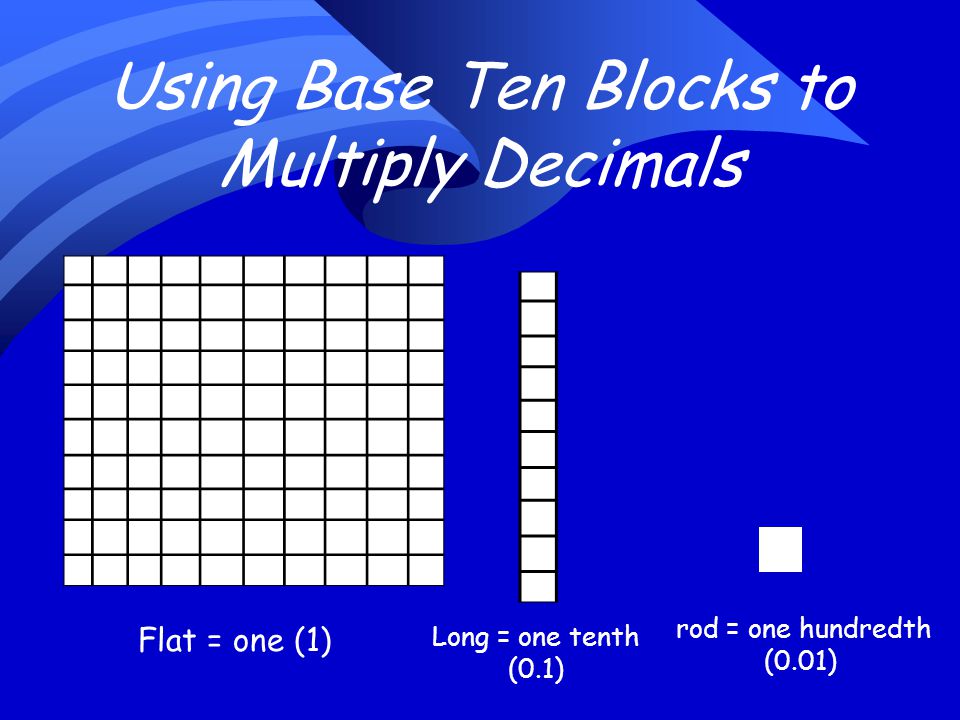
Compare the value of the ones digit to the value of the tenths digit. Then do the same with the tenths and the hundredths digits. Explain why you can use base ten blocks to model ones, tenths, and hundredths.
Answer:

a digit in one place represents one and 10 times more what it represents in the place to its right and that is tenths digit.
Similarly a digit in tenths place represents tenth and 10 times more what it represents in the place to its right and that is hundredths digit.

Each place to the left is 10 times the size of the place to the right, and base 10 blocks are the best way to model ones, tenths, and hundredths.
OPERATIONS WITH DECIMALS. Using Base Ten Blocks to Multiply Decimals Flat = one (1) Long = one tenth (0.1) rod = one hundredth (0.01) - ppt download

Think and Grow: Place Value with Decimals

Key Idea
In a place value chart, whole numbers are to the left of the decimal point. Decimals are to the right of the decimal point.
Big Ideas Math Answer Key Grade 5 Chapter 1 Place Value Concepts 1.5 2
Standard form:2.557
Word form:” Two and five hundred fifty-seven  thousandths”
Expanded form: 2 × 1 + __5__ ×\(\frac{1}{10}\)____ + 5 × \(\frac{1}{100}\) + _7_ × \(\frac{1}{1000}\)__

Show and Grow

Write the number in two other forms.
Question 1.
Standard form: 0.398
Word form:
Expanded form:

Answer:

Word form: “Three hundred ninety – eight thousandths”
Expanded form: 3 x (1/10) + 9 x (1/100) + 8 x (1/1,000)

Question 2.
Standard form:
Word form: eight and forty-six thousandths
Expanded form:
Answer:

Standard form:8.046

Expanded form: 8 x 1 + (4 /100) + (6 / 1,000)

Question 3.
Compare the values of the 5s in the number 2.557.
Answer: at first 5s place value is at tenths and next its place value is at hundredths .

Apply and Grow: Practice

Write the value of the underlined digit.
Question 4.
0.418
Answer:

4 is at tenths value place

Question 5.
5.296
Answer:

9 is at hundredths value place

Question 6.
3.806
Answer:

8 is at tenths value place

6 is at  thousandths value place

Question 7.
0.547
Answer:

7 is at thousandths value place

Write the number in two other forms.
Question 8.
Standard form:
Word form:
Expanded form: 4 × 1 + 9 × \(\frac{1}{10}\) + 8 × \(\frac{1}{1,000}\)
Answer:

Standard form: 4.908
Word form:” Four and nine hundredth – eight thousandths”

Question 9.
Standard form: 0.125
Word form:
Expanded form:
Answer:

Word form: “one hundred twenty – five thousandths”
Expanded form: 1 x (1/10) + 2 x (1 /100) +5 x (1 / 1,000)

Question 10.
Compare the values of the 4s in the number 0.844.
Answer:

at first 4s place value is at hundredths and next 4s place value is at thousandths

Question 11.
Compare the values of the 3s in the number 3.367.
Answer: at first 3s place value is at ones place and next 3s place value is at tenths place

Question 12.
A pygmy jerboa weighs one hundred thirty-two thousandths pound. Write this number in standard form.
Big Ideas Math Answer Key Grade 5 Chapter 1 Place Value Concepts 1.5 3
Answer:

The Standard Form of pygmy jerboa’s -one hundred thirty-two thousandths pound weighs is  0.132 pound

Question 13.
Reasoning
Is 9.540 equivalent to 9.54? Explain.
Answer:

Yes. 9.540 is equivalent to 9.54 because at thousandths value its 0, so zero multiplied by any number is zero.

Therefore both are equivalent.

Question 14.
DIG DEEPER!
Write three decimals that are equivalent to 6 × 1 + 4 × \(\frac{1}{10}\) .
Answer:

the three equivalent decimals are of 6 .04 are 6.040, 6.0400, 6.04000

Think and Grow: Modeling Real Life

Example
How do the values of the 3s in the masses of the fruits compare?
Big Ideas Math Answer Key Grade 5 Chapter 1 Place Value Concepts 1.5 4
Use a place value chart to help you find the value of each 3.
Big Ideas Math Answer Key Grade 5 Chapter 1 Place Value Concepts 1.5 5
The value of the 3 in the mass of the tomato is _one_____ .
The value of the 3 in the mass of the chili pepper is __tenths___.
So, the value of the 3 in the mass of the tomato is __10_____ times the value of the 3 in the mass of the chili pepper. Also, the value of the 3 in the mass of the chili pepper is ___1/10__ the value of the 3 in the mass of the tomato.

Show and Grow

Question 15.
Two baseball players have batting averages of 0.358 and 0.345. How do the values of the 5s in the batting averages compare?
Answer:

In 0.358 the place value of 5s is at tenths place and in

0.345 the place value of 5s  is at thousandths place.

Question 16.
The stopwatch shows a runner’sritethe100-meter dash time. Write the time in words.
Big Ideas Math Answer Key Grade 5 Chapter 1 Place Value Concepts 1.5 6
Answer:

15.76 seconds time in words  is Fifteen and seven tenths and six hundredths

Question 17.
DIG DEEPER!
You exchange 1 U.S. dollar for Australian dollars and 1 U.S. dollar for Kuwaiti dinars. Do you have 10 times as many Australian dollars as Kuwaiti dinars? Explain.
Big Ideas Math Answer Key Grade 5 Chapter 1 Place Value Concepts 1.5 7
Answer:

Yes, Because 1 Australian dollars = 1.302 of 0.302 of Kuwaiti dinars,

if we multiply 0.302 by 10 it becomes 1.302 which is equal to 1 Australian dollars.

[0.302 x 10 = 1.302]

so 1 Australian dollars is 10 times more than the 1  Kuwaiti dinars.

Place Value with Decimals Homework & Practice 1.5

Write the value of the underlined digit.
Question 1.
5.437
Answer:

5 at ones place

4 at tenths place

3 at hundredths place

7 at thousandths place

Question 2.
0.852
Answer:

the underlined digit is 2 at thousandths place,

its value is 2 x 1/1000= 2/1000

Question 3.
0.962
Answer:

the underlined digit is 6 at hundredths place

its value is 6 x 1/100= 6 /100

Question 4.
4.165

the underlined digit is 1 at tenths place

its value is 1x 1/10 = 1/10
Answer:

Write the number in two other forms.
Question 5.
Standard form: 9.267
Word form:
Expanded form:
Answer:

Word form:  nine and two tenths six hundredths seven thousandths.

Expanded form : 9+ 2 x 1/10 + 6 x 1/100 + 7 x 1/1000

Question 6.
Standard form:
Word form: two and forty-three thousandths
Expanded form:
Answer:

Standard form : 0.243

Expanded form: 2 x 1/10+4 x 1/100+3 x 1/1000

Question 7.
Compare the values of the 6s in the number 1.668.
Answer:

first 6s at tenths place and next 6s at hundredths place

Question 8.
Compare the values of the 7s in the number 7.704.
Answer:

first 7s at ones place and next 7s at tenths place

Question 9.
A pygmy possum weighs 0.097 pound. Write this number in word form.
Big Ideas Math Answer Key Grade 5 Chapter 1 Place Value Concepts 1.5 8
Answer:

pygmy weighs 0.097 pound and its

word form is  nine hundredths and seven thousandths

Questio 10.
Which One Doesn’t Belong?
Which one does not belong with the other three?
Big Ideas Math Answer Key Grade 5 Chapter 1 Place Value Concepts 1.5 9
Answer:

no number belongs to other three because 5 is at tenths place

one at hundredths place and 4 at thousandths all are at different places.

Question 11.
Reasoning
Which number cards are equal to the value of the underlined digit?
Big Ideas Math Answer Key Grade 5 Chapter 1 Place Value Concepts 1.5 10
Answer:

2 x 1/1,000 , two thousandths and 0.002 are equal to the value of the underlined digit.

Question 12.
Modeling Real Life
How do the values of the 5s in the heights of the plants compare?
Big Ideas Math Answer Key Grade 5 Chapter 1 Place Value Concepts 1.5 11
Answer:

In Peace lily the 5s place is at  thousandths

and in Venus flytrap the 5s place is at hundredths

Question 13.
Modeling Real Life
The world’s largest gold nugget is located in Las Vegas, Nevada. It has a mass of about 27.247 kilograms. Write how to say the nugget’s mass in words.
Big Ideas Math Answer Key Grade 5 Chapter 1 Place Value Concepts 1.5 12
Answer:

the mass of gold nugget in Las Vegas is 27.247 kilograms given

In Words form it is twenty seven and two tenths  four hundredths and  seven thousandths

Review & Refresh

Compare.
Question 14.
Big Ideas Math Answer Key Grade 5 Chapter 1 Place Value Concepts 1.5 13
Answer:

8/10 =0.8

80/100=0.8

both are equal 8/10 = 80/100

Question 15.
Big Ideas Math Answer Key Grade 5 Chapter 1 Place Value Concepts 1.5 14
Answer:

5/8 = 0.625

3/6= 0.5

0.625 > 0.5,

5/8 > 3/ 6, 5/8 is greater than 3/6

Question 16.
Big Ideas Math Answer Key Grade 5 Chapter 1 Place Value Concepts 1.5 15

Answer:

7/2= 3.5

10/8=1.25

so 7/2 is greater than 10/8.

7/2 > 10/8

Lesson 1.6 Compare Decimals

Explore and Grow

Use models to compare the decimals.
Big Ideas Math Answers 5th Grade Chapter 1 Place Value Concepts 1.6 1
Answer:

0.62 >0.26, 0.62 is greater than 0.26, 0.6  is greater than o.2

0.80= 0.8, 0.80 both are  equal

3.5 < 3.55, 3.55 is greater than 3.50

Reasoning
How can you use a place value chart to compare two decimals? Use a place value chart to check your answers above.
Answer:

we use another table to compare with the previous and write the answer.

Think and Grow: Compare Decimals

Example
Compare 3.769 and 3.749.
Use a place value chart. Start at the left. Compare the digits in each place until the digits differ.
Big Ideas Math Answers 5th Grade Chapter 1 Place Value Concepts 1.6 2
The digits in the ones place and the tenths place are the same. Compare the hundredths.
Big Ideas Math Answers 5th Grade Chapter 1 Place Value Concepts 1.6 3

Example
Compare 2.4 and 2.405.
Use place value. Line up the decimal points. Start at the left. Compare the digits in each place until the digits differ.
Big Ideas Math Answers 5th Grade Chapter 1 Place Value Concepts 1.6 4

2.4<2.405

Show and Grow

Compare
Question 1.
Big Ideas Math Answers 5th Grade Chapter 1 Place Value Concepts 1.6 5
Answer:

Ones.TenthsHundredthsThousandths
9.063
9.067
Same.SameSameGreater

So 9.063 < 9.067

Question 2.
Big Ideas Math Answers 5th Grade Chapter 1 Place Value Concepts 1.6 6
Answer:

Ones.TenthsHundredthsThousandths
0.890
0.809
Same.SameGreaterGreater

So 0.89 > 0.809,

Apply and Grow: Practice
Compare.
Question 3.
Big Ideas Math Answers 5th Grade Chapter 1 Place Value Concepts 1.6 7
Answer:

Ones.TenthsHundredthsThousandths
8.537
8.541
Same.SameGreaterGreater

8.537 < 8.541

Question 4.
Big Ideas Math Answers 5th Grade Chapter 1 Place Value Concepts 1.6 8
Answer:

6.401 < 6.409, since  0.009 is greater than 0.001

Question 5.
Big Ideas Math Answers 5th Grade Chapter 1 Place Value Concepts 1.6 9
Answer:

7.409 > 7.049 since 7.4 is greater than 7.0

Question 6.
Big Ideas Math Answers 5th Grade Chapter 1 Place Value Concepts 1.6 10
Answer:

0.25 = 0.250

Both are equal

Question 7.
Big Ideas Math Answers 5th Grade Chapter 1 Place Value Concepts 1.6 11
Answer:

2.701 >2.700, since 0.001 is greater than 0.000

Question 8.
Big Ideas Math Answers 5th Grade Chapter 1 Place Value Concepts 1.6 12
Answer:

4.006 < 4.61, since 4.6 is greater than 4.0

Question 9.
Big Ideas Math Answers 5th Grade Chapter 1 Place Value Concepts 1.6 13
Answer:

0.041 < 41.6, 41 is greater than 0

Question 10.
Big Ideas Math Answers 5th Grade Chapter 1 Place Value Concepts 1.6 14
Answer:

0.007 < 0.7 as 0.7 is greater than 0.007

Order the decimals from least to greatest.
Question 11.
321.499, 325.499, 321.489
Answer:

321.499, 325.499, 321.489 from least to greatest

as 321.489 is smaller than 321.499 and 321.499 is smaller than 325.499

so 321.489 , 321.499 , 325.499

Question 12.
9.7, 9.64, 9.78
Answer:

9.7, 9.64, 9.78 from least to greatest

9.64 is smaller than 9.7 and  9.7 is smaller than 9.78

so 9.64, 9.7 , 9.78

Open-Ended
Complete the number to make the statement true.
Question 13.
Big Ideas Math Answers 5th Grade Chapter 1 Place Value Concepts 1.6 15
Answer:

10.321 > 10.311

as 10.311 is smaller than 10.321

Question 16.
Big Ideas Math Answers 5th Grade Chapter 1 Place Value Concepts 1.6 16
Answer:

28.60 = 28.600

Both are equal

Question 15.
Number Sense
Is 0.472 greater than or less than \(\frac{47}{1,000}\)? Explain.
Answer:

0.472, 0.047

0.475 is greater than 0.047,

as 4 in the tenths  place is greater than 0 in the others tenth place

Question 16.
YOU BE THE TEACHER
Your friend says that 45.6 is less than 45.57 because 6 is less than 57. Is your friend correct? Explain.
Answer:

Friend says 45.6 is less than 45.57

No ,he is wrong as the 6th in tenths place is greater than 5, in the tenths place

so he is wrong  45.60 > 45.57 not less

Think and Grow: Modeling Real Life

Example
You, your friend, and your cousin compete at a gymnastics competition. Your floor routine score is 15.633. Your friend’s score is 15.533, and your cousin’s score is 15.635. Order the scores from least to greatest.
Big Ideas Math Answers 5th Grade Chapter 1 Place Value Concepts 1.6 17
Use a place value chart. Compare the digits in each place until the digits differ.
Big Ideas Math Answers 5th Grade Chapter 1 Place Value Concepts 1.6 18
_15.533______ is the least
Write the remaining numbers in the place value chart. Compare the digits in each place until the digits differ.
Big Ideas Math Answers 5th Grade Chapter 1 Place Value Concepts 1.6 19

15.633 ,15.635

as 15.533 is less than 15.633 as  5 at tenths place is less than 6 at tenths place

and 15.633 is less than 15.653 as 3 at hundredths place is less than 5 at hundredths place

So, the scores from least to greatest are 15.533, 15.633 and 15.635

Show and Grow

Question 17.
You stand on one leg for 2.75 minutes, your friend stands on one leg for 2 minutes, and your cousin stands on one leg for 2.25 minutes. Order the amounts of time from least to greatest.
Answer:

You – 2.75 min , Friend – 2.00 min and cousin for 2.25 min

2.00< 2.25 ,2.00 is less than 2.25 as 0 at tenths place is less than 2 at tenths place

2.25 < 2.75, 2.25 is less than 2.75 as 2 at tenths place is less than 7 at tenths place

so From Least to Greatest : 2.00 min, 2.25 min, 2.75 min

Question 18.
DIG DEEPER!
You, Newton, Descartes, and your friend each have a tablet. The table shows the screen display sizes. Your friend’s tablet has the greatest display size. Your tablet’s display size is greater than Newton’s but less than Descartes’s. What is the display size of your tablet.
Big Ideas Math Answers 5th Grade Chapter 1 Place Value Concepts 1.6 20
Answer:

Y-Your, N-Newton’s ,F-Friend- 12.9, D-Descartes

Given Friend has greatest display size F= 12.9

Y – N ,given Your tablet’s display size is greater than Newton’s, N< Y and yours is less than Descartes’s Y < D

therefore  N < Y <D < F, Newton’s< Yours<Descartes’s<Friend

so N-Newton’s- 7.9, Y-Your-9.7,D-Descartes-10.5,F-Friend-12.9

Compare Decimals Homework & Practice 1.6

Write which place to use when comparing the numbers.
Question 1.
0.521
0.576
Answer:

2 at hundredths place  is smaller than 7 at hundredths place

so 0.521 < 0.576

Question 2.
17.422
17.946
Answer:

4 at tenths place  is small than 9 at tenths place

so 17.422 < 17.946

Question 3.
9.678
9.67
Answer:

8 at thousandths place is greater than 0 at thousandths place

9.678 > 9.670

Compare.
Question 4.
Big Ideas Math Answers 5th Grade Chapter 1 Place Value Concepts 1.6 21
Answer:

4 at hundredths  place is smaller than 7 at hundredths place

so 3.445 is smaller than 3.472

3.445 < 3.472

Question 5.
Big Ideas Math Answers 5th Grade Chapter 1 Place Value Concepts 1.6 22

Answer:

0 at tenths place is smaller than 4 at tenths place

so 23.049 < 23.409

Question 6.
Big Ideas Math Answers 5th Grade Chapter 1 Place Value Concepts 1.6 23
Answer:

4 at tenths place is greater than 3 at tenths place

75.4 > 75.391

Question 7.
Big Ideas Math Answers 5th Grade Chapter 1 Place Value Concepts 1.6 24
Answer:

All  given place values are same

so 14.100 or 14.10 = 14.100

Question 8.
Big Ideas Math Answers 5th Grade Chapter 1 Place Value Concepts 1.6 25
Answer:

the value of 5s at hundredths place is more than 0 in other hundredths place

4.05> 4.005

Question 9.
Big Ideas Math Answers 5th Grade Chapter 1 Place Value Concepts 1.6 26
Answer:

15.2, 15.002

2 at tenths place is greater than 0 at tenths place

15.2 > 15.002

Question 10.
Big Ideas Math Answers 5th Grade Chapter 1 Place Value Concepts 1.6 27
Answer:

0.021, 0.026

1 at thousandths is smaller than 6 at thousandths place

0.021 < 0.026

Order the decimals from least to greatest.
Question 11.
2.75, 0.2, 0.275
Answer:

0.2 < 0.275 as 0 at hundredths place is less than 7 at hundredths place

0.275<2.75 as 0 at ones place is less than 2 at at ones place

so from least to greatest 0.2, 0.275, 2.75

Question 12.
56.01, 56.1, 56.001
Answer:

56.001 < 56.01 as 0 at hundredths place is less than 1 at hundredths place

56.01 < 56.1 as o at tenths place is less than 1 at tenths place

56.001 , 56.01, 56.1

Open-Ended
Complete the number to make the statement true.
Question 13.
Big Ideas Math Answers 5th Grade Chapter 1 Place Value Concepts 1.6 28
Answer:

29.030 = 29.030

both the place values are same

Question 14.
Big Ideas Math Answers 5th Grade Chapter 1 Place Value Concepts 1.6 29
Answer:

3.562 <3.562

as the value of  6 is at hundredths place so the other value at hundredths place is 6.

Question 15.
YOU BE THE TEACHER
Newton says 8.51 is less than 8.492 because 8.51 has fewer digits after the decimal point than 8.492. Is he correct? Explain.
Answer:

No, he is not correct its not the digits after the decimal point is fewer

but the 5s at tenths place is greater than 4 at the tenths place so

8.51 is greater than 8.492, 8.51 > 8.492

Question 16.
Open-Ended
Descartes is thinking of a number less than 46.922 and greater than 46.915. What could Descartes’s number be?
Answer:

The numbers can be 46.916,  4 6.917, 46.918, 46.919, 46.920 or 46.921 and

all these numbers are less than 46.922 and greater than 46.915.

Question 17.
Modeling Real Life
Player A’s batting average is 0.300, Player B’s batting average is 0.333, and Player C’s batting average is 0.313. Order the batting averages from greatest to least.
Answer:

B- 0.333, C-0.313 , A – 0.300

0.333 is great than 0.313 as 3 at hundredths place is great than 1 at hundredths place

so 0.333>0.313

0.313 is greater than 0.300 as 1 at hundredths place is great than 0 at hundredths place

0.313 > 0.300

the batting averages from greatest to least are B> C> A=0.333 > 0.313 >0.300

batting averages from greatest to least 0.333,0.313,0.300

Question 18.
Modeling Real Life
A gasoline station customer pumps more than 9.487 gallons of gasoline but less than 10 gallons. Which display could be his?
Big Ideas Math Answers 5th Grade Chapter 1 Place Value Concepts 1.6 30
Answer:

Given A gasoline station customer pumps more than 9.487 gallons but less than 10 gallons

as 9.003 is less than 9.487 so not 9.003

as 9.499 is greater than 9.487  and even less than 10.000 so it is 9.499

as 9.406 is less than 9.487 so it cannot be 9.406

as 9.872 is greater than 9.487  and even less than 10.000 so it can be 9.872

so the displays can be  9.499 or 9.82

as both are more than 9.487 gallons and less than 10 gallons

Review & Refresh

Round the number to the place of the underlined digit.
Question 19.
7,851
Answer:

the round place of 5 is 7,850

Question 20.
9,462
Answer:

the round place of 9 means 10,000 or 9,500

Question 21.
4,983
Answer:

the round place of 9 – 5,000

Question 22.
51,504
Answer:

the round place of 1- 52,504

Lesson 1.7 Round Decimals

Explore and Grow

Plot the numbers on the number line. Which numbers round to 3? Which numbers round to4? How do you know?
Big Ideas Math Answers Grade 5 Chapter 1 Place Value Concepts 1.7 1
Answer:

3,  3.09, 3.5, 3.51, 3.6, 3.77, 3.9 , 4

The numbers round to 3 are 3.09

The numbers round to 4 are 3.51, 3.6, 3.77 , 3.9

Repeated Reasoning
Show how you can use a number line to round 3.09, 3.51, and 3.77 to the nearest tenth.
Answer:

3.09 to the nearest tenth is 3.10

3.51 to the nearest tenth is 3.50

3.77 to the nearest tenth is 3.80

Think and Grow: Round Decimal Number

Example
Use a number line to round 7.36 to the nearest tenth.
Big Ideas Math Answers Grade 5 Chapter 1 Place Value Concepts 1.7 2
7.36 is closer to 7.4 than it is to 7.3.
So, 7.36 rounded to the nearest tenth is __7.40____.

Example
Use place value to round 2.185 to the nearest whole number and to the nearest hundredth.
Big Ideas Math Answers Grade 5 Chapter 1 Place Value Concepts 1.7 3
So, 2.185 rounded to the nearest whole number is __2.2_____.
2.185 rounded to the nearest hundredth is ___2.200___.

Show and Grow

Round the number to the place of the underlined digit.
Question 1.
12.67
Answer:

the round place of  digit 6 is 12.70

Question 2.
0.439
Answer:

the round place of  digit 4 is 0.5

the round place of  digit 3 is 0.44

the round place of digit  9 is 0.440

Question 3.
2.555
Answer:

the round place of  digit 2 is 3.000

Question 4.
5.409

the round place of digit 4 is 5.400

Question 5.
Round 0.68 to the nearest tenth.
Answer:

0.68 to the nearest tenth  is 0.70, 6 at tenths place becomes 7

Question 6.
Round 1.715 to the nearest hundredth.
Answer:

1.715 to the nearest hundredth is  1.720, 1 at hundredths place becomes 2

Question 7.
Round 4.07 to the nearest whole number.
Answer:

4.07 to the nearest whole number becomes  4.00 or 4

Question 8.
Round 0.289 to the nearest tenth.
Answer:

0.289 to the nearest tenth is 0.300 as 2 becomes 3 at tenths place.

Apply and Grow: Practice

Round the number to the place of the underlined digit.
Question 9.
1.482
Answer:

the underlined digit is 8 ,so its value becomes 1.490

Question 10.
5.093
Answer:

the underlined digit is 0 so its value  becomes 5.100

Question 11.
8.502
Answer:

the underlined digit is 8 so its value becomes 9.000

Question 12.
34.748
Answer:

if it is underlined at 3 it becomes 35.000

if it is underlined at 4 it becomes 35.000

if it is underlined at 7 it becomes 35.000

if it is underlined at 4 it becomes 34.800

if it is underlined at 8 it becomes 34.750

Question 13.
Round 2.619 to the nearest whole number.
Answer:

the value of 2.619 becomes 3.000

Question 14.
Round 7.825 to the nearest tenth.
Answer:

the value of 7.825 to the nearest tenth is 7.900

Question 15.
Round 92.701 to the nearest ten.
Answer:

the value of 92.701 to the nearest ten 93.000

Question 16.
Round 4.263 to the nearest hundredth.
Answer:

the value of 4.263 to the nearest hundredth is 4.270

Question 17.
Round 0.829.
Nearest whole number:
Nearest tenth:
Nearest hundredth:
Answer:

Round 0.829
Nearest whole number:0.900
Nearest tenth:0.830
Nearest hundredth:0.830

Question 18.
Round 18.062.
Nearest whole number:18.100
Nearest tenth:18.070
Nearest hundredth:18.063
Answer:

Question 19.
A baby harp seal weighs 25.482 pounds. Round this weight to the nearest tenth of a pound.
Big Ideas Math Answers Grade 5 Chapter 1 Place Value Concepts 1.7 4
Answer:

Given a baby harp seal weighs 25.482 pounds and the nearest tenth is 25.000 pounds

So the weight of baby harp seal is 25.000 pounds.

Name the place value to which the number was rounded.
Question 20.
8.942 to 8.94
Answer:

It was rounded at hundredths value place

Question 21.
0.164 to 0.2
Answer:

It was rounded at tenths value place

Question 22.
15.826 to 16
Answer:

It was rounded at whole value place

Question 23.
Writing
Explain what happens when you round 2.999 to the nearest tenth.
Answer:

2.999 round value becomes 3.000 as all value places at tenths, hundredths, thousandths are 9 it becomes increased as we move so it ones value increases by 1 and becomes round 3.000.

Question 24.
DIG DEEPER!
To what place should you round 23.459 to get the greatest number? the least number? Explain.
Answer:

To make 23.459 to  greatest number the value of 4s at tenths  becomes 5,

23.500 and to make 23.500 round make 5 at tenths value increased and make ones value 3 as 4 so we get 24.000

and to make 23.459 to least number the value at hundredths 5 becomes 0 ,

23.400  and to make 23.400 round make 4 at tenths value as decreased to 0 and ones value same as 3 it becomes as 23.000

Think and Grow: Modeling Real Life

Example
Gasoline prices are listed to the nearest thousandth of a dollar. The final price is rounded to the nearest hundredth. About how much does a customer pay for 1 gallon of regular gasoline at the station shown?
Big Ideas Math Answers Grade 5 Chapter 1 Place Value Concepts 1.7 5
Think: What do you know? What do you need to find? How will you solve?
Use place value to round the price of 1 gallon of regular gasoline, $2.799, to the nearest hundredth.
Big Ideas Math Answers Grade 5 Chapter 1 Place Value Concepts 1.7 6
So, a customer will pay about $ ___$ 2.800____ for 1 gallon of gasoline.

Show and Grow

Use the table.
Big Ideas Math Answers Grade 5 Chapter 1 Place Value Concepts 1.7 7
Question 25.
What is the length of the praying mantis rounded to the nearest hundredth?
Answer:

Given  praying mantis as 3.254 so the  nearest hundredth becomes 3.26

Praying mantis becomes 3.260

Question 26.
What is the length of the cicada rounded to the nearest tenth?
Answer:

Given cicada 1.48 so rounded to the nearest tenth becomes 1.50

Cicada becomes 1.50

Question 27.
What is the length of the hissing cockroach rounded to the nearest tenth?
Answer:

Given Hissing cockroach 2.682 so rounded to the nearest tenth is 2.700

Hissing cockroach becomes 2.700

Question 28.
DIG DEEPER!
You have about $3 in coins. Write one possible combination of coins that represents the least amount of money you could have. Write another combination of coins for the greatest amount of money you could have.
Answer:

$3 Least amount of money combinations – 1. $ 1.0, $1.0    2.$ 1.0, $1.5

3.$0.5, $ 2.0 all combinations becomes less than $3

$ 3 greatest amount of money combinations- 1. $1.0, $ 2.5   2.$1.5 ,$2.0

3. $2.0 , $ 2.0 all combinations becomes more than $3

Round Decimals Homework & Practice 1.7

Round the number to the place of the underlined digit.
Question 1.
49.012
Answer:

the underline digit is 4 its round number 4 becomes 5 so it is 50.000

Question 2.
2.308
Answer:

the underline digit is 2  its round number 2 becomes as 2.000

Question 3.
9.647
Answer:

the underline digit is 6 its round number 6 becomes 7 so it is 9.700

Question 4.
7.519
Answer:

the underline digit is 1 its round number 1 becomes  2 so it is 7.520

Question 5.
Round 8.436 to the nearest hundredth.
Answer:

8.436 to the nearest hundredth, 3 becomes 4 so it is 8.440

Question 6.
Round 15.159 to the nearest ten.
Answer:

15.159 to the nearest ten ,1 becomes 2 so it is 15.200

Question 7.
Round 1.602 to the nearest whole number.
Answer:

1.602 to the nearest whole number is 2.0

Question 8.
Round 3.619 to the nearest tenth.
Answer:

3.619 to the nearest tenth, so 6 becomes 7 it is 3.700

Question 9.
Round 4.183.
Nearest whole number:
Nearest tenth:
Nearest hundredth:
Answer:

Round 4.183.
Nearest whole number:4.000
Nearest tenth:4.200
Nearest hundredth:4.200

Question 10.
Round 9.076.
Nearest whole number:
Nearest tenth:
Nearest hundredth:
Answer:

Round 9.076.
Nearest whole number:9.000
Nearest tenth:9.100
Nearest hundredth:9.080

Name the place value to which each number was rounded.
Question 11.
16.932 to 20
Answer:

16.932 at Tens value it is rounded  so it becomes 20

Question 12.
0.581 to 0.58
Answer:

0.581 to 0.58

0.581 at Thousandths value has been rounded so 0.58

Question 13.
7.429 to 7.4
Answer:

7.429 to 7.4

7.429 at Hundredths value has been rounded so 7.4

Question 14.
Structure
Round ★ to the nearest tenth.
Big Ideas Math Answers Grade 5 Chapter 1 Place Value Concepts 1.7 8
Answer:

the nearest tenth * in the number line is showing at 5.64

Question 15.
Precision
The area of a campground is exactly halfway between 25.9 acres and 26 acres. What is the area of the campground?
Answer:

Halfway of 25.9 and 26.0 is 25.90+25.60=51.50/2 = 25.75 acres

So the area of the campground is 25.75 acres.

Question 16.
Open-Ended
Name two different numbers that round to 3.8 when rounded to the nearest tenth.
Answer:

The two numbers that are round to 3.8 when rounded to the nearest tenth place the value becomes 4.0 and  3.90

Question 17.
Open-Ended
Name two different numbers that round to 7.42 when rounded to the nearest hundredth.
Answer:

The two numbers that round to 7.42 when rounded to the nearest hundredth place the value becomes 7.50 and 7.40

Use the table.
Big Ideas Math Answers Grade 5 Chapter 1 Place Value Concepts 1.7 9
Question 18.
Modeling Real Life
Your science class designs and tests four model boats to find out how much weight they can hold without sinking. What is the greatest weight rounded to the nearest tenth that a boat can hold?
Answer:

Given weights held without sinking in kilograms are

0.694,0.605,0.592,0.547 among all the weights the greatest weight rounded to the nearest tenth that a boat can hold is (0.694) i.e  0.7 kilograms

Question 19.
Modeling Real Life
What is the least weight rounded to the nearest hundredth that a boat can hold?
Answer:

The least weight rounded to the nearest hundredth is (0.547)- o.5 kilograms a boat can hold

Review & Refresh

Find the product.
Question 20.
7 × 40
Answer:

The product of 7 X 40 = 280

Question 21.
5,000 × 9
Answer:

The product of 5,000 x 9 = 45,000

Question 22.
8 × 200
Answer:

The product of 8 x 200=1,600

Place Value Concepts Performance Task

There are 18 species of penguins. Scientists have estimated the populations of 16 penguin species.
Question 1.
What fraction of penguin species have unknown populations?
Answer:

Given total is 18 species of penguins out of which Scientists have estimated the populations of 16 penguin species. so unknown is 18-16/18=2/18,

so 2/18=1/9 of penguin species have unknown populations

Question 2.
Several species of penguins and their estimated populations and locations are shown.
Big Ideas Math Solutions Grade 5 Chapter 1 Place Value Concepts 1
a. Are there more emperor penguins or rockhopper penguins? Explain.
b. Which species of penguin has the greatest population? Explain.
c. About how many penguins live in Antarctica? Round your answer to the nearest hundred thousand.
Big Ideas Math Solutions Grade 5 Chapter 1 Place Value Concepts 2
d. The Galápagos penguin is an endangered species. There are about 1,000 times as many macaroni penguins as Galápagos penguins. About how many Galápagos penguins are there?
Answer:

a. Rock hopper penguins are more than Emperor

2,460,000>595,000 as  2,460,000 is greater than 595,000 so Rock hopper penguins are more

B. Macaroni species 18 x 106 of penguin has the greatest population as compared to Emperor 595,000,Adelie 4,000,000+7,00,000+40,000=4,740,000 and

Rockhopper-2,460,000

among all the species Macaroni 18 x 106– species is more.

C. Macaroni + Adelie + Rockhopper +Emperor

18,000,000+4,740,000+ 2,460,000 + 595,000 = 25,795,000

25,785,000  to the nearest hundred thousand is 26,000,000

So there are almost 26,000,000 penguins live in Antarctica.

d. 1,000 times as many macaroni penguins as Galápagos penguins is

18 x 106  x 1 x 1000 = 18 x 109 

So there are 18 x 109 Galápagos penguins available

Place Value Concepts Activity

Place Value Plug In
Directions:
1. Players take turns.
2. On your turn, roll six dice. Arrange the dice into a six-digit number that matches one of the descriptions.
3. Write your number on the lines.
4. The first player to fill in all of the numbers wins!
Big Ideas Math Solutions Grade 5 Chapter 1 Place Value Concepts 3
Answer:

Place Value Concepts Chapter Practice

1.1 Place Value Patterns

Use a place value chart to answer the question.
Question 1.
What number is 10 times as great as 4,000?
Answer:

10 times as great as 4,000 is 10 x 4,000= 40,000

Question 2.
What number is \(\frac{1}{10}\) of 8,000?
Answer:

\(\frac{1}{10}\) of 8,000 is 8,000/10 = 800

Question 3.
10,000 is 10 times as great as what number?
Answer:

10,000 is 10 times as great as 1,000

Question 4.
70 is \(\frac{1}{10}\) of what number?
Answer:

70 is \(\frac{1}{10}\) of 700

Question 5.
Complete the table.
Big Ideas Math Solutions Grade 5 Chapter 1 Place Value Concepts chp 5
Answer:

300 is 10 times as great as 30  and 30 x 1/10 is 3

6,000 is 10 times as great as 600 and 600 x 1/10  is 60

90,000 is 10 times as great as 9,000 and 9,000 x 1/10 is 900

2,00,000 is 10 times as great as 20,000 and 20,000 x 1/10=2,000

Question 6.
YOU BE THE TEACHER
Your friend says 500 is 10 times as great as 5,000. Is your friend correct? Explain.
Answer:

No, My friend is wrong because  500 is not 10 times great as 5,000,

500 < 5,000.

1.2 Place Value with Whole Numbers

Question 7.
Write the number in two other forms.
Standard form: 456,701
Word form:
Expanded form:
Answer:

Word form: Four hundred fifty six thousand, seven hundred and one
Expanded form:4 x 100000 + 5 x 10000 + 6 x 1000 + 7 x 100 + 1

Question 8.
Write the number in two other forms.
Standard form:
Word form: Eight million, sixty thousand, five hundred seventy-three
Expanded form:
Answer:

Standard form:8,060,573
Expanded form:8 x 1000000+6 x 10000 + 5 x 100 + 7 x 10 + 3

Question 9.
Compare the values of the 4s in the number 900,441,358.
Answer:

4s value is at lakh or hundred thousandths place and another 4s place is at ten thousandths place.

Question 10.
Write the values of the 6s in the number 96,672.
Answer:

The values of the 6s in the number 96,672 are

6s place is at thousand and another 6s is at hundreds place

Compare.
Question 11.
Big Ideas Math Solutions Grade 5 Chapter 1 Place Value Concepts chp 11
Answer:

83,802 > 83,082

The value at hundred 8 is more/great to 0 at hundreds place

Question 12.
Big Ideas Math Solutions Grade 5 Chapter 1 Place Value Concepts chp 12
Answer:

2,498,576 > 2,477,583

The value at 9 at ten thousands place is more/great than 7 at ten thousands place

1.3 Patterns and Powers of 10

Question 13.
Write 10 × 10 as a power.
Answer:

10 × 10 as a power is 102

Find each product. Use patterns to help.
Question 14.
4 × 10 = _____
4 × 100 = ______
4 × 1,000 = _____
4 × 10,000 = ______
Answer:

4 × 10 = 40
4 × 100 = 400
4 × 1,000 = 4,000
4 × 10,000 =40,000

Question 15.
3 × 10 = _____
3 × 100 = ______
3 × 1,000 = _____
3 × 10,000 = ______
Answer:

3 × 10 = 30
3 × 100 = 300
3 × 1,000 = 3,000
3 × 10,000 = 30,000

Question 16.
7 × 10 = _____
7 × 100 = ______
7 × 1,000 = _____
7 × 10,000 = ______
Answer:

7 × 10 = 70
7 × 100 = 700
7 × 1,000 = 7,000
7 × 10,000 = 70,000

Find the value of the expression.
Question 17.
105
Answer:

105=1,00,000

Question 18.
8 × 101
Answer:

8 × 101= 8 x 10 = 80

Question 19.
7 × 10⁴
Answer:

7 × 104 = 7 x  10 x 10 x 10 x 10= 70,000

Question 20.
3 × 10⁵
Answer:

3 × 105 = 3 X 10 X 10 X 10 X 10 X 10=3,00,000

Rewrite the number as a whole number multiplied by a power of 10.
Question 21.
5,000
Answer:

5,000= 5 X 10³

Question 22.
600,000
Answer:

6,00,000= 6 X 10⁵

Question 23.
90
Answer:

90= 90 X 101

1.4 Decimals to Thousandths

Write the decimal as a fraction.
Question 24.
0.062
Answer:

0.062= 62 X 1/1,000

Question 25.
0.008
Answer:

0.008= 8 X 1/1,000

Question 26.
0.195
Answer:

0.195= 195 X 1/1,000

Write the fraction as a decimal.
Question 27.
\(\frac{2}{1,000}\)
Answer:

\(\frac{2}{1,000}\) = 2 x 1/1,000= 0.002

Question 28.
\(\frac{37}{1,000}\)
Answer:

\(\frac{37}{1,000}\) = 37 x 1/1,000= 0.037

Question 29.
\(\frac{409}{1,000}\)
Answer:

\(\frac{409}{1,000}\)= 409/1,000=0.409

Question 30.
0.0.7 is 10 times as great as what number?
Answer:

0.07 is 10 times great as 0.007

Question 31.
0.04 is \(\frac{1}{10}\) of what number?
Answer:

0.04 is \(\frac{1}{10}\) of 0.4

1.5 Place Value with Decimals

Write the number in two other forms.
Question 32.
Standard form:
Word form:
Expanded form: 5 × 1 + 3 × \(\frac{1}{10}\) + 8 × \(\frac{1}{100}\) + 4 × \(\frac{1}{1,000}\)
Answer:

Standard form:5+0.3+0.08+0.004=5.384
Word form: five and three tenths, eight hundredths and 4 thousandths

Question 33.
Standard form: 2.059
Word form:
Expanded form:
Answer:

Word form: two and five hundredths and nine thousandths

Expanded form: 2 x 1 + 5 x 1/100 + 9 x 1/1000

Question 34.
Compare the values of the 5s in the number 1.055.
Answer:

5s value is at hundredths and another 5s value is at thousandths place

Question 35.
Compare the values of the 8s in the number 6.884.
Answer:

8s place value is at tenths value and other 8s place value is at hundredths place

1.6 Compare Decimals

Compare.
Question 36.
Big Ideas Math Solutions Grade 5 Chapter 1 Place Value Concepts chp 36
Answer:

15.891 > 15.791

the 8 value at tenths place is greater than 7 at tenths place

Question 37.
Big Ideas Math Solutions Grade 5 Chapter 1 Place Value Concepts chp 37
Answer:

8.205 < 8.250

the 0 at hundredths is less than 5 at hundredths

Question 38.
Big Ideas Math Solutions Grade 5 Chapter 1 Place Value Concepts chp 38

Answer:

Both are same

3.600 = 3.6

Order the decimals from least to greatest.
Question 39.
7.008, 7.09, 7.180
Answer:

7.008<7.09

7.09 <7.18

so the decimals from least to greatest are 7.008 , 7.09, 7.180

Question 40.
50.426, 50.42, 50
Answer:

50 < 50.42

50.42 < 50.426

so the decimals from least to greatest are 50, 50.42, 5.0426

Question 41.
Modeling Real Life
Newton weighs a treat at the pet store. He says it weighs less than 0.519 ounce but more than 0.453 ounce. Which treats could he have weighed?
Big Ideas Math Solutions Grade 5 Chapter 1 Place Value Concepts chp 41
Answer:

Newton says it weighs less than 0.519 ounce  but more than 0.453 ounce,

so Blue berry waffle 0.512 which is in between 0.453<0.512<0.519

and We have more than 0.453 is 0.459 ounce which is Peanut butter and is less than 0.519 ounce

So Peanut butter 0.453 is in between 0.453<0.459<0.519

so newton would have weighed Peanut butter 0.459 ounce

and it can be even Blueberry  waffle 0.512  ounce

newton’s treats could be Peanut butter ,Blueberry waffle

1.7 Round Decimals

Round the number to the place of the underlined digit.
Question 42.
9.514
Answer:

if 9 is digit then it is rounded as 9.0

if 5 then  it is rounded as 9.500

if 1 then it is rounded as 9.520

if  4 then it is rounded as 9.520,9.510

Question 43.
1.027
Answer:

1.027 at 2 it is rounded as 1.03

Question 44.
8.469
Answer:

8.469, 8 is rounded as 8.500 or 8 or 8.000

Question 45.
32.501
Answer:

in 32.501

3 is rounded as  30.000

2- 33.000

5- 32.6 or 33

0-32.5

1 -32.500

Question 46.
Round 0.176 to the nearest
Answer:

0.200

Question 47.
Round 6.538 to the nearest tenth. hundredth.
Answer:

6.500 

Question 48.
Round 7.425.
Nearest whole number:
Nearest tenth:
Nearest hundredth:
Answer:

Nearest whole number:8.000, 8
Nearest tenth:7.500
Nearest hundredth:7.430

Question 49.
Round 2.108.
Nearest whole number:
Nearest tenth:
Nearest hundredth:
Answer:

Nearest whole number:2.000, 2
Nearest tenth:2.100
Nearest hundredth:2.100

Final Words:

It is very important for the students to understand and learn the fundamentals at the primary level itself. Here we have prepared the questions as per the latest edition 2019. Keep the textbook aside and try to solve the problems by referring to our Big Ideas Math Answers Grade 5 Chapter 1 Place Value Concepts. To make you comfortable we have provided the solution key for Big Ideas Math Grade 5 Chapter 1 Place Value Concepts in the pdf format. Stay tuned to our CCSS Math Answers to get the latest updates of BIM Grade 5 Chapters.

Big Ideas Math Answers Grade 5 Chapter 14 Classify Two-Dimensional Shapes

Big Ideas Math Answers Grade 5 Chapter 14 Classify Two-Dimensional Shapes pdf is available here. So, the students who are in search of Big Ideas Math Book 5th Grade Answer Key Chapter 14 Classify Two-Dimensional Shapes can get them on this page. Go through the Big Ideas Math Answers Grade 5 Chapter 14 Classify Two-Dimensional Shapes and improve your performance skills. Test your skills by solving the Performance Task, Activity, Chapter Practice which is provided at the end of the chapter.

Big Ideas Math Book 5th Grade Answer Key Chapter 14 Classify Two-Dimensional Shapes

Big Ideas Math Answers 5th Grade Chapter 14 Classify Two-Dimensional Shapes are very easy to understand. You can quickly grasp the mathematical practices with the help of Big Ideas Math Answer Key Grade 5 Chapter 14 Classify Two-Dimensional Shapes. The topics covered in this chapter are Classify Triangles, Quadrilaterals, Relate Quadrilaterals. Just hit the below-provided links and Download Big Ideas Math Book 5th Grade Answer Key Chapter 14 Classify Two-Dimensional Shapes.

Lesson: 1 Classify Triangles

Lesson: 2 Classify Quadrilaterals

Lesson: 3 Relate Quadrilaterals

Classify Two-Dimensional Shapes

Lesson 14.1 Classify Triangles

Explore and Grow

Draw and label a triangle for each description. If a triangle cannot be drawn, explain why.
Big Ideas Math Answers Grade 5 Chapter 14 Classify Two-Dimensional Shapes 1

Precision
Draw a triangle that meets two of the descriptions above.

Answer:
Big-Ideas-Math-Answers-Grade-5-Chapter-14-Classify-Two-Dimensional-Shapes-1

Think and Grow: Classify Triangles

Key Idea
Triangles can be classified by their sides.

Big Ideas Math Answer Key Grade 5 Chapter 14 Classify Two-Dimensional Shapes 2
An equilateral triangle has three sides with the same length.
Big Ideas Math Answer Key Grade 5 Chapter 14 Classify Two-Dimensional Shapes 3
An isosceles triangle has two sides with the same length.
Big Ideas Math Answer Key Grade 5 Chapter 14 Classify Two-Dimensional Shapes 4
A scalene triangle has no sides with the same length.
Big Ideas Math Answer Key Grade 5 Chapter 14 Classify Two-Dimensional Shapes 5

Key Idea
Triangles can be classified by their angles.
Big Ideas Math Answer Key Grade 5 Chapter 14 Classify Two-Dimensional Shapes 6
An acute triangle has three acute angles.
Big Ideas Math Answer Key Grade 5 Chapter 14 Classify Two-Dimensional Shapes 7
An obtuse triangle has one obtuse angle.
Big Ideas Math Answer Key Grade 5 Chapter 14 Classify Two-Dimensional Shapes 8
A right triangle has one right angle.
Big Ideas Math Answer Key Grade 5 Chapter 14 Classify Two-Dimensional Shapes 9
An equiangular triangle has three angles with the same measure.
Example
Classify the triangle by its angles and its sides.
Big Ideas Math Answer Key Grade 5 Chapter 14 Classify Two-Dimensional Shapes 10
The triangle has one ___ angle
and ___ sides with the same length.
So, it is a ___ triangle.

Answer:
The triangle has one right angle
and no sides with the same length.
So, it is a right triangle.

Show and Grow

Classify the triangle by its angles and its sides

Question 1.
Big Ideas Math Answer Key Grade 5 Chapter 14 Classify Two-Dimensional Shapes 11

Answer:  Equilateral triangle.

Explanation: An equilateral triangle has three sides of the same length.

Question 2.
Big Ideas Math Answer Key Grade 5 Chapter 14 Classify Two-Dimensional Shapes 12

Answer: Isosceles triangle

Explanation: An Isosceles triangle has two sides of the same size. Two of its angle also measure equal.

Question 3.
Big Ideas Math Answer Key Grade 5 Chapter 14 Classify Two-Dimensional Shapes 13

Answer:  Scalene triangle.

Explanation: A Scalene triangle has no sides are congruent (same size)

Apply and Grow: Practice

Classify the triangle by its angles and its sides.

Question 4.
Big Ideas Math Answer Key Grade 5 Chapter 14 Classify Two-Dimensional Shapes 14

Answer:  Right triangle.

Explanation: In a triangle one of the angle is a right angle (90 Deg ) called as Right triangle.

Question 5.
Big Ideas Math Answer Key Grade 5 Chapter 14 Classify Two-Dimensional Shapes 15

Answer: Isosceles triangle.

Explanation: An Isosceles triangle has two sides of the same size. Two of its angle also measure equal.

Question 6.
Big Ideas Math Answer Key Grade 5 Chapter 14 Classify Two-Dimensional Shapes 16

Answer: Equiangular triangle

Explanation: In an equilateral triangle, all the lengths of the sides are equal. In such a case, each of the interior angles will have a measure of 60 degrees. Since the angles of an equilateral triangle are the same, it is also known as an equiangular triangle. The figure given below illustrates an equilateral triangle.

Question 7.
Big Ideas Math Answer Key Grade 5 Chapter 14 Classify Two-Dimensional Shapes 17

Answer:  Isosceles triangle.

Explanation: An Isosceles triangle has two sides of the same length. Two of its angle also measure equal.

Question 8.
Big Ideas Math Answer Key Grade 5 Chapter 14 Classify Two-Dimensional Shapes 18

Answer:  Scalene triangle.

Explanation: A Scalene triangle has no sides are congruent (Same size) and angles also all different.

Question 9.
Big Ideas Math Answer Key Grade 5 Chapter 14 Classify Two-Dimensional Shapes 19

Answer:  Right triangle.

Explanation: In a triangle one of the angle is a right angle (90 deg ) called a Right triangle.

Question 10.
A triangular sign has a 40° angle, a 55° angle, and an 85° angle. None of its sides have the same length. Classify the triangle by its angles and its sides.

Answer:  Scalene triangle.

Explanation: A Scalene triangle has no sides that are congruent (Same size) and angles also all different.

Question 11.
YOU BE THE TEACHER
Your friend says the triangle is an acute triangle because it has two acute angles. Is your friend correct? Explain.
Big Ideas Math Answer Key Grade 5 Chapter 14 Classify Two-Dimensional Shapes 20

Answer:  Above is no acute triangle and it is called a scalene triangle.

Explanation: A Scalene triangle has only no sides that are congruent (Same size) and angles also all different. So it is called a scalene triangle.

Question 12.
DIG DEEPER!
Draw one triangle for each category. Which is the appropriate category for an equiangular triangle? Explain your reasoning.
Big Ideas Math Answer Key Grade 5 Chapter 14 Classify Two-Dimensional Shapes 21

Answer:
Big-Ideas-Math-Answer-Key-Grade-5-Chapter-14-Classify-Two-Dimensional-Shapes-21
From the figure, we can say that acute triangles have the same length. So, the first triangle is the equiangular triangle.

Think and Grow: Modeling Real Life

Example
A bridge contains several identical triangles. Classify each triangle by its angles and its sides. What is the length of the bridge?
Big Ideas Math Answer Key Grade 5 Chapter 14 Classify Two-Dimensional Shapes 22
Each triangle has ___ angles with the same measure and ___ sides with the same length.
So, each triangle is ___ and ___.
The side lengths of 6 identical triangles meet to form the length of the bridge. So, multiply the side length by 6 to find the length of the bridge.
27 × 6 = ___
So, the bridge is ___ long.

Answer:
Each triangle has 3 angles with the same measure and 3 sides with the same length.
The side lengths of 6 identical triangles meet to form the length of the bridge. So, multiply the side length by 6 to find the length of the bridge.
27 × 6 = 162
So, the bridge is 162 ft long.

Show and Grow

Question 13.
The window is made using identical triangular panes of glass. Classify each triangle by its angles and its sides. What is the height of the window?
Big Ideas Math Answer Key Grade 5 Chapter 14 Classify Two-Dimensional Shapes 23

Answer:
Big-Ideas-Math-Answer-Key-Grade-5-Chapter-14-Classify-Two-Dimensional-Shapes-23
The length of the two sides of the triangle is the same.
18 in + 18 in = 36 inches
Thus the height of the window is 36 inches

Question 14.
DIG DEEPER!
You connect four triangular pieces of fabric to make the kite. Classify the triangles by their angles and their sides. Use a ruler and a protractor to verify your answer.
Big Ideas Math Answer Key Grade 5 Chapter 14 Classify Two-Dimensional Shapes 24

Answer:
The name of the blue triangle is isosceles right angle triangle.
The two sides of the triangle are the same.
The name of the red triangle is isosceles right-angle triangle.
The two sides of the triangle are the same.
The name of the green triangle is isosceles right angle triangle.
The two sides of the triangle are the same.
The name of the yellow triangle is isosceles right angle triangle.
The two sides of the triangle are the same.

Classify Triangles Homework & Practice 14.1

Classify the triangle by its angles and its sides.

Question 1.
Big Ideas Math Answer Key Grade 5 Chapter 14 Classify Two-Dimensional Shapes 25

Answer:  Scalene triangle.

Explanation: A Scalene triangle has only no sides that are congruent (Same size) and angles also all different. So it is called a scalene triangle

Question 2.
Big Ideas Math Answer Key Grade 5 Chapter 14 Classify Two-Dimensional Shapes 26

Answer: Isosceles triangle.

Explanation: An Isosceles triangle has two sides of the same size. Two of its angle also measure equal.

Question 3.
Big Ideas Math Answer Key Grade 5 Chapter 14 Classify Two-Dimensional Shapes 27

Answer: Scalene triangle.

Explanation: A Scalene triangle has no sides that are congruent (Same size) and angles also all different.

Question 4.
Big Ideas Math Answer Key Grade 5 Chapter 14 Classify Two-Dimensional Shapes 28

Answer: Isosceles triangle.

Explanation: An Isosceles triangle has two sides of the same length. Two of its angle also measure equal.

Question 5.

Big Ideas Math Answer Key Grade 5 Chapter 14 Classify Two-Dimensional Shapes 29

Answer:  Scalene triangle.

Explanation: A Scalene triangle has no sides that are congruent (Same size) and angles also all different.

Question 6.

Big Ideas Math Answer Key Grade 5 Chapter 14 Classify Two-Dimensional Shapes 30

Answer:  Equiangular triangle.

Explanation:
In an equilateral triangle, all the lengths of the sides are equal. In such a case, each of the interior angles will have a measure of 60 degrees. Since the angles of an equilateral triangle are the same, it is also known as an equiangular triangle. The figure given below illustrates an equilateral triangle.

Question 7.
A triangular race flag has two 65° angles and a 50° angle. Two of its sides have the same length. Classify the triangle by its angles and its sides.

Answer: Isosceles triangle.

Explanation:  An Isosceles triangle has two sides of the same size. Two of its angle also measure equal.

Question 8.
A triangular measuring tool has a 90° angle and no sides of the same length. Classify the triangle by its angles and its sides.

Answer: Right triangle.

Explanation: In a triangle one of the angle is a right angle (90 Deg ) called a Right triangle.

Question 9.

Structure

Draw a triangle with vertices A(2, 2), B(2, 6), and C(6, 2) in the coordinate plane. Classify the triangle by its angles and its sides. Explain your reasoning.

Big Ideas Math Answer Key Grade 5 Chapter 14 Classify Two-Dimensional Shapes 31

Answer:
Big-Ideas-Math-Answer-Key-Grade-5-Chapter-14-Classify-Two-Dimensional-Shapes-31

Question 10.

YOU BE THE TEACHER

Your friend says that both Newton and Descartes are correct. Is your friend correct? Explain.

Big Ideas Math Answer Key Grade 5 Chapter 14 Classify Two-Dimensional Shapes 32

Answer: Yes

Explanation:  An acute triangle is a triangle in which each angle is an acute angle. Any triangle which is not acute is either a right triangle or an obtuse triangle. All acute triangle angles are less than 90 degrees. For example, an equilateral triangle is always acute, since all angles (which are 60) are all less than 90.

Question 11.
DIG DEEPER!
The sum of all the angle measures in a triangle is 180°. A triangle has a 34° angle and a 26° angle. Is the triangle acute, right, or obtuse? Explain.

Answer: Scalene triangle.

Explanation: A Scalene triangle has no sides that are congruent (Same size) and angles also all different.

Question 12.
Modeling Real Life
A designer creates the logo using identical triangles. Classify each triangle by its angles and its sides. What is the perimeter of the logo?

Big Ideas Math Answer Key Grade 5 Chapter 14 Classify Two-Dimensional Shapes 33

Answer: Equiangular triangle

Explanation: In an equilateral triangle, all the lengths of the sides are equal. In such a case, each of the interior angles will have a measure of 60 degrees. Since the angles of an equilateral triangle are the same, it is also known as an equiangular triangle. The figure given below illustrates an equilateral triangle.

Question 13.
DIG DEEPER!
The window is made using identical triangular panes of glass. Classify each triangle by its angles and its sides. What are the perimeter and the area of the window? Explain your reasoning.
Big Ideas Math Answer Key Grade 5 Chapter 14 Classify Two-Dimensional Shapes 34

Answer: Right triangle.

Explanation: A right triangle is a triangle in which one of the angles is 90 degrees. In a right triangle, the side opposite to the right angle (90-degree angle) will be the longest side and is called the hypotenuse. You may come across triangle types with combined names like right isosceles triangle and such, but this only implies that the triangle has two equal sides with one of the interior angles being 90 degrees. The figure given below illustrates a right triangle

Review & Refresh

Question 14.
Big Ideas Math Answer Key Grade 5 Chapter 14 Classify Two-Dimensional Shapes 35

Answer : \(\frac{1}{4}\) =0.25

Explanation: 2 divides by 8  with 1/4 times, So the answer is 1/4.

Question 15.
Big Ideas Math Answer Key Grade 5 Chapter 14 Classify Two-Dimensional Shapes 36

Answer : \(\frac{15}{4}\) = 3.75

Explanation: 15 divides by 4 with \(\frac{15}{4}\) times, So the answer is \(\frac{15}{4}\) or 3.75.

Question 16.
Big Ideas Math Answer Key Grade 5 Chapter 14 Classify Two-Dimensional Shapes 37

Answer : \(\frac{15}{12}\) = \(\frac{1}{4}\) = 1.25

Explanation: 15 divides by 12 with \(\frac{1}{4}\) times, So the answer is \(\frac{1}{4}\).

Lesson 14.2 Classify Quadrilaterals

Explore and Grow

Draw and label a quadrilateral for each description. If a quadrilateral cannot be drawn, explain why

Big Ideas Math Answer Key Grade 5 Chapter 14 Classify Two-Dimensional Shapes 38

Precision
Draw a quadrilateral that meets three of the descriptions above.

Answer:
Big-Ideas-Math-Answer-Key-Grade-5-Chapter-14-Classify-Two-Dimensional-Shapes-38

Think and Grow: Classify Quadrilaterals

Key Idea
Quadrilaterals can be classified by their angles and their sides.
A trapezoid is a quadrilateral that has exactly one pair of parallel sides.
Big Ideas Math Answer Key Grade 5 Chapter 14 Classify Two-Dimensional Shapes 39
A parallelogram is a quadrilateral that has two pairs of parallel sides. Opposite sides have the same length.
Big Ideas Math Answer Key Grade 5 Chapter 14 Classify Two-Dimensional Shapes 40
A rectangle is a parallelogram that has four right angles.
Big Ideas Math Answer Key Grade 5 Chapter 14 Classify Two-Dimensional Shapes 41
A rhombus is a parallelogram that has four sides with the same length.
Big Ideas Math Answer Key Grade 5 Chapter 14 Classify Two-Dimensional Shapes 42
A square is a parallelogram that has four right angles and four sides with the same length.
Big Ideas Math Answer Key Grade 5 Chapter 14 Classify Two-Dimensional Shapes 43

Example
Classify the quadrilateral in as many ways as possible.
Big Ideas Math Answer Key Grade 5 Chapter 14 Classify Two-Dimensional Shapes 44

Answer:
Big-Ideas-Math-Answer-Key-Grade-5-Chapter-14-Classify-Two-Dimensional-Shapes-44

Show and Grow

Classify the quadrilateral in as many ways as possible.

Question 1.
Big Ideas Math Answer Key Grade 5 Chapter 14 Classify Two-Dimensional Shapes 45

Answer:  Square

Explanation: A square is a parallelogram that has four right angles and four sides with the same length.

Question 2.
Big Ideas Math Answer Key Grade 5 Chapter 14 Classify Two-Dimensional Shapes 46

Answer: Trapezoid 

Explanation: A trapezoid is a quadrilateral that has exactly one pair of parallel sides

Apply and Grow: Practice

Classify the quadrilateral in as many ways as possible.

Question 3.
Big Ideas Math Answer Key Grade 5 Chapter 14 Classify Two-Dimensional Shapes 47

Answer: Parallelogram

Explanation: A parallelogram is a quadrilateral that has two pairs of parallel sides. The opposite sides have the same length.

Question 4.
Big Ideas Math Answer Key Grade 5 Chapter 14 Classify Two-Dimensional Shapes 48

Answer:  Square

Explanation: A square is a parallelogram that has four right angles and four sides with the same length.

Question 5.
Big Ideas Math Answer Key Grade 5 Chapter 14 Classify Two-Dimensional Shapes 49

Answer: Rectangle

Explanation: A rectangle is a parallelogram that has four right angles and diagonals are congruent.

Question 6.
Big Ideas Math Answer Key Grade 5 Chapter 14 Classify Two-Dimensional Shapes 50

Answer: Rhombus

Explanation: A rhombus is a parallelogram with four congruent sides and A rhombus has all the properties of a parallelogram. The diagonals intersect at right angles.

Question 7.
A sign has the shape of a quadrilateral that has two pairs of parallel sides, four sides with the same length, and no right angles

Answer: Parallelogram

Explanation:
Assume that a quadrilateral has parallel sides or equal sides unless that is stated. A parallelogram has two parallel pairs of opposite sides. A rectangle has two pairs of opposite sides parallel, and four right angles.

Question 8.
A tabletop has the shape of a quadrilateral with exactly one pair of parallel sides.

Answer: A trapezoid is a quadrilateral that has exactly one pair of parallel sides. A parallelogram is a quadrilateral that has two pairs of parallel sides.

Question 9.
YOU BE THE TEACHER
Your friend says that a quadrilateral with at least two right angles must be a parallelogram. Is your friend correct? Explain.

Explanation: A trapezoid is only required to have two parallel sides. However, a trapezoid could have one of the sides connecting the two parallel sides perpendicular to the parallel sides which would yield two right angles.

enter image source here

Question 10.
Which One Doesn’t Belong? Which cannot set of lengths be the side lengths of a parallelogram?
Big Ideas Math Answer Key Grade 5 Chapter 14 Classify Two-Dimensional Shapes 51

Answer: 9 yd, 5 yd, 5 yd, 3 yd

Explanation: A parallelogram is a quadrilateral that has two pairs of parallel sides. Opposite sides have the same length, So the above one is not a parallelogram.

Think and Grow: Modeling Real Life

Example
The dashed line shows how you cut the bottom of a rectangular door so it opens more easily. Classify the new shape of the door.
Big Ideas Math Answer Key Grade 5 Chapter 14 Classify Two-Dimensional Shapes 52
Draw the new shape of the door.
Big Ideas Math Answer Key Grade 5 Chapter 14 Classify Two-Dimensional Shapes 53

Answer:
The original shape of the door was a rectangle, so it had one pairs of parallel sides. The new shape of the door has exactly one pair of parallel sides. So, the new shape of the door is a trapezoid.

Show and Grow

Question 11.
DIG DEEPER!
The dashed line shows how you cut the corner of the trapezoidal piece of fabric. The line you cut is parallel to the opposite side. Classify the new shape of the four-sided piece of fabric.
Big Ideas Math Answer Key Grade 5 Chapter 14 Classify Two-Dimensional Shapes 54

Answer: Parallelogram

Explanation: A parallelogram is a quadrilateral that has two pairs of parallel sides. The opposite sides have the same length.

Question 12.
A farmer encloses a section of land using the four pieces of fencing. Name all of the four-sided shapes that the farmer can enclose with the fencing.
Big Ideas Math Answer Key Grade 5 Chapter 14 Classify Two-Dimensional Shapes 55

Answer: Parallelogram

Explanation: A parallelogram is a quadrilateral that has two pairs of parallel sides. Opposite sides have the same length, So four-sided shapes of fencing look like Parallelogram.

Classify Quadrilaterals Homework & Practice 14.2

Classify the quadrilateral in as many ways as possible.

Question 1.
Big Ideas Math Answer Key Grade 5 Chapter 14 Classify Two-Dimensional Shapes 56

Answer: Trapezoid 

Explanation: A trapezoid is a quadrilateral that has exactly one pair of parallel sides

Question 2.
Big Ideas Math Answer Key Grade 5 Chapter 14 Classify Two-Dimensional Shapes 57

Answer: Trapezoid

Explanation: A Trapezoid is a quadrilateral with exactly one pair of parallel sides. (There may be some confusion about this word depending on which country you’re in. In India and Britain, they say trapezium; in America, trapezium usually means a quadrilateral with no parallel sides.)

Question 3.
Big Ideas Math Answer Key Grade 5 Chapter 14 Classify Two-Dimensional Shapes 58

Answer: Rectangle

Explanation: A rectangle is a parallelogram that has four right angles and diagonals are congruent.

Question 4.
Big Ideas Math Answer Key Grade 5 Chapter 14 Classify Two-Dimensional Shapes 59

Answer: Square

Explanation: The diagonals of a square bisect each other and meet at 90°. The diagonals of a square bisect its angles. The opposite sides of a square are both parallel and equal in length. All four angles of a square are equal (each being 360°/4 = 90°, a right angle).

Question 5.
A name tag has the shape of a quadrilateral that has two pairs of parallel sides and four right angles. Opposite sides are the same length, but not all four sides are the same length.

Answer: Rectangle

Explanation: A rectangle is a parallelogram that has four right angles and diagonals are congruent.

Question 6.
A napkin has the shape of a quadrilateral that has two pairs of parallel sides, four sides with the same length, and four right angles.

Answer: Square

Explanation: A square is a parallelogram that has four right angles and four sides of the same length.

Question 7.
Reasoning
Can you draw a quadrilateral that is not a square, but has four right angles? Explain.

Answer: A rectangle is a parallelogram that has four right angles

Big Ideas Math Answer Key Grade 5 Chapter 14 Classify Two-Dimensional Shapes 58

Question 8.
Structure
Plot two more points in the coordinate plane to form a square. What two points can you plot to form a parallelogram? What two points can you plot to form a trapezoid? Do not use the same pair of points twice.
Big Ideas Math Answer Key Grade 5 Chapter 14 Classify Two-Dimensional Shapes 60

Answer:
Big-Ideas-Math-Answer-Key-Grade-5-Chapter-14-Classify-Two-Dimensional-Shapes-60

Question 9.
DIG DEEPER!
Which quadrilateral can be classified as a parallelogram, and rectangle, square, rhombus? Explain.

Answer: Square

Explanation: A square can be defined as a rhombus which is also a rectangle – in other words, a parallelogram with four congruent sides and four right angles. A trapezoid is a quadrilateral with exactly one pair of parallel sides.

Question 10.
Modeling Real Life
The dashed line shows how you fold the flap of the envelope so it closes. Classify the new shape of the envelope.
Big Ideas Math Answer Key Grade 5 Chapter 14 Classify Two-Dimensional Shapes 61

Answer: Rectangle

Explanation: A rectangle is a parallelogram that has four right angles and diagonals are congruent.

Question 11.
DIG DEEPER!
A construction worker tapes off a section of land using the four pieces of caution tape. Name all of the possible shapes that the worker can enclose with the tape.
Big Ideas Math Answer Key Grade 5 Chapter 14 Classify Two-Dimensional Shapes 62

Answer: Trapezoid

Explanation: A trapezoid is a quadrilateral that has exactly one pair of parallel sides.

Question 12.
Big Ideas Math Answer Key Grade 5 Chapter 14 Classify Two-Dimensional Shapes 62.1

Answer: \(\frac{1}{2}\)

Explanation: \(\frac{2}{3}\) –\(\frac{1}{6}\) equal to \(\frac{1}{2}\).

Question 13.
Big Ideas Math Answer Key Grade 5 Chapter 14 Classify Two-Dimensional Shapes 62.2

Answer: 0.112

Explanation: \(\frac{1}{2}\) is equal to 0.5 and 7/18 is equal to 0.3888.So subtraction from 0.5 to 0.3888 is 0.112.

Question 14.
Big Ideas Math Answer Key Grade 5 Chapter 14 Classify Two-Dimensional Shapes 62.3

Answer: 0.289

Explanation: \(\frac{2}{5}\) is equal to 0.4 and 1/9 is equal to 0.111,So subtraction from 0.4 to 0.111is 0.289.

Lesson 14.3 Relate Quadrilaterals

Explore and Grow

Label the Venn diagram to show the relationships among quadrilaterals. The first one has been done for you.
Big Ideas Math Answer Key Grade 5 Chapter 14 Classify Two-Dimensional Shapes 63

Reasoning
Explain how you decided where to place each quadrilateral.

Think and Grow: Relate Quadrilaterals

Key Idea
The Venn diagram shows the relationships among quadrilaterals.
Big Ideas Math Answer Key Grade 5 Chapter 14 Classify Two-Dimensional Shapes 64

Example
Tell whether the statement is true or false.
All rhombuses are rectangles.
Rhombuses do not always have four right angles.
So, the statement is ___.

Answer: So, the statement is true.

Example
Tell whether the statement is true or false.
All rectangles are parallelograms.
All rectangles have two pairs of parallel sides.
So, the statement is ___.

Show and Grow

Tell whether the statement is true or false. Explain.

Question 1.
Some rhombuses are squares.

Answer: true

Explanation: A rhombus is a quadrilateral (plane figure, closed shape, four sides) with four equal-length sides and opposite sides parallel to each other. All squares are rhombuses, but not all rhombuses are squares. The opposite interior angles of rhombuses are congruent.

Question 2.
All parallelograms are rectangles.

Answer: False

Explanation: A rectangle is a parallelogram with four right angles, so all rectangles are also parallelograms and quadrilaterals. On the other hand, not all quadrilaterals and parallelograms are rectangles. A rectangle has all the properties of a parallelogram

Apply and Grow: Practice

Tell whether the statement is true or false. Explain.

Question 3.
All rectangles are squares.

Answer: False

Explanation: All squares are rectangles, but not all rectangles are squares.

Question 4.
Some parallelograms are trapezoids.

Answer: True

Explanation: A trapezoid has one pair of parallel sides and a parallelogram has two pairs of parallel sides. So a parallelogram is also a trapezoid.

Question 5.
Some rhombuses are rectangles.

Answer: False

Explanation: A rhombus is defined as a parallelogram with four equal sides. Is a rhombus always a rectangle? No, because a rhombus does not have to have 4 right angles. Kites have two pairs of adjacent sides that are equal.

Question 6.
All trapezoids are quadrilaterals.

Answer: True

Explanation: Trapezoids have only one pair of parallel sides; parallelograms have two pairs of parallel sides. The correct answer is that all trapezoids are quadrilaterals. Trapezoids are four-sided polygons, so they are all quadrilaterals

Question 7.
All squares are rhombuses.

Answer: True

Explanation: All squares are rhombuses, but not all rhombuses are squares. The opposite interior angles of rhombuses are congruent

Question 8.
Some trapezoids are squares.

Answer: True

Explanation: A trapezoid is a quadrilateral with at least one pair of parallel sides. In a square, there are always two pairs of parallel sides, so every square is also a trapezoid. Conversely, only some trapezoids are squares

Question 9.
Reasoning
Use the word cards to complete the graphic organizer.
Big Ideas Math Answer Key Grade 5 Chapter 14 Classify Two-Dimensional Shapes 65

Answer: The first box to be filled with Square, 3d box to be filled with Rectangle,4th box to be filled with trapezoid and final box to be filled with Quadrilateral.

Explanation: A Square can be defined as a rhombus which is also a rectangle, in other words, a parallelogram with four congruent sides and four right angles. A trapezoid is a quadrilateral with exactly one pair of parallel sides.

Question 10.
Reasoning
All rectangles are parallelograms. Are all parallelograms rectangles? Explain.

Answer: True

Explanation: A rectangle is considered a special case of a parallelogram because, A parallelogram is a quadrilateral with 2 pairs of opposite, equal and parallel sides. A rectangle is a quadrilateral with 2 pairs of opposite, equal and parallel sides but also forms right angles between adjacent sides.

Question 11.
Precision
Newton says the figure is a square. Descartes says the figure is a parallelogram. Your friend says the figure is a rhombus. Are all three correct? Explain.
Big Ideas Math Answer Key Grade 5 Chapter 14 Classify Two-Dimensional Shapes 66

Answer: No

Explanation:  A square has two pairs of parallel sides, four right angles, and all four sides are equal. It is also a rectangle and a parallelogram. A rhombus is defined as a parallelogram with four equal sides. No, because a rhombus does not have to have 4 right angles.

Think and Grow: Modeling Real Life

Example
You use toothpicks to create several parallelograms. You notice that opposite angles of parallelograms have the same measure. For what other quadrilaterals is this also true?
Big Ideas Math Answers 5th Grade Chapter 14 Classify Two-Dimensional Shapes 66.1
Parallelograms have the property that opposite angles have the same measure. Subcategories of parallelograms must also have this property.
___, ___, and ___ are subcategories of parallelograms.
Big Ideas Math Answers 5th Grade Chapter 14 Classify Two-Dimensional Shapes 67
So, ___, ____, and ____ also have opposite angles with the same measure.

Answer: Rectangle, Rhombus and Square are subcategories of parallelograms.

Show and Grow

Question 12.
You use pencils to create several rhombuses. You notice that diagonals of rhombuses are perpendicular and divide each other into two equal parts. For what other quadrilateral is this also true? Explain your reasoning.
Big Ideas Math Answers 5th Grade Chapter 14 Classify Two-Dimensional Shapes 68

Answer: Square, Parallelogram, Rhombus are perpendicular and divided into the equal parts.

Question 13.
DIG DEEPER!
You place two identical parallelograms side by side. What can you conclude about the measures of adjacent angles in a parallelogram? For what other quadrilaterals is this also true? Explain your reasoning.
Big Ideas Math Answers 5th Grade Chapter 14 Classify Two-Dimensional Shapes 69

Answer:
The adjacent angles of the parallelogram is supplementary.
Opposite angles of the parallelogram are equal.

Relate Quadrilaterals Homework & Practice 14.3

Tell whether the statement is true or false. Explain.

Question 1.
All trapezoids are parallelograms.

Answer: False

Explanation: The pair of opposite sides of a parallelogram are equal and parallel but in the case of trapezium, this is not true in that only one pair of opposite sides are equal. Therefore every parallelogram is not a trapezium.
Question 2.

All rectangles are parallelograms.

Answer: True

Explanation: Each pair of co-interior angles are supplementary, because two right angles add to a straight angle, so the opposite sides of a rectangle are parallel. This means that a rectangle is a parallelogram, so, Its opposite sides are equal and parallel. Its diagonals bisect each other.

Question 3.
All squares are quadrilaterals.

Answer: True

Explanation: A closed figure with four sides. For example, kites, parallelograms, rectangles, rhombuses, squares, and trapezoids are all quadrilaterals. Kite: A quadrilateral with two pairs of adjacent sides that are equal in length; a kite is a rhombus if all side lengths are equal.
Question 4.

Some quadrilaterals are trapezoids.

Answer: True

Explanation: Trapezoids have only one pair of parallel sides, parallelograms have two pairs of parallel sides. A trapezoid can never be a parallelogram. The correct answer is that all trapezoids are quadrilaterals.

Question 5.
Some parallelograms are rectangles.

Answer: True

Explanation: Not all parallelograms are rectangles. A parallelogram is a rectangle if it has four right angles and two pairs of parallel and congruent sides.

Question 6.
All squares are rectangles and rhombuses.

Answer: False

Explanation: No, because all four sides of a rectangle don’t have to be equal. However, the sets of rectangles and rhombuses do intersect, and their intersection is the set of squares, all squares are both a rectangle and a rhombus.

Question 7.
YOU BE THE TEACHER
Newton says he can draw a quadrilateral that is not a trapezoid and not a parallelogram. Is Newton correct? Explain.

Answer: False

Explanation: Trapezoids have only one pair of parallel sides; parallelograms have two pairs of parallel sides. A trapezoid can never be a parallelogram. The correct answer is that all trapezoids are quadrilaterals.

Question 8.
Writing
Explain why a parallelogram is not a trapezoid.

Explanation: a square is a quadrilateral, a parallelogram, a rectangle, and a rhombus Is a trapezoid a parallelogram? No, because a trapezoid has only one pair of parallel sides.

Reasoning
Write always, sometimes, or never to make the statement true? Explain.

Question 9.
A rhombus is ___ a square.

Answer: A rhombus is  some times a square

Explanation: A rhombus is a square. This is sometimes true. Â It is true when a rhombus has 4 right angles. It is not true when a rhombus does not have any right angles.

Question 10.
A trapezoid is __ a rectangle.

Answer: A trapezoid is sometimes a rectangle.

Explanation: A rectangle has one pair of parallel sides.

Question 11.
A parallelogram is ___ a quadrilateral.

Answer: A parallelogram is always a quadrilateral.

Explanation: A parallelogram must have 4 sides, so they must always be quadrilaterals.

Question 12.
DIG DEEPER!
A quadrilateral has exactly three sides that have the same length. Why can the figure not be a rectangle?

Explanation: A rectangle is a parallelogram that has four right angles. opposite sides are in the same length, so the above one is not a rectangle.

Question 13.

Modeling Real Life
You fold the rectangular piece of paper. You notice that the line segments connecting the halfway points of opposite sides are perpendicular. For what other quadrilateral is this also true?
Big Ideas Math Answers 5th Grade Chapter 14 Classify Two-Dimensional Shapes 70

Explanation: A rectangle is a parallelogram that has four right angles. opposite sides are in the same length, so the above one is not a rectangle.

Question 14.
DIG DEEPER!
You tear off the four corners of the square and arrange them to form a circle. You notice that the sum of the angle measures of a square is equal to 360°. For what other quadrilaterals is this also true?
Big Ideas Math Answers 5th Grade Chapter 14 Classify Two-Dimensional Shapes 71

Answer: The sum of the angles in a parallelogram are 360°

Review & Refresh

Question 15.
5 pt = ___ c

Answer : 5 pt = 10 c

Explanation:
Convert from pints to cups.
1 pint = 2 cups
5 pints = 5 × 2 cups
5 pints = 10 cups

Question 16.
32 fl oz = ___ c
Answer: 32 fl oz =  4 c
Explanation:
Convert from fl oz to cups.
1 fl oz = 0.125 cups
32 fl oz are equal to 4 c.

Question 17.
20 qt = ___ c

Answer : 20 qt = 80 c

Explanation:
Convert from quarts to cups.
1 quart = 4 cups
20 qt = 20 × 4 cups = 80 cups

Classify Two-Dimensional Shapes Performance Task 14

A homeowner wants to install solar panels on her roof to generate electricity for her house. A solar panel is 65 inches long and 39 inches wide.

Question 1.
a. The shape of the panel has 4 right angles. Sketch and classify the shape of the solar panel.

Answer : Big Ideas Math Answer Key Grade 5 Chapter 14 Classify Two-Dimensional Shapes 41

Explanation: A rectangle is a parallelogram that has four right angles. So the shape of the solar panel is a rectangle.

b. There are 60 identical solar cells in a solar panel, arranged in an array. Ten cells meet to form the length of the panel, and six cells meet to form the width. Classify the shape of each solar cell. Explain your reasoning.
Big Ideas Math Answers 5th Grade Chapter 14 Classify Two-Dimensional Shapes 72

Answer: A rectangle is a parallelogram that has four right angles. So the shape of the solar panel is a rectangle.

Question 2.
The home owner measures three sections of her roof.
Big Ideas Math Answers 5th Grade Chapter 14 Classify Two-Dimensional Shapes 73
a. Classify the shape of each section in as many ways as possible.

Answer:  Right triangle.

Explanation: In a triangle one of the angle is a right angle (90 Deg ) called as Right triangle

Answer: Rectangle

Explanation: Rectangle is a parallelogram with four right angles, so all rectangles are also parallelograms and quadrilaterals. On the other hand, not all quadrilaterals and parallelograms are rectangles.

Answer: Isosceles trapezoid

Explanation: An isosceles trapezoid is a trapezoid whose non-parallel sides are congruent.

b. About how many solar panels can fit on the measured sections of the roof? Explain your reasoning.

Question 3.
One solar panel can produce about 30 kilowatt-hours of electricity each month. The homeowner uses her electric bills to determine that she uses about 1,200 kilowatt-hours of electricity each month.

a. How many solar panels should the homeowner install on her roof?

Answer: 40 Solar panels

Explanation: 40 Solar panels X 30 kilowatt-hours of electricity each month per one solar panel equal to 1,200 kilowatt-hours of electricity per month, So the answer is 40 solar panels.

b. Will all of the solar panels fit on the measured sections of the roof? Explain.

Classify Two-Dimensional Shapes Activity

Quadrilateral Lineup

Directions:

  1. Players take turns spinning the spinner.
  2. On your turn, cover a quadrilateral that matches your spin.
  3. If you land on, Lose a turn, then do not cover a quadrilateral.
  4. The first player to get four in a row twice, horizontally, vertically, Recor diagonally, wins!

Big Ideas Math Answers 5th Grade Chapter 14 Classify Two-Dimensional Shapes 74
Big Ideas Math Answers 5th Grade Chapter 14 Classify Two-Dimensional Shapes 75

Classify Two-Dimensional Shapes Chapter Practice 14

14.1 Classify Triangles

Classify the triangle by its angles and its sides.

Question 1.
Big Ideas Math Answers 5th Grade Chapter 14 Classify Two-Dimensional Shapes 76

Answer: Scalene triangle.
Explanation: A Scalene triangle has no sides that are congruent (Same size) and angles also all different.

Question 2.
Big Ideas Math Answers 5th Grade Chapter 14 Classify Two-Dimensional Shapes 77

Answer: Right triangle.
Explanation: In a triangle one of the angle is a right angle (90 deg ) called as Right triangle.

Question 3.
Big Ideas Math Answers 5th Grade Chapter 14 Classify Two-Dimensional Shapes 78

Answer: Isosceles triangle.

Explanation: An Isosceles triangle has two sides of the same length. Two of its angle also measure equal.

Question 4.
Big Ideas Math Answers 5th Grade Chapter 14 Classify Two-Dimensional Shapes 79

Answer: Equiangular triangle

Explanation: In an equilateral triangle, all the lengths of the sides are equal. In such a case, each of the interior angles

Question 5.
Big Ideas Math Answers 5th Grade Chapter 14 Classify Two-Dimensional Shapes 80

Answer: Right triangle.

Explanation: In a triangle one of the angle is a right angle (90° ) called as Right triangle.

Question 6.
Big Ideas Math Answers 5th Grade Chapter 14 Classify Two-Dimensional Shapes 81

Answer: Scalene triangle.

Explanation: A Scalene triangle has no sides that are congruent (Same size) and angles also all different.

14.2 Classify Quadrilaterals

Classify the quadrilateral in as many ways as possible.

Question 7.
Big Ideas Math Answers 5th Grade Chapter 14 Classify Two-Dimensional Shapes 82

Answer: Square

Explanation: A square is a parallelogram that has four right angles and four sides of the same length.

Question 8.
Big Ideas Math Answers 5th Grade Chapter 14 Classify Two-Dimensional Shapes 83

Answer: Rectangle

Explanation: A rectangle is a parallelogram that has four right angle, Opposite sides are the same length

Question 9.
Big Ideas Math Solutions Grade 5 Chapter 14 Classify Two-Dimensional Shapes 84

Answer: Square

Explanation: The diagonals of a square bisect each other and meet at 90°. The diagonals of a square bisect its angles. The opposite sides of a square are both parallel and equal in length. All four angles of a square are equal (each being 360°/4 = 90°, a right angle).

Question 10.
Big Ideas Math Solutions Grade 5 Chapter 14 Classify Two-Dimensional Shapes 85

Answer: Isosceles trapezoid

Explanation: An isosceles trapezoid is a trapezoid whose non-parallel sides are congruent.

Question 11.
Big Ideas Math Solutions Grade 5 Chapter 14 Classify Two-Dimensional Shapes 86

Answer: Rectangle

Explanation: A rectangle is a parallelogram that has four right angle, Opposite sides are the same length

Question 12.
Big Ideas Math Solutions Grade 5 Chapter 14 Classify Two-Dimensional Shapes 87

Answer: Trapezoid

Explanation: A trapezoid is a quadrilateral that has exactly one pair of parallel sides.

Question 13.
Structure
Plot two more points in the coordinate plane to form a quadrilateral that has exactly two a rectangle. What two points can you plot to form a trapezoid? What two points can you plot to form a rhombus? Do not use the same pair of points twice.
Big Ideas Math Solutions Grade 5 Chapter 14 Classify Two-Dimensional Shapes 88

Answer:
Big-Ideas-Math-Solutions-Grade-5-Chapter-14-Classify-Two-Dimensional-Shapes-88

Question 14.
Reasoning
Can you draw a quadrilateral that has exactly two right angles? Explain.

Explanation: A quadrilateral with only 2 right angles and it is called a trapezoid .

enter image source here

Question 15.
Modeling Real Life
The dashed line shows how you break apart the graham cracker. Classify the new shape of each piece of the graham cracker.
Big Ideas Math Solutions Grade 5 Chapter 14 Classify Two-Dimensional Shapes 89

Answer: Square

Explanation: The diagonals of a square bisect each other and meet at 90°.

14.3 Relate Quadrilaterals

Tell whether the statement is true or false.

Question 16.
All rectangles are quadrilaterals.

Answer: True

Explanation: A closed figure with four sides. For example, kites, parallelograms, rectangles, rhombuses, squares, and trapezoids are all quadrilaterals

Question 17.
Some parallelograms are squares.

Answer: True

Explanation: Squares fulfill all criteria of being a rectangle because all angles are right angle and opposite sides are equal. Similarly, they fulfill all criteria of a rhombus, as all sides are equal and their diagonals bisect each other.

Question 18.

All trapezoids are rectangles.

Answer: False

Explanation: Rectangles are defined as a four-sided polygon with two pairs of parallel sides. On the other hand, a trapezoid is defined as a quadrilateral with only one pair of parallel sides.

Question 19.
Some rectangles are rhombuses.

Answer: True

Explanation: A rectangle is a parallelogram with all its interior angles being 90 degrees. A rhombus is a parallelogram with all its sides equal. This means that for a rectangle to be a rhombus, its sides must be equal. A rectangle can be a rhombus only if has extra properties which would make it a square

Question 20.
Some squares are trapezoids.

Answer: True

Explanation: The definition of a trapezoid is that it is a quadrilateral that has at least one pair of parallel sides. A square, therefore, would be considered a trapezoid.

Question 21.
All quadrilaterals are squares.

Answer: False

Explanation : Quadrilateral: A closed figure with four sides. For example, kites, parallelograms, rectangles, Square: A rectangle with four sides of equal length. Trapezoid: A quadrilateral with at least one pair of parallel sides So, All quadrilaterals are not squares.

Classify Two-Dimensional Shapes Cumulative Practice 1-14

Question 1.
Which model shows 0.4 × 0.2?
Big Ideas Math Solutions Grade 5 Chapter 14 Classify Two-Dimensional Shapes 90

Answer:

Question 2.
A triangle has angle measures of 82°, 53°, and 45°. Classify the triangle by its angles.
Big Ideas Math Solutions Grade 5 Chapter 14 Classify Two-Dimensional Shapes 91

Answer: C

Explanation: An obtuse triangle has one angle measuring more than 90º but less than 180º (an obtuse angle). It is not possible to draw a triangle with more than one obtuse angle

Question 3.
Which expressions have an estimated difference of \(\frac{1}{2}\) ?
Big Ideas Math Solutions Grade 5 Chapter 14 Classify Two-Dimensional Shapes 92

Answer:

Question 4.
A rectangular prism has a volume of 288 cubic centimeters. The height of the prism is 8 centimeters. The base is a square. What is a side length of the base?
Big Ideas Math Solutions Grade 5 Chapter 14 Classify Two-Dimensional Shapes 93

Answer: A

Explanation: volume of a rectangular prism, multiply its 3 dimensions: length x width x height. The volume is expressed in cubic units. So,6 X 6 X 8 is equal to 288 cubic centimeters, Therefore the side length of the base is 6 cm.

Question 5.
A sandwich at a food stand costs $3.00. Each additional topping costs the same extra amount. The coordinate plan shows the costs, in dollars, of sandwiches with different numbers of additional toppings. What is the cost of a sandwich with 3 additional toppings?
Big Ideas Math Solutions Grade 5 Chapter 14 Classify Two-Dimensional Shapes 94

Answer:

Question 6.
Which statements are true?
Big Ideas Math Solutions Grade 5 Chapter 14 Classify Two-Dimensional Shapes 95

Answer:  The following statements are true
Option 2,option 3 and option 4 .

Explanation :
Option 2 :
All squares are rectangles are parallelograms is true, why because squares fulfill all criteria of being a rectangle because all angles are right angle and opposite sides are equal. Similarly, they fulfill all criteria of a rhombus, as all sides are equal and their diagonals bisect each other.
Option 3: All squares are rhombuses is true, why because All squares are rhombuses, but not all rhombuses are squares. The opposite interior angles of rhombuses are congruent.
Option 4:  Every trapezoid is a quadrilateral is true, why because Trapezoids have only one pair of parallel sides; parallelograms have two pairs of parallel sides.

Question 7.
Your friend makes a volcano for a science project. She uses 10 cups of vinegar. How many pints of vinegar does he use?
Big Ideas Math Solutions Grade 5 Chapter 14 Classify Two-Dimensional Shapes 96

Answer: Option B

Explanation: 1 cup is equal to  0.5 pints, therefore 10 cups are equal to 5 pints.

Question 8.
The volume of the rectangular prism is 432 cubic centimeters. What is the length of the prism?
Big Ideas Math Answer Key Grade 5 Chapter 14 Classify Two-Dimensional Shapes 97

Answer: Option A

Explanation: volume of a rectangular prism, multiply its 3 dimensions: length x width x height. The volume is expressed in cubic units.
So, 6 cm X 9 cm X 8 cm is equal to 432 cubic centimeters.
Therefore the length of prim is 9 cm.

Question 9.
Descartes draws a pentagon by plotting another point in the coordinate plane and connecting the points. Which coordinates could he use?
Big Ideas Math Answer Key Grade 5 Chapter 14 Classify Two-Dimensional Shapes 98

Answer:

Question 10.
Newton rides to the dog park in a taxi. He owes the driver $12. He calculates the driver’s tip by multiplying $12 by 0.15. How much does he pay the driver, including the tip?
Big Ideas Math Answer Key Grade 5 Chapter 14 Classify Two-Dimensional Shapes 99

Answer: Option  C

Explanation: Driver cost $12 + ($12 X 0.15 )= 12+1.8 =13.8
Therefore answer is $13.8.

Question 11.
A quadrilateral has four sides with the same length, two pairs of parallel sides, and four 90° angles. Classify the quadrilateral in as many ways as possible.
Big Ideas Math Answer Key Grade 5 Chapter 14 Classify Two-Dimensional Shapes 100

Answer: Square, Parallelogram

Explanation: A quadrilateral has four sides with the same length, two pairs of parallel sides and four 90° angles is called as square. All squares are parallelograms.

Question 12.
Which ordered pair represents the location of a point shown in the coordinate plane?
Big Ideas Math Answer Key Grade 5 Chapter 14 Classify Two-Dimensional Shapes 101

Answer:

Question 13.
What is the product of 5,602 and 17?
Big Ideas Math Answer Key Grade 5 Chapter 14 Classify Two-Dimensional Shapes 102

Answer: 95234

Explanation: 5602 X 17 is equal to 95234.

Question 14.
Which pair of points do not lie on a line that is perpendicular to the x-axis?
Big Ideas Math Answer Key Grade 5 Chapter 14 Classify Two-Dimensional Shapes 103

Answer:

Question 15.
Newton has a gift in the shape of a rectangular prism that has a volume of 10,500 cubic inches. The box he uses to ship the gift is shown.
Big Ideas Math Answer Key Grade 5 Chapter 14 Classify Two-Dimensional Shapes 104
Part A What is the volume of the box?
Part B What is the volume, in cubic inches, of the space inside the box that is not taken up by gift? Explain.?

Answer:

Question 16.
Which expressions have a product greater than \(\frac{5}{6}=\)?
Big Ideas Math Answer Key Grade 5 Chapter 14 Classify Two-Dimensional Shapes 105

Answer:
Big-Ideas-Math-Answer-Key-Grade-5-Chapter-14-Classify-Two-Dimensional-Shapes-105

Question 17.
Newton is thinking of a shape that has 4 sides, only one pair of parallel sides, and angle measures of 90°, 40°, 140°, and 90°. Which is Newton’s shape?
Big Ideas Math Answer Key Grade 5 Chapter 14 Classify Two-Dimensional Shapes 106

Answer: D

Explanation: Trapezoid Only one pair of opposite sides is parallel.

Question 18.
Which rectangular prisms have a volume of 150 cubic feet?
Big Ideas Math Answer Key Grade 5 Chapter 14 Classify Two-Dimensional Shapes 107

Answer: Option 1

Explanation: volume of a rectangular prism, multiply its 3 dimensions: length x width x height. The volume is expressed in cubic feet.
So,2 ft X 25 ft X 3 ft is equal to 150 cubic ft, Therefore the right answer is option 1.

Classify Two-Dimensional Shapes Steam Performance Task 1-14

Each student in your grade makes a constellation display by making holes for the stars of a constellation on each side of the display. Each display is a rectangular prism with a square base.
Big Ideas Math Answer Key Grade 5 Chapter 14 Classify Two-Dimensional Shapes 108

Question 1.
Your science teacher orders a display for each student. The diagram shows the number of packages that can fit in a shipping box.
a. How many displays come in one box?
Big Ideas Math Answer Key Grade 5 Chapter 14 Classify Two-Dimensional Shapes 109
b. There are 108 students in your grade. How many boxes of displays does your teacher order? Explain.
c. The volume of the shipping box is 48,000 cubic inches. What is the volume of each display?
d. The height of each display is 15 inches. What are the dimensions of the square base?
e. Estimate the dimensions of the shipping box.
f. You paint every side of the display except the bottom. What is the total area you will paint?
g. You need a lantern to light up your display. Does the lantern fit inside of your display? Explain.
Big Ideas Math Answer Key Grade 5 Chapter 14 Classify Two-Dimensional Shapes 111

Question 2.
On one side of your display, you create an image of the constellation Libra. Each square on the grid is 1 square inch.
a. Classify the triangle formed by the points of the constellation.
Big Ideas Math Answer Key Grade 5 Chapter 14 Classify Two-Dimensional Shapes 112

Answer: Equiangular triangle
Explanation: In an equilateral triangle, all the lengths of the sides are equal. In such a case, each of the interior angles

b. What are the coordinates of the points of the constellation?
c. What is the height of the constellation on your display?

Question 3.
You use the coordinate plane to create the image of the Big Dipper.
a. Plot the points A(6, 2), B(8, 2), C(7, 6), D(5, 5), E(7, 9), F(6, 12), and G(4, 14).
b. Draw lines connecting the points of quadrilateral ABCD. Draw \(\overline{C E}\), \(\overline{E F}\) and \(\overline{F G}\).
Big Ideas Math Answer Key Grade 5 Chapter 14 Classify Two-Dimensional Shapes 113

Answer:
Big-Ideas-Math-Answer-Key-Grade-5-Chapter-14-Classify-Two-Dimensional-Shapes-113
c. Is quadrilateral ABCD a trapezoid? How do you know?

Answer: Yes ABCD is a trapezoid because all sides are not equal and only one pair has parallel sides.

Question 4.
Use the Internet or some other resource to learn more about constellations. Write one interesting thing you learn.

Answer: A constellation is a group of stars that appears to form a pattern or picture like Orion the Great Hunter, Leo the Lion, or Taurus the Bull. Constellations are easily recognizable patterns that help people orient themselves using the night sky. There are 88 “official” constellations.

Conclusion:

Sharpen your math skills by practicing the problems from Big Ideas Math Book 5th Grade Answer Key Chapter 14 Classify Two-Dimensional Shapes. All the solutions of Grade 5 Chapter 14 Classify Two-Dimensional Shapes are prepared by the math professionals. Thus you can prepare effectively and score good marks in the exams.

Big Ideas Math Answers Grade 4 Chapter 11 Understand Measurement Equivalence

Quick and easy learning of measurements in maths is possible with our ccss math answers. You can get the best study material on this page. Download Big Ideas Math Answers Grade 4 Chapter 11 Understand Measurement Equivalence for free of cost. You can learn the metric units of length, mass, capacity, units of times, customary units of length, capacity here.

Big Ideas Math Book 4th Grade Answer Key Chapter 11 Understand Measurement Equivalence

The students who are in search of solutions of 4th std can get them on Big Ideas Math Answers Grade 4 Chapter 11 Understand Measurement Equivalence. Learn the different methods to solve the problems in Big Ideas Math Book 4th Grade Answer Key Chapter 11 Understand Measurement Equivalence. We have provided the solutions as per the topics in the below sections. Hence click on the links and kickstart your preparation.

Lesson: 1 Length in Metric Units

Lesson: 2 Mass and Capacity in Metric Units

Lesson: 3 Length in Customary Units

Lesson: 4 Weight in Customary Units

Lesson: 5 Capacity in Customary Units

Lesson: 6 Make and Interpret Line Plots

Lesson: 7 Units of Time

Lesson: 8 Problem Solving: Elapsed Time

Lesson: 9 Mixed Measures

Performance Task

Lesson 11.1 Length in Metric Units

Explore and Grow

Work with a partner. Find 3 objects in your classroom, and use a meter stick to measure them. One of you measure in centimeters, and the other measure in millimeters. Think: What do you notice about the pairs of measurements? How does each measurement compare to1 meter?
Big Ideas Math Answer Key Grade 4 Chapter 11 Understand Measurement Equivalence 11.1 1
1 centimeter is 10 times as long as 1 millimeter.
1 meter is 100 times as long as 1 centimeter.
1 meter is 1000 times as long as 1 millimeter.

Structure
You know the length of an object in centimeters. Without measuring, how can you find its length in millimeters?
Answer:

Think and Grow: Find Equivalent Metric Lengths

Metric units of length include, centimeters, meters, millimeters and kilometers.
Big Ideas Math Answer Key Grade 4 Chapter 11 Understand Measurement Equivalence 11.1 2

Example
Find the number of meters in 3 kilometers.
There are 1000 meters in 1 kilometer.
3 ×1000 =3000
So, there are meters in 3 kilometers.

Example
Find the number of millimeters in 9 meters.
Big Ideas Math Answer Key Grade 4 Chapter 11 Understand Measurement Equivalence 11.1 3
There are 100 centimeters in 1 meter.
9 ×100 = 9 centimeters
There are 10 millimeters in 1 centimeter.
900 × 10= 9000 millimeters
So, there are 9000 millimeters in 9 meters..

Show and Grow

Find the equivalent length.
Question 1.
8 km = ________ m

Answer:
8 km = 8000 m

Explanation:
one kilometer is 1000 times as long as 1 meter
8 x 1000 m = 8000 m
So, there are 8000 meters in 8 km.

Question 2.
7 m = ________ cm

Answer:
7  m= 700 cm

Explanation:
The meter is unit of length in the metric system equivalent to one hundred centimeters.
7×100 = 700cm
so, there are 700 cm in 7 m.

Question 3.
5 cm = ________mm

Answer:
5 cm = 50 mm

Explanation:
The centimeter is unit of length in the metric system equivalent to 10 millimeters.
5×10  =50 mm
so, there are 50 mm in 5 cm.

Question 4.
6 km = ________cm

Answer:
6 km = 600000 cm

Explanation:
1 km is equal to 1000 meters and one meter is equal to100 centimeters.
step 1: 6×1000=6000
step 2: 6000×100=600000

Apply and Grow: Practice

Find the equivalent length.
Question 5.
3 cm =_______mm

Answer:
3 cm = 30mm

Explanation:
The centimeter is unit of length in the metric system equivalent to ten millimeters.
3 x 10=30mm

Question 6.
8 m = _______cm

Answer :
8 m = 800cm

Explanation:
The meter is unit length in the metric system equivalent to 100 centimeters.
8×100=800cm

Question 7.
9 cm = ______mm

Answer:
9 cm = 90mm

Explanation:
The centimeter is unit of length in the metric system equivalent to 10 millimeters.
9×10=90mm

Question 8.
4 m = _______ cm

Answer:
4 m = 400 cm

Explanation :
one meter is equal to 100 centimeter
4×100=400cm.
so, there are 400cm in 4m.

Question 9.
11 km = ________m

Answer:
11 km = 11000m

Explanation:
one kilometer is equal to 1000 meters
11×1000=11000m
so, there are 11000 m in 11 km.

Question 10.
2 km = ________ cm

Answer:
2 km = 200000 cm

Explanation:
one kilometer is equal to 1000 meters and one meter is equal to 100centimeters
2×1000=2000m
2000×100=200000cm

Question 11.
3 m = ______mm

Answer:
3 m = 3000mm

Explanation:
one meter is equal to 100 centimeter and one centimeter is equal to 10 millimeters
3×100=300
300×10=300mm.

Question 12.
5 km = ______m

Answer:
5 km = 5000m

Explanation:
one kilometer is equal to 1000 meters
5×1000=5000m.

Question 13.
A pencil is 19 centimeters long. How many millimeters long is the pencil?

Answer:
The centimeter is unit of length in the metric system equivalent to 10 millimeters.
19×10=190mm long pencil.

Question 14.
Number Sense
How does the meaning of each prefix relate to the metric units of length in this lesson?
Big Ideas Math Answer Key Grade 4 Chapter 11 Understand Measurement Equivalence 11.1 4
Answer:
one kilo is equal to one thousand meter
one centi is equal to hundredth of a meter
one milli is equal to thousandth of a meter.

DIG DEEPER!
Compare.
Question 15.
Big Ideas Math Answer Key Grade 4 Chapter 11 Understand Measurement Equivalence 11.1 5
Answer:
4 meters is equal to 400 cm

Explanation:
one meter is equal to 100 cm
4 x 100 =400cm

Question 16.
Big Ideas Math Answer Key Grade 4 Chapter 11 Understand Measurement Equivalence 11.1 6
Answer:
5000mm is not equal to 50m

Explanation:
5000mm is equal to 5m.

Think and Grow: Modeling Real Life

Example
During 1 day of swim practice, your friend swam12,600 meters. Your friend’s goal was to swim 2\(\frac{1}{2}\) kilometers. Did he reach his goal?
Big Ideas Math Answer Key Grade 4 Chapter 11 Understand Measurement Equivalence 11.1 7
Make a table that shows the relationship between kilometers and meters.

Compare 2,600 meters to 2 \(\frac{1}{2}\) kilometers.

Answer:
2×1/2=2500
Your friend did not reach his goal.

Show and Grow

Question 17.
You have 42 millimeters of wire. You need 4\(\frac{1}{2}\) centimeters of wire to make an earring. Do you have enough wire to make the earring?

Answer: Yes,

Explanation:
The wire is 42 mm, we needed the wire for making earrings which is in cm we have to convert that in to mm.
one cm =10 mm
1cm =10mm
4 ×1/2 =9/2
= 4.5 ×10
=45 centimeters

Question 18.
Which insect’s wingspan is longer? How much longer is it?
Big Ideas Math Answer Key Grade 4 Chapter 11 Understand Measurement Equivalence 11.1 8
Answer:
5cm wing span is longer because 1 cm =10mm

Question 19.
DIG DEEPER!
There are signs posted every 500 meters along a 5-kilometer race. How many signs are posted?
Big Ideas Math Answer Key Grade 4 Chapter 11 Understand Measurement Equivalence 11.1 9
Answer:
10 signs

Explanation:
1 signs are posted for every 500 meters
1 km=1000m
so, there are 10 signs for 5 km.

Length in Metric Units Homework & Practice 11.1

Find the equivalent length.
Question 1.
3 km = ___ m

Answer:
3 km = 8000 m

Explanation:
one kilometer is 1000 times as long as 1 meter
3 x 1000 m = 3000 m
So, there are 3000 meters in 8 km.

Question 2.
5 m = _____ mm

Answer:
5 m = 5000mm

Explanation:
one meter is 1000 times as long as 1000 millimeter
5 x 1000 m = 5000 mm
So, there are 5000millimeters in 5 m.

Question 3.
12 km = ____ m

Answer:
12 km = 12000 m

Explanation:
one kilometer is 1000 times as long as 1 meter
12 x 1000 m = 12000 m
So, there are 12000 meters in 12 km.

Question 4.
8 m = _____ cm

Answer:
8 meters is equal to 400 cm

Explanation:
one meter is equal to 100 cm
8 x 100 =800cm

Question 5.
9 km = ____ cm

Answer:
9 km = 900000 cm

Explanation:
one kilometer is equal to 1000 meters and one meter is equal to 100centimeters
9×1000=9000m
9000×100=900000cm

Question 6.
6m = _____ mm

Answer:
6 m=6000mm

Explanation:
one meter is equal to 100 cm
one cm is equal to 10 millimeter
6m x 100 =600cm
600×10=6000mm

Question 7.
7 m = ____ cm

Answer:
7 m=700cm

Explanation:
one meter is equal to 100cm
7 x 100= 700cm

Question 8.
4 m = ____ mm

Answer:
4m = 4000mm

Explanation:
one meter is equal to 100 centimeter
one centimeter is equal to 10 mm
4 x 100 = 400cm
400 x 10 = 4000mm.

Question 9.
A basketball player is 2 meters tall. How tall is the player in centimeters?

Answer:
200cm

Explanation:
The basketball player is 2m tall,one meter is equal to 100 cm
2 x 100 =200cm
so, the player is 200cm.

Question 10.
Which One Doesn’t Belong?
Which measurement does not belong with the other three?
50 m
500 km
5,000 cm
50,000 mm
Answer:
500 km

Question 11.
Patterns
Describe and complete the pattern.
Big Ideas Math Answer Key Grade 4 Chapter 11 Understand Measurement Equivalence 11.1 10
Answer:

Explanation:
one meter is equal to 100 cm and that is equal to 100mm.

Question 12.
Modeling Real Life
A pencil is 190 millimeters long. A pencil box 1is 20\(\frac{1}{2}\) centimeters long. Will the pencil fit inside the pencil box?
Big Ideas Math Answer Key Grade 4 Chapter 11 Understand Measurement Equivalence 11.1 11
Answer:

215 m long.

Explanation:
one centimeter is equal to 10mm, A pencil is 190 cm is long and the pencil box is 215 cm long it can easily fit in the box.

Question 13.
DIG DEEPER!
An airplane runway is 4 kilometers long. An airplane starts at one end and travels 2,044 meters. How many more meters can the airplane travel before reaching the end of the runway?
Big Ideas Math Answer Key Grade 4 Chapter 11 Understand Measurement Equivalence 11.1 12
Answer:
1956meters

Explanation:
The airplane started and travelled 2044 m
total it has to travel is 4 km
one kilometer is equal to 1000m
4000-2044 =1956m

Review & Refresh

Find the factor pairs for the number.
Question 14.
11

Answer: 1,11
One of two or more numbers or expressions that are multiplied to obtain a given product

Question 15.
25

Answer: 1,5,25
One of two or more numbers or expressions that are multiplied to obtain a given product

Question 16.
12
Answer: 1,3,4,12.
One of two or more numbers or expressions that are multiplied to obtain a given product

Lesson 11.2 Mass and Capacity in Metric Units

Explore and Grow

Use a balance and weights to help you complete the statement.
1 kilogram is 1000 times as much as 1 gram.
Big Ideas Math Answers 4th Grade Chapter 11 Understand Measurement Equivalence 11.2 1

Use a 1-liter beaker to help you complete the statement.
1 liter is 1000 times as much as 1 milliliter.
Big Ideas Math Answers 4th Grade Chapter 11 Understand Measurement Equivalence 11.2 2

Structure
You know the mass of an object in kilograms. Without using a scale, how can you find its mass in grams?
Answer  with the help of :weighing machine

Think and Grow: Find Equivalent Metric Measures

Metric units of mass include grams and kilograms.
Big Ideas Math Answers 4th Grade Chapter 11 Understand Measurement Equivalence 11.2 3

Metric units of capacity include liters and milliliters.
Big Ideas Math Answers 4th Grade Chapter 11 Understand Measurement Equivalence 11.2 4

Example
Find the number of grams in 3 kilograms.
There are 1000 grams in 1 kilogram.
3 ×1000 = 3000
So, there are 3000 grams in 3 kilograms.

Example
The container holds 5 liters of water. How many milliliters of water does the container hold?
Big Ideas Math Answers 4th Grade Chapter 11 Understand Measurement Equivalence 11.2 5
There are 1000 milliliters in 1 liter.
5 ×1000= 5000
So, the container holds 5000 milliliters of water.

Show and Grow

Find the equivalent mass.
Question 1.
6 kg = _______g

Answer:
6 kg = 6000g

Explanation:
There are 1000 grams in 1 kilogram.
6 ×1000 = 6000
So, there are 6000 grams in 6 kilograms.

Question 2.
9 kg = _______g

Answer:
9 kg = 9000g

Explanation:
There are 1000 grams in 1 kilogram.
9 ×1000 = 3000
So, there are 9000 grams in 9 kilograms.

Find the equivalent capacity
Question 3.
7 L =_________ mL

Answer:
7 l = 1000ml

Explanation:
There are 1000 milliliters in 1 liter.
7 ×1000= 7000
So, 7l is equal to 7000 milliliters of water.

Question 4.
10 L = ____ mL

Answer:
10l = 10000ml

Explanation:
There are 1000 milliliters in 1 liter.
10 ×1000= 10000
So, 10l has  10000 milliliters of water.

Apply and Grow: Practice

Find the equivalent mass.
Question 5.
8 kg = 8000 g
Answer:
There are 1000 grams in 1 kilogram.
8 ×1000 = 8000
So, there are 8000 grams in 8 kilograms.

Question 6.
7 kg = 7000g
Answer:
There are 1000 grams in 1 kilogram.
7×1000 = 7000
So, there are 7000 grams in 7 kilograms.

Question 7.
4 kg = 4000g
Answer:
There are 1000 grams in 1 kilogram.
4 ×1000 = 4000
So, there are 4000 grams in 4 kilograms.

Question 8.
67 kg = 67000 g
Answer:
There are 1000 grams in 1 kilogram.
67 ×1000 = 3000
So, there are 67000 grams in 67 kilograms.

Find the equivalent capacity.
Question 9.
9 L = _____ mL

Answer:
9 l = 9000 ml

Explanation:
one liter is equal to 1000ml
9 x 1000 =9000ml

Question 10.
3 L = _____ mL
Answer:
3 l = 3000ml

Explanation:
one liter is equal to 1000ml
3 x 1000 =3000ml.

Question 11.
23 L = ____ mL
Answer:
23l = 23000ml

explanation:
one liter is equal to 1000ml
23 x 1000= 23000ml

Question 12.
40 L = _____ mL
Answer:
40 l = 40000ml

explanation:
one liter is equal to 1000ml
40 x 1000= 40000ml

Question 13.
What is the mass of the bag of apples in grams?
Big Ideas Math Answers 4th Grade Chapter 11 Understand Measurement Equivalence 11.2 6
Answer:
2000g

Explanation:
There are 1000 grams in 1 kilogram.
2 ×1000 = 2000
So, there are 2000 grams of apples in bag.

Question 14.
YOU BE THE TEACHER
Your friend says that 4 liters is greater than 4,500 milliliters. Is your friend correct? Explain.
Answer:
one liter is equal to 1000m
4 l = 4000ml
my friend is not correct4 liters is less than 4500ml.

Question 15.
Writing
Compare the relationship between kilograms and grams to the relationship between liters and milliliters.
Answer:
one kilogram is equal to 1000g
one liter is equal to 1000ml
kilograms and grams are used measure solids
liters and milliliters are used to measure liquids.

Think and Grow: Modeling Real Life

Example
A restaurant chef has 5\(\frac{3}{4}\) kilograms of rice. A recipe uses 5,875 grams of rice. Does the chef have enough rice to follow the recipe?
Big Ideas Math Answers 4th Grade Chapter 11 Understand Measurement Equivalence 11.2 7
Make a table that shows the relationship between kilograms and grams.
Compare 5\(\frac{3}{4}\) kilograms to 5,875 grams.
The chef _____ have enough rice to follow the recipe.

Answer:
No, The chef doesnot have enough rice to follow the recipe

Show and Grow

Question 16.
Your goal is to drink 1,500 milliliters of water each day. Yesterday, you drank 2\(\frac{1}{2}\) liters of water. Did you reach your goal?

Answer:
Goal=1500 ml
drank water = 2 x 1/2 =5/2= 2.5
2.5 x 1000 =2500ml
yes, I reached the goal.

Question 17.
Which egg has a greater mass? How much greater?
Big Ideas Math Answers 4th Grade Chapter 11 Understand Measurement Equivalence 11.2 8
Answer:
ostrich egg

Explanation:
There are 1000 grams in 1 kilogram.
1 x 1/4 = 5/4 = 1.25kgs
but chicken egg is 581grams so ostrich egg is bigger

Question 18.
DIG DEEPER!
A scientist has 3 liters, 818 milliliters, and 410 milliliters of a solution in each of 3 beakers. The scientist wants to divide the solution equally among 7 beakers. How much of the solution should the scientist put into each beaker?
Answer:
In three beakers 1 has 3 liters, 2 has 818, 3 has 410.
he has to divide them to 7 beakers equally
3 x 1000 = 3000 + 818 + 410 = 4228
the total solution is 4228 ml is divided by 7 = 604

Mass and Capacity in Metric Units Homework & Practice 11.2

Find the equivalent mass.
Question 1.
2 kg = _________ g

Answer:
2 kg = 1000 g

Explanation:
There are 1000 grams in 1 kilogram.
2 ×1000 = 2000
So, there are 2000 grams in 2 kilograms.

Question 2.
10 kg = ________g

Answer:
10 kg = 10000 g

Explanation:
There are 1000 grams in 1 kilogram.
10×1000 = 10000
So, there are 10000 grams in 10 kilograms.

Question 3.
50 kg =_________g

Answer:
50 kg =50000g

Explanation:
There are 1000 grams in 1 kilogram.
50 ×1000 = 50000
So, there are 50000 grams in 50 kilograms.

Question 4.
31 kg = _________ g

Answer:
50 kg =50000g

Explanation:
There are 1000 grams in 1 kilogram.
51 ×1000 = 51000
So, there are 51000 grams in 51 kilograms.

Find the equivalent capacity.
Question 5.
7 L = _____ mL

Answer:
7l = 7000 ml

Explanation:
There are 1000 milliliters in 1 liter.
7 ×1000= 7000
So, 7l is equal to 7000 milliliters.

Question 6.
4 L = ____ mL

Answer:
4 l =4000 ml

Explanation:
There are 1000 milliliters in 1 liter.
4 ×1000= 4000
So, 4l has 4000 milliliters.

Question 7.
8 L = ____ mL

Answer:
8 l = 8000ml

Explanation:
There are 1000 milliliters in 1 liter.
8 ×1000= 8000
So, 8l has 8000 milliliters.

Question 8.
11 L = ____ mL

Answer:
11 l = 11000ml

Explanation:
There are 1000 milliliters in 1 liter.
11 ×1000= 11000
So, 8l has 11000 milliliters.

Question 9.
A pitcher contains 3 liters of iced tea. How many milliliters of iced tea does the pitcher contain?
Answer:
3000mm

Explanation:
There are 1000 milliliters in 1 liter.
3 ×1000= 3000
So, the container holds 3000 milliliters of iced tea the pitcher.

Question 10.
Number Sense
The prefix “kilo-” means one thousand. The prefix “milli-” means one-thousandth. How does the meaning of each prefix relate to the metric units of mass and capacity in this lesson?

Answer:
meter

Explanation:
The prefix “kilo-” means one thousand. The prefix “milli-” means one-thousandth. To measure the values of  the meaning of each prefix relate to the metric units of mass and capacity in this lesson 

Question 11.
Number Sense
When measuring the mass of a chair, how will the size of the unit affect the size of the measurement?
Answer:
Dimensions are physical qualities one relates the other in the size of measurement.

Question 12.
Modeling Real Life
To cook a pound of pasta, you need1toboil 4,700 milliliters of water. You fill a pot with 4\(\frac{1}{4}\) liters of water. Is there enough water in your pot?
Big Ideas Math Answers 4th Grade Chapter 11 Understand Measurement Equivalence 11.2 9
Answer:
not enough

Explanation:
To cook a pound of pasta, you need1toboil 4,700 milliliters of water. You fill a pot with 4250 is not enough.

Question 13.
DIG DEEPER!
A 4,500-gram bag of soil costs $3, and an 18-kilogram bag of soil costs $10. Which is the less expensive way to buy 18,000 grams of soil? Explain.
Big Ideas Math Answers 4th Grade Chapter 11 Understand Measurement Equivalence 11.2 10
Answer:
18kg bag

Explanation:
one kg is equal to 1000grams
18kg= 18000grams which costs of 10$
4500 g =3$

Review & Refresh

Find the difference. Then check your answer.
Question 14.
Big Ideas Math Answers 4th Grade Chapter 11 Understand Measurement Equivalence 11.2 11
Answer: 1714

Question 15.
Big Ideas Math Answers 4th Grade Chapter 11 Understand Measurement Equivalence 11.2 12
Answer: 24613

Question 16.
Big Ideas Math Answers 4th Grade Chapter 11 Understand Measurement Equivalence 11.2 13
Answer: 50243

Lesson 11.3 Length in Customary Units

Explore and Grow

Work with a partner. Use a yardstick todraw3 lines on a whiteboard that are 1 yard,2 yards, and 3 yards in length. Then measure the lengths of the lines in feet and in inches. Think: How do the lengths, in inches, compare to the lengths in feet? How does each length compare to 1 yard?
1 foot is ____ times as long as 1 inch.
1 yard is _____ times as long as 1 foot.
1 yard is _____ times as long as 1 inch.

Answer:
1 foot is 12 times as long as 1 inch.
1 yard is 3 times as long as 1 foot.
1 yard is 36 times as long as 1 inch.

Structure
You know the length of an object in feet. Without measuring, how can you find its length in inches?

Answer:
consider the length of an object is x
if we that in inches we have to multiply with 12
so, the answer is 12x

Think and Grow: Find Equivalent Customary Lengths

Customary units of length include inches, feet, yards, and miles.
Big Ideas Math Answers Grade 4 Chapter 11 Understand Measurement Equivalence 11.3 1
Example
Find the number of yards in 2 miles.
There are _____ yards in 1 mile.
2 × _____ = _____
So, there are _____ yards in 2 miles.

Answer:
There are 1760 yards in 1 mile.
2 × 1760 = 3250
So, there are 3520 yards in 2 miles.

Example
Find the number of inches in 7 yards.
Big Ideas Math Answers Grade 4 Chapter 11 Understand Measurement Equivalence 11.3 2
There are _____ feet in 1 yard.
7 × _____ = _____ feet
There are ______ inches in 1 foot.
21 × ____ = ____ inches
So, there are ________ inches in 7 yards.

answer:
There are 3 feet in 1 yard.
7 × 3 = 21 feet
There are 12 inches in 1 foot.
21 × 12 = 252 inches
So, there are 252 inches in 7 yards.

Show and Grow

Find the equivalent length.
Question 1.
6 mi= _____ yd

Answer:
6 mi =10560yd

explanation:
Answer:
There are 1760 yards in 1 mile.
6 × 1760 =10560
So, there are 10560 yards in 6 miles.

Question 2.
4 ft = _____ in.

Answer:
4 ft = 48 in
Answer:
There are 12 inches  in 1 feet.
12 × 4 = 48
So, there are 48 inches in 4 ft.

Question 3.
11 yd = _____ ft

Answer:
11yd = 33 ft.

Explanation:
one yard is equal to 3 feet
11x 3= 33ft

Question 4.
3 mi = _____ ft

Answer:
3 mi = 15840 ft

Explanation:
one mile is equal 5280 feet
3 x 5280 = 15840ft

Apply and Grow: Practice

Find the equivalent length.
Question 5.
10 ft = ______ in.

Answer:
10 ft = 120 in

Explanation:
one feet is equal to 12 inch
10 x 12= 120in
so, there are 120 in in 10 ft.

Question 6.
8 yd = ______ in.

Answer:
8 yards = 288 in.

Explanation:
one yard is equal to 36 inches
8 x 36 = 288in

Question 7.
2 mi = ______ ft

Answer:
2mi = 10560 ft

Explanation:
one mile is equal to 5280 ft
2 x 5280 = 10560.

Question 8.
9 mi = ______ yd

Answer:
9 mi = 15840yd

Explanation:
Answer:
There are 1760 yards in 1 mile.
9 × 1760 = 15840
So, there are 15840 yards in 9 miles.

Question 9.
4 yd = ______ in.

Answer:
4 yd = 144 in

Explanation:
one yard is equal to 36 inch
4 x 36 = 144in

Question 10.
20 ft = ______ in.

Answer:
20ft = 240 in

Explanation:
one ft is equal to 36 inch
20 x 36 = 240in

Question 11.
7 mi = ______ yd

Answer:
7 mi = 12320yd

Explanation:
Answer:
There are 1760 yards in 1 mile.
7 × 1760 = 12320
So, there are 12320 yards in 7 miles.

Question 12.
5 mi = ______ ft

Answer:
5mi = 26400 ft

Explanation:
one mile is equal to 5280  feet.
5 x 5280 = 26400 ft.

Question 13.
You ran 54 yards. How many feet did you run?
Answer:
one yard is equal to 3 feet
54 x 3=162 ft
I need to run 162 feet in 54 yards

Question 14.
Precision
Three students measure the height of a bookshelf. Student A measures 72 units, Student B measures 2 units, and Student C measures 6 units. The teacher says all three students are correct. What units did each student use?
Answer:
1 feet = 12 inch
1 yard = 3 feet
1 yard = 36 inch
student A measures in inch
student B measures in yards
student c measures in feet.

Question 15.
Reasoning
What is one way you can check whether an answer is reasonable when converting from larger units to smaller units?
Answer:
converting from yards to feet

Think and Grow: Modeling Real Life

Example
A football player needs to run 6\(\frac{1}{3}\) yards to score. The player runs 17 feet. Does the player score?
Make a table that shows the relationship between yards and feet.
Compare 6\(\frac{1}{2}\) yards to 17 feet.
Big Ideas Math Answers Grade 4 Chapter 11 Understand Measurement Equivalence 11.3 3
The player _____ score

Answer: 19

Show and Grow

Question 16.
You have 3\(\frac{1}{4}\) feet of string. You need 36 inches of string to make a necklace. Do you have enough string to make the necklace?
Answer: 9 inches

Question 17.
Which snake is longer? How much longer?
Big Ideas Math Answers Grade 4 Chapter 11 Understand Measurement Equivalence 11.3 4
Answer: green anaconda
one yard is equal to 3 feet
green anaconda 28/3 = 9.33 x 3= 27.99feet

Question 18.
DIG DEEPER!
You have 6 yards of ribbon. You wrap 3 feet of ribbon around a present. You wrap 16 inches of ribbon around another present. How many inches of ribbon do you have left?
Answer:
one yard is equal to 3 feet
6 x 3 =18
I have 18 feet of ribbon in total
3 feet for gift wrapping
18-3= 15
one feet is equal to 12 inch
12 inch ribbon for the 2 nd present
15-12 =3
so, the remaining ribbon is 3 inch.

Length in Customary Units Homework & Practice 11.3

Find the equivalent length.
Question 1.
25 ft = _____ in.

Answer:
300 in

Explanation:
one feet is equal to 12 inch
25 x 12 = 300in
there are 300 inches in 25 feet.

Question 2.
3 mi = _____ yd

Answer:
3mi = 5280yd

Explanation:
There are 1760 yards in 1 mile.
3 × 1760 = 5280
So, there are 5280 yards in 3 miles.

Question 3.
7 yd = _____ ft

Answer:
21 feet

Explanation:
one yard is equal to 3 feet.
7 x 3 = 21ft
there are 21 feet in 7 yards.

Question 4.
9 yd = _____ in.

Answer:
324

Explanation:
one yard is equal to 36 inch
9 x 36=324.
so, there are 324 inch in 9 yards

Question 5.
5 mi = _____ yd

Answer:
5 mi =8800 yd

Explanation:
There are 1760 yards in 1 mile.
5 × 1760 = 8800
So, there are 8800 yards in 5 miles.

Question 6.
6 mi = _____ ft

Answer:
31680

Explanation:
one mile is equal to 5280 ft
6 x 5280 = 31680
so there are 5280 feet in 6 miles

Question 7.
\(\frac{1}{4}\)mi = _____ yd

Answer:
440yd

Explanation:
There are 1760 yards in 1 mile.
1760/4 = 440
So, there are 440 yards.

Question 8.
\(\frac{1}{3}\) yd = ____ ft

Answer:
1 feet
one yard is equal to 3 feet
1/3 x 3 = 1

Question 9.
A street is 2 miles long. How long is the street in yards?

Answer:
3520yd

Explanation:
There are 1760 yards in 1 mile.
2 × 1760 = 3250
So, there are 3520 yards in 2 miles.

Question 10.
Number Sense
Does it take more miles or more yards to equal a given length? Explain.
Answer:
when it is measured in miles 1 mile =1760 yd
as the miles contains less units it is easy to calculate.

Question 11.
YOU BE THE TEACHER
Your friend says 1 inch is \(\frac{1}{12}\) of a foot. Is your friend correct? Explain.

Answer:
he is correct

explanation:
one feet is equal to 12 inch

Question 12.
Number Sense
Which lengths are equivalent?
Big Ideas Math Answers Grade 4 Chapter 11 Understand Measurement Equivalence 11.3 5
Answer:
15 yards = 45 feet, 540 inch
540 inch = 45 feet

Question 13.
Modeling Real Life
A plumber has 6\(\frac{1}{3}\) feet of piping. She needs inches of piping. Does she have enough piping?
Big Ideas Math Answers Grade 4 Chapter 11 Understand Measurement Equivalence 11.3 6
Answer:
A plumber has 6\(\frac{1}{3}\) feet of piping. she needs 38 inches of piping.

Question 14.
Modeling Real Life
A teacher has 12 yards of string for her class to make balloon zip lines. Each zipline needs 8 feet of string. How many zip lines can the class make?
Big Ideas Math Answers Grade 4 Chapter 11 Understand Measurement Equivalence 11.3 7
Answer:
The teacher has 12 yards of string for her class to make balloon zip lines. Each zipline needs 8 feet of string
1 yard is equal to 3 feet
12 x 3 = 36
36/8 = 4
so they can make 4 zip lines of 8 feets each.

Review & Refresh

Divide. Then check your answer.
Question 15.
\(\sqrt [ 3 ]{ 501 } \)
Answer:
67.14

Question 16.
\(\sqrt [ 2 ]{ 4,237 } \)
Answer:
130.18

Question 17.
\(\sqrt [ 5 ]{ 6,049 } \)
Answer:
388.87

Lesson 11.4 Weight in Customary Units

Explore and Grow

Use a platform scale to help you complete the statement.
1 pound is ______ times as heavy as 1 ounce.
Big Ideas Math Solutions Grade 4 Chapter 11 Understand Measurement Equivalence 11.4 1
1 pound is 16 times as heavy as 1 ounce.
How can you use the number line to complete the statement?
Big Ideas Math Solutions Grade 4 Chapter 11 Understand Measurement Equivalence 11.4 2
1 ton is ________times as heavy as 1 pound.
Answer:
1 ton is 2240 times as heavy as 1 pound.

Structure
You know the weight of an object in pounds. Without measuring, how can you find its weight in ounces?
Answer:
one pound is equal to 16 times of a ounce by multiplying with the number.

Think and Grow: Find Equivalent Customary Weights

Customary units of weight include ounces, pounds, and tons.
Big Ideas Math Solutions Grade 4 Chapter 11 Understand Measurement Equivalence 11.4 3
Example
Find the number of ounces in 6 pounds.
There are ______ ounces in 1 pound.
6 × _____ = ____
So, there are _______ ounces in 6 pounds.

Answer:
There are 16 ounces in 1 pound.
6 × 16 = 96
So, there are 96 ounces in 6 pounds..

Example
The vehicle shown weighs 8 tons. What is the weight in pounds?
Big Ideas Math Solutions Grade 4 Chapter 11 Understand Measurement Equivalence 11.4 4
There are ______ pounds in 1 ton.
8 × _____ = _____
So, the vehicle weighs ______ pounds.

Answer:
There are 2000 pounds in 1 ton.
8 × 2000 = 16000
So, the vehicle weighs 16000 pounds.

Show and Grow

Find the equivalent weight.
Question 1.
5 T = ____ lb
Answer:
5 t = 10000 lb

Explanation:
There are 2000 pounds in 1 ton.
5 × 2000 = 10000
So, it weighs 10000 pounds.

Question 2.
9 lb = _____ oz

Answer:
9 lb = 144 oz

Explanation:
There are 16 ounces in 1 pound.
9 × 16 = 144
So, there are 144 ounces in 9 pounds..

Question 3.
15 lb = ____ oz

Answer:
15 lb =  oz240

Explanation:
There are 16 ounces in 1 pound.
15 × 16 = 144
So, there are 240 ounces in 15 pounds..

Question 4.
7 T = _____ lb

Answer:
7 t = 14000 lb

Explanation:
There are 2000 pounds in 1 ton.
7 × 2000 = 14000
So, it weighs 14000 pounds.

Apply and Grow: Practice

Find the equivalent weight.
Question 5.
6 T = _____ lb
Answer:
6 t = 12000 lb

Explanation:
There are 2000 pounds in 1 ton.
6 × 2000 = 12000
So, it weighs 12000 pounds.

Question 6.
20 lb = ____ oz

Answer:
20 lb =  oz

Explanation:
There are 16 ounces in 1 pound.
9 × 16 = 320
So, there are 320 ounces in 16 pounds..

Question 7.
12 lb = _____ oz

Answer:
12 lb = 192 oz

Explanation:
There are 16 ounces in 1 pound.
12 × 16 = 192
So, there are 192 ounces in 12 pounds..

Question 8.
2 T = _____ lb
Answer:
2 t = 4000 lb

Explanation:
There are 2000 pounds in 1 ton.
2 × 2000 = 4000
So, it weighs 4000 pounds.

Question 9.
4 T = ______ lb
Answer:
4 t = 8000 lb

Explanation:
There are 2000 pounds in 1 ton.
4 × 2000 = 8000
So, it weighs 8000 pounds.

Question 10.
11 lb = _____ oz

Answer:
11 lb = 176 oz

Explanation:
There are 16 ounces in 1 pound.
11 × 16 = 176
So, there are 176 ounces in 11 pounds..

Question 11.
15 lb = _____ oz

Answer:
15 lb =  240oz

Explanation:
There are 16 ounces in 1 pound.
15 × 16 = 240
So, there are 240 ounces in 15 pounds..

Question 12.
10 T = _____ lb
Answer:
10 t = 20000 lb

Explanation:
There are 2000 pounds in 1 ton.
10 × 2000 = 20000
So, it weighs 20000 pounds.

Question 13.
A bag of flour weighs 5 pounds. What is the weight of the bag of flour in ounces?

Answer:
5 lb = 80 oz

Explanation:
There are 16 ounces in 1 pound.
5 × 16 = 80
So, there are 80 ounces in 5 pounds.

Open-Ended Complete the statement.
Question 14.
54 ounces > _____ pounds
Answer: 54 ounces > 3.375

Question 15.
5,500 pounds < ______ tons
Answer:
5,500 pounds < 3 tons

DIG DEEPER!
Compare
Question 16.
Big Ideas Math Solutions Grade 4 Chapter 11 Understand Measurement Equivalence 11.4 5
Answer: 2 lb > 25 oz

Question 17.
Big Ideas Math Solutions Grade 4 Chapter 11 Understand Measurement Equivalence 11.4 6
Answer:6,500 < 7 t

Think and Grow: Modeling Real Life

Example
A river otter eats 64 ounces of food each day. A zookeeper has 3\(\frac{1}{2}\) pounds of fish to feed the otter. Does the zookeeper have enough food to feed the otter for 1 day?
Big Ideas Math Solutions Grade 4 Chapter 11 Understand Measurement Equivalence 11.4 7
Make a table that shows the relationship between pounds and ounces.
Big Ideas Math Solutions Grade 4 Chapter 11 Understand Measurement Equivalence 11.4 8
Compare 64 ounces to 3\(\frac{1}{2}\) pounds.
The zookeeper ______ have enough food to feed the otter for 1 day.
Answer:
A river otter eats 64 ounces of food each day. A zookeeper has 3\(\frac{1}{2}\) pounds of fish to feed the otter. The zookeeper does not have enough food to feed the otter for 1 day

Show and Grow

Question 18.
The weight limit of a bridge is10,000 pounds. Can the van cross the bridge?
Big Ideas Math Solutions Grade 4 Chapter 11 Understand Measurement Equivalence 11.4 9
Answer:
4.25 t = 8500 lb

Explanation:
There are 2000 pounds in 1 ton.
4.25 × 2000 = 8500
So, it weighs 8500 pounds.

Question 19.
Your backpack weighs 3\(\frac{1}{2}\) pounds. You take a 4-ounce book out of your backpack. How many ounces does your backpack weigh now?

Answer:
3.5 lb x 16 = 56

Explanation:
There are 16 ounces in 1 pound.
3.5 × 16 = 56
So, there are 56 ounces in 3.5 pounds. The bag pack weighs 56-4 = 52 oz.

Question 20.
DIG DEEPER!
A 195-pound man has twenty-five 40-pound packages to deliver. Can he bring all of the packages on the elevator at once? Explain.
Big Ideas Math Solutions Grade 4 Chapter 11 Understand Measurement Equivalence 11.4 10
Answer:

2 t = 2000 lb

Explanation:
There are 2000 pounds in 1 ton.
25 x 40 = 1000
so he can easily take it once in the elevator.

Weight in Customary Units Homework & Practice 11.4

Find the equivalent weight.
Question 1.
3 T = _____ lb
Answer:
3 t = 6000 lb

Explanation:
There are 2000 pounds in 1 ton.
3 × 2000 = 6000
So, it weighs 6000 pounds.

Question 2.
13 lb = ____ oz

Answer:
13 lb = 208 oz

Explanation:
There are 16 ounces in 1 pound.
13 × 16 = 208
So, there are 208 ounces in 13 pounds.

Question 3.
22 lb = ____ oz

Answer:
22 lb = 352 oz

Explanation:
There are 16 ounces in 1 pound.
22 × 16 = 352
So, there are 352 ounces in 22 pounds.

Question 4.
8 T = _____ lb
Answer:
8 t = 16000 lb

Explanation:
There are 2000 pounds in 1 ton.
8 × 2000 = 16000
So, it weighs 16000 pounds.

Question 5.
2 T = ____ lb
Answer:
2 t = 4000 lb

Explanation:
There are 2000 pounds in 1 ton.
2 × 2000 = 4000
So, it weighs 4000 pounds.

Question 6.
20 lb = ______ oz

Answer:
20 lb = 320 oz

Explanation:
There are 16 ounces in 1 pound.
20 × 16 = 320
So, there are 320 ounces in 16 pounds.

Question 7.
5\(\frac{3}{4}\) lb = _____ oz

Answer:
5.75 lb = 93 oz

Explanation:
There are 16 ounces in 1 pound.
5.75 × 16 = 93
So, there are 93 ounces in 5.75 pounds.

Question 8.
6\(\frac{1}{4}\) T = _____ lb
Answer:
6.25 t = 12500 lb

Explanation:
There are 2000 pounds in 1 ton.
6.25 × 12500 = 10000
So, it weighs 12500 pounds.

Question 9.
A hippopotamus weighs 4 tons. What is the weight of the hippopotamus in pounds?
Big Ideas Math Solutions Grade 4 Chapter 11 Understand Measurement Equivalence 11.4 11
Answer:

4 t = 8000 lb

Explanation:
There are 2000 pounds in 1 ton.
4 × 2000 = 8000
So, hippo weighs 8000 pounds.

Question 10.
Writing
Explain how to compare tons to ounces.
Answer:
calculate to pounds and then to ounces

Question 11.
Modeling Real Life
Workers need 20,000 pounds of concrete to create a driveway. The boss orders 10\(\frac{3}{4}\) tons of concrete.Does he order enough?
Big Ideas Math Solutions Grade 4 Chapter 11 Understand Measurement Equivalence 11.4 12
Answer:
43/4t = 21500 lb

Explanation:
There are 2000 pounds in 1 ton.
43/4 × 2000 = 21500
So, it weighs 21500 pounds yes he ordered enough concrete.

Question 12.
Modeling Real Life
You buy crushed tomatoes in 6-ounce cans. You want to1make a recipe that calls for 1\(\frac{1}{2}\) pounds of crushed tomatoes. How many cans do you need to make the recipe?

Answer:
6 ounce cans are there
1.5 pounds of crushed tomatoes
1.5 x 16= 24 ounce
one pound is equal to 16 ounce
we need 3 cans

Question 13.
DIG DEEPER!
How many more ounces does the heaviest puppy weigh than the lightest puppy?
Big Ideas Math Solutions Grade 4 Chapter 11 Understand Measurement Equivalence 11.4 13
Answer: 3/4 is the lightest puppy
7/4 is the heaviest puppy

Review & Refresh

Find the sum
Question 14.
\(\frac{2}{8}+\frac{4}{8}\) = _______
Answer: 6

Question 15.
\(\frac{1}{2}+\frac{4}{2}\) = _______
Answer: 2.5

Question 16.
\(\frac{5}{12}+\frac{3}{12}+\frac{1}{12}\) = ______
Answer:
0.41+4+0.8
=5

Lesson 11.5 Capacity in Customary Units

Explore and Grow

Use the diagram to complete each statement. Then check your answers using a gallon measurement set.
Big Ideas Math Answer Key Grade 4 Chapter 11 Understand Measurement Equivalence 11.5 1
1 gallon is _____ times as much as 1 quart.
1 quart is _______ times as much as 1 pint.
1 pint is ______ times as much as 1 cup.
1 gallon is _____ times as much as 1 cup.
Answer:
1 gallon is 4 times as much as 1 quart.
1 quart is 2 times as much as 1 pint.
1 pint is 2 times as much as 1 cup.
1 gallon is 16 times as much as 1 cup.

Structure
You know the capacity of a container in pints. Without measuring, how can you find its capacity in cups?
Answer: multiplying  with 2

Think and Grow: Find Equivalent Customary Capacities

Customary units of capacity include cups, pints, quarts, and gallons.
Big Ideas Math Answer Key Grade 4 Chapter 11 Understand Measurement Equivalence 11.5 2.1

Example
Find the number of quarts in 15 gallons.
There are ______ quarts in 1 gallon.
15 × _____ = _____
So, there are ______ quarts in 15 gallons.
Answer:
There are 4 quarts in 1 gallon.
15 × 4 = 60
So, there are 60 quarts in 15 gallons.

Example
Find the number of cups in 7 quarts.
Big Ideas Math Answer Key Grade 4 Chapter 11 Understand Measurement Equivalence 11.5 2
There are _____ pints in 1 quart.
7 × ____ = ____ pints
There are ______ cups in 1 pint.
14 × _____ = _____ cups
So, there are ______ cups in 7 quarts.
Answer:
There are 2 pints in 1 quart.
7 × 2 = 14 pints
There are 2 cups in 1 pint.
14 ×2 =28cups
So, there are 28 cups in 7 quarts.

Show and Grow

Find the equivalent capacity.
Question 1.
4 pt = _____ c

Answer:
4 pt = 8 c

Explanation:
There are 2 pints in one cup
4 x 2 = 8.
so, there are 8 cups in 4 pints

Question 2.
6 qt = _____ pt

Answer:
6 qt =24 pt

Explanation:
There are 2 pints in 1 quart.
6 × 2 = 12 pints
There are 2 cups in 1 pint.
12 ×2 =24cups
So, there are 24 cups in 6 quarts.

Question 3.
9 gal = ____ qt
Answer:
9  gal =36  qt

Explanation:
one gallon is equal to 4 quarts
9x 4 = 36 qt

Question 4.
12 gal = _____ pt

Answer:
12 qt =48 pt

Explanation:
There are 2 pints in 1 quart.
12 × 2 = 24 pints
There are 2 cups in 1 pint.
24 ×2 =48cups
So, there are 48 cups in 24 quarts.

Apply and Grow: Practice

Find the equivalent capacity.
Question 5.
30 qt = ____ pt

Answer:
30 qt =120 pt

Explanation:
There are 2 pints in 1 quart.
30 × 2 = 60 pints
There are 2 cups in 1 pint.
60 ×2 =120cups
So, there are 120cups in 30 quarts.

Question 6.
5 gal = ____ pt

Answer:
5 gal = 40 pt

Explanation:
one gallon is equal to 4 quarts
5 x 4 = 20 qt
one quart is equal to 2 pints
20 x 2 =40

Question 7.
9 qt = _____ c

Answer:
9 qt = 36 c

Explanation:
one quart is equal to 4 cups
9 x 4 = 36 cups

Question 8.
8 gal = _____ qt

Answer:
8 gal = 32 qt

Explanation:
one gal is equal to 4 quarts
8 x 4 = 32.

Question 9.
25 pt = _____ c

Answer:
25 pt = 50 c

Explanation:
There are 2 pints in one cup
25 x 2 = 50.
so, there are 50 cups in 25 pints

Question 10.
11 gal = _____ pt

Answer:
11 gal = 88 pt

Explanation:
one gallon is equal to 4 quarts
11 x 4 = 44
one quart is equal to 2 pints
44 x 2 = 88
so, there are 88 pints in 11 gal.

Question 11.
18 gal = ____ qt

Answer:
18 gal =  106 qt

Explanation:
one gal is equal to 4 quarts
18 x 4 =106

Question 12.
16 qt = _____ c
Answer:
one quart is equal to 4 cups

Question 13.
You have a 10-gallon fish tank. How many quarts of water does it take to fill your fish tank?
Answer: 10 x 4 = 40 qt
40 quarts of water takes to fill the fish tank.

Question 14.
DIG DEEPER!
Which measurements are greater than 5 gallons?
Big Ideas Math Answer Key Grade 4 Chapter 11 Understand Measurement Equivalence 11.5 3
Answer: 10 gallons 92 cups

Think and Grow: Modeling Real Life

Example
A berry salad uses 6 pints of blackberries, 2 quarts of strawberries, and 7 cups of blueberries. Which fruit do you use the greatest amount of?
Big Ideas Math Answer Key Grade 4 Chapter 11 Understand Measurement Equivalence 11.5 4
Make a table that shows the relationship between quarts, pints, and cups.
Big Ideas Math Answer Key Grade 4 Chapter 11 Understand Measurement Equivalence 11.5 5
Compare 6 pints, 2 quarts, and 7 cups.
You use the greatest amount as quarts.

Show and Grow

Question 15.
A caterer buys 2 gallons of milk, 12 quarts of lemonade, and 32 pints of apple juice. Which drink does the caterer buy the least amount of?
Answer: pints

Question 16.
You make 4 quarts of soup. You and your friend each eat 1 pint of soup. Will the leftover soup fit into a 10-cup container? Explain.
Answer: 3 pints

Question 17.
DIG DEEPER!
You use 16 gallons of water while taking a shower. Your friend uses 288 cups. Who uses less water? How much less?
Answer: 16 x 4 = 64 quarts
64 x 2 = 128  pints
128 x 2 = 236
288 – 236 = 52.

Capacity in Customary Units Homework & Practice 11.5

Find the equivalent capacity.
Question 1.
7 pt = _____ c

Answer:
7 pt = 14 c

Explanation:
There are 2 pints in one cup
7 x 2 = 14.
so, there are 14 cups in 7 pints

Question 2.
10 qt = _____ pt

Answer:
10 qt =40 pt

Explanation:
There are 2 pints in 1 quart.
10 × 2 = 20 pints
There are 2 cups in 1 pint.
20 ×2 =40cups
So, there are 40 cups in 10 quarts.

Question 3.
8 gal = ______ qt

Answer:
8 x 4 = 36 qt
one gal is equal to 4 quarts.

Question 4.
4 gal = _____ pt

Answer:
4 gal = 36 pt

Question 5.
12 qt = _____ c
Answer:
1 qt = 2 cups
12 x 2 = 24 cups

Question 6.
6 gal = ______ qt
Answer:
6 gal = 28 qt

Explanation:
one gal is equal to 4 qt
6 x 4 = 28 qt

Question 17.
3\(\frac{1}{4}\) gal = _____ pt

Answer:
3.5 x 4 = 13
13 x 2 = 26

Question 8.
4 \(\frac{1}{2}\) pt = _____ c

Answer:
9/2 pt = 9 c

Explanation:
There are 2 pints in one cup
9/2 x 2 = 9.
so, there are 9 cups in 4.5 pints

Question 9.
A bottle holds \(\frac{1}{2}\) quart of liquid. How many cups of water does the bottle hold?
Answer:1 cups of water

Question 10.
Writing
Compare the relationship between pints and cups to the relationship between quarts and pints.

Answer:
1 pint = 2 cups
one quart = 2 pints

Question 11.
Logic
Your friend makes a table of equivalent capacities. What are the labels for the columns?
Big Ideas Math Answer Key Grade 4 Chapter 11 Understand Measurement Equivalence 11.5 6
Answer: cups to quarts

Question 12.
Modeling Real Life
Turning off the faucet while brushing your teeth can conserve 32 quarts of water. Using a low-flow shower head can conserve15 gallons of water. Using a dishwasher can conserve112 pints of water. Which activity conserves the greatest amount of water?
Big Ideas Math Answer Key Grade 4 Chapter 11 Understand Measurement Equivalence 11.5 7
Answer:

Explanation:
There are 2 pints in 1 quart.
52× 2 = 104 pints

Question 13.
Modeling Real Life
Some pitcher plants are large enough to hold 2 gallons of water. A household pitcher holds 16 cups of water. How much more water can a pitcher plant hold than the household pitcher?
Big Ideas Math Answer Key Grade 4 Chapter 11 Understand Measurement Equivalence 11.5 8
Answer:
one gallon equal to 4 parts
2 x 4 = 8
8 quarts are needed.

Review & Refresh

Question 14.
A car dealership owner needs to transport 150 cars and 95 trucks to an island. A ferry can hold 8 vehicles. How many trips with vehicles will the ferry need to make?
Answer: 150 + 95 = 245
245/8 =  30. 8
it has to make almost 30 trips.

Lesson 11.6 Make and Interpret Line Plots

Explore and Grow

Measure your hand length with a ruler. Record the length to the nearest half-inch. Collect the hand lengths of all the students in your class, including yourself. Create a line plot of the results.
Big Ideas Math Answers 4th Grade Chapter 11 Understand Measurement Equivalence 11.6 1
Think: How will you label the scale? What title will you give your line plot?
Big Ideas Math Answers 4th Grade Chapter 11 Understand Measurement Equivalence 11.6 2
Construct Arguments
What conclusions can you make from the line plot?
Answer:
Teacher length is high when compared to kids
but the difference between the kids are less

Think and Grow: Make Line Plots

Example
You plant 10 seeds. After 6 days, you measure the height of each plant. Make a line plot to display the data.
Big Ideas Math Answers 4th Grade Chapter 11 Understand Measurement Equivalence 11.6 3
Step 1: Write the data values as fractions with the same denominator.
The denominators of the data values are 2, 4, and 8. Because 2 and 4 are factors of 8, use a denominator of 8.
Big Ideas Math Answers 4th Grade Chapter 11 Understand Measurement Equivalence 11.6 4
Step 2: Use a scale on a number line that shows all of the data values.
Step 3: Mark an X for each data value.
Big Ideas Math Answers 4th Grade Chapter 11 Understand Measurement Equivalence 11.6 5

Answer: 3/8


3/8 plant height is most common.

Show and Grow

Question 1.
You survey 10 people about the amount of water each person drinks in 1 day. Make a line plot to display the data.
Big Ideas Math Answers 4th Grade Chapter 11 Understand Measurement Equivalence 11.6 6
Big Ideas Math Answers 4th Grade Chapter 11 Understand Measurement Equivalence 11.6 7
Which amount of water consumed is the most common?
Answer:
2/8


Explanation:
to make this make the denominator to equal

Apply and Grow: Practice

Question 2.
The table shows the lengths of 10 chameleons in a pet store. Make a line plot to display the data.
Big Ideas Math Answers 4th Grade Chapter 11 Understand Measurement Equivalence 11.6 8
Big Ideas Math Answers 4th Grade Chapter 11 Understand Measurement Equivalence 11.6 9
Which is most common chameleon length?
Answer:
6/8

Question 3.
A scientist is studying the weights of 15 sugar gliders. Make a line plot to display the data.
Big Ideas Math Answers 4th Grade Chapter 11 Understand Measurement Equivalence 11.6 10
Big Ideas Math Answers 4th Grade Chapter 11 Understand Measurement Equivalence 11.6 11
How many sugar gliders weigh more than \(\frac{1}{8}\) pound?
Answer:

Question 4.
DIG DEEPER!
Use your line plot from Exercise 3. How many times as many \(\frac{2}{3}\) pound sugar gliders are there as \(\frac{3}{8}[/latex] pound sugar gliders? Explain.

Answer:
2/8

Explanation:
denominator is equalized and the factors are multiplied.

Think and Grow: Modeling Real Life

Example
You record the distances you rode your bike for 10 days. What is the difference in the length of your longest ride and the length of your shortest ride?
Big Ideas Math Answers 4th Grade Chapter 11 Understand Measurement Equivalence 11.6 12
Make a line plot. Use a scale that shows all of the data values.
Big Ideas Math Answers 4th Grade Chapter 11 Understand Measurement Equivalence 11.6 13
Subtract the shortest ride from the longest ride.
5 − 6 = 1.
The difference in the length of your longest ride and the length of your shortest ride is 1 miles.

Show and Grow

Question 5.
You record the total monthly rainfall for 10 months. What is the difference of the greatest monthly rainfall and the least monthly rainfall?
Big Ideas Math Answers 4th Grade Chapter 11 Understand Measurement Equivalence 11.6 14

How much did it rain during the 10 months in all?
Answer:
the total rain fall during all the 10 months is 62/8

Make and Interpret Line Plots Homework & Practice 11.6

Question 1.
The table shows the thicknesses of 10 books in a series. Make a line plot to display the data.
Big Ideas Math Answers 4th Grade Chapter 11 Understand Measurement Equivalence 11.6 15
The least common thickness is ______ inch.
There are ______ books that are less than [latex]\frac{5}{8}\) inch thick.
Answer:

The least common thickness is 6/8 inch.
There are 4 books that are less than \(\frac{5}{8}\) inch thick.

Question 2.
DIG DEEPER!
Use your line plot from Exercise 1. How many times as many \(\frac{3}{4}\) inch thick books are there as \(\frac{1}{8}\)-inch thick books?
Big Ideas Math Answers 4th Grade Chapter 11 Understand Measurement Equivalence 11.6 16
Answer:
6/8 are more

Question 3.
A zoologist is studying the weights of 15 skinks. Make a line plot to display the data.
Big Ideas Math Answers 4th Grade Chapter 11 Understand Measurement Equivalence 11.6 17
Answer:

Question 4.
Reasoning
In Exercise 3, do most of the skinks weigh more than \(\frac{5}{8}\) pound?
Answer:
yes most of the skinks weigh more than \(\frac{5}{8}\) pound.

Question 5.
Modeling Real Life
A painter records the amounts of paint he uses in 10 different rooms. What is the difference of the greatest amount of paint used and the least amount of paint used?
Big Ideas Math Answers 4th Grade Chapter 11 Understand Measurement Equivalence 11.6 18
How many gallons of paint were used in all 10 rooms combined?
Answer:
4/2 is least paint used
7/2 is the greatest paint used

Review & Refresh

Write the fraction as a sum of unit fractions.
Question 6.
\(\frac{5}{6}\)
Answer:
0.83

Question 7.
\(\frac{8}{3}\)
Answer:
2.6

Lesson 11.7 Units of Time

Explore and Grow

Use a clock or a stopwatch to help you complete the statements.
Big Ideas Math Answers Grade 4 Chapter 11 Understand Measurement Equivalence 11.7 1
1 minute is ______ times as long as 1 second.
1 hour is _______ times as long as 1 minute.
Answer:
1 minute is 60 times as long as 1 second.
1 hour is 60 times as long as 1 minute.

Structure
You know an amount of time in minutes. Without using a clock or a stopwatch, how can you find the amount of time in seconds?
Answer: multiply with 60.

Think and Grow: Find Equivalent Amounts of Time

Units of time include seconds, minutes, hours, days, weeks, months, and years.
Big Ideas Math Answers Grade 4 Chapter 11 Understand Measurement Equivalence 11.7 2

Example
Find the number of minutes in 6 hours.
There are ______ minutes in 1 hour.
6 × _____ = _____
So, there are _____ minutes in 6 hours.

answer:
There are 60 minutes in 1 hour.
6 × 60 =120_
So, there are 120 minutes in 6 hours.

Example
Find the number of hours in 4 weeks.
Big Ideas Math Answers Grade 4 Chapter 11 Understand Measurement Equivalence 11.7 3
There are ______ days in 1 week.
4 × _____ = ____ days
There are ______ hours in 1 day.
28 × _____ = ______
So, there are ____ hours in 4 weeks.

Answer:
There are 7 days in 1 week.
4 × 7 = 28 days
There are 24 hours in 1 day.
28 × 24 = 672
So, there are 672 hours in 4 weeks.

Show and Grow

Find the equivalent amount of time.
Question 1.
10 min = ______ sec

Answer:
one minute is equal to 60 seconds
10 x 60 =  600 seconds

Question 2.
5 d = _____ h

Answer:
5d = 120 h

Explanation:
one day is equal to 24 hours
5 x 24 = 120 h.

Question 3.
8 wk = _____ d

Answer:
8 wk = 56 days

Explanation:
one week is equal to 7 days
8 x 7 = 56 days

Question 4.
2 d = _____ sec

Answer:
2 d = sec

Explanation:
one day is equal to 24 hours
one hour is equal to 60 seconds
24 x 60 = 2880  sec

Apply and Grow: Practice

Find the equivalent amount of time.
Question 5.
7 yr = ____ wk

Answer:
7yr = 364 wk

Explanation:
one year is equal to 56 weeks
7 x 52 = 364 wk

q6.
4 d = _____ min

Answer:
4 d = 240   min

Explanation:
one day is equal to 60 minutes
4 x 60 = 240 min

Question 7.
3 wk = _____ d

Answer:
3 wk = 21 d

Explanation:
one week is equal to 7 days
3 x 7 = 21 days

Question 8.
6 h = _____ sec

Answer:
6 h =  360 sec

Explanation:
one hour is equal to 60 sec
6 x 60 = 360 sec

Question 9.
2 yr = _____ mo

Answer:
2 yr = 24 months

Explanation:
one year is equal to 12 months
2 x 12 = 24 months

Question 10.
1 wk = _____ h

Answer:
1 wk =  168 hours

Explanation:
one week is equal to 7 days
one day is equal to 24  hours
7 x 24 = 168 hours

Question 11.
24 h = _____ min

Answer:
24 h = 1440  min

Explanation:
one hour is equal to 60 minutes
24 x 60 = 1440 min

Question 12.
10 yr = _____ d

Answer:
10  yr = 3650 d

Explanation:
one year is equal 365 days
365 x 10 = 3650 days

Question 13.
Your friend turns 8 years old today. How many months old is your friend?

Answer:
8 y = 96 months

Explanation:
one year is equal to 12 months
8 x 12 = 96 months
my friend is 96 months old

Question 14.
Writing
Explain how you can show that 3,000 seconds is less than 1 hour.

Answer:
one min is equal to 60 sec
one hour is equal to 60 minutes
60 x 60 = 3600
3600- 3000 = 600 sec
one hour is equal to 3600 minutes
600 sec lesser.

Question 15.
Structure
The number pairs describe the relationship between which two units of time? Explain.
2 and 104
3 and 156
4 and 208
Answer:
2 years is equal to 104 weeks
3 years is equal to 156 weeks
4 years is equal to 208 weeks
year and week relation ship

Think and Grow: Modeling Real Life

Example
Your cousin makes a 3\(\frac{1}{2}\) minute long music video. Your friend makes a 200-second long music video. Who records a longer music video?
Make a table that shows the relationship between minutes and seconds.
Compare 3\(\frac{1}{2}\) minutes to 200 seconds.
Big Ideas Math Answers Grade 4 Chapter 11 Understand Measurement Equivalence 11.7 4
Your friend records a longer music video.

Show and Grow

Question 16.
You put a puzzle together in 150 minutes. Your friend puts the same puzzle together in 1hours. Who put the puzzle 2\(\frac{1}{4}\) together faster?
Answer:
one hour is equal to 60 min
You put a puzzle together in 150 minutes
2 x 1/ 4 = 2.25 x 60
= 135 min

Question 17.
In the wild, a California sea lion can live to be 20 years old. In captivity, it can live to be 360 months old. Does a California sea lion live longer in the wild or in captivity? How much longer?
Big Ideas Math Answers Grade 4 Chapter 11 Understand Measurement Equivalence 11.7 5
Answer:
one year is equal to 12 months
20 x 12 = 240 months
360 is higher than 240 so in captivity.

Question 18.
Movie A is 98 minutes long. Movie B is 1\(\frac{1}{2}\) hours long. Movie C is 1\(\frac{3}{4}\) hours long. Order the movies from longest to shortest.
Answer:
movie a = 98 min
movie b = 90 min
movie c = 105 min
movies c is longest

Units of Time Homework & Practice 11.7

Find the equivalent amount of time.
Question 1.
9 yr = _____ wk

Answer:
9 yr = 468 wk

Explanation:
one year is equal to 52 week
9 x 52= 468 wk

Question 2.
10 min = _____ sec

Answer:
10 min = 600 sec

Explanation:
one minute is equal to 60 sec
10 x 60 =600 sec

Question 3.
1 wk = _____ h

Answer:
1 wk =  168 hours

Explanation:
one week is equal to 7 days
7 x 24 = 168 hours.

Question 4.
6 yr = _____ mo

Answer:
6 yr = months

Explanation:
one year is equal to 12 months
6 x 12 = 72 months

Question 5.
3 yr = _____ d

Answer:
3 yr = 1095 d

Explanation:
one year is equal to 365 days
3 x 365 = 1095 days

Question 6.
2 d = ______ min

Answer:
2 d =

Explanation:
one day is equal to 24 hours
one hour is equal to 60 min
2 x 24 = 48 hours
48 x 60 = 2880 min

Question 7.
\(\frac{1}{3}\) d = _____ h

Answer:
8 hours

Question 8.
2\(\frac{3}{4}\) yr = ______ wk

Answer:
2. 75 yr
one year is equal 52 week
2. 75 = 143 week

Question 9.
How many hours are in 1 week?

Answer:
one week is equal to 7 days
one day is equal to 24 hours
7 x 24 = 168 hours

Question 10.
YOU BE THE TEACHER
Your friend labels the first column Weeks and the second column Years. Is your friend correct? Explain.
Big Ideas Math Answers Grade 4 Chapter 11 Understand Measurement Equivalence 11.7 6
Answer:
yes , my friend is correct the table discribes years and weeks.

Question 11.
DIG DEEPER!
How many days is Newton thinking of?
Big Ideas Math Answers Grade 4 Chapter 11 Understand Measurement Equivalence 11.7 7
Answer:
one week is equal to 7 days
one day is equal to 24 hours
7 x 2 = 14
14 x 24 = 336  hours
yes newton is correct.

Question 12.
Modeling Real Life
You have 1\(\frac{1}{2}\) hours before dinner. You want to watch a movie that is 118 minutes long. Do you have enough time to watch the entire movie?
Big Ideas Math Answers Grade 4 Chapter 11 Understand Measurement Equivalence 11.7 8
Answer: no

Question 13
DIG DEEPER!
The world record for holding a person vertically overhead with one hand is 1\(\frac{1}{12}\) minutes. The world record for holding a person horizontally overhead with one hand is 76 seconds. Which world record is longer? How much longer?
Answer:
one minute is equal to 60 sec
13/ 12 = 1.08
1. 08 x 60 = 65 sec
The world record for holding a person horizontally overhead with one hand is 76 seconds.
is longer

Review & Refresh

Find the product. Check whether your answer is reasonable.
Question 14.
Estimate: _____
418 × 3 = _____
Answer:
1254

Question 15.
Estimate: _____
729 × 5 = _____
Answer:
3645

Question 16.
Estimate: _____
9 × 3,026 = _____
Answer:
27234

Lesson 11.8 Problem Solving: Elapsed Time

Explore and Grow

Use a clock to help answer each question.

How much time has passed since you woke up?
Big Ideas Math Solutions Grade 4 Chapter 11 Understand Measurement Equivalence 11.8 1
How much time has passed since school started?
Answer:
If my school started at 9 o’ clock and now it is 3 o’ clock then the time passed is 6 hours

Construct Arguments
Explain to a partner how you found your answers.
Answer:
The time which had passed away we have to calculate that.

Think and Grow: Problem Solving: Time Intervals

Example
A dinosaur museum closes in 1\(\frac{1}{2}\) hours. Do you have enough time to spend 20 minutes at each of 4 exhibits in the museum?

Understand the Problem
What do you know?
• The museum closes in 1\(\frac{1}{2}\) hours.
• You want to spend 20 minutes at at each of 4 exhibits.

What do you need to find?
• You need to find whether you have enough time to spend 20 minutes at the each of 4 exhibits.museum closes.

Answers:
a. 1 x 1/2 = 3/ 2
1.5
one hour is equal to 60 min
1.5 x 60 = 90 min
b. there are 4 exhibits each takes 20 min
4 x 20 = 80 mins
90 – 80 = 10
c. so the time is sufficient

Make a Plan
How will you solve?
• Find the number of minutes until the museum closes.
• Find the total number of minutes it takes to visit the exhibits.

Solve
Step 1: Find the number of minutes until the museum closes.
There are ______ minutes in 1 hour.
1\(\frac{1}{2}\) × ____ = ______
There are _____ minutes until the museum closes.

Step 2: Find how many minutes it takes to visit the exhibits.
Big Ideas Math Solutions Grade 4 Chapter 11 Understand Measurement Equivalence 11.8 2
It takes _____ minutes to visit the exhibits, which is ______ than 90 minutes.

You ______ have enough time to visit the exhibits.

Show and Grow

Question 1.
You have a total of 9\(\frac{1}{2}\) minutes to complete 4 tasks in a video game. Do you have enough time to spend 150 seconds on each task?

Answer:
total time is 9 x1/2
19 / 2
= 9.5 min
9.5 x 60 = 570 sec
there are 570 sec in total
we have 4 tasks 150 s each
4 x 150= 600
600 – 570 = 30
we want more thirty sec to finish the task.

Apply and Grow: Practice

Understand the problem. What do you know? What do you need to find? Explain.
Question 2.
You spend 1\(\frac{1}{4}\) hours exploring the woods. Then you spend 25 minutes sitting at a campfire. How many total minutes do you spend exploring the woods and sitting at the campfire?

Answer:
my spend time is 1 x 1/4 = 5/4
=1.25
one hour is equal to 60 minutes 25 minutes sitting at a campfire.
1.25 x 60 = 75
Total minutes do me spend exploring the woods and sitting at the campfire is 75 minutes

Question 3.
A bodybuilder spends 2\(\frac{1}{2}\) hours lifting weights. She spends 20 minutes running. How many more minutes does she spend lifting weights than running?
Big Ideas Math Solutions Grade 4 Chapter 11 Understand Measurement Equivalence 11.8 3
Answer:
lifting weights is 2 x 1/2
3/2 = 1.5
1.5 x 60 = 90 min
running = 20
90 – 20= 70
she spend lifting weighs than running is 70 minutes.

Understand the problem. Then make a plan. How will you solve? Explain.
Question 4.
You visit an animal shelter for 1\(\frac{3}{4}\) hours. You spend an equal amount of time with each of the 7 animals. How many minutes do you spend with each animal?

Answer:
The animal shelter visiting time is 1 x 3/4 =
7 / 4 = 1.75
one hour is equal to 60 minutes
1.75 x 60= 105 minutes
an equal amount of time with each of the 7 animals
105 / 7
= 15minutes is the time me spend with each animal

Question 5.
A skate park closes in 3\(\frac{1}{4}\) hours. Do you have enough time to spend 15 minutes practicing each of 13 different skateboard tricks?

Answer:
A skate park closes at 13/4
3.25
one hour is equal to 60 minutes
3.25 x 60 = 195 min
15 x 13 =195
yes I have  enough time to spend 15 minutes practicing each of 13 different skateboard tricks.

Question 6.
A basketball team practices drills for 20 minutes and then scrimmages for 40 minutes. The overall practice time is divided evenly into3 sessions. How many minutes is each session?

Answer:
drills = 20 min
scrimmages= 40 mins
drills + scrimmages
20 + 40 =60min
the total time is 60 min
it is divided to 3 equal parts that is 60/ 3 = 20 mins

Question 7.
A high school music concert is 55 minutes long. The band plays25 minutes to start the concert. The rest of the concert time is divided equally among the choir, band, orchestra, and jazz ensemble. For how many minutes does the orchestra play?

Answer:
Total time is 55 mins
25 mins to start the the concert
55-25= 30
there are 4 types
choir, band, orchestra, and jazz ensemble
orchestra plays 7.5 mins long

Think and Grow: Modeling Real Life

Example
Field day starts at 12:15 .. and ends at 3:30 ..You spend an equal amount of time at each activity.How much time do you spend at each activity?
Big Ideas Math Solutions Grade 4 Chapter 11 Understand Measurement Equivalence 11.8 4
Think: What do you know? What do you need to find? How will you solve?
Step 1: How long is field day?
Big Ideas Math Solutions Grade 4 Chapter 11 Understand Measurement Equivalence 11.8 5
Step 2: How many minutes long is field day?
There are ______ minutes in 1 hour. _____ × _____ = _____
____ + 15 = ______ Add 15 minutes.
Field day is ______ minutes long.
Step 3: Divide the total amount of time by the number of field day activities.
Big Ideas Math Solutions Grade 4 Chapter 11 Understand Measurement Equivalence 11.8 6
You spend _____ minutes at each activity.

Answer:
The field day is 3 hours 15 mins long
There are 60 minutes in 1 hour. 60 × 60 x 60 = 180
180+ 15 =  Add 15 minutes.
Field day is 195 minutes long.
Divided the total amount of time by the number of field day activities.

Show and Grow

Question 8.
You start exercising at 6:30 A.M. and finish at 7:45 A.M. You spend an equal amount of time stretching, walking, and running. How much time do you spend doing each exercise?

Answer:
The total exercise time is 6:30 – 7.45 = 1hr 15 min
1 hr = 60 min
60 + 15 = 75/3 = 25 mins
time do you spend doing each exercise is 25 mins

Problem Solving: Elapsed Time Homework & Practice 11.8

Understand the problem. Then make a plan. How will you solve? Explain.
Question 1.
It takes Descartes 1\(\frac{1}{4}\) minutes to run 3 laps around his house. Each lap takes him the same amount of time. How many seconds does it take him to run each lap?
Big Ideas Math Solutions Grade 4 Chapter 11 Understand Measurement Equivalence 11.8 7
Answer:
5/4 = 1.25 x 60 = 75sec
one minute is equal to 60 sec
Each lap takes him the same amount of time 75 seconds it take him to run each lap.

Question 2.
You watch television for 60 minutes. There are 18 minutes of commercials. The rest of the time is divided evenly between 2 shows. How many minutes long is each show?

Answer:
Total watching time is 60m
18 mins for commercial 60 – 18 = 42
The rest of the time is divided evenly between 2 shows 42/2 = 24 minutes long is each show.

Question 3.
You spend 5\(\frac{1}{2}\) hours at the park this week. You spend 210 fewer minutes at the library than you do at the park. How many minutes do you spend at the library?

Answer:
hours at the park this week is 11/2 = 5.5
5.5 x 60 = 330
330 – 210 = 120 minutes.

Question 4.
Your class spends \(\frac{1}{4}\) hour setting up an experiment. You spend 55 more minutes recording data than you do setting up the experiment. For how many minutes do you record data?

Answer:
1/4 of hour is 60/4 =15min
You spend 55 more minutes recording data than you do setting up the experiment.
55-15 = 40 minutes  you record data.

Question 5.
You have 7\(\frac{1}{2}\) minutes left to successfully complete 3 rock climbing walls. It normally takes 155 seconds to climb each wall. Do you have enough time to climb all three walls?

Big Ideas Math Solutions Grade 4 Chapter 11 Understand Measurement Equivalence 11.8 8
Answer:
15/2 = 7.5
=450 one min is equal to 60 sec
It normally takes 155 seconds to climb each wall 155 x 3 = 465
 time to climb all three walls 465 – 450 = 15 sec less time.
The time does not enough to climb all the three walls

Question 6.
Writing
Write and solve a two-step word problem involving elapsed time.
Answer :
Sam and his mom arrive at the doctor’s office at 2:30 p.m. They see the doctor at 3:10 p.m. How long was their wait?
40 mins

Question 7.
Modeling Real Life
A family attends a family expo from 1:30 P.M. to 5:15 P.M. They spend an equal amount of time at each activity. How many minutes do they spend at each activity?
Big Ideas Math Solutions Grade 4 Chapter 11 Understand Measurement Equivalence 11.8 9
Answer:
There are 5 family expo activities timing from 1:30 to 5:30 is 4 hours
4 x 60 = 240 min
240/5 = 48 min they spend an equal amount of time at each activity.

Review & Refresh

Find the product.
Question 8.
20 × 50
Answer:
100

Question 9.
38 × 30
Answer:
1140

Question 10.
60 × 82
Answer:
4920

Lesson 11.9 Mixed Measures

Explore and Grow

Measure your height, the height of a classmate, and the height of your teacher. Write each height in the table.
Big Ideas Math Answer Key Grade 4 Chapter 11 Understand Measurement Equivalence 11.9 1
Who is taller, you or your classmate? How much taller?

Who is taller, you or your teacher? How much taller?
Answer:

Structure
Without measuring, how can you find each height in inches?
Answer:
by multiplying with 12

Think and Grow: Adding and Subtracting Mixed Measures

Example
Add 3 feet 4 inches and 2 feet 5 inches.
Big Ideas Math Answer Key Grade 4 Chapter 11 Understand Measurement Equivalence 11.9 2
The differences is ____ hours ____ minutes
Answer:
The differences is 2 hours 48 minutes

Show and Grow

Add or Subtract
Question 1.
Big Ideas Math Answer Key Grade 4 Chapter 11 Understand Measurement Equivalence 11.9 3
Answer:
5 days  21 hours

Question 2.
Big Ideas Math Answer Key Grade 4 Chapter 11 Understand Measurement Equivalence 11.9 4
Answer:
3 T     1500 lb

Question 3.
Big Ideas Math Answer Key Grade 4 Chapter 11 Understand Measurement Equivalence 11.9 5
Answer:
2 gal 14 c

Apply and Grow: Practice

Add or Subtract
Question 4.
Big Ideas Math Answer Key Grade 4 Chapter 11 Understand Measurement Equivalence 11.9 6
Answer:
3 yr 7 mon

Question 5.
Big Ideas Math Answer Key Grade 4 Chapter 11 Understand Measurement Equivalence 11.9 7
Answer:
8 lb 11 oz

Question 6.
Big Ideas Math Answer Key Grade 4 Chapter 11 Understand Measurement Equivalence 11.9 8
Answer:
9 yd 2 ft

Question 7.
Big Ideas Math Answer Key Grade 4 Chapter 11 Understand Measurement Equivalence 11.9 9
Answer:
12 gal 3 qt

Question 8.
Big Ideas Math Answer Key Grade 4 Chapter 11 Understand Measurement Equivalence 11.9 10
Answer:
43 sec

Question 9.
Big Ideas Math Answer Key Grade 4 Chapter 11 Understand Measurement Equivalence 11.9 11
Answer:
16 mi  591 yd

Question 10.
Big Ideas Math Answer Key Grade 4 Chapter 11 Understand Measurement Equivalence 11.9 12
Answer:
1 wk 5 d

Question 11.
Big Ideas Math Answer Key Grade 4 Chapter 11 Understand Measurement Equivalence 11.9 13
Answer:
2 pt  1 c

Question 12.
Big Ideas Math Answer Key Grade 4 Chapter 11 Understand Measurement Equivalence 11.9 14
Answer:
4 yr   36 wk

Question 13.
Big Ideas Math Answer Key Grade 4 Chapter 11 Understand Measurement Equivalence 11.9 15
Answer:
3 qt 1 pt

Question 14.
Big Ideas Math Answer Key Grade 4 Chapter 11 Understand Measurement Equivalence 11.9 16
Answer:
3 mi 4851ft

Question 15.
Big Ideas Math Answer Key Grade 4 Chapter 11 Understand Measurement Equivalence 11.9 17
Answer:
12 gal 9 pt

Question 16.
A truck driver transports new vehicles. The total weight of the cargo is 14 tons 1,544 pounds. The truck driver drops off 1 car that weighs 1 ton1,693 pounds. What is the weight of the cargo now?
Big Ideas Math Answer Key Grade 4 Chapter 11 Understand Measurement Equivalence 11.9 18
Answer:
12 ton 1851 pounds

Question 17.
DIG DEEPER!
Find the unknown numbers.
Big Ideas Math Answer Key Grade 4 Chapter 11 Understand Measurement Equivalence 11.9 19
Answer:

Question 18.
YOU BE THE TEACHER
Newton finds the difference between 5 yards 1 foot and 2 yards 2 feet. Is Newton correct? Explain.
Big Ideas Math Answer Key Grade 4 Chapter 11 Understand Measurement Equivalence 11.9 20

Think and Grow: Modeling Real Life

A commercial airplane is 121 feet 6 inches shorter than Air Force One. How long is the commercial airplane?
Big Ideas Math Answer Key Grade 4 Chapter 11 Understand Measurement Equivalence 11.9 21
Subtract 121 feet 6 inches from the length of Air Force One.
Big Ideas Math Answer Key Grade 4 Chapter 11 Understand Measurement Equivalence 11.9 22
The commercial airplane is ______ feet ______ inches long.
Answer:
The commercial airplane is 110 feet 4 inches long.

Show and Grow

Question 19.
An art teacher has 3 quarts 1 pint of yellow paint. The teacher has 1 quart 2 pints less red paint than yellow paint. How much red paint does the teacher have?
Answer: 1 quart 3 pints

Question 20.
A 1-month-old puppy weighs 7 pounds 3 ounces. How much does the puppy weigh after 3 months?
Big Ideas Math Answer Key Grade 4 Chapter 11 Understand Measurement Equivalence 11.9 23
Answer:
10 lb 2 oz

Question 21.
DIG DEEPER!
How long do you work on your science fair project in all?
Big Ideas Math Answer Key Grade 4 Chapter 11 Understand Measurement Equivalence 11.9 24
Answer: each part is raising by hundred

Mixed Measures Homework & Practice 11.9

Add or Subtract
Question 1.
Big Ideas Math Answer Key Grade 4 Chapter 11 Understand Measurement Equivalence 11.9 25
Answer:
4 lb 7 oz

Question 2.
Big Ideas Math Answer Key Grade 4 Chapter 11 Understand Measurement Equivalence 11.9 26
Answer:
2 min 5 sec

Question 3.
Big Ideas Math Answer Key Grade 4 Chapter 11 Understand Measurement Equivalence 11.9 27
Answer:
3 mi 825 ft

Question 4.
Big Ideas Math Answer Key Grade 4 Chapter 11 Understand Measurement Equivalence 11.9 28
Answer:
1 t

Question 5.
Big Ideas Math Answer Key Grade 4 Chapter 11 Understand Measurement Equivalence 11.9 29
Answer:
6 gal 2 qt

Question 6.
Big Ideas Math Answer Key Grade 4 Chapter 11 Understand Measurement Equivalence 11.9 30
Answer:
5 hr  47 min

Question 7.
Big Ideas Math Answer Key Grade 4 Chapter 11 Understand Measurement Equivalence 11.9 31
ans:
9 yd 2 ft

Question 8.
Big Ideas Math Answer Key Grade 4 Chapter 11 Understand Measurement Equivalence 11.9 32
Answer:
6 pt

Question 9.
Big Ideas Math Answer Key Grade 4 Chapter 11 Understand Measurement Equivalence 11.9 33
Answer:
2 ft 10 in

Question 10.
You are making punch. You use 3 quarts 1 pint of pineapple juice and 2 quarts 1 pint of orange juice.How much juice do you use?
Answer:
5 quart 2 pints

Question 11.
Writing
Explain when you need to regroup when subtracting mixed measures.
Answer:
To find out the lengths

Question 12.
Modeling Real Life
How much longer did it take one person to cycle the length of South America than a two-person team?
Big Ideas Math Answer Key Grade 4 Chapter 11 Understand Measurement Equivalence 11.9 34
Answer:
8 days 4 hours 2 minutes

Question 13.
DIG DEEPER!
It rains 1 inch each day for 3 days. A meteorologist says that if the rain had been snow,each inch of rain would have been 1 foot 1 inch of snow. What would have been the total snowfall for the 3 days?
Big Ideas Math Answer Key Grade 4 Chapter 11 Understand Measurement Equivalence 11.9 35
Answer:
3 foot 3 inch

Review & Refresh

Subtract
Question 14.
\(\frac{5}{10}-\frac{1}{10}\) = ______
Answer:
0.5 -0.1
= 0.4

Question 15.
\(\frac{9}{5}-\frac{4}{5}\) = ______
Answer:
1.8-0.8=
1

Question 16.
\(\frac{11}{12}-\frac{7}{12}\) = _____
Answer:
0.91-0.58=
0.33

Understand Measurement Equivalence Performance Task

You and a friend make a gravity-powered racer for an upcoming race.
Big Ideas Math Answers 4th Grade Chapter 11 Understand Measurement Equivalence 1
Question 1.
The rules state that the racer must be less than 40 inches wide and less than 96 inches long. The weight of the racer must be less than 70 pounds.
a. Your racer is 2 feet wide and 1 yardlong. Does your racer meet the size requirements? Explain.
b. Your racer weighs 65 pounds without wheels, and each wheel weighs 22 ounces. Is your racer under the weight limit? Explain.
Answer:
a) one feet is equal to 12 inch
2 x 12 = 24
the required measurement is 40 inch
the racer does not met the requirments.
b) one pound  equal to 16 ounce
so the racer original weight is 64 pounds 4 ounce
the required weight is 70 pounds /
so he is qualified

Question 2.
You test your racer on a track. The length of the track is \(\frac{1}{2}\) mile. What is the length of the track in feet?

Answer:
one mile is equal 5280 feet
5280/ 2 = 2640 feet
the track length is 2640

Question 3.
The table shows the race times for all of the teams.
Big Ideas Math Answers 4th Grade Chapter 11 Understand Measurement Equivalence 2
a. Make a line plot to display the data.
b. How many seconds later did the last team finish than the first team?
Answer: after one minute

Question 4.
After the race, you drink 5 cups of water and your friend drinks 3 pints of water. Who drinks more water? How much more?

Answer:
my friend drank the more water
one pint is equal to 2 cups
3 x 2 = 6
I drank 5 cups my friend drink 6 cups

Understand Measurement Equivalence Activity

Conversion Flip and Find
Directions:
1. Choose which conversion cards you will play with.
2. Place the cards face down on the board.
3. Players take turns flipping two cards.
4. If your two cards show equivalent measures, keep the cards. If your cards show different measures, flip the cards back over.
5. The player with the most matches wins!
Big Ideas Math Answers 4th Grade Chapter 11 Understand Measurement Equivalence 3

Understand Measurement Equivalence Chapter Practice

11.1 Length in Metric Units

Find the equivalent length.
Question 1.
7 km = _____ m

Answer:
7 km = 7000m

Explanation:
one kilometer is equal to 1000m
7 x 1000= 7000m
so there are 7000 meter in 7 km

Question 2.
9 m = _____ mm

Answer:
9 m = 9000mm

Explanation:
one meter is equal to 1000 millimeter
9 x 1000 = 9000
so there are 9000 mm in 9 m.

Question 3.
3 cm = _____ mm

Answer:
3 cm = 30 mm

Explanation:
one cm is equal to 10 mm
3 x 10 = 30mm
so there are 30mm in 3 cm

Question 4.
5 km = _____ cm

Answer:
5 km = 500000 cm

Explanation:
one kilometer is equal to 1000 m
5 x 1000 = 5000m
one meter is equal to 100 cm
5000 x 100 = 500000cm.

11.2 Mass and Capacity in Metric Units

Find the equivalent mass.
Question 5.
3 kg = _____ g

Answer:
3 kg = 3000g

Explanation:
one kg is equal to 1000 g
3 x 1000 = 3000g
so there are 3000g in 3 kg.

Question 6.
7 kg = _____ g

Answer:
7 kg = 7000g

Explanation:
one kg is equal to 1000g
7 x 1000 = 7000g
so there are 7000 g in 7 kg

Question 7.
8 kg = _____ g

Answer:
8 kg = 8000g

Explanation:
one kg is equal to 1000 grams
8 x 1000 = 8000g
so there are 8000g in 8 kg

Question 8.
46 kg = ____ g

Answer:
46 kg = 46000g

Explanation:
one kg is equal to 1000 g
46 x 1000= 46000g
so there are 46000 g in 46kgs

Find the equivalent capacity.
Question 9.
2 L = _____ mL

Answer:
2 L = 2000ml

Explanation:
one liter is equal to 1000ml
2 x 1000 = 2000l
so there are 2000 ml in 2L

Question 10.
10 L = _____ mL

Answer:
10 L = 10000ml

Explanation:
one liter is equal to 1000ml
10 x 1000 = 10000l
so there are 10000 ml in 10L

Question 11.
4 L = ____ mL

Answer:
4 L = 4000ml

Explanation:
one liter is equal to 1000ml
4 x 1000 = 4000l
so there are 4000 ml in 4L

Question 12.
98 L = ____ mL

Answer:
98 L = 98000ml

Explanation:
one liter is equal to 1000ml
98 x 1000 = 98000l
so there are 98000 ml in 98L

Question 13.
What is the mass of the potatoes in grams?
Big Ideas Math Answers 4th Grade Chapter 11 Understand Measurement Equivalence chp 13
Answer:
5 kg = 5000g

Explanation:
one 1 kg is equal to 1000g
5 x 1000 g = 5000g

11.3 Length in Customary Units

Find the equivalent length.
Question 14.
8 ft = ___ in.

Answer:
one feet is equal to 12 inch
8 x 12 = 96inch

Question 15.
10 yd = _____ ft

Answer:
10 yd = 30 ft

Explanation:
one yard is equal to 3 feet
10 x 3 = 30 feet

Question 16.
12 yd = _____ in.

Answer:
12 yd = 432 in.

Explanation:
one yard is equal to 3 feet
12 x 3 =36 feet
one feet is equal to 12 inch
36 x 12 = 432inch.

Question 17.
\(\frac{3}{4}\) mi = _____ yd
Answer:
one mile is equal to 1760 yard
3/ 4 of 1760 is 1320

Question 18.
Modeling Real Life
You have a 4-foot-long roll of magnetic tape. You use 2 inches for each picture you hang on the refrigerator. How many pictures can you hang?
Big Ideas Math Answers 4th Grade Chapter 11 Understand Measurement Equivalence chp 18
Answer:
I have 4 foot of magnetic tape
one foot is equal to 12 inch
4 x 12 = 48
48/2 = 24 pictures i can paste

11.4 Weight in Customary Units

Find the equivalent weight.
Question 19.
4 T = ______ lb

Answer:
4 t = 8000lb

Explanation
one ton is equal to 2000 pounds
4 x 2000 = 8000 pounds

Question 20.
15 lb = _____ oz

Answer:
15 lb = 240 oz

Explanation:
one pound is equal to 16 ounce
15 x 16 = 240 ounce
there are 240 ounce in 15 pounds

Question 21.
12 lb = _____ oz

Answer:
12 lb = 192 oz

Explanation:
one pound is equal to 16 ounce
12 x 16 = 192 ounce
there are 192 ounce in 12 pounds

Question 22.
15 T = ______ lb

Answer:
15 t = 30000lb

Explanation
one ton is equal to 2000 pounds
15 x 2000 = 30000 pounds

Question 23.
2\(\frac{1}{2}\) lb = _____ oz
Answer:
one pound is equal to 16 ounce
2. 5 pound is equal to 40 ounce

Question 24.
\(\frac{3}{4}\) T = _____ lb
Answer:
1500 pounds

11.5 Capacity in Customary Units

Find the equivalent capacity.
Question 25.
6 pt = _____ c

Answer:
6 pt = 12 cups

Explanation:
one pint is equal to 2 cups
6 x 2 = 12 cups
so there are 12 cups in 6 pints

Question 26.
3 qt = ______ pt

Answer:
3 qt = 6 pt

Explanation:
one quart is equal to 2 pints
3  x2 = 6 pints
so there are 6 pints 3 quarts

Question 27.
9 gal = ______ qt

Answer:
9 gal = 36 quarts

Explanation:
one gallon is equal to 4 quarts
9 x 4 = 36 quarts
so there are 36 quarts in 9 gal

Question 28.
2 gal = ______ pt

Answer:
2 gal = 16 pt

Explanation:
one galllon is equal to 4 quarts
one quart is equal to 2 pints
2 x 4 = 8 quarts
8 x 2 = 16 pints

Question 29.
10\(\frac{3}{4}\) gal = ______ pt
Answer:
3 / 4 of one gallon
10. 75 gal is equal to 86 pints

Question 30.
6\(\frac{1}{2}\) pt = _____ c
Answer:
6 x 0.5= 6.5
6.5 x 2= 13 cups

11.6 Make and Interpret Line Plots

Question 31.
A scientist is studying the lengths of 15 sea horses. Make a line plot to display the data.
Big Ideas Math Answers 4th Grade Chapter 11 Understand Measurement Equivalence chp 31
Answer:

Question 32.
Precision
Use the line plot in Exercise 31. How many times as many \(\frac{3}{8}\)-inch sea horses are there as \(\frac{1}{4}\)-inch sea horses? Explain.
Big Ideas Math Answers 4th Grade Chapter 11 Understand Measurement Equivalence chp 32
Answer: 8 times of 3/8 sea horses are there.

Question 33.
Reasoning
In Exercise 31, are most of the sea horses less than \(\frac{5}{8}\) inch long? Explain.
Answer:
each sea horse is greater than 5/8.
according to the table

11.7 Units of Time

Find the equivalent amount of time.
Question 34.
5 yr = _____ wk
Answer:
one year is equal to 52 week
5 x 52 = 260wk

Question 35.
15 min = _____ sec
Answer:
one minute is equal to 60 sec
15 x 60 = 900 sec

Question 36.
\(\frac{1}{3}\) d = _____ h
Answer:
one day is equal to 24 hours
24/ 3 = 8 hours.

Question 37.
1\(\frac{1}{2}\) yr = _____ wk
Answer:
one year is equal to 52 week
one and half year is equal to 76 wk

11.8 Problem Solving: Elapsed Time

Question 38.
A gymnastics competition is 2\(\frac{3}{4}\) hours long. The competition time is divided equally among 5 age groups. For how many minutes does each age group perform?
Big Ideas Math Answers 4th Grade Chapter 11 Understand Measurement Equivalence chp 38
Answer:
each team participates 41 minutes long

11.9 Mixed Measures

Add or subtract
Question 39.
Big Ideas Math Answers 4th Grade Chapter 11 Understand Measurement Equivalence chp 39
Answer:
11 yr 10 mo

Question 40.
Big Ideas Math Answers 4th Grade Chapter 11 Understand Measurement Equivalence chp 40
Answer:
8 gal 1 qt

Question 41.
Big Ideas Math Answers 4th Grade Chapter 11 Understand Measurement Equivalence chp 41
Answer:
11 pints 1 cup

Question 42.
Big Ideas Math Answers 4th Grade Chapter 11 Understand Measurement Equivalence chp 42
Answer:
6 yd 2 feet
one yard is equal to 3 feet.

Question 43.
Big Ideas Math Answers 4th Grade Chapter 11 Understand Measurement Equivalence chp 43
Answer:  4 days 15 h.
one day is equal to 24 hours

Question 44.
Big Ideas Math Answers 4th Grade Chapter 11 Understand Measurement Equivalence chp 44
Answer:
8 miles 1651 yd
one mile is equal to 1760 yards

Understand Measurement Equivalence Cumulative Practice

Question 1.
Four laps around a track is equal to1 mile. You run 3 laps around the track. Which number line show show many miles you run?
Big Ideas Math Answers Grade 4 Chapter 11 Understand Measurement Equivalence cp 1
Answer:
option b

Question 2.
When estimating to find the product of 25 and 32, which expressions will give an estimate that is greater than the product of 25 and 32?
Big Ideas Math Answers Grade 4 Chapter 11 Understand Measurement Equivalence cp 2
Answer:
option a

Question 3.
A bottle of sand art is \(\frac{3}{8}\) full of purple sand and \(\frac{3}{8}\) full of blue sand. The rest of the bottle is full of green sand. How much of the bottle is filled with both purple sand and blue sand?
Big Ideas Math Answers Grade 4 Chapter 11 Understand Measurement Equivalence cp 3
Answer:
option c
is true

Question 4.
Which statements are true?
Big Ideas Math Answers Grade 4 Chapter 11 Understand Measurement Equivalence cp 4
Answer:
option c is wrong

Question 5.
Compare the fractions using benchmarks. Which comparisons are true?
Big Ideas Math Answers Grade 4 Chapter 11 Understand Measurement Equivalence cp 5
Answer:
option b is wrong statement

Question 6.
What number is shown by the model?
Big Ideas Math Answers Grade 4 Chapter 11 Understand Measurement Equivalence cp 6
Answer:
option c
5/10 = 0.5

Question 7.
Which fraction cannot be written as a mixed number?
Big Ideas Math Answers Grade 4 Chapter 11 Understand Measurement Equivalence cp 7
Answer:
option d

Question 8.
What is the missing number in _____ ÷ 2 = 400?
A. 200
B. 800
C. 8,000
D. 600
Answer:
option b
800/ 2 = 400.

Question 9.
Which statements are true?
Big Ideas Math Answers Grade 4 Chapter 11 Understand Measurement Equivalence cp 9
Answer:
option c
1000 m is equal to 1 kilometer

Question 10.
Multiply 2 × 3\(\frac{5}{6}\).
A. 6\(\frac{5}{6}\)
B. 7\(\frac{4}{6}\)
C. 5
D. \(\frac{5}{36}\)
Answer:
option a

Question 11.
Which one does not belong?
A. \(\frac{3}{10}\)
B. 0.30
C. 0.03
D. \(\frac{30}{100}\)
Answer:
option d

Question 12.
Which expression shows \(\frac{4}{3}\) as a sum of unit fractions?
Big Ideas Math Answers Grade 4 Chapter 11 Understand Measurement Equivalence cp 12
Answer:
option d
4 / 3 is represented as 1 / 3 + 1 / 3 + 1/ 3 + 1 / 3.

Question 13.
Look at the dot pattern below. How many dots are in the 112th figure?
Big Ideas Math Answers Grade 4 Chapter 11 Understand Measurement Equivalence cp 13
Answer: 448 dots

Question 14.
Which show 5 hundredths?
Big Ideas Math Answers Grade 4 Chapter 11 Understand Measurement Equivalence cp 14
Answer:
option a 5/100

Question 15.
A child ticket costs $12 less than an adult ticket. In 1 day, 25 adult tickets and 34 child tickets are sold.
Big Ideas Math Answers Grade 4 Chapter 11 Understand Measurement Equivalence cp 15
Part A How much money was raised from adult tickets?
Part B How much money was raised from child tickets?
Part C How much more money was raised from child tickets than from adult tickets? Explain.
Answer:
a. $65
b. $12
c.  $ 53

Question 16.
Which measures are equivalent to8 gallons?
Big Ideas Math Answers Grade 4 Chapter 11 Understand Measurement Equivalence cp 16
Answer:
32 quarts

Question 17.
You want to find 4 × 598 using the Distributive Property. You begin solving as shown. What is your next step?
4 × 598 = 4 × (600 – 2)
A. 4 × 600 × 2
B. (4 × 600) + (4 × 2)
C. (4 × 600) – (4 × 2)
D. (4 × 600) – 2
Answer:
option c
formula: a x  (b – c)
4 (600-2)
4 x 600 – 4 x2

Question 18.
A recipe calls for \(\frac{3}{4}\) cup of peanut butter. You make 3 batches of the recipe. Which expressions show how many cups of peanut butter you use?
Big Ideas Math Answers Grade 4 Chapter 11 Understand Measurement Equivalence cp 18
Answer:
3 x 3/4
option c

Understand Measurement Equivalence STEAM Performance Task

An electrical circuit is a pathway of wires that electricity can flow through. Many homes have an electrical panel that provides power to electrical circuits. The circuits are connected to electrical outlets throughout the home.
Question 1.
Watts are the measure of how much power a circuit can provide. Every electrical current has two components: volts and amps.
Watts = volts × amps
Big Ideas Math Answers Grade 4 Chapter 11 Understand Measurement Equivalence spt 1
a. For a wire that carries 120 volts and 20 amps, how many watts of power are available?
b. For a wire that carries 240 volts and 15 amps, how many watts of power are available?
Answer:
a. watts = volts x amps
120 x 20 = 2400
2400 watts of power are available
b. watts = volts x amps
240 x 15= 3600
for a wire that carries 240 v and 15 a the power of watts available are 3600.

Question 2.
An electrician checks the circuits in your house.
a. One of the circuits has a maximum capacity of 15 amps. The electrician recommends that you only use \(\frac{4}{5}\) of the total amps on the circuit. How many amps should be used?
b. The wire from this 15-amp circuit carries 120 volts. How many watts should be used on this circuit?
Big Ideas Math Answers Grade 4 Chapter 11 Understand Measurement Equivalence spt 2
c. Your toaster is plugged in to the 15-amp circuit. Use the table to find another appliance that can be used on the same circuit and stay within the recommended amount of amps.
Big Ideas Math Answers Grade 4 Chapter 11 Understand Measurement Equivalence spt 3
d.Can you run the microwave and the refrigerator on the15-amp circuit? Explain.
Answer:
yes by the above table recordings

Question 3.
You are decorating for a party at your house.
a. There are 15 bulbs on a string of lights. Each bulb uses 12 watts of energy. How many watts of energy does one string of lights use?
Big Ideas Math Answers Grade 4 Chapter 11 Understand Measurement Equivalence spt 4
b. You connect 7 strings of lights together. Can the lights be plugged into a 15-amp circuit, or is a 20-amp circuit needed? Explain.
c. The length of each string is 20\(\frac{3}{4}\) feet. What is the total length of all 7 strings of lights?
d. Five of the bulbs burn out. Of the bulbs that are lit, \(\frac{2}{10}\)are purple, \(\frac{1}{10}\) are blue, \(\frac{2}{10}\) are green, and the rest are red.What fraction of the bulbs are red?
e. How many more bulbs are purple than blue?
f. The lights are plugged in from 4:35 P.M. until 9:35 P.M. Each hour that the lights are on costs about $0.18 in electricity.What is the total cost to have the lights on for the party?

Answer:
a. one bulb = 8 watts
one string = 15 bulbs
8 x 15 = 120 watts
b.  7 x 120 = 840 watts make an ampire 15 amp wire is enough
1 amp = 120 watt
15 amp 15 x 120 = 1800 watt capacity circuit
c.   145
d.    0.2 are purple
0.1 is blue
0.2 are red
the fraction of the bulbs are red
e.     0.1bulbs are purple than blue
f.     5 x 0.18
= 5.08
is the total cost to have the lights on for the party

Conclusion:

We wish the information provided in this article regarding the Big Ideas Math Answers Grade 4 Chapter 11 Understand Measurement Equivalence Circumference, Area, and Volume is beneficial for all the students. Make use of the given links and practice well for the exams. If you have any queries about Big Ideas Math Answers Grade 4 Chapter 11 Understand Measurement Equivalence you can post your comments in the below section.

Big Ideas Math Answers Grade 3 Chapter 14 Represent and Interpret Data

Big Ideas Math Book 3rd Grade Answer Key Chapter 14 Represent and interpret Data answer key is useful for students who are preparing for their examinations and can download this pdf for free of cost. In this chapter, each and every question was explained in detail which helps students to understand easily. Big Ideas Math Answers Grade 3 Chapter 14 explains different types of questions on Represent and interpret data.

Big Ideas Math Book 3rd Grade Answer Key Chapter 14 Represent and Interpret Data

This chapter contains different topics like Reading and Interpret Picture Graphs, Make Picture Graphs, Make line plots, make bar graphs, etc. Those topics were being set up by the mathematical professionals as indicated by the most recent release. Look down this page to get the answers for all the inquiries. Tap the connection to look at the subjects shrouded in this chapter Represent and Interpret Data.

Lesson 1 Read and Interpret Picture Graphs

Lesson 2 Make Picture Graphs

Lesson 3 Read and Interpret Bar Graphs

Lesson 4 Make Bar Graphs

 Lesson 5 Make Line Plots

Lesson 6 Measure Lengths: Half Inch

Lesson 7 Measure Lengths: Quarter Inch

Performance Task

Lesson 14.1 Read and Interpret Picture Graphs

Explore and Grow
You survey 14 students about their favorite type of party. The results are shown on the left picture graph. Use the key to represent the same data on the right picture graph.
Big Ideas Math Answer Key Grade 3 Chapter 14 Represent and Interpret Data 1

Answer:
In left side
the bounce house has 6 students
the costume has 2 students
the pool has 4 students
and skating has 2 students.
And on the right side
the bounce house was represented with 6 students as 1×6= 6
the costume was represented with 2 students as 1×2= 2
the pool was represented with 4 students as 1×4= 4
and skating was represented with 2 students as 1×2= 2.

Explanation:
Big Ideas Math Answers Grade 3 Chapter 14 Represent and Interpret Data img 1
Here, we can see that the left side was given each emoji was equal to 2 students
so bounce house has three emojis which means 3×2= 6 students
the costume has one emoji which means 1×2= 2 students
the pool has two emojis which means 2×2= 4 students
and skating has one emoji which means 1×2= 2 students.
So to represent the same data on the right picture graph
here, we can see that in the right picture graph,
one emoji is equal to 1 student, so
the bounce house has  6 students which means 6×1= 6 emojis will be placed
the costume has 2 students which means 2×1= 2 emojis will be placed
the pool has 4 students which means 4×1= 4 emojis will be placed
and skating has 2 students which means 2×1= 2 emojis will be placed.

Structure
You ask one more student to name his favorite type of party. He chooses a pool party. How can you represent this on each graph? Explain.
Answer:
On the left side, we will add half emoji, and on the right side, we will add one emoji.

Explanation:
On the left side, we will represent the pool party by half emoji as on the left side one emoji is equal to 2 students, so to add one student we will place half emoji. And on the right side, we will represent the pool party by one emoji as on the right side one emoji is equal to 1 student, so to add one student we will place one emoji.

Think and Grow : Read and Interpret Picture Graphs
A picture graph shows data using pictures or symbols. The key of a picture graph gives the value of one picture or symbol. The value of one picture, or symbol, can be greater than 1.
Example
Use the graph to answer the questions.
Big Ideas Math Answer Key Grade 3 Chapter 14 Represent and Interpret Data 2

Answer:
There are 6 national forests in Arizona.
There are 5 national forests in Colorado.

Explanation:
Given that one full tree is equal to two forests, and the half tree is equal to 1 forest.
In Arizona, there are 3 full trees which means 3×2= 6 national forests
and in Colorado, there are 2 full trees which means 2×2= 4 national forests, and a half tree which means 1×1= 1 national forest. So the total number of national forests is 4+1= 5 national forests.

Show and Grow

Question 1.
Use the graph to answer the questions. How many students chose dog? How many students chose fish?
Big Ideas Math Answer Key Grade 3 Chapter 14 Represent and Interpret Data 3
Answer:
The number of students who chose the dog is 30 students
The number of students who chose the fish is 15 students.

Explanation:
Given one emoji is equal to 10 students,
as we can see three emojis for the dog
so the number of students who chose the dog is
3×10= 30 students.
And we can see one emoji and a half emoji for the fish
so the number of students who chose the fish is
1×10= 10 students and 1×5= 5 students
so the total number of the students who chose fish are
10+5= 15 students.

Question 2.
Use the graph to answer the questions. What does the symbol Big Ideas Math Answer Key Grade 3 Chapter 14 Represent and Interpret Data 4 represent?
Big Ideas Math Answer Key Grade 3 Chapter 14 Represent and Interpret Data 5
How many more students did not choose sledding?
Answer:
The total number of students who didn’t choose sledding is 7+4+6= 17 students.

Explanation:
Here, each emoji represents 2 students, and to find the number of students who didn’t choose sledding
we will add all the students of the other three activities rather than sledding
so in the skiing activity, there are three emojis and half emoji
which is 3×2= 6 students and 1×1= 1 students,
so the total number of students who choose skiing is 6+1= 7 students.
and in the snowboarding activity, there are two emojis which are 2×2= 4 students.
so the total number of students who choose snowboarding is 4 students.
in the sledding activity, there are four emojis and half emoji
which is 4×2= 8 students and 1×1= 1 students,
so the total number of students who choose skiing is 8+1= 9 students.
And in the ice skating activity, there are three emojis,
which is 3×2= 6 students.
So the total number of students who choose skiing is 6 students.
And the total number of students who didn’t choose sledding are 7+4+6= 17 students.

Question 3.
Use the graph to answer the questions. How many mangoes were eaten in June?
Big Ideas Math Answer Key Grade 3 Chapter 14 Represent and Interpret Data 6
How many total mangoes were eaten in the months shown? Were more mangoes eaten in July or in June and August combined?
Answer:
The number of mangoes eaten in June is 21 mangoes.
The total number of mangoes eaten is 21+42+18= 81 mangoes.
Yes in the month of July more mangoes are eaten.

Explanation:
Given each emoji represents 6 mangoes,
so in the month of June, there are three emojis,
which means 3×6= 18 and a half emoji means 6/2= 3.
So the total number of mangoes eaten in June is 18+3= 21 mangoes.
in the month of July, there are seven emojis
which means 7×6= 42, so the total number of mangoes eaten in July is 42 mangoes.
in the month of August, there are three emojis,
which means 3×6= 18, so the total number of mangoes eaten in august is 18 mangoes.
The total number of mangoes eaten is 21+42+18= 81 mangoes.

Question 4.
Big Ideas Math Answer Key Grade 3 Chapter 14 Represent and Interpret Data 7 on a picture graph, then what value does Big Ideas Math Answer Key Grade 3 Chapter 14 Represent and Interpret Data 8 represent? Explain.

Answer:
10.

Explanation:
Let the single ball be 10 and then the half ball will be 5,
so 10+10+5= 25.

Think and Grow: Modeling Real Life

During which two weeks were a total of 52 cans recycled?
Big Ideas Math Answer Key Grade 3 Chapter 14 Represent and Interpret Data 9
During ___ and ___ 52 cans were recycled.
Answer:
During week 3 and week 4 52 cans were recycled.

Explanation:
In week 1 the number of cans recycled is 8+8+8+4= 28 cans
In week 2 the number of cans recycled is 8+8+8+8= 32 cans
In week 3 the number of cans recycled is 8+4= 12 cans
In week 4 the number of cans recycled is 8+8+8+8+8= 40 cans
so during week 3 and week 4, 52 cans were recycled.

Show and Grow

Question 5.
Which two origami animals did a total of 32 students choose?
Big Ideas Math Answer Key Grade 3 Chapter 14 Represent and Interpret Data 10
How many more students chose a frog or penguin than swan or butterfly?
Answer:
The two origami animals that did a total of 32 students are Swan and Penguin.

Explanation:
Given each emoji represents 4 students
The two origami animals did a total of 32 students are
Swan has three emojis and half emoji
which means 3×4= 12 and a half emoji means 4/2= 2
so the total number of students is 12+2= 14 students.
and Penguin has four emojis and half emoji
which means 4×4= 16 and a half emoji means 4/2= 2
so the total number of students is 16+2= 18 students.
The two origami animals that did a total of 32 students are Swan and Penguin.
How many more students chose frog or penguin than swan or butterfly
Butterfly has two emojis and half emoji
which means 2×4= 8 and a half emoji means 4/2= 2
so the total number of students is 8+2= 10 students.
and Frog has six emojis, which means 6×4= 24 students.
so the total number of students is 10+24= 34 students.
so there are 34-32= 2 more students who choose frog or penguin than Swan or Butterfly.

Read and Interpret Picture Graphs Homework & Practice 14.1

Question 1.
Use the graph to answer the questions. What value does the symbol Big Ideas Math Answer Key Grade 3 Chapter 14 Represent and Interpret Data 11 represent?
How many students chose pterodactyl?
Big Ideas Math Answer Key Grade 3 Chapter 14 Represent and Interpret Data 12
How many students chose stegosaurus or velociraptor?
How many students did choose tyrannosaur?
Answer:
The value of half emoji represents 5 students.
The total number of students who choose pterodactyl is 45 students.
The total number of students who chose stegosaurus or velociraptor is 60 students.
the total number of students who choose tyrannosaur is 20 students.

Explanation:
Given each emoji represent 10 students, and
In pterodactyl, there are four emojis and half emoji which means
4×10= 40 and a half emoji represents 10/2= 5
the total number of students who choose pterodactyl is 40+5= 45 students.
In stegosaurus, there are two emojis and half emoji which means
2×10= 20 and a half emoji represents 10/2= 5
the total number of students who choose stegosaurus is 20+5= 25 students.
In velociraptor, there are three emojis and half emoji which means
3×10= 30 and a half emoji represents 10/2= 5
the total number of students who choose velociraptor is 30+5= 35 students.
The total number of students who chose stegosaurus or velociraptor is 60 students.
In tyrannosaur, there are five emojis which means
2×10= 20 and the total number of students who choose tyrannosaur is 20 students.

Question 2.
Use the graph to answer the questions.
How many dogs participated in the survey?
Big Ideas Math Answer Key Grade 3 Chapter 14 Represent and Interpret Data 13
Which dog treat has more votes than biscuits, but fewer votes than peanut butter? How many dogs chose this treat?
Answer:
The total number of dogs that participated in the survey are 30 dogs.
Dog bone dog treat has more votes than biscuits and fewer votes than peanut butter. And 8 dogs choose this treat.

Explanation:
Given each emoji represent two dogs
so dog bone has four emojis which means 4×2= 8 dogs
Peanut butter has five emojis which means 5×2= 10 dogs
Cheese has two emojis and half emoji which means
2×2= 4 and a half emoji represents 1 dog
so the total number of dogs is 4+1= 5 dogs.
Biscuits have three emojis and half emoji which means
3×2= 6 and a half emoji represents 1 dog
so the total number of dogs is 6+1= 7 dogs.
So the total number of dogs who participated in the survey are
8+10+5+7= 30 dogs.
Dog bone dog treat has more votes than biscuits and fewer votes than peanut butter.
And 8 dogs choose this treat.

DIG DEEPER!
Why would it be difficult to use a key where the value of one symbol represents an odd number of dogs?
Answer:
It would be difficult to use a key where the value of one symbol represents an odd number of dogs because if the symbol is half then the value will be in decimals and we cannot divide the dog into decimals, so it’s difficult to represent an odd number.

YOU BE THE TEACHER
Newton says that one more dog likes peanut butter than dog bones. Is he correct? Explain.
Answer:
Yes, Newton is correct

Explanation:
Yes, Newton is correct. We can see in the table that the number of dogs who likes peanut butter is more than the dogs who like a dog bone. So Newton is correct.

Question 3.
Modeling Real Life
Which creature has 3 more eyes than the squid?
Big Ideas Math Answer Key Grade 3 Chapter 14 Represent and Interpret Data 14
Answer:
The creature which has 3 more eye images than the squid is the spider which has four eye images.

Explanation:
Given each eye image represents 2 eyes
as we can see squid contains one eye image, which means 2 eyes
the spider has four eye images, which means 4×2= 8 eyes
Praying mantis has three eye images and half eye image, which means
3×2= 6 eyes and half eye image represents 1 eye
so the total number of eyes is 6+1= 7 eyes.
Starfish has three eye images, which means
3×2= 6 eyes.
So the creature which has 3 more eye images than the squid is the spider which has four eye images
and the creature has 3 more eyes than the squid is the spid=r, praying mantis, and starfish.

Review & Refresh

Find the area of the shape.

Question 4.
Big Ideas Math Answer Key Grade 3 Chapter 14 Represent and Interpret Data 15
Area = ___
Answer:
The area of the shape is 20 square centimeters.

Explanation:
To find the area of the shape, we will divide the shape into parts, and then we will find the area of the shape.
So we will divide the shape into two rectangles,
the length of rectangle 1 is 7 cm, and
the breadth of rectangle 1 is 2 cm
so the area of rectangle 1 is
area= length×breadth
= 7×2
= 14 square centimeters.
the length of rectangle 2 is 3 cm, and
the breadth of rectangle 2 is 2 cm
so the area of rectangle 2 is
area= length×breadth
= 3×2
= 6 square centimeters.
So the total area of the shape is
14+6= 20 square centimeters.

Question 5.
Big Ideas Math Answer Key Grade 3 Chapter 14 Represent and Interpret Data 16
Area = ___
Answer:
The area of the rectangle is 15 square meters.

Explanation:
The length of the rectangle is 5 m, and
the breadth of the rectangle is 3 m
so the area of the rectangle is
area= length×breadth
= 5×3
= 15 square meters.
The area of the rectangle is 15 square meters.

Lesson 14.2 Make Picture Graphs

Explore and Grow

Flip a two-color counter 10 times. Record the results. Then complete the picture graph.
Big Ideas Math Answer Key Grade 3 Chapter 14 Represent and Interpret Data 17
Reasoning
Why might you change the key if you flip the counter 100 times?
Answer:

Think and Grow: Make Picture Graphs

A frequency table is a table that gives the number of times something occurs.
Example
You survey students about their favorite planet. The frequency table shows the results. Use the table to complete the picture graph.
Big Ideas Math Answer Key Grade 3 Chapter 14 Represent and Interpret Data 18
Step 1: Write the title at the top of the picture graph. Label a row for each category.
Big Ideas Math Answer Key Grade 3 Chapter 14 Represent and Interpret Data 19
Step 2: Look at the numbers Saturn in the table. Choose a value for the key.
Step 3: Use the key to decide how many symbols you need for each planet. Then draw the symbols.
Answer:
Earth needs five symbols,
Mars needs three symbols,
Saturn needs six symbols, and
Jupiter needs four symbols.

Explanation:
The number of students who chooses Saturn is 30 students and the value for the key is six symbols.
By using the key the planet Earth needs five symbols,
Mars needs three symbols,
Saturn needs six symbols, and
Jupiter needs four symbols.

Big Ideas Math Answers Grade 3 Chapter 14 Represent and Interpret Data img 2

Show and Grow

Question 1.
Use the frequency table to complete the picture graph.
Big Ideas Math Answer Key Grade 3 Chapter 14 Represent and Interpret Data 20
Answer:
Each circle represents three books

Explanation:
Big Ideas Math Answers Grade 3 Chapter 14 Represent and Interpret Data img 3
Each circle represents three books
To represent in a picture graph
June will be represented with two circles,
July will be represented with one circle,
August will be represented in three circles.

Apply and Grow: Practice

Question 2.
Use the frequency table to complete the picture graph.
Big Ideas Math Answer Key Grade 3 Chapter 14 Represent and Interpret Data 21
How many symbols did you draw to represent 10 inches of snowfall in March?
How many inches do you think April would receive?
Answer:
Each circle represents 5 inches

Explanation:
Big Ideas Math Answers Grade 3 Chapter 14 Represent and Interpret Data img 4
Each circle represents 5 inches
To represent in a picture graph
January will be represented with six circles,
February will be represented with five circles,
March will be represented with two circles.

Question 3.
Use the frequency table to complete the picture graph.
Big Ideas Math Answer Key Grade 3 Chapter 14 Represent and Interpret Data 22
Structure
Choose a different value for the key. How would the picture graph change?
Answer:
Each emoji represents 4 students.

Explanation:
Big Ideas Math Answers Grade 3 Chapter 14 Represent and Interpret Data img 5
Each emoji represents 4 students
To represent in a picture graph
Flying will be represented with eight emojis,
Time travel will be represented with eight emojis,
Super strength will be represented with three emojis,
Invisibility will be represented with six emojis,
Super speed will be represented with seven emojis.

Think and Grow: Modeling Real Life

You survey 90 students about their favorite type of field trip. 35 students choose science center, 10 choose theater, and 20 choose zoo. The rest of the students choose museum. Complete the picture graph.
Big Ideas Math Answer Key Grade 3 Chapter 14 Represent and Interpret Data 23
Answer:
Each emoji represents 5 students.
The total number of students who choose the Museum is 25 students.

Explanation:
Let’s take each emoji represents 5 students,
As the Science center was chosen by 35 students, which means we can represent with 35/5= 7 emojis,
The theater was chosen by 10 students, which means we can represent with 10/5= 2 emojis,
Zoo was chosen by 20 students, which means we can represent with 20/5= 4 emojis,
so to know how many students choose Museum, we will add all the three field students and then subtract from the total number of the students, so
The number of students from the three fields is 35+10+20= 65 students
and the number of students who choose the Museum is 90-65= 25 students.
And the Museum was chosen by 25 students, which means we can represent with 25/5= 5 emojis.

Show and Grow

Question 4.
You survey 48 students about their favorite type of movie. 8 students choose cartoon, 12 choose action, and 24 choose comedy. The rest of the students choose musical. Complete the picture graph.
Big Ideas Math Answer Key Grade 3 Chapter 14 Represent and Interpret Data 24
Big Ideas Math Answer Key Grade 3 Chapter 14 Represent and Interpret Data 25
All of the students who chose the musical go to see a movie. Each ticket costs $9.The students use two $20 bills to pay for all of the tickets. What is the change?
Answer:
Each emoji represent 4 students.
The remaining change will be $4.

Explanation:
Let’s take that each emoji represent 4 students.
The total number of students who participated in the survey are 48 students,
and in that eight students chooses cartoon, which means we can represent with 8/4= 2 emojis,
and 12 students choose an action, which means we can represent with 12/4= 3 emojis,
and 24 students choose comedy, which means we can represent with 24/4= 6 emojis,
so to know how many students choose Musical, we will add all the three type of movie students and then subtract from the total number of the students, so
The number of students from three types of movies is 8+12+24= 44 students
and the number of students who choose the Musical are 48-44= 4 students.
And the Musical was chosen by 4 students, which means we can represent with 4/4= 1 emoji.

Big Ideas Math Answers Grade 3 Chapter 14 Represent and Interpret Data img 7
The total number of students who choose a musical type of movie is 4 students and each ticket costs $9. So for a total of 4 students, it will cost 4×$9= $36. As two students use $20 bills and four students, it will take $40 bill for all of the tickets. So the remaining change will be $40-$36= $4.

Make Picture Graphs Homework & Practice 14.2

Question 1.
Use the frequency table to complete the picture graph.
Big Ideas Math Answers 3rd Grade Chapter 14 Represent and Interpret Data 27
Which type of art has more votes than painting, but fewer votes than crafts? How many students chose that type of art?
Answer:
Ceramic has more votes than painting and fewer votes than Crafts. So the total number of students who choose Ceramic is 25 students.

Explanation:
Big Ideas Math Answers Grade 3 Chapter 14 Represent and Interpret Data img 8
Each emoji represents 5 students
To represent in a picture graph
Drawing will be represented with two emojis,
Ceramics will be represented with five emojis,
The painting will be represented with three emojis,
Crafts will be represented with six emojis.
Ceramic has more votes than painting and fewer votes than Crafts. So the total number of students who choose Ceramic is 25 students.

Question 2.
Use the frequency table to complete the picture graph.
Big Ideas Math Answers 3rd Grade Chapter 14 Represent and Interpret Data 28
Answer:
Each circle represents 3 insects.

Explanation:
Big Ideas Math Answers Grade 3 Chapter 14 Represent and Interpret Data img 9
Each circle represents 3 insects.
To represent in a picture graph
Ant will be represented with eight circles,
Bee will be represented with one circle,
Ladybug will be represented with four circles.
DIG DEEPER!
You see 1 more bee and 4 more ladybugs. How might you change the key?
Answer:
We might change the key by each circle with 4 insects

Explanation:
In the above, we can see Bee has three insects and if we add one more bee then the number of insects will be
3+1= 4 insects.
And in the above, we can see ladybugs have 12 insects and if we add four more ladybugs then the number of insects will be 12+4= 16 insects.
So we might change the key by each circle with 4 insects,
so that bee will be represented with one circle,
and the ladybug will be represented with 16/4= 4 circles.

Question 3.
Modeling Real Life
You survey 72 students about their favorite carnival ride. 12 choose Ferris wheel, 24 choose swings, and 6 choose bumper cars. The rest of the students choose roller coaster. Complete the picture graph.
Big Ideas Math Answers 3rd Grade Chapter 14 Represent and Interpret Data 29

Answer:
Let’s take that each emoji represent 6 students.

Explanation:
Big Ideas Math Answers Grade 3 Chapter 14 Represent and Interpret Data img 10
Let’s take that each emoji represent 6 students.
The total number of students who participated in the favorite carnival ride survey are 72 students,
and in that twelve students chooses Ferris wheel, which means we can represent with 12/6= 2 emojis,
and 24 students choose swings, which means we can represent with 24/6= 4 emojis,
and 6 students choose bumper cars, which means we can represent with 6/6= 1 emoji,
so to know how many students choose roller coaster, we will add all the three types of carnival ride students and then subtract from the total number of the students, so
The number of students from three types of carnival rides is 12+24+6= 42 students
and the number of students who choose the roller coaster is 72-42= 30 students.
And the roller coaster was chosen by 30 students, which means we can represent with 30/6= 5 emojis.

Modeling Real Life
All of the students who chose roller coaster want to ride together. Each ride ticket costs $2. The students have three $10 bills and four $5 bills. Will they have enough to ride the roller coaster together?
Answer:
No. they don’t have enough money.

Explanation:
As there are a total number of students who choose roller coaster ride are 30 students, so ride ticket costs for 30 students is 30×$2= $60. As three students have a $10 bill which means $10×3= $30 and four students have a $5 bill which means $5×4= $20. So together the students have $30+$20= $50, and they need $60. So they don’t have enough money.

Review & Refresh

Question 4.
532 + 54 = ___
Answer:
532 + 54 = 586.

Explanation:
On adding 532 and 54 we will get 586.

Question 5.
718 + 226 = ___
Answer:
718+226= 944.

Explanation:
On adding 718 and 226 we will get 944.

Question 6.
81 + 647 = ___
Answer:
81+647= 728.

Explanation:
On adding 81 and 647 we will get 728.

Lesson 14.3 Name Read and Interpret Graphs

Explore and Grow

You survey 12 students about their favorite school club. The results are shown on the picture graph. Represent the same data on the bar graph.
Big Ideas Math Answers 3rd Grade Chapter 14 Represent and Interpret Data 30

Answer:
The drama was chosen by 4 students,
Math was chosen by 2 students,
Robotics was chosen by 6 students.

Explanation:
Given each emoji represents two students,
To represent in a bar graph
Drama is represented with two emojis, which is 2×2= 4 students
Math is represented with one emoji, which is 1×2= 2 students
Robotics is represented with three emojis, which is 3×2= 6 students.
and represented in the graph as shown below.

Structure
How would you change the scale of the bar graph to match the picture graph?
Answer:
The number of students will be represented with 2,4,6,8, etc., and change the scale of the bar graph to match the picture graph.

Think and Grow:
A bar graph shows data using bars. The scale of a bar graph is the group of labels that shows the values at equally spaced grid lines.
Example
Use the graph to answer the questions.
Big Ideas Math Answers 3rd Grade Chapter 14 Represent and Interpret Data 31
How many gold medals did Jamaica win?
Jamaica won ___ gold medals.
Which country won the fewest gold medals?
__ won the fewest gold medals.
Answer:
Jamaica won 6 gold medals.
Sweden won the fewest gold medals.

Explanation:
In the above graph, we can see Jamaica won 6 gold medals and Sweden won the fewest gold medals.

Show and Grow

Question 1.
Use the graph to answer the questions.
Big Ideas Math Answers 3rd Grade Chapter 14 Represent and Interpret Data 32
How many students chose grapes? Which fruit is the most favorite?
Answer:
Grapes were chosen by 10 students and the most favorite fruit is Apples.

Explanation:
In the above bar graph, we can see the number of students who chosen grapes are 10 students, and the most favorite fruit apples and the number of students who choose are 45 students.

Apply and Grow: Practice

Question 2.
Use the graph to answer the questions.
Big Ideas Math Answers 3rd Grade Chapter 14 Represent and Interpret Data 33
How many students does each grid line represent? How many students chose fall? Which season is the least favorite?
Answer:
Each grid line represents four students and the fall was chosen by 18 students and the least favorite season is winter.

Explanation:
In the above bar graph, we can see that each grid line represents four students and we can see that the fall was chosen by 18 students. And the least favorite season is winter because winter was chosen by 10 students.

Question 3.
Use the graph to answer the questions.
Big Ideas Math Answers 3rd Grade Chapter 14 Represent and Interpret Data 34
How many vegetable seeds did the farmer plant in all? The farmer wants to plant green bean seeds. She plants more green bean seeds than zucchini seeds, but fewer than carrot seeds. How many green bean seeds could the farmer have planted? The farmer plants 30 more potato seeds. Will the farmer have more potatoes or more corn?
Answer:
The number of vegetable seeds did the farmer plant in all is four vegetables.
The number of green bean seeds that the farmer can plant is between 61 to 79 seeds.
The farmer will have more corn seeds than potato seeds.

Explanation:
As we can see in the bar graph the number of vegetable seeds is four. As we can see the number of zucchini seeds planted is 60 seeds and the number of carrot seeds planted is 80 seeds. As she planted more green bean seeds than zucchini seeds and fewer than carrot seeds, so the green bean seeds can be in between 61 to 79 seeds.
As we can see in the bar graph, the corn seeds are 95 seeds and the potato seeds are 45 seeds, so if 30 more seeds are added then the total potato seeds will be 45+30= 75 seeds. So farmers will have more corn seeds than potato seeds.

Question 4.
Writing
Do you think a bar graph or a picture graph is easier to read? Explain.
Answer:
A picture graph is easier to read than a Bar graph.

Explanation:
A picture graph was represented using pictures or symbols and a bar graph was represented using bars and compares the data in each category using bars. So the picture graph is easier than a bar graph because in a picture graph we can easily calculate the values than in the bar graph.

Think and Grow: Modeling Real Life

How many more students need to choose the strategy app so that strategy is the most favorite?
Big Ideas Math Answers 3rd Grade Chapter 14 Represent and Interpret Data 35
Understand the problem:
Make a plan:
Solve:
___ more students need to choose the strategy app so it is the most favorite.
Answer:
22 more students need to choose the strategy app so it is the most favorite.

Explanation:
As we can see in the above bar graph the strategy app was chosen by 20 numbers and if this strategy app needs to be the most favorite, then 22 more students needed to be chosen.

Show and Grow

Question 5.
Each grade needs to plant 20 trees. How many more trees does second grade need to plant to complete the goal?
Big Ideas Math Answers 3rd Grade Chapter 14 Represent and Interpret Data 36
How many more trees did fourth-grade plant than first grade and third grade combined?
Answer:
Second grade needs 6 more trees to plant to complete the goal.
The number of more trees that fourth-grade plant than first grade and third grade are 2 trees.

Explanation:
As we can see in the above bar graph, the second-grade students planted 14 trees and each grade needs to plant 20 trees. So second-grade needs 20-14= 6 more trees to plant to complete the goal.
The fourth grade planted 20 trees and first grade planted 8 trees and the third grade planted 10 plants,
so the total combined trees of first grade and third grade are 8+10= 18 trees. So the number of more trees that fourth-grade plant than first grade and third grade are 20-18= 2 trees.

Name Read and Interpret Graphs Homework & Practice 14.3

Question 1.
Use the graph to answer the questions.
Big Ideas Math Answers 3rd Grade Chapter 14 Represent and Interpret Data 37
How many students does each grid line represent? Which type of exercise is the least favorite? How many fewer students chose running than swimming? How many students chose walking or biking?
Answer:
Each grid line represents 10 students.
The 5 fewer students choose running than swimming.
Walking was chosen by 15 students and biking was chosen by 45 students.

Explanation:
As we can see in the bar graph that each grid line represents 10 students. And in the bar graph, we can see the skating contains 10 number of students which is the least favorite. The number of students who choose running is 30 students and the number of students who choose swimming is 35 students. So the 5 fewer students choose running than swimming. In the bar graph, we can see that walking was chosen by the 15 number of students, and biking was chosen by 45 students.

Question 2.
Use the graph to answer the questions.
Big Ideas Math Answers 3rd Grade Chapter 14 Represent and Interpret Data 38
Which sunflowers are taller than 11 feet? Sunflower E has a height of 15 feet. How much taller is Sunflower A than Sunflower E?
Writing
Which sunflower is the shortest? Explain.
Answer:
The sunflowers which are taller than 11 feet are Sunflower A and Sunflower D.
Sunflower A is 11 feet taller than Sunflower E.
Sunflower C is the shortest.

Explanation:
As we can see in the bar graph that the Sunflower A is 26 feet and Sunflower D is 16 feet, and Sunflower B is 10 feet, Sunflower C is 10 feet. So Sunflower A and Sunflower D are taller than 11 feet. Sunflower A is 26 feet and Sunflower E is 15 feet. So the Sunflower A is 26-15= 11 feet taller than Sunflower E. Sunflower C is the shortest, because Sunflower C has the least number of feet.

Question 3.
Modeling Real Life
Use the graph to answer the questions.
Big Ideas Math Answers 3rd Grade Chapter 14 Represent and Interpret Data 40
How many more students need to choose chameleon so that chameleon is the most favorite? You survey 10 more students and they all choose snake. What is the new total number of students who chose snake? How many more students chose turtle than bearded dragon and lizard combined?
Answer:
There must be 9 more number of students needed to choose Chameleon to be the most favorite.
The new total number of students who choose the snake is 19 students.
There are 3 students more students who choose turtle than bearded dragon and lizard.

Explanation:
As we can see in the bar graph that the total number of students is 30 and in that Chameleon was chosen by 21 number of students. So to choose chameleon as a most favorite then the total number should choose are 30-21=9 students. As we can see in the bar graph the total number of students who choose a snake is 9 students and if 10 more students choose a snake, then the total number of students who choose a snake will be 9+10=19 students. As we can see in the bar graph that the turtle was chosen by 27 students and the bearded dragon was chosen by 18 students and the lizard was chosen by 6 students. So the total number of students who choose bearded dragon and lizard are 18+6= 24 students and the turtle was chosen by 27 students, so there are 27-24= 3 students more students chooses turtle than bearded dragon and lizard.

Review & Refresh

Estimate the difference.

Question 4.
96 – 47 = __
Answer:
96-47= 49.
Explanation:
The difference between 96 and 47 is 49.

Question 5.
678 – 142 = ___
Answer:
678-142= 536.
Explanation:
The difference between 678 and 142 is 536.

Lesson 14.4 Make Bar Graphs

Explore and Grow

Spin the Color Spinner 10 times. Record the results. Then complete the bar graph.
Big Ideas Math Answers 3rd Grade Chapter 14 Represent and Interpret Data 41
Answer:
Reasoning
Explain how you would change the scale if you spin the spinner 100 times.
Answer:

Think and Grow: Make Bar Graphs

Example
You record the number of times each baseball team wins. The frequency table shows the results. Use the table to complete the bar graph.
Big Ideas Math Answers 3rd Grade Chapter 14 Represent and Interpret Data 42
Step 1: Write the title at the top of the bar graph. Label a row for each category. Label the categories.
Step 2: Look at the numbers in the table. Use a scale so that most of the bars end on a grid line. Label the scale.
Step 3: Draw and shade a bar for each team.
Answer:
Each grid line represents three wins.

Explanation:
Big Ideas Math Answers Grade 3 Chapter 14 Represent and Interpret Data img 13
As given the values of the number of wins are the multiples of 3, so we will represent the number of wins with the multiples of 3. To represent these values in a bar graph, we will represent those data with rectangular bars with proper heights and lengths by the given values. And those bars are plotted vertically or horizontally. In the above bar graph, we can see each grid line represents three wins.

Show and Grow

Question 1.
Use the frequency table to complete the bar graph.
Big Ideas Math Answers 3rd Grade Chapter 14 Represent and Interpret Data 43
Answer:
Each grid line represents two number of students.

Explanation:
Big Ideas Math Answers Grade 3 Chapter 14 Represent and Interpret Data img 12
In the given frequency table, we can see most of the values are multiplies of 2. So we represent the number of students by the multiplies of 2. To represent these values in a bar graph, we will represent those data with rectangular bars with proper heights and lengths by the given values. And those bars are plotted vertically or horizontally. In the above bar graph, we can see each grid line represents two number of students.

Apply and Grow: Practice

Question 2.
Use the frequency table to complete the bar graph.
Big Ideas Math Answers 3rd Grade Chapter 14 Represent and Interpret Data 44
How would you use the graph to decide which type of fingerprint is the most common?
Answer:
To decide which type of fingerprint is used most commonly, we will compare the heights of the bars, and then we will choose the most common fingerprint.

Explanation:
Big Ideas Math Answers Grade 3 Chapter 14 Represent and Interpret Data img 14
In the given frequency table, we can see most of the values are multiplied by 25. So we represent the number of students by the multiplies of 25. To represent these values in a bar graph, we will represent those data with rectangular bars with proper heights and lengths by the given values. And those bars are plotted vertically or horizontally. In the above bar graph, we can see each grid line represents twenty-five number of students.

Question 3.
Use the frequency table to complete the bar graph.
Big Ideas Math Answers 3rd Grade Chapter 14 Represent and Interpret Data 45
Big Ideas Math Answers 3rd Grade Chapter 14 Represent and Interpret Data 46
How many fewer students chose the least favorite type of food than the most favorite type of food?
Answer:
The least favorite type of food chosen by vegetarians and the most favorite type of food was chosen by Mexican.
And each grid line represents four number of students.

Explanation:
Big Ideas Math Answers Grade 3 Chapter 14 Represent and Interpret Data img 15

In the given frequency table, we can see most of the values are multiplies of 4. So we represent the number of students by the multiplies of 4. To represent these values in a bar graph, we will represent those data with rectangular bars with proper heights and lengths by the given values. And those bars are plotted vertically or horizontally. In the above bar graph, we can see each grid line represents four number of students.

Think and Grow: Modeling Real Life

You survey 27 students about their favorite subject. Nine students choose science. Six fewer students choose English than science. The rest of the students choose math. Complete the bar graph.
Big Ideas Math Answers 3rd Grade Chapter 14 Represent and Interpret Data 47
Answer:
Each grid line represents three number of students.
The total number of students who choose math is 15 students.

Explanation:
Big Ideas Math Answers Grade 3 Chapter 14 Represent and Interpret Data img 16
In the given frequency table, we can see most of the values are multiplies of 3. So we represent the number of students by the multiplies of 3. To represent these values in a bar graph, we will represent those data with rectangular bars with proper heights and lengths by the given values. And those bars are plotted vertically or horizontally. In the above bar graph, we can see each grid line represents three number of students.
As the total number of students for the survey is 27 students in that nine students choose science, and six fewer students choose English than Science, which means 9-6= 3. So 3 students choose Science. And the rest of the students chooses math, which means we add the two subjects and then subtract from the total number of students, then we can get the value of the students who choose math. So the total number of students who choose English and Science are 9+3= 12 and then subtract with the total number of students, which means 27-12= 15. So the total number of students who choose math is 15 students.

Show and Grow

Question 4.
You survey 22 students about their favorite camp activity. Eight students choose archery. Four more students choose swimming than archery. The rest of the students choose hiking. Complete the bar graph.
Big Ideas Math Answers 3rd Grade Chapter 14 Represent and Interpret Data 48
Big Ideas Math Answers 3rd Grade Chapter 14 Represent and Interpret Data 49
How many fewer students chose archery than swimming and hiking combined?
Answer:
Six fewer students chose archery than swimming and hiking combined.

Explanation:
Big Ideas Math Answers Grade 3 Chapter 14 Represent and Interpret Data img 17
In the given frequency table, we can see most of the values are multiplies of 2. So we represent the number of students by the multiplies of 2. To represent these values in a bar graph, we will represent those data with rectangular bars with proper heights and lengths by the given values. And those bars are plotted vertically or horizontally. In the above bar graph, we can see each grid line represents three number of students.
The number of students who choose archery is eight students and in that four more students choose swimming than archery, which means 8+4= 12 students choose swimming. And the rest choose hiking, which means we will add the number of students who choose archery and swimming and then subtract the value with the total number of students. So the number of students who choose archery and swimming is 8+12= 20, and the number of students who choose hiking is 22-20= 2. The total number of students who choose swimming and hiking combined is 12+2= 14 students, and archery was chosen by 8 students. So 14-8= 6 fewer students choose archery than swimming and hiking combined.

Make Bar Graphs Homework & Practice 14.4

Question 1.
Use the frequency table to complete the bar graph.
Big Ideas Math Answers 3rd Grade Chapter 14 Represent and Interpret Data 50
How many students does each grid line represent? How would you use the graph to find the most favorite type of music?
Answer:
Each grid line represents five number of students. By using the graph, we will compare the heights of the graphs and pick the most favorite music.

Explanation:
Big Ideas Math Answers Grade 3 Chapter 14 Represent and Interpret Data img 18

As given the values of the number of students are the multiples of 5, so we will represent the number of students with the multiples of 5. To represent these values in a bar graph, we will represent those data with rectangular bars with proper heights and lengths by the given values. And those bars are plotted vertically or horizontally. In the above bar graph, we can see each grid line represents five number of students. By using the graph, we will compare the heights of the graphs and pick the most favorite music.

Question 2.
Use the frequency table to complete the bar graph.
Big Ideas Math Answers Grade 3 Chapter 14 Represent and Interpret Data 51
Structure
On the last day of school, each backpack weighs less than 5 pounds. How could the scale of the bar graph change?
Answer:
We will subtract the given values by 5 pounds and then we will represent those values in a graph.

Explanation:
Big Ideas Math Answers Grade 3 Chapter 14 Represent and Interpret Data img 19

As given the values of the number of pounds are the multiples of 4, so we will represent the number of pounds with the multiples of 4. To represent these values in a bar graph, we will represent those data with rectangular bars with proper heights and lengths by the given values. And those bars are plotted vertically or horizontally. In the above bar graph, we can see each grid line represents four pounds. As on the last day, each backpack weighs less than 5 pounds, which means we will subtract the given values by 5, and then we will represent those values in a graph.

Question 3.
Modeling Real Life
You survey 26 teachers about their favorite vacation spot. Six teachers choose amusement park. Two more teachers choose camping than amusement park. The rest of the teachers choose beach. Complete the bar graph.
How many fewer teachers chose camping than amusement park and beach combined?
Big Ideas Math Answers Grade 3 Chapter 14 Represent and Interpret Data 52
Answer:
The beaches were chosen by 12 teachers.

Explanation:
Big Ideas Math Answers Grade 3 Chapter 14 Represent and Interpret Data img 20
As given the values of the number of teachers are most of them are multiples of 2, so we will represent the number of teachers with the multiples of 2. To represent these values in a bar graph, we will represent those data with rectangular bars with proper heights and lengths by the given values. And those bars are plotted vertically or horizontally. In the above bar graph, we can see each grid line represents five number of students. By using the graph, we will compare the heights of the graphs and pick the most favorite music. As amusement park was chosen by six teachers and two more teachers choose camping than the amusement park, so camping was chosen by 6+2= 8 teachers. And the rest of the teachers choose the beach, which means we will add both the vacation amusement park and camping and then subtract by the total number of teachers. So the total number of teachers who choose both amusement parks and camping is 6+8= 14 teachers, so the teachers who choose the beach are 26-14= 12 teachers.

Review & Refresh

Find the difference.

Question 4.
474 – 19 = ___
Answer:
474 – 19 = 455.

Explanation:
The difference between 474 and 19 is 455.

Question 5.
615 – 204 = ___
Answer:
615 – 204 = 411.

Explanation:
The difference between 615 and 204 is 411.

Question 6.
232 – 53 = ___
Answer:
232 – 53 =179.

Explanation:
The difference between 232 and 53 is 179.

Lesson 14.5 Make Line Plots

Explore and Grow

A teacher asks students to line up according to the number of siblings they have. The results are shown. Create a Line Plot for the number of siblings the students in your class have.
Big Ideas Math Answers Grade 3 Chapter 14 Represent and Interpret Data 53
Answer:
Big-Ideas-Math-Answers-Grade-3-Chapter-14-Represent-and-Interpret-Data-55

Explanation:
The students that have 0 siblings in the line plot 1 is 2,
The students that have 1 sibling in the line plot 1 is 11,
The students that have 2 siblings in the line plot 1 is 5,
The students that have 3 siblings in the line plot 1 is 2,
The students that have 0 siblings in the line plot 2 is 1,
The students that have 1 sibling in the line plot 2 is 6,
The students that have 2 siblings in the line plot 2 is 3,
The students that have 3 siblings in the line plot 2 is 2.
Structure
Compare the two line plots. How are the line plots the same? How are they different?
Answer:
The line plots are the same in that each class has a maximum of 3 siblings and varies in the count of siblings.

Explanation:
Comparing the two-line plots we can see the count of siblings varies and the two number line plots are the same that the class has the maximum number of siblings is 3.

Think and Grow: Make Line Plots
A lion plot uses marks above a number line to show data values.
Example
The table shows the weights of 15 bald eagles. Use the table to complete the line plot.
Big Ideas Math Answers Grade 3 Chapter 14 Represent and Interpret Data 54
Step 1: write the title at the top of the line plot.
_____________
Step 2 : Look at the numbers in the table. Use a scale that shows all of the data values. Draw a number line using the scale. Label the scale.
Step 3 : Mark an X for each data value.
Big Ideas Math Answers Grade 3 Chapter 14 Represent and Interpret Data 55
Answer:
A line plot can be defined as a graph that displays the given data as a point above a number line.

Explanation:
Big-Ideas-Math-Answers-Grade-3-Chapter-14-Represent-and-Interpret-Data-55
The eagles that weigh 3kgs are 2,
The eagles that weigh 4kgs are 6,
The eagles that weigh 5kgs are 4,
The eagles that weigh 6kgs are 2.

Show and Grow

Question 1.
Use the table to complete the line plot.
Big Ideas Math Answers Grade 3 Chapter 14 Represent and Interpret Data 56
Answer:
A line plot can be defined as a graph that displays the given data as a point above a number line.

Explanation:

Big Ideas Math Answers Grade 3 Chapter 14 Represent and Interpret Data img 21
A line plot can be defined as a graph that displays the given data as a point above a number line. As the given values are mostly are multiples of 3, so we will represent the number of inches by multiples of 3. And now we will place the check marks on the given values.

Apply and Grow: Practice

Question 2.
Use the table to complete the line plot.
Big Ideas Math Answers Grade 3 Chapter 14 Represent and Interpret Data 57
How many waves were 26 feet tall or taller?
Answer:
There are 11 waves that were 26 feet tall or taller.

Explanation:

Big Ideas Math Answers Grade 3 Chapter 14 Represent and Interpret Data img 28

A line plot can be defined as a graph that displays the given data as a point above a number line. As the given values are mostly a series of numbers from 25 to 30, so we will represent the number of feet by a series of numbers from 25 to 30. And now we will place the check marks on the given values.

Question 3.
Use the table to complete the line plot.
Big Ideas Math Answers Grade 3 Chapter 14 Represent and Interpret Data 58
Which giraffe tongue length is the most common?
Big Ideas Math Answers Grade 3 Chapter 14 Represent and Interpret Data 59
Answer:
The most common giraffe tongue lengths are 20 inches.

Explanation:

Big Ideas Math Answers Grade 3 Chapter 14 Represent and Interpret Data img 29

A line plot can be defined as a graph that displays the given data as a point above a number line. As the given values are mostly a series of numbers from 17 to 21, so we will represent the number of feet by a series of numbers from 17 to 21. And now we will place the check marks on the given values. The most common giraffe tongue lengths are 20 inches.

Precision
How many giraffe tongues are 19 inches long?
Answer:
The 19 inches long giraffe tongues are 3.

Think and Grow: Modeling Real Life

What is the difference in height of the tallest student and the shortest student?
Subtraction equation:
Big Ideas Math Answers Grade 3 Chapter 14 Represent and Interpret Data 60
The difference in height is ___ inches.
Answer:
The difference in height is 6 inches.

Explanation:
As we can see in the above number plot, the height of the tallest student is 56 inches, and the height of the shortest student is 50 inches. And the difference between them is 56-50= 6 inches.

Show and Grow

Question 4.
What is the difference between the greatest number of floors and the least number of floors?
Big Ideas Math Answers Grade 3 Chapter 14 Represent and Interpret Data 61
Big Ideas Math Answers Grade 3 Chapter 14 Represent and Interpret Data 62
How many fewer skyscrapers are there with over 50 floors than skyscrapers with under 50 floors?
Answer:
The fewer skyscrapers are there with over 50 floors than skyscrapers with under 50 floors are 11.

Explanation:
The greatest number of floors is 8 floors and the least number of floors are 2,
so the difference between the greatest number of floors and the least number of floors is 8-2= 6.
The skyscrapers over 50 floors are 32 and the skyscrapers with under 50 floors are 21,
The fewer skyscrapers are there with over 50 floors than skyscrapers with under 50 floors are 32-21= 11.

Make Line Plots Homework & Practice 14.5

Question 1.
Use the table to complete the line plot.
____
Big Ideas Math Answers Grade 3 Chapter 14 Represent and Interpret Data 63
Big Ideas Math Answers Grade 3 Chapter 14 Represent and Interpret Data 64
How many snakes are longer than 10 feet?
Which snake length is the most common?
Answer:
The snakes which are longer than 10 feet are 1.

Explanation:
Big-Ideas-Math-Answers-Grade-3-Chapter-14-Represent-and-Interpret-Data-55
The number of snakes which are 5 feet are 1,
The number of snakes which are 6 feet are 3,
The number of snakes which are 7 feet are 3,
The number of snakes which are 8 feet are 0,
The number of snakes which are 9 feet are 2,
The number of snakes which are 10 feet are 4,
The number of snakes which are 11 feet is 1.

Question 2.
Use the table to complete the line plot.
Big Ideas Math Answers Grade 3 Chapter 14 Represent and Interpret Data 66
Reasoning
Are most of the students able to complete 30 sit-ups? Explain.

Answer:
No, the students who completed 30 sit-ups are 1 student.

Explanation:
Big-Ideas-Math-Answers-Grade-3-Chapter-14-Represent-and-Interpret-Data-55
The number of students who completed 27 sit-ups is 6 students.
The number of students who completed 28 sit-ups is 1 student.
The number of students who completed 29 sit-ups is 3 students.
The number of students who completed 30 sit-ups is 1 student.
The number of students who completed 32 sit-ups is 3 students.

DIG DEEPER!
Student H completed more sit-ups than Student F, but fewer sit-ups than Student B. How many sit-ups could Student H have completed?
Answer:

Explanation:

Question 3.
Modeling Real Life
What is the difference of the most number of miles biked and the least number of miles biked?
Big Ideas Math Answers Grade 3 Chapter 14 Represent and Interpret Data 67
Answer:
The most number of miles biked and the least number of miles biked 5.

Explanation:
The most number of miles biked are 6 bikes and the least number of miles biked is 1 bike,
so the difference between the most number of miles biked and the least number of miles biked is 6-1= 5.

Review & Refresh

Find the sum or difference. Use the inverse operation to check.

Question 4.
Big Ideas Math Answers Grade 3 Chapter 14 Represent and Interpret Data 68
Answer:
760

Explanation:
On adding 523 and 237 we will get 760. Here, we will subtract 237 with 760 to check the inverse operation, so 760-237= 523.

Question 5.
Big Ideas Math Answers Grade 3 Chapter 14 Represent and Interpret Data 69
Answer:
151.

Explanation:
The difference between 403 and 252 is 151. Here we will add 151 and 252 to check the inverse operation, so 252+151= 403.

Question 6.
Big Ideas Math Answers Grade 3 Chapter 14 Represent and Interpret Data 70
Answer:
999.

Explanation:
On adding 612 and 387 we will get 999. Here, we will subtract 387 with 999 to check the inverse operation, so 999-387= 612.

Lesson 14.6 Measure Lengths: Half Inch

Explore and Grow

How much longer is the green ribbon than the yellow ribbon? How do you know?
Big Ideas Math Answers Grade 3 Chapter 14 Represent and Interpret Data 71

Answer:
The green ribbon is 1 inch longer than the yellow ribbon.

Explanation:
The green ribbon is 1 inch longer than the yellow ribbon. By measuring the ribbons using a ruler we can know that the green ribbon is longer than the yellow ribbon.

How much longer is the purple ribbon than the orange ribbon? How do you know?
Big Ideas Math Answers Grade 3 Chapter 14 Represent and Interpret Data 72

Answer:
The purple ribbon is 1 inch longer than the orange ribbon.

Explanation:
The purple ribbon is 1 inch longer than the orange ribbon. By measuring the ribbons using a ruler we can know that the purple ribbon is longer than the orange ribbon.
Structure
How can you use a ruler to measure an object to the nearest half inch?
Answer:
If the object is closer to the half-inch mark than the zero inches then it’s half-inch is measured.

Explanation:
We will use the ruler by marking the objects it’s starting pointing and ending point and then measure the length of that object. If the object is closer to the half-inch mark than the zero inches then it’s half-inch is measured.

Think and Grow: Measure Lengths: Half Inch

Not all objects are whole numbers of inches long. You can use a ruler to measure length to the nearest half inch. Remember to line up the end of the object with 0.
Big Ideas Math Answers Grade 3 Chapter 14 Represent and Interpret Data 73
Example
Measure the length of each string to the nearest half inch. The string is \(\frac{3}{2}\) inches long. You can also represent the length as 1 whole inch and one \(\frac{1}{2}\) inch, or 1\(\frac{1}{2}\) inches.
Big Ideas Math Answers Grade 3 Chapter 14 Represent and Interpret Data 74
The string is between \(\frac{1}{2}\) inch and 1 inch long. The half-inch marking that is closest to end of the string is \(\frac{3}{2}\). So, the string is about \(\frac{3}{2}\) inch long.
Big Ideas Math Answers Grade 3 Chapter 14 Represent and Interpret Data 75

Example
Measure the length of each line to the nearest half inch. Then record each length on the line plot.
Big Ideas Math Answers Grade 3 Chapter 14 Represent and Interpret Data 76
Answer:
The number of strings with half-inch length is 1.

Explanation:
Big-Ideas-Math-Answers-Grade-3-Chapter-14-Represent-and-Interpret-Data-55
The number of strings with half-inch length is 1,
The number of strings with one and half-inch length  is 1,
The number of strings with two-inch length  is 2,

Show and Grow

Question 1.
Measure the length of each line to the nearest half-inch. Then record each length on the line plot above.
Big Ideas Math Answers Grade 3 Chapter 14 Represent and Interpret Data 77
Answer:

Explanation:

Apply and Grow: Practice

Question 2.
Measure the length of each line to the nearest half inch. Record each length on the line plot.
Big Ideas Math Answers Grade 3 Chapter 14 Represent and Interpret Data 78
How might the scale change if the length of the line below is recorded on the line plot?
___________
Answer:

Question 3.
Measure the length of each toy to the nearest half inch. Then record each length on the line plot.
Big Ideas Math Answers Grade 3 Chapter 14 Represent and Interpret Data 79
Answer:

Think and Grow: Modeling Real Life

Measure the lengths of 10 crayons to the nearest half inch. Record each length on the line plot.
Big Ideas Math Answers Grade 3 Chapter 14 Represent and Interpret Data 80
Answer:

Show and Grow

Question 4.
Measure the lengths of 10 shoes to the nearest half inch. Record each length on the line plot.
Big Ideas Math Solutions Grade 3 Chapter 14 Represent and Interpret Data 81
What is the length of the longest shoe? What is the length of the shortest shoe?
Answer:

Measure Lengths: Half Inch Homework & Practice 14.6

Question 1.
Measure the length of each ribbon to the nearest half inch. Record each length on the line plot.
Big Ideas Math Solutions Grade 3 Chapter 14 Represent and Interpret Data 82
How many pretzel sticks are 1 inch?
Answer:

Question 2.
YOU BE THE TEACHER
Descartes says the pencil is 3\(\frac{1}{2}\) inches long. Is he correct? Explain.
Big Ideas Math Solutions Grade 3 Chapter 14 Represent and Interpret Data 83
Answer:

Question 3.
Reasoning
Your friend’s wrist measures \(\frac{13}{2}\) inches around. His friendship bracelet is 6\(\frac{1}{2}\) inches. Will the bracelet fit around his wrist?
Answer:

Question 4.
Modeling Real Life
Measure the lengths of 10 plant leaves to the nearest half inch. Record each length on the line plot.
Big Ideas Math Solutions Grade 3 Chapter 14 Represent and Interpret Data 84
What is the length of the longest leaf? What is the length of the shortest leaf? What leaf length is the most common?
Answer:

Review & Refresh

Find the product.

Question 5.
5 × 30 = ___
Answer:
150.

Explanation:
The product of 5×30 is 150.

Question 6.
9 × 50 = ___
Answer:
450.

Explanation:
The product of 9×50 is 450.

Question 7.
6 × 70 = ___
Answer:
420.

Explanation:
The product of 6×70= 420.

Lesson 14.7 Measure Lengths: Quarter Inch

Explore and Grow

How much longer is the green ribbon than the yellow ribbon? How do you know?
Big Ideas Math Solutions Grade 3 Chapter 14 Represent and Interpret Data 85
How much longer is the purple ribbon than the orange ribbon? How do you know?
Big Ideas Math Solutions Grade 3 Chapter 14 Represent and Interpret Data 86

Reasoning
Measure the line to the nearest half inch and the nearest quarter inch. Which measurement is better? Why?
Big Ideas Math Solutions Grade 3 Chapter 14 Represent and Interpret Data 87
Answer:

Think and Grow : Measure Lengths: Quarter Inch

You know how to use a ruler to measure lengths to the nearest half inch. You can also use a ruler to measure lengths to the nearest quarter-inch.
Big Ideas Math Solutions Grade 3 Chapter 14 Represent and Interpret Data 88
Example
Measure the length of each string to the nearest quarter inch. The string is \(\frac{7}{4}\) inches long. You can also represent the length as 1 whole inch and three \(\frac{1}{4}\) inches or 1\(\frac{1}{3}\) inches.
Big Ideas Math Solutions Grade 3 Chapter 14 Represent and Interpret Data 89

The string is between 1 inch and 1\(\frac{1}{4}\) inches long. The quarter-inch marking that is closest to the end of the string is 1\(\frac{1}{4}\). So, the string is about 1\(\frac{1}{4}\) inches long.
Big Ideas Math Solutions Grade 3 Chapter 14 Represent and Interpret Data 90

Example
Measure the length of each line to the nearest quarter inch. Then record each length on the line plot
Big Ideas Math Solutions Grade 3 Chapter 14 Represent and Interpret Data 91
Answer:

Show and Grow

Question 1.
Measure the length of each line to the nearest quarter inch. Then record each length on the line plot above.
____ ______ ______
Answer:

Apply and Grow: Practice

Question 2.
Measure the length of each line to the nearest quarter inch. Record each length on the line plot.
Big Ideas Math Solutions Grade 3 Chapter 14 Represent and Interpret Data 92
How might the scale change if the two lines below are recorded in the line plot?
___________
____
Answer:

Question 3.
Measure the length of each eraser to the nearest quarter inch. Then record each length on the line plot.
Big Ideas Math Solutions Grade 3 Chapter 14 Represent and Interpret Data 94
Answer:

Question 4.
Precision
Draw a line that measures 5\(\frac{3}{4}\) inches long.
Answer:

Think and Grow: Modeling Real Life

Measure the lengths of 10 pencils to the nearest quarter inch. Record each length on the line plot.
Big Ideas Math Solutions Grade 3 Chapter 14 Represent and Interpret Data 95
Answer:

Show and Grow

Question 5.
Measure the heights of 10 books to the nearest quarter inch. Record each length on the line plot.
Big Ideas Math Solutions Grade 3 Chapter 14 Represent and Interpret Data 96
Big Ideas Math Solutions Grade 3 Chapter 14 Represent and Interpret Data 97
Write and answer a question about your line plot.
Answer:

Measure Lengths: Quarter Inch Homework & Practice 14.7

Question 1.
Measure the length of each celery stick to the nearest quarter inch. Record each length on the line plot.
Big Ideas Math Solutions Grade 3 Chapter 14 Represent and Interpret Data 98
Which celery stick length is the most common?
Answer:

Question 2.
Which One Doesn’t Belong? Which does not belong with the other three ?
Big Ideas Math Solutions Grade 3 Chapter 14 Represent and Interpret Data 99
Answer:

Question 3.
Precision
Find the length of the caterpillar to the nearest quarter inch. Explain.
Big Ideas Math Solutions Grade 3 Chapter 14 Represent and Interpret Data 100
Answer:

Question 4.
Modeling Real Life
Measure the lengths of your 10 fingers to the nearest quarter inch. Record each length on the line plot.
Big Ideas Math Answer Key Grade 3 Chapter 14 Represent and Interpret Data 101
Write and answer a question about your line plot.
Answer:

Review & Refresh

What fraction of the whole is shaded?

Question 5.
Big Ideas Math Answer Key Grade 3 Chapter 14 Represent and Interpret Data 102
Answer:
5/6 is shaded.

Explanation:
As we can see in the above image the circle was divided into 6 parts and in that 5 parts are shaded. So the fraction of the whole shaded part is 5/6 part was shaded.

Question 6.
Big Ideas Math Answer Key Grade 3 Chapter 14 Represent and Interpret Data 103
Answer:
2/4= 1/2 part was shaded.

Explanation:
As we can see in the rectangle was divided into four parts, and in that two parts are shaded. So the fraction of the whole shaded part is 2/4= 1/2 part was shaded.

Represent and Interpret Data Performance Task

Question 1.
You plant 3 bamboo seeds during the first week. You measure and record the growth of your bamboo plants for the next 3 weeks.
Big Ideas Math Answer Key Grade 3 Chapter 14 Represent and Interpret Data 104
a. Find the height of each plant after the fourth week. Make a bar graph of the plant heights.
Big Ideas Math Answer Key Grade 3 Chapter 14 Represent and Interpret Data 105

Explanation:
The height of each plant after the fourth week is
Plant A 4 in,
Plant B 4 in,
Plant C 5 in.
Big Ideas Math Answers Grade 3 Chapter 14 Represent and Interpret Data img 26
b. Do you think any of the plants will be taller than 15 inches after 5 weeks? Explain.
Answer:
No, I think that no plant will be taller than 15 inches after 5 weeks.

Explanation:
No plant will be taller than 15 inches after 5 weeks, because we can see that the growth of each plant takes a minimum of 1 or 2 weeks.

Question 2.
a. Measure and record the height of each bamboo plant on Bamboo Growth to the nearest quarter inch.
Big Ideas Math Answer Key Grade 3 Chapter 14 Represent and Interpret Data 106
b. Which height occurs the most?
Answer:

Roll and Graph

Directions:
1. Players take turns rolling a die.
2. Record each of your rolls on your line plot.
3. The first player to get 10 rolls of one number wins!
Big Ideas Math Answer Key Grade 3 Chapter 14 Represent and Interpret Data 107
Big Ideas Math Answer Key Grade 3 Chapter 14 Represent and Interpret Data 108
Answer:

Represent and Interpret Data Chapter Practice

14.1 Read and Interpret Picture Graphs

Question 1.
Use the graph to answer the questions. How many tickets were sold in August?
Big Ideas Math Answer Key Grade 3 Chapter 14 Represent and Interpret Data 109
How many more tickets were sold in July or August than in May, June, or September?
Which month had more ticket sales than June, but fewer ticket sales than July? How many tickets were sold this month?
Answer:
The number of tickets sold in August is 80+10= 90 tickets.
50 tickets more were sold in July or August than in May, June, or September.
In the month of August the ticket sale is more than June, but fewer ticket sales than July. The total number of tickets sold in the month of August is 90 tickets.

Explanation:
As each ticket image represents 20 tickets and the half ticket represents 10 tickets so
The number of tickets sold in August is 4×20= 80 and one-half ticket represents 10
the number of tickets sold in August is 80+10= 90 tickets.
The tickets sold in July are 5×20= 100 and tickets sold in august are 90,
so the total number of tickets sold in July and August is 100+90= 190 tickets.
And the tickets sold in the month of May are 2×20= 40 tickets,
the tickets sold in the month of June are 3×20= 60 tickets and one half ticket image which is 10 tickets,
so the total number of tickets sold is 60+10= 70 tickets.
the tickets sold in the month of September are 1×20= 20tickets and one half ticket image which is 10 tickets,
so the total number of tickets sold is 20+10= 30 tickets.
The total tickets sold in the month of May, June, or September is 40+70+30=140,
So the tickets were sold in July or August than in May, June or September is 190-140= 50.
In the month of August the ticket sale is more than June, but fewer ticket sales than July. The total number of tickets sold in the month of August is 90 tickets.

14.2 Make Picture Graphs

Question 2.
You collect supplies for an animal shelter. You receive 4 collars, 20 tennis balls, 18 dog bones, and 12 cat toys. Complete the picture graph.
Big Ideas Math Answer Key Grade 3 Chapter 14 Represent and Interpret Data 110
Answer:
Each circle is 2 supplies.

Explanation:
Big Ideas Math Answers Grade 3 Chapter 14 Represent and Interpret Data img 25

Let each circle be 2 supplies,
As there are 4 collars, so we will represent them with two circles,
and 20 tennis balls, so we will represent them with ten circles,
and  18 dog bones, so we will represent them with nine circles,
and 12 cat toys we will represent them with six circles.

Question 3.
A zookeeper takes care of 30 animals. There are 6 monkeys, 12 flamingos, and 9 kangaroos. The rest of the animals are giraffes. Complete the picture graph.
Big Ideas Math Answer Key Grade 3 Chapter 14 Represent and Interpret Data 111
Answer:
The number of giraffes is 3.

Explanation:
Big Ideas Math Answers Grade 3 Chapter 14 Represent and Interpret Data img 24
Let each circle be 3 animals,
The total number of animals is 30,
As there are 6 monkeys, so we will represent them with two circles,
and the Flamingos is 12, so we will represent them with four circles,
the kangaroos are 9, so we will represent them with three circles,
so to find giraffes we will add all the three types of animals and then subtract them with the total number of animals, so 6+12+9= 27, and the total number of animals are 30.
So the number of giraffes is 30-27= 3 we will represent them with one circle.

14.3 Read and Interpret Bar Graphs

Question 4.
Use the graph to answer the questions. How many more fireflies does your friend catch on Thursday than on Monday?
Big Ideas Math Answer Key Grade 3 Chapter 14 Represent and Interpret Data 112
Patterns
What do you notice about the number of fireflies caught from Monday to Thursday?

On which two days did your friend catch 10 fireflies combined?
You catch 5 fireflies on Monday, 4 fireflies on Tuesday, 8 fireflies on Wednesday, and 7 fireflies on Thursday. Who caught more fireflies at camp?
Answer: 24
The number of fireflies does my friend catch on Thursday than on Monday is 8.
We can observe that the increase in the graph from Monday to Thursday.
My friend caught more fireflies at camp than I.

Explanation:
The fireflies caught on Monday are 3 and the fireflies caught on Thursday are 11, so
the number of fireflies does my friend catch on Thursday than on Monday are 11-3= 8 fireflies.
We can observe that the increase in the graph from Monday to Thursday.
The fireflies caught by me are 5+4+8+7= 24 and the fireflies caught by my friend is 3+4+7+11= 25 files,
so my friend caught more fireflies at camp than I.

14.4 Make Bar Graphs

Question 5.
Use the frequency table to complete the bar graph.
Big Ideas Math Answer Key Grade 3 Chapter 14 Represent and Interpret Data 113
Another student, Student E, has 45 trading cards. How would the bar graph change?

Answer:
The bar of student E will be the highest.

Explanation:
As student E has 45 trading cards, then the bar of student E will be the highest.

Modeling Real Life
Including the number of trading cards of Student E, order the numbers of cards from least to greatest.
Answer:
The number of trading cards of Student E, order the numbers of cards from least to greatest are
Student C, Student B, Student D, Student A, and the student E.

Explanation:
Big Ideas Math Answers Grade 3 Chapter 14 Represent and Interpret Data img 23
The order of the number of cards from least to greatest are
Students C who has 10 cards,
Student B who has 15 cards,
Student D who has 15 cards,
Student A who has 30 cards,
and Student E who has 45 cards.

14.5 Make Line Plots

Question 6.
Use the table to complete the line plot.
Big Ideas Math Answer Key Grade 3 Chapter 14 Represent and Interpret Data 114

Explanation:
Big Ideas Math Answers Grade 3 Chapter 14 Represent and Interpret Data img 22

The number of  trees with 19 meters is 4 trees,
The number of  trees with 21 meters is 3 trees,
The number of  trees with 22 meters is 1 tree,
The number of  trees with 23 meters is 1 tree,
The number of  trees with 24 meters is 3 trees,

14.6 Measure Lengths: Half Inch

Question 7.
Measure the length of each snail trail from a snail race to the nearest half inch. Record each length on the line plot.
Big Ideas Math Answer Key Grade 3 Chapter 14 Represent and Interpret Data 115

Explanation:
The lengths of each snail trail from a snail race to the nearest half-inch are
Big-Ideas-Math-Answers-Grade-3-Chapter-14-Represent-and-Interpret-Data-55

Modeling Real Life
What is the length of the longest snail trail? What is the length of the shortest snail trail?
Big Ideas Math Answer Key Grade 3 Chapter 14 Represent and Interpret Data 116
Answer:
The longest snail trail is 6 inches and the shortest is 1/2 inch.

Explanation:
The length of the longest snail trail is 6 inches and the length of the shortest snail trail 1/2 inch.

14.7 Measure the Lengths: Quarter Inch

Question 8.
Measure the length of each feather to the nearest quarter inch. Then record each length on the line plot.
Big Ideas Math Answer Key Grade 3 Chapter 14 Represent and Interpret Data 117
Answer:
To measure the feathers to the nearest quarter inch, we will label the marks and then measure the length to the nearest quarter inch.

Explanation:

Big-Ideas-Math-Answers-Grade-3-Chapter-14-Represent-and-Interpret-Data-55
To measure the feathers to the nearest quarter inch, we will label the marks and then measure the length to the nearest quarter inch.
The length of feather 1 is 4 1/4 inch,
The length of feather 2 is 1/4 inch,
The length of feather 3 is 2 2/4 inch,
The length of feather 4 is 1/4 inch,
The length of feather 5 is 2 3/4 inch.

Big Ideas Math Answers Grade 3 Chapter 10 Understand Fractions

Big Ideas Math Answers Grade 3 Chapter 10 Understand Fractions: It is very essential for the students to learn the fundamentals. In order to help the students, we are preparing the BIM Grade 3 Answer Key Chapter 10 Understand Fractions in the pdf format. Download Big Ideas Math Answers Grade 3 Chapter 10 Understand Fractions pdf for free. This will help you out to complete the homework, assessment in time.

Big Ideas Math Book 3rd Grade Answer Key Chapter 10 Understand Fractions

Get the Big Ideas Math Answers Grade 3 Chapter 10 Understand Fractions according to the topics from this page. Most of the students think that fractions are difficult but if you understand the concept it is a very easy chapter among all. We have provided the step by step explanation for all the topics in a simple manner. So go through it and start your preparation with love and joy.

Lesson 1: Equal Parts of a Whole

Lesson 2: Understand a Unit Fraction

Lesson 3: Write Fractions of a Whole

Lesson 4: Fractions on a Number Line: Less Than 1

Lesson 5: Fractions on a Number line: Greater Than 1

Performance Task

Lesson 10.1 Equal Parts of a Whole

Explore and Grow

Use the name of the equal parts to divide each rectangle. Write the number of equal parts for each rectangle.
Big Ideas Math Solutions Grade 3 Chapter 10 Understand Fractions 1
Repeated Reasoning
How many equal parts are in a rectangle that is divided into eighths? Explain.
Answer:

Think and Grow: Equal Parts of a Whole
Big Ideas Math Solutions Grade 3 Chapter 10 Understand Fractions 2
The rectangle represents a whole. A whole is all of the parts of one shape or group.
Big Ideas Math Solutions Grade 3 Chapter 10 Understand Fractions 3
2 equal parts, or halves
Big Ideas Math Solutions Grade 3 Chapter 10 Understand Fractions 4
3 equal parts, or thirds
Big Ideas Math Solutions Grade 3 Chapter 10 Understand Fractions 5
4 equal parts, or fourths
Big Ideas Math Solutions Grade 3 Chapter 10 Understand Fractions 6
6 equal parts, or sixths
Big Ideas Math Solutions Grade 3 Chapter 10 Understand Fractions 7
8 equal parts, or eighths

Example
Tell whether the shape shows equal parts or unequal parts. If the shape shows equal parts, then name them.
Big Ideas Math Solutions Grade 3 Chapter 10 Understand Fractions 8
_____ parts.
_________
Big Ideas Math Solutions Grade 3 Chapter 10 Understand Fractions 9
_____ parts.
_________

Show and Grow

Tell whether the shape shows equal parts or unequal parts. If the shape shows equal parts, then name them.

Question 1.

__6__ parts.

_____sixths____

Answer:
i) 6
ii) sixths

Explanation:
From the above figure, we can see that the rectangle is divided into 6 parts and the parts are named as sixths and they are unequal

Question 2.
Tell whether the shape shows equal parts or unequal parts. If the shape shows equal parts, then name them.

Big Ideas Math Solutions Grade 3 Chapter 10 Understand Fractions 11
____ parts.
_________

Answer:
i) 4
ii) Fourths

Explanation:
From the above figure, we can see that the rhombus is divided into 4 equal parts and the parts are named as fourths.

Question 3.
Big Ideas Math Solutions Grade 3 Chapter 10 Understand Fractions 12
_____ parts.
_________

Answer:
i) 3
ii)Thirds

Explanation:
From the above figure, we can see that the rectangle is divided into 3 equal parts and the parts are named as thirds. They become three rectangles

Question 4.
Big Ideas Math Solutions Grade 3 Chapter 10 Understand Fractions 13
_____ parts.
_________

Answer:
i) 8
ii)Eighths

Explanation:
From the above figure, we can see that the  Rectangle is divided into 8 equal parts and the parts are named as eighths.

Question 5.
Big Ideas Math Solutions Grade 3 Chapter 10 Understand Fractions 14
_____ parts.
_________

Answer:
i) 4
ii) Fourths

Explanation:
From the above figure, we can see that the rhombus is divided into 4 equal parts and the parts are named as fourths.

Question 6.
Big Ideas Math Solutions Grade 3 Chapter 10 Understand Fractions 15
_____ parts.
_________

Answer:
i) 6
ii) sixths

Explanation:
From the above figure, we can see that the circle is divided into 6 equal parts and the parts are named as sixths.They are equal in parts after dividing it becomes 6 equal triangles.

Question 7.
Divide the rectangle into 2 equal parts. Then name the equal parts.
Big Ideas Math Answers Grade 3 Chapter 10 Understand Fractions 16

Answer:
When a rectangle is divided into two equal parts then it becomes two halfs.

Question 8.

Divide the square into 6 equal parts. Then name the equal parts.
Big Ideas Math Answers Grade 3 Chapter 10 Understand Fractions 17
________

Answer:
i) sixths

Explanation:
From the above figure, we can see that the square is divided into 6 equal parts and the parts are named as sixths.

Question 9.
YOU BE THE TEACHER
Newton says he divided each shape into fourths. Is he correct? Explain.
Big Ideas Math Answers Grade 3 Chapter 10 Understand Fractions 18

Answer:

From the above figures we can see that they are divided.
From figure one and two they are divided equally and they are named as fourths.
From the third figure the circle is not divided equally.

Think and Grow: Modeling Real Life

Three students want to share a whiteboard to solve math problems. Each student wants to use an equal part of the board. Should the students divide the whiteboard into halves, thirds, or fourths?

Draw to show:
Big Ideas Math Answers Grade 3 Chapter 10 Understand Fractions 19
The students should divide the whiteboard into ____.

Answer:
Big Ideas Math Answers Grade 3 Chapter 10 Understand Fractions Draw to Show
The students should divide the whiteboard into three equal parts and name the parts as thirds.
As the whiteboard looks like a rectangle if we divide the rectangle into three equal parts then it becomes three rectangles

Show and Grow

Question 10.
Six friends want to share an egg casserole. Each friend wants an equal part. Should the friends cut the casserole into halves, fourths, or sixths?
Big Ideas Math Answers Grade 3 Chapter 10 Understand Fractions 20
Answer:
Friend should cut the egg casserole into six equal parts. And the name as sixths

Question 11.
Eight students need to sit around two tables. Each student needs an equal part of a table. Should the tables be divided into thirds, fourths, or sixths?
Big Ideas Math Answers Grade 3 Chapter 10 Understand Fractions 21

Answer:
Big Ideas Math Answers Grade 3 Chapter 10 Understand Fractions Question 8

Explaination:
Each table should be divided into fourths as the eight students want to have equal parts

Question 12.
DIG DEEPER!
Ten friends want to share five rectangular sheets of paper. Each friend wants an equal part. Should the friend cut the sheets of paper into halves or thirds? Explain.

Answer:

The friends should cut each sheet into halves.
As there are five papers if one paper is cutting in two parts it becomes two halves similarly all five.
All five into halves becomes 10

Equal Parts of a Whole Homework & Practice 10.1

Big Ideas Math Answers Grade 3 Chapter 10 Understand Fractions 22
1 equal part, or whole
Big Ideas Math Answers Grade 3 Chapter 10 Understand Fractions 23
2 equal parts, or halves
Big Ideas Math Answers Grade 3 Chapter 10 Understand Fractions 24
3 equal parts, or third
Big Ideas Math Answers Grade 3 Chapter 10 Understand Fractions 25
4 equal parts, or fourths
Big Ideas Math Answers Grade 3 Chapter 10 Understand Fractions 26
6 equal parts, or sixths
Big Ideas Math Answers Grade 3 Chapter 10 Understand Fractions 27
8 equal parts, or eighths

Tell whether the shape shows equal parts or unequal parts. If the shape shows equal parts, then name them.

Question 1.
Big Ideas Math Answers Grade 3 Chapter 10 Understand Fractions 150
_____ parts.
_________

Answer
i) 6
ii) sixths

Explanation:
From the above figure, we can see that the rectangle is divided into 6 equal parts and the parts are named as sixths. They are equal.

Question 2.
Big Ideas Math Answers Grade 3 Chapter 10 Understand Fractions 151
_____ parts.
_________

Answer:
i) 3
ii) thirds

Explanation:
From the above figure, we can see that the circle is divided into 3 unequal parts and the parts are named as fourths.

Question 3.
Big Ideas Math Answers Grade 3 Chapter 10 Understand Fractions 152
_____ parts.
_________

Answer
i) 4
ii) Fourths

Explanation:
From the above figure, we can see that the hexagon is divided into 4 equal parts and the parts are named as fourths.

Question 4.
Big Ideas Math Answers Grade 3 Chapter 10 Understand Fractions 153
_____ parts.
_________

Answer
i) 8
ii) eighths

Explanation:
From the above figure, we can see that the circle is divided into 8 equal parts and the parts are named as eighths.

Question 5.
Big Ideas Math Answer Key Grade 3 Chapter 10 Understand Fractions 154
_____ parts.
_________

Answer
i) 4
ii) Fourths

Explanation:
From the above figure, we can see that the rectangle is divided into 4 equal parts and the parts are named as fourths.

Question 6.
Big Ideas Math Answer Key Grade 3 Chapter 10 Understand Fractions 155
_____ parts.
_________

Answer
i) 3
ii) thirds

Explanation:
From the above figure, we can see that the triangle is divided into 3 unequal parts and the parts are named as thirds.

Question 7.
Divide the square into 3 equal parts. Then name the equal parts.
Big Ideas Math Answers Grade 3 Chapter 10 Understand Fractions 28
_____

Explanation:
If the square is divided into three equal parts the name is thirds

Question 8.
Divide the triangle into 2 equal parts. Then name the equal parts.
Big Ideas Math Answers Grade 3 Chapter 10 Understand Fractions 29
______

Explanation:
If the triangle is divided into two equal then it becomes two halves

Question 9.
Patterns
Use the pattern to divide the square into equal parts. Name the equal parts.
Big Ideas Math Answers Grade 3 Chapter 10 Understand Fractions 30
Big Ideas Math Answers Grade 3 Chapter 10 Understand Fractions 31
_____

Answer:
Big Ideas Math Answers Grade 3 Chapter 10 Understand Fractions Question 9

Explanation:
According to the pattern, the sixth square is divided into 4 parts Horizontally. The name of the equal part is fourths.

Question 10.
Modeling Real Life
Eight friends want to share a lasagna. Each friend wants an equal part. Should the friends cut the lasagna into fourths, sixths, or eighths?
Big Ideas Math Answers Grade 3 Chapter 10 Understand Fractions 32

Explanation:
From the above figure the lasagna is to be shared between 8 friends. In order to share we have to cut the lasagna in to eight equal parts.

Therefore it becomes eighths

Question 11.
DIG DEEPER!
Twelve friends want to pull weeds from three community gardens. Each friend wants to pull weeds from an equal part. Should the friends divide each garden into thirds, fourths, or sixths?

Answer: fourths

Explanation

As twelve friends want to pull weeds from three community gardens. They have to get equal parts each community garden should be divided into four parts.

As each garden divided into four equal parts 3gardens*4parts=12people

3*4=12

So,twelve people get equal parts.

Review & Refresh

Question 12.
2 × (3 × 3) = ___18

Question 13.
(4 × 2) × 9 = ____72

Question 14.
2 × (8 × 5) = ____80

Lesson 10.2 Understand a Unit Fraction

Explore and Grow

Match each shaded part to its name.
Big Ideas Math Answers Grade 3 Chapter 10 Understand Fractions 33
Precision
What is the same about each shape? What is different?

Think and Grow: Understand a Unit Fraction

A fraction is a number that represents part of a whole.
Big Ideas Math Answers Grade 3 Chapter 10 Understand Fractions 34
A unit fraction represents one equal part of a whole.

Example
What fraction of the whole is shaded?
Big Ideas Math Answers Grade 3 Chapter 10 Understand Fractions 35

Show and Grow

What fraction of the whole is shaded?

Question 1.
Big Ideas Math Answers Grade 3 Chapter 10 Understand Fractions 36

Answer

i(one thirds)

Three equal parts


Explanation:
The above figure shows that the circle is divided into 3 parts equally in which 1 part is shaded. Therefore, the shaded part will be in the numerator and the total parts will be in the denominator. So, the fraction name of the shaded part is one thirds.

Question 2.
Big Ideas Math Answers Grade 3 Chapter 10 Understand Fractions 37

Answer

i(one eighths)

Eight equal parts

Explanation:
The above figure shows that the square is divided into 8 parts equally in which 1 part are shaded. Therefore, the shaded part will be in the numerator and the total parts will be in the denominator. So, the fraction name of the shaded part is one eighths.

Question 3.
Big Ideas Math Answers Grade 3 Chapter 10 Understand Fractions 38

i(one halves)

Two equal parts

Explanation:
The above figure shows that the parallelogram is divided into 2 parts equally in which 1 parts are shaded. Therefore, the shaded part will be in the numerator and the total parts will be in the denominator. So, the fraction name of the shaded part is one halves.


Apply and Grow: Practice

What fraction of the whole is shaded?

Question 4.
Big Ideas Math Answers Grade 3 Chapter 10 Understand Fractions 39

i(one sixths)

Explanation:
The above figure shows that the rectangle is divided into 6 parts equally in which 1 parts are shaded. Therefore, the shaded part will be in the numerator and the total parts will be in the denominator. So, the fraction name of the shaded part is one sixths.

Question 5.
Big Ideas Math Answers Grade 3 Chapter 10 Understand Fractions 40

iii (one fourths)

Explanation:
The above figure shows that the ellipse is divided into 4 parts equally in which one parts are shaded. Therefore, the shaded part will be in the numerator and the total parts will be in the denominator. So, the fraction name of the shaded part is one fourths.

Question 6.
Big Ideas Math Answers 3rd Grade Chapter 10 Understand Fractions 41

iii (one halves)

Explanation:
The above figure shows that the hexagon is divided into 2 parts equally in which one parts are shaded. Therefore, the shaded part will be in the numerator and the total parts will be in the denominator. So, the fraction name of the shaded part is one halvess.

Question 7.
Big Ideas Math Answers 3rd Grade Chapter 10 Understand Fractions 42

iii (one eighths)

Explanation:
The above figure shows that the rhombus is divided into 8 parts equally in which one parts are shaded. Therefore, the shaded part will be in the numerator and the total parts will be in the denominator. So, the fraction name of the shaded part is one eighths.

Question 8.
Big Ideas Math Answers 3rd Grade Chapter 10 Understand Fractions 43

iii (one fourths)

Explanation:
The above figure shows that the rectangle is divided into 4 parts equally in which one parts are shaded. Therefore, the shaded part will be in the numerator and the total parts will be in the denominator. So, the fraction name of the shaded part is one fourths.

Question 9.
Big Ideas Math Answers 3rd Grade Chapter 10 Understand Fractions 44

iii (one sixths)

Explanation:
The above figure shows that the triangle is divided into 8 parts equally in which 3 parts are shaded. Therefore, the shaded part will be in the numerator and the total parts will be in the denominator. So, the fraction name of the shaded part is one eighths.

Question 10.
Divide the circle into 4 equal parts. Shade one part. What fraction of the whole is shaded?
Big Ideas Math Answers 3rd Grade Chapter 10 Understand Fractions 45

iii (one fourths)

Explanation:
The above figure shows that the circle is divided into 4 parts equally in which one parts are shaded. Therefore, the shaded part will be in the numerator and the total parts will be in the denominator. So, the fraction name of the shaded part is one fourths.

Question 11.
Divide the square into 3 equal parts. Shade one part. What fraction of the whole is shaded?
Big Ideas Math Answers 3rd Grade Chapter 10 Understand Fractions 46

iii ( one thirds)

Explanation:
The above figure shows that the square is divided into 3 parts equally in which one parts are shaded. Therefore, the shaded part will be in the numerator and the total parts will be in the denominator. So, the fraction name of the shaded part one thirds.

Question 12.
YOU BE THE TEACHER
Descartes says the part he shaded can be represented by a unit fraction. Is he correct? Explain.
Big Ideas Math Answers 3rd Grade Chapter 10 Understand Fractions 47

Think and Grow: Modeling Real Life

For which nation’s flag can you use a unit fraction to represent the amount of green? Explain.
Flag of ____
Big Ideas Math Answers 3rd Grade Chapter 10 Understand Fractions 48
Explain:

Flag of Nigeria:two thirds.

Flag of Mauritius:one fourths.

Flag of Seychelles:one fifths

Explanation:

The above figure shows that the flag of Nigeria is divided into 3 parts equally in which two  parts are green shaded. Therefore, the shaded part will be in the numerator and the total parts will be in the denominator. So, the fraction name of the shaded parts is two thirds.

The above figure shows that the flag of Mauritius is divided into 4 parts equally in which one  parts are green shaded. Therefore, the shaded part will be in the numerator and the total parts will be in the denominator. So, the fraction name of the shaded parts is one fourths.

The above figure shows that the flag of Seychelles is divided into 5 parts equally in which one  parts are green shaded. Therefore, the shaded part will be in the numerator and the total parts will be in the denominator. So, the fraction name of the shaded parts is one fifths.

Show and Grow

Question 13.
For which nation’s flag can you use a unit fraction to represent the amount of red? Explain.
Big Ideas Math Answers 3rd Grade Chapter 10 Understand Fractions 49

Flag of Bahrain:two thirds.

Flag of Australia:two thirds.

Flag of France:one thirds


Explanation:

The above figure shows that the flag of Bahrain is divided into 3 parts equally in which two  parts are red shaded. Therefore, the shaded part will be in the numerator and the total parts will be in the denominator. So, the fraction name of the shaded parts is two thirds.

The above figure shows that the flag of Australia is divided into 3 parts equally in which one  parts are red shaded. Therefore, the shaded part will be in the numerator and the total parts will be in the denominator. So, the fraction name of the shaded parts is one thirds.

The above figure shows that the flag of France is divided into 3 parts equally in which one  parts are red shaded. Therefore, the shaded part will be in the numerator and the total parts will be in the denominator. So, the fraction name of the shaded parts is one thirds.

Question 14.
You paint a plate that has 4 equal parts. You paint two parts orange and one part red. You paint the rest of the plate yellow. What fraction of the plate is yellow?

One fourths

Question 15.
DIG DEEPER!
Draw a quilt square that has blue, red, and white parts, but only the blue part can be represented by a unit fraction.

Understand a Unit Fraction Homework & Practice 10.2

What fraction of the whole is shaded?
Question 1.
Big Ideas Math Answers 3rd Grade Chapter 10 Understand Fractions 50

Explanation:
The above figure shows that the circle is divided into 4 parts equally in which one parts are shaded. Therefore, the shaded part will be in the numerator and the total parts will be in the denominator. So, the fraction name of the shaded part one sixths.

Question 2.
Big Ideas Math Answers 3rd Grade Chapter 10 Understand Fractions 51

Explanation:
The above figure shows that the rectangle is divided into 8 parts equally in which one parts are shaded. Therefore, the shaded part will be in the numerator and the total parts will be in the denominator. So, the fraction name of the shaded part one eighths.

Question 3.
Big Ideas Math Answers 3rd Grade Chapter 10 Understand Fractions 52

Explanation:
The above figure shows that the square is divided into 3 parts equally in which one parts are shaded. Therefore, the shaded part will be in the numerator and the total parts will be in the denominator. So, the fraction name of the shaded part one thirds.

Question 4.
Big Ideas Math Answers 3rd Grade Chapter 10 Understand Fractions 53

Explanation:
The above figure shows that the triangle is divided into 4 parts equally in which one parts are shaded. Therefore, the shaded part will be in the numerator and the total parts will be in the denominator. So, the fraction name of the shaded part one fourths.

Question 5.
Big Ideas Math Answers 3rd Grade Chapter 10 Understand Fractions 54

Explanation:
The above figure shows that the parallelogram is divided into 2 parts equally in which one parts are shaded. Therefore, the shaded part will be in the numerator and the total parts will be in the denominator. So, the fraction name of the shaded part one halves.

Question 6.
Divide the square into 6 equal parts. Shade one part. What fraction of the whole is shaded?
Big Ideas Math Answers 3rd Grade Chapter 10 Understand Fractions 55

Explanation:
The above figure shows that the square is divided into 6 parts equally in which one parts are shaded. Therefore, the shaded part will be in the numerator and the total parts will be in the denominator. So, the fraction name of the shaded part one sixths.

Question 7.
Precision
Did Descartes label the shaded part correctly? Explain.
Big Ideas Math Answers 3rd Grade Chapter 10 Understand Fractions 56

Explanation:
The above figure shows that the rectangle is divided into 8 parts equally in which one parts are shaded.  The shaded part will be in the numerator and the total parts will be in the denominator.

The precision done was wrong numerator place is changed with the denominator

Question 8.

DIG DEEPER!
You want to make a card. You fold a sheet of paper in half, then in half again. What fraction of the sheet of paper represents the front of the card?

Explanation:

One by fourth represent the front of the card

Question 9.
Writing
Explain how you know Newton ate \(\frac{1}{3}\) of his taco.
Big Ideas Math Answers 3rd Grade Chapter 10 Understand Fractions 57

Explanation

The above taco is divided into two three equal parts in that one by third of the taco is eaten as it has shown empty

Question 10.
Modeling Real Life
For which foods can you use a unit fraction to represent the amount eaten? Explain.
Big Ideas Math Answers 3rd Grade Chapter 10 Understand Fractions 58

Explanation:

From the above figures.

  • Wheat is uncountable so we can’t represent as units we can’t share the wheat as units.
  • The leaves are also uncountable.
  • Apple is countable we can represent as units.
  • Maize is also uncountable so we can’t represent as units we can’t share the wheat as units.

Question 11.
Modeling Real Life
You prepare a rectangular dip tray that has 6 equal parts. Three parts are hummus, one part is queso, and one part is guacamole. The rest of the tray is salsa. What fraction of the tray is salsa?

Explanation:

The total number of parts are 6

In that 3 parts one third part is hummus.

One part meant one sixth part is queso.

One by sixth part is guacamole.

The remaining one by sixth part is salsa.

Therefore one sixth is answer

Review & Refresh

Compare

Question 12.
Big Ideas Math Answers 3rd Grade Chapter 10 Understand Fractions 59

Answer:24 is less than 36.

Question 13.
Big Ideas Math Answers 3rd Grade Chapter 10 Understand Fractions 60

Answer: 30 is greater than 20.

Question 14.
Big Ideas Math Answers 3rd Grade Chapter 10 Understand Fractions 61

Answer: 42 is equal to 42.

Lesson 10.3 Write Fractions of a Whole

Explore and Grow

Write a fraction for the shaded part of each whole.
Big Ideas Math Answers 3rd Grade Chapter 10 Understand Fractions 62

Reasoning
All of the equal parts of a shape are shaded. What do you know about the numerator and denominator of the fraction that describes the shaded parts?

Think and Grow: Fractions of a Whole

Example
What fraction of the whole is shaded?
Big Ideas Math Answers 3rd Grade Chapter 10 Understand Fractions 63

Show and Grow

What fraction of the whole is shaded?

Question 1.
Big Ideas Math Answers 3rd Grade Chapter 10 Understand Fractions 64

Answer:4 parts, three fourths.

Explanation:
There are 4 blocks in the square out of which 3 parts are shaded. Each part of the square is 1/4 and the name for the shaded part is three fourths. The fraction of the shaded part is 3/4 three fouth.

Question 2.

Big Ideas Math Answers 3rd Grade Chapter 10 Understand Fractions 65

Answer:6 parts, 6 parts

Explanation:
There are 6 blocks in the rectangle out of which 6 parts are shaded. Each part of the rectangle is 1/6 and the name for the shaded part whole. The fraction of the shaded part is whole.


Question 3.
Big Ideas Math Answer Key Grade 3 Chapter 10 Understand Fractions 66

Answer:5 parts, 8 parts.

Explanation:
There are 8 blocks in the circle out of which 5 parts are shaded. Each part of the circle is 1/8 and the name for the shaded part is Five Eights. The fraction of the shaded part is 5/8.

Question 4.

Big Ideas Math Answer Key Grade 3 Chapter 10 Understand Fractions 67

Answer:two sixths

Explanation:
There are 6 blocks in the hexagon out of which 2 parts are shaded. Each part of the hexagon is one sixth.the name for the shaded parts is two sixths. The fraction of the shaded part is 2/6.

Apply and Grow: Practice

What fraction of the whole is shaded?

Question 5.
Big Ideas Math Answer Key Grade 3 Chapter 10 Understand Fractions 68

Explanation:
There are 6 blocks in the rectangle out of which 4 parts are shaded. Each part of the rectangle is 1/6 and the name for the shaded part is four sixths. The fraction of the shaded part is 4/6.

Question 6.
Big Ideas Math Answer Key Grade 3 Chapter 10 Understand Fractions 69

Explanation:
There are 3 blocks in the circle out of which 3 parts are shaded. Each part of the circle is 1/3 and the name for the shaded part is whole. The fraction of the shaded part is 3/3.

Question 7.
Big Ideas Math Answer Key Grade 3 Chapter 10 Understand Fractions 70

Explanation:
There are 8 blocks in the square out of which 5 parts are shaded. Each part of the square is 1/8 and the name for the shaded part is Five Eights. The fraction of the shaded part is 5/8.

Question 8.
Big Ideas Math Answer Key Grade 3 Chapter 10 Understand Fractions 71

Explanation:
There are 4 blocks in the hexagon out of which 3 parts are shaded. Each part of the hexagon is 1/4 and the name for the shaded part is three fourths. The fraction of the shaded part is 3/4.

Question 9.
Divide the rectangle into eighths. Shade three of the equal parts. What fraction of the whole is shaded?
Big Ideas Math Answer Key Grade 3 Chapter 10 Understand Fractions 72

Explanation:
There are 8 blocks in the rectangle out of which 3 parts are shaded. Each part of the rectangle is 1/8 and the name for the shaded part is three Eights. The fraction of the shaded part is 3/8.

Question 10.
Divide the triangle in half. Shade two of the equal parts. What fraction of the whole is shaded?
Big Ideas Math Answer Key Grade 3 Chapter 10 Understand Fractions 73

Explanation:
If we divide There are 2 blocks in the triangle out of which 2 parts are shaded means the whole is shaded the fraction is 2/2

Question 11.
DIG DEEPER!
Newton is thinking of a fraction. What is his fraction?
Big Ideas Math Answer Key Grade 3 Chapter 10 Understand Fractions 74

Explanation:

According to Newton let us consider a rectangular shape in that it is divided into 6 parts. Here conditions are the number should be odd and greater than three so the number will be five.

There fore the fraction is 5/6.

Think and Grow: Modeling Real Life

You are making a stained glass window that has 6 equal parts. You finish 1 part of the window. What fraction of the window do you have left to finish?
Big Ideas Math Answer Key Grade 3 Chapter 10 Understand Fractions 75

Draw to show:
You have Big Ideas Math Answers Grade 3 Chapter 10 Understand Fractions 76 of the window left to finish.

Answer: 5/6 fraction.

Show and Grow

Question 12.
You color 8 equal parts of a banner for a school play. You write the title in 4 of the parts. What fraction of the banner does not have the title?

Explanation:
There are 8 blocks in the rectangle out of which 4 parts are written title. Each part of the rectangle is 1/8 and the name for the shaded is two eigths. The fraction of the shaded part is 2/8.

Question 13.
A fruit tray has 4 equal parts. One part of the tray has grapes. Another part of the tray has pineapple. The rest of the tray has watermelon. What fraction of the tray has watermelon?

Answer:2/4

Explanation:
There are 4 blocks in the rectangle out of which 1 is filled with grapes and the other with pineapple. Each part of the rectangle is 1/4 and the name for the covered watermelon is two fourths . The fraction of the shaded part is 2/4.

Question 14.
DIG DEEPER!
You divide a flower bed into equal parts. You plant sunflowers in 1 part. You plant daisies in the other 2 parts. What fraction of the flower bed has sunflowers?
Answer: 1/3

Write Fractions of a Whole Homework & Practice 10.3

What fraction of the whole is shaded?
Question 1.
Big Ideas Math Answers Grade 3 Chapter 10 Understand Fractions 77

Explanation:
There are 6 blocks in the square out of which 4 parts are shaded. Each part of the square is 4/6 and the name for the shaded part is four sixths. The fraction of the shaded part is 4/6.

Question 2.
Big Ideas Math Answers Grade 3 Chapter 10 Understand Fractions 78

Explanation:
There are 2 blocks in the triangle out of which 2 parts are shaded. Each part of the triangle is 1/2 and the name for the shaded part is whole. The fraction of the shaded part is 2/2.

Question 3.
Big Ideas Math Answers Grade 3 Chapter 10 Understand Fractions 79

Explanation:
There are 8 blocks in the octagon out of which 5 parts are shaded. Each part of the octagon is 1/8 and the name for the shaded part is Five Eights. The fraction of the shaded part is 5/8.

Question 4.
Big Ideas Math Answers Grade 3 Chapter 10 Understand Fractions 80

Explanation:
There are 6 blocks in the circle out of which 5 parts are shaded. Each part of the circle is 1/6 and the name for the shaded part is Five sixths. The fraction of the shaded part is 5/6.

Question 5.
Big Ideas Math Answers Grade 3 Chapter 10 Understand Fractions 81

Explanation:

Rectangle is divided into 4 parts in it 2 parts are shaded. Fraction is 2/4

Question 6.
Divide the rectangle into sixths. Shade 2 of the equal parts. What fraction of the whole is shaded?
Big Ideas Math Answers Grade 3 Chapter 10 Understand Fractions 82

Explanation:

The fraction of the whole shaded is 2/6.

Question 7.
Divide the square into thirds. Shade 2 of the equal parts. What fraction of the whole is shaded?
Big Ideas Math Answers Grade 3 Chapter 10 Understand Fractions 83

Answer:2/3 parts of the square is shared

Question 8.

Open-Ended
Divide and shade the square to show more than \(\frac{4}{8}\), but less than \(\frac{8}{8}\). What fraction of the whole is shaded?
Big Ideas Math Answers Grade 3 Chapter 10 Understand Fractions 84

Answer:

The square is divided into 8 parts in that four are already shaded 3/8

Question 9.
Reasoning
A pool has 4 swim lanes. Swimmers are using all of the lanes. Draw and shade a model that represents the lanes being used. Then write a fraction for your model.
Big Ideas Math Answers Grade 3 Chapter 10 Understand Fractions 85

Answer:4/4 fraction

Question 10.
Patterns
What fraction of each circle is shaded? Think: What do you notice about the numerators? Model and write the next fraction.
Big Ideas Math Answers Grade 3 Chapter 10 Understand Fractions 850

Answer:1/6, 2/6, 3/6 and the partsnof the circle to be shaded is 4/6

Question 11.
Modeling Real Life
A vegetable tray has 8 equal parts. Three parts have peppers. One part has broccoli. Another part has tomatoes. The rest of the tray has carrots. What fraction of the tray has carrots?

Answer:let us assume a square

  • Three parts are peppers 3/8.
  • One part is broccoli 1/8.
  • One part is tomatoes 1/8.
  • The remaining 3 parts are carrots that is 3/8.

Question 12.
DIG DEEPER!
You divide an art canvas into equal parts. You paint 1 part blue, 2 parts orange, and the last part yellow. What fraction of the canvas is painted orange?

Answer: 2/4

Explanation:

Canvas divided into two parts out of 4.

Review & Refresh

Complete the fact family.

Question 13.
6 × ___ = 42
___ × ___ = 42
42 ÷ 7 = ___
42 ÷ ___ = 7

Answer:

6×7=42

7×6=42

42/7=6

42/6=7

Question 14.
9 × ___ = 9
___ × 9 = 9
9 ÷ 1 = ___
9 ÷ ___ = 1

Answer:

9×1=9

1×9=9

9÷1=9

1÷9=9


Lesson 10.4 Fractions on a Number Line : Less Than 1

Explore and Grow

Use the \(\frac{1}{6}\) Fraction Strips to complete the fractions on the number line. Then plot \(\frac{3}{6}\) on the number line.
Big Ideas Math Answers Grade 3 Chapter 10 Understand Fractions 86

Precision
Plot \(\frac{6}{6}\) on the number line. What do you notice? Explain.

Think and Grow: Fractions on a Number Line: Less Than 1

Every number on a number line represents a distance from 0. The distance from 0 to 1 is one whole. A number line can be divided into any number of equal parts or distances.
Example:
Plot \(\frac{3}{4}\) on the number line.
Step 1: Divide the length from 0 to 1 into ___ equal parts.
Step 2: Label each tick mark on the number line.
Big Ideas Math Answers Grade 3 Chapter 10 Understand Fractions 87

Show and Grow

Plot the fraction on the number line.

Question 1.
Big Ideas Math Answers Grade 3 Chapter 10 Understand Fractions 88

Answer:

One 1/2 is 1/2

1×1/2 is 1/2

Explanation:

Divided the length from 0 to 1 into 2 equal parts. Labeled each tick mark on the number line as 1/2

Question 2.
Big Ideas Math Answers Grade 3 Chapter 10 Understand Fractions 89

Answer:

Two 1/6 is 2/6

Explanation:

Divided the length from 0 to 1 into 6 equal parts. Labeled each tick mark on the number line as 1/6.

Apply and Grow: Practice

Plot the fraction on a number line.
Question 3.
Big Ideas Math Answers Grade 3 Chapter 10 Understand Fractions 90

Answer:

Two 1/4s are 2/4

Explanation:

Divided the length from 0 to 1 into 4 equal parts. Labeled each tick mark on the number line as 1/4.

Question 4.
Big Ideas Math Answers Grade 3 Chapter 10 Understand Fractions 91

The above figure shows the number line 0 to 1

Question 5.
Big Ideas Math Answers Grade 3 Chapter 10 Understand Fractions 92

The above figure is a number line

Question 6.
\(\frac{6}{8}\)

6/8

Explanation:

Divided the length from 0 to 1 into 8 equal parts. Labeled each tick mark on the number line as 1/8.and the latex is 6/8.

Question 7.
\(\frac{3}{4}\)

Answer:3/4

Explanation:

Divided the length from 0 to 1 into 4 equal parts. Labeled each tick mark on the number line as 1/4.

Question 8.
Structure
Complete the number line.
Big Ideas Math Answers Grade 3 Chapter 10 Understand Fractions 93

Answer:

The above number line is divided into seven equal parts. They are0 , 1/7,2/7, 3/7 4/7, 5/7, 6/7 ,1


Question 9.
Writing
How are the number lines the same? How are they different?
Big Ideas Math Answers Grade 3 Chapter 10 Understand Fractions 94

Answer: The both number lines are same because both are divided into same equal parts.

Think and Grow: Modeling Real Life

Three laps around a walking trail is 1 mile. How many laps does it take you to walk \(\frac{2}{3}\) mile?
Model:
Big Ideas Math Answers Grade 3 Chapter 10 Understand Fractions 95
You need to walk ___ laps to walk \(\frac{2}{3}\) mile.

Explanation:

Mark first 0 and 1

Then divide it into 3 equal parts as 1/3 2/3,

That is 2 times of 1/3 is 2/3

Show and Grow

Question 10.
You follow a recipe and make four servings. How many servings can you make using \(\frac{1}{4}\) of each ingredient in the recipe?
Big Ideas Math Answers Grade 3 Chapter 10 Understand Fractions 96

Answer: Four 1/4 of ingredients can be served.

Explanation:

There are four types of ingredients making once with one ingredient as 1/4.

Question 11.
DIG DEEPER!
A gymnast needs to take 8 equal-sized steps to get from one end of a balance beam to the other. She starts on the left end of the beam and takes 6 steps. What fraction of the beam is behind her? What fraction of the beam is in front of her?

Answer:

Fraction of the beam behind her is 4/6.

Fraction of the beam front of her is 2/6.

Question 12.
DIG DEEPER!
A tightrope walker needs to take 6 equal-sized steps to get from one end of a tightrope to the other. He starts on the left side of the rope and takes 5 steps. What fraction of the rope is behind him? What fraction of the rope is in front of him ?
Big Ideas Math Answers Grade 3 Chapter 10 Understand Fractions 97

Answer:

The fraction of the beam behind him is 5/6.

Fraction of the beam front of him is 1/6.

Fractions on a Number Line : Less Than 1 Homework & Practice 10.4

Plot the fraction on a number line.

Question 1.
Big Ideas Math Answers Grade 3 Chapter 10 Understand Fractions 98

Answer: four 1/6 are 4/6

Question 2.
\(\frac{3}{8}\)
Big Ideas Math Answers Grade 3 Chapter 10 Understand Fractions 99

Answer:

The above number line is divided into eight equal parts and the latex is 3×1/8 is 3 /8th parts of 0-1

Question 3.
\(\frac{1}{4}\)
Big Ideas Math Answer Key Grade 3 Chapter 10 Understand Fractions 100

Answer:

The above number line is divided into four equal parts and the latex is 1×1/4 is 1/4th parts of 0-1

Question 4.

\(\frac{2}{6}\)

Answer:

The above number line is divided into eight equal parts and the latex is 3×1/8 is 3 /8th parts of 0-1

Question 5.
\(\frac{5}{8}\)

Answer:

The above number line is divided into eight equal parts and the latex is

5×1/8 is 5/8th parts of 0-1

Question 6.
Logic
What fraction is located halfway between 0 and 1?

Ans: The fraction is located halfway between 0 and 1 is 1/2 and 1/2.

Question 7.
YOU BE THE TEACHER
Your friend draws a number line and plots \(\frac{2}{6}\). Is your friend correct? Explain.
Big Ideas Math Answer Key Grade 3 Chapter 10 Understand Fractions 101

Answer: no

My friend marked the correct point but he did not divided into equal parts.

Question 8.
Structure
Which number line shows \(\frac{2}{3}\) ?
Big Ideas Math Answer Key Grade 3 Chapter 10 Understand Fractions 102

Answer: Second number line.

Question 9.
Modeling Real Life
Four laps around a soccer field is 1 mile. How many laps does it take you to run \(\frac{3}{4}\) mile?

Question 4.
DIG DEEPER!
A diver needs to take 8 equal-sized steps before diving into the pool. She starts at the beginning of the diving board and takes 6 steps. What fraction of the diving board is behind the diver? What fraction of the diving board is in front of the diver?
Big Ideas Math Answer Key Grade 3 Chapter 10 Understand Fractions 103

Answer:

The diving behind the driver is 5/6 and the diving board in front of the driver is 1/6

Review & Refresh

Find the area of the shape.

Question 11.
Big Ideas Math Answer Key Grade 3 Chapter 10 Understand Fractions 104
Area = _21/70__ square units.

Question 12.
Big Ideas Math Answer Key Grade 3 Chapter 10 Understand Fractions 105
Area = __20/70_ square units.

Lesson 10.5 Fractions on a Number line: Greater Than 1

Explore and Grow

Divide each circle into halves. Shade three halves. Write the fraction.
Big Ideas Math Answer Key Grade 3 Chapter 10 Understand Fractions 106

Precision
Complete the fractions on the number line. Plot \(\frac{3}{2}\) on the number line. What do you notice? Explain.
Big Ideas Math Answer Key Grade 3 Chapter 10 Understand Fractions 107

Think and Grow : Fractions on a Number Line: Greater Than 1

When the numerator is greater than the denominator, the fraction is greater than one whole.
Big Ideas Math Answer Key Grade 3 Chapter 10 Understand Fractions 108
You can show fractions greater than one whole on a number line.

Example:
Plot \(\frac{2}{3}\) on the number line.
Step 1: Divide each whole into ___ equal parts.
Big Ideas Math Answer Key Grade 3 Chapter 10 Understand Fractions 109

Show and Grow

Question 1.
Plot \(\frac{15}{8}\) on the number line
Big Ideas Math Answer Key Grade 3 Chapter 10 Understand Fractions 110

Answer:

The above number line is divided into sixteen equal parts that is from  0 to 2 and the latex is fifteen of 1/8 is 15/8

Apply and Grow: Practice

Plot the fraction on the number line.

Question 2.
\(\frac{7}{4}\)
Big Ideas Math Answer Key Grade 3 Chapter 10 Understand Fractions 111

Explanation:

The number line is divided into eight equal parts from 0 to 2. Each part is divided as 1/4. The latex is seven parts of 1/4

Question 3.
\(\frac{9}{6}\)
Big Ideas Math Answer Key Grade 3 Chapter 10 Understand Fractions 112

Explanation: above number line is divided into nine equal parts 9/6 is the nine of 1/6

Question 4.
\(\frac{5}{3}\)
Big Ideas Math Answer Key Grade 3 Chapter 10 Understand Fractions 113

Explanation:

The above number line is divided into six equal parts three from 0 to 1 and three from 1 to 2. 5×1/3 =5/3

Structure
Complete the number line.

Question 5.
Big Ideas Math Answer Key Grade 3 Chapter 10 Understand Fractions 114

Answer: the number line is divided into eight equal parts 1/8

From 0 to 1 is 4 parts and from 1 to 2 is 4 parts.

Question 6.
Big Ideas Math Answer Key Grade 3 Chapter 10 Understand Fractions 115

Answer:

The above number line is divided in twelve equal parts.

From 0 to 1 is 1/6 and from 0 to 2 is 1/6.

Number Sense
Draw and shade a model for the plotted fraction.

Question 7.
Big Ideas Math Answer Key Grade 3 Chapter 10 Understand Fractions 116

3/2

Explanation:

Divided the length from 0 to 1 to two parts.and 1 to 2 two parts total 4 parts

Question 8.
Big Ideas Math Answer Key Grade 3 Chapter 10 Understand Fractions 117

Explanation:

The above number line is divided into eight equal parts and are represented 1/4.

Think and Grow: Modeling Real Life

How far is the aquarium from the bank?
Big Ideas Math Answer Key Grade 3 Chapter 10 Understand Fractions 118
The aquarium is ___ miles from the bank.

Show and Grow

Use the number line to answer the questions.
Big Ideas Math Answer Key Grade 3 Chapter 10 Understand Fractions 119

Question 9.
How far is the gas station from the school?

Explanation:the school is 5/4 of the total distance from school to gas station.


Question 10.
A post office is the same distance from the restaurant as it is from the hospital. How far is the post office from the school?

Explanation:

10/4 miles to the school A

As shown in figure postoffice is the same distance from the restaurant and to the hospital.

Question 11.
DIG DEEPER!
How far is the gas station from the hospital?

The gas station is 7/4 miles from the hospital.

Question 12.
DIG DEEPER!
How far is the library from the amusement park?

Answer:

3 miles far from the amusement park to the library.

Fractions on a Number line: Greater Than 1 Homework & Practice 10.5

Plot the fraction on a number line.

Question 1.
\(\frac{8}{6}\)
Big Ideas Math Answer Key Grade 3 Chapter 10 Understand Fractions 120

Question 2.
\(\frac{3}{2}\)
Big Ideas Math Answer Key Grade 3 Chapter 10 Understand Fractions 121

3/2

Explanation:

Divided the length from 0 to 1 into 2 equal parts.  And divided the 1 to 2 to two equal parts.Labeled each tick mark on the number line as 1/2.and the latex is 3/2.

Question 3.
\(\frac{7}{4}\)
Big Ideas Math Answer Key Grade 3 Chapter 10 Understand Fractions 122

7/4

Explanation:

Divided the length from 0 to 1 into 4 equal parts and again 1 to 2 it is divided into 4 parts.Labeled each tick mark on the number line as 1/4.and the latex is 7/4

Question 4.
\(\frac{7}{6}\)
Big Ideas Math Answers Grade 3 Chapter 10 Understand Fractions 123

7/6

Explanation:

Divided the length from 0 to 1 into 12 equal parts. Labeled each tick mark on the number line as 1/6.and the latex is 7/6.

Question 5.
\(\frac{4}{3}\)

4/3

Explanation:

Divided the length from 0 to 1 into 8 equal parts. Labeled each tick mark on the number line as 1/8.and the latex is 4/3.

Question 6.
\(\frac{6}{4}\)

6/4

Explanation:

Divided the length from 0 to 1 into 8 equal parts. Labeled each tick mark on the number line as 1/8.and the latex is 6/4.

Question 7.
YOU BE THE TEACHER
Newton says 2 is between 1 and \(\frac{9}{8}\) on a number line. Is he correct? Explain.

Answer: he is correct.

Explanation: consider a number line and mark 0 to 3 in between divide the line in to eight equal parts each16/8 is 2.

Question 8.
Writing
Explain what the numerator \(\frac{7}{4}\) of the fraction represents.

Answer: greater

Explanation:

As the number line dividing basis it is divided into 8 equal parts as is greater side.

Question 9.
DIG DEEPER!
What fraction is shaded? Plot the fraction on the number line.
Big Ideas Math Answers Grade 3 Chapter 10 Understand Fractions 124


Question 10.

Big Ideas Math Answers Grade 3 Chapter 10 Understand Fractions 125

Modeling Real Life
Use the number line to answer the questions.
Big Ideas Math Answers Grade 3 Chapter 10 Understand Fractions 126

Question 11.
How far is the grocery store from the school ?

Answer: 2

Explanation:

The grocery store is two miles away from the school.

From the above figure, we can see that each part is divided into 4 equal parts in that way school is 2 miles away.

Question 12.
A playground is the same distance from the grocery store as it is from the library. How far is the playground from the mall?

Answer:1 mile

Explanation:

The grocery store is 1 mile away from the play ground.as it has the same distance each.

Review & Refresh

Question 13.
25 Nearest ten: ___30

The 10 which comes after 25 is 30

Question 14.
182 Nearest hundred: ___200

The 100 which comes after 182 is 200.

Understand Fractions Performance Task

Question 1.
You, your friend, and your cousin are making spinners for a board game.
a. You design a spinner with 3 equal parts for your game. Draw the equal parts.
Big Ideas Math Answers Grade 3 Chapter 10 Understand Fractions 127
b. Your friend designs a spinner that is split into sixths. Does this spinner work for your game?
c. Your cousin wants to design a spinner that is \(\frac{1}{3}\) blue, \(\frac{2}{3}\) yellow, and \(\frac{1}{3}\) red. Is your cousin correct? Explain.

Answer: the spinner is divided into three equal parts to play the game.

B. The spinner which is divided by my friend is useful for the game as he spotted the circle into 6 equal parts it is shown.

C. He is wrong because he divided the circle into 3 parts and saying coloring as four parts.


Question 2.
Use the game board above to find the area of each color in square inches. Which color has the greatest area?

Explanation:

Blue color has 4 inches length in to breadth.

L*B.

2*2=4

Area of the blue surface is4 into no of blocks is 4*12 is 24.

Question 3.

Design a spinner that has 8 equal parts. One part is red, two parts are blue, one part is yellow, and the rest is green.
a. What fraction of the spinner is green?
Big Ideas Math Answers Grade 3 Chapter 10 Understand Fractions 129
b. Which colour are you most likely to spin ? Explain

Understand Fractions Activity

Fraction Spin and Cover

Directions:

  1. Take turns using the spinners to find which fraction model to cover.
  2. Use a counter to cover the fraction model.
  3. Repeat this process until you cover all of the models.
  4. The player with the most fraction models covered wins!

Big Ideas Math Answers 3rd Grade Chapter 10 Understand Fractions 130

Understand Fractions Chapter Practice

10.1 Equal Parts of a Whole

Tell whether the shape shows equal parts or unequal parts. If the shape shows equal parts, then name them.

Question 1.
Big Ideas Math Answers 3rd Grade Chapter 10 Understand Fractions 132

Answer: 6 parts.

Explanation: the above rectangle is divided into 6 equal parts. and name  sixths.

Question 2.
Big Ideas Math Answers 3rd Grade Chapter 10 Understand Fractions 133

Answer:4 equal parts

Explanation:

The above triangle is divided into 4 equal parts which are equal in size. they name as fourths.

Question 3.
Big Ideas Math Answers 3rd Grade Chapter 10 Understand Fractions 134

Answer:9 parts unequal

Explanation:

The above circle is divided but it is not equal. the name as ninths.

Question 4.
Big Ideas Math Answers 3rd Grade Chapter 10 Understand Fractions 135

Answer:3 equal parts

Explanation:The above square is divided into three equal parts. and named as thirds.

Question 5.
Divide the triangle into two equal parts. Then name the equal parts.
Big Ideas Math Answers 3rd Grade Chapter 10 Understand Fractions 136

Answer: Halves

Explanation: the above circle is divided into two equal parts. they named as halves.

Question 6.
Divide the circle into eight equal parts. Then name the equal parts.
Big Ideas Math Answers 3rd Grade Chapter 10 Understand Fractions 137

Answer: eighths.

Explanation: the circle is divided into eight equal parts. the named as eighths.

10.2 Understand a Unit Fraction

What fraction of the whole is shaded?

Question 7.
Big Ideas Math Answers 3rd Grade Chapter 10 Understand Fractions 138

Answer: 1/6 is shaded.

Explanation: the above rectangle is divided into 6 parts and in that one part is shaded. that is 1/6

Question 8.
Big Ideas Math Answers 3rd Grade Chapter 10 Understand Fractions 139

Answer: 1/3

Explanation: the above parallelogram is divided into three equal parts in which one part is coloured. That is 1/3

Question 9.
Divide the square into four equal parts. Shade one part. What fraction of the whole is shaded?
Big Ideas Math Answers 3rd Grade Chapter 10 Understand Fractions 140

Answer:1/4.

Explanation:The above square is divided into four parts in which one is shaded. that is 1/4th part of the whole is shaded.

Question 10.
Divide the circle into eight equal parts. Shade one part. What fraction of the whole is shaded?
Big Ideas Math Answer Key Grade 3 Chapter 10 Understand Fractions 156

Answer:1/8

Explanation: the above circle is divided into eight equal parts. in that one part is shaded. the whole part shaded is 1/8.

Question 11.
Modeling Real Life
Descartes arranges his bedroom into four equal parts. His bed takes up two parts. His dresser takes up one part. The rest of his bedroom is free space. What fraction of Descartes’s bedroom is free space?

10.3 Write Fractions of a Whole

Question 12.
Big Ideas Math Answer Key Grade 3 Chapter 10 Understand Fractions 157

Answer:3/4

Explanation: from the above semicircle the number of divided parts are 4. In that three are shaded that is 3/4th of the whole is shaded.

Question 13.
Big Ideas Math Answer Key Grade 3 Chapter 10 Understand Fractions 158

Answer: whole.

Explanation: the above triangle is divided into two equal parts in that two equal parts are shaded. so the whole part is shaded.

Question 14.
Divide the circle into sixths. Shade 4 of the equal parts. Then write a fraction for the shaded parts.
Big Ideas Math Answers 3rd Grade Chapter 10 Understand Fractions 141

Answer:4/6 parts is shaded.

Explanation: the circle is divided into 6.the 4 parts are shaded the shaded part is 4/6.


Question 15.
Divide the square into thirds. Shade 2 of the equal parts. Then write a fraction for the shaded parts.
Big Ideas Math Answers 3rd Grade Chapter 10 Understand Fractions 142

Answer:2/3 is shaded.

Explanation.

The square is divided into three equal parts of two equal parts are shaded. the shaded part is 2/3.

Question 16.
Modeling Real Life
A circular mandala poster is divided into eight equal parts. You color one part red, three parts green, and two parts yellow. What fraction of the poster do you have left to color?
Big Ideas Math Answers 3rd Grade Chapter 10 Understand Fractions 143

Answer: 2/8

Explanation: the circle mandala poster is divided into 8 equal parts.

Red=1

Green=3

Yellow=2

The two parts should be colored.

10.4 Fractions on a Number Line: Less Than 1

Plot the fraction on the number line

Question 17.
\(\frac{3}{4}\)
Big Ideas Math Answers 3rd Grade Chapter 10 Understand Fractions 144

Explanation:

Divided the length from 0 to 1 into 4 equal parts. Point and mark each tick mark on the number line as 1/4 that of divided parts and the latex is 3 of 1/4 s are 3/4

Question 18.
\(\frac{5}{6}\)
Big Ideas Math Answers 3rd Grade Chapter 10 Understand Fractions 145

Divided the length from 0 to 1 into 6 equal parts. Point and mark each tick mark on the number line as 1/6 that of divided parts and the latex is 5 of 1/6 s are 5/6.

Question 19.
\(\frac{2}{3}\)
Big Ideas Math Answers 3rd Grade Chapter 10 Understand Fractions 146

Explanation:

Divided the length from 0 to 1 into 3 equal parts. Point and mark each tick mark on the number line as 1/3 that of divided parts and the latex is 2 of 1/3 s are 2/3.

Plot the fraction on a number line.

Question 20.
\(\frac{3}{6}\)

Explanation:

Divided the length from 0 to 1 into 6 equal parts. Point and mark each tick mark on the number line as 1/6 that of divided parts and the latex is 3 of 1/6 s are 3/6.

Question 21.
\(\frac{5}{8}\)

Explanation:

Divided the length from 0 to 1 into 8 equal parts. Point and mark each tick mark on the number line as 1/8 that of divided parts and the latex is 5 of 1/8s are 5/8.

Question 22.
Modeling Real Life
You follow a recipe and make three servings. How many servings can you make using \(\frac{1}{3}\) of each ingredient in the recipe?

10.5 Fractions on a Number Line: Greater Than 1

Plot the fraction on the number line.

Question 23.
\(\frac{4}{3}\)
Big Ideas Math Answers 3rd Grade Chapter 10 Understand Fractions 147

Explanation:

Divided the length from 0 to 1 and 1 to 2 into 6 equal parts. Point and mark each tick mark on the number line as 1/3 that of divided parts and the latex is 4 of 1/3 s are 4/3.

Question 24.
\(\frac{9}{6}\)
Big Ideas Math Answers Grade 3 Chapter 10 Understand Fractions 148

Explanation:

Divided the length from 0 to 1 and 1 to 2 into 12 equal parts. Point and mark each tick mark on the number line as 1/6 that of divided parts and the latex is 9 of 1/6 s are 9/6.

Question 25.
Structure
Complete the number line.
Big Ideas Math Answers Grade 3 Chapter 10 Understand Fractions 149

Divided the length from 0 to 1 and 1 and 2 into 1/2 equal parts. Point and mark each tick mark on the number line as 1/2 and 3/2.

Question 26.
Number Sense
What fraction is shaded? Plot the fraction on the number line
Big Ideas Math Answer Key Grade 3 Chapter 10 Understand Fractions 160

Explanation:

The above two circles are divided into 16 equal parts.

From 0 to 1 eight equal parts which are fully shaded.

From 1 to 2 eight equal parts in that 6 parts are shaded.

BIM Grade 3 Answer Key Chapter 10 Understand Fractions

The Solution Key for Big Ideas Math Grade 3 Chapter 10 Understand Fractions is prepared as per the latest edition 2019. So, the students who are in search of Big Ideas Math Answers Grade 3 Chapter 10 Understand Fractions can Download from here and practice well for the exams. Stay tuned to our eurekamathanswerkeys.com to get the solutions of all grade 3 chapters from 1 to 15.

Big Ideas Math Answers Grade 3 Chapter 13 Classify Two-Dimensional Shapes

Are you looking for the Answer Key of BIM Grade 3 Chapter 13 Classify Two-Dimensional Shapes? If your answer is yes, then you are in the right place. Here you can get the Big Ideas Math Answers Grade 3 Chapter 13 Classify Two-Dimensional Shapes pdf for free. By referring to the BIM Grade 3 Answers 3rd Grade Chapter 13 you can score the highest marks in the exams. After your preparation, we suggest you test your math skills by solving the problems in Big Ideas Math Answers Grade 3 Chapter 13 Classify Two-Dimensional Shapes Chapter Practice.

Big Ideas Math Book 3rd Grade Answer Key Chapter 13 Classify Two-Dimensional Shapes

Know about what is 2-D shapes from here. The topics covered in Chapter 13 Classify Two-Dimensional Shapes are Identify Sides and Angles of Quadrilaterals, Describe Quadrilaterals, Classify Quadrilaterals, and Draw Quadrilaterals. We have prepared the solutions for all the questions topic wise. Hence click on the below-attached links and finish your homework and assignments within the time. Also, compare these problems with the real-time and learn the concepts of 2-D shapes in depth.

Lesson 1: Identify Sides and Angles of Quadrilaterals

Lesson 2: Describe Quadrilaterals

Lesson 3: Classify Quadrilaterals

Lesson 4: Draw Quadrilaterals

Performance Task

Lesson 13.1 Identify Sides and Angles of Quadrilaterals

Explore and Grow

Sort the Polygon Cards.
Big Ideas Math Answer Key Grade 3 Chapter 13 Classify Two-Dimensional Shapes 1Structure
Does the sort change if you sort by the number of vertices? Explain.
Think and Grow: Sides and Angles of Quadrilaterals

A polygon is a closed, two-dimensional shape with three or more sides.
Big Ideas Math Answer Key Grade 3 Chapter 13 Classify Two-Dimensional Shapes 2

Answers:

A quadrilateral is a polygon with four sides. Quadrilaterals have four vertices and four angles.
Big Ideas Math Answer Key Grade 3 Chapter 13 Classify Two-Dimensional Shapes 3

Quadrilaterals can have parallel sides and right angles. Parallel sides are two sides that are always the same distance apart. A right angle is an L-shaped angle.
Big Ideas Math Answer Key Grade 3 Chapter 13 Classify Two-Dimensional Shapes 4

When two straight lines intersect each other at 90˚ or are perpendicular to each other at the intersection, they form the right angle. A right angle is represented by the symbol ∟.

Parallel lines are lines in a plane that are always the same distance apart. Parallel lines never intersect. Parallel lines are represented as ll.

Example
Identify the number of right angles and pairs of parallel sides.
Big Ideas Math Answer Key Grade 3 Chapter 13 Classify Two-Dimensional Shapes 5
Right angles: ___
Pairs of parallel sides: ___
Answer:
fig1

Right angles: 2 (The symbol in pink shows right angles)
Pairs of parallel sides: 1 ( The sides in yellow shows parallel lines)

Big Ideas Math Answer Key Grade 3 Chapter 13 Classify Two-Dimensional Shapes 6
Right angles: ___
Pairs of parallel sides: ___

Answer:

square

Right angles: 4 (The symbols in pink are right angles).
Pairs of parallel sides: 2 (yellow and green sides are 2 pairs of parallel sides)

Show and Grow
Identify the number of right angles and pairs of parallel sides.

Question 1.
Big Ideas Math Answer Key Grade 3 Chapter 13 Classify Two-Dimensional Shapes 7
Right angles: ___
Pairs of parallel sides: ___

Answer:


Explanation:
Right Angles : 0
Pairs of parallel sides: 2 (sides in yellow and green are 2 pairs of parallel sides)

Question 2.
Big Ideas Math Answer Key Grade 3 Chapter 13 Classify Two-Dimensional Shapes 8
Right angles: ___
Pairs of parallel sides: ___

Answers:

quadilateral

Right angles: 2 (In L shape)
Pairs of parallel sides:0

Apply and Grow: Practice

Identify the number of right angles and pairs of parallel sides.

Question 3.
Big Ideas Math Answer Key Grade 3 Chapter 13 Classify Two-Dimensional Shapes 9
Right angles: ___
Pairs of parallel sides: ___

Answers:

q3

Right angles: 2
Pairs of parallel sides: 1 (1 II 2 as per figure).

Question 4.
Big Ideas Math Answer Key Grade 3 Chapter 13 Classify Two-Dimensional Shapes 10
Right angles: ___
Pairs of parallel sides: ___

Answer:
q4

Right angles: 4 (L shape)
Pairs of parallel sides: 2 (sides 1 ll 2 and 3 ll 4 as per above fig).

Question 5.
Big Ideas Math Answer Key Grade 3 Chapter 13 Classify Two-Dimensional Shapes 11
Right angles: ___
Pairs of parallel sides: ___

Answer:

q5

Right angles: 2 (L SHAPE)
Pairs of parallel sides: 2 (sides 1 ll 2 and 3 ll 4).

Question 6.
Big Ideas Math Answer Key Grade 3 Chapter 13 Classify Two-Dimensional Shapes 12
Right angles: ___
Pairs of parallel sides: ___

Answer:

q6

Right angles: 0
Pairs of parallel sides: 0

Question 7.
Big Ideas Math Answer Key Grade 3 Chapter 13 Classify Two-Dimensional Shapes 13
Right angles: ___
Pairs of parallel sides: ___

Answer:

q7

Right angles: 1
Pairs of parallel sides: 0

Question 8.
Big Ideas Math Answer Key Grade 3 Chapter 13 Classify Two-Dimensional Shapes 14
Right angles: ___
Pairs of parallel sides: ___

Answer:

Right angles: 1
Pairs of parallel sides: 0

Question 9.
YOU BE THE TEACHER
Your friend says the yellow sides are parallel. Is your friend correct? Explain.
Big Ideas Math Answer Key Grade 3 Chapter 13 Classify Two-Dimensional Shapes 15

Think and Grow: Modeling Real Life

Use quadrilateral pattern blocks to complete the puzzle.
Big Ideas Math Answer Key Grade 3 Chapter 13 Classify Two-Dimensional Shapes 16

Answer:

Show and Grow

Question 10.
Use quadrilateral pattern blocks to complete the puzzle.
Big Ideas Math Answer Key Grade 3 Chapter 13 Classify Two-Dimensional Shapes 17

Answer:

Identify Sides and Angles of Quadrilaterals Homework & Practice

Identify the number of right angles and pairs of parallel sides.
Question 1.
Big Ideas Math Answer Key Grade 3 Chapter 13 Classify Two-Dimensional Shapes 18
Right angles: ___
Pairs of parallel side: ___

Answer:

Right angles: 0
Pairs of parallel side: 2 (side 1 ll 2 and 3 ll 4)

Question 2.
Big Ideas Math Answer Key Grade 3 Chapter 13 Classify Two-Dimensional Shapes 19
Right angles: ___
Pairs of parallel side: ___

Answer:

Right angles: 2
Pairs of parallel side: 1 (side 1 ll 2).

Question 3.
Big Ideas Math Answer Key Grade 3 Chapter 13 Classify Two-Dimensional Shapes 20
Right angles: ___
Pairs of parallel side: ___

Answer:

Big Ideas Math Answer Key Grade 3 Chapter 13 Classify Two-Dimensional Shapes 20

Right angles: 0
Pairs of parallel side: 0

Question 4.
Big Ideas Math Answers 3rd Grade Chapter 13 Classify Two-Dimensional Shapes 21
Right angles: ___
Pairs of parallel side: ___

Answer:

Right angles: 1 (angle between side 1 and 2 )
Pairs of parallel side: 0

Question 5.
Big Ideas Math Answers 3rd Grade Chapter 13 Classify Two-Dimensional Shapes 22
Right angles: ___
Pairs of parallel side: ___

Answer:

Right angles: 0
Pairs of parallel side: 3 (side 1 ll 5, 2 ll 6, 3 ll 7 and 4 ll 8 as per above figure)

Question 6.
Big Ideas Math Answers 3rd Grade Chapter 13 Classify Two-Dimensional Shapes 23
Right angles: ___
Pairs of parallel side: ___

Answer:

Right angles: 3 ( angles between side 2&3, side 4&5 and 1&5)
Pairs of parallel side: 1 ( sides 1 ll 4).

Question 7.
Reasoning
Can a quadrilateral have exactly three right angles? Explain.

Explanation:
The types of quadrilaterals that have 3 right angles are known as:
1.Squares
2.Rectangles
3.Other shapes where all angles are 90°.

The reason for this is:
All quadrilaterals interior angles must add up to exactly 360°.
So:
= 360−(90+90+90)
= 90°.
And thus, the fourth angle must be 90°.
Thefore, the only quadrilaterals where all angles are 90° are squares and rectangles.
Question 8.
Modeling Real Life
Use pattern blocks to complete the puzzle.
Big Ideas Math Answers 3rd Grade Chapter 13 Classify Two-Dimensional Shapes 24

Answer:


Review & Refresh

Question 9.
Newton has 28 cards. Descartes has 24 cards. Newton divides his cards into 4 equal stacks and gives Descartes one stack. How many cards does Descartes have now?

Explanation:
Given:
Cards with Descartes  = 24 cards
Cards with Netwon = 28 cards
Cards divided into 4 stacks .
Each stack contains 7 cards

Total cards with Descartes= 24+7= 31 Cards.

Lesson 13.2 Describe Quadrilaterals

Explore and Grow

Sort the Quadrilateral Cards.
Big Ideas Math Answers 3rd Grade Chapter 13 Classify Two-Dimensional Shapes 25
Structure
What is another way you can sort the quadrilaterals?

Answer:

Think and Grow: Idenify Quadrilaterals

You can identify a quadrilateral using its sides and angles. A quadrilateral can have more than one name.
Quadrilateral
Big Ideas Math Answers 3rd Grade Chapter 13 Classify Two-Dimensional Shapes 26
4 sides
4 angles
Trapezoid
Big Ideas Math Answers 3rd Grade Chapter 13 Classify Two-Dimensional Shapes 27
exactly 1 pair of parallel sides
Parallelogram
Big Ideas Math Answers 3rd Grade Chapter 13 Classify Two-Dimensional Shapes 28
2 pairs of parallel sides
Rectangle
Big Ideas Math Answers 3rd Grade Chapter 13 Classify Two-Dimensional Shapes 29
2 pairs of parallel sides
4 right angles
Rhombus
Big Ideas Math Answers 3rd Grade Chapter 13 Classify Two-Dimensional Shapes 30
2 pairs of parallel sides
4 equal sides
square
Big Ideas Math Answers 3rd Grade Chapter 13 Classify Two-Dimensional Shapes 31
2 pairs of parallel sides
4 equal sides
4 right angles

Example
Circle all of the names for the quadrilateral.

Answer:

Show and Grow

Circle all of the names for the quadrilateral.

Question 1.
Big Ideas Math Answers 3rd Grade Chapter 13 Classify Two-Dimensional Shapes 33

Answer:

Question 2.
Big Ideas Math Answers 3rd Grade Chapter 13 Classify Two-Dimensional Shapes 34

Answer:

Apply and Grow: Practice

Write all of the names for the quadrilateral.

Question 3.
Big Ideas Math Answers 3rd Grade Chapter 13 Classify Two-Dimensional Shapes 35
Answer:
Rhombus
2 pairs of parallel sides
4 equal sides

Question 4.
Big Ideas Math Answers 3rd Grade Chapter 13 Classify Two-Dimensional Shapes 36

Answer:
Trapezoid – only 1 pair of parallel sides

Name all of the quadrilaterals that can have the given attribute.

Question 5.
2 pairs of parallel sides

Answer:
Square, Rhombus , Rectangle and Parallelogram.

Question 6.
4 right angles

Answer:
Square and Rectangle.

Question 7.
Precision
Is the shape a rhombus? Explain.
Big Ideas Math Answers 3rd Grade Chapter 13 Classify Two-Dimensional Shapes 37

Answer:
No.
Explanation:
Rhombus contains 2 pairs of parallel sides and 4 equal sides but the given figure doesnot have equal sides and parallel sides.

Question 8.
YOU BE THE TEACHER
Your friend not says the shape is a rhombus. Is your friend correct? Explain.
Big Ideas Math Answers 3rd Grade Chapter 13 Classify Two-Dimensional Shapes 38

Answer:
Yes .
Explanation:
Rhombus contain 2 pairs of parallel sides and 4 equal sides. but it doesn’t contain 4 right angles. so it is square not rhombus.

Think and Grow: Modeling Real Life

Write all of the names for the red quadrilateral in the painting.
Big Ideas Math Answers 3rd Grade Chapter 13 Classify Two-Dimensional Shapes 39

Show and Grow

Use the painting above.

Question 9.
Write all of the names for the blue quadrilateral.

Answer:
1 Square and 4 triangles.

Question 10.
What color is the rhombus that is not a square?
Answer:
Purple.

Question 11.
How many trapezoids are in the painting? Circle them.
Big Ideas Math Answers 3rd Grade Chapter 13 Classify Two-Dimensional Shapes 40

Answer:

Question 12.
DIG DEEPER!
There are 4 squares and 8 rectangles in a floortile pattern. Find the total number of right angles in the pattern. Explain.

Answer:
one square contain 4 right angles
4 squares = 4×4=16 right angles
one rectangle contain 4 right angles
8 rectangles = 8×4=32 right angles.
Therefore Total Right angles = 16 +32 = 48 angles.

Describe Quadrilaterals Homework & Practice 13.2

Circle all of the names for the quadrilateral.

Question 1.
Big Ideas Math Answers Grade 3 Chapter 13 Classify Two-Dimensional Shapes 41

Answer:

Question 2.
Big Ideas Math Answers Grade 3 Chapter 13 Classify Two-Dimensional Shapes 42

Answer:

Write all of the names for the quadrilateral.

Question 3.
Big Ideas Math Answers Grade 3 Chapter 13 Classify Two-Dimensional Shapes 43

Answer:
Parallelogram.
Explanation:
It contains 2 pairs of parallel sides.

Question 4.
Big Ideas Math Answers Grade 3 Chapter 13 Classify Two-Dimensional Shapes 44

Answer:
Square .

Explanation:
It contains 2 pairs of parallel sides, 4 equal sides and 4 right angles.

Name all of the quadrilaterals that can have the given attributes.

Question 5.
4 sides and 4 angles

Answer:
Quadilateral.

Question 6.
exactly 1 pair of parallel sides

Answer:
Trapezoid.

Question 7.
Writing
Explain how a trapezoid is different from a parallelogram.

Answer:
A Trapezoid contains only 1 pair of parallel sides where as, parallelogram contains 2 pairs of parallel sides .

Question 8.
Reasoning
Explain why the rectangle shown is not a square.
Big Ideas Math Answers Grade 3 Chapter 13 Classify Two-Dimensional Shapes 45

Answer:
As per the figure only opposite sides are equal but where as square contains all 4 sides equal.

Question 9.
DIG DEEPER!
What is Descartes’s shape?
Big Ideas Math Solutions Grade 3 Chapter 13 Classify Two-Dimensional Shapes 150

Answer:
Rectangle.

Question 10.
Which One Doesn’t Belong?
Which not does belong with the other three? Explain.
Big Ideas Math Answers Grade 3 Chapter 13 Classify Two-Dimensional Shapes 46

Answer:
Trapezoid as it contains one one parallel side.

Modeling Real Life
Use the mosaic

Question 11.
Write all of the names for the purple quadrilateral.
Answer:
Triangle and Rhombus

Question 12.
How many parallelograms are in the mosaic? Circle them.
Big Ideas Math Answers Grade 3 Chapter 13 Classify Two-Dimensional Shapes 47

Answer:

Review & Refresh

Question 13.
Find the area of the rectangle.
Big Ideas Math Answers Grade 3 Chapter 13 Classify Two-Dimensional Shapes 48
___6_ × __2_ = ______

Answer:
Area = _________12 sqft____

Explanation:
Area of rectangle is length x Breadth.

Question 14.
Big Ideas Math Answers Grade 3 Chapter 13 Classify Two-Dimensional Shapes 49
_4___ ×  5__ = _____
Area = ____________

Answer:
Area=20 sqcms.

Explanation:
Area of rectangle is length x Breadth.

Lesson 13.3 Classify Quadrilaterals

Explore and Grow

Use each description to model a quadrilateral on your geoboard. Draw each quadrilateral.

Two pairs of parallel sides
Big Ideas Math Answers Grade 3 Chapter 13 Classify Two-Dimensional Shapes 50

Answer:

Exactly one pair of parallel sides
Big Ideas Math Answers Grade 3 Chapter 13 Classify Two-Dimensional Shapes 51

Answer:

Four right angles that do not form a square

Big Ideas Math Answers Grade 3 Chapter 13 Classify Two-Dimensional Shapes 52

Answer:

Two pairs of parallel sides and no right angles

Big Ideas Math Answers Grade 3 Chapter 13 Classify Two-Dimensional Shapes 53

Answer:

Structure
Compare your quadrilaterals to your partner’s. Are your quadrilaterals the same? Are you both correct? Explain.

Answer:
Different Answer for 1 condition because Two pairs of parallel sides are rectangle,square,rhombus and parallelogram.

Same Answers for 2,3 and 4 conditions.

Think and Grow:
How are the parallelograms and rhombuses alike? How are they different?
Big Ideas Math Answers Grade 3 Chapter 13 Classify Two-Dimensional Shapes 54
Ways they are alike:
Each has ___ sides.
Each has ___ angles.
Each has ___ pairs of parallel sides.

Answer:
A parallelogram is a rhombus if the diagonals are perpendicular.

Ways they are alike:
Each has __4_ sides.
Each has __2_ angles.
Each has __2_ pairs of parallel sides.


Big Ideas Math Answers Grade 3 Chapter 13 Classify Two-Dimensional Shapes 55
Ways they are different:
Rhombus always have __4__ equal sides.
What names can you use to classify all parallelograms and rhombuses?
Answer:
Squares and Rectangles.
A rectangle has two sets of parallel sides, so it is a parallelogram.
A rhombus has four congruent sides and a square has four congruent sides and angles. Therefore, a rhombus is a square when it has congruent angles.

Show and Grow

Big Ideas Math Answers Grade 3 Chapter 13 Classify Two-Dimensional Shapes 56

Question 1.
How are squares and rectangles alike? How are they different?

Answer:
Squares and rectangles both are a type of quadrilateral, both have their four interior angles equal to 90 degrees and opposite sides parallel to each other.

The difference between square and rectangle is that a square has all its sides equal whereas a rectangle has its opposite sides equal.

Question 2.
What names can you use to classify all squares and rectangles?

Answer:
Parallelogram because A Rectangle is a Parallelogram with all right angles. A Square is a Rectangle with adjacent sides equal.

Question 3.
Draw a quadrilateral that is not a square or a rectangle. Explain.

Answer:

q6

Explanation:
Trapezoids contain only 1 pair of parallel sides.

Apply and Grow: Practice

Big Ideas Math Answers Grade 3 Chapter 13 Classify Two-Dimensional Shapes 57

Question 4.
How are trapezoids and parallelograms alike? How are they different?

Big Ideas Math Answers Grade 3 Chapter 13 Classify Two-Dimensional Shapes 58

Answer:
A trapezoid has one pair of parallel sides and a parallelogram has two pairs of parallel sides.
A trapezoid can be called a parallelogram when it has more than one pair of parallel sides.

Question 5.
What name can you use to classify all trapezoids and parallelograms?

Big Ideas Math Answers Grade 3 Chapter 13 Classify Two-Dimensional Shapes 59
Question 6.
How are rhombuses and squares alike? How are they different?

Answer:
Rhombuses and Square are alike as they contain 2 pairs of parallel sides and 4 equal sides. Different as Square have 4 right angles, but rhombus does not.

Question 7.
What names can you use to classify all rhombuses and squares?

Answer:
Parallelogram.

Question 8.
Draw a quadrilateral that is a rhombus but not a square.

Answer:

Question 9.
Draw a quadrilateral that is not a rhombus or a square. Explain.

Answer:

Think and Grow: Modeling Real Life
Sort the road signs into two groups by shape. What is alike and what is different between the two groups? What name can you use to classify all of the road sign shapes?
Big Ideas Math Answers Grade 3 Chapter 13 Classify Two-Dimensional Shapes 60

Answer:

Explanation:
Rectangles contain 2 pairs of parallel sides but where as , Trapezoid contain only 1 pair of parallel sides .

Show and Grow

Question 10.
Sort the road signs into two groups by shape. What is alike and what is different between the two groups? What names can you use to classify all of the road sign shapes?
Big Ideas Math Answers Grade 3 Chapter 13 Classify Two-Dimensional Shapes 61

Answer:

Explanation:
Square and Rectangles are alike as they contain 2 pairs of parallel sides and
4 right angles. they are different as square contain all sides equal but rectangle contain only opposite sides equal.

Classify Quadrilaterals Homework & Practice 13.3

Big Ideas Math Solutions Grade 3 Chapter 13 Classify Two-Dimensional Shapes 151

Question 1.
How are rectangles and rhombuses alike? How are they different?

Answer:
Rectangle and Rhombus are alike because both contain 2 pairs of parallel lines. they are different because rectangle contain 4 right angles and opposite sides equal.Rhombus contain all sides equal with 0 right angles.

Question 2.
What names can you use to classify all rectangles and rhombuses?

Answer:
Parallelogram.

Question 3.
DIG DEEPER!
Your friend says a shape is a rectangle. Newton says the same shape is a rhombus, and Descartes says it is a square. Can they all be correct? Explain.

Answer:
In rhombus,Square and Rectangle all the opposite sides are equal.

Question 4.
YOU BE THE TEACHER
Is Newton correct? Explain.
Big Ideas Math Answers Grade 3 Chapter 13 Classify Two-Dimensional Shapes 62

Answer:
Trapezoids have only one pair of parallel sides; parallelograms have two pairs of parallel sides. A trapezoid can never be a parallelogram.

Question 5.
Modeling Real Life
Sort the earrings into two groups by shape. What is alike and what is different between the two groups? What name can you use to classify all of the earring shapes?
Big Ideas Math Answers Grade 3 Chapter 13 Classify Two-Dimensional Shapes 63

Answer:


Explanation:
Trapezoid contain only 1 pair of parallel sides .Square contains 2 pairs of parallel sides .


Review & Refresh

Question 6.
Use the number line to find an equivalent fraction.
Big Ideas Math Answers Grade 3 Chapter 13 Classify Two-Dimensional Shapes 64

Answer:

Question 7.
Write two fractions that name the point shown.
Big Ideas Math Answers Grade 3 Chapter 13 Classify Two-Dimensional Shapes 65

Answer:

Lesson 13.4 Draw Quadrilaterals

Explore and Grow

Model each quadrilateral on your geoboard. Move one vertex of each quadrilateral to create a new quadrilateral. Draw each new quadrilateral.
Big Ideas Math Answers Grade 3 Chapter 13 Classify Two-Dimensional Shapes 66

Answer:


Structure
Create your own quadrilateral. Move one vertex to create a new quadrilateral. Draw your quadrilaterals. Name each quadrilateral
Big Ideas Math Answers Grade 3 Chapter 13 Classify Two-Dimensional Shapes 67

Answer:

Think and Grow: Draw Quadrilaterals
Example
Draw a quadrilateral that has four right angles. Name the quadrilateral.
Big Ideas Math Answers Grade 3 Chapter 13 Classify Two-Dimensional Shapes 68

Answer:
Square.

Example
Below are three rhombuses. Draw a quadrilateral not that is a rhombus. Explain why it is not a rhombus.
Big Ideas Math Answers Grade 3 Chapter 13 Classify Two-Dimensional Shapes 69
The quadrilateral is not a rhombus because _______
______________________________________.

Answer:

Explanation:
The quadrilateral is not a rhombus because rectangle contains only opposite sides equal .

Show and Grow

Question 1.
Draw a quadrilateral that has exactly one pair of parallel sides. Name the quadrilateral.
Big Ideas Math Answers Grade 3 Chapter 13 Classify Two-Dimensional Shapes 70

Answer:
Trapezoid.

Question 2.
Draw a quadrilateral that is not a square. Explain why it is not a square.
Big Ideas Math Solutions Grade 3 Chapter 13 Classify Two-Dimensional Shapes 71

Answer:

Explanation:
Square contains 2 pairs of parallel sides , 4 equal sides and 4 right angles.
Rectangle contains 2 pairs of parallel sides and 4 right angles .

Apply and Grow: Practice

Name the group of quadrilaterals. Then draw a quadrilateral that does not belong in the group. Explain why it does not belong.

Question 3.
Big Ideas Math Solutions Grade 3 Chapter 13 Classify Two-Dimensional Shapes 72

Answer:


Explanation:
Trapezoid contains only 1 pair of parallel side but whereas rhombus contain 2 pairs of parallel sides .

Question 4.
Big Ideas Math Solutions Grade 3 Chapter 13 Classify Two-Dimensional Shapes 73

Answer:

Explanation:
Rectangle and Square contains 2 pairs of parallel sides but whereas Trapezoid contains only 1 pair of parallel sides .

Question 5.
Precision
Circle the quadrilaterals that are not rhombuses.
Big Ideas Math Solutions Grade 3 Chapter 13 Classify Two-Dimensional Shapes 74

Answer:

Question 6.
YOU BE THE TEACHER
Your friend draws the shape and says it is a parallelogram because it has two pairs of parallel sides. Is your friend correct? Explain.
Big Ideas Math Solutions Grade 3 Chapter 13 Classify Two-Dimensional Shapes 152

Answer:
It is a pentagon as it contains 5 sides, whereas parallelogram contain only 4 sides.

Question 7.
DIG DEEPER!
Draw the quadrilateral with two pairs of parallel sides. One side is given.
Big Ideas Math Solutions Grade 3 Chapter 13 Classify Two-Dimensional Shapes 75

Answer:

Think and Grow: Modeling Real Life

A helicopter travels to various Colorado cities. Draw to show a route that forms a parallelogram. Write the names of the cities you use.
Big Ideas Math Solutions Grade 3 Chapter 13 Classify Two-Dimensional Shapes 76

Answer:

Sterling, eckley, pritchett and La junta forms parallelogram .

Show and Grow

Question 8.
Use the map above. Drawtoshow a route that forms a trapezoid. Write the names of the cities you use.

Meeker,walden,loveland and cedaredge.

Question 9.
You have four markers of equal length. Name all of the quadrilaterals you can make using the markers as sides.
Big Ideas Math Solutions Grade 3 Chapter 13 Classify Two-Dimensional Shapes 77

Answer:
Rhombus and Square .

Question 10.
DIG DEEPER!
Use a ruler to draw a trapezoid for each description.

  • one side length of 1 inch
  • one side length of 1 inch
  • one side length of 2 inches
  • one side length of 2 inches
  • two right angles
  • no right angles

Answer:

Trapezoid with 2 right angles

Draw Quadrilaterals Homework & Practice 13.4

Question 1.
Draw a quadrilateral that has two pairs of parallel sides. Name the quadrilateral.
Big Ideas Math Solutions Grade 3 Chapter 13 Classify Two-Dimensional Shapes 78

Answer:

Question 2.
Draw a quadrilateral that is not a rhombus.
Big Ideas Math Solutions Grade 3 Chapter 13 Classify Two-Dimensional Shapes 79

Answer:

Question 3.
Name the group of quadrilaterals. Then draw a quadrilateral that does not belong in the group. Explain why it does not belong.
Big Ideas Math Solutions Grade 3 Chapter 13 Classify Two-Dimensional Shapes 153

Answer:

Explanation:
Square, Rhombus and Rectangle contains 2 pairs of parallel sides. where Trapezoid contains only 1 pair of parallel side .

Question 4.
Precision
Circle the quadrilaterals that are not trapezoids.
Big Ideas Math Solutions Grade 3 Chapter 13 Classify Two-Dimensional Shapes 80

Answer:

Question 5.
Modeling Real Life
A bus tour wants to travel to various locations. Draw to show a route that forms a rectangle. Write the names of the location drop-off points you use.
Big Ideas Math Solutions Grade 3 Chapter 13 Classify Two-Dimensional Shapes 81


Answer:

The Drop off point is The Discovery of king Tut exhibit .

Review & Refresh

Question 6.
Tell whether the shape shows equal parts or unequal parts. If the shape shows equal parts, then name them
Big Ideas Math Solutions Grade 3 Chapter 13 Classify Two-Dimensional Shapes 82
_____ parts _____

Answer:
11 square parts – equal parts .
8 rectangle parts – unequal parts .

Classify Two-Dimensional Shapes Performance Task

Your class is learning about fossils.

Question 1.
Your teacher wants to create cards using the fossils below. Use each polygon description to write the fossil name on the correct card.
Big Ideas Math Solutions Grade 3 Chapter 13 Classify Two-Dimensional Shapes 83

Answer:

Question 2.
Your teacher uses the cards and a sandbox to create an archaeological dig site. Your teacher lays a grid with eight grid squares over the top of the sandbox. Each square has 10-inch side lengths. How many square inches is the bottom of the sandbox?

Answer:


Classify Two-Dimensional Shapes Activity

Identify That Quadrilateral!

Directions:
1. Players take turns rolling a die.
2. On your turn, move your piece the number of spaces shown on the die.
3. Cover a space on the board that describes the shape where you landed.
4. If there are no spaces that match your shape, then you lose your turn.
5. The first player to cover six spaces wins!
Big Ideas Math Solutions Grade 3 Chapter 13 Classify Two-Dimensional Shapes 87

Answer:

Classify Two-Dimensional Shapes Chapter Practice

13.1 Identify Sides and Angles of Quadrilaterals

Identify the number of right angles and pairs of parallel sides.

Question 1.
Big Ideas Math Solutions Grade 3 Chapter 13 Classify Two-Dimensional Shapes 90
Right angles: ____
Pairs of parallel sides: ___

Answer:

Right angles: __0__
Pairs of parallel sides: __2_( sides 1 ll 2 and 3 ll 4 ) .

Question 2.
Big Ideas Math Solutions Grade 3 Chapter 13 Classify Two-Dimensional Shapes 91
Right angles: ____
Pairs of parallel sides: ___

Answer:

Right angles: 2
Pairs of parallel sides: 0

Question 3.
YOU BE THE TEACHER
Your friend says the yellow sides are parallel. Is your friend correct? Explain.
Big Ideas Math Solutions Grade 3 Chapter 13 Classify Two-Dimensional Shapes 92

Answer:
Yes.
Explanation:
It is a Trapezoid it contains only 1 pair of parallel sides.

13.2 Describe Quadrilaterals

Question 4.
Write all of the names for the quadrilateral.
Big Ideas Math Solutions Grade 3 Chapter 13 Classify Two-Dimensional Shapes 93

Answer:
Rectangle

Question 5.
Name all of the quadrilaterals that can have no right angles.

Answer:
Trapezoid, Rhombus and Parallelogram.

13.3 Classify Quadrilaterals

Big Ideas Math Solutions Grade 3 Chapter 13 Classify Two-Dimensional Shapes 94

Question 6.
How are squares and trapezoids alike? How are they different?

Answer:
Both are quadrilaterals, so both of them have four sides. The square has two pairs of parallel sides, while the trapezoid only has one pair of parallel sides. So, we can say that both  have one pair of parallel sides in common.

squares have all sides equal . but whereas trapezoid sides are different.
squares have 4 right angles but whereas trapezoid have different angles.

Question 7.
What name can you use to classify all squares and trapezoids?

Answer:
Quadilaterals and Parallelogram.

13.4 Draw Quadrilaterals

Question 8.
Draw a quadrilateral that has four right angles. Name the quadrilateral.
Big Ideas Math Solutions Grade 3 Chapter 13 Classify Two-Dimensional Shapes 95
Answer:
Square.

Question 9.
Modeling Real Life
A helicopter travels to various locations in Wyoming. Draw to show a route that forms a square. Write the names of the locations you use.
Big Ideas Math Solutions Grade 3 Chapter 13 Classify Two-Dimensional Shapes 96

Answer:
lander, farson, points of rocks and sweetwater.

Bigideas Math Answers 3rd Grade Chapter 13 Classify Two-Dimensional Shapes

I hope the information prevailed in this chapter i.e., Big Ideas Math Answers Grade 3 Chapter 13 Classify Two-Dimensional Shapes is beneficial for all the students of 3rd standard. The BIM 3rd Grade Answer Key Chapter 13 Classify Two-Dimensional Shapes are prepared by professional experts. Hence make use of the Big Ideas Math Answers Grade 3 Chapter 13 Classify Two-Dimensional Shapes pdf links and enhance your math skills.

Big Ideas Math Answers Grade 3 Chapter 12 Understand Time, Liquid Volume, and Mass

Hey Guys!!! Are you looking for solutions for BIM Grade 3 Chapters? If your answer is yes, then you are on the right page. Here the students can get a clear cut explanation for all the Big Ideas Math Answers Grade 3 Chapter 12 Understand Time, Liquid Volume, and Mass. It is necessary for you to learn the basics from the primary level itself. The Big Ideas Math Book 3rd Grade Answer Key Chapter 12 Understand Time, Liquid Volume, and Mass helps you overcome the issues you face while solving the problems.

Big Ideas Math Book 3rd Grade Answer Key Chapter 12 Understand Time, Liquid Volume, and Mass

First, go through the topics covered in this chapter to know which topic is easy and which is difficult. Practice the questions a number of times to understand the concepts in depth. To make your task easy we have provided the links in the below section. Just hit the links and Download Big Ideas Math Answer Key Grade 3 Chapter 12 Understand Time, Liquid Volume, and Mass free pdf.

Lesson 1 – Time to the Nearest Minute

Lesson 2 – Measure Elapsed Time within the Hour

Lesson 3 – Measure Elapsed Time across the Hour

Lesson 4 – Problem Solving: Time Interval Problems

Lesson 5 – Understand and Estimate Liquid Volume

Lesson 6 – Measure Liquid Volume

Lesson 7 – Understand and Estimate

Lesson 8 – Measure Mass

Performance Task

12.1 Time to the Nearest Minute

Explore and Grow

Write each time.
Big Ideas Math Answers Grade 3 Chapter 12 Understand Time, Liquid Volume, and Mass 1

Precision
How did you find each time ?
Answer:
The short hand is on 2 and the minute hand is on 1. So the time for the first clock is 2:05
The short hand is on 2 and the minute hand exceeded 1. So the time for the second clock is 2:06
Big-Ideas-Math-Answers-Grade-3-Chapter-12-Understand-Time-Liquid-Volume-and-Mass-1

Think and Grow: Tell Time to the Nearest Minute:

Example
What time does the clock show? What are some other ways to say the time?
Big Ideas Math Answers Grade 3 Chapter 12 Understand Time, Liquid Volume, and Mass 2
Big Ideas Math Answers Grade 3 Chapter 12 Understand Time, Liquid Volume, and Mass 3
It takes 1 minute for the minute hand to move from one mark to the next.
Step 1: Look at the hour hand.
Big Ideas Math Answers Grade 3 Chapter 12 Understand Time, Liquid Volume, and Mass 4

  • The hour hand is between the 4
  • So, it is after 4:00 and before 5 : 00.

Step 2: Look at the minute hand.
Big Ideas Math Answers Grade 3 Chapter 12 Understand Time, Liquid Volume, and Mass 5

  • Count by 5s from the 12 to the 7.
  • Count on by 1s from the 7 to the mark where the minute hand is pointing.

So, the time is ___ : ____
Count the minutes after the hour. Say,“___ minutes after 4.”
Count the minutes before the next hour. Say,“___ minutes before 5.”
Answer:
The time is 04 : 37
Count the minutes after the hour. Say,“37 minutes after 4.”
Count the minutes before the next hour. Say,“23 minutes before 5.”

Show and Grow

Write the time. Write another way to say the time.

Question 1.
Big Ideas Math Answers Grade 3 Chapter 12 Understand Time, Liquid Volume, and Mass 6
Answer: 09:13

Big-Ideas-Math-Answers-Grade-3-Chapter-12-Understand-Time-Liquid-Volume-and-Mass-6

Explanation:
Look at the hour hand.
The hour hand is between the 9 and 10.
The minute hand is between the 2 and 3.
The time between 2 and 3 is 5 minutes.
Count on by 1s from the 3 to the mark where the minute hand is pointing.
The time is 09 : 13
Count the minutes after the hour. Say,“13 minutes after 9.”
Count the minutes before the next hour. Say,“47 minutes before 10.”

Question 2.
Big Ideas Math Answers Grade 3 Chapter 12 Understand Time, Liquid Volume, and Mass 7
Answer: 11:29
Big-Ideas-Math-Answers-Grade-3-Chapter-12-Understand-Time-Liquid-Volume-and-Mass-7

Explanation:

Look at the hour hand.
The hour hand is between the 11 and 12.
The minute hand is between the 5 and 6.
The time between 5 and 6 is 5 minutes.
Count on by 1s from the 4 to the mark where the minute hand is pointing.
The time is 11 : 29
Count the minutes after the hour. Say,“29 minutes after 11.”
Count the minutes before the next hour. Say,“31 minutes before 12.”

Apply and Grow

Write the time. Write another way to say the time.

Question 3.
Big Ideas Math Answers Grade 3 Chapter 12 Understand Time, Liquid Volume, and Mass 8
Answer: 05:14

Big-Ideas-Math-Answers-Grade-3-Chapter-12-Understand-Time-Liquid-Volume-and-Mass-8
Explanation:
Count the minutes after the hour. Say,“14 minutes after 5.”
Count the minutes before the next hour. Say,“46 minutes before 6.”
The time is 05:14

Question 4.
Big Ideas Math Answers Grade 3 Chapter 12 Understand Time, Liquid Volume, and Mass 9
Answer:07:57

Big-Ideas-Math-Answers-Grade-3-Chapter-12-Understand-Time-Liquid-Volume-and-Mass-9

Explanation:
Count the minutes after the hour. Say,“57 minutes after 7.”
Count the minutes before the next hour. Say,“3 minutes before 8.”
The time is 07:57

Question 5.
Big Ideas Math Answers Grade 3 Chapter 12 Understand Time, Liquid Volume, and Mass 10

Answer: 12:43

Big-Ideas-Math-Answers-Grade-3-Chapter-12-Understand-Time-Liquid-Volume-and-Mass-10
Explanation:
Count the minutes after the hour. Say,“43 minutes after 12.”
Count the minutes before the next hour. Say,“17 minutes before 1.”
The time is 12:43

Question 6.
Big Ideas Math Answers Grade 3 Chapter 12 Understand Time, Liquid Volume, and Mass 300

Answer: 01:28
Explanation:
Count the minutes after the hour. Say,“28 minutes after 1.”
Count the minutes before the next hour. Say,“32 minutes before 2.”
The time is 01:28

Question 7.
Big Ideas Math Answers Grade 3 Chapter 12 Understand Time, Liquid Volume, and Mass 301

Answer:10:32

Explanation:
Count the minutes after the hour. Say,“32 minutes after 10.”
Count the minutes before the next hour. Say,“28 minutes before 11.”
The time is 10:32

Question 8.
Big Ideas Math Answers Grade 3 Chapter 12 Understand Time, Liquid Volume, and Mass 302

Write the time.
Answer: 06:06
Explanation:
Count the minutes after the hour. Say,“6 minutes after 6.”
Count the minutes before the next hour. Say,“54 minutes before 7.”
The time is 06:06

Question 9.
24 minutes after 3
Answer: 03:24

Explanation:
Count the minutes after the hour. Say,“24 minutes after 3.”
The time is 03:24

Question 10.
13 minutes before 9
Answer: 08:47

Explanation:
Count the minutes before the hour. Say,“13 minutes before 9.”
The time is 08:47

Question 11.
7 minutes before 1
Answer: 12:53

Explanation:
Count the minutes before the hour. Say,“53 minutes before 1.”
The time is 12:53

Question 12.
Which One Doesn’t Belong? Which time does not belong with the other three?
Big Ideas Math Answers Grade 3 Chapter 12 Understand Time, Liquid Volume, and Mass 11
Answer:  Digital clock does not belong with the other three
Big-Ideas-Math-Answers-Grade-3-Chapter-12-Understand-Time-Liquid-Volume-and-Mass-11
Explanation: as in digital clock its shows 5:33  i.e, 33 minutes after 5
so, Digital clock does not belong with the other three

Think and Grow: Modeling Real Life

A train leaves a station at 12 minutes before 8. Show and write the time the train leaves the station.
Big Ideas Math Answers Grade 3 Chapter 12 Understand Time, Liquid Volume, and Mass 12
Answer: 07:48
Big-Ideas-Math-Answers-Grade-3-Chapter-12-Understand-Time-Liquid-Volume-and-Mass-12
Explanation: The time train leaves the station at 48 minutes after 7
07:48

Show and Grow

Question 13.
You go for a walk at 26 minutes after 2. Show and write the time you go for a walk.
Big Ideas Math Answers Grade 3 Chapter 12 Understand Time, Liquid Volume, and Mass 13
Answer: 02:26

Explanation:
Big-Ideas-Math-Answers-Grade-3-Chapter-12-Understand-Time-Liquid-Volume-and-Mass-13
walk at 26 minutes after 2
so the time is 02:26

Question 14.
DIG DEEPER!
Newton and Descartes start playing a game at 3 : 11. They play for 47 minutes. Show and write the time they stop playing the game.
Big Ideas Math Answers Grade 3 Chapter 12 Understand Time, Liquid Volume, and Mass 14
Answer: 03:58

Explanation:

Big-Ideas-Math-Answers-Grade-3-Chapter-12-Understand-Time-Liquid-Volume-and-Mass-14
Newton and Descartes start playing a game at 3 : 11. They play for 47 minutes.
3 hour 11 minutes + 47 minutes we get 3 hour 58 minutes
So they stop playing the game at 03:58

Question 15.
You eat breakfast at 34 minutes before 9. You eat dinner at 42 minutes after 6. Show and write the times. Circle A.M. or P.M.
Big Ideas Math Answers Grade 3 Chapter 12 Understand Time, Liquid Volume, and Mass 15
Which time is earlier? Explain
Answer:

Big-Ideas-Math-Answers-Grade-3-Chapter-12-Understand-Time-Liquid-Volume-and-Mass-15

Count the minutes before the hour. Say,“34 minutes before 9.”
The time is 08:26
So, the breakfast time is 8:26 A.M
Count the minutes after the hour. Say,“42 minutes before 6.”
The time is 06:42 P.M
Thus the dinner time is 6:42 P.M

Time to the Nearest Minute Homework & Practice 12.1

Write the time. Write another way to say the time.

Question 1.
Big Ideas Math Answers Grade 3 Chapter 12 Understand Time, Liquid Volume, and Mass 16
Answer: 11 minutes after 2

Explanation:
Big-Ideas-Math-Answers-Grade-3-Chapter-12-Understand-Time-Liquid-Volume-and-Mass-16
Count the minutes after the hour. Say,“11 minutes after 2.”
The time is 02:11

Question 2.
Big Ideas Math Answers Grade 3 Chapter 12 Understand Time, Liquid Volume, and Mass 310

Answer: 2 minutes before 5

Explanation:
Big-Ideas-Math-Answers-Grade-3-Chapter-12-Understand-Time-Liquid-Volume-and-Mass-310
Count the minutes before the hour. Say,“2 minutes before 4.”
The time is 04:58

Write the time. write two other ways to say the time.

Question 3.
Big Ideas Math Answers Grade 3 Chapter 12 Understand Time, Liquid Volume, and Mass 17
Answer:
1. 03:49
2. Count the minutes before the hour. Say, 11 minutes before 4

Question 4.
Big Ideas Math Answers Grade 3 Chapter 12 Understand Time, Liquid Volume, and Mass 18
Answer:
08:32
count the minutes after the hour say 32 minutes after 8

Question 5.
Big Ideas Math Answers Grade 3 Chapter 12 Understand Time, Liquid Volume, and Mass 19
Write the time
Answer:
1. 12:04
2.count the minutes after the hour say 4 minutes after 12

Question 6.
32 minutes after 10
Answer: 10:32

Explaination:
Count the time after hour say 32 minutes after 10
so the time is 10:32

Question 7.
8 minutes before 6
Answer: 05:52

Explanation:
Count the time before hour say 8 minutes before 6
so the time is 05:52

Question 8.
16 minutes before 8
Answer: 07:44

Explanation:
Count the time before hour say 16 minutes before 8
so the time is 07:44

Question 9.
Writing
Explain when you would stop counting by 5s and start counting by 1s when telling time to the nearest minute.
Answer:

Question 10.
Precision
Explain where the hands of an analog clock point at 1:27.
Answer:
Look at the hour hand.
The hour hand is between the 1 and 2.
The minute hand is between the 5 and 6.
The time between 5 and 6 is 5 minutes.
Count on by 1s from the 2 to the mark where the minute hand is pointing.
The time is 01 : 27

Question 11.
Modeling Real Life
You start practicing taekwondo 19 minutes before 7. Show and write the time you start practicing.
Big Ideas Math Answers Grade 3 Chapter 12 Understand Time, Liquid Volume, and Mass 312
Answer: 06:41
Explanation:
Big-Ideas-Math-Answers-Grade-3-Chapter-12-Understand-Time-Liquid-Volume-and-Mass-312
Look at the hour hand.
The hour hand is between the 6 and 7.
The minute hand is between the 10 and 11.
The time between 10 and 11 is 5 minutes.
Count on by 1s from the 1 to the mark where the minute hand is pointing.
the time you start practicing  is 06 : 41

Question 12.
DIG DEEPER!
some friends start jumping rope at 12:22. They jump rope for 24 minutes. Show and write the time they stop jumping rope.
Big Ideas Math Answers Grade 3 Chapter 12 Understand Time, Liquid Volume, and Mass 20
Answer: 12:46
Explanation:
Big-Ideas-Math-Answers-Grade-3-Chapter-12-Understand-Time-Liquid-Volume-and-Mass-20
Given they start jumping rope at 12:22
They jump rope for 24 minutes
so add 12:22 + 24 minutes we get 12:46
hence they stop jumping at 12:46

Review & Refresh

Question 13.
Estimate: ___
Big Ideas Math Answers Grade 3 Chapter 12 Understand Time, Liquid Volume, and Mass 21
Answer: 330

Explanation:
The estimated number of 526 is 530.
The estimated number of 203 is 200.
530
-200
330

Question 14.
Estimate: ___
Big Ideas Math Answers Grade 3 Chapter 12 Understand Time, Liquid Volume, and Mass 22
Answer: 590

Explanation
The estimated number of 945 is 950
The estimated number of 362 is 360
950
–  360
590

Question 15.
Estimate: ___
Big Ideas Math Answers Grade 3 Chapter 12 Understand Time, Liquid Volume, and Mass 23
Answer: 260
Explanation:
The estimated number of 412 is 410
The estimated number of 145 is 150
410
–  150
   260

Lesson 12.2 Measure Elapsed Time within the Hour

Explore and Grow

Write each time. How much time has passed?
Big Ideas Math Answers Grade 3 Chapter 12 Understand Time, Liquid Volume, and Mass 24
___ minutes have passed.

Reasoning
How many more minutes until a half hour has passed? Explain.
Answer: 23 minutes have passed and 7 more minutes until half hour has passed
Explanation:
Big-Ideas-Math-Answers-Grade-3-Chapter-12-Understand-Time-Liquid-Volume-and-Mass-24

The start time is 05:00
Count the minutes after the hour. Say,“23 minutes after 5.”
The time is 05:23
23 minutes have passed and 7 more minutes until half hour has passed

Think and Grow: Measure Elapsed Time

Elapsed time is the amount of time that passes from a starting time to an ending time.
Example
Find the elapsed time between 2:05 P.M. and 2:43 P.M.
Example
One Way: Use an analog clock.
Step 1: Draw the starting time.
Step 2: Mark the ending time.
Step 3: Count the minutes by5s and 1s until you reach the ending time.
Big Ideas Math Answers Grade 3 Chapter 12 Understand Time, Liquid Volume, and Mass 25
So, the elapsed time is ____ minutes.
Answer: 37 minutes

Another Way: Use a number line.
Step 1: Plot the starting time on a number line.
Step 2: Count on until you reach the ending time.
Step 3: Add the jumps to find the elapsed time.
Big Ideas Math Answers Grade 3 Chapter 12 Understand Time, Liquid Volume, and Mass 26
So, the elapsed time is ___ minutes.
Answer: 37 minutes

Show and Grow

Find the elapsed time.

Question 1.
Start: 11:10 A.M. End: 11:43 A.M.
Big Ideas Math Answers Grade 3 Chapter 12 Understand Time, Liquid Volume, and Mass 27
Answer: 33 minutes

Explanation:

Question 2.
Start: 1:25 P.M. End: 1:56 P.M.
Big Ideas Math Answers Grade 3 Chapter 12 Understand Time, Liquid Volume, and Mass 28
Answer: 31 minutes

Apply and Grow: Practice

Find the elapsed time

Question 3.
Start: 7:30 A.M. End: 7:53 A.M.
Big Ideas Math Answer Key Grade 3 Chapter 12 Understand Time, Liquid Volume, and Mass 29
Answer: 23 minutes

Question 4.
Start: 5:15 P.M. End: 5:41 P.M.
Big Ideas Math Answer Key Grade 3 Chapter 12 Understand Time, Liquid Volume, and Mass 30
Answer: 26 minutes

Question 5.
Start: 10:50 A.M. End: 10:59 A.M.
Big Ideas Math Answer Key Grade 3 Chapter 12 Understand Time, Liquid Volume, and Mass 31
Answer: 9 minutes

Question 6.
Start: 8:05 P.M. End: 8:37 P.M.
Big Ideas Math Answer Key Grade 3 Chapter 12 Understand Time, Liquid Volume, and Mass 32
Answer: 32 minutes

Question 7.
Structure
Find the elapsed time and the end time.
Big Ideas Math Answer Key Grade 3 Chapter 12 Understand Time, Liquid Volume, and Mass 33
Answer: Elapsed time 25 minutes end time is 09:52 Am

Question 8.
Writing
Explain how to use an analog clock to find the elapsed time from 6:20 P.M. to 6:38 P.M.

Think and Grow: Modeling Real Life

A magic show starts at 3:15 P.M. It ends at 3:57 P.M. How long is the show?
Big Ideas Math Answer Key Grade 3 Chapter 12 Understand Time, Liquid Volume, and Mass 34
Model:
The show is ___ minutes long.
Answer: 42 minutes
magic show starts at 03:15 P.M. it ends at 03:57 pm
so we have to subtract start time and end time to find how long the show run
03:57-03:15 is 42 minutes.

Show and Grow

Question 9.
A nature walk starts at 10:30 A.M. It ends at 10:46 A.M. How long is the walk?
Answer: 16 minutes
Given,
A nature walk starts at 10:30 A.M. It ends at 10:46 A.M.
To find how long is the walk we have to subtract the start time from end time.
10: 46 – 10:30 = 16 minutes

Question 10.
An Internet video is 13 minutes long. You start the video at 1:23 P.M. At what time does the video end?
Answer: 01:36 P.M.

Explanation:

Given,
Internet video is 13 minutes
video start at 1:23 P.M.
so add 13 minutes to 1:23 P.M1:23+13 = 1:36 P.M

Question 11.
DIG DEEPER!
You play hopscotch for 27 minutes. You stop at 4:40 P.M. At what time did you start playing hopscotch?
Big Ideas Math Answer Key Grade 3 Chapter 12 Understand Time, Liquid Volume, and Mass 35
Answer: 04:13

Explanation:
given played hopscotch for 27 minutes
play stoped at 4:40 P.M
so to know at what time playing hopscotch start we need to Subtract stoped time and played minutes
therefore 4:40-27minutes = 04:13 P.M
Hence at 04:13 P.M playing hopscotch started.

Question 12.
You practice the guitar from 12:06 P.M. to 12:35 P.M. on Saturday and from 9:25 A.M. to 9:47 A.M. on Sunday. How long did you spend practicing the guitar in all?
Big Ideas Math Answer Key Grade 3 Chapter 12 Understand Time, Liquid Volume, and Mass 36

Answer: 29+22= 51 Minutes.

Explanation:
Given,
practice the guitar from 12:06 P.M to 12:35 P.M.
so  minutes practiced is subtract from 12:35 – 12:06 = 29 minutes
practiced on Saturday from 9:25 A.M. to 9:47 A.M
So minutes practiced on Saturday. subtract from 9:47-9:25 =22 minutes
therefore to find how long spend on practicing the guitar overall is to add the first and second session  29 minutes + 22 minutes = 51 minutes

Measure Elapsed Time within the Hour Homework & Practice 12.2

Find the elapsed time.

Question 1.
Start: 6:05 A.M. End: 6:44 A.M.
Big Ideas Math Answer Key Grade 3 Chapter 12 Understand Time, Liquid Volume, and Mass 37
Answer: 39 minutes

Question 2.
Start: 3:30 P.M. End: 3:51 P.M.
Big Ideas Math Answer Key Grade 3 Chapter 12 Understand Time, Liquid Volume, and Mass 38
Answer: 21 minutes

Find the elapsed time.

Question 3.
Start: 4:10 P.M. End: 4:56 P.M.
Big Ideas Math Answer Key Grade 3 Chapter 12 Understand Time, Liquid Volume, and Mass 39
Answer: 46 minutes

Question 4.
Start: 9:25 A.M. End: 9:33 A.M.
Big Ideas Math Answer Key Grade 3 Chapter 12 Understand Time, Liquid Volume, and Mass 40
Answer: 8 minutes

Question 5.
YOU BE THE TEACHER
Is Newton correct? Explain.
Big Ideas Math Answer Key Grade 3 Chapter 12 Understand Time, Liquid Volume, and Mass 41
Answer: No. the correct answer is 28 minutes

Question 6.
Writing
Explain how to use a number line to find the elapsed time from 10:15 A.M. to 10:49 A.M.
Answer: 34 minutes

Question 7.
Modeling Real Life
Your teacher places a beaker of water over a burner at 2:15 P.M. The water boils at 2:26P.M. How long does it take for the water to boil?
Big Ideas Math Answer Key Grade 3 Chapter 12 Understand Time, Liquid Volume, and Mass 42
Answer: 11 minutes

Explanation:
Given,
The teacher places a beaker of water over a burner at 2:15 P.M
water boils at 2:26 P.M
so to find how long water to boil is to subtract from 2:26 P.m and 2:15 P.m
So we get 2:26-2:15 = 11 minutes
it takes 11 minutes for the water to boil.

Question 8.
Modeling Real Life
Descartes plays outside from 1:32 P.M. to 1:45 P.M. He stops to eat lunch. Then he plays outside from 2:20 P.M. to 2:47 P.M. How long did he play outside in all?
Big Ideas Math Answer Key Grade 3 Chapter 12 Understand Time, Liquid Volume, and Mass 43
Answer: 13+27=40 minutes

Explanation:
Given,
Descartes plays outside from 1:32 P.M. to 1:45 P.M
so subtract from 1:45 P.M. and 1:32 we get 13 minutes.
after lunch, he plays outside from 2:20 P.M. to 2:47 P.M
so subtract from 2:20 P.M. to 2:47 P.M we get 27 minutes
To find how long did he play outside in all is  add both sessions 13 minutes+ 27 minutes = 40 minutes

Review & Refresh

Question 9.
There are 134 third graders and 106 fourth graders at a state park. There are 220 fewer teachers than students at the park. How many teachers are at the park?
Answer:

Lesson 12.3 Measure Elapsed Time Across the Hour

Explore and Grow

Write each time. How much time has passed?
Big Ideas Math Answers 3rd Grade Chapter 12 Understand Time, Liquid Volume, and Mass 44
___ minutes have passed.
Answer: 20 minutes

Explanation:
Big-Ideas-Math-Answers-3rd-Grade-Chapter-12-Understand-Time-Liquid-Volume-and-Mass-44
as shown in the analog clock start time is 02:45 P.M and the end time is 03:05 P.M
s0 subtract from the end time and start time
we get 03:05-02:45=20 minutes
hence  20 minutes have passed.

Critique Reasoning
Newton says one hour has passed because the digit for the hour increased by 1. Why is Newton incorrect?

Think and Grow: Measure Elapsed Time Across an Hour

Example
Find the elapsed time between 7:45 A.M. and 8:12 A.M.
One Way: Use an analog clock.
Big Ideas Math Answers 3rd Grade Chapter 12 Understand Time, Liquid Volume, and Mass 45
Step 1: Draw the starting time.
Step 2: Mark the ending time.
Step 3: Count the minutes by 5s and 1s until you reach the ending time.
So, the elapsed time is __ minutes.
Answer: 21 minutes

Another Way: Use a number line.
Step 1: Plot the starting time on a number line.
Step 2: Count the minutes from the starting time to the next hour. Then count the minutes from the hour to the ending time.
Step 3: Add the jumps to find the elapsed time.
Big Ideas Math Answers 3rd Grade Chapter 12 Understand Time, Liquid Volume, and Mass 46
So, the elapsed time is ___ minutes.
Answer: 27 minutes

Show and Grow

Find the elapsed time.

Question 1.
Start: 3:55 P.M. End: 4:41 P.M.
Big Ideas Math Answers 3rd Grade Chapter 12 Understand Time, Liquid Volume, and Mass 47
Answer: 46 minutes

Big-Ideas-Math-Answers-3rd-Grade-Chapter-12-Understand-Time-Liquid-Volume-and-Mass-47
Explanation:
Draw the starting time.
Mark the ending time.
Count the minutes by 5s and 1s until you reach the ending time.
the elapsed time is 46minutes.

Question 2.
Start: 10:40 A.M. End: 11:19 A.M.
Big Ideas Math Answers 3rd Grade Chapter 12 Understand Time, Liquid Volume, and Mass 48
Answer: 39 minutes

Big-Ideas-Math-Answers-3rd-Grade-Chapter-12-Understand-Time-Liquid-Volume-and-Mass-48

Explanation:
Plot the starting time on a number line.
Count the minutes from the starting time to the next hour. Then count the minutes from the hour to the ending time.
Add the jumps to 39 minutes is the elapsed time.

Apply and Grow: Practice

Find the elapsed time.

Question 3.
Start: 1:35 P.M. End: 2:11 P.M.
Big Ideas Math Answers 3rd Grade Chapter 12 Understand Time, Liquid Volume, and Mass 49
Answer: 36 minutes
Big-Ideas-Math-Answers-3rd-Grade-Chapter-12-Understand-Time-Liquid-Volume-and-Mass-49
Explanation:
Draw the starting time.
Mark the ending time.
Count the minutes by 5s and 1s until you reach the ending time.
the elapsed time is 36minutes.

Question 4.
Start: 8:50 A.M. End: 9:34 A.M.
Big Ideas Math Answers 3rd Grade Chapter 12 Understand Time, Liquid Volume, and Mass 50
Answer: 44 minutes
Big-Ideas-Math-Answers-3rd-Grade-Chapter-12-Understand-Time-Liquid-Volume-and-Mass-50
Explanation:
Plot the starting time on a number line.
Count the minutes from the starting time to the next hour. Then count the minutes from the hour to the ending time.
Add the jumps to 44 minutes is the elapsed time.

Question 5.
Start: 5:25 P.M. End: 6:07 P.M.
Answer: 42 minutes

Big-Ideas-Math-Answers-3rd-Grade-Chapter-12-Understand-Time-Liquid-Volume-and-Mass-50 (1)
Explanation:
Plot the starting time on a number line.
Count the minutes from the starting time to the next hour. Then count the minutes from the hour to the ending time.
Add the jumps to 42 minutes is the elapsed time.

Question 6.
Start: 11:30 A.M. End: 12:26 P.M.
Answer: 56 minutes
Big-Ideas-Math-Answers-3rd-Grade-Chapter-12-Understand-Time-Liquid-Volume-and-Mass-50
Plot the starting time on a number line.
Count the minutes from the starting time to the next hour. Then count the minutes from the hour to the ending time.
Add the jumps to 56 minutes is the elapsed time

Question 7.
Reasoning
Find the end time.
start: 4:42 P.M.
Elapsed time : 38 minutes
End: ___P.M.
Answer: 5:20 P.M.

Explanation:
Given start time 4:42 P.M.
Elapsed time: 38 minutes
To find End  add 4:42 P.M + 38 minutes.
so the end time is 5:20 P.M

Question 8.
Writing
Explain two different ways to find the elapsed time from 6:55 A.M. to 7:29 A.M.
Answer:  34 minutes

Think and Grow: Modeling Real Life

A volleyball game begins at 5:45 P.M. It ends at 6 : 17 P.M. How long is the game?
Model:
Big Ideas Math Answers 3rd Grade Chapter 12 Understand Time, Liquid Volume, and Mass 51
The game is ___ minutes long.
Answer: 32 minutes

Explanation:
Given,
The volleyball game begins at 5:45 P.M
the game ends at 6:17 P.M
to find how long the is to subtract from end time to start time we get 6:17-5:45 = 32 minutes
Hence the game is 32 minutes.

Show and Grow

Question 9.
You start playing a virtual reality game at 1:50 P.M. You stop playing at 2:09 P.M. How long do you play the game?
Big Ideas Math Answers 3rd Grade Chapter 12 Understand Time, Liquid Volume, and Mass 320
Answer: 19 minutes

Explanation:
Given,
The game starts Playing at 1:50 P.M.
Stopped playing at 2:09 P.M
To find how long the game played is to subtract from end time to start time 2:09-1:50=19 minutes
19 minutes game was played.

Question 10.
You listen to an audiobook that is 47 minutes long. The book ends at 10:25 A.M. At what time did you start the book?
Answer: 09:38 A.M.

Explanation:
Given,
audiobook listen for 47 minutes long
the book ends at 10:25 A.M.
to find at what time the book start we need to subtract 47 minutes from end-time 10:25 A.M., we get 09:38 A.M.
at 09:38 A.M started the book.

Question 11.
Newton roller-skates from 11:35A.M. to 12:12P.M. Descartes roller-skates from 3:40 P.M. to 4:26 P.M. Who skates longer?
Answer: Descartes skates longer 46 minutes

Explanation:
Given,
Newton roller-skates from 11:35 A.M. to 12:12 P.M.
so subtract from end time to start time we get 12:12 P.M – 11:35 A.M = 37 Minutes
Descartes roller-skates from 3:40 P.M. to 4:26 P.M.
so subtract from end time to start time we get 4:26 P.M. – 3:40 P.M = 46 Minutes
so Descartes skates longer 46 minutes.

Question 12.
DIG DEEPER!
You practice juggling from 10:40 A.M. to 11:04 A.M. Your friend practices juggling for the same amount of time as you. She stops at 11:21 A.M. At what time did your friend start juggling?
Answer: 10:57  A.M

Explanation:
Given in the question that Friend practices juggling for the same amount of time as you.
So that you started practice at 10:40 A.M to 11:04 A.M
So the amount of time you practiced subtract from end time to start time we get 11:04-10:40= 24 minutes
so your friend  stops at 11:21 A.M
Hence to find your friend and started at  is subtract 24 minutes of your practice time in to end time of your friend that is 11:21 A.M
we get 11:21 A.M. – 24 minutes = 10:57 A.M
so the answer is 10:57 A.M.

Measure Elapsed Time Across the Hour Homework & Practice 12.3

Find the elapsed time.

Question 1.
Start: 3:50 P.M. End: 4:06 P.M.
Big Ideas Math Answer Key Grade 3 Chapter 12 Understand Time, Liquid Volume, and Mass 52
Answer: 16 minutes
Big-Ideas-Math-Answer-Key-Grade-3-Chapter-12-Understand-Time-Liquid-Volume-and-Mass-52
Explanation:
Draw the starting time.
Mark the ending time.
Count the minutes by 5s and 1s until you reach the ending time.
the elapsed time is 16minutes.

Question 2.
Start: 9:35 A.M. End: 10:23 A.M.
Big Ideas Math Answers 3rd Grade Chapter 12 Understand Time, Liquid Volume, and Mass 53
Answer: 48 minutes
Big-Ideas-Math-Answers-3rd-Grade-Chapter-12-Understand-Time-Liquid-Volume-and-Mass-53
Plot the starting time on a number line.
Count the minutes from the starting time to the next hour. Then count the minutes from the hour to the ending time.
Add the jumps to 48 minutes is the elapsed time

Find the elapsed time

Question 3.
Start: 2:20 P.M. End: 3:03 P.M.
Big Ideas Math Answers 3rd Grade Chapter 12 Understand Time, Liquid Volume, and Mass 54
Answer: 43 minutes
Big-Ideas-Math-Answers-3rd-Grade-Chapter-12-Understand-Time-Liquid-Volume-and-Mass-53 (1)
Plot the starting time on a number line.
Count the minutes from the starting time to the next hour. Then count the minutes from the hour to the ending time.
Add the jumps to 43 minutes is the elapsed time

Question 4.
Start: 11:15 P.M. End: 12:12 A.M.
Big Ideas Math Answers 3rd Grade Chapter 12 Understand Time, Liquid Volume, and Mass 55
Answer: 57 minutes
Big-Ideas-Math-Answers-3rd-Grade-Chapter-12-Understand-Time-Liquid-Volume-and-Mass-53 (2)
Explanation:
Plot the starting time on a number line.
Count the minutes from the starting time to the next hour. Then count the minutes from the hour to the ending time.
Add the jumps to 57 minutes is the elapsed time

Question 5.
YOU BE THE TEACHER
Is Descartes correct? Explain.
Big Ideas Math Answers 3rd Grade Chapter 12 Understand Time, Liquid Volume, and Mass 56
Answer: Wrong the correct answer is 42 minutes

Question 6.
Writing
Write a word problem that requires finding an elapsed time.
Answer:
Start: 11:15 P.M. End: 12:12 A.M.
Big-Ideas-Math-Answers-3rd-Grade-Chapter-12-Understand-Time-Liquid-Volume-and-Mass-53 (2)
Plot the starting time on a number line.
Count the minutes from the starting time to the next hour. Then count the minutes from the hour to the ending time.
Add the jumps to 57 minutes is the elapsed time

Question 7.
Modeling Real Life
You start looking for animals tracks at 10:25 A.M. You find some at 11:06 A.M. How long does it take you to find the tracks?
Big Ideas Math Answer Key Grade 3 Chapter 12 Understand Time, Liquid Volume, and Mass 316
Answer: 41 minutes

Explanation:
Given
We start looking for animals tracks at 10:25 A.M
we find some at 11:06 A.M
so subtract 11:06 – 10:25 = 41 minutes

Question 8.
DIG DEEPER!
You create pictographs from 4:40 P.M. to 5:02 P.M. Your friend creates pictographs for the same amount of time as you. He stops at 6:16 P.M. What time did your friend start creating pictographs?
Answer: 5:56 P.M

Explanation:
Given in the question that your friend creates pictographs for the same amount of time as you
so you created pictographs from 04:40 P.M to 05:02 P.M.
to find the amount of time you created pictographs we need to subtract the start and end time we get
05:02 P.M. – 04:40 P.M =  22 minutes.
Your friend stops creating pictographs at 06:16 P.M.
Now to find your friend start time of creating pictographs
we need to Subtract your 22 minutes of creating a time of pictographs as given that you and your friend create pictographs for the same time
so we get  06:16 P.M. – 22 minutes = 05:56 P.M.
Hence your friend starts creating pictographs at 05:56 P.M.

Review & Refresh
Question 9.
Plot \(\frac{11}{6}\) on the number line.
Big Ideas Math Answer Key Grade 3 Chapter 12 Understand Time, Liquid Volume, and Mass 317
Answer:

Big-Ideas-Math-Answer-Key-Grade-3-Chapter-12-Understand-Time-Liquid-Volume-and-Mass-317

Lesson 12.4 Problem Solving: Time Interval Problems

Explore and Grow

You wait in line for 16 minutes to ride a roller coaster. Then you wait in line for 15 minutes to ride a Ferris wheel. How much time do you spend waiting in the lines altogether?
Big Ideas Math Answers Grade 3 Chapter 12 Understand Time, Liquid Volume, and Mass 57
Make Sense of Problems
Write an equation for the problem. What operation did you use? Why?

Think and Grow: Solve Time Interval Problems

A time interval is an amount of time.

Example
Some friends have 60 minutes to solve a mystery. They have been working for 44 minutes. How much time do they have left to solve the mystery?
Big Ideas Math Answers Grade 3 Chapter 12 Understand Time, Liquid Volume, and Mass 58

Understand the Problem

What do you know?

  • Some friends have ___ minutes to solve a mystery.
  • They have been working for __ minutes.

What do you need to find?

  • You need to find how much ___ they have left to solve the mystery.

Make a Plan

  • Subtract ___ from ___ to find how much ___ they have left.

Solve

Use a number line to represent the problem and show the time intervals.
Big Ideas Math Answers Grade 3 Chapter 12 Understand Time, Liquid Volume, and Mass 59
So, the friends have __ minutes left to solve the mystery.
Answer: 16 minutes

Show and Grow

Question 1.
You spend 26 minutes playing games on a tablet and 17 minutes listening to music on a tablet. How much time do you spend using the tablet?
Answer: 43 minutes

Explanation:
Given You spend playing games on a tablet is 26 minutes.
and listening to music on a tablet is 17 Minutes.
Now to find how much time you spend using the tablet is
So we need to add both the spending times on tablet that is
26 minutes + 17 minutes = 43 minutes
Hence you have spent 43 minutes using the tablet

Apply and Grow: Practice

Question 2.
You have 30 minutes to play outside before dinner. You already played for 19 minutes. How much time do you have left to play?
Big Ideas Math Answers Grade 3 Chapter 12 Understand Time, Liquid Volume, and Mass 60
Answer: 11 minutes

Explanation:
Big-Ideas-Math-Answers-Grade-3-Chapter-12-Understand-Time-Liquid-Volume-and-Mass-57
Given you have 30 minutes to play outside
and you have played 19 minutes already
to find how much time you have left to play we need to Subtract from the total given time by time you have played till now
we get 30 minutes – 19 minutes = 11 minutes
Hence 11 minutes of time you have left to play.

Question 3.
Library class is 43 minutes long. During class, you spend 15 minutes searching for books and the rest of the time reading. How much time do you spend reading?
Answer: 28 minutes

Explanation:
Big-Ideas-Math-Answers-Grade-3-Chapter-12-Understand-Time-Liquid-Volume-and-Mass-57 (1)
Given Duration of the library class is 43 minutes
you spend searching for books in 15 minutes
to find how much time do you spend reading we need to subtract from the total duration of library class and search for books time
we get 43 minutes – 15 minutes= 28 minutes.
Hence you have spent 28 minutes reading.

Question 4.
You spend 13 fewer minutes planning a constellation picture than creating it. You spend 12 minutes planning the picture. How much time do you spend creating it?
Big Ideas Math Answers Grade 3 Chapter 12 Understand Time, Liquid Volume, and Mass 61
Answer:

Question 5.
DIG DEEPER!
You spend 3 hours at an adventure park. Which equations show how many minutes you spend at the park?
Big Ideas Math Answers Grade 3 Chapter 12 Understand Time, Liquid Volume, and Mass 62
Answer:  180 minutes

Explanation:
Given you spent 3 hours in the adventure park
as we know that 1 hour is equal to 60 minutes.
so we can use two equations one is 3 hours multiplied by 60 minutes that is 3 × 60 = 180 minutes
or we spent 3 hours = 1 hour + 1 hour + 1 hour =  60 min +60 min +60 min = 180 minutes
Hence you spent 180 minutes in the park

Think and Grow: Modeling Real Life

You write and illustrate a short story. You spend 36 minutes writing the story, 15 minutes drawing the pictures, and 13 minutes coloring the pictures. How many more minutes do you spend writing than illustrating?
Big Ideas Math Answers Grade 3 Chapter 12 Understand Time, Liquid Volume, and Mass 63
Understand the problem:
Make a plan:
Solve:
You spend __ more minutes writing the story.
Answer: 8 minutes

Explanation:
Given you spend writing the story is 36 minutes
and took  15 minutes for drawing and 13 minutes for coloring the picture’s
so add both illustrating minutes total of 15 minutes + 13 minutes = 28 minutes
Now to find how many more minutes spent writing than illustrating by subtracting writing 36 minutes and illustrating  28 minutes.
we get  36- minutes – 28 minutes = 8 minutes
Hence you spend 8 more minutes writing the story

Show and Grow

Question 6.
A play with three acts is 57 minutes long. The first act is 24 minutes long, and the second act is 19 minutes long. How long is the third act?
Answer: 14 minutes

Explanation:
Given,
play with three acts is 57 minutes long.
the first act is 24 minutes long,
and the second act is 19 minutes long
To find how long is the third act we have to add the first act and second act duration minutes
we get 24 minutes + 19 minutes = 43 minutes.
Now subtract the 43 minutes with Play with three-act 57 minutes.
we get 57 minutes – 43 minutes = 14 minutes.
Hence the third act is 14 minutes long.

Question 7.
DIG DEEPER!
How many more minutes do you spend playing sports after school than doing homework? How much time do you spend on all of your after-school activities?
Big Ideas Math Answers Grade 3 Chapter 12 Understand Time, Liquid Volume, and Mass 64
You start your math homework at 3:35 P.M. You start your science homework immediately after you finish your math homework. At what time do you finish your science homework? Explain.
Answer: 04:16 P.M.

Explanation:
Given,
Big-Ideas-Math-Answers-Grade-3-Chapter-12-Understand-Time-Liquid-Volume-and-Mass-64
You start math homework at 3:35 P.M.
as per the given table duration of math homework is 23 minutes
Math Homework finishes at   3:35 P.M + 23 minutes = 3:58 P.M
Science home works start after completing math homework is 3:58 P.M
To find science homework finishes as given in table duration is 18 minutes so add to start time
we get 3:58 + 18 minutes = 4:16 P.M.
At 4:16 P.M. finished science homework

Problem Solving: Time Interval Problems Homework & Practice 12.4

Question 1.
You spend 28 fewer minutes stretching than practicing. You practice for 40 minutes. How much time do you spend stretching?
Answer:

Question 2.
You spend 11 more minutes playing a board game than you do creating it. You spend 49 minutes playing the board game. How much time do you spend creating the board game?
Answer:

Question 3.
Open-Ended
A dog groomer has 60 minutes togive3 dogs a bath. Each bath takes at least 15 minutes, and the first bath takes the longest. What is one way the 60 minutes can be divided among the three baths?
Bath 1: ___ minutes
Bath 2: ___ minutes
Bath 3: ___ minutes
Answer:
Bath 1: _30__ minutes
Bath 2: _15__ minutes
Bath 3: _15__ minutes

Question 4.
Which two events can be done back-to-back in less than a half hour? Explain.
Big Ideas Math Answers Grade 3 Chapter 12 Understand Time, Liquid Volume, and Mass 65
Answer: Caricature and Horse Ride

Explanation:
Given in the picture That
Tractor pull takes 19 minutes
Horse Ride: 14 minutes
Caricature : 12 minutes
So to conduct two back to back events within half-hour
Consider two lowest minutes so we can notice Caricature 12 minutes and Horse ride 14 minutes so 12 minutes + 14 minutes = 26 minutes
So 26 minutes back to back event will be completed with in half hour

Question 5.
Modeling Real Life
You have 55 minutes to find 3 items. You find the first item in 26 minutes, and you find the second item in 9 minutes. How many minutes do you have left to find the third item?
Answer: 20 Minutes

Explanation:
Given,
You have 55 minutes to find 3 items
Found the first item in 26 minutes
The second item in 9 minutes
To find how many minutes we have left for the third item
Subtract first and second item duration with the total time given for 3 items we get
55 minutes – 26 minutes – 9 minutes = 20 minutes
Hence it takes 20 minutes for the third item.

Question 6.
DIG DEEPER!
How many more minutes do you spend dancing than playing musical instruments? How much time do you spend on all of your activities?
Big Ideas Math Answers Grade 3 Chapter 12 Understand Time, Liquid Volume, and Mass 66
Answer: You spend 18 minutes you spend dancing than playing musical instruments and you spend 100 minutes on all of your activities.

Explanation:
Given in table that
Time spend for step dance and hip-hop dance is  25 min and 34 minutes
Total time for the dance we get 25 minutes + 34 minutes = 58 minutes
Time spend on play drums and play the piano is 22 minutes and 19 minutes
Total time for instruments we get 22 minutes + 19 minutes = 41 minutes
so to find how many more minutes you spend dancing than playing instruments is
difference between total time for dancing and total time for playing instrument weget
58 minutes – 41 minutes = 18 minutes
And to find the total time spend on all of your activities is to add all the durations in the table we get
25 minutes + 34 minutes + 22 minutes + 19 minutes = 100 minutes.
Hence You spend 18 minutes you spend dancing than playing musical instruments and you spend 100 minutes on all of your activities.


You start playing the drums at 5:25 P.M. You start playing the piano immediately after you finish playing the drums. At what time do you finish playing musical instruments? Explain.
Answer: 06:06 P.M

Explanation:
Given
You start playing the drum at 5:25 P.M
As per the given table duration for playing drums is 22 minutes
Add duration to 5:25 P.M we get 5:47 P.M
Also given you started playing piano immediately after finishing playing drums that is at 5:47 P.M
As per the given table duration for playing the piano is 19 minutes
add duration to 5:47 P.m we get 06:06 P.M
Hence at 6:06 P.M, we finish playing musical instruments

Review & Refresh

Question 7.
Big Ideas Math Answers Grade 3 Chapter 12 Understand Time, Liquid Volume, and Mass 67
Answer:7/7

Explanation:
Given 5/5 by dividing we get 1
in the same way 7/7 we get 1
so the value is 7/7

Question 8.
Big Ideas Math Answers Grade 3 Chapter 12 Understand Time, Liquid Volume, and Mass 68
Answer: 2/4

Explanation:
Given 1/2 by dividing we get 0.5
in the same way 2/4 we get 0.5
so the value is 2/4

Question 9.
Big Ideas Math Answers Grade 3 Chapter 12 Understand Time, Liquid Volume, and Mass 69
Answer: 4/8

Explanation:
Given 2/4 by dividing we get 0.5
in the same way 4/8 we get 0.5
so the value is 4/8

Question 10.
Big Ideas Math Answers Grade 3 Chapter 12 Understand Time, Liquid Volume, and Mass 70
Answer: 1/3

Explanation:
Given 2/6 by dividing we get 1/3
in the same way, 1/3
so the value is 1/3

Lesson 12.5 Understand and Estimate Liquid Volume

Explore and Grow

About how many bottles of water would fill the pot?
Big Ideas Math Solutions Grade 3 Chapter 12 Understand Time, Liquid Volume, and Mass 74

Reasoning
The bottle holds 1 litre of water. How can you estimate the number of litres of water the pot can hold?
Answer: 5 litres

Explanation:
Given bottle holds 1 litre of water
we need to estimate the number of litres of water the pot can hold
by observing the pot we can estimate that the pot can hold up to 5 litres
Hence the answer is 5 litres bottles

Think and Grow: Understand Liquid Volume

Liquid volume is the amount of liquid in a container.
A litre (L) is the standard metric unit used to measure liquid volume.
A millilitre (mL) is another metric unit used to measure liquid volume.
Big Ideas Math Solutions Grade 3 Chapter 12 Understand Time, Liquid Volume, and Mass 75

Example
Which units should you use to measure the liquid volume, litres millilitres or ? Explain.
Big Ideas Math Solutions Grade 3 Chapter 12 Understand Time, Liquid Volume, and Mass 76
A fishbowl contains ___ liquid than a water bottle.
Answer: More liquid than a water bottle

Explanation:
One bottle contains one litre of liquid
by observing the picture we know that the water in the fishbowl is more than a litre bottle
Hence A fishbowl contains more liquid than a water bottle.

Big Ideas Math Solutions Grade 3 Chapter 12 Understand Time, Liquid Volume, and Mass 77
A small glass contains ___ liquid than a 1-litre water bottle.
Answer: Less

Explanation:
AS we know that 1-litre water bottle contains more water than a glass of water
Hence A small glass contains less liquid than a 1-litre water bottle.

Show and Grow

Which units should you use to measure the liquid volume, or millilitres? Explain.

Question 1.
Big Ideas Math Solutions Grade 3 Chapter 12 Understand Time, Liquid Volume, and Mass 78
Answer: Liquid volume millilitres

Explanation:
As we know that Tea cup dint hold litre volume
Hence A Hence tea cup to measure the liquid millilitres.

Question 2.
Big Ideas Math Solutions Grade 3 Chapter 12 Understand Time, Liquid Volume, and Mass 79
Answer: Liquid volume litres

Explanation:
bucket of liquid contains litres of liquid.
by observing the picture we know that the liquid is in litres of liquid contain in litres

Apply and Grow: Practice

Which units should you use to measure the liquid volume, litres or millilitres ? Explain.

Question 3.
Big Ideas Math Solutions Grade 3 Chapter 12 Understand Time, Liquid Volume, and Mass 80
Answer: Millilitres

Explanation:
One drop of liquid contains one millilitres of liquid
by observing the picture we know that the liquid
One millilitres of liquid contain one millilitres

4.
Big Ideas Math Solutions Grade 3 Chapter 12 Understand Time, Liquid Volume, and Mass 81
Answer: Liquid volume in litre

Explanation:
Tea pot of liquid contains one litres of liquid
by observing the picture we know that the liquid is in litres of liquid contain litres

Choose the better estimate.

Question 5.
Big Ideas Math Solutions Grade 3 Chapter 12 Understand Time, Liquid Volume, and Mass 82
Answer: 250 L

Explanation:
By observing the picture we can estimate that the bowl volume can hold 250 L so the better estimate is 250 L

Question 6.
Big Ideas Math Solutions Grade 3 Chapter 12 Understand Time, Liquid Volume, and Mass 83
Answer: 15 mL

Explanation:
By observing the picture we can estimate that the water bottle cannot hold 15 L so the better estimate is 15 mL

Question 7.
Big Ideas Math Solutions Grade 3 Chapter 12 Understand Time, Liquid Volume, and Mass 84
Answer: 30 mL

Explanation:
By observing the picture we can estimate that the water key chain cannot hold 3L so the better estimate is 30 mL

Question 8.
Big Ideas Math Solutions Grade 3 Chapter 12 Understand Time, Liquid Volume, and Mass 85
Answer: 4 L
Explanation:
By observing the picture we can estimate that the fountain hold 40L so the better estimate is 4L

Question 9.
Reasoning
Match
Big Ideas Math Solutions Grade 3 Chapter 12 Understand Time, Liquid Volume, and Mass 86
Answer: 60 mL and 200 mL are match and 4L and 2L are a match

Explanation: In the given picture we can observe that Liters L and mL are shown
Hence we can match liters L and mL separately
so 60 mL and 200 mL are match and 4L and 2L are a match

Think and Grow: Modeling Real Life

Use Picture A to estimate the liquid volume shown in Picture B.
Big Ideas Math Solutions Grade 3 Chapter 12 Understand Time, Liquid Volume, and Mass 87
Compare:
The liquid volume is about ___ liters.
Answer: 20 L

Explanation:
Given in picture A contains 5L
we can estimate liquid volume is picture B as the volume is full of can
hence The liquid volume is about 20 liters.

Show and Grow

Question 10.
Use Picture C to estimate the liquid volume shown in Picture D
Big Ideas Math Solutions Grade 3 Chapter 12 Understand Time, Liquid Volume, and Mass 88
Answer: 250 mL

Explanation:
Given in Picture D volume is 125 mal which is half of the bottle
So we can estimate in Picture D is 250 mL as it is filled completely with volume

Question 11.
DIG DEEPER!
Use Picture X to estimate the liquid volumes shown in Pictures Y and Z.
Big Ideas Math Solutions Grade 3 Chapter 12 Understand Time, Liquid Volume, and Mass 89
Answer: picture Y 75 L and picture Z 150 liters

Explanation:
Given Picture X is 25L
so we can estimate the Picture Y 75 L as the container is filled fully which is 3 times than picture X
whereas Picture Z we can estimate 150 L as its double the size of the Picture Y

Understand and Estimate Liquid Volume Homework & Practice 12.5

Which units should you use to measure the liquid volume, liters or milliliters ? Explain.

Question 1.
Big Ideas Math Solutions Grade 3 Chapter 12 Understand Time, Liquid Volume, and Mass 90
Answer: liquid volume Liters

Explanation:
By observing the picture the can be estimated in liquid volume Liters as it contains more than milliliters and measuring in liters is flexible

Question 2.
Big Ideas Math Solutions Grade 3 Chapter 12 Understand Time, Liquid Volume, and Mass 91
Answer: milliliters

Explanation:
By observing the picture the can be estimated in liquid volume milliliters as it contains less than liters and measuring in milliliters is flexible

Choose the better estimate.

Question 3.
Big Ideas Math Solutions Grade 3 Chapter 12 Understand Time, Liquid Volume, and Mass 92
Answer: 300 mL

Explanation:
By observing the picture we can estimate that the balloon cannot hold 300L so the better estimate is 300 mL

Question 4.
Big Ideas Math Solutions Grade 3 Chapter 12 Understand Time, Liquid Volume, and Mass 93
Answer: 6L

Explanation:
By observing the picture we can estimate that the Tube is more than 6 mL because the boy observing boy height  so the better estimate is 6 L

Question 5.
Big Ideas Math Solutions Grade 3 Chapter 12 Understand Time, Liquid Volume, and Mass 94
Answer: 270 mL

Explanation:
By observing the picture we can estimate that the Glass and spoon volume cannot hold 27 L so the better estimate is 270 mL

Question 6.
Big Ideas Math Solutions Grade 3 Chapter 12 Understand Time, Liquid Volume, and Mass 95
Answer: 1 L

Explanation:
By observing the picture we can estimate that the bowl  volume cannot hold 10 L so the better estimate is 1 L

Question 7.
Descartes wants to estimate how much water Newton used to fill his dog pool. Would 1,000 milliliters or 100 liters be a better estimate? Explain.
Answer: 100 liters

Explanation:
Given 1000 milliliters is equal to 1 liter which is a smaller quantity for a dog pool
and also given 100 liters which is enough to fill the dog pool.
hence 100 liters is  better

Question 8.
YOU BE THE TEACHER
Your friend says the liquid volume in the bowl is less than 10 milliliters. Is your friend correct? Explain.
Big Ideas Math Solutions Grade 3 Chapter 12 Understand Time, Liquid Volume, and Mass 96
Answer: wrong

Explanation:
Given in the pictured bowl filled with 10 L
Hence the liquid in the bowl is more than 10 milliliters as liter is always greater than milliliters

Question 9.
Number Sense
Order the liquid volumes from least to greatest.
Big Ideas Math Solutions Grade 3 Chapter 12 Understand Time, Liquid Volume, and Mass 97
Answer: 1 mL, 50mL, 2000 mL, 5L

Explanation:
as we know that milliliters mL is smaller than liters L
hence  the order is from least to greatest is
1 mL, 50mL, 2000 mL, 5L

Question 10.
Reasoning
An elephant can hold up to10 liters of water in its not trunk. Which of the following is the amount of water an elephant can hold? Explain.
Big Ideas Math Solutions Grade 3 Chapter 12 Understand Time, Liquid Volume, and Mass 98
Answer: 1 L, 1000 mL, and 100 mL

Explanation:
Given that elephant can hold up to 10 liters
so 1 L, 1000 mL, and 100 mL are less than 10 liters where elephant can hold
But 100L is more than the capacity which an elephant can hold.
Hence 1 L, 1000 mL, and 100 mL amount of water an elephant can hold

Question 11.
Modeling Real Life
Use Picture A to estimate the liquid volume shown in Picture B.
Big Ideas Math Solutions Grade 3 Chapter 12 Understand Time, Liquid Volume, and Mass 99
Answer: 500 mL

Explanation:
by observing Picture A the glass is filled with half which is 350 ml
hence the estimated volume of the Full glass of Picture B is 500 mL

Review & Refresh

Question 12.
Your friend saves $5 each week for 6 weeks. He spends all of the money on 3 toys that each cost the same amount. How much does each toy cost?
Answer: 10 $

Explanation:
A given friend saved $5 each week
he saved for 6 weeks so multiply $5 with 6 weeks we get $30
To find the cost of each toy divide the total six weeks amount by 3 toys as said he spend all of the money on 3 toys
so we get  $30 divided by  = $10
each toy cost $10

Lesson 12.6 Measure Liquid Volume

Explore and Grow

Estimate the capacities of four different containers. Then use a 1-liter beaker to fill each container with liquid. What is the actual liquid volume in each container?
Big Ideas Math Answer Key Grade 3 Chapter 12 Understand Time, Liquid Volume, and Mass 100
Precision
How can you use your results to get a better estimate for a fifth container?
Answer:
Big-Ideas-Math-Answer-Key-Grade-3-Chapter-12-Understand-Time-Liquid-Volume-and-Mass-100

Think and Grow: Measure Liquid Volume

Example
What is the liquid volume in each container?
Big Ideas Math Answer Key Grade 3 Chapter 12 Understand Time, Liquid Volume, and Mass 101

The liquid volume in the soup can is ___ milliliters.
Answer: 5 mL
Big Ideas Math Answer Key Grade 3 Chapter 12 Understand Time, Liquid Volume, and Mass 102
The liquid volume in the coffeepot is ___ liters ___ milliliters.
Answer:   2 ml

Show and Grow

What is the liquid volume in the container?

Question 1.
Big Ideas Math Answer Key Grade 3 Chapter 12 Understand Time, Liquid Volume, and Mass 103
Answer: 1 mL

Question 2.
Big Ideas Math Answer Key Grade 3 Chapter 12 Understand Time, Liquid Volume, and Mass 104
Answer: 2 mL

Write the total liquid volume shown

Question 3.
Big Ideas Math Answer Key Grade 3 Chapter 12 Understand Time, Liquid Volume, and Mass 105
Answer: 1 liter and 600mL

Explanation:
By observing the containers we know that each container is 1 L with measuring volumes on it
the second container is above the 500 mL mark which is near the 600 mL mark
hence the estimated volume is 1 liter and 600mL

Question 4.
Big Ideas Math Answer Key Grade 3 Chapter 12 Understand Time, Liquid Volume, and Mass 106
Answer: 2 Liters and 200 mL
Explanation:
By observing the containers we know that both containers is 1 L with measuring volumes on it
the Third container is near  the 200 mL mark
hence the estimated volume is 2 Liters and 200 mL

Apply and Grow: Practice

Question 5.
Big Ideas Math Answer Key Grade 3 Chapter 12 Understand Time, Liquid Volume, and Mass 107
Answer: 4 mL

Explanation:
By observing the picture we know that 4 drops are in the trolley
Hence the estimated volume is 4 mL

Question 6.
Big Ideas Math Answer Key Grade 3 Chapter 12 Understand Time, Liquid Volume, and Mass 108
Answer: 3 mL

Explanation:
By observing the picture we know that 3 drops are in the bottle
Hence the estimated volume is 3 mL

Question 7.
Big Ideas Math Answer Key Grade 3 Chapter 12 Understand Time, Liquid Volume, and Mass 109
Answer: 2 liters and 500 mL

Explanation:
By observing the beakers we know that both 1st and 3rd  beakers is 1 L with measuring volumes on it
the second beakers is near  the 500 mL mark
hence the estimated volume is 2 Liters and 500 mL

Question 8.
Big Ideas Math Answer Key Grade 3 Chapter 12 Understand Time, Liquid Volume, and Mass 110
Answer: 3 liters

Explanation:
By observing the beakers we know that all 3 beakersare 1 L with measuring volumes on it
hence the estimated volume is 3 liters

Question 9.
Which One Doesn’t Belong? Which group of beakers does not have the same liquid volume as the other two?
Big Ideas Math Answer Key Grade 3 Chapter 12 Understand Time, Liquid Volume, and Mass 111
Answer: 2nd-row beakers containers are Doesn’t Belong

Explanation:
By observing the pictures we can know that row one and three beakers contain 1 liter 800 mL
whereas Second-row beakers contains 1 liter 900 mL
Hence 2nd-row beakers containers are Doesn’t Belong

Question 10.
Precision
How much water did the basketball team drink during practice? Explain.
Big Ideas Math Answer Key Grade 3 Chapter 12 Understand Time, Liquid Volume, and Mass 112
Answer: 10 L

Explanation:
Given in picture before practice jar contains 17L
after observing measurements on the jar after practice the water level is at 7 L
So subtract from before practice volume by after practice volume we get 17 L-7L= 10L

Think and Grow: Modeling Real Life

You drink two of the cartons of milk shown. How many milliliters of milk do you drink?
Big Ideas Math Answer Key Grade 3 Chapter 12 Understand Time, Liquid Volume, and Mass 113
Equation:
You drink ___ milliliters of milk.
Answer: 472 milliliters of milk

Explanation:
Given You drink two of the cartons of milk shown
each carton contains 236 mL
so 2 carton multiply by 236 mL we get 472 mL
hence 472 milliliters of milk do you drink

Show and Grow

Question 11.
You pour 250 milliliters of the juice shown into a cup. How many milliliters of juice are left in the jug?
Big Ideas Math Answer Key Grade 3 Chapter 12 Understand Time, Liquid Volume, and Mass 114
Answer: 696 mL

Explanation:
Given jar volume on the picture is 946 mL
You pour 250 milliliters of the juice shown into a cup
so the juice left in a jar will be 946 mL – 250 mL = 696 mL
Hence 696 milliliters of juice are left in the jug

Question 12.
A school custodian repaints 5 classrooms. He needs 9 liters of paint for each classroom. How many liters of paint does he need in all?
Answer: 45 liters

Explanation:
Given 9 liters of paint for each classroom
custodian repaints 5 classrooms
so to find How many liters of paint does he need in all is multiply 5 class rooms with 9 liters each
we get 5 × 9 liters = 45 liters
Hence 45 liters of paint does he need in all

Question 13.
A baby pool holds 72 liters of water. You use an 8-liter bucket to fill the pool with water. How many times do you fill the bucket?
Big Ideas Math Answer Key Grade 3 Chapter 12 Understand Time, Liquid Volume, and Mass 115
Answer: 9 times

Explanation:
Given baby pool holds 72 liters of water
8-liter bucket to fill the pool with water
So to find How many times do you fill the bucket
is divide 72 by 8 liters we get number times to fill
we get 72/8 = 9 Times
hence 9 Times you fill the bucket

Question 14.
DIG DEEPER!
A frozen treat tray has 6 molds. Each mold holds 90 milliliters of liquid. You mix 375 milliliters of orange juice with 175 milliliters of pineapple juice. Do you have enough juice to fill the tray? Explain.
Big Ideas Math Answer Key Grade 3 Chapter 12 Understand Time, Liquid Volume, and Mass 116
Answer: Yes

Explanation:
Given frozen treat tray has 6 molds and Each mold holds 90 milliliters of liquid.
you mix 375 milliliters of orange juice with 175 milliliters of pineapple juice
so Add 375 milliliters of orange juice and 175 milliliters of pineapple juice we get 550 milliliters
Now divde 550 milliliters with 90 milliliters we get 6.1 Molds
so yes you have enough juice to fill the tray

Measure Liquid Volume Homework & Practice 12.6

Write the total liquid volume shown.

Question 1.
Big Ideas Math Answer Key Grade 3 Chapter 12 Understand Time, Liquid Volume, and Mass 117
Answer: 200 mL and 2 mL

Explanation:
By observing the picture in the beaker the volume is 200 mL and from coconut is 2 mL

Question 2.
Big Ideas Math Answer Key Grade 3 Chapter 12 Understand Time, Liquid Volume, and Mass 118
Answer: 1 liter and 502 mL

Explanation
By observing the picture in 2 beakers the volume is 1 liter and 500 mL and from the jar is 2 mL
Hence 1 liter and 502 mL

Explanation

Question 3.
Big Ideas Math Answer Key Grade 3 Chapter 12 Understand Time, Liquid Volume, and Mass 119
Answer: 2 liters 600 mL

Explanation:
By observing the beakers we know that both 1st and 3rd  beakers is 1 L with measuring volumes on it
the second beakers is near the 600 mL mark
hence the estimated volume is 2 Liters and 600 mL

Question 4.
Big Ideas Math Answer Key Grade 3 Chapter 12 Understand Time, Liquid Volume, and Mass 120
Answer: 1 liter 900 mL

Explanation:
By observing the containers we know that each container is 1 L with measuring volumes on it
the second container is below the 1 L mark which is near the 900 mL mark
hence the estimated volume is 1 liter and 900mL

Question 5.
Precision
You mix the two juices shown. How much juice do you have in all?
Big Ideas Math Answer Key Grade 3 Chapter 12 Understand Time, Liquid Volume, and Mass 121
Answer: 900 mL

Explanation:
Given Blue, Rasberry juice is 300 mL
Lemonade is 600 mL
Add both the volumes we get 600 mL + 300 mL = 900 mL
900 mL juice do you have in all

Question 6.
YOU BE THE TEACHER
Your friend says the liquid volume of the beaker is 100 liters. Is your friend correct? Explain.
Big Ideas Math Answer Key Grade 3 Chapter 12 Understand Time, Liquid Volume, and Mass 318
Answer: incorrect

Explanation:
by observing the picture the volume in the beaker is 100 mL which is less than 100 liters
Hence your friend is incorrect

Question 7.
Modeling Real Life
You and your friend each drink one of the juice bottles shown. How many milliliters of juice do you and your friend drink in all?
Big Ideas Math Answer Key Grade 3 Chapter 12 Understand Time, Liquid Volume, and Mass 122
Answer: 592 mL

Explanation:
Given You and your friend each drink one of the juice bottles shown
Each bottle contains 296 mL
so multiply 296 mL with 2 we get 592 mL
hence 592 mL of juice do you and your friend drink in all

Question 8.
Modeling Real Life
You use 120 milliliters of water from the spray bottle shown. How many milliliters of water are left in the bottle?
Big Ideas Math Answer Key Grade 3 Chapter 12 Understand Time, Liquid Volume, and Mass 123
Answer: 95 mL

Explanation:
Given You use 120 milliliters of water from the spray bottle shown
in picture its given spary bottle contains 215 mL
So subtract 215 mL with 120 mL we get 215 mL-120mL = 95 mL
Hence 95 milliliters of water are left in the bottle

Question 9.
Modeling Real Life
You use 20 liters of water to water a garden. You use a 5-liter watering can to water the garden. How many times do you fill they can? Explain.
Answer: 4 times

Explanation:
Given You use 20 liters of water to water a garden.
You use a 5-liter watering can to water the garden
to find how many times  we need to divide 20 liters by 5 liters we get 4 times
Hence 4 times do you fill the can

Question 10.
DIG DEEPER!
A muffin tray has 6 molds. Each mold holds 60 milliliters of batter. You make 184 milliliters of blueberry batter and 145 milliliters of banana batter. Do you have enough batter to fill the tray? Explain.
Answer: No

Explanation:
Given A muffin tray has 6 molds. Each mold holds 60 milliliters of batter
You make 184 milliliters of blueberry batter and 145 milliliters of banana batter.
add both 184 milliliters of blueberry batter and 145 milliliters of banana batter we get 329 milliliters
Now divide 329 milliliters with 60 milliliters we get 5.48 molds
So No, you dont have enough batter to fill the tray

Review & Refresh

Circle the value of the underlined digit.

Question 11.
Big Ideas Math Answer Key Grade 3 Chapter 12 Understand Time, Liquid Volume, and Mass 124
Answer:
Big-Ideas-Math-Answer-Key-Grade-3-Chapter-12-Understand-Time-Liquid-Volume-and-Mass-124

Question 12.
Big Ideas Math Answer Key Grade 3 Chapter 12 Understand Time, Liquid Volume, and Mass 125
Answer:
Big-Ideas-Math-Answer-Key-Grade-3-Chapter-12-Understand-Time-Liquid-Volume-and-Mass-125

Lesson 12.7 Understand and Estimate Mass

Explore and Grow
Big Ideas Math Answers 3rd Grade Chapter 12 Understand Time, Liquid Volume, and Mass 126

Which object has more mass ?

Big Ideas Math Answers 3rd Grade Chapter 12 Understand Time, Liquid Volume, and Mass 127
Answer: scissor , and blue cubes

Reasoning
Examine a $ 1 and a $ 10 bill. What do you notice about the masses and the values?

Think and Grow: Understand Mass

Mass is the amount of matter in an object.
A gram (g) is the standard metric unit used to measure mass.
A kilogram (kg) is another metric unit used to measure mass.
Big Ideas Math Answers 3rd Grade Chapter 12 Understand Time, Liquid Volume, and Mass 128
Example
Which units should you use to measure the mass, grams or kilograms? Explain
Big Ideas Math Answers 3rd Grade Chapter 12 Understand Time, Liquid Volume, and Mass 129
An apple has _less__ matter than a basketball bat.
Big Ideas Math Answers 3rd Grade Chapter 12 Understand Time, Liquid Volume, and Mass 130
A watermelon has _less__ matter than a baseball bat.
Answer: less

Show and Grow

Which units should you use to measure the mass, or kilograms? Explain.

Question 1.
Big Ideas Math Answers 3rd Grade Chapter 12 Understand Time, Liquid Volume, and Mass 131
Answer: Mass is in kilogram

Explanation:
As we know that the given picture is a chair which is an object
so  Mass is the amount of matter in an object. and chair is easy to estimate in kilograms
hence chair use to measure the Mass is in kilogram units

Question 2.
Big Ideas Math Answers 3rd Grade Chapter 12 Understand Time, Liquid Volume, and Mass 132
Answer: grams

Explanation:
As we know that the given picture is a crayon which is an object
so  Mass is the amount of matter in an object. easy to estimate in grams
hence crayon is small and  use to measure in  grams units

Apply and Grow: Practice

Which units should you use to measure the mass, or kilograms? Explain.

Question 3.
Big Ideas Math Answers 3rd Grade Chapter 12 Understand Time, Liquid Volume, and Mass 133
Answer: Mass in kilograms

Explanation:
As we know that the given picture is a boat which is an object
so  Mass is the amount of matter in an object. the boat heavy and  is easy to estimate in kilograms
hence boat to measure in kilograms units

Question 4.
Big Ideas Math Answers 3rd Grade Chapter 12 Understand Time, Liquid Volume, and Mass 134
Answer: Grams

Explanation:
A gram (g) is the standard metric unit used to measure the mass
easy to estimate in grams as it is small

Choose the better estimate.

Question 5.
Big Ideas Math Answers 3rd Grade Chapter 12 Understand Time, Liquid Volume, and Mass 135
Answer: 300 g

Explanation:
As shown in the picture the book is small and it won’t be 300Kgs heavy as books are easy to carry
Hence estimation is 300 g

Question 6.
Big Ideas Math Answers 3rd Grade Chapter 12 Understand Time, Liquid Volume, and Mass 136
Answer: 27 kg

Explanation:
as shown in the picture Dog will not be 27 g less weight
so the estimated weight is 27 kg

Question 7.
Big Ideas Math Answers 3rd Grade Chapter 12 Understand Time, Liquid Volume, and Mass 137
Answer: 1 kg

Explanation:
as shown in the picture book will not be 8 g less weight
so the estimated weight is 1 kg

Question 8.
Big Ideas Math Answers 3rd Grade Chapter 12 Understand Time, Liquid Volume, and Mass 138
Answer: 15 g

Explanation:
as shown in the picture Goggles  will not be heavier weight like 150g
so the estimated weight is 15 g

Question 9.
YOU BE THE TEACHER
Your friend says 50 grams is a greater unit of measurement than 50 kilograms because 50 liters is greater than 50 milliliters. Is your friend correct? Explain.
Answer: wrong/incorrect

Explanation:
as we know 1 Kilogram = 1000 grams
and 1 liter = 1000 milliliters
so your friend says 50 grams is greater than 50 kgs statement is incorrect
and  50 liters is greater than 50 milliliters is correct.
So the correct statement is 50 grams is lesser than 50 kgs

Question 10.
Reasoning
A bowling ball and a beach ball are the same size. Do the objects have about the same mass? Explain.
Answer: No

Explanation:
as we know that a Bowling ball weight is heavier than the beach ball as it filled with air inside
Hence objects don’t have the same mass

Think and Grow: Modeling Real Life

Use the mass of the small bag of potatoes to estimate the mass of the large bag of potatoes.
Compare:
Big Ideas Math Answers 3rd Grade Chapter 12 Understand Time, Liquid Volume, and Mass 139

Show and Grow

Question 11.
Use the mass of the banana to estimate the mass of the bunch of bananas.
Big Ideas Math Answers 3rd Grade Chapter 12 Understand Time, Liquid Volume, and Mass 140
Answer: 480 g

Explanation:
Given one banana weights 120 g
So the second image shows 4 bananas so multiply 120 by 4 we get 480 g

Question 12.
DIG DEEPER!
Use the mass of the small egg carton to estimate the mass of the larger egg cartons.
Big Ideas Math Answers 3rd Grade Chapter 12 Understand Time, Liquid Volume, and Mass 141
Answer:  580 g and 870 g

Explanation:

Given in the first image that 6 eggs  weights 290 grams so 1 egg weights 48.3 g
so to find 12 eggs weight in second image  multiply with 48.3 by 12 eggs we get 580 g
so to find 18 eggs weight in third image  multiply with 48.3 by 18 eggs we get 870 g

Understand and Estimate Mass Homework & Practice 12.7

Which units should you use to measure the mass, grams or kilograms ? Explain.

Question 1.
Big Ideas Math Answers 3rd Grade Chapter 12 Understand Time, Liquid Volume, and Mass 142
Answer: Grams

Explanation:
As we know that the given picture is groundnut which is an object
so  Mass is the amount of matter in an object. easy to estimate in grams
hence groundnut is small and uses to measure in  grams units

Question 2.
Big Ideas Math Answers 3rd Grade Chapter 12 Understand Time, Liquid Volume, and Mass 143
Answer: Kilograms

Explanation:
As we know that the given picture is a cot/ bed which is an object
so  Mass is the amount of matter in an object. easy to estimate in kilograms
hence cot/ bed is large and uses to measure in  kilograms units

Choose the better estimate

Question 3.
Big Ideas Math Answers 3rd Grade Chapter 12 Understand Time, Liquid Volume, and Mass 144
Answer: 30 g

Explanation:
as shown in the picture cover pack will not be heavier weight like 30 kg
so the estimated weight is 30 g

Question 4.
Big Ideas Math Answers 3rd Grade Chapter 12 Understand Time, Liquid Volume, and Mass 145
Answer: 9 kg

Explanation:
as shown in the picture cycle will not be 9 g weight
so the estimated weight is 9 kg

Question 5.
Big Ideas Math Answers 3rd Grade Chapter 12 Understand Time, Liquid Volume, and Mass 146
Answer: 100 g

Explanation:
as shown in the picture Scarf will not be heavier weight like 10 kg
so the estimated weight is 100 g

Question 6.
Big Ideas Math Answers 3rd Grade Chapter 12 Understand Time, Liquid Volume, and Mass 147
Answer: 2 kg

Explanation:
as shown in the picture oranges will not be heavier weight like 20 kg
so the estimated weight is 2 kg

Question 7.
Logic
Which objects have a mass greater than 1 kilogram?
Big Ideas Math Answers 3rd Grade Chapter 12 Understand Time, Liquid Volume, and Mass 148
Answer: Computer, Desk, Microwave

Explanation:
Given objects
the pencil cherry and scissors will not have more than 1-kilogram mass
A computer is heavy so it will have more than 1-kilogram mass
The desk and microwave are also heavy so it will have more than 1-kilogram mass
So we get Computer, Desk, Microwave have a mass greater than 1 kilogram

Question 8.
YOU BE THE TEACHER
Your friend says the mass of the kangaroo is greater than 25 grams. Is your friend correct? Explain.
Big Ideas Math Answers 3rd Grade Chapter 12 Understand Time, Liquid Volume, and Mass 149
Answer: Yes, Correct

Explanation:
Given in the picture that kangaroo mass is 25 kg
Hence the kangaroo is greater than 25 grams
so the kangaroo is greater than 25 grams.
Yes, your friend correct

Question 9.
Number Sense
Order the masses from least to greatest.
Big Ideas Math Answers 3rd Grade Chapter 12 Understand Time, Liquid Volume, and Mass 150
Answer: 6g, 1 kg, 3000g, 20 kg

Explanation:
As we know that Kilograms are greater than grams
as 1 kilogram is equal to 1000 Grams
so the Order of the masses from least to greatest is
6g, 1 kg, 3000g, 20 kg

Question 10.
Writing
Explain how grams and kilograms are related.
Answer:
In the metric system, “milli” means 1/1,000 and “kilo” means 1000.
This means that a milligram is 1/1000 of a gram, and a kilogram is 1000 grams.
So a kilogram is much heavier than a milligram
in fact, a kilogram is a million times as heavy as a milligram

Question 11.
Modeling Real Life
Use the mass of the lightbulb to estimate the mass of the box of lightbulbs.
Big Ideas Math Answers 3rd Grade Chapter 12 Understand Time, Liquid Volume, and Mass 151
Answer: 148 g

Explanation:
Given in the picture that one bulb mass is 37 g
So to find 4 bulb mass multiply 37 g with 4
we get 148g
estimate the mass of the box of lightbulbs is 148 g

Review & Refresh

Question 12.
Big Ideas Math Answers 3rd Grade Chapter 12 Understand Time, Liquid Volume, and Mass 152
Answer: 3/4 is greater than 3/6

Question 13.
Big Ideas Math Answers 3rd Grade Chapter 12 Understand Time, Liquid Volume, and Mass 153
Answer: 3/4 is greater than 1/2

Question 14.
Big Ideas Math Answers 3rd Grade Chapter 12 Understand Time, Liquid Volume, and Mass 154
Answer: 6/8 is greater than 5/8

Question 15.
Big Ideas Math Answers 3rd Grade Chapter 12 Understand Time, Liquid Volume, and Mass 155
Answer: 3/3 is greater than 1/3

Question 16.
Big Ideas Math Answers 3rd Grade Chapter 12 Understand Time, Liquid Volume, and Mass 156
Answer: 2/4 equals to 4/8

Question 17.
Big Ideas Math Answers 3rd Grade Chapter 12 Understand Time, Liquid Volume, and Mass 157
Answer: 7/8 is greater than 5/6

Lesson 12.8 Measure Mass

Explore and Grow

Estimate the masses of four different objects. Then use a balance and weights to measure the actual mass of each object to the nearest gram or kilogram.
Big Ideas Math Answer Key Grade 3 Chapter 12 Understand Time, Liquid Volume, and Mass 158
Big Ideas Math Answer Key Grade 3 Chapter 12 Understand Time, Liquid Volume, and Mass 159
Precision
How can you use your results to get a better estimate for a fifth object?
Answer:

Think and Grow:
Example
What is the mass of each object?
Big Ideas Math Answer Key Grade 3 Chapter 12 Understand Time, Liquid Volume, and Mass 160
The mass of the tub of clay is ___ grams.
Answer: 151 grams

Explanation:
Given in the picture the weights are 100 g, 10g,10g,10g,10g,10g, and 1g
so add the weights we get 151 g

Big Ideas Math Answer Key Grade 3 Chapter 12 Understand Time, Liquid Volume, and Mass 161
The mass of the candle is ___ kilogram ___ grams.
Answer: 1 kg 205 grams

Explanation:
Given in the picture the weights are 1 Kg ,100 g,100g,5g
so add the weights we get 1 kg 205 grams
The mass of the candle is 1 kilogram 205 grams

Show and Grow

Write the total mass shown.

Question 1.
Big Ideas Math Answer Key Grade 3 Chapter 12 Understand Time, Liquid Volume, and Mass 162
Answer: 4 kg

Explanation:
Given in the picture there are 4 1 kg weights
So the total mass is by adding 4 1 kg weights we get 4 kgs
the total mass is 4 kg

Question 2.
Big Ideas Math Answer Key Grade 3 Chapter 12 Understand Time, Liquid Volume, and Mass 163
Answer: 327 g

Explanation:
Given in the picture there are 100g, 100g, 100g, 10g, 10g, 5g, 1g,1g weights
So the total mass is by adding all weights we get 327 g
the total mass is 327 g

Question 3.
Big Ideas Math Answer Key Grade 3 Chapter 12 Understand Time, Liquid Volume, and Mass 164
Answer: 842 g

Explanation:
Given in the picture there are 500g, 100g, 100g, 100g, 10g, 10g,10g,10g, 1g, 1g,1g weights
So the total mass is by adding all weights we get 842 g
the total mass is 842 g

Question 4.
Big Ideas Math Answer Key Grade 3 Chapter 12 Understand Time, Liquid Volume, and Mass 165
Answer: 2 kgs 595 grams

Explanation:
Given in the picture there is 1 kg, 1 kg, 500g, 10g, 10g, 10g, 10g, 10g,10g,10g, 10g, 10g,5g weights
So the total mass is by adding all weights we get 2 kgs 595 grams
the total mass is 2 kgs 595 grams

Apply and Grow: Practice

Write the total mass shown.

Question 5.
Big Ideas Math Answer Key Grade 3 Chapter 12 Understand Time, Liquid Volume, and Mass 166
Answer: 3 kg 702 grams

Explanation:
Given in the picture there is 1 kg, 1 kg, 1 kg, 500g, 100g, 100g, 1g, 1g weights
So the total mass is by adding all weights we get 3 kg 702 grams
the total mass is 3 kg 702 grams

Question 6.
Big Ideas Math Answer Key Grade 3 Chapter 12 Understand Time, Liquid Volume, and Mass 167
Answer: 2 kg 458 grams

Explanation:
Given in the picture there is 1 kg, 1 kg, 100g, 100g, 100g, 100g, 10g, 10g,10g,10g, 10g, 5g,1g, 1g,1g weights
So the total mass is by adding all weights we get 2 kg 458 grams
the total mass is 2 kg 458 grams

Question 7.
Big Ideas Math Answer Key Grade 3 Chapter 12 Understand Time, Liquid Volume, and Mass 168
Answer:  5 kg 213 grams

Explanation:
Given in the picture there is 1 kg, 1 kg, 1kg, 1kg, 1kg, 100g, 100g, 10g,1g,1g, 1g,  weights
So the total mass is by adding all weights we get 5 kg 213 grams
the total mass is 5 kg 213 grams

Question 8.
Big Ideas Math Answer Key Grade 3 Chapter 12 Understand Time, Liquid Volume, and Mass 169
Answer: 2 kg 836 grams

Explanation:
Given in the picture there is 1 kg, 1 kg, 10g, 10g, 10g, 500g, 5g, 10g,100g,100g, 100g, 1g  weights
So the total mass is by adding all weights we get 2 kg 836 grams
the total mass is 2 kg 836 grams

Question 9.
YOU BE THE TEACHER
Your friend says the stuffed animal has a mass that is less than 25 grams. Is your friend correct? Explain.
Big Ideas Math Answer Key Grade 3 Chapter 12 Understand Time, Liquid Volume, and Mass 170
Answer: No, Incorrect

Explanation:
Given weights 25g
As we observe the image the animal has more mass than the weights 25 grams
So Your friend says the stuffed animal has a mass that is less than 25 grams. Is incorrect

Question 10.
Choose Tools
Choose the best tool to measure each time.
Big Ideas Math Answer Key Grade 3 Chapter 12 Understand Time, Liquid Volume, and Mass 171
The liquid volume of a bowl: ___
The length of a spoon: ___
The mass of an orange: ___
The number of minutes you jog: ___
Answer:
The liquid volume of a bowl:  C
The length of a spoon: B
The mass of an orange: A
The number of minutes you jog: D

Think and Grow: Modeling Real Life

Third graders should eat 454 grams of vegetables each day. You eat the vegetables shown on the balance. How many more grams of vegetables should you eat today?
Big Ideas Math Answer Key Grade 3 Chapter 12 Understand Time, Liquid Volume, and Mass 172
Equation:
You should eat __ more grams of vegetables.
Answer: 232 grams

Explanation:
Given Third graders should eat 454 grams of vegetables each day
You eat the vegetables shown on the balance we get 226 grams
so to find How many more grams of vegetables should you eat today is 454 grams – 226 grams
we get 232 grams

Show and Grow

Question 11.
A tablet’s mass is 324 grams more than the cell phone’s mass. What is the mass of the tablet?
Big Ideas Math Answer Key Grade 3 Chapter 12 Understand Time, Liquid Volume, and Mass 173
Answer: 553 grams

Explanation:
Given A tablet’s mass is 324 grams more than the cell phone’s mass
as shown in the balance cell phone’s mass is 229 g by adding weights
so to find the mass of the tablet add both values 324 grams and 229 grams
we get 553 grams
Hence the mass of the tablet is 553 grams

Question 12.
The mass of a nickel is 5 grams. There are 40 nickels in a standard roll. What is the mass of a standard roll of nickels?
Big Ideas Math Answer Key Grade 3 Chapter 12 Understand Time, Liquid Volume, and Mass 174
Answer: 200 grams

Explanation:
Given The mass of a nickel is 5 grams
There are 40 nickels in a standard roll.
to find the mass of a standard roll of nickels multiply 5 grams with 40 nickels
we get 200 grams
hence 200 grams is the mass of a standard roll of nickels

Question 13.
Newton eats 6 kilograms of dog food each week. He buys a 24-kilogram bag of dog food. For how many weeks will Newton eat from the bag of dog food?
Big Ideas Math Answer Key Grade 3 Chapter 12 Understand Time, Liquid Volume, and Mass 175
Answer:  4 weeks

Explanation:
Given Newton eats 6 kilograms of dog food each week.
buys a 24-kilogram bag of dog food
now to find how many weeks will Newton eat from the bag of dog food
we need to divide 24 kilograms with 6 kilograms we get 4 weeks
Hence in 4 weeks, Newton eat from the bag of dog food

Question 14.
DIG DEEPER!
You make fruit smoothies using 369 grams of strawberries, 227 grams of raspberries, and 283 grams of blueberries. Do you use more than 1 kilogram of fruit? Explain.
Answer: No

Explanation:
Given You make fruit smoothies using 369 grams of strawberries,
227 grams of raspberries,
and 283 grams of blueberries
So by adding all the mass we get 879 grams
Hence 879 grams is less than 1 kilogram of fruit.

Measure Mass Homework & Practice 12.8

Write the total mass shown.

Question 1.
Big Ideas Math Answer Key Grade 3 Chapter 12 Understand Time, Liquid Volume, and Mass 176
Answer: 5 kg

Explanation:
Given in the picture there are 5 1 kg weights
So the total mass is by adding 5 1 kg weights we get 5 kgs
the total mass is 5 kg

Question 2.
Big Ideas Math Answer Key Grade 3 Chapter 12 Understand Time, Liquid Volume, and Mass 177
Answer:  923 grams
Explanation:
Given in the picture there is 500g, 100g, 100g, 100g, 100g, 10g,10g,1g,1g,1g  weights
So the total mass is by adding all weights we get 923 grams
the total mass is 923 grams

Question 3.
Big Ideas Math Answer Key Grade 3 Chapter 12 Understand Time, Liquid Volume, and Mass 178
Answer: 4 kg 732 grams

Explanation:
Given in the picture there is 1 kg, 1 kg, 1kg, 1kg, 500g, 100g, 100g, 10g,10g,10g, 1g,1g  weights
So the total mass is by adding all weights we get 4 kg 732 grams
the total mass is 4 kg 732 grams

Question 4.
Big Ideas Math Answer Key Grade 3 Chapter 12 Understand Time, Liquid Volume, and Mass 179
Answer: 1 kg 449 grams

Explanation:
Given in the picture there is 1 kg, 5g, 100g, 100g, 100g, 100g, 1g, 1g,1g,1g, 10g,10g,10g,10g  weights
So the total mass is by adding all weights we get 1 kg 449 grams
the total mass is 1 kg 449 grams

Question 5.
Open-Ended
Choose two objects that have different masses. Draw the objects on the balance with one object on each side.
Big Ideas Math Answer Key Grade 3 Chapter 12 Understand Time, Liquid Volume, and Mass 180
Answer:
Big-Ideas-Math-Answer-Key-Grade-3-Chapter-12-Understand-Time-Liquid-Volume-and-Mass-170

Question 6.
Precision
Use each measurement once to complete the list.
Big Ideas Math Answer Key Grade 3 Chapter 12 Understand Time, Liquid Volume, and Mass 181
Answer:
Big-Ideas-Math-Answer-Key-Grade-3-Chapter-12-Understand-Time-Liquid-Volume-and-Mass-181

Question 7.
Modeling Real Life
216 grams of strawberries count as a daily serving of fruit for children. You eat the berries shown. How many more grams of berries should you eat today?
Big Ideas Math Answer Key Grade 3 Chapter 12 Understand Time, Liquid Volume, and Mass 182
Answer: 54 grams

Explanation:
Given 216 grams of strawberries count as a daily serving of fruit for children.
You eat the berries shown. 162 grams
so subtract from actual 216 grams – 162 grams we get 54 grams
54 more grams of berries should you eat today

Question 8.
Modeling Real Life
A Japanese one-yen coin weighs 1 gram. Newton and Descartes each have 70 one-yen coins. What is the mass of all of their one-yen coins?
Big Ideas Math Answer Key Grade 3 Chapter 12 Understand Time, Liquid Volume, and Mass 183
Answer: 140 grams

Explanation:
Given A Japanese one-yen coin weighs 1 gram.
Newton and Descartes each have 70 one-yen coins. total of 140 coins combined
so by multiplying with 1 gram as per given data we get 140 grams
the mass of all of their one-yen coins is 140 grams.

Review & Refresh

What fraction of the whole is shaded?

Question 9.
Big Ideas Math Answer Key Grade 3 Chapter 12 Understand Time, Liquid Volume, and Mass 154
Answer: \(\frac{1}{6}\) is shaded

Big-Ideas-Math-Answer-Key-Grade-3-Chapter-12-Understand-Time-Liquid-Volume-and-Mass-154

Question 10.
Big Ideas Math Answer Key Grade 3 Chapter 12 Understand Time, Liquid Volume, and Mass 185
Answer: \(\frac{1}{4}\) is shaded

Big-Ideas-Math-Answer-Key-Grade-3-Chapter-12-Understand-Time-Liquid-Volume-and-Mass-185

Understand Time, Liquid Volume, and Mass Performance Task

Question 1.
You decide to keep track of the weather today
a. The rain begins 14 minutes before 1. The rain stops at 2:45. How many minutes does the rain last?
b. Write another way to say the time the rain stops.
Big Ideas Math Answer Key Grade 3 Chapter 12 Understand Time, Liquid Volume, and Mass 186
c. The rain starts again 48 minutes after it stopped the first time. Show the time.
Big Ideas Math Answer Key Grade 3 Chapter 12 Understand Time, Liquid Volume, and Mass 187
Answer:
a. The rain begins 14 minutes before 1. The rain stops at 2:45. How many minutes does the rain last
Given The rain begins 14 minutes before 1 hence the time is 12:46
so to find how many minutes does the rain last is subtract from stop time 2:45 – 12:46 = 181 minutes

b. another way to say the time the rain stops is the rain started at 12:46 and ended at 2:45

c. The rain starts again 48 minutes after it stopped the first time. Show the time.
Big-Ideas-Math-Answer-Key-Grade-3-Chapter-12-Understand-Time-Liquid-Volume-and-Mass-187
stopes at 3:33

Question 2.
This morning, you set a beaker outside before it started to rain.
a. You check the beaker after the first time the rain stops. Write the amount.
b. You check the beaker after the last time the rain stops. The beaker has 200 more milliliters of water. What is the total amount of water in the beaker today?
Big Ideas Math Answer Key Grade 3 Chapter 12 Understand Time, Liquid Volume, and Mass 188
c. Did you collect more or less than half of a liter of water today? Explain.
Answer:
a. the beaker after the first time the rain stops.  the amount of water is 400 ml as shown in the picture
b. check the beaker after the last time the rain stops. The beaker has 200 more milliliters of water. What is the total amount of water in the beaker today is 400 ml + 200 ml = 600 ml
c. collect more than half of a liter of water today as 600 ml is greater than 500 ml

Question 3.
You color the model to show the number of days it rained last week. What fraction of the week did it not rain?
Big Ideas Math Answer Key Grade 3 Chapter 12 Understand Time, Liquid Volume, and Mass 189
Answer: 3/7

Explanation:
as per the given data in the image
in a week it rained 4 days
and 3 times it doesn’t rain
Hence the fraction is 3/7

Understand Time, Liquid Volume, and Mass Activity

Roll to Cover: Elapsed Time

Directions:

  1. Take turns rolling a die. Find a problem on the board with the number you rolled.
  2. Find the elapsed time. Tell whether the time is greater than or less than a half hour.
  3. Cover the answer and the problem. The player with the most answers covered wins!

Big Ideas Math Answer Key Grade 3 Chapter 12 Understand Time, Liquid Volume, and Mass 190
Answer:
1. Take turns rolling a die got 1
a problem on the board with the number you rolled is start time 7:04 A.M end  7:44 A.M
2. the elapsed time is 40 mins the time is greater than a half-hour.
3. Cover the answer and the problem. The player with the most answers covered wins.

Understand Time, Liquid Volume, and Mass Chapter Practice

12.1 Time to the Nearest Minute

Write the time. Write two other ways to say the time.

Question 1.
Big Ideas Math Answer Key Grade 3 Chapter 12 Understand Time, Liquid Volume, and Mass 192
Answer:
1. 1:39
2. Count the minutes after the hour say 39 minutes after 1

Question 2.
Big Ideas Math Answer Key Grade 3 Chapter 12 Understand Time, Liquid Volume, and Mass 193
Answer:
1. 7:12
2. Count the minutes after the hour say 12 minutes after 7

Question 3.
Big Ideas Math Answer Key Grade 3 Chapter 12 Understand Time, Liquid Volume, and Mass 194
Answer:
1. 10:24
2. Count the minutes after the hour say 24 minutes after 10

Write the time.

Question 4.
8 minutes after 9
Answer: 9:08

Question 5.
14 minutes before 5
Answer: 4:46

Question 6.
3 minutes before 1
Answer: 12:57

12.2 Measure Elapsed Time within the Hour

Question 7.
Find the elapsed time.
Big Ideas Math Answer Key Grade 3 Chapter 12 Understand Time, Liquid Volume, and Mass 195

Answer: 0 minutes

Explanation:
By observing the given picture there is no time elapsed hence 0 minutes

Question 8.
Modeling Real Life
A model rocket takes 23 minutes to build. You start building the rocket at 11:36 A.M. At what time do you finish it?
Big Ideas Math Answer Key Grade 3 Chapter 12 Understand Time, Liquid Volume, and Mass 196
Answer: 11:59 A.M

Explanation:
Given A model rocket takes 23 minutes to build
You start building the rocket at 11:36 A.M.
Hence at 11:59 A.M you finished it

12.3 Measure Elapsed Time Across the Hour

Question 9.
Find the elapsed time.
Big Ideas Math Answer Key Grade 3 Chapter 12 Understand Time, Liquid Volume, and Mass 197
Answer: 0 minutes

Explanation:
By observing the given picture there is no time elapsed hence 0 minutes

Question 10.
Modeling Real Life
Newton naps from 2:50 P.M. to 3:17 P.M. Descartes naps from 3:55 P.M. to 4:23 P.M. Who naps longer?
Answer: Both naps equally

Explanation:
Newton naps from 2:50 P.M. to 3:17 P.M. = 27 minutes
Descartes naps from 3:55 P.M. to 4:23 P.M. = 27 minutes
Both naps equally

12.4 Problem Solving: Time Interval Problems

Question 11.
You spend 24 more minutes creating a sculpture than you do painting it. You spend 18 minutes painting the sculpture. How much time do you spend creating the sculpture?
Big Ideas Math Answer Key Grade 3 Chapter 12 Understand Time, Liquid Volume, and Mass 198
Answer: 42 minutes.

Explanation:
Given You spend 24 more minutes creating a sculpture show than you do painting it
spend 18 minutes painting the sculpture
time do you spend creating the sculpture 24 minutes + 18 minutes = 42 minutes
time do you spend creating the sculpture is 42 minutes.

Question 12.
You spend 43 minutes on a puppet show. You spend 28 minutes writing the story and the rest performing the show. How many minutes do you spend performing the show?
Big Ideas Math Answer Key Grade 3 Chapter 12 Understand Time, Liquid Volume, and Mass 199
Answer: 15 minutes

Explanation:
Given You spend 43 minutes on a puppet show as shown in piture
You spend 28 minutes writing the story
the rest performing the show so we get 43 minutes- 28 minutes = 15 minutes
spent performing the show is 15 minutes

12.5 Understand and Estimate Liquid Volume

Choose the better estimate.

Question 13.
Big Ideas Math Answer Key Grade 3 Chapter 12 Understand Time, Liquid Volume, and Mass 200
Answer: 3 L

Explanation:
observing the picture we can estimate that the paint can will be more than 3 mL so the better estimate is 3L

Question 14.
Big Ideas Math Answer Key Grade 3 Chapter 12 Understand Time, Liquid Volume, and Mass 201
Answer: 55 mL

Explanation:
observing the picture we can estimate that the Sprinkler cannot hold 55L so the better estimate is 55 mL

Question 15.
Big Ideas Math Answer Key Grade 3 Chapter 12 Understand Time, Liquid Volume, and Mass 202
Answer: 1 L

Explanation:
observing the picture we can estimate that the Tea can can hold 1 L so the better estimate is 1 L

Question 16.
Big Ideas Math Answer Key Grade 3 Chapter 12 Understand Time, Liquid Volume, and Mass 203
Answer: 4 L

Explanation:
observing the picture we can estimate that the Plastic can  cannot hold 40 L so the better estimate is 4 L

12.6 Measure Liquid Volume

Write the total liquid volume shown

Question 17.
Big Ideas Math Answer Key Grade 3 Chapter 12 Understand Time, Liquid Volume, and Mass 204
Answer: 200 mL

Explanation:
observing the picture we can estimate that the volume is 200 mL as its indicated 0n the beaker

Question 18.
Big Ideas Math Answer Key Grade 3 Chapter 12 Understand Time, Liquid Volume, and Mass 205
Answer: 1 liter 100 mL

Explanation:
By observing the picture in 2 beakers the volume is 1 liter and 100 mL
Hence 1 liter and 100 mL

Question 19.
Big Ideas Math Answer Key Grade 3 Chapter 12 Understand Time, Liquid Volume, and Mass 206
Answer: 2 liter 400 mL

Explanation:
By observing the beakers we know that both 1st and 2nd  beakers is 1 L with measuring volumes on it
the third beaker is near  the 400 mL mark
hence the estimated volume is 2 Liters and 400 mL

Question 20.
Big Ideas Math Answer Key Grade 3 Chapter 12 Understand Time, Liquid Volume, and Mass 207
Answer: 1 liter 700 mL

Explanation:
By observing the picture in 2 beakers the volume is 1 liter and 700 mL
Hence 1 liter and 700 mL

Question 21.
Big Ideas Math Answer Key Grade 3 Chapter 12 Understand Time, Liquid Volume, and Mass 208
Answer: 2 liter 600 mL

Explanation:
By observing the beakers we know that both 2nd and 3rd  beakers is 1 L with measuring volumes on it
the 1st beaker is near  the 600 mL mark
hence the estimated volume is 2 Liters and 600 mL

Question 22.
Big Ideas Math Answer Key Grade 3 Chapter 12 Understand Time, Liquid Volume, and Mass 209
Answer:  2 liter 800 mL

Explanation:
By observing the beakers we know that both 1st and 3rd  beakers is 1 L with measuring volumes on it
the 2nd beaker is near  the 800 mL mark
hence the estimated volume is 2 Liters and 800 mL

12.7 Understand and Estimate Mass

Choose the better estimate.

Question 23.
Big Ideas Math Answer Key Grade 3 Chapter 12 Understand Time, Liquid Volume, and Mass 210
Answer: 50 g

Explanation:
as shown in the picture the watch will not be heavier weight like 50 kg
so the estimated weight is 50 g

Question 24.
Big Ideas Math Answer Key Grade 3 Chapter 12 Understand Time, Liquid Volume, and Mass 211
Answer: 6 kg

Explanation:
as shown in the picture Pumpkin will not be 6 g less weight
so the estimated weight is 6 kg

Question 25.
Big Ideas Math Answer Key Grade 3 Chapter 12 Understand Time, Liquid Volume, and Mass 212
Answer: 285 g

Explanation:
as shown in the picture the rat will not be heavier weight like 28 kg
so the estimated weight is 285 g

Question 26.
Big Ideas Math Answer Key Grade 3 Chapter 12 Understand Time, Liquid Volume, and Mass 213
Answer: 3 kg

Explanation:
as shown in the picture the brick will not be heavier weight like 30 kg
so the estimated weight is 3kg

12.8 Measure Mass

Write the total mass shown.

Question 27.
Big Ideas Math Answer Key Grade 3 Chapter 12 Understand Time, Liquid Volume, and Mass 214
Answer: 3 kg

Explanation:
Given in the picture there are 3 1 kg weights
So the total mass is by adding 3 1 kg weights we get 3 kgs
the total mass is 3 kg

Question 28.
Big Ideas Math Answer Key Grade 3 Chapter 12 Understand Time, Liquid Volume, and Mass 215
Answer: 734 g

Explanation:
Given in the picture there are 500g, 100g, 100g, 10g, 10g,10g,1g, 1g, 1g,1g weights
So the total mass is by adding all weights we get 734g
the total mass is 734g

Question 29.
Big Ideas Math Answer Key Grade 3 Chapter 12 Understand Time, Liquid Volume, and Mass 216
Answer: 2 kg 622 g

Explanation:
Given in the picture there is 1 kg, 1 kg, 500g, 100g, 10g, 10g,1g,1g weights
So the total mass is by adding all weights we get 2 kg 622 g
the total mass is 2 kg 622 g

Question 30.
Big Ideas Math Answer Key Grade 3 Chapter 12 Understand Time, Liquid Volume, and Mass 217
Answer: 1 kg 819 grams

Explanation:
Given in the picture there are 1 kg, 500g, 100g, 100g, 100g,10g,5g, 1g,1g,1g,1g  weights
So the total mass is by adding all weights we get1 kg 819 grams
the total mass is1 kg 819 grams

Understand Time, Liquid Volume, and Mass Cumulative Practice

Question 1.
Which array matches the equation 3 × 4?
Big Ideas Math Answer Key Grade 3 Chapter 12 Understand Time, Liquid Volume, and Mass 218
Answer: c

Explanation:

By observing the picture the option C has 3 rows and 4 columns
hence the array matches the equation 3 × 4 is option C

Question 2.
Which fractions name the point plotted on the number line?
Big Ideas Math Answer Key Grade 3 Chapter 12 Understand Time, Liquid Volume, and Mass 219
Answer: 4/8

Explanation:
As shown in the figure, the point plotted on the number line
the mark is plotted at 4 and the total markings are 8
hence the fraction is 4/8

Question 3.
What time does the clock show?
Big Ideas Math Answer Key Grade 3 Chapter 12 Understand Time, Liquid Volume, and Mass 500
Answer: Option B 5:47

Explanation:
Count the minutes After the hour. Say,“47 minutes after 5.”
The time is 5:47

Question 4.
A package of batteries has 5 rows of 6 batteries. You use not 8 batteries. How many batteries are used?
Big Ideas Math Answer Key Grade 3 Chapter 12 Understand Time, Liquid Volume, and Mass 221
Answer: Option B 22

Explanation:
Given A package of batteries has 5 rows of 6 batteries. that is 30 batteries
You use not 8 batteries
To find batteries are used that is 30 – 8 we get 22 batteries

Question 5.
Which statement is true?
Big Ideas Math Answer Key Grade 3 Chapter 12 Understand Time, Liquid Volume, and Mass 222
Answer:  Option C
The option C statement is true

Question 6.
The mass of a horse is 582 kilograms. The mass of a pig is 355 kilograms less than the mass of the horse. What is the mass of the pig?
Big Ideas Math Answer Key Grade 3 Chapter 12 Understand Time, Liquid Volume, and Mass 223
Answer: 227 kilograms

Explanation:
Given The mass of a horse is 582 kilograms.
The mass of a pig is 355 kilograms less than the mass of the horse. that is 582 kg- 355 kg we get 227 kgs
Hence the mass of the pig is 227 kilograms

Question 7.
Which number makes the equation true?
Big Ideas Math Answer Key Grade 3 Chapter 12 Understand Time, Liquid Volume, and Mass 224
Answer:  Option A

Explanation:
As shown 6 /    = 1
so 6 / 6 = 1
hence the true equation is 6/6 and the empty value is 6

Question 8.
A parade starts at the time shown on the clock. It ends at 1:18 P.M. How long is the parade?
Big Ideas Math Answer Key Grade 3 Chapter 12 Understand Time, Liquid Volume, and Mass 225
Answer: 38 minutes

Explanation:

As shown in the clock parade start at 12:20 P.M
and it ends at 1:18 P.M.
hence the difference is 38 minutes
38 minutes long is the parade

Question 9.
Which fraction is not equivalent to the number 2?
Big Ideas Math Answer Key Grade 3 Chapter 12 Understand Time, Liquid Volume, and Mass 226
Answer: Option C

Explanation:
as option C 6/3 is not dividable on both side with 2 unlike other options

Question 10.
Which models show \(\frac{1}{6}\) shaded?
Big Ideas Math Answer Key Grade 3 Chapter 12 Understand Time, Liquid Volume, and Mass 227
Answer:
Big-Ideas-Math-Answer-Key-Grade-3-Chapter-12-Understand-Time-Liquid-Volume-and-Mass-227

after observing the model figure the tick parked in the image shows \(\frac{1}{6}\)

Question 11.
Which set of fractions is in order from least to greatest?
Big Ideas Math Answer Key Grade 3 Chapter 12 Understand Time, Liquid Volume, and Mass 228
Answer: Options A and C

Explanation:
By dividing the given options and arranging them in the lowest we will get the answers which are in the least to greatest

Question 12.
A customer buys a game console that costs $229 and 3 video games that cost $60 each. How much money does the customer spend?
Big Ideas Math Answer Key Grade 3 Chapter 12 Understand Time, Liquid Volume, and Mass 229
Part A
Write an equation to represent the problem. Use a letter to represent the unknown number.
Big Ideas Math Answer Key Grade 3 Chapter 12 Understand Time, Liquid Volume, and Mass 230
Part B
Solve the problem. Explain how you solved it.
Part C
Check whether your answer is reasonable. Explain.
Answer: $ 409

Explanation:
Given A customer buys a game console that costs $229
3 video games that cost $60 each. that is 3×$60 = $180
To find How much money does the customer spend is $229 + $ 180 we get $ 409

Question 13.
Which equation does show the Distributive Property?
Big Ideas Math Answer Key Grade 3 Chapter 12 Understand Time, Liquid Volume, and Mass 231
Answer: Option A

Explanation:
As we know that For all real numbers a, b, and c, a(b+c)=ab+ac. What this means is that when a number multiplies an expression inside parentheses, you can distribute the multiplication to each term of the expression individually
so while observing options in the picture the option A  9×(10+10) = (9 × 10) + ( 9 × 10)  has the distributive property.

Question 14.
A photographer has 478 photos of people and 326 photos of nature. About how many photos does the photographer have in all?
A. 700
B. 200
C. 800
D. 900
Big Ideas Math Answer Key Grade 3 Chapter 12 Understand Time, Liquid Volume, and Mass 232
Answer: Option C

Explanation:
A photographer has 478 photos of people
326 photos of nature
To find how many photos does the photographer have in all add both given
we get 478+326 = 804
Hence the nearest option is C which is 800

Question 15.
Which liquid volumes should be measured in liters?
Big Ideas Math Answer Key Grade 3 Chapter 12 Understand Time, Liquid Volume, and Mass 233
Answer: all can be measured in liters

Question 16.
Big Ideas Math Answer Key Grade 3 Chapter 12 Understand Time, Liquid Volume, and Mass 234
Answer: all the fraction shows

Understand Time, Liquid Volume, and Mass Steam Performance Task 1-12

Question 1.
Newton and Descartes are warming up for a baseball game.
a. Which units should be used to measure grams the mass of the baseball bat, grams or kilograms? Explain.
b. Which units should be used to measure the liquid volume of the team water jug, milliliters or liter? Explain.
c. Who practices baseball longer, Newton or Descartes? Explain.
Big Ideas Math Answer Key Grade 3 Chapter 12 Understand Time, Liquid Volume, and Mass 235
Answer:
a. in kilogram units should be used to measure grams the mass of the baseball bat, as the mass of the bat  is easy to calculate in kilograms compared to grams
b. Liter units should be used to measure the liquid volume of the team water jug, as the volume of the jug s easy to calculate in liters compared to milliliters
c. No data was given about who practices longer

Question 2.
Your doctor recommends that you exercise about an hour each day, get plenty of sleep, and drink about 1,500 milliliters of water daily.
a. What are some ways you like to exercise?
b. You drink 3 cups of water. Each cup holds 300 milliliters. Did you drink enough water to meet your doctor’s recommendation?
Answer:
a. by doing jogging, cycling and stretching are some ways you like to exercise
b. No, 3 cups of water each cup holds 300 milliliters that are 3 multiply with 300 mL we get 900 milliliters
Hence the target 1500 milliliters didn’t complete

Question 3.
Your heart rate is the number of times your heart beats in 1 minute. Your heart rate is lower when you are at rest and higher when you are active. One way doctors measure your health is by finding your resting heart rate.
Big Ideas Math Answer Key Grade 3 Chapter 12 Understand Time, Liquid Volume, and Mass 236
a. You count the number of times your heart beats in 6 seconds. How can you use this number to find the number of times your heart beats in 1 minute?
b.Your heart beats 8 times in 6 seconds while you are at rest. What is your resting heart rate?
c. After playing outside, your heart beats 13 times in 6 seconds. How much greater, in beats per minute, is your heart rate now than when you were at rest?
d. Your friend says that another way to find the number of beats per minute is to multiply the number of times your heart beats in 10 seconds by 6. Is your friend correct? Explain.
Big Ideas Math Answer Key Grade 3 Chapter 12 Understand Time, Liquid Volume, and Mass 237
Answer:
a.  by checking we get 8 times our heartbeats in 6 seconds.
so to find the number of times our heart beats in 1 minute
as we know that 1 minute is equal to 60 seconds
so for 6 seconds our heart beat 8 times so 8 multiply by 10 we get 80 times
b.  our heart beats 8 times in 6 seconds while you are at rest.
so to find the number of times our heart beats in 1 minute
as we know that 1 minute is equal to 60 seconds
so for 6 seconds our heart beat 8 times so 8 multiply by 10 we get 80 times our heart beats at rest
c. Given
After playing outside, your heart beats 13 times in 6 seconds.
as we know that at rest our heart beats 80 times in one minute
so for 6 seconds, our heart beat 13 times so 8 multiply by 10 we get 130 times our heart beats
50 times greater, in beats per minute, is your heart rate now than when you were at rest
d. yes, a friend says that another way to find the number of beats per minute is to multiply the number of times your heart beats in 10 seconds by 6. Is correct
if our heart beats 8 times in 6 seconds while you are at rest.
so to find the number of times our heart beats in 1 minute
as we know that 1 minute is equal to 60 seconds
so for 6 seconds, our heart beat 8 times so 8 multiply by 10 we get 80 times our heart beats at rest

Question 4.
You can use your pulse to find your heart rate.
a. How many times does your heart beat in 6 seconds? Use this number to find your resting heart rate.
Big Ideas Math Answer Key Grade 3 Chapter 12 Understand Time, Liquid Volume, and Mass 238
b. Count the number of times your heart beats in one minute. How does this number compare to your answer above? Explain.
Answer:
a. 8 times our heart beat in 6 seconds
so to find the number of times our heart beats in 1 minute
as we know that 1 minute is equal to 60 seconds
so for 6 seconds, our heart beat 8 times so 8 multiply by 10 we get 80 times our heart beats
b. By Count the number of times our heart beats in one minute is 80 times.
when we compare the above answer and our heart rate is the same
as were checking at the resting rate in both situations.

Conclusion:

We believe that the information prevailed in this article is helpful for you. Our main aim is to make easy learning for the students of grade 3. If you have any doubts regarding the Big Ideas Math Answers Grade 3 Chapter 12 you can post your comments in the below comment section. By using the pdf you can score the highest marks in the exams. Best Of luck!!!

Big Ideas Math Answers Grade 4 Chapter 12 Use Perimeter and Area Formulas

Have a glance at the Step by Step Big Ideas Math Book 4th Grade Chapter 12 Use Perimeter and Area Formulas Answer Key and get Homework help that you might need. Make the most out of the Big Ideas Math Answers Grade 4 Chapter 12 Use Perimeter and Area Formulas organized efficiently and clear all your queries during practice. We have provided the solution key of Big Ideas Math Grade 4 Chapter 12 Use Perimeter and Area Formulas in the pdf format so that you can prepare offline.

Big Ideas Math Book 4th Grade Answer Key Chapter 12 Use Perimeter and Area Formulas

Check out the topics covered in this chapter before you start your preparation. We provide simple methods to solve the problems in Big Ideas Math Book 4th Grade Answer Key Chapter 12 Use Perimeter and Area Formulas. If you stuck at some point you can go through the Bigideas Math Grade 4 Chapter 12 Use Perimeter and Area Formulas Solution Key. Just hit the links and clarify your doubts.

Lesson: 1 Perimeter Formula for a Rectangle

Lesson: 2 Area Formula for a Rectangle

Lesson: 3 Find Unknown Measures

Lesson: 4 Problem Solving: Perimeter and Area

Performance Task

Lesson 12.1 Perimeter Formula for a Rectangle

Explore and Grow

Use color tiles to create a rectangle with a perimeter of 12 units. Compare your rectangle to your partner’s. How are they the same? How are they different?
Big Ideas Math Answers Grade 4 Chapter 12 Use Perimeter and Area Formulas 1
How do you know that the perimeter of your rectangle is 12 units?

Answer:

The perimeter (P) of a rectangle = P=2l+2w( length=l ; width = w)

GIVEN: Perimeter of rectangle =12
P =2l + 2w
12= 2 (l + w)
12/2=l + w
6= l + w
Hence, the rectangle of my friend and mine are going to be same because perimeter given above is same for both the rectangle of us both.


The rectangle of mine is having a length of 3 units and width of 3 units.
Perimeter of my rectangle= (2 x l) + (2 x w)
P=(2 x 3) + (2 x 3)
P= 6 + 6
P= 12  units.
Here, my rectangle has 12  units perimeter. This is how I know my rectangle is having 12 units as its perimeter.

Structure
How is the perimeter of a rectangle related to its length and width?

Answer:
The perimeter (P) of a rectangle is given by the formula, P=2l+2w , where “l” is the length and “w” is the width of the rectangle.

Think and Grow: Use a Formula for Perimeter

Perimeter is the distance around a figure. A formula is an equation that uses letters and numbers to show how quantities are related. You can use a formula to show how the length, width, and perimeter of a rectangle are related.
Big Ideas Math Answers Grade 4 Chapter 12 Use Perimeter and Area Formulas 2
Example
Find the perimeter of the rectangle.
The length is ___ feet and the width is __ feet.
Big Ideas Math Answer Key Grade 4 Chapter 12 Use Perimeter and Area Formulas 3
P = (2 × l) + (2 × W) Formula for perimeter of a rectangle
= (2 × ___) + (2 × ___)
= __ + __
= ___
The perimeter is ___ feet.
ANSWER:
Big Ideas Math Answer Key Grade 4 Chapter 12 Use Perimeter and Area Formulas 3
Given: Length of Rectangle = 24 feet
Width of Rectangle = 9 feet
FORMULA: Perimeter = (2 x l) + (2 x w)
P = (2 x 24) + (2 x 9)
P = 48 + 18
P = 66  feet.
Hence, the Perimeter of the rectangle = 66  feet.

Show and Grow

Find the perimeter of the rectangle.

Question 1.
Big Ideas Math Answer Key Grade 4 Chapter 12 Use Perimeter and Area Formulas 300
Answer:
GIVEN: Length of rectangle = 16cm
Width of rectangle = 13 cm
Perimeter of the rectangle = (2 x l) + (2 x w)
P = ( 2 x 16) + ( 2 x 13 )
P = 32 + 26
P = 58  cm.
Hence, the perimeter of the rectangle = 58  cm.

Question 2.
Big Ideas Math Answer Key Grade 4 Chapter 12 Use Perimeter and Area Formulas 4
Answer:
GIVEN: Length of the rectangle = 8 inches
Width of the rectangle = 4 (1/2) inches =9/2 = 4.5 inches
Perimeter of the rectangle = (2 x l) + (2 x w) = 2( l + w)
P = 2( 8 + 4.5 )
P = 2(12.5 )
P = 25 inches.
Hence, the perimeter of the rectangle = 25 inches.

Apply and Grow: Practice

Find the perimeter of the rectangle.

Question 3.
Big Ideas Math Answer Key Grade 4 Chapter 12 Use Perimeter and Area Formulas 5
Answer:
GIVEN: Length of the rectangle = 54 yards
Width of the rectangle = 32 yards
Perimeter of the rectangle = (2 x l) + (2 x w) = 2( l + w)
P = 2(54+32)
P= 2 x 86
P= 172 yards.
Hence, the perimeter of the rectangle =172 yards.

Question 4.
Big Ideas Math Answer Key Grade 4 Chapter 12 Use Perimeter and Area Formulas 6
Answer:
GIVEN: Length of the rectangle =87 m
Width of the rectangle = 65 m
Perimeter of the rectangle = (2 x l) + (2 x w) = 2( l + w)
P= 2(87+65)
P= 2 x 153
P= 306  m.
Hence, the perimeter of the rectangle = 306 m.

Question 5.
Big Ideas Math Answer Key Grade 4 Chapter 12 Use Perimeter and Area Formulas 7
Answer:
GIVEN: Length of the rectangle = 49 inches
Width of the rectangle = 18 inches
Perimeter of the rectangle = (2 x l) + (2 x w) = 2( l + w)
P = 2(49+18)
P =2 x 67
P =134 inches.
Hence, the perimeter of the rectangle = 134 inches.

Question 6.
Big Ideas Math Answer Key Grade 4 Chapter 12 Use Perimeter and Area Formulas 8
Answer:
GIVEN: Length of the rectangle =11 cm
Width of the rectangle = 7 (3/10) cm = 73/10 cm =7.3 cm
Perimeter of the rectangle = (2 x l) + (2 x w) = 2( l + w)
P = 2(11+7.3)
P = 2 x 18.3
P = 36.6  cm.
Hence, the perimeter of the rectangle = 36.6 cm.

Question 7.
You want to string lights around a rectangular room that is 12 feet long and 10 feet wide. How many feet of lights do you need?
Answer:
GIVEN: Length of the rectangle = 12 feet
Width of the rectangle = 10 feet
Perimeter of the rectangle = (2 x l) + (2 x w) = 2( l + w)
P = 2(12+10)
P = 2 x 22
P = 44  feet
Hence, 44  feet of light is needed..

Question 8.
YOU BE THE TEACHER
Your friend finds the perimeter of the rectangle. Is your friend correct? Explain.
Big Ideas Math Answer Key Grade 4 Chapter 12 Use Perimeter and Area Formulas 9
p = (2 × 13) × (2 × 5)
= 26 × 10
= 260  ft
Answer: GIVEN: Length of the rectangle = 13 feet
Width of the rectangle = 5 feet
Perimeter of the rectangle = (2 x l) + (2 x w) = 2( l + w)
P = 2(13+5)
P = 2 x 18
P = 36 feet.
Hence, the perimeter of the rectangle = 36  feet.
Therefore my friend is wrong because his formula for finding perimeter of rectangle is wrong.
Perimeter of the rectangle = (2 x l) + (2 x w) = 2( l + w)

Question 9.
DIG DEEPER!
You can use the formula for the perimeter of a rectangle to find the perimeter of the square. What other formula can you use to find the perimeter of the square?
Big Ideas Math Answer Key Grade 4 Chapter 12 Use Perimeter and Area Formulas 10

Answer:
The perimeter of a square is the total length of the four equal sides of the square.
Perimeter of the square = 4 × s = 4 s
The perimeter of a rectangle is the total length of the two lengths and two widths of the rectangle.
If the length and width of a rectangle are l and w, then its perimeter = 2(l + w) units.
We cannot equate the perimeter of a rectangle to find the perimeter of the square because rectangle has length and width whereas square has four sides.
No, other ways are there find the perimeter of the square.

Think and Grow: Modeling Real Life

Example
In a video game, you make a rectangular castle that is 4 times longer than it is wide. What is the perimeter of the castle?
Big Ideas Math Answer Key Grade 4 Chapter 12 Use Perimeter and Area Formulas 11
Multiply 4 and the width of the castle to find the length.
4 × 25 = ___
The length of the castle is ___ yards.
Big Ideas Math Answer Key Grade 4 Chapter 12 Use Perimeter and Area Formulas 12
Answer:
GIVEN: Width of the rectangular castle  = 25 yards
Length of the rectangular castle = 4 times longer than it is wide =4 x 25 yards = 100 yards
Perimeter of the rectangle castle = (2 x l) + (2 x w) = 2( l + w)
P = 2 (100+25)
P = 2 x 125
P = 250  yards
Hence, Perimeter of the rectangle  castle= 250 yards.

Show and Grow

Question 10.
A teacher wants to put a border around a rectangular whiteboard. The whiteboard is 2 times longer than it is wide. What is the perimeter of the whiteboard?
Big Ideas Math Answer Key Grade 4 Chapter 12 Use Perimeter and Area Formulas 13
Answer:
GIVEN: Width of the rectangular castle  =  1 m
Length of the rectangular castle = 2 times longer than it is wide = 2 x 1 m = 2 m
Perimeter of the rectangle castle= (2 x l) + (2 x w) = 2( l + w)
P = 2(2+1)
P = 2 x 3
P = 6 m
Hence, Perimeter of the rectangle castle = 6 m.

Question 11.
You want to put a ribbon border around each rectangular card. Which card requires more ribbon? How much more ribbon?
Big Ideas Math Answer Key Grade 4 Chapter 12 Use Perimeter and Area Formulas 14
Answer:
GIVEN: FIRST RECTANGULAR CARD
Width of the rectangular card  =  18 cm
Length of the rectangular card =  18 cm
Perimeter of the rectangle card= (2 x l) + (2 x w) = 2( l + w)
P = 2(18+18)
P = 2 x 36
P = 72 cm.
SECOND RECTANGULAR CARD
Width of the rectangular card  =  14cm
Length of the rectangular card =  21 cm
Perimeter of the rectangle = (2 x l) + (2 x w) = 2( l + w)
P = 2(21+14)
P = 2 x 35
P = 70  cm.
The FIRST RECTANGULAR CARD needs the more ribbon than SECOND RECTANGULAR CARD because FIRST RECTANGULAR CARD Perimeter = 72  cm and SECOND RECTANGULAR CARD Perimeter = 70 cm.
That means  difference in perimeter of FIRST RECTANGULAR CARD and the perimeter of SECOND RECTANGULAR CARD.
=72  cm – 70  cm
= 2  cm.

Question 12.
DIG DEEPER!
A rectangular flower bed has a length of 6 feet. The width is 48 inches shorter than the length. What is the perimeter of the flower bed?
Answer:
GIVEN:
Length of the rectangular bed = 6 feet
Width of the rectangular bed = 48 inches shorter than the length.
1 inch = 0.08333 feet
48inches = 48 x 0.0833 =  4 feet
Width of the rectangular bed =  4 feet
The perimeter of the  rectangular flower bed = (2 x l) + (2 x w) = 2( l + w)
P = 2(6+4)
P = 2 x 10
P = 20 feet.
Hence, the perimeter of the  rectangular flower bed = 20 feet.

Perimeter Formula for a Rectangle Homework & Practice 12.1

Find the perimeter of the rectangle.

Question 1.
Big Ideas Math Answer Key Grade 4 Chapter 12 Use Perimeter and Area Formulas 15
Answer:
GIVEN: Length of the rectangle = 22 yards
Width of the rectangle = 18 yards
Perimeter of the rectangle = (2 x l) + (2 x w) = 2( l + w)
P = 2(22+18)
P = 2 x 40
P = 80 yards.
Hence, the Perimeter of the rectangle = 80 yards.

Question 2.
Big Ideas Math Answer Key Grade 4 Chapter 12 Use Perimeter and Area Formulas 16
Answer:
GIVEN: Length of the rectangle = 36 mm
Width of the rectangle = 25 mm
Perimeter of the rectangle = (2 x l) + (2 x w) = 2( l + w)
P = 2(36+25)
P = 2 x 61
P =122 mm
Hence, the Perimeter of the rectangle = 122 mm.

Question 3.
Big Ideas Math Answer Key Grade 4 Chapter 12 Use Perimeter and Area Formulas 17
Answer:
GIVEN: Length of the rectangle = 30 cm
Width of the rectangle = 14 cm
Perimeter of the rectangle = (2 x l) + (2 x w) = 2( l + w)
P = 2(30+14)
P = 2 x 44
P = 88 cm
Hence, the Perimeter of the rectangle = 88 cm.

Question 4.
Big Ideas Math Answer Key Grade 4 Chapter 12 Use Perimeter and Area Formulas 18
Answer:
GIVEN: Length of the rectangle = 12 (1/4) feet = 49/4 feet = 12.25 feet
Width of the rectangle = 8 feet
Perimeter of the rectangle = (2 x l) + (2 x w) = 2( l + w)
P = 2(12.25 + 8)
P = 2 x 20.25
P = 40.5 feet
Hence, the Perimeter of the rectangle = 40.5feet.

Question 5.
Number Sense
What is the perimeter of a square tabletop with side lengths of 48 inches?
Answer:
GIVEN: Side of the square tabletop = 48 inches
Perimeter of the square = 4 x sides
P = 4 x 48
P = 192  inches.
Hence, Perimeter of the square tabletop = 192 inches.

Question 6.
Structure
Use the Distributive Property to write P = (2 × l) + (2 × w) another way.
Answer:
According to the distributive property, multiplying the sum of two or more addends by a number will give the same result as multiplying each addend individually by the number and then adding the products together.
Perimeter of rectangle = (2 × l) + (2 × w)
P = 2(l + w)
Hence, According to distributive property,  the another way of the Perimeter of rectangle = 2(l + w).

Question 7.
Open-Ended
Draw a rectangle that has the same perimeter as the one shown, but different dimensions.
Big Ideas Math Answer Key Grade 4 Chapter 12 Use Perimeter and Area Formulas 19
Answer:
GIVEN: Length of the rectangle = 50 m
Width of the rectangle = 25 m
Perimeter of the rectangle = (2 x l) + (2 x w) = 2( l + w)
P = 2( 50+25)
P = 2 x 75
P = 150 m.
MY FIGURE:

Length of the rectangle = 49m
Width of the rectangle = 26 m
Perimeter of the rectangle = (2 x l) + (2 x w) = 2( l + w)
P = 2( 49+26)
P = 2 x 75
P = 150 m.
Hence, the given rectangle Perimeter and my figure  Perimeter are the same of 150 m.

Question 8.
Modeling Real Life
A worker places tape around a rectangular shipping label that is 2 times longer than it is wide. How much tape does the worker need?
Big Ideas Math Answer Key Grade 4 Chapter 12 Use Perimeter and Area Formulas 20
Answer:
GIVEN:
Width of the rectangle shipping label = 74 mm
Length of the rectangle shipping label = 2 times longer than it is wide =  2 x 74mm = 148mm
Perimeter of the rectangle = (2 x l) + (2 x w) = 2( l + w)
P = 2(148+74)
P = 2 x 222
P = 444  mm.
Hence, Perimeter of the rectangle shipping label = 444 mm.

Question 9.
Modeling Real Life
A coach is painting lines around the perimeter of two rectangular fields. Which field requires more paint?
Big Ideas Math Answer Key Grade 4 Chapter 12 Use Perimeter and Area Formulas 21
Answer:
GIVEN: FIRST A COACH
Length of the rectangle field A = 100yards
Width of the rectangle field A =65 yards
Perimeter of the rectangle field A= (2 x l) + (2 x w) = 2( l + w)
P = 2( 100+65)
P =2 x 165
P = 230 yards
Length of the rectangle field B = 120yards
Width of the rectangle field B =53 1/3 yards = 160/3 = 53.3 yards
P = (2 x l) + (2 x w) = 2( l + w)
P = 2( 120+53.3)
P = 2 x 173.3
P = 346.6  yards
Hence, Perimeter of the rectangle field B is more than Perimeter of the rectangle field A
=346.6 – 230 = 116.6  yards.
Therefore, Perimeter of the rectangle field A requires more 116.6 square yards than Perimeter of the rectangle field B.

Review & Refresh

Write the first six numbers in the pattern. Then describe another feature of the pattern.

Question 10.
Rule: Subtract 11.
First number: 99
Answer:
Rule: Subtract 11.
GIVEN: First number = 99  in the pattern
Second number = 99-11= 88
Third number = 88-11= 77
Fourth number = 77-11 = 66
Fifth number = 66-11 = 55
Sixth number = 55-11 =44
Another feature of this pattern is that all the numbers are multiples of table 11.

Question 11.
Rule: Multiply by 5.
First number: 5
Answer: Rule: Multiply by 5.
GIVEN: First number = 5 in the pattern
Second number = 5 x5 =25
Third number = 25 x 5 = 125
Fourth number = 125 x 5= 625
Fifth number = 625 x 5 = 3125
Sixth number = 3125 x 5 = 15625
Another feature of this pattern is that all the numbers are multiples of table 5.

Lesson 12.2 Area Formula for a Rectangle

Explore and Grow

Use color tiles to create a rectangle with an area of 12 square units. Compare your rectangle to your partner’s. How are they the same? How are they different?
Big Ideas Math Answers 4th Grade Chapter 12 Use Perimeter and Area Formulas 22
How do you know that the area of your rectangle is 12 square units?
Answer:

Hence, the rectangle of my friend and mine are going to be same because area = 12 square units given above is same for both the rectangle of us both.

Area of the rectangle =l x w , where “l” is the length and “w” is the width.
Length of the rectangle = 4units
Width of the rectangle = 3units
A = l x w
A = 4 x 3
A = 12 square units.
Hence, the Area of the rectangle = 12 square units.

Structure
How is the area of a rectangle related to its length and width?
Answer:
The area “A” of a rectangle is given by the formula, A=l x w , where “l” is the length and “w” is the width.

Think and Grow: Use a Formula for Area

Area is the amount of surface a figure covers. You can use a formula to show how the length, width, and area of a rectangle are related.
Big Ideas Math Answers 4th Grade Chapter 12 Use Perimeter and Area Formulas 23
Example
Find the area of the rectangle.
The length is ___ inches and the width is ___ inches.
A = l × w Formula for area of a rectangle
= ___ × ___
= ___
The area is ___ square inches.
Big Ideas Math Answers 4th Grade Chapter 12 Use Perimeter and Area Formulas 24
Answer:
GIVEN:
Length of the rectangle = 19 inches
Width of the rectangle = 14 inches
Area of the rectangle = l x w
A = 19 x 14
A = 266  square inches
Hence, the Area of the rectangle = 266  square inches.

Show and Grow

Find the area of the rectangle

Question 1.
Big Ideas Math Answers 4th Grade Chapter 12 Use Perimeter and Area Formulas 25
Answer:
GIVEN:
Length of the rectangle = 6 m
Width of the rectangle = 4 m
Area of the rectangle = l x w
A = 6 x 4
A = 24 square m.
Hence, the are of the rectangle = 24 square m.

Question 2.
Big Ideas Math Answers 4th Grade Chapter 12 Use Perimeter and Area Formulas 26
Answer:
GIVEN:
Length of the rectangle = 20 yards
Width of the rectangle = 12 yards
Area of the rectangle = l x w
A = 20 x 12
A = 240 square yards
Hence, the area of the rectangle = 240 square yards.

Question 3.
Big Ideas Math Answers 4th Grade Chapter 12 Use Perimeter and Area Formulas 27
Answer:
GIVEN:
Length of the rectangle = 11 cm
Width of the rectangle = 7cm
Area of the rectangle = l x w
A = 11 x 7
A = 77 square cm
Hence, the area of the rectangle = 77 square cm.

Question 4.
Big Ideas Math Answers 4th Grade Chapter 12 Use Perimeter and Area Formulas 28
Answer:
GIVEN:
Length of the rectangle =  5 feet
Width of the rectangle = 1 (1/2) feet = 3/2 feet = 1.5 feet
Area of the rectangle = l x w
A = 5 x 1.5
A = 7.5 square feet
Hence, the area of the rectangle = 7.5 square feet.

Apply and Grow: Practice

Find the area of the rectangle.

Question 5.
Big Ideas Math Answers 4th Grade Chapter 12 Use Perimeter and Area Formulas 29
Answer:
GIVEN:
Length of the rectangle =  35 mm
Width of the rectangle = 32 mm
Area of the rectangle = l x w
A = 35 x 32
A = 1120 mm
Hence, the area of the rectangle = 1120 mm.

Question 6.
Big Ideas Math Answers 4th Grade Chapter 12 Use Perimeter and Area Formulas 30
Answer:
GIVEN:
Length of the rectangle = 9 inches
Width of the rectangle = 4 (2/8) inches = 34/8 = 4.25 inches
Area of the rectangle = l x w
A = 9 x 4.25
A = 38.25 square inches
Hence, the area of the rectangle = 38.25 square inches.

Question 7.
Big Ideas Math Answers 4th Grade Chapter 12 Use Perimeter and Area Formulas 31
Answer:
GIVEN:
Length of the rectangle =  8 feet
Width of the rectangle = 5 (1/2) feet =11/2 = 5.5 feet
Area of the rectangle = l x w
A = 8 x 5.5
A = 44 square feet
Hence, the area of the rectangle = 44 square feet.

Question 8.
Big Ideas Math Answers 4th Grade Chapter 12 Use Perimeter and Area Formulas 32
Answer:
GIVEN:
Length of the rectangle = 79 cm
Width of the rectangle = 37 cm
Area of the rectangle = l x w
A = 79 x 37
A = 2923 square cm
Hence, the area of the rectangle = 2923 square cm.

Question 9.
You are installing wall-to-wall carpet in a rectangular bedroom that is 10 feet long and 9 feet wide. How many square feet of carpet do you need?
Answer:
GIVEN:
Length of the wall-to-wall carpet in a rectangular bedroom = 10 feet
Width of the wall-to-wall carpet in a rectangular bedroom = 9 feet
Area of the rectangle = l x w
A = 10 x 9
A = 90 square feet.
Hence, the area of the wall-to-wall carpet in a rectangular bedroom = 90 square feet
Therefore, 90 square feet of carpet is need.

Question 10.
YOU BE THE TEACHER
Newton says the area of the rectangle is 33 square meters. Descartes says the area is 33 meters. Who is correct? Explain.
Big Ideas Math Answers 4th Grade Chapter 12 Use Perimeter and Area Formulas 33
Answer:
Length of the rectangle = 11 m
Width of the rectangle = 3 m
Area of the rectangle = l x w
A = 11 x 3
A = 33 square m
The area of the rectangle is 33 square meters.
Hence, Newton says correct not Descartes.

Question 11.
DIG DEEPER!
Write a formula for the area of a square that has a side length of s. Then use your formula to find the area of the square shown.
Big Ideas Math Answers 4th Grade Chapter 12 Use Perimeter and Area Formulas 34
Answer:
Area of the square = 4 x sides = 4 x s
Given : side of the square = 12 yards
Area of the square = 4 x sides = 4 x s
A= 4 x 12
A = 48 square yards
Hence, the Area of the square = 48 square yards.

Think and Grow: Modeling Real Life

Example
The length of the rectangular dance floor is 6 feet longer than the width. What is the area of the dance floor?
Add 6 feet to the width to find the length.
Big Ideas Math Answers 4th Grade Chapter 12 Use Perimeter and Area Formulas 35
Answer:
GIVEN: Width of rectangular dance floor = 24 feet
Length of the rectangular dance floor = 6 feet longer than the width = 24 +6 = 30 feet
Area of the  rectangular dance floor = l x w
A = 30 X 24
A = 720 square feet
Hence, the Area of the  rectangular dance floor = 720 square feet.

Show and Grow

Question 12.
A designer creates a rectangular advertisement for a website. The length of the advertisement is 1\(\frac{1}{2}\) centimeters longer than the width. What is the area of the advertisement?
Big Ideas Math Answers 4th Grade Chapter 12 Use Perimeter and Area Formulas 36
Answer:
Length of the rectangular advertisement = 1\(\ frac {1}{2}\) centimeters longer than the width= 1(1 /2) cm + 7 cm = =3 / 2 cm + 7 cm = (1.5 + 7 )cm =8.5 cm
Width of the rectangular advertisement = 7 cm
Area of the  rectangular advertisement = l x w
A = 8.5 x 7
A = 59.5 cm
Hence, the Area of the  rectangular advertisement = 59.5 cm.

Question 13.
You create a mural using 4 rectangular posters that are each 4\(\frac{1}{4}\) feet long and 2 feet wide. You put the posters next to each other with no gaps or overlaps. What is the area of the mural?
Answer:
GIVEN:
Width of the rectangular posters=  2 feet
Length of the rectangular posters= 4\(\frac{1}{4}\) feet = 4 (1/4) feet = 17/4 feet = 4.25 feet
Area of the mural = l x w
A = 4.25 x 2
A =  8.5  square feet
Hence, the Area of the mural = 8.5 square feet.

Question 14.
DIG DEEPER!
Two rolls of wrapping paper have the same piece. The red roll is 3 feet wide and is 10 yards long when unrolled. The striped roll is 3\(\frac{1}{2}\) feet wide and 8 yards long when unrolled. Which roll is the better buy? Explain.
Answer:
GIVEN:
Width of Red roll =3 feet
CONVERTION : 1 YARD = 3 FEET
Width of Red roll =3 feet = 1 yard
Length of the red roll = 10 yards
Area of the red roll = l x w
A = 10 x 1
A = 10 square yards.
Area of the red roll = 10 square yards.
Width of striped roll = 3\(\frac{1}{2}\) feet = 3 1/2 feet = 3.5 feet.
CONVERTION : 1 YARD = 3 FEET
Width of striped roll = 3.5 feet
I yard = 3.5 feet
Width of striped roll = yard = 3.5 / 1 feet
Width of striped roll = 3.5 yard
Length of striped roll = 8 yards
Area of the striped roll = l x w
A = 3.5 x 8
A = 28 square yards.
Area of the striped roll = 28 square yards.
Its better to buy striped roll than red roll because u are going to get more.

Area Formula for a Rectangle Homework & Practice 12.2

Find the area of the rectangle

Question 1.
Big Ideas Math Answers 4th Grade Chapter 12 Use Perimeter and Area Formulas 37
Answer:
GIVEN: Length of the rectangle = 8 m
Width of the rectangle = 7 m
Area of the rectangle = l x w
A = 8 x 7
A = 42 square m
Hence, Area of the rectangle = 42 square m.

Question 2.
Big Ideas Math Answers 4th Grade Chapter 12 Use Perimeter and Area Formulas 38
Answer:
GIVEN: Length of the rectangle = 21 cm
Width of the rectangle = 9 cm
Area of the rectangle = l x w
A = 21 x 9
A = 189 square cm
Hence, Area of the rectangle = 189 square cm.

Question 3.
Big Ideas Math Answers 4th Grade Chapter 12 Use Perimeter and Area Formulas 39
Answer:
GIVEN: Length of the rectangle = 56 yards
Width of the rectangle = 12 yards
Area of the rectangle = l x w
A = 56 x 12
A = 672 square yards
Hence, Area of the rectangle = 672 square yards.

Question 4.
Big Ideas Math Answers 4th Grade Chapter 12 Use Perimeter and Area Formulas 40
Answer:
GIVEN:
Length of the rectangle = 10 (3/4) inches = 43/4 = 10.75 inches
Width of the rectangle = 6 inches
Area of the rectangle = l x w
A = 10.75 x 6
A = 64.5 square inches
Hence, Area of the rectangle = 64.5  square inches.

Question 5.
What is the area of the window?
Big Ideas Math Answers 4th Grade Chapter 12 Use Perimeter and Area Formulas 41
Answer:
GIVEN:
Length of the window = 48 inches
Width of the window = 18 inches
Area of the window = l x w
A = 48 x 18
A = 864 square inches
Hence, the Area of the window = 864 square inches.

Question 6.
Structure
A rectangle has an area of 40 square feet. The dimensions are whole numbers. What are all of the possible dimensions of the rectangle?
Answer:
GIVEN:
Area of the rectangle = 40 square feet.
The whole numbers are the part of the number system in which it includes all the positive integers from 0 to infinity. These numbers exist in the number line.
Area of the rectangle = l x w
All of the possible dimensions of the rectangle =
40 =1 × 40
40 = 2 × 20
40 = 4 × 10
40 = 5 × 8.

Question 7.
Open-Ended
Draw a rectangle that has the same area as the one shown, but different dimensions.
Big Ideas Math Answers 4th Grade Chapter 12 Use Perimeter and Area Formulas 42
Answer:
GIVEN:
Length of the rectangle = 40 mm
Width of the rectangle = 30 mm
Area of the rectangle = l x w
A = 40 x30
A = 1200 mm
Area of the rectangle = 1200 mm.

Length of my rectangle = 48 mm
Width of my rectangle = 25 mm
Area of my rectangle = l x w
A = 48 x 25
A = 1200 mm
Hence, the Area of my rectangle = 1200 mm.

Question 8.
Modeling Real Life
An interior designer says that a rug under a dining room table should be 4 feet longer and 4 feet wider than the table. What is the area of a rug a customer should buy for under the table?
Big Ideas Math Answers 4th Grade Chapter 12 Use Perimeter and Area Formulas 43
Answer:
GIVEN:
Length of the dinning table = 6 feet
Width of the dinning table = 3feet
AS PER DESIGNER THE DINNING TABLE REQUIRED DIMENSIONS ARE AS BELOW:
Length should be 4 feet longer than table.
Length of the dinning table= 6 feet
Length of the rug = 6 feet + 4 feet = 10 feet
Width should be 4 feet wider than the table.
Width of the dinning table = 3feet
Width of the rug = 3 feet + 4 feet = 7 feet
Area of the rug = l x w
A = 10 x 7
A = 70 square feet.
Hence, the Area of the rug = 70  square feet.

Question 9.
DIG DEEPER!
A wolf hunts within a rectangular area that is 10 miles long and 5 miles wide. A cougar hunts within a rectangular area that is 8 miles long and 6 miles wide. Which animal hunts within a greater area? How much more area does the animal hunt in?
Answer:
GIVEN:
Length of the wolf hunts rectangular area=10 miles
Width of the wolf hunts rectangular area=5 miles
Area the wolf hunts rectangular area= l x w
A = 10 x 5
A = 50 square miles.
Area the wolf hunts rectangular area= 50 square miles.

Length of the cougar hunts rectangular area= 8 miles
Width of the cougar hunts rectangular area= 6 miles
Area of the cougar hunts rectangular area= l x w
A  = 8 x 6
A = 48 square miles
Area of the cougar hunts rectangular area= 48 square miles.

Hence, wolf hunts within a greater area than the cougar hunts.

Area the wolf hunts rectangular area= 50 square miles.
Area of the cougar hunts rectangular area= 48 square miles.
DIFFERENCE:
Area the wolf hunts rectangular area – Area of the cougar hunts rectangular area
= 50 square miles – 48 square miles
= 2 miles.
Therefore, Wolf hunts more of 2 square miles area than the cougar hunts.

Review & Refresh

Find the quotient.

Question 10.
70 ÷ 7 = __
Answer:
70 ÷ 7 = 10.
The quotient of 70 ÷ 7 = 10.

Question 11.
420 ÷ 6 = ___
Answer:
420 ÷ 6 = 70.
The quotient of 420 ÷ 6 = 70.

Question 12.
2,400 ÷ 8 = ___
Answer:
2,400 ÷ 8 = 300.
The quotient of 2,400 ÷ 8 = 300.

Lesson 12.3 Find Unknown Measures

Explore and Grow

For each row of the table, use color tiles to create the rectangle described. Then complete the table.
Big Ideas Math Answers 4th Grade Chapter 12 Use Perimeter and Area Formulas 44
Answer:
GIVEN:
Big Ideas Math Answers 4th Grade Chapter 12 Use Perimeter and Area Formulas 44
Area of the rectangle = 20 square units
length of the rectangle = 5 units
Width of the rectangle = ??
Let the Width of the rectangle be W
Area of the rectangle = l x w
=> 20 square units = 5units x W
=> 20 / 5 = W
=> 4 units =W
Width of the rectangle = 4 units

GIVEN:
Area of the rectangle = 24 square units
Length of the rectangle = ??
Let the Length of the rectangle = l
Width of the rectangle = 4 units
Area of the rectangle = l x w
=> 24 square units = l x 4units
=> 24 / 4= l
=> 6 units =l
Length of the rectangle = 6 units

GIVEN:
Perimeter of the rectangle = 20 units
Length of the rectangle = ??
Let the length of the rectangle be l
Width of the rectangle = 3 units
Perimeter of the rectangle = 2l x 2w = 2 (l + w)
20 = 2(l+ 3)
20 / 2= L + 3
10 = l + 3
10 – 3 =l
l =7 units.
The Length of the rectangle = 7 units.

GIVEN:
Perimeter of the rectangle = 24 units
Length of the rectangle = 8 units
Width of the rectangle = ??
Let the Width of the rectangle = w
Perimeter of the rectangle = 2l x 2w = 2 (l + w)
24 = 2 ( 8 + w)
24/2 =8 + w
12 = 8 + w
12 – 8 = w
w = 4units
Width of the rectangle = 4units.

The required table is as below:

Reasoning
Compare your strategy to your partner’s. How are they the same or different?
Answer:
The strategy of mine and my partner does not vary as both the required answers value is same.

Think and Grow : Find Unknown Measures

Example
The area of the rectangle is 36 square feet. Find the length.
Big Ideas Math Answers 4th Grade Chapter 12 Use Perimeter and Area Formulas 45
Answer:
GIVEN:
Area of the rectangle = 36 square feet.
Length of the rectangle = l feet
Width of the rectangle = 3 feet
Area of the rectangle = l x w
36 = l x 3
36/3 = l
12 feet = l
Hence, the Length of the rectangle =12 feet

Example
The perimeter of the rectangle is 30 centimeters. Find the width.
Big Ideas Math Answers 4th Grade Chapter 12 Use Perimeter and Area Formulas 46
Answer:
GIVEN:
Perimeter of the rectangle = 30 centimeters.
Length of the rectangle = 8 cm
Width of the rectangle = w cm
Perimeter of the rectangle = (2 x l) + ( 2 x w )
30 = ( 2 x 8) + (2 x w)
30 = 16 + 2w
30 – 16 = 2w
14 = 2w
14/2 = w
7 = w
Hence, the Width of the rectangle = 7 cm.


Show and Grow

Question 1.
Area = 75 square meters
Big Ideas Math Answers 4th Grade Chapter 12 Use Perimeter and Area Formulas 410
Answer:
GIVEN:
Area of the rectangle = 75 square meters
Length of the rectangle = l m
Width of the rectangle = 5 m
Area of the rectangle =  l x w
75 = l x 5
75/5 = l
15 = l
Hence, the length of the rectangle = 15 m.

Question 2.
Perimeter = 42 inches
Big Ideas Math Answers 4th Grade Chapter 12 Use Perimeter and Area Formulas 411
Answer:
GIVEN:
Perimeter of the rectangle = 42 inches
Length of the rectangle = 12 inches
Width of the rectangle = w inches
Perimeter of the rectangle = (2 x l) + ( 2 x w ) = 2 ( l + w )

Hence, the Width of the rectangle =  3.5 inches.

Apply and Grow: Practice

Find the unknown measure of the rectangle.

Question 3.
Area = 50 square millimeters
Big Ideas Math Answers 4th Grade Chapter 12 Use Perimeter and Area Formulas 47
Answer:
GIVEN:
Area of the rectangle = 50 square millimeters
Length of the rectangle = l mm
Width of the rectangle = 2 mm
Area of the rectangle =  l x w
50 = l x 2
50/2 = l
25 = l
Hence, the length of the rectangle = 25 mm.

Question 4.
Perimeter = 30 centimeters
Big Ideas Math Answers 4th Grade Chapter 12 Use Perimeter and Area Formulas 48
Answer:
GIVEN:
Perimeter of the rectangle = 30 centimeters
Length of the rectangle = 9 cm
Width of the rectangle = w cm
Perimeter of the rectangle = (2 x l) + ( 2 x w ) = 2 ( l + w )
30 = 2( 9+w )
30/2 = 9 + w
15 = 9 + w
15 – 9 = w
6 = w
Hence, the width of the rectangle = 6 cm.

Question 5.
Area = 240 square meters
Big Ideas Math Answers 4th Grade Chapter 12 Use Perimeter and Area Formulas 49
Answer:
GIVEN:
Area of the rectangle =  240 square meters
Length of the rectangle = 80 m
Width of the rectangle =  w m
Area of the rectangle =  l x w
240 = 80 x w
240/80 = w
3 = w
Hence, the Width of the rectangle =  3 m.

Question 6.
Perimeter = 86 yards
Big Ideas Math Answers 4th Grade Chapter 12 Use Perimeter and Area Formulas 50
Answer:
GIVEN:
Perimeter of the rectangle = 86 yards
Length of the rectangle = 23 yards
Width of the rectangle = w yards
Perimeter of the rectangle = (2 x l) + ( 2 x w ) = 2 ( l + w )
86 = 2( 23 + w)
86/2 = 23 +w
43 = 23 + w
43 – 23 = w
20 = w
Hence, the Width of the rectangle = 20 yards.

Question 7.
Perimeter 44 2/4 inches
Big Ideas Math Answers 4th Grade Chapter 12 Use Perimeter and Area Formulas 51
Answer:
GIVEN:
Perimeter of the rectangle = 44 (2/4) inches = 90/4 = 22.5 inches
Length of the rectangle = l inches
Width of the rectangle = 8 (1/4) inches = 33/4 =  8.25 inches
Perimeter of the rectangle = (2 x l) + ( 2 x w ) = 2 ( l + w )
22.5 = 2( l+ 8.25)
22.5/2 = l + 8.25
11.25 = l + 8.25
11.25 – 8.25 = l
3.00 = l
Hence, the Length of the rectangle = 3 inches.

Question 8.
Area = 108 square feet
Big Ideas Math Answers 4th Grade Chapter 12 Use Perimeter and Area Formulas 52
Answer:
GIVEN:
Area of the rectangle =  108 square feet
Length of the rectangle = l feet
Width of the rectangle =  9 feet
Area of the rectangle =  l x w
108 = l x 9
108/9 = l
12 = l
Hence, the Length of the rectangle = 12 feet.

Question 9.
DIG DEEPER!
What are the dimensions of Newton’s rectangle?
Big Ideas Math Answers 4th Grade Chapter 12 Use Perimeter and Area Formulas 53
Answer:
Area of the Newton’s rectangle =  24 square meters
Let the Width of the Newton’s rectangle  be w m.
Length of the Newton’s rectangle = 2 meters longer than the width = 2 + w
Area of the Newton’s rectangle =  l x w
Factors of 24:
1 x 24 = 24 => 1 x ( 1 + 2 ) = 1 x 3= 3
2 x 12 = 24 =>2 x (2+2) =2 x 4 =8
3 x 8 = 24 =>3 x (3+2) = 3 x 5 = 15
4 x 6 = 24 => 4 x (4+2) = 4 x 6 = 24
The dimensions of Newton’s rectangle:
Width of the Newton’s rectangle = 4 m
Length of Newton’s rectangle = 4 + 2= 6 m
CHECK:
Area of of Newton’s rectangle =l x w
A = 4 x 6
A = 24 square meters.
Hence , the The dimensions of Newton’s rectangle = 4 m and 6 m.


Question 10.
DIG DEEPER!
The area of a square is 81 square centimeters. What is the perimeter of the square?
Answer:
GIVEN:
Area of a square = 81 square centimeters.
Area of a square  =s2  
81 = s2
√ 81 = s
9 = s
Side of the square = 9 cm
Perimeter of the square = 4x s
P= 4 x 9
P = 36 cm.
Hence, Perimeter of the square = 36 cm.

Think and Grow: Modeling Real Life

Example
The rectangular park has an area of 200 square yards. You kick a soccer ball straight across the width of the park. How far did you kick the soccer ball?
Use a formula to find the width.
Big Ideas Math Answers 4th Grade Chapter 12 Use Perimeter and Area Formulas 54
Answer:
GIVEN:
Area of the rectangular park =200 square yards
Length of the rectangular park = 25 yards
Width of the rectangular park =w yards
Area of the rectangular park = l x w
200 = 25 x w
200/25 = w
8 = w
Hence, the Width of the rectangular park =9 yards.
Therefore, the soccer kicks the ball 8 yards far in the rectangular park.
Show and Grow

Question 11.
The rectangular parking spot has an area of 220 square feet. What is the length of the longest car that can fit in the parking spot?
Big Ideas Math Answers 4th Grade Chapter 12 Use Perimeter and Area Formulas 55
Answer:
GIVEN:
Area of the rectangular parking spot = 220 square feet
Width of the rectangular parking spot = 10 feet
Length of the rectangular parking spot = l feet
Area of the rectangular parking spot = l x w
220 = l x 10
220/10 = l
22 = l
Hence, the Length of the rectangular parking spot = 22 feet.
Therefore , the length of the longest car that can fit in the parking spot is 22 feet.

Question 12.
You want to put a frame around the rectangular painting. The painting has a perimeter of 50 inches. How wide should the frame be?
Big Ideas Math Answers Grade 4 Chapter 12 Use Perimeter and Area Formulas 56
Answer:
GIVEN:
Perimeter of the rectangular painting frame= 50 inches
Length of the rectangular painting  frame= 14 inches
Width of the rectangular painting frame= w inches
Perimeter of the rectangular painting = 2l + 2w = 2( l + w)
50 = 2(14+w)
50/2 = 14 + w
25 = 14 + w
25 – 14 =w
11 = w
Hence, the Width of the rectangular painting frame= 11 inches.

Question 13.
A rectangular zoo enclosure for a red panda has a perimeter of 116 meters. The length is 50 meters. What is the area of the enclosure?
Answer:
GIVEN:
Perimeter of the rectangular zoo = 116 meters
Length of the rectangular zoo = 50 meters
Width of the rectangular zoo = ??
Let the Width of the rectangular zoo = w meters
Perimeter of the rectangular painting = 2l + 2w = 2( l + w)
116 = 2( 50+ w)
116/2 = 50 + w
58 = 50 + w
58 – 50 = w
8 = w
Hence, the Width of the rectangular zoo = 8 meters
Area of the rectangular zoo =??
Area of the rectangular zoo = l x w
A = 50 x 8
A = 400 square meters
Therefore, the Area of the rectangular zoo = 400 square meters.

Question 14.
DIG DEEPER!
A rectangular patio at a restaurant has an area of 98 square feet. The dimensions of the patio are whole numbers. The length of the patio is 2 times the width. What are the dimensions of the patio?
Answer:
GIVEN:
Area of the rectangular patio = 98 square feet.
The dimensions of the patio are whole numbers.
The length of the patio is 2 times the width.
Let the Width of the rectangular patio be w feet.
=> Length of the the rectangular patio = 2 x w = 2w
Area of the rectangular patio = l x w
98 = (2w) x w
98 = 2w2
98/2 = w2
49 = w2
√ 49 = w
7 = w
Hence, the Width of the rectangular patio = 7 feet.
Length of the the rectangular patio = 2 x w = 2w= 2 x 7 = 14 feet
Therefore, the dimensions of the patio are 14 feet and 7 feet.

Find Unknown Measures Homework & Practice 12.3

Find the unknown measures of the rectangle.

Question 1.
Area = 63 square feet
Big Ideas Math Answers Grade 4 Chapter 12 Use Perimeter and Area Formulas 57
Answer:
GIVEN:
Area of the rectangle = 63 square feet
Length of the rectangle = l feet
Width of the rectangle = 7 feet
Area of the rectangle = l x w
63 = l x 7
63/7 = l
9 = l
Hence, the Length of the rectangle = 9 feet.

Question 2.
Perimeter = 26 yards
Big Ideas Math Answers Grade 4 Chapter 12 Use Perimeter and Area Formulas 58
Answer:
GIVEN:
Perimeter of the rectangle =  26 yards
Length of the rectangle = l yard
Width of the rectangle = 1 yard
Perimeter of the rectangle = 2l + 2w = 2 ( l + w)
26 = 2( l + 1)
26/2 = l +1
13 = l + 1
13 – 1 = l
12 = l
Hence, the Length of the rectangle = 12 yards.

Find the unknown measure of the rectangle.

Question 3.
Perimeter = 40 centimeters
Big Ideas Math Answers Grade 4 Chapter 12 Use Perimeter and Area Formulas 59
Answer:
GIVEN:
Perimeter of the rectangle = 40 centimeters
Length of the rectangle =14 cm
Width of the rectangle = w cm
Perimeter of the rectangle = 2l + 2w = 2 ( l + w)
40 = 2( 14 + w)
40/2 =14 + w
20 = 14 + w
20 – 14= w
6 = w
Hence, the Width of the rectangle = 6 cm.

Question 4.
Area = 88 square millimeters
Big Ideas Math Answers Grade 4 Chapter 12 Use Perimeter and Area Formulas 412
Answer:
GIVEN:
Area of the rectangle = 88 square millimeters
Length of the rectangle = l mm
Width of the rectangle = 8 mm
Area of the rectangle = l x w
88 = l x 8
88/8 = l
11 = l
Hence , the Length of the rectangle = 11 mm.

Question 5.
Area = 2,800 square meters
Big Ideas Math Answers Grade 4 Chapter 12 Use Perimeter and Area Formulas 60
Answer:
GIVEN:
Area of the rectangle = 2,800 square meters
Length of the rectangle = l m
Width of the rectangle = 40 m
Area of the rectangle = l x w
2800 = l x 40
2800/40 = l
70 = l
Hence, the Length of the rectangle = 70 m.

Question 6.
Perimeter = 41 inches
Big Ideas Math Answers Grade 4 Chapter 12 Use Perimeter and Area Formulas 61
Answer:
GIVEN:
Perimeter of the rectangle = 41 inches
Length of the rectangle =12 (4/8) inches = 100/8 = 12.5 inches
Width of the rectangle = w inches
Perimeter of the rectangle = 2l + 2w = 2 ( l + w)
41 = 2( 12.5 +w)
41/2 =12.5 + w
20.5 = 12.5 + w
20.5 – 12.5 = w
8 = w
Hence, the Width of the rectangle = 8 inches.

Question 7.
Structure
A rectangle has an area of 18 square inches and a perimeter of 18 inches. What are the dimensions of the rectangle?
Answer:
GIVEN:
Area of the rectangle = 18 square inches
Perimeter of the rectangle =18 inches.
LET, the Length of the rectangle be l inches
The Width of the rectangle be w inches.
FORMULA:
Area of the rectangle = l x w
18 = l x w
The dimensions of the rectangle :
18 = 1 x 18
18 = 2 x 9
18 = 3 x 6
Hence, the dimensions of the rectangle are (1,18);(2,9);(3,6) inches.

Question 8.
Modeling Real Life
The rectangular fire pit has a perimeter of 176 inches. What is the width of the fire pit?
Big Ideas Math Answers Grade 4 Chapter 12 Use Perimeter and Area Formulas 62
Answer:
GIVEN :
Perimeter of the rectangular fire pit = 176 inches
Length of the rectangular fire pit = 50 inches
Width of the rectangular fire pit = ??
Let the Width of the rectangular fire pit be w inches.
Perimeter of the rectangular fire pit = 2l + 2w = 2(l + w)
176 = 2( 50 + w)
176/2 = 50 + w
88 = 50 + w
88 – 50 = w
35 = w
Hence, the Width of the rectangular fire pit =  35 inches.

Question 9.
A painting canvas has an area of 384 square inches. The length and width of the canvas are whole numbers. The length of the canvas is 8 inches greater than the width. What are the dimensions of the canvas?
Answer:
GIVEN:
Area of  the painting canvas = 384 square inches.
The length of the canvas is 8 inches greater than the width.
Let the Width of the painting canvas be w inches.
Area of  the painting canvas = l x w => 384 = l x w
384 = 1x 384 =>1 x (1 + 8) = 1 x 9 = 9
384 = 2 x 192 =>2 x (2+8) = 2 x 10 = 20
384 = 3 x 128 => 3 x (3 + 8) = 3 x 11 = 33
384 = 4 x 96 => 4 x (4 + 8) = 4 x 12 = 48
384= 6 x 64 => 6 x (6 + 8) = 6 x 14 = 84
384 = 8 x 48 => 8 x (8 + 8) =8 x 16 = 128
384 =12 x 32 =>12 x (12 + 8) = 12 x 20 = 240
384 =16 x 24 => 16 x (16 +8) = 16 x 24 = 384
Hence, The dimensions of the canvas=  (24,16) inches
Length of the canvas = 24 inches
Width of the canvas = 16 inches

Review & Refresh

Find the equivalent length.

Question 10.
35 ft = __ in.
Answer:
CONVERTION: 1 feet = 12 inches
35 feet = ?? inches
Let the unknown value be Y inches.
=>35 x 12 = 1 x Y
=>420 = 1 x Y
=> 420/1 = Y
=> 420 = Y
Hence, the unknown value = 420 inches.
35 feet = _420_ inches.

Question 11.
6 mi = __ yd
Answer:
CONVERTION: 1 mile =1760 yard
6 miles = ?? yard
Let the unknown value be X yards.
=> 1 x X = 1760 x 6
=> 1X = 10560
=> X = 10560/1
=> X = 10560
Hence, the unknown value be 10560 yards.
6 mi = _10560_ yd

Question 12.
17 yd = __ ft
Answer:
CONVERTION:
1 yard = 3 feet
17 yd = ?? feet
Let the unknown value be X feet.
=>1 x X = 3 x 17
=>1X = 51
=>X = 51/1
=> X = 51 feet
Hence, the unknown value be 51 feet.
17 yd = _51_ ft

Question 13.
4 yd = __ in.
Answer:
CONVERTION:
1 yard = 36 inches
4 yards = ?? inches
Let the unknown value be Y inches.
=> 1 x Y = 36 x 4
=> 1Y = 144
=> Y = 144/1
=> Y = 144
Hence, the unknown value be 144 inches.
4 yd = _144_ in.

Lesson 12.4 Problem Solving: Perimeter and Area

Explore and Grow

An office has a large rectangular window overlooking a city. Describe two methods for finding the area of the rectangular wall around the window.
Big Ideas Math Answers Grade 4 Chapter 12 Use Perimeter and Area Formulas 63
Answer:
GIVEN:
Area of the inside window = l x w
Area of the outside wall = l x w
Area of the rectangular wall around the window = area of the outside wall – Area of the inside window
Hence, there is only one way to find the Area of the rectangular wall around the window.

Make Sense of Problems
Use one of your methods to estimate the area of a wall with a window.
Answer:
The area of the wall can be estimated to be twice the area of the window.

Think and Grow: Problem Solving: Perimeter and Area

Example
A rectangular board has an area of 1,700 square inches. You cut out a rectangular piece that is 10 inches long and 9 inches wide to make a carnival prop similar to the one shown. What is

Big Ideas Math Answers Grade 4 Chapter 12 Use Perimeter and Area Formulas 64
Answer:
GIVEN:
Area of rectangular board =1,700 square inches
Length of the rectangular piece  cut = 10 inches
Width of the rectangular piece cut = 9 inches
Area of the rectangular piece cut = l x w
=>A = 10 X 9
=> A = 90 square inches
Area of the rectangular piece cut = 90 square inches.
Subtract Area of the cut out piece you cut out from the original area.
= 1700 square inches – 90 square inches
= 1610 square inches.
Hence, the Area of the area of the prop = 1610 square inches.

Understand the Problem
What do you know?

  • The original board has an area of 1,700 square inches.
  • The piece you cut out is 10 inches long and 9 inches wide.

What do you need to find?

  • You need to find the area of the carnival prop.

Make a Plan

How will you solve?

  • Find the area of the piece you cut out.
  • Subtract the area of the piece you cut out from the original area.

Solve
Step 1: Find the area of the piece you cut out.
Big Ideas Math Answers Grade 4 Chapter 12 Use Perimeter and Area Formulas 65
Step 2: Subtract the area of the you cut out piece you cut out from the original area.
Big Ideas Math Answers Grade 4 Chapter 12 Use Perimeter and Area Formulas 66
The area of the prop is __ square inches.
Answer:
Area of rectangular board =1,700 square inches
Length of the rectangular piece  cut = 10 inches
Width of the rectangular piece cut = 9 inches
Area of the rectangular piece cut = l x w
=>A = 10 X 9
=> A = 90 square inches
Area of the rectangular piece cut = 90 square inches.
Subtract Area of the cut out piece you cut out from the original area.
= 1700 square inches – 90 square inches
= 1610 square inches.
Hence, the Area of the area of the prop = 1610 square inches

Show and Grow

Question 1.
Explain how you can check whether your answer above is reasonable.
Answer:
My above answer is reasonable because it satisfies.
Area of the area of the prop + Area of the cut out piece  =The Area of the outside rectangular
=>1610 square inches + 90 square inches
=>1700 square inches.
Hence, proved my answer is reasonable and correct.

Apply and Grow: Practice

Understand the problem. What do you know? What do you need to find? Explain.
Answer:
GIVEN:
Area of rectangular board =1,700 square inches
Length of the rectangular piece  cut = 10 inches
Width of the rectangular piece cut = 9 inches
This is known in the problem.
You need to find the area of the carnival prop.

Question 2.
A construction worker has 40 feet of caution tape. Is this enough tape to surround a rectangular region that is 120 inches long and 90 inches wide?
Answer:
GIVEN:
A construction worker has 40 feet of caution tape.
Length of the rectangular region = 120 inches
Width of the rectangular region = 90 inches
Perimeter of the rectangular region = 2l + 2 w = 2( l + w)
P = 2( 120 + 90)
P = 2 x 210
P = 420 inches.
CONVERTION: 1 inch = 0.8333 feet  or (1/12) feet
420 inches = ??
Let the unknown value be X feet
=> 1 x X = 420 x 1/12
=> 1X = 420/12
=> 1X = 35 feet.
The required tape to surround the rectangular region = 35 feet.
A construction worker has 40 feet of caution tape.
Therefore, the tape of construction worker bought will be enough to surround a rectangular region that is 120 inches long and 90 inches wide.

Question 3.
One ton of salt de-ices a rectangular section of a road that is 10,500 meters long and 3 meters wide. How many square meters does 6 tons of salt de-ice?
Answer:
GIVEN:
One ton of salt de-ices a rectangular section of a road
Length of the One ton of salt de-ices rectangular section of a road = 10500 meters
Width of the One ton of salt de-ices rectangular section of a road = 3 meters
Area of the One ton of salt de-ices rectangular section of a road = l x w
A = l x w
A = 10500 x 3
A = 31500 square meters
Area of the  One ton of salt de-ices rectangular section of a road = 31500 square meters.
Area of the 6 ton of salt de-ices rectangular section of a road  = ??
Area of the 6 ton of salt de-ices rectangular section of a road  = (Area of the one ton of salt de-ices rectangular section of a road) x 6
=> 31500 x 6
=> 189000 square feet.
Therefore, Area of the 6 ton of salt de-ices rectangular section of a road  = 189000 square feet.

Understand the problem. Then make a plan. How will you solve? Explain.

Question 4.
A worker installs fencing around two rectangular properties. One is 99 feet long and 80 feet wide. The other is95 feet long and 83 feet wide. Which property requires more fencing? How much more?
Answer:
GIVEN:
A worker installs fencing around two rectangular properties.
ONE RECTANGULAR PROPERTY
Length of the  one rectangular property = 99 feet
Width of the one rectangular property = 80 feet
Perimeter of the one rectangular property = 2l + 2w = 2( l + w)
P = 2 ( 99+ 80 )
P = 2 x 179
P = 358 feet
Perimeter of the one rectangular property = 358 feet.
OTHER RECTANGULAR PROPERTY
Length of the  other rectangular property = 95 feet
Width of the other rectangular property = 83 feet
Perimeter of the other rectangular property = 2l + 2w = 2( l + w)
P = 2 ( 95 + 83 )
P = 2 x 178
P = 356 feet
Perimeter of the other rectangular property = 356 feet
DIFFERENCE:
Perimeter of the one rectangular property – Perimeter of the other rectangular property
=> 358 – 356
=> 2 feet.
One rectangular property requires more fencing than the other rectangular property.
Therefore, 2 feet more it requires than the one rectangular property than the other rectangular property.

Question 5.
A roofer covers the rectangular roof with shingles. A chimney occupies a rectangular area that is 4 feet long and 2 feet wide. How many square feet of the roof are with shingles?
Big Ideas Math Answers Grade 4 Chapter 12 Use Perimeter and Area Formulas 67
Answer:
GIVEN:
A roofer covers the rectangular roof with shingles.
Length of the rectangular area of chimney = 4 feet
Width of the rectangular area of chimney = 2 feet
Area of the rectangular area of chimney = l x w
A = 4 x 2
A = 8 square feet
Area of the rectangular area of chimney = 8 square feet.
Length of the rectangular roof = 60 feet
Width of the rectangular roof= 30 feet
Area of the rectangular roof = l x w
A = 60 x 30
A = 1800 square feet
Area of the rectangular roof = 1800 square feet.
Area of the roof are with shingles = Area of the rectangular roof – Area of the rectangular area of chimney
=> 1800 square feet – 8 square feet
=> 1792 square feet.
Area of the roof are with shingles = 1792 square feet.

Question 6.
You want to buy a cover for the lid of your laptop. Your laptop is 1\(\frac{1}{3}\) feet long and 1 foot wide. Which cover will fit best on your laptop?
Big Ideas Math Solutions Grade 4 Chapter 12 Use Perimeter and Area Formulas 68
Answer:
GIVEN:
Length of the Laptop = 1\(\frac{1}{3}\) feet long =1 (1/3) feet = 4/3 feet = 1. 33 feet.
Width of the laptop = 1 feet
Perimeter of the laptop =2l + 2w = 2( l + w)
P = 2( 1.33 + 1)
P =2 x 2.33
P = 4.66 feet
Perimeter of the laptop =4.66 feet.
CONVERTION:
1 feet = 12 inches
4.66 feet =??
=> 4.66 x 12
=> 55.92 inches
Hence, the perimeter of the laptop = 55.92 inches.
FIRST LAPTOP COVER :
Length of the first Laptop cover = 16 inches
Width of the first Laptop cover = 12 inches
Area of the first Laptop cover =  192 square inches
Perimeter of the first Laptop cover = 2l + 2w = 2( l + w)
P = 2( 16 + 12)
P = 2 x 28
P = 56 inches.
Perimeter of the first Laptop cover = 56 inches.
SECOND LAPTOP COVER :
Length of the second Laptop cover = 13 inches
Width of the second Laptop cover = 9 (3/4)inches = 39/4  inches = 9.75 inches
Area of the second Laptop cover =  126 (3/4) square inches
Perimeter of the second Laptop cover = 2l + 2w = 2( l + w)
P = 2( 13 +9.75 )
P = 2 x 22.75
P =  45.5 inches.
Perimeter of the second Laptop cover = 45.5 inches.
THIRD LAPTOP COVER
Length of the third Laptop cover = 14 (1/2) inches = 29/2  inches= 14.5 inches
Width of the third Laptop cover = 11 inches
Area of the third Laptop cover =  159 (1/2) square inches
Perimeter of the third Laptop cover = 2l + 2w = 2( l + w)
P = 2( 14.5 + 11 )
P = 2 x 25.5
P = 51 inches.
Perimeter of the third Laptop cover = 51 inches.
Therefore, first laptop cover will fit correctly to the laptop because cover size is more accurate size of 56 inches than other two laptop covers are lesser in size of the laptop size 55.92 inches.

Think and Grow: Modeling Real Life

Example
A worker wants to cover the miniature golf putting surface with artificial turf. The putting surface is in the shape of two rectangles. How much turf does the worker need?
Think: What do you know? What do you need to find? How will you solve?
Big Ideas Math Solutions Grade 4 Chapter 12 Use Perimeter and Area Formulas 69
Step 1: Divide the surface into two rectangles. Then find the area of each rectangle.
Big Ideas Math Solutions Grade 4 Chapter 12 Use Perimeter and Area Formulas 70
Answer:
GIVEN:
Big Ideas Math Solutions Grade 4 Chapter 12 Use Perimeter and Area Formulas 69
Divide the surface into two rectangles. Then find the area of each rectangle.

Length of the Rectangle A = 16 feet
Width of the Rectangle A = `4 feet
Area of the Rectangle A = l x w
A =16 x 4
A = 64 square feet
Area of the Rectangle A = 64 square feet.
Length of the Rectangle B = `10 feet
Width of the Rectangle B = `5 feet
Area of the Rectangle B = l x w
A = 10 x 5
A = 50 square feet
Area of the Rectangle B = 50 square feet.
ADDITION:
Area of the Rectangle A + Area of the Rectangle B
=> 64 square feet + 50 square feet
=> 114 square feet.
Hence, the workers need 114 square feet for artificial turf.

Question 7.
You want to install new carpet in the rectangular bedroom and the rectangular closet. How much carpet do you need to cover the floor?
Big Ideas Math Answers Grade 4 Chapter 12 Use Perimeter and Area Formulas 413

Answer:
GIVEN:
Big Ideas Math Answers Grade 4 Chapter 12 Use Perimeter and Area Formulas 413
Length of the rectangular bedroom = 20 feet
Width  of the rectangular bedroom = 10 feet
Area of the rectangular bedroom = l x w
A = 20 x 10
A = 200 square feet
Area of the rectangular bedroom = 200 square feet.
Length of the rectangular closet = 10 feet
Width  of the rectangular closet= 4 feet
Area of the rectangular closet = l x w
A = 10 x 4
A = 40 square feet
Area of the rectangular closet = 40 square feet.
ADDITION:
Carpet  needed to cover the floor = Area of the rectangular bedroom + Area of the rectangular closet.
=> 200 square feet + 40 square feet
=> 240 square feet.
Hence, the Carpet  needed to cover the floor = 240 square feet.

Question 8.
A gardener wants to enclose the garden with fencing. The garden is in the shape of two rectangles. How much fencing does the gardener need?
Big Ideas Math Answers Grade 4 Chapter 12 Use Perimeter and Area Formulas 414
Answer:
Big Ideas Math Answers Grade 4 Chapter 12 Use Perimeter and Area Formulas 414
Divide the surface into two rectangles.


Length of the Rectangle A = 8 yard
Width of the Rectangle A = 6 yard
Perimeter of the Rectangle A = 2l x 2w = 2( l + w)
P = 2( 8 + 6 )
P = 2 x 14
P = 28 yards
Perimeter of the Rectangle A = 28 yards.
Length of the Rectangle B = 10 yard
Width of the Rectangle B = 3 yard
Perimeter of the Rectangle B = 2l x 2w = 2( l + w)
P = 2( 10 + 3 )
P = 2 x 13
P = 26 yards
Perimeter of the Rectangle B = 26 yards.
Fencing the gardener needed = Perimeter of the Rectangle A + Perimeter of the Rectangle B
=> 28 yards + 26 yards
=> 54 yards.
Hence, the Fencing the gardener needed = 54 yards.

Problem Solving: Perimeter and Area Homework & Practice 12.4

Understand the problem. Then make a plan. How will you solve? Explain.

Question 1.
An indoor dog park has an area of 50,000 square feet. The owner creates a square welcome center inside the park that is 100 feet long. What is the area of the section that dogs can play in?
Big Ideas Math Solutions Grade 4 Chapter 12 Use Perimeter and Area Formulas 71
Answer:
GIVEN:
Big Ideas Math Solutions Grade 4 Chapter 12 Use Perimeter and Area Formulas 71

Area of the indoor dog park = 50,000 square feet.
The owner creates a square welcome center inside the park that is 100 feet long.
=> side of the square welcome center inside the park = 100 feet
Area of the square welcome center inside the park =  s x s
A = 100 x 100
A  = 10,000 square feet
Area of the square welcome center inside the park = 10,000 square feet.
Area of the section that dogs can play in = Area of the indoor dog park – Area of the square welcome center inside the park
=> 50,000 square feet – 10,000 square feet
=> 40,000 square feet.
Hence, the Area of the section that dogs can play in = 40,000 square feet.

Question 2.
You tile a hallway with square tiles that are 12 inches wide. You completely cover the hallway with 3 rows of 5 tiles. What is the area of the hallway?
Answer:
GIVEN:
Side of the square tiles = 12 inches
The hallway completely covered with 3 rows of 5 tiles.
Area of the square tiles hallway= s x s
A = 12 x 12
A = 144 square inches.
Hence, the Area of the square tiles hallway= 144 square inches.

Question 3.
Your friend makes a rectangular poster for a school play. The poster is 4 feet long and 3 feet wide. Ribbon costs $1 per foot. How much does it cost to add a ribbon border to the poster?
Answer:
GIVEN:
Length of the rectangular poster = 4 feet
Width of the rectangular poster = 3 feet
Perimeter of the rectangular poster = 2l +2w = 2(l + w)
P = 2 ( 4 + 3 )
P = 2 x 7
P = 14 feet
Perimeter of the rectangular poster = 14 feet.
Ribbon costs $1 per foot
Cost of the ribbon border to the poster = 14 feet x $1= $14
Therefore, the Cost of the ribbon border to the poster = $14.

Question 4.
Writing
Explain how you know when you need to find the perimeter or the area of a rectangle when solving a word problem.
Answer:
GIVEN:
Perimeter can be thought  as the length of the outline of a shape.
Area can be defined as the space occupied by a flat shape or the surface of an object.
On the above referred points,  I try to calculate the perimeter or the area of the rectangle when solving a word problem.

Question 5.
Modeling Real Life
Your teacher joins two rectangular tables for students to complete a craft. How much newspaper does your teacher need to cover the tops of the tables with no overlap and no paper hanging over the sides?
Big Ideas Math Solutions Grade 4 Chapter 12 Use Perimeter and Area Formulas 72
Answer:
GIVEN:
Big Ideas Math Solutions Grade 4 Chapter 12 Use Perimeter and Area Formulas 72
Divide the surface into two rectangles.

Length of the rectangle A = 72 inches
Width of the of the rectangle A = 30 inches
Perimeter of the rectangle A = 2l + 2w = 2( l + w)
P = 2( 72 + 30 )
P =  2 x 10²
P = 204 inches
Perimeter of the rectangle A = 204 inches.
Length of the rectangle B = 60 inches
Width of the of the rectangle B = 30 inches
Perimeter of the rectangle B = 2l + 2w = 2( l + w)
P = 2( 60 + 30 )
P = 2 x 90
P = 180 inches
Perimeter of the rectangle B = 180 inches.
Newspaper needed to cover the tops of the tables with no overlap and no paper hanging over the sides = Perimeter of the rectangle A + Perimeter of the rectangle B
= 204 inches + 180 inches
= 384 inches.
Hence, the newspaper needed to cover the tables = 384 inches.

Question 6.
Modeling Real Life
A landscaper buys 2 bags of grass seed. Each bag covers 5,000 square feet. A rectangular lawn is 200 feet long and 40 feet wide. Does the landscaper have enough seed to cover the lawn once? twice? Explain.
Answer:
GIVEN:
A landscaper buys 2 bags of grass seed.
Area of the bags seed covers = 5000 square feet.
Length of the rectangular lawn = 200 feet
Width of the rectangular lawn = 40 feet
Area of the rectangular lawn = l x w
A = 200 x 40
A = 8000 square feet.
Area of the rectangular lawn = 8000 square feet.
The landscaper have enough seed to cover the lawn once only not twice because he has  bags which can cover only 5000 square feet not 8000 square feet rectangular lawn completely.

Review & Refresh

Multiply

Question 7.
Big Ideas Math Solutions Grade 4 Chapter 12 Use Perimeter and Area Formulas 73
Answer:
GIVEN:
Big Ideas Math Solutions Grade 4 Chapter 12 Use Perimeter and Area Formulas 73= 2 x 1/4
= 1 x 1/2
= 1/2
= 0.5
Hence, Big Ideas Math Solutions Grade 4 Chapter 12 Use Perimeter and Area Formulas 73= 0.5.

Question 8.
Big Ideas Math Solutions Grade 4 Chapter 12 Use Perimeter and Area Formulas 74
Answer:
Big Ideas Math Solutions Grade 4 Chapter 12 Use Perimeter and Area Formulas 74= 12/5
= 2.4.
Hence, Big Ideas Math Solutions Grade 4 Chapter 12 Use Perimeter and Area Formulas 74 = 2.4.

Question 9.
Big Ideas Math Solutions Grade 4 Chapter 12 Use Perimeter and Area Formulas 75
Answer:
Big Ideas Math Solutions Grade 4 Chapter 12 Use Perimeter and Area Formulas 75= 6 x 5/4
= 3 x 5/2
=15/2
= 7.5.
Hence, Big Ideas Math Solutions Grade 4 Chapter 12 Use Perimeter and Area Formulas 75 = 7.5.

Use Perimeter and Area Formulas Performance Task 12

Stop-motion animation videos are made by taking multiple photographs of an object. Each photograph shows the object in a slightly different position. When all of the photographs are combined into a video, the object appears to be moving.
Big Ideas Math Solutions Grade 4 Chapter 12 Use Perimeter and Area Formulas 76
1. You decide to make a stop-motion video. You make a background with an area of 12 square feet and a perimeter of 14 feet.
a. What are the dimensions of your background?
b. The part of the background in each photograph is 45 inches long and 30 inches wide. What is the perimeter of the background in each photograph?
c. What is the area of the background that is not in each photograph?
2. You take photographs for your video. Your video shows 15 photographs each second. How many photographs are in a 24-second video?
3. You start working on your animation at 3:05 P.M. and finish at 5:20 P.M. You spend equal amounts of time creating your background, taking photographs, and editing your video. How much time do you spend on each activity?
Answer:
GIVEN:
Area of the rectangular background= 12 square feet.
Perimeter  of the rectangular background = 14 feet.
1. a) All dimensions of the rectangular background =
Area of the rectangle = l x w
1 × 12 = 12.
2 × 6 = 12.
3 × 4 = 12.
The dimensions of the rectangular background = (1,12); (2,6);(3,4).
b) The Length of the background in each photograph = 45 inches The Width  of the background in each photograph =30 inches  The perimeter of the background in each photograph = 2l + 2w = 2(l + w)
P = 2 (45 + 30)
P = 2 x 75
P = 150 inches.
Hence, the perimeter of the background in each photograph = 150 inches.
2) 
GIVEN:
15 photograph taken in 1 second
=> ?? in 24 seconds
=> 24 x 15 = photographs taken in 24 seconds
=> 360 = photographs taken in 24 seconds
Hence, photographs taken in 24 seconds = 360.
3)
GIVEN:
Starting time on animation at 3:05 P.M.
Finishing time on animation at 5:20 P.M.
Time taken on each activity = Finishing time on animation – Starting time on animation
=> 5:20 P.M – 3:05 P.M
=> 2: 15 Hours
Hence, Time taken on each activity =2:15 Hours.

Use Perimeter and Area Formulas Activity

Area Roll and Conquer

Directions:

  1. Players take turns rolling two dice.
  2. On your turn, create a rectangle with the numbers on the dice as the length and width. Your rectangle cannot cover another rectangle.
  3. Shade the rectangle in your color. Record the multiplication equation for the rectangle.
  4. If you cannot create a rectangle on the board, then you lose your turn. Play 10 rounds, if possible.
  5. The player with the greatest area covered wins!

Big Ideas Math Solutions Grade 4 Chapter 12 Use Perimeter and Area Formulas 77
Big Ideas Math Solutions Grade 4 Chapter 12 Use Perimeter and Area Formulas 78
Answer:
GIVEN:

  1. Players take turns rolling two dice.

1)
2)

Length of the rectangle = 4 units
Width of the rectangle = 3 units.
3)
Equation of the rectangle = 4 x 3 = 12 square units.
4)   
5) 
The player with the greatest area covered wins!
Given Equation Area = 3 x 2 = 6 square units
My Equation Area= 4 x 3 =12 square units

Use Perimeter and Area Formulas Chapter Practice

12.1 Perimeter Formula for a Rectangle

Find the perimeter of the rectangle.

Question 1.
Big Ideas Math Solutions Grade 4 Chapter 12 Use Perimeter and Area Formulas 79
Answer:
GIVEN:
Length of the rectangle = 15 yard
Width of the rectangle = 13 yard
Perimeter of the rectangle = 2l + 2w = 2( l + w)
P = 2 (15 + 13)
P = 2 x 28
P = 56 yards
Hence, the Perimeter of the rectangle = 56 yards.

Question 2.
Big Ideas Math Solutions Grade 4 Chapter 12 Use Perimeter and Area Formulas 80
Answer:
GIVEN:
Length of the rectangle = 29 mm
Width of the rectangle = 23 mm
Perimeter of the rectangle = 2l + 2w = 2( l + w)
P = 2 ( 29 + 23)
P = 2 x 52
P = 104 mm
Hence, the Perimeter of the rectangle = 104 mm.

Question 3.
Big Ideas Math Solutions Grade 4 Chapter 12 Use Perimeter and Area Formulas 81
Answer:
GIVEN:
Length of the rectangle = 55 cm
Width of the rectangle = 46 cm
Perimeter of the rectangle = 2l + 2w = 2( l + w)
P = 2( 55 + 46)
P = 2 x 101
P = 202 cm
Hence, the Perimeter of the rectangle = 202 cm.

Question 4.
Big Ideas Math Solutions Grade 4 Chapter 12 Use Perimeter and Area Formulas 82
Answer:
GIVEN:
Length of the rectangle = 10 (2/12) feet = 20/12 = 1.67 feet
Width of the rectangle = 7 feet
Perimeter of the rectangle = 2l + 2w = 2( l + w)
P = 2(1.67 + 7)
P = 2 x 7.67
P = 15.34 feet
Hence, the Perimeter of the rectangle = 15.34 feet.

12.2 Area Formula for a Rectangle

Find the area of the rectangle.

Question 5.
Big Ideas Math Solutions Grade 4 Chapter 12 Use Perimeter and Area Formulas 83
Answer:
GIVEN:
Length of the rectangle =  58 m
Width of the rectangle = 37 m
Area of the rectangle = l x w
A = 58 x 37
A = 2146 square m.
Hence, the Area of the rectangle = 2146 square m.

Question 6.
Big Ideas Math Solutions Grade 4 Chapter 12 Use Perimeter and Area Formulas 84
Answer:
GIVEN:
Length of the rectangle = 13 (1/2) inches = 27/2 = 13.5 inches
Width of the rectangle = 7 inches
Area of the rectangle = l x w
A = 13.5 x 7
A = 94.5 square inches
Hence, the Area of the rectangle = 94.5 square inches.

Question 7.
A rectangle has an area of 60 square feet. The dimensions are whole numbers. What are all of the possible dimensions of the rectangle?
Answer:
GIVEN:
Length of the rectangle = l feet
Width of the rectangle = w feet
Area of the rectangle = 60 square feet
Area of the rectangle = l x w
All possible dimensions of rectangle =
60 = 1 x 60,
60 = 2 x 30,
60 = 3 x 20,
60 = 4 x 15
60 = 5 x 12,
60 = 6 x 10.
All possible dimensions of rectangle =(1,60);(2,30);(3,20);(4,15);(5,12);(6,10).

12.3 Find Unknown Measures

Find the unknown measure of the rectangle.

Question 8.
Area = 48 square yards
Big Ideas Math Solutions Grade 4 Chapter 12 Use Perimeter and Area Formulas 85
Answer:
GIVEN:
Area of the rectangle = 48 square yards
Length of the rectangle = l yards
Width of the rectangle = 3 yards
Area of the rectangle = l x w
48 = l x 3
48/3 = l
16 = l
Hence, the Length of the rectangle = 16 yards.

Question 9.
Perimeter = 90 centimeters
Big Ideas Math Solutions Grade 4 Chapter 12 Use Perimeter and Area Formulas 86
Answer:
GIVEN:
Perimeter of the rectangle = 90 centimeters
Length of the rectangle = l cm
Width of the rectangle = 12 cm
Perimeter of the rectangle = 2l + 2w = 2( l + w)
90 = 2( l + 12)
90/2 = l + 12
45 = l + 12
45 – 12 = l
33 = l
Hence, the Length of the rectangle = 33 cm.

Question 10.
Logic
What are the dimensions of Descartes’s rectangle?
Big Ideas Math Solutions Grade 4 Chapter 12 Use Perimeter and Area Formulas 87
Answer:
GIVEN:
Perimeter of the rectangle = 10 meters
Length and Width have a product = 6 square meters
=> l x w = 6 square meters
=> Area of the rectangle = l x w = 6 square meters.
All possible dimensions of the rectangle =
6 = 1 x 6
6 = 2 x 3.
Hence, All possible dimensions of the rectangle =(1,6);(2,3).

12.4 Problem Solving: Perimeter and Area

Question 11.
Modeling Real Life
You want to paint the wall. What is the area of the wall you will paint?
Big Ideas Math Solutions Grade 4 Chapter 12 Use Perimeter and Area Formulas 88
Answer:
GIVEN:
Length of the outer rectangle = 14 feet
Width of the outer rectangle = 10 feet
Area of the outer rectangle = l x w
A = 14 x 10
A = 140 square feet.
Area of the outer rectangle = 140 square feet.
Length of the inside rectangle = 4 feet
Width of the inside rectangle = 1(1/2) feet = 3/2 = 1.5 feet
Area of the inside rectangle = l x w
A = 4 x 1.5
A = 6 square feet.
Area of the inside rectangle = 6 square feet.
SUBTRACTION:
Area of the wall for paint = Area of the outer rectangle  – Area of the inside rectangle
= 140 square feet – 6 square feet.
= 134 square feet.
Hence, the Area of the wall for paint = 134 square feet.

Question 12.
A park director orders 360 feet of fencing. Does he have enough to surround the tennis court?
Big Ideas Math Solutions Grade 4 Chapter 12 Use Perimeter and Area Formulas 89
Answer:
GIVEN:
Fencing length park director ordered = 360 feet.
Length of the rectangle = 40 yards
Width of the rectangle = 20 yards
Perimeter of the rectangle = 2l + 2w = 2 ( l + w)
P= 2( 40 + 20)
P = 2 x 60
P = 120 yards
CONVERTION:
1 yard = 3 feet
120 yards = ??
=> 120 x 3
=> 360 feet.
Hence, the director ordered fencing  360 feet is enough for fencing the tennis court because the required court perimeter is same 360 feet.

Conclusion:

I wish the information provided in the Big Ideas Math Answers Grade 4 Chapter 12 Use Perimeter and Area Formulas is helpful for you all. Share the pdf links with your friends and help them to overcome the difficulties in maths. If you any doubts feel free to post the comments in the below-mentioned comment box. Bookmark our page to get the updates of Big Ideas Math Grade 4 Answer Key for all Chapters.

Big Ideas Math Answers Grade 4 Chapter 14 Identify Symmetry and Two-Dimensional Shapes

Understand the concept of Two-Dimensional Shapes with the help of Big Ideas Math Grade 4 Answer Key Chapter 14. The lesson Identify Symmetry and Two-Dimensional Shapes involves line symmetry, symmetric shapes, Classify Quadrilaterals, Classify Triangles, and so on. We have provided a clear cut explanation for all the questions topic wise. Thus Download Big Ideas Math Answers Grade 4 Chapter 14 Identify Symmetry and Two-Dimensional Shapes pdf for free.

Big Ideas Math Book 4th Grade Answer Key Chapter 14 Identify Symmetry and Two-Dimensional Shapes

Quick learning is possible with the clear explanations of Grade 4 Chapter 14 Answer Key. So, instantly start your practicing now and strengthen the knowledge. Complete concepts are solved with simple steps included in the Big Ideas Math Answers Grade 4 Chapter 14 Identify Symmetry and Two-Dimensional Shapes. Tap the below-attached links and improve your math skills.

Lesson: 1 Line Symmetry

Lesson: 2 Draw Symmetric Shapes

Lesson: 3 Classify Triangles by Sides

Lesson: 4 Classify Triangles by Angles

Lesson: 5 Classify Quadrilaterals

Performance Task

Lesson 14.1 Line Symmetry

Explore and Grow

How many ways can you fold the Letter X so that the two parts match exactly? Draw models to support your Answer:
2 ways as shown in the below diagram.
Big Ideas Math Answers Grade 4 Chapter 14 Identify Symmetry and Two-Dimensional Shapes 1

Structure
What other letters can you fold so that the two parts match exactly? Draw models to support your answer. Compare your models with a partner.
Answer:
The letter W can be folded. Both the letters formed after folding will be the same.

Think and Grow:

A shape has line symmetry when it can be folded on a line so that two parts match exactly. The fold line is called a line of symmetry.
Big Ideas Math Answers Grade 4 Chapter 14 Identify Symmetry and Two-Dimensional Shapes 2
Example
Determine whether the shape has line symmetry.

The shape can be folded so that two parts match exactly.
Big Ideas Math Answers Grade 4 Chapter 14 Identify Symmetry and Two-Dimensional Shapes 3
The shape has __4_ lines of symmetry.
So, the shape ___ line symmetry.

Example
Determine whether the shape has line symmetry.
The shape cannot be folded so that two parts match exactly.
The shape has ___ lines of symmetry.
So, the shape ___ line symmetry.
Big Ideas Math Answers Grade 4 Chapter 14 Identify Symmetry and Two-Dimensional Shapes 4

Show and Grow

Determine whether the line is a line of symmetry.
We say there is symmetry when the exact reflection or mirror image of a line, shape or object gets created.

Question 1.
Big Ideas Math Answers Grade 4 Chapter 14 Identify Symmetry and Two-Dimensional Shapes 5
Answer:
No, because it’s not dividing the figure into identical Halves.

Question 2.
Big Ideas Math Answers Grade 4 Chapter 14 Identify Symmetry and Two-Dimensional Shapes 6
Answer:
Yes, divides it into identical halves.

Question 3.
Big Ideas Math Answers Grade 4 Chapter 14 Identify Symmetry and Two-Dimensional Shapes 7
Answer:
Yes, divides it into identical halves.

Determine whether the shape has line symmetry. Draw each line of symmetry

Question 4.
Big Ideas Math Answers Grade 4 Chapter 14 Identify Symmetry and Two-Dimensional Shapes 8
Answer:
Yes, divides it into identical halves.

Question 5.
Big Ideas Math Answers Grade 4 Chapter 14 Identify Symmetry and Two-Dimensional Shapes 9
Answer:
Yes,divides it into identical halves.

Question 6.
Big Ideas Math Answers Grade 4 Chapter 14 Identify Symmetry and Two-Dimensional Shapes 10
Answer:
No, As it cannot divide the shape into identical halves.

Apply and Grow: Practice

Determine whether the shape has line symmetry. Draw each line of symmetry.

Question 7.
Big Ideas Math Answer Key Grade 4 Chapter 14 Identify Symmetry and Two-Dimensional Shapes 11
Answer:
No, as it is a scalene triangle with different sides.

Question 8.
Big Ideas Math Answer Key Grade 4 Chapter 14 Identify Symmetry and Two-Dimensional Shapes 12
Answer:
Yes, as the line of symmetry divides it into identical halves.

Question 9.
Big Ideas Math Answer Key Grade 4 Chapter 14 Identify Symmetry and Two-Dimensional Shapes 13
Answer:
Yes, as the line of symmetry divides it into identical halves.

Question 10.
Big Ideas Math Answer Key Grade 4 Chapter 14 Identify Symmetry and Two-Dimensional Shapes 14
Answer:
Yes, as the line of symmetry divides it into identical halves.

Question 11.
Big Ideas Math Answer Key Grade 4 Chapter 14 Identify Symmetry and Two-Dimensional Shapes 15
Answer:
Yes, as the line of symmetry divides it into identical halves.

Question 12.
Big Ideas Math Answer Key Grade 4 Chapter 14 Identify Symmetry and Two-Dimensional Shapes 16
Answer:
Yes, as the line of symmetry divides it into identical halves.

Question 13.
Structure
Create a three-digit number that has a line of symmetry.
Big Ideas Math Answer Key Grade 4 Chapter 14 Identify Symmetry and Two-Dimensional Shapes 17
Answer:

Question 14.
Writing
How can you tell when a line is not a line of symmetry?
Answer:
The line of symmetry can be defined as the axis or imaginary line that passes through the center of the shape or object and divides it into identical halves.
When the line of symmetry doesn’t divide the shape into identical halves then it is not a line of symmetry.

Question 15.q
DIG DEEPER!
Draw four lines of symmetry for the circle. Can you draw more lines of symmetry? Explain.
Big Ideas Math Answer Key Grade 4 Chapter 14 Identify Symmetry and Two-Dimensional Shapes 18
Answer:
Yes.Circle has infinite lines of symmetry.
Since there are an infinite number of lines through the center, the circle has an infinite number of lines of symmetry. … This means that the parts of the circle on each side of the line  must  have the same area. So a line of symmetry divides the circle into two parts with equal area.

Think and Grow:Modeling Real Life

Example
Divide the archery target into multiple sections using each of its lines of symmetry. An archer gets 2 arrows in each section. How many arrows does the archer get on the target? Draw each line of symmetry on the target.
Big Ideas Math Answer Key Grade 4 Chapter 14 Identify Symmetry and Two-Dimensional Shapes 19
The target has _4__ lines of symmetry.
Count the sections.
The lines of symmetry divide the target into _8__ sections.
The archer gets 2 arrows in each section, so multiply the number of sections by 2.
_8__ × _2_ = 16
So, the archer gets _16__ arrows on the target.
Answer:
16.

Show and Grow

Question 16.
Divide the soccer field into multiple sections using each of its lines of symmetry. At the start of the game, there are 3 players in each section. How many players are on the field?
Big Ideas Math Answer Key Grade 4 Chapter 14 Identify Symmetry and Two-Dimensional Shapes 20
Answer:
Number of players in each section = 3
Number of sections = 6.
Total number of players = Number of sections x Number of players in each section
= 3 X 6. = 18 players.

Question 17.
DIG DEEPER!
Your friend folds a rectangular sheet of paper in half horizontally, and then in half again vertically. She then draws the shape shown on the folded paper, cuts it out, and then unfolds it. How many lines of symmetry does your friend’s cutout have? Explain.
Answer:
The rectangle paper is folded into 4 small rectangle.
Then the rectangle is cut it out. it means 2 side edges cuts.
Two rectangles with adjacent are left.
lines of symmetry does your friend’s cutout = 2.

Line Symmetry Homework & Practice 14.1

Determine whether the shape has line symmetry.

Question 1.
Big Ideas Math Answer Key Grade 4 Chapter 14 Identify Symmetry and Two-Dimensional Shapes 21
Answer:
Yes, as the line of symmetry divides it into identical halves.

Question 2.
Big Ideas Math Answer Key Grade 4 Chapter 14 Identify Symmetry and Two-Dimensional Shapes 22
Answer:
Yes, as the line of symmetry divides it into identical halves.

Question 3.
Big Ideas Math Answer Key Grade 4 Chapter 14 Identify Symmetry and Two-Dimensional Shapes 23
Answer:
Yes, as the line of symmetry divides it into identical halves.

Determine whether the line is a line of symmetry. Draw each line of symmetry.

Question 4.
Big Ideas Math Answer Key Grade 4 Chapter 14 Identify Symmetry and Two-Dimensional Shapes 24
Answer:
Yes, as the line of symmetry divides it into identical halves.

Question 5.
Big Ideas Math Answer Key Grade 4 Chapter 14 Identify Symmetry and Two-Dimensional Shapes 25
Answer:
NO, as the line of symmetry cannot divide it into identical halves.

Question 6.
Big Ideas Math Answer Key Grade 4 Chapter 14 Identify Symmetry and Two-Dimensional Shapes 26
Answer:
Yes, as the line of symmetry divides it into identical halves.

Question 7.
Big Ideas Math Answer Key Grade 4 Chapter 14 Identify Symmetry and Two-Dimensional Shapes 27
Answer:
No, as the line of symmetry cannot divide it into identical halves.

Question 8.
Big Ideas Math Answer Key Grade 4 Chapter 14 Identify Symmetry and Two-Dimensional Shapes 28
Answer:
Yes, as the line of symmetry divides it into identical halves.

Question 9.
Big Ideas Math Answer Key Grade 4 Chapter 14 Identify Symmetry and Two-Dimensional Shapes 29
Answer:
Yes, as the line of symmetry divides it into identical halves.

Question 10.
Precision
Which figure correctly shows all the lines of symmetry of a square?
Big Ideas Math Answer Key Grade 4 Chapter 14 Identify Symmetry and Two-Dimensional Shapes 30
Answer:
Figure 4

Question 11.
YOU BE THE TEACHER
Your friend says the shape has exactly three lines of symmetry. Is your friend correct? Explain.
Big Ideas Math Answer Key Grade 4 Chapter 14 Identify Symmetry and Two-Dimensional Shapes 31
Answer:
No
Explanation:
A regular hexagon with six equal sides has six lines of symmetry.
For all regular polygons, the number of lines of symmetry is equal to the number of sides.

Question 12.
Modeling Real Life
Divide the tennis court into multiple sections using each of its lines of symmetry. There are 4 players on the court with an equal number of players in each section. How many players are in each section?
Big Ideas Math Answer Key Grade 4 Chapter 14 Identify Symmetry and Two-Dimensional Shapes 32
Answer:
Number of players = 4.
Number of sections= 2.
Number of players in each section = 4 /2=2.

Question 13.
DIG DEEPER!
In art class, you are making a black and white art piece. Your teacher says it has to have exactly 1 line of diagonal symmetry. Shade the square below to show what the art piece could look like.
Big Ideas Math Answer Key Grade 4 Chapter 14 Identify Symmetry and Two-Dimensional Shapes 33
Answer:

Review & Refresh

Question 14.
\(\frac{8}{12}\)
Answer:
8/12=2/3=0.66

Question 15.
\(\frac{5}{100}\)
Answer:
5/100=0.05

Lesson 14.2 Draw Symmetric Shapes

Explore and Grow

You want to create a mask that has at least 1 line of symmetry. Does either mask meet your requirement? Explain.
Big Ideas Math Answer Key Grade 4 Chapter 14 Identify Symmetry and Two-Dimensional Shapes 34
Answer:

Complete the mask below so that it has 1 line of symmetry.
Big Ideas Math Answer Key Grade 4 Chapter 14 Identify Symmetry and Two-Dimensional Shapes 35
Answer:

Reasoning
When given one half of a figure and a line of symmetry, how can you draw the other half of the figure? Explain.
Answer:
Line symmetry and mirror reflection are naturally related and linked to each other.Mirror image of the given image helps to draw the other half of the figure.

Think and Grow: Draw Symmetric Shapes

Example
One half of a symmetric shape is shown. Draw the rest of the shape.
Big Ideas Math Answer Key Grade 4 Chapter 14 Identify Symmetry and Two-Dimensional Shapes 36

One way: Draw a line of Symmetry.
Big Ideas Math Answer Key Grade 4 Chapter 14 Identify Symmetry and Two-Dimensional Shapes 37
Draw the other half of the shape on the opposite side of the line of symmetry.
Big Ideas Math Answer Key Grade 4 Chapter 14 Identify Symmetry and Two-Dimensional Shapes 38

Another Way: Draw a different line of symmetry
Big Ideas Math Answer Key Grade 4 Chapter 14 Identify Symmetry and Two-Dimensional Shapes 39
Draw the other half of the shape on the opposite side of the line of symmetry.
Big Ideas Math Answer Key Grade 4 Chapter 14 Identify Symmetry and Two-Dimensional Shapes 40
Answer:

Show and Grow

Question 1.
One half of a shape and a line of symmetry are shown. Draw the rest of the shape.
Big Ideas Math Answer Key Grade 4 Chapter 14 Identify Symmetry and Two-Dimensional Shapes 400
Answer:

Question 2.
One half of a symmetric shape is shown. Draw the rest of the shape.
Big Ideas Math Answer Key Grade 4 Chapter 14 Identify Symmetry and Two-Dimensional Shapes 41
Answer:

Apply and Grow: Practice

One half of a symmetric shape is shown. Draw the rest of the shape.

Question 3.
Big Ideas Math Answer Key Grade 4 Chapter 14 Identify Symmetry and Two-Dimensional Shapes 42
Answer:

Question 4.
Big Ideas Math Answer Key Grade 4 Chapter 14 Identify Symmetry and Two-Dimensional Shapes 43
Answer:

Question 5.
Big Ideas Math Answer Key Grade 4 Chapter 14 Identify Symmetry and Two-Dimensional Shapes 44
Answer:

Question 6.
Big Ideas Math Answer Key Grade 4 Chapter 14 Identify Symmetry and Two-Dimensional Shapes 45
Answer:

Question 7.
Reasoning
Draw a shape that has exactly one line symmetry. Draw the line of symmetry.
Big Ideas Math Answer Key Grade 4 Chapter 14 Identify Symmetry and Two-Dimensional Shapes 46
Answer:

Question 8.

YOU BE THE TEACHER
Your friend draws the other half of the shape on the opposite side of the line of symmetry. Is your friend correct? Explain.
Big Ideas Math Answer Key Grade 4 Chapter 14 Identify Symmetry and Two-Dimensional Shapes 47
Answer:
Yes,The line of symmetry can be defined as the axis or imaginary line that passes through the center of the shape or object and divides it into identical halves.
As per above figure both are two identical halves.

Think and Grow: Modeling Real Life

Example
A rokkaku is a six-sided Japanese kite. One half of a symmetric rokkaku and a line of symmetry are shown. Draw the rest of the kite. Then draw each additional line of symmetry, if any.
Big Ideas Math Answer Key Grade 4 Chapter 14 Identify Symmetry and Two-Dimensional Shapes 48
Draw the other half of the rokkaku on the opposite side of the line of symmetry.
The rokkaku can also be folded in half vertically so that two parts match exactly. So, draw a vertical line of symmetry.

Show and Grow

Question 9.
The Jamaican flag is symmetric. One half of the flag and a line of symmetry are shown. Draw the rest of the flag. Then draw each additional line of symmetry, if any.
Big Ideas Math Answer Key Grade 4 Chapter 14 Identify Symmetry and Two-Dimensional Shapes 49
Answer:

Question 10.
DIG DEEPER!
A symmetric quilt is folded in half horizontally, and then in half again vertically. The folded quilt and fold lines are shown. Draw the unfolded quilt. Then draw each line of symmetry.
Big Ideas Math Answer Key Grade 4 Chapter 14 Identify Symmetry and Two-Dimensional Shapes 50
Answer:

Draw Symmetric Shapes Homework & Practice 14.2

Example
One half of a symmetric shape is shown. Draw the rest of the shape.
Big Ideas Math Answer Key Grade 4 Chapter 14 Identify Symmetry and Two-Dimensional Shapes 51

One Way: Draw a line symmetry.
Big Ideas Math Answer Key Grade 4 Chapter 14 Identify Symmetry and Two-Dimensional Shapes 52
Draw the other half of the shape on the opposite side of the line of symmetry.
Big Ideas Math Answer Key Grade 4 Chapter 14 Identify Symmetry and Two-Dimensional Shapes 53
Another Way: Draw a different line of symmetry.
Big Ideas Math Answer Key Grade 4 Chapter 14 Identify Symmetry and Two-Dimensional Shapes 54
Drawthe other half of the shape on the opposite side of the line of symmetry.
Big Ideas Math Answer Key Grade 4 Chapter 14 Identify Symmetry and Two-Dimensional Shapes 55

Question 1.
One half of a shape and a line of symmetry are shown. Draw the rest of the shape.
Big Ideas Math Answer Key Grade 4 Chapter 14 Identify Symmetry and Two-Dimensional Shapes 56
Answer:

Question 2.
One half of a symmetric shape is shown. Draw the rest of the shape.
Big Ideas Math Answer Key Grade 4 Chapter 14 Identify Symmetry and Two-Dimensional Shapes 57
Answer:

One half of a symmetric shape is shown. Draw the rest of the shape.

Question 3.
Big Ideas Math Answer Key Grade 4 Chapter 14 Identify Symmetry and Two-Dimensional Shapes 58
Answer:

Question 4.
Big Ideas Math Answer Key Grade 4 Chapter 14 Identify Symmetry and Two-Dimensional Shapes 59
Answer:

Question 5.
Structure
Draw a shape that has 5 sides and exactly 1 line of symmetry.
Answer:

Question 6.
One fourth of a shape and two lines of symmetry are shown. Draw the rest of the shape.
Big Ideas Math Answer Key Grade 4 Chapter 14 Identify Symmetry and Two-Dimensional Shapes 60
Answer:

Question 7.
Modeling Real Life
The flag of the Bahamas is symmetric. One half of the flag and a line of symmetry are shown. Draw the rest of the flag. Then draw each additional line of symmetry, if any.
Big Ideas Math Answer Key Grade 4 Chapter 14 Identify Symmetry and Two-Dimensional Shapes 61
Answer:
No other line of symmetry is possible.

Question 8.
DIG DEEPER!
Snowflakes are symmetric. One half of a snowflake and a line of symmetry are shown. Draw the rest of the snowflake. Then draw each additional line of symmetry, if any.
Big Ideas Math Answer Key Grade 4 Chapter 14 Identify Symmetry and Two-Dimensional Shapes 62
Answer:

Review & Refresh

Find the equivalent weight.

Question 9.
2T = lb
Answer:
1Ton =2,000 pounds
2Ton =4,000 pounds

Question 10.
15lb = ___oz
Answer:
1pound = 16 ounce
15lb = 240 oz

Lesson 4.3 Classify Triangles by Sides

Explore and Grow

Sort the triangles into two or more groups using their side lengths. Explain how you sorted the triangles.
Big Ideas Math Answer Key Grade 4 Chapter 14 Identify Symmetry and Two-Dimensional Shapes 63
Answer:
Triangle A = Isosceles Triangle -An isosceles triangle has both two equal sides.
Triangle B = Scalene Triangle- no sides with same length
Triangle C -Isosceles Triangle -An isosceles triangle has both two equal sides.
Triangle D-Scalene Triangle- no sides with same length
Triangle E – Equilateral Triangle – All sides equal.
Triangle F – Equilateral Triangle – All sides equal.

Structure
Can you draw a triangle that does belong in any of your groups above? Explain.

Think and Grow: Classify Triangles by Sides

Triangles can be classified by their sides.
Big Ideas Math Answer Key Grade 4 Chapter 14 Identify Symmetry and Two-Dimensional Shapes 64
Answer:

Example
Classify the triangle by its sides.
The triangle has _2_ sides with the same length.
Big Ideas Math Answer Key Grade 4 Chapter 14 Identify Symmetry and Two-Dimensional Shapes 66
So, it is an ___ triangle.
Answer:
Isosceles Triangle.

Show and Grow

Classify the triangle by its sides.

Question 1.
Big Ideas Math Answer Key Grade 4 Chapter 14 Identify Symmetry and Two-Dimensional Shapes 401

Answer:
Scalene Triangle-no sides with same length

Question 2.
Big Ideas Math Answer Key Grade 4 Chapter 14 Identify Symmetry and Two-Dimensional Shapes 402

Answer:
Equilateral Triangle – All sides equal.

Question 3.
Big Ideas Math Answer Key Grade 4 Chapter 14 Identify Symmetry and Two-Dimensional Shapes 403

Answer:
Isosceles Triangle -An isosceles triangle has both two equal sides.

Question 4.
Use the triangular grid to draw any triangle. Classify the triangle by its sides
Big Ideas Math Answer Key Grade 4 Chapter 14 Identify Symmetry and Two-Dimensional Shapes 67
Answer:
It is Equilateral triangle with all sides equal.

Apply and Grow: Practice

Classify the triangle by its sides.

Question 5.
Big Ideas Math Answer Key Grade 4 Chapter 14 Identify Symmetry and Two-Dimensional Shapes 68
Answer:
Isosceles Triangle -An isosceles triangle has both two equal sides.

Question 6.
Big Ideas Math Answer Key Grade 4 Chapter 14 Identify Symmetry and Two-Dimensional Shapes 69
Answer:
Scalene Triangle-no sides with same length

Question 7.
Big Ideas Math Answer Key Grade 4 Chapter 14 Identify Symmetry and Two-Dimensional Shapes 70
Answer:
Equilateral Triangle – All sides equal.

Question 8.
Big Ideas Math Answer Key Grade 4 Chapter 14 Identify Symmetry and Two-Dimensional Shapes 71
Answer:
Scalene Triangle-no sides with same length

Question 9.
Big Ideas Math Answer Key Grade 4 Chapter 14 Identify Symmetry and Two-Dimensional Shapes 72
Answer:
Equilateral Triangle – All sides equal.

Question 10.
Big Ideas Math Answer Key Grade 4 Chapter 14 Identify Symmetry and Two-Dimensional Shapes 73
Answer:
Isosceles Triangle -An isosceles triangle has both two equal sides.

Question 11.
Draw a triangle that has three lines of symmetry. Classify the triangle by its sides.
Big Ideas Math Answer Key Grade 4 Chapter 14 Identify Symmetry and Two-Dimensional Shapes 74
Answer:
Equilateral Triangle – All sides equal.It has 3 lines of symmentry.

Question 12.
Draw a triangle that has no sides with the same length. Classify the triangle by its sides.
Big Ideas Math Answer Key Grade 4 Chapter 14 Identify Symmetry and Two-Dimensional Shapes 75
Answer:

Question 13.
Reasoning
How many lines of symmetry does a scalene triangle have? Explain.
Answer:
A scalene triangle have is zero lines of symmetry
Explanation:
It has no equal sides and no equal angles.

Question 14.
DIG DEEPER!
Write an addition equation and a multiplication equation for the perimeter, P, of the triangle
Big Ideas Math Answer Key Grade 4 Chapter 14 Identify Symmetry and Two-Dimensional Shapes 76
Answer:
if a triangle has sides a, b, and c, then the perimeter of that triangle will be P = a + b + c.
As the above Triangle given is an Equilateral Triangle then perimeter = s +s+s=3s.

Think and Grow: Modeling Real Life

Example
Classify the yield sign by its sides. Then find the perimeter of the sign.
Big Ideas Math Answer Key Grade 4 Chapter 14 Identify Symmetry and Two-Dimensional Shapes 77
The yield sign is a triangle that has 3 sides with the same length.
So, it is an _Equilateral__ triangle.
To find the perimeter of the yield sign, find the sum of all of its side lengths.
36 + 36 + 36 = _108__
So, the perimeter of the yield sign is _108__ inches.
Answer:
108 inches.

Show and Grow

Question 15.
Classify the sports pennant by its sides. Then find the perimeter of the pennant.
Big Ideas Math Answer Key Grade 4 Chapter 14 Identify Symmetry and Two-Dimensional Shapes 78
Answer:
Perimeter of triangle = a + b+ c (Where a,b,c are 3 sides of triangle).
P=  30(5/10) +77(7/10) + 77(7/10)
P=(305+777+777)/10
P=1859/10=185.9cms.

Question 16.
DIG DEEPER!
The perimeter of the canoe sail is 29.75 feet. Find the unknown side length. Then classify the sail by its sides.
Big Ideas Math Answer Key Grade 4 Chapter 14 Identify Symmetry and Two-Dimensional Shapes 79
Answer:
Perimeter of triangle = a + b+ c (Where a,b,c are 3 sides of triangle).
P=29.75feet
29.75=12+6.5+c
c=29.75-18.5=11.25 feet.

Question 17.
DIG DEEPER!
An emergency warning triangle is an equilateral triangle. It has a perimeter of 51 inches. What are the side lengths of the warning triangle?
Big Ideas Math Answer Key Grade 4 Chapter 14 Identify Symmetry and Two-Dimensional Shapes 410
Answer:
Perimeter of Equilateral Triangle= s +s+s=3s.(s=side of the triangle)
P = 51 inches.
51=3s.
s=51/3=17 inches.

Classify Triangles by Sides Homework & Practice 14.3

Classify the triangle by its sides.

Question 1.
Big Ideas Math Answer Key Grade 4 Chapter 14 Identify Symmetry and Two-Dimensional Shapes 80
Answer:
Equilateral Triangle – All sides equal.

Question 2.
Big Ideas Math Answer Key Grade 4 Chapter 14 Identify Symmetry and Two-Dimensional Shapes 81
Answer:
Isosceles Triangle -An isosceles triangle has both two equal sides.

Question 3.
Big Ideas Math Answer Key Grade 4 Chapter 14 Identify Symmetry and Two-Dimensional Shapes 82
Answer:
Scalene Triangle-no sides with same length

Question 4.
Big Ideas Math Answer Key Grade 4 Chapter 14 Identify Symmetry and Two-Dimensional Shapes 83
Answer:
Isosceles Triangle -An isosceles triangle has both two equal sides.

Question 5.
Big Ideas Math Answer Key Grade 4 Chapter 14 Identify Symmetry and Two-Dimensional Shapes 84
Answer:
Scalene Triangle-no sides with same length

Question 6.
Big Ideas Math Answer Key Grade 4 Chapter 14 Identify Symmetry and Two-Dimensional Shapes 85
Answer:
Equilateral Triangle – All sides equal.

Question 7.
Draw a triangle that has exactly 2 sides with the same length. Classify the triangle by its sides.
Big Ideas Math Answer Key Grade 4 Chapter 14 Identify Symmetry and Two-Dimensional Shapes 86
Answer:
Isosceles Triangle -An isosceles triangle has both two equal sides.

Question 8.
Draw a triangle that has exactly 1 line of symmetry. Classify the triangle by its sides.
Big Ideas Math Answer Key Grade 4 Chapter 14 Identify Symmetry and Two-Dimensional Shapes 87
Answer:
Isosceles Triangle -An isosceles triangle has two equal sides.

Question 9.
Draw a triangle that has no lines of symmetry. Classify the triangle by its sides.
Big Ideas Math Answer Key Grade 4 Chapter 14 Identify Symmetry and Two-Dimensional Shapes 88
Answer:

A scalene triangle have is zero lines of symmetry
Explanation:
It has no equal sides and no equal angles.

Question 10.
Structure
Classify the triangle pattern block by its sides.
Big Ideas Math Answer Key Grade 4 Chapter 14 Identify Symmetry and Two-Dimensional Shapes 89
Answer:
It is a Equilateral Triangle as it has 3 equal sides.

Question 11.
Reasoning
Can the triangle have 3 lines of symmetry? Explain.
Big Ideas Math Answer Key Grade 4 Chapter 14 Identify Symmetry and Two-Dimensional Shapes 90
Answer:
The above given Triangle is the Isosceles triangle it have only one line of symmentry.
Isosceles Triangle -An isosceles triangle has both two equal sides.
Only an equilateral triangle has three lines of symmetry.

Question 12.
Reasoning
Your friend draws a triangle with side lengths of 25.3 centimeters, 15.2 centimeters, and 12.6 centimeters. Classify your friend’s triangle.
Answer:
Scalene Triangle have 3 different sides, none of the side is equal.

Question 13.
Modeling Real Life
Classify the roof truss by its sides. Then find the perimeter of the roof truss.
Big Ideas Math Answer Key Grade 4 Chapter 14 Identify Symmetry and Two-Dimensional Shapes 91
Answer:
P=a+b+c where a,b and c are sides.
P=30+16+34=80ft.

Review & Refresh

Find the perimeter of the rectangle

Question 14.
Big Ideas Math Answer Key Grade 4 Chapter 14 Identify Symmetry and Two-Dimensional Shapes 92
Answer:
Perimeter of a rectangle= 2(l+b) (where l=length and b=breadth of the rectangle).
Perimeter=2(32+20)=2(52)
Perimeter=104 yd.

Question 15.
Big Ideas Math Answer Key Grade 4 Chapter 14 Identify Symmetry and Two-Dimensional Shapes 93
Answer:
Perimeter of a rectangle= 2(l+b) (where l=length and b=breadth of the rectangle).
Perimeter=2(36+45)=2(81)
Perimeter=162ft.

Lesson 14.4 Classify Triangles by Angles

Explore and Grow

Sort the triangles into two or more groups using their angle measures. Explain how you sorted the triangles.
Big Ideas Math Answers 4th Grade Chapter 14 Identify Symmetry and Two-Dimensional Shapes 94

Construct Arguments
Your friend saysa triangle that has three angles with the same measure also has three sides with the same length. Is your friend correct? Explain.

Think and Grow: Classify Triangles by Angles

Triangles can be classified by their angles.
Big Ideas Math Answer Key Grade 4 Chapter 14 Identify Symmetry and Two-Dimensional Shapes 95
Example
Classify the triangle by its angles.
Big Ideas Math Answer Key Grade 4 Chapter 14 Identify Symmetry and Two-Dimensional Shapes 96
The triangle has one _obtuse_ angle.
So, it is an _obtuse__ triangle.
Answer:
Obtuse Triangle

Example
Classify the triangle by its angles and its sides.
Big Ideas Math Answer Key Grade 4 Chapter 14 Identify Symmetry and Two-Dimensional Shapes 97
The triangle has one _right_ angle.
and _2_ sides with the same length.
So, it is an _right angled_ ___ triangle.
Answer:
Right angled triangle.

Show and Grow

Question 1.
Classify the triangle by its angles.
Big Ideas Math Answer Key Grade 4 Chapter 14 Identify Symmetry and Two-Dimensional Shapes 98
Answer:
Right-angled triangle-it have one right angle.

Question 2.
Classify the triangle by its angles and its sides
Big Ideas Math Answer Key Grade 4 Chapter 14 Identify Symmetry and Two-Dimensional Shapes 99
Answer:
Acute triangle.
Isosceles Triangle – 2 equal sides.

Apply and Grow: Practice

Classify the triangle by its angles.

Question 3.
Big Ideas Math Answer Key Grade 4 Chapter 14 Identify Symmetry and Two-Dimensional Shapes 100
Answer:
Right angle triangle.

Question 4.
Big Ideas Math Answer Key Grade 4 Chapter 14 Identify Symmetry and Two-Dimensional Shapes 101
Answer:
Acute triangle

Question 5.
Big Ideas Math Answer Key Grade 4 Chapter 14 Identify Symmetry and Two-Dimensional Shapes 102
Answer:
Equiangular Triangle.

Classify the triangle by its angles and its sides.

Question 6.
Big Ideas Math Answer Key Grade 4 Chapter 14 Identify Symmetry and Two-Dimensional Shapes 103
Answer:
Acute triangle-angles
Isosceles triangle-sides

Question 7.
Big Ideas Math Answer Key Grade 4 Chapter 14 Identify Symmetry and Two-Dimensional Shapes 104
Answer:
Right angle triangle-angle
Scalene triangle-sides

Question 8.
Big Ideas Math Answer Key Grade 4 Chapter 14 Identify Symmetry and Two-Dimensional Shapes 105
Answer:
Obtuse triangle-angle
Scalene triangle-side

Question 9.
Big Ideas Math Answer Key Grade 4 Chapter 14 Identify Symmetry and Two-Dimensional Shapes 106
Answer:
Right angle triangle -angle
Isosceles triangle – side

Question 10.
Big Ideas Math Answer Key Grade 4 Chapter 14 Identify Symmetry and Two-Dimensional Shapes 107
Answer:
Equiangular triangle-angles
Equilateral triangle – sides

Question 11.
Big Ideas Math Answer Key Grade 4 Chapter 14 Identify Symmetry and Two-Dimensional Shapes 108
Answer:
Acute triangle-angle
Isosceles triangle-side

Question 12.
Precision
Draw an acute scalene triangle.
Big Ideas Math Answer Key Grade 4 Chapter 14 Identify Symmetry and Two-Dimensional Shapes 109
Answer:

Question 13.
Can an obtuse triangle also be an equilateral triangle? Explain.
Answer:
An equilateral triangle can never be obtuse. Since an equilateral triangle has equal sides and angles, each angle measures 60°, which is acute.
Therefore, an equilateral angle can never be obtuse-angled.

Think and Grow: Modeling Real Life

Example
Classify the large triangle on the shuffleboard court by its angles. Verify your answer by finding the measure of each angle.
Big Ideas Math Answer Key Grade 4 Chapter 14 Identify Symmetry and Two-Dimensional Shapes 110
The triangle does not have a right angle or an obtuse angle.
So, it is an _Acute__ triangle.
Verify: Use a protractor to find the measure of each angle.
The measure of ∠ABC is ___.
The measure of ∠BCA is ___.
The measure of ∠CAB is ___.
Because each angle measure is less than 90°, you can conclude that the triangle is a ___ triangle.
Answer:
Acute triangle
The measure of ∠CAB is 70°.
The measure of ∠BCA is 70°.
The measure of ∠ABC is 40°.


Show and Grow

Question 14.
Classify the triangle in the clothes hanger by its angles. Verify your answer by finding the measure of each angle.
Big Ideas Math Answer Key Grade 4 Chapter 14 Identify Symmetry and Two-Dimensional Shapes 111
Answer:
Obtuse angle triangle.

Question 15.
DIG DEEPER!
In the picture, the tree is perpendicular to the ground. Draw the triangle formed by the tree, the wire, and the ground. Classify the triangle by its angles. Explain.
Big Ideas Math Answer Key Grade 4 Chapter 14 Identify Symmetry and Two-Dimensional Shapes 112
Answer:
It is right angles triangle. As the angled formed here is 90°.

Classify Triangles by Angles Homework & Practice 14.4

Classify the triangle by its angles.

Question 1.
Big Ideas Math Answer Key Grade 4 Chapter 14 Identify Symmetry and Two-Dimensional Shapes 113
Answer:
Right angle triangle

Question 2.
Big Ideas Math Answer Key Grade 4 Chapter 14 Identify Symmetry and Two-Dimensional Shapes 114
Answer:
Acute triangle

Question 3.
Big Ideas Math Answer Key Grade 4 Chapter 14 Identify Symmetry and Two-Dimensional Shapes 115
Answer:
Acute triangle

Classify the triangle by its angles and its sides

Question 4.
Big Ideas Math Answer Key Grade 4 Chapter 14 Identify Symmetry and Two-Dimensional Shapes 116
Answer:
Equiangular triangle-angles
Equilateral triangle – sides

Question 5.
Big Ideas Math Answer Key Grade 4 Chapter 14 Identify Symmetry and Two-Dimensional Shapes 117
Answer:
Acute triangle- angles
Scalene triangle-sides

Question 6.
Big Ideas Math Answer Key Grade 4 Chapter 14 Identify Symmetry and Two-Dimensional Shapes 118
Answer:
Obtuse triangle-angle
Isosceles triangle-side

Question 7.
Big Ideas Math Answer Key Grade 4 Chapter 14 Identify Symmetry and Two-Dimensional Shapes 119
Answer:
Right angle triangle-angle
Scalene triangle – side

Question 8.
Big Ideas Math Answer Key Grade 4 Chapter 14 Identify Symmetry and Two-Dimensional Shapes 120
Answer:
Equiangular triangle-angles
Equilateral triangle – sides

Question 9.
Big Ideas Math Answer Key Grade 4 Chapter 14 Identify Symmetry and Two-Dimensional Shapes 121
Answer:
Acute triangle – angles
Isosceles triangle – sides

Question 10.
Precision
Draw a right isosceles triangle.
Big Ideas Math Answer Key Grade 4 Chapter 14 Identify Symmetry and Two-Dimensional Shapes 122
Answer:

Question 11.
Reasoning
Can a triangle have more than one right angle? Explain.
Answer:
No a triangle cannot have more than one right angle as if there are 2 right angles the their sum will be 180° and the third angle will exceed the sum.
Therefore the construction is not possible.

Question 12.
Which One Doesn’t Belong? Which triangle does not belong with the other three?
Big Ideas Math Answer Key Grade 4 Chapter 14 Identify Symmetry and Two-Dimensional Shapes 123
Answer:
Figure 2

Question 13.
DIG DEEPER!
Draw \(\overline{B D}\). Then classify each triangle by its angles and its sides.
Big Ideas Math Answer Key Grade 4 Chapter 14 Identify Symmetry and Two-Dimensional Shapes 124
Answer:

△BAD and △BDC form Isosceles triangle and acute angle triangle.

Question 14.
Modeling Real Life
Classify the face of the bird house by its angles. Verify your answer by finding the measure of each angle.
Big Ideas Math Answer Key Grade 4 Chapter 14 Identify Symmetry and Two-Dimensional Shapes 125
Answer:
It is a Right angled triangle. As the angle formed is 90°.

Question 15.
Modeling Real Life
A construction worker measures a triangle formed by the supports on a bridge. The angle measures are 120°, 36°, and 24°. The side lengths are 12.65 meters, 8.61 meters, and 5.91 meters. Classify the triangle by its angles and its sides.
Answer:
It is a Obtuse angle Triangle and Scalene Triangle (all different sides).

Review & Refresh

Add.

Question 16.
Big Ideas Math Answer Key Grade 4 Chapter 14 Identify Symmetry and Two-Dimensional Shapes 126
Answer:
(14/6)+(27/6)=(14+27)/6
=41/6=6.833

Question 17.
Big Ideas Math Answer Key Grade 4 Chapter 14 Identify Symmetry and Two-Dimensional Shapes 127
Answer:
=(51/5)+(44/5)=(51+44)/5
=95/5=19.

Question 18.
Big Ideas Math Answer Key Grade 4 Chapter 14 Identify Symmetry and Two-Dimensional Shapes 128
Answer:
(35/10)+(63/10)+(6/10)
=(35+63+6)/10
=104/10
=10.4

Lesson 14.5 Classify Quadrilaterals

Explore and Grow

Sort the quadrilaterals into two or more groups. Explain how you sorted the quadrilaterals.
Big Ideas Math Answer Key Grade 4 Chapter 14 Identify Symmetry and Two-Dimensional Shapes 129
Answer:
G and A are Trapezoids – one pair of parallel lines.
E and H are rhombus – all sides equal.
C is a Rectangle parallelogram – 2 pairs of parallel sides and 4 right angles.

Precision
You draw a quadrilateral with four right angles. Your friend draws a quadrilateral with two pairs of parallel sides. Did you and your friend draw the same type of quadrilateral? Explain.
Answer:
Figure can be drawn indifferent many ways. The figure can be Square , Rectangle as they too have with two pairs of parallel sides and four right angles.

Think and Grow: Classify Quadrilaterals

Quadrilaterals can be classified by their angles and sides.

A trapezoid is a quadrilateral that has exactly one pair of parallel sides.
Big Ideas Math Answer Key Grade 4 Chapter 14 Identify Symmetry and Two-Dimensional Shapes 130

A parallelogram is a quadrilateral that has two pairs of parallel sides. Opposite sides have the same length.
Big Ideas Math Answer Key Grade 4 Chapter 14 Identify Symmetry and Two-Dimensional Shapes 131

A rectangle is a parallelogram that has four right angles.
Big Ideas Math Answer Key Grade 4 Chapter 14 Identify Symmetry and Two-Dimensional Shapes 132
A rhombus is a parallelogram that has four sides with the same length.
Big Ideas Math Answer Key Grade 4 Chapter 14 Identify Symmetry and Two-Dimensional Shapes 133
A square is a parallelogram that has four right angles and four sides with the same length.
Big Ideas Math Answer Key Grade 4 Chapter 14 Identify Symmetry and Two-Dimensional Shapes 134
Answer:
No square is not a rectangle because rectangle have only opposite sides equal. square cannot be rhombus because it does not have right angles.

Example
Classify the quadrilateral in as many ways as possible.
The quadrilateral has __ right angles,
___ pairs of parallel sides, and
___ pairs of opposite sides with the same length.
So, it is a ___ and a ___.
Answer:

Show and Grow

Classify the quadrilateral in as many ways as possible.

Question 1.
Big Ideas Math Answer Key Grade 4 Chapter 14 Identify Symmetry and Two-Dimensional Shapes 135
Answer:
It is a Trapezoid
A trapezoid is a quadrilateral that has exactly one pair of parallel sides.

Question 2.
Big Ideas Math Answer Key Grade 4 Chapter 14 Identify Symmetry and Two-Dimensional Shapes 136
Answer:
It is a Rhombus
A rhombus is a parallelogram that has four sides with the same length.

Apply and Grow: Practice

Classify the quadrilateral in as many ways as possible.

Question 3.
Big Ideas Math Answer Key Grade 4 Chapter 14 Identify Symmetry and Two-Dimensional Shapes 137
Answer:
It is a rectangle
A rectangle is a parallelogram that has four right angles.

Question 4.
Big Ideas Math Answer Key Grade 4 Chapter 14 Identify Symmetry and Two-Dimensional Shapes 138
Answer:
It is a trapezoid.
A trapezoid is a quadrilateral that has exactly one pair of parallel sides.

Question 5.
Big Ideas Math Answer Key Grade 4 Chapter 14 Identify Symmetry and Two-Dimensional Shapes 139
Answer:
It is a Square.
A square is a parallelogram that has four right angles and four sides with the same length.

Question 6.
Big Ideas Math Answer Key Grade 4 Chapter 14 Identify Symmetry and Two-Dimensional Shapes 140
Answer:
It is a parallelogram.
A parallelogram is a quadrilateral that has two pairs of parallel sides. Opposite sides have the same length.

Question 7.
The formula for the perimeter of a square with side length of s is P = 4 × s. Can you use this formula to find the perimeter of any other type of quadrilateral? If so, name the type of quadrilateral.
Answer:
It can be used to find the perimeter of a Rhombus.
A rhombus is a parallelogram that has four sides with the same length.

Question 8.
Structure
How many lines of symmetry can a parallelogram have?
Answer:
lines of symmetry can a parallelogram have is 2.

Question 9.
DIG DEEPER!
Write All, Some, or No for each statement
___ parallelograms are rectangles.
___ squares are rectangles.
___ trapezoids are parallelograms.
___ rectangles are squares.
___ trapezoids have four sides with the same length.
Answer:
_Some__ parallelograms are rectangles.
_All__ squares are rectangles.
__No_ trapezoids are parallelograms.
__No_ rectangles are squares.
_No__ trapezoids have four sides with the same length.

Think and Grow: Modeling Real Life

Example
Two artists each want to paint an identical half of a painting, like the one shown. Classify the shape of the painting in as many ways as possible. Then identify and show how many different ways the artists can divide the painting, if any.
Big Ideas Math Answer Key Grade 4 Chapter 14 Identify Symmetry and Two-Dimensional Shapes 141
Classify the shape of the painting in as many ways as possible.
The painting has _4__ sides,
_2__ pairs of parallel sides,
_0__ right angles, and
_4__ sides with the same length.
So, it is a Rhombus.
Determine whether the painting has line symmetry. If so, find how many different ways the artists can divide the painting.
Big Ideas Math Answer Key Grade 4 Chapter 14 Identify Symmetry and Two-Dimensional Shapes 142
The rhombus-shaped painting has __ lines of symmetry.
So, the artists can divide the painting __ different ways.
Answer:
The rhombus-shaped painting has _2_ lines of symmetry.
So, the artists can divide the painting _2_ different ways.

Show and Grow

Question 10.
You and your friend each want to share an identical half of the tabletop. Classify the shape of the tabletop in as many ways as possible. Then identify and show how many different ways you and your friend can divide the tabletop, if any.
Big Ideas Math Answer Key Grade 4 Chapter 14 Identify Symmetry and Two-Dimensional Shapes 143
Answer:
The given shape is a Trapezoid.

Question 11.
A horse needs at least 4,046 square meters of pasture. Classify the shape of the pasture in as many ways as possible. Is the pasture large enough for the horse? Explain.
Big Ideas Math Answer Key Grade 4 Chapter 14 Identify Symmetry and Two-Dimensional Shapes 144
Answer:
The side of the square = 64m
Area of the Square = side x side=64m x 64 m =4096sqmtrs.
Area required by horse = 4046 sqmtrs.
Therefore area of square is more than pasture of horse.

Classify Quadrilaterals Homework & Practice 14.5

Classify the quadrilateral in as many ways as possible.

Question 1.
Big Ideas Math Answer Key Grade 4 Chapter 14 Identify Symmetry and Two-Dimensional Shapes 145
Answer:
It is a parallelogram
A parallelogram is a quadrilateral that has two pairs of parallel sides. Opposite sides have the same length.

Question 2.
Big Ideas Math Answer Key Grade 4 Chapter 14 Identify Symmetry and Two-Dimensional Shapes 146
Answer:
It is a Trapezoid.
A trapezoid is a quadrilateral that has exactly one pair of parallel sides.

Question 3.
Big Ideas Math Answer Key Grade 4 Chapter 14 Identify Symmetry and Two-Dimensional Shapes 147
Answer:
It is a rhombus.
A rhombus is a parallelogram that has four sides with the same length.

Question 4.
Big Ideas Math Answer Key Grade 4 Chapter 14 Identify Symmetry and Two-Dimensional Shapes 148
Answer:
It is a Rectangle.
A rectangle is a parallelogram that has four right angles.

Question 5.
Big Ideas Math Answer Key Grade 4 Chapter 14 Identify Symmetry and Two-Dimensional Shapes 149
Answer:
It is a Trapezoid.
A trapezoid is a quadrilateral that has exactly one pair of parallel sides.

Question 6.
Big Ideas Math Answer Key Grade 4 Chapter 14 Identify Symmetry and Two-Dimensional Shapes 150
Answer:
It is a Square.
A square is a parallelogram that has four right angles and four sides with the same length.

Question 7.
Structure
Your friend sorts the shapes into two different groups. How do you think she sorted? Where does the shape below belong? Explain.
Big Ideas Math Answers Grade 4 Chapter 14 Identify Symmetry and Two-Dimensional Shapes 151
Answer:
The above belong to the group 2 . The group 2 images have 2 pairs of sides equal.

Question 8.
Reasoning
All of the sides of an equilateral triangle have the same length. Is an equilateral triangle a rhombus? Explain.
Answer:
A Rhombus have all sides equal. 2 equilateral triangles form a rhombus.

Question 9.
DIG DEEPER!
Within the star, trace at least two different examples of trapezoids and parallelograms. Explain how you found each quadrilateral.
Big Ideas Math Answers Grade 4 Chapter 14 Identify Symmetry and Two-Dimensional Shapes 152
Answer:

A parallelogram is a quadrilateral that has two pairs of parallel sides. Opposite sides have the same length. BJGD and CAIF are two parallelograms.
A trapezoid is a quadrilateral that has exactly one pair of parallel sides. LEGJ and KLFI are two trapezoids.

A Quadilateral can be defined as a closed, two-dimensional shape which has four straight sides.

Question 10.
Modeling Real Life
You and your friend each want to share an identical half of the whiteboard shown. Classify the shape of the whiteboard in as many ways as possible. Then identify and show how many different ways you and your friend can divide the whiteboard, if any.
Big Ideas Math Answers Grade 4 Chapter 14 Identify Symmetry and Two-Dimensional Shapes 153
Answer:
The image is divided into four identical parts with two lines of symmetry.

Review & Refresh

Question 11.
Write \(\frac{7}{10}\) as hundredths in fraction form and decimal form.
Answer:
7/10=0.7

Question 12.
Write \(\frac{50}{100}\) as tenths in fraction form and decimal form.
Answer:
50/100=0.5

Identify Symmetry and Two-Dimensional Shapes Performance Task 14

Roof trusses are wooden structures that support the roof of a building. They come in many different shapes and sizes.
Big Ideas Math Solutions Grade 4 Chapter 14 Identify Symmetry and Two-Dimensional Shapes 154
1. The truss has exactly one pair of parallel sides.
a. What polygon describes the shape of the truss?
Answer:   ABCD.
b. Does the truss have line symmetry? Explain.
Answer:
The line of symmetry divide the given truss into identical halves.

c. Name an acute angle, a right angle, and an obtuse angle.
Answer:
Right angle = ∠AED
Acute angle =∠DAE.
Obtuse angle =∠ABC.
d. Name a ray.
Answer: AD.

Question 2.
Most trusses are built in the shape of a triangle.
a. Classify each triangle by its sides. Identify any lines of symmetry.
Big Ideas Math Solutions Grade 4 Chapter 14 Identify Symmetry and Two-Dimensional Shapes 156
Answer:

b. Why do you think roof trusses come in different shapes and sizes?
Answer:
Roof trusses come in all shapes and sizes depending on your build project.

Question 3.
You see a truss in the shape of an obtuse isosceles triangle. The perimeter of the triangle is 36 feet. The length of the side opposite the obtuse angle is 16 feet. What are the lengths of the other two sides?
Answer:
An Isosceles triangle have 2 sides equal.
side of Isosceles triangle=16 feet.
Perimeter of isosceles triangle = s1+s2+s3. = s+s+16
36 feet =2s +16
2s=36-16
2s=20
s=10feet.
The other two sides lengths are 10 feet each.

Question 4.
Draw a triangular roof truss that has line symmetry. Include a few support lines inside the truss. Classify your triangle by its sides. What types of angles are on the inside of the truss?
Answer:

△ABF  = Isosceles triangle.
△BFC= Scalene Triangle.
△FEC = Isosceles Triangle.
△EDC=Scalene Triangle.

Identify Symmetry and Two-Dimensional Shapes Activity

Pyramid Climb and Slide

Directions:
1. Players take turns spinning the spinner.
2. On your turn, move your counter to the next triangle that best matches your spin.
3. If you land at the bottom of a ladder, climb to the top of the ladder. If you land at the top of a slide, slide down to the bottom of the slide.
4. The first player to reach the top of the pyramid wins!
Big Ideas Math Solutions Grade 4 Chapter 14 Identify Symmetry and Two-Dimensional Shapes 157
Answer:

Identify Symmetry and Two-Dimensional Shapes Chapter Practice

14.1 Line Symmetry

Determine whether the line is a line of symmetry.

Question 1.
Big Ideas Math Solutions Grade 4 Chapter 14 Identify Symmetry and Two-Dimensional Shapes 158
Answer:
Yes it is a line of Symmetry .It divides the given shape into two identical halves.

Question 2.
Big Ideas Math Solutions Grade 4 Chapter 14 Identify Symmetry and Two-Dimensional Shapes 159
Answer:
No, it is not a line of symmetry it doesnot divide the given shape into two identical halves.

Question 3.
Big Ideas Math Solutions Grade 4 Chapter 14 Identify Symmetry and Two-Dimensional Shapes 160
Answer:
Yes it is a line of Symmetry .It divides the given shape into two identical halves.

Determine whether the shape has line symmetry. Draw each line of symmetry.

Question 4.
Big Ideas Math Solutions Grade 4 Chapter 14 Identify Symmetry and Two-Dimensional Shapes 161
Answer:
Yes it is a line of Symmetry .It divides the given shape into two identical halves.

Question 5.
Big Ideas Math Solutions Grade 4 Chapter 14 Identify Symmetry and Two-Dimensional Shapes 162
Answer:
Yes it is a line of Symmetry .It divides the given shape into two identical halves.

Question 6.
Big Ideas Math Solutions Grade 4 Chapter 14 Identify Symmetry and Two-Dimensional Shapes 163
Answer:
No, It doesnot divides the given shape into two identical halves.

Question 7.
Modeling Real Life
Divide the parking lot shown into multiple sections using each of its lines of symmetry. When there are 4 cars in each section, how many cars are in the parking lot?
Big Ideas Math Solutions Grade 4 Chapter 14 Identify Symmetry and Two-Dimensional Shapes 164
Answer:
Number of sections=4
Number of car parking slots in each section=4.
Total car parking slots in all sections = 4 x 4 =16 cars.

14.2 Draw Symmetric Shapes

Question 8.
One half of a shape and a line of symmetry are shown. Draw the rest of the shape.
Big Ideas Math Solutions Grade 4 Chapter 14 Identify Symmetry and Two-Dimensional Shapes 165
Answer:

Question 9.
One half of a symmetric shape is shown. Draw the rest of the shape.
Big Ideas Math Solutions Grade 4 Chapter 14 Identify Symmetry and Two-Dimensional Shapes 166
Answer:

14.3 Classify Triangles by Sides

Classify the triangles by its sides.

Question 10.
Big Ideas Math Solutions Grade 4 Chapter 14 Identify Symmetry and Two-Dimensional Shapes 167
Answer:
Scalene triangle

Question 11.
Big Ideas Math Solutions Grade 4 Chapter 14 Identify Symmetry and Two-Dimensional Shapes 168
Answer:
Equilateral triangle

Question 12.
Big Ideas Math Solutions Grade 4 Chapter 14 Identify Symmetry and Two-Dimensional Shapes 169
Answer:
Isosceles triangle

14.4 Classify Triangles by Angles

Classify the triangle by its angles and its sides.

Question 13.
Big Ideas Math Solutions Grade 4 Chapter 14 Identify Symmetry and Two-Dimensional Shapes 170
Answer:
Equiangular -Angles
Equilateral-Sides

Question 14.
Big Ideas Math Solutions Grade 4 Chapter 14 Identify Symmetry and Two-Dimensional Shapes 171
Answer:
Obtuse triangle -Angle
Isosceles triangle- Sides

Question 15.
Big Ideas Math Solutions Grade 4 Chapter 14 Identify Symmetry and Two-Dimensional Shapes 172
Answer:
Right angled Triangle-Angle
Scalene Triangle-Sides.

Question 16.
Which One Doesn’t Belong?
Which triangle does not belong with the other three? Explain.
Big Ideas Math Solutions Grade 4 Chapter 14 Identify Symmetry and Two-Dimensional Shapes 173
Answer:
First triangle is obtuse angle triangle. where other 3 triangles are acute triangles.

14.5 Classify Quadrilaterals

Classify the quadrilateral in as many ways as possible

Question 17.
Big Ideas Math Solutions Grade 4 Chapter 14 Identify Symmetry and Two-Dimensional Shapes 174
Answer:
It is parallelogram.
A parallelogram is a quadrilateral that has two pairs of parallel sides. Opposite sides have the same length.

Question 18.
Big Ideas Math Solutions Grade 4 Chapter 14 Identify Symmetry and Two-Dimensional Shapes 175
Answer:
It is a Square.
A square is a parallelogram that has four right angles and four sides with the same length.

Identify Symmetry and Two-Dimensional Shapes Cumulative Practice 1-14

Question 1.
What is the difference of 10 and 4\(\frac{7}{8}\) ?
Big Ideas Math Solutions Grade 4 Chapter 14 Identify Symmetry and Two-Dimensional Shapes 176
Answer:
C – 5(1/8)

Question 2.
Which letters have at least one line of symmetry?
Big Ideas Math Solutions Grade 4 Chapter 14 Identify Symmetry and Two-Dimensional Shapes 177
Answer:
W,Z AND H

Question 3.
The table shows the amount of rain that falls in each city in 1 day. Which city has more rainfall than Detroit and less rainfall than Seattle?
Big Ideas Math Solutions Grade 4 Chapter 14 Identify Symmetry and Two-Dimensional Shapes 178
Answer:
Chicago – 0.72

Question 4.
Which shapes have four sides with the same length?
Big Ideas Math Solutions Grade 4 Chapter 14 Identify Symmetry and Two-Dimensional Shapes 179
Answer:
Rhombus and Square.

Question 5.
A movie starts at 2:55 P.M. and ends at 4:45 P.M. How long was the movie?
Big Ideas Math Solutions Grade 4 Chapter 14 Identify Symmetry and Two-Dimensional Shapes 180
Answer:
1 Hour 50 Mins

Question 6.
Which are equivalent to \(3 \times \frac{5}{6}\) ?
Big Ideas Math Solutions Grade 4 Chapter 14 Identify Symmetry and Two-Dimensional Shapes 181
Answer:
Expect 8/6 all the options are equal to \(3 \times \frac{5}{6}\) .

Question 7.
The rectangle has a perimeter of 48 centimeters. What is the width of the rectangle?
Big Ideas Math Solutions Grade 4 Chapter 14 Identify Symmetry and Two-Dimensional Shapes 182
Answer:
Perimeter of Rectangle = width + length.
48 = w + 15.
w=48-15
w=33cms.

Question 8.
Which two lines appear to be parallel?
Big Ideas Math Solutions Grade 4 Chapter 14 Identify Symmetry and Two-Dimensional Shapes 183
Answer:
Option A.

Question 9.
Your friend draws a triangle with side lengths of 10 centimeters,12 centimeters, and 10 centimeters. What type of triangle did your friend draw?
Big Ideas Math Solutions Grade 4 Chapter 14 Identify Symmetry and Two-Dimensional Shapes 184
Answer:
It is a Isosceles Triangle. It has 2 sides equal.

Question 10.
What is the quotient of 846 and 3?
Big Ideas Math Solutions Grade 4 Chapter 14 Identify Symmetry and Two-Dimensional Shapes 185
Answer:
282

Question 11.
Which rectangular dimensions have an area of 3,600 square miles?
Big Ideas Math Solutions Grade 4 Chapter 14 Identify Symmetry and Two-Dimensional Shapes 186
Answer:
72 miles long and 50 miles wide.

Question 12.
The angle measures of a triangle are 57°, 60°, and 63°. How can you classify the triangle?
Big Ideas Math Solutions Grade 4 Chapter 14 Identify Symmetry and Two-Dimensional Shapes 187
Answer:
An acute-angled triangle is a type of triangle in which all the three internal angles of the triangle are acute, that is, they measure less than 90°.

Question 13.
Newton is walking on Path X that continues straight ahead. He turns onto Path Y.
Big Ideas Math Solutions Grade 4 Chapter 14 Identify Symmetry and Two-Dimensional Shapes 188
Using a protractor, which statement is true about ∠FGH
Big Ideas Math Solutions Grade 4 Chapter 14 Identify Symmetry and Two-Dimensional Shapes 189
Answer:
The angle is 45°, and is acute.

Question 14.
You jump 3\(\frac{1}{2}\) feet. How far do you jump in inches?
Big Ideas Math Solutions Grade 4 Chapter 14 Identify Symmetry and Two-Dimensional Shapes 190
Answer:
3(1/2)=7/2=3.5feet.

Question 15.
Which of the following shows \(\overrightarrow{D E}\) ?
Big Ideas Math Solutions Grade 4 Chapter 14 Identify Symmetry and Two-Dimensional Shapes 191
Answer:
Option DE.

Question 16.
A rectangular backyard has a perimeter of 280 feet. The length of the backyard is 75 feet. What is the area of the backyard?
Big Ideas Math Solutions Grade 4 Chapter 14 Identify Symmetry and Two-Dimensional Shapes 192
Answer:
The perimeter of the backyard =280 feet.
length of the backyard =75 feet
The breadth of the backyard = b feet.
280=75 + b
b=280-75
b=205.
Area of the backyard= l x b.
Area = 205 x 75.
Area=15375 sq feet.

Question 17.
Your friend makes a banner by taping the edges of 10 pieces of paper together. Each piece of paper is 28 centimeters long and 22 centimeters wide.
Big Ideas Math Solutions Grade 4 Chapter 14 Identify Symmetry and Two-Dimensional Shapes 193
Part A What is the length of the entire banner? Explain.
Answer:
28 centimeters long and 22 centimeters wide. As the tapping is done for the edges only.
Part B Your friend wants to place ribbon along the outside of the entire banner. How much ribbon will she need?
Answer:
Perimeter = length + breadth.
P= 28 + 22= 50 cms.

Identify Symmetry and Two-Dimensional Shapes Steam Performance Task 1-14

In computer graphic design, polygons are connected at the vertices and edges to create a two-dimensional image that appears three-dimensional. This is called polygon mesh.
1. The elephant graphic is made from different polygons. Do the polygons have the same number of sides? Why do you think that is?
Big Ideas Math Solutions Grade 4 Chapter 14 Identify Symmetry and Two-Dimensional Shapes 194
2. Use the quadrilateral shown from the elephant graphic.
a. Exactly one pair of sides are parallel. Classify the quadrilateral.
Answer:
It is a Trapezoid.
b. Which two lines are parallel?
Answer:
BC ll AD.
Big Ideas Math Solutions Grade 4 Chapter 14 Identify Symmetry and Two-Dimensional Shapes 195
c. Which angles are acute?
Answer:
∠ADC.
d. The perimeter is 22 millimeters. Find the missing side lengths.
Answer:
Perimeter = 22 mm.
P= x +3 + x + 9 mm.
22= 2x + 12.
2x=10.
x=5 mm.

Question 3.
There are many different triangles in the elephant graphic. Use the side lengths and angle measures to classify two of the triangles. Trace your triangles in the elephant graphic
Answer:

Question 4.
In a polygon mesh, each polygon is shaded differently to make the object appear more three-dimensional. In the drawing, two polygons still need to be shaded. Which one should be darker, the triangle or the quadrilateral? Why?
Big Ideas Math Answer Key Grade 4 Chapter 14 Identify Symmetry and Two-Dimensional Shapes 600
Answer:
One should be darker is the triangle.A Triangle is a polygon with three edges and three vertices.

Question 5.
Triangle mesh is when a three-dimensional design is created using only triangles. The triangle mesh design below has line symmetry.
a. Use the line of symmetry to finish the design.
Big Ideas Math Solutions Grade 4 Chapter 14 Identify Symmetry and Two-Dimensional Shapes 196

b. Name two types of triangles you see in the design. Trace your triangles above. Explain.
Answer:
∆ DFE is Isosceles triangle.
∆ ABC is Scalene triangle.

Question 6.
Use the Internet or some other resource to find out more about polygon mesh and how it is used in graphic design. Write one thing that you learn.
Answer:
A polygon mesh is a collection of vertices, edges and faces that defines the shape of a polyhedral object.
In graphic design, it is used to make up a 3D object, 3D animated film, advertising, or video games.
We learn in making different animated pictures, videos.

Conclusion:

Enhance your performance by practicing the problems from Big Ideas Math Grade 4 Solution Key Chapter 14 Identify Symmetry and Two-Dimensional Shapes. Understand the concepts of symmetry and 2-D shapes and apply them to the real-time problems. Solving the problems of math is fun. Enjoy it by solving the questions given at the end of the chapter. So that you can know at which topic who were lagging. We are here to clarify your doubts. For any doubts, you can post the comments in the below section.

Big Ideas Math Answers Grade 4 Chapter 9 Multiply Whole Numbers and Fractions

Download Big Ideas Math Answers Grade 4 Chapter 9 Multiply Whole Numbers and Fractions for free of cost. We are here to help you to overcome the difficulties in maths. Enhance your math skills by practicing the problems from our Big Ideas Math Answers Grade 4 Chapter 9 Multiply Whole Numbers and Fractions. Test yourself by solving the problems given in the performance task and chapter practice.

Big Ideas Math Book 4th Grade Answer Key Chapter 9 Multiply Whole Numbers and Fractions

The topics covered in Multiply Whole Numbers and Fractions are Understand Multiples of Unit Fractions, Fraction Operations, Understand Multiples of Fractions, Understand Multiples of Fractions, and so on. We have provided solutions as per the topics provided in the chapter. So go through the BIM Grade 4 Chapter 9 Solution Key topicwise and start preparing now.

Lesson: 1 Understand Multiples of Unit Fractions

Lesson: 2 Understand Multiples of Fractions

Lesson: 3 Multiply Whole Numbers and Fractions

Lesson: 4 Multiply Whole Numbers and Mixed Numbers

Lesson: 5 Problem Solving: Fraction Operations

Performance Task

Lesson 9.1 Understand Multiples of Unit Fractions

Explore and Grow

Draw a model of any fraction using unit fractions. Then write an addition equation to represent your model.
Reasoning
How can you rewrite the equation using multiplication? Explain.
Answer:
Let us take the fraction as \(\frac{3}{5}\) we draw a model using fractions as below

Addition equation to represent \(\frac{3}{5}\)  model is \(\frac{3}{5}\) = \(\frac{1}{5}\) +
\(\frac{1}{5}\) +\(\frac{1}{5}\) to rewrite the equation using multiplication,
We write the equation as \(\frac{3}{5}\) = \(\frac{1}{5}\) +\(\frac{1}{5}\) +
\(\frac{1}{5}\) = 3 X \(\frac{1}{5}\) as the fraction \(\frac{3}{5}\)
represents 3 parts that are each \(\frac{1}{5}\) of the whole.

Think and Grow: Multiples of Unit Fractions

Any fraction can be written as a multiple of a unit fraction with a like denominator.
Example
Write \(\frac{5}{8}\) as a multiple of a unit fraction.
The fraction \(\frac{5}{8}\) represents 5 parts that are each \(\frac{1}{8}\) of the whole.
Big Ideas Math Answers Grade 4 Chapter 9 Multiply Whole Numbers and Fractions 500
Answer:

Show and Grow

Write the fraction as a multiple of a unit fraction.

Question 1.
Big Ideas Math Answers Grade 4 Chapter 9 Multiply Whole Numbers and Fractions 1
Answer:
\(\frac{2}{3}\) = \(\frac{1}{3}\) +\(\frac{1}{3}\)
=  2 X \(\frac{1}{3}\).

Explanation:
We write \(\frac{2}{3}\) in addition equation as \(\frac{2}{3}\) =\(\frac{1}{3}\) +
\(\frac{1}{3}\) and multiplication as fraction \(\frac{2}{3}\) represents 2 parts that are each
\(\frac{1}{3}\) of the whole, \(\frac{2}{3}\) =2 X \(\frac{1}{3}\).

Question 2.
Big Ideas Math Solutions Grade 4 Chapter 9 Multiply Whole Numbers and Fractions 2
Answer:
\(\frac{4}{8}\) = \(\frac{1}{8}\) +\(\frac{1}{8}\) + \(\frac{1}{8}\) +
\(\frac{1}{8}\) = 4 X \(\frac{1}{8}\).
Explanation:
We write \(\frac{4}{8}\) in addition equation as \(\frac{4}{8}\) = \(\frac{1}{8}\) +
\(\frac{1}{8}\)  + \(\frac{1}{8}\) +\(\frac{1}{8}\) and multiplication as
fraction \(\frac{4}{8}\) represents 4 parts that are each \(\frac{1}{8}\) of the whole,
\(\frac{4}{8}\) =4 X \(\frac{1}{8}\).

Question 3.
\(\frac{6}{5}\)
Answer:
\(\frac{6}{5}\) = \(\frac{1}{5}\)+\(\frac{1}{5}\) +\(\frac{1}{5}\)+
\(\frac{1}{5}\)+\(\frac{1}{5}\)+\(\frac{1}{5}\) = 6 X \(\frac{1}{5}\).

Explanation:
We write \(\frac{6}{5}\) in addition equation as \(\frac{6}{5}\)= \(\frac{1}{5}\)+
\(\frac{1}{5}\) +\(\frac{1}{5}\)+\(\frac{1}{5}\)+\(\frac{1}{5}\)+
\(\frac{1}{5}\) and multiplication as fraction \(\frac{6}{5}\) represents 6 parts
that are \(\frac{1}{5}\) of the whole \(\frac{6}{5}\) = 6 X \(\frac{1}{5}\).

Question 4.
\(\frac{7}{100}\)
Answer:
\(\frac{7}{100}\) = \(\frac{1}{100}\) + \(\frac{1}{100}\) + \(\frac{1}{100}\) +
\(\frac{1}{100}\)+ \(\frac{1}{100}\)+ \(\frac{1}{100}\)+ \(\frac{1}{100}\)
= 7 X \(\frac{1}{100}\).

Explanation:
We write \(\frac{7}{100}\) in addition equation as \(\frac{7}{100}\)= \(\frac{1}{100}\) +
\(\frac{1}{100}\) + \(\frac{1}{100}\) + \(\frac{1}{100}\)+ \(\frac{1}{100}\)+
\(\frac{1}{100}\)+ \(\frac{1}{100}\) and multiplication as fraction \(\frac{7}{100}\) represents
7 parts that are \(\frac{1}{100}\) of the whole, \(\frac{7}{100}\)= 7 X \(\frac{1}{100}\).

Apply and Grow: Practice

Write the fraction as a multiple of a unit fraction.

Question 5.
\(\frac{2}{6}\)
Answer:
\(\frac{2}{6}\) = \(\frac{1}{6}\) + \(\frac{1}{6}\)
= 2 X \(\frac{1}{6}\).

Explanation:
We write \(\frac{2}{6}\) in addition equation as \(\frac{2}{6}\)= \(\frac{1}{6}\) +
\(\frac{1}{6}\) and multiplication as fraction \(\frac{2}{6}\) represents 2 parts that are
\(\frac{1}{6}\) of the whole,\(\frac{2}{6}\) = 2 X \(\frac{1}{6}\).

Question 6.
\(\frac{6}{8}\)
Answer:
\(\frac{6}{8}\) = \(\frac{1}{8}\) + \(\frac{1}{8}\) + \(\frac{1}{8}\)+
\(\frac{1}{8}\)+ \(\frac{1}{8}\)+ \(\frac{1}{8}\) = 6 X \(\frac{1}{8}\).

Explanation:
We write \(\frac{6}{8}\) in addition equation as \(\frac{6}{8}\) = \(\frac{1}{8}\) +
\(\frac{1}{8}\) + \(\frac{1}{8}\)+ \(\frac{1}{8}\)+ \(\frac{1}{8}\)+
\(\frac{1}{8}\) and multiplication as fraction \(\frac{6}{8}\) represents 6 parts that are
\(\frac{1}{8}\) of the whole, \(\frac{6}{8}\) =6 X \(\frac{1}{8}\).

Question 7.
\(\frac{5}{4}\)
Answer:
\(\frac{5}{4}\) = \(\frac{1}{4}\) + \(\frac{1}{4}\) +\(\frac{1}{4}\) +
\(\frac{1}{4}\) +\(\frac{1}{4}\) = 5 X \(\frac{1}{4}\).

Explanation:
We write \(\frac{5}{4}\) in addition equation as \(\frac{5}{4}\)=\(\frac{1}{4}\) +
\(\frac{1}{4}\) +\(\frac{1}{4}\) +\(\frac{1}{4}\) + \(\frac{1}{4}\)
and multiplication as fraction \(\frac{5}{4}\) represents 5 parts that are \(\frac{1}{4}\)
of the whole, \(\frac{5}{4}\) = 5 X \(\frac{1}{4}\).

Question 8.
\(\frac{3}{12}\)
Answer:
\(\frac{3}{12}\)= \(\frac{1}{12}\) + \(\frac{1}{12}\) +\(\frac{1}{12}\) =
3 X \(\frac{1}{12}\)

Explanation :
We write \(\frac{3}{12}\) in addition equation as \(\frac{3}{12}\)= \(\frac{1}{12}\) +
\(\frac{1}{12}\) + \(\frac{1}{12}\) and multiplication as fraction \(\frac{3}{12}\)
represents 3 parts that are \(\frac{1}{12}\) of the whole, \(\frac{3}{12}\) =
3 X \(\frac{1}{12}\).

Question 9.
\(\frac{8}{100}\)
Answer:
\(\frac{8}{100}\) = \(\frac{1}{100}\) + \(\frac{1}{100}\)+\(\frac{1}{100}\)+
\(\frac{1}{100}\)+\(\frac{1}{100}\)+\(\frac{1}{100}\)+\(\frac{1}{100}\)+
\(\frac{1}{100}\) = 8 X \(\frac{1}{100}\).

Explanation :
We write \(\frac{8}{100}\) in addition equation as \(\frac{8}{100}\) =
\(\frac{1}{100}\) + \(\frac{1}{100}\)+\(\frac{1}{100}\)+
\(\frac{1}{100}\)+\(\frac{1}{100}\)+ \(\frac{1}{100}\)+
\(\frac{1}{100}\)+\(\frac{1}{100}\) and multiplication as fraction
\(\frac{8}{100}\) represents 8 parts that are \(\frac{1}{100}\) of the whole,
\(\frac{8}{100}\)= 8 X \(\frac{1}{100}\).

Question 10.
\(\frac{7}{10}\)
Answer:
\(\frac{7}{10}\) = \(\frac{1}{10}\) +\(\frac{1}{10}\) +\(\frac{1}{10}\) +
\(\frac{1}{10}\) +\(\frac{1}{10}\) +\(\frac{1}{10}\) +\(\frac{1}{10}\)
= 7 X \(\frac{1}{10}\).

Explanation:
We write \(\frac{7}{10}\) in addition equation as \(\frac{7}{10}\) = \(\frac{1}{10}\) +
\(\frac{1}{10}\) +\(\frac{1}{10}\) +\(\frac{1}{10}\) +\(\frac{1}{10}\) +
\(\frac{1}{10}\) +\(\frac{1}{10}\) and multiplication as fraction \(\frac{7}{10}\)
represents 7 parts that are \(\frac{1}{10}\) of the whole,\(\frac{7}{10}\) = 7 X \(\frac{1}{10}\).

Question 11.
Structure
When a fraction is written as a multiple of a unit fraction, what is the relationship between the numerator of the
fraction and the number that is multiplied by the unit fraction?
Answer:
When a fraction is written as a multiple of a unit fraction, the relationship between the numerator of the fraction
and the number that is multiplied by the unit fraction, is the whole number times the unit fraction.

Explanation : We know that the numerator of a unit fraction is always one. So When a fraction is
written as a multiple of a unit fraction the number will be always the whole number (whole number of times the unit fraction)
and is multiplied by unit fraction. For example \(\frac{3}{8}\) we write it as 3 X \(\frac{1}{8}\)
here it is 3 and this 3 is multiplied by unit fraction.

DIG DEEPER!
Write the mixed number as a multiple of a unit fraction.

Question 12.
1\(\frac{1}{8}\)
Answer:
1\(\frac{1}{8}\) = \(\frac{9}{8}\) = \(\frac{1}{8}\)+\(\frac{1}{8}\)+
\(\frac{1}{8}\)+\(\frac{1}{8}\)+\(\frac{1}{8}\)+\(\frac{1}{8}\)+
\(\frac{1}{8}\)+\(\frac{1}{8}\)+\(\frac{1}{8}\)= 9 X \(\frac{1}{8}\) .

Explanation:
First we convert a mixed number to an improper fraction, It is to multiply the bottom number 8 by the
“regular” number 1, add in the top number 1, and then put this on top of the original bottom number as 9 by 8.
1\(\frac{1}{8}\) = 1+\(\frac{1}{8}\) = \(\frac{9}{8}\)
We write \(\frac{9}{8}\) in addition equation as \(\frac{9}{8}\)= \(\frac{1}{8}\)+
\(\frac{1}{8}\)+\(\frac{1}{8}\)+\(\frac{1}{8}\)+\(\frac{1}{8}\)+
\(\frac{1}{8}\)+\(\frac{1}{8}\)+\(\frac{1}{8}\) +\(\frac{1}{8}\)
and multiplication as fraction \(\frac{9}{8}\) represents 9 parts that are \(\frac{1}{10}\)
of the whole, \(\frac{9}{8}\) = 9 X \(\frac{1}{8}\).

Question 13.
3\(\frac{4}{5}\)
Answer:
3\(\frac{4}{5}\) = \(\frac{19}{5}\)=\(\frac{1}{5}\)+\(\frac{1}{5}\)+
\(\frac{1}{5}\) +\(\frac{1}{5}\)+\(\frac{1}{5}\)+\(\frac{1}{5}\)+
\(\frac{1}{5}\)+\(\frac{1}{5}\)+\(\frac{1}{5}\)+\(\frac{1}{5}\)+
\(\frac{1}{5}\)= 19 X \(\frac{1}{5}\).

Explanation:
First we convert a mixed number to an improper fraction, It is to multiply the bottom number 5 by the “regular”
number 3, add in the top number 4, and then put this on top of the original bottom number as 19 by 5.
3\(\frac{4}{5}\)=3+\(\frac{4}{5}\) = \(\frac{19}{5}\)
We write \(\frac{19}{5}\) in addition equation as \(\frac{19}{5}\) = \(\frac{1}{5}\)+
\(\frac{1}{5}\)+\(\frac{1}{5}\) +\(\frac{1}{5}\)+\(\frac{1}{5}\)+
\(\frac{1}{5}\)+\(\frac{1}{5}\)+\(\frac{1}{5}\)+\(\frac{1}{5}\)+
\(\frac{1}{5}\)+\(\frac{1}{5}\) and multiplication as fraction \(\frac{19}{5}\)
represents 19 parts that are \(\frac{1}{5}\) of the whole,\(\frac{19}{5}\)= 19 X \(\frac{1}{5}\).

Question 13.

Think and Grow: Modeling Real Life

Example
A juice stand worker uses \(\frac{1}{2}\) of an orange to garnish each drink.
The worker has \(\frac{7}{12}\) of an orange left. How many more drinks can the worker garnish?
Write the fraction of orange left as a multiple of \(\frac{1}{12}\).
Big Ideas Math Solutions Grade 4 Chapter 9 Multiply Whole Numbers and Fractions 3
Big Ideas Math Answers Grade 4 Chapter 9 Multiply Whole Numbers and Fractions 501
Answer:
The worker can garnish \(\frac{1}{12}\) more drinks,
\(\frac{7}{12}\) minus \(\frac{1}{2}\) means \(\frac{7}{12}\) – \(\frac{1}{2}\)
= \(\frac{1}{12}\), Orange left is 7 X \(\frac{1}{12}\).

Explanation:
Given a juice stand worker uses \(\frac{1}{2}\) of an orange to garnish each drink.
The worker has \(\frac{7}{12}\) of an orange left. So the worker can garnish more \(\frac{7}{12}\)
minus \(\frac{1}{2}\) means \(\frac{7}{12}\) – \(\frac{1}{2}\) = \(\frac{1}{12}\),
Given \(\frac{7}{12}\) of an orange is left , to write orange left as a multiple of \(\frac{1}{12}\)
we have orange left as \(\frac{7}{12}\) so write it as 7 parts that are \(\frac{1}{12}\) of the whole,
\(\frac{7}{12}\)= 7 X \(\frac{1}{12}\).

Show and Grow

Question 14.
A piece of rope is \(\frac{8}{5}\) meters long. You cut the rope into \(\frac{1}{5}\) meter long pieces.
How many pieces do you cut?
Answer:
8 pieces I have cut.

Explanation:
Given a piece of rope is \(\frac{8}{5}\) meters long and it has been cut into \(\frac{1}{5}\)
meter long pieces, therefore pieces of rope cut is \(\frac{8}{5}\) divided by \(\frac{1}{5}\)
= \(\frac{8}{5}\) X latex]\frac{5}{1}[/latex] = 8.

Question 15.
A restaurant serves \(\frac{4}{10}\) of a meatloaf to 4 customers. Each customer receives
the same amount of meatloaf. What fraction of the meatloaf does each customer receive?
Answer:
The fraction of the meatloaf each customer receives is \(\frac{1}{10}\)

Explanation:
Given a restaurant serves \(\frac{4}{10}\) of a meatloaf to 4 customers and each customer receives the same
amount of meatloaf so fraction of the meatloaf each customer receives is  \(\frac{4}{10}\)  divided by 4 =
\(\frac{4}{10}\) x \(\frac{1}{4}\) = \(\frac{1}{10}\).

Question 16.
You use 3\(\frac{3}{4}\) pounds of trail mix to make treat bags. You put \(\frac{1}{4}\)
pound of trail mix into each bag. How many treat bags do you make?
Big Ideas Math Solutions Grade 4 Chapter 9 Multiply Whole Numbers and Fractions 4
Answer:
Total number of treat bags made are 15

Explanation:
I use 3\(\frac{3}{4}\) pounds of trail mix to make treat bags, We convert a mixed number to an
improper fraction,It is to multiply the bottom number 4 by the “regular” number 3, add in the top number 3,
and then put this on top of the original bottom number as 15 by 4, it becomes \(\frac{15}{4}\),Each bag i kept
\(\frac{1}{4}\) pound of trail mix so total number of treat bags required to make are \(\frac{15}{4}\)
divided by \(\frac{1}{4}\)=\(\frac{15}{4}\) X \(\frac{4}{1}\)=15 treat bags.

Question 17.
DIG DEEPER!
You walk from home to school and then back home again each day for 5 days. Altogether, you walk \(\frac{10}{8}\) miles. What is the distance from your home to school? Explain.
Answer:
The distance from home to school is \(\frac{1}{8}\) miles

Explanation:
Total number of miles walked is \(\frac{10}{8}\) in 5 days that to from home to school and
then back home again means it is twice a day , Let us take X as the distance from home to school is,
Given 2X x 5=\(\frac{10}{8}\) miles, X = Then each day number of miles walked is  \(\frac{10}{8}\)
divided by 10 which is  equal to  \(\frac{10}{8}\) x \(\frac{1}{10}\) =\(\frac{1}{8}\),
Therefore X = \(\frac{1}{8}\) miles.

Understand Multiples of Unit Fractions Homework & practice 9.1

Write the fraction as a multiple of a unit fraction.

Question 1.
Big Ideas Math Solutions Grade 4 Chapter 9 Multiply Whole Numbers and Fractions 5
Answer:
\(\frac{2}{12}\)= \(\frac{1}{12}\)+\(\frac{1}{12}\) = 2 X \(\frac{1}{12}\)

Explanation:
We write \(\frac{2}{12}\) in addition equation as \(\frac{2}{12}\)= \(\frac{1}{12}\) +
\(\frac{1}{12}\) and multiplication as fraction \(\frac{2}{12}\) represents 2 parts that are
\(\frac{1}{12}\) of the whole, \(\frac{2}{12}\)= 2 X \(\frac{1}{12}\).

Question 2.
Big Ideas Math Solutions Grade 4 Chapter 9 Multiply Whole Numbers and Fractions 6
Answer:
\(\frac{5}{100}\)= \(\frac{1}{100}\)+\(\frac{1}{100}\)+\(\frac{1}{100}\)+
\(\frac{1}{100}\)+\(\frac{1}{100}\) = 5 X \(\frac{1}{100}\).

Explanation:
We write \(\frac{5}{100}\) in addition equation as \(\frac{5}{100}\)= \(\frac{1}{100}\)+
\(\frac{1}{100}\)+\(\frac{1}{100}\)+\(\frac{1}{100}\)+\(\frac{1}{100}\)
and multiplication as fraction \(\frac{5}{100}\) represents 5 parts that are \(\frac{1}{100}\) of the whole, \(\frac{5}{100}\) = 5 X \(\frac{1}{100}\).

Question 3.
\(\frac{3}{6}\)
Answer:
\(\frac{3}{6}\)=\(\frac{1}{6}\)+\(\frac{1}{6}\)+\(\frac{1}{6}\)
= 3 X \(\frac{1}{6}\).

Explanation:
We write \(\frac{3}{6}\) in addition equation as \(\frac{3}{6}\)=\(\frac{1}{6}\)+
\(\frac{1}{6}\)+\(\frac{1}{6}\) and multiplication as fraction \(\frac{3}{6}\)
represents 3 parts that are \(\frac{1}{6}\) of the whole,\(\frac{3}{6}\) = 3 X \(\frac{1}{6}\).

Question 4.
\(\frac{7}{10}\)
Answer:
\(\frac{7}{10}\) =\(\frac{1}{10}\)+\(\frac{1}{10}\)+\(\frac{1}{10}\)+
\(\frac{1}{10}\)+\(\frac{1}{10}\)+\(\frac{1}{10}\)+\(\frac{1}{10}\)
= 7 X \(\frac{1}{10}\)

Explanation:
We write \(\frac{7}{10}\) in addition equation as \(\frac{7}{10}\)= \(\frac{1}{10}\)+
\(\frac{1}{10}\)+\(\frac{1}{10}\)+\(\frac{1}{10}\)+\(\frac{1}{10}\)+
\(\frac{1}{10}\)+\(\frac{1}{10}\) and multiplication as \(\frac{7}{10}\) represents
7 parts that are \(\frac{1}{10}\) of the whole,\(\frac{7}{10}\) = 7 X \(\frac{1}{10}\).

Question 5.
\(\frac{4}{5}\)
Answer:
\(\frac{4}{5}\) = \(\frac{1}{5}\)+\(\frac{1}{5}\)+
\(\frac{1}{5}\)+\(\frac{1}{5}\) = 4 X \(\frac{1}{5}\).

Explanation:
We write \(\frac{4}{5}\) in addition equation as \(\frac{4}{5}\)=\(\frac{1}{5}\)+
\(\frac{1}{5}\)+\(\frac{1}{5}\)+\(\frac{1}{5}\) and multiplication as \(\frac{4}{5}\)
represents 4 parts that are \(\frac{1}{5}\) of the whole,\(\frac{4}{5}\)= 4 X \(\frac{1}{5}\).

Question 6.
\(\frac{9}{2}\)
Answer:
\(\frac{9}{2}\) = \(\frac{1}{2}\)+\(\frac{1}{2}\)+\(\frac{1}{2}\)+
\(\frac{1}{2}\)+\(\frac{1}{2}\)+\(\frac{1}{2}\)+\(\frac{1}{2}\)+
\(\frac{1}{2}\)+\(\frac{1}{2}\) = 9 X \(\frac{1}{2}\).

Explanation:
We write \(\frac{9}{2}\) in addition equation as \(\frac{9}{2}\) = \(\frac{1}{2}\)+
\(\frac{1}{2}\)+\(\frac{1}{2}\)+\(\frac{1}{2}\)+\(\frac{1}{2}\)+
\(\frac{1}{2}\)+\(\frac{1}{2}\)+\(\frac{1}{2}\)+\(\frac{1}{2}\)
and multiplication as \(\frac{9}{2}\) represents 9 parts that are \(\frac{1}{2}\) of the whole,
\(\frac{9}{2}\)= 9 X \(\frac{1}{2}\).

Question 7.
\(\frac{8}{8}\)
Answer:
\(\frac{8}{8}\)=1=\(\frac{1}{8}\)+\(\frac{1}{8}\)+\(\frac{1}{8}\)+
\(\frac{1}{8}\)+\(\frac{1}{8}\)+\(\frac{1}{8}\)+\(\frac{1}{8}\)+
\(\frac{1}{8}\) = \(\frac{8}{8}\) = 8 X \(\frac{1}{8}\).

Explanation:
\(\frac{8}{8}\)= 1 ,but we write the fraction as a addition of a unit fraction and multiple of a unit fraction,
We write \(\frac{8}{8}\) in addition equation as \(\frac{8}{8}\) = \(\frac{1}{8}\)+
\(\frac{1}{8}\)+\(\frac{1}{8}\)+\(\frac{1}{8}\)+\(\frac{1}{8}\)+
\(\frac{1}{8}\)+\(\frac{1}{8}\)+\(\frac{1}{8}\) and multiplication as \(\frac{8}{8}\)
represents 8 parts that are \(\frac{1}{8}\) of the whole,\(\frac{8}{8}\)= 8 X \(\frac{1}{8}\).

Question 8.
\(\frac{6}{3}\)
Answer:
\(\frac{6}{3}\)=2,\(\frac{6}{3}\)= \(\frac{1}{3}\)+\(\frac{1}{3}\)+
\(\frac{1}{3}\)+\(\frac{1}{3}\)+\(\frac{1}{3}\)+\(\frac{1}{3}\)
= 6 X \(\frac{1}{3}\).

Explanantion:
\(\frac{6}{3}\)= 2 ,but we write the fraction as a addition of a unit fraction and multiple of a unit fraction,
We write \(\frac{6}{3}\) in addition equation as \(\frac{6}{3}\)= \(\frac{1}{3}\)+
\(\frac{1}{3}\)+\(\frac{1}{3}\)+\(\frac{1}{3}\)+\(\frac{1}{3}\)+
\(\frac{1}{3}\) and multiplication as \(\frac{6}{3}\) represents 6 parts that are
\(\frac{1}{3}\) of the whole,\(\frac{6}{3}\)= 6 X \(\frac{1}{3}\).

Question 9.
Logic
What is Newton’s fraction? Write the fraction as a multiple of a unit fraction.
Big Ideas Math Solutions Grade 4 Chapter 9 Multiply Whole Numbers and Fractions 7
Answer:
Newton’s fraction = \(\frac{9}{12}\)=\(\frac{1}{12}\) +\(\frac{1}{12}\) +
\(\frac{1}{12}\) +\(\frac{1}{12}\) +\(\frac{1}{12}\) +\(\frac{1}{12}\) +
\(\frac{1}{12}\) +\(\frac{1}{12}\) +\(\frac{1}{12}\) = 9 X \(\frac{1}{12}\).

Explanation:
Given that Newton’s fraction as sum of 9 unit fractions and each unit fraction is one twelfth of a whole.
So Newton’s fraction is \(\frac{9}{12}\) we write \(\frac{9}{12}\) in addition equation as
\(\frac{9}{12}\)=  \(\frac{1}{12}\) +\(\frac{1}{12}\) +\(\frac{1}{12}\) +
\(\frac{1}{12}\) +\(\frac{1}{12}\) +\(\frac{1}{12}\) +\(\frac{1}{12}\) +
\(\frac{1}{12}\) +\(\frac{1}{12}\) and multiplication as \(\frac{9}{12}\) represents 9 parts
that are \(\frac{1}{12}\) of the whole,\(\frac{9}{12}\)= 9 X \(\frac{1}{12}\).

Question 10
Structure
Write a multiplication equation that represents the grapefruit halves.
Big Ideas Math Solutions Grade 4 Chapter 9 Multiply Whole Numbers and Fractions 8
Answer:
\(\frac{6}{2}\)=\(\frac{1}{2}\)+\(\frac{1}{2}\)+\(\frac{1}{2}\)+
\(\frac{1}{2}\)+\(\frac{1}{2}\)+\(\frac{1}{2}\)
= 6 X \(\frac{1}{2}\).

Explanation:
Given 6 number of grapefruit halves so there are total grapefruit as \(\frac{6}{2}\) we write
\(\frac{6}{2}\) in addition equation as \(\frac{6}{2}\)=\(\frac{1}{2}\)+
\(\frac{1}{2}\)+\(\frac{1}{2}\)+\(\frac{1}{2}\)+\(\frac{1}{2}\)+
\(\frac{1}{2}\),so the multiplication equation is \(\frac{6}{2}\) represents 6 parts that are
\(\frac{1}{2}\) of the whole,\(\frac{6}{2}\)= 6 X \(\frac{1}{2}\).

Question 11.
Which One Doesn’t Belong?
Which expression does not belong with the other three?
Big Ideas Math Solutions Grade 4 Chapter 9 Multiply Whole Numbers and Fractions 9
Answer:
4 X \(\frac{1}{5}\) expression does not belong with the other three, as all the other expressions values results are same =\(\frac{5}{4}\) only 4 X \(\frac{1}{5}\) expression is not.

Explanation:
1. 5 X \(\frac{1}{4}\) = \(\frac{5}{4}\)
2. \(\frac{1}{4}\)+\(\frac{1}{4}\)+\(\frac{1}{4}\)+\(\frac{1}{4}\)=
5 X \(\frac{1}{4}\)= \(\frac{5}{4}\)
3. \(\frac{5}{4}\) =\(\frac{5}{4}\)
4. 4 X \(\frac{1}{5}\)= \(\frac{4}{5}\)≠  \(\frac{5}{4}\)
So in the above expressions only 4 X \(\frac{1}{5}\)  does not belong with the other three expressions.

Question 12.
Modeling Real Life
You are making blueberry pancakes. You have \(\frac{6}{8}\) cup of blueberries. You put \(\frac{1}{8}\) cup of blueberries in each pancake. How many pancakes do you make?
Big Ideas Math Solutions Grade 4 Chapter 9 Multiply Whole Numbers and Fractions 10
Answer:
6 pancakes i can make.

Explanation:
I have \(\frac{6}{8}\) cup of blueberries and i can put \(\frac{1}{8}\) cup of blueberries
in each pan cake so total number of pancakes made are \(\frac{6}{8}\) divided by \(\frac{1}{8}\) =
\(\frac{6}{8}\) X \(\frac{8}{1}\)= 6 pancakes.

Question 13.
DIG DEEPER!
You cut a loaf of zucchini bread into 20 equal slices. You and your friends eat \(\frac{3}{10}\) of the slices.
You want to put each leftover slice into its own bag. How many bags do you need?
Answer:
14 bags are needed.

Explanation :
Given a loaf of zucchini bread is cut  into 20 equal slices and i ,friend eat \(\frac{3}{10}\) of the slices,
Total number of slices of zucchini bread =20, Number of slices ate = \(\frac{3}{10}\) means it says
out of 10 slices 3 were ate, so out of 20 slices  2 x 3= 6 slices were eaten. Number of slices left = 20 – 6 =14 slices
and one bag contains only one slice. Therefore number of bags needed are 14.

Question 14.
Is 46 a multiple of 45.
Answer:
No 46 is not a multiple of 45.

Explanation:
A multiple is a number that can be divided by another number a certain number of times without a remainder.
45 when divided by 46 a certain times will leave a remainder, So 46 is not a multiple of 45
or a factor is one of two or more numbers that divides a given number without a remainder.
As factors of 45 are 1,3,5,9,15 and factors of 46 are 1,2,23, both do not have common factors so 46 is not a multiple of 45.

Question 15.
Is 3 a factor of 75?
Answer:
Yes 3 is a factor of 75
Explanation:
We know that a factor is one that divides a given number without a remainder and 75 when divided by 3
leaves no remainder, So 3 is a factor of 75.

Lesson 9.2 Understand Multiples of Fractions

Draw a model for each expression. Then write a multiplication expression to represent each model.
Big Ideas Math Solutions Grade 4 Chapter 9 Multiply Whole Numbers and Fractions 11
Big Ideas Math Solutions Grade 4 Chapter 9 Multiply Whole Numbers and Fractions 12
Answer:

The multiplication expression is \(\frac{2}{6}\) +\(\frac{2}{6}\) +\(\frac{2}{6}\) +
\(\frac{2}{6}\) = 4 X \(\frac{2}{6}\) =
\(\frac{1}{6}\) +\(\frac{1}{6}\)+ \(\frac{1}{6}\) +\(\frac{1}{6}\)+
\(\frac{1}{6}\) +\(\frac{1}{6}\)+ \(\frac{1}{6}\) +\(\frac{1}{6}\) =
8 X \(\frac{1}{6}\).

Explanation:
\(\frac{2}{6}\) +\(\frac{2}{6}\) +\(\frac{2}{6}\) +\(\frac{2}{6}\)
the multiplication equation is  4 parts that are \(\frac{2}{6}\) of the whole as  4 X \(\frac{2}{6}\)
\(\frac{1}{6}\) +\(\frac{1}{6}\)+ \(\frac{1}{6}\) +\(\frac{1}{6}\)+
\(\frac{1}{6}\) +\(\frac{1}{6}\)+ \(\frac{1}{6}\) +\(\frac{1}{6}\) =
8 X \(\frac{1}{6}\) the multiplication equation is 8 parts that are \(\frac{1}{6}\) of the whole as
8 X \(\frac{1}{6}\).

Structure
Compare your expressions. How are they the same? How are they different?
Same means the result of both expressions is same = \(\frac{8}{6}\)
Different means in one expression we take value of \(\frac{2}{6}\) 4 times and in another
expression we take \(\frac{1}{6}\) 8 times.

Explanation:
Same means \(\frac{2}{6}\) +\(\frac{2}{6}\) +\(\frac{2}{6}\) +\(\frac{2}{6}\) =
4 X \(\frac{2}{6}\) = \(\frac{8}{6}\) and \(\frac{1}{6}\) +\(\frac{1}{6}\)+
\(\frac{1}{6}\) +\(\frac{1}{6}\)+\(\frac{1}{6}\) +\(\frac{1}{6}\)+
\(\frac{1}{6}\) +\(\frac{1}{6}\) = 8 X \(\frac{1}{6}\) =\(\frac{8}{6}\) ,
both have results similar as \(\frac{8}{6}\), Different means here we are taking expressions as addition values of  \(\frac{2}{6}\) by 4 times and in other expression we are taking addition values of \(\frac{1}{6}\) by 8 times.

Think and Grow: Multiples of Fractions

A multiple of any fraction can be written as a multiple of a unit fraction with a like denominator.
Big Ideas Math Solutions Grade 4 Chapter 9 Multiply Whole Numbers and Fractions 13
Answer:


Explanation:
To write 2 X \(\frac{3}{5}\) multiple of unit fraction first we write \(\frac{3}{5}\) as multiple of
3 X \(\frac{1}{5}\) then we multiply it by 2 as 2 X 3 X \(\frac{1}{5}\)=6 X \(\frac{1}{5}\).

Show and Grow

Write the product as a multiple of a unit fraction. Then find the product.

Question 1.
Big Ideas Math Solutions Grade 4 Chapter 9 Multiply Whole Numbers and Fractions 14
Answer:
2 X \(\frac{4}{5}\) = 2 X 4 X \(\frac{1}{5}\) = 8 X \(\frac{1}{5}\) = \(\frac{8}{5}\).

Explanation:
First we write \(\frac{4}{5}\)  as  \(\frac{1}{5}\) + \(\frac{1}{5}\) +
\(\frac{1}{5}\) + \(\frac{1}{5}\) = 4 X \(\frac{1}{5}\) then multiply it by 2
which is  2 X 4 X \(\frac{1}{5}\) = 8 X \(\frac{1}{5}\) = \(\frac{8}{5}\).

Question 2.
Big Ideas Math Solutions Grade 4 Chapter 9 Multiply Whole Numbers and Fractions 15
Answer:
3 X \(\frac{2}{10}\) = 3 X 2 X  \(\frac{1}{10}\) = 6 X \(\frac{1}{10}\) =\(\frac{6}{10}\).

Explanation:
First we write \(\frac{2}{10}\) as \(\frac{1}{10}\) +\(\frac{1}{10}\) = 2 X \(\frac{1}{10}\)
then multiply it by 3 which is 3 X 2 X \(\frac{1}{10}\) = 6 X \(\frac{1}{10}\) =\(\frac{6}{10}\).

Question 3.
Big Ideas Math Solutions Grade 4 Chapter 9 Multiply Whole Numbers and Fractions 16
Answer:
4 X \(\frac{3}{2}\) = 4 X 3 X \(\frac{1}{2}\) = 12 X \(\frac{1}{2}\) = \(\frac{12}{2}\) = 6.

Explanation:
First we write \(\frac{3}{2}\) as \(\frac{1}{2}\) +\(\frac{1}{2}\) + \(\frac{1}{2}\) = 3 X \(\frac{1}{2}\) then we multiply it by 4 which is 4 X 3 X \(\frac{1}{2}\)= 12 X \(\frac{1}{2}\)= \(\frac{12}{2}\)=6.

Apply and Grow: Practice

Write the product as a multiple of a unit fraction. Then find the product.

Question 4.
Big Ideas Math Solutions Grade 4 Chapter 9 Multiply Whole Numbers and Fractions 17
Answer:
5 X \(\frac{2}{3}\) = 5 X 2 X \(\frac{1}{3}\) = 10 X \(\frac{1}{3}\)=
\(\frac{10}{3}\).

Explanation:
First we write \(\frac{2}{3}\) as \(\frac{1}{3}\)+\(\frac{1}{3}\)=
2 X \(\frac{1}{3}\) then multiply it by 5 which is 5 X 2 X \(\frac{1}{3}\)=
10 X \(\frac{1}{3}\)= \(\frac{10}{3}\).

Question 5.
Big Ideas Math Solutions Grade 4 Chapter 9 Multiply Whole Numbers and Fractions 18
Answer:
6 X \(\frac{5}{8}\)= 6 X 5 X \(\frac{1}{8}\)= 30 X \(\frac{1}{8}\) =
\(\frac{30}{8}\).

Explanation:
First we write \(\frac{5}{8}\) as \(\frac{1}{8}\)+ \(\frac{1}{8}\)+
\(\frac{1}{8}\) + \(\frac{1}{8}\)+ \(\frac{1}{8}\) = 5 X \(\frac{1}{8}\)
then multiply it by 6 which is 6 X 5 X \(\frac{1}{8}\)=30 X \(\frac{1}{8}\)= \(\frac{30}{8}\).

Question 6.
Big Ideas Math Solutions Grade 4 Chapter 9 Multiply Whole Numbers and Fractions 19
Answer:
9 X \(\frac{7}{4}\) = 9 X 7 X\(\frac{1}{4}\)= 63 X \(\frac{1}{4}\) =
\(\frac{63}{4}\).

Explanation:
First we write \(\frac{7}{4}\) as \(\frac{1}{4}\)+\(\frac{1}{4}\)+
\(\frac{1}{4}\)+ \(\frac{1}{4}\)+\(\frac{1}{4}\)+\(\frac{1}{4}\)+
\(\frac{1}{4}\) = 7 x \(\frac{1}{4}\)
then we multiply it by 9 which is 9 X 7 X \(\frac{1}{4}\)= 63 X \(\frac{1}{4}\) =
\(\frac{63}{4}\).

Question 7.
Big Ideas Math Solutions Grade 4 Chapter 9 Multiply Whole Numbers and Fractions 20
Answer:
7 X \(\frac{4}{12}\)=7 X 4 X \(\frac{1}{12}\)= 28 X \(\frac{1}{12}\)=
\(\frac{28}{12}\) also 7 X \(\frac{4}{12}\)= 7 X  \(\frac{1}{3}\)= \(\frac{7}{3}\).

Explanation:
First we write \(\frac{4}{12}\) as \(\frac{1}{12}\)+ \(\frac{1}{12}\)+
\(\frac{1}{12}\)+\(\frac{1}{12}\)= 4 X \(\frac{1}{12}\) then we multiply it by 7
which is 7 X 4 X \(\frac{1}{12}\)= 28 X \(\frac{1}{12}\)=\(\frac{28}{12}\)
we can also simplify 7 X \(\frac{4}{12}\) as 4,12 can be divided by 4 we can also write
7 X \(\frac{4}{12}\) as 7 X  \(\frac{1}{3}\)= \(\frac{7}{3}\).

Question 8.
Big Ideas Math Solutions Grade 4 Chapter 9 Multiply Whole Numbers and Fractions 21
Answer:
\(\frac{9}{6}\) X 8 = 9 X \(\frac{1}{6}\) X 8 = 72 X \(\frac{1}{6}\) =
\(\frac{72}{6}\) =12.

Explanation:
First we write \(\frac{9}{6}\) as \(\frac{1}{6}\) +\(\frac{1}{6}\) +
\(\frac{1}{6}\) + \(\frac{1}{6}\) +\(\frac{1}{6}\) +\(\frac{1}{6}\) +
\(\frac{1}{6}\) + \(\frac{1}{6}\) +\(\frac{1}{6}\) =9 X \(\frac{1}{6}\)
then we multiply it by 8 which is 9 X 8 X \(\frac{1}{6}\) = 72 X \(\frac{1}{6}\) =
\(\frac{72}{6}\)  further as 6 can divide 72 and leaving no remainder we write \(\frac{72}{6}\) =12.

Question 9.
Big Ideas Math Solutions Grade 4 Chapter 9 Multiply Whole Numbers and Fractions 22
Answer:
10 X \(\frac{20}{100}\) = 10 X \(\frac{2}{10}\)=2 X 10 X \(\frac{1}{10}\)=
20 \(\frac{1}{10}\)=\(\frac{20}{10}\)=2.

Explanation:
First we write \(\frac{20}{100}\) = \(\frac{2}{10}\) as \(\frac{1}{10}\) +
\(\frac{1}{10}\) = 2 X \(\frac{1}{10}\) then multiply it by 10 which is
2 X 10 X \(\frac{1}{10}\)= 20 X \(\frac{1}{10}\)=\(\frac{20}{10}\)
and 10 can divide 20 leaving no remainder further we can write \(\frac{20}{10}\) as 2.

Number Sense
Find the unknown number.

Question 10.
Big Ideas Math Solutions Grade 4 Chapter 9 Multiply Whole Numbers and Fractions 23
Answer:
The unknown number is 2.

Explanation:
___ X \(\frac{8}{10}\) = \(\frac{16}{10}\)= to get the unknown number we take it as P,
P X \(\frac{8}{10}\) = \(\frac{16}{10}\) means P = \(\frac{16}{10}\) X
\(\frac{10}{8}\)  we get 2 , so P=2.

Question 11.
Big Ideas Math Solutions Grade 4 Chapter 9 Multiply Whole Numbers and Fractions 24
Answer:
The unknown number is 5.

Explanation:
Let us take unknown letter as P so 4 X \(\frac{P}{2}\) = \(\frac{20}{2}\) ,
4 X P= 2 X \(\frac{20}{2}\) to get value of P we take 4 to other side ,
Therefore P=20 X \(\frac{1}{4}\) = 5, so the unknown number is 5.

Question 12.
Big Ideas Math Solutions Grade 4 Chapter 9 Multiply Whole Numbers and Fractions 25
Answer:
The unknown number is 100.

Explanation:
Let us take unknown number as P given 3 X \(\frac{9}{P}\) = \(\frac{27}{100}\) ,
27 X[ latex]\frac{1}{P}[/latex] = \(\frac{27}{100}\), Therefore P= 27 X \(\frac{100}{27}\)=100.

Question 13.
Reasoning
Without calculating, would you plot the product of 5 and \(\frac{3}{6}\) to the left or to the right of 5 on a number line? Explain.
Big Ideas Math Solutions Grade 4 Chapter 9 Multiply Whole Numbers and Fractions 26
Answer:
Yes , without calculating we can plot 5 and \(\frac{3}{6}\) to the left of 5

Explanation:
5 X \(\frac{3}{6}\)= 5 X  \(\frac{1}{2}\) since the denominator of each given fraction is 2
divide the space between every pairs of two consecutive integers (on the number line) in 2 equal parts each part
so obtained will represent the fraction \(\frac{1}{2}\) , so on the number line we move 5 parts on the
right-side of zero as shown in the figure.

Question 14.
Patterns
Describe and complete the pattern.
Big Ideas Math Solutions Grade 4 Chapter 9 Multiply Whole Numbers and Fractions 27
Answer:

Explanation:
We first write the expressions as multiple of unit fraction and find the product so
1. 3 X \(\frac{1}{5}\) can be written as  product of 3 X 1 X  \(\frac{1}{5}\)=
3 X \(\frac{1}{5}\) = \(\frac{3}{5}\)
2. 3 X \(\frac{2}{5}\)  can be written as product of  3 X 2 X \(\frac{1}{5}\) =
6 X \(\frac{1}{5}\) = \(\frac{6}{5}\)
3. 3 X \(\frac{3}{5}\) can be written as product of 3 X 3 X \(\frac{1}{5}\) =
9 X \(\frac{1}{5}\) = \(\frac{9}{5}\)
4. 3 X \(\frac{4}{5}\) can be written as product of  3 X 4 X \(\frac{1}{5}\) =
12 X \(\frac{1}{5}\) = \(\frac{12}{5}\)
5. 3 X \(\frac{5}{5}\) can be written as product of 3 X 5 X \(\frac{1}{5}\) =
15 X \(\frac{1}{5}\) = \(\frac{15}{5}\) further can be simplified as 15,5 goes in 5,
so dividing by 5 we get \(\frac{15}{5}\) =  3.

Think and Grow: Modeling Real Life

A bird keeper uses a \(\frac{1}{3}\) cup scoop to feed 3 birds. He feeds each bird \(\frac{2}{3}\) cup of birdseed. How many times does he fill the scoop?
Three birds each need \(\frac{2}{3}\) cup of birdseed, so find 3 × \(\frac{2}{3}\).
Big Ideas Math Solutions Grade 4 Chapter 9 Multiply Whole Numbers and Fractions 28
Big Ideas Math Solutions Grade 4 Chapter 9 Multiply Whole Numbers and Fractions 29
Answer:

Explanation :
Given A bird keeper uses a \(\frac{1}{3}\) cup scoop to feed 3 birds each bird he feeds
\(\frac{2}{3}\) cup of birdseed, Three birds each need \(\frac{2}{3}\) cup of birdseed
so the bird keeper fills the scoop as 3 X \(\frac{2}{3}\) = 3 X _____P______ X \(\frac{1}{3}\) here
P is the  number of times the bird keeper fills the cup scoop.
3 X 2 X \(\frac{1}{3}\) =  3 X P X \(\frac{1}{3}\) , when we equate both sides,
we get 3 X 2 = 3 X P , therefore P = 2.
Show and Grow

Question 15.
A chef makes 4 servings of honey1oatmeal. She uses a \(\frac{1}{2}\) tablespoon measuring spoon to measure \(\frac{3}{2}\) tablespoons of honey for each serving. How many times does she fill the measuring spoon?
Answer:
3 times the chef fill the measuring spoon.

Explanation:
Chef uses a \(\frac{1}{2}\) table spoon as measuring spoon, To measure honey for each serving
she needed for each serving is \(\frac{3}{2}\) , so 4 X \(\frac{3}{2}\) ,
Let us take P as number of times of measuring spoon , Given 4 X \(\frac{3}{2}\) =
4 X _P_ X \(\frac{1}{2}\), 4 X ___3___ X \(\frac{1}{2}\)= 4 X _P_ X \(\frac{1}{2}\) ,
we equate both sides  we get value of P as 3 , therefore 3 times the chef fill the measuring spoon.

Question 16.
You have 7 magnetic blocks that are each \(\frac{9}{100}\) meter long. You connect the ends of the blocks to make a snake. What fraction of a meter is the block snake?
Answer:
\(\frac{63}{100}\) meter is the block snake.

Explanation:
Given 7 magnetic blocks and each are \(\frac{9}{100}\) meter long. After connecting the ends
of the blocks to make a snake is 7 X \(\frac{9}{100}\) = 7 X 9 X \(\frac{1}{100}\) =
63 X \(\frac{1}{100}\) = \(\frac{63}{100}\) meter.

Question 17.
Your friend roller-skates \(\frac{15}{10}\) miles each day for 5 days. How many miles does your friend roller-skate in all?
Big Ideas Math Solutions Grade 4 Chapter 9 Multiply Whole Numbers and Fractions 30
Answer:
My friend roller skate \(\frac{15}{2}\) miles in all.

Explanation:
Given friend roller-skates \(\frac{15}{10}\) miles each day means \(\frac{3}{2}\) miles
each day so for 5 days it is 5 X \(\frac{3}{2}\) = 5 X 3 X \(\frac{1}{2}\) =
15 X \(\frac{1}{2}\) = \(\frac{15}{2}\) miles.

Understand Multiples of Fractions Homework & Practice 9.2

Write the product as a multiple of a unit fraction. Then find the product.

Question 1.
Big Ideas Math Solutions Grade 4 Chapter 9 Multiply Whole Numbers and Fractions 31
Answer:
2 X \(\frac{2}{3}\) = 2 X 2 X \(\frac{1}{3}\) = 4 X (\(\frac{1}{3}\)) =
\(\frac{4}{3}\)

Explanation:
To write the product as a multiple of a unit fraction we write it \(\frac{2}{3}\)
as 2 X \(\frac{1}{3}\) and multiply by 2 = 2 X 2 X \(\frac{1}{3}\) =
4 X \(\frac{1}{3}\) = \(\frac{4}{3}\)

Question 2.
Big Ideas Math Solutions Grade 4 Chapter 9 Multiply Whole Numbers and Fractions 32
Answer:
3 X \(\frac{5}{8}\) = 3 X 5 X \(\frac{1}{8}\) = 15 X (\(\frac{1}{8}\)) =
\(\frac{15}{8}\).

Explanation:
To write the product as a multiple of a unit fraction we write it \(\frac{5}{8}\) as
5 X \(\frac{1}{8}\) and multiply by 3 = 3 X 5 X \(\frac{1}{8}\) = 15 X \(\frac{1}{8}\)
= \(\frac{15}{8}\)

Question 3.
Big Ideas Math Solutions Grade 4 Chapter 9 Multiply Whole Numbers and Fractions 33
Answer:
4 X \(\frac{8}{2}\) = 4 X 8 X \(\frac{1}{2}\) = 32 X (\(\frac{1}{2}\)) =
\(\frac{32}{2}\) =16.

Explanation:
To write the product as a multiple of a unit fraction we write it \(\frac{8}{2}\) as
8 X \(\frac{1}{2}\) and multiply by 4 = 4 X 8 X \(\frac{1}{2}\) =
32 X \(\frac{1}{2}\) = \(\frac{32}{2}\) = 16.

Question 4.
Big Ideas Math Solutions Grade 4 Chapter 9 Multiply Whole Numbers and Fractions 34
Answer:
5 X \(\frac{9}{10}\) = 5 X 9 X \(\frac{1}{10}\) = 45 X (\(\frac{1}{10}\)) =
\(\frac{45}{10}\) = \(\frac{9}{2}\)

Explanation:
To write the product as a multiple of a unit fraction we write it \(\frac{9}{10}\) as
9 X \(\frac{1}{10}\) and multiply by 5 = 5 X 9 X \(\frac{1}{10}\) =
45 X \(\frac{1}{10}\) = \(\frac{45}{10}\) = \(\frac{9}{2}\).

Question 5.
Big Ideas Math Solutions Grade 4 Chapter 9 Multiply Whole Numbers and Fractions 35
Answer:
8 X \(\frac{6}{5}\) = 8 X 6 X \(\frac{1}{5}\) = 48X (\(\frac{1}{5}\)) =
\(\frac{48}{5}\)

Explanation:
To write the product as a multiple of a unit fraction we write it \(\frac{6}{5}\) as
6 X \(\frac{1}{5}\) and multiply by 8 = 8 X 6 X \(\frac{1}{5}\) =
48 X \(\frac{1}{5}\) = \(\frac{48}{5}\).

Question 6.
Big Ideas Math Solutions Grade 4 Chapter 9 Multiply Whole Numbers and Fractions 36
Answer:
10 X \(\frac{2}{4}\) = 10 X 2 X \(\frac{1}{4}\) = 20 X (\(\frac{1}{4}\)) =
\(\frac{20}{4}\) = \(\frac{10}{2}\).

Explanation:
To write the product as a multiple of a unit fraction we write it \(\frac{2}{4}\) as 2 X \(\frac{1}{4}\)
and multiply by 10 = 2 X 10 X \(\frac{1}{4}\) = 20 X \(\frac{1}{4}\) = \(\frac{20}{4}\) =
\(\frac{10}{2}\).

Question 7.
Number Sense
Which expression are equivalent to Big Ideas Math Solutions Grade 4 Chapter 9 Multiply Whole Numbers and Fractions 37 ?
Big Ideas Math Solutions Grade 4 Chapter 9 Multiply Whole Numbers and Fractions 38
Answer:
The expressions equivalent to 4 X \(\frac{7}{8}\) are  (4 X 7) x \(\frac{1}{8}\) ,
\(\frac{28}{8}\),\(\frac{7}{8}\)+\(\frac{7}{8}\)+\(\frac{7}{8}\) +
\(\frac{7}{8}\).

Explanation:
We have the value of expression of 4 X \(\frac{7}{8}\) as \(\frac{28}{8}\) So
1.(4 X 7) x \(\frac{1}{8}\)= \(\frac{28}{8}\)
2. \(\frac{28}{8}\)=\(\frac{28}{8}\)
3. 4 X 7 ≠ \(\frac{28}{8}\)
4. \(\frac{32}{7}\) ≠ \(\frac{28}{8}\)
5. \(\frac{7}{8}\)+\(\frac{7}{8}\)+\(\frac{7}{8}\)+\(\frac{7}{8}\) =
\(\frac{28}{8}\), Therefore expressions 1,2,5 are equivalent to \(\frac{28}{8}\).
The expressions equivalent to 4 X \(\frac{7}{8}\) are  (4 X 7) x \(\frac{1}{8}\) , \(\frac{28}{8}\),\(\frac{7}{8}\)+\(\frac{7}{8}\)+\(\frac{7}{8}\)+\(\frac{7}{8}\)

Question 8.
Which is greater, Big Ideas Math Solutions Grade 4 Chapter 9 Multiply Whole Numbers and Fractions 39 ? Explain.
Answer:
6 X \(\frac{6}{2}\) is greater

Explanation:
6 X \(\frac{6}{2}\)= 6 X 6 X \(\frac{1}{2}\)=36 X \(\frac{1}{2}\)=
\(\frac{36}{2}\) and 5 X \(\frac{7}{2}\) =5 X 7 X \(\frac{1}{2}\)=
35 X \(\frac{1}{2}\), Now comparing both sides 36 X \(\frac{1}{2}\) and
35 X \(\frac{1}{2}\) we see 36 X \(\frac{1}{2}\) > 35 X \(\frac{1}{2}\)
so 6 X \(\frac{6}{2}\) is greater.

Question 9.
Structure
Your friend fills a \(\frac{3}{4}\) – cup measuring cup with rice 2 times.
Write an equation to show how much rice she uses.

Answer:
Friend uses \(\frac{3}{2}\) cups.

Explanation:
Friend fills a \(\frac{3}{4}\) – cup with rice 2 times, so she uses 2 X \(\frac{3}{4}\) =
2 X 3 x \(\frac{1}{4}\) = 6 X \(\frac{1}{4}\)= \(\frac{6}{4}\)=
\(\frac{3}{2}\).

Question 10.
Modeling Real Life
You are making a tornado in each of 2 bottles. Each bottle needs to contain \(\frac{20}{4}\) cups of water.
You only have a \(\frac{1}{4}\) – cup measuring cup. How many times do you need to fill the measuring cup?
Big Ideas Math Solutions Grade 4 Chapter 9 Multiply Whole Numbers and Fractions 39.1
Answer:
To make a tornado we require 40 cups of water.

Explanation:
Each bottle needs \(\frac{20}{4}\) cups of water and have a \(\frac{1}{4}\) – cup
measuring cup, Now we take P as number of times for filling so \(\frac{20}{4}\) =
P X \(\frac{1}{4}\), 20 X \(\frac{1}{4}\)=P X \(\frac{1}{4}\),
Equating both sides we get  P = 20,  so it is 20 times to fill the measuring cups of water
for one bottle, Given that to make a tornado we require 2 bottles, 2 X 20 cups of water = 40 cups of water.

Question 11.
DIG DEEPER!
You and your friend are each selling 12 coupon books. So far, you have sold \(\frac{2}{6}\)
of your books. Your friend has sold 3 times as many as you. What fraction of your friend’s coupon books has she sold?

Answer:
We will get the fraction as whole 1 so friend has sold all the 12 coupon books.

Explanation:
So far i sold \(\frac{2}{6}\) books out of 12 coupon books. Lets us take P number of books,
i have sold P out of 12 coupon books, P= 12 X \(\frac{2}{6}\) =12 X 2 X \(\frac{1}{6}\) =
24 X \(\frac{1}{6}\) = \(\frac{24}{6}\) =4 , So i have sold 4 coupon books,
Given friend has sold 3 times as many as I, Means 3 X 4 =12 means friend has sold all the coupon books

Review & Refresh

Find the product.

Question 12.
12 × 47 = ___
Answer:
12 X 47 = 564

Explanation:
When 12 is multiplied by 47 we get the product as 564.

Question 13.
35 × 31 = ___
Answer:
35 X 31 =1,085

Explanation:
When 35 is multiplied by 31 we get the product as 1,085.

Question 14.
58 × 49 = ___
Answer:
58 X 49 = 2,842

Explanation:
When 58 is multiplied by 49 we get the product as 2,842.

Lesson 9.3 Multiply Whole Numbers and Fractions

Explore and Grow

Use models to help you complete the table. What do you notice about each expression and its product?
Big Ideas Math Solutions Grade 4 Chapter 9 Multiply Whole Numbers and Fractions 40
Construct Arguments
Explain how to find the product of a whole number and a fraction without using models.
Answer:

Explanation:

We notice that each expression can be written as the product as a multiple of a unit fraction,
The product of a number and a counting number is a multiple of the number. We can find multiples
of unit fractions. To find the product of a whole number and a fraction without using models,
First we multiply the numerator by the whole number, then rewrite the expression as a multiple
of a unit fraction and denominator stays the same we get the product results.

Think and Grow: Multiply Whole Numbers and Fractions

You can find the product of a whole number and a fraction by multiplying the numerator by the whole number.
The denominator stays the same.
Big Ideas Math Solutions Grade 4 Chapter 9 Multiply Whole Numbers and Fractions 41
Answer:

Explanation:
To find 4 X \(\frac{2}{3}\)
Method 1:  Multiply the numerator by the whole number as 4 X 2 and divide by 3= \(\frac{8}{3}\)
Method 2 : Then writing the expression as a multiple of unit fraction \(\frac{2}{3}\)=
4 X ( 2 X \(\frac{1}{3}\) ) applying associative property of multiplication
(4 X 2) X \(\frac{1}{3}\)= 8 X \(\frac{1}{3}\)=\(\frac{8}{3}\)

Show and Grow

Multiply.

Question 1.
Big Ideas Math Solutions Grade 4 Chapter 9 Multiply Whole Numbers and Fractions 42
Answer:
4 X \(\frac{1}{6}\) = \(\frac{4}{6}\) also equals to \(\frac{2}{3}\)
Explanation :
Already the expression is in multiple of unit fraction so 4 X \(\frac{1}{6}\) = \(\frac{4}{6}\) and further simplification it is equal to \(\frac{2}{3}\)

Question 2.
Big Ideas Math Solutions Grade 4 Chapter 9 Multiply Whole Numbers and Fractions 43
Answer:
3 X \(\frac{2}{4}\) = 3 X \(\frac{1}{2}\) = \(\frac{3}{2}\).

Explanation:
3 X \(\frac{2}{4}\) can be simplified as 3 X \(\frac{1}{2}\) now the expression is in
multiple of unit fraction so  3 X \(\frac{1}{2}\) =\(\frac{3}{2}\).

Question 3.
Big Ideas Math Solutions Grade 4 Chapter 9 Multiply Whole Numbers and Fractions 44
Answer:
7 X  \(\frac{3}{2}\) = 7 x 3 X  \(\frac{1}{2}\) = 21 X \(\frac{1}{2}\) =
\(\frac{21}{2}\).

Explanation:
7 X \(\frac{3}{2}\)  first we write the expression as multiple of unit fraction so
7 X ( 3 X \(\frac{1}{2}\) ) applying associative property of multiplication
( 7 X  3) X \(\frac{1}{2}\) ) = 21 X \(\frac{1}{2}\) = \(\frac{21}{2}\)

Apply and Grow: Practice

Multiply.

Question 4.
Big Ideas Math Solutions Grade 4 Chapter 9 Multiply Whole Numbers and Fractions 45
Answer:
2 X \(\frac{1}{5}\) = \(\frac{2}{5}\).

Explanation :
Already the expression 2 X \(\frac{1}{5}\) is a multiple of unit fraction so we multiply
the whole with the numerator and numerator is being same, 2 X \(\frac{1}{5}\) =
\(\frac{2}{5}\).

Question 5.
Big Ideas Math Solutions Grade 4 Chapter 9 Multiply Whole Numbers and Fractions 46
Answer:
5 X \(\frac{3}{10}\) = \(\frac{15}{10}\)=\(\frac{3}{2}\).

Explanation:
5 X \(\frac{3}{10}\), we write the expression as multiple of unit fraction so
5 X 3 X \(\frac{1}{10}\)= 15 X \(\frac{1}{10}\)= \(\frac{15}{10}\)
further it can be simplified, as both numerator and denominator can be divided by 5 so
\(\frac{15}{10}\)=\(\frac{3}{2}\).

Question 6.
Big Ideas Math Solutions Grade 4 Chapter 9 Multiply Whole Numbers and Fractions 47
Answer:
6 X \(\frac{7}{8}\)= \(\frac{42}{8}\)= \(\frac{21}{4}\).

Explanation:
6 X  \(\frac{7}{8}\), we write the expression as multiple of unit fraction so
6 X 7 X \(\frac{1}{8}\) applying associative property of multiplication
6 X ( 7 X \(\frac{1}{8}\) )= ( 6 X 7 ) X \(\frac{1}{8}\)= 42 X \(\frac{1}{8}\)=
\(\frac{42}{8}\) and further also the fraction can be simplified, as both numerator and denominator
can be divided by 2, making \(\frac{42}{8}\) as \(\frac{21}{4}\).

Question 7.
Big Ideas Math Solutions Grade 4 Chapter 9 Multiply Whole Numbers and Fractions 48
Answer:
8 X \(\frac{9}{10}\)= \(\frac{72}{10}\)=\(\frac{36}{5}\).

Explanation:
8 X  \(\frac{9}{10}\), we write the expression as multiple of unit fraction
so 8 X 9 X \(\frac{1}{10}\) applying associative property of multiplication
8 X ( 9 X \(\frac{1}{10}\) )= (8 X 9 ) X \(\frac{1}{10}\)=
72 X \(\frac{1}{10}\)= \(\frac{72}{10}\) and further also the fraction can be simplified,
as both numerator and denominator can be divided by 2, making \(\frac{72}{10}\) as \(\frac{36}{5}\).

Question 8.
Big Ideas Math Solutions Grade 4 Chapter 9 Multiply Whole Numbers and Fractions 49
Answer:
3 X \(\frac{60}{100}\) =\(\frac{180}{100}\) =\(\frac{18}{10}\).

Explanation:
3 X  \(\frac{60}{100}\),  we write the expression as multiple of unit fraction,
So 3 X 60 X \(\frac{1}{100}\) applying associative property of multiplication
3 X (60 X \(\frac{1}{100}\) )= (3 X 60 ) X \(\frac{1}{100}\)= 180 X \(\frac{1}{100}\)=
\(\frac{180}{100}\) and further also the fraction can be simplified,
as both numerator and denominator can be divided by 10, making \(\frac{180}{100}\)
as \(\frac{18}{10}\).

Question 9.
Big Ideas Math Solutions Grade 4 Chapter 9 Multiply Whole Numbers and Fractions 50
Answer:
\(\frac{4}{2}\) X 10 = 20.

Explanation :
\(\frac{4}{2}\) X 10 , we write the expression as multiple of unit fraction,
So 4 X \(\frac{1}{2}\) X 10= 40 X \(\frac{1}{2}\)=\(\frac{40}{2}\)
as the fraction can be further simplified as both numerator and denominator can be divided by 2, making it as 20.

Compare.

Question 10.
Big Ideas Math Solutions Grade 4 Chapter 9 Multiply Whole Numbers and Fractions 51
Answer:
7 X \(\frac{2}{4}\) =\(\frac{14}{4}\) is smaller <  5 X \(\frac{3}{4}\)=
\(\frac{15}{4}\).

Explanation:
7 X \(\frac{2}{4}\), First we write expression as a multiple of unit fraction
7 X 2 X \(\frac{1}{4}\) =14 X \(\frac{1}{4}\) = \(\frac{14}{4}\)
Now 5 X \(\frac{3}{4}\) is also written as a multiple of unit fraction 5 X 3 X \(\frac{1}{4}\) =
15 X \(\frac{1}{4}\) =\(\frac{15}{4}\) comparing \(\frac{14}{4}\) and
\(\frac{15}{4}\) as the denominators are same same 4 and in numerators 15 is great than 14,
So  \(\frac{14}{4}\)  is less than or smaller or < \(\frac{15}{4}\) ,
7 X \(\frac{2}{4}\) is smaller < 5 X \(\frac{3}{4}\)

Question 11.
Big Ideas Math Solutions Grade 4 Chapter 9 Multiply Whole Numbers and Fractions 52

Answer:
4 X \(\frac{1}{8}\) is greater than > 4 X \(\frac{1}{10}\).

Explanation:
4 X \(\frac{1}{8}\) already the expression is in multiple of unit fraction,
we write as \(\frac{4}{8}\) and even the expression 4 X \(\frac{1}{10}\)
is in multiple of unit fraction we write as \(\frac{4}{10}\) because in order to compare
the fractions we must first turn their different denominators into the same denominators to make
denominators same we multiply 4 X \(\frac{1}{8}\) by 10 /10 the value will not change =
4 X 10 X \(\frac{1}{80}\)=40 X \(\frac{1}{80}\) =  \(\frac{40}{80}\)
now other expression 4 X \(\frac{1}{10}\) by 8/8 so that the value = 4 X 8 X \(\frac{1}{80}\) =
32 X \(\frac{1}{80}\) now as denominator are same we can compare only numerators
\(\frac{40}{80}\) with \(\frac{32}{80}\) as 40 is greater than 32,
So  \(\frac{4}{8}\) is greater than > \(\frac{4}{10}\) ,
4 X \(\frac{1}{8}\) is greater than > 4 X \(\frac{1}{10}\).

Question 12.
Big Ideas Math Solutions Grade 4 Chapter 9 Multiply Whole Numbers and Fractions 53
Answer:
\(\frac{4}{3}\) X 9 = 6 X \(\frac{6}{3}\) both are equal.

Explanation:
First we write expressions as a multiple of unit fraction \(\frac{4}{3}\) X 9 =
9 X 4 X \(\frac{1}{3}\) =36 X \(\frac{1}{3}\) =\(\frac{36}{3}\)
now other expression  6 X \(\frac{6}{3}\) as = 6 X 6 X \(\frac{1}{3}\) =
36 X \(\frac{1}{3}\) = \(\frac{36}{3}\) ,
As denominator is same in the both expression we compare numerators and even
the numerators are same in both the expression so given both products are equal .
Therefore \(\frac{4}{3}\) X 9 =, is equal to 6 X \(\frac{6}{3}\).

Question 13.
YOU BE THE TEACHER
Your friend says the product of 6 and \(\frac{5}{8}\) is \(\frac{5}{48}\). Is your friend correct? Explain.
Answer:
No she is not correct as the product of  6 X \(\frac{5}{8}\) ≠ \(\frac{5}{48}\).

Explanation:
We write the expression as a product  6 and \(\frac{5}{8}\) = 6 X \(\frac{5}{8}\)
to find the product of a whole number and a fraction we multiply the numerator by the whole number.
The denominator stays the same. 6 X 5 X  \(\frac{1}{8}\) =30 X \(\frac{1}{8}\) =
\(\frac{30}{8}\) now comparing with \(\frac{5}{48}\) as denominators are different in order
to compare the fractions we must first turn their different denominators into the same denominators
to make denominators same we multiply \(\frac{30}{8}\) with numerator and denominator
as 6= \(\frac{30}{8}\) X \(\frac{6}{6}\) we get \(\frac{180}{48}\),
now comparing with \(\frac{5}{48}\) being denominators same, now numerators 180,5 both are
not same so friend is not correct as the product of  6 X \(\frac{5}{8}\) ≠ \(\frac{5}{48}\).

Question 14.
Open-Ended
The product of a whole number and a fraction is \(\frac{24}{10}\). What could the two factors be?
Answer:
The product is given as \(\frac{24}{10}\) and the two factors can be (1,24) or (2,12) or (3,8) or (4,6)
with multiple of \(\frac{1}{10}\).

Explanation:
Given the product of a whole number and a fraction is \(\frac{24}{10}\) to find the two factors,
we first write the product as whole with multiple of unit fraction,\(\frac{24}{10}\),
we write as 24 X \(\frac{1}{10}\), now the whole part is 24 we find the factors for 24,
two more numbers that multiply to make 24 are 1 x 24 = 2 x 12 = 3 x 8 = 4 x 6 = 24.
This means the factors of 24 are 1, 2, 3, 4, 6, 8, 12 and 24 so the two factors can be
(1,24) X \(\frac{1}{10}\) or  (2,12) X  \(\frac{1}{10}\) or (3,8) X \(\frac{1}{10}\)
or (4,6) X \(\frac{1}{10}\) = 24 X \(\frac{1}{10}\) = \(\frac{24}{10}\).

Think and Grow: Modeling Real Life

Example
A short roller-coaster track is \(\frac{3}{10}\) mile long. A longer roller-coaster track is about 4 times as long as the short track. About how long is the longer roller-coaster track?
Multiply the shorter roller-coaster track length by 4.
Big Ideas Math Solutions Grade 4 Chapter 9 Multiply Whole Numbers and Fractions 54
Big Ideas Math Solutions Grade 4 Chapter 9 Multiply Whole Numbers and Fractions 54.1
So, the longer roller-coaster track is about _\(\frac{12}{10}\) _ miles long or \(\frac{6}{5}\) miles long
Answer:
The longer roller-coaster track is about \(\frac{12}{10}\) miles long or \(\frac{6}{5}\).

Explanation:
Given a short roller-coaster track is \(\frac{3}{10}\) mile long and longer roller-coaster
track is about 4 times as long as the short track to find how long is the longer roller-coaster track
we multiply short roller-coaster track  \(\frac{3}{10}\) mile by 4, 4 X \(\frac{3}{10}\)
now we write expression as a multiple of unit fraction so 4 X 3 X \(\frac{1}{10}\) =
12 X \(\frac{1}{10}\) =\(\frac{12}{10}\)  as numerator and denominator
can be further simplified as both can be divided by 2 making it as \(\frac{6}{5}\).

Show and Grow

Question 15.
The Renaissance Tower in Dallas, Texas is \(\frac{27}{100}\) kilometer tall. The Burj Khalifa is about 3 times as tall as the Renaissance Tower. About how tall is the Burj Khalifa?
Big Ideas Math Solutions Grade 4 Chapter 9 Multiply Whole Numbers and Fractions 55
Answer:
The Burj Khalifa is \(\frac{81}{100}\) kilometers tall.

Explanation:
Given the Renaissance Tower in Dallas, Texas is \(\frac{27}{100}\) kilometer tall and
The Burj Khalifa is about 3 times as tall as the Renaissance Tower, To find how tall is the Burj Khalifa
we multiply the Renaissance Tower in Dallas, Texas length by 3,
3 X \(\frac{27}{100}\) we write expression as a multiple of unit fraction
3 X 27 X \(\frac{1}{100}\) = 81 X \(\frac{1}{100}\) =\(\frac{81}{100}\),
So the Burj Khalifa is \(\frac{81}{100}\) kilometers tall.

Question 16.
You water 6 plants using \(\frac{3}{5}\) liter of water for each. How many liters of water do you use?
Between which two whole numbers does your answer lie?
Answer:
\(\frac{18}{5}\) liters of water is used, The answer will lie in between 3 and 4.

Explanation:
Given \(\frac{3}{5}\) liter of water for each is watered, for 6 plants total number of liters of water
used is 6 X \(\frac{3}{5},now we write as multiple of unit fraction as 6 X 3 X [latex]\frac{1}{5}\) =
18 X \(\frac{1}{5}\)= \(\frac{18}{5}\) liters of water is used.

Now we divide \(\frac{18}{5}\) we get the value as 3.6,means between 3 and 4 whole numbers our answer will lie.

Question 17.
DIG DEEPER!
You have 6 cups of strawberries. You want to make 4 strawberry-banana smoothies and 4 strawberry-kiwi smoothies. Each smoothie needs \(\frac{2}{3}\) cup of strawberries. Do you have enough? If not, how many more cups of strawberries do you need?
Answer:
Yes we have enough cups of strawberries, we dont require more cups of strawberries.

Explanation:
Given to make each smoothie we need \(\frac{2}{3}\) cup of strawberries
first to make 4 strawberry-banana smoothies we need 4 X \(\frac{2}{3}\) cup of strawberries
= 4 X 2 X \(\frac{1}{3}\)= 8 X \(\frac{1}{3}\) =\(\frac{8}{3}\),
Now similarly for making 4 strawberry-kiwi smoothies we need 4 X \(\frac{2}{3}\)
cup of strawberries = 4 X 2 X \(\frac{1}{3}\)= 8 X \(\frac{1}{3}\) =
\(\frac{8}{3}\),Now total cups of strawberries requried to make smoothie is
\(\frac{8}{3}\) + \(\frac{8}{3}\) = 2 X \(\frac{8}{3}\)=
2 X 8 X \(\frac{1}{3}\)=16 X \(\frac{1}{3}\)= \(\frac{16}{3}\) totals cups
of strawberries required to make smoothies. Now we compare \(\frac{16}{3}\) with 6,
To compare first we make both denominators same so we multiply 6 with \(\frac{3}{3}\)=
6 X \(\frac{3}{3}\)= 6 X 3 X \(\frac{1}{3}\)= 18 X \(\frac{1}{3}\)=
\(\frac{18}{3}\) as both the denominators are same we compare
\(\frac{16}{3}\) and \(\frac{18}{3}\) by seeing numerator
16 is less than 18 means we have enough cups of strawberries.

Multiply Whole Numbers and Fractions Homework & practice 9.3

Multiply

Question 1.
Big Ideas Math Solutions Grade 4 Chapter 9 Multiply Whole Numbers and Fractions 56
Answer:
2 X \(\frac{1}{4}\) = \(\frac{2}{4}\)=\(\frac{1}{2}\)
Explanation:
As the given expression is already a unit fraction we multiply it as 2 X \(\frac{1}{4} =
\)\(\frac{2}{4}\) and further both numerator and denominator can be divided by 2
making it as \(\frac{1}{2}\)

Question 2.
Big Ideas Math Solutions Grade 4 Chapter 9 Multiply Whole Numbers and Fractions 57
Answer:
3 X \(\frac{3}{5}\)= \(\frac{9}{5}\).

Explanation:
3 X \(\frac{3}{5}\) can be written as multiple of unit fraction as
3 X (3 X \(\frac{1}{5}\)) applying associative property of multiplication
( 3 X 3 ) X \(\frac{1}{5}\)= 9 X \(\frac{1}{5}\) = \(\frac{9}{5}\).

Question 3.
Big Ideas Math Solutions Grade 4 Chapter 9 Multiply Whole Numbers and Fractions 58
Answer:
1 X \(\frac{6}{8}\)= \(\frac{6}{8}\)= \(\frac{3}{4}\).

Explanation:
1 X \(\frac{6}{8}\) can be written as multiple of unit fraction as 1 X ( 6 X  \(\frac{1}{8}\))
applying associative property of multiplication ( 1 X 6 ) X \(\frac{1}{8}\) = 6 X \(\frac{1}{8}\)=
\(\frac{6}{8}\) as numerator and denominator can be further simplified as both can be divided by 2
making as \(\frac{6}{8}\)= \(\frac{3}{4}\)X \(\frac{2}{2}\)=\(\frac{3}{4}\).

Question 4.
Big Ideas Math Solutions Grade 4 Chapter 9 Multiply Whole Numbers and Fractions 59
Answer:
4 X \(\frac{10}{12}\)= \(\frac{40}{12}\)= \(\frac{10}{3}\)

Explanation:
4 X \(\frac{10}{12}\) can be written as multiple of unit fraction as 4 X ( 10 X  \(\frac{1}{12}\))
applying associative property of multiplication ( 4 X 10 ) X \(\frac{1}{12}\) = 40 X \(\frac{1}{12}\)=
\(\frac{40}{12}\) as numerator and denominator can be further simplified as both can be divided by 4
as \(\frac{40}{12}\)= \(\frac{10}{3}\) X \(\frac{4}{4}\)=\(\frac{10}{3}\) X 1 =
\(\frac{10}{3}\).

Question 5.
Big Ideas Math Solutions Grade 4 Chapter 9 Multiply Whole Numbers and Fractions 60
Answer:
7 X \(\frac{6}{10}\) = \(\frac{42}{10}\)= \(\frac{21}{5}\)

Explanation:
7 X \(\frac{6}{10}\) can be written as multiple of unit fraction as 7 X ( 6 X  \(\frac{1}{10}\))
applying associative property of multiplication ( 7 X 6 ) X \(\frac{1}{10}\) =
42 X \(\frac{1}{10}\)= \(\frac{42}{10}\) as numerator and denominator
can be further simplified as both can be divided by 2 as \(\frac{42}{10}\)=
\(\frac{21}{5}\) X \(\frac{2}{2}\)=\(\frac{21}{5}\) X 1 = \(\frac{21}{5}\).

Question 6.
Big Ideas Math Solutions Grade 4 Chapter 9 Multiply Whole Numbers and Fractions 61
Answer:
\(\frac{4}{6}\) X 5 =\(\frac{20}{6}\) =\(\frac{10}{3}\).

Explanation:
\(\frac{4}{6}\) X 5  can be written as multiple of unit fraction as 5 X ( 4 X  \(\frac{1}{6}\))
applying associative property of multiplication ( 5 X 4 ) X \(\frac{1}{6}\) =
20 X \(\frac{1}{6}\)= \(\frac{20}{6}\) as numerator and denominator
can be further simplified as both can be divided by 2 as \(\frac{20}{6}\) =
\(\frac{10}{3}\) X \(\frac{2}{2}\)=\(\frac{10}{3}\) X 1 =\(\frac{10}{3}\).

Question 7.
Big Ideas Math Solutions Grade 4 Chapter 9 Multiply Whole Numbers and Fractions 62
Answer:
8 X \(\frac{5}{2}\) = \(\frac{40}{2}\) =20.

Explanation:
8 X \(\frac{5}{2}\) can be written as multiple of unit fraction as
8 X ( 5 X  \(\frac{1}{2}\)) applying associative property of multiplication
( 8 X 5 ) X \(\frac{1}{2}\) = 40 X \(\frac{1}{2}\) = \(\frac{40}{2}\)
further it can be simplified as \(\frac{40}{2}\)=20

Question 8.
Big Ideas Math Solutions Grade 4 Chapter 9 Multiply Whole Numbers and Fractions 63
Answer:
\(\frac{70}{100}\) X 6 = \(\frac{420}{100}\) = \(\frac{42}{10}\).

Explanation:
\(\frac{70}{100}\) X 6  can be written as multiple of unit fraction as
6 X ( 70 X  \(\frac{1}{100}\)) applying associative property of multiplication
( 6 X 70 ) X \(\frac{1}{100}\) = 420 X \(\frac{1}{100}\)= \(\frac{420}{100}\)
as numerator and denominator can be further simplified as both can be divided by 10 as \(\frac{420}{100}\)= \(\frac{42}{10}\) X \(\frac{10}{10}\)=\(\frac{42}{10}\) X 1 =\(\frac{42}{10}\).

Question 9.
Big Ideas Math Solutions Grade 4 Chapter 9 Multiply Whole Numbers and Fractions 64
Answer:
10 X \(\frac{9}{3}\)=\(\frac{90}{3}\)=30.

Explanation:
10 X \(\frac{9}{3}\) can be written as multiple of unit fraction as
10 X ( 9 X  \(\frac{1}{3}\)) applying associative property of multiplication
( 10 X 9 ) X \(\frac{1}{3}\) = 90 X \(\frac{1}{3}\)= \(\frac{90}{3}\)
further it can be simplified  because 90 can be divided by 3 without leaving remainder making
\(\frac{90}{3}\) as 30.

Compare.

Question 10.
Big Ideas Math Solutions Grade 4 Chapter 9 Multiply Whole Numbers and Fractions 65
Answer:
2 X \(\frac{4}{2}\) = 8 X \(\frac{1}{2}\).

Explanation:
2 X \(\frac{4}{2}\) we write as multiple of unit fraction 2 X 4 X \(\frac{1}{2}\) =
8 X \(\frac{1}{2}\) =  \(\frac{8}{2}\) and
8 X \(\frac{1}{2}\) is already multiple of unit fraction = latex]\frac{8}{2}[/latex]
now we can compare both sides  as the denominators are same and numerators are same
both the expressions are equal 2 X \(\frac{4}{2}\) = 8 X \(\frac{1}{2}\).

Question 11.
Big Ideas Math Solutions Grade 4 Chapter 9 Multiply Whole Numbers and Fractions 66
Answer:
9 X \(\frac{1}{5}\) > \(\frac{9}{12}\)

Explanation:
9 X \(\frac{1}{5}\) already it is multiple of unit fraction we write it as \(\frac{9}{5}\)
and 9 X \(\frac{1}{12}\) is also a multiple of unit fraction we write it as \(\frac{9}{12}\)
now comparing first we make both denominators same so the multiples of 5 are 5,10,15,20,25,30,35,40,45,50,55,60,65
and multiples of 12 are 12,24,36,48,60,72 so the least common multiple of both 5 and 12 is 60 ,
So to get denominator 60 we multiply top and bottom by 12 for \(\frac{9}{5}\) =
\(\frac{9}{5}\) X \(\frac{12}{12}\)= \(\frac{108}{60}\) ,
So to get denominator 60 we multiply top and bottom by 5 for \(\frac{9}{12}\)=
\(\frac{9}{12}\) X \(\frac{5}{5}\)= \(\frac{45}{60}\)
Now comparing \(\frac{108}{60}\) with \(\frac{45}{60}\)  as both denominator are same,
As we see numerator it is clear that 108 is more than 45 so \(\frac{108}{60}\) > \(\frac{45}{60}\) ,
9 X \(\frac{1}{5}\) > \(\frac{9}{12}\).

Question 12.
Big Ideas Math Solutions Grade 4 Chapter 9 Multiply Whole Numbers and Fractions 67

Answer:
\(\frac{6}{10}\)X 4 < 9 X \(\frac{3}{10}\).

Explanation:
\(\frac{6}{10}\)X 4 we write as multiple of unit fraction 4 X 6 X \(\frac{1}{10}\)=
24 X \(\frac{1}{10}\) =\(\frac{24}{10}\) and 9 X \(\frac{3}{10}\) as
9 X 3 X \(\frac{1}{10}\)= 27 X \(\frac{1}{10}\)=\(\frac{27}{10}\),
We can compare both as denominators of both are 10 we compare numerators as 24 with 27
as 27 is great,\(\frac{24}{10}\) < \(\frac{27}{10}\),
\(\frac{6}{10}\) X 4 < 9 X \(\frac{3}{10}\).

Question 13.
Writing
Explain one way to multiply a whole number by a fraction.
Answer:
First we write fraction as multiple of unit fraction then applying associative property of multiplication
we multiply the whole numbers first then with the unit fraction,later writing product.

Explanation:
Let us take the whole number as 2 and fraction as \(\frac{3}{5}\),Here first we write fraction as
multiple of unit fraction as 2 X 3 X \(\frac{1}{5}\) now applying associative property of multiplication,
we multiply the whole numbers first then with the unit fraction,
6 X \(\frac{1}{5}\) as \(\frac{6}{5}\).

Question 14.
Number Sense
Between which two whole numbers does the product of 10 and \(\frac{5}{6}\) lie ?
Answer:
In between 8 and 9 whole numbers the product of 10 and \(\frac{5}{6}\) lies.

Explanation:
10 X \(\frac{5}{6}\) we first write it as multiple of unit fraction as
10 X ( 5 X \(\frac{1}{6}\)) applying associative property of multiplication,
We write (10 X 5) X \(\frac{1}{6}\)= 50 X \(\frac{1}{6}\) = \(\frac{50}{6}\)
if we divide \(\frac{50}{6}\))  we get 8.333 which is in between 8 and 9 whole numbers.

Question 15.
Modeling Real Life
A seamstress makes fabric dog collars. An extra small dog collar is \(\frac{1}{3}\) yard long.
A large dog collar is 2 times as long as the extra small dog collar. How long is the large dog collar?
Answer:
The large dog collar is \(\frac{2}{3}\) yards long.

Explanation:
Given the extra small dog collar is \(\frac{1}{3}\) yard long and a large dog collar is
2 times as long as the extra small dog collar, so the large dog collar = 2 X \(\frac{1}{3}\)
as the fraction is multiple of unit fraction we write as \(\frac{2}{3}\) ,
therefore the large dog collar is \(\frac{2}{3}\) yards long.

Question 16.
DIG DEEPER!
Newton has 16 baseball cards. Descartes has \(\frac{1}{4}\) as many cards as Newton, and your friend has \(\frac{1}{2}\) as many cards as Descartes. How many baseball cards do Newton, Descartes, and your friend have in all?
Big Ideas Math Solutions Grade 4 Chapter 9 Multiply Whole Numbers and Fractions 68

Answer:
Newton has 16 baseball cards, Descartes has 4 baseball cards and my friend has 2 baseball cards,
over all there are total 22 baseball cards.

Explanation:
Given Newton has 16 baseball cards and Descartes has \(\frac{1}{4}\) as many cards as
Newton so\(\frac{1}{4}\) of 16 = 16 X \(\frac{1}{4}\) cards  it is already
as multiple of unit fraction we can write as \(\frac{16}{4}\) further can be simplified
because 16 can be divide by 4 so we get as 4 means Descartes has 4 cards.Now my friend has
\(\frac{1}{2}\) as many cards as Descartes So Descartes has 4 cards means my friend has
\(\frac{1}{2}\) out of 4= 4 X \(\frac{1}{2}\)  as it is already a multiple of unit fracrtion,
we take it as \(\frac{4}{2}\) further we can simplify as 4 is divisiblle by 2 we get 2 cards.
Newton has 16 baseball cards,Descartes has 4 baseball cards and my friend has 2 baseball cards,
over all there are total 22 baseball cards.

Review & Refresh

Divide

Question 17.
Big Ideas Math Solutions Grade 4 Chapter 9 Multiply Whole Numbers and Fractions 69
Answer:
Big Ideas Math Solutions Grade 4 Chapter 9 Multiply Whole Numbers and Fractions 69= 19.

Explanation:

Question 18.
Big Ideas Math Solutions Grade 4 Chapter 9 Multiply Whole Numbers and Fractions 70
Answer:
Big Ideas Math Solutions Grade 4 Chapter 9 Multiply Whole Numbers and Fractions 70=81 with 4 as remainder.

Explanation:
Step 1:Start by setting it up with the divisor 7 on the left side and the dividend 571 on the right side,
Big Ideas Math Solutions Grade 4 Chapter 9 Multiply Whole Numbers and Fractions 70
Step 2: The divisor (7) does not  goes into the first digit of the dividend (5), So we take second digit also , The divisor (7) goes into the two digits of the dividend (57) by 8 time(s),there fore put 8 on the top
8
Big Ideas Math Solutions Grade 4 Chapter 9 Multiply Whole Numbers and Fractions 70
Step 3: Multiply the divisor by the result in the previous step. Therefore, put 8 on top (7 x 9 = 56) and write that answer below the dividend.
8
Big Ideas Math Solutions Grade 4 Chapter 9 Multiply Whole Numbers and Fractions 70
56
Step 4: Subtract the result in the previous step from the two digits of the dividend (57 -56 = 1) and write the answer below.
8
Big Ideas Math Solutions Grade 4 Chapter 9 Multiply Whole Numbers and Fractions 70
 56
1
Step 5: Move down the 3rd digit of the dividend (1)
8
Big Ideas Math Solutions Grade 4 Chapter 9 Multiply Whole Numbers and Fractions 70
 56
11
Step 6:The divisor (7) goes into the bottom number (11),  time(s). Therefore, put 1 on top:
81
Big Ideas Math Solutions Grade 4 Chapter 9 Multiply Whole Numbers and Fractions 70
     56
11
Step 7 : Multiply the divisor by the result in the previous step (7 x 1 = 7) and write that answer at the bottom:
81
Big Ideas Math Solutions Grade 4 Chapter 9 Multiply Whole Numbers and Fractions 70
     56
11
07
Step 8 : Subtract the result in the previous step from the number written above it. (11 – 7 = 04) and write the answer at the bottom
81
Big Ideas Math Solutions Grade 4 Chapter 9 Multiply Whole Numbers and Fractions 70
 56
11
    07
4
We stop here as 4 is less than 7 and further we get in decimals , So Big Ideas Math Solutions Grade 4 Chapter 9 Multiply Whole Numbers and Fractions 70=81 with 4 as remainder
Question 19.
Big Ideas Math Solutions Grade 4 Chapter 9 Multiply Whole Numbers and Fractions 71
Answer:
Big Ideas Math Solutions Grade 4 Chapter 9 Multiply Whole Numbers and Fractions 71= 184 with 3 as remainder.

Explanation:
Step 1:Start by setting it up with the divisor 5 on the left side and the dividend 923 on the right side,
Big Ideas Math Solutions Grade 4 Chapter 9 Multiply Whole Numbers and Fractions 71
Step 2: The divisor (5)   goes into the first digit of the dividend (9)  by 8 time there fore put 1 on the top
1
Big Ideas Math Solutions Grade 4 Chapter 9 Multiply Whole Numbers and Fractions 71
Step 3: Multiply the divisor by the result in the previous step  (5 x 1 = 5) and write that answer below the dividend.
1
Big Ideas Math Solutions Grade 4 Chapter 9 Multiply Whole Numbers and Fractions 71
5
Step 4: Subtract the result in the previous step from the first digit of the dividend (9 -5 = 4) and write the answer below.
1
Big Ideas Math Solutions Grade 4 Chapter 9 Multiply Whole Numbers and Fractions 71
   5
    4
Step 5: Move down the 2nd digit of the dividend (2),like below
1
Big Ideas Math Solutions Grade 4 Chapter 9 Multiply Whole Numbers and Fractions 71
   5
     42
Step 6:The divisor (5) goes into the bottom number (40),  8 time(s). Therefore, put 8 on top:
18
Big Ideas Math Solutions Grade 4 Chapter 9 Multiply Whole Numbers and Fractions 71
   5
     42
Step 7 : Multiply the divisor by the result in the previous step (5 x 8 = 40) and write that answer at the bottom:
18
Big Ideas Math Solutions Grade 4 Chapter 9 Multiply Whole Numbers and Fractions 71
   5
     42
40
Step 8: Subtract the result in the previous step from the number written above it. (42 – 40 = 04) and write the answer at the bottom
18
Big Ideas Math Solutions Grade 4 Chapter 9 Multiply Whole Numbers and Fractions 71
   5
     42
     40   
2
Step 9 :Move down the 3nd digit of the dividend (3),like below
18
Big Ideas Math Solutions Grade 4 Chapter 9 Multiply Whole Numbers and Fractions 71
   5
     42
     40   
23
Step 10 : The divisor (5) goes into the bottom number (20),  4 time(s). Therefore, put 4 on top:
184
Big Ideas Math Solutions Grade 4 Chapter 9 Multiply Whole Numbers and Fractions 71
     5
     42
     40   
23
20
Step 11 : Subtract the result in the previous step from the number written above it. (23 – 20 = 03) and write the answer at the bottom
184
Big Ideas Math Solutions Grade 4 Chapter 9 Multiply Whole Numbers and Fractions 71
     5
     42
     40   
23
     20
       03
We stop here as 3 is less than 5 and further we get in decimals , So Big Ideas Math Solutions Grade 4 Chapter 9 Multiply Whole Numbers and Fractions 71= 184 with 3 as remainder.

Lesson 9.4 Multiply Whole Numbers and Mixed Numbers

Explore and Grow

Use models to help you complete the table.
Big Ideas Math Answers Grade 4 Chapter 9 Multiply Whole Numbers and Fractions 72

Structure
How does the Distributive Property relate to your models? Explain.

Answer:

Explanation:
According to the distributive property, multiplying the sum of two or more addends by a number
will give the same result as multiplying each addend individually by the number and then adding the products together.
We use distribute property while relating the models first we draw each multiplying addend individually and
then add the products together to give the result.
Example : 2 X 1 \(\frac{3}{8}\) using the distributive property we write
2 X 1 \(\frac{3}{8}\) as 2 X ( 1 + \(\frac{3}{8}\) )here first we draw model of
2 X 1 then we draw model of 2 X \(\frac{3}{8}\) then we add the products together as
2 + \(\frac{6}{8}\)= 2 + \(\frac{3}{4}\)=\(\frac{11}{4}\).
Think and Grow: Multiply Whole Numbers and Mixed Numbers

You can find the product of a whole number and a mixed number by writing the mixed number as a fraction or by using the Distributive Property
Big Ideas Math Answers Grade 4 Chapter 9 Multiply Whole Numbers and Fractions 73
One Way: Write the mixed number as a fraction, then multiply.
Big Ideas Math Answers Grade 4 Chapter 9 Multiply Whole Numbers and Fractions 74
Another Way: Use the Distributive Property.
Big Ideas Math Answers Grade 4 Chapter 9 Multiply Whole Numbers and Fractions 75
Big Ideas Math Answers Grade 4 Chapter 9 Multiply Whole Numbers and Fractions 76
Answer:
3 X 1 \(\frac{1}{2}\) = \(\frac{9}{2}\)
Explanation:
First we write the mixed number as a fraction then multiply, so 1 \(\frac{1}{2}\) =
1+ \(\frac{1}{2}\) = 2 x 1+1 by 2=  \(\frac{3}{2}\) now we multiply it with the whole ,
3 X \(\frac{3}{2}\) now we write in unit fraction and multiply  3 X 3 X \(\frac{1}{2}\)=
9 X  \(\frac{1}{2}\)= \(\frac{9}{2}\).

Show and Grow

Multiply

Question 1.
Big Ideas Math Answers Grade 4 Chapter 9 Multiply Whole Numbers and Fractions 77
Answer:
Big Ideas Math Answers Grade 4 Chapter 9 Multiply Whole Numbers and Fractions 77 = \(\frac{27}{4}\)=6 \(\frac{3}{4}\)
Explanation:
First we write the mixed number as a fraction then multiply, so 2 \(\frac{1}{4}\) =
2 + \(\frac{1}{4}\)=(2 X 4 + 1) by 4 = \(\frac{9}{4}\) now we multiply it with the whole,
3 X \(\frac{9}{4}\) now we write in unit fraction and multiply  3 X 9 X \(\frac{1}{4}\) =
27 X \(\frac{1}{4}\) = \(\frac{27}{4}\), we can write the product as mixed fraction as
4 goes in 6 times. 6 will be our whole number 4 X 6 is 24 and we have 3 left over (27−24),
3 will be our numerator and our denominator will stay the same 4= \(\frac{27}{4}\)=
6 \(\frac{3}{4}\).

Question 2.
Big Ideas Math Answers Grade 4 Chapter 9 Multiply Whole Numbers and Fractions 78
Answer:
Big Ideas Math Answers Grade 4 Chapter 9 Multiply Whole Numbers and Fractions 78 \(\frac{38}{12}\)= 3 \(\frac{2}{12}\).

Explanation:
First we write the mixed number as a fraction then multiply, so 1 \(\frac{7}{12}\)=
1 + \(\frac{7}{12}\)= (1 X 12 + 7 ) by 12 = \(\frac{19}{12}\)
now we multiply it with the whole, 2 X \(\frac{19}{12}\) now we write in unit fraction and
multiply  2 X 19 X \(\frac{1}{12}\)= 38 X \(\frac{1}{12}\) = \(\frac{38}{12}\),
we can write the product as mixed fraction as 12 goes in 3 times. 3 will be our whole number 12 X 3 is 36 and
we have 2 left over (38−36). 2 will be our numerator and our denominator will be the same 12
= \(\frac{38}{12}\)=  3 \(\frac{2}{12}\).

Question 3.
Big Ideas Math Answers Grade 4 Chapter 9 Multiply Whole Numbers and Fractions 79
Answer:
Big Ideas Math Answers Grade 4 Chapter 9 Multiply Whole Numbers and Fractions 79= \(\frac{116}{8}\)= 14 \(\frac{4}{8}\)
Explanation:
First we write the mixed number as a fraction then multiply, so 3 \(\frac{5}{8}\)=
3 + \(\frac{5}{8}\)= (3 X 8 + 5) by 8 = \(\frac{29}{8}\) now we multiply it with the whole,
4 X \(\frac{29}{8}\) now we write in unit fraction and multiply  4 X 29 X \(\frac{1}{8}\)=
116 X \(\frac{1}{8}\) = \(\frac{116}{8}\), we can write the product as mixed fraction as
8 goes in 14 times. 14 will be our whole number 8 X 14 is 112 and we have 4 left over (116−112).
4 will be our numerator and our denominator will be the same 8= \(\frac{116}{8}\)=
14 \(\frac{4}{8}\).

Apply and Grow: Practice

Multiply.

Question 4.
Big Ideas Math Answers Grade 4 Chapter 9 Multiply Whole Numbers and Fractions 80
Answer:
Big Ideas Math Answers Grade 4 Chapter 9 Multiply Whole Numbers and Fractions 80= \(\frac{50}{3}\)=16 \(\frac{2}{3}\)
Explanation:
First we write the mixed number as a fraction then multiply, so 1 \(\frac{2}{3}\)=
1 + \(\frac{2}{3}\)= (1 X 3 + 2) by 3 = \(\frac{5}{3}\) now we multiply it with the whole,
10 X \(\frac{5}{3}\) now we write in unit fraction and multiply  10 X 5 X \(\frac{1}{3}\)=
50 X \(\frac{1}{3}\) = \(\frac{50}{3}\), we can write the product as mixed fraction as
3 goes in 16 times. 16 will be our whole number 3 X 16 is 48 and we have 2 left over (50−48).
2 will be our numerator and our denominator will be the same 3= \(\frac{50}{3}\)= 16 \(\frac{2}{3}\).

Question 5.
Big Ideas Math Answers Grade 4 Chapter 9 Multiply Whole Numbers and Fractions 81
Answer:
Big Ideas Math Answers Grade 4 Chapter 9 Multiply Whole Numbers and Fractions 81= \(\frac{25}{2}\)=12 \(\frac{1}{2}\)

Explanation:
First we write the mixed number as a fraction then multiply, so 2 \(\frac{1}{2}\)=
2 + \(\frac{1}{2}\)= (2 X 2 + 1) by 2 = \(\frac{5}{2}\)
now we multiply it with the whole, 5 X \(\frac{5}{2}\) .
We write in unit fraction and multiply  5 X 5 X \(\frac{1}{2}\)=
25 X \(\frac{1}{2}\) = \(\frac{25}{2}\), we can write the product as mixed fraction
as 2 goes in 12 times. 12 will be our whole number 2 X 12 is 24 and we have 1 left over (25−24).
1 will be our numerator and our denominator will be the same 2= \(\frac{25}{2}\)=
12 \(\frac{1}{2}\)

Question 6.
Big Ideas Math Answers Grade 4 Chapter 9 Multiply Whole Numbers and Fractions 82
Answer:
Big Ideas Math Answers Grade 4 Chapter 9 Multiply Whole Numbers and Fractions 82= \(\frac{184}{6}\)=\(\frac{92}{3}\)=30 \(\frac{4}{6}\).

Explanation:
First we write the mixed number as a fraction then multiply, so 7 \(\frac{4}{6}\)=
7 + \(\frac{4}{6}\)=(7 X 6 + 4) by 6 = \(\frac{46}{6}\) now we multiply it with the whole,
4 X \(\frac{46}{6}\) now we write in unit fraction and multiply  4 X 46 X \(\frac{1}{6}\)=
184 X \(\frac{1}{6}\) = \(\frac{184}{6}\), we can write the product as mixed fraction as
6 goes in 30 times. 30 will be our whole number 6 X 30 is 180 and we have 4 left over (184−180).
4 will be our numerator and our denominator will be the same 6= \(\frac{184}{6}\)=
30 \(\frac{4}{6}\) and \(\frac{184}{6}\) can also written as \(\frac{92}{3}\)
because both 184 and 6 can also be further divided by 2.

Question 7.
Big Ideas Math Answers Grade 4 Chapter 9 Multiply Whole Numbers and Fractions 83
Answer:
Big Ideas Math Answers Grade 4 Chapter 9 Multiply Whole Numbers and Fractions 83= \(\frac{243}{5}\)= 48 \(\frac{3}{5}\)
Explanation:
First we write the mixed number as a fraction then multiply, so 5 \(\frac{2}{5}\)=
5 + \(\frac{2}{5}\)= (5 X 5 + 2) by 5 = \(\frac{27}{5}\) now we multiply it with the whole,
9 X \(\frac{27}{5}\) now we write in unit fraction and multiply  9 X 27 X \(\frac{1}{5}\)=
243 X \(\frac{1}{5}\) = \(\frac{243}{5}\), we can write the product as mixed fraction as
5 goes in 48 times. 48 will be our whole number 5 X 48 is 240 and we have 3 left over (243−240).
3 will be our numerator and our denominator will be the same 5= \(\frac{243}{5}\)=
48 \(\frac{3}{5}\).

Question 8.
Big Ideas Math Answers Grade 4 Chapter 9 Multiply Whole Numbers and Fractions 84
Answer:
Big Ideas Math Answers Grade 4 Chapter 9 Multiply Whole Numbers and Fractions 84= \(\frac{312}{10}\)= 31 \(\frac{2}{10}\)

Explanation:
First we write the mixed number as a fraction then multiply, so 3 \(\frac{9}{10}\)=
3 + \(\frac{9}{10}\)= (3 X 10 + 9) by 10 = \(\frac{39}{10}\)
now we multiply it with the whole, 8 X \(\frac{39}{10}\) now we write in unit fraction
and multiply  8 X 39 X \(\frac{1}{10}\)= 312 X \(\frac{1}{10}\) =
\(\frac{312}{10}\), we can write the product as mixed fraction as 10 goes in 31 times.
31 will be our whole number 10 X 31 is 310 and we have 2 left over (312−310).
2 will be our numerator and our denominator will be the same 10= \(\frac{312}{10}\)=
31 \(\frac{2}{10}\).

Question 9.
Big Ideas Math Answers Grade 4 Chapter 9 Multiply Whole Numbers and Fractions 85
Answer:
Big Ideas Math Answers Grade 4 Chapter 9 Multiply Whole Numbers and Fractions 85= \(\frac{5466}{100}\)=54 \(\frac{66}{100}\).
Explanation:
First we write the mixed number as a fraction then multiply, so 9 \(\frac{11}{100}\)=
9 + \(\frac{11}{100}\)= (9 X 100 + 11) by 100 = \(\frac{911}{100}\)
now we multiply it with the whole, 6 X \(\frac{911}{100}\) now we write in unit fraction
and multiply  6 X 911 X \(\frac{1}{100}\)= 5466 X \(\frac{1}{100}\) =
\(\frac{5466}{100}\), we can write the product as mixed fraction as 100 goes in 54 times.
54 will be our whole number 100 X 54 is 5400 and we have 66 left over (5466−5400).
66 will be our numerator and our denominator will be the same 100= \(\frac{5466}{100}\)=
54 \(\frac{66}{100}\).

Question 10.
Reasoning
How can you check whether your answer in Exercise 9 is reasonable?
Answer:
Exercise 9 is reasonable.

Explanation:
In the above problem 6 X 9 \(\frac{11}{100}\) we got product as
\(\frac{5466}{100}\) =54 \(\frac{66}{100}\)  we can write the product as mixed fraction
as 100 goes in 54 times. 54 will be our whole number 100 X 54 is 5400 and 5466-5400,
leaving 66 as remainder so we consider the whole part 54,As 54 is reasonable close to 100.

Question 11.
YOU BE THE TEACHER
Your friend finds the product of 9 and 6\(\frac{1}{3}\). Is your friend correct? Explain.
Big Ideas Math Answers Grade 4 Chapter 9 Multiply Whole Numbers and Fractions 86
Answer:
Yes friend is correct.

Explanation:
First we write the mixed number as a fraction then multiply, so 6 \(\frac{1}{3}\)= 6 + \(\frac{1}{3}\)= (6 X 3 + 1) by 3 = \(\frac{19}{3}\) now we multiply it with the whole, 9 X \(\frac{19}{3}\) now we write in unit fraction and multiply  9 X 19 X \(\frac{1}{3}\)= 171 X \(\frac{1}{3}\) = \(\frac{171}{3}\), As 3 goes 57 times leaving no remainder so we get 9 X 6 \(\frac{1}{3}\)=57 which matches with the friend’s product so friend is correct.

Question 12.
DIG DEEPER!
Without multiplying, can you tell which expression is greater, Big Ideas Math Answers Grade 4 Chapter 9 Multiply Whole Numbers and Fractions 87 ? Explain.
Answer:
5 X 6 \(\frac{1}{4}\) < 6 X 5 \(\frac{1}{4}\)

Explanation:

By drawing models also we can say

If the denominators are the same, then the fraction with the greater numerator is the greater fraction.
The fraction with the lesser numerator is the lesser fraction, But first we write the mixed number as a fraction
so in 5 X 6 \(\frac{1}{4}\), 6 \(\frac{1}{4}\)= 6+ \(\frac{1}{4}\)=
(6 X 4 +1) by 4 =  \(\frac{25}{4}\) now we multiply it with the whole as
5 X \(\frac{25}{4}\) now we write the mixed fraction 5 \(\frac{1}{4}\)
as 5+ \(\frac{1}{4}\) = 5 x 4 +1 by 4=5 \(\frac{21}{4}\)
now we multiply it with  the whole as 6 X \(\frac{21}{4}\) ,
Now comparing 5 X  \(\frac{25}{4}\)  and  6 X \(\frac{21}{4}\)
in both denominators are same and numerators 5 X \(\frac{25}{4}\) is less than
6 X \(\frac{21}{4}\) so 5 X 6 \(\frac{1}{4}\) < 6 X 5 \(\frac{1}{4}\)

Think and Grow: Modeling Real Life

Example
An elephant sleeps 2\(\frac{1}{2}\) hours in 1 day. A koala sleeps 6 times as long as the elephant in the same day. How many hours does the koala sleep that day?
Big Ideas Math Answers Grade 4 Chapter 9 Multiply Whole Numbers and Fractions 87.1
Multiply the number of hours the elephant sleeps by 6.
Big Ideas Math Answers Grade 4 Chapter 9 Multiply Whole Numbers and Fractions 88
Answer:
The koala sleeps 5 hours that day.

Explanation:
First we write mixed fraction as fraction so 2 \(\frac{1}{2}\) =( 2 X 2 + 1 ) by 2
= \(\frac{5}{2}\) , now we multiply with whole number 2 = 2 X \(\frac{5}{2}\) =
2 X 5 X \(\frac{1}{2}\) = 10 X \(\frac{1}{2}\) = \(\frac{10}{2}\)
further it can be simplified as both 10,2 can be divided by 2 so \(\frac{10}{2}\) = 5 hours that day.

Show and Grow

Question 13.
A small bag of popcorn has 1\(\frac{7}{8}\) cups of popcorn. A large bag has 7 times as many cups of popcorn as the small bag. How many cups of popcorn are in the large bag?
Answer:
The large bag has \(\frac{105}{8}\) cups of popcorn or 13 \(\frac{1}{8}\) cups of popcorn.

Explanation:
Given A small bag of popcorn has 1\(\frac{7}{8}\) cups of popcorn so first we write mixed fraction
as fraction as 1 \(\frac{7}{8}\)= ( 1 X 8 + 7 ) by 8 =\(\frac{15}{8}\) ,as a large bag has
7 times as many cups of popcorn as the small bag so 7 times \(\frac{15}{8}\)=
7 X 15 X \(\frac{1}{8}\)=105 X \(\frac{1}{8}\)=\(\frac{105}{8}\) cups of popcorn.
We can write the product as mixed fraction as 8 goes in 13 times.
13 will be our whole number 8 X 13 is 104 and we have 1 left over (105−104).
1 will be our numerator and our denominator will be the same 8= \(\frac{105}{8}\)=
13 \(\frac{1}{8}\) cups of popcorn.

Question 14.
DIG DEEPER!
A deli worker prepares 4 packages of meat. Each package contains 3\(\frac{1}{3}\) pounds of meat.
Your friend says the deli worker uses between 12 and 13 pounds of meat. Is your friend correct? Explain.
Answer:
No, friend is not correct as deli worker uses between 13 and 14 pounds of meat,
not between 12 and 13 pounds of meat.

Explanation:
Given each package contains 3\(\frac{1}{3}\) pounds of meat.
First we write mixed fraction as fraction as ( 3 X 3 +1 ) by 3= \(\frac{10}{3}\)
now deli worker prepares 4 packages of meat so 4 times  \(\frac{10}{3}\)=
4 X 10 X \(\frac{1}{3}\)= 40 X \(\frac{1}{3}\)=\(\frac{40}{3}\) ,
we will write the product as mixed fraction as 3 goes in 13 times. 13 will be our whole number
3 X 13 is 39 and we have 1 left over (40−39). 1 will be our numerator and our denominator
will be the same 3= \(\frac{105}{8}\)= 13 \(\frac{1}{3}\),
so the whole number is greater than 13 means deli worker uses between 13 and 14 pounds of meat
not between 12 and 13 pounds of meat.

Question 15.
DIG DEEPER!
An athlete’s goal is to run at least 80 miles in 1 week. He runs 5\(\frac{3}{4}\) miles 2 times each day for 1 week. Does the athlete meet his goal? Explain.
Big Ideas Math Answers Grade 4 Chapter 9 Multiply Whole Numbers and Fractions 89
Answer:
Athlete runs more than 80 miles in 1 week so he meets his goal.

Explanation:
Given an athlete runs 5\(\frac{3}{4}\) miles 2 times each day, First we write mixed fraction
as fraction as ( 5 X 4 +3) by 4 =\(\frac{23}{4}\) now we multiply by 2 ,
2 X \(\frac{23}{4}\)= 2 X 23 X \(\frac{1}{4}\)=46 x \(\frac{1}{4}\)=
\(\frac{46}{4}\), Now for 1 week it is 7 X \(\frac{46}{4}\)= 7 X 46 X \(\frac{1}{4}\)=
322 X \(\frac{1}{4}\)= \(\frac{322}{4}\) now we will write the product as mixed fraction
as 4 goes in 80 times. 80 will be our whole number 4 X 80 is 320 and we have 2 left over (322−320).
2 will be our numerator and our denominator will be the same 4= \(\frac{322}{4}\)= 80 \(\frac{2}{4}\) ,
As 80 \(\frac{2}{4}\) is greater than 80,  athlete runs more than 80 miles in 1 week he meets his goal.

Multiply Whole Numbers and Mixed Numbers Homework & Practice 9.4

Multiply

Question 1.
Big Ideas Math Answers Grade 4 Chapter 9 Multiply Whole Numbers and Fractions 90
Answer:
2 X 1 \(\frac{1}{12}\) = \(\frac{26}{12}\) = \(\frac{13}{6}\)=
2 \(\frac{1}{6}\).

Explanation:
First we write the mixed number as a fraction then multiply, so 1 \(\frac{1}{12}\) =
1 + \(\frac{1}{12}\) = ( 1 X 12 + 1 )by 12 = \(\frac{13}{12}\) now we multiply it with the whole,
2 X \(\frac{13}{12}\) now we write in unit fraction and multiply  2 X 13 X \(\frac{1}{12}\)=
26 X \(\frac{1}{12}\) = \(\frac{26}{6}\), Now the fraction can be further divided by 2
as 26,6 both goes in 2 after dividing it becomes as \(\frac{13}{6}\) now we can write the product
as mixed fraction as 6 goes in 2 times. 2 will be our whole number 6 X 2 is 12 and we have 1 left over (13−12).
1 will be our numerator and our denominator will be the same 6= \(\frac{13}{6}\)=
2 \(\frac{1}{6}\).

Question 2.
Big Ideas Math Answers 4th Grade Chapter 9 Multiply Whole Numbers and Fractions 91
Answer:
2 X 3\(\frac{5}{6}\)=\(\frac{46}{6}\) = \(\frac{23}{3}\)= 7 \(\frac{2}{3}\)

Explanation:
First we write the mixed number as a fraction then multiply, so 3 \(\frac{5}{6}\) =
3 + \(\frac{5}{6}\) =(3 X 6 + 5) by 6 = \(\frac{23}{6}\) now we multiply it with the whole,
2 X \(\frac{23}{6}\) now we write in unit fraction and multiply  2 X 23 X \(\frac{1}{6}\)=
46 X \(\frac{1}{6}\) = \(\frac{46}{6}\), Now the fraction can be further divided by 2
as 46,6 both goes in 2 after dividing it becomes as 23,3 = \(\frac{23}{3}\)
now we can write the product as mixed fraction as 3 goes in 7 times. 3 X 7  is 21 ,
7 will be our whole number and  (23−21) we have 2 left over. 2 will be our numerator and
our denominator will be the same 3= \(\frac{23}{3}\)= 7 \(\frac{2}{3}\).

Question 3.
Big Ideas Math Answers 4th Grade Chapter 9 Multiply Whole Numbers and Fractions 92
Answer:
4 X 3 \(\frac{6}{10}\) = \(\frac{144}{10}\) = \(\frac{72}{5}\) = 14 \(\frac{2}{5}\).

Explanation:
First we write the mixed number as a fraction then multiply, so 3 \(\frac{6}{10}\) =
3 + \(\frac{6}{10}\) =( 3 X 10 + 6 ) by 10 = \(\frac{36}{10}\) now we multiply it with the whole,
4 X \(\frac{36}{10}\) now we write in unit fraction and multiply  4 X 36 X \(\frac{1}{10}\)=
144 X \(\frac{1}{10}\) = \(\frac{144}{10}\), Now the fraction can be further divided by 2
as 144,10 both goes in 2 after dividing it becomes as 72,5 = \(\frac{72}{5}\)
now we can write the product as mixed fraction as 5 goes in 14 times. 5 X 14  is 70 ,14 will be our whole number
and  (72−70) we have 2 left over. 2 will be our numerator and our denominator will be the same 5
= \(\frac{72}{5}\)= 14 \(\frac{2}{5}\).

Question 4.
Big Ideas Math Answers 4th Grade Chapter 9 Multiply Whole Numbers and Fractions 93
Answer:
2 \(\frac{3}{8}\) X 5 = \(\frac{95}{8}\) =11 \(\frac{7}{8}\).

Explanation:
First we write the mixed number as a fraction then multiply, so 2 \(\frac{3}{8}\) =
2 + \(\frac{3}{8}\) =(2 X 8 + 3) by 8 = \(\frac{19}{8}\) now we multiply it with the whole,
5 X \(\frac{19}{8}\) now we write in unit fraction and multiply  5 X 19 X \(\frac{1}{8}\)=
95 X \(\frac{1}{8}\) = \(\frac{95}{8}\), Now we can write the product as mixed fraction as
8 goes in 11 times. 8 X 11  is 88 ,11 will be our whole number and  (95−88) we have 7 left over.
7 will be our numerator and our denominator will be the same 8= \(\frac{95}{8}\)=
11 \(\frac{7}{8}\).

Question 5.
Big Ideas Math Answers 4th Grade Chapter 9 Multiply Whole Numbers and Fractions 94
Answer:
4 X 6 \(\frac{4}{5}\) = \(\frac{136}{5}\) = 27 \(\frac{1}{5}\)
Explanation:
First we write the mixed number as a fraction then multiply, so 6 \(\frac{4}{5}\) =
6 + \(\frac{4}{5}\) =(6 X 5 + 4) by 5 = \(\frac{34}{5}\) now we multiply it with the whole,
4 X \(\frac{34}{5}\) now we write in unit fraction and multiply  4 X 34 X \(\frac{1}{5}\) =
136 X \(\frac{1}{5}\) = \(\frac{136}{5}\), now we can write the product as mixed fraction as
5 goes in 27 times. 5 X 27  is 135 , 27 will be our whole number and  (136−135) we have 1 left over.
1 will be our numerator and our denominator will be the same 5 = \(\frac{136}{5}\)=
27 \(\frac{1}{5}\).

Question 6.
Big Ideas Math Answers 4th Grade Chapter 9 Multiply Whole Numbers and Fractions 95
Answer:
8 \(\frac{20}{100}\) X 10 = \(\frac{8200}{100}\) = 82.

Explanation:
First we write the mixed number as a fraction then multiply, so 8 \(\frac{20}{100}\) =
8 + \(\frac{20}{100}\) = ( 8 X 100 + 20 ) by 100 = \(\frac{820}{100}\)
now we multiply it with the whole, 100 X \(\frac{820}{100}\) now we write in unit fraction
and multiply  10 X 820 X \(\frac{1}{100}\) = 8200 X \(\frac{1}{100}\) =
\(\frac{8200}{100}\), Now the fraction can be further divided by 100 as 8200,100
both goes in 100 after dividing by 100  it becomes as 82.

Question 7.
Reasoning
Without calculating, is the product of 7 and 5\(\frac{3}{4}\) greater than or less than 35? Explain.
Answer:
7 X 5 \(\frac{3}{4}\) is greater than ( > ) 35.

Explanation:
Given to compare between 7 X 5 \(\frac{3}{4}\) and 35, first we take 7 X 5 \(\frac{3}{4}\)
to this expression if we apply distributive property means if multiplying the sum of two or more addends
by a number will give the same result as multiplying each addend individually by the number and
then adding the products together. example a X b \(\frac{c}{d}\) = a X b + a X \(\frac{c}{d}\)
So 7 X 5 \(\frac{3}{4}\) = 7 X 5 + 7 X \(\frac{3}{4}\) means 35 + 7 X  \(\frac{3}{4}\)
So by comparing left side it is addition of 35 plus some value ,it will be more than 35 only and right hand side
it it 35 so obiviously 7 X 5 \(\frac{3}{4}\) is greater than ( > ) 35.

Question 8.
YOU BE THE TEACHER
Your friend finds the product of 4 and 2\(\frac{8}{10}\). Is your friend correct? Explain.
Big Ideas Math Answers 4th Grade Chapter 9 Multiply Whole Numbers and Fractions 96
Answer:
Yes friend is correct, because the value is same as 11 \(\frac{2}{10}\) .

Explanation:
To caluculate the value of 4 X 2 \(\frac{8}{10}\) , First we write the mixed number as a
fraction then multiply, so 2 \(\frac{8}{10}\) = 2 + \(\frac{8}{10}\) =
( 2 X 10 + 8 ) by 10 = \(\frac{28}{10}\) now we multiply it with the whole,
4 X \(\frac{28}{10}\) now we write in unit fraction and multiply  4 X 28 X \(\frac{1}{10}\)=
112 X \(\frac{1}{10}\) = \(\frac{112}{10}\), now we can write the product as mixed fraction
as 10 goes in 11 times. 10 X 11  is 110 , 11 will be our whole number and  (112−110) we have 2 left over.
2 will be our numerator and our denominator will be the same 10= \(\frac{112}{10}\)=
11 \(\frac{2}{10}\) is same as friend, So friend is correct.

Question 9.
Number Sense
Between which two whole numbers does the product of 9 and 7 \(\frac{1}{8}\) lie?
Answer:
The product of 9 and 7 \(\frac{1}{8}\) lies in between 64 and 65.

Explanation:
First we write the mixed number 7 \(\frac{1}{8}\) as a fraction then multiply, so 7 \(\frac{1}{8}\) =
7 + \(\frac{1}{8}\) = 7 X 8 + 1 by 8 = \(\frac{57}{8}\) now we multiply it with the whole,
9 X \(\frac{57}{8}\) now we write in unit fraction and multiply  9 X 57 X \(\frac{1}{8}\) =
513 X \(\frac{1}{8}\) = \(\frac{513}{8}\), now we can write the product as mixed fraction as
8 goes in 64 times. 8 X 64  is 512 , 64 will be our whole number and  (513−512) we have 1 left over.
1 will be our numerator and our denominator will be the same 8 = \(\frac{513}{8}\)= 64
\(\frac{1}{8}\). Any how we got 64 whole number and next whole number is 65 means
the product of 9 and 7 \(\frac{1}{8}\) lies in between 64 and 65.

Question 10.
Modeling Real Life
Athlete A holds a 2\(\frac{1}{2}\) – kilogram plate while doing squats. Athlete B holds a plate that is 4 times heavier than Athlete A’s. How many kilograms is the plate held by Athlete B?
Big Ideas Math Answers 4th Grade Chapter 9 Multiply Whole Numbers and Fractions 97
Answer:
Athlete B holds 10 kilograms of plate while doing squats.

Explanation:
Given Athlete A hold a 2 \(\frac{1}{2}\) kilogram plate while doing squats,
Athlete B holds a plate that is 4 times heavier than Athlete A’s, So Athlete B holds
4 X 2 \(\frac{1}{2}\), First we write the mixed number as a fraction then multiply,
so 2 \(\frac{1}{2}\) = 2 + \(\frac{1}{2}\) = ( 2 X 2 + 1 ) by 2 = \(\frac{5}{2}\)
now we multiply it with the whole, 4 X \(\frac{5}{2}\) now we write in unit fraction and
multiply  4 X 5 X \(\frac{1}{2}\) = 20 X \(\frac{1}{2}\) = \(\frac{20}{2}\)
as 20,2 goes by 2 we further divide both by 2 we get 10,1 = \(\frac{20}{2}\) = 10,
therefore Athlete B holds 10 kilograms of plate while doing squats.

Question 11.
DIG DEEPER!
A zoo nutritionist orders 5 \(\frac{1}{4}\) tons of apples and 7\(\frac{2}{4}\)tons of bananas each year to feed the animals. She orders 6 times as many tons of herbivore pellets than tons of fruit. How many tons of herbivore pellets does the nutritionist order?
Answer:
Explanation:

Review & Refresh

Subtract.

Question 12.
Big Ideas Math Answers 4th Grade Chapter 9 Multiply Whole Numbers and Fractions 98
Answer:
Big Ideas Math Answers 4th Grade Chapter 9 Multiply Whole Numbers and Fractions 98= \(\frac{12}{4}\) = 3
Explanation:

First we write the mixed numbers into fractions and subtract, So 9 \(\frac{1}{4}\) =
9 +\(\frac{1}{4}\) = (9 x 4 + 1) by 4 = \(\frac{37}{4}\) and  6 \(\frac{1}{4}\) =
6 + \(\frac{1}{4}\) = 6 X 4 + 1 by 4 = \(\frac{25}{4}\) now subtracting
\(\frac{37}{4}\) – \(\frac{25}{4}\) to subtract a fraction from another
we need to first make sure both fractions have the same denominator as both denominators
have same value 4 now we can subtract one numerator from the other to make one fraction as 37 – 25 by 4 = \(\frac{12}{4}\) as 12, 4 goes by 4 we further can divide both by 4 we get 12,1 = \(\frac{12}{4}\) = 3 .

Question 13.
Big Ideas Math Answers 4th Grade Chapter 9 Multiply Whole Numbers and Fractions 99
Answer:
Big Ideas Math Answers 4th Grade Chapter 9 Multiply Whole Numbers and Fractions 99 = \(\frac{11}{3}\) = 3 \(\frac{2}{3}\)
Explanation:
First we write the mixed numbers into fractions and subtract, So 6 \(\frac{1}{3}\) =
6 +\(\frac{1}{3}\) =(6 x 3 + 1) by 3 = \(\frac{19}{3}\) and  2 \(\frac{2}{3}\) =
2 + \(\frac{2}{3}\) = 2 X 3 + 2 by 3 = \(\frac{8}{3}\) now subtracting
\(\frac{19}{3}\) – \(\frac{8}{3}\) to subtract a fraction from another
we need to first make sure both fractions have the same denominator as both denominators
have same value 3 now we can subtract one numerator from the other to make one fraction as 19 – 8 by 3
= \(\frac{11}{3}\) since the numerator is greater than the denominator,
we can further simplify it into a mixed fraction as 3 goes in 3 times. 3 X 3  is 9 , 3 will be our
whole number and  (11−9) we have 2 left over. 2 will be our numerator and our denominator will be the same 3
= \(\frac{11}{3}\) = 3 \(\frac{2}{3}\) .

Question 14.
Big Ideas Math Answers 4th Grade Chapter 9 Multiply Whole Numbers and Fractions 100
Answer:

Big Ideas Math Answers 4th Grade Chapter 9 Multiply Whole Numbers and Fractions 100= \(\frac{78}{12}\) = 6 \(\frac{6}{12}\) or
\(\frac{78}{12}\) = \(\frac{39}{6}\) = \(\frac{13}{2}\) =  6 \(\frac{1}{2}\).

Explanation:
First we write the mixed numbers into fractions and subtract, So 8 \(\frac{4}{12}\) =
8 +\(\frac{4}{12}\) = ( 8 x 12 + 4 ) by 12 = \(\frac{100}{12}\) and  1 \(\frac{10}{12}\) = 1 + \(\frac{10}{12}\) = 1 X 12 + 10 by 12 = \(\frac{22}{12}\) now subtracting \(\frac{100}{12}\) – \(\frac{22}{12}\) to subtract a fraction from another we need to first make sure both fractions
have the same denominator as both denominators have same value 3 now we can subtract one numerator
from the other to make one fraction as 100 – 22 by 12 = \(\frac{78}{12}\) since the numerator
is greater than the denominator , we can further simplify it into a mixed fraction as 12 goes in 6 times.
12 X 6  is 72 , 6 will be our whole number and  (78−12) we have 6 left over. 6 will be our numerator and
our denominator will be the same 12, 6 \(\frac{6}{12}\) , Further \(\frac{78}{12}\)
can be simplified as 78,12 both goes by  2 making them as 39, 6=\(\frac{39}{6}\),
even further \(\frac{39}{6}\) can be simplified as 39,6 both goes by 3 making them as 13,2
=\(\frac{13}{2}\), Since the numerator is greater than the denominator , we can further simplify
it into a mixed fraction as 2 goes in 6 times. 6 X 2  is 12 , 6 will be our whole number and  (13−12) we have 1 left over.
1 will be our numerator and our denominator will be the same 3 = \(\frac{78}{12}\) =
6 \(\frac{6}{12}\) or \(\frac{78}{12}\) = \(\frac{39}{6}\) = \(\frac{13}{2}\) =
6 \(\frac{1}{2}\).

Lesson 9.5 Problem Solving: Fraction Operations

Explore and Grow

You want to make 3 batches of the recipe. Explain how to find how much of each ingredient you need.
Big Ideas Math Answers 4th Grade Chapter 9 Multiply Whole Numbers and Fractions 101

Reasoning
Explain how you can tell whether you need more than or less than 6 cups of blueberries without calculating
Answer:
To make 3 batches of recipe we require \(\frac{21}{4}\) pounds of strawberries or
5 \(\frac{1}{4}\) pounds of strawberries required,
\(\frac{3}{2}\) cups of orange juice or 1 \(\frac{1}{2}\) cups of orange juice,
12 tablespoons of lemon juice,12 tablespoons of honey and
\(\frac{27}{4}\) cups of blue berries are required or 6 \(\frac{3}{4}\) cups of blueberries are required.
We require more than 6 cups of blueberries why because if we see product required is
3 X 2 \(\frac{1}{4}\) cups of blue berries without calculating , Applying distributive property
we get (3 X 2 ) + ( 3 X \(\frac{1}{4}\) ) = 6 + ( 3 X \(\frac{1}{4}\) ) it clearly shows that
we require more than 6 cups of blueberries.

Explanation:
Given  to make 1 batch of Recipe Ladybug Ice pops we require  1 \(\frac{3}{4}\) pounds of strawberries ,
\(\frac{1}{2}\) cup of orange juice , 4 tablespoons of lemon juice, 4 tablespoons of honey,
2 \(\frac{1}{4}\) cups of blue berries.
To find out how much of each ingredient needed to make 3 batches of recipe we multiply each ingredient with 3.
Strawberries needed are 3 X 1 \(\frac{3}{4}\), First we write the mixed number as a
fraction then multiply so 1 \(\frac{3}{4}\) = ( 1 X 4 + 3 ) by 4 = \(\frac{7}{4}\) ,
so 3  X  \(\frac{7}{4}\)  now we write in unit fraction and multiply  3 X 7 X \(\frac{1}{4}\) =
21 X \(\frac{1}{4}\) = \(\frac{21}{4}\) pounds of strawberries required,
Since the numerator is greater than the denominator , we can further simplify it into a mixed fraction as
4 goes in 5 times. 5 X 4  is 20 , 5 will be our whole number and  (21−20) we have 1 left over.
1 will be our numerator and our denominator will be the same 4 =5 \(\frac{1}{4}\)
pounds of strawberries required,
Orange juice required 3 X \(\frac{1}{2}\) already it is in unit fraction
so we require \(\frac{3}{2}\) cups of orange juice Since the numerator is greater than the denominator ,
we can further simplify it into a mixed fraction as 2 goes in 1 times. 1 X 2 is 2, 1 will be our whole number and (3-2),
we have 1 left over. 1 will be our numerator and our denominator will be the same
2 = 1 \(\frac{1}{2}\) cups of orange juice.
Lemon juice required is 3 X 4 = 12 tablespoons of lemon juice, 3 X 4 = 12 tablespoons of honey,
now blue berries required are 3 X 2 \(\frac{1}{4}\) cups, First we write the mixed number as a
fraction then multiply so 2 \(\frac{1}{4}\) = ( 2 X 4 + 1 ) by 4 = \(\frac{9}{4}\) ,
now  3  X  \(\frac{9}{4}\)  now we write in unit fraction and multiply  3 X 9 X \(\frac{1}{4}\) =
27 X \(\frac{1}{4}\) = \(\frac{27}{4}\) cups of blue berries are required,
Since the numerator is greater than the denominator , we can further simplify it into a mixed fraction as
4 goes in 6 times. 6 X 4 is 24, 6 will be our whole number and (27-24) we have 3 left over.
3 will be our numerator and our denominator will be the same 4 = 6 \(\frac{3}{4}\) cups of blueberries are required.
Now comparing blueberries we require more than 6 cups of blueberries why because we use is
3 X 2 \(\frac{1}{4}\) cups of blue berries are required without calculating,
Applying distributive property  we get (3 X 2 ) +( 3 X \(\frac{1}{4}\) )=
6 +( 3 X \(\frac{1}{4}\)), it clearly shows that we require more than 6 cups of blueberries.

Think and Grow: Problem Solving: Fraction Operations

Example
To convert a temperature from degrees Celsius to degrees Fahrenheit, multiply the Celsius temperature by \(\frac{9}{5}\), then add 32. What is the temperature shown by the thermometer in degrees Fahrenheit?
Big Ideas Math Answers 4th Grade Chapter 9 Multiply Whole Numbers and Fractions 102
Answer:
The temperature shown by the thermometer is 500 Fahrenheit.

Explanation:
We know to convert a temperature from degrees Celsius to degrees Fahrenheit is Fahrenheit =
Celsius temperature X \(\frac{9}{5}\) + 32 .
So multiply the Celsius temperature by \(\frac{9}{5}\), then add 32,
Given the Celsius temperature as 100 in the figure above, First we write \(\frac{9}{5}\) in unit fraction and
multiply by Celsius temperature so \(\frac{9}{5}\)=9 X \(\frac{1}{5}\)
now we multiply by 10 as 10 X 9 X \(\frac{1}{5}\) = 90 X \(\frac{1}{5}\) =
\(\frac{90}{5}\) this value can be further simplified as 90,5 both goes by  5 making them as 18,1,
Now we got result as 18 , We add 18 + 32  we will get 500 Fahrenheit.

Understand the Problem

What do you know?

  • To convert a temperature from degrees Celsius to degrees Fahrenheit, multiply the Celsius temperature by \(\frac{9}{5}\), then add 32.
  • The thermometer shows 10 degrees Celsius.
    What do you need to find?
  • You need to find the temperature shown by the thermometer in degrees Fahrenheit.

Make a Plan

How will you solve?

  • First, multiply the Celsius temperature, 10 degrees, by \(\frac{9}{5}\).
  • Then add 32 to the product.

Solve
Big Ideas Math Answers 4th Grade Chapter 9 Multiply Whole Numbers and Fractions 103
Big Ideas Math Answers 4th Grade Chapter 9 Multiply Whole Numbers and Fractions 104
So, the temperature shown by the thermometer is _500_ degrees Fahrenheit.
Answer:
The temperature shown by the thermometer is 500 Fahrenheit.

Explanation :
To convert a temperature from degrees Celsius to degrees Fahrenheit, Let us take  p as multiply of
Celsius temperature by \(\frac{9}{5}\), Now we take f as p+32,
First we write \(\frac{9}{5}\) in unit fraction and multiply by Celsius temperature,
so \(\frac{9}{5}\)=9 X \(\frac{1}{5}\) now multiply by 10 = 10 X 9 X \(\frac{1}{5}\) =
90 X \(\frac{1}{5}\) = \(\frac{90}{5}\) this value we take as p this can be further simplified
as 90,5 both goes by  5 making them as 18, Now we got p as 18 we add 32 to p ,
we get f, So f = 18 + 32 = 500
So the temperature shown by the thermometer is 500 Fahrenheit.

Show and Grow

Question 1.
Show how to solve the example above using one equation.
Answer:
F= C X \(\frac{9}{5}\) + 32 degrees.

Explanation:
To solve the example above using one equation, Let us take Fahrenheit as F ,
Celsius as C so to convert a temperature from degrees Celsius to degrees Fahrenheit we multiply
C with \(\frac{9}{5}\) and add 32.

Apply and Grow: Practice

Understand the problem. What do you know? What do you need to find? Explain.

Answer:
We know Celsius temperature, We need to find the temperature shown by the thermometer in degrees Fahrenheit.

Explanation:
Given the temperature in Celsius and we know the formula to convert from Celsius temperature to
Fahrenheit as F= C X \(\frac{9}{5}\) + 32 degrees so we substitute the values and find the temperature.

Question 2.
You make a friendship bracelet with 3 pink strings and 2 blue strings. Each string is 3\(\frac{3}{4}\) feet long.
How many feet of string do you use?

Answer:
\(\frac{75}{4}\) feet long strings is used or 18 \(\frac{3}{4}\) feet long strings is used.

Explanation:
Given to make a friendship bracelet we use 3 pink strings , 2 blue strings means total 5 strings are needed
and each string is 3\(\frac{3}{4}\) feet long, First we convert mixed fraction into fraction as
( 3 X 4 + 3 ) by 4 = \(\frac{15}{4}\) ,Now we will convert into unit fraction as 15 X \(\frac{1}{4}\)
now we multiply with 5 , 5 X 15 X \(\frac{1}{4}\) =\(\frac{75}{4}\),
since the numerator is greater than the denominator , we can further simplify it into a mixed fraction as
4 goes in 18 times. 18 X 4 is 72, 18 will be our whole number and (75-72) we have 3 left over.
3 will be our numerator and our denominator will be the same 4 = 18 \(\frac{3}{4}\),
So \(\frac{75}{4}\) feet long strings is used or 18 \(\frac{3}{4}\) feet long strings is used.

Question 3.
A smoothie store worker makes 4 peanut butter banana smoothies and 2 fruit smoothies. The worker uses \(\frac{2}{3}\) cup of bananas in each smoothie. How many cups of bananas does the worker need?

Answer:
The worker needed  \(\frac{12}{3}\) cups of bananas or 4 cups of bananas are needed to make smoothie.

Explanation:
Given a smoothie store worker makes 4 peanut butter banana smoothies and 2 fruit smoothies.
The worker uses \(\frac{2}{3}\) cup of bananas in each smoothie so the number of cups of bananas
the worker needed are 4 X latex]\frac{2}{3}[/latex] plus 2 X \(\frac{2}{3}\) first we convert
both into unit fractions and multiply 4 X 2 X \(\frac{1}{3}\) = 8 X \(\frac{1}{3}\) =
\(\frac{8}{3}\)  of peanut butter banana smoothies and 2 X 2 X \(\frac{1}{3}\) =
4 X \(\frac{1}{3}\) = \(\frac{4}{3}\) fruit smoothies, now we add both \(\frac{8}{3}\) +
\(\frac{4}{3}\) as both denominators are same we add numerators as 8 + 4 =12 as numerator and
denominator as 3 = \(\frac{12}{3}\) as numerator is greater than denominator further can be simplified and
12 divides by 3 gives 4 with 0 remainder so the worker needed  \(\frac{12}{3}\) cups of bananas or
4 cups of bananas are needed to make smoothie.

Understand the problem. Then make a plan. How will you solve? Explain.

Question 4.
Your friend walks her dog for \(\frac{1}{4}\) mile each day. She then runs 2\(\frac{3}{4}\) miles each day.
How many total miles does she walk her dog and run in 1 week?

Answer:
Total 21 miles my friend walks her dog and run in 1 week.

Explanation:
Given my friend walks her dog for \(\frac{1}{4}\) mile each day , She then runs
2\(\frac{3}{4}\) miles each day. So in each day she walk her dog and run  is
\(\frac{1}{4}\) mile + 2\(\frac{3}{4}\) miles, Then we multiply with
7 because we have to calculate for 1 week. First we convert mixed fraction into fraction
2 \(\frac{3}{4}\) , ( 2 X 4 + 3 ) by 4 = \(\frac{11}{4}\), Now we add with
\(\frac{1}{4}\) + \(\frac{11}{4}\) = \(\frac{12}{4}\)
as numerator is greater than denominator further can be simplified and 12 divides by 4
gives 3 with 0 remainder, so 3 miles for each day, Now for 1 week it is 7 X 3  = 21 miles.
My friend walks 21 miles her dog and run in 1 week.

Question 5.
Hair donations must be 12 inches longer. Your friend’s hair is 7 inches long. Her hair grows
about \(\frac{1}{2}\) inch each month. Can she donate her hair in 8 months?

Answer:

No friend cannot donate her hair in 8 months as in 8 months it grows to 11 inches long and for
hair donations it must be 12 inches longer.

Explanation:

Given friend’s hair is 7 inches long. Her hair grows about \(\frac{1}{2}\) inch each month.
In 8 months it grows 8  X \(\frac{1}{2}\) = \(\frac{8}{2}\) as numerator is
greater than denominator further can be simplified and 8 divides by 2 gives 4 with 0 remainder,
in 8 months it will grow 4 inches , So after 8 months it will be 7 + 4 =11 inches long as 11 is less than 12
and hair donations must be 12 inches longer so friend cannot donate her hair in 8 months.

Question 6.
Today you walk \(\frac{6}{10}\) mile from the Martin Luther King Jr. Memorial to the Washington Monument. Tomorrow you will walk about 4 times as far from the Washington Monument to the White House. About how much farther will you walk tomorrow?

Answer:

Tomorrow i will walk father \(\frac{18}{10}\) miles  or \(\frac{9}{5}\) miles or 1 \(\frac{4}{5}\) .

Explanation:

Given today i walked \(\frac{6}{10}\) mile from the Martin Luther King Jr. Memorial
to the Washington Monument, Tomorrow i will walk about 4 times as far from the Washington Monument
to the White House , So number of miles walked tomorrow will be 4 X \(\frac{6}{10}\)
first we write in unit fraction 4 X 6 X \(\frac{1}{10}\) = 24 X \(\frac{1}{10}\)  =
\(\frac{24}{10}\) as numerator is greater than denominator further can be simplified as
24,10 both can be divided by 2 gives 12,5 so \(\frac{24}{10}\) = \(\frac{12}{5}\)
now farther i will walk tomorrow will be \(\frac{24}{10}\) – \(\frac{6}{10}\) as denominator
of both are same we substract numerators , 24 – 6 =18 and denominator will remain same 10 =
\(\frac{18}{10}\) miles or further can be simplified and 18,10 both can be divided by by 2
gives 9, 5 = \(\frac{18}{10}\) miles = \(\frac{9}{5}\) miles as numerator is greater than
denominator we can write it in mixed fraction as 5 goes in 1 times. 5 X 1 is 5 , 1 will be our whole number and
(9−5) we have 4 left over. 4 will be our numerator and our denominator will be the same 5 = 1 \(\frac{4}{5}\) .

Think and Grow: Modeling Real Life

Example
A 20-pound dog and a 60-pound dog eat the recommended amounts of dog food each day. How much more food does the 60-pound dog eat in 1 week than the 20-pound dog?
Think: What do you know? What do you need to find? How will you solve?
Big Ideas Math Answers 4th Grade Chapter 9 Multiply Whole Numbers and Fractions 105
Big Ideas Math Answers 4th Grade Chapter 9 Multiply Whole Numbers and Fractions 106
Big Ideas Math Answers 4th Grade Chapter 9 Multiply Whole Numbers and Fractions 107
So, the 60-pound dog eats 10 \(\frac{1}{2}\)  more cups of food than the 20-pound dog in 1 week.

Answer:

The 60-pound dog eats 10 \(\frac{1}{2}\)  more cups of food than the 20-pound dog in 1 week.

Explanation:

Given A 20-pound dog eats 1 \(\frac{1}{2}\) cups  and a 60-pound dog eats 3 cups,
the recommended amount of food each day. Now we need to calculate how much more food does
the 60-pound dog eat in 1 week than the 20-pound dog,
So Step 1 : First we find how much food the 20-pound dog eats in 1 week,
let us take it as b = 7 X 1 \(\frac{1}{2}\) we write mixed fraction as fraction
1 \(\frac{1}{2}\) = ( 1 X 2 + 1 )by 2 = \(\frac{3}{2}\) now multiply by 7 =
7 X \(\frac{3}{2}\) we write into unit fraction 7 X 3 X \(\frac{1}{2}\) =
21 X \(\frac{1}{2}\) = \(\frac{21}{2}\) cups,
Step 2: Now we find how much food the 60-pound dog eats in 1 week let us take it as c = 7 X 3 = 21 cups,
Step 3: Subtract b from c to find how much more food the 60-pound dog eats in 1 week.
c- b = 21 – \(\frac{21}{2}\) to subtract first we make both denominators same,
we multiply and divide 21 by 2 making as (21 x 2) by 2 = \(\frac{42}{2}\) –\(\frac{21}{2}\)
as denominators are same we subtarct numerators 42-21=21 will be numerator and denominator is same 2
=\(\frac{21}{2}\) as numerator is greater than denominator and 2 goes 10 times, 2 X 10 is 20 ,
10 will be our whole number and  (21−20) we have 1 left over. 1 will be our numerator and our denominator
will be the same 2 = 10 \(\frac{1}{2}\) . Therefore the 60-pound dog eats 10 \(\frac{1}{2}\)
more cups of food than the 20-pound dog in 1 week.

Show and Grow

Question 7.
Use the table above. A 40-pound dog and a 100-pound dog eat the recommended amounts of dog food each day. How much food is needed to feed both dogs for 1 week?
Big Ideas Math Answers 4th Grade Chapter 9 Multiply Whole Numbers and Fractions 108

Answer:
To feed the food for both dogs for 1 week we require \(\frac{182}{4}\) cups or \(\frac{91}{2}\) or 45 \(\frac{1}{2}\) cups.

Explanation:
From the table 40-pound dog eats 2 \(\frac{1}{4}\) and 100-pound dog eats
4 \(\frac{1}{4}\) the recommended amounts of dog food each day,
to find how much food is needed to feed both dogs for 1 week first we calculate for
40-pound dog= 7 X 2 \(\frac{1}{4}\) we write the mixed fraction as a fraction
2 x 4 + 1 by 4 = \(\frac{9}{4}\) and multiply by 7 , 7 X \(\frac{9}{4}\)
now we write in unit fraction 7 X 9 X \(\frac{1}{4}\) = 63 X \(\frac{1}{4}\) =
\(\frac{63}{4}\) now we calculate for 100-pound dog eats 4 \(\frac{1}{4}\) in 1 week is
7 X 4 \(\frac{1}{4}\) we write the mixed fraction as a fraction ( 4 X 4 + 1 )by 4 =
\(\frac{17}{4}\) and multiply by 7 , 7 X \(\frac{17}{4}\) now we write in unit fraction
7 X 17 X \(\frac{1}{4}\) = 119 X \(\frac{1}{4}\) = \(\frac{119}{4}\).
Now to feed the food for both dogs for 1 week is \(\frac{63}{4}\) + \(\frac{119}{4}\)
as denominators are same we add numerators we get 63 + 119 = 182 as numerator, \(\frac{182}{4}\)
further can be simplifed as 182 and 4 goes by 2 we write as \(\frac{91}{2}\) numerator is greater
we can write in mixed fraction as 2 goes 45 times, 2 X 45 is 90 , 45 will be our whole number and
(91−90) we have 1 left over. 1 will be our numerator and our denominator will be the same 2,
making as 45 \(\frac{1}{2}\) cups.

Problem Solving: Fraction Operations Homework & Practice 9.5

Understand the problem. Then make a plan. How will you solve? Explain.

Question 1.
Your friend makes strawberry jam and raspberry jam. He makes enough strawberry jam to fill \(\frac{1}{2}\) of a jar. He makes 5 times as much raspberry jam as strawberry jam. How many full jars of raspberry jam does he make?
Big Ideas Math Answers 4th Grade Chapter 9 Multiply Whole Numbers and Fractions 109
Answer:
Friend makes \(\frac{5}{2}\) jars= 2 \(\frac{1}{2}\) jars in that full jars are 2,
So 2 jars of raspberry jam he makes.

Explanation:
Given friend makes strawberry jam to fill \(\frac{1}{2}\) of a jar and makes 5 times as
much raspberry jam as strawberry jam means he makes 5 X \(\frac{1}{2}\) of jars of
raspberry jam now we write as fraction \(\frac{5}{2}\) as numerator is greater,
we can write in mixed fraction as 2 goes 2 times, 2 X 2 is 4 , 2 will be our whole number and
(5−4) we have 1 left over. 1 will be our numerator and our denominator will be the same 2,
making as 2 \(\frac{1}{2}\) ,here 2 is whole there fore full jars of raspberry jam is 2.
So friend makes \(\frac{5}{2}\) jars= 2 \(\frac{1}{2}\) jars in that full jars are 2,
So 2 jars of raspberry jam he makes.

Question 2.
You buy a pair of jeans that originally cost $22. The pair of jeans is \(\frac{1}{2}\) off the original price.
You pay with a $20 bill. How much change do you receive?
Answer:
I receive $9 as change.
Explanation:
The pair of jeans is \(\frac{1}{2}\) off the original price and original cost is $ 22,
So the cost to be paid is $22 X \(\frac{1}{2}\) = \(\frac{22}{2}\)
further this can be simplified as both can be divided by 2 numerator becomes 11 and denominator as 1 = 11,
therefore the original cost for the pair of jeans is $ 11, Now i have paid $ 20bill,
i will receive a change that is $20 – $11= $9, i receive $9 as a change.

Question 3.
The observation deck of the Space Needle in Seattle is 520 feet above ground.
The tip of the Space Needle is 85 feet above the observation deck.
An artist makes a replica that is \(\frac{1}{100}\) the height of the entire Space Needle. How tall is the replica?
Big Ideas Math Answers 4th Grade Chapter 9 Multiply Whole Numbers and Fractions 110
Answer:
The height of replica is \(\frac{605}{100}\) =\(\frac{121}{20}\) or
6 \(\frac{1}{20}\) feet.

Explanation:
Given the observation deck of the Space Needle in Seattle is 520 feet above ground and
the tip of the Space Needle is 85 feet above the observation deck means the height of
the entire Space Needle is 520 + 85 = 605 feet above the ground to tip,
now an artist makes a replica that is \(\frac{1}{100}\)
the height of the entire Space Needle. So the height of the replica is
605 X \(\frac{1}{100}\) = \(\frac{605}{100}\)
further can be simplifed as 605 and 100 goes by 5 we get numerator as 121 and denominator as 20 =
\(\frac{121}{20}\) as numerator is greater we can write in mixed fraction as 20 goes
6 times, 20 X 6 is 120 , 6 will be our whole number and  (121−120) we have 1 left over.
1 will be our numerator and our denominator will be the same 20, making as 6 \(\frac{1}{20}\) feet tall.

Question 4.
Modeling Real Life
How many sheets of orange and black paper does a teacher need so that 30 students can each complete the art project?
Big Ideas Math Answers 4th Grade Chapter 9 Multiply Whole Numbers and Fractions 111
Answer:
For 30 students to complete the Art Project orange sheets required are 11 \(\frac{2}{8}\) and
18 \(\frac{6}{8}\)  black sheets of paper is required.

Explanation:
Given paper needed for Art Project orange is \(\frac{3}{8}\) and for 30 students it is
30 X \(\frac{3}{8}\) we write in unit fraction as 30 X 3 X \(\frac{1}{8}\) =
90 X \(\frac{1}{8}\) = \(\frac{90}{8}\) as numerator is greater we can write in mixed fraction
as 8 goes 11 times, 8 X 11 is 88, 11 will be our whole number and  (90−88) we have 2 left over.
2 will be our numerator and our denominator will be the same 8, making as
11 \(\frac{2}{8}\) sheets of orange is required, given black paper needed for
Art Project is \(\frac{5}{8}\) and for 30 students it is 30 X \(\frac{5}{8}\)
we write in unit fraction as 30 X 5 X \(\frac{1}{8}\) = 150 X \(\frac{1}{8}\) =
\(\frac{150}{8}\) as numerator is greater we can write in mixed fraction as 8 goes 18 times,
8 X 18 is 144, 18 will be our whole number and  (150−144) we have 6 left over.
6 will be our numerator and our denominator will be the same 8, making as
18 \(\frac{6}{8}\) black sheets are required.
Therefore for 30 students to complete the Art Project orange sheets required are
11 \(\frac{2}{8}\) and 18 \(\frac{6}{8}\) black sheets of paper is required.

Question 5.
Writing
Write and solve a two-step word problem with mixed numbers that can be solved using multiplication.

Answer:
A two-step problem is a word problem that requires two operations to solve it.
We take two mixed numbers and slove using multiplication. In step one
we use multiplication and add and in another step we use addition and again use multiplication
as explained below with an example,

Explanation:
For example: Percy walks 2 \(\frac{5}{4}\) kilometers for 2 days and
1 \(\frac{1}{4}\) kilometers for 5 days , how many kilometers does Percy walks in 1 week?
Given in first 2 days Percy walks 2 \(\frac{5}{4}\) kilometers so In first step
we change mixed fraction to fraction by using multiplication and then add 2 X 4 + 5 by 4 =
\(\frac{13}{4}\) kilometers for 1 day for 2 days it is 2 X \(\frac{13}{4}\) =
2 X 13 X \(\frac{1}{4}\) = 26 X \(\frac{1}{4}\) = \(\frac{26}{4}\) kilometers for 2 days ,
Now for rest of 5 days we calculate. Here 1 \(\frac{1}{4}\) we change the mixed fraction to fraction as
( 1 X 4 + 1 ) by 4 = \(\frac{5}{4}\) for 1 day, For 5 days it will be 5 X \(\frac{5}{4}\),
5 X 5 X \(\frac{1}{4}\) = 25 X \(\frac{1}{4}\) = \(\frac{25}{4}\) kilometers for rest 5 days ,
Now total number of kilometers Percy walks is  \(\frac{26}{4}\) + \(\frac{25}{4}\) as denominators
are same we add numerators we get 26 + 25 as 51 and denominator being same as 4 = \(\frac{51}{4}\) kilometers
Percy walks in 1 week and further can be simplified as numerator is greater we can write in mixed fraction as
4 goes 12 times, 4 X 12 is 48, 12 will be our whole number and  (51−48) we have 3 left over.
3 will be our numerator and our denominator will be the same 4, making as
12 \(\frac{3}{4}\) kilometers Percy walks in 1 week.

Question 6.
Modeling Real Life
In science class, you test how many grams different-sized bundles of spaghetti can hold. You predict that a bundle of 5 spaghetti noodles can hold 10 quarters before breaking. You predict that a bundle of 10 spaghetti noodles can hold 20 quarters before breaking. Each quarter 5\(\frac{67}{100}\) grams. According to your predictions, how many more grams can the bundle of 10 noodles hold than the bundle of 5 noodles?
Big Ideas Math Answer Key Grade 4 Chapter 9 Multiply Whole Numbers and Fractions 112
Answer:
\(\frac{970}{100}\) grams more the bundle of 10 noodles hold than the bundle of 5 noodles
or \(\frac{97}{10}\) grams more the bundle of 10 noodles hold than the bundle of 5 noodles
or 9 \(\frac{7}{10}\) grams more the bundle of 10 noodles hold than the bundle of 5 noodles.
Explanation:
Given that bundle of 5 noodles can hold 10 quarters means 5 noodles can hold
10 X 5 \(\frac{67}{100}\) grams first we change mixed fraction to fraction by
using multiplication and then add as 5 \(\frac{67}{100}\) = 5 X 6 + 67 by 100 =
\(\frac{97}{100}\) now we multiply by 10, 10 X \(\frac{97}{100}\) =
10 X 97 X \(\frac{1}{100}\) = 970 X \(\frac{1}{100}\) = \(\frac{970}{100}\) grams ,
so 5 spaghetti noodles can hold \(\frac{970}{100}\) grams before breaking,
Now given 10 spaghetti noodles can hold 20 quarters means 10 spaghetti noodles can hold
20 X 5 \(\frac{67}{100}\) grams again first we change mixed fraction to fraction
by using multiplication and then add as 5 \(\frac{67}{100}\) = ( 5 X 6 + 67 ) by 100 =
\(\frac{97}{100}\) now we multiply by 20, 20 X \(\frac{97}{100}\) =
20 X 97 X \(\frac{1}{100}\) = 1940 X \(\frac{1}{100}\) = \(\frac{1940}{100}\) grams ,
so 10 spaghetti noodles can hold \(\frac{1940}{100}\) grams before breaking now to calculate
how many more grams can the bundle of 10 noodles hold than the bundle of 5 noodles we subtract
\(\frac{1940}{100}\) grams – \(\frac{970}{100}\) grams as denominators are same first
we substract numerators as 1940 – 970 = 970 as numerator and denominator being same 100
we get \(\frac{970}{100}\) grams more the bundle of 10 noodles hold than the bundle of 5 noodles,
further can be simplified as 970 and 100 both can be divided by 10 making it as \(\frac{97}{10}\) grams
more the bundle of 10 noodles hold than the bundle of 5 noodles and as numerator is greater ,
we can write in mixed fraction as 10 goes 9 times, 10 X 9 is 90, 9 will be our whole number and  (97−90)
we have 7 left over. 7 will be our numerator and our denominator will be the same 10,
making as 9 \(\frac{7}{10}\) grams more the bundle of 10 noodles hold than the bundle of 5 noodles.

Review & Refresh

Compare

Question 7.
Big Ideas Math Answer Key Grade 4 Chapter 9 Multiply Whole Numbers and Fractions 113
Answer:
\(\frac{9}{10}\) is greater than > \(\frac{4}{5}\) or
\(\frac{9}{10}\) is greater than > \(\frac{8}{10}\)

Explanation:
In order to compare the fractions we must first turn their different denominators into
the same denominators to make denominators same we multiply \(\frac{4}{5}\)
with both numerator and denominator by 2 the value will not change =
\(\frac{4}{5}\)  X \(\frac{2}{2}\)= \(\frac{8}{10}\)
now as denominators are same 10 we can compare only numerators
\(\frac{9}{10}\) with \(\frac{8}{10}\) as 9 is greater than 8,
So \(\frac{9}{10}\) is greater than > \(\frac{8}{10}\) or
\(\frac{9}{10}\) is greater than > \(\frac{4}{5}\)

Question 8.
Big Ideas Math Answer Key Grade 4 Chapter 9 Multiply Whole Numbers and Fractions 114
Answer:
\(\frac{3}{8}\) < is less than \(\frac{5}{6}\) or
\(\frac{9}{24}\) < is less than \(\frac{20}{24}\).

Explanation:
In order to compare the fractions we must first turn their different denominators into
the same denominators to make denominators same ,
we find the least common multiplier of 8 ,6 as ( 2 X 2 X 2 X 3 ) = 24,
solution

Now convert each one of \(\frac{3}{8}\) and \(\frac{5}{6}\)
into an equivalent fraction having  as denominator,
\(\frac{3}{8}\) = \(\frac{3}{8}\) X \(\frac{3}{3}\) =
\(\frac{9}{24}\) and \(\frac{5}{6}\) = \(\frac{5}{6}\) X \(\frac{4}{4}\) =
\(\frac{20}{24}\) now as denominators are same 24 we can compare only numerators
\(\frac{9}{24}\) with \(\frac{20}{24}\) as 9 is less than 20,
so \(\frac{9}{24}\) < is less than \(\frac{20}{24}\) or
\(\frac{3}{8}\) < is less than \(\frac{5}{6}\)

Question 9.
Big Ideas Math Answer Key Grade 4 Chapter 9 Multiply Whole Numbers and Fractions 115
Answer:
\(\frac{1}{3}\) = is equal to  \(\frac{4}{12}\) or
\(\frac{1}{3}\) = is equal to  \(\frac{1}{3}\)
Explanation:
Here first we simplify \(\frac{4}{12}\) as both can be divided by 4 if we dividey
both numerator and denominator by 4 we get numerator as 1 and denominator as 4 =
\(\frac{1}{3}\) now comparing both sides, as values are same
so \(\frac{1}{3}\) = is equal to  \(\frac{4}{12}\) or
\(\frac{1}{3}\) = is equal to  \(\frac{1}{3}\).

Multiply Whole Numbers and Fractions Performance Task

Question 1.
You use identical glass jars, colored water, and a spoon to learn about sounds. When you tap a spoon on a jar, the vibrations make a sound. The jar that has the least amount of water makes the lowest sound.
Big Ideas Math Answer Key Grade 4 Chapter 9 Multiply Whole Numbers and Fractions 116
a. You fill each glass using a \(\frac{3}{4}\)-cup measuring cup. Complete the table to find the total amount of water in each jar.
b. How much more water is in the purple jar than the green jar?
c. How many cups of water are used in all?
d. Each jar can hold 4 cups of water. Is it possible to add another \(\frac{3}{4}\) cup of water to the purple jar? Explain.
e. Which jars are more than half full?
f. You add another \(\frac{3}{4}\) cup of water to the green jar. How does that affect the sound?
Answer:
a.
b. Purple jar is 3 cups more than the Green jar or Purple jar is \(\frac{12}{4}\) cups more than the Green jar.
c. Total number of cups of water used in all is \(\frac{45}{4}\) cups or 11 \(\frac{1}{4}\) cups.
d. No, it is not possible to add another \(\frac{3}{4}\) cup of water to the purple jar as if we add it will become \(\frac{18}{4}\) cups = 4 \(\frac{2}{4}\) = 4 + \(\frac{2}{4}\) cups of water
to the purple jar cups which is more than 4 cups it will overflow so it is not possible to add another
\(\frac{3}{4}\) cup of water to the purple jar.
e. Jars which are more than half full are Orange, Red and Purple.
f. After adding add another \(\frac{3}{4}\) cup of water to the green jar it becomes
\(\frac{6}{4}\) which is equal to blue color jar, we know the jar that has the least amount of water
makes the lowest sound before it was the green jar which had least amount of water so it had lowest sound,
so now after adding \(\frac{3}{4}\) cup of water to green jar it has become equal to blue jar
so now both green and blue jar has least amount of water so they both make the lowest sound.

Explanantion:
a. Given we fill each glass \(\frac{3}{4}\)-cup measuring cup so total water cups used for each color are
Green 1 means 1 X \(\frac{3}{4}\) cup = \(\frac{3}{4}\) cup
Blue 2 of \(\frac{3}{4}\) = 2 X \(\frac{3}{4}\) = 2 X 3 X \(\frac{1}{4}\) =
6 X \(\frac{1}{4}\)= \(\frac{6}{4}\) cups , as both numerator and denominator
can be divided by 2 we get \(\frac{3}{2}\) cups
Orange 3 of \(\frac{3}{4}\) = 3 X \(\frac{3}{4}\) = 3 X 3 X \(\frac{1}{4}\) =
9 X \(\frac{1}{4}\) = \(\frac{9}{4}\) cups
Red 4 of \(\frac{3}{4}\) = 4 X \(\frac{3}{4}\) = 4 X 3 X \(\frac{1}{4}\) =
12 X \(\frac{1}{4}\) = \(\frac{12}{4}\) as both numerator and denominator can be divided by 4
we get numerator as 3 and denominator 1 making Red 4 of \(\frac{3}{4}\) = 3 cups.
Purple 5 of \(\frac{3}{4}\) = 5 X \(\frac{3}{4}\) = 5 X 3 X \(\frac{1}{4}\) =
15 X \(\frac{1}{4}\) =
\(\frac{15}{4}\) cups.

b. To calculate how much more water is in the Purple jar than the Green jar we subtract
the quantity of purple jar minus quantity in green jar as \(\frac{15}{4}\) cups – \(\frac{3}{4}\) cup,
as denominators are same for the both we will sustract numerators 15-3 = 12 and
denominator remains the same as 4, \(\frac{12}{4}\) as both numerator and
denominator can be divided by 4 we get numerator as 3 and denominator 1 so Purple Jar is 3 cups
more than the Green jar.

c. Total number of cups of water are used in all is adding Green, Blue, Orange, Red,
Purple – \(\frac{3}{4}\) + \(\frac{6}{4}\) + \(\frac{9}{4}\)  + \(\frac{12}{4}\) +
\(\frac{15}{4}\) as denominators are same we add numerators as 3 + 6 + 9 + 12 + 15 = 45 and
denominator being same as 4 = \(\frac{45}{4}\) as numerator is greater we can also write in mixed fraction
as 4 goes 11 , 4 X 11 is 44, 11 will be our whole number and  (45−44) we have 1 left over.
1 will be our numerator and our denominator will be the same 4, making as 11 \(\frac{1}{4}\),
therfore total number of cups of water used in all is \(\frac{45}{4}\) cups or 11 \(\frac{1}{4}\) cups.

d. We got Purple jar contains \(\frac{15}{4}\) cups to this we will  add another
\(\frac{3}{4}\) cup of water = \(\frac{15}{4}\) + \(\frac{3}{4}\) as denominator is
same we add numerators as 15 + 3 = 18 and denominator is same 4 so now the Purple jar contains
\(\frac{18}{4}\) cups , to find the whole value we write in mixed fraction as 4 goes , 4 X 4 is 16, 4
will be our whole number and  (18−16) we have 2 left over. 2 will be our numerator and our denominator
will be the same 4, making as 4 \(\frac{2}{4}\) = 4 + \(\frac{2}{4}\) and
given that each jar can hold 4 cups of water but as we are getting more than 4 it will overflow,
so it is not possible to add another \(\frac{3}{4}\) cup of water to the purple jar.
e. Jars more than half full means each jars should be above 2 cups means to check we need
denominator to be same that is 4 so we multiply denominator and numerator by 4,
we get \(\frac{8}{4}\) to be more than half full means each jars numerators should be more than 8 and all jars denominators being same as 4, now we check with green jar, \(\frac{8}{4}\)  and
\(\frac{3}{4}\) as 3 is not greater than 8 so not green jar, blue jar we have \(\frac{6}{4}\) cups
here also numerator 6 is not more than 8 so even we will not conside blue jar,
orange jar \(\frac{9}{4}\) now here numerator 8 is less than 9 so we will consider orange jar,
Now red jar as red jar has 3 cups which is above 2 cups we consider red jar and we have purple jar as
\(\frac{15}{4}\) here numerator 15 is more than numerator 8 so we consider purple jar,
therefore jars with more than half full are Orange, Red and Purple.

f. Now we will add another \(\frac{3}{4}\) cup of water to the green jar means
\(\frac{3}{4}\) + \(\frac{3}{4}\) as denominators as same we add numerators
we get \(\frac{6}{4}\) which is equal to blue color jar, we know the jar that has the
least amount of water makes the lowest sound before it was the green jar which had least amount of water,
so it had lowest sound, so now after adding \(\frac{3}{4}\) cup of water to green jar it has become equal
to blue jar so now both green and blue jar has least amount of water so they both make the lowest sound.

Multiply Whole Numbers and Fractions Activity

Three In a Row: Fraction Multiplication

Directions:

  1. Players take turns.
  2. On your turn, spin both spinners.
  3. Multiply the whole number and the fraction or mixed number. Cover the product.
  4. If the product is already covered, you lose your turn.
  5. The first player to get three in a row wins!

Big Ideas Math Answer Key Grade 4 Chapter 9 Multiply Whole Numbers and Fractions 117
Answer:

Multiply Whole Numbers and Fractions Chapter Practice

9.1 Understand Multiples of Unit Fractions

Write the fraction as a multiple of a unit fraction.

Question 1.
Big Ideas Math Answer Key Grade 4 Chapter 9 Multiply Whole Numbers and Fractions 118
Answer:
\(\frac{3}{10}\)= \(\frac{1}{10}\) + \(\frac{1}{10}\) + \(\frac{1}{10}\)
= 3 X \(\frac{1}{10}\).

Explanation:
We write \(\frac{3}{10}\) in addition equation as \(\frac{3}{100}\)=
\(\frac{1}{10}\) + \(\frac{1}{10}\) + \(\frac{1}{10}\) and
multiplication as unit fraction \(\frac{3}{10}\) represents 3 parts that are \(\frac{1}{10}\) of the whole, \(\frac{3}{10}\) = 3 X \(\frac{1}{10}\)

Question 2.
Big Ideas Math Answer Key Grade 4 Chapter 9 Multiply Whole Numbers and Fractions 119
Answer:
\(\frac{4}{8}\)= \(\frac{1}{8}\) + \(\frac{1}{8}\) +
\(\frac{1}{8}\) + \(\frac{1}{8}\) = 4 X \(\frac{1}{8}\).

Explanation:
We write \(\frac{4}{8}\) in addition equation as \(\frac{4}{8}\)=
\(\frac{1}{8}\) + \(\frac{1}{8}\) + \(\frac{1}{8}\) +
\(\frac{1}{8}\) and multiplication as unit fraction \(\frac{4}{8}\) represents 4 parts
that are \(\frac{1}{8}\) of the whole, \(\frac{4}{8}\) = 4 X \(\frac{1}{8}\)

Question 3.
\(\frac{7}{2}\)
Answer:
\(\frac{7}{2}\) = \(\frac{1}{2}\) + \(\frac{1}{2}\) +
\(\frac{1}{2}\) + \(\frac{1}{2}\) + \(\frac{1}{2}\) +
\(\frac{1}{2}\) + \(\frac{1}{2}\) = 7 X \(\frac{1}{2}\).

Explanation:
we write \(\frac{7}{2}\) in addition equation as  \(\frac{7}{2}\) =
\(\frac{1}{2}\) + \(\frac{1}{2}\) + \(\frac{1}{2}\) + \(\frac{1}{2}\)
+ \(\frac{1}{2}\) + \(\frac{1}{2}\) + \(\frac{1}{2}\) = 7 X \(\frac{1}{2}\)
and multiplication as unit fraction \(\frac{7}{2}\) represents 7 parts that are
\(\frac{1}{2}\) of the whole, \(\frac{7}{2}\) = 7 X \(\frac{1}{2}\).

Question 4.
\(\frac{56}{100}\)
Answer:
\(\frac{56}{100}\)  = \(\frac{14}{25}\) = \(\frac{1}{25}\) +
\(\frac{1}{25}\) + \(\frac{1}{25}\) + \(\frac{1}{25}\) +
\(\frac{1}{25}\) = 14 X \(\frac{1}{25}\)

Explanation:
\(\frac{56}{100}\) first we simplify as both numerator and denominator can be
divided by 4 we get numerator as 14 and denominatior as 25 =  \(\frac{14}{25}\)
now we write \(\frac{14}{25}\) in addition equation as \(\frac{14}{25}\) =
\(\frac{1}{25}\) + \(\frac{1}{25}\) + \(\frac{1}{25}\) + \(\frac{1}{25}\) +
\(\frac{1}{25}\) + \(\frac{1}{25}\) = 14 X \(\frac{1}{25}\) and multiplication as unit fraction \(\frac{14}{25}\) represents 14 parts that are \(\frac{1}{25}\) of the whole,
\(\frac{14}{25}\) = 14 X \(\frac{1}{25}\) .

Question 5.
Logic
What is Newton’s fraction? Write the fraction as a multiple of a unit fraction.
Big Ideas Math Answer Key Grade 4 Chapter 9 Multiply Whole Numbers and Fractions 120
Answer:
Newton’s fraction is 5 X \(\frac{1}{6}\), The fraction is already a multiple of a unit fraction =
5 X \(\frac{1}{6}\) , 5 is multiple and \(\frac{1}{6}\) is a unit fraction.

Explanation:
Given unit fraction is one sixth of a whole is \(\frac{1}{6}\) and Newton’s fraction is 5 unit fractions
means it is equal to \(\frac{1}{6}\) + \(\frac{1}{6}\) + \(\frac{1}{6}\) +
\(\frac{1}{6}\) + \(\frac{1}{6}\) = 5 X \(\frac{1}{6}\) already the
fraction is a multiple of a unit fraction = 5 X \(\frac{1}{6}\) , 5 is multiple and
\(\frac{1}{6}\) is a unit fraction.

9.2 Understand Multiples of Fractions

Write the product as a multiple of a unit fraction. Then find the product.

Question 6.
Big Ideas Math Answer Key Grade 4 Chapter 9 Multiply Whole Numbers and Fractions 121
Answer:
2 X \(\frac{2}{4}\) = 2 X 2 X \(\frac{1}{4}\) = 4 X \(\frac{1}{4}\) = \(\frac{4}{4}\)= 1

Explanation:
First we write \(\frac{2}{4}\)  as  \(\frac{1}{4}\) + \(\frac{1}{4}\) =
2 X \(\frac{1}{4}\) then multiply it by 2 which is  2 X 2 X \(\frac{1}{4}\) =
4 X \(\frac{1}{4}\) = \(\frac{4}{4}\) as numerator and denominator are same
both get cancelled so we get 1 , \(\frac{4}{4}\) = 1.

Question 7.
Big Ideas Math Answer Key Grade 4 Chapter 9 Multiply Whole Numbers and Fractions 122
Answer:
3 X \(\frac{9}{12}\) = 3 X \(\frac{3}{4}\) = 9 X \(\frac{1}{4}\) =
\(\frac{9}{4}\)

Explanantion:
As \(\frac{9}{12}\) can be simplified as both 9,12 can go with 3 leaving numerator as
3 and denominator as 4= \(\frac{3}{4}\), First we write \(\frac{3}{4}\)  as  \(\frac{1}{4}\) +
\(\frac{1}{4}\) + \(\frac{1}{4}\) = 3 X \(\frac{1}{4}\) then multiply it by 3
which is  3 X 3 X \(\frac{1}{4}\) = 9 X \(\frac{1}{4}\) is multiple of unit fraction,
The product is \(\frac{9}{4}\) .

Question 8.
Big Ideas Math Answer Key Grade 4 Chapter 9 Multiply Whole Numbers and Fractions 123
Answer:
\(\frac{3}{5}\) X 4 = 12 X \(\frac{1}{5}\) = \(\frac{12}{5}\).

Explanation:
First we write \(\frac{3}{5}\)  as  \(\frac{1}{5}\) + \(\frac{1}{5}\) +
\(\frac{1}{5}\) = 3 X \(\frac{1}{5}\) then multiply it by 4 which is
4 X 3 X \(\frac{1}{5}\) = 12 X \(\frac{1}{5}\) = \(\frac{12}{5}\).

Question 9.
Big Ideas Math Answer Key Grade 4 Chapter 9 Multiply Whole Numbers and Fractions 124
Answer:
\(\frac{8}{10}\) X 7= \(\frac{4}{5}\) X 7 = 28 X \(\frac{1}{5}\) is
multiple of unit fraction, The product is \(\frac{28}{5}\).

Explanantion:
As \(\frac{8}{10}\) can be simplified as both 8,10 can go with 2, leaving numerator as 4
and denominator as 5 = \(\frac{4}{5}\), First we write \(\frac{4}{5}\)  as
\(\frac{1}{5}\) + \(\frac{1}{5}\) + \(\frac{1}{5}\) + \(\frac{1}{5}\) =
4 X \(\frac{1}{5}\) then multiply it by 7 which is  7 X 4 X \(\frac{1}{5}\) =
28 X \(\frac{1}{5}\) is multiple of unit fraction, The product is \(\frac{28}{5}\).

Question 10.
Big Ideas Math Answer Key Grade 4 Chapter 9 Multiply Whole Numbers and Fractions 125
Answer:
8 X \(\frac{6}{3}\) = 8 X 2 = 16 as we got \(\frac{6}{3}\) =2,
So we get results as whole not in fraction.

Explanation:
As \(\frac{6}{3}\) can be simplified as both can be divided by 2, leaving numerator as 2 and denominator as 1 ,  \(\frac{6}{3}\) = 2  , now it is 8 X 2 = 16 as we got \(\frac{6}{3}\) =2, so we get results as whole not in fraction.

Question 11.
Big Ideas Math Answer Key Grade 4 Chapter 9 Multiply Whole Numbers and Fractions 126
Answer:
10 X \(\frac{30}{8}\) = 10 X \(\frac{15}{4}\) = 150 X \(\frac{1}{4}\) =
\(\frac{150}{4}\) = \(\frac{75}{2}\).

Explanation:
As \(\frac{30}{8}\) can be simplified as both can be divided by 2 , we get numerator as 15 and denominator as 4, \(\frac{30}{8}\) = \(\frac{15}{4}\) = \(\frac{1}{4}\) + \(\frac{1}{4}\) +
\(\frac{1}{4}\) + \(\frac{1}{4}\) + \(\frac{1}{4}\) + \(\frac{1}{4}\) +
\(\frac{1}{4}\) = 15 X \(\frac{1}{4}\) now multiply with 10 X 15 X \(\frac{1}{4}\)
= 150 X \(\frac{1}{4}\) = \(\frac{150}{4}\)  this can be further simplified as 150 and 4 both
can be further divided by 2 making numerator as 75 and denominator as 2 = \(\frac{75}{2}\) .

9.3 Multiply Whole Numbers and Fractions

Multiply

Question 12.
Big Ideas Math Answer Key Grade 4 Chapter 9 Multiply Whole Numbers and Fractions 127
Answer:
2 X \(\frac{1}{2}\) = \(\frac{2}{2}\) = 1
Explanation:
Already it is in unit fraction so 2 X \(\frac{1}{2}\) = \(\frac{2}{2}\) = 1.

Question 13.
Big Ideas Math Answer Key Grade 4 Chapter 9 Multiply Whole Numbers and Fractions 128
Answer:
4 X \(\frac{5}{8}\) = \(\frac{20}{8}\) = \(\frac{10}{4}\) =
\(\frac{5}{2}\).

Explanation :
First we write \(\frac{5}{8}\) in unit fraction as 5 X \(\frac{1}{8}\)
now we multiply with whole 4 X 5 X \(\frac{1}{8}\) = \(\frac{20}{8}\)
further can be simplifed as 20,8 both can be divided by 4 we get numerator as 5 and denominator 2,
therefore 4 X \(\frac{5}{8}\) = \(\frac{5}{2}\) .

Question 14.
Big Ideas Math Answer Key Grade 4 Chapter 9 Multiply Whole Numbers and Fractions 129
Answer:
3 X \(\frac{9}{6}\) = \(\frac{9}{2}\).

Explanantion:
We can simplify \(\frac{9}{6}\) as both goes by 3 giving numerator as 3 and
denominator as 2 so we get \(\frac{9}{6}\) = \(\frac{3}{2}\) now we write in unit fraction
as 3 X \(\frac{1}{2}\) now we multiply by 3, 3 X 3 X \(\frac{1}{2}\) =
9 X \(\frac{1}{2}\) = \(\frac{9}{2}\).

Question 15.
Big Ideas Math Answer Key Grade 4 Chapter 9 Multiply Whole Numbers and Fractions 130
Answer:
5 X  \(\frac{7}{12}\) = \(\frac{35}{12}\).

Explanation:
first we write \(\frac{7}{12}\) as unit fraction = 7 X \(\frac{1}{12}\),
now we multiply with 5 as 5 X 7 X \(\frac{1}{12}\) = 35 X \(\frac{1}{12}\) =
\(\frac{35}{12}\) .

Question 16.
Big Ideas Math Answer Key Grade 4 Chapter 9 Multiply Whole Numbers and Fractions 131
Answer:
7 X \(\frac{30}{100}\) = 7 X \(\frac{3}{10}\) = \(\frac{21}{10}\).

Explanation:
We can simplify \(\frac{30}{100}\) as both goes by 10 giving numerator as 3 and
denominator as 10 so we get \(\frac{3}{10}\)  now we write in unit fraction as
3 X \(\frac{1}{10}\) and multiply by 7 , 7 X 3 X \(\frac{1}{10}\)  = 21 X \(\frac{1}{10}\)
=  \(\frac{21}{10}\) .

Question 17.
Big Ideas Math Answer Key Grade 4 Chapter 9 Multiply Whole Numbers and Fractions 132
Answer:
\(\frac{8}{4}\) X 9 = 2 X 9 = 18.

Explanantion:
We can simplify \(\frac{8}{4}\) as both goes by 4 giving numerator as 2 and denominator
as 1 so we get 2 as whole, now we multiply with 9 we get 2 X 9 = 18.

9.4 Multiply Whole Numbers and Mixed Numbers

Multiply

Question 18.
Big Ideas Math Answer Key Grade 4 Chapter 9 Multiply Whole Numbers and Fractions 133
Answer:
Big Ideas Math Answer Key Grade 4 Chapter 9 Multiply Whole Numbers and Fractions 133= \(\frac{5}{2}\)= 2 \(\frac{1}{2}\)
Explanation:
First we write the mixed number as a fraction then multiply, so 1 \(\frac{1}{4}\)=
1 + \(\frac{1}{4}\)= (1 X 4 + 1) by 4 = \(\frac{5}{4}\) now we multiply it with the whole,
2 X \(\frac{5}{4}\) now we write in unit fraction and multiply  2 X 5 X \(\frac{1}{4}\)=
10 X \(\frac{1}{4}\) = \(\frac{10}{4}\) further we can simplify as 10,4
both can be divided by 2 we get numerator as 5 and denominator as 2, \(\frac{5}{2}\)
as numerator is greater than denominator we can write in mixed fraction as 2 goes in 2 times.
2 will be our whole number 2 X 2 is 4 and we have 1 left over (5−4), 1 will be our numerator and our
denominator will stay the same 2, \(\frac{5}{2}\)= 2 \(\frac{1}{2}\).

Question 19.
Big Ideas Math Answer Key Grade 4 Chapter 9 Multiply Whole Numbers and Fractions 134
Answer:
Big Ideas Math Answer Key Grade 4 Chapter 9 Multiply Whole Numbers and Fractions 134= \(\frac{69}{6}\) = \(\frac{23}{2}\) = 11 \(\frac{1}{2}\)
Explanation:
First we write the mixed number as a fraction then multiply, so 3 \(\frac{10}{12}\)=
( 3 X 12 + 10 ) by 12 = \(\frac{46}{12}\) this can be further simplified as both 46,12 goes by 2
we get numerator as 23 and denominator as 6 , \(\frac{23}{6}\) now we multiply by 3 =
3 X \(\frac{23}{6}\) = \(\frac{69}{6}\) it can be more simplified as both 69,6 goes by 3
we get numerator as 23 and denominator as 2 making \(\frac{69}{6}\) as \(\frac{23}{2}\)
as numerator is greater than denominator we can write in mixed fraction as 2 goes in 11 times.
11 will be our whole number 2 X 11 is 22 and we have 1 left over (23−22), 1 will be our numerator
and our denominator will stay the same 2, \(\frac{23}{2}\) = 11 \(\frac{1}{2}\).

Question 20.
Big Ideas Math Answer Key Grade 4 Chapter 9 Multiply Whole Numbers and Fractions 135
Answer:
Big Ideas Math Answer Key Grade 4 Chapter 9 Multiply Whole Numbers and Fractions 135= \(\frac{84}{8}\) = \(\frac{21}{2}\) = 10 \(\frac{1}{2}\).
Explanantion:

First we write the mixed number as a fraction then multiply, so 2 \(\frac{5}{8}\) =
( 2 X 8 + 5 ) by 8 = \(\frac{21}{8}\) now we multiply by 4 we get 4 X \(\frac{21}{8}\) =
4 X 21 X \(\frac{1}{8}\) = 84 X \(\frac{1}{8}\) =\(\frac{84}{8}\)
further can be simplified as both 84,8 goes by 4 we get numerator as 21 and denominator as 2
=\(\frac{21}{2}\) as numerator is greater than denominator we can write in mixed fraction
as 2 goes in 10 times. 10 will be our whole number 2 X 10 is 20 and we have 1 left over (21−20),
1 will be our numerator and our denominator will stay the same 2,
\(\frac{21}{2}\) = 10 \(\frac{1}{2}\).

Question 21.
Big Ideas Math Answer Key Grade 4 Chapter 9 Multiply Whole Numbers and Fractions 136
Answer:
Big Ideas Math Answer Key Grade 4 Chapter 9 Multiply Whole Numbers and Fractions 136= \(\frac{40}{3}\) = 13 \(\frac{1}{3}\)
Explanation:
First we write the mixed number as a fraction then multiply, so 2 \(\frac{4}{6}\) =
( 2 X 6 + 4 ) by 6 = \(\frac{16}{6}\) this can be simplified as 16,6 both goes by 2
we get numerator as 8 and denominator as 3 we get  \(\frac{8}{3}\)
now we multiply by 5 we get 5 X \(\frac{8}{3}\) = 5 X 8 X \(\frac{1}{3}\) =
40 X \(\frac{1}{3}\) = \(\frac{40}{3}\) as numerator is greater than denominator
we can write in mixed fraction as 3 goes in 13 times. 13 will be our whole number 3 X 13 is 39 and
we have 1 left over (40−39), 1 will be our numerator and our denominator will stay the same 3,
we get mixed fraction as 13 \(\frac{1}{3}\) .

Question 22.
Big Ideas Math Answer Key Grade 4 Chapter 9 Multiply Whole Numbers and Fractions 137
Answer:
Big Ideas Math Answer Key Grade 4 Chapter 9 Multiply Whole Numbers and Fractions 137= \(\frac{140}{3}\)  = 46 \(\frac{2}{3}\)
Explanation:
First we write the mixed number as a fraction then multiply, so 6 \(\frac{2}{3}\) =
( 6 X 3 + 2 ) by 3 = \(\frac{20}{3}\)  now we multiply by 7  X \(\frac{20}{3}\) =
7 X 20 x \(\frac{1}{3}\)  = 140 X \(\frac{1}{3}\) =\(\frac{140}{3}\)
as numerator is greater than denominator we can write in mixed fraction as 3 goes in 46 times.
46 will be our whole number 3 X 46 is 138 and we have 2 left over (140−138), 2 will be our numerator
and our denominator will stay the same 3, we get mixed fraction as 46 \(\frac{2}{3}\) .

Question 23.
Big Ideas Math Answer Key Grade 4 Chapter 9 Multiply Whole Numbers and Fractions 138
Answer:
Big Ideas Math Answer Key Grade 4 Chapter 9 Multiply Whole Numbers and Fractions 138= \(\frac{470}{5}\) = 94
Explanation:
First we write the mixed number as a fraction then multiply, so 9 \(\frac{2}{5}\) =
( 9 X 5 + 2 ) by 5 = \(\frac{47}{5}\) now we multiply by 10 = 10 X \(\frac{47}{5}\) =
\(\frac{470}{5}\) this can be further simplified as both can be divided by 5 we get numerator as
94 and denominator as 1 so we get only whole number 94.

9.5 Problem Solving: Fraction Operations

Question 24.
Modeling Real Life
Your friend rides her bike \(\frac{2}{6}\) mile to your house and \(\frac{2}{6}\)
mile back home 4 times in 1 week. How far does she bike in all?
Answer:
My friend rides her bike by \(\frac{8}{3}\) miles or 2 \(\frac{2}{3}\) miles.

Explanation:
Given friend rides her bike \(\frac{2}{6}\) mile to your house and \(\frac{2}{6}\) mile
back home, first we calculate for 1 time, so first we will add \(\frac{2}{6}\) + \(\frac{2}{6}\)
as both have same denominators we will add numerators as ( 2 + 2 = 4 ).
So we get \(\frac{4}{6}\) miles for 1 time , now she rides 4 times means 4 X \(\frac{4}{6}\) =
\(\frac{16}{6}\) this can be further simplified as 16,6 both goes by 2 we get numerator as 8 and
denominator as 3 = \(\frac{8}{3}\) as numerator is greater than denominator we can write in
mixed fraction as 3 goes in 2 times. 2 will be our whole number 3 X 2 is 6 and
we have 2 left over (8−6), 2 will be our numerator and our denominator will stay the same 3,
we get mixed fraction as 2 \(\frac{2}{3}\) miles.

Conclusion:

Access the links given in the Big Ideas Math Book 4th Grade Answer Key Chapter 9 Multiply Whole Numbers and Fractions and practice well for the exams. We have solved all the questions in an easy and simple manner. We hope the information provided in this article has brought a smile to your face. Share Big Ideas Math Grade 4 Answer Key Chapter 9 Multiply Whole Numbers and Fractions.