The Area of a Rhombus is Equal to Half the Product of its Diagonals

The Area of a Rhombus is Equal to Half the Product of its Diagonals Theorem & Proof with Examples

Students must remember that the lengths of the rhombus are the same. The lengths of the diagonals in a rhombus are different and bisect each other at 90 degrees. With the help of the theorem, we can prove that the area of a rhombus is equal to half of the product of its diagonals. If you understand the theorem you can solve any type of question on the area of a rhombus.

The Area of a Rhombus is Equal to Half the Product of its Diagonals – Theorem

Question:
Prove that the area of the rhombus is equal to half of the product of its diagonals?
Given,
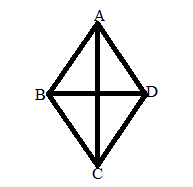
ABCD is a rhombus whose diagonals are AC and BD the diagonals intersect at O.
Proof:
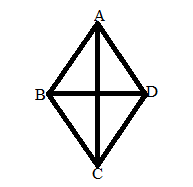
Rhombus
Area of ABCD = 1/2 AC × BD
Area of ∆CDB = 1/2 × base × altitude [ BD perpendicular to AC because diagonals of a rhombus are perpendicular to each other]
= ½ × BD × CO……. equation 1
Area of ∆ABD = 1/2 × base × altitude
= ½ × BD × AO…… equation 2
Area of ∆CDB + area of ∆ABD
= ½ × BD × (CO + AO) [ by adding above two equations]
Area of rhombus ABCD = ½ × AC × BD [ by adding axiom for the area]
Hence proved.

Area of a Rhombus Examples

Example 1.
Find the area of the rhombus whose diagonals are 22cm and 24cm
Solution:
Given that
Area of rhombus_1
Diagonal d1 = 22cm
Diagonal d2 = 24cm
We know that
Area of rhombus = 1/2 × d1 × d2
Area of rhombus = ½ × 22cm × 24cm
= ½ × 528cm
= 264cm²

Example 2.
The area of the rhombus is 12 square cm and the diagonal is 6cm. Find the other diagonal.
Solution:
Given that
Area of rhombus_2
Area of rhombus = 12cm
Diagonal d1 = 6cm
We know that area of rhombus = ½ × d1 × d2
12 square cm = ½ × 6cm × d2
12 square cm = 3d2cm
12/3 square cm = d2cm
d2 = 4cm

Example 3.
Find the area of the rhombus whose diagonals are 10cm and 20cm.
Solution:
Given that
Area of rhombus_3
Diagonal d1 = 10cm
Diagonal d2 = 20cm
We know that
Area of rhombus = 1/2 × d1 × d2
Area of rhombus = ½ × 10cm × 20cm
= ½ × 200cm²
= 100cm²

Example 4.
The area of the rhombus is 6 square cm and the diagonal is 16cm. Find the other diagonal.
Solution:
Given that
Area of rhombus_4
Area of rhombus = 6 square cm
Diagonal d1 = 16cm
We know that area of rhombus = ½ × d1 × d2
6 square cm = ½ × 16cm× d2
6square cm = 8d2cm
6square cm/8 cm = d2cm
d2 = 3/4cm

Example 5.
The area of the rhombus is 18 square cm and the diagonal is 24cm. Find the other diagonal.
Solution:
Given that
Area of rhombus_5
Area of rhombus = 18 square cm
Diagonal d2 = 24cm
We know that area of rhombus = ½ × d1 × d2
18 square cm = ½ × d1 × 24cm
18 square cm = 24d1cm
18 square cm/24 cm = d2
d2 = 3/2 cm.

FAQs on The Area of a Rhombus is Equal to Half the Product of its Diagonals

1. Is the area of a rhombus equal to half the product of the diagonals?

The area of a rhombus is equal to half the product of the lengths of the diagonals. It is calculated using the diagonals of the rhombus.
A = 1/2 × d1 × d2

2. Does the diagonals of a rhombus bisect its area?

A rhombus is a parallelogram, opposite angles are congruent. One property unique to the rhombus is that in any rhombus, the diagonals will bisect the interior angles.

3. Is the area of a rhombus half the area of a rectangle?

Area of a rhombus = 1/2 x d1 x d2 where d1 and d2 are the diagonals of the rhombus. The length and breadth of the rectangle contained by the diagonals of the rhombus are d1 and d2 respectively. Therefore, the area of the rhombus is equal to half of the area of the rhombus.

Area of a Closed Figure

Area of a Closed Figure – Definition, Formula, Examples | How to find Area of a Closed Figure?

The area is the amount of space occupied by the object or figure in the geometry. We can measure the area of a closed figure by using the formulas. A closed figure can be represented as a shape surrounded by a shape whose line segments and curves are joined in the geometry. Examples of closed figures are triangles, circles, parallelograms, squares, rectangles, etc. In this article, you can find areas of different closed figures, axioms for congruent figures with questions and answers.

Area of a Closed Figure – Definition

The area of a closed figure is the measure of the space or region bounded by the closed figure in a 2D geometry. Any closed figure is divided into two or more regions, the area of a closed figure is equal to the sum of the areas of the regions. The area of the closed figure is measured in the square units.

Measurement of Area

In order to measure the area of the closed figures, we have to know the formulas of areas of different shapes. The area of a closed figure is measured in square units in the region. We will discuss the formulas and methods of finding the area of a closed figure here in detail.

Area of Closed Figure – Triangle

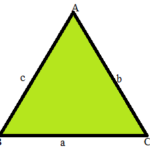
A triangle is a closed figure with three line segments and three vertices. There are three types of triangles equilateral, isosceles, right-angled, and scalene triangles.
Triangle
Area of triangle = 1/2 × base × height
Area of equilateral triangle = √3/4 × side²
Area of Isosceles triangle = 1/2 × b × √(a² – b²/4), where a is the length of the equal side and b is the length of the unequal side
Area of Right-angled triangle = 1/2 × base × height
Area of Scalene triangle = √s(s – a)(s – b)(s – c), where s is the semi perimeter of the triangle

Area of Closed Figure – Rectangle

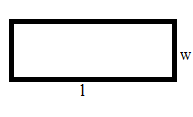
A rectangle is a closed planar figure with four sides and four vertices. The area of a rectangle can be measured by multiplying the length and width.
Rectangle
Area of a rectangle = length × width

Area of Closed Figure – Square

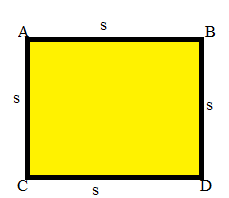
A square is a regular polygon with all equal sides. It has four line segments and four sides. The formula to measure the area of the square is the product of square and square.
Area of a square = s × s

Area of Closed Figure – Rhombus

The shape of the Rhombus is similar to the shape of the diamond. It has four equal sides. A rhombus has two diagonals d1 and d2. The  area of a rhombus formula is shown below
Rhombus
Area of Rhombus = 1/2 × d1 × d2

Area of Closed Figure – Parallelogram

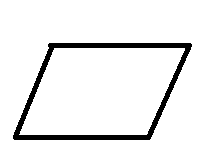
A parallelogram is a quadrilateral with four line segments and four vertices. The  Area of the parallelogram is measured by multiplying the base and height of the given figure.
parallelogram
Area of parallelogram = base × height

Area of Closed Figure – Trapezium

A trapezium is a quadrilateral with at least one pair of parallel sides. It is a closed figure with four line segments. The area of trapezium can be calculated using the lengths of two of its parallel sides and height.
Area of trapezium = 1/2 × sum of parallel sides × height

Area of Closed Figure – Pentagon

A pentagon is a closed figure formed by five line segments and five vertices. A pentagon is of two types they are regular and irregular polygon.
Pentagon
Area = 1/4[√5(5 + 2√5) × s²]
where,
s is the side of the pentagon

Area of Closed Figure – Hexagon

The closed figure formed by using the six-line segments is known as the hexagon. Hexagons are classified into two types regular hexagon and irregular hexagon. A regular hexagon has 6 equal sides and an irregular hexagon has unequal sides. The formula to measure the area of the hexagon is given below.
Hexagon
Area of a hexagon = √3/2 s²

Area of Closed Figure – Circle

A circle has no sides and no vertices. It has a radius and diameter. To measure the area of the circle we have to consider the radius of the circle.
Area of a circle = Πr²
where,
Π = 3.14 or 22/7

Solved Problems on How to find out the Area of a Closed Figure

Example 1.
Find the area of the closed figure formed with three line segments of lengths 3cm, 3cm, 4cm.
Solution:
We know that
The closed figure formed by the three line segments is the triangle.
Area of Isosceles triangle
Given that
The length of the sides of the triangle is 3cm, 3cm, 4cm.
So that a = 3cm and b = 4cm
We know that area of the isosceles triangle is ½ × b × √(a² – b²/4)
= ½ × 4 × √(3² – 4²/4)
= 2 × √9 – 4
2√5 cm²
Therefore the area of the given triangle is 2√5 cm²

Example 2.
Find the area of the closed figure formed with three line segments of lengths 6cm, 6cm, 3cm.
Solution:
We know that
The closed figure formed by the three line segments is the triangle.
Area of Isosceles triangle_1
Given that
The length of the sides of the triangle is 6cm,6cm,3cm.
So that a = 6cm and b = 3cm
We know that area of the isosceles triangle is ½ × b × √(a² – b²/4)
= ½ × 3 × √(6² – 3²/4)
= 2 × √36 – 9/4
9.75cm²
Therefore the area of the given triangle is 9.75cm²

Example 3.
Find the area of the closed figure as shown in the below image of a radius of 6cm
Solution:
Given that
Area of circle_1
Radius of the circle ( r ) = 6cm
The area of the circle with radius r is πr²
We know that
π = 22/7
= 22/7 × 6² = 113.4 square cm
Hence the area of the given closed figure is 113.4 square cm

Example 4.
Swetha is planting a garden with the dimensions as shown below. She wants to cover the entire surface of the garden with a thin layer of the sheet, which costs Rs.3 per sqft Find the total amount she has to spend on the entire sheet.
Solution:
To find the area of the garden divide the given closed figure into two regions as shown below
such that,
Region A represents the rectangle
Region B represents the trapezoid
Area of region A (rectangle)
From the figure,
length =8ft, breadth =4ft.
Area of the rectangle = Length × breadth
So that the area of the region A = 8 × 4 = 32 square feet
Area of region B (trapezoid)
We know that
Area of the trapezium = 1/2 × (sum of parallel sides) × height.
= 1/2 × (8 + 14) × 4 = 44 square feet
The total area of the closed figure = area of region A + area of the region B
= 32 + 44 = 76 square feet
Given that
The cost of the sheet is Rs.3 per sq. ft.
The total cost of sheet = cost of mulch per sq. ft × area of the figure.
= Rs.3 × 76 = Rs.228
Therefore, she has to pay a total of Rs.228 for the entire sheet.

Example 5.
A constructor has his land in the shape of the polygon shown below. Find the area and the perimeter of the given figure.
Solution:
The perimeter of the closed figure is nothing but the sum of the lengths of the boundaries.
The perimeter of the given figure is given below:
6 cm+18 cm+6 cm+3 cm+11 cm+9.5 cm+6 cm=59.5 cm
Dividing the polygon into two regions as shown below
such that,
Region A represents the rectangle
Region B represents the scalene triangle.
The area of the given figure is the sum of the areas of the rectangle and the scalene triangle.
Area of region A (Rectangle)
Area of rectangle
From the figure,
Length =18 cm, breadth =6 cm,
The area of the rectangle = length × breadth
So that the area of the region A = 18 × 6 = 108 cm²
Area of region B (Scalene triangle)
From the figure
Area of triangle_1
The length of the triangle’s base is 9cm, and the triangle’s height is 9cm.
We know that
Area of the triangle = 1/2 × base × height = 1/2 × 9 × 9 = 40.5 cm²
Total area = area of the region A + area of the region B
=108 + 40.5 = 148.5 cm²
Therefore, the area of the given land is 148.5 cm².

FAQs on Area of a Closed Figure

1. What is the closed shape formed by five sides?

The closed figure formed by five line segments is known as the pentagon.

2. What is the closed shape formed by six sides?

The closed figure formed by six line segments is known as a hexagon.

3. What is the area of the closed figures?

The area of the closed figure is measured based on the shape.

Problems on Finding Area of Triangle and Parallelogram

Problems on Finding Area of Triangle and Parallelogram | Area of Triangle and Parallelogram Questions with Answers

Problems on Finding Area of Triangle and Parallelogram are available here for free. So, the students who wish to solve different types of problems in the area can refer to our page and solve the questions in a simple method. Use the formulas of triangle and parallelogram to find the area of the given questions. Read the entire article and learn how to solve the problems on finding area of triangle and parallelogram.

Read More:

Finding Area of Triangle and Parallelogram Problems with Solutions

We have provided various types of questions on finding the area of triangles and parallelograms. This will help the students a lot to score good marks and also to improve their knowledge of the subject.

Example 1.
Find the Area of a triangle whose base is 6 cm and height is 8 cm.
Solution:
Given,
Area of triangle_4
base = 6 cm
height = 8 cm
We know that,
Area of triangle = 1/2 × b × h
A = 1/2 × 6 × 8
A = 24 sq. cm
Thus the area of the triangle is 24 sq. cm.

Example 2.
What is the area of triangle and parallelogram if the base is 7 in and height 8 in?
Solution:
Given,
Area of triangle_5
base = 7 in.
height = 8 in.
We know that,
Area of triangle = 1/2 × b × h
A = 1/2 × 7 × 8
A = 14 sq. in
Thus the area of the triangle is 14 sq. inches.
We know that,
Area of triangle_6
Area of parallelogram = bh
A = 7 × 8
A = 56 sq. in
Thus the area of a parallelogram is 56 sq. inches.

Example 3.
If the area of a parallelogram is 49 sq. meters and height is 7 meters. Find the base of the parallelogram?
Solution:
Given that,
Area of parallelogram_2
The area of a parallelogram is 49 sq. meters and
height is 7 meters
We know that,
Area of parallelogram = bh
49 = b × 7
b = 49/7
b = 7
Thus the base of the parallelogram is 7 meters.

Example 4.
What is the area of triangle and parallelogram if the base is 10 in and height 9 in?
Solution:
Given,
Area of triangle_7
base = 10 in.
height = 9 in.
We know that,
Area of triangle = 1/2 × b × h
A = 1/2 × 10 × 9
A = 45 sq. in
Thus the area of the triangle is 45 sq. inches.
We know that,
Area of parallelogram = bh
A = 10 × 9
A = 90 sq. in
Thus the area of a parallelogram is 90 sq. inches.

Example 5.
Find the height of the triangle where the area is 100 sq. cm and the base is 50 cm?
Solution:
Given that,
Area of triangle_8
the area is 100 sq. cm and
the base is 50 cm
We know that,
Area of triangle = 1/2 × b × h
100 = 1/2 × 50 × h
100 = 25 h
h = 100/25
h = 4
Thus the height of the triangle is 4 cm.

Example 6.
A triangle and a parallelogram have the same base and the same area. If the sides of the triangle are 6cm, 8cm, and 10cm and the parallelogram stands on the base 8cm, find the height of the parallelogram?
Solution:
Perimeter of a triangle 2s = 6 + 8 + 10
2s = 24
s = 12
Area = √s(s – a)(s – b)(s – c)
Area = √12(12 – 6)(12 – 8)(12 – 10)
Area = 166
Area of Parallelogram = area of triangle
h × 8 = 166
h = 40.75
Height of the parallelogram is 40.75
Therefore h is 40.75 cm.

Example 7.
A triangle and a parallelogram have the same base and the same area. If the sides of the triangle are 16cm, 18cm, and 20cm and the parallelogram stands on the base 18cm, find the height of the parallelogram?
Solution:
Perimeter of a triangle 2s = 16 + 18 + 20
2s = 54
s = 27
Area = √s(s – a)(s – b)(s – c)
Area = √27(27 – 16)(27 – 18)(27 – 20)
Area = 3600
Area of Parallelogram = area of triangle
h × 18 = 3600
h = 200
Height of the parallelogram is 200
Thus the height of the parallelogram is 200 cm.

Example 8.
A triangle and a parallelogram have the same base and the same area. If the sides of the triangle are 24cm, 26cm, and 28cm, and the parallelogram stands on the base of 26. Find the height of the parallelogram?
Solution:
Area of the parallelogram = Area of the triangle
By using the area of parallelograms we can calculate the height of the parallelogram
Area of triangle = √s(s – a)(s – b)(s – c)
a, b, c are the sides of a triangle
S is the semi perimeter= half of the perimeter of the triangle
Let ABCD is a parallelogram and ABE is a triangle having a common base with parallelogram ABCD.
From ∆ABE
a = 28cm, b = 24cm, and c = 26cm
Semi perimeter (s) = perimeter/2
s = a + b + c/2
= 28 + 24 + 26/2 = 39
area of ∆ABE = √s(s – a)(s – b)(s – c)
√39(39 – 28)(39 – 24)(39 – 26)
= 289.23
Area of parallelogram ABCD = area of ∆ABE
Base × height = 289.23cm²
26cm² × height = 289.23cm²
Height = 11.12cm²
Thus the Height of the parallelogram is 11.12cm²

Example 9.
In the figure, ABCD is a Parallelogram N is a point BC such that BN: NC = 1: 4, DN produced meets AB produced at O. If the area of the triangle CNO = 40cm². Calculate the areas of the parallelogram ABCD and ∆CDN?
Solution:
Draw OP //BC which cuts DC produced at P.
Then CPOB is a parallelogram join CO.
Area of ∆BNO/∆CNO = BN/ND (both triangles have equal altitudes)
Area of ∆BNO/40cm² = 1/4
Area of (∆BNO) = 10cm²
Therefore
Area of (∆BCO) = area of ∆BNO + area of ∆CNO
= 10cm² + 40cm²
= 50cm²
Therefore
Area of parallelogram CDPO = 2area of ∆BCO = 2 × 50 cm² = 100cm²
Now
Area of parallelogram ABCD/area of parallelogram BCPO = base DC × height/ base CP × height
DC/CP (both the parallelograms have the same height)
Therefore
Area of parallelogram ABCD/area of parallelogram BCPO = DC/BO
∆NBO and ∆NCD
∆NBO = ∆NCD and ∆BON = ∆NDC (BO // DC)
Therefore
∆ NBO ~ ∆NCD
Corresponding sides are proportional
So, NB/NC = BO/DC
Area of ABCD/Area of BCPO = NC/NB = 4/1
Area of parallelogram ABCD = 4 × 100cm² = 400cm²
Now, area of ∆CDO = ½ × area of parallelogram ABCD
= ¼ × 400cm²
100cm²
Area of ∆CDN = area (∆CDO) – are of CNO
= 100cm² – 40cm²
A = 60 cm²
Thus the area of the traingle CDN is 60 sq. cm

Example 10.
In the figure XQ//SY, PS //QR, XS//SYnqnd QY = 4cm. Find the area of ∆MSR and parallelogram PQRS?
Solution:
Area of ∆MSR = ½ × area of a rectangle of SR of height QY
= ½ × SR × QY
½ × 6 × 4cm²
= 8cm²
Area of ∆MSR = ½ × area of parallelogram PQRS
Therefore
9cm² = ½ × area of parallelogram PQRS
Thus the Area of parallelogram PQRS = 8 × 2cm² = 16cm²

Example 11.
The angle between any two sides of a parallelogram is 60 degrees. If the length of the two parallel sides is 4cm and 6cm respectively then find the area.
Solution:
Let a = 4cm and b = 6cm
x = 60 degrees
Area = ab sin(90)
Area = 24 sin90
Area = 24 × 1 = 24 square cm

Example 12.
Find the area of the parallelogram with the base of 2cm and the height of 6cm.
Solution:
Given that
Base = 2cm, height = 6cm
We know that
Area of parallelogram = base × height square units
= 2 × 6 = 12cm
Therefore the area of parallelogram = 12cm²

Example 13.
The base of the parallelogram is twice its height. If the area is 182 cm². Find the base and height.
Solution:
Let the height of the parallelogram = h cm
Then the base of the parallelogram = 3h cm
Area of parallelogram = 182cm²
Area of Parallelogram = base × height
Therefore 182 = 3h × h
3 × h² = 182
h² = 182/3
Hence the height of the Parallelogram is 182/3 cm and breadth is
Breadth = 3 × h
= 3 × 182/3
= 182cm

Example 14.
The area of a parallelogram is 400 square cm. Its height is twice its base. Find the height and base.
Solution:
Given that
Area = 400 square cm
Height = twice of base
h = 2b
We know that
Area = breadth × height
400 = breadth × 2b
2b² = 400
b² = 200
b = 14.1
Height = 2 × b = 2 × 14.1 = 28.2cm

Example 15.
Find the area of Parallelogram whose breadth is 4cm and height is 2cm.
Solution:
Given that
Breadth = 4cm
Height = 2cm
Area of Parallelogram = breadth × height
= 4 × 2cm²
= 8cm²

Area

Area – Definition, Facts, Formula, Examples | How to find Area of Different Planar Shapes?

In Maths, the Area plays an important role. All the students of 9th grade can get access to the topics of Area from this page. With the help of this chapter, you can prepare thoroughly for the exams. Download the solutions of Area of all the shapes in depth. Just click on the available links to practice the problems. Find the areas of parallelograms and triangles from here. All the questions are prepared by the math experts by following the textbooks.

List of Area Concepts

Before you start preparing for the exams we suggest you guys go through the topics covered in this chapter.

Area – Definition | What is Definition of Area in Math?

The area is nothing but the amount of place occupied by the two-dimensional shape or figure. In other words, we can say that area is an empty surface. There are different units to measure the area of surface likewise meters, centimeters, feet, yards, inches, and so on. The units of the area are square units.

Do Check:

How do you find Areas of Different Planar Shapes?

The area of any figure can be calculated by multiplying the dimensions of the surface. In this section, we will learn how to calculate the area of different shapes like rectangles, squares, circles, triangles, parallelogram, Rhombus, trapezium.

Area of Rectangle:
The area of a rectangle is the space occupied by the given figure. A rectangle has two dimensions length and width. The formula to calculate the area of a rectangle is the multiple of length and width.
Rectangle
A = L × W
where,
A = Area
L = Length
W = Width

Area of Square:
The area of the square is the surface occupied by it. In a square all the sides are equal. And the sides of the square are denoted by ‘s’.
square
Area = s × s
where,
A = Area
s = sides of the square

Area of Circle:
The area of a circle is nothing but the measure of space covered within the boundary of the circle. The unit of area of the circle is square units.
A = Πr²
where,
A = Area of a circle
Π = pi, the value of Π is 3.14 or 22/7
r = radius of the circle

Area of Triangle:
Triangle
A triangle is a regular polygon with three sides and three vertices. The area of a triangle can be measured by calculating the surface of the figure.
A = 1/2 × b × h sq. units
where,
A = Area of triangle
b = base
h = height

Area of Parallelogram:
parallelogram
A parallelogram is a quadrilateral with four sides, four vertices, and four angles. The opposite sides of the parallelogram are equal and parallel. The Area of the parallelogram can be calculated by multiplying the base and height of the given planar figure.
A = b × h sq. units
where,
A = Area of parallelogram
b = base
h = height

Area of Rhombus:
Rhombus is similar to the square where all the sides are equal. It is the shape of a diamond. It has two diagonals d1 and d2. The area of a rhombus formula is the product of half of diagonal 1 and diagonal 2.
Rhombus
A = 1/2 × d1 × d2 sq. units
where,
A = Area of rhombus
d1 = first diagonal
d2 = second diagonal

Area of Trapezium:
The trapezium is one of the quadrilaterals with four sides, vertices, and angles. The area of trapezium is the amount of space occupied by the geometric figure.
A = 1/2 (a + b) × h
where,
A = Area of trapezium
a and b are the sides
h is the height of the trapezium

Important Points to Remember:
1. Students have to understand that the area of space is occupied by the planar shape.
2. Area of the rectangle is length × breadth.
3. Area of the triangle is 1/2 × base × height.
4. Area of a parallelogram is base × height.
5. Congruent regions have similar areas.

Example Problems on Area

Example 1.
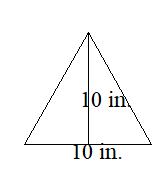
Find the area of a triangle with a base of 10 inches and a height of 10 inches.
Solution:
Given that
Area of triangle
Base = 10 inches
Height = 5 inches
Area of triangle = ½ × b × h
Area of triangle = ½ × 10 × 10
Area of triangle = 50in²

Example 2.
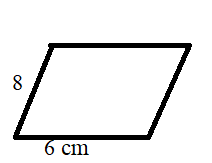
The angle between any two sides of a parallelogram is 90 degrees. If the length of the two parallel sides is 6cm and 8 cm respectively, then find the area.
Solution:
Area of parallelogram
a = 6 cm and b=8 cm
x = 90 degrees
Area of Parallelogram = ab sin (x)
Area of Parallelogram = 6 × 8 sin (90)
Area of Parallelogram = 48 sin 90
Area of Parallelogram = 48 × 1 = 48 square cm.

Example 3.
Find the altitude of the rhombus whose area is 300cm² and its perimeter is 180 cm.
Solution:
Rhombus
The perimeter of rhombus = 180 cm
Therefore, The side of rhombus = P/4 = 180/4 = 45 cm
Area of rhombus = base × height
300 = 45 × h
h = 300/45
h = 6.6 cm
Therefore, the altitude of the rhombus is 6.6 cm

Example 4.
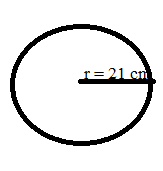
Find the circumference and the area of a circle whose radius is 21 cm.
Solution:
Given that
Area of circle
Radius of the circle = 14 cm
Circumference of the Circle = 2πr
= 2 × 22/7 × 21
= 2 × 22 × 3
= 132 cm
Area of Circle formula = πr²
= 22/7 × 21 × 21
= 22 × 3 × 21
= 1386 square cm.
Area of the Circle = 1386 square cm.

Example 5.
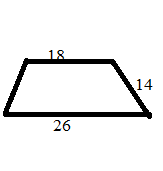
Two parallel sides of a trapezium are of lengths 26 cm and 18 cm respectively, and the distance between them is 14 cm. Find the area of the trapezium.
Solution:
Area of trapezium
Area of the trapezium = ¹/₂ × (sum of parallel sides) × (distance between them)
= (¹/₂ × (26 + 18) × 14) cm² = 308 cm²

FAQs on Area

1. Where can I find areas of parallelograms and triangles class questions with answers?

All the students of grade 9 can get the areas of parallelograms and triangles class questions with step by step explanations @eurekamathanswers.com

2. How do you find the area?

The area is calculated by multiplying the length of a shape by its width.

3. What is the area of a figure?

The area is the amount of space occupied by a two-dimensional figure. The standard unit of area is square units.

Perpendicular is the Shortest Theorem

Perpendicular is the Shortest Theorem | Shortest Distance from a Point to the Line

A straight line is the shortest distance connection between the two points. This article is presented to show that the Perpendicular is the Shortest Theorem in inequalities in triangles. Our main aim is to prove that from all the straight lines that can be drawn to a line from a given point exterior to it, then the perpendicular is the shortest among them.

Perpendicular is the Shortest Theorem

Question:
Prove that the shortest segment from a point to a line is the perpendicular segment?
Perpendicular is shortest
AB is a straight line and P is a point outside it. PQ is perpendicular to AB and PQ is an oblique
To Prove That:
PQ < PR
Proof:
In ∆PQR, ∠PQR = 90°, [ Therefore PQ perpendicular AB]
∠PRQ is an acute angle [ in a triangle if one angle is a right angle, the other two must be acute]
∠PRQ < ∠PQR [ from equation 1 and equation 2]
PQ < PR [ in a triangle the greater angle has the greater side opposite to it]
Hence proved
Thus it is shown that all line segments drawn from a given point, not on it, the perpendicular is the shortest.

FAQs on Perpendicular is the Shortest Theorem

1. Is the perpendicular distance the shortest?

The shortest distance from a point to a straight line is always the path that is perpendicular to the line, starting from the given point.

2. Is perpendicular the shortest side of a triangle?

In a right-angled triangle, the shortest side is the perpendicular side.

3. What is the shortest distance Theorem?

The Shortest Distance Theorem states that the shortest distance between a point P, and a line, l, is the perpendicular line from P to l. It is also called the perpendicular distance.

Pair of Opposite Sides of a Parallelogram are Equal and Parallel

Pair of Opposite Sides of a Parallelogram are Equal and Parallel Theorem & Proof with Examples

A parallelogram is a type of quadrilateral with four sides, four vertices, and four angles. And it has two diagonals that bisect each other. We know that the opposite sides of a parallelogram are equal and parallel because they never intersect. In this article, we are going to prove that Pair of Opposite Sides of a Parallelogram are Equal and Parallel. Thoroughly read the entire page to find the proof of the given statement with suitable examples.

Pair of Opposite Sides of a Parallelogram are Equal and Parallel Theorem

Let us discuss about the statement “Pair of Opposite Sides of a Parallelogram are Equal and Parallel” with step by step explanation here.

Statement:
Prove that, A quadrilateral is a parallelogram if a pair of opposite sides are equal and parallel.
Proof:
Given: ABCD is quadrilateral and AB║CD, AB=CD.
To prove: ABCD is a parallelogram
Proof: AC is a transversal and also AB║CD, therefore
∠BAC=∠DCA(Alternate angles)
In ΔADC and ΔCBA, we have
AB=CD(Given)
∠BAC=∠DCA(Alternate angles)
AC=CA(Common)
ΔADC≅ΔCBA by the SAS rule.
Hence, by CPCT, DA=BC
Thus, Both the pair of opposite sides are equal in the quadrilateral ABCD, therefore ABCD is a parallelogram.
Hence proved.

Problems on Pair of Opposite Sides of a Parallelogram are Equal and Parallel

Example 1.
In the parallelogram PQRS ∠PQR = 60° find the measures of ∠QRS, ∠RSP and ∠SPQ
Solution:
Given that
∠PQR = 60°
In a parallelogram sum of any two opposite angles is equal to 180°
PQ//RS,∠PQR + ∠QRS = 180°
∠QRS = 180° – ∠PQR
= 180° – 60°
= 120°
In the parallelogram opposite angles are equal so
∠RSP = ∠PQR = 60° and
∠QRS = ∠SPQ = 120°

Example 2.
The two angles of a parallelogram have measures of (3x – 12)° and (2x + 16)° what is the measures of all the angles of this parallelogram
Solution:
Given that
Two angles are (3x – 12)° and (2x + 16)°
We know that
The two opposite angles of a parallelogram are equal to each other
Here
3x – 12 = 2x + 16
3x – 12 – 2x – 16
x = 28
(3x – 12)° = (3(28) – 12)
= 72°
(180 – 72) = 108°
Two opposite angles are 72° and the other two are 108°.

Example 3.
In the figure, PQRS is a parallelogram in which ∠P = 25° find the measures of each of the angles ∠Q, ∠R, and ∠S
Solution:
It is given that PQRS is a parallelogram in which ∠P = 85°
We know that
Sum of any two adjacent angles of a parallelogram is 180°
∠P + ∠Q = 180°
25° + ∠Q = 180°
∠Q = (180A° – 25°) = 165°
∠P + ∠Q = 165°
∠R + ∠S = 180°
25° + ∠S = 180°
∠S = (180° – 25°) =165°
Therefore
∠Q = 165°, ∠R = 25, and ∠S = 165°

Example 4.
In the parallelogram PQRS ∠PQR = 80° find the measures of ∠QRS, ∠RSP and ∠SPQ
Solution:
PQ//RS,∠PQR + ∠QRS = 180°
∠QRS = 180° – ∠PQR
= 180° – 80°
= 100°
In the parallelogram opposite angles are equal so
∠RSP = ∠PQR = 80° and
∠QRS = ∠SPQ = 100°

Example 5.
The two angles of a parallelogram have measures of (4x – 6)° and (3x + 13)° what is the measures of all the angles of this parallelogram
Solution:
Given that
Two angles are (4x – 6)° and (3x + 13)°
We know that
The two opposite angles of a parallelogram are equal to each other
Here
4x – 6 = 3x + 13
4x – 6 – 3x – 13
x = 19
(4x – 6)° = (4(19) – 12)
= 64°
(180 – 64) = 116°
The two opposite angles are 64° and the other two are 116°.

FAQs on Pair of Opposite Sides of a Parallelogram are Equal and Parallel

1. Are both pairs of opposite sides parallel in a parallelogram?

A parallelogram is a quadrilateral in which both pairs of opposite sides are parallel.

2. Why are opposite sides of a parallelogram equal?

If one pair of opposite sides of a quadrilateral is equal and parallel, then the quadrilateral is a parallelogram.

3. How many pairs of parallel sides does a parallelogram have?

A parallelogram has two pairs of parallel sides.

Sum of the Exterior Angles of an n-sided Polygon

Sum of the Exterior Angles of an n-sided Polygon | How to find the Sum of Exterior Angles of a Polygon with n Sides?

Most of the students will feel theorems are very difficult to understand and remember the concept. But we will help you to learn about the Rectilinear Figures here. In this article, we will discuss the Sum of the Exterior Angles of an n-sided Polygon Theorem with step by step explanation. By learning the theorems you can solve different types of problems in exams.

  • The measure of each exterior angle is 360°/n
  • Sum of exterior angles of a polygon is ∠a’ + ∠b’ + ∠c’ + ….. + ∠n’ = 360°.
  • The sum of the exterior angles is 360°.

Sum of the Exterior Angles of an n-sided Polygon

Theorem Statement:
If the sum of a convex polygon is produced in some order the sum of all the exterior angles is equal to four right angles.

Given
Let PQRS……. Z be a convex polygon of n sides have been produced in the same order
To prove that:
The sum of the exterior angles is 4 right angles they are ∠p’ + ∠q’ + ∠r’ + ……..+ ∠z’ = 4 × 90° = 360°
Proof:
∠p + ∠p’ = 2 right angles
Similarly
∠q + ∠q’ = 2 right angles
∠z + ∠z’ = 2 right angles [ they are in the linear form]
(∠p + ∠q + ∠r +…….∠n) + (∠p’ + ∠q’ + ∠r’ +……∠z’) = 2n right angles [ the polygon has n sides]
(2n – 4) right angles + (∠p + 3∠p + ∠q + ∠r +…..∠q’ + ∠r’ + …..∠z’) = 2n right angles + ∠z’ = (2z – 4) right angles
∠p’ + ∠q’ + ∠r’ +……+∠z’ [ from above equation]
[2n – (2n – 4)] right angles
4 right angles
4 × 90°
360°
Hence proved

Points to remember:
1. In an N-sided regular polygon each exterior angle is 360 degrees/n.
2. The greater the number of sides of a regular polygon, the greater is the value of each interior angle and the smaller is the value of each exterior angle.
3. If each exterior angle of a regular polygon is x°, the polygon has 360/x sides.

Also, Check: Sum of the Interior Angles of an n-sided Polygon

Problems on Sum of the Exterior Angles of an n-sided Polygon

Example 1.
Find the measures of each exterior angle of a regular hexagon
Solution:
Given that
Regular hexagon = 6 sides
Here n = 6
Each exterior angles = 360/n
= 360/6
= 60
Therefore the measure of each exterior angle of a regular hexagon is 60 degrees.

Example 2.
Find the number of sides of a regular polygon if each of its exterior angles is 20°
Solution:
Here exterior angles x = 20°
Number of sides = 360/20 = 18
Therefore there are 18 sides of the regular polygon

Example 3.
Find the number of sides of a regular polygon if each of its interior angles is 120°
Solution:
Each interior angle = 120°
Therefore each exterior angle = 180° – 120° = 40°
We know that the total number of Sides of a regular polygon is 360/x where each exterior angle is x°
Number of sides = 360°/40 = 90°
Therefore there are 9 sides of a regular polygon.

Example 4.
Find the measures of each exterior angles of a regular square
Solution:
Given that
Regular square = 4 sides
Here n = 4
Each exterior angles = 360/n
= 360/4
= 90
Therefore the measure of each exterior angle of a regular hexagon is 90 degrees.

Example 5.
Find the number of sides of a regular polygon if each of its exterior angles is 60°
Solution:
Here exterior angles x = 60°
Number of sides = 360/60 = 6
Therefore there are 6 sides of the regular polygon

FAQs on Sum of the Exterior Angles of an n-sided Polygon

1. How do you find the sum of the exterior angles of a polygon?

The sum of the exterior angles of a regular polygon will always equal 360 degrees. To find the value of a given exterior angle of a regular polygon, simply divide 360 by the number of sides or angles that the polygon has.

2. What is the angle of N sided polygon?

In a polygon of ‘n’ sides, the sum of the interior angles is equal to (2n – 4) × 90°

3. What is the sum of N-sided polygon?

In a regular polygon of n sides, all angles are equal. Therefore, each interior angle = (2n−4)×90°n.

Sum of the Interior Angles of an n-sided Polygon

Sum of the Interior Angles of an n-sided Polygon | Sum of Interior Angles Formula for an n-Sided Polygon

Students can know more about polygon within its sides or we can say n-sided polygon in Rectilinear Figures. An interior angle is an angle inside the polygon at one of its vertices. Get to know the sum of the measures of the interior angles of a polygon with n sides.

You can see the Sum of the Interior Angles of an n-sided Polygon has a theorem with step by step explanation from this page. Along with the theorem, you can find interior angles of a n sided polygon formula, examples of the sum of the interior angles here.

Sum of the Interior Angles of an n-sided Polygon Theorem & Proof

Theorem:
Prove that the sum of the interior angles of a polygon of n sides is equal to (2n – 4) right angles?
Proof:
Given
Let ABCD………Z be a polygon of n sides
To Prove
∠A + ∠B + ∠C + ∠D +………+ ∠Z = (2n – 4)90°
Take any point O inside the polygon join OA, OB, OC, OD…… OZ.
Proof
The polygon has n sides, n triangles are formed they are ∆OAB, ∆BC,….. ∆OZA [ therefore on each side of the polygon one triangle has been drowned]
The sum of all the angles of the n triangles is 2n right angles [ the sum of the angles of each triangle is 2 right angles]
∠A + ∠B + ∠C + ∠D +……..+ ∠Z( sum of all angles formed at O = 2n right angles) [ from above statement]
∠A + ∠B +∠C + ∠D +………+∠Z + 4 right angles= 2 right angles [ sum of angles around the point O is 4 right angles]
∠A + ∠B + ∠C + ∠D +……..+∠Z = 2n right angles – 4 right angles [ from the above equation]
(2n – 4) right angles
(2n – 4)90°
Hence proved

Sum of the Interior Angles of an n-sided Polygon Examples

Example 1.
Find the sum of the interior angles of 6 sides.
Solution:
Here n = 6
Sum of the interior angles = (2n – 4) × 90°
=(2(6)-4) × 90°
12 – 4 × 90°
8 × 90°
720°
Therefore the sum of the interior angles of a polygon is 720°

Example 2.
Sum of the interior angles of the polygon is 180°. Find the number of sides of the polygon.
Solution:
Let the number of sides = n
Therefore (2n – 4) × 90° = 180°
2n – 4 = 180/90
2n – 4 = 2
2n = 2 + 4
2n = 6
n = 3
Therefore the number of sides of the polygon is 3.

Example 3.
The ratio of the number of sides of two regular polygons is 1:4 and the ratio of the sum of their interior angles is 4:8. Find the number of sides of each polygon.
Solution:
Let the number of sides of the two regular polygon be n1 and n2
According to the problem
n1/n2 = 1/4
n1 = n2/4
Again
2(n1 – 2) × 90°/2(n2 – 2) × 90° = 2/4
4(n1 – 2) = 2(n2 – 4)
4n1 = 2n2 + 4
4(n2/4) = 2n2 + 4
n2 = 2n2 + 4
n2 = 4
n1 = n2/4 = 4/4 = 1
Therefore the number of sides of the regular polygon is 4 and 1.

Example 4.
Find the sum of the interior angles of the 4 sides.
Solution:
Here n = 4
Sum of the interior angles = (2n – 4) × 90°
=(2(4)-4) × 90°
8 – 4 × 90°
4 × 90°
360°
Therefore the sum of the interior angles of a polygon is 360°

Example 5.
Sum of the interior angles of the polygon is 720°. Find the number of sides of the polygon.
Solution:
Given,
The sum of the interior angles of the polygon is 720°.
Let the number of sides = n
Therefore (2n – 4) × 90° = 720°
2n – 4 = 720/90
2n – 4 = 8
2n = 8 + 4
2n = 12
n = 6
Therefore the number of sides of the polygon is 6.

FAQs on Sum of the Interior Angles of an n-sided Polygon

1. What is the sum of all interior angles of a regular polygon of n sides?

The sum of all interior angles of a regular polygon of n sides is 180(n – 2).

2. What is the formula for an N-sided polygon?

S = (n – 2) × 180°
Where,
S = sum of the interior angles

3. What is the sum of the interior angle of a pentagon?

The sum of the interior angle of a pentagon is 540°

Rectilinear Figures

Rectilinear Figures – Definition, Facts, Types, Examples

Quick and Easy Learning tricks are available on this page. So, all the students who are interested to know in-depth about Rectilinear figures are suggested to follow or refer to our site. In this article, students are taught about the Rectilinear Figures such as definition, properties, theorems, and other related problems here. It is very helpful for the students when you are preparing for the exams. We assure you that we will provide step-by-step explanations for all the questions and answers on Rectilinear Figures.

Rectilinear Figures – Definition

In Maths, a rectilinear figure can be defined as a plane or two-dimensional shape or figure that meets at the right angles. The plane figure where the boundaries are line segments is called rectilinear figures.
The topics covered in this chapter are given below. Click on the below link and practice the problems from here.

  • Sum of the Interior Angles of an n-sided Polygon
  • Sum of the Exterior Angles of an n-sided Polygon

Types of Rectilinear Figures

Quadrilateral and polygon are examples of rectilinear figures. We will discuss in-depth in this section.

Quadrilaterals

A quadrilateral is a 2D closed polygon with four sides, vertices, and angles. There are different types of quadrilaterals. They are,
1. Square
2. Rectangle
3. Rhombus
4. Parallelogram
5. Trapezium
6. kite

What is a Polygon?

Polygon is a closed rectilinear figure which is also known as a closed plane figure. The line segments in a polygon are called sides, vertices. The angle formed by meeting two sides of the polygon is known as the interior angles. A polygon can be of many sides such as a triangle with three sides, quadrilateral, square, a rectangle with four sides, a pentagon with five sides, a hexagon with six sides, a heptagon with seven sides, octagon with eight sides, and so on.

Triangle

A triangle is a closed plane figure with three sides, vertices, and three angles.

Triangle

Square

A square is a quadrilateral with four sides, vertices, and angles. The sum of all four angles are 360 degrees.

square

Rectangle

Rectangle

Parallelogram

A parallelogram is a quadrilateral with four sides, vertices, and angles. The sum of all angles is 360 degrees.

parallelogram

Pentagon

A pentagon is a closed figure with five sides, vertices, and five angles.

Pentagon

Hexagon

A hexagon is a closed figure with six sides, vertices, and six angles.

Hexagon

Decagon

A decagon is a closed planar figure with ten sides, vertices, and ten angles.

Decagon

Types of Polygon

1. Convex Polygon:
A convex polygon is a polygon where all the interior angles measure less than 180 degrees.
2. Concave Polygon:
A concave polygon is a polygon where one or more of the interior angles is greater than 180 degrees. The concave polygon is also known as the reflex polygon.
3. Equilateral Polygon:
A polygon where all the sides are equal is known as an equilateral polygon.
4. Equiangular polygon:
A polygon where all the angles are equal is known as an equiangular polygon.

FAQs on Rectilinear Figures

1. What are the different types of plane curves?

Plane curves are classified into two types they are open curve and closed curve.

2. What is an example of a Simple Closed Plane Curve?

A simple closed plane curve that is entirely made up of line segments is known as rectilinear figures.

3. What is the Diagonal of a Polygon?

A diagonal of a polygon is a line segment that intersects two consecutive lines of a polygon.

Sum of the Four Sides of a Quadrilateral Exceeds the Sum of the Diagonals

Sum of the Four Sides of a Quadrilateral Exceeds the Sum of the Diagonals Theorem & Proof

Hello students!!! Are you searching various websites to know in detail about Inequalities in triangles theorems? If our guess is correct then need not worry you guys are on the right page. This page is the one-stop solution to clear all your doubts regarding the inequalities in triangles theorems, examples, etc.

In this article we are going to learn about the Sum of the Four Sides of a Quadrilateral Exceeds the Sum of the Diagonals. We have to prove that the sum of all the four sides of a quadrilateral is greater than the sum of the diagonals.

Sum of the Four Sides of a Quadrilateral Exceeds the Sum of the Diagonals Theorem

Theorem Statement:
Prove that the sum of the sides of a quadrilateral is greater than twice the length of its diagonal?
Proof:
Given PQRS is a quadrilateral, PR and QS are its diagonals
To Prove:
(PQ + QR + RS + SP) > ( PR + QS)
Proof:
In ∆PSQ
(SP + PQ) > QS [ therefore the sum of the two sides of a triangle is greater than the third side]
In ∆PQR
(PQ + QR) > PR [ therefore the sum of the two sides of a triangle is greater than the third side]
In ∆QRS
(QR + RS) > QS [ therefore the sum of the two sides of a triangle is greater than the third side]
In ∆RSP
(RS + SP) > PR [ therefore the sum of the two sides of a triangle is greater than the third side]
2(PQ + QR + RS + SP) > 2(PR + QS) [ adding all the equations]
(PQ + QR + RS + SP) > 2(PR + QS) [ cancelling the common factor 2]
Hence proved
Therefore it is proven that the sum of the four sides of a Quadrilateral exceeds the sum of the diagonals.

Also, Check:

FAQs on Sum of the Four Sides of a Quadrilateral Greater than the Sum of the Diagonals

1. What is the sum of four sides of the quadrilateral?

A quadrilateral with four sides and four angles. The sum of four angles of a quadrilateral is 360 degrees. We can draw two diagonals to the quadrilateral that forms two triangles.

2. What is the quadrilateral inequality theorem?

The sum of any pairs of opposite sides of a convex quadrilateral is always less than the sum of the diagonals.

3. How many diagonals does a quadrilateral have?

A quadrilateral can be constructed unambiguously if the lengths of its three sides and two diagonals are provided and if its two adjacent sides and three angles are given.