Sum of any Two Sides is Greater than Twice the Median

Sum of any Two Sides is Greater than Twice the Median Theorem & Proof

Are you looking for all the theorems of inequalities in triangles? Then make use of our page and learn all the theorems. Now on this page, the students of 9th grade can find the theorem with proof of Sum of any two sides is greater than Twice the Median.

Sum of any Two Sides is Greater than Twice the Median

Theorem Statement:
Prove that sum of any two sides of a triangle is greater than twice the median?

Proof:
Given Triangle ABC in which AD is the median.
To prove: AB + AC > 2AD
Construction :
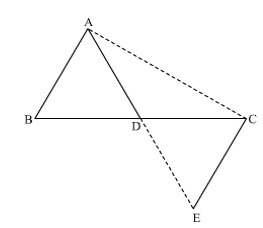
median
Extend AD to E such that AD = DE.
Now join EC.
Proof:
In ΔADB and ΔEDC
AD=DE[ By construction]
D is the midpoint BC.[DB=DB]
ΔADB=ΔEDC [vertically opposite angles]
Therefore Δ ADB ≅ ΔEDC [ By SAS congruence criterion.]
AB=ED[Corresponding parts of congruent triangles ]
In ΔAEC,
AC+ED> AE [sum of any two sides of a triangle is greater than the third side]
AC+AB>2AD[AE=AD+DE=AD+AD=2AD and ED=AB]
Hence proved.

Do Check:

FAQs on the sum of any two sides is Greater than Twice the Median

1. What is the relationship between the 2 parts of the median?

The centroid is always two-thirds of the way along each median from that median’s interior angle. This means that it sets up a 2:1 for each of the three medians: 2 parts of the median are between the centroid and the interior angle. 1 part of the median is between the centroid and the opposite side.

2. What is the relation between the median and sides of a triangle?

The relation between the median and the sides of a triangle is such that three times the sum of squares of the length of sides is equal to 4 times the squares of medians of a triangle.

3. What is the difference between median and altitude?

The difference between medians and altitudes is that a median is drawn from a vertex of the triangle to the midpoint of the opposite side, whereas an altitude is drawn from a vertex of the triangle to the opposite side being perpendicular to it.

Comparison of Sides and Angles in a Triangle

Comparison of Sides and Angles in a Triangle | Relationship between Angles and Sides of a Triangle

Comparing Angles and Sides in Triangles is a part of the concept of Inequalities in Triangles. I think you are all familiar with SAS and SSS Theorems. Here we will learn deeply about SAS and SSS Inequality theorems with step by step explanation. In addition to that, the students can also find examples for comparing angles and sides in triangles.

Comparison of Sides and Angles in a Triangle

We can determine which angle is largest and which angle is smallest. If one side of the triangle is longer than another side then the angle opposite to the greater side will be greater than the angle opposite to the shorter side. In this section, we will discuss SAS inequality theorem and SSS inequality theorem.

SAS Inequality Theorem:
If two sides of a triangle are congruent to two sides of the other triangle, but the included angle of one triangle has a longer measure than the included angle of another triangle, then the third side of the first triangle is greater than the third side of the second triangle.
SAS Inequality Theorem

SSS Inequality Theorem:
If two sides of the triangle are congruent to two sides of another triangle, but the third side of the first triangle is greater than the third side of the second triangle, then the included angle of the first triangle’s two congruent sides is greater in measure than the included angle of the second triangle’s two congruent sides.
SAS Inequality Theorem

Comparing Triangle Angles and Sides Examples

Example 1.
In ∆XYZ, ∠XYZ = 40° and ∠YXZ = 71°
Solution:
∠XZY = 180° – (∠XYZ + ∠YXZ)
180° – (40° + 71°)
180° – 111°
= 69°
Therefore
∠XYZ > ∠XZY > ∠YXZ
The greater angle has the greater side opposite to it.

Example 2.
In a ∆PQR, QR = 8cm, PQ = 6cm and PR = 4cm arrange x°, Y° and z° in the ascending order.
Solution:
Given that,
QR > PQ > PR
Therefore ∠QPR > ∠PRQ > ∠PQR as the greater side has the greater angle opposite to it
Therefore
(180° – ∠QPR) < (180° – ∠PRQ) < (180° – ∠PQR)
y° < x° < z°

Example 3.
In ∆XYZ, ∠XYZ = 30° and ∠YXZ = 40°
Solution:
∠XZY = 180° – (∠XYZ + ∠YXZ)
180° – (30° + 40°)
180° – 70°
= 110°
Therefore
∠XYZ > ∠YXZ > ∠XZY
The greater angle has the greater side opposite to it.

Example 4.
In a ∆PQR, QR = 2cm, PQ = 3cm and PR = 4cm arrange x°, Y° and z° in the ascending order.
Solution:
Given that,
QR > PQ > PR
Therefore ∠QPR > ∠PRQ > ∠PQR as the greater side has the greater angle opposite to it
Therefore
(180° – ∠QPR) < (180° – ∠PRQ) < (180° – ∠PQR)
y° < x° < z°

Example 5.
In ∆ABC, ∠ABC = 20° and ∠BAC = 21°
Solution:
∠ACB = 180° – (∠ABC + ∠BAC)
180° – (20° + 21°)
180° – 41°
= 139°
Therefore
∠ACB > ∠BAC > ∠ABC
The greater angle has the greater side opposite to it.

FAQs on Comparison of Sides and Angles in a Triangle

1. What is the relationship between angles and sides of a triangle?

In any triangle, the largest side and largest angle are opposite one another. the smallest side and smallest angle are opposite one another.

2. How do you compare triangle measurements?

If two triangles have two pairs of sides in the same ratio and the included angles are also equal, then the triangles are similar.

3. How are sides and angles similar?

In a pair of similar triangles, corresponding sides are proportional and all three angles are congruent.

Opposite Sides of a Parallelogram are Equal Theorem

Opposite Sides of a Parallelogram are Equal Theorem & Proof with Examples

Opposite Sides of a Parallelogram are Equal is one of the properties of the parallelogram. In the previous pages, we have seen some concepts of a parallelogram. Now in this article, you are going to learn about the opposite sides of a parallelogram are equal. Students who are lagging in the concept of parallelogram such as properties can check out this page.

Prove that Opposite Sides of a Parallelogram are Equal

In triangle ADC and ABC,
∠DAC=∠ACB(AB∥CD and taking AC as transversal)
AC=AC (since it is common)
∠DCA=∠BAC(AB is parallel to CD taking AC as transversal)
By ASA criterion of concurrency triangle, ADC is congruent to triangle ABC.
AD=BC
AB=CD

Also, Read Related Theorems

Opposite Sides of a Parallelogram are Equal in Length Examples

Example 1.
In the parallelogram ABCD, AB = 3cm and DC : CB = 4: 2 find the perimeter of the parallelogram
Solution:
In the parallelogram ABCD, AB // DC and DA // CB
The opposite sides of parallelogram are equal
DC + AB = 8cm
DC : CB = 4:1
DC/CB = 4/1
8cm/CB = 4/1
CB = 8/4 = 2
CB = DA = 2cm
Therefore perimeter = AB + BC + CA + DA
= 3cm + 2cm + 3cm + 2cm
= 10cm

Example 2.
In the parallelogram PQRS, PQ = 10cm and SR : RQ = 5 : 1 find the perimeter of the parallelogram.
Solution:
In the parallelogram PQRS, PQ // SR and RP // RQ
The opposite sides of parallelogram are equal
SR + PQ = 10cm
SR : RQ = 5:1
SR/RQ = 5/1
10cm/RQ = 5/1
RQ = 10/5 = 2
RQ = SP = 2cm
Therefore perimeter = PQ + QR + RS + SP
= 10cm + 2cm + 10cm + 2cm
= 24cm

Example 3.
In a parallelogram ABCD AB = 2cm and BC = 5cm Find the CD and DA
Solution:
In a parallelogram opposite sides are equal
AB = CD and BC = DA
There AB = 2cm
BC = 5cm
So AB = CD = 2cm
BC = DA = 5cm

Example 4.
In the parallelogram PQRS, PQ = 2cm and SR : RQ = 16 : 2 find the perimeter of the parallelogram.
Solution:
In the parallelogram PQRS, PQ // SR and RP // RQ
The opposite sides of parallelogram are equal
SR + PQ = 2cm
SR : RQ = 16 : 2
SR/RQ = 16/2
2cm/RQ = 16/2
RQ = 16/2 × 2 = 4
RQ = SP = 4cm
Therefore perimeter = PQ + QR + RS + SP
= 2cm + 4cm + 2cm + 4cm
= 12cm

Example 5.
In a parallelogram ABCD AB = 8 cm Find the CD
Solution:
In a parallelogram opposite sides are equal
AB = CD
There AB = 8cm
So AB = CD = 8cm

Concept of Parallelogram

Concept of Parallelogram – Definition, Formulas, Types, Properties, Examples

It is necessary for the students to know the basics of parallelograms to practice geometry problems. Parallelogram was derived from the Greek word parallelogrammon that means bounded by parallel lines. There are three types of parallelogram they are rhombus, rectangle, square. And each type has different properties. We learn the concept of a parallelogram with all suitable examples from this page.

Parallelogram Definition

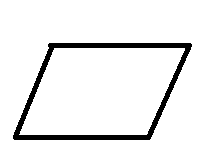
A parallelogram is a type of quadrilateral with two pairs of parallel sides. The shape of the parallelogram is a two-dimensional geometry. The opposite sides of a parallelogram are equal in length and the opposite angles of a parallelogram are equal in measures. The number of vertices in a parallelogram is four and the number of edges is also four.
parallelogram

Parallelogram Formula

Area of a parallelogram = height × base
The perimeter of a parallelogram = 2 × ( sum of lengths of adjacent sides)

Types of Parallelogram

A parallelogram is classified into three types. They are as follows,
1. Rectangle
2. Square
3. Rhombus

1. Rectangle:
A rectangle is a polygon with two pairs of equal sides. It has four right angles ∠A = ∠B = ∠C = ∠D = 90 degrees. Diagonals bisect each other.
Rectangle
2. Square:
A square is a parallelogram with all four sides and four angles are equal. AB = BC = CD = DA. Two pairs of squares have parallel sides.
square
3. Rhombus:
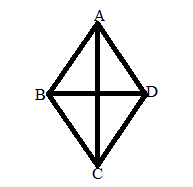
Rhombus is a type of parallelogram with all four sides and angles being the same. The diagonals of a rhombus are perpendicular to each other.
Rhombus

Properties of Parallelogram

Properties of the parallelogram are Used in the industry for accurate transfer of mechanical motion from one place to another.

  1. The opposite sides are parallel and congruent
  2. The opposite angles are congruent
  3. The consecutive angles are supplementary
  4. Any one of the angles is a right angle then all other angles will be at the right angle
  5. The two diagonals bisect each other
  6. Each diagonal bisects the parallelogram into two congruent triangles
  7. The Sum of squares of all the sides of a parallelogram is equal to the sum of squares of its diagonals, it is also called parallelogram law.

Read More:

Solved Problems on Parallelogram

Practice the problems from this page to score better marks in the exams.

Example 1.
The ratio of two sides of a parallelogram is 5: 4 if its perimeter is 90 cm. Find the lengths of its sides.
Solution:
Given
Ratio of two sides of a parallelogram is 5 : 4
Perimeter of a parallelogram is 42 cm
The length of two sides of the parallelogram be 5x cm and 4x cm
Perimeter = 2( sum of lengths of adjacent sides)
= 2( 5x + 4x ) cm
= (10x + 8x )cm
18x cm
18cm = 90
x = 90/18
x = 5
Therefore one side = 5 × 5 = 25cm
And another side = 4 × 5 = 20cm

Example 2.
In the figure PQRS is a parallelogram, PO and QO are the bisectors of ∠P and ∠Q respectively prove that ∠POQ = 90°
Solution:
We know that the sum of two adjacent angles of a parallelogram is 180°
Therefore
∠P + ∠Q = 180°……. equation 1
Here PO and QO are the bisectors of ∠P and ∠Q
∠OPQ = 1/2∠P and ∠PQO = 1/2∠Q
From ∆OPQ
The Sum of the angles of a triangle is 180°
∠OPQ + ∠POQ + ∠PQO = 180°
1/2∠P + ∠PQO + 1/2∠Q = 180°
(½ × 180°) + ∠POQ = 180° using equation 1
90° + ∠POQ = 180°
∠POQ = (180° – 90°) = 90°
∠POQ = 90°

Example 3.
In the given figure ABCD is a parallelogram in which ∠CaD = 20°, ∠BAC = 30° and ∠COD = 70° find ∠ABD
Solution:
From the figure
∠AOB = ∠COD = 70°
Now in ∆OAB we have
Sum of the angles of triangle is 180°
∠OPQ + ∠POQ + ∠PQO = 180°
30° + ∠ABO + 70° = 180°
∠ABO + 100 = 180°
∠ABO = (180° – 100°)
∠ABD = ∠ABO = 80°

Example 4.
In the figure, PQRS is a parallelogram in which ∠P = 85° find the measures of each of the angles ∠Q, ∠R, ∠S.
Solution:
Given that PQRS is a parallelogram in which ∠P = 85°
We know that
Sum of any two adjacent angles of a parallelogram is 180°
∠P + ∠Q = 180°
85° + ∠Q = 180°
∠Q = (180° – 85°) = 95°
Also
∠P + ∠Q = 95°
And
∠R + ∠S = 180°
∠85° + ∠S = 180°
∠S = (180° – 85°) = 95°
Therefore ∠Q = 95°, ∠R = 85°, and ∠S = 95°

Example 5.
Calculate the area of ground in the shape of a parallelogram, the base measures 30 in and the altitude measures 7 in.
Solution:
Given that
Base = 30 in
Altitude = 7in
We know that,
Area of parallelogram = b × h
Area of ground = 30in × 7in = 210 in²
Thus the area of the ground is 210 sq. in.

FAQs on Concept of Parallelogram

1. How many sides does a parallelogram have?

A parallelogram has four sides.

2. What are the 4 properties of a parallelogram?

The 4 properties of a parallelogram are
i. The opposite sides are parallel.
ii. The diagonals of a parallelogram bisect each other.
iii. Opposite sides are congruent.
iv. Consecutive angles are supplementary

3. Do parallelograms have right angles?

If one of the angles is a right angle, then all four angles must be right angles.

The Sum of any Two Sides of a Triangle is Greater than the Third Side

The Sum of any Two Sides of a Triangle is Greater than the Third Side Theorem and Proof

Are you looking for the inequalities in triangles theorem in various sites? If yes, then use this page and learn the theorems. The Sum of any Two Sides of a Triangle is Greater than the Third Side is also known as the triangle inequality theorem. You can add any two sides in a triangle you will get the sum of two sides will be greater than the third side. Also check out the examples on proving  Sum of any Two Sides of a Triangle is Greater than the Third Side Theorem.

Prove that the Sum of any Two Sides of a Triangle is greater than the Third Side

Theorem: The sum of two sides of a triangle is greater than the third side
Let PQR be a triangle.
To prove that : QP + PR > QR
Proof:
Produce QP to A,
Such that, PA = PR
∠ PAR = ∠ PRA
Since, By the diagram,
∠ ARQ > ∠ PRA
∠ ARQ > ∠ PAR
QA > PQ ( Because the sides opposite to the larger angle is larger and the sides opposite to the smaller angle is smaller )
QP + PA > QR
QP + PR > QR
Hence proved
Therefore it is proven that the Sum of any Two Sides of a Triangle is Greater than the Third Side

Do Check:

Problems on the Sum of the Length of any Two Sides of a Triangle is greater than the Length of the Third Side

Example 1.
If 5cm, 9cm, and 3cm are the measures of a three-line segment, can it be used to draw a triangle?
Solution:
The triangle is formed by three line segments 5cm, 9cm, 3cm then it should satisfy the inequality theorem.
Check if the sum of two sides is greater than the third side
5 + 9 > 3 = 14 > 3 so it is true
9 + 3 > 5 = 12 > 5 so it is true
5 + 3 > 8 = 8 > 9 so it is false
Therefore the sides of the triangle do not satisfy the inequality theorem.
So we cannot construct a triangle with these three line segments.

Example 2.
Could a triangle have side lengths of 7cm, 8cm, and 6cm?
Solution:
If 7cm, 8cm, and 6cm are the sides of the triangle then they should satisfy the inequality theorem
Hence
7 + 8 > 6 = 15 > 6 so it is true
8 + 6 > 7 = 14 > 7 so it is true
7 + 6 > 8 = 13 > 8 so it is true
All the three conditions are satisfied therefore a triangle could have side lengths of 6cm, 7cm, 8cm.

Example 3.
If the two sides of a triangle are 3cm and 8cm. Find all the possible lengths of the third side.
Solution:
To find the possible values of the third side of the triangle we can use the formula.
A difference of two sides less than unknown side less than the sum of two sides
8 – 3 < x < 8 + 3
5 < x < 11
There could be any value for the third side between 5 and 11.

Example 4.
If the two sides of a triangle are 2cm and 4cm. Find all the possible lengths of the third side.
Solution:
To find the possible values of the third side of the triangle we can use the formula.
A difference of two sides less than unknown side less than the sum of two sides
4 – 2 < x < 4 + 2
2 < x < 6
There could be any value for the third side between 2 and 6.

Example 5.
Could a triangle have side lengths as 3cm, 4cm, and 2cm?
Solution:
If 3cm, 4cm, and 5cm are the sides of the triangle then they should satisfy the inequality theorem
Hence
3 + 4 > 2 = 7 > 2 so it is true
4 + 2 > 3 = 6 > 3 so it is true
3 + 2 > 4 = 5 > 4 so it is true
All the three conditions are satisfied therefore a triangle could have side lengths as 2cm, 3cm, cm.

FAQs on the Sum of any Two Sides of a Triangle is Greater than the Third Side

1. Why is the sum of two sides of a triangle greater than the third?

The sum of the lengths of any two sides of a triangle must be greater than the third side.

2. Is the difference between the two sides of a triangle is less than the third side?

A triangle is a polygon with three sides such that the sum of any two sides is greater than the third side. Thus, we can say that the difference between the two sides is less than the third side.

3. Is the sum of any two angles of a triangle always greater than the third side?

The Sum of any two angles of a triangle is always greater than the third angle. The Sum of any two angles of a triangle is either greater than the third angle or smaller than the third angle.

Greater Angle has the Greater Side Opposite to it

Greater Angle has the Greater Side Opposite to it Theorem with Proof and Examples

In any triangle, the greater side and greater angle are opposite to one another. If two sides are not the same the angle opposite to the longer side will be greater. The side opposite to the greatest angle in a triangle is the longest. In the below section we have proven that Greater Side has the Greater Angle Opposite to its inequalities in triangles.

Greater Angle has the Greater Side Opposite to It Theorem

Question: In a triangle prove that the greater angle has the longer side opposite to it
Theorem: If in a triangle two angles are unequal, then the side opposite to the greater angle is longer than the side opposite to the smaller angle.
let ABC be a triangle in which the angle ABC is greater than the angle ACB.
To prove that:
AC > AB
Proof:
let us try to prove this by contradiction. let us assume that AC is not longer than AB.
Greater Angle has the Greater Side Opposite to It
case I : AC = AB
case II : AC < AB
If in case AC = AB. triangle ABC would have been isosceles triangle and angle ABC = angle BAC
” If in a triangle two sides are unequal, then angle opposite to longer side is greater than the angle opposite to shorter side”.
Thus the only remaining possibility is that the side AC is longer than the side BC.
Therefore AC > AB
Hence proved
Thus it is proven that Greater Angle has the Greater Side Opposite to It.

Read Similar: Greater Side has the Greater Angle Opposite to It

FAQs on Greater Angle has the Greater Side Opposite to It

1. What is the relationship between the largest angle of a triangle and the side opposite it?

In a triangle, the greater side and greater angle are opposite one another. In any triangle, the smallest side and smallest angle are opposite one another.

2. How can you tell which angle is greater in a triangle?

If one side of a triangle is longer than another side, then the angle opposite the longer side will be larger than the angle opposite the shorter side.

3. How does the triangle inequality theorem relate to angles?

In triangle inequality theorem holds that the longer side of the triangle will stand opposite the larger angle and that the larger angle will stand opposite the longer side.

Greater Side has the Greater Angle Opposite to it

Greater Side has the Greater Angle Opposite to it Theorem Proof & Examples

Greater Side has the Greater Angle Opposite to It can also be called If two sides of a triangle are unequal, then the angle opposite to it is greater. It is the theorem from the Inequalities in Triangles. To prove Greater Side has the Greater Angle Opposite to It first you have to write the theorem clearly. If the two sides of a triangle are not equal, then the angle opposite to the greater side is greater. Scroll down this page to know how to prove the inequalities in triangles theorem “Greater Side has the Greater Angle Opposite to It.”

Greater Side has the Greater Angle Opposite to It Theorem

Given theorem
Greater Side has the Greater Angle Opposite to It
Let us assume In ∆ABC, AC > AB (AC is greater than AB)
To Prove:
∠ABC >∠ACB
Greater Side has the Greater Angle Opposite to It
From AC, cutoff AP such that AP equals AB join C and P
Proof
In ∆ABP, ∠ACP = ∠APC [ AC = AP]……equation 1
∠ACP = x°
∠PCB = y°
∠APC = x°
∠APC = ∠ACP + ∠CPB [ therefore in the triangle BPC exterior ∠APB = sum of interior opposite angles ∠PCB = ∠ACB and ∠PBC].. equation 2
Therefore ∠APC > ∠ACP (equation 3)….. from equation 2
Therefore ∠APC > ∠ACP (equation 4)… using equation 1 and equation 2
But ∠ACP > ∠ABP [ ∠APC = ∠ACP + ∠CPB]…. equation 5
Therefore ∠ABC >∠ACB [ using equation 5 and 4]
Hence it is proven that Greater Side has the Greater Angle Opposite to It.

FAQs on Greater Side have the Greater Angle Opposite to It

1. Is the angle opposite to the greater side greater?

If two sides of a triangle are not the same, the angle opposite to the longer side is larger.

2. Which angle is the bigger angle opposite of shorter side or angle opposite of longer side?

If one side of a triangle is longer than another side, then the angle opposite the longer side will be larger than the angle opposite the shorter side.

3. What angle is opposite the shortest side?

The shortest side is always opposite the smallest interior angle. The longest side is always opposite the largest interior angle.

Inequalities in Triangles

Inequalities in Triangles – Definition, Proofs, Examples | Triangle Inequality Theorem Proof and Examples

Inequalities in Triangles is one of the topics in 9th-grade geometry. There are many theorems in triangle inequality. The name itself says that the triangle inequality describes the relationship between the three sides of the triangle. It states that the sum of lengths of a triangle is greater than the third side.

In this article, you can learn briefly about all the topics of inequalities in triangles. There are many things to learn about these inequalities in the triangles chapter. So we request the students to make use of our page and start preparing for the exams. All you have to do is to click on the given links and solve the problems.

Inequalities in Triangles Topics List

Check out the topics covered in the Inequalities in triangles chapter. Without knowing the topics you cannot understand the theorems. Enhance your math skills by following our page and prove your best.

Triangle Inequality Theorem

Triangle

A triangle inequality theorem states that any two sides of a triangle are more than the third side. Inequalities in triangles discuss about the relationship between all three sides of the triangle.
a < b + c or BC < AB + AC
b < a + c or AC < AB + BC
c < b + c or AB < BC + AC

Greater Side has the Greater Angle Opposite to it

Greater Side has the Greater Angle Opposite to it is one of the theorems in this chapter. In this topic, students will learn that in a triangle greater side has a greater angle opposite to that.

Greater Angle has the Greater Side Opposite to it

The theorem Greater Angle has the Greater Side Opposite to it states that “the side opposite to the highest angle in the triangle is the longest of all”.

The Sum of any Two Sides of a Triangle is Greater than the Third Side

According to this theorem in a triangle, the Sum of two Sides of a Triangle is greater than the third Side. Readout this article to know the details about theorem with proofs.

Perpendicular is the Shortest Theorem

Perpendicular is the Shortest is the theorem that proves all the straight lines can be drawn to a straight line from a given point exterior to it.

Comparison of Sides and Angles in a Triangle

In this concept, the students of 9th grade can learn more about the sides and angles in a triangle. Students can find problems in the comparison of sides and angles in a triangle.

Sum of any two sides is greater than twice the Median

The “Sum of any two sides is greater than twice the Median” is a theorem that states that in a triangle the sum of two sides is higher than two times the median. Have a look at this article to know how it is proven.

Sum of the four sides of a Quadrilateral exceeds the sum of the Diagonals

In this article, it is proven that in a quadrilateral the sum of all the four sides is greater than the sum of its diagonals.

fAQs on Inequalities in triangles

1. What are inequalities in a triangle?

Triangle inequality is a Euclidean geometric theorem where the sum of any two sides of a triangle is greater than the third of that triangle.

2. What are the three inequalities of the triangle?

The three inequalities in a triangle are as follows,
a < b + c or BC < AB + AC i.e., The sum of AB and AC is greater than BC.
b < a + c or AC < AB + BC i.e., The sum of AB and BC is greater than AC.
c < b + c or AB < BC + AC i.e., The sum of BC and AC is greater than AB.

3. What is triangle inequality property?

Triangle inequality property is “The sum of any two sides of a triangle is greater than the third side.”

Simplification of (a + b + c)(a^2 + b^2 + c^2 – ab – bc – ca)

Simplification of (a + b + c)(a^2 + b^2 + c^2 – ab – bc – ca) | How to Simplify (a + b + c)(a^2 + b^2 + c^2 – ab – bc – ca)?

Simplification of (a + b + c)(a^2 + b^2 + c^2 – ab – bc – ca) with examples are available on this page. So, the students who are in search of (a + b + c)(a² + b² + c² – ab – bc – ca) simplification can utilize this article and learn the derivations. Practice the problems a number of times to make math as your favorite subject and become a master. Scroll down this page to see problems on Expansion of Powers of Binomials and Trinomials with a brief explanation.

Simplification of (a + b + c)(a^2 + b^2 + c^2 – ab – bc – ca) with Proof

(a + b + c)(a² + b² + c² – ab – bc – ca) = a(a² + b² + c² – ab – bc – ca) + b (a² + b² + c² – ab – bc – ca) + c(a² + b² + c² – ab – bc – ca)
(a + b + c)(a² + b² + c² – ab – bc – ca) = a³+ ab² + ac² – a²b – abc – a²c + a²b + b³ + c²b -ab² – b²c – abc + ca² + cb² + c³ – abc – bc² – c²a
(a + b + c)(a² + b² + c² – ab – bc – ca) = a³+ b³ + c³ – 3abc
Thus the simplification of (a + b + c)(a² + b² + c² – ab – bc – ca) is a³+ b³ + c³ – 3abc

Do Check:

Examples on Simplification of (a + b + c)(a^2 + b^2 + c^2 – ab – bc – ca)

Example 1.
Simplify the equation ( 3x + 3y + 3z) ( x² + 2y² + 3z² – 2xy -3yz – 4zx)
Solution:
Given that the equation is
( 3x + 3y + 3z) ( x² + 2y² + 3z² – 2xy -3yz – 4zx)
We know that
( a + b + c) ( a² + b² + c² – ab – bc – ca ) = a³ + b³ + c³ – 3abc
Therefore the given expression is (3x + 3y + 3z) {(3(3x)² + 3(3y)² + 3(3z)² – 2(3x)(3y) – 3(3y)(3z) – 4(3z)(3x)} = (3x)³ + (3y)³ + (3z)³ – 3(3x)(3y)(3z)
= 27x³ + 27x³ + 27x³ – 81

Example 2.
Simplify the equation ( x + 2y + z) ( x² + y² + z² – xy -yz – zx)
Solution:
Given that the equation is
( x + 2y + z) ( x² + y² + z² – xy -yz – zx)
We know that
( a + b + c) ( a² + b² + c² – ab – bc – ca ) = a³ + b³ + c³ – 3abc
Therefore the given expression is (x + 2y + z) {(x² + y² + z² – (x)(2y) – (2y)(z) – (z)(x)} = x³ + (2y)³ + z³ – 3x(2y)z
= x³ + 8y³ + z³ – 6xyz

Example 3.
If a + b + c = 16 and ab + bc + ca = 8 then the value of a³ + b³ + c³ – 3abc
Solution:
Given that
a + b + c = 16
ab + bc + ca = 8
We know that
( a + b + c) ( a² + b² + c² – ab – bc – ca ) = a³ + b³ + c³ – 3abc
= (16)(a² + b² + c² – 8)
Therefore a³ + b³ + c³ – 3abc = 16a² + 16b² + 16c² – 128

Example 4.
If a + b + c = 2 and ab + bc + ca = 8 then the value of a³ + b³ + c³ – 3abc
Solution:
Given that
a + b + c = 2
ab + bc + ca = 8
We know that
( a + b + c) ( a² + b² + c² – ab – bc – ca ) = a³ + b³ + c³ – 3abc
= (2)(a² + b² + c² – 8)
Therefore a³ + b³ + c³ – 3abc = 2a² + 2b² + 2c² – 16.

Example 5.
Simplify the equation (a + 2b + 4c) ( a² + b² + c² – 3ab + 6bc + 2ca)
Solution:
Given that the equation is
(a + 2b + 4c) (a² + b² + c² – 3ab + 6bc + 2ca)
We know that
( a + b + c) ( a² + b² + c² – ab – bc – ca ) = a³ + b³ + c³ – 3abc
Therefore the given expression is (a + 2b + 4c) {(a² + (2b)² + (4c)² – (a)(2b) – (2b)(4c) – (4c)(a)} = a³ + (2b)³ + (4c)³ – 3a(2b)(4c)
= a³ + 8b³ + 48c³ – 24abc
Thus the simplification of (a + 2b + 2c) ( a² + b² + c² – 2ab + 2bc + 2ca) is a³ + 8b³ + 48c³ – 24abc

Worksheet on Completing Square

Worksheet on Completing Square | Free Printable Complete the Square Worksheets

Worksheet on Completing Square in the expansion of powers of binomials and trinomials with solutions are presented here. Expanding and simplification of the powers of binomials are very important in the expansion of the powers of binomials. In addition to the expansion and simplification, we should also learn about completing the square. Practice the worksheet on completing square to score good marks in the exams.

Also Read: Completing Square

Worksheet on Completing Square with Answers

Example 1.
What should be added to the polynomial 25x² + 50x so that it becomes a perfect square?

Solution:

Given the binomial expression 25x² + 50x
We have to convert the given expression into a perfect square.
We can write 25x² + 50x as
(5x)² + 2 (5x)(5)
Here a = 5x and b = 5
(5x)² + 2 (5x)(5) + 5² – 5²
(5x)² + 2 (5x)(5) + 25 – 25
(5x + 5)² – 5²
Thus we have to add 25 to make the given expression a perfect square.


Example 2.
What should be added to the polynomial 4m² + 32m so that it becomes a perfect square?

Solution:

Given the binomial expression 4m² + 32m
We have to convert the given expression into a perfect square.
We can write 4m² + 32m as
(2m)² + 2 (2m)(8)
Here a = 2m and b = 8
(2m)² + 2 (2m)(8) + 8² – 8²
(2m)² + 2 (2m)(8) + 64 – 64
(2m + 2)² – 8²
Thus we have to add 64 to make the given expression a perfect square.


Example 3.
What should be added to the polynomial 81x² – 36x so that it becomes a perfect square?

Solution:

Given the binomial expression 81x² – 36x
We have to convert the given expression into a perfect square.
We can write 81x² – 36x as
(9x)² – 2 (9x)(2)
Here a = 9x and b = 2
(9x)² – 2 (9x)(2) + 2² – 2²
(9x)² – 2 (9x)(2) + 4 – 4
(9x – 2)² – 2²
Thus we have to add 4 to make the given expression a perfect square.


Example 4.
What should be added to the polynomial 36x² – 12x so that it becomes a perfect square?

Solution:

Given the binomial expression 36x² – 48x
We have to convert the given expression into a perfect square.
We can write 36x² – 48x as
(6x)² – 2 (6x)(4)
Here a = 6x and b = 4
(6x)² – 2 (6x)(4) + 4² – 4²
(6x)² – 2 (6x)(4) + 16 – 16
(6x – 4)² – 4²
Thus we have to add 16 to make the given expression a perfect square.


Example 5.
What should be added to the polynomial 4m² + 28m so that it becomes a perfect square?

Solution:

Given the binomial expression 4m² + 28m
We have to convert the given expression into a perfect square.
We can write 4m² + 28m as
(2m)² + 2 (2m)(7)
Here a = 2m and b = 7
(2m)² + 2 (2m)(7) + 7² – 7²
(2m)² + 2 (2m)(7) + 49 – 49
(2m + 7)² – 7²
Thus we have to add 49 to make the given expression a perfect square.


Example 6.
What should be added to the polynomial 25x² + 100x so that it becomes a perfect square?

Solution:

Given the binomial expression 25x² + 100x
We have to convert the given expression into a perfect square.
We can write 25x² + 100x as
(5x)² + 2 (5x)(10)
Here a = 5x and b = 5
(5x)² + 2 (5x)(10) + 10² – 10²
(5x)² + 2 (5x)(10) + 100 – 100
(5x + 10)² – 10²
Thus we have to add 100 to make the given expression a perfect square.


Example 7.
What should be added to the polynomial 144x² + 72x so that it becomes a perfect square?

Solution:

Given the binomial expression 144x² + 72x
We have to convert the given expression into a perfect square.
We can write 144x² + 72x as
(12x)² + 2 (12x)(3)
Here a = 12x and b = 3
(12x)² + 2 (5x)(3) + 3² – 3²
(12x)² + 2 (5x)(3) + 9 – 9
(12x + 3)² – 3²
Thus we have to add 9 to make the given expression a perfect square.


Example 8.
What should be added to the polynomial 4x² + 20x so that it becomes a perfect square?

Solution:

Given the binomial expression 144x² + 72x
We have to convert the given expression into a perfect square.
We can write 144x² + 72x as
(12x)² + 2 (12x)(3)
Here a = 12x and b = 3
(12x)² + 2 (5x)(3) + 3² – 3²
(12x)² + 2 (5x)(3) + 9 – 9
(12x + 3)² – 3²
Thus we have to add 9 to make the given expression a perfect square.


Example 9.
What should be added to the polynomial 100x² + 40x so that it becomes a perfect square?

Solution:

Given the binomial expression 100x² + 40x
We have to convert the given expression into a perfect square.
We can write 100x² + 40x as
(10x)² + 2 (10x)(2)
Here a = 10x and b = 2
(10x)² + 2 (10x)(2) + 2² – 2²
(10x)² + 2 (10x)(2) + 4 – 4
(10x + 2)² – 2²
Thus we have to add 4 to make the given expression a perfect square.


Example 10.
What should be added to the polynomial 25x² + 10x so that it becomes a perfect square?

Solution:

Given the binomial expression x² + 10x
We have to convert the given expression into a perfect square.
We can write x² + 10x as
(x)² + 2 (x)(5)
Here a = x and b = 5
(x)² + 2 (x)(5) + 5² – 5²
(x)² + 2 (x)(5) + 25 – 25
(x + 5)² – 5²
Thus we have to add 25 to make the given expression a perfect square.