Problems on Right Circular Cylinder

Problems on Right Circular Cylinder | Right Circular Cylinder Questions and Answers

Quick and easy learning is possible by understanding the concept of cylinders in depth. We will help you out to find the problems on the right circular cylinder. Step by step explanation for different types of questions related to the right circular cylinder is available on this page. In addition to this, you can also know how to relate the formulas for all solid figures here. Hence make use of this page and practice the problems without any delay.

See More:

Right Circular Cylinder Examples with Solutions

Check out the problems given below to know how to find the surface area and volume of the right circular cylinder.

Example 1.
Find the volume of a right cylinder, if the radius and height of the cylinder are 10 cm and 20 cm respectively.
Solution:
Given that
cylinder_11
Radius = r = 10 cm
Height = h = 20 cm
We know that
Volume of a right cylinder = πr²h cubic units
Therefore, using the formula, we get
Volume of a right cylinder = 3.14 × 10² × 20
= 3.14 × 10 × 10 × 20
= 6280
Hence, the volume of the given right cylinder is 6280 cm³.

Example 2.
The radius and height of a right cylinder are given as 4 m and 6.5 m respectively. Find the volume and total surface area of the right cylinder.
Solution:
Given that
cylinder_19
radius = r = 4 m
Height = h = 6.5 m
We know that
Volume of a right cylinder = πr²h cubic units
Therefore,
Volume of a right cylinder = 3.14 × 4² × 6.5
= 3.14 × 16 × 6.5
= 326.56
Hence, the volume of the given right cylinder is 326.56 cubic m.
The total surface area of the right cylinder = Area of circular base + Curved Surface Area
Total surface area of a right cylinder = 2πr(h + r) square units
Putting the values of radius and height in the above formula
Total surface area = 2 x π x 4(6.5 + 4)
Total surface area= 2 x 3.14 x 4 x 10.5
Total surface area= 263.76 sq.m
Hence, the total surface area of the given right cylinder is 263.76 m².

Example 3.
What is the curved surface area of the right circular cylinder having a radius of 10 units and a height of 11 units?
Solution:
Given that
cylinder_18
Radius = r = 10 units,
Height = h = 11 units and the curved surface area of a right circular cylinder = 2πrh
Curved surface area of a right circular cylinder = 2 × (22/7) × 10 × 11
= 276.32square units.
Therefore the curved surface area of the right circular cylinder is 276.32 square units

Example 4.
The curved surface area of a right circular cylinder of height is 132 cm². The height of the cylinder is 7cm. Find the radius and of the base of the cylinder.
Solution:
cylinder_17
Let r be the radius and h be the height of the cylinder.
The curved surface area of right circular cylinder = 2πrh = 132
h = 7cm
2πrh = 88
2 x 22/7 x r x 7 = 132
44r = 132
r = 132/44
r = 3cm
Diameter = 2r
= 2 × 3
= 6cm
So the radius and diameter of the right circular cylinder are 3cm and 6cm

Example 5.
The radius of a cylindrical water bottle is 3cm, and whose height is 6cm. Find the capacity of water in the bottle?
Solution:
Given that
cylinder_16
The radius of the bottle = r = 3cm The height of the bottle = h= 6cm.
We know that the capacity of the bottle is known as the volume of the cylinder.
The volume of the cylinder with radius ‘r′ and height ‘h′ is πr²h.
= 22/7×3²×6
= 22/7 × 9 × 6
= 169.56
= 62.86 cm³
Hence, the capacity of the water bottle is = 169.86 cm³

Example 6.
The volume of the cylinder is 20m³. And, the height of the cylinder is 10m, then find the base radius of the cylinder?
Solution:
Given that
Let the base radius of the cylinder is r meters.
Given that
cylinder_15
The volume of the cylinder = 20m³
Height of the cylinder (h)=10m.
We know that the volume of the cylinder with radius ‘r′ and height ‘h′ is πr²h.
20=22/7×(r)²×10
20=22/7×(r)²
r²= 6.36
r= 2.52
Hence, the base radius of the cylinder is 2.52 m.

Example 7.
The radii of two right circular cylinders are in the ratio 3 : 4 and their heights are in the ratio 6 : 5. Find the ratio between their curved surface areas.
Solution:
Given that
If the radii of two cylinders be r1 and r2
let r1 = 3x
r2 = 4x.
Similarly, if the heights of two cylinders are h1 and h2,
let h1 = 6y
h2 = 5y.
Ratio between their curved surface area = 2πr1h1/2πr2h2
= 2π×3x×6y/2π×4x×5y
=9/10
= 9 : 10

Example 8.
Base area of a right circular cylinder is 40cm². If its height is 3 cm, then the volume is equal to.
Solution:
Given that
cylinder_14
Height = h = 3 cm
Base area = 40 cm²
We know that base area = πr²
πr² = 40
r² = 40/π
= 12.7
r = 3.56 cm
We know that
The volume of the cylinder = πr²h
= 22/7 ×(3.56)² × 3
= 119.38 cm³

Example 9.
The curved surface area of a right circular cylinder of height is 200 cm². The height of the cylinder is 5cm. Find the radius and of the base of the cylinder.
Solution:
cylinder_13
Let r be the radius and h be the height of the cylinder.
The curved surface area of right circular cylinder = 2πrh = 200
h = 5 cm
2πrh = 200
2 x 22/7 x r x 5 = 200
31.4r = 200
r = 200/31.4
r = 63.69 cm
Diameter = 2r
= 2 × 63.69
= 127.38 cm
So the radius and diameter of the right circular cylinder are 63.69 cm and 127.38 cm

Example 10.
Find the volume of a right cylinder, if the radius and height of the cylinder are 18 cm and 26 cm respectively.
Solution:
Given that
cylinder_12
Radius = r = 18 cm
Height = h = 26 cm
We know that
Volume of a right cylinder = πr²h cubic units
Therefore, using the formula, we get
Volume of a right cylinder = 3.14 × 18² × 26
= 3.14 × 18 × 18 × 26
= 26451
Hence, the volume of the given right cylinder is 26451 cm³.

Cylinder

Cylinder – Definition, Formula, Types, Properties, Examples | How to find the Volume of a Cylinder?

In geometry, a cylinder is a three dimensional solid figure with parallel faces joined by curved surfaces. In this article, we will know the definition of a cylinder, formulas, volume of a cylinder, and area of a cylinder in depth. With the help of these concepts, the students of grade 9 can solve any type of problems based on the topic cylinder. So, make use of our page and start your preparation and score the highest grades in the exams.

Cylinder – Definition

A cylinder is a 3D shape. The topic view of the cylinder is a circle and the side view of a cylinder is similar to the shape of a rectangle. The shape of a cylinder does not have any vertices. The cylinders are classified into four types they are right circular cylinder, hollow cylinder, elliptical cylinder, oblique cylinder. A cylinder has two bases and one curved surface.

cylinder

Types of Cylinder

Right Circular Cylinder:
A right circular cylinder is formed by rolling the rectangle. If one of the sides of the rectangle is perpendicular to the radius then it is known as the right circular cylinder. The top view and bottom view of the cylinder are circular in shape and parallel to each other.
Oblique Cylinder:
If the roundabout appearances are not over one another but rather sideways, and the pivot creates a point other than the right point to the bases, then, at that point, it is called an oblique cylinder.
Elliptical Cylinder:
A cylinder that is elliptical in shape bases is known as an elliptical cylinder.
Hollow Cylinder:
A hollow cylinder is a cylinder that is unfilled from within and has a distinction in the external and the inward surface radius of a cylinder. It can have diverse inward lateral surface areas and external lateral surface areas as internal and external radii are not the equivalent.

Also, See:

Properties of Cylinder

We must follow the steps to find the volume, TSA, CSA of the cylinders.
1. The bases of the cylinder are circular in shape thus it is called the right circular cylinder.
2. If the bases are in elliptical shape then it is called an Elliptical cylinder.
3. The bases are congruent and parallel.
4. If the axis forms a right angle with the bases then it is called the right cylinder.
5. Cylinder is similar to the prism it has the same cross-section everywhere.

Cylinder Formulas

  1. Curved Surface Area: 2Πrh
  2. Total Surface Area: 2πr (h + r)
  3. Volume: πr²h

Volume of Cylinder

The volume of the cylinder is the total amount covered in the cylinder container. It is equal to the product of the area of the circle and the height of the cylinder. An example of the volume of a cylinder is gas filled in the cylinder, sand or water filled in the cylinder,

Total Surface Area of Cylinder

The total surface area of the cylinder is the sum of the curved or lateral surface area and the area of two curved bases.
Total surface area = curved surface + area of circular bases

Curved Surface Area of Cylinder

The curved surface area of the means the area measured without the area of the circular base. The curved surface area of the cylinder is the amount contained between the two parallel circular bases. The curved surface area is also known as the lateral surface area. It is double the product of pi, radius, and height.

Examples Problems on Cylinder

Example 1.
Find the lateral surface area of a cylinder whose diameter is 6 cm and height is 15 cm.
Solution:
Given:
cylinder_2
Diameter = 6 cm,
radius, r = d/2 = 6/2 = 3 cm
Height, h = 15 cm
By, the formula
Lateral surface area of a cylinder = 2πrh
= 2 x 3.14 x 3 x 15
= 282.6 cm².
Thus, the lateral surface area of the cylinder is 282.6 cm²

Example 2.
Find the height of a cylinder if its total surface area is 3052 in² and the radius is 8 in.
Solution:
Given that
cylinder_3
Total surface area = 3052 in²
Radius = r = 8 in.
But total surface area = 2πr (h + r)
3052 = 2 x 3.14 x 8(8 + h)
3052 = 50.24(8 + h)
Divide both sides by 60.74
60.74 = 8 + h
Subtract by on both sides.
h = 52. 74
Hence, the height of the cylinder is 52 in

Example 3.
The cost of painting a cylindrical container is Rs 20 per cm². Find the cost of painting 30 containers of radius, 10 cm, and height, 14 cm.
Solution:
Given that
cylinder_4
Cost of painting a cylindrical container = rs 20 per cm²
Radius = r = 10
Height = h= 14
First calculate the total surface area of 30 containers.
Total surface area = 2πr (h + r)
= 2 x 3.14 x 10 (14 + 10)
= 62.8 × 24
= 1507.4 cm²
The total surface area of 30 containers =1507.4 × 30 cm²
The cost of painting = cm² x 20 per cm²
= 45,216 cm²
Hence, the cost of painting 30 containers is 45,216 cm²

Example 4.
Find the radius of a cylinder whose total surface area is 2136.56 square feet, and the height is 3 feet.
Solution:
Given that
cylinder_5
Total surface area = 2136.56 square feet
Height = h = 3 feet
But, total surface area = 2πr (h + r)
2136.56 =2 x 3.14 x r (3 + r)
2136.56 = 6.28r (3 + r)
By using the distributive property of multiplication on the RHS, we have,
2136.56 = 18.84r + 6.28r2
Divide each term by 6.28
340.22 = 3r + r2
r2 + 3r – 340.22 = 0
By solving the equation we get
r = 17
Therefore, the radius of the cylinder is 17 feet.

Example 5.
Find the total surface area of a cylinder whose radius is 6 cm and height is 8 cm.
Solution:
Given that
cylinder_6
Radius = r = 6 cm
Height = h = 8 cm
By using formula we know that
Total surface area of a cylinder = 2πr (h + r)
= 2 x 3.14 x 6(8 + 6)
= 37.68 × 14
527.52 cm²

FAQs on Cylinder

1. What are the types of cylinders?

There are four types of cylinders as a right circular cylinder, oblique cylinder, elliptical cylinder, hollow cylinder.

2. What are the formulas for CSA, TSA, and volume of a cylinder?

The formula of the curved surface area of cylinder =2πrh
The formula of the total surface area of cylinder =2πr (h+r)
The formula of volume of cylinder =πr²h

3. How many edges does a cylinder have?

An edge is where two faces meet. A vertex is a corner where edges meet.

Volume and Surface Area of Cuboid

Volume and Surface Area of Cuboid – Definition, Formula, Examples | How do you find the Surface Area and Volume of a Cuboid?

Hello Students!!! Are you interested in learning different methods to solve math problems? If your answer is yes, then this is the right place for you guys to learn quick and simple methods to solve the problems on solid figures. The solutions for all the problems are solved in a simple manner by the math professionals. So, we suggest you follow our page to learn about the volume and surface area of cuboids.

Also Read:

Volume and Surface Area of Cuboid Definitions

Volume of a Cuboid: The volume of a cuboid is nothing but the space occupied by the object. The volume of a cuboid is the product of three dimensions length, breadth, and height. The volume of a cuboid depends on the length of the edge. The metric units of volume of the cuboid are cubic units.

Surface Area of a Cuboid: A surface area of a cuboid is the total amount of space occupied by the solid shape. It has three dimensions length, breadth, and height. The metric units of the surface area of the cuboid are square units, square cm, square meters, square inches.

What is Cuboid?

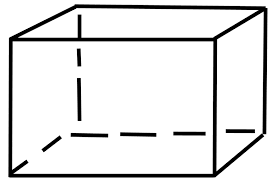
A Cuboid is a 3D figure that contains six faces, eight vertices, and twelve edges. It has a square surface and a rectangular surface. The shape of cuboid and cube are mostly the same but have different properties. The volume and surface area of cuboid and cube are different from each other.

cuboid

Surface Area and Volume of Cuboid Formula

Volume:
Volume of cuboid = l × b × h

Surface area formula:
Total surface Area of a Cuboid (S) = 2(lb + bh +hl)
Diagonal of a Cuboid (d) =√ l2+b2+h2
Where
l = length
b = breadth
h = height

How to Find Volume and Surface Area of Cuboid?

Follow the below steps to find the surface area and volume of a cuboid.

  1. First, you have to check out the given three-dimensional figure whether it is a cuboid or not.
  2. Now, see what we have to find from the given question.
  3. Apply the related formula to find the area or volume of the cuboid.
  4. And then write the obtained result and write the units with the answer.

Volume and Surface Area of Cuboid Questions

Example 1.
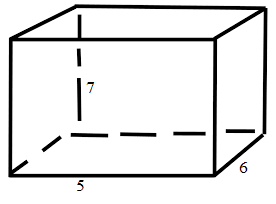
The cuboid has three mutually perpendicular edges measuring 5 cm, 6 cm, and 7 cm. Find its volume, surface area, and length of the diagonal.
Solution:
Three mutually perpendicular edges are length, breadth and height.
cuboid_12
Length = 5 cm
breadth = 6 cm
height = 7 cm.
Volume of cuboid = l × b × h
5 × 6 × 7 cm³
210 cm³
Surface area = 2(lb + bh + hl)
2(5 × 6 + 6 × 7 + 7 × 5)
= 214
Length of a diagonal =√ l2+b2+h2
= √(5)² + (6)² + (7)²
= √ 25 + 36 + 49
= 10.48 cm
Thus the length of a diagonal is 10.48 cm.

Example 2.
The length, breadth, and volume of a cuboid are 6 cm, 3 cm, and 80 cm³ respectively. Find its height, surface area.
Solution:
Given that
cuboid_13
Length = 6
breadth = 3
Volume = 80
height = h.
volume of a cuboid = l × b × h
80 cm³ = 6 cm × 3 cm × h
h = 80 cm³/6 cm × 3 cm
h = 80cm³/18 cm²
h = 4.4 cm.
Therefore, height = 4.4 cm.
Surface area = 2(lb + bh + hl)
= 2(6 × 3 + 3 × 4.4 + 4.4 × 6) cm²
= 2(18 + 13.2 + 26.4) cm²
= 2(115.2) cm²
= 115.2 cm²
Thus the surface area is 115.2 cm²

Example 3.
The dimensions of a cuboid are 13, 14, 16. Then find the volume and surface area.
Solution:
Given that
cuboid_14
Length = 13 cm
breadth = 14 cm
Height = 16 cm.
Volume of a cuboid = l × b × h
= 13 × 14 × 16
= 2912
The total surface area = 2 (lb + bh + hl)
=2((13 ×14) + (14×16) + (16×13)
= 2(182 + 224 + 208)
= 2(614) cm²
= 1228 cm²
Therefore, the total surface area of a cuboid= 1228 cm²

Example 4.
The dimensions of a cuboid are 3, 4, 6. Then find the volume and surface area.
Solution:
Given that
cuboid_15
Length = 3 cm
breadth = 4 cm
Height = 6 cm.
Volume of a cuboid = l × b × h
= 3 × 4 × 6
= 72
The total surface area = 2 (lb + bh + hl)
=2((3 ×4) + (4×6) + (6×3)
= 2(12 + 24 + 18)
= 2(54) cm²
= 108 cm²
Therefore, the total surface area of a cuboid= 108 cm²

Example 5.
The length, breadth, and volume of a cuboid are 5 cm, 10 cm, and 60 cm³ respectively. Find its height, surface area.
Solution:
Given that
cuboid_16
Length = 5
breadth = 10
Volume = 60
height = h.
volume of a cuboid = l × b × h
60 cm³ = 5 cm × 10 cm × h
h = 60 cm³/5 cm × 10 cm
h = 60cm³/15 cm²
h = 4 cm.
Therefore, height = 4 cm.
Surface area = 2(lb + bh + hl)
= 2(5 × 10 + 10 × 4 + 4 × 5) cm²
= 2(50 + 40 + 25) cm²
= 2(115) cm²
= 230 cm²
Thus the surface area is 230 cm²

FAQs on Volume and Surface Area of Cuboid

1. What is the formula of the surface area of a cuboid?

To find the surface area of a cuboid, add the areas of all 6 faces. We can also label the length, width, and height of the prism and use the formula, SA=2lw + 2lh + 2hw, to find the surface area.

2. What is the formula of volume of cuboids?

The formula of volume of a cuboid is = Length × Width × Height.

3. How do you work out the volume of a cuboid in Litres?

Volume of a cuboid = (length × breadth × height) cubic units. = (l × b × h) cubic units.

Lateral Surface Area of a Cuboid

Lateral Surface Area of a Cuboid – Definition, Formulas, Examples | How to Find Lateral Surface Area of a Cuboid?

A cuboid is a solid rectangular figure with three dimensions such as length, breadth, and height. To find the lateral surface area of a cuboid we have to add the length and breadth of the cuboid and multiply the sum with the height of the given solid figure. Here you can find the details of the solid figures like the lateral surface area of cuboid definition, the formula of LSA, How to find the lateral surface area of a cuboid, and examples of LSA of a cuboid.

See More:

Lateral Surface Area of a Cuboid – Definition

A cuboid has six faces, eight vertices, and twelve edges similar to the cube. The sum of surface areas of all sides except the top and bottom face of a solid is defined as the lateral surface area of a solid. The metric units of the Lateral Surface Area (LSA) of a Cuboid are Square units, square centimeters, square meters, square inches, etc.
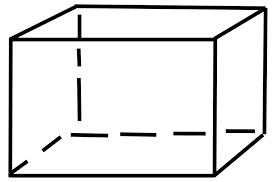
cuboid

Formula for finding Lateral Surface Area of a Cuboid

Area of the room = sum of the vertical faces
A = 2(l + b)h
where,
A = Area of the cuboid
l = length
b = base
h = height

How to Find Lateral Surface Area of a Cuboid?

The lateral surface area of a cuboid is nothing but the area of each surface of the cuboid. There are some steps to calculate the surface area of a cuboid. Go through the following steps and solve the problems.
Step 1: Check the dimensions of the cuboid.
Step 2: If the units of the dimensions are not the same then you have it into the same units.
Step 3: Once the dimensions are the same then use the formula of the lateral surface of the cuboid
Step 4: After that express the obtained value and write the units of the answer.

LSA of a Cuboid Examples

Example 1.
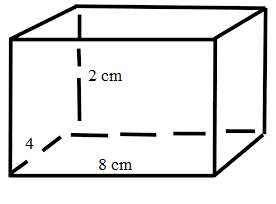
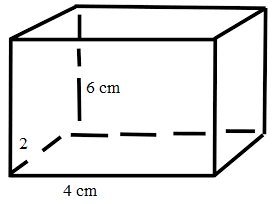
Find the lateral surface and total surface area of a cuboid of length 8 cm, breadth 4 cm, and height 2 cm.
Solution:
Given that
cuboid_7
length (l) = 8 cm
Breadth (b) = 4 cm
Height (h) = 2 cm
The lateral surface area of the cuboid = 2(lh+bh)=2h(l + b)
Lateral surface area =2(2)(8+4)
= 4(12)
= 48 cm².
Therefore the lateral surface area of a cuboid = 48 cm²

Example 2.
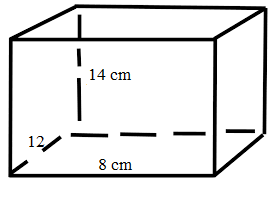
Rahul has a rice container with dimensions of length 8 cm, breadth 12 cm, and height 14 cm. Find the lateral surface area of a rice container
Solution:
Given that
cuboid_8
Length of a rice container = 8cm
Breadth of a rice container = 12 cm
Height of a rice container= 14 cm
Know we have to find out the lateral surface of the area of a rice container
We know that
The lateral surface area of the cuboid = 2(lh+bh)=2h(l + b)
The rice container is in the shape of a cuboid.
The lateral surface area of a rice container = 2 × 14 (8 + 12)
= 28(20)
= 560 cm²
Therefore, The lateral surface area of a rice container is 560 cm²

Example 3.
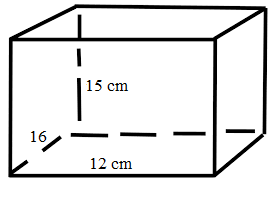
The dimensions of a cuboid are length 12 cm breadth 16 cm and height 15 cm. Find the lateral surface area of a cuboid.
Solution:
Given that
cuboid_9
Length of a cuboid = 12 cm
Breadth of a cuboid = 16 cm
Height of a cuboid = 15 cm
The lateral surface area of the cuboid = 2(lh+bh)=2h(l + b)
= 2 × 15(12 + 16)
= 30(28)
= 840 cm²
Therefore The lateral surface area of the cuboid = 840 cm²

Example 4.
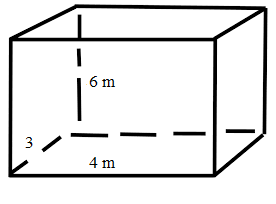
The dimensions of a cubical room are 4 m × 3 m × 6 m. The room has two doors each measuring 5 m by 1 m and four windows each measuring 1 m by 1 m. What will be the cost of plastering the four walls and the ceiling at Rs 35 per m²
Solution:
The total area of the four walls = Lateral surface area of the cuboid
cuboid_10
= 2(l + b)h
= 2(4 + 3) × 6
= 2(7) × 6m2
= 84 m².
The area of the ceiling = l × b
= 4 × 3
= 12 m²
The sum of the areas of the two doors and the four windows
5(5 × 1) m² + 6(1 × 1) m²
= 31 m²
Therefore, the total area to be plastered = lateral surface area + area of the ceiling – sum of the areas of the doors and the four windows
= (84 + 12 – 31) m²
= 65 m²
Therefore, the cost of plastering = 65× Rs. 35
= Rs. 2275

Example 5.
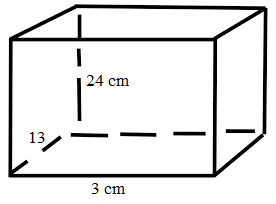
Find the lateral surface and total surface area of a cuboid of length 3 cm, breadth 13 cm and height 24 cm.
Solution:
Given that
cuboid_11
length (l) = 3 cm
Breadth (b) = 13 cm
Height (h) = 24 cm
The lateral surface area of the cuboid = 2(lh+bh)=2h(l + b)
Lateral surface area =2(24)(3 + 13)
= 48(16)
= 768 cm².
Therefore the lateral surface area of a cuboid = 768 cm²

FAQs on Lateral Surface Area of a Cuboid

1. What is the formula for the lateral surface area?

The lateral surface area of an object is equal to the surface area minus the area of the bases of the object.

2. How do you work out the surface area of a cuboid?

The surface area of cuboid = 2(lb + bh + lh),
where ‘l’ is the base length of the cuboid,
‘b’ is the base width of the cuboid, and
‘h’ is the height of the cuboid.

3. How many lateral faces does a cuboid have?

The four faces which are adjacent to the base are called the lateral faces of the cuboid.

Volume of Cube

Volume of Cube – Definition, Formula, Examples | How to Find the Volume of a Cube?

Volume is the total space occupied by the three-dimensional solid figure. In this article, we are going to find the Volume of cube with different dimensions like cm, m, inches, and so on. In a cube all the sides are equal. You can learn how to calculate the volume of the cube with formulas from here. Also, you can find examples of the volume of a cube with explanations.

What is the Volume of a Cube?

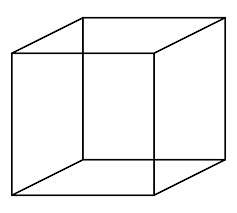
The definition of volume of a cube is the total number of cubic units occupied by the cube. The units of volume of a cube are cubic units. A cube is a three-dimensional geometric figure with 6 faces and sides. The length, breadth, and height of a cube are equal.
So, the volume of a cube is a × a × a
cube

The Volume of Cube Formula

The volume of cube = s × s × s (or) s³
Where
s is the side of the cube

The Volume of Cube using Side Formula

The volume of a cube can be measured by multiplying the lengths of the cube. The dimensions of the cube are length, breadth and height. We have to multiply all three dimensions to find the volume of a cube. All the sides in a cube are the same.
So, the volume of a cube using side is a × a × a cubic units

The Volume of Cube using Diagonal Formula

The volume of a cube whose diagonal (d) is √3a, where, ‘a’ is the side length of the cube.
V = [√3×(diagonal)³]/9

How to Find the Volume of a Cube?

The volume of a cube can be found by using the formulas. There are two formulas to calculate the volume of a cube. One is using the edge length and the other is using the measure of its diagonal.

The Volume of Cube using edge length

The lengths of the cube are equal. The steps to find the volume of a cube using the edge length is shown here.
step 1: First check out the measure of the given cube.
step 2: Apply the volume of a cube formula to find the measure of the cube.
Volume = a × a × a
step 3: Note down the obtained value and write the units of the volume.

The Volume of Cube using Diagonal

We can find the volume of a cube using the diagonals of the figure. Read the below steps to know how to find the volume of a cube using the diagonals.
step 1: Note down the measurements of the given cube.
step 2: Apply the volume of a cube using a diagonal formula to find the measure of the cube.
[√3×(diagonal)³]/9
step 3: Write down the obtained value with the units of the volume.

See More:

Volume of a Cube Word Problems with Solutions

Solve the given problems to test your math skills on the topic volume of a cube.

Example 1.
Using the volume of a cube formula, calculate the side length of a Rubik’s cube whose volume is 125 in³.
Solution:
Given that,
cube_6
The volume of Rubik’s cube = 125 in³
Using the volume of a cube formula
The volume of the cube = s³
where ‘s’ is the side length.
Putting the values, we get,
125 = (s³)
s = (125)¹/³ = 5 in
Therefore, the Side length of the Rubik’s cube = 5 in.

Example 2.
Find the volume of a cube if the length of its diagonal is 6 inches?
Solution:
Given that
cube_7
Diagonal of the cube = 6 in.
Using the volume of a cube formula,
The volume of the cube when diagonal is given
Volume of cube = (√3×d3)/9
d³ = 6 × 6 × 6 = 216
Volume of given cube = (√3×216)/9 = 41.5 in³
Therefore, Volume of the cube = 41.5 in³

Example 3.
The volume of a cube is 27cm³, then what is the measure of the edge of a cube?
Solution:
Given that
cube_8
Volume of a cube = V = 27 cm³
We know that, V = (side)³ or (edge)³
(edge)³ = 27 = 3³
Therefore, edge of the cube = 3 cm

Example 4.
What is the volume of a cube of 5 cm?
Solution:
Given that
cube_6
Side of the cube = a = 5 cm
We know that
The volume of a Cube formula is V= a³
Volume of a cube = 5³ cm³
Therefore the volume of a cube is 125 cm³

Example 5.
What is the volume of a cube of 10 cm?
Solution:
Given that
cube_9
Side of the cube = a = 10 cm
We know that
The volume of a Cube formula is V= a³
V= 10³ cm³
Therefore V = 1000 cm³

FAQs on Volume of a Cube

1. What is the formula of the volume of the cube?

The formula of volume of the cube is given by:
Volume = a³, where a is the length of its sides or edges.

2. What is the unit of volume of a cube?

The unit of volume of a cube is given by cubic units or unit³, such as cm³, m³, in³, and so on.

3. What is meant by the volume of a cube?

The volume of a cube is the space occupied by the three-dimensional shape.

Volume of Cuboid

Volume of Cuboid – Definition, Facts, Formula, Examples | How to Calculate Volume of Cuboid?

I think all the students of grade 9 are familiar with the solid figures. Here on this page, we will discuss in-depth the volume of cuboids like what the volume of cuboids exactly is, formulas, and how to calculate the volume of cuboids. Therefore the students who are looking forward to knowing about the volume of the cuboid can make use of our page and prepare well for the exams. In addition to this, you can find examples of the volume of the cuboid here.

What is the Volume of Cuboid?

Volume is the quantity that is used to measure solid figures like cuboids. A cuboid is a three-dimensional geometric figure. Simply we can say that a cuboid is a rectangular three-dimensional figure. In a rectangular cuboid, all the angles are right angles. A cuboid has 12 edges, 6 faces, and 8 vertices. A cuboid has three dimensions such as length, breadth, and height.
cuboid

So, we can measure the space occupied by the cuboid by using the volume formula. The units of volume of a cuboid are cubic units. The volume of a cuboid completely depends upon the length, breadth, and height of the object.

Formula of Volume of Cuboid

The unit of volume of cuboids is cubic units like cu. meter, cu. cm, cu. inches etc.
The formula of volume of cuboid is l × b × h
where,
l = length
b = breadth
h = height

Volume of Cuboid Prism | Volume of Rectangular Prism

A cuboid or rectangular prism is the same. A cuboid has six faces, eight vertices, and 12 edges. We can say that a cuboid is a solid rectangle. The top and bottom surfaces are the same in the cuboid. We can find the volume of the cuboid prism using the formula.
The volume of a rectangular prism or cuboid prism = length × breadth × height

How to find Volume of Cuboid?

We know that the volume of the cuboid can be calculated using the dimensions of the given figure. So, to find the volume of the cuboid we have to follow some steps. The scenario to calculate the volume of the cuboid is shown below.
Step 1: Check the dimensions of the given cuboid.
Step 2: Check the length, breadth, and height and see whether all the units are the same.
Step 3: If the units are not the same then convert them and make them into the same units.
Step 4: And then apply the volume of the cuboid formula.
Step 5: At last write the obtained value and write it in cubic units.

Also, Check:

Volume of Cuboid Questions

Check out the problems given below to know how to find the volume of a cuboid. If you learn these problems the students of 9th grade can solve any type of problem from the topic Volume of Cuboid.

Example 1.
Find the volume of a cuboid of dimensions 2 cm × 4 cm × 6 cm.
Solution:
Given that
cuboid_2
Length = 2 cm
Breadth = 4 cm
Height = 6 cm
We know that
The volume of cuboid = length × breadth × height.
Volume of cuboid = 2 cubic cm × 4 cubic cm × 6 cubic cm.
= 48 cubic cm.
Therefore, the volume of the cuboid = 48

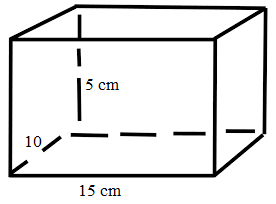
Example 2.
A water tank is 10 cm long, 15 cm broad and 5 cm high. What is the volume of a water tank in cubic cm?
Solution:
Given that,
cuboid_3
The length of the water tank = 10cm
The breadth of the water tank = 15 cm
The height of the water tank = 5 cm
We know that,
The volume of cuboid = length × breadth × height.
Volume of cuboid = 10 × 15 × 5 cuboid cm
Therefore, the volume of water tank = 750

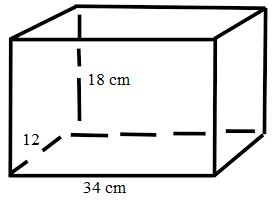
Example 3.
Kiran made a bangle box for his sister with a length of 12 cm, breadth of 34 cm, and height of 18 cm. Find the volume of the bangle box.
Solution:
Given that,
cuboid_4
Kiran made a bangle box for his sister of length = 12 cm
Kiran made a bangle box for his sister of breadth = 34 cm
Kiran made a bangle box for his sister of height = 18 cm
The volume of the bangle box = Length × breadth × height
= 12 × 34 × 18
= 7344cu cm.
Therefore, the volume of a bangle box = 7344 cu cm

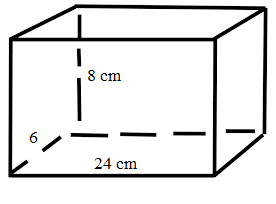
Example 4.
Find the number of cubical boxes of 4 cm which can be accommodated in a carton of dimensions 24 cm × 6 cm × 8 cm.
Solution:
Given that,
Side of a box = 4
Volume of box = side × side × side.
= 4 × 4 × 4
= 64 cu. cm.
Volume of carton = length × breadth × height.
cuboid_5
= 24 × 6 × 8
=1152 cu. cm.
A number of boxes = Volume of carton/Volume of each box.
= 1152/64
Therefore, the number of cubical boxes = 18.

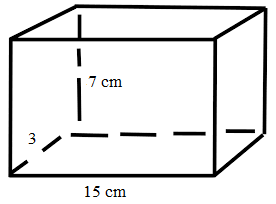
Example 5.
How many bricks each 15 cm long, 3 cm wide, and 7cm thick will be required for a wall 2 m long, 22 m high, and 6 m thick? If bricks sell at $600 per thousand what will it cost to build the wall?
Solution:
Given that
cuboid_6
Length of the brick = 15 cm
Width of the brick = 3 cm
Thick of the brick = 7 cm
Volume of the wall = 15 m × 3 m × 7 m
= 2 × 100 cm × 22 × 100 cm × 6 × 100 cm
= 264000000
Volume of brick = 15 cm × 3 cm × 7 cm
= 315
Number of bricks = Volume of the wall/Volume of the brick
= 200 × 2200 × 600/15 × 3 × 7
= 264000000/315
The number of bricks = 838095
The cost of 1 thousand bricks = $ 600
The cost of building the wall = $ 600 × 838095 = $ 502857000

FAQs on Volume of Cuboid

1. How do we define the volume of a cuboid?

A volume of cuboids is defined as the amount of space occupied by the cuboid surface in a three-dimensional figure.

2. If the units of dimensions of a cuboid are different, then how to find the volume?

If the units of length, width, and height are different then, we need to convert them into the same unit first and then find the volume.

3. What is the formula for the volume of cube and cuboid?

The volume of the cuboid is the product of length, width, and height.
Volume of cuboid = lbh
Volume of cube = s × s × s

Volume and Surface Area of a Cube

Volume and Surface Area of Cube – Definition, Facts, Formula, Examples | How do you find the Surface Area and Volume of a Cube?

A cube is a solid figure where the dimensions length, breadth, and height are equal. In this article, we calculate the volume and surface area of a cube. Here the students of grade 9 can know the definition of volume of the cube, the surface area of a cube with suitable formulas, examples. By using all these you can learn in-depth about the surface area and volume of a cube and also score good marks in the exams.

Volume and Surface Area of Cube

Surface Area of Cube: The surface area of a cube is defined as the sum of the areas of all the faces of a cube.
An example of the surface area of a cube is die.
cube

Volume of a cube: The volume of a cube is defined as the total space occupied by the solid cube. It is the multiplication of all the dimensions such as length, breadth, and height. The lengths of all the dimensions in a cube are equal. Thus the formula of volume of a cube is a³.

Surface Area and Volume of a Cube Formula

S.A of a cube Formula:
The formula of the surface area of a cube is 2 × length × breadth + 2 × length × height + 2 × breadth × height
We know that,
All the sides in a cube are equal
length = breadth = height = a
Surface Area of a cube = 2 × a × a + 2 × a × a + 2 × a × a
= 2 a² + 2 a² + 2 a²
= 6a²
Thus the Surface Area of a cube is 6a²
Volume:
Volume of a cube = lbh
V = (a)³

Also, Check:

Volume and Surface Area of Cube Example Problems

Example 1.
The cube of edge 3 cm is divided into cubes of edge 1 cm. How many cubes will be made? Find the total surface area of the smaller cubes.
Solution:
Given,
cube_1
The cube of edge 3 cm is divided into cubes of edge 1 cm.
The volume of the bigger cube = (s)³
= 3³ cm³
= 27cm³
We know that,
The volume of each of the smaller cubes = (s)³
= 1³ cm³
= 1 cm³
Therefore, the number of smaller cubes = 27cm³/1cm³
= 27
We know that,
The total surface area of a smaller cube = 6(s)²
= 6 × 1 cm²
= 6
Therefore, the total surface area of the eight smaller cubes = 27 × 6 cm² = 162cm²

Example 2.
The cube is 3.5 inches on each side. Find its volume and surface area.
Solution:
Given that
cube_2
Cube = 3.5 inches
We know that,
The volume of cube = s³
The volume of cube = (3.5)³
= 42.875 cubic inches
We know that,
The surface area of the cube = 6s²
The surface area of the cube = 6(3.5)²
= 6 × 12.25
= 73.5 square inches

Example 3.
A block is a cube measuring 6 inches on each side. Find the volume and surface area of the cube.
Solution:
Given that
cube_3
Cube = 6 inches
We know that,
The volume of cube = s³
The volume of cube = (6)³
= 216 cubic inches
The surface area of the cube = 6s²
The surface area of the cube = 6(6)²
= 6 × 36
= 216 square inches
Therefore the surface area of the cube is 216 square inches

Example 4.
A note cube measures 2 inches on each side and finds its volume and surface area.
Solution:
Given that
cube_4
Cube = 2 inches
We know that,
The volume of cube = s³
The volume of cube = (2)³
= 8 cubic inches
The surface area of the cube = 6s²
The surface area of the cube = 6(2)²
= 6 × 4
= 24 square inches
Therefore the surface area of the cube = 24 square inches

Example 5.
The cube is 4 inches on each side. Find its volume and surface area.
Solution:
Given that
cube_5
Cube = 4 inches
We know that,
The volume of cube = s³
The volume of cube = (4)³
= 64 cubic inches
The surface area of the cube = 6s²
The surface area of the cube = 6(4)²
= 6 × 16
= 96 square inches
Therefore the area of the cube is 96 square inches.

FAQs on Volume and Surface Area of Cube

1. Is the surface area and volume of a cube the same?

We know that the volume of a cube is equal to s3, where s is the length of a given side of the cube. The sides of a cube are all the same, the surface area of the cube is equal to 6 times the area of one face.

2. Is surface area equal to volume?

The increase in volume is always greater than the increase in surface area.

3. What is volume and surface area?

The surface area of any given object is the area or region occupied by the surface of the object. Whereas volume is the amount of space available in an object.

Solid Figures

Solid Figures – Definition, Types, Properties | Solid Shapes with Examples

Hello students!!! Would you like to know what is meant by solid figures? If yes, then what are you waiting for you are on the right page. Start your preparation by using this page. In this article, the students of 9th grade can find the topics related to solid figures and their measurements. Usually, we can measure the solid figure in terms of total surface area, lateral surface area, and volume. So, we suggest you guys click on the below-mentioned links and learn in detail about the volume and surface area of the solid figures.

List of Solid Figures Concepts

What are Solid Figures?

Solid figures are nothing but three-dimensional geometric shapes such as cuboids, cubes, prisms, pyramids, spheres, etc. The 3D figures consist of faces, edges, and vertices. The flat part of a solid shape is known as the face. Each corner of the face is known as a vertex. The point where two faces meet is known as the edges. The solid figures contain three dimensions length, width, and height. Examples of solids figures are computers, dice, container, and so on.

Types of Solid Figures

Cuboid: In geometry, a cuboid is a three-dimensional figure with six faces, 12 edges, and 8 vertices. A cuboid is a rectangular 3D box. The three dimensions of a cuboid are length, breadth, and height.
cuboid

Cube: Cube is a type of solid figure which is bounded by six faces, 8 vertices, and 12 edges. It consists of three dimensions length, width, and height. And the difference between the cube and cuboid is that all the sides of the cube are equal.
cube

Sphere: A sphere is a solid figure with no faces, no edges, and no vertices. It is a 3D figure. A sphere has one surface that is equidistant from the origin. An example of a sphere is the ball.
sphere

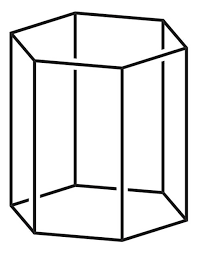
Prism: Prism is a 3D solid figure that consists of two equal ends, flat surfaces, and has an identical cross-section across its length. A prism has six vertices, 9 edges, and 5 faces.
prism

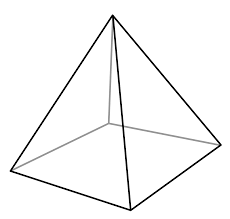
Pyramid: A pyramid is a solid figure with a flat base and all lateral faces as triangles. Types of pyramid are square pyramid, triangular pyramid, hexagonal pyramid, and pentagonal pyramid.
pyramid

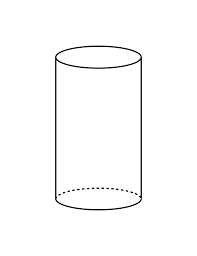
Cylinder: A cylinder is a solid three-dimensional figure with two parallel circular bases that are joined by the curved surface. The shape of a cylinder has no vertices, two edges, 2 flat faces, and one curved face. We can measure the cylinder using the total surface area, curved surface area, and volume of the cylinder.
cylinder

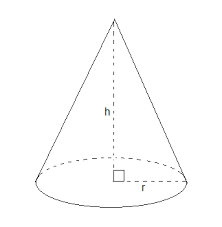
Cone: A cone is a three-dimensional geometric shape that narrows from the flat base to the point. The base of a cone is a circle. It has one face. An example of the cone is ice cream, funnel, party hat.
Cone

Also, Check:

Properties of Solid Shapes

1. Solid shapes or solid figures are three-dimensional geometric figures that means they have length, breadth, and height.
2. Solid figures have three dimensions.
3. They have the number of faces, edges, and vertices based on the figure.

Solid Figures Examples

Example 1.
Find the volume and surface area of a cuboid of length 5 cm, breadth 6 cm, and height 7 cm.
Solution:
cuboid_1
Given that
length= 5 cm
breadth = 6 cm
height = 7 cm
Volume of cuboid = V = l x b x h
= 5 x 6 x 7
= 210 cm³
Surface area of a cuboid = 2 ( lb + lh + bh)
= 2( 5×6 + 6×7 + 5×7)
=2(30 + 42 + 35)
=2(107)
= 142cm²
Thus the surface area of a cuboid is 142cm²

Example 2.
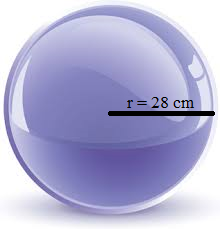
Find the volume of the sphere of radius 28 cm.
Solution:
Given that
sphere_1
radius of the sphere = r = 28 cm
Volume of sphere = 4/3 πr³
= (4/3) × (22/7) × 28 × 28 × 28
= 4 × 22 × 28 × 28 x 4
= 275,968cm³
Thus the volume of the sphere is 275,968cm³

Example 3.
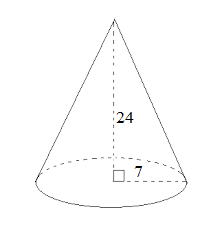
The base radius and height of a right circular cone is 7 cm and 24 cm. Find its curved surface area and volume
Solution:
Given that
Cone_1
Radius = r = 7 cm
Height = h = 24 cm
Slant height = l = √ r² + h²
l = √7 × 7 + 24 × 24 cm
25 cm
Curved surface area = πrl
22/7 × 7 × 25 cm²
550 cm²
Total surface area = πrl + πr²
= (550 + 22/7 + 49) cm²
= (550 + 154) cm²
= 704 cm²
Volume = ⅓πr²h
= ⅓ × 22/7 × 49 × 24 cm³
= 1232 cm³
Thus the volume of a cone is 1232 cm³

Example 4.
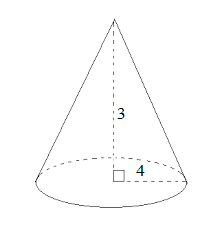
A conical tent is 3 high and its base radius is 4 cm. Find the cost of the canvas required to make the tent at the rate of Rs 60 per unit.
Solution:
Given that
Cone_2
Radius = r = 3
Height = h = 4
Slant height = l = √r² + h²
= √ 9 + 16
= √25
= 5
Slant height of the tent is 5
Curved surface area = πrl
We know that π = 3.14
= 3.14 × 4 × 5
= 62.8
Therefore canvas required for making the tent = 62.8
Therefore cost of the canvas at 65 per m²
= 65 × 62.8
= 4082

Example 5.
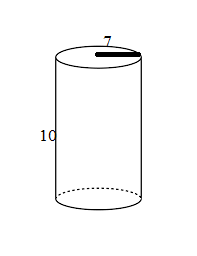
The radius and height of the right circular cylinder are 7 cm and 10 cm. Find curved surface area, total surface area, and volume
Solution:
Given that
cylinder_1
Radius = r = 7 cm
Height = h = 10 cm
The curved surface area of a circular cylinder = 2πrh
= 2 × 22/7 × 7 × 10 cm²
= 440 cm²
Total surface area of a circular cylinder = 2πrh + 2 πr²
= 2 × 22/7 × 7 × 10 + 2 × 22/7 × 7 × 7 cm²
= 440 cm² + 308 cm² = 748 cm²
Volume of a circular cylinder = πrh
= 22/7 × 7 × 10 cm²
= 1540 cm³
Thus the volume of the cylinder is 1540 cm³

Frequently Asked Questions on Solid Figures

1. What is meant by solid figures?

In geometry, the solid shapes are the objects that occupy space. Examples of solid shapes are cube, cone, cuboid, sphere, cylinder.

2. What is the measurement of a solid figure?

A solid figure has three dimensions while a plane figure has only two dimensions. The space enclosed by a solid figure is called its volume.

3. How do you represent solid figures?

Three-dimensional solid figures can be represented by the two-dimensional pattern of polygons that create them.

In a Rectangle the Diagonals are of Equal Lengths

In a Rectangle the Diagonals are of Equal Lengths | How do you Prove that the Diagonal of a Rectangle are Equal in Length?

A Rectangle is a type of quadrilateral. In a particular condition, we can say that a rectangle is a parallelogram. In a rectangle the opposite sides are equal and the angles are 90 degrees. In this article, we are going to prove that in a rectangle the diagonals are of equal lengths. We need to prove that two line segments are of equal lengths.

Properties of a Rectangle:
1. The opposite sides are equal.
2. The diagonals in a rectangle bisect each other.
3. Any two adjacent angles are supplementary.
4. The opposite angles are equal.

Also Read:

In a Rectangle the Diagonals are of Equal Lengths

Theorem:
Prove that the diagonals of a rectangle are of equal lengths?
Rectangle_2
To prove: AC = BD
Let ABCD be a rectangle.
The opposite sides are of equal lengths.
We have to show that AC = BD
BC = CB [since common]
AB = DC [opposite sides of a parallelogram are equal]
ABC =DCA = 90°
so ABC ≅ DCB (SAS theorem)
Hence AC=DB
Hence Proved
Therefore we have proven that in a rectangle the diagonals are of equal lengths.

FAQs on Prove that Diagonals of a Rectangle are Equal in Length

1. How many equal-length diagonals are there in a rectangle?

A rectangle and a crossed rectangle are quadrilaterals with the following properties in common: Opposite sides are equal in length. The two diagonals are equal in length. It has two lines of reflectional symmetry and rotational symmetry of order 2.

2. Do diagonals have an equal length?

Square, Rectangle, Parallelogram have diagonals of equal length because the opposite sides of those quadrilaterals are the same.

3. Why are the diagonals of rectangles equal?

Yes, the diagonals of a rectangle are the same. This is because the two diagonals are the hypotenuse of the two right-angled triangles formed by the diagonals. The opposite sides of a rectangle are the same.

A Parallelogram whose Diagonals Intersect at Right Angles is a Rhombus

A Parallelogram whose Diagonals Intersect at Right Angles is a Rhombus Theorem & Proof

Are you looking for the theorems of properties of parallelograms on various websites? If our guess is correct then you are on the right page here you can find the step-by-step explanation for all the theorems on parallelogram here. A quadrilateral in which all the four sides are equal is a rhombus. If the diagonals of a parallelogram are equal and intersect at the right angle then it is known as a rhombus. Let us prove that A Parallelogram whose Diagonals Intersect at Right Angles is a Rhombus in this article.

Read Related Articles:

A Parallelogram whose Diagonals Intersect at Right Angles is a Rhombus

Theorem: A Parallelogram whose Diagonals Intersect at Right Angles is a Rhombus.
ABCD parallelogram_2
Given:
The parallelogram ABCD with diagonals AC and BD as shown in the above figure.
The diagonals AC and BD meet at the point “O” at right angles.
To Prove that:
A parallelogram is a rhombus
Proof:
Consider ΔAOD and ΔCOD
AO = OC [diagonals AC and BD bisect each other at O]
∠AOD = ∠COD [both 90° because given that diagonals intersect at right angles]
ΔAOD ≅ ΔCOD [SAS theorem]
Therefore, we can say that the parallelogram ABCD is a rhombus.
Hence Proved

FAQs on Parallelogram whose Diagonals Intersect at Right Angles is a Rhombus

1. Do diagonals intersect in a rhombus?

The intersection of the diagonals of a rhombus form 90 degrees. This means that they are perpendicular. The diagonals of a rhombus bisect each other.

2. Which quadrilateral has diagonals that intersect at right angles?

A quadrilateral whose diagonals bisect each other at right angles is a rhombus. each other at right angles at M. So AB = AD and by the first test above ABCD is a rhombus. If the diagonals of a parallelogram are perpendicular, then it is a rhombus.

3. Is a parallelogram a rhombus?

Not every parallelogram is a rhombus, though any parallelogram with perpendicular diagonals (the second property) is a rhombus.