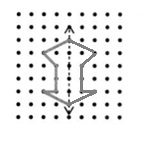
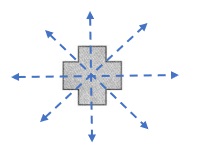
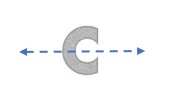
enVision Math Common Core Grade 4 Answer Key Topic 16 Lines, Angles, and Shapes

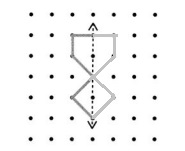
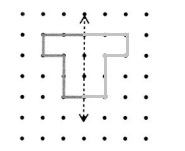
Go through the enVision Math Common Core Grade 4 Answer Key Topic 16 Lines, Angles, and Shapes and finish your homework or assignments.

enVision Math Common Core 4th Grade Answers Key Topic 16 Lines, Angles, and Shapes

Essential Questions:
How can you classify triangles and quadrilaterals? What is line symmetry?
Envision Math Common Core 4th Grade Answer Key Topic 16 Lines, Angles, and Shapes 1

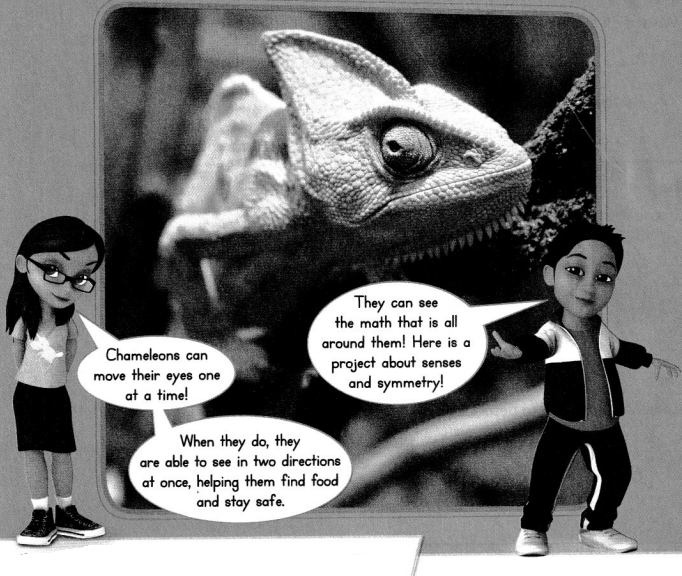
enVision STEM Project: Senses and Symmetry
Do Research The location of an animal’s eyes helps it to survive in the wild. Use the Internet or other sources to find why some animals have eyes on the sides of their head and others have eyes on the front.
Journal: Write a Report Include what you found. Also in your report:

Most animals are the same on both sides of their body. Use a line of symmetry to help make a simple drawing of your favorite animal’s face. Draw both sides of the animal’s face the same. Explain how you know that both sides of your drawing are the same.

Review What You Know

Vocabulary
Choose the best term from the box. Write it on the blank.

  • angle
  • polygon
  • quadrilateral
  • triangle

Question 1.
A ___________ is a closed figure made up of straight line segments.
Answer:
A polygon is a closed figure made up of straight line segments

Question 2.
A polygon with three sides is a(n) _________.
Answer:
A polygon with three sides is a(n) Triangle

Question 3.
A(n) _________ is formed by two rays with the same endpoint.
Answer:
A(n) Angle is formed by two rays with the same endpoint.

Shapes

Choose the best term to describe each shape. Use each term once.
Rectangle
Rhombus
Trapezoid
Question 4.
Envision Math Common Core 4th Grade Answer Key Topic 16 Lines, Angles, and Shapes 2
Answer:
Rhombus
Explanation :
2 pairs of parallel sides
4 equal sides

Question 5.
Envision Math Common Core 4th Grade Answer Key Topic 16 Lines, Angles, and Shapes 3
Answer:
Trapezoid – only 1 pair of parallel sides

Question 6.
Envision Math Common Core 4th Grade Answer Key Topic 16 Lines, Angles, and Shapes 4
Answer:
Rectangle
Explanation :
2 pairs of parallel sides
4 right angles

Lines

Use geometric terms to describe what is shown.
Question 7.
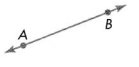
Envision Math Common Core 4th Grade Answer Key Topic 16 Lines, Angles, and Shapes 5
Answer:
It is said as line AB and represented a \(\overleftrightarrow{\mathrm{AB}}\)
Explanation :
A line is a straight path of points that goes without end in both directions .

Question 8.
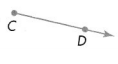
Envision Math Common Core 4th Grade Answer Key Topic 16 Lines, Angles, and Shapes 6
Answer:
It is called as Ray \(\overrightarrow{C D}\). The symbol of a ray is →
Explanation :
A ray is a part of line that has one end point and goes on without end in one direction .

Question 9.
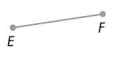
Envision Math Common Core 4th Grade Answer Key Topic 16 Lines, Angles, and Shapes 7
Answer:
Line segment – It is represented as \(\overline{E F}\)
Explanation :
It is a line segment EF. Line segments are represented by a single overbar with no arrowheads over the letters representing the two endpoints.

Problem Solving

Question 10.
Generalize Which generalization about these figures is NOT true?
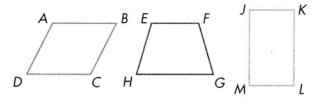
Envision Math Common Core 4th Grade Answer Key Topic 16 Lines, Angles, and Shapes 8
A. Each figure is a quadrilateral.
B. Each figure has two pairs of parallel sides.
C. Each figure has at least two sides of equal length.
D. Each figure has 4 angles.
Answer:
Option B is not true
Explanation :
Figure 2 that is trapezoid EFGH has only one pair of parallel lines .

Pick a Project

PROJECT 16A
How are dictionaries useful?
Project: Create a Picture Dictionary

Envision Math Common Core 4th Grade Answer Key Topic 16 Lines, Angles, and Shapes 9

PROJECT 16B
How can shapes be used in art at the Dali Museum?
Project: Create Cubist Art

Envision Math Common Core 4th Grade Answer Key Topic 16 Lines, Angles, and Shapes 10

PROJECT 16C
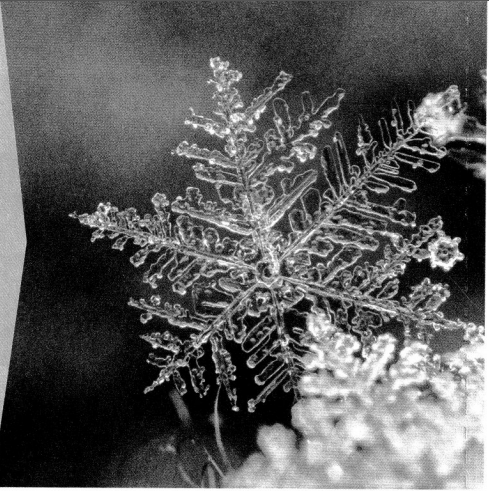
Do snowflakes have lines of symmetry?
Project: Make Snowflakes
Envision Math Common Core 4th Grade Answer Key Topic 16 Lines, Angles, and Shapes 11

PROJECT 16D
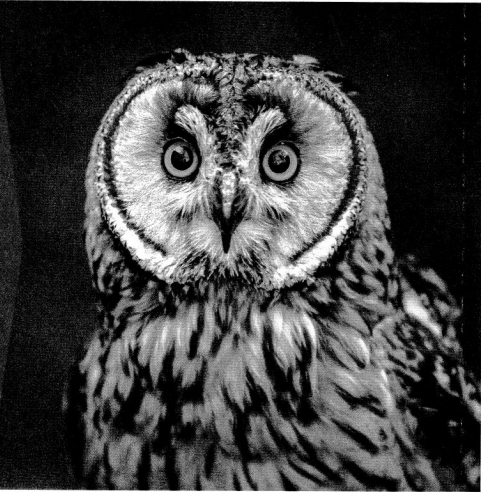
Can animals have symmetry?
Project: Draw a Line-Symmetric Animal
Envision Math Common Core 4th Grade Answer Key Topic 16 Lines, Angles, and Shapes 12

Lesson 16-1 Lines

Solve & Share
The number line below is an example of a line. A line goes on forever in a straight path in two directions. Draw the following pairs of lines: two lines that will never cross, two lines that cross at one point, two lines that cross at two points. If you cannot draw the lines, tell why.
I can … draw and identify perpendicular, parallel, and intersecting lines.
Envision Math Common Core 4th Grade Answer Key Topic 16 Lines, Angles, and Shapes 13

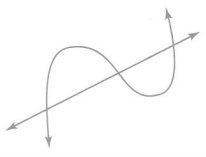
Look Back! Terry said, “The lines shown intersect at three points.” Is Terry correct? Explain.
Envision Math Common Core 4th Grade Answer Key Topic 16 Lines, Angles, and Shapes 14
Answer :
No Terry is not correct .
Explanation :
A line can be defined as a straight one- dimensional figure that has no thickness and extends endlessly in both directions. It is often described as the shortest distance between any two points.
Envision-Math-Common-Core-4th-Grade-Answers-Key-Topic-16-Lines-Angles-and-Shapes-Lesson-16-1-Lines-Solve-&-Share

Essential Question
How Can You Describe Pairs of Lines?
Answer :
A pair of lines, line segments or rays are intersecting if they have a common point. This common point is their point of intersection.
For example, two adjacent sides of a sheet of paper, a ruler, a door, a window and letters.

Visual Learning Bridge
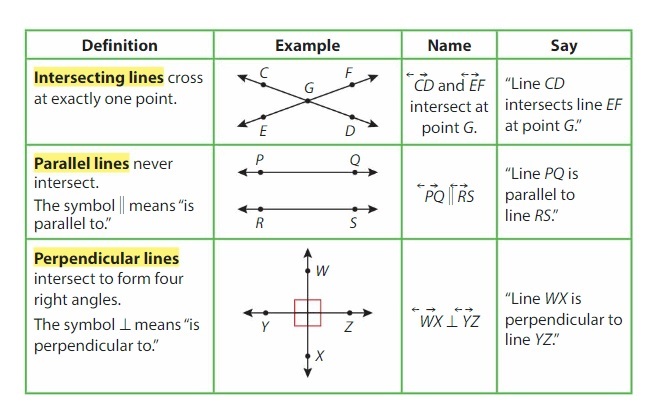
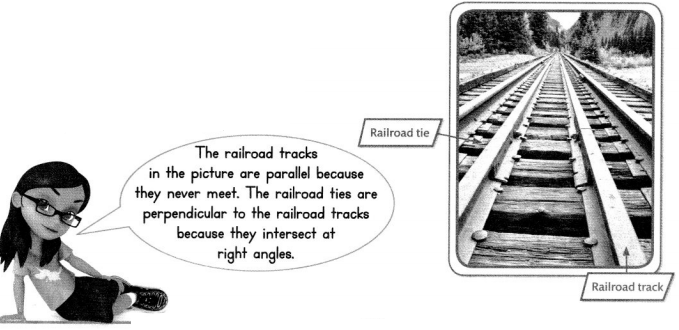
A line is a straight path of points that goes on and on in opposite directions. A pair of lines can be described as parallel, perpendicular, or intersecting.
Envision Math Common Core 4th Grade Answer Key Topic 16 Lines, Angles, and Shapes 15

Pairs of lines are given special names depending on their relationship.
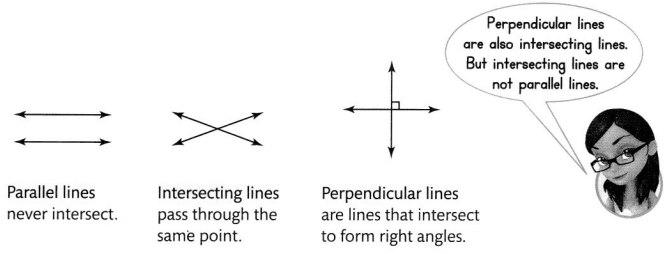
Envision Math Common Core 4th Grade Answer Key Topic 16 Lines, Angles, and Shapes 16

Convince Me!
Be Precise Find examples in your classroom where you can identify parallel lines, intersecting lines, and perpendicular lines. Explain.
Answer :
(i) Intersecting lines – Edges of my Textbook and Notebook through any corner .

(ii) Parallel lines – Opposite Edges of my textbook and notebook

(iii) Perpendicular lines – Adjacent edges of my textbook and black board in my classroom.

Guided Practice

Do You Understand?
Question 1.
What geometric term could you use to describe the top and bottom edges of a book? Why?
Answer:
The top and bottom edges of a book are parallel lines.
Explanation :
Both the lines are equidistant from each other and they never intersect each other lines .

Question 2.
The blades of an open pair of scissors look like what pair of lines? Why?
Answer:
perpendicular lines .
Explanation :
When the scissor is open it look like perpendicular lines intersecting at right angle .

Do You Know How?
For 3-6, use the diagram.
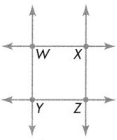
Envision Math Common Core 4th Grade Answer Key Topic 16 Lines, Angles, and Shapes 17
Question 3.
Name four points.
Answer:
The Four points are W, X, Y and Z .
Explanation :
A point is a location represented by a dot. A point does not have any length, width, shape or size, it only has a position.
When two distinct points are connected they form a line.

Question 4.
Name four lines.
Answer:
The four lines are WX, XZ, ZY and YW .

Question 5.
Name two pairs of parallel lines.
Answer:
The two pairs of parallel lines are WX ll YZ .

Question 6.
Name two pairs of perpendicular lines.
Answer:
The two pairs of perpendicular lines are WY ⊥  YZ and ZX ⊥ WX .

Independent Practice

For 7-12, use geometric terms to describe what is shown. Be as specific as possible.
Question 7.
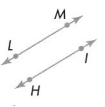
Envision Math Common Core 4th Grade Answer Key Topic 16 Lines, Angles, and Shapes 18
Answer:
LM ll to HI .
Explanation :
Both the lines are equidistant and doesn’t intersect so the given lines are parallel lines .

Question 8.
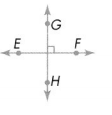
Envision Math Common Core 4th Grade Answer Key Topic 16 Lines, Angles, and Shapes 19
Answer:
GH ⊥ EF
Explanation :
Both the lines are intersecting at a point forming Right angle so, the lines are perpendicular lines .

Question 9.
Envision Math Common Core 4th Grade Answer Key Topic 16 Lines, Angles, and Shapes 20
Answer:
It is a point A .
Explanation :
A point is a location represented by a dot. A point does not have any length, width, shape or size, it only has a position.
When two distinct points are connected they form a line.

Question 10.
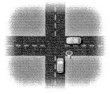
Envision Math Common Core 4th Grade Answer Key Topic 16 Lines, Angles, and Shapes 21
Answer:
Perpendicular paths
Explanation :
Perpendicular lines are lines that intersect at a right (90 degrees) angle.
Both the Road paths are intersecting at a point forming Right angle so, the Road paths are perpendicular to each other  .

Question 11.
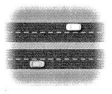
Envision Math Common Core 4th Grade Answer Key Topic 16 Lines, Angles, and Shapes 22
Answer:
Parallel paths .
Explanation :
The two straight lines in a plane that do not intersect at any point are said to be parallel.

Question 12.
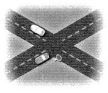
Envision Math Common Core 4th Grade Answer Key Topic 16 Lines, Angles, and Shapes 23
Answer:
Intersecting Lines
Explanation :
A pair of lines, line segments or rays are intersecting if they have a common point. This common point is their point of intersection .

For 13-15, draw what is described by the geometric terms.
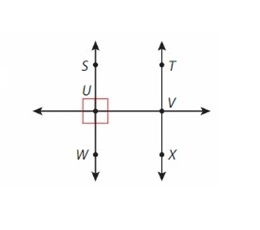
Envision-Math-Common-Core-4th-Grade-Answers-Key-Topic-16-Lines-Angles-and-Shapes-Lesson-16-1-Lines-Independent-Practice-Question-13
Question 13.
Perpendicular lines
Answer:
Perpendicular lines – SW ⊥ UV and TX ⊥ UV .

Question 14.
Intersecting lines
Answer:
Intersecting lines – Line SW is interescted at point U and Line TX is interescted at V .

Question 15.
Parallel lines
Answer:
Parallel lines – SW ll TX .

Problem Solving

Question 16.
Critique Reasoning
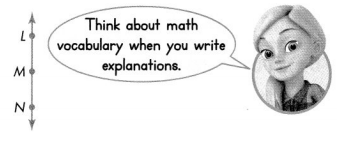
Bella names this line \(\overleftrightarrow{\mathrm{LM}}\). Miguel names the line \(\overleftrightarrow{L N}\). Who is correct? Explain.
Envision Math Common Core 4th Grade Answer Key Topic 16 Lines, Angles, and Shapes 24
Answer:
Both are correct
Explanation :
These three points L, M and N all lie on the same line.
This line could be called ‘Line LM’, ‘Line MN’, ‘Line LN’, ‘Line NL’, ‘Line NM’, or ‘Line ML’

Question 17.
Construct Arguments if all perpendicular lines are also intersecting lines, are all intersecting lines also perpendicular lines? Explain.
Answer:
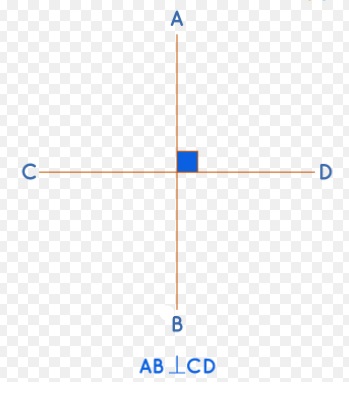
Perpendicular lines always intersect each other, however, all intersecting lines are not always perpendicular to each other.
The two main properties of perpendicular lines are: Perpendicular lines always meet or intersect each other.
The angle between any two perpendicular lines is always equal to 90.
Envision-Math-Common-Core-4th-Grade-Answers-Key-Topic-16-Lines-Angles-and-Shapes-Lesson-16-1-Lines- Problem-Solving-Question-17
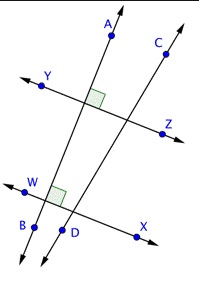
Perpendicular lines intersect at a right angle. and do not intersect in this image, but if you imagine extending both lines, they will intersect soon. So, they are neither parallel nor perpendicular.
Envision-Math-Common-Core-4th-Grade-Answers-Key-Topic-16-Lines-Angles-and-Shapes-Lesson-16-1-Lines- Problem-Solving-Question-17.

Question 18.
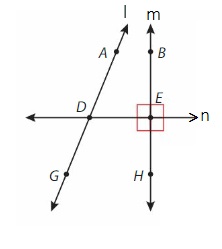
Draw three lines so two of the lines are perpendicular and the third line intersects the perpendicular lines at exactly one point. Label the lines with points.
Answer:
Envision-Math-Common-Core-4th-Grade-Answers-Key-Topic-16-Lines-Angles-and-Shapes-Lesson-16-1-Lines- Problem-Solving-Question-18
Explanation :
line m and n are perpendicular lines and line l intersects the perpendicular line at D point as shown in above figure .

Question 19.
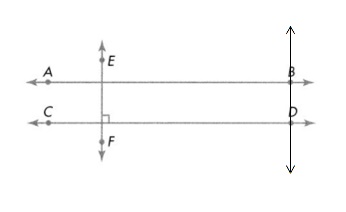
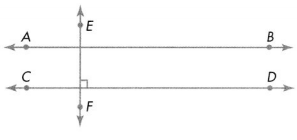
Higher Order Thinking \(\overleftrightarrow{A B}\) is parallel to \(\overleftrightarrow{C D}\), and \(\overleftrightarrow{C D}\) is perpendicular to \(\overleftrightarrow{E F}\). If a line through B and D is perpendicular to \(\overleftrightarrow{A B}\), what is the relationship between \(\overleftrightarrow{B D}\) and \(\overleftrightarrow{E F}\)?
Envision Math Common Core 4th Grade Answer Key Topic 16 Lines, Angles, and Shapes 25
Answer:
Envision-Math-Common-Core-4th-Grade-Answers-Key-Topic-16-Lines-Angles-and-Shapes-Lesson-16-1-Lines- Problem-Solving-Question-19
Explanation :
\(\overleftrightarrow{A B}\) ll \(\overleftrightarrow{C D}\) .
\(\overleftrightarrow{C D}\) ⊥ \(\overleftrightarrow{E F}\)
if \(\overleftrightarrow{A B}\) ⊥ \(\overleftrightarrow{B D}\) then ,
\(\overleftrightarrow{B D}\) and \(\overleftrightarrow{E F}\) are parallel lines asshown in above figure .

Assessment Practice 

Question 20.
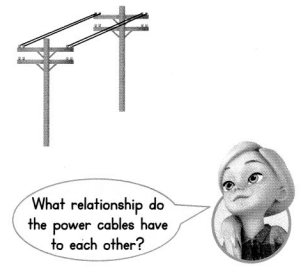
Which geometric term would you use to describe the power cables shown at the right?
Envision Math Common Core 4th Grade Answer Key Topic 16 Lines, Angles, and Shapes 26
A. Perpendicular lines
B. Parallel lines
C. Intersecting lines
D. Points
Answer:
Option B – Parallel lines .
Explanation :
Both the power cables are parallel to each other as there are equidistant from each other .

Lesson 16.2 Classify Triangles

Solve & Share
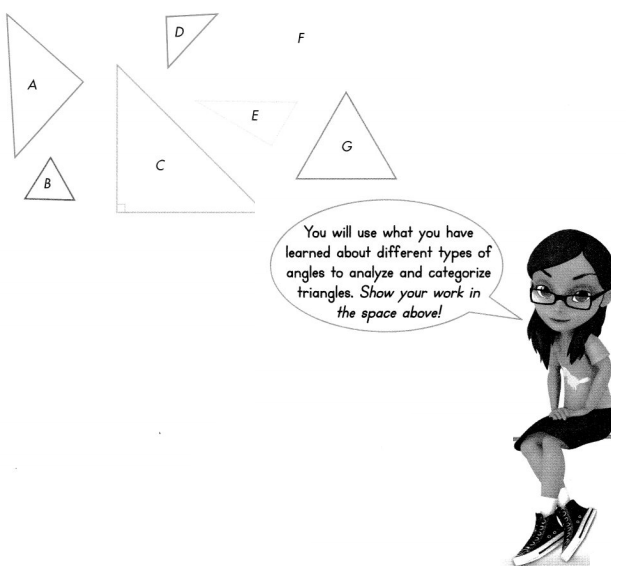
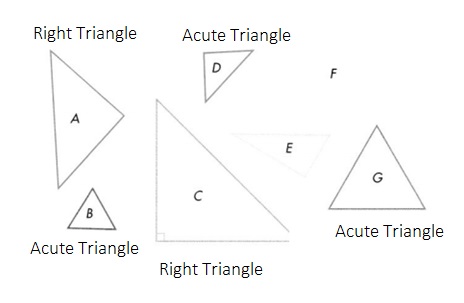
Sort the triangles shown below into two or more groups. Explain how you sorted them. Solve this problem any way you choose.
I can … reason about line segments and angles to classify triangles.
Envision Math Common Core 4th Grade Answer Key Topic 16 Lines, Angles, and Shapes 27

Look Back! Generalize What is true about all 7 triangles you sorted?
Answer :
Envision-Math-Common-Core-4th-Grade-Answers-Key-Topic-16-Lines-Angles-and-Shapes-Lesson-16-2-Classify-Triangles-Problem-Solve-&-Share

Essential Question
How Can You Classify Triangles?

Visual Learning Bridge
Triangles can be classified by the line segments that make their sides.
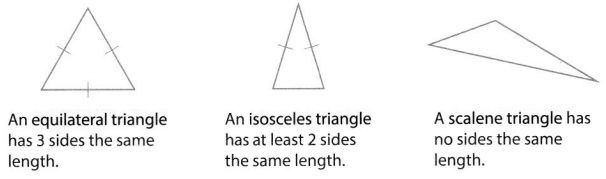
Envision Math Common Core 4th Grade Answer Key Topic 16 Lines, Angles, and Shapes 28

Triangles can be classified by their angle measures.
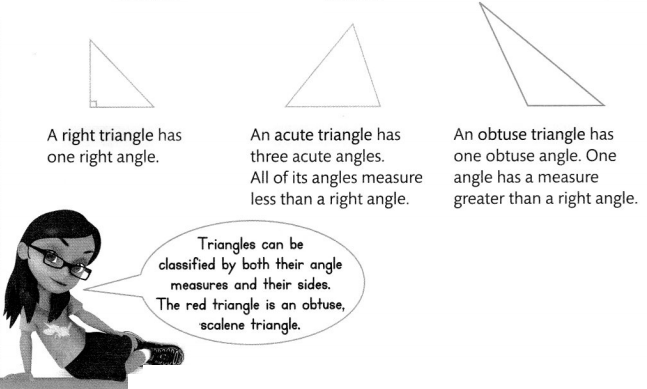
Envision Math Common Core 4th Grade Answer Key Topic 16 Lines, Angles, and Shapes 29


Convince Me!
Be Precise Can a triangle have more than one obtuse angle? Explain.
Answer :
No
Explanation :
Because sum of angles in the triangle = 180 degree .
if one angle is obtuse angle that is 120 degrees .
then , other two angles will be 180 – 120 = 60 degrees .
that means a triangle can have only one obtuse angle .

Another Example!
The pattern follows the rule: right triangle, acute triangle, right triangle, acute triangle…. It also follows the rule: isosceles, scalene, scalene, isosceles, scalene…. Draw a triangle that could be next in the pattern and explain.

For the first rule, the next triangle is acute. For the second rule, it is scalene. So, the next triangle is an acute, scalene triangle. It can be the same as the second triangle in the pattern or it can be a different acute, scalene triangle.

Guided Practice

Do You Understand?
Question 1.
Is it possible to have an obtuse acute triangle? Explain.
Answer:
No, it is not possible
Explanation :
Because sum of angles in the triangle = 180 degree .
if one angle is obtuse angle that is 120 degrees .
then , other two angles will be 180 – 120 = 60 degrees .
that means a triangle can have only one obtuse angle .

Question 2.
Can a triangle have more than one right angle? If so, draw an example.
Answer:
No a triangle cannot have more than one right angle
Explanation :
As if there are 2 right angles the their sum will be 180° and the third angle will exceed the sum. … As the sum of all three angles is , the third angle would have to be zero resulting in a degenerate shape which is a line rather than a triangle.

Do You Know How?
For 3-4, classify each triangle by its sides, and then by its angles.
Question 3.
Envision Math Common Core 4th Grade Answer Key Topic 16 Lines, Angles, and Shapes 31
Answer:
Isosceles triangle
Acute Triangle
Explanation :
An Isosceles triangle has at least 2 sides of same length .
An Acute triangle has three acute angles. all angles measure less than a right angle .

Question 4.
Envision Math Common Core 4th Grade Answer Key Topic 16 Lines, Angles, and Shapes 32
Answer:
Equilateral Triangle
Acute Triangle
Explanation :
An Equilateral Triangle has 3 sides equal .
An Acute triangle has three acute angles. all angles measure less than a right angle .

Independent Practice

For 5-10, classify each triangle by its sides, and then by its angles.
Question 5.
Envision Math Common Core 4th Grade Answer Key Topic 16 Lines, Angles, and Shapes 33
Answer:
Scalene Triangle
Right angle Triangle
Explanation :
Scalene Triangle has no sides of same length .
A Right Triangle has one Right Triangle .

Question 6.
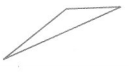
Envision Math Common Core 4th Grade Answer Key Topic 16 Lines, Angles, and Shapes 34
Answer:
Obtuse Triangle
Scalene Triangle
Explanation :
An Obtuse Triangle has one obtuse angle . One angle has a measure greater than a right angle .
Scalene Triangle has no sides of same length .

Question 7.
Envision Math Common Core 4th Grade Answer Key Topic 16 Lines, Angles, and Shapes 35
Answer:
Isosceles Triangle
Right Triangle
Explanation :
A Right Triangle has one Right Triangle .
An Isosceles triangle has at least 2 sides of same length .

Question 8.
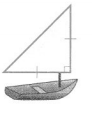
Envision Math Common Core 4th Grade Answer Key Topic 16 Lines, Angles, and Shapes 36
Answer:
Isosceles Triangle
Right Triangle
Explanation :
A Right Triangle has one Right Triangle .
An Isosceles triangle has at least 2 sides of same length .

Question 9.

Envision Math Common Core 4th Grade Answer Key Topic 16 Lines, Angles, and Shapes 37
Answer:
Scalene Triangle
Obtuse Triangle
Explanation :
An Obtuse Triangle has one obtuse angle . One angle has a measure greater than a right angle .
Scalene Triangle has no sides of same length .

Question 10.

Envision Math Common Core 4th Grade Answer Key Topic 16 Lines, Angles, and Shapes 38
Answer:
Isosceles Triangle
Acute triangle
Explanation :
An Acute triangle has three acute angles. all angles measure less than a right angle .
An Isosceles triangle has at least 2 sides of same length .

Problem Solving

Question 11.
Reasoning The backyard shown at the right is an equilateral triangle. What do you know about the lengths of the other two sides that are not labeled? Explain.
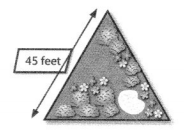
Envision Math Common Core 4th Grade Answer Key Topic 16 Lines, Angles, and Shapes 39
Answer:
the length of one side = 45 feet .
The lengths of the other two sides = 45 feet
Explanation :
An Equilateral Triangle has 3 sides equal .

Question 12.
en Vision® STEM
A rabbit’s field of vision is so wide that it can see predators that approach from behind. The diagram shows the field of vision of one rabbit and the field where the rabbit cannot see. Classify the triangle by its sides and its angles.
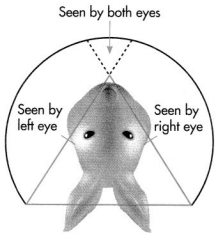
Envision Math Common Core 4th Grade Answer Key Topic 16 Lines, Angles, and Shapes 40
Answer:
The Triangle formed is a  Isosceles Triangle and Acute Triangle  .
Explanation :
An Acute triangle has three acute angles. all angles measure less than a right angle .
An Isosceles triangle has at least 2 sides of same length .

Question 13.
A pattern follows the rule: obtuse triangle, obtuse triangle, right triangle, obtuse triangle…. It also follows the rule: isosceles, scalene, isosceles, scalene… Draw a triangle that could be the fifth shape in the pattern and explain.
Answer:
Obtuse triangle , Isosceles Triangle is the fifth shape

Question 14.
Higher Order Thinking Mitch draws a triangle with one obtuse angle. What are all the possible ways to classify the triangle by its angle measures and side lengths? Explain.
Answer:
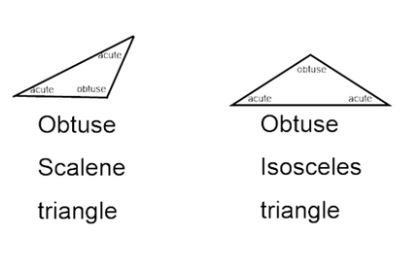
Envision-Math-Common-Core-4th-Grade-Answers-Key-Topic-16-Lines-Angles-and-Shapes-Lesson-16-2-Classify-Triangles-Problem-Solving-Question-14
Explanation :
Obtuse angle angle is formed with all different sides and with two sides equal .

Assessment Practice

Question 15.
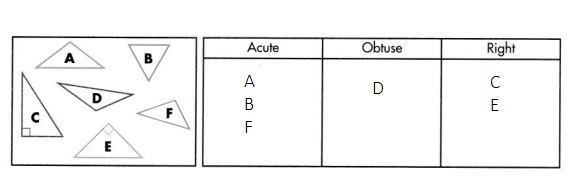
Draw each triangle in its correct angle classification.
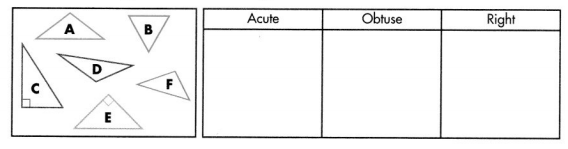
Envision Math Common Core 4th Grade Answer Key Topic 16 Lines, Angles, and Shapes 41
Answer:
Envision-Math-Common-Core-4th-Grade-Answers-Key-Topic-16-Lines-Angles-and-Shapes-Lesson-16-2-Classify-Triangles- Assessment-Practice-Question-15

Lesson 16.3 Classify Quadrilaterals

Solve & Share
Draw three different four-sided shapes that have opposite sides parallel. Explain how your shapes are alike and how they are different. Solve this problem any way you choose.
I can … reason about line segments and angles to classify quadrilaterals.
Envision Math Common Core 4th Grade Answers Topic 16 Lines, Angles, and Shapes 42

Look Back! What attributes do your shapes have in common?
Answer :
A Parallelogram is a quadrilateral in which both pairs of opposite sides are parallel .
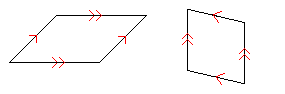
Envision-Math-Common-Core-4th-Grade-Answers-Key-Topic-16-Lines-Angles-and-Shapes-Lesson-16-3-Classify-Quadrilaterals-Solve & Share

A Rectangle is a parallelogram with four right angles, so all rectangles are also parallelograms and quadrilaterals. On the other hand, not all quadrilaterals and parallelograms are rectangles.
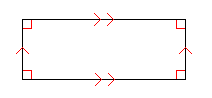
Envision-Math-Common-Core-4th-Grade-Answers-Key-Topic-16-Lines-Angles-and-Shapes-Lesson-16-3-Classify-Quadrilaterals-Solve & Share

A  Trapezoid is a quadrilateral with exactly one pair of parallel sides.
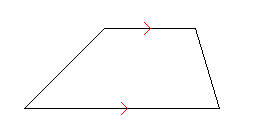
Envision-Math-Common-Core-4th-Grade-Answers-Key-Topic-16-Lines-Angles-and-Shapes-Lesson-16-3-Classify-Quadrilaterals-Solve & Share

Essential Question
How Can You Classify Quadrilaterals?

Visual Learning Bridge
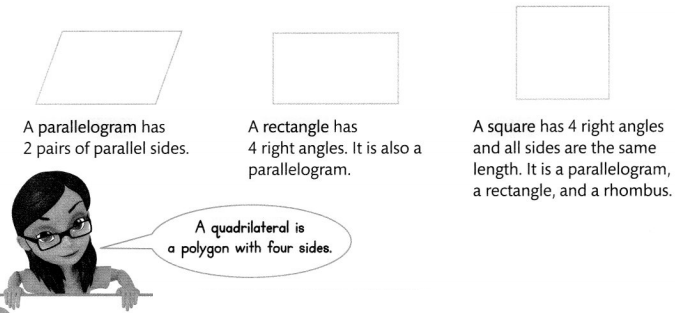
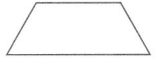
Quadrilaterals can be classified by their angles or the line segments that make their sides. Which of the quadrilaterals shown have only one pair of parallel sides? Which have two pairs of parallel sides?
Envision Math Common Core 4th Grade Answers Topic 16 Lines, Angles, and Shapes 43

Envision Math Common Core 4th Grade Answers Topic 16 Lines, Angles, and Shapes 44
A rhombus is a quadrilateral that has opposite sides that are parallel and all of its sides are the same length. It is also a parallelogram.
Envision Math Common Core 4th Grade Answers Topic 16 Lines, Angles, and Shapes 45
A trapezoid is a quadrilateral with only one pair of parallel sides.
Trapezoids have only one pair of parallel sides.
Parallelograms, rectangles, squares, and rhombuses all have two pairs of parallel sides.

Convince Me! Use Structure How are a parallelogram and a rectangle the same? How are they different?

Another Example!
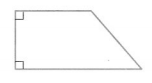
Perpendicular sides form right angles. Can a trapezoid have perpendicular sides?
Envision Math Common Core 4th Grade Answers Topic 16 Lines, Angles, and Shapes 46
A trapezoid can have two right angles that form perpendicular sides. A trapezoid with two right angles is called a right trapezoid.

Guided Practice

Do You Understand?
Question 1.
What is true about all quadrilaterals?
Answer:
All Quadrilaterals have four sides, are coplanar, have two diagonals, and the sum of their four interior angles equals 360 degrees.

Question 2.
What is the difference between a square and a rhombus?
Answer:
The sides of a square are perpendicular to each other and its diagonals are of equal length.
A rhombus is a quadrilateral in which the opposite sides are parallel and the opposite angles are equal.

Question 3.
Shane drew a quadrilateral with at least 2 right angles and at least 1 pair of parallel sides. Name three quadrilaterals Shane could have drawn.
Answer:
The Three Quadrilaterals with at least 2 right angles and at least 1 pair of parallel sides are Trapezoid , Rectangle and Square .
Explanation :
A trapezoid can have two right angles that form perpendicular sides. A trapezoid with two right angles is called a right trapezoid.
Envision-Math-Common-Core-4th-Grade-Answers-Key-Topic-16-Lines-Angles-and-Shapes-Lesson-16-3-Classify-Quadrilaterals-Guided-Practice-Question-3
A Rectangle is a parallelogram with four right angles, so all rectangles are also parallelograms and quadrilaterals. On the other hand, not all quadrilaterals and parallelograms are rectangles.

Envision-Math-Common-Core-4th-Grade-Answers-Key-Topic-16-Lines-Angles-and-Shapes-Lesson-16-3-Classify-Quadrilaterals-Guided-Practice-Question-3
A Square can be defined as a rhombus which is also a rectangle – in other words, a parallelogram with four congruent sides and four right angles.

Do You Know How?
For 4-7, write all the names possible for each quadrilateral.
Question 4.
Envision Math Common Core 4th Grade Answers Topic 16 Lines, Angles, and Shapes 47
Answer:
Rectangle
Explanation :
Opposite sides are equal and parallel
Four Right Angles .

Question 5.
Envision Math Common Core 4th Grade Answers Topic 16 Lines, Angles, and Shapes 48
Answer:
Rhombus
Explanation :
All Four sides are equal and parallel

Question 6.
Envision Math Common Core 4th Grade Answers Topic 16 Lines, Angles, and Shapes 49
Answer:
Square
Explanation :
All four sides are equal and parallel
Four Right Angles .

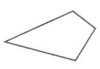
Question 7.
Envision Math Common Core 4th Grade Answers Topic 16 Lines, Angles, and Shapes 50
Answer:
Scalene Quadrilateral
Explanation :
A scalene quadrilateral is a four-sided polygon that has no congruent sides.

Independent Practice

For 8-11, write all the names possible for each quadrilateral.
Question 8.
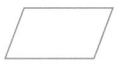
Envision Math Common Core 4th Grade Answers Topic 16 Lines, Angles, and Shapes 51
Answer:
Parallelogram
Explanation :
A parallelogram is a quadrilateral in which both pairs of opposite sides are parallel

Question 9.
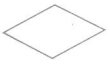
Envision Math Common Core 4th Grade Answers Topic 16 Lines, Angles, and Shapes 52
Answer:
Rhombus
Explanation :
A Rhombus is a parallelogram with four equal sides.

Question 10.
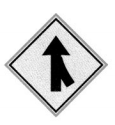
Envision Math Common Core 4th Grade Answers Topic 16 Lines, Angles, and Shapes 53
Answer:
Square
Explanation :
All four sides are equal and parallel
Four Right Angles .

Question 11.
Envision Math Common Core 4th Grade Answers Topic 16 Lines, Angles, and Shapes 54
Answer:
Rectangle
Explanation :
A Rectangle is a parallelogram with four right angles .

Problem Solving

Question 12.
The pattern follows the rule: quadrilateral with no parallel sides, quadrilateral with two pairs of parallel sides, quadrilateral with two pairs of parallel sides, quadrilateral with no parallel sides, quadrilateral with two pairs of parallel sides…. Draw quadrilaterals that could be the next three in the pattern.

Envision Math Common Core 4th Grade Answers Topic 16 Lines, Angles, and Shapes 55
Answer:
Envision-Math-Common-Core-4th-Grade-Answers-Key-Topic-16-Lines-Angles-and-Shapes-Lesson-16-3-Classify-Quadrilaterals-Problem-Solving-Question-12

Question 13.
Critique Reasoning Tia says every square is a rectangle, and every square is a rhombus, so every rectangle must be a rhombus. Do you agree? Explain.
Answer:
No, Every Rectangle is not a Rhombus .
Explanation :
A square is a quadrilateral with all 4 angles right angles and all 4 sides of same length.
So a square is a special kind of rectangle, it is one where all the sides have the same length. Thus every square is a rectangle because it is a quadrilateral with all 4 angles right angles.
Yes, a rhombus is a quadrilateral with 4 equal sides.
Every square has 4 equal length sides, so every square is a rhombus.
No, every rectangle is not a rhombus because Rectangle have only opposite sides , whereas in Rhombus all four sides are equal .

Question 14.
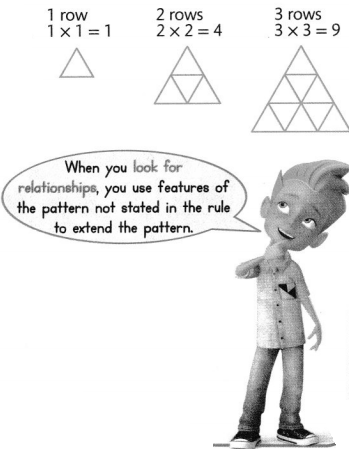
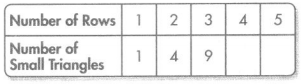
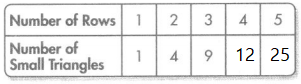
Number Sense What number comes next in the pattern? The rule is “Multiply the position number by itself.” Describe a feature of the pattern.
1, 4, 9, 16, ☐
Answer:
1, 4, 9, 16, 25 .
Explanation :
Multiply the position to itself means squaring the position of the number
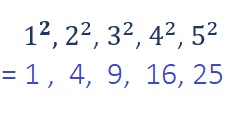
Envision-Math-Common-Core-4th-Grade-Answers-Key-Topic-16-Lines-Angles-and-Shapes-Lesson-16-3-Classify-Quadrilaterals-Problem-Solving-Question-14

Question 15.
Higher Order Thinking
Could you use the formula for finding the perimeter of a square to find the perimeter of another quadrilateral? Explain.
The formula for the perimeter of a square is P = 4 × s.
Answer:

Assessment Practice

Question 16.
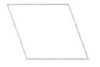
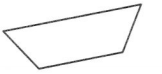
Select all the possible names for the shape below.
Envision Math Common Core 4th Grade Answers Topic 16 Lines, Angles, and Shapes 56
☐ Quadrilateral
☐ Rhombus
☐ Trapezoid
☐ Parallelogram
☐ Rectangle
Answer:
Quadrilateral and Trapezoid

Question 17.
Which shape has only 1 pair of parallel sides?
A. Rhombus
B. Square
C. Right trapezoid
D. Parallelogram
Answer:
Right Trapezoid

Lesson 16.4 Line Symmetry

Solve & Share
Question :
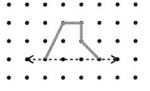
How many ways can you fold the square so one half fits exactly on top of the other half? How many ways can you fold the letter so one half fits exactly on top of the other half? Solve this problem any way you choose.
I can …recognize and draw lines of symmetry and identify line-symmetric figures.
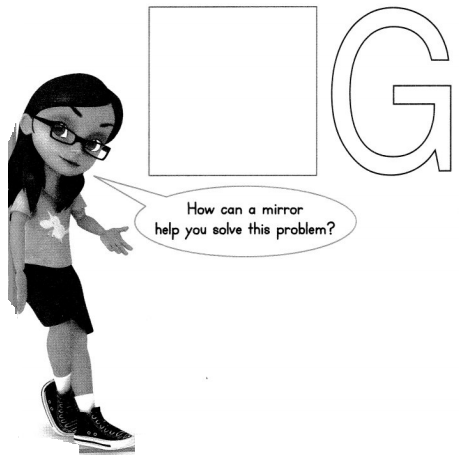
Envision Math Common Core 4th Grade Answers Topic 16 Lines, Angles, and Shapes 57

Look Back! Reasoning What figures can you form when you fold a square in half? How are the different figures related to symmetry?
Answer :
The G have zero lines of symmetry.
The rest of the letters, A, B, C, D, and E all have only 1 line of symmetry. Notice that the A has a vertical line of symmetry, while the B, C, D, and E have a horizontal line of symmetry.

Essential Question
What is Line Symmetry

Visual Learning Bridge
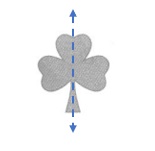
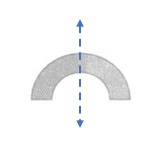
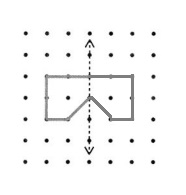
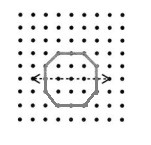
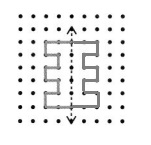
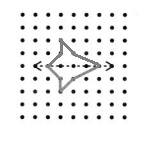
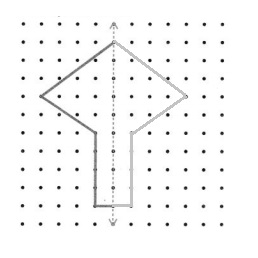
A figure is line symmetric if it can be folded on a line to form two matching parts that fit exactly on top of each other. The fold line is called a line of symmetry. There is one line of symmetry drawn on the picture of the truck. How many lines of symmetry do the figures below have?
Count the lines of symmetry drawn on each figure below.
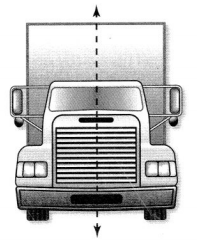
Envision Math Common Core 4th Grade Answers Topic 16 Lines, Angles, and Shapes 58

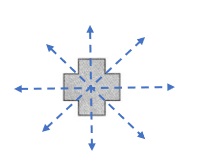
A figure can have more than one line of symmetry.
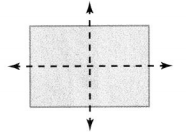
Envision Math Common Core 4th Grade Answers Topic 16 Lines, Angles, and Shapes 59
This figure is line symmetric. It has 2 lines of symmetry. It can be folded on each line of symmetry into matching parts.

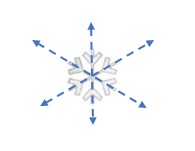
A figure can have many lines of symmetry.
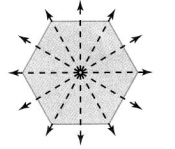
Envision Math Common Core 4th Grade Answers Topic 16 Lines, Angles, and Shapes 60
This figure is line symmetric. It has 6 lines of symmetry. It can be folded on each line of symmetry into matching parts.

A figure can have no lines of symmetry.
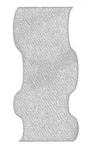
Envision Math Common Core 4th Grade Answers Topic 16 Lines, Angles, and Shapes 61
This figure is NOT line symmetric. It has O lines of symmetry. It cannot be folded to have matching parts.

Convince Me! Look for Relationships Find two capital letters that have exactly one line of symmetry. Find two capital letters that have exactly two lines of symmetry.

Guided Practices

Do You Understand?
Question 1.
How many lines of symmetry does the letter R have?
Answer:
Letter R have Zero lines of symmetry as it cannot be divided into two identical shapes .

Question 2.
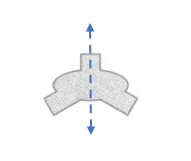
How many lines of symmetry does the figure below have?
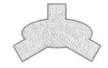
Envision Math Common Core 4th Grade Answers Topic 16 Lines, Angles, and Shapes 62
Answer:
The given figure have One line of symmetry .
Envision-Math-Common-Core-4th-Grade-Answers-Key-Topic-16-Lines-Angles-and-Shapes-Lesson-16-4-Line-Symmetry-Guided-Practices-Question-2
Explanation :
This figure is line symmetric. It has 1 lines of symmetry. It can be folded on each line of symmetry into matching parts.

Question 3.
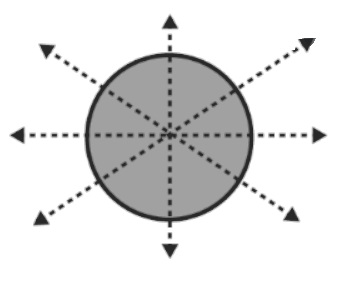
How many lines of symmetry can you find for a circle? Do you think you can count them?
Answer:
A circle has infinite lines of symmetry. A circle is symmetric about all its diagonals.
Envision-Math-Common-Core-4th-Grade-Answers-Key-Topic-16-Lines-Angles-and-Shapes-Lesson-16-4-Line-Symmetry-Guided-Practices-Question-3

Do You Know How?
For 4-5, tell if each line is a line of symmetry.
Question 4.
Envision Math Common Core 4th Grade Answers Topic 16 Lines, Angles, and Shapes 63
Answer:
Line of symmetry

Question 5.
Envision Math Common Core 4th Grade Answers Topic 16 Lines, Angles, and Shapes 64
Answer:
Yes , it is a line of symmetry as two identical shapes are formed .

For 6-7, tell how many lines of symmetry each figure has.
Question 6.
Envision Math Common Core 4th Grade Answers Topic 16 Lines, Angles, and Shapes 65
Answer:
Envision-Math-Common-Core-4th-Grade-Answers-Key-Topic-16-Lines-Angles-and-Shapes-Lesson-16-4-Line-Symmetry-Guided-Practices-Question-6
Explanation :
This figure is line symmetric. It has 1 lines of symmetry. It can be folded on each line of symmetry into matching parts.

Question 7.
Envision Math Common Core 4th Grade Answers Topic 16 Lines, Angles, and Shapes 66
Answer:
This figure is NOT line symmetric. It has O lines of symmetry. It cannot be folded to have matching parts.

Independent Practice

For 8-11, tell if each line is a line of symmetry.
Question 8.
Envision Math Common Core 4th Grade Answers Topic 16 Lines, Angles, and Shapes 67
Answer:
This figure is line symmetric. It has 1 lines of symmetry. It can be folded on each line of symmetry into matching parts.

Question 9.
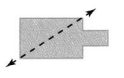
Envision Math Common Core 4th Grade Answers Topic 16 Lines, Angles, and Shapes 68
Answer:
No
Explanation :
This figure is NOT line symmetric. It has O lines of symmetry. It cannot be folded to have matching parts.

Question 10.
Envision Math Common Core 4th Grade Answers Topic 16 Lines, Angles, and Shapes 69
Answer:

Question 11.
Envision Math Common Core 4th Grade Answers Topic 16 Lines, Angles, and Shapes 70
Answer:
This figure is line symmetric. It has 1 lines of symmetry. It can be folded on each line of symmetry into matching parts.

For 12-19, decide if each figure is line symmetric. Draw and tell how many lines of symmetry each figure has.
Question 12.
Envision Math Common Core 4th Grade Answers Topic 16 Lines, Angles, and Shapes 71
Answer:
Envision-Math-Common-Core-4th-Grade-Answers-Key-Topic-16-Lines-Angles-and-Shapes-Lesson-16-4-Line-Symmetry-Guided-Practices-Question-12
Explanation :
This figure is line symmetric. It has 1 lines of symmetry. It can be folded on each line of symmetry into matching parts.

Question 13.
Envision Math Common Core 4th Grade Answers Topic 16 Lines, Angles, and Shapes 72
Answer:
Envision-Math-Common-Core-4th-Grade-Answers-Key-Topic-16-Lines-Angles-and-Shapes-Lesson-16-4-Line-Symmetry-Guided-Practices-Question-13
Explanation :
This figure is line symmetric. It has 1 lines of symmetry. It can be folded on each line of symmetry into matching parts.

Question 14.
Envision Math Common Core 4th Grade Answers Topic 16 Lines, Angles, and Shapes 73
Answer:
Envision-Math-Common-Core-4th-Grade-Answers-Key-Topic-16-Lines-Angles-and-Shapes-Lesson-16-4-Line-Symmetry-Guided-Practices-Question-14
Explanation :
A line of symmetry is defined as the line that a figure can be divided into half, with the end result of the two halves matching up exactly.

Question 15.

Envision Math Common Core 4th Grade Answers Topic 16 Lines, Angles, and Shapes 74
Answer:
Envision-Math-Common-Core-4th-Grade-Answers-Key-Topic-16-Lines-Angles-and-Shapes-Lesson-16-4-Line-Symmetry-Guided-Practices-Question-15
Explanation :
This figure is line symmetric. It has 1 lines of symmetry. It can be folded on each line of symmetry into matching parts.

Question 16.
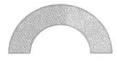
Envision Math Common Core 4th Grade Answers Topic 16 Lines, Angles, and Shapes 75
Answer:
Envision-Math-Common-Core-4th-Grade-Answers-Key-Topic-16-Lines-Angles-and-Shapes-Lesson-16-4-Line-Symmetry-Guided-Practices-Question-16
Explanation :
This figure is line symmetric. It has 1 lines of symmetry. It can be folded on each line of symmetry into matching parts.

Question 17.
Envision Math Common Core 4th Grade Answers Topic 16 Lines, Angles, and Shapes 76
Answer:
Envision-Math-Common-Core-4th-Grade-Answers-Key-Topic-16-Lines-Angles-and-Shapes-Lesson-16-4-Line-Symmetry-Guided-Practices-Question-17
Explanation :
This figure is line symmetric. It has 3 lines of symmetry. It can be folded on each line of symmetry into matching parts.

Question 18.
Envision Math Common Core 4th Grade Answers Topic 16 Lines, Angles, and Shapes 77
Answer:
zero .
Explanation :
This figure is NOT line symmetric. It has O lines of symmetry. It cannot be folded to have matching parts.

Question 19.
Envision Math Common Core 4th Grade Answers Topic 16 Lines, Angles, and Shapes 78
Answer:
Envision-Math-Common-Core-4th-Grade-Answers-Key-Topic-16-Lines-Angles-and-Shapes-Lesson-16-4-Line-Symmetry-Guided-Practices-Question-19
Explanation :
This figure is line symmetric. It has 4 lines of symmetry. It can be folded on each line of symmetry into matching parts.

Problem Solving

Question 20.
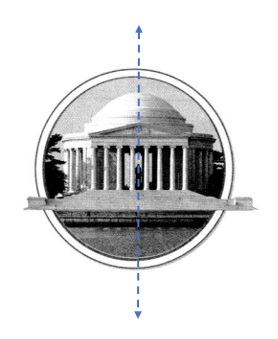
The Thomas Jefferson Memorial is located in Washington, D.C. Use the picture of the memorial at the right to decide whether the building is line symmetric. If so, describe where the line of symmetry is.

Envision Math Common Core 4th Grade Answers Topic 16 Lines, Angles, and Shapes 79
Answer:
Envision-Math-Common-Core-4th-Grade-Answers-Key-Topic-16-Lines-Angles-and-Shapes-Lesson-16-4-Line-Symmetry-Problem-Solving-Question-20
Explanation :
This figure is line symmetric. It has 1 lines of symmetry. It can be folded on each line of symmetry into matching parts.

Question 21.
Name the type of triangle outlined in green on the picture of the memorial.
Answer:
Acute Triangle .

Question 22.
Construct Arguments
How can you tell when a line is NOT a line of symmetry?
Answer:
Folding Test : You can find if a shape has a Line of Symmetry by folding it. When the folded part sits perfectly on top (all edges matching), then the fold line is a Line of Symmetry.
It cannot be folded to have matching parts. then it have zero lines of symmetry .

Question 23.
Higher Order Thinking How many lines of symmetry can a parallelogram have? Explain.
Answer:
zero
Explanation :

Envision-Math-Common-Core-4th-Grade-Answers-Key-Topic-16-Lines-Angles-and-Shapes-Lesson-16-4-Line-Symmetry-Problem-Solving-Question-23

  • A parallelogram has no lines of symmetry.
  • It has rotational symmetry of order two.

Assessment Practice

Question 24.
Which figure has six lines of symmetry? Draw lines as needed.
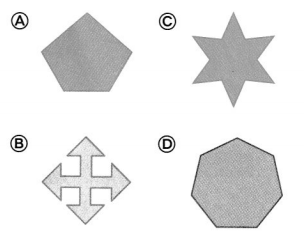
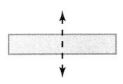
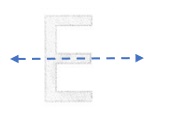
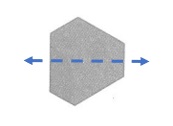
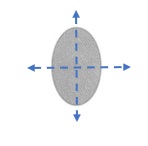
Envision Math Common Core 4th Grade Answers Topic 16 Lines, Angles, and Shapes 80
Answer:
Option C – has 6 lines of symmetry .
Explanation :
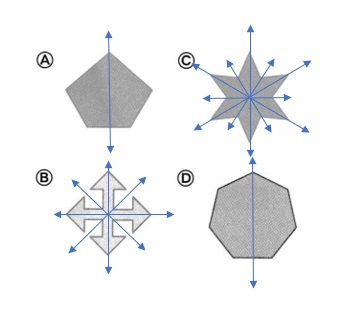
Envision-Math-Common-Core-4th-Grade-Answers-Key-Topic-16-Lines-Angles-and-Shapes-Lesson-16-4-Line-Symmetry-Problem-Solving-Question-20

Question 25.
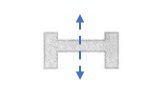
Which figure is NOT line symmetric?
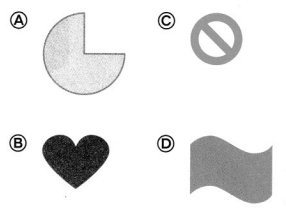
Envision Math Common Core 4th Grade Answers Topic 16 Lines, Angles, and Shapes 81
Answer:
Option A .

Lesson 16.5 Draw Shapes with Line Symmetry

Solve & Share
Craig and Julia are designing kites. A kite will fly well if the kite has line symmetry. Does Craig’s or Julia’s kite have line symmetry? Explain. Then, design your own kites. Design one kite with 2 lines of symmetry and another kite with 3 lines of symmetry. Solve this problem any way you choose.
I can…draw a figure that has line symmetry.
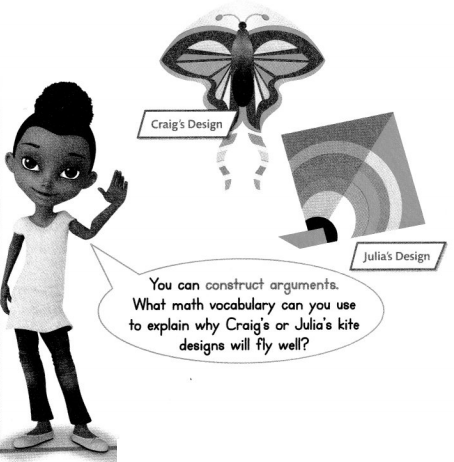
Envision Math Common Core Grade 4 Answer Key Topic 16 Lines, Angles, and Shapes 82

Question :
Look Back! Can both Craig’s and Julia’s kites be folded into matching parts? If one of the kites is not line symmetric, can it be changed so that it is? Explain.
Answer :
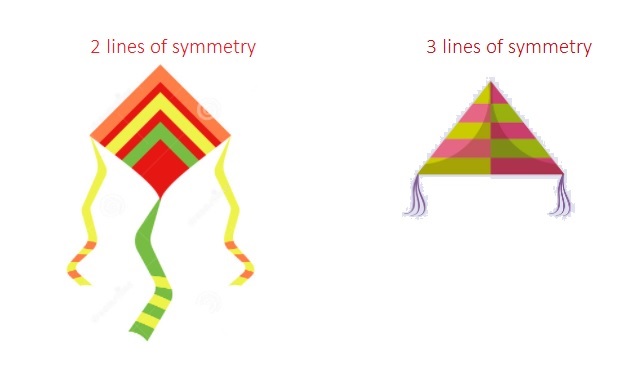
Envision-Math-Common-Core-4th-Grade-Answers-Key-Topic-16-Lines-Angles-and-Shapes-Lesson-16-5-Draw-Shapes-with-Line-Symmetry-Solve-&-Share

Essential Question
How Can You Draw Figures one with Line Symmetry?

Visual Learning Bridge
Sarah wants to design a line-symmetric tabletop. She sketched half of the tabletop. What are two ways Sarah can complete her design?
The tabletop is line symmetric if the design can be folded along a line of symmetry, into matching parts.
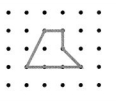
Envision Math Common Core Grade 4 Answer Key Topic 16 Lines, Angles, and Shapes 83

One Way
Draw a line of symmetry.
Envision Math Common Core Grade 4 Answer Key Topic 16 Lines, Angles, and Shapes 84
Complete Sarah’s design on the opposite side of the line of symmetry.
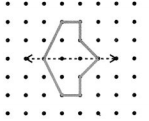
Envision Math Common Core Grade 4 Answer Key Topic 16 Lines, Angles, and Shapes 85
The design for the tabletop is now line symmetric.

Another Way
Draw a different line of symmetry.
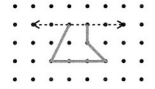
Envision Math Common Core Grade 4 Answer Key Topic 16 Lines, Angles, and Shapes 86
Complete Sarah’s design on the opposite side of the line of symmetry.
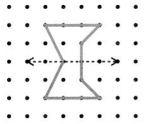
Envision Math Common Core Grade 4 Answer Key Topic 16 Lines, Angles, and Shapes 87
The design for the tabletop is now line symmetric.

Convince Me!
Question :
Model with Math Sarah sketched different designs for a smaller tabletop. Use the lines of symmetry to draw ways Sarah can complete each design.
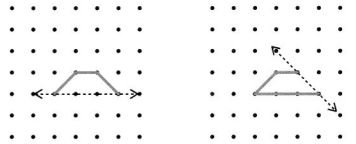
Envision Math Common Core Grade 4 Answer Key Topic 16 Lines, Angles, and Shapes 88
Answer :
Envision-Math-Common-Core-4th-Grade-Answers-Key-Topic-16-Lines-Angles-and-Shapes-Lesson-16-5-Draw-Shapes-with-Line-Symmetry-Convince-Me
Explanation :
We say there is symmetry when the exact reflection or mirror image of a line, shape or object gets created. The line of symmetry can be defined as the axis or imaginary line that passes through the center of the shape or object and divides it into identical halves.

Guided Practice

Do You Understand?
Question 1.
Chandler tried to complete Sarah’s design from the previous page. Describe the error Chandler made.
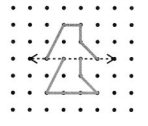
Envision Math Common Core Grade 4 Answer Key Topic 16 Lines, Angles, and Shapes 89
Answer:
the image formed is not the exact reflection .
Explanation :
We say there is symmetry when the exact reflection or mirror image of a line, shape or object gets created. The line of symmetry can be defined as the axis or imaginary line that passes through the center of the shape or object and divides it into identical halves.

Question 2.
How can folding a piece of paper help to determine if a line in a figure is a line of symmetry?
Answer:
If the figure can be folded along a straight line so that one half of the figure exactly matches the other half, the figure has line symmetry. The crease is the line of symmetry.

Do You Know How?
For 3-4, use the line of symmetry to draw a line-symmetric figure.
Question 3.
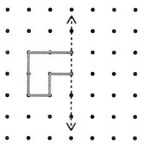
Envision Math Common Core Grade 4 Answer Key Topic 16 Lines, Angles, and Shapes 90
Answer:
Envision-Math-Common-Core-4th-Grade-Answers-Key-Topic-16-Lines-Angles-and-Shapes-Lesson-16-5-Draw-Shapes-with-Line-Symmetry-Guided-Practice-Question-3
Explanation :
We say there is symmetry when the exact reflection or mirror image of a line, shape or object gets created. The line of symmetry can be defined as the axis or imaginary line that passes through the center of the shape or object and divides it into identical halves.

Question 4.
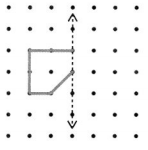
Envision Math Common Core Grade 4 Answer Key Topic 16 Lines, Angles, and Shapes 91
Answer:
Envision-Math-Common-Core-4th-Grade-Answers-Key-Topic-16-Lines-Angles-and-Shapes-Lesson-16-5-Draw-Shapes-with-Line-Symmetry-Guided-Practice-Question-4
Explanation :
We say there is symmetry when the exact reflection or mirror image of a line, shape or object gets created. The line of symmetry can be defined as the axis or imaginary line that passes through the center of the shape or object and divides it into identical halves.

Independent Practice

For 5-10, use the line of symmetry to draw a line-symmetric figure.
Question 5.
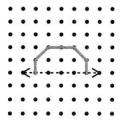
Envision Math Common Core Grade 4 Answer Key Topic 16 Lines, Angles, and Shapes 92
Answer:
Envision-Math-Common-Core-4th-Grade-Answers-Key-Topic-16-Lines-Angles-and-Shapes-Lesson-16-5-Draw-Shapes-with-Line-Symmetry-Independent-Practice-Question-5
Explanation :
We say there is symmetry when the exact reflection or mirror image of a line, shape or object gets created. The line of symmetry can be defined as the axis or imaginary line that passes through the center of the shape or object and divides it into identical halves.

Question 6.
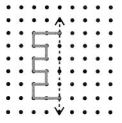
Envision Math Common Core Grade 4 Answer Key Topic 16 Lines, Angles, and Shapes 93
Answer:
Envision-Math-Common-Core-4th-Grade-Answers-Key-Topic-16-Lines-Angles-and-Shapes-Lesson-16-5-Draw-Shapes-with-Line-Symmetry-Independent-Practice-Question-6
Explanation :
We say there is symmetry when the exact reflection or mirror image of a line, shape or object gets created. The line of symmetry can be defined as the axis or imaginary line that passes through the center of the shape or object and divides it into identical halves.

Question 7.
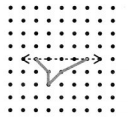
Envision Math Common Core Grade 4 Answer Key Topic 16 Lines, Angles, and Shapes 94
Answer:
Envision-Math-Common-Core-4th-Grade-Answers-Key-Topic-16-Lines-Angles-and-Shapes-Lesson-16-5-Draw-Shapes-with-Line-Symmetry-Independent-Practice-Question-7
Explanation :
We say there is symmetry when the exact reflection or mirror image of a line, shape or object gets created. The line of symmetry can be defined as the axis or imaginary line that passes through the center of the shape or object and divides it into identical halves.

Question 8.
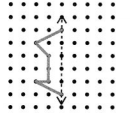
Envision Math Common Core Grade 4 Answer Key Topic 16 Lines, Angles, and Shapes 95
Answer:
Envision-Math-Common-Core-4th-Grade-Answers-Key-Topic-16-Lines-Angles-and-Shapes-Lesson-16-5-Draw-Shapes-with-Line-Symmetry-Independent-Practice-Question-8
Explanation :
We say there is symmetry when the exact reflection or mirror image of a line, shape or object gets created. The line of symmetry can be defined as the axis or imaginary line that passes through the center of the shape or object and divides it into identical halves.

Question 9.
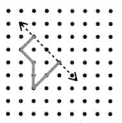
Envision Math Common Core Grade 4 Answer Key Topic 16 Lines, Angles, and Shapes 96
Answer:
Envision-Math-Common-Core-4th-Grade-Answers-Key-Topic-16-Lines-Angles-and-Shapes-Lesson-16-5-Draw-Shapes-with-Line-Symmetry-Independent-Practice-Question-9
Explanation :
We say there is symmetry when the exact reflection or mirror image of a line, shape or object gets created. The line of symmetry can be defined as the axis or imaginary line that passes through the center of the shape or object and divides it into identical halves.

Question 10.
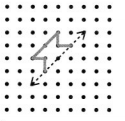
Envision Math Common Core Grade 4 Answer Key Topic 16 Lines, Angles, and Shapes 97
Answer:
Envision-Math-Common-Core-4th-Grade-Answers-Key-Topic-16-Lines-Angles-and-Shapes-Lesson-16-5-Draw-Shapes-with-Line-Symmetry-Independent-Practice-Question-10
Explanation :
We say there is symmetry when the exact reflection or mirror image of a line, shape or object gets created. The line of symmetry can be defined as the axis or imaginary line that passes through the center of the shape or object and divides it into identical halves.

Problem Solving

Question 11.
Draw a figure that has no lines of symmetry.
Answer:
A scalene triangle, have no lines of symmetry – it is not possible to fold the shape about a line so that the two halves fit exactly on top of one another.
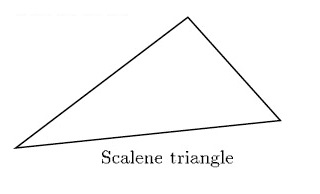
Envision-Math-Common-Core-4th-Grade-Answers-Key-Topic-16-Lines-Angles-and-Shapes-Lesson-16-5-Draw-Shapes-with-Line-Symmetry-Problem-Solving-Question-11

Question 12.
Vanessa drew a figure that has an infinite number of lines of symmetry. What figure could Vanessa have drawn?
Answer:
Circle have infinite number of lines of symmetry .

Question 13.
enVision® STEM
Dogs can smell odors that humans cannot. Dogs can be trained to alert their owners when they smell odors associated with illness. If a dog trains 2 hours every day for 1 year, how many hours has the dog trained?
Envision Math Common Core Grade 4 Answer Key Topic 16 Lines, Angles, and Shapes 98
Answer:
Number of hours dog train for a day = 2 hours
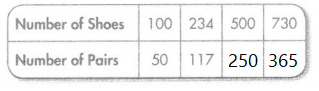
Number of hours dog train for 1 year = 2 hours × 365 days = 730 hours .

Question 14.
Make Sense and Persevere
Clare trained for a long-distance marathon. She ran a total of 225 miles in 3 months. The first month she ran 50 miles. If she ran 25 more miles each month, how many miles did she run in her third month of training?
Answer:
Total Distance ran = 225 miles
Distance covered  in First month = 50 miles .
Distance covered in Second month = 50 + 25 = 75 miles .
Distance covered in  third month = 75 + 25 = 100 miles .

Question 15.
Higher Order Thinking Can you draw a line that divides a figure in half but is NOT a line of symmetry? Use the figures below to explain.
Envision Math Common Core Grade 4 Answer Key Topic 16 Lines, Angles, and Shapes 99
Answer:
No, because the given line drawn are lines of symmetry it divides the figure into identical halves .

Assessment Practice

Question 16.
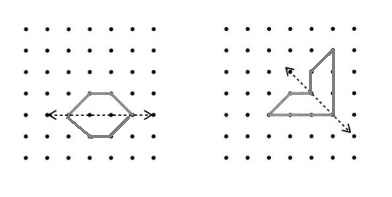
Which of the following figures is line symmetric about the dashed line?

Envision Math Common Core Grade 4 Answer Key Topic 16 Lines, Angles, and Shapes 100
Answer:
Option B – as two identical halves are formed by line of symmetry .
Explanation :
We say there is symmetry when the exact reflection or mirror image of a line, shape or object gets created. The line of symmetry can be defined as the axis or imaginary line that passes through the center of the shape or object and divides it into identical halves.

Lesson 16.6 Problem Solving

Critique Reasoning
Solve & Share
Nathan gave the answer shown to the following question. True or False? All right triangles have two sides the same length. How do you respond to Nathan’s reasoning?
I can … critique the reasoning of others by using what I know about two-dimensional shapes.

Nathan
That’s true. Here are three different sizes of right triangles. In each, two sides are the same length.
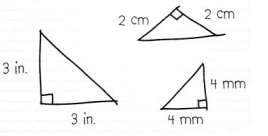
Envision Math Common Core Grade 4 Answer Key Topic 16 Lines, Angles, and Shapes 101

Thinking Habits
Be a good thinker! These questions can help you.

  • What questions can I ask to understand other people’s thinking?
  • Are there mistakes in other people’s thinking?
  • Can I improve other people’s thinking?

Look Back! Critique Reasoning Nathan answered another question. True or false: A triangle can have two right angles. Nathan says this is not possible. Do you agree or disagree? Explain.
Answer :
Because of the fact that the sum of the three interior angles of a triangle must be 180 degrees, a triangle could not have two right angles

Essential Question
How Can You Critique the Reasoning of Others?

Visual Learning Bridge
Abby gave the answer shown to the following question.
True or False? Every quadrilateral has at least one right angle.
Abby
True. Here are different quadrilaterals. They all have four sides and four right angles.
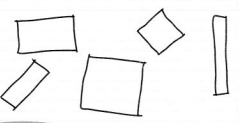
Envision Math Common Core Grade 4 Answer Key Topic 16 Lines, Angles, and Shapes 103
What is Abby’s reasoning to support her statement?
Abby drew quadrilaterals that have right angles.
Envision Math Common Core Grade 4 Answer Key Topic 16 Lines, Angles, and Shapes 102

How can I critique the reasoning of others?
I can

  • ask questions about Abby’s reasoning
  • look for flaws in her reasoning.
  • decide whether all cases have been considered.

Here’s my thinking.
Abby’s reasoning has flaws.
She used only special kinds of quadrilaterals in her argument. For these special cases, the statement is true.
Here is a quadrilateral that has no right angles. It shows the statement is not true about every quadrilateral.
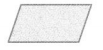
Envision Math Common Core Grade 4 Answer Key Topic 16 Lines, Angles, and Shapes 104
The statement is false.

Convince Me! Be Precise Would Abby’s reasoning be correct if the question was changed to: True or False? Some quadrilaterals have at least one right angle. Explain.

Guided Practice

Critique Reasoning
Anthony said all multiples of 4 end in 2, 4, or 8. He gave 4, 8, 12, 24, and 28 as examples.
Question 1.
What is Anthony’s argument? How does he support it?
Answer:
No – Anthony is wrong .
Explanation :
all multiples of 4 end in 0, 2, 4, 6 and 8 .
Examples –
4 × 4 = 16
4 × 5 = 20 and e t c .

Question 2.
Describe at least one thing you could do to critique Anthony’s reasoning.
Answer:
Look flaws in the statement and checking for all numbers .

Question 3.
Does Anthony’s reasoning make sense? Explain.
Answer:
Yes – As he is calculated the values of 4 of squares of 2 and their respective square numbers .

Independent Practice

Critique Reasoning Marista said the polygons shown all have the same number of angles as they have sides.

Envision Math Common Core Grade 4 Answer Key Topic 16 Lines, Angles, and Shapes 105
Question 4.
Describe at least one thing you could do to critique Marista’s reasoning.
Answer:
Number of interior angles of a polygon is equal number of Number of sides irrespective of exterior angles .

Question 5.
Does Marista’s reasoning make sense? Explain.
Envision Math Common Core Grade 4 Answer Key Topic 16 Lines, Angles, and Shapes 106
Answer:

Question 6.
Can you think of any examples that prove all polygons don’t have the same number of sides as angles? Explain.
Answer:
No,
A polygon has the same number of sides and angles.

Problem Solving

Performance Task
Dog Pen
Caleb is designing a dog pen for the animal shelter. He has 16 feet of fence, including the gate. His designs and explanation are shown. Critique Caleb’s reasoning.
Dog pens usually have right angles, so I just used rectangles.
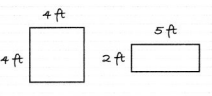
Envision Math Common Core Grade 4 Answer Key Topic 16 Lines, Angles, and Shapes 107
Both my pens used 16 feet of fence. I think the square one is better, because it has more area.

Question 7.
Reasoning What quantities are given in the problem and what do the numbers mean?
Answer:
The Quantities given are the length and Breadth of the Rectangle pen and the side of the square .
the numbers help in calculating the Area .

Question 8.
Critique Reasoning What can you do to critique Caleb’s thinking?
Answer:
The two shapes are given Rectangle and Square with their respective Quantities .
The Area of Rectangle is smaller than the Rectangle of the Square .
The area of the Square is preferred because it has more area than Rectangle .

Question 9.
Be Precise Did Caleb correctly calculate the perimeter of each fence? Explain.
Envision Math Common Core Grade 4 Answer Key Topic 16 Lines, Angles, and Shapes 108
Answer:
No,
Explanation :
Length of Rectangle = 5 feet
Breadth of Rectangle = 2 feet
Perimeter of Rectangle = 2 ( Length + Breadth ) = 2 ( 5 + 2 ) = 2 ( 7 ) = 14 feets .
Side of Square = 4 feet .
Perimeter of Square = 4 ( Side ) = 4 ( 4 ) = 16 feets .

Question 10.
Critique Reasoning Does Caleb’s reasoning make sense? Explain.
Answer:
No,
Explanation :
As, perimeter and area are not calculated correctly .
Length of Rectangle = 5 feet
Breadth of Rectangle = 2 feet
Perimeter of Rectangle = 2 ( Length + Breadth ) = 2 ( 5 + 2 ) = 2 ( 7 ) = 14 feet .
Side of Square = 4 feet .
Perimeter of Square = 4 ( Side ) = 4 ( 4 ) = 16 feet .

Question 11.
Be Precise Explain how you know what units to use in your explanation.
Answer:
Perimeter measured in feet .
Area measured in square feet .

Topic 16 Fluency Practice Activity

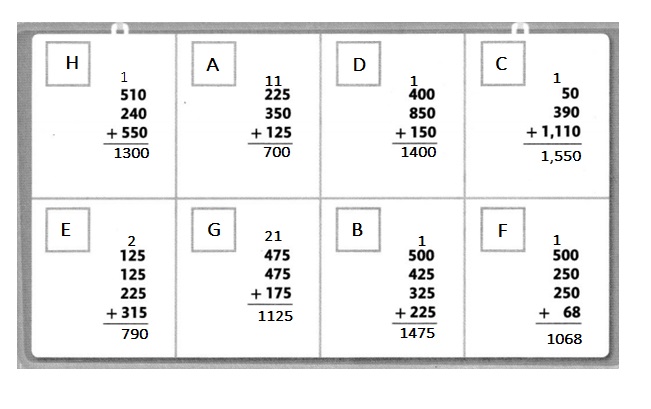
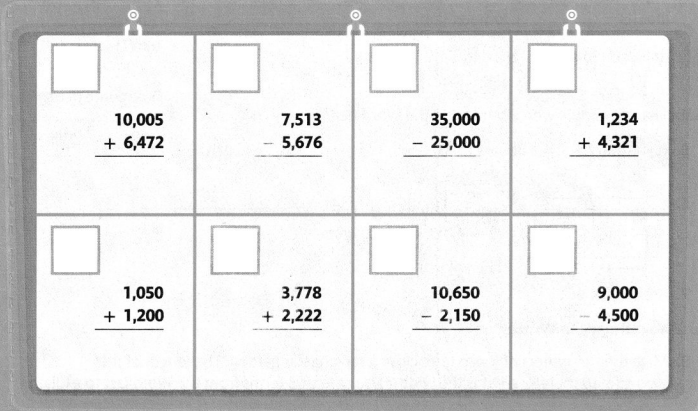
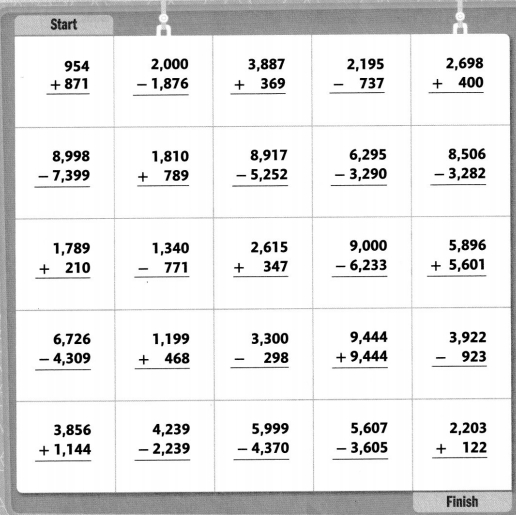
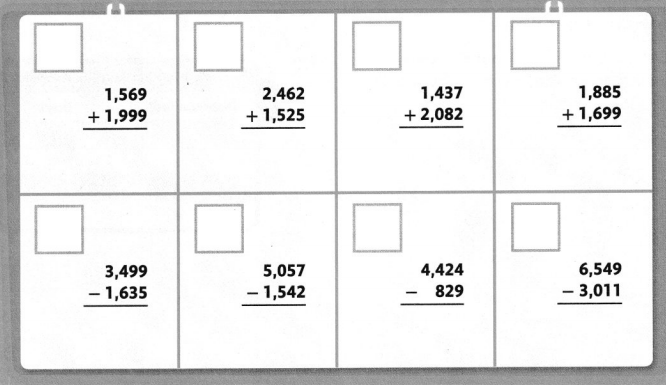
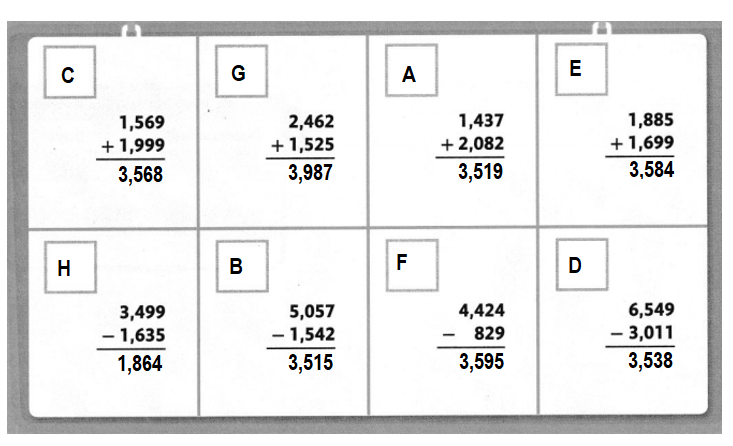
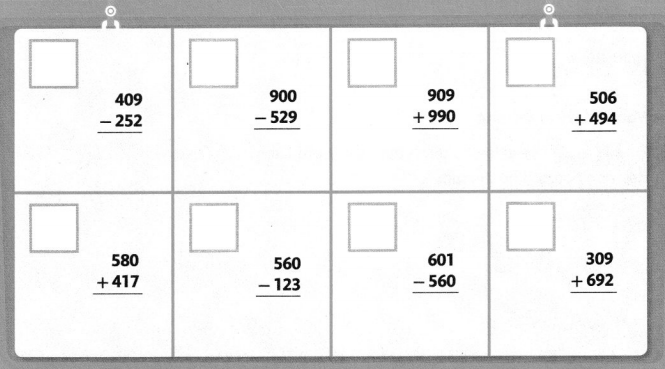
Find a Match
Work with a partner. Point to a clue. Read the clue. Look below the clues to find a match. Write the clue letter in the box next to the match. Find a match for every clue.
I can … add multi-digit whole numbers.

Clues
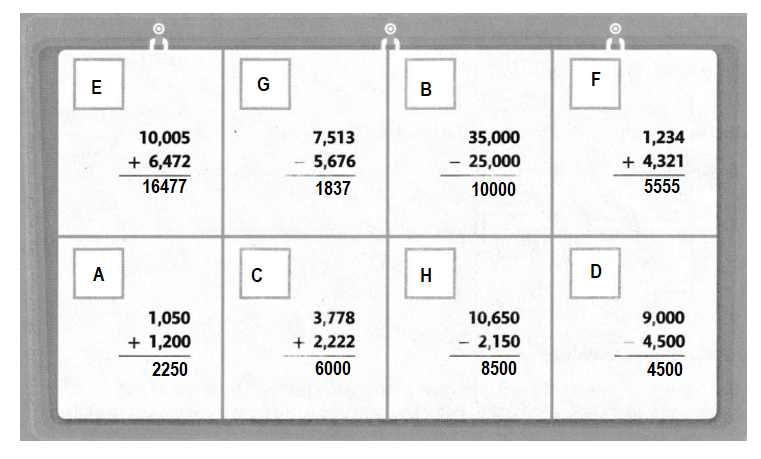
A. The sum is between 650 and 750.
B. The sum is between 1,470 and 1,480.
C. The sum is exactly 1,550.
D. The sum is between 1,350 and 1,450.
E. The sum is exactly 790.
F. The sum is exactly 1,068.
G. The sum is between 1,100 and 1,225.
H. The sum is exactly 1,300.
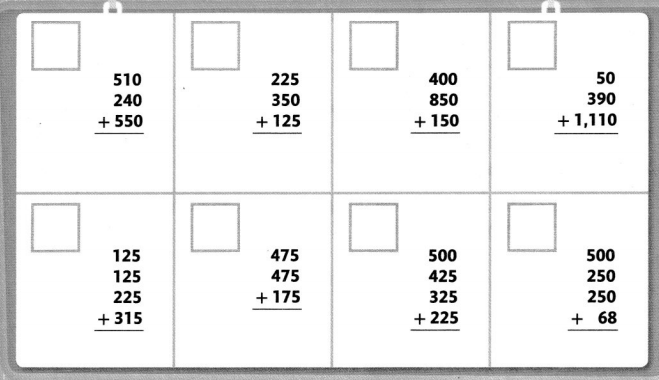
Envision Math Common Core Grade 4 Answer Key Topic 16 Lines, Angles, and Shapes 109
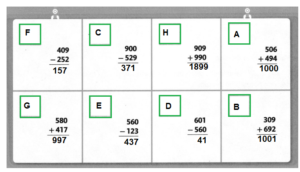
Answer :
Envision-Math-Common-Core-4th-Grade-Answers-Key-Topic-16-Lines-Angles-and-Shapes-Topic-16-Fluency-Practice-Activity-Find-a-Match

Topic 16 Vocabulary Review

Understand Vocabulary

Word List

  • acute triangle
  • equilateral triangle
  • intersecting lines
  • isosceles triangle
  • line of symmetry
  • line symmetric
  • obtuse triangle
  • parallel lines
  • parallelogram
  • perpendicular lines
  • rectangle
  • rhombus
  • right triangle
  • scalene triangle
  • square
  • trapezoid

Write T for true and F for false.
Question 1.
________ An acute triangle is a triangle with one acute angle.
Answer:
True

Question 2.
_________ An isosceles triangle has at least two equal sides.
Answer:
True

Question 3.
______ A figure is line symmetric if it has at least one line of symmetry
Answer:
True

Question 4.
__________ Perpendicular lines form obtuse angles where they intersect.
Answer:
False

Question 6.
__________ A trapezoid has two pairs of parallel sides.
Answer:
False

Write always, sometimes, or never.
Question 6.
An equilateral triangle __________ has three equal sides.
Answer:
An equilateral triangle always has three equal sides.

Question 7.
Parallel lines _________ intersect.
Answer:
Parallel lines Never intersect.

Question 8.
A scalene triangle __________ has equal sides.
Answer:
A scalene triangle never has equal sides.

Question 9.
A rectangle is _________ a square.
Answer:
A rectangle is sometimes a square.

Question 10.
A rhombus __________ has opposite sides that are parallel.
Answer:
A rhombus always has opposite sides that are parallel.

Use Vocabulary in Writing
Question 11.
Rebecca drew a figure. Describe Rebecca’s figure. Use at least 3 terms from the Word List in your description.
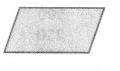
Envision Math Common Core Grade 4 Answer Key Topic 16 Lines, Angles, and Shapes 110
Answer:
Quadrilateral
Parallelogram

Topic 16 Reteaching

Set A pages 585-588

Pairs of lines are given special names: parallel, intersecting, or perpendicular.
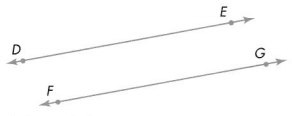
Envision Math Common Core Grade 4 Answers Topic 16 Lines, Angles, and Shapes 111
\(\overleftrightarrow{D E}\) and \(\overleftrightarrow{F G}\) are parallel lines.

Remember to use geometric terms when describing what is shown.
Question 1.
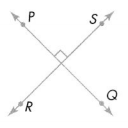
Envision Math Common Core Grade 4 Answers Topic 16 Lines, Angles, and Shapes 112
Answer:
\(\overleftrightarrow{P Q}\) and \(\overleftrightarrow{R S}\) are perpendicular lines.

Question 2.
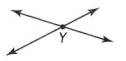
Envision Math Common Core Grade 4 Answers Topic 16 Lines, Angles, and Shapes 113
Answer:
Both lines are perpendicular intersect at point Y .

Set B pages 589-592

Triangles can be classified by their sides and angles.
Envision Math Common Core Grade 4 Answers Topic 16 Lines, Angles, and Shapes 114
Two sides are the same length, and each angle measures less than a right angle. It is an isosceles, acute triangle.

Remember to classify each triangle by its sides and then by its angles.
Question 1.
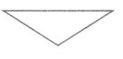
Envision Math Common Core Grade 4 Answers Topic 16 Lines, Angles, and Shapes 115
Answer:
Two sides are the same length – Isosceles
All angles are less than 90 degrees
so, isosceles acute triangle .

Question 2.
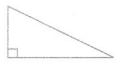
Envision Math Common Core Grade 4 Answers Topic 16 Lines, Angles, and Shapes 116
Answer:
all sides are different
Right angle
so, Scalene right triangle

Set C pages 593-596

Name the quadrilateral.
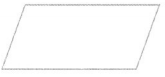
Envision Math Common Core Grade 4 Answers Topic 16 Lines, Angles, and Shapes 117
Opposite sides are parallel. There are no right angles. All sides are not the same length. It is a parallelogram, but not a rectangle, rhombus, or square.

Remember that a quadrilateral can be a rectangle, square, trapezoid, parallelogram, or rhombus.

Write all the names possible for each quadrilateral.
Question 1.
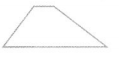
Envision Math Common Core Grade 4 Answers Topic 16 Lines, Angles, and Shapes 118
Answer:
Trapezoid – only 1 pair of parallel sides

Question 2.
Envision Math Common Core Grade 4 Answers Topic 16 Lines, Angles, and Shapes 119
Answer:
Rhombus
Explanation :
2 pairs of parallel sides
4 equal sides

Set D pages 597-600

How many lines of symmetry does the figure have?
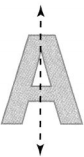
Envision Math Common Core Grade 4 Answers Topic 16 Lines, Angles, and Shapes 120
Fold the figure along the dashed line. The two halves are equal and fit one on top of the other. The figure is line symmetric.
It cannot be folded on another line, so it has 1 line of symmetry.

Remember that figures can have many lines of symmetry.

Draw and tell how many lines of symmetry for each figure.
Question 1.
Envision Math Common Core Grade 4 Answers Topic 16 Lines, Angles, and Shapes 121
Answer:
Envision-Math-Common-Core-4th-Grade-Answers-Key-Topic-16-Lines-Angles-and-Shapes-Topic-16-ReteachingSet-D-Question-1
Explanation :
This figure is line symmetric. It has 4 lines of symmetry. It can be folded on each line of symmetry into matching parts.

Question 2.
Envision Math Common Core Grade 4 Answers Topic 16 Lines, Angles, and Shapes 122
Answer:
Envision-Math-Common-Core-4th-Grade-Answers-Key-Topic-16-Lines-Angles-and-Shapes-Topic-16-ReteachingSet-D-Question-2

Explanation :
This figure is line symmetric. It has 1 lines of symmetry. It can be folded on each line of symmetry into matching parts.

Set E pages 601-604

Complete a design with line symmetry.
Draw a line of symmetry for the shape.
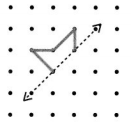
Envision Math Common Core Grade 4 Answers Topic 16 Lines, Angles, and Shapes 123
Complete the design on the opposite side of the line of symmetry.
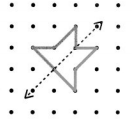
Envision Math Common Core Grade 4 Answers Topic 16 Lines, Angles, and Shapes 124

Remember, for a figure to be line symmetric, it must have a line of symmetry.

Complete the designs.
Question 1.
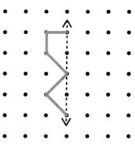
Envision Math Common Core Grade 4 Answers Topic 16 Lines, Angles, and Shapes 125
Answer:
Envision-Math-Common-Core-4th-Grade-Answers-Key-Topic-16-Lines-Angles-and-Shapes-Topic-16-Reteaching-Set-E-Question-1
Explanation :
We say there is symmetry when the exact reflection or mirror image of a line, shape or object gets created. The line of symmetry can be defined as the axis or imaginary line that passes through the center of the shape or object and divides it into identical halves.

Question 2.
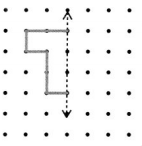
Envision Math Common Core Grade 4 Answers Topic 16 Lines, Angles, and Shapes 126
Answer:
Envision-Math-Common-Core-4th-Grade-Answers-Key-Topic-16-Lines-Angles-and-Shapes-Topic-16-Reteaching-Set-E-Question-2
Explanation :
We say there is symmetry when the exact reflection or mirror image of a line, shape or object gets created. The line of symmetry can be defined as the axis or imaginary line that passes through the center of the shape or object and divides it into identical halves.

Set F pages 605-608

Think about these questions to help you critique the reasoning of others.
Thinking Habits
Be a good thinker! These questions can help you.

  • What questions can I ask to understand other people’s thinking?
  • Are there mistakes in other people’s thinking?
  • Can I improve other people’s thinking?

    Envision Math Common Core Grade 4 Answers Topic 16 Lines, Angles, and Shapes 127

Remember that it only takes one counterexample to show the statement is false.

Derek says, “All triangles have 1 right angle.”
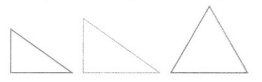
Envision Math Common Core Grade 4 Answers Topic 16 Lines, Angles, and Shapes 128
Question 1.
Use the figures above to critique Derek’s statement.
Answer:
The First two triangles ( from left to Right )in the figure are Right triangle but the third triangle is a Equilateral Triangle .

Question 2.
What kinds of triangles NEVER have right angles?
Answer:
Since a right-angled triangle has one right angle, the other two angles are acute. Therefore, an obtuse-angled triangle can never have a right angle; and vice versa. The side opposite the obtuse angle in the triangle is the longest.
Any triangle that is not a right triangle is an oblique triangle. Solving an oblique triangle means finding the measurements of all three angles and all three sides.

Topic 16 Assessment Practice

Question 1.
Of a parallelogram, rectangle, rhombus, and trapezoid, which cannot describe a square? Explain.
Answer:
A square can be a rhombus, parallelogram, a rectangle do not have to be a  Trapezoid .
Explanation:
A rhombus is a quadrilateral with all four sides being of equal length.
A parallelogram is a quadrilateral with two pairs of parallel sides.
A rectangle is a quadrilateral with four right angles and 2 parallel sides .
A square is a quadrilateral with four right angles and equal side lengths.
Where as a A trapezoid is a quadrilateral with at least one pair of parallel sides.
it sides are not of different lengths . 

Looking at the definitions, a square is already guaranteed to be a rhombus. Here are examples of each of the other shapes which are not rhombuses.

Question 2.
How many acute angles are there in an equilateral triangle?
Answer:
An equilateral triangle has three acute angles .

Question 3.
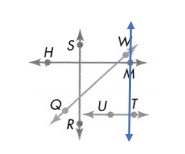
Gavin drew different-colored lines. Draw a line that is parallel to \(\overleftrightarrow{S R}\).
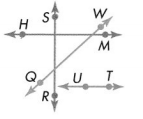
Envision Math Common Core Grade 4 Answers Topic 16 Lines, Angles, and Shapes 129
Answer:
Envision-Math-Common-Core-4th-Grade-Answers-Key-Topic-16-Lines-Angles-and-Shapes-Topic-16-Assessment-Practice-Question-1
Explanation :
A line is drawn from M which is parallel to \(\overleftrightarrow{S R}\) .

Question 4.
Marci described the light from the sun as a line that starts at the sun and continues on forever. Which geometric term best describes Marci’s description of the sun’s light?
Answer:
It is a Ray
Explanation :
A ray can be defined as a part of a line that has a fixed starting point but no end point. It can extend infinitely in one direction.

Envision-Math-Common-Core-4th-Grade-Answers-Key-Topic-16-Lines-Angles-and-Shapes-Topic-16-Assessment-Practice-Question-4

Question 5.
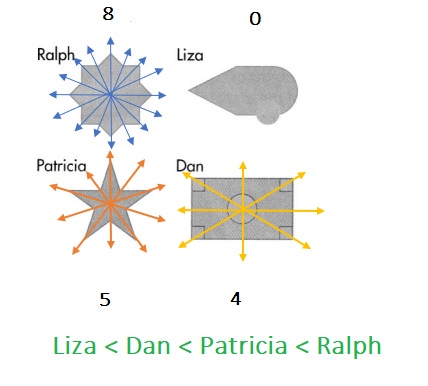
Four of Mrs. Cromwell’s students decorated a bulletin board with the shapes shown below. Order the students’ shapes in order from fewest lines of symmetry to most lines of symmetry.
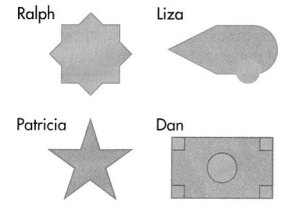
Envision Math Common Core Grade 4 Answers Topic 16 Lines, Angles, and Shapes 130
Answer:
Envision-Math-Common-Core-4th-Grade-Answers-Key-Topic-16-Lines-Angles-and-Shapes-Topic-16-Assessment-Practice-Question-5

Question 6.
Are all intersecting lines perpendicular? Draw a picture to help explain your answer.
Answer:
Perpendicular lines are a particular case of intersecting lines when an angle between them is 90o.
Explanation:
Perpendicular lines always intersect each other, however, all intersecting lines are not always perpendicular to each other. The two main properties of perpendicular lines are: Perpendicular lines always meet or intersect each other. The angle between any two perpendicular lines is always equal to 90.
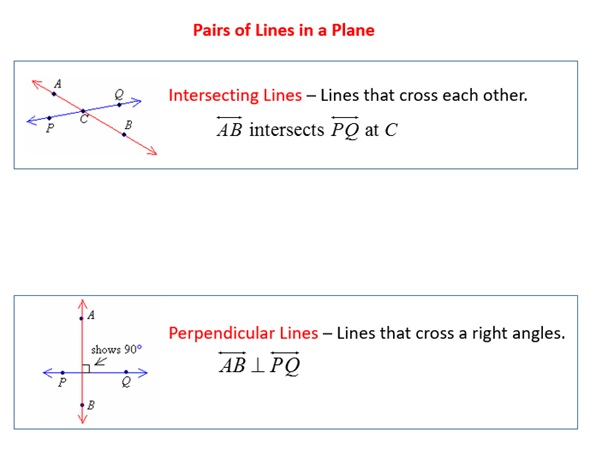
Envision-Math-Common-Core-4th-Grade-Answers-Key-Topic-16-Lines-Angles-and-Shapes-Topic-16-Assessment-Practice-Question-6

Question 7.
A four-sided figure with two pairs of parallel sides cannot be what type of quadrilateral? Explain.
Answer:
Trapezoids have only one pair of parallel sides; parallelograms have two pairs of parallel sides. A trapezoid can never be a parallelogram.
The correct answer is that all trapezoids are quadrilaterals. . Trapezoids are four-sided polygons, so they are all quadrilaterals.
Envision-Math-Common-Core-4th-Grade-Answers-Key-Topic-16-Lines-Angles-and-Shapes-Topic-16-Assessment-Practice-Question-7

Question 8.
Equilateral triangle ABC has one side with a length of 4 inches. What are the lengths of each of the other two sides of the triangle? Explain.
Answer:
An equilateral triangle is a triangle with all three sides of equal length , corresponding to what could also be known as a “regular” triangle .
if one side is 4 inches then other two ides will also be 4 inches .

Question 9.
Which set of angles could form a triangle?
A. Two right angles, one acute angle
B. One obtuse angle, one right angle, one acute angle
C. Two obtuse angles, one acute angle
D. One right angle, two acute angles
Answer:
Option  D .

Question 10.
A figure has one angle formed from a pair of perpendicular lines, one pair of parallel sides, and no sides with equal lengths. What geometric term can be used to name this figure?
Answer:

Question 11.
Dina’s teacher asks her to describe the top and bottom edges of her ruler using a geometric term. What term could Dina use?
Answer:
The top and bottom edge of the ruler is like a straight line .

Question 12.
Shapes are divided into two groups. These are the shapes in the first group.
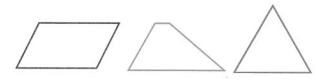
Envision Math Common Core Grade 4 Answers Topic 16 Lines, Angles, and Shapes 131
The following shapes do not belong in the group above. These are the shapes in the second group.
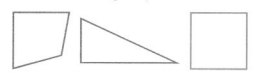
Envision Math Common Core Grade 4 Answers Topic 16 Lines, Angles, and Shapes 132
What generalization can be made about the shapes in the first group?
Answer:
Envision Math Common Core Grade 4 Answers Topic 16 Lines, Angles, and Shapes 131
In the above group we have shapes like Parallelogram , Trapezoid and Equilateral Triangle
Envision Math Common Core Grade 4 Answers Topic 16 Lines, Angles, and Shapes 132
In the above group, We have shapes like Trapezoid , right Triangle and Square .
Generalization made is square can be a parallelogram in few statements .

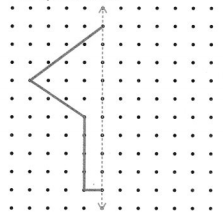
Question 13.
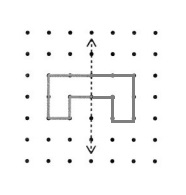
Complete the drawing so the figure is line symmetric.
Envision Math Common Core Grade 4 Answers Topic 16 Lines, Angles, and Shapes 133
Answer:
Envision-Math-Common-Core-4th-Grade-Answers-Key-Topic-16-Lines-Angles-and-Shapes-Topic-16-Assessment-Practice-Question-13
Explanation :
Fold the figure along the dashed line. The two halves are equal and fit one on top of the other. The figure is line symmetric.
It cannot be folded on another line, so it has 1 line of symmetry.

Topic 16 Performance Task

Ottoman Art
The Ottoman Empire lasted from 1299 until 1922. Much of the art from this period contained geometric shapes.
Question 1.
Use the Ottoman Empire figure to answer the following.
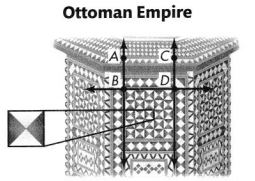
Envision Math Common Core Grade 4 Answers Topic 16 Lines, Angles, and Shapes 134
Part A – Question
Name a pair of parallel lines and explain why the lines are parallel.
Answer:
AB ll CD .
Explanation :
Because the points A and B are equi distant from points C and D . and they don’t intersect each other

Part B – Question
The enlarged part of the figure shows 4 triangles that are all the same type. Classify these triangles by their sides and by their angles. Explain.
Answer:
all the sides are equal then it is Equilateral Triangle .
all angles will be 60 degrees .

Part C
Olivia said the 4 triangles were inside a square. When asked other possible names for the square, she said it was a quadrilateral, a parallelogram, and a rectangle. Critique Olivia’s reasoning.
Answer:
A parallelogram is a quadrilateral in which each pair of opposite sides is parallel.
A quadrilateral is a polygon having only four sides.
A rectangle is a parallelogram in which one angle is of 90 degrees .
Yes, a square is a special type of rectangle because it possesses all the properties of a rectangle. Similar to a rectangle, a square has: interior angles which measure 90∘ each. opposite sides that are parallel and equal.

Question 2
The basic shape used in the Ottoman Scarf is a quadrilateral. Answer the following about this shape.
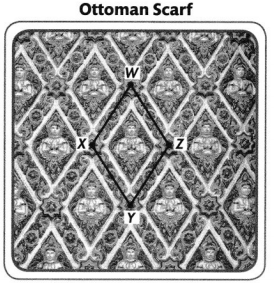
Envision Math Common Core Grade 4 Answers Topic 16 Lines, Angles, and Shapes 135
Part A – Question
What are all the names you can use for this quadrilateral? Explain.
Answer:
Rhombus and parallelogram
A parallelogram is a quadrilateral in which each pair of opposite sides is parallel.
A rhombus is a parallelogram in which adjacent sides are equal.

Part B – Question
Corbin drew a triangle by connecting the points W, X, and Y. He said the triangle is acute because it has acute angles. Critique Corbin’s reasoning.
Answer:
Yes the Triangle formed is WXY . The triangle is acute Triangle because the triangles have acute angles .

Part C – Question
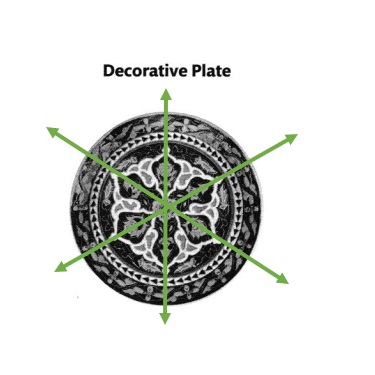
Draw all lines of symmetry on the Decorative Plate. How many lines of symmetry does the plate have? Explain.
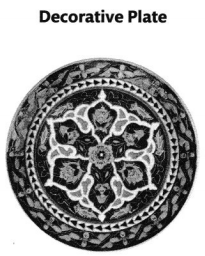
Envision Math Common Core Grade 4 Answers Topic 16 Lines, Angles, and Shapes 136
Answer:

Envision-Math-Common-Core-4th-Grade-Answers-Key-Topic-16-Lines-Angles-and-Shapes-Topic-16-Performance-Task-Part-C-Question
Explanation :
Fold the figure along the dashed line. The two halves are equal and fit one on top of the other. The figure is line symmetric.
It cannot be folded on another line, so it has 1 line of symmetry.

enVision Math Common Core Grade 4 Answer Key Topic 15 Geometric Measurement: Understand Concepts of Angles and Angle Measurement

Go through the enVision Math Common Core Grade 4 Answer Key Topic 15 Geometric Measurement: Understand Concepts of Angles and Angle Measurement and finish your homework or assignments.

enVision Math Common Core 4th Grade Answers Key Topic 15 Geometric Measurement: Understand Concepts of Angles and Angle Measurement

Essential Questions:
What are some common geometric terms? How can you measure angles?
Envision Math Common Core 4th Grade Answer Key Topic 15 Geometric Measurement Understand Concepts of Angles and Angle Measurement 1

enVision STEM Project: Lines and Angles
Do Research Use the Internet or other sources to research the area of the world’s largest bumper car floor. Find where it is located and when it was built.
Journal: Write a Report Include what you found. Also in your report:

  • Draw a diagram of a bumper car collision. Use an angle to show how a car might change direction after it collides with something. Measure and label the angle you drew.
  • Describe your angle using some of the vocabulary terms in this topic.

Review What You Know

Vocabulary

Choose the best term from the box. Write it on the blank.

  • angle
  • right angle
  • line
  • sixth

Question 1.
A(n) _________ is one of 6 equal parts of a whole, written as \(\frac{1}{6}\).
Answer: A sixth is one of 6 equal parts of a whole, written as \(\frac{1}{6}\).

Question 2.
A(n) _________ is a figure formed by two rays that share the same endpoint.
Answer: An angle is a figure formed by two rays that share the same endpoint.

Question 3.
A(n) ___________ is an angle that forms a square corner.
Answer: A right angle is an angle that forms a square corner.

Adding and Subtracting

Find the sum or difference.
Question 4.
45 + 90
Answer:
Given the two numbers 45 and 90
We have to find the sum of 45, 90.
The sum of 45 + 90 = 135.

Question 5.
120 – 45
Answer:
Given the two numbers 120 and 45
We have to find the difference of 120, 45.
The difference of 120 – 45 = 75.

Question 6.
30 + 150
Answer:
Given the two numbers 30 and 150
We have to find the sum of 30, 150.
The sum of 30 + 150 = 180.

Question 7.
180 – 135
Answer:
Given the two numbers 180 and 135
We have to find the difference of 180, 135.
The difference of 180 – 135 = 45.

Question 8.
60 + 120
Answer:
Given the two numbers 60 and 120
We have to find the sum of 60, 120.
The sum of 60 + 120 = 180.

Question 9.
90 – 45
Answer:
Given the two numbers 90 and 45
We have to find the difference of 90, 45.
The difference of 90 – 45 = 45.

Parts of a Whole

Tell the fraction that represents the shaded part of the whole.
Question 10.
Envision Math Common Core 4th Grade Answer Key Topic 15 Geometric Measurement Understand Concepts of Angles and Angle Measurement 2
Answer:
The fraction that represents the shaded part of the whole number is 1/6.

Question 11.
Envision Math Common Core 4th Grade Answer Key Topic 15 Geometric Measurement Understand Concepts of Angles and Angle Measurement 3
Answer:
The fraction that represents the shaded part of the whole number is 1/4.

Question 12.
Envision Math Common Core 4th Grade Answer Key Topic 15 Geometric Measurement Understand Concepts of Angles and Angle Measurement 4
Answer:
The fraction that represents the shaded part of the whole number is 1/10.

Dividing

Find the quotient.
Question 13.
360 ÷ 6
Answer:
The quotient of 360 ÷ 6 = 60
60 is the quotient.

Question 14.
180 ÷ 9
Answer:
The quotient of 180 ÷ 9 = 20
20 is the quotient.

Question 15.
360 ÷ 4
Answer:
The quotient of 360 ÷ 4 = 90
90 is the quotient.

Problem Solving

Question 16.
Make Sense and Persevere Gary has $4. Mary has twice as many dollars as Gary. Larry has 4 fewer dollars than Mary. How much money do Gary, Mary, and Larry have in all?
Answer:
Given that,
Total number of dollars at Gary = $4
Mary has twise as many dollars sa Gray = 2 × $4 = $8.
Larry has 4 fewer dollars than Mary = $8 – 4 = $4.
Total money with Gary, Marry, and Larry = $8 + $4 + $4 = $16.

Pick a Project

PROJECT 15A
Can you find angles in stringed instruments?
Project: Make a Stringed Instrument
Envision Math Common Core 4th Grade Answer Key Topic 15 Geometric Measurement Understand Concepts of Angles and Angle Measurement 5

PROJECT 15B
How are angles important in origami?
Project: Present an Origami Animal
Envision Math Common Core 4th Grade Answer Key Topic 15 Geometric Measurement Understand Concepts of Angles and Angle Measurement 6

PROJECT 15C
How are angles formed by airplane paths?
Project: Trace a Flight Plan
Envision Math Common Core 4th Grade Answer Key Topic 15 Geometric Measurement Understand Concepts of Angles and Angle Measurement 7

3-ACT MATH PREVIEW

Math Modeling
Game of Angles
Envision Math Common Core 4th Grade Answer Key Topic 15 Geometric Measurement Understand Concepts of Angles and Angle Measurement 8
I can … model with math to solve a problem that involves measuring angles and computing with angle measures.

Lesson 15.1 Lines, Rays, and Angles

Solve & Share
A right angle forms a square corner, like the one shown below. Find examples of right angles in your classroom. Draw two angles that are open less than the right angle. Solve this problem any way you choose.
I can … recognize and draw lines, rays, and different types of angles.
Envision Math Common Core 4th Grade Answer Key Topic 15 Geometric Measurement Understand Concepts of Angles and Angle Measurement 9

Look Back! Reasoning Draw an angle that is open more than a right angle.

Essential Question
What Are Some Common Geometric Terms?

Visual Learning Bridge
Point, line, line segment, ray, right angle, acute angle, obtuse angle, and straight angle are common geometric terms.

An angle is formed by two rays that have the same endpoint.
Envision Math Common Core 4th Grade Answer Key Topic 15 Geometric Measurement Understand Concepts of Angles and Angle Measurement 11

Convince Me! Look for Relationships Complete each figure to show the given angle.
Envision Math Common Core 4th Grade Answer Key Topic 15 Geometric Measurement Understand Concepts of Angles and Angle Measurement 12

Guided Practice

Do You Understand?
Question 1.
What geometric term describes a part of a line that has one endpoint? Draw an example.
Answer:
A ray is a part of a line that has one endpoint and continues on forever in one direction.
Envision Math Common Core 4th Grade Answer Key Topic 15 Geometric Measurement Understand Concepts of Angles and Angle Measurement 15

Question 2.
What geometric term describes a part of a line that has two endpoints? Draw an example.
Answer:
A line segment is a part of a line with two endpoints.
Envision Math Common Core 4th Grade Answer Key Topic 15 Geometric Measurement Understand Concepts of Angles and Angle Measurement 13

Question 3.
What geometric term describes an angle that forms a square corner? Draw an example.
Answer:
A right angle forms a square corner.
Envision Math Common Core 4th Grade Answer Key Topic 15 Geometric Measurement Understand Concepts of Angles and Angle Measurement 14

Do You Know How?
For 4-7, use geometric terms to describe what is shown.
Question 4.
Envision Math Common Core 4th Grade Answer Key Topic 15 Geometric Measurement Understand Concepts of Angles and Angle Measurement 13
Answer:
∠PX represents the line segment with two end points.

Question 5.
Envision Math Common Core 4th Grade Answer Key Topic 15 Geometric Measurement Understand Concepts of Angles and Angle Measurement 14
Answer:
∠PQR is a right angle triangle. A right angle forms a forms a square corner.

Question 6.
Envision Math Common Core 4th Grade Answer Key Topic 15 Geometric Measurement Understand Concepts of Angles and Angle Measurement 15
Answer:
∠BY is a straight angle.

Question 7.
Envision Math Common Core 4th Grade Answer Key Topic 15 Geometric Measurement Understand Concepts of Angles and Angle Measurement 16
Answer:
∠LMN is an acute angle. An acute angle is open less than a right angle.

Independent Practice

For 8-11, use geometric terms to describe what is shown.
Question 8.
Envision Math Common Core 4th Grade Answer Key Topic 15 Geometric Measurement Understand Concepts of Angles and Angle Measurement 17
Answer:
∠HOS is an obtuse angle. An obtuse angle is open more than a right angle but less than a straight angle.

Question 9.
Envision Math Common Core 4th Grade Answer Key Topic 15 Geometric Measurement Understand Concepts of Angles and Angle Measurement 18
Answer:
∠BD represents the line segment with two endpoints.

Question 10.
Envision Math Common Core 4th Grade Answer Key Topic 15 Geometric Measurement Understand Concepts of Angles and Angle Measurement 19
Answer: ∠BY is a straight angle.

Question 11.
Envision Math Common Core 4th Grade Answer Key Topic 15 Geometric Measurement Understand Concepts of Angles and Angle Measurement 20
Answer:
∠STP is a right angle.

For 12-15, draw the geometric figure for each term.
Question 12.
Line segment
Answer:
Envision Math Common Core 4th Grade Answer Key Topic 15 Geometric Measurement Understand Concepts of Angles and Angle Measurement 18

Question 13.
Point
Answer:
•

Question 14.
Ray
Answer:
Envision Math Common Core 4th Grade Answer Key Topic 15 Geometric Measurement Understand Concepts of Angles and Angle Measurement 19

Question 15.
Line
Answer:
line

Problem Solving

For 16-18, use the map of Nevada. Write the geometric term that best fits each description. Draw an example.
Envision Math Common Core 4th Grade Answer Key Topic 15 Geometric Measurement Understand Concepts of Angles and Angle Measurement 21

Question 16.
Be Precise The route between 2 cities.
Answer:

Question 17.
The cities
Answer:

Question 18.
The corner formed by the north and west borders
Answer:

Question 19.
Vocabulary Write a definition for right angle. Draw a right angle. Give 3 examples of right angles in the classroom.
Answer:

Question 20.
Higher Order Thinking Nina says she can make a right angle with an acute angle and an obtuse angle that have a common ray. Is Nina correct? Draw a picture and explain.
Answer: If an angle is acute, it can’t also be a right angle.

Assessment Practice

Question 21.
Which geometric term describes ∠HJK?
Envision Math Common Core 4th Grade Answer Key Topic 15 Geometric Measurement Understand Concepts of Angles and Angle Measurement 22
A. Acute angle
B. Obtuse angle
C. Right angle
D. Straight angle
Answer:
The geometric term ∠HJK represents a straight angle.
Thus the answer is option D.

Question 22.
Lisa drew 2 rays that share an endpoint. Which of the following is Lisa’s drawing?
Envision Math Common Core 4th Grade Answer Key Topic 15 Geometric Measurement Understand Concepts of Angles and Angle Measurement 23
Answer: D

Lesson 15.2 Understand Angles and Unit Angles

Solve & Share
If a clock shows it is 3 o’clock, how could you describe the smaller angle made by the two hands of the clock? Solve this problem any way you choose.
I can … use what I know about fractions to measure angles.
Envision Math Common Core 4th Grade Answer Key Topic 15 Geometric Measurement Understand Concepts of Angles and Angle Measurement 24

Look Back! At 3 o’clock, what two fractions do the hands divide the clock into?

Essential Question
What is the Unit Used to Measure Angles?

Visual Learning Bridge
An angle is measured with units called degrees. An angle that turns through \(\frac{1}{360}\) of a circle is called a unit angle. How can you determine the angle measure of a right angle and the angles that turn through \(\frac{1}{6}\) and \(\frac{2}{6}\) of a circle?
You measure length in inches, area in square centimeters, and capacity in ounces. You measure an angle in degrees, o. A full circle has an
angle measure of 360°.
Envision Math Common Core 4th Grade Answer Key Topic 15 Geometric Measurement Understand Concepts of Angles and Angle Measurement 25

Divide to find the angle measure of a right angle.
Envision Math Common Core 4th Grade Answer Key Topic 15 Geometric Measurement Understand Concepts of Angles and Angle Measurement 26
Right angles divide a circle into 4 equal parts.
360° ÷ 4 = 90°
The angle measure of a right angle is 90°.

Divide to find the measure of an angle that turns through \(\frac{1}{6}\) of a circle.
Envision Math Common Core 4th Grade Answer Key Topic 15 Geometric Measurement Understand Concepts of Angles and Angle Measurement 27
\(\frac{1}{6}\) of a circle is one part of the circle that is divided into 6 equal parts.
360° ÷ 6 = 60°
The angle measure is 60°.

Add to find the measure of an angle that turns through \(\frac{2}{6}\) of a circle.
Envision Math Common Core 4th Grade Answer Key Topic 15 Geometric Measurement Understand Concepts of Angles and Angle Measurement 28
Remember \(\frac{2}{6}\) = \(\frac{1}{6}\) + \(\frac{1}{6}\)
Add to calculate the measure of \(\frac{2}{6}\) of a circle.
60° + 60° = 120° The angle measure of of a circle is 120°.

Convince Me! Critique Reasoning Susan thinks the measure of angle B is greater than the measure of angle A. Do you agree? Explain.
Envision Math Common Core 4th Grade Answer Key Topic 15 Geometric Measurement Understand Concepts of Angles and Angle Measurement 29

Another Example!
Find the fraction of a circle that an angle with a measure of 45° turns through
Envision Math Common Core 4th Grade Answer Key Topic 15 Geometric Measurement Understand Concepts of Angles and Angle Measurement 30
A 45° angle turns through \(\frac{45}{360}\) of a circle.
45° × 8 = 360°, so 45° is \(\frac{1}{8}\) of 360°.
One 45° angle is \(\frac{1}{8}\) of a circle.

Guided Practice

Do You Understand?
Question 1.
What fraction of the circle does a 120° angle turn through?
Answer:
A circle contains 360°
To find the fraction of the circle’s 120° angle.
Divide 120° by 360°
120°/360° = 1/3
Thus the fraction of the circle that does a 120° angle turn through is 1/3.

Question 2.
Mike cuts a pie into 4 equal pieces. What is the angle measure of each piece? Write and solve an equation.
Answer:
Given,
Mike cuts a pie into 4 equal pieces.
A circle contains 360°
360/90 = 4
90 degrees because when you cut each of them they will each measure 90 degrees.

Do You Know How?
Question 3.
A circle is divided into 9 equal parts. What is the angle measure of one of those parts?
Envision Math Common Core 4th Grade Answer Key Topic 15 Geometric Measurement Understand Concepts of Angles and Angle Measurement 31
Answer:
Given that,
A circle is divided into 9 equal parts.
There are 360 degrees in a circle.
That means that we first divide 360 by 9.
We have the measure for one of the nine parts of the circle, but we need two.
All we do is multiply 40 by 2 to get 80 degrees.

Question 4.
An angle turns through of the circle. What is the measure of this angle?
Envision Math Common Core 4th Grade Answer Key Topic 15 Geometric Measurement Understand Concepts of Angles and Angle Measurement 32
Answer:
An angle turns through the circle.
There are 360 degrees in a circle.
That means that we first divide 360 by 4.
360 ÷ 4 = 90
Thus the measure of the angle of the above circle is 90 degrees.

Independent Practice

For 5-8, find the measure of each angle.
Question 5.
The angle turns through \(\frac{1}{5}\) of the circle.
Envision Math Common Core 4th Grade Answer Key Topic 15 Geometric Measurement Understand Concepts of Angles and Angle Measurement 33
Answer:
An angle turns through the circle.
There are 360 degrees in a circle.
That means that we first divide 360 by 5.
360 ÷ 5 = 72
Thus the measure of the angle of the above circle is 72 degrees.

Question 6.
The angle turns through \(\frac{3}{8}\) of the circle.
Envision Math Common Core 4th Grade Answer Key Topic 15 Geometric Measurement Understand Concepts of Angles and Angle Measurement 34
Answer:
An angle turns through the circle.
There are 360 degrees in a circle.
That means that we first divide 360 by \(\frac{3}{8}\).
360 × \(\frac{3}{8}\) = 135
Thus the measure of the angle of the above circle is 135 degrees.

Question 7.
The angle turns through \(\frac{2}{5}\) of the circle.
Envision Math Common Core 4th Grade Answer Key Topic 15 Geometric Measurement Understand Concepts of Angles and Angle Measurement 35
Answer:
The angle turns through \(\frac{2}{5}\) of the circle.
There are 360 degrees in a circle.
That means that we first divide 360 by \(\frac{2}{5}\).
360 × \(\frac{2}{5}\) = 144
Thus the measure of the angle of the above circle is 144 degrees.

Question 8.
The angle turns through \(\frac{2}{6}\) of the circle.
Envision Math Common Core 4th Grade Answer Key Topic 15 Geometric Measurement Understand Concepts of Angles and Angle Measurement 36
Answer:
The angle turns through \(\frac{2}{6}\) of the circle.
There are 360 degrees in a circle.
That means that we first divide 360 by \(\frac{2}{6}\).
360 × \(\frac{2}{6}\) = 120
Thus the measure of the angle of the above circle is 120 degrees.

Problem Solving

Question 9.
Use the clock to find the measure of the smaller angle formed by the hands at each time.
Envision Math Common Core 4th Grade Answer Key Topic 15 Geometric Measurement Understand Concepts of Angles and Angle Measurement 37
a. 3:00
b. 11:00
c. 2:00
Answer:
Envision-Math-Common-Core-4th-Grade-Answer-Key-Topic-15-Geometric-Measurement-Understand-Concepts-of-Angles-and-Angle-Measurement-37
11:00
Thus the correct answer is option B.

Question 10.
Algebra Jacey wrote an equation to find an angle measure. What do variables a and b represent in Jacey’s equation? 360° ÷ a = b
Answer:
We know that Jacey wrote an equation to find an angle measure.
The equation is as follows:
360 ÷ a = b
So, if the angle is 360 degrees is a central angle, i.e, an angle between 2 radii in a circle, then
a = the number of equal parts the circle is divided.
b = the measure of the central angle of each part.

Question 11.
enVision® STEM A mirror can be used to reflect a beam of light at an angle. What fraction of a circle would the angle shown turn through?
Envision Math Common Core 4th Grade Answer Key Topic 15 Geometric Measurement Understand Concepts of Angles and Angle Measurement 38
Answer:
Given,
A mirror can be used to reflect a beam of light at an angle.
120° ÷ 360° = 1/3
The fraction of a circle would the angle turn is 1/3.

Question 12.
Malik paid $32.37 for three books. One book cost $16.59. The second book cost $4.27. How much did the third book cost? Use bills and coins to solve.
Envision Math Common Core 4th Grade Answer Key Topic 15 Geometric Measurement Understand Concepts of Angles and Angle Measurement 39
Answer:
Given,
Malik paid $32.37 for three books. One book cost $16.59. The second book cost $4.27.
$16.59 + $4.27 = $20.86
$32.37 – $20.86 = $11.51
Thus the cost of third book is $11.51

Question 13.
Make Sense and Persevere A pie was cut into equal parts. Four pieces of the pie were eaten. The 5 pieces that remained created an angle that measured 200°. What was the angle measure of one piece of pie?
Answer:
Given that,
A pie was cut into equal parts.
Four pieces of the pie were eaten.
The 5 pieces that remained created an angle that measured 200°.
200/5 = 40
Thus the angle measure of one piece of pie is 40 degrees.

Question 14.
Higher Order Thinking Jake cut a round gelatin dessert into 8 equal pieces. Five of the pieces were eaten. What is the angle measure of the dessert that was left?
Answer:
Given,
Jake cut a round gelatin dessert into 8 equal pieces.
Five of the pieces were eaten.
Fraction is the number of pieces eaten by the total number of pieces.
5/8
360 × 5/8 = 225
Thus the angle measure of the desert that was left.

Assessment Practice

Question 15.
Select all choices that show an angle measure of 120°. Use the clock to help.
Envision Math Common Core 4th Grade Answer Key Topic 15 Geometric Measurement Understand Concepts of Angles and Angle Measurement 40
☐ 10 o’clock
☐ \(\frac{2}{6}\) of a pie
☐ \(\frac{2}{3}\) of a circle
☐ 4 o’clock
☐ 8 o’clock
Answer: \(\frac{2}{6}\) of a pie

Lesson 15.3 Measure with Unit Angles

Solve & Share
The smaller angles on the tan pattern block shown each measure 30°. How can you use the angles on the pattern block to determine the measure of the angle below? Solve this problem any way you choose.
I can … use angles I know to measure angles I do not know.
Envision Math Common Core 4th Grade Answers Topic 15 Geometric Measurement Understand Concepts of Angles and Angle Measurement 41

Look Back! Two right angles make a straight angle. How many 45° angles form a straight angle? Explain.

Essential Question
How Can You Measure Angles?

Visual Learning Bridge
Holly traced around a trapezoid pattern block. She wants to find the measure of the angle formed shown to the right. What can Holly use to measure the angle?
Envision Math Common Core 4th Grade Answers Topic 15 Geometric Measurement Understand Concepts of Angles and Angle Measurement 42
The measure of a unit angle is 1 degree. Just like adding inches + inches, you can add degrees + degrees. So 5° = 1° + 1° + 1° + 1° + 1°
or 5 × 1°

Use an angle you know to find the measure of another angle.
Envision Math Common Core 4th Grade Answers Topic 15 Geometric Measurement Understand Concepts of Angles and Angle Measurement 43
The smaller angle of the tan pattern block measures 30°.
A 30-degree angle turns through 30 one-degree angles.

The angle of the trapezoid pattern block is equal to 2 of the smaller angles of the tan pattern block. Each smaller angle is 30°.
Envision Math Common Core 4th Grade Answers Topic 15 Geometric Measurement Understand Concepts of Angles and Angle Measurement 44
The measure of the trapezoid angle is 60°.
A 60-degree angle turns through 60 one-degree angles.

Convince Me! Generalize What do you notice about the number of one-degree angles in an angle measure?

Guided Practice

Do You Understand?
Question 1.
How many 30° angles are in a 180° angle? Explain.
Envision Math Common Core 4th Grade Answers Topic 15 Geometric Measurement Understand Concepts of Angles and Angle Measurement 45
Answer:
180 ÷ 30 = 6
Thus there are 6 30° angles are in a 180° angle.

Question 2.
How many 15° angles are in a 180° angle? Use your answer to Exercise 1 to explain.
Answer:
180 ÷ 15 = 12
Thus there are 12 15° angles are in a 180° angle.

Do You Know How?
For 3-4, use angles you know to find the measure of each angle. Explain how the angles in the square can help.
Question 3.
Envision Math Common Core 4th Grade Answers Topic 15 Geometric Measurement Understand Concepts of Angles and Angle Measurement 46
Answer:
By seeing the above figure we can say that it is a right angle.
90 ÷ 2 = 45 degrees

Question 4.
Envision Math Common Core 4th Grade Answers Topic 15 Geometric Measurement Understand Concepts of Angles and Angle Measurement 47
Answer:
By seeing the above figure we can say that it is an obtuse angle.
90° + 45° = 135°

Independent Practice

For 5-13, find the measure of each angle. Use pattern blocks to help.
Question 5.
Envision Math Common Core 4th Grade Answers Topic 15 Geometric Measurement Understand Concepts of Angles and Angle Measurement 48
Answer:
Envision-Math-Common-Core-4th-Grade-Answers-Topic-15-Geometric-Measurement-Understand-Concepts-of-Angles-and-Angle-Measurement-48
The measure of the angle is 70 degrees.

Question 6.
Envision Math Common Core 4th Grade Answers Topic 15 Geometric Measurement Understand Concepts of Angles and Angle Measurement 49
Answer:
The measure of the angle is 90 degrees.

Question 7.
Envision Math Common Core 4th Grade Answers Topic 15 Geometric Measurement Understand Concepts of Angles and Angle Measurement 50
Answer:
Envision-Math-Common-Core-4th-Grade-Answers-Topic-15-Geometric-Measurement-Understand-Concepts-of-Angles-and-Angle-Measurement-50
The measure of the angle is 60 degrees.

Question 8.
Envision Math Common Core 4th Grade Answers Topic 15 Geometric Measurement Understand Concepts of Angles and Angle Measurement 51
Answer:
The measure of the angle is 110 degrees.

Question 9.
Envision Math Common Core 4th Grade Answers Topic 15 Geometric Measurement Understand Concepts of Angles and Angle Measurement 52
Answer:
The measure of the angle is 120 degrees.

Question 10.
Envision Math Common Core 4th Grade Answers Topic 15 Geometric Measurement Understand Concepts of Angles and Angle Measurement 53
Answer:
The measure of the angle is 90 degrees.

Question 11.
Envision Math Common Core 4th Grade Answers Topic 15 Geometric Measurement Understand Concepts of Angles and Angle Measurement 54
Answer:
The measure of the angle is 90 degrees.

Question 12.
Envision Math Common Core 4th Grade Answers Topic 15 Geometric Measurement Understand Concepts of Angles and Angle Measurement 55
Answer:
The measure of the angle is 180 degrees.

Question 13.
Envision Math Common Core 4th Grade Answers Topic 15 Geometric Measurement Understand Concepts of Angles and Angle Measurement 56
Answer:
The measure of the angle is 90 degrees.

Problem Solving

Question 14.
Use Appropriate Tools What is the measure of the angle of the yellow hexagon pattern block?
Envision Math Common Core 4th Grade Answers Topic 15 Geometric Measurement Understand Concepts of Angles and Angle Measurement 57
Answer:

Question 15.
What is the measure of the smaller angle formed by the clock hands when it is 5:00?
Envision Math Common Core 4th Grade Answers Topic 15 Geometric Measurement Understand Concepts of Angles and Angle Measurement 58
Answer: 120 degrees

Question 16.
How many 30° angles are in a circle? Write and solve a multiplication equation to explain.
Answer:
The total angle in a circle is 360 degrees
360°/30° = 12
Thus there are 120 30° angles in a circle.

Question 17.
How many unit angles make up the smaller angle formed by the hands of a clock when it is 3:00? Explain.
Answer:
3/12 = x°/360°
1/4 = x°/360°
x° = 90°

Question 18.
Veronica purchases a rug with a length of 16 feet and a width of 4 feet. One fourth of the rug is purple and the rest is blue. What is the area of the blue part of the rug?
Answer:
Veronica purchases a rug with a length of 16 feet and a width of 4 feet.
One-fourth of the rug is purple and the rest is blue.
A = base × height
Area = 16 × 4 = 64 sq. ft
Determine the blue area:
64 sq. ft — 1
x —- 3/4
x = 3/4 × 64
x = 192/4
x = 48 sq.ft

Question 19.
Higher Order Thinking The hands of a clock form a 120° angle. Name two different times it could be.
Answer:
The 120° angles make up 1/3 of one full rotation of the hands-on clock, with a full rotation divided up into 12 equal sections. 1/3 of those 12 sections would be 4 sections, and since we are looking for exact hours that represent this angle, we need four sections forming each of the 120° angles with the minute hand on the clock being at 12. Therefore, the hour hand can be at the 4 for 4 o’clock and it could also be at the 8 for 8 o’clock.

Assessment Practice

Question 20.
The clock reads 9:00. What is the angle measure?
Envision Math Common Core 4th Grade Answers Topic 15 Geometric Measurement Understand Concepts of Angles and Angle Measurement 59
A. 90°
B. 180°
C. 270°
D. 360°
Answer:
A. 90°
The angle measure is 90 degrees.
Thus the correct answer is option A.

Question 21.
How many 60° angles are in 360° angle?
Envision Math Common Core 4th Grade Answers Topic 15 Geometric Measurement Understand Concepts of Angles and Angle Measurement 60
A. 3
B. 6
C. 10
D. 12
Answer: 6

Explanation:
360/60 = 6
There are 6 60° angles are in 360° angle.
Thus the correct answer is option B.

Lesson 15.4 Measure and Draw Angles

Solve & Share
Find the measure of ZABC. Solve this problem any way you choose.
I can … use a protractor to measure and draw angles.
Envision Math Common Core 4th Grade Answers Topic 15 Geometric Measurement Understand Concepts of Angles and Angle Measurement 61

Look Back! Use Appropriate Tools Use the protractor to draw an angle that measures 110°.
Envision Math Common Core 4th Grade Answers Topic 15 Geometric Measurement Understand Concepts of Angles and Angle Measurement 62

Essential Question
How Do You Use a Protractor?

Visual Learning Bridges
A protractor is a tool that is used to measure and draw angles. A partially folded crane is shown at the right. Measure ∠PQR.
Envision Math Common Core 4th Grade Answers Topic 15 Geometric Measurement Understand Concepts of Angles and Angle Measurement 63
The angle, ∠PQR can also be written as ∠RQP.

Measure Angles
Measure ∠PQR.
Place the protractor’s center on the angle’s vertex, Q. Place one of the 0° marks on \(\overrightarrow{Q R}\). Read the measure where \(\overrightarrow{Q P}\) crosses the protractor. If the angle is acute, use the lesser number. If the angle is obtuse, use the greater number.
Envision Math Common Core 4th Grade Answers Topic 15 Geometric Measurement Understand Concepts of Angles and Angle Measurement 64
The measure of ∠PQR is 45°.

Draw Angles
Draw an angle that measures 130°.
Draw \(\overrightarrow{T U}\). Place the protractor so the center is over point T, and one of the 0° marks is on \(\overrightarrow{T U}\). Place a point at 130°. Label it W. Draw \(\overrightarrow{T W}\).
Envision Math Common Core 4th Grade Answers Topic 15 Geometric Measurement Understand Concepts of Angles and Angle Measurement 65
The measure of ∠WTU is 130°.

Convince Me! Be Precise How do you know the measure of ∠UTS is 60° and not 120°?
Envision Math Common Core 4th Grade Answers Topic 15 Geometric Measurement Understand Concepts of Angles and Angle Measurement 66

Guided Practice

Do You Understand?
Question 1.
What is the angle measure of a straight line?
Envision Math Common Core 4th Grade Answers Topic 15 Geometric Measurement Understand Concepts of Angles and Angle Measurement 67
Answer: The angle measure of a straight line is 0° or 180°

Question 2.
What are the vertex and rays of ∠ABC? Explain.
Answer:
The vertex is the common point at which the two lines or rays are joined. Point B in the figure above is the vertex of the angle ∠ABC.

Do You Know How?
For 3-4, use a protractor to measure each angle.
Question 3.
Envision Math Common Core 4th Grade Answers Topic 15 Geometric Measurement Understand Concepts of Angles and Angle Measurement 68
Answer: 50 degrees

Question 4.
Envision Math Common Core 4th Grade Answers Topic 15 Geometric Measurement Understand Concepts of Angles and Angle Measurement 69
Answer: 120 degrees

For 5-6, use a protractor to draw each angle.
Question 5.
110°
Answer:
Angles img_2

Question 6.
50°
Answer:
Envision Math Common Core Grade 4 Answer Key Topic 15 Geometric Measurement Understand Concepts of Angles and Angle Measurement img_1

Independent Practice

For 7-14, measure each angle. Tell if each angle is acute, right, or obtuse.
Remember an acute angle is less than 90° and an obtuse angle is greater than 90° but less than 180°.
Question 7.
Envision Math Common Core Grade 4 Answer Key Topic 15 Geometric Measurement Understand Concepts of Angles and Angle Measurement 69
Answer: The above angle is greater than 90° so it is an obtuse angle.

Question 8.
Envision Math Common Core Grade 4 Answer Key Topic 15 Geometric Measurement Understand Concepts of Angles and Angle Measurement 71
Answer:
The above angle is less than 90° so it is an acute angle.

Question 9.
Envision Math Common Core Grade 4 Answer Key Topic 15 Geometric Measurement Understand Concepts of Angles and Angle Measurement 72
Answer:
The above angle is less than 90° so it is an acute angle.

Question 10.
Envision Math Common Core Grade 4 Answer Key Topic 15 Geometric Measurement Understand Concepts of Angles and Angle Measurement 73
Answer:
The above angle is greater than 90° so it is an obtuse angle.

Question 11.
Envision Math Common Core Grade 4 Answer Key Topic 15 Geometric Measurement Understand Concepts of Angles and Angle Measurement 74
Answer:
The above angle is equal to 90° so it is a right angle.

Question 12.
Envision Math Common Core Grade 4 Answer Key Topic 15 Geometric Measurement Understand Concepts of Angles and Angle Measurement 75
Answer:
The above angle is less than 90° so it is an acute angle.

Question 13.
Envision Math Common Core Grade 4 Answer Key Topic 15 Geometric Measurement Understand Concepts of Angles and Angle Measurement 76
Answer:
The above angle is greater than 90° so it is an obtuse angle.

Question 14.
Envision Math Common Core Grade 4 Answer Key Topic 15 Geometric Measurement Understand Concepts of Angles and Angle Measurement 77
Answer:
The above angle is less than 90° so it is an acute angle.

For 15-18, use a protractor to draw an angle for each measure.
Question 15.
140°
Answer:
Envision Math Common Core Grade 4 Answer Key Topic 15 Geometric Measurement Understand Concepts of Angles and Angle Measurement img_2

Question 16.
180°
Answer:
Envision Math Common Core Grade 4 Answer Key Topic 15 Geometric Measurement Understand Concepts of Angles and Angle Measurement img_3

Question 17.
65°
Answer:
Envision Math Common Core Grade 4 Answer Key Topic 15 Geometric Measurement Understand Concepts of Angles and Angle Measurement img_4

Question 18.
25°
Answer:
Envision Math Common Core Grade 4 Answer Key Topic 15 Geometric Measurement Understand Concepts of Angles and Angle Measurement img_5

Problem Solving

Question 19.
Measure all the angles created by the intersection of Main Street and Pleasant Street. Explain how you measured.
Envision Math Common Core Grade 4 Answer Key Topic 15 Geometric Measurement Understand Concepts of Angles and Angle Measurement 78
Answer: 25 degrees

Question 20.
Use a protractor to find the measure of the angle, then use one of the angle’s rays to draw a right angle. Find the measure of the the angle that is NOT a right angle.
Envision Math Common Core Grade 4 Answer Key Topic 15 Geometric Measurement Understand Concepts of Angles and Angle Measurement 79
Answer: 110 degrees

Question 21.
Critique Reasoning Gail and 3 friends share half a pie. Each piece of pie is the same size. Gail believes each piece of pie has an angle measure of 25°. Is Gail correct? Explain.
Answer:
Given,
Gail and 3 friends share half a pie. Each piece of pie is the same size.
Gail believes each piece of the pie has an angle measure of 25°.
Half of a pie is 50%, divide that by three and that equals about 16.67 if you round it, but if each piece has an angle of 25, those pieces aren’t equal.

Question 22.
Janet made 5 three-point shots in her first game and 3 in her second game. She also made 4 two-point shots in each game. How many total points did Janet score in the two games?
Answer: Janet score 35 points

Question 23.
Higher Order Thinking Maya designed two intersecting roads. She drew the roads so one of the angles at the intersection was 35o. What are the three other angle measurements formed by the intersection?
Answer:
To find the other three angles in the intersection, we need to know that in an intersection of two lines, one angle is the supplement of the other, and the other two are equal to the first and the second one, that is, if the first angle is x, the values of the four angles are
x, 180 – x, x and 180 – x
so if one angle is 35 degrees, we have that the three other angles are 145 degrees, 35 degrees, and 145 degrees.

Assessment Practice

Question 24.
Find the measure of the angle shown.
Envision Math Common Core Grade 4 Answer Key Topic 15 Geometric Measurement Understand Concepts of Angles and Angle Measurement 80
Answer: 35 degrees

Question 25.
Find the measure of the angle shown.
Envision Math Common Core Grade 4 Answer Key Topic 15 Geometric Measurement Understand Concepts of Angles and Angle Measurement 81
Answer: 110 degrees

Lesson 15.5 Add and Subtract Angle Measures

Solve & Share
Draw \(\overrightarrow{B C}\) that divides ∠ABD into two smaller angles. Measure each angle. Solve this problem any way you choose.
I can … use addition and subtraction to solve problems with unknown angle measures.
Envision Math Common Core Grade 4 Answer Key Topic 15 Geometric Measurement Understand Concepts of Angles and Angle Measurement 82

Look Back! How can you relate the measures of the two smaller angles to the measure of the larger angle above using an equation?

Essential Question
How Can You Add and Subtract to Find Unknown Angle Measures?

Visual Learning Bridge
Elinor designs wings for biplanes. First she draws a right angle, ∠ABC. Then she draws \(\overrightarrow{B E}\). She finds ∠EBC measures 30°. How can Elinor find the measure of ∠ABE without using a protractor?
Envision Math Common Core Grade 4 Answer Key Topic 15 Geometric Measurement Understand Concepts of Angles and Angle Measurement 83
∠ABC is decomposed into two non-overlapping parts.

∠EBC and ∠ABE do not overlap, so the measure of right ∠ABC is equal to the sum of the measures of its parts.
The measure of ∠ABC equals the measure of ∠ABE plus the measure of ∠EBC.
Envision Math Common Core Grade 4 Answer Key Topic 15 Geometric Measurement Understand Concepts of Angles and Angle Measurement 84
All right angles measure 90°

Write an equation to determine the missing angle measure.
n + 30° = 90°
Solve the equation.
n = 90° – 30°
n = 60°
Envision Math Common Core Grade 4 Answer Key Topic 15 Geometric Measurement Understand Concepts of Angles and Angle Measurement 85
The measure of ∠ABE is 60°.

Convince Me! Make Sense and Persevere ∠ABD is a straight angle. What is the measure of ∠ABE if the measure of ∠DBC is 115° and the measure of ∠CBE is 20°? How did you decide? Write and solve an equation.
Envision Math Common Core Grade 4 Answer Key Topic 15 Geometric Measurement Understand Concepts of Angles and Angle Measurement 86

Guided Practice

Do You Understand?
Question 1.
Use the information below to draw and label a diagram. ∠PQR measures 45°. ∠RQS measures 40°. ∠PQR and ∠RQS do not overlap. Write and solve an equation to find the measure of ∠PQS.
Answer:
∠PQR + ∠RQS + n = 90

Do You Know How?
For 2-3, use the diagram to the right of each exercise. Write and solve an equation to find the missing angle measure.
Question 2.
What is the measure of ∠EBC if ∠ABE measures 20°?
Envision Math Common Core Grade 4 Answer Key Topic 15 Geometric Measurement Understand Concepts of Angles and Angle Measurement 87
Answer:
∠EBC + ∠ABE = 90°
∠EBC + 20° = 90°
∠EBC = 90° – 20°
∠EBC = 70°

Question 3.
What is the measure of ∠AEB if ∠CEB measures 68°?
Envision Math Common Core Grade 4 Answer Key Topic 15 Geometric Measurement Understand Concepts of Angles and Angle Measurement 88
Answer:
∠AEB + ∠CEB = 180°
∠AEB + 68° = 180°
∠AEB = 180° – 68°
∠AEB = 112°

Independent Practice

For 4-7, use the diagram to the right. Write and solve an addition or subtraction equation to find the missing angle measure.
Envision Math Common Core Grade 4 Answer Key Topic 15 Geometric Measurement Understand Concepts of Angles and Angle Measurement 89
Question 4.
What is the measure of ∠FGJ if ∠JGH measures 22°?
Answer:
∠FGJ + ∠JGH = 90°
∠FGJ + 22° = 90°
∠FGJ = 90° – 22°
∠FGJ = 68°

Question 5.
What is the measure of ∠KGF if ∠EGK measures 59°?
Answer:
∠KGF + ∠EGK = 90°
∠KGF + 59°= 90°
∠KGF = 90° – 59°
∠KGF = 31°

Question 6.
Use the angle measures you know to write an equation to find the angle measure of ∠EGH. What kind of angle is ∠EGH?
Answer:
∠EGK + ∠KGF + ∠FGJ + ∠JGH = 180°

Question 7.
Which two non-overlapping angles that share a ray make an obtuse angle? Use addition to explain.
Answer: ∠KGH and ∠EGJ are the two non-overlapping angles that share a ray that makes an obtuse angle.

Problem Solving

Question 8.
Shane says a straight angle always has 180° degrees. Is Shane correct? Explain.
Answer: Yes Shane is correct.

Question 9.
Model with Math Talla earns 85¢ for cans she recycles. If she gets a nickel for each can, how many cans does Talla recycle? Draw a bar diagram to represent how to solve the problem.
Answer:

Question 10.
Alex draws an angle that measures 110°. He then draws a ray that divides the angle into 2 equal parts. What is the measure of each smaller angle?
Answer:
To solve for this use the expression 110/2 since you are dividing an angle into two equal parts.
When you simplify, you should get 55 degrees as the measure of each angle.

Question 11.
Six angles share a vertex. Each of the angles has the same measure. The sum of the measures of the angles is 330°. What is the measure of one angle?
Answer:
Given,
Six angles share a vertex. Each of the angles has the same measure.
The sum of the measures of the angles is 330°.
The measure of one angle is 55 because 330 divided by six is 55

Question 12.
Higher Order Thinking Li uses pattern blocks to make a design. He puts 5 pattern blocks together, as shown in the diagram. The measure of ∠LJK is 30°. Name all the 60° angles shown that have point J as a vertex.
Envision Math Common Core Grade 4 Answer Key Topic 15 Geometric Measurement Understand Concepts of Angles and Angle Measurement 90
Answer:
Li uses pattern blocks to make a design.
He puts 5 pattern blocks together, as shown in the diagram.
The measure of ∠LJK is 30°.
divide 120 by 4 you get 30 then multiply 30 by 2.

Assessment Practice

Question 13.
Carla drew two acute non-overlapping angles that share a ray and labeled them ∠JLK and ∠KLM. The two angles have different measures. Carla says ∠JLM is greater than a right angle.
Envision Math Common Core Grade 4 Answer Key Topic 15 Geometric Measurement Understand Concepts of Angles and Angle Measurement 91
Part A
Is it possible for Carla to be correct? Write to explain.
Answer: No, because the acute angle is less than the right angle.

Part B
Write an equation showing one possible sum for Carla’s angles.
Answer: ∠JLK + ∠KLM = 90 degrees

Lesson 15.6 Problem Solving

Use Appropriate Tools
Solve & Share
Caleb is standing next to the tallest building in a city. Determine the measure of the 3 angles with the vertex at the tallest building and rays on the music hall, the live theater, and the art museum. Tell what tool you used and explain why the measures make sense relative to each other.
I can … use appropriate tools strategically to solve problems.
Envision Math Common Core Grade 4 Answer Key Topic 15 Geometric Measurement Understand Concepts of Angles and Angle Measurement 92

Thinking Habits
Be a good thinker! These questions can help you.

  • Which tools can I use?
  • Why should I use this tool to help me solve the problem?
  • Is there a different tool I could use?
  • Am I using the tool appropriately?

Look Back! Use Appropriate Tools Could you use a ruler to find the angle measures? Explain.

Essential Question
How Can You Select and Use Appropriate Tools to Solve Problems?

Visual Learning Bridge
Trevor and Holly are drawing trapezoids to make a design. They need to find the measures of the angles formed by the sides of the trapezoid and the length of each side of the trapezoid. What tools are needed to find the measures of the angles and the lengths of the sides?
Envision Math Common Core Grade 4 Answer Key Topic 15 Geometric Measurement Understand Concepts of Angles and Angle Measurement 93
What do you need to do to copy the trapezoid?
I need to measure the angles, then measure the sides.

Which tool can I use to help me solve this problem?
I can

  • decide which tool is appropriate.
  • explain why it is the best tool to use.
  • use the tool correctly.

Here’s my thinking.
Use a protractor to measure the angles. The angles measure 120° and 60°.
Envision Math Common Core Grade 4 Answer Key Topic 15 Geometric Measurement Understand Concepts of Angles and Angle Measurement 94
Then, use a ruler to measure the length of each side. The lengths are \(\frac{3}{4}\) inch, \(\frac{3}{4}\) inch, \(\frac{3}{4}\) inch, and 1\(\frac{1}{2}\) inches.
Envision Math Common Core Grade 4 Answer Key Topic 15 Geometric Measurement Understand Concepts of Angles and Angle Measurement 95

Convince Me! Use Appropriate Tools What other tools could be used to solve this problem? Why are a protractor and a ruler more appropriate than other tools?

Guided Practice

Lee brought 1\(\frac{3}{5}\) pounds of apples to the picnic. Hannah brought \(\frac{4}{5}\) pound of oranges. Lee said they brought 2\(\frac{2}{5}\) pounds of fruit in all. Lee needs to justify that 1\(\frac{3}{5}\) + \(\frac{4}{5}\) = 2\(\frac{2}{5}\)
Envision Math Common Core Grade 4 Answer Key Topic 15 Geometric Measurement Understand Concepts of Angles and Angle Measurement 96
Question 1.
What tool could Lee use to justify the sum?
Answer: Fraction strips

Question 2.
How can Lee use a tool to justify the sum? Draw pictures of the tool you used to explain.
Answer:

Independent Practice

Use Appropriate Tools
What are the measures of the sides and angles of the parallelogram shown? Use Exercises 3-5 to help solve.
Envision Math Common Core Grade 4 Answer Key Topic 15 Geometric Measurement Understand Concepts of Angles and Angle Measurement 97
Question 3.
What tools can you use to solve this problem?
Answer:

Question 4.
Explain how to use the tool you chose to find the measures of the angles. Label the figure with the measures you find.
Answer:

Question 5.
Explain how to use the tool you chose to find the lengths of the sides. Label the figure with the measures you find.
Answer:

Problem Solving

Performance Task

Mural
Before Nadia paints a mural, she plans what she is going to paint. She sketches the diagram shown and wants to know the measures of ∠WVX, ∠WVY, ∠XWY, and ∠YVZ.
Envision Math Common Core Grade 4 Answer Key Topic 15 Geometric Measurement Understand Concepts of Angles and Angle Measurement 98

Question 6.
Reasoning What quantities are given in the problem and what do the numbers mean? What do you know from the diagram?
Answer:

Question 7.
Make Sense and Persevere What do you need to find?
Answer:

Question 8.
Use Appropriate Tools Measure ∠WVX, ∠WVY, and ∠YVZ. What is the best tool to use?
Envision Math Common Core Grade 4 Answer Key Topic 15 Geometric Measurement Understand Concepts of Angles and Angle Measurement 99
Answer:

Question 9.
Model with Math Write and solve an equation which could be used to find the measure of ∠XVY. What is the measure of the angle?
Answer:

Topic 15 Fluency Practice Activity

Follow the path
Shade a path from START to FINISH. Follow sums and differences that are between 20,000 and 25,000. You can only move up, down, right, or left.
I can … add and subtract multi-digit whole numbers.
Envision Math Common Core Grade 4 Answer Key Topic 15 Geometric Measurement Understand Concepts of Angles and Angle Measurement 100

Answer:
Envision-Math-Common-Core-Grade-4-Answer-Key-Topic-15-Geometric-Measurement-Understand-Concepts-of-Angles-and-Angle-Measurement-100

Topic 15 Vocabulary Review

Word List

  • acute angle
  • angle measure
  • degree (0)
  • line
  • line segment
  • obtuse angle
  • point
  • protractor
  • ray
  • right angle
  • straight angle
  • unit angle
  • vertex

Understand Vocabulary

Question 1.
Cross out the terms that do NOT describe an angle with a square corner.
acute angle
right angle
obtuse angle
straight angle
Answer: Straight angle.

Explanation:
We can describe acute angle, obtuse angle, right angle with a square corner. A straight angle cannot be described with a square corner.
Thus the answer is option D.

Question 2.
Cross out the terms that do NOT describe an angle open less than a right angle.
acute angle
right angle
obtuse angle
straight angle
Answer:
obtuse angle, straight angle are the terms that do NOT describe an angle open less than a right angle.

Question 3.
Cross out the terms that do NOT describe an angle that forms a straight line.
acute angle
right angle
obtuse angle
straight angle
Answer:
acute angle, right angle, obtuse angle are the terms that do NOT describe an angle that forms a straight line.

Question 4.
Cross out the terms that do NOT describe an angle open more than a right angle, but less than a straight angle.
acute angle
right angle
obtuse angle
straight angle
Answer:
acute angle, right angle and straight angle are the terms that do NOT describe an angle open more than a right angle, but less than a straight angle.

Label each example with a term from the Word List.
Question 5.
Envision Math Common Core Grade 4 Answers Topic 15 Geometric Measurement Understand Concepts of Angles and Angle Measurement 101 ___________
Answer: straight line, because it has does not have endpoints.

Question 6.
Envision Math Common Core Grade 4 Answers Topic 15 Geometric Measurement Understand Concepts of Angles and Angle Measurement 102 ___________
Answer: ray, because it has one endpoint.

Question 7.
Envision Math Common Core Grade 4 Answers Topic 15 Geometric Measurement Understand Concepts of Angles and Angle Measurement 103 ___________
Answer: line segment, because it has two endpoints.

Question 8.
Envision Math Common Core Grade 4 Answers Topic 15 Geometric Measurement Understand Concepts of Angles and Angle Measurement 104 ____________
Answer: 2 rays with a single endpoint

Use Vocabulary in Writing
Question 9.
Describe how to measure an angle. Use at least 3 terms from the Word List in your explanation.
Answer: We can measure an angle using a protractor, compass, and blocks.

Topic 15 Reteaching

Set A pages 549-552

A ray has one endpoint and continues on forever in one direction.
A line segment is a part of a line with two endpoints.
An angle is formed by two rays with a common endpoint.
Envision Math Common Core Grade 4 Answers Topic 15 Geometric Measurement Understand Concepts of Angles and Angle Measurement 105

Remember that a line segment is a part of a line.

Use geometric terms to describe what is shown.
Question 1.
Envision Math Common Core Grade 4 Answers Topic 15 Geometric Measurement Understand Concepts of Angles and Angle Measurement 106
Answer: line segment, because it has two endpoints.

Question 2.
Envision Math Common Core Grade 4 Answers Topic 15 Geometric Measurement Understand Concepts of Angles and Angle Measurement 107
Answer: right angle

Question 3.
Envision Math Common Core Grade 4 Answers Topic 15 Geometric Measurement Understand Concepts of Angles and Angle Measurement 108
Answer: obtuse angle

Question 4.
Envision Math Common Core Grade 4 Answers Topic 15 Geometric Measurement Understand Concepts of Angles and Angle Measurement 109
Answer: ray, because it has one endpoint

Set B pages 553-556

The angle below is \(\frac{1}{3}\) of the circle.
Envision Math Common Core Grade 4 Answers Topic 15 Geometric Measurement Understand Concepts of Angles and Angle Measurement 110
\(\frac{1}{3}\) means 1 of 3 equal parts.
360° ÷ 3 = 120°
The measure of this angle is 120°.

Remember there are 360° in a circle.

A circle is cut into eighths. What is the angle measure of each piece?
Envision Math Common Core Grade 4 Answers Topic 15 Geometric Measurement Understand Concepts of Angles and Angle Measurement 111
Question 1.
Use division to solve.
Answer:
Given,
A circle is cut into eighths.
360/8 = 45 degrees
90/2 = 45 degrees

Question 2.
Use multiplication to solve.
Answer:

Set C pages 557-560

You can use an angle you know to find the measure of other angles. The smaller angle of the tan pattern block has a measure of 30°
Envision Math Common Core Grade 4 Answers Topic 15 Geometric Measurement Understand Concepts of Angles and Angle Measurement 112
Three of the 30° angles will fit into the angle.
Add: 30° + 30° + 30o = 90°
The measure of this angle is 90°.

Remember you can use any angle that you know the measure of to find the measure of other angles.

Find the measure of each angle. Use pattern blocks.
Question 1.
Envision Math Common Core Grade 4 Answers Topic 15 Geometric Measurement Understand Concepts of Angles and Angle Measurement 113
Answer: 55 degrees

Question 2.
Envision Math Common Core Grade 4 Answers Topic 15 Geometric Measurement Understand Concepts of Angles and Angle Measurement 114
Answer: 110 degrees

Set D pages 561-564

Envision Math Common Core Grade 4 Answers Topic 15 Geometric Measurement Understand Concepts of Angles and Angle Measurement 115
The measure of this angle is 60°.

Remember that a straight angle has a measure of 180°.

Measure the angles.
Question 1.
Envision Math Common Core Grade 4 Answers Topic 15 Geometric Measurement Understand Concepts of Angles and Angle Measurement 116
Answer: 90 degrees

Question 2.
Envision Math Common Core Grade 4 Answers Topic 15 Geometric Measurement Understand Concepts of Angles and Angle Measurement 117
Answer: 120 degrees

Set E pages 565-568

When an angle is decomposed into non-overlapping parts, the angle measure of the whole is the sum of the angle measures of the parts.
Envision Math Common Core Grade 4 Answers Topic 15 Geometric Measurement Understand Concepts of Angles and Angle Measurement 118

Remember you can subtract to find angle measures.

∠ABD is decomposed into two non-overlapping angles, ∠ABC and ∠CBD. Complete the table.
Envision Math Common Core Grade 4 Answers Topic 15 Geometric Measurement Understand Concepts of Angles and Angle Measurement 119
Answer:

Set F pages 569-572

Think about these questions to help you use appropriate tools strategically.
Thinking Habits

  • Which tools can I use?
  • Why should I use this tool to help me solve the problem?
  • Is there a different tool could use?
  • Am I using the tool appropriately?
    Envision Math Common Core Grade 4 Answers Topic 15 Geometric Measurement Understand Concepts of Angles and Angle Measurement 120

Remember there may be more than one appropriate tool to use to solve a problem.

One-eighth of the pie is missing from the tin.
Question 1.
What tools can Delia use to measure the angle of the missing piece?
Answer: protractor can be used to measure the angle of the missing piece.

Question 2.
How can you calculate the measure?
Answer: We can calculate the measure of an angle using protractor.

Topic 15 Assessment Practice

Question 1.
What is the measure of the angle shown below? Name a type of angle that has an angle measure greater than the angle shown.
Envision Math Common Core Grade 4 Answers Topic 15 Geometric Measurement Understand Concepts of Angles and Angle Measurement 121
Answer:
The measure of the angle is 35 degrees.
The name of the angle is an acute angle.

Question 2.
Megan needs to find the measures of the angles on a bridge.
Envision Math Common Core Grade 4 Answers Topic 15 Geometric Measurement Understand Concepts of Angles and Angle Measurement 122
A. Find the measure of ∠YXW if ∠YXZ is 85° and ∠ZXW is 40°. Write and solve an addition equation.
Answer:

B. Find the measure of ∠CAD if ∠CAB is a right angle and ∠DAB is 45°. Write and solve a subtraction equation.
Answer:

Question 3.
If you divide a circle into 360 equal angles, what is the angle measure of each angle?
Answer:
you divide a circle into 360 equal angles
360 ÷ 6 = 60 degree
60 + 60 + 60 + 60 + 60 + 60
Thus the angle measure of each angle is 60 degrees.

Question 4.
Choose the correct term from the box to complete each statement.
Line Segment
Ray
A __________ has one endpoint.
A __________ has two endpoints.
Answer:
A Ray has one endpoint.
A Line segment has two endpoints.

Question 5.
Draw an example of a line \(\overleftrightarrow{R S}\). Label a point T between points Rand S. Using point T, draw ray \(\overrightarrow{T V}\).
Answer:

Question 6.
JKL is a straight angle decomposed into 2 non-overlapping angles, ∠JKM and ∠MKL. If ∠MKL measures 104°, what type of angle is ∠JKM? What is the measure of ∠JKM?
Answer:

Question 7.
∠ABC has a measure of 40°and ∠CBD has a measure of 23°. The angles share a ray and form ZABD. Write and solve an equation to find the measure of ∠ABD.
Answer: ∠ABC + ∠CBD + ∠ABD = 90°

Question 8.
Emma cuts slices from pies. Match each fraction with the equal angle measure.
Envision Math Common Core Grade 4 Answers Topic 15 Geometric Measurement Understand Concepts of Angles and Angle Measurement 123
Answer:
Envision-Math-Common-Core-Grade-4-Answers-Topic-15-Geometric-Measurement-Understand-Concepts-of-Angles-and-Angle-Measurement-123

Question 9.
Select all the true statements.
☐ An acute angle is open less than a right angle.
☐ An obtuse angle makes a square corner.
☐ A right angle is open less than an obtuse angle.
☐ A straight angle forms a straight line.
☐ All obtuse angles have the same measure.
Answer:
☐ An acute angle is open less than a right angle.
☐ A right angle is open less than an obtuse angle.
☐ A straight angle forms a straight line.
Thus A, C, D are the true statements.

Question 10.
Two wooden roof beams meet at a 60° angle. Draw an angle to represent how the beams meet.
Answer:

Question 11.
Which geometric term best describes the light that shines from a flashlight?
Envision Math Common Core Grade 4 Answers Topic 15 Geometric Measurement Understand Concepts of Angles and Angle Measurement 124
A. Point
B. Ray
C. Line segment
D. Line
Answer: Ray

Question 12.
Terry is measuring ∠RST using pattern blocks. The smaller angle of each of the tan pattern blocks shown below measures 30°. What is the measure of ∠RST? Explain.
Envision Math Common Core Grade 4 Answers Topic 15 Geometric Measurement Understand Concepts of Angles and Angle Measurement 125
Answer:
Given,
Terry is measuring ∠RST using pattern blocks.
The smaller angle of each of the tan pattern blocks shown below measures 30°.
Thus the measure of ∠RST is 30° + 30° + 30° + 30° = 120

Question 13.
Identify an acute angle, a right angle, and an obtuse angle in the figure below.
Envision Math Common Core Grade 4 Answers Topic 15 Geometric Measurement Understand Concepts of Angles and Angle Measurement 126
Answer:
∠AEB is an acute angle
∠DEC is a right angle
∠BED is an obtuse angle

Topic 15 Performance Task

Ancient Roads
The ancient Romans built roads throughout their empire. Many roads were paved with stones that fit together. The spaces between the stones were filled with sand and gravel. Many of these roads still exist today, over 2,000 years after they were built.

Question 1.
As seen in the Roman Road figure, the stones formed angles and geometric figures.
Envision Math Common Core Grade 4 Answers Topic 15 Geometric Measurement Understand Concepts of Angles and Angle Measurement 127

Part A
What geometric figure has one endpoint at F and goes on forever through point G?
Answer: E

Part B
Is ∠EDA right, acute, or obtuse? Explain.
Answer:
∠EDA is an obtuse angle.

Part C
∠EDG turns through \(\frac{1}{8}\) of a circle. What is its angle measure? Explain.
Answer:
∠EDG turns through \(\frac{1}{8}\) of a circle.
80

Question 2.
Answer the following to find the measure of ∠HJK and ∠HJL in the Measuring a Roman Road figure.
Envision Math Common Core Grade 4 Answers Topic 15 Geometric Measurement Understand Concepts of Angles and Angle Measurement 128
Part A
Name two tools you could use to measure the angles.
Answer: Protractor and blocks pattern could be used to measure the angles.

Part B
The smaller angle of the tan pattern block measures 30°, as shown in the Tan Pattern Block figure. A 30-degree angle is 30 one-degree angles. What is the measure of ∠HJK in the Measuring a Roman Road figure? Explain.
Envision Math Common Core Grade 4 Answers Topic 15 Geometric Measurement Understand Concepts of Angles and Angle Measurement 129
Answer:

Part C
What is the measure of ∠HJL in the Measuring a Roman Road figure? Write and solve an equation to find the measure of the angle.
Answer:

enVision Math Common Core Grade 4 Answer Key Topic 14 Algebra Generate and Analyze Patterns

Go through the enVision Math Common Core Grade 4 Answer Key Topic 14 Algebra: Generate and Analyze Patterns and finish your homework or assignments.

enVision Math Common Core 4th Grade Answers Key Topic 14 Algebra Generate and Analyze Patterns

Essential Questions:
How can you use a rule to continue a pattern? How can you use a table to extend a pattern? How can you use a repeating pattern to predict a shape?
Envision Math Common Core 4th Grade Answer Key Topic 14 Algebra Generate and Analyze Patterns 1

enVision STEM Project: Patterns and Waves
Journal: Write a Report Include what you found. Also in your report:
Do Research Use the Internet or other sources to learn about 2 industries where oscilloscopes can be used. Name the industry and what can be observed using the oscilloscope.

Oscilloscopes are used to observe patterns in waves. Suppose a scientist created a pattern with three levels of sounds: quiet, loud, medium. If the scientist repeats the pattern of sounds, what would be the 41st sound in the pattern? Explain.

Review What You Know

Vocabulary
Choose the best term from the box. Write it on the blank.

  • even number
  • odd number
  • inverse operations
  • variable

Question 1.
A(n) ________ can be divided into groups of 2 without a remainder.
Answer:
Even number
Explanation:
Even numbers are those numbers that can be divided into two equal groups or pairs and are exactly divisible by 2.

Question 2.
A symbol or letter that stands for a number is called a(n) ___________.
Answer: Variable
Explanation:
A variable is a letter or symbol used as a placeholder for an unknown value

Question 3.
Operations that undo each other are called _________
Answer: Inverse Operation.
Explanation:
Inverse operations are operations that are opposite or “undo” each other.
For example, addition undoes subtraction and division undoes multiplication.
Inverse operations are useful when solving equations

Addition and Subtraction Patterns

Add or subtract to find the missing number in each pattern.
Question 4.
3, 6, 9, 12, ____,18
Answer: 15
Explanation:
Pattern : Add 3

Question 5.
4,8, 12, ____, 20, 24
Answer: 16
Explanation:
Pattern : Add 4

Question 6.
8, 7, 6, ____,4, 3
Answer: 5
Explanation:
Pattern : Add 1 then less 1

Question 7.
30, 25, 20, 15, ____,5
Answer: 10
Explanation:
Pattern : Subtract 5

Question 8.
1, 5, 9, ____, 17, 21
Answer: 13
Explanation:
Pattern : Add 4

Question 9.
12, 10, 8, 6, ___, 2
Answer: 4
Explanation:
Pattern : Subtract 2

Multiplication and Division Patterns

Multiply or divide to find the missing number in each pattern.
Question 10.
1, 3, 9, 27, ___, 243
Answer: 81
Explanation:
Pattern : Multiply 3

Question 11.
64, 32, 16, ____, 4, 2
Answer:  8
Explanation:
Pattern : Divide by 2

Question 12.
1,5, 25, ____, 625
Answer: 125
Explanation:
Pattern : Multiply 5

Question 13.
1, 2, 4, 8, ____, 32
Answer:
Explanation:
Pattern : Multiply by 2

Question 14.
1, 4, 16, ____, 256
Answer: 64
Explanation:
Pattern : Multiply by 4

Question 15.
729, 243, 81,27, 9, ____
Answer: 3
Explanation:
Pattern : Divided by 3

Problem Solving

Question 16.
Look for Relationships James places 1 counter in the first box. He places 2 counters in the second box, 4 counters in the third box, 8 counters in the fourth box, and continues the pattern until he gets to the tenth box. How many counters did James place in the tenth box?
Envision Math Common Core 4th Grade Answer Key Topic 14 Algebra Generate and Analyze Patterns 2
Answer: 512
Explanation:
Pattern is multiply by 2

Pick a Project

PROJECT 14A
How have roller coasters changed through the years?
Project: Make a Model Roller-Coaster Car
Envision Math Common Core 4th Grade Answer Key Topic 14 Algebra Generate and Analyze Patterns 3

PROJECT 14B
How can you use currency from different countries?
Project: Make Your Own Currency
Envision Math Common Core 4th Grade Answer Key Topic 14 Algebra Generate and Analyze Patterns 4

PROJECT 14C
How can patterns be used in sidewalks?
Project: Design Your Own Sidewalk
Envision Math Common Core 4th Grade Answer Key Topic 14 Algebra Generate and Analyze Patterns 5

PROJECT 14D
How many stadiums in the United States have retractable roofs?
Project: Make a Seating Diagram
Envision Math Common Core 4th Grade Answer Key Topic 14 Algebra Generate and Analyze Patterns 6

Lesson 14.1 Number Sequences

Solve & Share
Look at the rules and starting numbers below. What are the next 6 numbers in each pattern? Tell how you decided. Describe features of the patterns. Solve these problems any way you choose.
I can … use a rule to create and extend a number pattern and identify features of the number pattern not described by the rule.
Envision Math Common Core 4th Grade Answer Key Topic 14 Algebra Generate and Analyze Patterns 7

Look Back! Look for Relationships Create two patterns that use the same rule but start with different numbers. Identify a feature of each pattern. For example, identify whether the numbers are all even, all odd, or alternate between even and odd.

Essential Question
How Can You Use a Rule to Continue a Pattern?

Visual Learning Bridge
The house numbers on a street follow the rule “Add 4.” If the pattern continues, what are the next three house numbers? Describe a feature of the pattern.
Envision Math Common Core 4th Grade Answer Key Topic 14 Algebra Generate and Analyze Patterns 8
You can use a number line to help make sense of the problem and find the next three house numbers.

Use a number line to continue the pattern.
A rule is a mathematical phrase that tells how numbers or shapes in a pattern are related. The rule for the house numbers is “Add 4.”
Envision Math Common Core 4th Grade Answer Key Topic 14 Algebra Generate and Analyze Patterns 9
The next three house numbers are 20, 24, and 28.

Describe features of the pattern.
Some patterns have features that are not given in the rule.
16, 20, 24, 28
One of the features of this pattern is all of the house numbers are even numbers.
Another feature is all of the house numbers are multiples of 4.

Convince Me! Generalize Can you use the rule “Add 4” to create a different pattern with all odd numbers? Explain.
Explanation:
No, we cannot apply this rule on odd numbers
when u add 4 to a odd number the answers all will be in odd numbers
but not the multiples.

Another Example!
On another street, the house numbers follow the rule “Subtract 5.” What are the next three house numbers after 825? Describe a feature of the pattern.
Envision Math Common Core 4th Grade Answer Key Topic 14 Algebra Generate and Analyze Patterns 10
The next three house numbers are 820, 815, and 810. All of the house numbers are multiples of 5.

Guided Practice

Do You Understand?
Question 1.
Rudy’s rule is “Add 2.” He started with 4 and wrote the numbers below. Which number does NOT belong to Rudy’s pattern? Explain. 4,6, 8, 9, 10, 12
Answer: 9
Explanation:
9 number does NOT belong to Rudy’s pattern
Because it is not the multiple of 2

Do You Know How?
Continue the pattern. Describe a feature of the pattern.
Question 2.
Subtract 6
48, 42, 36, 30, 24, _____, _____, ______
Answer: 18,12,6.
Explanation:
Pattern = multiples of 6

Independent Practice

For 3-6, continue each pattern. Describe a feature of each pattern.
Question 3.
Subtract 3: 63, 60, 57, _____, _____
Answer: 54,51,48
Explanation:
Pattern is multiples of 3

Question 4.
Add 7: 444, 451, 458, _____, _____
Answer: 465,472.
Explanation:
pattern = Multiples of 7

Question 5.
Add 25: 85, 110, 135, _____, _____
Answer: 160,185
Explanation:
The sequence is completed by adding 25

Question 6.
Subtract 4: 75, 71, 67, _____, _____
Answer: 63,59
Explanation:
The sequence is completed by  subtracting 4

For 7-12, use the rule to generate each pattern.
Question 7.
Rule: Subtract 10
90, _____, _____
Answer: 80,70
Explanation:
The sequence is completed by subtracting 10

Question 8.
Rule: Add 51
16, _____, _____
Answer: 67,83
Explanation:
The sequence is completed by adding 51

Question 9.
Rule: Add 5
96, _____, _____
Answer: 101, 106
Explanation:
The sequence is completed by adding 5

Question 10.
Rule: Add 107
43, _____, _____
Answer:  150, 257
Explanation:
The sequence is completed by adding 107

Question 11.
Rule: Subtract 15
120, _____, _____
Answer: 105, 90
Explanation:
The sequence is completed by Subtracting 15

Question 12.
Rule: Subtract 19
99, _____, _____
Answer: 80, 61
Explanation:
The sequence is completed by Subtracting 19

Problem Solving

Question 13.
Reasoning Orlando delivers mail. He sees one mailbox that does not have a number. If the numbers are in a pattern, what is the missing number?
Envision Math Common Core 4th Grade Answer Key Topic 14 Algebra Generate and Analyze Patterns 11
Answer: 31
Explanation:
Pattern : Add 2
The missing number is 31

Question 14.
A bus tour runs 9 times a day, 6 days a week. The bus can carry 30 passengers. Find the greatest number of passengers who can ride the tour bus each week.
Answer: 1620
Explanation:
6 x 9 = 54 trips
54 x 30 = 1620
The greatest number of passengers who can ride the tour bus each week is 1620 passengers.

Question 15.
The year 2017 was the year of the Rooster on the Chinese calendar. The next year of the Rooster will be 2029. The rule is “Add 12.” What are the next five years of the Rooster?
Envision Math Common Core 4th Grade Answer Key Topic 14 Algebra Generate and Analyze Patterns 12
Answer: 2041, 2053, 2065, 2077, 2089
Explanation:
The next five years of the Rooster are 2041, 2053, 2065, 2077, 2089

Question 16.
Describe a feature of the year of the Rooster pattern.
Answer: Multiples of 12
Explanation:
Feature of the year of the Rooster pattern is multiples of 12

Question 17.
Vocabulary Define rule. Create a number pattern using the rule “Subtract 7.”
Answer: Rule = multiples of 7
Explanation:
70, 63, 56, 49
Is the pattern of Subtract 7

Question 18.
Higher Order Thinking Some patterns use both addition and subtraction in their rules. The rule is “Add 3, Subtract 2.” Find the next three numbers in the pattern.
1, 4, 2, 5, 3, 6, 4, 7, _____, _____, _____
Answer: 5, 8 , 6
Explanation:
The next three numbers in the pattern is 5, 8 , 6

Assessment Practice

Question 19.
Rima used “Subtract 3” as the rule to make a pattern. She started with 60, and wrote the next six numbers in her pattern. Which number does NOT belong in Rima’s pattern?
Envision Math Common Core 4th Grade Answer Key Topic 14 Algebra Generate and Analyze Patterns 13
A. 57
B. 54
C. 45
D. 26
Answer: D
Explanation:
26 number does NOT belong in Rima’s pattern

Question 20.
Ivan counted all the beans in a jar. If he counted the beans in groups of 7, which list shows the numbers Ivan could have named?
A. 77, 84, 91, 99
B. 301, 308, 324, 331
C. 574, 581, 588, 595
D. 14, 24, 34, 44
Answer: B
Explanation:
301, 308, 324, 331 list shows the numbers Ivan could have named

Lesson 14.2 Patterns: Number Rules

Solve & Share
There are 6 juice boxes in 1 pack, 12 in 2 packs, and 18 in 3 packs. How many juice boxes are in 4 packs? in 5 packs? in 6 packs? Use the rule to complete the table. Describe features of the pattern. Then find how many juice boxes are in 10 packs and 100 packs.
I can … use a rule to extend a number pattern, identify features of the number pattern, and use the number pattern to solve a problem.
Envision Math Common Core 4th Grade Answer Key Topic 14 Algebra Generate and Analyze Patterns 14

Look Back! Reasoning Create a table showing the relationship between the number of bicycles and the number of bicycle wheels. Start with 1 bicycle. Complete 5 rows of the table using the rule “Multiply by 2.” Describe features of the pattern.
gf

Essential Question
What is the Pattern?

Visual Learning Bridge
There are 3 leaflets on 1 cloverleaf. There are 6 leaflets on 2 cloverleaves. There are 9 leaflets on 3 cloverleaves. How many leaflets are on 4 cloverleaves? How many cloverleaves will have 12 leaflets?
Envision Math Common Core 4th Grade Answer Key Topic 14 Algebra Generate and Analyze Patterns 15
You can use a table to create, extend, and identify features of a pattern.

How many leaflets are on 4 cloverleaves?
Envision Math Common Core 4th Grade Answer Key Topic 14 Algebra Generate and Analyze Patterns 16
There are 12 leaflets on 4 cloverleaves. The number of leaflets is a multiple of the number of cloverleaves.

How many cloverleaves for 12 leaflets?
Envision Math Common Core 4th Grade Answer Key Topic 14 Algebra Generate and Analyze Patterns 17
There are 4 cloverleaves for 12 leaflets. The number of cloverleaves is a factor of the number of leaflets.

Convince Me! Model with Math If you know the number of leaflets, l, what expression can you use to find the number of cloverleaves, c? If you know the number of cloverleaves, what expression can you use to find the number of leaflets?

Guided Practice

Do You Understand?
Question 1.
The rule for this table is “Multiply by 4.” What number does not belong?
Envision Math Common Core 4th Grade Answers Topic 14 Algebra Generate and Analyze Patterns 18
Answer: 15
Explanation:
4 x  4 = 16
15 does not belong to the  group

Do You Know How?
Complete the table. Describe a feature of the pattern.
Question 2.
Rule: Divide by 4
Envision Math Common Core 4th Grade Answers Topic 14 Algebra Generate and Analyze Patterns 19
Answer: 5

Explanation:
5 x 4 = 20
Multiply by 4 is the pattern

Independent Practice

For 3-6, use the rule to complete each table. Describe a feature of each pattern.
You can multiply or divide to find the patterns in these tables.
Question 3.
Rule: Multiply by 8
Envision Math Common Core 4th Grade Answers Topic 14 Algebra Generate and Analyze Patterns 20
Answer:

Explanation:
2 x 8 = 16
5 x 8 = 40
The sequence is completed by the multiplies of 8

Question 4.
Rule: Divide by 5
Envision Math Common Core 4th Grade Answers Topic 14 Algebra Generate and Analyze Patterns 21
Answer:

Explanation:
The sequence is completed by Divide by 5

Question 5.
Rule: Multiply by 16
Envision Math Common Core 4th Grade Answers Topic 14 Algebra Generate and Analyze Patterns 22
Answer:

Explanation:
The sequence is completed by the multiples of 16

Question 6.
Rule: Divide by 2
Envision Math Common Core 4th Grade Answers Topic 14 Algebra Generate and Analyze Patterns 23
Answer:

Explanation:
The sequence is completed by dividing with 2
500 divided by 2 is 250
730 divided by 2 is 365

Problem Solving

Question 7.
The table shows how much money Joe makes painting. How much money will Joe make when he paints for 6 hours?
Rule: Multiply by 45
Envision Math Common Core 4th Grade Answers Topic 14 Algebra Generate and Analyze Patterns 24
Answer: 270

Explanation:
$270 money will Joe make when he paints for 6 hours

Question 8.
The table shows the total number of pounds of potatoes for different numbers of bags. How many bags does it take to hold 96 pounds of potatoes?
Rule: Divide by 8
Envision Math Common Core 4th Grade Answers Topic 14 Algebra Generate and Analyze Patterns 25
Answer: 12

Explanation:
12 bags it take to hold 96 pounds of potatoes

Question 9.
Number Sense What is the greatest number you can make using each of the digits 1,7,0, and 6 once?
Answer: 7106
Explanation:
7106  is the greatest number you can make using each of the digits 1,7,0, and 6 once

Question 10.
Algebra A penguin can swim 11 miles per hour. At this speed, how far can it swim in 13 hours? Use s as a variable. Write and solve an equation.
Answer: 143 miles
Explanation:
s = 11 x 13
s = 143 miles

For 11-12, the rule is “Multiply by 3.”
Envision Math Common Core 4th Grade Answers Topic 14 Algebra Generate and Analyze Patterns 26
Question 11.
Reasoning Using the rule, how many batteries do 8 flashlights need?
Answer: 24
Explanation:
8 x 3 = 24
24 batteries has 8 flashlights needed.

Question 12.
Higher Order Thinking How many more batteries do 20 flashlights need than 15 flashlights? Explain.
Answer:
15 x 3 = 45
20 x 3 = 60
60 – 45 = 15
Explanation:
15 more batteries do 20 flashlights need than 15 flashlights

Assessment Practice

Question 13.
There are 6 rolls in each package. Use the rule “Divide by 6” to show the relationship between the number of rolls and the number of packages. Use each digit from the box once to complete the table.
Envision Math Common Core 4th Grade Answers Topic 14 Algebra Generate and Analyze Patterns 27
Answer:

Explanation:
Used each digit from the box once to complete the table.

Lesson 14.3 Patterns: Repeating Shapes

Solve & Share
The rule for the repeating pattern below is “Square, Triangle.” What will be the 37th shape in the pattern? Explain. Solve this problem any way you choose.
I can … use a rule to predict a number or shape in a pattern.
Envision Math Common Core 4th Grade Answers Topic 14 Algebra Generate and Analyze Patterns 28

Look Back! When the pattern has 37 shapes, how many are triangles?
Answer:
37 divided by 2 is 18 times triangles
37 is the triangle

Essential Question
How Can You Use a Repeating Pattern to Predict a Shape?

Visual Learning Bridge
Rashad is making a repeating pattern for the rule “Triangle, Square, Trapezoid.” What will be the 49th shape in the pattern?
A repeating pattern is made up of shapes or numbers that form a part that repeats.
Envision Math Common Core 4th Grade Answers Topic 14 Algebra Generate and Analyze Patterns 29
Explanation:
49th shape is triangle
48 divided by 3 is 16
so, the next is triangle

Look for Features of the Repeating Pattern
Envision Math Common Core 4th Grade Answers Topic 14 Algebra Generate and Analyze Patterns 30
The trapezoid is the 3rd, 6th, and 9th shape in the pattern. The positions of the trapezoids are multiples of 3.
Envision Math Common Core 4th Grade Answers Topic 14 Algebra Generate and Analyze Patterns 31
The triangle is the 15th, 4th, and 7th shape in the pattern. The positions of the triangles are 1 more than a multiple of 3.
Envision Math Common Core 4th Grade Answers Topic 14 Algebra Generate and Analyze Patterns 32
The square is the 2nd, 5th, and 8th shape in the pattern. The positions of the squares are 1 less than a multiple

Use the Repeating Pattern to Solve
When you divide 49 by 3, the quotient is 16 R1. The pattern repeats 16 times. The 1st shape in the repeating pattern, a triangle, then appears.
Envision Math Common Core 4th Grade Answers Topic 14 Algebra Generate and Analyze Patterns 33
49 is one more than a multiple of 3.
The 49th shape is a triangle.

Convince Me! Be Precise Suppose the rule is “Square, Triangle, Square, Trapezoid” in a repeating pattern. What is the 26th shape in the pattern? Describe features of the repeating pattern. Be precise in your description.

Another Example!
Write the next three numbers in the repeating pattern. Then name the 100th number in the pattern.
Envision Math Common Core 4th Grade Answers Topic 14 Algebra Generate and Analyze Patterns 34
Rule: 1, 3, 5, 7 1, 3, 5, 7, 1, 3, 5, 7, 1, 3, 5, 7, 1, 3, 5 …
There are 4 items in the repeating pattern. To find the 100th number, divide by 4. The pattern repeats 25 times. The 100th number is 7.

Guided Practice

Do You Understand?
Question 1.
In the “Triangle, Square, Trapezoid” example on the previous page, what will be the 48th shape? the 50th shape? Explain.
Answer: 48th is trapezoid, 50th is square
Explanation:
When you divide 49 by 3, the quotient is 16 R1. The pattern repeats 16 times. The 1st shape in the repeating pattern, a triangle, then appears.

Do You Know How?
Question 2.
What is the 20th shape? The rule is “Triangle, Circle, Circle.”
Envision Math Common Core 4th Grade Answers Topic 14 Algebra Generate and Analyze Patterns 35
Answer: circle
Explanation:
When you divide 20 by 3, the quotient is 6 R2. The pattern repeats 6 times. The 1st shape in the repeating pattern, a circle, then appears.

Question 3.
Write the next three numbers. The rule is “9, 2, 7, 6.”
9, 2, 7, 6, 9, 2, 7, 6, ____, _____, ______
Answer: 9,2,7
Explanation:
The next three numbers 9, 2, 7

Independent Practice

For 4-7, draw or write the next three items to continue each repeating pattern.
Question 4.
The rule is “Square, Triangle, Square.”
Envision Math Common Core 4th Grade Answers Topic 14 Algebra Generate and Analyze Patterns 36
Answer:

Explanation:
The pattern is completed with the help of rule

Question 5.
The rule is “Up, Down, Left, Right.”
Envision Math Common Core 4th Grade Answers Topic 14 Algebra Generate and Analyze Patterns 37
Answer:

Explanation:
The pattern is completed with the help of rule

Question 6.
The rule is “1, 1, 2.”
1, 1, 2, 1, 1, 2, ____ , ____, ____ ……
Answer: 1,1,2
Explanation:
The pattern is completed with the help of rule

Question 7.
The rule is “5, 7, 4, 8.”
5, 7, 4, 8, 5, 7, 4, 8, 5, 7, ____, ____, ____ ……
Answer: 4, 8, 5
Explanation:
The pattern is completed with the help of rule

For 8-9, determine the given shape or number in each repeating pattern.
Question 8.
The rule is “Tree, Apple, Apple.” What is the 19th shape?
Envision Math Common Core 4th Grade Answers Topic 14 Algebra Generate and Analyze Patterns 38
Answer:
Explanation:
When you divide 19 by 3, the quotient is 6 R1. The pattern repeats 6 times. The 1st shape in the repeating pattern, a tree, then appears.

Question 9.
The rule is “1, 2.” What is the 42nd number?
1, 2, 1, 2, 1, 2, …
Answer:
Explanation:
When you divide 42 by 2, the quotient is 21 R0. The pattern repeats 21 times.
The pattern is closed so the pattern end with 2.

Problem Solving

Question 10.
Create a repeating pattern using the rule “Triangle, Square, Square.”
Answer:

Explanation:
Created a repeating pattern using the rule “Triangle, Square, Square.”
Ends with the triangle.

Question 11.
enVision® STEM Margot measured the distance for 6 wavelengths of visible light as 2,400 nanometers. What is the distance for 1 wavelength?
Answer:
2400 divided by 6 = 400
Explanation:
400 is the distance for 1 wavelength

Question 12.
Look for Relationships Hilda is making a repeating pattern with the shapes below. The rule is “Heart, Square, Triangle.” If Hilda continues the pattern, what will be the 11th shape?
Envision Math Common Core 4th Grade Answers Topic 14 Algebra Generate and Analyze Patterns 39
Answer:
Explanation:
When you divide 11 by 3, the quotient is 3 R2. The pattern repeats 3 times.
The 2nd shape in the repeating pattern, a square, then appears.

Question 13.
Look for Relationships Josie puts beads on a string in a repeating pattern. The rule is “Blue, Green, Yellow, Orange.” There are 88 beads on her string. How many times did Josie repeat her pattern?
Answer: 22 times
Explanation:
When you divide 88 by 4, the quotient is 22 R0. The pattern repeats 22 times.
The pattern is closed so the pattern end with yellow

Question 14.
How many more years passed between the first steam locomotive and the gasoline-powered automobile than between the gasoline-powered automobile and the first diesel locomotive?
Envision Math Common Core 4th Grade Answers Topic 14 Algebra Generate and Analyze Patterns 40
Answer: 81 , 27
Explanation:
steam locomotive and the gasoline-powered automobile
1885 – 1804 = 81
81 years
gasoline-powered automobile and the first diesel locomotive
1912 – 1885= 27

Question 15.
Louisa used the rule “Blue, Green, Green, Green” to make a bracelet with a repeating pattern. She used 18 green beads. How many beads did Louisa use to make the bracelet? How many beads were NOT green?
Answer:
18 divided by 3 is 6
so, pattern repeated 6 times
6 x 4 = 24
24 – 18 = 6
Explanation:
6 beads were NOT green

Question 16.
Higher Order Thinking Marcus is using shapes to make a repeating pattern. He has twice as many circles as squares. Make a repeating pattern that follows this rule.
Answer: The rule is circle , square , square

Explanation:
The pattern is made according to the rule.

Assessment Practice

Question 17.
Which rules give a repeating pattern that has a square as the 15th shape? Select all that apply.
☐ Square, Circle
☐Circle, Square, Triangle
☐ Square, Circle, Triangle
☐ Circle, Triangle, Square
☐ Trapezoid, Circle, Square
Answer:

Explanation:
Selected all that apply
where the 15th shape is a square.

Question 18.
Which rules give a repeating pattern that has a 7 as the 15th number? Select all that apply.
☐ 1, 7
☐ 1, 7, 9
☐ 1, 9, 7
☐ 1, 7, 7
☐ 7, 1, 9
Answer:

Explanation:
selected pattern rules give a repeating pattern that has a 7 as the 15th number

Lesson 14.4 Problem Solving

Look For and Use Structure
Solve & Share
Evan’s baby brother is stacking blocks. Using the rule “Add 1 block to the number of blocks in the previous stack,” how many blocks will be in the 6th stack? Explain. Justify your answer.
I can … use patterns to help solve problems.
Envision Math Common Core Grade 4 Answer Key Topic 14 Algebra Generate and Analyze Patterns 41

Thinking Habits
• What patterns can I see and describe?
• How can I use the patterns to solve the problem?
· Can I see expressions and objects in different ways?

Look Back! Look For Relationships How many blocks are in the 10th stack? Explain.

Essential Question
How Can I Look For and Make Use of Structure?

Visual Learning Bridge
Alisa made three walls with cubes. She recorded her pattern. If she continues the pattern, how many cubes will be in a 10-layer wall? a 100-layer wall?
Envision Math Common Core Grade 4 Answer Key Topic 14 Algebra Generate and Analyze Patterns 42
What do you need to do to find the number of cubes in a 10-layer and 100-layer wall?
I need to continue the pattern using the rule and analyze the pattern to find features not stated in the rule itself.

How can I make use of structure to solve this problem?
I can

  • look for and describe patterns in three dimensional shapes.
  • use the rule that describes how objects or values in a pattern are related.
  • use features of the pattern not stated in the rule to generate or extend the pattern.

Here’s my thinking.
Make a table and look for patterns.
Envision Math Common Core Grade 4 Answer Key Topic 14 Algebra Generate and Analyze Patterns 43
There are 4 cubes in each layer. Multiply the number of layers by 4 to calculate the number of cubes.
A 10-layer wall contains 10 × 4 = 40 cubes.
A 100-layer wall contains 100 × 4 = 400 cubes.

Convince Me! Look for Relationships How could you use multiples to describe Alisa’s pattern?

Guided Practice

Use Structure
Leah arranged triangular tiles in a pattern like 1 row the one shown. She used the rule “Multiply the number of rows by itself to get the number of small triangles.” How many small triangles would be in the pattern if there were 10 rows?
Envision Math Common Core Grade 4 Answer Key Topic 14 Algebra Generate and Analyze Patterns 44
Question 1.
Complete the table to help describe the pattern.
Envision Math Common Core Grade 4 Answer Key Topic 14 Algebra Generate and Analyze Patterns 45
Answer:

Explanation:
Multiplied the number by itself

Question 2.
Describe the pattern another way.
Answer:
4 x 4 = 12
5 x 5 = 25
Explanation:
used the rule “Multiply the number of rows by itself to get the number of small triangles

Question 3.
How many triangles would be in 10 rows?
Answer: 100
Explanation:
10 x 10= 100
used the rule “Multiply the number of rows by itself to get the number of small triangles

Independent Practice

Look for Relationships
Alan built the towers shown using the rule “Each story has 2 blocks.” How many blocks will a 10-story tower have? Use Exercises 4-6 to answer the question.
Envision Math Common Core Grade 4 Answer Key Topic 14 Algebra Generate and Analyze Patterns 46
Question 4.
Complete the table to help describe the pattern.
Envision Math Common Core Grade 4 Answer Key Topic 14 Algebra Generate and Analyze Patterns 47
Answer: 10 x 2 = 20

Explanation:
Pattern is add by 2

Question 5.
What is another way to describe the pattern that is not described by the rule?
Answer:
Explanation:
Pattern is add by 2

Question 6.
How many blocks are in a 10-story tower? Explain.
Answer: 10 x 2 = 20
Explanation:
used the rule “Multiply the number with 2″

Problem Solving

Performance Task

Glass Stairs
An art gallery staircase is built using glass cubes. The diagram below shows 4 steps are 4 cubes high and 4 cubes across. Five steps are 5 cubes high and 5 cubes across. How many glass cubes are used to make 7 steps? Use Exercises 7-10 to answer the question.
Envision Math Common Core Grade 4 Answer Key Topic 14 Algebra Generate and Analyze Patterns 48
Question 7.
Make Sense and Persevere What do you know, and what do you need to find?
Answer:
4 steps are 4 cubes high and 4 cubes across. Five steps are 5 cubes high and 5 cubes across
is what we know
7 steps is to find
seven steps are 7 cubes high and 7 cubes across

Question 8.
Reasoning Complete the table.
Envision Math Common Core Grade 4 Answer Key Topic 14 Algebra Generate and Analyze Patterns 49
Answer:

Explanation:
Pattern = multiply by 3

Question 9.
Look For Relationships What pattern can you determine from the table?
Envision Math Common Core Grade 4 Answer Key Topic 14 Algebra Generate and Analyze Patterns 50
Answer: Pattern = multiply by 3
Explanation:
multiply by 3 pattern can you determine from the table

Question 10.
Reasoning How many cubes are needed for 7 steps? Write and solve an equation.
Answer: 49 cubes
Explanation:
7 x 7 = 49
seven steps are 7 cubes high and 7 cubes across
49 cubes are needed for 7 steps

Topic 14 Fluency Practice Activity

Point & Tally
Find a partner. Get paper and a pencil. Each partner chooses a different color: light blue or dark blue. Partner 1 and Partner 2 each point to a black number at the same time. Each partner adds the two numbers. If the answer is on your color, you get a tally mark. Work until one partner has twelve tally marks.
I can … add multi-digit whole numbers.
Envision Math Common Core Grade 4 Answers Topic 14 Algebra Generate and Analyze Patterns 51

Topic 14 Vocabulary Review

Understand Vocabulary
Word List

  • equation
  • even number
  • factor
  • multiple
  • odd number
  • repeating pattern
  • rule
  • unknown

Question 1.
Circle the term that best describes 28.
even
odd
equation
unknown
Answer: Even
Explanation:
Even is the word which is divisible by 2

Question 2.
Circle the term that best completes this sentence: 4 is a _________ of 16.
even
odd
factor
multiple
Answer: factor
Explanation:
2, 4 , 8 are the factors of 16

Question 3.
Circle the term that best describes 17.
even
odd
equation
unknown
Answer: Odd
Explanation:
Odd numbers are the numbers that cannot be divided by 2 evenly.

Question 4.
Circle the term that best completes this sentence: 9 is a _________ of 3.
even
odd
factor
multiple
Answer: Multiple of 3
Explanation:
3 x 3 = 9
9 is the multiple of 3

Question 5.
Draw a line from each term to its example.
Envision Math Common Core Grade 4 Answers Topic 14 Algebra Generate and Analyze Patterns 52
Answer:

Explanation:
The preview  words are matched with the correct answers.

Use Vocabulary in Writing
Question 6.
Use at least 3 terms from the Word List to describe the pattern.
50, 48, 46, 44, 42 …
Answer:
Even numbers
Multiple
Rule
Explanation:
The above all numbers are even numbers
They are multiples of 2
Rule= less 2

Topic 14 Reteaching

Set A pages 521-524

You can use the rule “Subtract 3” to continue the pattern.
Envision Math Common Core Grade 4 Answers Topic 14 Algebra Generate and Analyze Patterns 53
The next three numbers in the pattern are 9,6, and 3
A feature of the pattern is all the numbers are multiples of 3.
Another feature is all the numbers in the pattern alternate even, odd.

Remember to check that the numbers in your pattern follow the rule.

Use the rule to continue each pattern. Describe a feature of the pattern.
Question 1.
Rule: Add 20
771, 791, 811, _____, _____, _____
Answer: 831, 851
Explanation:
A feature of the pattern is all the numbers are odd numbers

Question 2.
Rule: Subtract 12
122, 110, 98, _____, _____, ______
Answer: 86, 74, 62
Explanation:
A feature of the pattern is all the numbers are even numbers

Set B pages 525-528

The regular price is twice the sale price. You can use the rule “Divide by 2” to continue the pattern.
Envision Math Common Core Grade 4 Answers Topic 14 Algebra Generate and Analyze Patterns 54

Remember to look for features of the pattern not described by the rule.

Use the rule to continue each pattern. Describe a feature of the pattern.
Question 1.
Rule: Multiply by 18
Envision Math Common Core Grade 4 Answers Topic 14 Algebra Generate and Analyze Patterns 55
Answer:

Explanation:
A feature of the pattern is all the numbers are even numbers

Question 2.
Rule: Divide by 9
Envision Math Common Core Grade 4 Answers Topic 14 Algebra Generate and Analyze Patterns 56
Answer:  $100

Explanation:
A feature of the pattern is all the numbers are even and odd numbers

Question 3.
Rule: Multiply by 24
Envision Math Common Core Grade 4 Answers Topic 14 Algebra Generate and Analyze Patterns 57
Answer:

Explanation:
A feature of the pattern is all the numbers are even

Set C pages 529-532

You can use the rule “Circle, Triangle, Square” to continue the repeating pattern.
Envision Math Common Core Grade 4 Answers Topic 14 Algebra Generate and Analyze Patterns 58
You can use the rule to find the 25th shape in the pattern.
25 ÷ 3 = 8 R1.
The pattern will repeat 8 times, then the 1st shape will appear.
The circle is the 25th shape in the pattern.

Remember to use the rule to continue the pattern.

Question 1.
a. Draw the next three shapes in the repeating pattern. The rule is “Right, Up, Up.”
Envision Math Common Core Grade 4 Answers Topic 14 Algebra Generate and Analyze Patterns 59
Answer:

Explanation:
Up, Up, Right is the next three shapes in the repeating pattern

b. Draw the 50th shape in the pattern.
Answer:
Explanation:
You can use the rule to find the 50th shape in the pattern.
50 ÷ 3 = 16 R2.
The pattern will repeat 16 times, then the 1st shape will appear.
The up is the 50th shape in the pattern.

Question 2.
a. Write the next three numbers in the repeating pattern. The rule is “3, 5, 7, 9.”
3, 5, 7, 9, 3, 5, 7, ____, _____, ______
Answer: 9, 3, 5, 7
Explanation:
9, 3, 5, 7 the next three numbers in the repeating pattern

b. What will be the 100th number in the pattern?
Answer:
Explanation:
You can use the rule to find the 100th number in the pattern.
100 ÷ 4 = 25 R0.
The pattern will repeat 25 times,
There the pattern ends so, the 100th  number is 7

Set D pages 533-536

Think about these questions to help you Look For and Use Structure.
Thinking Habits

  • What patterns can I see and describe?
  • How can I use the patterns to solve the problem?
  • Can I see expressions and objects in different ways?
    Envision Math Common Core Grade 4 Answers Topic 14 Algebra Generate and Analyze Patterns 60

Remember to use the rule that describes how objects or values in a pattern are related.

Sam creates a pattern using the rule “Each story has 3 blocks.”
Envision Math Common Core Grade 4 Answers Topic 14 Algebra Generate and Analyze Patterns 61
Question 1.
Draw the next shape in Sam’s pattern.
Answer:

Explanation:
4 x 4 is the Sam’s next shape

Question 2.
Use the rule to continue Sam’s pattern.
Envision Math Common Core Grade 4 Answers Topic 14 Algebra Generate and Analyze Patterns 62
Answer:

Explanation:
pattern = multiple of 3

Question 3.
How many blocks are in the 10th shape in Sam’s pattern?
Answer:
10 x 10 = 100
Explanation:
100 blocks are in the 10th shape in Sam’s pattern.

Topic 14 Assessment Practice

Question 1.
Football players come out of the tunnel, and their jerseys have the number pattern shown below. They follow the rule “Add 4.”
Envision Math Common Core Grade 4 Answers Topic 14 Algebra Generate and Analyze Patterns 63
A. What number belongs on the front of the blank jersey? Explain.
Answer: 24
Explanation:
Number 24 belongs on the front of the blank jersey

B. Describe two features of the pattern.
Answer:
Explanation:
A feature of the pattern is all the numbers are even
A feature of the pattern is all the numbers are multiples of  4

Question 2.
One dozen eggs is 12 eggs. Two dozen eggs is 24 eggs. Match the number of dozens to the number of eggs. The rule is “Multiply by 12.”
Envision Math Common Core Grade 4 Answers Topic 14 Algebra Generate and Analyze Patterns 64
Answer:

Explanation:
Matched the eggs with the dozen

Question 3.
Use the rule “Multiply by 6” to continue the pattern. Then describe a feature of the pattern.
Envision Math Common Core Grade 4 Answers Topic 14 Algebra Generate and Analyze Patterns 65
Answer:

Explanation:
A feature of the pattern is all the numbers are even

Question 4.
Use the rule “Divide by 3” to continue the pattern. Then write 4 terms of a different pattern that follows the same rule.
729, 243, 81, ____, _____
Answer: 27, 9 , 3, 1
Explanation:
4 terms of a different pattern that follows the same rule is 27, 9 , 3, 1

Question 5.
Nicole arranges her shopping purchases by price. Each item costs $6 more than the last. The first item costs $13. The last costs $61. Her brother John says that the price of each item is an odd number. Is John correct? Find the cost of each item to explain.
Answer: 19 , 25 , 31, 37 , 43, 49, 55, 61.
Explanation:
John says that the price of each item is an odd number. yes, John correct

Question 6.
The rule for the repeating pattern is “5, 7, 2, 8.” Write the next three numbers in the pattern. Then tell what will be the 25th number in the pattern. Explain.
5, 7, 2, 8, 5, 7, 2, 8, 5, _____, _____, _____
Answer:
5, 7, 2, 8, 5, 7, 2, 8, 5, 7, 2, 8
Explanation:
You can use the rule to find the 25th number in the pattern.
25 ÷ 4 = 6 R1.
The pattern will repeat 6 times,
then the 1st number will appear.
The 5 is the 25th number in the pattern

Question 7.
Jackson wrote different patterns for the rule “Subtract 5.” Select all of the patterns that he could have written. Then write 4 terms of a different pattern that follows the same rule.
☐ 27, 22, 17, 12,7
☐ 5, 10, 15, 20, 25
☐ 55, 50, 35, 30, 25
☐ 100, 95, 90, 85, 80
☐ 75, 65, 55, 45, 35
Answer:

Explanation:
different patterns for the rule “Subtract 5.”
Selected all of the patterns that he could have written

Question 8.
The rule is “Subtract 7.” What are the next 3 numbers in the pattern? Describe two features of the pattern.
70,63, 56, 49, 42,35
Answer: 28, 21, 14, 7
Explanation:
28, 21, 14, 7 the next 3 numbers in the pattern

Question 9.
The table shows the different number of teams formed by different numbers of players. The rule is “Divide by 8.”
Envision Math Common Core Grade 4 Answers Topic 14 Algebra Generate and Analyze Patterns 66
A. How many teams can be formed with 40 players?
_______ teams
Answer: 5
Explanation:
5 teams can be formed with 40 players

B. How many players are there on 13 teams? How do you know?
Answer: 104
Explanation:
104 players are there on 13 teams

Question 10.
A. Select all the true statements for the repeating pattern. The rule is “Circle, Heart, Triangle.”
Envision Math Common Core Grade 4 Answers Topic 14 Algebra Generate and Analyze Patterns 67
☐ The next shape is the circle.
☐ The circle only repeats twice.
☐ The 10th shape is the heart.
☐ The 12th shape is the triangle.
☐ The circle is the 1st, 4th, 7th, etc. shape.
Answer:

Explanation:
Selected all the true statements for the repeating pattern.

B. How many triangles are there among the first 22 shapes?
Answer: 7
Explanation:
7 triangles are there among the first 22 shapes

Topic 14 Performance Task

Wall Hangings Michael uses knots to make wall hangings to sell.
Envision Math Common Core Grade 4 Answers Topic 14 Algebra Generate and Analyze Patterns 68
Question 1.
The Michael’s Basic Wall Hanging figure shows a simple wall hanging Michael makes by repeating the shapes shown. What is the 16th shape in the repeating pattern? The rule is “Circle, Triangle, Square.” Explain.
Answer:
Explanation:
You can use the rule to find the 25th number in the pattern.
16 ÷ 3 =  R1.
The pattern will repeat 5 times,
then the 1st shape will appear.
The circle is the 16th shape in the pattern

Question 2.
The Snowflake Design figure shows a knot Michael likes to use.
Envision Math Common Core Grade 4 Answers Topic 14 Algebra Generate and Analyze Patterns 69
Part A
List the number of knots that Michael uses to form 1 to 6 snowflake designs. The rule is “Add 11.”
Answer: 11 , 22, 33, 44, 55, 66
Explanation:
The number of knots that Michael uses to form 1 to 6 snowflake designs 11 , 22, 33, 44, 55, 66

Part B
Describe a feature of the pattern you listed in Part A that is not part of the rule. Explain why it works.
Answer:
Explanation:
A feature of the pattern is all the numbers are even and odd

Question 3.
The Michael’s Wall Hanging figure shows the design of a wall hanging Michael makes using the Snowflake Design. Answer the following to find how many knots Michael ties to make a wall hanging with 28 snowflakes.
Envision Math Common Core Grade 4 Answers Topic 14 Algebra Generate and Analyze Patterns 70
Part A
Each column of 4 snowflakes has 4 connectors. There are also 4 connectors between columns. Complete the Connectors table using the rule “Add 8 connectors for each column.” Describe a feature of the pattern.
Envision Math Common Core Grade 4 Answers Topic 14 Algebra Generate and Analyze Patterns 71
Answer:

Explanation:
Completed the table by following the rule

Part B
Complete the Total Knots table using the following rules.
Snowflake Knots rule: Multiply the number of snowflakes by 11.
Connector Knots rule: Multiply the number of connectors from the Connectors table by 3.
Total Knots rule: Add the number of snowflake knots and the number of connector knots.
Envision Math Common Core Grade 4 Answers Topic 14 Algebra Generate and Analyze Patterns 72
Answer:

Explanation:
Snowflake Knots rule: Multiply the number of snowflakes by 11.
Connector Knots rule: Multiply the number of connectors from the Connectors table by 3.
Total Knots rule: Add the number of snowflake knots and the number of connector knots.

enVision Math Common Core Grade 4 Answer Key Topic 13 Measurement: Find Equivalence in Units of Measure

Go through the enVision Math Common Core Grade 4 Answer Key Topic 13 Measurement: Find Equivalence in Units of Measure and finish your homework or assignments.

enVision Math Common Core 4th Grade Answers Key Topic 13 Measurement: Find Equivalence in Units of Measure

Essential Questions:
How can you convert from one unit to another? How can you be precise when solving math problems?
Envision Math Common Core 4th Grade Answer Key Topic 13 Measurement Find Equivalence in Units of Measure 1

enVision STEM Project: Erosion and Measurement
Do Research The Colorado River has played a large part in shaping North America. Use the Internet and other resources to research the states through which the river travels.
Journal: Write a Report Include what you found. Also in your report:

  • Look up geology and geometry in the dictionary. Write the definitions and explain how these words are related. What does the prefix “geo” mean in both words?
  • A.J. takes a 4-mile tour of the Grand Canyon. Explain how to convert the length of A.J.’s tour from miles to feet.

Review What You Know

Vocabulary

Choose the best term from the box. Write it on the blank.

  • capacity
  • gram
  • liter
  • mass

Question 1.
The amount of liquid a container can hold is called its ________.
Answer:
The amount of liquid a container can hold is called its __capacity______.


Question 2.
________ is the amount of matter that something contains.
Answer:
___Mass_____ is the amount of matter that something contains.


Question 3.
One metric unit of capacity is a ________.
Answer:
One metric unit of capacity is a __Liter______.


Perimeter
Find the perimeter of each shape.
Question 4.
Envision Math Common Core 4th Grade Answer Key Topic 13 Measurement Find Equivalence in Units of Measure 2
Answer:
Perimeter of the given rectangle shape = 134 centimeters.

Explanation:
Length of the given rectangle shape = 42 centimeters.
Width of the given rectangle shape = 25 centimeters.
Perimeter of the given rectangle shape = 2 × (Length of the given rectangle shape × Width of the given rectangle shape)
= 2 × (42 + 25)
= 2 × 67
= 134 centimeters.


Question 5.
Envision Math Common Core 4th Grade Answer Key Topic 13 Measurement Find Equivalence in Units of Measure 3
Answer:
Perimeter of the given square shape = 28 feet.

Explanation:
Length of the given square shape = 7 feet.
Perimeter of the given square shape = 4 × Length of the given square shape
= 4 × 7
= 28 feet.


Question 6.
Envision Math Common Core 4th Grade Answer Key Topic 13 Measurement Find Equivalence in Units of Measure 4
Answer:
Perimeter of the given Triangular shape = 9 yards.

Explanation:
Length of the given Triangular shape = 3 yards.
Perimeter of the given Triangular shape =  Length of the given Triangular shape + Length of the given Triangular shape + Length of the given Triangular shape
= 3 + 3 + 3
= 9 yards.


Question 7.
Envision Math Common Core 4th Grade Answer Key Topic 13 Measurement Find Equivalence in Units of Measure 5
Answer:
Perimeter of the given Quadrilateral shape = 62 inches.

Explanation:
Length of the given Quadrilateral shape:
Side 1 length = 17 inches.
Side 2 length = 12 inches.
Side 3 length = 21 inches.
Side 4 length = 12 inches.
Perimeter of the given Quadrilateral shape = Side 1 length + Side 2 length + Side 3 length + Side 4 length
= 17 + 12 + 21 + 12
= 29 + 21 + 12
= 50 + 12
= 62 inches.


Question 8.
Envision Math Common Core 4th Grade Answer Key Topic 13 Measurement Find Equivalence in Units of Measure 6
Answer:
Perimeter of the given hexagon shape = 90 centimeters.

Explanation:
Length of the given hexagon shape = 15 centimeters.
Perimeter of the given hexagon shape = 6 × Length of the given hexagon shape
= 6 × 15
= 90 centimeters.


Question 9.
Envision Math Common Core 4th Grade Answer Key Topic 13 Measurement Find Equivalence in Units of Measure 7
Answer:
Perimeter of the given rectangle shape = 40.67 feet.

Explanation:
Length of the given rectangle shape = 19 (11/12) feet.
Width of the given rectangle shape =  7 (5/12) feet.
Perimeter of the given rectangle shape = 2 × (Length of the given rectangle shape × Width of the given rectangle shape)
= 2 × (19 11/12 + 7 5/12)
= 2 × (209/12 + 35/12)
= 2 × 244/12
= 488/12
= 40.67 feet.


Area
Find the area of each shape.
Question 10.
Envision Math Common Core 4th Grade Answer Key Topic 13 Measurement Find Equivalence in Units of Measure 8
Answer:
Area of the given rectangle shape = 10 square yards.

Explanation:
Length of the given rectangle shape = 5 yards.
Width of the given rectangle shape =  2 yards.
Area of the given rectangle shape = Length of the given rectangle shape × Width of the given rectangle shape
= 5 × 2
= 10 square yards.


Question 11.
Envision Math Common Core 4th Grade Answer Key Topic 13 Measurement Find Equivalence in Units of Measure 9
Answer:
Area of the given rectangle shape = 1/2 or 0.5 inches.

Explanation:
Length of the given rectangle shape = 2 inches.
Width of the given rectangle shape =  1/4 inches.
Area of the given rectangle shape = Length of the given rectangle shape × Width of the given rectangle shape
= 2 × 1/4
= 1/2 or 0.5 inches.


Question 12.
Envision Math Common Core 4th Grade Answer Key Topic 13 Measurement Find Equivalence in Units of Measure 10
Answer:
Area of the given rectangle shape = 21 square centimeters.

Explanation:
Length of the given rectangle shape = 7 centimeters.
Width of the given rectangle shape = 3 centimeters.
Area of the given rectangle shape = Length of the given rectangle shape × Width of the given rectangle shape
= 7 × 3
= 21 square centimeters.


Problem Solving
Question 13.
Make Sense and Persevere A league is a nautical measurement equal to about 3 miles. If a ship travels 2,000 leagues, about how many miles does the ship travel?
Answer:
Number of miles the ship travelled = 6000 miles.

Explanation:
1 league = 3 miles.
Number of leagues the ship travelled = 2000.
Number of miles the ship travelled = 3 × Number of leagues the ship travelled
=> 3 × 2000
=> 6000 miles.


Pick a Project
PROJECT 13A
What makes the St. Johns River special?
Project: Make a Travel Brochure About Rivers in Your Home State
Envision Math Common Core 4th Grade Answer Key Topic 13 Measurement Find Equivalence in Units of Measure 11

Answer:
Envision-Math-Common-Core-4th-Grade-Answers-Key-Topic-13-Measurement-Find-Equivalence-in-Units-of-Measure-Pick a Project-PROJECT 13A


PROJECT 13B
How are tin cans useful?
Project: Cooking on a Budget
Envision Math Common Core 4th Grade Answer Key Topic 13 Measurement Find Equivalence in Units of Measure 12

Answer:
Ways to Cook on a Budget

  1. Make meal plans.
  2. Shop for groceries at a discount grocer.
  3. Start with the grocery store flyer.
  4. Pair sale items with low-cost staple foods.
  5. Use a slow cooker.
  6. Make “pantry meals” a habit.
  7. Make extras and freeze them.
  8. Eat your leftovers.


PROJECT 13C
Who invented the jigsaw puzzle?
Project: Make Your Own Jigsaw Puzzle
Envision Math Common Core 4th Grade Answer Key Topic 13 Measurement Find Equivalence in Units of Measure 13

Answer:
Envision-Math-Common-Core-4th-Grade-Answers-Key-Topic-13-Measurement-Find-Equivalence-in-Units-of-Measure-Pick a Project-PROJECT 13C


3-ACT MATH PREVIEW

Math Modeling
A Pint’s a Pound
Envision Math Common Core 4th Grade Answer Key Topic 13 Measurement Find Equivalence in Units of Measure 14
I can … model with math to solve a problem that involves estimating and computing with units of weight and capacity.

Lesson 13.1 Equivalence with Customary Units of Length

Solve & Share
Jeremy jogged 75 yards from his house to school. How many feet did Jeremy jog? Solve this problem any way you choose.
I can … convert customary units of length from one unit to another and recognize the relative size of different units.
Envision Math Common Core 4th Grade Answer Key Topic 13 Measurement Find Equivalence in Units of Measure 15

Look Back! Look for Relationships What do you notice about the relationship between the number of yards and the number of feet Jeremy jogged?
Answer:
The relationship between the number of yards and the number of feet Jeremy jogged is 3 times more than the number of yards Jeremy jogged.

Explanation:
Number of yards Jeremy jogged = 75.
Number of feet Jeremy jog = 3 × Number of yards Jeremy jogged
= 3 × 75
= 225 feet.


Essential Question
How Can You Convert from One Unit of Length to Another?
Answer:
We can Convert from One Unit of Length to Another, by following steps:
1. Write the conversion as a fraction (that equals one)
2. Multiply it out (leaving all units in the answer)
3. Cancel any units that are both top and bottom.


Visual Learning Bridge
Maggie has a tree swing. How many inches long is each rope from the bottom of the branch to the swing?
Envision Math Common Core 4th Grade Answer Key Topic 13 Measurement Find Equivalence in Units of Measure 16

Step 1
Find the length of the rope in feet. r = 10 – 2\(\frac{1}{4}\)
Envision Math Common Core 4th Grade Answer Key Topic 13 Measurement Find Equivalence in Units of Measure 17
Each rope is 7\(\frac{3}{4}\) feet long.

Step 2
Convert the length of the rope to inches.
Envision Math Common Core 4th Grade Answer Key Topic 13 Measurement Find Equivalence in Units of Measure 18
Each rope is 93 inches long.

Convince Me! Generalize How do you know the answer is reasonable when converting a larger unit to a smaller unit?
Answer:
When converting a larger unit to a smaller one, you multiply; when you convert a smaller unit to a larger one, you divide. Hence, the answer is reasonable when converting a larger unit to a smaller unit.


Another Example!
Mark moved forward yard when doing a back flip. Daisy moved forward 3\(\frac{1}{6}\) feet. How much more did Daisy move forward than Mark? One yard is 3 times as long as a foot.
Envision Math Common Core 4th Grade Answer Key Topic 13 Measurement Find Equivalence in Units of Measure 19

Guided Practice
Do You Understand?
Question 1.
Does it take more inches or feet to equal a given length? Explain.
Answer:
Converting Between Units of Length:
There are many more inches for a measurement than there are feet for the same measurement, as feet is a longer unit of measurement. You could use the conversion factor.


Question 2.
Which is a greater distance, 9 yards or 9 miles?
Answer:
9 miles is a greater distance between 9 yards or 9 miles.

Explanation:
1 miles = 1760 yards.
9 miles = ??? yards.
=> 9 × 1760
=> 15840 yards.


Do You Know How?
For 3-4, convert each unit.
Question 3.
2 miles = _________ yards
Answer:
2 miles = __3520 _______ yards.

Explanation:
1 miles = 1760 yards.
2 miles = 2 × 1760
=> 3520 yards.


Question 4.
\(\frac{2}{3}\) yard = _____feet
Answer:
\(\frac{2}{3}\) yard = __2___feet.

Explanation:
1 yard = 3 feet.
\(\frac{2}{3}\) yard = \(\frac{2}{3}\) × 3
=> 2 feet.


Independent Practice
In 5-7, write > or < in each Envision Math Common Core 4th Grade Answer Key Topic 13 Measurement Find Equivalence in Units of Measure 20 to compare the measures.
Question 5.
6 inches Envision Math Common Core 4th Grade Answer Key Topic 13 Measurement Find Equivalence in Units of Measure 20 6 feet
Answer:
6 inches <  6 feet.

Explanation:
1 feet = 12 inches.
6 feet = 6 × 12
=> 72 inches.


Question 6.
2 yards Envision Math Common Core 4th Grade Answer Key Topic 13 Measurement Find Equivalence in Units of Measure 20 7 feet
Answer:
2 yards < 7 feet.

Explanation:
1 yard = 3 feet.
2 yards = 2 × 3
=> 6 feet.


Question 7.
4 yards Envision Math Common Core 4th Grade Answer Key Topic 13 Measurement Find Equivalence in Units of Measure 20 100 inches
Answer:
4 yards > 100 inches.

Explanation:
1 yard = 36 inches.
4 yards = 4 × 36
=> 144 inches.


For 8-11, convert each unit.
Question 8.
8 yards = _______ inches
Answer:
8 yards = __288_____ inches.

Explanation:
1 yard = 36 inches.
8 yards = 8 × 36
=> 288 inches.


Question 9.
28 yards = ______ feet
Answer:
28 yards = __84____ feet.

Explanation:
1 yard = 3 feet.
28 yards = 3 × 28
=> 84 feet.


Question 10.
18 feet = ________ inches
Answer:
18 feet = ___216_____ inches.

Explanation:
1 feet = 12 inches.
18 feet = 12 × 18
=> 216 inches.


Question 11.
7 miles = ______ yards
Answer:
7 miles = __12320____ yards.

Explanation:
1 mile = 1760 yards.
7 miles = 1760 × 7
=> 12320 yards.


Problem Solving
Question 12.
Be Precise Lou cuts 3 yards from a 9-yard roll of fabric. Then he cuts 4 feet from the roll. How many feet of fabric are left on the roll?
Answer:
Remaining feet of fabric are left on the roll = 14.

Explanation:
Length of fabric Lou cuts = 3 yards.
Length of roll of fabric = 9 yards.
Remaining length of roll of fabric = Length of roll of fabric – Length of fabric Lou cuts
= 9 – 3
= 6 yards.
Conversion: 1 yard = 3 feet.
= 6 yards = ??? feet
=> 6 × 3 feet
= 18 feet.
Length of fabric later cut = 4 feet.
Remaining feet of fabric are left on the roll = Remaining length of roll of fabric – Length of fabric later cut
= 18 – 4
= 14 .


Question 13.
What customary units would you use to measure the length of a praying mantis? Explain.
Answer:
The customary system of measurement is inches used to measure the length of a praying mantis.

Explanation:
The customary system of measurement is defined as a set of weights and measures used for measuring length, weight, capacity, and temperature. Most praying mantis are no more than 5 inches in length. The smaller species measure around 2 to 3 inches while the bigger specimens reach the overall length of 6 to 7 inches.


Question 14.
Algebra On the field trip, Toni collected 4 times as many bugs as Kaylie. Kaylie collected 14 bugs. Draw a bar diagram, and write and solve an equation to find b, how many bugs Toni collected.
Answer:
Number of bugs Toni collected = 56.

Explanation:
Number of bugs Kaylie collected = 14.
Toni collected 4 times as many bugs as Kaylie.
Number of bugs Toni collected = 4 × Number of bugs Kaylie collected
= 4 × 14
=> 56.
Envision-Math-Common-Core-4th-Grade-Answers-Key-Topic-13-Measurement-Find-Equivalence-in-Units-of-Measure-Lesson 13.1 Equivalence with Customary Units of Length-Problem Solving-14


Question 15.
Which is greater, 3 miles or 5,000 yards? How much greater? Explain.
Answer:
3 miles is greater by 280 yards than 5,000 yards.

Explanation:
3 miles,5000 yards.
Conversion: 1 mile = 1760 yards.
3 miles = ??? yards
=> 3 × 1760
=> 5280 yards.
Difference:
5280 yards – 5000 yards
=> 280 yards.


Question 16.
Higher Order Thinking Jenna uses \(\frac{1}{2}\) yard of ribbon for each box she wraps. How many inches of ribbon does she need to wrap 4 boxes? Use the linear model to help solve.
Envision Math Common Core 4th Grade Answer Key Topic 13 Measurement Find Equivalence in Units of Measure 21
Answer:
Number of inches of ribbon she needs to wrap 4 boxes = 72 inches.

Explanation:
Length of ribbon Jenna uses for each box she wraps = \(\frac{1}{2}\) yard.
Total Length of ribbon she needs to wrap 4 boxes = 4 × Length of ribbon Jenna uses for each box she wraps
= 4 × \(\frac{1}{2}\) yard
= 2 yards.
Conversion: 1 yard = 36 inches.
Number of inches of ribbon she needs to wrap 4 boxes = Total Length of ribbon she needs to wrap 4 boxes × 36 inches
= 2  × 36
=> 72 inches.
Envision Math Common Core 4th Grade Answer Key Topic 13 Measurement Find Equivalence in Units of Measure 21


Assessment Practice
Question 17.
Connor has 3\(\frac{3}{4}\) feet of brown fabric and \(\frac{3}{4}\) yard of green to make a costume for the school play. How many more feet of brown than green fabric does Connor have? Show both measures with points on the number line.
Envision Math Common Core 4th Grade Answer Key Topic 13 Measurement Find Equivalence in Units of Measure 22
Answer:
1 \(\frac{2}{4}\) feet more feet of brown than green fabric Connor have.

Explanation:
Length of brown fabric Connor has = 3\(\frac{3}{4}\) feet.
Length of green fabric Connor has = \(\frac{3}{4}\) yard
Conversion: 1 yard = 3 feet.
\(\frac{3}{4}\) yard = ?? feet
=> 3 × \(\frac{3}{4}\)
=> 2 \(\frac{1}{4}\)  feet.
Difference:
Length of brown fabric Connor has  – Length of green fabric Connor has
= 3\(\frac{3}{4}\) feet – 2 \(\frac{1}{4}\) feet
= 1 \(\frac{2}{4}\) feet.
Envision-Math-Common-Core-4th-Grade-Answers-Key-Topic-13-Measurement-Find-Equivalence-in-Units-of-Measure-Lesson 13.1 Equivalence with Customary Units of Length-Assessment Practice-17


Question 18.
Charlotte made \(\frac{11}{2}\) yard of a paper chain for the school dance. Josh made 4\(\frac{1}{12}\) feet, and Mika made 3\(\frac{4}{12}\) feet. How many feet of chain did they make in all?
A. 8\(\frac{4}{12}\) feet
B. 9\(\frac{4}{12}\) feet
C. 10\(\frac{2}{12}\) feet
D. 10\(\frac{4}{12}\) feet
Answer:
Total length of feet of chain they make in all = 9\(\frac{4}{12}\) feet.
B. 9\(\frac{4}{12}\) feet.

Explanation:
Length of a paper chain Charlotte made = \(\frac{11}{2}\) yard.
Conversion:
1 yard = 3 feet.
\(\frac{11}{2}\) yard = \(\frac{11}{2}\) × 3
= 16 \(\frac{1}{2}\) feet.
Length of a paper chain Josh made = 4\(\frac{1}{12}\) feet.
Length of a paper chain Mika made = 3\(\frac{4}{12}\) feet.
Total length of feet of chain they make in all = Length of a paper chain Charlotte made + Length of a paper chain Josh made + Length of a paper chain Mika made
= 16 \(\frac{1}{2}\) feet + 4\(\frac{1}{12}\) feet + 3\(\frac{4}{12}\) feet
= 9\(\frac{4}{12}\) feet.


Lesson 13.2 Equivalence with Customary Units of Capacity

Solve & Share
Casey has \(\frac{1}{2}\) gallon of juice. How many 1-pint containers can he fill? Solve this problem any way you choose.
I can … convert customary units of capacity from one unit to another and recognize the relative size of different units.
Envision Math Common Core 4th Grade Answer Key Topic 13 Measurement Find Equivalence in Units of Measure 23

Look Back! Generalize How did you convert from a larger unit of capacity to a smaller unit of capacity? Did you use the same process you used to convert from a larger unit of length to a smaller unit of length? Explain.

Answer:
When converting a larger unit of capacity to a smaller one of capacity, you multiply; when you convert a smaller unit of capacity to a larger one of capacity, you divide.
Yes, I used the same process you used to convert from a larger unit of length to a smaller unit of length.


Essential Question
How Can You Convert from One Unit of Capacity to Another?
Answer:
We can convert from One Unit of Capacity to Another by converting a larger unit of capacity to a smaller one of capacity, you multiply; when you convert a smaller unit of capacity to a larger one of capacity, you divide.


Visual Learning Bridge
Ms. Nealy’s class needs 5 gallons of punch for family math night. How much of each ingredient is needed to make enough punch with the recipe shown?
Envision Math Common Core 4th Grade Answer Key Topic 13 Measurement Find Equivalence in Units of Measure 24
Units of capacity include gallons, quarts, pints, cups, and fluid Ounces.
Capacity is how much liquid a container can hold. This diagram shows the relative sizes of customary units of capacity. 1 gallon is 4 times as much as 1 quart

Step 1
Convert 5 gallons to pints.
Envision Math Common Core 4th Grade Answer Key Topic 13 Measurement Find Equivalence in Units of Measure 25
5 gallons = 40 pints

Step 2
Add the number of pints in the recipe to find how many batches the class needs to make.
5 + 4 +1 = 10
10 × n = 40
n = 4
The class needs to make 4 batches of the recipe.

Step 3
Find how much of each ingredient is in 4 batches.
4 × 5 = 20 pints
4 × 4 = 16 pints
4 × 1 = 4 pints
20 pints of apple juice, 16 pints of lemon/lime soda, and 4 pints of frozen orange juice are needed.

Convince Me! Reasoning Complete the sentence below.
One gallon equals _______ quarts, _______ pints, or _______ cups.
Answer:
One gallon equals ___4____ quarts, ____8___ pints, or ___16____ cups.

Explanation:
1 gallon = 8 pints.
1 gallon = 4 quarts.
1 gallon = 16 cups.


Guided Practice
Do You Understand?
Question 1.
How many cups of punch does 5 gallons of the punch from the previous page make?
Answer:
Number of cups of punch 5 gallons of the punch from the previous page makes = 80 cups.

Explanation:
Envision Math Common Core 4th Grade Answer Key Topic 13 Measurement Find Equivalence in Units of Measure 25
Number of cups of punch 5 gallons of the punch from the previous page makes =
5 gallons = ??? cups
Conversion:
1 gallon = 16 cups.
5 gallons = 5 × 16
= 80 cups.


Question 2.
Which size container holds more, 3 pints or 3 quarts?
Answer:
3 quarts size container holds more.

Explanation:
3 pints and 3 quarts.
1 quarts = 2 pints.
3 quarts = 3 × 2
= 6 pints.


Do You Know How?
For 3-5, convert each unit.
Question 3.
2 cups = _______ fluid ounces
Answer:
2 cups = ___16____ fluid ounces.

Explanation:
Conversion: 1 cup = 8 fluid ounces.
2 cups = 8 × 2
= 16 fluid ounces.


Question 4.
\(\frac{1}{2}\) gallon = _______ pints
Answer:
\(\frac{1}{2}\) gallon = ___4____ pints.

Explanation:
Conversion: 1 gallon = 8 pints.
\(\frac{1}{2}\) gallon = 8 × \(\frac{1}{2}\)
= 4 pints.


Question 5.
5 pints = ______ cups
Answer:
5 pints = __10____ cups.

Explanation:
Conversion: 1 pint = 2 cups.
5 pints = 2 × 5
= 10 cups.


Independent Practice
In 6-8, write > or < in each Envision Math Common Core 4th Grade Answer Key Topic 13 Measurement Find Equivalence in Units of Measure 20 to compare the measures.
Question 16.
2 pints Envision Math Common Core 4th Grade Answer Key Topic 13 Measurement Find Equivalence in Units of Measure 20 2 gallons
Answer:
2 pints < 2 gallons.

Explanation:
2 pints and 2 gallons.
Conversion: 1 gallon = 8 pints.
2 gallons = 8 × 2
= 16 pints.


Question 7.
5 quarts Envision Math Common Core 4th Grade Answer Key Topic 13 Measurement Find Equivalence in Units of Measure 20 8 pints
Answer:
5 quarts  >  8 pints.

Explanation:
5 quarts and 8 pints.
Conversion: 1 quart = 2 pints.
5 quarts = 2 × 5
= 10 pints.


Question 8.
10 cups Envision Math Common Core 4th Grade Answer Key Topic 13 Measurement Find Equivalence in Units of Measure 20 2 quarts
Answer:
10 cups > 2 quarts.

Explanation:
10 cups and 2 quarts.
Conversion: 1 quart = 4 cups.
2 quarts = 4 × 2
= 8 cups.


For 9-12, convert each unit.
Question 9.
7 quarts = ________ cups
Answer:
7 quarts = ____28____ cups.

Explanation:
Conversion:  1 quart = 4 cups.
7 quarts = 4 × 7
= 28 cups.


Question 10.
12 gallons = ______ quarts
Answer:
12 gallons = ___48___ quarts.

Explanation:
Conversion: 1 gallon = 4 quarts.
12 gallons = 4 × 12
= 48 quarts.


Question 11.
7 pints = _______ fluid ounces
Answer:
7 pints = __112_____ fluid ounces.

Explanation:
Conversion: 1 pint = 16 fluid ounces.
7 pints = 16 × 7
= 112 fluid ounces.


Question 12.
\(\frac{3}{4}\) gallon = ______ pints
Answer:
\(\frac{3}{4}\) gallon = ___6___ pints.

Explanation:
Conversion: 1 gallon = 8 pints.
\(\frac{3}{4}\) gallon = 8 × \(\frac{3}{4}\)
= 6 pints.


For 13-14, convert each unit.
Question 13.
Envision Math Common Core 4th Grade Answer Key Topic 13 Measurement Find Equivalence in Units of Measure 26
Answer:
Envision-Math-Common-Core-4th-Grade-Answers-Key-Topic-13-Measurement-Find-Equivalence-in-Units-of-Measure-Lesson 13.2 Equivalence with Customary Units of Capacity-Independent Practice-13

Explanation:
Conversion: 1 pint = 16 fluid ounces.
\(\frac{2}{4}\) = 16 × \(\frac{2}{4}\)
= 8 fluid ounces.
1 pint = 16 fluid ounces.
2 pints = 16 × 2
= 32 fluid ounces.
4 pints = 16 × 4
= 64 fluid ounces.


Question 14.
Envision Math Common Core 4th Grade Answer Key Topic 13 Measurement Find Equivalence in Units of Measure 27
Answer:
Envision-Math-Common-Core-4th-Grade-Answers-Key-Topic-13-Measurement-Find-Equivalence-in-Units-of-Measure-Lesson 13.2 Equivalence with Customary Units of Capacity-Independent Practice-14

Explanation:
Conversion: 1 gallon = 16 cups.
2 gallon = 16 × 2 = 32 cups.
3 gallon = 16 × 3 = 48 cups.
4 gallon = 16 × 4 = 64 cups.


Problem Solving
Question 15.
en Vision® STEM Scientists measure how much water and debris flow past a river station at different times of the year. The water and debris are called discharge. The table shows the average discharge at the Camp Verde station on the Verde River in two months. How many more quarts of discharge per second are there in December than November?
Envision Math Common Core 4th Grade Answers Topic 13 Measurement Find Equivalence in Units of Measure 28
Answer:
2664 more quarts of discharge per second are there in December than November .

Explanation:
Average discharge at the Camp Verde station on the Verde River for November month = 1619 gallons per second.
Average discharge at the Camp Verde station on the Verde River for December month = 2285 gallons per second.
Conversion: 1 gallon = 4 quarts.
Number of quarts of discharge per second  in November = Average discharge at the Camp Verde station on the Verde River for November month × 4
= 1619 × 4
= 6476 quarts.
Number of quarts of discharge per second  in December = Average discharge at the Camp Verde station on the Verde River for December month × 4
= 2285 × 4
= 9140 quarts.
Difference:
Number of quarts of discharge per second  in December – Number of quarts of discharge per second  in November
= 9140 – 6476
= 2664 .


Question 16.
How many quarts of discharge per second were recorded in November and December?
Answer:
Number of quarts of discharge per second  in November = 6476 quarts.
Number of quarts of discharge per second  in December = 9140 quarts.

Explanation:
Conversion: 1 gallon = 4 quarts.
Number of quarts of discharge per second  in November = Average discharge at the Camp Verde station on the Verde River for November month × 4
= 1619 × 4
= 6476 quarts.
Number of quarts of discharge per second  in December = Average discharge at the Camp Verde station on the Verde River for December month × 4
= 2285 × 4
= 9140 quarts.


Question 17.
Make Sense and Persevere Annabelle had the following containers of paint left over: \(\frac{1}{2}\) gallon, \(\frac{3}{4}\) quart, and \(\frac{1}{4}\) gallon. How many quarts of paint does Annabelle have left over? Explain.
Answer:
Total quarts of paint does Annabelle have left over = 3 \(\frac{3}{4}\) quarts.

Explanation:
Quantity of containers of paint left over:
First container = \(\frac{1}{2}\) gallon.
Second container = \(\frac{3}{4}\) quart.
Third container = \(\frac{1}{4}\) gallon.

Conversion: 1 gallon = 4 quarts.
First container = \(\frac{1}{2}\) gallon.
= \(\frac{1}{2}\)  × 4
= 2 quarts.
Third container = \(\frac{1}{4}\) gallon.
= \(\frac{1}{4}\)  × 4
= 1 quarts.
Total quarts of paint does Annabelle have left over = First container + Second container + Third container
= 2 quarts + \(\frac{3}{4}\)  + 1 quarts
= 3 \(\frac{3}{4}\) quarts.


Question 18.
Higher Order Thinking A caterer combines 3 quarts of orange juice, 5 pints of milk, and 5 cups of pineapple juice to make smoothies. How many cups can be filled with smoothies? Explain.
Answer:
Number of cups can be filled with smoothies = 27 cups.

Explanation:
Quantity of orange juice = 3 quarts.
Quantity of pints of milk = 5 pints.
Quantity of cups of pineapple juice = 5 cups.
Conversion: 1 pint = 2 cups.
Quantity of pints of milk = 5 pints.
=> 5 pints = 2 × 5 = 10 cups.

Conversion: 1 quarts = 4 cups.
Quantity of orange juice = 3 quarts.
=> 3 quarts = 4 × 3
= 12 cups.
Number of cups can be filled with smoothies = Quantity of orange juice + Quantity of pints of milk + Quantity of cups of pineapple juice
= 12 cups + 10 cups + 5 cups
= 27 cups.


Assessment Practice
Question 19.
Which equals 3 quarts?
A. 6 cups
B. 12 cups
C. 12 pints
D. 3 gallons
Answer:
3 quarts = 12 cups.
B. 12 cups

Explanation:
1 quarts = 4 cups.
3 quarts = 4 × 3 = 12 cups.
1 quart = 2 pint.
3 quarts = 2 × 3 = 6 pints.
1 quart = 0.25 gallon.
3 quarts = 3 × 0.25 = 0.75 gallon.


Question 20.
Select all the comparisons that are true.
☐ 4 cups < 4 pints
☐ 7 pints > 7 fluid ounces
☐ 2 gallons > 9 quarts
☐ 3 quarts < 14 cups
☐ 3 gallons < 18 pints
Answer:
All the comparisons that are true:
4 cups < 4 pints (TRUE)
7 pints > 7 fluid ounces (TRUE)
3 quarts < 14 cups (TRUE)
3 gallons < 18 pints (TRUE)

Explanation:
All the comparisons that are true:
☐ 4 cups < 4 pints (TRUE)
☐ 7 pints > 7 fluid ounces (TRUE)
☐ 2 gallons > 9 quarts (FALSE)
☐ 3 quarts < 14 cups (TRUE)
☐ 3 gallons < 18 pints (TRUE)

☐ 4 cups < 4 pints
1 pint = 2 cups.
4 cups < 4 pints
=> 4 × 2 = 8 cups < 4 pints.

☐ 7 pints > 7 fluid ounces
1 pint = 16 fluid ounces
=> 7 × 16 = 112 > 7 fluid ounces.

1 gallon = 4 quarts.
☐ 2 gallons > 9 quarts
=> 2 × 4 = 8 quarts > 9 quarts.

1 quarts = 4 cups.
☐ 3 quarts < 14 cups
=> 3 × 4 = 12 < 14 cups.

1 gallon = 8 pints.
3 gallons < 18 pints
=> 3 × 8 = 24 < 18 pints.


Lesson 13.3 Equivalence with Customary Units of Weight

Solve & Share
When Lori’s puppy, Bay, was born she weighed \(\frac{3}{8}\) pound. What was Bay’s weight in ounces? Solve this problem any way you choose.
I can … convert customary units of weight from one unit to another and recognize the relative size of different units.
Envision Math Common Core 4th Grade Answers Topic 13 Measurement Find Equivalence in Units of Measure 29

Look Back! Be Precise How did you know you needed to convert units to solve the problem above?
Answer:
Well, we need to know the units given in the problem to convert. Next we should find the units value into which, the value should be converted into and later convert into the required units to solve the problem asked above.


Essential Question
How Can You Convert from One Unit of Weight to Another?
Answer:
We have also learnt conversion of one unit to another. We can convert from One Unit of Weight to Another by knowing the value of the conversion unit and multiplying it.

For example:
We can convert kilogram into grams by multiplying the number of kilograms by 1000. To convert grams into kilograms, we divide the number of grams by 1000.


Visual Learning Bridge
Mark made dinner for his family using the ingredients shown. How many 6-ounce servings did Mark make?
Weight is how heavy an object is. Units of weight include ounces, pounds, and tons.
This table shows the relative sizes of customary units of weight. 1 pound is 16 times as heavy as 1 ounce.
Envision Math Common Core 4th Grade Answers Topic 13 Measurement Find Equivalence in Units of Measure 30

To convert the weight of the pasta and the meatballs to ounces, multiply each weight by 16.
Pasta:
2 × 16 = 32
= 6\(\frac{2}{5}\) ounces
Meatballs:
\(\frac{3}{5}\) × 16 = \(\frac{48}{5}\)
= 9\(\frac{3}{5}\) ounces

Add the weights of all the ingredients to find the total ounces.
Envision Math Common Core 4th Grade Answers Topic 13 Measurement Find Equivalence in Units of Measure 31
The weight of all the ingredients is 24 ounces.

Divide to find s, the number of servings.
Envision Math Common Core 4th Grade Answers Topic 13 Measurement Find Equivalence in Units of Measure 32
24 = 6 = s
s = 4
Mark made four 6-ounce servings.

Convince Me! Generalize How do you convert a larger unit of weight to a smaller unit of weight?
Answer:
We can convert a larger unit of weight to a smaller unit of weight by multiplying. To convert from a smaller unit to a larger one, divide.


Guided Practice
Do You Understand?
Question 1.
Would it make sense to describe the total weight of Mark’s dinner in tons? Why or why not?
Answer:
No, it does not makes sense to describe the total weight of Mark’s dinner in tons because it is not asked in the problem to find.


Do You Know How?
For 2-4, convert each unit.
Question 2.
9 tons = ________ pounds
Answer:
9 tons = ________ pounds.

Explanation:
Conversion: 1 ton = 2000 pounds.
9 tons = 2000 × 9
= 18000 pounds


Question 3.
\(\frac{3}{4}\) pound = _______ ounces
Answer:
\(\frac{3}{4}\) pound = ___12____ ounces

Explanation:
Conversion: 1 pound = 16 ounces.
\(\frac{3}{4}\) pound = 16 × \(\frac{3}{4}\)
= 12 ounces.


Question 4.
17 pounds = _________ ounces
Answer:
17 pounds = ___272______ ounces.

Explanation:
Conversion: 1 pound = 16 ounces.
17 pounds = 16 × 17
= 272 ounces.


Independent Practice
In 5-7, write > or < in each Envision Math Common Core 4th Grade Answer Key Topic 13 Measurement Find Equivalence in Units of Measure 20 to compare the measures.
Question 5.
6 ounces Envision Math Common Core 4th Grade Answer Key Topic 13 Measurement Find Equivalence in Units of Measure 20 6 pounds
Answer:
6 ounces < 6 pounds.

Explanation:
6 ounces and 6 pounds.
Conversion: 1 pound = 16 ounces.
6 pounds = 16 × 6
= 96 ounces.


Question 6.
3 pounds Envision Math Common Core 4th Grade Answer Key Topic 13 Measurement Find Equivalence in Units of Measure 20 40 ounces
Answer:
3 pounds > 40 ounces.

Explanation:
3 pounds  and 40 ounces.
Conversion: 1 pound = 16 ounces.
3 pounds = 16 × 3
= 48 ounces.


Question 7.
5,000 pounds Envision Math Common Core 4th Grade Answer Key Topic 13 Measurement Find Equivalence in Units of Measure 20 2 tons
Answer:
5,000 pounds > 2 tons.

Explanation:
5,000 pounds and 2 tons.
Conversion: 1 ton = 2000 pounds.
2 tons = 2000 × 2
= 4000 pounds.


For 8-13, convert each unit.
Question 8.
15 pounds = ________ ounces
Answer:
15 pounds = ___240_____ ounces.

Explanation:
Conversion: 1 pound = 16 ounces.
15 pounds = 16 × 15
= 240 ounces.


Question 9.
7 tons = _______ pounds
Answer:
7 tons = _14000______ pounds.

Explanation:
Conversion: 1 ton = 2000 pounds.
7 tons = 2000 × 7
= 14000 pounds.


Question 10.
46 pounds = ________ounces
Answer:
46 pounds = __736______ounces.

Explanation:
Conversion: 1 pound = 16 ounces.
46 pounds = 16 × 46
= 736 ounces.


Question 11.
\(\frac{1}{8}\) pound = ________ ounces
Answer:
\(\frac{1}{8}\) pound = ____2____ ounces.

Explanation:
Conversion: 1 pound = 16 ounces.
\(\frac{1}{8}\) pound = 16 × \(\frac{1}{8}\)
= 2 ounces.


Question 12.
6 tons = _______ pounds
Answer:
6 tons = ___12000______ pounds.

Explanation:
Conversion: 1 ton = 2000 pounds.
6 tons = 2000 × 6
= 12000 pounds.


Question 13.
3 pounds = _______ ounces
Answer:
3 pounds = __48_____ ounces.

Explanation:
Conversion: 1 pound = 16 ounces.
3 pounds = 16 × 3
= 48 ounces.


For 14-15, complete each table.
Question 14.
Envision Math Common Core 4th Grade Answers Topic 13 Measurement Find Equivalence in Units of Measure 33
Answer:
Envision-Math-Common-Core-4th-Grade-Answers-Key-Topic-13-Measurement-Find-Equivalence-in-Units-of-Measure-Lesson 13.3 Equivalence with Customary Units of Weight-Independent Practice-14

Explanation:
Conversion: 1 ton = 2000 pounds.
2 tons = 2000 × 2 = 4000 pounds.
3 tons = 2000 × 3 = 6000 pounds.


Question 15.
Envision Math Common Core 4th Grade Answers Topic 13 Measurement Find Equivalence in Units of Measure 34
Answer:
Envision-Math-Common-Core-4th-Grade-Answers-Key-Topic-13-Measurement-Find-Equivalence-in-Units-of-Measure-Lesson 13.3 Equivalence with Customary Units of Weight-Independent Practice-15

Explanation:
Conversion: 1 pound = 16 ounces.
\(\frac{2}{4}\) pound = 16 × \(\frac{2}{4}\)
= 8 ounces.
1 pound = 16 ounces.
2 pounds = 16 × 2 = 32 ounces.


Problem Solving
For 16-19, use the line plot at the right.
Envision Math Common Core 4th Grade Answers Topic 13 Measurement Find Equivalence in Units of Measure 35
Question 16.
Be Precise What is the total weight in ounces of the three kittens that weight the least?
Answer:
Total weight in ounces of the three kittens that weight the least = 40 ounces.

Explanation:
Weight of Three kittens that weight the least = \(\frac{3}{4}\) pound + \(\frac{3}{4}\) pound + 1 pound.
= 2\(\frac{2}{4}\) pound.
Conversion: 1 pound = 16 ounces.
Total weight in ounces of the three kittens that weight the least = 2\(\frac{2}{4}\) pound = 16 × 2\(\frac{2}{4}\)
= 40 ounces.


Question 17.
Higher Order Thinking Two kittens had a total weight of 3\(\frac{1}{4}\) pounds. What could their individual weights have been?
Answer:
Their individual weights could be = 1\(\frac{2}{4}\) pounds + 1\(\frac{3}{4}\) pounds.

Explanation:
Weight of two kitten had a total weight of 3\(\frac{1}{4}\) pounds:
Their individual weights could be = 1\(\frac{2}{4}\) pounds + 1\(\frac{3}{4}\) pounds.
= 3\(\frac{1}{4}\) pounds.


Question 18.
Algebra How many more pounds did the heaviest kitten weigh than the lightest kitten?
Answer:
1\(\frac{2}{4}\) more pounds the heaviest kitten weights than the lightest kitten,

Explanation:
Weight of the heaviest kitten = 2\(\frac{1}{4}\) pounds.
Weight of the lightest kitten = \(\frac{3}{4}\) pounds.
Difference:
Weight of the heaviest kitten – Weight of the lightest kitten
= 2\(\frac{1}{4}\) pounds – \(\frac{3}{4}\) pounds
= 1\(\frac{2}{4}\) pounds.


Question 19.
Each of the greatest number of kittens weighed how many pounds?
Answer:
1\(\frac{1}{4}\) pounds is the greatest number of kittens weighed of 3\(\frac{3}{4}\) pounds.

Explanation:
Greatest number of kittens weighed = 3 × 1\(\frac{1}{4}\) pounds
= 3\(\frac{3}{4}\) pounds.


Question 20.
About how many pounds does this African elephant weigh? Complete the table to solve.
Envision Math Common Core 4th Grade Answers Topic 13 Measurement Find Equivalence in Units of Measure 36
Answer:
This African elephant weights = 10000 pounds.
Envision-Math-Common-Core-4th-Grade-Answers-Key-Topic-13-Measurement-Find-Equivalence-in-Units-of-Measure-Lesson 13.3 Equivalence with Customary Units of Weight-Algebra-20

Explanation:
This African elephant weights = 5 tons.
Conversion: 1 ton = 2000 pounds.
=> 5 tons = 2000 × 5
= 10000 pounds.
Table :
\(\frac{2}{4}\) ton = 2000 × \(\frac{2}{4}\) = 1000 pounds.
1 ton = 2000 pounds.
2 ton = 2000 × 2 = 4000 pounds.
3 ton = 2000 × 3 = 6000 pounds.
4 ton = 2000 × 4 = 8000 pounds.
5 ton = 2000 × 5 = 10000 pounds.


Assessment Practice
Question 21.
Which is most likely to weigh 3 ounces?
A. A shoe
B. A large spider
C. A box of cerea!
D. A loaded pick-up truck
Answer:
A shoe is most likely to weigh 3 ounces.
A. A shoe

Explanation:
A. A shoe    – 9.5 ounces.
B. A large spider    – 5300 ounces.
C. A box of cereal    – 12 ounces to 18 ounces.
D. A loaded pick-up truck   – 64000 ounces.


Question 22.
Which comparison is true?
A. 7,000 pounds < 3 tons
B. 5 pounds > 85 ounces
C. 50 ounces > 3 pounds
D. 4 pounds < 60 ounces
Answer:
The following below comparison is true:
C. 50 ounces > 3 pounds.

Explanation:
A. 7,000 pounds < 3 tons (False)
Conversion: 1 ton = 2000 pounds.
=> 3 tons = 2000 × 3 = 6000 pounds.
B. 5 pounds > 85 ounces (False)
Conversion: 1 pound = 16 ounces.
=> 5 pounds = 16 × 5 = 80 ounces.
C. 50 ounces > 3 pounds (True)
=> 3 pounds = 16 × 3 = 48 ounces.
D. 4 pounds < 60 ounces (False)
=> 4 pounds = 16 × 4 = 64 ounces.


Lesson 13.4 Equivalence with Metric Units of Length

Solve & Share
Find the length of the marker shown in both centimeters and millimeters. Describe the relationship between the two units.
I can …convert metric units of length from one unit to another and recognize the relative size of different units.
Envision Math Common Core 4th Grade Answers Topic 13 Measurement Find Equivalence in Units of Measure 37

Look Back! The length of Toby’s giant pencil is 25 centimeters. How could you find the length of his pencil in millimeters?
Answer:
We can find the length of his pencil in millimeter by using conversion of units into another required unit.
Length of his pencil in millimeters = 250 millimeters.

Explanation:
Length of Toby’s giant pencil = 25 centimeters.
Conversion: 1 centimeter =  10 millimeters.
Length of his pencil in millimeters = 25 centimeters = 10 × 25
= 250 millimeters.


Essential Question
How Can You Convert from One Metric Unit of Length to Another?
Answer:
To convert from one unit to another within the metric system usually means moving a decimal point. If you can remember what the prefixes mean, you can convert within the metric system relatively easily by simply multiplying or dividing the number by the value of the prefix


Visual Learning Bridge
For the standing long jump, Corey jumped 2 meters and Gary jumped 175 centimeters. Who jumped farther?
Envision Math Common Core 4th Grade Answers Topic 13 Measurement Find Equivalence in Units of Measure 38

Step 1
Convert 2 meters to centimeters.
1 meter = 100 centimeters
Envision Math Common Core 4th Grade Answers Topic 13 Measurement Find Equivalence in Units of Measure 39
Corey jumped 200 centimeters.

Step 2
Compare the lengths jumped.
200 centimeters is greater than 175 centimeters.
Corey jumped farther than Gary

Convince Me! Critique Reasoning Shayla says 5 kilometers are equal to 500 meters. Do you agree? Explain.
Answer:
Yes, I agree with Shayla saying ” 5 kilometers are equal to 500 meters.”

Explanation:
Conversion: 1 kilometer = 1000 meters.
5 kilometers = 1000 × 5 = 5000 meters.


Another Example!
Kendra and Lili measured the length of several rosebuds. The longest one Kendra measured was 2.4 centimeters long. The longest one Lili measured was 1.8 centimeters. Who measured the longest rosebud? Use a linear model to help explain.
Envision Math Common Core 4th Grade Answers Topic 13 Measurement Find Equivalence in Units of Measure 40
Since 2.4 cm > 1.8 cm, Kendra measured the longest rosebud.

Guided Practice
Do You Understand?
Question 1.
What metric unit would you use to measure the length of a field?
Answer:
The most common units that we use to measure length of a field in the metric system are the millimeter, centimeter, meter, and kilometer.


Do You Know How?
For 2-3, convert each unit.
Question 2.
5 kilometers = _______ meters
Answer:
5 kilometers = __5000_____ meters.

Explanation:
Conversion: 1 kilometer = 1000 meters.
5 kilometers = 1000 × 5
= 5000 meters.


Question 3.
75 centimeters = ________ millimeters
Answer:
75 centimeters = _____750_______ millimeters.

Explanation:
Conversion: 1 centimeters  = 10 millimeters.
75 centimeters = 10 × 75
= 750 millimeters.


Independent Practice
In 4-6, tell what metric unit you would use to measure each.
Question 4.
The length of your math book
Answer:
Metric unit used to measure the length of your math book centimeter (cm).


Question 5.
The distance between cities
Answer:
Metric unit used to measure the distance between cities is  Kilometers per hour.


Question 6.
The length of a fly
Answer:
Metric unit used to measure the length of a fly is meter.


For 7-8, complete each table.
Question 7.
Envision Math Common Core 4th Grade Answers Topic 13 Measurement Find Equivalence in Units of Measure 41
Answer:
Envision-Math-Common-Core-4th-Grade-Answers-Key-Topic-13-Measurement-Find-Equivalence-in-Units-of-Measure-Lesson 13.4 Equivalence with Metric Units of Length-Independent Practice-7

Explanation:
Conversion: 1 meter = 1000 millimeter.
2 meter = 2 × 1000 = 2000 millimeter.
3 meter = 3 × 1000 = 3000 millimeter.


Question 8.
Envision Math Common Core 4th Grade Answers Topic 13 Measurement Find Equivalence in Units of Measure 42
Answer:
Envision-Math-Common-Core-4th-Grade-Answers-Key-Topic-13-Measurement-Find-Equivalence-in-Units-of-Measure-Lesson 13.4 Equivalence with Metric Units of Length-Independent Practice-8

Explanation:
Conversion: 1 centimeter = 10 millimeter.
2 centimeter  = 10 × 2 = 20 millimeter.
3 centimeter  = 10 × 3 = 30 millimeter.


Problem Solving
For 9-10, use the table at the right.
Envision Math Common Core 4th Grade Answers Topic 13 Measurement Find Equivalence in Units of Measure 43
Question 9.
Be Precise The table shows the amount of rainfall students measured for a week. What was the total rainfall for the week, in millimeters?
Answer:
Total rainfall for the week, in millimeters = 110 millimeters.

Explanation:
Amount of rainfall on Monday = 3 cm.
Amount of rainfall on Tuesday = 0 cm.
Amount of rainfall on Wednesday = 1 cm.
Amount of rainfall on Thursday = 5 cm.
Amount of rainfall on Friday = 2 cm.
Total rainfall for the week = Amount of rainfall on Monday  + Amount of rainfall on Tuesday + Amount of rainfall on Wednesday + Amount of rainfall on Thursday + Amount of rainfall on Friday
= 3 cm + 0 cm + 1 cm  + 5 cm + 2 cm
= 11 cm.
Conversion: 1 cm = 10 mm.
Total rainfall for the week, in millimeters = Total rainfall for the week × 10
=> 11 × 10 = 110 millimeters.


Question 10.
How many more millimeters of rain fell on Thursday than on Monday and Wednesday combined?
Answer:
10 more millimeters of rain fell on Thursday than on Monday and Wednesday combined.

Explanation:
Amount of rainfall on Monday = 3 cm.
Amount of rainfall on Wednesday = 1 cm.
Amount of rainfall on Thursday = 5 cm.
Combine Rain fell on Monday and Wednesday = Amount of rainfall on Monday + Amount of rainfall on Wednesday
= 3 cm + 1 cm
= 4 cm.
Difference:
Amount of rainfall on Thursday – Combine Rain fell on Monday and Wednesday
= 5 cm – 4 cm
= 1 cm.
Conversion: 1 centimeter = 10 millimeter.
Difference in  millimeter of rain fell on Thursday than on Monday and Wednesday combined = 1 centimeter = 10 millimeter.


Question 11.
Which is greater, 2,670 meters or 2 kilometers? Explain.
Answer:
2,670 meters is greater.

Explanation:
2,670 meters or 2 kilometers.
Conversion: 1 kilometer = 1000 meters.
2 kilometers = 1000 × 2 = 2000 meters.


Question 12.
Critique Reasoning Milo thinks 8 hours is greater than 520 minutes. Is Milo correct? Remember 1 hour is equal to 60 minutes.
Answer:
No, Milo  is incorrect because 8 hours = 480 minutes less than 520 minutes.

Explanation:
Conversion: 1 Hour = 60 minutes.
8 hours = 60 × 8 = 480 minutes.


Question 13.
Algebra Leah ran around the track 8 times. She ran a total of 2,000 meters. How many meters equal 1 lap? Use the bar diagram to write an equation which can be used to find m, the meters in one lap.
Envision Math Common Core 4th Grade Answers Topic 13 Measurement Find Equivalence in Units of Measure 44
Answer:
1 Lap = 400 meters.

Explanation:
Number of meters She ran = 2000m.
Number of times Algebra Leah ran around the track = 8.
Number of meters equal 1 lap = Number of meters She ran ÷ Number of times Algebra Leah ran around the track
= 2000 ÷ 8
= 400 meters.
1 Lap = 400 meters


Question 14.
Higher Order Thinking Signs are placed at the beginning and at the end of a 3-kilometer hiking trail. Signs are also placed every 500 meters along the trail. How many signs are along the trail? Explain.
Answer:
Total signs along the trail = 7.

Explanation:
Distance of Signs are placed at the beginning and at the end of a hiking trail = 3 kilometer.
Signs  placed along the trail = 500 meters.
Conversion: 1 km = 1000 meters.
3 km = 1000 × 3 = 3000 meters.
Total signs along the trail = Distance of Signs are placed at the beginning and at the end of a hiking trail ÷ Signs  placed along the trail + 1
= 3000 ÷ 500 + 1
= 6 + 1
= 7.


Assessment Practice
Question 15.
Select all the true statements.
☐ 14 meters = 1,400 centimeters
☐ 10 centimeters = 1,000 millimeters
☐ 55 kilometers = 5,500 meters
☐ 3 meters = 3,000 millimeters
☐ 5 meters = 500 centimeters
Answer:
All the true statements:
14 meters = 1,400 centimeters
55 kilometers = 5,500 meters
3 meters = 3,000 millimeters
5 meters = 500 centimeters

Explanation:
☐ 14 meters = 1,400 centimeters. (True)
Conversion: 1 meters = 100 centimeters.
14 meters = 10 × 14 = 1400 centimeters.

☐ 10 centimeters = 1,000 millimeters. (False)
Conversion: 1 centimeters = 10 millimeters.
10 centimeters = 10 × 10 = 100 millimeters.

☐ 55 kilometers = 5,500 meters. (True)
Conversion: 1 kilometers  =  1000 meters.
55 kilometers  = 1000 × 55 = 5500 meters.

☐ 3 meters = 3,000 millimeters. (True)
Conversion: 1 meter = 1000 millimeters.
3 meters = 1000 × 3 = 3000 millimeters.

☐ 5 meters = 500 centimeters. (True)
Conversion: 1 meter = 100 centimeters.
5 meters = 100 × 5 = 500 centimeters.


Question 16.
Select all the true statements.
☐ 3 meters > 3,000 centimeters
☐ 2 kilometers < 2,500 meters
☐ 4 centimeters > 38 millimeters
☐ 3.5 meters < 3.2 meters
☐ 5 kilometers < 5,200 meters
Answer:
All the true statements:
2 kilometers < 2,500 meters.
4 centimeters > 38 millimeters.
5 kilometers < 5,200 meters.

Explanation:
☐ 3 meters > 3,000 centimeters. (False)
Conversion: 1 meter = 100 centimeters.
3 meters = 100 × 3 = 300 centimeters.

☐ 2 kilometers < 2,500 meters . (True)
Conversion: 1 kilometers  =  1000 meters.
2 kilometers = 1000 × 2 = 2000 meters.

☐ 4 centimeters > 38 millimeters. (True)
Conversion: 1 centimeters = 10 millimeters.
4 centimeters = 10 × 4 = 40 millimeters.

☐ 3.5 meters < 3.2 meters. ( False)

☐ 5 kilometers < 5,200 meters. (True)
Conversion: 1 kilometers  =  1000 meters.
5 kilometers  = 1000 × 5 = 5000 meters.


Lesson 13.5 Equivalence with Metric Units of Capacity and Mass

Solve & Share
Jenny has 3 liters of water. How many milliliters of water does she have, and what is the mass of the water in grams? Solve this problem any way you choose.
I can… convert metric units of capacity and mass from one unit to another and recognize the relative size of different units.
Envision Math Common Core Grade 4 Answer Key Topic 13 Measurement Find Equivalence in Units of Measure 45

Look Back! Why did you need to convert units to solve the problem above?
Answer:
Well, it is the conversion between an amount in one unit to the corresponding amount in a desired unit using various conversion factors. This is valuable because certain measurements are more accurate or easier to find than others.


Essential Question
How Can You Convert from One Metric Unit of Capacity or Mass to Another?
Answer:
We convert from One Metric Unit of Capacity or Mass to Another, larger unit multiply, smaller unit divide.


Visual Learning Bridge
Louis needs 8 liters of apple juice. He has 5,000 milliliters of juice. Does Louis have enough apple juice?
Envision Math Common Core Grade 4 Answer Key Topic 13 Measurement Find Equivalence in Units of Measure 46

Step 1
Find how many milliliters of apple juice Louis needs.
1 liter = 1,000 milliliters
Envision Math Common Core Grade 4 Answer Key Topic 13 Measurement Find Equivalence in Units of Measure 47
Louis needs 8,000 milliliters of juice.

Step 2
Compare to find if Louis has enough apple juice.
8,000 milliliters > 5,000 milliliters
Louis does not have enough apple juice. How much more does he need?
8,000 – 5,000 = 3,000
Louis needs 3,000 milliliters more.

Convince Me! Be Precise Why did you need to convert liters to milliliters?
Answer:
We need to convert liters to milliliters because Louis needs milliliters of juice not liters.


Another Example!
How many grams of apples are needed to make 1 liter of apple juice?
Envision Math Common Core Grade 4 Answer Key Topic 13 Measurement Find Equivalence in Units of Measure 48
1 kilogram = 1,000 grams
2 kilograms = 2 × 1,000 grams
= 2,000 grams
2,000 grams of apples make 1 liter of apple juice.

Guided Practice
Do You Understand?
Question 1.
What metric unit would you use to measure your mass? the amount of blood in your body? Explain.
Answer:
The gram and kilogram are two units used to measure mass in the metric system. the amount of blood in your body is measured in units of millimeters of mercury (mmHg).


Do You Know How?
For 2-3, convert each unit.
Question 2.
6 grams = _______ milligrams
Answer:
6 grams = ___6000____ milligrams.

Explanation:
Conversion: 1 gram = 1000 milligrams.
6 grams = 1000 × 6
= 6000 milligrams.


Question 3.
9 liters = _________ milliliters
Answer:
9 liters = ___9000______ milliliters.

Explanation:
Conversion: 1 gram = 1000 milligrams.
9 liters = 1000 × 9
= 9000 milliliters.


Independent Practice
In 4-6, tell what metric unit you would use to measure each.
Question 4.
Medicine in a pill
Answer:
Orally administered liquid medications should be dosed exclusively by using metric-based dosing with milliliters (ie, mL) to avoid confusion and dosing errors associated with common kitchen spoons


Question 5.
Ink in a pen
Answer:
Metric unit used to measure Ink in a pen is grams.


Question 6.
The mass of a pencil
Answer:
Metric unit used to measure the mass of a pencil is grams.


For 7-10, convert each unit.
Question 7.
5 kilograms = ________ grams
Answer:
5 kilograms = ___5000_____ grams.

Explanation:
Conversion: 1 kilograms = 1000 grams.
5 kilograms = 1000 × 5
= 5000 grams.


Question 8.
2 liters = _______ milliliters
Answer:
2 liters = ___2000______ milliliters.

Explanation:
Conversion: 1 liter = 1000 milliliters.
2 liters = 1000 × 2
= 2000 milliliters.


Question 9.
4 grams = _______ milligrams
Answer:
4 grams = _____4000______ milligrams.

Explanation:
Conversion: 1 gram =  1000  milligrams.
4 grams = 1000 × 4
= 4000 milligrams.


Question 10.
9 kilograms = ________ grams
Answer:
9 kilograms = _____9000______ grams.

Explanation:
Conversion: 1 kilogram = 1000 grams.
9 kilograms = 1000 × 9
= 9000 grams.


Problem Solving
Question 11.
Reasoning A cardboard box has a mass of 800 grams. When 4 books of equal mass are put into the box, the filled box has a mass of 8 kilograms. What is the mass of each book in grams? Explain.
Envision Math Common Core Grade 4 Answer Key Topic 13 Measurement Find Equivalence in Units of Measure 49
Answer:
The mass of each book in grams = 1800 grams.

Explanation:
Mass of a cardboard box has = 800 grams.
4 books of equal mass are put into the box, Mass of the filled box has = 8 kilograms.
Conversion: 1 kilogram = 1000 grams.
=> 8 kilograms = 1000 × 8 = 8000 grams.
The mass of each book in grams = Mass of the filled box has – Mass of a cardboard box has ÷ 4
= 8000 grams – 800 grams ÷ 4
= 7200 grams ÷ 4
= 1800 grams.


Question 12.
en Vision® STEM The Cape Hatteras Lighthouse was a kilometer from the shore in 1870. How far was the lighthouse from the shore in 1970? Explain.
Envision Math Common Core Grade 4 Answer Key Topic 13 Measurement Find Equivalence in Units of Measure 50
Answer:
Distance of  the lighthouse away from the shore in 1970 = 920 meters.

Explanation:
Distance of the Cape Hatteras Lighthouse from the shore in 1870 = 1 kilometer.
Conversion: 1 kilometer = 1000 meters.
Distance of the beach near the Cape Hatteras Lighthouse eroded = 8 meters each year.
Distance of  the lighthouse away from the shore in 1970 = 1 kilometer –  (Distance of the beach near the Cape Hatteras Lighthouse eroded × number of years from 1870 – 1970)
=1000 – (8 × 10)
= 1000 – 80
= 920 meters.


Question 13.
The mass of 4 large zucchini is about 2 kilograms. About how many grams will 1 large zucchini have?
Answer:
Number of grams will 1 large zucchini = 500 grams.

Explanation:
Mass of 4 large zucchini = 2 kilograms.
Conversion: 1 kilogram = 1000 grams.
=> 2 kilograms = 1000 × 2 = 2000 grams.
Number of zucchini = 4.
Number of grams will 1 large zucchini = Mass of 4 large zucchini ÷ Number of zucchini
= 2000 ÷ 4
= 500 grams.


Question 14.
Higher Order Thinking A small sofa has a mass of 30 kilograms. A pillow on the sofa has a mass of 300 grams. How many pillows would it take to equal the mass of the sofa?
Answer:
Number of pillows it take to equal the mass of the sofa = 100.

Explanation:
Mass of small sofa = 30 kilograms.
Conversion: 1 kilograms = 1000 grams.
=> 30 kilograms = 1000 × 30 = 30000 grams.
Mass of a pillow on the sofa = 300 grams.
Number of pillows it take to equal the mass of the sofa = Mass of small sofa ÷ Mass of a pillow on the sofa
= 30000 ÷ 300
= 100 .


Assessment Practice
Question 15.
Which shows a correct comparison?
A. 5 milliliters > 50 liters
B. 2 liters < 200 milliliters
C. 100 liters < 1,000 milliliters
D. 3,200 milliliters > 3 liters
Answer:
A correct comparison:
D. 3,200 milliliters > 3 liters

Explanation:
A. 5 milliliters > 50 liters. (False)
Conversion: 1 liter = 1000 milliliters.
=> 50 liters = 1000 × 50 = 50000 liters.

B. 2 liters < 200 milliliters. (False)
Conversion: 1 liter = 1000 milliliters.
=> 20 liters = 1000 × 2 = 2000 milliliters.

C. 100 liters < 1,000 milliliters. (False)
Conversion: 1 liter = 1000 milliliters.
=> 100 liters = 1000 × 100 = 100000 milliliters.

D. 3,200 milliliters > 3 liters. (True)
Conversion: 1 liter = 1000 milliliters.
=> 3 liters = 1000 × 3 = 3000 milliliters.


Question 16.
Write the missing numbers in the table.
Envision Math Common Core Grade 4 Answer Key Topic 13 Measurement Find Equivalence in Units of Measure 51
Answer:
Conversion: 1 kilograms = 1000 grams.
2 kilograms = 1000 × 2 = 2000 grams.
3 kilograms = 1000 × ?? = 3000 grams.
=> 3000 ÷ 1000 = 3.
4 kilograms = 1000 × 4 = 4000 grams.


Lesson 13.6 Solve Perimeter and Area Problems

Solve & Share
A can of paint is used to cover all 168 square feet of a wall. The wall is 8 feet high. Tape is placed along the top, bottom, and sides of the wall. What is the width of the wall? How much tape is needed? Solve this problem any way you choose.
I can … find the unknown length or width of a rectangle using a known area or perimeter.
Envision Math Common Core Grade 4 Answer Key Topic 13 Measurement Find Equivalence in Units of Measure 52

Look Back! Describe the steps you would use to solve the problem.
Answer:
The steps used to solve the problem:
1. Collect the given complete information of the problem.
2. Find the width of the wall.
3. Find out the perimeter of the wall to find the how much tape to be needed.
.


Essential Question
How Can You Use Perimeter and Area to Solve Problems?
Answer:
The perimeter is the distance around the outside of an object. The perimeter is found by adding the lengths of all of the sides of the object together. Area is the size of the surface of the object or the total amount of space that the object covers.


Visual Learning Bridge
The state park shown has a perimeter of 36 miles. What is the area of the state park?
Envision Math Common Core Grade 4 Answer Key Topic 13 Measurement Find Equivalence in Units of Measure 53

Step 1
Find the length of the state park.
Use the perimeter, 36 miles, and the width, 7 miles, to find the length.
Opposite sides of a rectangle are the same length, so multiply the width by 2. 7 × 2 = 14
Subtract 14 from the perimeter. 36 – 14 = 22
22 miles is the length of two sides of the park. Divide 22 by 2 to find the length of one side. 22 =2= 11
The length of the park is 11 miles.

Step 2
Find the area of the state park.
Envision Math Common Core Grade 4 Answer Key Topic 13 Measurement Find Equivalence in Units of Measure 54
w = 7 miles
l = 11 miles
A = l × w
= 11 × 7
= 77
The area of the state park is 77 square miles,

Convince Me! Make Sense and Persevere If the area of another state park is 216 square miles, and the park has a width of 8 miles, what is the park’s length? What is the perimeter of this state park?
Answer:
Length of another state park = 27 miles.
Perimeter of this state park = 70 miles.

Explanation:
Area of the another state park = 216 square miles.
Width of another state park = 8 miles.
Length of another state park = L miles.
Area of the another state park = L × W = 216 square miles.
=> L × 8 = 216
=> L = 216 ÷ 8
=> L = 27 miles.
Perimeter of this state park = 2(L + W)
=> 2(27 + 8)
=> 2 × 35
= 70 miles.


Guided Practice
Do You Understand?
Question 1.
A sandbox is shaped like a rectangle. The area is 16 square feet. The side lengths are whole numbers. What are the possible dimensions of the sandbox? Do all possible dimensions make sense?
Answer:
The possible dimensions of the sandbox = (8miles and 2 miles) or (4miles and 4 miles).

Explanation:
Area of sandbox = 16 square feet.
The side lengths are whole numbers.
Let the Length of sandbox be L.
Width of sandbox be W.
Area of sandbox = L × W
=> 16 = L × W
=> 16 ÷ L = W.
or 16 ÷ W = L.
Length of sandbox  and Width of sandbox dimensions can be 8 miles and 2 miles or 4 miles or 4 miles.


Question 2.
Write and solve an equation to find the width of a room if the length of the floor is 8 feet and the area of the room is 96 square feet.
Answer:
Width of the room = 12 feet.

Explanation:
Area of the room = 96 square feet.
Length of the floor = 8 feet.
Let Width of the room = W feet.
Area of the room = L × W = 96 square feet.
=> 8 × W = 96
=> W = 96 ÷ 8
=> W = 12 feet.


Do You Know How?
For 3-5, complete each calculation.
Question 3.
Find n. Perimeter = 46 in.
Envision Math Common Core Grade 4 Answer Key Topic 13 Measurement Find Equivalence in Units of Measure 55
Answer:
Width of the rectangle = 15 inches.

Explanation:
Perimeter of the rectangle = 46 inches.
Length of the rectangle = 8 inches.
Width of the rectangle = n inches.
Perimeter of the rectangle = 2(L + W) = 46 inches.
=>2(8 + n) = 46
=> 16 + 2n = 46
=> 2n = 46 – 16
=> n = 30 ÷ 2
=> n = 15 inches.


Question 4.
Find n and A. Perimeter = 26 cm
Envision Math Common Core Grade 4 Answer Key Topic 13 Measurement Find Equivalence in Units of Measure 56
Answer:
Width of the rectangle = 4 cm.
Area of the rectangle = 36 sq cm.

Explanation:
Perimeter of the rectangle = 26 cm.
Length of the rectangle = 9 cm.
Width of the rectangle = n cm.
Perimeter of the rectangle = 2(L + W) = 26 cm.
=> 2(9 + n) = 26
=> 18 + 2n = 26
=> 2n = 26 – 18
=> n = 8 ÷ 2
=> n = 4 cm.
Area of the rectangle = L × w
= 9 × 4
= 36 square cm.


Question 5.
Find the perimeter.
Envision Math Common Core Grade 4 Answer Key Topic 13 Measurement Find Equivalence in Units of Measure 57
Answer:
Perimeter of the square = 22 yards.

Explanation:
Side of the square = 5\(\frac{2}{4}\) yards.
Perimeter of the square = 4 × Side of square
= 4 × 5\(\frac{2}{4}\)
= 22 yards.


Independent Practice
For 6-9, find the missing dimension.
Question 6.
Find n.
Envision Math Common Core Grade 4 Answer Key Topic 13 Measurement Find Equivalence in Units of Measure 58
Answer:
Width of the rectangle = 10 ft.

Explanation:
Area of the rectangle = 60 sq ft.
Length of the rectangle = 6 ft.
Width of the rectangle = n ft.
Area of the rectangle = L × W = 60 sq ft
=> 6 × n = 60
=> n = 60 ÷ 6
=> n = 10 ft.


Question 7.
Find n. Perimeter = 65 in.
Envision Math Common Core Grade 4 Answer Key Topic 13 Measurement Find Equivalence in Units of Measure 59
Answer:
Width of the rectangle = 21 inches.

Explanation:
Perimeter of the rectangle = 65 inches.
Length of the rectangle = 11\(\frac{2}{4}\) inches.
Width of the rectangle = n inches.
Perimeter of the rectangle = 2(L + W) = 65 inches.
=> 2 (11\(\frac{2}{4}\) + n) = 65
=> 23 + 2n = 65
=> 2n = 65 – 23
=> n = 42 ÷ 2
=> n = 21 inches.


Question 8.
Find n. Perimeter = 84 yd
Envision Math Common Core Grade 4 Answer Key Topic 13 Measurement Find Equivalence in Units of Measure 60
Answer:
Width of the rectangle = 20 yd.

Explanation:
Perimeter of the rectangle = 84 yd.
Length of the rectangle = 22 yd.
Width of the rectangle = n yd.
Perimeter of the rectangle = 2(L + W) = 84 yd.
=> 2 (22 + n) = 84
=> 44 + 2n = 84
=> 2n = 84- 44
=> n = 40 ÷ 2
=> n = 20 yd.


Question 9.
A rectangle has a length of 9 millimeters and an area of 270 square millimeters. What is the width? What is the perimeter?
Envision Math Common Core Grade 4 Answer Key Topic 13 Measurement Find Equivalence in Units of Measure 61
Answer:
Width of the rectangle = 30 millimeters.
Perimeter of the rectangle = 78 millimeters.

Explanation:
Length of the rectangle = 9 millimeters.
Area of the rectangle = 270 square millimeters.
Width of the rectangle = w millimeters.
Area of the rectangle = L × W = 270 square millimeters.
=> 9 × w = 270
=> w = 270 ÷ 9
=> w = 30 millimeters.
Perimeter of the rectangle = 2(L+ W)
= 2(9 + 30)
= 2 × 39
= 78 millimeters.


Problem Solving

Envision Math Common Core Grade 4 Answer Key Topic 13 Measurement Find Equivalence in Units of Measure 62
Question 10.
Greg built the picture frame shown to the right. It has a perimeter of 50\(\frac{2}{4}\) inches. How wide is the picture frame?
Answer:
Width of the picture frame = 10 inches.

Explanation:
Length of the picture frame = 15\(\frac{1}{4}\) inches.
Perimeter of the picture frame = 50\(\frac{2}{4}\) inches.
Let Width of the picture frame be w inches.
Perimeter of the picture frame = 2(L + W) = 50\(\frac{2}{4}\) inches.
=> 2(15\(\frac{1}{4}\) + w) = 50\(\frac{2}{4}\)
=> 30\(\frac{2}{4}\) + 2w = 50\(\frac{2}{4}\)
=> 2w = 50\(\frac{2}{4}\) – 30\(\frac{2}{4}\)
=> w = 20 ÷ 2
=> w = 10 inches.


Question 11.
Greg covered the back of the picture with a piece of felt. The picture is 17 inches shorter than the frame and 1\(\frac{1}{4}\) inch less in width. What is the area of the felt?
Answer:
Area of the felt = 70 inches.

Explanation:
Length of the picture frame = 15\(\frac{1}{4}\) inches.
Width of the picture frame = 10 inches.
Perimeter of the picture frame = 50\(\frac{2}{4}\) inches.
The picture is 17 inches shorter than the frame and 1\(\frac{1}{4}\) inch less in width.
=> Width of the felt = Width of the picture frame – 1\(\frac{1}{4}\) inch
=> 10 – 1\(\frac{1}{4}\)
=> 8\(\frac{3}{4}\) inches.
=> Perimeter of the picture frame – 17 inches = Perimeter of the felt.
=> 50\(\frac{2}{4}\) – 17 = Perimeter of the picture.
=> 33\(\frac{2}{4}\) inches = Perimeter of the picture.
Length of the felt = L inches.
Perimeter of the felt = 2(L + W)
33\(\frac{2}{4}\) = 2(L + 8\(\frac{3}{4}\) )
33\(\frac{2}{4}\) = 2L + 17\(\frac{2}{4}\)
33\(\frac{2}{4}\) – 17\(\frac{2}{4}\) = 2L
16 ÷ 2 = L
8 inches = L.
Area of the felt = L × W
= 8 × 8\(\frac{3}{4}\)
= 70 inches.


Question 12.
Al has a goal to read 2,000 pages over summer break. He has read 1,248 pages. How many more pages does Al need to read to reach his goal?
Answer:
Number of more pages Al needs to read to reach his goal = 752.

Explanation:
Number of pages Al has a goal to read = 2000.
Number of pages he has read = 1248.
Number of more pages Al needs to read to reach his goal = Number of pages Al has a goal to read  – Number of pages he has read
= 2000 – 1248
= 752.


Question 13.
The area of a tabletop is 18 square feet. The perimeter of the same table is 18 feet. What are the dimensions of the tabletop?
Answer:
Dimensions of the tabletop (L and W) are:
(9 feet and 2 feet) or (6 feet and 3 feet) or (2 feet and 9 feet)  or (3 feet and 6 feet)

Explanation:
Area of a tabletop = 18 square feet.
Perimeter of a tabletop = 18 feet.
Area of a tabletop = L × W = 18 sq feet.
=> L = 18 ÷ W
or W = 18 ÷ L.
Dimensions of the tabletop are:
(9 feet and 2 feet) or (6 feet and 3 feet) or (2 feet and 9 feet)  or (3 feet and 6 feet)


Question 14.
Construct Arguments Amy and Zach each have 24 feet of fencing for their rectangular gardens. Amy makes her fence 6 feet long. Zach makes his fence 8 feet long. Whose garden has the greater area? How much greater? Explain.
Answer:
Amy garden has the greater area than Zach garden by 4 sq ft.

Explanation:
Perimeter of the rectangular garden fencing Amy and Zach each have = 24 feet.
Length of rectangular garden fence Zach makes = 8 feet.
Length of rectangular garden fence Amy makes = 6 feet.
Width of rectangular garden fence Amy makes = W feet.
Perimeter of the rectangular garden Amy makes = 2(L + W) = 24 feet.
=> 2(6 + W) = 24
=> 12 + 2W = 24
=> 2W = 24 – 12
=> W = 12 ÷ 2
=> W = 6 feet.
Area of the rectangular garden Amy makes = Length of rectangular garden fence Amy makes × Width of rectangular garden fence Amy makes
= 6 × 6
= 36 sq ft.
Length of rectangular garden fence Zach makes = 8 feet.
Width of rectangular garden fence Zach makes = w feet.
Perimeter of the rectangular garden Zach makes = 2(L + W) = 24 feet.
=> 2(8 + w) = 24
=> 16 + 2w = 24
=> 2w = 24 – 16
=> w = 8 ÷ 2
=> w = 4 feet.
Area of the rectangular garden Zach makes = Length of rectangular garden fence Zach makes × Width of rectangular garden fence Zach makes
= 8 × 4
= 32 sq ft.
Difference in areas of Zach and Amy rectangular gardens :
Area of the rectangular garden Amy makes – Area of the rectangular garden Zach makes
= 36 sq ft – 32 sq ft
= 4 sq ft.


Question 15.
Higher Order Thinking Nancy made a table runner that has an area of 80 square inches. The length and width of the table runner are whole numbers. The length is 5 times greater than the width. What are the dimensions of the table runner?
Answer:
The dimensions of the table runner:
Length of the table = 40 inches.
Width of the table = 8 inches.

Explanation:
Area of the table runner which Nancy made = 80 square inches.
The length is 5 times greater than the width.
Let the Length of the table be L inches.
=>L =  5W
Width of the table be W inches.
Area of the table runner = Length of the table × Width of the table = 80 square inches.
=> 5W × W = 80
=> 2W = 80 ÷ 5
=> 2W = 16
=> W = 16 ÷ 2
=> W = 8 inches.
Length of the table = 5W = 5 × 8 = 40 inches.


Assessment Practice
Question 16.
The rectangle has an area of 144 square centimeters. Which is its perimeter?
Envision Math Common Core Grade 4 Answer Key Topic 13 Measurement Find Equivalence in Units of Measure 63
A. 26 cm
B. 48 cm
C. 52 cm
D. 72 cm
Answer:
Perimeter of the rectangle = 52 cm.
C. 52 cm

Explanation:
Area of the rectangle = 144 square centimeters.
Length of the rectangle = 8 cm.
Width of the rectangle = W cm
Area of the rectangle = L × W = 144 square centimeters.
=> 8 × W = 144
=> W = 144 ÷ 8
=> W = 18 cm.
Perimeter of the rectangle = 2(L + W )
= 2 (8 + 18)
= 2 × 26
= 52 cm.


Lesson 13.7 Problem Solving

Precision
Solve & Share
Mr. Beasley’s science class wants to decorate one wall in the classroom like an underwater scene. They use sheets of blue poster board that are 2 feet long and 2 feet wide. How many sheets of blue poster board are used to cover the entire area of the wall? Use math words and symbols to explain how you solve.
I can … be precise when solving math problems.
Envision Math Common Core Grade 4 Answer Key Topic 13 Measurement Find Equivalence in Units of Measure 64

Thinking Habits
Be a good thinker! These questions can help you.

  • Am I using numbers, units, and symbols appropriately?
  • Am I using the correct definitions?
  • Am I calculating accurately?
  • Is my answer clear?

Look Back! Be Precise How can calculating the area of the whole wall and the area of one sheet of poster board help you determine the total number of sheets of poster board needed to cover the entire area of the wall?
Answer:
The wall is to be covered by the sheets so, it is required for calculating the area of the whole wall and the area of one sheet of poster board help you determine the total number of sheets of poster board needed to cover the entire area of the wall.


Essential Question
How Can You Be Precise When Solving Math Problems?
Answer:
We can Precise When Solving Math Problems by the following the below steps:

  1. Teach with Intention.
  2. Use Practice Sheets Appropriately.
  3. Use Best Practice Math Strategies and Instruction.
  4. Use Problems with Multiple Solutions.
  5. Differentiation is Critical.


Visual Learning Bridge
Piper has a fish tank and wants to cover all four sides \(\frac{6}{10}\) of the way to the top with clear plastic for insulation. She measures and finds the dimensions shown. How much plastic does Piper need? Use math words and symbols to explain how to solve.
Envision Math Common Core Grade 4 Answer Key Topic 13 Measurement Find Equivalence in Units of Measure 65
What do you need to know so you can solve the problem?
I need to find how much plastic is needed for the fish tank. I need to be precise in my calculations and explanation.

How can I be precise in solving this problem?
I can

  • correctly use the information given.
  • calculate accurately.
  • decide if my answer is clear and appropriate.
  • use the correct units.

Here’s my thinking.
The height of the plastic is \(\frac{6}{10}\) times 15 inches.
\(\frac{6}{10}\) × 15 = \(\frac{90}{10}\) or 9
The plastic is 9 inches high.
Front and back: A = 9 × 24
A = 216 square inches
Each side: A = 9 × 12
A = 108 square inches
Add: 216 + 216 + 108 + 108 = 648 square inches
Piper needs 648 square inches of plastic.

Convince Me! Be Precise How did you use math words and numbers to make your explanation clear?
Answer:
To justify a solution, we need to be able to use appropriate mathematical language to give reasons for the particular approach used to solve a problem. Any time we produce a ‘solution’ in an attempt to solve a problem, that ‘solution’ needs to be justified.


Guided Practice
Be Precise
Jeremy uses \(\frac{2}{3}\) yard of tape for each box he packs for shipping. How many inches of tape does Jeremy need to pack 3 boxes?
Envision Math Common Core Grade 4 Answer Key Topic 13 Measurement Find Equivalence in Units of Measure 66
Question 1.
How can you use the information given to solve the problem?
Answer:
We can use the information given to solve the problem for :

  • Defining the problem.
  • Generating alternatives.
  • Evaluating and selecting alternatives.
  • Implementing solutions.


Question 2.
How many inches of tape does Jeremy need to pack 3 boxes? Explain.
Answer:
Number of inches of tape Jeremy needs to pack 3 boxes = 72 inches.

Explanation:
Jeremy uses \(\frac{2}{3}\) yard of tape for each box he packs for shipping. How many inches of tape does Jeremy need to pack 3 boxes?
Length of the tape Jeremy uses to tape each box he packs for shipping = \(\frac{2}{3}\) yard.
Number of tapes Jeremy needs to pack 3 boxes = Length of the tape Jeremy uses to tape each box he packs for shipping  × 3
= \(\frac{2}{3}\) × 3
= 2 yards.
Conversion: 1 yard = 36 inches.
Number of inches of tape Jeremy needs to pack 3 boxes = Number of tapes Jeremy needs to pack 3 boxes  × 36 inches
= 2 × 36
= 72 inches.


Question 3.
Explain why you used the units you did in your answer.
Answer:
Units are important because without proper measurement and units to express them, we can never express physical laws precisely just from qualitative reasoning.


Independent Practice
Be Precise
Mrs. Reed collects shells. Each shell in her collection weighs about 4 ounces. Her collection weighs about 12 pounds in all. About how many shells are in Mrs. Reed’s collection? Use Exercises 4-6 to solve.

Question 4.
How can you use the information given to solve the problem?
Answer:
We can use the information given to solve the problem for :

  • Defining the problem.
  • Generating alternatives.
  • Evaluating and selecting alternatives.
  • Implementing solutions.


Question 5.
What is the total weight of Mrs. Reed’s shell collection, in ounces?
Answer:
Total weight of her collection in ounces = 192 ounces.

Explanation:
Weight of each shell in Mrs. Reed’s collection = 4 ounces.
Total weight of her collection = 12 pounds.
Conversion : 1 pound = 16 ounces.
Total weight of her collection in ounces = 12 pounds
= 16 × 12 = 192 ounces.


Question 6.
How many shells are in Mrs. Reed’s shell collection?
Answer:
48 shells are in Mrs. Reed’s shell collection.

Explanation:
Weight of each shell in Mrs. Reed’s collection = 4 ounces.
Total weight of her collection = 12 pounds.
Conversion : 1 pound = 16 ounces.
Total weight of her collection in ounces = 12 pounds
= 16 × 12 = 192 ounces.
Number of shells are in Mrs. Reed’s collection = Total weight of her collection ÷ Weight of each shell in Mrs. Reed’s collection
= 192 ÷ 4
= 48.


Problem Solving
Performance Task
Making Thank You Cards Tanesha is making cards by gluing 1 ounce of glitter on the front of the card and then making a border out of ribbon. She makes each card the dimensions shown. How much ribbon does Tanesha need?
Envision Math Common Core Grade 4 Answers Topic 13 Measurement Find Equivalence in Units of Measure 67
Question 7.
Reasoning What quantities are given in the problem and what do the numbers mean?
Answer:
Quantities are given in the problem:
Quantity of glitter used for making Thank You Cards by Tanesha = 1 ounce.
Length of the card = 9 cm.
Width of the card = 85 mm.
Number mean the amount of quantity measured and measurements of the cards.


Question 8.
Reasoning What do you need to find?
Answer:
We need to find how much quantity of ribbon Tanesha needs.


Question 9.
Model with Math What are the hidden questions that must be answered to solve the problem? Write equations to show how to solve the hidden questions.
Answer:
The hidden questions that must be answered to solve the problem is that we need the length of the ribbon required for which we should  find out the perimeter of the card and convert the units.
Quantity of glitter used for making Thank You Cards by Tanesha = 1 ounce.
Length of the card = 9 cm.
Conversion: 1 cm = 10 mm.
Width of the card = 85 mm.
Perimeter of the card = 2(Length of the card + Width of the card)


Question 10.
Be Precise How much ribbon does Tanesha need? Use math language and symbols to explain how you solved the problem and computed accurately.
Envision Math Common Core Grade 4 Answers Topic 13 Measurement Find Equivalence in Units of Measure 68
Answer:
Length of the ribbon required = 350 mm.

Explanation:
Quantity of glitter used for making Thank You Cards by Tanesha = 1 ounce.
Length of the card = 9 cm.
Conversion: 1 cm = 10 mm.
=> 9 cm = 10 × 9 = 90 mm.
Width of the card = 85 mm.
Perimeter of the card = 2(Length of the card + Width of the card)
= 2(90 + 85)
= 2 × 175
= 350 mm.


Question 11.
Reasoning What information was not needed in the problem?
Answer:
Quantity of glitter used for making Thank You Cards by Tanesha = 1 ounce. This information was not needed in the problem.


Topic 13 Fluency Practice Activity

Find a Match
Work with a partner. Point to a clue. Read the clue.
Look below the clues to find a match. Write the clue letter in the box next to the match.
Find a match for every clue.

Clues
A. The sum is between 2,000 and 2,500.
B. The difference is exactly 10,000.
C. The sum is exactly 6,000.
D. The difference is exactly 4,500.
E. The sum is exactly 16,477.
F. The sum is between 5,500 and 5,600.
G. The difference is between 1,000 and 2,000.
H. The difference is between 8,000 and 9,000.

Envision Math Common Core Grade 4 Answers Topic 13 Measurement Find Equivalence in Units of Measure 69

Answer:
Envision-Math-Common-Core-4th-Grade-Answers-Key-Topic-13-Measurement-Find-Equivalence-in-Units-of-Measure-Topic 13 Fluency Practice Activity-Find a Match

Explanation:
10005+6472 = 16477.
1050+1200=2250.
7513-5676=1837.
3778+2222 = 6000.
35000-25000=10000.
10650-2150=8500.
1234+4321=5555.
9000-4500=4500.


Topic 13 Vocabulary Review

Understand Vocabulary
Word List

  • area
  • capacity
  • centimeter (cm)
  • cup (c).
  • formula
  • gallon (gal)
  • gram (g)
  • kilogram (kg)
  • kilometer (km)
  • liter (L)
  • mass
  • meter (m)
  • milligram (mg)
  • milliliter (mL)
  • millimeter (mm)
  • ounce (oz)
  • perimeter
  • pint (pt)
  • pound (lb)
  • quart (qt)
  • ton (T)
  • weight
  • fluid ounce (fl oz)

Question 1.
Cross out the units that are NOT used to measure length.
centimeter (cm)
pint (pt)
pound (lb)
kilogram (kg)
Answer:
The units that are NOT used to measure length:
centimeter (cm)
pint (pt)
pound (lb)
kilogram (kg)    X


Question 2.
Cross out the units that are NOT used to measure capacity.
millimeter (mm)
ounce (oz)
gallon (gal)
milliliter (mL)
Answer:
The units that are NOT used to measure capacity:
millimeter (mm)       X
ounce (oz)
gallon (gal)
milliliter (mL)


Question 3.
Cross out the units that are NOT used to measure weight.
cup (c)
liter (L)
meter (m)
ton (T)
Answer:
The units that are NOT used to measure weight:
cup (c)
liter (L)
meter (m)       X
ton (T)


Question 4.
Cross out the units that are NOT used to measure mass.
liter (L)
kilometer (km)
milligram (mg)
quart (qt)
Answer:
The units that are NOT used to measure mass:
liter (L)
kilometer (km)     X
milligram (mg)
quart (qt)


Label each example with a term from the Word List.
Question 5.
Envision Math Common Core Grade 4 Answers Topic 13 Measurement Find Equivalence in Units of Measure 70 2 × 4 = 8 square units _________
Answer:
2 × 4 = 8 square units __Area_______.


Question 6.
Envision Math Common Core Grade 4 Answers Topic 13 Measurement Find Equivalence in Units of Measure 71 3 + 7 + 3 + 7 = 20 units __________
Answer:
3 + 7 + 3 + 7 = 20 units ___perimeter_______.


Question 7.
Area = l × w _________
Answer:
Area = l × w __Formula_______.


Use Vocabulary in Writing
Question 8.
Mike uses 24 meters of fence to enclose a rectangular garden. The length of the garden is 10 meters. What is the width? Use at least 3 terms from the Word List to explain.
Answer:
Width of the garden = 2 meters.

Explanation:
Length of fence to enclose a rectangular garden Mike uses = 24 meters.
Perimeter of the rectangular garden Mike uses = 24 meters.
Length of the garden =10 meters.
Width of the garden = W meters.
Formula:
Perimeter of the rectangular garden = 2(L + W) = 24 meters.
=> 2(10 + W) = 24
=> 20 + 2W = 24
=> 2W = 24- 20
=>W = 4 ÷ 2
=> W = 2 meters.


Topic 13 Reteaching

Set A pages 481-492

Customary units can be used when measuring length, capacity, and weight.
Envision Math Common Core Grade 4 Answers Topic 13 Measurement Find Equivalence in Units of Measure 72

Remember when converting from a larger unit to a smaller unit, multiply. Use the conversion charts to help solve.
Question 1.
9 yards = _________ inches
Answer:
9 yards = ____324_____ inches.

Explanation:
1 yard = 36 inches.
9 yards = 36 × 9
= 324 inches.


Question 2.
5 miles = _________ yards
Answer:
5 miles = ____8800_______ yards.

Explanation:
1 mile = 1760 yards.
5 miles = 1760 × 5
= 8800 yards.


Question 3.
215 yards = _________ feet
Answer:
215 yards = ____645_____ feet.

Explanation:
1 yard = 3 feet.
215 yards = 3 × 215
= 645 feet.


Question 4.
9 pints = _________ fluid ounces
Answer:
9 pints = ___144______ fluid ounces.

Explanation:
1 pint = 16 fluid ounces.
9 pints = 16 × 9
= 144 fluid ounces.


Question 5.
372 quarts = _________ cups
Answer:
372 quarts = ___1488______ cups.

Explanation:
1 quart =  4 cups.
372 quarts = 4 × 372
= 1488 cups.


Question 6.
1,620 gallons = _________ pints
Answer:
1,620 gallons = _____12960_______ pints.

Explanation:
1 gallon = 8 pints.
1,620 gallons = 8 × 1620
= 12960 pints.


Question 7.
9 pounds = _________ ounces
Answer:
9 pounds = ___144______ ounces.

Explanation:
1 pound = 16 ounces.
9 pounds = 16 × 9
= 144 ounces.


Question 8.
5 tons = _________ pounds
Answer:
5 tons = ____10000_____ pounds.

Explanation:
1 ton = 2000 pounds.
5 tons = 2000 × 5
= 10000 pounds.


Question 9.
12 feet = _________ inches
Answer:
12 feet = ___144______ inches.

Explanation:
1 feet =  12 inches.
12 feet = 12 × 12
= 144 inches.


Set B pages 493-500

Metric units can be used to measure length, capacity, and mass.
Envision Math Common Core Grade 4 Answers Topic 13 Measurement Find Equivalence in Units of Measure 73

Remember metric units can be converted using multiples of 10. Use the conversion charts to help.
Question 1.
9 kilometers = _________ meters
Answer:
9 kilometers = ___9000______ meters.

Explanation:
1 kilometer = 1000 meters.
9 kilometers = 1000 × 9
= 9000 meters.


Question 2.
55 centimeters = _________ millimeters
Answer:
55 centimeters = ____550_____ millimeters.

Explanation:
1 centimeter = 10 millimeters.
55 centimeters = 10 × 55
= 550 millimeters


Question 3.
2 meters = _________ centimeters
Answer:
2 meters = ___200______ centimeters.

Explanation:
1 meter = 100 centimeters.
2 meters = 100 × 2
= 200 centimeters.


Question 4.
9 liters = _________ milliliters
Answer:
9 liters = ___9000______ milliliters.

Explanation:
1 liter = 1000 milliliters.
9 liters = 1000 × 9
= 9000 milliliters.


Question 5.
4 grams = _________ milligrams
Answer:
4 grams = ___4000______ milligrams.

Explanation:
1 gram = 1000 milligrams.
4 grams = 1000 × 4
= 4000 milligrams.


Question 6.
5 kilograms = _________ grams
Answer:
5 kilograms = ___5000______ grams.

Explanation:
1 kilogram = 1000 grams.
5 kilograms = 1000 × 5
= 5000 grams.


Question 7.
8 kilograms = _________ grams
Answer:
8 kilograms = _____8000______ grams.

Explanation:
1 kilograms = 1000 grams.
8 kilograms = 1000 × 8
= 8000 grams.


Question 8.
5 grams = _________ milligrams
Answer:
5 grams = ___5000______ milligrams.

Explanation:
1 gram = 1000 milligrams.
5 grams = 1000 × 5
= 5000 milligrams.


Set C pages 501-504

The perimeter of Ted’s pool is 16 yards. The pool is 3 yards wide. He has 150-square feet of plastic. Does Ted have enough plastic to cover the pool?
Use the formula for perimeter to find the length. Substitute the numbers you know.
Perimeter = (2 × l) + (2 × w)
16 = (2 × l) + (2 × 3)
l = 5
The length of the pool is 5 yards.
3 yards wide × 3 = 9 feet wide
5 yards long × 3 = 15 feet long
Find the area of the pool.
A = 15 × 9
A = 135
The area of the pool is 135 square feet. 135 < 150, so Ted has enough plastic to cover the pool.

Remember to label your answer with the appropriate unit.
Question 1.
Find n.
P = 108 inches
Envision Math Common Core Grade 4 Answers Topic 13 Measurement Find Equivalence in Units of Measure 74
Answer:
Width of rectangle = 36 inches.

Explanation:
Perimeter of rectangle = 108 inches.
Length of rectangle = 18 inches.
Width of rectangle = n inches.
Perimeter of rectangle = 2(L + W) = 108 inches.
=> 2 (18 + n) = 108
=> 36 + 2n = 108
=> 2n = 108 -36
=>n = 72 ÷ 2
=> n = 36 inches.


Question 2.
Find the area.
P = 26 m
Envision Math Common Core Grade 4 Answers Topic 13 Measurement Find Equivalence in Units of Measure 75
Answer:
Area of rectangle = 36 sq m.

Explanation:
Perimeter of rectangle = 26 m.
Length of rectangle = 4m.
Width of rectangle = Wm.
Perimeter of rectangle = 2(L + W) =26m.
=>2(4 + W) = 26
=> 8 + 2W = 26
=> 2W = 26 – 8
=>W = 18 ÷ 2
=> W = 9m.
Area of rectangle = L × W
= 4 × 9
= 36 sq m.


Question 3.
Find the perimeter of the square.
Envision Math Common Core Grade 4 Answers Topic 13 Measurement Find Equivalence in Units of Measure 76
Answer:
Perimeter of square = 10 yards.

Explanation:
Side of square = 2\(\frac{2}{4}\) yards.
Perimeter of square = 4 × Side
= 4 × 2\(\frac{2}{4}\)
= 10 yards.


Set D pages 505-508

Think about these questions to help you be precise.
Thinking Habits

  • Am I using numbers, units, and symbols appropriately?
  • Am I using the correct definitions?
  • Am I calculating accurately?
  • Is my answer clear?
    Envision Math Common Core Grade 4 Answers Topic 13 Measurement Find Equivalence in Units of Measure 77

Remember to give an explanation that is clear and appropriate.

A puppy pen is 4 feet wide and 5 feet long.
Question 1.
Is 21 square feet of fabric large enough to make a mat for the pen? Explain.
Answer:
Yes, it is enough to make a mat for the pen because it requires 20 sq feet for the mat and its 1 sq feet more than required.

Explanation:
Width of the puppy pen = 4 feet.
Length of the puppy pen = 5 feet.
Area of the puppy pen = L × W
= 5 × 4
= 20 sq feet.


Question 2.
Puppy fencing comes in sizes that are 12 feet, 24 feet, and 30 feet in length. Which length would be the best for the pen? How much, if any, will have to be left over? Explain.
Answer:
24 feet length would be the best for the pen and it leaves with 6 feet of more.

Explanation:
Puppy fencing comes in sizes that are 12 feet, 24 feet, and 30 feet in length.
Width of the puppy pen = 4 feet.
Length of the puppy pen = 5 feet.
=> Perimeter of fencing required for puppy pen = 2(L + W)
=> 2(5 + 4)
=> 2 × 9
=> 18 feet.
Difference:
18 feet – 12 feet = 6 feet.
24 feet – 18 feet = 6 feet.
30 feet – 18 feet = 12 feet.


Topic 13 Assessment Practice

Question 1.
A window is 5 feet long. What is the length of the window in inches?
Answer:
Length of the window = 60 inches.

Explanation:
Length of the window = 5 feet.
Conversion: 1 feet = 12 inches.
5 feet = 12 × 5
= 60 inches.


Question 2.
Mrs. Warren bought 6 liters of lemonade for a party. How many milliliters of lemonade did she buy?
A. 9,000 milliliters
B. 6,000 milliliters
C. 3,000 milliliters
D. 1,200 milliliters
Answer:
6000 milliliters of lemonade did she buy.
B. 6,000 milliliters.

Explanation:
Quantity of lemonade Mrs. Warren bought for a party = 6 liters.
Conversion: 1 liter = 1000 milliliters.
= 1000 × 6
= 6000 milliliters.


Question 3.
Select the equivalent measurement for each measurement on the left.
Envision Math Common Core Grade 4 Answers Topic 13 Measurement Find Equivalence in Units of Measure 78
Answer:
Envision-Math-Common-Core-4th-Grade-Answers-Key-Topic-13-Measurement-Find-Equivalence-in-Units-of-Measure-Topic 13 Assessment Practice-3

Explanation:
Conversion:
1 feet = 12 inches.
9 feet = 12 × 9 = 108 inches.

1 cup = 8 fluid ounces.
9 cups = 8 × 9 = 72 fluid ounces.

1 ton = 2000 lb.
4 tons = 2000 × 4 = 8000 lb.

1 yard = 36 inches.
4 yards = 36 × 4 = 144 inches.


Question 4.
A picnic table is 9 feet long and 3 feet wide. Write and solve an equation to find the area of the rectangular surface of the table.
Answer:
Area of the rectangular surface of the table = 27 square feet.

Explanation:
Length of a picnic table = 9 feet.
Width of a picnic table = 3 feet.
Area of the rectangular surface of the table = L × W
= 9 × 3
= 27 square feet.


Question 5.
The Girl’s Club is making muffins. Mindy’s recipe calls for 3 cups of buttermilk. Josie’s recipe calls for 20 fluid Ounces of buttermilk. Georgia’s recipe calls for 1 pint of buttermilk. Whose recipe calls for the most buttermilk? Explain.
Answer:
Georgia’s recipe calls for the most buttermilk because its most between 0.05 cup and 3 cups.

Explanation:
Quantity of buttermilk Mindy’s recipe calls for = 3 cups.
Quantity of buttermilk Josie’s recipe calls for = 20 fluid Ounces.
Quantity of buttermilk Georgia’s recipe calls for = 1 pint .
Conversion:
1 cup = 8 fluid ounces.
=> 20 fluid Ounces = 1 ÷ 20 = 0.05 cups.
1 pint = 2 cups.


Question 6.
Andrea ran 4 kilometers over the weekend. How many meters did Andrea run?
Answer:
Number of meters Andrea run =4000 meters.

Explanation:
Distance Andrea ran over the weekend = 4 kilometers.
Conversion: 1 kilometer = 1000 meters.
Number of meters Andrea run = 1000 × 4
= 4000 meters.


Question 7.
Choose numbers from the box to complete the table. Some numbers will not be used.
Envision Math Common Core Grade 4 Answers Topic 13 Measurement Find Equivalence in Units of Measure 79
Answer:
Envision-Math-Common-Core-4th-Grade-Answers-Key-Topic-13-Measurement-Find-Equivalence-in-Units-of-Measure-Topic 13 Assessment Practice-7

Explanation:
Conversion:
1 pound = 16 ounces.
1\(\frac{2}{4}\) pounds = 16 × 1\(\frac{2}{4}\)
= 24 ounces.
2 pounds = 16 × 2
= 32 ounces.
2\(\frac{2}{4}\) pounds = 16 × 2\(\frac{2}{4}\)
= 40 ounces.
3 pounds = 16 × 3
= 48 ounces.
3\(\frac{2}{4}\)  pounds = 16 × 3\(\frac{2}{4}\) pounds
= 56 ounces.


Question 8.
Select each correct equation.
☐ 1l = 100 mL
☐ 1 kg = 1,000 g
☐ 4 yd = 14 ft
☐ 15 cm = 150 mm
☐ 1 gal = 13 cups
Answer:
Correct equation:
1 kg = 1,000 g.

Explanation:
☐ 1l = 100mL (False)
☐ 1 kg = 1,000 g (True)
☐ 4 yd = 14 ft (False)
☐ 15 cm = 150 mm (False)
☐ 1 gal = 13 cups (False)
Conversion:
1 l = 100 mL. (False)
1 kg = 1000 g.

1 yd = 3 ft
=> 4 yd = 3 × 4 = 12 ft.

1 cm = 100 mm.
=> 15 cm = 100 × 15 = 1500 mm.

1 gal = 16 cups.


Question 9.
Morgan rode her bike 2 kilometers from her house to her friend’s house. From her friend’s house, she rode 600 meters in all going to and from the library. Then she rode back home. How many meters did Morgan bike in all?
Answer:
Distance in meters she rode in all = 2600 meters.

Explanation:
Distance Morgan rode her bike from her house to her friend’s house = 2 kilometers.
Distance From her friend’s house, she rode in all going to and from the library = 600 meters.
Distance in meters she rode in all = Distance Morgan rode her bike from her house to her friend’s house + Distance From her friend’s house, she rode in all going to and from the library
= 2 kilometers + 600 meters
Conversion: 1 km = 1000 m.
=> 2 kilometers = 1000 × 2 = 2000 meters.
=> 2000 + 600 = 2600 meters.


Question 10.
Which statement is true about the bedrooms in the drawings below?
Envision Math Common Core Grade 4 Answers Topic 13 Measurement Find Equivalence in Units of Measure 80
A. Erin’s room has a greater area than Steve’s room.
B. Steve’s room has a greater perimeter than Erin’s room.
C. They both have the same perimeter.
D. None of the above
Answer:
Statement is true about the bedrooms in the drawings below:
C. They both have the same perimeter.

Explanation:
Length of Steve’s room = 9 ft.
Width of Steve’s room = 8 ft.
Area of Steve’s room = L × W
= 9 × 8
= 72 square feet.
Perimeter of Steve’s room = 2(L + W)
= 2(9 + 8)
= 2 × 17
= 34 feet.

Length of Erin’s room = 10 ft.
Width of Erin’s room = 7 ft.
Area of Erin’s room = L × W
= 10 × 7
= 70 square feet.
Perimeter of Erin’s room = 2(L + W)
= 2(10 + 7)
= 2 × 17
= 34 feet.

A. Erin’s room has a greater area than Steve’s room. (False)
B. Steve’s room has a greater perimeter than Erin’s room. (False)
C. They both have the same perimeter. (True)
D. None of the above. (False)


Question 11.
Tim has 3 meters of yarn. How many centimeters of yarn does Tim have?
Answer:
33.34 centimeters of yarn Tim has.

Explanation:
Length of yarn Tim has = 3 meters.
Conversion: 1 m = 100 cm.
3 meters = 100 ÷  3
= 33.34 centimeters.


Question 12.
Mrs. Li’s classroom is 34 feet wide and 42 feet long.
Envision Math Common Core Grade 4 Answers Topic 13 Measurement Find Equivalence in Units of Measure 81
A. What is the area of the classroom?
Answer:
Area of Mrs. Li’s classroom = 1428 square feet.

Explanation:
Length of Mrs. Li’s classroom = 34 feet.
Width of Mrs. Li’s classroom = 42 feet.
Area of Mrs. Li’s classroom = L × W
= 34 × 42
= 1428 square feet.


B. How much area is taken up by the objects in the classroom? How much area is left for the students’ desks? Write and solve equations to find the area.
Answer:
Area left for the students’ desks = 1194 square feet.

Explanation:
Envision Math Common Core Grade 4 Answers Topic 13 Measurement Find Equivalence in Units of Measure 81
Area of Mrs.Li’s desk = 8 square feet.
Area of Fish tank = 6 square feet.
Area of Math center = 100 square feet.
Area of Reading center = 120 square feet.
Area taken up by the objects in the classroom = Area of Mrs.Li’s desk + Area of Fish tank + Area of Math center + Area of Reading center
= 8 + 6 + 100 + 120
= 234 square feet.
Area left for the students’ desks = Area of Mrs. Li’s classroom – Area taken up by the objects in the classroom
= 1428 square feet – 234 square feet
= 1194 square feet.


Question 13.
Select the equivalent measurement for each measurement on the left.
Envision Math Common Core Grade 4 Answers Topic 13 Measurement Find Equivalence in Units of Measure 82
Answer:
Envision-Math-Common-Core-4th-Grade-Answers-Key-Topic-13-Measurement-Find-Equivalence-in-Units-of-Measure-Topic 13 Assessment Practice-13

Explanation:
Conversion:
1g = 1000 mg.
=> 3 g = 1000 × 3 = 3000 mg.

1kg = 1000 g.
=> 3 kg = 1000 × 3 = 3000 g.

1L = 1000 mL.
=> 3 L = 1000 × 3 = 3000 mL.

1m = 1000 mm.
=> 3 m = 1000 × 3 = 3000 mm.


Topic 13 Performance Task

Watermelons Kasia grows watermelons.
Envision Math Common Core Grade 4 Answers Topic 13 Measurement Find Equivalence in Units of Measure 83
Question 1.
Kasia plants her watermelons in rows. Kasia’s watermelon field has a perimeter of 71\(\frac{1}{3}\) yards and is 14\(\frac{2}{3}\) yards wide. Each row is yard wide and the rows will be planted 2 yards apart.

Part A
What is the length of Kasia’s field? Explain.
Answer:
The length of Kasia’s field = 14\(\frac{2}{3}\) yards because its given in the problem.

Explanation:
The length of Kasia’s field = 14\(\frac{2}{3}\) yards.


Envision Math Common Core Grade 4 Answers Topic 13 Measurement Find Equivalence in Units of Measure 84

Part B
What is the area of Kasia’s field? Complete the table to convert the length to feet. Be sure to use the correct units on your answer. Explain.
Answer:
Area of Kasia’s field = 308 square yards.
Envision-Math-Common-Core-4th-Grade-Answers-Key-Topic-13-Measurement-Find-Equivalence-in-Units-of-Measure-Topic 13 Performance Task-1-Part B

Explanation:
Length of Kasia’s field = 14\(\frac{2}{3}\) yards.
Width of Kasia’s field = W yards.
Perimeter of Kasia’s field = 71\(\frac{1}{3}\) yards.
Perimeter of Kasia’s field = 2(L + W) = 71\(\frac{1}{3}\) yards.
=> 2 (14\(\frac{2}{3}\) + W) = 71\(\frac{1}{3}\)
=> 28\(\frac{1}{3}\) + 2W = 71\(\frac{1}{3}\)
=> 2W = 71\(\frac{1}{3}\) – 29\(\frac{1}{3}\)
=> W = 42 ÷ 2
=> W = 21 yards.
Area of Kasia’s field = L × W
= 14\(\frac{2}{3}\)  × 21
= 308 square yards.
Envision Math Common Core Grade 4 Answers Topic 13 Measurement Find Equivalence in Units of Measure 84
Conversion: 1 yard = 3  feet.
10 yards = 3 × 10 = 30 feet.
20 yards = 3 × 20 = 60 feet.
21 yards = 3 × 21 = 63 feet.


Part C
How many rows can Kasia plant? Explain.
Answer:
Number of rows Kasia plant = 154.

Explanation:
Number of rows Kasia plant = 2.
Length of each row = 1 yard.
Width of the rows will be planted = 2 yards.
Area of Kasia’s field = 308 square yards.
Number of rows Kasia plant = Area of Kasia’s field  ÷ Width of the rows will be planted
= 308 ÷ 2
= 154.


Question 2.
Use the information in the Watermelon table.
Envision Math Common Core Grade 4 Answers Topic 13 Measurement Find Equivalence in Units of Measure 85
Part A
If there are twenty-eight 8-ounce servings in a 20-pound watermelon, how many pounds does the rind weigh? Explain.
Answer:
Quantity of rind in pounds = 2 pounds.

Explanation:
Quantity of watermelon = 20 pounds.
Quantity of watermelon servings = 288 ounces.
Conversion: 1 pound = 16 ounces.
=> 20 pounds = 16 × 20 = 320 ounces.
Quantity of rind = Quantity of watermelon – Quantity of watermelon servings
= 320 – 288
= 32 ounces.
Conversion: 1 pound = 16 ounces.
=> 32 ounces = 1 × 32 ÷ 16
= 32 ÷ 16 = 2 pounds.


Part B
How many cups of fruit does Kasia get from a 20-pound watermelon? Explain. Show your computations. Do not include the weight of the rind.
Answer:
Number of cups of fruit does Kasia get from a 20-pound watermelon = 40\(\frac{2}{4}\) cups.

Explanation:
Quantity of watermelon = 20 pounds.
Quantity of rind in pounds = 2 pounds.
Quantity of watermelon Kasia gets in pounds = Quantity of watermelon – Quantity of rind in pounds
= 20 – 2
= 18 pounds.
Conversion: 1 pound = 2\(\frac{1}{4}\) cups
Number of cups of fruit does Kasia get from a 20-pound watermelon =
=> 18 pounds = 2\(\frac{1}{4}\) × 18
=> 40\(\frac{2}{4}\) cups.

Question 3.
Use the information from the Watermelon and Nutrition picture to answer the question.
Envision Math Common Core Grade 4 Answers Topic 13 Measurement Find Equivalence in Units of Measure 86
How many more milligrams of fiber than potassium are in a serving of watermelon? Explain.
Answer:
730 mg more milligrams of fiber than potassium are in a serving of watermelon.

Explanation:
Quantity of serving of fiber = 1 gram.
Conversion:
1g = 1000 mg
Quantity of serving of potassium = 270 milligram.
Difference:
Quantity of serving of fiber – Quantity of serving of potassium
= 1000 – 270
= 730 mg.

enVision Math Common Core Grade 4 Answer Key Topic 12 Understand and Compare Decimals

Go through the enVision Math Common Core Grade 4 Answer Key Topic 12 Understand and Compare Decimals and finish your homework or assignments.

enVision Math Common Core 4th Grade Answers Key Topic 12 Understand and Compare Decimals

Essential Questions:
How can you write a fraction as a decimal? How can you locate points on a number line? How do you compare decimals?
Envision Math Common Core 4th Grade Answer Key Topic 12 Understand and Compare Decimals 1

enVision STEM Project: Energy and Decimals
Do Research Use the Internet or other sources to research other sports or games where players transfer energy to cause collisions in order to score points and win.
Journal: Write a Report Include what you found. Also in your report:

  • Explain how the transfer of energy helps the player or team score.
  • A game of curling is broken into ten rounds called ends. Suppose a team wins 6 of the 10 ends. Write a fraction with a denominator of 10 and an equivalent fraction with a denominator of 100. Then, write an equivalent decimal that represents the same value.

Review What You Know

Vocabulary

Choose the best term from the box. Write it on the blank.

  • hundredth
  • tens
  • place value
  • tenth

Question 1.
A ________ is one of 10 equal parts of a whole, written as \(\frac{1}{10}\).
Answer: A tenth is one of 10 equal parts of a whole, written as \(\frac{1}{10}\).

Question 2.
__________ is the position of a digit in a number that is used to determine the value of the digit.
Answer: tens is the position of a digit in a number that is used to determine the value of the digit.

Question 3.
A __________ is one of 100 equal parts of a whole, written as \(\frac{1}{100}\).
Answer: A hundredth is one of 100 equal parts of a whole, written as \(\frac{1}{100}\).

Comparing Fractions

Write >, <, or = in the Envision Math Common Core 4th Grade Answer Key Topic 12 Understand and Compare Decimals 2.
Question 4.
\(\frac{5}{100}\) Envision Math Common Core 4th Grade Answer Key Topic 12 Understand and Compare Decimals 2 \(\frac{5}{10}\)
Answer: \(\frac{5}{100}\) < \(\frac{5}{10}\)

Question 5.
\(\frac{1}{10}\) Envision Math Common Core 4th Grade Answer Key Topic 12 Understand and Compare Decimals 2 \(\frac{1}{100}\)
Answer: \(\frac{1}{10}\) > \(\frac{1}{100}\)

Question 6.
\(\frac{2}{10}\) Envision Math Common Core 4th Grade Answer Key Topic 12 Understand and Compare Decimals 2 \(\frac{20}{100}\)
Answer: \(\frac{2}{10}\) = \(\frac{20}{100}\)

Parts of a Whole

Complete each fraction to represent the shaded part of the whole.
Question 7.
Envision Math Common Core 4th Grade Answer Key Topic 12 Understand and Compare Decimals 3
Answer: There are 10 blocks of which 3 are shaded. So, the fraction of the shaded part of the whole is \(\frac{3}{10}\)

Question 8.
Envision Math Common Core 4th Grade Answer Key Topic 12 Understand and Compare Decimals 4
Answer: There are 10 blocks of which 0 are shaded. So, the fraction of the shaded part of the whole is 0.

Question 9.
Envision Math Common Core 4th Grade Answer Key Topic 12 Understand and Compare Decimals 5
Answer: There are 10 blocks of which 7 are shaded. So, the fraction of the shaded part of the whole is \(\frac{7}{10}\)

Shade the part of the whole that represents the fraction.
Question 10.
Envision Math Common Core 4th Grade Answer Key Topic 12 Understand and Compare Decimals 6
Answer:
Envision-Math-Common-Core-4th-Grade-Answer-Key-Topic-12-Understand-and-Compare-Decimals-6

Question 11.
Envision Math Common Core 4th Grade Answer Key Topic 12 Understand and Compare Decimals 7
Answer:
Envision-Math-Common-Core-4th-Grade-Answer-Key-Topic-12-Understand-and-Compare-Decimals-7

Question 12.
Envision Math Common Core 4th Grade Answer Key Topic 12 Understand and Compare Decimals 8
Answer:
Envision-Math-Common-Core-4th-Grade-Answer-Key-Topic-12-Understand-and-Compare-Decimals-8

Problem Solving

Question 13.
Reasoning Rob walked \(\frac{2}{10}\) block. Drew walked \(\frac{5}{10}\) block. Write a comparison for the distance Rob and Drew each walked.
Answer:
Given,
Rob walked \(\frac{2}{10}\) block.
Drew walked \(\frac{5}{10}\) block.
Drew walked more than Rob.

Pick a Project

PROJECT 12A
How much will it cost to visit a national park?
Project: Write a Travel Journal
Envision Math Common Core 4th Grade Answer Key Topic 12 Understand and Compare Decimals 9

PROJECT 12B
How do you know who won the event?
Project: Compare Olympic Racing Times
Envision Math Common Core 4th Grade Answer Key Topic 12 Understand and Compare Decimals 10

PROJECT 12C
Would you like to win an award for a presentation?
Project: Make a Presentation about Adding Fractions
Envision Math Common Core 4th Grade Answer Key Topic 12 Understand and Compare Decimals 11

PROJECT 12D
How did railroads help build Florida?
Project: Build a Miniature Railroad
Envision Math Common Core 4th Grade Answer Key Topic 12 Understand and Compare Decimals 12

Lesson 12.1 Fractions and Decimals

Solve & Share
According to a survey, 7 out of 10 pet owners have a dog. Represent this in a drawing.
I can … relate fractions and decimals.
Envision Math Common Core 4th Grade Answer Key Topic 12 Understand and Compare Decimals 13

Look Back! How many pet owners do NOT have a dog? Write your answer as a fraction.

Essential Question
How Can You Write a Fraction as a Decimal?

Visual Learning Bridge
On Kelsey Street, 6 out of 10 houses have swing sets. Write \(\frac{6}{10}\) as a decimal.
A decimal is another representation for a fraction and also names parts of wholes. A decimal is a number with one or more digits to the right of the decimal point.
Fractions with denominators of 10 and 100 may be written as decimals.
Envision Math Common Core 4th Grade Answer Key Topic 12 Understand and Compare Decimals 14

Sixth tenths or \(\frac{6}{10}\) of the houses have swing sets.
You can write \(\frac{6}{10}\) as a decimal by putting a 6 in tenths place. The tenths place is to the right of the decimal point.
Envision Math Common Core 4th Grade Answer Key Topic 12 Understand and Compare Decimals 15

\(\frac{6}{10}\) and \(\frac{60}{100}\) are equivalent.
You can write \(\frac{60}{100}\) as a decimal by using tenths and hundredths places The hundredths place is to the right of tenths place.
Envision Math Common Core 4th Grade Answer Key Topic 12 Understand and Compare Decimals 16
So, 0.6 or 0.60 of the houses have swing sets.

Convince Me! Reasoning in the Kelsey Street neighborhood, 75 out of 100 houses are two-story homes. Write \(\frac{75}{100}\) as a decimal. Shade the grid to show the equivalent fraction and decimal.
Envision Math Common Core 4th Grade Answer Key Topic 12 Understand and Compare Decimals 17

Another Example!
You can use grids to show how money relates to fractions and decimals.
Envision Math Common Core 4th Grade Answer Key Topic 12 Understand and Compare Decimals 18

Guided Practice

Do You Understand?
Question 1.
How can you use grids to represent $4.71?
Answer:

Do You Know How?
Question 2.
Write a decimal and a fraction for the part of the grid that is shaded.
Envision Math Common Core 4th Grade Answer Key Topic 12 Understand and Compare Decimals 19
Answer: There are 10 blocks of which 5 are shaded and 5 are not shaded.
So, the decimal of the shaded part is 0.5
The fraction of the shaded part is \(\frac{5}{10}\)

Independent Practice

For 3-6, write a decimal and fraction for each diagram.
Question 3.
Envision Math Common Core 4th Grade Answer Key Topic 12 Understand and Compare Decimals 20
Answer: There are 100 blocks of which 4 are shaded and 96 are not shaded.
So, the decimal of the shaded part is 0.04
The fraction of the shaded part is \(\frac{4}{100}\)

Question 4.
Envision Math Common Core 4th Grade Answer Key Topic 12 Understand and Compare Decimals 21
Answer: There are 200 blocks of which 154 are shaded and 46 are not shaded.
So, the decimal of the shaded part is 0.77
The fraction of the shaded part is \(\frac{154}{200}\)

Question 5.
Envision Math Common Core 4th Grade Answer Key Topic 12 Understand and Compare Decimals 22
Answer: There are 100 blocks of which 39 are shaded and 61 are not shaded.
So, the decimal of the shaded part is 0.39
The fraction of the shaded part is \(\frac{39}{100}\)

Question 6.
Envision Math Common Core 4th Grade Answer Key Topic 12 Understand and Compare Decimals 23
Answer:

Problem Solving

Question 7.
The arena of the Colosseum in Rome was about \(\frac{15}{100}\) of the entire Colosseum. Write this amount as a decimal.
Envision Math Common Core 4th Grade Answer Key Topic 12 Understand and Compare Decimals 24
Answer:
Given,
The arena of the Colosseum in Rome was about \(\frac{15}{100}\) of the entire Colosseum.
The fraction \(\frac{15}{100}\) can be written as 0.15.

Question 8.
What fraction of the Colosseum was NOT the arena? Write and solve an equation.
Answer:
\(\frac{100}{100}\) – \(\frac{15}{100}\) = \(\frac{85}{100}\)

Question 9.
Vocabulary Write the vocabulary word that best completes the sentence:
Jelena says, “One dime is one ________ of a dollar.”
Answer:
Jelena says, “One dime is one tenth of a dollar.”

Question 10.
Number Sense About how much of the rectangle is shaded green? Write this amount as a fraction and as a decimal.
Envision Math Common Core 4th Grade Answer Key Topic 12 Understand and Compare Decimals 25
Answer: \(\frac{1}{10}\) or 0.1

Question 11.
Critique Reasoning Cher adds up the money in her piggy bank. She has a one-dollar bill and 3 dimes. Did Cher write the amount of money correctly? If not, what mistake did Cher make? $1.3
Answer:
Given,
Cher adds up the money in her piggy bank. She has a one-dollar bill and 3 dimes.
The amount of money is always written in hundredths. Cher should have written $1.30

Question 12.
Higher Order Thinking The diagram models the plants in a vegetable garden. Write a fraction and a decimal for each vegetable in the garden.
Envision Math Common Core 4th Grade Answer Key Topic 12 Understand and Compare Decimals 26
Answer:
Radishes: \(\frac{23}{100}\), 0.23
Carrots: \(\frac{35}{100}\), 0.35
Corn: \(\frac{15}{100}\), 0.15
Lettuce: \(\frac{27}{100}\), 0.27

Assessment Practice

Question 13.
Which decimal represents \(\frac{5}{100}\)?
A. 0.05
B. 0.5
C. 0.50
D. 0.95
Answer:
Given the fraction \(\frac{5}{100}\)
It can be written in the decimal form as 0.05.
Thus the correct answer is option A.

Question 14.
Which fraction and decimal represent twenty-nine hundredths?
A. 0.29 and \(\frac{29}{10}\)
B. 0.29 and \(\frac{100}{29}\)
C. 2.9 and \(\frac{29}{100}\)
D. 0.29 and \(\frac{29}{100}\)
Answer:
twenty-nine hundredths mean 29 of hundred.
The decimal form will be 0.29
The fraction form is \(\frac{29}{100}\).
Thus the correct answer is option D.

Lesson 12.2 Fractions and Decimals on the Number Line

Solve & Share
Name the fractions and/or decimals of each lettered point on the number lines. Tell how you decided.
I can … locate and describe fractions and decimals on number lines.
Envision Math Common Core 4th Grade Answer Key Topic 12 Understand and Compare Decimals 27

Look Back! Is the name for point B above different from the name for point B on the number line below? Explain.
Envision Math Common Core 4th Grade Answer Key Topic 12 Understand and Compare Decimals 28

Essential Question
How Can You Locate Points on a Number Line?

Visual Learning Bridge
In long-track speed skating, each lap is \(\frac{4}{10}\) kilometer. During practice, Elizabeth skated 3.75 kilometers. Draw a number line to show \(\frac{4}{10}\) and 3.75.
You can use a number line to locate and describe fractions and decimals.
Envision Math Common Core 4th Grade Answer Key Topic 12 Understand and Compare Decimals 29

Locate \(\frac{4}{10}\) on a number line.
Draw a number line and divide the distance from 0 to 1 into 10 equal parts to show tenths.
The distance from 0 to 0.4 is four tenths the distance from 0 to 1.
Draw a point at \(\frac{4}{10}\)
Envision Math Common Core 4th Grade Answer Key Topic 12 Understand and Compare Decimals 30

Locate 3.75 on a number line.
You can show 3.75 on a number line divided into tenths by plotting a point halfway between 3.7 and 3.8.
Envision Math Common Core 4th Grade Answer Key Topic 12 Understand and Compare Decimals 31
You can use a second number line to show the interval between 3.7 and 3.8. The points on both number lines are at 3.75.

Convince Me! Be Precise Which decimal shown on the number line is not placed in the correct location? Explain.
Envision Math Common Core 4th Grade Answer Key Topic 12 Understand and Compare Decimals 32

Another Example!
Fractions and decimals can name the same points on a number line.
Envision Math Common Core 4th Grade Answer Key Topic 12 Understand and Compare Decimals 33
Mixed numbers and decimals can name the the same points on a number line.
Envision Math Common Core 4th Grade Answer Key Topic 12 Understand and Compare Decimals 34

Guided Practice

Do You Understand?
Question 1.
Locate\(\frac{45}{100}\) on the number line.
Envision Math Common Core 4th Grade Answer Key Topic 12 Understand and Compare Decimals 35
Answer:

Question 2.
Draw a number line to represent both the decimal and fraction for eight tenths.
Answer:

Do You Know How?
For 3-6, name the decimal and fraction for each point on the number line.
Envision Math Common Core 4th Grade Answer Key Topic 12 Understand and Compare Decimals 36
Question 3.
E
Answer:
The decimal at E point is 0.6.
The fraction at E point is 6/100.

Question 4.
H.
Answer:
The decimal at H point is 1.4.
The fraction at H point is 7/5.

Question 5.
F
Answer:
The decimal at F point is 1.33
The fraction at F point is 133/100.

Question 6.
G
Answer:
The decimal at G point is 1.39
The fraction at G point is 139/100

Independent Practice

For 7-8, label the number lines with the given fractions and decimals.
Question 7.
Represent the decimals and fractions from 3.08 to 3.13.
Envision Math Common Core 4th Grade Answer Key Topic 12 Understand and Compare Decimals 37
Answer:

Question 8.
Represent the fractions and decimals from \(\frac{4}{10}\) to 1.
Envision Math Common Core 4th Grade Answer Key Topic 12 Understand and Compare Decimals 37
Answer:

For 9-16, name the decimal and fraction for each point on the number line.
Envision Math Common Core 4th Grade Answer Key Topic 12 Understand and Compare Decimals 38

Question 9.
J
Answer:
The decimal at the point J is 4.66
The fraction at the point J is 233/50

Question 10.
K
Answer:
The decimal at the point K is 4.62
The fraction at the point K is 231/50.

Question 11.
L
Answer:
The decimal at the point L is 4.8
The fraction at the point L is 48/100.

Question 12.
M
Answer:
The decimal at the point M is 4.53
The fraction at the point M is 453/100.

Question 13.
N
Answer:
The decimal at the point N is 4.69
The fraction at the point N is 469/100.

Question 14.
O
Answer:
The decimal at the point 0 is 4.76
The fraction at the point 0 is 119/25.

Question 15.
P
Answer:
The decimal at the point P is 4.6
The fraction at the point P is 23/5.

Question 16.
Q
Answer:
The decimal at the point Q is 3.59
The fraction at the point Q is 359/100

Problem Solving

Question 17.
Write the five missing decimals on the number line.
Envision Math Common Core 4th Grade Answer Key Topic 12 Understand and Compare Decimals 39
Answer:
Envision-Math-Common-Core-4th-Grade-Answer-Key-Topic-12-Understand-and-Compare-Decimals-39
The five missing decimals on the number line are 0.4, 0.6, 0.8, 1.2, and 1.4.
The difference of the numbers in the number line is 0.2

Question 18.
Write the five missing fractions on the number line.
Envision Math Common Core 4th Grade Answer Key Topic 12 Understand and Compare Decimals 40
Answer:
Envision-Math-Common-Core-4th-Grade-Answer-Key-Topic-12-Understand-and-Compare-Decimals-40
The five missing fractions on the number line are 41/100, 43/100, 46/100, 47/100, and 50/100.
The difference of the fractions on the number line is 1/100.

Question 19.
Draw a number line to show 60 cents. Use the number line to write 60 cents as a fraction and as a decimal.
Answer:

Question 20.
Make Sense and Persevere Neil is learning about unusual units of volume. There are 2 pecks in 1 kenning. There are 2 kennings in 1 bushel. There are 8 bushels in 1 quarter. There are 5 quarters in 1 load. Write a number sentence to show how many pecks are in 1 load.
Answer:
Given that,
2 pecks in 1 kenning.
2 kinnings in 1 bushel.
8 bushels in 1 quarter.
5 quarters in 1 load.
Therefore 2 pecks in 1 load.

Question 21.
Draw a number line and plot a point at each number shown.
2\(\frac{71}{100}\) 2.6 2\(\frac{82}{100}\)
Answer:

Question 22.
Higher Order Thinking Use a number line to name two numbers that are the same distance apart as 3.2 and 3.8.
Answer: 0 and 0.6
Envision-Math-Common-Core-2nd-Grade-Answer-Key-Topic-3-Add-Within-100-Using-Strategies-18

Assessment Practice

Question 23.
What decimals or fractions do the points on the number lines show? Choose the decimals and fractions from the box to label the number lines.
Envision Math Common Core 4th Grade Answer Key Topic 12 Understand and Compare Decimals 41
Answer:
Envision-Math-Common-Core-4th-Grade-Answer-Key-Topic-12-Understand-and-Compare-Decimals-41

Question 24.
What decimals or fractions do the points on the number lines show? Choose the decimals and fractions from the box to label the number lines.
Envision Math Common Core 4th Grade Answer Key Topic 12 Understand and Compare Decimals 42
Answer:
Envision-Math-Common-Core-4th-Grade-Answer-Key-Topic-12-Understand-and-Compare-Decimals-42

Lesson 12.3 Compare Decimals

Solve & Share
A penny made in 1982 weighs about 0.11 ounce. A penny made in 2013 weighs about 0.09 ounce. Which penny weighs more? Solve this problem any way you choose.
I can … compare decimals by reasoning about their size.
Envision Math Common Core 4th Grade Answers Topic 12 Understand and Compare Decimals 43

Look Back! Construct Arguments Simon and Danielle are eating oranges. Danielle says, “Because we each have 0.75 of an orange left, we have the same amount left to eat.” Do you agree with Danielle? Explain.

Essential Question
How Do You Compare Decimals?

Visual Learning Bridge
Donovan ran the 100-meter race in 10.11 seconds. Sal ran the same race in 10.09 seconds. Who had the faster time?
There is more than one way to compare decimals.
Envision Math Common Core 4th Grade Answers Topic 12 Understand and Compare Decimals 44

One Way
Use hundredths grids.
The whole numbers are the same. Compare the digits in the tenths place.
Envision Math Common Core 4th Grade Answers Topic 12 Understand and Compare Decimals 45
Sal had the faster time.

Another Way
Use place value.
The whole number parts are the same.
The decimal parts are both to the hundredths.
11 hundredths is greater than 9 hundredths.
10.11 >10.09
Sal had the faster time.

Another Way
Start at the left.
Compare each place value. Look for the first place where the digits are different.
10.11 10.09
1 tenth > 0 tenths
10.11 > 10.09
Sal had the faster time.

Convince Me! Reasoning Write four different digits in the blank spaces to make each comparison true. Explain your reasoning.
0. ______ 8 < 0.______ 0.5 _____ > 0.______ 9

Another Example!
You can also use place-value blocks or number lines to compare.
Grids, place-value blocks, and number lines are all appropriate tools to use for comparing decimals. When using place-value blocks, let
the flat equal one whole.
Envision Math Common Core 4th Grade Answers Topic 12 Understand and Compare Decimals 46

Guided Practice

Do You Understand?
Question 1.
Cy says, “0.20 is greater than 0.2 because 20 is greater than 2.” Do you agree? Explain.
Answer: No 0.20 and 0.2 are equal in the decimal. Because 0 after 2 will remain the same and 0 before 2 will make a lot of change as it becomes hundredths.

Do You Know How?
For 2-5, write >, <, or = in each Envision Math Common Core 4th Grade Answer Key Topic 12 Understand and Compare Decimals 2. Use an appropriate tool as needed to compare.
Question 2.
0.70 Envision Math Common Core 4th Grade Answer Key Topic 12 Understand and Compare Decimals 2 0.57
Answer:
0.70 > 0.57

Question 3.
0.41 Envision Math Common Core 4th Grade Answer Key Topic 12 Understand and Compare Decimals 2 0.14
Answer:
0.41 > 0.14

Question 4.
6.28 Envision Math Common Core 4th Grade Answer Key Topic 12 Understand and Compare Decimals 2 7.31
Answer:
6.28 < 7.31

Question 5.
1.1 Envision Math Common Core 4th Grade Answer Key Topic 12 Understand and Compare Decimals 2 1.10
Answer:
1.1 = 1.10

Independent Practice

Leveled Practice For 6-14, write >,<, or = in each Envision Math Common Core 4th Grade Answer Key Topic 12 Understand and Compare Decimals 2. Use an appropriate tool as needed to compare.
Question 6.
Envision Math Common Core 4th Grade Answers Topic 12 Understand and Compare Decimals 47
Answer:
0.17 < 0.2

Question 7.
Envision Math Common Core 4th Grade Answers Topic 12 Understand and Compare Decimals 48
Answer:
0.31 > 0.29

Question 8.
Envision Math Common Core 4th Grade Answers Topic 12 Understand and Compare Decimals 49
Answer:
0.44 > 0.22

Question 9.
0.1 Envision Math Common Core 4th Grade Answer Key Topic 12 Understand and Compare Decimals 2 0.1 0
Answer:
0.1 = 0.10

Question 10.
$2.98 Envision Math Common Core 4th Grade Answer Key Topic 12 Understand and Compare Decimals 2 $2.56
Answer:
$2.98 > $2.56

Question 11.
7.01 Envision Math Common Core 4th Grade Answer Key Topic 12 Understand and Compare Decimals 2 7.1
Answer:
7.01 > 7.1

Question 12.
0.08 Envision Math Common Core 4th Grade Answer Key Topic 12 Understand and Compare Decimals 2 0.7
Answer:
0.08 < 0.7

Question 13.
3.40 Envision Math Common Core 4th Grade Answer Key Topic 12 Understand and Compare Decimals 2 3.4
Answer:
3.40 = 3.4

Question 14.
$21.50 Envision Math Common Core 4th Grade Answer Key Topic 12 Understand and Compare Decimals 2 $20.99
Answer:
$21.50 > $20.99

For 15-20, write a decimal to make each comparison true.
Question 15.
______ < 0.23
Answer:
0.20 < 0.23

Question 16.
8.60 = _______
Answer:
8.60 = 8.60

Question 17.
______ > 4.42
Answer:
3.43 > 4.42

Question 18.
13.2 > ______
Answer:
13.2 > 12.4

Question 19.
5.2 < ______
Answer:
5.2 < 4.3

Question 20.
6.2 = ______
Answer:
6.2 = 6.2

Problem Solving

Question 21.
Use Appropriate Tools Maria timed how long it took her Venus Fly Trap to close. The first time it took 0.43 second to close. The second time took 0.6 second to close. Which was the faster time? Draw place-value blocks to show your comparison.
Answer:
Given that,
Maria took a time to her venus fly trap to close for first time = 0.43
Maria took a time to her venus fly trap to close for second time = 0.6
Second time was the faster time.

Question 22.
Fishing lures have different weights. Which lure weighs more?
Envision Math Common Core 4th Grade Answers Topic 12 Understand and Compare Decimals 50
Answer:
Given that,
The weight of the yellow minnow fishing lures = 0.63
The weight of the green minnow fishing lures = 0.5
Yellow minnow fishing lures is more than green minnow fishing lures.
So, 0.63 > 0.5

Question 23.
Number Sense Ellen wants to give 100 toys to each of 9 charities. In one week, she collects 387 toys. The next week, she collects 515 toys. Has Ellen reached her goal? Use an estimate to explain.
Answer:
Given that,
Ellen wants to give 100 toys to each of 9 charities.
Total number of toys she collected in one week = 387
Total number of toys she collected in next week = 515
Total number of toys she collected = 387 + 515 = 902
100 toys to each of 9 charities = 9 × 100 = 900
So, she reached her goal.

Question 24.
Higher Order Thinking Tori has two different-sized water bottles. In the larger bottle, she has 0.81 liter of water. In the smaller bottle, she has 1.1 liters of water. Can you tell whether one bottle has more water? Explain.
Answer:
Given that,
In the longer bottle she has a water = 0.81 liter.
In the smaller bottle she has a water  = 1.1 liter.
0.81 > 1.1
So, the smaller has more water.

Assessment Practice

Question 25.
Stanley found the weights of two minerals, quartz and garnet. The quartz weighed 3.76 ounces and the garnet weighed 3.68 ounces.

Explain how Stanley can use a tool to find which mineral weighed more.

Explain how Stanley can use place value to find which mineral weighed less.
Answer:
Given that,
The weight of a quartz = 3.76 ounces
The weight of a garnet = 3.68 ounces
Therefore 3.68 > 3.75
The weight of a quartz is more than the weight of a garnet
Using the place value
3.68 and 3.75
Ten’s place of a numbers are
6 < 7
The weight of a quartz is more.

Lesson 12.4 Add Fractions with Denominators of 10 and 100

Solve & Share
The mural is divided into 100 equal parts. Marilyn’s class painted io of the mural, and Cal’s class painted 20 of the mural. How much of the mural have the two classes painted? Solve this problem any way you choose.
I can … use equivalence to add fractions with denominators of 10 and 100.
Envision Math Common Core 4th Grade Answers Topic 12 Understand and Compare Decimals 51
You can use appropriate tools. Think about how you can use the grid to find how much of the mural the two classes painted. Show your work in the space above!

Look Back! How much of the mural remains to be painted? Write the amount as a decimal.

Essential Question
Hall How Can You Add Fractions with Denominators of 10 and 100?

Visual Learning Bridge
Steve and Jana collected money for an animal shelter. Steve collected \(\frac{4}{10}\) of their goal while Jana collected \(\frac{5}{100}\). How much of their goal did Jana and Steve collect?
Envision Math Common Core 4th Grade Answers Topic 12 Understand and Compare Decimals 52
Use like denominators to add fractions.

The red shows \(\frac{4}{10}\) of the goal, and the blue shows \(\frac{5}{100}\) of the goal.
The amount they collected can be written as to \(\frac{4}{10}\) + \(\frac{5}{100}\)
You can use equivalent fractions to write tenths as hundredths.

Rename \(\frac{4}{10}\) as an equivalent fraction with a denominator of 100.
Multiply the numerator and denominator by 10.
\(\frac{4 \times 10}{10 \times 10}=\frac{40}{100}\)

Add the numerators and write the sum over the like denominator.
\(\frac{40}{100}\) + \(\frac{5}{100}\) = \(\frac{45}{100}\)
Jana and Steve collected \(\frac{45}{100}\) of their goal.

Convince Me! Construct Arguments in the problem above, why is the denominator of the total 100 and not 200?

Guided Practice

Do You Understand?
Question 1.
Suppose Jana collected another \(\frac{25}{100}\) of their goal. What fraction of the goal have they now collected?
Answer:
Given that,
Jana collected money = \(\frac{5}{100}\).
Jana collected another \(\frac{25}{100}\).
Fraction of goal have they collected =
\(\frac{5}{100}\) + \(\frac{25}{100}\) =
The fractions have, unlike denominators. First, find the Least Common Denominator and rewrite the fractions with the common denominator.
L.C.M of 10 and 100 is 100.
Multiply both the numerator and denominator of each fraction by the number that makes its denominator equal to the LCD. This is basically multiplying each fraction by 1.
\(\frac{5}{100}\) + \(\frac{25}{100}\) =\(\frac{30}{100}\)

Question 2.
Write a problem that represents the addition shown below, then solve.
Envision Math Common Core 4th Grade Answers Topic 12 Understand and Compare Decimals 53
Answer:

Do You Know How?
For 3-8, add the fractions.
Question 3.
\(\frac{3}{10}+\frac{4}{100}\)
Answer:
The fractions have, unlike denominators. First, find the Least Common Denominator and rewrite the fractions with the common denominator.
LCM of 10 and 100 is 100.
Multiply both the numerator and denominator of each fraction by the number that makes its denominator equal to the LCD. This is basically multiplying each fraction by 1.
(\(\frac{3}{10}\) × \(\frac{10}{10}\)) + (\(\frac{4}{100}\) × \(\frac{1}{1}\))
\(\frac{30}{100}\) + \(\frac{4}{100}\) = \(\frac{34}{100}\)

Question 4.
\(\frac{71}{100}+\frac{5}{10}\)
Answer:
The fractions have, unlike denominators. First, find the Least Common Denominator and rewrite the fractions with the common denominator.
L.C.M of 10 and 100 is 100.
Multiply both the numerator and denominator of each fraction by the number that makes its denominator equal to the LCD. This is basically multiplying each fraction by 1.
(\(\frac{71}{100}\) × \(\frac{1}{1}\)) + (\(\frac{5}{10}\) × \(\frac{10}{10}\))
\(\frac{71}{100}\) + \(\frac{50}{100}\) = \(\frac{121}{100}\)

Question 5.
\(\frac{4}{100}+\frac{38}{10}\)
Answer:
The fractions have, unlike denominators. First, find the Least Common Denominator and rewrite the fractions with the common denominator.
L.C.M of 10 and 100 is 100.
Multiply both the numerator and denominator of each fraction by the number that makes its denominator equal to the LCD. This is basically multiplying each fraction by 1.
(\(\frac{4}{100}\) × \(\frac{1}{1}\)) + (\(\frac{38}{10}\) × \(\frac{10}{10}\))
\(\frac{4}{100}\) + \(\frac{380}{100}\) = \(\frac{384}{100}\)

Question 6.
\(\frac{90}{100}+\frac{1}{10}\)
Answer:
The fractions have, unlike denominators. First, find the Least Common Denominator and rewrite the fractions with the common denominator.
L.C.M of 10 and 100 is 100.
Multiply both the numerator and denominator of each fraction by the number that makes its denominator equal to the LCD. This is basically multiplying each fraction by 1.
(\(\frac{90}{100}\) × \(\frac{1}{1}\)) + (\(\frac{1}{10}\) × \(\frac{10}{10}\))
\(\frac{90}{100}\) + \(\frac{10}{100}\) = \(\frac{100}{100}\) = 1

Question 7.
\(\frac{8}{10}+\frac{1}{10}+\frac{7}{100}\)
Answer:
The fractions have, unlike denominators. First, find the Least Common Denominator and rewrite the fractions with the common denominator.
L.C.M of 10 and 100 is 100.
Multiply both the numerator and denominator of each fraction by the number that makes its denominator equal to the LCD. This is basically multiplying each fraction by 1.
(\(\frac{9}{10}\) × \(\frac{10}{10}\)) + (\(\frac{7}{100}\) × \(\frac{1}{1}\))
\(\frac{90}{100}\) + \(\frac{7}{100}\) = \(\frac{97}{100}\)

Question 8.
\(\frac{38}{100}+\frac{4}{10}+\frac{2}{10}\)
Answer:
The fractions have, unlike denominators. First, find the Least Common Denominator and rewrite the fractions with the common denominator.
L.C.M of 10 and 100 is 100.
Multiply both the numerator and denominator of each fraction by the number that makes its denominator equal to the LCD. This is basically multiplying each fraction by 1.
(\(\frac{38}{100}\) × \(\frac{1}{1}\)) + (\(\frac{6}{10}\) × \(\frac{10}{10}\))
\(\frac{38}{100}\) + \(\frac{60}{100}\) = \(\frac{98}{100}\)

Independent Practice

Leveled Practice For 9-23, add the fractions.
Question 9.
\(\frac{21}{100}+\frac{2}{10}=\frac{21}{100}+\frac{ }{100}\)
Answer :
Given,
\(\frac{21}{100}+\frac{2}{10}=\frac{21}{100}+\frac{ }{100}\)
We have to find the missing number.
\(\frac{21}{100}+\frac{2}{10}\)
LCM of 10 and 100 is 100.
= \(\frac{21}{100}+\frac{20}{100}\) = \(\frac{41}{100}\)
So, the missing fraction is \(\frac{20}{100}\)
\(\frac{21}{100}+\frac{2}{10}=\frac{21}{100}+\frac{20}{100}\)

Question 10.
\(\frac{ }{10}+\frac{68}{100}=\frac{30}{100}+\frac{68}{100}\)
Answer:
Given,
\(\frac{ }{10}+\frac{68}{100}=\frac{30}{100}+\frac{68}{100}\)
We have to find the missing number.
LCM of 10 and 100 is 100.
\(\frac{30}{100}\) = \(\frac{3}{10}\)
So, the missing fraction is \(\frac{3}{10}\)
\(\frac{3}{10}+\frac{68}{100}=\frac{30}{100}+\frac{68}{100}\)

Question 11.
\(\frac{4}{10}+\frac{60}{100}=\frac{ }{10}+\frac{ }{10}\)
Answer:
Given,
\(\frac{4}{10}+\frac{60}{100}=\frac{ }{10}+\frac{ }{10}\)
We have to find the missing number.
LCM of 10 and 100 is 100.
\(\frac{60}{100}\) = \(\frac{6}{10}\)
\(\frac{4}{10}\) = \(\frac{4}{10}\)
So, the missing fraction is \(\frac{6}{10}\) and \(\frac{4}{10}\)
\(\frac{4}{10}+\frac{60}{100}=\frac{4}{10}+\frac{6}{10}\)

Question 12.
\(\frac{32}{100}+\frac{28}{100}+\frac{6}{10}\)
Answer:
The fractions have, unlike denominators. First, find the Least Common Denominator and rewrite the fractions with the common denominator.
L.C.M of 10 and 100 is 100.
Multiply both the numerator and denominator of each fraction by the number that makes its denominator equal to the LCD. This is basically multiplying each fraction by 1.
(\(\frac{60}{100}\) × \(\frac{1}{1}\)) + (\(\frac{6}{10}\) × \(\frac{10}{10}\))
\(\frac{60}{100}\) + \(\frac{60}{100}\) = \(\frac{120}{100}\)

Question 13.
\(\frac{11}{10}+\frac{41}{100}\)
Answer:
The fractions have, unlike denominators. First, find the Least Common Denominator and rewrite the fractions with the common denominator.
L.C.M of 10 and 100 is 100.
Multiply both the numerator and denominator of each fraction by the number that makes its denominator equal to the LCD. This is basically multiplying each fraction by 1.
(\(\frac{11}{10}\) × \(\frac{10}{10}\)) + (\(\frac{41}{100}\) × \(\frac{1}{1}\))
\(\frac{110}{100}\) + \(\frac{41}{100}\) = \(\frac{151}{100}\)

Question 14.
\(\frac{72}{100}+\frac{6}{10}\)
Answer:
The fractions have, unlike denominators. First, find the Least Common Denominator and rewrite the fractions with the common denominator.
L.C.M of 10 and 100 is 100.
Multiply both the numerator and denominator of each fraction by the number that makes its denominator equal to the LCD. This is basically multiplying each fraction by 1.
(\(\frac{72}{100}\) × \(\frac{1}{1}\)) + (\(\frac{6}{10}\) × \(\frac{100}{100}\))
\(\frac{72}{100}\) + \(\frac{600}{100}\) = \(\frac{672}{100}\)

Question 15.
\(\frac{5}{10}+\frac{3}{10}+\frac{18}{100}\)
Answer:
The fractions have, unlike denominators. First, find the Least Common Denominator and rewrite the fractions with the common denominator.
L.C.M of 10 and 100 is 100.
Multiply both the numerator and denominator of each fraction by the number that makes its denominator equal to the LCD. This is basically multiplying each fraction by 1.
(\(\frac{8}{10}\) × \(\frac{10}{10}\)) + (\(\frac{18}{100}\) × \(\frac{1}{1}\))
\(\frac{80}{100}\) + \(\frac{18}{100}\) = \(\frac{98}{100}\)

Question 16.
\(\frac{7}{100}+\frac{6}{10}\)
Answer:
The fractions have, unlike denominators. First, find the Least Common Denominator and rewrite the fractions with the common denominator.
L.C.M of 10 and 100 is 100.
Multiply both the numerator and denominator of each fraction by the number that makes its denominator equal to the LCD. This is basically multiplying each fraction by 1.
(\(\frac{7}{100}\) × \(\frac{1}{1}\)) + (\(\frac{6}{10}\) × \(\frac{10}{10}\))
\(\frac{7}{100}\) + \(\frac{60}{100}\) = \(\frac{67}{100}\)

Question 17.
\(\frac{9}{10}+\frac{4}{100}\)
Answer:
The fractions have, unlike denominators. First, find the Least Common Denominator and rewrite the fractions with the common denominator.
L.C.M of 10 and 100 is 100.
Multiply both the numerator and denominator of each fraction by the number that makes its denominator equal to the LCD. This is basically multiplying each fraction by 1.
(\(\frac{9}{10}\) × \(\frac{10}{10}\)) + (\(\frac{4}{100}\) × \(\frac{10}{10}\))
\(\frac{90}{100}\) + \(\frac{40}{100}\) = \(\frac{130}{100}\)

Question 18.
\(\frac{30}{100}+\frac{5}{10}\)
Answer:
The fractions have, unlike denominators. First, find the Least Common Denominator and rewrite the fractions with the common denominator.
L.C.M of 10 and 100 is 100.
Multiply both the numerator and denominator of each fraction by the number that makes its denominator equal to the LCD. This is basically multiplying each fraction by 1.
(\(\frac{30}{100}\) × \(\frac{1}{1}\)) + (\(\frac{5}{10}\) × \(\frac{10}{10}\))
\(\frac{30}{100}\) + \(\frac{50}{100}\) = \(\frac{80}{100}\)

Question 19.
\(\frac{39}{100}+\frac{2}{10}\)
Answer:
The fractions have, unlike denominators. First, find the Least Common Denominator and rewrite the fractions with the common denominator.
L.C.M of 10 and 100 is 100.
Multiply both the numerator and denominator of each fraction by the number that makes its denominator equal to the LCD. This is basically multiplying each fraction by 1.
(\(\frac{39}{100}\) × \(\frac{1}{1}\)) + (\(\frac{2}{10}\) × \(\frac{10}{10}\))
\(\frac{39}{100}\) + \(\frac{20}{100}\) = \(\frac{59}{100}\)

Question 20.
\(\frac{8}{10}+\frac{9}{100}\)
Answer:
The fractions have, unlike denominators. First, find the Least Common Denominator and rewrite the fractions with the common denominator.
L.C.M of 10 and 100 is 100.
Multiply both the numerator and denominator of each fraction by the number that makes its denominator equal to the LCD. This is basically multiplying each fraction by 1.
(\(\frac{8}{10}\) × \(\frac{10}{10}\)) + (\(\frac{9}{100}\) × \(\frac{1}{1}\))
\(\frac{80}{100}\) + \(\frac{9}{100}\) = \(\frac{89}{100}\)

Question 21.
\(\frac{44}{100}+\frac{34}{100}+\frac{9}{10}\)
Answer:
The fractions have, unlike denominators. First, find the Least Common Denominator and rewrite the fractions with the common denominator.
L.C.M of 10 and 100 is 100.
Multiply both the numerator and denominator of each fraction by the number that makes its denominator equal to the LCD. This is basically multiplying each fraction by 1.
(\(\frac{78}{100}\) × \(\frac{1}{1}\)) + (\(\frac{9}{10}\) × \(\frac{10}{10}\))
\(\frac{78}{100}\) + \(\frac{90}{100}\) = \(\frac{168}{100}\)

Question 22.
\(\frac{70}{10}+\frac{33}{100}\)
Answer:
The fractions have, unlike denominators. First, find the Least Common Denominator and rewrite the fractions with the common denominator.
L.C.M of 10 and 100 is 100.
Multiply both the numerator and denominator of each fraction by the number that makes its denominator equal to the LCD. This is basically multiplying each fraction by 1.
(\(\frac{70}{10}\) × \(\frac{10}{10}\)) + (\(\frac{33}{100}\) × \(\frac{1}{1}\))
\(\frac{700}{100}\) + \(\frac{33}{100}\) = \(\frac{733}{100}\)

Question 23.
\(\frac{28}{10}+\frac{72}{10}+\frac{84}{100}\)
Answer:
The fractions have, unlike denominators. First, find the Least Common Denominator and rewrite the fractions with the common denominator.
L.C.M of 10 and 100 is 100.
Multiply both the numerator and denominator of each fraction by the number that makes its denominator equal to the LCD. This is basically multiplying each fraction by 1.
(\(\frac{100}{10}\) × \(\frac{10}{10}\)) + (\(\frac{84}{100}\) × \(\frac{1}{1}\))
\(\frac{1000}{100}\) + \(\frac{84}{100}\) = \(\frac{1084}{100}\)

Problem Solving

Question 24.
Algebra A mail carrier made a total of 100 deliveries in a day. \(\frac{76}{100}\) of the deliveries were letters, \(\frac{2}{10}\) were packages, and the rest were postcards. Write and solve an equation to find the fraction that represents how many of the deliveries were letters and packages.
Answer:
Given,
A mail carrier made a total of 100 deliveries in a day.
\(\frac{76}{100}\) of the deliveries were letters, \(\frac{2}{10}\) were packages, and the rest were postcards.
\(\frac{76}{100}\) + \(\frac{2}{10}\)
\(\frac{76}{100}\) + \(\frac{20}{100}\) = \(\frac{96}{100}\)

Question 25.
Make Sense and Persevere Balloons are sold in bags of 30. There are 5 giant balloons in each bag. How many giant balloons will you get if you buy 120 balloons? Explain.
Envision Math Common Core 4th Grade Answers Topic 12 Understand and Compare Decimals 54
Answer:
Given that,
Total number of balloons solids in bags = 30
Balloons in each bag = 5
If you buy 120 balloons how many bags do you have = 120/5 = 24
For 120 balloons 24 bags are filled.

Question 26.
Higher Order Thinking of the first 100 elements on the periodic table, \(\frac{13}{100}\) were discovered in ancient times, and \(\frac{21}{100}\) were discovered in the Middle Ages. Another \(\frac{5}{10}\) were discovered in the 1800s. What fraction of the first 100 elements was discovered after the 1800s? Explain.
Envision Math Common Core 4th Grade Answers Topic 12 Understand and Compare Decimals 55
Answer:
\(\frac{13}{100}\) were discovered in ancient times.\(\frac{21}{100}\) were discovered in the Middle Ages.
Another \(\frac{5}{10}\) discovered after 1800.
Find how many discovered after 1800 is
The fractions have, unlike denominators. First, find the Least Common Denominator and rewrite the fractions with the common denominator.
L.C.M of 10 and 100 is 100.
Multiply both the numerator and denominator of each fraction by the number that makes its denominator equal to the LCD. This is basically multiplying each fraction by 1.
(\(\frac{34}{100}\) × \(\frac{1}{1}\)) + (\(\frac{5}{10}\) × \(\frac{10}{10}\))
\(\frac{35}{100}\) + \(\frac{50}{100}\) = \(\frac{85}{100}\)
\(\frac{85}{100}\) are discovered after 1800.

Assessment Practice

Question 27.
Delia hiked \(\frac{7}{10}\) mile one day and \(\frac{67}{10}\) mile the next. She wanted to know how far she hiked in all. Her work is shown below.
Envision Math Common Core 4th Grade Answers Topic 12 Understand and Compare Decimals 56
Is Delia’s work correct? Explain.
Answer:
Delia hiked \(\frac{7}{10}\) mile one day
\(\frac{67}{10}\) mile the next.
She hiked in all is
The fractions have, unlike denominators. First, find the Least Common Denominator and rewrite the fractions with the common denominator.
L.C.M of 10 and 100 is 100.
Multiply both the numerator and denominator of each fraction by the number that makes its denominator equal to the LCD. This is basically multiplying each fraction by 1.
(\(\frac{7}{10}\) × \(\frac{10}{10}\)) + (\(\frac{67}{10}\) × \(\frac{10}{10}\))
\(\frac{70}{100}\) + \(\frac{670}{100}\) = \(\frac{737}{100}\)
Delia hiked in all =\(\frac{737}{100}\)

Lesson 12.5 Solve Word Problems involving Money

Solve & Share
A flash drive costs $24, including tax. A customer purchases 3 flash drives and pays the cashier $80. How much change should the cashier give back to the customer? Solve this problem any way you choose.
I can … use fractions or decimals to solve word problems involving money.
Envision Math Common Core 4th Grade Answers Topic 12 Understand and Compare Decimals 57

Look Back! Generalize How can you estimate and check if your solution is reasonable?

Essential Question
How Can You Solve Word Problems Involving Money?

Visual Learning Bridge
Marcus buys a toy airplane and a toy car. How much does Marcus spend? How much more does the toy airplane cost than the toy car?
Envision Math Common Core 4th Grade Answers Topic 12 Understand and Compare Decimals 58
You can draw or use bills and coins to solve problems involving money.

Find $3.32 + $1.12.
Envision Math Common Core 4th Grade Answers Topic 12 Understand and Compare Decimals 59
Add the bills, then count on to add each type of coin.
$4.00 + $0.40 + $0.04 = $4.44
Marcus spent $4.44.

Find $3.32 – $1.12.
Start with the cost of the airplane, then subtract the cost of the car.
Envision Math Common Core 4th Grade Answers Topic 12 Understand and Compare Decimals 60
Count the remaining bills and coins.
$2.00 + $0.20 = $2.20
The toy airplane costs $2.20 more than the toy car.

Convince Me! Use Structure in the examples above, how can you use place value to help add or subtract?

Another Example!
Find $6.33 ÷ 3. Draw or use bills and coins.
You can use multiplication or division to solve problems involving money.
Envision Math Common Core 4th Grade Answers Topic 12 Understand and Compare Decimals 61

Guided Practice

Do You Understand?
Question 1.
Write a fraction and a decimal to describe how the quantities are related.
Envision Math Common Core 4th Grade Answers Topic 12 Understand and Compare Decimals 62
Answer:
One coin = 1/10 of a dollar = $0.10
Three coins = 1/10 + 1/10 + 1/10 = $0.3

Question 2.
Write a fraction and a decimal to describe how the quantities are related.
Envision Math Common Core 4th Grade Answers Topic 12 Understand and Compare Decimals 63
Answer:
One coin = 1/100 of a dollar = $0.01
Three coins = 1/100 + 1/100 + 1/100 = $0.01

Do You Know How?

For 3, use the bills and coins to solve.
Question 3.
Marcus has $15.00. He buys a movie ticket for $11.25. How much money does Marcus have left?
Envision Math Common Core 4th Grade Answers Topic 12 Understand and Compare Decimals 64
Answer:
Given that,
Marcus has a total amount = $15.00
Marcus buy a movie ticket for $11.25
Marcus left amount = $15.00 – $11.25 = 3.75

Independent Practice

For 4-5, you may draw or use bills and coins to solve.
Question 4.
Sarah bought 3 wool scarves. The price of each scarf was $23.21. How much did 3 scarves cost?
Answer:
Given that,
Sarah bought wool scarves = 3
The price for each scarf= $23.21
Total amount for 3 scarves = $23.21 × 3 = 69.63

Question 5.
Carlos spends $14.38 on equipment. How much change should Carlos receive if he gives the clerk $20.00?
Answer:
Given that,
Carlos spends on equipment = $14.38
He give the clerk = $20.00
Carlos received tha change = $20.00 – $14.38 =$6.62

Problem Solving

Question 6.
Use Structure Leo went to lunch with his parents. The bill was $17.85. Complete the table to show two different combinations of coins and bills that can represent $17.85.
Envision Math Common Core 4th Grade Answers Topic 12 Understand and Compare Decimals 65
Answer:

Question 7.
Kenya purchases a new tablet for $109.78. She pays with six $20 bills. Show how you would estimate how much change Kenya should receive.
Answer:
Given that,
Kenya purchases a new tablet for $109.78
She pay with six $20 bills = 6 × 20 = 120
Kenya received change = $120 – $109.78 =$11.78

Question 8.
Algebra Marco paid $12 for 3 jump ropes. If each jump rope costs the same amount, how much does 1 jump rope cost? Write and solve an equation.
Answer:
Given that,
Algebra Marco paid $12 for 3 jump ropes.
For each jump = 12/3 = $4
For each jump cost = $4

Question 9.
Number Sense Jiang has a collection of 3,788 toy building bricks. He used 1,229 bricks to build a city. About how many bricks does Jiang have left? Explain how you estimated.
Answer:
Given that,
Jiang has a collection of toy building bricks = 3788
Jiang used bricks to build a city = 1229
Jiang has left = 3788 – 1229 = 2559

Question 10.
Higher Order Thinking Edward bought 7 concert tickets for himself and six friends for a total of $168. Each friend paid Edward back for his or her ticket. If one of Edward’s friends gave him a $50 bill, how much change should Edward return? Explain.
Answer:
Edward bought a concert tickets for himself and six friends for total = $168
Money for each ticket = 168/7 = $

← Back

Thank you for your response. ✨

24

Assessment Practice

Question 11.
Rajeev bought a skateboard for $37.74. How much change should Rajeev receive if he gave the cashier $40.00? You may draw or use bills and coins to solve.
A. $2.26
B. $2.74
C. $3.26
D. $3.74
Answer: $2.26

Explanation:
Given,
Rajeev bought a skateboard for $37.74.
Rajeev receive if he gave the cashier $40.00
40.00 – 37.74 = 2.26
Thus the correct answer is option A.

Question 12.
Genevieve bought a catcher’s mitt for $30.73 and a bat for $19.17. How much did Genevieve spend? You may draw or use bills and coins to solve.
A. $11.56
B. $49.17
C. $49.90
D. $50.73
Answer:
Given,
Genevieve bought a catcher’s mitt for $30.73 and a bat for $19.17.
30.73 + 19.17 = $49.90
Thus the correct answer is option C.

Lesson 12.6 Problem Solving

Look For and Use Structure
Solve & Share
Three people hiked the same 1-mile trail. The distance for each hiker is represented in the drawings. Show about where the 1-mile mark should be on each drawing. Explain.
I can … use the structure of the place-value system to solve problems.
Envision Math Common Core Grade 4 Answer Key Topic 12 Understand and Compare Decimals 66

Thinking Habits
Be a good thinker! These questions can help you.

  • What patterns can I see and describe?
  • How can I use the patterns to solve the problem?
  • Can I see expressions and objects in different ways?

Look Back! Look For Relationships The three drawings represent 0.5, 0.25, and 0.75 mile with equivalent lengths. How does this affect where 1-mile is located on each drawing?

Essential Question
How Can You Look for and Make Use Question of Structure to Solve Problems?

Visual Learning Bridge
Maps from two different ski resorts show a 1-mile cross-country ski trail for beginners. Show about where to mark 0.25, 0.5, and 0.75 mile on each trail.
Envision Math Common Core Grade 4 Answer Key Topic 12 Understand and Compare Decimals 67
How can you determine where to mark the points on each drawing?
I need to analyze each drawing and decide about where the given decimals should be located on each.

How can I make use of structure to solve this problem?
I can

  • break the problem into simpler parts.
  • use what I know about decimal meanings to locate the points.
  • use equivalent forms of numbers.

Here’s my thinking.
The size of a decimal depends on the size of the whole. The size of the whole is not the same for each drawing. Divide each whole in half to show 0.5 on each whole.
Envision Math Common Core Grade 4 Answer Key Topic 12 Understand and Compare Decimals 68

Convince Me! Use Structure Use the drawing of the trail shown. Where is the 1.5-mile mark on the trail? How did you decide?
Envision Math Common Core Grade 4 Answer Key Topic 12 Understand and Compare Decimals 69

Guided Practice

Use Structure
Margie painted 0.4 of her banner blue. Helena painted 0.5 of her banner blue.
Envision Math Common Core Grade 4 Answer Key Topic 12 Understand and Compare Decimals 70
Question 1.
Complete the drawings to show the whole, or 1, for each banner.
Answer:

Question 2.
Explain how you determined where to draw 1 whole for each banner.
Answer:

Question 3.
Do the drawings show 0.4 < 0.5? Explain.
Answer:

Independent Practice

Use Structure
Kaitlin is making a map for the walk/run race. She wants the water stops to be at 0.5 mile, 0.3 mile, and 0.85 mile from the start.
Envision Math Common Core Grade 4 Answer Key Topic 12 Understand and Compare Decimals 71

Question 4.
Label 0.25, 0.5, 0.75 on the number line as a scale reference. Explain how you decided where to mark the number line.
Answer:
Envision Math Common Core Grade 4 Answer Key Topic 12 Understand and Compare Decimals img_1

Question 5.
Estimate where 0.3 and 0.85 are located compared to the other points. Mark the points 0.3 and 0.85. Explain how you estimated.
Answer:
Envision Math Common Core Grade 4 Answer Key Topic 12 Understand and Compare Decimals img_2

Problem Solving

Performance Task

Watching Savings Grow
Tomas deposits money in his savings account every month. If he continues to save $3.50 each month, how much money will he have at the end of 6 months? 12 months? Use the table and Exercises 6-11 to help solve.
Envision Math Common Core Grade 4 Answer Key Topic 12 Understand and Compare Decimals 72
Question 6.
Reasoning What quantities are given in the problem and what do the numbers mean?
Answer:

Question 7.
Make Sense and Persevere What do you need to find?
Answer:

To find the total money in the savings account.

Question 8.
Use Structure What is the relationship between the amount of money Tomas will have in his savings account in the fourth month and the amount in the third month?
Envision Math Common Core Grade 4 Answer Key Topic 12 Understand and Compare Decimals 73
Answer:
Given that,
The amount of money Tomas will have in his savings account in the third month = $20.50
For each month he saves = $3.50
Total amount in the forth month = $20.50 + $3.50 = $24

Question 9.
Model with Math Write an expression that can be used to find the amount saved at the end of 6 months.
Answer:
For each month he save $3.50
For 6 months = $3.50 × 6 = $21.25
From the given table at 0 month he have $10 in her savings account.
So, for 6 months = $21.25 + $10 = $31.25

Question 10.
Model with Math Complete the table to find how much Tomas will have saved in 6 months.
Answer:

Question 11.
Be Precise Use the answers from the table to find how much money Tomas will have at the end of 12 months. Show your work.
Answer:
For each month he save $3.50
For 6 months = $3.50 × 12 = $42
From the given table at 0 month he have $10 in her savings account.
So, for 6 months = $42 + $10 = $52

Topic 12 Fluency Practice Activity

Follow the path
Shade a path from Start to finish. Follow the sums or differences that round to 2,000 when rounded to the nearest thousand. You can only move up, down, right, or left.
I can … add and subtract multi-digit whole numbers.
Envision Math Common Core Grade 4 Answer Key Topic 12 Understand and Compare Decimals 74

Topic 12 Vocabulary Review

Understand Vocabulary
Word List

  • decimal
  • decimal point
  • equivalent
  • fraction
  • greater than symbol (>)
  • hundredth
  • less than symbol (<)
  • tenth

Choose the best term from the box. Write it on the blank.
Question 1.
A dot used to separate dollars from cents or ones from tenths in a number is called a _________
Answer:
A dot used to separate dollars from cents or one’s from tenths in a number is called a one decimal point.

Question 2.
One part of 100 equal parts of a whole is called a ___________
Answer:
One part of 100 equal parts of a whole is called a one hundredth.

Question 3.
Numbers that name the same amount are __________
Answer:
Numbers that name the same amount are equivalent.

Question 4.
A symbol, such as \(\frac{2}{3}\), \(\frac{5}{1}\), or \(\frac{8}{5}\), used to name part of a whole, part of a set, or a location on a number line is called a __________
Answer: fraction

Question 5.
One out of ten equal parts of a whole is called a _________
Answer:
One out of ten equal parts of a whole is called a one hundredth.

For each of these terms, give an example and a non-example.
Envision Math Common Core Grade 4 Answer Key Topic 12 Understand and Compare Decimals 75
Answer:
Envision-Math-Common-Core-Grade-4-Answer-Key-Topic-12-Understand-and-Compare-Decimals-75

Use Vocabulary in Writing
Question 9.
Krista wrote \(\frac{75}{100}\) and 0.75. Use at least 3 terms from the Word List to describe Krista’s work.
Answer:

Topic 12 Reteaching

Set A pages 445-448

The essay question on a 100-point test was worth 40 points. Write this part as a fraction and a decimal.
There are 100 points, so each point is \(\frac{1}{100}\).
\(\frac{40}{100}\) is 0.40.
Envision Math Common Core Grade 4 Answer Key Topic 12 Understand and Compare Decimals 76

Remember that the name of a fraction can help you write it as a decimal.

Write a decimal and a fraction for each model.
Question 1.
Envision Math Common Core Grade 4 Answer Key Topic 12 Understand and Compare Decimals 77
Answer: 57/100

Question 2.
Envision Math Common Core Grade 4 Answer Key Topic 12 Understand and Compare Decimals 78
Answer: 7/10

Question 3.
Donnie has 4 dollars, 6 pennies, and 9 dimes. Write a decimal for the amount of money Donnie has.
Answer:

Set B pages 449-452

Locate 0.8 and 0.62 on a number line.
The distance from 0 to 0.8 is eight-tenths the distance from 0 to 1.
Envision Math Common Core Grade 4 Answer Key Topic 12 Understand and Compare Decimals 79
Draw a number line showing hundredths. 0.62 is between 0.6 and 0.7.

Envision Math Common Core Grade 4 Answer Key Topic 12 Understand and Compare Decimals 80
Name the decimal and fraction at each point.
Question 1.
K
Answer:
The decimal at the point K is 5.47
The fraction at the point K is 547/100.

Question 2.
M
Answer:
The decimal at the point M is 5.55
The fraction at the point M is 111/20

Question 3.
O
Answer:
The decimal at the point O is 5.68
The fraction at the point O is 144/25

Question 4.
N
Answer:
The decimal at the point N is 5.60
The fraction at the point N is 560/100.

Question 5.
L
Answer:
The decimal at the point L is 5.50
The fraction at the point L is 11/2

Question 6.
J
Answer:
The decimal at the point J is 5.42
The fraction at the point J is 542/100.

Set C pages 453-456

Compare 1.74 and 1.08.
The digits in the ones place are the same, so look at the digits after the decimal point to compare.
1.74 1.08
7 tenths > 0 tenths
1.74 > 1.08

Remember you can use tools such as place value blocks, number lines, or grids to compare decimal amounts.

Write >, <, or = in each Envision Math Common Core 4th Grade Answer Key Topic 12 Understand and Compare Decimals 2.
Question 1.
$4.13 Envision Math Common Core 4th Grade Answer Key Topic 12 Understand and Compare Decimals 2 $4.32
Answer:
The digits in the ones place are the same, so look at the digits after the decimal point to compare.
$4.13 and $4.32
1 tenths < 3 tenths
$4. 13 < $4.32

Question 2.
0.6 Envision Math Common Core 4th Grade Answer Key Topic 12 Understand and Compare Decimals 2 0.60
Answer:
The digits in the ones place are the same, so look at the digits after the decimal point to compare.
0.6 and 0.60
0. 6 < 0.60

Question 3.
5.29 Envision Math Common Core 4th Grade Answer Key Topic 12 Understand and Compare Decimals 2 52.9
Answer:
The digits in the ones place are the same, so look at the digits after the decimal point to compare.
5.29 and 52.9
5.29 < 52.9

Question 4.

12.91 Envision Math Common Core 4th Grade Answer Key Topic 12 Understand and Compare Decimals 2 12.19
Answer:
The digits in the ones place are the same, so look at the digits after the decimal point to compare.
12.91and 12.19
12.91 > 12.19

Set D pages 457-460

Find \(\frac{9}{10}+\frac{49}{100}\)
Rewrite \(\frac{9}{10}\) as an equivalent fraction with a denominator of 100.
\(\frac{9 \times 10}{10 \times 10}=\frac{90}{100}\)
\(\frac{90}{100}+\frac{49}{100}=\frac{139}{100}\) or 1\(\frac{39}{100}\)

Remember to find equivalent fractions with like denominators to add.

Add. Use grids or place-value blocks as needed to help.
Question 1.
\(\frac{8}{10}+\frac{40}{100}\)
Answer:
Rewrite \(\frac{8}{10}\) as an equivalent fraction with a denominator of 100.
\(\frac{8 \times 10}{10 \times 10}=\frac{80}{100}\)
\(\frac{80}{100}+\frac{40}{100}=\frac{120}{100}\) or 1 \(\frac{1}{5}\)

Question 2.
\(\frac{24}{100}+\frac{6}{10}\)
Answer:
Rewrite \(\frac{6}{10}\) as an equivalent fraction with a denominator of 100.
\(\frac{6 \times 10}{10 \times 10}=\frac{60}{100}\)
\(\frac{24}{100}+\frac{60}{100}=\frac{84}{100}\)

Set E pages 461-464

Find $5.21 + $1.52.
Envision Math Common Core Grade 4 Answer Key Topic 12 Understand and Compare Decimals 81
Add the bills, then count on to add each type of coin.
$6.00 + $0.50 + $0.20 + $0.03 = $6.73

Remember to take away each type of bill and coin when subtracting money.

Question 1.
Chelsea had $71.18. She bought a new pair of glasses for $59.95. Can she buy a case that costs $12.95? Explain.
Answer:
Given that,
Chelsea had = $71.18
She bought a new pair of glasses = $59.95
Remaining money with Chelsea = $71.18 – $59. 95 = 12. 77
She buy a case for = $12.95
She can’t buy a case because she has only $12.77 but the cost of a case is $12.95.

Question 2.
Eddie bought 3 train tickets for $17.00 each. If he paid with three $20 bills, how much change did Eddie receive?
Answer:
Given
Eddie bought 1 train tickets = $17.00
For three tickets = $17.00 × 3 = $51
He paid bills = 3 × $20 = $60
Thus Eddie received money = $60 – $51 = $9

Set F pages 465-468

Think about these questions to help you look for and make use of structure.
Thinking Habits

  • What patterns can I see and describe?
  • How can I use the patterns to solve the problem?
  • Can I see expressions and objects in different ways?
    Envision Math Common Core Grade 4 Answer Key Topic 12 Understand and Compare Decimals 82

Remember you can use structure to break a problem into simpler parts.

Raven joined a walk-a-thon. The red dot shows how far Raven walked in one hour.
Question 1.
Complete the number line below.
Envision Math Common Core Grade 4 Answer Key Topic 12 Understand and Compare Decimals 83
Answer:
Envision-Math-Common-Core-Grade-4-Answer-Key-Topic-12-Understand-and-Compare-Decimals-83

Question 2.
Estimate how far Raven walked in the first hour. Explain.
Answer: Raven walked 2 miles in one hour.

Topic 12 Assessment Practice

Question 1.
Which represent the decimal 0.7? Select all that apply.
☐ 0.07
☐ 7.00
☐ \(\frac{7}{10}\)
☐ \(\frac{70}{10}\)
☐ \(\frac{70}{100}\)
Answer:
☐ 0.07
☐ 7.00
block img_1 \(\frac{7}{10}\) can be written in the decimal as 0.7
☐ \(\frac{70}{10}\)
block img_1 \(\frac{70}{100}\) can be written in the decimal as 0.7

Question 2.
Select all the statements that correctly compare two numbers.
☐ 29.48 > 29.69
☐ 29.48 < 29.69 ☐ 15.36 > 15.39
☐ 16.99 < 17.99
☐ 21.30 = 21.03
Answer:
☐ 29.48 > 29.69
block img_1 29.48 < 29.69 ☐ 15.36 > 15.39
block img_1 16.99 < 17.99
☐ 21.30 = 21.03

Question 3.
Lucy buys a puzzle for $3.89, a model airplane for $12.75, and a stuffed animal for $2.50. How much money did she spend in all? Draw or use bills and coins to solve.
A. $19.14
B. $19.00
C. $16.64
D. $16.00
Answer:
Given,
Lucy buys a puzzle for $3.89, a model airplane for $12.75, and a stuffed animal for $2.50.
$3.89 + $12.75 + $2.50 = $19.14
Therefore she spent $19.14 in all.
Thus the correct answer is option A.

Question 4.
Which point is incorrectly labeled? Explain.
Envision Math Common Core Grade 4 Answer Key Topic 12 Understand and Compare Decimals 84
Answer: C (4.9) is incorrectly labeled.

Question 5.
Catalina takes the money shown to the bookstore.
Envision Math Common Core Grade 4 Answer Key Topic 12 Understand and Compare Decimals 85
A. Does Catalina have enough for all three books? If not, how much more money does Catalina need? Explain. Draw or use bills and coins to solve.
Answer:

B. Catalina chooses to buy only 2 of the books. Choose two books for Catalina to buy, and then find how much money she will have left. Draw or use bills and coins to solve.
Answer:

Question 6.
Write a fraction and a decimal that represent the part of the grid that is green.
Envision Math Common Core Grade 4 Answer Key Topic 12 Understand and Compare Decimals 86
Answer: 63/100
There are 63 shaded blocks out of 100.
So, the fraction is \(\frac{63}{100}\)

Question 7.
Match each number on the left to its equivalent fraction.
Envision Math Common Core Grade 4 Answer Key Topic 12 Understand and Compare Decimals 87
Answer:
Envision-Math-Common-Core-Grade-4-Answer-Key-Topic-12-Understand-and-Compare-Decimals-87
20 can be written as 20/100
2 can be written as 200/100 = 2
0.02 can be written in the fraction form as 2/100
0.20 can be written in the fraction form as 20/100 or 2/10.

Question 8.
Select all the statements that correctly compare two numbers.
☐ 7.27 > 74.7
☐ 1.24 < 1.42 ☐ 58.64 > 48.64
☐ 138.5 < 13.85 ☐ 12.56 > 12.65
Answer:
☐ 7.27 > 74.7
block img_1 1.24 < 1.42 block img_1 58.64 > 48.64
☐ 138.5 < 13.85 ☐ 12.56 > 12.65

Question 9.
What fraction is equivalent to 0.4?
Answer:
The fraction is equivalent to 0.4 is \(\frac{4}{10}\)

Question 10.
Explain how to find the sum of
\(\frac{3}{10}+\frac{4}{100}\)
Answer:
The fractions have, unlike denominators. First, find the Least Common Denominator and rewrite the fractions with the common denominator.
LCM of 10 and 100 is 100.
Multiply both the numerator and denominator of each fraction by the number that makes its denominator equal to the LCD. This is basically multiplying each fraction by 1.
(\(\frac{3}{10}\) × \(\frac{10}{10}\)) + (\(\frac{4}{100}\) × \(\frac{1}{1}\))
\(\frac{30}{100}\) + \(\frac{4}{100}\) = \(\frac{34}{100}\)

Question 11.
Use the table below.
Envision Math Common Core Grade 4 Answer Key Topic 12 Understand and Compare Decimals 88
Create a number line and plot the value of each letter.
Answer:
Envision-Math-Common-Core-Grade-2-Answer-Key-Topic-3-Add-Within-100-Using-Strategies-38

Question 12.
What decimal represents \(\frac{44}{100}\)?
Answer: The decimal that represents \(\frac{44}{100}\) is 0.44

Topic 12 Performance Task

Nature Club
The nature club at the school devoted a month to learning about different local birds. The Bird Traits photos show information about several birds they observed.
Envision Math Common Core Grade 4 Answer Key Topic 12 Understand and Compare Decimals 89
Question 1.
The club leader asked students to analyze and compare the measures from the Bird Traits photos.
Part A
Randall was asked to write the mass of a red-tailed hawk as a fraction. Label the mass on the number line and write the equivalent fraction.
Answer:

Part B
Melanie was assigned to compare the wingspans of the blue jay and the sandpiper. Which bird had a greater wingspan? Show the decimals on the grids, and write the comparison using symbols.
Envision Math Common Core Grade 4 Answer Key Topic 12 Understand and Compare Decimals 90
Answer:

Part C
Mila compared the wingspans of the red-tailed hawk and the great horned owl. Explain how to use place value to find the greater wingspan. Show the comparison using symbols.
Answer:

Question 2.
Gerald found the mass of a great horned owl and a sandpiper combined. Show how to write each mass as a fraction and then write and solve an addition equation.
Answer:
Given that mass of the great horned owl = 1.8
Mass of the sandpiper = 0.06
1.8 fraction is 18/10
0.06 fraction is 3/10
Mass of sandpiper and great horned owl is = 18/10 + 3/10 = 21/10.

Question 3.
The Blue Jay photo shows the wingspan of a blue jay Susannah observed.
Envision Math Common Core Grade 4 Answer Key Topic 12 Understand and Compare Decimals 91
Susannah said the wingspan of the blue jay was greater than the wingspan of the great horned owl since 1.4 > 1.3. Do you agree? Explain.
Answer:
Yes I will agree because the wingspan of the blue jay is 1.4
Wingspan of the great horned owl is 1.3
So the wingspan of the blue jay is greater than the wingspan of the great horned.

enVision Math Common Core Grade 4 Answer Key Topic 11 Represent and Interpret Data on Line Plots

Go through the enVision Math Common Core Grade 4 Answer Key Topic 11 Represent and Interpret Data on Line Plots and finish your homework or assignments.

enVision Math Common Core 4th Grade Answers Key Topic 11 Represent and Interpret Data on Line Plots

Essential Questions:
How can you solve problems using data on a line plot? How can you make a line plot?
Envision Math Common Core 4th Grade Answer Key Topic 11 Represent and Interpret Data on Line Plots 1

enVision STEM Project: Safety and Data
Do Research Use the Internet or other sources to find what causes an earthquake and how the power of an earthquake is measured. Tell how people can stay safe during earthquakes.
Journal: Write a Report Include what you found. Also in your report:

  • The size, or magnitude, of an earthquake is measured with the Richter scale. Explain how the scale is used.
  • Research the magnitudes of at least 6 earthquakes that have occurred in your lifetime. Make a table showing when they occurred and their magnitudes, and then show their magnitudes on a line plot.

Review What You Know
Vocabulary
Choose the best term from the box. Write it on the blank.

  • compare
  • data
  • line plot
  • scale

Question 1.
A _________ is a way to organize data on a number line.
Answer:
A __line plot_______ is a way to organize data on a number line.


Question 2.
Numbers that show the units used on a graph are called a __________
Answer:
Numbers that show the units used on a graph are called a __scale________.


Question 3.
_________ are pieces of information.
Answer:
___Data______ are pieces of information.


Comparing Fractions
Write >, <, or = in the Envision Math Common Core 4th Grade Answer Key Topic 11 Represent and Interpret Data on Line Plots 2.
Question 4.
\(\frac{7}{8}\) Envision Math Common Core 4th Grade Answer Key Topic 11 Represent and Interpret Data on Line Plots 2 \(\frac{3}{4}\)
Answer:
\(\frac{7}{8}\) > \(\frac{3}{4}\).

Explanation:
\(\frac{7}{8}\) Envision Math Common Core 4th Grade Answer Key Topic 11 Represent and Interpret Data on Line Plots 2 \(\frac{3}{4}\)
=> 0.875  __>__  0.75.


Question 5.
\(\frac{1}{2}\) Envision Math Common Core 4th Grade Answer Key Topic 11 Represent and Interpret Data on Line Plots 2 \(\frac{5}{8}\)
Answer:
\(\frac{1}{2}\) < \(\frac{5}{8}\).

Explanation:
\(\frac{1}{2}\) Envision Math Common Core 4th Grade Answer Key Topic 11 Represent and Interpret Data on Line Plots 2 \(\frac{5}{8}\)
=> 0.5   __<___  0.625.


Question 6.
\(\frac{1}{4}\) Envision Math Common Core 4th Grade Answer Key Topic 11 Represent and Interpret Data on Line Plots 2 \(\frac{2}{8}\)
Answer:
\(\frac{1}{4}\) = \(\frac{2}{8}\)

Explanation:
\(\frac{1}{4}\) Envision Math Common Core 4th Grade Answer Key Topic 11 Represent and Interpret Data on Line Plots 2 \(\frac{2}{8}\)
=> 0.25  __=___  0.25.


Fraction Subtraction

Find the difference.
Question 7.
10\(\frac{3}{8}\) – 4\(\frac{1}{8}\) = _______
Answer:
10\(\frac{3}{8}\) – 4\(\frac{1}{8}\) = 6\(\frac{1}{4}\).

Explanation:
10\(\frac{3}{8}\) – 4\(\frac{1}{8}\) = ???
=> 6\(\frac{1}{4}\) .


Question 8.
5\(\frac{1}{4}\) – 3\(\frac{3}{4}\) = _______
Answer:
5\(\frac{1}{4}\) – 3\(\frac{3}{4}\) = 1\(\frac{1}{2}\).

Explanation:
5\(\frac{1}{4}\) – 3\(\frac{3}{4}\) = ???
=> 1\(\frac{1}{2}\).


Question 9.
7\(\frac{4}{8}\) – 2\(\frac{4}{8}\) = __________
Answer:
7\(\frac{4}{8}\) – 2\(\frac{4}{8}\) = 5.

Explanation:
7\(\frac{4}{8}\) – 2\(\frac{4}{8}\) = ???
=> 5.


Interpreting Data
Use the data in the chart to answer each exercise.
Envision Math Common Core 4th Grade Answer Key Topic 11 Represent and Interpret Data on Line Plots 3
Question 10.
What is the greatest snake length? What is the least snake length?
Answer:
The greatest snake length is 24 inches.
The least snake length is 12 \(\frac{1}{2}\) inches.


Question 11.
Which of the snake lengths are recorded more than once? Which length was recorded the most?
Answer:
The snake lengths are recorded more than once are 12 \(\frac{1}{2}\) inches, 16 inches and 17 inches.
Length that was recorded the most is 16 inches.


Question 12.
What is the difference between the greatest length and the shortest length recorded?
Answer:
The difference between the greatest length and the shortest length recorded is 11 \(\frac{1}{2}\) inches.

Explanation:
The difference between the greatest length and the shortest length recorded is:
The greatest snake length – The least snake length
= 24 inches – 12 \(\frac{1}{2}\) inches.
= 11 \(\frac{1}{2}\) inches.


Pick a Project
PROJECT 11A
What are fun ways to get up off the couch and move?
Project: Design a Park
Envision Math Common Core 4th Grade Answer Key Topic 11 Represent and Interpret Data on Line Plots 4
Answer:
Envision-Math-Common-Core-4th-Grade-Answers-Key-Topic-11-Represent-and-Interpret-Data-on-Line-Plots-Pick a Project-PROJECT 11A


PROJECT 11B
What are the most commonly chosen state insects?
Project: Write a Poem and Make a Graph about a State Insect
Envision Math Common Core 4th Grade Answer Key Topic 11 Represent and Interpret Data on Line Plots 5rtijuo
Answer:
Envision-Math-Common-Core-4th-Grade-Answers-Key-Topic-11-Represent-and-Interpret-Data-on-Line-Plots-Pick a Project-PROJECT 11B


PROJECT 11C
Have you ever baked a pie?
Project: Make a Pamphlet of Pie Recipes
Envision Math Common Core 4th Grade Answer Key Topic 11 Represent and Interpret Data on Line Plots 6
Answer:
Envision-Math-Common-Core-4th-Grade-Answers-Key-Topic-11-Represent-and-Interpret-Data-on-Line-Plots-Pick a Project-PROJECT 11C


3-ACT MATH PREVIEW
Math Modeling
It’s a Fine Line
Envision Math Common Core 4th Grade Answer Key Topic 11 Represent and Interpret Data on Line Plots 7
I can… model with math to solve a problem that involves analyzing and interpreting data on line plots.

Lesson 11.1 Read Line Plots

Solve & Share
Emily went fishing. She plotted the lengths of 12 fish caught on the line plot shown below. What was the length of the longest fish caught? What was the length of the shortest fish caught?
I can … interpret data using line plots.
Envision Math Common Core 4th Grade Answer Key Topic 11 Represent and Interpret Data on Line Plots 8

Look Back! What other observations can you make from the line plot about the lengths of fish caught?
Answer:
Other observations can be made from the line plot about the lengths of fish caught is that every quarterly he caught new fish added one more than it.


Essential Question
How Can You Read Data in a Line Plot?
Answer:
It is read easily because the line plot is clear stating its refers to lengths of different fishes caught and represented on the line its catching points of intervals, by this way I can read given Data in a Line Plot.


Visual Learning Bridge
A line plot shows data along a number line. Each dot above a point on the line represents one number in the data set.
The table below shows the distance Eli walked his dog each day for seven days.
Envision Math Common Core 4th Grade Answer Key Topic 11 Represent and Interpret Data on Line Plots 9

Here is how the data look on a line plot.
Envision Math Common Core 4th Grade Answer Key Topic 11 Represent and Interpret Data on Line Plots 10
The numbers along the bottom of the line plot are the scale of the graph.

Interpret the data on the line plot.
The most dots are above 1 on the line plot.
The most common distance walked is 1 mile.
The longest distance walked is 3 miles.
The shortest distance walked is \(\frac{1}{2}\) mile.

What is the difference between the longest distance and the shortest distance Eli walked his dog?
3 – \(\frac{1}{2}\) = \(\frac{6}{2}\) – \(\frac{1}{2}\)
= \(\frac{5}{2}\) or 2\(\frac{1}{2}\) miles

Convince Me! Model with Math Write and solve an equation to find how many miles m, Eli walked his dog in all for the 7 days.
Answer:
Total distance walked by Eli his dog in all for the 7 days = 9 \(\frac{1}{2}\) miles.

Explanation:
Distance walked by Eli on Monday = \(\frac{1}{2}\) mile.
Distance walked by Eli on Tuesday = 1 \(\frac{1}{2}\) miles.
Distance walked by Eli on Wednesday = 1 mile.
Distance walked by Eli on Thursday = 1 \(\frac{1}{2}\) miles.
Distance walked by Eli on Friday = 3 miles.
Distance walked by Eli on Saturday = 1mile.
Distance walked by Eli on Sunday = 1mile.
Total distance walked by Eli his dog in all for the 7 days = Distance walked by Eli on Monday + Distance walked by Eli on Tuesday + Distance walked by Eli on Wednesday + Distance walked by Eli on Thursday  + Distance walked by Eli on Friday  + Distance walked by Eli on Saturday + Distance walked by Eli on Sunday
= 1 + \(\frac{1}{2}\) + 1 \(\frac{1}{2}\) + 1 + 1 \(\frac{1}{2}\) + 3 + 1
= 1 \(\frac{1}{2}\)+ 1 \(\frac{1}{2}\) + 1 + 1 \(\frac{1}{2}\) + 3 + 1
= 3 + 1 + 1 \(\frac{1}{2}\) + 3 + 1
= 4 + 1 \(\frac{1}{2}\) + 3 + 1
= 5 \(\frac{1}{2}\) + 3 + 1
= 8 \(\frac{1}{2}\) + 1
= 9 \(\frac{1}{2}\) miles.


Guided Practice
Do You Understand?
Question 1.
How can you tell the longest distance Eli walked his dog from the line plot?
Answer:
It can be said the longest distance Eli walked his dog from the line plot by checking and comparing the numerical values given in the given data and finding out the highest among them in all.


Question 2.
If a line plot represented 10 pieces of data, how many dots would it have? Explain.
Answer:
If a line plot represented 10 pieces of data, dots would be of 10 because the data is of 10 pieces.


Do You Know How?
For 3-5, use the line plot below.
Envision Math Common Core 4th Grade Answer Key Topic 11 Represent and Interpret Data on Line Plots 11
Question 3.
How many giraffes are 14 feet tall?
Answer:
Two or 2 giraffes are 14 feet tall.


Question 4.
What is the most common height?
Answer:
The most common height is 15 feet.


Question 5.
How tall is the tallest giraffe?
Answer:
16 feet is the tallest giraffe.


Independent Practice
For 6-10, use the line plot at the right.
Envision Math Common Core 4th Grade Answer Key Topic 11 Represent and Interpret Data on Line Plots 12
Question 6.
How many people ran the 100-meter sprint?
Answer:
20 people ran the 100-meter sprint.


Question 7.
Which time was the most common?
Answer:
11 hours is the most common time.


Question 8.
What is the difference between the fastest sprint and the slowest sprint?
Answer:
The difference between the fastest sprint and the slowest sprint is 3 \(\frac{3}{4}\) seconds.

Explanation:
The fastest sprint = 10 \(\frac{1}{4}\).
The slowest sprint = 12 \(\frac{2}{4}\).
The difference between the fastest sprint and the slowest sprint:
= 12 \(\frac{2}{4}\) – 10 \(\frac{1}{4}\)
= 6 – 2 \(\frac{1}{4}\)
= 3 \(\frac{3}{4}\) seconds.


Question 9.
How many more people ran 100 meters in 11\(\frac{2}{4}\) seconds than in 10\(\frac{1}{4}\) seconds?
Answer:
2 more people ran 100 meters in 11\(\frac{2}{4}\) seconds than in 10\(\frac{1}{4}\) seconds.

Explanation:
More people ran 100 meters in 11 \(\frac{2}{4}\) seconds than in 10 \(\frac{1}{4}\) seconds
= 2.


Question 10.
Curtis said more than half the people ran 100 meters in less than 11 seconds. Do you agree? Explain.
Answer:
Yes, I agree with what Curtis said because its 17 people who ran 100 meters in less than 11 seconds.


Problem Solving
For 11-12, use the line plot at the right.
Envision Math Common Core 4th Grade Answers Topic 11 Represent and Interpret Data on Line Plots 13
Question 11.
Reasoning Mr. Dixon recorded the times it took students in his class to complete a project. Which time was most often needed to complete the project?
Answer:
3 Hours was most often needed to complete the project.


Question 12.
How much longer was the greatest amount of time spent completing the project than the least amount of time?
Answer:
1 hour longer was the greatest amount of time spent completing the project than the least amount of time.

Explanation:
The greatest amount of time spent completing the project = 3 \(\frac{2}{4}\) hours.
The least amount of time spent completing the project = 2 \(\frac{2}{4}\) hours.
Difference:
The greatest amount of time spent completing the project – The least amount of time spent completing the project
= 3 \(\frac{2}{4}\) – 2 \(\frac{2}{4}\)
= 1 hour.


Question 13.
Number Sense Jorge collects sports cards. He displays his cards in an album. There are 72 pages in the album. Each page holds 9 cards. Explain how to decide whether or not the album holds more than 600 cards.
Answer:
Yes, the album holds more than 600 cards because by the calculation of total number of cards and result is 648.

Explanation:
Number of pages in the album = 72.
Number of cards in each page = 9.
Total number of cards the album holds = Number of pages in the album × Number of cards in each page
= 72 × 9
= 648.


Question 14.
Higher Order Thinking Bob and 2 friends each were able to juggle with bean bags for \(\frac{3}{4}\) minute. How long did they juggle altogether?
Answer:
Total time taken by them = \(\frac{9}{4}\) minutes.

Explanation:
Number of people were juggling with bean bags = 3.
Time taken for each to juggle with bean bags = \(\frac{3}{4}\) minute = 3/4 minute.
Total time taken by them = Number of people were juggling with bean bags × Time taken for each to juggle with bean bags
= 3 × \(\frac{3}{4}\) minute
= \(\frac{9}{4}\) minutes.


Assessment Practice
For 15-16, use the line plot at the right.
Envision Math Common Core 4th Grade Answers Topic 11 Represent and Interpret Data on Line Plots 14
Question 15.
How much longer is the longest nail than the shortest nail?
A. 1\(\frac{1}{4}\) inches
B. 1\(\frac{2}{4}\) inches
C. 1\(\frac{3}{4}\) inches
D. 2\(\frac{1}{4}\) inches
Answer:
1\(\frac{2}{4}\) inches is the longest nail than the shortest nail.
B. 1\(\frac{2}{4}\)

Explanation:
The longest nail = 2 \(\frac{1}{4}\) inches.
The shortest nail = \(\frac{3}{4}\)  inches.
Difference:
The longest nail – The shortest nail
= 2 \(\frac{1}{4}\) – \(\frac{3}{4}\)
= 1\(\frac{2}{4}\) inches.


Question 16.
Ed measured the nails that were 2\(\frac{1}{4}\) inches long incorrectly. They were each actually \(\frac{3}{4}\) inch longer. What was the length of the nails?
A. \(\frac{3}{4}\) inch
B. 1\(\frac{2}{4}\) inches
C. 3 inches
D. 3\(\frac{1}{4}\) inches
Answer:
1\(\frac{2}{4}\) inches is the the length of the nails.
B. 1\(\frac{2}{4}\)

Explanation:
Wrong measurement of nails = 2\(\frac{1}{4}\) inches.
Correct measurement of nails = \(\frac{3}{4}\) inch.
the length of the nails = Wrong measurement of nails  – Correct measurement of nails
= 2\(\frac{1}{4}\) – \(\frac{3}{4}\)
= 1\(\frac{2}{4}\) inches.


Lesson 11.2 Make Line Plots

Solve & Share
The manager of a shoe store kept track of the lengths of the shoes sold in a day. Complete the line plot using the data from the shoe store. What length shoe was sold the most?
I can … make a line plot to represent data.
Envision Math Common Core 4th Grade Answers Topic 11 Represent and Interpret Data on Line Plots 15

Look Back! Generalize How can you use a line plot to find the data that occur most often?
Answer:
We can use a line plot to find the data that occur most often by counting the number of times which occurred more in the given data.

Explanation:
Envision-Math-Common-Core-4th-Grade-Answers-Key-Topic-11-Represent-and-Interpret-Data-on-Line-Plots-Lesson 11.2 Make Line Plots-Solve & Share

Essential Question
How Can You Make Line Plots?
Answer:
We can make line plots by using the data given representing it on line. To create a line plot, ​first create a number line that includes all the values in the data set.


Visual Learning Bridge
Serena measured the lengths of her colored pencils. How can Serena make a line plot to show these lengths?
Envision Math Common Core 4th Grade Answers Topic 11 Represent and Interpret Data on Line Plots 16

Making a Line Plot

Step 1
Draw a number line and choose a scale based on the lengths of Serena’s pencils. Mark halves, fourths, and eighths. The scale should show data values from the least to the greatest.

Step 2
Write a title for the line plot. Label the line plot to tell what the numbers represent.

Step 3
Draw a dot for each pencil length.
Envision Math Common Core 4th Grade Answers Topic 11 Represent and Interpret Data on Line Plots 17

Convince Me! Model with Math Write and solve an equation to find the difference , in length between Serena’s two shortest colored pencils.
Answer:
Difference , in length between Serena’s two shortest colored pencils = \(\frac{1}{4}\) inches.

Explanation:
Length of First shortest colored pencil = 4 \(\frac{1}{2}\) inches.
Length of Second shortest colored pencil = 4 \(\frac{3}{4}\) inches.
Difference:
Length of Second shortest colored pencil – Length of First shortest colored pencil
= 4 \(\frac{3}{4}\) – 4 \(\frac{1}{2}\)
= \(\frac{1}{4}\) inches.


Guided Practice
Do You Understand?
Question 1.
The scale of the line plot, Lengths of Serena’s Pencils, goes from 4 to 5 by eighths. Why is this a good scale to use?
Answer:
This is a good scale to use because its easy to plot the measurements on the line and easy to understand the values.

Explanation:
The scale of the line plot, Lengths of Serena’s Pencils, goes from 4 to 5 by eighths. This is a good scale to use because its easy to plot and to understand too.


Question 2.
Use the table shown at the right to compare the lengths of Sandy’s pencils with the lengths of Serena’s pencils shown on the previous page. Who has more pencils that are the same length, Serena or Sandy? Which set of data was easier to compare? Why?
Answer:
Serena has more more pencils that are the same length of 4 \(\frac{3}{4}\) inches. Both set of data are easier to compare because the values are clear to understand.

Explanation:
Envision Math Common Core 4th Grade Answers Topic 11 Represent and Interpret Data on Line Plots 16Envision Math Common Core 4th Grade Answers Topic 11 Represent and Interpret Data on Line Plots 18


Do You Know How?
Question 3.
Complete the line plot.
Envision Math Common Core 4th Grade Answers Topic 11 Represent and Interpret Data on Line Plots 18

Answer:
Envision-Math-Common-Core-4th-Grade-Answers-Key-Topic-11-Represent-and-Interpret-Data-on-Line-Plots-Lesson 11.2 Make Line Plots-Do You Know How-3

Explanation:
Line plotting for the following data:
Envision Math Common Core 4th Grade Answers Topic 11 Represent and Interpret Data on Line Plots 18


Independent Practice
Leveled Practice For 4-5, use the table at the right.
Envision Math Common Core 4th Grade Answers Topic 11 Represent and Interpret Data on Line Plots 19
Question 4.
Use the data in the table to make a line plot.
Answer:
Envision-Math-Common-Core-4th-Grade-Answers-Key-Topic-11-Represent-and-Interpret-Data-on-Line-Plots-Lesson 11.2 Make Line Plots-Independent Practice-4

Explanation:
Line plotting of data:
Envision Math Common Core 4th Grade Answers Topic 11 Represent and Interpret Data on Line Plots 19


Question 5.
What is the length of the longest bracelet? What is the shortest length? What is the difference?
Answer:
Difference = 2 inches.

Explanation:
Length of the longest bracelet =  8 \(\frac{1}{2}\) inches.
Length of the shortest bracelet = 6 \(\frac{1}{2}\) inches.
Difference:
Length of the longest bracelet – Length of the shortest bracelet
= 8 \(\frac{1}{2}\) – 6 \(\frac{1}{2}\)
= 2 inches.


Problem Solving
Question 6.
Nora weighed each of the 7 beefsteak tomatoes she picked from her garden. The total weight of the 7 tomatoes was 10\(\frac{3}{4}\) pounds. Her line plot shows only 6 dots. What was the weight of the missing tomato?
Envision Math Common Core 4th Grade Answers Topic 11 Represent and Interpret Data on Line Plots 20

Answer:
Weight of the missing tomato = 1\(\frac{3}{4}\) pounds.

Explanation:
Total weight of the 7 tomatoes =10 \(\frac{3}{4}\) pounds.
Number of dots shown on line plot = 6.
Total weight of the 7 tomatoes = dots value plotted on line + Weight of the missing tomato
10 \(\frac{3}{4}\)  =  1 + 1 + 1\(\frac{1}{4}\) + 1\(\frac{2}{4}\) + 2 + 2\(\frac{1}{4}\) + Weight of the missing tomato
=> 10 \(\frac{3}{4}\)  = 9 + Weight of the missing tomato
=> 10 \(\frac{3}{4}\) – 9 =  Weight of the missing tomato
=> 1\(\frac{3}{4}\) pounds = Weight of the missing tomato.


Question 7.
Make Sense and Persevere Alyssa made a pink-and-white-striped blanket for her bed. There are 7 pink stripes and 6 white stripes. Each stripe is 8 inches wide. How wide is Alyssa’s blanket? Explain.
Answer:
Total length of Alyssa’s blanket = 104 inches.

Explanation:
Number of blanket with pink stripes = 7.
Number of blanket with pink stripes = 6.
Length of each stripe = 8 inches.
Total length of Alyssa’s blanket = (Number of blanket with pink stripes + Number of blanket with pink stripes) × Length of each stripe
= (7 + 6) × 8
= 13 × 8
= 104 inches.


For 8-9, use the table at the right.
Envision Math Common Core 4th Grade Answers Topic 11 Represent and Interpret Data on Line Plots 21

Question 8.
Trisha measured how far her snail moved each day for 5 days. Make a line plot of Trisha’s data.
Answer:
Envision-Math-Common-Core-4th-Grade-Answers-Key-Topic-11-Represent-and-Interpret-Data-on-Line-Plots-Lesson 11.2 Make Line Plots-Higher Order Thinking-9

Explanation:
Envision Math Common Core 4th Grade Answers Topic 11 Represent and Interpret Data on Line Plots 21
Envision-Math-Common-Core-4th-Grade-Answers-Key-Topic-11-Represent-and-Interpret-Data-on-Line-Plots-Lesson 11.2 Make Line Plots-Higher Order Thinking-9


Question 9.
Higher Order Thinking Write a question that would require addition or subtraction to solve using Trisha’s data. What is the answer?
Answer:
Total distance Trisha’s snail moved in 5 days = 7 \(\frac{2}{8}\) inches.

Explanation:
Envision Math Common Core 4th Grade Answers Topic 11 Represent and Interpret Data on Line Plots 21
Distance Trisha’s snail moved on Monday = 1\(\frac{4}{8}\)
Distance Trisha’s snail moved on Tuesday =1\(\frac{3}{8}\)
Distance Trisha’s snail moved on Wednesday =1\(\frac{1}{8}\)
Distance Trisha’s snail moved on Thursday = 2\(\frac{1}{8}\)
Distance Trisha’s snail moved on Friday = 1\(\frac{1}{8}\)
Total distance Trisha’s snail moved in 5 days = Distance Trisha’s snail moved on Monday +
Distance Trisha’s snail moved on Tuesday + Distance Trisha’s snail moved on Wednesday  + Distance Trisha’s snail moved on Thursday + Distance Trisha’s snail moved on Friday
= 1\(\frac{4}{8}\) + 1\(\frac{3}{8}\) + 1\(\frac{1}{8}\) + 2\(\frac{1}{8}\) + 1\(\frac{1}{8}\)
= 2 \(\frac{7}{8}\) + 1\(\frac{1}{8}\) + 2\(\frac{1}{8}\) + 1\(\frac{1}{8}\)
= 4 + 2\(\frac{1}{8}\) + 1\(\frac{1}{8}\)
= 6 \(\frac{1}{8}\) + 1\(\frac{1}{8}\)
= 7 \(\frac{2}{8}\) inches.


Assessment Practice
Question 10.
Brianna is making bracelets for her friends and family members. The bracelets have the following lengths in inches:
6, 6\(\frac{3}{4}\), 6\(\frac{1}{4}\), 5\(\frac{3}{4}\), 5, 6, 6\(\frac{2}{4}\), 6\(\frac{1}{4}\), 6, 5\(\frac{3}{4}\)
Use the data set to complete the line plot.
Envision Math Common Core 4th Grade Answers Topic 11 Represent and Interpret Data on Line Plots 22

Answer:
Envision-Math-Common-Core-4th-Grade-Answers-Key-Topic-11-Represent-and-Interpret-Data-on-Line-Plots-Lesson 11.2 Make Line Plots-Assessment Practice-10

Explanation:
The bracelets lengths in inches:
6, 6\(\frac{3}{4}\), 6\(\frac{1}{4}\), 5\(\frac{3}{4}\), 5, 6, 6\(\frac{2}{4}\), 6\(\frac{1}{4}\), 6, 5\(\frac{3}{4}\)


Lesson 11.3 Use Line Plots to Solve Problems

Solve & Share
Ms. Earl’s class measured the lengths of 10 caterpillars in the school garden. The caterpillars had the following lengths in inches:
\(\frac{3}{4}\), 1\(\frac{1}{4}\), 1\(\frac{3}{4}\), 1\(\frac{1}{2}\), 1, 1, \(\frac{3}{4}\), 1\(\frac{1}{4}\), 1\(\frac{3}{4}\), 1\(\frac{1}{2}\)
Plot the lengths on the line plot. Write and solve an equation to find the difference in length between the longest and shortest caterpillars.
I can … use line plots to solve problems involving fractions.
Envision Math Common Core 4th Grade Answers Topic 11 Represent and Interpret Data on Line Plots 23

Look Back! How can a line plot be used to find the difference between the greatest and least values?
Answer:
A line plot can be used to find the difference between the greatest and least values by doing the subtraction function between the two numbers.


Essential Question
How Can You Use Line Plots to Solve Problems involving Fractions?
Answer:
We can use line plots to Solve Problems involving Fractions by dividing the fractions by fractions to find the required solution to the problem.


Visual Learning Bridge
Alma and Ben are filling water balloons. The line plots show the weights of their water balloons. Who filled more water balloons? How many more? How much heavier was Alma’s heaviest water balloon than Ben’s heaviest water balloon?
Envision Math Common Core 4th Grade Answers Topic 11 Represent and Interpret Data on Line Plots 24

Who filled more water balloons? How many more?
Each dot in the line plots represents 1 water balloon.
Alma filled 20 water balloons.
Ben filled 15 water balloons.
20 – 15 = 5
Alma filled 5 more water balloons than Ben.

How much heavier was Alma’s heaviest water balloon than Ben’s heaviest water balloon?

The dot farthest to the right in each line plot represents the heaviest water balloon.
Alma’s heaviest water balloon was 2\(\frac{2}{8}\) pounds.
Ben’s heaviest water balloon was 2\(\frac{1}{8}\) pounds.
Subtract.
2\(\frac{2}{8}\) – 2\(\frac{1}{8}\) = \(\frac{1}{8}\)
Alma’s heaviest water balloon was pound heavier than Ben’s heaviest water balloon.

Convince Me! Make Sense and Persevere How much heavier was Alma’s heaviest water balloon than her lightest water balloon? How much heavier was Ben’s heaviest water balloon than his lightest water balloon? Write and solve equations.
Answer:
1\(\frac{1}{8}\) pounds heavier was Alma’s heaviest water balloon than her lightest water balloon.
\(\frac{6}{8}\) pounds heavier was Ben’s heaviest water balloon than her lightest water balloon.

Explanation:
Weight of Alma’s heaviest water balloon = 2\(\frac{2}{8}\) pounds
Weight of Alma’s lightest water balloon = 1\(\frac{1}{8}\) pounds
Difference:
Weight of Alma’s heaviest water balloon – Weight of Alma’s lightest water balloon
= 2\(\frac{2}{8}\) – 1\(\frac{1}{8}\)
= 1\(\frac{1}{8}\) pounds.

Weight of Ben’s heaviest water balloon = 2\(\frac{1}{8}\)pounds
Weight of Ben’s lightest water balloon = 1\(\frac{4}{8}\) pounds
Difference:
Weight of Ben’s heaviest water balloon – Weight of Ben’s lightest water balloon
= 2\(\frac{1}{8}\) – 1\(\frac{4}{8}\)
= \(\frac{6}{8}\) pounds.

Another Example!
Rowan’s class measured the snowfall for 5 days. The line plot shows the heights of snowfall they recorded. How many inches of snow were recorded? What amount of snowfall occurred most often?
Envision Math Common Core Grade 4 Answer Key Topic 11 Represent and Interpret Data on Line Plots 25
Find the total number of inches of snowfall recorded.
\(\frac{1}{4}\) + \(\frac{2}{4}\) + \(\frac{2}{4}\) + \(\frac{2}{4}\) + \(\frac{3}{4}\) = 2\(\frac{2}{4}\) inches
The amount of snowfall that occurred most often was \(\frac{2}{4}\) inch.

Guided Practice
Do You Understand?
Question 1.
Use Structure How could you use the Commutative and Associative Properties of Addition to make the addition in the Another Example easier?
Answer:
We can use the Commutative and Associative Properties of Addition to make the addition in the Another Example easier by rewriting the values and doing addition because the result is same.


Do You Know How?
For 2-3, use the example on the previous page.
Question 2.
Who filled more water balloons over 2 pounds?
Answer:
Ben filled more water balloons over 2 pounds.

Explanation:
Ben’s heaviest water balloon was 2\(\frac{1}{8}\) pounds.


Question 3.
How much heavier were Alma’s two heaviest water balloons than Ben’s two heaviest?
Answer:
\(\frac{1}{8}\) pounds heavier were Alma’s two heaviest water balloons than Ben’s two heaviest.

Explanation:
Weight of Alma’s two heaviest water balloons = 2 × 2\(\frac{2}{8}\)
Weight of Ben’s two heaviest water balloon = 2 × 2\(\frac{1}{8}\) pounds.
Difference:
Weight of Alma’s two heaviest water balloons – Weight of Ben’s two heaviest water balloon
= 2 × 2\(\frac{2}{8}\) – 2 × 2\(\frac{1}{8}\)
= 4 \(\frac{2}{8}\)  – 4 \(\frac{1}{8}\)
= \(\frac{1}{8}\) pounds.


Independent Practice
For 4-5, use the line plot at the right.
Envision Math Common Core Grade 4 Answer Key Topic 11 Represent and Interpret Data on Line Plots 26
Question 4.
What is the difference in height between the tallest and shortest patients?
Answer:
1 \(\frac{3}{4}\) feet is the difference in height between the tallest and shortest patients.

Explanation:
Height of the tallest patient = 6 feet.
Height of the shortest patient = 4\(\frac{1}{4}\) feet.
Difference:
Height of the tallest patient – Height of the shortest patient
= 6 – 4\(\frac{1}{4}\)
= 6 – 4.25
= 1 \(\frac{3}{4}\) feet.


Question 5.
Oscar says 5 feet is the most common height Dr. Chen measured. Do you agree? Explain.
Answer:
No, 5 feet is not the most common height Dr. Chen measured as Oscar says because 5 \(\frac{2}{4}\) feet is most common height Dr. Chen measured.

Explanation:
Most common height Dr. Chen measured = 5\(\frac{2}{4}\) feet in the given data.


Problem Solving
Question 6.
Make Sense and Persevere Marcia measured her dolls and showed the heights using a line plot. How much taller are Marcia’s two tallest dolls combined than her two shortest dolls? Explain.
Envision Math Common Core Grade 4 Answer Key Topic 11 Represent and Interpret Data on Line Plots 27
Answer:
2\(\frac{3}{4}\) inches taller are Marcia’s two tallest dolls combined than her two shortest dolls.

Explanation:
Marcia’s two tallest dolls heights = 7 inches and 6\(\frac{3}{4}\) inches.
Marcia’s two tallest dolls combined = 7 inches + 6\(\frac{3}{4}\) inches.
= 13 \(\frac{3}{4}\)  inches.
Marcia’s two shortest dolls heights = 5\(\frac{1}{4}\) inches and 5 \(\frac{3}{4}\) inches.
Marcia’s two shortest dolls combined = 5\(\frac{1}{4}\) inches + 5 \(\frac{3}{4}\) inches.
= 5.25 + 5.75
= 11 inches.
Difference:
Marcia’s two tallest dolls combined – Marcia’s two tallest dolls combined
= 13 \(\frac{3}{4}\) inches – 11 inches
= 2\(\frac{3}{4}\) inches.


Question 7.
Higher Order Thinking Marlee is knitting a scarf. The line plot shows the length she knits each day. How many more inches does Marlee need to knit so the scarf is 30 inches long?
Envision Math Common Core Grade 4 Answer Key Topic 11 Represent and Interpret Data on Line Plots 28
Answer:
2 inches more inches Marlee needs to knit so the scarf is 30 inches long.

Explanation:
The length she knits each day = 2, 2\(\frac{2}{8}\) inches, 2\(\frac{2}{8}\) inches, 2\(\frac{4}{8}\) inches, 2\(\frac{4}{8}\) inches, 2\(\frac{4}{8}\) inches, 2\(\frac{5}{8}\) inches, 2\(\frac{6}{8}\) inches, 2\(\frac{6}{8}\) inches,  2\(\frac{7}{8}\) inches, 3 inches.

Total of the lengths she knits all days = 2 + 2\(\frac{2}{8}\) + 2\(\frac{2}{8}\)  + 2\(\frac{4}{8}\) + 2\(\frac{4}{8}\) + 2\(\frac{4}{8}\) + 2\(\frac{5}{8}\) + 2\(\frac{6}{8}\) + 2\(\frac{6}{8}\)  + 2\(\frac{7}{8}\) + 3 inches
= 28 inches.

More inches Marlee needs to knit so the scarf is 30 inches long = 30 – Total of the lengths she knits all days
= 30 – 28 inches
= 2 inches.


Assessment Practice
For 8-9, use the line plot.
Envision Math Common Core Grade 4 Answer Key Topic 11 Represent and Interpret Data on Line Plots 29
Question 8.
Which of the following statements are true? Select all that apply.
☐ Most of the players are 6 feet or taller.
☐ Five players are 6 feet tall.
☐ The combined height of two of the shortest players is 1\(\frac{1}{2}\) feet.
☐ The difference between the tallest and the shortest players is \(\frac{3}{4}\) foot.
☐ All of the players are taller than 5\(\frac{3}{4}\) feet.
Answer:
Statements which are true:
Most of the players are 6 feet or taller.
All of the players are taller than 5\(\frac{3}{4}\) feet.

Explanation:
Statements which are true:
☐ Most of the players are 6 feet or taller.
☐ Five players are 6 feet tall.
☐ The combined height of two of the shortest players is 1\(\frac{1}{2}\) feet.
Combined height of two of the shortest players =
5\(\frac{3}{4}\) + 5\(\frac{3}{4}\)
= 11\(\frac{2}{4}\).

☐ The difference between the tallest and the shortest players is \(\frac{3}{4}\) foot.
Tallest player height = 6\(\frac{3}{4}\) feet.
Shortest player height = 5\(\frac{3}{4}\) feet.
Difference:
Tallest player height – Shortest player height
= 6\(\frac{3}{4}\) – 5\(\frac{3}{4}\)
= 1 feet.

☐ All of the players are taller than 5\(\frac{3}{4}\) feet.


Question 9.
If one of the shortest players grew \(\frac{3}{4}\) foot before the next season started, how tall would the player be?
A. \(\frac{6}{4}\) feet
B. 5\(\frac{3}{4}\) feet
C. 6 feet
D. 6\(\frac{2}{4}\) feet

Answer:
6\(\frac{2}{4}\) feet taller the player would be.

Explanation:
Shortest player height = 5\(\frac{3}{4}\) feet.
If one of the shortest players grew \(\frac{3}{4}\) foot.
=> 5\(\frac{3}{4}\) + \(\frac{3}{4}\)
=> 6\(\frac{2}{4}\) feet.


Lesson 11.4 Problem Solving

Critique Reasoning
Solve & Share
A class made a line plot showing the amount of snowfall for 10 days. Nathan analyzed the line plot and said, “The difference between the greatest amount of snowfall recorded and the least amount of snowfall recorded is 3 because the first measurement has one dot and the last measurement has 4 dots.” How do you respond to Nathan’s reasoning?
I can … use what I know about line plots to critique the reasoning of others.
Envision Math Common Core Grade 4 Answer Key Topic 11 Represent and Interpret Data on Line Plots 30

Thinking Habits
Be a good thinker! These questions can help you.

  • What questions can ask to understand other people’s thinking?
  • Are there mistakes in other people’s thinking?
  • Can I improve other people’s thinking?

Look Back! Critique Reasoning Millie said that the total amount of snowfall for the 5 days above was 10 inches. Is Millie correct?
Answer:
No, Millie is incorrect because Total amount of snowfall for the 5 days is 5 \(\frac{2}{4}\) inches. not 10 inches.

Explanation:
Amount of snowfall for the 5 days = \(\frac{3}{4}\), 1, 1, 1\(\frac{1}{4}\), 1\(\frac{2}{4}\)
Total amount of snowfall for the 5 days = \(\frac{3}{4}\) + 1 + 1 + 1\(\frac{1}{4}\) + 1\(\frac{2}{4}\)
= 5 \(\frac{2}{4}\) inches.


Essential Question
How Can You Critique the Reasoning of Others?
Answer:
We can Critique the Reasoning of Others by checking the process how the problem is solved and finally tallying their solution.


Visual Learning Bridge
The line plots show the amount of rainfall for two months.

Val said, “The total rainfall for February was greater than the total rainfall for January because \(\frac{7}{8}\) + \(\frac{7}{8}\) equals \(\frac{14}{8}\), and the highest rainfall in January was \(\frac{5}{8}\)“.
Envision Math Common Core Grade 4 Answer Key Topic 11 Represent and Interpret Data on Line Plots 31
What is Val’s reasoning?
Val compared the two highest amounts of rainfall for each month.

How can I critique the reasoning of others?
I can

  • ask questions for clarification.
  • decide if the strategy used makes sense.
  • look for flaws in estimates or calculations.

Here’s my thinking.
Val’s reasoning is not correct.
She compared the days with the greatest amount of rainfall for the two months. The days with the greatest amounts of rainfall are not the total for the months.

Val should have added the amounts for each month. Then she could compare the amounts.
January \(\frac{1}{8}+\frac{1}{8}+\frac{1}{8}+\frac{3}{8}+\frac{3}{8}+\frac{3}{8}+\frac{5}{8}=\frac{17}{8}\) inches
February: \(\frac{1}{8}+\frac{1}{8}+\frac{5}{8}+\frac{7}{8}+\frac{7}{8}=\frac{21}{8}\) inches
During February, there was \(\frac{21}{8}-\frac{17}{8}=\frac{4}{8}\) inch more rain than January

Convince Me! Critique Reasoning Bev thought January had more rainfall because it rained on 7 days and February only had rain on 5 days. How do you respond to Bev’s reasoning?
Answer:
Well, Bev’s reasoning is not correct because to find the more rainfall in between January and February months, you should calculate the rainfall not the number of days.


Guided Practice
Critique Reasoning At a dog show, a judge wrote down the heights of 12 dogs. Cole made a line plot of the heights, shown to the right. He concluded, “The height with the most dots is 1\(\frac{1}{4}\) feet, so that is the greatest height of the dogs at the dog show.”
Envision Math Common Core Grade 4 Answer Key Topic 11 Represent and Interpret Data on Line Plots 32
Question 1.
What is Cole’s conclusion? How did he reach this conclusion?
Answer:
Cole concluded, “The height with the most dots is 1\(\frac{1}{4}\) feet, so that is the greatest height of the dogs at the dog show.” He reached this conclusion by marking most dots on 1\(\frac{1}{4}\) feet in the line plot chart.


Question 2.
Is Cole’s conclusion correct? Explain.
Answer:
No, Cole’s conclusion incorrect because what he marked as the highest height of dog is the most common height of dogs and highest height of dog is 3 feet not 1\(\frac{1}{4}\) feet.


Independent Practice
Critique Reasoning
Natasha keeps a log of the total amount of time her students practiced on their violins outside of their weekly lesson. She creates the line plot shown. Each dot represents one student who practices a specific amount of time in one week. Natasha says that 5 of her students’ practice times combined is 1\(\frac{1}{4}\) hours because there are 5 dots above 1\(\frac{1}{4}\).
Envision Math Common Core Grade 4 Answer Key Topic 11 Represent and Interpret Data on Line Plots 33
Question 3.
What is Natasha’s argument? How does she support it?
Answer:
Natasha’s argument is that 5 of her students’ practice times combined is 1\(\frac{1}{4}\) hours. She supports it because there are 5 dots above 1\(\frac{1}{4}\).


Question 4.
Critique Natasha’s reasoning.
Answer:
Natasha’s reasoning says that 5 of her students’ practice times combined is 1\(\frac{1}{4}\) hours because there are 5 dots above 1\(\frac{1}{4}\). She thinks its correct but she is saying about more common hours the students who practiced a specific amount of time in one week.


Problem Solving
Performance Task

Taking Inventory
Mr. Pally is building a desk using screws of different lengths. The instructions show how many screws of each length he will need to use. Mr. Pally concludes he will use more of the shortest screws than the longest screws.
Question 5.
Model with Math Draw a line plot to show the screw lengths Mr. Pally will use to build the desk.
Envision Math Common Core Grade 4 Answer Key Topic 11 Represent and Interpret Data on Line Plots 34
Answer:
Envision-Math-Common-Core-4th-Grade-Answers-Key-Topic-11-Represent-and-Interpret-Data-on-Line-Plots-Lesson 11.4 Problem Solving-Problem Solving-Performance Task-5

Explanation:
Envision Math Common Core Grade 4 Answer Key Topic 11 Represent and Interpret Data on Line Plots 34


Question 6.
Reasoning How can you use the line plot to find which length of screw Mr. Pally will need the most?
Answer:
We use the line plot to find which length of screw Mr. Pally will needs the most by counting the dots potted on the line, which occurred many times.


Question 7.
Critique Reasoning is Mr. Pally’s conclusion correct? How did you decide? If not, what can you do to improve his reasoning?
Envision Math Common Core Grade 4 Answer Key Topic 11 Represent and Interpret Data on Line Plots 35
Answer:
Yes, Mr. Pally conclusion he will use more of the shortest screws than the longest screws is correct because in the line plotted shows many dots on shorter screws than the longest screws.

Explanation:
Mr. Pally concludes he will use more of the shortest screws than the longest screws.


Topic 11 Fluency Practice Activity

Find a Match
Work with a partner. Point to a clue.
Read the clue.
Look below the clues to find a match. Write the clue letter in the box next to the match.
Find a match for every clue.
I can …add and subtract multi-digit whole numbers.

Clues
A. The sum is between 3,510 and 3,520.
B. The difference is exactly 3,515.
C. The sum is between 3,560 and 3,570.
D. The difference is between 3,530 and 3,540.
E. The sum is exactly 3,584.
F. The difference is between 3,590 and 3,600.
G. The sum is exactly 3,987.
H. The difference is between 1,000 and 2,000.
Envision Math Common Core Grade 4 Answer Key Topic 11 Represent and Interpret Data on Line Plots 36
Answer:
Envision-Math-Common-Core-4th-Grade-Answers-Key-Topic-11-Represent-and-Interpret-Data-on-Line-Plots-Lesson 11.4 Problem Solving-Topic 11 Fluency Practice Activity-Find a Match

Explanation:
Clues
A. The sum is between 3,510 and 3,520.
B. The difference is exactly 3,515.
C. The sum is between 3,560 and 3,570.
D. The difference is between 3,530 and 3,540.
E. The sum is exactly 3,584.
F. The difference is between 3,590 and 3,600.
G. The sum is exactly 3,987.
H. The difference is between 1,000 and 2,000.
Envision Math Common Core Grade 4 Answer Key Topic 11 Represent and Interpret Data on Line Plots 36


Topic 11 Vocabulary Review

Understand Vocabulary
Word List

  • data set
  • graph
  • line plot
  • number line
  • scale
  • table

Write T for true and F for false.
Question 1.
________ Graphs are used to display and represent data.
Answer:
__True______ Graphs are used to display and represent data.


Question 2.
_________ A data set is a collection of pieces of information.
Answer:
____True_____ A data set is a collection of pieces of information.


Question 3.
__________ A table is never used to display data.
Answer:
___False_______ A table is never used to display data.


Question 4.
__________ A line plot shows data along a number line.
Answer:
___True_______ A line plot shows data along a number line.


Question 5.
_________ A line plot may have more points than there are numbers in the data set.
Answer:
___False______ A line plot may have more points than there are numbers in the data set.


Write always, sometimes, or never.
Question 6.
A line plot _________ displays data.
Answer:
A line plot ___always______ displays data.


Question 7.
The scale on a line plot is ________ numbered using fractions.
Answer:
The scale on a line plot is ___sometimes_____ numbered using fractions.


Question 8.
A number line is __________ numbered out of order.
Answer:
A number line is ___never_______ numbered out of order.


Use Vocabulary in Writing
Question 9.
Use at least 3 terms from the Word List to describe another way Patrick can display his data.
Envision Math Common Core Grade 4 Answers Topic 11 Represent and Interpret Data on Line Plots 37
Answer:
Graph, Line plot and Number line are the 3 terms from the Word List to describe another way Patrick can display his data.

Explanation:
Word List given:

  • data set
  • graph
  • line plot
  • number line
  • scale
  • table


Topic 11 Reteaching

Set A pages 417-420

The line plot shows the number of hours Mrs. Mack was at the gym each day, during a two week period.
Envision Math Common Core Grade 4 Answers Topic 11 Represent and Interpret Data on Line Plots 38

Remember each dot above the line plot represents one value in the data set.

Question 1.
How many days did Mrs. Mack go to the gym?
Answer:
Mrs. Mack went to the gym for 11 days.

Question 2.
What is the least amount of time Mrs. Mack spent at the gym?
Answer:
1\(\frac{1}{4}\) hours is the least amount of time Mrs. Mack spent at the gym.

Question 3.
How many hours was Mrs. Mack at the the gym during the two weeks?
Answer:
25\(\frac{3}{4}\) hours Mrs. Mack was at the the gym during the two weeks.

Explanation:
Envision Math Common Core Grade 4 Answers Topic 11 Represent and Interpret Data on Line Plots 38
Number of hours Mrs. Mack was at the the gym during the two weeks:
1, 1\(\frac{1}{4}\) , 1\(\frac{2}{4}\) ,2 , 2 , 2\(\frac{1}{4}\) , 2 \(\frac{1}{4}\) , 2\(\frac{1}{4}\) ,2 \(\frac{2}{4}\) , 2\(\frac{3}{4}\) ,3 , 3.
Total number of hours Mrs. Mack was at the the gym during the two weeks = 1 + 1\(\frac{1}{4}\) + 1\(\frac{2}{4}\) + 2 + 2 + 2\(\frac{1}{4}\) + 2 \(\frac{1}{4}\) + 2\(\frac{1}{4}\) + 2 \(\frac{2}{4}\) + 2\(\frac{3}{4}\) + 3 + 3
= 25\(\frac{3}{4}\) hours.

Set B pages 421-424

Lilly measured the lengths of the ribbons in her craft kit and drew a line plot.
Envision Math Common Core Grade 4 Answers Topic 11 Represent and Interpret Data on Line Plots 39
The number line shows the lengths from least to greatest. The labels show what the dots represent.

Remember to choose a reasonable scale for your number line.

A zoo in Australia studied platypuses. Their masses are recorded below.
Envision Math Common Core Grade 4 Answers Topic 11 Represent and Interpret Data on Line Plots 40
Question 1.
Draw a line plot for the data set.
Answer:
Envision-Math-Common-Core-4th-Grade-Answers-Key-Topic-11-Represent-and-Interpret-Data-on-Line-Plots-Lesson 11.4 Problem Solving-Set B pages 421-424-1
Explanation:
Envision Math Common Core Grade 4 Answers Topic 11 Represent and Interpret Data on Line Plots 40


Question 2.
What is the difference in mass of the platypus with the greatest mass and the platypus with the least mass?
Answer:
1\(\frac{1}{8}\) kg is the difference in mass of the platypus with the greatest mass and the platypus with the least mass.

Explanation:
The greatest mass of the platypus = 2\(\frac{6}{8}\) kg.
The least mass of the platypus = 1\(\frac{5}{8}\) kg.
Difference:
The greatest mass of the platypus – The least mass of the platypus
= 2\(\frac{6}{8}\)  – 1\(\frac{5}{8}\)
= 1\(\frac{1}{8}\) kg.


Set C pages 425-428

Carly and Freddie pick up trash. The line plots show how much they picked up each day for 14 days. What is the difference between the greatest and least amounts Carly picked up?
Envision Math Common Core Grade 4 Answers Topic 11 Represent and Interpret Data on Line Plots 41
The greatest amount of trash Carly picked up was 3 pounds. The least amount was \(\frac{1}{2}\) pound.
Subtract. 3 – \(\frac{1}{2}\) = 2\(\frac{1}{2}\) pounds

Remember you can use equations to help solve problems with data from line plots.

For 1-3, use the line plots at the left.
Question 1.
Explain how to find the total weight of the trash Freddie picked up.
Answer:
We can find the total weight of the trash Freddie picked up in 14 days by adding the every day trash he collected.

Explanation:
Envision Math Common Core Grade 4 Answers Topic 11 Represent and Interpret Data on Line Plots 41

Question 2.
Write and solve an equation to find , the difference between the greatest amount Freddie collected and the least amount he collected.
Answer:
2 pounds is the difference between the greatest amount Freddie collected and the least amount he collected.

Explanation:
The greatest amount Freddie collected = 2\(\frac{1}{2}\) pounds.
The least amount he collected = \(\frac{1}{2}\) pounds.
Difference:
The greatest amount Freddie collected – The least amount he collected
= 2\(\frac{1}{2}\) pounds – \(\frac{1}{2}\) pounds
= 2 pounds.

Question 3.
What is the sum of Carly’s most frequent weight and Freddie’s most frequent weight? Explain.
Answer:
5 pounds is the sum of Carly’s most frequent weight and Freddie’s most frequent weight.

Explanation:
Carly’s most frequent weight = 2\(\frac{1}{2}\) pounds.
Freddie’s most frequent weight = 1\(\frac{1}{2}\) pounds.
Sum:
Carly’s most frequent weight + Freddie’s most frequent weight
= 2\(\frac{1}{2}\) pounds + 1\(\frac{1}{2}\) pounds
= 5 pounds.


Set D pages 429-432

Think about these questions to help you critique the reasoning of others.
Thinking Habits!

  • What questions can ask to understand other people’s thinking?
  • Are there mistakes in other people’s thinking?
  • Can I improve other people’s thinking?
    Envision Math Common Core Grade 4 Answers Topic 11 Represent and Interpret Data on Line Plots 42

Remember you can use math to identify mistakes in people’s thinking.
Envision Math Common Core Grade 4 Answers Topic 11 Represent and Interpret Data on Line Plots 43
Question 1.
Spencer says 2\(\frac{3}{8}\) miles is the most common delivery distance. Do you agree? Explain.
Answer:
No, I disagree with what Spencer says 2\(\frac{3}{8}\) miles is the most common delivery distance because the most common delivery distance is \(\frac{6}{8}[/Latex] miles.


Topic 11 Assessment Practice

Question 1.
What is the difference between the heaviest and lightest weights?
Envision Math Common Core Grade 4 Answers Topic 11 Represent and Interpret Data on Line Plots 44
Answer:
1 pounds is the difference between the heaviest and lightest weights.

Explanation:
The heaviest weight = 3[latex]\frac{2}{4}\) pounds.
The lightest weight = 2\(\frac{2}{4}\) pounds.
Difference:
The heaviest weight – The lightest weight
= 3\(\frac{2}{4}\)  – 2\(\frac{2}{4}\)
= 1 pounds.

Question 2.
How many dots would be placed above 1\(\frac{3}{4}\) in a line plot of these data?
Envision Math Common Core Grade 4 Answers Topic 11 Represent and Interpret Data on Line Plots 45
A. 3 dots
B. 2 dots
C. 1 dot
D. 0 dots
Answer:
3 dots dots would be placed above 1\(\frac{3}{4}\) in a line plot of these data.
A. 3 dots.

Explanation:
Envision Math Common Core Grade 4 Answers Topic 11 Represent and Interpret Data on Line Plots 45
Dots would be placed above 1\(\frac{3}{4}\) in a line plot of these data:
3 dots.


Question 3.
Which is the most common length of snail Fred has in his backyard?
Envision Math Common Core Grade 4 Answers Topic 11 Represent and Interpret Data on Line Plots 46
Answer:
3 inches is the most common length of snail Fred has in his backyard.

Explanation:
Envision Math Common Core Grade 4 Answers Topic 11 Represent and Interpret Data on Line Plots 46
3 inches is the most common length of snail Fred has in his backyard.


Question 4.
During a sleep study, the number of hours 15 people slept was recorded in the table below.
Envision Math Common Core Grade 4 Answers Topic 11 Represent and Interpret Data on Line Plots 47
A. Use the data in the table to draw a line plot.
Answer:
Envision-Math-Common-Core-4th-Grade-Answers-Key-Topic-11-Represent-and-Interpret-Data-on-Line-Plots-Lesson 11.4 Problem Solving-Topic 11 Assessment Practice-4

Explanation:
Envision Math Common Core Grade 4 Answers Topic 11 Represent and Interpret Data on Line Plots 47

B. How many more hours did the person who slept the greatest number of hours sleep than the person who slept the least number of hours? Explain.
Answer:
3\(\frac{1}{2}\) more hours the person who slept the greatest number of hours sleep than the person who slept the least number of hours.

Explanation:
The person who slept the greatest number of hours = 9 .
The person who slept the least number of hours = 5\(\frac{1}{2}\).
Difference:
The person who slept the greatest number of hours – The person who slept the least number of hours
= 9 – 5\(\frac{1}{2}\)
= 3\(\frac{1}{2}\).

Question 5.
Use the line plot below. Select all the true statements.
Envision Math Common Core Grade 4 Answers Topic 11 Represent and Interpret Data on Line Plots 48
☐ The greatest height is 2\(\frac{1}{2}\) inches.
☐ More plants have a height of 2 inches than 1\(\frac{1}{2}\) inches.
☐ There are 3 plants with a height of 1 inch.
☐ There are 3 plants with a height of 2 inches and 3 plants with a height of 2\(\frac{1}{2}\) inches.
☐ The tallest plant is 1\(\frac{1}{2}\) inches taller than the shortest plant.
Answer:
All the true statements:
The greatest height is 2\(\frac{1}{2}\) inches.
There are 3 plants with a height of 2 inches and 3 plants with a height of 2\(\frac{1}{2}\) inches.
The tallest plant is 1\(\frac{1}{2}\) inches taller than the shortest plant.

Explanation:
Select all the true statements:
☐ The greatest height is 2\(\frac{1}{2}\) inches. (True)
☐ More plants have a height of 2 inches than 1\(\frac{1}{2}\) inches. (False)
☐ There are 3 plants with a height of 1 inch. (False)
No, There are 2 plants with a height of 1 inch.
☐ There are 3 plants with a height of 2 inches and 3 plants with a height of 2\(\frac{1}{2}\) inches. (True)
☐ The tallest plant is 1\(\frac{1}{2}\) inches taller than the shortest plant. (True)
=> Tallest plant height = 2\(\frac{1}{2}\) inches.
Shortest plant height = 1inches.
Difference:
Tallest plant height – Shortest plant height
= 2\(\frac{1}{2}\) – 1
= 1\(\frac{1}{2}\).


Question 6.
Mr. Tricorn’s class measured the lengths of crayons. How many crayons did they measure? Use the line plot.
Envision Math Common Core Grade 4 Answers Topic 11 Represent and Interpret Data on Line Plots 49
Answer:
Total number of crayons they measured = 10.

Explanation:
Number of crayons of length 1\(\frac{1}{2}\) inches = 1.
Number of crayons of length 2\(\frac{1}{2}\) inches = 4.
Number of crayons of length 3\(\frac{1}{2}\) inches = 2.
Number of crayons of length 4\(\frac{1}{2}\) inches = 3.
Total number of crayons measured = Number of crayons of length 1\(\frac{1}{2}\) inches + Number of crayons of length 2\(\frac{1}{2}\) inches + Number of crayons of length 3\(\frac{1}{2}\) inches + Number of crayons of length 4\(\frac{1}{2}\) inches
= 1 + 4 + 2 + 3
= 10.


Question 7.
Use the line plot from Exercise 6. How many crayons were greater than 3 inches long?
A. 9
B. 5
C. 6
D. 3
Answer:
Number of crayons greater than 3 inches long = 5.
B. 5.

Explanation:
Number of crayons of length 1\(\frac{1}{2}\) inches = 1.
Number of crayons of length 2\(\frac{1}{2}\) inches = 4.
Number of crayons of length 3\(\frac{1}{2}\) inches = 2.
Number of crayons of length 4\(\frac{1}{2}\) inches = 3.
Number of crayons greater than 3 inches long = Number of crayons of length 3\(\frac{1}{2}\) inches + Number of crayons of length 4\(\frac{1}{2}\) inches
= 2 + 3
= 5.


Question 8.
Ms. Garcia measured the heights of her students.
Envision Math Common Core Grade 4 Answers Topic 11 Represent and Interpret Data on Line Plots 50
A. Use the data in the table to draw a line plot.
Answer:
Envision-Math-Common-Core-4th-Grade-Answers-Key-Topic-11-Represent-and-Interpret-Data-on-Line-Plots-Lesson 11.4 Problem Solving-Topic 11 Assessment Practice-8A

Explanation:
Envision Math Common Core Grade 4 Answers Topic 11 Represent and Interpret Data on Line Plots 50


B. Use the data in Exercise 8. Select all of the statements that are true.
☐ The tallest student is 4 feet tall.
☐ The tallest student is 4\(\frac{2}{4}\) feet tall.
☐ The shortest student is 3\(\frac{3}{4}\) feet tall.
☐ The tallest student is 1 foot taller than the shortest student.
☐ The most common height of the students was 4 feet tall.
Answer:
All of the statements that are true:
The tallest student is 4\(\frac{2}{4}\) feet tall.
The tallest student is 1 foot taller than the shortest student.
The most common height of the students was 4 feet tall.

Explanation:
Select all of the statements that are true.
☐ The tallest student is 4 feet tall. (False)
☐ The tallest student is 4\(\frac{2}{4}\) feet tall. (True)
☐ The shortest student is 3\(\frac{3}{4}\) feet tall. (False)
☐ The tallest student is 1 foot taller than the shortest student. (True)
=> Tallest student = 4\(\frac{2}{4}\) feet.
Shortest student = 3\(\frac{2}{4}\) feet.
Difference:
Tallest student – Shortest student
= 4\(\frac{2}{4}\) feet  – 3\(\frac{2}{4}\) feet
= 1 feet.
☐ The most common height of the students was 4 feet tall. (True)
Envision-Math-Common-Core-4th-Grade-Answers-Key-Topic-11-Represent-and-Interpret-Data-on-Line-Plots-Lesson 11.4 Problem Solving-Topic 11 Assessment Practice-8A


Topic 11 Performance Task

Measuring Pumpkins Mr. Chan’s class picked small pumpkins from the pumpkin patch and then weighed their pumpkins.
Question 1.
The class made the Pumpkin Weights line plot of the data.
Envision Math Common Core Grade 4 Answers Topic 11 Represent and Interpret Data on Line Plots 51
Part A
What is the most common weight of the pumpkins?
Answer:
The most common weight of the pumpkins = 4\(\frac{1}{4}\) pounds.

Part B
Write and solve an equation to find, how much more the heaviest pumpkin weighs than the lightest pumpkin.
Answer:
1\(\frac{3}{4}\) pounds more the heaviest pumpkin weighs than the lightest pumpkin.

Explanation:
The heaviest pumpkin weight = 5pounds.
The lightest pumpkin weight = 3\(\frac{1}{4}\) pounds.
Difference:
The heaviest pumpkin weight – The lightest pumpkin weight
= 5 – 3\(\frac{1}{4}\)
= 1\(\frac{3}{4}\) pounds.

Part C
Ayana said 3 pumpkins weigh 4\(\frac{2}{4}\) pounds. Critique Ayana’s reasoning. Is she correct?
Answer:
Yes, she is correct because there are three pumpkins weigh 4\(\frac{2}{4}\) pounds.


Question 2.
The class also measures the distance around their pumpkins to the nearest half-inch. They recorded their data in the Pumpkin Size list. Pumpkin Size: 19\(\frac{1}{2}\), 20\(\frac{1}{2}\), 19\(\frac{1}{2}\), 20, 20\(\frac{1}{2}\), 21\(\frac{1}{2}\), 20, 21, 22, 19\(\frac{1}{2}\), 20\(\frac{1}{2}\), 21\(\frac{1}{2}\), 21, 21, 21\(\frac{1}{2}\), 20\(\frac{1}{2}\)

Part A
Draw a line plot of Pumpkin Size data.
Answer:
Envision-Math-Common-Core-4th-Grade-Answers-Key-Topic-11-Represent-and-Interpret-Data-on-Line-Plots-Lesson 11.4 Problem Solving-Topic 11 Performance Task-2-Part A

Explanation:
Pumpkin Size:
19\(\frac{1}{2}\), 20\(\frac{1}{2}\), 19\(\frac{1}{2}\), 20, 20\(\frac{1}{2}\), 21\(\frac{1}{2}\), 20, 21, 22, 19\(\frac{1}{2}\), 20\(\frac{1}{2}\), 21\(\frac{1}{2}\), 21, 21, 21\(\frac{1}{2}\), 20\(\frac{1}{2}\)


Part B
Drew says 1 more pumpkin was 20\(\frac{1}{2}\) inches around than was 19\(\frac{1}{2}\) inches because 20\(\frac{1}{2}\) – 19\(\frac{1}{2}\) = 1. Critique Drew’s reasoning.
Answer:
No, he is incorrect because pumpkin size of 20\(\frac{1}{2}\) – pumpkin size of 19\(\frac{1}{2}\) = 1 is the difference between two different sized pumpkins but not 1 more pumpkins added to the count.

Explanation:
20\(\frac{1}{2}\) – 19\(\frac{1}{2}\) = 1. Difference between different pumpkins.


Part C
What is  the difference between the longest distance and the shortest distance ? Write and solve an equation.
Answer:
3 inches is the difference between the longest distance and the shortest distance

Explanation:
The longest pumpkin sized = 22 inches.
The shortest pumpkin sized = 19 inches.
Difference:
The longest pumpkin sized – The shortest pumpkin sized
= 22 – 19
= 3 inches.

enVision Math Common Core Grade 4 Answer Key Topic 10 Extend Multiplication Concepts to Fractions

Go through the enVision Math Common Core Grade 4 Answer Key Topic 10 Extend Multiplication Concepts to Fractions and finish your homework or assignments.

enVision Math Common Core 4th Grade Answers Key Topic 10 Extend Multiplication Concepts to Fractions

Essential Questions:
How can you describe a fraction using a unit fraction? How can you multiply a fraction by a whole number?
Answer:
A fraction can be converted into a unit fraction as explained below:
Put the whole number over 1 to turn it into a fraction.
Ex:
The whole number is: 5
The conversion of 5 into a unit fraction is: \(\frac{1}{5}\)
A fraction can be multiplied by a whole number as explained below:
Step 1:
Multiply across the top number by top number (numerator) and bottom number by bottom number (denominator).
Step 2:
Simplify your answer by dividing both numerator and denominator by the same number, when applicable.Envision Math Common Core 4th Grade Answer Key Topic 10 Extend Multiplication Concepts to Fractions 1

enVision STEM Project: Light and Multiplication
Do Research
Use the Internet or other sources to research the words transparent, translucent, and opaque? Write a definition for each word.
Answer:
Transparent:
If any material allows all light to pass through it, then it is called “Transparent”
Translucent:
If any material allows some light to pass through it, then it is called “Translucent”
Opaque:
When any material allows no light to pass through it, then it is called “Opaque”

Journal: Write a Report
Include what you found. Also in your report:
PART A:
List 1 example of each of the items that are transparent, translucent, or opaque.
Answer:
Examples of Transparent items are:
a. Clean glass
b. Water
c. Air
Examples of Translucent items are:
a. Frosted glass
b. Wax paper
c. Smoke
d Butter paper
Examples of Opaque items are:
a. Stone
b. Metal
c. Wood

PART B:
Suppose one-third of each of 5 same-sized posters is covered with opaque paper. What fraction of the posters are not covered by opaque paper? Explain how to use multiplication to find what parts of the posters are not covered by opaque paper?
Answer:
It is given that
One-third of each of 5 same-sized posters is covered with opaque paper
Now,
The representation of the 5 same-sized posters with opaque paper is:

Now,
From the given figure,
We can observe that
The total number of parts are: 5
The number of parts covered with opaque paper is: 3
The number of parts that are not covered with opaque paper is: 2
Now,
The fraction of the posters that are covered by the opaque paper = \(\frac{The number of parts that are covered with opaque paper}{The total number of parts}\)
= \(\frac{3}{5}\)
So,
The fraction of the posters that are not covered by the opaque paper = \(\frac{The number of parts that  are not covered with opaque paper}{The total number of parts}\)
= \(\frac{2}{5}\)
Hence, from the above,
We can conclude that
The fraction of the posters that are not covered by the opaque paper is: \(\frac{2}{5}\)

Review What You Know

Vocabulary

  • equivalent fractions
  • mixed number
  • fraction
  • whole number

Choose the best term from the box. Write it on the blank.
Question 1.
A _________ has a whole number and a fraction.
Answer:
We know that,
A “Mixed number” has a whole number and a fraction.
Hence, from the above,
We can conclude that
The best term that is suitable for the given sentence is: Mixed number

Question 2.
Fractions that name the same region, part of a set or part of a segment are called __________
Answer:
We know that,
Fractions that name the same region, part of a set, or part of a segment are called “Equivalent fractions”
Hence, from the above,
We can conclude that
The best term that is suitable for the given sentence is: Equivalent fractions

Question 3.
A _________ has a numerator and a denominator.
Answer:
We know that,
A “Fraction” has a numerator and a denominator
Hence, from the above,
We can conclude that
The best term that is suitable for the given sentence is: Fraction

Identifying Fractions

Write the fraction shown by each model.
Question 4.
Envision Math Common Core 4th Grade Answer Key Topic 10 Extend Multiplication Concepts to Fractions 2
Answer:
The given model is:
Envision Math Common Core 4th Grade Answer Key Topic 10 Extend Multiplication Concepts to Fractions 2
Now,
From the given model,
The total number of parts are: 4
The shaded part is: 1
So,
The fraction represented by the given model = \(\frac{The shaded part}{The total number of parts}\)
= \(\frac{1}{4}\)
Hence, from the above,
We can conclude that
The fraction represented by the given model is: \(\frac{1}{4}\)

Question 5.
Envision Math Common Core 4th Grade Answer Key Topic 10 Extend Multiplication Concepts to Fractions 3
Answer:
The given model is:
Envision Math Common Core 4th Grade Answer Key Topic 10 Extend Multiplication Concepts to Fractions 3
Now,
From the given model,
The total number of parts are: 3
The shaded part is: 2
So,
The fraction represented by the given model = \(\frac{The shaded part}{The total number of parts}\)
= \(\frac{2}{3}\)
Hence, from the above,
We can conclude that
The fraction represented by the given model is: \(\frac{2}{3}\)

Question 6.
Envision Math Common Core 4th Grade Answer Key Topic 10 Extend Multiplication Concepts to Fractions 4
Answer:
The given model is:
Envision Math Common Core 4th Grade Answer Key Topic 10 Extend Multiplication Concepts to Fractions 4
Now,
From the given model,
The total number of parts are: 8
The shaded part is: 5
So,
The fraction represented by the given model = \(\frac{The shaded part}{The total number of parts}\)
= \(\frac{5}{8}\)
Hence, from the above,
We can conclude that
The fraction represented by the given model is: \(\frac{5}{8}\)

Question 7.
Envision Math Common Core 4th Grade Answer Key Topic 10 Extend Multiplication Concepts to Fractions 5
Answer:
The given model is:
Envision Math Common Core 4th Grade Answer Key Topic 10 Extend Multiplication Concepts to Fractions 5
Now,
From the given model,
The total number of parts are: 5
The shaded part is: 1
So,
The fraction represented by the given model = \(\frac{The shaded part}{The total number of parts}\)
= \(\frac{1}{5}\)
Hence, from the above,
We can conclude that
The fraction represented by the given model is: \(\frac{1}{5}\)

Question 8.
Envision Math Common Core 4th Grade Answer Key Topic 10 Extend Multiplication Concepts to Fractions 6
Answer:
The given model is:
Envision Math Common Core 4th Grade Answer Key Topic 10 Extend Multiplication Concepts to Fractions 6
Now,
From the given model,
The total number of parts are: 10
The shaded part is: 5
So,
The fraction represented by the given model = \(\frac{The shaded part}{The total number of parts}\)
= \(\frac{5}{10}\)
Hence, from the above,
We can conclude that
The fraction represented by the given model is: \(\frac{5}{10}\)

Question 9.
Envision Math Common Core 4th Grade Answer Key Topic 10 Extend Multiplication Concepts to Fractions 7
Answer:
The given model is:
Envision Math Common Core 4th Grade Answer Key Topic 10 Extend Multiplication Concepts to Fractions 7
Now,
From the given model,
The total number of parts are: 2
The shaded part is: 1
So,
The fraction represented by the given model = \(\frac{The shaded part}{The total number of parts}\)
= \(\frac{1}{2}\)
Hence, from the above,
We can conclude that
The fraction represented by the given model is: \(\frac{1}{2}\)

Unit Fractions

Write a fraction for each statement.
Question 10.
3 copies of \(\frac{1}{6}\) is _______.
Answer:
The given statement is:
3 copies of \(\frac{1}{6}\)
So,
The representation of the given statement is: 3 × \(\frac{1}{6}\)
So,
3 × \(\frac{1}{6}\)
= \(\frac{3}{6}\)
Hence, from the above,
We can conclude that the fraction for the given statement is: \(\frac{3}{6}\)

Question 11.
9 copies of \(\frac{1}{12}\) is _________
Answer:
The given statement is:
9 copies of \(\frac{1}{12}\)
So,
The representation of the given statement is: 9 × \(\frac{1}{12}\)
So,
9 × \(\frac{1}{12}\)
= \(\frac{9}{12}\)
Hence, from the above,
We can conclude that the fraction for the given statement is: \(\frac{9}{12}\)

Question 12.
5 copies of \(\frac{1}{5}\) is ___________
Answer:
The given statement is:
5 copies of \(\frac{1}{5}\)
So,
The representation of the given statement is: 5 × \(\frac{1}{5}\)
So,
5 × \(\frac{1}{5}\)
= \(\frac{5}{5}\)
Hence, from the above,
We can conclude that the fraction for the given statement is: \(\frac{5}{5}\)

Question 13.
3 copies of \(\frac{1}{10}\) is _________.
Answer:
The given statement is:
3 copies of \(\frac{1}{10}\)
So,
The representation of the given statement is: 3 × \(\frac{1}{10}\)
So,
3 × \(\frac{1}{10}\)
= \(\frac{3}{10}\)
Hence, from the above,
We can conclude that the fraction for the given statement is: \(\frac{3}{10}\)

Question 14.
6 copies of \(\frac{1}{8}\) is _________.
Answer:
The given statement is:
6 copies of \(\frac{1}{8}\)
So,
The representation of the given statement is: 6 × \(\frac{1}{8}\)
So,
6 × \(\frac{1}{8}\)
= \(\frac{6}{8}\)
Hence, from the above,
We can conclude that the fraction for the given statement is: \(\frac{6}{8}\)

Question 15.
7 copies of \(\frac{1}{10}\) is _________.
Answer:
The given statement is:
7 copies of \(\frac{1}{10}\)
So,
The representation of the given statement is: 7 × \(\frac{1}{10}\)
So,
7 × \(\frac{1}{10}\)
= \(\frac{7}{10}\)
Hence, from the above,
We can conclude that the fraction for the given statement is: \(\frac{7}{10}\)

Equivalent Fractions

Question 16.
Draw a rectangle that shows 8 equal parts. Shade more than \(\frac{3}{8}\) of the rectangle but less than \(\frac{5}{8}\). What fraction did you model? Use multiplication or division to write two equivalent fractions for your model.
Answer:
It is given that
Draw a rectangle that shows 8 equal parts. Shade more than \(\frac{3}{8}\) of the rectangle but less than \(\frac{5}{8}\)
Now,
The representation of the rectangle with the total number of parts and shaded parts is:

Now,
From the given figure,
We can observe that
The total number of parts are: 8
The number of shaded parts is: 4
The number of non-shaded parts is: 4
Now,
The fraction of the shaded part from the model = \(\frac{The number of shaded parts}{The total number of parts}\)
= \(\frac{4}{8}\)
= \(\frac{1}{2}\)
Hence, from the above,
We can conclude that
The equivalent fractions of the shaded part for your model are:
a. \(\frac{4}{8}\)
b. \(\frac{1}{2}\)

Pick a Project

PROJECT 10A
Would you like to work with tiles?
Project: Design with Tiles
Envision Math Common Core 4th Grade Answer Key Topic 10 Extend Multiplication Concepts to Fractions 8

PROJECT 10B
What cause would you donate your time or money to?
Project: Set Up a Charity Event
Envision Math Common Core 4th Grade Answer Key Topic 10 Extend Multiplication Concepts to Fractions 9

PROJECT 10C
How fast can a jet aircraft travel?
Project: Write and Perform a Skit
Envision Math Common Core 4th Grade Answer Key Topic 10 Extend Multiplication Concepts to Fractions 10

PROJECT 10D
How would you like to run a marathon?
Project: Make a Game about Marathon Winners
Envision Math Common Core 4th Grade Answer Key Topic 10 Extend Multiplication Concepts to Fractions 11

Lesson 10.1 Fractions as Multiples of Unit Fractions

Solve & Share
Kalil and Mara were working on their math homework. Mara wrote \(\frac{4}{5}\) as \(\frac{1}{5}\) + \(\frac{1}{5}\) + \(\frac{1}{5}\) + \(\frac{1}{5}\). Kalil looked at Mara’s work and said, “I think you could use multiplication to rewrite your equation.” Is Kalil’s observation correct? Explain.
I can … use fraction strips or number lines to understand a fraction as a multiple of a unit fraction.
Envision Math Common Core 4th Grade Answer Key Topic 10 Extend Multiplication Concepts to Fractions 12
Answer:
It is given that
Kalil and Mara were working on their math homework. Mara wrote \(\frac{4}{5}\) as \(\frac{1}{5}\) + \(\frac{1}{5}\) + \(\frac{1}{5}\) + \(\frac{1}{5}\). Kalil looked at Mara’s work and said, “I think you could use multiplication to rewrite your equation.”
Now,
We know that,
“Repeated addition” is also known as “Multiplication”. If the same number is repeated then in short we can write that in the form of multiplication
Ex:
2 is repeated 5 times so in short, we can write this addition as 2 x 5.
So,
According to Kalil, Mara’s work can also be represented in the form of multiplication
So,
\(\frac{4}{5}\) can also be written as:
\(\frac{4}{5}\) = 4 × \(\frac{1}{5}\)
Hence, from the above,
We can conclude that Kalil’s observation is correct

Look Back! Model with Math
Write an equation to show the relationship between Mara’s work and Kalil’s observation.
Answer:
According to Mara,
\(\frac{4}{5}\) = \(\frac{1}{5}\) + \(\frac{1}{5}\) + \(\frac{1}{5}\) + \(\frac{1}{5}\)
Now,
We know that,
“Repeated addition” is also known as “Multiplication”. If the same number is repeated then in short we can write that in the form of multiplication
So,
According to Kalil,
Mara’s work can also be represented as:
\(\frac{4}{5}\) = 4 × \(\frac{1}{5}\)
Now,
The relationship between Mara’s work and Kalil’s observation is:
\(\frac{4}{5}\) = 4 × \(\frac{1}{5}\)
So,
\(\frac{1}{5}\)  is repeated 4 times
So,
In short, we can write this addition as 4 x \(\frac{1}{5}\)
Hence, from the above,
We can conclude that
The relationship between Mara’s work and Kalil’s observation is:
\(\frac{1}{5}\)  is repeated 4 times
So,
In short, we can write this addition as 4 x \(\frac{1}{5}\)

Essential Question
How Can You Describe a Fraction Using a Unit Fraction?
Answer:
A fraction can be converted into a unit fraction as explained below:
Put the whole number over 1 to turn it into a fraction.
Ex:
The whole number is: 5
The conversion of 5 into a unit fraction is: \(\frac{1}{5}\)

Visual Learning Bridge
Courtney ran \(\frac{3}{4}\) of the way to school. Describe \(\frac{3}{4}\) using unit fractions.
Envision Math Common Core 4th Grade Answer Key Topic 10 Extend Multiplication Concepts to Fractions 13
A unit fraction is a fraction that describes one part of the whole. Unit fractions always contain the numerator 1.

When a whole is divided into four equal parts, each part is described as the unit fraction \(\frac{1}{4}\).
Decompose \(\frac{3}{4}\) into unit fractions.
Envision Math Common Core 4th Grade Answer Key Topic 10 Extend Multiplication Concepts to Fractions 14

Repeated addition can be represented as multiplication.
Envision Math Common Core 4th Grade Answer Key Topic 10 Extend Multiplication Concepts to Fractions 15

Convince Me! Reasoning
The number \(\frac{5}{8}\) is a multiple of what unit fraction? Explain.
Answer:
The given fraction is: \(\frac{5}{8}\)
In the given fraction,
The numerator represents the shaded parts
The denominator represents the total number of parts
Now,
The representation of \(\frac{5}{8}\) is:

Now,
From the given model,
We will add \(\frac{1}{8}\) 5 times
So,
5 × \(\frac{1}{8}\) = \(\frac{5}{8}\)
Hence, from the above,
We can conclude that
\(\frac{5}{8}\) is a multiple of \(\frac{1}{8}\)

Another Example!
Describe \(\frac{5}{4}\) as a multiple of a unit fraction.
Envision Math Common Core 4th Grade Answer Key Topic 10 Extend Multiplication Concepts to Fractions 16

Guided Practice

Do You Understand?
Question 1.
Draw a picture to explain why \(\frac{3}{5}\) = 3 × \(\frac{1}{5}\).
Answer:
The given fraction is: \(\frac{3}{5}\)
In the given fraction,
The numerator represents the shaded parts
The denominator represents the total number of parts
Now,
The representation of the given fraction in the form of unit fractions is:

Now,
From the given model,
We will add \(\frac{1}{5}\) 3 times
So,
3 × \(\frac{1}{5}\) = \(\frac{3}{5}\)
Hence, from the above,
We can conclude that
\(\frac{3}{5}\) = 3 × \(\frac{1}{5}\)

Question 2.
Write a multiplication equation to show each part of the following story. Mark’s family ate \(\frac{7}{4}\) chicken pot pies for dinner. There are 7 people in Mark’s family. Each family member ate \(\frac{1}{4}\) of a pie.
Answer:
It is given that
Mark’s family ate \(\frac{7}{4}\) chicken pot pies for dinner. There are 7 people in Mark’s family. Each family member ate \(\frac{1}{4}\) of a pie.
So,
The representation of the given information in the form of a bar diagram is:

So,
The equation that shows the given information is:
(The total number of people present in Mark’s family) × (The fraction of pie eaten by each family member of Mark) = (The total amount of chicken pot pies eaten by Mark’s family for dinner)
7 × \(\frac{1}{4}\) = \(\frac{7}{4}\)
Hence, from the above,
We can conclude that
The multiplication equation to show the given information is:
(The total number of people present in Mark’s family) × (The fraction of pie eaten by each family member of Mark) = (The total amount of chicken pot pies eaten by Mark’s family for dinner)

Do You Know How?
For 3-6, write each fraction as a multiple of a unit fraction. Use a tool as needed.
Question 3.
\(\frac{2}{3}\) = ______ × \(\frac{1}{3}\)
Answer:
The given fraction is: \(\frac{2}{3}\)
Now,
In the given fraction,
The numerator represents the shaded part
The denominator represents the total number of parts
Now,
The representation of the given fraction as a multiple of a unit fraction is:

Hence, from the above,
We can conclude that
\(\frac{2}{3}\) = 2 × \(\frac{1}{3}\)

Question 4.
\(\frac{5}{6}\) = 5 × \(\frac{1}{}\)
Answer:
The given fraction is: \(\frac{5}{6}\)
Now,
In the given fraction,
The numerator represents the shaded part
The denominator represents the total number of parts
Now,
The representation of the given fraction as a multiple of a unit fraction is:

Hence, from the above,
We can conclude that
\(\frac{5}{6}\) = 5 × \(\frac{1}{6}\)

Question 5.
\(\frac{4}{2}\) = 4 × \(\frac{1}{}\)
Answer:
The given fraction is: \(\frac{4}{2}\)
Now,
In the given fraction,
The numerator represents the shaded part
The denominator represents the total number of parts
Now,
The representation of the given fraction as a multiple of a unit fraction is:

Hence, from the above,
We can conclude that
\(\frac{4}{2}\) = 4 × \(\frac{1}{2}\)

Question 6.
\(\frac{6}{5}\) = 6 × \(\frac{1}{}\)
Answer:
The given fraction is: \(\frac{6}{5}\)
Now,
In the given fraction,
The numerator represents the shaded part
The denominator represents the total number of parts
Now,
The representation of the given fraction as a multiple of a unit fraction is:

Hence, from the above,
We can conclude that
\(\frac{6}{5}\) = 6 × \(\frac{1}{5}\)

Independent Practice

Leveled Practice For 7-12, write each fraction as a multiple of a unit fraction. Use a tool as needed.
Question 7.
Envision Math Common Core 4th Grade Answer Key Topic 10 Extend Multiplication Concepts to Fractions 17
Answer:
The given fraction is: \(\frac{7}{8}\)
So,
The representation of the given fraction as a unit fraction is:

Hence, from the above model,
We can conclude that
\(\frac{7}{8}\) = 7 × \(\frac{1}{8}\)

Question 8.
Envision Math Common Core 4th Grade Answer Key Topic 10 Extend Multiplication Concepts to Fractions 18
Answer:
The given fraction is: \(\frac{3}{6}\)
So,
The representation of the given fraction as a unit fraction is:

Hence, from the above model,
We can conclude that
\(\frac{3}{6}\) = 3 × \(\frac{1}{6}\)

Question 9.
Envision Math Common Core 4th Grade Answer Key Topic 10 Extend Multiplication Concepts to Fractions 19
Answer:
The given fraction is: \(\frac{2}{5}\)
So,
The representation of the given fraction as a unit fraction is:

Hence, from the above model,
We can conclude that
\(\frac{2}{5}\) = 2 × \(\frac{1}{5}\)

Question 10.
\(\frac{6}{4}\)
Answer:
The given fraction is: \(\frac{6}{4}\)
So,
The representation of the given fraction as a unit fraction is:

Hence, from the above model,
We can conclude that
\(\frac{6}{4}\) = 6 × \(\frac{1}{4}\)

Question 11.
\(\frac{9}{6}\)
Answer:
The given fraction is: \(\frac{9}{6}\)
So,
The representation of the given fraction as a unit fraction is:

Hence, from the above model,
We can conclude that
\(\frac{9}{6}\) = 9 × \(\frac{1}{6}\)

Question 12.
\(\frac{8}{5}\)
Answer:
The given fraction is: \(\frac{8}{5}\)
So,
The representation of the given fraction as a unit fraction is:

Hence, from the above model,
We can conclude that
\(\frac{8}{5}\) = 8 × \(\frac{1}{5}\)

Problem Solving

Question 13.
Mark slices \(\frac{4}{6}\) of a tomato. Each slice is of the tomato. How many slices does Mark have? Explain by writing \(\frac{4}{6}\) as a multiple of \(\frac{1}{6}\).
Answer:
It is given that
Mark slices \(\frac{4}{6}\) of a tomato. Each slice is of the tomato
Now,
From the given fraction,
We can observe that
The number of shaded slices of tomato is: 4
The total number of slices of tomato are: 6
So,
The representation of the given fraction as a unit fraction is:

So,
The representation of the given fraction as a multiple of \(\frac{1}{6}\) is:
\(\frac{4}{6}\) = 4 × \(\frac{1}{6}\)
Hence, from the above,
We can conclude that
The number of slices does Mark have is: 6 slices
The representation of the given fraction as a multiple of \(\frac{1}{6}\) is:
\(\frac{4}{6}\) = 4 × \(\frac{1}{6}\)

Question 14.
Delia flew 2,416 miles the first year on the job. She flew 3,719 miles the second year. Delia flew 2,076 more miles the third year than the first and second years combined. How many miles did Delia fly the third year?
Answer:
It is given that
Delia flew 2,416 miles the first year on the job. She flew 3,719 miles the second year. Delia flew 2,076 more miles the third year than the first and second years combined
So,
The number of miles Deli flew the third year = 2,076 + (The number of miles Delia flew the first and the second years combined)
= 2,076 + (2,416 + 3,719)
= 2,076 + 6,135
= 8,211 miles
Hence, from the above,
We can conclude that
The number of miles did Delia fly the third year is: 8,211 miles

Question 15.
The model with Math
The picture below shows \(\frac{6}{2}\) pears. Write \(\frac{6}{2}\) as repeated addition and as a multiple of a unit fraction.
Envision Math Common Core 4th Grade Answer Key Topic 10 Extend Multiplication Concepts to Fractions 20
Answer:
It is given that
The picture below shows \(\frac{6}{2}\) pears
Now,
The given picture is:
Envision Math Common Core 4th Grade Answer Key Topic 10 Extend Multiplication Concepts to Fractions 20
So,
The representation of the given fraction as a unit fraction is:

Now,
The representation of the given fraction as a repeated addition is:
\(\frac{6}{2}\) = \(\frac{1}{2}\) + \(\frac{1}{2}\) + \(\frac{1}{2}\) + \(\frac{1}{2}\) + \(\frac{1}{2}\) + \(\frac{1}{2}\)
Now,
The representation of the given fraction as a multiple of the unit fraction is:
\(\frac{6}{2}\) = 6 × \(\frac{1}{2}\)
Hence, from the above,
We can conclude that
The representation of \(\frac{6}{2}\) as a repeated addition and as a multiple of unit fraction respectively is:
a. \(\frac{6}{2}\) = \(\frac{1}{2}\) + \(\frac{1}{2}\) + \(\frac{1}{2}\) + \(\frac{1}{2}\) + \(\frac{1}{2}\) + \(\frac{1}{2}\)
b. \(\frac{6}{2}\) = 6 × \(\frac{1}{2}\)

Question 16.
The picture below shows \(\frac{7}{2}\) apples. Write \(\frac{7}{2}\) as repeated addition and as a multiple of a unit fraction.
Envision Math Common Core 4th Grade Answer Key Topic 10 Extend Multiplication Concepts to Fractions 21
Answer:
It is given that
The picture below shows \(\frac{7}{2}\) apples
Now,
The given picture is:
Envision Math Common Core 4th Grade Answer Key Topic 10 Extend Multiplication Concepts to Fractions 21
So,
The representation of the given fraction as a unit fraction is:

Now,
The representation of the given fraction as a repeated addition is:
\(\frac{7}{2}\) = \(\frac{1}{2}\) + \(\frac{1}{2}\) + \(\frac{1}{2}\) + \(\frac{1}{2}\) + \(\frac{1}{2}\) + \(\frac{1}{2}\) + \(\frac{1}{2}\)
Now,
The representation of the given fraction as a multiple of the unit fraction is:
\(\frac{7}{2}\) = 7 × \(\frac{1}{2}\)
Hence, from the above,
We can conclude that
The representation of \(\frac{7}{2}\) as repeated addition and as a multiple of unit fraction respectively is:
a. \(\frac{6}{2}\) = \(\frac{1}{2}\) + \(\frac{1}{2}\) + \(\frac{1}{2}\) + \(\frac{1}{2}\) + \(\frac{1}{2}\) + \(\frac{1}{2}\) + \(\frac{1}{2}\)
b. \(\frac{7}{2}\) = 7 × \(\frac{1}{2}\)

Question 17.
enVision® STEM Light travels at a speed of about 186,000 miles per second. How far does light travel in 5 seconds?
Answer:
It is given that
Light travels at a speed of about 186,000 miles per second
So,
The distance traveled by light in 5 seconds = 5 × (The distance traveled by light in 1 second)
= 5 × 186,000
= 930,000 miles
Hence, from the above,
We can conclude that
The distance traveled by light in 5 seconds is: 930,000 miles

Question 18.
Higher-Order Thinking Kobe drinks \(\frac{1}{3}\) cup of juice each day. He has 2\(\frac{1}{3}\) cups of juice left. For how many days will it last? Explain by writing 2\(\frac{1}{3}\) as a fraction and then writing the fraction as a multiple of \(\frac{1}{3}\).
Answer:
It is given that
Kobe drinks \(\frac{1}{3}\) cup of juice each day. He has 2\(\frac{1}{3}\) cups of juice left.
So,
The representation of 2\(\frac{1}{3}\) as a fraction is:
2\(\frac{1}{3}\) = \(\frac{8}{3}\)
But,
It is given that
Kobe drinks \(\frac{1}{3}\) cup of juice each day
So,
The representation of \(\frac{8}{3}\) as a multiple of the unit fraction is:
\(\frac{8}{3}\) = 8 × \(\frac{1}{3}\)
So,
The total number of cups of juice left = (The total number of days) × (The number of cups Kobe drinks each day)
Hence, from the above,
We can conclude that
The number of days that \(\frac{8}{3}\) cups of juice will last is: 8 days

Assessment Practice

Question 19.
Which multiplication equation describes the fraction plotted on the number line?
Envision Math Common Core 4th Grade Answer Key Topic 10 Extend Multiplication Concepts to Fractions 22
Answer:
The given number line is:

Now,
We know that,
We will write any fraction in terms of a multiple of the unit fraction as:
\(\frac{x}{y}\) = x × \(\frac{1}{y}\)
Now,
From the given number line,
We can observe that,
The value of y is: 8
So,
From the given options,
We have to check whether the given fraction is in the form of
\(\frac{x}{8}\) = x × \(\frac{1}{8}\)
Hence, from the above,
We can conclude that
The multiplication equation that describes the fraction plotted on the number line is:

Question 20.
Which multiplication equation describes the picture below?
Envision Math Common Core 4th Grade Answer Key Topic 10 Extend Multiplication Concepts to Fractions 23
Answer:
The given number line is:

Now,
We know that,
We will write any fraction in terms of a multiple of the unit fraction as:
\(\frac{x}{y}\) = x × \(\frac{1}{y}\)
Now,
From the given number line,
We can observe that,
The value of y is: 2
So,
From the given options,
We have to check whether the given fraction is in the form of
\(\frac{x}{2}\) = x × \(\frac{1}{2}\)
Hence, from the above,
We can conclude that
The multiplication equation that describes the picture is:

Lesson 10.2 Multiply a Fraction by a Whole Number: Use Models

Solve & Share
How much tomato juice is needed for a group of 4 people if each person gets \(\frac{1}{3}\) cup of juice? How much tomato juice is needed if they each get \(\frac{2}{3}\) cup of juice? Solve these problems any way you choose.
I can… use drawings, area models, or number lines to multiply fractions by whole numbers.
Envision Math Common Core 4th Grade Answers Topic 10 Extend Multiplication Concepts to Fractions 24
Answer:
It is given that
There are 4 people and each person gets \(\frac{1}{3}\) cup of juice and after some time gets \(\frac{2}{3}\) cup of juice
So,
The amount of tomato juice needed for 4 people when each person gets \(\frac{1}{3}\) of juice
= (The number of people) × (The amount of juice each person gets)
= 4 × \(\frac{1}{3}\)
= \(\frac{4}{3}\) cups of tomato juice
So,
The amount of tomato juice needed for 4 people when each person gets \(\frac{2}{3}\) cups of juice
= (The number of people) × (The amount of juice each person gets)
= 4 × \(\frac{2}{3}\)
= \(\frac{4 × 2}{3}\)
= \(\frac{8}{3}\) cups of tomato juice
Hence, from the above,
We can conclude that
a. The amount of tomato juice needed for 4 people when each person gets \(\frac{1}{3}\) cup of juice is: \(\frac{4}{3}\) cups of tomato juice
b. The amount of tomato juice needed for 4 people when each person gets \(\frac{2}{3}\) cups of juice is: \(\frac{8}{3}\) cups of tomato juice

Look Back! Use Structure How does finding the total juice for 4 people with \(\frac{2}{3}\) cup servings compare to finding it for \(\frac{1}{3}\) cup servings? Why?
Answer:
From the above problem,
We can observe that
The amount of tomato juice needed for 4 people when each person gets \(\frac{1}{3}\) cup of juice is: \(\frac{4}{3}\) cups of tomato juice
The amount of tomato juice needed for 4 people when each person gets \(\frac{2}{3}\) cups of juice is: \(\frac{8}{3}\) cups of tomato juice
So,
The amount of tomato juice needed for 4 people when each person gets \(\frac{2}{3}\) cups of juice = \(\frac{8}{3}\) cups of tomato juice
= 4 × \(\frac{2}{3}\)
= 4 × 2 × \(\frac{1}{3}\)
= 2 × (The amount of tomato juice needed for 4 people when each person gets \(\frac{1}{3}\) cups of juice)
Hence, from the above,
We can conclude that
The amount of tomato juice needed for 4 people when each person gets \(\frac{2}{3}\) of juice is “2 Times” of the amount of tomato juice needed for 4 people when each person gets \(\frac{1}{3}\) of juice

Essential Question
How Can You Multiply a Fraction by a Whole Number?
Answer:
A fraction can be multiplied by a whole number as explained below:
Step 1:
Multiply across the top number by top number (numerator) and bottom number by bottom number (denominator).
Step 2:
Simplify your answer by dividing both numerator and denominator by the same number, when applicable.

Visual Learning Bridge
Dori lives \(\frac{1}{4}\) mile from school. If she walks to and from school each day, how far does Dori walk during a school week?
Envision Math Common Core 4th Grade Answers Topic 10 Extend Multiplication Concepts to Fractions 25
Remember, multiplication is repeated addition. So, you can use addition or multiplication to solve this problem.

One Way
Draw a picture to show Dori walks \(\frac{1}{4}\) mile, 10 times.
Envision Math Common Core 4th Grade Answers Topic 10 Extend Multiplication Concepts to Fractions 26
Since \(\frac{2}{4}\) is equivalent to \(\frac{1}{2}\), 2\(\frac{2}{4}\) is equivalent to 2\(\frac{1}{2}\). Dori walks 2\(\frac{1}{2}\)miles to and from school each week.

Another Way
Draw a number line to show Dori walks \(\frac{1}{4}\) mile, 10 times
Envision Math Common Core 4th Grade Answers Topic 10 Extend Multiplication Concepts to Fractions 27

Convince Me! Generalize Why can both addition and multiplication be used to represent the problem above? Write an equation to explain.
Answer:
We know that,
The addition is the process of combining a number of individual items together to form a new total. This means that in multiplication, groups are created to represent the numbers being multiplied, and then the groups are added together to produce a total. Relating addition to multiplication is relatively simple.
Example:
We can write \(\frac{10}{4}\) as the repeated addition of \(\frac{2}{4}\) and as a multiplication as a multiple of \(\frac{2}{4}\)
So,
In the form of addition,
\(\frac{10}{4}\) = \(\frac{2}{4}\) + \(\frac{2}{4}\) + \(\frac{2}{4}\) + \(\frac{2}{4}\) + \(\frac{2}{4}\)
In the form of multiplication,
\(\frac{10}{4}\) = 5 × \(\frac{2}{4}\)

Another Example!
How far did Jess bike to practice if he biked mile each day for 4 days?
Envision Math Common Core 4th Grade Answers Topic 10 Extend Multiplication Concepts to Fractions 28
Use addition
\(\frac{3}{5}+\frac{3}{5}+\frac{3}{5}+\frac{3}{5}=\frac{12}{5}=\frac{5}{5}+\frac{5}{5}+\frac{2}{5}=2 \frac{2}{5}\)
Jess bikes 2\(\frac{2}{5}\) miles.

Use multiplication.
\(4 \times \frac{3}{5}=\frac{12}{5}=\frac{5}{5}+\frac{5}{5}+\frac{2}{5}=2 \frac{2}{5}\)
Jess bikes 2\(\frac{2}{5}\) miles.

Guided Practice

Do You Understand?
Question 1.
Draw a picture to explain how to find 3 × \(\frac{2}{5}\).
Answer:
The given fraction is:
3 × \(\frac{2}{5}\)
Now,
In the given fraction,
The numerator represents the shaded parts
The denominator represents the total number of parts
So,
The representation of the given fraction in the form of a bar diagram is:

Now,
From the given figure,
We can observe that
3 × \(\frac{2}{5}\) = \(\frac{2}{5}\) + \(\frac{2}{5}\) + \(\frac{2}{5}\)
Hence, from the above,
We can conclude that
The representation of the given fraction is:
3 × \(\frac{2}{5}\) = \(\frac{2}{5}\) + \(\frac{2}{5}\) + \(\frac{2}{5}\)

Do You Know How?
For 2-3, write and solve a multiplication equation.
Question 2.
Envision Math Common Core 4th Grade Answers Topic 10 Extend Multiplication Concepts to Fractions 29
Answer:
The given figures are:
Envision Math Common Core 4th Grade Answers Topic 10 Extend Multiplication Concepts to Fractions 29
Now,
From the first figure,
We can observe that
The number of shaded parts is: 2
The total number of parts are: 6
From the second figure,
We can observe that
The number of shaded parts is: 2
The total number of parts are: 6
So,
The representation of the given figures in the form of fractions are:
For the first figure,
The fraction of the shaded part = \(\frac{The number of shaded parts}{The total number of parts}\)
= \(\frac{2}{6}\)
For the second figure,
The fraction of the shaded part = \(\frac{The number of shaded parts}{The total number of parts}\)
= \(\frac{2}{6}\)
So,
The multiplication equation for the given figures is:
\(\frac{2}{6}\) + \(\frac{2}{6}\) = 2 × \(\frac{2}{6}\)
Hence, from the above,
We can conclude that
The multiplication equation for the given figures is:
\(\frac{2}{6}\) + \(\frac{2}{6}\) = 2 × \(\frac{2}{6}\)

Question 3.
Envision Math Common Core 4th Grade Answers Topic 10 Extend Multiplication Concepts to Fractions 30
Answer:
The given number line is:
Envision Math Common Core 4th Grade Answers Topic 10 Extend Multiplication Concepts to Fractions 30
Now,
From the given number line,
We can observe that
The number line is showing the gap of 2 numbers
Now,
The representation of the multiplication equation for the given number line is:
n × \(\frac{1}{3}\)
Where,
n = 2, 4, 6, 8
Hence, from the above,
We can conclude that
The representation of the multiplication equation for the given number line is:
n × \(\frac{1}{3}\)
Where,
n = 2, 4, 6, 8

Independent Practice

For 4-7, write and solve a multiplication equation. Use drawings or number lines as needed.
Question 4.
Envision Math Common Core 4th Grade Answers Topic 10 Extend Multiplication Concepts to Fractions 31
Answer:
The given model is:
Envision Math Common Core 4th Grade Answers Topic 10 Extend Multiplication Concepts to Fractions 31
Now,
From the given model,
We can observe that
\(\frac{1}{8}\) is repeated 5 times
So,
The multiplication equation for the given model is:
\(\frac{1}{8}\) + \(\frac{1}{8}\)+ \(\frac{1}{8}\) + \(\frac{1}{8}\) + \(\frac{1}{8}\) (or) 5 × \(\frac{1}{8}\)
Hence, from the above,
We can conclude that
The multiplication equation for the given model is:
\(\frac{1}{8}\) + \(\frac{1}{8}\)+ \(\frac{1}{8}\) + \(\frac{1}{8}\) + \(\frac{1}{8}\) (or) 5 × \(\frac{1}{8}\)

Question 5.
Envision Math Common Core 4th Grade Answers Topic 10 Extend Multiplication Concepts to Fractions 32
Answer:
The given model is:
Envision Math Common Core 4th Grade Answers Topic 10 Extend Multiplication Concepts to Fractions 32
Now,
From the given model,
We can observe that
\(\frac{2}{10}\) is repeated 3 times
So,
The multiplication equation for the given model is:
\(\frac{2}{10}\) + \(\frac{2}{10}\) + \(\frac{2}{10}\) (or) 3 × \(\frac{2}{10}\)
Hence, from the above,
We can conclude that
The multiplication equation for the given model is:
\(\frac{2}{10}\) + \(\frac{2}{10}\) + \(\frac{2}{10}\) (or) 3 × \(\frac{2}{10}\)

Question 6.
Calculate the distance Margo rides her bike if she rides \(\frac{7}{8}\) mile each day for 4 days.
Answer:
It is given that
Margo rides her bike \(\frac{7}{8}\) mile each day for 4 days
So,
The distance traveled by Margo for 4 days = 4 × (The number of miles Margo rides each day)
= 4 × \(\frac{7}{8}\)
= \(\frac{4 × 7}{8}\)
= \(\frac{28}{8}\) miles
Hence, from the above,
We can conclude that
The distance Margo rides her bike for 4 days is: \(\frac{28}{8}\) miles

Question 7.
Calculate the distance Tom rides his bike if he rides \(\frac{5}{6}\) mile each day for 5 days.
Answer:
It is given that
Tom rides his bike \(\frac{5}{6}\) miles each day
So,
The distance Tom rides his bike for 5 days = 5 × (The number of miles Tom rides his bike each day)
= 5 × \(\frac{5}{6}\)
= \(\frac{5 × 5}{6}\)
= \(\frac{25}{6}\) miles
Hence, from the above,
We can conclude that
The distance Tom rides his bike for 5 days is: \(\frac{25}{6}\) miles

Problem Solving

Question 8.
Kiona fills a measuring cup with \(\frac{3}{4}\) cup of juice 3 times to make punch. Write and solve a multiplication equation with a whole number and a fraction to show the total amount of juice Kiona uses.
Envision Math Common Core 4th Grade Answers Topic 10 Extend Multiplication Concepts to Fractions 33
Answer:
It is given that
Kiona fills a measuring cup with \(\frac{3}{4}\) cup of juice 3 times to make a punch
So,
The total amount of juice Kiona uses = (The number of times Kiona fills a measuring cup) × (Each cup of juice that Kiona fills)
= 3 × \(\frac{3}{4}\)
= \(\frac{3 × 3}{4}\)
= \(\frac{9}{4}\) cups of juice
Hence, from the above,
We can conclude that
The total amount of juice Kiona uses is: \(\frac{9}{4}\) cups of juice

Question 9.
Each lap around a track is \(\frac{3}{10}\) kilometer. Eliot walked around the track 4 times. How far did Eliot walk?
Envision Math Common Core 4th Grade Answers Topic 10 Extend Multiplication Concepts to Fractions 34
Answer:
It is given that
Each lap around a track is \(\frac{3}{10}\) kilometer. Eliot walked around the track 4 times.
So,
The distance that Eliot walked = (The number of times Eliot walked around the track) × (Each lap Eliot walked around a track)
= 4 × \(\frac{3}{10}\)
= \(\frac{4 × 3}{10}\)
= \(\frac{12}{10}\) Kilometers
Hence, from the above,
We can conclude that
The distance that Eliot walked is: \(\frac{12}{10}\) Kilometers

Question 10.
A chef serves \(\frac{5}{6}\) of a pan of lasagna. Each piece is \(\frac{1}{6}\) of the pan. How many pieces did the chef serve? Solve by writing \(\frac{5}{6}\) as a multiple of \(\frac{1}{6}\).
Answer:
It is given that
A chef serves \(\frac{5}{6}\) of a pan of lasagna. Each piece is \(\frac{1}{6}\) of the pan.
Now,
Let the number of pieces did the chef serve be: x
So,
The amount of a pan of lasagna the chef serves = (The number of pieces did the chef serve) × (Each piece of lasagna)
\(\frac{5}{6}\) = x × \(\frac{1}{6}\)
5 × \(\frac{1}{6}\) = x × \(\frac{1}{6}\)
x = 5 pieces
Hence, from the above,
We can conclude that
The number of pieces did the chef serves is: 5 pieces

Question 11.
Model with Math
Wendy uses \(\frac{2}{12}\) of a loaf of bread to make one sandwich. Write and solve an equation to find b, how much of the loaf of bread she uses to make 4 sandwiches. Use a drawing, as needed.
Answer:
It is given that
Wendy uses \(\frac{2}{12}\) of a loaf of bread to make one sandwich
So,
The amount of the loaf of bread Wendy uses to make 4 sandwiches = 4 × (The loaf of a bread used by Wendy to make one sandwich)
= 4 × \(\frac{2}{12}\)
= \(\frac{4 × 2}{12}\)
= \(\frac{8}{12}\) loaves of bread
Hence, from the above,
We can conclude that
The amount of loaf of bread used by Wendy to make 4 sandwiches is: \(\frac{8}{12}\) loaves of bread

Question 12.
Higher-Order Thinking A baker uses \(\frac{2}{3}\) cup of rye flour in each loaf of bread. How many cups of rye flour will the baker use in 3 loaves? in 7 loaves? in 10 loaves?
Answer:
It is given that
A baker uses \(\frac{2}{3}\) cup of rye flour in each loaf of bread
So,
The number of cups of rye flour will the baker use in 3 loaves = 3 × (The cup of rye flour used by the baker in each loaf of bread)
= 3 × \(\frac{2}{3}\)
= \(\frac{3 × 2}{3}\)
= \(\frac{6}{3}\) cups of rye flour
So,
The number of cups of rye flour will the baker use in 7 loaves = 7 × (The cup of rye flour used by the baker in each loaf of bread)
= 7 × \(\frac{2}{3}\)
= \(\frac{7 × 2}{3}\)
= \(\frac{14}{3}\) cups of rye flour
So,
The number of cups of rye flour will the baker use in 10 loaves = 10 × (The cup of rye flour used by the baker in each loaf of bread)
= 10 × \(\frac{2}{3}\)
= \(\frac{10 × 2}{3}\)
= \(\frac{20}{3}\) cups of rye flour
Hence, from the above,
We can conclude that
The number of cups of rye flour will the baker use in 3 loaves is: \(\frac{6}{3}\) cups
The number of cups of rye flour will the baker use in 7 loaves is: \(\frac{14}{3}\) cups
The number of cups of rye flour will the baker use in 10 loaves is: \(\frac{20}{3}\) cups

Assessment Practice

Question 13.
Elaine jogged \(\frac{4}{5}\) mile each day for 4 days. Select all the expressions that tell how far Elaine jogged in all. Use drawings or number lines as needed.
☐ 4 × \(\frac{4}{5}\)
☐ \(\frac{16}{5}\)
☐ 3 \(\frac{1}{5}\)
☐ 4 × \(\frac{1}{5}\)
☐ 2\(\frac{1}{5}\)
Answer:
It is given that
Elaine jogged \(\frac{4}{5}\) mile each day for 4 days
So,
The number of miles Elaine jogged for 4 days = 4 × (The number of miles Elaine jogged each day)
= 4 × \(\frac{4}{5}\)
= \(\frac{4 × 4}{5}\)
= \(\frac{16}{5}\) miles
= 3\(\frac{1}{5}\) miles
Hence, from the above,
We can conclude that all the expressions that tell how far Elaine jogged are:

Question 14.
Freddie skated \(\frac{1}{2}\) mile each day for 6 days. Select all the equations that can be used to find s, the total distance Freddie skated.
☐ s = \(\frac{1}{2}\) + \(\frac{1}{2}\) + \(\frac{1}{2}\) + \(\frac{1}{2}\) + \(\frac{1}{2}\) + \(\frac{1}{2}\) + \(\frac{1}{2}\)
☐ s = 6 × \(\frac{1}{2}\)
☐ s = 6 + \(\frac{1}{2}\)
☐ s = 6 + 2 × \(\frac{1}{2}\)
☐ s = 6 × 2
Answer:
It is given that
Freddie skated \(\frac{1}{2}\) mile each day for 6 days
So,
The number of miles (s) Freddie skated for 6 days = 6 × (The number of miles Freddie skated each day)
= 6 × \(\frac{1}{2}\)
= \(\frac{1}{2}\) + \(\frac{1}{2}\) + \(\frac{1}{2}\) + \(\frac{1}{2}\) + \(\frac{1}{2}\) + \(\frac{1}{2}\)
= \(\frac{6 × 1}{2}\)
= \(\frac{6}{2}\) miles
Hence, from the above,
We can conclude that all the equations that can be used to find s, the total distance Freddie skated are:

Lesson 10.3 Multiply a Fraction by a Whole Number: Use Symbols

Solve & Share
A recipe for 1 gallon of fruit punch calls for \(\frac{3}{4}\) cup of orange juice. How many cups of orange juice are needed to make 8 gallons of fruit punch? Solve this problem any way you choose.
I can… use properties and equations to multiply a fraction by a whole number.
Envision Math Common Core 4th Grade Answers Topic 10 Extend Multiplication Concepts to Fractions 35
Answer:
It is given that
A recipe for 1 gallon of fruit punch calls for \(\frac{3}{4}\) cup of orange juice
So,
The number of cups of orange juice needed to make 8 gallons of fruit punch = 8 × (The number of cups of orange juice needed to make 1 gallon of fruit punch)
= 8 × \(\frac{3}{4}\)
= \(\frac{8 × 3}{4}\)
= \(\frac{24}{4}\)
= 6 cups of orange juice
Hence, from the above,
We can conclude that
The number of cups of orange juice needed to make 8 gallons of fruit punch is: 6 cups of orange juice

Look Back! Be Precise Look back at your solution. What units should you use to label your answer?
Answer:
From the above problem,
We can observe that
The solution for the above problem is: 6 cups of orange juice (Which is the number of cups)
Hence, from the above,
We can conclude that
There are no units you should use to label your answer

Essential Question
How Can You Use Symbols to Multiply a Fraction by a Whole Number?
Answer:
A fraction can be multiplied by a whole number as explained below:
Step 1:
Multiply across the top number by top number (numerator) and bottom number by bottom number (denominator).
Step 2:
Simplify your answer by dividing both numerator and denominator by the same number, when applicable.

Visual Learning Bridge
Stanley makes ice cream sundaes. Today Stanley made 2 ice cream sundaes. How much ice cream did Stanley use? Find 2 × \(\frac{3}{4}\).
Envision Math Common Core 4th Grade Answers Topic 10 Extend Multiplication Concepts to Fractions 36
You can use structure when multiplying a fraction and a whole number.

Envision Math Common Core 4th Grade Answers Topic 10 Extend Multiplication Concepts to Fractions 37

Convince Me! Use Structure Use properties of operations to calculate 3 × \(\frac{3}{6}\). Show your work.
Answer:
The given fraction is: 3 × \(\frac{3}{6}\)
Now,
By using the unit fractions,
3 × \(\frac{3}{6}\)
= 3 × 3 × \(\frac{1}{6}\)
By using he Associative Property of Multiplication,
= (3 × 3) × \(\frac{1}{6}\)
= 9 × \(\frac{1}{6}\)
= \(\frac{9 × 1}{6}\)
= \(\frac{9}{6}\)
= \(\frac{3}{2}\)
Hence, from the above,
We can conclude that
The value of 3 × \(\frac{3}{6}\) is: \(\frac{3}{2}\)

Guided Practice

Do You Understand?
Question 1.
Sarah has \(\frac{1}{2}\) of a granola bar. Her friend has 5 times as many granola bars. How many granola bars does Sarah’s friend have?
Answer:
It is given that
Sarah has \(\frac{1}{2}\) of a granola bar. Her friend has 5 times as many granola bars
So,
The number of granola bars does Sarah’s friend have = (The number of times Sarah’s friend has as many granola bars) × (The number of pieces of each granola bar)
= 5 × \(\frac{1}{2}\)
= \(\frac{5}{2}\) granola bars
Hence, from the above,
We can conclude that
The number of granola bars does Sarah’s friend have is: \(\frac{5}{2}\) granola bars

Question 2.
Sue needs a \(\frac{5}{6}\) cup of cocoa to make one batch of chocolate pudding. She wants to make 4 batches of pudding to take to a party. Write and solve an equation to find how many cups of cocoa, c, Sue will need for all 4 batches of pudding.
Answer:
It is given that
Sue needs a \(\frac{5}{6}\) cup of cocoa to make one batch of chocolate pudding. She wants to make 4 batches of pudding to take to a party
So,
The number of cups of cocoa Sue will need for 4 batches of pudding (c) = 4 × (The amount of cocoa needed to make one batch of chocolate pudding)
= 4 × \(\frac{5}{6}\)
= \(\frac{4 × 5}{6}\)
= \(\frac{20}{6}\)
= \(\frac{10}{3}\) cups of cocoa
Hence, from the above,
We can conclude that
The number of cups of cocoa Sue will need for 4 batches of pudding is: \(\frac{10}{3}\) cups of pudding

Do You Know How?
For 3-4, multiply.
Question 3.
8 × \(\frac{1}{2}\)
Answer:
The given fraction is: 8 × \(\frac{1}{2}\)
So,
8 × \(\frac{1}{2}\)
= \(\frac{8 × 1}{2}\)
= \(\frac{8}{2}\)
= 4
Hence, from the above,
We can conclude that
The value of the given fraction is: 4

Question 4.
3 × \(\frac{3}{4}\)
Answer:
The given fraction is: 3 × \(\frac{3}{4}\)
So,
3 × \(\frac{3}{4}\)
= \(\frac{3 × 3}{4}\)
= \(\frac{9}{4}\)
Hence, from the above,
We can conclude that
The value of the given fraction is: \(\frac{9}{4}\)

For 5-6, write and solve a multiplication equation.
Question 5.
Calculate the amount of medicine taken in 5 days if the dose is \(\frac{3}{4}\) fluid ounce per day.
Answer:
It is given that
The dose is \(\frac{3}{4}\) fluid ounce per day
So,
The amount of medicine taken in 5 days = 5 × (The amount of dose taken per day)
= 5 × \(\frac{3}{4}\)
= \(\frac{5 × 3}{4}\)
= \(\frac{15}{4}\) fluid ounces
Hence, from the above,
We can conclude that
The amount of medicine taken in 5 days is: \(\frac{15}{4}\) fluid ounces

Question 6.
Calculate the total length needed to decorate 9 boxes if each box uses \(\frac{2}{3}\) yard of ribbon.
Answer:
It is given that
Each box uses \(\frac{2}{3}\) yard of ribbon
So,
The total length of ribbon needed to decorate 9 boxes = 9 × (The length of ribbon used for each box)
= 9 × \(\frac{2}{3}\)
= \(\frac{9 × 2}{3}\)
= \(\frac{18}{3}\)
= 6 yards of ribbon
Hence, from the above,
We can conclude that
The total length of the ribbon needed to decorate 9 boxes is: 6 yards of ribbon

Independent Practice

For 7-15, multiply.
Question 7.
4 × \(\frac{1}{3}\)
Answer:
The given fraction is: 4 × \(\frac{1}{3}\)
So,
4 × \(\frac{1}{3}\)
= \(\frac{4 × 1}{3}\)
= \(\frac{4}{3}\)
Hence, from the above,
We can conclude that
The value of the given fraction is: \(\frac{4}{3}\)

Question 8.
6 × \(\frac{3}{8}\)
Answer:
The given fraction is: 6 × \(\frac{3}{8}\)
So,
6 × \(\frac{3}{8}\)
= \(\frac{3 × 6}{8}\)
= \(\frac{18}{8}\)
= \(\frac{9}{4}\)
Hence, from the above,
We can conclude that
The value of the given fraction is: \(\frac{9}{4}\)

Question 9.
8 × \(\frac{2}{5}\)
Answer:
The given fraction is: 8 × \(\frac{2}{5}\)
So,
8 × \(\frac{2}{5}\)
= \(\frac{8 × 2}{5}\)
= \(\frac{16}{5}\)
Hence, from the above,
We can conclude that
The value of the given fraction is: \(\frac{16}{5}\)

Question 10.
2 × \(\frac{5}{6}\)
Answer:
The given fraction is: 2 × \(\frac{5}{6}\)
So,
2 × \(\frac{5}{6}\)
= \(\frac{2 × 5}{6}\)
= \(\frac{10}{6}\)
= \(\frac{5}{3}\)
Hence, from the above,
We can conclude that
The value of the given fraction is: \(\frac{5}{3}\)

Question 11.
4 × \(\frac{2}{3}\)
Answer:
The given fraction is: 4 × \(\frac{2}{3}\)
So,
4 × \(\frac{2}{3}\)
= \(\frac{4 × 2}{3}\)
= \(\frac{8}{3}\)
Hence, from the above,
We can conclude that
The value of the given fraction is: \(\frac{8}{3}\)

Question 12.
5 × \(\frac{7}{8}\)
Answer:
The given fraction is: 5 × \(\frac{7}{8}\)
So,
5 × \(\frac{7}{8}\)
= \(\frac{5 × 7}{8}\)
= \(\frac{35}{8}\)
Hence, from the above,
We can conclude that
The value of the given fraction is: \(\frac{35}{8}\)

Question 13.
7 × \(\frac{3}{4}\)
Answer:
The given fraction is: 7 × \(\frac{3}{4}\)
So,
7 × \(\frac{3}{4}\)
= \(\frac{7 × 3}{4}\)
= \(\frac{21}{4}\)
Hence, from the above,
We can conclude that
The value of the given fraction is: \(\frac{21}{4}\)

Question 14.
9 × \(\frac{3}{4}\)
Answer:
The given fraction is: 9 × \(\frac{3}{4}\)
So,
9 × \(\frac{3}{4}\)
= \(\frac{9 × 3}{4}\)
= \(\frac{27}{4}\)
Hence, from the above,
We can conclude that
The value of the given fraction is: \(\frac{27}{4}\)

Question 15.
4 × \(\frac{5}{8}\)
Answer:
The given fraction is: 4 × \(\frac{5}{8}\)
So,
4 × \(\frac{5}{8}\)
= \(\frac{4 × 5}{8}\)
= \(\frac{20}{8}\)
= \(\frac{5}{2}\)
Hence, from the above,
We can conclude that
The value of the given fraction is: \(\frac{5}{2}\)

For 16-17, write and solve a multiplication equation.
Question 16.
Calculate the total distance Mary runs in one week if she runs a \(\frac{7}{8}\) mile each day.
Answer:
It is given that
Mary runs \(\frac{7}{8}\) miles each day
Now,
We know that,
1 week = 7 days
So,
The total distance Mary runs in 1 week = 7 × (The number of miles Mary runs each day)
= 7 × \(\frac{7}{8}\)
= \(\frac{7 × 7}{8}\)
= \(\frac{49}{8}\) miles
Hence, from the above,
We can conclude that
The total distance Mary runs in 1 week is: \(\frac{49}{8}\) miles

Question 17.
Calculate the length of 5 pieces of ribbon laid end to end if each piece is \(\frac{2}{3}\) yard long.
Answer:
It is given that
Each piece is \(\frac{2}{3}\) yard long
So,
The length of 5 pieces of ribbon laid end to end = 5 × (The length of each piece)
= 5 × \(\frac{2}{3}\)
= \(\frac{5 × 2}{3}\)
= \(\frac{10}{3}\) yards
Hence, from the above,
We can conclude that
The length of 5 pieces of ribbon laid end to end is: \(\frac{10}{3}\) yards

Problem Solving

Question 18.
A baseball team bought 8 boxes of baseballs. If the team spent a total of $1,696, what was the cost of 1 box of baseballs?
Answer:
A baseball team bought 8 boxes of baseballs and the team spent a total of $1,696
Now,
Let the cost of 1 box of baseballs be $x
So,
The total cost team spent = (The number of baseballs) × (The cost of 1 box of baseballs)
$1,696 = 8 × x
x = \(\frac{1,696}{8}\)
x = $212
Hence, from the above,
We can conclude that
The cost of 1 box of baseballs is: $212

Question 19.
Oscar wants to make 4 chicken pot pies. The recipe requires \(\frac{2}{3}\) pound of potatoes for each pot pie. How many pounds of potatoes will Oscar need?
Answer:
It is given that
Oscar wants to make 4 chicken pot pies. The recipe requires \(\frac{2}{3}\) pound of potatoes for each pot pie
So,
The number of pounds of potatoes oscar will need = (The number of chicken pot pies) × (The number of pounds of potatoes for each pot pie)
= 4 × \(\frac{2}{3}\)
= \(\frac{4 × 2}{3}\)
= \(\frac{8}{3}\) pounds of potatoes
Hence, from the above,
We can conclude that
The number of pounds of potatoes Oscar will need is: \(\frac{8}{3}\) pounds of potatoes

Question 20.
It takes Mario \(\frac{1}{4}\) hour to mow Mr. Harris’s lawn. It takes him 3 times as long to mow Mrs. Carter’s lawn. How long does it take Mario to mow Mrs. Carter’s lawn? Write your answer as a fraction of an hour, then as minutes.
Envision Math Common Core 4th Grade Answers Topic 10 Extend Multiplication Concepts to Fractions 38
Answer:
It is given that
It takes Mario \(\frac{1}{4}\) hour to mow Mr. Harris’s lawn. It takes him 3 times as long to mow Mrs. Carter’s lawn
So,
The time taken for Mario to mow Mrs. harris’s lawn = 3 × (The time taken for Mario to mow Mr.Harris’s lawn)
= 3 × \(\frac{1}{4}\)
= \(\frac{3 × 1}{4}\)
= \(\frac{3}{4}\) hours
Now,
It is given that
\(\frac{1}{4}\) hour = 15 minutes
So,
The time is taken for Mario to mow Mrsharris’s lawn = 3 × 15
= 45 minutes
Hence, from the above,
We can conclude that
The time taken for Mario to mow MrsHarris’s lawn is: \(\frac{3}{4}\) hours (or) 45 minutes

Question 21.
Vocabulary Use numerator, denominator, and whole number.
When you multiply a fraction by a whole number, the __________ in the product is the same as the denominator of the fraction. The ___________ in the product is the product of the and the numerator of the fraction.
Answer:
When you multiply a fraction by a whole number, the “Denominator” in the product is the same as the denominator of the fraction. The “Numerator” in the product is the product of the “Whole number” and the numerator of the fraction.

Question 22.
Model with Math
Malik swims \(\frac{9}{10}\) mile each day. Write and solve an equation to find n, how many miles Malik swims in 4 days.
Answer:
It is given that
Malik swims \(\frac{9}{10}\) mile each day
So,
The number of miles Malik swims in 4 days = 4 × (The number of miles Malik swims each day)
= 4 × \(\frac{9}{10}\)
= \(\frac{4 × 9}{10}\)
= \(\frac{36}{10}\)
= \(\frac{18}{5}\) miles
Hence, from the above,
We can conclude that
The number of miles Malik swims in 4 days is: \(\frac{18}{5}\) miles

Question 23.
Higher-Order Thinking Sam is making 7 fruit tarts. Each tart needs \(\frac{3}{4}\) cup of strawberries and \(\frac{1}{4}\) cup of blueberries. What is the total amount of fruit that Sam needs for his tarts? Use properties of operations to solve.
Answer:
It is given that
Sam is making 7 fruit tarts. Each tart needs \(\frac{3}{4}\) cup of strawberries and \(\frac{1}{4}\) cup of blueberries
So,
The total cups of fruit Sam needs for each tart = (The number of cups of strawberries needed for 1 fruit tart) + (The number of cups of blueberries needed for 1 fruit tart)
= \(\frac{3}{4}\) + \(\frac{1}{4}\)
= \(\frac{3 + 1}{4}\)
= \(\frac{4}{4}\)
= 1 cup
So,
The total amount of fruit Sam needs for his tarts = (The total number of fruit tarts) × (The numebr of cups of fruit Sam needs for each tart)
= 7 × 1
= 7 cups
Hence, from the above,
We can conclude that
The total amount of fruit Sam needs from his tarts is: 7 cups of strawberry and blueberries

Assessment Practice

Question 24.
Sean is making picture frames. Each frame uses \(\frac{4}{5}\) yard of wood. What is the total length of wood Sean will need to make 2 frames? Complete the equation.
Envision Math Common Core 4th Grade Answers Topic 10 Extend Multiplication Concepts to Fractions 71
Answer:
It is given that
Sean is making picture frames. Each frame uses \(\frac{4}{5}\) yard of wood.
So,
The total length of the wood Sean will need to make 2 frames = (The total number of frames) × (The length of wood needed to make each frame)
=
Hence, from the above,
We can conclude that
The total length of the wood Sean will need to make 2 frames is: \(\frac{8}{5}\) yards

Question 25.
Ellen is making plant boxes. Each box uses \(\frac{3}{6}\) yard of wood. What is the total length of wood Ellen will need to make 7 plant boxes? Complete the equation.
Envision Math Common Core 4th Grade Answers Topic 10 Extend Multiplication Concepts to Fractions 72
Answer:
It is given that
Ellen is making plant boxes. Each box uses \(\frac{3}{6}\) yard of wood
So,
The total length of wood Ellen need to make 7 plant boxes = 7 × (The length of wood used by Ellen for each box)
=
Hence, from the above,
We can conclude that
The total length of wood Ellen need to make 7 plant boxes is: \(\frac{21}{6}\) yards

Lesson 10.4 Solve Time Problems

Solve & Share
The Big Sur International Marathon is run on the California coast each spring. Sean’s mother was the women’s overall winner. How much faster was Sean’s mother than the women’s winner in the Ages 65-69 group? Tell me how you decided. Solve this problem any way you choose.
I can… use addition, subtraction, multiplication, or division to solve problems involving time.
Envision Math Common Core 4th Grade Answers Topic 10 Extend Multiplication Concepts to Fractions 39
Answer:
It is given that
The Big Sur International Marathon is run on the California coast each spring. Sean’s mother was the women’s overall winner
Now,
The given table is:

Now,
From the given table,
We can observe that
The time is taken by Sean’s mother to complete the marathon = 2 hours 50 minutes
The time is taken by Women’s Age group 65 – 69 to complete the marathon = 3 hours 58 minutes
So,
The time difference between Sean’s mother and women’s Age group 65 – 69 to complete the marathon = 3 hours 58 minutes – 2 hours 50 minutes
= 1 hour 8 minutes
Hence, from the above,
We can conclude that
Sean’s mother was faster by 1 hour 8 minutes than the women’s winner in the Ages 65-69 group

Look Back! The men’s winner in the Ages 70-74 group took 4\(\frac{1}{3}\) hours. Sean’s grandfather, who is only 68, took 3\(\frac{2}{3}\) hours. How can you find the difference in these times?
Answer:
It is given that
The men’s winner in the Ages 70-74 group took 4\(\frac{1}{3}\) hours. Sean’s grandfather, who is only 68, took 3\(\frac{2}{3}\) hours.
Now,
The given table is:

Now,
From the given table,
We can observe that
The time taken by Men’s winner Ages 70 – 74 group = 4 hours 20 minutes
Now,
We know that,
1 hour = 60 minutes
So,
4 hours 20 minutes = 4 + \(\frac{20}{60}\)
= 4\(\frac{1}{3}\) hours
Now,
The time is taken by Sean’s grandfather who is only 68 = 3 hours 34 minutes
≈ 3 hours 40 minutes
= 3 + \(\frac{40}{60}\)
= 3\(\frac{2}{3}\) hours
So,
The difference of time taken between men’s winner Ages 70 – 74 group and Sean’s grandfather
= 4\(\frac{1}{3}\) – 3\(\frac{2}{3}\)
= \(\frac{13}{3}\) – \(\frac{11}{3}\)
= \(\frac{13 – 11}{3}\)
= \(\frac{2}{3}\) hours
Hence, from the above,
We can conclude that
The difference of time taken between men’s winner Ages 70 – 74 group and Sean’s grandfather is about \(\frac{2}{3}\) hours

Essential Question
How Can You Solve Problems Involving Time?
Answer:
We know that,
When we want to find the total time,
We will add the given times
When we want to find the difference between time,
We will subtract the given times
Now,
We know that,
1 hour = 60 minutes
1 minute = \(\frac{1}{60}\) hours

Visual Learning Bridge
Krystal is training for a race. She trains every day for 8 days. How many hours does Krystal train?

Krystal spends an equal amount of time sprinting, walking, and jogging. How many minutes does Krystal spend on each activity during her 8 days of training?
Envision Math Common Core 4th Grade Answers Topic 10 Extend Multiplication Concepts to Fractions 40
You can use what you know about time to help solve these problems.

Find how many hours Krystal trains.
Find 8 × \(\frac{3}{4}\)
Envision Math Common Core 4th Grade Answers Topic 10 Extend Multiplication Concepts to Fractions 41

Find how many minutes Krystal spends on each activity during her training.
1 hour = 60 minutes
6 × 60 minutes = 360 minutes of training
In 8 days, Krystal spends 360 minutes sprinting, walking, and jogging.
Divide to find how many minutes Krystal spends on each activity. Find 360 ÷ 3.
Envision Math Common Core 4th Grade Answers Topic 10 Extend Multiplication Concepts to Fractions 42
In 8 days, Krystal spends 120 minutes, or 2 hours, training on each activity.

Convince Me! Construct Arguments Why do you multiply to convert 6 hours to minutes?
Answer:
From the previous example,
We can observe that
The amount of time taken by Krystal to train for 8 days is: 6 hours
But,
It is given that we have to find the amount of time in minutes
Now,
We know that,
1 hour = 60 minutes
So,
6 hours = 6 × 60 minutes
= 360 minutes
Hence, from the above,
We can conclude that
We will convert 6 hours into minutes because it has been asked to find the amount of time taken in minutes

Another Example!
Envision Math Common Core 4th Grade Answers Topic 10 Extend Multiplication Concepts to Fractions 43

Guided Practice

Do You Understand?
Question 1.
How are adding and subtracting measures of time like adding and subtracting whole numbers?
Answer:
The adding and subtracting measures of time is the same as adding and subtracting whole numbers when the measures of time are also whole numbers
But,
When the measures of time are the decimal numbers, we will borrow 60 minutes when the borrowing number is less than the second number

Do You Know How?
For 2-3, solve. Remember there are 60 minutes in 1 hour and 7 days in 1 week.
Question 2.
How many minutes are in a school day of 7 hours 25 minutes?
Answer:
It is given that
1 hour = 60 minutes
1 week = 7 days
So,
7 hours 25 minutes = (7 × 60) + 25
= 420 + 25
= 445 minutes
Hence, from the above,
We can conclude that
The number of minutes present in a school day of 7 hours 25 minutes is: 445 minutes

Question 3.
How much is 3\(\frac{2}{4}\) weeks + 2\(\frac{3}{4}\) weeks?
Answer:
The given fraction is:
3\(\frac{2}{4}\) weeks + 2\(\frac{3}{4}\) weeks
So,
3\(\frac{2}{4}\) weeks + 2\(\frac{3}{4}\) weeks
= \(\frac{14}{4}\) weeks + \(\frac{11}{4}\) weeks
= \(\frac{14 + 11}{4}\) weeks
= \(\frac{25}{4}\) weeks
Hence, from the above,
We can conclude that the value of 3\(\frac{2}{4}\) weeks + 2\(\frac{3}{4}\) weeks is:
\(\frac{25}{4}\) weeks

Independent Practice

For 4-7, add, subtract, multiply, or divide.
Envision Math Common Core 4th Grade Answers Topic 10 Extend Multiplication Concepts to Fractions 44

Question 4.
Envision Math Common Core 4th Grade Answers Topic 10 Extend Multiplication Concepts to Fractions 45
Answer:
We know that,

Now,
We know that,
When the number of minutes is greater than 60,
Convert 60 minutes into 1 hour and add that 1 hour to the number of hours we obtained in the result
Hence,

Question 5.
Envision Math Common Core 4th Grade Answers Topic 10 Extend Multiplication Concepts to Fractions 46
Answer:
We know that,

Now,
We know that,
When the number of months is less than the second number of months,
We have to borrow and we will borrow 12 months and add that 12 months into the first number of months
Hence,

Question 6.
Envision Math Common Core 4th Grade Answers Topic 10 Extend Multiplication Concepts to Fractions 73
Answer:
We know that,

Hence,

Question 7.
How long must each person work for 4 people to evenly share 48 hours of work?
48 ÷ 4 = ☐ hours
Answer:
We know that,

So,
The amount of time each person work for 4 people to evenly share 48 hours of work is:

Hence, from the above,
We can conclude that
The amount of time each person work for 4 people to evenly share 48 hours of work is: 12 hours

Problem Solving

For 8-9, use the table at the right.
Envision Math Common Core 4th Grade Answers Topic 10 Extend Multiplication Concepts to Fractions 47
Question 8.
How long do all of the activities at the reunion last?
Answer:
The given data is:

So,
The time that all of the activities at the reunion last = The total time is taken for all the activities to end
So,
The time that all of the activities at the reunion last = 4 hours 15 minutes + 55 minutes + 1 hour 30 minutes + 1 hour 35 minutes
= 6 hours 135 minutes
= 6 hours + 2 hours + 15 minutes
= 8 hours 15 minutes
Hence, from the above,
We can conclude that
The time that all of the activities at the reunion last is: 8 hours 15 minutes

Question 9.
There are 55 minutes between the time dinner ends and the campfire begins. What is the elapsed time from the beginning of dinner to the beginning of the campfire?
Answer:
It is given that
There are 55 minutes between the time dinner ends and the campfire begins
Now,
The given data is:

So,
The elapsed time from the beginning of dinner to the beginning of the campfire = (The end time of the slide show) – (The end time of Dinner)
= 1 hour 30 minutes – 55 minutes [1 hour = 60 minutes]
= 90 – 55
= 35 minutes
Hence, from the above,
We can conclude that
The elapsed time from the beginning of dinner to the beginning of the campfire is: 35 minutes

Question 10.
Make Sense and Persevere The band boosters spent $4,520 on airline tickets and $1,280 on hotel costs for the 8 members of the color guard. How much was spent for each member of the color guard?
Answer:
It is given that
The band boosters spent $4,520 on airline tickets and $1,280 on hotel costs for the 8 members of the color guard
So,
The total amount spent by the band boosters = (The amount spent by the band boosters on airline tickets) + (The amount spent by the band boosters on hotel costs)
= $4,520 + $1,280
= $5,800
So,
The amount spend for each member of the color guard = \(\frac{The total amount spent by the band boosters}{The total members present in the color guard}\)
= \(\frac{$5,800}{8}\)
= $725
Hence, from the above,
We can conclude that
The amount spend for each member of the color guard is: $725

Question 11.
Higher-Order Thinking A boat ride at the lake lasts 2\(\frac{2}{4}\) hours. A canoe trip down the river lasts 3\(\frac{1}{4}\) hours. Show each time on the number line. How much longer is the canoe trip than the boat ride in hours? in minutes?
Envision Math Common Core 4th Grade Answers Topic 10 Extend Multiplication Concepts to Fractions 48
Answer:
It is given that
A boat ride at the lake lasts 2\(\frac{2}{4}\) hours. A canoe trip down the river lasts 3\(\frac{1}{4}\) hours
So,
The difference of time between the canoe trip and the boat ride in hours = 3\(\frac{1}{4}\) – 2\(\frac{2}{4}\)
= \(\frac{13}{4}\) – \(\frac{10}{4}\)
= \(\frac{13 – 10}{4}\)
= \(\frac{3}{4}\) hours
Now,
The difference of time between the canoe trip and the boat ride in minutes = \(\frac{3}{4}\) × 60 minutes
= \(\frac{3 × 60}{4}\)
= \(\frac{180}{4}\)
= 45 minutes
Now,
The representation of the canoe time and the time taken for a boat ride in the number line is:

Hence, from the above,
We can conclude that
The difference of time between the canoe trip and the boat ride in hours is: \(\frac{3}{4}\) hours
The difference of time between the canoe trip and the boat ride in minutes is: 45 minutes

Assessment Practice

Question 12.
It takes Krys and Glen \(\frac{1}{4}\) hour to walk a mile. This week Krys walked 9 miles and Glen walked 3 miles. How much longer did Krys walk than Glen?
________ hours
Answer:
It is given that
It takes Krys and Glen \(\frac{1}{4}\) hours to walk a mile. This week Krys walked 9 miles and Glen walked 3 miles
So,
The difference between the number of miles walked by Krys ad Glen = 9 – 3
= 6 miles
So,
The difference of time taken for Krys to walk faster than Glen = (The difference between the number of miles walked by Krys and Glen) × (The time taken by Krys and Glan to walk a mile)
= 6 × \(\frac{1}{4}\)
= \(\frac{6 × 1}{4}\)
= \(\frac{6}{4}\)
= \(\frac{3}{2}\)
= 1.5 hours
Hence, from the above,
We can conclude that
The difference of time taken for Krys to walk faster than Glen is: 1.5 hours

Question 13.
Henry’s first flight lasts 1 hour 12 minutes. The second flight lasts 2 hours 41 minutes. How much time did Henry spend on the flights?
_______ hours _______ minutes
Answer:
It is given that
Henry’s first flight lasts 1 hour 12 minutes. The second flight lasts 2 hours 41 minutes
So,
The total time spent by Henry on the flights = 1 hour 12 minutes + 2 hours 41 minutes
= 3 hours 53 minutes
Hence, from the above,
We can conclude that
The total time spent by Henry on the flights is: 3 hours 53 minutes

Lesson 10.5 Problem Solving

Model with Math
Solve & Share
Pierre’s mother owns an ice cream shop. She puts \(\frac{3}{12}\) cup of vanilla extract and \(\frac{1}{12}\) cup of almond extract in each 10-gallon batch of ice cream. How much total extract is used to make 5 batches of ice cream? Use the bar diagrams to represent and solve this problem.
I can …use various representations to solve problems.
Envision Math Common Core 4th Grade Answers Topic 10 Extend Multiplication Concepts to Fractions 49

Thinking Habits
Be a good thinker! These questions can help you.

  • How can I use the math I know to help solve this problem?
  • How can I use pictures, objects, or an equation to represent the problem?
  • How can I use numbers, words, and symbols to solve the problem?

Answer:
It is given that
Pierre’s mother owns an ice cream shop. She puts \(\frac{3}{12}\) cup of vanilla extract and \(\frac{1}{12}\) cup of almond extract in each 10-gallon batch of ice cream.
So,
The total amount of extract that is used to make 1 batch of icecream = (The amount of vanilla extract) + (The amount of almond extract)
= \(\frac{3}{12}\) + \(\frac{1}{12}\)
= \(\frac{3 + 1}{12}\)
= \(\frac{4}{12}\)
= \(\frac{1}{3}\) cups
So,
The total extract present in 5 batches of icecream = 5 × (The total extract present in 1 batch of icecream)
= 5 × \(\frac{1}{3}\)
= \(\frac{5 × 1}{3}\)
= \(\frac{5}{3}\) cups
Now,
The representation of the given information in the form of a bar diagram is:


Hence, from the above,
We can conclude that
The total amount of extract present in 5 batches of ice cream is: \(\frac{5}{3}\) cups

Look Back! Model with Math What number sentences can you write to model the problem?
Answer:
The number of sentences that you can write to model the above problem is:
a.
The total amount of extract that is used to make 1 batch of icecream = (The amount of vanilla extract) + (The amount of almond extract)
b.
The total extract present in 5 batches of icecream = 5 × (The total extract present in 1 batch of icecream)

Essential Question
How Can You Represent a Situation with a Math Model?
Answer:
A “Math model” usually describes a system by a set of variables and a set of equations that establish relationships between the variables

Visual Learning Bridge
Mr. Finn gives the number of snacks shown to the baseball team’s coach every time the team wins a game. How many total pounds of snacks does Mr. Finn give the coach after the baseball team wins 3 games?
Envision Math Common Core 4th Grade Answers Topic 10 Extend Multiplication Concepts to Fractions 50
What hidden question do you need to find and solve first?
How many total pounds of snacks does Mr. Finn give the coach when the baseball team wins one game?

How can I model with math?
I can

  • use previously learned concepts and skills.
  • find and answer any hidden questions.
  • use bar diagrams and equations to represent and solve this problem.

Here’s my thinking.
Let p = the pounds of snacks after one game.
Envision Math Common Core 4th Grade Answers Topic 10 Extend Multiplication Concepts to Fractions 51
Mr. Finn gives the coach 2\(\frac{5}{8}\) pounds of snacks after the team wins 3 games.

Convince Me! Reasoning Explain how to solve this problem another way.
Answer:
It is given that
Mr. Finn gives the number of snacks shown to the baseball team’s coach every time the team wins a game.
Now,
The given figure is:
Envision Math Common Core 4th Grade Answers Topic 10 Extend Multiplication Concepts to Fractions 50
Now,
From the given figure,
We can observe that
The total number of pounds of snacks Mr.Finn give the coach after the baseball team wins 1 game =
(The number of pounds of red licorice) + (The number of pounds of peanuts)
= \(\frac{3}{8}\) + \(\frac{4}{8}\)
= \(\frac{3 + 4}{8}\)
= \(\frac{7}{8}\) pounds of snacks
Now,
The total number of pounds of snacks Mr.Finn give the coach after the baseball team wins 3 games =
3 × (The total number of pounds of snacks Mr.Finn give the coach after the baseball team wins 1 game)
= 3 × \(\frac{7}{8}\)
= \(\frac{3 × 7}{8}[/altex]
= [latex]\frac{21}{8}\) pounds of snacks
Hence, from the above,
We can conclude that
The total number of pounds of snacks Mr.Finn give the coach after the baseball team wins 3 games is: \(\frac{21}{8}\) pounds

Guided Practice

Model with Math
Colton and his classmates are making maps of the streets where they live. How much green and black felt does his teacher need to buy so 5 groups of students can each make a map?
Envision Math Common Core 4th Grade Answers Topic 10 Extend Multiplication Concepts to Fractions 52
Question 1.
Draw the bar diagrams and write equations to find g, the amount of green, and b, the amount of black felt.
Answer:
It is given that
Colton and his classmates are making maps of the streets where they live
Now,
The given information is:

Now,
From the given information,
The amount of green felt needed for each map (g) = \(\frac{4}{6}\) sheet of green
The amount of black felt needed for each map (b) = \(\frac{5}{6}\) sheet of black
Hence,
The representation of the given information in the form of a bar diagram is:

Question 2.
Write and solve an equation to find t, the amount of green and black felt the class will use.
Answer:
From Question 1,
We can observe that
The amount of green felt needed for each map (g) = \(\frac{4}{6}\) sheet of green
The amount of black felt needed for each map (b) = \(\frac{5}{6}\) sheet of black
So,
The total amount of green and black felts needed for each map (t) = (The amount of green felt needed fro each map) + (The amount of black felt needed for each map)
= \(\frac{4}{6}\) + \(\frac{5}{6}\)
= \(\frac{4 + 5}{6}\)
= \(\frac{9}{6}\)
= \(\frac{3}{2}\)
So,
the amount of green and black felt the class will use = 5 × \(\frac{3}{2}\)
= [altex]\frac{5 × 3}{2}[/latex]
= \(\frac{15}{2}\)
Hence, from the above,
We can conclude that
The total amount of green and black felt the class will use is: \(\frac{15}{2}\)

Independent Practice

Model with Math
Moira swims \(\frac{3}{6}\) hour before school 5 days a week and \(\frac{5}{6}\) hour after school 4 days a week. For how long does she swim each week? Use Exercises 3-5 to answer the question.
Question 3.
Draw a bar diagram and write an equation to find b, how many hours Moira swims before school each week.
Answer:
It is given that
Moira swims \(\frac{3}{6}\) hour before school 5 days a week and \(\frac{5}{6}\) hour after school 4 days a week.
So,
The number of hours Moira swims before school a week (b) = (The number of days Moira swims before school in a week) × (The number of hours Moira swims each day before school in  a week)
= 5 × \(\frac{3}{6}\)
= \(\frac{5 × 3}{6}\)
= \(\frac{15}{6}\)
= \(\frac{5}{2}\) hours
Hence,
The representation of the information about the number of hours Moira swims before school each week is:

The number of hours Moira swims before school a week is: \(\frac{5}{2}\) hours

Question 4.
Draw a bar diagram and write an equation to find a, how many hours she swims after school each week.
Answer:
It is given that
Moira swims \(\frac{3}{6}\) hour before school 5 days a week and \(\frac{5}{6}\) hour after school 4 days a week.
So,
The number of hours Moira swims after school a week (a) = (The number of days Moira swims after school in a week) × (The number of hours Moira swims each day after school in  a week)
= 4 × \(\frac{5}{6}\)
= \(\frac{5 × 4}{6}\)
= \(\frac{20}{6}\)
= \(\frac{10}{3}\) hours
Hence,
The representation of the information about the number of hours Moira swims after school each week is:

The number of hours Moira swims after school a week is: \(\frac{10}{3}\) hours

Question 5.
Draw a bar diagram and write an equation to find h, how many hours Moira swims each week.
Answer:
From Questions 3 and 4,
We can observe that
The number of hours Moira swims before school a week (b) is: \(\frac{5}{2}\) hours
The number of hours Moira swims after school a week (a) is: \(\frac{10}{3}\) hours
So,
The total number of hours Moira swims each week (h) = b + a
= \(\frac{5}{2}\) + \(\frac{10}{3}\)
= \(\frac{15}{6}\) + \(\frac{20}{6}\)
= \(\frac{15 + 20}{6}\)
= \(\frac{35}{6}\) hours
Hence,
The representation of the bar diagram for the number of hours Moira swims each week is:

The number of hours Moira swims each week is: \(\frac{35}{6}\) hours

Problem Solving

Performance Task

Seeing Orange
Perry mixed \(\frac{5}{8}\) gallon of red paint and \(\frac{3}{8}\) gallon of yellow paint to make the right shade of orange paint. He needs 2 gallons of orange paint to paint the basement floor. How many gallons of red and yellow paint should Perry use to make enough orange paint to cover the floor?
Question 6.
Reasoning What do you need to know to find how many gallons of each color Perry should use?
Answer:
It is given that
Perry mixed \(\frac{5}{8}\) gallon of red paint and \(\frac{3}{8}\) gallon of yellow paint to make the right shade of orange paint. He needs 2 gallons of orange paint to paint the basement floor
Hence,
To find how many gallons of each color Perry should use, we have to answer:
How many gallons of red paint and yellow paint are needed to make the right side of orange paint?

Question 7.
Model with Math
Draw the bar diagrams and write equations to find g, how many gallons of paint are in a batch, and b, how many batches Perry needs to make.
Envision Math Common Core 4th Grade Answers Topic 10 Extend Multiplication Concepts to Fractions 53
Answer:
It is given that
Perry mixed \(\frac{5}{8}\) gallon of red paint and \(\frac{3}{8}\) gallon of yellow paint to make the right shade of orange paint. He needs 2 gallons of orange paint to paint the basement floor
So,
The total amount of paint needed to make the right side of orange paint = (The number of gallons of red paint) + (The number of gallons of yellow paint)
= \(\frac{5}{8}\) + \(\frac{3}{8}\)
= \(\frac{5 + 3}{8}\)
= \(\frac{8}{8}\)
= 1 gallon
Now,
The number of gallons needed for Perry to paint the basement floor = (The number of gallons of orange paint needed to paint the basement floor) × (The total amount of paint needed to make the right side of orange paint)
= 2 × 1
= 2 gallons
Hence,
The representation of the given information in the form of a bar diagram is:

The number of gallons needed for Perry to paint the basement floor is: 2 gallons

Question 8.
Model with Math
Draw the bar diagrams and write and solve equations to show how to find how many gallons of each color Perry should use. Tell what your variables represent.
Answer:
It is given that
Perry mixed \(\frac{5}{8}\) gallon of red paint and \(\frac{3}{8}\) gallon of yellow paint to make the right shade of orange paint. He needs 2 gallons of orange paint to paint the basement floor
So,
The number of gallons of each color Perry should use = 2 × (The number of gallons of red paint) + 2 × (The number of gallons of yellow paint)
= 2 × \(\frac{5}{8}\) + 2 × \(\frac{3}{8}\)
= \(\frac{2 × 5}{8}\) + \(\frac{2 × 3}{8}\)
= \(\frac{10}{8}\) + \(\frac{6}{8}\)
= \(\frac{10 + 6}{8}\)
= \(\frac{16}{8}\)
= 2 gallons
Hence,
The representation of the given information in the form of a bar diagram is:

The number of gallons of red paint Perry should use is: \(\frac{10]{8}\) gallons
The number of gallons of yellow paint Perry should use is: \(\frac{6]{8}\) gallons

Topic 10 Fluency Practice Activity

Pointe Tall
Find a partner. Get paper and a pencil. Each partner chooses a different color: light blue or dark blue.
Partner 1 and Partner 2 each point to a black number at the same time. Each partner adds the two numbers.
If the answer is on your color, you get a tally mark. Work until one partner has twelve tally marks.
I can … add multi-digit whole numbers.
Envision Math Common Core 4th Grade Answers Topic 10 Extend Multiplication Concepts to Fractions 54

Topic 10 Vocabulary Review

Understand Vocabulary
Word List

  • denominator
  • equivalent fractions
  • fraction
  • mixed number
  • multiple
  • numerator
  • unit fraction

Write T for true and F for false.
Question 1.
_______ The fraction \(\frac{3}{4}\) is a multiple of \(\frac{1}{4}\).
Answer:
The given statement is:
The fraction \(\frac{3}{4}\) is a multiple of \(\frac{1}{4}\)
Now,
We know that,
n × \(\frac{1}{y}\) is always a multiple of \(\frac{1}{y}\)
Hence, from the above,
We can conclude that
The fraction \(\frac{3}{4}\) is a multiple of \(\frac{1}{4}\) is: True

Question 2.
__________ Equivalent fractions are fractions where the numerator and the denominator have the same value.
Answer:
The given statement is:
Equivalent fractions are fractions where the numerator and the denominator have the same value
Now,
We know that,
The “Equivalent fractions” are the fractions that have different values of numerator and denominator
Hence, from the above,
We can conclude that
Equivalent fractions are fractions where the numerator and the denominator have the same value is: False

Question 3.
__________ The denominator of a fraction tells the number of equal parts in the whole.
Answer:
The given statement is:
The denominator of a fraction tells the number of equal parts in the whole.
Now,
We know that,
In the fraction \(\frac{x}{y}\),
x represents the number of shaded parts
y represents the total number of equal parts
Hence, from the above,
We can conclude that
The denominator of a fraction tells the number of equal parts in the whole is: True

Question 4.
___________ A fraction names part of a whole, part of a set, or a location on a number line.
Answer:
The given statement is:
A fraction names part of a whole, part of a set, or a location on a number line.
Now,
We know that,
A symbol used to name a part of a whole, a part of a set, or a location on a number line is called a “Fraction”
Hence, from the above,
We can conclude that
A fraction names part of a whole, part of a set, or a location on a number line is: True

Question 5.
________ The numerator is the number below the fraction bar in a fraction.
Answer:
The given statement is:
The numerator is the number below the fraction bar in a fraction.
Now,
We know that,
The “Denominator” is the number below the fraction bar in a fraction
Hence, from the above,
We can conclude that
The numerator is the number below the fraction bar in a fraction is: False

Write always, sometimes, or never.
Question 6.
A unit fraction __________ has a numerator of 1.
Answer:
The given statement is:
A unit fraction __________ has a numerator of 1.
Hence, from the above,
We can conclude that
A unit fraction “always” has a numerator of 1.

Question 7.
A numerator is _________ greater than its denominator.
Answer:
The given statement is:
A numerator is _________ greater than its denominator.
Hence, from the above,
We can conclude that
A numerator is “sometimes” greater than its denominator.

Question 8.
A mixed number _________ has just a fraction part.
Answer:
The given statement is:
A mixed number _________ has just a fraction part.
Hence, from the above,
We can conclude that
A mixed number “never” has just a fraction part.

Use Vocabulary in Writing
Question 9.
Samatha wrote \(\frac{1}{2}\). Use at least 3 terms from the Word List to describe Samantha’s fraction.
Envision Math Common Core 4th Grade Answers Topic 10 Extend Multiplication Concepts to Fractions 55
Answer:
It is given that
Samatha wrote \(\frac{1}{2}\).
Hence, from the above,
We can conclude that
The 3 terms from the word list to describe Samantha’s fraction are:
a. Fraction
b Unit fraction
c Equivalent fraction

Topic 10 Reteaching

Set A pages 385-388

Talia used \(\frac{5}{8}\) yard of ribbon.
Envision Math Common Core 4th Grade Answers Topic 10 Extend Multiplication Concepts to Fractions 56

Remember a unit fraction will always have a numerator of 1

Write each fraction as a multiple of a unit fraction.
Question 1.
\(\frac{5}{5}\)
Answer:
The given fraction is: \(\frac{5}{5}\)
So,
The representation of the given fraction in the form of a unit fraction is:

Hence, from the above,
We can conclude that
The given fraction as a multiple of a unit fraction is:
\(\frac{5}{5}\) = 5 × \(\frac{1}{5}\)

Question 2.
\(\frac{3}{8}\)
Answer:
The given fraction is: \(\frac{3}{8}\)
So,
The representation of the given fraction in the form of a unit fraction is:

Hence, from the above,
We can conclude that
The given fraction as a multiple of a unit fraction is:
\(\frac{3}{8}\) = 3 × \(\frac{1}{8}\)

Question 3.
\(\frac{4}{3}\)
Answer:
The given fraction is: \(\frac{4}{3}\)
So,
The representation of the given fraction in the form of a unit fraction is:

Hence, from the above,
We can conclude that
The given fraction as a multiple of a unit fraction is:
\(\frac{4}{3}\) = 4 × \(\frac{1}{3}\)

Question 4.
\(\frac{6}{5}\)
Answer:
The given fraction is: \(\frac{6}{5}\)
So,
The representation of the given fraction in the form of a unit fraction is:

Hence, from the above,
We can conclude that
The given fraction as a multiple of a unit fraction is:
\(\frac{6}{5}\) = 6 × \(\frac{1}{5}\)

Question 5.
\(\frac{15}{8}\)
Answer:
The given fraction is: \(\frac{15}{8}\)
So,
The representation of the given fraction in the form of a unit fraction is:

Hence, from the above,
We can conclude that
The given fraction as a multiple of a unit fraction is:
\(\frac{15}{8}\) = 15 × \(\frac{1}{8}\)

Question 6.
\(\frac{7}{4}\)
Answer:
The given fraction is: \(\frac{7}{4}\)
So,
The representation of the given fraction in the form of a unit fraction is:

Hence, from the above,
We can conclude that
The given fraction as a multiple of a unit fraction is:
\(\frac{7}{4}\) = 7 × \(\frac{1}{4}\)

Set B pages 389-392

James runs \(\frac{3}{5}\) mile each week. How far does James run after 2 weeks?
Envision Math Common Core 4th Grade Answers Topic 10 Extend Multiplication Concepts to Fractions 57
Use multiplication to find the product.
\(2 \times \frac{3}{5}=\frac{3}{5}+\frac{3}{5}=\frac{6}{5}=\frac{5}{5}+\frac{1}{5}=1 \frac{1}{5}\)
James ran \(\frac{6}{5}\) or 1\(\frac{1}{5}\) miles.

Remember you can record answers as fractions or mixed numbers.

Write and solve an equation.
Question 1.
Envision Math Common Core 4th Grade Answers Topic 10 Extend Multiplication Concepts to Fractions 58
Answer:
The given model is:
Envision Math Common Core 4th Grade Answers Topic 10 Extend Multiplication Concepts to Fractions 58
Now,
From the given model,
We can observe that
3 × \(\frac{1}{10}\) + 3 × \(\frac{1}{10}\)
= \(\frac{3}{10}\) + \(\frac{3}{10}\)
= \(\frac{3 + 3}{10}\)
= \(\frac{6}{10}\)
= \(\frac{3}{5}\)
Hence, from the above,
We can conclude that
The value for the given model is: \(\frac{3}{5}\)

Question 2.
Envision Math Common Core 4th Grade Answers Topic 10 Extend Multiplication Concepts to Fractions 59
Answer:
The given model is:
Envision Math Common Core 4th Grade Answers Topic 10 Extend Multiplication Concepts to Fractions 59
Now,
From the given model,
We can observe that
The total number of parts are: 6
The number of shaded parts is: 4
So,
The fraction of the shaded part in the given model = \(\frac{The number of shaded parts}{The total number of parts}\)
= \(\frac{4}{6}\)
= \(\frac{2}{3}\)
Hence, from the above,
We can conclude that
The value for the given model is: \(\frac{2}{3}\)

Set C pages 393-396

Alisa has 7 puppies. Each puppy eats \(\frac{2}{3}\) cup of food each day. How many cups of food does Alisa need to feed the puppies each day?
Multiply 7 × \(\frac{2}{3}\)
Multiply the whole number and the numerator.
\(7 \times \frac{2}{3}=\frac{7 \times 2}{3}\)
= \(\frac{14}{3}\)
= \(\frac{3}{3}+\frac{3}{3}+\frac{3}{3}+\frac{3}{3}+\frac{2}{3}\)
= 4\(\frac{2}{3}\) cups
Alisa needs 4\(\frac{2}{3}\) cups of food to feed the puppies each day.

Remember you multiply the whole number and the numerator and write the product above the denominator of the fraction.

Question 1.
Milo makes 5 batches of muffins. In each batch he uses \(\frac{2}{3}\) bag of walnuts. How many bags of walnuts does Milo use?
Answer:
It is given that
Milo makes 5 batches of muffins. In each batch he uses \(\frac{2}{3}\) bag of walnuts.
So,
The number of bags of walnuts does Milo use = (The number of batches of muffins) × (The amount of bag of walnuts present in each batch)
= 5 × \(\frac{2}{3}\)
= \(\frac{5 × 2}{3}\)
= \(\frac{10}{3}\) bags of walnuts
Hence, from the above,
We can conclude that
The number of bags of walnuts does Milo used is: \(\frac{10}{3}\) bags of walnuts

Question 2.
A bird feeder can hold \(\frac{7}{8}\) pound of seeds. How many pounds of seeds can 4 bird feeders hold?
Answer:
It is given that
A bird feeder can hold \(\frac{7}{8}\) pound of seeds
So,
The number of pounds of seeds can 4 bird feeders hold = 4 × (The number of pounds of seeds a bird feeder can hold)
= 4 × \(\frac{7}{8}\)
= \(\frac{4 × 7}{8}\)
= \(\frac{28}{8}\)
= \(\frac{7}{2}\) pounds of seeds
Hence, from the above,
We can conclude that
The number of pounds of seeds can 4 bird feeders hold is: \(\frac{7}{2}\) pounds of seeds

Set D pages 397-400

Envision Math Common Core 4th Grade Answers Topic 10 Extend Multiplication Concepts to Fractions 60

Remember you may need to regroup when solving problems with time.

Question 1.
Envision Math Common Core 4th Grade Answers Topic 10 Extend Multiplication Concepts to Fractions 61
Answer:
We know that,
If the number of minutes is greater than 60 and we know that
1 hour = 60 minutes
Add that hour to the hours present in the result and keep the extra minutes intact
Hence,

Question 2.
7 × \(\frac{3}{4}\) hour
Answer:
The given fraction is: 7 × \(\frac{3}{4}\) hours
So,
7 × \(\frac{3}{4}\)
= \(\frac{7 × 3}{4}\)
= \(\frac{21]{4}\) hours
Hence, from the above,
We can conclude that
The value of the given fraction is: \(\frac{21}{4}\) hours

Question 3.
Envision Math Common Core 4th Grade Answers Topic 10 Extend Multiplication Concepts to Fractions 62
Answer:
We know that,
1 week = 7 days
So,
When the number of days is less than 7, borrow that 7 days from the number of weeks and add it to the number that is less than 7 and do the subtraction
Hence,

Question 4.
Divide 560 days into groups of 8.
Answer:
It is given that
Divide 560 days into groups of 8.
So,
Using the method of Long division,

Hence, from the above,
We can conclude that
560 days is divided into 70 equal parts when divided by 8

Question 5.
Li Marie practices piano 1\(\frac{2}{3}\) hours during the week and 2\(\frac{1}{3}\) hours on the weekend. Show each time on the number line. How many more hours does she practice on the weekend than on the weekdays?
Envision Math Common Core 4th Grade Answers Topic 10 Extend Multiplication Concepts to Fractions 63
Answer:
It is given that
Li Marie practices piano 1\(\frac{2}{3}\) hours during the week and 2\(\frac{1}{3}\) hours on the weekend
Now,
We know that,
The number of weekdays is: 5 days
The number of days in a weekend are: 2 days
So,
The number of hours Li Marie practices piano during the week = 5 × 1\(\frac{2}{3}\)
= 5 × \(\frac{5}{3}\)
= \(\frac{5 × 5}{3}\)
= \(\frac{25}{3}\) hours
So,
The number of hours Li Marie practices piano on the weekend = 2 × 2\(\frac{1}{3}\)
= 2 × \(\frac{7}{3}\)
= \(\frac{2 × 7}{3}\)
= \(\frac{14}{3}\) hours
So,
The difference between the number of hours Li Marie practices on the weekend and during the week =
\(\frac{25}{3}\) – \(\frac{14}{3}\)
= \(\frac{25 – 14}{3}\)
= \(\frac{11}{3}\) hours
So,
The representation of the number f hours Li Mario practices piano during the week and on the weekend on a number line is:

Hence, from the above,
We can conclude that
Li Mario practices \(\frac{11}{3}\) hours more on the weekend than the weekdays

Set E pages 401-404

Think about these questions to help you model math.
Thinking Habits

  • How can I use the math I know to help solve this problem?
  • How can I use pictures, objects, or an equation to represent the problem?
  • How can I use numbers, words, and symbols to solve the problem?
    Envision Math Common Core 4th Grade Answers Topic 10 Extend Multiplication Concepts to Fractions 64

Julie makes chili with 2\(\frac{3}{8}\) cups of red beans, 4\(\frac{1}{8}\) cups of chili beans, and \(\frac{7}{8}\) cup of onions. How many more cups of chili beans did Julie use than red beans and onions combined?

Question 1.
Write and solve an equation to find r, how many cups of red beans and onions Julie uses.
Answer:
It is given that
Julie makes chili with 2\(\frac{3}{8}\) cups of red beans, 4\(\frac{1}{8}\) cups of chili beans, and \(\frac{7}{8}\) cup of onions
So,
The number of cups of red beans and onions Julie uses to make chili (r) = (The number of cups of red beans used to make chili) + (The number of cups of onions used to make chili)
= 2\(\frac{3}{8}\) + \(\frac{7}{8}\)
= \(\frac{19}{8}\) + \(\frac{7}{8}\)
= \(\frac{19 + 7}{8}\)
= \(\frac{26}{8}\)
= \(\frac{13}{4}\) cups
Hence, from the above,
We can conclude that
The number of cups of red beans and onions Julie uses to make chili is: \(\frac{13}{4}\) cups

Question 2.
Write and solve an equation to find c, how many more cups of chili beans Julie used than red beans and onions.
Answer:
It is given that
Julie makes chili with 2\(\frac{3}{8}\) cups of red beans, 4\(\frac{1}{8}\) cups of chili beans, and \(\frac{7}{8}\) cup of onions
Now,
From Question 1,
The number of cups of red beans and onions Julie uses to make chili is: \(\frac{13}{4}\) cups
Now,
The number of more cups of chili beans Julie used than red beans and onions (c) = (The number of cups of chili beans Julie used to amke chili) – (The number of cups of red beans and onions Julie uses to make chili)
= 4\(\frac{1}{8}\) – \(\frac{13}{4}\)
= \(\frac{33}{8}\) – \(\frac{26}{8}\)
= \(\frac{33 – 26}{8}\)
= \(\frac{7}{8}\) cups
Hence, from the above,
We can conclude that
The number of more cups of chili beans Julie used than red beans and onions (c) is: \(\frac{7}{8}\) cups

Topic 10 Assessment Practice

Question 1.
Margo practices her flute \(\frac{1}{4}\) hour each day.
Envision Math Common Core 4th Grade Answers Topic 10 Extend Multiplication Concepts to Fractions 65
A. Write and solve an equation to find how many hours Margo practices her flute in 1 week.
Answer:
It is given that
Margo practices her flute \(\frac{1}{4}\) hour each day.
Now,
The given information is:
Envision Math Common Core 4th Grade Answers Topic 10 Extend Multiplication Concepts to Fractions 65
So,
The number of hours Margo practices her flute in 1 week = (The number of days in 1 week) × (The number of hours Margo practices her flute each day)
= 7 × \(\frac{1}{4}\)
= \(\frac{7 × 1}{4}\)
= \(\frac{7}{4}\) hours
Hence, from the above,
We can conclude that
The number of hours Margo practices her flute in 1 week is: \(\frac{7}{4}\) hours

B. Write and solve an equation to find how many minutes Margo practices her flute in 1 day. Then use that to find the number of minutes she practices in 1 week.
Answer:
It is given that
Margo practices her flute \(\frac{1}{4}\) hour each day.
Now,
The given information is:
Envision Math Common Core 4th Grade Answers Topic 10 Extend Multiplication Concepts to Fractions 65
Now,
We know that,
1 day = 24 hours
So,
The number of minutes Margo practices her flute in 1 day = (The number of hours Margo practices her flute in 1 day) × 60
= \(\frac{1}{4}\) × 60
= \(\frac{60}{4}\)
= 15 minutes
So,
The number of minutes Margo practices her flute in 1 week = (The number of days in 1 week) × (The number of minutes Margo practices her flute in 1 day)
= 7 × 15
= 7 × (10 + 5)
= (7 × 10) + (7 × 5)
= 70 + 35
= 105 minutes
Hence, from the above,
We can conclude that
The number of minutes Margo practices her flute in 1 day is: 15 minutes
The number of minutes Margo practices her flute in 1 week is: 105 minutes

Question 2.
Which of the following represents the fraction \(\frac{8}{9}\) as a multiple of a unit fraction?
A. \(\frac{8}{8}\) = 1 × \(\frac{8}{9}\)
B. \(\frac{8}{9}\) = 8 × 9
C. \(\frac{8}{9}\) = 8 × \(\frac{1}{9}\)
D. \(\frac{8}{9}\) = 4 × \(\frac{2}{9}\)
Answer:
The given fraction is: \(\frac{8}{9}\)
So,
The representation of the given fraction as a multiple of a unit fraction is:
\(\frac{8}{9}\) = 8 × \(\frac{1}{9}\)
Hence, from the above,
We can conclude that
The following equations represent the fraction \(\frac{8}{9}\) as a multiple of a unit fraction are:

Question 3.
Ben played at a friend’s house for 2 hours 35 minutes. Later he played at a park for 1 hour 10 minutes. He played for another 1 hour 20 minutes in his backyard. How long did Ben play in all?
A. 6 hours 27 minutes
B. 5 hours 15 minutes
C. 5 hours 5 minutes
D. 5 hours
Answer:
It is given that
Ben played at a friend’s house for 2 hours 35 minutes. Later he played at a park for 1 hour 10 minutes. He played for another 1 hour 20 minutes in his backyard
So,
The total amount of time taken by Ben to play in all = 2 hours 35 minutes + 1 hour 10 minutes + 1 hour 20 minutes
= 4 hours 65 minutes
= 5 hours 05 minutes
Hence, from the above,
We can conclude that
The time taken by Ben to play in all is:

Question 4.
Choose numbers from the list to fill in the missing values in the multiplication equations. Use each number once.
Envision Math Common Core 4th Grade Answers Topic 10 Extend Multiplication Concepts to Fractions 66
Answer:
The given number list is:

Hence, from the above,
We can conclude that
The numbers from the list that filled in the missing values in the multiplication equations are:

Question 5.
Chris found the products of whole numbers and fractions. Match each expression with its product.
Envision Math Common Core 4th Grade Answers Topic 10 Extend Multiplication Concepts to Fractions 67
Answer:
The given expressions with their matched products are:

Question 6.
What is the product of 4 and \(\frac{4}{8}\)? Write another expression that is equal to the product of 4 and \(\frac{4}{8}\).
Answer:
The given numbers are: 4 and \(\frac{4}{8}\)
So,
4 × \(\frac{4}{8}\)
= 4 × 4 × \(\frac{1}{8}\)
= \(\frac{4 × 4}{8}\)
= \(\frac{16}{8}\)
= 2
Hence, from the above,
We can conclude that
The product of 4 × \(\frac{4}{8}\) is: 2
The another expression that is equal to 4 × \(\frac{4}{8}\) is: 4 × 4 × \(\frac{1}{8}\)

Question 7.
Complete the multiplication equation that describes that is shown by the model.
Envision Math Common Core 4th Grade Answers Topic 10 Extend Multiplication Concepts to Fractions 68
Answer:
The given model is:

Now,
From the given model,
We can observe that
\(\frac{1}{6}\) is repeated 8 times and \(\frac{2}{6}\) is repeated 4 times
So,

Hence, from the above,
We can conclude that
The completed multiplication equation that is shown by the model is:

Question 8.
Use a unit fraction and a whole number to write a multiplication equation equal to a \(\frac{7}{8}\).
Answer:
The given fraction is: \(\frac{7}{8}\)
So,
The representation of the given fraction in the form of a unit fraction and a whole number is:
\(\frac{7}{8}\) = 7 × \(\frac{1}{8}\)
Hence, from the above,
We can conclude that
The multiplication equation for the given fraction in the form of a unit fraction and a whole number is:
\(\frac{7}{8}\) = 7 × \(\frac{1}{8}\)

Question 9.
Juan is making cookies. He makes 2 batches on Monday and 4 batches on Tuesday. He uses \(\frac{3}{4}\) cup of flour in each batch. How much flour does Juan use? Explain.
Answer:
It is given that
Juan is making cookies. He makes 2 batches on Monday and 4 batches on Tuesday. He uses \(\frac{3}{4}\) cup of flour in each batch
So,
The total number of batches = (The number of batches made by Juan on Monday) + (The number of batches made by Juan on Tuesday)
= 2 + 4
= 6 batches
So,
The total amount of flour Juan used = (The total number of batches) × (The amount of flour used in each batch)
= 6 × \(\frac{3}{4}\)
= \(\frac{6 × 3}{4}\)
= \(\frac{18}{4}\)
= \(\frac{9}{2}\) cups of flour
Hence, from the above,
We can conclude that
The total amount of flour Juan used is: \(\frac{9}{2}\) cups of flour

Question 10.
Lee uses \(\frac{1}{5}\) yard of wire for each ornament he makes. He makes 3 ornaments for his grandmother and 2 ornaments for his mother. How many yards of wire did Lee use?
A. \(\frac{3}{5}\)
B. 1\(\frac{2}{5}\)
C. \(\frac{2}{5}\)
D. 1
Answer:
It is given that
Lee uses \(\frac{1}{5}\) yard of wire for each ornament he makes. He makes 3 ornaments for his grandmother and 2 ornaments for his mother
So,
The total number of ornaments Lee made = (The number of ornaments he made for his grandmother) + (The number of ornaments made for his mother)
= 3 + 2
= 5 ornaments
So,
The total number of yards of wire Lee used = (The total number of ornaments Lee made) × (The number of yards of wire he used for each ornament)
= 5 × \(\frac{1}{5}\)
= \(\frac{5 × 1}{5}\)
= \(\frac{5}{5}\)
= 1 yard
Hence, from the above,
We can conclude that
The total number of yards of wire Lee used is:

Question 11.
Lucas is making one dozen snacks for his team. He uses \(\frac{1}{4}\) cup of dried cherries and \(\frac{2}{4}\) cup of dried apricots for each snack. How many cups of dried fruit does Lucas need for his one dozen snacks? Remember, there are 12 snacks in one dozen. Write and solve equations to show how you found the answer.
Answer:
It is given that
Lucas is making one dozen snacks for his team. He uses \(\frac{1}{4}\) cup of dried cherries and \(\frac{2}{4}\) cup of dried apricots for each snack.
So,
The total number of cups of dried cherries and dried apricots for each snack = \(\frac{1}{4}\) + \(\frac{2}{4}\)
= \(\frac{1 + 2}{4}\)
= \(\frac{3}{4}\)
So,
The total number of cups of dried cherries and dried apricot for his 1 dozen snacks = 12 × (The total number of cups of dried cherries and dried apricots for each snack)
= 12 × \(\frac{3}{4}\)
= \(\frac{12 × 3}{4}\)
= \(\frac{36}{4}\)
= 9 cups
Hence, from the above,
We can conclude that
The total number of cups of dried cherries and dried apricot for his 1 dozen snacks are: 9 cups

Topic 10 Performance Task

School Mural
Paul has permission to paint a 20-panel mural for his school. Part of the mural is shown in the Painting a Mural figure. Paul decides he needs help. The Helpers table shows how much several of his friends can paint each day and how many days a week they can paint.
Envision Math Common Core 4th Grade Answers Topic 10 Extend Multiplication Concepts to Fractions 69

Question 1.
The students want to find how long it will take to paint the mural if each works on a different part of the panels a different number of days a week.
Part A
How many panels can Leeza paint in a week? Use fraction strips to explain.
Answer:
It is given that
Paul has permission to paint a 20-panel mural for his school. Part of the mural is shown in the Painting a Mural figure. Paul decides he needs help. The Helpers table shows how much several of his friends can paint each day and how many days a week they can paint.
Now,
The given table is:

Now,
From the given table,
We can observe that
Leeza can paint \(\frac{3}{4}\) panels a day for 3 days a week
So,
The number of panels Leeza can paint in a week = (The amount Leeza can paint a day) × (The number of days she can paint a week)
= \(\frac{3}{4}\) × 3
= \(\frac{3 × 3}{4}\)
= \(\frac{9}{4}\) panels
Hence,
The representation of the number of panels Leeza can paint in a week in the form of a bar diagram is:

The number of panels Leeza can paint in a week is: \(\frac{9}{4}\) panels

Part B
How many panels can Kelsey paint in a week? Use equations to explain.
Answer:
The given table is:

Now,
From the given table,
We can observe that
Kelsey paints \(\frac{7}{8}\) panels a day for 4 days a week
So,
The number of panels Kelsey can paint in a week = (The number of days can Kelsey paint in a week) × (The number of panels Kelsey can paint in a day)
= 4 × \(\frac{7}{8}\)
= \(\frac{4 × 7}{8}\)
= \(\frac{28}{8}\)
= \(\frac{7}{2}\) panels
Hence, from the above,
We can conclude that
The number of panels Kelsey can paint in a week is: \(\frac{7}{2}\) panels

Part C
Paul can work 5 days a week. How many panels can Paul paint in a week? Explain.
Answer:
It is given that
Paul works \(\frac{9}{10}\) panels a day
So,
The number of panels Paul can paint in a week = (The number of days Paul can paint in a week) × (The number of panels Paul can paint in a day)
= 5 × \(\frac{9}{10}\)
= \(\frac{5 × 9}{10}\)
= \(\frac{45}{10}\)
= \(\frac{9}{2}\) panels
Hence, from the above,
We can conclude that
The number of panels Paul can paint in a week is: \(\frac{9}{2}\) panels

Part D
How many panels can Tony paint in a week? Draw a bar diagram. Write and solve an equation.
Answer:
The given table is:

Now,
From the given table,
We can observe that
Tony paints \(\frac{5}{6}\) panels a day for 3 days a week
So,
The number of panels Tony can paint in a week = (The number of days can Tony paint in a week) × (The number of panels Tony can paint in a day)
= 3 × \(\frac{5}{6}\)
= \(\frac{3 × 5}{6}\)
= \(\frac{15}{6}\)
= \(\frac{5}{2}\) panels
Hence,
The representation of the number of panels Tony can make in a week in the form of a bar diagram is:

The number of panels Tony can paint in a week is: \(\frac{5}{2}\) panels

Question 2.
The Time Spent Painting Each Day table shows how much time each of Paul’s friends helped with the mural each day that they worked on it.
Envision Math Common Core 4th Grade Answers Topic 10 Extend Multiplication Concepts to Fractions 70
How much more time did Kelsey spend each day than Tony and Leeza combined? Explain.
Answer:
It is given that
The Time Spent Painting Each Day table shows how much time each of Paul’s friends helped with the mural each day that they worked on it.
Now,
The given table is:
Envision Math Common Core 4th Grade Answers Topic 10 Extend Multiplication Concepts to Fractions 70
Now,
From the given table,
We can observe that
The time spent painting each day by Tony and Leeza combined = 1 hour 45 minutes + 30 minutes
= 1 hour 75 minutes
= 2 hours 15 minutes
So,
The difference between the time spent each day by Kelsey and Tony and Leeza combined = 2 hours 30 minutes – 2 hours 15 minutes
= 15 minutes
Hence, from the above,
We can conclude that
Kelsey spent each day 15 minutes more than Tony and Leeza combined

enVision Math Common Core Grade 4 Answer Key Topic 9 Understand Addition and Subtraction of Fractions

Go through the enVision Math Common Core Grade 4 Answer Key Topic 9 Understand Addition and Subtraction of Fractions and finish your homework or assignments.

enVision Math Common Core 4th Grade Answers Key Topic 9 Understand Addition and Subtraction of Fractions

Essential Questions:
How do you add and subtract fractions and mixed numbers with like denominators?
How can fractions be added and subtracted on a number line?
Envision Math Common Core 4th Grade Answer Key Topic 9 Understand Addition and Subtraction of Fractions 1
Answer:
Adding and subtracting like denominators is simple as denominators
are same we add numerators or subtract numerators.
In mixed numbers with like denominators we convert
first mixed numbers into fractions then as denominators
are same we add or subtract numerators,

Explanation:
Adding and subtracting like denominators is simple as denominators
are same we add numerators or subtract numerators example
let’s take fractions as 5/6 and 4/6  with like denominator 6 so
first in addition we add numerators as 5 and 4 and denominator is
same 6 so result is (5 + 4)/6 = 9/6,
In subtraction we subtract numerators and denominator being same as
(5 – 4)/6 = 1/6, Now in mixed fractions 5(3/4) and 2(1/4) first we convert
mixed fractions into fractions as (5 X 4 + 3)/ 4 = 23/4 and (2 X 4 + 1)/4 = 9/4,
now we add numerators and denominator being same as (23 + 9 )/4 = 32/4,
In subtraction we subtract numerators and denominator being same as
(23 – 9)/4 = 14/4.

Any fractional number can be represented on a number line which is
known as fractions on the number line. Here we will see how to represent
fraction on a number line. We will also see how to add or subtract with the
help of a fraction number line.
Follow the examples step-by-step how to add or subtract
using a fraction number line.
Calculating the sum of 3/10 + 4/10 on the fraction number line as shown below

Envision Math Common Core Grade 4 Answer Key Topic 9 Understand Addition and Subtraction of Fractions-1

= 3/10 + 4/10 (as denominators are same we add numerators),
= (3 + 4)/10,
= 7/10,
The difference of 9/10 and 7/10,
Envision Math Common Core Grade 4 Answer Key Topic 9 Understand Addition and Subtraction of Fractions-2

9/10 – 7/10 (as denominators are same we subtract numerators),
= 2/10 or 2/10 ÷ 2/2,
= 1/5 as shown above.

Envision STEM Project: Fractions and Information Transfer
Do Research Morse code uses patterns to transfer information.
Any word can be written using Morse code. Use the Internet or
other sources to find how to write fourth, grade, and school using Morse code.
Journal: Write a Report Include what you found. Also in your report:

  • Write three in Morse code. Write a fraction that tells what part of
    the code for three is dots.
  • Write and solve an equation to find how much greater the fraction for
    dots is than the fraction for dashes in the word three.

Review What You Know

Vocabulary

  • benchmark fractions
  • equivalent fractions
  • denominator
  • numerator

Choose the best term from the box. Write it on the blank.
Question 1.
In \(\frac{2}{3}\), 2 is the _numerator_ of the fraction and
3 is the __denominator_______ of the fraction.
Answer:
2 is the numerator and 3 is the denominator,

Explanation:
Given In \(\frac{2}{3}\) as first, a fraction is made up
of two integers one on the top, and one on the bottom.
The top one is called the numerator, the bottom one is called
the denominator, and these two numbers are separated by a line.
So here 2 is the numerator of the fraction and 3 is the denominator of the fraction.

Question 2.
Fractions that name the same region or part of a segment are
called _equivalent fractions_.
Answer:
Equivalent fractions,

Explanation:
Equivalent fractions can be defined as fractions that may have different
numerators and denominators but they represent the same value.
For example, 9/12 and 6/8 are equivalent fractions because both are equal to 3/4.

Equivalent Fraction

Write the missing values to show pairs of equivalent fractions.
Question 3.
\(\frac{2}{3}=\frac{ }{6}\)
Answer:
4,
\(\frac{2}{3}=\frac{4}{6}\),

Explanation:
As denominator is 3 and other side is 6 means if we divide 6 by 3 we get 2,
means both numerator and denominator are multiplied by 2,
So, 2 should be multiplied to 2 then we get missing numerator as 4,
therefore \(\frac{2}{3}=\frac{4}{6}\).

Question 4.
\(\frac{ }{4}=\frac{3}{12}\),
Answer:
1,
\(\frac{1}{4}=\frac{3}{12}\),

Explanation:
As denominator is 12 and other side is 4 means if we divide 12 by 4 we get 3,
means to get missing numerator we divide 3 by 3 we get 1,
therefore \(\frac{1}{4}=\frac{3}{12}\).

Question 5.
\(\frac{6}{5}=\frac{ }{10}\)
Answer:
12,
\(\frac{6}{5}=\frac{12}{10}\),

Explanation:
As denominator is 5 and other side is 10 means if we divide 10 by 5 we get 2,
means both numerator and denominator are multiplied by 2,
So, 6 should be multiplied to 2 then we get missing numerator as 12,
therefore \(\frac{6}{5}=\frac{12}{10}\).

Question 6.
\(\frac{1}{2}=\frac{50}{}\)
Answer:
100,
\(\frac{1}{2}=\frac{50}{100}\),

Explanation:
As numerator is 50 and other side is 1 means if we divide 50 by 1 we get 50,
means both numerator and denominator are multiplied by 50,
So, 2 should be multiplied to 50 then we get missing denominator as 100,
therefore \(\frac{1}{2}=\frac{50}{100}\).

Question 7.
\(\frac{1}{5}=\frac{ }{10}\)
Answer:
2,
\(\frac{1}{5}=\frac{2}{10}\),

Explanation:
As denominator is 5 and other side is 10 means if we divide 10 by 5 we get 2,
means both numerator and denominator are multiplied by 2,
So, 1 should be multiplied to 2 then we get missing numerator as 2,
therefore \(\frac{1}{5}=\frac{2}{10}\).

Question 8.
\(\frac{3}{}=\frac{30}{100}\)
Answer:
10,
\(\frac{3}{10}=\frac{30}{100}\),

Explanation:
As numerator is 3 and other side is 30 means if we divide 30 by 3 we get 10,
So, 100 should be divided by 10 then we get missing denominator as 10,
therefore \(\frac{3}{10}=\frac{30}{100}\).

Benchmark Fractions

Use the number line to find a benchmark fraction or whole number for each given fraction.
Envision Math Common Core 4th Grade Answer Key Topic 9 Understand Addition and Subtraction of Fractions 2
Question 9.
\(\frac{11}{2}\) is close to __5\(\frac{1}{2}\)_____.
Answer:
Envision Math Common Core Grade 4 Answer Key Topic 9 Understand Addition and Subtraction of Fractions-1

Explanation:
Given \(\frac{11}{2}\) as numerator is greater than denominator,
11 can be written as 5 X 2 + 1, so we write in mixed fraction
as 5\(\frac{1}{2}\) as shown above on the number line.

Question 10.
\(\frac{8}{12}\) is close to _\(\frac{2}{3}\)_________
Answer:
Envision Math Common Core Grade 4 Answer Key Topic 9 Understand Addition and Subtraction of Fractions-2

Explanation:
Given \(\frac{8}{12}\) as both numerator and denominators goes in 4,
we divide both by 4 as 8/4 = 2 and 12/4 = 3 so we get \(\frac{2}{3}\)
as shown above on the number line.

Question 11.
\(\frac{2}{6}\) is close to ___\(\frac{1}{3}\) ______
Answer:
Envision Math Common Core Grade 4 Answer Key Topic 9 Understand Addition and Subtraction of Fractions-3

Explanation:
Given \(\frac{2}{6}\) as both numerator and denominators goes in 2,
we divide both by 2 as 2/2 = 1 and 6/2 = 3, so we get \(\frac{1}{3}\)
as shown above on the number line.

Problem Solving

Question 12.
Adult admission to the dog show is $16. Children’s admission is $9.
How much would it cost 3 adults and 2 children to enter the dog show?
Answer:
It cost $66 for 3 adults and 2 children to enter the dog show,

Explanation:
Given Adult admission to the dog show is $16 and
Children’s admission is $9 so for $16
for 3 Adults and 2 Children it will be 3 X $16 + 2 X $9 =
$48 + $18 = $66, So the total cost will be $66 to enter
the dog show.

Question 13.
Meg saved coins she found for a year. She found a total of
95 pennies, 13 nickels, 41 dimes, and 11 quarters.
She would like to evenly divide the coins into 4 piggy banks.
How many coins will go in each piggy bank?
Answer:
40 coins will go in each piggy bank,

Explanation:
Given Meg saved coins she found for a year. She found a total of
95 pennies, 13 nickels, 41 dimes, and 11 quarters.
She would like to evenly divide the coins into 4 piggy banks.
So first total number of coins Meg have are 95 + 13 + 41 + 11 = 160 coins,
As coins are evenly divide the coins into 4 piggy banks, each piggy bank will
have 160/4 = 40 coins respectively.

Pick a Project

PROJECT 9A
How do you follow a recipe?
Project: Exploring Recipes
Envision Math Common Core 4th Grade Answer Key Topic 9 Understand Addition and Subtraction of Fractions 3
Answer:
Follow a recipe

  1. Read the recipe. Take a good look at the recipe,
  2. Know the assumptions,
  3. Figure out the timing,
  4. Plan ahead,
  5. Bone up on new techniques,
  6. Lay out our tools, too,
  7. Make notes or highlight,

Exploring Cookie Recipe:
Envision Math Common Core Grade 4 Answer Key Topic 9 Understand Addition and Subtraction of Fractions-7

PROJECT 9B
Would you like to be a code breaker?
Project: Create a Fraction Code
Envision Math Common Core 4th Grade Answer Key Topic 9 Understand Addition and Subtraction of Fractions 4

PROJECT 9C
What is a farmers’ market?
Project: Write and Perform a Skit
Envision Math Common Core 4th Grade Answer Key Topic 9 Understand Addition and Subtraction of Fractions 5

A farmers’ market is a physical retail market place intended to sell foods directly by
farmers to consumers. Farmers’ markets may be indoors or outdoors and typically
consist of booths, tables or stands where farmers sell their produce, live animals and
plants, and sometimes prepared foods and beverages. Farmers’ markets exist in many
countries worldwide and reflect the local culture and economy. The size of the market
may be just a few stalls or it may be as large as several city blocks. Due to their nature,
they tend to be less rigidly regulated than retail produce shops.
They are distinguished from public markets which are generally housed in
permanent structures, open year-round, and offer a variety of non-farmer/non-producer vendors, packaged foods and non-food products.

3-ACT MATH PREVIEW

Math Modeling
Just Add Water
Envision Math Common Core 4th Grade Answer Key Topic 9 Understand Addition and Subtraction of Fractions 6
I can … model with math to solve a problem that involves estimating,
adding fractions and mixed numbers, and comparing quantities.

Lesson 9.1 Model Addition of Fractions

Solve & Share
Kyle and Jillian are working on a sports banner. They painted \(\frac{3}{8}\)
of the banner green and \(\frac{4}{8}\) purple. How much of the banner
have they painted? Solve this problem any way you choose.
I can … use tools such as fraction strips or area models to add fractions.
Envision Math Common Core 4th Grade Answer Key Topic 9 Understand Addition and Subtraction of Fractions 7

Look Back! Use Appropriate Tools Kyle says \(\frac{1}{8}+\frac{1}{8}+\frac{1}{8}=\frac{3}{8}\).
Jillian says \(\frac{1}{8}+\frac{1}{8}+\frac{1}{8}=\frac{3}{24}\).
Use a tool to decide who is correct and explain.
Answer:
Kyle and Jillian painted \(\frac{7}{8}\)  banner,
Envision Math Common Core Grade 4 Answer Key Topic 9 Understand Addition and Subtraction of Fractions-8
Kyle is correct,

Explanation:
Given Kyle and Jillian are working on a sports banner. They painted \(\frac{3}{8}\)
of the banner green and \(\frac{4}{8}\) purple. Therefore the banner
have they painted is \(\frac{3}{8}\) + \(\frac{4}{8}\) used
area model to add fractions as shown above.
Given Kyle says \(\frac{1}{8}+\frac{1}{8}+\frac{1}{8}=\frac{3}{8}\).
Jillian says \(\frac{1}{8}+\frac{1}{8}+\frac{1}{8}=\frac{3}{24}\) but Kyle
is correct as \(\frac{1}{8}+\frac{1}{8}+\frac{1}{8} is \frac{3}{8}\) not
Jillian says \(\frac{1}{8}+\frac{1}{8}+\frac{1}{8} ≠ \frac{3}{24}\) as
\(\frac{1}{8}+\frac{1}{8}+\frac{1}{8} is \frac{3}{8}\)  because as denominators
are same we add numerators only so Jillian is incorrect.

Essential Question
How Can You Use Tools to Add Fractions?
We can use tools such as fraction strips to add two or more fractions,

Explanation:
Envision Math Common Core Grade 4 Answer Key Topic 9 Understand Addition and Subtraction of Fractions-9

Visual Learning Bridge
Ten canoeing teams are racing downriver. Five teams have silver canoes and
two teams have brown canoes. What fraction of the canoes are either silver or brown?
Envision Math Common Core 4th Grade Answer Key Topic 9 Understand Addition and Subtraction of Fractions 8
You can use tools such as fraction strips to add two or more fractions.

Envision Math Common Core 4th Grade Answer Key Topic 9 Understand Addition and Subtraction of Fractions 9

Convince Me! Make Sense and Persevere What two fractions would you add to
find the fraction of the canoes that are either green or brown?
What is the sum? How do you know your sum is correct?

Guided Practice

Do You Understand?
Question 1.
In the problem on the previous page, would you get the same answer if you
used an area model instead of fraction strips or a number line? Explain.
Answer:

Question 2.
What two fractions are being added below? What is the sum?
Envision Math Common Core 4th Grade Answer Key Topic 9 Understand Addition and Subtraction of Fractions 10
Answer:
The two fractions are \(\frac{2}{8}\) and \(\frac{3}{8}\),
The sum is \(\frac{5}{8}\),

Explanation:
Given two fractions are \(\frac{2}{8}\) and \(\frac{3}{8}\),
as denominators are same 8 we add numerators 2 and 3 we get 5,
therefore sum is \(\frac{5}{8}\).

Do You Know How?
For 3-4, find each sum.
Question 3.
Envision Math Common Core 4th Grade Answer Key Topic 9 Understand Addition and Subtraction of Fractions 11
Answer:
\(\frac{3}{5}\),

Explanation :
As \(\frac{2}{5}\) and \(\frac{1}{5}\)
are like fraction as denominators are same ,
we can add numerators 2 and 1 = 3,
therefore \(\frac{2}{5}\)+ \(\frac{1}{5}\) =\(\frac{3}{5}\).

Question 4.
Envision Math Common Core 4th Grade Answer Key Topic 9 Understand Addition and Subtraction of Fractions 12
Answer:
\(\frac{2}{6}\),
Simplest form : \(\frac{1}{3}\),

Explanation :
As \(\frac{1}{6}\) and \(\frac{1}{6}\)
are like fraction, we can add numerators 1 and 1 so
\(\frac{2}{6}\) as it can be further simplified
2 and 6 goes in 3 table so answer in simplest form \(\frac{1}{3}\).

Independent Practice

Leveled Practice For 5-16, find each sum. Use a tool as needed.
Question 5.
Envision Math Common Core 4th Grade Answer Key Topic 9 Understand Addition and Subtraction of Fractions 13
Answer:
\(\frac{7}{12}\),

Explanation:
As \(\frac{3}{12}\) and \(\frac{4}{12}\)
are like fraction as denominators are same ,
we can add numerators 3 and 4 as 7,
therefore \(\frac{3}{12}\) + \(\frac{4}{12}\) =\(\frac{7}{12}\).

Question 6.
Envision Math Common Core 4th Grade Answer Key Topic 9 Understand Addition and Subtraction of Fractions 14
Answer:
\(\frac{5}{10}\),
Simplest form = \(\frac{1}{2}\),

Explanation:
As \(\frac{4}{10}\) and \(\frac{1}{10}\)
are like fraction as denominators are same,
we can add numerators 4 and 1 as 5,
therefore \(\frac{4}{10}\)+ \(\frac{1}{10}\) =\(\frac{5}{10}\).
As \(\frac{5}{10}\) can be further simplified because
5 and 10 goes in 5 table so answer in the simplest form is \(\frac{1}{2}\).

Question 7.
Envision Math Common Core 4th Grade Answer Key Topic 9 Understand Addition and Subtraction of Fractions 15
Answer:
\(\frac{6}{12}\),
Simplest form = \(\frac{1}{2}\),

Explanation:
As \(\frac{2}{12}\) and \(\frac{4}{12}\)
are like fraction as denominators are same,
we can add numerators 2 and 4 = 6,
therefore \(\frac{2}{12}\)+ \(\frac{4}{12}\) =\(\frac{6}{12}\).
As \(\frac{6}{12}\) can be further simplified because
6 and 12 goes in 6 table so answer in the simplest form is \(\frac{1}{2}\).

Question 8.
Envision Math Common Core 4th Grade Answer Key Topic 9 Understand Addition and Subtraction of Fractions 16
Answer:
\(\frac{6}{6}\),
Simplest form = \(\frac{1}{1}\) = 1,

Explanation:
As \(\frac{1}{2}\), \(\frac{2}{6}\) and \(\frac{3}{6}\)
are like fraction as denominators are same ,
we can add numerators 1, 2 and 3 = 6,
therefore \(\frac{1}{2}\)+ \(\frac{2}{6}\) + \(\frac{3}{6}\) =\(\frac{6}{6}\).
As \(\frac{6}{6}\) can be further simplified because
6 and 6 can be cancelled so answer in the simplest form is \(\frac{1}{1}\) = 1.

Question 9.
Envision Math Common Core 4th Grade Answer Key Topic 9 Understand Addition and Subtraction of Fractions 17
Answer:
\(\frac{3}{4}\),

Explanation:
As \(\frac{1}{4}\) and \(\frac{2}{4}\)
are like fraction as denominators are same ,
we can add numerators 1 and 2 =3,
therefore \(\frac{1}{4}\) + \(\frac{2}{4}\) = \(\frac{3}{4}\).

Question 10.
Envision Math Common Core 4th Grade Answer Key Topic 9 Understand Addition and Subtraction of Fractions 18
Answer:
\(\frac{2}{3}\),

Explanation:
Given \(\frac{1}{3}\) and \(\frac{1}{3}\)
are like fraction as denominators are same ,
we can add numerators 1 and 1 = 2,
therefore \(\frac{1}{3}\) + \(\frac{1}{3}\) = \(\frac{2}{3}\).

Question 11.
\(\frac{5}{8}+\frac{1}{8}\)
Answer:
\(\frac{6}{8}\) or \(\frac{3}{4}\),

Explanation:
As \(\frac{5}{8}\) and \(\frac{1}{8}\)
are like fraction as denominators are same,
we can add numerators 5 and 1 = 6,
therefore \(\frac{5}{8}\) + \(\frac{1}{8}\) = \(\frac{6}{8}\),
As \(\frac{6}{8}\) can be further simplified because
6 and 8 can be cancelled by 2, we get 3 X 2 =6 and 4 X 2 = 8,
so answer in the simplest form is \(\frac{3}{4}\).

Question 12.
\(\frac{1}{4}+\frac{3}{4}\)
Answer:
\(\frac{4}{4}\) or 1,

Explanation:
As \(\frac{1}{4}\) and \(\frac{3}{4}\)
are like fraction as denominators are same,
we can add numerators 1 and 3 = 4,
therefore \(\frac{1}{4}\) + \(\frac{3}{4}\) = \(\frac{4}{4}\),
As \(\frac{4}{4}\) can be further simplified because
4 and 4 can be cancelled by 4, so answer in the simplest form is 1.

Question 13.
\(\frac{7}{12}+\frac{2}{12}\)
Answer:
\(\frac{9}{12}\) or \(\frac{3}{4}\),

Explanation:
As \(\frac{7}{12}\) and \(\frac{2}{12}\)
are like fraction as denominators are same,
we can add numerators 7 and 2 = 9,
therefore \(\frac{7}{12}\) + \(\frac{2}{12}\) = \(\frac{9}{12}\),
As \(\frac{9}{12}\) can be further simplified because
9 and 12 can be cancelled by 3, 3 X 3 = 9 and 4 X 3 = 12,
we get (3,4) so answer in the simplest form is \(\frac{3}{4}\).

Question 14.
\(\frac{1}{4}+\frac{1}{4}\)
Answer:
\(\frac{2}{4}\) or \(\frac{1}{2}\),

Explanation:
As \(\frac{1}{4}\) and \(\frac{1}{4}\)
are like fraction as denominators are same,
we can add numerators 1 and 1 = 2,
therefore \(\frac{1}{4}\) + \(\frac{1}{4}\) = \(\frac{2}{4}\),
As \(\frac{2}{4}\) can be further simplified because
2 and 4 can be cancelled by 2, 1 X 2 = 2 and 2 X 2 = 4,
we get (1,2) so answer in the simplest form is \(\frac{1}{2}\).

Question 15.
\(\frac{2}{5}+\frac{2}{5}\)
Answer:
\(\frac{4}{5}\),

Explanation:
As \(\frac{2}{5}\) and \(\frac{2}{5}\)
are like fraction as denominators are same,
we can add numerators 2 and 2 = 4,
therefore \(\frac{2}{5}\) + \(\frac{2}{5}\) = \(\frac{4}{5}\).

Question 16.
\(\frac{1}{10}+\frac{2}{10}+\frac{1}{10}\)
Answer:
\(\frac{4}{10}\) or \(\frac{2}{5}\),

Explanation:
As \(\frac{1}{10}\), \(\frac{2}{10}\) and \(\frac{1}{10}\)
are like fraction as denominators are same,
we can add numerators 1,2 and 1 = 4,
therefore \(\frac{1}{10}\) + \(\frac{2}{10}\) + \(\frac{1}{10}\) = \(\frac{4}{10}\),
As \(\frac{4}{10}\) can be further simplified because
4 and 10 can be cancelled by 2, 2 X 2 = 4 and 2 X 5 = 10,
we get (2,5) so answer in the simplest form is \(\frac{2}{5}\).

Problem Solving

Question 17.
Number Sense Using three different numerators, write an equation in
which three fractions, when added, have a sum of 1.
Answer:
\(\frac{1}{6}\), \(\frac{2}{6}\) and \(\frac{3}{6}\),
As \(\frac{1}{6}\) + \(\frac{2}{6}\) + \(\frac{3}{6}\) =
\(\frac{6}{6}\),
Simplest form = \(\frac{1}{1}\) = 1,

Explanation:
As \(\frac{1}{6}\), \(\frac{2}{6}\) and \(\frac{1}{6}\)
are like fraction as denominators are same ,
we can add numerators 1, 2 and 3 = 6,
therefore \(\frac{1}{6}\)+ \(\frac{2}{6}\) + \(\frac{3}{6}\) =
\(\frac{6}{6}\).
As \(\frac{6}{6}\) can be further simplified because
6 and 6 can be cancelled so answer in the simplest form is \(\frac{1}{1}\) = 1.

Question 18.
Use Appropriate Tools Diane added \(\frac{3}{8}\) to \(\frac{1}{8}\).
Draw a picture to show \(\frac{1}{8}\) + \(\frac{3}{8}\) = \(\frac{4}{8}\).
Answer:
\(\frac{4}{8}\)= \(\frac{1}{2}\),

Explanation :
\(\frac{3}{8}\) + \(\frac{1}{8}\) = \(\frac{4}{8}\)
further it can be simplified as \(\frac{1}{2}\) as 4 and 8 goes in 4 table.
Envision Math Common Core Grade 4 Answer Key Topic 9 Understand Addition and Subtraction of Fractions-9

Question 19.
A bakery sells about 9 dozen bagels per day. About how many bagels
does the bakery sell in a typical week? Explain.
Envision Math Common Core 4th Grade Answer Key Topic 9 Understand Addition and Subtraction of Fractions 19
Answer:
756 bagels,

Explanation:
1 dozen = 12,
so 9 dozen = 9 times 12 = 108,
so the bakery sells 108 bagels per day.
now to calculate for a typical week one week = 7 days,
so bagels sold in a week = 108 times 7 = 756 bagels.
Therefore the bakery sells in a typical week about 756 bagels.

Question 20.
During a field trip to a baseball game, \(\frac{3}{8}\) of the students
are wearing red caps and \(\frac{3}{8}\) are wearing blue caps.
Write and solve an equation to find the number of students, s,
who are wearing red or blue caps.
Envision Math Common Core 4th Grade Answer Key Topic 9 Understand Addition and Subtraction of Fractions 20
Answer:
Equation:
\(\frac{3}{8}\) + \(\frac{3}{8}\)  + (Number of red + Number of blues) = s,
Number of red and Number of blues wearing caps are
\(\frac{2}{8}\) or \(\frac{1}{4}\),

Explanation:
Given during a field trip to a baseball game, \(\frac{3}{8}\) of the students
are wearing red caps and \(\frac{3}{8}\) are wearing blue caps.
Equation to find the number of students, s, who are wearing red or blue caps is
\(\frac{3}{8}\) + \(\frac{3}{8}\)  + (Number of red + Number of blues) = s,
as s = 1, Substituting above we get
\(\frac{3}{8}\) + \(\frac{3}{8}\)  + (Number of red + Number of blues) = 1,
solving above (Number of red + Number of blues) =
1 – (\(\frac{3}{8}\) + \(\frac{3}{8}\)),
(Number of red + Number of blues) = 1 – \(\frac{6}{8}\),
(Number of red + Number of blues) = \(\frac{8-6}{8}\),
(Number of red + Number of blues) = \(\frac{2}{8}\) or \(\frac{1}{4}\).

Question 21.
Higher Order Thinking Terry ran \(\frac{1}{10}\) of the distance from
school to home. He walked more \(\frac{3}{10}\) of the distance and
then skipped \(\frac{2}{10}\) more of the distance.
What fraction of the distance home does Terry still have to go?
Envision Math Common Core 4th Grade Answer Key Topic 9 Understand Addition and Subtraction of Fractions 21
Answer:
The fraction of the distance home does Terry still have to go is
\(\frac{8}{10}\) or \(\frac{4}{5}\),

Explanation:
Given Terry ran \(\frac{1}{10}\) of the distance from
school to home. He walked more \(\frac{3}{10}\) of the distance and
then skipped \(\frac{2}{10}\) more of the distance.
So let x be fraction of the distance home does Terry still have to go therefore
\(\frac{1}{10}\) + \(\frac{3}{10}\) – \(\frac{2}{10}\) + x = 1,
\(\frac{4}{10}\) – \(\frac{2}{10}\) + x = 1,
\(\frac{4-2}{10}\) + x = 1,
\(\frac{2}{10}\) + x = 1,
x = 1- \(\frac{2}{10}\),
x = \(\frac{10 – 2}{10}\),
x = \(\frac{8}{10}\) or \(\frac{4}{5}\).

Assessment Practice

Question 22.
Which is the sum of \(\frac{3}{12}\) + \(\frac{7}{12}\)?
Envision Math Common Core 4th Grade Answer Key Topic 9 Understand Addition and Subtraction of Fractions 22
Answer:
B,
\(\frac{10}{12}\),

Explanation:
As \(\frac{3}{12}\) and \(\frac{7}{12}\)
are like fraction as denominators are same,
we can add numerators 3 and 7
so answer is 3 + 7 = 10,
therefore \(\frac{3}{12}\)+ \(\frac{7}{12}\) =\(\frac{10}{12}\).

Question 23.
Lindsay had \(\frac{5}{10}\) cup of flour in the mixing bowl.
She added \(\frac{2}{10}\) cup of cocoa powder and
\(\frac{3}{10}\) cup of sugar. What is the total amount of dry ingredients in the mixing bowl?
A. 1 cup
B. \(\frac{7}{10}\)
C. \(\frac{5}{10}\)
D. \(\frac{1}{10}\)
Answer:
A,
1 cup,

Explanation:
As \(\frac{5}{10}\), \(\frac{2}{10}\) and \(\frac{3}{10}\)
are like fraction as denominators are same ,
we can add numerators 5, 2 and 3
so answer is 5 + 2 + 3 = 10,
therefore \(\frac{5}{10}\)+ \(\frac{2}{10}\) + \(\frac{3}{10}\) =\(\frac{10}{10}\).
\(\frac{10}{10}\) as it can be further simplified
10 and 10 can be cancelled so answer in the simplest form is \(\frac{1}{1}\) = 1.

Lesson 9.2 Decompose Fractions

Solve & Share
Karyn has 1 pounds of chili to put into three bowls. The amount of chili in each bowl does not have to be the same. How much chili could Karyn put into each bowl? Solve this problem any way you choose.
| can…use number lines, area models, or drawings to decompose fractions.
Envision Math Common Core 4th Grade Answer Key Topic 9 Understand Addition and Subtraction of Fractions 23

Look Back! Use a drawing or fraction strips to help write equivalent fractions
for the amount of chili in one of the bowls.

Essential Question
How Can You Represent a Fraction in a Variety of Ways?
Answer:
In 5 ways we can represent fractions,

Explanation:
1. Sales: If you get reduction of 20%, 20% is a fraction: 20/100,
2. Comparisons: Ship A is half as big as Ship B. Half is a fraction: 1/2,
3. Taking a part of something: You eat two slices of pizza.
Two out of eight is a fraction: 2/8,
4. Division of integers: If the quotient is not an integer,
it will necessarily be a fraction,
5. Ratios: One of the definitions of π is that it is the ratio of the
Circumference to the Diameter. It is a fraction, although it can’t be
expressed with both terms of it being integers.

Visual Learning Bridge
Charlene wants to leave \(\frac{1}{6}\) of her garden empty.
What are some different ways Charlene can plant the rest of her garden?
Envision Math Common Core 4th Grade Answer Key Topic 9 Understand Addition and Subtraction of Fractions 24
Decompose means to break into parts. Compose means to combine parts. The fraction of the garden that Charlene will plant can be decomposed in more than one way.

One Way
Charlene could plant four \(\frac{1}{6}\) sections with blue flowers and one \(\frac{1}{6}\) section with red peppers.
Envision Math Common Core 4th Grade Answer Key Topic 9 Understand Addition and Subtraction of Fractions 25

Another Way
Charlene could plant one \(\frac{1}{6}\) section with green beans, one \(\frac{1}{6}\) section with yellow squash, one \(\frac{1}{6}\) section with red peppers, and two \(\frac{1}{6}\) sections with blue flowers.
Envision Math Common Core 4th Grade Answer Key Topic 9 Understand Addition and Subtraction of Fractions 26

Convince Me! Use Appropriate Tools Draw pictures or use fraction strips to show why these equations are true.
\(\frac{5}{6}=\frac{3}{6}+\frac{2}{6} \quad \frac{5}{6}=\frac{1}{6}+\frac{2}{6}+\frac{2}{6}\)

Another Example!
What is one way you can decompose 3\(\frac{1}{8}\)?
A mixed number has a whole number part and a fraction part.
3 \(\frac{1}{8}\) is 1 whole + 1 whole + 1 whole + \(\frac{1}{8}\).
Each whole can also be shown as eight equal parts.
Envision Math Common Core 4th Grade Answer Key Topic 9 Understand Addition and Subtraction of Fractions 27

Guided Practice

Do You Understand?
Question 1.
What is another way to decompose 3\(\frac{1}{8}\)?
Answer:
Envision Math Common Core Grade 4 Answer Key Topic 9 Understand Addition and Subtraction of Fractions-10

Question 2.
Look at the area model above. What fraction with a greater numerator than
denominator is equivalent to 3\(\frac{1}{8}\)? Explain.
Answer:
\(\frac{25}{8}\),

Explanation:
Given the area model of 3\(\frac{1}{8}\) which is
equivalent to \(\frac{25}{8}\) because we convert mixed
fraction into fraction as (3 X 8 + 1) by 8 = \(\frac{25}{8}\),
where numerator is greater than denominator.

Do You Know How?
For 3-4, decompose each fraction or mixed number in two different ways.
Use a tool if needed.
Question 3.
Envision Math Common Core 4th Grade Answer Key Topic 9 Understand Addition and Subtraction of Fractions 28
Answer:
Envision Math Common Core Grade 4 Answer Key Topic 9 Understand Addition and Subtraction of Fractions-111,

Explanation:
Given to find \(\frac{3}{5}\) equivalent to
\(\frac{1}{5}\) + \(\frac{2}{5}\) and
\(\frac{3}{5}\) equivalent to
\(\frac{1}{5}\) + \(\frac{1}{5}\) + \(\frac{1}{5}\).

Question 4.
Envision Math Common Core 4th Grade Answer Key Topic 9 Understand Addition and Subtraction of Fractions 29
Answer:
Envision Math Common Core Grade 4 Answer Key Topic 9 Understand Addition and Subtraction of Fractions-112,

Explanation:
Given to find 1\(\frac{3}{4}\) equivalent to as
1\(\frac{3}{4}\)= (1 X 4 + 3) by 4 = \(\frac{7}{4}\)
which is equivalent to 1 + \(\frac{3}{4}\) and
\(\frac{2}{4}\) + \(\frac{5}{4}\).

Independent Practice

Leveled Practice For 5-10, decompose each fraction or
mixed number in two different ways. Use a tool if needed.
Question 5.
\(\frac{4}{6}\) =
Answer:
\(\frac{4}{6}\) = \(\frac{2}{3}\),

Explanation:
Given \(\frac{4}{6}\) to decompose each fraction or mixed number
so as 4 and 6 can be divided by 2,

we get 2 and 3, so \(\frac{4}{6}\) = \(\frac{2}{3}\).

Question 6.
\(\frac{7}{8}\) =
Answer:
\(\frac{7}{8}\) =\(\frac{3}{8}\) + \(\frac{4}{8}\),

Explanation:
Given \(\frac{7}{8}\) to decompose each fraction or mixed number,
so
\(\frac{7}{8}\) = \(\frac{3}{8}\) + \(\frac{4}{8}\).

Question 7.
1\(\frac{3}{5}\) =
Answer:
1\(\frac{3}{5}\) = \(\frac{8}{5}\) or \(\frac{5}{5}\) + \(\frac{3}{5}\),

Explanation:
Given 1\(\frac{3}{5}\) to decompose each fraction or mixed number,
so 1\(\frac{3}{5}\) = \(\frac{1 X 5 + 3}{5}\) = \(\frac{8}{5}\) or
1\(\frac{3}{5}\) = \(\frac{5}{5}\) + \(\frac{3}{5}\).

Question 8.
2\(\frac{1}{2}\) =
Answer:
2\(\frac{1}{2}\) = \(\frac{5}{2}\) or \(\frac{4}{2}\) + \(\frac{1}{2}\),

Explanation:
Given 2\(\frac{1}{2}\) to decompose each fraction or mixed number,
so 2\(\frac{1}{2}\) = \(\frac{2 X 2 + 1}{5}\) = \(\frac{5}{2}\) or
2\(\frac{1}{2}\) = \(\frac{4}{2}\) + \(\frac{1}{2}\).

Question 9.
\(\frac{9}{12}\) =
Answer:
\(\frac{9}{12}\) = \(\frac{3}{4}\),

Explanation:
Given \(\frac{9}{12}\) to decompose each fraction or mixed number,
as \(\frac{9}{12}\) can be divided by 3,
we get 3 and 4, so \(\frac{3}{4}\) therefore \(\frac{9}{12}\) = \(\frac{3}{4}\).

Question 10.
1\(\frac{1}{3}\) =
Answer:
1\(\frac{1}{3}\) = \(\frac{4}{3}\) or \(\frac{3}{3}\) + \(\frac{1}{3}\)

Explanation:
Given 1\(\frac{1}{3}\) to decompose each fraction or mixed number,
so 1\(\frac{1}{3}\) = \(\frac{1 X  3 + 1}{3}\) = \(\frac{4}{3}\) or
1\(\frac{1}{3}\) = \(\frac{3}{3}\) + \(\frac{1}{3}\).

 Problem Solving

Question 11.
Jackie ate \(\frac{1}{5}\) of a bag of popcorn. She shared the rest with Enrique.
List three ways they could have shared the remaining popcorn.

Answer:
The list of three ways they shared the remaining popcorn is
1.

\(\frac{1}{5}\) and \(\frac{3}{5}\) = \(\frac{1+3}{5}\)= \(\frac{4}{5}\),
2. \(\frac{2}{5}\) and \(\frac{2}{5}\) = \(\frac{2+2}{5}\)= \(\frac{4}{5}\),
3. \(\frac{3}{5}\) and \(\frac{1}{5}\) = \(\frac{3+1}{5}\)= \(\frac{4}{5}\),

Explanation:
Given Jackie ate \(\frac{1}{5}\) of a bag of popcorn.
She shared the rest with Enrique, So the rest bag of popcorn is
1 – \(\frac{1}{5}\) = \(\frac{1 X 5 – 1}{5}\) = \(\frac{4}{5}\),
The list of three ways they shared the remaining popcorn is
1.  \(\frac{1}{5}\) and \(\frac{3}{5}\) = \(\frac{1+3}{5}\)= \(\frac{4}{5}\),
2. \(\frac{2}{5}\) and \(\frac{2}{5}\) = \(\frac{2+2}{5}\)= \(\frac{4}{5}\),
3. \(\frac{3}{5}\) and \(\frac{1}{5}\) = \(\frac{3+1}{5}\)= \(\frac{4}{5}\).

Question 12.
Use Appropriate Tools Draw an area model to show
\(\frac{4}{10}+\frac{3}{10}+\frac{2}{10}=\frac{9}{10}\)

Answer:


Question 13.
In a class of 12 students, 8 students are boys. Write two equivalent fractions
that tell which part of the class is boys.

Envision Math Common Core 4th Grade Answer Key Topic 9 Understand Addition and Subtraction of Fractions 30
Answer:

Question 14.
Use Appropriate Tools Find three different ways to decompose 1\(\frac{5}{6}\).
Use number lines to justify your answer.

Answer:

Question 15.
Higher Order Thinking Jason wrote 1\(\frac{1}{3}\) as the sum of three fractions.
None of the fractions had a denominator of 3. What fractions might Jason have used?

Answer:

Assessment Practice

Question 16.
A teacher distributes a stack of paper to 3 groups. Each group receives a different amount of paper.
Select all the ways the teacher can distribute the paper by decomposing 1\(\frac{2}{3}\) inches.
Use a fraction model if needed.

Envision Math Common Core 4th Grade Answer Key Topic 9 Understand Addition and Subtraction of Fractions 31
Answer:

Lesson 9.3 Add Fractions with Like Denominators

Solve & Share
Jonas is making nachos and tacos for a family party.
He uses \(\frac{2}{5}\) bag of shredded cheese for the nachos and \(\frac{1}{5}\) bag for the tacos. How much of the bag of shredded cheese does Jonas use?
Solve this problem any way you choose.

I can … use my understanding of addition as joining parts of the same whole to add fractions with like denominators.
Envision Math Common Core 4th Grade Answer Key Topic 9 Understand Addition and Subtraction of Fractions 32

Look Back! Look for Relationships What do you notice about the denominators in your equation?
Answer:
Denominators in the equation are same.
\(\frac{2}{5}\) + \(\frac{1}{5}\)
Total \(\frac{3}{5}\) bag of shredded cheese used for the nachos and tacos.
Explanation:

Essential Question
How Can You Add Fractions with Like Denominators?
Answer:
Build each fraction (if needed) so that both denominators are equal.
Add the numerators of the fractions.
The new denominator will be the denominator of the built-up fractions.
Reduce or simplify the answer, if needed.
Explanation:

Visual Learning Bridge
The table shows the results of a fourth-grade Pets Club survey. What fraction of the
club members chose a hamster or a dog as their favorite pet?

Envision Math Common Core 4th Grade Answer Key Topic 9 Understand Addition and Subtraction of Fractions 33

Find \(\frac{2}{12}+\frac{4}{12}\) using a model.
Envision Math Common Core 4th Grade Answer Key Topic 9 Understand Addition and Subtraction of Fractions 34

Find \(\frac{2}{12}+\frac{4}{12}\) by joining parts.
Add the numerators. Write the sum over the like denominator.
\(\frac{2}{12}+\frac{4}{12}=\frac{2+4}{12}=\frac{6}{12}\)
\(\frac{6}{12}\) is equivalent to \(\frac{1}{2}\) One half of the club members chose a hamster or a dog as
their favorite pet.

Convince Me! Critique Reasoning Frank solved the problem above and found \(\frac{2}{12}+\frac{4}{12}=\frac{6}{24}\). What error did Frank make? Explain.
Answer:
After solving the problem Frank wrote 24 in denominator, which is not correct.
Explanation:
A it was discussed above in addition when the given fraction with same denominators then only numerators to be added.
But Frank added denominators also, which is wrong.
\(\frac{2}{12}+\frac{4}{12}=\frac{2+4}{12}=\frac{6}{24}\)

Another Example!
Envision Math Common Core 4th Grade Answer Key Topic 9 Understand Addition and Subtraction of Fractions 35

Guided Practice

Do You Understand?
Question 1.
Using the survey on the previous page, what fraction of the club members chose either a bird or a cat?
Answer:
\(\frac{5}{12}+\frac{1}{12}=\frac{6}{12}\)
Explanation:

Question 2.
Greg found \(\frac{1}{3}+\frac{2}{3}=\frac{3}{6}\). What error did Greg make?
Answer:
Adding of denominators is the error did by Greg.
Explanation:
Greg added both the numerator and denominators
For adding fractions Numerators should be added and the denominators should be same.
\(\frac{1}{3}+\frac{2}{3}=\frac{3}{3}\) = 1

Do You Know How?
For 3-6, find each sum. Use drawings or fraction strips as needed.
Question 3.
\(\frac{2}{4}+\frac{1}{4}\)
Answer:
\(\frac{3}{4}\)
Explanation:
\(\frac{2}{4}+\frac{1}{4}\) = \(\frac{3}{4}\)

Question 4.
\(\frac{1}{3}+\frac{2}{3}\)
Answer:
\(\frac{3}{3}\)
Explanation:
\(\frac{1}{3}+\frac{2}{3}\) = \(\frac{3}{3}\)


Question 5.
\(\frac{2}{12}+\frac{11}{12}\)
Answer:
1\(\frac{1}{12}\)
Explanation:
\(\frac{2}{12}+\frac{11}{12}\) = \(\frac{13}{12}\) = 1\(\frac{1}{12}\)

Question 6.
\(\frac{1}{10}+\frac{4}{10}\)
Answer:
\(\frac{5}{10}\)

Explanation:
\(\frac{1}{10}+\frac{4}{10}\) = \(\frac{5}{10}\)

Independent Practice

For 7-18, find each sum. Use drawings or fraction strips as needed.
Question 7.
\(\frac{2}{8}+\frac{1}{8}\)
Answer:
\(\frac{3}{8}\)
Explanation:
\(\frac{2}{8}+\frac{1}{8}\) = \(\frac{3}{8}\)

Question 8.
\(\frac{3}{6}+\frac{2}{6}\)
Answer:
\(\frac{5}{6}\)
Explanation:
\(\frac{3}{6}+\frac{2}{6}\) = \(\frac{5}{6}\)

Question 9.
\(\frac{1}{8}+\frac{4}{8}\)
Answer:
\(\frac{5}{8}\)
Explanation:
\(\frac{1}{8}+\frac{4}{8}\) = \(\frac{5}{8}\)

Question 10.
\(\frac{3}{10}+\frac{2}{10}\)
Answer:
\(\frac{5}{10}\)
Explanation:
\(\frac{3}{10}+\frac{2}{10}\) = \(\frac{5}{10}\)

Question 11.
\(\frac{3}{10}+\frac{5}{10}\)
Answer:
\(\frac{8}{10}\)
Explanation:
\(\frac{3}{10}+\frac{5}{10}\) = \(\frac{8}{10}\)

Question 12.
\(\frac{5}{12}+\frac{4}{12}\)
Answer:
\(\frac{9}{12}\)
Explanation:
\(\frac{5}{12}+\frac{4}{12}\) = \(\frac{9}{12}\)

Question 13.
\(\frac{4}{5}+\frac{3}{5}+\frac{2}{5}\)
Answer:
1\(\frac{4}{5}\)
Explanation:
\(\frac{4}{5}+\frac{3}{5}+\frac{2}{5}\) =1\(\frac{4}{5}\)

Question 14.
\(\frac{3}{10}+\frac{2}{10}+\frac{6}{10}\)
Answer:
1\(\frac{1}{10}\)
Explanation:
\(\frac{3}{10}+\frac{2}{10}+\frac{6}{10}\) = \(\frac{10}{10}\)+\(\frac{1}{10}\)=1\(\frac{1}{10}\)

Question 15.
\(\frac{2}{6}+\frac{5}{6}\)
Answer:
\(\frac{7}{6}\)

Explanation:
\(\frac{2}{6}+\frac{5}{6}\) = \(\frac{6}{6}+\frac{1}{6}\) = 1\(\frac{1}{6}\)

Question 16.
\(\frac{3}{6}+\frac{9}{6}\)
Answer: 2
\(\frac{12}{6}\) = \(\frac{6}{6}\) + \(\frac{6}{6}\) =  2
Explanation:

\(\frac{3}{6}+\frac{9}{6}\) = \(\frac{6}{6}+\frac{6}{6}\) = 1+1 = 2

Question 17.
\(\frac{11}{10}+\frac{11}{10}\)
Answer:
2\(\frac{2}{10}\)
Explanation:
\(\frac{11}{10}+\frac{11}{10}\)

\(\frac{10}{10}\)+ \(\frac{10}{10}\)+\(\frac{2}{10}\)

2\(\frac{2}{10}\)

Question 18.
\(\frac{7}{8}+\frac{1}{8}\)
Answer: 1
\(\frac{8}{8}\)
Explanation:

\(\frac{7}{8}+\frac{1}{8}\) = \(\frac{8}{8}\) = 1

Problem Solving

For 19-21, use the table at the right.
Envision Math Common Core 4th Grade Answer Key Topic 9 Understand Addition and Subtraction of Fractions 36
Question 19.
What fraction of the set is either triangles or rectangles?
Answer:
Triangles are \(\frac{2}{10}\)
Rectangles are \(\frac{4}{10}\)
Explanation:

Question 20.
Model with Math Write and solve an equation to find what fraction, f, of the set is either circles or rectangles.
Answer: f = 1 – \(\frac{x}{10}\)

Rectangles = \(\frac{4}{10}\)
Circles = \(\frac{3}{10}\)

Question 21.
Which two shapes make up half of the set? Find two possible answers.
Answer:
Circles and Triangles
\(\frac{3}{10}+\frac{2}{10}\) = \(\frac{5}{10}\) = \(\frac{1}{2}\)

Rectangle and Hexogon
\(\frac{4}{10}+\frac{1}{10}\) = \(\frac{5}{10}\) = \(\frac{1}{2}\)

Question 22.
There are 64 crayons in each box. A school bought 25 boxes of crayons for the art classes. If the crayons are shared equally among 5 classes, how many crayons will each class receive? Explain.
Answer:
Each class receives 320 crayons

Explanation:
64 crayons X 25 boxes = 1600 crayons

1600 crayons / 5 classes = 320 crayons for each class

Question 23.
Higher Order Thinking Three-tenths of Ken’s buttons are blue, \(\frac{4}{10}\) are green, and the rest are black. What fraction of Ken’s buttons are black?
Answer:
\(\frac{3}{10}\)
Explanation

f=1 – (\(\frac{3}{10}\) + \(\frac{4}{10}\)),
= 1 – (\(\frac{3 + 4 }{10}\)),
= 1 – (\(\frac{7}{10}\)),
=(\(\frac{1}{1}\) – \(\frac{7}{10}\)),
=\(\frac{3}{10}\).

Assessment Practice

Question 24.
Match each expression with its sum.
Envision Math Common Core 4th Grade Answer Key Topic 9 Understand Addition and Subtraction of Fractions 37
Answer:

Question 25.
Jayla did some chores in the morning. She did \(\frac{3}{12}\) of her chores in the evening. By the end of the day, she had completed \(\frac{7}{12}\) of her chores. What fraction of the chores c, did Jayla do in the morning?
A. c = \(\frac{1}{12}\)
B. c = \(\frac{2}{12}\)
C. c = \(\frac{3}{12}\)
D. c = \(\frac{4}{12}\)
Answer: D.
\(\frac{4}{12}\)

Explanation:

Lesson 9.4 Model Subtraction of Fractions

Solve & Share
Mr. Yetkin uses \(\frac{4}{6}\) of a sheet of plywood to board up a window. How much of the plywood is left? Solve this problem any way you choose.
I can … use tools such as fraction strips or area models to subtract fractions with like denominators.
Envision Math Common Core 4th Grade Answers Topic 9 Understand Addition and Subtraction of Fractions 38

Look Back! Be Precise Explain why \(\frac{4}{6}\) is subtracted from \(\frac{6}{6}\) to find how much of the plywood is left.
Answer
\(\frac{2}{6}\)

Explanation

\(\frac{6}{6}\) – \(\frac{4}{6}\) = \(\frac{2}{6}\)

Essential Question
How Can You Use Tools to Subtract Fractions?
Answer:
To subtract fractions with like denominators, subtract the numerator and write the difference over the denominator.
We can use tools such as Fraction Strips or Number line.
For example,

Number line.

Fraction Strip

Visual Learning Bridge
A flower garden is divided into eighths. If \(\frac{2}{8}\) of the garden is used to grow yellow roses, what fraction is left to grow other flowers?
Envision Math Common Core 4th Grade Answers Topic 9 Understand Addition and Subtraction of Fractions 39
You can use tools such as fraction strips to represent subtraction.

Envision Math Common Core 4th Grade Answers Topic 9 Understand Addition and Subtraction of Fractions 40

Convince Me! Use Appropriate Tools In the problem above, suppose six sections of the garden are used for yellow roses and two other sections are used for petunias. How much more of the garden is used for yellow roses than is used for petunias? Use fraction strips or another tool to help. Write your answer as a fraction.

f = \(\frac{6}{8}\) + \(\frac{2}{8}\) =\(\frac{6 + 2}{8}\) = \(\frac{8}{8}\) = 1

Another Example!
Envision Math Common Core 4th Grade Answers Topic 9 Understand Addition and Subtraction of Fractions 41

Guided Practice

Do You Understand?
Question 1.
In the problem at the top of the previous page, suppose one other section was used to grow peonies. What fraction of the garden is now available for flowers?
Answer:
f = \(\frac{8}{8}\) – ( \(\frac{2}{8}\) + \(\frac{1}{8}\)) 

  = \(\frac{8}{8}\) – \(\frac{2 + 1}{8}\)

  = \(\frac{8}{8}\) – \(\frac{3}{8}\)

=\(\frac{5}{8}\)

Do You Know How?
For 2-5, use fraction strips or other tools to subtract.
Question 2.
\(\frac{1}{3}-\frac{1}{3}\)
Answer: 0
Explanation:
By using fraction strip \(\frac{1}{3}-\frac{1}{3}\) = 0

Question 3.
\(\frac{5}{5}-\frac{2}{5}\)
Answer:
\(\frac{3}{5}\)
Explanation:

Question 4.
\(\frac{7}{12}-\frac{3}{12}\)
Answer:
\(\frac{4}{12}\)

Explanation:

Question 5.
\(\frac{7}{8}-\frac{1}{8}\)
Answer:
\(\frac{6}{8}\)
Explanation:

Independent Practice

Leveled Practice For 6-14, find each difference. Use fraction strips or other tools as needed.
Question 6.
Envision Math Common Core 4th Grade Answers Topic 9 Understand Addition and Subtraction of Fractions 42
Answer:
\(\frac{6}{12}\)

\(\frac{1}{2}\)

Question 7.
Envision Math Common Core 4th Grade Answers Topic 9 Understand Addition and Subtraction of Fractions 43
Answer:
\(\frac{1}{2}\)

Question 8.
Envision Math Common Core 4th Grade Answers Topic 9 Understand Addition and Subtraction of Fractions 44
Answer:
\(\frac{1}{3}\)

Question 9.
\(\frac{4}{5}-\frac{2}{5}\)
Answer:
\(\frac{2}{5}\)
Explanation:

Question 10.
\(\frac{17}{10}-\frac{3}{10}\)
Answer:
1\(\frac{4}{10}\)
Explanation:

Question 11.
\(\frac{8}{6}-\frac{2}{6}\)
Answer:
\(\frac{8}{6}-\frac{2}{6}\) =1
Explanation:

Question 12.
\(\frac{9}{6}-\frac{1}{6}\)
Answer:
1\(\frac{2}{6}\) = 1\(\frac{1}{3}\)
Explanation:

Question 13.
\(\frac{21}{10}-\frac{1}{10}\)
Answer:
\(\frac{20}{10}\) = 2
Explanation:

Question 14.
\(\frac{1}{5}-\frac{1}{5}\)
Answer:
\(\frac{1}{5}-\frac{1}{5}\) = 0
Explanation:

Problem Solving

Question 15.
Model with Math Leesa has \(\frac{7}{8}\) gallon of juice. She shares \(\frac{3}{8}\) gallon. Write and solve an equation to find j, how much juice Leesa has left.
Envision Math Common Core 4th Grade Answers Topic 9 Understand Addition and Subtraction of Fractions 45
Answer:
\(\frac{4}{8}\)
Explanation:
\(\frac{7}{8}\) – \(\frac{3}{8}\) = \(\frac{4}{8}\) = \(\frac{1}{2}\)

Question 16.
Higher Order Thinking Using only odd numbers for numerators, write two different subtraction problems that have a difference of \(\frac{1}{2}\). Remember, you can find equivalent fractions for \(\frac{1}{2}\).
Answer:
\(\frac{1}{2}\)

Explanation:
\(\frac{9}{8}\) – \(\frac{5}{8}\) = \(\frac{4}{8}\) = \(\frac{1}{2}\)

Question 17.
In Kayla’s class, some of the students are wearing blue shirts. \(\frac{6}{8}\) of the students are NOT wearing blue shirts. What fraction of the students are wearing blue shirts? Show your work.
Answer:
\(\frac{2}{8}\) = \(\frac{1}{4}\)

Explanation:
f= 1- \(\frac{6}{8}\) = \(\frac{1}{1}\) – \(\frac{6}{8}\) = \(\frac{2}{8}\) =
\(\frac{1}{4}\)

Question 18.
In Exercise 17, what number represents the whole class? How do you
know what fraction to use to represent this number?
Answer:
1 number represents the whole class
\(\frac{1}{1}\)
Explanation:

Question 19.
Rick shared his bag of grapes with friends. He gave \(\frac{2}{10}\) of the bag to Melissa and \(\frac{4}{10}\) of the bag to Ryan. What fraction of the bag of grapes does Rick have left? Show your work.
Answer:
\(\frac{4}{10}\)
Explanation:

f=1-{\(\frac{4}{10}\) + \(\frac{2}{10}\)}=\(\frac{1}{1}\) – \(\frac{6}{10}\) = \(\frac{4}{10}\)

Question 20.
Teresa gave away 8 baseball cards and has 4 baseball cards left. Write a subtraction problem to show the fraction of the baseball cards Teresa has left.
Answer:
\(\frac{12}{12}\) – \(\frac{8}{12}\) = \(\frac{4}{12}\)
Explanation:

Assessment Practice

Question 21.
Which subtraction problem has a difference of \(\frac{1}{3}\)?
A. \(\frac{2}{2}-\frac{1}{2}\)
B. \(\frac{5}{3}-\frac{3}{3}\)
C. \(\frac{4}{3}-\frac{3}{3}\)
D. \(\frac{5}{3}-\frac{1}{3}\)
Answer:
Option C
\(\frac{4}{3}-\frac{3}{3}\) = \(\frac{1}{3}\)

Question 22.
Which subtraction problem has a difference of \(\frac{10}{8}\)?
A. \(\frac{20}{8}-\frac{10}{8}\)
B. \(\frac{8}{10}+\frac{2}{10}\)
C. \(\frac{10}{8}-\frac{4}{8}\)
D. \(\frac{6}{8}-\frac{1}{4}\)
Answer:
Option A,
\(\frac{20}{8}-\frac{10}{8}\) = \(\frac{10}{8}\)

Lesson 9.5 Subtract Fractions with Like Denominators

Solve & Share
Leah and Josh live the same direction from school and on the same side of Forest Road. Leah’s house is \(\frac{8}{10}\) mile from school. Josh’s house is \(\frac{5}{10}\) mile from school. How much farther does Leah have to walk home when she reaches Josh’s house? Solve this problem any way you choose.
I can … use my understanding of subtraction as separating parts of the same whole to subtract fractions with like denominators.
Envision Math Common Core 4th Grade Answers Topic 9 Understand Addition and Subtraction of Fractions 46

Look Back! Model with Math How could you represent the problem above with a bar diagram and an equation? Tell what your variable means.

Answer
\(\frac{3}{10}\)

Explanation

Leah’s house is \(\frac{8}{10}\) mile and
Josh’s house is \(\frac{5}{10}\) mile from school.

\(\frac{8}{10}\) – \(\frac{5}{10}\) = \(\frac{3}{10}\)

Essential Question
How Can You Subtract Fractions with Like Denominators?
Answer:
To subtract fractions with like denominators, just subtract the numerators and write the difference over the denominator.
Always reduce your final answer to its lowest term.

Adding and Subtracting Fractions with Same or Like Denominator - ChiliMath
Explanation:
For Example,
\(\frac{4}{10}\) + \(\frac{5}{10}\) = \(\frac{9}{10}\)

Visual Learning Bridge
Tania is squeezing lemons to make lemonade. The recipe calls for \(\frac{5}{8}\) cup of lemon juice. The amount Tania has squeezed is shown at the right. What fraction of a cup of lemon juice does Tania still need to squeeze?
Envision Math Common Core 4th Grade Answers Topic 9 Understand Addition and Subtraction of Fractions 47
Subtract the fractions to find the difference.

Envision Math Common Core 4th Grade Answers Topic 9 Understand Addition and Subtraction of Fractions 48

Convince Me! Reasoning in the problem above, suppose Tania decided to double the amount of lemonade she wants to make. Then how much more lemon juice would Tania need to squeeze?

Guided Practice

Do You Understand?
Question 1.
Jesse has a bottle that contains \(\frac{7}{10}\) liter of water. He drinks \(\frac{2}{10}\) liter. Jesse says he has \(\frac{1}{2}\) liter left. Is he correct? Explain.
Answer:
YES, JESSE IS CORRECT
Explanation:

Question 2.
What addition sentence can you use to subtract \(\frac{4}{10}\) from \(\frac{9}{10}\)?
Answer:
\(\frac{4}{10}\) + \(\frac{5}{10}\)= \(\frac{9}{10}\)
\(\frac{9}{10}\) – \(\frac{4}{10}\) = \(\frac{5}{10}\)
Explanation:

Do You Know How?
For 3-10, subtract the fractions.
Question 3.
\(\frac{2}{3}-\frac{1}{3}\)
Answer:
\(\frac{1}{3}\)
Explanation:

Question 4.
\(\frac{3}{4}-\frac{2}{4}\)
Answer:
\(\frac{1}{4}\)
Explanation:

Question 5.
\(\frac{5}{6}-\frac{2}{6}\)
Answer:
\(\frac{3}{6}\)
Explanation:

Question 6.
\(\frac{9}{12}-\frac{3}{12}\)
Answer:
\(\frac{6}{12}\)
Explanation:

Question 7.
\(\frac{9}{8}-\frac{3}{8}\)
Answer:
\(\frac{6}{8}\)
Explanation:

Question 8.
\(\frac{17}{10}-\frac{9}{10}\)
Answer:
\(\frac{8}{10}\)
Explanation:

Question 9.
\(\frac{4}{8}-\frac{1}{8}\)
Answer:
\(\frac{3}{8}\)
Explanation:

Question 10.
\(\frac{1}{2}-\frac{1}{2}\)
Answer:
0

Independent Practice

Leveled Practice For 11-18, subtract the fractions.
Question 11.
Envision Math Common Core 4th Grade Answers Topic 9 Understand Addition and Subtraction of Fractions 49
Answer:
n = \(\frac{4}{6}\)
Explanation:

Question 12.
Envision Math Common Core 4th Grade Answers Topic 9 Understand Addition and Subtraction of Fractions 50
Answer:
n = \(\frac{5}{100}\)
= \(\frac{1}{20}\)
Explanation:

Question 13.
Envision Math Common Core 4th Grade Answers Topic 9 Understand Addition and Subtraction of Fractions 51
Answer:
n = \(\frac{2}{4}\)
Explanation:

Question 14.
Envision Math Common Core 4th Grade Answers Topic 9 Understand Addition and Subtraction of Fractions 52
Answer:
n = \(\frac{2}{8}\)
Explanation:

Question 15.
\(\frac{5}{6}-\frac{4}{6}\)
Answer:
\(\frac{1}{6}\)
Explanation:

Question 16.
\(\frac{40}{10}-\frac{20}{10}\)
Answer:
\(\frac{20}{10}\) = 2
Explanation:

Question 17.
\(\frac{80}{100}-\frac{40}{100}\)
Answer:
\(\frac{40}{100}\)
Explanation:

Question 18.
\(\frac{19}{10}-\frac{8}{10}\)
Answer:
1\(\frac{1}{10}\)
Explanation:

Problem Solving

Question 19.
Joey ran \(\frac{1}{4}\) mile in the morning and \(\frac{1}{4}\) mile farther than in the morning in the afternoon. If he wants to run a full mile, how much more does Joey have to run? Write equations to explain.
Answer:
\(\frac{1}{4}\)

Explanation:

Question 20.
Reasoning Explain how subtracting \(\frac{4}{5}-\frac{3}{5}\) involves subtracting 4 – 3.
Answer:
n = \(\frac{1}{5}\)

n = \(\frac{4}{5}\) –  \(\frac{3}{5}\)

n = \(\frac{4 – 3}{5}\)

n = \(\frac{1}{5}\)

Question 21.
Higher Order Thinking The flags of all 5 Nordic countries are displayed. What fraction describes how many more of the flags displayed are 2-color flags than are 3-color flags?
Envision Math Common Core 4th Grade Answers Topic 9 Understand Addition and Subtraction of Fractions 53
Answer:
\(\frac{1}{5}\)
Explanation:

Assessment Practice

Question 22.
Brian had a piece of chalk \(\frac{9}{10}\) centimeter long. A piece cracked off as he was drawing on the sidewalk. Then Brian’s chalk was only \(\frac{6}{10}\) centimeter long. How long was the piece of chalk that cracked off?
Envision Math Common Core 4th Grade Answers Topic 9 Understand Addition and Subtraction of Fractions 54
Answer:
\(\frac{3}{10}\)

Explanation:
n = \(\frac{9}{10}\) – \(\frac{6}{10}\)

n = \(\frac{3}{10}\)

Question 23.
Marietta baked a chicken pot pie. She serves \(\frac{2}{3}\) of the pie at dinner. How much of the pie remains?
Answer:
\(\frac{1}{3}\)
Explanation:

Lesson 9.6 Add and Subtract Fractions with Like Denominators

Solve & Share
The dirt bike track shown is \(\frac{7}{8}\) of a mile long from start to finish. The track is divided into four sections. What is the length of the longest section? Solve this problem any way you choose.
I can … use a number line to add and subtract fractions when the fractions refer to the same whole.
Envision Math Common Core 4th Grade Answers Topic 9 Understand Addition and Subtraction of Fractions 55

Answer:

\(\frac{2}{8}\)
Explanation:

Number line

Look Back! How did you decide which section of the track was the longest?
Answer:
The length of the longest section = \(\frac{3}{8}\)

Essential Question
How Do You Add and Subtract Fractions on a Number Line?
Answer:
In math, a number line is a straight line with numbers placed at equal intervals or segments along its length.
A number line can be extended infinitely in any direction, and we usually represent it horizontally.
The numbers on the number line in addition increase as we move from left to right and in subtraction decrease moving from right to left.
Explanation:
For Example,

Visual Learning Bridge
Mary rides her bike \(\frac{2}{10}\) mile to pick up her friend Marcy for soccer practice. Together, they ride \(\frac{5}{10}\) mile to the soccer field. What is the distance from Mary’s house to the soccer field?
You can use jumps on the number line to add or subtract fractions.
Envision Math Common Core 4th Grade Answers Topic 9 Understand Addition and Subtraction of Fractions 56

Use a number line to show \(\frac{2}{10}+\frac{5}{10}\).
Draw a number line for tenths. Locate \(\frac{2}{10}\) on the number line.
To add, move \(\frac{5}{10}\) to the right.
Envision Math Common Core 4th Grade Answers Topic 9 Understand Addition and Subtraction of Fractions 57
When you add, you move to the right on the number line.

Write the addition equation.
Add the numerators. Write the sum over the like denominator.
\(\frac{2}{10}+\frac{5}{10}=\frac{2+5}{10}=\frac{7}{10}\)
The distance from Mary’s house to the soccer field is \(\frac{7}{10}\) mile.

Convince Me! Use Appropriate Tools Use the number line below to find \(\frac{5}{8}+\frac{2}{8}\). Can you also use the number line to find \(\frac{5}{8}-\frac{2}{8}\)? Explain.
Envision Math Common Core 4th Grade Answers Topic 9 Understand Addition and Subtraction of Fractions 58
Answer:
\(\frac{5}{8}+\frac{2}{8}\) = \(\frac{7}{8}\)

\(\frac{5}{8}-\frac{2}{8}\) = \(\frac{3}{8}\)

Explanation:

Another Example!
Find \(\frac{6}{8}-\frac{4}{8}\)
Start at \(\frac{6}{8}\). To subtract, move \(\frac{4}{8}\) to the left.
The ending point is \(\frac{2}{8}\)
So, \(\frac{6}{8}-\frac{4}{8}=\frac{2}{8}\)
Envision Math Common Core 4th Grade Answers Topic 9 Understand Addition and Subtraction of Fractions 59

Guided Practice

Do You Understand?
Question 1.
In the example above, how is the denominator illustrated on the number line?
Answer:
The denominator illustrates the number of parts of the whole,
In the above example 8 is the denominator, that is 8 parts.
\(\frac{1}{8}\) + \(\frac{1}{8}\) + \(\frac{1}{8}\) + \(\frac{1}{8}\) + \(\frac{1}{8}\) + \(\frac{1}{8}\) + \(\frac{1}{8}\) + \(\frac{1}{8}\)

Question 2.
Draw a number line to represent \(\frac{3}{12}+\frac{5}{12}\).
Answer:
\(\frac{3}{12}+\frac{5}{12}\) = \(\frac{8}{12}\)
Explanation:

Do You Know How?
For 3-4, write the equation shown by each number line.
Question 3.
Envision Math Common Core 4th Grade Answers Topic 9 Understand Addition and Subtraction of Fractions 60
Answer:
\(\frac{3}{5}\)

\(\frac{1}{5}+\frac{2}{5}\) = \(\frac{3}{5}\)

Question 4.
Envision Math Common Core 4th Grade Answers Topic 9 Understand Addition and Subtraction of Fractions 61
Answer:
\(\frac{2}{6}\)

\(\frac{5}{6} – \frac{3}{6}\) = \(\frac{2}{6}\)

Independent Practice

For 5-8, write the equation shown by each number line.
Question 5.
Envision Math Common Core 4th Grade Answers Topic 9 Understand Addition and Subtraction of Fractions 62
Answer:

\(\frac{6}{10}\)

\(\frac{2}{10} + \frac{4}{10}\) = \(\frac{6}{10}\)

Question 6.
Envision Math Common Core 4th Grade Answers Topic 9 Understand Addition and Subtraction of Fractions 63
Answer:

\(\frac{1}{5}\)

\(\frac{4}{5} – \frac{3}{5}\) = \(\frac{1}{5}\)

Question 7.
Envision Math Common Core 4th Grade Answers Topic 9 Understand Addition and Subtraction of Fractions 64
Answer:
\(\frac{3}{4}\)

\(\frac{2}{4} + \frac{1}{4}\) = \(\frac{3}{4}\)

Question 8.
Envision Math Common Core 4th Grade Answers Topic 9 Understand Addition and Subtraction of Fractions 65
Answer:
\(\frac{2}{6}\)

\(\frac{4}{6} – \frac{2}{6}\) = \(\frac{2}{6}\)

Problem Solving

Question 9.
Number Sense How do you know the quotient 639 ÷ 6 is greater than 100 before you actually divide?
Answer:
106 \(\frac{3}{6}\)
Explanation:
= \(\frac{600}{6}\)  + \(\frac{36}{6}\) + \(\frac{3}{6}\)
= 100 + 6 + \(\frac{3}{6}\)
=106 \(\frac{3}{6}\)

Question 10.
On average, a largemouth bass weighs about 12 pounds. Two fishermen weighed the largemouth bass they both caught and found their catch weighed 82 pounds. What is the greatest number of largemouth bass caught that are average weight?
Answer:
22 pounds
1 \(\frac{10}{12}\)

Explanation:

= \(\frac{82}{12}\)

= \(\frac{60}{12}\) + \(\frac{22}{12}\)

= 5 + 1\(\frac{10}{12}\)

Question 11.
Isaac started his bike ride at the trailhead. He reached the picnic area and continued to the lookout tower. If Isaac rode his bike for a total of \(\frac{10}{4}\) miles, how much farther did he ride beyond the lookout tower?
Envision Math Common Core 4th Grade Answers Topic 9 Understand Addition and Subtraction of Fractions 66
Answer:
\(\frac{5}{4}\)

Explanation:

n = \(\frac{10}{4}\) – [\(\frac{2}{4}\)+ \(\frac{3}{4}\)]

n = \(\frac{10}{4}\) – \(\frac{5}{4}\)

n = \(\frac{5}{4}\)

n = 1 \(\frac{1}{4}\)

Question 12.
Model with Math Ricky completely filled a bucket to wash his car. After he finished washing the car, \(\frac{5}{8}\) of the water remained in the bucket. Write and solve an equation to find n, the fraction of the water Ricky used.
Answer:
n = \(\frac{3}{8}\) water used by Ricky.
Explanation:
n = \(\frac{1}{1}\) – \(\frac{5}{8}\)
n = \(\frac{3}{8}\)

Question 13.
Higher Order Thinking Sarah and Jenny are running an hour-long endurance race. Sarah ran \(\frac{2}{6}\) hour before passing the baton to Jenny. Jenny ran \(\frac{3}{6}\) hour, then passed the baton back to Sarah. What fraction of the hour does Sarah still need to run to complete the race?
Answer:
\(\frac{1}{6}\) to complete the race.
Explanation:

n = 1 – \(\frac{2}{6}\) + \(\frac{3}{6}\)

n = 1 – \(\frac{2 + 3}{6}\)

n = 1 – \(\frac{5}{6}\)

n = \(\frac{1}{6}\)

Assessment Practice

Question 14.
Choose numbers from the box to fill in the missing numbers in each equation. Use each number once.
Envision Math Common Core 4th Grade Answers Topic 9 Understand Addition and Subtraction of Fractions 67
Answer:

Question 15.
Choose numbers from the box to fill in the missing numbers in each equation. Use each number once.
Envision Math Common Core 4th Grade Answers Topic 9 Understand Addition and Subtraction of Fractions 68
Answer:

Lesson 9.7 Model Addition and Subtraction of Mixed Numbers

Solve & Share
Tory is cutting loaves of bread into fourths. She needs to wrap 3\(\frac{3}{4}\) loaves to take to a luncheon and 1\(\frac{2}{4}\) loaves for a bake sale. How many loaves does Tory need to wrap for the luncheon and the bake sale? Solve this problem any way you choose.
I can ….. use models and equivalent fractions to help add and subtract mixed numbers.
Envision Math Common Core Grade 4 Answer Key Topic 9 Understand Addition and Subtraction of Fractions 69

Look Back! Reasoning How can you estimate the sum above?

3\(\frac{3}{4}\) + 1\(\frac{2}{4}\)

= (3 + 1)(\(\frac{3}{4}\) + \(\frac{2}{4}\))

= (3 + 1)(\(\frac{3 + 2}{4}\))

= (4)(\(\frac{3 + 2}{4}\))

= 4(\(\frac{5}{4}\))

= (4 + 1)(\(\frac{1}{4}\))

= \(5\frac{1}{4}\)

Essential Question
How Can You Add or Subtract Mixed Numbers?
Answer:
To add or subtract mixed numbers, firstly convert the mixed numbers to improper fractions and find the least common denominator, then add or subtract the whole numbers. Finally write the lowest terms.
For example,

3\(\frac{3}{4}\) + 1\(\frac{2}{4}\)

= \(\frac{15}{4}\) + \(\frac{6}{4}\)

= \(\frac{15 + 6}{4}\)

= \(\frac{21}{4}\)

= \(5\frac{1}{4}\)

Visual Learning Bridge
Bill has 2 boards to use to make picture frames. What is the total length of the two boards? How much longer is one board than the other?
Envision Math Common Core Grade 4 Answer Key Topic 9 Understand Addition and Subtraction of Fractions 70
You can use addition to find the total length of the two boards.
You can use subtraction to find how much longer one board is than the other.

Envision Math Common Core Grade 4 Answer Key Topic 9 Understand Addition and Subtraction of Fractions 71

Convince Me! Use Appropriate Tools Suppose Bill’s boards were 2\(\frac{11}{12}\) feet and 1\(\frac{5}{12}\) feet. What would be the total length of the two boards? How much longer is one board than the other? Use fraction strips or draw number lines to show your work.

Answer

4\(\frac{4}{12}\)

Explanation

Another Example!
Envision Math Common Core Grade 4 Answer Key Topic 9 Understand Addition and Subtraction of Fractions 72

Guided Practice

Do You Understand?
Question 1.
In the problem on the previous page, why does \(\frac{16}{12}\) = 1\(\frac{4}{12}\)? Use decomposing to explain.
Answer:
\(\frac{16}{12}\) = 1\(\frac{4}{12}\)
Explanation:

Do You Know How?
For 2-3, use a tool to find each sum or difference.
Question 2.
1\(\frac{2}{5}\) + 2\(\frac{4}{5}\)
Answer:
4\(\frac{1}{5}\)
Explanation:

Question 3.
1\(\frac{1}{4}\) + 2\(\frac{3}{4}\)
Answer:  4
Explanation:

Independent Practice

For 4-11, use a tool to find the sum or difference.
Question 4.
Envision Math Common Core Grade 4 Answer Key Topic 9 Understand Addition and Subtraction of Fractions 73
Answer:
\(\frac{2}{4}\)

\(\frac{1}{2}\)

Question 5.
Envision Math Common Core Grade 4 Answer Key Topic 9 Understand Addition and Subtraction of Fractions 74
Answer:
4 \(\frac{13}{3}\)
Explanation:

1\(\frac{2}{3}\) + 2\(\frac{2}{3}\)

\(\frac{5}{3}\) + \(\frac{8}{3}\)

\(\frac{13}{3}\)

4 \(\frac{13}{3}\)

Question 6.
Envision Math Common Core Grade 4 Answer Key Topic 9 Understand Addition and Subtraction of Fractions 75
Answer:
1
Explanation:

2\(\frac{3}{4}\) – 1\(\frac{3}{4}\)

\(\frac{11}{4}\) – \(\frac{7}{4}\)

\(\frac{4}{4}\)  =  1

Question 7.
Envision Math Common Core Grade 4 Answer Key Topic 9 Understand Addition and Subtraction of Fractions 76
Answer:
3,

Explanation:
1\(\frac{3}{6}\) + 1\(\frac{3}{6}\),
\(\frac{9}{6}\) + \(\frac{9}{6}\),
\(\frac{18}{6}\), 3

Question 8.
\(2 \frac{3}{5}+1 \frac{3}{5}\)
Answer:
4 \(\frac{1}{5}\),

Explanation:

Question 9.
\(4 \frac{5}{12}+1 \frac{7}{12}\)
Answer:
6

Explanation:

Question 10.
\(4 \frac{9}{10}+3 \frac{7}{10}\)
Answer:
8 \( \frac{2}{10}\)
Explanation:

Question 11.
\(5 \frac{3}{4}+2 \frac{3}{4}\)
Answer:
8 \( \frac{2}{4}\),

Explanation:

Problem Solving

Question 12.
Use Appropriate Tools Kit said, “On summer vacation, I spent 1\(\frac{1}{2}\) weeks with my grandma and one week more with my aunt than with my grandma.” How many weeks did she spend visiting family? Use a tool to find the sum.
Answer:
2\(\frac{1}{2}\)
Explanation:

1\(\frac{1}{2}\) + 1  week

\(\frac{3}{2}\) + 1 = \(\frac{3 + 2}{2}\)

=   \(\frac{5}{2}\)

=   \(\frac{4}{2}\) + \(\frac{1}{2}\)

=   2\(\frac{1}{2}\)

Question 13.
Use Appropriate Tools If Kit spent 3\(\frac{1}{2}\) weeks in swimming lessons, how much more time did Kit spend visiting family than in swimming lessons? Use a tool to find the difference.
Answer:
6 weeks
Explanation:
1\(\frac{1}{2}\) + 1  week + 3\(\frac{1}{2}\)
\(\frac{3}{2}\) + 1 + \(\frac{7}{2}\) = \(\frac{3 + 2 + 7}{2}\)
=   \(\frac{12}{2}\)
=  6

Question 14.
Hannah used 1\(\frac{5}{8}\) gallons of paint for theceiling. Hannah used 6 gallons of paint for the walls and ceiling combined. How much paint did Hannah use for the walls?
Answer:
4\(\frac{3}{8}\) gallons of Paint Hannah use for the walls
Explanation:
Total paint (Wall + Ceiling) = Paint for Ceiling + Paint for Wall
6 gallons = 1\(\frac{5}{8}\) + Paint for Wall
Paint for Wall = 6 – 1\(\frac{5}{8}\) = 6 – \(\frac{13}{8}\)= \(\frac{35}{8}\)
Paint for Wall = 4\(\frac{3}{8}\)
Paint for Wall = Total paint (Wall + Ceiling) – Total paint Ceiling

Question 15.
A furlong is a unit of length still used today in racing and agriculture. A race that is 8 furlongs is 1 mile. A mile is 5,280 feet. How many feet are in a furlong?
Answer:
660 feet is one furlong
Explanation:
8 furlongs is 1 mile.
A mile is 5,280 feet
one furlong \(\frac{5280}{8}\) = 660 feet

Question 16.
Higher Order Thinking A recipe calls for 1\(\frac{2}{3}\) cups of brown sugar for the granola bars and 1\(\frac{1}{3}\) cups of brown sugar for the topping. Dara has 3\(\frac{1}{4}\) cups of brown sugar. Does she have enough brown sugar to make the granola bars and the topping? Explain.

You can use fraction strips or a number line to compare amounts.
Answer: YES
Dara has enough sugar
She need 3 cups of brown sugar, she has 3\(\frac{1}{4}\) cups

1\(\frac{2}{3}\) + 1\(\frac{1}{3}\) = \(\frac{5 + 4}{3}\)=\(\frac{9}{3}\) = 3

3\(\frac{1}{4}\) >3

Assessment Practice

Question 18.
Megan finishes the scarf. It is 5\(\frac{6}{12}\) feet in length. She finds a mistake in her knitting and unravels 2\(\frac{4}{12}\) feet to correct the mistake. How long is the scarf now?
A. s = \(2 \frac{7}{12}+2 \frac{11}{12}\)
B. s = \(2 \frac{5}{12}+2 \frac{7}{12}\)
C. s = \(2 \frac{11}{12}-2 \frac{7}{12}\)
D. s = \(4 \frac{11}{12}-2 \frac{7}{12}\)
Answer:
\(3 \frac{4}{12}\)

Explanation:
\(5 \frac{6}{12} – 2 \frac{4}{12}\)

\( \frac{66}{12} –  \frac{28}{12}\)

= 3\( \frac{4}{12}\)

D. s = \(4 \frac{11}{12}-1\frac{9}{12}\) {some correction may required in option D}

Question 17.
Megan is knitting a scarf. She has knitted 2\(\frac{7}{12}\) feet so far. She needs to knit another 2\(\frac{11}{12}\) feet. Which of the following equations can Megan use to find s, the length of the completed scarf?
A. 8 \(\frac{10}{12}\) feet
B. 5 \(\frac{4}{12}\) feet
C. 3 \(\frac{2}{12}\) feet
D. 1 \(\frac{4}{12}\) feet
Answer:
Option B.
5 \(\frac{6}{12}\) feet {some correction may required in option B}
Explanation:
s = \(2 \frac{7}{12} + 2 \frac{11}{12}\)

s = \( \frac{31}{12} +  \frac{35}{12}\) =  \( \frac{66}{12}\)

s = 5\( \frac{6}{12}\)

Lesson 9.8 Add Mixed Numbers

Solve & Share
Joaquin used 1\(\frac{3}{6}\) cups of apple juice and 1\(\frac{4}{6}\) cups of orange juice in a recipe for punch. How much juice did Joaquin use? Solve this problem any way you choose.
I can… use equivalent fractions and properties of operations to add mixed numbers with like denominators.
Envision Math Common Core Grade 4 Answer Key Topic 9 Understand Addition and Subtraction of Fractions 77
Generalize. You can use what you know about adding fractions to solve this problem.

Look Back! Could you find the sum of \(1 \frac{3}{6}+1 \frac{4}{6}\) by adding (1 + 1) + \(\left(\frac{3}{6}+\frac{4}{6}\right)\)? Explain..

Answer

3\( \frac{1}{6}\)

Explanation

Essential Question
How Can You Add Mixed Numbers?
Answer:
As you may recall, a mixed number consists of an integer and a proper fraction. Any mixed number can also be written as an improper fraction, in which the numerator is larger than the denominator.
For example,
3\(\frac{1}{8}\) = \(\frac{25}{8}\)
The whole numbers, 3 and 1 sum to 4.
The fractions\(\frac{2}{5}\) and \(\frac{3}{5}\) add upto

\(\frac{5}{5}\) or 1.
Add the 1 to 4 to get the answer which is 5.

Visual Learning Bridge
Brenda mixes sand with 2\(\frac{7}{8}\) cups of potting mixture to prepare soil for her plant. After mixing them together, how many cups of soil does Brenda have?
Envision Math Common Core Grade 4 Answer Key Topic 9 Understand Addition and Subtraction of Fractions 78
You can use properties of operations to add mixed numbers. When you break apart a mixed number to add, you are using the Commutative and the Associative Properties.

Envision Math Common Core Grade 4 Answer Key Topic 9 Understand Addition and Subtraction of Fractions 79

Convince Me! Reasoning How is adding mixed numbers like adding fractions and whole numbers?

Guided Practice

Do You Understand?
Question 1.
How do the Commutative and Associative Properties allow you to add the fraction parts, add the whole number parts, and then add them together? Use \(2 \frac{5}{10}+1 \frac{9}{10}=\left(2+\frac{5}{10}\right)+\left(1+\frac{9}{10}\right)\) as an example.
Answer:
\(4 \frac{4}{10}\)
Explanation:

Question 2.
How can you use equivalent fractions to find \(4 \frac{2}{8}+1 \frac{1}{8}\)?
Answer:
\(5 \frac{3}{8}\)
Explanation:


Do You Know How?
For 3-8, find each sum.
Question 3.
Envision Math Common Core Grade 4 Answer Key Topic 9 Understand Addition and Subtraction of Fractions 80
Answer:
\(3 \frac{1}{8}\)
Explanation:

Question 4.
Envision Math Common Core Grade 4 Answer Key Topic 9 Understand Addition and Subtraction of Fractions 81
Answer:
\(7 \frac{9}{10}\)
Explanation:

Question 5.
\(4 \frac{2}{3}+1 \frac{2}{3}\)
Answer:
\(6 \frac{1}{3}\)
Explanation:

Question 6.
\(6 \frac{5}{12}+4 \frac{11}{12}\)
Answer:
\(11 \frac{4}{12}\)
Explanation:

Question 7.
\(2 \frac{1}{3}+2 \frac{1}{3}\)
Answer:

\(4 \frac{2}{3}\)

Explanation:

Question 8.
\(1 \frac{9}{12}+2 \frac{5}{12}\)
Answer:
\(4 \frac{2}{12}\)
Explanation:

Independent Practice

Leveled Practice For 9-22, find each sum by adding mixed numbers or by adding equivalent fractions.
Question 9.
Envision Math Common Core Grade 4 Answer Key Topic 9 Understand Addition and Subtraction of Fractions 82
Answer:
\(4 \frac{1}{6}\)
Explanation:

Question 10.
Envision Math Common Core Grade 4 Answer Key Topic 9 Understand Addition and Subtraction of Fractions 83
Answer:
\(5 \frac{3}{4}\)
Explanation:

Question 11.
Envision Math Common Core Grade 4 Answer Key Topic 9 Understand Addition and Subtraction of Fractions 84
Answer:
\(8 \frac{3}{6}\)
Explanation:

Question 12.
Envision Math Common Core Grade 4 Answer Key Topic 9 Understand Addition and Subtraction of Fractions 85
Answer:
\(4 \frac{6}{10}\)
Explanation:

Question 13.
Envision Math Common Core Grade 4 Answer Key Topic 9 Understand Addition and Subtraction of Fractions 86
Answer:
\(5 \frac{4}{8}\)
Explanation:

Question 14.
Envision Math Common Core Grade 4 Answer Key Topic 9 Understand Addition and Subtraction of Fractions 87
Answer:
\(15 \frac{2}{8}\)
Explanation:

Question 15.
\(4 \frac{1}{10}+6 \frac{5}{10}\)
Answer:
\(10 \frac{6}{10}\)
Explanation:

Question 16.
\(1 \frac{7}{12}+4 \frac{9}{12}\)
Answer:
\(6 \frac{4}{12}\)
Explanation:

Question 17.
\(5+3 \frac{1}{8}\)
Answer:
\(8 \frac{1}{8}\)
Explanation:

Question 18.
\(3 \frac{3}{4}+2 \frac{3}{4}\)
Answer:
\(6 \frac{2}{4}\)
Explanation:

Question 19.
\(2 \frac{4}{5}+2 \frac{3}{5}\)
Answer:
\(5 \frac{2}{5}\)
Explanation:

Question 20.
\(3 \frac{2}{6}+2 \frac{5}{6}\)
Answer:
\(6 \frac{1}{6}\)
Explanation:

Question 21.
\(1 \frac{7}{12}+2 \frac{10}{12}\)
Answer:
\(4 \frac{5}{12}\)
Explanation:

Question 22.
\(3 \frac{6}{8}+1 \frac{3}{8}\)
Answer:
\(5 \frac{1}{8}\)
Explanation:

Problem Solving

For 23, use the map at the right.
Envision Math Common Core Grade 4 Answer Key Topic 9 Understand Addition and Subtraction of Fractions 88
Question 23.
a. Find the distance from the start of the trail to the end of the trail.
Answer:
6 \(\frac{6}{8}\)
Explanation:

b. Linda walked from the start of the trail to the bird lookout and back. Did Linda walk more or less than if she had walked from the start of the trail to the end?
Answer:
Linda neither walked more nor less, when it comes to start of the trail to the end.
Explanation:
Linda walked from the start of the trail to the bird lookout and back
is  1+1 = 2
she had walked from the start of the trail to the end is one way.
its only 1.

Question 24.
Joe biked 1\(\frac{9}{12}\) miles from home to the lake, then went some miles around the lake, and then back home. Joe biked a total of 4\(\frac{9}{12}\) miles. How many miles did Joe bike around the lake?
Answer:
3 miles – Joe bike around the lake
Explanation:
Let f is miles around the lake
4\(\frac{9}{12}\) miles = 1\(\frac{9}{12}\) miles + f
f = 4\(\frac{9}{12}\) – 1\(\frac{9}{12}\)
f = \(\frac{57}{12}\) – \(\frac{21}{12}\)
f = \(\frac{57 – 21}{12}\)
f = \(\frac{36}{12}\)
f = 3 miles

Question 25.
Reasoning The bus took 4\(\frac{3}{5}\) hours to get from Jim’s home station to Portland and 3\(\frac{4}{5}\) hours to get from Portland to Seattle. How long did the bus take to get from Jim’s home station to Seattle?
Answer:
8\(\frac{2}{5}\) hours
Explanation:
f = 4\(\frac{3}{5}\) + 3\(\frac{4}{5}\)
f = \(\frac{23}{5}\) + \(\frac{19}{5}\)
f = \(\frac{23 + 19}{5}\)
f = \(\frac{42}{5}\)
f = 8\(\frac{2}{5}\)

Question 26.
Higher Order Thinking A male Parson’s chameleon is 23\(\frac{3}{4}\) inches long. It can extend its tongue up to 35\(\frac{1}{4}\) inches. What are 3 possible lengths for the chameleon when its tongue is extended?
Envision Math Common Core Grade 4 Answer Key Topic 9 Understand Addition and Subtraction of Fractions 89
Answer:
3 possible lengths for the chameleon when its tongue is extended are ass follows,
i) 23\(\frac{3}{4}\) + 35\(\frac{1}{4}\) inches

ii) \(\frac{95}{4}\) + \(\frac{141}{4}\)

iii)  23 + \(\frac{3}{4}\) + 35 + \(\frac{1}{4}\)

Assessment Practice

Question 27.
Julie attaches an extension cord that is 2\(\frac{6}{8}\) yards long to a cord that is 2\(\frac{3}{8}\) yards long. How long are the two cords together? Select all the correct ways to find the sum.
Envision Math Common Core Grade 4 Answer Key Topic 9 Understand Addition and Subtraction of Fractions 90
Answer:

Question 28.
Select all the correct sums.
Envision Math Common Core Grade 4 Answer Key Topic 9 Understand Addition and Subtraction of Fractions 91
Answer:

Lesson 9.9 Subtract Mixed Numbers

Solve & Share
Evan is walking 2 miles to his aunt’s house. He has already walked mile. How much farther does Evan have to go? Solve this problem any way you choose.
Generalize. You can use what you know about subtracting fractions to solve this problem.
I can … use equivalent fractions, properties of operations, and the relationship between addition and subtraction to subtract mixed numbers with like denominators.
Envision Math Common Core Grade 4 Answer Key Topic 9 Understand Addition and Subtraction of Fractions 92

Look Back! You found 2\(\frac{1}{8}\) – \(\frac{6}{8}\) = m. Write a related addition equation.

Essential Question
How Can You Subtract Mixed Numbers?
Change the mixed number (with 1 as the whole number) into an improper fraction. Subtract the whole number of the smaller mixed number from the whole number of the new larger mixed number. If the proper fractions have similar denominators, subtract the numerators directly and remain the denominator as it is.
For example,

Visual Learning Bridge
A golf ball measures about 1\(\frac{4}{6}\) inches across the center. What is the difference between the distances across the centers of a tennis ball and a golf ball?
Envision Math Common Core Grade 4 Answer Key Topic 9 Understand Addition and Subtraction of Fractions 93
You can use properties of operations and the relationship between addition and subtraction to help subtract mixed numbers.

Envision Math Common Core Grade 4 Answer Key Topic 9 Understand Addition and Subtraction of Fractions 94

Convince Me! Reasoning Explain why you rename 4\(\frac{1}{4}\) to find 4\(\frac{1}{4}\) – \(\frac{3}{4}\).

Guided Practice

Do You Understand?
Question 1.
A hole at the golf course is 3\(\frac{3}{6}\) inches wide. How much wider is the hole than the golf ball?
Answer:
1\(\frac{5}{6}\)
Explanation:

Question 2.
How could you use the relationship between addition and subtraction with counting up to find 3\(\frac{1}{4}\) – 1\(\frac{3}{4}\)?
Answer:
3\(\frac{1}{4}\) – 1\(\frac{3}{4}\) = 1 \(\frac{2}{4}\)

3\(\frac{1}{4}\) = 1\(\frac{3}{4}\) + 1 \(\frac{2}{4}\)

Explanation:
3\(\frac{1}{4}\) – 1\(\frac{3}{4}\)

= \(\frac{13}{4}\) – \(\frac{7}{4}\)

= \(\frac{13 – 7}{4}\)

= \(\frac{6}{4}\)

= 1 \(\frac{2}{4}\)

Do You Know How?
For 3-8, find each difference.
Question 3.
Envision Math Common Core Grade 4 Answer Key Topic 9 Understand Addition and Subtraction of Fractions 95
Answer:
5 \(\frac{1}{8}\)
Explanation:

Question 4.
Envision Math Common Core Grade 4 Answer Key Topic 9 Understand Addition and Subtraction of Fractions 96
Answer:
\( 2 \frac{1}{4}\)
Explanation:

Question 5.
\(6 \frac{3}{10}-1 \frac{8}{10}\)
Answer:
\(4 \frac{5}{10}\)
Explanation:

Question 6.
\(9 \frac{4}{12}-4 \frac{9}{12}\)
Answer:
\(4 \frac{7}{12}\)
Explanation:

Question 7.
\(4 \frac{5}{6}-2 \frac{1}{6}\)
Answer:
\( 2\frac{4}{6}\)
Explanation:

Question 8.
\(1 \frac{9}{12}-\frac{10}{12}\)
Answer:
\( \frac{11}{12}\)
Explanation:

Independent Practice

For 9-24, find each difference.
Question 9.
Envision Math Common Core Grade 4 Answer Key Topic 9 Understand Addition and Subtraction of Fractions 97
Answer:
\(6 \frac{3}{8}\)
Explanation:
\(8 \frac{7}{8}-2\frac{4}{8}\)
= \( \frac{71}{8}-\frac{20}{8}\)
= \( \frac{71 – 20}{8}\)
= \( \frac{51}{8}\)
= \(6 \frac{3}{8}\)

Question 10.
Envision Math Common Core Grade 4 Answer Key Topic 9 Understand Addition and Subtraction of Fractions 98
Answer:
\(2 \frac{6}{10}\)

Explanation:

\(4 \frac{5}{10}-1\frac{9}{10}\)

= \( \frac{45}{10}-\frac{19}{10}\)

= \( \frac{45 – 19}{10}\)

= \( \frac{26}{10}\)

= \(2 \frac{6}{10}\)

Question 11.
Envision Math Common Core Grade 4 Answer Key Topic 9 Understand Addition and Subtraction of Fractions 99
Answer:

\(2 \frac{5}{8}\)

Explanation:

\(4 \frac{1}{8}-1\frac{4}{8}\)

= \( \frac{33}{8}-\frac{12}{8}\)

= \( \frac{33 – 12}{8}\)

= \( \frac{21}{8}\)

= \(2 \frac{5}{8}\)

Question 12.
Envision Math Common Core Grade 4 Answer Key Topic 9 Understand Addition and Subtraction of Fractions 100
Answer:

\(3 \frac{1}{5}\)

Explanation:

6 – \(2\frac{4}{5}\)

= \( \frac{6}{1}-2\frac{4}{5}\)

= \( \frac{6}{1}-\frac{14}{5}\)

= \( \frac{30 – 14}{5}\)

= \( \frac{16}{5}\)

= \(3 \frac{1}{5}\)

Question 13.
\(6 \frac{1}{3}-5 \frac{2}{3}\)
Answer:

\( \frac{2}{3}\)

Explanation:

\(6 \frac{1}{3}-5 \frac{2}{3}\)

= \( \frac{19}{3}-\frac{17}{3}\)

= \( \frac{19 – 17}{3}\)

= \( \frac{2}{3}\)

Question 14.
\(9 \frac{2}{4}-6 \frac{3}{4}\)
Answer:

\( 2\frac{3}{4}\)

Explanation:

\(9 \frac{2}{4}-6 \frac{3}{4}\)

= \( \frac{38}{4}-\frac{27}{4}\)

= \( \frac{38 – 27}{4}\)

= \( \frac{11}{4}\)

= \(2 \frac{3}{4}\)

Question 15.
\(8 \frac{3}{8}-3 \frac{5}{8}\)
Answer:

\( 4\frac{6}{8}\)

Explanation:

\(8 \frac{3}{8}-3 \frac{5}{8}\)

= \( \frac{67}{8}-\frac{29}{8}\)

= \( \frac{67 – 29}{8}\)

= \( \frac{38}{8}\)

= \(4 \frac{6}{8}\)

Question 16.
\(7-3 \frac{1}{2}\)
Answer:

\(3 \frac{1}{2}\)

Explanation:

7 – \(3\frac{1}{2}\)

= \( \frac{7}{1}-3\frac{1}{2}\)

= \( \frac{7}{1}-\frac{7}{2}\)

= \( \frac{14 – 7}{2}\)

= \( \frac{7}{2}\)

= \(3 \frac{1}{2}\)

Question 17.
\(6 \frac{1}{6}-4 \frac{5}{6}\)
Answer:

\( 1\frac{2}{6}\)

Explanation:

\(6 \frac{1}{6}-4 \frac{5}{6}\)

= \( \frac{37}{6}-\frac{29}{6}\)

= \( \frac{37 – 29}{6}\)

= \( \frac{8}{6}\)

= \(1 \frac{2}{6}\)

Question 18.
\(3 \frac{1}{12}-1 \frac{3}{12}\)
Answer:

\( 1\frac{10}{12}\)

Explanation:

\(3 \frac{1}{12}-1 \frac{3}{12}\)

= \( \frac{37}{12}-\frac{15}{12}\)

= \( \frac{37 – 15}{12}\)

= \( \frac{22}{12}\)

= \(1 \frac{10}{12}\)

Question 19.
\(6 \frac{2}{5}-2 \frac{3}{5}\)
Answer:

\( 3\frac{4}{5}\)

Explanation:

\(6 \frac{2}{5}-2 \frac{3}{5}\)

= \( \frac{32}{5}-\frac{13}{5}\)

= \( \frac{32 – 13}{5}\)

= \( \frac{19}{5}\)

= \(3 \frac{4}{5}\)

Question 20.
\(4 \frac{5}{10}-1 \frac{7}{10}\)
Answer:

\( 2\frac{8}{10}\)

Explanation:

\(4 \frac{5}{10}-1 \frac{7}{10}\)

= \( \frac{45}{10}-\frac{17}{10}\)

= \( \frac{45 – 17}{10}\)

= \( \frac{28}{10}\)

= \(2 \frac{8}{10}\)

Question 21.
\(12 \frac{9}{12}-10 \frac{7}{12}\)
Answer:

\( 2\frac{2}{12}\)

Explanation:

\(12 \frac{9}{12}-10 \frac{7}{12}\)

= \( \frac{153}{12}-\frac{127}{12}\)

= \( \frac{153 – 127}{12}\)

= \( \frac{26}{12}\)

= \(2 \frac{2}{12}\)

Question 22.
\(25 \frac{1}{4}-20\)
Answer:
= \(5 \frac{1}{4}\)

Explanation:

\(25\frac{1}{4} – 20\)

= \(25 \frac{1}{4}-\frac{20}{1}\)

= \( \frac{101}{4}-\frac{20}{1}\)

= \( \frac{101 – 80}{4}\)

= \( \frac{21}{4}\)

= \(5 \frac{1}{4}\)

Question 23.
\(7-2 \frac{1}{8}\)
Answer:
= \(4 \frac{7}{8}\)

Explanation:

7 – \(2\frac{1}{8}\)

= \( \frac{7}{1}-2\frac{1}{8}\)

= \( \frac{7}{1}-\frac{17}{8}\)

= \( \frac{56 – 17}{8}\)

= \( \frac{39}{8}\)

= \(4 \frac{7}{8}\)

Question 24.
\(6 \frac{3}{5}-3 \frac{4}{5}\)
Answer:

\( 2\frac{4}{5}\)

Explanation:

\(6 \frac{3}{5}-3 \frac{4}{5}\)

= \( \frac{33}{5}-\frac{19}{5}\)

= \( \frac{33 – 19}{5}\)

= \( \frac{14}{5}\)

= \(2 \frac{4}{5}\)

Problem Solving

Question 25.
The average weight of a basketball is 21\(\frac{1}{8}\) ounces. The average weight of a baseball is 5\(\frac{2}{8}\) ounces. How many more ounces does the basketball weigh?
Answer:

15\(\frac{7}{8}\) ounces

Explanation

21\(\frac{1}{8}\) – 5\(\frac{2}{8}\)

= \(\frac{169}{8}\) – \(\frac{42}{8}\)

= \(\frac{169 – 42}{8}\)

= \(\frac{127}{8}\)

= 15\(\frac{7}{8}\)

Question 26.
What is the value of the 4 in 284,612?
Answer:
place value : 4000
face value   : 4
Explanation :
the value of 4 in 284612 is 4000, as its in thousands place
and value of four is 4

Question 27.
Two of the smallest mammals on Earth are the bumblebee bat and the Etruscan pygmy shrew. How much shorter is the bat than the shrew?
Envision Math Common Core Grade 4 Answer Key Topic 9 Understand Addition and Subtraction of Fractions 101
Answer:
\(\frac{1}{5}\) inches

Explanation:

1\(\frac{2}{5}\) – 1\(\frac{1}{5}\)

= \(\frac{7}{5}\) – \(\frac{6}{5}\)

= \(\frac{7 – 6}{5}\)

= \(\frac{1}{5}\)

Question 28.
Make Sense and Persevere The average length of an adult female hand is about 6 \(\frac{3}{5}\) inches. About how much longer is the hand than the lengths of the bat and shrew combined?
Envision Math Common Core Grade 4 Answer Key Topic 9 Understand Addition and Subtraction of Fractions 102
Answer:
4 inches
Explanation:
6 \(\frac{3}{5}\) – (1\(\frac{2}{5}\) + 1\(\frac{1}{5}\))

= 6 \(\frac{3}{5}\)-(\(\frac{7}{5}\) + \(\frac{6}{5}\))

= \(\frac{33}{5}\)-(\(\frac{7 + 6}{5}\))

= \(\frac{33}{5}\)–\(\frac{13}{5}\)

= \(\frac{33 – 13}{5}\)

= \(\frac{20}{5}\)

= 4

Question 29.
Jack made 5\(\frac{1}{4}\) dozen cookies for the bake sale, and his sister made 3\(\frac{3}{4}\) dozen cookies. How many more dozen cookies did Jack make than his sister?
Answer:
1\(\frac{2}{4}\)
Explanation:

5\(\frac{1}{4}\) – 3\(\frac{3}{4}\)

= \(\frac{21}{4}\) – \(\frac{15}{4}\)

= \(\frac{21 – 15}{4}\)

= \(\frac{6}{4}\)

= 1\(\frac{2}{4}\)

Question 30.
Higher Order Thinking Jenna has a spool that contains 5\(\frac{3}{4}\) meters of ribbon. She uses 3\(\frac{2}{4}\) meters for a school project and 1\(\frac{1}{4}\) meters for a bow. How much ribbon remains on the spool?
Answer:
1 meter
Explanation:

5\(\frac{3}{4}\) – (3\(\frac{2}{4}\) + 1\(\frac{1}{4}\))

= \(\frac{23}{4}\) – (\(\frac{14}{4}\) + \(\frac{5}{4}\))

= \(\frac{23}{4}\) – (\(\frac{14 + 5}{4}\))

= \(\frac{23}{4}\) – \(\frac{19}{4}\)

= \(\frac{23 – 19}{4}\)

= \(\frac{4}{4}\)

=1

Assessment Practice

Question 31.
Last week, the office used 5\(\frac{1}{12}\) boxes of paper. This week, they used 1\(\frac{5}{12}\) boxes of paper. How many more boxes did they use last week than this week?
A. 10 \(\frac{6}{12}\) boxes
B. 4 \(\frac{8}{12}\) boxes
C. 4 \(\frac{4}{12}\) boxes
D. 3 \(\frac{8}{12}\) boxes
Answer:
Option D.
3 \(\frac{8}{12}\) boxes

Explanation:

5\(\frac{1}{12}\) – 1\(\frac{5}{12}\)

= 5\(\frac{1}{12}\) – 1\(\frac{5}{12}\)

= \(\frac{61}{12}\) – \(\frac{17}{12}\)

= \(\frac{61 – 17}{12}\)

= \(\frac{44}{12}\)

= 3\(\frac{8}{12}\)

Question 32.
A store sold 6\(\frac{1}{5}\) cases of juice on Friday and 4\(\frac{4}{5}\) cases of juice on Saturday. How many more cases of juice did the store sell on Friday than on Saturday?
A. 11 cases
B. 3 \(\frac{1}{5}\) cases
C. 2 \(\frac{2}{5}\) cases
D. 1 \(\frac{2}{5}\) cases
Answer:

D. 1 \(\frac{2}{5}\) cases

Explanation:

6\(\frac{1}{5}\) – 4\(\frac{4}{5}\)

=6\(\frac{1}{5}\) – 4\(\frac{4}{5}\)

=\(\frac{31}{5}\) – \(\frac{24}{5}\)

=\(\frac{31 – 24}{5}\)

=\(\frac{7}{5}\)

=1\(\frac{2}{5}\)

Lesson 9.10 Problem Solving

Model with Math
Solve & Share
The table shows how long Jamie studied for a math test over 3 days. How much more time did Jamie spend studying on Tuesday and Wednesday than on Thursday?
I can … use math I know to represent and solve problems.
Envision Math Common Core Grade 4 Answer Key Topic 9 Understand Addition and Subtraction of Fractions 103

Answer:

=\(\frac{2}{4}\)

Explanation:

(1\(\frac{3}{4}\) + \(\frac{3}{4}\)) – (\(\frac{2}{4}\))

=(1\(\frac{3}{4}\) + \(\frac{3}{4}\)) – (\(\frac{2}{4}\))

=(\(\frac{7}{4}\) + \(\frac{3}{4}\)) – (\(\frac{2}{4}\))

=(\(\frac{7 – 3}{4}\) – \(\frac{2}{4}\))

=(\(\frac{4}{4}\) – \(\frac{2}{4}\))

=\(\frac{4-2}{4}\)

=\(\frac{2}{4}\)

Thinking Habits
Be a good thinker! These questions can help you.

  • How can I use math I know to help solve this problem?
  • How can I use pictures, objects, or an equation to represent the problem?
  • How can I use numbers, words, and symbols to solve the problem?

Look Back! Model with Math What representations can you use to help solve this problem?

Essential Question
How Can You Use Math to Model Problems?

Visual Learning Bridge
Brad and his father hiked the Gadsen Trail and the Rosebriar Trail on Saturday. They hiked the Eureka Trail on Sunday. How much farther did they hike on Saturday than on Sunday?

What do you need to find?
I need to find how far Brad and his father hiked on Saturday and how much farther they hiked on Saturday than on Sunday.
Envision Math Common Core Grade 4 Answer Key Topic 9 Understand Addition and Subtraction of Fractions 104

How can I model with math?
I can

  • use previously learned concepts and skills.
  • use bar diagrams and equations to represent and solve this problem.
  • decide if my results make sense.

Here’s my thinking.

Find 2\(\frac{4}{10}\) – \(\frac{6}{10}\).
Use a bar diagram and write an equation to solve.
Envision Math Common Core Grade 4 Answer Key Topic 9 Understand Addition and Subtraction of Fractions 105
Brad and his father hiked 1\(\frac{8}{10}\) miles farther on Saturday than on Sunday.

Convince Me! Model with Math How do the bar diagrams help you decide if your answer makes sense?

Answer :

Bar diagram is the pictorial representation of  math model
as per the above picture on Saturday, Brad and his father hiked
1\(\frac{9}{10}\) + \(\frac{5}{10}\) = 2\(\frac{4}{10}\)

and on Sunday \(\frac{6}{10}\)
the difference is denoted by d and is calculated as below
d = 2\(\frac{4}{10}\) – \(\frac{6}{10}\) = 1\(\frac{8}{10}\)

Guided Practice

Model with Math
Alisa hiked a trail that was \(\frac{9}{10}\) mile and Joseph hiked a trail that was \(\frac{5}{10}\) mile. How much farther, d, did Alisa hike than Joseph?
Envision Math Common Core Grade 4 Answer Key Topic 9 Understand Addition and Subtraction of Fractions 106
Question 1.
Draw a bar diagram to represent the problem and show the relationships among the quantities.
Answer:

Question 2.
What equation can you write to represent the problem?
Answer:
d = \(\frac{9}{10}\) – \(\frac{5}{10}\)

Explanation:

d = \(\frac{9}{10}\) – \(\frac{5}{10}\)
d = \(\frac{9 – 5}{10}\)

d = \(\frac{4}{10}\)

Question 3.
How much farther did Alisa hike than Joseph?
Answer:
\(\frac{4}{10}\)
Explanation:

d = \(\frac{9}{10}\) – \(\frac{5}{10}\)
d = \(\frac{9 – 5}{10}\)

d = \(\frac{4}{10}\)

Independent Practice

Model with Math

The smallest female spider measures about \(\frac{3}{5}\) millimeter in length. The smallest male spider measures about \(\frac{1}{5}\) millimeter in length. How much longer, n, is the smallest female spider than the smallest male spider? Use Exercises 4-6 to answer the question.
Question 4.
Draw a picture and write an equation to represent the problem.
Answer:

Question 5.
What previously learned math can you use to solve the problem?
Answer: YES
Explanation:
n = \(\frac{3}{5}\) – \(\frac{1}{5}\)

n = \(\frac{3 – 1}{5}\)

n = \(\frac{2}{5}\)

Question 6.
How much longer is the smallest female spider than the smallest male spider?
Answer:

\(\frac{2}{5}\)

Explanation:

n = \(\frac{3}{5}\) – \(\frac{1}{5}\)

n = \(\frac{3 – 1}{5}\)

n = \(\frac{2}{5}\)

Problem Solving

Performance Task
On Safari
Sandra and Ron traveled in a safari car while they were in Tanzania. The diagram shows the distances in miles they traveled from start to finish. How far did Sandra and Ron travel from the leopards to the elephants?
Envision Math Common Core Grade 4 Answer Key Topic 9 Understand Addition and Subtraction of Fractions 107

Question 7.
Reasoning What quantities are given in the problem and what do they mean?
Answer:
Sandra and Ron traveled in a safari car in Tanzania
Quantities are given in the problem
from starting point
\(\frac{3}{8}\) mile to see zebras
2\(\frac{4}{8}\) miles to see Leopards
1\(\frac{5}{8}\) miles to see Elephants
1\(\frac{7}{8}\) miles to Finish

Question 8.
Make Sense and Persevere What is a good plan for solving the problem?.
Answer:
First add the distances from start point to zebra and Leopards fractions

\(\frac{3}{8}\)+\(\frac{4}{8}\)  = \(\frac{7}{8}\)

then subtract the above fraction from distance from start to Elephant

1\(\frac{5}{8}\) – \(\frac{7}{8}\) = \(\frac{13 – 7}{8}\) = \(\frac{6}{8}\)

Question 9.
Model with Math Draw pictures and write and solve equations to find how far Sandra and Ron travel from the leopards to the elephants.
Envision Math Common Core Grade 4 Answer Key Topic 9 Understand Addition and Subtraction of Fractions 108
Answer:

Sandra and Ron travel from the leopards to the elephants
n = 1\(\frac{5}{8}\) – \(\frac{7}{8}\)
n = \(\frac{13}{8}\) – \(\frac{7}{8}\)
n = \(\frac{13 – 7}{8}\)
n = \(\frac{6}{8}\)

Topic 9 Fluency Practice Activity

Find a Match
Work with a partner. Point to a clue. Read the clue.
Look below the clues to find a match. Write the clue letter in the box next to the match.
Find a match for every clue.
I can … add and subtract multi-digit whole numbers.

Clues
A. The sum is exactly 1,000.
B. The sum is exactly 1,001.
C. The difference is exactly 371.
D. The difference is between 40 and 45.
E. The difference is exactly 437.
F. The difference is between 150 and 160.
G. The sum is between 995 and 1,000.
H. The sum is exactly 1,899.

Envision Math Common Core Grade 4 Answer Key Topic 9 Understand Addition and Subtraction of Fractions 109

Answer:

Topic 9 Vocabulary Review

Understand Vocabulary
Word List

  • decompose
  • denominator
  • equivalent fractions
  • fraction
  • like denominators
  • mixed number
  • numerator
  • whole number

Question 1.
Circle the label that best describes \(\frac{1}{2}\).
fraction
mixed number
whole number
Answer:

Question 2.
Circle the label that best describes 1\(\frac{1}{3}\).
fraction
mixed number
whole number
Answer:

Question 3.
Circle the label that best describes 4.
fraction
mixed number
whole number
Answer:

Question 4.
Draw a line from each term to its example.
Envision Math Common Core Grade 4 Answers Topic 9 Understand Addition and Subtraction of Fractions 110
Answer:

Use Vocabulary in Writing
Question 5.
Find 1\(\frac{1}{3}\) + 2\(\frac{2}{3}\). Use at least 3 terms from the Word List to describe how to find the sum.
Answer:
To add mixed numbers, firstly convert the mixed numbers to improper fractions and find the least common denominator, then add or subtract the whole numbers. Finally write the lowest terms.

Sum = 1\(\frac{1}{3}\) + 2\(\frac{2}{3}\) = 4

Topic 9 Reteaching

Set A pages 333-336, 341-344

Envision Math Common Core Grade 4 Answers Topic 9 Understand Addition and Subtraction of Fractions 111

Remember you can use tools or add the numerators and write the sum over the like denoninator.
Question 1.
\(\frac{2}{5}+\frac{2}{5}\)
Answer:
\(\frac{4}{5}\)

Explanation:

\(\frac{2}{5}+\frac{2}{5}\)

=\(\frac{2 + 2}{5}\)

=\(\frac{4}{5}\)

Question 2.
\(\frac{2}{4}+\frac{1}{4}+\frac{1}{4}\)
Answer:

\(\frac{4}{4}\) = 1

Explanation:

\(\frac{2}{4}+\frac{1}{4}+\frac{1}{4}\)

= \(\frac{2 + 1 + 1}{4}\)

= \(\frac{4}{4}\) = 1

Question 3.
\(\frac{3}{8}+\frac{4}{8}\)
Answer:

\(\frac{7}{8}\)

Explanation:

\(\frac{3}{8}+\frac{4}{8}\)

= \(\frac{3 + 4}{8}\)

= \(\frac{7}{8}\)

Question 4.
\(\frac{4}{10}+\frac{2}{10}+\frac{3}{10}\)
Answer:

\(\frac{9}{10}\)

Explanation:

\(\frac{4}{10}+\frac{2}{10}+\frac{3}{10}\)

= \(\frac{4 + 2 + 3}{10}\)

= \(\frac{9}{10}\)

Question 5.
\(\frac{4}{10}+\frac{3}{10}\)
Answer:
\(\frac{7}{10}\)

Explanation:

\(\frac{4}{10}+\frac{3}{10}\)

= \(\frac{4 + 3}{10}\)

= \(\frac{7}{10}\)

Question 6.
\(\frac{7}{12}+\frac{2}{12}\)
Answer:

\(\frac{9}{12}\)

Explanation:

\(\frac{7}{12}+\frac{2}{12}\)

= \(\frac{7 + 2}{12}\)

= \(\frac{9}{12}\)

Set B pages 337-340

Decompose 1\(\frac{5}{6}\) two different ways.
Envision Math Common Core Grade 4 Answers Topic 9 Understand Addition and Subtraction of Fractions 112

Remember you can decompose fractions in more than one way.

Decompose each fraction or mixed number in two different ways.
Question 1.
\(\frac{3}{5}\)
Answer:

\(\frac{1}{5}\) + \(\frac{1}{5}\) + \(\frac{1}{5}\)

\(\frac{2}{5}\) + \(\frac{1}{5}\)

Explanation:

Question 2.
\(\frac{9}{12}\)
Answer:

\(\frac{6}{12}\) + \(\frac{3}{12}\)

\(\frac{3}{12}\) +\(\frac{3}{12}\) + \(\frac{3}{12}\)

Explanation:

Question 3.
1\(\frac{1}{2}\)
Answer:

\(\frac{1}{2}\) + 1\(\frac{2}{2}\)

\(\frac{1}{2}\) + \(\frac{1}{2}\) + \(\frac{1}{2}\)

Explanation:

Question 4.
2\(\frac{2}{3}\)
Answer:

\(\frac{3}{3}\) + \(\frac{3}{3}\) +\(\frac{2}{3}\)

\(\frac{2}{3}\) + \(\frac{2}{3}\) +\(\frac{2}{3}\) + \(\frac{2}{3}\)

Explanation:

Set C pages 345-352

Find \(\frac{5}{8}-\frac{2}{8}\)
Envision Math Common Core Grade 4 Answers Topic 9 Understand Addition and Subtraction of Fractions 113
\(\frac{5}{8}-\frac{2}{8}=\frac{3}{8}\)
Subtract the numerators. Keep the like denominator.

Remember you can use different tools to show how to subtract fractions.

Question 1.
\(\frac{3}{3}-\frac{1}{3}\)
Answer:

\(\frac{2}{3}\)

Explanation:

\(\frac{3}{3}-\frac{1}{3}\)

=\(\frac{3 – 1}{3}\)

=\(\frac{2}{3}\)

Question 2.
\(\frac{5}{6}-\frac{2}{6}\)
Answer:

\(\frac{3}{6}\) =\(\frac{1}{2}\)

Explanation:

\(\frac{5}{6}-\frac{2}{6}\)

=\(\frac{5 – 2}{6}\)

=\(\frac{3}{6}\) =\(\frac{1}{2}\)

Question 3.
\(\frac{6}{8}-\frac{3}{8}\)
Answer:
\(\frac{3}{8}\)

Explanation:

\(\frac{6}{8}-\frac{3}{8}\)

=\(\frac{6 – 3}{8}\)

=\(\frac{3}{8}\)

Question 4.
\(\frac{4}{10}-\frac{3}{10}\)
Answer:

\(\frac{1}{10}\)

Explanation:

\(\frac{4}{10}-\frac{3}{10}\)

=\(\frac{4 – 3}{10}\)

=\(\frac{1}{10}\)

Question 5.
\(\frac{5}{5}-\frac{3}{5}\)
Answer:

\(\frac{2}{5}\)

Explanation:

\(\frac{5}{5}-\frac{3}{5}\)

=\(\frac{5 – 3}{5}\)

=\(\frac{2}{5}\)

Question 6.
\(\frac{4}{6}-\frac{2}{6}\)
Answer:

\(\frac{2}{6}\) = \(\frac{1}{3}\)

Explanation:
\(\frac{4}{6}-\frac{2}{6}\)

=\(\frac{4-2}{6}\)

=\(\frac{2}{6}\) = \(\frac{1}{3}\)

Set D pages 353-356

Find the sum or difference shown on each number line.
Envision Math Common Core Grade 4 Answers Topic 9 Understand Addition and Subtraction of Fractions 114

Remember you can show adding or subtracting fractions on a number line.

Write each equation shown.
Question 1.
Envision Math Common Core Grade 4 Answers Topic 9 Understand Addition and Subtraction of Fractions 115
Answer:

\(\frac{3}{4}\)

Explanation:

\(\frac{1}{4}+\frac{2}{4}\) = \(\frac{3}{4}\)

Question 2.
Envision Math Common Core Grade 4 Answers Topic 9 Understand Addition and Subtraction of Fractions 116
Answer:

\(\frac{4}{6}\)

Explanation:

\(\frac{5}{6}+\frac{1}{6}\) = \(\frac{4}{6}\)


Set E pages 357-368

Envision Math Common Core Grade 4 Answers Topic 9 Understand Addition and Subtraction of Fractions 117

Remember you can use different tools to add and subtract mixed numbers.

Question 1.
\(5 \frac{4}{8}+2 \frac{1}{8}\)
Answer:

7\(\frac{5}{8}\)

Explanation:

Question 2.
\(3 \frac{3}{6}+1 \frac{5}{6}\)
Answer:

5\( \frac{3}{8}\)

Explanation:

Question 3.
\(5 \frac{7}{10}+4 \frac{4}{10}\)
Answer:

10\(\frac{1}{10}\)

Explanation:

Question 4.
\(9-3 \frac{3}{8}\)
Answer:

5\( \frac{3}{8}\)

Explanation:

Set F pages 369-372

Think about these questions to help you model with math.
Thinking Habits

  • How can I use math I know to help solve this problem?
  • How can I use pictures, objects, or an equation to represent the problem?
  • How can I use numbers, words, and symbols to solve the problem?

Remember to draw a bar diagram and write an equation to help solve a problem.

Bonnie ran \(\frac{1}{4}\) mile, Olga ran \(\frac{3}{4}\) mile, Gracie ran \(\frac{5}{4}\) miles, and Maria ran \(\frac{2}{4}\) mile. How much farther, f, did Gracie run than Bonnie and Maria combined, c?
Answer:

\(\frac{2}{4}\)

Explanation:
\(\frac{5}{4}\) – ( \(\frac{2}{4}\) + \(\frac{1}{4}\))

= \(\frac{5}{4}\) – \(\frac{2+1}{4}\)

= \(\frac{5 }{4}\) – \(\frac{3}{4}\)

= \(\frac{5 – 3 }{4}\)

= \(\frac{2}{4}\)

Topic 9 Assessment Practice

Question 1.
Match each expression on the left to an equivalent expression.
Envision Math Common Core Grade 4 Answers Topic 9 Understand Addition and Subtraction of Fractions 118

Answer:

Question 2.
On Monday, \(\frac{3}{12}\) of the students went on a field trip. What fraction of the students did NOT go on the field trip? Explain.
Envision Math Common Core Grade 4 Answers Topic 9 Understand Addition and Subtraction of Fractions 119
Answer:

\(\frac{9}{12}\)

Explanation:

1 – \(\frac{3}{12}\)

= \(\frac{12}{12}\) – \(\frac{3}{12}\) =\(\frac{9}{12}\)

Question 3.
Riley planted flowers in some of her garden. Then, she planted vegetables in \(\frac{2}{8}\) of her garden. Now, \(\frac{7}{8}\) of Riley’s garden is planted. What fraction of Riley’s garden is planted with flowers? How much of her garden is not planted?
A. \(\frac{2}{8}\) of her garden; \(\frac{1}{8}\) of her garden is not planted
B. \(\frac{3}{8}\) of her garden; \(\frac{2}{8}\) of her garden is not planted
C. \(\frac{4}{8}\) of her garden; \(\frac{5}{8}\) of her garden is not planted
D. \(\frac{5}{8}\) of her garden; \(\frac{1}{8}\) of her garden is not planted
Answer:
Option (D)
 \(\frac{5}{8}\) of her garden; \(\frac{1}{8}\) of her garden is not planted

Explanation:

f + \(\frac{2}{8}\) = \(\frac{7}{8}\)

f = \(\frac{7}{8}\) – \(\frac{2}{8}\)

f = \(\frac{7 – 2}{8}\)

f = \(\frac{5}{8}\) (flowers)

1- \(\frac{7}{8}\) = \(\frac{1}{8}\) (garden is not planted)

Question 4.
Select all the expressions that show a way to decompose \(\frac{7}{8}\).
Envision Math Common Core Grade 4 Answers Topic 9 Understand Addition and Subtraction of Fractions 120
Answer:

Question 5.
Which equation is NOT true when \(\frac{4}{12}\)is the missing number?
Envision Math Common Core Grade 4 Answers Topic 9 Understand Addition and Subtraction of Fractions 121
Answer:

Option(C) equation is NOT true

Explanation:

Question 6.
Zoe had 3\(\frac{1}{8}\) feet of orange ribbon. She used some ribbon to make a bow for a gift. Now she has 1\(\frac{1}{8}\) feet of ribbon left. How much orange ribbon did Zoe use? Use the model to write an equation, and solve.
Envision Math Common Core Grade 4 Answers Topic 9 Understand Addition and Subtraction of Fractions 122
Answer:

1\(\frac{3}{8}\)

Explanation:

3\(\frac{1}{8}\) – 2\(\frac{1}{8}\)

= 3\(\frac{1}{8}\) – 1

= \(\frac{25}{8}\) – 1

= \(\frac{25 – 8}{8}\)

= \(\frac{17}{8}\)

= 2\(\frac{1}{8}\)

2\(\frac{1}{8}\) – \(\frac{6}{8}\)

=\(\frac{17}{8}\) – \(\frac{6}{8}\)

=\(\frac{17 – 6}{8}\)

=\(\frac{11}{8}\)

=1\(\frac{3}{8}\)

Question 7.
Roger and Sulee each decomposed 1\(\frac{1}{6}\). Roger wrote \(\frac{1}{6}+\frac{1}{6}+\frac{2}{6}+\frac{3}{6}\). Sulee wrote \(\frac{3}{6}+\frac{4}{6}\) Who was correct? Explain.
Answer:
Both are correct, as no change is answer
Explanation:
1\(\frac{1}{6}\) =\(\frac{7}{6}\)

Roger    \(\frac{1}{6}+\frac{1}{6}+\frac{2}{6}+\frac{3}{6}\) = \(\frac{1+1+2+3}{6}\) = \(\frac{7}{6}\)

Sulee    \(\frac{3}{6}+\frac{4}{6}\) = \(\frac{3+4}{6}\) = \(\frac{7}{6}\)

Question 8.
The number line shows which of the following equations?
Envision Math Common Core Grade 4 Answers Topic 9 Understand Addition and Subtraction of Fractions 123
Answer:
Option (B)

Explanation:

\(\frac{6}{10}\)+\(\frac{2}{10}\) = \(\frac{6+2}{10}\)= \(\frac{8}{10}\)

Question 9.
Ryan kayaks 1\(\frac{7}{8}\) miles before lunch and 2\(\frac{3}{8}\) miles after lunch. Select all of the equations you would use to find how far Ryan kayacked.
Envision Math Common Core Grade 4 Answers Topic 9 Understand Addition and Subtraction of Fractions 124
Answer:


Question 10.
The Jacobys kept track of the time they spent driving on their trip.
Envision Math Common Core Grade 4 Answers Topic 9 Understand Addition and Subtraction of Fractions 125

A. Find how many hours the Jacobys drove on Monday and Tuesday. Draw a bar diagram to represent the problem.
Answer:
10\(\frac{2}{4}\)

Explanation:

5\(\frac{3}{4}\)+4\(\frac{3}{4}\)

= \(\frac{23}{4}\)+\(\frac{19}{4}\)

= \(\frac{23 + 19}{4}\)

= \(\frac{42}{4}\)

= 10\(\frac{2}{4}\)

B. Find how many hours the Jacobys drove in all. Explain your work.
Answer:

19\(\frac{2}{4}\)

Explanation:

5\(\frac{3}{4}\)+4\(\frac{3}{4}\) +2\(\frac{1}{4}\)+6\(\frac{3}{4}\)

= \(\frac{23}{4}\)+\(\frac{19}{4}\) +\(\frac{9}{4}\)+\(\frac{27}{4}\)

= \(\frac{23 + 19 + 9 + 27}{4}\)

= \(\frac{23 + 19 + 9 + 27}{4}\)

= \(\frac{78}{4}\)

= 19\(\frac{2}{4}\)

Topic 9 Performance Task

Water Race
In one of the games at the class picnic, students balanced containers filled with water on their heads. The goal was to carry the most water to the finish line. The teams are listed in the Water Race Teams table. The amount of water each student carried is listed in the Water Race Results table.
Envision Math Common Core Grade 4 Answers Topic 9 Understand Addition and Subtraction of Fractions 126
Question 1.
Mia will hand out the prize to the winning team.
Part A
Draw a bar diagram and write an equation to find c, the cups of water Team 1 carried.
Answer:

c = 1\(\frac{5}{8}\)

Explanation:

c = \(\frac{6}{8}\) + \(\frac{7}{8}\)

c =\(\frac{6 + 7}{8}\)

c =1\(\frac{5}{8}\)

Part B
How many cups of water did Team 2 carry? Use fraction strips to show the sum.
Answer:

2\(\frac{4}{8}\)

Explanation:

n = \(\frac{5}{8}\) + 1\(\frac{7}{8}\)

n = \(\frac{5}{8}\) + \(\frac{15}{8}\)

n =\(\frac{5 + 15}{8}\)

n =\(\frac{20}{8}\)

n =2\(\frac{4}{8}\)

Part C
How many cups of water did Team 3 carry? Use the number line to show the sum.
Envision Math Common Core Grade 4 Answers Topic 9 Understand Addition and Subtraction of Fractions 127
Answer:

2\(\frac{3}{8}\)

Explanation:

f = 1\(\frac{6}{8}\) + \(\frac{5}{8}\)

f = \(\frac{14}{8}\) + \(\frac{5}{8}\)

f =\(\frac{14 + 5}{8}\)

f =\(\frac{19}{8}\)

f =2\(\frac{3}{8}\)

Part D
Which team carried the most water?
Answer:
Team 2
2\(\frac{4}{8}\)

Explanation:

n = \(\frac{5}{8}\) + 1\(\frac{7}{8}\)

n = \(\frac{5}{8}\) + \(\frac{15}{8}\)

n =\(\frac{5 + 15}{8}\)

n =\(\frac{20}{8}\)

n =2\(\frac{4}{8}\)

Question 2.
Team 1 wanted to know how they did compared to Team 2.
Part A
Draw a bar diagram and write an equation that could be used to find m, how much more water Team 2 carried than Team 1.
Answer:
m = Team 2 – Team 1 = \(\frac{7}{8}\)

Explanation:


Part B
How much more water did Team 2 carry than Team 1? Explain how to solve the problem using your equation from Part A. Show your work.
Answer:
\(\frac{7}{8}\)

Explanation:

Team 2 = \(\frac{5}{8}\) + 1\(\frac{7}{8}\) = \(\frac{5}{8}\) + \(\frac{15}{8}\) = \(\frac{5 + 15}{8}\) =\(\frac{20}{8}\) =2\(\frac{4}{8}\)

Team 1 = \(\frac{6}{8}\) + \(\frac{7}{8}\) =\(\frac{6 + 7}{8}\) =1\(\frac{5}{8}\)

m = 2\(\frac{4}{8}\) – 1\(\frac{5}{8}\)

= \(\frac{20}{8}\) – \(\frac{13}{8}\)

= \(\frac{20 – 13}{8}\)

= \(\frac{7}{8}\)

enVision Math Common Core Grade 4 Answer Key Topic 8 Extend Understanding of Fraction Equivalence and Ordering

Go through the enVision Math Common Core Grade 4 Answer Key Topic 8 Extend Understanding of Fraction Equivalence and Ordering and finish your homework or assignments.

enVision Math Common Core 4th Grade Answers Key Topic 8 Extend Understanding of Fraction Equivalence and Ordering

Essential Questions:
What are some ways to name the same part of a whole?
How can you compare fractions with unlike numerators and denominators?
Envision Math Common Core 4th Grade Answer Key Topic 8 Extend Understanding of Fraction Equivalence and Ordering 1

Answer:
Fraction,
To compare fractions with unlike numerators and denominators we
multiply the numerator and denominator of one fraction by the same number,
so both fractions will have the same denominator then if denominators
of both are same we compare numerators,

Explanation:
A part or parts of a whole is called fraction,
A number that names part of a whole or part of a group is called fraction.
Fractions represent equal parts of a whole or a collection.

If two fractions have different numerators and denominators
it is difficult to determine which fraction is larger. So we multiply
the numerator and denominator of one fraction by the same number,
so both fractions will have the same denominator.
For example, if 5/12 and 1/3 are being compared,
1/3 should be multiplied by 4/4. It does not change the value of
1/3 to be multiplied by 4/4 (which is equal to 1) because any number
multiplied by 1 is still the same number.
After the multiplication (1/3 * 4/4 = 4/12),
the comparison can be made between 5/12 and 4/12.
We may have to multiply both fractions by different numbers
to produce the same denominator for both fractions.
For example if 2/3 and 3/4 are compared, we need to
multiply 2/3 by 4/4 to give 8/12 and multiply 3/4 by 3/3 to give 9/12.
The fraction 3/4 which is equal to 9/12 is larger than 2/3 which is equal to 8/12.
The fraction with the larger numerator is the larger fraction if the
denominators are the same.

Envision STEM Project: Senses

Do Research Use the Internet or other resources to find information
about how animals use special senses, such as echolocation,
electricity, or magnetism. Include information about where the
animal lives and how the special sense is used.
Journal: Write a Report Include what you found. Also in your report:

  • Some spiders rely on sight to receive information about food.
    Most spiders have 8 eyes. Draw a picture of a spider with many eyes,
    using some shaded circles as eyes and some empty circles as eyes.
  • Write a fraction that names shaded spider eyes to total spider eyes.
    Write three equivalent fractions.

Answer:
Senses also allow animals to see, feel, hear, taste, and smell,
Echolocation : Using reflected sound animals hunt, Ex: Bats,

Explanation:
Senses also allow animals to see, feel, hear, taste, and smell,
Information from these senses is transferred to the brain,
allowing reaction and interpretation of external stimuli.

Echolocation is a technique used by bats, dolphins and
other animals to determine the location of objects using
reflected sound. This allows the animals to move around
in pitch darkness, so they can navigate, hunt, identify friends and
enemies, and avoid obstacles.

Saltwater creatures, such as sharks, rays, and even one
species of dolphin also rely on special sensory organs to
hunt underwater. Though less common, land animals such as
the bumblebee, platypus and echidna harness electricity to
forage and communicate.

Review What You Know

Vocabulary

Choose the best term from the box. Write it on the blank.

  • denominator
  • fraction
  • numerator
  • unit fraction

Question 1.
A symbol, such as \(\frac{2}{3}\) or \(\frac{1}{2}\),
used to name part of a whole, part of a set, or a
location on a number line is called a __fraction_______.
Answer:
Fraction
Explanation:
A numerical quantity that is not a whole number.

Question 2.
The number above the fraction bar in a fraction is called the ___numerator______.
Answer:
Numerator
Explanation:
The number above the line in a fraction showing how many of the parts
indicated by the denominator are taken or the term of a fraction,
usually above the line, that indicates the number of equal parts that are to
be added together; the dividend placed over a divisor is called numerator.

Question 3.
A fraction with a numerator of 1 is called a ____Unit Fraction______
Answer:
Unit Fraction
Explanation:
A unit fraction is any fraction with 1 as its numerator and whole number as its denominator.

Unit Fractions

Write a fraction for each statement.
Question 4.
2 copies of \(\frac{1}{6}\) is ___1/3_____.
Answer:
1/3 or \(\frac{1}{3}\)

Explanation:
Envision Math Common Core Grade 4 Answer Key Topic 8 Extend Understanding of Fraction Equivalence and Ordering-1

Question 5.
3 copies of \(\frac{1}{3}\) is _______
Answer:
1
Explanation:
Envision Math Common Core Grade 4 Answer Key Topic 8 Extend Understanding of Fraction Equivalence and Ordering-2

Question 6.
4 copies of \(\frac{1}{5}\) is __4/5______.
Answer:
4/5 or \(\frac{4}{5}\)

Explanation:
Envision Math Common Core Grade 4 Answer Key Topic 8 Extend Understanding of Fraction Equivalence and Ordering-3

Question 7.
2 copies of \(\frac{1}{10}\) to is ___1/5______.
Answer:
1/5 or \(\frac{1}{5}\)

Explanation:
Envision Math Common Core Grade 4 Answer Key Topic 8 Extend Understanding of Fraction Equivalence and Ordering-4
Question 8.
7 copies of \(\frac{1}{12}\) is ____7/12______
Answer:
7/12 or \(\frac{7}{12}\)

Explanation:
Envision Math Common Core Grade 4 Answer Key Topic 8 Extend Understanding of Fraction Equivalence and Ordering-5

Question 9.
3 copies of \(\frac{1}{8}\) is ____3/8_______
Answer:
3/8 or \(\frac{3}{8}\)

Explanation:
Envision Math Common Core Grade 4 Answer Key Topic 8 Extend Understanding of Fraction Equivalence and Ordering-6

Fraction Concepts

Write the fraction shown by each figure.
Question 10.
Envision Math Common Core 4th Grade Answer Key Topic 8 Extend Understanding of Fraction Equivalence and Ordering 2
Answer:
\(\frac{1}{2}\)
Envision Math Common Core Grade 4 Answer Key Topic 8 Extend Understanding of Fraction Equivalence and Ordering-7

Explanation:
In the given circle the whole is equally divided into 2 halves and one part is shaded.
So fraction is 1/2 or \(\frac{1}{2}\)

Question 11.
Envision Math Common Core 4th Grade Answer Key Topic 8 Extend Understanding of Fraction Equivalence and Ordering 3
Answer:
\(\frac{3}{8}\)
Envision Math Common Core Grade 4 Answer Key Topic 8 Extend Understanding of Fraction Equivalence and Ordering-8

Explanation:
In given picture the whole is equally divided into 8 parts and 3 parts are shaded.
So the fraction is 3/8 or  \(\frac{3}{8}\)

Question 12.
Envision Math Common Core 4th Grade Answer Key Topic 8 Extend Understanding of Fraction Equivalence and Ordering 4
Answer:
1 (Whole)

Explanation:
The whole is divided into 6 equal parts and no shaded parts.
So 6/6 or \(\frac{6}{6}\) = 1.

Question 13.
Envision Math Common Core 4th Grade Answer Key Topic 8 Extend Understanding of Fraction Equivalence and Ordering 5
Answer:
\(\frac{1}{3}\)
Envision Math Common Core Grade 4 Answer Key Topic 8 Extend Understanding of Fraction Equivalence and Ordering-9

Explanation:
The given whole is divided equally into 3 parts, among that one is shaded.
So, the fraction is 1/3 or \(\frac{1}{3}\)

Question 14.
Envision Math Common Core 4th Grade Answer Key Topic 8 Extend Understanding of Fraction Equivalence and Ordering 6
Answer:
\(\frac{5}{10}\) or \(\frac{1}{2}\)
Envision Math Common Core Grade 4 Answer Key Topic 8 Extend Understanding of Fraction Equivalence and Ordering-10

Explanation:
The given whole is equally divided into 10 parts,
among that 5 parts are shaded.
So the fraction is \(\frac{5}{10}\) or \(\frac{1}{2}\) (as both goes in 5).

Question 15.
Envision Math Common Core 4th Grade Answer Key Topic 8 Extend Understanding of Fraction Equivalence and Ordering 7
Answer:
\(\frac{2}{4}\) or \(\frac{1}{2}\)

Envision Math Common Core Grade 4 Answer Key Topic 8 Extend Understanding of Fraction Equivalence and Ordering-11

Explanation:
The given whole is equally divided into 4 parts, out of that 2 parts are shaded.
So the fraction is \(\frac{2}{4}\) or \(\frac{1}{2}\)

Parts of Wholes

Question 16.
Construct Arguments is \(\frac{1}{4}\) of the figure below green? Explain.
Envision Math Common Core 4th Grade Answer Key Topic 8 Extend Understanding of Fraction Equivalence and Ordering 8
Answer:
Argument:
\(\frac{1}{4}\) is not the figure shown it is \(\frac{1}{5}\)

Envision Math Common Core Grade 4 Answer Key Topic 8 Extend Understanding of Fraction Equivalence and Ordering-12

Explanation:
It is not \(\frac{1}{4}\), there are five parts and one part shaded green,
it will be written as 1/5 or \(\frac{1}{5}\).

Question 17.
This picture shows a square. Shade in \(\frac{3}{4}\) of the square.
Envision Math Common Core 4th Grade Answer Key Topic 8 Extend Understanding of Fraction Equivalence and Ordering 9
Answer:
\(\frac{3}{4}\)
Envision Math Common Core Grade 4 Answer Key Topic 8 Extend Understanding of Fraction Equivalence and Ordering-13

Explanation:
The given square is equally divided into 4 parts, out of that 3 parts are shaded.
So the fraction is \(\frac{3}{4}\) is as shown above.

Pick a Project

PROJECT 8A
How much do you know about the Indianapolis Motor Speedway?
Project: Create a Fraction Game
Envision Math Common Core 4th Grade Answer Key Topic 8 Extend Understanding of Fraction Equivalence and Ordering 10

Answer:
The Indianapolis Motor Speedway is the largest sports venue in the world.
It is located on the corner of 16th Street and Georgetown Road,
approximately six miles (10 km) west of Downtown Indianapolis.
Constructed in 1909, it is the second purpose-built,
banked oval racing circuit after Brook lands and the first to be called a ‘speedway’.

A Fraction Game
The objective of the game is to get all of the markers to the right side of the game board, using as few cards as possible.

How to Play

Click on the pile to turn over one card. This is your target fraction. Move the markers so that the sum of your moves is a fraction that is less than or equal to the target fraction.
For example, if the first card turned over is 4/5,
You could move the fifths marker to 3/5 and the tenths marker to 2/1,
because \frac{3}{5} + \frac{2}{{10}} = \frac{3}{5} + \frac{1}{5} = \frac{4}{5} .
These moves are shown below.

Envision Math Common Core Grade 4 Answer Key Topic 8 Extend Understanding of Fraction Equivalence and Ordering-14

In addition, any of the following moves would also be acceptable:

The fifths marker to \frac{4}{5} .

The tenths marker to \frac{8}{{10}} , because \frac{8}{{10}} = \frac{4}{5} .

The thirds marker to \frac{2}{3} , because \frac{2}{3} < \frac{4}{5} .

The fifths marker to  \frac{1}{5} and the tenths marker to \frac{6}{{10}} , because \frac{1}{5} + \frac{6}{{10}} = \frac{1}{5} + \frac{3}{5} = \frac{4}{5} .

The halves marker to \frac{1}{2} , the sixths marker to \frac{1}{6} , and the eighths marker to \frac{1}{8} , because \frac{1}{2} + \frac{1}{6} + \frac{1}{8} = \frac{{12}}{{24}} + \frac{4}{{24}} + \frac{3}{{24}} = \frac{{19}}{{24}} < \frac{4}{5} .

There are many other moves that would also be acceptable, as long as the sum of the moves is less than or equal to 4/5.

PROJECT 8B
Who does all the stage work for a play or musical?
Project: Build a Model
Envision Math Common Core 4th Grade Answer Key Topic 8 Extend Understanding of Fraction Equivalence and Ordering 11

Answer:
The stage is usually indicated by the playwright,
but the degree of detail and specificity of this rendering vary
from one playwright to another and from one literary period to another.

Most Common Required things for Music:
  • Record Producer. We’ve all heard of the title record producer.
  • Audio Technician.
    Recording Studio Manager.
  • Sound Designer.
  • Instrument Tech.
  • Sound Mixer.
  • Radio Broadcast Engineer.
  • Digital Audio Editor.
    PROJECT:
    Envision Math Common Core Grade 4 Answer Key Topic 8 Extend Understanding of Fraction Equivalence and Ordering-15

PROJECT 8C

What is your favorite pie?
Project: Write and Perform a Skit
Envision Math Common Core 4th Grade Answer Key Topic 8 Extend Understanding of Fraction Equivalence and Ordering 12

Answer:
PUMPKIN PIE,

PROJECT
PUMPKIN PRINCESS

Halloween was over and Jessica was wondering what to do with leftover
pumpkin she was not ready to throw them away because they were all in
good condition. She got an idea to prepare a Pie with that and
she gathered all the ingredients needed to make her pie,
she rolled out the dough mashed up the pumpkin and
made sure all the seeds were taken out, than she added
some Cinnamon and nutmeg and then she put the Pie in oven.
Wow! said mom when she came into the kitchen.
That’s your sure smells Yummy. I can’t wait for the Pie to finish and
she said to invite all her friends for the party. Jessica was proud of her
Pie and her mother crowned her with PUMPKIN PRINCESS
Envision Math Common Core Grade 4 Answer Key Topic 8 Extend Understanding of Fraction Equivalence and Ordering-16

PROJECT 8D
How do you make clothes that could fit anyone?
Project: Create a Game
Envision Math Common Core 4th Grade Answer Key Topic 8 Extend Understanding of Fraction Equivalence and Ordering 13

Lesson 8.1 Equivalent Fractions: Area Models

Solve & Share
Lena has yellow tile on \(\frac{1}{4}\) of her kitchen floor.
Write another fraction equivalent to \(\frac{1}{4}\).
Solve this problem any way you choose.
I can … recognize and generate equivalent fractions.
Envision Math Common Core 4th Grade Answer Key Topic 8 Extend Understanding of Fraction Equivalence and Ordering 14

Look Back! How do you know your fraction is equivalent to \(\frac{1}{4}\)?

Answer:
Equivalent fraction for \(\frac{1}{4}\) can be \(\frac{2}{8}\),

Explanation:
Equivalent fractions can be defined as fractions that may have
different numerators and denominators but they represent the same value.
So given \(\frac{1}{4}\) if multiply numerator and denominator by 2
the value will not differ so \(\frac{1}{4}\) = \(\frac{2}{8}\).

Essential Question
What Are Some Ways to Name the Same Part of a Whole?
Answer:
The following are some ways to name the same part of a whole.
A part or parts of a whole is called fraction,
A number that names part of a whole or part of a group is called fraction.
Fractions represent equal parts of a whole or a collection.

Visual Learning Bridge
James ate part of the pizza shown in the picture at the right.
He said \(\frac{5}{6}\) of the pizza is left.
Cardell said \(\frac{10}{12}\) of the pizza is left. Who is correct?
Envision Math Common Core 4th Grade Answer Key Topic 8 Extend Understanding of Fraction Equivalence and Ordering 15
Equivalent fractions name the same part of the same whole.
Answer:
Both James and Cardell are correct,

Explanation:
Given James ate part of the pizza shown in the picture at the right.
He said \(\frac{5}{6}\) of the pizza is left.
Cardell said \(\frac{10}{12}\) of the pizza is left as
\(\frac{10}{12}\) can be further simplified as both goes
by 2 it becomes \(\frac{5}{6}\) which is equivalent to
again \(\frac{5}{6}\) ,Both James and Cardell are correct because
\(\frac{5}{6}\) = \(\frac{10}{12}\).

One Way
Use an area model. Draw a rectangle and divide it into sixths.
Shade \(\frac{5}{6}\). Then divide the rectangle into twelfths.
Answer:
Envision Math Common Core Grade 4 Answer Key Topic 8 Extend Understanding of Fraction Equivalence and Ordering-17
Explanation:
Drawn a rectangle and divided it into sixths.
Shaded \(\frac{5}{6}\). Then divided the rectangle into twelfths
as shown above.
The number and size of parts differ, but the shaded part
of each rectangle is the same \(\frac{5}{6}\) and \(\frac{10}{12}\)
are equivalent fractions.

Another Way
Use a different area model. Draw a circle and divide it into sixths.
Shade \(\frac{5}{6}\). Then divide the circle into twelfths.
Answer:
Envision Math Common Core Grade 4 Answer Key Topic 8 Extend Understanding of Fraction Equivalence and Ordering-18
Explanation:
Drawn a circle and divided it into sixths.
Shaded \(\frac{5}{6}\). Then divide the
circle into twelfths as shown above, The number and size
of parts differ, but the shaded part of each circle is the same.
\(\frac{5}{6}\) and \(\frac{10}{12}\) are equivalent fractions.

Convince Me! Reasoning Mia ate \(\frac{1}{4}\) of a pizza.
Matt ate \(\frac{2}{8}\) of another pizza.
Did Mia and Matt eat the same amount of pizza? Explain.
Answer:
Yes, both ate same fraction of pizza,

Explanation:
Given Mia ate \(\frac{1}{4}\) of a pizza and
Matt ate \(\frac{2}{8}\) of another pizza, as 2 and 8 goes
by 2 we get \(\frac{1}{4}\) and 1/4 of a pizza is
equivalent to 2/8 of another pizza so both Mia and Matt ate
same amount of pizza.

Guided Practice

Do You Understand?
Question 1.
Use the area model to explain why \(\frac{3}{4}\) and
\(\frac{9}{12}\) are equivalent.
Envision Math Common Core 4th Grade Answer Key Topic 8 Extend Understanding of Fraction Equivalence and Ordering 18
Answer:
\(\frac{3}{4}\) and \(\frac{9}{12}\) are equivalent fractions.

Explanation:
By using the given area model. Given rectangle is
divide into four parts. Shaded \(\frac{3}{4}\) parts.
Then divide the rectangle into twelve parts.
The number and size of parts differ, but the shaded part of
each rectangle is the same \(\frac{3}{4}\) and \(\frac{9}{12}\) are equivalent fractions,
as shown in below picture.
Envision Math Common Core Grade 4 Answer Key Topic 8 Extend Understanding of Fraction Equivalence and Ordering-19

Do You Know How?
For 2-3, use the area model to solve each problem.
Question 2.
Find the missing numerator.
Envision Math Common Core 4th Grade Answer Key Topic 8 Extend Understanding of Fraction Equivalence and Ordering 19
Answer:
Missing number is 4,

Explanation:
The shaded part of each rectangle is the same \(\frac{2}{4}\) and \(\frac{4}{8}\)
are equivalent fractions as shown in the above picture.
Envision Math Common Core Grade 4 Answer Key Topic 8 Extend Understanding of Fraction Equivalence and Ordering-20

Question 3.
Find the missing numerator.
Envision Math Common Core 4th Grade Answer Key Topic 8 Extend Understanding of Fraction Equivalence and Ordering 20
Answer:
Missing number is 2,

Explanation:
The shaded part of each rectangle is the same \(\frac{1}{3}\) and \(\frac{2}{6}\)
are equivalent fractions as shown in the above picture.
Envision Math Common Core Grade 4 Answer Key Topic 8 Extend Understanding of Fraction Equivalence and Ordering-21

Independent Practice

Question 4.
Write a fraction equivalent to \(\frac{1}{5}\).
Envision Math Common Core 4th Grade Answer Key Topic 8 Extend Understanding of Fraction Equivalence and Ordering 21
Answer:
Equivalent fraction is \(\frac{2}{10}\).

Explanation:
The Equivalent fraction for \(\frac{1}{5}\) is \(\frac{2}{10}\)
If we multiply both numerator and denominator by 2 to \(\frac{1}{5}\)
we get \(\frac{2}{10}\) which is equivalent fraction to \(\frac{2}{10}\).

Question 5.
Write two fractions equivalent to \(\frac{4}{12}\).
Envision Math Common Core 4th Grade Answer Key Topic 8 Extend Understanding of Fraction Equivalence and Ordering 22
Answer:
The two equivalent fractions for \(\frac{4}{12}\) are
\(\frac{1}{3}\) and \(\frac{2}{6}\),

Explanation:
Given \(\frac{4}{12}\) if we divide numerator and
denominator by  4 we get \(\frac{1}{3}\) and
if we divide numerator and denominator by 2 we get \(\frac{2}{6}\),
So two equivalent fractions for \(\frac{4}{12}\) are
\(\frac{1}{3}\) and \(\frac{8}{24}\).

Question 6.
Write a fraction equivalent to \(\frac{2}{6}\).
Envision Math Common Core 4th Grade Answer Key Topic 8 Extend Understanding of Fraction Equivalence and Ordering 23
Answer:
Equivalent fraction is \(\frac{1}{3}\).

Explanation:
The Equivalent fraction for \(\frac{2}{6}\) is \(\frac{1}{3}\)
If we divide both numerator and denominator by 2
we get \(\frac{1}{3}\) which is equivalent fraction to \(\frac{2}{6}\).

Question 7.
Write two fractions equivalent to \(\frac{1}{2}\).
Envision Math Common Core 4th Grade Answer Key Topic 8 Extend Understanding of Fraction Equivalence and Ordering 24
Answer:
The two equivalent fractions for \(\frac{1}{2}\) are
\(\frac{2}{4}\) and \(\frac{3}{6}\),

Explanation:
Given \(\frac{1}{2}\) if we multiply numerator and
denominator by 2 we get \(\frac{2}{4}\) and
if we multiply numerator and denominator by 3 we get \(\frac{3}{6}\),
So two equivalent fractions for \(\frac{1}{2}\) are
\(\frac{2}{4}\) and \(\frac{3}{6}\).

For 8-15, draw an area model or use fraction strips to solve each problem.
Question 8.
\(\frac{2}{8}=\frac{}{4}\)
Answer:
\(\frac{2}{8}=\frac{}{4}\)
Envision Math Common Core Grade 4 Answer Key Topic 8 Extend Understanding of Fraction Equivalence and Ordering-22

Explanation:
Given \(\frac{2}{8} = \frac{}{4}\) other side denominator is 4
means if we divided \(\frac{2}{8} both by 2 we get denominator as 4
so we get numerator as 1, therefore
[latex]\frac{2}{8}\) = \(\frac{1}{4}\) as shown above.

Question 9.
\(\frac{2}{4}=\frac{ }{8}\)
Answer:
\(\frac{2}{4}=\frac{ 4}{8}\)

Envision Math Common Core Grade 4 Answer Key Topic 8 Extend Understanding of Fraction Equivalence and Ordering-23

Explanation:
Given \(\frac{2}{4}=\frac{}{8}\) other side denominator is 8
means if we multiply \(\frac{2}{4} both by 2 we get denominator as 8
and we get numerator as 4,
therefore [latex]\frac{2}{4}\) = \(\frac{4}{8}\) as shown above.

Question 10.
\(\frac{1}{2}=\frac{ }{6}\)
Answer:
\(\frac{1}{2}=\frac{ 3}{6}\)
Envision Math Common Core Grade 4 Answer Key Topic 8 Extend Understanding of Fraction Equivalence and Ordering-24

Explanation:
Given \(\frac{1}{2}=\frac{}{6}\) other side denominator is 6
means if we multiply \(\frac{1}{2} both by 3 we get denominator as 6
and we get numerator as 3,
therefore [latex]\frac{1}{2}\) = \(\frac{3}{6}\) as shown above.

Question 11.
\(\frac{3}{3}=\frac{6}{}\)
Answer:
\(\frac{3}{3}=\frac{6}{6}\)

Envision Math Common Core Grade 4 Answer Key Topic 8 Extend Understanding of Fraction Equivalence and Ordering-25

Explanation:
Given \(\frac{3}{3}=\frac{6}{}\) other side numerator is 6
means if we multiply \(\frac{3}{3} both by 2 we get numerator as 6
and we get denominator also as 6,
therefore [latex]\frac{3}{3}\) = \(\frac{6}{6}\) as shown above.

Question 12.
\(\frac{1}{5}=\frac{ }{10}\)
Answer:
\(\frac{1}{5}=\frac{2 }{10}\)
Envision Math Common Core Grade 4 Answer Key Topic 8 Extend Understanding of Fraction Equivalence and Ordering-26

Explanation:
Given \(\frac{1}{5}=\frac{}{10}\) other side denominator is 10
means if we multiply \(\frac{1}{5} both by 2 we get denominator as 10
and we get numerator as 1 X 2 = 2,
therefore [latex]\frac{1}{5}\) = \(\frac{2}{5}\) as shown above.

Question 13.
\(\frac{5}{6}=\frac{10}{}\)
Answer:
\(\frac{5}{6}=\frac{10}{12}\)
Envision Math Common Core Grade 4 Answer Key Topic 8 Extend Understanding of Fraction Equivalence and Ordering-27

Explanation:
Given \(\frac{5}{6}=\frac{10}{}\) other side numerator is 10
means if we multiply \(\frac{5}{6} both by 2 we get numerator as 10
and we get denominator as 12,
therefore [latex]\frac{5}{6}\) = \(\frac{10}{12}\) as shown above.

Question 14.
\(\frac{8}{12}=\frac{2}{}\)
Answer:
\(\frac{8}{12}=\frac{2}{3}\)
Envision Math Common Core Grade 4 Answer Key Topic 8 Extend Understanding of Fraction Equivalence and Ordering-28

Explanation:
Given \(\frac{8}{12}=\frac{2}{}\) other side numerator is 2
means if we divide \(\frac{8}{12} both by 4 we get numerator as 2
and we get denominator as 3,
therefore [latex]\frac{8}{12}\) = \(\frac{2}{3}\) as shown above.

Question 15.
\(\frac{4}{5}=\frac{8}{}\)
Answer:
\(\frac{4}{5}=\frac{8}{10}\)

Envision Math Common Core Grade 4 Answer Key Topic 8 Extend Understanding of Fraction Equivalence and Ordering-29

Explanation:
Given \(\frac{4}{5}=\frac{8}{}\) other side numerator is 8
means if we multiply \(\frac{4}{5} both by 2 we get numerator as 8
and we get denominator as 10,
therefore [latex]\frac{4}{5}\) = \(\frac{8}{10}\) as shown above.

Problem Solving

Question 16.
Envision®STEM Monarch butterflies migrate when they sense
daylight hours are shorter and temperatures get colder.
Write two equivalent fractions for the part of the migration a monarch butterfly can complete in 1 week.
Envision Math Common Core 4th Grade Answer Key Topic 8 Extend Understanding of Fraction Equivalence and Ordering 25
Answer:
\(\frac{7}{35} and \frac{14}{70}\),
Two equivalent fractions for the part of the migration a
monarch butterfly can complete in 1 week are
\(\frac{7}{35} and \frac{14}{70}\),

Explanation:
Given Monarch butterflies travel \(\frac{1}{5}\)
the total migration in 1 week,
its equivalent fraction can be written by multiplying both numerator and
denominator by 7 we get

\(\frac{1}{5}\). = \(\frac{7}{35}\) and if we multiply numerator and denominator by 2
we get another equivalent fraction as \(\frac{14}{35}\).

Question 17.
Make Sense and Persevere Garrett buys lunch for himself and his friend.
He buys 2 sandwiches, 2 fries, and 2 malts. How much did Garrett spend on lunch?
Envision Math Common Core 4th Grade Answer Key Topic 8 Extend Understanding of Fraction Equivalence and Ordering 26
Answer:
Garrett spend $30 on lunch,

Explanation:
2 X $8 + 2 X $3 + 2 X $4 = $16 + $6 + $8 = $30,
Therefore Garrett spent total $30.

Question 18.
Connor said, “To the nearest hundred, I’ve attended
school for 800 days of my life!” Write three numbers that
could be the actual number of days Connor has attended school.
Answer:
The numbers can be anything between 750 to 849,
can be 790, 812 and 801,

Explanation:
Given Connor said, “To the nearest hundred, I’ve attended
school for 800 days of my life!” Write three numbers that
could be the actual number of days Connor has attended school.
So nearest hundred to 800 can be any numbers between 750 to 849,
so it can be 790, 812 and 801.

Question 19.
Higher Order Thinking Josh, Lisa, and Vicki each ate \(\frac{1}{4}\)
of their own pizza. Each pizza was the same size,
but Josh ate 1 slice, Lisa ate 2 slices, and Vicki ate 3 slices. How is this possible?
Answer:
Envision Math Common Core Grade 4 Answer Key Topic 8 Extend Understanding of Fraction Equivalence and Ordering-30

Explanation:
Each pizza was of the same size but the portion of slices are different
Josh ate \(\frac{1}{4}\), Lisa ate 2 slices means
2 X \(\frac{1}{4}\) = \(\frac{2}{8}\) and
Vicki ate 3 slices means 3 X \(\frac{1}{4}\) = \(\frac{3}{12}\).

Assessment Practice

Question 20.
Select all the fractions that are equivalent to \(\frac{2}{3}\).
Use the area models to help.
Envision Math Common Core 4th Grade Answer Key Topic 8 Extend Understanding of Fraction Equivalence and Ordering 27
Answer:
Envision Math Common Core Grade 4 Answer Key Topic 8 Extend Understanding of Fraction Equivalence and Ordering-31

Explanation:
As \(\frac{8}{12}\), \(\frac{4}{6}\) are
the equivalent fractions of \(\frac{2}{3}\) when
\(\frac{8}{12}\) if numerator and denominator is
divided by 4 we get \(\frac{2}{3}\) and
\(\frac{4}{6}\) if numerator and denominator is
divided by 2 we get \(\frac{2}{3}\), therefore \(\frac{8}{12}\), \(\frac{4}{6}\) are the equivalent fractions of \(\frac{2}{3}\).

Question 21.
Select all the pairs that are equivalent fractions. Use the area models to help.
Envision Math Common Core 4th Grade Answer Key Topic 8 Extend Understanding of Fraction Equivalence and Ordering 28
Answer:

Explanation:
As \(\frac{1}{4}\) if numerator and denominator is
multiplied by 2 we get the equivalent fractions of \(\frac{2}{8}\) if
\(\frac{3}{4}\) if numerator and denominator is
multiplied by 2 we get the equivalent fractions of \(\frac{6}{8}\) and
\(\frac{8}{8}\) we get 1 and the equivalent fractions of
\(\frac{4}{4}\) we get 1 so selected all the pairs that are
equivalent fractions as shown above.

Lesson 8.2 Equivalent Fractions: Number Lines
Solve & Share
Suppose you have a ruler showing fourths. Use your ruler to name a fraction that is equivalent to . Tell how you know the fraction is equivalent.
I can … name the same point on a number line using equivalent fractions.
Envision Math Common Core 4th Grade Answer Key Topic 8 Extend Understanding of Fraction Equivalence and Ordering 29

Look Back! Model with Math Do you think there is more than one fraction equivalent to \(\frac{2}{4}\)? Draw a picture to explain.
Answer:
2/4 Equivalent fraction is 1/2
Explanation:

Essential Question
How Can You Use a Number Line to Explain Why Fractions Are Equivalent?


Answer:
A part or parts of a whole is called fraction, A number that names part of a whole or part of a group is called fraction. the sum of all fractions is a whole.
Explanation:
So Number Line can be used to explain the equivalent fractions.

Visual Learning Bridge
Sal rode his bike \(\frac{3}{4}\) mile to school. Name two fractions that are equivalent to \(\frac{3}{4}\).
A number line is another appropriate tool for finding equivalent fractions.
Envision Math Common Core 4th Grade Answer Key Topic 8 Extend Understanding of Fraction Equivalence and Ordering 30

Show \(\frac{3}{4}\) on the number line.

Divide each fourth into two equal parts to show eighths.
Envision Math Common Core 4th Grade Answer Key Topic 8 Extend Understanding of Fraction Equivalence and Ordering 31
Divide each fourth into three equal parts to show twelfths.
\(\frac{3}{4}, \frac{6}{8}\) and \(\frac{9}{12}\) are at the same point on the number lines that are all the same length. \(\frac{6}{8}\) and \(\frac{9}{12}\) are equivalent to \(\frac{3}{4}\).

Convince Me! The number and size of each part on two number lines are different. Can the number lines show equivalent fractions? Use the number lines above to explain.
Answer:
Yes, the number and size of each part on two number lines are different can also show equivalent fractions.
Explanation:
\(\frac{3}{6}\) = \(\frac{6}{8}\) = \(\frac{9}{12}\)
3 x 1 = 3
3 x 2 = 6
3 x 3 = 9
2 x 3 = 6
2 x 4 = 8
2 x 6 = 12

Another Example!
You can use a number line to find equivalent fractions that are greater than or equal to 1.
Envision Math Common Core 4th Grade Answer Key Topic 8 Extend Understanding of Fraction Equivalence and Ordering 32

Guided Practice

Do You Understand?
Question 1.
Use the number line above to write a fraction equivalent to \(\frac{9}{6}\). Why are the fractions equivalent? Explain.
Answer:
\(\frac{3}{2}\) is equivalent fraction to \(\frac{9}{6}\)

\(\frac{9}{6}\) = \(\frac{3}{2}\)
3 x 3 = 9
3 x 2 = 6
Explanation:
If the numerator and denominator of a fraction are equal, then the fraction is less then 1, greater then 1, equal to 1.
These fractions are actually the same because when we multiply or divide both the numerator and the denominator by the same number, the value of the fraction actually doesn’t change. Therefore, equivalent fractions, when reduced to their simplified value, will all be the same.

Do You Know How?
For 2-3, use the number line below.
Question 2.
Write an equivalent fraction for \(\frac{1}{3}\).
Answer:
\(\frac{2}{6}\) is an equivalent fraction for \(\frac{1}{3}\).
Explanation:

Question 3.
Write an equivalent fraction for \(\frac{1}{2}\).
Envision Math Common Core 4th Grade Answer Key Topic 8 Extend Understanding of Fraction Equivalence and Ordering 33
Answer:
\(\frac{3}{6}\) is an equivalent fraction for \(\frac{1}{2}\).
Explanation:

Independent Practice

For 4-7, use the number line to find equivalent fractions. Circle the correct answers.
Envision Math Common Core 4th Grade Answers Topic 8 Extend Understanding of Fraction Equivalence and Ordering 34

Question 4.
Which of the following fractions is an equivalent fraction for point A?
\(\begin{array}{lllll}
\frac{1}{4} & \frac{1}{3} & \frac{2}{3} & \frac{1}{6} & \frac{2}{6}
\end{array}\)
Answer:
\(\frac{1}{3}\), \(\frac{2}{6}\) are the equivalent fractions for point A.
Explanation:

Question 5.
Which of the following fractions is an equivalent fraction for point B?
\(\begin{array}{lllll}
\frac{11}{12} & \frac{12}{12} & \frac{13}{12} & \frac{7}{6} & \frac{6}{6}
\end{array}\)
Answer:
\(\frac{12}{12}\) and \(\frac{6}{6}\) are the equivalent fractions for point B.
Explanation:

Question 6.
Which of the following fractions is an equivalent fraction for point C?
\(\begin{array}{lllll}
\frac{8}{6} & \frac{2}{3} & \frac{1}{2} & \frac{3}{2} & \frac{6}{4}
\end{array}\)
Answer:
\(\frac{3}{2}\)and \(\frac{6}{4}\) are the equivalent fractions for point C.
Explanation:


Question 7.
Which of the following fractions is an equivalent fraction for point D?
\(\begin{array}{lllll}
\frac{6}{5} & \frac{10}{6} & \frac{3}{2} & \frac{6}{10} & \frac{5}{3}
\end{array}\)
Answer:
\(\frac{10}{6}\) and \(\frac{5}{3}\) are the equivalent fractions for point D.
Explanation:

Problem Solving

Question 8.
What equivalent fractions are shown by the two number lines?
Envision Math Common Core 4th Grade Answers Topic 8 Extend Understanding of Fraction Equivalence and Ordering 35
Answer:
\(\frac{2}{4}\) and \(\frac{3}{6}\)
\(\frac{4}{4}\) and \(\frac{6}{6}\)  are equivalent fractions
Explanation:

Question 9.
Make Sense and Persevere Randy and Carla like to walk the path around their town park. The path is 2 miles long. Last month Randy walked the path 13 times, and Carla walked it 22 times. How many more miles did Carla walk than Randy last month?
Answer:
18 miles more.
Explanation:
Randy walk 13 X 2 = 26 miles
Carla walk  22 X 2 = 44 miles
44 – 26 = 18 miles

Question 10.
Higher Order Thinking Jarred says these number lines show \(\frac{3}{4}\) is equivalent to \(\frac{2}{3}\). Is Jarred correct? Explain.
Envision Math Common Core 4th Grade Answers Topic 8 Extend Understanding of Fraction Equivalence and Ordering 36
Answer:
NO, Jarred is not correct.
Explanation:

As blue line is smaller then the red line in the bench mark number line picture3/4 and 2/3 are not correct, Jarred said wrong.

Assessment Practice

Question 11.
Kevin and Gabbie use a number line to find fractions that are equivalent to \(\frac{4}{10}\).
Kevin says he can find an equivalent fraction with a denominator greater than 10. Gabbie says she can find an equivalent fraction with a denominator less than 10.
Envision Math Common Core 4th Grade Answers Topic 8 Extend Understanding of Fraction Equivalence and Ordering 37

Part A
Write to explain how Kevin can use the number line to find his equivalent fraction.
Answer:
\(\frac{4}{10}\) = \(\frac{4}{100}\)

Explanation:
10 x 4 = 40
10 x 10 = 100
So, \(\frac{4}{10}\) = \(\frac{4}{100}\)

Part B
Write to explain how Gabbie can use the number line to find her equivalent fraction.
Answer:
\(\frac{4}{10}\) = \(\frac{2}{5}\)

Explanation:
2 x 2 = 4
2 x 5 = 10
So, \(\frac{4}{10}\) = \(\frac{2}{5}\)

8.3 Generate Equivalent Fractions: Multiplication
Solve & Share
Wayne bought a box of muffins. Four sixths of the muffins are blueberry. Write a fraction equivalent to solve this problem any way you choose.
I can … use multiplication to find equivalent fractions.
Envision Math Common Core 4th Grade Answers Topic 8 Extend Understanding of Fraction Equivalence and Ordering 38

Look Back! How are the numerator and denominator of your fraction related to the numerator and denominator of \(\frac{4}{6}\)?
Answer:
\(\frac{2}{3}\) related to \(\frac{4}{6}\).
Explanation:
By multiplying the numerator and denominator of a fraction with 2 factor
2 x2 = 4
2 x 3 = 6
So, \(\frac{4}{6}\) =  \(\frac{2}{3}\)

Essential Question
How Can You Use Multiplication to Find Equivalent Fractions?
Answer:
Multiplications can be used to find an equivalent fraction by multiplying the numerator and denominator by the same number.
Explanation:
If you are given the fraction \(\frac{1}{2}\).
You can multiply the numerator by 3 and the denominator by  3.
1 x 3 = 3
2 x 3 = 6
So, \(\frac{1}{2}\) =  \(\frac{3}{6}\)

Visual Learning Bridge
A librarian said \(\frac{1}{2}\) of the books checked out yesterday were nonfiction. What are some fractions equivalent to \(\frac{1}{2}\)?
Envision Math Common Core 4th Grade Answers Topic 8 Extend Understanding of Fraction Equivalence and Ordering 39
To find equivalent fractions, multiply by a fraction equal to one.

Envision Math Common Core 4th Grade Answers Topic 8 Extend Understanding of Fraction Equivalence and Ordering 40

Convince Me! Critique Reasoning Kevin said, “In each of the examples above, all you are doing is multiplying by one. When you multiply by 1, the value doesn’t change.” Is Kevin correct? Explain.
Answer:
Yes, Kelvin is correct,

Explanation:
Multiplying by one doesn’t change the value. So we call 1 the multiplicative identity.

Guided Practice

Do You Understand?
Question 1.
Use an area model and multiplication to show why \(\frac{5}{6}\) and \(\frac{10}{12}\) are equivalent fractions.
Envision Math Common Core 4th Grade Answers Topic 8 Extend Understanding of Fraction Equivalence and Ordering 41
Answer:
Yes, \(\frac{5}{6}\) and \(\frac{10}{12}\) are Equivalent fractions.

Explanation:

Question 2.
Use multiplication to explain why \(\frac{3}{4}\) and \(\frac{8}{12}\) are NOT equivalent fractions.
Answer:
No, \(\frac{3}{4}\) and \(\frac{8}{12}\) are not equivalent fractions,

Explanation:

\(\frac{8}{12}\) =  \(\frac{2}{3}\),
So \(\frac{3}{4}\) =  \(\frac{2}{3}\) are NOT Equivalent fractions

Do You Know How?
For 3-7, multiply to find equivalent fractions.
Question 3.
Envision Math Common Core 4th Grade Answers Topic 8 Extend Understanding of Fraction Equivalence and Ordering 42
Answer:
\(\frac{2}{4}\)

Explanation:

Question 4.
\(\frac{3}{4}=\frac{}{12}\)
Answer:
\(\frac{9}{12}\)]

Explanation:
To find equivalent fractions, multiply by a fraction equal to one in both numerator and denominator.
So in the given fraction multiply with 3 in both numerator and denominator.

Question 5.
\(\frac{5}{5}=\frac{10}{}\)
Answer:
\(\frac{10}{10}\)

Explanation:

To find equivalent fractions, multiply by a fraction equal to one in both numerator and denominator.
So in the given fraction multiply with 2 in both numerator and denominator.

Question 6.
\(\frac{3}{2}=\frac{6}{}\)
Answer:
\(\frac{6}{4}\)
Explanation:
Total 3 box, 2 are shaded

To find equivalent fractions, multiply by a fraction equal to one in both numerator and denominator.
So in the given fraction multiply with 2 in both numerator and denominator.

Question 7.
\(\frac{1}{6}=\frac{}{12}\)
Answer:
\(\frac{2}{12}\)

Explanation:
Total six box, one box is shaded

To find equivalent fractions, multiply by a fraction equal to one in both numerator and denominator.
So in the given fraction multiply with 2 in both numerator and denominator.

Independent Practice

Leveled Practice For 8-13, fill in the missing numbers to find equivalent fractions.
Question 8.
Envision Math Common Core 4th Grade Answers Topic 8 Extend Understanding of Fraction Equivalence and Ordering 43
Answer:
\(\frac{4}{6}\)
Explanation:
Write the product of numerator and denominator in the missing boxes.

Question 9.
Envision Math Common Core 4th Grade Answers Topic 8 Extend Understanding of Fraction Equivalence and Ordering 44
Answer:
\(\frac{6}{12}\) is missing.

Explanation:
Write the product of numerator and denominator in the missing boxes.

Question 10.
Envision Math Common Core Grade 4 Answers Topic 8 Extend Understanding of Fraction Equivalence and Ordering 81
Answer:
Missing number is 2.

Explanation:
Write the product of numerator and denominator in the missing boxes.

Question 11.
Envision Math Common Core Grade 4 Answers Topic 8 Extend Understanding of Fraction Equivalence and Ordering 82
Answer:
Missing number is 25.

Explanation:
Write the product of numerator and denominator in the missing boxes.

Question 12.
Envision Math Common Core Grade 4 Answers Topic 8 Extend Understanding of Fraction Equivalence and Ordering 83
Answer:
Missing number is 3.

Explanation:
Write the product of numerator and denominator in the missing boxes.

Question 13.
Envision Math Common Core Grade 4 Answers Topic 8 Extend Understanding of Fraction Equivalence and Ordering 84
Answer:
Missing number is 3
Explanation:
Write the product of numerator and denominator in the missing boxes.

For 14-21, write two equivalent fractions for each given fraction.
Question 14.
\(\frac{1}{10}\)
Answer:
\(\frac{2}{20}\)
Explanation:
Multiply with 2 in numerator and denominator to get \(\frac{2}{20}\)

Question 15.
\(\frac{4}{2}\)
Answer:
\(\frac{8}{4}\)
Explanation:
Multiply with 2 in numerator and denominator to get \(\frac{8}{4}\)

Question 16.
\(\frac{5}{6}\)
Answer:
\(\frac{10}{2}\)
Explanation:
Multiply with 2 in numerator and denominator to get \(\frac{10}{2}\)

Question 17.
\(\frac{1}{3}\)
Answer:
\(\frac{3}{9}\)
Explanation:
Multiply with 3 in numerator and denominator to get \(\frac{3}{9}\)

Question 18.
\(\frac{2}{5}\)
Answer:
\(\frac{4}{10}\)
Explanation:
Multiply with 2 in numerator and denominator to get \(\frac{4}{10}\)

Question 19.
\(\frac{3}{4}\)
Answer:
\(\frac{6}{8}\)
Explanation:
Multiply with 2 in numerator and denominator to get \(\frac{6}{8}\)

Question 20.
\(\frac{9}{2}\)
Answer:
\(\frac{18}{4}\)
Explanation:
Multiply with 2 in numerator and denominator to get \(\frac{18}{4}\)

Question 21.
\(\frac{7}{12}\)
Answer:
\(\frac{14}{21}\)
Explanation:
Multiply with 2 in numerator and denominator to get \(\frac{14}{21}\)

Problem Solving

For 22-23, use the chart at the right.
Envision Math Common Core 4th Grade Answers Topic 8 Extend Understanding of Fraction Equivalence and Ordering 45

Question 22.
Write three equivalent fractions to describe the portion of .
Answer:
\(\frac{1}{6}\), \(\frac{2}{12}\), \(\frac{3}{18}\) are three equivalent fractions.
Explanation:
Three equivalent fractions of \(\frac{1}{6}\)  are…

Question 23.
Reasoning Which vegetable takes up the same amount of the garden as the tomatoes? Explain.
Answer:
Beans = \(\frac{3}{12}\)   and Tomatoes = \(\frac{1}{4}\)
Beans take up the same amount of the garden as the tomatoes
Explanation:

Question 24.
Jeena has 5 packets of seeds. Each packet has 12 seeds. Jeena wants to divide the seeds evenly among 10 flower pots. How many seeds can she plant in each flower pot?
Answer:
6 seeds in one flower pot

Explanation:
5 packets X 12 Seeds = 60 Seeds  total
60 seeds,10 flower pots
\(\frac{60}{10}\)  = 6

Question 25.
Higher Order Thinking Jen says, “I can use this equation to find equivalent fractions but n cannot be zero.”
\(\frac{a}{b}=\frac{(n \times a)}{(n \times b)}\)
Do you agree with Jen? Explain. Give examples to support your reasoning.
Answer:
YES, I agree with Jen.
Explanation:

By multiplying the numerator and denominator with the same number, we get equivalent fractions, n should not be zero.

Assessment Practice

Question 26.
Select the equivalent fraction.
Envision Math Common Core 4th Grade Answers Topic 8 Extend Understanding of Fraction Equivalence and Ordering 46
Answer:

Explanation:

Question 27.
Nia found a fraction that is equivalent to \(\frac{1}{2}\). Is Nia’s fraction work, shown below, correct? Explain.
\(\frac{3 \times 4}{8 \times 3}=\frac{12}{24}\)
Answer:
YES,  Nia’s fraction work is Correct.
Explanation:

The equivalent fraction is \(\frac{1}{2}\)  for both the fraction Nai found

Lesson 8.4 Generate Equivalent Fractions: Division

Solve & Share
Sara bought a piece of ribbon. The length of the ribbon is given in tenths. Write the length as two other equivalent fractions. Solve this problem any way you choose.
I can … use division to find equivalent fractions.
Envision Math Common Core 4th Grade Answers Topic 8 Extend Understanding of Fraction Equivalence and Ordering 47

Look Back! Sara wrote the following equivalent fractions: \(\frac{6}{10}=\frac{3}{5}\). What two operations could Sara have used to find her equivalent fractions? Explain.
Answer:
Sara could use common factorization, cross multiplication operations.
Explanation:
To find equivalent fractions, divide the numerator and the denominator by a common factor.
A common factor is a factor two or more numbers have in common.

Essential Question
How Can You Use Division to Find Equivalent Fractions?
Answer:
You can multiply or divide to find an equivalent fraction.
Adding or subtracting does not work for finding an equivalent fraction.
If you multiply or divide by the top of the fraction, you must do the same to the bottom.
Use cross multiplication to determine if two fractions are equivalent.

Visual Learning Bridge
In early May, Fairbanks, Alaska, has daylight for \(\frac{18}{24}\) of the day. What are some fractions equivalent to \(\frac{18}{24}\)?
Answer:
\(\frac{3}{4}\)
Explanation:
Here 18 and 24 can be divided by 6
18 can be divided by 6 in 3 times so 18 ÷ 6 = 3
24 can be divided by 6 in 4 times so 24÷ 6 = 4
so we get
\(\frac{18}{24}\) = \(\frac{3}{4}\)
Envision Math Common Core 4th Grade Answers Topic 8 Extend Understanding of Fraction Equivalence and Ordering 48

Two common factors of 18 and 24 are 2 and 3.
Envision Math Common Core 4th Grade Answers Topic 8 Extend Understanding of Fraction Equivalence and Ordering 49

Convince Me! Model with Math Draw a number line and label it with equivalent fractions to show \(\frac{18}{24}=\frac{9}{12}=\frac{6}{8}=\frac{3}{4}\).

Guided Practice

Do You Understand?
Question 1.
Use division to show \(\frac{9}{12}\) and \(\frac{3}{4}\) are equivalent fractions.
Answer:
yes, these are equivalent fractions.
\(\frac{9}{12}\) and \(\frac{3}{4}\) are equivalent fractions.
Explanation:
Here 9 and 12 can be divided by 3
9 can be divided by 3 in 3 times so 9 ÷ 3 = 3
12 can be divided by 3 in 4 times so 12 ÷ 3 = 4
so we get
\(\frac{9}{12}\) = \(\frac{3}{4}\)

Question 2.
Is there a fraction with a smaller numerator and denominator that is equivalent to \(\frac{4}{12}\)? Explain.
Answer:
Yes, a fraction with a smaller numerator and denominator that is equivalent to 4/12 is 1/3
Explanation:
Here 4 and 12 can be divided by 4
4 can be divided by 4 in 1 time so 4 ÷ 4 = 1
12 can be divided by 4 in 3 times so 12 ÷ 4 = 3
so we get
\(\frac{4}{12}\) = \(\frac{1}{3}\)

Do You Know How?
For 3-8, divide to find equivalent fractions.
Question 3.
\(\frac{6}{10}=\frac{}{}\)
Answer:
\(\frac{3}{5}\)
Explanation:
Here 6 and 10 can be divided by 2
6 can be divided by 2 in 3 times so 6 ÷ 2 = 3
10 can be divided by 2 in 5 times so 10 ÷ 2 = 5
so we get
\(\frac{6}{10}\) = \(\frac{3}{5}\)

Question 4.
\(\frac{8}{12}=\frac{ }{ }\)
Answer:
\(\frac{2}{3}\)
Explanation:
Here 8 and 12 can be divided by 4
8 can be divided by 4 in 2 times so 8 ÷ 4 = 2
12 can be divided by 4 in 3 times so 12 ÷ 4 = 3
so we get
\(\frac{8}{12}\) = \(\frac{2}{3}\)

Question 5.
\(\frac{8}{12}=\frac{ }{3}\)
Answer:
\(\frac{2}{3}\)
Explanation:
Here 8 and 12 can be divided by 4
8 can be divided by 4 in 2 times so 8 ÷ 4 = 2
12 can be divided by 4 in 3 times so 12 ÷ 4 = 3
so we get
\(\frac{8}{12}\) = \(\frac{2}{3}\)

Question 6.
\(\frac{10}{12}=\frac{5}{}\)
Answer:
\(\frac{5}{6}\)
Explanation:
Here 10 and 12 can be divided by 2
10 can be divided by 2 in 5 times so 10 ÷ 2 = 5
12 can be divided by 2 in 6 times so 12 ÷ 2 = 6
so we get
\(\frac{10}{12}\) = \(\frac{5}{6}\)

Question 7.
\(\frac{2}{10}=\frac{ }{5}\)
Answer:
\(\frac{1}{5}\)
Explanation:
Here 2 and 10 can be divided by 2
2 can be divided by 2 in 1 time so 2 ÷ 2 = 1
10 can be divided by 2 in 5 times so 10 ÷ 2 = 5
so we get
\(\frac{2}{10}\) = \(\frac{1}{5}\)

Question 8.
\(\frac{10}{100}=\frac{ }{10}\)
Answer:
\(\frac{1}{10}\)
Explanation:
Here 10 and 100 can be divided by 10
10 can be divided by 10 in 1 time so 10 ÷ 10 = 1
100 can be divided by 10 in 10 times so 100 ÷ 10 = 10
so we get
\(\frac{10}{100}\) = \(\frac{1}{10}\)

Independent Practice

Leveled Practice For 9-16, fill in the missing numbers to find equivalent fractions.
Question 9.
\(\frac{6 \div 6}{12 \div 6}=\)
Answer:
Missing number is \(\frac{1}{2}\)
Explanation:

Question 10.
\(\frac{70 \div 5}{10 \div 5}=\)
Answer:
Missing number is \(\frac{35}{2}\)
Explanation:

Question 11.
\(\frac{2 \div 2}{6 \div 2}=\)
Answer:
Missing number is \(\frac{1}{3}\)
Explanation:

Question 12.
\(\frac{50 \div 10}{100 \div 10}=\)
Answer:
Missing number is \(\frac{1}{2}\)
Explanation:

Question 13.
Envision Math Common Core Grade 4 Answers Topic 8 Extend Understanding of Fraction Equivalence and Ordering 85
Answer:


Explanation:
Dividing \(\frac{9}{6}\)  with 3 on both the sides we get \(\frac{3}{2}\)

Question 14.
Envision Math Common Core Grade 4 Answers Topic 8 Extend Understanding of Fraction Equivalence and Ordering 86
Answer:


Explanation:
Dividing 10/4 with 2 on both the sides we get \(\frac{5}{2}\)

Question 15.
Envision Math Common Core Grade 4 Answers Topic 8 Extend Understanding of Fraction Equivalence and Ordering 87
Answer:

Explanation:
Dividing \(\frac{4}{12}\)  with 2 on both the sides we get \(\frac{2}{6}\)

Question 16.
Envision Math Common Core Grade 4 Answers Topic 8 Extend Understanding of Fraction Equivalence and Ordering 88
Answer:

Explanation:
Dividing \(\frac{2}{8}\) with 2 on both the sides we get \(\frac{1}{4}\)

For 17-24, divide to find two equivalent fractions.
Question 17.
\(\frac{20}{100}\)
Answer:

Explanation:
\(\frac{20}{10}\)  = 2
\(\frac{100}{10}\)  = 10
So,
\(\frac{2}{10}\)  =\(\frac{1}{5}\)

Question 18.
\(\frac{40}{10}\)
Answer:

Explanation:
10 x 1 = 10
10 x 4 = 40
So \(\frac{40}{10}\)  = \(\frac{4}{1}\)  are equivalent fractions.

Question 19.
\(\frac{16}{12}\)
Answer:

Explanation:
4 x 4 = 16
4 x 3 = 12
So \(\frac{16}{12}\)  = \(\frac{4}{3}\) are equivalent fractions.

Question 20.
\(\frac{12}{8}\)
Answer:

Explanation:
4 x 3 = 12
4 x 2 = 8
So, \(\frac{12}{8}\) = \(\frac{3}{2}\)  are equivalent fractions.

Question 21.
\(\frac{24}{12}\)
Answer:

Explanation:
12 x 2 = 24
12 x 1 = 12
So, \(\frac{24}{12}\) = \(\frac{2}{1}\) are equivalent fractions.

Question 22.
\(\frac{10}{100}\)
Answer:

Explanation:
10 x 1 = 10
10 x 10 =100
So, \(\frac{10}{100}\)  = \(\frac{1}{10}\)  are equivalent fractions.

Question 23.
\(\frac{90}{10}\)
Answer:

Explanation:
10 x 1 = 10
10 x 9 = 90
So, \(\frac{90}{10}\)  = \(\frac{9}{1}\)  are equivalent fractions.

Question 24.
\(\frac{80}{100}\)
Answer:

Explanation:
10 x 8 = 80
10 x 10 = 100
2 x 4 = 8
2 x 5 = 10
So, \(\frac{80}{100}\) = \(\frac{4}{5}\)

Problem Solving

For 25-27, use the table at the right.
Envision Math Common Core 4th Grade Answers Topic 8 Extend Understanding of Fraction Equivalence and Ordering 50

Question 25.
Complete the table at the right by writing the fraction of the day each animal sleeps and an equivalent fraction. Remember, there are 24 hours in a day.
Answer:

Explanation:
\(\frac{12}{24}\) divide both numerator and denominator with 2 to get equivalent fraction \(\frac{1}{2}\)
\(\frac{4}{24}\) divide both numerator and denominator with 4 to get equivalent fraction \(\frac{1}{6}\)\(\frac{15}{24}\) divide both numerator and denominator with 3 to get equivalent fraction \(\frac{5}{8}\)
\(\frac{16}{24}\)divide both numerator and denominator with 8 to get equivalent fraction \(\frac{2}{3}\)
Question 26.
Suppose the cow slept 4 more hours. What fraction of the day would the cow spend sleeping?
Answer:
The Cow spend \(\frac{1}{3}\) of sleeping hours.
Explanation:

Question 27.
How many hours does a tiger sleep in 7 days?
Answer:
Tiger sleeps 112 hours in 7 days.
Explanation:

Question 28.
Use Structure Ethan ate \(\frac{4}{8}\) of his sandwich. Andy ate \(\frac{1}{2}\) of his sandwich. The sandwiches were the same size.
a. Whose sandwich had more equal parts?
Answer:
Ethan sandwich had more equal parts.
Explanation:

b. Whose sandwich had larger equal parts?
Answer:
Andy had larger equal parts.
Explanation:

c. Who ate more? Explain.
Answer:
Both of them ate same,
As, the sandwiches were of the same size.
Explanation:

Question 29.
Higher Order Thinking If the numerator and denominator of a fraction are both odd numbers, can you write an equivalent fraction with a smaller numerator and denominator? Give an example to explain.
Answer:
The numerator and denominator of a fraction are both odd numbers,
As shown in the bench mark number line 1/3 and 3/9 are the odd numbers fraction and they are equivalent fractions.
Explanation:
Example,

Assessment Practice

Question 30.
Select all the equations that are correct.
☐ \(\frac{12 \div 3}{3 \div 3}=\frac{3}{1}\)
☐ \(\frac{4 \div 2}{8 \div 2}=\frac{2}{4}\)
☐ \(\frac{5 \div 5}{10 \div 5}=\frac{1}{5}\)
☐ \(\frac{10 \div 2}{4 \div 2}=\frac{5}{2}\)
☐ \(\frac{12 \div 4}{8 \div 4}=\frac{3}{2}\)

Answer:

Explanation:
In the above equation 4/8 divide both numerator and denominator with 2 to get equivalent fraction 2/4.
In the above equation10/4 divide both numerator and denominator with 2 to get equivalent fraction 5/2.
In the above equation 12/8 divide both numerator and denominator with 4 to get equivalent fraction 1/2.

Question 31.
There are 12 students in DeLynn’s class. Eight students own pets. Which pair of fractions show the fraction of the class that owns pets?
A. \(\frac{8}{12}, \frac{2}{3}\)
B. \(\frac{1}{2}, \frac{2}{3}\)
C. \(\frac{6}{4}, \frac{3}{2}\)
D. \(\frac{12}{8}, \frac{3}{2}\)

Answer:
Option A
Explanation:
In 8/12 fraction divide both numerator and denominator with 4 to get equivalent fraction 2/3.

Lesson 8.5 Use Benchmarks to Compare Fractions

Solve & Share
Color a part of each strip of paper below. Estimate what fraction of each strip is colored. Explain how you made your estimate. Solve this problem any way you choose.
I can … use benchmarks, area models, and number lines to compare fractions.
Envision Math Common Core Grade 4 Answer Key Topic 8 Extend Understanding of Fraction Equivalence and Ordering 51

Look Back! Generalize How could you tell if a fraction is greater than, less than, or equal \(\frac{1}{2}\) to just by looking at the numerator and the denominator?
Answer:
Fractions greater than 1 have numerators larger than their denominators; those that are less than 1 have numerators smaller than their denominators; the rest are equal to 1..

Essential Question
How Can You Use Benchmarks to Compare Fractions?
Answer:
Compare fractions with different denominators by finding the least common denominators and converting the fractions to it so the numerators can be compared.
Explanation:
For example,
Determine whether \(\frac{8}{15}\) is less than or equal to \(\frac{4}{5}\)
Note that because 5 is a multiple of 15, the least common denominator is 15.
Convert the fractions: \(\frac{8}{15}\) remains the same and \(\frac{4}{5}\) becomes \(\frac{12}{15}\)
Write that \(\frac{8}{15}\) is less than \(\frac{4}{5}\) since the 8 is smaller than the 12.

Visual Learning Bridge
Robert needs \(\frac{3}{8}\) stick of butter to make muffins and stick of butter to make cookies. Which recipe uses more butter?
Envision Math Common Core Grade 4 Answer Key Topic 8 Extend Understanding of Fraction Equivalence and Ordering 52

Compare \(\frac{3}{8}\) to the benchmark fraction \(\frac{1}{2}\).
Envision Math Common Core Grade 4 Answer Key Topic 8 Extend Understanding of Fraction Equivalence and Ordering 53
You can compare these fractions because they refer to the same whole, a stick of butter.

Compare \(\frac{2}{3}\) to the benchmark fraction \(\frac{1}{2}\)?
Answer:

Envision Math Common Core Grade 4 Answer Key Topic 8 Extend Understanding of Fraction Equivalence and Ordering 54
The cookie recipe uses more butter.
Explanation:

Convince Me! Critique Reasoning Ernesto said, “I know \(\frac{3}{8}\) is less than \(\frac{2}{3}\) because \(\frac{3}{8}\) is closer to 0 than it is to 1 and \(\frac{2}{3}\) is closer to 1 than it is to 0.” Does Ernesto’s reasoning make sense? Draw two number lines to support your answer.

Answer:
i) we can use benchmarks to compare fractions
ii) A benchmark is a known size or amount that helps us understand a different size or amount.
iii) we can use models or benchmarks on a number line to compare fractions.
Explanation:

Another Example!
Compare \(\frac{9}{10}\) and \(\frac{7}{6}\). Use 1 whole as a benchmark.
\(\frac{9}{10}\) < 1 and \(\frac{7}{6}\) > 1, so \(\frac{9}{10}\) < \(\frac{7}{6}\).
Answer:

Guided Practice

Do You Understand?
Question 1.
Carl found \(\frac{4}{8}\) is equal to \(\frac{1}{2}\), and \(\frac{1}{3}\) is less than \(\frac{1}{2}\). How can Carl compare \(\frac{4}{8}\) to \(\frac{1}{3}\).
Answer:


Explanation:
carl – by comparing the blue line with the red line in the above number line picture, it shown that \(\frac{1}{3}\) is less then \(\frac{4}{8}\)
\(\frac{4}{8}\) and \(\frac{1}{2}\) are equal.

Question 2.
Write a fraction that is closer to 0 than to 1. Write another fraction that is closer to 1 than to 0. Use your fractions to complete the comparison.
\(\frac{}{}\) < \(\frac{}{}\)
Answer:


Explanation:
Lets take example \(\frac{1}{8}\) and \(\frac{7}{8}\) are the two fractions
By applying division rule
\(\frac{1}{8}\) = 0.1
So, \(\frac{1}{8}\) is closer to the 0
\(\frac{7}{8}\) = 0.8
So, \(\frac{7}{8}\)is closer to the 1

Do You Know How?
For 3-4, compare. Write <, >, or =.
Question 3.
\(\frac{2}{6}\) Envision Math Common Core Grade 4 Answer Key Topic 8 Extend Understanding of Fraction Equivalence and Ordering 55 \(\frac{4}{5}\)
Answer:

Explanation:
By applying division rule
\(\frac{2}{6}\) = 0.3 and \(\frac{4}{5}\) = 0.8
So, \(\frac{2}{6}\) is less than \(\frac{4}{5}\)

Question 4.
\(\frac{11}{12}\) Envision Math Common Core Grade 4 Answer Key Topic 8 Extend Understanding of Fraction Equivalence and Ordering 55 \(\frac{9}{8}\)
Answer:


Explanation:
By applying division rule
\(\frac{11}{12}\) = 0.9 and \(\frac{9}{8}\) = 1.1
So, \(\frac{11}{12}\) smaller then \(\frac{9}{8}\)

Question 5.
Circle the fractions that are less than \(\frac{1}{2}\).
\(\begin{array}{llllll}
\frac{5}{4} & \frac{1}{4} & \frac{1}{5} & \frac{2}{3} & \frac{2}{12} & \frac{51}{100}
\end{array}\)
Answer:

Explanation:
By applying division rule
\(\frac{5}{4}\) = 1.2
\(\frac{1}{4}\) = 0.2
\(\frac{1}{5}\) = 0.2
\(\frac{2}{3}\) = 0.3
\(\frac{2}{12}\) =0.2
\(\frac{51}{100}\) = 0.4
So, Fractions \(\frac{1}{4}\), \(\frac{1}{5}\) and \(\frac{2}{12}\) are less then \(\frac{1}{2}\)

Question 6.
Circle the fractions that are greater than 1.
\(\begin{array}{llllll}
\frac{99}{100} & \frac{6}{5} & \frac{7}{8} & \frac{14}{8} & \frac{11}{10} & \frac{11}{12}
\end{array}\)
Answer:

Explanation:
By applying division rule
\(\frac{99}{100}\) = 0.9
\(\frac{6}{5}\) = 1.2
\(\frac{7}{8}\) = 0.8
\(\frac{14}{8}\) = 1.7
\(\frac{11}{10}\) = 1.1
\(\frac{11}{12}\) = 0.9
So, Fractions \(\frac{6}{5}\), \(\frac{14}{8}\) and \(\frac{11}{10}\) are greater then 1

Independent Practice

For 7-10, circle all the fractions that match each statement.
Question 7.
Fractions less than \(\frac{1}{2}\)
\(\begin{array}{llllll}
\frac{3}{4} & \frac{1}{6} & \frac{6}{12} & \frac{4}{10} & \frac{5}{8} & \frac{5}{2}
\end{array}\)
Answer:

Explanation:
Perform the divisions:
\(\frac{1}{6}\) = 0.15 (rounded) and \(\frac{4}{10}\) = 0.8 (rounded).
\(\frac{1}{6}\) and \(\frac{4}{10}\) are the fractions less than \(\frac{1}{2}\)
\(\frac{3}{4}\); \(\frac{6}{12}\); \(\frac{5}{8}\); \(\frac{5}{2}\) are the fractions less than \(\frac{1}{2}\)

Question 8.
Fractions greater than \(\frac{1}{2}\)
\(\begin{array}{llllll}
\frac{5}{8} & \frac{1}{4} & \frac{6}{3} & \frac{7}{10} & \frac{5}{12} & \frac{6}{12}
\end{array}\)
Answer:

Explanation;
Perform the divisions
\(\frac{5}{8}\) = 0.62 ; \(\frac{6}{3}\) = 2.0; \(\frac{7}{10}\) = 0.7
So, \(\frac{5}{8}\); \(\frac{6}{3}\); \(\frac{7}{10}\) are the fractions greater than \(\frac{1}{2}\)
where as \(\frac{1}{4}\); \(\frac{5}{12}\); \(\frac{6}{12}\) are the fractions less than \(\frac{1}{2}\)

Question 9.
Fractions greater than \(\frac{1}{2}\)
\(\begin{array}{llllll}
\frac{5}{4} & \frac{2}{3} & \frac{6}{6} & \frac{1}{10} & \frac{15}{12} & \frac{7}{8}
\end{array}\)
Answer:


Explanation:
when we perform the divisions
\(\frac{5}{4}\) = 1.24
\(\frac{15}{12}\) = 1.3
So, \(\frac{5}{4}\)and \(\frac{15}{12}\) fractions are greater than \(\frac{1}{2}\)

Question 10.
Fractions closer to 0 than to 1
\(\begin{array}{llllll}
\frac{3}{4} & \frac{1}{8} & \frac{1}{4} & \frac{7}{5} & \frac{2}{4} & \frac{3}{10}
\end{array}\)
Answer:


Explanation:
when we perform the divisions
\(\frac{3}{4}\) = 0.7
\(\frac{1}{8}\) = 0.1
\(\frac{1}{4}\) = 0.2
\(\frac{3}{10}\) = 0.3
So, \(\frac{3}{4}\); \(\frac{1}{8}\); \(\frac{1}{4}\)and \(\frac{3}{10}\) fractions are closer to 0 than 1.

For 11-18, compare using benchmark fractions or 1. Then write >,<, or =.
Question 11.
\(\frac{1}{3}\) Envision Math Common Core Grade 4 Answer Key Topic 8 Extend Understanding of Fraction Equivalence and Ordering 55 \(\frac{4}{6}\)
Answer:

Explanation:
Perform the divisions:
\(\frac{1}{3}\) = 0.33 (rounded) and \(\frac{4}{6}\) = 0.58
The decimal form of \(\frac{1}{3}\) is less than \(\frac{4}{6}\)

Question 12.
\(\frac{4}{8}[/latex] Envision Math Common Core Grade 4 Answer Key Topic 8 Extend Understanding of Fraction Equivalence and Ordering 55 [latex]\frac{2}{4}\)

Answer:

Explanation:
By applying division rule
\(\frac{4}{8}\) = 0.5
\(\frac{2}{4}\) = 0.5
so, \(\frac{4}{8}\) and \(\frac{2}{4}\) are equivalent fractions.

Question 13.
\(\frac{7}{5}\) Envision Math Common Core Grade 4 Answer Key Topic 8 Extend Understanding of Fraction Equivalence and Ordering 55 \(\frac{7}{8}\)
Answer:

Explanation:
Perform the divisions:
\(\frac{7}{5}\)= 1.4 (rounded) and \(\frac{7}{8}\)= 0.87
The decimal form of \(\frac{7}{5}\) is greater than \(\frac{7}{8}\)

Question 14.
\(\frac{6}{12}\) Envision Math Common Core Grade 4 Answer Key Topic 8 Extend Understanding of Fraction Equivalence and Ordering 55 \(\frac{4}{5}\)
Answer:

Explanation:
Perform the divisions:
\(\frac{6}{12}\) = 0.5 (rounded) and \(\frac{4}{5}\) = 0.8
The decimal form of \(\frac{6}{12}\) is less than \(\frac{4}{5}\)

Question 15.
\(\frac{4}{5}\) Envision Math Common Core Grade 4 Answer Key Topic 8 Extend Understanding of Fraction Equivalence and Ordering 55 \(\frac{2}{5}\)
Answer:


Explanation:
Perform the divisions:
\(\frac{4}{5}\) = 0.8 (rounded) and \(\frac{2}{5}\) = 0.4
The decimal form of \(\frac{4}{5}\) is greater than \(\frac{2}{5}\)

Question 16.
\(\frac{6}{6}\) Envision Math Common Core Grade 4 Answer Key Topic 8 Extend Understanding of Fraction Equivalence and Ordering 55 \(\frac{13}{12}\)
Answer:


Explanation:
Perform the divisions:
\(\frac{6}{6}\) = 1 and \(\frac{13}{12}\) = 1.08
The decimal form of \(\frac{6}{6}\) is less than \(\frac{13}{12}\)

Question 17.
\(\frac{8}{10}\) Envision Math Common Core Grade 4 Answer Key Topic 8 Extend Understanding of Fraction Equivalence and Ordering 55 \(\frac{1}{8}\)
Answer:

Explanation:
Perform the divisions:
\(\frac{8}{10}\) = 0.8 (rounded) and \(\frac{1}{8}\) = 0.12
The decimal form of \(\frac{8}{10}\) is greater than \(\frac{1}{8}\)

Question 18.
\(\frac{4}{4}\) Envision Math Common Core Grade 4 Answer Key Topic 8 Extend Understanding of Fraction Equivalence and Ordering 55 \(\frac{10}{10}\)
Answer:


Explanation:
Perform the divisions:
\(\frac{4}{4}\) = 1 and \(\frac{10}{10}\) = 1
So, The decimal form of \(\frac{4}{4}\) is equal to \(\frac{10}{10}\)

Problem Solving

Question 19.
Reasoning Jordan has \(\frac{5}{8}\) can of green paint and \(\frac{3}{6}\) can of blue paint. If the cans are the same size, does Jordan have more green paint or blue paint? Explain.
Answer:


Explanation:
By applying division rule
\(\frac{5}{8}\) = 0.6
\(\frac{4}{8}\) = 0.5
\(\frac{3}{6}\) = 0.5
So, \(\frac{5}{8}\) is greater than \(\frac{4}{8}\) and \(\frac{3}{6}\)
So, Jordan has more green paints rather than blue paints.

Question 20.
Vocabulary Write two examples of a benchmark fraction.
Answer:
Benchmark fractions are fractions that are easy to picture mentally, like \(\frac{1}{4}\), \(\frac{1}{2}\), or \(\frac{3}{4}\)
For example, the fraction \(\frac{1}{2}\) is a very well-known fraction that means 1 of 2 equal parts, or exactly a half of a whole.
Benchmark fractions can be used on number line to compare fractions.
Explanation:

Question 21.
Four neighbors each have gardens that are the same size.
Envision Math Common Core Grade 4 Answer Key Topic 8 Extend Understanding of Fraction Equivalence and Ordering 56

a. Which neighbors planted vegetables in less than half of their gardens?
Answer:
James and Claudia planted vegetables in less than half of their gardens
Explanation:
By Multiple fraction method
James \(\frac{5}{12}\) fraction is written as
5 x 5 = 25
12 x 5 = 60
So, \(\frac{5}{12}\) = \(\frac{25}{60}\) < \(\frac{1}{2}\)
Claudia fraction \(\frac{1}{6}\) is written as
10 x 1 = 10
10 x 6 = 60
So, \(\frac{1}{6}\) = \(\frac{10}{60}\) < \(\frac{1}{2}\)

b. Who has a larger section of vegetables in their garden, Margaret or Wayne?
Answer:
Wayne has a larger section of vegetables.
Explanation:
Margaret planted \(\frac{1}{2}\) vegetables of their gardens,
\(\frac{5}{10}\) = \(\frac{30}{60}\)
6 x 5 = 30
6 x 10 = 60
Wayne more then half planted vegetables of their gardens
\(\frac{2}{3}\) = \(\frac{40}{60}\)
20 x 2 = 40
20 x 3 = 60

Question 22.
Gavin bought 3 pizzas for a party. Each pizza had 8 slices. There were 8 other people at the party. Everyone ate the same number of slices. How many slices did each person eat? How many slices were left over?
Answer:
Each person ate 2 slices
6 slices were left
Explanation:

Question 23.
Higher Order Thinking How can you tell just by looking at the numerator and denominator of a fraction if it is closer to O or to 1? Give some examples in your explanation.
Answer:

If the numerators are with smaller number and denominators are with greater number, we can conclude that the fraction is closer to 0 or to 1.
Examples:


Explanation:
Perform division rule
\(\frac{3}{4}\) = 0.7;
\(\frac{1}{8}\) = 0.1
\(\frac{1}{4}\) = 0.2
\(\frac{3}{10}\) = 0.3
So,  \(\frac{3}{4}\); \(\frac{1}{8}\); \(\frac{1}{4}\)and \(\frac{3}{10}\) fractions are closer to 0 than 1.

Assessment Practice

Question 24.
Donna ate \(\frac{7}{12}\) box of popcorn. Jack ate \(\frac{4}{10}\) box of popcorn. The boxes of popcorn are the same size. Write to explain how to use a benchmark fraction to determine who ate more popcorn.
Answer:
Donna ate more
\(\frac{7}{12}\) > \(\frac{4}{10}\)

Explanation

Lesson 8.6 Compare Fractions

Solve & Share
Juan read for \(\frac{5}{6}\) of an hour. Larissa read for \(\frac{10}{12}\) of an hour. Who read for a longer period of time? Explain. Solve this problem any way you choose.

I can … use equivalent fractions to compare fractions.
Envision Math Common Core Grade 4 Answer Key Topic 8 Extend Understanding of Fraction Equivalence and Ordering 57

Look Back! Carlos read for \(\frac{8}{12}\) of an hour. Did Carlos read for more or less time than Juan? Write your answer as a number sentence using >, <, or =.
Answer:
\(\frac{5}{6}\)> \(\frac{8}{12}\)
Explanation:

Essential Question
How Can You Compare Fractions with Unlike Denominators?
Answer:
We can compare fractions with unlike denominators by finding the least common denominator, or the smallest multiple the denominators share. Then we make equivalent fractions, or fractions that represent the same part of the whole.
Explanation:

\(\frac{3}{5}\) > \(\frac{5}{10}\)

Visual Learning Bridge
Isabella’s father is building a model dinosaur with small pieces of wood. Compare the lengths of the pieces of wood. Compare \(\frac{1}{4}\) inch and \(\frac{5}{6}\) inch. Then, compare \(\frac{4}{5}\) inch and \(\frac{4}{10}\) inch.
Envision Math Common Core Grade 4 Answer Key Topic 8 Extend Understanding of Fraction Equivalence and Ordering 58
You can compare these fractions because they refer to the same whole, an inch.

Compare \(\frac{1}{4}\) and \(\frac{5}{6}\) by renaming each fraction so they both have the same denominator.
\(\frac{1}{4}=\frac{1 \times 3}{4 \times 3}=\frac{3}{12} \quad \frac{5}{6}=\frac{5 \times 2}{6 \times 2}=\frac{10}{12}\)
Compare the numerators of the renamed fractions.
\(\frac{1}{2}\) < \(\frac{1}{2}\)
So, \(\frac{1}{2}\) < \(\frac{1}{2}\).

Compare \(\frac{4}{5}\) and \(\frac{4}{10}\) on a number line.
Envision Math Common Core Grade 4 Answer Key Topic 8 Extend Understanding of Fraction Equivalence and Ordering 59

Convince Me! Critique Reasoning The fractions on the right refer to the same whole. Kelly said, “These are easy to compare. I just think about \(\frac{1}{8}\) and \(\frac{1}{6}\).” Circle the greater fraction. Explain what Kelly was thinking.
\(\frac{5}{8}\)
\(\frac{5}{6}\)

Another Example!
Compare \(\frac{3}{4}\) and \(\frac{6}{10}\).
Create an equivalent fraction for either \(\frac{3}{4}\) or \(\frac{6}{10}\)
so that the numerators are the same.
\(\frac{6 \div 2}{10 \div 2}=\frac{3}{5}\)
\(\frac{3}{4}>\frac{3}{5}\) When you divide a whole into 4 equal parts, each part is larger than when you divide it into 5 equal parts.
Envision Math Common Core Grade 4 Answer Key Topic 8 Extend Understanding of Fraction Equivalence and Ordering 60

Guided Practice

Do You Understand?
Question 1.
Mary says \(\frac{1}{8}\) is greater than \(\frac{1}{4}\), because 8 is greater than 4. Is Mary’s reasoning correct? Explain.
Answer:
NO, Mary’s reasoning is wrong
Explanation:

Do You Know How?
For 2-5, write >, <, or =. Use number lines, fraction strips, benchmark or equivalent fractions.
Question 2.
\(\frac{3}{4}\) Envision Math Common Core Grade 4 Answer Key Topic 8 Extend Understanding of Fraction Equivalence and Ordering 55 \(\frac{6}{8}\)
Answer:
\(\frac{3}{4}\) = \(\frac{6}{8}\)
Explanation:

Question 3.
\(\frac{1}{4}\) Envision Math Common Core Grade 4 Answer Key Topic 8 Extend Understanding of Fraction Equivalence and Ordering 55 \(\frac{1}{10}\)
Answer:
\(\frac{1}{4}\) > \(\frac{1}{10}\)
Explanation:

Question 4.
\(\frac{3}{5}\) Envision Math Common Core Grade 4 Answer Key Topic 8 Extend Understanding of Fraction Equivalence and Ordering 55 \(\frac{5}{10}\)
Answer:
\(\frac{3}{5}\) > \(\frac{5}{10}\)
Explanation:

Question 5.
\(\frac{1}{2}\) Envision Math Common Core Grade 4 Answer Key Topic 8 Extend Understanding of Fraction Equivalence and Ordering 55 \(\frac{4}{5}\)
Answer:
\(\frac{1}{2}\) < \(\frac{4}{5}\)
Explanation:

Independent Practice

Leveled Practice For 6-15, find equivalent fractions to compare. Then, write >, <, or =.
Question 6.
Envision Math Common Core Grade 4 Answer Key Topic 8 Extend Understanding of Fraction Equivalence and Ordering 61
Answer:
7/8 > 6/8
Explanation:

Question 7.
\(\frac{5}{6}\) Envision Math Common Core Grade 4 Answer Key Topic 8 Extend Understanding of Fraction Equivalence and Ordering 55 \(\frac{10}{12}\)

Answer:
\(\frac{5}{6}\) = \(\frac{10}{12}\)
Explanation:

Question 8.
\(\frac{7}{10}\) Envision Math Common Core Grade 4 Answer Key Topic 8 Extend Understanding of Fraction Equivalence and Ordering 55 \(\frac{4}{5}\)
Answer:
\(\frac{7}{10}\) < \(\frac{4}{5}\)
Explanation:

Question 9.
\(\frac{7}{12}\) Envision Math Common Core Grade 4 Answer Key Topic 8 Extend Understanding of Fraction Equivalence and Ordering 55 \(\frac{1}{3}\)
Answer:
\(\frac{7}{12}\) > \(\frac{1}{3}\)
Explanation:

Question 10.
\(\frac{5}{12}\) Envision Math Common Core Grade 4 Answer Key Topic 8 Extend Understanding of Fraction Equivalence and Ordering 55 \(\frac{4}{5}\)
Answer:
\(\frac{5}{12}\) < \(\frac{4}{5}\)5/12 < 4/5
Explanation:

Question 11.
\(\frac{2}{6}\) Envision Math Common Core Grade 4 Answer Key Topic 8 Extend Understanding of Fraction Equivalence and Ordering 55 \(\frac{3}{12}\)
Answer:
\(\frac{2}{6}\) > \(\frac{3}{12}\)

Question 12.
\(\frac{6}{8}\) Envision Math Common Core Grade 4 Answer Key Topic 8 Extend Understanding of Fraction Equivalence and Ordering 55 \(\frac{3}{4}\)
Answer:
\(\frac{6}{8}\) = \(\frac{3}{4}\)
Explanation:

Question 13.
\(\frac{6}{10}\) Envision Math Common Core Grade 4 Answer Key Topic 8 Extend Understanding of Fraction Equivalence and Ordering 55 \(\frac{3}{6}\)
Answer:
\(\frac{6}{10}\) > \(\frac{3}{6}\)
Explanation:

Question 14.
\(\frac{2}{10}\) Envision Math Common Core Grade 4 Answer Key Topic 8 Extend Understanding of Fraction Equivalence and Ordering 55 \(\frac{1}{6}\)
Answer:
\(\frac{2}{10}\) > \(\frac{1}{6}\)
Explanation:

Question 15.
\(\frac{5}{6}\) Envision Math Common Core Grade 4 Answer Key Topic 8 Extend Understanding of Fraction Equivalence and Ordering 55 \(\frac{2}{3}\)
Answer:
\(\frac{5}{6}\) > \(\frac{2}{3}\)

Explanation:

Problem Solving

Question 16.
Felicia drew the pictures at the right to show \(\frac{3}{8}\) is greater than \(\frac{3}{4}\). What was Felicia’s mistake?
Envision Math Common Core Grade 4 Answer Key Topic 8 Extend Understanding of Fraction Equivalence and Ordering 63
Answer:
YES, Felicia mistake
\(\frac{3}{8}\) < \(\frac{3}{4}\)
Explanation:

Question 17.
Critique Reasoning Jake said you can compare two fractions with the same denominator by only comparing the numerators. Is Jake correct? Explain.
Answer:
Yes, Jake is correct.
Explanation:
Jack said correct
Only compare numerators of two fractions, with same denominator, if different denominators are there, either by multiplying or dividing the fraction to make the denominator same for comparing the fractions.
Example : \(\frac{A}{D}\) < \(\frac{B}{D}\)
A and B are numerators are compared (A<B), D denominator is same for both the fractions.

Question 18.
Tina completed \(\frac{2}{3}\) of her homework. George completed \(\frac{8}{9}\) of his homework. Tina and George have the same amount of homework. Who completed a greater fraction of homework?
Answer:
\(\frac{2}{3}\) < \(\frac{8}{9}\)
Explanation:

Question 19.
If 34 × 2 = 68 then what does 34 × 20 equal?
Answer:
680
Explanation:
34 X 2 = 68
34 X 20 =680

Question 20.
What can you conclude about \(\frac{3}{5}\) and \(\frac{60}{100}\) if you know \(\frac{3}{5}\) is equivalent to \(\frac{6}{10}\) and \(\frac{6}{100}\) is equivalent to \(\frac{60}{100}\)?
Answer:
Equivalent fractions.
\(\frac{6}{100}\)  Not Equal to  \(\frac{60}{100}\)

\(\frac{3}{5}\) = \(\frac{6}{10}\)    and  \(\frac{6}{10}\) = \(\frac{60}{100}\)
Explanation:

Question 21.
Jackson played a video game for \(\frac{1}{6}\) hour. Hailey played a video game for \(\frac{1}{3}\) hour. Who played the video game for a greater amount of time? Explain.
Answer:
Hailey played greater amount of time.
\(\frac{1}{6}\) < \(\frac{1}{3}\)
Explanation:

Question 22.
Higher Order Thinking Write a fraction that is greater than \(\frac{3}{12}\), is less than \(\frac{75}{100}\) and has 6 as a denominator.
Answer:
\(\frac{5}{6}\)

Explanation:
(\(\frac{75}100}]\) = \(\frac{3}{4}\) or \(\frac{9}{12}\) are equivalent fractions)

\(\frac{3}{12}\) < \(\frac{75}{100}\) < \(\frac{X}{6}\) X \(\frac{2}{2}\)

\(\frac{3}{12}\) < \(\frac{3}{4}\) X \(\frac{3}{3}\)< \(\frac{10}{12}\)

\(\frac{3}{12}\) < \(\frac{9}{12}\)< \(\frac{10}{12}\)

\(\frac{3}{12}\) < \(\frac{75}{100}\) < \(\frac{5}{6}\)

Assessment Practice

Question 23.
Select all fractions that would make the comparison true.
\(\frac{3}{4}\) = ________
☐ \(\frac{5}{12}\)
☐ \(\frac{75}{100}\)
☐ \(\frac{9}{12}\)
☐ \(\frac{7}{10}\)
☐ \(\frac{6}{8}\)
Answer:

Question 24.
Select all answer choices that show a correct comparison
☐ \(\frac{5}{6}\) > \(\frac{7}{12}\)
☐ \(\frac{1}{2}\) > \(\frac{10}{10}\)
☐ \(\frac{4}{10}\) > \(\frac{2}{6}\)
☐ \(\frac{1}{5}\) < \(\frac{2}{3}\)
☐ \(\frac{2}{3}\) > \(\frac{9}{12}\)
Answer:

Lesson 8.7 Problem Solving

Construct Arguments
Solve & Share
Sherry and Karl both started their hike with a small bottle filled with water. Tia started her hike with a larger bottle that was \(\frac{1}{2}\) full. At the end of the hike, Sherry and Tia’s bottles were each half filled with water. Karl’s bottle was \(\frac{1}{3}\) filled with water. Who has the most water left? Construct a math argument to support your answer.
I can … construct math arguments using what I know about fractions.
Envision Math Common Core Grade 4 Answer Key Topic 8 Extend Understanding of Fraction Equivalence and Ordering 64

Thinking Habits
Be a good thinker! These questions can help you.

  • How can I use numbers, objects, drawings, or actions to justify my argument?
  • Am I using numbers and symbols correctly?
  • Is my explanation clear and complete?

Look Back! Construct Arguments if Tia’s bottle was filled with water at the end of the hike, would you be able to decide who had the most water left? Construct an argument to support your answer.
Answer:
Tia left with most water
Explanation:
Sherry and Karl starter with say \(\frac{6}{12}\) and left with \(\frac{3}{12}\)

Sherry and Karl both started small bottle filled with water.
Tia started larger bottle \(\frac{1}{2}\) filled.
As the sizes of the bottles are different, a common denominator to be find to compare these three fractions.
Let 12 be the common denominator for these three fractions.
Sherry and Karl both started small bottle filled with water \(\frac{6}{12}\) = \(\frac{1}{2}\) of water compared to larger bottle.
After hike Tia is with \(\frac{1}{3}\) of water in her larger water bottle = \(\frac{4}{12}\) of water left.

Essential Question
How Can You Construct Arguments?
Answer:
I can

  • use numbers, objects, drawings, or models to justify my arguments.
  • use a counterexample in my argument.
  • give an explanation of my argument that is clear and complete.

Visual Learning Bridge
Erin said \(\frac{1}{2}\) is the same amount as \(\frac{2}{4}\).
Matt said \(\frac{1}{2}\) and \(\frac{2}{4}\) can be different amounts.
Which student is correct?

A good math argument is correct, simple, complete, and easy to understand.

What do you need to do to solve this problem?
I need to construct an argument with what I know about fraction models and ways to show \(\frac{1}{2}\) and \(\frac{2}{4}\).

How can I construct an argument?
I can

  • use numbers, objects, drawings, or models to justify my arguments.
  • use a counterexample in my argument.
  • give an explanation of my argument that is clear and complete.

Here’s my thinking.

I will use drawings to show which student is correct.
Both wholes are the same size. The \(\frac{1}{2}\) and \(\frac{2}{4}\) represent the same part of the whole.
Envision Math Common Core Grade 4 Answer Key Topic 8 Extend Understanding of Fraction Equivalence and Ordering 65
These wholes are not the same size. So, \(\frac{2}{4}\) of the larger circle represents more than \(\frac{1}{2}\) of the smaller circle.

Both students are correct. \(\frac{1}{2}\) and \(\frac{2}{4}\) of the same-size whole are the same amount. \(\frac{1}{2}\) and \(\frac{2}{4}\) of different-size wholes are different amounts.

Convince Me! Critique Reasoning Erin also said \(\frac{3}{6}\) and \(\frac{5}{10}\) are NOT the same size because the denominators are not factors of each other. Is Erin’s argument correct? Explain.
Answer:
No, Erin’s argument is not correct.
As both fractions are same even though there denominators are different.
\(\frac{3}{6}\) and \(\frac{5}{10}\)
Explanation:
With reference to benchmark reference,
\(\frac{3}{6}\) ÷ \(\frac{3}{3}\) = \(\frac{1}{2}\)
\(\frac{5}{10}\) ÷ \(\frac{5}{5}\) = \(\frac{1}{2}\)

Guided Practice

Construct Arguments Margie and Parker ordered the same-size burritos. Margie ate of her burrito. Parker ate of his burrito. Margie concluded she ate more than Parker because the fraction of the burrito she ate has a greater denominator.
Question 1.
What is Margie’s argument? How does she support her argument?
Answer:
Same – size of burrito
Burrito made 2 slices or 4 slices
Parker ate 2 slices and Margei ate 4 slice
\(\frac{2}{2}\) = \(\frac{4}{4}\)

Question 2.
Does Margie’s conclusion make sense?
Answer:
No, Margies conclusion does not make sense,
Because both ate same quantity of burrito.

Independent Practice

Construct Arguments In the after-school club, Dena, Shawn, and Amanda knit scarves that are all the same size with yellow, white, and blue yarn. Dena’s scarf is \(\frac{3}{5}\) yellow, Shawn’s scarf is \(\frac{2}{5}\) yellow, and Amanda’s scarf is \(\frac{3}{4}\) yellow. The rest of each scarf has an equal amount of white and blue.
Envision Math Common Core Grade 4 Answer Key Topic 8 Extend Understanding of Fraction Equivalence and Ordering 66


Question 3.
Describe how Amanda could make the argument that her scarf has the most yellow.
Answer:
As per the above mathematical calculations
\(\frac{15}{40}\) > \(\frac{5}{40}\) white and \( \frac{5}{40} blue \)
Amanda argument is correct, her scarf has the most yellow

Question 4.
How much of Dena’s scarf is blue?
Answer:
Dena’s scarf is \(\frac{2}{5}\)  or \(\frac{16}{40}\) blue.

Question 5.
Dena has a scarf at home that is the same size as the scarf she made in the club. The scarf at home is \(\frac{6}{8}\) yellow. Dena said the scarf at home has more yellow. Is she correct? Explain. Include an explanation of how you make the comparison.
Answer:
YES, Dena is correct.
Explanation:
The denominators are made common by multiplying with same number, as shown below

Problem Solving

Performance Task
Snail Race Mr. Aydin’s science class had a snail race to see which snail would crawl the farthest from a starting line in two minutes. The table shows the distances the snails crawled.
Envision Math Common Core Grade 4 Answer Key Topic 8 Extend Understanding of Fraction Equivalence and Ordering 67

Question 6.
Use Appropriate Tools Curly and Stylo traveled the same distance. Justify this conjecture using a number line or fraction strips.
Answer:
Yes, Curly and Stylo traveled the same distance.

\(\frac{12}{60}\) = \(\frac{12}{60}\)
\(\frac{1}{5}\) = \(\frac{2}{10}\)

Question 7.
Construct Arguments who traveled farther, Slimy or Slinky? Change the fractions to have the same denominator.
Envision Math Common Core Grade 4 Answer Key Topic 8 Extend Understanding of Fraction Equivalence and Ordering 68
Answer:
Slimy traveled farther
\(\frac{15}{60}\) > \(\frac{10}{60}\)

Question 8.
Reasoning Who traveled farther, Creeper or Slimy? Change the fractions to have the same numerator.
Answer:
Creeper travelled farther.
\(\frac{20}{60}\) > \(\frac{15}{60}\)

Question 9.
Make Sense and Persevere Who won the race?
Answer:
Creeper won the race.

Topic 8 Fluency Practice Activity

Point & Tally
Find a partner. Get paper and a pencil. Each partner chooses a different color: light blue or dark blue.

Partner 1 and Partner 2 each point to a black number at the same time. Each partner subtracts the two numbers.

If the answer is on your color, you get a tally mark. Work until one partner has twelve tally marks.
I can … subtract multi-digit whole numbers.
Envision Math Common Core Grade 4 Answer Key Topic 8 Extend Understanding of Fraction Equivalence and Ordering 69

Answer:
Let partner one choose light blue,
Let partner two choose dark blue.
Now partner one and partner two choose a black number from the columns at the same time.
Now subtract the chosen numbers.

Topic 8 Vocabulary Review

Understand Vocabulary
Word List

  • benchmark fraction
  • common factor
  • denominator
  • equivalent fractions
  • fraction
  • numerator

Choose the best term from the box. Write it on the blank.
Question 1.
A number that names part of a whole, part of a set, or a location on a number line is a(n) ___________
Answer:
Fraction.

Question 2.
A commonly used fraction that helps you understand a different size or amount is called a(n) ___________
Answer:
Benchmark Fraction.

Question 3.
The number below the fraction bar in a fraction that shows the total number of equal parts is the ___________
Answer:
Denominator.

Question 4.
Fractions that name the same part of a whole or the same location on a number line are called ____________
Answer:
Equivalent Fractions.

Question 5.
The number above the fraction bar that represents part of the whole is called a(n) ____________
Answer:
Numerator.

For each of these terms, give an example and a non-example.
Envision Math Common Core Grade 4 Answers Topic 8 Extend Understanding of Fraction Equivalence and Ordering 70
Answer:

Use Vocabulary in Writing
Question 9.
Explain how to compare \(\frac{5}{8}\) and \(\frac{3}{8}\). Use at least 3 terms from the Word List in your explanation.
Answer:
\(\frac{5}{8}\) and \(\frac{3}{8}\)
Explanation:
First the denominators are compared, both the fraction must be of same denominator then numerators are compared.
here in the given fractions, numerator 5 is greater then the 3.
\(\frac{5}{8}\) > \(\frac{3}{8}\)

Topic 8 Reteaching

Set A pages 293-300

Use an area model to write an equivalent fraction for \(\frac{1}{2}\).
Envision Math Common Core Grade 4 Answers Topic 8 Extend Understanding of Fraction Equivalence and Ordering 71
\(\frac{1}{2}\) and \(\frac{3}{6}\)name the same part of the whole.
\(\frac{1}{2}\) and \(\frac{3}{6}\) are equivalent fractions.
Use a number line to write an equivalent fraction for \(\frac{1}{3}\).
Envision Math Common Core Grade 4 Answers Topic 8 Extend Understanding of Fraction Equivalence and Ordering 72
\(\frac{1}{3}\) and \(\frac{2}{6}\) name the same part of the whole.
\(\frac{1}{3}\) and \(\frac{2}{6}\) are equivalent fractions.

Remember that equivalent fractions name the same part of a whole.

Write an equivalent fraction for each fraction given.
Question 1.
\(\frac{2}{8}\)
Answer:
\(\frac{1}{4}\)
Explanation:
By dividing the fraction with the common factor [2] we get:
2 ÷ 2 = 1
8 ÷ 2 = 4
so we get an equivalent fraction \(\frac{1}{4}\)

Question 2.
\(\frac{2}{3}\)
Answer:
\(\frac{4}{6}\)

Explanation:
By multiplying the fraction with the common factor [2] we get:
2 X 2 = 4
2 X 3 = 6
so we get an equivalent fraction \(\frac{4}{6}\)

Question 3.
\(\frac{1}{4}\)
Answer:
\(\frac{2}{8}\)
Explanation:
By dividing the fraction with the common factor [2] we get:
2÷ 2 = 1
8÷ 2 = 4
so we get an equivalent fraction \(\frac{2}{8}\)

Question 4.
\(\frac{3}{4}\)
Answer:
\(\frac{9}{12}\)

Draw a number line to shown each fraction and an equivalent fraction.
Question 5.
\(\frac{4}{6}\)
Answer:
\(\frac{2}{3}\)
Explanation:

Question 6.
\(\frac{4}{10}\)
Answer:
\(\frac{2}{5}\)
Explanation:

Set B pages 301-308

Find two equivalent fractions for \(\frac{1}{2}\).
\(\frac{1}{2} \times \frac{2}{2}=\frac{2}{4} \quad \frac{1}{2} \times \frac{3}{3}=\frac{3}{6}\)
\(\frac{1}{2}, \frac{2}{4}\), and \(\frac{3}{6}\) are equivalent fractions.
Find two equivalent fractions for \(\frac{8}{12}\).
\(\frac{8}{12} \div \frac{2}{2}=\frac{4}{6} \quad \frac{8}{12} \div \frac{4}{4}=\frac{2}{3}\)
\(\frac{8}{12}, \frac{4}{6}\), and \(\frac{2}{3}\) are equivalent fractions.

Remember that you can multiply or divide to find equivalent fractions.

Multiply or divide to find equivalent fractions.
Question 1.
\(\frac{2}{3}=\frac{8}{}\)
Answer:
\(\frac{8}{12}\)
Explanation:
Multiply the given fraction with common factor 4, then
\(\frac{2}{3}×\frac{4}{4}=\frac{8}{12}\)

Question 2.
\(\frac{1}{4}=\frac{}{8}\)
Answer:
\(\frac{2}{8}\)
Explanation:
Multiply numerattor and denominator with common factor 2, then
\(\frac{1}{4}×\frac{2}{2}=\frac{2}{8}\)

Question 3.
\(\frac{1}{6}=\frac{2}{}\)
Answer:
\(\frac{2}{12}\)
Explanation:
Multiply numerator and denominator with common factor in numerator and denominator then,
\(\frac{1}{6}×\frac{2}{2}=\frac{2}{12}\)

Question 4.
\(\frac{3}{5}=\frac{}{10}\)
Answer:
\(\frac{6}{10}\)
Explanation:
Multiply numerator and denominator with common factor 2 then,
\(\frac{3}{5}×\frac{2}{2}=\frac{6}{10}\)

Question 5.
\(\frac{10}{12}=\frac{5}{}\)
Answer:
\(\frac{5}{6}\)
Explanation:
Divide numerator and denominator with common factor 2, then
\(\frac{10}{12}÷\frac{2}{2}=\frac{5}{6}\)

Question 6.
\(\frac{4}{10}=\frac{}{5}\)
Answer:
\(\frac{2}{5}\)
Explanation:
Divide numerator and denominator with common factor 2, then
\(\frac{4}{10}÷\frac{2}{2}=\frac{2}{5}\)

Question 7.
\(\frac{2}{6}=\frac{1}{}\)
Answer:
\(\frac{1}{3}\)
Explanation:
Divide numerator and denominator with common factor 2, then
\(\frac{2}{6}÷\frac{2}{2}=\frac{1}{3}\)

Question 8.
\(\frac{6}{10}=\frac{}{5}\)
Answer:
\(\frac{3}{5}\)
Explanation:
Divide numerator and denominator with common factor 2, then
\(\frac{6}{10}÷\frac{2}{2}=\frac{3}{5}\)

Set C pages 309-316

Compare \(\frac{5}{8}\) and \(\frac{4}{10}\). Use benchmark fractions.
Envision Math Common Core Grade 4 Answers Topic 8 Extend Understanding of Fraction Equivalence and Ordering 73

Remember when the numerators of two fractions are the same, the fraction with the lesser denominator is greater.

Use benchmark fractions to compare. Write >, <, or = for each Envision Math Common Core Grade 4 Answer Key Topic 8 Extend Understanding of Fraction Equivalence and Ordering 55.
Question 1.
\(\frac{5}{5}\) Envision Math Common Core Grade 4 Answer Key Topic 8 Extend Understanding of Fraction Equivalence and Ordering 55 \(\frac{4}{6}\)
Answer:
\(\frac{5}{5}\) > \(\frac{4}{6}\)
Explanation:
Multiply the fractions on both sides with common number to get same denominator, then compare the numerator
\(\frac{5}{5}\) × \(\frac{6}{6}\) = \(\frac{30}{30}\)
\(\frac{4}{6}\) × \(\frac{5}{5}\) = \(\frac{20}{30}\)

\(\frac{30}{30}\) > \(\frac{20}{30}\)
So, \(\frac{5}{5}\) > \(\frac{4}{6}\)

Question 2.
\(\frac{4}{8}\) Envision Math Common Core Grade 4 Answer Key Topic 8 Extend Understanding of Fraction Equivalence and Ordering 55 \(\frac{1}{2}\)
Answer:
\(\frac{4}{8}\) = \(\frac{1}{2}\)

Explanation:
Divide the fractions on both sides with common number to get same denominator, then compare the numerator
\(\frac{4}{8}\) ÷ \(\frac{4}{4}\) = \(\frac{1}{2}\)
\(\frac{1}{2}\) ÷ \(\frac{1}{1}\) = \(\frac{1}{2}\)

So \(\frac{4}{8}\) = \(\frac{1}{2}\)

Question 3.
\(\frac{5}{12}\) Envision Math Common Core Grade 4 Answer Key Topic 8 Extend Understanding of Fraction Equivalence and Ordering 55 \(\frac{7}{8}\)
Answer:

\(\frac{5}{12}\) < \(\frac{7}{8}\)

Explanation:

Multiply the fractions on both sides with common number to get same denominator, then compare the numerator
\(\frac{5}{12}\) × \(\frac{2}{2}\) = \(\frac{10}{24}\)
\(\frac{7}{8}\) × \(\frac{3}{3}\) = \(\frac{21}{24}\)

\(\frac{10}{24}\) < \(\frac{21}{24}\)
So, \(\frac{5}{12}\) < \(\frac{7}{8}\)

Question 4.
\(\frac{2}{3}\) Envision Math Common Core Grade 4 Answer Key Topic 8 Extend Understanding of Fraction Equivalence and Ordering 55 \(\frac{4}{6}\)
Answer:
\(\frac{2}{3}\) = \(\frac{4}{6}\)

Explanation:

Divide the fractions on both sides with common number to get same denominator, then compare the numerator

\(\frac{2}{3}\) ÷ \(\frac{1}{1}\) = \(\frac{2}{3}\)
\(\frac{4}{6}\) ÷ \(\frac{2}{2}\) = \(\frac{2}{3}\)
\(\frac{2}{3}\) = \(\frac{4}{6}\)

Compare. Write >, <, or = for each Envision Math Common Core Grade 4 Answer Key Topic 8 Extend Understanding of Fraction Equivalence and Ordering 55.
Question 5.
\(\frac{3}{4}\) Envision Math Common Core Grade 4 Answer Key Topic 8 Extend Understanding of Fraction Equivalence and Ordering 55 \(\frac{5}{8}\)
Answer:
\(\frac{3}{4}\) > \(\frac{5}{8}\)
Explanation:
Multiply  the fractions on both sides with common number to get same denominator, then compare the numerator
\(\frac{3}{4}\) × \(\frac{2}{2}\) = \(\frac{6}{8}\)
\(\frac{5}{8}\) × \(\frac{1}{2}\) = \(\frac{5}{8}\)
\(\frac{3}{4}\) > \(\frac{8}{6}\)

Question 6.
\(\frac{1}{5}\) Envision Math Common Core Grade 4 Answer Key Topic 8 Extend Understanding of Fraction Equivalence and Ordering 55 \(\frac{2}{10}\)
Answer:
\(\frac{1}{5}\)  = \(\frac{2}{10}\)
Explanation:
Multiply the fractions on both sides with common number to get same denominator, then compare the numerator
\(\frac{1}{5}\) × \(\frac{2}{2}\) = \(\frac{2}{10}\)
\(\frac{2}{10}\) × \(\frac{1}{1}\) = \(\frac{2}{10}\)
\(\frac{1}{5}\) = \(\frac{2}{10}\)

Question 7.
\(\frac{2}{5}\) Envision Math Common Core Grade 4 Answer Key Topic 8 Extend Understanding of Fraction Equivalence and Ordering 55 \(\frac{1}{4}\)
Answer:
\(\frac{2}{5}\) > \(\frac{1}{4}\)
Explanation:
Multiply the fractions on both sides with common number to get same denominator, then compare the numerator
\(\frac{2}{5}\) × \(\frac{4}{4}\) = \(\frac{8}{20}\)
\(\frac{1}{4}\) × \(\frac{5}{5}\) = \(\frac{5}{120}\)
\(\frac{2}{5}\) = \(\frac{1}{4}\)

Question 8.
\(\frac{3}{6}\) Envision Math Common Core Grade 4 Answer Key Topic 8 Extend Understanding of Fraction Equivalence and Ordering 55 \(\frac{3}{4}\)
Answer:
\(\frac{3}{6}\) < \(\frac{3}{4}\)
Explanation:
Multiply the fractions on both sides with common number to get same denominator, then compare the numerator
\(\frac{3}{6}\) × \(\frac{2}{2}\) = \(\frac{6}{12}\)
\(\frac{3}{4}\) × \(\frac{3}{3}\) = \(\frac{9}{12}\)
\(\frac{3}{6}\) < \(\frac{3}{4}\)

Question 9.
\(\frac{2}{4}\) Envision Math Common Core Grade 4 Answer Key Topic 8 Extend Understanding of Fraction Equivalence and Ordering 55 \(\frac{2}{3}\)
Answer:
\(\frac{2}{4}\) < \(\frac{2}{3}\)
Explanation:
Multiply the fractions on both sides with common number to get same denominator, then compare the numerator
\(\frac{2}{4}\) × \(\frac{3}{3}\) = \(\frac{6}{12}\)
\(\frac{2}{3}\) × \(\frac{4}{4}\) = \(\frac{8}{12}\)
\(\frac{2}{4}\) < \(\frac{2}{3}\)

Question 10.
\(\frac{8}{10}\) Envision Math Common Core Grade 4 Answer Key Topic 8 Extend Understanding of Fraction Equivalence and Ordering 55 \(\frac{4}{6}\)
Answer:
\(\frac{8}{10}\) >\(\frac{4}{6}\)
Explanation:
Multiply the fractions on both sides with common number to get same denominator, then compare the numerator
\(\frac{8}{10}\) × \(\frac{6}{6}\) = \(\frac{48}{60}\)
\(\frac{4}{6}\) × \(\frac{10}{10}\) = \(\frac{40}{60}\)
\(\frac{8}{10}\) > \(\frac{4}{6}\)

Set D pages 317-320

Think about these questions to help you construct arguments.
Thinking Habits

  • How can I use numbers, objects, drawings, or actions to justify my argument?
  • Am I using numbers and symbols correctly?
  • Is my explanation clear and complete?
    Envision Math Common Core Grade 4 Answers Topic 8 Extend Understanding of Fraction Equivalence and Ordering 74

Remember you can use drawings and numbers to construct arguments.

Peter says \(\frac{3}{4}\) of a pizza is always the same as of a pizza. Nadia says while \(\frac{3}{4}\) and \(\frac{6}{8}\) are equivalent fractions, \(\frac{3}{4}\) and \(\frac{6}{8}\) of a pizza could represent different amounts.
Question 1.
Who is correct? Explain. Use a drawing to justify your argument.
Answer:
Nadia is correct
\(\frac{3}{4}\) = \(\frac{6}{8}\)
Explanation:

Question 2.
Use a counter example to explain who is correct.
Answer:
\(\frac{1}{2}\) = \(\frac{2}{4}\)

Topic 8 Assessment Practice

Question 1.
Draw a model to show that \(\frac{3}{4}=\frac{6}{8}\).
Answer:

Question 2.
Leslie will use more than \(\frac{1}{2}\) cup but less than 1 whole cup of flour for a recipe. What fraction of a cup might Leslie use? Explain.
Answer:
\(\frac{3}{4}\)
\(\frac{1}{2}\) < \(\frac{3}{4}\) < 1
Explanation:
Leslie use \(\frac{3}{4}\) cup of flour

Question 3.
Jared has mowed \(\frac{2}{5}\) of the yard. Abby says that Jared has mowed \(\frac{4}{6}\) of the yard. Is Abby correct? Explain.
Answer:
No, Abby is wrong.
Explanation:
\(\frac{2}{5}\) and \(\frac{4}{6}\) are not equivalent fractions

Question 4.
Explain how to use division to find an equivalent fraction for \(\frac{9}{12}\).
Answer:
\(\frac{3}{4}\) is an equivalent fraction for \(\frac{9}{12}\).
Explanation:
Divide both numerator and denominator with common factor 3, then
\(\frac{9}{12}÷\frac{3}{3}=\frac{3}{4}\)

Question 5.
Write two fractions that are equivalent to \(\frac{3}{6}\). Describe how you can show they are equivalent.
Answer:
\(\frac{1}{2}\) and \(\frac{6}{12}\) are two equivalent fractions of \(\frac{3}{6}\)
Explanation

Question 6.
Compare the fractions to \(\frac{1}{2}\). Write each fraction in the correct answer space.
Envision Math Common Core Grade 4 Answers Topic 8 Extend Understanding of Fraction Equivalence and Ordering 75
Answer:

Question 7.
Sarah and Cole both ordered large subs for lunch. Sarah had \(\frac{1}{2}\) of a sub and Cole had \(\frac{2}{5}\) of a sub. Who ate more? Explain.
A. The subs are different sizes, so it is impossible to compare the fractions and tell who ate more.
B. Sarah ate more than Cole, as \(\frac{2}{5}\) < \(\frac{1}{2}\).
C. Sarah’s sub was bigger than Cole’s, so Sarah ate more.
D. They ate the same amount because \(\frac{1}{2}\) is the same as \(\frac{2}{4}\).
Answer:
Option B
Explanation:
\(\frac{2}{5}×\frac{2}{2}\) < \(\frac{1}{2}×\frac{5}{5}\)

\(\frac{4}{10}\) < \(\frac{5}{10}\).

\(\frac{2}{5}\) < \(\frac{1}{2}\) is correct

Question 8.
The Sahas were reading a best-selling novel as a family. After the first week, they checked in with each other to see how much of the book each had read.
Envision Math Common Core Grade 4 Answers Topic 8 Extend Understanding of Fraction Equivalence and Ordering 76
A. Who read the greatest fraction of the book?
Answer:
Maddie read the greatest fraction of the book
Explanation:
Apply division rule
\(\frac{3}{4}\) = 0.7
When compared with others Maddie read more.

B. Name the two family members who read the same fraction of the book. Explain.
Answer:
Mr Saha and Mrs Saha read the same fraction of the book
\(\frac{2}{6}\) = \(\frac{1}{3}\)
Explanation:
Apply division rule
\(\frac{3}{4}\) = 0.7
\(\frac{1}{3}\) = 0.3

Question 9.
Johnny found a fraction equivalent to the one shown by the point on the number line. Which fraction could Johnny have found? Explain.
Envision Math Common Core Grade 4 Answers Topic 8 Extend Understanding of Fraction Equivalence and Ordering 77
Answer:
Option C
Explanation:
\(\frac{1}{2}\) = \(\frac{4}{8}\).

Question 10.
Bill and Gina each ate \(\frac{1}{2}\) of their own pizza. Bill ate more pizza than Gina. Draw a picture and explain how that is possible.
Answer:
Bill pizza is bigger in size

Explanation:
As the sizes of pizza are different.
So, Bill ate more.

Question 11.
Order \(\frac{1}{2}\), from least to greatest.
Answer:

Question 12.
Only one of the comparisons below is correct. Which is correct? What benchmark was used to check your answer?
A. \(\frac{2}{3}\) < \(\frac{1}{2}\); I used \(\frac{1}{2}\) as a benchmark.
B. \(\frac{1}{2}\) = \(\frac{3}{5}\); I used \(\frac{1}{4}\) as a benchmark.
C. \(\frac{2}{3}\) < \(\frac{9}{10}\); I used \(\frac{3}{4}\) as a benchmark.
D. \(\frac{3}{4}\) < \(\frac{2}{3}\); I used \(\frac{1}{2}\) as a benchmark.
Answer:
Option C
\(\frac{2}{3}\) < \(\frac{9}{10}\); I used \(\frac{3}{4}\) as a benchmark.

Question 13.
Draw a model to compare \(\frac{1}{3}\) and \(\frac{3}{5}\).
Answer:

\(\frac{1}{3}×\frac{5}{5}\)  and  \(\frac{3}{5}×\frac{3}{3}\)

Explanation:
Frist the denominators are multiplied with common number to get same denominator for the both the fractions such that they can compare each other, as shown below
\(\frac{5}{15}\)  and  \(\frac{9}{15}\)

Topic 8 Performance Task

Comparing Grasshoppers
Mrs. Rakin’s class measured the lengths of some grasshoppers. The Grasshopper Lengths table shows the lengths they found.
Envision Math Common Core Grade 4 Answers Topic 8 Extend Understanding of Fraction Equivalence and Ordering 78

Question 1.
Mrs. Rakin asked the students to choose two grasshoppers and compare their lengths.
Part A
Henry used benchmark fractions to compare the lengths of grasshoppers A and C. Which grasshopper is longer? Explain.
Answer:

Explanation:
By using above benchmark number line. Grasshopper F is nearer to 0 and C too far to 0, that means F is smaller and C is bigger in size.
\(\frac{3}{8}\) < \(\frac{14}{8}\)

Part B
Riley used a number line to compare the lengths of grasshoppers A and E. Which grasshopper is longer? Use the number line to show the comparison.
Envision Math Common Core Grade 4 Answers Topic 8 Extend Understanding of Fraction Equivalence and Ordering 79
Answer:

Part C
Jack compared the lengths of grasshoppers D and E. He said grasshopper D is longer. Is Jack correct? Justify the comparison using fraction strips.
Answer:
YES, Jack is correct.
Grasshopper D is longer
\(\frac{7}{8}\) > \(\frac{6}{8}\)
Explanation:
As denominators are same numerators are compared to find the longer one.
So, \(\frac{7}{8}\) > \(\frac{6}{8}\)

Question 2.
One group of students measured the lengths of grasshoppers in centimeters, instead of inches. The More Grasshopper Lengths table shows the lengths they found.
Envision Math Common Core Grade 4 Answers Topic 8 Extend Understanding of Fraction Equivalence and Ordering 80
Part A
Tommy compared the lengths of grasshoppers G and H. Which grasshopper is longer? Explain how to rename the fractions using multiplication so they have the same denominator to compare.
Answer:
H is longer
I < G < H
\(\frac{6}{10} < \frac{7}{10} < \frac{8}{10}\)
Explanation:
As denominators are same numerators are compared to find the longer one.
So, \(\frac{6}{10} < \frac{7}{10} < \frac{8}{10}\)

Part B
Venon compared the lengths of grasshoppers Hand I. Which grasshopper is longer? Explain how to rename the fractions using division so they have the same denominator to compare.
Answer:
Grasshopper G is longer.
\(\frac{6}{10} < \frac{7}{10} < \frac{4}{5}\)
Explanation:

\(\frac{6}{10}÷\frac{2}{2} < \frac{7}{10} ÷\frac{2}{2} < \frac{4}{5}\)


\(\frac{30}{50} < \frac{35}{50} < \frac{40}{50}\)

Part C
Rina wants to determine if grasshopper D is longer or shorter than grasshopper G. Explain how Rina can compare the fractions.
Answer:

D = \(\frac{7}{8}\)

G = \(\frac{7}{10}\)
Explanation:

\(\frac{7}{8}\) > \(\frac{7}{10}\)

\(\frac{7}{8}×\frac{10}{10}\) > \(\frac{7}{10}×\frac{8}{8}\)

\(\frac{70}{80}\) > \(\frac{56}{80}\)

enVision Math Common Core Grade 4 Answer Key Topic 7 Factors and Multiples

Go through the enVision Math Common Core Grade 4 Answer Key Topic 7 Factors and Multiples and finish your homework or assignments.

enVision Math Common Core 4th Grade Answers Key Topic 7 Factors and Multiples

Essential Questions:
How can you use arrays or multiplication to find the factors of a number? How can you identify prime and composite numbers? How can you find multiples of a number?
Envision Math Common Core 4th Grade Answer Key Topic 7 Factors and Multiples 1

enVision STEM Project: Analyzing the Animal Kingdom
Do Research As a defense against the cold, emperor penguins huddle together in large groups. Use the Internet or other sources to research how this helps them protect each other and their chicks.

Journal: Write a Report Include what you found. Also in your report:

  • Suppose 64 penguins form a huddle to keep warm. Use a grid to draw all the possible arrays for 64.
  • If a huddle of 72 penguins breaks apart, how many different ways can the penguins form equal groups? Is 72 prime or composite? Write the factor pairs of 72 to show all the ways the penguins can form equal groups.

Review What You Know

Vocabulary
Choose the best term from the box. Write it on the blank.

  • product
  • dividend
  • divisor
  • quotient

Question 1.
The _________ is the answer to a division problem.
Answer:
The quotient is the answer to a division problem.

Question 2.
The number being divided is the ________.
Answer:
The number being divided is the dividend.

Question 3.
The _________ is the number that tells into how many groups something is being divided.
Answer:
The divisor is the number that tells into how many groups something is being divided.

Multiplication Find each product.

Question 4.
8 × 4
Answer:
8 × 4 = 32
32 is the product.

Question 5.
17 × 6
Answer:
17 × 6 = 102
102 is the product.

Question 6.
304 × 9
Answer:
304 × 9 = 2,735
2735 is the product.

Question 7.
555 × 5
Answer:
555 × 5 = 2775
2775 is the product.

Question 8.
22 × 26
Answer:
22 × 26 = 572
572 is the product.

Question 9.
33 × 11
Answer:
33 × 11 = 363
363 is the product.

Question 10.
56 × 70
Answer:
56 × 70 = 3920
3920 is the product.

Question 11.
36 × 91
Answer:
36 × 91 = 3,276
3276 is the product.

Question 12.
27 × 48
Answer:
27 × 48 = 1296
1296 is the product.

Question 13.
56 × 13
Answer:
56 × 13 = 728
728 is the product.

Question 14.
12 × 19
Answer:
12 × 19 = 228
228 is the product.

Question 15.
36 × 16
Answer:
36 × 16 = 576
576 is the product.

Division Find each quotient.
Question 16.
27 ÷ 3
Answer:
27 ÷ 3 = 9
9 is the quotient.

Question 17.
56 ÷ 8
Answer:
56 ÷ 8 = 7
7 is the quotient.

Question 18.
36 ÷ 4
Answer:
36 ÷ 4 = 9
9 is the quotient.

Question 19.
72 ÷ 9
Answer:
72 ÷ 9 = 8
8 is the quotient.

Question 20.
39 ÷ 3
Answer:
39 ÷ 3 = 13
13 is the quotient.

Question 21.
64 ÷ 4
Answer:
64 ÷ 4 = 16
16 is the quotient.

Question 22.
105 ÷ 5
Answer:
105 ÷ 5 = 21
21 is the quotient.

Question 23.
824 ÷ 4
Answer:
824 ÷ 4 = 206
206 is the quotient.

Question 24.
942 ÷ 3
Answer:
942 ÷ 3 = 314.33
314.33 is the quotient.

Question 5.
9,156 ÷ 3
Answer:
9156 ÷ 3 = 3052
3052 is the quotient.

Question 26.
2,156 ÷ 4
Answer:
2156 ÷ 4 = 539
539 is the quotient.

Question 27.
4,136 ÷ 8
Answer:
4136 ÷ 8 = 517
517 is the quotient.

Problem Solving
Question 28.
Model with Math Cecilia bought 2 sandwiches last week and 4 sandwiches this week. She spent a total of $42. If each sandwich costs the same amount, how much did Cecilia spend on each sandwich? Write and solve equations.
Answer:
Given that,
Total number of sandwich brought by Cecilia in last week = 2
Total number of sandwich brought by Cecilia in this week = 4
Total she spent money on sandwich = $42
Total number of sandwiches Cecilia brought in two weeks = 2 + 4 = 6
Money spent on one sandwich = $42/6 = 7

Pick a Project

PROJECT 7A
Where is Mammoth Cave National Park?
Project: Model a Campground
Envision Math Common Core 4th Grade Answer Key Topic 7 Factors and Multiples 2

PROJECT 7B
How many people can fill a college basketball arena?
Project: Create a Basketball Arena
Envision Math Common Core 4th Grade Answer Key Topic 7 Factors and Multiples 3

PROJECT 7C
How many arrays of potted plants do you see?
Project: Design a Plant Array for a Store Display
Envision Math Common Core 4th Grade Answer Key Topic 7 Factors and Multiples 4

3-ACT MATH PREVIEW

Math Modeling
Can-Do Attitude
Envision Math Common Core 4th Grade Answer Key Topic 7 Factors and Multiples 5
I can … model with math to solve a problem that involves estimating and using factors and multiples.

Lesson 7.1 Understand Factors

Solve & Share
Fourth graders at Ames School have 24 carpet squares. What are all the different ways they can organize the carpet squares into a rectangular array? Solve this problem any way you choose.
I can … find the factor pairs of a whole number
Envision Math Common Core 4th Grade Answer Key Topic 7 Factors and Multiples 6

Look Back! Look for Relationships What patterns do you see in the arrays?

Essential Question
How Can You Use Arrays to Find the Factor Pairs of a Number?

Visual Learning Bridge
The music director is trying to find the best way to arrange the chairs for a performance. The chairs must be arranged in a rectangular array. How many different ways can the chairs be arranged into a rectangular array? Use grids to show all the ways the chairs can be arranged.
Envision Math Common Core 4th Grade Answer Key Topic 7 Factors and Multiples 7

Envision Math Common Core 4th Grade Answer Key Topic 7 Factors and Multiples 8

Convince Me! Critique Reasoning Blake says, “Greater numbers will always have more factors.” Do you agree? Explain.

Guided Practice

Do You Understand?
Question 1.
How are the lengths of the sides of the arrays shown on the grids on the previous page related to the factors of 12?
Answer:
Given that,
On the previous page, the length of the sides of the arrays on the grids are shown by rows and columns.
For the factor of 12
A factor divides exactly into a number , leaving no remainder is called a factors.
Rows and columns are arranged in
1 row of 12 chairs and 12 rows of 1 chair.
The factors of 12 are 1 and 12.

Question 2.
What are the lengths of the sides of the arrays that show how 5 chairs can be arranged?
Answer:
5 chairs can be arranged in
1 row of 5 chairs
5 rows of 1chairs
1 and 5 are the factors of 5.

Do You Know How?

For 3-4, find all of the factor pairs for each number. You can use grids to help.
Question 3.
6
Answer:
A factor divides exactly into a number , leaving no remainder is called a factors.
The factors of 6 are 1, 2, 3 and 6
Factor pairs of 16 are
1 and 6
2 and 3
We can arrange the factor pairs on the grid paper be like
1 and 6 = 1 row of 6
2 and 3 = 2 rows of 3
We can also show in another away  to arrange the factor pairs
6 rows of 1 and 3 rows of 2.
Envision-Math-Common-Core-4th-Grade-Answer-Key-Topic-7-Factors-and-Multiples-9 question 3

Question 4.
16
Answer:
A factor divides exactly into a number , leaving no remainder is called a factors.
The factors of 16 are 1, 2, 8 and 16
Factor pairs of 16 are
1 and 16
2 and 8
We can arrange the factor pairs on the grid paper be like
1 and 16 = 1 row of 16
2 and 8 = 2 rows of 8
We can also show in another away  to arrange the factor pairs
16 rows of 1 and 8 rows of 2.
Envision-Math-Common-Core-4th-Grade-Answer-Key-Topic-7-Factors-and-Multiples-9 (1)
For 5-6, find the factors of each number.

Question 5.
45
Answer:
A factor divides exactly into a number, leaving no remainder is called factors. Factors of 35 are the 1, 3, 5, 9, 15 and 45

Question 6.
30
Answer:
A factor divides exactly into a number, leaving no remainder is called factors.
Factors of 30 are the 1, 2, 3, 5, 6, 10, 15 and 30
Independent Practice

For 7-8, use the grids to find all the possible arrays for each number. Use the arrays to help write the factors.
Question 7.
Envision Math Common Core 4th Grade Answer Key Topic 7 Factors and Multiples 9
Answer:

Question 8.
Envision Math Common Core 4th Grade Answer Key Topic 7 Factors and Multiples 9
Answer:

For 9-14, use grids to find the factor pair or pairs for each number.
Question 9.
5
Answer:
A factor divides exactly into a number, leaving no remainder is called factors.
The factors of 5 are 1and 5
Factor pairs of 5 are
1 and 5
We can arrange the factor pairs on the grid paper be like
1 and 5 = 1 row of 5
We can also show in another away to arrange the factor pairs.
5 rows of 1
Envision-Math-Common-Core-4th-Grade-Answer-Key-Topic-7-Factors-and-Multiples-9 (2)

Question 10.
25
Answer:
A factor divides exactly into a number, leaving no remainder is called factors.
The factors of 25 are 1, 5 and 25
Factor pairs of 25 are
1 and 25
5 and 5
We can arrange the factor pairs on the grid paper be like
1 and 25 = 1 row of 25
5 and 5  = 5 rows of 5
We can also show in another away  to arrange the factor pairs
25 rows of 1 and 5 rows of 5.

Question 11.
8
Answer:
A factor divides exactly into a number, leaving no remainder is called factors.
The factors of 8 are 1, 2, 4 and 8
Factor pairs of 8 are
1 and 8
2 and 4
We can arrange the factor pairs on the grid paper be like
1 and 8 = 1 row of 8
2 and 4 = 2 rows of 4
We can also show in another away  to arrange the factor pairs
8 rows of 1 and 4 rows of 2.
Envision-Math-Common-Core-4th-Grade-Answer-Key-Topic-7-Factors-and-Multiples-9 (3)

Question 12.
36
Answer:
A factor divides exactly into a number, leaving no remainder is called factors.
The factors of 36 are 1, 2, 3, 4, 9, 12, 18 and 36
Factor pairs of 16 are
1 and 36
2 and 18
2 and 12
4 and 9
We can arrange the factor pairs on the grid paper be like
1 and 36 = 1 row of 36
2 and 18 = 2 rows of 18
3 and 12 = 3 rows of 12
4 and 9 = 4 rows of 9
We can also show in another away  to arrange the factor pairs
36 rows of 1, 18 rows of 2, 12 rows of 3, and 9 rows of 4.

Question 13.
23
Answer:
A factor divides exactly into a number, leaving no remainder is called factors.
The factors of 23 are 1 and 23
Factor pairs of 23 are
1 and 23
We can arrange the factor pairs on the grid paper be like
1 and 16 = 1 row of 23
We can also show in another away  to arrange the factor pairs
23 rows of 1.

Question 14.
27
Answer:
A factor divides exactly into a number, leaving no remainder is called factors.
The factors of 27 are 1, 3, 9 and 27
Factor pairs of 27 are
1 and 27
9 and 3
We can arrange the factor pairs on the grid paper be like
1 and 27 = 1 row of 27
9 and 3 = 9 rows of 3
We can also show in another way to arrange the factor pairs.
27 rows of 1 and 3 rows of 9.

Problem Solving
Question 15.
Reasoning Use the grid to find two numbers that have 2 and 3 as factors.
Envision Math Common Core 4th Grade Answer Key Topic 7 Factors and Multiples 10
Answer:

Question 16.
The dwarf planet Pluto takes about 90,403 days to orbit the sun. Write this number in expanded form and using number names.
Answer:

Question 17.
David makes 17 dollars in an hour and works 25 hours each week. Linda makes ! 25 dollars in an hour and works 17 hours ! each week. How much do David and Linda make together each week? What property of multiplication does this represent?
Answer:
Given that,
Total number of dollars that David makes in an hour = 17
David works in a week = 25 hours
Total number of dollars that David makes in 25 hours = 25 × 17 =
Total number of dollars that Linda makes in an hour = 25
Linda works in a week = 17
Total number of dollars that Linda makes in 17 hours = 17 × 25
Total number of dollars with David and Linda = (25 × 17) + (17 + 25) = 850
The equation represents the Associative property of multiplication

Question 18.
What do you notice about the number of possible arrays and the number of factors of 22?
Answer:
A factor divides exactly into a number, leaving no remainder is called factors.
The factors of 22 are 1, 11 and 22
A number of factors of 22 are 3.

Question 19.
Higher Order Thinking Jane says 5 is a factor of every whole number that has a 5 in the one’s place. Fred says 5 is a factor of every whole number that has a 0 in the one’s place. Who is correct? Explain.
Answer:
Both Jane and Fred said was correct
If you divide a number with a 5 in the one’s place by 5 they divide evenly.
And if you do the same thing with any number with a 0 in the one’s place they divide evenly.

Assessment Practice

Question 20.
Which of the following are factors of both 18 and 42? Select all that apply.
☐ 1
☐ 3
☐ 4
☐ 6
☐ 14
Answer:
A factor divides exactly into a number, leaving no remainder is called factors.
The factors of both 18 and 42 are 1, 3 and 6

Question 21.
Which of the numbers below have 2, 3, and 4 as factors? Select all that apply.
☐ 86
☐ 72
☐ 36
☐ 32
☐ 24
Answer:
The numbers 72, 36, 32, and 24 have a factor of 2, 3, and 4.

Lesson 7.2 Factors

Solve & Share
Jared has 20 flowers. He wants to plant all of the flowers in equal rows in his garden. What are the different ways Jared can arrange the flowers in equal rows? Solve this problem any way you choose.
I can … use multiplication to find the factor pairs for a whole number.
Envision Math Common Core 4th Grade Answer Key Topic 7 Factors and Multiples 11

Look Back! Make Sense and Persevere How can you check you have found all the different ways Jared can plant his flowers?

Essential Question
How Can You Use Multiplication to Find the Factors of a Number?

Visual Learning Bridge
Jean wants to arrange her action figures in equal-size groups. What are all the ways Jean can arrange her action figures?
Jean can think of all the factor pairs of 16. Factor pairs are two whole numbers that when multiplied give you
a certain product.
Envision Math Common Core 4th Grade Answer Key Topic 7 Factors and Multiples 12

Envision Math Common Core 4th Grade Answer Key Topic 7 Factors and Multiples 13
Jean can arrange 1 group of 16 figures or 16 groups of 1 figure.
1 × 16 = 16
16 × 1 = 16
So, 1 and 16 are factors of 16.

Envision Math Common Core 4th Grade Answer Key Topic 7 Factors and Multiples 14
Jean can arrange 8 groups of 2 figures or 2 groups of 8 figures.
2 × 8 = 16
8 × 2 = 16
So, 2 and 8 are factors of 16.

Envision Math Common Core 4th Grade Answer Key Topic 7 Factors and Multiples 15
Jean can arrange 4 groups of 4 figures. 4 is a factor of 16.
4 × 4 = 16
The factor pairs for 16 are 1 and 16, 2 and 8, and 4 and 4.

Convince Me! Construct Arguments How do you know there are no other factors for 16 other than 1, 2, 4, 8, and 16? Explain.

Guided Practice

Do You Understand?
Question 1.
Jean bought 7 more action figures. What are the different equal-sized groups she can make now?
Answer:
Total number of action figures  = 16
Total number of action figures that Jean brought = 7
Total number of figure at Jean  = 16 + 7 = 23
Jean can arrange in two ways that are
1 group of 23 and 23 groups of 1

Question 2.
What factor besides 1 does every even number have?
Answer:

Any even number one factor is always 2 wheather one or many all the others be odd prime number.

Do You Know How?
For 3-6, write the factors of each number. Use counters to help.
Question 3.
2
Answer:
A factor divides exactly into a number leaving no remainder is called the factors.
Factors of 2 are the 1, 2

Question 4.
20
Answer:
A factor divides exactly into a number leaving no remainder is called the factors.
Factors of 20 are 1, 2, 4, 5, 10 and 20

Question 5.
28
Answer:
A factor divides exactly into a number leaving no remainder is called the factors.
Factors of 28 are 1, 2, 4, 7, 14 and 28

Question 6.
54
Answer:
A factor divides exactly into a number leaving no remainder is called the factors.
Factors of 54 are 1, 2, 3, 6, 9, 18, 27 and 50

Independent Practice
Leveled Practice For 7-12, write the factor pairs for each number.
Remember, the factors of a number always include 1 and the number.

Question 7.
34
______ and 34
2 and ______
Answer:
Factor pairs are the set of two factors that, when they are multiplied together to give a particular product is called factor pairs.
Pair factors of 34 are
1 and 34
2 and 17

Question 8.
39
1 and ______
______ and 13
Answer:
Factor pairs are the set of two factors that, when they are multiplied together to give a particular product is called factor pairs.
The factors of 39 are
1 and 39
3 and 13

Question 9.
61
1 and ______
Answer:
Factor pairs are the set of two factors that, when they are multiplied together to give a particular product is called factor pairs.
The factors of 61 are
1 and 61

Question 10.
14
______ and ______
______ and ______
Answer:
Factor pairs are the set of two factors that, when they are multiplied together to give a particular product is called factor pairs.
The factors of 14 are
1 and 14
2 and 17

Question 11.
22
______ and ______
______ and ______
Answer:
Factor pairs are the set of two factors that, when they are multiplied together to give a particular product is called factor pairs.
Factors of 22 are
1 and 14
2 and 7
Question 12.
51
______ and ______
______ and ______
Answer:
Factor pairs are the set of two factors that, when they are multiplied together to give a particular product is called factor pairs.
The factors of 51 are
1 and 51
3 and 17

For 13-21, write the factors of each number. Use counters to help as needed.
Question 13.
6
Answer:
A factor divides exactly into a number leaving no remainder is called the factors.
The factors of 6 are 1, 2, 3 and 6

Question 14.
32
Answer:
A factor divides exactly into a number leaving no remainder is called the factors.
The factors of 32 are 1, 2, 3, 4, 8, 16 and 32

Question 15.
83
Answer:
A factor divides exactly into a number leaving no remainder is called the factors.
The factors of 83 are 1 and 83

Question 16.
11
Answer:
A factor divides exactly into a number leaving no remainder is called the factors.
The factors of 11 are 1 and 11

Question 17.
49
Answer:
A factor divides exactly into a number leaving no remainder is called the factors.
The factors of 49 are 1, 7 and 49

Question 18.
25
Answer:
A factor divides exactly into a number leaving no remainder is called the factors.
The factors of 25 are 1, 5 and 25

Question 19.
30
Answer:
A factor divides exactly into a number leaving no remainder is called the factors.
The factors of 30 are 1, 2, 3, 5, 6, 10, 15 and 30

Question 20.
63
Answer:
A factor divides exactly into a number leaving no remainder is called the factors.
The factors of 63 are 1, 3, 7, 9, 21 and 63

Question 21.
19
Answer:
A factor divides exactly into a number leaving no remainder is called the factors.
The factors of 19 are 1 and 19

Problem Solving
Question 22.
Irene wants to list the factors for 88. She writes 2, 4, 8, 11, 22, 44, and 88. Is Irene correct? Explain.
Answer:
Given that,
The Irene write the list of factors for are
2, 4, 8, 11, 22, 44, and 88 all these are the factors of 88.
Yes, Irena is correct.
But we have one another factor that is 1.

Question 23.
enVision® STEM The roots of a plant are often the largest part of the plant. Winter rye can grow combined root tissue well over 984,000 feet in length. Write this number in expanded form.
Answer:

Question 24.
Model with Math A restaurant receives a shipment of 5,000 ketchup packets. In one week, they use 1,824 packets. The next week, they use 2,352 packets. Write and solve equations to find how many ketchup packets the restaurant has left.
Answer:
Given that,
The restaurant receives a shipment of ketchup packets = 5000
Total number of ketchup packets that the restaurant used in one week = 1824
Total number of ketchup packets that the restaurant used in next week = 2352
Total number of packets that the restaurant used in one week and next week = 1824 + 2352 = 4176

Question 25.
Any number that has 9 as a factor also has 3 as a factor. Why is this?
Answer:

Question 26.
Higher Order Thinking A mother manatee, pictured to the right, is three times as long as her baby manatee.
Envision Math Common Core 4th Grade Answers Topic 7 Factors and Multiples 16
a. How long is her baby manatee? Write and solve an equation.
Answer:

b. If a blue whale is 9 times as long as the manatee shown, how much longer is a blue whale than the manatee? Write and solve equations:
Answer:
Given that,
The given manatee show length = 12 feets
The blue whale length = 9 times longer than the manatee.
Total length of the blue whale = 12 × 9 = 108 feets
Assessment Practice

Question 27.
Which number has 3 and 29 as one of its factor pairs?
A. 3
B. 17
C. 67
D. 87
Answer:
D is correct.
87 has the factor pair of 3 and 29.
Factor pair is a set of two factors which, when multiplied together give a particular product is called factor pairs.
Question 28.
A store manager wants to display 45 cans of soup in an array. Which of the following shows 3 ways the cans could be displayed?
A. 1 × 9, 9 × 5, 3 × 15
B. 15 × 3, 9 × 1, 5 × 9
C. 5 × 9, 3 × 15, 9 × 5
D. 45 × 1, 15 × 1, 9 × 1
Answer:
Given that,
The store manager wants to display 45 cans of soup in an array.
We want to arrange in 3 ways from the following
5 × 9, 3 × 15, 9 × 5
Option C is the correct

Lesson 7.3 Problem Solving

Repeated Reasoning
Solve & Share
A closet company sells wooden storage cubicles. Jane bought 24 cubicles. She wants to arrange them in a rectangular array. What are all of the different ways Jane can arrange them, using all of her cubicles? Explain how you know you found them all.
I can … use repeated reasoning to generalize how to solve similar problems.
Envision Math Common Core 4th Grade Answers Topic 7 Factors and Multiples 17

Thinking Habits
Be a good thinker! These questions can help you.

  • Are any calculations repeated?
  • Can I generalize from examples?
  • What shortcuts do I notice?
    Envision Math Common Core Grade 4 Answer Key Topic 7 Factors and Multiples 37

Look Back! Generalize Do you need to try all numbers from 1 to 24 to be sure you have all the factor pairs for 24? Explain.

Essential Question
How Can You Use Repeated Reasoning to Find All the Factors for a Number?

Visual Learning Bridge
A new city park is opening. The gardener needs to select 15 trees from a nursery and plant the trees in a rectangular array. What are all the different ways the gardener can plant the trees?
Envision Math Common Core 4th Grade Answers Topic 7 Factors and Multiples 18
Can you look for a general method to solve this problem?
I can find all the possible factors of 15 that can be arranged in a rectangular array.

How can I make a generalization from repeated reasoning?
I can

  • look for things that repeat in a problem.
  • look for shortcuts.
  • generalize from the example.

To find all of the factors of 15, I divide 15 by divisors starting with 1. Then I use the Commutative Property to write two multiplication equations.
1 × 15 = 15 and 15 × 1= 15
2 is not a factor

3 × 5 = 15 and 5 × 3 = 15
4 is not a factor

5 × 3 = 15 and 3 × 5 = 15
When factor pairs start repeating, you can make a general statement, or generalize, that all the factors of a number
are found.

I already found the factor paired with 5, 3 × 5 and 5 × 3.
The gardener has 4 different ways to plant the trees: 1 × 15, 15 × 1, 5 × 3, and 3 × 5 arrays.

Convince Me! Construct Arguments The diagram shows all the factor pairs of 24. Use the diagram to justify the conclusion that when factor pairs start repeating, you know you have found all the factors of a number.
Envision Math Common Core 4th Grade Answers Topic 7 Factors and Multiples 19

Guided Practice

Generalize Ms. Maribel wants to arrange the 20 desks in her classroom into rows with the same number of desks in each row. She wants at least 2, but not more than 8 rows.
Envision Math Common Core 4th Grade Answers Topic 7 Factors and Multiples 20
Question 1.
What are the factor pairs for 20? Explain how you know you have found them all.
Answer:
The factor pairs of 20 are
1 and 20
2 and 10
4 and 5
Factors are often given as pairs of numbers that multiply together to give the original numbers these are called factor pairs.

Question 2.
Find the ways Ms. Maribel can arrange the desks.
Answer:
Given that,
Total number of desks = 20
Ms. Maribel can arrange the desks in 3 ways that are
1 row of 20 desks
2 row of 10 desks
Independent Practice

Generalize Kevin invited 15 friends to his birthday party. They played a game where everyone had to separate into groups. Each group had the same number of children. The game could not be played with all 16 children in one group and each group had to have more than 1 child.

Question 3.
List the factor pairs of 16 and then find the different ways Kevin and his friends could divide into groups.
Answer:
Factors are often given as pairs of numbers that multiply together to give the original numbers these are called factor pairs.
The factor pairs of 16 are 1 and 16, 2 and 8 .
Kevin and his friends could divide the children’s groups into two ways that are
16 children in 1 group
8 Children in  2 groups

Question 4.
Why does 16 have an odd number of factors?
Answer:
A factor divides exactly into a number leaving no remainder is called the factors.
The factors of 16 are 1, 2, 8 and 16
The total number of factors of 16 is 4
Then it is not an odd number of factors.

Question 5.
Can you stop checking for factor pairs when you find a pair that repeats? Explain.
Answer:
Yes, we can stop the factor pairs when we find the repeated factors.
We can write one factor only one time.
Problem Solving

Performance Task
Store Displays A pet store needs 3 displays with the products shown. The boxes of kitty litter need to be stacked with the same number of boxes in each row. There needs to be at least 3 rows with at least 3 boxes in each row. What are all the ways the boxes of kitty litter could be stacked?
Envision Math Common Core 4th Grade Answers Topic 7 Factors and Multiples 21

Question 6.
Make Sense and Persevere What quantities are given in the problem and what do the numbers mean?
Envision Math Common Core 4th Grade Answers Topic 7 Factors and Multiples 22
Answer:

Question 7.
Reasoning What are the factor pairs for 48?
Answer:
The factor pairs mean the pair of numbers that multiply together to give the original number is called factor pairs.
Factor pairs of 48 are
1 and 48
2 and 24
3 and 16
4 and 12
6 and 8
By multiplying these numbers we get 48.

Question 8.
Be Precise What are all the ways the boxes of kitty litter can be stacked with at least 3 rows with at least 3 boxes in each row?
Answer:
Here we can arrange the boxes of Kitty litter in different ways with atleast 3 rows with at least 3 boxes.
Total number of Kitty litter boxes = 48
First, we can arrange 48 boxes in 3 rows of 16 boxes.
Second, we can arrange in 4 rows of 12 boxes.
Third, we can arrange in 6 rows of 8 boxes.
Lesson 7.4 Prime and Composite Numbers

Solve & Share
Max has 2 red tiles, 3 blue tiles, 4 yellow tiles, and 8 green tiles. How many different rectangular arrays of each color can Max make? Explain how you know you found all the arrays. Solve this problem any way you choose.
I can … use factors to determine if a whole number is prime or composite.
Envision Math Common Core 4th Grade Answers Topic 7 Factors and Multiples 23

Look Back! What do you notice about the factors of each number of color tiles and the number of arrays?

Essential Question
How Can You Identify Prime and Composite Numbers?

Visual Learning Bridge
The data table lists the factors for 2, 3, 4, 5, and 6. What do you notice about the factors for 5? What do you notice about the factors for 6?
Envision Math Common Core 4th Grade Answers Topic 7 Factors and Multiples 24

Prime Numbers
5 is a prime number.
It has only 2 factors, 1 and itself.
Envision Math Common Core 4th Grade Answers Topic 7 Factors and Multiples 25

Composite Numbers
6 is a composite number.
The factors for 6 are 1, 2, 3, and 6.
Envision Math Common Core 4th Grade Answers Topic 7 Factors and Multiples 26

Convince Me! Generalize Can a number be both prime and composite? Explain.

Guided Practice

Do You Understand?
Question 1.
What is the only even prime number?
Answer:
2 is the only even prime number.
2 has only two factors that are 1 and 2
The factors that are less than two factors are called prime numbers.

Question 2.
Write an odd number that is not prime. What makes it a composite number?
Answer:
49 is the odd number and it is not prime because it has more than 2 factors.
Factors of 49 are 1, 7 and 49
So, it is a composite number.

Question 3.
Roger has 47 cars. Can he group the cars in more than 2 ways?
Answer:
Given that,
Total number of cars at Roger = 47
We can arrange in two groups
17 cars in 1 group
1 group of 17 cars
Do You Know How?
For 4-9, tell whether each number is prime or composite.

Question 4.
32
Answer:
A factor divides exactly into a number leaving no remainder is called the factors.
The factors of 32 are 1, 2, 4, 8, 16 and 32
32 is not a prime number because it has more than 2 factors.
The number that having more than two factors are called composite numbers.
So 32 is a composite number.

Question 5.
51
Answer:
A factor divides exactly into a number leaving no remainder is called the factors.
The factors of 51 are 1, 3, 17 and 51
51 is not a prime number because it has more than 2 factors.
The number that having more than two factors are called composite numbers.
So, 51 is a composite number.

Question 6.
73
Answer:
A factor divides exactly into a number leaving no remainder is called the factors.
The factors of 73 are 1 and 17 and
51 is a prime number because it has  2 factors.
The number that having more than two factors are called composite numbers.
So, 73 is not a composite number.

Question 7.
21
Answer:
A factor divides exactly into a number leaving no remainder is called the factors.
The factors of 21 are 1, 3, 7 and 21
21 is not a prime number because it has more than 2 factors.
The number that having more than two factors are called composite numbers.
So, 21 is a composite number.

Question 8.
95
Answer:
A factor divides exactly into a number leaving no remainder is called the factors.
The factors of 95 are 1, 5, 19 and 95
95 is not a prime number because it has more than 2 factors.
The number that having more than two factors are called composite numbers.
So, 95 is a composite number.

Question 9.
29
Answer:
A factor divides exactly into a number leaving no remainder is called the factors.
The factors of 29 are 1 and 29
29 is a prime number because it has  2 factors.
The number that having more than two factors are called composite numbers.
So,29 is not a composite number.
A number is composite if it has more than 2 factors.
Independent Practice

Leveled Practice For 10-19, tell whether each number is prime or composite.
Question 10.
Envision Math Common Core 4th Grade Answers Topic 7 Factors and Multiples 27
Answer:
A factor divides exactly into a number leaving no remainder is called the factors.
The factors of 7 are 1 and 7
7 is a prime number because it has  2 factors.
The number that having more than two factors are called composite numbers.
So, 7 is not a composite number.
Question 11.

Envision Math Common Core 4th Grade Answers Topic 7 Factors and Multiples 28
Answer:
A factor divides exactly into a number leaving no remainder is called the factors.
The factors of 10 are 1, 2, 5 and 10
7 is a composite number because it has more than  2 factors.

Question 12.
12
Answer:
A factor divides exactly into a number leaving no remainder is called the factors.
The factors of 12 are 1, 2, 3, 4, 6 and 12
The number 12 is a composite number because it has more than  2 factors.

Question 13.
97
Answer:
A factor divides exactly into a number leaving no remainder is called the factors.
The factors of 97 are 1 and 97
The number 97 is a prime number because it has  2 factors.
The number that having more than two factors are called composite numbers.
So, 97 is not a composite number.

Question 14.
90
Answer:
A factor divides exactly into a number leaving no remainder is called the factors.
The factors of 90 are 1, 2, 3, 5, 6, 9, 10, 15, 18, 30, 45 and 90
The number 90 is a composite number because it has more than  2 factors.

Question 15.
31
Answer:
A factor divides exactly into a number leaving no remainder is called the factors.
The factors of 30 are 1 and 30
The number 30 is a prime number because it has  2 factors.
The number that having more than two factors are called composite numbers.
So, 30 is not a composite number.

Question 16.
11
Answer:
A factor divides exactly into a number leaving no remainder is called the factors.
The factors of 11 are 1 and 11
The number 11 is a prime number because it has  2 factors.
The number that having more than two factors are called composite numbers.
So, 11 is not a composite number.

Question 17.
44
Answer:
A factor divides exactly into a number leaving no remainder is called the factors.
The factors of 44 are 1, 2, 4, 11, 22 and 44
The number 44 is a composite number because it has more than  2 factors.

Question 18.
3
Answer:
A factor divides exactly into a number leaving no remainder is called the factors.
The factors of 3 are 1 and 3
3 is a prime number because it has  2 factors.
The number that having more than two factors are called composite numbers.
So, 3 is not a composite number.

Question 19.
59
Answer:
A factor divides exactly into a number leaving no remainder is called the factors.
The factors of 59 are 1 and 59
The number 59 is a prime number because it has  2 factors.
The number that having more than two factors are called composite numbers.
So, 59 is not a composite number.

Problem Solving

For 20-21, use the graph at the right.
Envision Math Common Core 4th Grade Answers Topic 7 Factors and Multiples 29

Question 20.
Which type of flower received a prime number of votes?
Answer:
Total number of Daffodils flowers = 5
The factors of 5 are 1 and 5
The number 5 is a prime number because it has only two factors.
The Daffodils flowers received the prime number of votes.

Question 21.
How many votes are represented by the picture graph?
Answer:
Given that,
Total number of Daffodils flowers = 2 and half
Total number of Daisies flowers = 3
Total number of Tulips flowers = 5
Each flower icon = 2 votes
Total number of flowers = 2 and half + 3 + 5 = 10 and half
10 and half flowers × 2 = 21
Total number of votes = 21

Question 22.
Critique Reasoning Maria says every number in the nineties is composite. Jackie says 1 number in the nineties is prime. Who is correct? Explain your answer.
Answer:
Given that,
Maria says every number in the nineties is composite.
Jackie says 1 number in the nineties is prime.
Jackie said was correct 1 number in the nineties is prime that is 97.
The number 97 has 2 factors so it is a prime number.

Question 23.
Critique Reasoning Greta says the product of two prime numbers must also be prime. Joan disagreed. Who is correct?
Answer:
The product of two prime numbers is a composite numbers
For example, 3 and 7 are the two prime numbers.
The product of 3 and 7 is 21
The factors of 21 are 1, 3, 7 and 21
21 is not a prime number it is a composite number.

Question 24.
Janelle has 342 pennies, 62 nickels, and 12 dimes. If Janelle exchanges her coins for dollars, how many dollars will she have? How many cents will remain?
Answer:

Question 25.
Higher Order Thinking Why is 1 neither a prime number nor a composite number?
Answer:
A prime number is a whole number that only has two factors which are itself and one.
A composite number has a factor in addition to one and itself the number is neither prime nor composite.

Assessment Practice
Question 26.
Select all the groups of numbers that are prime.
☐ 17, 19, 53
☐ 37, 43, 79
☐ 52, 67, 99
☐ 63, 72, 83
☐ 59, 89, 97
Answer:
17, 19, 53
37, 43, 79
59, 89, 97 these set of groups having the prime numbers.

Question 27.
Select all the expressions with sums that are composite.
☐ 17 + 25
☐ 33 + 51
☐ 16 + 83
☐ 29 + 32
☐ 47 + 29
Answer:
17 + 25 = 42
33 + 51 = 84
16 + 83 = 99
47 + 29 = 76
The factors of 42 are 1, 2, 3,6, 7, 14, 21 and 42
The factors of 84 are 1, 2, 3, 4, 6, 7, 12, 14, 21, 28 and 84
The factors of 99 are 1, 3, 9, 11, 33 and 99
The factors of 76 are 1, 2, 4, 19, 38 and 76
42, 84, 99, 76 are the composite number because the factors of all these numbers are

Lesson 7.5 Multiples

Solve & Share
There are 9 players on the golf practice range. If each player practices with the same number of golf balls, how many balls might be in play at the same time? Solve this problem any way you choose.
I can … use multiplication to find multiples of a number
Envision Math Common Core 4th Grade Answers Topic 7 Factors and Multiples 30

Look Back! Can you show all of the answers to the problem? Explain.

Essential Question
How Can You Find Multiples of a Number?

Visual Learning Bridge
It takes 8 minutes for Car A to make one full turn on the Ferris wheel. If the Ferris wheel continues to turn at the same speed for the next hour, at what times during the hour will Car A return to the starting point?
Envision Math Common Core 4th Grade Answers Topic 7 Factors and Multiples 31

Step 1
One full turn takes 8 minutes.
1 × 8 = 8
8 is a multiple of 1 and 8 because 1 × 8 = 8.
Car A is back at the starting point after another 8 minutes.

Step 2
Two full turns take 16 minutes.
2 × 8 = 16
Car A is back at the starting point after 8 minutes.
2 and 8 are factors of 16. 16 is a multiple of 2 and 8.

Step 3
Car A is at the starting point every 8 minutes after that:
3 × 8 = 24
4 × 8 = 32
5 × 8 = 40
6 × 8 = 48
7 × 8 = 56
During the hour, Car A returns to the starting point after 8, 16, 24, 32, 40, 48, and 56 minutes.

Convince Me! Reasoning What is the next multiple after 56? Explain why it is NOT used.

Another Example!
Factors are numbers that when multiplied together give a product. A whole number is a multiple of each of its factors.
Factors of 24 are 1, 2, 3, 4, 6, 8, 12, and 24.
24 is a multiple of 1, 2, 3, 4, 6, 8, 12, and 24.

Guided Practice

Do You Understand?
Question 1.
If the Ferris wheel in the example on the previous page turns at the same speed, will Car A return to the starting point at 75 minutes? Explain.
Answer:

Question 2.
Suppose the Ferris wheel speeds up so it makes one full turn every 6 minutes. When will Car A return to the starting point if the Ferris wheel continues to turn for one half hour?
Answer:

Do You Know How?
For 3-4, write five multiples of each number
Question 3.
2
Answer:
Five multiples of 2 are
2 × 1 = 2
2 × 2 = 4
2 × 3 = 6
2 × 4 = 8
2 × 5 = 10

Question 4.
9
Answer:
Five multiples of 9 are
9 × 1 = 9
9 × 2 = 18
9 × 3 = 27
9 × 4 = 36
9 × 5 = 45

For 5-6, tell whether the first number is a multiple of the second number.
Question 5.
14, 2
Answer:
Multiple of a number is exactly divisible by the number.
14 is exactly divisible by 2.
So, 14 is not a multiple of 2.

Question 6.
3, 18
Answer:
Multiple of a number is exactly divisible by the number
3 is not exactly divisible by 18.
So, 3 is not a multiple of 6

Independent Practice 

For 7-14, write five multiples of each number.
You can skip count to find multiples of numbers. Be Precise.
Question 7.
7
Answer:
Five multiples of 7 are
7 × 1 = 7
7 × 2 = 14
7 × 3 = 21
7 × 4 = 28
7 × 5 = 35
The five numbers 7, 14, 21, 28 and 35 are multiples of 7

Question 8.
4
Answer:
Five multiples of 4
4 × 1 = 4
4 × 2 = 8
4 × 3 = 12
4 × 4 = 16
4 × 5 = 20
The five numbers 4, 8, 12, 16, and 20 are the multiples of 4.

Question 9.
6
Answer:
6 × 1 = 6
6 × 2 = 12
6 × 3 = 18
6 × 4 = 24
6 × 5 = 30
The five numbers 6, 12, 18, 24, and 30 are the multiples of 30

Question 10.
5.
Answer:
Five multiples of 5 are
5 × 1 = 5
5 × 2 = 10
5 × 3 = 15
5 × 4 = 20
5 × 5 = 25
The five numbers 5, 10, 15, 20 and 25 are the multiples of 5

Question 11.
11
Answer:
Five multiples of 11 are
11 × 1 = 11
11× 2 = 22
11 × 3 = 33
11 × 4 = 44
11 × 5 = 55
The first five numbers 11, 22, 33, 44 and 55 are the multiples of 11

Question 12.
1
Answer:
Five multiples of 1 are
1 × 1 = 1
1 × 2 = 2
1 × 3 = 3
1 × 4 = 4
1 × 5 = 5
The first five numbers 1, 2, 3, 4 and are the multiples of 1

Question 13.
20
Answer:
Five multiples of 20 are
20 × 1 = 20
20 × 2 = 40
20 × 3 = 60
20 × 4 = 80
20 × 5 = 100
The five numbers 20, 40, 60, 80 and 100 are the multiples of 20

Question 14.
15
Answer:
15 × 1 = 15
15 × 2 = 30
15 × 3 = 45
15 × 4 = 60
15 × 5 = 75
The five numbers 15, 30, 45, 60, and 75 are the multiples of 15

For 15-18, tell whether the first number is a multiple of the second number.
Question 15.
44, 6
Answer:
Multiple of a number is exactly divisible by the number.
44 is not exactly divisible by 6.
So, 44 is not a multiple of 6.

Question 16.
25, 5
Answer:
Multiple of a number is exactly divisible by the number.
25 is exactly divisible by 5.
So, 25 is a multiple of 5.

Question 17.
30, 6
Answer:
Multiple of a number is exactly divisible by the number.
30 is exactly divisible by 6.
So, 30 is a multiple of 6.

Problem Solving

Question 19.
Name all the numbers of which 45 is multiple.
Answer:

The numbers 45, 90, 135, 180 and 225 are the multiples of 45

Question 20.
Critique Reasoning Lindsay says all numbers that are multiples of 4 have 2 as a factor. Is Lindsay correct? Explain.
Answer:

Question 21.
Trisha bought bags of tennis balls. There are eight tennis balls in each bag. Could Trisha have 75 tennis balls? Explain.
Answer:

Given that,
Number of tennis ball in each bags at Trisha = 8
Expected tennis balls at Trisha = 75
How many Balls at Trisha = 75 ÷ 8

Question 22.

Higher Order Thinking Gerri says that if a number is a multiple of 9 it is also a multiple of 3. Do you agree? Explain.
Answer:

Multiple of 9 is also a multiple of 3
For example 27 ÷ 9 = 3
So, 27 is a multiple of 3 and 9.

Question 23.
Describe how 20,000 and 2,000 are related.
Answer:

Question 24.
Isabel wrote this mystery problem: The quotient is a multiple of 6. The dividend is a multiple of 9. The divisor is a factor of 12. Write one possible equation to Isabel’s mystery problem.
Answer:

Assessment Practice

Question 25.
Latifa and John played a game of multiples. Each player picks a number card and says a multiple of that number. Latifa picked a 9. Write all the multiples of 9 from the box.
Envision Math Common Core Grade 4 Answer Key Topic 7 Factors and Multiples 32
Answer:
Envision-Math-Common-Core-Grade-4-Answer-Key-Topic-7-Factors-and-Multiples-32

Multiples of 9 from the given numbers are 9, 12, and 33.

Question 26.
A roller-coaster ride completes a full loop every 3 minutes. Seth listed multiples of 1 3 to determine when the ride would be back at its starting point. Write all the multiples of 3 from the box.
Envision Math Common Core Grade 4 Answer Key Topic 7 Factors and Multiples 33
Answer:
Envision-Math-Common-Core-Grade-4-Answer-Key-Topic-7-Factors-and-Multiples-33

Multiples of 3 from the given numbers are 9, 45, and 36.

Topic 12 Fluency Practice Activity

Follow the Path
Shade a path from START to FINISH. Follow the sums and differences that are correct. You can only move up, down, right, or left.
I can … add and subtract multi-digit whole numbers.
Envision Math Common Core Grade 4 Answer Key Topic 7 Factors and Multiples 34

Topic 7 Vocabulary Review

Understand Vocabulary
Word List

  • array
  • composite number
  • factor
  • factor pairs
  • generalization
  • multiple
  • prime number
  • whole number

Question 1.
Cross out the numbers that are NOT factors of 16.
1
2
3
4
8
Answer:

Question 2.
Cross out the numbers that are NOT multiples of 3.
3
6
9
13
23
Answer:

The numbers 13 and 23 are not the multiples of 3.

Question 3.
Cross out the numbers that are NOT whole numbers.
\(\frac{1}{4}\)
\(\frac{1}{2}\)
7
17\(\frac{1}{5}\)
6,219
Answer:

Question 4.
Cross out the numbers that are NOT factor pairs for 24.
1 and 24
2 and 12
3 and 6
4 and 8
4 and 6
Answer:

Label each example with a term from the Word List.
Question 5.
13 __________
Answer:

Question 6.
12 _____________

Answer:

Question 7.
Envision Math Common Core Grade 4 Answer Key Topic 7 Factors and Multiples 35 ____________

Answer:

Question 8.
When factor pairs begin repeating, I have found all the pairs for a number.
Answer:

Use Vocabulary in Writing
Question 9.
Marisol says 23 is both a prime and a composite number because 2 and 3 are both prime. Use at least 3 terms from the Word List to explain the error in Marisol’s reasoning.
Answer:
23 is only a prime number it is not a composite number
The factors of 23 are 1 and 23
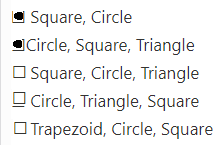
The factors that are more than two are composite numbers.
Here there are only 2 factors so it is called a prime number.
23 is a whole number.

Topic 7 Reteaching

Set A pages 261-264

Draw arrays to find all the factor pairs for 8.
Envision Math Common Core Grade 4 Answer Key Topic 7 Factors and Multiples 36
The factor pairs for 8 are 1 and 8, 2 and 4.

Remember that 1 is a factor of every number.
Use grid paper to find the factor pairs for each number.
Question 1.
26
Answer:

Factor pairs are the set of two factors that, when they are multiplied together to give a particular product is called factor pairs.
Factors pairs of 26 are
1 and 26
2 and 13

Question 2.
9
Answer:

Factor pairs are the set of two factors that, when they are multiplied together to give a particular product is called factor pairs.
Factor pairs of 9 are
1 and 9
3 and 3

Question 3.
37
Answer:

Factor pairs are the set of two factors that, when they are multiplied together to give a particular product is called factor pairs.
Factor pairs of 37 are
37 and 1
1 and 37

Question 5.
19
Answer:
Factor pairs are the set of two factors that, when they are multiplied together to give a particular product is called factor pairs.
Factor pairs of 19 are
1 and 19

Set B pages 265-268

Find the factor pairs for 12.
1 and 12
2 and 6
3 and 4
The factors of 12 are 1, 2, 3, 4, 6, and 12.

Remember you can use counters or grids to make arrays and find the factors of a number.

Find the factors of each number.
Question 1.
45
Answer:
A factor divides exactly into a number leaving no remainder is called the factors.
The factors of  45 are 1, 3, 5, 15 and 45

Question 2.
40
Answer:
A factor divides exactly into a number leaving no remainder is called the factors.
The factors of 40 are 1, 2, 4, 5, 8, 10, 20 and 40

Question 3.
56
Answer:
A factor divides exactly into a number leaving no remainder is called the factors.
The factors of 56 are 1, 2, 4, 7, 8, 14, 28 and 56

Question 4.
63
Answer:
A factor divides exactly into a number leaving no remainder is called the factors.
The factors of 63 are 1, 3, 7, 9, 21 and 63

Set C pages 269-272

Think about these questions to help you use repeated reasoning.
Thinking Habits

  • Are any calculations repeated?
  • Can I generalize from examples?
  • What shortcuts do I notice?
    Envision Math Common Core Grade 4 Answer Key Topic 7 Factors and Multiples 37

Remember to look for repeating factors when dividing to find the factor pairs of a number.

A valet has 34 cars to park in a rectangular array.
Question 1.
What are the different ways the valet could park the cars?
Answer:
Given that,
Total number of cars = 34
Factors of 34 are 1, 2, 17, and 34
The different ways the valet could park the cars are
1 and 34
34 and 1
2 and 17
17 and 2

Question 2.
How do you know when you can stop looking for factors of a number?
Answer:

Set D pages 273-276

Is 49 prime or composite?
To determine if 49 is prime or composite, find whether 49 has factors other than 1 and 49.
49 is composite because it is divisible by 7.
49 = 7 × 7
Envision Math Common Core Grade 4 Answer Key Topic 7 Factors and Multiples 38

Remember you can use an array to determine if a number is prime or composite.

Tell whether each number is prime or composite.
Question 1.
13
Answer:
A factor divides exactly into a number leaving no remainder is called the factors.
The factors of 13 are 1 and 13
The number that has only two factors is called a prime number.
So, The number 12 is a prime number.
So it is not a composite number.

Question 2.
25
Answer:
A factor divides exactly into a number leaving no remainder is called the factors.
The factors of 25 are 1,5 and 25
The number that has more than two factors are called composite numbers.
So, The number 25 is composite number.

Question 3.
55
Answer:
A factor divides exactly into a number leaving no remainder is called the factors.
The factors of 55 are 1,5, 11 and 55
The number that has more than two factors are called composite numbers.
So, The number 55 is a composite number.

Question 4.
2
Answer:
A factor divides exactly into a number leaving no remainder is called the factors.
The factors of 2 are 1 and 2
The number that has only two factors is called a prime number.
So, The number 2 is a prime number.

Question 5.
29
Answer:
A factor divides exactly into a number leaving no remainder is called the factors.
The factors of 25 are 1 and 29
The number that has only two factors is called a prime number.
So, The number 25 is a prime number.

Question 6.
23
Answer:
A factor divides exactly into a number leaving no remainder is called the factors.
The factors of 23 are 1 and 23
The number that has only two factors is called a prime number.
So, The number 23 is a prime number.

Question 7.
64
Answer:
A factor divides exactly into a number leaving no remainder is called the factors.
The factors of 64 are 1, 2, 4, 8, 16 32and 64
The number that has more than two factors are called composite numbers.
So, The number 64 is a composite number.

Question 8.
99
Answer:
A factor divides exactly into a number leaving no remainder is called the factors.
The factors of 99 are 1, 3, 9, 11, 33 and 99
The number that has more than two factors are called composite numbers.
So, The number 99 is a composite number.

Question 9.
5
Answer:
A factor divides exactly into a number leaving no remainder is called the factors.
The factors of 5 are 1 and 5
The number that has only two factors is called a prime number.
So, The number 5 is a prime number.

Question 10.
21
Answer:
A factor divides exactly into a number leaving no remainder is called the factors.
The factors of 21 are 1, 3, 7 and 21
The number that has more than two factors are called composite numbers.
So, The number 21 is a composite number.

Set E pages 277-280

Find five multiples of 7.
Use multiplication.
7 × 1 = 7
7 × 2 = 14
7 × 3 = 21
7 × 4 = 28
7 × 5 = 35
Envision Math Common Core Grade 4 Answer Key Topic 7 Factors and Multiples 39

Remember that to find multiples of a number, multiply the number by any whole number.

Find five multiples of each number.
Question 1.
3
Answer:
Five multiples of 3 are
3 × 1 = 3
3 × 2 = 6
3 × 3 = 9
3 × 4 = 12
3 × 5 = 15

Question 2.
6
Answer:
Five multiples of 6 are
6 × 1 = 6
6 × 2 = 12
6 × 3 = 18
6 × 4 = 24
6 × 5 = 25

Question 3.
4
Answer:
Five multiples of 4
4 × 1 = 4
4 × 2 = 8
4 × 3 = 12
4 × 4 = 16
4 × 5 = 20

Question 4.
9
Answer:
Five multiples of 9 are
9 × 1 = 9
9 × 2 = 18
9 × 3 = 27
9 × 4 = 36
9 × 5 = 45
Five multiples of 9 are  9, 18, 27, 36 and 45
Tell whether the first number is a multiple of the second number.

Question 5.
22, 2
Answer:
Multiple of number is exactly divisible by the number.
Here 22 is exactly divisible by 2
So, 22 is a multiple of 2.

Question 6.
29, 3
Answer:
Multiple of number is exactly divisible by the number.
Here 29 is not exactly divisible by 3.
So, 29 is not a multiple of 3.

Question 7.
25, 5
Answer:
Multiple of number is exactly divisible by the number.
Here 25 is exactly divisible by 5.
So, 25 is a multiple of 5.

Question 8.
40, 8
Answer:
Multiple of number is exactly divisible by the number.
Here 40 is exactly divisible by 8.
So, 40 is a multiple of 8.

Topic 7 Assessment Practice

Question 1.
Courtney has 36 photos to arrange on a gallery wall.
A. How many arrays can Courtney make with the 36 photos? List all the possible arrays.
Answer:
Given that the total number of  photos = 36
Factors of 36 are 1, 2, 3, 4, 9, 12, 18 and 36
The number of possible arrays are
1 and 36, 36 and 1
3 and 12, 12 and 3
2 and 18, 18 and 2
4 and 9, 9 and 4
The number of possible arrays is 8

B. How many factors are there for 36? Write them. What do you notice about the number of factors of 36 and the number of arrays Courtney can make with the photos?
Answer:
Given that the total number of  photos = 36
Factors of 36 are 1, 2, 3, 4, 9, 12, 18 and 36
A number of factors of 36 are 8.
The number of possible arrays are
1 and 36, 36 and 1
3 and 12, 12 and 3
2 and 18, 18 and 2
4 and 9, 9 and 4
The number of possible arrays is 8.

C. Write all the factor pairs for 36. Is 36 prime or composite? Explain.
Answer:
The factor pairs of 36 are
1 and 36
2 and 18
3 and 12
4 and 9
The factors of 36 are 1, 2, 3, 4, 18, 12, 9 and 36
The number 36 is not a prime number it is a composite number because the factors of 36 are more than 2 so it is a composite number.

Question 2.
Determine whether the numbers in each list are factors or multiples of 16.
Envision Math Common Core Grade 4 Answer Key Topic 7 Factors and Multiples 40
Answer:

Question 3.
Which statement is true?
A. The only factors of 3 are 3 and 1; therefore, 3 is prime.
B. The only factors of 4 are 4 and 1; therefore, 4 is prime.
C. The only factors of 5 are 5 and 1; therefore, 5 is composite.
D. The only factors of 8 are 8 and 1; therefore, 8 is composite.
Answer:

Question 4.
Determine if each number is prime or composite. Then write all the factors for each number. 19, 33
Answer:
The factors of 19 are 1 and 19
The number 19 is a prime number because it has only two factors.
The factors of 33 are 1, 11 and 33
The number 33 is a composite number because it has more than two factors .

Question 5.
Select all equations that have a dividend that is a multiple of 4 and a quotient that is a factor of 18.
☐ 8 ÷ 4 = 2
☐ 48 ÷ 8 = 6
☐ 18 ÷ 6 = 3
☐ 16 ÷ 4 = 4
☐ 36 ÷ 3 = 12
Answer:
Question 6.
Write 3 multiples and 3 factors for 24.
Answer:
3 factors of 24 are 1, 2, 3
3 multiple of 24 are
24 × 1 = 24
24 × 2 = 48
24 × 3 = 72
The numbers 24, 48, 72 are the multiples of 24

Question 7.
Write two multiples of 3 that have a factor of 7. Use equations to explain.
Answer:

Question 8.
Select all the true statements.
☐ 33 has more than two factors.
☐ All of the factors of 34 are even numbers.
☐ 35 has exactly two factors.
☐ 3 is a factor of 36.
☐ 37 is a prime number.
☐ 38 is a composite number.
Answer:

Question 9.
Martika says factors and multiples are related. Use the equation 6 × 7 = 42 to describe the relationship between factors and multiples.
Answer:

Question 10.
Which lists all the factors of 25 that are also prime?
A. 1, 25
B. 5
C. 1, 10, 25
D. 5, 25
Answer:

Question 11.
Carter lives on a street where all the house numbers are multiples of 6. Name two possible house numbers between 70 and 80. Explain.
Answer:

Question 12.
Write the factors of 30 that are also prime numbers.
Answer:
A factor divides exactly into a number leaving no remainder is called the factors.
Factors of 30 are 1, 2, 3, 5, 6, 10, 15 and 30
30 is not a prime number it is a composite number.
It has more than two factors .
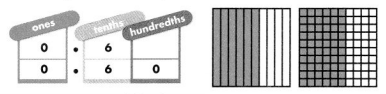
Question 13.
Javier says all odd numbers greater than 2 and less than 20 are prime. Find an odd number greater than 2 and less than 20 that is NOT prime. Explain why the number is not prime.
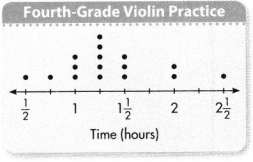
Answer:

Topic 7 Performance Task

Arranging Cars to Sell Ms. Ortiz owns a car dealership. The dealership has the inventory of cars listed in the Ortiz Car Dealership table.
Envision Math Common Core Grade 4 Answer Key Topic 7 Factors and Multiples 41

Question 1.
Ms. Ortiz wants to arrange all of the trucks in the front lot. She would like to have same number of trucks in each row.
Part A
How many different ways can the trucks be arranged in the front lot if the same number of trucks are parked in each row?
Answer:

Part B
What are all the ways the trucks can be arranged? Draw and label the different arrays.
Answer:
The trucks can be arranged in four different ways that are
Total number of trucks = 15
The factors of 15 are 1, 3, 5 and 15
Factor pairs of 15 are 1 and 15, 3 and 5
The trucks can be arranged in
1 row of 15 cars
3 rows of 5 cars
15 cars in 1 row
5 cars in 3 rows
Part C

Ms. Ortiz would like the arrangement to have more than 2 rows of trucks but less than 6 rows. What are the ways the trucks can be arranged? Explain.
Answer:
The trucks can be arranged in four different ways that are
Total number of trucks = 15
The factors of 15 are 1, 3, 5 and 15
Factor pairs of 15 are 1 and 15, 3 and 5
The trucks can be arranged in more than two rows and less than six rows
3 rows of 5 cars
5 cars in 3 rows

Question 2.
As Ms. Ortiz sells sedans, those sedans remaining are parked in different arrangements.

Complete the Arranging Sedans table to find the number of ways Ms. Ortiz can arrange each number of sedans in the front lot so there are at least 2 rows with the same number of sedans in each row and more than one sedan in each row.
Envision Math Common Core Grade 4 Answer Key Topic 7 Factors and Multiples 42
Answer: