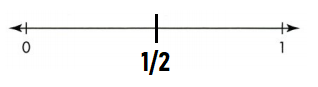
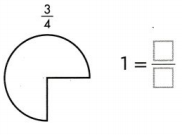
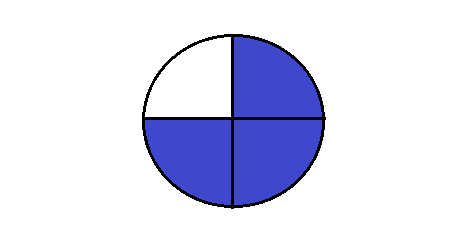
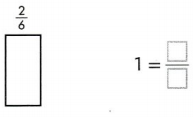
enVision Math Common Core Grade 3 Answer Key Topic 12 Understand Fractions as Numbers

Go through the enVision Math Common Core Grade 3 Answer Key Topic 12 Understand Fractions as Numbers and finish your homework or assignments.

enVision Math Common Core 3rd Grade Answers Key Topic 12 Understand Fractions as Numbers

Essential Question:
What are different interpretations of a fraction?
Answer:
There are five different interpretations of fractions.
Explanation:
 Fractions as parts of wholes or parts of sets.
Fractions as the result of dividing two numbers.
Fractions as the ratio of two quantities.
Fractions as operators.
Fractions as measures. 
Envision Math Common Core 3rd Grade Answer Key Topic 12 Understand Fractions as Numbers 1

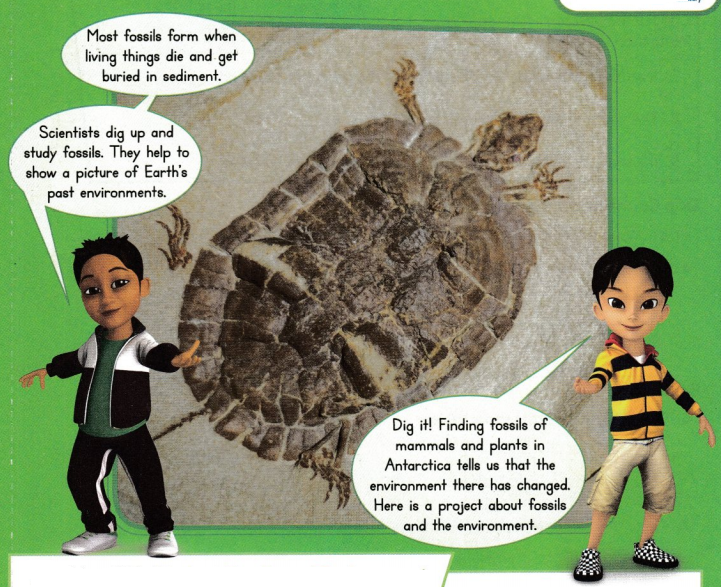
EnVision STEM Project: Fossils and Environment
Do Research Use the Internet or other sources to find out more about what fossils tell us about past environments. Research and make a booklet of fossils found in your state. Find at least 5 fossils and use one page for each fossil. Include where each fossil was found and what type of environment each location is now.

Write a Report: Journal Include what you found. Also in your report:

  • List the types of food each of the 5 creatures ate when they were alive.
  • Explain whether each of the 5 creatures on your list could live in today’s environment.
  • Find the lengths of different fossils to the nearest half inch. Record the lengths in a line plot.

Review What You Know

Vocabulary
Choose the best term from the box. Write it on the blank.

  • halves
  • thirds
  • inch
  • yard

Question 1.
If a shape is divided into 2 equal parts, the parts can be called _________.
Answer:
Halves

Question 2.
The width of an adult’s thumb is about 1 _________.
Answer:
Inch

Question 3.
If a shape is divided into 3 equal parts, the parts can be called _________.
Answer:
Thirds

Skip Counting on the Number Line

Skip count on the number line. Write the missing numbers.
Question 4.

Envision Math Common Core 3rd Grade Answer Key Topic 12 Understand Fractions as Numbers 2
Answer:
125, 130, 135, 140, 145, 150, 155
Explanation:
Add 5 to each number present on number line.
110 + 5 = 115
115 + 5 = 120
120 + 5 = 125
125 + 5 = 130
130 + 5 = 135
135 + 5 = 140
140 + 5 = 145
145 + 5 = 150
150 + 5 = 155

Question 5.

Envision Math Common Core 3rd Grade Answer Key Topic 12 Understand Fractions as Numbers 3
Answer:
240, 260
Explanation:
Add 20 to each number present on number line
180 + 20 = 200
200 + 20 = 220
220 + 20 = 240
240 + 20 = 260

Equal Parts

Question 6.
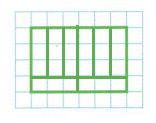
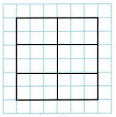
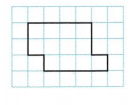
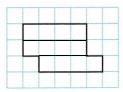
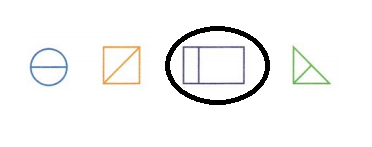
Circle the shapes that show halves.

Envision Math Common Core 3rd Grade Answer Key Topic 12 Understand Fractions as Numbers 4
Answer:

Question 7.
Circle the shapes that show fourths.
Answer:
Measurement

Question 8.
How long is the nail to the nearest inch? Explain how you know.
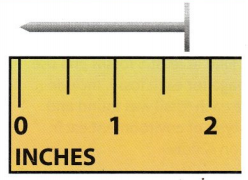
Envision Math Common Core 3rd Grade Answer Key Topic 12 Understand Fractions as Numbers 6
Answer :
2 inches
Explanation :
The nail is in between the 1.5 marks and 2 inch mark
so the nearest inch the nail is 2 inches

Pick a Project

PROJECT 12A
How long would it take to drive across the Florida Keys?
Project: Make a Map

Envision Math Common Core 3rd Grade Answer Key Topic 12 Understand Fractions as Numbers 7

Answer:
Miami to Key West Drive Guide: Places to Stop on a Florida Keys Road Trip! - Quirky Travel Guy

The Florida Keys Overseas Highway is 113 miles in length, joining the mainland of Florida (starting in Florida City, just south of Homestead) to Key West. If you drove directly from Key Largo to Key West, it would take you roughly 2.5 hours, traveling distance of 100 miles.

PROJECT 12B
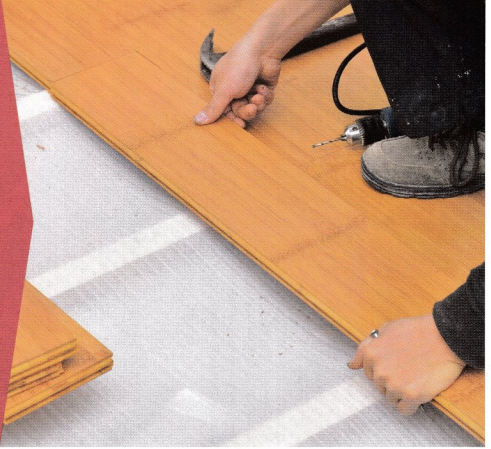
Why are there so many different floors in a building?
Project: Create a flooring design
Envision Math Common Core 3rd Grade Answer Key Topic 12 Understand Fractions as Numbers 8

Answer:
A floor is the bottom surface of a room or vehicle. Floors vary from simple dirt in a cave to many-layered surfaces made with modern technology. Floors may be stone, wood, bamboo, metal or any other material that can support the expected load. The levels of a building are often referred to as floors, although a more proper term is storey.

There are a few basic steps to creating a floor plan:
  1. Choose an area. Determine the area to be drawn.
  2. Take measurements. If the building exists, measure the walls, doors, and pertinent furniture so that the floor plan will be accurate.
  3. Draw walls.
  4. Add architectural features.
  5. Add furniture

PROJECT 12C
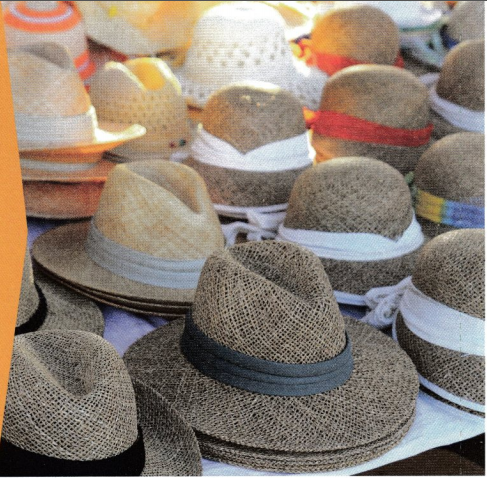
What is the most common hat size?
Project: Collect Hat Size Data and Create a Line Plot
Envision Math Common Core 3rd Grade Answer Key Topic 12 Understand Fractions as Numbers 9
Answer:
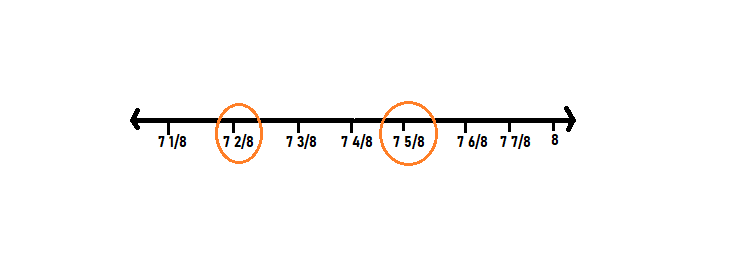
Head sizes and shapes differ from region to region. The most common male size is 7-5/8 and the average hat size for females 7-2/8
PROJECT 12D
What are the most popular fruits and vegetables?
Project: Draw a Garden Plot
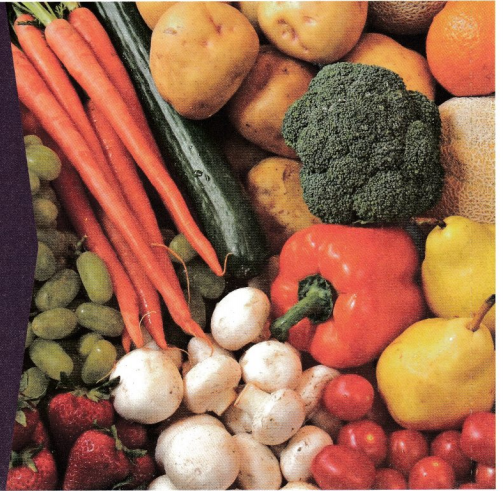
Envision Math Common Core 3rd Grade Answer Key Topic 12 Understand Fractions as Numbers 10

Answer:
The most popular fruits and vegetables are,
Fruits like Mango ,Banana ,Apple, Grapes, Water melon.. so on
Vegetables like Carrot, Potato, Tomato, Brinjal … So on

Pin on Gardening Tips and Ideas
Lesson 12.1 Partition Regions into Equal Parts

Solve & Share
Show two different ways to divide a 2 x 6 region into 6 equal parts. How do you know the parts are equal?
I can … read and write a unit fraction.
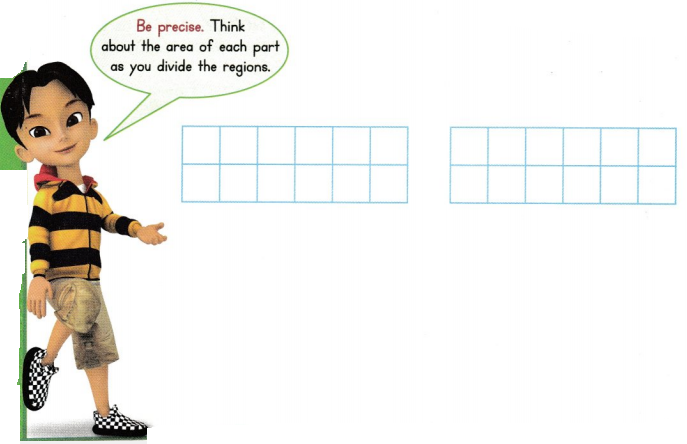
Envision Math Common Core 3rd Grade Answer Key Topic 12 Understand Fractions as Numbers 11

Look Back! How are the parts of the regions alike? How are they different?

Essential Question
How Can You Name the Equal Parts of a Whole?
Answer:
Each equal part of a whole is called one-half.
Explanation:
One half is expressed as 1/2 and read as one over two or one upon two.

Visual Learning Bridge
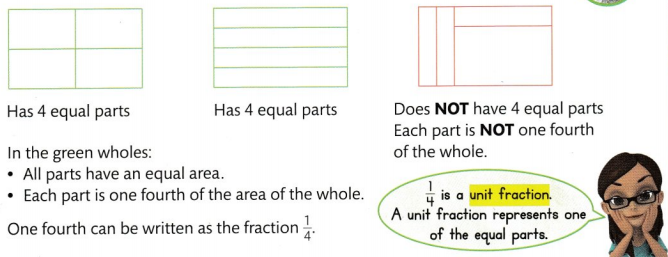
You can divide a whole into equal parts. What fraction can you write to represent one of these equal parts?
A fraction is a part of a whole.
Divide each green whole into four equal parts.
Envision Math Common Core 3rd Grade Answer Key Topic 12 Understand Fractions as Numbers 12

Divide each green whole into six equal parts.
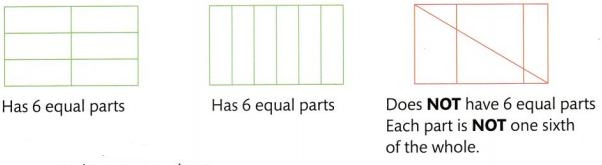
Envision Math Common Core 3rd Grade Answer Key Topic 12 Understand Fractions as Numbers 13
In the green wholes:

  • All parts have an equal area.
  • Each part is one sixth of the area of the whole.
  • One sixth can be written as the fraction \(\frac{1}{6}\).

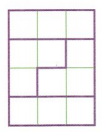
Convince Me! Critique Reasoning Kim says that the figure at the right is divided into fourths because there are 4 equal parts. Carrie says it is not divided into fourths because the parts are not the same shape. Who is correct? Explain.
Envision Math Common Core 3rd Grade Answer Key Topic 12 Understand Fractions as Numbers 14

Answer:
Carrie is correct.
Explanation:
In the given figure it is not divided into fourths because the parts are not of the same shape.

Guided Practice

Do You Understand?
Question 1.
In the examples in Box A on the previous page, explain how you know the 4 parts are equal.
Answer:
All parts are equal.
Explanation:
All parts have an equal area.
Each part is one-fourth or a quarter of the whole sheet.

In 2 and 3, tell if each shape shows equal or unequal parts. If the parts are equal, label 1 of the parts using a unit fraction.
Question 2.
Envision Math Common Core 3rd Grade Answer Key Topic 12 Understand Fractions as Numbers 15
Answer:
Equal parts
Explanation:
The area and size of each part of the figure are equal so the figure is divided into equal parts.

Question 3.
Envision Math Common Core 3rd Grade Answer Key Topic 12 Understand Fractions as Numbers 16
Answer:
Unequal parts
Explanation:
The area and size of each part of the figure are not equal so the figure is divided into unequal parts.

Do You Know How?
Question 4.
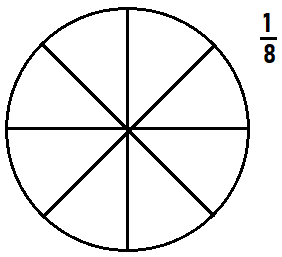
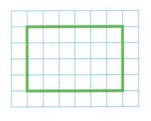
Draw lines to divide the shape into 8 equal parts. Then write the fraction that represents 1 part.
Envision Math Common Core 3rd Grade Answer Key Topic 12 Understand Fractions as Numbers 17
Answer:

1/8 unit fraction
Explanation:
The area and size of each part of the figure must be equal .
Then the figure is divided into equal parts
The total area of the figure is 24
So we need 8 parts
24 ÷ 8 = 3

Independent Practice

In 5-7, tell if each shape shows equal or unequal parts. If the parts are equal, label 1 of the parts using a unit fraction.
Question 5.
Envision Math Common Core 3rd Grade Answer Key Topic 12 Understand Fractions as Numbers 18
Answer:
Unequal parts
Explanation:
The given square has unequal parts, so it is difficult to denote in fraction

Question 6.

Envision Math Common Core 3rd Grade Answer Key Topic 12 Understand Fractions as Numbers 19
Answer:
Equal parts
Explanation:
The area and size of each part of the figure must be equal.
Then the figure is divided into equal parts.

Question 7.
Envision Math Common Core 3rd Grade Answer Key Topic 12 Understand Fractions as Numbers 20
Answer:
Equal parts
Explanation:
The area and size of each part of the figure must be equal.
Then the figure is divided into equal parts.

In 8-10, draw lines to divide the shape into the given number of equal parts. Then write the fraction that represents one part.
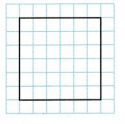
Question 8.
6 equal parts
Envision Math Common Core 3rd Grade Answer Key Topic 12 Understand Fractions as Numbers 21
Answer:

Question 9.
3 equal parts
Envision Math Common Core 3rd Grade Answer Key Topic 12 Understand Fractions as Numbers 22
Answer:

Question 10.
4 equal parts
Envision Math Common Core 3rd Grade Answer Key Topic 12 Understand Fractions as Numbers 23
Answer:

Problem Solving

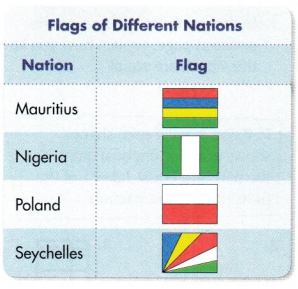
In 11-14, use the table of flags to answer the questions.
Envision Math Common Core 3rd Grade Answer Key Topic 12 Understand Fractions as Numbers 24
Question 11.
What fraction represents the white part of Nigeria’s flag?
Answer:
one third[1/3]

Question 12.
Which nation’s flag is \(\frac{1}{2}\) red?
Answer:
Poland

Question 13.
Higher Order Thinking The flag of this nation has more than 3 equal parts. Which nation is it, and what fraction represents 1 part of its flag?
Answer:
Mauritius has more than 3 equal parts.
One fourth fraction represents 1 part of its flag.

Question 14.
Which nation’s flag is NOT divided into equal parts?
Answer:
Seychelles

Question 15.
Maryann buys 24 cans of soda. The soda comes in packs of 6 cans. How many packs does she purchase? Write a multiplication equation and a division equation to show your answer.
Answer:
4 packs of can soda
Explanation:
Maryann buys 24 cans of soda
1 pack of soda cans consist of 6 cans
so :
24 ÷ 6 = 4
Maryann buys 4 packs of soda cans
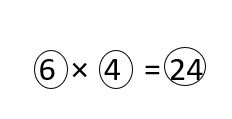
6 x 4 = 24

Question 16.
Make Sense and Persevere Jim has stickers in an array of 8 rows and 4 columns. He also has a packet of 14 stickers. How many stickers does Jim have in all?
Answer:
46 stickers
Explanation:
Jim has stickers in an array of 8 rows and 4 columns.
No of stickers in array are:
8 x 4 = 32 stickers
He also has a packet of 14 stickers.
total no of stickers Jim has are:
32 + 14 = 46 stickers

Assessment Practice

Question 17.
Draw lines to show how to divide this square into 8 equal pieces. Then select the fraction that represents 1 of the pieces.
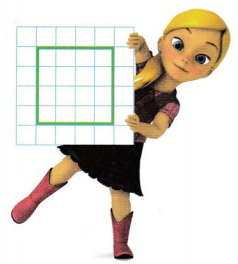
Envision Math Common Core 3rd Grade Answer Key Topic 12 Understand Fractions as Numbers 25
A. \(\frac{1}{2}\)
B. \(\frac{1}{3}\)
C. \(\frac{1}{4}\)
D. \(\frac{1}{8}\)
Answer:
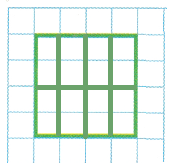
option D
1/8 unit fracttion

Lesson 12.2 Fractions and Regions

Solve & Share
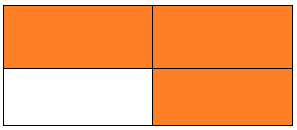
Pat made a garden in the shape of a rectangle and divided it into 4 equal parts. She planted flowers in 3 of the parts. Draw a picture of what Pat’s garden might look like.
Answer:
Pat’s garden might look like this.
I can… use a fraction to represent multiple copies of a unit fraction.
Envision Math Common Core 3rd Grade Answer Key Topic 12 Understand Fractions as Numbers 26

Look Back! How many parts of Pat’s garden do NOT have flowers? Explain.
Answer:
1/4 part of Pat’s garden do NOT have flowers.
Explanation:
As  she planted only 3/4 of his garden with flowers.

Essential Question
How Can You Show and Name Parts of a Region?
Answer:
Fractions name parts of a whole region.
Explanation:
When an object is divided into a number of equal parts then each part is called a faction.
There are 2 parts that make up a faction:
Numerator: Which is the number that goes on top of the fraction, tells how many parts of the whole.
Denominator: Which is the number that goes on the bottom of the fraction, tells how many equal parts in all.

Visual Learning Bridge
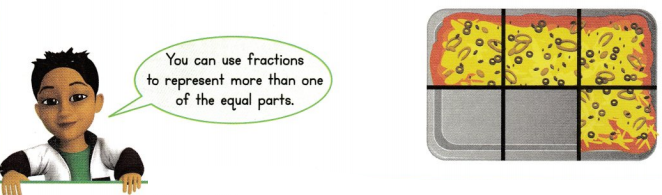
Mr. Peters served part of a pan of enchiladas to a friend. What does each part of the whole pan represent? What part was served? What part is left?
Envision Math Common Core 3rd Grade Answer Key Topic 12 Understand Fractions as Numbers 27

Answer:
Each part of the whole represent fraction.
2/6 part is served.
4/6 part is left.

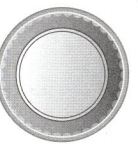
Convince Me! Be Precise Below is a picture of a pie pan. Draw lines and use shading to show that five \(\frac{1}{8}\)-pieces are still in the pan, and that three \(\frac{1}{8}\)-pieces were eaten. Use a fraction to label the part of the pie that is in the pan.
Envision Math Common Core 3rd Grade Answer Key Topic 12 Understand Fractions as Numbers 28

Answer:
3/8 pie in the pan is eaten.
5/8 pie in the pan is left over.

Guided Practice

Do You Understand?
Question 1.
In the problem in Box A on the previous page, what fraction names all of the pieces in the pan?
Answer:
The whole pan is divided into 6 equal parts. Each part is 1/6 of the whole
Explanation:
6 copies of 1/6 is 6/6.
So the whole is 6/6.
The unit fraction is 1/6.

Question 2.
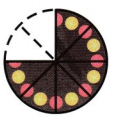
Mrs. Patel made a cake. What fraction of the whole cake does each piece represent?
Envision Math Common Core 3rd Grade Answer Key Topic 12 Understand Fractions as Numbers 29
Answer:
1/8 fraction of the whole cake represents each piece

Question 3.
In the picture in Exercise 2, how many \(\frac{1}{8}\)-pieces were eaten? What fraction of the whole cake was eaten?
Answer:
2 pieces were eaten.
2/8 pieces were eaten.
Explanation:
In the given picture cake is divided into 8 equal parts.
Out of which 2 pieces were eaten.

Do You Know How?
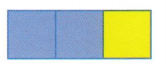
In 4-6, use the figure below.
Envision Math Common Core 3rd Grade Answer Key Topic 12 Understand Fractions as Numbers 30
Question 4.
How many \(\frac{1}{3}\)-parts are blue?
Answer:
Two
Explanation:
Out of 3 parts in a given picture 2 parts are blue and 1 part is yellow.

Question 5.
What fraction of the whole is blue?
Answer:
Two third
Explanation:
In the given picture 2/3 of the whole is colored with blue

Question 6.
What fraction names all of the parts in the whole?
Answer:
1/3 one thirds

Independent Practice

In 7-10, write the unit fraction that represents each part of the whole. Then write the number of blue parts and the fraction of the whole that is blue.
Question 7.
Envision Math Common Core 3rd Grade Answer Key Topic 12 Understand Fractions as Numbers 31
Answer:
One part is blue
The fraction of whole is 1/2
Explanation:
The given triangle is equally divided into two,
one half colored with blue and the the other with yellow.
So the fraction of whole is 1/2.

Question 8.
Envision Math Common Core 3rd Grade Answer Key Topic 12 Understand Fractions as Numbers 32
Answer:
3 parts are blue
The fraction of whole is 3/6
Explanation:
Given hexagon is equally divided into six equal parts,
out of six, three are colored with blue and three with yellow
So the fraction of hexagon is written as 3/6.

Question 9.
Envision Math Common Core 3rd Grade Answer Key Topic 12 Understand Fractions as Numbers 33
Answer:
2 parts are blue
The fraction of whole is 2/4
Explanation:
Given circle is equally divided into 4 parts,
out of which 2 are colored with blue and 2 with yellow.
So the fraction of circle is written as 2/4.

Question 10.
Envision Math Common Core 3rd Grade Answer Key Topic 12 Understand Fractions as Numbers 34
Answer:
6 parts are blue
The fraction of whole is 6/8
Explanation:
Given picture is equally divided into 8 parts,
Out of which 6 are colored with blue and 2 with yellow.
So the fraction of given picture is written as 6/8.

Question 11.
Draw a rectangle that shows 6 equal parts. Write the unit fraction that represents each part. Then shade \(\frac{2}{6}\) of the rectangle. Explain how you know you shaded \(\frac{2}{6}\) of the rectangle.
Answer:
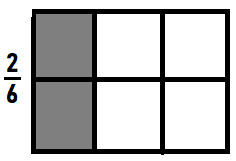
The unit fraction that represents the part of the rectangle is 116

Problem Solving

Question 12.
Vocabulary Fill in the blanks.
In the fraction \(\frac{4}{7}\), 4 is the ______ and 7 is the ________.
Answer:
4 is the numerator and 7 is denominator

Question 13.
Generalize Divide the grid below into fourths. Shade 3 of the parts. Write a fraction that represents the shaded area. Write a fraction that represents the unshaded area. What can you generalize about your fractions?
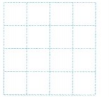
Envision Math Common Core 3rd Grade Answer Key Topic 12 Understand Fractions as Numbers 35
Answer:

Question 14.
Christine has 6 red scarves and 3 blue scarves. Each scarf has 2 stripes. How many stripes does Christine have on her scarves? Write equations to represent and solve the problem.
Answer:
Christine has 18 stripes in total on her scarves.
Explanation:
No of red scarves = 6
No of stripes on red scarves = 6 x 2 = 12
No of blue scarves + 3
No of stripes on blue scarves = 3 x 2 = 6
Total no of stripes = 12 + 6 = 18

Question 15.
Higher Order Thinking Draw a circle that shows 6 equal parts. Shade more than \(\frac{3}{6}\) of the circle, but less than \(\frac{5}{6}\) of the circle. What fraction have you shaded?
Answer:
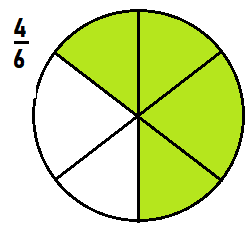
Explanation:
A fraction more than 3/6 is 4/6 and a fraction less than 5/6 is 4/6
so we have to shade 4/6 of the circle

Question 16.
Number Sense What is the area of the baseball card? Show your work.
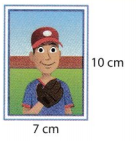
Envision Math Common Core 3rd Grade Answer Key Topic 12 Understand Fractions as Numbers 36
Answer:
The area of baseball card is 70 cm.
Explanation:
Baseball card is in the shape of rectangle.
So the area of rectangle is length X breadth  ( l x b )
Length = 10 cm
Breadth = 7 cm
Area = length x breadth
= 10 x 7
= 70 cm.

Assessment Practice

Question 17.
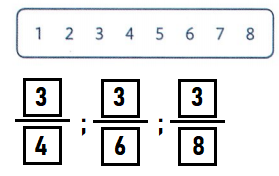
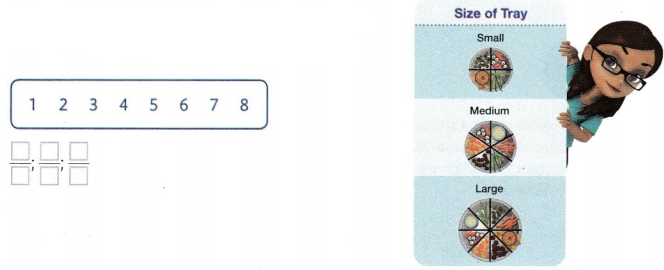
Select numbers from the box to write fractions to show 3 parts of each of these vegetable trays.
Envision Math Common Core 3rd Grade Answer Key Topic 12 Understand Fractions as Numbers 37
Answer:

Explanation:
The first plate is divided into 4 parts out of which three parts are removed
The second plate is divided into 6 parts out of which three parts are removed
The third plate is divided into 8 parts out of which three parts are removed

Lesson 12.3 Understand the Whole

Solve & Shar
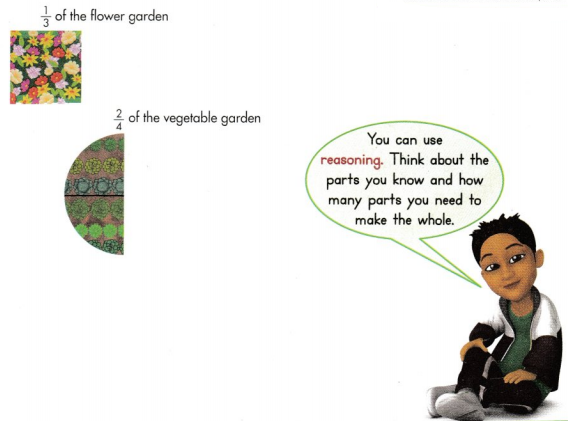
Mrs. Garcia’s third-grade class is planting a flower garden and a vegetable garden.
Draw a picture of the whole flower garden and the whole vegetable garden based on the parts shown. How did you decide what the whole of each garden looked like?
I can … identify the whole by seeing a part.
Envision Math Common Core 3rd Grade Answers Topic 12 Understand Fractions as Numbers 38

Look Back! What do the fractions and tell you about the number of equal parts in the whole?
Answer:
A basic way to interpret a fraction is by dividing a whole object into several equal parts.
The denominator 
tells how many equal parts the whole is subdivided into.
The numerator 
tells the number of those parts that are under consideration.

Essential Question
How Can You Use a Fractional Part to Find the Whole?
Answer:
For finding a fraction of a whole number, we multiply the numerator of the fraction by the given number and then divide the product by the denominator of the fraction.

Visual Learning Bridge
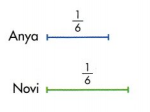
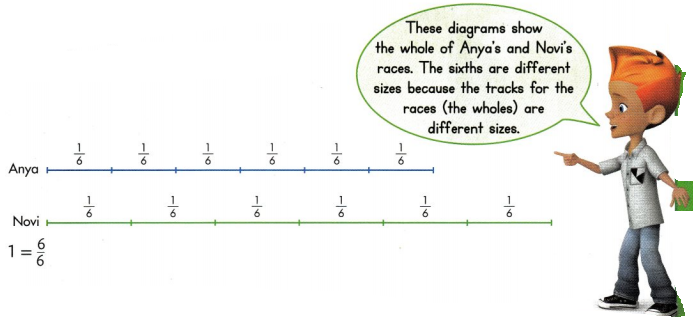
Anya and Novi are running in different races. The diagrams below show how much of their races each runner has completed.
Draw a picture of the whole of each track. Write a fraction to represent the whole.

You can look at the fraction to find how many parts will make up the whole.
Envision Math Common Core 3rd Grade Answers Topic 12 Understand Fractions as Numbers 39

You know Anya and Novi have each completed \(\frac{1}{6}\) of their races.
Six lengths of \(\frac{1}{6}\) make \(\frac{6}{6}\), or 1 whole.
Envision Math Common Core 3rd Grade Answers Topic 12 Understand Fractions as Numbers 40

Convince Me! Reasoning Why is Novi’s track longer than Anya’s track?
Answer:
Novi’s track is longer than Anya’s track because 1/6th of the track were of different size.

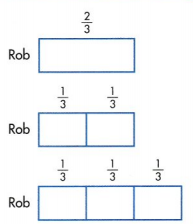
Another Example! The part of a race Rob completed is shown at the right. You can use fractional parts like this to identify the whole.
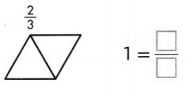
\(\frac{2}{3}\) is 2 copies of \(\frac{1}{3}\). Divide Rob’s track into 2 equal parts.

Three copies of \(\frac{1}{3}\) make \(\frac{3}{3}\), or 1 whole. Draw one more third.
1 = \(\frac{3}{3}\).
Envision Math Common Core 3rd Grade Answers Topic 12 Understand Fractions as Numbers 41

Guided Practice

Do You Understand?
Question 1.
If the distance Anya ran was of the length of the track, what fraction would you use to represent the whole track?
Answer:
The fraction of whole track = 6/6
Explanation:
Six lengths of 1/6 make 6/6 or whole.

Question 2.
What is true about the numerator and denominator of each fraction that represents one whole?
Answer:
A fraction represents a part of a whole.
Explanation:
The
numerator represents how many parts of that whole are being considered,
while the 
denominator represents the total number of parts created from the whole.

Do You Know How?
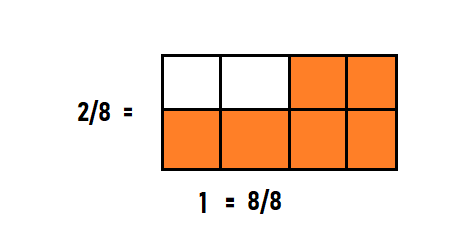
3. Draw a picture of the whole and write a fraction to represent the whole.
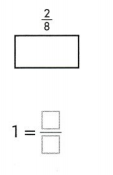
Envision Math Common Core 3rd Grade Answers Topic 12 Understand Fractions as Numbers 42
Answer:

Independent Practice

In 4-7, draw a picture of the whole and write a fraction to represent the whole.
Question 4.
Envision Math Common Core 3rd Grade Answers Topic 12 Understand Fractions as Numbers 43
Answer:

1 = 3/3

Question 5.
Envision Math Common Core 3rd Grade Answers Topic 12 Understand Fractions as Numbers 44
Answer:

1 = 2/2

Question 6.
Envision Math Common Core 3rd Grade Answers Topic 12 Understand Fractions as Numbers 45
Answer:
1 = 4/4

Question 7.
Envision Math Common Core 3rd Grade Answers Topic 12 Understand Fractions as Numbers 46
Answer:

1 = 6/6

Problem Solving

Question 8.
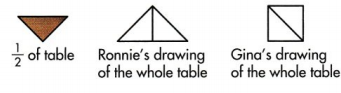
Ronnie and Gina were shown \(\frac{1}{2}\) of a table. They each drew a picture of the whole table. Whose drawing could be correct? Explain.
Envision Math Common Core 3rd Grade Answers Topic 12 Understand Fractions as Numbers 47
Answer:
Gina’s drawing of the whole table is correct
Explanation:
Both Ronnie and Gina were correct.
but tables are generally square , rectangle or circle in shape so Gina’s table is correct

Question 9.
Higher Order Thinking If the part shown in Exercise 8 is \(\frac{1}{4}\) of a table, what could the whole table look like? Draw a picture and write a fraction to represent the whole.
Answer:
One whole

Question 10.
The Florida panther is endangered. In 1970, the population was estimated at 20 panthers. In 2017, the population was estimated at 230 panthers. About how many more panthers were there in 2017 than in 1970?
Envision Math Common Core 3rd Grade Answers Topic 12 Understand Fractions as Numbers 48
Answer:
About 210 more panthers were there in 2017 than in 1970.
Explanation:
In 1970, the population was 20 panthers.
In 2017, the population was estimated at 230 panthers.
So 230 – 20 = 210.
Question 11.
Construct Arguments Jenna and Jamal are making rugs. They have finished the parts shown. Draw pictures to show each whole rug. Whose rug will be longer when it is finished? Explain.
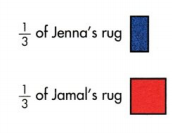
Envision Math Common Core 3rd Grade Answers Topic 12 Understand Fractions as Numbers 49
Answer:
Jenna: I have finished 1/3 of my rug.
Jamal: I have finished 1/3 of my rug.
Jamal: My rug is bigger than you.
Jenna: How is your rug bigger than mine. Explain?
Jamal: My 1/3 of the rug is bigger than your 1/3 of the rug
Explanation:
Jamal’s 1/3 rd of the rug is bigger than Jenna’s 1/3 of the rug
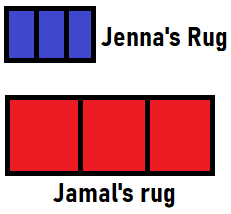
So Jamal’s rug is longer than Jenna.
Assessment Practice

Question 12.
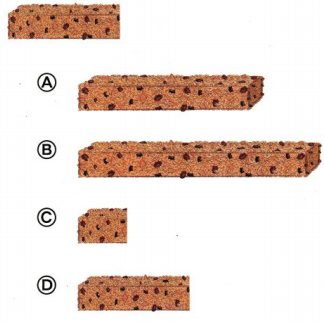
The picture shows \(\frac{2}{3}\) of a granola bar. Which shows the whole granola bar?
Envision Math Common Core 3rd Grade Answers Topic 12 Understand Fractions as Numbers 50
Answer:
Option B

Question 13.
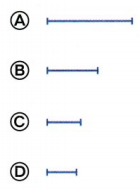
Each part below is \(\frac{1}{2}\) of a different whole. Which is part of the largest whole?
Envision Math Common Core 3rd Grade Answers Topic 12 Understand Fractions as Numbers 51
Answer:
Option A

Lesson 12.4 Number Line: Fractions Less Than 1

Solve & Share
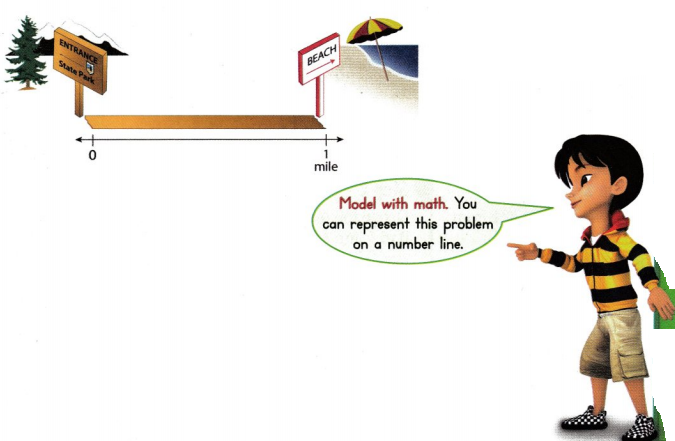
At a state park, there is a 1-mile hiking path between the park entrance and the beach. Scenic lookouts are located at points and of the distance from the park entrance to the beach. Show about where the lookout points are located on the line below.
I can… represent fractions on a number line.
Envision Math Common Core 3rd Grade Answers Topic 12 Understand Fractions as Numbers 52

Look Back! If you know about where the point for \(\frac{1}{3}\) is located, how can you find about where the point for \(\frac{2}{3}\) is located?
Answer:
The line is divided into 3 parts,
We know 1/3 location on number line.
The point next to 1/3is 2/3, so we know where 2/3 point is located.

Essential Question
How Can You Record Fractions on a Number Line?
Answer:
Fractions expand our number system beyond whole numbers and integers.
Explanation:
Fractions help us to denote any decimal number with higher precision.
Representation of Fractions on the number line is important to understand how fractions represent part of a whole.

Visual Learning Bridge
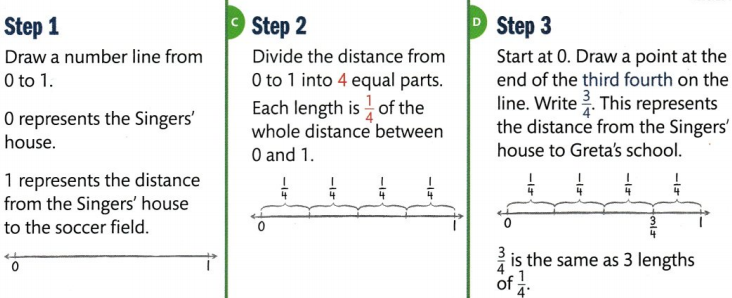
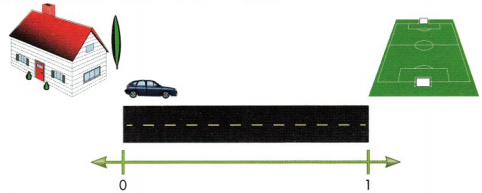
Mr. Singer is picking up his daughter, Greta, from school to go to soccer practice. Greta’s school is located at \(\frac{3}{4}\) of the distance from the Singers’ house to the soccer field. How can you represent \(\frac{3}{4}\) on a number line?
Every number on a number line represents a distance from 0.
Envision Math Common Core 3rd Grade Answers Topic 12 Understand Fractions as Numbers 53

Envision Math Common Core 3rd Grade Answers Topic 12 Understand Fractions as Numbers 54

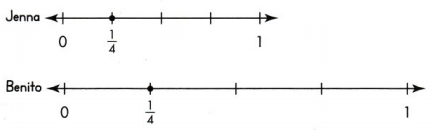
Convince Me! Critique Reasoning Jenna and Benito each marked \(\frac{1}{4}\) on a number line. The length of the part from 0 to \(\frac{1}{4}\) on Jenna’s number line is shorter than on Benito at Benito’s. Did someone make a mistake? Explain your thinking.
Envision Math Common Core 3rd Grade Answers Topic 12 Understand Fractions as Numbers 55

Jenna did a mistake by marking unit fraction on a small number line, compared with Benito number line. 
Guided Practice

Do You Understand?
Question 1.
Maliya divides a number line from 0 to 1 into 6 equal lengths. What unit fraction represents each equal length? What should Maliya label the tick mark just to the left of 1? Explain.
Answer:
5/6 unit fraction
Explanation:
0 to 1 is divided in to 6 fractions
Each 1/6 unit fraction

Question 2.
Josh divides a number line from 0 to 1 into 8 equal lengths. What should he label the first tick mark just to the right of 0? Explain.
Answer:
1/8 unit fraction.
Explanation:

 

Do You Know How?
In 3 and 4, divide the number line into the given number of equal lengths. Then mark and label the given fraction on the number line.
Question 3.
2 equal lengths; \(\frac{1}{2}\)

Envision Math Common Core 3rd Grade Answers Topic 12 Understand Fractions as Numbers 56
Answer:

Question 4.
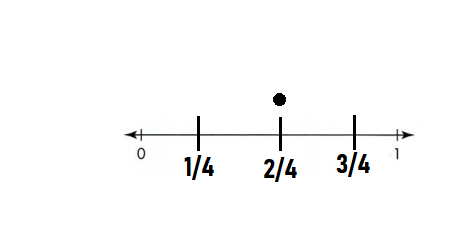
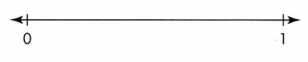
4 equal lengths; \(\frac{2}{4}\)
Envision Math Common Core 3rd Grade Answers Topic 12 Understand Fractions as Numbers 57
Answer:


Explanation :
Draw a line and make 3 equal parts on number line and then mark 1/4, 2/4 and 3/4unit fraction.

Leveled Practice In 5 and 6, divide the number line into the given number of equal lengths. Then mark and label the given fraction on the number line.
Question 5.
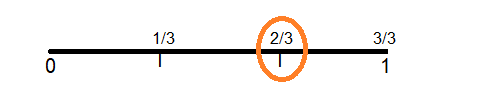
3 equal lengths; \(\frac{2}{3}\)

Envision Math Common Core 3rd Grade Answers Topic 12 Understand Fractions as Numbers 58
Answer:
2/3 unit fraction.

Explanation : Draw a line and make 3 equal parts on number line and then mark 1/3, 2/3 and 3/3 units

Question 6.
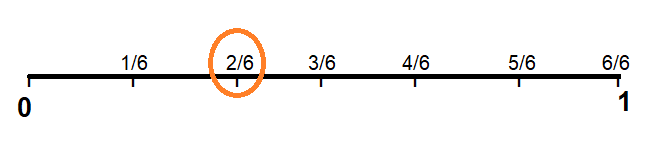
6 equal lengths; \(\frac{2}{6}\)

Envision Math Common Core 3rd Grade Answers Topic 12 Understand Fractions as Numbers 59
Answer: 2/6

Explanation :
Draw a line and make 6 equal parts on number line and then mark 1/6, 2/6,3/6,4/6,5/6 and 6/6units

In 7 and 8, draw a number line from 0 to 1. Divide the number line into equal lengths for the given fraction. Then mark and label the given fraction on the number line.
Question 7.
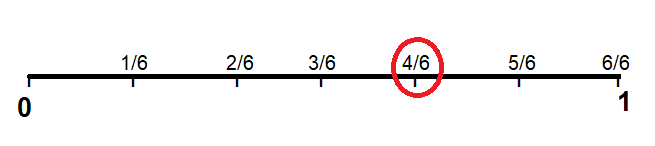
\(\frac{4}{6}\)
Answer: 4/6
Explanation :
Draw a line and make 6 equal parts on number line and then mark 1/6, 2/6,3/6,4/6,5/6 and 6/6units

Question 8.
\(\frac{5}{8}\)
Answer: 5/8

Explanation :
Draw a line and make 8 equal parts on number line and then mark 1/8 , 2/8 , 3/8 , 4/8 , 5/8 , 6/8 , 7/8 and 8/8units

Problem Solving

Question 9.
Construct Arguments Terrance and Dana each drew a number line and marked \(\frac{3}{4}\). Did each person represent \(\frac{3}{4}\) in the correct place on his or her line? Explain.
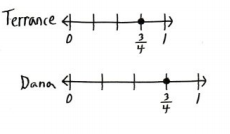
Envision Math Common Core 3rd Grade Answers Topic 12 Understand Fractions as Numbers 60
Answer:
yes
Explanation:
Terrance number line is a bit smaller that Dana’s but both the number lines are divided into equal parts.

Question 10.
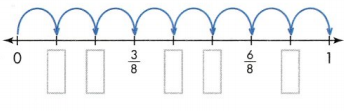
A gymnast starts at the left end of the balance beam and does some handsprings. When she is finished, she is at the point shown on the diagram. What fraction represents how far she went on the balance beam?
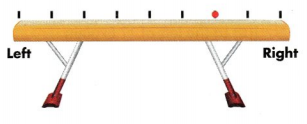
Envision Math Common Core 3rd Grade Answers Topic 12 Understand Fractions as Numbers 61
Answer:
6/8 unit fraction.
Explanation :
The balance beam is divided in to 8 equal parts of same unit lengths
the point is market at 6/8 on the balance beam.

Question 11.
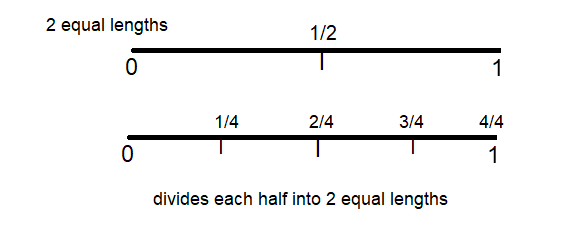
Mark draws a number line and labels the points for 0 and 1. He divides the distance from 0 to 1 into 2 equal lengths and labels the fraction \(\frac{1}{2}\). If Mark divides each half into 2 equal lengths, what fractions can Mark label on his number line?
Answer:
Explanation:
Mark draws a number line and labels the points for 0 and 1 of two equal lengths and labels the fraction and label 0 , 1/2 and 1.
Mark divides each half into 2 equal lengths, each fractions is marked labels on his number line as 1/4, 2/4, 3/4 and 4/4
as shown in the above figure.

Question 12.
Higher Order Thinking Show 3 ways you can represent three eighths.
Answer:
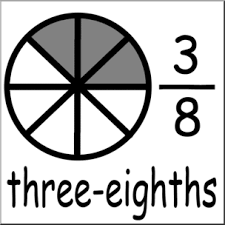
The number ABOVE the line tells HOW MANY PARTS
we have (the colored parts).The number BELOW the line tells how many EQUAL parts
the whole is divided into. To find 3/8 of a number, we multiply the numerator 3 by the given whole number and then divide the product by the denominator 8.

Assessment Practice

Question 13.
What fraction does the red point on this number line represent?
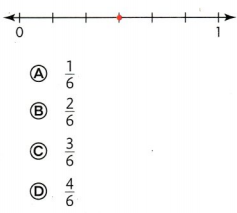
Envision Math Common Core 3rd Grade Answers Topic 12 Understand Fractions as Numbers 62
Answer:
Option  C
Explanation:
The above line is of 6 equal parts of each label 1/6, 2/6, 3/6, 4/6, 5/6 and 6/6

Question 14.
Which number line has a red point at \(\frac{1}{3}\)?
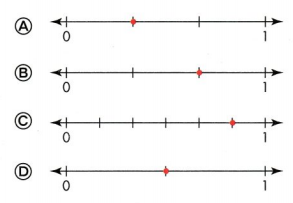
Envision Math Common Core 3rd Grade Answers Topic 12 Understand Fractions as Numbers 63
Answer:
Option A
Explanation :
In the number line has a red point at \(\frac{1}{3}\)

Lesson 12.5 Number Line: Fractions Greater Than 1

Solve & Share
The length of one strip of paper is 1 whole unit. Fold two strips of paper in half. Open the two strips and place them end to end.
How many halves do you have? Use fractions to name each fold line. Tell how you decided. Draw a picture to show your work.
Answer:
2 halves
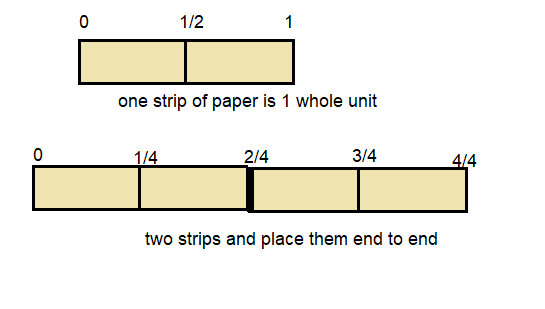
strip of paper is 1 whole unit. Fold two strips of paper in half,
two halves for two strips of papers , if it unfolded and kept end to end open

I can … represent fractions equal to or greater than 1 on a number line

Envision Math Common Core 3rd Grade Answers Topic 12 Understand Fractions as Numbers 64

Look Back! If you added a third strip of paper folded in half, how could you use halves to name the fold lines? Explain.
Answer:
If you add a third strip of paper folded in half, as 5/4 and 6/4.
Explanation:
One can represent fractions equal to or greater than 1 on a number line.

Essential Question
How Can You Use a Number Line to Represent Fractions Greater Than 1?
Answer:
Fractions greater than 1 have numerators larger than their denominators, those that are less than 1 have numerators smaller than their denominators; the rest are equal to 1.

Visual Learning Bridge
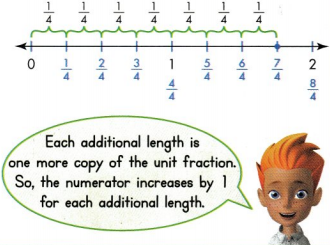
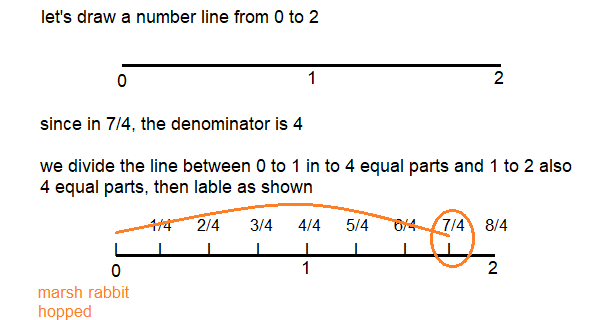
A marsh rabbit hopped \(\frac{7}{4}\) the length of a rabbit trail. How can you show this on a number line?
Number lines can represent fractions that are greater than 1 whole \(\frac{7}{4}\). 5 is greater than 1 whole, but less than 2 wholes. The whole is the distance between 0 and 1.
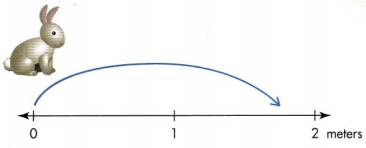
Envision Math Common Core 3rd Grade Answers Topic 12 Understand Fractions as Numbers 65

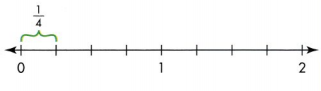
Divide each whole into 4 equal lengths.
Each length is \(\frac{1}{4}\) of the whole.
\(\frac{4}{4}\) is the same as 1 whole.
Envision Math Common Core 3rd Grade Answers Topic 12 Understand Fractions as Numbers 66

The marsh rabbit hopped 7 lengths of the unit fraction \(\frac{1}{4}\).
The point showing 7 lengths of \(\frac{1}{4}\) can be labeled as \(\frac{7}{4}\)
Envision Math Common Core 3rd Grade Answers Topic 12 Understand Fractions as Numbers 67

Answer: 7/4
Explanation:
Marsh rabbit hopped shown in the number line.
Convince Me! Be Precise One tick mark on the number line below has been named with the fraction \(\frac{2}{3}\). On the number line the lengths marked are equal. Write fractions for the other tick marks shown.
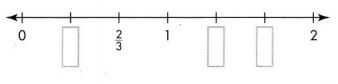
Envision Math Common Core 3rd Grade Answers Topic 12 Understand Fractions as Numbers 68

Answer:


Explanation:
Divided a number line from 0 to 1 into 3 equal lengths. Each unit fraction represents 1/3 of equal length.

Guided Practice

Do You Understand?
Question 1.
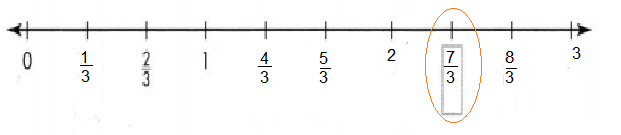
Name a fraction that is to the right of the tick mark for 2 on a number line.
Answer: 7/3
Explanation :
Question 2.
Quinn says that \(\frac{10}{8}\) comes to the right of \(\frac{9}{8}\) on a number line. Do you agree? Why or why not?
Answer: YES
Explanation:

Do You Know How?
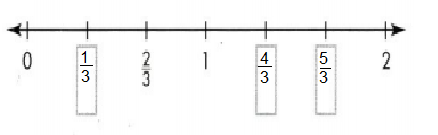
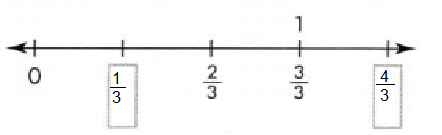
In 3 and 4, each number line has equal lengths marked. Write the missing fractions.
Question 3.
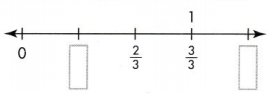
Envision Math Common Core 3rd Grade Answers Topic 12 Understand Fractions as Numbers 69
Answer:
1/3 and 4/3 of unit fraction.
Explanation:
Marked on number line.
Question 4.
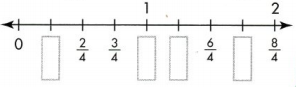
Envision Math Common Core 3rd Grade Answers Topic 12 Understand Fractions as Numbers 70

Answer:
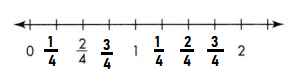
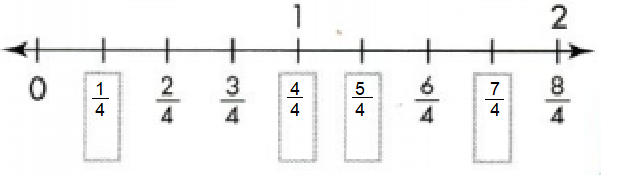
1/4,  4/4,  5/4 and 7/4 are marked on number line.
Explanation:
Independent Practice

Leveled Practice In 5-7, each number line has equal lengths marked. Write the missing fractions.
Question 5.
Envision Math Common Core 3rd Grade Answers Topic 12 Understand Fractions as Numbers 71
Answer:
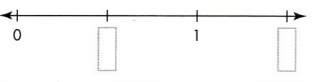
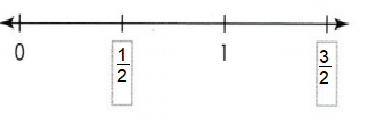
1/2 and 3/2 are missing marked on number line.
Explanation:
Question 6.
Envision Math Common Core 3rd Grade Answers Topic 12 Understand Fractions as Numbers 72
Answer:
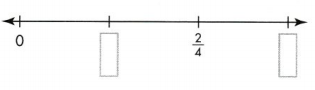
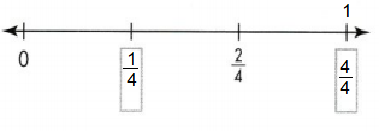
1/4 and 4/4 or 1 are marked on number line.

Explanation:
Question 7.
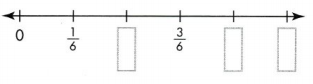
Envision Math Common Core 3rd Grade Answers Topic 12 Understand Fractions as Numbers 73
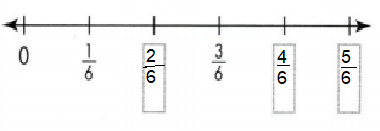
Answer:
2/6,  4/6 and 5/6 are missing marked on number line.
Explanation:
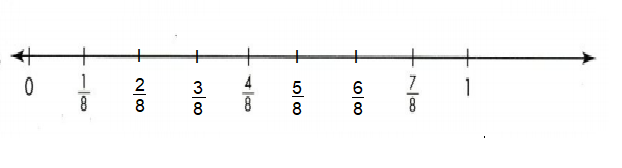
In 8 and 9, divide the number lines into equal lengths. Write the missing fractions.
Envision Math Common Core 3rd Grade Answers Topic 12 Understand Fractions as Numbers 74
Question 8.
Envision Math Common Core 3rd Grade Answers Topic 12 Understand Fractions as Numbers 75
Answer:
1/3, 4/3, 5/3 7/3 and 8/3 are marked on number line.

Explanation:
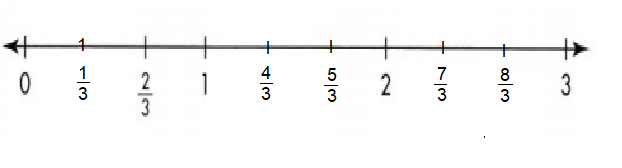
Question 9.

Envision Math Common Core 3rd Grade Answers Topic 12 Understand Fractions as Numbers 76
Answer:
2/8, 3/8, 5/8 and 6/8 are missing numbers marked on number line.
Explanation:
Problem Solving

In 10 and 11, use the number line below.
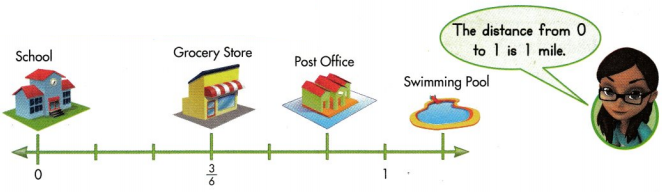
Envision Math Common Core 3rd Grade Answers Topic 12 Understand Fractions as Numbers 77
Question 10.
What fraction tells how far the swimming pool is from the school? Explain how you know.
Answer:
1⅓ mile from school.
Explanation :
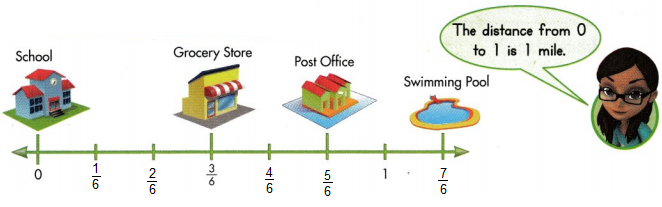
Question 11.
Higher Order Thinking The hospital is halfway between the grocery store and the post office. What fraction tells how far the hospital is from the school? Explain.
Answer:
4/6 unit fraction.
Explanation :
The hospital is 4/6 mile distance from the school, it is located at 4/6 on number line.

Question 12.
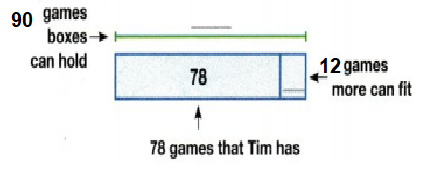
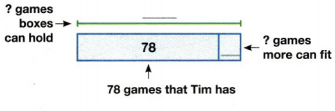
Tim has 78 board games. He has 10 boxes. Each box holds 9 games. If Tim puts all the games he has into the boxes, how many more games can he fit? Complete the bar diagram and solve the problem.
Envision Math Common Core 3rd Grade Answers Topic 12 Understand Fractions as Numbers 78
Answer:
12 more games.
Explanation:

Tim has 10 Boxes, each box holds 9 games.
Total boxes can hold 90 games, but the Tim has 78 games.
Required games = 90-78 = 12 games.

Question 13.
Critique Reasoning Rachel says that she can find (7 × 5) × 2 by calculating (7 × 2) + (5 × 2) = 14 + 10. Then add to get 24. Does Rachel’s reasoning make sense? Use properties of operations to explain.
Answer:
Rachel’s reasoning doesn’t make any sense.
Explanation:
Commutative Property      x + y = y+ x
Associative Property          x + (y + z) = (x + y) + z
According to the above two properties (7×5)x2=70 and
(7 × 2) + (5 × 2) = 14 + 10 =24.

Assessment Practice

Question 14.
What fraction is represented by the total length marked on the number line? Select the correct fraction from the box.

Envision Math Common Core 3rd Grade Answers Topic 12 Understand Fractions as Numbers 79
Answer:
4/3 fraction on number length.
Explanation:

Lesson 12.6 Line Plots and Length

Solve & Share
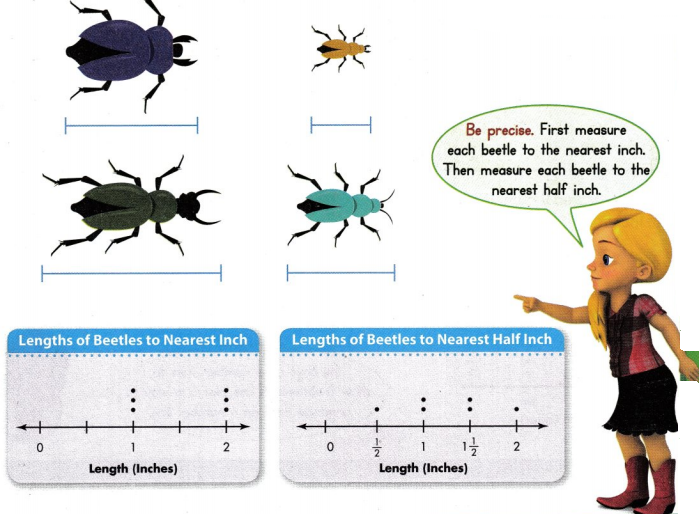
Jamie measured the lengths of 6 beetles. She measured each beetle’s length to the nearest inch and to the nearest half inch. She recorded the lengths in the two line plots below. Measure the length of each beetle below to the nearest inch and to the nearest half inch. Record your measurements in Jamie’s line plots.
I can … measure to the nearest half inch and show the data on a line plot.
Envision Math Common Core Grade 3 Answer Key Topic 12 Understand Fractions as Numbers 80

Look Back! What tool did you use to measure the length of each beetle? How did you use this tool?
Answer :
I used a scale to measure the beetle.
We have to place the beetle beside the scale and then we have to mark the length of the beetle on a piece of paper.

Essential Question
How Can You Measure Lengths and Use Line Plots to Show the Data?
Answer:
Line plots, are particularly useful for showing measurement data.
Explanation:
If a class of students all 
measured the length of their pencils, a line plot would highlight the range and frequency of the measurements.

Visual Learning Bridge
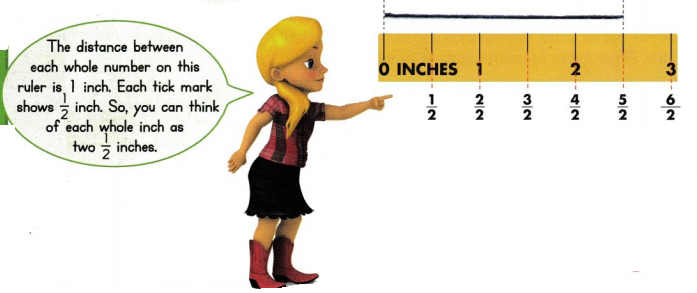
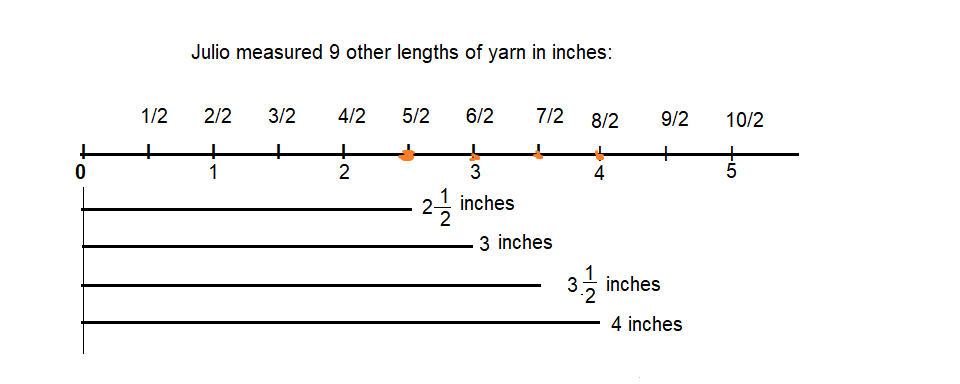
Julio is measuring some lengths of yarn in inches. How can he use a ruler to measure to the nearest half inch?
Line up one end of the object with 0.
Envision Math Common Core Grade 3 Answer Key Topic 12 Understand Fractions as Numbers 81
The fifth \(\frac{1}{2}\)-inch tick mark is closest to the end of the length of yarn.
So, to the nearest half inch, the yarn measures \(\frac{5}{2}\) inches.
This length is two whole inches and one \(\frac{1}{2}\) inch. You can write this length as 2\(\frac{1}{2}\) inches.
Answer:
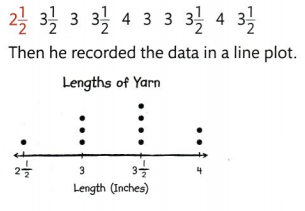
Julio measured 9 other lengths of yarn in inches:
Envision Math Common Core Grade 3 Answer Key Topic 12 Understand Fractions as Numbers 82
Explanation:
One can use number lines to show fractions.
A line plot is a way to organize data on a number line.

Steps to Make a Line Plot

  • Draw a number line. Show a scale based on the data.
  • Write a title for the line plot.
  • Mark a dot for each data value.
    Answer:
Convince Me! Reasoning Suppose you measured a length of yarn that was about 4\(\frac{1}{2}\) inches. How would you need to change the line plot above to record this length?
Answer:
It has to extend up to 9/2.
Explanation:
The line is extended to right side and the values are increases as shown in the above line plot,
values on line is extended up to 9/2 for 4½.

Guided Practice

Do You Understand?
Question 1.
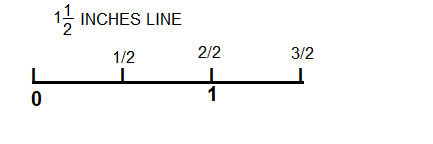
Draw a line that is 1½ inches long.
Answer:
Question 2.
If a line measures halfway between 3 and 3\(\frac{1}{2}\) inches and you need to measure to the nearest \(\frac{1}{2}\) inch, what length will you record? Why?
Answer:
3 inches is the nearest inch.

Explanation:
The line is nearer to 3 inch mark.

Do You Know How?
Question 3.
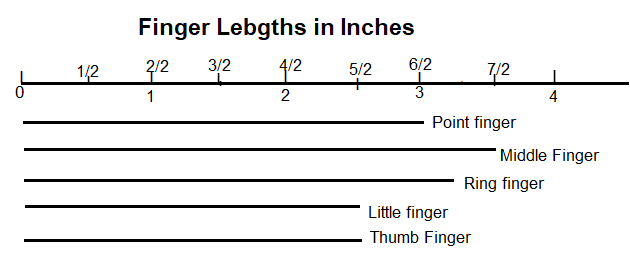
Measure the length of each of your fingers. List the measurements to the nearest half inch.
Answer:
1 Index or Point Finger of Length 3 inches
2 Middle Finger of Length 3½ inches
3 Ring Finger of Length 3 inches
4 Little Finger of Length 2½ inches
5 Thumb Finger of Length  2½ inches
Explanation:
Answers may vary from hand to hand.

Question 4.
Make a line plot to show the measurements of your fingers.
Answer:
Inches of fingers may vary from person to person.
Explanation:
Question 5.
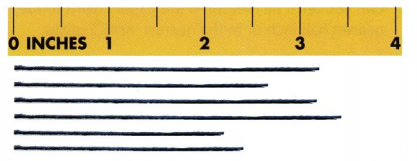
Measure the lengths of the pieces of yarn at the right to the nearest half inch. Write the length for each piece.
Envision Math Common Core Grade 3 Answer Key Topic 12 Understand Fractions as Numbers 83
Answer:
First      – 3 inches
Second – 2½ inches
Third     – 3 inches
Forth     – 2 inches
Fifth      – 2 inches
Explanation:
Length of yarn may vary.

Question 6.
Draw a line to represent another length of yarn. Measure your line to the nearest half inch.
Answer:
3½ inches length yarn.

 

Question 7.
Make a line plot to show the measurements of the yarn.
Envision Math Common Core Grade 3 Answer Key Topic 12 Understand Fractions as Numbers 84
Answer:
3½ inches length yarn.

Problem Solving

Question 8.
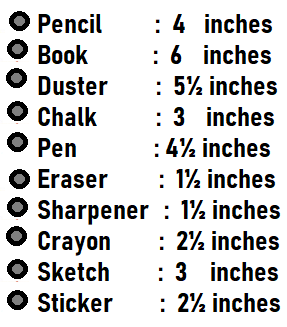
Measure the lengths of 10 classroom objects to the nearest half inch. Choose objects that are between 1 and 6 inches long. Record your measurements.
Answer:
Question 9.
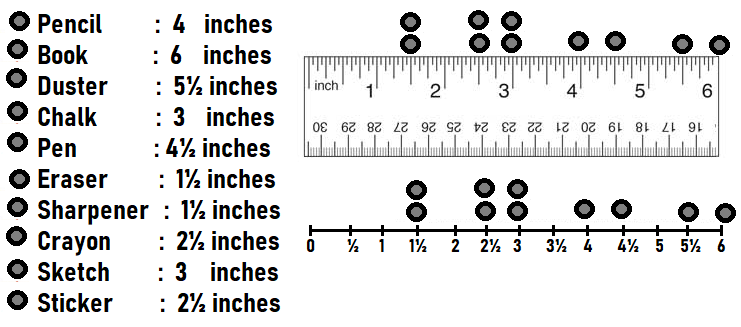
On grid paper, draw a line plot to show your data from Exercise 8.
Answer:
Question 10.
Make Sense and Persevere Raymond weighed his three dogs. The oldest dog weighs 74 pounds. The other two dogs each weigh 34 pounds. How many more pounds does the oldest dog weigh than the other two dogs combined?
Answer:
The oldest dog weighs 6 more ponds than the other two dogs.
Explanation:
Weight of oldest dog is 74
Weight of other two dogs (34+34) is 68
So the oldest dog weighs 6 ponds more
74 – 68 = 6

Question 11.
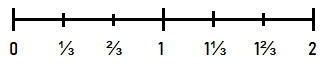
Draw a number line from 0 to 2. Label the wholes. Divide each whole into thirds. Label each fraction.
Answer:
In 12 and 13, use the table at the right.
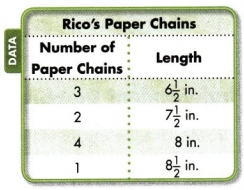
Envision Math Common Core Grade 3 Answer Key Topic 12 Understand Fractions as Numbers 85
Question 12.
How many more of the shortest paper chains does Rico have than the longest paper chains? Explain.
Answer:
Shortest paper chain length 6½
Rico has 3 shortest paper chains each of length 6½
Explanation :
In the table the shortest length of the paper chain is 6½
There are 3 shortest 6½

Question 13.
Higher Order Thinking Look at Rico’s measurements. Can you tell if he measured the paper chains to the nearest half inch or to the nearest inch? Explain.
Answer:
Rico’s measurements are to the nearest half inch
Explanation:
If we look at Rico’s measurements all of the measurements are in inches and nearest half inches,
there are no one fourth inches.
So Rico’s measurements are in nearest half inches.

Assessment Practice

Question 14.
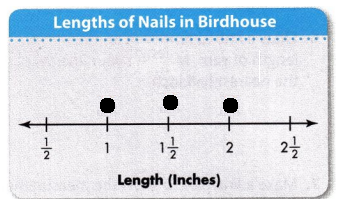
Jessica used 4 of Nail A, 2 of Nail B, and 3 of Nail C to build a birdhouse. Measure each nail to the nearest half inch. Then complete the line plot.
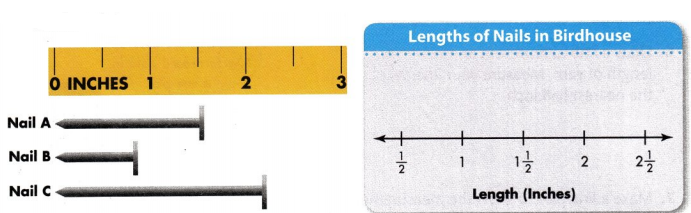
Envision Math Common Core Grade 3 Answer Key Topic 12 Understand Fractions as Numbers 86
Answer:

Lesson 12.7 More Line Plots and Length

Solve & Share
Monica and her friends measured the lengths of their shoes. Show this data by marking a dot for each length on the line plot below.
Measure the length of three classmates’ shoes. Add a dot to represent each length on the line plot. What length was the most common?
I can … measure to the nearest fourth inch and show the data on a line plot.
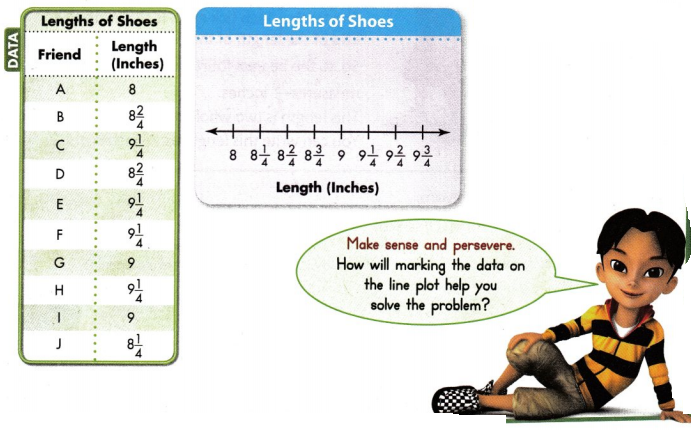
Envision Math Common Core Grade 3 Answer Key Topic 12 Understand Fractions as Numbers 87

Look Back! Are there different ways to record the results of a data collection? Explain.
Answer:
Yes, there are different ways to record the results of a data collection.
Explanation:
We can use a scale, measuring tape, and so on to measure the data.

Essentials Question
How Can You Make and Use Line Plots?
Answer:
A line plot is a graph that shows frequency of data along a number line. It is best to use a line plot when comparing fewer than 25 numbers. It is a quick, simple way to organize data.

Visual Learning Bridge
Anna is measuring the length of her crayons. How can she use a ruler to measure to the nearest fourth inch?
Line up one end of the object with 0.
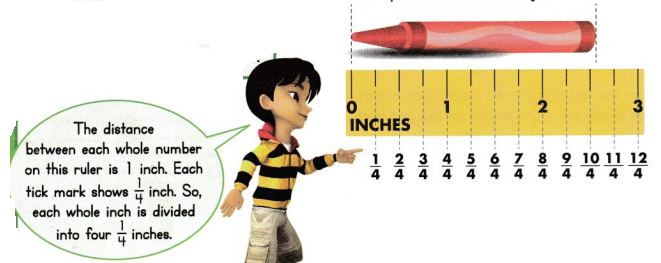
Envision Math Common Core Grade 3 Answer Key Topic 12 Understand Fractions as Numbers 88
The tenth \(\frac{1}{4}\)-inch tick mark is closest to the end of the length of the crayon.
So, to the nearest fourth inch, the crayon measures \(\frac{10}{4}\) inches.
This length is two whole inches and two \(\frac{1}{4}\) inches. You can write this length as 2\(\frac{2}{4}\) inches.

Anna measured her other crayons.
She then recorded the data in a line plot.
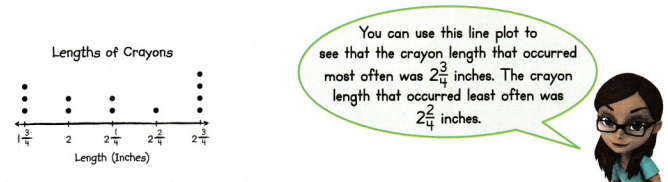
Envision Math Common Core Grade 3 Answer Key Topic 12 Understand Fractions as Numbers 89

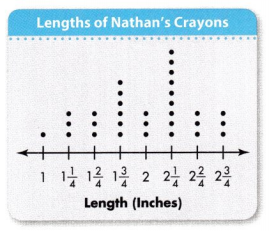
Convince Me! Make Sense and Persevere Nathan also made a line plot to show the lengths of his crayons. Tell three things you know about the lengths of Nathan’s crayons.
Envision Math Common Core Grade 3 Answer Key Topic 12 Understand Fractions as Numbers 90
Answer:
Nathan’s measured his crayons nearest ¼th
Most of Nathan’s crayons are 2¼ inches
The smallest crayon Nathan’s has 1 inch.

Guided Practice

Do You Understand?
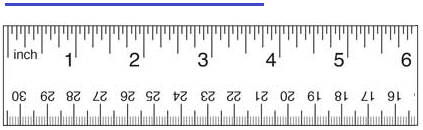
Question 1.
Measure the length of this line to the nearest fourth inch.
Envision Math Common Core Grade 3 Answer Key Topic 12 Understand Fractions as Numbers 91
Answer:
Length = 3¾ inches
Explanation:
Question 2.
Describe how you would show this measurement on a line plot.
Answer:

Do You Know How?
Question 3.
Draw a line plot to show the data.
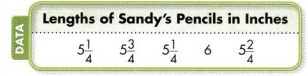
Envision Math Common Core Grade 3 Answer Key Topic 12 Understand Fractions as Numbers 92
Answer:

Question 4.
Measure your pencil to the nearest fourth inch. Show the length on your line plot.
Answer:
length of pencil : 3 \(\frac{3}{4}\)

Independent Practice
Envision Math Common Core Grade 3 Answer Key Topic 12 Understand Fractions as Numbers 93
Question 5.
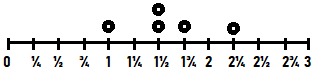
Daisy measured the lengths of her toy dinosaurs to the nearest fourth inch. She listed the lengths. Make a line plot to show the data.
1\(\frac{2}{4}\) in., 2\(\frac{1}{4}\) in., 1 in., 1\(\frac{2}{4}\) in., 1\(\frac{3}{4}\) in.
Answer:
Question 6.
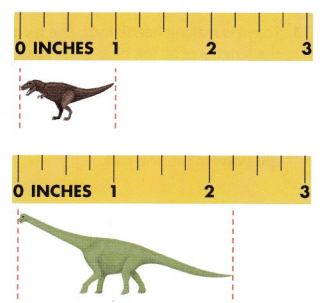
Measure the lengths of the toy dinosaurs at the right to the nearest fourth inch. Write the length for each toy. Show the lengths on your line plot.
Answer:
length of toy 1 : 1\(\frac{2}{4}\) in.
length of toy 2 : 2\(\frac{1}{4}\) in.
length of toy 3 : 1 in.
length of toy 4 : 1\(\frac{2}{4}\) in.
length of toy 5 : 1\(\frac{3}{4}\) in.

Problem Solving

In 7 and 8, use the line plot at the right.
Envision Math Common Core Grade 3 Answer Key Topic 12 Understand Fractions as Numbers 94
Question 7.
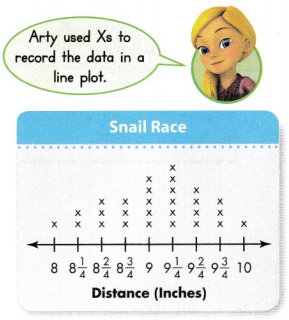
Arty made a line plot to show the number of inches that different snails crawled in a 5-minute race. What was the most common distance that the snails crawled?
Answer:
the most common distance that the snails crawled is 9 \(\frac{1}{4}\) inches

Question 8.
Higher Order Thinking How many more snails crawled a length more than 8\(\frac{3}{4}\) inches than a length less than 8\(\frac{3}{4}\) inches?
Answer:
snails that crawled length less than 8\(\frac{3}{4}\) inches are : 6
snails that crawled length more than 8\(\frac{3}{4}\) inches are : 19
difference : 19 – 6 = 13 snails
13 more snails crawled a length more than 8\(\frac{3}{4}\) inches than a length less than 8\(\frac{3}{4}\) inches

Question 9.
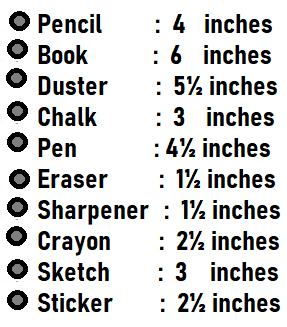
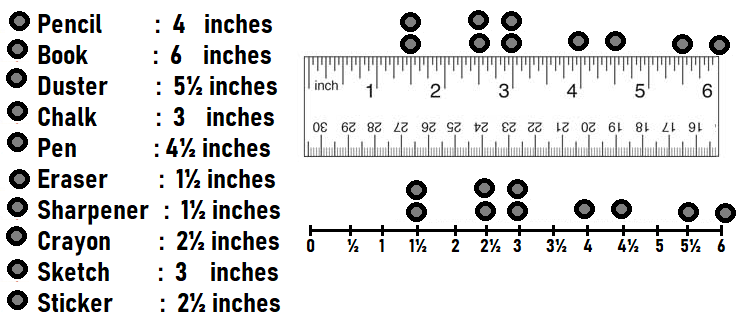
Measure the lengths of 10 classroom objects to the nearest fourth inch. Choose objects that are between 1 and 5 inches long. Record your measurements.
Answer:
Question 10.
On grid paper, draw a line plot to show your data from Exercise 9.
Answer:
Question 11.
Jackson bought 5 books that cost $7 each. How much change did he get from $40?
Answer:
Jackson got $5 change.
Explanation:
Cost of each book = $7
Cost of 5 books = 5×7
Total cost of 5 books =$35
Total amount paid = $40
Total change he received = 40-35
= $5.

Question 12.
Use Structure Use the digits 2, 6, and 8 to make as many 3-digit numbers as you can. Use place value to arrange the numbers in order from least to greatest.
Answer:
H     T     U
2     6      8
2     8      6
6     2      8
6     8      2
8     2      6
8     6      2
Assessment Practice

Question 13.
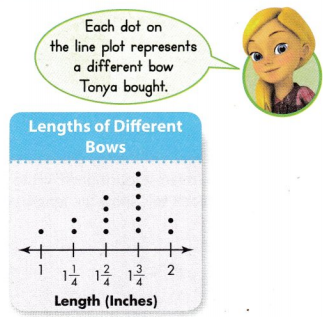
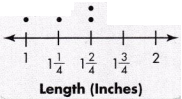
Tonya is making headbands. She recorded the lengths of all the blue bows she purchased for the headbands. Tonya also purchased 4 red bows with lengths of 1 inch, 1\(\frac{1}{4}\) inches, 1\(\frac{2}{4}\) inches, and 1\(\frac{2}{4}\) inches. Record the lengths of Tonya’s red bows in the line plot.
Envision Math Common Core Grade 3 Answer Key Topic 12 Understand Fractions as Numbers 95
Answer:
Red bows are : 1 inch , 1\(\frac{1}{4}\) inches, 1\(\frac{2}{4}\) inches, and 1\(\frac{2}{4}\) inches.
so there are 4 red bows.
Lesson 12.8 Problem Solving

Make Sense and Persevere
Solve & Share
Marcus, Mariah, and Tony painted a mural. They divided it into equal parts. Marcus painted 2 parts, Mariah painted 3 parts, and Tony painted the rest. What fraction of the mural did each student paint?
This problem may have missing or extra information. If information you need is missing, make up some reasonable information and then solve the problem.
I can … make sense of problems and keep working if I get stuck.

Thinking Habits
Be a good thinker! These questions can help you.

  • What do I need to find?
  • What do I know?
  • What’s my plan for solving the problem?
  • What else can I try if I get stuck?
  • How can I check that my solution makes sense?

    Envision Math Common Core Grade 3 Answer Key Topic 12 Understand Fractions as Numbers 96

Look Back! Make Sense and Persevere What information was not given in the problem? How did you still solve the problem?
Answer:
The number of parts the mural is divided into was not given
Additional information:
Marcus, Mariah, and Tony painted a mural. They divided it into 8 equal parts. Marcus painted 2 parts, Mariah painted 3 parts, and Tony painted the rest. What fraction of the mural did each student paint?
Answer:
Marcus painted 2 parts
Mariah painted 3 parts
and Tony painted the rest
= 8 – ( 2 + 3 )
= 8 – 5
= 3 parts
Tony painted 3 parts
Marcus painted  :  \(\frac{2}{8}\)
Mariah painted  :  \(\frac{3}{8}\)
Tony painted      :  \(\frac{3}{8}\)

Essential Question
How Can You Make Sense of a Problem and Persevere in Solving It?
Answer:
The meaning of a problem and looking for entry points to its solution. Helps to analyze givens, constraints, relationships, and goals.

Visual Learning Bridge

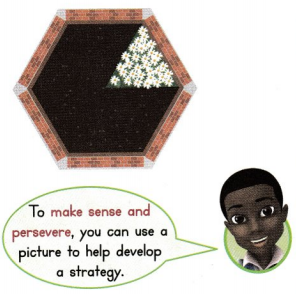
Suki divides her garden into 6 equal parts. She plants daisies, roses, and violets. It takes Suki 1 hour to plant the flowers. She plants daisies in 1 part, roses in 2 parts, and violets in the rest of the garden.
In what fraction of the garden does Suki plant violets?
Envision Math Common Core Grade 3 Answer Key Topic 12 Understand Fractions as Numbers 97
What is a good plan for solving the problem?
I need to make sense of the given information. I need to think about what I can use to help me solve the problem.

How can I make sense of and solve this problem?
Answer:
I can…..

  • identify the quantities given.
  • understand which quantities are needed to solve the problem.
  • choose and implement an appropriate strategy.
  • check to be sure my work and answer make sense.
    Explanation:

The information about 1 hour to plant the flowers is not needed to solve the problem.
I can use a picture to help make sense.
1 equal part for daisies is \(\frac{1}{6}\) of the whole.
2 equal parts for roses is \(\frac{2}{6}\) of the whole.
There are 3 equal parts left for violets.
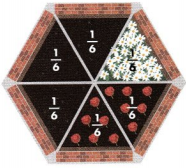
Envision Math Common Core Grade 3 Answer Key Topic 12 Understand Fractions as Numbers 98
3 copies of \(\frac{1}{6}\) is \(\frac{3}{6}\).
So, Suki plants violets in \(\frac{3}{6}\) of the garden.

Convince Me! Make Sense and Persevere How can you check to make sure the work and answer given above make sense?
Answer:
Total number of parts garden is divided into is: 6 parts
Daisies are planted in 1 part [ 1/6 fraction]
Roses are planted in 2 parts [ 2/6 fraction]
So Suki plants violets in 3 parts as :
1 + 2 = 3
6 – 3  = 3 parts
3/6 unit fraction.

Guided Practice

Make Sense and Persevere Keira and Matt cut a sandwich into 4 equal parts. They each ate 1 part. Keira is 9 years old. Matt is the same age as Keira. What fraction of the sandwich is not eaten?
Envision Math Common Core Grade 3 Answer Key Topic 12 Understand Fractions as Numbers 99
Question 1.
Is there any missing or extra information? Explain.
Answer:
Missing information : none
Extra information : the ages of Keira and Matt are given [we don’t need their ages to determine the parts of the sandwich left]

Question 2.
What do you need to find before you can determine how much of the sandwich is left?
Answer:
We don’t need to find the any other information as all the needed information is given in the question

Question 3.
Solve the problem. If information you need is missing, make up some reasonable information for the problem.
Answer:
The sandwich is divided into 4 equal parts
Keira and Matt each ate one part so total parts eaten : 2 parts
number of parts left is : 4- 2 = 2 parts

Independent Practice

Make Sense and Persevere Marni planted a vegetable garden. She put lettuce in 1 part, carrots in 4 parts, and broccoli in the rest of her garden. In what fraction of the garden did Marni plant broccoli?
Question 4.
Is there any missing or extra information?
Answer:
Missing information : the question did not specify the number of the parts Marni’s garden is divided into
Extra information : none

Question 5.
Solve the problem. If information you need is missing, make up some reasonable information for the problem.
Answer:
Additional information : Marni’s garden is divided into 8 parts. She put lettuce in 1 part, carrots in 4 parts, and broccoli in the rest of her garden. In what fraction of the garden did Marni plant broccoli?
Answer:
fraction in which broccoli is planted : 3/8
Explanation:
Total number of parts Marni’s garden is divided into is 8 parts
lettuce : 1 part
carrots : 4 parts
broccoli : 8 – (1 + 4)
.             : 8 – 5 = 3
fraction in which broccoli is planted : 3/8

Question 6.
Can you use a different number of parts and still solve the problem? Explain.
Answer:
yes
Explanation :
If Total number of parts Marni’s garden is divided into is 6 parts
lettuce : 1 part
carrots : 4 parts
broccoli : 6 – (1 + 4)
.             : 6 – 5 = 1
fraction in which broccoli is planted : 1/8

Problem Solving

Performance Task
Sports Day
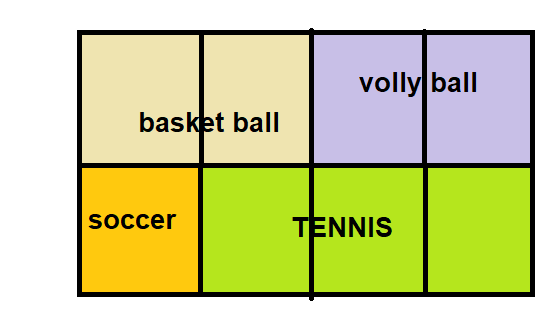
Green School divides its school gym into 8 equal parts for a sports day. Basketball is in 2 parts, soccer is in 1 part, and volleyball and tennis are in the rest.
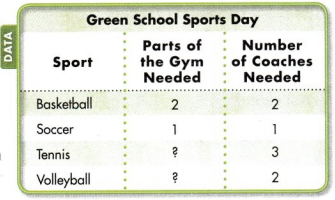
Envision Math Common Core Grade 3 Answer Key Topic 12 Understand Fractions as Numbers 100
Question 7.
Make Sense and Persevere The gym teacher wants to know what fraction of the gym is used for tennis. What missing information do you need to solve the problem?
Answer:
School gym is divides into 8 equal parts.
Tennis and Volleyball not clearly mentioned, these two are missing information do you need to solve the problem.

In 8 and 9, draw a picture to represent the number of parts in each plan.
Question 8.
Reasoning What fraction of the gym would be used for tennis if 2 parts were for volleyball?
Envision Math Common Core Grade 3 Answer Key Topic 12 Understand Fractions as Numbers 101
Answer: 3 parts

Explanation:
if 2 parts were used for volleyball , three parts used for tennis

Question 9.
Reasoning What fraction of the gym would be used for tennis if 3 parts were used for volleyball?
Answer: 2 PARTS
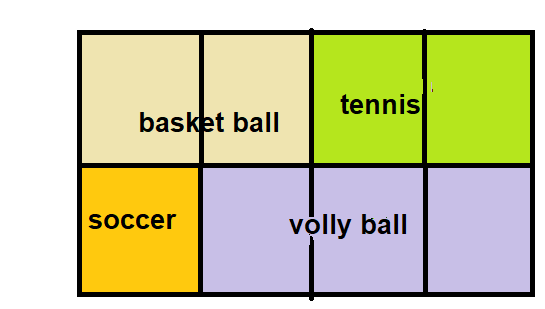
Explanation : if 3 parts were used for volleyball , two parts used for tennis as shown in that above picture

Question 10.
Construct Arguments To have the same fraction for tennis as for basketball, which plan, Exercise 8 or 9, should be used? Justify your answer.
Answer:
plan 9 should be used
Explanation:
for tennis and basket ball to be equal we need to have equal number of parts for tennis and basket ball
in question 9 plan tennis and basket ball both are takin a space of 2 parts
whereas in question 8 plan tennis is taking up more space than that of basket ball
so,
for tennis and basket ball to be equal we need to have equal number of parts for tennis and basket ball

Topic 12 Fluency Practice Activity

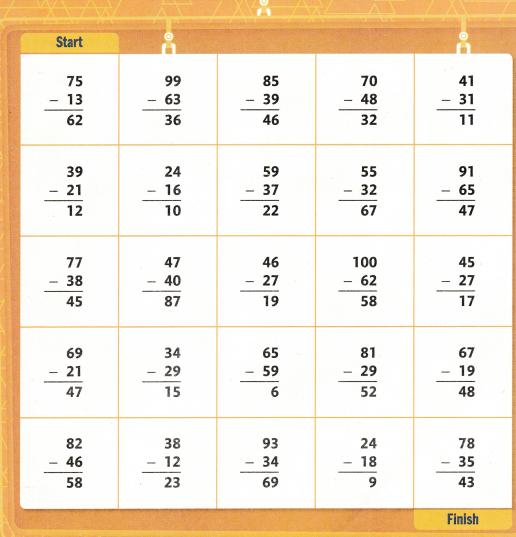
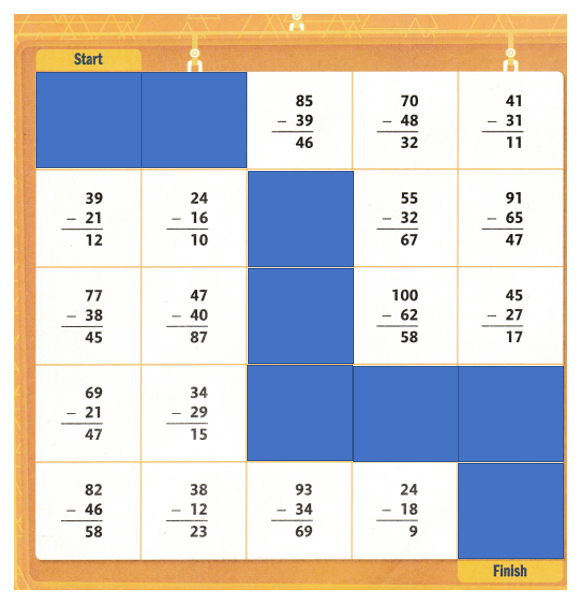
Follow the path
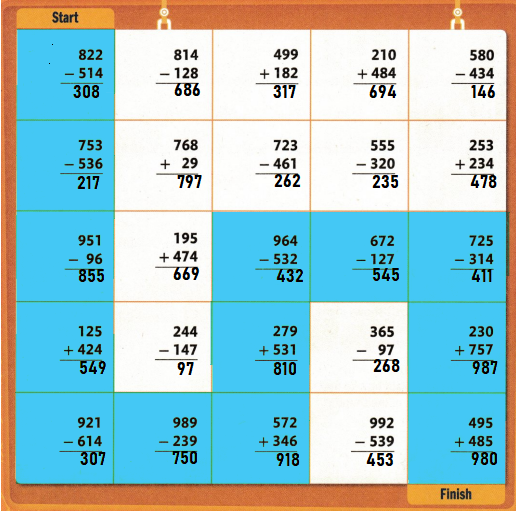
Shade a path from START to FINISH. Follow the sums and differences where the digit in the hundreds place is greater than the digit in the tens place. You can only move up, down, right, or left.
I can … add and subtract within 1,000.
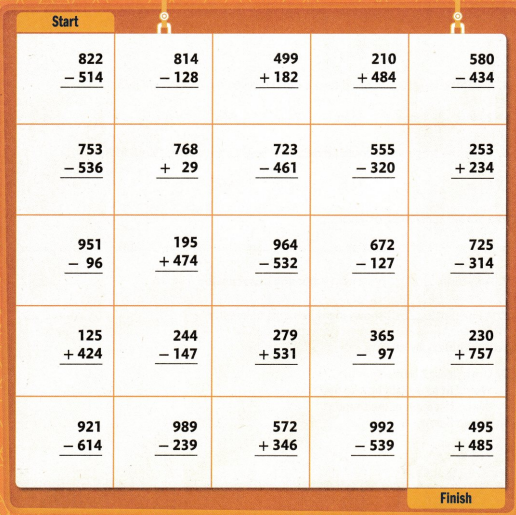
Envision Math Common Core Grade 3 Answer Key Topic 12 Understand Fractions as Numbers 102
Answer :

Topic 12 Vocabulary Review

Understand Vocabulary
Word List

  • denominator
  • fraction
  • line plot
  • nearest fourth inch
  • nearest half inch
  • numerator
  • unit fraction

Question 1.
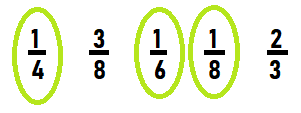
Circle each unit fraction.
\(\frac{1}{4}\)
\(\frac{3}{8}\)
\(\frac{1}{6}\)
\(\frac{1}{8}\)
\(\frac{2}{3}\)
Answer:
Question 2.
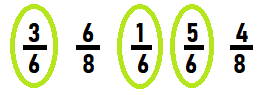
Circle each fraction where 6 is the denominator.
\(\frac{3}{6}\)
\(\frac{6}{8}\)
\(\frac{1}{6}\)
\(\frac{5}{6}\)
\(\frac{4}{8}\)
Answer:
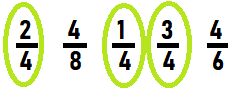
Question 3.
Circle each fraction where 4 is the numerator.
\(\frac{2}{4}\)
\(\frac{4}{8}\)
\(\frac{1}{4}\)
\(\frac{3}{4}\)
\(\frac{4}{6}\)
Answer:
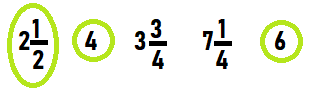
Question 4.
Circle the lengths that could be measurements to the nearest half inch.
2\(\frac{1}{2}\) in.
4 in.
3\(\frac{3}{4}\) in.
7\(\frac{1}{4}\) in.
6 in.
Answer:
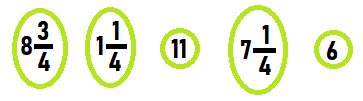
Question 5.
Circle the lengths that could be measurements to the nearest fourth inch.
8\(\frac{3}{4}\) in.
1\(\frac{1}{4}\) in.
11 in.
7\(\frac{1}{4}\) in.
6 in.
Answer:
Write always, sometimes, or never.
Question 6.
The numerator in a fraction is _?_ greater than the denominator. _________
Answer:
Some times
Explanation:
In a proper fraction, the numerator is sometimes more than the denominator.
Question 7.
A fraction ? _ has a numerator and denominator. __________
Answer:
Always
Explanation:
A fraction represents a part of a whole or any number of equal parts.
For example, one-half, eight-fifths, three-quarters.
Question 8
A line plot_?_ shows measurements of lengths. _________
Answer:
Never
Explanation:
A Line plot can be defined as a graph that displays data as points or check marks above a number line, showing the frequency of each value.

Use Vocabulary in Writing

Question 9.
Use at least 2 terms from the Word List to explain how to find the unit fraction of the shape shown below.

Envision Math Common Core Grade 3 Answer Key Topic 12 Understand Fractions as Numbers 103
Answer:
1/6
Explanation:
A unit fraction is any fraction with 1 as its numerator (top number), and a whole number for the denominator (bottom number).
If we divide the hexagon into 6 equal parts
then each part will be one part of the six parts
that is 1/6

Topic 12 Reteaching

Set A pages 437-440

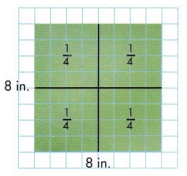
This is one way to divide a whole into fourths.
Envision Math Common Core Grade 3 Answer Key Topic 12 Understand Fractions as Numbers 104
Because each of the 4 parts has the same area, each part is one fourth of the whole.
You can write this fraction as \(\frac{1}{4}\)
A unit fraction represents one of the equal parts \(\frac{1}{4}\) is a unit fraction.

Remember that fractions can name equal parts of a whole.

In 1 and 2, draw lines to divide the shape into the given number of equal parts. Then write the fraction that represents 1 part.
Question 1.
6 equal parts
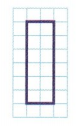
Envision Math Common Core Grade 3 Answer Key Topic 12 Understand Fractions as Numbers 105
Answer:

Explanation:
total area of the figure : 12
12 divided into 6 parts is 12 ÷ 6 = 2

Question 2.
2 equal parts

Envision Math Common Core Grade 3 Answer Key Topic 12 Understand Fractions as Numbers 106
Answer:

Explanation:
total area of the figure : 12
12 divided into 2 parts is 12 ÷ 2 = 6

Question 3.
Martin divides a shape into 3 equal parts. What unit fraction can he write to represent 1 part?
Answer:

Set B pages 441-444

What fraction of this rectangle is shaded?
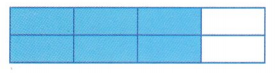
Envision Math Common Core Grade 3 Answer Key Topic 12 Understand Fractions as Numbers 107
The rectangle is divided into 8 equal parts. So, the unit fraction of the rectangle is \(\frac{1}{8}\).
In the whole rectangle, there are 8 parts of \(\frac{1}{8}\).
8 copies of \(\frac{1}{8}\) is \(\frac{8}{8}\)
For the shaded part there are 6 parts of \(\frac{1}{8}\).
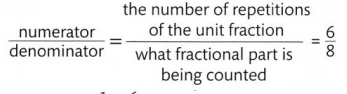
Envision Math Common Core Grade 3 Answer Key Topic 12 Understand Fractions as Numbers 108
6 copies of \(\frac{1}{8}\) is \(\frac{6}{8}\)
So, \(\frac{6}{8}\) of the rectangle is shaded.

Remember that you need to think about how many parts there are in all and how many parts are shaded.

In 1-4, write the unit fraction that represents each part of the whole. Next, write the number of shaded parts. Last, write the fraction of the whole that is shaded.
Question 1.
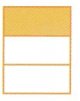
Envision Math Common Core Grade 3 Answer Key Topic 12 Understand Fractions as Numbers 109
Answer:
Unit fraction = 1/3
Number of shaded part is one.
Fraction of whole that is shaded = 1/3
Question 2.
Envision Math Common Core Grade 3 Answer Key Topic 12 Understand Fractions as Numbers 110
Answer:
Unit fraction = 5/6
Number of shaded parts are 5
Fraction of whole that is shaded = 5/6
Question 3.

Envision Math Common Core Grade 3 Answer Key Topic 12 Understand Fractions as Numbers 111
Answer:
Unit fraction = 3/4
Number of shaded parts are 3
Fraction of whole that is shaded = 3/4

Question 4.
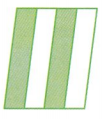
Envision Math Common Core Grade 3 Answer Key Topic 12 Understand Fractions as Numbers 112
Answer:
Unit fraction = 2/4
Number of shaded parts are 2
Fraction of whole that is shaded = 2/4

Set C pages 445-448

This shape is \(\frac{2}{4}\) of a piece of fabric Tina used in a quilt. You can draw a picture and write a fraction to represent the whole piece of fabric.
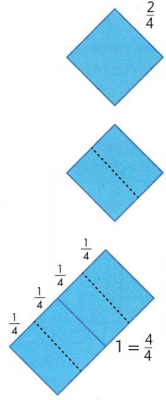
Envision Math Common Core Grade 3 Answer Key Topic 12 Understand Fractions as Numbers 113
\(\frac{2}{4}\) is 2 copies of \(\frac{1}{4}\)
Divide the piece of fabric into 2 equal parts.
4 copies of \(\frac{1}{4}\) makes \(\frac{4}{4}\). or 1 whole.

Remember that the denominator shows the total number of equal parts in a whole.

In 1 and 2, draw a picture and write a fraction to represent the whole.
Question 1.
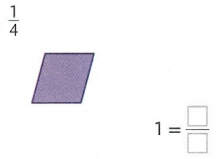
Envision Math Common Core Grade 3 Answer Key Topic 12 Understand Fractions as Numbers 114
Answer:

1 = 4/4

Question 2.
Envision Math Common Core Grade 3 Answer Key Topic 12 Understand Fractions as Numbers 115
Answer:

1 = 8/8

Set D pages 449-452

You can show fractions on a number line.
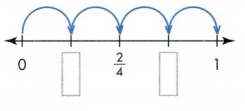
The fraction \(\frac{5}{6}\) is labeled. What are the missing fractions?
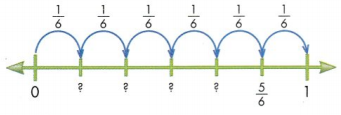
Envision Math Common Core Grade 3 Answers Topic 12 Understand Fractions as Numbers 116
First, find the unit fraction. The line is divided into six equal lengths. So, the number line shows sixths.
Each jump represents \(\frac{1}{6}\). So, the first tick mark is labeled \(\frac{1}{6}\). The second tick mark is labeled \(\frac{2}{6}\), and so on.
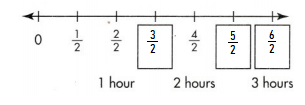
The missing fractions on the number line are \(\frac{1}{6}, \frac{2}{6}, \frac{3}{6}\), and \(\frac{4}{6}\)

Remember to first decide what unit fraction is shown on each number line.

In 1 and 2, write the missing fractions on each number line.
Question 1.
Envision Math Common Core Grade 3 Answers Topic 12 Understand Fractions as Numbers 117
Answer:
1/4 and 3/4

Question 2.
Envision Math Common Core Grade 3 Answers Topic 12 Understand Fractions as Numbers 118
Answer:
1/8 , 2/8 , 4/8 , 5/8 , 7/8

Question 3.
Divide the number line below into 3 equal parts and mark \(\frac{2}{3}\) on the line.

Envision Math Common Core Grade 3 Answers Topic 12 Understand Fractions as Numbers 119
Answer:

Set E pages 453-456

Number lines can have fractions greater than 1.
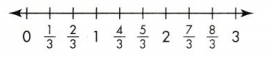
The number line below is divided into thirds.
The denominator is 3 because the unit fraction is \(\frac{1}{3}\). The numerator shows how many copies of the unit fraction each point represents.
Envision Math Common Core Grade 3 Answers Topic 12 Understand Fractions as Numbers 120

Remember that the numerator increases by 1 because each part of the number line is 1 more copy of the unit fraction.

Question 1.
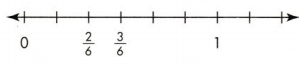
The number line has equal lengths marked. Write the missing fractions.
Envision Math Common Core Grade 3 Answers Topic 12 Understand Fractions as Numbers 121
Answer:
1/6 , 4/6 , 5/6 , 7/6 , 8/6

Question 2.
Divide the number line into fourths. Label each point.

Envision Math Common Core Grade 3 Answers Topic 12 Understand Fractions as Numbers 122
Answer:

Set F pages 457-460

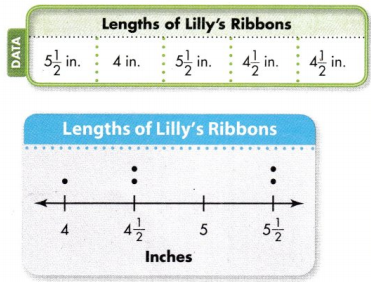
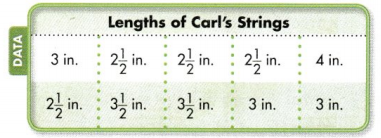
You can use a line plot to show data, such as lengths measured to the nearest half inch.
Steps to make a line plot:

  • Draw a number line and choose a scale.
  • The scale should show data values from the least to the greatest.
  • Write a title for the line plot.
  • Mark a dot for each value.
    Envision Math Common Core Grade 3 Answers Topic 12 Understand Fractions as Numbers 123

Remember to mark a dot for each length. Check your completed line plot against the data in the chart.
Envision Math Common Core Grade 3 Answers Topic 12 Understand Fractions as Numbers 124
Question 1.
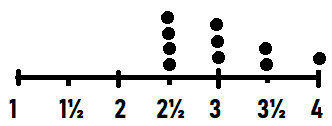
Draw a line plot to show the data.
Answer:
Question 2.
How many strings does Carl have in all?
Answer:
10 strings
Explanation:
2½ inch strings – 04
3 inch    strings – 03
3½ inch strings – 02
4 inch    strings – 01

Question 3.
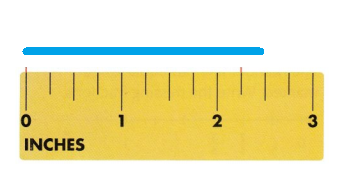
Draw a line that is the same length as the most common string length.
Answer:
Most common string is 2½ inch
Set G pages 461-464

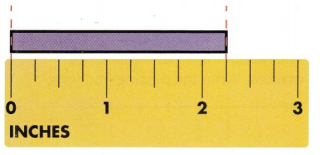
You can measure to different lengths, such as to the nearest fourth inch.
The closest fourth-inch mark to the end of the length of the rectangle is the 2\(\frac{1}{4}\)-inch mark.
Envision Math Common Core Grade 3 Answers Topic 12 Understand Fractions as Numbers 125
The lengths can be shown on a line plot.

Remember to think about the scale of the line plot. It needs to include the least and greatest values.

Question 1.
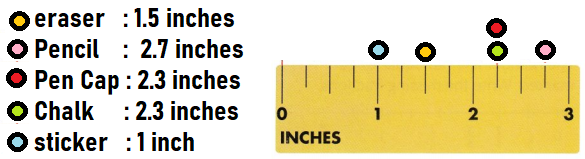
Measure and record the lengths of 5 classroom objects to the nearest fourth inch. Use objects that are between 1 and 3 inches long.
Answer:
Eraser : 1.5 inches
Pencil :  2.7 inches
Pen Cap : 2.3 inches
Chalk : 2.3 inches
Sticker : 1 inch

Question 2.
Draw a line plot to show your data.
Answer:
Set H pages 465-468

Think about these questions to help you make sense and persevere in solving problems.
Thinking Habits

  • What do I need to find?
  • What do I know?
  • What’s my plan for solving the problem?
  • What else can I try if I get stuck?
  • How can I check that my solution makes sense?
    Envision Math Common Core Grade 3 Answers Topic 12 Understand Fractions as Numbers 126

Remember to make sense of the problem by identifying the quantities. Then use what you know to solve.

Gavin divided his notebook into 8 equal parts. He plans to use 3 parts to take notes for math and 2 parts for reading. He has school from 8:30 A.M. to 3:30 P.M. What fraction of his notebook does he have left?
Question 1.
Is there any missing or extra information? Explain.
Answer:
Gavin divided his book into 8 equal parts
3 parts are used for math 3/8
2 parts are used for reading 2/8
The fraction of notebook he has left is :
3 + 2 = 5
8 – 5 = 3
The fraction of notebook he has left is 3/5

Question 2.
Solve the problem. If information you need is missing, make up some reasonable information for the problem. You can draw a picture to help.
Answer:
The missing information is:
3/8 part of the book was used for science

Topic 12 Assessment Practice

Question 1.
What fraction of the whole is colored green? What fraction of the whole is colored yellow?
Envision Math Common Core Grade 3 Answers Topic 12 Understand Fractions as Numbers 127
Answer:
3/6 fraction of the whole is colored green.
3/6 fraction of the whole is colored yellow.

Question 2.
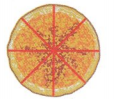
Write a fraction to name the equal parts of the whole pizza. How many parts would you need to make two whole pizzas? Explain.
Envision Math Common Core Grade 3 Answers Topic 12 Understand Fractions as Numbers 128
Answer:
Fraction name : 1/8
we need 16 parts to make 2 whole pizzas
Explanation:
1 pizza needs 8 parts to make 1 whole so we need 16 parts [8 + 8 = 16] to make 2 wholes

Question 3.
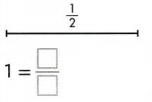
This line segment represents \(\frac{1}{3}\) of the distance from Mal’s house to the library. Which represents the whole distance and has an accurate explanation?
Envision Math Common Core Grade 3 Answers Topic 12 Understand Fractions as Numbers 129
A. Envision Math Common Core Grade 3 Answers Topic 12 Understand Fractions as Numbers 130 The line segment represents \(\frac{1}{3}\) the distance from Mal’s house to the library. So, the whole distance is 3 times as long.
B. Envision Math Common Core Grade 3 Answers Topic 12 Understand Fractions as Numbers 131 The line segment represents \(\frac{1}{3}\) the distance from Mal’s house to the library. So, the whole distance is 2 times as long.
C. Envision Math Common Core Grade 3 Answers Topic 12 Understand Fractions as Numbers 132 The line segment represents \(\frac{1}{3}\) the distance from Mal’s house to the library. So, the whole distance is 4 times as long.
D. Envision Math Common Core Grade 3 Answers Topic 12 Understand Fractions as Numbers 133 The line segment represents the distance from Mal’s house to the library. So, the whole distance is the identical line segment.
Answer:
Option A
Explanation:
The line segment represents 1/3 the distance from Mal’s house to the library. So, the whole distance is 3 times as long.

Question 4.
Which point is at \(\frac{3}{6}\) on the number line?
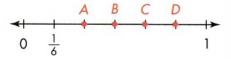
Envision Math Common Core Grade 3 Answers Topic 12 Understand Fractions as Numbers 134
A. Point A
B. Point B
C. Point C
D. Point D
Answer:
Point B

Question 5.
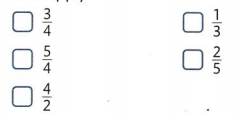
Which of the fractions would be to the right of 1 on a number line? Select all that apply.
Envision Math Common Core Grade 3 Answers Topic 12 Understand Fractions as Numbers 135
Answer:
5/4

Question 6.
A. Draw a picture to show \(\frac{2}{4}\).
Answer:
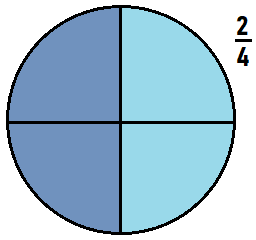
B. Explain how you knew you had shaded the correct amount of your picture.
Answer:
Divide the circle into fourths and then shade 2 of the 4 parts blue

Question 7.
Jeremy put pepperoni on \(\frac{1}{2}\) of a pizza. He put olives on \(\frac{1}{3}\) of the pizza. What fraction of the pizza did NOT have pepperoni? What fraction of the pizza did NOT have olives?
Answer:
1/2 of the fraction did not have pepperoni.
2/3 of the fraction did not have olives.

Question 8.
One point on the number line below has been named with the fraction \(\frac{2}{4}\). Write a fraction for each of the other points shown.
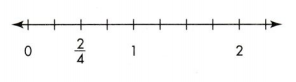
Envision Math Common Core Grade 3 Answers Topic 12 Understand Fractions as Numbers 136
Answer:

Question 9.
Explain how you know \(\frac{3}{3}\) represents a whole.
Answer:
Fraction 3/3 means 3 parts of 3 parts
Dividing 3 with 3 we get 1
So the fraction 3/3 is a whole 1

Question 10.
Jared folded a piece of paper 9 inches by 12 inches into sections as shown below. What fraction of the total area is in each section? Explain.
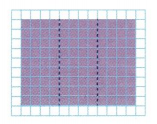
Envision Math Common Core Grade 3 Answers Topic 12 Understand Fractions as Numbers 137
Answer:
Fraction of total Area is 36
Explanation:
Area of total paper = 9 x 12 = 108 sq.inches
The paper is divided into 3 equal part
Area of each part = 108 ÷ 3 = 36 sq.inches

Question 11.
How many \(\frac{2}{8}\)s do you need to get \(\frac{8}{8}\)?
Answer:
Four
Explanation:
we need four 2/8 fractions to get 8/8
2/8 + 2/8 + 2/8 + 2/8 = 8/8

Question 12.
Lane’s class is painting a mural with 6 equal parts. They spent 45 minutes painting on each of 2 days. On the first day, the class painted \(\frac{1}{6}\) of the mural. The next day, the class painted another \(\frac{1}{6}\) of the mural. How many \(\frac{1}{6}\) parts did the class paint in the two days?
A. 1
B. 2
C. 3
D. 4
Answer:
Option B
Explanation:
The class paints 1/6 part each day in d days the class paints 2/6 parts
1/6 – day 1
1/6 – day 2
By day 2 no of parts painted are 1/6 + 1/6 = 2/6

Question 13.
How many \(\frac{1}{8}\) s do you need to get \(\frac{5}{8}\)? Use the number line below for help.
A. 1
B. 3
C. 5
D. 8

Envision Math Common Core Grade 3 Answers Topic 12 Understand Fractions as Numbers 138
Answer:
Option C
Explanation:
You need 5 yards to make 1/8 as 5/8

Question 14.
Which point represents 6 lengths of \(\frac{1}{8}\) on the number line? Explain.
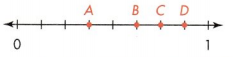
Envision Math Common Core Grade 3 Answers Topic 12 Understand Fractions as Numbers 139
Answer:
Point D

Question 15.
Divide the circle into 8 equal parts. What fraction does each part represent?
Envision Math Common Core Grade 3 Answers Topic 12 Understand Fractions as Numbers 140
Answer:

Each part represent1/8 fraction.

Question 16.
Seth drew \(\frac{2}{4}\) of a shape below. Draw a picture to show the whole shape and write a fraction to represent the whole.
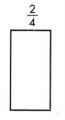
Envision Math Common Core Grade 3 Answers Topic 12 Understand Fractions as Numbers 141
Answer:

Explanation:
One whole is 4/4 that means to get 4/4 we need to have 2 parts of 2/4
As 2/4 + 2/4 = 4/4

Question 17.
Mara believes the point marked on the number line is \(\frac{2}{3}\). Is she correct? Explain.
Envision Math Common Core Grade 3 Answers Topic 12 Understand Fractions as Numbers 142
Answer:
Mara is wrong
Explanation:
the markings of the fractions on the number line are not correct
[the markings are not even there is a lot of gap between 1/3 and 3/3]
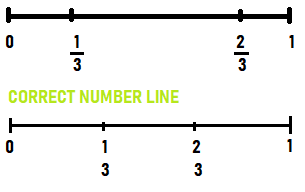
Question 18.
Select all the sentences that describe this shape.
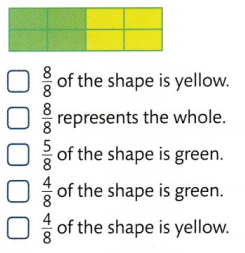
Envision Math Common Core Grade 3 Answers Topic 12 Understand Fractions as Numbers 143
Answer:

Question 19.
Divide the number line into equal lengths. Then mark and label the given fraction.
6 equal lengths; \(\frac{5}{6}\)
Envision Math Common Core Grade 3 Answers Topic 12 Understand Fractions as Numbers 144
Answer:

Explanation:
First divide the number line into 6 equal parts like in the picture below
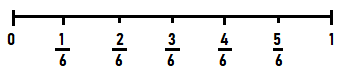
Then mark the 5/6th point

Question 20.
Tony collects colored strings. The table shows the lengths of some of his strings.
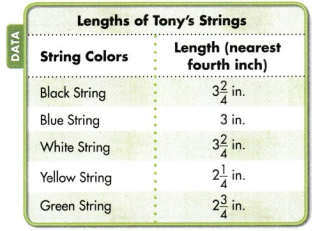
Envision Math Common Core Grade 3 Answers Topic 12 Understand Fractions as Numbers 145
A. Measure the lengths of Tony’s red and brown strings shown below to the nearest fourth inch.

Envision Math Common Core Grade 3 Answers Topic 12 Understand Fractions as Numbers 146
Answer:
Red string     : 3     inches
Brown string : 2¾ inches

B. Draw a line plot to show the lengths of Tony’s 7 strings to the nearest fourth inch.
Answer:

Topic 12 Performance Task

Art Display
Three students, Zach, Allie, and Paige, are making an art display.

Use the Paint Colors list and the design at the right to answer Questions 1-4.
Question 1.
The display will be divided into 8 equal parts. Paint Colors Draw lines to show one way to do this. Then write the fraction that describes the the total shape that is represented by 1 equal part.
Paint Colors

  • Allie is painting the blue parts.
  • Paige is painting the red parts.
  • Zach is painting the yellow parts.
  •  Each student will paint at least 2 parts.
    Envision Math Common Core Grade 3 Answers Topic 12 Understand Fractions as Numbers 147

Answer:

1/8 part

Question 2.
Shade the parts blue, yellow, or red to show how many parts each student could paint. Write fractions to show how much of the total display Allie and Paige painted.
Answer:

  • Allie is painting the 3 blue parts.      3/8
  • Paige is painting the 3 red parts.      3/8
  • Zach is painting the 2 yellow parts.

Question 3.
Divide the number line into the number of equal parts of the display. Then mark a dot to show the fraction of the display that Zach painted on the number line.

Envision Math Common Core Grade 3 Answers Topic 12 Understand Fractions as Numbers 148
Answer:

Question 4.
Which fraction represents the whole display? Explain. Then mark a dot to show where this fraction is located on the number line above.
Answer:
8/8 is the whole fraction

Use the Ribbon Lengths diagram on the right and the Number of Ribbons table below to answer Question 5.
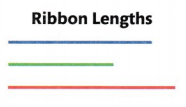
Envision Math Common Core Grade 3 Answers Topic 12 Understand Fractions as Numbers 149

Question 5.
The students will use the ribbon lengths at the right in their display
Part A
Measure and record the lengths of each of these ribbons to the nearest fourth inch.
Answer:
RED Ribbon : 3¾
BLUE Ribbon : 3 2/4  [3½]
GREEN Ribbon : 3¼

Part B
The Number of Ribbons table shows how many of each color ribbon will be used. Draw a line plot to show this data.
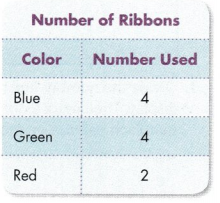
Envision Math Common Core Grade 3 Answers Topic 12 Understand Fractions as Numbers 150
Answer:

Question 6.
In order to complete the display, the students recorded the number of half-hour sessions they spent working together. The number line below is divided into equal parts. Each part represents half an hour. Write the missing fractions on the number line.
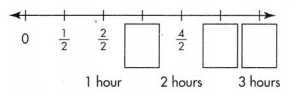
Envision Math Common Core Grade 3 Answers Topic 12 Understand Fractions as Numbers 151
Answer:

enVision Math Common Core Grade 3 Answer Key Topic 11 Use Operations with Whole Numbers to Solve Problems

Go through the enVision Math Common Core Grade 3 Answer Key Topic 11 Use Operations with Whole Numbers to Solve Problems and finish your homework or assignments.

enVision Math Common Core 3rd Grade Answers Key Topic 11 Use Operations with Whole Numbers to Solve Problems

Essential Question:
What are ways to solve 2-step problems?
Envision Math Common Core 3rd Grade Answer Key Topic 11 Use Operations with Whole Numbers to Solve Problems 1

enVision STEM Project: Engineering Design
Do Research Use the Internet or other sources to find information about kites. Find two designs for building a kite. What materials do you need for each design? How much do those materials cost?
Journal: Write a Report Include what you found. Also in your report:

  • Find the total cost for each design.
  • Decide which design is less expensive.
  • Write an equation to show how much less expensive that design is.

Review What You Know

Vocabulary
Choose the best term from the box. Write it on the blank.

  • equation
  • product
  • quotient
  • unknown

Question 1.
The equal sign shows that the left side of a(n) __________ has the same value as the right side.
Answer:
The equal sign shows that the left side of a(n) equation has the same value as the right side.

Question 2.
A question mark can be a symbol for a(n) _________ value.
Answer:
A question mark can be a symbol for a(n) unknown value.

Question 3.
The answer to a division problem is the _________.
Answer:
The answer to a division problem is the Quotient .

Addition and Subtraction

Question 4.
739 – 104
Answer:
Envision-Math-Common-Core-3rd-Grade-Answers-Key-Topic-11-Use-Operations-with-Whole-Numbers-to-Solve-Problems-Addition-and-Subtraction-Question-4

Question 5.
512 + 216
Answer:
Envision-Math-Common-Core-3rd-Grade-Answers-Key-Topic-11-Use-Operations-with-Whole-Numbers-to-Solve-Problems-Addition-and-Subtraction-Question-5

Question 6.
710 – 569
Answer:
Envision-Math-Common-Core-3rd-Grade-Answers-Key-Topic-11-Use-Operations-with-Whole-Numbers-to-Solve-Problems-Addition-and-Subtraction-Question-6

Question 7.
104 + 67
Answer:
Envision-Math-Common-Core-3rd-Grade-Answers-Key-Topic-11-Use-Operations-with-Whole-Numbers-to-Solve-Problems-Addition-and-Subtraction-Question-7

Question 8.
664 + 78
Answer:
Envision-Math-Common-Core-3rd-Grade-Answers-Key-Topic-11-Use-Operations-with-Whole-Numbers-to-Solve-Problems-Addition-and-Subtraction-Question-8

Question 9.
825 – 477
Answer:
Envision-Math-Common-Core-3rd-Grade-Answers-Key-Topic-11-Use-Operations-with-Whole-Numbers-to-Solve-Problems-Addition-and-Subtraction-Question-9

Multiplication and Division

Question 10.
60 ÷ 6
Answer:
60 ÷ 6 = 10
Explanation :
Envision-Math-Common-Core-3rd-Grade-Answers-Key-Topic-11-Use-Operations-with-Whole-Numbers-to-Solve-Problems-Multiplication-and-Division-Question-10

Question 11.
40 × 4
Answer:
40 × 4 = 160
Explanation :
Envision-Math-Common-Core-3rd-Grade-Answers-Key-Topic-11-Use-Operations-with-Whole-Numbers-to-Solve-Problems-Multiplication-and-Division-Question-11

Question 12.
7 × 3
Answer:
7 × 3 = 21 .

Question 13.
(3 × 10) × 6 =
A. (3 × 10) + (6 × 10)
B. (3 × 6) + (10 × 6)
C. 3 × (10 × 6)
D. (10 + 10 + 10) + 6
Answer:
Option C.
(3 × 10) × 6 = 3 × 10 × 6 = 180 .
Explanation :
All signs are multiplication signs in the Equation so, just remove the brackets .

Question 14.
4 × (20 × 2) =
A. (4 × 20) × 2
B. (4 × 20) + (4 × 2)
C. 4 + (20 + 20)
D. (4 + 20) + (4 + 2)
Answer:
Option A .
4 × (20 × 2) = 4 × 20 × 2 = 160
Explanation :
All signs are multiplication signs in the equation so, just remove the brackets .

Model with Math

Question 15.
Caleb has 8 toy cars. Each car has 4 wheels. He wants to know how many wheels are on all of his cars. Represent this problem using a bar diagram and an equation. Then solve.
Answer:
Number of Car toys = 8
Number of wheels for each car toy = 4 wheels .
Total number of wheels for 8 car toys = 8 × 4 = 32 wheels .

Pick a Project

PROJECT 11A
Why do stores have sales and other promotions?
Project: Write a Skit About a Sale
Envision Math Common Core 3rd Grade Answer Key Topic 11 Use Operations with Whole Numbers to Solve Problems 2

PROJECT 11B
How did grapefruit first come to Florida?
Project: Create a Poster About Citrus Groves
Envision Math Common Core 3rd Grade Answer Key Topic 11 Use Operations with Whole Numbers to Solve Problems 3

PROJECT 11C
How would you make a budget for selling lemonade in a lemonade stand?
Project: Perform a Song About Lemonade
Envision Math Common Core 3rd Grade Answer Key Topic 11 Use Operations with Whole Numbers to Solve Problems 4

3-ACT MATH PREVIEW

Math Modeling
Cash Bucket
Envision Math Common Core 3rd Grade Answer Key Topic 11 Use Operations with Whole Numbers to Solve Problems 5
I can … model with math to solve a problem that involves computing with whole numbers..

Lesson 11.1 Solve 2-Step Word Problems: Addition and Subtraction

Solve & Share
Jen buys a backpack and a sleeping bag. She gets $10 off if the total is more than $200. What is the final cost of Jen’s order? Complete the bar diagram below. Then draw another diagram to solve the problem.
I can… draw diagrams and write equations to show how the quantities in a problem are related.
Envision Math Common Core 3rd Grade Answer Key Topic 11 Use Operations with Whole Numbers to Solve Problems 6

Look Back! How can you use an estimate to show that the final cost of the backpack and sleeping bag you found makes sense?
Answer :
Envision-Math-Common-Core-3rd-Grade-Answers-Key-Topic-11-Use-Operations-with-Whole-Numbers-to-Solve-Problems-Lesson-11.1-Solve-2-Step-Word-Problems-Addition-and-Subtraction-Solve-&-Share

Essential Question
How Can You Use Diagrams to Solve 2-Step Problems?

Visual Learning Bridge
The results of a car survey are shown in the table. How many fewer cars in the survey have poor fuel efficiency than have either good or average fuel efficiency? Use estimation to check the answer.
Envision Math Common Core 3rd Grade Answer Key Topic 11 Use Operations with Whole Numbers to Solve Problems 7

Find and answer the hidden question.
How many total cars in the survey have either good or average fuel efficiency?
Envision Math Common Core 3rd Grade Answer Key Topic 11 Use Operations with Whole Numbers to Solve Problems 8

Answer the original question.
How many fewer cars in the survey have poor fuel efficiency?
Envision Math Common Core 3rd Grade Answer Key Topic 11 Use Operations with Whole Numbers to Solve Problems 9

Convince Me! Critique Reasoning Jane used estimation to check the reasonableness of the work above. Explain whether Jane’s work makes sense.
165 and 98 is about 200.
224 minus 200 equals 24, which is close to 39.

Guided Practice

Do You Understand?
Question 1.
How do the bar diagrams help you write equations for the problem on the previous page?
Answer:
A bar is used to represent the whole. So we label it with the amount of the whole. .Finally, we indicate the required number of fractional parts with a question mark and determine the value represented.
In the above problem two quantities are given and total is calculated .

Do You Know How?
Question 2.
Josie has $145. She buys a bike for $127. The next week she saves $15. How much money does Josie have now? Complete the bar diagrams and write equations to solve.
Envision Math Common Core 3rd Grade Answer Key Topic 11 Use Operations with Whole Numbers to Solve Problems 10
Answer:

Explanation:
a = 145 – 127
so, a = 18
18 + 15 = $33
$33 money that Josie have now

Independent Practice

In 3, use the map. Draw diagrams and write equations to solve. Use letters to represent unknown quantities.
Envision Math Common Core 3rd Grade Answer Key Topic 11 Use Operations with Whole Numbers to Solve Problems 11
Question 3.
Manuel’s family drove from Louisville to Indianapolis to Detroit and then directly back to Louisville. How much farther did they drive going to Detroit than returning from Detroit?
Answer:
Distance from Louisville to Indianapolis  = 114 miles .
Distance from Indianapolis to Detroit = 283 miles .
Distance from Louisville to Indianapolis to Detroit =  t = 114 + 283 = 397 miles .

Question 4.
How can you estimate to check if your answer above is reasonable? Explain.
Answer:
Distance from Louisville to Indianapolis  = 114 miles, estimate is 100
Distance from Indianapolis to Detroit = 283 miles, estimate is 300
Distance from Louisville to Indianapolis to Detroit =  t = 114 + 283 = 397 miles, Estimated is  100+300 = 400
400 is close to 397 so, my answer is reasonable.

Problem Solving

Question 5.
Write equations to find how many more tickets were sold for the roller coaster on Saturday than for the swings on both days combined. Use letters to represent the unknown quantities. You can draw diagrams to help.
Envision Math Common Core 3rd Grade Answer Key Topic 11 Use Operations with Whole Numbers to Solve Problems 12
Answer:
swings on both days combined is 138 + 154 = 292
roller coaster on Saturday = 486
For more tickets let us assume as a
a = 486 – 292
a = 194

Question 6.
Higher Order Thinking Write a two-step problem about buying or selling books that can be solved using addition or subtraction. Solve your problem.
Answer: Kia bought 400 Science books Diana bought 200 Math’s books. How much more books Kia bought than Diana
Explanation:
400 – 200 = 200
200 more books Kia bought than Diana

Question 7.
enVision® STEM Lindsay has 6 boxes of toothpicks. There are 80 toothpicks in each box. Lindsay uses all of the toothpicks to build a model bridge. How many toothpicks does Lindsay use in all?
Answer:
80 x 6 = 480
Explanation:
Lindsay has 6 boxes of toothpicks.
There are 80 toothpicks in each box.
Lindsay uses all of the toothpicks to build a model bridge.
80 x 6 = 480 toothpicks that Lindsay use in all

Question 8.
Model with Math Matt had 327 plastic bottles for recycling. He recycled 118 bottles on Monday. He recycled 123 bottles on Tuesday. How many bottles does Matt have left to recycle? Use representations such as bar diagrams or equations to model with math. Use letters to represent the unknown quantities. Estimate to check your work.
Envision Math Common Core 3rd Grade Answer Key Topic 11 Use Operations with Whole Numbers to Solve Problems 13
Answer:
Let a be the Unknown quantity
118 + 123 = 241
a = 327 – 247
a = 80
Explanation:
80 bottles that Matt have left to recycle
Estimation:
120 + 120 = 240
320 – 240 = 80
The estimated value is close to the answer so, my answer is reasonable.

Assessment Practice

Question 9.
Ukie has 142 leaves in her collection. She gives 25 to her brother and then collects 19 more. Create and solve equations to find the number of leaves Ukie has now.
Answer:

Question 10.
Richard had $236 in his savings account. He got $45 for his birthday and saved all but $16 of it. Create and solve equations to find the amount in Richard’s savings account now.
Answer:
45 + 16 = $61
236 – 61 = $175
Explanation:
Richard had $236 in his savings account.
He got $45 for his birthday and saved all but $16 of it.
The amount in Richard’s savings account now is $175

Lesson 11.2 Solve 2-Step Word Problems: Multiplication and Division

Solve & Share
Two friends decide to share equally all of the apples they picked. They filled the bags shown with 4 apples in each bag. How many apples will each friend get?
I can … draw diagrams and write equations to show how the quantities in a problem are related.
Envision Math Common Core 3rd Grade Answer Key Topic 11 Use Operations with Whole Numbers to Solve Problems 14

Look Back! Tell why multiplication can be used to find the total number of apples.

Essential Question
How Can You Use Diagrams to Solve 2-Step Problems?

Visual Learning Bridge
The teams for the City Baseball Tournament are divided equally into 3 leagues. Each league is divided into 2 regions with the same number of teams in each region. How many teams are in each region?
Envision Math Common Core 3rd Grade Answer Key Topic 11 Use Operations with Whole Numbers to Solve Problems 15

Step 1
Find and answer the hidden question.
How many teams are in each league?
Envision Math Common Core 3rd Grade Answer Key Topic 11 Use Operations with Whole Numbers to Solve Problems 16
t = 24 ÷ 3
t = 8
There are 8 teams in each league.

Step 2
Use the answer to the hidden question to answer the original question.
How many teams are in each region?
Envision Math Common Core 3rd Grade Answer Key Topic 11 Use Operations with Whole Numbers to Solve Problems 17
r = 8 ÷ 2
r = 4
There are 4 teams in each region.

Convince Me! Make Sense and Persevere Another tournament has 2 leagues with 9 teams in each league. An equal number of teams will play on each of the 3 days of the tournament. Each team will play once. How many teams will play on each day?
Answer:
tournament has 2 leagues with 9 teams in each league.
2 x 9 = 18
An equal number of teams will play on each of the 3 days of the tournament.
18 ÷ 3 = 6
6 teams will play on each day.

Guided Practice

Do You Understand?
Question 1.
Why do you need to solve the hidden question first for the problem in Box A on the previous page?
Answer:
As it is divided in to 2 teams
first we have to know how many teams are there
so, First we found the hidden question first.

Question 2.
What multiplication equation could be written for the bar diagram in Box C on the previous page?
Envision Math Common Core 3rd Grade Answers Topic 11 Use Operations with Whole Numbers to Solve Problems 18
Answer:
3 x 8 = 24
They are inverse proportion equations.

Do You Know How?
In 3, complete the bar diagrams and write equations to solve.
Question 3.
There are 8 students in 2 school vans with the same number of students in each van. The admission fee for each student is $5. What is the total admission fee for all of the students in one van?
Envision Math Common Core 3rd Grade Answers Topic 11 Use Operations with Whole Numbers to Solve Problems 19
Answer:

Explanation:
There are 8 students in 2 school vans with the same number of students in each van.
8 ÷2 = 4
The admission fee for each student is $5.
8 x 5 = 40
What is the total admission fee for all of the students in one van

Independent Practice

In 4, draw diagrams and write equations to solve. Use letters to represent the unknown quantities.
Question 4.
Arif saves $4 each week. After 6 weeks, he spends all the money he saved on 3 items. Each item costs the same amount. How much does each item cost?
Answer: $8
Explanation:
Arif saves $4 each week. After 6 weeks,
6 x 4 = 24
he spends all the money he saved on 3 items.
24 ÷ 3 = 8
Each item costs the same amount.
Each item cost $8

Question 5.
Georgia says that because she knows 5 × 4 = 20, she knows Arif will have saved more than $20. Is Georgia correct? Explain.
Answer:  Yes, Georgia correct.
Explanation:
The information given is
Arif saves $4 each week. After 6 weeks,
6 x 4 = 24
According to the information 24 >20

Problem Solving

Question 6.
Be Precise One Grade 3 class collected 86 pounds of newspaper. The other Grade 3 class collected 65 pounds of newspaper. Which grade collected the greatest number of pounds of newspaper?
Envision Math Common Core 3rd Grade Answers Topic 11 Use Operations with Whole Numbers to Solve Problems 20
Answer:
One Grade 3 class collected 86 pounds of newspaper.
The other Grade 3 class collected 65 pounds of newspaper.
86 > 65
85 + 65 = 150
so,  Grade 3 class collected more.

Question 7.
Six pounds of pecans are shared equally between 2 friends. Each pound has 60 pecans. How many pecans does each friend get? Write equations to solve. Use letters to represent the unknown quantities.
Envision Math Common Core 3rd Grade Answers Topic 11 Use Operations with Whole Numbers to Solve Problems 21
Answer:
18 pecans that each friend get
Explanation:
Let the unknown quantity be a
Six pounds of pecans are shared equally between 2 friends.
6 ÷2 = 3
Each pound has 60 pecans.
6 x 60= 36 pecans.
Total friends are 2
36 ÷ 2 = 18
18 pecans that each friend get

Question 8.
Higher Order Thinking A store can buy boxes of 8 calculators each for $32 or boxes of 5 calculators each for $30. How much less I CICIC is each calculator if the store buys boxes of 8 calculators each instead of boxes of 5 calculators each? Complete the bar diagrams and solve.
Envision Math Common Core 3rd Grade Answers Topic 11 Use Operations with Whole Numbers to Solve Problems 22
Answer:

Explanation:
A store can buy boxes of 8 calculators each for $32 or boxes of 5 calculators each for $30.
32 ÷ 8 = 4
30 ÷ 5 = 6
2 less  is each calculator if the store buys boxes of 8 calculators each instead of boxes of 5 calculators each
6 – 4 = 2

Assessment Practice

Question 9.
In a basketball game, Morgan made 9 shots, each worth 2 points. Jim scored the same number of points in the game. Jim’s shots were worth 3 points each. How many shots did Jim make?
A. 4 shots
B. 6 shots
C. 8 shots
D. 9 shots
Answer: D
Explanation:
9 x 2 = 18
18 ÷ 3 = 9 Shots

Question 10.
Mia saved an equal amount of money each week for 6 weeks. Heather saved $3 a week for 8 weeks. Mia and Heather saved the same total amount. Which equation could you use to help find how much Mia saved each week?
A. s = 8 × 6
B. s = 6 × 3
C. s = 6 ÷ 3
D. s = 24 ÷ 6
Answer: D
Explanation:
Mia saved an equal amount of money each week for 6 weeks.
Heather saved $3 a week for 8 weeks.
8 x 3 = 24
Mia and Heather saved the same total amount.
s = 24 ÷ 6
s = 4

Lesson 11.3 Solve 2-Step Word Problems: All Operations

Solve & Share

An aquarium had 75 clownfish in a large water tank. The clownfish represented in the graph were added to this tank. How many clownfish are in the tank now? Write and explain how you found the answer.
I can … solve two-step word problems involving different operations.
Envision Math Common Core 3rd Grade Answers Topic 11 Use Operations with Whole Numbers to Solve Problems 23

Look Back! What operations did you use to solve this problem? Tell why you needed those operations.
Explanation:
9 x 5 = 45 Recent arrivals at the aquarium
An aquarium had 75 clownfish in a large water tank.
The clownfish represented in the graph were added to this tank.
75 + 45 = 120
120 clownfish are in the tank now.

Essential Question
How Can You Solve 2-Step Problems?

Visual Learning Bridge
Jill can rent a car and GPS device for $325 for 7 days. What is the cost to rent the car for a week without the GPS device? Use estimation to check the answer.
a = cost to rent the GPS for 7 days
b = cost to rent the car without the GPS for 7 days
Envision Math Common Core 3rd Grade Answers Topic 11 Use Operations with Whole Numbers to Solve Problems 24

To solve a two-step problem, you first have to find and answer the hidden question.
The hidden question is:
How much does it cost to rent the GPS for 7 days?
Write and solve an equation for the hidden question. Use a letter for the unknown quantity.
7 × $9 = a
$63 = a
It costs $63 to rent the GPS for 7 days.

Write and solve an equation for the problem. Use a letter for the unknown quantity
$325 – $63 = b
$262 = b
It costs $262 to rent the car without the GPS for 7 days.
You can use compatible numbers and mental math to estimate. 7 × 9 = 63. 63 is close to 75 and 325 – 75 is 250. 250 is close to 262, so the
answer is reasonable.

Convince Me! Use Structure Jill can rent a different car and a DVD player for $384 for 7 days. She wants to know the cost to rent the car for a week without the DVD player. Explain how this problem is different from the problem above. Then solve.

To solve a two-step problem, you first have to find and answer the hidden question.
The hidden question is:
How much does it cost to rent the DVD for 7 days?
Write and solve an equation for the hidden question. Use a letter for the unknown quantity.
7 × $6 = a
$42 = a
It costs $42 to rent the DVD for 7 days.

Write and solve an equation for the problem. Use a letter for the unknown quantity
$384 – $42 = b
$342 = b
It costs $342 to rent the car without the DVD for 7 days.
You can use compatible numbers and mental math to estimate. 7 x 6 = 42, 42 is close to 50 and 384 – 50 is 334. 334 is close to 342, so the
answer is reasonable.

Guided Practice

Do You Understand?
Question 1.
Dotty says you also can use $63 + b = $325 instead of $325 – $63 = b for the problem on the previous page. Can this equation be used to get the correct answer? Explain.
Answer:
Yes, this equation can be used to get the correct answer
When we bring Generally, the algebraic expression should be any one of the forms such as addition, subtraction, multiplication and division. To find the value of x, bring the variable to the left side and bring all the remaining values to the right side. Simplify the values to find the result.

Question 2.
When solving a two-step problem, why should you answer the hidden question first?
Answer:
For Finding the value we have to find the hidden value first.

Do You Know How?
In 3, write equations to solve. Use letters to represent unknown quantities.
Question 3.
Look at Box A on the previous page. How much would it cost Jill to rent the car for a week with the GPS and DVD player?
Answer:
Let the unknown quantity be a
Jill to rent the car for a week with the GPS and DVD player
a = 262 + 342
a = 604 it cost Jill to rent the car for a week with the GPS and DVD player

Independent Practice

In 4 and 5, write equations to solve. Use letters to represent the unknown quantities.
Question 4.
Trish bought 4 yards of rope to make a swing. Judy spent $18 on rope. How much did the two girls spend in all?
Envision Math Common Core 3rd Grade Answers Topic 11 Use Operations with Whole Numbers to Solve Problems 25
Answer: $30
Explanation:
Per yard is $3
4 x 3 = $12
The two girls spend in all
$12 + $18 = $30

Question 5.
Martha has 12 stamps. Toni has 21 stamps. Toni divides her stamps into 3 equal groups. She gives one group to Martha. How many stamps does Martha have now?
Envision Math Common Core 3rd Grade Answers Topic 11 Use Operations with Whole Numbers to Solve Problems 26
Answer:  19 stamps.
Explanation:
Martha has 12 stamps.
Toni has 21 stamps. Toni divides her stamps into 3 equal groups.
21 ÷ 3 = 7
She gives one group to Martha.
12 + 7 = 19
19 stamps that Martha have now

Problem Solving

In 6 and 7, use the fruit shown at the right.
Envision Math Common Core 3rd Grade Answers Topic 11 Use Operations with Whole Numbers to Solve Problems 27
Question 6.
Maurice needs 36 apples for his party. How much will the apples cost?
Answer:
9 apples = $3
36 ÷ 9 = 4
4 x 3 = $12
Explanation:
$12 will the apples cost

Question 7.
Higher Order Thinking Delia bought 24 lemons and 63 apples. How much did she spend on fruit?
Answer: 21 + 12 = 33 she spend on fruit
Explanation:
6 lemons = 3
9 apples = 3
Delia bought 24 lemons and 63 apples.
24 ÷  6 = 4
63 ÷  9 = 7
4 x 3 = 12
7 x 3 = 21
21 + 12 = 33 she spend on fruit

Question 8.
Vocabulary Fill in the blank. When you ________ 72 to the nearest ten, you get 70.
Answer: Regroup
Explanation:
When you Regroup 72 to the nearest ten, you get 70

Question 9.
Generalize Carla collected 328 shells. Dan collected 176 shells. How can you use compatible numbers to estimate how many shells they collected?
Answer:
The compatible numbers of 328 and 176 are 300 and 200
Explanation:
300 +200 = 500
328 + 176 = 504
504 is very close to 500
so, my estimation is reaasonable.

Question 10.
enVision® STEM Sasha is using the engineering design process to plan a scratching post for her cat. There will be 3 levels. Sasha will spend $10 on the pole. She will spend $7 on each level. Sasha’s plan to find the total cost is shown at the right. Is she correct? Explain.
3 × $10 = $30
$30 + $7 = $37
Answer: No,
Explanation:
Sasha is using the engineering design process to plan a scratching post for her cat.
There will be 3 levels. Sasha will spend $10 on the pole.
3 x 7 = $21
21 + 10 = 31$

Assessment Practice

Question 11.
Use the fruit from Exercises 6 and 7. Kaylie bought 4 bags of oranges and 1 bag of apples. How many pieces of fruit did she buy? Write equations to solve. Use letters to represent any unknown quantities.
Answer:
Explanation:
4 bags of oranges and 1 bag of apples
1 bag holds 10 oranges 4 x 10 = 40
1 bag holds 9 apples 1 x 9 = 9
40 + 9 = 49

Lesson 11.4 Problem Solving

Critique Reasoning
Solve & Share
Concert tickets for adults cost $12. Concert tickets for students cost $9. Marie has $190. She wants to buy 1 adult and 20 student tickets.

Skip says, “$190 is enough for all the tickets because $9 × 20 = $180 and $180 is less than $190.”

Does Skip’s reasoning make sense? Explain.

I can … critique the reasoning of others using what I know about estimating.
Explanation:
No, Skip’s reasoning doesn’t make sense
Skip says, “$190 is enough for all the tickets because $9 × 20 = $180 and $180 is less than $190.”
He want to buy 1 adult ticket more
that cost $12
He need $2 more.

Thinking Habits
Be a good thinker! These questions can help you.

  • What questions can I ask to understand other people’s thinking?
  • Are there mistakes in other people’s thinking?
  • Can I improve other people’s thinking?
    Envision Math Common Core 3rd Grade Answers Topic 11 Use Operations with Whole Numbers to Solve Problems 28

Look Back! Critique Reasoning What did Skip get correct in his reasoning and what did he get wrong?

Essential Question
How Can You Critique the Reasoning of Others?

Visual Learning Bridge
Gina has $68. She earns $9 an hour babysitting. She wants to buy a computer program for $130.
Will Gina have enough money to buy the program if she babysits for 6 hours?
Danielle solved this problem.
Her work is shown at the right.

6 × $9 = $54, which is about $60.
Gina has $68, which is about $70.
$60 + $70 = $130
Gina can buy the program.

What is Danielle’s reasoning to support her conclusion?
Danielle used an estimate to add the amount Gina made babysitting to the amount she already had.

How can I critique the reasoning of others?
I can

  • ask questions for clarification.
  • decide if the strategy used makes sense.
  • look for flaws in estimates or calculations.

Here’s my thinking…
Danielle’s reasoning has flaws. Because Danielle rounded up each time, her total estimate adds up to more than the actual amount Gina will have.
6 × 9 = $54
$54 + $68 = $122
Danielle’s conclusion is not correct because the actual amount Gina will have is less than $130.

Convince Me! Critique Reasoning Tony says that if Gina babysits for 8 hours, she will have enough money. He reasons that 8 × $9 = $72, which rounds to $70, and $70 + $60 = $130. Does his reasoning make sense? Explain.
Explanation:
Yes his decision make sense.
130 = 130
he reaches the goal.

Guided Practice

Critique Reasoning Miguel’s and Nita’s goal is to collect 600 box tops. When you critique Miguel collects 253 box tops in January and 158 box reasoning, you can look for tops in February. Nita collects 209 box tops in all.

Teri estimates they have already collected more than clarify or improve their goal. She estimates that 250 + 150 = 400 and 400 + 200 = 600.
the reasoning.
Envision Math Common Core 3rd Grade Answers Topic 11 Use Operations with Whole Numbers to Solve Problems 29
Question 1.
What is Teri’s argument? How does she support it?
Answer:
Yes, Teri’s argument is true. She rounded to the lowest values than the expected
so, by this she can fill the goal
She estimates that 250 + 150 = 400 and 400 + 200 = 600.
253 + 158 = 411 and 411 + 209 = 620
620 > 600

Question 2.
Does Teri’s conclusion make sense? Explain.
Answer: Yes
As 620 > 600
Miguel’s and Nita’s goal is to collect 600 box tops will satisfy

Independent Practice

Critique Reasoning
Gill gets 24 stickers on Monday. She gets the same number of stickers on Tuesday. Gill then shares all of her stickers equally among 8 friends.

Liam concluded that each friend gets fewer than 5 stickers. His work is shown at the right.
Liam’s work
8 × 3 = 24
So, 24 ÷ 8 = 3.
Each friend gets 3 stickers. 3 is less than 5.

Question 3.
What is Liam’s argument? How does he support it?
Answer:
Liam’s work
8 × 3 = 24
So, 24 ÷ 8 = 3.
Each friend gets 3 stickers. 3 is less than 5.

Question 4.
Does Liam’s reasoning make sense? Explain.
Answer:
No, Gill gets 24 stickers on Monday. She gets the same number of stickers on Tuesday.
According to the statement
24 + 24 = 48
48 ÷ 8 = 6
Liam concluded that each friend gets fewer than 5 stickers.
But each friend get 6 stickers each

Question 5.
Explain the strategy you would use to improve Liam’s work.
Answer:
He did not added the Tuesday work
Thus his estimation does not make sense.

Problem Solving

Performance Task
Selling Buttons A Grade 3 class is going to buy buttons like the ones shown. Each package costs $8. Each package is 40 cm long. They need to know if $50 is enough money to buy 200 buttons.
Envision Math Common Core 3rd Grade Answers Topic 11 Use Operations with Whole Numbers to Solve Problems 30
Jim’s work
6 × 30 = 180 buttons, which is not enough.
7 × 30 = 210 buttons, so the class needs to buy 7 packages.
7 × $8 = $48
48 < 50
$50 is enough.

Question 6.
Make Sense and Persevere Which given information do you NOT need to solve this problem?
Answer:
length of the packet
Explanation:
Each package is 40 cm long. Is the irrelevant information
Which is not used to solve the equation.

Question 7.
Critique Reasoning Jim solved the problem as shown above. Does Jim’s strategy make sense? Explain.
Envision Math Common Core 3rd Grade Answers Topic 11 Use Operations with Whole Numbers to Solve Problems 31
Answer: Yes. His Critique Reasoning make sense
Jim’s work
6 × 30 = 180 buttons, which is not enough.
7 × 30 = 210 buttons, so the class needs to buy 7 packages.
7 × $8 = $48
48 < 50
$50 is enough.
By this information we can conclude that $50 is enough for 200 buttons.

Question 8.
Be Precise Are Jim’s calculations correct? Explain how you decided.
Answer: Yes, Jim’s calculations are correct
6 × 30 = 180 buttons, which is not enough.
7 × 30 = 210 buttons, so the class needs to buy 7 packages.
7 × $8 = $48
48 < 50
$50 is enough.
According to this information.

Question 9.
Use Appropriate Tools Can place-value blocks be used to check whether Jim’s math is correct? Explain.
Answer:
No, We cannot use the place value blocks

Topic 11 Fluency Practice Activity

Find a Match
Work with a partner. Point to a clue. Read the clue.

Look below the clues to find a match. Write the clue letter in the box next to the match.

Find a match for every clue.
I can… multiply and divide within 100.

Clues
A. The product is between 55 and 60.
B. The product is equal to 10 × 2.
C. The quotient has two digits.
D. The product is between 50 and 55.
E. The quotient is less than 5.
F. The product is between 30 and 40.
G. The quotient is a multiple of 3.
H. The quotient is equal to the divisor.
Envision Math Common Core Grade 3 Answer Key Topic 11 Use Operations with Whole Numbers to Solve Problems 32
Explanation:

Explanation:
The table is completed according to the given clues.

Topic 11 Vocabulary Review

Understand Vocabulary
Choose the right term from the Word List. Write it in the blank.
Word List

  • difference
  • dividend
  • divisor
  • equation
  • factor
  • product
  • quotient
  • sum
  • unknown

Question 1.
The missing number in an equation is a(n) ___________.
Answer: Unknown
Explanation:
The unknown numbers are called missing values.

Question 2.
A multiplication problem has more than one __________.
Answer: Factors
Explanation:
Multiplying two whole numbers gives a product. The numbers that we multiply are the factors of the product.

Question 3.
A bar diagram can help you write a(n) _________.
Answer: Sum
Explanation:
A bar diagram can be used to represent math problems. Bar diagrams show how the numbers in a word problem are related. This bar diagram models addition. The parts represent the addends.

Question 4.
In a division problem, you divide the _______ by the ________.
Answer: Dividend by the divisor
Explanation:
In a division problem, you divide the Dividend by the Divisor.

Draw a line to match the term to the result of a relationship between the numbers 80 and 4.

Envision Math Common Core Grade 3 Answer Key Topic 11 Use Operations with Whole Numbers to Solve Problems 33
Answer:

Explanation:
80 – 4 = 76
80 x 4 = 320
80 ÷ 4 = 20
80 + 4 = 84

Use Vocabulary in Writing
Question 9.
There are 52 cards in a deck. Al turns 4 cards face up. Then he deals the rest of the cards to 6 people. How many cards does each person get? Explain how to solve this problem. Use at least 2 terms from the word list.
Answer: 8 cards
Explanation:
There are 52 cards in a deck. Al turns 4 cards face up.
Then he deals the rest of the cards to 6 people.
52 – 4 = 48
48 ÷ 6 = 8
Each person get 8 Cards

Topic 11 Reteaching

Set A pages 409-412

You can use more than one step to solve problems.
Use bar diagrams to help write equations.
A ship has 439 passengers. One hundred seventy-nine new passengers get on at a port. Then 250 passengers get off. How many passengers are on the ship now?
Envision Math Common Core Grade 3 Answer Key Topic 11 Use Operations with Whole Numbers to Solve Problems 34

Remember to check for reasonableness after each step.

In 1, draw bar diagrams and write equations to solve the problem.
Question 1.
Mr. Sato has $800. He spends $600 on rent. Then he spends $85 on groceries. How much money does he have left?
Answer:

Explanation:
800 – 600 = 200
200 -85 = 115 money that Mr. Sato has left

Set B pages 413-416

You can use bar diagrams and equations to show how numbers are related.
Roger reads a poem with 16 lines. Each line has 7 words. The poem is on 2 pages with the same number of lines on each page. How many words are on each page?
Envision Math Common Core Grade 3 Answer Key Topic 11 Use Operations with Whole Numbers to Solve Problems 35
16 ÷ 2 = a lines on each page
a = 8 lines
Envision Math Common Core Grade 3 Answer Key Topic 11 Use Operations with Whole Numbers to Solve Problems 36
8 × 7 = w words on each page
w = 56 words

Remember to use unknowns to stand for the numbers you need to find.

In 1, draw bar diagrams and write equations to solve the problem.
Question 1.
A rancher has 24 cows. He puts an equal number of cows in 4 fields. Each cow produces 5 gallons of milk. How much milk do the cows in one field produce?
Answer:

24 ÷8 = 3
3 x 5 = 15 gallons of milk the cows in one field produce

Set C pages 417-420

Ryan reads a book with 420 pages. He also reads 7 magazine articles. Each article has 6 pages. How many pages does Ryan read?

First, write and solve an equation for the hidden question. Use a letter for the unknown quantity.
n = number of article pages
7 × 6 = n
42 = n
Then, write and solve an equation for the problem. Use a letter for the unknown quantity.
t = total pages read
420 + 42 = t
462 = t
Ryan reads 462 pages.

Remember to perform the operations in the correct order for the problem.

In 1 and 2, write equations to solve. Use letters to stand for unknown quantities.
Question 1.
Destiny gets $168 for selling mint cookies and chocolate cookies. She sells 8 boxes of chocolate cookies at $9 per box. How much does Destiny get for selling mint cookies?
Answer: $96 that Destiny get for selling mint cookies
Explanation:
Let the unknown value be n
8 x 9 = $72
n = 168 – 72
n = $96

Question 2.
Mary buys three books that cost $7 and one book that costs $12. How much did Mary spend on books?
Answer: $33 Mary spend on books
Explanation:
Let the total be n
3 x 7 = 21
n = 21 + 12
n = 33

Set D pages 421-424

Think about these questions to help you critique the reasoning of others.
Thinking Habits

  • What questions can I ask to understand other people’s thinking?
  • Are there mistakes in other people’s thinking?
  • Can I improve other people’s thinking?
    Envision Math Common Core Grade 3 Answer Key Topic 11 Use Operations with Whole Numbers to Solve Problems 37

Remember to consider all parts of an explanation.

Pat needs to practice guitar for at least 40 hours this month. He has practiced 9 hours a week for the last 3 weeks. He practiced for 15 hours this week. Pat says, “3 × 9 is less than 40. So I have not practiced enough.”
Question 1.
Does Pat’s reasoning make sense? Explain.
Answer: No
Explanation:
9 x 3 = 27
27 + 15 = 42
42 > 40
He did not estimated this week practicing hours
That is the pat’s mistake.

Question 2.
How can you clarify or improve Pat’s reasoning?
Answer:
Pat says, “3 × 9 is less than 40. So I have not practiced enough.”
Explanation:
But last week he practiced 15 hours
3 × 9 is less than 40. that is 27
27 + 15 = 42

Topic 11 Assessment Practice

Question 1.
Emma works at a diner. On Monday, she served 7 tables with 6 people at each table. On Tuesday, she served 72 people. She wants to know how many more people she served on Tuesday than on Monday.

Choose the correct operations to represent this problem using equations. Write each operation on the blanks.
7 ____ 6 = m
72 _____ 42 = d.
+ – × ÷
Answer:
7 x 6 = 42
72 – 42 = 30
Explanation:
multiplication and subtraction operations are used.

Question 2.
Madison has a jar of 160 jelly beans. She saves 88 for herself. She divides the rest equally among 8 friends. She wants to find how many jelly beans each friend gets.
Which equations should she use? Select all that apply.
☐ 80 ÷ 8 = a
☐ 88 – 8 = b
☐ 160 – 88 = c
☐ 160 ÷ 80 = d
☐ 72 ÷ 8 = e
Answer:
160 – 88 = 72
72 ÷ 8 = 9
Explanation:
72 ÷ 8 = e is the equation used
80 ÷ 8 = 10
88 – 8 = 80
160 – 88 = 72
160 ÷ 80 = 2
72 ÷ 8 = 9

Question 3.
Alberto sells magazine subscriptions to his neighbors. Three neighbors each buy 3 subscriptions. There are 8 issues in each subscription. Write and solve equations to find the total number of magazine issues all of his neighbors get.
Answer: 72 issues
Explanation:
Alberto sells magazine subscriptions to his neighbors.
Three neighbors each buy 3 subscriptions
3 x 3 = 9
. There are 8 issues in each subscription.
9 x 8 = 72
the total number of magazine issues all of his neighbors get is 72

Question 4.
Ro’s diner has a jar of 585 toothpicks. At lunch, 315 toothpicks are used. At dinner, 107 toothpicks are used. Ro says that 315 – 107 = t toothpicks are used in all, and that 585 – 208 = r toothpicks are left. Is her answer reasonable? Explain why or why not.
Answer: Yes, her answer is reasonable.
Explanation:
315 – 107 = 208
585 – 208 = 377 toothpicks are left.

Question 5.
Tyler has 127 trading cards in his collection. Chloe has 63 cards in her collection. Then Chloe gives her collection away. She divides it equally among Tyler and 8 other friends. How many cards does Tyler have now?
Answer: 134 cards

Explanation:
63 ÷ 9 = 7
127 + 7 = 134 cards that Tyler have now

Question 6.
Ten people each bring 4 platters of food to a family reunion. The 120 guests all share the platters equally.
A. How many guests share 1 platter?
Answer:
10 x 4 = 40
120 ÷ 40 = 30
30 guests shares 1 platter

B. Landon thinks that the answer is 12 guests. He says, “10 + 4 = 14, and 14 rounds to 10. Then 10 × 12 = 120.” Do you agree with his reasoning? Explain.
Answer: No
Explanation:
His reasoning does not make sense
10 x 4 = 40
120 ÷ 40 = 30
30 guests shares 1 platter
He made the error.

Question 7.
Jeri collects flags of the United Nations. She wants to know how many cases she needs to display her collection. She can fit 9 flags in one case. There are 193 countries in the United Nations. Jeri does not have flags for 130 countries. Which equation could she use first to solve this problem?
A. c = 193 + 130
B. c = 193 – 130
C. f = 72 ÷ 9
D. f = 9 × 7
Answer: D,B
Explanation:
B and D both the equations are used.
193 – 130 = 63
63 ÷ 9 = 7

Question 8.
Mrs. Lazio lives 8 miles from her office. She drives to her office and back 5 days each week. On Saturday she also drives 173 miles to visit her sister. How many miles does Mrs. Lazio drive each week?
Answer:
5 x 8 = 40
40 + 173 = 213
Explanation:
Mrs. Lazio drive each week 213 miles.

Question 9.
José counted beetles for a project. He saw 5 beetles at the park each month and 3 beetles in his backyard each month. How many beetles did he count in 4 months?
A. 7
B. 32
C. 30
D. 8
Answer: B
Explanation:
5 x 4 = 20
3 x 4 = 12
20 + 12 = 32 beetles that he count in 4 months

Question 10.
Gail wants to save $68 for a jacket. She saves money for 3 weeks. Each week she saves $5. What is a good estimate for how much more money Gail needs to save? Select all that apply.
☐ $55
☐ $50
☐ $60
☐ $40
☐ $35
Answer:

Explanation:
3 x 5 = 15
68 – 15 = 53
50 and 55 are the good estimates

Topic 11 Performance Task

Filmmaking Camp
Mrs. Radner and Mr. Yu teach filmmaking at a summer camp. The students work in crews to make movies. The summer ends with the crew and actors watching all the movies.

Class Details

  • Mrs. Radner helps the students who make the action and drama films.
  • Mr. Yu helps the students who make the comedy films.
  • There are 246 actors in all.

Use the Class Details list and Film Types table to answer Questions 1-3.
Envision Math Common Core Grade 3 Answer Key Topic 11 Use Operations with Whole Numbers to Solve Problems 38
Question 1.
There are 20 actors working on each drama film. How many actors are not working on drama films?
Answer:
246 – 20 = 226
Explanation:
Total actors are 246
20 are working for Drama
226 actors are not working on drama films

Question 2.
Mrs. Radner has read 139 pages of the action-film scripts. How many more pages does she need to read to finish reading all of the action-script pages?
Answer:
In 1 film there are 126 pages
2 x 126 = 252
252 – 139 = 113
Explanation:
113 more pages that she need to read to finish reading all of the action-script pages

Question 3.
Mr. Yu says, “I have read 169 pages of the scripts for each comedy film. I need to read 27 more pages to finish reading all of the pages.” Do you agree with his reasoning? Explain why or why not.
Answer: Yes, we agree with his reasoning
Explanation:
Each film has 138
3 x 178 = 534 is the total pages
3 x 169 = 507
507 + 27 = 534
534 = 534

Question 4.
Mrs. Radner wants to find t, the total time to watch all the student films. Use the Film Lengths table to answer the following questions.
Envision Math Common Core Grade 3 Answer Key Topic 11 Use Operations with Whole Numbers to Solve Problems 39
Part A
Mrs. Radner estimates t = 810 minutes. She reasons, “There are 9 films. Most of the films are 90 minutes long. Nine times 90 equals 810.” Do you agree with her reasoning? Explain why or why not.
Answer: No, We cannot agree with her statement
Explanation:
9 out of 5 are 90 minutes
Remaining 4 can be estimated to 45 minutes
half of ninety
5 x 90 = 450
1 x 30 = 30
3 x 60 = 180
450 + 180 + 30 = 660
There is a lot of difference in his estimation to the answer
so, we cannot agree

Part B
Use bar diagrams or equations to represent t. Then find t.
Answer:
5 x 90 = 450
1 x 30 = 30
3 x 60 = 180
450 + 180 + 30 = 660
t = 660

Question 5.
Mrs. Radner sets up chairs for the crew and actors to watch the films. Use the Film Lengths table and Class Details list to answer the following questions.
Part A
How many students are in the crew in all?
Answer:
12 + 10 + 20 = 42
Explanation:
42 students are in the crew in all.

Part B
Find the number of chairs Mrs. Radner needs if 147 students cannot watch the films. Use estimation to check your work.
Answer:
The total number of actors are 246 and 42 students
246 + 42 = 288
288 – 147 = 141
Explanation:
Mrs. Radner needs 141 chairs if 147 students cannot watch the films.

enVision Math Common Core Grade 3 Answer Key Topic 10 Multiply by Multiples of 10

Go through the enVision Math Common Core Grade 3 Answer Key Topic 10 Multiply by Multiples of 10 and finish your homework or assignments.

enVision Math Common Core 2nd Grade Answers Key Topic 10 Multiply by Multiples of 10

Envision Math Common Core Grade 3 Answer Key Topic 10 Multiply by Multiples of 10 1
enVision STEM Project: Animal and Plant Characteristics
Do Research Use the Internet or other sources to find information about how the characteristics of some plants and animals help them survive. Think about how characteristics can be different among members of the same species.
Journal: Write a Report Include what you found. Also in your report:

  • Tell about an insect that uses camouflage.
  • Describe an example of how a plant’s thorns help it survive.
  • Make up and solve multiplication problems about the animals or plants you research. Use multiples of 10.

Review What You Know

Vocabulary

Choose the best term from the box. Write it on the blank.

• multiplication
• factor
• equation
• Zero Property of Multiplication

Question 1.
A number sentence where the value on the left and right of the equal sign (=) is the same is called a(n) ___
Answer:
A number sentence where the value on the left and right of the equal sign (=) is the same is called a(n) = Equation .

Question 2.
The ___ states that any number multiplied by zero has a product of zero.
Answer:
The Zero Property of Multiplication states that any number multiplied by zero has a product of zero.

Question 3.
___ is an operation that gives the total number that results when you join equal groups.
Answer:
Multiplication is an operation that gives the total number that results when you join equal groups.

Multiplication Table

Find the value that makes the equations true. Use the multiplication table to help.
Envision Math Common Core Grade 3 Answer Key Topic 10 Multiply by Multiples of 10 4.1.
21 ÷ 7 = ___
7×__= 21
Answer:
21 ÷ 7 = 3
7× 3= 21
Envision-Math-Common-Core-2nd-Grade-Answers-Key-Topic-10-Multiply-by-Multiples-of-10-Multiplication-Table-Question-4
Explanation :
Step 1: Choose the first number from the numbers listed in the left-most column and the second number from the top-most row.
Step 2: Starting from the 3 move towards the right and starting from the 7 move towards down.  The square where the two numbers meet gives the product 21 .

Question 5.
45 ÷ 5 = ___
5 × __ = 45
Answer:
45 ÷ 5 = 9
5 × 9 = 45
Envision-Math-Common-Core-2nd-Grade-Answers-Key-Topic-10-Multiply-by-Multiples-of-10-Multiplication-Table-Question-5
Explanation :
Step 1: Choose the first number from the numbers listed in the left-most column and the second number from the top-most row.
Step 2: Starting from the 9 move towards the right and starting from the 5 move towards down.  The square where the two numbers meet gives the product 45 .

Question 6.
48 ÷ 6 = ___
6 × __ = 48
Answer:
48 ÷ 6 = 8
6 × 8 = 48
Envision-Math-Common-Core-2nd-Grade-Answers-Key-Topic-10-Multiply-by-Multiples-of-10-Multiplication-Table-Question-6
Explanation :
Step 1: Choose the first number from the numbers listed in the left-most column and the second number from the top-most row.
Step 2: Starting from the 8 move towards the right and starting from the 7 move towards down.  The square where the two numbers meet gives the product 56 .

Question 7.
56 ÷ 8 = ___
8 × __= 56
Answer:
56 ÷ 8 = 7
8 × 7 = 56
Envision-Math-Common-Core-2nd-Grade-Answers-Key-Topic-10-Multiply-by-Multiples-of-10-Multiplication-Table-Question-7
Explanation :
Step 1: Choose the first number from the numbers listed in the left-most column and the second number from the top-most row.
Step 2: Starting from the 3 move towards the right and starting from the 7 move towards down.  The square where the two numbers meet gives the product 21 .

Multiplication Properties

Find each product.

Question 8.
3 × 3 × 2 =___
Answer:
3 × 3 × 2 = 9 × 2 = 18

Question 9.
5 × 1 × 3 = ___
Answer:
5 × 1 × 3 = 5 × 3 = 15

Question 10.
4 × 2 × 4 = ___
Answer:
4 × 2 × 4 = 8 × 4 = 24

Question 11.
2 × 2 × 4 = ___
Answer:
2 × 2 × 4 =4 × 4 = 16

Question 12.
4 × 0 × 2 = ___
Answer:
4 × 0 × 2 = 0 × 2 =0

Question 13.
2 × 5 × 3 = ___
Answer:
2 × 5 × 3 = 10 × 3 =30

Multiplication on the Number Line

Question 14.
Which equation does the number line show?
Envision Math Common Core Grade 3 Answer Key Topic 10 Multiply by Multiples of 10 6.1
A. 1 × 10 = 10
B. 3 × 10 × 1 = 30
C. 4 × 5 = 20
D. 5 × 10 = 50
Answer :
Option D. 5 × 10 = 50
Explanation:
Each jump represents + 10 .
Number of jumps made = 5
so, 5 × 10 = 50 .
from 0 to 50 the equation is represented .

Pick a Project

PROJECT 10A
What do you need to do to plan a trip?
Project: Research the Distance Between Two Cities
Envision Math Common Core Grade 3 Answer Key Topic 10 Multiply by Multiples of 10 6.2

PROJECT 10B
How do stores make sure they have enough of an item to sell?
Project: Create Your Own Store
Envision Math Common Core Grade 3 Answer Key Topic 10 Multiply by Multiples of 10 6.4

PROJECT 10C
How do trees help our environment?
Project: Design a Park and Sing a Song
Envision Math Common Core Grade 3 Answer Key Topic 10 Multiply by Multiples of 10 6.5

PROJECT 10D
How many items can you fit in a box?
Project: Make a Product Game
Envision Math Common Core Grade 3 Answer Key Topic 10 Multiply by Multiples of 10 6.8

Lesson 10.1 Use Patterns to Multiply

Activity

Solve & Share

Companies package their goods in a variety of ways. One company packages a case of water as 2 rows of 10 bottles. How many bottles are in each of the cases shown in the table below? Explain your thinking.
Envision Math Common Core Grade 3 Answer Key Topic 10 Multiply by Multiples of 10 6.9
You can use appropriate tools. Place-value blocks or a number line can help you apply the math you know.
Envision Math Common Core Grade 3 Answer Key Topic 10 Multiply by Multiples of 10 6.10

Look Back! How can place-value patterns help you when multiplying by 20?
Answer :
Number of bottles in 1 case = 2 rows of 10 bottles = 2 × 10 = 20 bottles .
Envision-Math-Common-Core-2nd-Grade-Answers-Key-Topic-10-Multiply-by-Multiples-of-10-Multiplication-Table-Lesson-10.1-Use-Patterns-to-Multiply-Solve-&-Share
Explanation :
Number of bottles in 1 case =  1 jump of 20 is 20. 1 × 20 = 20
Number of bottles in 2 case =  2 jumps of 20 are 40. 2 × 20 = 40
Number of bottles in 3 case =  3 jumps of 20 are 60. 3 × 20 = 60
Number of bottles in 4 case =  4 jumps of 20 are 80. 4 × 20 = 80

Visual Learning Bridge

Glossary

Essential Question
How Can You Use Patterns to Multiply?

A.
A half-century is a period of 50 years. Find the number of years in 5 half-centuries.

Envision Math Common Core Grade 3 Answer Key Topic 10 Multiply by Multiples of 10 6.11
You can use place-value blocks or an open number line to multiply.

Envision Math Common Core Grade 3 Answer Key Topic 10 Multiply by Multiples of 10 6.12

B.
One Way
Find 5 × 50. Use place-value blocks.
Envision Math Common Core Grade 3 Answer Key Topic 10 Multiply by Multiples of 10 6.13
1 × 50 is 1 group of 5 tens = 5 tens or 50
2 × 50 is 2 groups of 5 tens = 10 tens or 100
3 × 50 is 3 groups of 5 tens = 15 tens or 150
4 × 50 is 4 groups of 5 tens = 20 tens or 200
5 × 50 is 5 groups of 5 tens = 25 tens or 250
You can skip count to find the number of years in 5 half-centuries.
Envision Math Common Core Grade 3 Answer Key Topic 10 Multiply by Multiples of 10 6.14
There are 250 years in 5 half-centuries.

C.
Another Way
Find 5 × 50. Use an open number line.
Envision Math Common Core Grade 3 Answer Key Topic 10 Multiply by Multiples of 10 6.15
1 jump of 50 is 50. 1 × 50 = 50
2 jumps of 50 are 100. 2 × 50 = 100
3 jumps of 50 are 150. 3 × 50 = 150
4 jumps of 50 are 200. 4 × 50 = 200
5 jumps of 50 are 250. 5 × 50 = 250
There are place-value patterns when multiplying by multiples of 10.
Envision Math Common Core Grade 3 Answer Key Topic 10 Multiply by Multiples of 10 6.155
There are 250 years in 5 half-centuries.

Convince Me! Use Structure Suppose the multiple of 10 in the table above was 40 years instead of 50. Explain how you can use place-value patterns to find each product.
Answer :
Find 5 × 50. Use place-value blocks.
Envision-Math-Common-Core-2nd-Grade-Answers-Key-Topic-10-Multiply-by-Multiples-of-10-Multiplication-Table-Lesson-10.1-Use-Patterns-to-Multiply-Convince-Me
1 × 40 is 1 group of 4 tens = 4 tens or 40
2 × 40 is 2 groups of 4 tens = 80 tens or 80
3 × 40 is 3 groups of 4 tens = 12 tens or 120
4 × 40 is 4 groups of 4 tens = 16 tens or 160
5 × 40 is 5 groups of 4 tens = 20 tens or 200
There are 200 years in 5 half-centuries.

Guided Practice

Do You Understand?

Question 1.
Explain how to use place-value patterns to multiply 9 × 50.
Answer:
Envision-Math-Common-Core-2nd-Grade-Answers-Key-Topic-10-Multiply-by-Multiples-of-10-Multiplication-Table-Lesson-10.1-Use-Patterns-to-Multiply-Guided-Practice-Question-1
1 jump of 50 is 50. 1 × 50 = 50
2 jumps of 50 are 100. 2 × 50 = 100
3 jumps of 50 are 150. 3 × 50 = 150
4 jumps of 50 are 200. 4 × 50 = 200
5 jumps of 50 are 250. 5 × 50 = 250
6 jumps of 50 are 250. 6 × 50 = 300
7 jumps of 50 are 350. 7 × 50 = 350
8 jumps of 50 are 400. 8 × 50 = 400
9 jumps of 50 are 450. 9 × 50 = 450
There are place-value patterns when multiplying by multiples of 10.

Question 2.
How are the products in Box B on the previous page like skip counting by 5?
Answer:

Do You Know How?

Question 3.
Draw or use place-value blocks to show 3 × 60. Then find the product.
Answer:
Envision-Math-Common-Core-2nd-Grade-Answers-Key-Topic-10-Multiply-by-Multiples-of-10-Multiplication-Table-Lesson-10.1-Use-Patterns-to-Multiply-Guided-Practice-Question-3
1 × 60 is 1 group of 6 tens = 6 tens or 60
2 × 60 is 2 groups of 6 tens = 12 tens or 120
3 × 60 is 3 groups of 6 tens = 18 tens or 180
This are place value blocks of 3 × 60 = 180 .

Question 4.
Use the open number line to multiply 4 × 60.
Envision Math Common Core Grade 3 Answer Key Topic 10 Multiply by Multiples of 10 9.1
Answer:
Envision-Math-Common-Core-2nd-Grade-Answers-Key-Topic-10-Multiply-by-Multiples-of-10-Multiplication-Table-Lesson-10.1-Use-Patterns-to-Multiply-Guided-Practice-Question-4
1 jump of 60 is 60. 1 × 60 = 60
2 jumps of 60 are 120. 2 × 60 = 120
3 jumps of 60 are 180. 3 × 60 = 180
4 jumps of 60 are 240. 4 × 60 = 240

Independent Practice

Leveled Practice In 5-10, use an open number line or draw place-value blocks to find each product.

Question 5.
3 × 70
Envision Math Common Core Grade 3 Answer Key Topic 10 Multiply by Multiples of 10 9.2
Answer:
Envision-Math-Common-Core-2nd-Grade-Answers-Key-Topic-10-Multiply-by-Multiples-of-10-Multiplication-Table-Lesson-10.1-Use-Patterns-to-Multiply-Independent-Practice-Question-5
1 jump of 70 is 70. 1 × 70 = 70
2 jumps of 70 are 140. 2 × 70 = 140
3 jumps of 70 are 210. 3 × 70 = 210
4 jumps of 70 are 280. 4 × 70 = 280

Question 6.
8 × 20
Envision Math Common Core Grade 3 Answer Key Topic 10 Multiply by Multiples of 10 9.3
Answer:
Envision-Math-Common-Core-2nd-Grade-Answers-Key-Topic-10-Multiply-by-Multiples-of-10-Multiplication-Table-Lesson-10.1-Use-Patterns-to-Multiply-Independent-Practice-Question-6
1 × 20 is 1 group of 2 tens = 2 tens or 20
2 × 20 is 2 groups of 2 tens = 4 tens or 40
3 × 20 is 3 groups of 2 tens = 6 tens or 60
4 × 20 is 4 groups of 2 tens = 8 tens or 80
5 × 20 is 5 groups of 2 tens =  10 tens or 100
6 × 20 is 6 groups of 2 tens = 12 tens or 120
7 × 20 is 7 groups of 2 tens = 14 tens or 140
8 × 20 is 8 groups of 2 tens =  16 tens or 160
This are place value blocks of 8 × 20 = 160 .

Question 7.
9 × 30
Answer:
Envision-Math-Common-Core-2nd-Grade-Answers-Key-Topic-10-Multiply-by-Multiples-of-10-Multiplication-Table-Lesson-10.1-Use-Patterns-to-Multiply-Independent-Practice-Question-7
1 jump of 30 is 30. 1 × 30 = 30
2 jumps of 30 are 90. 2 × 30 = 90
3 jumps of 30 are 120. 3 × 30 = 120
4 jumps of 30 are 120. 4 × 30 = 120
5 jumps of 30 are 150. 5 × 30 = 150
6 jumps of 30 are 180. 6 × 30 = 180
7 jumps of 30 are 210. 7 × 30 = 210
8 jumps of 30 are 240. 8 × 30 = 240
9 jumps of 30 are 270. 9 × 30 = 270
There are place-value patterns when multiplying by multiples of 10.

Question 8.
5 × 60
Answer:
Envision-Math-Common-Core-2nd-Grade-Answers-Key-Topic-10-Multiply-by-Multiples-of-10-Multiplication-Table-Lesson-10.1-Use-Patterns-to-Multiply-Independent-Practice-Question-9
1 jump of 60 is 60. 1 × 60 = 60
2 jumps of 60 are 120. 2 × 60 = 120
3 jumps of 60 are 180. 3 × 60 = 180
4 jumps of 60 are 240. 4 × 60 = 240
5 jumps of 60 are 300. 5 × 60 = 300

Question 9.
6 × 60
Answer:
Envision-Math-Common-Core-2nd-Grade-Answers-Key-Topic-10-Multiply-by-Multiples-of-10-Multiplication-Table-Lesson-10.1-Use-Patterns-to-Multiply-Independent-Practice-Question-9
1 jump of 60 is 60. 1 × 60 = 60
2 jumps of 60 are 120. 2 × 60 = 120
3 jumps of 60 are 180. 3 × 60 = 180
4 jumps of 60 are 240. 4 × 60 = 240
5 jumps of 60 are 300. 5 × 60 = 300
6 jumps of 60 are 360. 6 × 60 = 360

Question 10.
2 × 30
Answer:
Envision-Math-Common-Core-2nd-Grade-Answers-Key-Topic-10-Multiply-by-Multiples-of-10-Multiplication-Table-Lesson-10.1-Use-Patterns-to-Multiply-Independent-Practice-Question-10
1 jump of 30 is 30. 1 × 30 = 30
2 jumps of 30 are 90. 2 × 30 = 60
There are place-value patterns when multiplying by multiples of 10.

Problem Solving

Question 11.
The Aztecs had a solar calendar. How many days are in 7 of the longer months in all? Show how to use place value to solve.
Envision Math Common Core Grade 3 Answer Key Topic 10 Multiply by Multiples of 10 9.6
Answer:

Question 12.
Higher Order Thinking On one open number line, show 4 × 30. On the other open number line, show 3 × 40. How are the problems alike? How are they different?
Envision Math Common Core Grade 3 Answer Key Topic 10 Multiply by Multiples of 10 9.10
Answer:
Envision-Math-Common-Core-2nd-Grade-Answers-Key-Topic-10-Multiply-by-Multiples-of-10-Multiplication-Table-Lesson-10.1-Use-Patterns-to-Multiply-Problem-Solving-Question-12
1 jump of 30 is 30. 1 × 30 = 30
2 jumps of 30 are 90. 2 × 30 = 60
3 jump of 30 is 30. 3 × 30 = 90
4 jumps of 30 are 120. 4 × 30 = 120 .

1 jump of 40 is 40. 1 × 40 = 40
2 jumps of 40 are 80. 2 × 40 = 80
3 jumps of 40 are 120. 3 × 40 = 120
jump of both number lines are different but the product is same .

Question 13.
Reasoning Martina has $504. She spends $199 on new computer software. Use mental math to find how much money Martina has left.
Answer:
Total Money with Martina = $504 .
Cost of New computer software = $199 .
Money left with Martina = $504 – $199 = 500 + 4 – (200 – 1) = 300 + 5 = 305$ .

Question 14.
Use place-value blocks to find 1 × 40, 2 × 40,3 × 40, and 4 × 40. What is the same in each of the products you listed?
Answer:
Envision-Math-Common-Core-2nd-Grade-Answers-Key-Topic-10-Multiply-by-Multiples-of-10-Multiplication-Table-Lesson-10.1-Use-Patterns-to-Multiply-Problem-Solving-Question-14
1 × 40 is 1 group of 4 tens = 4 tens or 40
2 × 40 is 2 groups of 4 tens = 80 tens or 80
3 × 40 is 3 groups of 4 tens = 12 tens or 120
4 × 40 is 4 groups of 4 tens = 16 tens or 160
All products end with 0 and all are even numbers .

Question 15.
A package of crepe paper streamers has 2 rolls. Yen bought 3 packages. How many inches of crepe paper did Yen get?
Envision Math Common Core Grade 3 Answer Key Topic 10 Multiply by Multiples of 10 9.10.1
Answer:
Number of rolls in each package = 2
Number of packages = 3
Number of inches of crepe paper in 3 = 3 × 2 = 6 rolls .

Assessment Practice

Question 16.
Select all the expressions that have a product of 300.
Envision Math Common Core Grade 3 Answer Key Topic 10 Multiply by Multiples of 10 9.11 3 × 10
Envision Math Common Core Grade 3 Answer Key Topic 10 Multiply by Multiples of 10 9.11 5 × 60
Envision Math Common Core Grade 3 Answer Key Topic 10 Multiply by Multiples of 10 9.11 5 × 600
Envision Math Common Core Grade 3 Answer Key Topic 10 Multiply by Multiples of 10 9.11 6 × 50
Envision Math Common Core Grade 3 Answer Key Topic 10 Multiply by Multiples of 10 9.11 6 × 500
Answer:
Envision-Math-Common-Core-2nd-Grade-Answers-Key-Topic-10-Multiply-by-Multiples-of-10-Multiplication-Table-Lesson-10.1-Use-Patterns-to-Multiply-Problem-Solving-Question-16
Explanation :
3 × 10 = 30
5 × 60 = 300
5 × 600 = 3000
6 × 50 = 300
6 × 500 = 3000

Question 17.
Select all the expressions that have a product of 240.
Envision Math Common Core Grade 3 Answer Key Topic 10 Multiply by Multiples of 10 9.11 3 × 80
Envision Math Common Core Grade 3 Answer Key Topic 10 Multiply by Multiples of 10 9.11 4 × 60
Envision Math Common Core Grade 3 Answer Key Topic 10 Multiply by Multiples of 10 9.11 6 × 40
Envision Math Common Core Grade 3 Answer Key Topic 10 Multiply by Multiples of 10 9.11 8 × 30
Envision Math Common Core Grade 3 Answer Key Topic 10 Multiply by Multiples of 10 9.11 9 × 30
Answer:
Envision-Math-Common-Core-2nd-Grade-Answers-Key-Topic-10-Multiply-by-Multiples-of-10-Multiplication-Table-Lesson-10.1-Use-Patterns-to-Multiply-Problem-Solving-Question-17
Explanation :
3 × 80 = 240
4 × 60 = 240
6 × 40 = 240
8 × 30 = 240
9 × 30 = 270

Lesson 10.2 Use Mental Math to Multiply

Activity

Solve & Share

Find the products of 4 × 50, 3 × 40, and 9 × 20. Describe the patterns you find.

You can look for relationships. Think about how place-value patterns can help you solve the problems.
Envision Math Common Core Grade 3 Answer Key Topic 10 Multiply by Multiples of 10 11.1

Look Back! How can you use place value to describe the patterns in the products?
Answer :
Envision-Math-Common-Core-2nd-Grade-Answers-Key-Topic-10-Multiply-by-Multiples-of-10-Multiplication-Table-Lesson-10.2-Use-Mental-Math-to-Multiply-Solve-&-Share

Visual Learning Bridge

Essential Question
How Can Place Value Help You Use Mental Math to Multiply by a Multiple of 10?

A.
A regular box of crayons has 30 crayons. A jumbo box holds 60 crayons. There are 5 boxes of regular crayons on one shelf and 5 boxes of jumbo crayons on another shelf. How many crayons are on each shelf?
Envision Math Common Core Grade 3 Answer Key Topic 10 Multiply by Multiples of 10 11.2
You can use basic multiplication facts to multiply by multiples of 10.
Envision Math Common Core Grade 3 Answer Key Topic 10 Multiply by Multiples of 10 11.3

B.
Find 5 × 30.
Envision Math Common Core Grade 3 Answer Key Topic 10 Multiply by Multiples of 10 11.4
Think about tens. Multiply 5 by the number of tens.
5 × 30 = 5 × 3 tens
5 × 30 = 15 tens
5 × 30 = 150
There are 150 crayons on one shelf.

C.
Find 5 × 60.
Envision Math Common Core 3rd Grade Answers Topic 10 Multiply by Multiples of 10 11.5
Sometimes the basic multiplication fact makes the product look different.
5 × 60 = 5 × 6 tens
5 × 60 = 30 tens
5 × 60 = 300
There are 300 crayons on the other shelf.

Convince Me! Make Sense and Persevere Suppose there are 50 crayons in each of the 5 boxes. Use mental math to find 5 × 50. How many crayons are in 5 boxes?
Answer :
Number of crayons in each box = 50
Number of boxes = 5
Number of crayons in 5 boxes = 5 × 50
5 × 50 = 5 × 5 tens
5 × 50 = 25 tens
5 × 50 = 250 crayons.
Therefore, Number of crayons in 5 boxes = 250 crayons .

Guided Practice

Do You Understand?

Question 1.
How can you find the product of 9 × 80? explain.
Answer:
Envision-Math-Common-Core-2nd-Grade-Answers-Key-Topic-10-Multiply-by-Multiples-of-10-Multiplication-Table-Lesson-10.2-Use-Mental-Math-to-Multiply-Guided-Practice-Question-1

Question 2.
Jon says, “4 × 6 is 4 groups of 6 ones. 4 times 6 equals 24.”
Complete the sentences to describe 4 × 60 in a similar way.
4 × 60 is 4 groups of 6 ___
4 times 60 equals ___
Answer:
4 × 60 is 4 groups of 6 = 4 × 6 = 24 .
4 times 60 equals = 4 × 60 = 240 .

Do You Know How?

In 3-8, complete each equation.

Question 3.
6 × 6 = ___
6 × 60 = ___
Answer:
6 × 6 = 36
6 × 60 =36 tens  = 360 .

Question 4.
3 × 2 = ___
3 × 20 = ___
Answer:
3 × 2 = 6
3 × 20 = 60 = 6 tens

Question 5.
5 × 4 = ___
5 × 40 = ___
Answer:
5 × 4 = 20
5 × 40 = 20 tens = 200 .

Question 6.
8 × 2 = ___
80 × 2 = ___
Answer:
8 × 2 = 16
80 × 2 = 16 tens = 160 .

Question 7.
4 × 9 = ___
40 × 9 = ___
Answer:
4 × 9 = 36
40 × 9 = 36 tens = 360 .

Question 8.
7 × 8 = ___
70 × 8 = ___
Answer:
7 × 8 = 56
70 × 8 =56 tens = 560 .

Independent Practice

Leveled Practice In 9-19, complete each equation.

Question 9.
6 × 70 = (6 × __ ) tens
6 × 70 = __ tens
6 × 70 = __
Answer:
6 × 70 = (6 × 7 ) tens
6 × 70 = 42 tens
6 × 70 = 420

Question 10.
9 × 50 = (9 × __) tens
9 × 50 = __ tens
9 × 50 = ___
Answer:
9 × 50 = (9 × 5 ) tens
9 × 50 = 45 tens
9 × 50 = 450

Question 11.
2 × 6 = ___
2 × 60 = __
Answer:
2 × 6 = 12
2 × 60 = 12 tens
2 × 60 = 120

Question 12.
5 × 8 = ___
5 × 80 = __
Answer:
5 × 8 = 40
5 × 80 = 40 tens
5 × 80 = 400

Question 13.
9 × 4 = ___
9 × 40 = ___
Answer:
9 × 4 = 36
9 × 40 = 36 tens
9 × 40 = 360

Question 14.
2 × 30 = ___
Answer:
2 × 3 = 6
2 × 30 = 6 tens
2 × 30 = 60

Question 15.
60 × 9 = ___
Answer:
6 × 9 = 54
60 × 9 = 54 tens
60 × 9 = 540

Question 16.
___ = 8 × 20
Answer:
8 × 2 = 16
8 × 20 = 16 tens
8 × 20 = 160

Question 17.
80 × 5 = ___
Answer:
8 × 5 = 40
80 × 5 = 40 tens
80 × 5 = 400

Question 18.
___ = 90 × 2
Answer:
9 × 2 = 18
90 × 2 = 18 tens
90 × 2 = 180

Question 19.
30 × 4 = ___
Answer:
3 × 4 = 12
30 × 4 = 12 tens
30 × 4 = 120 .

Problem Solving

Question 20.
The horse conch can reach a length of 24 inches. Use multiplication to write 2 different equations that represent the conch’s length.
Envision Math Common Core 3rd Grade Answers Topic 10 Multiply by Multiples of 10 20.1
Answer:
Length of the horse conch = 24 inches .
The two different equations that represent length of horse conch =
24 =  6 × 4
24 = 3 × 8

Question 21.
Model with Math Juanita buys 7 sheets of postage stamps at the post office. Each sheet has 20 stamps. How many stamps does she buy in all? Explain how you solved the problem. Tell why you chose that method.
Answer:
Number of sheets of postage stamps = 7
Number of postage stamps for each sheet = 20 .
Number of postage stamps for 7 sheets = 7 × 20
7 × 2 = 14
7 × 20 = 4 tens
7 × 20 = 140 .
Therefore, Number of postage stamps for 7 sheets = 140 stamps .
This method is chosen because where 7 × 2 = 14 is the simply calculation steps are used to calculate the products .

Question 22.
Algebra What value makes the equation below true?
9 × ? = 630
Answer:
9 × ? = 630
9 × ? = 63 Tens
9 × 7 = 63
9 × 70 = 630

Question 23.
Janet bought 137 green beads. Now she has 349 beads. How many beads did Janet have before?
Answer:
Number of green beads = 137 .
Number of beads now = 349 .
Number of beads Janet have before = 349 – 137 = 212 beads .
Therefore, Number of beads Janet have before = 212 beads

Question 24.
Higher Order Thinking Ali and his family are going to the amusement park. If there are 2 adults and 5 children, how much will the tickets cost?
Envision Math Common Core 3rd Grade Answers Topic 10 Multiply by Multiples of 10 21.3
Answer:
Ticket cost for adult = $30 .
Number of Adults = 2
Tickets cost for adults = 2 × $30 = $60 .
Ticket cost for child = $20 .
Number of children = 5
Tickets cost for children’s = 5 × $20 = $100 .
Total Tickets cost = $60 + $ 100 = $160 .

Assessment Practice

Question 25.
Mr. Ridley owns a clothing store. The table at the right shows the number of racks and the number of pieces of clothing on each rack. Match each equation with its product to find the number of pieces of each type of clothing that are on the racks.
Envision Math Common Core 3rd Grade Answers Topic 10 Multiply by Multiples of 10 21.4
Answer:
Envision-Math-Common-Core-2nd-Grade-Answers-Key-Topic-10-Multiply-by-Multiples-of-10-Multiplication-Table-Lesson-10.2-Use-Mental-Math-to-Multiply-Problem-Solving-Question-25
2 × 60 = 120 .
3 × 40 = 120 .
4 × 20 = 80 .
2 × 40 = 80 .

Lesson 10.3 Use Properties to Multiply

Activity

Solve & Share

Three students found 5 × 30 in different ways. Which student is correct? Explain.

Envision Math Common Core 3rd Grade Answers Topic 10 Multiply by Multiples of 10 21.5

Properties can help you critique reasoning.
Envision Math Common Core 3rd Grade Answers Topic 10 Multiply by Multiples of 10 21.6

Look Back! What property of multiplication did Earl use in his reasoning?
Answer :
Property used is Associative property
Associative property :
For all real numbers a, b and c .
(a⋅b)⋅c=a⋅(b⋅c)

(a⋅b)⋅c=a⋅(b⋅c)

When you multiply any three real numbers, the grouping (or association) of the numbers does not change the result.

Visual Learning Bridge

Essential Question
How Can You Use Properties to Multiply by Multiples of 10?

A.
How can you find the product of 4 × 20?
Envision Math Common Core 3rd Grade Answers Topic 10 Multiply by Multiples of 10 21.7
Remember the 10s facts pattern. Think about the product of a number and 10. The product has a zero in the ones place. The other factor is written to the left of the zero.
Envision Math Common Core 3rd Grade Answers Topic 10 Multiply by Multiples of 10 21.8
You know how to use an open number line to model multiplication.
You can use properties to explain a rule for finding a product when one factor is a multiple of 10.

B.
One Way
You can use the Associative Property of Multiplication to group the factors.
Envision Math Common Core 3rd Grade Answers Topic 10 Multiply by Multiples of 10 21.9
Think of 20 as 2 × 10
4 × 20 = 4 × (2 × 10)
4 × 20 = (4 × 2) × 10
4 × 20 = 8 × 10
4 × 20 = 80

C.
Another Way
You can use the Distributive Property to decompose a factor.
4 × 20 = (2 + 2) × 20
4 × 20 = (2 × 20) + (2 × 20)
4 × 20 = 40 + 40
4 × 20 = 80

Convince Me! Be Precise Use properties of multiplication to explain why 3 × 60 = 18 × 10.
Answer :
3 × 60 =
You can use the Associative Property of Multiplication to group the factors.
Think of 60 as 6 × 10
3 × 60 = 3 × (6 × 10)
3 × 60 = (3 × 6) × 10
3 × 60 = 18 × 10
3 × 60 = 180
3 × 60 = 18 × 10 = 180 .

Guided Practice

Do You Understand?

Question 1.
Why can you say that 3 × 20 = (2 × 20) + 20?
Answer:
Yes, 3 × 20 = (2 × 20) + 20 because
3 × 20 = 20 + 20 + 20 = (2 × 20 )+ 20 .

Question 2.
Why can you say that 3 × 20 = (3 × 2) × 10?
Answer:
3 × 20 =
You can use the Distributive Property to decompose a factor.
20 = 2 × 10
so , 3 × 20 = (3 × 2) × 10 = 6 × 10 = 60 .

Do You Know How?

In 3 and 4, find each product using properties of multiplication.

Question 3.
9 × 60 = 9 × (__ × 10)
9 × 60 = (9 × __) × 10
9 × 60 = ___ × 10 = ___
Answer:
You can use the Associative Property of Multiplication to group the factors.
9 × 60 = 9 × ( 6 × 10)
9 × 60 = (9 × 6) × 10
9 × 60 = 54 × 10 = 540

Question 4.
4 × 90 = (___ + 2) × 90
4 × 90 = (__ × 90) + ( ___ × 90)
4 × 90 = ___ + __ = ___
Answer:
You can use the Distributive Property to decompose a factor.
4 × 90 = (2 + 2) × 90
4 × 90 = (2 × 90) + ( 2 × 90)
4 × 90 = 180 + 180 = 360 .

Independent Practice

Leveled Practice In 5-12, show how to find each product using properties of multiplication.

Question 5.
7 × 60 = 7 × (___ × 10)
7 × 60 = (7 × __ ) × 10
7 × 60 = __ × 10 = ___
Answer:
You can use the Associative Property of Multiplication to group the factors
7 × 60 = 7 × ( 6 × 10)
7 × 60 = (7 × 6 ) × 10
7 × 60 = 42 × 10 = 420

Question 6.
5 × 40 = __ × (__ × 10)
5 × 40 = (__ × __) × 10
5 × 40 = ___ × ___ = __
Answer:
You can use the Associative Property of Multiplication to group the factors
5 × 40 = 5 × ( 4 × 10)
5 × 40 = (5 × 4) × 10
5 × 40 = 20 × 10 = 200

Question 7.
8 × 30
Answer:
8 × 30 = 8 × ( 3 × 10)
8 × 30 = (8 × 3) × 10
8 × 30 = 24 × 10 = 240

Question 8.
4 × 70
Answer:
You can use the Distributive Property to decompose a factor.
4 × 70 = (2 + 2) × 70
4 × 70 = (2 × 70) + ( 2 × 70)
4 × 70 = 140 + 140 = 280 .

Question 9.
5 × 90
Answer:
You can use the Associative Property of Multiplication to group the factors
5 × 90 = 5 × ( 9 × 10)
5 × 90 = (5 × 9) × 10
5 × 90 = 45 × 10 = 450

Question 10.
8 × 80
Answer:
You can use the Distributive Property to decompose a factor.
8 × 80 = (4 + 4) × 80
8 × 80 = (4 × 80) + ( 4 × 80)
8 × 80 = 320 + 320 = 640 .

Question 11.
6 × 40
Answer:
You can use the Associative Property of Multiplication to group the factors
6 × 40 = 6 × ( 4 × 10)
6 × 40 = (6 × 4) × 10
6 × 40 = 24 × 10 = 240 .

Question 12.
9 × 80
Answer:
You can use the Associative Property of Multiplication to group the factors
9 × 80 = 9 × ( 8 × 10)
9 × 80 = (9 × 8) × 10
9 × 80 = 72 × 10 = 720 .

Problem Solving

Question 13.
Look at the picture graph at the right. How many pounds of newspaper did Grade 3 collect?
Envision Math Common Core Grade 3 Answers Topic 10 Multiply by Multiples of 10 30.1
Answer:
Each rectangle represents 30 pounds .
Number of pounds of newspaper in Grade 3 = 4 rectangles = 4 × 30 = 120 pounds .

Question 14.
How many pounds of newspaper did Grade 3 and Grade 4 collect together? Explain your plan for solving.
Answer:
Each rectangle represents 30 pounds .
Number of pounds of newspaper in Grade 3 = 4 rectangles = 4 × 30 = 120 pounds .
Number of pounds of newspaper in Grade 4 = 3 rectangles = 3 × 30 = 90 pounds .
Total pounds of newspaper did Grade 3 and Grade 4 collect together = 120 + 90 = 210 pounds .

Question 15.
Higher Order Thinking Grade 5 collected 150 pounds of newspaper. How many more symbols would be in the row for Grade 5 than for Grade 2?
Answer:
Number of pounds of newspapers Grade 5 collected = 150 pounds .
Each rectangle represents 30 pounds .
Number of rectangles symbol in grade 5 = 150 pounds ÷ 30 = 5 rectangles .
Number of rectangles in grade 2 = 2 rectangles.
Number of more symbols would be in the row for Grade 5 than for Grade 2 = 5 – 2 = 3 more symbols .

Question 16.
Generalize Without finding the products, how can you tell whether 4 × 60 or 7 × 40 is greater?
Answer:
4 × 60 or 7 × 40 is greater 7 × 40 .
4 × 60 = 4 × 6 × 10 .
7 × 40 = 4 × 7 × 10 .
we notice 4 × 10 is common so, greater than number greater the product. we notice 7 is greater than 6 so , 7 × 40 = 280 is greater than 4 × 60

Question 17.
Explain how to use mental math to add 521 + 104.
Answer:
521 + 104 = 625 .
add ones values numbers 1 + 4 = 5 .
add tens value numbers = 2 + 0 = 2
Add hundred value numbers = 5 + 1 = 6
so, the sum = 625 .

Question 18.
Tikie said that it is easy to count by 50s. Explain how she could use counting by 50s to find 5 × 60.
You can use properties and equations to help construct an argument!
Envision Math Common Core Grade 3 Answers Topic 10 Multiply by Multiples of 10 36
Answer:
You can use the Associative Property of Multiplication to group the factors
5 × 60 = 5 × ( 6 × 10)
5 × 60 = (5 × 6) × 10
5 × 60 = 30 × 10 = 300 .

Assessment Practice

Question 19.
Which products are equal to 180? Select all that apply.
Envision Math Common Core Grade 3 Answers Topic 10 Multiply by Multiples of 10 38 1 × 80
Envision Math Common Core Grade 3 Answers Topic 10 Multiply by Multiples of 10 38 6× (3 × 10)
Envision Math Common Core Grade 3 Answers Topic 10 Multiply by Multiples of 10 38 6× 30
Envision Math Common Core Grade 3 Answers Topic 10 Multiply by Multiples of 10 38 3 × (6 × 10)
Envision Math Common Core Grade 3 Answers Topic 10 Multiply by Multiples of 10 38 3 × 60
Answer:
Envision-Math-Common-Core-2nd-Grade-Answers-Key-Topic-10-Multiply-by-Multiples-of-10-Multiplication-Table-Lesson-10.3-Use-Properties-to-Multiply-Problem-Solving-Question-19
Explanation :
1 × 80 =80
6× (3 × 10) = 180
6× 30 = 180
3 × (6 × 10) = 180
3 × 60 = 180

Question 20.
Which products are equal to 200? Select all that apply.
Envision Math Common Core Grade 3 Answers Topic 10 Multiply by Multiples of 10 38 2 × 10
Envision Math Common Core Grade 3 Answers Topic 10 Multiply by Multiples of 10 38 5 × (4 × 10)
Envision Math Common Core Grade 3 Answers Topic 10 Multiply by Multiples of 10 38 5 × 40
Envision Math Common Core Grade 3 Answers Topic 10 Multiply by Multiples of 10 38 2 × (1 × 10)
Envision Math Common Core Grade 3 Answers Topic 10 Multiply by Multiples of 10 38 4 × 50
Answer:
Envision-Math-Common-Core-2nd-Grade-Answers-Key-Topic-10-Multiply-by-Multiples-of-10-Multiplication-Table-Lesson-10.3-Use-Properties-to-Multiply-Problem-Solving-Question-20
Explanation :
2 × 10 = 20
5 × (4 × 10) = 200
5 × 40 = 200
2 × (1 × 10) = 20
4 × 50 = 200

Lesson 10.4 Look For and Use Structure

Problem Solving

Activity

Solve & Share

Stefan says that he could use this multiplication table to help multiply 3 × 40 to get 120. Explain Stefan’s strategy.
Envision Math Common Core Grade 3 Answers Topic 10 Multiply by Multiples of 10 40.1

Thinking Habits
Be a good thinker! These questions can help you.
• What patterns can I see and describe?
• How can I use the patterns to solve the problem?
• Can I see expressions and objects in different ways?
Envision Math Common Core Grade 3 Answers Topic 10 Multiply by Multiples of 10 40.2

Answer :
3 × 40 = 120 .
Envision-Math-Common-Core-2nd-Grade-Answers-Key-Topic-10-Multiply-by-Multiples-of-10-Multiplication-Table-Lesson-10.3-10.4-Look-For-and-Use-Structure- Solve-&-Share

Explanation :
Reading a multiplication chart
Step 1: Choose the first number 3 from the numbers listed in the left-most column and the second number 40 from the top-most row.
Step 2: Starting from the first number 3 move towards the right and starting from the second number 40 move towards down.  The square where the two numbers meet gives the product 120 !

The multiplication tables of 1, 2, 5, and 10 are easier to remember as they follow a pattern. The product of any number with 1 is the number itself whereas the product of any number with 2 is double the number. The ones digits of the multiplication table of 5 alternates between 0 and 5 and it is easy to remember the table of 10 as well because the digit at the ones place is always zero. These parts of the multiplication chart which are easy to remember are called lower times table.

One important property of multiplication is that the order in which you multiply any two numbers does not affect the product.
So, in a multiplication chart, for any product, you can find the identical number with the numbers reversed in the statement.

Look Back! Use Structure Could Stefan also use the multiplication table to solve 4 × 40 in the same way? explain how you decided.
Answer :
Yes, it is explained in the same way .
4 × 40 = 160 .
Envision-Math-Common-Core-2nd-Grade-Answers-Key-Topic-10-Multiply-by-Multiples-of-10-Multiplication-Table-Lesson-10.3-10.4-Look-For-and-Use-Structure-Look-Back
Explanation :
Reading a multiplication chart
Step 1: Choose the first number 4 from the numbers listed in the left-most column and the second number 40 from the top-most row.
Step 2: Starting from the first number 4 move towards the right and starting from the second number 40 move towards down.  The square where the two numbers meet gives the product 160 !

Visual Learning Bridge

Essential Question
How Can I Use Structure to Multiply with Multiples of 10?

A.
Find the missing products in the multiplication table.
Envision Math Common Core Grade 3 Answers Topic 10 Multiply by Multiples of 10 40.3
You can look for relationships in the multiplication table.
Envision Math Common Core Grade 3 Answers Topic 10 Multiply by Multiples of 10 40.4

B.
How can I make use of structure to solve this problem?
I can
• look for patterns to help solve a problem.
• describe the patterns that i find.
• identify how numbers are organized.

C.
Here’s my thinking
Envision Math Common Core Grade 3 Answers Topic 10 Multiply by Multiples of 10 50.1

As I move down the columns, the numbers increase by the value of the column.
As I move across the rows, the numbers increase by the value in the column where 10 is a factor.
I used patterns I know for multiplying by multiples of 10.
Envision Math Common Core Grade 3 Answers Topic 10 Multiply by Multiples of 10 50.3

Convince Me! Use Structure The ones digit never changes in the products in the multiplication table above. Explain why.

Guided Practice
Use Structure Sean is making muffins. He is choosing to make either 7 or 8 batches. He is also choosing whether to use 40, 50, 60, or 70 raisins for each batch. Sean starts this table to show the total number of raisins he will need for each choice.

You can use the structure of the products and factors to find a pattern.
Envision Math Common Core Grade 3 Answers Topic 10 Multiply by Multiples of 10 52.1

Question 1.
Find the missing products in the table to show how many raisins Sean will use for each batch. Think about patterns or properties you know.
Envision Math Common Core Grade 3 Answers Topic 10 Multiply by Multiples of 10 52.2
Answer:
Envision-Math-Common-Core-2nd-Grade-Answers-Key-Topic-10-Multiply-by-Multiples-of-10-Multiplication-Table-Lesson-10.3-10.4-Look-For-and-Use-Structure-Guided-Practice-Question-1
Explanation :
As I move down the columns, the numbers increase by the value of the column that is 40, 50, 60 and 70 respectively .
As I move across the rows, the numbers increase by the value in the column where 10 is a factor.

Question 2.
Sean uses 480 raisins in total. How many batches does he make? How many raisins does he use for each batch?
Answer:
Envision-Math-Common-Core-2nd-Grade-Answers-Key-Topic-10-Multiply-by-Multiples-of-10-Multiplication-Table-Lesson-10.3-10.4-Look-For-and-Use-Structure-Guided-Practice-Question-2
Explanation :
Total Raisins used = 480
The column represents the number of batches that is 8 .
The Row represents the number of raisins in each batch = 60 raisins.
8 × 60 = 480 .

Independent Practice

Use Structure
Jolene is making a display with equal rows of stickers. She is choosing whether to use 20, 30, 40, or 50 stickers in each row. She is also choosing whether to have 2, 3, or 4 rows. Jolene starts this table to show the total number of stickers she will need for each choice.

Question 3.
Find the missing products in the table to show how many stickers Jolene will need for each choice. Think about patterns or properties you know.
Envision Math Common Core Grade 3 Answers Topic 10 Multiply by Multiples of 10 52.5
Answer:
Envision-Math-Common-Core-2nd-Grade-Answers-Key-Topic-10-Multiply-by-Multiples-of-10-Multiplication-Table-Lesson-10.3-10.4-Look-For-and-Use-Structure-Independent-Practice-Question-3
Explanation :
As I move down the columns, the numbers increase by the value of the column that is 20, 30, 40 and 50 respectively .
As I move across the rows, the numbers increase by the value in the column where 10 is a factor.

Question 4.
Jolene uses 150 stickers in total. How many rows does she have in her display? How many stickers does she put in each row?
Answer:
Envision-Math-Common-Core-2nd-Grade-Answers-Key-Topic-10-Multiply-by-Multiples-of-10-Multiplication-Table-Lesson-10.3-10.4-Look-For-and-Use-Structure-Independent-Practice-Question-4
Explanation :
Number of stickers used = 150 .
Number of rows used represents the row value that is 3 .
Number of stickers in each row represents the column value that is 50 .
3 × 50 = 150 stickers .

Problem Solving

Performance Task

Music Lessons
Four students each took music lessons for different instruments this month. They want to know who spent the most money on music lessons.
Envision Math Common Core Grade 3 Answers Topic 10 Multiply by Multiples of 10 53.1

Question 5.
Make Sense and Persevere What do you need to do to solve the problem?
Answer:
To calculate the  problem we need .
Price paid for 1 lesson  and Number of lessons .
Total cost = Price paid for 1 lesson × Number of lessons .
June = 60 × 4 = 240 dollars
Li = 20 × 8 = 160 dollars .
Mick = 10 × 9 = 90 dollars .
Rita = 40 × 7 = 280 dollars

Question 6.
Use Structure How can you find the total amount for each student? Think about properties or patterns you know.
Answer:

Think about and look for relationships to help solve problems.
Envision Math Common Core Grade 3 Answers Topic 10 Multiply by Multiples of 10 53.2
Answer  :
Envision-Math-Common-Core-2nd-Grade-Answers-Key-Topic-10-Multiply-by-Multiples-of-10-Multiplication-Table-Lesson-10.3-10.4-Look-For-and-Use-Structure-Problem-Solving-Music-Lessons
Explanation :
To calculate the  problem we need .
Price paid for 1 lesson  and Number of lessons .
Total cost = Price paid for 1 lesson × Number of lessons .
June = 60 × 4 = 240 dollars
Li = 20 × 8 = 160 dollars .
Mick = 10 × 9 = 90 dollars .
Rita = 40 × 7 = 280 dollars

Question 7.
Model with Math Use math you know to complete the table. Circle the name of the student who spent the greatest amount.
Answer:
Envision-Math-Common-Core-2nd-Grade-Answers-Key-Topic-10-Multiply-by-Multiples-of-10-Multiplication-Table-Lesson-10.3-10.4-Look-For-and-Use-Structure-Problem-Solving-Music-Lessons-Question-7
Explanation :
Total cost = Price paid for 1 lesson × Number of lessons .
June = 60 × 4 = 240 dollars
Li = 20 × 8 = 160 dollars .
Mick = 10 × 9 = 90 dollars .
Rita = 40 × 7 = 280 dollars
Among all Rita spends more money than all .
280 > 240 >160 > 90 .

Question 8.
Construct Arguments Did the student who spent the most per lesson also spend the greatest amount in total? explain why or why not.
Answer:
No, the student who spent the most per lesson did not spend the greatest amount in total because the student attends only 4 classes .
The Student spend the greatest amount in total attends 7 classes for 40 dollars for each class spends 280 dollars in total .
That means it depends on number of classes and cost of each class

Topic 10 Fluency Practice Activity

Shade a path from START to FINISH. Follow the sums or differences that are correct. You can only move up, down, right, or left.
Envision Math Common Core Grade 3 Answers Topic 10 Multiply by Multiples of 10 60.1
Envision Math Common Core Grade 3 Answers Topic 10 Multiply by Multiples of 10 60.2

Answer :
Envision-Math-Common-Core-2nd-Grade-Answers-Key-Topic-10-Multiply-by-Multiples-of-10-Multiplication-Table-Topic-10-Fluency-Practice-Activity

Topic 10 Vocabulary Review

Glossary

Understand Vocabulary

Word List
• Associative Property of Multiplication
• Distributive Property
• equal groups
• factor
• open number line
• product
• skip count

Question 1.
Skip count by 20s. Cross out any numbers that you do NOT say
when skip counting by 20s.
20 30 40 50 90
Answer:

Question 2.
Cross out any equations below in which 10 is NOT a factor.
3 × 10 = 30 10 = 5 × 2 50 = 10 × 5 10 × 0 = 0
Answer:
Envision-Math-Common-Core-2nd-Grade-Answers-Key-Topic-10-Multiply-by-Multiples-of-10-Multiplication-Table-Topic-10-Vocabulary-Review-Question-2
Explanation :
10 is the sum of factors 5 and 2 . so it doesn’t have 10 factor .

Question 3.
Cross out any equations below that do NOT show the Associative Property of Multiplication.
(4 × 6) × 7 = 4 (6 × 7) 4 × 3 = 3 × 4 0 = 2 × 0
Answer:
Envision-Math-Common-Core-2nd-Grade-Answers-Key-Topic-10-Multiply-by-Multiples-of-10-Multiplication-Table-Topic-10-Vocabulary-Review-Question-3
Explanation :
Associative property :
For all real numbers a, b and c .
(a⋅b)⋅c=a⋅(b⋅c)

(a⋅b)⋅c=a⋅(b⋅c)

When you multiply any three real numbers, the grouping (or association) of the numbers does not change the result.

Question 4.
Cross out any equations below in which 8 is NOT the product.
8 = 2 × 4 8 × 8 = 64 2 × (4 × 1) = 8 2 × 8 = 16
Answer:
Envision-Math-Common-Core-2nd-Grade-Answers-Key-Topic-10-Multiply-by-Multiples-of-10-Multiplication-Table-Topic-10-Vocabulary-Review-Question-4

Write T for true or F for false.

____
Question 5.
An example of the Distributive Property is 6 × 0 = 0.
Answer:
False .
Explanation :
1.Simplify the numbers. In this example, 101 = 100 + 1, so . . . . . .
2.Split the problem into two easier problems. Take the number outside the parentheses, and multiply it by each number inside the parentheses, one at a time.
3.Add the products.

Question 6.
Equal groups have the same amount in each group.
Answer:
True.

Question 7.
An open number line is a plain line that can be used to help you multiply.
Answer:
True .
Explanation :
Multiplying on the number line works no matter what number you count off by.
For example, the number line in the following figure counts off by 5s. This time, the only numbers marked are the multiples of 5, so you can use this number line to multiply any number by 5.

Use Vocabulary in Writing

Question 8.
Use at least 2 terms from the Word List to explain how to solve 3 × 30.
Answer:
Distributive property
open number line .

Topic 10 Reteaching

Set A
pages 381-384

Find 5 × 70.
Show 5 jumps of 70 on the number line.
Envision Math Common Core 3rd Grade Answer Key Topic 10 Multiply by Multiples of 10 70.1
1 jump of 70 is 70. 1 × 70 = 70
2 jumps of 70 are 140. 2 × 70 = 140
3 jumps of 70 are 210. 3 × 70 = 210
4 jumps of 70 are 280. 4 × 70 = 280
5 jumps of 70 are 350. 5 × 70 = 350
There are place-value patterns when multiplying by 10.
Envision Math Common Core 3rd Grade Answer Key Topic 10 Multiply by Multiples of 10 70.2

Remember that you can skip count to show multiplication.

In 1-3, use an open number line to solve.

Question 1.
4 × 80
Envision Math Common Core 3rd Grade Answer Key Topic 10 Multiply by Multiples of 10 70.3
Answer:
Envision-Math-Common-Core-2nd-Grade-Answers-Key-Topic-10-Multiply-by-Multiples-of-10-Multiplication-Table-Topic-10-Reteaching-Set-A-Question-1
Explanation:
1 jump of 80 is 80. 1 × 80 = 80
2 jumps of 80 are 160. 2 × 80 = 160
3 jumps of 80 are 240. 3 × 80 = 240
4 jumps of 80 are 320. 4 × 80 = 320
There are place-value patterns when multiplying by 10.

Question 2.
7 × 20
Envision Math Common Core 3rd Grade Answer Key Topic 10 Multiply by Multiples of 10 70.4
Answer:
Envision-Math-Common-Core-2nd-Grade-Answers-Key-Topic-10-Multiply-by-Multiples-of-10-Multiplication-Table-Topic-10-Reteaching-Set-A-Question-2
Explanation :
1 jump of 20 is 20. 1 × 20 = 20
2 jumps of 20 are 40. 2 × 20 = 40
3 jumps of 20 are 60. 3 × 20 = 60
4 jumps of 20 are 80. 4 × 20 = 80
5 jumps of 20 are 100. 5 × 20 = 100
6 jumps of 20 are 120. 5 × 20 = 120
7 jumps of 20 are 140. 5 × 20 = 140
There are place-value patterns when multiplying by 10.

Question 3.
3 × 50
Envision Math Common Core 3rd Grade Answer Key Topic 10 Multiply by Multiples of 10 70.5
Answer:
Envision-Math-Common-Core-2nd-Grade-Answers-Key-Topic-10-Multiply-by-Multiples-of-10-Multiplication-Table-Topic-10-Reteaching-Set-A-Question-3
Explanation :
1 jump of 50 is 50. 1 × 50 = 50
2 jumps of 50 are 100. 2 × 50 = 100
3 jumps of 50 are 150. 3 × 50 = 150
here are place-value patterns when multiplying by 10.

Set B
pages 385-388
You can use basic multiplication facts to multiply by multiples of 10.
Find 6 × 30
Multiply the number of tens by 6.
6 × 30 = 6 × 3 tens
6 × 30 = 18 tens
6 × 30 = 180
Envision Math Common Core 3rd Grade Answer Key Topic 10 Multiply by Multiples of 10 70.6
Place-value patterns can help you learn a shortcut!

Remember to think about basic facts.

In 1-10, find each product.

Question 1.
3 × 30
Answer:
You can use basic multiplication facts to multiply by multiples of 10.
3 × 30
Multiply the number of tens by 3.
3 × 30 = 3 × 3 tens
3 × 30 = 9 tens
3 × 30 = 90

Question 2.
50 × 9
Answer:
You can use basic multiplication facts to multiply by multiples of 10.
9 × 50
Multiply the number of tens by 9.
9 × 50 = 9 × 5 tens
9 × 50 = 45 tens
9 × 50 = 450

Question 3.
6 × 60
Answer:
You can use basic multiplication facts to multiply by multiples of 10.
6 × 60
Multiply the number of tens by 6.
6 × 60 = 6 × 6 tens
6 × 60 = 36 tens
6 × 60 = 360

Question 4.
5 × 80
Answer:
You can use basic multiplication facts to multiply by multiples of 10.
5 × 80
Multiply the number of tens by 5.
5 × 80 = 5 × 8 tens
5 × 80 = 40 tens
5 × 80 = 400

Question 5.
8 × 40
Answer:
You can use basic multiplication facts to multiply by multiples of 10.
8 × 40
Multiply the number of tens by 8.
8 × 40 = 8 × 4 tens
8 × 40 = 32 tens
8 × 40 = 320

Question 6.
80 × 7
Answer:
You can use basic multiplication facts to multiply by multiples of 10.
7 × 80
Multiply the number of tens by 7.
7 × 80 = 7 × 8 tens
7 × 80 = 56 tens
7 × 80 = 560

Question 7.
70 × 4
Answer:
You can use basic multiplication facts to multiply by multiples of 10.
4 × 70
Multiply the number of tens by 4.
4 × 70 = 4 × 7 tens
4 × 70 = 28 tens
4 × 70 = 280

Question 8.
8 × 30
Answer:
You can use basic multiplication facts to multiply by multiples of 10.
8 × 30
Multiply the number of tens by 8.
8 × 30 = 8 × 3 tens
8 × 30 = 24 tens
8 × 30 = 240

Question 9.
7 × 70
Answer:
You can use basic multiplication facts to multiply by multiples of 10.
7 × 70
Multiply the number of tens by 7.
7 × 70 = 7 × 7 tens
7 × 70 = 49 tens
7 × 70 = 490

Question 10.
60 × 5
Answer:
You can use basic multiplication facts to multiply by multiples of 10.
5 × 60
Multiply the number of tens by 5.
5 × 60 = 5 × 6 tens
5 × 60 = 30 tens
5 × 60 = 300

Set C
pages 389-392

Find 7 × 80.
Think of 80 as 8 × 10. Then use the Associative Property of Multiplication.
7 × 80 = 7 × (8 × 10)
7 × 80 = (7 × 8) × 10)
7 × 80 = 56 × 10
7 × 80 = 560
You can use properties of operations, such as the Associative Property and the Distributive Property, to help multiply.
Envision Math Common Core 3rd Grade Answer Key Topic 10 Multiply by Multiples of 10 76.2

Remember that the Associative Property of Multiplication lets you regroup factors. In 1 and 2, find the product using properties.

Question 1.
5 × 80 = 5 × (__× 10)
5 × 80 = (5 × __ ) × 10
5 × 80 = __ × 10 = __
Answer:
Write 80 as 8 × 10. Then use the Associative Property of Multiplication.
5 × 80 = 5 × ( 8 × 10)
5 × 80 = (5 × 8 ) × 10
5 × 80 = 40 × 10 = 400

Question 2.
7 × 40 = ___ × (__× 10)
7 × 40 = (__ × __) × 10
7 × 40 = ___ × 10 = ___
Answer :
Write 40 as 4 × 10. Then use the Associative Property of Multiplication.
7 × 40 = 7 × ( 4 × 10)
7 × 40 = ( 7 × 4 ) × 10
7 × 40 = 28 × 10 = 280

Set D
pages 393-396
Think about these questions to help you make use of structure.
Thinking Habits
• What patterns can I see and describe?
• How can I use the patterns to solve the problem?
• Can I see expressions and objects in different ways?
Envision Math Common Core 3rd Grade Answer Key Topic 10 Multiply by Multiples of 10 80.1

Remember to use patterns or properties to multiply by multiples of 10.
Christy is making a savings plan. She wants to know how much she will save if she saves $40 for 6, 7, 8, or 9 weeks.

Question 1.
How can you use patterns to help solve this problem?
Answer:
As I move down the columns, the numbers increase by the value of the column.
As I move across the rows, the numbers increase by the value in the column where 10 is a factor.
I used patterns I know for multiplying by multiples of 10.

Question 2.
Find the total amount Christy would save after 6, 7, 8, or 9 weeks. Think about patterns or properties you know.
Answer:
Envision-Math-Common-Core-2nd-Grade-Answers-Key-Topic-10-Multiply-by-Multiples-of-10-Multiplication-Table-Topic-10-Reteaching-Set-D-Question-2
As I move down the columns, the numbers increase by the value of the column.
As I move across the rows, the numbers increase by the value in the column where 10 is a factor.
I used patterns I know for multiplying by multiples of 10.

Topic 10 Assessment Practice

Question 1.
Julia gives each of her 4 friends a sheet of stickers. Each sheet has 20 stickers. How many stickers do her friends have in all?
Answer:
Number of friends = 4
Number of stickers = 20 .
Number of stickers with each friend = 20 ÷ 4 = 5 stickers .

Question 2.
Select all of the expressions equal to 8 × 60.
Envision Math Common Core 3rd Grade Answer Key Topic 10 Multiply by Multiples of 10 90 48 × 10
Envision Math Common Core 3rd Grade Answer Key Topic 10 Multiply by Multiples of 10 90 6 × 80
Envision Math Common Core 3rd Grade Answer Key Topic 10 Multiply by Multiples of 10 90 (8 × 6) × 10
Envision Math Common Core 3rd Grade Answer Key Topic 10 Multiply by Multiples of 10 90 8 × (8 × 10)
Envision Math Common Core 3rd Grade Answer Key Topic 10 Multiply by Multiples of 10 90 60 × 80
Answer:
Envision-Math-Common-Core-2nd-Grade-Answers-Key-Topic-10-Multiply-by-Multiples-of-10-Multiplication-Table-Topic-10-Assessment-Practice-Question-2
Explanation :
48 × 10 = 480
6 × 80 = 480
(8 × 6) × 10 = 480
8 × (8 × 10) = 640
60 × 80 = 4800

Question 3.
Mrs. Rode bought 80 packs of juice boxes for her school’s party. The juice boxes came in packs of 8. How many juice boxes did Mrs. Rode buy? explain how to solve.
Answer:
Number of juice boxes = 80 packs.
Number of packs = 8 .
Total Number of juices = 8 × 80
Write 80 as 8 × 10. Then use the Associative Property of Multiplication.
8 × 80 = 8 × ( 8 × 10)
8 × 80 = (8 × 8 ) × 10
8 × 80 = 64 × 10 = 640 Juices .

Question 4.
The third-grade teachers at Jenny’s school need 5 boxes of yellow folders and 4 boxes of red folders. Each box has 40 folders. How many folders do the teachers need?
A. 160
B. 320
C. 200
D. 360
Answer:
Option D – 360 folders
Explanation :
Number of Yellow folders = 5 boxes .
Number of Red folders = 4 boxes .
Number of folders in each box = 40 folders .
Total Folders Teacher needs = ( 5 × 40 ) + ( 4 × 40 ) = ( 5 + 4 ) 40 = 9 × 40 = 360 folders

Question 5..
Write each expression in the correct answer space to show expressions equal to 6 × 30 and 3 × 80.
Envision Math Common Core 3rd Grade Answer Key Topic 10 Multiply by Multiples of 10 92.1
(3 × 8) 10
3 × (6 × 10)
24 × 10
8 × (3 × 10)
6 × (3 × 10)
18 × 10
3 × (8 × 10)
(6 × 3) × 10
Answer:
Envision-Math-Common-Core-2nd-Grade-Answers-Key-Topic-10-Multiply-by-Multiples-of-10-Multiplication-Table-Topic-10-Assessment-Practice-Question-5

Question 6.
Match each expression on the left to an equal expression.
Envision Math Common Core 3rd Grade Answer Key Topic 10 Multiply by Multiples of 10 92.6
Answer:
Envision-Math-Common-Core-2nd-Grade-Answers-Key-Topic-10-Multiply-by-Multiples-of-10-Multiplication-Table-Topic-10-Assessment-Practice-Question-6

Question 7.
What is 4 × 30?
A. 22
B. 34
C. 120
D. 160
Answer:
Option C – 120
Explanation :
4 × 30
Write 80 as 8 × 10. Then use the Associative Property of Multiplication.
4 × 30 = 4 × ( 3 × 10)
4 × 30 = (4 × 3 ) × 10
4 × 30 = 12 × 10 = 120

Question 8.
Tyler does 40 pushups each day. How many pushups does he do in 5 days?
Answer:
Number of pushups done in each day = 40
Number of days = 5
Number of pushups done in 5 days = 5 × 40 = 200 pushups.

Question 9.
The family membership to a children’s museum is $90 for a year. On Friday 5 families bought memberships. How much did the museum receive for the new memberships?
Answer:
Cost of Family membership = $90 for a year
Cost of 5 Families membership = 5 × 90 = 450 $ .
Therefore, the museum receive for the new memberships is 450 $ .

Question 10.
Select all of the expressions that are equal to 7 × 50.
Envision Math Common Core 3rd Grade Answer Key Topic 10 Multiply by Multiples of 10 99 7 × (5 × 10)
Envision Math Common Core 3rd Grade Answer Key Topic 10 Multiply by Multiples of 10 99 35 × 10
Envision Math Common Core 3rd Grade Answer Key Topic 10 Multiply by Multiples of 10 99 7 × 5
Envision Math Common Core 3rd Grade Answer Key Topic 10 Multiply by Multiples of 10 99 75 × 10
Envision Math Common Core 3rd Grade Answer Key Topic 10 Multiply by Multiples of 10 99 (7 × 5) × 10
Answer:
Envision-Math-Common-Core-2nd-Grade-Answers-Key-Topic-10-Multiply-by-Multiples-of-10-Multiplication-Table-Topic-10-Assessment-Practice-Question-10
Explanation :
7 × (5 × 10) = 350
35 × 10 =350
7 × 5 = 35
75 × 10 =750
(7 × 5) × 10 = 350

Question 11.
Tyrone drives 30 miles every day. How many miles does Tyrone drive in 7 days?
A. Use a number line to solve the problem.
B. Describe another way to solve the problem.
Answer:
Number of miles Tyrone every day = 30 miles .
Number of days Tyrone drives = 7 days.
Number of miles Tyrone drive for 7 days = 7 × 30 = 210 miles .
A .
Envision-Math-Common-Core-2nd-Grade-Answers-Key-Topic-10-Multiply-by-Multiples-of-10-Multiplication-Table-Topic-10-Assessment-Practice-Question-11
B.
Write 30 as 3 × 10. Then use the Associative Property of Multiplication.
7 × 30 = 7 × ( 3 × 10)
7 × 30 = (7 × 3 ) × 10
7 × 30 = 21 × 10 = 210 miles.

Topic 10 Performance Task

Pet Adoption
Carson and Adriana volunteer at a local animal rescue center. The adoption fee is different based on the animal and its age.
Carson made an Adoption Fee graph to show the fees for adult dogs, puppies, adult cats, and kittens. Adriana recorded the number of each animal adopted during the summer in the Animals Adopted table.
Use the Adoption Fee graph and the Animals Adopted table to answer Questions 1-3.

Question 1.
Carson wants to find the total adoption fees the rescue center received for adopted adult dogs. Show how Carson can use a number line to do this.
Envision Math Common Core 3rd Grade Answer Key Topic 10 Multiply by Multiples of 10 99.1
Answer:
Total Adoption fees the rescue center received for adopted adult dogs = $ 60 .
The cost is divided in increase of $20 .
It is represented on a number line is shown below .
Envision-Math-Common-Core-2nd-Grade-Answers-Key-Topic-10-Multiply-by-Multiples-of-10-Multiplication-Table-Topic-10-Performance-Task-Pet-Adoption-Question-1

Question 2.
Adriana says that she can use (4 × 8) × 10 to find the total adoption fees for adopted puppies. Is she correct? explain why or why not. Then find the total.
Envision Math Common Core 3rd Grade Answer Key Topic 10 Multiply by Multiples of 10 99.2
Answer:
Yes she is right .
Explanation :
Adoption fee for puppy = $80 .
Number of puppies adopted = 4
Total Fee for adopting puppies = 4 × 80 = 320$ .
Write 80 as 8 × 10. Then use the Associative Property of Multiplication.
4 × 80 = 4 × ( 8 × 10)
4 × 80 = (4 × 8 ) × 10
4 × 80 = 32 × 10 = 320$ .

Question 3.
Find the adoption fees the rescue center received for kittens. Think about patterns or properties you know. Show your work.
Answer:
Adoption fee for kittens = $60 .
Number of kittens adopted = 3
Total Fee for adopting kittens = 3 × 60 = 180$ .
Write 60 as 6 × 10. Then use the Associative Property of Multiplication.
3 × 60 = 3 × ( 6 × 10)
3 × 60 = (3 × 6 ) × 10
3 × 60 = 18 × 10 = 180$ .
Therefore, the adoption fees the rescue center received for kittens = 180$

The animal rescue center sells toy packages for pets.
The Toy Packages graph shows the amount earned for different types of packages. The Toy Packages Sold table shows how many packages were sold in the summer.
Use the Toy Packages graph and the Toy Packages Sold table to answer Questions 4 and 5.
Envision Math Common Core 3rd Grade Answer Key Topic 10 Multiply by Multiples of 10 99.5

Question 4.
How much money did the animal rescue center earn from toys for large dogs? Show your work.
Envision Math Common Core 3rd Grade Answer Key Topic 10 Multiply by Multiples of 10 99.6
Answer:
Cost of toy packages of large dogs = $50
Number of packages sold = 5
Money earned for selling 5 large dogs packages = 5 × 50
Write 50 as 5 × 10. Then use the Associative Property of Multiplication.
5 × 50 = 5 × ( 5 × 10)
5 × 50 = (5 × 5 ) × 10
5 × 50 = 25 × 10 = 250$ .
Therefore, Money earned for selling 5 large dogs packages = $250 .

Question 5.
Carson says that the center earned more money selling toys for small dogs than from selling toys for large dogs. Is he correct? explain why or why not.
Use the Toy Packages graph to answer Question 6.
Answer:
No he is wrong , More money is received by selling Large dog packages than small dog packages .
Explanation :
Cost of toy packages of large dogs = $50
Number of packages sold = 5
Money earned for selling 5 large dogs packages = 5 × 50 = $250 .
Cost of toy packages of small dogs = $30
Number of packages sold = 7
Money earned for selling 7 small dogs packages = 7 × 30 = $210 .
$250 >$210

Question 6.
Adriana forgot to record the number of packages of cat toys that were sold. She knows that the center earned a total of $140 from the toys for cats. How many packages of cat toys did they sell?
Answer:
Total Money earned from toys of cats = $140 .
Cost of toy packages of cats  = $20 .
Number of toy cats packages sold = 140 ÷ 20 = 7 packages .
Therefore, packages of cat toys sold = 7 packages .

enVision Math Common Core Grade 3 Answer Key Topic 9 Fluently Add and Subtract within 1,000

Go through the enVision Math Common Core Grade 3 Answer Key Topic 9 Fluently Add and Subtract within 1,000 and finish your homework or assignments.

enVision Math Common Core 2nd Grade Answers Key Topic 9 Fluently Add and Subtract within 1,000

Essential Question: What are the procedures for adding and subtracting whole numbers?

Envision Math Common Core Grade 3 Answer Key Topic 9 Fluently Add and Subtract within 1,000 1
enVision STEM Project: Changing Environments
Do Research Forest fires destroy, but they also make room for new growth. Use the Internet or other sources to find information about forest fires. Describe the effect of forest fires on plant and animal populations.
Journal: Write a Report Include data with numbers for the population you researched. Also in your report:

  • Choose a kind of animal or plant. Tell how a change in the environment can affect the number of animals or plants.
  • Write and solve addition and a subtraction problem using your data.

Review What You Know

Vocabulary

Choose the best term from the box. Write it on the blank.

• Associative Property of Addition
• Commutative Property of Addition
• compatible numbers
• inverse operations

Question 1.
___ are easy to add or subtract mentally.
Answer:
Compatible numbers are pairs of numbers that are easy to add, subtract, multiply, or divide mentally.
Thus, Compatible numbers are easy to add or subtract mentally.

Question 2.
According to the _______, the grouping of addends can be changed, and the sum will remain the same.
Answer:
The commutative property of addition says that changing the order of addends does not change the sum.
So, According to the commutative property of addition, the grouping of addends can be changed, and the sum will remain the same.

Question 3.
Addition and subtraction are ___
Answer:
Inverse operations are pairs of mathematical manipulations in which one operation undoes the action of the other.
Thus Addition and subtraction are inverse operations.

Rounding

Round each number to the nearest ten.

Question 4.
57
Answer:
If the number you are rounding is followed by 5, 6, 7, 8, or 9, round the number up.
Here 7 is greater than 5.
So, 57 round to the nearest ten is 60.

Question 5.
241
Answer:
If the number you are rounding is followed by 0, 1, 2, 3, or 4, round the number down.
So, 241 round to the nearest ten is 240.

Question 6.
495
Answer:
If the number you are rounding is followed by 5, 6, 7, 8, or 9, round the number up.
Thus 495 round to the nearest ten is 500.

Round each number to the nearest hundred.

Question 7.
732
Answer:
When rounding to the nearest hundred, look at the tens place of the number.
If the tens digit is 0, 1, 2, 3, or 4, you will round down to the previous hundred.
If that digit is 5, 6, 7, 8, or 9, you will round up to the next hundred.
Thus the number 732 to the nearest hundred is 700.

Question 8.
81
Answer:
When rounding to the nearest hundred, look at the tens place of the number.
If the tens digit is 0, 1, 2, 3, or 4, you will round down to the previous hundred.
If that digit is 5, 6, 7, 8, or 9, you will round up to the next hundred.
Thus the number 81 to the nearest hundred is 100.

Question 9.
553
Answer:
When rounding to the nearest hundred, look at the tens place of the number.
If the tens digit is 0, 1, 2, 3, or 4, you will round down to the previous hundred.
If that digit is 5, 6, 7, 8, or 9, you will round up to the next hundred.
Thus the number 553 to the nearest hundred is 600.

Estimating Sums

Use compatible numbers to estimate each sum.

Question 10.
27 + 12
Answer:
Compatible numbers are pairs of numbers that are easy to add, subtract, multiply, or divide mentally.
Write 27 and 12 to the nearest ten.
If the number you are rounding is followed by 5, 6, 7, 8, or 9, round the number up.
If the number you are rounding is followed by 0, 1, 2, 3, or 4, round the number down.
27 to the nearest ten is 30.
12 to the nearest ten is 10.
30 + 10 = 40
Thus the estimated sum is 40.

Question 11.
133 + 102
Answer:
Compatible numbers are pairs of numbers that are easy to add, subtract, multiply, or divide mentally.
If the number you are rounding is followed by 5, 6, 7, 8, or 9, round the number up.
If the number you are rounding is followed by 0, 1, 2, 3, or 4, round the number down.
133 to the nearest ten is 130.
102 to the nearest ten is 100.
130 + 100 = 230
Thus the estimated sum is 230.

Question 12.
504 + 345
Answer:
Compatible numbers are pairs of numbers that are easy to add, subtract, multiply, or divide mentally.
When rounding to the nearest hundred, look at the tens place of the number.
If the tens digit is 0, 1, 2, 3, or 4, you will round down to the previous hundred.
If that digit is 5, 6, 7, 8, or 9, you will round up to the next hundred.
Thus the number 504 to the nearest hundred is 500.
Thus the number 345 to the nearest hundred is 300.
500 + 300 = 800
Thus the estimated sum is 800.

Question 13.
52 + 870
Answer:
Compatible numbers are pairs of numbers that are easy to add, subtract, multiply, or divide mentally.
When rounding to the nearest hundred, look at the tens place of the number.
If the tens digit is 0, 1, 2, 3, or 4, you will round down to the previous hundred.
If that digit is 5, 6, 7, 8, or 9, you will round up to the next hundred.
If the number you are rounding is followed by 0, 1, 2, 3, or 4, round the number down.
Thus the number 52 to the nearest ten is 50.
Thus the number 870 to the nearest hundred is 900.
900 + 50 = 950
Thus the estimated sum is 950.

Question 14.
293 + 278
Answer:
Compatible numbers are pairs of numbers that are easy to add, subtract, multiply, or divide mentally.
When rounding to the nearest hundred, look at the tens place of the number.
If the tens digit is 0, 1, 2, 3, or 4, you will round down to the previous hundred.
If that digit is 5, 6, 7, 8, or 9, you will round up to the next hundred.
If the number you are rounding is followed by 0, 1, 2, 3, or 4, round the number down.
Thus the number 293 to the nearest hundred is 300.
Thus the number 278 to the nearest hundred is 300.
300 + 300 = 600
Thus the estimated sum is 600.

Question 15.
119 + 426
Answer:
Compatible numbers are pairs of numbers that are easy to add, subtract, multiply, or divide mentally.
When rounding to the nearest hundred, look at the tens place of the number.
If the tens digit is 0, 1, 2, 3, or 4, you will round down to the previous hundred.
If that digit is 5, 6, 7, 8, or 9, you will round up to the next hundred.
If the number you are rounding is followed by 0, 1, 2, 3, or 4, round the number down.
Thus the number 119 to the nearest hundred is 100.
Thus the number 426 to the nearest hundred is 400.
100 + 400 = 500
Thus the estimated sum is 500.

Estimating Differences

Question 16.
Tony and Kim play a video game. Tony scores 512 points. Kim scores 768 points. About how many more points does Kim score than Tony? Which estimation method did you use?
Answer:
Given,
Tony and Kim play a video game. Tony scores 512 points. Kim scores 768 points.
768 – 512
Write the nearest hundred values for both the numbers to estimate the sum.
When rounding to the nearest hundred, look at the tens place of the number.
If the tens digit is 0, 1, 2, 3, or 4, you will round down to the previous hundred.
If that digit is 5, 6, 7, 8, or 9, you will round up to the next hundred.
Thus the number 512 to the nearest hundred is 500.
Thus the number 768 to the nearest hundred is 800.
800 – 500 = 300
Thus Kim scores nearly .00 points than Tony.

Question 17.
Which number sentence shows the most reasonable estimate for
A. 425 – 250 = 175
B. 500 – 200 = 300
C. 400 – 300 = 100
D. 470 – 230 = 240
Answer: 500 – 200 = 300

Pick a Project

PROJECT 9A
Envision Math Common Core Grade 3 Answer Key Topic 9 Fluently Add and Subtract within 1,000 5.1
How do you know which is the tallest building?
Project: Research the Heights of Tall Buildings

PROJECT 9B
How can you record what you bought over time? Project: Create an Addition Skit
Envision Math Common Core Grade 3 Answer Key Topic 9 Fluently Add and Subtract within 1,000 5.2

PROJECT 9C
How long before the space shuttle launches?
Project: Write a Report About Your Vacation
Envision Math Common Core Grade 3 Answer Key Topic 9 Fluently Add and Subtract within 1,000 5.3

3-ACT MATH PREVIEW

Math Modeling
Fun Raiser

Envision Math Common Core Grade 3 Answer Key Topic 9 Fluently Add and Subtract within 1,000 5.4
Before watching the video, think: When a school needs extra money for a field trip or a student club, it might hold a fundraiser to collect that money.
This check is SO BIG, we must have collected a ton of money!

Lesson 9.1 Use Partial Sums to Add

Activity

Solve & Share
There are 2 bins of oranges. One bin has 378 oranges. The other bin has 243 oranges. Find the sum of 378 + 243. Think about place value.

You can use structure. You can break apart the problem to show each of the addends in expanded form.
Envision Math Common Core Grade 3 Answer Key Topic 9 Fluently Add and Subtract within 1,000 5.6

Look Back! Adam has 9 bags of oranges with 8 oranges in each. He also has a bin with 325 oranges. How many oranges does Adam have in all? Think about how you can use place value or other tools to help solve the problem. Explain your solution, what tool you used, and why.

Essential Question How Can You Break Apart Addition Problems to Solve?

Visual Learning Bridge

A.
Margot counted 243 manatees one year and 179 manatees the next. How many manatees did Margot count all together?
Envision Math Common Core Grade 3 Answer Key Topic 9 Fluently Add and Subtract within 1,000 5.7

B.
You can estimate and then use place value to add the numbers.
Envision Math Common Core Grade 3 Answer Key Topic 9 Fluently Add and Subtract within 1,000 5.8
Envision Math Common Core Grade 3 Answer Key Topic 9 Fluently Add and Subtract within 1,000 5.9
The sum is about 400 manatees.
Envision Math Common Core Grade 3 Answer Key Topic 9 Fluently Add and Subtract within 1,000 5.10

C.
One Way
Add each place value. Start with hundreds.
Envision Math Common Core Grade 3 Answer Key Topic 9 Fluently Add and Subtract within 1,000 5.11
300, 110, and 12 are partial sums.
243 + 179 = 422 manatees

D.
Another Way
Add each place value. Start with ones.
Envision Math Common Core Grade 3 Answer Key Topic 9 Fluently Add and Subtract within 1,000 5.12
When you add by place value, you add the hundreds, the tens, and the ones.
Envision Math Common Core Grade 3 Answer Key Topic 9 Fluently Add and Subtract within 1,000 5.14
243 + 179 = 422 manatees
422 is close to the estimate of 400.
So, 422 is a reasonable sum.

Convince Me!
Critique Reasoning Lexi used partial sums to complete the problem. Critique Lexi’s reasoning. Is her work correct? Explain.
Envision Math Common Core Grade 3 Answer Key Topic 9 Fluently Add and Subtract within 1,000 5.15

Guided Practices

Do You Understand?

Question 1.
Suppose you were adding 527 + 405. What numbers would you combine when adding the tens? Why?
Answer:
When rounding to the nearest hundred, look at the tens place of the number.
If the tens digit is 0, 1, 2, 3, or 4, you will round down to the previous hundred.
If that digit is 5, 6, 7, 8, or 9, you will round up to the next hundred.
Add 3 to 527 = 530
530
410
940
Thus, It would be 3 because when you add it, it gets to be 932 and the tens place is 3.

Question 2.
Find the error. Show how to find the correct answer.
Envision Math Common Core Grade 3 Answer Key Topic 9 Fluently Add and Subtract within 1,000 6.1
Answer:
First round the numbers to the nearest hundred.
237 to the nearest hundred is 200
285 to the nearest hundred is 300
200 + 300 = 500
So, the estimated answer is 500.

Do You Know How?

In 3, estimate the sum. Use place-value blocks or drawings and partial sums to add.

Question 3.
Envision Math Common Core Grade 3 Answer Key Topic 9 Fluently Add and Subtract within 1,000 6.2
Answer:
When rounding to the nearest hundred, look at the tens place of the number.
If the tens digit is 0, 1, 2, 3, or 4, you will round down to the previous hundred.
If that digit is 5, 6, 7, 8, or 9, you will round up to the next hundred.
365 to the nearest hundred is 400
422 to the nearest hundred is 400
400 + 400 = 800
So, the estimated answer is 800.

Independent Practice

Leveled Practice In 4-11, estimate each sum. Use place-value blocks or drawings and partial sums to add.

Question 4.
Envision Math Common Core Grade 3 Answer Key Topic 9 Fluently Add and Subtract within 1,000 6.3
Answer:
When rounding to the nearest hundred, look at the tens place of the number.
If the tens digit is 0, 1, 2, 3, or 4, you will round down to the previous hundred.
If that digit is 5, 6, 7, 8, or 9, you will round up to the next hundred.
356 to the nearest hundred is 400
123 to the nearest hundred is 100
400 + 100 = 500
So, the estimated answer is 500.

Question 5.
Envision Math Common Core Grade 3 Answer Key Topic 9 Fluently Add and Subtract within 1,000 6.4
Answer:
550 + 423 = 973
973 is close to 1000.
So, the estimated sum is 1000.

Question 6.
185 + 613
Answer:
185 + 613 = 798
798 is close to 800.
So, the estimated sum is 800.

Question 7.
730 + 168
Answer:
730 + 168 = 898
898 is close to 900.
So, the estimated sum is 900.

Question 8.
546 + 143
Answer:
546 + 143 = 689
689 is close to 700.
So, the estimated sum is 700.

Question 9.
362 + 524
Answer:
362 + 524 = 886
886 is close to 900.
So, the estimated sum is 900.

Question 10.
644 + 101
Answer:
644 + 101 = 745
745 is close to 700.
So, the estimated sum is 700.

Question 11.
463 + 315
Answer:
463 + 315 = 778
778 is close to 800.
So, the estimated sum is 800.

Problem Solving

Question 12.
Model with Math John read a book with 377 pages. Jess read a book with 210 pages. How many pages did John and Jess read? Use place-value blocks and partial sums to solve. Draw a model to represent the problem.
Answer:
Given,
John read a book with 377 pages. Jess read a book with 210 pages.
377 + 210 = 587
587 is close to 600.
So, the estimated sum is 600.

Question 13.
Explain how the solids shown in Group A and Group B could have been sorted.
Envision Math Common Core Grade 3 Answer Key Topic 9 Fluently Add and Subtract within 1,000 6.5
Answer:

Question 14.
Henry believes the sum of 275 + 313 is 598. Is Henry correct? Use place-value blocks or drawings and partial sums in your explanation.
Envision Math Common Core Grade 3 Answer Key Topic 9 Fluently Add and Subtract within 1,000 6.6
Answer:
Given,
Henry believes the sum of 275 + 313 is 598.
The sum of 275 and 313 os 588.
Henry is not correct.

Question 15.
Higher Order Thinking A school cafeteria sold 255 lunches on Monday, 140 lunches on Tuesday, and 226 lunches on Wednesday. Did the cafeteria sell more lunches on Monday and Tuesday or on Tuesday and Wednesday? Use place value blocks or drawings to solve.
Answer:
Given,
A school cafeteria sold 255 lunches on Monday, 140 lunches on Tuesday, and 226 lunches on Wednesday.
225 + 140 = 365
140 + 226 = 366
Thus cafeteria sells more lunches on Tuesday and Wednesday.

Assessment Practice

Question 16.
Which shows breaking 622 + 247 apart by place value to find the sum?
A. 600 + 200; 22 + 40; 2 + 7
B. 600 + 300; 20 + 40; 2 + 7
C. 600 + 200; 20 + 40; 2 + 7
D. 600 + 200; 20 + 47; 2 + 7
Answer: A. 600 + 200; 22 + 40; 2 + 7

Question 17.
Break 331 + 516 apart by place value. Find the sum.
A. 848
B. 847
C. 748
D. 488
Answer:
331 + 516 = 847
Thus the correct answer is option B.

Lesson 9.2 Use Regrouping to Add

Activity

Solve & Share

Suppose a bus travels 276 miles on Monday and 248 miles on Tuesday. How many miles does the bus travel?

You can use appropriate tools, such as place-value blocks, to add larger numbers. What other strategies can you use to solve
this problem?
Envision Math Common Core Grade 3 Answer Key Topic 9 Fluently Add and Subtract within 1,000 9.1

Look Back! On Wednesday, the bus gets stuck in traffic. It travels 8 miles each hour for 8 hours. The bus needs to travel 600 miles total from Monday to Wednesday to make it to its destination. Does the bus make it to its destination? Why would it be a good idea to estimate first before you solve this problem?

Visual Learning Bridge

Essential Question
How Can You Use Regrouping to Solve Addition Problems?

You know one way to record partial sums.
Envision Math Common Core Grade 3 Answer Key Topic 9 Fluently Add and Subtract within 1,000 15.1
Envision Math Common Core Grade 3 Answer Key Topic 9 Fluently Add and Subtract within 1,000 15.2

A.
Jason’s family drove from Ocala, Florida to Miami. They drove 139 miles in the morning and 187 miles in the afternoon. How far did Jason’s family drive? Find 139 + 187. ?
Envision Math Common Core Grade 3 Answer Key Topic 9 Fluently Add and Subtract within 1,000 15.3
Estimate: 139 + 187 is about 100 + 200, or 300 miles.
Jason’s family drove 326 miles. 300 is close to 326, so the sum is reasonable.

B.
Here is another way. Write the partial sums.
Envision Math Common Core Grade 3 Answer Key Topic 9 Fluently Add and Subtract within 1,000 15.4
Regroup the ones. 16 ones = 1 ten + 6 ones
Envision Math Common Core Grade 3 Answer Key Topic 9 Fluently Add and Subtract within 1,000 15.5
Regroup the tens. 12 tens = 1 hundred + 2 tens
Envision Math Common Core Grade 3 Answer Key Topic 9 Fluently Add and Subtract within 1,000 15.6

When you regroup, you name a whole number in a different way.
Envision Math Common Core Grade 3 Answer Key Topic 9 Fluently Add and Subtract within 1,000 15.7

139 + 187 = 326
Jason’s family drove 326 miles.

Convince Me!
Model with Math Show how to use place-value blocks to find 128 +235 using regrouping.

Another Example!

Find 154 + 163.
Envision Math Common Core Grade 3 Answer Key Topic 9 Fluently Add and Subtract within 1,000 16.1

You can find partial sums. Then you can regroup place values to find the final sum.
Envision Math Common Core Grade 3 Answer Key Topic 9 Fluently Add and Subtract within 1,000 16.2
Regroup the tens.
1 hundred + 1 ten = 11 tens
154 + 163 = 317

Guided Practice

Do You Understand?

Question 1.
When you add 3-digit numbers, how do you know if you need to regroup?
Answer: When you add 3-digit numbers if the sum of the place value is greater than 9 then we can know we have to regroup the addend.

Question 2.
To add 546 + 327, would you need to regroup? Explain.
Answer:
546 + 327
7 + 6 = 13, yes we need to regroup
546 + 327 = 873

Do You Know How?

In 3 and 4, estimate by rounding. Then find each sum. Use place-value blocks or drawings to help.

Question 3.
Envision Math Common Core Grade 3 Answer Key Topic 9 Fluently Add and Subtract within 1,000 17.1
Answer:
Envision-Math-Common-Core-Grade-3-Answer-Key-Topic-9-Fluently-Add-and-Subtract-within-1000-17.1

Question 4.
Envision Math Common Core Grade 3 Answer Key Topic 9 Fluently Add and Subtract within 1,000 17.2
Answer:
Envision-Math-Common-Core-Grade-3-Answer-Key-Topic-9-Fluently-Add-and-Subtract-within-1000-17.2

Independent Practice

In 5-12, estimate and then find each sum.

Question 5.
Envision Math Common Core Grade 3 Answer Key Topic 9 Fluently Add and Subtract within 1,000 17.3
Answer:
The estimated number of 136 is 100.
The estimated number of 252 is 300.
The sum of 100 and 300 is 400.
Envision-Math-Common-Core-Grade-3-Answer-Key-Topic-9-Fluently-Add-and-Subtract-within-1000-17.3

Question 6.
Envision Math Common Core Grade 3 Answer Key Topic 9 Fluently Add and Subtract within 1,000 17.4
Answer:
The estimated number of 678 is 700.
The estimated number of 129 is 100.
The sum of 700 and 100 is 800.
Envision-Math-Common-Core-Grade-3-Answer-Key-Topic-9-Fluently-Add-and-Subtract-within-1000-17.4

Question 7.
Envision Math Common Core Grade 3 Answer Key Topic 9 Fluently Add and Subtract within 1,000 17.5
Answer:
The estimated number of 564 is 600.
The estimated number of 283 is 300.
The sum of 600 and 300 is 900.
Envision-Math-Common-Core-Grade-3-Answer-Key-Topic-9-Fluently-Add-and-Subtract-within-1000-17.5

Question 8.
Envision Math Common Core Grade 3 Answer Key Topic 9 Fluently Add and Subtract within 1,000 17.6
Answer:
The estimated number of 118 is 100.
The estimated number of 335 is 300.
The sum of 100 and 300 is 400.
Envision-Math-Common-Core-Grade-3-Answer-Key-Topic-9-Fluently-Add-and-Subtract-within-1000-17.6

Question 9.
172 + 534
Answer:
The estimated number of 172 is 200.
The estimated number of 534 is 500.
The sum of 200 and 500 is 700.

Question 10.
324 + 508
Answer:
The estimated number of 324 is 300.
The estimated number of 508 is 500.
The sum of 300 and 500 is 800.

Question 11.
582 + 230
Answer:
The estimated number of 582 is 600.
The estimated number of 230 is 200.
The sum of 600 and 200 is 800.

Question 12.
207 + 238
Answer:
The estimated number of 207 is 200.
The estimated number of 238 is 200.
The sum of 200 and 200 is 400.

Problem Solving

In 13 and 14, use the table at the right.

Question 13.
How many soup can labels did Grades 1 and 2 collect? Estimate by rounding to the nearest hundred. Then solve. Write an equation that represents the problem.
Envision Math Common Core Grade 3 Answer Key Topic 9 Fluently Add and Subtract within 1,000 20.1
Answer:
Estimate: 400 + 300 = 700
385 + 294 = 679, grade 1 and 2 collected 679 labels.

Question 14.
Make Sense and Persevere Is your answer to Exercise 13 reasonable? Explain.
Answer: Yes, 679 is close to my estimate of 700, so 679 is a reasonable answer.

Question 15.
Number Sense The roller coaster Kingda Ka is 192 feet taller than the first Ferris wheel. Use the symbols < and > to compare the heights of the two rides in two different ways.
Envision Math Common Core 3rd Grade Answers Topic 9 Fluently Add and Subtract within 1,000 20.2

Answer: 264 feet < 456 feet; 456 feet > 264 feet

Question 16.
Higher Order Thinking Pete can run 178 yards in one minute. Sharon can run 119 more yards than Pete in one minute. How many yards can they both run in one minute?
Answer:
Given,
Pete can run 178 yards in one minute.
Sharon can run 119 more yards than Pete in one minute.
178 + 119 = 297 yards
178 + 297 = 475 yards

Question 17.
Abi practiced her flute for 215 minutes last week and 178 minutes this week. How many minutes has Abi practiced?
Answer:
Given,
Abi practiced her flute for 215 minutes last week and 178 minutes this week.
215 + 178 = 393
Thus Abi practiced 393 minutes.

Assessment Practice

Question 18.
What is 126 + 229?
A. 355
B. 345
C. 255
D. 245
Answer: 355
The sum of 126 and 229 is 355.
Thus the correct answer is option A.

Question 19.
What is the value of the unknown in 248 + Envision Math Common Core 3rd Grade Answers Topic 9 Fluently Add and Subtract within 1,000 25 = 521?
A. 248
B. 263
C. 273
D. 283
Answer: 273
Let the missing number be x.
248 + x = 521
x = 521 – 248
x = 273
Thus the correct answer is option C.

Lesson 9.3 Add 3 or More Numbers

Activity

Solve & Share

A pet store has 162 goldfish, 124 angelfish, and 6 bowls with 9 pufferfish in each. How many fish are there in all?

You can generalize. Use what you know about adding two numbers to add three numbers.
Envision Math Common Core 3rd Grade Answers Topic 9 Fluently Add and Subtract within 1,000 26.1

Look Back! How can you decide if your answer is reasonable?

Visual Learning Bridge

Essential Question
How Can You Add More Than Two Numbers?

A.
Different kinds of birds are for sale at a pet store. How many birds are for sale?
Find 137 + 155 + 18.
Round to the nearest ten to estimate: 140 + 160 + 20 = 320.
Envision Math Common Core 3rd Grade Answers Topic 9 Fluently Add and Subtract within 1,000 26.2

B.
One Way
Use partial sums.
Envision Math Common Core 3rd Grade Answers Topic 9 Fluently Add and Subtract within 1,000 26.4
In all, 310 birds are for sale.

C.
Another Way
Use column addition.
Envision Math Common Core 3rd Grade Answers Topic 9 Fluently Add and Subtract within 1,000 26.5
The answer is reasonable because 310 is close to the estimate of 320.
Envision Math Common Core 3rd Grade Answers Topic 9 Fluently Add and Subtract within 1,000 26.6
In all, 310 birds are for sale.

Convince Me!
Model with Math For the partial sums above, Billy said, “20 plus 90 is 110. 110 plus 200 equals 310.” Is Billy correct? Use models, properties, or equations to represent and explain your thinking.

Guided Practice

Do You Understand?

In 1 and 2, look at the example on the previous page.

Question 1.
If you add the numbers in this order, do you get the same sum? Explain why or why not.
Envision Math Common Core 3rd Grade Answers Topic 9 Fluently Add and Subtract within 1,000 31.1
Answer:
Envision-Math-Common-Core-3rd-Grade-Answers-Topic-9-Fluently-Add-and-Subtract-within-1000-31.1

Question 2.
Why is the 20 crossed out in the column addition problem?
Answer: 5 + 7 + 8 = 20

Do You Know How?

In 3 and 4, estimate and then find each sum.

Question 3.
Envision Math Common Core 3rd Grade Answers Topic 9 Fluently Add and Subtract within 1,000 31.2
Answer:
The number 123 round to the nearest ten is 120.
The number 168 round to the nearest ten is 170.
The number 36 round to the nearest ten is 40.
Envision-Math-Common-Core-3rd-Grade-Answers-Topic-9-Fluently-Add-and-Subtract-within-1000-31.2
Thus the estimated sum is 330.

Question 4.
Envision Math Common Core 3rd Grade Answers Topic 9 Fluently Add and Subtract within 1,000 31.3
Answer:
The number 247 round to the nearest ten is 250.
The number 362 round to the nearest ten is 360.
The number 149 round to the nearest ten is 150.
Envision-Math-Common-Core-3rd-Grade-Answers-Topic-9-Fluently-Add-and-Subtract-within-1000-31.3
Thus the estimated sum is 760.

You can use partial sums or column addition to add.
Envision Math Common Core 3rd Grade Answers Topic 9 Fluently Add and Subtract within 1,000 31.4

Independent Practice

Leveled Practice In 5-15, estimate and then find each sum.

Question 5.
Envision Math Common Core 3rd Grade Answers Topic 9 Fluently Add and Subtract within 1,000 31.6
Answer:
The number 64 round to the nearest ten is 60.
The number 42 round to the nearest ten is 40.
The number 88 round to the nearest ten is 90.
60 + 40 + 90 = 190
Envision-Math-Common-Core-3rd-Grade-Answers-Topic-9-Fluently-Add-and-Subtract-within-1000-31.6
Thus the estimated sum is 190.

Question 6.
Envision Math Common Core 3rd Grade Answers Topic 9 Fluently Add and Subtract within 1,000 31.7
Answer:
The number 354 round to the nearest ten is 350.
The number 85 round to the nearest ten is 90.
The number 72 round to the nearest ten is 70.
350 + 90 + 70 = 510
Envision-Math-Common-Core-3rd-Grade-Answers-Topic-9-Fluently-Add-and-Subtract-within-1000-31.7
Thus the estimated sum is 510.

Question 7.
Envision Math Common Core 3rd Grade Answers Topic 9 Fluently Add and Subtract within 1,000 31.8
Answer:
The number 307 round to the nearest ten is 310.
The number 37 round to the nearest ten is 40.
The number 234 round to the nearest ten is 230.
310 + 40 + 230 = 580
Envision-Math-Common-Core-3rd-Grade-Answers-Topic-9-Fluently-Add-and-Subtract-within-1000-31.8
Thus the estimated sum is 580.

Question 8.
Envision Math Common Core 3rd Grade Answers Topic 9 Fluently Add and Subtract within 1,000 31.9
Answer:
The number 714 round to the nearest ten is 710.
The number 163 round to the nearest ten is 160.
The number 99 round to the nearest ten is 100.
710 + 160 + 100 = 970
Envision-Math-Common-Core-3rd-Grade-Answers-Topic-9-Fluently-Add-and-Subtract-within-1000-31.9
Thus the estimated sum of the above numbers is 970

Question 9.
Envision Math Common Core 3rd Grade Answers Topic 9 Fluently Add and Subtract within 1,000 40.1
Answer:
The number 602 round to the nearest ten is 600.
The number 125 round to the nearest ten is 130.
The number 231 round to the nearest ten is 230.
600 + 130 + 230 = 960
Thus the estimated sum of the above numbers is 960.
Envision-Math-Common-Core-3rd-Grade-Answers-Topic-9-Fluently-Add-and-Subtract-within-1000-40.1

Question 10.
Envision Math Common Core 3rd Grade Answers Topic 9 Fluently Add and Subtract within 1,000 40.2
Answer:
The number 64 round to the nearest ten is 60.
The number 42 round to the nearest ten is 40.
The number 88 round to the nearest ten is 90.

Question 11.
Envision Math Common Core 3rd Grade Answers Topic 9 Fluently Add and Subtract within 1,000 40.3
Answer:
The number 64 round to the nearest ten is 60.
The number 42 round to the nearest ten is 40.
The number 88 round to the nearest ten is 90.

Question 12.
Envision Math Common Core 3rd Grade Answers Topic 9 Fluently Add and Subtract within 1,000 40.4
Answer:
The number 125 round to the nearest ten is 130.
The number 35 round to the nearest ten is 40.
The number 124 round to the nearest ten is 120.
The number 239 round to the nearest ten is 240.
130 + 40 + 120 + 240 = 530
Envision-Math-Common-Core-3rd-Grade-Answers-Topic-9-Fluently-Add-and-Subtract-within-1000-40.4
So, the sum of 125, 35, 124, 239 is 523.

Question 13.
32 + 9 + 56 +8
Answer:
When we add 32 + 9 + 56 +8 we get 105.
The number 105 round to the nearest hundred is 100.
Thus the estimated sum is 100.

Question 14.
481 + 78 + 42
Answer:
When we add 481 + 78 + 42 we get 601.
The number 601 round to the nearest hundred is 600.
Thus the estimated sum is 600.

Question 15.
398 + 219 + 23 + 251
Answer:
When we add 398 + 219 + 23 + 251 we get 891.
The number 891 round to the nearest hundred is 900.
Thus the estimated sum is 900.

Problem Solving

Question 16.
Use the picture at the right to find the height of President Washington’s head carved in Mt. Rushmore. Write an equation to solve the problem.
Envision Math Common Core 3rd Grade Answers Topic 9 Fluently Add and Subtract within 1,000 52.1
Answer:
Add all the numbers to find the height of President Washington’s head carved in Mt. Rushmore.
228 + 252 + 240 = 720 inches

Question 17.
Algebra Jada spends $74 on a hat, shoes, and shorts. If the hat costs $22 and the shoes cost $33, how much were the shorts? Write and solve an equation. Use an unknown to represent the cost of the shorts.
Answer:
Given,
Jada spends $74 on a hat, shoes, and shorts.
The hat costs $22 and the shoes cost $33
22 + 33 + x = 74
55 + x = 74
x = 74 – 55
x = 19
Thus the cost of shorts is $19.

Question 18.
Higher Order Thinking Meg says 95 + 76 + 86 is greater than 300, but less than 400. Is Meg correct? Why or why not?
Answer:
No Meg is not correct.
95 + 76 + 86 = 257
So, 257 is smaller than 300.
By this we can say that Meg is wrong.

Question 19.
Reasoning Karin had cereal, a glass of milk, and a banana for breakfast. How many calories were in her meal? Round to the nearest ten to estimate and then solve. Write an equation that includes your solution.
Envision Math Common Core 3rd Grade Answers Topic 9 Fluently Add and Subtract within 1,000 52.4
Answer:
Given,
Karin had cereal, a glass of milk, and a banana for breakfast.
105 round to the nearest ten is 100.
110 round to the nearest ten is 110.
150 round to the nearest ten is 150.
Now add the numbers 100 + 110 + 150 = 360
Thus the equation is 100 + 110 + 150 = 360

Assessment Practice

Question 20.
Use place value, partial sums, or properties of operations to find each sum.
Envision Math Common Core 3rd Grade Answers Topic 9 Fluently Add and Subtract within 1,000 52.5
Answer:
Envision-Math-Common-Core-3rd-Grade-Answers-Topic-9-Fluently-Add-and-Subtract-within-1000-52.5

Question 21.
Use place value, column addition, or of operations to find each sum.
Envision Math Common Core 3rd Grade Answers Topic 9 Fluently Add and Subtract within 1,000 52.6
Answer:
Envision-Math-Common-Core-3rd-Grade-Answers-Topic-9-Fluently-Add-and-Subtract-within-1000-52.6

Lesson 9.4 Use Partial Differences to Subtract

Activity

Solve & Share

Find the difference of 534 – 108. Think about how place value can help you subtract.

You can use structure. How could you use place value to help solve the problem?
Envision Math Common Core 3rd Grade Answers Topic 9 Fluently Add and Subtract within 1,000 52.7

Look Back! Jim had 388 marbles. He gave 8 marbles to each of 7 friends. How many marbles does Jim have left? How can place value help you to subtract 3-digit numbers?

Visual Learning Bridge

Essential Question
How Can You Use Partial Differences to Subtract?

A.
At the end of the fourth round of a game of Digit Derby, Marco’s score was 462 points. During the fifth round of the game, Marco loses points. What is Marco’s score at the end of the fifth round? Find 462 – 181.
Envision Math Common Core 3rd Grade Answers Topic 9 Fluently Add and Subtract within 1,000 52.8
Estimate first.
462 – 181 = ?
500 – 200 = 300
Place value can help you break a subtraction problem into smaller problems.
Envision Math Common Core 3rd Grade Answers Topic 9 Fluently Add and Subtract within 1,000 52.9

B.
What You Think
Use place value to subtract.
Count back by hundreds, tens, and ones.
181 = 100 + 80 + 1
Start at 462. Count back 100 to 362.
Count back 80 to 282
Break apart 80 into 60 and 20.
Count back 1 to 281.
Envision Math Common Core 3rd Grade Answers Topic 9 Fluently Add and Subtract within 1,000 52.10

C.
What You Write
Envision Math Common Core 3rd Grade Answers Topic 9 Fluently Add and Subtract within 1,000 52.11
At the end of the fifth round, Marco’s score is 281 points.
The score is close to the estimate.
The difference is reasonable.

Convince Me!
Be Precise Why was 80 broken into 60 and 20 in the computation above?

Guided Practice

Do You Understand?

Question 1.
Why do you need to record the numbers you subtract at each step?
Answer:
To keep track of where you are in an equation, and to allow you to retrace your steps if you happen to do something wrong.

Question 2.
Ana is trying to find 634 – 210. She decides to start by subtracting 10 from 634. Do you agree with Ana? Explain.
Answer:

Do You Know How?

In 3 and 4, estimate and then use partial differences to subtract. Use open number lines to help.

Question 3.
Find 374 – 236.
Envision Math Common Core 3rd Grade Answers Topic 9 Fluently Add and Subtract within 1,000 55.1
Answer:
Envision-Math-Common-Core-3rd-Grade-Answers-Topic-9-Fluently-Add-and-Subtract-within-1000-55.1

Question 4.
Find 369 – 175.
Envision Math Common Core 3rd Grade Answers Topic 9 Fluently Add and Subtract within 1,000 55.2
Answer:
Envision-Math-Common-Core-3rd-Grade-Answers-Topic-9-Fluently-Add-and-Subtract-within-1000-55.2

Independent Practice

In 5-10, estimate and then use partial differences to subtract. Use open number lines to help.

Question 5.
738 – 523
Envision Math Common Core Grade 3 Answers Topic 9 Fluently Add and Subtract within 1,000 55.3
Answer: 215

Question 6.
755 – 315
Envision Math Common Core Grade 3 Answers Topic 9 Fluently Add and Subtract within 1,000 55.4
Answer: 440

Question 7.
336 – 217
Envision Math Common Core Grade 3 Answers Topic 9 Fluently Add and Subtract within 1,000 55.5
Answer: 119

Question 8.
455 –   182
Envision Math Common Core Grade 3 Answers Topic 9 Fluently Add and Subtract within 1,000 55.6
Answer: 273

Question 9.
865 – 506
Envision Math Common Core Grade 3 Answers Topic 9 Fluently Add and Subtract within 1,000 55.7
Answer: 359

Question 10.
794 – 355
Envision Math Common Core Grade 3 Answers Topic 9 Fluently Add and Subtract within 1,000 55.8
Answer: 439

Problem Solving

Question 11.
Don’s book has 316 pages. He read 50 pages last week. He read another 71 pages this week. How many more pages does Don have left to read?
Answer:
total number of pages in Don’s book = 316
Don’s read pages in last week = 50
Don’s read pages in this week = 71
Don have to left to read pages = 316 – 50 + 71 = 195

Question 12.
Vocabulary Explain why it is necessary to regroup when adding 172 + 264.
Answer:
264
172
436
Regrouping is used when the addition of two numbers is greater than 9.
Here 7 + 6 = 13
13 > 10
So, regrouping is necessary here.
Therefore regrouping is necessary when adding 172 + 264

Question 13.
Use Structure Beth had a necklace with 128 beads. The string broke, and she lost 49 beads. How many beads does Beth have left? Explain how you can break the problem into smaller problems to solve.
Answer:
Beth had a necklace with beads = 128
The string broke and she lost beads =49
Beads left with Beth = 128 – 49 = 79

Question 14.
Write the time shown on the clock in two different ways.
Envision Math Common Core Grade 3 Answers Topic 9 Fluently Add and Subtract within 1,000 60.1
Answer:
9: 15
21 : 15

Question 15.
Higher Order Thinking Which weighs more, two Basset Hounds or one Great Dane? Show the difference in pounds between two Basset Hounds and a Great Dane. Draw bar diagrams to represent and help solve the problem.
Envision Math Common Core Grade 3 Answers Topic 9 Fluently Add and Subtract within 1,000 60.3
Answer:
The weight of two basset hounds = 66 + 66 = 132pounds
The weight of one great dane = 145  pounds
The weight of one grate dane is greater than two basset hounds.

Assessment Practice

Question 16.
Which have a difference of 181? Use place value and partial differences to solve. Select all that apply.
Envision Math Common Core Grade 3 Answers Topic 9 Fluently Add and Subtract within 1,000 61 428 – 247 = ?
Envision Math Common Core Grade 3 Answers Topic 9 Fluently Add and Subtract within 1,000 61 562 – 381 = ?
Envision Math Common Core Grade 3 Answers Topic 9 Fluently Add and Subtract within 1,000 61 498 – 307 = ?
Envision Math Common Core Grade 3 Answers Topic 9 Fluently Add and Subtract within 1,000 61 875 – 696 = ?
Envision Math Common Core Grade 3 Answers Topic 9 Fluently Add and Subtract within 1,000 61 946 – 765 = ?
Answer:
Envision-Math-Common-Core-Grade-3-Answers-Topic-9-Fluently-Add-and-Subtract-within-1000-62428 – 247 = 181
Envision-Math-Common-Core-Grade-3-Answers-Topic-9-Fluently-Add-and-Subtract-within-1000-62562 – 381 = 181
Envision-Math-Common-Core-Grade-3-Answers-Topic-9-Fluently-Add-and-Subtract-within-1000-61498 – 307 = 191
Envision-Math-Common-Core-Grade-3-Answers-Topic-9-Fluently-Add-and-Subtract-within-1000-61875 – 696 = 179
Envision-Math-Common-Core-Grade-3-Answers-Topic-9-Fluently-Add-and-Subtract-within-1000-62946 – 765 = 181

Question 17.
Which have a difference of 237? Select all that apply.
Envision Math Common Core Grade 3 Answers Topic 9 Fluently Add and Subtract within 1,000 62 877 – 640 = ?
Envision Math Common Core Grade 3 Answers Topic 9 Fluently Add and Subtract within 1,000 62 412 – 176 = ?
Envision Math Common Core Grade 3 Answers Topic 9 Fluently Add and Subtract within 1,000 62 652 – 415 = ?
Envision Math Common Core Grade 3 Answers Topic 9 Fluently Add and Subtract within 1,000 62 700 – 459 = ?
Envision Math Common Core Grade 3 Answers Topic 9 Fluently Add and Subtract within 1,000 62 802 – 565 = ?
Answer:
Envision-Math-Common-Core-Grade-3-Answers-Topic-9-Fluently-Add-and-Subtract-within-1000-62 877 – 640 = 237
Envision-Math-Common-Core-Grade-3-Answers-Topic-9-Fluently-Add-and-Subtract-within-1000-61412 – 176 = 236
Envision-Math-Common-Core-Grade-3-Answers-Topic-9-Fluently-Add-and-Subtract-within-1000-62 652 – 415 = 237
Envision-Math-Common-Core-Grade-3-Answers-Topic-9-Fluently-Add-and-Subtract-within-1000-61700 – 459 = 241
Envision-Math-Common-Core-Grade-3-Answers-Topic-9-Fluently-Add-and-Subtract-within-1000-62 802 – 565 = 237

Lesson 9.5 Use Regrouping to Subtract

Activity

Solve & Share

Last year, there were 347 houses for sale in Mill County and 289 houses for sale in Hunter County. Of the houses for sale in both counties, 162 were sold. How many houses were not sold? Solve this problem two different ways.

You can generalize when you subtract 3-digit numbers. Think about all the strategies you can use.
Envision Math Common Core Grade 3 Answers Topic 9 Fluently Add and Subtract within 1,000 63.1

Look Back! How are your solution strategies alike and how are they different?

Visual Learning Bridge

Essential Question

How Can You Use Regrouping to Solve Subtraction Problems?

Glossary

A.
Mike and Linda play a game. Linda has 528 points. Mike has 349 points. How many more points does Linda have than Mike? Find 528 – 349.
Estimate:
528 – 349 = ?
530 – 350 = 180
Envision Math Common Core Grade 3 Answers Topic 9 Fluently Add and Subtract within 1,000 63.2

B.
Draw place-value blocks to show 528.
Envision Math Common Core Grade 3 Answers Topic 9 Fluently Add and Subtract within 1,000 63.3

C. Subtract 9 ones.
Envision Math Common Core Grade 3 Answers Topic 9 Fluently Add and Subtract within 1,000 63.33
Regroup 1 ten as 10 ones.
Envision Math Common Core Grade 3 Answers Topic 9 Fluently Add and Subtract within 1,000 63.5
You can use place value to regroup when subtracting.

Subtract 4 tens. 528
Envision Math Common Core Grade 3 Answers Topic 9 Fluently Add and Subtract within 1,000 63.6
Regroup 1 hundred as 10 tens.
Envision Math Common Core Grade 3 Answers Topic 9 Fluently Add and Subtract within 1,000 63.7

Subtract 3 hundreds.
Envision Math Common Core Grade 3 Answers Topic 9 Fluently Add and Subtract within 1,000 63.8
179 is close to the estimate.

Convince Me!
Use Appropriate Tools How could you use a tool to find 326 – 143?

Guided Practice

Do You Understand?

Question 1.
In the example on the previous page, explain how to decide if regrouping is necessary
Answer:

Question 2.
What strategies could you use to find 507 – 348?
Answer:
using the mental math
500 + 7 – 300 + 40 + 8
500 + 7 – 300 + 48
200 +7 -48  = 159
Do You Know How?

In 3 and 4, estimate each difference and then use partial differences to subtract.

Question 3.
Envision Math Common Core Grade 3 Answers Topic 9 Fluently Add and Subtract within 1,000 67.1
Answer:
estimated difference
370
–  180
190  

Question 4.
Envision Math Common Core Grade 3 Answers Topic 9 Fluently Add and Subtract within 1,000 67.2
Answer:
estimated difference
860
– 220 
   640 

Independent Practice

In 5-12, estimate each difference and then use partial differences to subtract.

Question 5.
Envision Math Common Core Grade 3 Answers Topic 9 Fluently Add and Subtract within 1,000 67.3
Answer:
estimated difference
430
-140
   290 

Question 6.
Envision Math Common Core Grade 3 Answers Topic 9 Fluently Add and Subtract within 1,000 67.4
Answer:
estimated difference
280
–  100 
   180 

Question 7.
Envision Math Common Core Grade 3 Answers Topic 9 Fluently Add and Subtract within 1,000 67.5
Answer:
estimated difference
520
–  400 
   120  

Question 8.
Envision Math Common Core Grade 3 Answers Topic 9 Fluently Add and Subtract within 1,000 67.6
Answer:
estimated difference
530
–  240 
   290   

Question 9.
574 – 86
Answer:
estimated difference
570 – 90 = 480

Question 10.
629 – 453
Answer:
estimated difference
630 – 450 = 180

Question 11.
979 – 569
Answer:
estimated difference
980 – 570 = 410

Question 12.
764 – 237
Answer:
estimated difference
760 – 240 = 520

Problem Solving

Question 13.
At the end of their game, Lora had 426 points and Theo had 158 points. How many more points did Lora have than Theo?
Envision Math Common Core Grade 3 Answers Topic 9 Fluently Add and Subtract within 1,000 68.1
Answer: 268
Given
Lora had 426 points and Theo had 158 points
to find How many more points did Lora have than Theo
hence 426 subtract with 158 we get 268

Question 14.
Model with Math Zac and Malcolm each wrote short stories. Zac’s story is 272 lines long. Malcolm’s story is 145 lines longer than Zac’s. How long is Malcolm’s story? Explain how you can model with math to solve this problem.
Answer:
Given,
Zac and Malcolm each wrote short stories. Zac’s story is 272 lines long.
Malcolm’s story is 145 lines longer than Zac’s.
272 + 145 = 417
Therefore, Malcolm wrote 417 lines long.

Question 15.
The world’s largest basket is 186 feet tall from the base to the top of the handles. What is the height of the handles?
Envision Math Common Core Grade 3 Answers Topic 9 Fluently Add and Subtract within 1,000 68.2
Answer: 83 feet
given
The world’s largest basket is 186 feet tall from the base to the top of the handles.
base to basket 103 feets
to find the height of the handles
hence 186 feet subtract with 103 feet we get 83 feet

Question 16.
Higher Order Thinking How many more swimmers signed up for the 1st session at Oak Pool than the 1st and 2nd sessions at Park Pool combined? Write an equation that represents the problem and includes the solution.
Envision Math Common Core Grade 3 Answers Topic 9 Fluently Add and Subtract within 1,000 68.3
Answer:
given data
we have to find How many more swimmers signed up for the 1st session at Oak Pool than the 1st and 2nd sessions at Park Pool combined
hence oak pool 1st session 763 subtract with 2nd session 586 we get 177
oak pool 1st session 314 subtract with 2nd session 179 we get  135
oak pool 1st session 256 subtract with 2nd session 163 we get  93

Assessment Practice

Question 17.
Which shows the estimate of 627 – 441 by rounding to the nearest ten, and then the correct difference?
A. 200; 186
B. 200; 176
C. 190; 186
D. 190; 176
Answer: C
estimate of 627 – 441 we get 186
estimated 630 – 440 we get 190

Question 18.
Which shows the estimate of 901 – 512 by rounding to the nearest ten, and then the correct difference?
A. 390; 389
B. 390; 379
C. 400; 389
D. 400; 379
Answer: A
estimate of 901 – 512 we get 389
estimated 900 – 510 we get 390

Lesson 9.6 Use Strategies to Add and Subtract

Activity

Solve & Share

Rick is allowed to receive 1,000 text messages each month. How many more text messages can Rick receive this month? Solve any way you choose. Explain how you found the answer.
Envision Math Common Core Grade 3 Answers Topic 9 Fluently Add and Subtract within 1,000 68.11
Use reasoning. First think about the operations you should use.
Envision Math Common Core Grade 3 Answers Topic 9 Fluently Add and Subtract within 1,000 68.22
Look Back! Is your answer reasonable? How can you check?

Visual Learning Bridge

Essential Question How Can You Use Strategies to Add and Subtract?

A.
There are 136 fewer cell phone towers in Jurloe County than in Fraser County. How many cell phone towers are there in Jurloe County? Choose a strategy, and then solve.
Envision Math Common Core Grade 3 Answers Topic 9 Fluently Add and Subtract within 1,000 70.1
402 is about 400.
136 is about 100.
The difference is about 300.

You can use addition or subtraction to solve.
402 = ? + 136
402 – 136 = ?
Addition and subtraction are inverse operations.
Envision Math Common Core Grade 3 Answers Topic 9 Fluently Add and Subtract within 1,000 70.33
Envision Math Common Core Grade 3 Answers Topic 9 Fluently Add and Subtract within 1,000 70.3

B.
One Way Use the adding on strategy.
Find 402 = ? + 136.
Envision Math Common Core Grade 3 Answers Topic 9 Fluently Add and Subtract within 1,000 70.4
There are 266 cell phone towers in Jurloe County.

C.
Another Way
The answer is reasonable because it is close to the estimate of 300.
Use partial differences to subtract.
The answer is reasonable because it differences to is close to the estimate of 300.
Find 402 – 136 = ?
Envision Math Common Core Grade 3 Answers Topic 9 Fluently Add and Subtract within 1,000 75.1
Envision Math Common Core Grade 3 Answers Topic 9 Fluently Add and Subtract within 1,000 75.2
There are 266 cell phone towers in Jurloe County.

Convince Me! Use Appropriate Tools Show how to use a tool (such as a number line or place-value blocks) to solve the problem above.

Another Example!
The Yellowstone River is 692 miles long. It is 51 miles shorter than the Kansas River. How long is the Kansas River? Choose a strategy, and then solve. Find 692 + 51 = ?
Envision Math Common Core 3rd Grade Answer Key Topic 9 Fluently Add and Subtract within 1,000 75.3
Envision Math Common Core 3rd Grade Answer Key Topic 9 Fluently Add and Subtract within 1,000 75.4
The Kansas River is 743 miles long.

Guided Practice

Do You Understand?

Question 1.
To subtract 507 – 348, how can you regroup the tens if there are 0 tens?
Answer:
Subtract the ones.
7 ones > 8 ones
Since there are no tens in 507, regroup the hundreds.
5 hundreds and 0 tens = 4 hundreds 10 tens
Regroup the tens
10 tens and 7 ones = 9 tens and 17 ones
Subtract the ones, tens and then the hundreds.
So, 507 – 348 = 159

Question 2.
How is using partial sums to add like using place-value blocks and regrouping?
Answer: Thinking of the place value of digits in the numbers, Finding partial sums by adding parts of numbers according to their place value, and • Adding partial sums together to get a total.

Do You Know How?

In 3-6, estimate and then find each sum or difference.

Question 3.
Envision Math Common Core 3rd Grade Answer Key Topic 9 Fluently Add and Subtract within 1,000 75.6
Answer:
816 subtract with 335 we get 481
estimated 820 subtract with 340 we get 480

Question 4.
Envision Math Common Core 3rd Grade Answer Key Topic 9 Fluently Add and Subtract within 1,000 75.7
Answer:
163 add with 50 we get 213
estimated 160 add with 50 we get 210

Question 5.
Envision Math Common Core 3rd Grade Answer Key Topic 9 Fluently Add and Subtract within 1,000 75.8
Answer:
900 subtract with 375 we get 535
estimated 900 subtract with 370 we get 530

Question 6.
Envision Math Common Core 3rd Grade Answer Key Topic 9 Fluently Add and Subtract within 1,000 75.9
Answer:
508 subtract with 247we get 261
estimated 510 subtract with 250 we get 260

Independent Practice

In 7-14, find each sum or difference. Then use estimation to check your answer.

Question 7.
Envision Math Common Core 3rd Grade Answer Key Topic 9 Fluently Add and Subtract within 1,000 75.10
Answer:
549 subtract with 167 we get 382
estimated 550 subtract with 170 we get 380

Question 8.
Envision Math Common Core 3rd Grade Answer Key Topic 9 Fluently Add and Subtract within 1,000 75.11
Answer:
411 subtract with 238 we get 173
estimated 410 subtract with 240 we get 170

Question 9.
Envision Math Common Core 3rd Grade Answer Key Topic 9 Fluently Add and Subtract within 1,000 75.12
Answer:
560 add with 144 we get 704
estimated 560 add with 140 we get 700

Question 10.
Envision Math Common Core 3rd Grade Answer Key Topic 9 Fluently Add and Subtract within 1,000 75.13
Answer:
783 add with 68 we get 851
estimated 780 add with 70 we get 850

Question 11.
400 – 219
Answer:
400 subtract with 219 we get 619
estimated 400 subtract with 220 we get 620

Question 12.
904 – 703
Answer:
904 subtract with 703 we get 201
estimated 900 subtract with 700 we get 200

Question 13.
700 + 64
Answer:
700 add with 64 we get 764
estimated 700 add with 60 we get 760

Question 14.
807 + 38
Answer:
807 add with 38 we get 845
estimated 800 add with 40 we get 840

Problem Solving

Question 15.
How much more money does the Elm School Art Club need to raise? Complete the bar diagram and solve the problem.
Elm School
Envision Math Common Core 3rd Grade Answer Key Topic 9 Fluently Add and Subtract within 1,000 78.1
Envision Math Common Core 3rd Grade Answer Key Topic 9 Fluently Add and Subtract within 1,000 78.2
Answer:
By seeing the above figure we can find the amount of money to reach the goal.
Envision-Math-Common-Core-3rd-Grade-Answer-Key-Topic-9-Fluently-Add-and-Subtract-within-1000-78.1
$305 – $178 = $127
Therefore, the amount of money to reach goal is $127.

Question 16.
There were some ears of corn for sale at the farmers’ market. Three hundred eighty-eight ears of corn were sold. At the end, there were 212 ears left. How many ears of corn were for sale at the start?
Answer:
Given,
There were some ears of corn for sale at the farmers’ market.
Three hundred eighty-eight ears of corn were sold.
At the end, there were 212 ears left.
388 + 212 = 600
Thus there were 600 ears of corn for sale at the start.

Question 17.
Dina was adding books to the library shelves. She put 117 nonfiction books on the shelves. Then there were 204 nonfiction books. How many nonfiction books were on the shelves before?
Answer:
Given,
Dina was adding books to the library shelves.
She put 117 nonfiction books on the shelves.
Then there were 204 nonfiction books.
204 – 117 = 87
Thus there were 87 on the shelves before.

Question 18.
Construct Arguments The students at Cleveland School are collecting soda can tabs. The goal of each class is to collect 500 tabs. So far, the second graders have collected 315 tabs. The third graders have collected 190 more tabs than the second graders. Have the third graders reached their goal? Construct an argument to explain.
Answer:
Given,
The students at Cleveland School are collecting soda can tabs.
The goal of each class is to collect 500 tabs.
So far, the second graders have collected 315 tabs.
The third graders have collected 190 more tabs than the second graders.
315 + 190 = 505
505 > 500
Yes, the third graders reached their goal.

Question 19.
Higher Order Thinking Dylan had $405 in his savings account and spent $253. Brian had $380 in his savings account and spent $48 less than Dylan. Now who has more money in his savings account? How much more?
Answer:
Given,
Dylan had $405 in his savings account and spent $253.
$405 – $253 = $152
Brian had $380 in his savings account and spent $48 less than Dylan.
$253 – $48 = $205
$380 – $205 = $175
Brian has more money in his savings account.

Assessment Practice

Question 20.
Use a place-value strategy to find the value of the unknown in 426 + ? = 712.
A. 186
B. 216
C. 284
D. 286
Answer: D
by subtracting 712 with 426 we get 286
hence 426+286 = 712

Question 21.
Use the relationship between addition and subtraction to find the value of the unknown in ? +334 = 800.
A. 434
B. 466
C. 534
D. 566
Answer: B
by subtracting 800 with 334 we get 466
hence 466 +334 = 800

Lesson 9.7 Construct Arguments

Activity

Problem Solving

Solve & Share

Use each of the digits 0, 1, 2, 3, 4, and 5 only once. Write the digits in the space below to make two 3-digit addends with the greatest sum. Write the sum of the two addends. How do you know you have made the greatest sum?
Envision Math Common Core 3rd Grade Answer Key Topic 9 Fluently Add and Subtract within 1,000 80.1

Thinking Habits
Be a good thinker! These questions can help you.
• How can I use numbers, objects, drawings, or actions to justify my argument?
• Am I using numbers and symbols correctly?
• Is my explanation clear and complete?
Envision Math Common Core 3rd Grade Answer Key Topic 9 Fluently Add and Subtract within 1,000 80.2

Look Back! Construct Arguments Make different 3-digit addends to find the least possible sum. What is the difference between the greatest possible sum and the least possible sum? Construct an argument to explain how you know that your answer is correct.

Visual Learning Bridge

Essential Question
How Can You Construct Arguments?

A.
Nancy has $457 in her savings account and wants to have $500 by the end of the year. Christopher has $557 in his savings account and wants to have $600 by the end of the year. Who needs to save more money by the end of the year? My conjecture: They both need to save the same amount.

A conjecture is a statement that you think is true. It needs to be proved or disproved.
Envision Math Common Core 3rd Grade Answer Key Topic 9 Fluently Add and Subtract within 1,000 80.3
How can I explain why my conjecture is correct?
I need to construct an argument to justify my conjecture.

Here’s my thinking.
Envision Math Common Core 3rd Grade Answer Key Topic 9 Fluently Add and Subtract within 1,000 80.4

B.
How can I construct an argument?
I can
• use numbers, objects, drawings, or actions correctly to explain my thinking.
• make sure my explanation is simple, complete, and easy to understand.

C.
I will use drawings and numbers to explain my thinking.
The distance from 457 to 500 on the number line is the same as the distance from 557 to 600.
Envision Math Common Core 3rd Grade Answer Key Topic 9 Fluently Add and Subtract within 1,000 80.6
The number lines show that it takes the same amount of money to get from $457 to $500 as it takes to get from $557 to $600.
So, 500 – 457 = 600 – 557. My conjecture is correct.

Convince Me! Construct Arguments Construct another math argument to justify the conjecture above.

Guided Practice

Construct Arguments
Mr. Lee had $375 in the bank. Then he spent $242. Ms. Davis had $675 in the bank, and then spent $542. Who has more money left? Conjecture: They both have the same amount of money left.

Question 1.
Draw a diagram to represent the math.
Diagrams can help you support an argument.
Envision Math Common Core 3rd Grade Answer Key Topic 9 Fluently Add and Subtract within 1,000 80.7
Answer:

Question 2.
Use your diagram to justify the conjecture.
Answer:

Independent Practice

Construct Arguments

A Grade 2 class has made 165 paper cranes and wants to reach a total of 250. A Grade 3 class has made 255 paper cranes and wants to reach a total of 350. Which class has fewer paper cranes left to make to reach its goal?
Conjecture: The Grade 2 class has to make fewer paper cranes to reach its goal.

Question 3.
Draw a diagram at the right to represent the math.
Answer:

Question 4.
Use your diagram to justify the conjecture.
Answer:

Question 5.
Explain another way you could justify the conjecture.
Answer:

Problem Solving

Performance Task

Band Practice
Some musicians set goals for the number of minutes they want to practice before a concert, which is 5 days away. They want to know who has to practice the least number of minutes to reach his or her goal.
Envision Math Common Core 3rd Grade Answer Key Topic 9 Fluently Add and Subtract within 1,000 80.8

Question 6.
Make Sense and Persevere How can you find the number of minutes Aria has to practice to reach her goal?
Answer:

Question 7.
Reasoning So far Dexter and Sawyer have both practiced the same number of minutes. Do they need the same amount of practice time to reach their goals? Explain.
Answer:

When you construct arguments, you explain why your work is right.
Envision Math Common Core 3rd Grade Answer Key Topic 9 Fluently Add and Subtract within 1,000 80.9

Question 8.
Reasoning Who has the least number of minutes left to practice to reach his or her goal?
Answer;

Question 9.
Construct Arguments Construct a math argument to explain why your answer to Exercise 8 is correct.
Answer:

Topic 9 Fluency Practice

Activity

Point&Tally

Find a partner. Get paper and a pencil. Each partner chooses a different color: light blue or dark blue. Partner 1 and Partner 2 each point to a black number at the same time. Both partners add those numbers.
If the answer is on your color, you get a tally mark. Work until one partner has seven tally marks. While playing the game, partners can use subtraction to check their addition.
Envision Math Common Core 3rd Grade Answer Key Topic 9 Fluently Add and Subtract within 1,000 80.11

Envision Math Common Core 3rd Grade Answer Key Topic 9 Fluently Add and Subtract within 1,000 80.10

Topic 9 Vocabulary Review

Word List

• conjecture
• estimate
• inverse operations
• place value
• regroup
• round

Understand Vocabulary

Draw a line to match each term to an example.

Question 1.
place value 515 + 141 is about 660.
Answer:
515
+414
656
The actual number is 656.
Here ones place is greater than 5.
So, we have to add 1 to the next ten.
Thus the estimated number of 656 is 660.

Question 2.
estimate 305 + 299 = 604 and 604 – 299 = 305
Answer:
The estimated number of 305 is 300.

Question 3.
regroup 232 = 2 hundreds 3 tens 2 ones
Answer:
Given,
regroup 232 = 2 hundreds 3 tens 2 ones
We can regroup 232 as
1 hundred 13 tens 2 ones

Question 4.
inverse operations 47 = 3 tens 17 ones
Answer:
47 = 3 tens 17 ones
We can regroup 47 as 4 tens 7 ones

Write always, sometimes, or never.

Question 5.
When rounding to the nearest ten, a number with a 5 in the ones digit ___ rounds to the next ten.
Answer: When rounding to the nearest ten, a number with a 5 in the ones digit always rounds to the next ten.

Question 6.
A conjecture is ___ true.
Answer: A conjecture is never true.

Question 7.
A digit with a greater place value is ____ written to the right of a digit with a lesser place value.
Answer: A digit with a greater place value is sometimes written to the right of a digit with a lesser place value.

Question 8.
A ten can ____ be regrouped as 10 hundreds.
Answer: A ten can never be regrouped as 10 hundreds.

Use Vocabulary in Writing

Question 9.
Explain how to find 600 – 281, and then explain how to check that the difference is correct. Use at least 2 terms from the Word List in your explanation.
Answer:
We can find the difference of 600 and 281 by using estimation.
The estimation of 281 is 300.
600 – 300 = 300
Actual difference:
600 – 281 = 319
The nearest hundred to 319 is 300.

Topic 9 Reteaching

Set A
pages 337–340
Find the sum of 257 + 186.
You can break apart 257 + 186 by place value to solve.
Envision Math Common Core 3rd Grade Answer Key Topic 9 Fluently Add and Subtract within 1,000 80.20
Break apart each number by place value and find the sum of the numbers in each place. Then add the sums.
Envision Math Common Core 3rd Grade Answer Key Topic 9 Fluently Add and Subtract within 1,000 80.21
So, 257 + 186 = 443.

Remember that you can use place value to add numbers by breaking large addition problems into smaller addition problems.

In 1-5, use place-value blocks or drawings and partial sums to add.

Question 1.
135 + 152
Answer: 287

Question 2.
650 + 138
Answer: 788

Question 3.
535 + 423
Answer: 958

Question 4.
475 + 264
Answer: 739

Question 5.
Yvette took 137 photographs on Friday. She took 248 photographs on Saturday. How many did she take in all?
Answer:
Given,
Yvette took 137 photographs on Friday.
She took 248 photographs on Saturday.
137 + 248 = 385
Thus Yvette takes 385 photographs in all.

Set B
pages 341-344
Find 235 + 187.
Estimate by rounding: 240 + 190 = 430. Use place-value blocks to represent each number and find partial sums. Regroup to find the final sum.
Envision Math Common Core 3rd Grade Answer Key Topic 9 Fluently Add and Subtract within 1,000 83.1

Remember that an estimate can help you check whether your answer is reasonable.
In 1-6, estimate and find each sum.

Question 1.
Envision Math Common Core 3rd Grade Answer Key Topic 9 Fluently Add and Subtract within 1,000 83.2
Answer:
236 add with 217 we get 453
estimated 240 add with 220 we get 460

Question 2.
Envision Math Common Core 3rd Grade Answer Key Topic 9 Fluently Add and Subtract within 1,000 83.3
Answer:
407 add with 436 we get 843
estimated 410 add with 440 we get 850

Question 3.
235 +59
Answer:
235 add with 59 we get 294
estimated 230 add with 60 we get  290

Question 4.
584 + 326
Answer:
584 add with 326  we get 910
estimated 590 add with 230  we get  820

Question 5.
196 + 243
Answer:
196 add with 243 we get 439
estimated 200 add with 240 we get  440

Question 6.
465 + 357
Answer:
465 add with 357 we get 822
estimated 460 add with 360 we get  820

Set C
pages 345–348
Find 124 + 32 + 238.
Estimate by rounding:
120 + 30 + 240 = 390.
You can solve using partial sums.
Envision Math Common Core 3rd Grade Answer Key Topic 9 Fluently Add and Subtract within 1,000 85.1
You can solve using column addition.
Envision Math Common Core 3rd Grade Answer Key Topic 9 Fluently Add and Subtract within 1,000 85.2
So, 124 + 32 + 238 = 394.

Remember that adding three numbers is like adding two numbers. In 1-7, estimate and then use partial sums to add.

Question 1.
Envision Math Common Core 3rd Grade Answer Key Topic 9 Fluently Add and Subtract within 1,000 85.3
Answer:
estimated
210
50
+ 310
570 

Question 2.
Envision Math Common Core 3rd Grade Answer Key Topic 9 Fluently Add and Subtract within 1,000 85.4
Answer:
estimated
410
270
+ 140
820

Question 3.
146 +86 + 53
Answer:
estimated
150+90+50 by adding we get 290

Question 4.
125 + 224 + 306
Answer:
by adding 120,220,and 310 we get 650

Question 5.
A flower shop has 124 tulips, 235 roses, and 85 carnations. How many flowers does the flower shop have?
Answer: 444
given
A flower shop has 124 tulips, 235 roses, and 85 carnations
to find How many flowers does the flower shop have
hence by adding 124 tulips, 235 roses, and 85 carnations we get 444

Question 6.
Mike’s Café sells 237 sandwiches on Friday. It sells 448 sandwiches on Saturday and 102 sandwiches on Sunday. How many sandwiches are sold on all 3 days?
Answer:
Given,
Mike’s Café sells 237 sandwiches on Friday.
It sells 448 sandwiches on Saturday and 102 sandwiches on Sunday.
237 + 448 + 102 = 787
Therefore Mike’s cafe sold 787 sandwiches on all 3 days.

Question 7.
Three planes leave an airport. Each plane has 239 seats. The first plane has 224 passengers. The second plane has 189 passengers. The third plane has 122 passengers. How many passengers are on all 3 planes?
Answer:
Given,
Three planes leave an airport.
Each plane has 239 seats. The first plane has 224 passengers. The second plane has 189 passengers. The third plane has 122 passengers.
Add all the number of passengers in 3 planes.
224 + 189 + 122 = 535
Therefore, there are 535 passengers in all 3 planes.

Set D
pages 349-352
Envision Math Common Core 3rd Grade Answer Key Topic 9 Fluently Add and Subtract within 1,000 90.1
So, 548 – 263 = 285.

Remember that place value can help you break a subtraction problem into smaller problems.

In 1-6, find each difference. Estimate and then use place value and partial differences to subtract.

Question 1.
489 – 253
Answer:
489 subtract with 253 we get 236
estimated 490 subtract with 250 we get 240

Question 2.
544 – 162
Answer:
544 subtract with 162 we get 382
estimated 540 subtract with 160  we get 380

Question 3.
856 – 328
Answer:
856 subtract with 328 we get 528
estimated 860 subtract with 330 we get 530

Question 4.
349 – 98
Answer:
349 subtract with 98 we get 251
estimated 350 subtract with 100 we get 250

Question 5.
873 – 184
Answer:
873 subtract with 184 we get 689
estimated 870 subtract with 180 we get 690

Question 6.
526 – 207
Answer:
526 subtract with 207 we get 733
estimated 530 subtract with 210 we get 740

Set E
pages 353-356
Find 416 – 243.
Estimate: 420 – 240 = 180.
Envision Math Common Core 3rd Grade Answer Key Topic 9 Fluently Add and Subtract within 1,000 91.2

Remember to regroup if necessary.

In 1-8, estimate each difference. Then find each difference.

Question 1.
Envision Math Common Core 3rd Grade Answer Key Topic 9 Fluently Add and Subtract within 1,000 91.3
Answer:
458 subtract with 176 we get 634
estimated 460 subtract with 180 we get 640

Question 2.
Envision Math Common Core 3rd Grade Answer Key Topic 9 Fluently Add and Subtract within 1,000 91.4
Answer:
236 subtract with 79 we get 315
estimated 240  subtract with 80 we get 320

Question 3.
Envision Math Common Core 3rd Grade Answer Key Topic 9 Fluently Add and Subtract within 1,000 91.5
Answer:
863 subtract with 526 we get 337
estimated 860 subtract with 530 we get 330

Question 4.
Envision Math Common Core 3rd Grade Answer Key Topic 9 Fluently Add and Subtract within 1,000 91.6
Answer:
748 subtract with 279 we get 469
estimated 750 subtract with 280 we get 470

Question 5.
400 – 227
Answer:
400 subtract with 227 we get 173
estimated 400 subtract with 230 we get 170

Question 6.
306 – 198
Answer:
306 subtract with 198 we get 108
estimated 310 subtract with 200 we get 110

Question 7.
220 – 187
Answer:
220 subtract with 187 we get 33
estimated 220 subtract with 190 we get 30

Question 8.
657 – 122
Answer:
657 subtract with 122 we get 535
estimated 660 subtract with 120 we get 540

Set F
pages 357-360

Two hundred seventy-three people have finished a marathon. A total of 458 people entered the marathon. How many people are still running?

You can use a bar diagram and addition or subtraction to solve.
Envision Math Common Core 3rd Grade Answer Key Topic 9 Fluently Add and Subtract within 1,000 92.8

Remember to regroup when needed.
In 1 and 2, estimate. Then solve.

Question 1.
Damian’s conservation club wants to plant 640 seedlings. They have 172 seedlings that they still need to plant to meet their goal. How many seedlings have they planted so far?
Answer:
Given,
Damian’s conservation club wants to plant 640 seedlings.
They have 172 seedlings that they still need to plant to meet their goal.
640 – 172 = 468
Therefore they have planted 468 seedlings so far.

Question 2.
The Smith family is driving to Dallas. The trip is 450 miles. So far, they have driven 315 miles. How many miles are left in the trip?
Answer:
Given,
The Smith family is driving to Dallas.
The trip is 450 miles. So far, they have driven 315 miles.
450 – 315 = 135
Thus 135 miles are left in the trip.

Set G
pages 361-364

Think about these questions to help you construct arguments.

Thinking Habits
• How can I use numbers, objects, drawings, or actions to justify my argument?
• Am I using numbers and symbols correctly?
• Is my explanation clear and complete?
Envision Math Common Core 3rd Grade Answer Key Topic 9 Fluently Add and Subtract within 1,000 98.2

Remember that a conjecture needs to be proved to be true.
Emma has $191. She spends $105. She donates $52 to charity. Can Emma save $30?
Conjecture: Emma can save $30.

Question 1.
Draw a diagram to represent the math.
Answer:

Question 2.
Use your diagram to justify the conjecture.
Answer:

Topic 9 Assessment Practice

Question 1.
Find the sum of 337 and 285. Use place value and find the sums of the hundreds, tens, and ones.
Envision Math Common Core 3rd Grade Answer Key Topic 9 Fluently Add and Subtract within 1,000 98.3
Answer:

Question 2.
An estimate of 431 – 249 using compatible numbers is 425 – 250 = 175. Would it be reasonable for the exact difference to be 182? Explain.
Answer:

Question 3.
Which addends are broken apart correctly? broken apart correctly. Select all that apply.
Envision Math Common Core 3rd Grade Answer Key Topic 9 Fluently Add and Subtract within 1,000 99 320 + 148
(300 + 100) + (20 + 40) + (20 + 8)
Envision Math Common Core 3rd Grade Answer Key Topic 9 Fluently Add and Subtract within 1,000 99 270 + 341
(2 + 70) + (3+ 4+1)
Envision Math Common Core 3rd Grade Answer Key Topic 9 Fluently Add and Subtract within 1,000 99 318 + 393
300 + (10 + 90) + (8 + 3)
Envision Math Common Core 3rd Grade Answer Key Topic 9 Fluently Add and Subtract within 1,000 99 532 + 360
(500 + 300) + (30 + 60) + 2
Envision Math Common Core 3rd Grade Answer Key Topic 9 Fluently Add and Subtract within 1,000 99 526 + 230
(500 + 200) + (20 + 30) + 6
Answer:

Question 4.
Find the sum of 176, 204, and 59.
A. 329
B. 339
C. 429
D. 439
Answer: D
the sum of 176, 204, and 59
176+204+59 we get 439

Question 5.
What is 276 + 289?
A. 509
B. 537
C. 565
D. 593
Answer: C
by adding 276 and 289 we get 565

Question 6.
Find 237 + 20. Then subtract the sum from 302.
Answer:
The sum of 237 + 20 = 257
302 – 257 = 45

Question 7.
Subtract 168 from 300.
A. 32
B. 122
C. 132
D. 142
Answer:
300 – 168 = 132
Thus the correct answer is option C.

Question 8.
A. Is 268 + 37 less than 346? Make a conjecture.
B. Construct an argument to prove your conjecture.
Answer:
305 < 346

Question 9.
What is 825 – 647?
A. 78
B. 82
C. 128
D. 178
Answer:
The subtraction of 825 and 647 is 178.
Thus the correct answer is option D.

Question 10.
Find 335 + 108 + 12. Then subtract the sum from 600.
Answer:
The sum of 335 + 108 + 12 = 455
600 – 455 = 145

Question 11.
Find 283 + 45. Then subtract 139 from the sum. What is the difference?
A. 189
B. 328
C. 377
D. 467
Answer:
283 + 45 = 328
328 – 139 = 189
Thus the correct answer is option A.

Question 12.
Describe how to use place-value blocks to regroup to solve the subtraction problem below. What is the difference?
Envision Math Common Core 3rd Grade Answer Key Topic 9 Fluently Add and Subtract within 1,000 99.2
Answer:
3 hundreds 1 tens 6 ones
-2 hundreds 2 tens 6 ones
This can be regrouped as
2 hundreds 11 tens 6 ones
– 2 hundeds 2 tens 6 ones
0 hundreds 9 tens 0 ones
The solution is 90

Question 13.
Find the difference between 254 and 125.
A. If you need to regroup to find the difference, explain how to do it. If you do not need to regroup, explain why not.
B. Find the difference.
Answer: 129

Question 14.
Put the steps in order to find 756 – 345.
Envision Math Common Core 3rd Grade Answer Key Topic 9 Fluently Add and Subtract within 1,000 99.5
Answer:

Question 15.
What is the difference between 408 + 240 and 259?
Answer:
408 + 240 = 648
648 – 259 = 389

Question 16.
Use place value to subtract 639 from 737. How many times do you have to regroup?
A. 3
B. 2
C. 1
D. 0
Answer: 2

Question 17.
Subtract.
457 – 338
A. 109
B. 119
C. 121
D. 129
Answer:
457 – 338 = 119
Thus the correct answer is option B.

Question 18.
Subtract 246 from 332.
Answer:
332 – 246 = 82

Topic 9 Performance Task

Video Arcade
Nita, Arif, and Sarah have been playing games at the video arcade.
The Tickets Estimates list below shows the number of tickets the friends estimated they would win before they started playing.
The Tickets Won table shows the numbers of tickets each friend won.

Tickets Estimates
• Nita estimated she would win 165 tickets.
• Arif estimated he would win 150 tickets.
• Sarah estimated she would win 175 tickets.
Envision Math Common Core 3rd Grade Answer Key Topic 9 Fluently Add and Subtract within 1,000 99.10

Question 1.
How many tickets did each of the friends win in all?
Answer:
Tickets won playing sports games by Nita = 96 + 112 = 208
Tickets won playing sports games by Arif = 94 + 91 = 185
Tickets won playing sports games by Sarah= 104 + 117 = 221
208 + 185 + 221 = 614 tickets

Question 2.
Show how many more tickets each friend won than his or her estimate.
Answer:

Question 3.
Arif says if he won 24 more tickets, he would have won more tickets than Nita. Is he correct? Explain.
Answer:
Tickets won playing sports games by Nita = 96 + 112 = 208
Tickets won playing sports games by Arif = 94 + 91 = 185
208 – 185 = 23

Question 4.
The three friends put all of their tickets together. How many tickets did they win in all?
Answer:
Tickets won playing sports games by Nita = 96 + 112 = 208
Tickets won playing sports games by Arif = 94 + 91 = 185
Tickets won playing sports games by Sarah= 104 + 117 = 221
208 + 185 + 221 = 614 tickets

Tickets can be used to buy prizes. The Arcade Prizes table shows how many tickets each prize costs.

Envision Math Common Core 3rd Grade Answer Key Topic 9 Fluently Add and Subtract within 1,000 99.15
Use the Arcade Prizes table to answer Question 5.

Question 5.
Use the total number of tickets you found in Question 4. The 3 friends will use this number of tickets to get 1 prize each and 1 more prize as a gift. Stuffed Animal
There are 2 rules the friends must follow.
• They cannot use more than their total number of tickets.
• After their purchases, they do not want more than 50 tickets remaining.
Part A
Arif starts a prize log to record the prizes they will get. In the table below, record some prizes the friends could choose, the cost of the prize, and show how many tickets they will have left.
Envision Math Common Core 3rd Grade Answer Key Topic 9 Fluently Add and Subtract within 1,000 99.20

Part B
If the friends made your choices from Part A, how many of their tickets would they use to get prizes? Explain how you found the answer.
Answer:

enVision Math Common Core Grade 3 Answer Key Topic 8 Use Strategies and Properties to Add and Subtract

Go through the enVision Math Common Core Grade 3 Answer Key Topic 8 Use Strategies and Properties to Add and Subtract and finish your homework or assignments.

enVision Math Common Core 2nd Grade Answers Key Topic 8 Use Strategies and Properties to Add and Subtract

Essential Question: How can sums and differences be estimated and found mentally?
Envision Math Common Core Grade 3 Answer Key Topic 8 Use Strategies and Properties to Add and Subtract 1
EnVision STEM Project: Traits and the Environment
Do Research Use the Internet or other sources to find out how the environment can influence plants or animals. Describe a trait in an animal or plant that can change due to the environment.
Journal: Write a Report Include what you found. Also in your report:

  • Make a table that includes the plant or animal, the trait, and changes in the environment. Record any related data about the environment, such as temperature or rainfall.
  • Include information about why the trait is useful.
  • Write and solve addition problems using your data. Use estimation to check for reasonableness.

Review What You Know

Vocabulary
Choose the best term from the box. Write it on the blank.

• difference
• equation
• number line
• sum

Question 1.
The amount that is left after you subtract is the ___.
Answer: The amount that is left after you subtract is the difference.

Question 2.
A line that shows numbers in order from left to right is a(n) ___.
Answer:  A line that shows numbers in order from left to right is a number line

Question 3.
The total when you add is the ___.
Answer: The total when you add is the sum.

Question 4.
Both sides of a(n) ___ are equal.
Answer: Both sides of an equation are equal.

Addition and Subtraction Strategies
Find the sum or difference. Show your work.

Question 5.
32 + 58
Answer:
32 + 58
(30 + 2) + (50 +8) = 90

Question 6.
27 + 46
Answer:
27 + 46 = 73
(20 + 7) + (40 + 6) = 73

Question 7.
73 – 52
Answer:
73 – 52 = 21
(70 + 3) – ( 50 + 2) = 21

Question 8.
63 +16
Answer:
63 + 16 = 79
(60 + 3) + (10 + 6) = 79

Question 9.
88 – 28
Answer:
88 – 28 = 60
(80 + 8) – (20 + 8) = 60

Question 10.
76 – 49
Answer:
76 – 49 = 27
(70 + 6) – (40 + 9) = 27

Numerical Expressions

Question 11.
Atif puts 45 rocks in a display box. He has 54 rocks in all. Which expression can be used to find how many rocks are not in the display box?
A. 45 + 54
B. 45 + 45
C. 54 – 45
D. 54 – 54
Answer:
Option C is the correct answer because
Total rocks = 54
Atif puts in a display box = 45
Then total rocks – Atif puts in a display box = rocks are not in a display box.

Counting Money no

Question 12.
Tony has the coins shown at the right. Does he have enough money to buy a toy car that costs 86¢? Explain.
Envision Math Common Core Grade 3 Answer Key Topic 8 Use Strategies and Properties to Add and Subtract 4.1
Answer:
No, because the sum of all cents is not enough to buy a toy car.

Pick a Project

PROJECT 8A
How much citrus is grown in Florida?
Project: Plan a Citrus Grove
Envision Math Common Core Grade 3 Answer Key Topic 8 Use Strategies and Properties to Add and Subtract 4.2

PROJECT 8B
Would you like to travel across the country?
Project: Create and Perform Skits
Envision Math Common Core Grade 3 Answer Key Topic 8 Use Strategies and Properties to Add and Subtract 4.3

PROJECT 8C
How can you add and subtract large numbers without a calculator?
Project: Make a Mental Math Game
Envision Math Common Core Grade 3 Answer Key Topic 8 Use Strategies and Properties to Add and Subtract 4.4

PROJECT 8D
How many people live in our country?
Project: Design a Class Census and Give an Estimation Test
Envision Math Common Core Grade 3 Answer Key Topic 8 Use Strategies and Properties to Add and Subtract 4.5

Lesson 8.1 Addition Properties

Activity

Solve & Share

Olivia arranges cups of buttons on three trays. She records the number of buttons on each cup. Which tray has the most buttons? Use place-value blocks or drawings to help solve the problem.

Envision Math Common Core Grade 3 Answer Key Topic 8 Use Strategies and Properties to Add and Subtract 9.1
Are you making the same calculations more than once? How can you use structure to help solve the problem?
Envision Math Common Core Grade 3 Answer Key Topic 8 Use Strategies and Properties to Add and Subtract 9.2

Look Back! Olivia pours all the buttons on Tray A into a bowl. She then divides the buttons equally into 8 cups. How many buttons are in each cup? Explain.

Visual Learning Bridge

Essential Question
What Are Some Properties of Addition?

A.
You can use properties of addition to join groups.

Parentheses show what to do first.
Envision Math Common Core Grade 3 Answer Key Topic 8 Use Strategies and Properties to Add and Subtract 9.3

Associative (Grouping) Property of Addition: You can group addends in any way and the sum will be the same.
Envision Math Common Core Grade 3 Answer Key Topic 8 Use Strategies and Properties to Add and Subtract 9.4

В.
Commutative (Order) Property of Addition: You can add numbers in any order and the sum will be the same.
Envision Math Common Core Grade 3 Answer Key Topic 8 Use Strategies and Properties to Add and Subtract 9.5
57 + 35 = 35 + 57

C.
Identity (Zero) Property of Addition: The sum of zero and any number is that same number.
Envision Math Common Core Grade 3 Answer Key Topic 8 Use Strategies and Properties to Add and Subtract 9.6
39 + 0 = 39

Convince Me!
Use Structure Pick one of the properties above. Explain how you can use a number line to show an example of that property.

Guided Practice

Do You Understand?

Question 1.
Ralph says he can rewrite (4 + 5) + 21 as 9 + 21. Do you agree? Why or why not?
Answer:
Yes I  agree
because 4 + 5 = 9
So, In place of 4 + 5, we can write has 9

Question 2.
What property is shown with this equation? How do you know?
65 + (18 + 38) = (18 + 38) + 65
Answer:
This equation is in the form of Associative property. This property allows us to change the groupings of addition or multiplication and keep the same value.

Do You Know How?

In 3 and 4, identify each property.

Question 3.
4 + (15 + 26) = (4 + 15) + 26
Answer:
The equation is in the form of Associative property.

Associative property allows us to change groupings of addition or multiplication and keeps the same value.

Question 4.
17 + 0 = 17
Answer:
This equation is in the form of the Identity property of addition.

The identity property of 1 says that any number multiplied by 1 keeps its identity.

In 5-7, write each missing number.

Question 5.
__ + 90 = 90
Answer:
0 + 90 = 90

Question 6.
42 + 23 = 23 + __
Answer:
42 + 23 = 23 + 42

Question 7.
(2 + __) + 36 = 2 + (23 + 36).
Answer:
(2 + 23) + 36 = 2 + (23 + 36)

Independent Practice

In 8-11, identify each property.

Question 8.
19 + 13 = 13 + 19
Answer:
The equation is in the form of
a + b = b + a
It is a commutative property.

Commutative property states that the change in the order of numbers in the addition or multiplication operation does not change the sum or the product.

Question 9.
18 + 0 = 18
Answer:
It is a identity property.

The identity property of 1 says that any number multiplied by 1 keeps its identity.

Question 10.
16 + (14 + 13) = (16 + 14) + 13
Answer:
The equation is in the form of Associative property.This allows us to change groupings of addition or multiplication and keep the same value.

Question 11.
(39 + 12) + 8 = (12 + 39) + 8
Answer:
The equation is in the form of the commutative property.

Commutative property states that the change in the order of numbers in an addition or multiplication and keeps the same value.

In 12-19, write each missing number.

Question 12.
25 + 62 = __ + 25
Answer:
25 + 62 = 62 + 25
Thus the missing number is 62.

Question 13.
(22 + 32) + 25 = ___ + (22 + 32)
Answer:
(22 + 32) + 25 = 25 + (22 + 32)
Thus the missing number is 25.

Question 14.
23 + __ + 11 = 23 + 11
Answer:
23 + 0 + 11 = 23 + 11
Thus the missing number 0.

Question 15.
10 + (45 + 13) = (__ + 45) + 13
Answer:
10 + ( 45 + 13 ) = (10 + 45) + 13
Thus the missing number is 10.

Question 16.
(__ + 0) + 14 = 7 + 14
Answer:
(7 + 0) + 14 =  7 + 14
Thus the missing number is 7.

Question 17.
(12 + 2) + 20 = ___+ 20
Answer:
(12 + 2) + 20 = 14 + 20
Thus the missing number is 14.

Question 18.
34 + (2 + 28) = (___ + 28) + 34
Answer:
34 + (2 + 28) = ( 2 + 28 ) + 34
Thus the missing number is 2.

Question 19.
(50 + 30) + __ = 50 + (30 + 20)
Answer:
(50 + 30) + 20 = 50 + (30 + 20)
Thus the missing number is 20.

Problem Solving

Question 20.
Make Sense and Persevere Gino packs his blue and green pencils into boxes. He puts 8 pencils in each box. How many boxes does Gino use?
Envision Math Common Core Grade 3 Answer Key Topic 8 Use Strategies and Properties to Add and Subtract 20.4
Answer:
Blue pencils = 23
Green pencils =17
Gino puts pencils in each box = 8
Blue pencils + Green pencils = 40
Therefore 40 ÷ 5 = 5
Gino uses 5 boxes.

Question 21.
Group the addends below in a different way to get the same sum. Write the new equation.
(42 + 14) + 6 = 62
Answer:
New equation is  (6+ 14) + 42 = 62

Question 22.
Vocabulary How is the Commutative Property of Addition like the Commutative Property of Multiplication?
Answer:
The commutative property states that the numbers on which we operate can be moved from their position without making any difference to the answer.
The property holds for addition and multiplication.

Question 23.
enVision® STEM A lionfish has 13 spines on its back, 2 more spines near its stomach, and 3 more near its tail. Using a property of add isition, write two different equations to find how many spines a lionfish has. What property did you use?
Answer:
Lionfish has spines on its back = 13
More spines near it’s stomach = 2
More near it’s tail = 3
To find the total spines on lionfish we are using two different properties of addition.
1. Associative property of addition
(13 + 2) + 3 = 13 + (2 + 3)
2. Commutative property of addition
13 + 2 + 3 = 3 + 2 + 13
Total spines on lionfish = 18

Question 24.
Higher Order Thinking Barry says he can subtract numbers in any order and the difference will stay the same. Is Barry correct? Give an example to support your answer.
Answer: No
3 – 2 = 1
2 – 3 = -1
By this example, we can say that the subtraction of numbers in any order will not be the same.

Assessment Practice

Question 25.
Use place value to find the sum of 33 +42 + 17.
A. 89
B. 90
C. 91
D. 92
Answer:
D is the answer because
33 + 42 + 17 = 92 

Question 26.
Use properties of operations to find the sum of 22 + 30 + 28.
A. 80
B. 70
C. 60
D. 50
Answer:
To find the sum of 22 + 30 + 28 we are using commutative property.
We write the as
22 + 28 + 30; 30 + 28 +  30,
From this equation, we can calculate 22,28 in an easy way.

Lesson 8.2 Algebra: Addition Patterns

Activity

Solve & Share

Shade three sums that are next to each other on the addition table. Add the first and third sums you shaded. Find a pattern using that total and the second sum you shaded. How are the total and the second sum related? Is this true for other sets of three sums next to each other?

You can look for relationships in the addition table. The numbers in the shaded column and shaded row are addends. The other numbers are the sums.
Envision Math Common Core Grade 3 Answer Key Topic 8 Use Strategies and Properties to Add and Subtract 30.1

Envision Math Common Core Grade 3 Answer Key Topic 8 Use Strategies and Properties to Add and Subtract 30.33

Look Back! Explain how you can test to see if the relationship among the three sums that are next to each other is a pattern.

Essential Question How Can You Find Addition Patterns?

Visual Learning Bridge

A.
Helen found the sum of the purple numbers in the red square. Then she found the sum of the green numbers. The sums form a pattern. Find the sums and describe the pattern.
Envision Math Common Core Grade 3 Answer Key Topic 8 Use Strategies and Properties to Add and Subtract 30.3
You can use a variety of strategies to find the sums!
Envision Math Common Core Grade 3 Answer Key Topic 8 Use Strategies and Properties to Add and Subtract 30.4

B.
Use the Associative Property.
44 + 48 = 44 + (2 + 46)
= (44 + 2) + 46
= 46 + 46

C.
Use mental math.
44 +48 = (44 + 2) + (48 – 2)
= 46 +46
44 +48 = 46 + 46

The sum of the purple numbers is equal to the sum of the green numbers. That’s a pattern!
Envision Math Common Core Grade 3 Answer Key Topic 8 Use Strategies and Properties to Add and Subtract 30.5

D.
Use the Commutative and Associative Properties.
44 + 48 = (10 + 34) + (12 + 36)
46 + 46 = (12 + 34) + (10 + 36)
Use the properties to rearrange the addends.
(10 + 34) + (12 + 36) = (10 + 34) + (12 + 36)
The sum of the purple numbers is 92.
The sum of the green numbers is 92.
The sums are double the middle number in the red square. That is another pattern.

Convince Me!
Generalize The red square above is 3 squares tall by 3 squares wide. Sebastian says there are other size squares in the addition table that have patterns. Describe a different-size square and its patterns.

Guided Practice

Do You Understand?

Question 1.
Are the sums of any two sets of diagonal corner numbers in a 3-by-3 square in a standard addition table always equal? Explain.
Answer: Yes

Do You Know How?

Question 2.
Look at the addition table in Box A on the previous page. Why do the numbers going down to the right on the diagonal increase by 2? Explain.
Answer: In the box A the numbers from left to right is sequence numbers so, in the diagonal box the numbers are going from down to right.

Independent Practice

In 3 and 4, use the table at the right.

Question 3.
Look at the sums that are shaded the same color. Describe a pattern shown by these pairs of sums. Explain why this pattern is true.
Envision Math Common Core Grade 3 Answer Key Topic 8 Use Strategies and Properties to Add and Subtract 36.1
Answer:

Question 4.
Find other pairs of sums with a similar pattern. Shade them on the table. Explain why you chose those sums.

In 5 and 6, use the table at the right.

Question 5.
Shade the table to show a pattern you see. Describe your pattern.
Envision Math Common Core Grade 3 Answer Key Topic 8 Use Strategies and Properties to Add and Subtract 36.2
Answer:

Question 6.
Explain why your pattern is true.
Answer:

Problem Solving

Question 7.
Look for Relationships Greg drew a rectangle on the addition table at the right. He colored the corners. Find the sum of the green corners. Find the sum of the orange corners. What pattern do you notice?
Envision Math Common Core Grade 3 Answer Key Topic 8 Use Strategies and Properties to Add and Subtract 36.3
Answer:

Question 8.
Draw another rectangle on the addition table. See if Greg’s pattern is true for this rectangle.
Answer:

Question 9.
Explain why Greg’s pattern works.
Answer:

Question 10.
Which multiplication fact does the number line show? Write a related division fact.
Envision Math Common Core Grade 3 Answer Key Topic 8 Use Strategies and Properties to Add and Subtract 36.4
Answer:
multiple of 5.

Question 11.
Higher Order Thinking Pierre made an addition table. He skip counted by 3 for the addends. Find and describe a pattern in Pierre’s table.
Envision Math Common Core Grade 3 Answer Key Topic 8 Use Strategies and Properties to Add and Subtract 36.5
Answer:

Assessment Practice

Question 12.
Look at the shaded cells  the addition table below.
Envision Math Common Core Grade 3 Answer Key Topic 8 Use Strategies and Properties to Add and Subtract 36.6
Which pattern and property of operations are shown in the shaded cells?
A. Each orange sum is equal to zero plus the other addend; The Identity Property of Addition
B. Each green sum is 10 greater than one of its addends; The Identity Property of Addition
C. Each green sum is ten greater than the sum before; The Associative Property of Addition
D. There are no patterns or properties.
Answer:

Lesson 8.3 Mental Math: Addition

Activity

Solve & Share

A school store sold 436 pencils last week and 7 packages that each had 4 pencils today. Use mental math to find how many pencils were sold in all. Explain how you found your answer.

You can use structure by examining the quantities in the problem.
Envision Math Common Core Grade 3 Answer Key Topic 8 Use Strategies and Properties to Add and Subtract 37.1

Look Back! What is another way you can find the sum of 436 pencils plus 7 packages of 4 pencils each using mental math?

Visual Learning Bridge

Essential Question
How Can You Add with Question Mental Math?

A.
Dr. Gomez recorded the number of Northern Right Whales, Atlantic Spotted Dolphins, and Western Atlantic Harbor Seals she saw off the coast of Florida in two different years. How many whales did Dr. Gomez see during the two years?
Envision Math Common Core Grade 3 Answer Key Topic 8 Use Strategies and Properties to Add and Subtract 37.2
You can use an open number line, mental math strategies, and properties of operations to solve this problem.
Envision Math Common Core Grade 3 Answer Key Topic 8 Use Strategies and Properties to Add and Subtract 37.3
B.
One Way Find 325 + 114. Use the adding on strategy.
Envision Math Common Core Grade 3 Answer Key Topic 8 Use Strategies and Properties to Add and Subtract 37.4
Start at 325. Break apart 114.
Add 100 to 325.
Add 10 to 425.
Add 4 to 435.
325 + 114 = 439
Dr. Gomez saw 439 whales.

C.
Another Way
Find 325 + 114. Use the make ten strategy. Break apart
114. 114 = 5 + 100 + 9
Add 5 to 325 to make ten.
325 + 5 = 330
Then, add 100.
330 + 100 = 430
Break 114 apart to find a number that makes a ten when added to 325.
Envision Math Common Core Grade 3 Answer Key Topic 8 Use Strategies and Properties to Add and Subtract 56.2
Finally, add 9.
430 + 9 = 439
325 + 114 = 439
Dr. Gomez saw 439 whales.

Convince Me!
Model with Math Show two ways to find the total number of dolphins seen.

Guided Practice

Do You Understand?

Question 1.
Compare the One Way and on the previous page. How are they the same? How are they different?

Question 2.
Use mental math to find how many animals Dr. Gomez saw during Year 2. Show your work.
Answer:
Dr.Gomez saw whales in second year = 114
Dr.Gomez saw Dolphins in second year = 171
Dr. Gomez saw seals in second year = 212
Total number of animals that Dr.Gomez saw during second year is
114 + 171 +212
100 + 10 + 4 + 100 + 70 + 1 + 200 + 10 + 2
400 + 90 + 5 + 2
400 + 90 + 7
400 + 97 = 497

Do You Know How?

Question 3.
Use the make ten strategy to add 738 + 126.
126 = 2 + 24 + 100
738 + ___ = 740
740 + __ = 764
764 + __ = 864
So, 738 + 126 = ___.
Answer:
126 = 2 + 24 + 100
738 + 2 = 740
740 + 24 = 764
764 + 100 = 864
So, 738 + 126 = 864

Question 4.
Use the adding  strategy to add 325 + 212.
212 = 200 + 10 + 2
325 + 200 = ___
525 + 10 = ___
___ + 2 = 537
So, 325 + 212 = __.

Answer:
212 = 200 + 10 + 2
325 + 200 = 525
525 + 10 = 535
535 + 2 = 537
So, 325 + 212 = 537

Independent Practice

In 5-12, find each sum using mental math or an open number line.

Question 5.
252 +44
Answer:
To find the sum here we are using mental math.
252 + 44
200 + 50 + 2 + 40 + 4
200 + 90 + 6
200 + 96 = 296

Question 6.
236 + 243
Answer:
To find the sum here we are using mental math.
236 + 243
200 + 30 + 6 + 200 +40 + 3
400 + 70 + 9
400 + 79 = 479

Question 7.
651 + 150
Answer:
To find the sum here we are using mental math.
651 + 150
600+ 50 + 1 +100 + 50
700 + 100 + 1
600 + 1 = 601

Question 8.
378 + 542
Answer:
To find the sum here we are using mental math.
378 + 542
300 + 70 + 8 + 500 + 40 + 2
800 + 110 + 10
800 + 120 = 920

Question 9.
473 + 198
Answer:
To find the sum here we are using mental math.
473 + 198
400 + 70 + 3 + 100 + 90 + 8
500 + 160 + 11
500 + 171 = 671

Question 10.
319 + 339
Answer:
To find the sum here we are using mental math.
319 + 339
300 + 10 + 9 + 300 + 30 + 9
600 + 40 + 18
600 + 58 = 658

Question 11.
208 + 511
Answer:
To find the sum here we are using mental math.
208 + 511
200 + 8 + 500 + 10 + 10 + 1
700 + 18 + 10 +1
710 + 19 = 729

Question 12.
523 + 169
Answer:
To find the sum here we are using mental math.
523 + 169
500 + 20 + 3 + 100 + 60 + 9
600 + 80 + 12
600 + 92 = 692

Problem Solving

Question 13.
Higher Order Thinking Maxine earns $8 each hour that she works as a cashier. She starts with $233. Today she cashiers for 6 hours. How much does she have at the end of the day? Explain how you found your answer.
Answer:
Given,
Maxine earns $8 each hour that she works as a cashier.
She starts with $233. Today she cashiers for 6 hours.
6 × $8 = $48
$233 + $48 = $281
Therefore Maxine have $281 at the end of the day.

Question 14.
Lauren sorted the 4 solids into 2 groups. Use mathematical terms to explain how she sorted the solids.
Envision Math Common Core Grade 3 Answer Key Topic 8 Use Strategies and Properties to Add and Subtract 69.1
Answer:

Question 15.
The Rodriguez family drives 229 miles on Friday and 172 miles on Saturday. Explain how you can use the adding on strategy to find the total number of miles the Rodriguez family drives.
Answer:
Rodriguez family drives on Friday = 229 miles
Rodriguez family drives on Saturday = 172
Total number of miles that Rodriguez family drives = 229 + 172
200 + 20 + 9 + 100 + 70 + 2
300 + 90 + 11
300 + 101 = 401

Question 16.

Critique Reasoning Bill added 438 + 107. He recorded his reasoning below. Critique Bill’s reasoning. Are there any errors? If so, explain the errors.
Find 438 + 107.
I’ll think of 7 as 2 + 5.
438 + 2 = 440
440 + 7 = 447
447 + 100 = 547
So, 438 + 107 is 547.
Answer:
Above equation has an error, In place of adding 7 with 440  we want to add 5 then it is correct.

Assessment Practice

Question 17.
Find 153 + 121. Break apart 121 by place value, and then use the adding on strategy. Select numbers to complete the equations.
Envision Math Common Core Grade 3 Answer Key Topic 8 Use Strategies and Properties to Add and Subtract 69.3
Answer:
Envision-Math-Common-Core-Grade-3-Answer-Key-Topic-8-Use-Strategies-and-Properties-to-Add-and-Subtract-69.3

Question 18.
Find 123 + 176. Break apart 176 by place value, and then use the adding on strategy. Select numbers to complete the equations.
Envision Math Common Core Grade 3 Answer Key Topic 8 Use Strategies and Properties to Add and Subtract 69.4
Answer:
Envision-Math-Common-Core-Grade-3-Answer-Key-Topic-8-Use-Strategies-and-Properties-to-Add-and-Subtract-69.4

Lesson 8.4 Mental Math: Subtraction

Activity

Solve & Share

Peyton wants to buy one item that costs $425 and another item that costs $210. If she gets the discount shown on the sign below, what is the sale price? Explain how you can use mental math to find your answer.
Envision Math Common Core Grade 3 Answer Key Topic 8 Use Strategies and Properties to Add and Subtract 69.5

Even when you use mental math, you can still show your work! You can construct arguments using mental math.
Envision Math Common Core Grade 3 Answer Key Topic 8 Use Strategies and Properties to Add and Subtract 69.6

Look Back! What is another way you can use mental math to solve the problem?

Visual Learning Bridge

Essential Question
How Can You Subtract with Mental Math?

A.
A store is having a sale on jackets. A jacket is on sale for $197 less than the original price. What is the sale price?
Envision Math Common Core 3rd Grade Answers Topic 8 Use Strategies and Properties to Add and Subtract 100

You can use mental math and the relationship between addition and subtraction to solve this problem.
Envision Math Common Core 3rd Grade Answers Topic 8 Use Strategies and Properties to Add and Subtract 69.7
The difference is the answer when subtracting two numbers.

B.
One Way
Count Back on the Number Line Find 352 – 197.
To subtract 197 on an open number line, you can subtract 200, and then add 3.
352 – 200 = 152
152 + 3 = 155
Envision Math Common Core 3rd Grade Answers Topic 8 Use Strategies and Properties to Add and Subtract 69.8
So, 352 – 197 = 155. The sale price is $155.

C.
Another Way
Count Up on the Number Line
Find 352 – 197.
To find 352 – 197, you can think addition: 197 + ? = 352
197 + 3 = 200
200 + 100 = 300
300 + 52 = 352
Addition and subtraction are inverse operations.
Envision Math Common Core 3rd Grade Answers Topic 8 Use Strategies and Properties to Add and Subtract 69.9
3+ 100 + 52 = 155
197 + 155 = 352, so 352 – 197 = 155.
The sale price is $155.

Convince Me! Construct Arguments Which of the two ways above would you use to solve 762 – 252? Explain.

Another Example!
You can make a simpler problem to find 352 – 197.
Add 3 to both numbers.
352 + 3 = 355 and 197 + 3 = 200.
Then you have 355 – 200.
So, 355 – 200 = 155 and 352 – 197 = 155.

If you get stuck using one strategy, another strategy may be easier!
Envision Math Common Core 3rd Grade Answers Topic 8 Use Strategies and Properties to Add and Subtract 70.1

Guided Practice

Do You Understand?

Question 1.
In the One Way example on the previous page, why do you add 3 to 152 instead of subtracting 3 from 152?
Answer: We have to add or subtract the same numbers for making the correct answer.

Question 2.
Suppose a computer costs $573. If you buy it today, it costs $498. What is the discount? Show your work.
Answer:
Given,
Suppose a computer costs $573. If you buy it today, it costs $498.
$573 – $498 = $92
Thus the discount is $92.

Do You Know How?

In 3-6, solve using mental math.

Question 3.
846 – 18
848 – 20 =___
Answer:
846 – 18
848 – 20
800 + 40 + 8 – 20
800 + 48 – 20
848 – 20 = 828

Question 4.
534 – 99
535 – 100 = __
Answer:
534 – 99
535 – 100
500 + 30 + 5 – 100
500 + 35 – 100
535 – 100 = 435

Question 5.

873 – 216
877 – 220 = ___
Answer:
873 – 216
877 – 220
800 + 70 + 7 – 200 + 20
800 + 77 – 220
877 – 220 = 657

Question 6.
782 – 347
785 – 350 = ___
Answer:
782 – 347
785 – 350
700 + 80 + 5 – 300 + 50
700 + 85 – 350
785 – 350 = 435

Question 7.
Find 400 – 138 using the make ten strategy
138 + __ = 140
140 + ___ = 200
200 + __ = 400
___ + __ + ___ = ___
Answer:
138 + 2 = 140
140 + 60 = 200
200 + 200 = 400
2 + 60 + 200 = 262

Independent Practice

In 8-15, use an open number line or the think addition strategy to find each difference.

Question 8.
128 – 19
Answer: 109

Question 9.
887 – 18
Answer: 869

Question 10.
339 – 117
Answer: 222

Question 11.
468 – 224
Answer: 244

Question 12.
784 – 515
Answer: 269

Question 13.
354 – 297
Answer: 57

Question 14.
853 – 339
Answer: 514

Question 15.
638 – 372
Answer: 266

Problem Solving

Question 16.
Sarah has $350. How much money will she have after buying the computer at the sale price?
Envision Math Common Core 3rd Grade Answers Topic 8 Use Strategies and Properties to Add and Subtract 73.6
Answer:
Given,
Sarah has $350.
$350 – $58 = $292

Question 17.
Model with Math Jessica has an array with 9 columns. There are 36 counters in the array. How many rows does her array have? Show how to represent the problem and find the answer.
Answer:
Given,
Jessica has an array with 9 columns.
There are 36 counters in the array.
9 × 4 = 36
Thus there are 4 rows and 9 columns.

Question 18.
Of the students at Paul’s school, 270 are girls and 298 are boys. There are 354 students at Alice’s school. How many more students are there at Paul’s school than at Alice’s school?
Answer:
Girls at Paul’s school = 270
Boys at Paul’s school = 298
Students at Alice’s school = 354
Students at Paul’s school = 568
568 – 354 = 214
Paul’s school has 214 students more than Alice’s school students.

Question 19.
Higher Order Thinking To find 357 – 216, Tom added 4 to each number and then subtracted. Saul added 3 to each number and then subtracted. Will both ways work to find the correct answer? Explain.
Answer:
To find 357 – 216, Tom added 4 to each number and then subtracted.
357+4 = 361
216 + 4 = 220
361 – 220 = 141
Saul added 3 to each number and then subtracted.
357+3 = 360
216 + 3 = 219
360 – 219 = 141

Assessment Practice

Question 20.
Use the relationship between addition and subtraction to find 233 – 112. Select numbers from the box to complete the work on the open number line and the equations.
Envision Math Common Core 3rd Grade Answers Topic 8 Use Strategies and Properties to Add and Subtract 72.3
Answer:
Envision-Math-Common-Core-3rd-Grade-Answers-Topic-8-Use-Strategies-and-Properties-to-Add-and-Subtract-72.3

Lesson 8.5 Round Whole Numbers

Activity

Solve & Share
Think about ways to find numbers that tell about how much or about how many. Derek has 277 stickers. What number can you use to describe about how many stickers Derek has? Explain how you decided.

Think about whether you need to be precise.
Envision Math Common Core 3rd Grade Answers Topic 8 Use Strategies and Properties to Add and Subtract 72.4

Look Back! Derek gets 3 more packages of 10 stickers. About how many stickers does Derek have now?

Essential Question
How Can You Round Numbers?

Visual Learning Bridge

A.
About how many rocks does Tito have? Round 394 to the nearest ten.

Place value is the value of the place a digit has in a number. Think about the place value of the digits in 394.
Envision Math Common Core 3rd Grade Answers Topic 8 Use Strategies and Properties to Add and Subtract 72.5

When you round to the nearest ten, you are finding the closest multiple of ten for a given number.
Envision Math Common Core 3rd Grade Answers Topic 8 Use Strategies and Properties to Add and Subtract 72.6

Envision Math Common Core 3rd Grade Answers Topic 8 Use Strategies and Properties to Add and Subtract 101

B.
You can use place-value understanding and a number line to round to the nearest ten.
Envision Math Common Core 3rd Grade Answers Topic 8 Use Strategies and Properties to Add and Subtract 72.7
394 is closer to 390 than 400, so 394 rounds to 390.
Tito has about 390 rocks.

C.
About how many rocks does Donna have? Round 350 to the nearest hundred.
Envision Math Common Core 3rd Grade Answers Topic 8 Use Strategies and Properties to Add and Subtract 72.8
If a number is halfway between, round to the greater number
350 is halfway between 300 and 400, so 350 rounds to 400.
Donna has about 400 rocks.

Convince Me! Make Sense and Persevere Susan says, “I am thinking of a number that has a four in the hundreds place and a two in the ones place. When you round it to the nearest hundred, it is 500.” What number could Susan be thinking of? What other numbers could be Susan’s number?

Another Example
About how many rocks does Carl have? Round 345 to the nearest ten and hundred.
Round to the nearest ten.
345 is halfway between 340 and 350, so 345 rounds to 350.
Envision Math Common Core 3rd Grade Answers Topic 8 Use Strategies and Properties to Add and Subtract 72.9
Round to the nearest hundred.
345 is closer to 300 than 400, so 345 rounds to 300.
Envision Math Common Core 3rd Grade Answers Topic 8 Use Strategies and Properties to Add and Subtract 72.10

Guided Practice

Do You Understand?

Question 1.
What number is halfway between 200 and 300?
Answer:
The halfway between 200 and 300 is 250.

Question 2.
Sheri rounds 678 to 680. What place does she round to?
Answer:

Here the digits in the one’s place is  8 in 678, now round to the nearest multiple of 10 which is greater than the number.
Given,
Sheri rounds 678 to 680.
The nearest ten to 678 is 680.

Question 3.
Tito adds one more rock to his collection on the previous page. About how many rocks does he have now, rounded to the nearest ten? Rounded to the nearest hundred? Explain.
Answer:

Do You Know How?

In 4-6, round to the nearest ten.

Question 4.
Envision Math Common Core 3rd Grade Answers Topic 8 Use Strategies and Properties to Add and Subtract 72.11
Answer: 517 to the nearest ten is 520.

Question 5.
149
Answer:

Here the digits in the one’s place of 149 is 9 , now round to the nearest multiple of 10 which is greater than the number.
149 to the nearest ten is 150.

Question 6.
732
Answer:

Here the digits in the one’s place of 732 is 2, now round to the nearest multiple of 10

732 to the nearest ten is 730.

In 7-9, round to the nearest hundred.

Question 7.
Envision Math Common Core 3rd Grade Answers Topic 8 Use Strategies and Properties to Add and Subtract 73.1
Answer:

When rounding to the nearest hundred, look at the ten’s digit. If the numbers is 0,1,2,3,4 you will round to previous hundred.

640 to the nearest hundred is 600.

Question 8.
305
Answer:

When rounding to the nearest hundred, look at the ten’s digit. If the numbers is 0,1,2,3,4 you will round to the previous hundred.

305 to the nearest hundred is 300.

Question 9.
166
Answer:

When rounding to the nearest hundred , look at the ten’s digit.If the numbers is 5,6,7,8,9 you will round to the next hundred.

166 to the nearest hundred is 200.

Independent Practice

In 10-12, round to the nearest ten.

Question 10.
88
Answer:

Here the digits in the one’s place of 88 is 8 , now round to the nearest multiple of 10 which is greater than the number.
88 to the nearest ten is 90.

Question 11.
531
Answer:

Here the digits in the one’s place of 531 is 1, now round to the nearest multiple of 10 which is less than the number.
531 to the nearest ten is 530.

Question 12.
855
Answer:

Here the digits in the one’s place of 855 is 5, now round to the nearest multiple of 10 which is greater than the number.
855 to the nearest ten is 860.

In 13-15, round to the nearest hundred.

Question 13.
428
Answer:

When rounding to the nearest hundred, look at the ten’s digit of the number.If the numbers are 0,1,2,3,4, you will round down to the previous hundred.

428 to the nearest hundred is 400.

Question 14.
699
Answer:

When rounding to the nearest hundred look at the ten’s digit of the given number.If the digits are 5,7,8,9 you will round to the previous hundred.

699 to the nearest hundred is 700.

Question 15.
750
Answer: when rounding to the nearest hundred, look at the ten’s digit of the number. If the digits are 5,6,7,8,9 you will round to the next hundred.

750 to the nearest hundred is 700. or 800.

Problem Solving

Question 16.
The Leaning Tower of Pisa in Italy has 294 steps. To the nearest ten, about how many steps are there? To the nearest hundred, about how many steps are there?
Envision Math Common Core 3rd Grade Answers Topic 8 Use Strategies and Properties to Add and Subtract 73.5
Answer:
Given,
The Leaning Tower of Pisa in Italy has 294 steps.
294 to the nearest ten is 290.
294 to the nearest hundred is 300.
Thus there are about 300 steps.

Question 17.
Critique Reasoning Zoe says 247 rounded to the nearest hundred is 300 because 247 rounds to 250 and 250 rounds to 300. Is Zoe correct? Explain.
Answer:
Zoe says 247 rounded to the nearest hundred is 300 because 247 rounds to 250 and 250 rounds to 300.
247 rounded to the nearest hundred is 200.
So, Zoe is not correct.

Question 18.
Use the number line to show a number that rounds to 200 when it is rounded to the nearest ten.
Envision Math Common Core 3rd Grade Answers Topic 8 Use Strategies and Properties to Add and Subtract 73.66
Answer:

Question 19.
Name the least number of coins you can use to show $0.47. What are the coins?
Answer:

Question 20.
Suppose you are rounding to the nearest hundred. What is the greatest number that rounds to 600? What is the least number that rounds to 600?
Answer:
The greatest number that round 600 to the nearest 100 would be 600 + 50 – 1 = 649. It won’t be 650 because of 650 rounds to 700.

Question 21.
Higher Order Thinking A 3-digit number has the digits 2,5, and 7. To the nearest hundred, it rounds to 800. What is the number? Show how you found the answer.
Answer:
For the number to be rounded off to 800, it needs to be either 750 or above or 850 and below.
With the given numbers, we can only have the following combinations:
257~300
275~300
527~500
572~600
725~700
752~800
And hence, 752 is the only combination of numbers that fits.

Question 22.
Emil says, “I am thinking of a number that is greater than 142, rounds to 100 when rounded to the nearest hundred, and has a 5 in the ones place.” What is Emil’s number?

What else can you try if you get stuck?
Envision Math Common Core 3rd Grade Answers Topic 8 Use Strategies and Properties to Add and Subtract 75.1
Answer: 542

Assessment Practice

Question 23.
Select all the numbers that will equal $100 when rounded to the nearest hundred.
Envision Math Common Core 3rd Grade Answers Topic 8 Use Strategies and Properties to Add and Subtract 76 $10
Envision Math Common Core 3rd Grade Answers Topic 8 Use Strategies and Properties to Add and Subtract 76 $110
Envision Math Common Core 3rd Grade Answers Topic 8 Use Strategies and Properties to Add and Subtract 76 $ 89
Envision Math Common Core 3rd Grade Answers Topic 8 Use Strategies and Properties to Add and Subtract 76 $150
Envision Math Common Core 3rd Grade Answers Topic 8 Use Strategies and Properties to Add and Subtract 76 $91
Answer:
$110, $89, $91 are rounded to the nearest hundred.

Question 24.
Select all the numbers that will equal 70 when rounded to the nearest ten.
Envision Math Common Core Grade 3 Answers Topic 8 Use Strategies and Properties to Add and Subtract 79 62
Envision Math Common Core Grade 3 Answers Topic 8 Use Strategies and Properties to Add and Subtract 79 75
Envision Math Common Core Grade 3 Answers Topic 8 Use Strategies and Properties to Add and Subtract 79 72
Envision Math Common Core Grade 3 Answers Topic 8 Use Strategies and Properties to Add and Subtract 79 83
Envision Math Common Core Grade 3 Answers Topic 8 Use Strategies and Properties to Add and Subtract 79 73
Answer:
The number 70 rounded to the nearest ten is 75, 72, 73.

Lesson 8.6 Estimate Sums

Activity

Solve & Share

Look at the table below. Is the mass of a female and male sun bear together more or less than the mass of one female black bear? Without finding an exact answer, explain how you can decide.

Envision Math Common Core Grade 3 Answers Topic 8 Use Strategies and Properties to Add and Subtract 79.2 You can use symbols, numbers, and words to be precise in your explanation.

Look Back! Why is an exact answer not needed to solve the problem?

Essential Question
How Can You Estimate Sums?

Visual Learning Bridge

A.
Do the two pandas together weigh more than 500 pounds?
Estimate 255 + 329.
Envision Math Common Core Grade 3 Answers Topic 8 Use Strategies and Properties to Add and Subtract 79.4

You can estimate to find about how much the two pandas weigh.
Envision Math Common Core Grade 3 Answers Topic 8 Use Strategies and Properties to Add and Subtract 79.5

B.
One Way
Round to the nearest hundred.
Envision Math Common Core Grade 3 Answers Topic 8 Use Strategies and Properties to Add and Subtract 79.6
255 + 329 is about 600.
600 > 500
The pandas together weigh more than 500 pounds.

C.
Another Way
Use compatible numbers.
Envision Math Common Core Grade 3 Answers Topic 8 Use Strategies and Properties to Add and Subtract 79.7
Compatible numbers are numbers that are close to the addends, but easy to add mentally
Envision Math Common Core Grade 3 Answers Topic 8 Use Strategies and Properties to Add and Subtract 79.8
255 + 329 is about 575 and 575 > 500.
The total weight is more than 500 pounds.

Convince Me! Be Precise Sandy said, “Just look at the numbers. 200 and 300 is 500. The pandas weigh over 500 pounds because one panda weighs 255 pounds and the other weighs 329 pounds.” What do you think she means? Use numbers, words, or symbols to explain.

Another Example!
Suppose one panda ate 166 pounds of bamboo in a week and another ate 158 pounds. About how many pounds of bamboo did the two pandas eat?
Envision Math Common Core Grade 3 Answers Topic 8 Use Strategies and Properties to Add and Subtract 79.9
You can estimate 166 + 158 by rounding to the nearest ten.
Envision Math Common Core Grade 3 Answers Topic 8 Use Strategies and Properties to Add and Subtract 79.10
The pandas ate about 330 pounds of bamboo in a week.

Guided Practice

Do You Understand?

Question 1.
Two addends are rounded to greater numbers. Is the estimate greater than or less than the actual sum?
Answer:

Question 2.
Mary and Todd estimate 143 + 286. They have different answers. Can they both be correct? Explain why or why not.
Answer:
Mary and Todd has only one answer that is 143 + 286 = 429

Do You Know How?

Round to the nearest ten to estimate.

Question 3.
218 + 466 ___+___= ___
Answer:

Here the digit in the one’s place of 218 is 8, now round to the nearest multiple of 10 which is greater than the ten.
218 round to the nearest ten to estimate is 220.

The digit in the one’s place of 466 is 6, now round to the nearest multiple of ten which is greater than the number.
466 round to the nearest ten to estimate is 470
220 + 470 = 690

Question 4.
108 + 223 ___ + ___ = ____
Answer:

Here the digit in the one’s place of 108 is 8, now round to the nearest multiple of 10 which is greater than the number.
108 round to the nearest ten to estimate is 110.

The digit in the one’s place of 223 is 3, now round to the nearest multiple of 10 which is less than the number.
223 round to the nearest ten to estimate is 220.
110 + 220 = 330

Round to the nearest hundred to estimate.

Question 5.
514 + 258 ___ + ___ = ____
Answer:

Here the digit in the one’s place of 514 is 4, now round to the nearest multiple of 10 which is less than the number.
514 round to the nearest hundred to estimate is 500.

The digit in the one’s place of 258 is round to the nearest ten which is greater than the number.
258 round to the nearest hundred to estimate is 300.
500 + 300 = 800

Question 6.
198 + 426 ___ + ___ = ____
Answer:

Here the digit in the one’s place of 198 is 8,now round to the nearest multiple of ten which is greater than the number.
198 round to the nearest hundred to estimate is 200.

The digit in the one’s place of 426 is 6, now round to the nearest multiple of 10 which is greater than the number.
426 round to the nearest hundred to estimate is 400.
200 + 400 = 600

Independent Practice

In 7-10, round to the nearest ten to estimate.

Question 7.
138 + 435
Answer:

Here the digit in the one’s place of 138 is 8, now round to the nearest multiple of ten which is greater than the number.
138 round to the nearest ten to estimate is 140.

The digit in the one’s place of 435 is 5 now round to the nearest multiple of ten which is greater than the number.
435 round to the nearest ten to estimate is 440.
140 + 440 = 580

Question 8.
563 + 289
Answer:

Here the digit in the one’s place of 563 is 5 now round to the nearest multiple of ten which is less than the number.
563 round to the nearest ten to estimate is 560.

The digit in the one’s place of 289 is 9 now round to the nearest multiple of ten which is greater than the number.
289 round to the nearest ten to estimate is 290
560 + 290 = 850

Question 9
644 + 172
Answer:

Here the digit in the one’s place of 644 is 4 now round to the nearest multiple of ten which is less than the number.
644 round to the nearest ten to estimate is 640.

The digit in the one’s place of 172 is 2, now round to the nearest multiple of ten which is less than the number.
172 round to the nearest ten to estimate is 170
640 + 170 = 810

Question 10.
376 + 295
Answer:

Here the digit in the one’s place of the number 376 is 6 now round to the nearest ten which is greater than the number.
376 round to the nearest ten to estimate is 380.

The digit in the one’s place of 295 is 5 now round to the nearest multiple of ten which is greater than the number.
295 round to the nearest ten to estimate is 300
380 + 300 = 680

In 11-14, round to the nearest hundred to estimate.

Question 11.
403 + 179
Answer:

When rounding to the nearest hundred look at the ten’s digit of the number which the number is 0,1,2,3,4 you will round to the previous hundred.
403 round to the nearest hundred to estimate is 400.

Here the ten’s place of the 179 is 7 you will round to the next hundred.
179 round to the nearest hundred to estimate is 200.
400 + 200 = 600

Question 12.
462 + 251
Answer:

Here the ten’s place of the number is 462 is 6 you will round to the previous hundred.

462 round to the nearest hundred to estimate is 500.

Here the ten’s place of the number 251 is 5 you will round to the next hundred.
251 round to the nearest hundred to estimate is 300.
500 + 300 = 800

Question 13.
274 + 443
Answer:

Here the digit in the ten’s place of 274 is 7 you will round to the next hundred.
274 round to the nearest hundred to estimate is 300.

The digit in the ten’s of 443 is  4 you will round to the previous hundred.
443 round to the nearest hundred to estimate is 400.
300 + 400 = 700

Question 14.
539 + 399
Answer:

The digit in the ten’s place of 539 is 3 you will round to the previous hundred.
539 round to the nearest hundred to estimate is 500.

The digit in the ten’s place of 399 is 9 you will round to the next hundred.
399 round to the nearest hundred to estimate is 400.
500 + 400 = 900

In 15-18, use compatible numbers to estimate.

Question 15.
175 + 126
Answer:

Compatible numbers are the pair of numbers that are easy to add, subtract, multiply or division mentally.

Here 170 and 130 are the compatible numbers to the 175 and 126.
Envision Grade 3 topic 8 Ex.8.6 question.15

Question 16.
167 + 27
Answer:

Compatible numbers are the pair of numbers that are easy to add, subtract, multiply or division mentally.

Here 170 and 30 are the compatible number for 167 and 27.
Envision Grade 3 topic 8 Ex.8.6 question.16

Question 17.
108 + 379
Answer:

Compatible numbers are the pair of numbers that are easy to add, subtract, multiply or division mentally.

Here 110 and 380 are the compatible numbers for 108 and 379.
Envision Grade 3 topic 8 Ex.8.6 question.17

Question 18.
145 + 394
Answer:

Compatible numbers are the pair of numbers that are easy to add, subtract, multiply or division mentally.

Here 150 and 390 are the compatible numbers for 145 and 394.

Problem Solving

Use the table to answer 19 and 20.

Question 19.
Ms. Tyler drove from Albany to Boston, and then from Boston to Baltimore. To the nearest ten miles, about how many miles did she drive in all?
Answer:

Envision Math Common Core Grade 3 Answers Topic 8 Use Strategies and Properties to Add and Subtract 80.1

Question 20.

Ms. Tyler drove from Boston to New York City and back again. To the nearest hundred miles, about how many miles did she drive?

Answer:

Given,
Ms. Tyler drives from Boston to New York City  = 211
Ms.Tyler drives back to nearest hundred miles to Boston  = 211 – 100
= 111
How many miles did she drive  equals to 211 + 111 = 322

Question 21.
Reasoning Jen has $236. Dan has $289. Do Jen and Dan have more than $600 in all? Estimate to solve. Explain.
Answer:
Jen has $236
Don has $286
Jen and Don has 236 + 289 = 525
No, They did have more than $600

Question 22.
Ralph has 75¢. How much more money does he need to buy a pencil for 90¢? Complete the diagram.

Answer:
Ralph has 75 cents.
He need to buy a pencil for 90 cents.
Ralph need to buy a pencil = 90 cents – 75 cents =15 cents

Question 23.
Higher Order Thinking Susan drove 247 miles on Wednesday morning. Then she drove 119 miles on Wednesday afternoon. On Thursday, Susan drove 326 miles. About how far did Susan drive in all? Explain the method you used to estimate.

Remember that you learned different estimation strategies.
Envision Math Common Core Grade 3 Answers Topic 8 Use Strategies and Properties to Add and Subtract 80.3

Assessment Practice

Question 24.
Round to the nearest 10 to estimate the sums.
Envision Math Common Core Grade 3 Answers Topic 8 Use Strategies and Properties to Add and Subtract 80.4
Answer:
273 round to the nearest ten to estimate is 270
616 round to the nearest ten to estimate is 620
270 + 620 = 890
542 round to the nearest ten to estimate is 540
338 round to the nearest ten to estimate is 340
540 + 340 = 880
435 round to the nearest ten to estimate is 440
441 round to the nearest ten to estimate is 440
440 – 440 = 0

Question 25.
Round to the nearest 100 to estimate the sums.
Envision Math Common Core Grade 3 Answers Topic 8 Use Strategies and Properties to Add and Subtract 80.5
Answer:
173 round to the nearest hundred to estimate is 200
139 round to the nearest hundred to estimate is 100
200 – 100 = 100
155 round to the nearest hundred to estimate is 200
177 round to the nearest hundred to estimate is 200
200 – 200 = 0
289 round to the nearest hundred to estimate is 300
18 round to the nearest hundred to estimate is 0
300 – 0 = 300

Lesson 8.7 Estimate Differences

Activity

Solve & Share

Sara collected 220 cans on Monday, 80 cans on Tuesday, and 7 cartons with 8 cans each on Wednesday to recycle. Pierre collected 112 cans. About how many more cans did Sara collect than Pierre?

You can make sense and persevere. What is a good strategy for solving this problem?
Envision Math Common Core Grade 3 Answers Topic 8 Use Strategies and Properties to Add and Subtract 80.6

Look Back! Which strategy gives an estimate that is closest to the exact answer? How did you decide?

Essential Question
How Can You Estimate Differences?

A.
All of the tickets for a concert were sold. So far, 126 people have arrived at the concert. About how many people who have tickets have not arrived?
Estimate 493 – 126 by rounding.
Envision Math Common Core Grade 3 Answers Topic 8 Use Strategies and Properties to Add and Subtract 80.7

You can estimate to find about how many.
Envision Math Common Core Grade 3 Answers Topic 8 Use Strategies and Properties to Add and Subtract 80.8

B.
One Way
Round each number to the nearest hundred and subtract.
Envision Math Common Core Grade 3 Answers Topic 8 Use Strategies and Properties to Add and Subtract 80.9
About 400 people have not yet arrived.

C.
Another Way
Round each number to the nearest ten and subtract.
Envision Math Common Core Grade 3 Answers Topic 8 Use Strategies and Properties to Add and Subtract 80.10
About 360 people have not yet arrived.

Convince Me! Model with Math Suppose 179 people have arrived at the concert. Estimate how many people have not arrived.

Another Example!
You can use compatible numbers to estimate differences.
Envision Math Common Core Grade 3 Answers Topic 8 Use Strategies and Properties to Add and Subtract 80.11
375 and 150 are compatible numbers for 372 and 149.
Envision Math Common Core Grade 3 Answers Topic 8 Use Strategies and Properties to Add and Subtract 80.33

Guided Practice

Do You Understand?

Question 1.
Does rounding to the nearest ten or nearest hundred give an estimate closer to the exact answer for 295 – 153?

Answer:

Here the digit of the one’s place of 295 is 5 now round to the nearest multiple of ten which is greater than the number.
295 round to the nearest ten to estimate is 290

The digit in the one’s place of 153 is3 now round to the nearest multiple of ten which is less than the number.
153 round to the nearest ten to estimate is 140
290 – 140 =150

Question 2.
A theater sells 408 tickets. Two hundred seventy-three people arrive. About how many more people are expected to arrive? Use compatible numbers. Show your work.

Answer:

Given,

A theater sells tickets = 408

People arrive to theater = 253

Expected people to arrive = 408 – 253 = 155

The compatible numbers for 408 and 253 is 410 and 250

410  – 250 = 150

Do You Know How?

In 3-6, estimate. Use rounding or compatible numbers. Tell how you made each estimate.

Question 3.
321 – 182
Answer:

Compatible numbers are pair of numbers that are easy to add, subtract, multiply and division mentally.

The compatible numbers for 321 and 182 is 320 and 180.
Envision Grade 3 topic 8 Ex.8.6 Guided practice question.3 (1)

Question 4.
655 – 189
Answer:

Compatible numbers are pair of numbers that are easy to add, subtract, multiply or division mentally.

The compatible numbers for 655 and 189 is 660 and 190
Envision Grade 3 topic 8 Ex.8.6 Guided practice question.4 (1)

Question 5.
763 – 471
Answer:

Compatible numbers are pair of numbers that are easy to add, subtract multiply, and division mentally.

The compatible numbers for 763 and 471 are 760 and 470.
Envision Grade 3 topic 8 Ex.8.6 Guided practice question.5

Question 6.
816 – 297
Answer:

Compatible numbers are pair of numbers that are easy to add, subtract, multiply and division mentally.

The compatible numbers for 816 and 297 are 820 and 300.
Envision Grade 3 topic 8 Ex.8.6 Guided practice question.6 (1)

Independent Practice

In 7-10, round to the nearest hundred to estimate.

Question 7.
286 – 189
Answer:

When rounding to the nearest hundred look at the ten’s place.The ten’s place of 286 is 8 now round to the next hundred.
286 round to the nearest hundred to estimate is 300.

The ten’s place of the number 189 is 8 now round to the next hundred
189 round to the nearest hundred to estimate is 200.
300 – 200 = 100

Question 8.
461 – 216

Answer:

When rounding to the nearest hundred look at the ten’s place.The ten’s place of the number 461 is 6 now round to the next hundred.

461 round to the nearest hundred to estimate is 500.

The ten’s place of the number 216 is 1 now round to the  previous hundred.
216 round to the nearest hundred to estimate is 200.
500 – 200 = 300

Question 9.
891 – 686
Answer:

When rounding to the nearest hundred look at the ten’s place of the number 891 is 9 now round to the next hundred.
891 round to the nearest hundred to estimate is 900.

The ten’s place of the number 686 is 8 now round to the next hundred.
686 round to the nearest hundred to estimate is 700.
900 – 700 = 200

Question 10.
724 – 175
Answer:

When rounding to the nearest hundred look at the ten’s place of the number 724 is 2 now round to the previous hundred.
724 round to the nearest hundred to estimate is 600.

The ten’s place of the number 175 is 7 now round to the next hundred.
175 round to the nearest hundred to estimate is 200
600 – 200 = 400

In 11-14, round to the nearest ten to estimate.

Question 11.
766 – 492
Answer:

Here the digit of the one’s place of the number 766 is 6 now round to the nearest ten which is greater than the number.
766 round to the nearest ten to estimate is 770.

The one’s place of the number 492 is 2 now round to the nearest ten which is less than the number.
492 round to the nearest ten to estimate is 500.
770 – 500 = 270

Question 12.
649 – 487
Answer:

Here the digit of the one’s place of the number 649 is 9 now round to the nearest hundred which is greater than the number.
649 round to the nearest ten to estimate is 650.

The one’s place of the number 487 is 7 now round to the nearest hundred which is greater than the number.
487 round to the nearest ten to estimate is 490.
650 – 490 = 169

Question 13.
241 – 117
Answer:

Here the digit in the one’s place of the number 241 is 1 now round to the nearest hundred which is less than the number.
241 round to the nearest ten to estimate is 240.

The one’s place of the number 117 is 7 now round to the nearest hundred which is greater than the number.
117 round to the nearest ten to estimate is 120.
240 – 120 = 120

Question 14.
994 – 679
Answer:

Here the digit of the one’s place of the number 994 is 4 now round to the nearest hundred which is less than the number.
994 round to the nearest ten to estimate is 1000.

The digit in the one’s place of the number 679 is 9 which is greater than the number.
679 round to the nearest ten to estimate is 680.
1000 – 680 = 320

In 15-18, use compatible numbers to estimate.

Question 15.
760 – 265
Answer:

Compatible numbers are pair of numbers that are easy to add, subtract, multiply and division mentally.

The compatible numbers for 760 and 265 are 760 and 270.
Envision Grade 3 topic 8 Ex.8.6 Guided practice question.15 (1)

Question 16.
355 – 177
Answer:

Compatible numbers are the pair of numbers that are easy to add, subtract, multiply and division mentally

Compatible numbers for 355 and 177 is 360 and 180.
Envision Grade 3 topic 8 Ex.8.6 Guided practice question.16 (1)

Question 17.
481 – 105
Answer:

Compatible numbers are the pair of numbers that are easy to add, subtract, multiply and division mentally.

The compatible numbers for 481 and 105 is 480 and 110.

Envision Grade 3 topic 8 Ex.8.6 Guided practice question.17

Question 18.
794 – 556
Answer:

Compatible numbers are the pair of numbers that are easy to add, subtract, multiply and division mentally.

The compatible numbers for 794 and 556 are 800 and 560.
Envision Grade 3 topic 8 Ex.8.6 Guided practice question.18 (1)

Problem Solving

Question 19.
The Grand Concert Hall sold 100 more tickets on Sunday than on Friday. On what day did it sell about 150 tickets more than it sold on Sunday?

Use estimation strategies to help find your answers.
Envision Math Common Core Grade 3 Answers Topic 8 Use Strategies and Properties to Add and Subtract 85.2

Question 20.
Model with Math Find the total number of tickets sold on Thursday and Friday. Explain what math you used.
Answer:
Number of tickets sold on Thursday = 323
Number of tickets sold on Friday = 251
Total number of tickets sold on Thursday and Friday equal to
321 + 251
300 + 20 + 1 + 200 + 50 +1
500 + 70 + 2
500 + 72 = 572

Question 21.
Algebra Anna and Joe write reports for their science class. Anna’s report is 827 words long. Joe’s report is 679 words long. Round each report length to the nearest ten and estimate how many more words Anna’s report is. Then write an equation that shows exactly how many more words Anna’s report is.
Answer:
Anna report is 827 long words.
Joe’s report is 679 long words.
827 round to the nearest ten to estimate is 830
679 round to the nearest ten to estimate is 680
830 – 680 = 150
Anna report is 150  long words more than Joe’s long report

Question 22.
Higher Order Thinking One week Mrs. Runyan earned $486, and the next week she earned $254. If Mrs. Runyan’s goal was to earn $545, by about how much did she exceed her goal? Show how you used estimation to find your answer.
Answers:
Mrs Runyan earned in one week = $486
Mrs Runyan earned in next week = $254
Total she earned in two weeks = $ 486 + $255
=$740
But she goal to earn is $545
She exceed her goal = $740 – $545
She exceed her goal is $ 195

Question 23.
About how many inches longer was a Brachiosaurus than a Tyrannosaurus rex?
Envision Math Common Core 3rd Grade Answer Key Topic 8 Use Strategies and Properties to Add and Subtract 85.11
Answer:
Brachiosaurus length = 972 inches.
Tyrannosaurus length = 468 inches.
972 – 468 = 504
Brachiosaurus length is 504 longer than Tyrannosaurus length.

Assessment Practice

Question 24.
Estimate 753 – 221 by rounding each number to the nearest ten.
A. 540
B. 530
C. 520
D. 510
Answer:
753 round to the nearest ten to estimate is 750.
221 round to the nearest ten to estimate is 220
750 – 220 = 530
Thus the correct answer is option B.

Question 25.
Estimate 812 – 369 by rounding each number to the nearest hundred.
A. 500
B. 400
C. 300
D. 200
Answer:
812 round to the nearest hundred to estimate is 810.
369 round to the nearest hundred to estimate is 370.
810 – 370 = 440
440 to the nearest hundred is 400.
Thus the correct answer is option B.

Lesson 8.8 Model with Math

Activity

Solve & Share

A pond has 458 rosy red minnows, 212 white cloud minnows, and 277 goldfish. How many more minnows than goldfish live in the pond?

Thinking Habits
Be a good thinker! These questions can help you.
• How can I use math I know to help solve this problem?
• How can I use pictures, objects, or an equation to represent the problem?
• How can I use numbers, words, and symbols to solve the problem?
Envision Math Common Core 3rd Grade Answer Key Topic 8 Use Strategies and Properties to Add and Subtract 89.1

Look Back! Model with Math Explain what math you used to solve this problem.

Essential Question How Can You Model With math?

A.
David has $583 to spend on soccer uniforms. He buys this soccer jersey and 2 soccer shorts. How much money does David spend?

What math do I need to use to solve the problem?
Envision Math Common Core 3rd Grade Answer Key Topic 8 Use Strategies and Properties to Add and Subtract 89.2
I need to show what I know and then choose the needed operations.

B. How can I model with math? I can

  • apply math I know to solve the problem.
  • use a bar diagram and equations to represent the problem.
  • use an unknown to represent the number I am trying to find.

Here’s my thinking…
Envision Math Common Core 3rd Grade Answer Key Topic 8 Use Strategies and Properties to Add and Subtract 89.3

C.
I will use a bar diagram and an equation.
The hidden question is: How much does David spend on shorts?
Envision Math Common Core 3rd Grade Answer Key Topic 8 Use Strategies and Properties to Add and Subtract 89.4
$35 + $35 = ?
$35 + $35 = $70. The shorts cost $70.
So I need to find the total including the jersey.
Envision Math Common Core 3rd Grade Answer Key Topic 8 Use Strategies and Properties to Add and Subtract 89.5
$70+ $109 = ?
$70 + $109 = $179. David spends $179.

Convince Me! Model with Math How does the bar diagram help you model with math?

Guided Practice

Model with Math
Harris’s office building has 126 windows. Morgan’s bank has 146 windows. Devon’s bank has 110 windows. How many more windows do the banks have altogether than the office building?

One way you can model  math is by using bar diagrams to represent each step of a two-step problem.
Envision Math Common Core 3rd Grade Answer Key Topic 8 Use Strategies and Properties to Add and Subtract 89.6

Question 1.
What is the hidden question you need to answer before you can solve the problem?
Answer:
How many windows do the banks have in all?

Question 2.
Solve the problem. Complete the bar diagrams. Show the equations you used.
Answer:
Morgan’s bank has 146 windows.
Devon’s bank has 110 windows.
Morgan’s and Devon’s office has 146 + 110 = 256 windows
Another office windows = 256 -126=130

Independent Practice

Model with Math
Regina’s bakery made 304 pies in January. Her bakery made 34 fewer pies in February. How many pies did her bakery make in both months?

Question 3.
What is the hidden question you need to answer before you can solve the problem?
Envision Math Common Core 3rd Grade Answer Key Topic 8 Use Strategies and Properties to Add and Subtract 89.8
Answer:
How many pies did the bakery make in February?

Question 4.
Solve the problem. Complete the bar diagrams. Show the equations you used.
Answer:
Envision-Math-Common-Core-3rd-Grade-Answer-Key-Topic-8-Use-Strategies-and-Properties-to-Add-and-Subtract-89.8
304 – 34 = ?
304 – 34 = 270
304 + 270 = ?
304 + 270 = 574

Question 5.
How would your equations change if the bakery made 34 more pies in February than in January?
Answer:
I would add 304 + 34 = ? instead of subtracting 304 – 34 = ? to find the number of pies baked in February.

Problem Solving

Performance Task

Skyscraper Heights
The Empire State Building in New York is 159 meters taller than the Republic Plaza in Denver. The John Hancock Building in Chicago is 122 meters taller than the Republic Plaza. The Empire State Building is 712 miles away from the Hancock Building. The Hancock Building is 920 miles away from the Republic Plaza. Manuel wants to know how tall the Hancock Building is. Answer Exercises 6-9 to solve the problem.
Envision Math Common Core 3rd Grade Answer Key Topic 8 Use Strategies and Properties to Add and Subtract 90.1
Answer:

Question 6.
Critique Reasoning Tom said to solve the problem, you should add 159 to the height of the Empire State Building. Do you agree? Explain why or why not.
Answer:

Question 7.
Model with Math What is the hidden question you need to solve in this problem? How can you represent the hidden question?
Answer:

Question 8.
Model with Math Solve the problem. Show the equations you used.
Answer:

Question 9.
Use Appropriate Tools Which tool would you use to represent and explain how to solve the problem: counters, cubes, or place-value blocks? Explain.

Model with math means you apply math you have learned to solve problems.
Envision Math Common Core 3rd Grade Answer Key Topic 8 Use Strategies and Properties to Add and Subtract 90.2
Answer:

Topic 8 Fluency Practice

Activity

Find a Match
Work with a partner. Point to a clue. Read the clue. Look below the clues to find a match. Write the clue letter in the box next to the match. Find a match for every clue. Once you find the matches, write the fact families for each of the facts.

Clues
A The missing number is 9.

B The missing number is 10.

C The missing number is 3.

D The missing number is 6.

E The missing number is 7.

F The missing number is 4.

G The missing number is 8.

H The missing number is 5.

Envision Math Common Core 3rd Grade Answer Key Topic 8 Use Strategies and Properties to Add and Subtract 90.5

Answer:
Envision-Math-Common-Core-3rd-Grade-Answer-Key-Topic-8-Use-Strategies-and-Properties-to-Add-and-Subtract-90.5

Topic 8 Vocabulary Review

Glossary

Understand Vocabulary

Circle the property of addition shown in the following examples.

Word List
• Associative Property of Addition
• Commutative Property of Addition
• compatible numbers
• estimate
• Identity Property of Addition
• inverse operations
• mental math
• place value
• round

Question 1.
17 + 14 = 14 + 17
Associative Property Commutative Property Identity Property
Answer: Associative property.

Question 2.
93 + 0 = 93
Associative Property Commutative Property Identity Property
Answer: Identity property.

Question 3.
8 + (5 + 9) = (8 + 5) + 9
Associative Property Commutative Property Identity Property
Answer: Commutative property.

Question 4.
65 + 0 = 0 + 65
Associative Property Commutative Property Identity Property
Answer: Identity property.

Choose the best term from the box. Write it in the blank.

Question 5.
You ___ when you use the nearest multiple of ten or a hundred.
Answer: You Estimate sum and differences in the number when you use the nearest multiple of ten or a hundred.

Question 6.
Addition and subtraction are ___
Answer:
Addition and subtraction are the arithmetic operations.

Question 7.
___ is the value given to the place a digit has in a number.
Answer: Place value is the value given to the place a digit has in a number.

Question 8.
Numbers that are easy to compute mentally are ___
Answer: Numbers that are easy to compute mentally are mental math.

Question 9.
You do not need pencil and paper when using ___
Answer: You do not need pencil and paper when using mental math.

Use Vocabulary in Writing

Question 10.
Jim found that 123 + 284 is about 400. Explain what Jim did. Use at least 3 terms from the Word List in your answer.
Answer: Jim used rounding numbers to add the given numbers.

Topic 8 Vocabulary Reteaching

Set A
pages 289-292
You can use properties of addition to help solve addition problems.
The Commutative Property of Addition
12 + Envision Math Common Core 3rd Grade Answer Key Topic 8 Use Strategies and Properties to Add and Subtract 92 = 15 + 12
You can order addends in any way, and the sum will be the same.
12 + 15 = 15 + 12

The Associative Property of Addition
3 + (7 + 8) = (3 + Envision Math Common Core 3rd Grade Answer Key Topic 8 Use Strategies and Properties to Add and Subtract 92) + 8
You can group addends in any way, and the sum will be the same.
3 + (7 + 8) = (3 + 7) + 8
The Identity Property of Addition
30 + Envision Math Common Core 3rd Grade Answer Key Topic 8 Use Strategies and Properties to Add and Subtract 92 = 30
The sum of any number and zero is that same number.
30 + 0 = 30

Remember that both sides of the equal sign must have the same value.

In 1-6, write each missing number.

Question 1.
18 + __ = 18
Answer:
18 + 0 = 18

Question 2.
14 + (16 + 15) = (___ +16) + 15
Answer:
14 + ( 16 + 15) = ( 14 + 16) + 15

Question 3.
___ + 13 = 13 + 17
Answer:
17 + 13 = 13 + 17

Question 4.
28 + (__ + 22) = 28 + (22 + 25)
Answer:
28 + (25 + 22) = 28 + ( 22 + 25 )

Question 5.
62 + 21 + 0 = 62 + ___
Answer:
62 + 21 + 0 = 62 + 21

Question 6.
___ + (26 + 78) = (31 + 26) + 78
Answer:
31 + (26 + 78) = (31 + 26) + 78

Question 7.
Use 78 and 34 to write an equation that shows the Commutative Property of Addition.

Answer:
78 + 34 = 34 + 78

Set B
pages 293-296
You can find patterns using an addition table.
Envision Math Common Core 3rd Grade Answer Key Topic 8 Use Strategies and Properties to Add and Subtract 92.10
The green sums increase by 2 down the column and are even numbers.
The yellow sums increase by 2 down the column and are odd numbers.
Use examples to make generalizations!
Envision Math Common Core 3rd Grade Answer Key Topic 8 Use Strategies and Properties to Add and Subtract 92.11

Remember that properties can help you understand patterns.
Envision Math Common Core 3rd Grade Answer Key Topic 8 Use Strategies and Properties to Add and Subtract 92.12

Question 1.
Find the doubles-plus-2 facts. What pattern do you notice about the sums?
Answer:

Question 2.
Explain why your pattern works.
Answer:

Set C
pages 297-300
Use mental math to find 374 + 238.
Break apart 238: 200 + 30+ 8.
Add hundreds, tens, and ones.
374 + 200 = 574
574 + 30 = 604
604 + 8 = 612
So, 374 + 238 = 612.

Remember that you can break apart addends when finding sums mentally.

Question 1.
302 + 56
Answer:
Using mental math
300 + 2 + 50 + 6
300 + 50 + 8
300 + 58 = 358

Question 2.
463 + 418
Answer:
Using mental math
463 + 418
400 + 60 + 3 + 400 + 10 + 8
800 + 70 + 11
800 + 81 = 881

Question 3.
222 + 725
Answer:
Using mental math
222 + 725
200 + 20 + 2 + 700 + 20 + 5
900 + 40 + 7
900 + 47 = 947

Question 4.
689 + 115
Answer:
Using mental math
689 + 115
600  + 80 + 9 + 100 + 10 + 5
700 + 90 + 14
700 + 104 = 804

Set D
pages 301-304
Think addition to find 400 – 168.
Count on.
168 + 2 = 170
170 + 30 = 200
200 + 200 = 400
2 +30 + 200 = 232
So, 400 – 168 = 232.

Remember that you can count on when subtracting mentally.

Question 1.
523 – 163
Answer:
Using mental math
523 – 163
500 + 20 + 3 – 100 + 60 + 3
400 – 40 = 360

Question 2.
847 – 372
Answer:
Using mental math
847 – 372
800 + 40 + 7 – 300 + 70 + 2
500 – 30 – 5
500 – 25 = 575

Question 3.
768 – 259
Answer:
Using mental math
768 – 259
700 + 60 + 8 – 200 + 50 + 9
500 + 10 – 1
500 + 9 = 509

Question 4.
282 – 125
Answer:
Using mental math
282 – 125
200 + 80 + 2 – 100 + 20 + 5
100 + 60 – 3
100 + 57 = 157

Set E
pages 305-308
You can use a number line to round.
Envision Math Common Core 3rd Grade Answer Key Topic 8 Use Strategies and Properties to Add and Subtract 93.5
Nearest ten: 437 rounds to 440.
Envision Math Common Core 3rd Grade Answer Key Topic 8 Use Strategies and Properties to Add and Subtract 93.6
Nearest hundred: 437 rounds to 400.
Think about place value when you round.
Envision Math Common Core 3rd Grade Answer Key Topic 8 Use Strategies and Properties to Add and Subtract 93.7

Remember that if a number is halfway between, round to the greater number.

Question 1.
Round 374 to the nearest ten and the nearest hundred.
Answer:
374 round to the nearest ten to estimate is 370.
374 round to the nearest hundred to estimate is 400.

Question 2.
Round 848 to the nearest ten and the nearest hundred.
Answer:
842 round to the nearest ten to estimate is 850.
842 round to the nearest hundred to estimate is 800.

Question 3.
Mark’s family traveled 565 miles. Rounded to the nearest ten, about how many miles did they travel?
Answer:
Mark’s family traveled 565 miles
565 round to the nearest ten to estimate is 570.
Mark’s family traveled 570 miles.
Question 4.
Sara collected 345 shells. Rounded to the nearest hundred, about how many shells did she collect?
Answer:

Set F
pages 309-312

Estimate 478 + 112.
Round each addend to the nearest ten.
Envision Math Common Core 3rd Grade Answer Key Topic 8 Use Strategies and Properties to Add and Subtract 93.8
Round each addend to the nearest hundred.
Envision Math Common Core 3rd Grade Answer Key Topic 8 Use Strategies and Properties to Add and Subtract 93.9
Use compatible numbers.
Envision Math Common Core 3rd Grade Answer Key Topic 8 Use Strategies and Properties to Add and Subtract 93.10

Remember that compatible numbers are numbers close to the actual numbers and are easier to add mentally.

Round to the nearest hundred.

Question 1.
367 + 319
Answer:

Compatible numbers are the pair of numbers that are easy to add, subtract, multiply and division mentally.

Compatible numbers for 367 and 319 is 400 and 300.

Question 2.
737 + 127
Answer:

Compatible numbers are the pair of numbers that are easy to add, subtract, multiply and division mentally,

The compatible numbers for 737 and 127 is 700 and 100

Round to the nearest ten.

Question 3.
298 + 542
Answer:

Compatible numbers are the pair of numbers that are easy to add, subtract, multiply and division mentally.

Compatible numbers for 298 and 542 is 300 and 540.

Question 4.
459 + 85
Answer:

Compatible numbers are the pair of numbers that are easy to add, subtract, multiply and division mentally.

The compatible numbers for 459 and 85 is 460 and 90

Use compatible numbers.

Question 5.
372 + 173
Answer:

Compatible numbers are the pair of numbers that are easy to add, subtract, multiply and division mentally.

The compatible numbers for 372 and 173 is 370 and 170

Question 6.
208 + 164
Answer:

Compatible numbers are the pair of numbers that are easy to add, subtract, multiply and division mentally.

The compatible numbers for 208 and 164 is 210 and 160

Question 7.
Will rounding to the nearest ten or the nearest hundred give a closer estimate of 314 + 247? Explain your answer.
Answer:
314 + 247 = 561
314 round to the nearest ten to estimate is 310
247 round to the nearest ten to estimate is 250
310  +250 = 560

Set G
pages 313-316
Estimate 486 – 177.
Round each number to the nearest hundred.
Envision Math Common Core 3rd Grade Answer Key Topic 8 Use Strategies and Properties to Add and Subtract 94.1
Round to the nearest hundred.
Envision Math Common Core 3rd Grade Answer Key Topic 8 Use Strategies and Properties to Add and Subtract 94.2
Use compatible numbers.
Envision Math Common Core 3rd Grade Answer Key Topic 8 Use Strategies and Properties to Add and Subtract 94.3

Remember that an estimate is close to the actual answer.

Question 1.
527 – 341
Answer:

Question 2.
872 – 184
Answer:

Round to the nearest ten.

Question 3.
387 – 298
Answer:

Here the digit in the one’s place of the number 387 is 7 now round to the nearest ten which is greater than the number.

387 round to the nearest ten is 390

The digit in the one’s place of the number 298 is 8 now round to the nearest ten which is greater than the number.

287 round to the nearest ten is 290

390 – 290 = 100

Question 4.
659 – 271
Answer:

Here the digit in the one’s place of the number 659 is 9 now round to the nearest ten which is greater than the number.

659 round to the nearest ten is 660

The digit in the one’s place of the number 271 is 1 which is less than the number.

271 is round to the nearest ten to 270

660 – 270 = 390

Use compatible numbers.

Question 5.
472 – 228
Answer:

Compatible numbers are the pair of numbers that are easy to add, subtract, multiply and division mentally.

The compatible numbers for 472 and 228 is 470 and 230

Question 6.
911 – 347
Answer:

Compatible numbers are the pair of numbers that are easy to add, subtract, multiply and division mentally.

Compatible numbers for 911 and 347 is 910 and 350

Question 7.
Will rounding to the nearest ten or the nearest hundred give a closer estimate of 848 – 231? Explain your answer.
Answer:
848 -231 = 617
848 round to the nearest hundred to estimate is 800
231 round to the nearest hundred to estimate is 200
800 – 200 = 600

Set H
pages 317-320
Think about these questions to help you model with math.

Thinking Habits
• How can I use math I know to help solve this problem?
• How can I use pictures, objects, or an equation to represent the problem?
• How can I use numbers, words, and symbols to solve the problem?
Envision Math Common Core 3rd Grade Answer Key Topic 8 Use Strategies and Properties to Add and Subtract 95.1

Remember to apply the math you know to solve problems.
Elena has $265. She buys a jacket that costs $107 and a sweater that costs $69. How much money does Elena have left?

Question 1.
What is the hidden question you need to answer before you can solve the problem?
Answer:

Question 2.
Solve the problem. Draw bar diagrams to represent the problem. Show the equations you used.
Answer:

Toni read 131 pages on Monday, 56 pages on Tuesday, and some pages on Wednesday. She read 289 pages in all. How many pages did Toni read on Wednesday?

Ans:

Toni read pages on Monday = 131

Toni read pages on Tuesday = 56

Toni read pages on Wednesday = 289 – 131 + 56 = 102

Question 1.
What is the hidden question you need to answer before you can solve the problem?
Answer:

Question 2.
Solve the problem. Use equations to represent your work.
Answer:

Topic 8 Assessment Practice

Question 1.
What is the sum of 243, 132, and 157?
Answer:
243 + 132 + 157 = 532

Question 2.
Find a reasonable estimate for the sum of 171 and 69. Select all that apply.
Envision Math Common Core 3rd Grade Answer Key Topic 8 Use Strategies and Properties to Add and Subtract 95 175 + 70 = 245
Envision Math Common Core 3rd Grade Answer Key Topic 8 Use Strategies and Properties to Add and Subtract 95 100 + 60 = 160
Envision Math Common Core 3rd Grade Answer Key Topic 8 Use Strategies and Properties to Add and Subtract 95 170 + 70 = 240
Envision Math Common Core 3rd Grade Answer Key Topic 8 Use Strategies and Properties to Add and Subtract 95 175 + 75 = 250
Envision Math Common Core 3rd Grade Answer Key Topic 8 Use Strategies and Properties to Add and Subtract 95 130 + 70 = 200
Answer:

For the sum of 171 and 69 is we will appy 175 + 70 = 245 in the equation we are using the  compatible numbers

170 + 70 = 240 in this equation we are using the nearest ten.

Question 3.
Subtract 382 – 148 mentally. Which of the following should you do first to find the difference?
A. Add 2 to 148 and add 2 to 382.
B. Add 2 to 148 and subtract 2 from to 382.
C. Subtract 8 from 148 and subtract 2 from 382.
D. Subtract 12 from 382 and add 12 to 148.
Answer:
To find the difference first to subtract 12 from 382 and add 12 to 148.

Question 4.
Estimate the difference of 765 and 333. Explain your estimate.
Answer:
The difference of 765 and 333 is
765 – 333 = 432
Our estimate is to Subtract the lowest value from the highest value.

Question 5.
Look at the sums in the shaded column. Look at the addends. What pattern do you see? Explain why this pattern is always true.
Envision Math Common Core 3rd Grade Answer Key Topic 8 Use Strategies and Properties to Add and Subtract 95.3
Answer:

Question 6.
Use mental math to add 332 and 154. Which of these shows how to break apart the numbers into hundreds, tens, and ones?
A. Break 332 into 320 + 12. Break 154 into 125 + 29.
B. Break 332 into 100+ 230 + 2. Break 154 into 100 + 52 + 2.
C. Break 332 into 300 + 16 + 16. Break 154 into 100 + 27 + 27.
D. Break 332 into 300 + 30+ 2. Break 154 into 100 + 50 + 4.
Answer:
D is the correct answer .

Question 7.
Use mental math to find 634 – 528.
Answer:
634 – 528
600 + 30 + 4 – 500 + 20 + 8
100 +10 – 4
110 – 4 = 106

Question 8.
Select all the equations that are true.
Envision Math Common Core 3rd Grade Answer Key Topic 8 Use Strategies and Properties to Add and Subtract 97 32 + 56 + 10 = 10 + 56 + 32
Envision Math Common Core 3rd Grade Answer Key Topic 8 Use Strategies and Properties to Add and Subtract 97 (49 + 28) + 5 = 49 + (28 + 5)
Envision Math Common Core 3rd Grade Answer Key Topic 8 Use Strategies and Properties to Add and Subtract 97 56 + 890 = 890 + 56
Envision Math Common Core 3rd Grade Answer Key Topic 8 Use Strategies and Properties to Add and Subtract 97 82 + 0 = 82
Envision Math Common Core 3rd Grade Answer Key Topic 8 Use Strategies and Properties to Add and Subtract 97 45+ 27 = 27 + 35
Answer:

Yes all the equations are true they are in the associative property, commutative property and identity property.

Question 9.
Look at the table.
Envision Math Common Core 3rd Grade Answer Key Topic 8 Use Strategies and Properties to Add and Subtract 97.2
Write the letters A, B, C, and D above the number line to show each number rounded to the nearest ten.
Envision Math Common Core 3rd Grade Answer Key Topic 8 Use Strategies and Properties to Add and Subtract 97.3
Answer:

Question 10.
Use the subtraction work shown.
Envision Math Common Core 3rd Grade Answer Key Topic 8 Use Strategies and Properties to Add and Subtract 97.4
Which strategy shows a way to check the work using inverse operations?
A. Subtract 57 from 169.
B. Add 57 and 112.
C. Add 112 and 169.
D. Add 169 and 57.
Answer:
Inverse means reverse operation
Inverse operation is the Add 169 and 57

Question 11.
Estimate the sum of 405 and 385 by rounding to the nearest hundred. Explain your estimate.
Answer:
The sum of 405 + 385 = 790

When rounding to the nearest hundred look at the ten’s place of the number. The ten’s place of the 790 is 9 now round to the next hundred.
790 round to the nearest hundred to estimate is 800.

Question 12.
What addition equation can be used to check the answer for 456 – 342 = 114? Draw a bar diagram to show how the numbers in this problem are related.
Answer:
Envision Grade 3 topic 8 Thinking habits question 12

Question 13.
Find the sum of 350, 62, and 199.
A. Draw a bar diagram that represents the problem.
B. What is the first step you would do to solve this problem using mental math?
Answer:
Envision Grade 3 topic 8 Thinking habits question 13
The sum of 350 + 62 + 199 = 611

Question 14.
Subtract 341 – 97 mentally. First add 3 to 97 to get 100. What should the next step be? What is the difference?
A. Add 6 to 341. The difference is 247.
B. Add 200 to 100. The difference is 100.
C. Subtract 3 from 341. The difference is 238.
D. Add 3 to 341. The difference is 244.
Answer: The next step is Subtract 3 from 341. The difference is 238.

Question 15.
Round each number on the left to the nearest hundred. Select the appropriate answer.
Envision Math Common Core 3rd Grade Answer Key Topic 8 Use Strategies and Properties to Add and Subtract 97.10
Answer
668 round to the nearest hundred to estimate is 700.
404 round to the nearest hundred to estimate is 400.
649 round to the nearest hundred to estimate is 600.
489 round to the nearest hundred to estimate is 500.

Question 16.
Explain how to use mental math to find 620 – 278.
Answer:
Using the mental math
620 – 278
600 + 20 – 200 + 70 + 8
600 + 20 – 200 + 78
600 + 20 – 278
620 – 278 = 332

Question 17.
How can you check the answer for 693 – 231 = 462?
A. Subtract 639 – 300 = 339.
B. Subtract 462 – 231 = 231.
C. Add 693 + 231 = 924.
D. Add 462 + 231 = 693.
Answer:
The correct answer is D.
693 – 231 = 462
462 + 231 = 693
Question 18.
Consider the sum of 123, 201, and 387.
A. Estimate the sum by rounding to the nearest ten. Explain your estimate.
B. What is the difference between the exact sum of 123, 201, and 387 and your estimate? Explain your answer.
Answer:
The sum of 123 + 201 + 387 = 711
A. 711 round to the nearest ten to estimate is 710
B. The difference between the exact sum and the estimate sum is 711 – 710 is 1.

Question 19.
Consider the equation 360 = __ + 84.
Use a bar diagram to represent the equation. Then solve for the unknown value.
Answer:
360 = 276 + 84
Envision Grade 3 topic 8 Thinking habits question 19

Topic 8 Performance Task

Vacation Trip
Mia is planning a vacation in Orlando, FL.
The Mia’s Route table shows her route and the miles she will drive.

Use the Mia’s Route table to answer Questions 1-3.

Question 1.
Round each distance to the nearest ten to show about how many miles Mia will drive on each part of her trip.
Envision Math Common Core 3rd Grade Answer Key Topic 8 Use Strategies and Properties to Add and Subtract 98.1
Memphis, TN, to Birmingham, AL:

Birmingham, AL, to Gainesville, FL:

Gainesville, FL, to Orlando, FL:
Answer:
Mia’s drive from Memphis,TN, to Birmingham, AL is 237 miles.
237 is round to the nearest ten is to estimate is 240.
Mia’s drives from Memphis, TN, to Birmingham, AL is 240 miles.
Mia’s drive from Birmingham, AL to Gainesville, FL is 422
422 round to the nearest ten to estimate is 420
Mia’s drive from Birmingham, AL to Gainesville, FL is 420 miles.
Mia’s drive from Gainesville, FL to Orlando, FL is 183 miles.
183 round to the nearest ten to estimate is 180.
Mia’s drive from Gainesville, FL to Orlando, FL is 180 miles.

Question 2.
Use mental math to find the actual number of miles Mia will drive to reach Gainesville. Show your work.
Answer:
Mia’s started a drive from Memphis, TN to Birmingham, AL is 237 miles.
From Birmingham, AL to Gainesville, FL is 422 miles.
Mia’s drive to reach Gainesville is 237 + 422
By using mental math
237 +422
200 + 30 + 7 + 400 + 20 + 2
600 + 50 + 9
600 + 59 = 659

Question 3.
Mia says, “Birmingham is 185 miles closer to Memphis than to Gainesville.” Her brother says, “No, it is 175 miles closer.” Use mental math to decide who is correct. Show your work.
Answer:
Birmingham  to Memphis is 237 miles.
Birmingham to Gainesville is 422 miles.
Mia’s says the correct
422 – 237
400 + 20 + 2 – 200 + 30 + 7
200 – 10 – 5
200 – 15 = 185

Mia has to book a hotel and buy theme park tickets. The Hotel Prices and Theme Park Prices tables show the total prices for Mia’s stay. The Mia’s Options list shows two plans that Mia can choose from.

Envision Math Common Core 3rd Grade Answer Key Topic 8 Use Strategies and Properties to Add and Subtract 98.6

Question 4.
Mia has $600 to spend on a hotel and tickets.
Part A
Envision Math Common Core 3rd Grade Answer Key Topic 8 Use Strategies and Properties to Add and Subtract 98.7
Which option does Mia have enough money for? Explain using estimation.
Part B
Create a new option for Mia. Fill out the table with a hotel and a theme park. Explain why Mia has enough money for this plan.
Envision Math Common Core 3rd Grade Answer Key Topic 8 Use Strategies and Properties to Add and Subtract 98.8

Question 5.
One theme park has a special offer. For each ticket Mia buys, she gets another ticket free. Shade the squares in the table at the right to show this pattern. Explain why the pattern is true.
Envision Math Common Core 3rd Grade Answer Key Topic 8 Use Strategies and Properties to Add and Subtract 98.9
Answer:

enVision Math Common Core Grade 3 Answer Key Topic 7 Represent and Interpret Data

Go through the enVision Math Common Core Grade 3 Answer Key Topic 7 Represent and Interpret Data and finish your homework or assignments.

enVision Math Common Core 3rd Grade Answers Key Topic 7 Represent and Interpret Data

Essential Question:
How can data be represented, analyzed, and interpreted?
Envision Math Common Core 3rd Grade Answer Key Topic 7 Represent and Interpret Data 1

enVision STEM Project: Seasons
Do Research Use the Internet or other sources to find information about patterns of temperature in the different seasons where you live. Include information about the average monthly temperatures and the record low and high temperatures.

Journal: Write a Report Include what you found. Also in your report:

  • For one week, record the daily high and low temperatures in the area where you live. Make a graph displaying this information.
  • Find the difference between the highest and lowest daily temperatures from your graph.

Review What You Know

Vocabulary
Choose the best term from the box. Write it on the blank.
• equal groups
• multiples
• multiplication
• number line

Question 1.
_______ have the same number of items.
Answer:
_Equal Groups__ have the same number of items.

Question 2.
A ________ can be used to help compare numbers.
Answer:
A _multiples_ can be used to help compare numbers.

Question 3.
________ is used to find a total when joining equal groups.
Answer:
_Multiplication__ is used to find a total when joining equal groups.

Multiplication

In 4 and 5, complete the equation.
Question 4.
5 × 3 = _______
Answer:
5 × 3 = 15.
Explanation:
When we multiply 5 with 3 times we get 15.
When you add 5 three times we get 15.
5 + 5 + 5 = 15.

Question 5.
3 × _______ = 21
Answer:
3 × 7 = 21
Explanation:
Given
one multiple and the product.
one multiple = 3
Product = 21
To find the other multiple we divide product by multiple
21 ÷ 3 = 7
3 × 7 = 21.

Question 6.
Make a bar diagram to represent 4 × 6.
Answer:
Envision-Math-Common-Core-3rd-Grade-Answers-Key-Topic-7-Represent-and-Interpret-Data-Multiplication-Question-6

Multiplication on the Number Line

Question 7.
Ed bought 2 bags of grapefruit. There are 6 grapefruit in each bag. How many grapefruit did he buy? Draw jumps on the number line to find the answer.
Envision Math Common Core 3rd Grade Answer Key Topic 7 Represent and Interpret Data 2
Answer:
Envision-Math-Common-Core-3rd-Grade-Answers-Key-Topic-7-Represent-and-Interpret-Data-Multiplication-on-the-Number-Line-Question-7

Question 8.
Show the multiplication fact 3 x 4 on the number line. Write the product.
Envision Math Common Core 3rd Grade Answer Key Topic 7 Represent and Interpret Data 2
Answer:
Envision-Math-Common-Core-3rd-Grade-Answers-Key-Topic-7-Represent-and-Interpret-Data-Multiplication-on-the-Number-Line-Question-8

Finding Area
Question 9.
Find the area of the rectangle.
Envision Math Common Core 3rd Grade Answer Key Topic 7 Represent and Interpret Data 3
☐ = 1 square inch
Answer:
Number of squares = 4 × 5 = 20 squares.
Area = 20 square inches.

Pick a Project

PROJECT 7A
How is a book printed?
Project: Collect Data and Create Picture Graphs
Envision Math Common Core 3rd Grade Answer Key Topic 7 Represent and Interpret Data 4

PROJECT 7B
Would you like to live in a city?
Project: Make a Bar Graph About Cities and Towns
Envision Math Common Core 3rd Grade Answer Key Topic 7 Represent and Interpret Data 5

PROJECT 7C
What is your favorite animal?
Project: Develop a Picture Graph About Animals
Envision Math Common Core 3rd Grade Answer Key Topic 7 Represent and Interpret Data 6

3-ACT MATH PREVIEW

Math Modeling
Swings and Slides
Envision Math Common Core 3rd Grade Answer Key Topic 7 Represent and Interpret Data 7

+ `1

Solve & Share
Students in Jorge’s class took a survey of their favorite cereals and made this graph to show the results. Name at least three facts about the information in the graph.
I can … use picture graphs and bar graphs to answer questions about data sets.
Envision Math Common Core 3rd Grade Answer Key Topic 7 Represent and Interpret Data 8

Look Back! What do the two different symbols on the graph stand for?

Essential Question
How Can You Read Picture Graphs?

Visual Learning Bridge
Envision Math Common Core 3rd Grade Answer Key Topic 7 Represent and Interpret Data 9

Use the key
Look at the data for East Falls League.
There are 3 Envision Math Common Core 3rd Grade Answer Key Topic 7 Represent and Interpret Data 10 and 1 Envision Math Common Core 3rd Grade Answer Key Topic 7 Represent and Interpret Data 11.
The 3 Envision Math Common Core 3rd Grade Answer Key Topic 7 Represent and Interpret Data 10 represent 3 × 2 = 6 teams.
The 1 Envision Math Common Core 3rd Grade Answer Key Topic 7 Represent and Interpret Data 11 represents 1 × 1 = 1 team.
6 + 1 = 7
There are 7 teams in the East Falls League.

How many more teams does the East Falls League have than the South Falls League?
Use the picture graph to write equations and compare the two rows.
Envision Math Common Core 3rd Grade Answer Key Topic 7 Represent and Interpret Data 12
The East Falls League has 3 more teams than the South Falls League.

Convince Me! Be Precise Tell something about each league you can find out from the picture graph.

Another Example!
A scaled bar graph uses bars to represent and compare information. This bar graph shows the number of goals scored by different players on a hockey team. The scale shows the units used.
Envision Math Common Core 3rd Grade Answer Key Topic 7 Represent and Interpret Data 13
On this bar graph, each horizontal grid line represents two units. Every other grid line is labeled: 0, 4, 8, and so on. For example, the line halfway between 4 and 8 represents 6 goals.

Guided Practice

Do You Understand?
In 1 and 2, use the bar graph above.
Question 1.
How many goals in all did Alex and Reggie score?
Answer:
Envision Math Common Core 3rd Grade Answer Key Topic 7 Represent and Interpret Data 13
Number of goals Alex scored = 18 goals.
Number of goals Reggie scored = 16 goals.
Total number of goals both scored in all = 18 + 16 = 34 goals.

Do You Know How?
Question 2.
Explain how to find how many fewer goals Cindi scored than Alex.
Answer:
Number of goals Alex scored = 18 goals
Number of goals Cindi scored = 14 goals
Number of fewer goals Cindi scored than Alex = 18 – 14 = 4 goals.
Cindi scored 4 fewer goals than Alex.

Independent Practice

In 3-5, use the picture graph.
Envision Math Common Core 3rd Grade Answer Key Topic 7 Represent and Interpret Data 14
Question 3.
Which area has lights on for exactly 50 hours each week?
Answer:
full bulb = 10 hours    Half bulb = 5 hours
Number of hours of light on each week in Exercise room = 7 full bulb and 1 half bulb
(7 × 10 hours) + (1 × 5 hours) = 70 + 5 = 75 hours.
Number of hours of light on each week in Locker room = 9 full bulbs
9 × 10 hours = 90 hours
Number of hours of light on each week in Swimming Pool = 5 full and 1 half
(5 × 10 hours) + (1 × 5 hours) = 50 + 5 = 55 hours.
Number of hours of light on each week in Tennis Court = 5 full
5 × 10 hours = 50 hours.
Tennis Court area has lights on for exactly 50 hours each week

Question 4.
What does the half bulb in the data for the exercise room represent?
Answer:
Half bulb in the data for exercise room represents 5 hours.

Question 5.
In one week, how many more hours are lights on in the exercise room than at the swimming pool?
Answer:
Number of hours of light on each week in Exercise room = 7 full bulb and 1 half bulb
(7 × 10 hours) + (1 × 5 hours) = 70 + 5 = 75 hours.
Number of hours of light on each week in Swimming Pool = 5 full and 1 half
(5 × 10 hours) + (1 × 5 hours) = 50 + 5 = 55 hours.
Number of more hours of light on in the exercise room than the swimming Pool = 75 hours – 55 hours = 20 hours.
20 hours of more light on in the exercise room than the swimming Pool

Problem Solving

In 6-8, use the picture graph.
Envision Math Common Core 3rd Grade Answer Key Topic 7 Represent and Interpret Data 15
Question 6.
Reasoning For which days can you use the expression 9 x 7 to find how many points were scored?
Answer:
Envision Math Common Core 3rd Grade Answer Key Topic 7 Represent and Interpret Data 15
From the data above
Number of points scored by a football team on October 3 = 9 × 7 = 63 points
Number of points scored by a football team on October 10 = 9 × 7 = 63 points
Number of points scored by a football team on October 17 = 6 × 7 = 42 points
Number of points scored by a football team on October 24  = 7 × 7 = 49 points
October 3  and October 10 days can use the expression 9 x 7 to find the number of points scored.
On both days the team scored 9 × 7 points = 63 points.

Question 7.
On which days did the football team score fewer than 50 points?
Answer:
Number of points scored by a football team on October 17 = 6 × 7 = 42 points
Number of points scored by a football team on October 24  = 7 × 7 = 49 points
On October 17 and October 24 the football team scored points fewer than 50.

Question 8.
Higher Order Thinking How many more points were scored on October 10 and 24 combined than on October 3 and 17?
Answer:
Number of points scored by a football team on October 3 = 9 × 7 = 63 points
Number of points scored by a football team on October 17 = 6 × 7 = 42 points
Number of points scored on October 3 and October 17 combined = 63 + 42 = 105 points.
Number of points scored by a football team on October 10 = 9 × 7 = 63 points
Number of points scored by a football team on October 24  = 7 × 7 = 49 points
Number of points scored on October 10 and October 24 combined =63 + 49 = 112 points.
Number of more points scored on October 10 and 24 combined than on October 3 and 17 combined = 112 – 105 = 7 points.
7 more points scored on October 10 and 24 combined than on October 3 and 17 combined.

Assessment Practice

In 9 and 10, use the bar graph at the right.
Envision Math Common Core 3rd Grade Answer Key Topic 7 Represent and Interpret Data 16
Question 9.
How many more miles per hour is the top running speed of the cheetah than of the Cape hunting dog?
A. 25 miles per hour
B. 30 miles per hour
C. 35 miles per hour
D. 40 miles per hour
Answer:
Envision Math Common Core 3rd Grade Answer Key Topic 7 Represent and Interpret Data 16
Given the Top running speeds of animals
mile per hour – mph
The running speed of Cape Hunting Dog = 35 mph
The running speed of Cheetah = 70 mph
The running speed of Grizzly Bear = 30 mph
The running speed of Coyote = 40 mph
The top running speed of the Cheetah  more than of the Cape hunting dog = 70 mph – 35 mph
= 70 mph – 35 mph  = 35 mph.
Answer B. 35 mph more miles per hour is the top running speed of the Cheetah than of the Cape hunting dog.

Question 10.
How many fewer miles per hour is the top running speed of the grizzly bear than of the coyote and the Cape hunting dog combined?
Envision Math Common Core 3rd Grade Answer Key Topic 7 Represent and Interpret Data 17
A. 40 miles per hour
B. 45 miles per hour
C. 50 miles per hour
D. 55 miles per hour
Answer:
The top running speed of Grizzly Bear = 30 mph
The top running speed of Coyote = 40 mph
The top running speed of Cape Hunting Dog = 35 mph
The top running speed of Coyote and Cape Hunting Dog combined = 40 mph + 35 mph = 75 mph
The top running speed of the grizzly bear fewer than of the coyote and the Cape hunting dog combined = 75 mph – 30 mph
= 75 mph – 30 mph
= 45 mph
Answer B. 45 mph is fewer miles per hour is the top running speed of the grizzly bear than of the coyote and the Cape hunting dog combined.

Lesson 7.2 Make Picture Graphs

Solve & Share
Mary is helping her teacher count school playground equipment. She records the data in a frequency table. Use the data in the table to complete the picture graph. Write two statements about your completed graph.
I can … make a picture graph to record information and answer questions about a data set.
Envision Math Common Core 3rd Grade Answer Key Topic 7 Represent and Interpret Data 18
Look Back! How did you know the number of symbols to draw for jump ropes?

Essential Question
How Do You Make a Picture Graph?

Visual Learning Bridge
Sam recorded the number of each kind of bicycle a store sold during one month. He made a frequency table. Use the table to make a picture graph.
You can also collect data with a survey by asking people questions.
Envision Math Common Core 3rd Grade Answer Key Topic 7 Represent and Interpret Data 19

Write a title for the picture graph.
The title is “Kinds of Bicycles Sold.”
Choose a symbol for the key. Decide what each whole symbol and half-symbol will represent.
Envision Math Common Core 3rd Grade Answer Key Topic 7 Represent and Interpret Data 20

Set up the graph and list the kinds of bicycles. Decide how many symbols you need for each number of bicycles sold. Draw the symbols.
Envision Math Common Core 3rd Grade Answer Key Topic 7 Represent and Interpret Data 21

Convince Me! Model with Math Suppose 25 mountain bicycles were also sold. Draw symbols to show a row in the picture graph for mountain bicycles. Explain how you decided.

Guided Practice

Do You Understand?
In 1 and 2, use the picture graph on the previous page.
Question 1.
Explain the symbols that were used for the number of training bicycles sold.
Answer:
Envision-Math-Common-Core-3rd-Grade-Answers-Key-Topic-7-Represent-and-Interpret-Data-Lesson-7.2-Make-Picture-Graphs-Guided-Practice-Question-1

Question 2.
If the scale used in the key were Envision Math Common Core 3rd Grade Answer Key Topic 7 Represent and Interpret Data 22 = 2 bicycles, how many symbols would be used for the number of road bicycles sold? For the number of track bicycles sold?
Answer:
Envision-Math-Common-Core-3rd-Grade-Answers-Key-Topic-7-Represent-and-Interpret-Data-Lesson-7.2-Make-Picture-Graphs-Guided-Practice-Question-2

Do You Know How?
Question 3.
Use the table to complete the picture graph.
Envision Math Common Core 3rd Grade Answer Key Topic 7 Represent and Interpret Data 23
Answer:
Envision-Math-Common-Core-3rd-Grade-Answers-Key-Topic-7-Represent-and-Interpret-Data-Lesson-7.2-Make-Picture-Graphs-Guided-Practice-Question-3

Independent Practice

In 4-6, use the data in the chart.
Envision Math Common Core 3rd Grade Answer Key Topic 7 Represent and Interpret Data 24
Question 4.
Complete the picture graph.
Envision Math Common Core 3rd Grade Answer Key Topic 7 Represent and Interpret Data 25
Answer:
Envision-Math-Common-Core-3rd-Grade-Answers-Key-Topic-7-Represent-and-Interpret-Data-Lesson-7.2-Make-Picture-Graphs-Independent-Practice-Question-4

Question 5.
Which two teams scored more goals, the Cubs and the Lions or the Hawks and the Roadrunners?
Answer:
Envision-Math-Common-Core-3rd-Grade-Answers-Key-Topic-7-Represent-and-Interpret-Data-Lesson-7.2-Make-Picture-Graphs-Independent-Practice-Question-5

Question 6.
Explain how you decided the number of each symbol to draw to show the goals for the Roadrunners.
Answer:
Envision-Math-Common-Core-3rd-Grade-Answers-Key-Topic-7-Represent-and-Interpret-Data-Lesson-7.2-Make-Picture-Graphs-Independent-Practice-Question-6

Problem Solving

In 7-9, use the frequency table at the right.
Envision Math Common Core 3rd Grade Answer Key Topic 7 Represent and Interpret Data 26
Question 7.
Use Appropriate Tools Select and use appropriate tools to help make a picture graph to show the data in the table.
Answer:
Envision-Math-Common-Core-3rd-Grade-Answers-Key-Topic-7-Represent-and-Interpret-Data-Lesson-7.2-Make-Picture-Graphs-Problem-Solving-Question-7

Question 8.
What is the difference between the odd number and the sum of the even numbers in the table?
Answer:
Envision-Math-Common-Core-3rd-Grade-Answers-Key-Topic-7-Represent-and-Interpret-Data-Lesson-7.2-Make-Picture-Graphs-Problem-Solving-Question-8

Question 9.
Ask six students in your class which of the three vegetables is their favorite. Record the answers in your picture graph.
Answer:
Envision-Math-Common-Core-3rd-Grade-Answers-Key-Topic-7-Represent-and-Interpret-Data-Lesson-7.2-Make-Picture-Graphs-Problem-Solving-Question-9

Question 10.
Higher Order Thinking Suppose you are going to make a picture graph to show the data in the Simon’s Book Shop table. Choose a symbol to stand for 5 books sold. Draw the row for fiction books sold. Justify your drawing.
Envision Math Common Core 3rd Grade Answer Key Topic 7 Represent and Interpret Data 27
Answer:
Envision-Math-Common-Core-3rd-Grade-Answers-Key-Topic-7-Represent-and-Interpret-Data-Lesson-7.2-Make-Picture-Graphs-Problem-Solving-Question-10

Assessment Practice

Question 11.
The Garden Shop sold 25 plants in April, 30 plants in May, and 35 plants in June. Complete the picture graph for this data. Choose the symbols you will use.
Envision Math Common Core 3rd Grade Answer Key Topic 7 Represent and Interpret Data 28
Answer:
Envision-Math-Common-Core-3rd-Grade-Answers-Key-Topic-7-Represent-and-Interpret-Data-Lesson-7.2-Make-Picture-Graphs-Assessment-Practice-Question-11

Lesson 7.3 Make Bar Graphs

Solve & Share
Use the data in the table below to complete the bar graph. What conclusions can you make by analyzing the bar graph?
I can … make a bar graph to record information and answer questions about a data set.
Envision Math Common Core 3rd Grade Answer Key Topic 7 Represent and Interpret Data 29
Look Back! How can tools such as a ruler help you create a bar graph?

Essential Question
How Do You Make a Bar Graph?

Visual Learning Bridge
Greg made a table to show the amount of money he saved each month from tutoring. Use the data in the table to make a bar graph.
Envision Math Common Core 3rd Grade Answer Key Topic 7 Represent and Interpret Data 30

Write a title. Use the same title as in the table.
The title of this bar graph is
Amount Greg Saved Each Month.
Choose the scale. Decide how many units each grid line will represent.
Envision Math Common Core 3rd Grade Answer Key Topic 7 Represent and Interpret Data 31

Set up the graph with the scale, each month listed in the table, and labels. Draw a bar for each month.
Envision Math Common Core 3rd Grade Answer Key Topic 7 Represent and Interpret Data 32

Convince Me! Be Precise Write new amounts for how much Greg saved in 4 later months. Consider the scale.
Envision Math Common Core 3rd Grade Answer Key Topic 7 Represent and Interpret Data 33
In May, Greg saved __________.
In June, Greg saved __________.
In July, Greg saved __________.
In August, Greg saved __________.
Draw bars on the graph to show your new data.

Guided Practice

Do You Understand?
In 1-3, use the bar graph on the previous page.
Question 1.
Explain why the bar for January ends between 20 and 30.
Answer:
The bar for January ends between 20 and 30 because in January Greg  saved $25.
Since the grid line represents $10.
Half of $10 is = $10 ÷ 2 = $5
So, $25 is represented between 20 and 30.

Question 2.
Suppose Greg saved $35 in May. Between which grid lines would the bar for May end?
Answer:
$35 would be between the grid lines of 30 and 40.

Question 3.
How can you tell how much more Greg saved in February than in April?
Answer:
Total Amount Greg saved in February = $50
Total Amount Greg saved in April = $40
Difference of amount Greg saved in February and April = $50 – $40 = $10.
Greg saved $10 more in February than in April.

Do You Know How?
Question 4.
Use the table to complete the bar graph.
Envision Math Common Core 3rd Grade Answer Key Topic 7 Represent and Interpret Data 34
Answer:
Envision-Math-Common-Core-3rd-Grade-Answers-Key-Topic-7-Represent-and-Interpret-Data-Lesson-7.3- Make-Bar-Graphs- Guided-Practice-Question-4
Explanation:
The bar graph has number of people who signed up for classes on one side and the classes on the other side.
Here Chess class is represented with Red color
Guitar class is represented with Orange color
Painting  class is represented with Yellow color
Writing class is represented with Green color.

Independent Practice

In 5, use the table at the right.
Question 5.
Complete the bar graph to show the data.
Envision Math Common Core 3rd Grade Answer Key Topic 7 Represent and Interpret Data 35
Answer:
Envision-Math-Common-Core-3rd-Grade-Answers-Key-Topic-7-Represent-and-Interpret-Data-Lesson-7.3- Make-Bar-Graphs-Independent-Practice-Question-5
Deal Mart represented with Blue color
Jane’s represented with Purple color
Parker’s represented with Indigo blue color
Trends represented with Brown color.
Number of votes are represented on one side of the bar with  5 multiples.
Other side represents the stores.

Problem Solving
In 6-8, use the table at the right.
Envision Math Common Core 3rd Grade Answer Key Topic 7 Represent and Interpret Data 36
Question 6.
Make a bar graph to show the data.
Answer:
Envision-Math-Common-Core-3rd-Grade-Answers-Key-Topic-7-Represent-and-Interpret-Data-Lesson-7.3- Make-Bar-Graphs-Problem-Solving-Question-6

Question 7.
Construct Arguments Which two kinds of movies received about the same number of votes? Explain how to use your bar graph to find the answer.
Answer:
Cartoon and Science Friction movies received about same number of votes.
The bar graph represents the votes the kind of movies received.
The vertical side of the bar graph represents the number of votes received.
Votes are represented with 2 multiples.
The horizontal line represents the kind of movies.
Looking at the graph
Number of votes for Cartoon kind of movies = 7
Number of votes for Science Friction kind of movies = 6
They both received about the same number of votes.

Question 8.
Each movie ticket costs $8. Jo buys tickets for the number of people who voted for science fiction. How much change does she get from $50?
Answer:
Cost of each movie ticket = $8
Number of votes for science fiction movie = 6
Total amount Jo have = $50
Cost for 6 science fiction movie tickets = 6 × $8 = $48
The change Jo get for her $50 = $40 – $48 = $2
Jo get $2 change from $50.

Question 9.
Higher Order Thinking Suppose you are going to make a bar graph to show the data in the table at the right. What scale would you choose? Explain.
Envision Math Common Core 3rd Grade Answer Key Topic 7 Represent and Interpret Data 37
Answer:
Envision-Math-Common-Core-3rd-Grade-Answers-Key-Topic-7-Represent-and-Interpret-Data-Lesson-7.3- Make-Bar-Graphs-Problem-Solving-Question-9

Assessment Practice

Question 10.
Tanji collected data on the colors of his friends’ shoes. Eight friends have black shoes. Five friends have blue shoes. Seven friends have white shoes. Use Tanji’s data to complete the bar graph.
Envision Math Common Core 3rd Grade Answer Key Topic 7 Represent and Interpret Data 38
Answer:
Envision-Math-Common-Core-3rd-Grade-Answers-Key-Topic-7-Represent-and-Interpret-Data-Lesson-7.3- Make-Bar-Graphs-Assessment-Practice-Question-10

Lesson 7.4 Solve Word Problems Using Information in Graphs

Solve & Share
The students in Ms. Seymour’s class voted for their favorite kind of sandwich. How many more students voted for peanut butter than cheese? How many fewer students voted for tuna than peanut butter?
I can … use graphs and other tools to solve word problems.
Envision Math Common Core 3rd Grade Answer Key Topic 7 Represent and Interpret Data 39
Look Back! What is the scale for this graph? How do you know the number of votes a bar represents when it is between two lines on this graph?

Essential Question
How Can You Solve Problems Question Using Graphs?

Visual Learning Bridge
Angela wants Karli and Monique to have a total of 60 paper cranes. The bar graph shows how many paper cranes her friends already have. How many more paper cranes does Angela need to make for Karli and Monique to have 60 paper cranes in all?
Envision Math Common Core 3rd Grade Answer Key Topic 7 Represent and Interpret Data 40
This problem has a hidden question!

Solve the hidden question.
How many paper cranes do Karli and Monique already have?
Use the scale to find how many paper cranes Karli and Monique each have. Then add.
Envision Math Common Core 3rd Grade Answer Key Topic 7 Represent and Interpret Data 41
Karli has 30 paper cranes. Monique has 10 paper cranes.
30 + 10 = 40
Together they have 40 paper cranes.

Solve the main question.
How many paper cranes does Angela need to make?
Subtract the number of cranes the friends already have from the total.
60 – 40 = 20
Angela needs to make 20 paper cranes.

Convince Me! Critique Reasoning Angela says, “I want llana and Elspeth to also have 60 cranes in all. I can subtract two times to find how many more cranes I need to make for them.” Is Angela correct? Explain.

Guided Practice

Do You Understand?
Question 1.
Look at the graph on the previous page. Explain whether you would add, subtract, multiply, or divide to find how many more paper cranes Karli already has than Monique.
Answer:
Envision Math Common Core 3rd Grade Answer Key Topic 7 Represent and Interpret Data 40
Number of Paper Cranes Karli has = 30
Number of Paper Cranes Monique has = 10
To find how many more paper cranes Karli has than Monique
we subtract Monique paper cranes from Karli’s paper cranes
30 – 10 = 20

Karli has 20 more paper cranes than Monique.

Question 2.
How does a bar graph help you compare data?
Answer:
A bar diagram makes it easy to compare sets of data between different groups at a glance. The graph represents categories on one axis and a discrete value in the other. The goal is to show the relationship between the two axes.

Do You Know How?
In 3, use the bar graph.
Envision Math Common Core 3rd Grade Answer Key Topic 7 Represent and Interpret Data 42
Question 3.
How many more miles did Hal and Victor ride together than Rosita?
Answer:
Number of miles Hal rode = 20 miles
Number of miles Victor rode = 20 miles
Total number of miles Hal and Victor rode together = 20 + 20 = 40 miles.
Number of miles Rosita rode = 35 miles
35 miles because it is represented between 30 and 40 miles bar line in the bar graph.
Number of more miles Hal and victor ride together than Rosita = 40 miles – 35 miles = 5 miles.

Independent Practice

In 4-6, use the picture graph at the right.
Envision Math Common Core 3rd Grade Answer Key Topic 7 Represent and Interpret Data 43

Question 4.
How many more red T-shirts were sold at Ultimate T than at Jazzy’s?
Answer:
You see
Full T-shirt = 10 T-shirts
Half T-shirt = 5 T-shirts
Number of red T-shirts sold at Ultimate T = 2 full T-shirts and 1 half T-shirt = 10+10+5 = 25 T-shirts
Number of red T-shirts sold at Jazzy’s =2 full T-shirts = 10 +10 =20 T-shirts
Number of more red T-shirts sold at Ultimate T than at Jazzy’s = 25 – 20 = 5 T-shirts.

Question 5.
How many fewer green T-shirts were sold at Jazzy’s than at Ultimate T?
Answer:
Full T-shirt = 10 T-shirts
Half T-shirt = 5 T-shirts
Number of green T-shirts sold at Ultimate T = 3 full T-shirts = 10 + 10 + 10 = 30 T-shirts
Number of green T-shirts sold at Jazzy’s = 1 half T-shirt = 5 T-shirt
Number of fewer green T-shirts were sold at Jazzy’s than at Ultimate T = 30 – 5 = 25 T-shirts.
25 fewer green T-shirts were sold at Jazzy’s than at Ultimate T.

Question 6.
How many more blue and red T-shirts combined were sold at Jazzy’s than green T-shirts were sold at Ultimate T?
Answer:
Number of Blue T-shirts sold at Jazzy’s = 2 full T-shirts and 1 half T-shirt = 10+10+5 = 25 T-shirts
Number of red T-shirts sold at Jazzy’s =2 full T-shirts = 10 +10 = 20 T-shirts
Total number of Blue and red T-shirts combined were sold at Jazzy’s = 25 + 20 = 45 T-shirts
Number of green T-shirts were sold at Ultimate T = 3 full T-shirts = 10 + 10 + 10 = 30 T-shirts
Number of more blue and red T-shirts combined were sold at Jazzy’s than green T-shirts were sold at Ultimate T =
= 45 – 30 = 15 T-shirts.

Problem Solving

In 7-9, use the bar graph at the right.
Envision Math Common Core 3rd Grade Answer Key Topic 7 Represent and Interpret Data 44
Question 7.
Number Sense How many people voted for their favorite type of exercise? How can you find the answer?
Answer:
Here three types of exercises are given
Jogging
Swimming
Gymnastics
Number of people voted for Jogging = 6
Number of people voted for Swimming = 14
Number of people voted for Gymnastics = 12
Total number of people who voted for their favorite exercises = 6 + 14 + 12 = 32.
32 people voted for their favorite exercises.
By adding the votes of all the exercises gives the answer to find people voted for their favorite exercise.

Question 8.
Construct Arguments How many more people voted for gymnastics than for jogging? How do you know?
Answer:
Number of people voted for Jogging = 6
Number of people voted for Gymnastics = 12
By subtracting votes of jogging from gymnastics
we find
Number of more people voted for gymnastics than for jogging = 12 – 6 = 6 votes.
6 more people voted for gymnastics than for jogging.

Question 9.
How many fewer people voted for swimming than for gymnastics and jogging combined?
Answer:
Number of people voted for Jogging = 6
Number of people voted for Gymnastics = 12
Total number of votes for gymnastics and jogging combined = 12 + 6 = 18 votes.
Number of people voted for Swimming = 14
Subtracting votes for Swimming from gymnastics and jogging combined
Number of  fewer people voted for swimming than for gymnastics and jogging combined = 18 – 14 = 4
4 fewer people voted for swimming than for gymnastics and jogging combined.

Question 10.
Leslie delivers papers on weekdays and Saturdays. She delivers 6 papers each weekday and 16 papers on Saturday. How many papers does Leslie deliver during the entire week?
Answer:
A week has 7 days
5 weekdays
2 = weekends -Saturday and Sunday
Number of papers Leslie delivers on weekday = 6 each
Total number of papers she delivers on all weekdays = 6 × 5 = 30 papers
Number of papers Leslie delivers on Saturday = 16 papers
Total number of papers Leslie deliver during the entire week = 30 + 16 = 46 papers.
Leslie delivers 46 papers during the entire week.

Question 11.
Higher Order Thinking What kinds of comparisons can you make when you look at a bar graph or a picture graph?
Answer:
Fewer , more , difference, adding

Assessment Practice

Question 12.
Daryl made a bar graph to record the number of books read by each member of a reading club. How many fewer books did Alice read than Sandra and Daryl combined?
Envision Math Common Core 3rd Grade Answer Key Topic 7 Represent and Interpret Data 45
A 6 books
B. 8 books
C. 10 books
D. 12 books
Answer:
Number of books Alice read = 16 books
Number of books Sandra read = 8 books
Number of books Daryl read = 18 books
Total number of books Sandra and Daryl read combined = 18 + 8 = 26 books
Number of fewer books  Alice read than Sandra and Daryl combined = 26 – 16 = 10 books.
Alice read 10 fewer books than Sandra and Daryl combined.

Lesson 7.5 Problem Solving

Precision
Solve & Share
Action books and mystery books cost $5 each. Biography books cost $10 each. A librarian has $100 to spend on new books. She collected some information about the kinds of books that students checked out to read last month.
I can … be precise when solving math problems.
Envision Math Common Core 3rd Grade Answer Key Topic 7 Represent and Interpret Data 46

Thinking Habits
Be a good thinker! These questions can help you.

  • Am I using numbers, units, and symbols appropriately?
  • Am I using the correct definitions?
  • Am I calculating accurately?
  • Is my answer clear?
    Envision Math Common Core 3rd Grade Answer Key Topic 7 Represent and Interpret Data 47

Look Back! Be Precise How did you use words and symbols to explain your answer?

Essential Question
How Can You Be Precise When out Solving Math Problems?

Visual Learning Bridge
Bella has a bakery. She will use the bakery items at the right to make a gift basket worth $40. Bella wants the basket to have more than one of each bakery item. Show one way to make a gift basket.
Envision Math Common Core 3rd Grade Answer Key Topic 7 Represent and Interpret Data 48
What do I need to do to make a gift basket?
I need to be precise. I will decide how many of each item to put in a basket so the total is exactly $40.

Here’s my thinking…

How can I be precise in solving this problem?
I can

  • correctly use the information given.
  • calculate accurately.
  • decide if my answer is clear and appropriate.
  • use the correct units.

I will start with $40.
I know how many of each item is available.
3 wheat loaves × $4 = $12
$40 – $12 = $28

9 cinnamon buns × $2 = $18
$28 – $18 = $10

10 muffins × $1 = $10
$10 – $10 = $0
All calculations are correct. My gift basket has 3 wheat loaves, 9 cinnamon buns, and 10 muffins. The total is exactly $40.

Convince Me! Be Precise Is there another way to make a gift basket that totals exactly $40? Explain.

Guided Practice

Be Precise Use the graph on the previous page. Suppose Bella wanted to make a gift basket worth $25 instead. The gift basket must also have more wheat loaves than muffins. Show one way Bella can make the gift basket.
Envision Math Common Core 3rd Grade Answer Key Topic 7 Represent and Interpret Data 49
Question 1.
What given information will you use to solve?
Answer:
Envision Math Common Core 3rd Grade Answer Key Topic 7 Represent and Interpret Data 48
Given
Bella wants a gift basket worth of $25
She wants more wheat loaves than muffins.
Using the list of items in the Bakery and the cost of the items. I will calculate the cost of the items and compare with the basket worth.

Question 2.
Show and explain one way Bella can make the gift basket.
Answer:
Total worth of the gift basket = $25
Cost of Muffins = $1 each
Cost of Cinnamon Buns = $2 each
Cost of  Wheat loaves = $4 each
Cost of  4 Wheat loaves = 4 × $ 4 = $16
Cost of the basket – cost of 4 Wheat loaves
= $25 – $16
= $9
Remaining Amount = $9
Cost of 3 Cinnamon Buns = 3 × $2 = $6
Remaining Amount – Cost of 3 Cinnamon Buns
= $9 – $6
= $3
Remaining Amount
Cost of 3 Muffins =3 × $1 = $3
Remaining Amount – Cost of 3 Muffins
= $3 – $3
= $0
The gift basket worth of $25 have 4 Wheat loaves , 3 Cinnamon Buns  , 3 Muffins.

Independent Practice

Be Precise Derek is making a tile pattern that will be 30 inches long. The graph shows how many of each length of tile Derek has. He wants to use more than one of each length of tile in his pattern. Show one way to make the pattern.
Envision Math Common Core 3rd Grade Answer Key Topic 7 Represent and Interpret Data 50
Question 3.
What given information will you use to solve?
Answer:
The length of the tile pattern = 30 inches
Type of tiles Derek have
3 in tile
2 in tile
4 in tile.
Number of tiles he have.
Number of 2 in tile he have = 5 tiles
Number of 3 in tile he have = 7 tiles
Number of 4 in tile he have = 6 tiles
Use these information to solve the problem.

Question 4.
Show and explain one way Derek can make the pattern.
Answer:
The length of the tile pattern = 30 inches
Type of tiles Derek have
3 in tile
2 in tile
4 in tile.
Number of tiles he have.
Number of 2 in tile he have = 5 tiles
Number of 3 in tile he have = 7 tiles
Number of 4 in tile he have = 6 tiles
To make the tile pattern he wants to use more than one of each length of tile in his pattern.
if we use 1 of each tile
length of all types of tiles  = 2 inch + 3 inch + 4 inch = 9 inch
Total length of tile pattern = 30 inches
= 30 inches – 9 inches = 21 inches.
Now,
To make more 21 inches
2 time length of all tiles = 2 × 9 = 18 inches
= 18 inches +3 inch
= 21 inches
Total types of tiles needed for the 30 inch tile pattern = Three 4 in tiles + Four 3 inch tile + Three 2 inch tiles
=Three 4 in tiles + Four 3 inch tile + Three 2 inch tiles
=( 3 × 4) + (4 ×3) + (2 × 3)
= 12 + 12 + 6
= 30 inches.

Problem Solving

Performance Task
Picture Planning
Marta has $50 to spend on sketches. She wants to display them in an array of 3 rows, with 4 sketches in each row. Marta wants to include each type of sketch at least two times in her array.
Envision Math Common Core Grade 3 Answer Key Topic 7 Represent and Interpret Data 51

Question 5.
Reasoning How many sketches does Marta want?
Answer:
Marta wants a array of 3 rows.
Each row has 4 sketches in each row.
Number of sketches in the array = 3 × 4 = 12 sketches.
Marta wants 12 sketches.

Question 6.
Make Sense and Persevere What is a good plan for solving the problem?
Answer:
As Marta need 12 sketches. and she has  $50 to spend on sketches.
There are three types of sketches and their cost
Portrait = $10 each
Animals = $4 each
Landscape =$2 each
She want each type at least two times in the array.
Calculating the cost of each sketches and plan the sketches in the array.

Question 7.
Be Precise Show one way Marta can buy sketches to make the array. Use math words and symbols to explain.
Be precise when analyzing the symbols, words, and numbers displayed in a picture graph.
Answer:
As Marta need 12 sketches.
At least 2 sketches of each type in the array
2 Portrait sketches = 2 × $10 = $20
2 Animal sketches = 2 × $4 = $8
2 Landscape sketches = 2 × $2 = $4
Total number of sketches = 2 + 2 + 2 = 6
6 more sketches remaining.
Adding all the costs
= $20  + $8 + $4 = $32
Total amount Marta has = $50
$50 – $32 = $18 remaining.
$18 remaining for 6 more sketches
we can add
=3 Animal sketch + 3 Landscape sketches
$18 = (3 × $4) + (3 × $2)
$18 = $12 + $6
$18 = $18.
Total number of sketches in the Marta’s array = 2 Portrait + 5 Animal + 5 Landscape
=(2 × $10) + (5 × $4) + (5 × $2 )
=$20 + $20 + $10
=$50.

Question 8.
Generalize Suppose Marta wants to make an array of 4 rows, with 3 sketches in each row. Would your answer still work? Explain.
Answer:
If Marta wants to make a array of 4 rows and 3 sketches in each row.
Total sketches = 4 × 3 = 12 sketches.
In both the cases the total sketches are same. So, the answer will work in this case as well.
Just the order of sketches changes.

Topic 7 Fluency Practice Activity

Point & Tall
Find a partner. Get paper and a pencil. Each partner chooses a different color: light blue or dark blue.

Partner 1 and Partner 2 each point to a black number at the same time. Both partners multiply those numbers.

If the answer is on your color, you get a tally mark. Partners then write the remaining facts in the fact family. Work until one partner has seven tally marks.
I can… multiply and divide within 100.
Envision Math Common Core Grade 3 Answer Key Topic 7 Represent and Interpret Data 52

Topic 7 Vocabulary Review

Understand Vocabulary
Envision Math Common Core Grade 3 Answer Key Topic 7 Represent and Interpret Data 53
Graph A

Word List
• data
• frequency table
• graph
• key
• scale
• scaled bar graph
• scaled picture graph
• survey

Envision Math Common Core Grade 3 Answer Key Topic 7 Represent and Interpret Data 54

Complete each sentence with scaled picture graph, scaled bar graph, key, or scale.
Question 1.
The _________ in Graph A shows that each umbrella represents 2 days.
Answer:
The _Key__ in Graph A shows that each umbrella represents 2 days.

Question 2.
Graph A is a _________
Answer:
Graph A is a __Scaled picture graph___.

Question 3.
The ________ in Graph B increases by 5.
Answer:
The _Scale__ in Graph B increases by 5

Question 4.
Graph B is a _________.
Answer:
Graph B is a __scaled bar graph___.

Write T for True or F for False.

Question 5.
________ A survey is the only way to collect data.
Answer:
True A survey is the only way to collect data.

Question 6.
________ A scaled bar graph has a key.
Answer:
False A scaled bar graph has a key.

Question 7.
________ Data from a frequency table can be used to make a scaled bar graph.
Answer:
True Data from a frequency table can be used to make a scaled bar graph.

Use Vocabulary in Writing
Question 8.
Suppose you found out the number and type of pets your classmates have. Explain how you can display that information. Use at least 3 terms from the Word List in your answer.
Answer:
Given data
Number of pets
Type of pets.
I will be using a scaled bar graph with number of pets on one axis and type of pets on the other axis. The scale range and key depends on the data collected by the survey.

Topic 7 Reteaching

Set A pages 253-256

Picture graphs use pictures or parts of pictures to represent data.
Envision Math Common Core Grade 3 Answer Key Topic 7 Represent and Interpret Data 55
Bar graphs use bars to represent data. You can use a scale to find how much a bar represents.
Envision Math Common Core Grade 3 Answer Key Topic 7 Represent and Interpret Data 56
Each line in this bar graph represents 2 votes.

Remember to use a key or scale. The number of pictures in picture graphs and the lengths of bars in bar graphs help to compare data.

In 1-3, use the picture graph on the left.
Question 1.
How many more baseball caps are on sale than racing caps?
Answer:
1 full cap represents 10 caps
1 half cap represents 5 caps
Number of baseball caps on sale = 3 full + 1 half = 10+10+10+5= 35 caps
Number of Racing caps on sale = 2 full caps = 10 + 10 = 20 caps.
Subtracting racing caps from baseball caps
Number of more baseball caps are on sale than racing caps =  35 caps – 20 caps = 15 caps
There are 15 more baseball caps are on sale than racing caps.

Question 2.
How many more baseball caps are on sale than basketball and racing caps combined?
Answer:
Number of basketball caps on sale = 1 full cap = 10 caps
Number of Racing caps on sale = 2 full caps = 10 + 10 = 20 caps.
Total number of basketball and racing caps combined = 10 + 20 = 30 caps.
Number of baseball caps on sale = 3 full + 1 half = 10+10+10+5= 35 caps
Number of more baseball caps are on sale than basketball and racing caps combined = 35 caps – 30 caps = 5 caps.
There are 5 more baseball caps are on sale than basketball and racing caps combined.

Question 3.
How many fewer basketball caps are on sale than baseball caps?
Answer:
Number of basketball caps on sale = 1 full cap = 10 caps
Number of baseball caps on sale = 3 full + 1 half = 10+10+10+5= 35 caps.
Number of fewer basketball caps are on sale than baseball caps = 35 – 10 = 25 caps
There are 25 fewer basketball caps are on sale than baseball caps.

In 4-7, use the bar graph on the left.
Question 4.
Which color got the most votes? How many votes did that color get?
Answer:
Envision Math Common Core Grade 3 Answer Key Topic 7 Represent and Interpret Data 56
Red color got the most votes.
11 people voted for red color.

Question 5.
How many fewer votes were for yellow than for green?
Answer:
Number of votes for yellow = 3 votes
Number of votes for green = 10 votes
Number of fewer votes for yellow than for green = 10 – 3 = 7 votes.
There are 7 fewer votes for yellow than for green.

Question 6.
How many more votes were for red than for blue?
Answer:
Number of votes for red  = 11 votes
Number of votes for  blue = 8 votes
Number of more votes to red than for blue = 11 – 8 = 3 votes.
There are 3 more votes for red than for blue.

Question 7.
What is the difference between the votes for red and the votes for blue and yellow combined?
Answer:
Number of votes for  blue = 8 votes
Number of votes for yellow = 3  votes
Total number of votes for blue and yellow combined = 8  + 3 = 11 votes
Number of votes for red  = 11 votes
The difference between the votes for red and the votes for blue and yellow combined = 11 – 11 = 0 votes.
There is 0 difference between the votes for red and the votes for blue and yellow combined.

Set B pages 257-264

This frequency table shows data about the number of coins Mark has.
Envision Math Common Core Grade 3 Answer Key Topic 7 Represent and Interpret Data 57
You can use the data to make a picture graph. Picture graphs include a title, symbol, and a key to show the scale.
Envision Math Common Core Grade 3 Answer Key Topic 7 Represent and Interpret Data 58
In this picture graph, each symbol equals 2 coins. You also can use the data to make a bar graph.
1. Label the bottom and side of the graph.
2. Choose a scale.
3. Draw a bar for each type of coin.
4. Include a title.
Envision Math Common Core Grade 3 Answer Key Topic 7 Represent and Interpret Data 59

Remember that a frequency table includes tally marks or numbers. A picture graph uses pictures to show data.

In 1 and 2, use the frequency table below.
Dan’s class voted for their favorite pet. The results are shown in this frequency table.
Envision Math Common Core Grade 3 Answer Key Topic 7 Represent and Interpret Data 60
Question 1.
Complete the frequency table.
Answer:
Envision-Math-Common-Core-3rd-Grade-Answers-Key-Topic-7-Represent-and-Interpret-Data-Topic-7-Reteaching-Set-B pages-257-264-Question-1

Question 2.
Use the data in the frequency table to make a picture graph.
Answer:
Envision-Math-Common-Core-3rd-Grade-Answers-Key-Topic-7-Represent-and-Interpret-Data-Topic-7-Reteaching-Set-B pages-257-264-Question-2

Question 3.
Use the data in the table to make a bar graph.
Answer:
Envision-Math-Common-Core-3rd-Grade-Answers-Key-Topic-7-Represent-and-Interpret-Data-Topic-7-Reteaching-Set-B pages-257-264-Question-3

Set C pages 265-268

You can use data from bar graphs or picture graphs to draw conclusions.
In a picture graph, Erica recorded the number of magazines she read. How many more magazines did she read in April and May combined than in June?
Envision Math Common Core Grade 3 Answer Key Topic 7 Represent and Interpret Data 61
You can solve 2-step data problems.
There are 6 symbols for April and May.
There are 3 symbols for June.
6 – 3 = 3. There are 3 more symbols for April and May.
Each symbol represents 2 magazines. 3 × 2= 6. Erica read 6 more magazines in April and May than in June.

Remember you can use tables and graphs to make comparisons. Sometimes you need to find and answer hidden questions.

In 1-6, use the picture graph below.
Envision Math Common Core Grade 3 Answer Key Topic 7 Represent and Interpret Data 62
Question 1.
How many more maple trees than elm trees are there?
Answer:
1 Tree symbol = 6 trees
Number of Maple trees = 6 Tree = 6 × 6 = 36 trees.
Number of elm trees = 2 Tree = 2 × 6 = 12 trees.
Number of more maple trees than elm trees = 36 – 12 = 24 trees.
There are 24 more maple trees than elm trees.

Question 2.
How many fewer beech trees are there than maple trees?
Answer:
Number of beech trees = 5 Tree = 5 × 6 trees = 30 trees
Number of Maple trees = 6 Tree = 6 × 6 trees = 36 trees.
Number of fewer beech trees are there than maple trees = 36 – 30 = 6 trees.
There are 6 fewer beech trees are there than maple trees.

Question 3.
How many trees are NOT maple trees?
Answer:
Number of elm trees = 2 Tree = 2 × 6 = 12 trees.
Number of beech trees = 5 Tree = 5 × 6 trees = 30 trees.
Number of Oak trees = 3 Tree = 3 × 6 trees = 18 trees.
Total number of trees which are NOT Maple trees = elm trees + beech trees + Oak trees
= 12 + 30 + 18
= 60 trees.
There are 60 trees which are NOT Maple   trees.

Question 4.
How many more maple and beech trees combined are there than oak trees?
Answer:
Number of beech trees = 5 Tree = 5 × 6 trees = 30 trees.
Number of Maple trees = 6 Tree = 6 × 6 trees = 36 trees.
Total number of maple and beech trees combined = 36 + 30 = 66 trees.
Number of Oak trees = 3 Tree = 3 × 6 trees = 18 trees.
Number of more maple and beech trees combined are there than oak trees = 66 – 18 = 48 trees.

Question 5.
How many fewer oak trees are there than beech and elm trees combined?
Answer:
Number of beech trees = 5 Tree = 5 × 6 trees = 30 trees.
Number of elm trees = 2 Tree = 2 × 6 = 12 trees.
Total number of beech and elm trees combined = 30 + 12 = 42 trees.
Number of Oak trees = 3 Tree = 3 × 6 trees = 18 trees.
Number of fewer oak trees are there than beech and elm trees combined = 42 – 18 = 24 trees.
There are 24 fewer oak trees are there than beech and elm trees combined.

Question 6.
If the city wants to have 24 elm trees, how many more elm trees does it need to plant? Explain how to solve.
Answer:
Number of elm trees = 2 Tree = 2 × 6 = 12 trees.
Total number of elm trees city wants = 24 trees.
Number of more elm trees  need to plant = 24 – 12 = 12 trees.
The city needs 12 more elm trees to plant. and
2 TREE to be added to the picture graph to make it 24 trees.

Set D pages 269-272

Think about these questions to help you attend to precision.
Thinking Habits

  • Am I using numbers, units, and symbols appropriately?
  • Am I using the correct definitions?
  • Am I calculating accurately?
  • Is my answer clear?
    Envision Math Common Core Grade 3 Answer Key Topic 7 Represent and Interpret Data 63

Remember to use words, numbers, and symbols to show your reasoning.

In 1 and 2, use the bar graph at the left to solve.
Jackie has $50 to spend on books. She has made a bar graph to show the number of each type of book the store has in stock. Jackie wants to buy at least 2 of each type of book. Show one way Jackie can spend $50 on books.
Action books cost $5.
Biographies cost $10.
Mysteries cost $5.
Question 1.
What given information will you use to solve the problem?
Answer:
From the bar graph we know
Types of books and the number of books.
Cost of each type of books in the store.
Total amount Jackie can spend on books = $50.

Question 2.
Show one way Jackie can spend $50 on books. Use math words and symbols to explain your thinking.
Answer:

  • Envision Math Common Core Grade 3 Answer Key Topic 7 Represent and Interpret Data 63
    Action books cost $5.
    Biographies cost $10.
    Mysteries cost $5.

Number of Action books = 4
Number of Mystery books = 5
Number of Biography books = 7
Total money Jackie have = $50
Given that Jackie wants to buy at least 2 of each type of book.
cost of 2 action books = 2 × $5 = $10
$50 – $10 = $40
Remaining money =$40
Cost of 2 Mystery books = 2 × $5 = $10
$40 – $10 = $30
Cost of 2 Biography books = 2 × $10 = $20
$30 – $20 = $10
Remaining money after buys 2 books of each type = $10.
Here are two probabilities
Jackie may buy 2 Action books or 2 Mystery books or 1 Action and 1 mystery book or 1 Biography book.
Here are the ways Jackie spend her $50 buying books.
4 Action books + 2 Mystery books + 2 Biography books = 20 + 10 + 20 = 50
2 Action books + 4 Mystery books + 2 Biography books = 10 + 20 + 20 = 50
3 Action books + 3 Mystery books + 2 Biography books = 15 + 15 + 20 = 50
2 Action books + 2 Mystery books + 3 Biography books = 10 + 10 + 30 = 50

Topic 7 Assessment Practice

Question 1.
Use the data from the frequency table to make a picture graph.
Envision Math Common Core Grade 3 Answer Key Topic 7 Represent and Interpret Data 64
Answer:
Envision-Math-Common-Core-3rd-Grade-Answers-Key-Topic-7-Represent-and-Interpret-Data-Topic-7-Assessment-Practice-Question-1

B. Draw a picture graph.
Answer:
Envision-Math-Common-Core-3rd-Grade-Answers-Key-Topic-7-Represent-and-Interpret-Data-Topic-7-Assessment-Practice-Question-2

Question 2.
Use the data from the picture graph you made in Question 1. How many students did NOT choose turkey as their favorite sandwich?
A. 10
B. 13
C. 12
D. 14
Answer:
There are 4 types of sandwiches.
Turkey, Ham, Tuna, Egg
Number of Ham sandwiches = 6
Number of Tuna sandwiches = 2
Number of Egg sandwiches = 4
Total number of sandwiches which are not Turkey = 6 + 2 + 4 = 12 sandwiches.

Question 3.
Jamie’s class made a picture graph to show how many hours they volunteered each week. In which week or weeks did the class volunteer 9 hours?
Envision Math Common Core Grade 3 Answer Key Topic 7 Represent and Interpret Data 65
A. Week 1
B. Week 2
C. Week 3
D. Weeks 1 and 3
Answer:
1 full clock = 2 hours
1 half clock = 1 hour
Number of hours volunteered in week 1 = 5 full clock = 5 × 2 hours = 10 hours.
Number of hours volunteered in week 2 = 4 full and 1 half clock = (4 × 2 hours) + (1 × 1 hour) = 8 + 1 = 9 hours.
Number of hours volunteered in week 3 = 3 full and 1 half clock = (3 × 2 hours ) + (1 × 1 hour ) = 6 + 1 = 7 hours.
In Week 2  Jamie’s class volunteered 9 hours.

Question 4.
Look at the picture graph above. How many total hours did the class volunteer?
Answer:
Number of hours volunteered in week 1 = 5 full clock = 5 × 2 hours = 10 hours.
Number of hours volunteered in week 2 = 4 full and 1 half clock = (4 × 2 hours) + (1 × 1 hour) = 8 + 1 = 9 hours.
Number of hours volunteered in week 3 = 3 full and 1 half clock = (3 × 2 hours ) + (1 × 1 hour ) = 6 + 1 = 7 hours.
Total number of hours class volunteer = 10 hours + 9 hours + 7 hours = 26 hours.

Question 5.
How many more hours did the class volunteer in Weeks 2 and 3 combined than in Week 1?
Answer:
Number of hours volunteered in week 1 = 5 full clock = 5 × 2 hours = 10 hours.
Number of hours volunteered in week 2 = 4 full and 1 half clock = (4 × 2 hours) + (1 × 1 hour) = 8 + 1 = 9 hours.
Number of hours volunteered in week 3 = 3 full and 1 half clock = (3 × 2 hours ) + (1 × 1 hour ) = 6 + 1 = 7 hours.
Number of hours class volunteer in Weeks 2 and 3 combined = 9 hours + 7 hours = 16 hours.
Number of more hours the class volunteer in Weeks 2 and 3 combined than in Week 1 = 16 hours – 10 hours = 6 hours 
The class volunteer in Weeks 2 and 3 combined than in Week 1

Question 6.
Mr. Thomas’s class made a bar graph of the number of brothers and sisters each student has. How many students in the class have 1 brother or sister?
Envision Math Common Core Grade 3 Answer Key Topic 7 Represent and Interpret Data 66
A. 1
B. 2
C. 5
D. 7
Answer:
5 students have 1 brother or sister. The bar is represented with purple color.

Question 7.
Compare students with 3 brothers and sisters and students with O brothers and sisters. How many more students have 3 brothers and sisters?
________ more student(s)
Answer:
Number of students having 3 brothers and sisters = 7 students.
Number of students having 0 brothers and sisters = 2 students.
Number of more students have 3 brothers and sisters = 7 – 2 = 5 students.
5 more students have 3 brothers and sisters.

Question 8.
How many students in the class have 2 or more brothers and sisters?
Answer:
Number of students having 2 brother and sisters = 7 students
Number of students having 3 brothers and sisters = 7 students
Number of students having 4 brothers and sisters = 2 students
Number of students having 5 brothers and sisters = 1 students
Total number of students having 2 or more brothers and sisters = 7 + 7 + 2 + 1 = 17 students.

Question 9.
Beth is making a bar graph to compare how many marbles of each color she has. She has 25 blue marbles, 35 red marbles, 5 green marbles, and 15 yellow marbles. Which scale makes the most sense for Beth to use with her graph?
A. Each grid line equals 1 marble.
B. Each grid line equals 2 marbles.
C. Each grid line equals 5 marbles.
D. Each grid line equals 20 marbles.
Answer:
25 , 35, 5, 15 all these are in the multiples of 5. So, the grid line equals 5 marbles.
25 = 5 × 5 grid line
35 = 5 × 7 grid line
5 =  5 × 1 grid line
15 = 5 × 3 grid line

Question 10.
Use the information in Question 9 to make a bar graph of Beth’s marbles.
Envision Math Common Core Grade 3 Answers Topic 7 Represent and Interpret Data 67
Answer:
Envision-Math-Common-Core-3rd-Grade-Answers-Key-Topic-7-Represent-and-Interpret-Data-Topic-7-Assessment-Practice-Question-10

Question 11.
Select all the statements that are true. Use the information from Question 9.
☐ Beth has more green and yellow marbles combined than blue ones.
☐ Beth has as many blue and yellow marbles combined as red ones.
☐ Beth has more red marbles than blue and green ones combined.
☐ Beth has fewer yellow marbles than blue and green ones combined.
☐ Beth has fewer red marbles than green and yellow ones combined.
Answer:
25 blue marbles, 35 red marbles, 5 green marbles, and 15 yellow marbles
1. Beth has more green and yellow marbles combined than blue ones.
Green and yellow = 5 + 15 = 20 , blue = 25
25 – 20 = 5 marbles.
5 fewer marbles.
False Beth has  more green and yellow marbles combined than blue ones.
2. Beth has as many blue and yellow marbles combined as red ones
blue and yellow = 25 + 15 = 40 marbles , red = 35 marbles.
False Beth has as many blue and yellow marbles combined as red ones.
3. Beth has more red marbles than blue and green ones combined.
Red marbles = 35 marbles , blue and green combined = 25 + 5 = 30 marbles.
35 – 30 = 5 marbles
True Beth has 5 more red marbles than blue and green ones combined.
4 . Beth has fewer yellow marbles than blue and green ones combined.
blue and green combined = 25 + 5 = 30 marbles , yellow marbles = 15 marbles
30 – 15 = 15 marbles.
True Beth has 15 fewer yellow marbles than blue and green ones combined.
5. Beth has fewer red marbles than green and yellow ones combined.
green and yellow ones combined = 5 + 15 = 20 marbles , red marbles = 35 marbles.
35 – 20 = 15 marbles.
False .

Question 12.
The school had a fundraiser in the first part of the school year. In which month did the school make the most money?
Envision Math Common Core Grade 3 Answers Topic 7 Represent and Interpret Data 68
A. September
B. October
C. November
D. December
Answer:
Amount of fund raised in September = $35
Amount of fund raised in October = $25
Amount of fund raised in November = $50
Amount of fund raised in December = $40
The school make the most money in November of $50.

Question 13.
Look at the bar graph above. Suppose $45 was raised in January. Where would the bar end?
Answer:
If the money raised $45 in January it would end put between 40 and 50 grid line.

Question 14.
Did the school earn more money in September and October combined than in November? Explain.
Answer:
Amount of fund raised in September = $35
Amount of fund raised in October = $25
Total money earned in September and October combined  = $35 +$25 = $60.
Amount of fund raised in November = $50
Amount of more money earned in September and October combined than in November = $60 – $50 = $10.
School earned $10 of more money earned in September and October combined than in November.

Question 15.
The frequency table below shows the time Kelly jumped rope during the week. Use the data to make a picture graph.
Envision Math Common Core Grade 3 Answers Topic 7 Represent and Interpret Data 69
Answer:
Envision-Math-Common-Core-3rd-Grade-Answers-Key-Topic-7-Represent-and-Interpret-Data-Topic-7-Assessment-Practice-Question-15-A

B. Draw a picture graph.
Envision Math Common Core Grade 3 Answers Topic 7 Represent and Interpret Data 70
Answer:
Envision-Math-Common-Core-3rd-Grade-Answers-Key-Topic-7-Represent-and-Interpret-Data-Topic-7-Assessment-Practice-Question-15-B

Question 16.
Look at the picture graphs below. Which type of book was chosen by the same number of students in each class?
Envision Math Common Core Grade 3 Answers Topic 7 Represent and Interpret Data 71
A. Adventure
B. Mystery
C. Nonfiction
D. Not here
Answer:
Full book = 2 students and Half book = 1 student
In Class A picture graph
Number of students choose Nonfiction types of books  = 2 full and 1 half = (2 × 2) + 1 = 5 students.
In Class B picture graph
Number of Nonfiction types of books choose = 2 full and 1 half = (2 × 2) + 1 = 5 students.

Question 17.
How many students in Classes A and B chose mystery as their favorite type of book?
Answer:
Number of students in class A chose Mystery type of book = 5 Full = 5 × 2 = 10 students
Number of students in class B chose Mystery type of book = 4 full and 1 half = (4 × 2) + 1 = 8 + 1 = 9 students.
Total number of students in Classes A and B chose mystery as their favorite type of book = 10 + 9 = 19 students.

Question 18.
A. Ellie has $22 to spend on art supplies. She wants to buy at least one canvas, one tube of paint, and one brush. Which art supplies can she buy if she spends all of her money?
Envision Math Common Core Grade 3 Answers Topic 7 Represent and Interpret Data 72
Answer:
Envision-Math-Common-Core-3rd-Grade-Answers-Key-Topic-7-Represent-and-Interpret-Data-Topic-7-Assessment-Practice-Question-18-A
She can buy 3 canvas , 2 tube of paint and 2 brushes.

B. Describe the given information and solve the problem. Explain your thinking and show the supplies she can buy on the bar graph.
Answer:
Envision-Math-Common-Core-3rd-Grade-Answers-Key-Topic-7-Represent-and-Interpret-Data-Topic-7-Assessment-Practice-Question-18-B

Topic 7 Performance Task

Twisting Balloons Miles twisted balloons into different animals at his daughter’s birthday party. The Balloons Used picture graph shows the different color balloons he used.

Use the Balloons Used picture graph to answer Questions 1 and 2.
Envision Math Common Core Grade 3 Answers Topic 7 Represent and Interpret Data 73
Question 1.
How many more green balloons than yellow balloons did Miles use? Explain.
Answer:
one Balloon = 2 balloons
Number of green balloons Miles used = 3 Balloons = 3 × 2 balloons = 6 balloons
Number of yellow balloons Miles used = 2 Balloons = 2 × 2 balloons = 4 balloons
Number of more green balloons  Miles used  than yellow balloons  = 6 – 4 = 2 balloons.
Miles used 2 more green balloons than yellow balloons.

Question 2.
How many fewer blue balloons were used than all of the other colors combined? Explain.
Answer:
Number of blue balloons Miles used =5 Balloons = 5 × 2 balloons = 10 balloons
Number of brown balloons Miles used = 2 Balloons = 2 × 2 balloons = 4 balloons
Number of green balloons Miles used = 3 Balloons = 3 × 2 balloons = 6 balloons
Number of yellow balloons Miles used = 2 Balloons = 2 × 2 balloons = 4 balloons
Total number of green, yellow and brown balloons Miles used combined = 4 + 6 + 4 = 14 balloons.
Number of fewer blue balloons were used than all of the other colors combined = 14 – 10 = 4 balloons.
4 fewer blue balloons were used than all of the other colors combined.

Use the Balloons Used picture graph and the Balloons Bought bar graph to answer Question 3.
Envision Math Common Core Grade 3 Answers Topic 7 Represent and Interpret Data 74
Question 3.
How many balloons does Miles have left? Complete the table below.
Envision Math Common Core Grade 3 Answers Topic 7 Represent and Interpret Data 75
Answer:
Envision-Math-Common-Core-3rd-Grade-Answers-Key-Topic-7-Represent-and-Interpret-Data-Topic-7-Performance-Task-Question-3

Use your response to Question 3 to answer Question 4.
Question 4.
Complete the bar graph to show how many balloons are left.

The Balloon Shapes and Colors table shows the number and color of balloons Miles needs to use to make each balloon animal. Use your response to Question 4 and the Balloon Shapes and Colors table to answer Question 5.
Envision Math Common Core Grade 3 Answers Topic 7 Represent and Interpret Data 76
Answer:
Envision-Math-Common-Core-3rd-Grade-Answers-Key-Topic-7-Represent-and-Interpret-Data-Topic-7-Performance-Task-Question-4

Question 5.
Miles plans to use all of the balloons that are left and wants to make at least one of each balloon animal. Make a picture graph to show one way Miles can finish using the balloons.
Envision Math Common Core Grade 3 Answers Topic 7 Represent and Interpret Data 77

Part A
Circle the key you will use.
Envision Math Common Core Grade 3 Answers Topic 7 Represent and Interpret Data 78
Answer:
Envision-Math-Common-Core-3rd-Grade-Answers-Key-Topic-7-Represent-and-Interpret-Data-Topic-7-Performance-Task-Question-5-A

Part B
Complete the picture graph and explain how you solved the problem.
Envision Math Common Core Grade 3 Answers Topic 7 Represent and Interpret Data 79
Answer:
Envision-Math-Common-Core-3rd-Grade-Answers-Key-Topic-7-Represent-and-Interpret-Data-Topic-7-Performance-Task-Question-5-B

enVision Math Common Core Grade 3 Answer Key Topic 6 Connect Area to Multiplication and Addition

Go through the enVision Math Common Core Grade 3 Answer Key Topic 6 Connect Area to Multiplication and Addition and finish your homework or assignments.

enVision Math Common Core 3rd Grade Answers Key Topic 6 Connect Area to Multiplication and Addition

Essential Question:
How does area connect to multiplication and addition?
Envision Math Common Core 3rd Grade Answer Key Topic 6 Connect Area to Multiplication and Addition 1

enVision STEM Project: Design Solutions
Do Research There are different designs that help protect against weather, such as as lightning rods, flood-defense barriers, and wind-resistant roofs. Use the Internet or another source to gather information about these kinds of designs and how they work.

Journal: Write a Report Include what you found. Also in your report:

  • Tell how some window or door designs can help protect against weather.
  • Use a grid to draw one of the window or door designs. Count the number of unit squares your design measures. Label your drawing to show how the design works to protect against weather.

Review What You Know

Vocabulary
Choose the best term from the box. Write it on the blank.
• addend
• equal groups
• multiply
• array

Question 1.
When you skip count to get the total number, you ________.
Answer:
When you skip count to get the total number, you __add______.

Question 2.
Dividing apples so everyone gets the same number of apples is an example of making __________.
Answer:
Dividing apples so everyone gets the same number of apples is an example of making _equal groups____.

Question 3.
When you display objects in rows and columns, you make a(n). ___________.
Answer:
When you display objects in rows and columns, you make a(n). multiply

Division as Sharing

Question 4.
Chen has 16 model cars. He puts them in 4 rows. Each row has an equal number of cars. How many columns are there?
Answer:
Envision-Math-Common-Core-3rd-Grade-Answers-Key-Topic-6-Connect-Area-to-Multiplication-and-Addition-Division-as-Sharing-Question-4

Question 5.
Julie has 24 glass beads to give to 4 friends. Each friend gets an equal share. How many glass beads does each friend get?
Answer:
Envision-Math-Common-Core-3rd-Grade-Answers-Key-Topic-6-Connect-Area-to-Multiplication-and-Addition-Division-as-Sharing-Question-5

Arrays

Question 6.
Write an addition equation and a multiplication equation for the array shown at the right.
Envision Math Common Core 3rd Grade Answer Key Topic 6 Connect Area to Multiplication and Addition 2
Answer:
Number of rows = 6
Number of columns = 5
We add columns value as many times as rows.
We add 6 times 5.
Addition equation = 5 + 5 + 5 + 5 + 5 + 5 = 30
Multiplication equation= Rows × Columns = 6 × 5 = 30.

Relating Multiplication and Division

Question 7.
There are 12 team members. They line up in 3 equal rows. Which multiplication equation helps you find how many are in each row?
A. 2 × 6 = 12
B. 1 × 12 = 12
C. 3 × 4 = 12
D. 3 × 12 = 36
Answer:
Total number of team members = 12
Number of rows = 3
Number of members in each row = 12 ÷ 3
12 ÷ 3 = 4
There are 4 members in each row.
3 × 4 = 12.
Option C. 3 × 4 = 12.

Question 8.
There are 20 bottles of juice lined up in 4 equal rows. Explain how you can use a multiplication equation to find out how many bottles of juice are in each row.
Answer:
Number of juice bottles = 20
Number of row the juice bottles lined up = 4
Number of bottles in each row = 20 ÷ 4
20 ÷ 4 = 5
4 × 5 = 20.
There are 5 juice bottles in each row.

Pick a Project

PROJECT 6A
How are cities built?
Project: Plan a Dog Park
Envision Math Common Core 3rd Grade Answer Key Topic 6 Connect Area to Multiplication and Addition 3

PROJECT 6B
What are community gardens?
Project: Design a Community Garden
Envision Math Common Core 3rd Grade Answer Key Topic 6 Connect Area to Multiplication and Addition 4

PROJECT 6C
What are carpenters?
Project: Draw a School Floor Plan
Envision Math Common Core 3rd Grade Answer Key Topic 6 Connect Area to Multiplication and Addition 5

PROJECT 6D
How do you play the game?
Project: Make an Area Game
Envision Math Common Core 3rd Grade Answer Key Topic 6 Connect Area to Multiplication and Addition 6

+

Lesson 6.1 Cover Regions

Solve & Share
Look at Shapes A-C on Area of Shapes Teaching Tool. How many square tiles do you need to cover each shape? Show your answers below. Explain how you decided.
I can … count unit squares to find the area of a shape.
Envision Math Common Core 3rd Grade Answer Key Topic 6 Connect Area to Multiplication and Addition 7

Look Back! Can you be sure you have an accurate answer if there are gaps between the tiles you used? Explain.

Essential Question
How Do You Measure Area?

Visual Learning Bridge
Emily made a collage in art class. She cut shapes to make her design. What is the area of this shape?
Envision Math Common Core 3rd Grade Answer Key Topic 6 Connect Area to Multiplication and Addition 8

Count the unit squares that cover Emily’s shape. The count is the area of the shape.
Envision Math Common Core 3rd Grade Answer Key Topic 6 Connect Area to Multiplication and Addition 9
36 unit squares cover the shape. The area of the shape is 36 square units.

Sometimes you can estimate the area. You can combine partially filled squares to estimate full squares.
Count the unit squares that cover this shape.
Envision Math Common Core 3rd Grade Answer Key Topic 6 Connect Area to Multiplication and Addition 10 About 27 unit squares cover the shape.
The area of the shape is about 27 square units.

Convince Me! Construct Arguments Karen says these shapes each have an area of 12 square units. Do you agree with Karen? Explain.
Envision Math Common Core 3rd Grade Answer Key Topic 6 Connect Area to Multiplication and Addition 11
Answer:
I don’t agree with Karen statement that areas of these shapes is 12 square units each. Because the area of the shape 1
That is circle is approximately 10 square units and the area of the Second shape is 12 square units.
Both the shape have different areas.

Another Example!
Emily wants to cover this octagon.
Envision Math Common Core 3rd Grade Answer Key Topic 6 Connect Area to Multiplication and Addition 12
If she tries to cover it using unit squares, there will be gaps or overlaps.
Emily can break the square into two same-size triangles. She can cover the shape completely using this triangle:
Envision Math Common Core 3rd Grade Answer Key Topic 6 Connect Area to Multiplication and Addition 13
Fourteen triangles cover the octagon. The area of the octagon is 7 square units.

Guided Practice

Do You Understand?
Question 1.
How do you know the area of the octagon is 7 square units?
Answer:
The squares are divided into two equal triangles.
The unit square is 1 unit long
Envision Math Common Core 3rd Grade Answer Key Topic 6 Connect Area to Multiplication and Addition 13
There are 14 triangles filling the Octagon
14 triangles
2 triangles makes 1 square unit
14 ÷ 2 = 7.
The area of the octagon = 7 square unit

Question 2.
Explain how finding the area of a shape is different from finding the length of a shape.
Answer:
Area of a shape
The area of a shape is the number of unit squares that cover the surface of a closed figure. Area is measured in square units.
Length of a shape
Length is a measurement of the distance around something.

Do You Know How?
In 3 and 4, count to find the area. Tell if the area is an estimate.
Question 3.
Envision Math Common Core 3rd Grade Answer Key Topic 6 Connect Area to Multiplication and Addition 14
Answer:
Envision Math Common Core 3rd Grade Answer Key Topic 6 Connect Area to Multiplication and Addition 14
In the above image each square represents 1 unit long
A rectangular shape is represented.
The shape covers 4 rows and 5 columns
Number of square = 5 + 5 + 5 + 5 = 20 units.
Area of the shape  = 5 × 4 = 20 square unit.

Question 4.
Envision Math Common Core 3rd Grade Answer Key Topic 6 Connect Area to Multiplication and Addition 15
Answer:
In the above image each square represents 1  unit long
A Triangle shape is represented in the square table.
The shape covers approximately 5 squares.
Area of the shape  = 5 square units.

Independent Practice

In 5-7, count to find the area. Tell if the area is an estimate.
Question 5.
Envision Math Common Core 3rd Grade Answer Key Topic 6 Connect Area to Multiplication and Addition 16
Answer:
Envision Math Common Core 3rd Grade Answer Key Topic 6 Connect Area to Multiplication and Addition 16
The shape showed in the image  is a T shaped.
Here each square is 1 square unit
Number of squares covered in the horizontal line of T = 4 + 4 = 8 unit
Number of squares covered in the vertical line of T = 2 + 2 = 4
Area of the shape = 8 + 4 = 12 square units.

Question 6.
Envision Math Common Core 3rd Grade Answer Key Topic 6 Connect Area to Multiplication and Addition 17
Answer:
Envision Math Common Core 3rd Grade Answer Key Topic 6 Connect Area to Multiplication and Addition 17
Here each square represents 1 unit long.
An oval shape is represented in the table.
Number of squares covered by the shape = 15 squares.
Area of the shape = 15 square units.

Question 7.
Envision Math Common Core 3rd Grade Answer Key Topic 6 Connect Area to Multiplication and Addition 18
Answer:
Envision Math Common Core 3rd Grade Answer Key Topic 6 Connect Area to Multiplication and Addition 18
Here each square is 1 unit long.
A square is divided into 2 equal triangles.
In the shape above
Number of squares covered = 8 units
Number of triangle covered = 2
2 equal triangles is equal to 1 square.
Area of the shape = 8 units + 1 unit = 9 square units.

Problem Solving

Question 8.
Maggie buys 4 sketch pads. She pays with a 20-dollar bill. How much change does Maggie get back?
Envision Math Common Core 3rd Grade Answer Key Topic 6 Connect Area to Multiplication and Addition 19
Answer:
Number of sketch pads Maggie bought = 4
Cost of each sketch pads = $3
Cost of all the sketch pads = 4 × $3 = $12
$3 + $3 + $3 + $3 = $12
Money she paid = 20 dollar bill.
Amount of change she got back = $20 – $12 = $8.
Maggie got $8 cash back.

Question 9.
Critique Reasoning Janet covers the red square with square tiles. She says, “I covered this shape with 12 unit squares, so I know it has an area of 12 square units.” Do you agree with Janet? Explain.
Envision Math Common Core 3rd Grade Answer Key Topic 6 Connect Area to Multiplication and Addition 20
Answer:
As we can see the tiles covers more area than the red square. I don’t agree with Janet’s saying “I covered this shape with 12 unit squares, so I know it has an area of 12 square units.”
Envision-Math-Common-Core-3rd-Grade-Answers-Key-Lesson-6.1-Cover-Regions-Problem-Solving-Question-9

Question 10.
Higher Order Thinking Chester drew this picture of a circle inside a square. What would be a good estimate of the green-shaded area of the square? How did you calculate your answer?
Envision Math Common Core 3rd Grade Answer Key Topic 6 Connect Area to Multiplication and Addition 21
Answer:
Envision-Math-Common-Core-3rd-Grade-Answers-Key-Lesson-6.1-Cover-Regions-Problem-Solving-Question-10

Question 11.
Number Sense Arthur puts 18 erasers into equal groups. He says there are more erasers in each group when he puts the erasers in 2 equal groups than when he puts the erasers in 3 equal groups. Is Arthur correct? Explain.
Answer:
Total number of erasers Arthur has = 18 erasers.
Dividing the 18 erasers into 2 equal groups = 18 ÷ 2 = 9 erasers.
Dividing the 18 erasers into 3 equal groups = 18 ÷ 3 = 6 erasers.
Arthur says there are more erasers in each group when he puts the erasers in 2 equal groups than when he puts the erasers in 3 equal groups.
I agree with the Arthur’s sayings that there will be more erasers in 2 equal groups than in 3 equal groups.
There are 9 erasers in 2 groups and 6 erasers in 3 groups
The difference between the 2 groups and 3 groups = 9 – 6 = 3.
There are 3 more erasers in group 2.

Assessment Practice

Question 12.
Daryl draws this shape on grid paper. Estimate the area of the shape Daryl draws.
Envision Math Common Core 3rd Grade Answer Key Topic 6 Connect Area to Multiplication and Addition 22
A. About 4 square units
B. About 5 square units
C. About 6 square units
D. About 7 square units
Answer:
Total number of squares = 6 × 5 = 30 squares.
Number of uncovered squares = 22 squares.
Number of covered squares = total squares – uncovered squares
30 – 22 = 8 squares.
There are 8 covered squares.
But there is white area in the covered shape squares.
So, The area of the Daryl shape is about 7 square units.

Lesson 6.2 Area: Nonstandard Units

Solve & Share
Find the area of the postcard on each grid. What do you notice about the size of the postcard on each grid? What do you notice about the area of the postcard on each grid? Explain.
I can … count unit squares to find the area of a shape.
Envision Math Common Core 3rd Grade Answer Key Topic 6 Connect Area to Multiplication and Addition 23

Look Back! Are the measurements of the areas of the postcard shown above the same? Explain.
Answer:
Envision-Math-Common-Core-3rd-Grade-Answers-Key-Lesson-6.2-Area-Nonstandard-Units-Solve-&-Share
Explanation:
Image 1
Number of squares = 6 × 10 = 60 squares.
Number of uncovered squares = 36 squares
Number of postcard covered squares = 60 – 36 = 24 squares.
Area of the postcard = 24 square units.

Image 2
Number of squares = 3 × 5 = 15 squares.
Number of uncovered squares = 9 squares
Number of postcard covered squares = 15 – 9 = 6 squares.
Area of the postcard = 6 square units.

1 Square in image 2 is equal to 4 squares in image 1
As shown in the image above.
So, both the postcards have the same area in both the images.

Essential Question
How Can You Measure Area Using Non-Standard Units?

Visual Learning Bridge
Tran designs a bookmark for a book. How can he use unit squares to find the area of the bookmark?
Envision Math Common Core 3rd Grade Answer Key Topic 6 Connect Area to Multiplication and Addition 24

You can count the number of unit squares.
Envision Math Common Core 3rd Grade Answer Key Topic 6 Connect Area to Multiplication and Addition 25
There are 32 unit squares.
Area = 32 square units

You can use a different unit square.
Envision Math Common Core 3rd Grade Answer Key Topic 6 Connect Area to Multiplication and Addition 26

Convince Me! Reasoning How are the areas of these two squares alike and how are they different?
Envision Math Common Core 3rd Grade Answer Key Topic 6 Connect Area to Multiplication and Addition 27

Guided Practice

Do You Understand?
Question 1.
Which of these shapes has an area of 5 square units? How do you know?
Envision Math Common Core 3rd Grade Answer Key Topic 6 Connect Area to Multiplication and Addition 28
Answer:
Envision-Math-Common-Core-3rd-Grade-Answers-Key-Lesson-6.2-Area-Nonstandard-Units-Guided-Practice-Question-1

Do You Know How?
Question 2.
Draw unit squares to cover the figures and then find the area. Use the unit squares shown.
Envision Math Common Core 3rd Grade Answer Key Topic 6 Connect Area to Multiplication and Addition 29
Answer:
Envision-Math-Common-Core-3rd-Grade-Answers-Key-Lesson-6.2-Area-Nonstandard-Units-Guided-Practice-Do-You-Know-How-Question-2

Independent Practice

In 3-5, draw unit squares to cover the figures and find the area. Use the unit squares shown.
Question 3.
Envision Math Common Core 3rd Grade Answer Key Topic 6 Connect Area to Multiplication and Addition 30
Answer:
Envision-Math-Common-Core-3rd-Grade-Answers-Key-Lesson-6.2-Area-Nonstandard-Units-Independent-Practice-Question-3

Question 4.
Envision Math Common Core 3rd Grade Answer Key Topic 6 Connect Area to Multiplication and Addition 31
Answer:
Envision-Math-Common-Core-3rd-Grade-Answers-Key-Lesson-6.2-Area-Nonstandard-Units-Independent-Practice-Question-4

Question 5.
Envision Math Common Core 3rd Grade Answer Key Topic 6 Connect Area to Multiplication and Addition 32
Answer:
Envision-Math-Common-Core-3rd-Grade-Answers-Key-Lesson-6.2-Area-Nonstandard-Units-Independent-Practice-Question-5

Problem Solving

Question 6.
Ben finds that the area of this figure is 14 square units. Draw unit squares to cover this figure.
Envision Math Common Core 3rd Grade Answer Key Topic 6 Connect Area to Multiplication and Addition 33
Answer:
Envision-Math-Common-Core-3rd-Grade-Answers-Key-Lesson-6.2-Area-Nonstandard-Units-Problem-Solving-Question-6

Question 7.
Luke eats 6 grapes from the bowl. Then Juan and Luke equally share the grapes that are left. How many grapes does Juan eat? Show how you used reasoning to solve the problem.
Envision Math Common Core 3rd Grade Answer Key Topic 6 Connect Area to Multiplication and Addition 34
Answer:
Total number of grapes = 24 grapes.
Number of grapes Luke ate = 6 grapes.
Number of remaining grapes in the bowl = 24 grapes – 6 grapes = 18 grapes.
Luke and Juan eat the remaining grapes equally.
Number of grapes Juan and Luke eat equally are = 18 ÷ 2 = 9 grapes.
Juan and Luke eat 9 grapes each.

Question 8.
Construct Arguments Riaz estimates that the area of this figure is 45 square units. Martin estimates the area is 48 square units. Whose estimate is closer to the actual measure? Explain.
Envision Math Common Core 3rd Grade Answer Key Topic 6 Connect Area to Multiplication and Addition 35
Answer:
Envision-Math-Common-Core-3rd-Grade-Answers-Key-Lesson-6.2-Area-Nonstandard-Units-Problem-Solving-Question-8

Question 9.
Higher Order Thinking Theo wants to cover the top of a small table with square tiles. The table is 12 square tiles long and 8 square tiles wide. How many tiles will Theo need to cover the table?
Answer:
Envision-Math-Common-Core-3rd-Grade-Answers-Key-Lesson-6.2-Area-Nonstandard-Units-Problem-Solving-Question-9

Assessment Practice

Question 10.
Rick used the smaller unit square and found that the area of this shape is 18 square units. If he used the larger unit square, what would the area of the shape be?
Envision Math Common Core 3rd Grade Answer Key Topic 6 Connect Area to Multiplication and Addition 36
A. 1 square unit
B. 2 square units
C. 3 square units
D. 4 square units
Answer:
Envision-Math-Common-Core-3rd-Grade-Answers-Key-Lesson-6.2-Area-Nonstandard-Units-Assessment-Practice-Question-10

Lesson 6.3 Area: Standard Units

Solve & Share
Draw a square to represent 1 unit square. Use your unit square to draw a rectangle that has an area of 8 square units. Compare your shape with a partner’s shape. What is the same? What is different?
I can … measure the area of a shape using standard units.
Envision Math Common Core 3rd Grade Answer Key Topic 6 Connect Area to Multiplication and Addition 37

Look Back! Are the sizes of your and your partner’s shapes something that is the same or something that is different? Explain.

Essential Question
How Can You Measure Area Using Question Standard Units of Length?

Visual Learning Bridge
Meg bought this sticker. What is the area of the sticker in square centimeters?
Envision Math Common Core 3rd Grade Answer Key Topic 6 Connect Area to Multiplication and Addition 38

Envision Math Common Core 3rd Grade Answer Key Topic 6 Connect Area to Multiplication and Addition 39

Count the unit squares.
Envision Math Common Core 3rd Grade Answer Key Topic 6 Connect Area to Multiplication and Addition 40
6 unit squares cover the sticker. The sticker is measured in square centimeters.
So, the area of the sticker is 6 square centimeters.

Convince Me! Be Precise If square inches rather than square centimeters were used for the problem above, would more unit squares or fewer unit squares be needed to cover the shape? Explain.

Guided Practice

Do You Understand?
Question 1.
If Meg’s sticker on the previous page measured 2 inches by 3 inches, what would its area be?
Answer:
The measurement of Meg’s sticker are = 2 inches by 3 inches.
Area = 2 inches × 3 inches = 6 inches.
Area of Meg’s sticker is 6 inches.

Question 2.
Zoey paints a wall that measures 8 feet by 10 feet. What units should Zoey use for the area of the wall? Explain.
Answer:
Measurements of Zoey paint on the wall = 8 feet by 10 feet
Area of the paint on the wall = 8 feet × 10 feet  = 80 square feet.

Do You Know How?
In 3 and 4, each unit square represents a standard unit. Count the shaded unit squares. Then write the area.
Question 3.
Envision Math Common Core 3rd Grade Answers Topic 6 Connect Area to Multiplication and Addition 41
Answer:
Number of shaded unit squares = 4 × 3 = 12 squares.
Area of the shaded squares = 12 square ft.
square ft because 1 square is measure is ft.

Question 4.
Envision Math Common Core 3rd Grade Answers Topic 6 Connect Area to Multiplication and Addition 42
Answer:
Number of shaded squares = 6 × 2 = 12 squares.
Area of the shaped squares = 12 square m.
square m because 1 square is measure is m.

Independent Practice

In 5-10, each unit square represents a standard unit. Count the shaded unit squares. Then write the area.
Question 5.
Envision Math Common Core 3rd Grade Answers Topic 6 Connect Area to Multiplication and Addition 43
Answer:
Number of shaded unit squares = 4 × 4 = 16 unit squares.
Area of shaded unit squares = 16 squares in.
square in because 1 square is measure is in.

Question 6.
Envision Math Common Core 3rd Grade Answers Topic 6 Connect Area to Multiplication and Addition 44
Answer:
Number of shaped unit squares = 3 × 3 = 9 unit squares.
Area of the shaded unit squares = 9 square ft.
square ft because 1 square is measure is ft.

Question 7.
Envision Math Common Core 3rd Grade Answers Topic 6 Connect Area to Multiplication and Addition 45
Answer:
Number of shaded unit squares = 6 × 3 = 18 unit squares.
Area of shaded unit squares = 18 square in.
square in because 1 square is measure is in.

Question 8.
Envision Math Common Core 3rd Grade Answers Topic 6 Connect Area to Multiplication and Addition 46
Answer:
Number of shaded unit squares = 9 × 7 = 63 unit squares.
Area of the shaded unit squares = 63 square m.
square m because 1 square is measure is m.

Question 9.
Envision Math Common Core 3rd Grade Answers Topic 6 Connect Area to Multiplication and Addition 47
Answer:
Number of shaded unit squares = 7 × 5 = 35 unit squares.
Area of the shaded unit squares = 35 square cm.
square cm because 1 square is measure is cm.

Question 10.
Envision Math Common Core 3rd Grade Answers Topic 6 Connect Area to Multiplication and Addition 48
Answer:
Number of shaded unit squares = 4 ×5 = 20 unit squares.
Area of the shaded unit squares = 20 square ft.
square ft because 1 square is measure is ft.

Problem Solving

Question 11.
Reasoning Mr. Sanchez grows three types of vegetables in his garden. What is the area of the garden that Mr. Sanchez uses to grow lettuce and cucumbers? Explain how to use the units in this problem.
Envision Math Common Core 3rd Grade Answers Topic 6 Connect Area to Multiplication and Addition 49
Answer:
Number of squares covered Cucumbers = 4 × 2 = 8 squares
Area of garden used to grow Cucumber= 8 square ft.
Number of square covered to grow Lettuce = 3 × 6 = 18 squares
Area of garden used to grow Lettuce = 18 square ft.
Total area used to grow Lettuce and cucumber in Mr. Sanchez garden = 8 square ft + 18 square ft = 26 square ft.
Area used to grow Lettuce and cucumber is 26 square ft.

Question 12.
Lisa received 34 text messages on Monday and 43 text messages on Tuesday. She received 98 text messages on Wednesday. How many more text messages did Lisa receive on Wednesday than on Monday and Tuesday combined?
Answer:
Number of text messages Lisa received on Monday = 34
Number of text messages Lisa received on Tuesday = 43
Number of text messages Lisa received on Wednesday = 98
Total number of text messages Lisa received on Monday and Tuesday combined = 34 + 43 = 77 text messages.
Number of more text messages did Lisa receive on Wednesday than on Monday and Tuesday combined are = 98 – 77 = 21
Lisa receive 21 more text messages  on Wednesday than on Monday and Tuesday combined.

Question 13.
Monica buys a postage stamp. Is the area of the stamp more likely to be 1 square inch or 1 square meter? Explain.
Answer:
Generally the dimensions of the postage stamp are in inches.
So , the area of the postage stamp Monica bought is 1 square inch.

Question 14.
Algebra Which operation can you use to complete the equation below? 8 = 56 ☐ 7
Answer:
To complete the given equation we use division.
56 ÷ 7 = 8
8 × 7 = 56
So, we use Division.

Question 15.
Higher Order Thinking Brad says a square that has a length of 9 feet has an area of 18 square feet. Is Brad correct? Why or why not?
Answer:
No, Brad is not  correct.
The area of a square is side × side
Here the length of the square = 9 feet
Area of the square = 9 ft  × 9 ft = 81 square ft.
So, what Brad said is wrong the area of the square is 81 square ft not 18 square ft.

Assessment Practice

Question 16.
Each of the unit squares in Shapes A-C represent 1 square foot. Select numbers to tell the area of each shape.
Envision Math Common Core 3rd Grade Answers Topic 6 Connect Area to Multiplication and Addition 50
Answer:
Envision-Math-Common-Core-3rd-Grade-Answers-Key-Topic-6-Connect-Area-to-Multiplication-and-Addition-Lesson-6.3-Area-Standard-Units-Guided-Assessment-Practice-Question-16

Lesson 6.4 Area of Squares and Rectangles

Solve & Share
Jorge is carpeting two rooms. One room is a square with a side that measures 6 meters. The other room is a rectangle with sides that measure 3 meters and 12 meters. How many square meters of carpet does Jorge need?
I can … find the area of squares and rectangles by multiplying.
Envision Math Common Core 3rd Grade Answers Topic 6 Connect Area to Multiplication and Addition 51

Look Back! What do you notice about the lengths of the sides and the areas of the two rooms Jorge is carpeting?

Essential Question
How Can You Find the Question Area of a Figure?

Visual Learning Bridge
Mike paints a rectangular wall in his room green. The picture shows the length and width of Mike’s wall. A small can of paint covers 40 square feet. Does Mike need more than one small can to paint the wall of his room?
Envision Math Common Core 3rd Grade Answers Topic 6 Connect Area to Multiplication and Addition 52

One Way
Count the unit squares to find area.
Envision Math Common Core 3rd Grade Answers Topic 6 Connect Area to Multiplication and Addition 53
There are 48 unit squares. The area of Mike’s wall is 48 square feet.

Another Way
Count the number of rows and multiply by the number of squares in each row. There are 8 rows and 6 squares in each row.
Envision Math Common Core 3rd Grade Answers Topic 6 Connect Area to Multiplication and Addition 54
The area of Mike’s wall is 48 square feet. He will need more than one small can of paint.

Convince Me! Model with Math Mike plans to paint a wall in his living room blue. That wall measures 10 feet tall and 8 feet wide. What is the area of the wall Mike plans to paint blue? How many cans of paint will he need?

Another Example!
The area of another wall in Mike’s room is 56 square feet. The wall is 8 feet high. How wide is the wall?
Envision Math Common Core 3rd Grade Answers Topic 6 Connect Area to Multiplication and Addition 55
56 = 8 × ?
You can use division: 56 ÷ 8 = ?
56 ÷ 8 = 7
The wall is 7 feet wide.

Guided Practice

Do You Understand?
Question 1.
Suji’s garden is 4 yards long and 4 yards wide. What is the area of Suji’s garden?
Answer:
Length of Suji’s garden = 4 yards
Width of Suji’s garden = 4 yards
Area of Suji’s garden = length × width = 4 yards × 4 yards = 16 square yards.

Question 2.
The area of Michi’s garden is 32 square feet. The garden is 8 feet long. How wide is Michi’s garden?
Envision Math Common Core 3rd Grade Answers Topic 6 Connect Area to Multiplication and Addition 55
Answer:
Area of Michi’s garden = 32 square feet
Length of the garden = 8 feet
width of the garden = ? feet
Area = length × width
32 = 8 × width
width = 32 ÷ 8 = 4 feet.
8 ft × 4 ft = 32 square ft
Michi’s garden is 4 ft wide.

Do You Know How?
In 3 and 4, find the area of each figure. Use grid paper to help.
Question 3.
Envision Math Common Core 3rd Grade Answers Topic 6 Connect Area to Multiplication and Addition 57
Answer:
Envision-Math-Common-Core-3rd-Grade-Answers-Key-Topic-6-Connect-Area-to-Multiplication-and-Addition-Lesson-6.4-Area-of-Squares-and-Rectangles-Guided-Practice-Do-You-Know-How-Question-3

Question 4.
Envision Math Common Core 3rd Grade Answers Topic 6 Connect Area to Multiplication and Addition 58
Answer:
Envision-Math-Common-Core-3rd-Grade-Answers-Key-Topic-6-Connect-Area-to-Multiplication-and-Addition-Lesson-6.4-Area-of-Squares-and-Rectangles-Guided-Practice-Do-You-Know-How-Question-4

Independent Practice

In 5 and 6, find the area. In 7, find the missing length. Use grid paper to help.
Question 5.
Envision Math Common Core 3rd Grade Answers Topic 6 Connect Area to Multiplication and Addition 59
Answer:
Length of the figure = 3 cm
Width of the figure = 1 cm
Area of the figure = 3 cm × 1 cm = 3 square cm.

Question 6.
Envision Math Common Core 3rd Grade Answers Topic 6 Connect Area to Multiplication and Addition 60
Answer:
Length of the figure = 4 ft
Width of the figure = 9 ft
Area of the figure = 4 ft × 9 ft = 36  square ft.

Question 7.
Envision Math Common Core 3rd Grade Answers Topic 6 Connect Area to Multiplication and Addition 61
Answer:
Envision-Math-Common-Core-3rd-Grade-Answers-Key-Topic-6-Connect-Area-to-Multiplication-and-Addition-Lesson-6.4-Area-of-Squares-and-Rectangles-Guided-Practice-Independent-Practice-Question-7

Problem Solving

Question 8.
Jen’s garden is 4 feet wide and has an area of 28 square feet. What is the length of Jen’s garden? How do you know?
Answer:
Area of Jen’s garden = 28 square ft
width of Jen’s garden = 4 ft
Length of Jen’s garden = area ÷ width
28 sq ft ÷ 4 ft = 7 ft.
Length of Jen’s garden = 7 ft.

Question 9.
Make Sense and Persevere Briana has 2 grandmothers. She mailed 2 cards to each of them. In each card she put 6 photographs. How many photographs did Briana mail in all?
Answer:
Number of grandmothers Briana has = 2 grandmothers
Number of cards she mailed to them = 2 each
total number of cards she mailed = 2 + 2 = 4
Number of photographs in each card = 6 photographs
Total number of photographs Briana mailed in all = 4 × 6 = 24 photographs.

Question 10.
Kevin thinks he found a shortcut. He says he can find the area of a square by multiplying the length of one side by itself. Is Kevin correct? Why or why not?
Answer:
Area of a square is side × side = side square.
Kevin says he can find the area of a square by multiplying the length of one side by itself.
I agree with Kevin’s saying.
Multiplying the length of one side by itself is same as multiplying side × side.
Because the length of all the side of a square are same.

Question 11.
Higher Order Thinking Ryan measures a rectangle that is 9 feet long and 5 feet wide. Teo measures a rectangle that has an area of 36 square feet. Which rectangle has the greater area? Explain how you found the answer.
Answer:
Length of Ryan rectangle = 9 ft
Width of Ryan rectangle = 5 ft
Area of rectangle = length × width = 9 ft  × 5 ft = 45 ft.
Area of the rectangle Teo measured = 36 square ft.
Ryan rectangle has the greater area.
On comparing the areas of both the rectangles. Ryan rectangle area is 45 square ft and Teo rectangle area is 36 square ft
45 – 36 = 9 square ft greater.
Ryan rectangle area is 9 square ft greater than Teo’s rectangle area.

Assessment Practice

Question 12.
Marla makes maps of state preserves. Two of her maps of the same preserve are shown. Select all the true statements about Marla’s maps.
Envision Math Common Core 3rd Grade Answers Topic 6 Connect Area to Multiplication and Addition 62
☐ You can find the area of Map A by counting the unit squares.
☐ You can find the area of Map B by multiplying the side lengths.
☐ The area of Map A is 18 square feet.
☐ The area of Map B is 18 square feet.
☐ The areas of Maps A and B are NOT equivalent.
Answer:
☐ You can find the area of Map A by counting the unit squares.
☐ You can find the area of Map B by multiplying the side lengths.
☐ The area of Map A is 18 square feet.
☐ The area of Map B is 18 square feet.
All the above mentioned statements are true.

Lesson 6.5 Apply Properties: Area and the Distributive Property

Solve & Share
The new reading room floor is a rectangle that is 8 feet wide by 9 feet long. Mrs. Wallace has a rectangular rug that is 8 feet wide by 5 feet long. What area of the reading room floor will not be covered by the rug?
I can … use properties when multiplying to find the area of squares and rectangles.
Envision Math Common Core 3rd Grade Answers Topic 6 Connect Area to Multiplication and Addition 63

Look Back! Does your strategy change if the rug is in the corner of the room or in the center? Explain why or why not.

Essential Question
How Can the Area of Rectangles Represent Question the Distributive Property?

Visual Learning Bridge
Gina wants to separate this rectangle into two smaller rectangles. Will the area of the large rectangle equal the sum of the areas of the two small rectangles?
Envision Math Common Core 3rd Grade Answers Topic 6 Connect Area to Multiplication and Addition 64

Separate the 8-unit side into two parts.
Envision Math Common Core 3rd Grade Answers Topic 6 Connect Area to Multiplication and Addition 65

7 × 8 = 7 × (5 + 3) = (7 × 5) + (7 × 3)
Envision Math Common Core 3rd Grade Answers Topic 6 Connect Area to Multiplication and Addition 66
So, the area of the large rectangle is equal to the sum of the areas of the two small rectangles.

Convince Me! Generalize Find another way to separate this rectangle into two smaller parts. Write an equation you can use to find the areas of the two smaller rectangles. Is the area of the large rectangle still the same? What can you generalize?
Envision Math Common Core 3rd Grade Answers Topic 6 Connect Area to Multiplication and Addition 67

Guided Practice

Do You Understand?
Question 1.
Describe a way to separate a 6×6 square into two smaller rectangles.
Answer:
Envision-Math-Common-Core-3rd-Grade-Answers-Key-Topic-6-Connect-Area-to-Multiplication-and-Addition-Lesson-6.5-Apply-Properties-Area-and-the-Distributive-Property-Guided-Practice-Question-1

6 × 6 = 36
6 × 6 = 6 × (2 + 4 ) = 6 × 2 + 6 × 4 = 12 + 24 = 36.

Question 2.
What multiplication facts describe the areas of the two smaller rectangles you identified in Exercise 1?
Answer:
6 × 6 = 36
6 × 6 = 6 × (2 + 4 ) = 6 × 2 + 6 × 4 = 12 + 24 = 36.

Do You Know How?
Complete the equation that represents the picture.
Question 3.
Envision Math Common Core 3rd Grade Answers Topic 6 Connect Area to Multiplication and Addition 68
Answer:
Envision-Math-Common-Core-3rd-Grade-Answers-Key-Topic-6-Connect-Area-to-Multiplication-and-Addition-Lesson-6.5-Apply-Properties-Area-and-the-Distributive-Property-Guided-Practice-Question-3
Explanation:
Given 6 × 5
Using distributive property to find the product of 6 × 5.
By breaking one of the facts to get the product.
Here we break 5 in to 2 and 3
Then the equation will be
6 × (2 + 3 )= (6 × 2 ) + (6 × 3)

Independent Practice

In 4 and 5, complete the equation that represents the picture.
Question 4.
Envision Math Common Core 3rd Grade Answers Topic 6 Connect Area to Multiplication and Addition 69
Answer:
Envision-Math-Common-Core-3rd-Grade-Answers-Key-Topic-6-Connect-Area-to-Multiplication-and-Addition-Lesson-6.5-Apply-Properties-Area-and-the-Distributive-Property-Question-4
Explanation:
Given 5 × 7
Using distributive property to find the product of 5 × 7
By breaking one of the facts to get the product.
Here 7 is broken into 4 and 3
Then the equation will be
5 × 7 = 5 × (4 + 3) = (5 ×4) + (5 × 3 ) = 20 + 15 = 35.

Question 5.
Envision Math Common Core 3rd Grade Answers Topic 6 Connect Area to Multiplication and Addition 70
Answer:
Envision-Math-Common-Core-3rd-Grade-Answers-Key-Topic-6-Connect-Area-to-Multiplication-and-Addition-Lesson-6.5-Apply-Properties-Area-and-the-Distributive-Property-Question-5
Explanation:
Given 3 × 8
Using distributive property to find the product of 3 × 8
By breaking one of the facts to get the product.
Here 8 is broken into 4 and 4
Then the equation will be
3 × 8 = 3 × (4 + 4) = (3 ×4) + (3 × 4 ) = 12 + 12 = 24..

In 6, write the equation that represents the picture.
Question 6.
Envision Math Common Core 3rd Grade Answers Topic 6 Connect Area to Multiplication and Addition 71
Answer:
Envision-Math-Common-Core-3rd-Grade-Answers-Key-Topic-6-Connect-Area-to-Multiplication-and-Addition-Lesson-6.5-Apply-Properties-Area-and-the-Distributive-Property-Question-6
Explanation:
Given 4 × 6
Using distributive property to find the product of 4× 6
By breaking one of the facts to get the product.
Here 6 is broken into 2 and 4
Then the equation will be
4 × 6 = 4 × (2 + 4) = (4 ×2) + (4 × 4 ) = 8 + 16 = 24

Problem Solving

Question 7.
Amit sold 3 shells last week for $5 each and 2 more shells this week for $5 each. Show two ways to determine how much money Amit made in the two weeks.
Answer:
Number of shells Amit sold last week = 3 shells
Cost of each shell he sold = $5 each
Total Money Amit made in last week = 3 × $5 = $15
Number of shells he sold this week = 2 shells
Cost of each shell he sold = $5 each.
Total money Amit made this week = 2 × $5 = $10
Total money Amit made in two weeks = $15 + $10 =$25.
Other way
Total number of shells he sold in two weeks = 3 + 2
Cost of each shell = $5
Total money Amit earned in two weeks =
=$5 × (3 + 2)
= ($5 × 3) + ($5 × 2 )
= $15 + $10
= $25.

Question 8.
enVision® STEM Claudia wants to replace the roof of a dog house with a new wind-resistant material. The roof has two rectangular sides that are 6 feet by 4 feet. What is the total area of the roof?
Answer:
Number of rectangular sides = 2
Sizes of the rectangular sides = 6 feet by 4 feet
Area of 1 rectangular sides = 6 ft × 4 ft = 24 square ft
Total area of the roof = 2 × 24 square ft = 48 square ft.

Question 9.
Use Structure Chiya has an 8 x 6 sheet of tiles. Can she separate the sheet into two smaller sheets that are 8 x 4 and 8 x 2? Do the two smaller sheets have the same total area as her original sheet? Explain.
Envision Math Common Core 3rd Grade Answers Topic 6 Connect Area to Multiplication and Addition 72
Answer:
The dimensions of Chiya sheet of tiles = 8 × 6
Area of the sheet = 8× 6 = 48.
The sheet is divided into two smaller sheet
Using distributive property and dividing into two smaller parts
8 × 6 = 8 ×(4 + 2) = (8 × 4) + (8 × 2) = 32 + 16 = 48.
In both the cases the area is same.

Question 10.
Higher Order Thinking List all possible ways to divide the rectangle at the right into 2 smaller rectangles.
Envision Math Common Core 3rd Grade Answers Topic 6 Connect Area to Multiplication and Addition 73
Answer:
The dimensions of the picture = 4 rows with 5 squares
Total number of squares = 4 × 5 = 20 squares.
Using distributive property and finding all the possible ways.
4 × 5 = 4 × (1 + 4 )= (4 × 1) + (4 × 4) = 4 + 16 = 20
4 × 5 = 4 × (2 + 3 )= (4 × 2) + (4 ×3) = 8  + 12 = 20
4 × 5 = 4 × (3 + 2 )= (4 × 3) + (4 × 2) =12 + 8 = 20
4 × 5 = 4 × (4 + 1 )= (4 × 4) + (4 × 1) = 16 + 4 = 20.

Assessment Practice

Question 11.
Which equation represents the total area of the green shapes?
Envision Math Common Core 3rd Grade Answers Topic 6 Connect Area to Multiplication and Addition 74
A. 4 × 8= 4 × (6 + 2) = (4 × 6) + (4 × 2)
B. 4 × 7 = 4 × (3 + 4) = (4 × 3) + (4 × 4)
C. 4 × 7 = 4 × (4 + 3) = (4 × 4) + (4 × 3)
D. 4 × 7 = 4 × (5 + 2) = (4 × 5) + (4 × 2)
Answer:
Number of rows = 4 with 7 square each
Area of the green shapes = 4 × 7 = 28 square units.
Breaking 7 into smaller part
7 = 1 + 6
7 = 2 + 5
7 = 3 + 4
7 = 4 + 3
7 = 5 + 2
7 = 6 + 1
the equations are
B. 4 × 7 = 4 × (3 + 4) = (4 × 3) + (4 × 4)
C. 4 × 7 = 4 × (4 + 3) = (4 × 4) + (4 × 3)
D. 4 × 7 = 4 × (5 + 2) = (4 × 5) + (4 × 2)
which represents the green shapes.

Lesson 6.6 Apply Properties: Area of Irregular Shapes

Solve & Share
Mrs. Marcum’s desk is shaped like the picture below. The length of each side is shown in feet. Find the area of Mrs. Marcum’s desk.
I can … use properties to find the area of irregular shapes by breaking the shape into smaller parts.
Envision Math Common Core 3rd Grade Answers Topic 6 Connect Area to Multiplication and Addition 75

Look Back! How can you check your answer? Is there more than one way to solve this problem? Explain.

Essential Question
How Can You Find the Area of an Irregular Shape?

Visual Learning Bridge
Mr. Fox is covering a miniature golf course putting green with artificial grass. Each artificial grass square is 1 square foot. What is the area of the putting green that Mr. Fox needs to cover?
Envision Math Common Core 3rd Grade Answers Topic 6 Connect Area to Multiplication and Addition 76

One Way
You can draw the figure on grid paper. Then count the unit squares to find the area.
Envision Math Common Core 3rd Grade Answers Topic 6 Connect Area to Multiplication and Addition 77
The area of the putting green is 56 square feet.

Another Way
Divide the putting green into rectangles. Find the area of each rectangle. Then add the areas.
Envision Math Common Core 3rd Grade Answers Topic 6 Connect Area to Multiplication and Addition 78
Rectangle A 4 × 3= 12
Rectangle B 4 × 3 = 12
Rectangle C 4 × 8 = 32
12 + 12 + 32 = 56. The area of the putting green is 56 square feet.

Convince Me! Use Structure Find another way to divide the putting green into smaller rectangles. Explain how you can find the area of the putting green using your smaller rectangles.
Envision Math Common Core 3rd Grade Answers Topic 6 Connect Area to Multiplication and Addition 79
Answer:
Envision Math Common Core 3rd Grade Answers Topic 6 Connect Area to Multiplication and Addition 77
Here dividing the image as per the above image. into 3 rectangles.
Rectangle A = 8 ft × 3 ft = 24 square ft
Rectangle B = 8 ft × 3 ft = 24 square ft
Rectangle C = 4 ft × 2 ft = 8 square ft
Total area of the image = 24 +24 + 8 = 56 square ft.

Guided Practice

Do You Understand?
Question 1.
Explain why you can find the area of the putting green on the previous page using different rectangles.
Answer:
Envision-Math-Common-Core-3rd-Grade-Answers-Key-Topic-6-Connect-Area-to-Multiplication-and-Addition- Lesson-6.6-Apply-Properties-Area-of-Irregular-Shapes-Guided-Practice-Question-1

Question 2.
Explain what operation you use to find the total area of the smaller rectangles.
Answer:
I used distributive property.
I divide the shape into smaller shapes and then added all the shapes to find the total shape.
To find the area of the irregular shape find the areas of the smaller area and then add them together.

Do You Know How?
In 3 and 4, find the area of each figure. Use grid paper to help.
Question 3.
Envision Math Common Core 3rd Grade Answers Topic 6 Connect Area to Multiplication and Addition 80
Answer:
Envision-Math-Common-Core-3rd-Grade-Answers-Key-Topic-6-Connect-Area-to-Multiplication-and-Addition- Lesson-6.6-Apply-Properties-Area-of-Irregular-Shapes-Guided-Practice-Question-3

Question 4.
Envision Math Common Core 3rd Grade Answers Topic 6 Connect Area to Multiplication and Addition 81
Answer:
Envision-Math-Common-Core-3rd-Grade-Answers-Key-Topic-6-Connect-Area-to-Multiplication-and-Addition- Lesson-6.6-Apply-Properties-Area-of-Irregular-Shapes-Guided-Practice-Question-4

Independent Practice

In 5-8, find the area of each figure. Use grid paper to help.
Question 5.
Envision Math Common Core Grade 3 Answer Key Topic 6 Connect Area to Multiplication and Addition 82
Answer:
Envision-Math-Common-Core-3rd-Grade-Answers-Key-Topic-6-Connect-Area-to-Multiplication-and-Addition- Lesson-6.6-Apply-Properties-Area-of-Irregular-Shapes-Independent-Practice-Question-5

Question 6.
Envision Math Common Core Grade 3 Answer Key Topic 6 Connect Area to Multiplication and Addition 83
Answer:
Envision-Math-Common-Core-3rd-Grade-Answers-Key-Topic-6-Connect-Area-to-Multiplication-and-Addition- Lesson-6.6-Apply-Properties-Area-of-Irregular-Shapes-Independent-Practice-Question-6

Question 7.
Envision Math Common Core Grade 3 Answer Key Topic 6 Connect Area to Multiplication and Addition 84
Answer:
Envision-Math-Common-Core-3rd-Grade-Answers-Key-Topic-6-Connect-Area-to-Multiplication-and-Addition- Lesson-6.6-Apply-Properties-Area-of-Irregular-Shapes-Independent-Practice-Question-7

Question 8.
Envision Math Common Core Grade 3 Answer Key Topic 6 Connect Area to Multiplication and Addition 85
Answer:
Envision-Math-Common-Core-3rd-Grade-Answers-Key-Topic-6-Connect-Area-to-Multiplication-and-Addition- Lesson-6.6-Apply-Properties-Area-of-Irregular-Shapes-Independent-Practice-Question-8

Problem Solving

Question 9.
Reasoning Mrs. Kendel is making a model house. The footprint for the house is shown at the right. What is the total area? Explain your reasoning.
Envision Math Common Core Grade 3 Answer Key Topic 6 Connect Area to Multiplication and Addition 86
Answer:
Envision-Math-Common-Core-3rd-Grade-Answers-Key-Topic-6-Connect-Area-to-Multiplication-and-Addition- Lesson-6.6-Apply-Properties-Area-of-Irregular-Shapes-Problem-Solving-Question-9
Explanation:
Here to find the area of Mrs. Kendel Model House i divided the model into two sections.
Living Section and Sleeping Section.
Finding the area of Living Section and Sleeping Section and then adding them gives the total area of the model house.

Question 10.
Vocabulary Fill in the blanks. Mandy finds the _________ of this shape by dividing it into rectangles. Phil gets the same answer by counting ________.
Envision Math Common Core Grade 3 Answer Key Topic 6 Connect Area to Multiplication and Addition 87
Answer:
Mandy finds the _Area__ of this shape by dividing it into rectangles. Phil gets the same answer by counting _squares__.

Question 11.
Algebra Write an equation. Use a question mark to represent the unknown quantity for the phrase “six times a number is 24.” Solve your equation.
Answer:
“six times a number is 24.”
4 + 4 + 4 + 4 + 4 + 4 = 24
six times 4 is 24.

Question 12.
Higher Order Thinking Mr. Delancy used 3-inch square tiles to make the design at the right. What is the area of the design he made? Explain how you found it.
Envision Math Common Core Grade 3 Answer Key Topic 6 Connect Area to Multiplication and Addition 88
Answer:
Dimensions of 1 square = 3 in
Area of 1 square = 3 in × 3 in = 9 square in.
Number of green squares = 4 squares
Number of blue squares = 4 squares.
Total number of squares =4 + 4 = 8 squares.
Total Area of all squares = 8 × 9 square in = 72 square in.

Assessment Practice

Question 13.
Jared drew the figure at the right. Draw lines to show how you can divide the shape to find the area. Then select the correct area for the figure at the right.
Envision Math Common Core Grade 3 Answer Key Topic 6 Connect Area to Multiplication and Addition 89
A. 6 square inches
B. 24 square inches
C. 30 square inches
D. 33 square inches
Answer:
Envision-Math-Common-Core-3rd-Grade-Answers-Key-Topic-6-Connect-Area-to-Multiplication-and-Addition- Lesson-6.6-Apply-Properties-Area-of-Irregular-Shapes-Assessment-Practice-Question-13

Lesson 6.7 Problem Solving

Look For and Use Structure
Solve & Share
Mr. Anderson is tiling his kitchen floor. He will not need tiles for the areas covered by the kitchen island or the counter. How many square meters of tiles does Mr. Anderson need?
I can … use the relationships between quantities to break a problem into simpler parts.
Envision Math Common Core Grade 3 Answer Key Topic 6 Connect Area to Multiplication and Addition 90
Thinking Habits
Be a good thinker! These questions can help you.

  • What patterns can I see and describe?
  • How can I use the patterns to solve the problem?
  • Can I see expressions and objects in different ways?
    Envision Math Common Core Grade 3 Answer Key Topic 6 Connect Area to Multiplication and Addition 91

Look Back! Use Structure is the tiled area greater than or less than the total area of the kitchen? Explain.

Essential Question
How Can You Use Structure to Solve Problems?

Visual Learning Bridge
Janet is painting a door. She needs to paint the entire door except for the window.
What is the area of the part of the door that needs paint?
Envision Math Common Core Grade 3 Answer Key Topic 6 Connect Area to Multiplication and Addition 92

What do I need to do to solve this problem?
I need to find the area of the door without the window.

How can I make use of structure to solve this problem?
I can

  • break the problem into simpler parts.
  • find equivalent expressions.

I will subtract the area of the window from the total area.
Here’s my thinking…)
Find the area of the whole door.
4 feet × 9 feet = 36 square feet

Find the area of the window.
2 feet × 2 feet = 4 square feet

Subtract to find the area that needs paint.
36 – 4 = 32 square feet

The area of the part of the door that needs paint is 32 square feet.

Convince Me! Use Structure Janet thinks of a different way to solve the problem. She says, “I can divide the area I need to paint into 4 smaller rectangles. Then I will find the area of each smaller rectangle and add the 4 areas.” Does Janet’s strategy make sense? Explain.
Envision Math Common Core Grade 3 Answer Key Topic 6 Connect Area to Multiplication and Addition 93

Guided Practice

Use Structure Lil glued beads on the border of the frame. What is the area of the part she decorated with beads?
Envision Math Common Core Grade 3 Answer Key Topic 6 Connect Area to Multiplication and Addition 94
Question 1.
How can you think about the total area of the frame?
Answer:
Envision-Math-Common-Core-3rd-Grade-Answers-Key-Topic-6-Connect-Area-to-Multiplication-and-Addition –Lesson-6.7-Problem-Solving- Guided-Practice-Question-1

Question 2.
Use what you know to solve the problem.
Envision Math Common Core Grade 3 Answer Key Topic 6 Connect Area to Multiplication and Addition 95
Answer:
Given a frame and a image
To find the  decorated area we subtract the image area from  total area.

Independent Practice

Use Structure A keypad has 10 rubber buttons. Each button is 1 centimeter by 2 centimeters. The rest is made out of plastic. Is the area of the plastic greater than the area of the rubber buttons?
Envision Math Common Core Grade 3 Answer Key Topic 6 Connect Area to Multiplication and Addition 96
Answer:
Envision-Math-Common-Core-3rd-Grade-Answers-Key-Topic-6-Connect-Area-to-Multiplication-and-Addition–Lesson-6.7-Problem-Solving-Independent-Practice
Question 3.
How can you break the problem into simpler parts? What is the hidden question?
Answer:
Area of the buttons is calculated. Then
Total area of the keypad is calculated.
Finally the area of the plastic is calculated by subtracting buttons area from the total area.

Question 4.
How can you find the area of all the rubber buttons?
Answer:
The area of the rubber = Area of the keypad – Area of the 10 buttons
= 70 square cm – 20 square cm
= 50 square cm.

Question 5.
Use what you know to solve the problem.
Answer:
We know the
Dimensions of the button
Dimensions of the keypad.
Using these dimensions area of buttons and keypad are calculated.
Subtracting the button area from keypad area. Plastic area is calculated.

Problem Solving

Performance Task
Place Mat Genevieve is designing a placemat. The center measures 8 inches by 10 inches. A 2-inch border goes around the center. Genevieve cuts the corners to make the placemat an octagon. She wants to find the area of the placemat.
Envision Math Common Core Grade 3 Answer Key Topic 6 Connect Area to Multiplication and Addition 97

Question 6.
Use Structure What are the lengths and widths of each rectangular border piece?
Answer:
Envision-Math-Common-Core-3rd-Grade-Answers-Key-Topic-6-Connect-Area-to-Multiplication-and-Addition–Lesson-6.7-Problem-Solving- Problem-Solving -Question-6

Question 7.
Use Appropriate Tools How can Genevieve find the area of the 4 corner pieces using grid paper?
Envision Math Common Core Grade 3 Answer Key Topic 6 Connect Area to Multiplication and Addition 98
Answer:
Envision-Math-Common-Core-3rd-Grade-Answers-Key-Topic-6-Connect-Area-to-Multiplication-and-Addition–Lesson-6.7-Problem-Solving- Problem-Solving -Question-7
Area of the corners is 8 square in.

Question 8.
Model with Math What equation can Genevieve use to find the area of the center? Find the area of the center using your equation.
Envision Math Common Core Grade 3 Answer Key Topic 6 Connect Area to Multiplication and Addition 99
Answer:
Given
The center measures 8 inches by 10 inches.
Area of the center = 8 in × 10 in = 80 square in.

Question 9.
Reasoning How are the quantities in this problem related?
Answer:
They share one side of the other rectangles.

Question 10.
Be Precise Solve the problem. Explain what unit you used for your answer.
Answer:
We used inches. to measure the answer.

Topic 6 Fluency Practice Activity

Follow the Path
Shade a path from START to FINISH. Follow the quotients that are odd numbers. You can only move up, down, right, or left. Once you complete the path, write the fact families for each of the squares you shaded.
I can … multiply and divide within 100.
Envision Math Common Core Grade 3 Answer Key Topic 6 Connect Area to Multiplication and Addition 100

Topic 6 Vocabulary Review

Understand Vocabulary
Choose the best term from the Word List. Write it on the blank.
Word List

  • area
  • column
  • Distributive Property
  • estimate
  • multiplication
  • product
  • row
  • square unit
  • unit square

Question 1.
A(n) __________ has sides that are each 1 unit long.
Answer:
A(n) _unit square__ has sides that are each 1 unit long.

Question 2.
__________ is the number of unit squares that cover a region or shape.
Answer:
__Area__ is the number of unit squares that cover a region or shape.

Question 3.
You can use the ___________ to break apart facts and find the __________.
Answer:
You can use the __Distributive Property__ to break apart facts and find the ___Area_______.

Question 4.
A unit square has an area of 1 _________.
Answer:
A unit square has an area of 1 __Square unit_______.

Question 5.
When you __________, you give an approximate answer.
Answer:
When you _multiplicate_________, you give an approximate answer.

Write always, sometimes, or never.

Question 6.
Area is __________ measured in square meters.
Answer:
Area is __sometimes_______ measured in square meters.

Question 7.
Multiplication __________ involves joining equal groups.
Answer:
Multiplication __sometimes________ involves joining equal groups.

Question 8.
The area of a shape can __________ be represented as the sum of the areas of smaller rectangles.
Answer:
The area of a shape can __always________ be represented as the sum of the areas of smaller rectangles.

Use Vocabulary in Writing
Question 9.
What is the area of this rectangle? Explain how you solved the problem. Use at least 3 terms from the Word List in your answer.
Envision Math Common Core Grade 3 Answer Key Topic 6 Connect Area to Multiplication and Addition 101
Answer:
Number of rows = 4
Number of squares in each row = 6 squares.
Area of the rectangle = 4 × 6 = 24 square units.

Topic 6 Reteaching

Set A pages 209-212

A unit square has sides that are 1 unit long.
Count the unit squares that cover the shape. The count is the area of the shape.
Envision Math Common Core Grade 3 Answer Key Topic 6 Connect Area to Multiplication and Addition 102
Seventeen unit squares cover the shape. The area of the shape is 17 square units.
Sometimes you need to estimate to find the area. First count the full squares. Then estimate the number of partially filled squares.
Envision Math Common Core Grade 3 Answer Key Topic 6 Connect Area to Multiplication and Addition 103

Remember that area is the number of unit squares needed to cover a region with no gaps or overlaps.

In 1 and 2, count to find the area. Tell if the area is an estimate.
Question 1.
Envision Math Common Core Grade 3 Answer Key Topic 6 Connect Area to Multiplication and Addition 104
Answer:
Envision-Math-Common-Core-3rd-Grade-Answers-Key-Topic-6-Connect-Area-to-Multiplication-and-Addition –Topic-6-Reteaching-Set-A-pages-209-212-Question-1

Question 2.
Envision Math Common Core Grade 3 Answer Key Topic 6 Connect Area to Multiplication and Addition 105
Answer:
Envision-Math-Common-Core-3rd-Grade-Answers-Key-Topic-6-Connect-Area-to-Multiplication-and-Addition –Topic-6-Reteaching-Set-A-pages-209-212-Question-2

Set B pages 213-216

Unit squares can be different sizes. The size of a unit square determines the area.
Envision Math Common Core Grade 3 Answer Key Topic 6 Connect Area to Multiplication and Addition 106
The measurements are different because different sizes of unit squares were used.

Remember that you can use unit squares to measure area.

Draw unit squares to cover the figures and find the area. Use the unit squares shown.
Question 1.
Envision Math Common Core Grade 3 Answer Key Topic 6 Connect Area to Multiplication and Addition 107
Answer:
Envision-Math-Common-Core-3rd-Grade-Answers-Key-Topic-6-Connect-Area-to-Multiplication-and-Addition –Topic-6-Reteaching-Set-B- pages-213-216-Question-1

Question 2.
Envision Math Common Core Grade 3 Answer Key Topic 6 Connect Area to Multiplication and Addition 108
Answer:
Envision-Math-Common-Core-3rd-Grade-Answers-Key-Topic-6-Connect-Area-to-Multiplication-and-Addition –Topic-6-Reteaching-Set-B- pages-213-216-Question-2

Set C pages 217-220

The unit squares below represent square inches.
What is the area of the figure below?
Envision Math Common Core Grade 3 Answer Key Topic 6 Connect Area to Multiplication and Addition 109
Twenty-four unit squares cover the figure. The area of the figure is measured in square inches.
So, the area of the figure is 24 square inches.

Remember that you can measure using standard or metric units of area for unit squares.

In 1 and 2, each unit square represents a standard unit. Count the unit squares. Then write the area.
Question 1.
Envision Math Common Core Grade 3 Answer Key Topic 6 Connect Area to Multiplication and Addition 110
Answer:
Envision-Math-Common-Core-3rd-Grade-Answers-Key-Topic-6-Connect-Area-to-Multiplication-and-Addition –Topic-6-Reteaching-Set-C -pages-217-220-Question-1

Question 2.
Envision Math Common Core Grade 3 Answer Key Topic 6 Connect Area to Multiplication and Addition 111
Answer:
Envision-Math-Common-Core-3rd-Grade-Answers-Key-Topic-6-Connect-Area-to-Multiplication-and-Addition –Topic-6-Reteaching-Set-C -pages-217-220-Question-2

Set D pages 221-224

You can find area by counting the number of rows and multiplying by the number of squares in each row.
Envision Math Common Core Grade 3 Answer Key Topic 6 Connect Area to Multiplication and Addition 112
There are 5 rows.
There are 4 squares in each row.
5 × 4 = 20
The area of the figure is 20 square inches.

Remember that you can multiply the number of rows by the number of squares in each row to find the area.

In 1-3, find the area of each figure. Use grid paper to help.
Question 1.
Envision Math Common Core Grade 3 Answer Key Topic 6 Connect Area to Multiplication and Addition 113
Answer:
Envision-Math-Common-Core-3rd-Grade-Answers-Key-Topic-6-Connect-Area-to-Multiplication-and-Addition –Topic-6-Reteaching-Set-D-pages-221-224-Question-1

Question 2.
Envision Math Common Core Grade 3 Answer Key Topic 6 Connect Area to Multiplication and Addition 114
Answer:
Envision-Math-Common-Core-3rd-Grade-Answers-Key-Topic-6-Connect-Area-to-Multiplication-and-Addition –Topic-6-Reteaching-Set-D-pages-221-224-Question-2

Question 3.
Envision Math Common Core Grade 3 Answer Key Topic 6 Connect Area to Multiplication and Addition 115
Answer:
Envision-Math-Common-Core-3rd-Grade-Answers-Key-Topic-6-Connect-Area-to-Multiplication-and-Addition –Topic-6-Reteaching-Set-D-pages-221-224-Question-3

Set E pages 225-228

Reteaching Continued

You can use the Distributive Property to break apart facts to find the product.
Separate the 5 unit side into two parts.
Envision Math Common Core Grade 3 Answer Key Topic 6 Connect Area to Multiplication and Addition 116
Area of the large rectangle: 6 × 5 = 30
Areas of the small rectangles:
6 × 2 = 12
6 × 3 = 18
Add the two areas: 12 + 18 = 30
You can write an equation to show that the area of the large rectangle is equal to the sum of the areas of the two small rectangles.
6 × 5 = 6 × (2 + 3) = (6 × 2) + (6 × 3)
Envision Math Common Core Grade 3 Answer Key Topic 6 Connect Area to Multiplication and Addition 120

Remember that you can separate a rectangle into two smaller rectangles with the same total area.

In 1-3, write the equations that represent the total area of the red shapes. Find the area.
Question 1.
Envision Math Common Core Grade 3 Answer Key Topic 6 Connect Area to Multiplication and Addition 117
Answer:
Envision-Math-Common-Core-3rd-Grade-Answers-Key-Topic-6-Connect-Area-to-Multiplication-and-Addition –Topic-6-Reteaching-Set-E-pages-225-228-Question-1

Question 2.
Envision Math Common Core Grade 3 Answer Key Topic 6 Connect Area to Multiplication and Addition 118
Answer:
Envision-Math-Common-Core-3rd-Grade-Answers-Key-Topic-6-Connect-Area-to-Multiplication-and-Addition –Topic-6-Reteaching-Set-E-pages-225-228-Question-2

Question 3.
Envision Math Common Core Grade 3 Answer Key Topic 6 Connect Area to Multiplication and Addition 119
Answer:
Envision-Math-Common-Core-3rd-Grade-Answers-Key-Topic-6-Connect-Area-to-Multiplication-and-Addition –Topic-6-Reteaching-Set-E-pages-225-228-Question-3

Set F pages 229-232

Find the area of this irregular shape.
Envision Math Common Core Grade 3 Answers Topic 6 Connect Area to Multiplication and Addition 121
You can place the shape on grid paper and count the unit squares. The area of the shape is 21 square inches.

You also can divide the shape into rectangles. Find the area of each rectangle and add.
5 × 3 = 15 square inches
3 × 2 = 6 square inches
15 + 6 = 21 square inches

Remember that you can add smaller areas to find a total area.

In 1 and 2, find the area of each shape.
Question 1.
Envision Math Common Core Grade 3 Answers Topic 6 Connect Area to Multiplication and Addition 122
Answer:
Envision-Math-Common-Core-3rd-Grade-Answers-Key-Topic-6-Connect-Area-to-Multiplication-and-Addition –Topic-6-Reteaching-Set-F -pages-229-232-Question-1

Question 2.
Envision Math Common Core Grade 3 Answers Topic 6 Connect Area to Multiplication and Addition 123
Answer:
Envision-Math-Common-Core-3rd-Grade-Answers-Key-Topic-6-Connect-Area-to-Multiplication-and-Addition –Topic-6-Reteaching-Set-F -pages-229-232-Question-2

Set G pages 233-236

Think about these questions to help you use structure in solving problems.
Thinking Habits

  • What patterns can I see and describe?
  • How can I use the patterns to solve the problem?
  • Can I see expressions and objects in different ways?
    Envision Math Common Core Grade 3 Answers Topic 6 Connect Area to Multiplication and Addition 124

Remember to look for simpler ways of representing an area.

Debra made this design from 1-inch square tiles. What is the area of the blue tiles?
Envision Math Common Core Grade 3 Answers Topic 6 Connect Area to Multiplication and Addition 125
Question 1.
How can you express the area of the blue tiles?
Answer:
Area of the blue tile = area of the outer rectangle – area of the inner rectangle
= 7 in × 7 in – 5 in × 3 in
= 49 square in – 15 square in
= 34 square in.
Area of the blue tile is 34 square in.

Question 2.
Solve the problem. Explain how you solved.
Answer:
Area of the outer rectangle = 7 in × 7 in = 49 square in
Area of the inner rectangle = 5 in × 3 in = 15 square in
Area of the blue tile = area of the outer rectangle – area of the inner rectangle
= 49 square in – 15 square in
= 34 square in.
Area of the blue ti,e is 34 square in.

Topic 6 Assessment Practice

Question 1.
Count to find the area of the shape. Tell if the area is exact or an estimate.
Envision Math Common Core Grade 3 Answers Topic 6 Connect Area to Multiplication and Addition 126
Answer:
There are 10 squares covered by the shape. out of ten 4 are half covered with the shape.
So, area of the shape is around 8 squares unit.

Question 2.
Use the Distributive Property to write the equation that represents the picture. Then give the area of each smaller rectangle and the large rectangle.
Envision Math Common Core Grade 3 Answers Topic 6 Connect Area to Multiplication and Addition 127
Answer:
Area of the larger rectangle = 3 × 5 = 15
Area of the smaller rectangles |
3 × 3 = 9
3 × 2 = 6
adding them
9 + 6 = 15 .
The equation
3 × 5 = 3 × (2 + 3) = (3 × 2) + (3 × 3 ) = 6 + 9 = 15.

Question 3.
Lewis says that the figure below has an area of 4 square meters. Is he correct? Explain.
Envision Math Common Core Grade 3 Answers Topic 6 Connect Area to Multiplication and Addition 128
Answer:
No, Lewis is wrong. As he says the area of the figure is 4 square m. But the  square represent cm.
The area of the figure is = 7 square cm.
There are 4 complete squares and 6 half divided squares.
adding them
4 + (6 ÷ 2 ) = 4 + 3 = 7 square cm.
Area of the figure is 7 square cm.

Question 4.
Select all of the ways to break apart the area of the large rectangle into the sum of the areas of two smaller rectangles. Then give the area of the large rectangle.
Envision Math Common Core Grade 3 Answers Topic 6 Connect Area to Multiplication and Addition 129
☐ 5 × 7 = 5 × (1 + 5) = (5 × 1) + (5 × 5)
☐ 5 × 7 = 5 × (3 + 4) = (5 × 3) + (5 × 4)
☐ 5 × 7 = 5 × (2 + 3) = (5 × 2) + (5 × 3)
☐ 5 × 7 = 5 × (1 + 6) = (5 × 1) + (5 × 6)
☐ 5 × 7 = 5 × (2 + 5) = (5 × 2) + (5 × 5)
Area = ☐ square inches
Answer:
7 is divided into two parts
7 = (1 + 6)
7 = (2 + 5)
7 = (3 + 4)
7 = (4 + 3)
7 = (5 + 2)
7 = (6 + 1)
Area of the larger rectangle = 5 in × 7 in = 35 square in
5 × 7 = 5 × (3 + 4) = (5 × 3) + (5 × 4) = 15 + 20 = 35
5 × 7 = 5 × (1 + 6) = (5 × 1) + (5 × 6) = 5 + 30 = 35
5 × 7 = 5 × (2 + 5) = (5 × 2) + (5 × 5) = 10 + 25 = 35
all these equations are correct.

Question 5.
What is the total area of the design below?
Envision Math Common Core Grade 3 Answers Topic 6 Connect Area to Multiplication and Addition 130
A. 4 × 4 = 16 square inches
B. (4 × 4) + (2 × 2) = 20 square inches
C. (4 × 4) + (2 × 2) + (2 × 2) = 24 square inches
D. 8 × 4 = 32 square inches
Answer:
The design is divided into 3 rectangles
(4 in × 4 in) + (2 in × 2 in) + (2 in × 2 in)
16 square in + 4 square in + 4 square in
24 square in.
So the answer is C. (4 × 4) + (2 × 2) + (2 × 2) = 24 square inches.

Question 6.
Jared draws a rectangle. Explain how to find the area using the Distributive Property.
Envision Math Common Core Grade 3 Answers Topic 6 Connect Area to Multiplication and Addition 131
Answer:
Area of the rectangle using distributive property
Dividing the rectangle into smaller parts
9 ft is divided into 5 ft and 4 ft
Area of the smaller rectangles
5 × 9 = 5 × (5 + 4)
= (5 × 5) + (5 × 4)
= 25 + 20
= 45 square ft.
Area of the rectangle Jared drew is 45 square ft.

Question 7.
Fran has a square flower bed. One side of the flower bed is 3 feet long. How can you find the area of the flower bed?
Answer:
Shape of Fran flower bed is Square.
Square have 4 equal sides.
One side of the flower bed = 3 ft.
Area of a square = side × side
Area of the flower bed = 3 ft × 3 ft = 9 square ft.
Fran square flower bed is 9 square ft.

Question 8.
Find the missing side length. Then find the area and explain how to find it.
Envision Math Common Core Grade 3 Answers Topic 6 Connect Area to Multiplication and Addition 132
Answer:
The opposite side of the missing side has a length of 6 ft.
Here the missing length having 1 ft length above and below it.
6 ft id distributed as
6 = 1 + 1 + ?
? = 6 – 1 – 1
? = 6 – 2
? = 4 ft.
The missing side length is 4 ft.
On adding the lengths 1 ft + 4 ft + 1 ft = 6 ft .
same as the opposite side.

Question 9.
This rectangle has an area of 56 square centimeters. What is the missing length? Use an equation to explain.
Envision Math Common Core Grade 3 Answers Topic 6 Connect Area to Multiplication and Addition 133
Answer:
Given
Area of the rectangle is 56 square cm.
Area of a rectangle = length × width
56 square cm = 7 cm × ? cm
? cm = 56 square cm ÷ 7 cm
? cm = 8 cm.
The missing length is 8 cm.
7 cm × 8 cm = 56 square cm.

Question 10.
What is the area of Ron’s figure? Explain.
Envision Math Common Core Grade 3 Answers Topic 6 Connect Area to Multiplication and Addition 134
Answer:
Envision-Math-Common-Core-3rd-Grade-Answers-Key-Topic-6-Connect-Area-to-Multiplication-and-Addition –Topic-6-Assessment-Practice-Question-10

Question 11.
Maddie makes a mosaic with 1-inch glass squares, as shown below. Which color of glass has the greatest area in Maddie’s mosaic?
Envision Math Common Core Grade 3 Answers Topic 6 Connect Area to Multiplication and Addition 135
Answer:
Number of violet squares = 1 + 3 +5 + 5 + 3 + 1 = 9 + 9 = 18 squares
Area of violet squares = 18 square in
Number of yellow squares = 2 + 6 + 2 = 10 squares.
Area of yellow squares = 10 square in
Number of white squares = 4 + 4 = 8 squares.
Area of white squares = 8 square in

Violet color squares have greater area.

Question 12.
Select the correct side length for each square given its area.
Envision Math Common Core Grade 3 Answers Topic 6 Connect Area to Multiplication and Addition 136
Answer:
Envision-Math-Common-Core-3rd-Grade-Answers-Key-Topic-6-Connect-Area-to-Multiplication-and-Addition –Topic-6-Assessment-Practice-Question-12

Question 13.
Explain how to find the area of each rectangle and the total area of the rectangles.
Envision Math Common Core Grade 3 Answers Topic 6 Connect Area to Multiplication and Addition 137
Answer:
Number of squares Ryan rectangle covers = 6 × 4 = 24 squares.
Area of Ryan rectangle = 24 square cm
Number of squares Jodie rectangle covers = 3 × 2 = 6 squares.
Area of Jodie rectangle = 6 square cm.
Total area of the rectangles = 24 square cm + 6 square c,m = 30 square cm.

Question 14.
Some students in Springfield make a parade float with the letter S on it. Draw lines to divide the shape into rectangles. Then find how many square feet the letter is.
Envision Math Common Core Grade 3 Answers Topic 6 Connect Area to Multiplication and Addition 138
A. 28 square ft
B. 56 square ft
C. 54 square ft
D. 90 square ft
Answer:
Envision-Math-Common-Core-3rd-Grade-Answers-Key-Topic-6-Connect-Area-to-Multiplication-and-Addition –Topic-6-Assessment-Practice-Question-14

Question 15.
Max draws 2 rectangles, each with an area of 24 square centimeters. What could be the side lengths of Max’s rectangles? Show how he could use the Distributive Property to represent the area in each case.
Answer:
Given
Number of rectangles Max draws = 2 rectangles
Area of each rectangles = 24 square cm
The lengths of the rectangle 1 = 4 cm × 6 cm
Using distributive property
to find the area of rectangle 1 =
=  4 cm × 6 cm
= 4 cm × (2 cm + 4 cm )
= (4 cm ×2 cm) + (4 cm × 4 cm)
= 8 square cm + 16 square cm
=24 cm
to find the area of rectangle 2 =
The lengths of the rectangle 2 = 3 cm × 8 cm
= 3 cm × 8 cm
= 3 cm × (3 cm + 5 cm)
= (3 cm × 3 cm ) + (3 cm × 5 cm)
= 9 square cm +15 square cm
= 24 square cm

Question 16.
A community center builds a new activity room in the shape shown below. Explain how to find the area of the room, and solve.
Envision Math Common Core Grade 3 Answers Topic 6 Connect Area to Multiplication and Addition 139
Answer:
Envision-Math-Common-Core-3rd-Grade-Answers-Key-Topic-6-Connect-Area-to-Multiplication-and-Addition –Topic-6-Assessment-Practice-Question-16

Question 17.
Show 2 different unit squares that you can use to measure the area of these rectangles. Find the area with your unit squares.
Envision Math Common Core Grade 3 Answers Topic 6 Connect Area to Multiplication and Addition 140
Answer:
Envision-Math-Common-Core-3rd-Grade-Answers-Key-Topic-6-Connect-Area-to-Multiplication-and-Addition –Topic-6-Assessment-Practice-Question-17

Question 18.
Ethan wants to know the area of the yellow part of this design.
Envision Math Common Core Grade 3 Answers Topic 6 Connect Area to Multiplication and Addition 141
A. Explain how you can break this problem into simpler problems.
Answer:
Finding the area of the outer rectangle.
Finding the area of the inner rectangle .
Then subtracting the area of inner rectangle from outer rectangle gives the area of the yellow region.

B. Find the yellow area. Show your work.
Answer:
Area of the outer rectangle = 6 ft × 4 ft = 24 square ft
Area of the inner rectangle = 3 ft × 2 ft = 6 square ft
Area of the yellow area = Area of outer rectangle – Area of inner rectangle
= 24 square ft – 6 square ft
= 18 square ft.
The yellow area is 18 square ft.

Topic 6 Performance Task

Banner Design
Jessie is designing a banner that has red, blue, and white sections.
The Banner Details list shows the rules for each color.
The Jessie’s Banner diagram shows the different sections of the banner.
Banner Details

  • Red sections must have a total area greater than 5 in. 4in. 3 in. 40 square inches.
  • Blue sections must have a total area greater than 30 square inches.
  • The white section must have an area less than 40 square inches.

Use the Jessie’s Banner diagram to answer Question 1.
Envision Math Common Core Grade 3 Answers Topic 6 Connect Area to Multiplication and Addition 142

Question 1.
To check if his banner fits the rules, Jessie started this table. Complete the table. Use multiplication and addition as needed.
Envision Math Common Core Grade 3 Answers Topic 6 Connect Area to Multiplication and Addition 143
Answer:
Envision-Math-Common-Core-3rd-Grade-Answers-Key-Topic-6-Connect-Area-to-Multiplication-and-Addition –Topic-6-Performance-Task-Question-1

Use the table above and the Banner Details list to answer Question 2.

Question 2.
Is Jessie’s banner within the totals in the Banner Details list? Explain.
Answer:

Banner Details

  • Red sections must have a total area greater than 5 in. 4in. 3 in. 40 square inches.
  • Blue sections must have a total area greater than 30 square inches.
  • The white section must have an area less than 40 square inches.

Yes, Jessie banner is not within the totals in the Banner detail list.
Total red color area = 35 square inches + 21 square inches = 56 square inches.
56 square inches is greater than 40 square inches
Total White color area = 30 square inches.
30 square inches less than 40 square inches.
Total blue color area = 9 square inches + 25 square inches = 34 square inches.
34 square inches greater than 30 square inches.

Question 3.
Jessie makes a square patch to go on top of the banner.
Part A
Draw unit squares to cover the patch. How many unit squares cover the patch?
Envision Math Common Core Grade 3 Answers Topic 6 Connect Area to Multiplication and Addition 144
Answer:
Envision-Math-Common-Core-3rd-Grade-Answers-Key-Topic-6-Connect-Area-to-Multiplication-and-Addition –Topic-6-Performance-Task-Question-3

Part B
Jessie says if he checks the area by multiplying, the area will be the same as if he counts each unit square. Is he correct? Explain.
Answer:
Envision-Math-Common-Core-3rd-Grade-Answers-Key-Topic-6-Connect-Area-to-Multiplication-and-Addition –Topic-6-Performance-Task-Question-3-Part-B
Yes, Jessie is correct.
Area of the patch by multiplying is same as area by counting the squares.

Question 4.
Jessie uses two colors to make the patch. The colors have different areas.
Part A
Explain how to separate the square into two smaller rectangles with different areas. Use multiplication to find the areas of each of the smaller rectangles.
Answer:
Envision-Math-Common-Core-3rd-Grade-Answers-Key-Topic-6-Connect-Area-to-Multiplication-and-Addition –Topic-6-Performance-Task-Question-4-Part-A

Part B
Is the area of the square equal to the total area of the two smaller rectangles? Use an equation to explain.
Answer:
Envision-Math-Common-Core-3rd-Grade-Answers-Key-Topic-6-Connect-Area-to-Multiplication-and-Addition –Topic-6-Performance-Task-Question-4-Part-B

enVision Math Common Core Grade 3 Answer Key Topic 5 Fluently Multiply and Divide within 100

Go through the enVision Math Common Core Grade 3 Answer Key Topic 5 Fluently Multiply and Divide within 100 and finish your homework or assignments.

enVision Math Common Core 3rd Grade Answers Key Topic 5 Fluently Multiply and Divide within 100

Essential Question:
What are strategies to solve multiplication and division facts?
Envision Math Common Core 3rd Grade Answer Key Topic 5 Fluently Multiply and Divide within 100 1

enVision STEM Project: Weather Information
Do Research Use the Internet or other sources to find the weather in different places on Earth. Find the weather at different times of day. Write down the temperature for each place. Also write down any conditions such as rain or snow.

Journal: Write a Report Include what you found. Also in your report:

  • Tell how many places you checked.
  • Tell how many times you checked the weather in one day.
  • Write a multiplication or division story using your information. Then find an answer for your story.

Review What You Know

Vocabulary
Choose the best term from the box. Write it on the blank.

  • dividend
  • divisor
  • product
  • quotient
  • factor

Question 1.
The answer to a division problem is the _________.
Answer:
The answer to a division problem is the ___quotient___.

Explanation:
The answer to a division problem is the quotient.


Question 2.
A ________ is the answer to a multiplication problem.
Answer:
A _product_______ is the answer to a multiplication problem.

Explanation:
A product is the answer to a multiplication problem.


Question 3.
The _________ is the number in a division problem that is divided into equal groups.
Answer:
The __dividend_______ is the number in a division problem that is divided into equal groups.

Explanation:
The dividend is the number in a division problem that is divided into equal groups.


Question 4.
Multiply a factor by a ___________ to solve a multiplication problem.
Answer:
Multiply a factor by a ____factor_______ to solve a multiplication problem.

Explanation:
Multiply a factor by a factor to solve a multiplication problem.


Multiplication
Question 5.
6 × 2 = _______
Answer:
6 × 2 = ___12____.

Explanation:
6 × 2 = 12.


Question 6.
5 × 1 = _________
Answer:
5 × 1 = ___5______.

Explanation:
5 × 1 = 5.


Question 7.
4 × 10 = ________
Answer:
4 × 10 = __40______.

Explanation:
4 × 10 = 40.


Question 8.
7 × 5 = _______
Answer:
7 × 5 = ___35____.

Explanation:
7 × 5 = 35.


Question 9.
4 × 4 = _______
Answer:
4 × 4 = __16_____.

Explanation:
4 × 4 = 16.


Question 10.
9 × 3 = _______
Answer:
9 × 3 = __27_____.

Explanation:
9 × 3 = 27.


Question 11.
The oranges in a store are in 7 rows and 8 columns. How many oranges are there?
Answer:
Total number of oranges  in all = 56.

Explanation:
Number of rows of oranges = 7.
Number of columns of oranges = 8.
Total number of oranges  in all = Number of rows of oranges  × Number of columns of oranges
= 7 × 8
= 56.


Division
Question 12.
60 ÷ 6 = ______
Answer:
60 ÷ 6 = _10_____.

Explanation:
60 ÷ 6 = 10.


Question 13.
25 ÷ 5 = _______
Answer:
25 ÷ 5 = __5_____.

Explanation:
25 ÷ 5 = 5.


Question 14.
12 ÷ 3 = _______
Answer:
12 ÷ 3 = ___4____.

Explanation:
12 ÷ 3 = 4.


Question 15.
30 ÷ 6 = _______
Answer:
30 ÷ 6 = __6_____.

Explanation:
30 ÷ 6 = 6.


Question 16.
14 ÷ 2 = _______
Answer:
14 ÷ 2 = ___7____.

Explanation:
14 ÷ 2 = 7.


Question 17.
9 ÷ 3 = _______
Answer:
9 ÷ 3 = ___3____.

Explanation:
9 ÷ 3 = 3.


Question 18.
If 28 stamps are arranged into an array with 4 columns, how many rows are there?
Answer:
Number of rows of stamps arranged in array = 7.

Explanation:
Total number of stamps arranged in array = 28.
Number of columns of stamps arranged in array = 4.
Number of rows of stamps arranged in array = Total number of stamps arranged in array ÷ Number of columns of stamps arranged in array
= 28 ÷ 4
= 7.


The Distributive Property
Question 19.
Explain how to use 2s facts to find 4 × 9.
Answer:
4 × 9 = (2 × 9) + (2 × 9) = 36.

Explanation:
4 × 9 = (2 × 9) + (2 × 9)
4 × 9 = 18 + 18
4 × 9 = 36.


Pick a Project

PROJECT 5A
How many books are in a library?
Project: Design a Library
Envision Math Common Core 3rd Grade Answer Key Topic 5 Fluently Multiply and Divide within 100 2
Answer:
Envision-Math-Common-Core-3rd-Grade-Answers-Key-Topic-5-Fluently-Multiply-and-Divide-within-100-Pick a Project-PROJECT 5A

Explanation:
The word “library” seems to be used in so many different aspects now, from the brick-and-mortar public library to the digital library. Public libraries—and indeed, all libraries–are changing and dynamic places where librarians help people find the best source of information whether it’s a  book,  a web site, or database entry.


PROJECT 5B
How would you use number cubes?
Project: Make a Multiplication Game
Envision Math Common Core 3rd Grade Answer Key Topic 5 Fluently Multiply and Divide within 100 3

Answer:
Place each token on the “Start” space. Have one student roll the dice, then move his token the same number of places he rolled. Have the student multiply the number on the game space with the number shown on the dice. If the student answers the multiplication problem correctly, he earns a point. If he answers incorrectly, the next player can steal the point by answering the problem.

Explanation:
When you multiply a whole number (not a fraction) by itself, and then by itself again the result is a cube number.
For example 3 x 3 x 3 = 27.


PROJECT 5C
Would you rather ride a bike or a “trike”?
Project: Create a Bike Chart
Envision Math Common Core 3rd Grade Answer Key Topic 5 Fluently Multiply and Divide within 100 4

Answer:
Envision-Math-Common-Core-3rd-Grade-Answers-Key-Topic-5-Fluently-Multiply-and-Divide-within-100-Pick a Project-PROJECT 5C

Explanation:
Cycle sport is competitive physical activity using bicycles. There are several categories of bicycle racing including road bicycle racing, cyclo-cross, mountain bike racing, track cycling, BMX, and cycle speedway.


3-ACT MATH PREVIEW

Math Modeling
The Cheese Sticks
Envision Math Common Core 3rd Grade Answer Key Topic 5 Fluently Multiply and Divide within 100 5

Lesson 5.1 Patterns for Multiplication Facts

Solve & Share
Max found 6 × 8 = 48. He noticed that (6 × 4) + (6 × 4) also equals 48. Use the multiplication table to find two other facts whose sum is 48. Use facts that have a 6 or 8 as a factor. What pattern do you see?
I can … use structure and properties to explain patterns for multiplication facts.
Envision Math Common Core 3rd Grade Answer Key Topic 5 Fluently Multiply and Divide within 100 6

Look Back! How can a multiplication table help you find products that equal 48 when added together?
Answer:
Multiplication table can help in finding products that are equal 48 when added together are by finding the factors of 48 and later adding them, which is easy.

Explanation:
Multiplication table helps in easy way to find factors required for the given number.


Essential Question
How Can You Explain Patterns on in the Multiplication Chart?
Answer:
Factors of 48:
2 × 24 = 48.
3 × 16 = 48.
4 × 12 = 48.
6 × 8 = 48.

Explanation:
Envision Math Common Core 3rd Grade Answer Key Topic 5 Fluently Multiply and Divide within 100 6
?? + ?? = 48.
Factors of 48:
2 × 24 = 48.
3 × 16 = 48.
4 × 12 = 48.
6 × 8 = 48.


Visual Learning Bridge
Yolanda noticed that 4 × 6 is double 2 × 6. How can you explain this?
Envision Math Common Core 3rd Grade Answer Key Topic 5 Fluently Multiply and Divide within 100 7

4 is the double of 2.
So, 4 × 6 is double 2× 6.
You can use the Distributive Property of Multiplication to explain.
4×6= (2 × 6) + (2 × 6)
4 × 6 = 12 + 12
4 × 6= 24

Look at the highlighted rows.
The product of any number multiplied by 4 will be double the product of that number multiplied by 2.
Envision Math Common Core 3rd Grade Answer Key Topic 5 Fluently Multiply and Divide within 100 8

Convince Me! Look for Relationships Look at the highlighted rows of numbers multiplied by 2 or 4. What pattern do you see across the rows?
Answer:
The highlighted rows of numbers multiplied by 2 or 4 shows they are the multiples of the 2 and 4 numbers.

Explanation:
The highlighted rows of numbers multiplied by 2 or 4 shows the pattern of difference of 2 and 4 between them. They are the multiples of the 2 and 4 numbers.


Guided Practice
Do You Understand?
Question 1.
How are 3 × 7 and 6 × 7 related?
Answer:
6 × 7 is double of 3 × 7.

Explanation:
6 × 7 = (3 × 7) + (3 × 7)
6 × 7 = 21 + 21
6 × 7 = 42.


Question 2.
In the table on the previous page, is the pattern that Yolanda found also true for factors that are multiplied by 3 and 6? Explain.
Answer:
No, in the table on the previous page, is the pattern that Yolanda found also true for factors that are multiplied by 3 and 6.

Explanation:
No, in the table on the previous page, is the pattern that Yolanda found also true for factors that are multiplied by 3 and 6. They are the multiples of 2 and 4 not 3 and 6.


Do You Know How?
In 3 and 4, use the multiplication table shown below.
Question 3.
What pattern do you see in the columns and rows that have 0 as a factor?
Answer:
The pattern seen in the columns and rows that have 0 as a factor is crossed.

Explanation:
The pattern seen in the columns and rows that have 0 as a factor is crossed. Zero multiplied by any factor, the result is zero.


Question 4.
Use a property to explain why this pattern is true.
Answer:
8 × 0 = (4 × 0) + (4 × 0)
8 × 0 = 0 + 0
8 × 0 = 0.

Explanation:
Distributive property can be used.
8 × 0 = (4 × 0) + (4 × 0)
8 × 0 = 0 + 0
8 × 0 = 0.


Independent Practice
In 5-8, use the multiplication table shown at the right.
Envision Math Common Core 3rd Grade Answer Key Topic 5 Fluently Multiply and Divide within 100 9
Question 5.
Look at the shaded products. What pattern do you see?
Answer:
Shaded products shows the pattern of 8 difference from 0 to 8, 8 to 14, later 4 difference from 14 to18, later 2 difference from18 to 20, and reverse from 20 to 0.

Explanation:
Shaded products shows the pattern of 8 difference from 0 to 8, 8 to 14, later 4 difference from 14 to18, later 2 difference from18 to 20, and reverse from 20 to 0. Its not content change of pattern noticed.


Question 6.
Write the equation for each shaded product.
Answer:
(0 × 0) + (0 × 0) = 0 + 0 = 0.
(2 × 2) + (2 × 2) = 4 + 4 = 8.
(2 × 4) + (2 × 3) = 8 + 6 = 14.
(2 × 5) + (2 × 4) = 10 + 8 =18.
(2 × 5) + (2 × 5) = 10 + 10 = 20

Explanation:
shaded product:
(0 × 0) + (0 × 0) = 0 + 0 = 0.
(2 × 2) + (2 × 2) = 4 + 4 = 8.
(2 × 4) + (2 × 3) = 8 + 6 = 14.
(2 × 5) + (2 × 4) = 10 + 8 =18.
(2 × 5) + (2 × 5) = 10 + 10 = 20


Question 7.
Look at the factors you wrote. Use a property to explain why the pattern for the products is true.
Answer:
0 = (0 × 0) + (0 × 0) = 0 + 0
8 = (2 × 4) = (2 × 2) + (2 × 2) = 4 + 4.
14 = (2 × 7) = (2 × 4) + (2 × 3) = 8 + 6.
18 = (2 × 9) = (2 × 5) + (2 × 4) = 10 + 8.
20 = (2 × 10) = (2 × 5) + (2 × 5) = 10 + 10.

Explanation:
Distributive property:
0 = (0 × 0) + (0 × 0) = 0 + 0
8 = (2 × 4) = (2 × 2) + (2 × 2) = 4 + 4.
14 = (2 × 7) = (2 × 4) + (2 × 3) = 8 + 6.
18 = (2 × 9) = (2 × 5) + (2 × 4) = 10 + 8.
20 = (2 × 10) = (2 × 5) + (2 × 5) = 10 + 10.


Question 8.
Shade a line in the multiplication table to show how this pattern is true for other products.
Answer:
Envision-Math-Common-Core-3rd-Grade-Answers-Key-Topic-4-Use-Multiplication-to-Divide-Pick a Project-Visual Learning Bridge-Guided Practice-Independent Practice-8

Explanation:
shaded numbers are 8,14,16,20. The numbers are shaded.
8 = 2 × 4.
14 = 2 × 7.
18 = 2 × 9.


Problem Solving
Question 9.
enVision® STEM How many arms do 9 starfish have if …
a. each starfish has 6 arms? Write a multiplication equation to solve.

Answer:
Total number of arms 9 star fishes have = Number of arms each star fish has × Number of star fishes
= 6 × 9
= 54.

Explanation:
Number of arms each star fish has = 6.
Number of star fishes = 9.
Total number of arms 9 star fishes have = Number of arms each star fish has × Number of star fishes
= 6 × 9
= 54.


b. each starfish has 7 arms? Write a multiplication equation to solve.
Envision Math Common Core 3rd Grade Answer Key Topic 5 Fluently Multiply and Divide within 100 10

Answer:
Total number of arms 9 star fishes have = Number of arms each star fish has × Number of star fishes
= 7 × 9
= 63.

Explanation:
Number of arms each star fish has = 7.
Number of star fishes = 9.
Total number of arms 9 star fishes have = Number of arms each star fish has × Number of star fishes
= 7 × 9
= 63.


Question 10.
Higher Order Thinking Karen found a pattern on the multiplication table. What pattern did she find? Explain why it is true.
Envision Math Common Core 3rd Grade Answer Key Topic 5 Fluently Multiply and Divide within 100 11

Answer:
The pattern she found is the difference of 6 in between every number highlighted on the multiplication table.

Explanation:
The pattern she found is the multiples of 6 number on the multiplication table.


Question 11.
Write the fact family for each fact: 2 × 0, 2 × 1, 2 × 2, 2 × 3, 2 × 4, 2 × 5, 2 × 6, 2 × 7, 2 × 8, 2 × 9, and 2 × 10.
Answer:
2 × 0 = 0. => 0 × 2 = 0.
2 × 1 = 2. => 1 × 2 = 2.
2 × 2 = 4. => 2 × 2 = 4.
2 × 3 = 6. => 3 × 2 = 6.
2 × 4 = 8. => 4 × 2 = 8.
2 × 5 = 10. => 5 × 2 = 10.
2 × 6 = 12. => 6 × 2 = 12.
2 × 7 = 14. => 7 × 2 = 14.
2 × 8 = 16. => 8 × 2 = 16.
2 × 9 = 18. => 9 × 2 = 18.
2 × 10 = 20. => 2 × 2 = 4.

Explanation:
Fact family:
2 × 0 = 0. => 0 × 2 = 0.
2 × 1 = 2. => 1 × 2 = 2.
2 × 2 = 4. => 2 × 2 = 4.
2 × 3 = 6. => 3 × 2 = 6.
2 × 4 = 8. => 4 × 2 = 8.
2 × 5 = 10. => 5 × 2 = 10.
2 × 6 = 12. => 6 × 2 = 12.
2 × 7 = 14. => 7 × 2 = 14.
2 × 8 = 16. => 8 × 2 = 16.
2 × 9 = 18. => 9 × 2 = 18.
2 × 10 = 20. => 2 × 2 = 4.


Question 12.
Be Precise Describe a pattern you see in the 9s row of the multiplication table.
Answer:
The pattern noticed is they are the multiples of 9 number in the 9s row of the multiplication table.

Explanation:
Envision-Math-Common-Core-3rd-Grade-Answers-Key-Topic-4-Use-Multiplication-to-Divide-Pick a Project-Visual Learning Bridge-Guided Practice-Independent Practice-8


Assessment Practice
Question 13.
One row and 1 column are shaded in the multiplication table below.
Envision Math Common Core 3rd Grade Answer Key Topic 5 Fluently Multiply and Divide within 100 12
What pattern and property of operations is shown in the shaded row and column?
A. The products are all equal to the factor that is multiplied by 1; The Identity Property of Multiplication
B. The products in the shaded row are equivalent to the products in the shaded column; The Zero Property of Multiplication
C. Each product is 1 greater than the product before; The Distributive Property
D. There are no patterns or properties.

Answer:
A. The products are all equal to the factor that is multiplied by 1; The Identity Property of Multiplication is the pattern and property of operations is shown in the shaded row and column:

Explanation:
The pattern and property of operations is shown in the shaded row and column:
A. The products are all equal to the factor that is multiplied by 1; The Identity Property of Multiplication


Lesson 5.2 Use a Table to Multiply and Divide

Solve & Share
Find 18 ÷ 3 any way you choose.
I can … use reasoning and the relationship between multiplication and division to find basic facts.
Envision Math Common Core 3rd Grade Answer Key Topic 5 Fluently Multiply and Divide within 100 13
Look Back! Describe another way you can find 18 ÷ 3.
Answer:
Another way:
18 ÷ 6 = 3.
6 × 3 = 18.

Explanation:
Another way:
18 ÷ 3 = 6.
18 ÷ 6 = 3.
6 × 3 = 18.


Essential Question
How Can You Use a Multiplication to Table to Solve Division Problems?
Answer:
We can use a Multiplication to Table to Solve Division Problems by using the factors.
For Example:
2 × 5 = 10.
10 ÷ 2 = 5.

Explanation:
We use the multiplication tables of the smaller. Number to get the answer to a division problem quickly. For Example:
2 × 5 = 10.
10 ÷ 2 = 5.


Visual Learning Bridge
Write a missing factor equation and then use the multiplication table to find 15 ÷ 3.
Envision Math Common Core 3rd Grade Answer Key Topic 5 Fluently Multiply and Divide within 100 14
15 ÷ 3= ?
3 × ? = 15
3 times what number equals 15?

Step 1 You know one factor is 3. Find the 3 in the first column of this multiplication table.
Envision Math Common Core 3rd Grade Answer Key Topic 5 Fluently Multiply and Divide within 100 15
Step 2 You know the product is 15. Follow the row the 3 is in until you come to 15.
Envision Math Common Core 3rd Grade Answer Key Topic 5 Fluently Multiply and Divide within 100 16
Step 3 Look straight up to the top of that column of the table. The number on the top of the column is 5. The missing factor is 5.
3 × 5 = 15
15 ÷ 3 = 5
Envision Math Common Core 3rd Grade Answer Key Topic 5 Fluently Multiply and Divide within 100 17

Convince Me! Reasoning Write a missing factor equation and use the multiplication table above to solve each division problem.
6 ÷ 3 = ?
12 ÷ 3 = ?
9 ÷ 3 = ?
Answer:
6 ÷ 3 = 2.
Envision-Math-Common-Core-3rd-Grade-Answers-Key-Topic-4-Use-Multiplication-to-Divide-Lesson 5.2 Use a Table to Multiply and Divide-Visual Learning Bridge-
12 ÷ 3 = 4.
Envision-Math-Common-Core-3rd-Grade-Answers-Key-Topic-4-Use-Multiplication-to-Divide-Lesson 5.2 Use a Table to Multiply and Divide-Visual Learning Bridge
9 ÷ 3 = 3.
Envision-Math-Common-Core-3rd-Grade-Answers-Key-Topic-4-Use-Multiplication-to-Divide-Lesson 5.2 Use a Table to Multiply and Divide-Visual Learning Bridge..

Explanation:
6 ÷ 3 = ?
=> 6 ÷ 3 = 2.
12 ÷ 3 = ?
=> 12 ÷ 3 = 4.
9 ÷ 3 = ?
=> 9 ÷ 3 = 3.


Another Example!
How can you find the missing numbers in the table?
Envision Math Common Core 3rd Grade Answer Key Topic 5 Fluently Multiply and Divide within 100 18


Guided Practice
Do You Understand?
Question 1.
Explain how to use a multiplication table to solve a missing factor equation.
Answer:
Way you can find the missing factor in a multiplication:
Equation is using a repeated addition let’s take a look at this multiplication equation four times something equals 24.
24 ÷ 4 = ??
=> 24 ÷ 4 = 6.

Explanation:
Equation is using a repeated addition let’s take a look at this multiplication equation four times something equals 24.
24 ÷ 4 = ??
=> 24 ÷ 4 = 6.


Do You Know How?
In 2-5, find the value that makes the equation correct. Use a multiplication table to help.
Question 2.
24 ÷ 6 = _______
24 = 6 × _______
Answer:
24 ÷ 6 = ___4____.
24 = 6 × ___4____.

Explanation:
24 ÷ 6 = 4.
24 = 6 × 4.


Question 3.
63 ÷ 9 = _______
9 × _____ = 63
Answer:
63 ÷ 9 = __7_____.
9 × _7____ = 63.

Explanation:
63 ÷ 9 = 7.
9 × 7 = 63.


Question 4.
25 ÷ 5 = ______
5 × ______ = 25
Answer:
25 ÷ 5 = __5____.
5 × __5____ = 25.

Explanation:
25 ÷ 5 = 5.
5 × 5 = 25.


Question 5.
42 ÷ 7 = _______
42 = 7 × _______
Answer:
42 ÷ 7 = ___6____.
42 = 7 × __6_____.

Explanation:
42 ÷ 7 = 6.
42 = 7 × 6.


Independent Practice
In 6 and 7, find the missing factors and products.
Question 6.
Envision Math Common Core 3rd Grade Answer Key Topic 5 Fluently Multiply and Divide within 100 19
Answer:
5 × ? = 25.
6 × ? = 48.
6 × ? = 42.
? × 5 = 45.

Envision-Math-Common-Core-3rd-Grade-Answers-Key-Topic-4-Use-Multiplication-to-Divide-Lesson 5.2 Use a Table to Multiply and Divide-Guided Practice-Independent Practice-6

Explanation:
5 × ? = 25.
=> 5 × 5 = 25.
6 × ? = 48.
=> 6 × 8 = 48.
6 × ? = 42.
=> 6 × 7 = 42.
? × 5 = 45.
=> 9 × 5 = 45.


Question 7.
Envision Math Common Core 3rd Grade Answer Key Topic 5 Fluently Multiply and Divide within 100 20
Answer:
4 × ? = 12.
? × 9 = 54.
3 × ? = 6.
? × 9 = 72.

Envision-Math-Common-Core-3rd-Grade-Answers-Key-Topic-4-Use-Multiplication-to-Divide-Lesson 5.2 Use a Table to Multiply and Divide-Guided Practice-Independent Practice-7

Explanation:
4 × ? = 12.
=> 4 × 3 = 12.
? × 9 = 54.
=> 6 × 9 = 54.
3 × ? = 6.
=> 3 × 2 = 6.
? × 9 = 72.
=> 8 × 9 = 72.


Problem Solving

Envision Math Common Core 3rd Grade Answer Key Topic 5 Fluently Multiply and Divide within 100 21
Question 8.
Some members of the Bird Club used a tally chart to record how many different birds they each saw one day. Fill in the blanks below to make the sentence correct. _________ saw 4 more birds than ________.
Answer:
__Miss. Simmons_______ saw 4 more birds than ___Ms. Chester_____.

Explanation:
Number of birds Ms. Chester saw = 7.
Number of birds Mr. Dobbs saw = 4.
Number of birds Miss. Simmons saw = 11.
Number of birds Mr. Molina saw = 0.
Difference:
Number of birds Miss. Simmons saw – Number of birds Ms. Chester saw
= 11 – 7
= 4.


Question 9.
Complete the chart to show that Mr. Molina saw 5 fewer birds than Mr. Dobbs and Miss Simmons combined.
Answer:
Mr. Molina saw 15 fewer birds than Mr. Dobbs and Miss Simmons combined.

Explanation:
Number of birds Ms. Chester saw = 7.
Number of birds Mr. Dobbs saw = 4.
Number of birds Miss. Simmons saw = 11.
Number of birds Mr. Molina saw = 0.
Number of birds Mr. Dobbs and Miss Simmons combined = Number of birds Miss. Simmons saw + Number of birds Mr. Dobbs saw
= 11 + 4
= 15.


Question 10.
Critique Reasoning Bill used a multiplication table to find the value of 12 = 6. His answer was 3. Do you agree? Why or why not?

Answer:
Bill is wrong because 12 = 6 when the answer is 2 not 3.
=> 12 ÷ 2 = 6.

Explanation:
12 = 6.
=> 12 ÷ 2 = 6.


Question 11.
Write the fact family for each fact: 5 × 0, 5 × 1, 5 × 2, 5 × 3, 5 × 4, 5 × 5, 5 × 6, 5 × 7, 5 × 8, 5 × 9, and 5 × 10.
Answer:
Fact family:
5 × 0 = 0.
= 0 × 5 = 0.
5 × 1 = 5.
=> 1 × 5 = 5.
5 × 2 = 10.
=> 2 × 5 = 10.
5 × 3 = 15.
=> 3 × 5 = 15.
5 × 4 = 20.
=> 4 × 5 = 20.
5 × 5 = 25.
=> 5 × 5 = 25.
5 × 6 = 30.
=> 6 × 5 = 30.
5 × 7 = 35.
=> 7 × 5 = 35.
5 × 8 = 40.
=> 8 × 5 = 40.
5 × 9 = 45.
=> 9 × 5 = 45.
5 × 10 = 50.
=> 10 × 5 = 50.

Explanation:
5 × 0 = 0.
= 0 × 5 = 0.
5 × 1 = 5.
=> 1 × 5 = 5.
5 × 2 = 10.
=> 2 × 5 = 10.
5 × 3 = 15.
=> 3 × 5 = 15.
5 × 4 = 20.
=> 4 × 5 = 20.
5 × 5 = 25.
=> 5 × 5 = 25.
5 × 6 = 30.
=> 6 × 5 = 30.
5 × 7 = 35.
=> 7 × 5 = 35.
5 × 8 = 40.
=> 8 × 5 = 40.
5 × 9 = 45.
=> 9 × 5 = 45.
5 × 10 = 50.
=> 10 × 5 = 50.


Question 12.
Higher Order Thinking Brit uses a multiplication table to multiply 2 different factors. She notices that the product is in the same column as the number 35. What is one of the factors in Brit’s multiplication problem? Explain your answer.
Envision Math Common Core 3rd Grade Answer Key Topic 5 Fluently Multiply and Divide within 100 22

Answer:
One of the factors in Brit’s multiplication problem:
7 × 5 = 35.

Explanation:
One of the factors in Brit’s multiplication problem:
7 × 5 = 35.


Assessment Practice
Question 13.
Use the relationship between multiplication and division to find the missing number in 21 ÷ ☐ = 7.
Envision Math Common Core 3rd Grade Answer Key Topic 5 Fluently Multiply and Divide within 100 23
A. 1
B. 3
C. 7
D. 9

Answer:
21 ÷ 3 = 7.
B. 3

Explanation:
21 ÷ ☐ = 7.
=> 21 ÷ ?? = 7.
=> 21 ÷ 3 = 7.


Lesson 5.3 Use Strategies to Multiply

Solve & Share
Alfredo has 6 bags of oranges. Each bag contains 7 oranges. How many oranges does Alfredo have? Show 2 ways to find this answer.
I can … use different strategies to solve multiplication problems.
Envision Math Common Core 3rd Grade Answer Key Topic 5 Fluently Multiply and Divide within 100 24

Look Back! How do strategies such as skip counting, using known facts, and making arrays help you solve multiplication facts?
Answer:
Strategies such as skip counting, using known facts, and making arrays helps solve multiplication facts by easy calculations and easy in finding the solution for the problem.

Explanation:
Strategies such as skip counting, using known facts, and making arrays helps solve multiplication facts by easy calculations and easy in finding the solution for the problem.


Essential Question
How Do You Use Strategies Question to Multiply?
Answer:
Strategies help us use what we do know  (easier multiplication facts or addition facts) to solve any problem.

Explanation:
Strategies help us use what we do know  (easier multiplication facts or addition facts) to understand the problem and solve the problem.


Visual Learning Bridge
A scientist on a boat is studying hammerhead sharks. The length of 6 hammerhead sharks lined up nose to tail without gaps is equal to the length of the boat. How long is the boat?
Drawings, skip counting, tools, and properties of operations are strategies you can use to multiply equal groups.
Envision Math Common Core 3rd Grade Answer Key Topic 5 Fluently Multiply and Divide within 100 25

One Way
Use a bar diagram to find 6 × 5.
6 × 5 means 6 groups of 5. Skip count by 5s.
Envision Math Common Core 3rd Grade Answer Key Topic 5 Fluently Multiply and Divide within 100 26
So, 6 × 5= 30.
The boat is 30 yards long.

Another Way
Use counters and properties to find 6 × 5.
The Distributive Property says you can break the problem into smaller parts. Use 2s facts and 4s facts to help.
Envision Math Common Core 3rd Grade Answer Key Topic 5 Fluently Multiply and Divide within 100 27
Then add the two products: 10 + 20 = 30.
The boat is 30 yards long.

Convince Me! Use Structure How can knowing the product of 5 × 6 help you solve 6 × 5?

Answer:
5 × 6 = 30.
6 × 5 = 30.
Both the products value is same.

Explanation:
5 × 6 = (2 × 6) + (3 × 6) = 12 + 18 =  30.
6 × 5 = (4 × 5) + ( 2 × 5) = 20 + 10 = 30.


Guided Practice
Do You Understand?
Question 1.
What two known facts can you use to find 3 × 5?
Answer:
3 × 5 = (1 × 5) + (2 × 5) = 5 + 10 = 15.

Explanation:
3 × 5 = (1 × 5) + (2 × 5)
3 × 5 = 5 + 10
3 × 5 = 15.


Question 2.
How could knowing 7 × 5 = 35 help you find 9 × 5?
Answer:
9 × 5 = (7 × 5) + (2 × 5) = 35 + 10 = 45.

Explanation:
7 × 5 = 35 helps to find 9 × 5.
9 × 5 = (7 × 5) + (2 × 5)
9 × 5 = 35 + 10
9 × 5 = 45.


Do You Know How?
In 3-8, multiply.
Question 3.
6 × 4 = _______
Answer:
6 × 4 = __24._____

Explanation:
6 × 4 = (3 × 4) + (3 × 4)
6 × 4 = 12 + 12
6 × 4 = 24.


Question 4.
______ = 4 × 5
Answer:
__20____ = 4 × 5.

Explanation:
4 × 5 = (2 × 5) + (2 × 5)
4 × 5 = 10 + 10
4 × 5 = 20.


Question 5.
9 × 3 = _______
Answer:
9 × 3 = __27_____.

Explanation:
9 × 3 = (6 ×3) + (3 × 3)
9 × 3 = 18 + 9
9 × 3 = 27.


Question 6.
3 × 2 = ________
Answer:
3 × 2 = ____6____.

Explanation:
3 × 2 = (1 × 2) + (2× 2)
3 × 2 = 2 + 4
3 × 2 = 6.


Question 7.
Envision Math Common Core 3rd Grade Answer Key Topic 5 Fluently Multiply and Divide within 100 28
Answer:
Envision-Math-Common-Core-3rd-Grade-Answers-Key-Topic-4-Use-Multiplication-to-Divide-Lesson 5.3 Use Strategies to Multiply-Visual Learning Bridge-Guided Practice-7

Explanation:
1 × 4 = 4.


Question 8.
Envision Math Common Core 3rd Grade Answer Key Topic 5 Fluently Multiply and Divide within 100 29
Answer:
Envision-Math-Common-Core-3rd-Grade-Answers-Key-Topic-4-Use-Multiplication-to-Divide-Lesson 5.3 Use Strategies to Multiply-Visual Learning Bridge-Guided Practice-8

Explanation:
9 × 8 = (5 × 8) + (4 × 8)
9 × 8 = 40 + 32
9 × 8 = 72.


Independent Practice
In 9-25, use strategies to find the product.
Question 9.
_____ = 5 × 5
Answer:
__25___ = 5 × 5.

Explanation:
5 × 5 = (3 × 5) + (2 × 5)
5 × 5 = 15 + 10
5 × 5 = 25.


Question 10.
9 × 2 = _______
Answer:
9 × 2 = ___18____.

Explanation:
9 × 2 = (7 × 2) + (2 × 2)
9 × 2 = 14 + 4
9 × 2 = 18.


Question 11.
______ = 5 × 9
Answer:
__45____ = 5 × 9.

Explanation:
5 × 9 = (3 × 9) + (2 × 9)
5 × 9 = 27 + 18
5 × 9 = 45.


Question 12.
8 × 7 = _______
Answer:
8 × 7 = __56_____.

Explanation:
8 × 7 = (4 × 7) + (4 × 7)
8 × 7 = 28 + 28
8 × 7 = 56.


Question 13.
_____ = 3 × 6

Answer:
__18___ = 3 × 6.

Explanation:
3 × 6 = (1 × 6) + (2 × 6)
3 × 6 = 6 + 12
3 × 6 = 18.


Question 14.
8 × 4 = _______
Answer:
8 × 4 = ___32____.

Explanation:
8 × 4 = (4 × 4) + (4 × 4)
8 × 4 = 16 + 16
8 × 4 = 32.


Question 15.
Envision Math Common Core 3rd Grade Answer Key Topic 5 Fluently Multiply and Divide within 100 30
Answer:
Envision-Math-Common-Core-3rd-Grade-Answers-Key-Topic-4-Use-Multiplication-to-Divide-Lesson 5.3 Use Strategies to Multiply-Visual Learning Bridge-Independent Practice-15

Explanation:
10 × 4 = (5 × 4) + (5 × 4)
10 × 4 = 20 + 20
10 × 4 = 40.


Question 16.
Envision Math Common Core 3rd Grade Answer Key Topic 5 Fluently Multiply and Divide within 100 31
Answer:
Envision-Math-Common-Core-3rd-Grade-Answers-Key-Topic-4-Use-Multiplication-to-Divide-Lesson 5.3 Use Strategies to Multiply-Visual Learning Bridge-Independent Practice-16

Explanation:
7 × 6 = ( 4 × 6) + ( 3 × 6)
7 × 6 = 24 + 18
7 × 6 = 42.


Question 17.
Envision Math Common Core 3rd Grade Answer Key Topic 5 Fluently Multiply and Divide within 100 32
Answer:
Envision-Math-Common-Core-3rd-Grade-Answers-Key-Topic-4-Use-Multiplication-to-Divide-Lesson 5.3 Use Strategies to Multiply-Visual Learning Bridge-Independent Practice-17

Explanation:
6 × 5 = (3 × 5) + (3 × 5)
6 × 5 = 15 + 15
6 × 5 = 30.


Question 18.
Envision Math Common Core 3rd Grade Answer Key Topic 5 Fluently Multiply and Divide within 100 33
Answer:
Envision-Math-Common-Core-3rd-Grade-Answers-Key-Topic-4-Use-Multiplication-to-Divide-Lesson 5.3 Use Strategies to Multiply-Visual Learning Bridge-Independent Practice-18

Explanation:
2 × 8 = (1 × 8) + (1 × 8)
2 × 8 = 8 + 8
2 × 8 = 16.


Question 19.
Envision Math Common Core 3rd Grade Answer Key Topic 5 Fluently Multiply and Divide within 100 34
Answer:
Envision-Math-Common-Core-3rd-Grade-Answers-Key-Topic-4-Use-Multiplication-to-Divide-Lesson 5.3 Use Strategies to Multiply-Visual Learning Bridge-Independent Practice-19

Explanation:
9 × 0 = (5 × 0) + (4 × 0)
9 × 0 = 0 + 0
9 × 0 = 0.


Question 20.
Envision Math Common Core 3rd Grade Answer Key Topic 5 Fluently Multiply and Divide within 100 35
Answer:
Envision-Math-Common-Core-3rd-Grade-Answers-Key-Topic-4-Use-Multiplication-to-Divide-Lesson 5.3 Use Strategies to Multiply-Visual Learning Bridge-Independent Practice-20

Explanation:
10 × 6 = (5 × 6) + (5 × 6)
10 × 6 = 30 + 30
10 × 6 = 60.


Question 21.
Envision Math Common Core 3rd Grade Answer Key Topic 5 Fluently Multiply and Divide within 100 36
Answer:
Envision-Math-Common-Core-3rd-Grade-Answers-Key-Topic-4-Use-Multiplication-to-Divide-Lesson 5.3 Use Strategies to Multiply-Visual Learning Bridge-Independent Practice-21

Explanation:
4 × 9 = (2 × 9) + (2 × 9)
4 × 9 = 18 + 18
4 × 9 = 6.


Question 22.
Envision Math Common Core 3rd Grade Answer Key Topic 5 Fluently Multiply and Divide within 100 37
Answer:
Envision-Math-Common-Core-3rd-Grade-Answers-Key-Topic-4-Use-Multiplication-to-Divide-Lesson 5.3 Use Strategies to Multiply-Visual Learning Bridge-Independent Practice-22

Explanation:
9 × 7 = ( 6 × 7) + ( 3 × 7)
9 × 7 = 42 + 21
9 × 7 = 63.


Question 23.
What is 4 × 6? _______
Answer:
4 × 6 = 24.

Explanation:
4 × 6 = (2 × 6) + (2 × 6)
4 × 6 = 12 + 12
4 × 6 = 24.


Question 24.
What is 5 × 8?_______.
Answer:
5 × 8 = 40.

Explanation:
5 × 8 = (3 × 8) + (2 × 8)
5 × 8 = 24 + 16
5 × 8 = 40.


Question 25.
What is 10 × 1? _________
Answer:
10 × 1 = 10.

Explanation:
10 × 1 = (6 × 1) + ( 4 × 1)
10 × 1 = 6 + 4
10 × 1 = 10.


Problem Solving
In 26 and 27, use the pictures below.
Question 26.
Dr. Marks is studying 3 blacktip sharks and 4 tiger sharks. What is the total length of the 7 sharks? Show your strategy.
Envision Math Common Core 3rd Grade Answer Key Topic 5 Fluently Multiply and Divide within 100 38

Answer:
Total length of the 7 sharks = 22 square yards long.

Explanation:
Number of blacktip sharks Dr. Marks is studying = 3.
Number of tiger sharks Dr. Marks is studying = 4.
Length of the each blacktip shark = 2 yards long.
Length of the each tiger shark = 4 yards long.
Total length of the 7 sharks = (Length of the blacktip shark × Number of blacktip sharks Dr. Marks is studying) + ( Length of the each tiger shark × Number of tiger sharks Dr. Marks is studying)
=  (2 × 3) + ( 4 × 4)
= 6 + 16
= 22 square yards long.


Question 27.
Critique Reasoning Kent reasons that the total length of 4 blacktip sharks can be found using addition. Is his reasoning correct? Explain.
Envision Math Common Core 3rd Grade Answer Key Topic 5 Fluently Multiply and Divide within 100 39

Answer:
Yes, his reasoning is correct, we can find the total length of 4 blacktip sharks can be found using addition.

Explanation:
Length of the each blacktip shark = 2 yards long.
Total length of 4 blacktip sharks = Length of the each blacktip shark + Length of the each blacktip shark  + Length of the each blacktip shark  + Length of the each blacktip shark
= 2 + 2 + 2 + 2
= 4 + 2 + 2
= 6 + 2
= 8 square yards long.


Question 28.
Write the fact family for each fact: 3 × 0, 3 × 1, 3 × 2, 3 × 3, 3 × 4, 3 × 5, 3 × 6, 3 × 7, 3 × 8, 3 × 9, and 3 × 10.
Answer:
Fact family:

3 × 0 = 0.
=> 0 × 3 = 0.
3 × 1 = 3.
=> 1 × 3 = 3.
3 × 2 = 6.
=> 2 × 3 = 6.
3 × 3 = 9.
=> 3 × 3 = 9.
3 × 4 = 12.
=> 3 × 4 = 12.
3 × 5 = 15.
=> 5 × 3 = 15.
3 × 6 = 18.
=> 6 × 3 = 18.
3 × 7 = 21.
=> 7 × 3 = 21.
3 × 8 = 24.
=> 8 × 3 = 24.
3 × 9 = 27.
=> 9 × 3 = 27.
3 × 10 = 30.
= 10 × 3 = 30.

Explanation:
3 × 0 = 0.
=> 0 × 3 = 0.
3 × 1 = 3.
=> 1 × 3 = 3.
3 × 2 = 6.
=> 2 × 3 = 6.
3 × 3 = 9.
=> 3 × 3 = 9.
3 × 4 = 12.
=> 3 × 4 = 12.
3 × 5 = 15.
=> 5 × 3 = 15.
3 × 6 = 18.
=> 6 × 3 = 18.
3 × 7 = 21.
=> 7 × 3 = 21.
3 × 8 = 24.
=> 8 × 3 = 24.
3 × 9 = 27.
=> 9 × 3 = 27.
3 × 10 = 30.
= 10 × 3 = 30.


Question 29.
Higher Order Thinking Show how you can use known facts to find 11 × 9. Explain how you chose the known facts.
Answer:
11 × 9 = (6 × 9) + (5 × 9) = 66 + 33 = 99.

Explanation:
11 × 9 = (6 × 9) + (5 × 9)
11 × 9 = 66 + 33
11 × 9 = 99.


Assessment Practice
Question 30.
Which shows one way you could use properties of operations to find 7 × 2?
A. (5 × 2) + (2 × 2)
B. (7 + 2) + (7 + 2)
C. (7 × 2) × 2
D. 7 × (2 × 2)
Answer:
A. (5 × 2) + (2 × 2) is one way you could use properties of operations to find 7 × 2.

Explanation:
7 × 2 = (5 × 2) + (2 × 2)
7 × 2 = 10 + 4
7 × 2 = 14.


Question 31.
Which multiplication equation could you use to help find 40 ÷ 8 = ☐?
A. 55 = 25
B. 8 × 8 = 64
C. 1 × 8 = 8
D. 8 × 5 = 40
Answer:
D. 8 × 5 = 40 multiplication equation could you use to help find 40 ÷ 8 = ☐.

Explanation:
40 ÷ 8 = ??
40 ÷ 8 = 5.
=> 8 × 5 = 40.


Lesson 5.4 Solve Word Problems: Multiplication and Division Facts

Solve & Share
At the Fall Fest parade, members of the Cat Lovers Club and the Dog Lovers Club will march in equal rows. There will be 6 members in each row. How many rows of dog lovers will march in the parade? How many total cat lovers will march in the parade? Complete the table.
I can … use strategies to solve word problems that involve multiplication and division.
Envision Math Common Core 3rd Grade Answer Key Topic 5 Fluently Multiply and Divide within 100 40

Look Back! What operations did you use to solve the problem? Explain your reasoning.
Answer:
Operations used to solve the problem are multiplication and division.
Number of rows of dog lovers in the parade = 4.
Number of members of cat lovers in the parade = 30.

Explanation:
Number of members in each row = 6.
Number of dog lovers in the parade = 24.
Number of rows of dog lovers in the parade = Number of dog lovers in the parade ÷ Number of members in each row
= 24 ÷ 6
= 4.
Number of members in each row = 6.
Number of rows of cat lovers given = 5.
Number of members of cat lovers in the parade = Number of rows of cat lovers given × Number of members in each row
= 5 × 6
= 30.
Envision-Math-Common-Core-3rd-Grade-Answers-Key-Topic-4-Use-Multiplication-to-Divide-Lesson 5.4 Solve Word Problems- Multiplication and Division Facts


Essential Question
How Can You Solve Word Problems Using Multiplication and Division?
Answer:
We can solve Word Problems Using Multiplication and Division by using a repeated method of finding what is asked, by using the data given and finding the correct solution of the problem.

Explanation:
We can solve Word Problems Using Multiplication and Division by using a repeated method step-by-step of finding what is asked, by using the data given and finding the correct solution of the problem.


Visual Learning Bridge
Gina has 45 hats. She is packing them by putting 9 hats in each of several boxes. How many boxes will she fill?
Envision Math Common Core 3rd Grade Answers Topic 5 Fluently Multiply and Divide within 100 41

Envision Math Common Core 3rd Grade Answers Topic 5 Fluently Multiply and Divide within 100 42

One Way
Think: 45 divided by what number equals 9?
45 ÷ 5 = 9
There are 5 groups of 9 in 45.
Gina can divide 45 hats into 5 boxes of 9 hats each.

Another Way
You can use a related fact.
Think: 9 times what number equals 45?
9 × 5 = 45
So, 45 ÷ 9 = 5.
Gina can divide 45 hats into 5 boxes of 9 hats each.

Convince Me! Generalize Krys has 42 hats. She puts 6 hats in each of several boxes. Can you find how many boxes she needs using the same strategies as in the example above? Explain.
Answer:
Number of boxes she needs = 7.

Explanation:
Number of hats Krys has = 42.
Number of hats in each box she puts = 6.
Number of boxes she needs = Number of hats Krys has ÷ Number of hats in each box she puts
= 42 ÷ 6
= 7.


Guided Practice
Do You Understand?
Question 1.
Why can you use division to model the problem on the previous page?
Answer:
We can use division to model the problem on the previous page because according to given data, the required solution is only found by using division method.

Explanation:
We can use division to model the problem on the previous page because according to given data, the required solution is only found by using division method.
Number of boxes she needs = Number of hats Krys has ÷ Number of hats in each box she puts


Question 2.
Casey gives 27 stickers to 3 friends. She writes the equation 27 ÷ 3 = 9. What does the 9 represent in this problem?
Answer:
Number of stickers she gives to each friend = 9.

Explanation:
Number of stickers Casey gives = 27.
Number of friends she gives = 3.
Number of stickers she gives to each friend = Number of stickers Casey gives ÷ Number of friends she gives
= 27 ÷ 3
= 9.


Do You Know How?
In 3, represent the problem with an equation or a bar diagram. Then solve.
Question 3.
A checkerboard has 64 squares. It has 8 rows. How many columns does it have?
Answer:
Number of columns a checkerboard has = 8.

Explanation:
Number of squares a checkerboard has = 64 .
Number of rows a checkerboard has = 8.
Number of columns a checkerboard has = Number of squares a checkerboard has ÷ Number of rows a checkerboard has
= 64 ÷ 8
= 8.


Independent Practice
In 4 and 5, draw a bar diagram to represent the problem. Then solve.
Question 4.
There are 5 pancakes in a stack. Elise makes 40 pancakes. How many stacks does Elise make?
Answer:
Number of stacks Elise makes = 8.

Explanation:
Number of pancakes in a stack = 5.
Number of pancakes Elise makes = 40.
Number of stacks Elise makes = Number of pancakes Elise makes ÷ Number of pancakes in a stack
= 40 ÷ 5
= 8.
Envision-Math-Common-Core-3rd-Grade-Answers-Key-Topic-4-Use-Multiplication-to-Divide-Lesson 5.4 Solve Word Problems- Multiplication and Division Facts-Independent Practice-4


Question 5.
A park has 4 swing sets. Each of the sets has 7 swings. How many swings are in the park?
Answer:
Number of swings are in the park = 28.

Explanation:
Number of swing sets a park has = 4.
Number of swings in each set = 7.
Number of swings are in the park = Number of swing sets a park has × Number of swings in each set
= 4 × 7
= 28.
Envision-Math-Common-Core-3rd-Grade-Answers-Key-Topic-4-Use-Multiplication-to-Divide-Lesson 5.4 Solve Word Problems- Multiplication and Division Facts-Independent Practice-5


In 6 and 7, write an equation with an unknown to represent the problem. Then solve.
Question 6.
Mrs. Jameson plants 30 tulips in rows. Each row has 6 tulips. How many rows did Mrs. Jameson plant?
Answer:
Number of rows Mrs. Jameson plants = 5.

Explanation:
Number of tulips in rows Mrs. Jameson plants = 30.
Number of tulips in each row = 6.
Number of rows Mrs. Jameson plants = Number of tulips in rows Mrs. Jameson plants ÷ Number of tulips in each row
= 30 ÷ 6
= 5.


Question 7.
Bonnie buys 6 paperback books every month. She buys 2 hardcover books every month. How many books does she buy in 4 months?
Answer:
Total number of books she buys in 4 months = 32.

Explanation:
Number of paperback books every month Bonnie buys = 6.
Number of hardcover books every month Bonnie buys = 2.
Total number of books she buys in 4 months = 4 ( Number of paperback books every month Bonnie buys  + Number of hardcover books every month Bonnie buys)
= 4 ( 6 + 2)
= 4 × 8
= 32.


Problem Solving
Question 8.
Jodie has 24 flowers in her garden. She wants to give an equal number of flowers to 4 families in her neighborhood. How many flowers will each family get? Complete the bar diagram and write an equation to help solve this problem.
Envision Math Common Core 3rd Grade Answers Topic 5 Fluently Multiply and Divide within 100 43
Answer:
Number of flowers each family gets = 6.

Explanation:
Number of flowers in her garden Jodie has = 24.
Number of families she want to give flowers equally = 4.
Number of flowers each family gets = Number of flowers in her garden Jodie has ÷ Number of families she want to give flowers equally
= 24 ÷ 4
= 6.
Envision-Math-Common-Core-3rd-Grade-Answers-Key-Topic-4-Use-Multiplication-to-Divide-Lesson 5.4 Solve Word Problems-Multiplication and Division Facts-Problem Solving-8


Question 9.
Model with Math Casey has 2 sisters. He gave each sister 2 pages of stickers. Each page had 9 stickers on it. How many stickers did Casey give in all? Explain what math you used to solve.
Answer:
Total number of stickers Casey give in all = 18.
Math used to solve the problem is multiplication.

Explanation:
Number of stickers Model with Math Casey has = 2.
Number of pages of stickers he gave each sister = 2.
Number of stickers each page has = 9.
Total number of stickers Casey give in all = Number of pages of stickers he gave each sister × Number of stickers each page has
= 2 × 9
= 18.


Question 10.
Write the fact family for each fact: 6 × 0, 6 × 1, 6 × 2, 6 × 3, 6 × 4, 6 × 5, 6 × 6, 6 × 7, 6 × 8, 6 × 9, and 6 × 10.
Answer:
Fact family:
6 × 0 = 0.
=> 0 × 6 = 0.
6 × 1 = 6.
=> 1 × 6 = 6.
6 × 2 = 12.
=> 2 × 6 = 12.
6 × 3 = 18.
=> 3 × 6 = 18.
6 × 4 = 24.
=> 4 × 6 = 24.
6 × 5 = 30.
=> 5 × 6 = 30.
6 × 6 = 36.
=> 6 × 6 = 36.
6 × 7 = 42.
=> 7 × 6= 42.
6 × 8 = 48.
=> 8 × 6 = 48.
6 × 9 = 54.
=> 9 × 6 = 54.
6 × 10 = 60.
=> 10 × 6= 60.

Explanation:
6 × 0 = 0.
=> 0 × 6 = 0.
6 × 1 = 6.
=> 1 × 6 = 6.
6 × 2 = 12.
=> 2 × 6 = 12.
6 × 3 = 18.
=> 3 × 6 = 18.
6 × 4 = 24.
=> 4 × 6 = 24.
6 × 5 = 30.
=> 5 × 6 = 30.
6 × 6 = 36.
=> 6 × 6 = 36.
6 × 7 = 42.
=> 7 × 6= 42.
6 × 8 = 48.
=> 8 × 6 = 48.
6 × 9 = 54.
=> 9 × 6 = 54.
6 × 10 = 60.
=> 10 × 6= 60.


Question 11.
Higher Order Thinking Twenty-five students are working in groups on a science project. Each group can have either 2 or 3 students in it. What is the fewest number of groups there could be?
Envision Math Common Core 3rd Grade Answers Topic 5 Fluently Multiply and Divide within 100 44
Answer:
Number of students in each group of 2 is the fewest number of groups than Number of students in each group of 3.

Explanation:
Number of students are working in groups on a science project = 25.
Number of students in each group = 2.
Number of groups = Number of students are working in groups on a science project × Number of students in each group
= 25 × 2
= 50.
Number of students are working in groups on a science project = 25.
Number of students in each group = 3.
Number of groups = Number of students are working in groups on a science project × Number of students in each group
= 25 × 3
= 75.


Assessment Practice
Question 12.
Eight vans are going to the zoo. There are 6 children in each van. How many children are going to the zoo?
Select numbers and an operation from the box to complete an equation that could be used to answer the problem. Then solve the equation.
Envision Math Common Core 3rd Grade Answers Topic 5 Fluently Multiply and Divide within 100 45
Answer:
Number of children going to the zoo = 48.

Explanation:
Number of vans going to the zoo = 8.
Number of children in each van = 6.
Number of children going to the zoo = Number of vans going to the zoo × Number of children in each van
= 8 × 6
= 48.
Envision-Math-Common-Core-3rd-Grade-Answers-Key-Topic-4-Use-Multiplication-to-Divide-Lesson 5.4 Solve Word Problems-Multiplication and Division Facts-Assessment Practice-12


Question 13.
Ninety children are going to a museum. Nine children can ride in each minibus. How many minibuses are needed? Select numbers and an operation from the box to complete an equation that could be used to answer the problem. Then solve the equation.
Envision Math Common Core 3rd Grade Answers Topic 5 Fluently Multiply and Divide within 100 46
Answer:
Number of minibuses are needed = 10.

Explanation:
Number of children are going to a museum = 90.
Number of children can ride in each minibus = 9.
Number of minibuses are needed = Number of children are going to a museum ÷ Number of children can ride in each minibus
= 90 ÷ 9
= 10.
Envision-Math-Common-Core-3rd-Grade-Answers-Key-Topic-4-Use-Multiplication-to-Divide-Lesson 5.4 Solve Word Problems-Multiplication and Division Facts-Problem Solving-13


Lesson 5.5 Write Multiplication and Division Math Stories

Solve & Share
Write a real-world division story for 28 ÷ 4. Then write another real-world story that shows a different way to think about 28 ÷ 4.
I can … write and solve math stories for multiplication and division equations.
Envision Math Common Core 3rd Grade Answers Topic 5 Fluently Multiply and Divide within 100 47

Look Back! Draw a bar diagram and write an equation to represent and solve one of your division stories.

Answer:
Number of students in each bus = Total number of students in a school ÷ Number of buses
= 28 ÷ 4
= 7.

Explanation:
Total number of students in a school = 28.
Number of buses = 4.
Number of students in each bus = Total number of students in a school ÷ Number of buses
= 28 ÷ 4
= 7.
Envision-Math-Common-Core-3rd-Grade-Answers-Key-Topic-4-Use-Multiplication-to-Divide-Lesson 5.5 Write Multiplication and Division Math Stories


Essential Question
How Can You Describe a Multiplication Fact?
Answer:
A multiplication fact is the answer to a multiplication calculation.
For example, in the sum 3 x 3 = 9, the multiplication fact is 9

Explanation:
The repeated addition of the same number is expressed by multiplication in short. Hence, repeated addition of 2 five times is equal to 2 multiplied by 5. Thus, 3 × 6 = 18 that 3 multiplied by 6 is equal to 18, or 3 into 6 is equal to 18, or product of 3 and 6 is 18. 3 × 6 = 18 is called a multiplication fact


Visual Learning Bridge
Write a multiplication story for 3 × 6.
Envision Math Common Core 3rd Grade Answers Topic 5 Fluently Multiply and Divide within 100 48

Equal Groups
Randy has 3 packs of 6 buttons. How many buttons does he have?
Envision Math Common Core 3rd Grade Answers Topic 5 Fluently Multiply and Divide within 100 49
3 × 6 = 18
Randy has 18 buttons.

An Array
Eliza planted 6 lilies in each of 3 rows. How many lilies did she plant?
Envision Math Common Core 3rd Grade Answers Topic 5 Fluently Multiply and Divide within 100 50
3 × 6 = 18
Eliza planted 18 lilies.

Bar Diagram
A rabbit eats an equal amount of carrots each day for 3 days. If the rabbit eats 6 carrots each day, how many carrots does it eat in all?
Envision Math Common Core 3rd Grade Answers Topic 5 Fluently Multiply and Divide within 100 51
3 × 6 = 18
The rabbit eats 18 carrots.

Convince Me! Reasoning Write a multiplication story for 3 × 10 = ☐.
Answer:
Number of buns he eats in all = Number of buns each day Rakesh eats × Number of buns he eats each day
= 3 × 10
= 30.

Explanation:
A Rakesh eats an equal amount of buns each day for 3 days. If the Rakesh eats 10 buns each day, how many buns does he eat in all?
Number of buns each day Rakesh eats = 3.
Number of buns he eats each day = 10.
Number of buns he eats in all = Number of buns each day Rakesh eats × Number of buns he eats each day
= 3 × 10
= 30.


Another Example!
Seth has 15 fluid ounces of juice. Write and solve division . You can write a division stories about Seth and his juice. Use the equation story about “How many are 15 ÷ 3 = ?.
Envision Math Common Core 3rd Grade Answers Topic 5 Fluently Multiply and Divide within 100 52
How many in each group?
Seth has 15 fluid ounces of juice. He pours an equal amount of juice into 3 containers. How many fluid ounces of juice are in each container?
15 ÷ 3 = 5 fluid ounces How many groups are there?

How many groups are there?
Seth has 15 fluid ounces of juice. He wants to pour 3 fluid ounces of juice into each container. How many containers does Seth need?
15 ÷ 3 = 5 containers


Guided Practice
Do You Understand?
Question 1.
When you write a division story, what two pieces of information do you need to include?
Answer:
For writing any division story, the two pieces of information required are total number n each part about what the problem is mandatory.

Explanation:
For writing any division story, the two pieces of information required are total number n each part about what the problem is mandatory.


Do You Know How?
In 2 and 3, write a story for the equation. Then solve.
Question 2.
3 × 5 = ________
Answer:
Mimi has 15 container of fluid ounces of juice. She wants to pour 3 fluid ounces of juice into each container. How many containers does Mimi has ?
3 × 5 = __15______.

Explanation:
Mimi has 5 container of fluid ounces of juice. She wants to pour 3 fluid ounces of juice into each container. How many containers does Mimi has ?
Number of fluid ounces of juice Mimi wants to pour into each container = 3.
Number of container Mimi has = 5.
Number of fluid ounces of juice Mimi has = Number of fluid ounces of juice Mimi wants to pour into each container ×  Number of container Mimi has
= 3 × 5
= 15.


Question 3.
8 ÷ 4 = ________
Answer:
Mia has 8 books. She puts books equally into 4 boxes. How many books are in each box?
8 ÷ 4 = ___2_____.

Explanation:
Mia has 8 books. She puts books equally into 4 boxes. How many books are in each box?
Number of books Mia has = 8.
Number of boxes she puts the books = 4.
Number of books are in each box = Number of books Mia has ÷ Number of boxes she puts the books
= 8 ÷ 4
= 2.


Independent Practice
In 4-7, write a story for each equation. Then solve.
Question 4.
7 × 3 = _______
Answer:
Mimi has 5 container of fluid ounces of oil. She wants to pour 3 fluid ounces of oil into each container. How many containers does Mimi has ?
7 × 3 = __21_____.

Explanation:
Mimi has 5 container of fluid ounces of oil. She wants to pour 3 fluid ounces of oil into each container. How many containers does Mimi has ?
Number of fluid ounces of oil Mimi wants to pour into each container = 3.
Number of container Mimi has = 7.
Number of fluid ounces of oil Mimi has = Number of fluid ounces of oil Mimi wants to pour into each container ×  Number of container Mimi has
= 3 × 7
= 21.


Question 5.
5 × 5 = ________
Answer:
Moni has 5 packets of chocolates. She wants to put 5 packets of chocolates into each container. How many containers does Moni has ?
5 × 5 = ___25_____.

Explanation:
Moni has 5 packets of chocolates. She wants to put 5 packets of chocolates into each container. How many containers does Moni has ?
Number of packets of chocolates Moni wants to put into each container = 5.
Number of container Mimi has = 5.
Number of packets of chocolates Moni has = Number of packets of chocolates Moni wants to put into each container ×  Number of container Moni has
= 5 × 5
= 25..


Question 6.
18 ÷ 3 = ________
I will write about 18 __________
I will put them in 3 equal groups.
Answer:
18 ÷ 3 = ___6_____.

Explanation:
18 ÷ 3 = ___6_____.
I will write about 18  biscuits packets.
I will put them in 3 equal groups.
Each group 6.


Question 7.
14 ÷ ____ = 2
I will write about 14
I will put them in groups of 2.

Answer:
14 ÷ _7___ = 2.

Explanation:
14 ÷ _7___ = 2.
I will write about 14 students.
I will put them in groups of 2.
Students each group 7.


Problem Solving
Question 8.
Reasoning Write a multiplication story about these pencils. Write an equation for your story.
Envision Math Common Core 3rd Grade Answers Topic 5 Fluently Multiply and Divide within 100 53

Answer:
Number of pencils kept in each group = Total number of pencils ÷ Number of groups equally they are kept
= 8 ÷ 2
= 4.

Explanation:
Total number of pencils = 8.
Number of groups equally they are kept = 2.
Number of pencils kept in each group = Total number of pencils ÷ Number of groups equally they are kept
= 8 ÷ 2
= 4.


Question 9.
Write the fact family for each fact: 8 × 0, 8 × 1, 8 × 2, 8 × 3, 8 × 4, 8 × 5, 8 × 6, 8 × 7, 8 × 8, 8 × 9, and 8 × 10.
Answer:
Fact family:
8 × 0 = 0.
=> 0 × 8 = 0.
8 × 1 = 8.
=> 1 × 8 = 8.
8 × 2 = 16.
=> 8 × 2 = 16.
8 × 3 = 24.
=> 3 × 8 = 24.
8 × 4 = 32.
=> 4 × 8 = 32.
8 × 5 = 40.
=> 5 × 8 = 40.
8 × 6 = 48.
=> 6 × 8 = 48.
8 × 7 = 56.
=> 7 × 8 = 56.
8 × 8 = 64.
=> 8 × 8 = 64.
8 × 9 = 72.
=> 9 × 8 = 72.
8 × 10 = 80.
=> 10 × 8= 80.

Explanation:
8 × 0 = 0.
=> 0 × 8 = 0.
8 × 1 = 8.
=> 1 × 8 = 8.
8 × 2 = 16.
=> 8 × 2 = 16.
8 × 3 = 24.
=> 3 × 8 = 24.
8 × 4 = 32.
=> 4 × 8 = 32.
8 × 5 = 40.
=> 5 × 8 = 40.
8 × 6 = 48.
=> 6 × 8 = 48.
8 × 7 = 56.
=> 7 × 8 = 56.
8 × 8 = 64.
=> 8 × 8 = 64.
8 × 9 = 72.
=> 9 × 8 = 72.
8 × 10 = 80.
=> 10 × 8= 80.


Question 10.
A soccer team traveled to a game in 4 vans. Each van held 6 players. Two of the players are goalkeepers. How many of the players are not goalkeepers?
Answer:
Number of players are not goalkeepers = 22.

Explanation:
Number of vans soccer team traveled to a game = 4.
Number of players in each van = 6.
Number of players are goalkeepers = 2.
Number of soccer team players traveled to a game = Number of vans soccer team traveled to a game × Number of players in each van
= 4 × 6
= 24.
Number of players are not goalkeepers = Number of soccer team players traveled to a game – Number of players are goalkeepers
= 24 – 2
= 2.


Question 11.
Higher Order Thinking A group of 9 monarch butterflies is getting ready to migrate. Write a multiplication story involving this group. Explain what fact you are using and find the product.
Envision Math Common Core 3rd Grade Answers Topic 5 Fluently Multiply and Divide within 100 54

Answer:
Number of wings and legs monarch butterfly has = 90.
Multiplication fact is used to find the product.

Explanation:
Number of bright orange wings each monarch butterfly has = 4.
Number of legs each monarch butterfly has = 6.
Total number of monarch butterfly = 9.
Number of wings and legs monarch butterfly has = Total number of monarch butterfly (Number of bright orange wings each monarch butterfly has + Number of legs each monarch butterfly has)
= 9(4 + 6)
= 9 × 10
= 90.


Assessment Practice
Question 12.
Mary writes the following story for 72 ÷ 9 = ?.
There are 72 marbles separated into 9 equal groups. How many marbles are in each group? Select the correct answer for Mary’s story.
A. 7 marbles
B. 8 marbles
C. 9 marbles
D. 10 marbles
Answer:
Number of marbles in each group = 8.
B. 8 marbles.

Explanation:
Total number of marbles = 72.
Number of groups = 9.
Number of marbles in each group = Total number of marbles ÷ Number of groups
= 72 ÷ 9
= 8.


Question 13.
Chris writes the following story for 4 × 10 = ?.
There are 4 pieces of wood set end to end to make a ramp. Each piece is 10 inches long. How long is the ramp? Select the correct answer for Chris’s story.
A. 4 inches
B. 10 inches
C. 20 inches
D. 40 inches
Answer:
Length of the ramp = 40 inches.
D. 40 inches.

Explanation:
Number of pieces of wood set end to end to make a ramp = 4.
Length of each piece = 10 inches.
Length of the ramp = Number of pieces of wood set end to end to make a ramp × Length of each piece
= 10 × 4
= 40 inches.


Lesson 5.6 Problem Solving

Look For and Use Structure
Solve & Share
Jacob has started the pattern below. Fill in the blanks to make correct equations and continue the pattern. Explain your thinking.
I can … use the structure of multiplication and division to compare expressions.
6 × 1 = 3 × 2
6 × 2 = 3 × 4
6 × 3 = 3 × ☐
6 × = 3 × ☐
☐ × ☐ = ☐ × ☐
Thinking Habits
Be a good thinker! These questions can help you.

  • What patterns can I see and describe?
  • How can I use the patterns to solve the problem?
  • Can I see expressions and objects in different ways?
    Envision Math Common Core 3rd Grade Answers Topic 5 Fluently Multiply and Divide within 100 55

Look Back! Use Structure Jacob starts this new pattern. Fill in the blank to make the equation true. What do you notice about this pattern compared to the pattern above?
3 × 2 = 6 × 1
3 × 4 = 6 × 2
3 × ☐ = 6 × 3
Answer:
3 × 6 = 6 × 3 = 18.
It is noticed that from from equation to other there is a difference of 6.

Explanation:
3 × 2 = 6 × 1
=> 3 × 2 = 6 × 1 = 6.
3 × 4 = 6 × 2
=> 3 × 4 = 6 × 2 = 12.
3 × ?? = 6 × 3
=> 3 × ?? = 6 × 3 = 18
=> 3 × 6 = 6 × 3 = 18.


Essential Question
How Can You Use the Structure of Mathematics?
Answer:
The Structure of Mathematics helps in understanding the problem in order to find the correct solution to the problem.

Explanation:
In mathematics, a structure is a  set endowed with some additional features on the set. Often, the additional features are attached or related to the set, so as to provide it with some additional meaning or significance.


Visual Learning Bridge
How can you tell without computing whether the symbol >, <, or = should be placed in each circle below?
1. 4 × 5 × 2 ○ 4 × 3 × 5
2. 6 × 7 ○ 7 × 6
Envision Math Common Core 3rd Grade Answers Topic 5 Fluently Multiply and Divide within 100 56
What do I need to do to complete the task?
I need to compare the expressions. Instead of doing any calculations, I will look at the values of the factors in each expression.

How can I make use of structure to solve this problem?
I can

  • think about properties i know.
  • look for patterns and use them as needed.

Here’s my thinking
Some factors in the expressions are the same and some are different. I will use this to help me compare.
1. I know that I can group factors in any way, so I can rewrite one expression.
Envision Math Common Core 3rd Grade Answers Topic 5 Fluently Multiply and Divide within 100 57
2. I see the factors are the same on both sides. I know this means the products are the same.
Envision Math Common Core 3rd Grade Answers Topic 5 Fluently Multiply and Divide within 100 58

Convince Me! Use Structure Dario says, “I can find 9 × 0 < 3 × 1 without computing. I can think about properties that I know.” What could he mean?
Answer:
He could mean:
1. He know that he can group factors in any way, so he can rewrite one expression.
2. He sees the factors are the same on both sides. He knows this means the products are the same.

Explanation:
He could mean:
1. He know that he can group factors in any way, so he can rewrite one expression.
2. He sees the factors are the same on both sides. He knows this means the products are the same.
9 × 0 < 3 × 1
=> 9 × 0 = 0.
=> 3 × 1 = 3.
Hence, 9 × 0 < 3 × 1.


Guided Practice
Use Structure Hakeem and Nicole each have 48 stickers. Hakeem shared his stickers among 8 friends. Nicole shared her stickers among 6 friends. These expressions show how Hakeem and Nicole shared their stickers.
Envision Math Common Core 3rd Grade Answers Topic 5 Fluently Multiply and Divide within 100 59
48 ÷ 8 ○ 48 ÷ 6

Question 1.
Look at the expressions. Explain how you can use what you see to compare without computing.
Answer:
48 ÷ 8 ○ 48 ÷ 6
=> 48 ÷ 8 < 48 ÷ 6.
We use this expression without computing in this way.

Explanation:
Total number of stickers Hakeem and Nicole each have = 48.
Number of Hakeem shared his stickers = 8.
Number of stickers each friend of Hakeem gets = Total number of stickers Hakeem and Nicole each have  ÷ Number of Hakeem shared his stickers
= 48 ÷ 8
= 6.
Number of Nicole shared his stickers = 6.
Number of stickers each friend of Nicole gets = Total number of stickers Hakeem and Nicole each have  ÷ Number of Nicole shared his stickers
= 48 ÷ 6
= 8.


Question 2.
Whose friends each received more stickers? Write the correct symbol >, <, or = in the circle above.
Answer:
Number of stickers each friend of Hakeem gets < Number of stickers each friend of Nicole gets
=> 6 < 8.

Explanation:
Number of stickers each friend of Hakeem gets = Total number of stickers Hakeem and Nicole each have  ÷ Number of Hakeem shared his stickers
= 48 ÷ 8
= 6.
Number of stickers each friend of Nicole gets = Total number of stickers Hakeem and Nicole each have  ÷ Number of Nicole shared his stickers
= 48 ÷ 6
= 8.


Independent Practice Use Structure Dan has saved $10 each week for 7 weeks. Misha has saved $7 each week for 9 weeks. These expressions show how they saved. 7 × $10 ○ 9 × $7
Answer:
Total amount Dan saved > Total amount Misha saved.
7 × $10 > 9 × $7.

Explanation:
Number of money Dan has saved each week = $10.
Number of weeks he saved = 7.
Total amount Dan saved = Number of money Dan has saved each week × Number of weeks he saved
= $10 × 7
= $70.
Number of money Misha has saved each week = $7.
Number of weeks she saved = 9.
Total amount Misha saved = Number of money Misha has saved each week × Number of weeks he saved
= $7 × 9
= $63.


Question 3. Look at the expressions. Explain how you can use what you see to compare without computing. Answer:
We can use what is seen to compare without computing is by this way: finding the total two sides and using the required symbol.
7 × $10 > 9 × $7.

Explanation:
7 × $10 ○ 9 × $7
=> $70 > $63.


Question 4. Who saved more money? Write the correct symbol >, <, or = in the circle above.
Answer:
Total amount Dan saved is more than the total amount Misha saved.
7 × $10 > 9 × $7.

Explanation:
Total amount Dan saved = $70.
Total amount Misha saved = $63.
7 × $10 > 9 × $7.


Question 5.
Can you use the same symbol you wrote in Exercise 4 to compare $10 × 7 and $7 × 9? Explain.
Answer:
Yes, we can the same symbol written in Exercise 4 to compare $10 × 7 and $7 × 9.
$10 × 7 > $7 × 9.

Explanation:
$10 × 7 and $7 × 9
$10 × 7 = $70.
$7 × 9 = $63.


Problem Solving
Performance Task
Selling Necklaces Trina wants to find the least expensive way to buy 24 necklaces. She wants to buy only the same type of packages. She has $48. The table shows the number of necklaces in a package and the cost of each package.
Envision Math Common Core 3rd Grade Answers Topic 5 Fluently Multiply and Divide within 100 60

Question 6.
Model with Math Complete the table to find the number of packages Trina would need to buy.
Answer:
Envision-Math-Common-Core-3rd-Grade-Answers-Key-Topic-4-Use-Multiplication-to-Divide-Lesson 5.6 Problem Solving-Problem Solving-Performance Task

Explanation:
Number of packages Trina want to buy = 24.
Envision-Math-Common-Core-3rd-Grade-Answers-Key-Topic-4-Use-Multiplication-to-Divide-Lesson 5.6 Problem Solving-Problem Solving-Performance Task


Question 7.
Use Structure Trina can use 8 × $4 to find the cost of enough $4 packages. Write a similar expression that shows a way to find how much it costs Trina to buy enough $5 packages.
Answer:
Total cost needed to buy for Trina = $120.

Explanation:
Number of packages Trina want to buy = 24.
Cost of each package = $5.
Total cost needed to buy for Trina = Number of packages Trina want to buy × Cost of each package
= 24 × $5
= $120.

Write a similar expression that shows a way to find how much it costs Trina to buy enough $6 packages.


Envision Math Common Core 3rd Grade Answers Topic 5 Fluently Multiply and Divide within 100 61

Answer:
Total cost needed to buy for Trina = $144.

Explanation:
Number of packages Trina want to buy = 24.
Cost of each package = $6.
Total cost needed to buy for Trina = Number of packages Trina want to buy × Cost of each package
= 24 × $6
= $144.


Question 8.
Make Sense and Persevere Compare the cost of buying the $5 packages to the $6 packages. Which package type costs less if Trina wants to buy 24 necklaces? Explain how to solve without computing.
Answer:
Total cost needed to buy enough $5 packages for Trina is less than the Total cost needed to buy enough $6 packages for Trina
$120 < $144.

Explanation:
Total cost needed to buy enough $5 packages for Trina = $120.
Total cost needed to buy enough $6 packages for Trina = $144.
=> $120 < $144.


Question 9.
Construct Arguments Compare the costs of buying the $4 packages to the $6 packages. Which package type costs less if Trina wants to buy 24 necklaces? Explain how to solve without computing.

Answer:
Total cost needed to buy enough $4 packages for Trina is less than the Total cost needed to buy enough $6 packages for Trina
$96< $144.

Explanation:
Number of packages Trina want to buy = 24.
Cost of each package = $4.
Total cost needed to buy for Trina = Number of packages Trina want to buy × Cost of each package
= 24 × $4
= $96.
Number of packages Trina want to buy = 24.
Cost of each package = $6.
Total cost needed to buy for Trina = Number of packages Trina want to buy × Cost of each package
= 24 × $6
= $144.


Topic 5 Fluency Practice Activity

Point & Tally
Find a partner. Get paper and a pencil. Each partner chooses a different color: light blue or dark blue.

Partner 1 and Partner 2 each point to a black number at the same time. Both partners multiply those numbers.

If the answer is on your color, you get a tally mark. Partners then write the remaining facts in the fact family. Work until one partner has seven tally marks.
I can … multiply and divide within 100.
Envision Math Common Core 3rd Grade Answers Topic 5 Fluently Multiply and Divide within 100 62

Answer:
9 × 7 = 63.
5 × 4 = 20.
6 × 5 = 30.
Envision-Math-Common-Core-3rd-Grade-Answers-Key-Topic-4-Use-Multiplication-to-Divide-Topic 5 Fluency Practice Activity-Point & Tally

Explanation:
9 × 7 = 63.
5 × 4 = 20.
6 × 5 = 30.
8 × 6 = 48.
4 × 9 = 36.
Three are correct , tally marks are three.


Topic 5 Vocabulary Review

Understand Vocabulary
For each of these terms, give an example and a non-example.

Word List

  • column
  • equation
  • even
  • fact family
  • odd
  • row

Envision Math Common Core 3rd Grade Answers Topic 5 Fluently Multiply and Divide within 100 63
Write always, sometimes, or never.

Answer:
Envision-Math-Common-Core-3rd-Grade-Answers-Key-Topic-4-Use-Multiplication-to-Divide-Topic 5 Vocabulary Review-Understand Vocabulary

Explanation:
Envision-Math-Common-Core-3rd-Grade-Answers-Key-Topic-4-Use-Multiplication-to-Divide-Topic 5 Vocabulary Review-Understand Vocabulary


Question 5.
An even number can __________ be divided by 2 with none left over.
Answer:
An even number can ____300______ be divided by 2 with none left over.

Explanation:
An even number can be divided by 2 with none left over:
all multiples of 2 number.
Like : 4, 50, 100, 3060, so on….


Question 6.
A fact family _________ has odd numbers.
Answer:
A fact family ____odd_____ has odd numbers.

Explanation:
A fact family odd has odd numbers.


Question 7.
An array _________ has the same number of rows and columns.
Answer:
An array ___square______ has the same number of rows and columns.

Explanation:
An array square has the same number of rows and columns.


Question 8.
The product of an odd number times an odd number is ____________ an even number.
Answer:
The product of an odd number times an odd number is ____odd not________ an even number.

Explanation:
The product of an odd number times an odd number is odd not an even number.


Use Vocabulary in Writing
Question 9.
Explain the pattern in the green squares. Use at least 2 terms from the Word List in your explanation.
Envision Math Common Core 3rd Grade Answers Topic 5 Fluently Multiply and Divide within 100 64
Answer:
The pattern in the green squares:
odd × odd = odd number.

Explanation:
The pattern in the green squares:
1 × 1 = 1.
1 × 3 = 3.
1 × 5 = 5.
3 × 1 = 3.
3 × 3 = 9.
3 × 5 = 15.
1 × 5 = 5.
3 × 5 = 15
5 × 5 = 25.


Topic 5 Reteaching
Set A pages 169-172

You can see patterns in a multiplication table.
Envision Math Common Core Grade 3 Answer Key Topic 5 Fluently Multiply and Divide within 100 65

Remember that properties can help to explain patterns.
In 1 and 2, use the multiplication table to answer the questions.
Envision Math Common Core Grade 3 Answer Key Topic 5 Fluently Multiply and Divide within 100 66
Question 1.
Find the column that has products that are the sum of the green shaded numbers in each row. Shade this column.
Answer:
Envision-Math-Common-Core-3rd-Grade-Answers-Key-Topic-4-Use-Multiplication-to-Divide-Topic 5 Reteaching-Set A pages 169-172-1

Explanation:
Column shaded in purple color has the products that are the sum of the green shaded numbers in each row.


Question 2.
Explain why this pattern is true.
Answer:
Yes, the pattern is true because the sum of the two green color numbers is equal to the number shaded in the same column.

Explanation:
Numbers in green color:
1 + 6 = 7.
2 + 12 = 14.


Set B pages 173-176

Use a multiplication table to find 20 ÷ 4.
Envision Math Common Core Grade 3 Answer Key Topic 5 Fluently Multiply and Divide within 100 67
Find 4 in the first column of the table.
Follow the 4s row until you come to 20.
Then look to the top of that column to find the missing factor: 5. 20 ÷ 4 = 5.

Remember how multiplication and division are related

In 1-12, use the multiplication table to find each product or quotient.
Question 1.
2 × 7 = ______
Answer:
2 × 7 = __14____.

Explanation:
2 × 7 = 14. (product)


Question 2.
5 × 8 = ________
Answer:
5 × 8 = ___40_____.

Explanation:
5 × 8 = 40.(product)


Question 3.
2 × 10 = _______
Answer:
2 × 10 = ___20____.

Explanation:
2 × 10 = 20.(product)


Question 4.
5 × 4 = _______
Answer:
5 × 4 = __20_____.

Explanation:
5 × 4 = 20.(product)


Question 5.
3 × 5 = _____
Answer:
3 × 5 = __15___.

Explanation:
3 × 5 = 15.(product)


Question 6.
6 × 5 = _______
Answer:
6 × 5 = ___30____.

Explanation:
6 × 5 = 30.(product)


Question 7.
63 ÷ 9 = ______
Answer:
63 ÷ 9 = ___7___.(quotient)

Explanation:
63 ÷ 9 = 7.


Question 8.
56 ÷ 8 = _______
Answer:
56 ÷ 8 = __7_____.

Explanation:
56 ÷ 8 = 7.(quotient)


Question 9.
45 ÷ 9 = _______
Answer:
45 ÷ 9 = __5_____.

Explanation:
45 ÷ 9 = 5.(quotient)


Question 10.
40 ÷ 8 = _______
Answer:
40 ÷ 8 = ___5____.

Explanation:
40 ÷ 8 = 5.(quotient)


Question 11.
35 ÷ 7 = _______
Answer:
35 ÷ 7 = __5_____.

Explanation:
35 ÷ 7 = 5.(quotient)


Question 12.
36 ÷ 6 = ______
Answer:
36 ÷ 6 = ___6___.

Explanation:
36 ÷ 6 = 6.(quotient)


Set B, continued pages 173-176

You can use basic facts and properties to find missing numbers in a multiplication table.
Envision Math Common Core Grade 3 Answer Key Topic 5 Fluently Multiply and Divide within 100 68
Use multiplication or division to find missing factors.
42 ÷ 7 = 6, so 7 × 6 = 42
Use strategies to find products.
3 × 5 = 15 4 × 5 = 20
5 × 5 = 25 6 × 5 = 30
So, 7 × 5 = 35

Remember that you can use strategies and reasoning to find missing numbers.

Use multiplication and division strategies to complete the multiplication table. Show your work.
Envision Math Common Core Grade 3 Answer Key Topic 5 Fluently Multiply and Divide within 100 69
Answer:
Envision-Math-Common-Core-3rd-Grade-Answers-Key-Topic-4-Use-Multiplication-to-Divide-Set B, continued pages 173-176

Explanation:
? × ? = 12.
=> 3 × 4 = 12.
3 × ? = ??.
=> 3 × 7 = 21.
?? × 6 = 24.
=> 4 × 6 = 24.
6 × ?? = 24.
=> 6 × 4 = 24.
7 × ?? = 28.
=> 7 × 4 = 28.
8 × ?? = ??
=> 8 × 7 = 56.


Set C pages 177-180

Find 4 × 7.
Envision Math Common Core Grade 3 Answer Key Topic 5 Fluently Multiply and Divide within 100 70
You can use skip counting: 7, 14, 21, 28
You can use known facts:
2 × 7 = 14
4 × 7 = (2 × 7) + (2 × 7)
4 × 7 = 14 + 14 = 28

Remember that you can use patterns, known facts, or skip counting to find products.

In 1-8, use strategies to find the product.
Question 1.
5 × 9 = ________
Answer:
5 × 9 = ___45_____. (product)

Explanation:
5 × 9 = (3 × 9) + (2 × 9)
5 × 9 = 27 + 18
5 × 9 = 45.


Question 2.
8 × 10 = _______
Answer:
8 × 10 = __80_____. (product)

Explanation:
8 × 10 = (4 × 10) + (4 × 10)
8 × 10 = 40 + 40
8 × 10 = 80.


Question 3.
4 × 10 = ________
Answer:
4 × 10 = ___40_____.

Explanation:
4 × 10 = (3 × 10) + (1 × 10)
4 × 10 = 30 + 10
4 × 10 = 40.


Question 4.
9 × 8 = ________
Answer:
9 × 8 = ___72_____.

Explanation:
9 × 8 = (5 × 8) + (4 × 8)
9 × 8 = 40 + 32
9 × 8 = 72.


Question 5.
6 × 9 = _______
Answer:
6 × 9 = ___54____.

Explanation:
6 × 9 = (3 × 9) + (3 × 9)
6 × 9 = 27 + 27
6 × 9 = 54.


Question 6.
7 × 3 = _______
Answer:
7 × 3 = __21_____.

Explanation:
7 × 3 = (4 × 3) + (3 × 3)
7 × 3 = 12 + 9
7 × 3 = 21.


Question 7.
6 × 5 = ______
Answer:
6 × 5 = __30____.

Explanation:
6 × 5 = (3 × 5) + (3 × 5)
6 × 5 = 15 + 15
6 × 5 = 30.


Question 8.
4 × 9 = _______
Answer:
4 × 9 = ___36____.

Explanation:
4 × 9 = (2 × 9) + (2 × 9)
4 × 9 = 18 + 18
4 × 9 = 36.


Set D pages 181-184

You can solve word problems using multiplication and division.
Aaron has 49 books. His bookcase has 7 shelves. He wants to display an equal number of books on each shelf. How many books can Aaron put on each shelf?
Envision Math Common Core Grade 3 Answer Key Topic 5 Fluently Multiply and Divide within 100 71
You can use a related multiplication fact:
7 × 7 = 49
49 ÷ 7 = 7
Aaron can put 7 books on each shelf.

Remember that multiplication and division use equal groups.
Solve each problem. Show your work.
Question 1.
Oksana’s dad has 36 batteries in his desk drawer. The batteries come in packs of 4. How many packs of batteries does he have?
Answer:
Number of packs of batteries he has = 9.

Explanation:
Number of batteries in his desk drawer Oksana’s dad has = 36.
Number of packs batteries came in = 4.
Number of packs of batteries he has = Number of batteries in his desk drawer Oksana’s dad has ÷ Number of packs batteries came in
= 36 ÷ 4
= 9.


Question 2.
Every time Lee wins the ring toss at the carnival, he gets 3 prize tickets. Lee needs to win the ring toss 9 times to have enough prize tickets for 1 toy. How many prize tickets does Lee need for 2 toys?
Answer:
Number of prize tickets Lee needs to win for 2 toys = 27.

Explanation:
Number of prize tickets Lee gets = 3.
Number of times Lee needs to win to get ring toss to have enough prize tickets for 1 toy = 9.
Number of prize tickets Lee needs to win for 2 toys = Number of prize tickets Lee gets × Number of times Lee needs to win to get ring toss to have enough prize tickets for 1 toy
= 3 × 9
= 27.


Set E pages 185–188

Write a multiplication story for 4 × 7.
You can think of multiplication as equal groups.
Tim has 4 bunches of flowers. Each bunch has 7 flowers. How many flowers does Tim have?
Envision Math Common Core Grade 3 Answer Key Topic 5 Fluently Multiply and Divide within 100 72
Tim has 28 flowers.

Remember that rows and columns can also represent multiplication.
Write a multiplication story for each equation. Then solve.
Question 1.
3 × 9 = _______
Answer:
Number of nuts Mia has = Number of packets of nuts Mia has × Number of nuts in each packet
=> 3 × 9 = ___27____.

Explanation:
Mia has 3 packets of nuts. Each packet has 9 nuts. How many nuts does Mia have?
Number of packets of nuts Mia has = 3.
Number of nuts in each packet = 9.
Number of nuts Mia has = Number of packets of nuts Mia has × Number of nuts in each packet
= 3 × 9
= 27.


Question 2.
5 × 6 = ________
Answer:
Number of oranges John has = Number of packets of oranges John has × Number of oranges in each packet
=> 5 × 6 = ___30___.

Explanation:
John has 5 packets of oranges. Each packet has 6 oranges. How many oranges does John have?
Number of packets of oranges John has = 5.
Number of oranges in each packet = 6.
Number of oranges John has = Number of packets of oranges John has × Number of oranges in each packet
= 5 × 6
= 30.


Set E, continued pages 185-188

Write a division story for 20 ÷ 5.
If 20 children form 5 equal teams, how many children are on each team?
Envision Math Common Core Grade 3 Answer Key Topic 5 Fluently Multiply and Divide within 100 73
20 ÷ 5 = 4
There are 4 children on each team.

Remember that division stories can ask for the number in each group, or the number of equal groups.

Write a division story for each equation. Then solve.
Question 1.
60 ÷ 10 = _______
Answer:
Number of buses used = Number of students in the school ÷ Number of students in each bus
=> 60 ÷ 10 = 6.

Explanation:
In a school, there are 60 students. 10 Students go in each bus to picnic. How many buses are used for picnic.
Number of students in the school = 60.
Number of students in each bus = 10.
Number of buses used = Number of students in the school ÷ Number of students in each bus
= 60 ÷ 10
= 6.


Question 2.
32 ÷ 4 = _______
Answer:
Number of students in each bus = Number of students in the school ÷ Number of buses used
=> 32 ÷ 4 = 8.

Explanation:
In a school, there are 32 students. 4 buses are used to go the zoo.  How many Students go in each bus to zoo.
Number of students in the school = 32.
Number of buses used = 4.
Number of students in each bus = Number of students in the school ÷ Number of buses used
= 32 ÷ 4
= 8.


Set F pages 189-192

Think about these questions to help you look for and make use of structure.
Thinking Habits

  • What patterns can I see and describe?
  • How can I use the patterns to solve the problem?
  • Can I see expressions and objects in different ways?
    Envision Math Common Core Grade 3 Answer Key Topic 5 Fluently Multiply and Divide within 100 74

Remember that properties can help you understand patterns.

Leroy earns $7 each hour that he works. He works for 8 hours. Rebecca earns $8 each hour that she works. She works for 7 hours. These expressions show the money they earned.
8 × $7 ○ 7 × $8
Question 1.
Look at the expressions. Explain how you can use what you see to compare without computing.
Answer:
Total amount earned by Leroy = $7 × 8 = $56.
Total amount earned by Rebecca = $8 × 7 = $56.
8 × $7 = 7 × $8
= $56.

Explanation:
Amount earned by Leroy for each hour = $7.
Number of hours Leroy works = 8.
Total amount earned by Leroy = Amount earned by Leroy for each hour × Number of hours Leroy works
= $7 × 8
= $56.
Amount earned by Rebecca for each hour = $8.
Number of hours Rebecca works = 7.
Total amount earned by Rebecca = Amount earned by Rebecca for each hour × Number of hours Rebecca works
= $8 × 7
= $56.


Question 2.
Who earned more money? Write the correct symbol >, <, or = in the circle above.
Answer:
Both the total amount earned by Leroy and the total amount earned by Rebecca are the same amount of $56.
=> 8 × $7 = 7 × $8
=> $56.

Explanation:
Total amount earned by Leroy = $7 × 8 = $56.
Total amount earned by Rebecca = $8 × 7 = $56.
Both Leroy and Rebecca earns the same amount $56.


Topic 5 Assessment Practice

Question 1.
Find 48 ÷ 6.
Answer:
48 ÷ 6= 8.

Explanation:
48 ÷ 6 = 8.


Question 2.
A. Fill in the missing factors and products in the multiplication table below.
Envision Math Common Core Grade 3 Answer Key Topic 5 Fluently Multiply and Divide within 100 75

Answer:
Envision-Math-Common-Core-3rd-Grade-Answers-Key-Topic-4-Use-Multiplication-to-Divide-Topic 5 Assessment Practice-2

Explanation:
0 × 6 = 0.
0 × 7 = 0.
0 × 8 = 0.
1 × 6 = 6.
2 × 6 = 12.
2 × 7 = 14.
3 × 7 = 21.
3 × 8 = 24.
4 × 6 = 24.
4 × 8 = 32.


B. What pattern do you see in the first row of products in the table? Explain why this pattern is true.
Answer:
The first row of products in the table is zero because number multiplied by zero, results in zero itself.

Explanation:
The first row of products in the table is zero because number multiplied by zero, results in zero itself.
0 × 6 = 0.
0 × 7 = 0.
0 × 8 = 0.


Question 3.
Find 45 ÷ 5. Draw a bar diagram to represent the problem.
Answer:
Envision-Math-Common-Core-3rd-Grade-Answers-Key-Topic-4-Use-Multiplication-to-Divide-Topic 5 Assessment Practice-3

Explanation:
45 ÷ 5 = 9.


Question 4.
Find the product.
5 × 7
A. 28
B. 30
C. 35
D. 42
Answer:
5 × 7 = 35.
C. 35.

Explanation:
5 × 7 = (2 × 7) + (3 × 7)
5 × 7 = 14 + 21
5 × 7 = 35. (product)


Question 5.
Find the product.
6 × 3 = ☐
Answer:
6 × 3 = 18.

Explanation:
6 × 3 = (3 × 3) + (3 × 3)
6 × 3 = 9 + 9
6 × 3 = 18. (product)


Question 6.
Which of the following strategies can help you solve 4 × 6? Select all that apply.
☐ (6 × 6) + (6 × 6)
☐ (4 × 3) + (4 × 3)
☐ (5 × 5) + (4 × 1)
☐ (5 × 4) + (1 × 4)
☐ (2 × 4) + (2 × 6)
Answer:
(4 × 3) + (4 × 3) and (5 × 4) + (1 × 4) is applied strategy helps you to solve 4 × 6.

Explanation:
4 × 6 = (2 × 6) + (2 × 6)
4 × 6 = 12 + 12
4 × 6 = 24.
or
4 × 6 = (4 × 3) + (4 × 3)
4 × 6 = 12 + 12
4 × 6 = 24.
or
4 × 6 = (5 × 4) + (1 × 4)
4 × 6 = 20+ 4
4 × 6 = 24.


Question 7.
What number is missing from this multiplication table?
Envision Math Common Core Grade 3 Answer Key Topic 5 Fluently Multiply and Divide within 100 76
A. 8
B. 9
C. 11
D. 12
Answer:

Envision-Math-Common-Core-3rd-Grade-Answers-Key-Topic-4-Use-Multiplication-to-Divide-Topic 5 Assessment Practice-7
D. 12

Explanation:
2 × 6 = 12.


Question 8.
Select the correct product or quotient for each equation.
Envision Math Common Core Grade 3 Answer Key Topic 5 Fluently Multiply and Divide within 100 77

Answer:
Envision-Math-Common-Core-3rd-Grade-Answers-Key-Topic-4-Use-Multiplication-to-Divide-Topic 5 Assessment Practice-8

Explanation:
54 ÷ 6 =  9.
8 × 7 = 56.
49 ÷ 7 = 7.
6 × 6 = 36.


Question 9.
Some squares are shaded orange to show a pattern in the multiplication table.
Envision Math Common Core Grade 3 Answer Key Topic 5 Fluently Multiply and Divide within 100 78
A. Identify a pattern shown in the multiplication table.
Answer:
Orange colored are the multiples of 4 number and 8 number shown in the multiplication table.

Explanation:
The pattern shown in the multiplication table orange colored are the multiples of 4 number and 8 number.


B. Explain why this pattern is true.
Answer:
This pattern is true because they show the multiples of 4, 5, 6, 7, and 8 numbers.

Explanation:
Multiplication table shows he multiples of 4, 5, 6, 7, and 8 numbers.


Question 10.
Divide.
70 ÷ 7
Answer:
70 ÷ 7 = 10.

Explanation:
70 ÷ 7 = 10.


Question 11.
Which division equation could be used to solve 8 × ? = 32?
A. 32 ÷ 7 = ?
B. 32 ÷ 2 = ?
C. 32 ÷ 8 = ?
D. 8 ÷ ? = 32
Answer:
8 × ? = 32
=> 8 × 4 = 32.
C. 32 ÷ 8 = ? division equation could be used to solve 8 × ? = 32

Explanation:
8 × ? = 32
=> ? = 32 ÷ 8
=> ? = 4.


Question 12.
Twelve can be evenly divided by which of the following numbers? Select all that apply.
☐ 9
☐ 3
☐ 5
☐ 4
☐ 7
Answer:
Twelve can be evenly divided by the 2, 3, 4, 6 numbers:
3 and 4 numbers are applied to divide 12 number evenly.

Explanation:
Twelve can be evenly divided by the following numbers:
12 ÷ 2 = 6.
12 ÷ 3 = 4.
12 ÷ 4 = 3.
12 ÷ 6 = 2.


Question 13.
What is the product of 9 and 3? Write an equation to solve the problem.
Answer:
Equation:
9 × 3 = 27.

Explanation:
Equation:
9 × 3 = 27. (product)


Question 14.
Look at these two expressions.
40 ÷ 4       40 ÷ 8
A. Explain how you can compare the expressions without computing.
Answer:
We can compare the expressions without computing like this finding the answer.
40 ÷ 4   >   40 ÷ 8.

Explanation:
40 ÷ 4 = 10.
40 ÷ 8 = 5.


B. Check your answer by computing both quotients.
Answer:
40 ÷ 4 = 10. (quotient)
40 ÷ 8 = 5. (quotient)

Explanation:
40 ÷ 4 = 10. (quotient)
40 ÷ 8 = 5. (quotient)


Question 15.
Which shows a way to solve 5 × 5?
A. Skip count 5 times by numbers that end in 5: 5, 15, 25, 35, 45
B. Use the Distributive Property: (4 × 5) + (1 × 5)
C. Look at a multiplication table: Find the 5s row. Go across until you find 5. The product is the number at the top of that column, 1.
D. Use repeated addition: 5 + 5 + 5 + 5
Answer:
B. Use the Distributive Property: (4 × 5) + (1 × 5)

Explanation:
5 × 5 = (4 × 5) + (1 × 5)
5 × 5 = 20 + 5
5 × 5 = 25.


Question 16.
Roberta is planting flowers in her garden. She plants 9 rows of flowers. There are 7 flowers in each row. How many flowers does does she plant in all? Write an equation to solve the problem.
Answer:
Number of flowers she plants in all = Number of rows of flowers Roberta plants  × Number of flowers in each row
= 9 × 7
= 63.

Explanation:
Number of rows of flowers Roberta plants = 9.
Number of flowers in each row = 7.
Number of flowers she plants in all = Number of rows of flowers Roberta plants  × Number of flowers in each row
= 9 × 7
= 63.


Question 17.
Multiply.
7 × 2
Answer:
7 × 2 = 24.

Explanation:
7 × 2 = (1 × 2) + (6 × 2)
7 × 2 = 2 + 12
7 × 2 = 14.


Question 18.
Look at the multiplication table below.
Envision Math Common Core Grade 3 Answer Key Topic 5 Fluently Multiply and Divide within 100 79
A. Shade the products in the 5s column of the table. What pattern do you see there?
Answer:
Envision-Math-Common-Core-3rd-Grade-Answers-Key-Topic-4-Use-Multiplication-to-Divide-Topic 5 Assessment Practice-18

Explanation:
The products in the 5s column of the table are 20, 25, 30, 35.
5 × 4 = 20.
5 × 5 = 25.
5 × 6 = 30.
5 × 7 = 35.


B. Explain the pattern you found.
Answer:
The pattern found is difference is 5 in between the numbers and are the multiples of 5 number.

Explanation:
The pattern found is difference is 5 in between the numbers and they are multiples of 5 number.


Topic 5 Performance Task

Photograph Gallery Riley is setting up a display. She is hanging photographs on two walls. The photographs are hung in arrays. Riley has to decide how to arrange the photographs. She makes tables to decide which arrangement to use.

Question 1.
Use the Left Wall table to answer the questions.
Envision Math Common Core Grade 3 Answer Key Topic 5 Fluently Multiply and Divide within 100 80
Part A
Which arrangement on the left wall has the most photographs?
Answer:
Left wall B arrangement has the most photographs of 27.

Explanation:
Left wall arrangement :
A = Rows × Columns
= 3 × 7
= 21.
B = Rows × Columns
= 3 × 9
= 27.
C = Rows × Columns
= 7 × 2
= 14.
D = Rows × Columns
= 8 × 3
= 24.


Part B
Explain how Riley could find the answer to Part A without calculating the size of each arrangement.
Answer:
Riley could find the answer to Part A without calculating the size of each arrangement by checking the highest columns  or rows size.

Explanation:
Riley could find the answer to Part A without calculating the size of each arrangement by checking the highest columns  or rows size.


Use the Right Wall table to answer Exercises 2 and 3.
Envision Math Common Core Grade 3 Answer Key Topic 5 Fluently Multiply and Divide within 100 81

Question 2.
Fill in the missing columns, rows, and numbers of photographs so that Riley’s table is complete.
Answer:
Envision-Math-Common-Core-3rd-Grade-Answers-Key-Topic-4-Use-Multiplication-to-Divide-Topic 5 Performance Task-2

Explanation:
4 × ? = 36.
=> 4 × 9 = 36.
7 × ? = 42
=> 7 × 6 = 42.
6 × ? = 42.
=> 6 × 7 = 42.
7 × ? = 63.
=> 7 × 9 = 63.
6 × ? = 30.
=> 6 × 5 = 30.
4 × ? = ??
=> 4 × 4 = 16.
=> 6 × 4 = 24.
=> 6 × 6 = 36.
=> 6 × 9 = 54.
7 × 4 = 28.
=> 7 × 5 = 35.
=> 7 × 6 = 42.
=> 7 × 7 = 49.
=> 7 × 9 = 63.
9 × 4 = 36.
=> 9 × 5 = 45.
=> 9 × 6 = 54.
=> 9 × 7 = 63.
=> 9 × 9 = 81.


Question 3.
Riley has 42 on her table twice. Is this reasonable? Explain why or why not.
Answer:
Riley has 42 on her table twice and it is reasonable because rows and columns count is not same  6 × 7 = 42 and  7 × 6 = 42.

Explanation:
Envision-Math-Common-Core-3rd-Grade-Answers-Key-Topic-4-Use-Multiplication-to-Divide-Topic 5 Performance Task-2
Rows × Columns
6 × 7 = 42.
7 × 6 = 42.


Use the Right Wall table to answer Exercises 4-6.
Question 4.
Some of the photographers were men, and some were women. Riley wants the number of photographs taken by men to be equal to the number of photographs taken by women. Shade the squares in the table to show the arrangements that let Riley do this. Explain what pattern you find.
Answer:
The pattern followed is doubling the numbers.
Envision-Math-Common-Core-3rd-Grade-Answers-Key-Topic-4-Use-Multiplication-to-Divide-Topic 5 Performance Task-4

Explanation:
Riley wants the number of photographs taken by men to be equal to the number of photographs taken by women:
4 × 4 = 16.
6 × 6 = 36.
7 × 7 = 49.
9 × 9 = 81.


Question 5.
Riley shares this table with her friend Leo. Leo is working on a different project. He is NOT hanging photographs. For what project could Leo use the table? Explain what 7 × 4 means for Leo’s project.
Answer:
7 × 4 means for Leo’s project is 28 photographs .

Explanation:
7 × 4 = (3 × 4) + (4 × 4)
7 × 4 = 12 + 16
7 × 4 = 28.


Question 6.
Riley also shares this table with her mother. Riley’s mother is working on a different project. She is also NOT hanging photographs. For what project could Riley’s mother use the table? Explain what 30 ÷ 6 means for Riley’s mother’s project.
Answer:
30 ÷ 6 means for Riley’s mother’s project is 5 photographs.

Explanation:
30 ÷ 6 = 5.

enVision Math Common Core Grade 3 Answer Key Topic 4 Use Multiplication to Divide: Division Facts

Go through the enVision Math Common Core Grade 3 Answer Key Topic 4 Use Multiplication to Divide: Division Facts and finish your homework or assignments.

enVision Math Common Core 3rd Grade Answers Key Topic 4 Use Multiplication to Divide: Division Facts

Essential Questions:
How can you use known multiplication facts to find unknown division facts? How are multiplication and division related?
Envision Math Common Core 3rd Grade Answer Key Topic 4 Use Multiplication to Divide Division Facts 1

enVision STEM Project: Testing Models
Do Research Tests can be done to see if a model works or if a change makes it better. Use the Internet or other sources to find information about a model or prototype that was tested. Identify how the testing was done.

Journal: Write a Report Include what you found. Also in your report:

  • Make a chart that includes the model, what changed in the test, and what stayed the same.
  • Explain the results of the test.
  • Write an equation to show one of the relationships in the test. Explain what the numbers represent.

Review What You Know

Vocabulary
Choose the best term from the box. Write it on the blank.

  • division
  • factors
  • multiplication
  • equation

Question 1.
_________ are multiplied together to give a product.
Answer:
__Factors _______ are multiplied together to give a product.


Question 2.
Use _________ to find how many equal groups or how many are in each group.
Answer:
Use __division_______ to find how many equal groups or how many are in each group.


Question 3.
___________ is an operation that gives the total number when you put together equal groups.
Answer:
__Multiplication_________ is an operation that gives the total number when you put together equal groups.


Division
Solve each problem. You can use bar diagrams, counters, or draw a picture to help.
Question 4.
Stuart has 15 stickers to give to his 3 friends. How many stickers can each friend have?
Envision Math Common Core 3rd Grade Answer Key Topic 4 Use Multiplication to Divide Division Facts 2
Answer:
Number of stickers each friend gives = 5.

Explanation:
Number of stickers Stuart has = 15.
Number of friends to give = 3.
Number of stickers each friend gives = Number of stickers Stuart has ÷ Number of friends to give
= 15 ÷ 3
= 5.
Envision-Math-Common-Core-3rd-Grade-Answers-Key-Topic-4Use-Multiplication-to-Divide-Division-Facts-Division-4


Question 5.
There are 32 muffins. Eight people share them equally. How many muffins does each person get?
Answer:
Number of muffins each person get = 4.

Explanation:
Number of muffins = 32.
Number of people share them equally = 8.
Number of muffins each person get = Number of muffins ÷ Number of people share them equally
= 32 ÷ 8
= 4.


Question 6.
Suzy has 12 granola bars. There are 2 granola bars in each package. How many packages of granola bars are there?
Answer:
Number of packages of granola bars there = 6.

Explanation:
Number of granola bars Suzy has = 12.
Number of granola bars in each package = 2.
Number of packages of granola bars there = Number of granola bars Suzy has ÷ Number of granola bars in each package
= 12 ÷ 2
= 6.


Equations
Question 7.
Brian has 5 boxes. He puts 8 markers in each box. Which equation shows the total number of markers?
A. 5 + 8 = 13
B. 5 × 8 = 40
C. 40 ÷ 5 = 8
D. 40 ÷ 8 = 5
Answer:
Total number of markers = 40.
B. 5 × 8 = 40.

Explanation:
Number of boxes Brian has = 5.
Number of markers in each box = 8.
Total number of markers = Number of boxes Brian has × Number of markers in each box
= 5 × 8
= 40.


Pick a Project

PROJECT 4A
Who are your favorite athletes?
Project: Make a Poster of Your Favorite Athletes
Envision Math Common Core 3rd Grade Answer Key Topic 4 Use Multiplication to Divide Division Facts 3
Answer:
Envision-Math-Common-Core-3rd-Grade-Answers-Key-Topic-4-Use-Multiplication-to-Divide-Pick a Project-PROJECT 4A


PROJECT 4B
Who is on our money?
Project: Write a Report About Money
Envision Math Common Core 3rd Grade Answer Key Topic 4 Use Multiplication to Divide Division Facts 4
Answer:
Envision-Math-Common-Core-3rd-Grade-Answers-Key-Topic-4-Use-Multiplication-to-Divide-Pick a Project-PROJECT 4B


PROJECT 4C
How do you score in horseshoes?
Project: Create a Score Sheet
Envision Math Common Core 3rd Grade Answer Key Topic 4 Use Multiplication to Divide Division Facts 5
Answer:
Envision-Math-Common-Core-3rd-Grade-Answers-Key-Topic-4-Use-Multiplication-to-Divide-Pick a Project-PROJECT 4C


PROJECT 4D
What kind of game would you create?
Project: Develop a Game
Envision Math Common Core 3rd Grade Answer Key Topic 4 Use Multiplication to Divide Division Facts 6
Answer:
Envision-Math-Common-Core-3rd-Grade-Answers-Key-Topic-4-Use-Multiplication-to-Divide-Pick a Project-PROJECT 4D


Lesson 4.1 Relate Multiplication and Division

Solve & Share
Use 24 counters to make arrays with equal rows. Write multiplication and division equations to describe your arrays.
I can … use fact families to see how multiplication and division are related.
Envision Math Common Core 3rd Grade Answer Key Topic 4 Use Multiplication to Divide Division Facts 7

Look Back! What relationships do you see between the multiplication and division equations for each of your arrays?
Answer:
The relationships  between the multiplication and division equations for each of the arrays may be different in process yet the result value is same.

Explanation:
Process different to multiplication and division equations yet both are done to find the solution to the problem.


Essential Question
How Can Multiplication Question Facts Help You Divide?
Answer:
In multiplication, we find the product of two factors. In division, we find the missing factor if the other factor and the product are known.

Explanation:
In multiplication, we find the product of two factors. In division, we find the missing factor if the other factor and the product are known. This is how Multiplication Question Facts Helps in Divide.


Visual Learning Bridge
This array can show the relationship between multiplication and division.
Envision Math Common Core 3rd Grade Answer Key Topic 4 Use Multiplication to Divide Division Facts 8
Multiplication 3 rows of 10 drums
3 × 10 = 30
30 drums
Division 30 drums in 3 equal rows
30 ÷ 3 = 10
10 drums in each row

A fact family shows how multiplication and division are related.
Fact family for 3, 10, and 30:
Envision Math Common Core 3rd Grade Answer Key Topic 4 Use Multiplication to Divide Division Facts 9

The dividend is the number of objects to be divided.
The divisor is the number by which another number is divided.
The quotient is the answer to a division problem.
Envision Math Common Core 3rd Grade Answer Key Topic 4 Use Multiplication to Divide Division Facts 10

Convince Me! Reasoning 4 × 7 = 28 is one fact in a fact family. Draw an array for this fact. Write the other three facts in the fact family.
Answer:
4 × 7 = 28.
28 = dividend.
7 = divisor
4 = quotient.
Envision-Math-Common-Core-3rd-Grade-Answers-Key-Topic-4Use-Multiplication-to-Divide-Division-Facts-Visual Learning Bridge..

Explanation:

Envision-Math-Common-Core-3rd-Grade-Answers-Key-Topic-4Use-Multiplication-to-Divide-Division-Facts-Visual Learning Bridge


Guided Practice
Do You Understand?
Question 1.
Look at the fact family for 3, 10, and 30 on the previous page. What do you notice about the products and the dividends?
Answer:
It is noticed that the product in mathematics means that the two factors should be multiplied together.
In division, the amount or number to be divided is called the dividend.

Explanation:
Multiplication 3 rows of 10 drums
3 × 10 = 30 drums.
Division 30 drums in 3 equal rows
30 ÷ 3 = 10 drums in each row.
It is noticed that the product in mathematics means that the two factors should be multiplied together.
In division, the amount or number to be divided is called the dividend. Dividend is the whole that is to be divided into parts.


Question 2.
Is 4 × 6 = 24 part of the fact family for 3, 8, and 24? Explain.
Answer:
Yes, 4 × 6 = 24 is a part of the fact family for 3, 8, and 24.

Explanation:
Is 4 × 6 = 24 part of the fact family for 3, 8, and 24.
4 × 6 = 24.
24 ÷ 4 = 6.
Dividend = 24.
Divisor = 4
Quotient = 6
.
3 × 8 = 24.
24 ÷ 3 = 8.
Dividend = 24.
Divisor = 3
Quotient = 8.


Do You Know How?
In 3-5, use the relationship between multiplication and division to complete each equation.
Question 3.
3 × 7 = 21
21 ÷ 3 = ________
Answer:
3 × 7 = 21.
21 ÷ 3 = __7__.

Explanation:
3 × 7 = 21.
21 ÷ 3 = 7.
Dividend ÷ Quotient = Divisor.


Question 4.
18 ÷ 2 = 9
2 × ______ = 18
Answer:
18 ÷ 2 = 9.
2 × __9____ = 18.

Explanation:
18 ÷ 2 = 9.
2 × 9 = 18.
Quotient × divisor = dividend.


Question 5.
2 × 10 = 20
20 ÷ 2 = _________
Answer:
2 × 10 = 20.
20 ÷ 2 = ____10_____.

Explanation:
2 × 10 = 20.
20 ÷ 2 = 10.
Dividend ÷ quotient = Divisor.


Independent Practice
In 6 and 7, use the relationship between multiplication and division to complete each equation.
Envision Math Common Core 3rd Grade Answer Key Topic 4 Use Multiplication to Divide Division Facts 11
Question 6.
2 × ______ = 16
16 ÷ 2 = _______
Answer:
2 × __8____ = 16.
16 ÷ 2 = __8_____.

Explanation:
2 × 8 = 16
16 ÷ 2 = 8.
Dividend ÷ quotient = Divisor.


Question 7.
56 ÷ 8 = 7
8 × _____ = 56
Answer:
56 ÷ 8 = 7.
8 × __7___ = 56.

Explanation:
56 ÷ 8 = 7.
8 × 7 = 56.
Dividend = Divisor ÷ quotient.


In 8-13, write the fact family.
Question 8.
Write the fact family for 6, 7, and 42.
Answer:
6 × 7 = 42.
42 ÷ 6 = 7.

Explanation:
6 × 7 = 42.
42 ÷ 6 = 7.
Dividend ÷ quotient = Divisor.


Question 9.
Write the fact family for 9, 10, and 90.
Answer:
9 × 10 = 90.
90 ÷ 9 = 10.

Explanation:
9 × 10 = 90.
90 ÷ 9 = 10.
Dividend ÷ quotient = Divisor.


Question 10.
Write the fact family for 2, 3, and 6.
Answer:
2 × 3 = 6.
6 ÷ 2 = 3.

Explanation:
2 × 3 = 6.
6 ÷ 2 = 3.
Dividend ÷ quotient = Divisor.


Question 11.
Write the fact family for 1, 5, and 5.
Answer:
1 × 5 = 5.
5 ÷ 1 = 5.

Explanation:
1 × 5 = 5.
5 ÷ 1 = 5.
Dividend ÷ quotient = Divisor.


Question 12.
Write the fact family for 3, 8, and 24.
Answer:
3 × 8 = 24.
24 ÷ 3 = 8.

Explanation:
3 × 8 = 24.
24 ÷ 3 = 8.
Dividend ÷ quotient = Divisor.


Question 13.
Write the fact family for 5, 6, and 30.
Answer:
5 × 6 = 30.
30 ÷ 5 = 6.

Explanation:
5 × 6 = 30.
30 ÷ 5 = 6.
Dividend ÷ quotient = Divisor.


Problem Solving
Question 14.
Write a multiplication equation and a division equation for the array.
4 × ______ = 20
20 ÷ ______ = 5
Envision Math Common Core 3rd Grade Answer Key Topic 4 Use Multiplication to Divide Division Facts 12
Answer:
4 × _5____ = 20.
20 ÷ __4____ = 5.

Explanation:
4 × 5 = 20.
20 ÷ 4 = 5.
Dividend ÷ quotient = Divisor.


Question 15.
Make Sense and Persevere How many inches shorter is the red fabric than the green and yellow fabrics combined?
Envision Math Common Core 3rd Grade Answer Key Topic 4 Use Multiplication to Divide Division Facts 13
Answer:
Length of  the red fabric shorter than the green and yellow fabrics combined = 18 inches.

Explanation:
Length of the red fabric = 72 inches.
Length of the green fabric = 36 inches.
Length of the yellow fabric = 54 inches.
Length of  the red fabric shorter than the green and yellow fabrics combined = (Length of the green fabric + Length of the yellow fabric) – Length of the red fabric
= (36 + 54) – 72
= 90 – 72
= 18 inches.


Question 16.
Higher Order Thinking
Anya says that with 24 counters she can make only 6 possible arrays. Todd says he can make 8 arrays. Who is correct? Explain.
Answer:
Anya says with 24 counters she can make only 6 possible arrays is incorrect because we can make 8 arrays out of 24 counters as Todd says.

Explanation:
Anya says that with 24 counters she can make only 6 possible arrays.
=> 24 ÷ 6 = 4.

Todd says that with 24 counters he can make 8 arrays.
=> 24 ÷ 8 = 3.


Question 17.
Algebra Carla picked 9 apples a day for three days. Which number tells you how many apples she picked in three days and makes this equation true? ☐ ÷ 3 = 9
Answer:
Number of apples she picked in three days = 27.
Equation: 27 ÷ 3 = 9.

Explanation:
Number of apples Algebra Carla picked a day = 9.
Number of days Algebra Carla picked  apples = 3.
Number of apples she picked in three days = Number of apples Algebra Carla picked a day  × Number of days Algebra Carla picked  apples
= 9 × 3
= 27.


Question 18.
Vocabulary
Can you write a fact family for 3, 5, and 7? Explain.
Answer:
3, 5 , and 7 are nor fact family because there is no product number among this three numbers.

Explanation:
No, you cannot write a fact family for 3, 5 , and 7 because they are odd numbers and there is no product among these three numbers.


Question 19.
Lisa, Bret, and Gary harvested apples. Lisa filled 3 carts with apples. Bret also filled 3 carts with apples. Gary filled another 3 carts with apples. Write a multiplication equation and a division equation for this story.
Answer:
Number of carts each person filled with apples = 9 ÷ 3 = 3.
Total number of carts of apples these three filled = 3 × 3 = 9.

Explanation:
Number of carts Lisa filled with apples = 3.
Number of carts Bret filled with apples = 3.
Number of carts Gary filled with apples = 3.
Total number of carts these three filled = Number of carts Lisa filled with apples + Number of carts Bret filled with apples + Number of carts Gary filled with apples
= 3 + 3 + 3
= 6 + 3
= 9.
Number of people filled carts with apples = 3.
Number of carts each person filled with apples = Total number of carts of apples these three filled ÷ Number of people filled carts with apples
= 9 ÷ 3 = 3.
Total number of carts of apples these three filled = Number of people filled carts with apples × Number of carts each person filled with apples
= 3 × 3 = 9.


Assessment Practice
Question 20.
Select numbers to create a multiplication equation that could be used to solve 20 ÷ 5 = ☐.
Envision Math Common Core 3rd Grade Answer Key Topic 4 Use Multiplication to Divide Division Facts 14
Answer:
Numbers to create a multiplication equation that could be used to solve 20 ÷ 5 = ☐.
20 ÷ 5 = 4.
4 × 5 = 20.

Explanation:
Numbers to create a multiplication equation that could be used to solve 20 ÷ 5 = ☐.
20 ÷ 5 = 4.
5 × 4 = 20.
4 × 5 = 20.


Question 21.
Select numbers to create a multiplication equation that could be used to solve 24 ÷ 8 = ☐0
Envision Math Common Core 3rd Grade Answer Key Topic 4 Use Multiplication to Divide Division Facts 15
Answer:
Numbers to create a multiplication equation that could be used to solve 24 ÷ 8 = ☐.
24 ÷ 8 = 3.
3 × 8 = 24.

Explanation:
Numbers to create a multiplication equation that could be used to solve 24 ÷ 8 = ☐.
24 ÷ 8 = 3.
8 × 3 = 24.
3 × 8 = 24.


Lesson 4.2 Use Multiplication to Divide with 2, 3, 4, and 5

Solve & Share
Kara puts 30 toys into 5 party bags. She puts the same number of toys into each bag. How many toys are in each bag?
I can … divide by 2, 3, 4, and 5 by thinking about how I multiply with those numbers.
Envision Math Common Core 3rd Grade Answer Key Topic 4 Use Multiplication to Divide Division Facts 16

Look Back! Show two pictures you might draw to represent 30 ÷ 5.
Answer:
Number of toys are in each bag = 6.
30 ÷ 5 = 6.
5 × 6 = 30.
6 × 5 = 30.

Explanation:
Number of toys Kara has = 30.
Number of party bags Kara has = 5.
Number of toys are in each bag = Number of toys Kara has ÷ Number of party bags Kara has
= 30 ÷ 5
= 6.
5 × 6 = 30.
6 × 5 = 30.


Essentials Question
What Multiplication Fact Can You Use?
Answer:
Some basic multiplication facts are needed to follow for multiplying numbers. The repeated addition of the same number is expressed by multiplication in short.

Explanation:
Multiplication facts which we commonly use is multiplying two numbers together to get the product.


Visual Learning Bridge
Dee has 14 noisemakers. She puts the same number on each of 2 tables. How many noisemakers are on each table?
Envision Math Common Core 3rd Grade Answer Key Topic 4 Use Multiplication to Divide Division Facts 17

Dee has 40 stickers. If she puts 5 stickers on each bag, how many bags can Dee decorate?
Envision Math Common Core 3rd Grade Answer Key Topic 4 Use Multiplication to Divide Division Facts 18
Find 40 ÷ 5.
What You Think
What number times 5 is 40?
8 × 5 = 40

What You Write
40 ÷ 5 = 8
Dee can decorate 8 bags.
You can use multiplication to help divide.

Dee wants to put 15 cups in 3 equal stacks on the table. How many cups will Dee put in each stack?
Envision Math Common Core 3rd Grade Answer Key Topic 4 Use Multiplication to Divide Division Facts 19
Find 15 ÷ 3.
What You Think
3 times what number is 15?
3 × 5 = 15

What You Write
15 ÷ 3 = 5
Dee will put 5 cups in each stack.
Multiplication and division facts form relationships.

Convince Me! Reasoning How can you use multiplication to help solve 20 ÷ 4? Write the related multiplication fact you use to help solve the problem.
Answer:
20 ÷ 4 = 5.
5 × 4 = 20.

Explanation:
Dee wants to put 20cups in 4 equal stacks on the table. How many cups will Dee put in each stack?
20 ÷ 4 = 5.
5 × 4 = 20.
4 × 5 = 20.


Another Example!
Here are two ways to write a division problem.
Envision Math Common Core 3rd Grade Answer Key Topic 4 Use Multiplication to Divide Division Facts 20


Guided Practice
Do You Understand?
Question 1.
How can 5 × 3 = 15 help you divide 15 by 3?
Answer:
5 × 3 = 15.
15 ÷ 3 = 5.

Explanation:
5 × 3 = 15.
15 ÷ 3 = 5.


Question 2.
Mr. Dean has 3 children. He buys 30 pencils to share equally among his children for the school year. How many pencils will each child get? Write the answer and the fact family you used.
Answer:
Number of pencils each child gets = 10.

Explanation:
Number of children Mr. Dean has = 3.
Number of pencils he buys to share equally among his children for the school year = 30.
Number of pencils each child gets = Number of pencils he buys to share equally among his children for the school year ÷ Number of children Mr. Dean has
= 30 ÷ 3
= 10.


Do You Know How?
In 3 and 4, complete each fact family.
Question 3.
3 × 6 = 18 _________
18 ÷ 3 = 6 _________
Answer:
3 × 6 = 18 __Dividend_______.
18 ÷ 3 = 6 ____quotient___.

Explanation:
3 × 6 = 18 (Dividend)
18 ÷ 3 = 6 (quotient).


Question 4.
9 × 4 = 36 _________
36 ÷ 4 = 9 _________
Answer:
9 × 4 = 36 __Dividend_______.
36 ÷ 4 = 9 ___quotient______.

Explanation:
9 × 4 = 36 (Dividend).
36 ÷ 4 = 9 (quotient).


In 5-8, find each quotient.
Question 5.
36 ÷ 4 = ________
Answer:
36 ÷ 4 = ____9____.

Explanation:
36 ÷ 4 = ___9_____.


Question 6.
_______ = 15 ÷ 5
Answer:
___3____ = 15 ÷ 5.

Explanation:
___3____ = 15 ÷ 5.


Question 7.
Envision Math Common Core Grade 3 Answers Topic 4 Use Multiplication to Divide Division Facts 96
Answer:
Envision Math Common Core Grade 3 Answers Topic 4 Use Multiplication to Divide Division Facts 96
= 9.

Explanation:
Envision Math Common Core Grade 3 Answers Topic 4 Use Multiplication to Divide Division Facts 96
= 9.


Question 8.
Envision Math Common Core Grade 3 Answers Topic 4 Use Multiplication to Divide Division Facts 97
Answer:
Envision Math Common Core Grade 3 Answers Topic 4 Use Multiplication to Divide Division Facts 97= 10.

Explanation:
Envision Math Common Core Grade 3 Answers Topic 4 Use Multiplication to Divide Division Facts 97= 10.


Independent Practice
In 9-20, find each quotient.
Question 9.
12 ÷ 2 = _______
Answer:
12 ÷ 2 = __6_____.

Explanation:
12 ÷ 2 = 6.


Question 10.
_______ = 12 ÷ 3
Answer:
___4____ = 12 ÷ 3.

Explanation:
4 = 12 ÷ 3.


Question 11.
16 ÷ 4 = _______
Answer:
16 ÷ 4 = ___4____.

Explanation:
16 ÷ 4 = 4.


Question 12.
35 ÷ 5 = _______
Answer:
35 ÷ 5 = ___7____.

Explanation:
35 ÷ 5 = 7.


Question 13.
14 ÷ 2 = _______
Answer:
14 ÷ 2 = ___7___.

Explanation:
14 ÷ 2 = 7.


Question 14.
20 ÷ 4 = ______
Answer:
20 ÷ 4 = __5____.

Explanation:
20 ÷ 4 = 5.


Question 15.
_______ = 24 ÷ 4
Answer:
___6____ = 24 ÷ 4.

Explanation:
6= 24 ÷ 4.


Question 16.
45 ÷ 5 = ______
Answer:
45 ÷ 5 = ___9___.

Explanation:
45 ÷ 5 = 9.


Question 17.
Envision Math Common Core Grade 3 Answers Topic 4 Use Multiplication to Divide Division Facts 98
Answer:
Envision Math Common Core Grade 3 Answers Topic 4 Use Multiplication to Divide Division Facts 98
= 9.

Explanation:
Envision Math Common Core Grade 3 Answers Topic 4 Use Multiplication to Divide Division Facts 98
= 9.


Question 18.
Envision Math Common Core Grade 3 Answers Topic 4 Use Multiplication to Divide Division Facts 99
Answer:
Envision Math Common Core Grade 3 Answers Topic 4 Use Multiplication to Divide Division Facts 99
= 10.

Explanation:
Envision Math Common Core Grade 3 Answers Topic 4 Use Multiplication to Divide Division Facts 99
= 10.


Question 19.
Envision Math Common Core Grade 3 Answers Topic 4 Use Multiplication to Divide Division Facts 100
Answer:
Envision Math Common Core Grade 3 Answers Topic 4 Use Multiplication to Divide Division Facts 100
= 8.

Explanation:
Envision Math Common Core Grade 3 Answers Topic 4 Use Multiplication to Divide Division Facts 100
= 8.


Question 20.
Envision Math Common Core Grade 3 Answers Topic 4 Use Multiplication to Divide Division Facts 101
Answer:
Envision Math Common Core Grade 3 Answers Topic 4 Use Multiplication to Divide Division Facts 101
= 7.

Explanation:
Envision Math Common Core Grade 3 Answers Topic 4 Use Multiplication to Divide Division Facts 101
= 7.


Problem Solving
In 21 and 22, use the rectangle at the right.
Question 21.
How many individual squares are inside the rectangle? Write a division equation in which the quotient represents the number of rows.
Envision Math Common Core 3rd Grade Answer Key Topic 4 Use Multiplication to Divide Division Facts 21
Answer:
Total number of squares in the rectangle = 20.
Division Equation:
20 ÷ 4 = 5.

Explanation:
Number of squares rows = 5.
Number of squares columns = 4.
Total number of squares in the rectangle = Number of squares rows × Number of squares columns
= 5 × 4
= 20.
Division Equation:
Total number of squares in the rectangle ÷ Number of squares columns = Number of squares rows.
20 ÷ 4 = 5.


Question 22.
Make Sense and Persevere If Anna arranges the squares into an array with 2 columns, how many rows will there be?
Answer:
Number of rows = 10.

Explanation:
Number of squares = 20.
Number of columns = 2
Number of rows = Number of squares ÷ Number of columns
= 20 ÷ 2
= 10.


Question 23.
Number Sense Joey says, “I cannot solve 8 ÷ 2 by using the fact 2 × 8 = 16.” Do you agree or disagree? Explain.
Answer:
Yes, I agree with Joey. We cannot solve 8 ÷ 2 by using the fact 2 × 8 = 16.

Explanation:
2 × 8 = 16.
=> 16 ÷ 8 = 2.
=> 16 ÷ 2 = 8.
8 ÷ 2 = 4.


Question 24.
Miko has 8 counters to arrange in an array. Write multiplication and division equations to represent all the ways Miko might arrange her counters.
Answer:
Way:1:  Total number of counters = Number of rows × Number of columns
= 4 × 2
= 8.
Way:2: Total number of counters = Number of rows × Number of columns
= 2 × 4
= 8.
Way:3: Total number of counters = Number of rows × Number of columns
= 8 × 1
= 8.
Way:4: Total number of counters = Number of rows × Number of columns
= 1 × 8
= 8.

Explanation:
Number of counters Miko has = 8.
Way:1:
Number of rows = 4.
Number of columns = 2.
Total number of counters = Number of rows × Number of columns
= 4 × 2
= 8.

Way:2:
Number of rows = 2.
Number of columns = 4.
Total number of counters = Number of rows × Number of columns
= 2 × 4
= 8.

Way:3:
Number of rows = 8.
Number of columns = 1.
Total number of counters = Number of rows × Number of columns
= 8 × 1
= 8.

Way:4:
Number of rows = 1.
Number of columns = 8.
Total number of counters = Number of rows × Number of columns
= 1 × 8
= 8.


Question 25.
Vocabulary Write a division equation. Tell which number is the quotient, the dividend, and the divisor.
Answer:
Division Equation:
Total number of counters ÷ Number of columns = Number of rows
8 ÷ 8 = 1.
Dividend = 8.
Divisor = 8.
Quotient = 1.

Explanation:
Number of rows = 1.
Number of columns = 8.
Total number of counters = Number of rows × Number of columns
= 1 × 8
= 8.
Division Equation:
Total number of counters ÷ Number of columns = Number of rows
8 ÷ 8 = 1.
Dividend = 8.
Divisor = 8.
Quotient = 1.


Question 26.
Higher Order Thinking Chris gives 18 pretzels equally to 3 friends. Martha gives 20 pretzels equally to 4 friends. Whose friends got more pretzels? Use equations to justify your answer.
Answer:
Chris’s friends gets each 6 pretzels more than Martha’s friends.

Explanation:
Number of pretzels Chris gives = 18.
Number of friends Chris gives equally = 3.
Number of pretzels Chris’s friends gets each = Number of pretzels Chris gives ÷ Number of friends Chris gives equally
= 18 ÷ 3
= 6.

Number of pretzels Martha gives = 20.
Number of friends Martha gives equally = 4.
Number of pretzels Martha’s friends gets each = Number of pretzels Martha gives ÷ Number of friends Martha gives equally
= 20 ÷ 4
= 5.


Assessment Practice
Question 27.
Which expression can help you divide 12 ÷ 3?
A. 2 × 3
B. 3 × 3
C. 4 × 3
D. 5 × 3
Answer:
C. 4 × 3 is the expression which helps to divide 12 ÷ 3 = ??.

Explanation:
Expression can help you divide 12 ÷ 3 = ??
12 ÷ 3 = 4.
=> 4 × 3 = 12.


Question 28.
Which expression can help you divide 28 ÷ 4?
A. 7 × 4
B. 6 × 4
C. 5 × 4
D. 4 × 4
Answer:
A. 7 × 4 is the expression which helps to divide 28 ÷ 4 = ??.

Explanation:
Expression can help you divide 28 ÷ 4 = ??
28 ÷ 4 = 7.
=> 7 × 4 = 28.


Lesson 4.3 Use Multiplication to Divide with 6 and 7

Solve & Share
There are 18 children in a ballet class. They are standing in rows of 6 for a dance recital. How many rows of children are there?
I can … divide by 6 and 7 by thinking about how I multiply with those numbers.
Envision Math Common Core 3rd Grade Answer Key Topic 4 Use Multiplication to Divide Division Facts 22

Look Back! Draw a bar diagram to represent the problem.
Answer:
Number of children in each row = 3.

Explanation:
Number of children in a ballet class = 18
Number of rows children are standing for a dance recital = 6.
Number of children in each row = Number of children in a ballet class ÷ Number of rows children are standing for a dance recital
= 18 ÷ 6
= 3.


Essential Question
How Do You Divide with 6 and 7?
Answer:
The dividend to be divided with the number 6 or 7 to get the answer which is called quotient.

Explanation:
What is being divided is called the dividend, which is divided by the divisor, and the result is called the quotient. In the example, 24 is the dividend, 6 is the divisor, and 4 is the quotient


Visual Learning Bridge
There are 48 dogs entered in a dog show. The judge wants 6 dogs in each group. How many groups will there be?
Envision Math Common Core 3rd Grade Answer Key Topic 4 Use Multiplication to Divide Division Facts 23

Find 48 ÷ 6.
What You Think
What number times 6 is 48?
8 × 6 = 48

What You Write
48 ÷ 6 = 8
There will be 8 groups.
Use a multiplication problem to make sense of a division problem.

Another dog was entered in the show. There will now be 7 dogs in each group. How many groups will there be?
Find 49 ÷ 7.
What You Think
What number times 7 is 49?
7 × 7 = 49

What You Write
49 ÷ 7 = 7
There will be 7 groups.

Convince Me! Model with Math Draw a bar diagram using the numbers 36, 6, and 6. Write the division fact and the related multiplication fact that your bar diagram shows.
Answer:
36 ÷ 6 = 6.
6 × 6 = 36.

Explanation:
Division Equation:
36 ÷ 6 = 6.
Multiplication Equation:
6 × 6 = 36.


Guided Practice
Do You Understand?
Question 1.
How can you tell without dividing that 42 ÷ 6 will be greater than 42 ÷ 7?
Answer:
If the divisor is small, the quotient in division is going to be greater number and vice versa.

Explanation:
42 ÷ 6  will be greater than 42 ÷ 7  you can say without doing division by seeing the divisor. If the divisor is small the quotient in division is going to be greater number and vice versa.


Question 2.
How can 8 × 6 = 48 help you divide 48 by 6?
Answer:
8 × 6 = 48 helps in dividing 48 by 6.
48 ÷ 6 = 8.

Explanation:
8 × 6 = 48 helps in dividing 48 by 6.
48 ÷ 6 = 8.


Do You Know How?
In 3-8, write the related multiplication fact, and then find each quotient.
Question 3.
36 ÷ 6 = ________
Answer:
36 ÷ 6 = ____6____.

Explanation:
36 ÷ 6 = 6 (quotient).
6 × 6 = 36.


Question 4.
______ = 42 ÷ 6
Answer:
___7___ = 42 ÷ 6.

Explanation:
42 ÷ 6 = 7 (quotient).
6 × 7 = 42.


Question 5.
42 ÷ 7 = _______
Answer:
42 ÷ 7 = __6_____.

Explanation:
42 ÷ 7 = 6 (quotient).
7 × 6 = 42.


Question 6.
______ = 18 ÷ 6
Answer:
__3____ = 18 ÷ 6.

Explanation:
18 ÷ 6 = 3 (quotient).
6 × 3 = 18.


Question 7.
Envision Math Common Core 3rd Grade Answer Key Topic 4 Use Multiplication to Divide Division Facts 24
Answer:
Envision Math Common Core 3rd Grade Answer Key Topic 4 Use Multiplication to Divide Division Facts 24= 4.

Explanation:
Envision Math Common Core 3rd Grade Answer Key Topic 4 Use Multiplication to Divide Division Facts 24= 4(quotient).
6 × 4 = 24.


Question 8.
Envision Math Common Core 3rd Grade Answer Key Topic 4 Use Multiplication to Divide Division Facts 25
Answer:
Envision Math Common Core 3rd Grade Answer Key Topic 4 Use Multiplication to Divide Division Facts 25
= 5.

Explanation:
Envision Math Common Core 3rd Grade Answer Key Topic 4 Use Multiplication to Divide Division Facts 25
= 5 (quotient).
6 × 5 = 30.


Independent Practice
Leveled Practice In 9-20, use related multiplication and division facts to find the quotient.
Question 9.
12 ÷ 6 = ?
What number times 6 is 12?
6 × ☐ = 12
12 ÷ 6 = ☐
Answer:
12 ÷ 6 = 2.

Explanation:
12 ÷ 6 = ??
6 × 2 = 12.
12 ÷ 6 = 2.


Question 10.
21 ÷ 3 = ?
What number times 3 is 21?
3 × ☐ = 21
21 ÷ 3 = ☐
Answer:
21 ÷ 3 = 7.

Explanation:
21 ÷ 3 = ??
3 × 7 = 21.
21 ÷ 3 = 7.


Question 11.
30 ÷ 6 = ?
What number times 6 is 30?
6 × ☐ = 30
30 ÷ 6 = ☐
Answer:
30 ÷ 6 = 5.

Explanation:
30 ÷ 6 = ??
6 × 5 = 30.
30 ÷ 6 = 5.


Question 12.
Envision Math Common Core 3rd Grade Answer Key Topic 4 Use Multiplication to Divide Division Facts 26
Answer:
Envision Math Common Core 3rd Grade Answer Key Topic 4 Use Multiplication to Divide Division Facts 26= 7.

Explanation:
Envision Math Common Core 3rd Grade Answer Key Topic 4 Use Multiplication to Divide Division Facts 26= ??
Envision Math Common Core 3rd Grade Answer Key Topic 4 Use Multiplication to Divide Division Facts 26= 7.
2 × 7 = 14.


Question 13.
Envision Math Common Core 3rd Grade Answer Key Topic 4 Use Multiplication to Divide Division Facts 27
Answer:
Envision Math Common Core 3rd Grade Answer Key Topic 4 Use Multiplication to Divide Division Facts 27= 7.

Explanation:
Envision Math Common Core 3rd Grade Answer Key Topic 4 Use Multiplication to Divide Division Facts 27= ??
Envision Math Common Core 3rd Grade Answer Key Topic 4 Use Multiplication to Divide Division Facts 27= 7.
7 × 7 = 49.


Question 14.
Envision Math Common Core 3rd Grade Answer Key Topic 4 Use Multiplication to Divide Division Facts 28
Answer:
Envision Math Common Core 3rd Grade Answer Key Topic 4 Use Multiplication to Divide Division Facts 28= 10.

Explanation:
Envision Math Common Core 3rd Grade Answer Key Topic 4 Use Multiplication to Divide Division Facts 28= ??
Envision Math Common Core 3rd Grade Answer Key Topic 4 Use Multiplication to Divide Division Facts 28= 10.
6 × 10 = 60.


Question 15.
Envision Math Common Core 3rd Grade Answer Key Topic 4 Use Multiplication to Divide Division Facts 29
Answer:
Envision Math Common Core 3rd Grade Answer Key Topic 4 Use Multiplication to Divide Division Facts 29= 9.

Explanation:
Envision Math Common Core 3rd Grade Answer Key Topic 4 Use Multiplication to Divide Division Facts 29= ??
Envision Math Common Core 3rd Grade Answer Key Topic 4 Use Multiplication to Divide Division Facts 29= 9.
6 × 9 = 54.


Question 16.
Envision Math Common Core 3rd Grade Answer Key Topic 4 Use Multiplication to Divide Division Facts 30
Answer:
Envision Math Common Core 3rd Grade Answer Key Topic 4 Use Multiplication to Divide Division Facts 30= 1.

Explanation:
Envision Math Common Core 3rd Grade Answer Key Topic 4 Use Multiplication to Divide Division Facts 30=??
Envision Math Common Core 3rd Grade Answer Key Topic 4 Use Multiplication to Divide Division Facts 30= 1.
6 × 1 = 6.


Question 17.
Envision Math Common Core 3rd Grade Answer Key Topic 4 Use Multiplication to Divide Division Facts 31
Answer:
Envision Math Common Core 3rd Grade Answer Key Topic 4 Use Multiplication to Divide Division Facts 31= 4.

Explanation:
Envision Math Common Core 3rd Grade Answer Key Topic 4 Use Multiplication to Divide Division Facts 31= ??
Envision Math Common Core 3rd Grade Answer Key Topic 4 Use Multiplication to Divide Division Facts 31 = 4.
7 × 4 = 28.


Question 18.
Find 49 divided by 7.

Answer:
49 ÷ 7 = 7.

Explanation:
49 ÷ 7 = 7.
7 × 7 = 49.


Question 19.
Divide 54 by 6.
Answer:
54 ÷ 6 = 9.

Explanation:
54 ÷ 6 = 9.
6 × 9 = 54.


Question 20.
Find 35 divided by 7.
Answer:
35 ÷ 7 = 5.

Explanation:
35 ÷ 7 = 5.
7 × 5 = 35.


Problem Solving
Question 21.
A pizza parlor made 88 deep-dish pizzas. It made 10 more thin-crust pizzas than deep-dish pizzas. How many thin-crust pizzas did the parlor make?
Answer:
10 more thin-crust pizzas the parlor makes than deep-dish pizzas.

Explanation:
Number of deep-dish pizzas pizza parlor made = 88.
It made 10 more thin-crust pizzas than deep-dish pizzas.
=> Number of thin-crust pizzas pizza parlor made = 88 + 10 = 98.
Difference:
Number of thin-crust pizzas pizza parlor made – Number of deep-dish pizzas pizza parlor made
= 98 – 88
= 10.


Question 22.
Higher Order Thinking There are 35 new tires. Each truck will get 6 tires plus 1 tire for a spare. How many trucks will get new tires?
Answer:
Number of trucks gets new tires = 5.

Explanation:
Number of new tires = 35.
Each truck will get 6 tires plus 1 tire for a spare.
=> Number of tires each truck gets = 6 + 1 = 7.
Number of trucks gets new tires = Number of new tires ÷ Number of tires each truck gets
= 35 ÷ 7
= 5.


Question 23.
Make Sense and Persevere Explain the mistake in the fact family below. Give the correct fact.
4 × 7 = 28
7 × 4 = 28
7 ÷ 4= 28
28 ÷ 7 = 4
Answer:
4 × 7 = 28. Correct.
7 × 4 = 28. Correct.
7 ÷ 4= 28. Incorrect.
28 ÷ 7 = 4. Correct.

Explanation:
4 × 7 = 28. Correct.
7 × 4 = 28. Correct.
7 ÷ 4 = 28. Division is not correct. Incorrect.
28 ÷ 7 = 4. Correct.


Question 24.
Gloria mowed 7 lawns and earned $56. She was paid the same amount for each lawn. How much money did Gloria earn for mowing each lawn? Write an equation to represent this problem.
Answer:
Amount Gloria earn for mowing each lawn = $392.

Explanation:
Number of lawns Gloria mowed = 7.
Money Gloria earned = $56.
She was paid the same amount for each lawn.
Amount Gloria earn for mowing each lawn = Number of lawns Gloria mowed × Money Gloria earned
= 7 × $56.
= $392.


Envision Math Common Core 3rd Grade Answer Key Topic 4 Use Multiplication to Divide Division Facts 32

Question 25.
Andy bought 35 beads. He bought only one color of beads. Which beads could Andy have bought? How many packages of that color bead did he buy?
Answer:
Andy would have bought red or gold beads.
Number of packets red beads Andy bought = 5.
Number of packets gold beads Andy bought = 7.

Explanation:
Number of beads Andy bought = 35.
Number of beads in green package = 6.
Number of beads in red package = 7.
Number of beads in gold package = 5.
Number of packets red beads Andy bought = Number of beads Andy bought ÷ Number of beads in red package
= 35 ÷ 7
= 5.
Number of packets gold beads Andy bought = Number of beads Andy bought ÷ Number of beads in gold package
= 35 ÷ 5
= 7.

Question 26.
Cassidy bought 48 beads. She bought only one color of beads. Which beads could Cassidy have bought? How many packages of that color bead did she buy?
Answer:
Number of packets green beads Cassidy bought = 8.

Explanation:
Number of beads Cassidy bought = 48.
Number of beads in green package = 6.
Number of beads in red package = 7.
Number of beads in gold package = 5
Number of packets green beads Cassidy bought = Number of beads Cassidy bought ÷ Number of beads in green package
= 48 ÷ 6
= 8.


Assessment Practice
Question 27.
Which multiplication fact can you use to help find the value of the unknown number in the equation 42 ÷ 7 = ☐?
A. 5 × 7
B. 6 × 7
C. 7 × 7
D. 8 × 7
Answer:
Equation 42 ÷ 7 = ☐?
B. 6 × 7 multiplication fact can be used to help, find the value of the unknown number in the equation 42 ÷ 7 = ??.

Explanation:
Equation 42 ÷ 7 = ☐?
42 ÷ 7 = 6.
7 × 6 = 42.
6 × 7 = 42.


Question 28.
Which multiplication fact can you use to help find the value of the unknown number in the equation 36 ÷ 6 = ☐?
A. 5 × 6
B. 6 × 6
C. 7 × 6
D. 8 × 6
Answer:
Equation 36 ÷ 6 = ☐?
B. 6 × 6 multiplication fact can be used to help, find the value of the unknown number in the equation 36 ÷ 6 = ☐?

Explanation:
Equation 36 ÷ 6 = ☐?
36 ÷ 6 = 6.
6 × 6 = 36.


Lesson‌ ‌4.4‌ ‌Use‌ ‌Multiplication‌ ‌to‌ ‌Divide‌ ‌with‌ ‌8‌ ‌and‌ ‌9‌ ‌

Solve & Share‌ ‌
An‌ ‌art‌ ‌teacher‌ ‌has‌ ‌72‌ ‌crayons.‌ ‌The‌ ‌crayons‌ ‌came‌ ‌in‌ ‌boxes‌ ‌with‌ ‌8‌ ‌crayons‌ ‌ in‌ ‌each‌ ‌box.‌ ‌How‌ ‌many‌ ‌boxes‌ ‌of‌ ‌crayons‌ ‌were‌ ‌there?‌ ‌
I‌ ‌can‌ ‌…‌ ‌ divide‌ ‌by‌ ‌8‌ ‌and‌ ‌9‌ ‌by‌ ‌thinking‌ ‌about‌ ‌how‌ ‌I‌ ‌multiply‌ ‌with‌ ‌those‌ ‌numbers.
Envision Math Common Core 3rd Grade Answer Key Topic 4 Use Multiplication to Divide Division Facts 33

Look‌ ‌Back!‌ ‌Draw‌ ‌a‌ ‌picture‌ ‌you‌ ‌could‌ ‌use‌ ‌to‌ ‌help‌ ‌solve‌ ‌the‌ ‌problem‌ ‌above.‌ ‌

Answer:
Number of boxes crayons are there = 9.

Explanation:
Number of crayons art teacher has = 72.
Number of crayons in each box = 8
Number of boxes crayons are there = Number of crayons art teacher has ÷ Number of crayons in each box
= 72 ÷ 8
= 9.
Envision-Math-Common-Core-3rd-Grade-Answers-Key-Topic-4Use-Multiplication-to-Divide-Division-Facts-Lesson‌ ‌4.4‌ ‌Use‌ ‌Multiplication‌ ‌to‌ ‌Divide‌ ‌with‌ ‌8‌ ‌and‌ ‌9‌


Essential Question
What Multiplication Fact Can You Use?

Answer:
Some basic multiplication facts are needed to follow for multiplying numbers. The repeated addition of the same number is expressed by multiplication in short.

Explanation:
Basic multiplication facts are needed to follow for multiplying numbers. The repeated addition of the same number is expressed by multiplication in short.
For example: 36 ÷ 6 = 6.
6 × 6 = 36.


Visual Learning Bridge
John has 56 straws. He needs 8 straws to make a spider. How many spiders can John make? Find 56 ÷ 8.
Envision Math Common Core 3rd Grade Answer Key Topic 4 Use Multiplication to Divide Division Facts 34

Luz made 9 animals. She used 54 straws. She used the same number of straws for each animal. How many straws did Luz use
Envision Math Common Core 3rd Grade Answer Key Topic 4 Use Multiplication to Divide Division Facts 35
Find 54 ÷ 9.
Envision Math Common Core 3rd Grade Answer Key Topic 4 Use Multiplication to Divide Division Facts 36
What You Think
9 times what number is 54?
9 × 6 = 54

What You Write
54 ÷ 9 = 6
Luz used 6 straws for each animal.

Convince Me! Look for Relationships Write the related multiplication fact that can be used to complete each division fact.
Envision Math Common Core 3rd Grade Answer Key Topic 4 Use Multiplication to Divide Division Facts 37

Answer:
Division Fact    Related Multiplication Fact.
72 ÷ 8 = 9.               9 × 8 = 72.
48 ÷ 8 = 6.               8 × 6 = 48.
63 ÷ 9 = 7.               9 × 7 = 63.

Explanation:
Related multiplication fact that can be used to complete each division fact is as below:
Division Fact    Related Multiplication Fact.
72 ÷ 8 = 9.               9 × 8 = 72.
48 ÷ 8 = 6.               8 × 6 = 48.
63 ÷ 9 = 7.               9 × 7 = 63.


Guided Practice

Do You Understand?
Question 1.
What multiplication fact can you use to find 18 ÷ 9?
Answer:
2 × 9 = 18 multiplication fact can be used to find 18 ÷ 9.

Explanation:
18 ÷ 9 = ??
18 ÷ 9 = 2.
2 × 9 = 18.


Question 2.
Carla and Jeff each use 72 straws. Carla makes animals with 9 legs. Jeff makes animals with 8 legs. Who makes more animals? Explain.

Answer:
Jeff makes 1 more animal with legs than Carla makes.

Explanation:
Number of straws Carla and Jeff each use = 72
Number of animals with legs Carla makes = 9.
Number of animals with legs Jeff makes = 8.
Total number of animals with legs Carla makes = Number of straws Carla and Jeff each use ÷ Number of animals with legs Carla makes
= 72 ÷ 9
= 8.
Total number of animals with legs Jeff makes = Number of straws Carla and Jeff each use ÷ Number of animals with legs Jeff makes
= 72 ÷ 8
= 9.


Do You Know How?
In 3 and 4, use the multiplication equation to help find each quotient.
Question 3.
16 ÷ 8 = ?
What number times 8 is 16?
______ × 8 = 16
So, 16 ÷ 8 = _______

Answer:
16 ÷ 8 = 2.
___2___ × 8 = 16.
So, 16 ÷ 8 = __2_____.

Explanation:
16 ÷ 8 = ?
16 ÷ 8 = 2.
=> 2 × 8 = 16.
So, 16 ÷ 8 =2.


Question 4.
64 ÷ 8 = ?
What number times 8 is 64?
______ × 8 = 64
So, 64 ÷ 8 = _______

Answer:
64 ÷ 8 = 8.
__8____ × 8 = 64.
So, 64 ÷ 8 = __8_____.

Explanation:
64 ÷ 8 = ?
64 ÷ 8 = 8.
8 × 8 = 64
So, 64 ÷ 8 = 8.


Independent Practice
Leveled Practice In 5-7, use the multiplication equation to help find each quotient.

Question 5.
24 ÷ 8= ?
What number times 8 is 24?
______ × 8 = 24
24 ÷ 8 = ______

Answer:
24 ÷ 8= 3.
___3___ × 8 = 24.
24 ÷ 8 = ___3___.

Explanation:
24 ÷ 8= ?
24 ÷ 8= 3.
3 × 8 = 24.
24 ÷ 8 = 3.


Question 6.
45 ÷ 9 = ?
What number times 9 is 45?
______ × 9 = 45
45 ÷ 9 = ______
Answer:
45 ÷ 9 = 5.
___5___ × 9 = 45.
45 ÷ 9 = ___5___.

Explanation:
45 ÷ 9 = ?
45 ÷ 9 = 5.
5 × 9 = 45.
45 ÷ 9 = 5.

Question 7.
27 ÷ 9 = ?
What number times 9 is 27?
______ × 9 = 27
27 ÷ 9 = _______

Answer:
27 ÷ 9 = 3.
___3___ × 9 = 27.
27 ÷ 9 = ___3____.

Explanation:
27 ÷ 9 = ?
27 ÷ 9 = 3.
3 × 9 = 27.
27 ÷ 9 = 3.


In 8-16, find each quotient.
Question 8.
48 ÷ 8 = _______

Answer:
48 ÷ 8 = 8.

Explanation:
48 ÷ 8 = 8. (quotient)


Question 9.
72 ÷ 9 = ______

Answer:
72 ÷ 9 = ___8___.

Explanation:
72 ÷ 9 = 8. (quotient)

Question 10.
______ = 8 ÷ 8

Answer:
__1____ = 8 ÷ 8.

Explanation:
8 ÷ 8 = 1. (quotient)


Question 11.
_____ = 54 ÷ 9

Answer:
__6___ = 54 ÷ 9.

Explanation:
54 ÷ 9 = 6. (quotient)


Question 12.
72 ÷ 8 = ______

Answer:
72 ÷ 8 = ___9___.

Explanation:
72 ÷ 8 = 9. (quotient)


Question 13.
90 ÷ 9 = ________

Answer:
90 ÷ 9 = __10______.

Explanation:
90 ÷ 9 = 10. (quotient)


Question 14.
Envision Math Common Core 3rd Grade Answer Key Topic 4 Use Multiplication to Divide Division Facts 38

Answer:
Envision Math Common Core 3rd Grade Answer Key Topic 4 Use Multiplication to Divide Division Facts 38= 10.

Explanation:
Envision Math Common Core 3rd Grade Answer Key Topic 4 Use Multiplication to Divide Division Facts 38= 10. (quotient)


Question 15.
Envision Math Common Core 3rd Grade Answer Key Topic 4 Use Multiplication to Divide Division Facts 39

Answer:
Envision Math Common Core 3rd Grade Answer Key Topic 4 Use Multiplication to Divide Division Facts 39= 4.

Explanation:
Envision Math Common Core 3rd Grade Answer Key Topic 4 Use Multiplication to Divide Division Facts 39= 4. (quotient)


Question 16.
Envision Math Common Core 3rd Grade Answer Key Topic 4 Use Multiplication to Divide Division Facts 40

Answer:
Envision Math Common Core 3rd Grade Answer Key Topic 4 Use Multiplication to Divide Division Facts 40= 1.

Explanation:
Envision Math Common Core 3rd Grade Answer Key Topic 4 Use Multiplication to Divide Division Facts 40= 1. (quotient)


Problem Solving
Question 17.
Callie biked 27 miles on Saturday. She biked 9 miles every hour. How many hours did Callie bike? Draw a picture to represent the problem.

Answer:
Total number of hours she biked = 3.

Explanation:
Number of miles Callie biked  on Saturday = 27.
Number of miles Callie biked  every hour = 9.
Total number of hours she biked = Number of miles Callie biked  on Saturday ÷ Number of miles Callie biked  every hour
= 27 ÷ 9
= 3.


Question 18.
en Vision® STEM Eight friends decide to test how far 40 paper airplanes with different shapes will fly. If each friend tests the same number of airplanes, how many airplanes does each friend test?

Answer:
Number of airplanes each friend gets to test = 5.

Explanation:
Number of friends of Stem = 8.
Number of paper airplanes with different shapes  = 40.
Number of airplanes each friend gets to test = Number of paper airplanes with different shapes ÷ Number of friends of Stem
= 40 ÷ 8
= 5.


Question 19.
Reasoning What other equations are in the same fact family as 18 ÷ 9 = 2?

Answer:
Other equations which are in the same fact family as 18 ÷ 9 = 2:
18 ÷ 2 = 9.
2 × 8 = 18.
9 × 2 = 18.

Explanation:
18 ÷ 9 = 2.
Other equations which are in the same fact family as 18 ÷ 9 = 2:
18 ÷ 2 = 9.
2 × 8 = 18.
9 × 2 = 18.


Question 20.
Higher Order Thinking Jeremy had 30 gummy bears. He ate 6, and then gave the rest to 8 friends. Each friend got the same number of gummy bears. How many did each friend get?

Answer:
Number of gummy bears each friend gets = 3.

Explanation:
Number of gummy bears Jeremy had = 30.
Number of gummy bears Jeremy ate = 6.
Number of friends he gave the rest gummy bears = 8.
Number of gummy bears each friend gets = (Number of gummy bears Jeremy had – Number of gummy bears Jeremy ate) ÷ Number of friends he gave the rest gummy bears
= (30 – 6) ÷ 8
= 24 ÷ 8
= 3.


Question 21.
Mr. Stern spends $36 on tickets. He buys only one type of ticket.
Envision Math Common Core 3rd Grade Answers Topic 4 Use Multiplication to Divide Division Facts 41
a. Which types of ticket could he buy?
Answer:
Types of tickets he could buy:
Number of child tickets he buys = 9.
Number of adult tickets he buys = 4.

Explanation:
Mr. Stern spends $36 on tickets.
Cost of the child ticket = $4
Amount Mr. Stern spends on child tickets = $36
Number of child tickets he buys = Amount Mr. Stern spends on child tickets ÷ Cost of the child ticket
= $36 ÷ $4
= 9.

Cost of the adult ticket = $9.
Amount Mr. Stern spends on adult tickets = $36
Number of adult tickets he buys = Amount Mr. Stern spends on adult tickets ÷ Cost of the adult ticket
= $36 ÷ $9
= 4.


b. Which type of ticket could Mr. Stern NOT buy? Explain why not.
Answer:
Cost the youth ticket = $8 because the amount cannot be divided exactly by the amount he spent on tickets purchase.

Explanation:
Cost the youth ticket = $8.
This ticket may not be purchased by Mr. Stern because the amount cannot be divided exactly by the amount he spent on tickets purchase.


Assessment Practice

Question 22.
Find 32 ÷ 8 by selecting numbers to complete the following equations. Numbers may be selected more than once.
Envision Math Common Core 3rd Grade Answers Topic 4 Use Multiplication to Divide Division Facts 42

Answer:
8 × 9 = 32.
32 ÷ 8 = 4.

Explanation:
32 ÷ 8 = 4.
8 × 9 = 32.
Number 4 is selected from the given numbers to complete the following equations.


Question 23.
Find 54 ÷ 9 by selecting numbers to complete the following equations. Numbers may be selected more than once.
Envision Math Common Core 3rd Grade Answers Topic 4 Use Multiplication to Divide Division Facts 43

Answer:
9 × 6 = 54.
54 ÷ 9 = 6.

Explanation:
54 ÷ 9 = 6.
9 × 6 = 54.
6 number is selected from the given numbers to complete the following equations.


Lesson 4.5 Multiplication Patterns: Even and Odd Numbers

Solve & Share
Prizes for a school fair are packaged with 2 of the same prizes in each package. Which of the prizes listed below can be packaged with none left over? Tell how you decided.
I can … find and explain patterns for even and odd numbers.
Envision Math Common Core 3rd Grade Answers Topic 4 Use Multiplication to Divide Division Facts 44
You can use reasoning. Think about numbers that can be separated into two equal groups.

Look Back! What do you notice about the numbers for the prizes that can be packaged in 2s with none left over? What do you notice about the numbers for the other prizes?

Answer:
The prizes listed can be packaged with none left over are: car prizes, boats prizes and books prizes.
It is noticed about the numbers for the prizes that can be packaged in 2s with none left over that they are the multiples of 2. It is noticed about the numbers for the other prizes that they are prime numbers and are not multiples of 2.

Explanation:
Number of car prizes = 6.
Number of hats prizes = 15.
Number of balls prizes = 23.
Number of boats prizes = 18.
Number of books prizes = 36.
Number of groups the prizes are packed = 2.
Numbers for the prizes that can be packaged in 2s with none left over:
= Number of car prizes ÷ Number of groups the prizes are packed
= 6 ÷ 2
= 3.
Number of boats prizes ÷ Number of groups the prizes are packed
= 18 ÷ 2
= 9.
Number of books prizes ÷ Number of groups the prizes are packed
= 18 ÷ 2
= 9.


Essential Question
How Can You Explain Multiplication Question Patterns for Even and Odd Numbers?
Answer:
An  even number can only be formed by multiplication in three ways:
even × odd, odd × even and even × even.
An odd number can only be formed by multiplication in one way:
odd × odd = odd.

Explanation:
Multiplication Question Patterns for Even and Odd Numbers can be explained as below:
An  even number can only be formed by multiplication in three ways:
even × odd, odd × even and even × even.
An odd number can only be formed by multiplication in one way:
odd × odd = odd.


Visual Learning Bridge
Nita says that the product of an even number and an odd number is always even. Is she correct?
Even numbers are whole numbers that can be divided by 2 with none left over.
Odd numbers are whole numbers that cannot be divided by 2 with none left over.
Envision Math Common Core 3rd Grade Answers Topic 4 Use Multiplication to Divide Division Facts 45

Even numbers greater than 0 can be shown as two equal groups.
Think about 2 × 3 and 2 × 5.
2 is an even number.
2 × 3 means 2 equal groups of 3.
2 × 3 = 6
2 × 5 means 2 equal groups of 5.
2 × 5 = 10
There are always 2 equal groups, so the product of 2 times any number is even.

You can generalize.
All even numbers are multiples of 2.
Think about 4 × 3.
You can think of 4 as 2 groups of 2.
Using properties you can write
4 × 3 = (2 × 2) > 3 as
4 × 3 = 2 × (2 × 3).
So, 4 × 3 = 2 × 6.
There are 2 equal groups of 6. So, the product will be even.

You can write any even number as 2 equal groups. So, Nita is correct: me even X odd = even.

Convince Me! Generalize Does multiplying by 8 also always result in an even product? Explain.

Answer:
Multiplying by 8 also always result in an even product is true because even numbers are whole numbers that can be divided by 2 with none left over. Odd numbers are whole numbers that cannot be divided by 2 with none left over.

Explanation:
Multiplying by 8 also always result in an even product is true because even numbers are whole numbers that can be divided by 2 with none left over. Odd numbers are whole numbers that cannot be divided by 2 with none left over.
2 × 8 = 16.
3 × 8 = 24.


Another Example!
An odd number cannot be divided by 2 with none left over.
Envision Math Common Core 3rd Grade Answers Topic 4 Use Multiplication to Divide Division Facts 46
Think about 3 × 5.
3 cannot be divided by 2 with none left over.
5 cannot be divided by 2 with none left over.
3 × 5 = 15
15 is odd.


Guided Practice
Do You Understand?
Question 1.
If you multiply two even numbers, will the product be even or odd? Explain with an example.

Answer:
If you multiply two even numbers, will the product be even not odd.

Explanation:
If you multiply two even numbers, will the product be even not odd.
For example: 2 × 6 = 12.


Do You Know How?
Write or circle to complete the sentences. Then solve.
Question 2.
4 × 6 = ?
Can 4 be divided by 2? _______
Can 6 be divided by 2? _______
So 4 × 6 is even, odd
4 × 6 = _______

Answer:
4 × 6 = 24.
Can 4 be divided by 2? __Yes_____.
Can 6 be divided by 2? ____Yes___.
So 4 × 6 is even.
4 × 6 = _24______.

Explanation:
4 × 6 = 24.
Can 4 be divided by 2? 4 ÷ 2 = 2 yes.
Can 6 be divided by 2? 6 ÷ 2 = 3 yes.
So 4 × 6 is even.
4 × 6 = 24.


Independent Practice
In 3-5, circle the factors that can be divided by 2. Then write even or odd to describe the product and solve the equation.
Question 3.
9 × 5 = ?
9 × 5 is _______
9 × 5 = _______

Answer:
9 × 5 = ?
9 × 5 is __odd_____.
9 × 5 = __45_____.

Explanation:
9 × 5 = ??
9 × 5 is odd.
9 × 5 = 45.


Question 4.
8 × 7 = ?
8 × 7 is ______
8 × 7 = ______

Answer:
8 × 7 = ?
8 × 7 is __even____.
8 × 7 = __56____.

Explanation:
8 × 7 = ?
8 × 7 is even.
8 × 7 = 56.

Envision-Math-Common-Core-3rd-Grade-Answers-Key-Topic-4-Use-Multiplication-to-Divide-Pick a Project-Lesson 4.5 Multiplication Patterns-Even and Odd Numbers-Independent Practice-4


Question 5.
4 × 8 =?
4 × 8 is ______
4 × 8 = ______

Answer:
4 × 8 =?
4 × 8 is _Even_____.
4 × 8 = __32____.

Explanation:
4 × 8 =?
4 × 8 is even.
4 × 8 = 32.
Envision-Math-Common-Core-3rd-Grade-Answers-Key-Topic-4-Use-Multiplication-to-Divide-Pick a Project-Lesson 4.5 Multiplication Patterns-Even and Odd Numbers-Independent Practice-5


Problem Solving
In 6-8, use the table at the right. Look at the factors. Write even or odd to describe the product. Then solve.
Envision Math Common Core 3rd Grade Answers Topic 4 Use Multiplication to Divide Division Facts 47
Question 6.
How many miles did Joseph bicycle in 6 days?
The product is ________.

Answer:
Number of miles Joseph bicycled in 6 days = 18.
The product is ___18(Even)_____.

Explanation:
Number of miles Joseph bicycled per day = 3.
Number of miles Joseph bicycled in 6 days = Number of miles Joseph bicycled per day  × 6
= 3 × 6
= 18.


Question 7.
How many miles did Caitlin bicycle in 8 days?
The product is ________.

Answer:
Number of miles Caitlin bicycled in 8 days = 48.
The product is ___48 (Even)_____.

Explanation:
Number of miles Caitlin bicycled per day = 6.
Number of miles Caitlin bicycled in 8 days = Number of miles Caitlin bicycled per day  × 8
= 6 × 8
= 48.


Question 8.
How many miles did Maria and Riaz bicycle in 3 days?
The total is _________

Answer:
Total number of miles Maria and Riaz bicycled in 3 days = 27.
The total is ___27 (Odd)______.

Explanation:
Number of miles Maria bicycled per day = 4.
Number of miles Maria bicycled in 3 days = Number of miles Maria bicycled per day  × 3
= 4 × 3
= 12.
Number of miles Riaz bicycled per day = 5.
Number of miles Riaz bicycled in 3 days = Number of miles Riaz bicycled per day  × 3
= 5 × 3
= 15.

Total number of miles Maria and Riaz bicycled in 3 days = Number of miles Maria bicycled in 3 days + Number of miles Riaz bicycled in 3 days
= 12 + 15
= 27.


Question 9.
Critique Reasoning Ryan says that the following patterns are true:
even × odd = even
odd × even = odd
Is he correct? Explain.

Answer:
(even × odd = even) pattern Ryan’s says is correct yet not odd × even = odd pattern.

Explanation:
even × odd = even.
=> 2 × 5 = 10.
odd × even = odd
=> 5 × 4 = 20.


Question 10.
Draw a shape with an odd number of sides. Then write the name of the shape.

Answer:
Envision-Math-Common-Core-3rd-Grade-Answers-Key-Topic-4-Use-Multiplication-to-Divide-Pick a Project-Lesson 4.5 Multiplication Patterns-Even and Odd Numbers-Independent Practice-10

Explanation:
Number of sides in the shape = 5.
Name of the shape = Pentagon.
Envision-Math-Common-Core-3rd-Grade-Answers-Key-Topic-4-Use-Multiplication-to-Divide-Pick a Project-Lesson 4.5 Multiplication Patterns-Even and Odd Numbers-Independent Practice-10


Question 11.
Higher Order Thinking The bakery had 84 muffins. Ms. Craig bought 5 packs of 6 muffins. Did she purchase an even or an odd number of muffins? Is the number of muffins left even or odd? Explain.

Answer:
Total number of muffins Ms. Craig bought = 30. (Even)
Number of muffins left = 54. (Even)

Explanation:
Number of muffins bakery had = 84.
Number of muffins Ms. Craig bought = 6.
Number of packs Ms. Craig bought = 5.
Total number of muffins Ms. Craig bought = Number of muffins Ms. Craig bought  × Number of packs Ms. Craig bought
= 6 × 5
= 30. (Even)
Number of muffins left = Number of muffins bakery had – Total number of muffins Ms. Craig bought
= 84 – 30
= 54. (Even)

Assessment Practice
Question 12.
Select all of the equations where you can use properties of operations to show that the product will be even.
☐ 7 × 9 = ?
☐ 9 × 2 = ?
☐ 5 × 3 = ?
☐ 1 × 6 = ?
☐ 7 × 5 = ?

Answer:
9 × 2 = 18. => odd × even = even.
1 × 6 = 6. => odd × even = even.

Explanation:
☐ 7 × 9 = 63.
=> odd × odd = odd.
☐ 9 × 2 = 18.
=> odd × even = even.
☐ 5 × 3 = 15.
=> odd × odd = odd.
☐ 1 × 6 = 6.
=> odd × even = even.
☐ 7 × 5 = 35.
=> odd × odd = odd.


Question 13.
Select all of the equations that do NOT have even products.
☐ 5 × 1 = ?
☐ 2 × 7 = ?
☐ 3 × 9 = ?
☐ 8 × 8 = ?
☐ 6 × 4 = ?

Answer:
5 × 1 = 5. => odd × odd = odd.
3 × 9 = 27. => odd × odd = odd.

Explanation:
☐ 5 × 1 = 5.
=> odd × odd = odd.
☐ 2 × 7 = 14.
=> even × odd = even.
☐ 3 × 9 = 27.
=> odd × odd = odd.
☐ 8 × 8 = 64.
=> even × even = even.
☐ 6 × 4 = 24.
=> even × even = even.


Lesson 4.6 Division Involving 0 and 1

Solve & Share
Find 5 ÷ 1,0 ÷ 5, and 5 ÷ 5. Explain how you found each quotient. You can use counters to help.
I can … understand the patterns of division with 0 and 1.
Envision Math Common Core 3rd Grade Answers Topic 4 Use Multiplication to Divide Division Facts 48

Look Back! Use your understanding of multiplying by 0 to find 0 ÷ 7,0 ÷ 4, and 0 ÷ 10. Describe the patterns you see.

Answer:
0 ÷ 4 = 0.
0 ÷ 7 = 0.
0 ÷ 10 = 0.
It is observed that any number multiplied to zero or zero divided by any number the product of it is same that is zero.

Explanation:
0 × 4 = 0.
0 ÷ 4 = 0.
0 × 7 = 0.
0 ÷ 7 = 0.
0 × 10 = 0.
0 ÷ 10 = 0.


Essential Question
How Do You Divide with 1 or 0?
Answer:
Any number divided by the given number to be divided.
2 ÷ 1 = 2.
2 ÷ 0 = 0.

Explanation:
We divided the number with one or 0 by the following:
2 ÷ 1 = 2.
2 ÷ 0 = 0.


Visual Learning Bridge
Neil has 3 goldfish. He puts 1 goldfish in each bowl. How many bowls did Neil use? Find 3 ÷ 1.
Envision Math Common Core 3rd Grade Answers Topic 4 Use Multiplication to Divide Division Facts 49
What number times 1 is 3?
3 × 1 = 3
So, 3 ÷ 1 = 3.
Neil used 3 bowls.

1 as a Quotient
Find 3 ÷ 3.
3 times what number equals 3?
3 × 1 = 3
S0, 3 ÷ 3 = 1.
Rule: Any number (except 0) divided by itself is 1.

Dividing O by a Number
Find 0 ÷ 3.
3 times what number equals 0?
3 × 0 = 0
So, 0 ÷ 3 = 0.
Rule: 0 divided by any number (except 0) is 0.

Dividing by 0
Find 3 ÷ 0.
0 times what number equals 3?
There is no such number. So, 3 ÷ 0 can’t be done.
Rule: You cannot divide any number by 0.

Convince Me! Be Precise Sue wrote 9 invitations. She put 1 invitation in each mailbox on her street. How many mailboxes got invitations? Which equation shows the problem and the solution? Explain your thinking.
0 ÷ 9 = 0
9 ÷ 1 = 9

Answer:
Number of mailboxes got invitations = Number of invitations Sue wrote ÷ Number of invitation she puts in each mailbox on her street
= 9 ÷ 1
= 9.

Explanation:
Number of invitations Sue wrote = 9.
Number of invitation she puts in each mailbox on her street = 1.
Number of mailboxes got invitations = Number of invitations Sue wrote ÷ Number of invitation she puts in each mailbox on her street
= 9 ÷ 1
= 9.


Guided Practice
Do You Understand?
Question 1.
How can you tell, without dividing, that 375 ÷ 375 = 1?

Answer:
Any number divided by itself, the product is always 1.
375 ÷ 375 = 1

Explanation:
We can tell without dividing, that 375 ÷ 375 = 1 because any number divided by itself, the product is always 1.


Question 2.
Use a representation to explain why zero divided by any number except zero is zero.
Answer:
In mathematics, division by zero is division where the divisor (denominator) is zero. Such a division can be formally expressed as  where a is the dividend. Any number dividend by zero is zero yet not by itself divided.

Explanation:
In mathematics, division by zero is division where the divisor (denominator) is zero. Such a division can be formally expressed as  where a is the dividend.
Any number multiplied by zero is zero, the expression is also undefined.


Do You Know How?
In 3 and 4, solve the multiplication equation to find each quotient.
Envision Math Common Core 3rd Grade Answers Topic 4 Use Multiplication to Divide Division Facts 50
Question 3.
Find 8 ÷ 8.
8 × _____ = 8
So, 8 ÷ 8 = _______

Answer:
8 × __1___ = 8
So, 8 ÷ 8 = ___1____. (quotient)

Explanation:
8 × 1 = 8
So, 8 ÷ 8 = 1.


Question 4.
Find 0 ÷ 9.
9 × ______ = 0
So, 0 ÷ 9 = ______

Answer:
9 × __0____ = 0
So, 0 ÷ 9 = __0____. (quotient)

Explanation:
9 × 0 = 0
So, 0 ÷ 9 = 0.


Independent Practice
Leveled Practice
In 5-7, solve the multiplication equation to find each quotient.
Question 5.
Find 0 ÷ 7.
7 × _______ = 0
So, 0 ÷ 7 = _______

Answer:
7 × ___0____ = 0.
So, 0 ÷ 7 = ___0____. (quotient)

Explanation:
7 × 0 = 0
So, 0 ÷ 7 = 0.


Question 6.
Find 4 ÷ 4.
4 × _______ = 4
So, 4 ÷ 4 = ________

Answer:
4 × ___1____ = 4
So, 4 ÷ 4 = ___1_____. (quotient)

Explanation:
4 × 1 = 4
So, 4 ÷ 4 = 1.


Question 7.
Find 6 ÷ 1.
1 × _______ = 6
So, 6 ÷ 1 = _______

Answer:
1 × ___6____ = 6
So, 6 ÷ 1 = ___6____. (quotient)

Explanation:
1 × 6 = 6
So, 6 ÷ 1 = 6.


In 8-18, find each quotient.
Question 8.
3 ÷ 3 = __________

Answer:
3 ÷ 3 = ____1______.(quotient)

Explanation:
3 ÷ 3 = 1.


Question 9.
______ = 0 ÷ 8

Answer:
___0___ = 0 ÷ 8. (quotient)

Explanation:
0 = 0 ÷ 8.

Question 10.
______ = 5 ÷ 5

Answer:
___1___ = 5 ÷ 5. (quotient)

Explanation:
1 = 5 ÷ 5.


Question 11.
7 ÷ 1 = _______

Answer:
7 ÷ 1 = __7_____. (quotient)

Explanation:
7 ÷ 1 = 7.


Question 12.
Envision Math Common Core 3rd Grade Answers Topic 4 Use Multiplication to Divide Division Facts 51

Answer:
Envision Math Common Core 3rd Grade Answers Topic 4 Use Multiplication to Divide Division Facts 51= 1. (quotient)

Explanation:
Envision Math Common Core 3rd Grade Answers Topic 4 Use Multiplication to Divide Division Facts 51= 1.


Question 13.
Envision Math Common Core 3rd Grade Answers Topic 4 Use Multiplication to Divide Division Facts 52

Answer:
Envision Math Common Core 3rd Grade Answers Topic 4 Use Multiplication to Divide Division Facts 52= 5. (quotient)

Explanation:
Envision Math Common Core 3rd Grade Answers Topic 4 Use Multiplication to Divide Division Facts 52 = 5.

Question 14.
Envision Math Common Core 3rd Grade Answers Topic 4 Use Multiplication to Divide Division Facts 53

Answer:
Envision Math Common Core 3rd Grade Answers Topic 4 Use Multiplication to Divide Division Facts 53= 1. (quotient)

Explanation:
Envision Math Common Core 3rd Grade Answers Topic 4 Use Multiplication to Divide Division Facts 53= 1.


Question 15.
Envision Math Common Core 3rd Grade Answers Topic 4 Use Multiplication to Divide Division Facts 54

Answer:
Envision Math Common Core 3rd Grade Answers Topic 4 Use Multiplication to Divide Division Facts 54= 13. (quotient)

Explanation:
Envision Math Common Core 3rd Grade Answers Topic 4 Use Multiplication to Divide Division Facts 54= 13.


Question 16.
Find 0 divided by 8.

Answer:
0 ÷ 8 = 0.

Explanation:
0 divided by 8.
=> 0 ÷ 8 = 0.


Question 17.
Find 9 divided by 1.
Answer:
9 ÷ 1 = 9.

Explanation:
9 divided by 1.
9 ÷ 1 = 9.


Question 18.
Find 10 divided by 10.

Answer:
10 ÷ 10 = 1.

Explanation:
10 divided by 10.
=> 10 ÷ 10 = 1.


Problem Solving
In 19-22, use the picture at the right.
Envision Math Common Core 3rd Grade Answers Topic 4 Use Multiplication to Divide Division Facts 55
Question 19.
Addie hiked 3 different trails for a total distance of 11 miles. Which trails did Addie hike?
Answer:
Trails Addie hiked = Number of miles of White hike + Number of miles of Red hike + Number of miles of Green hike
= 5 + 2 + 4
= 11.

Explanation:
Number of miles of Blue hike = 3.
Number of miles of White hike = 5.
Number of miles of Red hike = 2.
Number of miles of Green hike = 4.
Number of different trails Addie hiked = 3.
Number of total miles distance Addie hiked = 11.
Trails Addie hiked = Number of miles of White hike + Number of miles of Red hike + Number of miles of Green hike
= 5 + 2 + 4
= 7 + 4
= 11.


Question 20.
Marty hikes one of the trails 4 times. In all, he hikes more than 10 miles but less than 16 miles. Which trail does Marty hike? Explain your answer.
Answer:
Blue Trail Marty hiked 4times hiking of 12 miles.

Explanation:
Number of different trails Marty hiked = 1.
Number of times Marty hiked same trail = 4.
Number of miles of Blue hike = 3.
Trail Marty hiked = Number of miles of Blue hike  × 4
= 3 × 4
= 12 > 10 < 16.


Question 21.
Four teams are tidying the Green trail. They will each tidy an equal distance. How many miles does each team tidy?
Answer:
Miles each team tidy = 1.

Explanation:
Number of miles of Green hike = 4.
Number of teams hiking the green trial = 4.
Miles each team tidy = Number of miles of Green hike  ÷ Number of teams hiking the green trial
= 4 ÷ 4
= 1.


Question 22.
Fiona hiked on Wednesday and Sunday. Each day she hiked all of the trails. How many miles did Fiona hike?
Answer:
Total number of Miles Fiona hiked = 28.

Explanation:
Number of miles of Blue hike = 3.
Number of miles of White hike = 5.
Number of miles of Red hike = 2.
Number of miles of Green hike = 4.
Fiona hiked on Wednesday and Sunday.
=> Number of days Fiona hiked  = 2.
Total number of Miles Fiona hiked = Number of miles of Blue hike + Number of miles of White hike + Number of miles of Red hike + Number of miles of Green hike × Number of days Fiona hiked
= (3 + 5 + 2 + 4) × 2
= ( 8 + 2 + 4)
= ( 10 + 4)
= 14 × 2
= 28.


Question 23.
Model with Math Use a representation to explain why any number divided by 1 is itself.
Answer:
Same number divided by itself, always gives the product of 1.

Explanation:
1 ÷ 1 = 1 because same number divided by itself, always gives the product of 1.
2 ÷ 2 = 1.


Question 24.
Higher Order Thinking Yvonne says that 0 ÷ 21 and 21 ÷ 0 both have a quotient of 0. Is Yvonne correct? Explain.

Answer:
Yes, Yvonne is correct 0 ÷ 21 and 21 ÷ 0 both have a quotient of 0 because any number divided by zero or zero divided by any number the quotient is always zero.

Explanation:
0 ÷ 21 = 0.
21 ÷ 0 = 0.


Assessment Practice
Question 25.
Use division properties to match each equation to its quotient.
Envision Math Common Core 3rd Grade Answers Topic 4 Use Multiplication to Divide Division Facts 56

Answer:
Envision-Math-Common-Core-3rd-Grade-Answers-Key-Topic-4-Use-Multiplication-to-Divide-Pick a Project-Lesson 4.6 Division Involving 0 and 1-Assessment Practice-25

Explanation:
8 ÷ 8 = 1. Any number divided by itself, quotient is always 1.
0 ÷ 4 = 0. Zero divided by any number, quotient is always 0.
3 ÷ 3 = 1. Any number divided by itself, quotient is always 1.


Question 26.
Use division properties to match each equation to its quotient.
Envision Math Common Core 3rd Grade Answers Topic 4 Use Multiplication to Divide Division Facts 57

Answer:
Envision-Math-Common-Core-3rd-Grade-Answers-Key-Topic-4-Use-Multiplication-to-Divide-Pick a Project-Lesson 4.6 Division Involving 0 and 1-Assessment Practice-26

Explanation:
4 ÷ 4 = 1. Any number divided by itself, quotient is always 1.
0 ÷ 5 = 0. Zero divided by any number, quotient is always 0.
0 ÷ 7 = 0. Zero divided by any number, quotient is always 0.


Lesson 4.7 Practice Multiplication and Division Facts

Solve & Share
A tour bus to a national park holds 56 people. There are 7 tour guides at the park to lead equal groups of people from the bus. How many people are in each tour group? Each person in a group pays a $2 entrance fee to a tour guide. How much does 1 tour guide collect?
I can .. use patterns and related facts to solve multiplication and division problems.
Envision Math Common Core 3rd Grade Answers Topic 4 Use Multiplication to Divide Division Facts 58

Look Back! How can 7 × ? = 56 help you find 56 ÷ 7 = ?
Answer:
Number of people in each tour group = 8.
Amount of each tour guide collects = $16.

Explanation:
Number of people A tour bus to a national park holds = 56.
Number of tour guides at the park to lead equal groups of people from the bus = 7.
Number of people in each tour group = Number of people A tour bus to a national park holds ÷ Number of tour guides at the park to lead equal groups of people from the bus
= 56 ÷ 7
= 8.
Amount of entrance fee each person in a group to pay tour guide = $2.
Amount of each tour guide collects = Number of people in each tour group × Amount of entrance fee each person in a group to pay tour guide
= 8 × $2
= $16.

Essential Question
What Fact Can You Use?
Answer:
To solve the problem we can use multiplication facts or division facts according to the requirment of the question asked.

Explanation:
We can use multiplication facts 1s, 2s, 3s, 4s, 5s…… and division facts to solve the problems to find the asked solution.


Visual Learning Bridge
Sabrina has 28 quarters in her bank. She wants to trade all of them for one-dollar bills. How many one-dollar bills will Sabrina get?
There are 4 quarters in one dollar.
Envision Math Common Core 3rd Grade Answers Topic 4 Use Multiplication to Divide Division Facts 59

One Way
How many groups of 4 are in 28?
You can draw a bar diagram to help solve the problem
Envision Math Common Core 3rd Grade Answers Topic 4 Use Multiplication to Divide Division Facts 60
28 ÷ 4 = 7
There are 7 groups of 4 in 28. Sabrina can trade 28 quarters for 7 one-dollar bills.

Another Way
What number times 4 equals 28?
You can use multiplication facts to help solve the problem.
28 quarters
? × 4 = 28
7 × 4= 28
Sabrina can trade 28 quarters for 7 one-dollar bills.

Convince Me! Construct Arguments Why can both 28 ÷ 7 = ? and ? × 7 = 28 be used to solve the problem above?
Answer:
Number of one-dollar bills Sabrina gets = 7.
4 × 7 = 28.
28 ÷ 7 = 4.
We can use both 28 ÷ 7 = ? and ? × 7 = 28  to solve the problem above explained as below:
Number of quarters in one dollar × Number of one-dollar bills Sabrina gets = Number of quarters Sabrina has in her bank.
=> 4 × 7 = 28.
Number of quarters Sabrina has in her bank ÷ Number of one-dollar bills Sabrina gets = Number of quarters in one dollar.
28 ÷ 7 = 4.

Explanation:
There are 4 quarters in one dollar.
Number of quarters Sabrina has in her bank = 28.
Number of quarters in one dollar = 4.
Number of one-dollar bills Sabrina gets = Number of quarters Sabrina has in her bank  ÷ Number of quarters in one dollar
= 28 ÷ 4
= 7.
We can use both 28 ÷ 7 = ? and ? × 7 = 28  to solve the problem above explained as below:
Number of quarters in one dollar × Number of one-dollar bills Sabrina gets = Number of quarters Sabrina has in her bank.
=> 4 × 7 = 28.
Number of quarters Sabrina has in her bank ÷ Number of one-dollar bills Sabrina gets = Number of quarters in one dollar.
=> 28 ÷ 7 = 4.


Guided Practice
Do You Understand?
Question 1.
Look back at the problem on the previous page. Suppose Sabrina put 8 more quarters in her bank. How many one-dollar bills can she trade for the quarters in her bank now?
Answer:
Number of one-dollar bills Sabrina gets = 10.

Explanation:
There are 4 quarters in one dollar.
Number of quarters Sabrina has in her bank = 28 + 12 = 40.
Number of quarters in one dollar = 4.
Number of one-dollar bills Sabrina gets = Number of quarters Sabrina has in her bank  ÷ Number of quarters in one dollar
= 40 ÷ 4
= 10.


Question 2.
Calvin solves the equation 49 ÷ 7 = ☐. How does this help him complete the equation 7 × ☐ = 49?
Answer:
Yes, this helps Calvin to complete the equation 7 × ☐ = 49.

Explanation:
Equation:
49 ÷ 7 = ☐.
49 ÷ 7 = 7.
=> 7 × 7= 49.

Do You Know How?
In 3-7, use a multiplication or a division fact to complete the equations.
You can use multiplication to help divide.
Question 3.
______ = 45 ÷ 5
45 = 5 × ______
Answer:
___9___ = 45 ÷ 5.
45 = 5 × ___9___.

Explanation:
9 = 45 ÷ 5
45 = 5 × 9.


Question 4.
_____ × 7 = 21
21 ÷ ______ = 7
Answer:
__3___ × 7 = 21.
21 ÷ __3____ = 7.

Explanation:
3 × 7 = 21.
21 ÷ 3 = 7.


Question 5.
6 × _____ = 30
30 ÷ 6 = ______
Answer:
6 × __5___ = 30.
30 ÷ 6 = ___5___.

Explanation:
6 × 5 = 30.
30 ÷ 6 = 5.


Question 6.
4 = 24 ÷ _______
24 = ______ × 4
Answer:
4 = 24 ÷ ___6____.
24 = __6____ × 4.

Explanation:
4 = 24 ÷ 6.
24 = 6 × 4.


Question 7.
6 × _____ = 12
12 ÷ 6 = _______
Answer:
6 × __2___ = 12.
12 ÷ 6 = __2_____.

Explanation:
6 × 2 = 12.
12 ÷ 6 = 2.


Independent Practice
Leveled Practice In 8-10, use fact families to complete the equations.
Question 8.
42 ÷ 7 = ______
7 × _____ = 42
Answer:
42 ÷ 7 = ___6___.
7 × __6___ = 42.

Explanation:
42 ÷ 7 = 6.
7 × 6 = 42.


Question 9.
18 = 6 × ______
_____ = 18 ÷ 6
Answer:
18 = 6 × ___3___.
__3___ = 18 ÷ 6.

Explanation:
18 = 6 × 3.
3 = 18 ÷ 6.


Question 10.
9 = _____ ÷ 8
9 × 8 = ______
Answer:
9 = __2___ ÷ 8.
9 × 8 = ___2___.

Explanation:
9 = 2 ÷ 8.
9 × 8 = 2.


In 11-19, find the product or quotient.
Question 11.
36 ÷ 4 = ______
Answer:
36 ÷ 4 = __9____.

Explanation:
36 ÷ 4 = 9. (quotient)


Question 12.
_____ = 8 × 8
Answer:
__1___ = 8 × 8.

Explanation:
1= 8 × 8. (quotient)


Question 13.
15 ÷ 3 = ________
Answer:
15 ÷ 3 = ___5_____.

Explanation:
15 ÷ 3 = 5. (quotient)


Question 14.
Envision Math Common Core 3rd Grade Answers Topic 4 Use Multiplication to Divide Division Facts 61
Answer:
Envision Math Common Core 3rd Grade Answers Topic 4 Use Multiplication to Divide Division Facts 61= 6.

Explanation:
Envision Math Common Core 3rd Grade Answers Topic 4 Use Multiplication to Divide Division Facts 61= 6. (quotient)


Question 15.
Envision Math Common Core 3rd Grade Answers Topic 4 Use Multiplication to Divide Division Facts 62
Answer:
Envision Math Common Core 3rd Grade Answers Topic 4 Use Multiplication to Divide Division Facts 62= 7.

Explanation:
Envision Math Common Core 3rd Grade Answers Topic 4 Use Multiplication to Divide Division Facts 62= 7. (quotient)


Question 16.
Envision Math Common Core 3rd Grade Answers Topic 4 Use Multiplication to Divide Division Facts 63
Answer:
Envision Math Common Core 3rd Grade Answers Topic 4 Use Multiplication to Divide Division Facts 63= 6.

Explanation:
Envision Math Common Core 3rd Grade Answers Topic 4 Use Multiplication to Divide Division Facts 63= 6. (quotient)


Question 17.
Multiply 8 times 5.
Answer:
8 × 5 = 40.

Explanation:
Multiply 8 times 5.
8 × 5 = 40. (product)


Question 18.
Divide 18 by 9.
Answer:
18 ÷ 9 = 2.

Explanation:
18 ÷ 9 = 2. (product)


Question 19.
Divide 27 by 3.
Answer:
27 ÷ 3 = 9.

Explanation:
Divide 27 by 3.
27 ÷ 3 = 9.(product)


Problem Solving
In 20-22, use the recipe at the right.
Envision Math Common Core 3rd Grade Answers Topic 4 Use Multiplication to Divide Division Facts 64
Question 20.
How many cups of peanuts would Eric need to make 5 batches of trail mix? Write an equation to show your thinking.
Answer:
Number of cups of peanuts would Eric need to make of 5 batches trail mix = 5 × 4 = 20.

Explanation:
Number of cups of peanuts would Eric need to make of trail mix = 4.
Number of batches to make trail mix = 5.
Number of cups of peanuts would Eric need to make of 5 batches trail mix = Number of cups of peanuts would Eric need to make of trail mix × Number of batches to make trail mix
= 5 × 4
= 20.


Question 21.
How many batches of trail mix can Eric make with 16 cups of peanuts, 15 cups of raisins, and 8 cups of walnuts?
Answer:
Number of batches of trail mix can Eric make with 16 cups of peanuts = 16 ÷ 4 = 4.
Number of batches of trail mix can Eric make with 8 cups of walnuts = 8 ÷ 2 = 4.
Number of batches of trail mix can Eric make with 15 cups of raisins = 15 ÷ 3 = 5.

Explanation:
Number of cups of peanuts would Eric need to make of trail mix = 4.
Number of cups of peanuts Eric want the trail mix = 16
Number of batches of trail mix can Eric make with 16 cups of peanuts = Number of cups of peanuts Eric want the trail mix ÷ Number of cups of peanuts would Eric need to make of trail mix
= 16 ÷ 4
= 4.
Number of  cups of raisins would Eric need to make of trail mix = 3.
Number of  cups of raisins Eric want the trail mix = 15.
Number of batches of trail mix can Eric make with 15 cups of raisins = Number of cups of raisins Eric want the trail mix ÷ Number of cups of raisins would Eric need to make of trail mix
= 15 ÷ 3
= 5.
Number of cups of walnuts would Eric need to make of trail mix = 2.
Number of cups of walnuts Eric want the trail mix = 8.
Number of batches of trail mix can Eric make with 8 cups of walnuts = Number of cups of walnuts Eric want the trail mix ÷ Number of cups of walnuts would Eric need to make of trail mix
= 8 ÷ 2
= 4.


Question 22.
Reasoning Eric spends $30 to buy the ingredients for 5 batches of trail mix. Find the cost of the ingredients Eric needs for one batch. How much would Eric need for 2 batches?
Answer:
Cost of the ingredients Eric needs for one batch = $6.
Amount of money Eric need for buying 2 batches = $12.

Explanation:
Amount of money Eric spends to buy the ingredients for 5 batches of trail mix = $30.
Number of batches of trail mix Eric buys = 5.
Cost of the ingredients Eric needs for one batch = Amount of money Eric spends to buy the ingredients for 5 batches of trail mix ÷ Number of batches of trail mix Eric buys
= $30 ÷ 5
= $6.
Amount of money Eric need for buying 2 batches = Cost of the ingredients Eric needs for one batch × 2
= $6 × 2
= $12.


Question 23.
Emilia drew lines to divide these squares into parts. What is one way to name these parts?
Envision Math Common Core 3rd Grade Answers Topic 4 Use Multiplication to Divide Division Facts 65
Answer:
One way to name these parts:
Square.
Triangle.

Explanation:
one way to name these parts:
Square.
Triangle.


Question 24.
Higher Order Thinking Wilson is thinking of 2 one-digit numbers. When he multiplies them, the product is 27. What is the sum of the two numbers? Explain your answer.
Answer:
2 one-digit numbers: 3 and 9.
Product: 3 × 9 = 27. or 9 × 3 = 27.
Sum: 3 + 9 = 12. or 9 + 3 = 12.

Explanation:
2 one-digit numbers: 3 and 9.
Product: 3 × 9 = 27.
or 9 × 3 = 27.
Sum: 3 + 9 = 12.
or 9 + 3 = 12.


Assessment Practice
Question 25.
Use the relationship between multiplication and division to find the value of each unknown.
Envision Math Common Core 3rd Grade Answers Topic 4 Use Multiplication to Divide Division Facts 66
Answer:
Envision-Math-Common-Core-3rd-Grade-Answers-Key-Topic-4-Use-Multiplication-to-Divide-Pick a Project-Lesson 4.7 Practice Multiplication and Division Facts-Assessment Practice-25
Explanation:
42 ÷ 7 = ?   => 42 ÷ 7 = 6.
7 × ? = 42.  => 7 × 6 = 42.
36 ÷ 4 = ?   => 36 ÷ 4 = 9.
9 × 4 = 36.   => 9 × 4 = 36.


Question 26.
Use properties of operations to find the value of each unknown.
Envision Math Common Core 3rd Grade Answers Topic 4 Use Multiplication to Divide Division Facts 67
Answer:
Envision-Math-Common-Core-3rd-Grade-Answers-Key-Topic-4-Use-Multiplication-to-Divide-Pick a Project-Lesson 4.7 Practice Multiplication and Division Facts-Assessment Practice-26

Explanation:
8 ÷ 1 = ?    => 8 ÷ 1 = 8.
? = 9 ÷ 9.    =>1 = 9 ÷ 9.
? = 0 ÷ 3.    => 0 = 0 ÷ 3.
6 × 0 = ?     => 6 × 0 = 0.


Lesson 4.8 Solve Multiplication and Division Equations

Solve & Share
The expression 24 ÷ 4 is on the right side of the balance below. What can you write on the left side that will have the same value as the right side? Write 5 different multiplication or division problems that will keep the pans balanced.
I can… use multiplication and division facts to find unknown values in an equation.
Envision Math Common Core 3rd Grade Answers Topic 4 Use Multiplication to Divide Division Facts 68

Look Back! Would the problem 1 × 3 × 2 × 1 keep the pans above balanced? Explain.
Answer:
Yes, the problem 1 × 3 × 2 × 1 keep the pans above balanced because 24 ÷ 4 = 6.
(1 × 3) × (2 × 1) = 3 × (2 × 1) = 3 × 2 = 6.

Explanation:
Problem 1 × 3 × 2 × 1 keep the pans above balanced.
24 ÷ 4 = 6.
(1 × 3) × (2 × 1) = 3 × (2 × 1) = 3 × 2 = 6.


Essential Question
How Do Multiplication and Division Equations Work?
Answer:
Multiplication works by multiplying the numbers to find the answers and Division works by dividing the numbers to find the answers.

Explanation:
Multiplication is the process of multiplying the numbers and Division  means the process of divinding the numbers to find the answers.


Visual Learning Bridge
The pan balance shows 35 ÷ 7 = 5.
Envision Math Common Core 3rd Grade Answers Topic 4 Use Multiplication to Divide Division Facts 69
Remember, in an equation, the symbol = means “is equal to.” It tells you the value on the left is the same as the value on the right.

These are other examples of equations.
Envision Math Common Core 3rd Grade Answers Topic 4 Use Multiplication to Divide Division Facts 70

Frank has some tubes of tennis balls. Each tube has 4 tennis balls. Frank has 8 tennis balls in all. How many tubes of tennis balls does he have?
You can write an equation to represent the problem.
8 = ? × 4

Some equations have symbols to represent unknowns. The ? represents the number of tubes of tennis balls Frank has.
8 = ? × 4
A multiplication fact that matches this is 8 = 2 × 4.
Envision Math Common Core 3rd Grade Answers Topic 4 Use Multiplication to Divide Division Facts 71
The value of ? is 2. So, ? = 2.

Convince Me! Reasoning Use the value of ? in the multiplication equation to write and solve two division equations.
7 × ? = 42
42 ÷ ? = ☐
42 ÷ ☐ = ?
Answer:
7 × ? = 42     => 7 × 6 = 42.
42 ÷ ? = ☐    => 42 ÷ 6 = 7.
42 ÷ ☐ = ?    => 42 ÷ 7 = 6.

Explanation:
7 × 6 = 42.
42 ÷ 6 = 7.
42 ÷ 7 = 6.


Guided Practice
Do You Understand?
Question 1.
Write an equation that represents the following problem: Walt makes some sandwiches. Each sandwich uses 2 slices of bread. He uses 16 slices of bread. How many sandwiches does Walt make? Use ? to represent the number of sandwiches.
Answer:
Number of sandwiches Walt makes = 8.

Explanation:
Number of slices of bread each sandwich uses = 2.
Number of slices of bread Walt uses = 16.
Number of sandwiches Walt makes = ??
=> Number of slices of bread Walt uses ÷ Number of slices of bread each sandwich uses
=> 16 ÷ 2
=> 8.


Do You Know How?
In 2-5, find the value for ? that makes the equation true.
Question 2.
9 × ? = 27
Answer:
9 × 3 = 27.

Explanation:
9 × ? = 27.
9 × 3 = 27.


Question 3.
8 = 40 ÷ ?
Answer:
8 = 40 ÷ 5.

Explanation:
8 = 40 ÷ ?
8 = 40 ÷ 5.


Question 4.
32 = ? × 8
Answer:
32 = 4 × 8.

Explanation:
32 = ? × 8.
32 = 4 × 8.


Question 5.
? ÷ 3 = 6
Answer:
18 ÷ 3 = 6.

Explanation:
? ÷ 3 = 6.
18 ÷ 3 = 6.


Independent Practice
In 6-9, find the value for ? that makes the equation true.
Question 6.
? ÷ 4 = 7
Answer:
28 ÷ 4 = 7.

Explanation:
? ÷ 4 = 7.
28 ÷ 4 = 7.


Question 7.
25 = 5 × ?
Answer:
25 = 5 × 5.

Explanation:
25 = 5 × ?
25 = 5 × 5.


Question 8.
72 = ? × 9
Answer:
72 = 8 × 9.

Explanation:
72 = ? × 9.
72 = 8 × 9.


Question 9.
4 = 20 ÷ ?
Answer:
4 = 20 ÷ 5.

Explanation:
4 = 20 ÷ ?.
4 = 20 ÷ 5.


In 10-13, write and solve an equation that represents the problem.
Question 10.
Sasha has 21 dimes. She puts them in stacks with the same number of dimes in each stack. In all, she has 3 stacks. How many dimes are in each stack? Use? to represent the number of dimes in each stack.
Answer:
Number of dimes in each stack = 7.

Explanation:
Number of dimes Sasha has = 21.
She puts them in stacks with the same number of dimes in each stack.
Number of stacks Sasha has = 3.
Number of dimes in each stack = Number of dimes Sasha has ÷ Number of stacks Sasha has
= 21 ÷ 3
= 7.


Question 11.
There were some sheep in a barnyard. Each sheep had 4 legs. There were 24 legs in the barnyard. How many sheep were in the barnyard? Use ? to represent the number of sheep in the barnyard.
Answer:
Number of sheep in the barnyard = 6.

Explanation:
Number of legs each sheep has = 4.
Total number of legs in the barnyard = 24.
Number of sheep in the barnyard = ??
=> Total number of legs in the barnyard  ÷ Number of legs each sheep has
=> 24 ÷ 4
=> 6.


Question 12.
A football team scored 48 points. The team only scored on touchdowns, worth 6 points each. How many touchdowns did the team score? Use ? to represent the number of touchdowns.
Answer:
Number of touchdowns the team scored = 8.

Explanation:
Number of points football team scored = 48.
Number of points team scored on touchdowns each = 6.
Number of touchdowns the team scored = ??
=> Number of points football team scored ÷ Number of points team scored on touchdowns each
=> 48 ÷ 6
=> 8.


Question 13.
There were 6 ladybugs on a leaf. Each ladybug had the same number of spots. There were 36 spots. How many spots were on each ladybug? Use ? to represent the number of spots on each ladybug.
Answer:
Number of spots on each ladybug = 6.

Explanation:
Number of ladybugs on a leaf = 6.
Each ladybug had the same number of spots.
Total number of spots = 36.
Number of spots on each ladybug =??
=> Total number of spots ÷ Number of ladybugs on a leaf
=> 36 ÷ 6
=> 6.


Problem Solving
Question 14.
A baker is decorating 5 cakes. He uses 9 chocolate flowers to decorate each cake. How many flowers will he need to decorate all the cakes? Write an equation to represent the problem, using ? to represent the missing information. Then solve your equation.
Envision Math Common Core 3rd Grade Answers Topic 4 Use Multiplication to Divide Division Facts 72
Answer:
Number of flowers he needs to decorate all the cakes = 45.

Explanation:
Number of cakes baker decorating = 5.
Number of chocolate flowers  he uses to decorate each cake = 9.
Number of flowers he needs to decorate all the cakes = ??
=> Number of cakes baker decorating × Number of chocolate flowers  he uses to decorate each cake
=> 5 × 9
=> 45.
Envision-Math-Common-Core-3rd-Grade-Answers-Key-Topic-4-Use-Multiplication-to-Divide-Pick a Project-Lesson 4.8 Solve Multiplication and Division Equations-Problem Solving-14


Question 15.
Be Precise Hal asked 20 people to name their favorite sport. The tally chart shows how many people answered baseball and swimming. All the other people he asked said their favorite sport was football. Complete the tally chart to show how many people chose football.
Envision Math Common Core 3rd Grade Answers Topic 4 Use Multiplication to Divide Division Facts 73
Answer:
Number of people choose Football as their favorite sport = 8.

Explanation:
Total number of people Hal asked to name their favorite sport = 20.
Number of people choose Baseball as their favorite sport = 3.
Number of people choose Swimming as their favorite sport = 5 + 4 = 9.
Number of people choose Football as their favorite sport = ??
=> Total number of people Hal asked to name their favorite sport – ( Number of people choose Baseball as their favorite sport + Number of people choose Swimming as their favorite sport )
=> 20 – ( 3 + 9 )
=> 20 – 12
=> 8.
Envision-Math-Common-Core-3rd-Grade-Answers-Key-Topic-4-Use-Multiplication-to-Divide-Pick a Project-Lesson 4.8 Solve Multiplication and Division Equations-Problem Solving-15


Question 16.
Higher Order Thinking A building has more than 2 stories but fewer than 10 stories. Each story of the building has the same number of windows. The building has 25 windows. Complete the sentence. Then explain how you found your answer.
The building has each story has ________stories, and each story has ______ windows.
Answer:
The building has each story has ___25_____stories, and each story has ___25___ windows.

Explanation:
A building has more than 2 stories but fewer than 10 stories.
Number of windows building has = 25.
Each story of the building has the same number of windows.
=> Number of stories each building has = 25.


Question 17.
Rosi and Karen are trying to solve 4= ? ÷ 8. Rosi says the value of the unknown is 32. Karen says the value of the unknown is 2. Is Rosi or Karen correct? Explain.
Answer:
Rosi is correct because 32 ÷ 8 = 4 not 2 ÷ 8 = 4.

Explanation:
Equation:
4 = ? ÷ 8.
=> 4 = 32 ÷ 8.


Assessment Practice
Question 18.
What is the value of the unknown in the equation 30 ÷ ? = 6?
A. 4
B. 5
C. 6
D. 7
Answer:
30 ÷ 5 = 6.
C. 6

Explanation:
Equation :
30 ÷ ? = 6
=> 30 ÷ 5 = 6.


Question 19.
What is the value of the unknown in the equation 8 × ? = 64?
A. 5
B. 6
C. 7
D. 8
Answer:
8 × 8 = 64.
D. 8

Explanation:
Equation:
8 × ? = 64
8 × 8 = 64.


Lesson 4.9 Problem Solving

Make Sense and Persevere
Solve & Share
Natalie prepared a crate of oranges for shipment. She packed the oranges in 2 layers. In each layer, she packed 6 rows with 7 oranges in each row. How many oranges did Natalie pack? Use equations to represent your work.
I can… make sense of problems and keep working if I get stuck.

Thinking Habits
Be a good thinker! These questions can help you.

  • What do I need to find?
  • What do I know?
  • What’s my plan for solving the problem?
  • What else can I try if get stuck?
  • How can I check that my solution makes sense?
    Envision Math Common Core 3rd Grade Answers Topic 4 Use Multiplication to Divide Division Facts 74

Look Back! Make Sense and Persevere How did you find how many oranges Natalie packed in each layer? How did this plan help you solve the problem?
Answer:
Total number of oranges Natalie packed = 84. This plan helped to solve the problem by step by step process and its easy to understand.

Explanation:
Natalie prepared a crate of oranges for shipment. She packed the oranges in 2 layers. In each layer, she packed 6 rows with 7 oranges in each row. How many oranges did Natalie pack?
Number of layers of oranges she packed = 2.
Number of rows of oranges she packed = 6.
Number of oranges in each row she kept = 7.
Total number of oranges Natalie packed = ??
=> Number of layers of oranges she packed ( Number of rows of oranges she packed × Number of oranges in each row she kept )
=> 2 ( 6 × 7)
=> 2 × 42
=> 84.


Essential Question
How Can You Make Sense of a Problem and Persevere in Solving It?
Answer:
According to the  Common Core State Standards, mathematically proficient students start by explaining to themselves the meaning of a problem and looking for entry points to its solution. You should understand the problem step by step then should try to find out the solve the problem.

Explanation:
According to the  Common Core State Standards, mathematically proficient students start by explaining to themselves the meaning of a problem and looking for entry points to its solution. They analyze givens, constraints, relationships, and goals.


Visual Learning Bridge
A store has boxes of video games for sale. In each box, the video games are in 2 rows with 3 video games in each row. Each video game costs the same amount. What is the cost of each video game?
To persevere you can check your strategy and your work.
Envision Math Common Core 3rd Grade Answers Topic 4 Use Multiplication to Divide Division Facts 75
What do I need to do?
I need to make sense of the problem before I can solve it. If I get stuck, I need to persevere until I find the cost of each video game.

How can I make sense of and solve this problem?
I can

  • identify what is known from the problem.
  • look for and answer hidden questions in the problem.
  • make a plan to solve the problem.
  • check to make sure my work and answer make sense.

Here’s my thinking…

I know a box costs $54.
There are 2 rows of 3 games in a box.
First, I need to find the total number of games in a box.
I will multiply the number of rows by the number of games in each row.
2 × 3 = 6
6 games are in a box.
Then I will divide the cost of a box by the total number of games to find the cost of each game.
$54 ÷ 6 = $
9 Each game costs $9.


Convince Me! Make Sense and Persevere How can you check to make sure the work and answer given above make sense?
Answer:
CHECK:
Cost of video game box = Total number of video games in a box × Cost of each game
= 6 × $9
= $54.

Explanation:
Number of rows of video games = 2.
Number of video games in each row = 3.
Cost of video game box= $54.
Total number of video games in a box = Number of rows of video games × Number of video games in each row
= 2 × 3
= 6.
Cost of each game = Cost of video game box ÷ Total number of video games in a box
= $54 ÷ 6
= $9.


Guided Practice
Make Sense and Persevere Twelve friends went camping. All except 4 of them went on a hike. The hikers carried 32 water bottles. Each hiker carried the same number of water bottles. How many water bottles did each hiker carry?
Envision Math Common Core Grade 3 Answer Key Topic 4 Use Multiplication to Divide Division Facts 76
Question 1.
Tell what you know. Then explain what you can persevere. Think: need to find first to solve the problem. Does the strategy I am sing make sense?
Answer:
Number of water bottles each hiker carried = 4. Yes, the strategy makes sense which you are singing.

Explanation:
Number of friends went camping = 12.
All except 4 of them went on a hike.
=> Number of friends went on a hike = 12 – 4 = 8.
Number of water bottles the hikers carried = 32.
Number of water bottles each hiker carried = Number of water bottles the hikers carried  ÷ Number of friends went on a hike
= 32 ÷ 8
= 4.


Question 2.
Tell which operations you will use. Then solve the problem.
Answer:
Multiplication and Division are the operations used and solved the problem.

Explanation:
The operations used re multiplication and division to solve the problem.


Independent Practice
Make Sense and Persevere Four students went bowling. They bowled 2 games each. The cost was $5 per game. How much money did the students spend on bowling? Explain.
Question 3.
Tell what you know. Then explain what you need to find first to solve the problem.
Answer:
Amount of money the students spend on bowling = $40.

Explanation:
Number of students went for bowling = 4.
Number of games they bowled each = 2.
Cost of each game = $5.
Amount of money the students spend on bowling = ( Number of students went for bowling × Number of games they bowled each ) Cost of each game
= (4 × 2) × $5
= 8 × $5
= $40.


Question 4.
Tell which operations you will use. Then solve the problem.

Answer:
Multiplication and Division are the operations used and solved the problem.

Explanation:
The operations used re multiplication and division to solve the problem.


Question 5.
How can you check that your work is correct?
Answer:
CHECK:
Number of students went for bowling × Number of games they bowled each = Amount of money the students spend on bowling ÷ Cost of each game
=> 4 × 2 =  $40 ÷ $5
= 8.

Explanation:
CHECK:
Number of students went for bowling × Number of games they bowled each = Amount of money the students spend on bowling ÷ Cost of each game
=> 4 × 2 =  $40 ÷ $5
= 8.


Problem Solving
Performance Task
County Fair
County Fair The table shows costs at the county fair. Mr. Casey spent $24 on admission tickets for himself and the children in his group. How many children are in his group? Answer Exercises 6-9 to solve the problem.
Envision Math Common Core Grade 3 Answer Key Topic 4 Use Multiplication to Divide Division Facts 77

Question 6.
Make Sense and Persevere What do you know? What are you asked to find?
Answer:
Number of children in his group = 4.

Explanation:
Amount spent on admission tickets for himself and the children in his group = $24.
Amount for admission ticket for adult = $8.
Amount for admission ticket for child = $4.
Amount for boat ride ticket for adult = $2.
Amount for boat ride ticket for child = $1.
Number of children in his group = (Amount spent on admission tickets for himself and the children in his group – Amount for admission ticket for adult) ÷ Amount for admission ticket for child
= ($24 – $8) ÷ $4.
= $16 ÷ $4.
= 4.


Question 7.
Be Precise Why is it important to know which kind of tickets Mr. Casey bought?
Envision Math Common Core Grade 3 Answer Key Topic 4 Use Multiplication to Divide Division Facts 78
Answer:
It is important to know which kind of tickets Mr. Casey bought because he needs to go country fair.

Explanation:
Mr. Casey buys the tickets to go country fair he needs to know which kind of tickets he purchased.


Question 8.
Critique Reasoning Dan says there are 6 children in Mr. Casey’s group because $24 ÷ $4 = 6. Does Dan’s reasoning make sense? Explain.
Answer:
Yes, Dan does not make sense because $24 ÷ $4 = 6 because total amount spent divided by amount for admission ticket for child.

Explanation:
Dan equation is correct because total amount spent divided by amount for admission ticket for child.


Question 9.
Reasoning Solve the problem. Write an equation for each step and explain.
Answer:
Number of children took the admission tickets = 6.

Explanation:
Amount spent on admission tickets for himself and the children in his group = $24.
Amount for admission ticket for adult = $8.
Amount for admission ticket for child = $4.
Amount for boat ride ticket for adult = $2.
Amount for boat ride ticket for child = $1.
Number of children in his group = 4.
Number of children took the admission tickets = Amount spent on admission tickets for himself and the children in his group ÷ Amount for admission ticket for child
= $24 ÷ $4.
= 6.


Topic 7 Fluency Review Activity

Find a Match
Work with a partner. Point to a clue. Read the clue.
Look below the clues to find a match. Write the clue letter in the box next to the match.
Find a match for every clue.
I can … add and subtract within 100. man

Clues
A. is equal to 59 + 19
B. is equal to 13 – 6
C. is equal to 48 + 38
D. is equal to 57 – 18
E. Is equal to 72 – 24
F. is equal to 35 + 15
G. is equal to 100 – 19
H. is equal to 65 + 33
I. Is equal to 39 – 17
J. is equal to 29 +44
K. is equal to 56 – 47
L. is equal to 16 + 35
Envision Math Common Core Grade 3 Answer Key Topic 4 Use Multiplication to Divide Division Facts 79

Answer:
Envision-Math-Common-Core-3rd-Grade-Answers-Key-Topic-4-Use-Multiplication-to-Divide-Pick a Project-Topic 7 Fluency Review Activity-Find a Match

Explanation:
73 – 64 = 9.
37 + 14 = 51.
47 + 39 = 86.
48 + 25 = 73.
24 + 26 = 50.
56 – 8 = 48.
92 – 11 = 81.
65 – 43 = 22.
19 – 12 = 7.
52 + 26 = 78.
72 + 26 = 98.
66 – 27 = 39.

A. is equal to 59 + 19 = 78.
B. is equal to 13 – 6 = 7.
C. is equal to 48 + 38 = 86.
D. is equal to 57 – 18 = 39.
E. Is equal to 72 – 24 = 48.
F. is equal to 35 + 15 = 50.
G. is equal to 100 – 19 = 81.
H. is equal to 65 + 33 = 98.
I. Is equal to 39 – 17 = 22.
J. is equal to 29 +44 = 73.
K. is equal to 56 – 47 = 9.
L. is equal to 16 + 35 = 51.


Topic 4 Vocabulary Review
Understand Vocabulary
Word List

  • dividend
  • divisor
  • even number
  • fact family
  • odd number product
  • quotient

Question 1.
Circle the divisor in each equation.
30 ÷ 6 = 5
24 ÷ 3 = 8
14 ÷ 2=7
45 ÷ 5 = 9
Answer:
Envision-Math-Common-Core-3rd-Grade-Answers-Key-Topic-4-Use-Multiplication-to-Divide-Pick a Project-Topic 4 Vocabulary Review-1

Explanation:
30 ÷ 6 = 5.   Divisor – 6.
24 ÷ 3 = 8.      Divisor – 3.
14 ÷ 2 =7.    Divisor – 2.
45 ÷ 5 = 9.    Divisor – 5.


Question 2.
Circle the dividend in each equation.
63 ÷ 7 = 9
4 ÷ 1 = 4
0 ÷ 5 = 0
8 ÷ 4 = 2
Answer:
Envision-Math-Common-Core-3rd-Grade-Answers-Key-Topic-4-Use-Multiplication-to-Divide-Pick a Project-Topic 4 Vocabulary Review-2

Explanation:
63 ÷ 7 = 9.    Dividend – 63.
4 ÷ 1 = 4.      Dividend –  4.
0 ÷ 5 = 0.     Dividend – 0.
8 ÷ 4 = 2.    Dividend –  8.


Question 3.
Circle the quotient in each equation.
21 ÷ 3 = 7
54 ÷ 9 = 6
15 ÷ 5 = 3
16 ÷ 8 = 2
Answer:
Envision-Math-Common-Core-3rd-Grade-Answers-Key-Topic-4-Use-Multiplication-to-Divide-Pick a Project-Topic 4 Vocabulary Review-3

Explanation:
21 ÷ 3 = 7.      quotient – 7.
54 ÷ 9 = 6.      quotient – 54.
15 ÷ 5 = 3.    quotient – 15.
16 ÷ 8 = 2.    quotient – 16.


Question 4.
Circle the even numbers.
24
19
45
68
Answer:
Envision-Math-Common-Core-3rd-Grade-Answers-Key-Topic-4-Use-Multiplication-to-Divide-Pick a Project-Topic 4 Vocabulary Review-4

Explanation:
24 and 68 are even numbers.

Question 5.
Circle the odd numbers.
21
36
13
47
Answer:
Envision-Math-Common-Core-3rd-Grade-Answers-Key-Topic-4-Use-Multiplication-to-Divide-Pick a Project-Topic 4 Vocabulary Review-5

Explanation:
21, 13, 47 are odd numbers.


Question 6.
Look at the equations below. Write Y if the product is 6. Write N if the product is NOT 6.
4 × 6 = 24 _______
2 × 3 = 6 _______
6 = 3 × 2 ________
Answer:
4 × 6 = 24 ___N____.
2 × 3 = 6 ____Y___.
6 = 3 × 2 ____Y____.

Explanation:
4 × 6 = 24.   N
2 × 3 = 6.     Y
6 = 3 × 2.     Y


Question 7.
Look at the equations below. Write Y if the group shows a fact family. Write N if the group does NOT show a fact family.
3 × 9 = 27 _______
27 ÷ 9 = 3
9 × 3 = 27
27 ÷ 3 = 9

12 ÷ 6 = 2 ________
2 × 6 = 12
12 ÷ 3 = 4
6 × 2 = 12

56 ÷ 8 = 7 _________
56 ÷ 7 = 8
8 × 7 = 56
7 × 8 = 56
Answer:

3 × 9 = 27 ___Y____
27 ÷ 9 = 3
9 × 3 = 27
27 ÷ 3 = 9

12 ÷ 6 = 2 ___N_____
2 × 6 = 12
12 ÷ 3 = 4
6 × 2 = 12

56 ÷ 8 = 7 _____Y____
56 ÷ 7 = 8
8 × 7 = 56
7 × 8 = 56

Explanation:

3 × 9 = 27       Y
27 ÷ 9 = 3
9 × 3 = 27
27 ÷ 3 = 9

12 ÷ 6 = 2         N
2 × 6 = 12
12 ÷ 3 = 4
6 × 2 = 12

56 ÷ 8 = 7          Y
56 ÷ 7 = 8
8 × 7 = 56
7 × 8 = 56


Use Vocabulary in Writing
Question 8.
Explain how to find the fact family for 2, 4, and 8. Use at least 2 terms from the Word List in your explanation.
Answer:
2, 4, 8.
2 × 4 = 8.
4 × 2 = 8.
8 ÷ 2 = 4.
8 ÷ 4 = 2.

Explanation:
In math, a fact family can be defined as a group of math facts or equations created using the same set of numbers. The fact family shows the relationships between the three numbers involved.
2, 4, 8.
2 × 4 = 8.
4 × 2 = 8.
8 ÷ 2 = 4.
8 ÷ 4 = 2.


Topic 4 Reteaching
Set A pages 117-120

Monica has 24 chairs to arrange equally in 3 rows. You can use an array to find the number of chairs in each row.
Envision Math Common Core Grade 3 Answer Key Topic 4 Use Multiplication to Divide Division Facts 80
This array shows the relationship between multiplication and division.
3 rows of 8
3 × 8 = 24
24 in 3 equal rows
24 ÷ 3= 8
A fact family shows how multiplication and division are related.
Fact family for 3, 8, and 24:
3 × 8= 24
8 × 3 = 24
24 ÷ 8 = 3
24 ÷ 8 = 3

Remember that a fact family is a group of related facts using the same numbers.

In 1-4, write the other three facts in the fact family
Question 1.
3 × 7 = 21
Answer:
3 × 7 = 21.
7 × 3 = 21.
21 ÷ 7 = 3.
21 ÷ 3 = 7.

Explanation:
Other three facts in the fact family of 3 × 7 = 21:
7 × 3 = 21.
21 ÷ 7 = 3.
21 ÷ 3 = 7.


Question 2.
5 × 3 = 15
Answer:
3 × 5 = 15.
15 ÷ 5 = 3.
15 ÷ 3 = 5.

Explanation:
Other three facts in the fact family of 5 × 3 = 15:
3 × 5 = 15.
15 ÷ 5 = 3.
15 ÷ 3 = 5.


Question 3.
8 × 6 = 48
Answer:
6 × 8 = 48.
48 ÷ 8 = 6.
48 ÷ 6 = 8.

Explanation:
Other three facts in the fact family of 8 × 6 = 48:
6 × 8 = 48.
48 ÷ 8 = 6.
48 ÷ 6 = 8.


Question 4.
4 × 5 = 20
Answer:
5 × 4 = 20.
20 ÷ 5 = 4.
20 ÷ 4 = 5.

Explanation:
Other three facts in the fact family of 4 × 5 = 20:
5 × 4 = 20.
20 ÷ 5 = 4.
20 ÷ 4 = 5.


Set B pages 121-124
You can use multiplication to solve division problems.
Hector has 24 oranges. He puts 4 oranges in each basket. How many baskets does Hector need for all the oranges?
Envision Math Common Core Grade 3 Answer Key Topic 4 Use Multiplication to Divide Division Facts 81
What number times 4 is 24?
6 × 4 = 24
24 ÷ 4 = 6
Hector needs 6 baskets.

Remember that you can use multiplication to help divide.
In 1 and 2, solve each problem. Write the multiplication fact and division fact you use to solve the problem.
Question 1.
Sally has 32 flowers. She puts 8 flowers in each vase. How many vases does Sally need for all the flowers?
Answer:
Number of vases Sally needs for all the flowers = 4.
Division fact:
32 ÷ 8 = 4.
32 ÷ 4 = 8.

Explanation:
Number of flowers Sally has = 32.
Number of flowers she puts in each vase = 8.
Number of vases Sally needs for all the flowers = Number of flowers Sally has ÷ Number of flowers she puts in each vase
= 32 ÷ 8
= 4.
Division fact:
32 ÷ 8 = 4.
32 ÷ 4 = 8.


Question 2.
Jon has 18 peaches. He uses 3 peaches to make a peach tart. How many peach tarts does Jon make if he uses all the peaches?
Answer:
Number of peach tarts Jon makes if he uses all the peaches = 6.
Division fact:
18 ÷ 3 = 6.
18 ÷ 6 = 3.

Explanation:
Number of peaches Jon has = 18.
Number of peaches he uses to make a peach tart = 3.
Number of peach tarts Jon makes if he uses all the peaches = Number of peaches Jon has ÷ Number of peaches he uses to make a peach tart
= 18 ÷ 3
= 6.
Division fact:
18 ÷ 3 = 6.
18 ÷ 6 = 3.


Set C pages 125-128
Brent is putting 42 books on shelves. He puts 6 books on each shelf. How many shelves will Brent need?
Envision Math Common Core Grade 3 Answer Key Topic 4 Use Multiplication to Divide Division Facts 82
What number times 6 is 42?
7 × 6 = 42
42 ÷ 6 = 7
Brent will need 7 shelves.
How many shelves would Brent need if he put 7 books on each shelf?
What number times 7 is 42?
6 × 7 = 42
42 ÷ 7 = 6
Brent would need 6 shelves.

Remember that you can use multiplication facts for 6s and 7s to help you divide by 6s and 7s.

In 1-3, solve each problem. Write the multiplication fact and division fact you use to solve the problem.
Question 1.
There are 36 runners entered in a marathon. They run in groups of 6. How many groups are there?
Answer:
Number of groups = 6.
Division fact:
36 ÷ 6 = 6.

Explanation:
Number of runners entered in a marathon = 36.
Number of runners run in groups = 6.
Number of groups = Number of runners entered in a marathon ÷ Number of runners run in groups
= 36 ÷ 6
= 6.


Question 2.
Lani has 35 bird stickers. There are 5 stickers on each sheet. How many sheets of bird stickers does she have?
Answer:
Number of sheets of bird stickers she has = 7.
Division fact:
35÷ 7 = 5.

Explanation:
Number of bird stickers Lani has = 35.
Number of stickers on each sheet = 5.
Number of sheets of bird stickers she has = Number of bird stickers Lani has ÷ Number of stickers on each sheet
= 35 ÷ 5
= 7.
Division fact:
35÷ 7 = 5.


Question 3.
Jake has 18 remote-controlled boats for 6 friends to share equally. How many boats will each friend get?
Answer:
Number of boats each friend gets = 3.
Division fact:
18÷ 3 = 6.

Explanation:
Number of remote-controlled boats Jake has =18.
Number of friends he shares them equally = 6.
Number of boats each friend gets = Number of remote-controlled boats Jake has ÷ Number of friends he shares them equally
= 18 ÷ 6
= 3.
Division fact:
18÷ 3 = 6.


Set D pages 129-132
Lu made 9 bracelets. He used 72 beads. He used the same number of beads for each bracelet. How many beads did Lu use for each bracelet?
Envision Math Common Core Grade 3 Answer Key Topic 4 Use Multiplication to Divide Division Facts 83
9 times what number is 72?
9 × 8 = 72
72 ÷ 9 = 8
Lu used 8 beads for each bracelet.

Remember that you can use multiplication facts for 8s and 9s to help divide by 8s and 9s.

In 1-5, write the related multiplication fact that can be used to complete each division fact. Then find the quotient.
Question 1.
54 ÷ 9 = ______ _____ × ______ = _______
Answer:
54 ÷ 9 = __6____ __9___ × __6____ = ___54____.

Explanation:
54 ÷ 9 = 6.
9 × 6 = 54.


Question 2.
64 ÷ 8 = ______ _____ × ______ = _______
Answer:
64 ÷ 8 = __8____ __8___ × ___8___ = __64_____.

Explanation:
64 ÷ 8 = 8.
8 × 8 = 64.


Question 3.
36 ÷ 9 = ______ _____ × ______ = _______
Answer:
36 ÷ 9 = __4____ __9___ × ___4___ = __36_____.

Explanation:
36 ÷ 9 = 4.
9 × 4 = 36.


Question 4.
56 ÷ 8 = ______ _____ × ______ = _______
Answer:
56 ÷ 8 = __7____ __8___ × ___7___ = ___56____.

Explanation:
56 ÷ 8 = 7.
8 × 7 = 56.


Question 5.
72 ÷ 8 = ______ _____ × ______ = _______
Answer:
72 ÷ 8 = ___9___ __8__ × ___9___ = __72_____.

Explanation:
72 ÷ 8 = 9.
8 × 9 = 72.


Set E pages 133-136
A whole number is even if it can be divided by 2 with none left over.
A whole number is odd if it cannot be divided by 2 with none left over.
Which product is even? Which is odd?
3 × 7 = odd product
5 × 8 = even product
All even numbers can be thought of as 2 equal groups.
When at least one factor is even, the product is even.

Remember that you can think about dividing by 2 to tell whether a number is even or odd.

In 1-3, circle the factors that can be divided by 2. Then circle even or odd to describe the product.
Question 1.
6 × 4 = ?
even
odd
Answer:
Envision-Math-Common-Core-3rd-Grade-Answers-Key-Topic-4-Use-Multiplication-to-Divide-Pick a Project-Set E pages 133-136-1

Explanation:
Even factors:
6 and 4 both.
Product 6 × 4 = 24 is also even number.


Question 2.
9 × 1 = ?
even
odd
Answer:
Envision-Math-Common-Core-3rd-Grade-Answers-Key-Topic-4-Use-Multiplication-to-Divide-Pick a Project-Set E pages 133-136-2

Explanation:
Odd factors:
9 and 1 both.
Product 9 × 1 = 9 is also odd number.


Question 3.
8 × 7 = ?
even
odd
Answer:
Envision-Math-Common-Core-3rd-Grade-Answers-Key-Topic-4-Use-Multiplication-to-Divide-Pick a Project-Set E pages 133-136-3

Explanation:
Even factors:
8 is even number.
Product 8 × 7 =  56 is even number.


Set F pages 137-140
Find 5 ÷ 1. Five plants are divided into groups of 1.
Envision Math Common Core Grade 3 Answer Key Topic 4 Use Multiplication to Divide Division Facts 84
What number times 1 is 5?
5 × 1 = 5
So, 5 ÷ 1 = 5.
Find 0 ÷ 8.
8 × 0 = 0
So, 0 ÷ 8 = 0.

Remember that any number divided by 1 is itself. Any number (except 0) divided by itself is 1. Zero divided by any number (except 0) is 0.

In 1-3, use division to solve.
Question 1.
0 ÷ 16 = ______
Answer:
0 ÷ 16 = __0____.

Explanation:
0 ÷ 16 = 0.


Question 2.
10 ÷ 10 = _______
Answer:
10 ÷ 10 = ___1____.

Explanation:
10 ÷ 10 = 1.


Question 3.
Leroy had 4 oranges. He gave one orange to each of his 4 friends. How many oranges did each friend get? Write an equation to show your answer.
Answer:
Number of oranges each friend gets = 1.

Explanation:
Number of oranges Leroy had = 4.
Number of friends he gave one orange each = 4.
Number of oranges each friend gets = Number of oranges Leroy had  ÷ Number of friends he gave one orange each
= 4 ÷ 4
= 1.


Set G pages 141-144
How many groups of 4 are in 24?
Envision Math Common Core Grade 3 Answer Key Topic 4 Use Multiplication to Divide Division Facts 85
You can use multiplication facts.
? × 4 = 24
6 × 4 = 24
There are 6 groups of 4 in 24.

Remember that you can use bar diagrams or multiplication facts to help solve a division problem.

In 1 and 2, use related multiplication and division facts to solve.
Question 1.
21 ÷ 7 = _____
7 × ______ = 21
Answer:
21 ÷ 7 = _3___.
7 × __3____ = 21.

Explanation:
21 ÷ 7 = 3.
7 × 3 = 21.


Question 2.
5 × __ = 45
45 ÷ 5 = ______
Answer:
5 × __9__ = 45.
45 ÷ 5 = __9____.

Explanation:
5 × 9 = 45
45 ÷ 5 = 9.


Set H pages 145-148
Look at the equation 3 × ? = 15.
Envision Math Common Core Grade 3 Answers Topic 4 Use Multiplication to Divide Division Facts 102
Read the equation like this:
“Multiply 3 by a number. The result is 15.” Then find the value of the unknown. Think of a fact that uses the numbers in the equation.
3 × 5 = 15, so the unknown number is 5.

Remember that you can use multiplication and division facts to find the value of an unknown.

In 1-6, find the value of the unknown.
Question 1.
? ÷ 2 = 6
Answer:
12 ÷ 2 = 6., so the unknown number is 12.

Explanation:
“Divide by 2 number. The result is 6.”
? ÷ 2 = 6
=> 12 ÷ 2 = 6.


Question 2.
7 × ? = 42
Answer:
7 × 6 = 42., so the unknown number is 42.

Explanation:
“Multiply 7 by a number. The result is 42.”
7 × ? = 42
=> 7 × 6 = 42.


Question 3.
20 = 4 × ?
Answer:
20 = 4 × 5., so the unknown number is 5.

Explanation:
“Multiply 4 by a number. The result is 20.”
20 = 4 × ?
=> 20 = 4 × 5.


Question 4.
9 = ? ÷ 3
Answer:
9 = 27 ÷ 3., so the unknown number is 27.

Explanation:
“Divide by 3 number. The result is 9.”
9 = ? ÷ 3
=> 9 = 27 ÷ 3.


Question 5.
16 ÷ ? = 2
Answer:
16 ÷ 8 = 2., so the unknown number is 8.

Explanation:
“16 Divide by. The result is 2.”
16 ÷ ? = 2
=> 16 ÷ 8 = 2.


Question 6.
24 ÷ ? = 6
Answer:
24 ÷ 4 = 6., so the unknown number is 4.

Explanation:
“24 Divide by. The result is 6.”
24 ÷ ? = 6
=> 24 ÷ 4 = 6.


Set I pages 149-152
Think about these questions to help you make sense of problems and persevere in solving them.
Thinking Habits

  • What do I need to find?
  • What do I know?
  • What’s my plan for solving the problem?
  • What else can I try if I get stuck?
  • How can I check that my solution makes sense?
    Envision Math Common Core Grade 3 Answer Key Topic 4 Use Multiplication to Divide Division Facts 86

Remember to use the information in each step to solve the problem.

In 1 and 2, answer to solve a two-step problem.
Fourteen friends went to the county fair. All except 6 of them bought a hot dog. Each hot dog costs $3. How much did the friends spend on hot dogs?

Question 1.
Tell what you know. Then explain what you need to find first to solve the problem.
Answer:
Number of friends went to the county fair = 14.
All except 6 of them bought a hot dog.
=> Number of friends bought a hot dog = 14 – 6 = 8.
Each hot dog costs $3.
=> Cost of each hot dog = $3.
We need to find amount of money the friends spend on hot dogs = ??
Amount of money the friends spend on hot dogs = $24.

Explanation:
Number of friends went to the county fair = 14.
All except 6 of them bought a hot dog.
=> Number of friends bought a hot dog = 14 – 6 = 8.
Each hot dog costs $3.
=> Cost of each hot dog = $3.
We need to find amount of money the friends spend on hot dogs = ??
Amount of money the friends spend on hot dogs = Number of friends bought a hot dog  × Cost of each hot dog
= 8 × $3
= $24.


Question 2.
Tell which operations you will use. Then solve the problem.
Answer:
Multiplication and Division operations  we use to solve the problem.

Explanation:
The operations used here are multiplication and division to solve the problem to find the answer.
Number of friends went to the county fair = 14.
Number of friends bought a hot dog = 14 – 6 = 8.
Cost of each hot dog = $3.
Amount of money the friends spend on hot dogs = Number of friends bought a hot dog  × Cost of each hot dog
= 8 × $3
= $24.


Topic 4 Assessment Practice

Question 1.
A. Heather wrote a multiplication fact and a division fact for the array below. Select all of the equations that show a fact Heather could have written.
Envision Math Common Core Grade 3 Answer Key Topic 4 Use Multiplication to Divide Division Facts 87
☐ 5 × 9 = 45
☐ 5 × 5 = 25
☐ 45 ÷ 5 = 9
☐ 10 × 5 = 50
☐ 50 ÷ 5 = 10
Answer:
Heather wrote a multiplication fact and a division fact for the array below:
☐ 5 × 9 = 45.
☐ 45 ÷ 5 = 9.

Explanation:
Number of rows = 9.
Number of columns = 5.
Heather wrote a multiplication fact and a division fact for the array below:
Multiplication fact:
9 × 5 = 45.
5 × 9 = 45.
Division fact:
45 ÷ 9 = 5.
45 ÷ 5 = 9.


B. Look at the multiplication fact you selected in Part A. Which of these is a way to rewrite the product in it?
☐ (5 × 3) + (5 × 4)
☐ (5 × 5) + (5 × 4)
☐ (5 × 5) + (5 × 2)
☐ 5 × 5 × 4
Answer:
Multiplication fact you selected in Part A:
5 × 9 = (5 × 4) + (5 × 5) = 45.

Explanation:
Multiplication fact you selected in Part A:
5 × 9 = 45.
= (5 × 4) + (5 × 5)
= 20 + 25
= 45.


Question 2.
Colin wrote three equations. What number will make all of Colin’s equations true?
14 = ? × 2
56 ÷ 8 = ?
? × ? = 49
Answer:
7 number will make all of Colin’s equations true.

Explanation:
14 = ? × 2
=> 14 = 7 × 2.
56 ÷ 8 = ?
=> 56 ÷ 8 = 7.
? × ? = 49
7 × 7 = 49.


Question 3.
If a group of objects is divided into 2 equal groups, 1 object is left over. Is the total number of objects even or odd? What could the total number of objects be? Use a drawing to explain.
Answer:
If a group of objects is divided into 2 equal groups, 1 object is left over then the total number of objects going to be odd not even.

Explanation:
If a group of objects is divided into 2 equal groups, 1 object is left over then the total number of objects going to be odd not even.
Envision-Math-Common-Core-3rd-Grade-Answers-Key-Topic-4-Use-Multiplication-to-Divide-Pick a Project-Topic 4 Assessment Practice-3


Question 4.
Mrs. Raspa wrote the expression 6 × 3 on the board. Which of the following expressions has the same value?
A. (3 × 3) + (3 × 1)
B. (6 × 2) + (6 × 1)
C. (6 × 0) + (6 × 4)
D. (4 × 3) + (5 × 3)
Answer:
B. (6 × 2) + (6 × 1)  has the same value of the expression 6 × 3.

Explanation:
Expression 6 × 3 = 18.
A. (3 × 3) + (3 × 1) = 9 + 3 = 12.
B. (6 × 2) + (6 × 1) = 12 + 6 = 18.
C. (6 × 0) + (6 × 4) = 0 + 24 = 24.
D. (4 × 3) + (5 × 3) = 12 + 15 = 27.


Question 5.
A. Mr. Vargas is buying used computer equipment. He buys 3 keyboards and 4 mice. He spends $42. If the items are all the same price, how much does each item cost?
Answer:
Cost of each item = $6.

Explanation:
Number of keyboards Mr. Vargas buys = 3.
Number of mice Mr. Vargas buys = 4.
Amount he spends = $42.
Total number of items he bought = Number of keyboards Mr. Vargas buys + Number of mice Mr. Vargas buys
= 3 + 4
= 7.
Cost of each item = Amount he spends  ÷ Total number of items he bought
= $42 ÷ 7
= $6.


B. Mr. Vargas decides to buy more keyboards that cost another $12 in all. How many more keyboards does Mr. Vargas buy?
Answer:
Number of more keyboards Mr. Vargas buy = 9.

Explanation:
Amount he spends to buy more keyboards in all = $12.
Number of keyboards Mr. Vargas buys = 3.
Amount he spends = $42.
Amount he spends more = $12.
Amount he spends now = Amount he spends + Amount he spends more
= $42 + $12
= $54.
Cost of each keyboard = $6.
Number of more keyboards Mr. Vargas buy = Amount he spends now ÷ Cost of each keyboard
= $54 ÷ $6
= 9.


Question 6.
Look at the counters below.
A. Draw lines around the counters to show 12 ÷ 6.
Envision Math Common Core Grade 3 Answer Key Topic 4 Use Multiplication to Divide Division Facts 88
Answer:
Envision-Math-Common-Core-3rd-Grade-Answers-Key-Topic-4-Use-Multiplication-to-Divide-Pick a Project-Topic 4 Assessment Practice-6A

Explanation:
12 ÷ 6 = 2.


B. Write a multiplication fact related to the drawing you completed in Part A.
Answer:
6 × 2 = 12.
2 × 6 = 12.

Explanation:
Multiplication fact related to the drawing you completed in Part A:
6 × 2 = 12.
2 × 6 = 12.


Question 7.
Match each expression on the left with an equivalent expression.
Envision Math Common Core Grade 3 Answer Key Topic 4 Use Multiplication to Divide Division Facts 89
Answer:
Envision-Math-Common-Core-3rd-Grade-Answers-Key-Topic-4-Use-Multiplication-to-Divide-Pick a Project-Topic 4 Assessment Practice-7

Explanation:
9 ÷ 1 = 9.
3 ÷ 3 = 0.
1 × 6 = 6.
7 ÷ 7 = 1.
8 ÷ 8 = 1.
0 × 7 = 0.
24 ÷ 4 = 6.
27 ÷ 3 = 9.


Question 8.
A. Peter wrote five numbers. Which of Peter’s numbers can be divided into 7 equal groups with 0 left over? Select all that apply.
☐ 56
☐ 35
☐ 52
☐ 27
☐ 42
Answer:
Peter’s numbers can be divided into 7 equal groups with 0 left over are as below:
56, 35, 42.

Explanation:
Peter’s numbers can be divided into 7 equal groups with 0 left over:
☐ 56 ÷ 7 = 8.
☐ 35 ÷ 7 = 5.
☐ 52 ÷ 7 = 7.4.
☐ 27 ÷ 7 = 3.8.
☐ 42 ÷ 7 = 6.


B. How can you check to make sure the numbers you chose are divisible by 7?
A. Check that each number is even.
B. Check that each number is odd.
C. Use multiplication to multiply 0 by a number to determine if it is equal to the number you chose.
D. Use multiplication to multiply 7 by a number to determine if it is equal to the number you chose.
Answer:
D. Use multiplication to multiply 7 by a number to determine if it is equal to the number you chose.

Explanation:
To make sure the numbers choosed are divisible by 7, use multiplication facts to determine if it is equal to the number you chose.


Question 9.
Crystal drew this bar diagram to model a division problem. Write a multiplication equation Crystal could use to help solve the problem.
Envision Math Common Core Grade 3 Answer Key Topic 4 Use Multiplication to Divide Division Facts 90
Answer:
Envision-Math-Common-Core-3rd-Grade-Answers-Key-Topic-4-Use-Multiplication-to-Divide-Pick a Project-Topic 4 Assessment Practice-9
Multiplication Equation:
5 × 7 = 35.
7 × 5 = 35.

Explanation:
Total count given = 35.
Number of boxes divided = 5.
Number value used to divided = Total count given ÷ Number of boxes divided
= 35 ÷ 5
= 7.
Multiplication Equation:
5 × 7 = 35.
7 × 5 = 35.


Question 10.
A. Xavier divided his action figure collection into 2 equal groups. Which describes the number of action figures Xavier has?
A. It is an even number.
B. It is an odd number.
Answer:
The number of action figures Xavier has is an even number because to divide into anything into 2 groups equally it has to be even.

Explanation:
To divide anything into two groups equally means, it has to be even not odd because odd number cannot be divided into two parts.


B. Xavier finds 2 more action figures.
Select all statements that are true.
☐ Including the action figures he found, Xavier has an even number of action figures.
☐ Including the action figures he found, Xavier has an odd number of action figures.
☐ Xavier can divide all of the action figures into 2 equal groups.
☐ Xavier could now have a total of 6 action figures in his collection.
☐ Xavier could now have a total of 8 action figures in his collection.
Answer:
All statements that are true are below:
Including the action figures he found, Xavier has an even number of action figures.
Xavier can divide all of the action figures into 2 equal groups.
Xavier could now have a total of 6 action figures in his collection.
Xavier could now have a total of 8 action figures in his collection.

Explanation:
☐ Including the action figures he found, Xavier has an even number of action figures.
☐ Xavier can divide all of the action figures into 2 equal groups.
☐ Xavier could now have a total of 6 action figures in his collection.
☐ Xavier could now have a total of 8 action figures in his collection.


Question 11.
Mandy is trying to find 6 ÷ 0. She says the answer is 6 because 6 × 0 = 6. Is Mandy correct? Explain.
Answer:
Mandy is incorrect because 6 × 0 = 0 not 6 × 0 = 6.

Explanation:
6 ÷ 0 = 0.
6 × 0 = 0.


Question 12.
Luz has 36 pencil toppers. She sorts her pencil toppers into 6 equal groups.
A. Write an expression that represents how many pencil toppers are in each group.
Answer:
Number of pencil toppers are in each group = 36 ÷ 6 = 6.

Explanation:
Number of pencil toppers Luz has = 36.
Number of equal groups She sorts her pencil toppers = 6.
Number of pencil toppers are in each group = Number of pencil toppers Luz has  ÷ Number of equal groups She sorts her pencil toppers
= 36 ÷ 6
= 6.


B. How many are in each group?
Answer:
There are 6 in each group.

Explanation:
Number of pencil toppers are in each group = 6.


Question 13.
Kira has 63 sheets of recycled paper. She gives the same number of sheets to each of 9 friends. How many sheets does Kira give to each friend? Use the bar diagram to help.
Envision Math Common Core Grade 3 Answers Topic 4 Use Multiplication to Divide Division Facts 91
A. 6
B. 7
C. 8
D. 9
Answer:
Number of sheets Kira gives to each friend = 7.
B. 7

Explanation:
Number of sheets of recycled paper Kira has = 63.
Number of friends she gives = 9.
Number of sheets Kira gives to each friend = Number of sheets of recycled paper Kira has ÷ Number of friends she gives
= 63 ÷ 9
= 7.
Envision-Math-Common-Core-3rd-Grade-Answers-Key-Topic-4-Use-Multiplication-to-Divide-Pick a Project-Topic 4 Assessment Practice-13


Question 14.
Jules has 4 classes. For each class, he needs 3 folders. Find how many folders he needs in all. Then write the fact family related to this situation.
Answer:
Number of folders he needs in all = 12.

Explanation:
Number of classes Jules has = 4.
Number of folders he needs for each class = 3.
Number of folders he needs in all = Number of classes Jules has × Number of folders he needs for each class
= 4 × 3
= 12.
Fact family:
4 × 3 = 12.
3 × 4 = 12.
12 ÷ 3 = 4.
12 ÷ 4 = 3.


Question 15.
A. Gennaro wrote 4 true statements about even and odd products. Select all of the true statements.
☐ An even number times an even number has an even product.
☐ An even number times an odd number has an even product.
☐ An odd number times an odd number has an odd product.
☐ An odd number times an even number has an odd product.
☐ If one factor is even, then the product is even.
Answer:
All of the true statements are:
An even number times an even number has an even product.
An even number times an odd number has an even product.
An odd number times an odd number has an odd product.
If one factor is even, then the product is even.

Explanation:
All of the true statements are:
☐ An even number times an even number has an even product.
☐ An even number times an odd number has an even product.
☐ An odd number times an odd number has an odd product.
☐ If one factor is even, then the product is even.


B. Look at the statement you did NOT select in Part A. Give an example of why it is not true.
Answer:
An odd number times an even number has an odd product.
For an example:
3 × 4 = 12.

Explanation:
The statement which is NOT selected in Part A is as below:
An odd number times an even number has an odd product.
For an example:
3 × 4 = 12.


Question 16.
Which number makes both equations true?
18 ÷ 9 = ?
? × 9 = 18
Answer:
2 number makes both equations true.

Explanation:
18 ÷ 9 = ?
=> 18 ÷ 9 = 2.
? × 9 = 18
=> 2 × 9 = 18.


Question 17.
Anna drew the bar diagram below. Write two equations that could be used to represent the problem shown in Anna’s bar diagram. Then solve the equations.
Envision Math Common Core Grade 3 Answers Topic 4 Use Multiplication to Divide Division Facts 92
Answer:
Way:1:
Value of sector divided = Total number given ÷ Number of sectors divided given
= 18 ÷ 3
= 6.
Way:2:
Total number given = Number of sectors divided given × Value of sector divided
=> 18 = 3 × ??
=> 18 ÷ 3 = ??
=> 6 = ??.

Explanation:
Way:1:
Total number given = 18.
Number of sectors divided given = 3.
Value of sector divided = Total number given ÷ Number of sectors divided given
= 18 ÷ 3
= 6.
Way:2:
Total number given = 18.
Number of sectors divided given = 3.
Value of sector divided = ??
Total number given = Number of sectors divided given × Value of sector divided
=> 18 = 3 × ??
=> 18 ÷ 3 = ??
=> 6 = ??.


Question 18.
A balloon artist wants to make 6 different kinds of balloon animals. She needs 4 balloons to make each animal. How many balloons will she need to buy? Tell which operations you will use. Then solve the problem.
Answer:
We are going to use multiplication operations  to solve the problem.
Number of balloons she needs to buy = 24.

Explanation:
We are going to use multiplication operations  to solve the problem.
Number of different kinds of balloon animals a balloon artist wants to make = 6.
Number of balloons she needs to make each animal = 4.
Number of balloons she needs to buy = Number of different kinds of balloon animals a balloon artist wants to make × Number of balloons she needs to make each animal
= 6 × 4
= 24.


Topic 4 Performance Task

Relay Race
Mrs. Achilles teaches Physical Education. She is planning a relay race for her school. Each grade forms teams. Each student is on 1 team.

Race Details

  • The field is 40 feet wide.
  • Each runner gets 1 lane.
  • Mrs. Achilles has 7 trophies.

Use the Race Details list to answer the following question.
Question 1.
Each lane must be an equal width. Mrs. Achilles wants to use the entire width of the field for lanes. How wide will each lane be if Mrs. Achilles sets out 10 lanes? 5 lanes? Use multiplication facts to help you.
Answer:
IF,
Number of lanes set out = 10.
Width of the each lane = 4.
IF,
Number of lanes set out = 5.
Width of the each lane = 8.

Explanation:
Number of lanes each runner gets = 1.
Number of trophies Mrs. Achilles has = 7.
Number of students in each team = 1.
IF,
Number of lanes set out = 10.
Width of the field = 40 feet.
Width of the each lane = Width of the field ÷ Number of lanes set out
= 40 ÷ 10
= 4.
IF,
Number of lanes set out = 5.
Width of the field = 40 feet.
Width of the each lane = Width of the field ÷ Number of lanes set out
= 40 ÷ 5
= 8.


Use the Race Details list and Grade Size table to answer the following question.
Question 2.
Each grade gets an equal number of trophies. How many trophies does each grade get? Write a division fact and a related multiplication fact you can use to solve this problem.
Answer:
Number of trophies each grade gets = 1.

Explanation:
Number of trophies Mrs. Achilles has = 7.
Number of grades = 7.
Number of trophies each grade gets = Number of trophies Mrs. Achilles has ÷ Number of grades
= 7 ÷ 7
= 1.
Division fact:
= 7 ÷ 7 = 1.
Multiplication fact:
= 1 × 7 = 7.


Use the Grade Size table to answer the following question.
Envision Math Common Core Grade 3 Answers Topic 4 Use Multiplication to Divide Division Facts 92
Question 3.
Mrs. Achilles wonders whether each team can have exactly 2 people. Explain whether or not this is possible.
Answer:
If the students strength is even number, then its possible to have two people in each team and its not possible, if the strength is odd number.

Explanation:
Yes, its possible to have 2 people in each team if the students strength is even. if the strength of students is odd, then its not possible to have 2 people in each team.


Use the Grade Size and Grade 3 Possible Team Sizes tables to answer the following question. Use related multiplication facts to help you.
Envision Math Common Core Grade 3 Answers Topic 4 Use Multiplication to Divide Division Facts 94

Envision-Math-Common-Core-3rd-Grade-Answers-Key-Topic-4-Use-Multiplication-to-Divide-Pick a Project-Topic 4 Performance Task-4

Question 4.
Mrs. Achilles puts more than 2 students on each team. Each team must have an equal number of students.

Part A
Complete the table to show the 4 different ways Mrs. Achilles can form teams for Grade 3.
Answer:
Way:1: = 24 ÷ 3 = 8.
Way:2: = 3 × 8 = 24.
Way:3: = 8 × 3 = 24.
Way:4: = 24 ÷ 8 = 3.

Explanation:
Total number of students in grade 3 = 24.
Way:1:
Number of people in each team = 3.
Team 1 form =  Total number of students in grade 3 ÷ Number of people in each team
= 24 ÷ 3
= 8.
Way:2:
Number of people in each team × Team 1 form = Total number of students in grade 3.
= 3 × 8
= 24.
Way:3:
Team 1 form × Number of people in each team = Total number of students in grade 3.
= 8 × 3
= 24.
Way:4:
Total number of students in grade 3 ÷ Team 1 form = Number of people in each team.
= 24 ÷ 8
= 3.


Part B
Mrs. Achilles tries to make teams of 4 students each. She can do this for some grades but not for all. Which grades can have equal teams of 4?
Envision Math Common Core Grade 3 Answers Topic 4 Use Multiplication to Divide Division Facts 95
Fill out the table for the grades written above. Use the same-size team for each of these grades.
Answer:
Grade: K, 1, 3  and 6 grades can have equal teams of 4.

Explanation:
Grade: K and 3:
Number of students = 24.
Number of people in team = 4.
Number of teams = Number of students ÷ Number of people in team
= 24 ÷ 4
= 6.
Grade: 1:
Number of students = 28.
Number of people in team = 4.
Number of teams = Number of students ÷ Number of people in team
= 28 ÷ 4
= 7.
Grade: 2 , 4 , 5:
Number of students number is not the multiple of 4 , so they cannot be having 4 people in each team.
Grade: 6:
Number of students = 32.
Number of people in team = 4.
Number of teams = Number of students ÷ Number of people in team
= 32÷ 4
= 8.


Part C
In the Team Size table, write the grades that you did NOT fill out in Part B.
Choose team sizes that let everyone in these grades participate. Use different sizes for each of these grades. Fill out the rest of the table.
Answer:
Envision-Math-Common-Core-3rd-Grade-Answers-Key-Topic-4-Use-Multiplication-to-Divide-Pick a Project-Topic 4 Performance Task-4-Part B

Explanation:
Grade: 2 , 4 , 5:
Number of students are 27, 30, 25 ,  number is not the multiple of 4 , so they cannot be having 4 people in each team.
Envision-Math-Common-Core-3rd-Grade-Answers-Key-Topic-4-Use-Multiplication-to-Divide-Pick a Project-Topic 4 Performance Task-4-Part B

enVision Math Common Core Grade 3 Answer Key Topic 3 Apply Properties: Multiplication Facts for 3, 4, 6, 7, 8

Go through the enVision Math Common Core Grade 3 Answer Key Topic 3 Apply Properties: Multiplication Facts for 3, 4, 6, 7, 8 and finish your homework or assignments.

enVision Math Common Core 3rd Grade Answers Key Topic 3 Apply Properties: Multiplication Facts for 3, 4, 6, 7, 8

Essential Question:
How can you use known multiplication facts to solve unknown facts?
Envision Math Common Core 3rd Grade Answer Key Topic 3 Apply Properties Multiplication Facts for 3, 4, 6, 7, 8 1

enVision STEM Project: Inherited Traits
Do Research Some characteristics of organisms are inherited. The traits are passed from generation to generation. In flowers, one of the inherited traits is color. Use the Internet or other sources to make a list of other traits that flowers inherit from their parent plants.

Journal: Write a Report Include what you found. Also in your report:

  • Compare your list of traits with lists of traits other students have made. If there is a trait you do not have, add it to your list.
  • Draw flowers or animals with similar traits in an array. Show how to break apart the array and use multiplication facts to find the total number.

Review What You Know
Vocabulary
Choose the best term from the box. Write it on the blank.

  • skip counting
  • The Commutative (Order) Property of Multiplication
  • The Identity (One) Property of Multiplication
  • The Zero Property of Multiplication


Question 1.
________ says that the product of any number and zero is zero.
Answer:
The zero property of multiplication  says that the product of any number and zero is zero.
Explanation:
The multiplication property states that the product of any number and zero is zero. It doesn’t matter what the number is, when you multiply it to zero, you get zero as the answer.


Question 2.
________ says that 1 times any number is that number.
Answer:
The Identity (One) Property of Multiplication says that 1 times any number is that number.
Explanation:
The identity property of 1 says that any number multiplied by 1 keeps its identity. The reason the number stays the same is because multiplying by 1 means we have 1 copy of the number.


Question 3.
_________ says that you can multiply factors in any order, and the product stays the same.
Answer:
The Commutative (Order) Property of Multiplication says that you can multiply factors in any order, and the product stays the same.
Explanation:
The math rule that says the order in which we multiply the factors does not change the product is the commutative property.


Multiplying Use multiplication to solve.

Question 4.
10 × 1 = ________
Answer:
10 × 1 = 10.

Question 5.
2 × 10 = _______
Answer:
2 × 10 = 20.

Question 6.
0 × 5 = _______
Answer:
0 × 5 = 0.

Question 7.
9 × 5 = _______
Answer:
9 × 5 = 45.

Question 8.
2 × 7 = _________
Answer:
2 × 7 = 14.

Question 9.
1 × 8 = _______
Answer:
1 × 8 = 8.

Question 10.
5 × 7 = ?
A. 7 + 5
B. 5 + 7
C. 7 × 5
D. 7 ÷ 5
Answer:
5 × 7 = 35.

Explanation:
5 × 7 = ?
=> 5 × 7 = 35.


Adding 2-Digit Numbers
Find the sum.
Question 11.
16 + 12 = _______
Answer:
16 + 12 = 28.
Explanation:
16 + 12 = ??
Ten’s place: 2+1=3.
Ones place: 6+2=8.


Question 12.
21 + 14 = _______
Answer:
21 + 14 = 35.
Explanation:
21 + 14 = ??
Ten’s place: 2+1=3.
Ones place: 1+4=5.


Question 13.
24 + 12 = _______
Answer:
24 + 12 = 36.
Explanation:
24 + 12 = ??
Ten’s place: 2+1=3.
Ones place: 4+2=6.


Arrays
Question 14.
How can you represent 3 × 6 using an array? Draw an array, and explain how to use it to find the product.
Answer:
3 × 6 = 18 or Eighteen.

Envision-Math-Common-Core-3rd-Grade-Answers-Key-Topic-3-Apply-Properties-Multiplication-Facts-for 3, 4, 6, 7, 8-Arrays-14
Explanation:
Number of rows = 3
Number of columns = 6
Multiplication:
Number of rows × Number of columns
= 3 × 6
= 18 or Eighteen.


Pick a Project

PROJECT ЗА
How many points can you score?
Project: Make a Basketball Data Display
Envision Math Common Core 3rd Grade Answer Key Topic 3 Apply Properties Multiplication Facts for 3, 4, 6, 7, 8 2

Answer:
It is calculated by taking the difference in the score when the player enters the game and subtracting it from the score when the player exits the game. These differences are added up over the entire game to give the score.

Explanation:
It is calculated by taking the difference in the score when the player enters the game and subtracting it from the score when the player exits the game.
Envision-Math-Common-Core-3rd-Grade-Answers-Key-Topic-3-Apply-Properties-Multiplication-Facts-for 3, 4, 6, 7, 8-Pick a Project-PROJECT ЗА


PROJECT 3B
Do you like collecting seashells?
Project: Draw a Shell Array
Envision Math Common Core 3rd Grade Answer Key Topic 3 Apply Properties Multiplication Facts for 3, 4, 6, 7, 8 3

Answer:
Yes, I like collecting seashells.
Envision-Math-Common-Core-3rd-Grade-Answers-Key-Topic-3-Apply-Properties-Multiplication-Facts-for 3, 4, 6, 7, 8-Pick a Project-PROJECT 3B
Explanation:
Number of rows of shells = 3
Number of columns of the shells = 2
Multiplication:
Number of rows of shells × Number of columns of the shells
= 3 × 2
= 6.


PROJECT 3C
Would you like to run for president?
Project: Write a Presidential Report
Envision Math Common Core 3rd Grade Answer Key Topic 3 Apply Properties Multiplication Facts for 3, 4, 6, 7, 8 4

Answer:
Yes, I would like to run for president.

Explanation:
Writing a Report on a US President.
Getting Started:
First, read about the President you will be writing the report on. Read as much information about the President
as you can find. Try the Internet and the library; try Whitehouse.gov, presidentsusa.net, .ipl.org/div/potus/, an
encyclopedia, books, or even videos.
As you’re finding out about your President, take notes on key information, such as important dates, critical
events in the President’s life, people who influenced his life, major world events during his life, etc.


3-ACT MATH PREVIEW
Math Modeling
Thirsty Students
Envision Math Common Core 3rd Grade Answer Key Topic 3 Apply Properties Multiplication Facts for 3, 4, 6, 7, 8 5
I can .. model with math to solve a problem that involves using multiplication facts and computing

Lesson 3.1 The Distributive Property

Solve & Share
Find two ways to break the array below into two smaller arrays. What multiplication equation can you write for each array? What is the total? Tell how you decided.
I can … break apart unknown facts into known facts and solve multiplication problems.
Envision Math Common Core 3rd Grade Answer Key Topic 3 Apply Properties Multiplication Facts for 3, 4, 6, 7, 8 6

Look Back! Find the total number of items in both of the smaller arrays. Compare their combined total to the total number of items in the one large array. Why are the totals the same even though the arrays are different?
Answer:
The totals are the same even though the arrays are different because Distributive law, in mathematics,  the law relating the operations of multiplication and addition, stated symbolically, a(b + c) = ab + ac; that is, the monomial factor a is distributed, or separately applied, to each term of the binomial factor b + c, resulting in the product ab + ac.

Explanation:
Array:1:
Number of Rows = 4 or Four.
Number of columns = 5 or Five.
Number of items = Number of Rows × Number of columns
= 4 × 5
= 20 or Twenty.
Envision-Math-Common-Core-3rd-Grade-Answers-Key-Topic-3-Apply-Properties-Multiplication-Facts-for 3, 4, 6, 7, 8-Lesson 3.1 The Distributive Property-Solve & Share

Array:2:
Number of Rows = 5 or Five.
Number of columns = 4 or Four.
Number of items = Number of Rows × Number of columns
= 5 × 4
= 20 or Twenty.
Envision-Math-Common-Core-3rd-Grade-Answers-Key-Topic-3-Apply-Properties-Multiplication-Facts-for 3, 4, 6, 7, 8-Lesson 3.1 The Distributive Property-Solve & Share..


Essential Question
How Can You Break Up a Multiplication Fact?
Answer:
You can Break Up a Multiplication Fact using distributive property for multiplication.

Explanation:
To “distribute” means to divide something or give a share or part of something. According to the distributive property, multiplying the sum of two or more addends by a number will give the same result as multiplying each addend individually by the number and then adding the products together.


Visual Learning Bridge

Maria wants to set up 7 rows of 4 chairs for a meeting. She wants to know how many chairs she needs but does not know the product of 7 4.
Envision Math Common Core 3rd Grade Answer Key Topic 3 Apply Properties Multiplication Facts for 3, 4, 6, 7, 8 7

What You Think
Maria thinks of 7 rows of 4 chairs as 5 rows of 4 chairs and another 2 rows of 4 chairs.
Envision Math Common Core 3rd Grade Answer Key Topic 3 Apply Properties Multiplication Facts for 3, 4, 6, 7, 8 8

What You Write
The Distributive Property says that a multiplication fact can be broken apart into the sum of two other multiplication facts.
Maria knows the two new facts.
7 × 4 = (5 × 4) + (2 × 4)
7 × 4 = 20 + 8
7 × 4 = 28
So, 7 × 4 = 28.
Maria needs 28 chairs.

Convince Me! Use Structure What are two ways that Maria could break up the array for 7 × 4? Draw a picture of the two new arrays and write the new facts.
Answer:
The new facts are :
Way:1:
7 × 4 = (4 × 4) + (3 × 4)
7 × 4 = 16 + 12
7 × 4 = 28
So, 7 × 4 = 28.
Way:2:
7 × 4 = (6 × 4) + (1 × 4)
7 × 4 = 24 + 4
7 × 4 = 28
So, 7 × 4 = 28.

Explanation:
Way:1:
7 × 4 = (4 × 4) + (3 × 4)
7 × 4 = 16 + 12
7 × 4 = 28
So, 7 × 4 = 28.
Maria needs 28 chairs.
Envision-Math-Common-Core-3rd-Grade-Answers-Key-Topic-3-Apply-Properties-Multiplication-Facts-for 3, 4, 6, 7, 8-Lesson 3.1 The Distributive Property-Visual Learning Bridge

Way:2:
7 × 4 = (6 × 4) + (1 × 4)
7 × 4 = 24 + 4
7 × 4 = 28
So, 7 × 4 = 28.
Maria needs 28 chairs.
Envision-Math-Common-Core-3rd-Grade-Answers-Key-Topic-3-Apply-Properties-Multiplication-Facts-for 3, 4, 6, 7, 8-Lesson 3.1 The Distributive Property-Visual Learning Bridge..


Guided Practice
Do You Understand?
Question 1.
Rafael broke up an array for 6×3 into two new arrays. Both of his new arrays are the same. What were the two arrays?
Answer:
The two arrays are :
Way:1:
6 × 3 = (5 × 3) + (1 × 3)
6 × 3 = 15 + 3
6 × 3 = 18
So, 6 × 3 = 18.

Way:2:
6 × 3 = (4 × 3) + (2 × 3)
6 × 3 = 12 + 6
6 × 3 = 18
So, 6 × 3 = 18.

Explanation:
The two arrays are :
Way:1:
6 × 3 = (5 × 3) + (1 × 3)
6 × 3 = 15 + 3
6 × 3 = 18
So, 6 × 3 = 18.
Envision-Math-Common-Core-3rd-Grade-Answers-Key-Topic-3-Apply-Properties-Multiplication-Facts-for 3, 4, 6, 7, 8-Lesson 3.1 The Distributive Property-Guided Practice-Do You Understand-1..

Way:2:
6 × 3 = (4 × 3) + (2 × 3)
6 × 3 = 12 + 6
6 × 3 = 18
So, 6 × 3 = 18.
Envision-Math-Common-Core-3rd-Grade-Answers-Key-Topic-3-Apply-Properties-Multiplication-Facts-for 3, 4, 6, 7, 8-Lesson 3.1 The Distributive Property-Guided Practice-Do You Understand-1


Question 2.
Ann broke up a large array into two smaller arrays. The two smaller arrays show 1 × 8 and 4 × 8. What was the large array that Ann started with?
Answer:
The large array that Ann started with :
5 × 8 = 40
So, 5 × 8 = 40..

Explanation:
The large array that Ann started with :
5 × 8 = (5 × 8)
5 × 8 = 40.
So, 5 × 8 = 40.
Envision-Math-Common-Core-3rd-Grade-Answers-Key-Topic-3-Apply-Properties-Multiplication-Facts-for 3, 4, 6, 7, 8-Lesson 3.1 The Distributive Property-Guided Practice-2


Do You Know How?
In 3 and 4, use the smaller arrays and the Distributive Property to find each missing factor. You may use counters to help
Question 3.
Envision Math Common Core 3rd Grade Answer Key Topic 3 Apply Properties Multiplication Facts for 3, 4, 6, 7, 8 9
Answer:
__4__ × 8 = (__2__ × 8) + (2 × 8)
4 × 8 = 16 + 16
4 × 8 = 32.

Explanation:
Envision Math Common Core 3rd Grade Answer Key Topic 3 Apply Properties Multiplication Facts for 3, 4, 6, 7, 8 9
4 × 8 = (2 × 8) + (2 × 8)
4 × 8 = 16 + 16
4 × 8 = 32.
So, 4 × 8 = 32.


Question 4.
Envision Math Common Core 3rd Grade Answer Key Topic 3 Apply Properties Multiplication Facts for 3, 4, 6, 7, 8 10
Answer:
__3__ × __5__ = (__2__ × 5) + (1 × __5__)
3 × 5 = 10 + 5
3 × 5 = 15.

Explanation:
Envision Math Common Core 3rd Grade Answer Key Topic 3 Apply Properties Multiplication Facts for 3, 4, 6, 7, 8 10
3 × 5 = (2 × 5) + (1 × 5)
3 × 5 = 10 + 5
3 × 5 = 15.
So, 3 × 5 = 15.


Independent Practice
In 5 and 6, separate the rows in the large array into two smaller arrays. Write the new facts.
Question 5.
Envision Math Common Core 3rd Grade Answer Key Topic 3 Apply Properties Multiplication Facts for 3, 4, 6, 7, 8 11
Answer:
4 × 5 = ( __2__ × __5__) + ( __2__ × __5__)
4 × 5 = 10 + 10
4 × 5 = 20.

Explanation:
Envision Math Common Core 3rd Grade Answer Key Topic 3 Apply Properties Multiplication Facts for 3, 4, 6, 7, 8 11
4 × 5 = ( 2 × 5) + ( 2 × 5)
4 × 5 = 10 + 10
4 × 5 = 20.
So, 4 × 5 = 20.


Question 6.
Envision Math Common Core 3rd Grade Answer Key Topic 3 Apply Properties Multiplication Facts for 3, 4, 6, 7, 8 12
Answer:
5 × 6 = (__3__ × __6__) + ( __2__ × __6__)
5 × 6 = 18 + 12
5 × 6 = 30.

Explanation:
Envision Math Common Core 3rd Grade Answer Key Topic 3 Apply Properties Multiplication Facts for 3, 4, 6, 7, 8 12
5 × 6 = (3 × 6) + ( 2 × 6)
5 × 6 = 18 + 12
5 × 6 = 30.
So, 5 × 6 = 30.


In 7-10, use the Distributive Property to find each missing factor. Use counters and arrays to help.
Question 7.
6 × 8 = (4 × _____) +(2 × 8)
Answer:
6 × 8 = (4 × ___8____) +(2 × 8)
6 × 8 = 32 + 16
6 × 8 = 48.

Explanation:
Envision-Math-Common-Core-3rd-Grade-Answers-Key-Topic-3-Apply-Properties-Multiplication-Facts-for 3, 4, 6, 7, 8-Lesson 3.1 The Distributive Property-Independent Practice-7
6 × 8 = (4 × 8) +  (2 × 8)
6 × 8 = 32 + 16
6 × 8 = 48.
So, 6 × 8 = 48.


Question 8.
10 × 3= (____ × 3) + (2 × 3)
Answer:
10 × 3= (__8__ × 3) + (2 × 3)
10 × 3 = 24 + 6
10 × 3 = 30.

Explanation:
Envision-Math-Common-Core-3rd-Grade-Answers-Key-Topic-3-Apply-Properties-Multiplication-Facts-for 3, 4, 6, 7, 8-Lesson 3.1 The Distributive Property-Independent Practice-8
10 × 3 = (__8__ × 3) + (2 × 3)
10 × 3 = 24 + 6
10 × 3 = 30.
So, 10 × 3 = 30.


Question 9.
(_____ × 7) = (3 × 7) + (2 × _____)
Answer:
(___5__ × 7) = (3 × 7) + (2 × __7___)
5 × 7 = 21 + 14
5 × 7 = 35.

Explanation:
Envision-Math-Common-Core-3rd-Grade-Answers-Key-Topic-3-Apply-Properties-Multiplication-Facts-for 3, 4, 6, 7, 8-Lesson 3.1 The Distributive Property-Independent Practice-9
5 × 7 = (3 × 7) + (2 × 7)
5 × 7 = 21 + 14
5 × 7 = 35.
So, 5 × 7 = 35.


Question 10.
(8 × _____) = (_____ × 8) + (4 × 8)
Answer:
(8 × __8___) = (___4__ × 8) + (4 × 8)
(8 × 8 ) = 32 + 32
(8 × 8 ) = 64.

Explanation:
Envision-Math-Common-Core-3rd-Grade-Answers-Key-Topic-3-Apply-Properties-Multiplication-Facts-for 3, 4, 6, 7, 8-Lesson 3.1 The Distributive Property-Independent Practice-8
(8 × 8 ) = (4 × 8) + (4 × 8)
(8 × 8 ) = 32 + 32
(8 × 8 ) = 64.
So, (8 × 8 ) = 64.


Problem Solving
Question 11.
Paige bakes 5 cupcakes. She puts 7 jelly beans on each cupcake. How many jelly beans does Paige need? Use the bar diagram to help write an equation.
Envision Math Common Core 3rd Grade Answer Key Topic 3 Apply Properties Multiplication Facts for 3, 4, 6, 7, 8 13
Answer:
Total number of jelly beans she needs = 35 or Thirty Five.
Explanation:
Number of cupcakes Paige bakes = 5 or Five.
Number of jelly beans on each cupcake she puts = 7 or Seven.
Total number of jelly beans she needs = Number of cupcakes Paige bakes × Number of jelly beans on each cupcake she puts
= 5 × 7
= 35 or Thirty Five.
Envision-Math-Common-Core-3rd-Grade-Answers-Key-Topic-3-Apply-Properties-Multiplication-Facts-for 3, 4, 6, 7, 8-Lesson 3.1 The Distributive Property-Problem Solving-11


Question 12.
Critique Reasoning
Fred wants to separate the rows of the array below into a 2 × 4 array and a 3 × 4 array. Can Fred do this? Explain.
Envision Math Common Core 3rd Grade Answer Key Topic 3 Apply Properties Multiplication Facts for 3, 4, 6, 7, 8 14
Answer:
No, Fred cannot separate the rows of the array below into a 2 × 4 array and a 3 × 4 array because number of rows are four yet number of columns are 4 not five.

Explanation:
Envision Math Common Core 3rd Grade Answer Key Topic 3 Apply Properties Multiplication Facts for 3, 4, 6, 7, 8 14
No, Fred cannot separate the rows of the array below into a 2 × 4 array and a 3 × 4 array because number of rows are four yet number of columns are 4 not five. He can separate into 2 × 4 array  and 2 × 4 array  yet not 2 × 4 array  and 3 × 4 array .


Question 13.
Lane uses counters to make a 4 × 7 array and a 1 × 7 array. What size array can he make using all of these counters?
Answer:
The two arrays given = 4 × 7 and 1 × 7.
=> (4+1)  × 7
=> 5  × 7.
The size array he make using all of these counters = 5  × 7.

Explanation:
The two arrays given = 4 × 7 and 1 × 7.
=> (4+1)  × 7
=> 5  × 7.
The size array he make using all of these counters = 5  × 7.
Envision-Math-Common-Core-3rd-Grade-Answers-Key-Topic-3-Apply-Properties-Multiplication-Facts-for 3, 4, 6, 7, 8-Lesson 3.1 The Distributive Property-Critique Reasoning-13


Question 14.
Gavin had $75 on Monday. On Tuesday, he spent $23. Then he spent $14 on Wednesday. How much money does Gavin have left?
Answer:
Amount Gavin has left = $38.

Explanation:
Total amount Gavin has on Monday = $75.
Amount Gavin spent on Tuesday = $23.
Amount Gavin spent on Wednesday = $14
Amount Gavin has left = Total amount Gavin has on Monday – ( Amount Gavin spent on Tuesday + Amount Gavin spent on Wednesday )
= $75 – ($23 + $14)
= $75 – $37
= $38.


Question 15.
Vocabulary
Explain how you can use the Distributive Property to solve 9 × 6.
Answer:
9 × 6 = (5 × 6) + (4 × 6).
To “distribute” means to divide something or give a share or part of something. According to the distributive property, multiplying the sum of two or more addends by a number will give the same result as multiplying each addend individually by the number and then adding the products together.

Explanation:
To “distribute” means to divide something or give a share or part of something. According to the distributive property, multiplying the sum of two or more addends by a number will give the same result as multiplying each addend individually by the number and then adding the products together.
9 × 6 = (5 × 6) + (4 × 6).


Question 16.
Higher Order Thinking
How can you use 3 × 5 = 15 to help find 6 × 5?
Answer:
6 × 5 = (3 × 5) + (3 × 5)
6 × 5 = 15 + 15
6 × 5 = 30.
So, 6 × 5 = 30.

Explanation:
We can use 3 × 5 = 15 to help find 6 × 5 by distributive property.
6 × 5 = (3 × 5) + (3 × 5)
6 × 5 = 15 + 15
6 × 5 = 30.
So, 6 × 5 = 30.


Assessment Practice
Question 17.
Using the Distributive Property, which of the following expressions are equivalent to 7 × 7? Select all that apply.
☐ (7 × 7) + (7 × 7)
☐ (5 × 7) + (2 × 7)
☐ (2 × 7) + (5 × 7)
☐ (7 × 7) + (1 × 7)
☐ (7 × 7) + (2 × 7)
Answer:
Envision-Math-Common-Core-3rd-Grade-Answers-Key-Topic-3-Apply-Properties-Multiplication-Facts-for 3, 4, 6, 7, 8-Lesson 3.1 The Distributive Property-Assessment Practice-17

Explanation:
Expressions equivalent to 7 × 7 are as below:
7 × 7 = (4 × 7)+ (3 × 7)
7 × 7 = (2 × 7)+ (5 × 7)
7 × 7 = (6 × 7)+ (1 × 7)
7 × 7 = (5 × 7)+ (2 × 7)
7 × 7 = (3 × 7)+ (4 × 7)
7 × 7 = (1 × 7)+ (6 × 7)


Question 18.
An equation is shown. Select all the ways you can use the Distributive Property to find the missing factors. 7 × 3 = ( × 3) + ( × 3)
☐ 7 × 3 = (5 × 3) + (2 × 3)
☐ 7 × 3 = (2 × 3) + (5 × 3)
☐ × 3 = (7 × 3) + (1 × 3)
☐ × 3 = (1 × 3) + (6 × 3)
☐ × 3 = (6 × 3) + (1 × 3)
Answer:
Envision-Math-Common-Core-3rd-Grade-Answers-Key-Topic-3-Apply-Properties-Multiplication-Facts-for 3, 4, 6, 7, 8-Lesson 3.1 The Distributive Property-Assessment Practice-18

Explanation:
All the ways you can use the Distributive Property to find the missing factors:
7 × 3 = ( 5 × 3) + ( 2 × 3)
7 × 3 = ( 2 × 3) + ( 5 × 3)
7 × 3 = ( 1 × 3) + ( 6 × 3)
7 × 3 = ( 6 × 3) + ( 1 × 3)
7 × 3 = ( 4 × 3) + ( 3 × 3)
7 × 3 = ( 3 × 3) + ( 4 × 3)


Lesson 3.2 Apply Properties: 3 and 4 as Factors

Solve & Share
There are 3 rows of pictures on a wall. Each row has 7 pictures. How many pictures are on the wall?
I can … use tools and properties strategically to solve problems when I multiply by 3 or 4.
Envision Math Common Core 3rd Grade Answer Key Topic 3 Apply Properties Multiplication Facts for 3, 4, 6, 7, 8 15

Look Back! How can you use what you know about multiplication facts for 1s facts and 2s facts to solve multiplication facts for 3s facts?
Answer:
Number of rows of Pictures = 3 or Three.
Number of Pictures in each row = 7 or Seven.
Number of pictures are on the wall = Number of rows of Pictures  × Number of Pictures in each row
= 3 × 7
= 21.

Explanation:
Number of rows of Pictures = 3 or Three.
Number of Pictures in each row = 7 or Seven.
Number of pictures are on the wall = Number of rows of Pictures  × Number of Pictures in each row
= 3 × 7
= 21.
Envision-Math-Common-Core-3rd-Grade-Answers-Key-Topic-3-Apply-Properties-Multiplication-Facts-for 3, 4, 6, 7, 8-Lesson 3.2 Apply Properties-3 and 4 as Factors


Essential Question

How Can You Break Apart Arrays to Multiply with 3?
Answer:
You can break Arrays to Multiply with 3 are:
3 = 1 + 2
3 = 2 + 1

Explanation: You can break Arrays to Multiply with 3 are:
3 = 1 + 2
3 = 2 + 1


Visual Learning Bridge
The Park District has canoes stored in 3 rows. There are 6 canoes in each row. What is the total number of canoes stored?
Envision Math Common Core 3rd Grade Answer Key Topic 3 Apply Properties Multiplication Facts for 3, 4, 6, 7, 8 16

What You Show
Find 3 × 6.
Envision Math Common Core 3rd Grade Answer Key Topic 3 Apply Properties Multiplication Facts for 3, 4, 6, 7, 8 17

What You Think
3 × 6 is 3 rows of 6. That is 2 sixes plus 1 more six.
2 sixes are 12. 1 six is 6.
12 + 6 = 18
3 × 6 = 18
There are 18 canoes.

Convince Me! Use Structure Suppose there were 7 canoes in each of 3 rows. How can 2 × 7 = 14 help you find the total number of canoes?

Answer:
The total number of canoes = Number of rows of canons + Number of canons in each row
= 3 × 7
= (2 × 7) + (1 × 7)
= 14 + 7
= 21.

Explanation:
Number of rows of canons = 3 or Three.
Number of canons in each row = 7 or Seven.
The total number of canoes = Number of rows of canons + Number of canons in each row
= 3 × 7
= (2 × 7) + (1 × 7)
= 14 + 7
= 21.

Envision-Math-Common-Core-3rd-Grade-Answers-Key-Topic-3-Apply-Properties-Multiplication-Facts-for 3, 4, 6, 7, 8-Lesson 3.2 Apply Properties-3 and 4 as Factors-Visual Learning Bridge


Another Example !
Find 4 × 7.
Envision Math Common Core 3rd Grade Answer Key Topic 3 Apply Properties Multiplication Facts for 3, 4, 6, 7, 8 18

What You Think
4 × 7 is 4 rows of 7.
That is 2 sevens plus 2 sevens. 2 sevens are 14.
14 + 14 = 28
So, 4 × 7 = 28


Guided Practice
Do You Understand?
Question 1.
Besides using a 2s fact and doubling it, what is another way to break apart 4 × 7 using facts you already know?
Answer:
Another ways to break 4 × 7 using facts known by me:
4 × 7 = (1 × 7) + (3 × 7)
4 × 7 = (3 × 7) + (1 × 7 )

Explanation:
Another ways to break 4 × 7 using facts known by me:
4 × 7 = (1 × 7) + (3 × 7)
4 × 7 = (3 × 7) + (1 × 7 )


Question 2.
Selena arranged 3 rows of plants in her garden. She put 9 plants in each row. How many plants did Selena arrange?
Answer:
Number of plants Selena arrange = 27 or Twenty Seven.

Explanation:
Number of Rows of plants = 3 or Three.
Number of plants in each row = 9 or Nine.
Number of plants Selena arrange = Number of Rows of plants × Number of plants in each row
= 3 × 9
= 27 or Twenty Seven.


Do You Know How?
In 3-8, multiply. You may use counters or pictures to help.
Question 3.
3 × 10 = ______
Answer:
3 × 10 = __30__.

Explanation:
3 × 10 = 30.
Envision-Math-Common-Core-3rd-Grade-Answers-Key-Topic-3-Apply-Properties-Multiplication-Facts-for 3, 4, 6, 7, 8-Lesson 3.2 Apply Properties-3 and 4 as Factors-Do You Know How-3


Question 4.
______ = 5 × 4
Answer:
___20___ = 5 × 4.

Explanation:
5 × 4 = 20.
Envision-Math-Common-Core-3rd-Grade-Answers-Key-Topic-3-Apply-Properties-Multiplication-Facts-for 3, 4, 6, 7, 8-Lesson 3.2 Apply Properties-3 and 4 as Factors-Do You Know How-4


Question 5.
______ = 3 × 8
Answer:
__24____ = 3 × 8.

Explanation:
3 × 8 = 24.
Envision-Math-Common-Core-3rd-Grade-Answers-Key-Topic-3-Apply-Properties-Multiplication-Facts-for 3, 4, 6, 7, 8-Lesson 3.2 Apply Properties-3 and 4 as Factors-Do You Know How-5


Question 6.
1 × 4 = ______
Answer:
1 × 4 = __4___.
Explanation:
1 × 4 = ______.
Envision-Math-Common-Core-3rd-Grade-Answers-Key-Topic-3-Apply-Properties-Multiplication-Facts-for 3, 4, 6, 7, 8-Lesson 3.2 Apply Properties-3 and 4 as Factors-Do You Know How-6


Question 7.
Envision Math Common Core 3rd Grade Answer Key Topic 3 Apply Properties Multiplication Facts for 3, 4, 6, 7, 8 19
Answer:
Envision-Math-Common-Core-3rd-Grade-Answers-Key-Topic-3-Apply-Properties-Multiplication-Facts-for 3, 4, 6, 7, 8-Lesson 3.2 Apply Properties-3 and 4 as Factors-Do You Know How-7..
Explanation:
3 × 7 = 21.
Envision-Math-Common-Core-3rd-Grade-Answers-Key-Topic-3-Apply-Properties-Multiplication-Facts-for 3, 4, 6, 7, 8-Lesson 3.2 Apply Properties-3 and 4 as Factors-Do You Know How-7


Question 8.
Envision Math Common Core 3rd Grade Answer Key Topic 3 Apply Properties Multiplication Facts for 3, 4, 6, 7, 8 20
Answer:
Envision-Math-Common-Core-3rd-Grade-Answers-Key-Topic-3-Apply-Properties-Multiplication-Facts-for 3, 4, 6, 7, 8-Lesson 3.2 Apply Properties-3 and 4 as Factors-Do You Know How-8..
Explanation:
10 × 4 = 40.
Envision-Math-Common-Core-3rd-Grade-Answers-Key-Topic-3-Apply-Properties-Multiplication-Facts-for 3, 4, 6, 7, 8-Lesson 3.2 Apply Properties-3 and 4 as Factors-Do You Know How-8


Independent Practice

Leveled Practice In 9-13, multiply. You may use counters or pictures to help.
Question 9.
Find 3 × 4.
Envision Math Common Core 3rd Grade Answer Key Topic 3 Apply Properties Multiplication Facts for 3, 4, 6, 7, 8 21
So, 3 × 4 = _______
Answer:
So, 3 × 4 = ___12____.

Explanation:
Envision Math Common Core 3rd Grade Answer Key Topic 3 Apply Properties Multiplication Facts for 3, 4, 6, 7, 8 21
3 × 4 = (2 × 4) + (1 × 4)
3 × 4 = 8 + 4
3 × 4 = 12.
So, 3 × 4 = 12.


Question 10.
Find 4 × 9.
Envision Math Common Core 3rd Grade Answer Key Topic 3 Apply Properties Multiplication Facts for 3, 4, 6, 7, 8 22
So, 4 × 9 = ________
Answer:
So, 4 × 9 = ____36____.

Explanation:
Envision Math Common Core 3rd Grade Answer Key Topic 3 Apply Properties Multiplication Facts for 3, 4, 6, 7, 8 22


4 × 9 = (2 × 9) + (2 × 9)
4 × 9 = 18 + 18
4 × 9 = 36.
So, 4 × 9 = 36.


Question 11.
7 × 3 = _______
Answer:
7 × 3 = ____21___.
Explanation:
7 × 3 = 21.
Envision-Math-Common-Core-3rd-Grade-Answers-Key-Topic-3-Apply-Properties-Multiplication-Facts-for 3, 4, 6, 7, 8-Lesson 3.2 Apply Properties-3 and 4 as Factors-Independent Practice-11


Question 12.
_____ = 4 × 3
Answer:
__12___ = 4 × 3.
Explanation:
__12___ = 4 × 3.
Envision-Math-Common-Core-3rd-Grade-Answers-Key-Topic-3-Apply-Properties-Multiplication-Facts-for 3, 4, 6, 7, 8-Lesson 3.2 Apply Properties-3 and 4 as Factors-Independent Practice-12


Question 13.
10 × 3 = ______
Answer:
10 × 3 = __30___.
Explanation:
10 × 3 = __30____.
Envision-Math-Common-Core-3rd-Grade-Answers-Key-Topic-3-Apply-Properties-Multiplication-Facts-for 3, 4, 6, 7, 8-Lesson 3.2 Apply Properties-3 and 4 as Factors-Independent Practice-13


Problem Solving
Question 14.
Make Sense and Persevere James needs to buy supplies for his trail walk. What is the total number of cereal bars James needs to buy? Explain how you used the table to find the answer.
Envision Math Common Core 3rd Grade Answers Topic 3 Apply Propertie Multiplication Facts for 3, 4, 6, 7, 8 23
Answer:
Number of Cereal bars James needed = 4 or Four.
The tables is used in knowing the number of packages needed James needed for trial walk supplies.

Explanation:
Number of Cereal bars James needed = 4 or Four.
The tables is used in collecting data of cereal bars. It helps in knowing the number of packages needed James needed for trial walk supplies.


Question 15.
How many more apples than juice drinks does James need? Show how you found the answer.
Answer:
Number of more apples than juice drinks does James need = 5 or Five.

Explanation:
Number of Apples James needed = 8 or Eight.
Number of juice drinks James needed =3 or Three.
Number of more apples than juice drinks does James need = Number of juice drinks James needed – Number of Apples James needed
= 8 – 3
= 5 or Five.


Question 16.
Allison bought 10 packages of energy bars. Each package contains 6 bars. Allison says she has a total of 65 energy bars. Is her answer reasonable? Why or why not?
Answer:
Her answer is not reasonable because the total number of energy bars Allison bought = 60 or Sixty not 65.

Explanation:
Number of packages of energy bars Allison bought = 10 or Ten.
Number of bars each package contains = 6 or Six.
Total number of energy bars = Number of packages of energy bars Allison bought  × Number of bars each package contains
= 10 × 6
= 60 or Sixty.


Question 17.
Higher Order Thinking What two multiplication facts can help you find 3 × 9? How could you use 3 × 9 to find 9 × 3?
Answer:
First multiplication fact:
3 × 9 = (2 × 9) + (1 × 9)
3 × 9 = 18 + 9
3 × 9 = 27.
Second multiplication fact:
3 × 9 = (1 × 9) + (2 × 9)
3 × 9 = 9 + 18
3 × 9 = 27.
You cannot use 3 × 9  for finding 9 × 3 because number of rows and number of items it , does not match.

Explanation:
First multiplication fact:
3 × 9 = (2 × 9) + (1 × 9)
3 × 9 = 18 + 9
3 × 9 = 27.
So, 3 × 9 = 27.
Second multiplication fact:
3 × 9 = (1 × 9) + (2 × 9)
3 × 9 = 9 + 18
3 × 9 = 27.
So, 3 × 9 = 27.


Assessment Practice

Question 18.
Bess has 6 boxes of candles. There are 4 candles in each box. Which equation can be used to find the number of candles Bess has?
Envision Math Common Core 3rd Grade Answers Topic 3 Apply Propertie Multiplication Facts for 3, 4, 6, 7, 8 24
A. (3 × 4) + (3 × 4) = ?
B. (6 × 2) + (6 × 6) = ?
C. (6 × 2) + (3 × 2) = ?
D. (2 × 2) + (6 × 6) = ?
Answer:
Total number of candles Bess has = 24 or Twenty Four.
A. (3 × 4) + (3 × 4) = 12 + 12 = 24 can be used to find the number of candles Bess has.

Explanation:
Number of boxes of candles Bess has = 6 or Six.
Number of  candles each box has = 4 or Four.
Total number of candles Bess has = Number of boxes of candles Bess has × Number of  candles each box has
= 6 × 4
= (3 × 4) + (3 × 4)
= 12 + 12
= 24 or Twenty Four.


Question 19.
Which of the following shows one way to use the Distributive Property to find 9 × 3?
A. (3 × 2) + (3 × 1)
B. (9 × 2) + (9 × 1)
C. (9 × 2) + (3 × 2)
D. (9 + 2) × (9 + 1)
Answer:
B. (9 × 2) + (9 × 1) shows one way to use the Distributive Property to find 9 × 3.

Explanation:
9 × 3 = ??
9 × 3 = (9 × 2) + (9 × 1)
9 × 3 = 18 + 9
9 × 3 = 27.
So, 9 × 3 = 27.


Lesson 3.3 Apply Properties: 6 and 7 as Factors

Solve & Share
Students set up 6 rows of seats for a music concert. They put 6 seats in each row. What is the total number of seats?
I can … make and use models to solve multiplication problems that have 6 and 7 as factors.
Envision Math Common Core 3rd Grade Answers Topic 3 Apply Propertie Multiplication Facts for 3, 4, 6, 7, 8 25
Answer:
Total number of seats = 36 or Thirty Six.

Explanation:
Number of rows of seats Students set up for a music concert = 6 or Six.
Number of seats in each row Students set up for a music concert = 6 or Six.
Total number of seats = Number of rows of seats Students set up for a music concert  × Number of seats in each row Students set up for a music concert
= 6 × 6
= 36 or Thirty Six.
Envision-Math-Common-Core-3rd-Grade-Answers-Key-Topic-3-Apply-Properties-Multiplication-Facts-for 3, 4, 6, 7, 8-Lesson 3.3 Apply Properties


Essential Question
How Can You Break Apart Arrays to Multiply?
Answer:
You can break apart Arrays to multiply by using the Distributive Property.

Explanation:
Yes, you can Break Apart Arrays to Multiply. It says that you can break apart a multiplication fact into the sum of two other multiplication facts.


Visual Learning Bridge
The members of the band march in 6 equal rows. There are 8 band members in each row. How many are in the band?
Envision Math Common Core 3rd Grade Answers Topic 3 Apply Propertie Multiplication Facts for 3, 4, 6, 7, 8 26

What You Show
Find 6 × 8.
Use 5s facts and 1s facts.
Make an array for each multiplication sentence.
Envision Math Common Core 3rd Grade Answers Topic 3 Apply Propertie Multiplication Facts for 3, 4, 6, 7, 8 27

What You Think
6 × 8 is 6 rows of 8. That is 5 eights plus 1 more eight.
5 eights are 40.
8 more is 48.
40 + 8 = 48
So, 6 × 8 = 48.
The band has 48 members.

Convince Me! Use Structure Use a 5s fact and a 1s fact to find 6 x 9. Draw two arrays. Explain your drawings.

Another‌ ‌Example‌ ‌!‌ ‌
Find‌ ‌7‌ ‌×‌ ‌8.‌ ‌
Use‌ ‌5s‌ ‌facts‌ ‌and‌ ‌2s‌ ‌facts‌ ‌to‌ ‌help‌ ‌multiply‌ ‌by‌ ‌7.‌ ‌
Envision Math Common Core 3rd Grade Answers Topic 3 Apply Propertie Multiplication Facts for 3, 4, 6, 7, 8 28
7‌ ‌×‌ ‌8‌ ‌equals‌ ‌7‌ ‌rows‌ ‌of‌ ‌8.‌ ‌
That‌ ‌is‌ ‌5‌ ‌eights‌ ‌plus‌ ‌2‌ ‌eights.‌
‌5‌ ‌eights‌ ‌are‌ ‌40.‌ ‌
2‌ ‌eights‌ ‌are‌ ‌16.‌ ‌
40+‌ ‌16‌ ‌ =‌ ‌56‌ ‌
So,‌ ‌7‌ ‌×‌ ‌8‌ ‌=‌ ‌56.‌ ‌


Guided‌ ‌Practice‌ ‌

Do‌ ‌You‌ ‌Understand?‌ ‌
Question 1.‌
‌The‌ ‌students‌ ‌who‌ ‌are‌ ‌graduating‌ ‌are‌ ‌ standing‌ ‌in‌ ‌7‌ ‌equal‌ ‌rows.‌ ‌There‌ ‌are‌ ‌9‌ ‌students‌ ‌in‌ ‌each‌ ‌row.‌ ‌How‌ ‌many‌ ‌students‌ ‌are‌ ‌graduating?‌ ‌Use‌ ‌a‌ ‌5s‌ ‌fact‌ ‌and‌ ‌a‌ ‌2s‌ ‌fact.‌ ‌
Answer:
Total number of students‌ ‌are‌ ‌graduating = 63 or Sixty Three.

Explanation:
Number of rows students‌ ‌who‌ ‌are‌ ‌graduating‌ ‌are‌ ‌standing‌ ‌in‌ ‌= 7‌ ‌or Seven.
Number of students in each row = 9 or nine.
Total number of students‌ ‌are‌ ‌graduating = Number of rows students‌ ‌who‌ ‌are‌ ‌graduating‌ ‌are‌ ‌standing‌ ‌in‌ × Number of students in each row
= 7 × 9
= (5 × 9) + ( 2 × 9)
= 45 + 18
= 63 or Sixty Three.
Envision-Math-Common-Core-3rd-Grade-Answers-Key-Topic-3-Apply-Properties-Multiplication-Facts-for 3, 4, 6, 7, 8-Lesson 3.3 Apply Properties-Guided‌ ‌Practice‌ ‌-1


Question 2.‌
Chrissy‌ ‌bakes‌ ‌3‌ ‌cherry‌ ‌pies.‌ ‌She‌ ‌cuts‌  each‌ ‌pie‌ ‌into‌ ‌6‌ ‌slices.‌ ‌How‌ ‌many‌ ‌slices‌ ‌does‌ ‌Chrissy‌ ‌have?‌ ‌
Answer:
Number of slices Chrissy has = 18 or Eighteen.

Explanation:
Number of cherry pies Chrissy‌ ‌bakes‌ ‌= 3‌ ‌or Three.
Number of slices she cuts each pie = 6 or Six.
Number of slices Chrissy has = Number of cherry pies Chrissy‌ ‌bakes‌ × Number of slices she cuts each pie
= 3 × 6
= (2 × 6) + (1 × 6)
= 12 + 6
= 18 or Eighteen.
Envision-Math-Common-Core-3rd-Grade-Answers-Key-Topic-3-Apply-Properties-Multiplication-Facts-for 3, 4, 6, 7, 8-Lesson 3.3 Apply Properties-Guided‌ ‌Practice‌ ‌-2


Do‌ ‌You‌ ‌Know‌ ‌How?‌ ‌
In‌ ‌3-8,‌ ‌multiply.‌ ‌You‌ ‌may‌ ‌draw‌ ‌pictures‌ ‌or‌ ‌use‌ ‌counters‌ ‌to‌ ‌help.‌ ‌
Question 3.‌
‌6‌ ‌×‌ ‌10‌ ‌=‌ ‌________
Answer:
‌6‌ ‌×‌ ‌10‌ ‌=‌ ‌___60_____.

Explanation:
‌6‌ ‌×‌ ‌10‌ ‌=‌ ( 3 ×10) + ( 3 ×10)
‌6‌ ‌×‌ ‌10‌ ‌=‌  30 + 30
‌6‌ ‌×‌ ‌10‌ ‌=‌  60.
Envision-Math-Common-Core-3rd-Grade-Answers-Key-Topic-3-Apply-Properties-Multiplication-Facts-for 3, 4, 6, 7, 8-Lesson 3.3 Apply Properties-Guided‌ ‌Practice‌ ‌-3


Question 4.‌
‌7‌ ×‌ ‌6 =‌ ________
Answer:
‌7‌ ×‌ ‌6 =‌ ___42_____.
Explanation:
‌7‌ ×‌ ‌6 = (6 × 6) + (1 × 6)
‌7‌ ×‌ ‌6 = 36 + 6
‌7‌ ×‌ ‌6 =‌ 42.
So, ‌7‌ ×‌ ‌6 =‌ 42.
Envision-Math-Common-Core-3rd-Grade-Answers-Key-Topic-3-Apply-Properties-Multiplication-Facts-for 3, 4, 6, 7, 8-Lesson 3.3 Apply Properties-Guided‌ ‌Practice‌‌-4


‌
Question 5.
Envision Math Common Core 3rd Grade Answers Topic 3 Apply Propertie Multiplication Facts for 3, 4, 6, 7, 8 29
Answer:
Envision-Math-Common-Core-3rd-Grade-Answers-Key-Topic-3-Apply-Properties-Multiplication-Facts-for 3, 4, 6, 7, 8-Lesson 3.3 Apply Properties-Guided‌ ‌Practice‌‌-5..

Explanation:
7 × 7 = (3 ×7) + (4 ×7)
7 × 7 = 21 + 28
7 × 7 = 49.
So, 7 × 7 = 49.
Envision-Math-Common-Core-3rd-Grade-Answers-Key-Topic-3-Apply-Properties-Multiplication-Facts-for 3, 4, 6, 7, 8-Lesson 3.3 Apply Properties-Guided‌ ‌Practice‌‌-5


Question 6.
Envision Math Common Core 3rd Grade Answers Topic 3 Apply Propertie Multiplication Facts for 3, 4, 6, 7, 8 30
Answer:
Envision-Math-Common-Core-3rd-Grade-Answers-Key-Topic-3-Apply-Properties-Multiplication-Facts-for 3, 4, 6, 7, 8-Lesson 3.3 Apply Properties-Guided‌ ‌Practice‌‌-6
Explanation:
9 × 7 = (5 × 7) + (4 × 7)
9 × 7 = 35 + 28
9 × 7 = 63.
So, 9 × 7 = 63.

Envision-Math-Common-Core-3rd-Grade-Answers-Key-Topic-3-Apply-Properties-Multiplication-Facts-for 3, 4, 6, 7, 8-Lesson 3.3 Apply Properties-Guided‌ ‌Practice‌‌-6..


Question 7.‌
‌Find‌ ‌4‌ ‌times‌ ‌7.‌ ‌ ______
Answer:
4 × 7 = 28.

Explanation:
4 × 7 = 28.
4 × 7 = ( 2 × 7) + ( 2 × 7)
4 × 7 =14 + 14
4 × 7 = 28.
So, 4 × 7 = 28.
Envision-Math-Common-Core-3rd-Grade-Answers-Key-Topic-3-Apply-Properties-Multiplication-Facts-for 3, 4, 6, 7, 8-Lesson 3.3 Apply Properties-Guided‌ ‌Practice‌‌-7


Question 8.‌
‌Multiply‌ ‌6‌ ‌times‌ ‌5.‌ ‌ ________
Answer:
‌Multiply‌ ‌6‌ ‌times‌ ‌5.‌ ‌
=> 6 × 5 = 30.

Explanation:
6 × 5 = (3 × 5) + (3 × 5)
6 × 5 = 15 + 15
6 × 5 = 30.
So, 6 × 5 = 30.
Envision-Math-Common-Core-3rd-Grade-Answers-Key-Topic-3-Apply-Properties-Multiplication-Facts-for 3, 4, 6, 7, 8-Lesson 3.3 Apply Properties-Guided‌ ‌Practice‌‌-8


Independent‌ ‌Practice‌ ‌
‌In‌ ‌9-16,‌ ‌find‌ ‌the‌ ‌product.‌ ‌You‌ ‌may‌ ‌draw‌ ‌pictures‌ ‌to‌ ‌help.‌
Question 9.
Envision Math Common Core 3rd Grade Answers Topic 3 Apply Propertie Multiplication Facts for 3, 4, 6, 7, 8 31
Answer:
Envision-Math-Common-Core-3rd-Grade-Answers-Key-Topic-3-Apply-Properties-Multiplication-Facts-for 3, 4, 6, 7, 8-Lesson 3.3 Apply Properties-Independent‌ ‌Practice‌-9

Explanation:
5 × 7 = (3 × 7) + (2 × 7)
5 × 7 = 21 + 14
5 × 7 = 35.
So, 5 × 7 = 35.
Envision-Math-Common-Core-3rd-Grade-Answers-Key-Topic-3-Apply-Properties-Multiplication-Facts-for 3, 4, 6, 7, 8-Lesson 3.3 Apply Properties-Independent‌ ‌Practice‌-9..


Question 10.
Envision Math Common Core 3rd Grade Answers Topic 3 Apply Propertie Multiplication Facts for 3, 4, 6, 7, 8 32
Answer:
Envision-Math-Common-Core-3rd-Grade-Answers-Key-Topic-3-Apply-Properties-Multiplication-Facts-for 3, 4, 6, 7, 8-Lesson 3.3 Apply Properties-Independent‌ ‌Practice‌-10..

Explanation:
3 × 6 = (2 × 6) + (1 × 6)
3 × 6 = 12 + 6
3 × 6 = 18.
So, 3 × 6 = 18.

Envision-Math-Common-Core-3rd-Grade-Answers-Key-Topic-3-Apply-Properties-Multiplication-Facts-for 3, 4, 6, 7, 8-Lesson 3.3 Apply Properties-Independent‌ ‌Practice‌-10


Question 11.
Envision Math Common Core 3rd Grade Answers Topic 3 Apply Propertie Multiplication Facts for 3, 4, 6, 7, 8 33
Answer:
Envision-Math-Common-Core-3rd-Grade-Answers-Key-Topic-3-Apply-Properties-Multiplication-Facts-for 3, 4, 6, 7, 8-Lesson 3.3 Apply Properties-Independent‌ ‌Practice‌-11..

Explanation:
7 × 8 = (4 × 8) + (3 × 8)
7 × 8 = 32+ 24
7 × 8 = 56.
So, 7 × 8= 56.
Envision-Math-Common-Core-3rd-Grade-Answers-Key-Topic-3-Apply-Properties-Multiplication-Facts-for 3, 4, 6, 7, 8-Lesson 3.3 Apply Properties-Independent‌ ‌Practice‌-11


Question 12.
Envision Math Common Core 3rd Grade Answers Topic 3 Apply Propertie Multiplication Facts for 3, 4, 6, 7, 8 34
Answer:
Envision-Math-Common-Core-3rd-Grade-Answers-Key-Topic-3-Apply-Properties-Multiplication-Facts-for 3, 4, 6, 7, 8-Lesson 3.3 Apply Properties-Independent‌ ‌Practice‌-12..

Explanation:
1 × 7 = 7.
So, 1 × 7 = 7.
Envision-Math-Common-Core-3rd-Grade-Answers-Key-Topic-3-Apply-Properties-Multiplication-Facts-for 3, 4, 6, 7, 8-Lesson 3.3 Apply Properties-Independent‌ ‌Practice‌-12


Question 13.
Envision Math Common Core 3rd Grade Answers Topic 3 Apply Propertie Multiplication Facts for 3, 4, 6, 7, 8 35
Answer:
Envision-Math-Common-Core-3rd-Grade-Answers-Key-Topic-3-Apply-Properties-Multiplication-Facts-for 3, 4, 6, 7, 8-Lesson 3.3 Apply Properties-Independent‌ ‌Practice‌-13..

Explanation:
10 × 6 = (5 × 6) + (5 × 6)
10 × 6 = 30+ 30
10 × 6 = 60.
So, 10 × 6 = 60.
Envision-Math-Common-Core-3rd-Grade-Answers-Key-Topic-3-Apply-Properties-Multiplication-Facts-for 3, 4, 6, 7, 8-Lesson 3.3 Apply Properties-Independent‌ ‌Practice‌-13


Question 14.
Envision Math Common Core 3rd Grade Answers Topic 3 Apply Propertie Multiplication Facts for 3, 4, 6, 7, 8 36
Answer:
Envision-Math-Common-Core-3rd-Grade-Answers-Key-Topic-3-Apply-Properties-Multiplication-Facts-for 3, 4, 6, 7, 8-Lesson 3.3 Apply Properties-Independent‌ ‌Practice‌-14..

Explanation:4
4 × 7 = (2 × 7) + (2 × 7)
4 × 7 = 14+ 14
4 × 7 = 28.
So, 4 × 7 = 28.
Envision-Math-Common-Core-3rd-Grade-Answers-Key-Topic-3-Apply-Properties-Multiplication-Facts-for 3, 4, 6, 7, 8-Lesson 3.3 Apply Properties-Independent‌ ‌Practice‌-14


Question 15.
Envision Math Common Core 3rd Grade Answers Topic 3 Apply Propertie Multiplication Facts for 3, 4, 6, 7, 8 37
Answer:
Envision-Math-Common-Core-3rd-Grade-Answers-Key-Topic-3-Apply-Properties-Multiplication-Facts-for 3, 4, 6, 7, 8-Lesson 3.3 Apply Properties-Independent‌ ‌Practice‌-15..

Explanation:
7 × 3 = (4 × 3) + (3 × 3)
7 × 3 = 12 + 9
7 × 3 = 21.
So, 7 × 3 = 21.
Envision-Math-Common-Core-3rd-Grade-Answers-Key-Topic-3-Apply-Properties-Multiplication-Facts-for 3, 4, 6, 7, 8-Lesson 3.3 Apply Properties-Independent‌ ‌Practice‌-15


Question 16.
Envision Math Common Core 3rd Grade Answers Topic 3 Apply Propertie Multiplication Facts for 3, 4, 6, 7, 8 38
Answer:
Envision-Math-Common-Core-3rd-Grade-Answers-Key-Topic-3-Apply-Properties-Multiplication-Facts-for 3, 4, 6, 7, 8-Lesson 3.3 Apply Properties-Independent‌ ‌Practice‌-16..

Explanation:
8 × 6 = (4 × 6) + (4 × 6)
8 × 6 = 24+ 24
8 × 6 = 48.
So, 8 × 6 = 48.
Envision-Math-Common-Core-3rd-Grade-Answers-Key-Topic-3-Apply-Properties-Multiplication-Facts-for 3, 4, 6, 7, 8-Lesson 3.3 Apply Properties-Independent‌ ‌Practice‌-16


Problem Solving
Question 17.
The National Toy Train Museum has 5 exhibits for trains. In one of the exhibits, the trains are on 5 tracks. How many trains are on display at that exhibit? Write an equation to solve the problem.
Envision Math Common Core 3rd Grade Answers Topic 3 Apply Propertie Multiplication Facts for 3, 4, 6, 7, 8 39
Answer:
Number of trains are on display at that exhibit = 25 or Twenty five.

Explanation:
Number of trains exhibits the National Toy Train Museum has = 5 or Five.
Number of trains each exhibits track the National Toy Train Museum has = 5 or Five.
Number of trains are on display at that exhibit = Number of trains exhibits the National Toy Train Museum has × Number of trains each exhibits track the National Toy Train Museum has
= 5 × 5
= (3 × 5) + (2 × 5)
= 15 + 10
= 25 or Twenty five.


Question 18.
Tracy used the flat surface of a cube to draw a plane shape. What plane shape did Tracy draw? How do you know?
Answer:
A cube is comprised of 6 congruent squares. Therefore, the only shape Tracy could have drawn is a square

Explanation:
In geometry a cube is a three- dimensional  solid object bounded by six square faces. So, Tracy could have drawn is a square.


Question 19.
The dance team lines up in 4 rows of 6 dancers each. How many dancers are on the dance team?
Envision Math Common Core 3rd Grade Answers Topic 3 Apply Propertie Multiplication Facts for 3, 4, 6, 7, 8 40
Answer:
Number of dancers are on the dance team = 24 or Twenty Four.

Explanation:
Number of rows the dance team lines up = 4 or Four.
Number of dancers in each row = 6 or Six.
Number of dancers are on the dance team = Number of rows the dance team lines up × Number of dancers in each row
= 4 × 6
= (2 × 6) + (2 × 6)
= 12 + 12
= 24 or Twenty Four.


Question 20.
Higher Order Thinking
Marge says 7 × 0 is equal to 7 + 0. Is Marge correct? Why or why not?
Answer:
No, Marge is not correct because 7 × 0 = 0 where as  7 + 0 = 7.

Explanation:
Marge says 7 × 0 is equal to 7 + 0.
7 × 0 = 0.
7 + 0 = 7.


Question 21.
Use Structure : There are 7 rows of 10 seats. How can you use the Distributive Property to find the total number of seats?
Answer:
Total number of  seats = Number of rows × Number of seats in each row
= 7 × 10
= (3 × 10) + (4 × 10)
= 30 + 40
= 70 or Seventy.

Explanation:
The distributive property tells us how to solve expressions in the form of a(b + c).  The distributive property is sometimes called the distributive law of multiplication and division.
Number of rows = 7 or Seven.
Number of seats in each row = 10 or Ten.
Total number of  seats = Number of rows × Number of seats in each row
= 7 × 10
= (3 × 10) + (4 × 10)
= 30 + 40
= 70 or Seventy.


Assessment Practice
Question 22.
Select numbers to create a different expression that is equal to 7 × 8.
Envision Math Common Core 3rd Grade Answers Topic 3 Apply Propertie Multiplication Facts for 3, 4, 6, 7, 8 41
Answer:
Different expression that is equal to 7 × 8.
8 × 7 = (5 × 7) + (3 × 7)
8 × 7 = 35 + 21
8 × 7 = 56 or Fifty Six.
So, 8 × 7 = 56 or Fifty Six.

Explanation:
7 × 8 = (4 × 8) + (3 × 8)
7 × 8 = 32 + 24
7 × 8 = 56.
So, 7 × 8 = 56 or Fifty Six.

Different expression that is equal to 7 × 8.
8 × 7 = (5 × 7) + (3 × 7)
8 × 7 = 35 + 21
8 × 7 = 56 or Fifty Six.
So, 8 × 7 = 56 or Fifty Six.


Question 23.
Select numbers to create a different expression that is equal to 8 × 6.
Envision Math Common Core 3rd Grade Answers Topic 3 Apply Propertie Multiplication Facts for 3, 4, 6, 7, 8 42
Answer:
Different expression that is equal to 8 × 6.
6 × 8 = (5 × 8) + (1 × 8)
6 × 8 = 40 + 8
6 × 8 = 48.
So, 6 × 8 = 48 or Forty Eight.

Explanation:
8 × 6 = (4 × 6) + (4 × 6)
8 × 6 = 24 + 24
8 × 6 = 48 or Forty Eight.
So, 8 × 6 = 48 or Forty Eight.

Different expression that is equal to 8 × 6.
6 × 8 = (5 × 8) + (1 × 8)
6 × 8 = 40 + 8
6 × 8 = 48.
So, 6 × 8 = 48 or Forty Eight.


Lesson 3.4 Apply Properties: 8 as a Factor

Solve & Share
There are 8 rows of prizes. There are 6 prizes in each row. How many prizes are there?
I can … use known facts and properties to multiply by 8.
Envision Math Common Core 3rd Grade Answers Topic 3 Apply Propertie Multiplication Facts for 3, 4, 6, 7, 8 43

Look Back! Tell how you can use 2s, 3s, or 4s facts to solve the problem.

Essential Question
How Can You Use Doubles on to Multiply with 8?
Answer:
Doubles on to Multiply with 8:
8 = ( 2 × 2 × 2)
Explanation:
Doubles multiplication on 8:
8 = 4 × 2 = 2 × 2 × 2.

Visual Learning Bridge
At a school fun fair, students try to toss a table tennis ball into a bowl. There are 8 rows of bowls. There are 8 bowls in each row. How many bowls are there?
Envision Math Common Core 3rd Grade Answers Topic 3 Apply Propertie Multiplication Facts for 3, 4, 6, 7, 8 44

One Way
Use 2s facts to find 8 × 8.
8 × 8 equals 4 groups of 2 eights.
Envision Math Common Core 3rd Grade Answers Topic 3 Apply Propertie Multiplication Facts for 3, 4, 6, 7, 8 45
16 + 16 + 16 + 16 = 64
So, 8 × 8 = 64.

Another Way
Double a 4s fact to find 8 × 8.
8 × 8 equals 4 eights plus 4 eights.
Envision Math Common Core 3rd Grade Answers Topic 3 Apply Propertie Multiplication Facts for 3, 4, 6, 7, 8 46
32 + 32 = 64
So, 8 × 8 = 64.

Convince Me! Use Structure How does knowing 5 × 8 = 40 help you find 8 × 8?

Guided Practice

Do You Understand?
Question 1.
Multiply 8 times 3. Write and solve a multiplication equation.
Answer:
Multiply 8 times 3.
=> 8 × 3 = (5 × 3) + (3 × 3)
=> 8 × 3 = 15 + 9
=> 8 × 3 = 24 or Twenty Four.

Explanation:
Multiply 8 times 3.
=> 8 × 3 = (5 × 3) + (3 × 3)
=> 8 × 3 = 15 + 9
=> 8 × 3 = 24 or Twenty Four.
So,  8 × 3 = 24 or Twenty Four.


Question 2.
Multiply 5 times 8. Write and solve a multiplication equation.
Answer:
Multiply 5 times 8.
=> 5 × 8 = (3 × 8) + (2 × 8)
=> 5 × 8 = 24 + 16
=> 5 × 8 = 40 or Forty.

Explanation:
Multiply 5 times 8.
=> 5 × 8 = (3 × 8) + (2 × 8)
=> 5 × 8 = 24 + 16
=> 5 × 8 = 40 or Forty.
So, 5 × 8 = 40 or Forty.


Question 3.
Multiply 8 times 1. Write and solve a multiplication equation.
Answer:
Multiply 8 times 1.
=> 8 × 1 = (4 × 1) + (4 × 1)
=> 8 × 1= 4 + 4
=> 8 × 1 = 8 or Eight.

Explanation:
Multiply 8 times 1.
=> 8 × 1 = (4 × 1) + (4 × 1)
=> 8 × 1= 4 + 4
=> 8 × 1 = 8 or Eight.
So, 8 × 1 = 8 or Eight.


Do You Know How?

In 4-9, multiply. You may draw pictures or use counters to help.
Question 4.
8 × 7 = ______
Answer:
8 × 7 = __56____.

Explanation:
8 × 7 = ( 4 × 7) + ( 4 × 7)
8 × 7 = 28 + 28
8 × 7 = 56 or Fifty Six.
So, 8 × 7 = 56 or Fifty Six.
Envision-Math-Common-Core-3rd-Grade-Answers-Key-Topic-3-Apply-Properties-Multiplication-Facts-for 3, 4, 6, 7, 8-Lesson 3.4 Apply Properties-8 as a Factor-Essential Question-Guided Practice-4


Question 5.
______ = 8 × 4
Answer:
__32____ = 8 × 4.

Explanation:
8 × 4 = (4 × 4) + (4 × 4)
8 × 4 = 16 + 16
8 × 4 = 32 or Thirty Two.
So, 8 × 4 = 32 or Thirty Two.
Envision-Math-Common-Core-3rd-Grade-Answers-Key-Topic-3-Apply-Properties-Multiplication-Facts-for 3, 4, 6, 7, 8-Lesson 3.4 Apply Properties-8 as a Factor-Essential Question-Guided Practice-5


Question 6.
6 × 8 = ________
Answer:
6 × 8 = ___48_____.

Explanation:
6 × 8 = (3 × 8) + (3 × 8)
6 × 8 = 24 + 24
6 × 8 = 48 or Forty Eight.
So, 6 × 8 = 48 or Forty Eight.
Envision-Math-Common-Core-3rd-Grade-Answers-Key-Topic-3-Apply-Properties-Multiplication-Facts-for 3, 4, 6, 7, 8-Lesson 3.4 Apply Properties-8 as a Factor-Essential Question-Guided Practice-6


Question 7.
______ = 10 × 8
Answer:
__80____ = 10 × 8.

Explanation:
10 × 8 = (5× 8) + (5 × 8)
10 × 8 = 40 + 40
10 × 8 = 80.
So, 10 × 8 = 80 or Eighty.
Envision-Math-Common-Core-3rd-Grade-Answers-Key-Topic-3-Apply-Properties-Multiplication-Facts-for 3, 4, 6, 7, 8-Lesson 3.4 Apply Properties-8 as a Factor-Essential Question-Guided Practice-7


Question 8.
Envision Math Common Core 3rd Grade Answers Topic 3 Apply Propertie Multiplication Facts for 3, 4, 6, 7, 8 47
Answer:
Envision-Math-Common-Core-3rd-Grade-Answers-Key-Topic-3-Apply-Properties-Multiplication-Facts-for 3, 4, 6, 7, 8-Lesson 3.4 Apply Properties-8 as a Factor-Essential Question-Guided Practice-8

Explanation:
9 × 8 =  (5 × 8) + (4 × 8)
9 × 8 =  40 + 32
9 × 8 = 72.
So, 9 × 8 = 72 or Seventy Two.
Envision-Math-Common-Core-3rd-Grade-Answers-Key-Topic-3-Apply-Properties-Multiplication-Facts-for 3, 4, 6, 7, 8-Lesson 3.4 Apply Properties-8 as a Factor-Essential Question-Guided Practice-8...


Question 9.
Envision Math Common Core 3rd Grade Answers Topic 3 Apply Propertie Multiplication Facts for 3, 4, 6, 7, 8 48
Answer:
Envision-Math-Common-Core-3rd-Grade-Answers-Key-Topic-3-Apply-Properties-Multiplication-Facts-for 3, 4, 6, 7, 8-Lesson 3.4 Apply Properties-8 as a Factor-Essential Question-Guided Practice-9

Explanation:
8 × 3 =  (5 × 3) + (3 × 3)
8 × 3 = 15+ 9
8 × 3 = 24.
So, 8 × 3 = 24 or Twenty Four.
Envision-Math-Common-Core-3rd-Grade-Answers-Key-Topic-3-Apply-Properties-Multiplication-Facts-for 3, 4, 6, 7, 8-Lesson 3.4 Apply Properties-8 as a Factor-Essential Question-Guided Practice-9...


Independent Practice

In 10-23, find the product. You may draw pictures to help.
Question 10.
8 × 4 = ________
Answer:
8 × 4 = ___32_____.

Explanation:
8 × 4 = (4 × 4) +  (4 × 4)
8 × 4 = 16+ 16
8 × 4 = 32.
So, 8 × 4 = 32 or Thirty Two.
Envision-Math-Common-Core-3rd-Grade-Answers-Key-Topic-3-Apply-Properties-Multiplication-Facts-for 3, 4, 6, 7, 8-Lesson 3.4 Apply Properties-8 as a Factor-Essential Question-Guided Practice-10


Question 11.
1 × 8 = _______
Answer:
1 × 8 = ___8____.

Explanation:
1 × 8 = 8.
Envision-Math-Common-Core-3rd-Grade-Answers-Key-Topic-3-Apply-Properties-Multiplication-Facts-for 3, 4, 6, 7, 8-Lesson 3.4 Apply Properties-8 as a Factor-Essential Question-Guided Practice-11


Question 12.
_____ = 2 × 8
Answer:
__16___ = 2 × 8.

Explanation:
2 × 8 = (1 × 8) + (1 × 8)
2 × 8 = 8 + 8
2 × 8 = 16.
So, 2 × 8 = 16 or Sixteen.

Envision-Math-Common-Core-3rd-Grade-Answers-Key-Topic-3-Apply-Properties-Multiplication-Facts-for 3, 4, 6, 7, 8-Lesson 3.4 Apply Properties-8 as a Factor-Essential Question-Guided Practice-12


Question 13.
___ = 5 × 8
Answer:
__40__ = 5 × 8.

Explanation:
5 × 8 = (3 × 8) + (2 × 8)
5 × 8 = 24 + 16
5 × 8 = 40.
So, 5 × 8 = 40 or Forty.
Envision-Math-Common-Core-3rd-Grade-Answers-Key-Topic-3-Apply-Properties-Multiplication-Facts-for 3, 4, 6, 7, 8-Lesson 3.4 Apply Properties-8 as a Factor-Essential Question-Guided Practice-13


Question 14.
8 × 2 = ________
Answer:
8 × 2 = ___16_____.

Explanation:
8 × 2 = (4 × 2) + (4 × 2)
8 × 2 = 8 + 8
8 × 2 = 16.
So, 8 × 2 = 16 or Sixteen.
Envision-Math-Common-Core-3rd-Grade-Answers-Key-Topic-3-Apply-Properties-Multiplication-Facts-for 3, 4, 6, 7, 8-Lesson 3.4 Apply Properties-8 as a Factor-Essential Question-Guided Practice-14


Question 15.
8 × 6 = _______
Answer:
8 × 6 = __48_____.

Explanation:
8 × 6 = (4 × 6) + (4 × 6 )
8 × 6 = 24 + 24
8 × 6 = 48.
So, 8 × 6 = 48 or Forty Eight.
Envision-Math-Common-Core-3rd-Grade-Answers-Key-Topic-3-Apply-Properties-Multiplication-Facts-for 3, 4, 6, 7, 8-Lesson 3.4 Apply Properties-8 as a Factor-Essential Question-Guided Practice-15


Question 16.
Envision Math Common Core 3rd Grade Answers Topic 3 Apply Propertie Multiplication Facts for 3, 4, 6, 7, 8 49
Answer:
Envision-Math-Common-Core-3rd-Grade-Answers-Key-Topic-3-Apply-Properties-Multiplication-Facts-for 3, 4, 6, 7, 8-Lesson 3.4 Apply Properties-8 as a Factor-Essential Question-Guided Practice-16..

Explanation:
8 ×8 = (4 × 8) + (4 × 8)
8 ×8 = 32 + 32
8 ×8 = 64.
So, 8 ×8 = 64 or Sixty Four.

Envision-Math-Common-Core-3rd-Grade-Answers-Key-Topic-3-Apply-Properties-Multiplication-Facts-for 3, 4, 6, 7, 8-Lesson 3.4 Apply Properties-8 as a Factor-Essential Question-Guided Practice-16


Question 17.
Envision Math Common Core 3rd Grade Answers Topic 3 Apply Propertie Multiplication Facts for 3, 4, 6, 7, 8 50
Answer:
Envision-Math-Common-Core-3rd-Grade-Answers-Key-Topic-3-Apply-Properties-Multiplication-Facts-for 3, 4, 6, 7, 8-Lesson 3.4 Apply Properties-8 as a Factor-Essential Question-Guided Practice-17..

Explanation:
8 × 5 = (5 × 5) + (3 × 5)
8 × 5 = 25 + 15
8 × 5 = 40.
So, 8 × 5 = 40 or Forty.

Envision-Math-Common-Core-3rd-Grade-Answers-Key-Topic-3-Apply-Properties-Multiplication-Facts-for 3, 4, 6, 7, 8-Lesson 3.4 Apply Properties-8 as a Factor-Essential Question-Guided Practice-17


Question 18.
Envision Math Common Core 3rd Grade Answers Topic 3 Apply Propertie Multiplication Facts for 3, 4, 6, 7, 8 51
Answer:
Envision-Math-Common-Core-3rd-Grade-Answers-Key-Topic-3-Apply-Properties-Multiplication-Facts-for 3, 4, 6, 7, 8-Lesson 3.4 Apply Properties-8 as a Factor-Essential Question-Guided Practice-18

Explanation:
0 × 8 = 0 or Zero.


Question 19.
Envision Math Common Core 3rd Grade Answers Topic 3 Apply Propertie Multiplication Facts for 3, 4, 6, 7, 8 52
Answer:
Envision-Math-Common-Core-3rd-Grade-Answers-Key-Topic-3-Apply-Properties-Multiplication-Facts-for 3, 4, 6, 7, 8-Lesson 3.4 Apply Properties-8 as a Factor-Essential Question-Guided Practice-19

Explanation:
4 × 8 = (2 × 8) + (2 × 8)
4 × 8 = 16 + 16
4 × 8 = 32.
So, 8 × 5 = 32 or Thirty Two..

Envision-Math-Common-Core-3rd-Grade-Answers-Key-Topic-3-Apply-Properties-Multiplication-Facts-for 3, 4, 6, 7, 8-Lesson 3.4 Apply Properties-8 as a Factor-Essential Question-Guided Practice-19..


Question 20.
Envision Math Common Core 3rd Grade Answers Topic 3 Apply Propertie Multiplication Facts for 3, 4, 6, 7, 8 53
Answer:
Envision-Math-Common-Core-3rd-Grade-Answers-Key-Topic-3-Apply-Properties-Multiplication-Facts-for 3, 4, 6, 7, 8-Lesson 3.4 Apply Properties-8 as a Factor-Essential Question-Guided Practice-20

Explanation:
10 × 8 = (5 × 8) + (5 × 8)
10 × 8= 40+ 40
10 × 8 = 80.
So, 10 × 8 = 80 or Eighty.

Envision-Math-Common-Core-3rd-Grade-Answers-Key-Topic-3-Apply-Properties-Multiplication-Facts-for 3, 4, 6, 7, 8-Lesson 3.4 Apply Properties-8 as a Factor-Essential Question-Guided Practice-20..


Question 21.
Envision Math Common Core 3rd Grade Answers Topic 3 Apply Propertie Multiplication Facts for 3, 4, 6, 7, 8 54
Answer:
Envision-Math-Common-Core-3rd-Grade-Answers-Key-Topic-3-Apply-Properties-Multiplication-Facts-for 3, 4, 6, 7, 8-Lesson 3.4 Apply Properties-8 as a Factor-Essential Question-Guided Practice-21..

Explanation:
8 × 1 = (5 × 1) + (3 × 1)
8 × 1 = 5 + 3
8 × 1 = 8.
So, 8 × 1 = 8 or Eight.

Envision-Math-Common-Core-3rd-Grade-Answers-Key-Topic-3-Apply-Properties-Multiplication-Facts-for 3, 4, 6, 7, 8-Lesson 3.4 Apply Properties-8 as a Factor-Essential Question-Guided Practice-21


Question 22.
Envision Math Common Core 3rd Grade Answers Topic 3 Apply Propertie Multiplication Facts for 3, 4, 6, 7, 8 55
Answer:
Envision-Math-Common-Core-3rd-Grade-Answers-Key-Topic-3-Apply-Properties-Multiplication-Facts-for 3, 4, 6, 7, 8-Lesson 3.4 Apply Properties-8 as a Factor-Essential Question-Guided Practice-22

Explanation:
3 × 8 = (2 × 8) + (1 × 8)
3 × 8 = 16+ 8
3 × 8 = 24.
So, 3 × 8 = 24 or Twenty Four.

Envision-Math-Common-Core-3rd-Grade-Answers-Key-Topic-3-Apply-Properties-Multiplication-Facts-for 3, 4, 6, 7, 8-Lesson 3.4 Apply Properties-8 as a Factor-Essential Question-Guided Practice-22..


Question 23.
Envision Math Common Core 3rd Grade Answers Topic 3 Apply Propertie Multiplication Facts for 3, 4, 6, 7, 8 56
Answer:
Envision-Math-Common-Core-3rd-Grade-Answers-Key-Topic-3-Apply-Properties-Multiplication-Facts-for 3, 4, 6, 7, 8-Lesson 3.4 Apply Properties-8 as a Factor-Essential Question-Guided Practice-23

Explanation:
7 × 8 = (2 × 8) + (5 × 8)
7 × 8 = 16+ 40
7 × 8 = 56.
So, 7 × 8 = 56 or Fifty Six.
Envision-Math-Common-Core-3rd-Grade-Answers-Key-Topic-3-Apply-Properties-Multiplication-Facts-for 3, 4, 6, 7, 8-Lesson 3.4 Apply Properties-8 as a Factor-Essential Question-Guided Practice-23..


Problem Solving

Envision Math Common Core 3rd Grade Answers Topic 3 Apply Propertie Multiplication Facts for 3, 4, 6, 7, 8 57
Question 24.
Use Structure Ming bought 8 belts for gifts. How much money did Ming spend? Show how you can use a 4s fact to find the answer.
Answer:
Amount spent by Ming in buying belts = $72.

Explanation:
Number of belts bought by Ming for gifts = 8 or Eight.
Cost of each belt bought by Ming for gifts = $9
Amount spent by Ming in buying belts =  Number of belts bought by Ming for gifts × Cost of each belt bought by Ming for gifts
= 8 × $9
= (4 × $9) + (4 × $9) { use a 4s fact }
= $36 + $36
= $72.


Question 25.
Willa bought a shirt and a sweater. She had $14 left. How much money did Willa start with? How do you know?
Answer:
Amount of money Willa stated with = $75.

Explanation:
Cost of the shirt = $23
Cost of a sweater = $38
Cost of the money left with her = $14
Amount of money Willa stated with = Cost of the shirt + Cost of a sweater + Cost of the money left with her
= $23 + $38 + $14
= $61 + $14
= $75.


Question 26.
Mr. Garner spends $52 on groceries and $24 on gas. How much does Mr. Garner spend? Write an equation and solve.
Envision Math Common Core 3rd Grade Answers Topic 3 Apply Propertie Multiplication Facts for 3, 4, 6, 7, 8 58
Answer:
Total amount spent by Mr. Garner = $76.

Explanation:
Amount spent on groceries by Mr. Garner = $52
Amount spent on gas by Mr. Garner = $24
Total amount spent by Mr. Garner = Amount spent on groceries by Mr. Garner + Amount spent on gas by Mr. Garner
= $52 + $24
= $76.

Envision-Math-Common-Core-3rd-Grade-Answers-Key-Topic-3-Apply-Properties-Multiplication-Facts-for 3, 4, 6, 7, 8-Lesson 3.4 Apply Properties-8 as a Factor-Essential Question-Guided Practice-26


Question 27.
Algebra Mischa bought 7 boxes of orange tiles. There are 8 tiles in each box. How many tiles did Mischa buy? Write an equation and solve. Use ? to represent the unknown quantity of tiles.
Answer:
Number of tiles Mischa buys = 56 or Fifty Six.

Explanation:
Number of tiles Mischa buys = ??
Amount of orange tiles boxes Algebra Mischa bought = 7 or Seven.
Number of orange tiles in each box = 8 or Eight.
Number of tiles Mischa buys = Amount of orange tiles boxes Algebra Mischa bought × Number of orange tiles in each box
= 7 × 8
= 56 or Fifty Six.


Question 28.
Aaron bought 6 packs of sports cards. There are 7 cards in each pack. How many sports cards did Aaron buy in all? Use properties to solve the problem.
Answer:
Number of sports cards did Aaron buy in all = 42 or Forty Two.

Explanation:
Number of packs of sports cards Aaron bought = 6 or Six.
Number of cards in each pack = 7 or Seven.
Number of sports cards did Aaron buy in all = Number of packs of sports cards Aaron bought × Number of cards in each pack
= 6 × 7
= (3 × 7) + (3 × 7)
= 21 + 21
= 42 or Forty Two.


Question 29.
Higher Order Thinking
Sophie says, “To find 8 × 8, I can find 8 × (4 + 4).” Do you agree? Explain.
Answer:
Yes, agree with what Sophie says “To find 8 × 8, I can find 8 × (4 + 4).” Because both are the same.

Explanation:
Sophie says, “To find 8 × 8, I can find 8 × (4 + 4).”
8 × 8 = 64
8 × (4 + 4)
=> 8 × 8 = 64.


Assessment Practice
Question 30.
Ms. Vero has 8 boxes of crayons. Each box has 8 crayons. Select all the correct equations that could show how many crayons Ms. Vero has.
☐ 8 × 8 = 64
☐ 4 × 8 = 32
☐ 2 × 8 = 15
☐ 3 × 8 = 24
☐ 6 × 8 = 84
Answer:
Total number of crayons Ms. Vero has =  8 × 8 = 64 or Sixty Four.
☐ 8 × 8 = 64 is the expression that can be used to find 8 × 7.

Explanation:
Number of crayons boxes Ms. Vero has = 8 or Eight.
Number of crayons in each box = 8 or Eight.
Total number of crayons Ms. Vero has = Number of crayons boxes Ms. Vero has  × Number of crayons in each box
= 8 × 8
= 64 or Sixty Four.


Question 31.
Select all the expressions that can be used to find 8 × 7.
☐ (4 × 7) + (4 × 7)
☐ (4 × 6) + (4 × 1)
☐ (4 × 5) + (4 × 2)
☐ (8 × 5) + (8 × 2)
☐ (2 × 7) + (2 × 7) + (2 × 7) + (2 × 7)
Answer:
8 × 7 = (4 × 7) + (4 × 7)
8 × 7 = (2 × 7) + (2 × 7) + (2 × 7) + (2 × 7) are the expressions that can be used to find 8 × 7.
So, 8 × 7 = 56 or Fifty Six.

Explanation:
8 × 7 = (4 × 7) + (4 × 7)
8 × 7 = 28 + 28
8 × 7 = 56 or Fifty Six.
8 × 7 = (2 × 7) + (2 × 7) + (2 × 7) + (2 × 7)
8 × 7 = 14 + 14 + 14 + 14
8 × 7 = 28 + 14 + 14
8 × 7 = 42 + 14
8 × 7 = 56 or Fifty Six.


Lesson 3.5 Practice Multiplication Facts
Solve & Share
Jermaine has 7 coolers. Each cooler contains 8 bottles of sports drink. How many bottles of sports drink does Jermaine have in all?
I can … use strategies and tools to represent and solve multiplication facts.
Envision Math Common Core Grade 3 Answer Key Topic 3 Apply Properties Multiplication Facts for 3, 4, 6, 7, 8 59

Look Back! Jermaine now has 8 coolers with 7 bottles of sports drink in each cooler. Does that change the total number of bottles of sports drink that Jermaine has? Explain why or why not.

Answer:
Equation:1:
Number of coolers Jermaine has = 7 or Seven.
Number of bottles of sports drink in each cooler = 8 or Eight.
Total number of bottles she has = Number of coolers Jermaine has  × Number of bottles of sports drink in each cooler
= 7 × 8
= 56 or Fifty Six.

Equation:2:
Number of coolers Jermaine has = 8 or Eight.
Number of bottles of sports drink in each cooler = 7 or Seven.
Total number of bottles she has = Number of coolers Jermaine has  × Number of bottles of sports drink in each cooler
= 8 × 7
= 56 or Fifty Six.


Essentials Question
How Do You Use Strategies on to Multiply?
Answer:
We use Strategies on to Multiply accordingly to the process which it is required to get the correct solution.

Explanation:
We use Strategies on to Multiply accordingly to the process which it is required to get the correct solution. It is an important foundational strategy that leads to more efficient strategies (and helps with conceptual understanding).


Visual Learning Bridge
Justin and Dolores made a dragon float for a parade. They connected 9 equal sections to make the dragon’s body. What is the total length of the dragon’s body in feet?
Envision Math Common Core Grade 3 Answer Key Topic 3 Apply Properties Multiplication Facts for 3, 4, 6, 7, 8 60

One Way
Draw a picture to find 9 × 3.
9 × 3 means 9 groups of 3. Combine the groups to find the product.
Envision Math Common Core Grade 3 Answer Key Topic 3 Apply Properties Multiplication Facts for 3, 4, 6, 7, 8 61
9 × 3 = 27
The dragon’s body is 27 feet long.

Another Way
Use known facts to find 9 × 3.
Use 4s facts and 5s facts to help.
Envision Math Common Core Grade 3 Answer Key Topic 3 Apply Properties Multiplication Facts for 3, 4, 6, 7, 8 62
12 + 15 = 27
The dragon’s body is 27 feet long.

Convince Me! Make Sense and Persevere What two other facts can you use to find 9 × 3? Explain.

Answer:
The two other facts can you use to find 9 × 3 are:
First way:
9 × 3 = (6 × 3) + (3 × 3)
9 × 3 = 18 + 9
9 × 3 = 27 or Twenty Seven.
Second way:
9 × 3 = (8 × 3) + (1 × 3)
9 × 3 = 24 + 3
9 × 3 = 27 or Twenty Seven.

Explanation:
Two other facts can you use to find 9 × 3 are:
First way:
9 × 3 = (6 × 3) + (3 × 3)
9 × 3 = 18 + 9
9 × 3 = 27 or Twenty Seven.
Second way:
9 × 3 = (8 × 3) + (1 × 3)
9 × 3 = 24 + 3
9 × 3 = 27 or Twenty Seven.


Guided Practice
Do You Understand?
Question 1.
What known facts can you use to find 7 × 5?
Answer:
Known facts which can be used to find 7 × 5 are 3s, 5s, 2s, 4s.

Explanation:
7 × 5 = (5 × 5) + ( 2 × 5)
7 × 5 = 25 + 10
7 × 5 = 35 or Thirty Five.

7 × 5 = (4 × 5) + ( 3 × 5)
7 × 5 = 20 + 15
7 × 5 = 35 or Thirty Five.


Question 2.
To find 8 × 6, how does knowing 6 × 6 = 36 help you?
Answer:
8 × 6 = ( 6 × 6) + ( 2 × 6) = 36 + 12 = 48 or Forty Eight.

Explanation:
8 × 6 = ( 6 × 6) + ( 2 × 6)
8 × 6 = 36 + 12
8 × 6 = 48 or Forty Eight.


Do You Know How?
In 3-8, multiply.
Question 3.
3 × 7 = _______
Answer:
3 × 7 = __21___.

Explanation:
3 × 7 = (1 × 7) + (2 × 7)
3 × 7 = 7 + 14
3 × 7 = 21 or Twenty One.


Question 4.
______ = 6 × 5
Answer:
__30____ = 6 × 5

Explanation:
6 × 5 = (3 × 5)  + (3 × 5)
6 × 5 = 15 + 15
6 × 5 = 30 or Thirty.


Question 5.
9 × 4 = _______
Answer:
9 × 4 = ___36____.

Explanation:
9 × 4 = (5 × 4) + (4 × 4)
9 × 4 = 20 + 16
9 × 4 = 36 or Thirty Six.


Question 6.
____= 3 × 0
Answer:
__0__= 3 × 0.

Explanation:
3 × 0 = 0 or Zero.


Question 7.
Envision Math Common Core Grade 3 Answer Key Topic 3 Apply Properties Multiplication Facts for 3, 4, 6, 7, 8 63
Answer:
Envision-Math-Common-Core-3rd-Grade-Answers-Key-Topic-3-Apply-Properties-Multiplication-Facts-for 3, 4, 6, 7, 8-Lesson 3.5 Practice Multiplication Facts-Guided Practice-7

Explanation:
1 × 7 = 7 or Seven.


Question 8.
Envision Math Common Core Grade 3 Answer Key Topic 3 Apply Properties Multiplication Facts for 3, 4, 6, 7, 8 64
Answer:
Envision-Math-Common-Core-3rd-Grade-Answers-Key-Topic-3-Apply-Properties-Multiplication-Facts-for 3, 4, 6, 7, 8-Lesson 3.5 Practice Multiplication Facts-Guided Practice-8

Explanation:
10 × 8 = (5× 8) + (5× 8)
10 × 8 = 40 + 40
10 × 8 = 80 or Eighty.


Independent Practice
In 9-25, use known facts and strategies to find the product.
Question 9.
7 × 7 = _______
Answer:
7 × 7 = ___49____.

Explanation:
7 × 7 = (4 × 7) + (3 × 7)
7 × 7 = 28 + 21
7 × 7 = 49 or Forty Nine.


Question 10.
8 × 2 = _______
Answer:
8 × 2 = __16_____.

Explanation:
8 × 2 = (6 × 2) + (2 × 2)
8 × 2 = 12 + 4
8 × 2 = 16 or Sixteen.


Question 11.
3 × 10 = ______
Answer:
3 × 10 = __30____.

Explanation:
3 × 10 = (2 × 10 ) + (1 × 10 )
3 × 10 = 20 + 10
3 × 10 = 30 or Thirty.


Question 12.
_____ = 8 × 9
Answer:
__72___ = 8 × 9.

Explanation:
8 × 9 = (6 × 9) + (2 × 9)
8 × 9 = 54 + 18
8 × 9 = 72 or Seventy Two.


Question 13.
_____ = 4 × 6
Answer:
__24___ = 4 × 6.

Explanation:
4 × 6 = (2 × 6) + (2 × 6)
4 × 6 = 12 + 12
4 × 6 = 24 or Twenty Four.


Question 14.
_____ = 4 × 4
Answer:
__16___ = 4 × 4.

Explanation:
4 × 4 = (2 × 4) + (2 × 4)
4 × 4 = 8 + 8
4 × 4 = 16 or sixteen.


Question 15.
Envision Math Common Core Grade 3 Answer Key Topic 3 Apply Properties Multiplication Facts for 3, 4, 6, 7, 8 65
Answer:
Envision-Math-Common-Core-3rd-Grade-Answers-Key-Topic-3-Apply-Properties-Multiplication-Facts-for 3, 4, 6, 7, 8-Lesson 3.5 Practice Multiplication Facts-Guided Practice-15

Explanation:
10 × 7 = (6× 7) + (4× 7)
10 × 7 = 42 + 28
10 × 7 = 70 or Seventy.


Question 16.
Envision Math Common Core Grade 3 Answer Key Topic 3 Apply Properties Multiplication Facts for 3, 4, 6, 7, 8 66
Answer:
Envision-Math-Common-Core-3rd-Grade-Answers-Key-Topic-3-Apply-Properties-Multiplication-Facts-for 3, 4, 6, 7, 8-Lesson 3.5 Practice Multiplication Facts-Guided Practice-16

Explanation:
2 × 6 = (1 × 6) + (1 × 6)
2 × 6 = 6 + 6
2 × 6 = 12 or Twelve.


Question 17.
Envision Math Common Core Grade 3 Answer Key Topic 3 Apply Properties Multiplication Facts for 3, 4, 6, 7, 8 67
Answer:
Envision-Math-Common-Core-3rd-Grade-Answers-Key-Topic-3-Apply-Properties-Multiplication-Facts-for 3, 4, 6, 7, 8-Lesson 3.5 Practice Multiplication Facts-Guided Practice-17

Explanation:
1 × 3 = 3 or Three.


Question 18.
Envision Math Common Core Grade 3 Answer Key Topic 3 Apply Properties Multiplication Facts for 3, 4, 6, 7, 8 68
Answer:
Envision-Math-Common-Core-3rd-Grade-Answers-Key-Topic-3-Apply-Properties-Multiplication-Facts-for 3, 4, 6, 7, 8-Lesson 3.5 Practice Multiplication Facts-Guided Practice-18

Explanation:
2 × 7 = (1 × 7) + (1 × 7)
2 × 7 = 7 + 7
2 × 7 = 14 or Fourteen.


Question 19.
Envision Math Common Core Grade 3 Answer Key Topic 3 Apply Properties Multiplication Facts for 3, 4, 6, 7, 8 69
Answer:
Envision-Math-Common-Core-3rd-Grade-Answers-Key-Topic-3-Apply-Properties-Multiplication-Facts-for 3, 4, 6, 7, 8-Lesson 3.5 Practice Multiplication Facts-Guided Practice-19
Explanation:
8 × 0 = 0 or zero.


Question 20.
Envision Math Common Core Grade 3 Answer Key Topic 3 Apply Properties Multiplication Facts for 3, 4, 6, 7, 8 70
Answer:
Envision-Math-Common-Core-3rd-Grade-Answers-Key-Topic-3-Apply-Properties-Multiplication-Facts-for 3, 4, 6, 7, 8-Lesson 3.5 Practice Multiplication Facts-Guided Practice-20

Explanation:
10 × 6 = (5 × 6) + (5 × 6)
10 × 6 = 30 + 30
10 × 6 = 60 or Sixty.


Question 21.
Envision Math Common Core Grade 3 Answer Key Topic 3 Apply Properties Multiplication Facts for 3, 4, 6, 7, 8 71
Answer:
Envision-Math-Common-Core-3rd-Grade-Answers-Key-Topic-3-Apply-Properties-Multiplication-Facts-for 3, 4, 6, 7, 8-Lesson 3.5 Practice Multiplication Facts-Guided Practice-21

Explanation:
4 × 7 = (2 × 7) + (2 × 7)
4 × 7 =  14 + 14
4 × 7 = 28 or Twenty Eight.


Question 22.
Envision Math Common Core Grade 3 Answer Key Topic 3 Apply Properties Multiplication Facts for 3, 4, 6, 7, 8 72
Answer:
Envision-Math-Common-Core-3rd-Grade-Answers-Key-Topic-3-Apply-Properties-Multiplication-Facts-for 3, 4, 6, 7, 8-Lesson 3.5 Practice Multiplication Facts-Guided Practice-22

Explanation:
8 × 9 = (3 × 9) + (5 × 9)
8 × 9 = 27 + 45
8 × 9 = 72 or Seventy Two.


Question 23.
What is 6 × 9?
Answer:
6 × 9 = 54 or Fifty Four.

Explanation:
6 × 9 = (3 × 9) + (3 × 9)
6 × 9 = 27 + 27
6 × 9 = 54 or Fifty Four.


Question 24.
What is 7 × 2?
Answer:
7 × 2 = 14 or Fourteen.

Explanation:
7 × 2 = (4 × 2) + (3 × 2)
7 × 2 = 8 + 6
7 × 2 = 14 or Fourteen.


Question 25.
What is 8 × 1?
Answer:
8 × 1 = 8 or Eight.

Explanation:
8 × 1 = (4 × 1) + (4 × 1)
8 × 1 = 4 + 4
8 × 1 = 8 or Eight.


Problem Solving
Question 26.
Reasoning Mr. Ling walks 5 miles each day. How many total miles does he walk in one week? Explain.
Envision Math Common Core Grade 3 Answer Key Topic 3 Apply Properties Multiplication Facts for 3, 4, 6, 7, 8 73
Answer:
Total number of miles he walks in one week = 35 or Thirty Five.

Explanation:
Number of miles each day Mr. Ling walks = 5 or Five.
Number of days in a week = 7 or Seven.
Total number of miles he walks in one week = Number of miles each day Mr. Ling walks × Number of days in a week
= 5 × 7
= (3 × 7) + (2 × 7)
= 21 + 14
= 35 or Thirty Five.


Question 27.
David wants to buy new shoes and a jersey. The shoes cost $56. The jersey costs $42. How much money does David need to buy both items?
Envision Math Common Core Grade 3 Answer Key Topic 3 Apply Properties Multiplication Facts for 3, 4, 6, 7, 8 74
Answer:
Amount of money David needs to buy both items = $98.

Explanation:
Cost of shoes David buys = $56
Cost of jersey David buys = $42
Amount of money David needs to buy both items = Cost of shoes David buys + Cost of jersey David buys
= $56 + $42
= $98.
Envision-Math-Common-Core-3rd-Grade-Answers-Key-Topic-3-Apply-Properties-Multiplication-Facts-for 3, 4, 6, 7, 8-Lesson 3.5 Practice Multiplication Facts-Guided Practice-27

Question 28.
Ms. Wilson drank three 8-ounce glasses of tea before lunch. Then she drank three 8-ounce glasses of water before dinner. How many ounces of liquid did she drink in all? Write an equation to help solve.
Answer:
Number of 8-ounces of liquid did she drink in all = Number of 8-ounce glasses of tea before lunch Ms. Wilson drank  + Number of 8-ounce glasses of water before dinner Ms. Wilson drank
= 3 + 3 = 6 or Six.

Explanation:
Number of 8-ounce glasses of tea before lunch Ms. Wilson drank = 3 or Three.
Number of 8-ounce glasses of water before dinner Ms. Wilson drank = 3 or Three.
Number of 8-ounces of liquid did she drink in all = Number of 8-ounce glasses of tea before lunch Ms. Wilson drank  + Number of 8-ounce glasses of water before dinner Ms. Wilson drank
= 3 + 3
= 6 or Six.


Question 29.
Higher Order Thinking
Show how you can use known facts to find 4 × 11. Explain how you chose the known facts.
Answer:
In this problem, 4 × 11 represents multiplication, or finding the product of the two numbers. In this case, this problem represents four multiplied eleven times, or adding the number four eleven times. So the number four added to the number four a total of eleven times is Forty-four.

Explanation:
4 × 11 = (2 × 11) + (2 × 11)
4 × 11 = 22 + 22
4 × 11 = 44 or Forty Four.
So, 4 × 11 = 44.


Question 30.
Mr. Evans needs to assign 32 students into 8 equal groups. He says, “I can use repeated subtraction. Because I subtract 3 times, each group has 3 students.” Do you agree with Mr. Evans? Explain why or why not.
32 – 16 = 16
16 – 8 = 8
8 – 8 = 0
Answer:
No, I does not agree with Mr. Evans because dividing 32 students equally into 8 groups means in each group four students will be.
Number of members in each group =  32 ÷ 8 = 4 or Four.

Explanation:
Number of students needs to assign = 32.
Number of equal groups to be assigned = 8.
Number of members in each group = Number of students needs to assign ÷ Number of equal groups to be assigned
= 32 ÷ 8
= 4 or Four.


Assessment Practice
Question 31.
Select the possible ways to display 20 counters in equal groups.
☐ 2 groups of 10
☐ 4 groups of 5
☐ 5 groups of 4
☐ 4 groups of 6
☐ 10 groups of 2
Answer:
The possible ways to display 20 counters in equal groups.
☐ 2 groups of 10.
☐ 4 groups of 5.
☐ 5 groups of 4.
☐ 10 groups of 2.

Explanation:
The possible ways to display 20 counters in equal groups.
☐ 2 groups of 10 = 2 × 10 = 20.
☐ 4 groups of 5 = 4 × 5 = 20.
☐ 5 groups of 4 = 5 × 4 = 20.
☐ 10 groups of 2 = 10 × 2 = 20.


Question 32.
Select the possible ways to display 24 counters in an array.
☐ 8 rows of 4
☐ 3 rows of 6
☐ 6 rows of 4
☐ 3 rows of 8
☐ 2 rows of 9
Answer:
The possible ways to display 24 counters in an array:
☐ 3 rows of 6
☐ 6 rows of 4
☐ 3 rows of 8

Explanation:
The possible ways to display 24 counters in an array:
☐ 3 rows of 6 = 3 × 6 = 24.
☐ 6 rows of 4 = 6 × 4 = 24.
☐ 3 rows of 8 = 3 × 8 = 24.


Lesson 3.6 The Associative Property: Multiply with 3 Factors
Solve & Share

Gina has 2 quilts. Each quilt has 5 rows with 3 squares in each row. How many squares are in both quilts? Solve this problem any way you choose. Then find another way to solve the problem.
I can … multiply 3 factors in any order to find a product.
Envision Math Common Core Grade 3 Answer Key Topic 3 Apply Properties Multiplication Facts for 3, 4, 6, 7, 8 75
You can make sense and persevere in solving problems. You can solve this problem in more than one way.

Look Back! Did you get a different answer when you solved the problem a different way? Explain why or why not.

Answer:
Number of squares in both quilts = 30 or Thirty.

Explanation:
Number of quilts Gina has = 2 or Two.
Number of rows each quilt has = 5 or Five.
Number of  squares in each row = 3 or Three.
Number of squares in both quilts = Number of quilts Gina has × ( Number of rows each quilt has × Number of  squares in each row )
= 2 × ( 5 × 3)
= 2 × 15
= 30 or Thirty.


Essential Question
How Can You Multiply 3 Numbers?
Answer:
Multiply the first number by the second number.
Multiply the product of the first multiplication by the third number.

Explanation:
How to multiply three numbers:
Multiply the first number by the second number.
Multiply the product of the first multiplication by the third number.


Visual Learning Bridge
Drew is joining 3 sections of a quilt. Each section has 2 rows with 4 squares in each row. How many squares are in these 3 sections? Find 3 × 2 × 4.
You can multiply to find the total for an array
Envision Math Common Core Grade 3 Answer Key Topic 3 Apply Properties Multiplication Facts for 3, 4, 6, 7, 8 76

One Way
Find 3 × 2 first.
Envision Math Common Core Grade 3 Answer Key Topic 3 Apply Properties Multiplication Facts for 3, 4, 6, 7, 8 77
6 rows, 4 squares in each row
There are 24 squares in all.

Another Way
Find 2 × 4 first.
Envision Math Common Core Grade 3 Answer Key Topic 3 Apply Properties Multiplication Facts for 3, 4, 6, 7, 8 78
3 sections, 8 squares in each section
There are 24 squares in Drew’s quilt.

Convince Me! Generalize Use the Associative Property of Multiplication to show two different ways to find c Did you get the same answer both ways? What can you generalize?

Answer:
First Way:
5 × 2 × 3 = 5 × (2 × 3) =  5 × 6 =  30 or Thirty..
Second Way:
5 × 2 × 3 = (5 × 2) × 3 = 10 × 3 = 30 or Thirty.
It is generalize that the result for both ways, the answers are same.

Explanation:
First Way:
5 × 2 × 3 = 5 × (2 × 3)
5 × 2 × 3 = 5 × 6
5 × 2 × 3 = 30 or Thirty..
Second Way:
5 × 2 × 3 = (5 × 2) × 3
5 × 2 × 3 = 10 × 3
5 × 2 × 3 = 30 or Thirty.


Guided Practice
Do You Understand?
Question 1.
Sarah has 4 pages of stickers in an album. Each page has 3 rows with 2 stickers in each row. How many stickers are in Sarah’s album? You may use objects to help.
Answer:
Number of stickers are in Sarah’s album = 24 or Twenty Four.

Explanation:
Number of pages of stickers in an album Sarah has = 4 or Four.
Number of rows each page has = 3 or Three.
Number of stickers in each row = 2 or Two.
Number of stickers are in Sarah’s album = Number of pages of stickers in an album Sarah has × Number of rows each page has × Number of stickers in each row
= (4 × 3)× 2
= 12 ×  2
= 24 or Twenty Four.


Question 2.
Billy concludes the product of (2 × 3) × 5 is not equal to the product of 2 × (3 × 5). Is Billy correct? Explain.
Answer:
Well, Billy concludes the product of (2 × 3) × 5 is not equal to the product of 2 × (3 × 5) is not correct because both the answers are same.

Explanation:
(2 × 3) × 5 = 6 × 5 = 30 or Thirty.
2 × (3 × 5) = 2 × 15 = 30 or Thirty.


Do You Know How?
In 3-6, use the Associative Property of Multiplication to find the missing number. You may use objects or draw a picture to help.
Question 3.
2 × (4 × 2) = (2 × 4) × ______
Answer:
2 × (4 × 2) = (2 × 4) × ______
2 × (4 × 2) = (2 × 4) × __2____
2 × 8 = 8 × 2
16.

Explanation:
2 × (4 × 2) = (2 × 4) × ?
2 × (4 × 2) = (2 × 4) × 2
2 × 8 = 8 × 2
16 = 16 or Sixteen.


Question 4.
(3 × 4) × 3 = 3 × (_____ × 3)
Answer:
(3 × 4) × 3 = 3 × (_____ × 3)
(3 × 4) × 3 = 3 × (__4___ × 3)
12× 3 = 3 × 12
36 or Thirty Six.

Explanation:
(3 × 4) × 3 = 3 × (?× 3)
(3 × 4) × 3 = 3 × (4× 3)
12× 3 = 3 × 12
36= 36 or Thirty Six.


Question 5.
2 × (2 × 3) = (2 × 2) × _______
Answer:
2 × (2 × 3) = (2 × 2) × ?
2 × (2 × 3) = (2 × 2) × ___3____
2 × 6 = 4 × 3
12 or Twelve.

Explanation:
2 × (2 × 3) = (2 × 2) × _______.
2 × (2 × 3) = (2 × 2) × ?.
2 × (2 × 3) = (2 × 2) × 3.
2 × 6 = 4 × 3
12 = 12 or Twelve.


Question 6.
(3 × 2) × 4 = ______ × (2 × 4)
Answer:
(3 × 2) × 4 = ______ × (2 × 4)
(3 × 2) × 4 = __3____ × (2 × 4)
6 × 4 = 3 × 8
24 or Twenty Four.

Explanation:
(3 × 2) × 4 = ______ × (2 × 4)
(3 × 2) × 4 = ? × (2 × 4)
(3 × 2) × 4 = 3 × (2 × 4)
6 × 4 = 3 × 8
24 = 24 or Twenty Four.


Independent Practice
In 7-12, use the Associative Property of Multiplication to find the missing number. You may use objects or draw a picture to help.
Question 7.
8 × (3 × 6) = (8 × 3) × ______
Answer:
8 × (3 × 6) = (8 × 3) × ______
8 × (3 × 6) = (8 × 3) × __6____.
8 × 18 = 24 × 6
144 or One hundred and Forty Four.

Explanation:
8 × (3 × 6) = (8 × 3) × ______.
8 × (3 × 6) = (8 × 3) × ?
8 × (3 × 6) = (8 × 3) × 6
8 × 18 = 24 × 6
144 = 144 or One hundred and Forty Four.


Question 8.
5 × (6 × 9) = (5 × 6) × _______
Answer:
5 × (6 × 9) = (5 × 6) × _______
5 × (6 × 9) = (5 × 6) × ?
5 × 54 = 30 × 9
270 = 270 or Two hundred and seventy.

Explanation:
5 × (6 × 9) = (5 × 6) × _______.
5 × (6 × 9) = (5 × 6) × ?
5 × (6 × 9) = (5 × 6) × 9
5 × 54 = 30 × 9
270 = 270 or Two hundred and seventy.


Question 9.
5 × (7 × 2) = (5 × 7) × _______
Answer:
5 × (7 × 2) = (5 × 7) × _______
5 × (7 × 2) = (5 × 7) × ?
5 × 14 = 35 × 2
70 or 70 or Seventy.

Explanation:
5 × (7 × 2) = (5 × 7) × _______.
5 × (7 × 2) = (5 × 7) × ?
5 × (7 × 2) = (5 × 7) × 2
5 × 14 = 35 × 2
70 or 70 or Seventy.


Question 10.
5 × (2 × 9) = (5 × _____) × 9
Answer:
5 × (2 × 9) = (5 × _____) × 9
5 × (2 × 9) = (5 × ?) × 9
5 × (2 × 9) = (5 × 2) × 9
5 × 18 =  10 × 9
90 = 90 or Ninety.

Explanation:
5 × (2 × 9) = (5 × _____) × 9
5 × (2 × 9) = (5 × ?) × 9
5 × (2 × 9) = (5 × 2) × 9
5 × 18 =  10 × 9
90 = 90 or Ninety.


Question 11.
3 × (2 × 5) = (3 × 2) × ______
Answer:
3 × (2 × 5) = (3 × 2) × ?
3 × (2 × 5) = (3 × 2) × 5
3 × 10 = 6 × 5
30 = 30 or Thirty.

Explanation:
3 × (2 × 5) = (3 × 2) × ______
3 × (2 × 5) = (3 × 2) × ?
3 × (2 × 5) = (3 × 2) × 5
3 × 10 = 6 × 5
30 = 30 or Thirty.


Question 12.
4 × (2 × 2) = (4 × _____) × 2
Answer:
4 × (2 × 2) = (4 × _____) × 2
4 × (2 × 2) = (4 × ?) × 2
4 × (2 × 2) = (4 × 2) × 2
4 × 4 = 8 × 2
16 = 16 or Sixteen.

Explanation:
4 × (2 × 2) = (4 × _____) × 2
4 × (2 × 2) = (4 × ?) × 2
4 × (2 × 2) = (4 × 2) × 2
4 × 4 = 8 × 2
16 = 16 or Sixteen.


In 13-18, use the Associative Property of Multiplication to find the product. You may use objects or draw a picture to help.
Question 13.
2 × 3 × 2 = ______
Answer:
2 × 3 × 2 = __12 or Twelve____.

Explanation:
2 × 3 × 2 = ??
= (2 × 3) × 2
= 6 × 2
= 12 or Twelve.


Question 14.
3 × 6 × 2 = ______
Answer:
3 × 6 × 2 = ______
Explanation:
3 × 6 × 2 = ??
3 × 6 × 2
= (3 × 6) × 2
= 18 × 2
= 36 or Thirty Six.


Question 15.
2 × 6 × 2 = ______
Answer:
2 × 6 × 2 = __24 or Twenty Four____.

Explanation:
2 × 6 × 2 = ??
(2 × 6) × 2
= 12 × 2
= 24 or Twenty Four.


Question 16.
5 × 2 × 4 = _______
Answer:
5 × 2 × 4 = __ 40 or Forty_____.

Explanation:
5 × 2 × 4 = ??
(5 × 2) × 4
= 10 × 4
= 40 or Forty.


Question 17.
5 × 2 × 2 = ________
Answer:
5 × 2 × 2 = __20 or Twenty.______.

Explanation:
5 × 2 × 2 = ??
(5 × 2) × 2
= 10 × 2
= 20 or Twenty.


Question 18.
3 × 3 × 2 = _______
Answer:
3 × 3 × 2 = __18 or Eighteen.____.

Explanation:
3 × 3 × 2 = ??
(3 × 3) × 2
= 9 × 2
= 18 or Eighteen.


Problem Solving

Envision Math Common Core Grade 3 Answer Key Topic 3 Apply Properties Multiplication Facts for 3, 4, 6, 7, 8 79
Question 19.
Reasoning There are 7 mockingbird nests at a park with eggs in them. What is the greatest number of eggs there could be at this park? What is the least number of eggs there could be?
Answer:
The greatest number of eggs there could be at this park = 35 or Thirty Five.
The least number of eggs there could be at this park = 21 or Twenty One.

Explanation:
Case:1: If mockingbird  lays 3 eggs in the nests at a park.
Number of mockingbird nests at a park  = 7 or Seven.
Number of mockingbird nests at a park with eggs = 3 or Three.
Number of eggs there could be at this park = Number of mockingbird nests at a park  × Number of mockingbird nests at a park with eggs
= 7 × 3
= 21 or Twenty One.

Case:2: If mockingbird  lays 3 eggs in the nests at a park.
Number of mockingbird nests at a park  = 7 or Seven.
Number of mockingbird nests at a park with eggs = 4 or Four.
Number of eggs there could be at this park = Number of mockingbird nests at a park  × Number of mockingbird nests at a park with eggs
= 7 × 4
= 28 or Twenty Eight.

Case:3: If mockingbird  lays 5 eggs in the nests at a park.
Number of mockingbird nests at a park  = 7 or Seven.
Number of mockingbird nests at a park with eggs = 5 or Five.
Number of eggs there could be at this park = Number of mockingbird nests at a park  × Number of mockingbird nests at a park with eggs
= 7 × 5
= 35 or Thirty Five.


Question 20.
At another park, there are 3 mockingbird nests with 4 eggs in each nest and 1 more nest with 3 eggs. How many eggs are there at this park?
Answer:
Total number of eggs  at this park = 15 or Fifteen.

Explanation:
Number of mockingbird nests at a park  = 3 or Three.
Number of mockingbird nests at a park with eggs = 4 or Four.
Number of mockingbird nests at a park  extra = 1 or One.
Number of mockingbird nests at a park with eggs extra = 3 or Three.
Total number of eggs  at this park = (Number of mockingbird nests at a park  × Number of mockingbird nests at a park with eggs ) + (Number of mockingbird nests at a park  extra × Number of mockingbird nests at a park with eggs extra)
= (3 × 4) + (1 × 3)
= 12 + 3
= 15 or Fifteen.


Question 21.
Maria says she can find the product for 2 × 3 × 4 by solving 3 × 2 × 4. Is Maria correct? Explain.
Answer:
Yes, Maria is correct because both the equations are same.

Explanation:
2 × 3 × 4
= (2 × 3) × 4
= 6 × 4
= 24 or Twenty Four.

3 × 2 × 4
= (3 × 2) × 4
= 6 × 4
= 24 or Twenty Four.


Question 22.
Anita has 2 arrays. Each array has 3 rows of 3 counters. Explain why Anita can use the Associative Property to find the total number of counters in two different ways.
Answer:
Way:1:
Total number of counters = Number of Arrays Anita has × Number of rows in each Array × Number of counters in each Array
= 2 × 3 × 3
= 6 × 3
= 18 or Eighteen.

Way:2:
Total number of counters = Number of counters in each Array × Number of rows in each Array × Number of Arrays Anita has
= 3 × 3 × 2
= 9 × 2
= 18 or Eighteen.

Explanation:
Way:1:
Number of Arrays Anita has = 2 or Two.
Number of rows in each Array = 3 or Three.
Number of counters in each Array = 3 or Three.
Total number of counters = Number of Arrays Anita has × Number of rows in each Array × Number of counters in each Array
= 2 × 3 × 3
= (2 × 3) × 3
= 6 × 3
= 18 or Eighteen.

Way:2:
Number of counters in each Array = 3 or Three.
Number of rows in each Array = 3 or Three.
Number of Arrays Anita has = 2 or Two.
Total number of counters = Number of counters in each Array × Number of rows in each Array × Number of Arrays Anita has
= 3 × 3 × 2
= (3 × 3) × 2
= 9 × 2
= 18 or Eighteen.


Question 23.
Algebra Which number makes both equations true?
4 × (3 × 2) = (4 × ?) × 2
3 × (5 × 2) = (? × 5) × 2
Answer:
3 or Three number makes both equations true.
Explanation:
4 × (3 × 2) = (4 × ?) × 2
= 4 × (3 × 2) = (4 × 3) × 2
= 4 × 6 = 12 ×2
= 24 = 24.

3 × (5 × 2) = (? × 5) × 2
= 3 × (5 × 2) = (3 × 5) × 2
= 3 × 10 = 15 × 2
= 30 = 30.


Question 24.
Higher Order Thinking
How do you know that 4 × 2 × 2 is the same as 4 × 4? Explain.
Answer:
4 × 2 × 2 is the same as 4 × 4 because their product value is same.

Explanation:
4 × 2 × 2
= (4 × 2) × 2
= 8 × 2
= 16 or Sixteen.

4 × 4
= 16 or Sixteen.


Assessment Practice
Question 25.
Use properties of operations to select all the expressions that could be used to find 7 × 1 × 3.
☐ (7 × 1) × 3
☐ 7 × (1 × 3)
☐ (1 × 7) × 3
☐ 7 × 1 × 1
☐ 7 × (3 × 1)
Answer:
Expressions that could be used to find 7 × 1 × 3:
☐ (7 × 1) × 3
☐ 7 × (1 × 3)
☐ (1 × 7) × 3
☐ 7 × (3 × 1)

Explanation:
Expressions that could be used to find 7 × 1 × 3:
(7 × 1) × 3
7 × (1 × 3)
(7 × 3) × 1
7 × (3 × 1)
(1 × 7) × 3
1 × (7 × 3)


Question 26.
An expression is shown. Select all the equivalent expressions.
4 × 2 × 3
You can use properties to solve problems in different ways.
☐ 4 × (2 × 3)
☐ (4 × 2) × 3
☐ (2 × 4) × 3
☐ (4 × 2) × 4
☐ (3 × 2) × 2.
Answer:
Expressions that could be used to find 4 × 2 × 3:
☐ 4 × (2 × 3)
☐ (4 × 2) × 3
☐ (2 × 4) × 3

Explanation:
Expressions that could be used to find 4 × 2 × 3:
(4 × 2) × 3
4 × (2 × 3)
(4 × 3) × 2
4 × (3 × 2)
(2 × 4) × 3:
2 × (4 × 3)


Lesson 3.7 Problem Solving
Repeated Reasoning
Solve
You have learned that you can use known facts to find unknown facts. For each of the 4 multiplication facts below, list two multiplication facts from the box that can be added to find the given product. The first solution is completed for you.
What do you notice about the facts you used to find the products when 6 or 7 is a factor?

I can.. use reasoning to look for and describe general strategies for finding products.
Envision Math Common Core Grade 3 Answer Key Topic 3 Apply Properties Multiplication Facts for 3, 4, 6, 7, 8 80

Thinking Habits
Be a good thinker! These questions can help you.

  • Are any calculations repeated?
  • Can I generalize from examples?
  • What shortcuts do I notice?
    Envision Math Common Core Grade 3 Answer Key Topic 3 Apply Properties Multiplication Facts for 3, 4, 6, 7, 8 81

Look Back! Generalize Use your observations from your work above to complete these facts.
(______ × 6) + (_____ × 6) = 36
(______ × 7) + (_____ × 7) = 49
Answer:
(______ × 6) + (_____ × 6)
= (___5___ × 6) + (__1___ × 6)
= 30 + 6
= 36.

(______ × 7) + (_____ × 7)
= (___6___ × 7) + (__1___ × 7)
= 42 + 7
= 49.

Explanation:
(______ × 6) + (_____ × 6) = 36.
(___5___ × 6) + (__1___ × 6) = 36.
30 + 6= 36.

(______ × 7) + (_____ × 7) = 49.
(___6___ × 7) + (__1___ × 7) = 49.
42 + 7= 49.


Essential Question

How Can You Use Repeated Reasoning When Multiplying?
Answer:
“Repeated reasoning” means, why looking for and expressing regularity in it is such a valuable mathematical habit of mind, and how that differs from analyzing structure (MP 7) and from finding patterns in numerical results.

Explanation:
To make sense of the Common Core State Standards mathematical practice (MP) 8, this article illustrates what “repeated reasoning” means, why looking for and expressing regularity in it is such a valuable mathematical habit of mind, and how that differs from analyzing structure (MP 7) and from finding patterns in numerical results.


Visual Learning Bridge
Ellie wrote the equations below to find the total number of squares in each of these rectangles. Look at the equations. Known facts with which factors are used repeatedly to find the products?
Envision Math Common Core Grade 3 Answer Key Topic 3 Apply Properties Multiplication Facts for 3, 4, 6, 7, 8 82
A. 3 × 6 = (2 × 6) + (1 × 6) = 12 + 6 = 18
B. 4 × 9 = (2 × 9) + (2 × 9) = 18 + 18 = 36
C. 6 × 8 = (5 × 8) + (1 × 8) = 40 + 8 = 48
D. 7 × 7 = (5 × 7) + (2 × 7) = 35 + 14 = 49
What do I need to do to complete the task?
I need to see if there are known facts that can be used repeatedly to find other facts.

How can I make a generalization from repeated reasoning?
I can

  • look for repeated calculations.
  • make generalizations about the repeated calculations.
  • test whether my generalizations work for other numbers.

Here’s my thinking…
I see that the factors
1, 2, and 5 are used repeatedly.
I see two generalizations.
I can break facts with 3 or 4 into 2s and 1s facts.
3 × 6 = (2 × 6) + (1× 6)
4 × 9 = (2 × 9) + (2 × 9)

I can break facts with 6 or 7 into 5s, 25, and 1s facts.
6 × 8 = (5 × 8) + (1 × 8)
7 × 7 = (5 × 7) + (2 × 7)

I can test this with other facts.
3 × 5 = (2 × 5) + (1 × 5)
6 × 7 = (5 × 7) + (1 × 7)

Convince Me! Generalize Use the generalizations above to complete each of the following. Tell how you decided.
7 × 5 = (____) + (______)
7 × 6 = (____) + (______)

Answer:
7 × 5 = (____) + (______)
7 × 5 = (4 × 5) + (3 × 5) = 35 or Thirty Five.

7 × 6 = (____) + (______)
7 × 6 = (2 × 6) + (5 × 6) = 42 or Forty Two.

Explanation:
7 × 5 = (4 × 5) + (3 × 5)
7 × 5 = 20 + 15
7 × 5 = 35 or Thirty Five.

7 × 6 = (____) + (______)
7 × 6 = (2 × 6) + (5 × 6)
7 × 6 = 12 + 30
7 × 6 = 42 or Forty Two.


Guided Practice
Generalize Ricardo wrote the equations below.
Envision Math Common Core Grade 3 Answer Key Topic 3 Apply Properties Multiplication Facts for 3, 4, 6, 7, 8 83
Question 1.
Which factors did Ricardo use repeatedly to find the products? Make a generalization.
3 × 8 = (2 × 8) + (1 × 8) = 24
3 × 7 = (2 × 7) + (1 × 7) = 21
6 × 3 = (6 × 1) + (6 × 2) = 18
Answer:
3 × 8 = (2 × 8) + (1 × 8) = 24 True.
3 × 7 = (2 × 7) + (1 × 7) = 21 True.
6 × 3 = (6 × 1) + (6 × 2) = 18 False.

Explanation:
Factors which Ricardo used repeatedly to find the products:
3 × 8 = (2 × 8) + (1 × 8) = 24 True.
3 × 7 = (2 × 7) + (1 × 7) = 21 True.
6 × 3 = (6 × 1) + (6 × 2) = 18False.


Question 2.
Complete this equation to test whether your generalization is true for other facts. Explain.
3 × 9 = (__ × ____) + (____ × ____) = _____
Answer:
3 × 9 = (_2__ × __9__) + (__1__ × __9__) = __ 27 or Twenty Seven___.

Explanation:
3 × 9 = (2 × 9 ) + (1 × 9)
3 × 9 = 18 + 9
3 × 9 = 27 or Twenty Seven.


Independent Practice
Generalize
Mary wrote the equations at the right.
Question 3.
Which factors did Mary use repeatedly to find the products? Make a generalization.
8 × 7 = (5 × 7) + (3 × 7) = 56
6 × 8 = (6 × 5) + (6 × 3) = 48
8 × 9 = (3 × 9) + (5 × 9) = 72
Answer:
8 × 7 = (5 × 7) + (3 × 7) = 56. True.
6 × 8 = (6 × 5) + (6 × 3) = 48. False.
8 × 9 = (3 × 9) + (5 × 9) = 72. True.

Explanation:
8 × 7 = (5 × 7) + (3 × 7) = 35 + 21 = 56. True.
6 × 8 = (6 × 5) + (6 × 3) =  30 + 18 = 48. False.
8 × 9 = (3 × 9) + (5 × 9) = 27 + 45 = 72. True.


Question 4.
Complete this equation to test whether your generalization is true for other facts. Explain.
8 × 3 = (____ × _____) + (____ × _____) = ______
Answer:
8 × 3 = (__5__ × __3___) + (__3__ × _3____) = __24 or Twenty Four____.

Explanation:
8 × 3 = (5 × 3) + (3 × 3)
8 × 3 = 15 + 9
8 × 3 = 24 or Twenty Four.


Question 5.
What is another way you can use known facts to solve 8 × 3? What generalization can you make from this way?
Answer:
Another way:
8 × 3 = (2 ×3) + (2 ×3) + (2 ×3) + (2 ×3)
= 6 + 6 + 6 + 6
= 12 + 6 + 6
= 18 + 6 = 24 or Twenty Four.

Explanation:
Another way:
8 × 3 = (2 ×3) + (2 ×3) + (2 ×3) + (2 ×3)
8 × 3 = 6 + 6 + 6 + 6
8 × 3 = 12 + 6 + 6
8 × 3 = 18 + 6
8 × 3 = 24 or Twenty Four.


Problem Solving
Performance Task
Baking Pizzas
Adam is baking 4 pizzas. Each pizza is a rectangle. It takes Adam 35 minutes to bake the pizzas. He divides each pizza into the equal-size square slices shown.
Envision Math Common Core Grade 3 Answer Key Topic 3 Apply Properties Multiplication Facts for 3, 4, 6, 7, 8 84

Question 6.
Make Sense and Persevere Adam multiplies to find the total number of square slices for each pizza. For each pizza, tell the factors Adam multiplies.
Answer:
Number of square slices in pizza 1 = 6 × 5  = 30 or Thirty.
Number of square slices in pizza 2 = 6 × 7  = 42 or Forty Two.
Number of square slices in pizza 3 = 4 × 7  = 28 or Twenty Eight.
Number of square slices in pizza 4 = 4 × 8  = 32 or Thirty Two.

Explanation:
Number of pizzas Adam bakes = 4 or Four.
Number of square slices in pizza 1 = 6 × 5 = (3 × 5) + (3 × 5) = 15 + 15 = 30 or Thirty.
Number of square slices in pizza 2 = 6 × 7 = (3 × 7) + (3 × 7) = 21+ 21= 42 or Forty Two.
Number of square slices in pizza 3 = 4 × 7 = (2 × 7) + (2 × 7) = 14 + 14 = 28 or Twenty Eight.
Number of square slices in pizza 4 = 4 × 8 = (2 × 8) + (2 × 8) = 16 + 16 = 32 or Thirty Two.


Question 7.
Use Structure Look at the facts you wrote in Exercise 6. Break apart these facts into 1s, 2s, or 5s facts to find the total number of slices for each pizza.
Pizza 1
(____ × _____) = (____ × _____) + (_____ × ______) = ______
Pizza 2
(____ × _____) = (____ × _____) + (_____ × ______) = ______
Pizza 3
(____ × _____) = (____ × _____) + (_____ × ______) = ______
Pizza 4
(____ × _____) = (____ × _____) + (_____ × ______) = ______
Answer:
Pizza 1
(__6__ × __5___) = (__3__ × __5___) + (___3__ × ___5___) = __30____.
Pizza 2
(__6__ × _7____) = (__3__ × __7___) + (__3___ × ___7___) = __42____.
Pizza 3
(__4__ × __7___) = (__2__ × ___7__) + (__2___ × __7____) = __28____.
Pizza 4
(__4__ × __8___) = (__2__ × __8___) + (__2___ × ___8___) = ___32___.

Explanation:
Pizza 1
6 × 5 = (3 × 5) + (3 × 5) = 15 + 15 = 30 or Thirty.
Pizza 2
(3 × 7) + (3 × 7) = 21+ 21 = 42 or Forty Two.
Pizza 3
4 × 7 = (2 × 7) + (2 × 7) = 14 + 14 = 28 or Twenty Eight.
Pizza 4
4 × 8 = (2 × 8) + (2 × 8) = 16 + 16 = 32 or Thirty Two.


Question 8.
Generalize Look at how you used the 1s, 2s, and 5s facts above. What generalizations can you make? Test your generalizations with another fact.
Envision Math Common Core Grade 3 Answer Key Topic 3 Apply Properties Multiplication Facts for 3, 4, 6, 7, 8 85
Answer:
The generalizations we can make is that using1s,2s,3s,4s and 5s , we can multiply the numbers and get the correct answer asked in the problem.

Explanation:
By using 1s,2s,3s,4s,5s,6s we can get the correct solution for the problem using multiplication.


Question 9.
Critique Reasoning
Look at the model for Pizza 3. Adam says he can use 2s facts to solve 4 × 7 or 7 × 4. Is he correct? Explain.
Answer:
He is correct, we can use  2s facts to solve 4 × 7 or 7 × 4.

Explanation:
4 × 7 = (2 × 7) + (2 × 7)
4 × 7 = 14 + 14
4 × 7 = 28 or Twenty Eight.

7 × 4 = (2 × 4) + (2 × 4) + (3 × 4)
7 × 4 = 8+ 8+ 12
7 × 4 = 16+ 12
7 × 4 = 28 or Twenty Eight.


Topic 3 Fluency Review Activity

Follow the path
Shade a path from START to FINISH. Follow the differences that are correct. You can only move up, down, right, or left.
I can … subtract within 100.
Envision Math Common Core Grade 3 Answers Topic 3 Apply Properties Multiplication Facts for 3, 4, 6, 7, 8 86
Answer:
Envision-Math-Common-Core-3rd-Grade-Answers-Key-Topic-3-Apply-Properties-Multiplication-Facts-for 3, 4, 6, 7, 8-Lesson 3.7 Problem Solving-Topic 3 Fluency Review Activity

Explanation:
Correct Subtraction equations which are shaded:
Start: 75 – 13 = 62.
99 – 36 = 63.
59 – 37 = 22.
46 – 27 = 19.
65 – 59 = 6.
81 – 29 = 52.
67 – 19 = 48.
78 – 35 = 43. Finish
Other equations are wrongly subtracted.

Topic 3 Vocabulary Review

Understand Vocabulary
Word List

  • Associative (Grouping) Property of Multiplication
  • Commutative (Order) Property of Multiplication
  • Distributive Property
  • factor
  • Identity (One) Property of Multiplication
  • multiple
  • product
  • Zero Property of Multiplication

Match the example to the term.
Envision Math Common Core Grade 3 Answers Topic 3 Apply Properties Multiplication Facts for 3, 4, 6, 7, 8 87
Answer:
Envision-Math-Common-Core-3rd-Grade-Answers-Key-Topic-3-Apply-Properties-Multiplication-Facts-for 3, 4, 6, 7, 8-Lesson 3.7 Problem Solving-Topic 3 Vocabulary Review
Explanation:
The  Associative property is a math rule that says that the way in which factors are grouped in a multiplication problem does not change the product.
Commutative property states that the change in the order of numbers in an addition or multiplication operation does not change the sum or the product. The Commutative property of addition is written as: A + B = B + A.
The distributive property tells us how to solve expressions in the form of a(b + c). The distributive property is sometimes called the distributive law of multiplication.
The  identity property of 1 says that any number multiplied by 1 keeps its identity . In other words, any number multiplied by 1 stays the same. The reason the number stays the same is because multiplying by 1 means we have 1 copy of the number


Write T for true or F for false.
Question 5.
______ 3 and 8 are multiples of 24.
Answer:
___T___ 3 and 8 are multiples of 24.

Explanation:
3 × 8 = 24.

Question 6.
________ You can multiply factors in any order.
Answer:
___T_____ You can multiply factors in any order.

Explanation:
True you can multiply factors in any order.
Example:
3 × 8 = 24.
8 × 3 = 24.


Question 7.
________ The product of zero and any number is that number.
Answer:
___F_____ The product of zero and any number is that number.

Explanation:
0 × 2 = infinity.
2 × 0 = 0 or Zero.


Question 8.
________ There are 3 factors in the equation 5 × 3 × 2 = 30.
Answer:
____T____ There are 3 factors in the equation 5 × 3 × 2 = 30.

Explanation:
2 × 15 = 30.
3 × 10 = 30.
5 × 6 = 30.


Use Vocabulary in Writing
Question 9.
Explain how to use 8 × 5 = 40 to find 8 × 6. Use at least 2 terms from the Word List in your explanation.
Answer:
8 × 5 = 40.
8 × 6 = (8 × 5 ) + (8 × 1 ) = 48 or Forty Eight.

Explanation:
8 × 5 = 40.
8 × 6 = (8 × 5 ) + (8 × 1 )
8 × 6 = 40 + 8
8 × 6 = 48 or Forty Eight.


Topic 3 Reteaching
Set A pages 77-80

You can break an array into 2 smaller arrays.
Envision Math Common Core Grade 3 Answers Topic 3 Apply Properties Multiplication Facts for 3, 4, 6, 7, 8 88
You can write an unknown fact as the sum of 2 known facts.
4 × 8 = (3 × 8) + (1 × 8)

Remember that the Distributive Property says that a multiplication fact can be broken apart into the sum of two other multiplication facts.

In 1 and 2, find the missing value.
Question 1.
_____ × 4 = (2 × 4) + (2 × 4)
Answer:
__4___ × 4 = (2 × 4) + (2 × 4).

Explanation:
_____ × 4 = (2 × 4) + (2 × 4).
? × 4 = (2 × 4) + (2 × 4)
4 × 4 = (2 × 4) + (2 × 4)
4 × 4 = 8 + 8
4 × 4 = 16 or Sixteen.


Question 2.
6 × 5 = (4 × 5) + (______ × 5)
Answer:
6 × 5 = (4 × 5) + (__2____ × 5)

Explanation:
6 × 5 = (4 × 5) + (? × 5)
6 × 5 = (4 × 5) + (2 × 5)
6 × 5 = 20 + 10
6 × 5 = 30 or Thirty.


Set B pages 81-84
Find 3 × 4.
You can use a 2s fact to help multiply by 3.
Envision Math Common Core Grade 3 Answers Topic 3 Apply Properties Multiplication Facts for 3, 4, 6, 7, 8 89
You can also find 4s facts.
3 × 4 = (3 × 2) + (3 × 2) = 6 + 6 = 12

Remember that to find a 3s fact, add a 2s fact and a 1s fact. To find a 4s fact, double the product of a 2s fact.

Question 1.
3 × 7 = _______
Answer:
3 × 7 = __(3 × 2) + (3 × 2) + (3 × 3)_= 6 + 6 + 9_= 21 or Twenty One__.

Explanation:
3 × 7 = (3 × 2) + (3 × 2) + (3 × 3)
3 × 7 = 6 + 6 + 9
3 × 7 = 12 + 9
3 × 7 = 21 or Twenty One.


Question 2.
4 × 9 = _______
Answer:
4 × 9 = _ (4 × 5) + (4 × 2) + (4 × 2)__= 20 + 8 + 8__= 36 or Thirty Six__.

Explanation:
4 × 9 = (4 × 5) + (4 × 2) + (4 × 2)
4 × 9 = 20 + 8 + 8
4 × 9 = 28 + 8
4 × 9 = 36 or Thirty Six.


Question 3.
4 × 10 = _______
Answer:
4 × 10 = _(4 × 2) + (4 × 2) + (4 × 2) + (4 × 2) + (4 × 2)_= 8 + 8 + 8 + 8 + 8_= 40 or Forty____.

Explanation:
4 × 10 = (4 × 2) + (4 × 2) + (4 × 2) + (4 × 2) + (4 × 2)
4 × 10 = 8 + 8 + 8 + 8 + 8
4 × 10 = 16 + 8 + 8 + 8
4 × 10 = 24 + 8 + 8
4 × 10 = 32 + 8
4 × 10 = 40 or Forty.


Question 4.
3 × 10 = ______
Answer:
3 × 10 =  _(3 × 2) + (3 × 2) + (3 × 2) + (3 × 2) + (3 × 2)_= 6 + 6 + 6 + 6 + 6_= 30 or Thirty____.

Explanation:
3 × 10 = (3 × 2) + (3 × 2) + (3 × 2) + (3 × 2) + (3 × 2)
3 × 10 = 6 + 6 + 6 + 6 + 6
3 × 10 = 12 + 6 + 6 + 6
3 × 10 = 18 + 6 + 6
3 × 10 = 24 + 6
3 × 10 = 30 or Thirty.


Question 5.
3 × 8 = ______
Answer:
3 × 8 = __ (3 × 2)+ (3 × 2) + (3 × 2) + (3 × 2)_= 6 + 6 + 6 + 6 =_ 24 or Twenty Eight___

Explanation:
3 × 8 = (3 × 2)+ (3 × 2) + (3 × 2) + (3 × 2)
3 × 8 = 6 + 6 + 6 + 6
3 × 8 = 12 + 6 + 6
3 × 8 = 18 + 6
3 × 8 = 24 or Twenty Eight.


Question 6.
8 × 4 = ______
Answer:
8 × 4 = _ (8 × 2) + (8 × 2) _= 16 + 16_= 32 or Thirty Two___.

Explanation:
8 × 4 = (8 × 2) + (8 × 2)
8 × 4 = 16 + 16
8 × 4 = 32 or Thirty Two.


Question 7.
9 × 3 = _______
Answer:
9 × 3 = __(9 × 2) + (9 × 1)_= 18 + 9_= 27 or Twenty Seven___.

Explanation:
9 × 3 = (9 × 2) + (9 × 1)
9 × 3 = 18 + 9
9 × 3 = 27 or Twenty Seven.


Question 8.
10 × 4 = ______
Answer:
10 × 4 = _ (10 × 2) + (10 × 2)_= 20 + 20_= 40 or Forty.___.

Explanation:
10 × 4 = (10 × 2) + (10 × 2)
10 × 4 = 20 + 20
10 × 4 = 40 or Forty.


Set C pages 85-88
You can use known facts to help multiply. Find 6 × 9.
6 × 9 = (5 × 9) + (1 × 9)
6 × 9 = 45 + 9
6 × 9 = 54

Find 7 × 4.
7 × 4 = (5 × 4) + (2 × 4)
7 × 4 = 20 + 8
7 × 4 = 28


Remember that you can break a multiplication problem into two smaller problems.

Question 1.
6 × 6 = _____
Answer:
6 × 6 = _(3 ×6) + (3 ×6)_= 18 + 18_= 36 or Thirty Six.__.

Explanation:
6 × 6 = (3 ×6) + (3 ×6)
6 × 6 = 18 + 18
6 × 6 = 36 or Thirty Six.


Question 2.
7 × 9 = _____
Answer:
7 × 9 = _(2×9) + (2×9) + (3×9)  = 18 + 18 + 27 = 63 or Sixty Three___.

Explanation:
7 × 9 = (2×9) + (2×9) + (3×9)
7 × 9 = 18 + 18 + 27
7 × 9 = 36 + 27
7 × 9 = 63 or Sixty Three.


Question 3.
7 × 7 = _____
Answer:
7 × 7 = (2×7) + (2×7) + (3×7)_= 14 + 14 + 21_= 49 or Forty Nine___.

Explanation:
7 × 7 = (2×7) + (2×7) + (3×7)
7 × 7 = 14 + 14 + 21
7 × 7 = 28 + 21
7 × 7 = 49 or Forty Nine.


Question 4.
6 × 8 = _______
Answer:
6 × 8 = _(3×8) + (2×8) + (1×8)_= 24 + 16 + 8__= 48 or Forty Eight___.

Explanation:
6 × 8 = (3×8) + (2×8) + (1×8)
6 × 8 = 24 + 16 + 8
6 × 8 = 40 + 8
6 × 8 = 48 or Forty Eight.


Question 5.
Envision Math Common Core Grade 3 Answers Topic 3 Apply Properties Multiplication Facts for 3, 4, 6, 7, 8 90
Answer:
Envision-Math-Common-Core-3rd-Grade-Answers-Key-Topic-3-Apply-Properties-Multiplication-Facts-for 3, 4, 6, 7, 8-Lesson 3.7 Problem Solving-Set C pages 85-88-5

Explanation:
6 × 5 = (3×5) + (3×5)
6 × 5 = 15 + 15
6 × 5 = 30 or Thirty.


Question 6.
Envision Math Common Core Grade 3 Answers Topic 3 Apply Properties Multiplication Facts for 3, 4, 6, 7, 8 91
Answer:
Envision-Math-Common-Core-3rd-Grade-Answers-Key-Topic-3-Apply-Properties-Multiplication-Facts-for 3, 4, 6, 7, 8-Lesson 3.7 Problem Solving-Set C pages 85-88-6

Explanation:
6 × 3 = (2×3) + (2×3) + (2×3)
6 × 3 = 6 + 6 + 6
6 × 3 = 12 + 6
6 × 3 = 18 or Eighteen.


Question 7.
Envision Math Common Core Grade 3 Answers Topic 3 Apply Properties Multiplication Facts for 3, 4, 6, 7, 8 92
Answer:
Envision-Math-Common-Core-3rd-Grade-Answers-Key-Topic-3-Apply-Properties-Multiplication-Facts-for 3, 4, 6, 7, 8-Lesson 3.7 Problem Solving-Set C pages 85-88-7

Explanation:
10 × 7 = (5×7) + (3×7) + (2×7)
10 × 7 = 35 + 21 + 14
10 × 7 = 56 + 14
10 × 7 = 70 or Seventy.


Set D pages 89-96
Find 8 × 9.
You can use 2s facts.
8 × 9 = (2 × 9) + (2 × 9) + (2 × 9) + (2 × 9)
8 × 9 = 18 + 18 + 18 + 18
8 × 9 = 72
You can use skip counting.
8, 16, 24, 32, 40, 48, 56, 64, 72

Remember to use patterns, known facts, or skip counting to find products.

Question 1.
8 × 6 = _______
Answer:
8 × 6 = _ (2 × 6) + (2 × 6) + (2 × 6) + (2 × 6)_= 12 + 12 + 12 + 12_= 48 or Forty Eight____.

Explanation:
8 × 6 = (2 × 6) + (2 × 6) + (2 × 6) + (2 × 6)
8 × 6 = 12 + 12 + 12 + 12
8 × 6 = 24 + 12 + 12
8 × 6 = 36 + 12
8 × 6 = 48 or Forty Eight.
Skip counting:
8, 16, 24, 32, 40, 48.


Question 2.
8 × 8 = ______
Answer:
8 × 8 = _(2 × 8) + (2 × 8) + (2 × 8) + (2 × 8)_= 16 + 16 + 16 + 16_= 64 or Sixty Four___.

Explanation:
8 × 8 = (2 × 8) + (2 × 8) + (2 × 8) + (2 × 8)
8 × 8 = 16 + 16 + 16 + 16
8 × 8 = 32 + 16 + 16
8 × 8 = 48 + 16
8 × 8 = 64 or Sixty Four.
Skip counting:
8, 16, 24, 32, 40, 48, 56, 64.


Question 3.
8 × 7 = _____
Answer:
8 × 7 = (2 × 7) + (2 × 7) + (2 × 7) + (2 × 7)_= 14 + 14 + 14 + 14_= 56 or Fifty Six___.

Explanation:
8 × 7 = (2 × 7) + (2 × 7) + (2 × 7) + (2 × 7)
8 × 7 = 14 + 14 + 14 + 14
8 × 7 = 28 + 14 + 14
8 × 7 = 42 + 14
8 × 7 = 56 or Fifty Six.
Skip counting:
8, 16, 24, 32, 40, 48, 56.


Question 4.
8 × 10 = ______
Answer:
8 × 10 = _(2 × 10) + (2 × 10) + (2 × 10) + (2 × 10)_= 20 + 20 + 20 + 20 _= 80 or Eighty___.

Explanation:
8 × 10 = (2 × 10) + (2 × 10) + (2 × 10) + (2 × 10)
8 × 10 = 20 + 20 + 20 + 20
8 × 10 = 40 + 20 + 20
8 × 10 = 60 + 20
8 × 10 = 80 or Eighty.
Skip counting:
8, 16, 24, 32, 40, 48, 56 , 64 , 72 , 80.


Question 5.
1 × 8 = _______
Answer:
1 × 8 = __8 or Eight_____.

Explanation:
1 × 8 = 8 or Eight.
Skip counting:
8.


Question 6.
0 × 8 = ______
Answer:
0 × 8 = __infinity____.

Explanation:
0 × 8 = infinity.


Question 7.
Envision Math Common Core Grade 3 Answers Topic 3 Apply Properties Multiplication Facts for 3, 4, 6, 7, 8 93
Answer:
Envision-Math-Common-Core-3rd-Grade-Answers-Key-Topic-3-Apply-Properties-Multiplication-Facts-for 3, 4, 6, 7, 8-Lesson 3.7 Problem Solving-Set D pages 89-96-7

Explanation:
8 × 5 = (2×5) + (2×5) + (2×5) + (2×5)
8 × 5 = 10 + 10 + 10 + 10
8 × 5 = 20 + 10 + 10
8 × 5 = 30+ 10
8 × 5 = 40 or Forty.
Skip counting:
8, 16, 24, 32, 40.


Question 8.
Envision Math Common Core Grade 3 Answers Topic 3 Apply Properties Multiplication Facts for 3, 4, 6, 7, 8 94
Answer:
Envision-Math-Common-Core-3rd-Grade-Answers-Key-Topic-3-Apply-Properties-Multiplication-Facts-for 3, 4, 6, 7, 8-Lesson 3.7 Problem Solving-Set D pages 89-96-8

Explanation:
8 × 3 = (2×3) + (2×3) + (2×3) + (2×3)
8 × 3 = 6 + 6 + 6 + 6
8 × 3 = 12 + 6 + 6
8 × 3 = 18 + 6
8 × 3 = 24 or Twenty Four.
Skip counting:
8, 16, 24.


Question 9.
Envision Math Common Core Grade 3 Answers Topic 3 Apply Properties Multiplication Facts for 3, 4, 6, 7, 8 95
Answer:
Envision-Math-Common-Core-3rd-Grade-Answers-Key-Topic-3-Apply-Properties-Multiplication-Facts-for 3, 4, 6, 7, 8-Lesson 3.7 Problem Solving-Set D pages 89-96-9

Explanation:
8 × 2 = (2×2) + (2×2) + (2×2) + (2×2)
8 × 2 = 4 + 4 + 4 + 4
8 × 2 = 8 + 4 + 4
8 × 2 = 12 + 4
8 × 2 = 16 or Sixteen.
Skip counting:
8, 16.


Set E pages 97-100
You can use the Associative Property to group the factors. The product does not change.
Find 4 × 2 × 2.
Envision Math Common Core Grade 3 Answers Topic 3 Apply Properties Multiplication Facts for 3, 4, 6, 7, 8 96

Remember that you can use properties to write unknown facts as known facts.

In 1-3, find the product. Show how you grouped the factors.

Question 1.
4 × 2 × 5 = _____ × ______ = _______
Answer:
4 × 2 × 5 = (4 × 2) × 5 = __8___ × ___5___ = __40 or Forty_____.

Explanation:
4 × 2 × 5 = (4 × 2) × 5 = 8 × 5 = 40 or Forty.


Question 2.
3 × 3 × 7 = _____ × ______ = _______
Answer:
3 × 3 × 7 = __3___ × ___21___ = __63 or Sixty Three_____.

Explanation:
3 × 3 × 7 = 3 × (3 × 7) =__3___ × __21____ = ___63 or Sixty Three____.


Question 3.
5 × 5 × 2 = _____ × ______ = _______
Answer:
5 × 5 × 2 = (5 × 5) × 2 = __25___ × __2____ = __50 or Fifty_____.

Explanation:
5 × 5 × 2 = (5 × 5) × 2 =__25___ × ___2___ = ___50 or Fifty____.


Set F pages 101-104
Think about these questions to help you use repeated reasoning.
Thinking Habits

  • Are any calculations repeated?
  • Can I generalize from examples?
  • What shortcuts do I notice?
    Envision Math Common Core Grade 3 Answers Topic 3 Apply Properties Multiplication Facts for 3, 4, 6, 7, 8 97

Remember that patterns can help you make a generalization.

Question 1.
What is repeated in these equations? Use what you see to make a generalization.
6 × 6 = (6 × 3) + (6 × 3) = 18 + 18 = 36
7 × 6 = (7 × 3) + (7 × 3) = 21 + 21 = 42
8 × 6 = (8 × 3) + (8 × 3) = 24 + 24 = 48
Answer:
In these equations, 6 number is repeated.

Explanation:
6 × 6 = (6 × 3) + (6 × 3) = 18 + 18 = 36.
7 × 6 = (7 × 3) + (7 × 3) = 21 + 21 = 42.
8 × 6 = (8 × 3) + (8 × 3) = 24 + 24 = 48.
6 number is repeated in all the equations.


Question 2.
Solve this equation to test whether your generalization is true.
10 × 6 = ?
______ × _______ = (_____ × ______) + (______ × ______)
= ______ + ______ = ______
Answer:
10 × 6 = ?
__10____ × ___6____ = (___10__ × ___3___) + (___10___ × ___3___)
= __30____ + __30____ = __Sixty____.

Explanation:
10 × 6 = ?
10 × 6 = (10 × 3) + (10 × 3)
10 × 6 = 30 + 30
10 × 6 = 60 or Sixty.


Topic 3 Assessment Practice

Question 1.
Krista arranged her buttons in an array. Which two expressions can be used to find the total number of buttons?
Envision Math Common Core Grade 3 Answers Topic 3 Apply Properties Multiplication Facts for 3, 4, 6, 7, 8 98
A. 6 × 7 and 6 × 1
B. 4 × 7 and 2 × 7
C. 4 × 4 and 2 × 3
D. 3 × 7 and 4 × 7
Answer:
B. 4 × 7 and 2 × 7 is the expression used to find the total buttons.

Explanation:
Number of rows of buttons Krista arranged = 7 or Seven.
Number of columns of buttons Krista arranged = 6 or Six.
Total number of buttons =  Number of columns of buttons Krista arranged × Number of rows of buttons Krista arranged
= 6 × 7
= (4 × 7) + (2 × 7)
= 28 + 14
= 42 or Forty Two.


Question 2.
Choose Yes or No to tell if the Distributive Property is being used.
Envision Math Common Core Grade 3 Answers Topic 3 Apply Properties Multiplication Facts for 3, 4, 6, 7, 8 99
Answer:
Envision-Math-Common-Core-3rd-Grade-Answers-Key-Topic-3-Apply-Properties-Multiplication-Facts-for 3, 4, 6, 7, 8-Lesson 3.7 Problem Solving-Topic 3 Assessment Practice-2

Explanation:
2a. 4 × (2 + 3) = (4 × 2) + (4 ×3) = 8 + 12 = 20. True.
2b. (4 + 5) × 2 = (4 × 2) + (5 ×2) = 8 + 10 = 18. True.
2c. 2 × 4 = 2 × (3 + 1) False.
2d. 7 × (5 – 2) = (7 × 5) – (7 × 2) = 35 – 14 = 21. True.


Question 3.
Jeff makes the generalization that a 10s fact can be broken into two 5s facts. Write an equation to test his generalization.
Answer:
10 × 2 = (5 × 2) + (5 × 2) = 20 or Twenty.

Explanation:
10 × 2 = (5 × 2) + (5 × 2)
10 × 2 = 10 + 10
10 × 2 = 20 or Twenty.


Question 4.
June broke up a large array into a 3 × 4 array and a 5 × 4 array. What was the large array? Show your work.
Answer:
Larger array = (First smaller array) + (Second smaller array)
Larger array = (3 × 4) + (5 × 4 )
Larger array = (8 × 4)

Explanation:
First smaller array = 3 × 4
Second smaller array = 5 × 4
Larger array = (First smaller array) + (Second smaller array)
Larger array = (3 × 4) + (5 × 4 )
Larger array = (8 × 4)


Question 5.
Which facts can you use to find 4 x 8? Select all that apply.
☐ 2 × 8 and 2 × 9
☐ 2 × 8 and 2 × 8
☐ 2 × 4 and 1 × 8
☐ 4 × 5 and 4 × 3
☐ 3 × 8 and 1 × 8
Answer:
The facts used to apply to find 4 x 8 are:
☐ 2 × 8 and 2 × 8
☐ 4 × 5 and 4 × 3
☐ 3 × 8 and 1 × 8

Explanation:
4 × 8 = (2 × 8) + (2 × 8) = 16 + 16 = 32 or Thirty Two.
4 × 8 = (4 × 5) + (4 × 3) = 20 + 12 = 32 or Thirty Two.
4 × 8 = (3 ×8) + (1 × 8) = 24 + 8 = 32 or Thirty Two.


Question 6.
A bakery uses 3 cups of flour for each loaf of bread. There are 3 loaves of bread on a tray. There are 6 trays on a cart. How many cups of flour are used to make the bread on the cart? Show your work.
Answer:
Number of cups of flour are used to make the bread on the cart = 54 or Fifty Four.

Explanation:
Number of cups of flour for each loaf of bread a bakery uses = 3 or Three.
Number of loaves of bread on a tray = 3 or Three.
Number of trays on a cart = 6 or Six.
Number of cups of flour are used to make the bread on the cart = (Number of cups of flour for each loaf of bread a bakery uses) × Number of loaves of bread on a tray × Number of trays on a cart
= (3 × 3) × 6
= 9 × 6
= (5 × 6) + (4 × 6)
= 30 + 24
= 54 or Fifty Four.


Question 7.
Find the number that makes the equation correct. Explain your reasoning.
(3 × 4) + (3 × 4) = ______
Answer:
(3 × 4) + (3 × 4) = ____(6 × 4)___= 24 or Twenty Four.___.

Explanation:
(3 × 4) + (3 × 4) = (6 × 4) = 24 or Twenty Four.
Two small arrays combined together to make a large array.


Question 8.
Casey has 3 bags of baseballs. Each bag has 6 baseballs. How many baseballs does he have? Show your work.
☐ baseballs
Answer:
Total number of baseballs Casey has = 18 or Eighteen.

Explanation:
Number of bags of baseballs Casey has = 3 or Three.
Number of each bag has baseballs = 6 or Six.
Total number of baseballs Casey has = Number of bags of baseballs Casey has  ×  Number of each bag has baseballs
= 3 × 6
= (1 × 6) + (2 × 6)
= 6 + 12
= 18 or Eighteen.


Question 9.
Jonathan organizes his pictures into a 6 × 4 array. Kim organizes her pictures into a 7 × 5 array. How can Kim and Jonathan break apart their arrays? Write each pair of facts in the correct space.
Envision Math Common Core Grade 3 Answers Topic 3 Apply Properties Multiplication Facts for 3, 4, 6, 7, 8 100
Answer:
Envision-Math-Common-Core-3rd-Grade-Answers-Key-Topic-3-Apply-Properties-Multiplication-Facts-for 3, 4, 6, 7, 8-Lesson 3.7 Problem Solving-Topic 3 Assessment Practice-9

Explanation:
Jonathan pictures array = 6 × 4.
6 × 4 = (5 × 4) + (1 × 4) = 20 + 4 = 24 or Twenty Four.
6 × 4 = (3 × 4) + (3 × 4)  = 12 + 12 = 24 or Twenty Four.
6 × 4 = (1 × 4) + (5 × 4)  = 4 + 20 = 24 or Twenty Four.

Kim pictures array =  7 × 5.
7 × 5 = (4 × 5) + (3 × 5) = 20 + 15 = 35 or Thirty Five.
7 × 5 = (5 × 5) + (2 × 5) = 25 + 10 = 35 or Thirty Five.


Question 10.
A farm stand has cherries on 2 shelves. Each shelf has 4 boxes. Each box has 8 ounces of cherries. How many ounces of cherries are displayed in all? Write an expression that represents the amount.
☐ ounces
Answer:
Total number of ounces of cherries are displayed in all = 64 or Sixty Four.

Explanation:
Number of cherries on shelves on a farm stand has = 2 or Two.
Number of boxes on each shelves = 4 or Four.
Number of ounces of cherries on each box = 8 or Eight.
Total number of ounces of cherries are displayed in all = Number of cherries on shelves on a farm stand has × (Number of boxes on each shelves  × Number of ounces of cherries on each box)
= 2 × (4 × 8)
= 2 × 32
= 64 or Sixty Four.


Question 11.
Amy arranged her counters into this array.
Envision Math Common Core Grade 3 Answers Topic 3 Apply Properties Multiplication Facts for 3, 4, 6, 7, 8 101
A. What two facts could Amy use to write an equation for the array?
Answer:
3 × 9 = (1 × 9) + (2 × 9) = 9 + 18 = 27 or Twenty Seven.

Explanation:
Two facts could Amy use to write an equation for the array:
3 × 9 = (1 × 9) + (2 × 9)
3 × 9 = 9 + 18
3 × 9 = 27 or Twenty Seven.


B. If Amy adds one more row of 9 counters to her array, can she still use the facts you wrote in Part A to find the total number? Explain why or why not.
Answer:
She can use the two facts which are wrote in Part A to find the total number.

Explanation:
Number of rows added = 1 or One.
Total number of array = (4 × 9)
(4 × 9) = (1 × 9)+ (3 × 9) = 9 + 27 = 36 or Thirty six.
(4 × 9) = (2 × 9) + (2 × 9) = 18 + 18 = 36 or Thirty six.


Question 12.
Tim’s family rented a canoe for 6 hours on Monday and 2 hours on Tuesday. How much did they spend? Show any equations you used.
Envision Math Common Core Grade 3 Answers Topic 3 Apply Properties Multiplication Facts for 3, 4, 6, 7, 8 102
Answer:
Total cost they spent = $56 or $Fifty Six.

Explanation:
Number of hours Tim’s family rented a canoe on Monday = 6 or Six.
Number of hours Tim’s family rented a canoe on Tuesday = 2 or Two.
Cost of the canoe Tim’s family rented on Monday for each hour = $7
Total cost they spent = (Number of hours Tim’s family rented a canoe on Monday × Cost of the canoe Tim’s family rented on Monday for each hour ) + (Number of hours Tim’s family rented a canoe on Tuesday + Cost of the canoe Tim’s family rented on Monday for each hour )
= (6 ×$7) + (2 ×$7)
= (2 ×$7) + (2 ×$7)+ (2 ×$7)+ (2 ×$7)
= $14 + $14 + $14 + $14
= $28 + $14 + $14
= $42 + $14
= $56 or $Fifty Six.


Topic 3 Performance Task

School Fair
Kay and Ben are helping to organize the School Fair. Kay is organizing the school band. Ben is organizing the bake sale.

The 3 × 7 array at the right shows how chairs have been set up for the school band. Use the array to answer Exercises 1 and 2.

Question 1.
Kay wants to have chairs in a 6 × 7 array. Add to the array to show how the new array will look.
Answer:
The new array will look  6 × 7  = (3 × 7) + (3 × 7).

Explanation:
Kay wants to have chairs in a 6 × 7 array.
The new array:
=> 6 × 7  = (3 × 7) + (3 × 7).


Question 2.
Kay needs a path between two of the rows, so she separates the chairs into two smaller arrays.
Part A
Draw a line to show one way Kay can separate the chairs into two smaller arrays.
Envision Math Common Core Grade 3 Answers Topic 3 Apply Properties Multiplication Facts for 3, 4, 6, 7, 8 103
Answer:
3 × 7 = (2 × 7) + (1 ×7)
Envision-Math-Common-Core-3rd-Grade-Answers-Key-Topic-3-Apply-Properties-Multiplication-Facts-for 3, 4, 6, 7, 8-Lesson 3.7 Problem Solving-Topic 3 Performance Task-2

Explanation:
Chairs array:
3 × 7 = (2 × 7) + (1 ×7)


Part B
Kay wants to know the number of chairs in each new array. Write a multiplication fact for each of the new arrays to show how she can find this.
Answer:
Number of chairs in each array = 21 or Twenty One.

Explanation:
The new array:
=> 6 × 7  = (3 × 7) + (3 × 7)
=> 6 × 7  = 21 + 21


Part C
Kay wants to find the total number of chairs that are being used. Show how to use the facts in Part B to find the total number of chairs.
Answer:
The total number of chairs = 6 × 7  = (3 × 7) + (3 × 7) = 42 or Forty Two.

Explanation:
The total number of chairs = 6 × 7 .
=> 6 × 7  = (3 × 7) + (3 × 7)
=> 6 × 7  = 21 + 21
=> 6 × 7  = 42 or Forty Two.


The Bake Sale table shows the baked goods Ben has for sale at the School Fair. Use the Bake Sale table to answer Exercises 3-5.
Envision Math Common Core Grade 3 Answers Topic 3 Apply Properties Multiplication Facts for 3, 4, 6, 7, 8 104

Question 3.
Ben sells 4 trays of granola bars in the morning and 4 trays of granola bars in the afternoon. How much money does this raise? Show your work.
Answer:
Amount of money this raise = $24 or $Twenty Four.

Explanation:
Number of trays of granola bars in the morning Ben sells = 4 or Four.
Number of trays of granola bars in the afternoon Ben sells = 4 or Four.
Cost the each trays of granola bars  Ben sells = $3.
Amount of money this raise = (Number of trays of granola bars in the morning Ben sells × Cost the each trays of granola bars  Ben sells ) + (Number of trays of granola bars in the afternoon Ben sells  × Cost the each trays of granola bars  Ben sells )
= (4 × $3) + (4 × $3)
= $12 + $12
= $24 or $Twenty Four.


Question 4.
Ben organizes the blueberry muffins into a 4 × 7 array
Part A
Ben breaks up the array of blueberry muffins into 2 arrays that look the same. At the right, draw the 2 arrays of blueberry muffins.
Answer:
Envision-Math-Common-Core-3rd-Grade-Answers-Key-Topic-3-Apply-Properties-Multiplication-Facts-for 3, 4, 6, 7, 8-Lesson 3.7 Problem Solving-Topic 3 Performance Task-4

Explanation:
Ben organizes the blueberry muffins into a 4 × 7 array.
=> 4 × 7 = ( 2 × 7) + ( 2 × 7).


Part B
Ben wants to check the total number of blueberry muffins. He knows 2 × 7 = 14. How can he use this to find the total number of blueberry muffins?
Answer:
Total number of blueberry muffins = 4 × 7 = (2 × 7)  + (2 × 7) = 14 + 14 = 28  or Twenty Eight.

Explanation:
Ben organizes the blueberry muffins into a 4 × 7 array.
Total number of blueberry muffins = 4 × 7
4 × 7 = (2 × 7)  + (2 × 7)
4 × 7 = 14 + 14
4 × 7 = 28 or Twenty Eight.


Question 5.
Two friends each bought 3 trays of strawberry tarts. Ben says they spent more than $20 in total. Do you agree? Explain.
Answer:
Yes, I agree with what Ben says “Ben says they spent more than $20 in total” because they spent $24 in total.

Explanation:
Cost of each trays of strawberry tarts = $4
Number of trays of strawberry tarts two friends each bought = 3 or Three.
Cost of trays of strawberry tarts Two friends each bought = (Cost of each trays of strawberry tarts × ( 2 × Number of trays of strawberry tarts two friends each bought)
= $4 × (2 × 3)
= $4 × 6
= $24 or $Twenty Four.