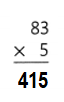
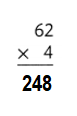
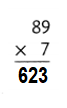
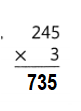
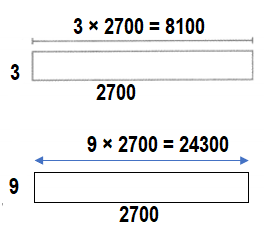
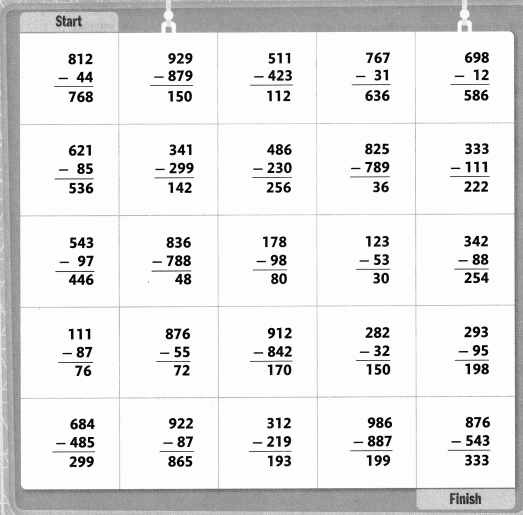
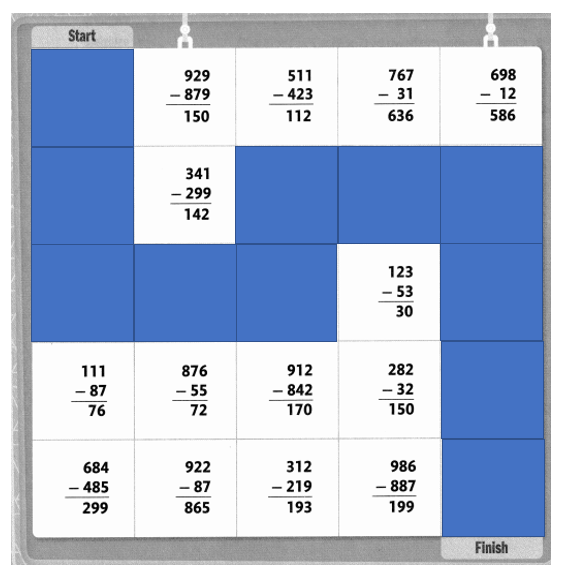
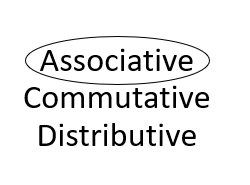
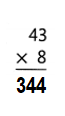
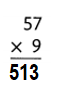
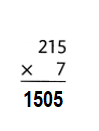
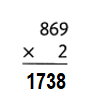
enVision Math Common Core Grade 4 Answer Key Topic 6 Use Operations with Whole Numbers to Solve Problems

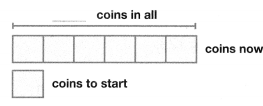
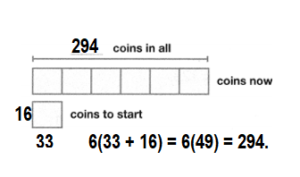
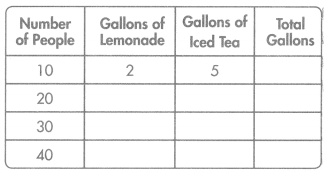
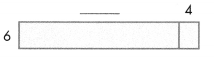
Go through the enVision Math Common Core Grade 4 Answer Key Topic 6 Use Operations with Whole Numbers to Solve Problems and finish your homework or assignments.

enVision Math Common Core 4th Grade Answers Key Topic 6 Use Operations with Whole Numbers to Solve Problems

Essential Questions:
How is comparing with multiplication different from comparing with addition? How can you use equations to solve multi-step problems?
Answer:
In an additive comparison, we find the relation between two amounts by asking or telling how much more is one compared to the other. In multiplicative comparison, there are two different sets being compared. The first set contains a certain number of items. The second set contains multiple copies of the first set
Example:
Additive Comparison:
2 + 2 + 5 + 3 + … n
Multiplicative Comparison:
3 × 4 × 5 × … n
Envision Math Common Core 4th Grade Answer Key Topic 6 Use Operations with Whole Numbers to Solve Problems 1

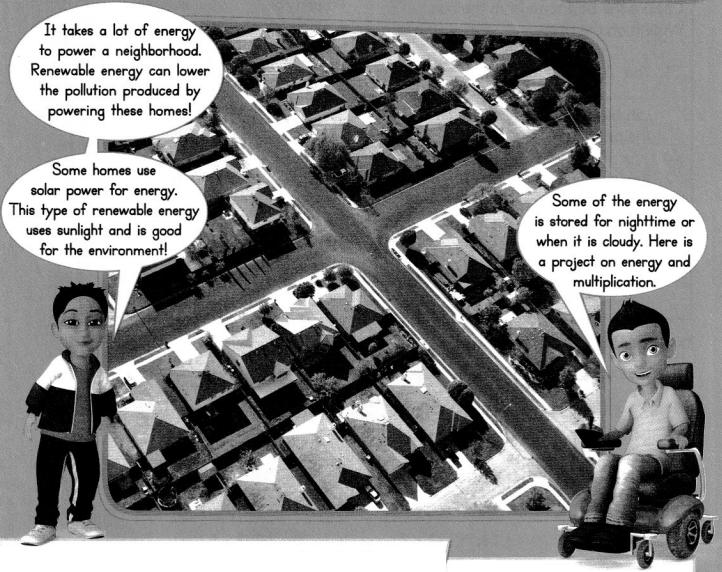
enVision STEM Project: Energy and Multiplication
Do Research
Use the Internet or other sources to find and describe 3 examples of renewable energy?
Answer:
The examples of renewable energy are:
a. Solar energy
b. Wind energy
c. Tidal energy
d. Geothermal energy

Journal: Write a Report that Includes what you found. Also in your report:
A)
Solar panels are made up of smaller modules or sections called cells. Find a picture of a solar panel. How many cells are in 6 solar panels? How many cells are in 9 solar panels? How many more cells are in the 9 solar panels than the 6 solar panels?
Answer:
It is given that
Solar panels are made up of smaller modules or sections called cells
Now,
We know that,
A solar power panel is made of photovoltaic cells arranged in a configuration that can contain 32, 36, 48, 60, 72, and 96 cells
Now,
Let a solar panel contains 32 cells
So,
The number of cells that present in 6 solar panels = (The number of solar panels) × (The number of cells present in a solar panel)
= 6 × 32
= 6 × (30 + 2)
= (6 × 30) + (6 × 2)
= 180 + 12
= 192 cells
So,
The number of cells that present in 9 solar panels = (The number of solar panels) × (The number of cells present in a solar panel)
= 9 × 32
= 9 × (30 + 2)
= (9 × 30) + (9 × 2)
= 270 + 18
= 288 cells
So,
The difference between the two solar panels = 288 – 192
= 96 cells
Now,
The picture of a solar panel is:

Hence, from the above,
We can conclude that
The difference of the cells between 9 solar panels and 6 solar panels is: 96 cells

B)
Find examples of other items that use solar power?
Answer:
Some of the items that use solar power are:
A) Solar charger.
B) Solar cell phone charger. Strawberry Tree.
C) Solar chimney.
D) Solar-powered waste compacting bin.
E) Solar cooker.
F) Solar dryer.
G) Solar-powered fan.
H) Solar furnace.

Review What You Know

Vocabulary
Choose the best term from the box. Write it on the blank.

  • Associative Property of Multiplication
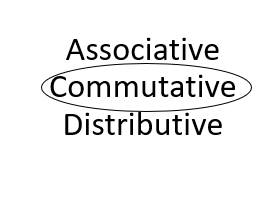
  • Commutative Property of Multiplication
  • Compatible numbers
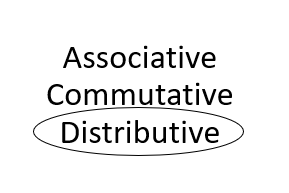
  • Distributive Property

Question 1.
The __________ says that factors can be multiplied in any order and the product remains the same.
Answer:
We know that,
The “Commutative Property of Multiplication” says that factors can be multiplied in any order and the product remains the same.
Hence, from the above,
We can conclude that the best term that is suitable for the given definition is: Cumulative Property of Multiplication

Question 2.
Breaking apart a multiplication problem into the sum or difference of two simpler multiplication problems is an example of using the __________
Answer:
We know that,
Breaking apart a multiplication problem into the sum or difference of two simpler multiplication problems is an example of using the “Distributive Property”
Hence, from the above,
We can conclude that the best term that is suitable for the given definition is: Distributive Property

Question 3.
According to the ________, factors can be regrouped and the product remains the same.
Answer:
We know that,
According to the “Associative property of Multiplication”, factors can be regrouped and the product remains the same.
Hence, from the above,
We can conclude that the best term that is suitable for the given definition is: Associative Property of Multiplication

Dividing by 1-Digit Numbers

Estimate each quotient.
Question 4.
16 ÷ 3
Answer:
The given expression is: 16 ÷ 3
Now,
By using the Long Division method,
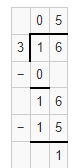
Hence, from the above,
We can conclude that the quotient value for the given expression is: 5

Question 5.
25 ÷ 4
Answer:
The given expression is: 25 ÷ 4
Now,
By using the Long Division method,
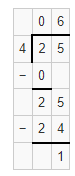
Hence, from the above,
We can conclude that the quotient value for the given expression is: 6

Question 6.
155 ÷ 4
Answer:
The given expression is: 155 ÷ 4
Now,
By using the Long Division method,
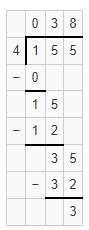
Hence, from the above,
We can conclude that the quotient value for the given expression is: 38

Question 7.
304 ÷ 3
Answer:
The given expression is: 304 ÷ 3
Now,
By using the Long Division method,
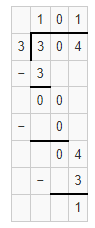
Hence, from the above,
We can conclude that the quotient value for the given expression is: 101

Question 8.
1,283 ÷ 6
Answer:
The given expression is: 1,283 ÷ 6
Now,
By using the Long Division method,
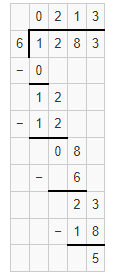
Hence, from the above,
We can conclude that the quotient value for the given expression is: 213

Question 9.
1,999 ÷ 4
Answer:
The given expression is: 1,999 ÷ 4
Now,
By using the Long Division method,
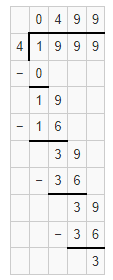
Hence, from the above,
We can conclude that the quotient value for the given expression is: 499

Multiplying by 1-Digit Numbers

Find each product.
Question 10.
53 × 9
Answer:
The given expression is: 53 × 9
Now,
By using the partial Products method,
53 × 9
= (50 + 3) × 9
= (50 × 9) + (3 × 9)
= 450 + 27
= 477
Hence, from the above,
We can conclude that the product value for the given expression is: 477

Question 11.
1,127 × 7
Answer:
The given expression is: 1,127 × 7
Now,
By using the partial Products method,
1,127 × 7
= (1,000 + 100 + 27) × 7
= (1,000 × 7) + (100 × 7) + (27 × 7)
= 7,000 + 700 + 189
= 7,889
Hence, from the above,
We can conclude that the product value for the given expression is: 7,889

Question 12.
2,769 × 5
Answer:
The given expression is: 2,769 × 5
Now,
By using the partial Products method,
2,769 × 5
= (2,000 + 700 + 60 + 9) × 5
= (2,000 × 5) + (700 × 5) + (60 × 5) + (9 × 5)
= 10,000 + 3,500 + 300 + 45
= 13,845
Hence, from the above,
We can conclude that the product value for the given expression is: 13,845

Question 13.
3 × 215
Answer:
The given expression is: 3 × 215
Now,
By using the partial Products method,
3 × 215
= 3 × (200 + 15)
= (3 × 200) + (3 × 15)
= 600 + 45
= 645
Hence, from the above,
We can conclude that the product value for the given expression is: 645

Question 14.
914 × 5
Answer:
The given expression is: 914 × 5
Now,
By using the partial Products method,
914 × 5
= (900 + 14) × 5
= (900 × 5) + (14 × 5)
= 4,500 + 70
= 4,570
Hence, from the above,
We can conclude that the product value for the given expression is: 4,570

Question 15.
1,238 × 5
Answer:
The given expression is: 1,238 × 5
Now,
By using the partial Products method,
1,238 × 5
= (1,000 + 200 + 30 + 8) × 5
= (1,000 × 5) + (200 × 5) + (30 × 5) + (8 × 5)
= 5,000 + 1,000 + 150 + 40
= 6,190
Hence, from the above,
We can conclude that the product value for the given expression is: 6,190

Problem Solving

Question 16.
Construct Arguments Explain why the array represents 3 × 21
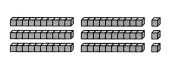
Answer:
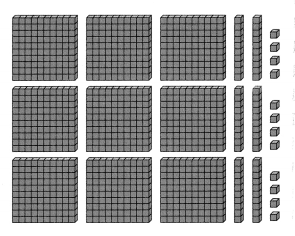
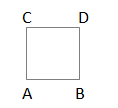
The given array is:

Now,
We know that,
An “Array” is a collection of rows and columns
Now,
From the given figure,
We can observe that
The number of rows is: 21
The number of columns is: 3
So,
To find the number of cells in a given array,
We have to multiply the rows and columns
Hence, from the above,
We can conclude that the given array represents 21 × 3 since it represents the number of rows and number of columns

Question 17.
James multiplies 38 by 55. He finds three of the four partial products: 40, 150, and 400. Which partial product is James missing? What is the solution?
Answer:
It is given that
James multiplies 38 by 55. He finds three of the four partial products: 40, 150, and 400.
Now,
The given expression is: 38 × 55
Now,
By using the partial Products method,
38 × 55
= (30 + 8) × (50 + 5)
= (30 × 50) + (30 × 5) + (8 × 50) + (8 × 5)
= 1,500 + 150 +400 + 40
= 2,090
Hence, from the above,
We can conclude that
The Partial product James is missing is: 1,500
The solution for the given expression is: 2,090

Pick a Project

PROJECT 6A
How tall is tall?
Project: Model the Height of a Redwood Tree

Envision Math Common Core 4th Grade Answer Key Topic 6 Use Operations with Whole Numbers to Solve Problems 2

PROJECT 6B
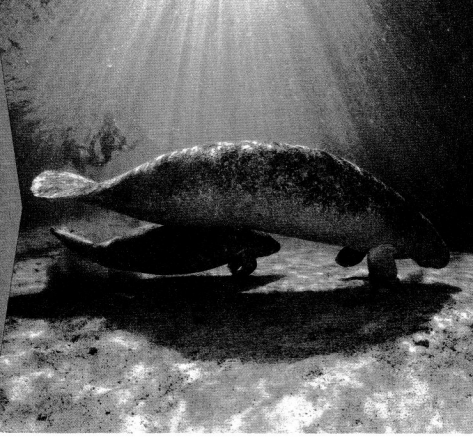
What are some interesting number facts about a manatee?
Project: Make a Presentation with Manatee Number Facts
Envision Math Common Core 4th Grade Answer Key Topic 6 Use Operations with Whole Numbers to Solve Problems 3

PROJECT 6C
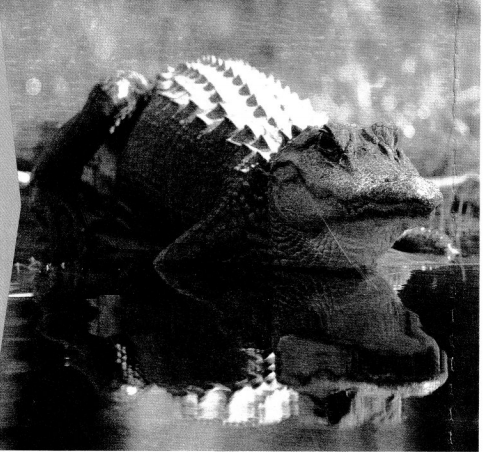
How does temperature affect an alligator egg?
Project: Create a Bar Diagram
Envision Math Common Core 4th Grade Answer Key Topic 6 Use Operations with Whole Numbers to Solve Problems 4

PROJECT 6D
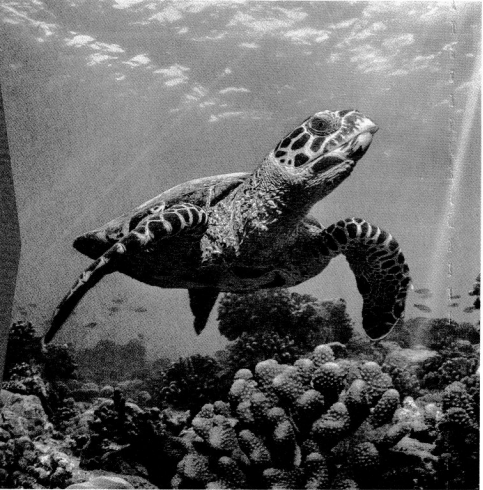
How many eggs does the loggerhead turtle lay?
Project: Model a Turtle’s Egg
Envision Math Common Core 4th Grade Answer Key Topic 6 Use Operations with Whole Numbers to Solve Problems 5

Lesson 6.1 Solve Comparison Problems

Solve & Share
Sarah is making a square pillow with edges that each measure 18 inches long. She needs a strip of fabric 4 times as long as one edge of the pillow to make a border around the pillow. How long does the strip of fabric need to be? Solve this problem any way you choose.
I can … use multiplication or addition to compare one quantity to another.
Envision Math Common Core 4th Grade Answer Key Topic 6 Use Operations with Whole Numbers to Solve Problems 6
Answer:
It is given that
Sarah is making a square pillow with edges that each measure 18 inches long. She needs a strip of fabric 4 times as long as one edge of the pillow to make a border around the pillow
Now,
Let the length of the strip of fabric be x
So,
According to the given data,
The length of the strip (x) = 4 × (The length of the pillow at the edges)
= 4 × 18
= 72 inches
Hence, from the above,
We can conclude that
The length of the fabric needed is: 72 inches

Look Back!
Model with Math
How could a bar diagram help you write and solve an equation for the problem?
Answer:
It is given that
Sarah is making a square pillow with edges that each measure 18 inches long. She needs a strip of fabric 4 times as long as one edge of the pillow to make a border around the pillow
Now,
The representation of the given situation in the form of a bar diagram is:
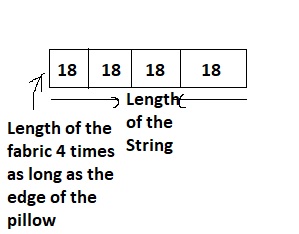
So,
From the above bar diagram,
We can observe that
The length of the string = 4 × (The length of the edge of the pillow)
= 4 × 18
= 72 inches
Hence, from the above,
We can conclude that
By using the bar diagram, the length of the string is: 72 inches

Essential Question
How Is Comparing with Multiplication Different from Comparing with Addition?
Answer:
In an additive comparison, we find the relation between two amounts by asking or telling how much more is one compared to the other. In multiplicative comparison, there are two different sets being compared. The first set contains a certain number of items. The second set contains multiple copies of the first set
Example:
Additive Comparison:
2 + 2 + 5 + 3 + … n
Multiplicative Comparison:
3 × 4 × 5 × … n

Visual Learning Bridge
Max said the Rangers scored 3 times as many runs as the Stars. Jody said the Rangers scored 8 more runs than the Stars. Could both Max and Jody be correct?
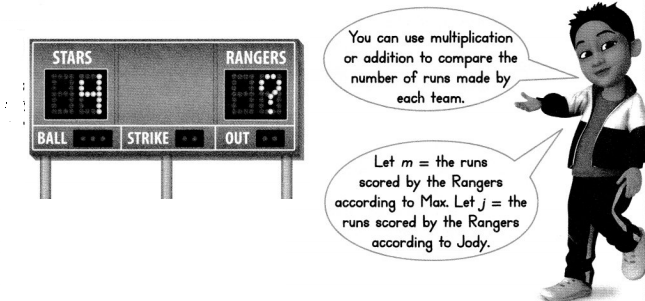
Envision Math Common Core 4th Grade Answer Key Topic 6 Use Operations with Whole Numbers to Solve Problems 7

Compare with Multiplication
Find 3 times as many as 4 runs.
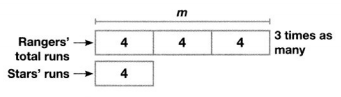
Envision Math Common Core 4th Grade Answer Key Topic 6 Use Operations with Whole Numbers to Solve Problems 8
m = 3 × 4
m = 12 runs
According to Max, the Rangers scored 12 runs.

Compare with Addition
Find 8 more than 4 runs.
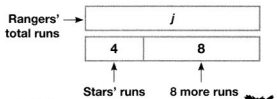
Envision Math Common Core 4th Grade Answer Key Topic 6 Use Operations with Whole Numbers to Solve Problems 9
j = 4 + 8
j = 12 runs
According to Jody, the Rangers scored 12 runs.
Max and Jody are both correct.

Convince Me!
Construct Arguments Describe when you would use multiplication and when you would use addition to make a comparison?
Answer:
When distinguishing multiplicative comparison from additive comparison,
We should note that “Additive comparisons” focus on the difference between two quantities whereas “Multiplicative comparisons” focus on the difference between two qualities

Guided Practice

Do You Understand?
Question 1.
Use the information from the previous page. If the Rangers scored 5 times as many runs as the Stars, how many runs would the Rangers have scored?
a. Compare using multiplication. Write and solve an equation.
Answer:
It is given that
Rangers scored 5 times as many runs as the Stars
Now,
The given figure is:
Envision Math Common Core 4th Grade Answer Key Topic 6 Use Operations with Whole Numbers to Solve Problems 7
Now,
The representation of the given situation in the form of a bar diagram is:
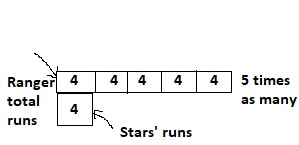
So,
The total number of runs rangers scored = 5 × (The number of runs Stars scored)
= 5 × 4
= 20 runs
Hence, from the above,
We can conclude that the number of runs scored by Rangers is: 20

b. How could you use addition to compare the runs for the two teams?
Answer:
It is given that
Rangers scored 5 times as many runs as the Stars
Now,
The given figure is:
Envision Math Common Core 4th Grade Answer Key Topic 6 Use Operations with Whole Numbers to Solve Problems 7
Now,
The representation of the given situation in the form of a bar diagram is:

So,
The total number of runs rangers scored = (The number of runs Stars scored) + (The number of runs Stars scored) + (The number of runs Stars scored) + (The number of runs Stars scored) + (The number of runs Stars scored)
= 5 + 5 + 5 + 5 +5
= 20 runs
Hence, from the above,
We can conclude that the number of runs scored by Rangers is: 20

Do You Know How?
For 2-3, complete the comparison sentence. Find the value of the variable that makes the sentence true.
Question 2.
Sam’s baseball team has 4 times as many helmets as Ed’s team. Ed’s team has 21 helmets. Let h = the number of helmets Sam’s team has.
h is ___________ times as many as ________.
h = _________
Answer:
It is given that
Sam’s baseball team has 4 times as many helmets as Ed’s team. Ed’s team has 21 helmets.
So,
The number of helmets Sam’s team has (h) = 4 × (The number of helmets Ed’s team has)
= 4 × 21
= 4 × (20 + 1)
= (4 × 20) + (4 × 1)
= 80 + 4
= 84 helmets
Hence, from the above,
We can conclude that
h is 4 times as many as the number of helmets Ed’s team has
The number of helmets Sam’s team has is: 84 helmets

Question 3.
There are 128 more trees in the park than at Ty’s house. There are 3 trees at Ty’s house. Let t = the number of trees in the park.
_______ more than _____ is t.
t = __________
Answer:
It is given that
There are 128 more trees in the park than at Ty’s house. There are 3 trees at Ty’s house.
So,
The number of trees in the park (t) = (The number of trees at Ty’s house) + (The number of more trees in the park)
= 3 + 128
= 131 trees
Hence, from the above,
We can conclude that
128 trees more than 3 trees is t
The total number of trees in the park is: 131 trees

Independent Practice

Use times as many as or more than to compare the amounts.
For 4-9, write a comparison sentence. For 4-7, find the value of the variable that makes the sentence true.
Envision Math Common Core 4th Grade Answer Key Topic 6 Use Operations with Whole Numbers to Solve Problems 10
Question 4.
Katy has 6 times as many nickels as Shaun. Shaun has 18 nickels. Let n = the number of nickels Katy has.
n is _____________
n = ___________.
Answer:
It is given that
Katy has 6 times as many nickels as Shaun. Shaun has 18 nickels.
So,
The number of nickels Katy has (n) = 6 × (The number of nickels Shaun has)
= 6 × 18
= 6 × (10 + 8)
= (6 × 10) + (6 × 8)
= 60 + 48
= 108 nickels
Hence, from the above,
We can conclude that
n is 6 times as many as the number of nickels Shaun has
The number of nickels Katy has: 108 nickels

Question 5.
Kyle has watched 238 movies. Jason has watched 49 more movies than Kyle. Let m = the number of movies Jason has watched.
m is _____________
m = _____________
Answer:
It is given that
Kyle has watched 238 movies. Jason has watched 49 more movies than Kyle
So,
The number of movies Jason has watched (m) = The number of movies Kyle watched + 49
= 238 + 49
= 287 movies
Hence, from the above,
We can conclude that
m is 49 mere than the number of movies Kyle has watched
The number of movies Jason has watched is: 287 movies

Question 6.
Amber tied 89 knots to make a macrame wall hanging. Hunter tied 3 times as many knots as Amber. Let k= the number of knots Hunter tied. k is _____________
k = _____________
Answer:
It is given that
Amber tied 89 knots to make a macrame wall hanging. Hunter tied 3 times as many knots as Amber
So,
The number of knots Hunter tied (k) = 3 × (The number of knots Amber tied)
= 3 × 89
= 3 × (80 + 9)
= (3 × 80) + (3 × 9)
= 240 + 27
= 267
Hence, from the above,
We can conclude that
k is 3 times as many knots as Amber
The number of knots Hunter tied is: 267 knots

Question 7.
Tia sells 292 newspapers. Tess sells 117 more newspapers than Tia. Let n = the number of newspapers Tess sells.
n is _____________
n = _____________
Answer:
It is given that
Tia sells 292 newspapers. Tess sells 117 more newspapers than Tia
So,
The number of newspapers Tess sells (n) = 117 + (The number of newspapers tia sells)
= 117 + 292
= 409 newspapers
Hence, from the above,
We can conclude that
n is 117 more than Tia’s newspapers
The number of newspapers Tess sells is: 409 newspapers

Question 8.
Trent has 48 markers. Sharon has 8 markers.
Answer:

Question 9.
Lucy has 317 bottles. Craig has 82 bottles.
Answer:

Problem Solving

Question 10.
Model with Math
Roger swam 19 laps in the pool. Anna Maria swam 4 times as many laps as Roger. How many laps did Anna Maria swim? Draw a bar diagram and write an equation to solve the problem.
Answer:
It is given that
Roger swam 19 laps in the pool. Anna Maria swam 4 times as many laps as Roger
So,
The representation of the given situation in the form of a bar diagram is:
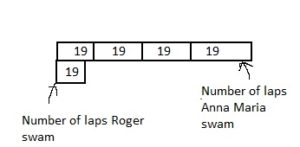
So,
The number of laps did Anna maria swam = 4 × (The number of laps did Roger swam)
= 4 × 19
= 4 × (10 + 9)
= (4 × 10) + (4 × 9)
= 40 + 36
= 76 laps
Hence, from the above,
We can conclude that the number of laps did Anna swam is: 76 laps

Question 11.
Critique Reasoning Nina says the equation 600 = 12 × 50 means 600 is 12 times as many as 50. Julio says the equation means 600 is 50 times as many as 12. Who is correct? Explain.
Answer:
It is given that
Nina says the equation 600 = 12 × 50 means 600 is 12 times as many as 50. Julio says the equation means 600 is 50 times as many as 12
Now,
We know that,
According to Commutative Property of Multiplication,
a × b = b × a
So,
12 × 50 is the same as 50 × 12
“12 times as many as 50” is the same as “50 times as many as 12”
Hence, from the above,
We can conclude that
Both Nina and Julio are correct

Question 12.
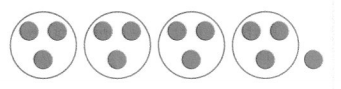
Vocabulary The amount that is left after dividing a number into equal parts is called the _________.
13 ÷ 4 = ________
Envision Math Common Core 4th Grade Answer Key Topic 6 Use Operations with Whole Numbers to Solve Problems 11
Answer:
We know that,
The amount that is left after dividing a number into equal parts is called the “Remainder”
Now,
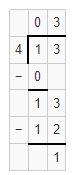
The given expression is: 13 ÷ 4
Now,
By using the Long division method,
Hence, from the above,
We can conclude that the remainder for the given expression is: 1

Question 13.
Higher-Order Thinking A shirt is on sale for d dollars. The regular price is 4 times as much. Todd has enough money to buy 2 shirts at the regular price. How many shirts can Todd buy at the sale price? Explain.
Answer:
It is given that
A shirt is on sale for d dollars. The regular price is 4 times as much. Todd has enough money to buy 2 shirts at the regular price
So,
The regular price of a shirt = 4 × (The sale price of a shirt)
= 4 × d
= 4d
Now,
According to the given information,
The sale price of the shirts that Todd can buy = (Regular price of a shirt) × (The number of shirts Todd can buy)
= 4d × 2
= 8d
So,
The number of shirts Todd can buy = \(\frac{The sale price of the shirts Todd can buy}{The sale price of a shirt}\)
= \(\frac{8d}{d}\)
= 8
Hence, from the above,
We can conclude that Todd can buy 8 shirts at the sale price

Assessment Practice

Question 14.
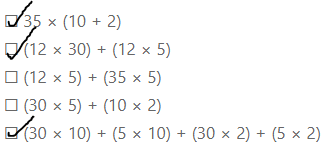
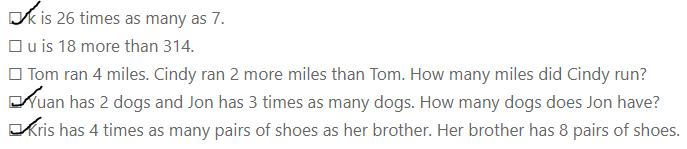
Select all the sentences that involve a comparison using multiplication.
☐ k is 26 times as many as 7.
☐ u is 18 more than 314.
☐ Tom ran 4 miles. Cindy ran 2 more miles than Tom. How many miles did Cindy run?
☐ Yuan has 2 dogs and Jon has 3 times as many dogs. How many dogs does Jon have?
☐ Kris has 4 times as many pairs of shoes as her brother. Her brother has 8 pairs of shoes.
Answer:
The sentences that involve a comparison using multiplication are:
Question 15.
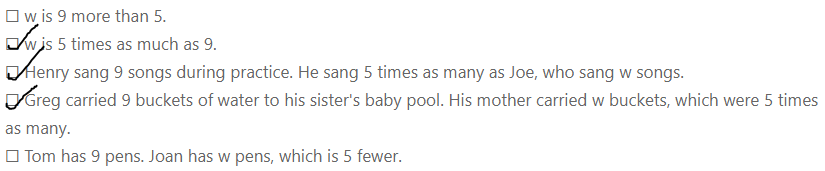
Select all the statements that can be represented by the equation 5 × 9 = w.
☐ w is 9 more than 5.
☐ w is 5 times as much as 9.
☐ Henry sang 9 songs during practice. He sang 5 times as many as Joe, who sang w songs.
☐ Greg carried 9 buckets of water to his sister’s baby pool. His mother carried w buckets, which were 5 times as many.
☐ Tom has 9 pens. Joan has w pens, which is 5 fewer.
Answer:
The sentences that can be represented by the equation 5 × 9 = w are:
Lesson 6.2 Continue to solve Comparison Problems

Solve & Share
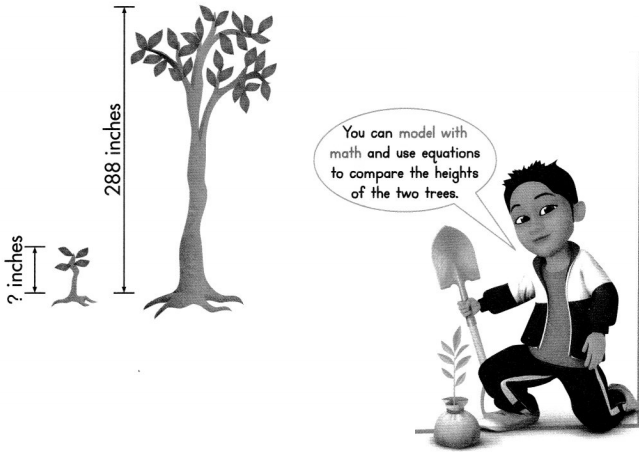
The students in Ms. Chang’s fourth-grade class plant a tree every year. One tree they planted is now 288 inches tall. This height is 6 times as great as when the tree was first planted. How tall was the tree when it was first planted? Solve this problem any way you choose. Show your work.
I can … use multiplication or division to compare one quantity to another.
Envision Math Common Core 4th Grade Answer Key Topic 6 Use Operations with Whole Numbers to Solve Problems 12
Answer:
It is given that
The students in Ms. Chang’s fourth-grade class plant a tree every year. One tree they planted is now 288 inches tall. This height is 6 times as great as when the tree was first planted
Now,
Let the height of the tree when first planted be x
Now,
According to the given information,
6 × x = 288
x = \(\frac{288}{6}\)
x = 48 inches
Hence, from the above,
We can conclude that
The height of the tree when it was first planted is: 48 inches

Look Back! Compare the heights of the 2 trees using addition.
Answer:
From part (a),
We can observe that
The height of the tree when it was first planted is: 48 inches
The current height of the tree is: 288 inches
So,
The difference between the heights of the two trees = (The current height of the tree) – (The height of the tree when it was first planted)
= 288 – 48
= 240 inches
Hence, from the above,
We can conclude that the current height of the tree is 240 inches more than the height of the tree when it was first planted

Essential Question
How Can You Solve a Problem Involving Multiplication as Comparison?
Answer:
Interpret a multiplication equation as a comparison
Example:
Interpret 35 = 5 × 7 as a statement that 35 is 5 times as many as 7 and 7 times as many as 5.

Visual Learning Bridge
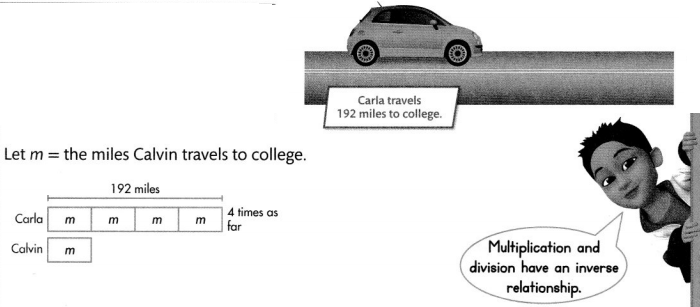
Carla and Calvin are twins that attend different colleges. Carla’s college is four times as far from home as Calvin’s college. How far does Calvin travel to college?
Envision Math Common Core 4th Grade Answer Key Topic 6 Use Operations with Whole Numbers to Solve Problems 13

The number of miles Carla travels, or 192 miles, is 4 times as far as Calvin travels.

Write a multiplication equation to find the number of miles Calvin travels to college.
192 = 4 × m
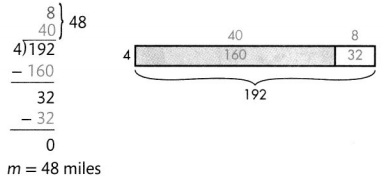
m = 48 miles
What number times 4 equals 192?

If 192 = 4 × m, them m = 192 ÷ 4.
Envision Math Common Core 4th Grade Answer Key Topic 6 Use Operations with Whole Numbers to Solve Problems 14
Calvin travels 48 miles to college.

Convince Me!

Use Structure When do you use division to make a comparison?
Answer:
A ratio is a comparison of two numbers by division. The value of a ratio is the quotient that results from dividing the two numbers.
Example:
The value of the ratio 35: 7 is 5, which you find by computing 35 ÷ 7 = 5.

Guided Practice

Do You Understand?
Question 1.
Carla travels 3 times as far to college as her friend Mandy travels to college. Write and solve a related multiplication and division equation to find how far Mandy travels to college.
Answer:
It is given that
Carla travels 3 times as far to college as her friend Mandy travels to college
Now,
From the example on the previous page,
We can observe that
Carla travels 192 miles to college
Now,
Let x be  how far Mandy travels to college
So,
From the given information,
192 = 3 × x
x = \(\frac{192}{3}\)
x = 64 miles
Hence, from the above,
We can conclude that Mandy travels 64 miles to the college

Do You Know How?
Question 2.
Complete the comparison sentence. Find the value of the variable that makes the sentence true.
If 3 × m = 48, then m = 48 ÷ 3.
3 times as many as m is 48.
m = 16
Answer:
The given expression is:
3 × m = 48
m = \(\frac{48}{3}\)
m = 16
Hence, from the above,
We can conclude that
3 times as many as m is 48
The value of m is: 16

Independent Practice

For 3-8, write a comparison sentence and an equation. Find the value of the variable that makes the sentence true.
Question 3.
Connor has 77 magazines. That is 7 times as many magazines Kristen has. How many magazines, n, does Kristen have?
Answer:
It is given that
Connor has 77 magazines. That is 7 times as many magazines Kristen has
Now,
Let n be the number of magazines Kristen has
So,
According to the given information,
7 × n = 77
n = \(\frac{77}{7}\)
n = 11
Hence, from the above,
We can conclude that
The number of magazines that Kristen has: 11

Question 4.
Eric completed 75 math problems. That is 5 times as many math problems as Katie completed. How many math problems, m, did Katie complete?
Answer:
It is given that
Eric completed 75 math problems. That is 5 times as many math problems as Katie completed
Now,
Let m be the math problems Katie completed
So,
According to the given information,
5 × m = 75
m = \(\frac{75}{5}\)
m = 15
Hence, from the above,
We can conclude that
The number of math problems Katie completed is: 15

Question 5.
Clare counted 117 different colors at the paint store. That is 9 times as many as the number James counted. How many different colors, c, did James count?
Answer:
It is given that
Clare counted 117 different colors at the paint store. That is 9 times as many as the number James counted.
Now,
Let c be the number of colors James counted
So,
According to the given information,
9 × c = 117
c = \(\frac{117}{9}\)
c = 13
Hence, from the above,
We can conclude that
The number of different colors James counted is: 13

Question 6.
Alisa has 153 dominoes. That is 3 times as many dominoes as Stan has. How many dominoes, d, does Stan have?
Answer:
It is given that
Alisa has 153 dominoes. That is 3 times as many dominoes as Stan has
Now,
Let d be the number of dominoes does Stan have
So,
According to the given information,
3 × d = 153
d = \(\frac{153}{3}\)
d = 51
Hence, from the above,
We can conclude that
The number of dominoes does Stan have is: 51

Question 7.
Justin practiced piano for h hours. His sister practiced for 12 hours, which was 3 times as many hours as Justin practiced. Write and solve an equation to find how many hours Justin practiced piano.
Answer:
It is given that
Justin practiced piano for h hours. His sister practiced for 12 hours, which was 3 times as many hours as Justin practiced
Now,
Let h be the number of hours Justin practiced piano
So,
According to the given information,
h × 3 = 12
h = \(\frac{12}{3}\)
h = 4
Hence, from the above,
We can conclude that
The number of hours that Justin practiced piano is: 4 hours

Question 8.
Mary practiced violin for 2 hours and her brother practiced trombone t times as long or 8 hours. Write and solve an equation to find how many times as long Mary’s brother practiced trombone.
Answer:
It is given that
Mary practiced violin for 2 hours and her brother practiced trombone t times as long or 8 hours
Now,
Let t be the number of hours Mary’s brother practiced trombone
So,
According to the given information,
2 × t = 8
t = \(\frac{8}{2}\)
t = 4
Hence, from the above,
We can conclude that
The number of hours mary’s brother practiced trombone is: 4 hours

Problem Solving

Question 9.
Model with Math
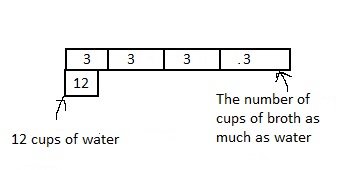
Dave is making soup that includes 12 cups of water and 3 cups of broth. How many times as much water as the broth will be in the soup? Draw a bar diagram and write and solve an equation.
Answer:
It is given that
Dave is making soup that includes 12 cups of water and 3 cups of broth.
Now,
Let x be the number of cups of water present in the broth
So,
According to the given information,
3 × x = 12
x = \(\frac{12}{3}\)
x = 4
Hence, from the above,
We can conclude that
The number of cups of water present in the broth is: 4

Question 10.
Trevor wants to buy three light fixtures that cost $168 each. He has $500. Does he have enough money to buy the three light fixtures? Use a comparison sentence to explain your reasoning.
Answer:
It is given that
Trevor wants to buy three light fixtures that cost $168 each. He has $500.
So,
The cost of three light fixtures that Trevor wants to buy = 3 × (The cost of each light fixture)
= 3 × 168
= 3 × (100 + 68)
= (3 × 100) + (3 × 68)
= 300 + 204
= $504
So,
From the given information,
$500 < $504
Hence, from the above,
We can conclude that
The cost of the three light fixtures that Trevor wants to buy is $4 more than the amount of money Trevor has
He does not have enough money to buy the three light fixtures

Question 11.
Miranda has 4 times as many leaves in her collection as Joy Joy has 13 more leaves than Armani. Armani has 10 leaves in his collection. How many leaves does Miranda have in her collection? Explain.
Answer:
It is given that
Miranda has 4 times as many leaves in her collection as Joy Joy has 13 more leaves than Armani. Armani has 10 leaves in his collection
Now,
Let the number of leaves Miranda has in her collection be x
Let the number of leaves Joy has be j
Let the number of leaves Armani has be a
So,
According to the given information,
a = 10
j = a + 13
4 × j = x
Now,
j = 10 + 13
j = 23
So,
4 × 23 = x
x = 4 × (20 + 3)
x = (4 × 20) + (4 × 3)
x = 80 + 12
x = 92 leaves
Hence, from the above,
We can conclude that the number of leaves Miranda has in her collection is: 92

Question 12.
Higher-Order Thinking Jordan needs $9,240 for her first year of college tuition. Each of her two grandfathers said they would match what she saves. She has 8 years before she goes to college. How much does Jordan need to save on her own each year to have enough for her first year with the help from her two grandfathers?
Envision Math Common Core 4th Grade Answer Key Topic 6 Use Operations with Whole Numbers to Solve Problems 15
Answer:
It is given that
Jordan needs $9,240 for her first year of college tuition. Each of her two grandfathers said they would match what she saves. She has 8 years before she goes to college
So,
The amount of money that will be saved by Jordan and her 2 grandfathers = \(\frac{$9,240}{3}\)
= $3,080
So,
The amount of money Jordan has to save each year so that she would have enough money for her first year = \(\frac{$3,080}{8}\)
= $385
Hence, from the above,
We can conclude that
Jordan needs to save on her own each year to have enough for her first year with the help from her two grandfathers will be: $385

Assessment Practice

Question 13.
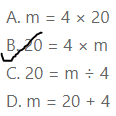
Tina walked 20 miles for a fundraiser. Lia walked m miles. Tina walked 4 times as far as Lia. Which equation can be used to find m, the number of miles Lia walked?
A. m = 4 × 20
B. 20 = 4 × m
C. 20 = m ÷ 4
D. m = 20 + 4
Answer:
It is given that
Tina walked 20 miles for a fundraiser. Lia walked m miles. Tina walked 4 times as far as Lia
So,
According to the given information,
4 × m = 20
Hence, from the above,
We can conclude that the number of miles Lia walked is:
Question 14.
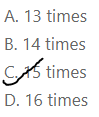
Jason and Raul kept a reading log for the year. Jason read 7 books and Raul read 105. How many times as many books as Jason did Raul read?
A. 13 times
B. 14 times
C. 15 times
D. 16 times
Answer:
It is given that
Jason and Raul kept a reading log for the year. Jason read 7 books and Raul read 105
Now,
Let the number of times Jason read as many as Raul did be x
So,
(The number of books Jason read) × (The number of times Jason read as many as Raul did) = The number of books Raul did
7 × x = 105
x = \(\frac{105}{7}\)
x = 15
Hence,from the above,
We can conclude that the number of times Raul read as many books as Jason is:
Lesson 6.3 Model Multi-Step Problems

Solve & Share
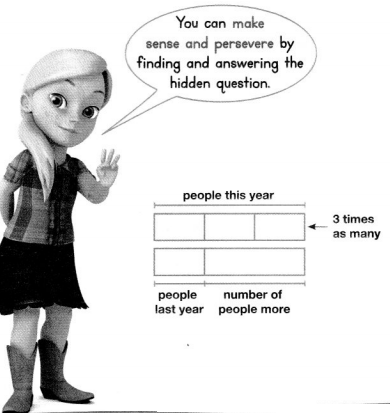
Last year, 18 people went on a family camping trip. This year, three times as many people went. How many more people went this year than last year? Complete the bar diagram and show how you solve it?
I can … find hidden questions and use bar diagrams and equations to model and solve multi-step problems.
Envision Math Common Core 4th Grade Answers Topic 6 Use Operations with Whole Numbers to Solve Problems 16
Answer:
It is given that
Last year, 18 people went on a family camping trip. This year, three times as many people went
So,
The number of people that went on a family camping trip this year = 3 × (The number of people that went on a family camping trip last year)
= 3 × 18
= 3 × (10 + 8)
= (3 × 10) + (3 × 8)
= 30 + 24
= 54 people
So,
The representation of the number of people that went on a camping trip in the form of a bar diagram is:
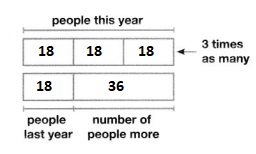
Hence, from the above,
We can conclude that the number of people that went on a camping trip this year is: 54

Look Back!
How can you use estimation to decide if your answer is reasonable?
Answer:
From the above problem,
We can observe that
The expression we used to find the number of people that went on a camping trip this year is:
3 × 18
Now,
Estimate:
3 × 18
= 3 × 20
= 3 × 2 ×10
= (3 × 2) × 10
= 6 × 10
= 60
So,
The difference between the number of people we obtained in the previous problem and in this problem is not large
Hence, from the above,
We can conclude that your estimation for the answer is reasonable

Essential Question
How Can You Use Diagrams and Equations to Solve Multi-Step Problems?
Answer:
The process we can use to solve Multi-step problems is:
Step 1:
Circle and underline. Circle only the necessary information and underline what ultimately needs to be figured out.
Step 2:
Figure out the first step/problem in the paragraph and solve it.
Step 3:
Find the answer by using the information from Steps 1 and 2

Visual Learning Bridge
A school uses 8 buses to transport the fourth-grade students and 6 vans to transport the third-grade students on a field trip. How many fewer third-grade students than fourth-grade students are on the field trip?
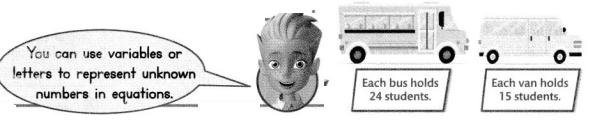
Envision Math Common Core 4th Grade Answers Topic 6 Use Operations with Whole Numbers to Solve Problems 17

Step 1
Find and answer the hidden questions.
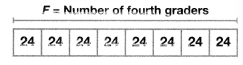
Hidden Question: How many fourth-grade students are on the field trip?
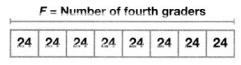
Envision Math Common Core 4th Grade Answers Topic 6 Use Operations with Whole Numbers to Solve Problems 18
F = 8 × 24
= 192 fourth-grade students
Hidden Question: How many third-grade students are on the field trip?
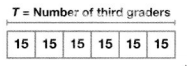
Envision Math Common Core 4th Grade Answers Topic 6 Use Operations with Whole Numbers to Solve Problems 19
T= 6 × 15
= 90 third-grade students

Step 2
Use the answers to the hidden questions to answer the original question.
Original Question: How many fewer third-grade students than fourth-grade students are on the field trip?
S = the number fewer third-grade students than fourth-grade students
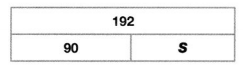
Envision Math Common Core 4th Grade Answers Topic 6 Use Operations with Whole Numbers to Solve Problems 20
S = 192 – 90
= 102
102 fewer third-grade students than fourth-grade students are on the field trip.

Convince Me!
Construct Arguments Amanda says she can solve the problem using the equation below. Do you agree? Explain.
S = (8 × 24) – (6 × 15)
Answer:
It is given that
Amanda says she can solve the problem using the equation below.
S = (8 × 24) – (6 × 15)
Now,
From the example on the previous page,
We have to find out the number of fewer third-grade students than the fourth-grade students
So,
We can find the difference between the third-grade and the fourth-grade students by finding the total number of third-grade and the fourth-grade students
So,
The total number of fourth-grade students = (The number of buses) × (The number of students in each bus)
= 8 × 24
The total number of third-grade students = (The number of vans) × (The number of students in each van)
= 6 × 15
So,
The difference between the fourth-grade and the third-grade students = (8 × 24) – (6 × 15)
Hence, from the above,
We can conclude that we can agree with Amanda

Another Example!
The Lopez family gets 2 pizzas and 4 hot dogs at Eat-It-Up. What is the total cost?
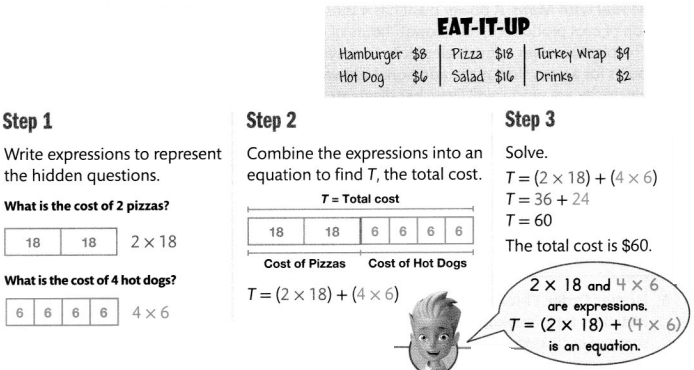
Envision Math Common Core 4th Grade Answers Topic 6 Use Operations with Whole Numbers to Solve Problems 21

Guided Practice

Do You Understand?
Question 1.
Doug says he can use the equation T = 18 + 18 + 6 + 6 + 6 + 6 to solve the problem above. Is Doug correct? Explain.
Answer:
It is given that
Doug says he can use the equation T = 18 + 18 + 6 + 6 + 6 + 6 to solve the problem above.
Now,
From the example on the previous page,
We can observe that
The cost of each pizza is $18 and there are 2 pizzas
The cost of each hot-dog is $6 and there are 4 hot-dogs
So,
The total cost = (The total cost of pizzas) + (The total cost of hot-dogs)
= [(The cost of each pizza) × (The total number of pizzas)] + [(The cost of each hot-dog) × (The total number of hot-dogs)]
= [18 × 2] + [6 × 4]
= [18 + 18] + [6 + 6 + 6 + 6]
Hence, from the above,
We can conclude that Doug is correct

Question 2.
Write one or more equations you could use to find the total cost C, of 2 turkey wraps, 2 hamburgers, and 4 drinks.
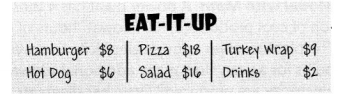
Answer:
It is given that
There are 2 turkey wraps, 2 hamburgers, and 4 drinks
Now,
The given table is:

So,
The total cost of the three items (C) = [(The cost of each turkey wrap) × (The number of turkey wraps)] + [(The cost of each hamburger) × (The number of hamburgers)] + [(The cost of each drink) × (The number of drinks)]
= (2 × $4) + (2 × $8) + (4 × $2) ———-> 1 way of writing the equation to find the total cost
= ($4 + $4) + ($8 + $8) + ($2 + $2 + $2 + $2) —– > Other way of writing the equation to find the total cost
= $8 + $16 + $8
= $32
Hence, from the above,
We can conclude that
The total cost of all the given items is: $32

Do You Know How?
Question 3.
In the problem on the previous page, suppose the school fills 11 buses and lets the remaining students ride in vans. How many students ride in vans? Use one or more bar diagrams and equations to show how you solve.
Answer:
It is given that
In the problem on the previous page, the school fills 11 buses and the remaining students ride in vans.
Now,
From the example on the previous page,
The total number of students = (The number of fourth-grade students that travel in buses) + (The number of third-grade students that travel in vans)
= 192 + 90
= 282 students
Now,
We know that,
The number of students each bus carries is: 24
So,
The total number of students present in 11 buses = (The number of students present in each bus) × (The number of buses)
= 24 × 11
= 24 × (10 + 1)
= (24 × 10) + (24 × 1)
= 240 + 24
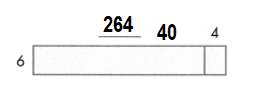
= 264 students
So,
The number of remaining students who travel in vans = (The total number of students) – (The number of students who travel in 11 buses)
= 282 – 264
= 18 students
Now,
The representation of the given problem in the form of bar diagrams is:
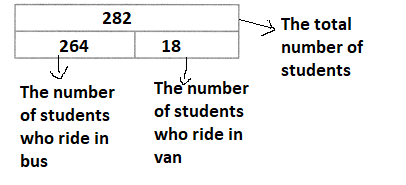
Hence, from the above,
We can conclude that the number of students that ride in vans is: 18

Independent Practice

Draw a bar diagram, and write an equation to solve the problem. Use a variable to represent an unknown quantity and tell what the variable represents.
Question 4.
Four boys and five girls went to the movies together. Between them, they had $120 to spend. Tickets cost $8 each. How much money did they have to buy refreshments?
Answer:
It is given that
Four boys and five girls went to the movies together. Between them, they had $120 to spend. Tickets cost $8 each
So,
The total number of people that went to the movies = 4 + 5
= 9
Now,
We know that,
The total money spent by 9 people = (The amount of money spent on Tickets) + (The amount of money spent to buy refreshments)
$120 = [(The total number of people) × (The cost of each ticket)] + (The amount of money spent to buy refreshments)
$120 = (9 × $8) + (The amount of money spent to buy refreshments)
The amount of money spent to buy refreshments = $120 – $72
= $48
Now,
The representation of the given information in the form of a bar diagram is:
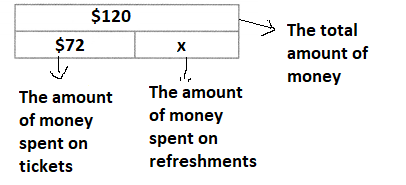
Hence, from the above,
We can conclude that the amount of money spent on refreshments is: $48

Problem Solving

Question 5.
Model with Math
A power plant has 4 tons of coal. A ton of coal produces 2,460 kilowatt-hours of electricity. The plant reserves enough electricity to power 9 light bulbs for a year. How many additional kilowatt-hours of electricity is produced? Draw the bar diagrams and write one or more equations to show how you solve them. Tell what your variables represent.
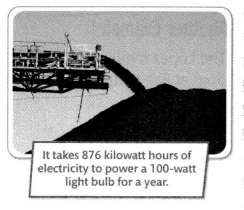
Envision Math Common Core 4th Grade Answers Topic 6 Use Operations with Whole Numbers to Solve Problems 22
Answer:
It is given that
A power plant has 4 tons of coal. A ton of coal produces 2,460 kilowatt-hours of electricity. The plant reserves enough electricity to power 9 light bulbs for a year
Now,
The energy produced by 4 tons of coal = (The energy produced by a ton of coal) × (The number of tons of coal)
= 2,460 × 4
(2,000 + 400 + 60) × 4
= (2,000 × 4) + (400 × 4) + (60 × 4)
= 8,000 + 1,600 + 240
= 9,280 Kilowatt-hours
Now,
The energy produced by 9 light bulbs for a year = (The energy produced by a light bulb for a year) × (The number of light bulbs)
= 876 × 9
= (800 + 70 + 6) × 9
= (800 × 9) + (70 × 9) + (6 × 9)
= 7,200 + 630 + 54
= 7,884 Kilowatt-hours
So,
The number of additional Kilowatt-hours produced = (The energy produced by 4 tons of coal) – (The energy produced by 9 light bulbs for a year)
= 9,280 – 7,884
= 1,396 Kilowatt-hours
Now,
The representation of the given information in the form of a bar diagram is:
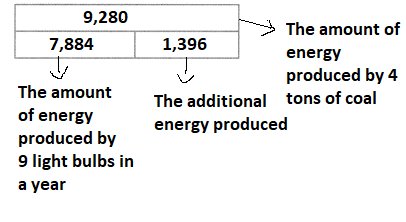
Hence, from the above,
We can conclude that the amount of additional Kilowatt-hours produced is: 1,39 Kilowatt-hours

Question 6.
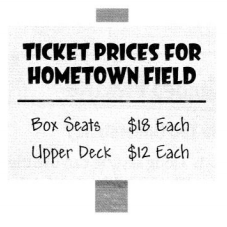
Higher-Order Thinking You have $360 to buy 26 tickets for a baseball game. You need to buy some of each kind of seat. You want to spend most of the money. How many of each type of ticket can you buy? Find two different solutions to the problem. Use an equation to show each solution.
Envision Math Common Core 4th Grade Answers Topic 6 Use Operations with Whole Numbers to Solve Problems 23
Answer:
It is given that
You have $360 to buy 26 tickets for a baseball game. You need to buy some of each kind of seat. You want to spend most of the money.
Now,
The given cost for each type of seat is:
Envision Math Common Core 4th Grade Answers Topic 6 Use Operations with Whole Numbers to Solve Problems 23
Now,
Let the number of tickets for Box seats be b
Let the number of tickets for Upper deck be u
So,
In terms of total number of tickets,
b + u = 26 —- (1)
So,
In terms of cost of the tickets,
Total cost =[ (The cost of each ticket of box seat) × (The number of tickets of box seats)] + [(The cost of each ticket of Upper deck) × (The number of tickets of Upper deck)]
18b + 12u = 360 —- (2)
So,
b = 26 – u —- (3)
Now,
By using the method of substitution,
18 (26 – u) + 12u = 350
(18 × 26) – 18u + 12u = 350
[18 × (20 + 6)] – 6u = 350
[(18 × 20) + (18 × 6)] – 6u = 350
[360 + 108] – 6u = 350
468 – 6u = 350
6u = 468 – 360
6u = 108
u = \(\frac{108}{6}\)
u = 18 tickets
So,
b = 26  -u
= 26  -18
= 8 tickets
Hence, from the above,
We can conclude that
The number of tickets of box seat is: 8
The number of tickets of Upper desk is: 18

Assessment Practice

Question 7.
The gym teacher has $250 to spend on volleyball equipment. She buys 4 volleyball nets for $28 each volleyball costs $7 each. How many volleyballs can she buy? Explain how you solve. Use one or more equations and bar diagrams in your explanation. Tell what your variables represent.
Answer:
It is given that
The gym teacher has $250 to spend on volleyball equipment. She buys 4 volleyball nets for $28 each volleyball costs $7 each.
Now,
Let the number of volleyballs be x
So,
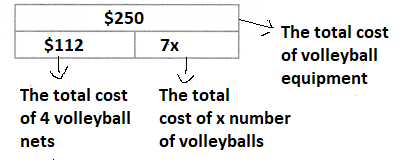
The total cost of volleyball equipment = (The total cost of volleyball nets) + (The total cost of volleyballs)
$250 = [(The cost of each volleyball net) × (The number of volleyballs)] + [(The number of volleyballs) × (The cost of each volleyball)]
$250 = (4 × $28) + (x × $7)
$250 = 4 × (20 + 8) + x × 7
$250 = (4 × 20) + (4 × 8) + x× 7
$250 = 80 + 32 + 7x
$250 = 112 + 7x
7x = 250 – 112
7x = 138
x = \(\frac{138}{7}\)
x = 19.7
x ≈ 20
Now,
The representation of the given information in the form of a bar diagram is:
Hence, from the above,
We can conclude that the number of volleyballs is: 20

Lesson 6.4 More Model MultiStep Problems

Solve & Share
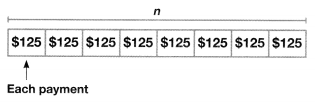
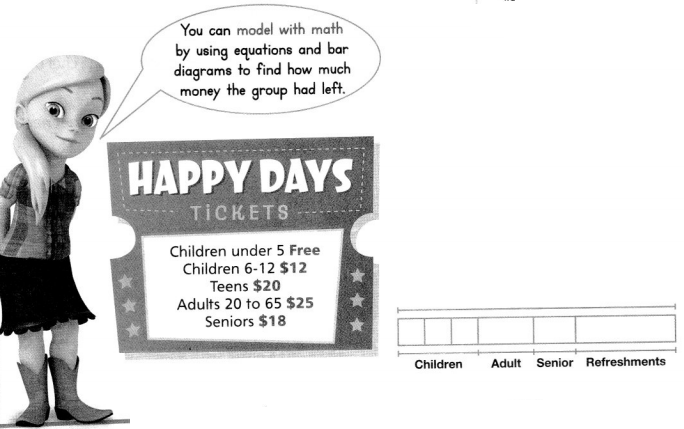
Three eight-year-old children, one adult, and one senior had $125 saved to go to the Happy Days amusement park. After buying tickets, how much money did they have left to buy refreshments? Complete the bar diagram, and use it to write one or more equations to solve the problem. Tell what your variables represent.
I can … Solve multi-step problems by drawing bar diagrams and writing expressions and equations.
Envision Math Common Core 4th Grade Answers Topic 6 Use Operations with Whole Numbers to Solve Problems 24
Answer:
It is given that
Three eight-year-old children, one adult, and one senior had $125 saved to go to the Happy Days amusement park
Now,
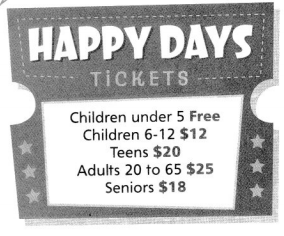
The given table is:
Now,
From the given table,
The ticket cost of 1 8-year old child is: $12
The ticket cost of 1 adult is: $25
The ticket cost of 1 senior is: $18
So,
The total amount of money saved by the given people = (The total ticket cost of the people) + (The total cost of buying refreshments for the people)
= $125 = [(3 × The ticket cost of each 8-year old child) + (The ticket cost of 1 adult) + (The ticket cost of 1 senior)] + (The total cost of buying refreshments for the people)
$125 = [(3 × $12) + $25 + $18] + (The total cost of buying refreshments for the people)
$125 = ($36 + $25 + $18) + (The total cost of buying refreshments for the people)
The total cost of buying refreshments for the people = $125 – $79
The total cost of buying refreshments for the people = $46
Now,
The representation of the given information in the form of a bar diagram is:
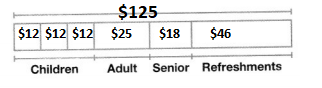
Hence, from the above,
We can conclude that
The total cost spent on refreshments by the given people is: $46

Look Back! What expressions and equations did you use to solve this problem? What hidden questions did you need to answer?
Answer:
The equation used to solve the above problem is:
The total amount of money saved by the given people = (The total ticket cost of the people) + (The total cost of buying refreshments for the people)
Now,
The hidden question we have to answer for the above problem is:
What is the total cost of the tickets for 3 8-year old children, 1 adult, and 1 senior?

Essential Question
How Can You Model and Solve Multi-Step Problems?
Answer:
The steps to solve Multi-steps Problems are:
Step 1:
Circle and underline. Circle only the necessary information and underline what ultimately needs to be figured out.
Step 2:
Figure out the first step/problem in the paragraph and solve it.
Step 3:
Find the answer by using the information from Steps 1 and 2

Visual Learning Bridge
Chef Angela needs 8 cartons of eggs to make the cakes that are ordered. She has 2 cartons of eggs and 4 single eggs in the refrigerator. How many more eggs does she need to make all of the cakes?
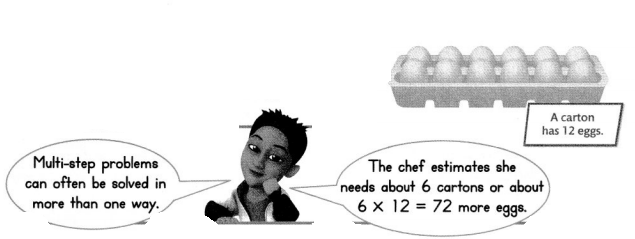
Envision Math Common Core 4th Grade Answers Topic 6 Use Operations with Whole Numbers to Solve Problems 25

One Way
How many eggs does the chef have?
(2 × 12) + 4 = 24 + 4
= 28 eggs
How many more eggs does the chef need?
N = number of additional eggs needed
N = (8 × 12) – 28
= 96 – 28 = 68
The expression 8 × 12 is how many eggs the chef needs in all.
The chef needs 68 more eggs.
Since 68 is close to 72, the answer is reasonable.

Another Way
How many full cartons should the chef buy?
8 – 2 = 6 full cartons
How many more eggs does the chef need?
N = number of additional eggs needed
N =(6 × 12) – 4
= 72 – 4 = 68
The expression 6 × 12 is the number of eggs in 6 cartons.
The chef needs 68 more eggs.
Since 68 is close to 72, the answer is reasonable.

Convince Me!
A model with Math
Draw the bar diagrams to represent a solution to the problem above.
Answer:
The representations of the bar diagrams for the above problem are:
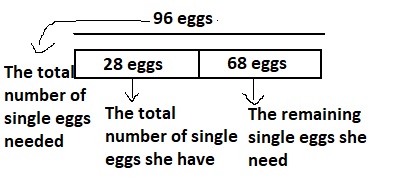
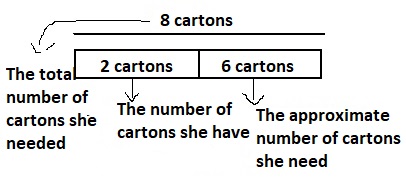
Guided Practice

Do You Understand?
Question 1.
Explain the meaning of the expression (2 × 12) + 4 in the problem on the previous page.
Answer:
In the problem on the previous page,
The meaning of the expression (2 × 12) + 4 is:
2 × 12:
The number of single eggs present in the 2 cartons
4:
The number of single eggs that are present separately
Hence, from the above,
We can conclude that
(2 × 12) + 4:
The total number of single eggs present for chef Angela to make a cake

Question 2.
In the problem on the previous page, how many eggs will the chef have leftover? Explain.
Answer:
In the problem on the previous page,
It is given that
The total number of cartons the chef needed is: 8 cartons
The number of cartons the chef have: 2 cartons
So,
The remaining number of cartons the chef needed = (The total number of cartons the chef needed) – (The number of cartons the chef have)
= 8 – 2
= 6 cartons
Now,
We know that,
A single carton has 12 eggs
So,
The number of eggs present in 6 cartons = 12 × 6
= 72 eggs
But,
It is given that the 4 single eggs are present
So,
From 72 eggs, only 8 single eggs are needed along with 2 cartons
Hence, from the above,
We can conclude that
The number of eggs will the chef have leftover is: 4 eggs

Do You Know How?
Question 3.
Carrie’s stamp book has 20 pages and each page can hold 15 stamps. She has 45 international stamps. She has 4 times as many U.S. stamps. Can all her stamps fit in her book? Use the bar diagram below to help solve this problem. Draw other bar diagrams as needed. Show the equations used to solve this problem.
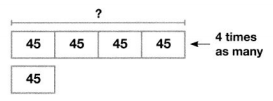
Envision Math Common Core 4th Grade Answers Topic 6 Use Operations with Whole Numbers to Solve Problems 26
Answer:
It is given that
Carrie’s stamp book has 20 pages and each page can hold 15 stamps. She has 45 international stamps. She has 4 times as many U.S. stamps
So,
The total number of stamps present in Carrie’s stamp book = (The number of pages present in Carrie’s stamp book) × (The number of stamps that each stamp can hold)
= 20 × 15
= 20 × (10 + 5)
= (20 × 10) + (20 × 5)
= 200 + 100
= 300 stamps
Now,
According to the given information,
The number of U.S stamps Carrie have = 4 × (The number of International stamps)
= 4 × 45
= 4 × (40 + 5)
= (4 × 40) + (4 × 5)
= 160 +20
= 180 U.S stamps
So,
300 > 180
Now,
The representation of the given information in the form of a bar diagram is:
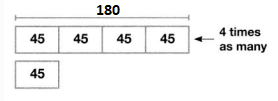
Hence, from the above,
We can conclude that all of Carrie’s stamps fit in her book since the number of stamps Carrie’s book can accommodate is greater than the number of stamps Carrie have

Independent Practice

For 4-5, draw the bar diagrams, and write equations to solve each problem. Use variables to represent unknown quantities and tell what each variable represents.
Question 4.
Five toymakers each carved 28 blocks and 17 airplanes. Three other toymakers each carved the same number of airplanes and twice as many blocks. How many toys did the eight carve in all?
Answer:
It is given that
Five toymakers each carved 28 blocks and 17 airplanes. Three other toymakers each carved the same number of airplanes and twice as many blocks.
So,
The total number of toys the eight people carved = (The number of toys 5 toymakers carved) + (The number of toys the remaining 3 toymakers carved)
= ([The number of blocks] + [The number of airplanes]) + ([The number of airplanes as the same as 5 toymakers made] + [The number of blocks as the same as 5 toymakers made] × 2)
= (28 + 17) + (17 + [28 × 2])
= 45 + (17 + 56)
= 45 + 73
= 118 toys
Now,
The representation of the given information in the form of a bar diagram is:
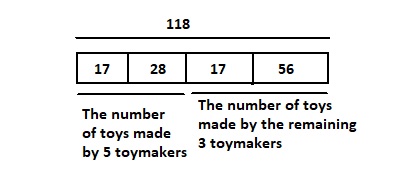
Hence, from the above,
We can conclude that
The total number of toys that the eight toymakers carved are: 118 toys

Question 5.
Kendra is using 27 blue patches and some white patches to make a quilt. The quilt has a total area of 540 square inches. Each patch has an area of 9 square inches. How much of the area of the quilt is white?
Answer:
It is given that
Kendra is using 27 blue patches and some white patches to make a quilt. The quilt has a total area of 540 square inches. Each patch has an area of 9 square inches.
Now,
Let the area of the white patch be x
Now,
The total number of patches = (The number of blue patches) + (The number of white patches)
= (27 + x)
Now,
The total area of the patches (or) The total area of the quilt = (The total number of patches) × (The area of each patch)
= (27 + x) × 9 square inches
Now,
According to the given information,
(27 + x) × 9 = 540
27 + x = \(\frac{540}{9}\)
27 + x = 60
x = 60 – 27
x = 33 square inches
Now,
The representation of the given information in the form of a bar diagram is:
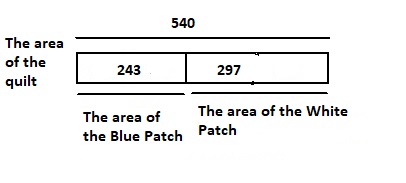
Hence, from the above,
We can conclude that
The area of the white patch is: 33 square inches

Problem Solving

Question 6.
Make Sense and Persevere A ticket to a movie for a student is $7. The cost for an adult is $2 more than for a student. How much would it cost 5 adults and 29 students for tickets to the movie?
Answer:
It is given that
A ticket to a movie for a student is $7. The cost for an adult is $2 more than for a student
Now,
The cost of a ticket for an adult = $2 + (The cost of a ticket for a student)
= $2 + $7
= $9
So,
The cost of the tickets for 5 adults = 5 × (The cost of a ticket for an adult)
= 5 × $9
= $45
So,
The cost of the tickets for 29 students = 29 × (The cost of a ticket for a student)
= 29 × $7
= (20 + 9) × $7
= (20 × $7) + (9 × $7)
= 140 + 63
= $203
So,
The total cost of the tickets for 5 adults and 29 students = $45 + $203
= $248
Hence, from the above,
We can conclude that the total cost of the tickets for 5 adults and 29 students to a movie is: $248

Question 7.
Vocabulary Give an example of an expression. Then give an example of an equation.
Answer:
An example of an expression is:
25 × 3
An example of an equation is:
20 × 3 + a × 3 = 250
Where,
‘a’ is an unknown variable

Question 8.
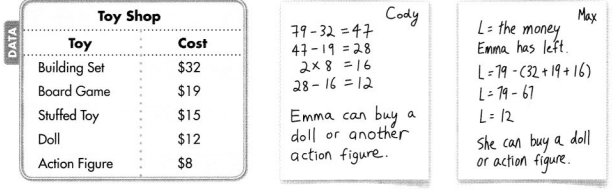
Higher-Order Thinking Cody and Max both solve the problem below correctly. Explain how each solves.
Emma has $79 to spend at the toy store. She wants to buy a building set, a board game, and 2 action figures from her favorite movie. What else can she buy?
Envision Math Common Core 4th Grade Answers Topic 6 Use Operations with Whole Numbers to Solve Problems 27
Answer:
It is given that
Emma has $79 to spend at the toy store. She wants to buy a building set, a board game, and 2 action figures from her favorite movie
Now,
The given table is:
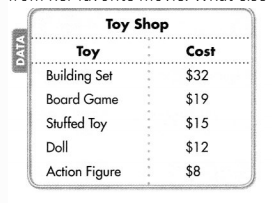
Now,
According to Max:
Let the money Emma has after she bought the mentioned items be x
So,
The amount of money Emma has left = (The total amount of money Emma has) – (The total amount of money spent on buying the items)
= $79 – ($32 + $19 + 2 ($8))
= $79 – ($32 + $19 + $16)
= $79 – 67
= $12
So,
From the given table,
We can observe that
For $12, we can buy a doll or an action figure
Now,
According to Cody:
The amount of money Emma have after she bought a building set = (The total amount of money Emma have) – (The amount of money spent by Emma on buying a building set)
= $79 – $32
= $47
The amount of money Emma have after she bought a board game = (The remaining amount of money Emma have after she bought a building set) – (The amount of money spent by Emma on buying a board game)
= $47 – $19
= $28
The amount of money Emma have after she bought 2 action figures = (The remaining amount of money Emma have after she bought a board game) – (The amount of money spent by Emma on buying 2 action figures)
= $28 – 2 ($8)
= $28 – $16
= $12
Hence, from the above,
We can conclude that Emma can buy a doll or an action figure

Assessment Practice

Question 9.
A company has 2 geothermal plants which can power a total of 2,034 homes. After they build 3 additional, more powerful, geothermal plants, they can power a total of 5,799 homes. How many homes does each of the new plants’ power? Explain how you solve. Use one or more equations and bar diagrams in your explanation. Tell what your variables represent.
Answer:
It is given that
A company has 2 geothermal plants which can power a total of 2,034 homes. After they build 3 additional, more powerful, geothermal plants, they can power a total of 5,799 homes
So,
The total number of geothermal plants = 2 + 3
= 5 geothermal plants
The number of homes that can be powered by all the geothermal plants =(The number of homes powered by 2 geothermal plants) + (The number of homes powered by 3 geothermal plants)
= 2,034 + 5,799
= 7,833 homes
So,
The number of homes powered by each geothermal plant = \(\frac{The number of homes powered by all the geothermal plants}{5}\)
= \(\frac{7,833}{5}\)
= 1,766.5
≅ 1,777 homes
Now,
The representation of the given information in the form of a bar diagram is:
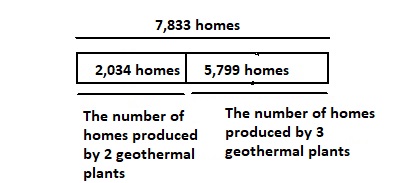
Hence, from the above,
We can conclude that the number of homes provided by each geothermal plant is: 1,777 homes

Lesson 6.5 Solve Multi-Step Problems

Solve & Share
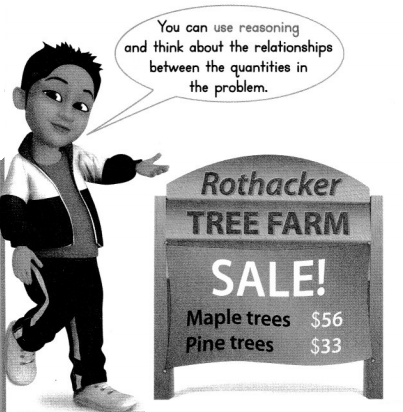
A farmer needs $3,500 to buy a previously owned truck. If she sells 45 maple trees and 27 pine trees, will she earn enough to buy the truck? If not, how much more money does she need? Solve this problem any way you choose.
I can … solve multi-step problems by finding and solving hidden questions and by writing expressions and equations.
Envision Math Common Core 4th Grade Answers Topic 6 Use Operations with Whole Numbers to Solve Problems 28
Answer:
It is given that
A farmer needs $3,500 to buy a previously owned truck and she sells 45 maple trees and 27 pine trees
Now,
The given table is:
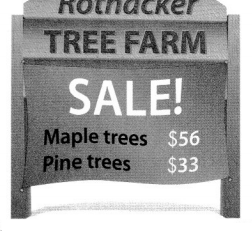
Now,
The amount earned by selling 45 maple trees = (The number of maple trees) × (The cost of each maple tree)
= 45 × $56
= (40 + 5) × (50 + 6)
= (40 × 50) + (40 × 6) + (5 × 50) + (5 × 6)
= 2,000 + 240 + 250 + 30
= $2,520
Now,
The amount earned by selling 27 pine trees = (The number of pine trees) × (The cost of each pine tree)
= 27 × $33
= (20 + 7) × (30 + 3)
= (20 × 30) + (20 × 3) + (7 × 30) + (7 × 3)
= 600 + 60 + 210 + 21
= $891
So,
The total amount of money earned by selling 45 maple trees and 27 pine trees = $2,520 + $891
= $3,411
But,
A farmer needs $3,500
Hence, from the above,
We can conclude that she will not earn enough money to buy the truck

Look Back! In the question above, how many more of each tree could the farmer sell to get enough money to buy the truck? Explain.
Answer:
From the above problem,
We can observe that
The total amount of money earned by selling 45 maple trees and 27 pine trees is: $3,411
She will need $3,500
Now,
The extra money she have = $3,500 – $3,411
= $189
Hence, from the above,
We can conclude that
With the remaining money,
She can buy
The number of maple trees she can buy are: 2
The number of pine trees she can buy are: 2

Essential Question
How Can You Use Equations to Solve Multi-Step Problems?
Answer:
The steps to solve Multi-Step problems using equations are:
a. Multiply to clear any fractions or decimals.
b. Simplify each side by clearing parentheses and combining like terms.
c. Add or subtract to isolate the variable term—you may have to move a term with the variable.
d. Multiply or divide to isolate the variable.
e. Check the solution.

Visual Learning Bridge
The students in the fourth and fifth grades are going to a concert. There are 178 students. How many rows are needed for the fourth graders?
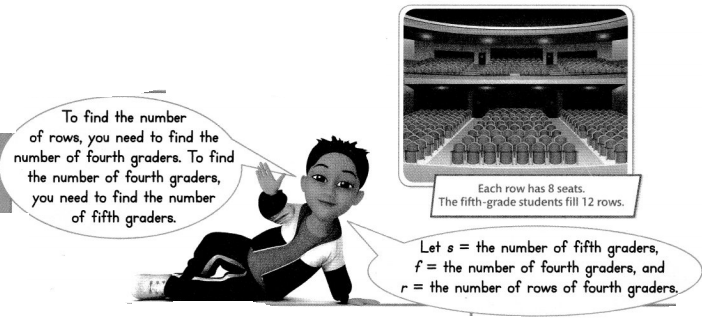
Envision Math Common Core 4th Grade Answers Topic 6 Use Operations with Whole Numbers to Solve Problems 29

Step 1
Find and solve the first hidden question.
Hidden Question: How many fifth graders are there?
12 × 8 = s
S = 96
There are 96 fifth graders.

Step 2
Find and solve the second hidden question.
Hidden Question: How many fourth graders are there?
178 – 96 = f
f = 82
There are 82 fourth graders.

Step 3
Answer the original question.
Original Question: How many rows are needed for the fourth graders?
82 ÷ 8 = r
r = 10 R2
Ten rows will be filled with 2 fourth graders left over. So, 11 rows will be needed.

Convince Me!
Construct Arguments Does the answer of 11 rows makes sense for the problem above? Explain.
Answer:
From the above problem,
We can observe that
The number of rows needed for the fourth graders is: 10 R 2
Now,
The meaning of 10 R 2 in the given situation is:
10 rows with the remainder 2 seats and we have to arrange that remainder in the next row
So,
The total number of rows is: 11
Hence, from the above,
We can conclude that the answer of 11 rows makes sense for the above problem

Guided Practice

Do You Understand?
Question 1.
On the previous page, suppose there were only 11 rows of fifth-graders, but the same total number of students. Do you need to solve the whole problem again to find how many rows are needed for the fourth graders? Explain.
Answer:
It is given that
On the previous page, there were only 11 rows of fifth-graders, but the same total number of students
Now,
In the example on the previous page,
It is given that
There are 8 students in each row and the total number of students are 178
So,
The number of rows needed for the fourth-grade students = [(The total number of students) – (The number of rows needed for the fifth-graders) × (The number of students in each row)] ÷ 8
Hence, from the above,
We can conclude that
We need to solve the whole problem again to find the number of rows needed for the fourth-graders

Do You Know How?
Question 2.
Show another way to solve the problem on the previous page.
Answer:
The given figure is:
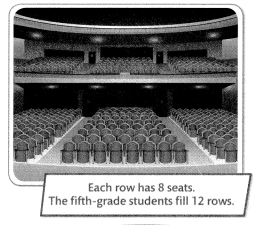
Now,
In the previous example on the previous page,
It is given that
There are a total of 178 students
Now,
The number of students in the fifth-grade = (The number of rows filled by the fifth-graders) × (The number of students in each row)
= 12 × 8
= (10 + 2) × 8
= (10 × 8) + (2 × 8)
= 80 + 16
= 96 students
So,
The number of students in the fourth-grade = (The total number of students) – (The number of students in the fifth grade)
= 178 – 96
= 82 students
So,
The number of rows filled by the fourth-graders = \(\frac{The number of students in the fourth-grade}{8}\)
= \(\frac{82}{8}\)
= 10 R 2
Hence,from the above,
We can conclude that the number of rows filled by the fourth-grade students is: 11

Independent Practice

For 3-4, solve each multi-step problem. Write equations to show how you solve. Draw the bar diagrams to help if needed. Use estimation to decide if your answer is reasonable.
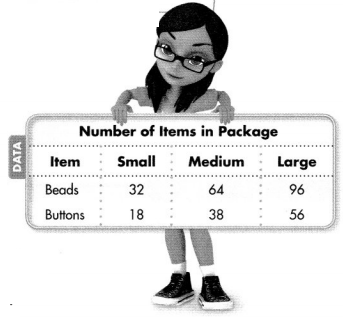
Envision Math Common Core 4th Grade Answers Topic 6 Use Operations with Whole Numbers to Solve Problems 30
Question 3.
Vanya bought 5 medium packages of buttons and 3 small packages of buttons. What was the total number of buttons Vanya bought?
Answer:
The given data is:
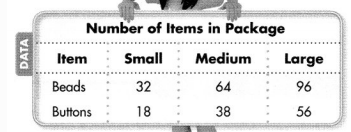
So,
The total number of buttons Vanya bought = (The number of buttons present in 5 medium packages of buttons) + (The number of buttons present in 3 small packages of buttons)
= (5 × The number of buttons present in a medium package of buttons) + (3 × The number of buttons present in a  small package of buttons)
= (5 × 38) + (3 × 18)
= 5 × (30 + 8) + 3 × (10 + 8)
= (5 × 30) + (5 × 8) + (3 × 10) + (3 × 8)
= 150 + 40 + 30 + 24
= 244 buttons
Hence, from the above,
We can conclude that
The total number of buttons Vanya bought is: 244 buttons

Question 4.
Vance bought 2 packages of large beads, 1 package of medium beads, 2 packages of large buttons, and 2 packages of medium buttons. How many more beads than buttons did Vance buy?
Answer:
The given data is:

So,
The total number of beads Vance bought = (The total number of beads present in 2 packages of large beads) + (The total number of beads present in 1 package of medium beads)
= (2 × 96) + (1 × 64)
= 2 × (90 + 6) + 64
= (2 × 90) + (2 × 6) + 64
= 180 + 12 + 64
= 256 beads
So,
The total number of buttons Vance bought = (The total number of buttons present in 2 packages of large buttons) + (The total numbr of buttons present in 2 packages of medium buttons)
= (2 × 56) + (2 × 38)
= 2 × (50 + 6) + 2 × (30 + 8)
= (2 × 50) + (2 × 6) + (2 × 30) + (2 × 8)
= 100 + 12 + 600 + 16
= 728 buttons
So,
The difference between the number of buttons and beads = 728 – 256
= 472 beads
Hence, from the above,
We can conclude that there are 472 more buttons than beads that Vance bought

Problem Solving

Question 5.
en Vision® STEM How much more does it cost to generate 9 megawatt-hours of electricity with conventional coal than with wind energy? Write one or more equations to show how you solve. Tell what your variables represent.
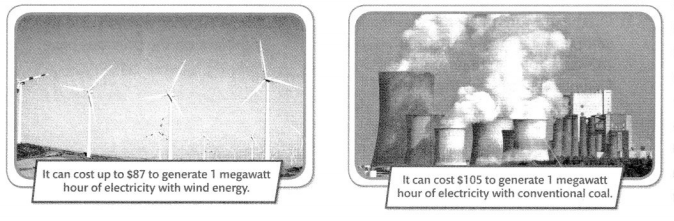
Envision Math Common Core 4th Grade Answers Topic 6 Use Operations with Whole Numbers to Solve Problems 31
Answer:
The given figure is:
Envision Math Common Core 4th Grade Answers Topic 6 Use Operations with Whole Numbers to Solve Problems 31
Now,
The cost to generate 9 megawatt hours of electricity with wind energy = 9 × (The cost to generate 1 megawatt hours of electricity with wind energy)
= 9 × $87
= 9 × (80 + 7)
= (9 × 80) + (9 × 7)
= 720 + 63
= $783
Now,
The cost to generate 9 megawatt hours of electricity with conventional coal = 9 × (The cost to generate 1 megawatt hours of electricity with conventional coal)
= 9 × $105
= 9 × (100 + 5)
= (9 × 100) + (9 × 5)
= 900 + 45
= $945
So,
The difference between the energy produced with conventional coal and the wind energy = $945 – $783
= $162
Hence, from the above,
We can conclude that
It takes $162 more to generate 9 megawatt-hours of electricity with conventional coal than the wind energy

Question 6.
A model with Math Anna earns $8 an hour babysitting and $6 an hour working in the garden. Last month, she worked 15 hours babysitting and 8 hours in the garden. How much more money does she need to buy a robot which costs $199? Explain how you solve. Use one or more equations in your explanation. Tell what your variables represent.
Answer:
It is given that
Anna earns $8 an hour babysitting and $6 an hour working in the garden. Last month, she worked 15 hours babysitting and 8 hours in the garden.
So,
The amount of money earned by Anna for babysitting = (The number of hours Anna did babysitting) × (The amount of money earned by Anna for 1 hour of babysitting)
= 15 × $8
= (10 + 5) × $8
= (10 × 8) + (5 × 8)
= 80 + 40
= $120
So,
The amount of money earned by Anna for working in the garden = (The number of hours Anna did work in the garden) × (The amount of money earned by Anna for 1 hour working in the garden)
= 8 × $6
= $48
So,
The total amount of money earned by Anna = $120 + $48
= $168
But,
She needed to buy a robot which costs $199
So,
The amount of more money she needed to buy a robot = $199 – $168
= $31
Hence, from the above,
We can conclude that
She needs $31 more to buy a robot which costs $199

Question 7.
Higher-Order Thinking Show two different ways to find the answer to the problem below.
Dog and cat food are sold in 20-pound bags. There are 14 bags of dog food and 12 bags of cat food on the store shelves. How many pounds of dog and cat food is on the shelves?
Answer:
It is given that
Dog and cat food are sold in 20-pound bags. There are 14 bags of dog food and 12 bags of cat food on the store shelves
So,
The number of pounds of dog food = (The number of bags of dog food) × (The number of pounds each bag contains)
= 14 × 20
= (10 + 4) × 20
= (10 × 20) + (4 × 20)
= 200 + 80
= 280 pounds
The number of pounds of cat food = (The number of bags of cat food) × (The number of pounds each bag consists)
= 12 × 20
= (10 + 2) × 20
= (10 × 20) + (2 × 20)
= 200 + 40
= 240 pounds
Hence, from the above,
We can conclude that
The number of pounds of dog food present on the shelves is: 280 pounds
The number of pounds of cat food present on the shelves is: 240 pounds

Assessment Practice

Question 8.
Chris needs $858 to buy a computer. She has already saved $575. She gets $15 an hour for babysitting and will babysit 12 hours in the next month. She can save $8 a week from her allowance. How many weeks of allowance will it take Chris to save enough to buy the computer? Explain how you solve. Use one or more equations in your explanation. Tell what your variables represent.
Answer:
It is given that
Chris needs $858 to buy a computer. She has already saved $575. She gets $15 an hour for babysitting and will babysit 12 hours in the next month. She can save $8 a week from her allowance
So,
The amount of money she required to buy a computer = (The amount of money Chris needs to buy a computer) – (The amount of money she already saved)
= $858 – $575
= $283
Now,
The amount of money she will earn for babysitting = (The number of hours she did babysitting) × (The amount of money she gets for babysitting for an hour)
= 12 × $15
= (10 + 2) × $15
= (10 × 15) + (2 × 15)
= 150 + 30
= $180
So,
The remaining money she will need to buy a computer = $283 – $180
= $103
Now,
The amount of money she earned from allowance = (The number of weeks) × (The amount of money she will earn for a week as an allowance)
$103 = x × $8
x = \(\frac{103}{8}\)
x = 12.8
x ≈ 13 weeks
Hence, from the above,
We can conclude that
About 13 weeks of allowance will it take Chris to save enough to buy the computer

Lesson 6.6 Problem Solving

Make Sense and Persevere
Solve & Share
Ms. Valenzuela had her students design a snake house for the zoo. In the design shown, the anaconda has 538 more square feet than the python. The python has twice as many square feet as the rattlesnake. How much of the house’s area does each snake have? Solve this problem any way you choose.
I can … make sense of problems and keep working if I get stuck.
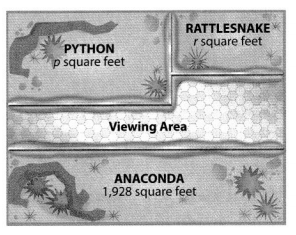
Envision Math Common Core Grade 4 Answer Key Topic 6 Use Operations with Whole Numbers to Solve Problems 32

Thinking Habits
Be a good thinker! These questions can help you.

  • What do I need to find?
  • What do I know?
  • What’s my plan for solving the problem?
  • What else can I try if I get stuck?
  • How can I check that my solution makes sense?

Answer:
It is given that
Ms. Valenzuela had her students design a snake house for the zoo. In the design shown, the anaconda has 538 more square feet than the python. The python has twice as many square feet as the rattlesnake
Now,
The given figure is:
Envision Math Common Core Grade 4 Answer Key Topic 6 Use Operations with Whole Numbers to Solve Problems 32
Now,
Let the area of the rattlesnake be r square feet
Let the area of the python be p square feet
So,
The area of the python = 2 × (The area of the rattlesnake)
= 2r square feet
Now,
According to the given information,
(The area of the anaconda) – (The area of the python) = 538
So,
1,928 – p = 538
p = 1,928 – 538
p = 1,390 square feet
So,
The area of the rattlesnake = \(\frac{The area of the python (p)}{2}\)
= \(\frac{1,390}{2}\)
= 695 square feet
Hence, from the above,
We can conclude that
The area of an anaconda is: 1,928 square feet
The area of python is: 1,390 square feet
The area of the rattlesnake is: 695 square feet

Look Back!
Make Sense and Persevere How can you check that your solution makes sense?
Answer:
To check whether the given solution makes sense or not,
Estimate the solution
Now,
By the process of Estimation,
The area of the anaconda is: 1,900 square feet
So,
(The area of the anaconda) – (The area of python) = 540
The area of python = 1,900 – 540
= 1,360 square feet
So,
The area of rattlesnake = \(\frac{The area of python}{2}\)
= \(\frac{1,360}{2}\)
= 685 square feet
So,
The area of the anaconda is: 1,900 square feet
The area of python is: 1,360 square feet
The area of the rattlesnake is: 685 square feet
Now,
By observing the answers in the above problem and the answers for this problem,
We can say that your answer is reasonable
Hence, from the above,
We can conclude that your solution makes sense

Essential Question
How Do You Make Sense of a Multi-Step Problem and Persevere in Solving It?
Answer:
The steps to make sense of a Multi-Step Problem and Persevere in Solving it are:
a. Identify the Problem. Begin by determining the scenario the problem wants you to solve.
b. Gather Information.
c. Create an Equation.
d. Solve the Problem.
e. Verify the Answer.

Visual Learning Bridge
Bryan and Alex have to buy their own instruments for the band. Alex made $1,025 from a fundraiser. He has a part-time job that pays $8 an hour. How many hours does Alex need to work to have enough money to buy his instrument?
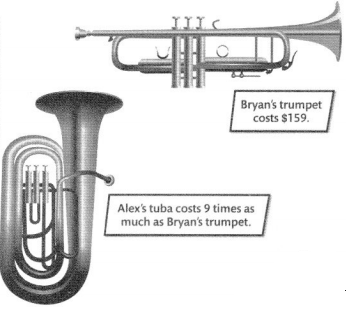
Envision Math Common Core Grade 4 Answer Key Topic 6 Use Operations with Whole Numbers to Solve Problems 33
What do you need to do to solve this problem?
I need to determine how much Alex’s tuba costs and how much Alex needs to earn to buy the tuba.

How can I make sense of and solve this problem?
I can

  • identify the quantities given.
  • understand how the quantities are related.
  • choose and implement an appropriate strategy.
  • check to be sure my work and answer make sense.

Here’s my thinking
Use the cost of the trumpet to find the cost of the tuba.
$159 x 9 = $1,431 Alex’s tuba costs $1,431.
Find how much more money Alex needs to earn.
$1,431 – $1,025 = $406 Alex needs to earn $406.
Find how many hours Alex needs to work.
$406 ÷ 8 = 50 R6
Alex will not have enough money by working 50 hours, so he needs to work 51 hours.

Convince Me!
Make Sense and Persevere How can you check to make sure the work and answer given above make sense?
Answer:
To check whether the given answer is reasonable or not,
Estimate the answer by using Estimation methods
Now,
The given figure is:
Envision Math Common Core Grade 4 Answer Key Topic 6 Use Operations with Whole Numbers to Solve Problems 33
Now,
From the given figure,
We can observe that
The cost of Bryan’s trumpet is about $160
So,
The cost of Alex’s tuba = 9 × (The cost of Bryan’s trumpet)
= 9 × $160
= 9 × (100 + 60)
= (9 × 100) + (9 × 60)
= 900 + 540
= $1,440
Now,
The more money Alex must have to buy his instrument = (The cost of Alex’s tuba) – (The money raised by fundraiser)
= $1,440 – $1,025
= $415
Now,
The number of hours needed for Alex to earn more money = \(\frac{The more money Alex must have to buy his instrument}{8}\)
= \(\frac{$415}{8}\)
= 51 R 7
Hence, from the above,
We can conclude that Alex needs about 7 hours for Alex to earn more money
Your solution is reasonable since the difference between the number of hours in the above example and this problem is not large

Guided Practice

Make Sense and Persevere In the problem on the previous page, suppose Alex wanted to know how many weeks it would take him to work
Think about 51 hours. Alex works 3 hours a day and 4 days a week. this question to help you
Envision Math Common Core Grade 4 Answer Key Topic 6 Use Operations with Whole Numbers to Solve Problems 34
Question 1.
What are you asked to find and what is the hidden question What’s a good plan for solving question?
Answer:
The hidden question to answer is:
How many weeks it would take him to work?
Now,
A good plan for solving the given question is:
a. The number of hours in a day that Alex works
b. The number of days in a week that Alex works
c. The number of weeks Alex will take to complete the work

Question 2.
Write and solve equations to solve the problem. Be sure to tell what each variable represents.
Answer:
It is given that
Alex works 3 hours a day and 4 days a week
So,
The number of hours in a week that Alex will work = (The number of hours a day) × (The number of days in a week that Alex will work)
= 3 × 4
= 12 hours a week
So,
The number of weeks Alex will need to complete the work = \(\frac{The total number of hore Alex completed the week}{The number of hours in a week that Alex will work}\)
= \(\frac{51}{12}\)
= 4 R 3
Hence, from the above,
We can conclude that Alex will need about 4 weeks to complete the work

Question 3.
Does your answer make sense? Explain.
Answer:
To make whether your answer makes sense or not,
Estimate the solution using the Estimation methods
Now,
The number of hours in a week that Alex will work = (The number of hours a day) × (The number of days in a week that Alex will work)
= 3 × 4
= 12 hours a week
So,
The number of hours in a week that Alex will work is about 10 hours
So,
The number of weeks Alex will need to complete the work = \(\frac{The total number of hore Alex completed the week}{The number of hours in a week that Alex will work}\)
= \(\frac{51}{10}\)
= 5 R 1
So,
We can conclude that Alex will need about 5 weeks to complete the work
Hence, from the above,
We can conclude that your answer is reasonable since the difference between the actual answer and the estimated answer is not large

Independent Practice

Make Sense and Persevere The high school tennis team is selling tennis balls to raise $500 for new equipment. They sell the balls for $2 each. Will they make enough money if they sell 4 cases?
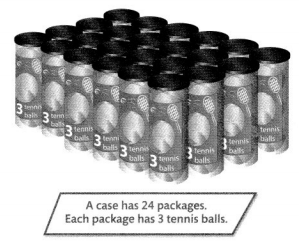
Envision Math Common Core Grade 4 Answer Key Topic 6 Use Operations with Whole Numbers to Solve Problems 35
Question 4.
What are the hidden questions? Write equations to solve each.
Answer:
It is given that
The high school tennis team is selling tennis balls to raise $500 for new equipment. They sell the balls for $2 each
So,
The hidden question for the given problem is:
What is the cost of each case?
Now,
The cost of each case = (The number of packages in each case) × (The number of tennis balls in each package) × (The cost of each tennis ball)
= 24 × 3 × $2
= 24 × $6
= (20 + 4) × 6
= (20 × 6) + (6 × 4)
= 120 + 24
= $144
So,
The cost of 4 cases = 4 × (The cost of each case)
= 4 × $144
= 4 × (100 + 40 + 4)
= (4 × 100) + (4 × 40) + (4 × 4)
= 400 + 160 + 16
= $576
But,
It is given that the high school tennis team is selling tennis balls to raise $500 for new equipment
Hence, from the above,
We can conclude that they will not make enough money if they sell 4 cases

Question 5.
Will the team makes enough money? Explain.
Answer:
From the above problem,
We can observe that
The high school tennis team is selling tennis balls to raise $500 for new equipment
The cost of tennis balls present in 4 cases is: $576
So,
$500 < $576
Hence, from the above,
We can conclude that the team will not make enough money

Problem Solving

Performance Task
Designing a Flag Rainey’s group designed the flag shown for a class project. They used 234 square inches of green fabric. After making one flag, Rainey’s group has 35 square inches of yellow fabric left. How can Rainey’s group determine the total area of the flag?
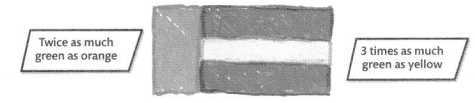
Envision Math Common Core Grade 4 Answer Key Topic 6 Use Operations with Whole Numbers to Solve Problems 36
Question 6.
Make Sense and Persevere What hidden question(s) do you need to answer first?
Answer:
It is given that
Rainey’s group designed the flag shown for a class project. They used 234 square inches of green fabric. After making one flag, Rainey’s group has 35 square inches of yellow fabric left
Now,
The hidden questions you need to answer first are:
a. Find the remaining colors present in the flag?
b. What is the area of the remaining colors in the flag?
c. What is the total area of the flag?

Question 7.
Appropriate Tools Draw diagrams and write equations to represent the hidden question(s). Be sure to tell what each variable represents.
Envision Math Common Core Grade 4 Answer Key Topic 6 Use Operations with Whole Numbers to Solve Problems 37
Answer:
The given figure is:
Envision Math Common Core Grade 4 Answer Key Topic 6 Use Operations with Whole Numbers to Solve Problems 36
Now,
It is given that
They used 234 square inches of green fabric
So,
The area of the orange fabric = 2 × (The area of the green fabric)
= 2 × 234
= 2 × (200 + 30 + 4)
= (2 × 200) + (2 × 30) + (2 × 4)
= 400 + 60 + 8
= 468 square inches
So,
The area of the yellow fabric = 3 × (The arae of the green fabric)
= 3 × 234
= (2 × 234) + (1 × 234)
= 468 + 234
= 702 square inches
But,
It is given that Rainey’s group has 35 square inches of yellow fabric left
So,
The area of the yellow fabric = 702 – 35
= 667 square inches
So,
The total area of the flag = (The area of the green flag) + (The area of the orange flag) + (The area of the yellow flag)
= 234 + 702 + 667
= 1,603 square inches
Hence, from the above,
We can conclude that
The total area of the flag is: 1,603 square inches

Question 8.
Be Precise Use your drawings and equations to find the total area of the flag. Explain carefully, using the correct units.
Answer:
From the above problem,
We can observe that
The total area of the flag can be found out by adding the areas of the three colors
So,
The total area of the flag = (The area of the green flag) + (The area of the orange flag) + (The area of the yellow flag)
= 234 + 702 + 667
= 1,603 square inches
Hence, from the above,
We can conclude that
The total area of the flag is: 1,603 square inches

Question 9.
Make Sense and Persevere What information was not needed to solve the problem?
Answer:
There is not any unnecessary information present that is not used to solve the given problem

Topic 6 Fluency Practice Activity

Find a Match
Work with a partner. Point to a clue. Read the clue. Look below the clues to find a match. Write the clue letter in the box next to the match. Find a match for every clue.
I can … subtract multi-digit whole numbers.

Clues
A. The difference is exactly 528.
B. The difference is between 550 and 560.
C. The difference is between 800 and 900.
D. The difference is exactly 614.
E. The difference is between 100 and 105.
F. The difference is between 470 and 480.
G. The difference is exactly 392.
H. The difference is between 70 and 80.
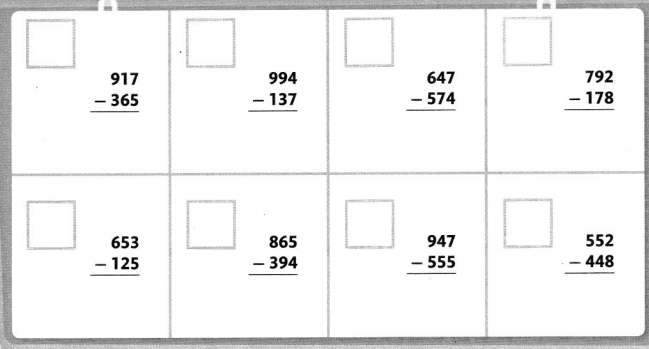
Envision Math Common Core Grade 4 Answer Key Topic 6 Use Operations with Whole Numbers to Solve Problems 38
Answer:

Topic 6 Vocabulary Review

Understand Vocabulary
Word List

  • addition comparison
  • Associative Property of Multiplication
  • Commutative Property of Multiplication
  • Distributive Property of Multiplication
  • equation
  • multiplication comparison
  • product
  • variable

Write T for true and F for false.
Question 1.
__________ Addition comparison is used when you can multiply to find how one quantity is related to another.
Answer:
We know that,
Additive comparisons focus on the difference between two quantities
Hence, from the above,
We can conclude that the given statement is: False

Question 2.
___________ Multiplication comparison is used when one quantity is x times more than another quantity.
Answer:
We know that,
In multiplicative comparison, there are two different sets being compared. The first set contains a certain number of items. The second set contains multiple copies of the first set.
Hence, from the above,
We can conclude that the given statement is: False

Question 3.
__________ A number sentence that uses an equal sign to show that two expressions have the same value is called an equation.
Answer:
We know that,
A number sentence that uses an equal sign to show that two expressions have the same value is called an “Equation”
Hence, from the above,
We can conclude that the given statement is: True

Question 4.
___________ The answer to a subtraction problem is called the product.
Answer:
We know that,
The answer to a multiplication problem is called the “Product”
Hence, from the above,
We can conclude that the given statement is: True

Question 5.
_________ A symbol or letter that stands for a number is called a variable.
Answer:
We know that,
A “Variable” is a symbol that works as a placeholder for expression or quantities that may vary or change
Hence, from the above,
We can conclude that the given statement is: True

Label each example with a term from the Word List.
Question 6.
(3 × 4) × 5 = 3 (4 × 5) _______________
Answer:
We know that,
According to Associative Property of Multiplication,
a × (b × c) = (a × b) × c
So,
we can observe that
The given expression is also in the same form
Hence, from the above,
We can conclude that the term that is suitable for the given problem is: Associative Property of Multiplication

Question 7.
3 × (4 + 5) = (3 × 4) + (3 × 5) _______________
Answer:
We know that,
According to the Distributive Property of Multiplication,
a × (b + c) = (a × b) + (a × c)
So,
we can observe that
The given expression is also in the same form
Hence, from the above,
We can conclude that the term that is suitable for the given problem is: Distributive Property of Multiplication

Question 8.
3 × 4 × 5 = 4 × 3 × 5 _______________
Answer:
We know that,
According to the Commutative Property of Multiplication,
a × b = b × a
So,
We can observe that
The given expression is also in the same form
Hence, from the above,
We can conclude that the term that is suitable for the given problem is: Commutative Property of Multiplication

Use Vocabulary in Writing
Question 9.
Seth wrote and solved the following comparison:
Find 6 times as many as 5.
6 × 5 = n
n = 30
Use at least 3 terms from the Word List to describe Seth’s comparison.
Answer:
It is given that
Find 6 times as many as 5 ———-> Multiplication comparison
So,
The given sentence can be written as:
6 × 5 = n ——-> Equation
n = 30 ——-> Product
Where,
n ——> variable

Topic 6 Reteaching

Set A pages 225-232

Write an equation for each comparison. Find the value of the variable that makes the equation true.
k is 9 times as many as 3.
k = 9 × 3
k = 27
m is 6 more than 21.
m = 6 + 21
m = 27
There are 30 apples and 6 bananas in a basket. How many times as many apples as bananas are in the basket?
Let t = the number of times as many apples as bananas.
t times as many as 6 is 30.
t × 6 = 30
Since 5 × 6 = 30, there are 5 times as many apples as bananas in the basket.

Remember to use addition or subtraction when you know how much more, and multiplication or division when you know how many times as many.

Write and solve an equation to match each comparison.
Question 1.
x is 21 more than 21.
Answer:
It is given that
x is 21 more than 21
So,
According to the Property of Addition comparison,
x = 21 + 21
x = 42
Hence, from the above,
We can conclude that the value of x is: 42

Question 2.
Macon has 32 rocks in his collection. He has 4 times as many rocks as his brother. How many rocks, r, does Macon’s brother have?
Answer:
It is given that
Macon has 32 rocks in his collection. He has 4 times as many rocks as his brother
Now,
Let the number of rocks Macon’s brother has to be: r
So,
According to the given information,
r × 4 = 32
r = \(\frac{32}{4}\)
r = 8 rocks
Hence from the above,
We can conclude that Macon’s brother has 8 rocks

Question 3.
Pam has 24 pencils and 6 erasers. How many times, t, as many pencils as erasers does Pam have?
Answer:
It is given that
Pam has 24 pencils and 6 erasers
Now,
Let the number of erasers be: x
So,
According to the given information,
x × 6 = 24
x = \(\frac{24}{6}\)
x = 4 erasers
Hence, from the above,
We can conclude that
Pam has the number of pencils 4 times as many as erasers

Set B pages 233-240

At a restaurant, a children’s meal costs $5, and an adult meal costs $9. Four children and 2 adults order meals. The family has a $25 gift certificate to use. How much will their total be before tax?
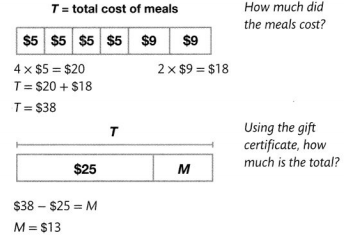
Envision Math Common Core Grade 4 Answer Key Topic 6 Use Operations with Whole Numbers to Solve Problems 39

Remember to first find and answer any hidden questions.

Question 1.
There are 64 singers in the choir. The tenors and sopranos are in separate rows. There are 8 singers in each row. There are 4 rows of tenors. How many rows of sopranos are there?
Answer:
It is given that
There are 64 singers in the choir. The tenors and sopranos are in separate rows. There are 8 singers in each row. There are 4 rows of tenors.
Now,
Let the number of rows of sopranos be x
So,
The total number of rows = (The number of rows of sopranos) + (The number of rows of tenors)
= (x + 4)
Now,
According to the given information,
The total number of rows = \(\frac{The total number of singers}{The number of singers in each row}\)
= \(\frac{64}{8}\)
= 8
So,
x + 4 = 8
x = 8 – 4
x = 4 rows
Now,
The representation of the given information in the form of a bar diagram is:
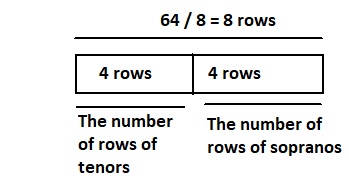
Hence, from the above,
We can conclude that
The total number of rows of sopranos is: 4 rows

Question 2.
Samantha has $600 saved for a trip. She buys an airline ticket for $120 and reserves a hotel room for $55 each night for 4 nights. If Samantha’s trip lasts for 5 days and she spends the same amount each day, how much can Samantha spend each day?
Answer:
It is given that
Samantha has $600 saved for a trip. She buys an airline ticket for $120 and reserves a hotel room for $55 each night for 4 nights and Samantha’s trip lasts for 5 days and she spends the same amount each day
Now,
The amount of money Spent by Samantha = (The amount of money spent to buy an airline ticket) + (The amount of money spent to reserve a hotel room for 4 nights)
= $120 + ($55 × 4)
= $120 + (50 + 5) × 4
= 120 + (50 × 4) + (5 × 4)
= 120 + 200 + 20
= $120 + $220
= $340
So,
The amount of money spent by Samantha for 5 days = $340 × 5
= (300 + 40) × 5
= (300 × 5) + (40 × 5)
= 1,500 + 200
= $1,700
But,
Samantha can buy the airline ticket only once
So,
The amount of money Samantha spent for 5 days = $1,700 – $120
= $580
So,
The amount of money spent by Samantha each day = \(\frac{$580}{5}[latex]
= $116
Hence, from the above,
We can conclude that the amount of money spent by Samantha each day is: $116

Set C pages 241-244

There are 13 girls and 14 boys signed up to join volleyball. Each team needs 6 players. How many teams can be formed, and how many more players are needed to form one more team?
Find the total number of players signed up.
13 + 14 = p
27 = p
Divide to find the number of teams that can be formed.
27 ÷ 6 = t
4 R 3 = t
There are 3 students left not on a team. Subtract to find the number of players still needed to make a team.
6 – 3 = p
3 = p
4 teams can be formed. 3 more players are needed to make one more team.

Remember to draw the bar diagrams to help if needed.

Solve each multi-step problem. Write equations to show how you solve.
Question 1.
Kevin made $96 in necklace sales and half that amount in bracelet sales. How much money did Kevin make in necklace and bracelet sales?
Answer:
It is given that
Kevin made $96 in necklace sales and half that amount in bracelet sales
So,
The amount made by Kevin in bracelet sales = (The amount made by Kevin in necklace sales) ÷ 2
= [latex]\frac{96}{2}\)
= $48
So,
The amount of money made by Kevin in necklace and bracelet sales = (The amount of money made by Kevin in necklace sales) + (The amount of money made by Kevin in bracelet sales)
= $96 + $48
= $144
Hence, from the above,
We can conclude that
The amount made by Kevin in necklace and bracelet sales is: $144

Question 2.
A dog and cat rescue use 40 pounds of dog food and 15 pounds of cat food to feed its animals each day. How many pounds of dog and cat food do they use in seven days?
Answer:
It is given that
A dog and cat rescue use 40 pounds of dog food and 15 pounds of cat food to feed its animals each day
So,
The number of pounds of dog and cat food they use each day = (The number of pounds of dog food) + (The number of pounds of cat food)
= 40 + 15
= 55 pounds
So,
The number of pounds of dog and cat food they use in 7 days = 7 × (The number of pounds of dog and cat food they use each day)
= 7 × 55
= 7 × (50 + 5)
= (7 × 50) + (7 × 5)
= 350 + 35
= 385 pounds
Hence, from the above,
We can conclude that
The number of pounds of dog and cat food they use in 7 days is: 385 pounds

Set D pages 245-248

Think about these questions to help you make sense of the problem.
Thinking Habits

  • What do I need to find?
  • What do I know?
  • What’s my plan for solving the problem?
  • What else can I try if I get stuck?
  • How can I check that my solution makes sense?

    Envision Math Common Core Grade 4 Answer Key Topic 6 Use Operations with Whole Numbers to Solve Problems 40

Remember to make sense of the problem before starting to solve it.

At a local shelter, each large dog can be adopted for $10 and each small dog for $5. There are 17 large dogs up for adoption. If all the dogs are adopted, the shelter will make $215. How many small dogs were at the shelter?
Question 1.
Find the hidden questions. Write equations to solve each.
Answer:
It is given that
At a local shelter, each large dog can be adopted for $10 and each small dog for $5. There are 17 large dogs up for adoption. If all the dogs are adopted, the shelter will make $215.
So,
The hidden questions for the given problem are:
a. What is the cost for the adoption of 17 large dogs?
b. What is the cost for the adoption of the small dogs?

Question 2.
How many small dogs are at the shelter?
Answer:
It is given that
At a local shelter, each large dog can be adopted for $10 and each small dog for $5. There are 17 large dogs up for adoption. If all the dogs are adopted, the shelter will make $215.
Now,
Let the number of small dogs be x
So,
The total cost for the adoption of all dogs = (The total cost for the adoption of large dogs) + (The total cost for the adoption of small dogs)
$215 = [(The number of large dogs) × (The cost for the adoption of each large dog)] + [(The number of small dogs) × (The cost for the adoption of each small dog)]
$215 = (17 × $10) + (x × $5)
$215 = (17 × 1 × 10) + (x × $5)
$215 = $170 + (x × $5)
x × $5 = $215 – $170
x × $5 = $45
x = \(\frac{45}{5}\)
x = 9
Hence, from the above,
We can conclude that the total number of small dogs is: 9 small dogs

Topic 6 Assessment Practice

Question 1.
Jason and his 3 brothers want to buy a gift for their mother. They have $314 saved. Each of them will save $17 a week until they have at least $515 for her gift. How much money will they save after 3 weeks? Will they have enough money to buy the gift?
A. What are the hidden questions?
Answer:
It is given that
Jason and his 3 brothers want to buy a gift for their mother. They have $314 saved. Each of them will save $17 a week until they have at least $515 for her gift
Hence,
The hidden questions for the given problem are:
a. How much money Jason and his 3 brothers will save each week?
b. How much amount of money do Jason and his brothers need to save?

B. Write an equation that can be used to answer each hidden question. Then solve.
Answer:
It is given that
Jason and his 3 brothers want to buy a gift for their mother. They have $314 saved. Each of them will save $17 a week until they have at least $515 for her gift
Now,
The amount of money jason and his 3 brothers will save each week = 4 × $17
= 4 × (10 + 7)
= (4 × 10) + (4 × 7)
= 40 + 28
= $68
Now,
The amount of enough money Jason and his 3 brothers will have to save = $515 – $314
= $201
Hence, from the above,
We can conclude that
The amount of money Jason and his 3 brothers will save each week is: $68
The amount of enough money Jason and his 3 brothers will have to save is: $201

C. Write and solve an equation to find how much money they will save after 3 weeks. Will they have enough to buy the gift? Explain.
Answer:
From part (a),
We can observe that
The amount of money Jason and his 3 brothers will save each week is: $68
So,
The amount of money Jason and his 3 brothers will save in 3 weeks = 3 × $68
= 3 × (60 + 8)
= (3 × 60) + (3 × 8)
= 180 + 24
= $204
So,
The amount of money Jason and his 3 brothers will save after 3 weeks = $204 – $201
= $3
So,
The amount of money Jason and his 3 brothers will have = $515 + $3
= $518
Hence, from the above,
We can conclude that Jason and his 3 brothers will have enough money to buy the gift

Question 2.
Marco ordered 2 reclining chairs for $230 each and a coffee table for $350. The shipping cost is $100. Marco is going to pay off his bill in 5 equal payments. How much is each of Marco’s payments?
Answer:
It is given that
Marco ordered 2 reclining chairs for $230 each and a coffee table for $350. The shipping cost is $100. Marco is going to pay off his bill in 5 equal payments
So,
The total payment made by Marco = (The payment made by Marco for 2 reclining chairs) + (The payment made by Marco for a coffee table) + (The shipping cost)
= (2 × 230) + 350 + 100
= [(2 × 23) × 10] + 450
= 460 + 450
= $910
Now,
The payment made by Marco in each equal installment = \(\frac{$910}{5}\)
= $182
Hence, from the above,
We can conclude that each of Marco’s payments is: $182

Question 3.
Mitchell wants to beat the record for the most points scored in a season. This season, he has scored 51 points. If he scores 27 points at each of the next 7 games, he will break the record by 1 point. How many total points will break the record by 1 point?
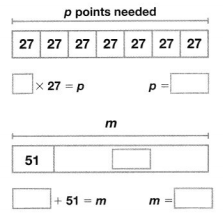
Envision Math Common Core Grade 4 Answer Key Topic 6 Use Operations with Whole Numbers to Solve Problems 41
Mitchell will break the record by 1 point if he scores a total of ________ points.
Answer:
It is given that
Mitchell wants to beat the record for the most points scored in a season. This season, he has scored 51 points. and if he scores 27 points at each of the next 7 games, he will break the record by 1 point.
Now,
The number of points scored by Mitchell in the next 7 games = 27 × 7
= (20 + 7) × 7
= (20 × 7) + (7 × 7)
= 140 + 49
= 189 points
So,
The total number of points scored by Mitchell in this season = 189 + 51
= 240 points
So,
The representation of the given situation in the form of a bar diagram is:
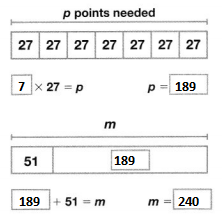
Hence, from the above,
We can conclude that
Mitchell will break the record by 1 point if he scores a total of 240 points.

Question 4.
Select all the sentences that describe a comparison using multiplication.
☐ 9 is 3 times as many as p.
☐ 27 more than r is 41.
☐ A bus can travel 3 times as fast as a boat.
☐ It costs d dollars for 9 packages.
☐ There are 4 times as many girls as boys.
Answer:
The sentences that describe a comparison using multiplication are:
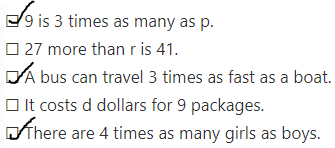
Question 5.
Choose the correct word from the box to complete each statement.
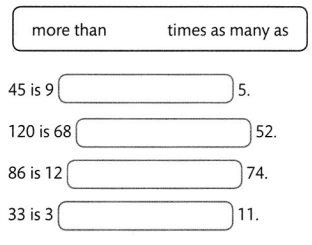
Envision Math Common Core Grade 4 Answer Key Topic 6 Use Operations with Whole Numbers to Solve Problems 42
Answer:
The completed statements with the suitable word from the given box are:
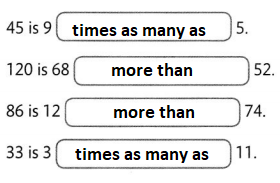
Question 6.
Dee has $120 to spend. She went to the grocery store and spent $55. She then bought 3 potted flowers for $18 each at the nursery. How much money did Dee have left? Select each correct equation or set of equations that could be used to solve the question.
☐ $120 – $55 = M; M – (3 × $18)
☐ $120 – $55 – (3 × $18) = M
☐ (3 × $18) – $55 – $120 = M
☐ ($120 – $55) – (3 × $18) = M
☐ $120 + $55 – (3 × $18) = M.
Answer:
It is given that
Dee has $120 to spend. She went to the grocery store and spent $55. She then bought 3 potted flowers for $18 each at the nursery.
Now,
The cost of the 3 potted flowers = 3 × $18
= 3 × (10 + 8)
= (3 × 10) + (3 × 8)
= 30 + 24
= $54
So,
The amount of money spent by Dee = $55 + $54
= $109
So,
The amount of money Dee left = (The amount of money Dee has to spend) – (The amount of money Dee has spent)
= $120 – $109
= $11
Hence, from the above,
We can conclude that
Each correct equation or set of equations that could be used to solve the given question is:
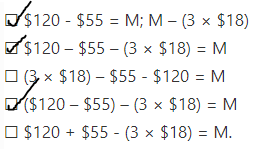
Question 7.
Darcy ordered 18 boxes of red balloons and 12 boxes of blue balloons for a party. She ordered a total of 240 balloons. How many balloons are in each box?
A. 6
B. 8
C. 7
D. 9
Answer:
It is given that
Darcy ordered 18 boxes of red balloons and 12 boxes of blue balloons for a party. She ordered a total of 240 balloons
So,
The total number of balloons present in 2 boxes = (The number of red balloons) + (The number of blue balloons)
= 18 + 12
= 30 balloons
So,
The number of balloons present in each box = \(\frac{The total number of balloons}{The total number of balloons present i 2 boxes}\)
= \(\frac{240}{30}\)
= 8 balloons
Hence, from the above,
We can conclude that
The number of balloons present in each box is:

Question 8.
Select all of the sentences that are true for the number 9.
☐ 18 × _____ = 162
☐ 20 more than _____ = 180
☐ _____ times as many as 16 is 145.
☐ 315 is _____ times as many as 35.
☐ 16 × _______ = 128
Answer:
The sentences that are true for the number 9 are:
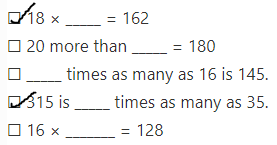
Question 9.
Select all the expressions that are equal to the product of 14 and 9.
☐ (2 × 7) + 9
☐ 9 times as many as 14
☐ 14 × 9
☐ 14 more than 9
☐ 9 less than 14
Answer:
We know that,
According to the Commutative Property of Multiplication,
a × b = b × a
So,
14 × 9 = 14 × 9
Hence, from the above,
We can conclude that
All the expressions that are equal to the product of 14 and 9 are:
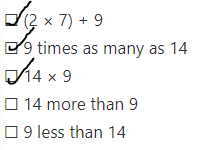
Question 10.
Maggie collected 63 pounds of paper for recycling. Carl collected 9 pounds. How many times as many pounds did Maggie collect as Carl?
A. 3 times
B. 5 times
C. 7 times
D. 8 times
Answer:
It is given that
Maggie collected 63 pounds of paper for recycling. Carl collected 9 pounds
Now,
Let the number of pounds as many times collected be x
So,
According to the given information,
9 × x = 63
x = \(\frac{63}{9}\)
x = 7
Hence, from the above,
We can conclude that
The number of times as many pounds did Maggie collect as Carl are:
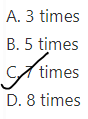
Topic 6 Performance Task

Ski Jumping
Jackie and her older brother Robert went skiing. The Ski Jumping table shows their best jumps, including the distance they jumped and the total length of their run.
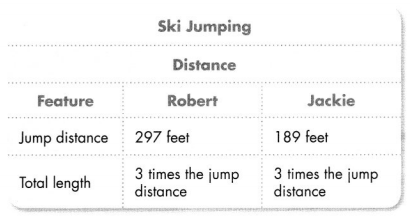
Envision Math Common Core Grade 4 Answer Key Topic 6 Use Operations with Whole Numbers to Solve Problems 43
Question 1.
Jackie wants to find how much farther Robert’s run was than her run.
Part A
What is the total length of Robert’s run? Draw a bar diagram and write and solve an equation to represent the problem. Does this situation use addition or multiplication to compare?
Answer:
The given table is:
Envision Math Common Core Grade 4 Answer Key Topic 6 Use Operations with Whole Numbers to Solve Problems 43
Now,
From the given table,
We can observe that
The total length of Robert’s run = 3 × (The jump distance of Robert)
= 3 × 297
= 3 × (200 + 90  + 7)
= (3 × 200) + (3 × 90) + (3 × 7)
= 600 + 270 + 21
= 891 feet
Now,
The representation of the given information about Robert in the form of a bar diagram is:
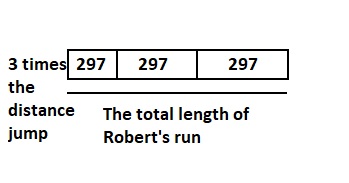
So,
The given situation uses multiplication to compare
Hence, from the above,
We can conclude that the total length of Robert’s run is: 891 feet

Part B
How much farther was Robert’s run than Jackie’s run? Write equations to represent each step of the problem. Tell what your variables represent.
Answer:
The given table is:
Envision Math Common Core Grade 4 Answer Key Topic 6 Use Operations with Whole Numbers to Solve Problems 43
Now,
From the given table,
The total length of Jackie’s run = 3 × (The jump distance of Jackie)
= 3 × 189
= 3 × (100 + 80 + 9)
= (3 × 100) + (3 × 80) + (3 × 9)
= 300 + 240 + 27
= 567 feet
Now,
From part (A),
The total length of Robert’s run is: 891 feet
So,
The difference between Robert and Jackie’s length = 891 – 567
= 324 feet
Hence, from the above,
We can conclude that Robert’s run was 324 feet farther than Jackie’s run

Question 2.
Jackie’s run was the same on two different jumps. In the first, she jumped 145 feet and went an additional 167 feet after the jump. In the second, she jumped 135 feet. How many feet, f, did she go after the jump?
Answer:
It is given that
Jackie’s run was the same on two different jumps. In the first, she jumped 145 feet and went an additional 167 feet after the jump. In the second, she jumped 135 feet
So,
The total run of Jackie in the first jump = (The total run of Jackie before she jumped) + (The additional run of Jackie after she jumped)
= 145 + 167
= 312 feet
Now,
Let the additional run of Jackie after the second jump be x
So,
According to the given information,
312 = 135 + x
x = 312 – 135
x = 177 feet
Hence, from the above,
We can conclude that Jackie had gone 177 feet after her second jump

Question 3.
Use the Beginner Jump information to find how much longer the total length of the ski jump hill for an advanced jump is than a beginner jump. The advanced jump distance is 408 feet.
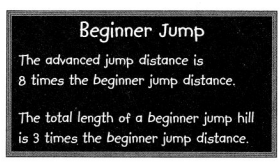
Envision Math Common Core Grade 4 Answer Key Topic 6 Use Operations with Whole Numbers to Solve Problems 44
Part A
What are the hidden questions you need to answer to solve the problem? Name a variable for each question.
Answer:
It is given that
The advanced jump distance is 408 feet.
Now,
The given information is:
Envision Math Common Core Grade 4 Answer Key Topic 6 Use Operations with Whole Numbers to Solve Problems 44
Hence, from the above,
We can conclude that
The hidden questions you need to answer to solve the given problem are:
a. What is the jump distance of the beginner jump distance?
b What is the total length of a beginner jump?

Part B
How much longer is d, the total length of an advanced jump hill, then a beginner jump hill? Write equations and explain how to solve the hidden questions and the original question.
Answer:
It is given that
The advanced jump distance is 408 feet.
Now,
The given table is:
Envision Math Common Core Grade 4 Answer Key Topic 6 Use Operations with Whole Numbers to Solve Problems 44
Now,
Let the advanced jump distance is x times as the beginner jump distance
So,
According to the given information,
x × 8 = 408
x = \(\frac{408}{8}\)
x = 51 feet
So,
The beginner jump distance is: 51 feet
Now,
According to the given information,
x × 3 = 51
x = \(\frac{51}{3}\)
x = 17 feet
So,
The toatl length of a beginner jump is: 17 feet
So,
The length of an advanced jump hill, greater than a beginner jump hill = 51 – 17
= 34 feet
Hence, from the above,
We can conclude that
The length of an advanced jump hill is 34 feet longer than a beginner jump hill

enVision Math Common Core Grade 4 Answer Key Topic 5 Use Strategies and Properties to Divide by 1-Digit Numbers

Go through the enVision Math Common Core Grade 4 Answer Key Topic 5 Use Strategies and Properties to Divide by 1-Digit Numbers and finish your homework or assignments.

enVision Math Common Core 4th Grade Answers Key Topic 5 Use Strategies and Properties to Divide by 1-Digit Numbers

Essential Questions:
How can mental math be used to divide? How can quotients be estimated? How can the steps for dividing be explained?
Envision Math Common Core 4th Grade Answer Key Topic 5 Use Strategies and Properties to Divide by 1-Digit Numbers 1

enVision STEM Project: Music and Division
Do Research: Use the Internet or other resources to find an example of a woodwind instrument, a brass instrument, a stringed instrument, and a percussion instrument.
Journal: Write a Report Include what you found. Also in your report:

  • Explain how each instrument you researched uses energy to make sounds. Include information about how the sounds are produced.
  • An octave spans 8 white keys on a piano. The last key of an octave begins the next octave. Explain why you can divide by 7 to find the number of octaves on a piano with 52 white keys.

Review What You Know

Vocabulary

Choose the best term from the box. Write it on the blank.

  • compatible numbers
  • equation
  • divisible
  • round
  • division
  • variable

Question 1.
A(n) __________ uses the equal sign (=) to show two expressions have the same value.
Answer:
An equation uses the equal sign (=) to show two expressions have the same value.

Question 2.
One way to estimate a product is to _________ each factor.
Answer:
One way to estimate a product is to round each factor.

Question 3.
You use ________ when you find the number of equal groups.
Answer:
You use division when you find the number of equal groups.

Question 4.
Numbers that are easy to compute mentally are called __________
Answer:
Numbers that are easy to compute mentally are called Compatible numbers.

Division Facts

Find each quotient.
Question 5.
27 ÷ 9
Answer:
The quotient of 27 ÷ 9 is 3.

Explanation:
Given that 27 ÷ 9, here we need to find the quotient. The quotient is the number obtained by dividing one number by another diving number. So the quotient of 27 ÷ 9 is 3.
Envision Math Common Core 4th Grade Answer Key Topic 5 Use Strategies and Properties to Divide by 1-Digit Numbers1-1

Question 6.
30 ÷ 5
Answer:
The quotient of 30 ÷ 5 is 6.

Explanation:
Given that 30 ÷ 5, here we need to find the quotient. The quotient is the number obtained by dividing one number by another diving number. So the quotient of 30 ÷ 5 is 6.
Envision Math Common Core 4th Grade Answer Key Topic 5 Use Strategies and Properties to Divide by 1-Digit Numbers 1-2

Question 7.
32 ÷ 4
Answer:
The quotient of 32 ÷ 4 is 8.

Explanation:
Given that 32 ÷ 4, here we need to find the quotient. The quotient is the number obtained by dividing one number by another diving number. So the quotient of 32 ÷ 4 is 8.

Question 8.
54 ÷ 9
Answer:
The quotient of 54 ÷ 9 is 6.

Explanation:
Given that 54 ÷ 9, here we need to find the quotient. The quotient is the number obtained by dividing one number by another diving number. So the quotient of 54 ÷ 9 is 6.
Envision Math Common Core 4th Grade Answer Key Topic 5 Use Strategies and Properties to Divide by 1-Digit Numbers 1-3

Question 9.
28 ÷ 7
Answer:
The quotient of 28 ÷ 7 is 4.

Explanation:
Given that 28 ÷ 7, here we need to find the quotient. The quotient is the number obtained by dividing one number by another diving number. So the quotient of 28 ÷ 7 is 4.
Envision Math Common Core 4th Grade Answer Key Topic 5 Use Strategies and Properties to Divide by 1-Digit Numbers 1-4

Question 10.
72 ÷ 9
Answer:
The quotient of 72 ÷ 9 is 8.

Explanation:
Given that 72 ÷ 9, here we need to find the quotient. The quotient is the number obtained by dividing one number by another diving number. So the quotient of 72 ÷ 9 is 8.

Question 11.
56 ÷ 8
Answer:
The quotient of 56 ÷ 8 is 7.

Explanation:
Given that 56 ÷ 8, here we need to find the quotient. The quotient is the number obtained by dividing one number by another diving number. So the quotient of 56 ÷ 8 is 7.
Envision Math Common Core 4th Grade Answer Key Topic 5 Use Strategies and Properties to Divide by 1-Digit Numbers 1-5

Question 12.
18 ÷ 3
Answer:
The quotient of 18 ÷ 3 is 6.

Explanation:
Given that 18 ÷ 3, here we need to find the quotient. The quotient is the number obtained by dividing one number by another diving number. So the quotient of 18 ÷ 3 is 6.
Envision Math Common Core 4th Grade Answer Key Topic 5 Use Strategies and Properties to Divide by 1-Digit Numbers 1-6

Question 13.
15 ÷ 5
Answer:
The quotient of 15 ÷ 5 is 3.

Explanation:
Given that 15 ÷ 5, here we need to find the quotient. The quotient is the number obtained by dividing one number by another diving number. So the quotient of 15 ÷ 5 is 3.
Envision Math Common Core 4th Grade Answer Key Topic 5 Use Strategies and Properties to Divide by 1-Digit Numbers 1-7

Rounding

Round each number to the nearest hundred.
Envision Math Common Core 4th Grade Answer Key Topic 5 Use Strategies and Properties to Divide by 1-Digit Numbers 2
Question 14.
864
Answer:
900.

Explanation:
The rounding to the nearest 864 is 900.

Question 15.
651
Answer:
700.

Explanation:
The rounding to the nearest 651 is 700.

Question 16.
348
Answer:
400.

Explanation:
The rounding to the nearest 348 is 400.

Question 17.
985
Answer:
1000.

Explanation:
The rounding to the nearest 985 is 1000.

Question 18.
451
Answer:
500.

Explanation:
The rounding to the nearest 451 is 500.

Question 19.
749
Answer:
800.

Explanation:
The rounding to the nearest 749 is 800.

Division as Sharing

Question 20.
Make Sense and Persevere Julio has 47 marbles. He keeps his two favorite marbles, then equally shares the remaining marbles between 5 friends. How many marbles does each friend receive? Explain.
Answer:
The number of marbles does each friend receive is 9 marbles.

Explanation:
Given that Julio has 47 marbles and he keeps his two favorite marbles, so Julio has 47 – 2 =45 marbles. And then equally shares the remaining marbles between 5 friends. So the number of marbles does each friend receive is 45 ÷ 5 which is 9 marbles.
Envision Math Common Core 4th Grade Answer Key Topic 5 Use Strategies and Properties to Divide by 1-Digit Numbers 1-14

Pick a Project

PROJECT 5A
How many passengers did trains like those in the Gold Coast Railroad Museum carry? Project: Make a Model of a Train
Envision Math Common Core 4th Grade Answer Key Topic 5 Use Strategies and Properties to Divide by 1-Digit Numbers 3

PROJECT 5B
How far do sailfish migrate?
Project: Make a Migration Map
Envision Math Common Core 4th Grade Answer Key Topic 5 Use Strategies and Properties to Divide by 1-Digit Numbers 4

PROJECT 5C
How much food do Portuguese Water Dogs need?
Project: Create a Brochure on Portuguese Water Dogs
Envision Math Common Core 4th Grade Answer Key Topic 5 Use Strategies and Properties to Divide by 1-Digit Numbers 5

3-ACT MATH PREVIEW

Math Modeling
Snack Attack
Envision Math Common Core 4th Grade Answer Key Topic 5 Use Strategies and Properties to Divide by 1-Digit Numbers 6
I can … model with math to solve a problem that involves rounding, estimating and computing with whole numbers.

Lesson 5.1 Mental Math: Find Quotients

Solve & Share
José has 270 hockey cards to arrange equally in 9 boxes. Each box can hold the same number of cards. How many cards should José place in each box? Solve this problem using any strategy you choose.
I can … make sense of quantities and use mental math and place-value strategies to divide.
Envision Math Common Core 4th Grade Answer Key Topic 5 Use Strategies and Properties to Divide by 1-Digit Numbers 7

Look Back! Reasoning What multiplication equation could help you find the number of cards José should place in each box?

Answer:
Jose should place 30 cards in each box.

Explanation:
Given that Jose has 270 hockey cards to arrange equally in 9 boxes. As each box can hold the same number of cards. So the number of cards in each box will be 270 ÷ 9 which will be 30 cards.

Essential Question
How Can You Divide Mentally?

Visual Learning Bridge
Mr. Díaz ordered a supply of 1,800 pastels. He wants to divide them equally among his class and 5 other art classes. How many pastels does each class receive?
If Mr. Diaz stores the pastels so each class will receive new pastels 5 times a year, how many pastels are handed out each of the 5 times?
Envision Math Common Core 4th Grade Answer Key Topic 5 Use Strategies and Properties to Divide by 1-Digit Numbers 8

Find 1,800 ÷ 6.
Envision Math Common Core 4th Grade Answer Key Topic 5 Use Strategies and Properties to Divide by 1-Digit Numbers 9
The basic division fact is 18 ÷ 6 = 3.
18 hundreds ÷ 6= 3 hundreds or 300.
1,800 ÷ 6 = 300
Each class will receive 300 pastels.

Find 300 ÷ 5.
Envision Math Common Core 4th Grade Answer Key Topic 5 Use Strategies and Properties to Divide by 1-Digit Numbers 10
The basic division fact is 30 ÷ 5= 6.
30 tens ÷ 5 = 6 tens or 60.
300 ÷ 5 = 60
Each class will receive 60 pastels 5 times a year.

Convince Me! Use Structure Write the missing dividends for each of the following equations. How did you determine each dividend?
_______ ÷ 7 = 70
______ ÷ 8 = 50
______ ÷ 4 = 800

Answer:
The missing digits will be 490, 400, 3200.

Explanation:
To find the missing dividend, we will perform multiplication. So the missing digit will be
70 × 7 which is 490. So the missing digit will be 490 ÷ 7 = 70.
50 × 8 which is 400. So the missing digit will be 400 ÷ 8 = 50.
800 × 4 which is 3200. So the missing digit will be 3200 ÷ 4 = 800.

Guided Practice

Do You Understand?
Question 1.
Explain how 32 ÷ 4 can help you solve 320 ÷ 4.
Answer:
32 ÷ 4 = 8.
320 ÷ 4 = 80.

Explanation:
Since 320 is 10 times 32. The answer for 320 divided by 4 is going to be 10 times the answer for 32 divided by 4.
32 ÷ 4 = 8.
320 ÷ 4 = 80.
Envision Math Common Core 4th Grade Answer Key Topic 5 Use Strategies and Properties to Divide by 1-Digit Numbers 1-8

Question 2.
Mrs. Gall orders 240 folders and divides them equally among 3 classes. How many folders does each class receive? What basic fact did you use?
Answer:
The number of folders does each class receive is 80 folders.

Explanation:
Given that Mrs. Gall orders 240 folders and divides them equally among 3 classes. So the number of folders does each class receive is 240 ÷ 3 which is 80 folders. The basic fact that we have used is 24 ÷ 3 = 8.
Envision Math Common Core 4th Grade Answer Key Topic 5 Use Strategies and Properties to Divide by 1-Digit Numbers 1-9

Do You Know How?
For 3-4, use basic facts and place value to find each quotient.
Question 3.
28 ÷ 7 = ______
280 ÷ 7 = _______
2,800 ÷ 7 = ________
Answer:
28 ÷ 7 = 4.
280 ÷ 7 = 40.
2,800 ÷ 7 = 400.
The basic fact that we have used is 28 ÷ 7 = 4.

Explanation:
Given that 28 ÷ 7 and we need to find the quotient of the given equation. So the quotient of 28 ÷ 7 is 4.
The quotient of 280 ÷ 7 is 40.
The quotient of 2,800 ÷ 7 is 400. The basic fact that we have used is 28 ÷ 7 = 4.
Envision Math Common Core 4th Grade Answer Key Topic 5 Use Strategies and Properties to Divide by 1-Digit Numbers 1-4

Question 4.
______ = 64 ÷ 8
______ = 640 ÷ 8
______ = 6,400 ÷ 8
Answer:
8 = 64 ÷ 8
80 = 640 ÷ 8
800 = 6,400 ÷ 8
The basic fact that we have used is 64 ÷ 8 = 8.

Explanation:
Given that 64 ÷ 8 and we need to find the quotient of the given equation. So the quotient of 64 ÷ 8 is 8.
The quotient of 640 ÷ 8 is 80.
The quotient of 6,400 ÷ 8 is 800. The basic fact that we have used is 64 ÷ 8 = 8.
Envision Math Common Core 4th Grade Answer Key Topic 5 Use Strategies and Properties to Divide by 1-Digit Numbers 1-11

Independent Practice

Leveled Practice For 5-24, use basic facts and place value to divide.
Question 5.
36 ÷ 9 = _______
360 ÷ 9 = _______
3,600 ÷ 9 = _______
Answer:
36 ÷ 9 = 4.
360 ÷ 9 = 40.
3,600 ÷ 9 = 400.
The basic fact that we have used is 36 ÷ 9 = 4.

Explanation:
Given that 36 ÷ 9 and we need to find the quotient of the given equation. So the quotient of 36 ÷ 9 is 4.
The quotient of 360 ÷ 9 is 40.
The quotient of 3,600 ÷ 9 is 400. The basic fact that we have used is 36 ÷ 9 = 4.
Envision Math Common Core 4th Grade Answer Key Topic 5 Use Strategies and Properties to Divide by 1-Digit Numbers 1-12

Question 6.
______ = 10 ÷ 2
______ = 100 ÷ 2
______ = 1,000 ÷ 2
Answer:
5 = 10 ÷ 2
50 = 100 ÷ 2
500 = 1,000 ÷ 2
The basic fact that we have used is 10 ÷ 2 = 5.

Explanation:
Given that 10 ÷ 2 and we need to find the quotient of the given equation. So the quotient of 10 ÷ 2 is 5.
The quotient of 100 ÷ 2 is 50.
The quotient of 1,000 ÷ 2 is 500. The basic fact that we have used is 10 ÷ 2 = 5.
Envision Math Common Core 4th Grade Answer Key Topic 5 Use Strategies and Properties to Divide by 1-Digit Numbers 1-13

Question 7.
45 ÷ 5 = _______
450 ÷ 5 = ________
4,500 ÷ 5 = _________
Answer:
45 ÷ 5 = 9.
450 ÷ 5 = 90.
4,500 ÷ 5 =900.
The basic fact that we have used is 45 ÷ 5 = 9.

Explanation:
Given that 45 ÷ 5 and we need to find the quotient of the given equation. So the quotient of 45 ÷ 5 is 9.
The quotient of 450 ÷ 5 is 90.
The quotient of 4,500 ÷ 5 is 900. The basic fact that we have used is 45 ÷ 5 = 9.
Envision Math Common Core 4th Grade Answer Key Topic 5 Use Strategies and Properties to Divide by 1-Digit Numbers 1-14

Question 8.
_______ = 24 ÷ 8
_______ = 240 ÷ 8
_______ = 2,400 ÷ 8
Answer:
3 = 24 ÷ 8
30 = 240 ÷ 8
300 = 2,400 ÷ 8
The basic fact that we have used is 24 ÷ 8 = 3.

Explanation:
Given that 24 ÷ 8 and we need to find the quotient of the given equation. So the quotient of 24 ÷ 8 is 3.
The quotient of 240 ÷ 8 is 30.
The quotient of 2,400 ÷ 8 is 300. The basic fact that we have used is 24 ÷ 8 = 3.
Envision Math Common Core 4th Grade Answer Key Topic 5 Use Strategies and Properties to Divide by 1-Digit Numbers 1-17

Question 9.
2,000 ÷ 5
Answer:
The quotient is 400.

Explanation:
Given that 2,000 ÷ 5 and we need to find the quotient of the given equation. So the quotient of 2,000 ÷ 5 is 400.
Envision Math Common Core 4th Grade Answer Key Topic 5 Use Strategies and Properties to Divide by 1-Digit Numbers 1-18

Question 10.
360 ÷ 4
Answer:
The quotient is 90.

Explanation:
Given that 360 ÷ 4 and we need to find the quotient of the given equation. So the quotient of 360 ÷ 4 is 900.
Envision Math Common Core 4th Grade Answer Key Topic 5 Use Strategies and Properties to Divide by 1-Digit Numbers 1-19

Question 11.
540 ÷ 9
Answer:
The quotient is 60.

Explanation:
Given that 540 ÷ 9 and we need to find the quotient of the given equation. So the quotient of 540 ÷ 9 is 60.
Envision Math Common Core 4th Grade Answer Key Topic 5 Use Strategies and Properties to Divide by 1-Digit Numbers 1-20

Question 12.
160 ÷ 4
Answer:
The quotient is 40.

Explanation:
Given that 160 ÷ 4 and we need to find the quotient of the given equation. So the quotient of 160 ÷ 4 is 40.
Envision Math Common Core 4th Grade Answer Key Topic 5 Use Strategies and Properties to Divide by 1-Digit Numbers 1-16

Question 13.
900 ÷ 3
Answer:
The quotient is 300.

Explanation:
Given that 900 ÷ 3 and we need to find the quotient of the given equation. So the quotient of 900 ÷ 3 is 300.
Envision Math Common Core 4th Grade Answer Key Topic 5 Use Strategies and Properties to Divide by 1-Digit Numbers 1-21

Question 14.
3,200 ÷ 8
Answer:
The quotient is 400.

Explanation:
Given that 3,200 ÷ 8 and we need to find the quotient of the given equation. So the quotient of 3,200 ÷ 8 is 400.

Question 15.
360 ÷ 6
Answer:
The quotient is 60.

Explanation:
Given that 360 ÷ 6 and we need to find the quotient of the given equation. So the quotient of 360 ÷ 6 is 60.
Envision Math Common Core 4th Grade Answer Key Topic 5 Use Strategies and Properties to Divide by 1-Digit Numbers 1-23

Question 16.
1,800 ÷ 3
Answer:
The quotient is 600.

Explanation:
Given that 1,800 ÷ 3 and we need to find the quotient of the given equation. So the quotient of 1,800 ÷ 3 is 600.
Envision Math Common Core 4th Grade Answer Key Topic 5 Use Strategies and Properties to Divide by 1-Digit Numbers 1-24

Question 17.
7,200 ÷ 8
Answer:
The quotient is 900.

Explanation:
Given that 7,200 ÷ 8 and we need to find the quotient of the given equation. So the quotient of 7,200 ÷ 8 is 900.
Envision Math Common Core 4th Grade Answer Key Topic 5 Use Strategies and Properties to Divide by 1-Digit Numbers 1-26

Question 18.
500 ÷ 5
Answer:
The quotient is 100.

Explanation:
Given that 500 ÷ 5 and we need to find the quotient of the given equation. So the quotient of 500 ÷ 5 is 100.
Envision Math Common Core 4th Grade Answer Key Topic 5 Use Strategies and Properties to Divide by 1-Digit Numbers 1-27

Question 19.
350 ÷ 7
Answer:
The quotient is 50.

Explanation:
Given that 350 ÷ 7 and we need to find the quotient of the given equation. So the quotient of 350 ÷ 7 is 50.
Envision Math Common Core 4th Grade Answer Key Topic 5 Use Strategies and Properties to Divide by 1-Digit Numbers 1-77

Question 20.
6,300 ÷ 9
Answer:
The quotient is 700.

Explanation:
Given that 6,300 ÷ 9 and we need to find the quotient of the given equation. So the quotient of 6,300 ÷ 9 is 700.
Envision Math Common Core 4th Grade Answer Key Topic 5 Use Strategies and Properties to Divide by 1-Digit Numbers 1-78

Question 21.
1,600 ÷ 2
Answer:
The quotient is 800.

Explanation:
Given that 1,600 ÷ 2 and we need to find the quotient of the given equation. So the quotient of 1,600 ÷ 2 is 800.
Envision Math Common Core 4th Grade Answer Key Topic 5 Use Strategies and Properties to Divide by 1-Digit Numbers 1-79

Question 22.
210 ÷ 7
Answer:
The quotient is 30.

Explanation:
Given that 210 ÷ 7 and we need to find the quotient of the given equation. So the quotient of 210 ÷ 7 is 30.
Envision Math Common Core 4th Grade Answer Key Topic 5 Use Strategies and Properties to Divide by 1-Digit Numbers 1-80

Question 23.
4,800 ÷ 6
Answer:
The quotient is 800.

Explanation:
Given that 4,800 ÷ 6 and we need to find the quotient of the given equation. So the quotient of 4,800 ÷ 6 is 800.
Envision Math Common Core 4th Grade Answer Key Topic 5 Use Strategies and Properties to Divide by 1-Digit Numbers 1-81

Question 24.
600 ÷ 6
Answer:
The quotient is 100.

Explanation:
Given that 600 ÷ 6 and we need to find the quotient of the given equation. So the quotient of 600 ÷ 6 is 100.
Envision Math Common Core 4th Grade Answer Key Topic 5 Use Strategies and Properties to Divide by 1-Digit Numbers 1-82

Problem Solving

Question 25.
If you know 20 ÷ 5 = 4, how does that help you calculate 200 ÷ 5?
Answer:
200 ÷ 5 = 40.

Explanation:
Here, 20 ÷ 5 = 4 is a basic fact. So the value of 200 ÷ 5 = 40

Question 26.
A bakery produced two batches of bread with 80 loaves in each batch. It sold 30 loaves each hour. How many loaves of bread were sold in 4 hours? How many loaves of bread were left to sell?
Answer:
The number of loaves of bread that were sold in 4 hours is loaves is 120 loaves.

Explanation:
Given that the bakery produced two batches of bread with 80 loaves in each batch and it was sold 30 loaves each hour. So the number of loaves of bread that were sold in 4 hours is loaves.30 × 4 = 120 loaves.

Question 27.
An engineer designed and built a solar race car. If there are 810 solar cells arranged in 9 rows, how many solar cells are in each row?
Envision Math Common Core 4th Grade Answer Key Topic 5 Use Strategies and Properties to Divide by 1-Digit Numbers 11
Answer:
The number of solar cells is in each row is 90rows.

Explanation:
Given that if there are 810 solar cells arranged in 9 rows. So the number of solar cells are in each row is 810 ÷ 9 which is 90 rows.

Question 28.
Model with Math On Saturday afternoon, 350 people attended a play. The seating was arranged in 7 equal rows. Draw a bar diagram and solve an equation to find p, how many people sat in each row.
Answer:
The number of people sat in each row is 50 people.

Explanation:
Given that 350 people attended a play and seating was arranged in 7 equal rows. So the number of people sat in each row is 350 ÷ 7 which is 50 people.

Question 29.
Higher Order Thinking Molly and five friends picked a total of 300 oranges. If they each picked the same number of oranges, how many oranges did Molly pick? Explain.
Answer:
The number of oranges did Molly picked is 60 oranges.

Explanation:
Given that Molly and five friends picked a total of 300 oranges, so the number of oranges did Molly picked is 300 ÷ 5 which is 60 oranges.

Assessment Practice

Question 30.
Find 240 ÷ 8.
A. 3
B. 10
C. 30
D. 80
Answer:
30.

Explanation:
Given that 240 ÷ 8 will be 30.

Question 31.
What basic fact helps to solve 180 ÷ 6? What is 180 ÷ 6?
A. 18 ÷ 3; 60
B. 18 ÷ 3; 30
C. 18 ÷ 6; 60
D. 18 ÷ 6; 30
Answer:
Option D.

Explanation:
Given that to solve 180 ÷ 6 with the basic fact. So the basic fact will be 18 ÷ 6 which is 3.

Lesson 5.2 Mental Math: Estimate Quotients

Solve & Share
Three friends at a video arcade win a total of 248 tickets. They decide to share the tickets equally. About how many tickets will each friend receive? Solve this problem using any strategy you choose.
I can … use compatible numbers to estimate quotients when dividing with 3-digit dividends.
Envision Math Common Core 4th Grade Answer Key Topic 5 Use Strategies and Properties to Divide by 1-Digit Numbers 12

Look Back! is an exact answer or an estimate needed for the problem above? Explain.

Answer:
Each friend will receive 82.67 tickets.

Explanation:
Given that there are three friends at a video arcade who win a total of 248 tickets and they decide to share the tickets equally. Let the number of tickets each friend would receive be X. So
238 = 3 × X
X = 248 ÷ 3
On solving we will get 82.67 tickets.
Envision Math Common Core 4th Grade Answer Key Topic 5 Use Strategies and Properties to Divide by 1-Digit Numbers 1-22

Essential Question
How Can You Estimate Quotients to Solve Problems?

Visual Learning Bridge
Max wants to make 9 rubber band balls using about the same number of rubber bands for each ball. He bought a jar of 700 rubber bands. Estimate to find about how many rubber bands Max can use for each ball.
Envision Math Common Core 4th Grade Answer Key Topic 5 Use Strategies and Properties to Divide by 1-Digit Numbers 13

Use Compatible Numbers
Estimate 700 ÷ 9.
What number close to 700 is easily divided by 9?
Try multiples of ten near 700.
710 is not easily divided by 9.
720 is 72 tens and can be divided by 9.
720 ÷ 9= 80
Max can use about 80 rubber bands for each ball.

Use Multiplication
Estimate 700 ÷ 9.
9 times what number is about 700?
9 × 8 = 72, so 9 × 80 = 720.
700 ÷ 9 is about 80.
Max can use about 80 rubber bands for each ball.

Convince Me! Construct Arguments What compatible numbers can you use to estimate 132 ÷ 6? Why is rounding not a good way to estimate 132 ÷ 6?

Guided Practice

Do You Understand?
Question 1.
Max wants to make 9 rubber band balls using 80 bands each from his package of 700. Will Max be able to make more or fewer balls than he wanted?
Answer:

Question 2.
Max decides to use 700 rubber bands to make 8 balls. Is it reasonable to say he would use about 90 rubber bands to make each ball? Explain.
Answer:

Do You Know How?
For 3-10, estimate each quotient. Use multiplication or compatible numbers. Show your work.
Question 3.
48 ÷ 5
Answer:
The estimated quotient will be 10.

Explanation:
Here, Compatible numbers are numbers that are easy to compute with mental math. We can also use compatible to find two estimates that the quotient is between. So 48 ÷ 5 will be 50 ÷ 5 which is 10. So the estimated quotient will be 10.
Envision Math Common Core 4th Grade Answer Key Topic 5 Use Strategies and Properties to Divide by 1-Digit Numbers 1-28

Question 4.
235 ÷ 8
Answer:
The estimated quotient will be 30.

Explanation:
Here, Compatible numbers are numbers that are easy to compute with mental math. We can also use compatible to find two estimates that the quotient is between. So 235 ÷ 8 will be 240 ÷ 8 which is 30. So the estimated quotient will be 30.
Envision Math Common Core 4th Grade Answer Key Topic 5 Use Strategies and Properties to Divide by 1-Digit Numbers 1-29

Question 5.
547 ÷ 6
Answer:
The estimated quotient will be 90.

Explanation:
Here, Compatible numbers are numbers that are easy to compute with mental math. We can also use compatible to find two estimates that the quotient is between. So 547 ÷ 6 will be 540 ÷ 6 which is 90. So the estimated quotient will be 90.
Envision Math Common Core 4th Grade Answer Key Topic 5 Use Strategies and Properties to Divide by 1-Digit Numbers 1-30

Question 6.
192 ÷ 5
Answer:
The estimated quotient will be 38.

Explanation:
Here, Compatible numbers are numbers that are easy to compute with mental math. We can also use compatible to find two estimates that the quotient is between. So 192 ÷ 5 will be 190 ÷ 5 which is 38. So the estimated quotient will be 38.
Envision Math Common Core 4th Grade Answer Key Topic 5 Use Strategies and Properties to Divide by 1-Digit Numbers 1-34

Question 7.
662 ÷ 8
Answer:
The estimated quotient will be 83.

Explanation:
Here, Compatible numbers are numbers that are easy to compute with mental math. We can also use compatible to find two estimates that the quotient is between. So 662 ÷ 8 will be 664 ÷ 8 which is 83. So the estimated quotient will be 83.
Envision Math Common Core 4th Grade Answer Key Topic 5 Use Strategies and Properties to Divide by 1-Digit Numbers 1-35

Question 8.
362 ÷ 3
Answer:
The estimated quotient will be 120.

Explanation:
Here, Compatible numbers are numbers that are easy to compute with mental math. We can also use compatible to find two estimates that the quotient is between. So 362 ÷ 3 will be 360 ÷ 3 which is 120. So the estimated quotient will be 120.
Envision Math Common Core 4th Grade Answer Key Topic 5 Use Strategies and Properties to Divide by 1-Digit Numbers 1-36

Question 9.
41 ÷ 2
Answer:
The estimated quotient will be 20.

Explanation:
Here, Compatible numbers are numbers that are easy to compute with mental math. We can also use compatible to find two estimates that the quotient is between. So 41 ÷ 2 will be 40 ÷ 2 which is 20. So the estimated quotient will be 20.
Envision Math Common Core 4th Grade Answer Key Topic 5 Use Strategies and Properties to Divide by 1-Digit Numbers 1-37

Question 10.
211 ÷ 4
Answer:
The estimated quotient will be 55.

Explanation:
Here, Compatible numbers are numbers that are easy to compute with mental math. We can also use compatible to find two estimates that the quotient is between. So 211 ÷ 4 will be 220 ÷ 4 which is 55. So the estimated quotient will be 55.
Envision Math Common Core 4th Grade Answer Key Topic 5 Use Strategies and Properties to Divide by 1-Digit Numbers 1-38

Independent Practice

For 11-26, estimate each quotient.
Envision Math Common Core 4th Grade Answer Key Topic 5 Use Strategies and Properties to Divide by 1-Digit Numbers 14
Question 11.
430 ÷ 9
Answer:
The estimated quotient will be 50.

Explanation:
Here, Compatible numbers are numbers that are easy to compute with mental math. We can also use compatible to find two estimates that the quotient is between. So 430 ÷ 9 will be 450 ÷ 9 which is 50. So the estimated quotient will be 50.
Envision Math Common Core 4th Grade Answer Key Topic 5 Use Strategies and Properties to Divide by 1-Digit Numbers 1-39

Question 12.
620 ÷ 7
Answer:
The estimated quotient will be 90.

Explanation:
Here, Compatible numbers are numbers that are easy to compute with mental math. We can also use compatible to find two estimates that the quotient is between. So 620 ÷ 7 will be 630 ÷ 7 which is 90. So the estimated quotient will be 90.
Envision Math Common Core 4th Grade Answer Key Topic 5 Use Strategies and Properties to Divide by 1-Digit Numbers 1-40

Question 13.
138 ÷ 5
Answer:
The estimated quotient will be 28.

Explanation:
Here, Compatible numbers are numbers that are easy to compute with mental math. We can also use compatible to find two estimates that the quotient is between. So 138 ÷ 5 will be 140 ÷ 5 which is 28. So the estimated quotient will be 28.
Envision Math Common Core 4th Grade Answer Key Topic 5 Use Strategies and Properties to Divide by 1-Digit Numbers 1-41

Question 14.
232 ÷ 6
Answer:
The estimated quotient will be 40.

Explanation:
Here, Compatible numbers are numbers that are easy to compute with mental math. We can also use compatible to find two estimates that the quotient is between. So 232 ÷ 6 will be 240 ÷ 6 which is 40. So the estimated quotient will be 40.
Envision Math Common Core 4th Grade Answer Key Topic 5 Use Strategies and Properties to Divide by 1-Digit Numbers 1-42

Question 15.
342 ÷ 8
Answer:
The estimated quotient will be 45.

Explanation:
Here, Compatible numbers are numbers that are easy to compute with mental math. We can also use compatible to find two estimates that the quotient is between. So 342 ÷ 8 will be 360 ÷ 8 which is 45. So the estimated quotient will be 45.
Envision Math Common Core 4th Grade Answer Key Topic 5 Use Strategies and Properties to Divide by 1-Digit Numbers 1-43

Question 16.
652 ÷ 6
Answer:
The estimated quotient will be 110.

Explanation:
Here, Compatible numbers are numbers that are easy to compute with mental math. We can also use compatible to find two estimates that the quotient is between. So 652 ÷ 6 will be 660 ÷ 6 which is 110. So the estimated quotient will be 110.
Envision Math Common Core 4th Grade Answer Key Topic 5 Use Strategies and Properties to Divide by 1-Digit Numbers 1-44

Question 17.
59 ÷ 9
Answer:
The estimated quotient will be 7.

Explanation:
Here, Compatible numbers are numbers that are easy to compute with mental math. We can also use compatible to find two estimates that the quotient is between. So 59 ÷ 6 will be 63 ÷ 9 which is 7. So the estimated quotient will be 7.

Question 18.
813 ÷ 8
Answer:
The estimated quotient will be 100.

Explanation:
Here, Compatible numbers are numbers that are easy to compute with mental math. We can also use compatible to find two estimates that the quotient is between. So 813 ÷ 8 will be 800 ÷ 8 which is 100. So the estimated quotient will be 100.
Envision Math Common Core 4th Grade Answer Key Topic 5 Use Strategies and Properties to Divide by 1-Digit Numbers 1-45

Question 19.
637 ÷ 6
Answer:
The estimated quotient will be 105.

Explanation:
Here, Compatible numbers are numbers that are easy to compute with mental math. We can also use compatible to find two estimates that the quotient is between. So 637 ÷ 6 will be 630 ÷ 6 which is 105. So the estimated quotient will be 105.
Envision Math Common Core 4th Grade Answer Key Topic 5 Use Strategies and Properties to Divide by 1-Digit Numbers 1-46

Question 20.
481 ÷ 4
Answer:
The estimated quotient will be 120.

Explanation:
Here, Compatible numbers are numbers that are easy to compute with mental math. We can also use compatible to find two estimates that the quotient is between. So 481 ÷ 4 will be 480 ÷ 4 which is 120. So the estimated quotient will be 120.
Envision Math Common Core 4th Grade Answer Key Topic 5 Use Strategies and Properties to Divide by 1-Digit Numbers 1-47

Question 21.
747 ÷ 8
Answer:
The estimated quotient will be 95.

Explanation:
Here, Compatible numbers are numbers that are easy to compute with mental math. We can also use compatible to find two estimates that the quotient is between. So 747 ÷ 8 will be 760 ÷ 8 which is 95. So the estimated quotient will be 95.
Envision Math Common Core 4th Grade Answer Key Topic 5 Use Strategies and Properties to Divide by 1-Digit Numbers 1-49

Question 22.
232 ÷ 9
Answer:
The estimated quotient will be 25.

Explanation:
Here, Compatible numbers are numbers that are easy to compute with mental math. We can also use compatible to find two estimates that the quotient is between. So 232 ÷ 9 will be 225 ÷ 9 which is 25. So the estimated quotient will be 25.

Question 23.
552 ÷ 7
Answer:
The estimated quotient will be 80.

Explanation:
Here, Compatible numbers are numbers that are easy to compute with mental math. We can also use compatible to find two estimates that the quotient is between. So 552 ÷ 7 will be 560 ÷ 7 which is 80. So the estimated quotient will be 80.
Envision Math Common Core 4th Grade Answer Key Topic 5 Use Strategies and Properties to Divide by 1-Digit Numbers 1-50

Question 24.
52 ÷ 5
Answer:
The estimated quotient will be 10.

Explanation:
Here, Compatible numbers are numbers that are easy to compute with mental math. We can also use compatible to find two estimates that the quotient is between. So 52 ÷ 5 will be 50 ÷ 5 which is 10. So the estimated quotient will be 10.
Envision Math Common Core 4th Grade Answer Key Topic 5 Use Strategies and Properties to Divide by 1-Digit Numbers 1-51

Question 25.
392 ÷ 2
Answer:
The quotient will be 196.

Explanation:
Here, the quotient of 392 ÷2 is 196.
Envision Math Common Core 4th Grade Answer Key Topic 5 Use Strategies and Properties to Divide by 1-Digit Numbers 1-52

Question 26.
625 ÷ 3
Answer:
The estimated quotient will be 210.

Explanation:
Here, Compatible numbers are numbers that are easy to compute with mental math. We can also use compatible to find two estimates that the quotient is between. So 625 ÷ 3 will be 630 ÷ 3 which is 210. So the estimated quotient will be 210.
Envision Math Common Core 4th Grade Answer Key Topic 5 Use Strategies and Properties to Divide by 1-Digit Numbers 1-53

Problem Solving

For 27-28, use the table at the right.
Envision Math Common Core 4th Grade Answer Key Topic 5 Use Strategies and Properties to Divide by 1-Digit Numbers 15
Question 27.
Ada sold her mugs in 3 weeks. About how many mugs did Ada sell each week?
Answer:
The number of mugs Ada sells each week will be 80 mugs.

Explanation:
Given that Ada sold her mugs in 3 weeks and there are five mugs and each mug is equal to 50 mugs. So there will be 5 × 50 which is 250 mugs. So the number of mugs Ada sells each week will be 250 ÷ 3, so the estimated quotient will be 240 ÷ 3 which will be 80 mugs.
Envision Math Common Core 4th Grade Answer Key Topic 5 Use Strategies and Properties to Divide by 1-Digit Numbers 1-54

Question 28.
Ben sold his mugs in 6 weeks. About how many mugs did Ben sell each week?
Answer:
The number of mugs Ben sells each week will be 30 mugs.

Explanation:
Given that Ada sold her mugs in 6 weeks and there are five mugs and each mug is equal to 50 mugs. So there will be 4 × 50 which is 200 mugs. So the number of mugs Ada sells each week will be 200 ÷ 6, so the estimated quotient will be 180 ÷ 6 which will be 30 mugs.

Question 29.
enVision® STEM The International Space Station takes 644 minutes to orbit Earth 7 times. About how long does each orbit take?
Envision Math Common Core 4th Grade Answer Key Topic 5 Use Strategies and Properties to Divide by 1-Digit Numbers 16
Answer:
The number of minutes does each orbit takes is 92 minutes.

Explanation:
Given that the International Space Station takes 644 minutes to orbit Earth 7 times, so the number of minutes does each orbit takes is 644 ÷ 7 which is 92 minutes.

Question 30.
There are 60 minutes in 1 hour and 24 hours in 1 day. About how many times does the International Space Station orbit Earth each day?
Answer:

Question 31.
Construct Arguments Complete by writing > or < in the Envision Math Common Core 4th Grade Answer Key Topic 5 Use Strategies and Properties to Divide by 1-Digit Numbers 17. Without dividing, explain how you know which quotient is greater.
930 ÷ 4 Envision Math Common Core 4th Grade Answer Key Topic 5 Use Strategies and Properties to Divide by 1-Digit Numbers 17 762 ÷ 4
Answer:
930 ÷ 4 > 762 ÷ 4.

Explanation:
Given that to find out which quotient is greater without dividing. Here, we can say that by seeing the dividend, 930 is greater than 762. So 930 ÷ 4 quotient is greater than 762 ÷ 4.

Question 32.
Higher Order Thinking Explain how to find a better estimate for 260 ÷ 5 than the one shown below.
Round 260 to 300, and then estimate 300 ÷ 5.
300 ÷ 5 = 60, so 260 ÷ 5 is about 60.
Answer:

Assessment Practice

Question 33.
Kaylee wanted to divide 133 pieces of candy equally into 7 boxes. She decides to put 19 pieces in each box. Use estimation to determine if this answer seems reasonable.
Answer:
Kaylee is correct.

Explanation:
Given that Kaylee wanted to divide 133 pieces of candy equally into 7 boxes and she decides to put 19 pieces in each box. So the estimated answer will be 140 ÷ 7 which will be 20 pieces. So Kaylee is correct.

Lesson 5.3 Mental Math: Estimate Quotients for Greater Dividends

Solve & Share
Jimi has 3,000 tickets to sell at the school carnival. Jimi separated the tickets into groups of 8 tickets. About how many groups did Jimi make? Solve this problem using any strategy you choose.
I can … estimate quotients for 4-digit dividends.
Envision Math Common Core 4th Grade Answer Key Topic 5 Use Strategies and Properties to Divide by 1-Digit Numbers 18

Look Back! Reasoning What basic fact did you use to solve the problem above? How does this help you?

Essential Question
How Can You Estimate Quotients Using Patterns and Place Value?

Visual Learning Bridge
On “Clean Up Your Town Day,” 1,320 people volunteered to clean up the Springville parks. The volunteers were divided equally into teams to work in each of the town’s parks. About how many people were on each team?
Envision Math Common Core 4th Grade Answer Key Topic 5 Use Strategies and Properties to Divide by 1-Digit Numbers 19

Use Multiplication Patterns
Estimate 1,320 ÷ 6.
6 times what number is about 1,320?
You know 6 × 2 = 12, and
6 × 20 = 120, so
6 × 200 = 1,200.
1,200 is close to 1,320.
There are about 200 people on each team.

Use Division Facts and Place-Value Patterns
Find compatible numbers to estimate 1,320 ÷ 6.
You know 12 ÷ 6 = 2, and
120 ÷ 6 = 20, So
1,200 ÷ 6 = 200.
1,320 ÷ 6 is about 200.
There are about 200 people on each team.

Convince Me! Construct Arguments Complete the calculations at the right. Explain how you can use the calculations to estimate 1,296 ÷ 4.
4 × 100 = __________
4 × 200 = __________
4 × 300 = __________
4 × 400 = __________

Another Example!
You can use rounding to estimate quotients.
Estimate 357 ÷ 8 by rounding the dividend.
Round: 400 ÷ 8
4008 ÷ 50
So, 357 ÷ 8 is about 50.

Estimate 5,582 ÷ 7 by rounding the dividend.
Round: 5,600 ÷ 7
5,600 ÷ 7 = 800
So, 5,582 ÷ 7 = is about 800.

Guided Practice

Do You Understand?
Question 1.
When estimating 1,320 ÷ 6, why is rounding not a good strategy?
Answer:
1,320 ÷ 6 is 220.

Explanation:
Given that the equation is 1,320 ÷ 6 which is 220. As the dividend is divisible by 6. So rounding is not a good strategy.

Question 2.
When dividing a 4-digit number by a 1-digit number, how many digits can the quotient have?
Answer:
Here, the quotient can still have 4 digits depending on the 1 digit.

Do You Know How?
For 3-8, estimate each quotient.
Question 3.
3,340 ÷ 8
Answer:
The estimated quotient will be 417.

Explanation:
Here, Compatible numbers are numbers that are easy to compute with mental math. We can also use compatible to find two estimates that the quotient is between. So 3,340 ÷ 8 will be 3,336 ÷ 8 which is 417. So the estimated quotient will be 417.

Question 4.
2,943 ÷ 7
Answer:
The estimated quotient will be 420.

Explanation:
Here, Compatible numbers are numbers that are easy to compute with mental math. We can also use compatible to find two estimates that the quotient is between. So 2,943 ÷ 7 will be 2,940 ÷ 7 which is 420. So the estimated quotient will be 420.

Question 5.
552 ÷ 9
Answer:
The estimated quotient will be 60.

Explanation:
Here, Compatible numbers are numbers that are easy to compute with mental math. We can also use compatible to find two estimates that the quotient is between. So 552 ÷ 9 will be 540 ÷ 9 which is 60. So the estimated quotient will be 60.

Question 6.
776 ÷ 4
Answer:
The quotient will be 194.

Explanation:
Here, the quotient of 776 ÷ 4 is 194.

Question 7.
2,013 ÷ 5
Answer:
The estimated quotient will be 400.

Explanation:
Here, Compatible numbers are numbers that are easy to compute with mental math. We can also use compatible to find two estimates that the quotient is between. So 2,013 ÷ 5 will be 2,000 ÷ 5 which is 400. So the estimated quotient will be 400.

Question 8.
281 ÷ 3
Answer:
The estimated quotient will be 90.

Explanation:
Here, Compatible numbers are numbers that are easy to compute with mental math. We can also use compatible to find two estimates that the quotient is between. So 281 ÷ 3 will be 270 ÷ 3 which is 90. So the estimated quotient will be 90.

Independent Practice

For 9-20, estimate each quotient.
Question 9.
61 ÷ 2
Answer:
The estimated quotient will be 30.

Explanation:
Here, Compatible numbers are numbers that are easy to compute with mental math. We can also use compatible to find two estimates that the quotient is between. So 61 ÷ 2 will be 60 ÷ 2 which is 30. So the estimated quotient will be 30.

Question 10.
7,779 ÷ 7
Answer:
The estimated quotient will be 1,100.

Explanation:
Here, Compatible numbers are numbers that are easy to compute with mental math. We can also use compatible to find two estimates that the quotient is between. So 7,779 ÷ 7 will be 7,770 ÷ 7 which is 1,100. So the estimated quotient will be 1,100.

Question 11.
3,688 ÷ 6
Answer:
The estimated quotient will be 600.

Explanation:
Here, Compatible numbers are numbers that are easy to compute with mental math. We can also use compatible to find two estimates that the quotient is between. So 3,688 ÷ 6 will be 3,600 ÷ 6 which is 600. So the estimated quotient will be 600.

Question 12.
497 ÷ 8
Answer:
The estimated quotient will be 60.

Explanation:
Here, Compatible numbers are numbers that are easy to compute with mental math. We can also use compatible to find two estimates that the quotient is between. So 497 ÷ 8 will be 480 ÷ 8 which is 60. So the estimated quotient will be 60.

Question 13.
5,684 ÷ 9
Answer:
The estimated quotient will be 600.

Explanation:
Here, Compatible numbers are numbers that are easy to compute with mental math. We can also use compatible to find two estimates that the quotient is between. So 5,684 ÷ 9 will be 5,400 ÷ 9 which is 600. So the estimated quotient will be 600.

Question 14.
5,346 ÷ 6
Answer:
The estimated quotient will be 900.

Explanation:
Here, Compatible numbers are numbers that are easy to compute with mental math. We can also use compatible to find two estimates that the quotient is between. So 5,346 ÷ 6 will be 5,400 ÷ 6 which is 900. So the estimated quotient will be 900.

Question 15.
508 ÷ 7
Answer:
The estimated quotient will be 70.

Explanation:
Here, Compatible numbers are numbers that are easy to compute with mental math. We can also use compatible to find two estimates that the quotient is between. So 508 ÷ 7 will be 490 ÷ 7 which is 70. So the estimated quotient will be 70.

Question 16.
92 ÷ 3
Answer:
The estimated quotient will be 30.

Explanation:
Here, Compatible numbers are numbers that are easy to compute with mental math. We can also use compatible to find two estimates that the quotient is between. So 92 ÷ 3 will be 90 ÷ 3 which is 30. So the estimated quotient will be 30.

Question 17.
647 ÷ 3
Answer:
The estimated quotient will be 200.

Explanation:
Here, Compatible numbers are numbers that are easy to compute with mental math. We can also use compatible to find two estimates that the quotient is between. So 647 ÷ 3 will be 600 ÷ 3 which is 200. So the estimated quotient will be 200.

Question 18.
3,958 ÷ 8
Answer:
The estimated quotient will be 500.

Explanation:
Here, Compatible numbers are numbers that are easy to compute with mental math. We can also use compatible to find two estimates that the quotient is between. So 3,958 ÷ 8 will be 4,000 ÷ 8 which is 500. So the estimated quotient will be 500.

Question 19.
224 ÷ 3
Answer:
The estimated quotient will be 70.

Explanation:
Here, Compatible numbers are numbers that are easy to compute with mental math. We can also use compatible to find two estimates that the quotient is between. So 224 ÷ 3 will be 210 ÷ 3 which is 70. So the estimated quotient will be 70.

Question 20.
2,438 ÷ 5
Answer:
The estimated quotient will be 500.

Explanation:
Here, Compatible numbers are numbers that are easy to compute with mental math. We can also use compatible to find two estimates that the quotient is between. So 2,438 ÷ 5 will be 2,500 ÷ 5 which is 500. So the estimated quotient will be 500.

Problem Solving

Question 21.
Laura’s dog eats 1 bag of dog food every 6 days. About how many bags will her dog eat in 1 year? About how many bags will Laura’s dog eat in 10 years? Explain.
Answer:
The number of bags will Laura’s dog eat in 10 years is 600 bags.

Explanation:
Given that Laura’s dog eats 1 bag of dog food every 6 days, as there are 365 days for 1 year. So for 1 year, it will be 365 ÷ 6 which will be approx 360 ÷ 6 = 60 bags. So the number of bags will Laura’s dog eat in 10 years is 60 × 10 which will be 600 bags.

Question 22.
Model with Math During the school year, a bus driver made 7 trips to the museum. The distance from the school to the museum is 36 miles. Write and solve equations to find how many miles the bus driver drove for the 7 trips.
Answer:
The number of miles the bus driver drives for 7 trips is approx 280 miles.

Explanation:
Given that a bus driver made 7 trips to the museum. The distance from the school to the museum is 36 miles. So the equation for 7 trips will be 36 × 7 which will be 252 miles, which will be approx 40 × 7 = 280 miles.

Question 23.
Vocabulary Use a vocabulary word to complete the statement.
Multiplication and division are _________ operations because they undo each other.
Answer:
Multiplication and division are inverse operations because they undo each other.

Question 24.
Ramón’s sister wants to buy a car that costs $7,993. She earns $9 for every hour she works. About how many hours must Ramón’s sister work to earn enough money to buy the car?
Answer:
The number of hours must Ramón’s sister work to earn enough money to buy a car is 900 hours.

Explanation:
Given that Ramón’s sister wants to buy a car that costs $7,993 and she earns $9 for every hour she works. So the number of hours must Ramón’s sister work to earn enough money to buy a car is 7,993 ÷ 9 which will be 8,100 ÷ 9 which is 900 hours.

Question 25.
Number Sense Eight students can sit at one cafeteria table. About how many tables are needed for 231 students? Explain.
Answer:
The number of tables required for 231 students is approx 30 tables.

Explanation:
Given that eight students can sit at one cafeteria table. So the number of tables required for 231 students is 231 ÷ 8 which will be 240 ÷ 8 which is 30 tables.

Question 26.
Higher Order Thinking At Camp Summer Fun, 4 campers share a tent. The camp is expecting 331 campers. About how many tents will they need? Will the actual number of tents needed be more or less than your estimate? Explain.
Answer:
The number of tents will they need is 80 tents.

Explanation:
Given that 4 campers share a tent and the camp is expecting 331 campers. So the number of tents will they need is 320 ÷ 4 which is 80 tents. Here, we need more tents for the extra 11 students.

Assessment Practice

Question 27.
Nadine has 1,424 pictures to put in 7 folders on her computer. She wants the same number in each folder. Which is the best estimate of the number of pictures she should put in each folder?
A. About 200
B. About 300
C. About 2,000
D. About 3,000
Answer:
The number of pictures she should put in each folder is about 200.

Explanation:
Given that Nadine has 1,424 pictures to put in 7 folders on her computer and she wants the same number in each folder. So the number of pictures she should put in each folder is 1424 ÷ 7 which will be 1400 ÷ 7 which is about 200.

Question 28.
Sven needs to save $239 to buy a bike. Which is the best estimate of the amount he needs to save each month to have enough in 3 months?
A. About $60
B. About $70
C. About $80
D. About $90
Answer:
The best estimate of the amount he needs to save each month to have enough in 3 months is about $80.

Explanation:
Given that Sven needs to save $239 to buy a bike, so the best estimate of the amount he needs to save each month to have enough in 3 months is 239 ÷ 3 which is 240 ÷ 3 which is about $80.

Lesson 5.4 Interpret Remainders

Solve & Share
There are 47 students taking a field trip. The students are being driven in cars to a play by adult volunteers. Each driver can take at most 4 students. How many cars are needed for the field trip? Will each car have four students? Use counters or draw pictures to solve this problem. Explain how you found your answer.
I can… apply what I know about dividing items into equal groups to solve problems.
Envision Math Common Core 4th Grade Answer Key Topic 5 Use Strategies and Properties to Divide by 1-Digit Numbers 20

Look Back! Suppose there were only 46 students. Would the number of cars needed for the field trip change? Explain.

Essential Question
After Dividing, What Do You Do Question her with the Remainder?

Visual Learning Bridge
When you divide with whole numbers, any whole number that remains after the division is complete is called the remainder.

Ned has 27 soccer cards in an album. He put 6 cards on each page. He knows 27 ÷ 6 = 4 with 3 left over, because 6 × 4 = 24 and 24 + 3 = 27.
Use an R to represent the remainder: 27 ÷ 6 = 4 R3
How do you use the remainder to answer questions about division?
Envision Math Common Core 4th Grade Answer Key Topic 5 Use Strategies and Properties to Divide by 1-Digit Numbers 21

How many pages did Ned fill?
To answer this question, find how many groups of 6 there are. The remainder can be ignored.
27 ÷ 6 = 4 R3
Ned filled 4 pages.

How many pages did Ned work on?
To answer this question, find how many groups of 6 are filled or started. Because there is a remainder, add 1 to the quotient.
27 ÷ 6 = 4 R3
Ned worked on 5 pages.

How many cards did Ned put on the fifth page?
The answer to this question is the remainder.
27 ÷ 6= 4 R3
Ned put 3 cards on the fifth page.

Convince Me! Critique Reasoning The calculation to the right is incorrect. What error was made? What is the correct answer?
45 ÷6 = 6 R9

Another Example!
There are 20 apples to arrange in gift baskets, with 6 apples in each basket. How many baskets can be filled? Explain the meaning of the remainder.
Envision Math Common Core 4th Grade Answer Key Topic 5 Use Strategies and Properties to Divide by 1-Digit Numbers 22
3 equal groups of 6 with 2 left over
20 ÷ 3 = 6 R2, because
3 × 6 = 18 and 18 + 2 = 20.
The remainder, 2, represents the number of apples not placed into gift baskets.

Guided Practice

Do You Understand?
Question 1.
When a divisor is 3, can the remainder be 5? Explain.
Answer:
No, the remainder cannot be 5.

Explanation:
No, the remainder cannot be 5. Because in the division the remainder will always be less than the divisor.

Question 2.
Dave is packing 23 sweaters into boxes. Each box will hold 3 sweaters. How many boxes will he need? Explain how the remainder affects your answer.
Answer:
The number of boxes required is about 8 boxes.

Explanation:
Given that Dave is packing 23 sweaters into boxes and each box will hold 3 sweaters. So the number of boxes required is 23 ÷ 3 which is 7.6 approx 8 boxes. Here the remainder will be rounded off.

Do You Know How?
For 3-6, find the number of groups and the number left over. Draw an array if needed.
Question 3.
47 ÷ 3 = ________ with _________ left over
Answer:
47 ÷ 3 = 15 with 2 left over.

Explanation:
Given that 47 ÷ 3, so the remainder will be 15, and the leftover will be 2.
Envision Math Common Core 4th Grade Answer Key Topic 5 Use Strategies and Properties to Divide by 1-Digit Numbers 1-31

Question 4.
29 ÷ 2 = ________ with _________ left over
Answer:
29 ÷ 2 = 14 with 1 left over.

Explanation:
Given that 29 ÷ 2, so the remainder will be 14 and the leftover will be 1.
Envision Math Common Core 4th Grade Answer Key Topic 5 Use Strategies and Properties to Divide by 1-Digit Numbers 1-83

Question 5.
62 ÷ 5 = ________ with _________ left over
Answer:
62 ÷ 5 = 12 with 2 left over.

Explanation:
Given that 62 ÷ 5, so the remainder will be 12 and the leftover will be 2.
Envision Math Common Core 4th Grade Answer Key Topic 5 Use Strategies and Properties to Divide by 1-Digit Numbers 1-84

Question 6.
86 ÷ 6 = ________ with _________ left over
Answer:
86 ÷ 6 = 14 with 2 left over.

Explanation:
Given that 86 ÷ 6, so the remainder will be 14 and the leftover will be 2.
Envision Math Common Core 4th Grade Answer Key Topic 5 Use Strategies and Properties to Divide by 1-Digit Numbers 1-85

Independent Practice

For 7-10, find the number of groups and the number left over.
Question 7.
18 ÷ 4 = ______ with ______ left over
Answer:
18 ÷ 4 = 4 with 2 left over.

Explanation:
Given that 18 ÷ 4, so the remainder will be 4 and the leftover will be 2.
Envision Math Common Core 4th Grade Answer Key Topic 5 Use Strategies and Properties to Divide by 1-Digit Numbers 1-86

Question 8.
22 ÷ 6 = _______ with ________ left over
Answer:
22 ÷ 6 = 3 with 4 left over.

Explanation:
Given that 22 ÷ 6, so the remainder will be 3 and the leftover will be 4.
Envision Math Common Core 4th Grade Answer Key Topic 5 Use Strategies and Properties to Divide by 1-Digit Numbers 1-87

Question 9.
31 ÷ 8 = ________ with _________ left over
Answer:
31 ÷ 8 = 3 with 7 left over.

Explanation:
Given that 31 ÷ 8, so the remainder will be 3 and the leftover will be 7.
Envision Math Common Core 4th Grade Answer Key Topic 5 Use Strategies and Properties to Divide by 1-Digit Numbers 1-90

Question 10.
32 ÷ 9 = _______ with _________ left over
Answer:
32 ÷ 9 = 3 with 5 left over.

Explanation:
Given that 32 ÷ 9, so the remainder will be 3 and the leftover will be 5.
Envision Math Common Core 4th Grade Answer Key Topic 5 Use Strategies and Properties to Divide by 1-Digit Numbers 1-91

For 11-13, interpret each remainder.
Question 11.
59 football cards 3 cards on each page. How many pages can Alex complete?
Answer:
The number of pages can Alex complete is 19 pages.

Explanation:
Given that 59 football cards and 3 cards on each page, so the number of pages can Alex complete is 59 ÷ 3 which is about 19 pages.

Question 12.
55 baseball cards 4 cards on each page. How many cards are on the last page?
Answer:
The number of cards is on the last page is about 13 pages.

Explanation:
Given that 55 baseball cards and 4 cards on each page, so the number of cards is on the last page is about 13 pages.

Question 13.
84 stickers 5 stickers on each page. How many pages will have some stickers on them?
Answer:
The number of pages that will have stickers on them is 17 pages.

Explanation:
Given that 84 stickers and 5 stickers on each page, so the number of pages that will have stickers on them are 84 ÷ 5 which is about 17 pages.

Problem Solving

For 14-15, use the table at the right.
Envision Math Common Core 4th Grade Answer Key Topic 5 Use Strategies and Properties to Divide by 1-Digit Numbers 23
Question 14.
Samuel has 85 prize tickets. How many marbles can he get?
Answer:
The number of marbles can he get is about 12 marbles.

Explanation:
Given that Samuel has 85 prize tickets, so the number of marbles can he get is 85 ÷ 7 which is about 12 marbles.

Question 15.
Inez chose 8 rings and 12 stickers. How many tickets did she use?
Answer:
The total number of tickets is 120 tickets.

Explanation:
Given that Inez chose 8 rings which is 8 × 9 = 72 and 12 stickers which is 12 × 4 = 48. So the total number of tickets is 72 + 48 which is 120 tickets.

Question 16.
Keiko makes necklaces like the one in the picture at the right. She has 19 blue beads and 13 red beads. How many necklaces can Keiko make? How many of each color bead will be left over?
Envision Math Common Core 4th Grade Answer Key Topic 5 Use Strategies and Properties to Divide by 1-Digit Numbers 24
Answer:
Keiko makes 6 necklaces and 1 bead of each color.

Explanation:
Given that Keiko has 19 blue beads and 13 red beads, as she places one blue bead and one red bead. So she can make 6 necklaces and one red bead, the blue bead will be leftover.

Question 17.
Critique Reasoning Amanda calculated 34 ÷ 8= 3 R10. Is Amanda’s answer correct? If not, what is the correct answer? Explain.
Answer:
No, Amanda is not correct.

Explanation:
No, Amanda is not correct. Here, we can see the remainder is greater than the divisor, as remainder should not be greater than the divisor.

Question 18.
Higher Order Thinking Write a problem that requires adding 1 to the quotient when interpreting the remainder.
Answer:
Each table can seat 4 students. How many tables will be needed to seat 26 students?

Assessment Practice

Question 19.
There are 39 children at a park. They want to make teams with 9 children on each team. Two of the children go home. How many complete teams can they make? Explain.
Envision Math Common Core 4th Grade Answer Key Topic 5 Use Strategies and Properties to Divide by 1-Digit Numbers 25
Answer:
The number of complete teams can they make is 4 teams.

Explanation:
Given that there are 39 children at a park and they want to make teams with 9 children on each team and two of the children go home, so there will be 39 – 2 = 37 students. So the number of complete teams can they make is 37 ÷ 9 is about 4 teams.

Lesson 5.5 Use Partial Quotients to Divide

Solve & Share
Sally’s bird feeder holds 6 cups of bird feed. How many times can Sally’s bird feeder be filled using a 72-cup bag of bird feed? Use counters or draw pictures to solve this problem. Explain how you found your answer.
I can … divide by thinking about multiplication, estimation, properties, and place value.
Envision Math Common Core 4th Grade Answers Topic 5 Use Strategies and Properties to Divide by 1-Digit Numbers 26

Look Back! Reasoning How can you use multiplication to check your answer?

Essential Question
How Can You Use Partial Quotients to Solve Division Problems?

Visual Learning Bridge
There are 3 seats in each row of an airplane for passengers. If there are 63 people boarding the airplane, how many rows of seats are needed for the passengers?
Envision Math Common Core 4th Grade Answers Topic 5 Use Strategies and Properties to Divide by 1-Digit Numbers 27

One Way
Envision Math Common Core 4th Grade Answers Topic 5 Use Strategies and Properties to Divide by 1-Digit Numbers 28
There are 21 groups of 3 in 63.
21 rows of seats are needed.

Another Way
Sometimes you can use a different first estimate.
Envision Math Common Core 4th Grade Answers Topic 5 Use Strategies and Properties to Divide by 1-Digit Numbers 29
There are 21 groups of 3 in 63.
21 rows of seats are needed.

Convince Me! Use Structure How can you use the relationships between multiplication and division to check your answer?

Another Example!
Break apart 69 using place value. Use the Distributive Property to show 69 ÷ 3.
Envision Math Common Core 4th Grade Answers Topic 5 Use Strategies and Properties to Divide by 1-Digit Numbers 30
69 ÷ 3 = (60 + 9) ÷ 3
= (60 ÷ 3) + (9 ÷ 3)
= 20 + 3
= 23

Guided Practice

Do You Understand?
Question 1.
Harry used the model below to find 84 ÷ 4. Use the Distributive Property to show why Harry’s strategy works.
Envision Math Common Core 4th Grade Answers Topic 5 Use Strategies and Properties to Divide by 1-Digit Numbers 31
Answer:
84 ÷ 4 is 21.

Explanation:
Given that Harry used the model to find 84 ÷ 4, so the Distributive Property shows why Harry’s strategy works is
= (80 ÷ 4) + (4 ÷ 4)
= 20 + 1
= 21.

Do You Know How?
For 2-3, use partial quotients to divide. Use counters or draw pictures as needed.
Question 2.
How many groups of 4 are in 48?
Envision Math Common Core 4th Grade Answers Topic 5 Use Strategies and Properties to Divide by 1-Digit Numbers 32
Answer:
There are 12 groups of 4 in 48.

Explanation:
There are 12 groups of 4 in 48.
Envision Math Common Core 4th Grade Answer Key Topic 5 Use Strategies and Properties to Divide by 1-Digit Numbers 1-33

Question 3.
How many groups of 6 are in 78?
Envision Math Common Core 4th Grade Answers Topic 5 Use Strategies and Properties to Divide by 1-Digit Numbers 33
Answer:
There are 13 groups of 6 in 78.

Explanation:
Envision Math Common Core 4th Grade Answer Key Topic 5 Use Strategies and Properties to Divide by 1-Digit Numbers 1-33-1

Independent Practice

For 4-9, use partial quotients to divide. You may use counters or draw pictures to help.
Question 4.
How many groups of 6 are in 90?
90 ÷ 6
Answer:
There are 15 groups of 6 in 90.

Explanation:
There are 15 groups of 6 in 90.
Envision Math Common Core 4th Grade Answer Key Topic 5 Use Strategies and Properties to Divide by 1-Digit Numbers 1-33-2

Question 5.
How many groups of 5 are in 85?
85 ÷ 5
Answer:
There are 17 groups of 5 in 85.

Explanation:
There are 17 groups of 5 in 85.
Envision Math Common Core 4th Grade Answer Key Topic 5 Use Strategies and Properties to Divide by 1-Digit Numbers 1-33-3

Question 6.
Envision Math Common Core 4th Grade Answers Topic 5 Use Strategies and Properties to Divide by 1-Digit Numbers 34
Answer:
There are 39 groups of 2 in 78.

Explanation:
There are 39 groups of 2 in 78.
Envision Math Common Core 4th Grade Answer Key Topic 5 Use Strategies and Properties to Divide by 1-Digit Numbers 1-33-4

Question 7.
Envision Math Common Core 4th Grade Answers Topic 5 Use Strategies and Properties to Divide by 1-Digit Numbers 35
Answer:

Question 8.
Envision Math Common Core 4th Grade Answers Topic 5 Use Strategies and Properties to Divide by 1-Digit Numbers 36
Answer:
There are 42 groups of 2 in 84.

Explanation:
There are 42 groups of 2 in 84.
Envision Math Common Core 4th Grade Answer Key Topic 5 Use Strategies and Properties to Divide by 1-Digit Numbers 1-33-5

Question 9.
Envision Math Common Core 4th Grade Answers Topic 5 Use Strategies and Properties to Divide by 1-Digit Numbers 37
Answer:
There are 19 groups of 3 in 57.

Explanation:
There are 19 groups of 3 in 57.
Envision Math Common Core 4th Grade Answer Key Topic 5 Use Strategies and Properties to Divide by 1-Digit Numbers 1-33-6

Problem Solving

Question 10.
Model with Math A collection of 64 stickers is placed into 4 equal piles. How many stickers are placed in each pile? Use the bar diagram to write and solve an equation.
Envision Math Common Core 4th Grade Answers Topic 5 Use Strategies and Properties to Divide by 1-Digit Numbers 38
Answer:
The number of stickers is placed in each pile is 16 piles.

Explanation:
Given that 64 stickers are placed into 4 equal piles, so the number of stickers are placed in each pile is
Envision Math Common Core 4th Grade Answer Key Topic 5 Use Strategies and Properties to Divide by 1-Digit Numbers 1-33-7

Question 11.
A chef is baking cookies for 3 parties. For each party, the chef uses the same number of eggs. She has 2 dozen eggs. What is the greatest number of eggs the chef can use for each party?
Answer:
The greatest number of eggs the chef can use for each party is 8 eggs.

Explanation:
Given that A chef is baking cookies for 3 parties and for each party, the chef uses the same number of eggs and she has 2 dozen eggs which are 2 × 12 = 24 eggs. So the greatest number of eggs the chef can use for each party is 24 ÷ 3 which is 8 eggs.

Question 12.
Show how to use the Distributive Property to divide 54 by 2 by breaking 54 into 40 + 14.
Answer:

Question 13.
Higher Order Thinking Amanda wants to put some of her books on 4 shelves with 6 books on each shelf and the rest on 6 shelves with 3 books on each shelf. Can Amanda arrange her books this way? Explain.
Envision Math Common Core 4th Grade Answers Topic 5 Use Strategies and Properties to Divide by 1-Digit Numbers 39
Answer:
Amanda can arrange books 4 by 6 and 3 by 6.

Explanation:
Given that Amanda put some of her books on 4 shelves with 6 books, so there will be 4 × 6 which is 24. As the total number of books is 42, so the remaining books will be 42 – 24 = 18. And the rest are on 6 shelves with 3 books on each shelf, these can be arranged as 18 ÷ 6 which is 3.

Assessment Practice

Question 14.
Select all correct combinations of partial quotients that can be used to find 96 ÷ 3.
☐ 30, 2
☐ 30,10,2
☐ 10, 10, 10, 2
☐ 10, 10, 10, 6
☐ 20, 10, 2
Answer:
The correct combination of partial quotients is options A, C, and E.

Explanation:
The correct combination of partial quotients that can be used to find 96 ÷ 3 is 30,2 and 10, 10, 10, 2 and 20, 10, 2.

Question 15.
Use the Distributive Property to find 84 ÷ 7. Which is the missing number?
84 ÷ 7 = (70 + _______) = 7
= (70 ÷ 7) + (_____ ÷ 7)
= 10 + 2
= 12
A. 4
B. 14
C. 24
D. 34
Answer:
The missing number is 14.

Explanation:
Here, we are using Distributive Property to find 84 ÷ 7 which is
84 ÷ 7 = (70 + 14) = 7
= (70 ÷ 7) + (14 ÷ 7)
= 10 + 2
= 12.

Lesson 5.6 Use Partial Quotients to Divide: Greater Dividends

Solve & Share
The new reading room in the library is 9 feet long. It is divided into a reading area and a help desk area. It has a total area of 153 square feet. What is the total width of the new reading room? Use the model to help solve this problem. Solve this problem using any strategy you choose.
I can … divide by thinking about multiplication, estimation, and place value.
Envision Math Common Core 4th Grade Answers Topic 5 Use Strategies and Properties to Divide by 1-Digit Numbers 40

Look Back! Reasoning If the area of the reading room was 216 square feet and the length was still 9 feet, would the width be more or less than 20? Explain.

Essential Question
How Can You Use Partial Quotients to Divide Greater Dividends?

Visual Learning Bridge
A total of 277 people signed up to audition for a talent show. Five people at a time were brought in for a group interview. How many group interviews were needed to audition all 277 people?
Envision Math Common Core 4th Grade Answers Topic 5 Use Strategies and Properties to Divide by 1-Digit Numbers 41

Envision Math Common Core 4th Grade Answers Topic 5 Use Strategies and Properties to Divide by 1-Digit Numbers 42

Convince Me! Use Structure How can you use multiplication and addition to check the answer above?

Another Example!
Envision Math Common Core 4th Grade Answers Topic 5 Use Strategies and Properties to Divide by 1-Digit Numbers 43

Guided Practice

Do You Understand?
Question 1.
Hilary has 254 tokens to use for games at Pizza Mania. She would like to use an equal number of tokens for each of 3 visits she has planned. Will Hilary be able to use the same amount of tokens for each visit?
Answer:
She can use 84 tokens with 2 visits.

Explanation:
Given that Hilary has 254 tokens to use for games at Pizza Mania and she would like to use an equal number of tokens for each of the 3 visits she has planned. So, Hilary can use 254 ÷ 3 which is 84 with 2 leftovers. So she can use 84 tokens with 2 visits.

Do You Know How?
For 2-3, use partial quotients to divide.
Question 2.
How many 4s are in 6,787?
6,787 ÷ 4
Answer:
The number of 4’s in 6,787 is 1696 with the remainder 3.

Explanation:
Given that 6,787 ÷ 4, so the number of 4’s in 6,787 is 1696 with the remainder 3.
Envision Math Common Core 4th Grade Answer Key Topic 5 Use Strategies and Properties to Divide by 1-Digit Numbers 1-55

Question 3.
How many 5s are in 6,209?
6,209 ÷ 5
Answer:
The number of 5’s in 6,209 is 1241 with the remainder 4.

Explanation:
Given that 6,209 ÷ 5, so the number of 5’s in 6,209 is 1241 with the remainder 4.
Envision Math Common Core 4th Grade Answer Key Topic 5 Use Strategies and Properties to Divide by 1-Digit Numbers 1-56

Independent Practice

For 4-11, use partial quotients to divide.
Question 4.
Envision Math Common Core 4th Grade Answers Topic 5 Use Strategies and Properties to Divide by 1-Digit Numbers 44
Answer:
The partial quotient is 17.

Explanation:
Given that 153 ÷ 9, the partial quotient is 17.
Envision Math Common Core 4th Grade Answer Key Topic 5 Use Strategies and Properties to Divide by 1-Digit Numbers 1-57

Question 5.
Envision Math Common Core 4th Grade Answers Topic 5 Use Strategies and Properties to Divide by 1-Digit Numbers 45
Answer:
The partial quotient is 56 with 2 leftovers.

Explanation:
Given that 450 ÷ 8, the partial quotient is 56 with 2 leftovers.
Envision Math Common Core 4th Grade Answer Key Topic 5 Use Strategies and Properties to Divide by 1-Digit Numbers 1-59

Question 6.
Envision Math Common Core 4th Grade Answers Topic 5 Use Strategies and Properties to Divide by 1-Digit Numbers 46
Answer:
The partial quotient is 942.

Explanation:
Given that 2,826 ÷ 3, the partial quotient is 942.
Envision Math Common Core 4th Grade Answer Key Topic 5 Use Strategies and Properties to Divide by 1-Digit Numbers 1-60

Question 7.
Envision Math Common Core 4th Grade Answers Topic 5 Use Strategies and Properties to Divide by 1-Digit Numbers 47
Answer:
The partial quotient is 1346 with 6 leftovers.

Explanation:
Given that 9,428 ÷ 7, the partial quotient is 1346 with 6 leftovers.
Envision Math Common Core 4th Grade Answer Key Topic 5 Use Strategies and Properties to Divide by 1-Digit Numbers 1-62

Question 8.
Envision Math Common Core 4th Grade Answers Topic 5 Use Strategies and Properties to Divide by 1-Digit Numbers 48
Answer:
The partial quotient is 616 with 6 leftovers.

Explanation:
Given that 4,318 ÷ 7, the partial quotient is 616 with 6 leftovers.
Envision Math Common Core 4th Grade Answer Key Topic 5 Use Strategies and Properties to Divide by 1-Digit Numbers 1-73

Question 9.
Envision Math Common Core 4th Grade Answers Topic 5 Use Strategies and Properties to Divide by 1-Digit Numbers 49
Answer:
The partial quotient is 2,114 with 1 leftover.

Explanation:
Given that 8,457 ÷ 4, the partial quotient is 2,114 with 1 leftover.
Envision Math Common Core 4th Grade Answer Key Topic 5 Use Strategies and Properties to Divide by 1-Digit Numbers 1-74

Question 10.
Envision Math Common Core 4th Grade Answers Topic 5 Use Strategies and Properties to Divide by 1-Digit Numbers 50
Answer:
The partial quotient is 712 with 3 leftovers.

Explanation:
Given that 5,699 ÷ 8, the partial quotient is 712 with 3 leftovers.
Envision Math Common Core 4th Grade Answer Key Topic 5 Use Strategies and Properties to Divide by 1-Digit Numbers 1-75

Question 11.
Envision Math Common Core 4th Grade Answers Topic 5 Use Strategies and Properties to Divide by 1-Digit Numbers 51
Answer:
The partial quotient is 1,522 with 1 leftover.

Explanation:
Given that 4,567 ÷ 3, the partial quotient is 1,522 with 1 leftover.
Envision Math Common Core 4th Grade Answer Key Topic 5 Use Strategies and Properties to Divide by 1-Digit Numbers 1-76

Problem Solving

Question 12.
After a state fair, three 4th-grade classes volunteered to clean up the trash from the fairgrounds. In total, they collected 1,281 pounds of trash. If each class collected the same amount, how many pounds of trash did each class collect?
Answer:
The number of pounds of trash did each class collects is 427 pounds.

Explanation:
Given that after a state fair, three 4th-grade classes volunteered to clean up the trash from the fairgrounds. In total, they collected 1,281 pounds of trash. If each class collected the same amount, the number of pounds of trash did each class collects is 1281 ÷ 3 which is 427 pounds.

Question 13.
enVision® STEM An electric car can travel 4 miles on one-kilowatt hour of electricity. How many kilowatt hours of electricity would it take for Shawn to drive his electric car to his grandmother’s house and back? Shawn lives 56 miles from his grandmother.
Answer:
The number of kilowatt-hours is 28 kilowatt-hours.

Explanation:
Given that an electric car can travel 4 miles on the one-kilowatt hour of electricity and Shawn to drive his electric car to his grandmother’s house and back, so 56 × 2 which is 112 miles Shawn needs to drive. So the number of kilowatt-hours of electricity would it take for Shawn to drive his electric car to his grandmother’s house and back is 112 ÷ 4 which is 28 miles.

For 14-15, use the table at the right.
Envision Math Common Core 4th Grade Answers Topic 5 Use Strategies and Properties to Divide by 1-Digit Numbers 52
Question 14.
Number Sense Use estimation to find which material allows the students to make the least number of headbands.
Answer:
Given that the beads are 6,437 ÷ 7 which is around 900, buttons are 3,636 ÷ 3 which is around 1000 and ribbons are 3,870 ÷ 9 which is around 450. So the ribbon allows students to make the least number of headbands.

Question 15.
Higher Order Thinking How many headbands can the students make? Explain.
Answer:

Assessment Practice

Question 16.
Select all correct combinations of partial quotients and a remainder that can be used to find 4,567 ÷ 7.
☐ 600; 50; 2.
☐ 500; 10; 50; R3
☐ 500; 100; 50; 2; R3
☐ 600; 50; R17
☐ 600; 50; 2; R3
Answer:
600; 50; 2; R3.

Explanation:
The correct combinations of partial quotients and a remainder that can be used to find 4,567 ÷ 7 is 600; 50; 2; R3.

Question 17.
Which is the quotient? 3,858 ÷ 8
A. 4,082 R2
B. 472 R2
C. 482 R2
D. 481 R8
Answer:
482 with 2 leftovers.

Explanation:
The quotient of 3,858 ÷ 8 is 482 with 2 leftovers.
Envision Math Common Core 4th Grade Answer Key Topic 5 Use Strategies and Properties to Divide by 1-Digit Numbers 1-65

Lesson 5.7 Use Sharing to Divide

Solve & Share
A class collected $238 to be distributed equally to two charities. How much money will each charity receive? Use objects or draw pictures to help solve this problem. Explain how you found your answer.
I can … sort objects into equal-sized groups to divide.
Envision Math Common Core 4th Grade Answers Topic 5 Use Strategies and Properties to Divide by 1-Digit Numbers 53

Look Back! When might you need to divide something into equal groups in everyday life?
Answer:
The money will each charity receive is $119.

Explanation:
Given that a class collected $238 to be distributed equally to two charities. So the money will each charity receive is $238 ÷ 2 which is $119.

Essential Question
How Can Place Value don Help You Divide?

Visual Learning Bridge
The craft club made 375 key chains. They sold 137 of the key chains at the school fair. The rest need to be packed into 2 boxes with the same number of key chains in each box. How many key chains will go in each box?
First, subtract to find how many key chains need to be packed.
Envision Math Common Core 4th Grade Answers Topic 5 Use Strategies and Properties to Divide by 1-Digit Numbers 54

Envision Math Common Core 4th Grade Answers Topic 5 Use Strategies and Properties to Divide by 1-Digit Numbers 55

Convince Me! Use Appropriate Tools Tell how you would evenly divide the money shown among 4 people using only $10 bills and $1 bills.
Envision Math Common Core 4th Grade Answers Topic 5 Use Strategies and Properties to Divide by 1-Digit Numbers 56

Another Example!
Find 55 ÷ 4.
Divide the tens equally into 4 groups. Regroup 1 ten as 10 ones and then divide the ones equally into 4 groups. There are 3 ones left over.
Envision Math Common Core 4th Grade Answers Topic 5 Use Strategies and Properties to Divide by 1-Digit Numbers 57

Guided Practice

Do You Understand?
Question 1.
Draw a picture to explain why 423 ÷ 3 = 141.
Answer:

Question 2.
The art teacher displayed 48 paintings on 3 walls. If each wall had the same number of paintings, how many paintings were on each wall?
Answer:
The number of paintings was on each wall is 16 paintings.

Explanation:
Given that the art teacher displayed 48 paintings on 3 walls and if each wall had the same number of paintings, so the number of paintings were on each wall is 48 ÷ 3 which is 16 paintings.
Envision Math Common Core 4th Grade Answer Key Topic 5 Use Strategies and Properties to Divide by 1-Digit Numbers 1-66

Do You Know How?

For 3-4, tell how many are in each group and how many are left over. Use placevalue blocks or draw pictures as needed.
Question 3.
176 magazines divided equally into 5 boxes
Answer:
35 with 1 leftover.

Explanation:
Given that 176 magazines were divided equally into 5 boxes which is 176 ÷ 5 = 35 with 1 leftover.
Envision Math Common Core 4th Grade Answer Key Topic 5 Use Strategies and Properties to Divide by 1-Digit Numbers 1-67

Question 4.
56 marbles divided equally into 3 bags
Answer:
18 with 2 leftovers.

Explanation:
Given that 56 marbles were divided equally into 3 bags which is 56 ÷ 3 = 18 with 2 leftovers.
Envision Math Common Core 4th Grade Answer Key Topic 5 Use Strategies and Properties to Divide by 1-Digit Numbers 1-68

Independent Practice

For 5-8, use place-value blocks or a drawing to divide. Record remainders.
Question 5.
71 ÷ _____ = ______ R2
Envision Math Common Core 4th Grade Answers Topic 5 Use Strategies and Properties to Divide by 1-Digit Numbers 58
Answer:
The equation will be 71 ÷ 3 = 23 with 2 leftovers.

Explanation:
In the above image, we can see that there are three circles with 23 in each circle and 2 ones that are leftover. So the equation will be 71 ÷ 3 = 23 with 2 leftovers.

Question 6.
_____ = 176 ÷ ______
Envision Math Common Core 4th Grade Answers Topic 5 Use Strategies and Properties to Divide by 1-Digit Numbers 59
Answer:
The equation will be 176 ÷ 4 = 44.

Explanation:
In the above image, we can see that there are three circles with 23 in each circle and 2 ones that are leftover. So the equation will be 176 ÷ 4 = 44.

Question 7.
46 ÷ 3
Answer:
The equation will be 46 ÷ 3 = 15 with 1 leftover.

Explanation:
On solving the equation we will get 46 ÷ 3 = 15 with 1 leftover.
Envision Math Common Core 4th Grade Answer Key Topic 5 Use Strategies and Properties to Divide by 1-Digit Numbers 1-69

Question 8.
65 ÷ 4
Answer:
The equation will be 65 ÷ 4 = 16 with 1 leftover.

Explanation:
On solving the equation we will get 65 ÷ 4 = 16 with 1 leftover.
Envision Math Common Core 4th Grade Answer Key Topic 5 Use Strategies and Properties to Divide by 1-Digit Numbers 1-70

Problem Solving

Question 9.
Model with Math A company with 65 employees is moving to a new location. All of the employees are divided into groups of 5 for the move. Write an equation and find g, the number of groups used for the move.
Envision Math Common Core 4th Grade Answers Topic 5 Use Strategies and Properties to Divide by 1-Digit Numbers 60
Answer:
The equation will be 65 ÷ 5 = 13.

Explanation:
Given that a company with 65 employees is moving to a new location and all of the employees are divided into groups of 5 for the move. So the equation will be 65 ÷ 5 = g, and the value of g is 13.
Envision Math Common Core 4th Grade Answer Key Topic 5 Use Strategies and Properties to Divide by 1-Digit Numbers 1-71

Question 10.
Maya used a drawing to divide 86. She made groups of 17 with 1 left over. Draw a picture to determine how many groups Maya made.
Answer:
Given that Maya used a drawing to divide 86 she made groups of 17 with 1 leftover, so the picture will be
Envision Math Common Core 4th Grade Answer Key Topic 5 Use Strategies and Properties to Divide by 1-Digit Numbers 1-72

Question 11.
Number Sense A science museum has 2,400 gemstones displayed equally in 3 cases. How many gemstones are in each case? What basic fact did you use to determine the quotient?
Answer:

Explanation:
Given that a science museum has 2,400 gemstones displayed equally in 3 cases, so the number of gemstones is in each case is 2400 ÷ 3 which can also be written as 24 ÷ 3 = 8. So the number of gemstones is in each case is 8 gemstones.

Question 12.
Mr. Harold has 268 books on 4 shelves in the classroom library. He has the same number of books on each shelf. To find the number of books on each shelf, he divided 268 by 4. How many books are on each shelf?
Answer:
The number of books on each shelf is 67 books.

Explanation:
Given that Mr. Harnold has 268 books on 4 shelves in the classroom library and he has the same number of books on each shelf, so the number of books on each shelf is 268 ÷ 4 which is 67 books are on each shelf.

Question 13.
Higher Order Thinking Five fourth grade classes from an elementary school took a trip to the United States Capitol. There were 25 students in each class. At the Capitol, a maximum of 40 students were allowed on a tour at one time. What is the least number of tours needed so all the students were able to take a tour?
Answer:
The least number of tours was needed so all the students were able to take a tour is 3 with 1 leftover.

Explanation:
Given that five fourth grade classes from an elementary school took a trip to the United States Capitol and there were 25 students in each class and at the Capitol, so the number of students will be 25 × 5 which is 25 students. And a maximum of 40 students was allowed on a tour at one time, so the least number of tours was needed so all the students were able to take a tour is 125 ÷ 40 which is 3 with 1 leftover.

Assessment Practice

Question 14.
Which division equation is represented by the drawing below?
Envision Math Common Core 4th Grade Answers Topic 5 Use Strategies and Properties to Divide by 1-Digit Numbers 61
A. 72 ÷ 6 = 12
B. 62 ÷ 3 = 24
C. 64 ÷ 3 = 24
D. 72 ÷ 3 = 24
Answer:
72 ÷ 3 = 24.

Explanation:
In the above image, we can see that three circles with 24 in each circle. So the equation will be 72 ÷ 3 = 24.

Question 15.
What is the missing divisor? 2,244 ÷ n = 374
A. 3
B. 4
C. 6
D. 7
Answer:
The missing divisor is 6.

Explanation:
The missing divisor for the equation 2,244 ÷ n =374 is 2,244 ÷ 374 which is 6.

Lesson 5.8 Continue Sharing to Divide

Solve & Share
Sara volunteers at a clothing recycling center. She packs T-shirts into bins for display. She packs the same number of T-shirts into 3 bins. How many T-shirts does Sara pack in each bin? She packs shorts into 2 bins with the same number in each bin. How many pairs of shorts does Sara pack in each bin?
I can … use place value and sharing to divide.
Envision Math Common Core 4th Grade Answers Topic 5 Use Strategies and Properties to Divide by 1-Digit Numbers 62

Look Back! Explain how you can estimate answers to the problems above.

Essential Question
How Can You Record Division With a 1-Digit Divisor?

Visual Learning Bridge
Helen has 55 postcards. As an art project, she plans to glue the same number of postcards onto 4 poster boards. How many postcards can Helen put on each poster board?
You can use place-value blocks to solve the problem.
Envision Math Common Core 4th Grade Answers Topic 5 Use Strategies and Properties to Divide by 1-Digit Numbers 63

Divide the tens.
Estimate: 55 ÷ 4 is close to 60 ÷ 4 = 15.
Envision Math Common Core 4th Grade Answers Topic 5 Use Strategies and Properties to Divide by 1-Digit Numbers 64

Divide the ones.
Envision Math Common Core 4th Grade Answers Topic 5 Use Strategies and Properties to Divide by 1-Digit Numbers 65
Helen can put 13 postcards on each of the poster boards. This quotient is reasonable since it is close to the estimate of 15.

Convince Me! Reasoning What does the remainder mean in the problem above?

Another Example!
Envision Math Common Core 4th Grade Answers Topic 5 Use Strategies and Properties to Divide by 1-Digit Numbers 66

Guided Practice

Do You Understand?
Question 1.
Explain how place-value blocks can help you with division.
Answer:
Here, place-value allows us to take the complication addition, subtraction, multiplication, and division problems and reduce and reduce them to a simpler problem.

Do You Know How?
For 2-3, estimate, and then find the quotient. Use place-value blocks or draw pictures as needed.
Question 2.
Envision Math Common Core 4th Grade Answers Topic 5 Use Strategies and Properties to Divide by 1-Digit Numbers 67
Answer:
16 with 2 leftovers.

Explanation:
The quotient of 82 ÷ 5 is 16 with 2 leftovers.
Envision Math Common Core 4th Grade Answer Key Topic 5 Use Strategies and Properties to Divide by 1-Digit Numbers 1-92

Question 3.
Envision Math Common Core 4th Grade Answers Topic 5 Use Strategies and Properties to Divide by 1-Digit Numbers 68
Answer:
94 with 1 leftover.

Explanation:
The quotient of 659 ÷ 7 is 94 with 1 leftover.
Envision Math Common Core 4th Grade Answer Key Topic 5 Use Strategies and Properties to Divide by 1-Digit Numbers 1-93

Independent Practice

For 4-11, find each quotient. Use place-value blocks or draw pictures as needed.
Question 4.
Envision Math Common Core 4th Grade Answers Topic 5 Use Strategies and Properties to Divide by 1-Digit Numbers 69
Answer:
26.

Explanation:
The quotient of 78 ÷ 3 is 26.
Envision Math Common Core 4th Grade Answer Key Topic 5 Use Strategies and Properties to Divide by 1-Digit Numbers 1-95

Question 5.
Envision Math Common Core 4th Grade Answers Topic 5 Use Strategies and Properties to Divide by 1-Digit Numbers 70
Answer:
28 with 2 leftovers.

Explanation:
The quotient of 86 ÷ 3 is 28 with 2 leftovers.
Envision Math Common Core 4th Grade Answer Key Topic 5 Use Strategies and Properties to Divide by 1-Digit Numbers 1-96

Question 6.
Envision Math Common Core 4th Grade Answers Topic 5 Use Strategies and Properties to Divide by 1-Digit Numbers 71
Answer:
52 with 1 leftover.

Explanation:
The quotient of 417 ÷ 8 is 52 with 1 leftover.
Envision Math Common Core 4th Grade Answer Key Topic 5 Use Strategies and Properties to Divide by 1-Digit Numbers 1-98

Question 7.
Envision Math Common Core 4th Grade Answers Topic 5 Use Strategies and Properties to Divide by 1-Digit Numbers 72
Answer:
23 with 1 leftover.

Explanation:
The quotient of 93 ÷ 4 is 23 with 1 leftover.
Envision Math Common Core 4th Grade Answer Key Topic 5 Use Strategies and Properties to Divide by 1-Digit Numbers 1-99

Question 8.
Envision Math Common Core 4th Grade Answers Topic 5 Use Strategies and Properties to Divide by 1-Digit Numbers 73
Answer:
65 with 6 leftovers.

Explanation:
The quotient of 526 ÷ 8 is 65 with 6 leftovers.
Envision Math Common Core 4th Grade Answer Key Topic 5 Use Strategies and Properties to Divide by 1-Digit Numbers 1-100

Question 9.
Envision Math Common Core 4th Grade Answers Topic 5 Use Strategies and Properties to Divide by 1-Digit Numbers 74
Answer:
12 with 4 leftovers.

Explanation:
The quotient of 88 ÷ 7 is 12 with 4 leftovers.
Envision Math Common Core 4th Grade Answer Key Topic 5 Use Strategies and Properties to Divide by 1-Digit Numbers 1-101

Question 10.
Envision Math Common Core 4th Grade Answers Topic 5 Use Strategies and Properties to Divide by 1-Digit Numbers 75
Answer:
253 with 2 leftovers.

Explanation:
The quotient of 761 ÷ 3 is 253 with 2 leftovers.
Envision Math Common Core 4th Grade Answer Key Topic 5 Use Strategies and Properties to Divide by 1-Digit Numbers 1-102

Question 11.
Envision Math Common Core 4th Grade Answers Topic 5 Use Strategies and Properties to Divide by 1-Digit Numbers 76
Answer:
16.

Explanation:
The quotient of 96 ÷ 6 is 16.
Envision Math Common Core 4th Grade Answer Key Topic 5 Use Strategies and Properties to Divide by 1-Digit Numbers 1-103

Problem Solving

Question 12.
Some of the tallest selenite crystals in a cave in Chihuahua, Mexico are 40 feet tall. Nathan is 4 feet tall. About how many times as tall as Nathan are the tallest crystals?
Envision Math Common Core 4th Grade Answers Topic 5 Use Strategies and Properties to Divide by 1-Digit Numbers 77
Answer:

Question 13.
Model with Math The Galveston-Port Bolivar Ferry takes cars across Galveston Bay. One day, the ferry transported a total of 350 cars over a 5-hour period. The ferry took the same number of cars each hour. How many cars did it take each hour? Complete the bar diagram to help.
Envision Math Common Core 4th Grade Answers Topic 5 Use Strategies and Properties to Divide by 1-Digit Numbers 78
Answer:
The number of cars did it take each hour is 70 cars.

Explanation:
Given that the Galveston-Port Bolivar Ferry takes cars across Galveston Bay. One day, the ferry transported a total of 350 cars over a 5-hour period. So the number of cars did it take each hour is 350 ÷ 5 which is 70 cars.
Envision-Math-Common-Core-4th-Grade-Answers-Topic-5-Use-Strategies-and-Properties-to-Divide-by-1-Digit-Numbers-78

Question 14.
Zelda has a piece of fabric that is 74 inches long. She wants to divide it into 2 equal pieces. What is the length of each piece?
Answer:
The length of each piece is 37 inches long.

Explanation:
Given that Zelda has a piece of fabric that is 74 inches long and she wants to divide it into 2 equal pieces. So the length of each piece is 74 ÷ 2 which is 37 inches long.

Question 15.
Higher Order Thinking Maggie is making trail mix. She makes 4 batches of the recipe shown. She divides it into 3 equal-sized bags. How many ounces are in each bag?
Envision Math Common Core 4th Grade Answers Topic 5 Use Strategies and Properties to Divide by 1-Digit Numbers 79
Answer:
There will be 24 ounces in each bag.

Explanation:
Given that Maggie is making trail mix. So the total weight of trail mix is 8 + 5 + 2 + 3 which is 18 oz. As she makes 4 batches it will be 18 × 4 which is 72 and she divides it into 3 equal-sized bags, so 72 ÷ 3 which is 24 ounces in each bag.

Assessment Practice

Question 16.
Find the quotient.
Envision Math Common Core 4th Grade Answers Topic 5 Use Strategies and Properties to Divide by 1-Digit Numbers 80
A. 112
B. 114
C. 121
D. 122
Answer:
112.

Explanation:
The quotient of 784 ÷ 7 is 112.
Envision Math Common Core 4th Grade Answer Key Topic 5 Use Strategies and Properties to Divide by 1-Digit Numbers 1-104

Question 17.
Find the quotient. 60 ÷ 5
A. 10
B. 12
C. 25
D. 55
Answer:
12.

Explanation:
The quotient of 60 ÷ 5 is 12.
Envision Math Common Core 4th Grade Answer Key Topic 5 Use Strategies and Properties to Divide by 1-Digit Numbers 1-105

Lesson 5.9 Choose a Strategy to Divide

Solve & Share
Choose a strategy to solve each problem. Explain your solutions. Problem 1 There are 135 fourth-grade students. Each lunch table seats 6 students. How many tables are needed to seat all of the fourth graders? Problem 2 A high school football stadium has 5 sections. Each section seats the same number of people. A total of 1,950 people can be seated in the stadium. How many people can sit in each section?
I can … follow a series of steps that breaks the division into simpler calculations.
Envision Math Common Core Grade 4 Answer Key Topic 5 Use Strategies and Properties to Divide by 1-Digit Numbers 81

Look Back! Look for Relationships Are either of the problems above easily solved using mental math? Explain.

Essential Question
How Do You Choose a Strategy to Divide?

Visual Learning Bridge
What strategy should I use to solve the problems below?
Envision Math Common Core Grade 4 Answer Key Topic 5 Use Strategies and Properties to Divide by 1-Digit Numbers 82

How many packages of hot dogs were used on Saturday?
Think: I can use partia! quotients.
Envision Math Common Core Grade 4 Answer Key Topic 5 Use Strategies and Properties to Divide by 1-Digit Numbers 83
There were 105 packages of hot dogs used on Saturday.

On Sunday, the 3 food stands each sold the same number of hot dogs. How many hot dogs were sold at each stand?
Think: I can break 216 apart and divide with mental math.
216 ÷ 3 = (210 + 6) ÷ 3
= (210 ÷ 3) + (6 ÷ 3)
= 70 + 2
= 72
72 hot dogs were sold at each stand.
You can use the Distributive Property.

Convince Me! Reasoning How do you decide which is the best method to use?

Another Example!
Only 75 cookies were sold on Monday, Tuesday, and Thursday. The same number of cookies were sold each day. How many cookies were sold each day? 75 ÷ 3 = c
Envision Math Common Core Grade 4 Answer Key Topic 5 Use Strategies and Properties to Divide by 1-Digit Numbers 84

Guided Practice

Do You Understand?
Question 1.
Vickie’s estimated quotient was 80. The actual quotient she calculated was 48. Is her actual quotient reasonable? Explain.
Answer:

Do You Know How?
For 2 and 3, divide.
Question 2.
Envision Math Common Core Grade 4 Answer Key Topic 5 Use Strategies and Properties to Divide by 1-Digit Numbers 85
Answer:
The quotient is 319.

Explanation:
Given that 2,871 ÷ 9 which we will get 319 as quotient.
Envision Math Common Core 4th Grade Answer Key Topic 5 Use Strategies and Properties to Divide by 1-Digit Numbers 1-106

Question 3.
Envision Math Common Core Grade 4 Answer Key Topic 5 Use Strategies and Properties to Divide by 1-Digit Numbers 86
Answer:
The quotient is 117.

Explanation:
Given that 468 ÷ 4 which we will get 117 as quotient.
Envision Math Common Core 4th Grade Answer Key Topic 5 Use Strategies and Properties to Divide by 1-Digit Numbers 1-107

Independent Practice

For 4-11, divide.
You can use different strategies to divide.
Question 4.
Envision Math Common Core Grade 4 Answer Key Topic 5 Use Strategies and Properties to Divide by 1-Digit Numbers 87
Answer:
The quotient is 411.

Explanation:
Given that 3,288 ÷ 8 which we will get 411 as quotient.
Envision Math Common Core 4th Grade Answer Key Topic 5 Use Strategies and Properties to Divide by 1-Digit Numbers 1-108

Question 5.
Envision Math Common Core Grade 4 Answer Key Topic 5 Use Strategies and Properties to Divide by 1-Digit Numbers 88
Answer:
The quotient is 49 with 2 leftovers.

Explanation:
Given that 247 ÷ 5 which we will get 49 as a quotient with 2 leftovers.
Envision Math Common Core 4th Grade Answer Key Topic 5 Use Strategies and Properties to Divide by 1-Digit Numbers 1-109

Question 6.
Envision Math Common Core Grade 4 Answer Key Topic 5 Use Strategies and Properties to Divide by 1-Digit Numbers 89
Answer:
The quotient is 230.

Explanation:
Given that 1,380 ÷ 6 which we will get 230 as a quotient.
Envision Math Common Core 4th Grade Answer Key Topic 5 Use Strategies and Properties to Divide by 1-Digit Numbers 1-110

Question 7.
Envision Math Common Core Grade 4 Answer Key Topic 5 Use Strategies and Properties to Divide by 1-Digit Numbers 90
Answer:
The quotient is 796.

Explanation:
Given that 3,980 ÷ 5 which we will get 796 as a quotient.
Envision Math Common Core 4th Grade Answer Key Topic 5 Use Strategies and Properties to Divide by 1-Digit Numbers 1-111

Question 8.
Envision Math Common Core Grade 4 Answer Key Topic 5 Use Strategies and Properties to Divide by 1-Digit Numbers 91
Answer:
The quotient is 61 as a quotient with 1 leftover.

Explanation:
Given that 367 ÷ 6 which we will get 61 as a quotient with 1 leftover.
Envision Math Common Core 4th Grade Answer Key Topic 5 Use Strategies and Properties to Divide by 1-Digit Numbers 1-112

Question 9.
Envision Math Common Core Grade 4 Answer Key Topic 5 Use Strategies and Properties to Divide by 1-Digit Numbers 92
Answer:
The quotient is 1194 as a quotient.

Explanation:
Given that 3,582 ÷ 3 which we will get 1194 as a quotient.
Envision Math Common Core 4th Grade Answer Key Topic 5 Use Strategies and Properties to Divide by 1-Digit Numbers 1-113

Question 10.
Envision Math Common Core Grade 4 Answer Key Topic 5 Use Strategies and Properties to Divide by 1-Digit Numbers 93
Answer:
The quotient is 189 as a quotient.

Explanation:
Given that 756 ÷ 4 which we will get 189 as a quotient.
Envision Math Common Core 4th Grade Answer Key Topic 5 Use Strategies and Properties to Divide by 1-Digit Numbers 1-114

Question 11.
Envision Math Common Core Grade 4 Answer Key Topic 5 Use Strategies and Properties to Divide by 1-Digit Numbers 94
Answer:
The quotient is 166 as a quotient with 3 leftovers.

Explanation:
Given that 999 ÷ 6 which we will get 166 as a quotient with 3 leftovers.
Envision Math Common Core 4th Grade Answer Key Topic 5 Use Strategies and Properties to Divide by 1-Digit Numbers 1-115

Problem Solving

Question 12.
A family of four drove from San Francisco to New York. They drove the same number of miles each day for 6 days. How many miles did they drive each day? How can you interpret the remainder?
Envision Math Common Core Grade 4 Answer Key Topic 5 Use Strategies and Properties to Divide by 1-Digit Numbers 95
Answer:
The number of miles did they drive each day is about 484 miles and extra 2 miles.

Explanation:
Given that a family of four drove from San Francisco to New York and then they drove the same number of miles each day for 6 days. So the number of miles did they drive each day is 2906 ÷ 6 which is about 484 miles and on 1 day they drove an extra 2 miles.
Envision Math Common Core 4th Grade Answer Key Topic 5 Use Strategies and Properties to Divide by 1-Digit Numbers 1-116

Question 13.
Without dividing, how can you tell if the quotient for 5,873 ÷ 8 is greater than 700? Explain whether the quotient is less than 800.
Answer:
Yes, the quotient is less than 800.

Explanation:
The quotient for 5,873 ÷ 8 is 734, and here the quotient is less than 800.
Envision Math Common Core 4th Grade Answer Key Topic 5 Use Strategies and Properties to Divide by 1-Digit Numbers 1-117

Question 14.
Reasoning A square dance set is made up of 4 couples (8 dancers). There are 150 people at a square dance. What is the greatest number of sets possible at the dance? Describe the steps you would take to solve this problem.
Answer:
The greatest number of sets possible at the dance is 18 with 6 leftovers.

Explanation:
Given that a square dance set is made up of 4 couples (8 dancers) and there are 150 people at a square dance. So the greatest number of sets possible at the dance is 150 ÷ 8 which is 18 with 6 leftovers.
Envision Math Common Core 4th Grade Answer Key Topic 5 Use Strategies and Properties to Divide by 1-Digit Numbers 1-118

Question 15.
Higher Order Thinking Is rounding or using compatible numbers a more useful method when finding quotients in division problems? Explain.
Answer:
Compatible number is better because they always give me groups that we can divide by. For example, if we take 151 ÷ 3 we will round off 151 to 150 and then we will perform division.

Question 16.
Ron’s Tires has 1,767 tires for heavy-duty trucks. Each heavy-duty truck needs 6 tires. How many heavy-duty trucks can get all new tires at Ron’s?
Answer:
The number of heavy-duty trucks can get all new tires at Ron is 294 new tries.

Explanation:
Given that Ron’s Tires has 1,767 tires for heavy-duty trucks and each heavy-duty truck needs 6 tires. So the number of heavy-duty trucks can get all new tires at Ron is 1,767 ÷ 6 which is 294 new tires.
Envision Math Common Core 4th Grade Answer Key Topic 5 Use Strategies and Properties to Divide by 1-Digit Numbers 1-119

Assessment Practice

Question 17.
Select all correct equations.
☐ 5658 ÷ 70 R5
☐ 3,613 ÷ 6 = 600 R13
☐ 3,288 ÷ 4 = 822
☐ 218 ÷ 3 = 72 R2
☐ 6,379 ÷ 7 = 911
Answer:
The correct equations are 3,288 ÷ 4 = 822 and 218 ÷ 3 = 72 R2.

Question 18.
Find 6,357 ÷ 8.
A. 814 R1
B. 794 R5
C. 794 R1
D. 784
Answer:
794 R5

Explanation:
The quotient of 6,357 ÷ 8 is 794 with 5 as remainder.

Lesson 5.10 Problem Solving

Model with Math
Solve & Share
Allen set a goal to do at least 120 minutes of outdoor activities a day, Monday through Friday. He made a list of each activity and the amount of time he spends doing it every week. The same amount of time is spent every day doing the activities. Is Allen spending enough time each day on outdoor activities to meet his goal? What math can you use to solve this problem?
I can … use a drawing, diagram, or table to model a problem.
Envision Math Common Core Grade 4 Answer Key Topic 5 Use Strategies and Properties to Divide by 1-Digit Numbers 96

Thinking Habits
Be a good thinker! These questions can help you.

  • How can I use math I know to help solve this problem?
  • Can I use pictures, objects, or an equation to represent this problem?
  • How can I use numbers, words, and symbols to solve the problem?

Look Back! Model with Math What hidden question do you have to answer before you can determine if Allen met his goal? What math can you use to find the answer to this hidden question and the original question?

Essential Question
How Can You Apply Math You Know to Solve Problems?

Visual Learning Bridge
A class is making decorations using same-size straws. They use the straws to make triangles, squares, pentagons, and hexagons. One package of straws is used for each group of polygons with the same number of sides. How many decorations can the class make?
Envision Math Common Core Grade 4 Answer Key Topic 5 Use Strategies and Properties to Divide by 1-Digit Numbers 97
What math can you use to solve the problem? I need to divide to find how many decorations can be made from one box of straws.

How can I model with math?
I can

  • use previously learned concepts and skills. find and answer any hidden questions.
  • decide if my results make sense.

Here’s my thinking.

Each polygon has a different number of sides.
I will divide 1,500 straws by the number of sides for each polygon:
1,500 ÷ 3 = 500 triangles
1,500 ÷ 4 = 375 squares
1,500 ÷ 5 = 300 pentagons
1,500 ÷ 6 = 250 hexagons
I will add all the decorations together:
500 + 375 + 300 + 250 = 1,425
The class can make 1,425 decorations.

Convince Me! Reasoning Another class made 200 octagon-shaped decorations. How many straws did they use?

Guided Practice

Model with Math Miguel is going camping with 3 friends. He packed sandwiches for everyone to share equally. How many sandwiches did Miguel pack for each camper?
Envision Math Common Core Grade 4 Answer Key Topic 5 Use Strategies and Properties to Divide by 1-Digit Numbers 98
Question 1.
What hidden question do you need to solve first? Write and solve an equation to find the answer. Tell what your variable represents.
Answer:

Question 2.
Complete the bar diagram. Write and solve an equation to find the number of sandwiches, s, for each camper.
You can use a bar diagram and write an equation to model with math.
Answer:

Independent Practice

Model with Math
Jodi delivers 54 newspapers on Saturday and 78 newspapers on Sunday. She makes bundles of 6 newspapers. How many bundles does Jodi make on Saturday and Sunday combined?
Question 3.
Explain how you could use a picture to represent the problem and show the relationships. Define variables.
Answer:

Question 4.
Write and solve equations to represent the problem. Explain how you can check that your solution is reasonable.
Answer:

Problem Solving

Assessment Practice
Dog Grooming
Patricia and Antonio own a dog grooming business. To attract new customers, they offered free dog baths with the purchase of a grooming service. During the first 6 days of the promotion, they bathed 26 beagles, 12 boxers, 17 pugs, and 5 golden retrievers. Patricia and Antonio each bathed the same number of dogs each day.
Envision Math Common Core Grade 4 Answer Key Topic 5 Use Strategies and Properties to Divide by 1-Digit Numbers 99
Question 5.
Reasoning What are the quantities given in the problem?
Answer:

Question 6.
Make Sense and Persevere What do you need to know to determine how many dogs Patricia bathed each day?
Answer:

Question 7.
Model with Math Draw a bar diagram. Write and solve an equation to find d, how many dogs were bathed in all.
You model with math when you use a picture or equation to represent the problem.
Answer:

Question 8.
Make Sense and Persevere Find how many dogs Patricia bathed each day. Explain how you were able to find the solution.
Answer:

Topic 5 Fluency Practice Activity

Follow the path
Shade a path from START to FINISH. Follow the sums and differences that are between 1,000 and 1,200. You can only move up, down, right, or left.
I can … add and subtract whole numbers with regrouping.
Envision Math Common Core Grade 4 Answer Key Topic 5 Use Strategies and Properties to Divide by 1-Digit Numbers 100

Topic 5 Vocabulary Review

Understand Vocabulary
Choose the best term from the box. Write it on the blank.
Word List

  • dividend
  • division
  • divisor
  • equation
  • partial quotients
  • quotient
  • remainder

Question 1.
The answer to a division problem is called the ________
Answer:
The answer to a division problem is called the quotients.

Question 2.
The number to be divided in a division problem is called the ___________
Answer:
The number to be divided in a division problem is called the dividend.

Question 3.
A way to divide that finds quotients in parts until only a remainder, if any, is left is using __________
Answer:
A way to divide that finds quotients in parts until only a remainder, if any, is left is using

Question 4.
The number by which another number is divided is called the ___________
Answer:

Question 5.
The operation that tells how many equal groups there are or how many are in each group is called __________
Answer:

For each of these terms, give an example and a non-example.
Envision Math Common Core Grade 4 Answer Key Topic 5 Use Strategies and Properties to Divide by 1-Digit Numbers 101
Answer:

Use Vocabulary in Writing
Question 8.
Megan made 21 loom bracelets to share equally among her 7 friends. How many bracelets will each friend receive? Write and solve an equation. Use at least 3 terms from the Word List to describe your equation.
Answer:

Topic 5 Reteaching

Set A pages 169-172

A school district shares 2,700 chairs equally among 3 school buildings. How many chairs will each school building have?
Envision Math Common Core Grade 4 Answer Key Topic 5 Use Strategies and Properties to Divide by 1-Digit Numbers 102
Find 2,700 ÷ 3 = c.
The basic fact is 27 ÷ 3 = 9.
27 hundreds = 3 = 9 hundreds, or 900.
2,700 ÷ 3 = 900
Each school building will have 900 chairs.

Remember you can use basic division facts and place value to divide mentally.

Question 1.
250 ÷ 5
Answer:

Question 2.
810 ÷ 9
Answer:

Question 3.
3,200 ÷ 4
Answer:

Question 4.
4,200 ÷ 7
Answer:

Question 5.
1,000 ÷ 2
Answer:

Question 6.
240 ÷ 4.
Answer:

Question 7.
450 ÷ 5
Answer:

Question 8.
720 ÷ 9
Answer:

Question 9.
3,600 ÷ 4
Answer:

Question 10.
4,900 ÷ 7
Answer:

Question 11.
2,000 ÷ 2
Answer:

Question 12.
280 ÷ 4
Answer:

Question 13.
2,100 ÷ 7
Answer:

Question 14.
560 ÷ 8
Answer:

Set B pages 173-180

Use multiplication to estimate 420 ÷ 8.
8 times what number is about 420?
8 × 5 = 40,
So, 8 × 50 = 400.
So, 420 ÷ 8 is about 50.
Use compatible numbers to estimate 1,519 ÷ 7.
What number close to 1,519 is easily divided by 7?
Try division facts to help find compatible numbers for 1,519
1,519 is close to 1,400.
14 ÷ 7 = 2,
so 1,400 ÷ 7 = 200.
So, 1,519 ÷ 7 is about 200.

Remember basic facts can help you find a number that is easily divided by the divisor.

Estimate each quotient.

Question 1.
718 ÷ 8
Answer:

Question 2.
156 ÷ 4
Answer:

Question 3.
482 ÷ 8
Answer:

Question 4.
174 ÷ 3
Answer:

Question 5.
843 ÷ 7
Answer:

Question 6.
321 ÷ 2
Answer:

Question 7.
428 ÷ 6
Answer:

Question 8.
811 ÷ 9
Answer:

Question 9.
5,616 ÷ 8
Answer:

Question 10.
7,224 ÷ 8
Answer:

Question 11.
6,324 ÷ 9
Answer:

Question 12.
3,627 ÷ 9
Answer:

Question 13.
331 ÷ 4
Answer:

Question 14.
1,222 ÷ 6
Answer:

Question 15.
2,511 ÷ 5
Answer:

Question 16.
362 ÷ 6
Answer:

Question 17.
4,940 ÷ 7
Answer:

Question 18.
9,312 ÷ 3
Answer:

Set C pages 181-184

Tom is putting 14 apples into bags. Each bag holds 4 apples. How many bags can Tom fill? Will any apples be left over?
Envision Math Common Core Grade 4 Answer Key Topic 5 Use Strategies and Properties to Divide by 1-Digit Numbers 103
Use a model to represent 14 ÷ 4.
Tom can fill 3 bags. There will be 2 apples left over.

Remember to make sure the remainder is less than the divisor.
Question 1.
22 pickles
3 pickles on each plate
22 ÷ 3 = _____ with ______ left over
How many plates have 3 pickles?
Answer:

Question 2.
19 stamps
2 stamps on each envelope
19 ÷ 2 = _____ with _____ left over
How many stamps are not on an envelope?
Answer:

Set D pages 185-192

Find 357 ÷ 7.
Use a model. Divide by finding partial quotients.
Envision Math Common Core Grade 4 Answers Topic 5 Use Strategies and Properties to Divide by 1-Digit Numbers 104
Divide. Use the Distributive Property.
357 ÷ 7 = (350 + 7) ÷ 7
= (350 ÷ 7) + (7 ÷ 7)
= 50 + 1
= 51

Remember to add the partial quotients to find the actual quotient.

Use partial quotients to solve.
Question 1.
There are 81 chairs in 3 equal groups. How many chairs are in each group?
Answer:

Question 2.
There are 174 games scheduled for 6 different leagues. Each league has the same number of games scheduled. How many games does each league have scheduled?
Answer:

Question 3.
There were 1,278 people at the last basketball game. The stands were divided into 6 sections. The same number of people sat in each section. How many people sat in each section?
Answer:

Set E pages 193–196

Margaret packed 68 books equally into 2 boxes. How many books did Margaret pack in each box?
Find 68 ÷ 2.
Envision Math Common Core Grade 4 Answers Topic 5 Use Strategies and Properties to Divide by 1-Digit Numbers 105
Divide the tens into two equal groups. Then divide the ones into two equal groups.
Envision Math Common Core Grade 4 Answers Topic 5 Use Strategies and Properties to Divide by 1-Digit Numbers 106
68 ÷ 2 = 34, because 2 × 34 = 68.
Margaret packed 34 books in each box.

Remember to check if your answer is reasonable.

Tell how many are in each group and how many are left over.
Question 1.
138 books; 5 stacks
Answer:

Question 2.
55 shells; 3 jars
Answer:

Question 3.
217 pens; 7 cases
Answer:

Question 4.
154 shoes; 4 boxes
Answer:

Question 5.
195 seeds; 6 planters
Answer:

Set F pages 197-200

Find 147 ÷ 6.
Estimate 120 ÷ 6 = 20.
Envision Math Common Core Grade 4 Answers Topic 5 Use Strategies and Properties to Divide by 1-Digit Numbers 107
147 ÷ 6 = 24 R3 is close to 20, so the answer is reasonable.

Remember to estimate the quotient to check if your answer is reasonable.

Question 1.
710 ÷ 9
Answer:

Question 2.
657 ÷ 5
Answer:

Question 3.
398 ÷ 8
Answer:

Question 4.
429 ÷ 2
Answer:

Question 5.
470 ÷ 6
Answer:

Question 6.
255 ÷ 4
Answer:

Set G pages 201-204

Find 8,951 ÷ 8.
Estimate: 8,800 ÷ 8 = 1,100.
One strategy is partial quotients.
Envision Math Common Core Grade 4 Answers Topic 5 Use Strategies and Properties to Divide by 1-Digit Numbers 108

Remember you can use your estimate to check if your answer is reasonable.

Choose a strategy to divide.
Question 1.
4,649 ÷ 4
Answer:

Question 2.
2,843 ÷ 3
Answer:

Question 3.
8,478 ÷ 6
Answer:

Question 4.
6,399 ÷ 9
Answer:

Question 5.
379 ÷ 2
Answer:

Question 6.
3,812 ÷ 5
Answer:

Question 7.
4,793 ÷ 5
Answer:

Question 8.
5,957 ÷ 7
Answer:

Set H pages 205-208

Think about these questions to help you model with math.
Thinking Habits

  • How can I use math I know to help solve this problem?
  • Can I use pictures, objects, or an equation to represent the problem?
  • How can I use numbers, words, and symbols to solve the problem?
    Envision Math Common Core Grade 4 Answers Topic 5 Use Strategies and Properties to Divide by 1-Digit Numbers 109

Remember a bar diagram can help you write an equation.

A paint supplier delivered 1,345 cans of paint to 5 different hardware stores. Each store got the same number of paint cans. How many cans of paint were delivered to each store?
Question 1.
How can you use pictures, a bar diagram, and an equation to find the number of paint cans delivered to each store?
Answer:

Question 2.
How can you decide if your answer makes sense?
Answer:

Topic 5 Assessment Practice

Question 1.
Select all the equations that are reasonable estimates for the quotient 184 ÷ 8.
☐ 160 ÷ 8 = 20
☐ 200 ÷ 5 = 40
☐ 180 ÷ 9 = 20
☐ 150 ÷ 5 = 30
☐ 180 ÷ 6 = 30
Answer:

Question 2.
Draw a bar diagram for the equation, and then solve. 2,400 ÷ 6 = m
Answer:

Question 3.
Mrs. Bollis has two pieces of fabric to make costumes. One piece is 11 yards long and the other is 15 yards long. Each costume requires 3 yards of fabric. How many costumes can Mrs. Bollis make? How do the remainders affect the number of costumes she can make?
Answer:

Question 4.
A. Write an equation to show how to divide 453 into 3 equal groups.
Answer:

B. Complete the model to solve the equation in A.
Envision Math Common Core Grade 4 Answers Topic 5 Use Strategies and Properties to Divide by 1-Digit Numbers 110
Answer:

Question 5.
What is the best estimate for 3,350 ÷ 8?
A. 600
B. 200
C. 400
D. 800
Answer:

Question 6.
Draw an array and solve the equation. 48 ÷ 9 = ?
Answer:

Question 7.
Use compatible numbers to estimate the quotient 530 ÷ 9. Then find the exact answer.
Answer:

Question 8.
Find 4,800 ÷ 6 using a place-value strategy. What basic fact did you use?
Answer:

Question 9.
Select all the equations in which the remainder is 5.
☐ 59 ÷ 9 = 6 R?
☐ 352 ÷ 6 = 58 R?
☐ 788 ÷ 9 = 87 R?
☐ 1,486 ÷ 7 = 212 R?
☐ 2,957 ÷ 8 = 369 R?
Answer:

Question 10.
Which of the following expressions does NOT have a remainder of 3?
A. 52 ÷ 7
B. 123 ÷ 7
C. 451 ÷ 7
D. 794 ÷ 7
Answer:

Question 11.
Which of the following is NOT equivalent to 63 ÷ 3?
A. (60 + 3) ÷ 3
B. (33 + 30) ÷ 3
C. (60 ÷ 3) + 3
D. (60 ÷ 3) + (3 ÷ 3)
Answer:

Question 12.
Select all the quotients that are reasonable estimates for 472 ÷ 6.
☐ 450 ÷ 5
☐ 480 ÷ 6
☐ 500 ÷ 5
☐ 450 ÷ 3
☐ 1,200 ÷ 6 = 200
Answer:

Question 13.
Use partial quotients to find the quotient. Choose numbers from the box to complete the calculations. Use each number once.
Envision Math Common Core Grade 4 Answers Topic 5 Use Strategies and Properties to Divide by 1-Digit Numbers 111
Answer:

Question 14.
Find 1,600 ÷ 8. What basic fact did you use?
Answer:

Question 15.
The fourth graders are going to the science museum.
Envision Math Common Core Grade 4 Answers Topic 5 Use Strategies and Properties to Divide by 1-Digit Numbers 112
Groups of 8 students can see a special exhibit on space travel. How many groups will be needed so everyone can see the exhibit?
Answer:

Question 16.
A. Divide.
432 ÷ 8 = _________
Answer:

B. How can you use the answer from Part A to find 4,320 ÷ 8?
Answer:

Question 17.
The Pizza Stand gives patrons a free pizza when they collect 8 coupons. How many free pizzas can Mrs. Fowler get if she has 78 coupons? How does the remainder affect the number of free pizza’s she gets? How many more coupons does she need for the next free pizza? Explain.
Answer:

Question 18.
Estimate 257 ÷ 5. Explain how you can use multiplication to estimate the quotient.
Answer:

Question 19.
Use an equation to show how to separate 128 into 4 equal groups. Explain how to check the answer using multiplication.
Answer:

Question 20.
Write and solve an equation that shows one way to estimate 1,792 ÷ 6.
Answer:

Question 21.
Draw a picture to explain why 675 ÷ 5 = 131 R2.
Answer:

Question 22.
For each equation, mark a check to show the correct missing number.
Envision Math Common Core Grade 4 Answers Topic 5 Use Strategies and Properties to Divide by 1-Digit Numbers 113
Answer:

Question 23.
Holly uses 7 sheets of tissue paper to make one flower. If she bought a package with 500 sheets of tissue paper, about how many flowers will Holly be able to make? Use compatible numbers to estimate the number of flowers.
Answer:

Topic 5 Performance Task

Saving What You Earn
Trista’s older brother Ryan got a job. Ryan would like to buy the items shown with his earnings. Ryan earns $8 for each hour he works.
Question 1.
Ryan is curious and wants to know the amount of time it will take him to earn enough money to buy the items shown.
Part A
How many hours does Ryan need to work to earn enough money to buy the computer? Explain how to use place value and mental math to solve.
Envision Math Common Core Grade 4 Answers Topic 5 Use Strategies and Properties to Divide by 1-Digit Numbers 114
Answer:

Part B
How many hours does Ryan need to work to buy the video game? Use a model to show how to find the quotient. Explain how to interpret the remainder.
Answer:

Part C
How many hours will Ryan need to work to earn enough money to buy the smart phone? Use partial quotients to divide.
Answer:

Question 2.
Ryan gets a raise. He now earns $9 an hour. Ryan decides to start saving for a car. He works 9 hours a week.
Envision Math Common Core Grade 4 Answers Topic 5 Use Strategies and Properties to Divide by 1-Digit Numbers 115
Part A
How many hours does Ryan need to work to earn enough money to buy the car, as well as pay for the taxes, title, and plates as shown? Draw bar diagrams to help write and solve equations.
Answer:
Ryan has to work 5,887hrs and 55 min.

Explanation:
Ryan earns $9 an hr. He works 9hrs a week, or 1hr 17 min a day. $11.52 per day. The car costs $52,753, + $235(taxes, titles, and plates)= $52,988. 52,988/9=5,887:55

Part B
About how many weeks will Ryan need to work to buy the car and pay for the taxes, title, and plates? Explain.
Answer:
3,504 weeks

Explanation:
One week= 168 hrs.
5,887:55/168=3,504 weeks

Part C
How many actual weeks does Ryan need to work to buy the car and pay for the taxes, title, and plates? Show your work. Explain why your solution is reasonable.
Answer:

enVision Math Common Core Grade 4 Answer Key Topic 4 Use Strategies and Properties to Multiply by 2-Digit Numbers

Go through the enVision Math Common Core Grade 4 Answer Key Topic 4 Use Strategies and Properties to Multiply by 2-Digit Numbers and finish your homework or assignments.

enVision Math Common Core 4th Grade Answers Key Topic 4 Use Strategies and Properties to Multiply by 2-Digit Numbers

Essential Questions:
How can you use a model to multiply? How can you use the Distributive Property to multiply? How can you use multiplication to solve problems?
Answer:
Multiplication using  the “Area model”:
We know that,
An “Area” is the amount of flat space occupied by a figure, You can find the area of a figure by filling it with unit squares and then counting how many squares entirely fill the shape
The total area of the figure is the multiplication of the number of rows and columns
Multiplication using the Distributive Property:
Let the three numbers be a, b, c
Now,
According to the Distributive Property of Multiplication,
a × (b + c) = (a × b) + (a × c)
(a + b) × c = (a × c ) + (b × c)
Ex:
We have to find the product of 12 × 4
Now,
The steps to find the product of the given expression using the Distributive Property of Multiplication are:
Step 1:
Simplify the terms
So,
12 × 4 = (10 + 2) × 4
Step 2:
Use the Distributive Property of Multiplication on the simplified expression that we obtained in Step 1
So,
(10 + 2) × 4 = (10 × 4) + (2 × 4)
= 40 + 8
Step 3:
Add the values that we obtained in the last step of Step 2
So,
40 + 8 = 48
Hence,
The value of the given expression is: 48

Envision Math Common Core 4th Grade Answer Key Topic 4 Use Strategies and Properties to Multiply by 2-Digit Numbers 1

enVision STEM Project: Renewable Energy and Multiplication
Do Research
Use the Internet or other sources to find information about different sources of renewable energy?
Answer:
The major types of renewable energy sources are:
A. Biomass:
Obtained from wood and wood waste, municipal solid waste etc
B. Hydropower energy:
Obtained from water
C. Geothermal energy:
Obtained from land
D. Wind energy:
Obtained from wind turbines
E. Solar energy:
Obtained from the sun

Journal: Write a Report that Includes what you found. Also in your report:
A)
A wind farm is an area of land with a large number of turbines. Draw an array with 15 rows to show the turbines in a wind farm. How many turbines are in your wind farm?
Answer:
It is given that
A wind farm is an area of land with a large number of turbines
Now,
The representation of an array with 15 rows to show the turbines in a wind farm is:

Hence, from the above figure,
We can conclude that there are 15 turbines in your wind farm

B)
Some turbines produce 63 megawatt-hours of energy every week. Find how much energy one of these turbines would produce in one year. Remember, one year is 52 weeks?
Answer:
It is given that
Some turbines produce 63 megawatt-hours of energy every week.
So,
The amount of energy these turbines produce in 1 year = (The amount of energy produced by one of these turbines in a week) × (The number of weeks in a year)
= 63 × 52
= 63 × (50 + 2) [By using the Distributive Property of Multiplication]
= (63 × 50) + (63 × 2)
= 3,150 + 126
= 3,276 megawatt-hours
Hence, from the above,
We can conclude that the amount of energy produced by one of these turbines in one year is: 3,276 megawatt-hours

Review What You Know

Vocabulary
Choose the best term from the box. Write it on the blank.

  • algorithm
  • product
  • variable
  • array

Question 1.
You multiply numbers to find a(n) __________.
Answer:
We know that,
You multiply numbers to find a “Product”
Hence, from the above,
We can conclude that the best term that fits the given definition is a “Product”

Question 2.
A(n) _________ shows the number of objects in rows and columns.
Answer:
We know that,
An “Array” shows the number of objects in rows and columns.
Hence, from the above,
We can conclude that the best term that fits the given definition is an “Array”

Question 3.
A symbol or letter that stands for a number is called a(n) ______________.
Answer:
We know that,
A symbol or letter that stands for a number is called a “Variable”
Hence, from the above,
We can conclude that the best term that fits the given definition is a “Variable”

Multiplication

Find each product.
Question 4.
4 × 8
Answer:
The given expression is: 4 × 8
Now,
By using the Distributive Property of Multiplication,
4 × 8
= 4 × (4 + 4)
= (4 × 4) + (4 × 4)
= 16 + 16
= 32
Hence, from the above,
We can conclude that the value of the given expression is: 32

Question 5.
2 × 9
Answer:
The given expression is: 2 × 9
Now,
By using the Distributive Property of Multiplication,
2 × 9
= 2 × (6 + 3)
= (2 × 6) + (2 × 3)
= 12 + 6
= 18
Hence, from the above,
We can conclude that the value of the given expression is: 18

Question 6.
9 × 5
Answer:
The given expression is: 9 × 5
Now,
By using the Distributive Property of Multiplication,
9 × 5
= 9 × (4 + 1)
= (9 × 4) + (9 × 1)
= 36 + 9
= 45
Hence, from the above,
We can conclude that the value of the given expression is: 45

Question 7.
6 × 8
Answer:
The given expression is: 6 × 8
Now,
By using the Distributive Property of Multiplication,
6 × 8
= 6 × (4 + 4)
= (6 × 4) + (6 × 4)
= 24 + 24
= 48
Hence, from the above,
We can conclude that the value of the given expression is: 48

Question 8.
16 × 4
Answer:
The given expression is: 16 × 4
Now,
By using the Distributive Property of Multiplication,
16 × 4
= (8 + 8) × 4
= (4 × 8) + (4 × 8)
= 32 + 32
= 64
Hence, from the above,
We can conclude that the value of the given expression is: 64

Question 9.
6 × 68
Answer:
The given expression is: 6 × 68
Now,
By using the Distributive Property of Multiplication,
6 × 68
= (3 + 3) × 68
= (3 × 68) + (3 × 68)
= 204 + 204
= 408
Hence, from the above,
We can conclude that the value of the given expression is: 408

Question 10.
87 × 5
Answer:
The given expression is: 87 × 5
Now,
By using the Distributive Property of Multiplication,
87 × 5
= 87 × (3 + 2)
= (87 × 3) + (87 × 2)
= 261 + 174
= 435
Hence, from the above,
We can conclude that the value of the given expression is: 435

Question 11.
19 × 9
Answer:
The given expression is: 19 × 9
Now,
By using the Distributive Property of Multiplication,
19 × 9
= 19 × (3 + 6)
= (19 × 3) + (19 × 6)
= 57 + 114
= 171
Hence, from the above,
We can conclude that the value of the given expression is: 171

Question 12.
128 × 6
Answer:
The given expression is: 128 × 6
Now,
By using the Distributive Property of Multiplication,
128 × 6
= (100 + 28) × 6
= (100 × 6) + (28 × 6)
= 600 + 168
= 768
Hence, from the above,
We can conclude that the value of the given expression is: 768

Rounding

Round each number to the nearest hundred.
Envision Math Common Core 4th Grade Answer Key Topic 4 Use Strategies and Properties to Multiply by 2-Digit Numbers 2
Question 13.
164
Answer:
The given number is: 164
Hence, from the above,
We can conclude that the number that is to the nearest hundred for the given number is: 200

Question 14.
8,263
Answer:
The given number is: 8,263
Hence, from the above,
We can conclude that the number that is to the nearest hundred for the given number is: 8,300

Question 15.
527
Answer:
The given number is: 527
Hence, from the above,
We can conclude that the number that is to the nearest hundred for the given number is: 500

Question 16.
2,498
Answer:
The given number is: 2,498
Hence, from the above,
We can conclude that the number that is to the nearest hundred for the given number is: 2,500

Question 17.
7,892
Answer:
The given number is: 7,892
Hence, from the above,
We can conclude that the number that is to the nearest hundred for the given number is: 7,900

Question 18.
472
Answer:
The given number is: 472
Hence, from the above,
We can conclude that the number that is to the nearest hundred for the given number is: 500

Round each number to the nearest thousand.
Question 19.
8,685
Answer:
The given number is: 8,685
Hence, from the above,
We can conclude that the number that is to the nearest thousand for the given number is: 9,000

Question 20.
4,991
Answer:
The given number is: 4,991
Hence, from the above,
We can conclude that the number that is to the nearest thousand for the given number is: 5,000

Question 21.
62,549
Answer:
The given number is: 62,549
Hence, from the above,
We can conclude that the number that is to the nearest thousand for the given number is: 62,000

Question 22.
167,241
Answer:
The given number is: 167,241
Hence, from the above,
We can conclude that the number that is to the nearest thousand for the given number is: 167,200

Question 23.
77,268
Answer:
The given number is: 77,268
Hence, from the above,
We can conclude that the number that is to the nearest thousand for the given number is: 77,000

Question 24.
34,162
Answer:
The given number is: 34,162
Hence, from the above,
We can conclude that the number that is to the nearest thousand for the given number is: 34,000

Question 25.
1,372
Answer:
The given number is: 1,372
Hence, from the above,
We can conclude that the number that is to the nearest thousand for the given number is: 1,000

Question 26.
9,009
Answer:
The given number is: 9,009
Hence, from the above,
We can conclude that the number that is to the nearest thousand for the given number is: 9,000

Question 27.
121,619
Answer:
The given number is: 121,619
Hence, from the above,
We can conclude that the number that is to the nearest thousand for the given number is: 122,000

Question 28.
Construct Arguments Explain how to round 608,149 to the nearest thousands place.
Answer:
The given number is: 608,149
Now,
From the given number,
We can observe that the total number is less than 608,500
Hence, from the above,
We can conclude that the number that is to the nearest thousand for the given number is: 608,000

Pick a Project

PROJECT 4A
How high would a stack of sabal palms be?
Project: Explain the Processes
Envision Math Common Core 4th Grade Answer Key Topic 4 Use Strategies and Properties to Multiply by 2-Digit Numbers 3

PROJECT 4B
Can you estimate the weight of dozens of birds?
“Project: Write a Report About the Northern Mockingbird
Envision Math Common Core 4th Grade Answer Key Topic 4 Use Strategies and Properties to Multiply by 2-Digit Numbers 4

PROJECT 4C
How many soccer players start in the Women’s World Cup ?
Project: Create an Array Poster
Envision Math Common Core 4th Grade Answer Key Topic 4 Use Strategies and Properties to Multiply by 2-Digit Numbers 5

PROJECT 4D
How much weight can shotputters throw?
Project: Compare Shot Masses
Envision Math Common Core 4th Grade Answer Key Topic 4 Use Strategies and Properties to Multiply by 2-Digit Numbers 6

Lesson 4.1 Multiply Multiples of 10

Solve & Share
The principal of a school needs to order supplies for 20 new classrooms. Each classroom needs the following items: 20 desks, 30 chairs, and 40 pencils. How many of each item does the principal need to order? Solve these problems using any strategy you choose.
I can … use place-value strategies or properties of operations to multiply by multiples of 10.
Envision Math Common Core 4th Grade Answer Key Topic 4 Use Strategies and Properties to Multiply by 2-Digit Numbers 7
Answer:
It is given that
The principal of a school needs to order supplies for 20 new classrooms. Each classroom needs the following items: 20 desks, 30 chairs, and 40 pencils
So,
The total number of desks the principal needs to order = (The total number of classrooms) × (The number of desks needed for each classroom)
= 20 × 20
= 2 tens × 2 tens [By using the Place-Value strategy]
= 4 hundred
= 400
So,
The total number of chairs the principal needs to order = (The total number of classrooms) × (The number of chairs needed for each classroom)
= 20 × 30
= 2 tens × 3 tens [By using the Place-Value strategy]
= 6 hundred
= 600
So,
The total number of pencils the principal needs to order = (The total number of classrooms) × (The number of pencils needed for each classroom)
= 20 × 40
= 2 tens × 4 tens [By using the Place-Value strategy]
= 8 hundred
= 800
Hence, from the above,
We can conclude that
The total number of desks the principal needs to order is: 400
The total number of chairs the principal needs to order is: 600
The total number of pencils the principal needs to order is: 800

Look Back! Look at the factors and products. What patterns do you notice?
Answer:
The patterns we noticed from the above factors and products are:
a. All multiples of 2 have a pattern of 2, 4, 6, 8, or 0 in the 1’s place.
b. When multiplying Any number by 2, the result is even
c. There are 5 even numbers and 5 odd numbers in each range of 10 numbers

Essential Question
How Can You Multiply on by Multiples of 10?
Answer:
When we multiply any number by 10, the last digit will always be 0
Ex:
2 × 20 = 2 × 2 × 10
= 4 × 10
= 40

Visual Learning Bridge
The number of visitors of each age group for the Sunny Day Amusement Park is shown below. How many children visit the park in 30 days?
Envision Math Common Core 4th Grade Answer Key Topic 4 Use Strategies and Properties to Multiply by 2-Digit Numbers 8

One Way
Find 30 × 80.
Use basic facts and place value.
30 × 80 = 3 tens × 8 tens
= 24 hundreds
= 2,400
2,400 children visit the park in 30 days.
10 × 10 = 100

Another Way
Find 30 × 80
Break apart numbers. Use the Commutative Property and the Associative Property of Multiplication.
30 × 80 = (3 × 10) (8 × 10)
= 3 × 8 × 10 × 10
= (3 × 8) (10 × 10)
= 24 × 100
= 2,400
2,400 children visit the park in 30 days.

Convince Me!
Look for Relationships Use place value or properties of operations to determine how many adults age 65 and older visit the park in 30 days.
Envision Math Common Core 4th Grade Answer Key Topic 4 Use Strategies and Properties to Multiply by 2-Digit Numbers 8
Answer:
From the given figure,
We can observe that
The number of visitors each day that are Adults 65 and over are: 40
So,
The number of visitors in 30 days that are Adults 65 and over = 30 × (The number of visitors each day that are Adults 65 and over)
= 30 × 40
= 3 tens × 4 tens [By using the Place-Value strategy]
= 12 hundred
= 1,200
Hence, from the above,
We can conclude that the number of visitors in 30 days that are Adults 65 and over is: 1,200

Another Example!
Use the properties of operations to find 50 × 60.
50 × 60 = 5 × 10 × 6 × 10
= (5 × 6) × (10 × 10)
= 30 × 100
= 3,000
If the product of the basic fact ends in zero, the product has one more zero than you see in the factors.

Guided Practice

Do You Understand?
Question 1.
Find 50 × 20. How many zeros are in the product? Explain.
Answer:
The given expression is: 50 × 20
Now,
By using the Place-Value Property,
50 × 20
= 5 tens × 2 tens
= 10 hundred
= 10 × 100
= 1,000
Hence, from the above,
We can conclude that
The value of the product of the given expression is: 1,000
The number of zeroes in the obtained product is: 3

Question 2.
How many adults under 65 visit the park in 30 days?
Envision Math Common Core 4th Grade Answer Key Topic 4 Use Strategies and Properties to Multiply by 2-Digit Numbers 8
Answer:
From the given figure,
We can observe that
The number of visitors each day that are adults under 65 are: 60
So,
The number of visitors in 30 days that are Adults under 65 = 30 × (The number of visitors each day that are adults under 65)
= 30 × 60
= 3 × 10 × 6 × 10
= (3 × 6) × (10 × 10)
= 18 × 100
= 1,800
Hence, from the above,
We can conclude that
The number of visitors in 30 days that are Adults under 65 is: 1,800

Do You Know How?
For 3-8, use basic facts and place-value or properties of operations to find each product.
Question 3.
30 × 10
Answer:
The given expression is: 30 × 10
Now,
By using the Properties of Operations,
30 × 10
= 3 × 10 × 1 × 10
= (3 × 1) × (10 × 10)
= 3 × 100
= 300
Hence, from the above,
We can conclude that the value of the given expression is: 300

Question 4.
50 × 10
Answer:
The given expression is: 50 × 10
Now,
By using the Properties of Operations,
50 × 10
= 5 × 10 × 1 × 10
= (5 × 1) × (10 × 10)
= 5 × 100
= 500
Hence, from the above,
We can conclude that the value of the given expression is: 500

Question 5.
20 × 10
Answer:
The given expression is: 20 × 10
Now,
By using the Properties of Operations,
20 × 10
= 2 × 10 × 1 × 10
= (2 × 1) × (10 × 10)
= 2 × 100
= 200
Hence, from the above,
We can conclude that the value of the given expression is: 200

Question 6.
60 × 20
Answer:
The given expression is: 60 × 20
Now,
By using the Properties of Operations,
60 × 20
= 6 × 10 × 2 × 10
= (6 × 2) × (10 × 10)
= 12 × 100
= 1,200
Hence, from the above,
We can conclude that the value of the given expression is: 1,200

Question 7.
90 × 40
Answer:
The given expression is: 90 × 40
Now,
By using the Properties of Operations,
90 × 40
= 9 × 10 × 4 × 10
= (9 × 4) × (10 × 10)
= 36 × 100
= 3,600
Hence, from the above,
We can conclude that the value of the given expression is: 3,600

Question 8.
80 × 50
Answer:
The given expression is: 80 × 50
Now,
By using the Properties of Operations,
80 × 50
= 8 × 10 × 5 × 10
= (8 × 5) × (10 × 10)
= 40 × 100
= 4,000
Hence, from the above,
We can conclude that the value of the given expression is: 4,000

Independent Practice

For 9-16, use basic facts and place-value or properties of operations to find each product.
Question 9.
20 × 70
Answer:
The given expression is: 20 × 70
Now,
By using the Properties of Operations,
20 × 70
= 2 × 10 × 7 × 10
= (2 × 7) × (10 × 10)
= 14 × 100
= 1,400
Hence, from the above,
We can conclude that the value of the given expression is: 1,400

Question 10.
70 × 90
Answer:
The given expression is: 70 × 90
Now,
By using the Properties of Operations,
70 × 90
= 7 × 10 × 9 × 10
= (7 × 9) × (10 × 10)
= 63 × 100
= 6,300
Hence, from the above,
We can conclude that the value of the given expression is: 6,300

Question 11.
40 × 20
Answer:
The given expression is: 40 × 20
Now,
By using the Properties of Operations,
40 × 20
= 4 × 10 × 2 × 10
= (4 × 2) × (10 × 10)
= 8 × 100
= 800
Hence, from the above,
We can conclude that the value of the given expression is: 800

Question 12.
40 × 30
Answer:
The given expression is: 40 × 30
Now,
By using the Properties of Operations,
40 × 30
= 4 × 10 × 3 × 10
= (4 × 3) × (10 × 10)
= 12 × 100
= 1,200
Hence, from the above,
We can conclude that the value of the given expression is: 1,200

Question 13.
70 × 40
Answer:
The given expression is: 70 × 40
Now,
By using the Properties of Operations,
70 × 40
= 7 × 10 × 4 × 10
= (7 × 4) × (10 × 10)
= 28 × 100
= 2,800
Hence, from the above,
We can conclude that the value of the given expression is: 2,800

Question 14.
20 × 30
Answer:
The given expression is: 20 × 30
Now,
By using the Properties of Operations,
20 × 30
= 2 × 10 × 3 × 10
= (2 × 3) × (10 × 10)
= 6 × 100
= 600
Hence, from the above,
We can conclude that the value of the given expression is: 600

Question 15.
60 × 40
Answer:
The given expression is: 60 × 40
Now,
By using the Properties of Operations,
60 × 40
= 6 × 10 × 4 × 10
= (6 × 4) × (10 × 10)
= 24 × 100
= 2,400
Hence, from the above,
We can conclude that the value of the given expression is: 2,400

Question 16.
60 × 90
Answer:
The given expression is: 60 × 90
Now,
By using the Properties of Operations,
60 × 90
= 6 × 10 × 9 × 10
= (6 × 9) × (10 × 10)
= 54 × 100
= 5,400
Hence, from the above,
We can conclude that the value of the given expression is: 5,400

For 17-22, find the missing factor.
Question 17.
10 × ______ = 100
Answer:
The given expression is: 10 × _______ = 100
Now,
Let the missing factor be x
So,
10 × x = 100
x = \(\frac{100}{10}\)
x = 10
Hence, from the above,
We can conclude that the missing factor is: 10

Question 18.
_______ × 20 = 1,600
Answer:
The given expression is: ______ × 20 = 1,600
Now,
Let the missing factor be x
So,
x × 20 = 1,600
x = \(\frac{1,600}{20}\)
x = 80
Hence, from the above,
We can conclude that the missing factor is: 80

Question 19.
_______ × 30 = 1,500
Answer:
The given expression is: ______ × 30 = 1,500
Now,
Let the missing factor be x
So,
x × 30 = 1,500
x = \(\frac{1,500}{30}\)
x = 50
Hence, from the above,
We can conclude that the missing factor is: 50

Question 20.
20 × ______ = 1,000
Answer:
The given expression is: 20 × _______ = 1,000
Now,
Let the missing factor be x
So,
20 × x = 1,000
x = \(\frac{1,000}{20}\)
x = 50
Hence, from the above,
We can conclude that the missing factor is: 50

Question 21.
_______ × 90 = 8,100
Answer:
The given expression is: _______ × 90 = 8,100
Now,
Let the missing factor be x
So,
x × 90 = 8,100
x = \(\frac{8,100}{90}\)
x = 90
Hence, from the above,
We can conclude that the missing factor is: 90

Question 22.
60 × _______ = 4,200
Answer:
The given expression is: 60 × _______ = 4,200
Now,
Let the missing factor be x
So,
60 × x = 4,200
x = \(\frac{4,200}{60}\)
x = 70
Hence, from the above,
We can conclude that the missing factor is: 70

Problem Solving

Question 23.
Reasoning
The product of two factors is 4,200. If one of the factors is 60, what is the other factor? Explain.
Answer:
It is given that
The product of two factors is 4,200 and one of the factors is 60
Now,
Let the other factor be z
So,
60 × z = 4,200
z = \(\frac{4,200}{60}\)
z = 70
Hence, from the above,
We can conclude that the other factor for the given product is: 70

Question 24.
Algebra There is 30 players on each high school football team. Explain how you can find the total number of players if there are 40 teams. Write and solve an equation.
Answer:
It is given that
There is 30 players on each high school football team and there are 40 teams
So,
The total number of players = (The number of players present in each team) × (The total number f teams)
= 30 × 40
= 3 × 10 × 4 × 10
= (3 × 4) × (10 × 10)
= 12 × 100
= 1,200
Hence, from the above,
We can conclude that the total number of players are: 1,200

Question 25.
Bob uses 2 gallons of water while brushing his teeth. He uses 10 gallons of water to wash clothes. How many more cups of water did Bob use while washing his clothes than brushing his teeth?
Envision Math Common Core 4th Grade Answer Key Topic 4 Use Strategies and Properties to Multiply by 2-Digit Numbers 9
Answer:
It is given that
Bob uses 2 gallons of water while brushing his teeth. He uses 10 gallons of water to wash clothes.
Now,
The given figure is:
Envision Math Common Core 4th Grade Answer Key Topic 4 Use Strategies and Properties to Multiply by 2-Digit Numbers 9
So,
The number of cups Bob uses to wash his clothes = (The number of gallons Bob uses to wash his clothes) × (The number of cups in each gallon)
= 10 × 16
= 10 × (8 + 8) [By using the Distributive Property of Multiplication]
= (10 × 8) + (10 × 8)
= 80 + 80
= 160 cups
So,
The number of cups Bob uses while brushing his teeth = (The number of gallons Bob uses to brush his teeth) × (The number of cups in each gallon)
= 2 × 16
= 2 (8 + 8) [By using the Distributive Property of Multiplication]
= (2 × 8) + (2 × 8)
= 16 + 16
= 32 cups
So,
The number of more cups that Bob uses to wash his clothes than while brushing his teeth
= (The number of cups Bob uses to wash his clothes) – (the number of cups Bob uses while brushing his teeth)
= 160 – 32
= 128 cups
Hence, from the above,
We can conclude that
The number of more cups that Bob uses to wash his clothes than while brushing his teeth is: 128 cups

Question 26.
James walked 30 minutes each day for 90 days. Show how you can use place value or properties to find how many minutes James walked.
Answer:
It is given that James walked 30 minutes each day for 90 days
So,
The total number of minutes James walked = (The number of minutes James walks each day) × (The total number of days James walked)
= 30 × 90
= 3 × 10 × 9 × 10
= (3 × 9) × (10 × 10)
= 27 × 100
= 2,700
Hence, from the above,
We can conclude that
The total number of minutes James walked is: 2,700 minutes

Question 27.
Higher-Order Thinking What is one example of a product that will have the same number of zeros in the factors and the product? What is one example of a product that will NOT have the same number of zeros in the factors as the product?
Answer:
The example of a product that will have the same number of zeros in the factors and the product is:
10 × 15
= 10 × (10 + 5) [By usingthe Distributive Property of Multiplication]
= (10 × 10) + (10 × 5)
= 100 + 50
= 150
The example of a product that will not have the same number of zeros in the factors as the product is:
40 × 5
= 4 × 10 × 5
= (4 × 5) × 10
= 20 × 10
= 2 × 10 × 10
= 200

Assessment Practice

Question 28.
Select all of the expressions that have a product of 1,600.
☐ 20 × 80
☐ 20 × 60
☐ 40 × 40
☐ 60 × 30
☐ 90 × 20
Answer:
It is given that
To have a product of 1,600,
The expressions must be even numbers as factors and if we neglect zeroes, the product must be equal to 16
Hence, from the above,
We can conclude that
All the expressions that have a product of 1,600 are:

Question 29.
Which expression has 50 as the missing factor?
A. 20 × ? = 1,000
B. 50 × ? = 3,000
C. 30 × ? = 1,800
D. 10 × ? = 1,000
Answer:
Let the missing factor be x
Now,
A.
20 × x = 1,000
x = \(\frac{1,000}{20}\)
= 50
B.
50 × x =3,000
x = \(\frac{3,000}{50}\)
= 60
C.
30 × x =1,800
x = \(\frac{1,800}{30}\)
= 60
D.
10 × x =1,000
x = \(\frac{1,000}{10}\)
= 100
Hence, from the above,
We can conclude that the expression that has 50 as a missing factor is:

Lesson 4.2 Use Models to Multiply 2-Digit Numbers by Multiples of 10

Solve & Share
There are 10 teams in a baseball league. Each team has 25 players. How many players are in the league? Solve this problem using any strategy you choose.
I can .. use models and properties of operations to help multiply.
Envision Math Common Core 4th Grade Answer Key Topic 4 Use Strategies and Properties to Multiply by 2-Digit Numbers 10
Answer:
It is given that
There are 10 teams in a baseball league. Each team has 25 players
Now,
The area-model that represents the number of teams and the number of players is:

So,
From the above Area-Model,
The total number of players in the league = (The number of players in each team) × (The total number of teams)
= 25 × 10
= 250 players
Hence, from the above,
We can conclude that the total number of players present in the league is: 250

Look Back!
How many players are in the league if there are 30 teams?
Answer:
We know that,
The total number of players in the league = (The number of players in each team) × (The total number of teams)
Now,
If there are 30 teams and each team consists of the same number of players as mentioned above, then
The total number of players present in the league
= 25 × 30
= 25 × 3 × 10
= (25 × 3) × 10
= 750 players
Hence, from the above,
We can conclude that the total number of players present in the league is: 750

Explain how you can use your answer above to help solve this problem.
Answer:
Multiplication using  the “Area model”:
We know that,
An “Area” is the amount of flat space occupied by a figure, You can find the area of a figure by filling it with unit squares and then counting how many squares entirely fill the shape
The total area of the figure is the multiplication of the number of rows and columns i.e., the value of the product
Hence, from the above process,
We can conclude that we used the above process to solve the above-given problems

Essentials Question
How Can You Use an Array or an Area Model to Multiply?
Answer:
The steps to find the product that uses an Array or an Area Model to multiply is:
a. First, write each factor in expanded form.
b. Then, draw your model.
c. Next, multiply to find the area of each smaller rectangle.
d. Finally, add those products to find the total area.

Visual Learning Bridge
Max’s Moving Company has boxes for packing books. If each box holds 24 books, how many books would fit into 20 boxes?
Envision Math Common Core 4th Grade Answer Key Topic 4 Use Strategies and Properties to Multiply by 2-Digit Numbers 11

Envision Math Common Core 4th Grade Answer Key Topic 4 Use Strategies and Properties to Multiply by 2-Digit Numbers 12

Convince Me!
Reasoning in the problem above, is the product, 480, reasonable? Explain.
Answer:
From the above,
It is given that there are 24 books in each box
So,
The total number of books that would fit in 20 boxes = (The total number of boxes) × (The number of books in each box)
= 20 × 24
= 2 × 10 × 24
= 48 × 10
= 480 books
Hence, from the above,
We can conclude that the product 480 is reasonable that we got in the above problem

Guided Practice

Do You Understand?
Question 1.
Draw an area model to show 20 × 26. Then find the product.
Answer:
The given expression is: 20 × 26
Now,
By using the Area-Model,
20 × 26
= (10 + 10) × (20 + 6)
= (10 × 20) + (10 × 6) + (10 × 20) + (10 × 6)
= 200 + 60 + 200 + 60
= 400 + 120
= 520

Hence, from the above,
We can conclude that the value of the given expression using the Area-Model is: 520

Do You Know How?
Question 2.
The place-value block array shows 10 × 16. Find the product.
Envision Math Common Core 4th Grade Answer Key Topic 4 Use Strategies and Properties to Multiply by 2-Digit Numbers 13
Answer:
The given expression is: 10 × 16
Now,
By using the Area-Model,
10 × 16
= 10 × (10 + 6)
= (10 × 10) + (10 × 6)
= 100 + 60
= 160

Hence, from the above,
We can conclude that the value of the given expression by using the Area-Model is: 160

Independent Practice

Leveled Practice For 3-8, use place-value blocks, area models, or arrays to find each product.
Question 3.
10 × 22
Envision Math Common Core 4th Grade Answer Key Topic 4 Use Strategies and Properties to Multiply by 2-Digit Numbers 14
Answer:
The given expression is: 10 × 22
Now,
By using the Area-Model,
10 × 22
= 10 × (20 + 2)
= (10 × 20) + (10 × 2)
= 200 + 20
= 220

Hence, from the above,
We can conclude that the value of the given expression by using the Area-Model is: 220

Question 4.
10 × 13
Envision Math Common Core 4th Grade Answer Key Topic 4 Use Strategies and Properties to Multiply by 2-Digit Numbers 15
Answer:
The given expression is: 10 × 13
Now,
By using the Area-Model,
10 × 13
= 10 × (10 + 3)
= (10 × 10) + (10 × 3)
= 100 + 30
= 130

Hence, from the above,
We can conclude that the value of the given expression by using the Area-Model is: 130

Question 5.
20 × 35
Answer:
The given expression is: 20 × 35
Now,
By using the Area-Model,
20 × 35
= (10 + 10) × (30 + 5)
= (10 × 30) + (10 × 5) + (10 × 30) + (10 × 5)
= 300 + 50 + 300 + 50
= 600 + 100
= 700

Hence, from the above,
We can conclude that the value of the given expression by using the Area-Model is: 700

Question 6.
20 × 41
Answer:
The given expression is: 20 × 41
Now,
By using the Area-Model,
20 × 41
= (10 + 10) × (40 + 1)
= (10 × 40) + (10 × 1) + (10 × 40) + (10 × 1)
= 400 + 10 + 400 + 10
= 800 + 20
= 820

Hence, from the above,
We can conclude that the value of the given expression by using the Area-Model is: 820

Question 7.
30 × 29
Answer:
The given expression is: 30 × 29
Now,
By using the Area-Model,
30 × 29
= (20 + 10) × (20 + 9)
= (20 × 20) + (20 × 9) + (10 × 20) + (10 × 9)
= 400 + 180 + 200 + 90
= 600 + 270
= 870

Hence, from the above,
We can conclude that the value of the given expression by using the Area-Model is: 870

Question 8.
40 × 37
Answer:
The given expression is: 40 × 37
Now,
By using the Area-Model,
40 × 37
= (20 + 20) × (30 + 7)
= (20 × 30) + (20 × 7) + (20 × 30) + (20 × 7)
= 600 + 140 + 600 + 140
= 1,200 + 280
= 1,480

Hence, from the above,
We can conclude that the value of the given expression by using the Area-Model is: 1,480

Problem Solving

Camera Sales
Envision Math Common Core 4th Grade Answer Key Topic 4 Use Strategies and Properties to Multiply by 2-Digit Numbers 16
Question 9.
Algebra In the first 3 months of the year, an electronics store sold 1,446 cameras. How many cameras did the store sell in March? Write and solve an equation.
Answer:
It is given that
In the first 3 months of the year, an electronics store sold 1,446 cameras
Now,
The given data is:
Envision Math Common Core 4th Grade Answer Key Topic 4 Use Strategies and Properties to Multiply by 2-Digit Numbers 16
So,
The number of cameras sold in the three months = (The number of cameras sold in January) + (The number of cameras sold in February) + (The number of cameras sold in March)
Now,
Let the number of cameras sold in March be x
So,
1,446 = 486 + 385 + x
x = 1,446 – (486 + 385)
x = 1,446 – 871
x = 575 cameras
Hence, from the above,
We can conclude that the number of cameras that the store sold in March  is: 575

Question 10.
For every camera sold in February, the store donated $2 to a charity. How much did the store donate?
Answer:
It is given that
For every camera sold in February, the store donated $2 to a charity
Now,
The given data is:
Envision Math Common Core 4th Grade Answer Key Topic 4 Use Strategies and Properties to Multiply by 2-Digit Numbers 16
So,
The total amount of money the store donated in February to a charity = (The number of cameras sold in February) × (The amount of money the store donated to a charity for every camera)
= 385 × $2
= (300 + 80 + 5) × $2
= (300 × $2) + (80 × $2) + (5 × $2)
= $600 + $160 + $10
= $770
Hence, from the above,
We can conclude that
The total amount of money the store donated in Februaryto a charity is: $770

Question 11.
Model with Math
During a basketball game, 75 cups of fruit punch was sold. Each cup holds 20 fluid ounces. How many total fluid ounces of fruit punch were sold?
Envision Math Common Core 4th Grade Answer Key Topic 4 Use Strategies and Properties to Multiply by 2-Digit Numbers 17
Answer:
It is given that
During a basketball game, 75 cups of fruit punch was sold. Each cup holds 20 fluid ounces.
So,
The amount of total fluid ounces of fruit punch that were sold = (The total number of cups) × (The amount of fluid ounces that each cup holds)
= 75 × 20
= (70 + 5) × (10 + 10)
= (70 × 10) + (70 × 10) + (5 × 10) + (5 × 10)
= 700 + 700 + 50 + 50
= 1,400 + 100
= 1,500 fluid ounces
Hence, from the above,
We can conclude that the amount of fluid ounces of fruit punch that were sold is: 1,500 fluid ounces

Question 12.
Higher-Order Thinking Describe how to correct the partial product that is not correct in the worked problem below. What is the correct product?
Envision Math Common Core 4th Grade Answer Key Topic 4 Use Strategies and Properties to Multiply by 2-Digit Numbers 18
Answer:
The given expression is: 27 × 73
Now,
By using the Area-Model,
27 × 73
= (20 + 7) × (70 + 3)
= (20 × 70) + (20 × 3) + (7 × 70) + (7 × 3)
= 1,400 + 60 + 490 + 21
= 1,971
Hence, from the above,
We can conclude that
The partial product that is not correct is: 490
The correct product for the given expression is: 1,971

Assessment Practice

Question 13.
Which is greater?
15 × 30 or 22 × 20 Show your thinking.
Envision Math Common Core 4th Grade Answer Key Topic 4 Use Strategies and Properties to Multiply by 2-Digit Numbers 19
Answer:
The given expressions are:
a. 15 × 30     b. 22 × 20
Now,
By using the Area-Model,
a.
15 × 30
= (10 + 5) × (20 + 10)
= (10 × 20) + (10 × 10) + (5 × 20) + (5 × 10)
= 200 + 100 + 100 + 50
= 400 + 50
= 450
b.
22 × 20
= (20 + 2) × (10 + 10)
= (20 × 10) + (20 × 10) + (2 × 10) + (2 × 10)
= 200 + 200 + 20 + 20
= 400 + 40
= 440
Hence, from the above,
We can conclude that the value of the expression 15 × 30 is greater

Lesson 4.3 Estimate: Use Rounding or Compatible Numbers

Solve & Share
Choose two factors from the numbers below to find a product that is as close to 1,600 as possible. Solve this problem using any strategy you choose.
I can .. use rounding or compatible numbers to estimate.
Envision Math Common Core 4th Grade Answer Key Topic 4 Use Strategies and Properties to Multiply by 2-Digit Numbers 20
Answer:
The given numbers are: 24, 32, 61, and 78
So,
The numbers that are closest to the given numbers are: 20, 30, 60, and 80
Now,
To find the two factors from the given numbers to find a product that is as close to 1,600 as possible,
We have to find the product of the factors that are close to the given factors
So,
a.
20 × 30
= 2 × 10 × 3 × 10
= (2 × 3) × 100
= 6 × 100
= 600
b.
20 × 60
= 2 × 10 × 6 × 10
= (2 × 6) × 100
= 12 × 100
= 1,200
c.
20 × 80
= 2 × 10 × 8 × 10
= (2 × 8) × 100
= 16 × 100
= 1,600
d.
30 × 60
= 3 × 10 × 6 × 10
= (3 × 6) × 100
= 18 × 100
= 1,800
e.
30 × 80
= 3 × 10 × 8 × 10
= (3 × 8) × 100
= 24 × 100
= 2,400
f.
60 × 80
= 6 × 10 × 8 × 10
= (6 × 8) × 100
= 48 × 100
= 4,800
Hence, from the above,
We can conclude that
The two factors that are closest to the product 1,600 are: 24, 78

Look Back!
Construct Arguments Why did you choose the two factors that you did? How do you know your factors will give the closest estimate of the product?
Answer:
We know that,
The difference between the product of the two exact numbers and the product of the numbers that are closest to the exact numbers must be small
So,
When we observe the above products which we obtained in the above problem,
We can observe that there are two products that are closest to the given product
But,
When we find the difference between the exact product and the estimated product,
The product of the factors 25 and 60 is close to the product of the exact factors 24, 78

Essential Question
What Strategies Can I Use When Estimating?
Answer:
The front-end strategy is a method of estimating computations by keeping the first digit in each of the numbers and changing all the other digits to zeros. This strategy can be used to estimate sums, differences, products and quotients.

Visual Learning Bridge
The workers picked 14 dozen apples at Ms. Piper’s apple grove and 12 dozen apples at Mr. Stuart’s apple grove. There are 12 apples in one dozen. About how many apples did the workers pick?
14 + 12 = 26 dozen apples picked in total
Envision Math Common Core 4th Grade Answer Key Topic 4 Use Strategies and Properties to Multiply by 2-Digit Numbers 21

One Way
Use rounding to estimate 26 × 12.
Round 26 to the nearest ten.
Round 12 to the nearest ten.
Envision Math Common Core 4th Grade Answers Topic 4 Use Strategies and Properties to Multiply by 2-Digit Numbers 22
The workers picked about 300 apples.
Some problems do not need an exact answer.

Another Way
Use compatible numbers to estimate 26 × 12.
Replace the factors with numbers that are close and easy to multiply.
26 is close to 25.
12 is close to 10.
25 × 10 = n
250 = n
The workers picked about 250 apples.

Convince Me!
Reasoning Sue said she could find an estimate for 26 × 12 by rounding only 1 factor and multiplying 26 × 10. Do you agree? Explain.
Answer:
Sue said she could find an estimate for 26 × 12 by rounding only 1 factor and multiplying 26 × 10
Now,
We know that,
When we want to find an estimate of the factors, we have to estimate all the factors and it is possible when you do partial estimation i.e., rounding off 1 number and not rounding off another number
Hence, from the above,
We can conclude that we can agree with Sue

Guided Practice

Do You Understand?
Question 1.
In the example on the previous page, how do you know you only need an estimate and not an exact answer?
Answer:
We know that,
There are two types of estimations. They are:
a. Round-off method      b. Closest estimated method
Now,
When we use the above two types of eatimations,
The answers we will get may differ
So,
In the example of previous page,
We got different answers when we use different types of estimation methods
Now,
From the example of previous page,
We can observe that the number of fruits had been asked in terms of estimations but not an exact number
Hence, from the above,
We can conclude that we only need an estimate and not an exact answer because of the mentioned quaestion

Question 2.
In the example on the previous page, what is another way you can multiply using compatible numbers by changing only one of the factors? Explain how you would find the estimated product.
Answer:
The given expression on the previous page is: 26 × 12
Now,
By using the closest number estimation,
The factors will be changed into: 25 and 12; or 26 and 10
So,
The estimation of the product using compatible numbers will be:
26 × 12
= 25 × 12                     (or)                     26 × 10
= 300                           (or)                   = 260
Hence, from the above,
We can coclude that the estimated product is approximatelu 300 (or) 260

Do You Know How?
For 3-6, estimate each product. Explain why you chose the strategy you used to estimate the product.
Question 3.
24 × 18
Answer:
The given expression is: 24 × 18
Now,
By using the Compatible method estimation,
The given expression will become: 25 × 20
So,
25 × 20
= 25 × 2 × 10
= (25 ×2) × 10
= 50 ×10
= 500
Hence, from the above,
We can conclude that the estimated product for the given expression is: 500

Question 4.
33 × 31
Answer:
The given expression is: 33 × 31
Now,
By using the Compatible method estimation,
The given expression will become: 35 × 30
So,
35 × 30
= 35 × 3 × 10
= (35 × 3) × 10
= 105 × 10
= 1,050
Hence, from the above,
We can conclude that the estimated product for the given expression is: 1,050

Question 5.
38 × 22
Answer:
The given expression is: 38 × 32
Now,
By using the Compatible method estimation,
The given expression will become: 40 × 30
So,
40 × 30
= 4 × 10 × 3 × 10
= (4 × 3) × 100
= 12 × 100
= 1,200
Hence, from the above,
We can conclude that the estimated product for the given expression is: 1,200

Question 6.
45 × 48
Answer:
The given expression is: 45 × 48
Now,
By using the Rounding-off method estimation,
The given expression will become: 50 × 50
So,
50 × 50
= 5 ×10 × 5 × 10
= (5 × 5) × 100
= 25 × 100
= 2,500
Hence, from the above,
We can conclude that the estimated product for the given expression is: 2,500

Independent Practice

For 7-12, estimate each product. Explain why you chose the strategy you used to estimate the product.
Question 7.
39 × 19
Answer:
The given expression is: 39 × 19
Now,
By using the Rounding-off estimation method,
The given expression will become: 40 × 20
So,
40 × 20
= 4 × 10 × 2 × 10
= (4 × 2) ×100
= 8 × 100
= 800
Hence, from the above,
We can conclude that the estimated product for the given expression is: 800

Question 8.
28 × 27
Answer:
The given expression is: 28 × 27
Now,
By using the Rounding-off estimation method,
The given expression will become: 30 × 30
So,
30 × 30
= 3 × 10 × 3 × 10
= (3 × 3) ×100
= 9 × 100
= 900
Hence, from the above,
We can conclude that the estimated product for the given expression is: 900

Question 9.
64 × 13
Answer:
The given expression is: 64 × 13
Now,
By using the Compatible estimation method,
The given expression will become: 65 × 15
So,
65 × 15
= (60 + 5) × (10 + 5)
= (60 × 10) + (60 × 5) + (5 × 10) + (5 × 5)
= 600 + 300 + 50 + 25
= 975
Hence, from the above,
We can conclude that the estimated product for the given expression is: 975

Question 10.
42 × 17
Answer:
The given expression is: 42 × 17
Now,
By using the Rounding-off estimation method,
The given expression will become: 40 × 20
So,
40 × 20
= 4 × 10 × 2 × 10
= (4 × 2) ×100
= 8 × 100
= 800
Hence, from the above,
We can conclude that the estimated product for the given expression is: 800

Question 11.
82 × 36
Answer:
The given expression is: 82 × 36
Now,
By using the Compatible way estimation method,
The given expression will become: 80 × 35
So,
80 × 35
= (40 + 40) × (30 + 5)
= (40 × 30) + (40 × 5) + (40 × 30) + (40 × 5)
= 1,200 + 200 + 1,200 + 200
= 2,400 + 400
= 2,800
Hence, from the above,
We can conclude that the estimated product for the given expression is: 2,800

Question 12.
54 × 18
Answer:
The given expression is: 54 × 18
Now,
By using the Compaible way estimation method,
The given expression will become: 55 × 20
So,
55 ×20
= 55 × 2 × 10
= (55 × 2) × 10
= 110 × 10
= 1,100
Hence, from the above,
We can conclude that the estimated product for the given expression is: 1,100

For 13-14, estimate to check if the given answer is reasonable.
Compare your estimate to the given answer to check if the answer is reasonable.
Question 13.
66 × 41 = 2,706
Rounds to ________ × ________ = ________
Reasonable
Not Reasonable
Answer:
The given expression is: 66 × 41
Now,
By using the Rounding-off method,
66 × 41
= 70 × 40
= 7 × 10 × 4 × 10
= (7 × 4) × 100
= 28 × 100
= 2,800
Hence, from the above,
We can conclude that the Rounding is “Reasonable” since the difference between the estimated answer and the exact answer is small

Question 14.
34 × 52 = 2,288
Rounds to ________ × ________ = ________
Reasonable
Not Reasonable
Answer:
The given expression is: 34 × 52
Now,
By using the Rounding-off method,
34 × 52
= 30 × 50
= 3 × 10 × 5 ×10
= (3 × 5) × 100
= 15 × 100
= 1,500
Hence, from the above,
We can conclude that the Rounding is not “Reasonable” since the difference between the estimated answer and the exact answer is large

Problem Solving

For 15-16, use the table at the right.
Envision Math Common Core 4th Grade Answers Topic 4 Use Strategies and Properties to Multiply by 2-Digit Numbers 23
Question 15.
About how many more Valencia orange trees than Temple orange trees does Mr. Gonzalez have? Explain.
Answer:
The given data is:
Envision Math Common Core 4th Grade Answers Topic 4 Use Strategies and Properties to Multiply by 2-Digit Numbers 23
Now,
From the given data,
We can find:
a.
The number of Orange trees in Valencia = (The number of trees in each row) × (The number of rows)
= 46 × 31
Now,
By using the rounding-off method,
46 × 31
= 50 × 30
= 5 × 10 × 3 × 10
= (5 × 3) × 100
= 1,500
b.
The number of Orange trees in Temple = (The number of trees in each row) × (The number of rows)
= 38 × 28
Now,
By using the rounding-off method,
38 × 28
= 40 × 30
= 4 × 10 × 3 × 10
= (4 × 3) × 100
= 12 × 100
= 1,200
So,
The number of Valencia orange trees more than Temple orange trees does Mr. Gonzalez have
= (The number of Valencia Orange trees) – (The number of Temple Orange trees)
= 1,500 – 1,200
= 300
Hence, from the above,
We can conclude that Mr Gonzalez have about 300 Valencia Orange trees more than temple Orange trees

Question 16.
About how many orange trees does Mr. Gonzalez have? Explain.
Answer:
The given data is:
Envision Math Common Core 4th Grade Answers Topic 4 Use Strategies and Properties to Multiply by 2-Digit Numbers 23
Now,
From the given data,
We can find that the total number of Mr. Gonzalez’s trees can be obtained by adding the given three types of Orange trees
So,
The number of Orange trees does Mr Gonzalez have = (The total number of trees in each row) × (The total number of rows)
= (38 + 28 + 46) × (28 + 38 + 31)
= 112 × 97
Now,
By using the Rounding-off method,
112 × 97
= 110 × 100
= 11 × 10 × 100
= 11,000
Hence, from the above,
We can conclude that there are about 11,000 Orange trees does Mr. Gonzalez have

Question 17.
Higher-Order Thinking How is using compatible numbers to estimate similar to using rounding? How is it different?
Answer:
A)
Compatible numbers:
Round the whole number to the closest compatible number. “Compatible numbers” are numbers that are close in value to the real number that would make it easier to find an estimate calculation.
B)
Rounding-off numbers:
Rounding off means a number is made simpler by keeping its value intact but closer to the next number. It is done for whole numbers, and for decimals at various places of hundreds, tens, tenths, etc. Rounding off numbers is done to preserve the significant figures

Question 18.
Construct Arguments Explain how you would use estimation to decide which has the greater product, 39 × 21 or 32 × 32.
Answer:
The given expressions are: 39 × 21 and 32 × 32
Now,
A)
By using the rounding-off method:
a.
39 × 21
= 40 × 20
= 4 × 10 × 2 × 10
= (4 × 2) × 100
= 8 × 100
= 800
b.
32 × 32
= 30 × 30
= 3 × 10 × 3 × 10
= (3 × 3) × 100
= 9 × 100
= 900
B)
By using the compatible nembers method:
a.
39 × 21
= 40 × 20
= 4 × 10 × 2 × 10
= 8 × 100
= 800
b.
32 × 32
= 30 × 30
= 3 × 10 × 3 × 10
= (3 × 3) × 100
= 9 × 100
= 900
Hence, from the above,
We can conclude that the estimated product of 32 × 32 is greater

Assessment Practice

Question 19.
Select all of the expressions that could be used to estimate 32 × 14.
☐ 30 × 20
☐ 30 × 10
☐ 14 × 32
☐ 40 × 10
☐ 32 × 10
Answer:
The given expression is: 32 × 14
Now,
By using the Rounding-off method,
The given expression will become: 30 × 10 and 32 × 10 and 30 × 14
Now,
By using the Compatible numbers method,
The given expression will become: 30 × 15 and 30 × 14 and 32 × 15
Hence, from the above,
We can conclude that the expressions that can be used to estimate 32 × 14 are:

Question 20.
Select all of the equations that use compatible numbers to find an estimate for 28 × 24.
☐ 30 × 25 = 750
☐ 28 × 10 = 280
☐ 28 × 25 = 700
☐ 25 × 20 = 500
☐ 30 × 300 = 9,000
Answer:
The given expression is: 28 × 24
Now,
By usin the compatible numbers method,
The given expression will become: 30 × 25 and 28 × 25 and 30 × 24
Hence, from the above,
We can conclude that
The equations that use compatible numbers to find an estimate for 28 × 24 are:

Lesson 4.4 Arrays and Partial Products

Solve & Share
A theater contains 14 rows of seats with 23 seats in each row. How many seats are in the theater? Solve this problem using any strategy you choose.
I can … use place-value concepts and properties to multiply.
Envision Math Common Core 4th Grade Answers Topic 4 Use Strategies and Properties to Multiply by 2-Digit Numbers 24
Answer:
It is given that
A theater contains 14 rows of seats with 23 seats in each row.
So,
The total number of seats that are present in a theater = (The number of rows of seats a theater contains) × (The number of seats in each row)
= 14 × 23
Now,
By using the Partial multiplication method,
14 × 23
= (10 + 4) × (20 + 3)
= (10 × 20) + (10 × 3) + (4 × 20) + (4 × 3)
= 200 + 30 + 80 + 12
= 322

Hence, from the above,
We can conclude that
The total number of seats that are present in a theater is: 322 seats

Look Back!
Use Structure Theater seating is an example of objects that are arranged in rows and columns, or arrays. How do the number of rows and the number of seats in each row relate to the total number of seats?
Answer:
It is given that
Theater seating is an example of objects that are arranged in rows and columns or arrays
Now,
We know that,
The total number of seats in a theater can be given by the multiplication of the number of rows present in a theater with the number of seats that are present in a row
Hence, from the above,
We can conclude that
The total number of seats in a theater = (The number of rows) × (The number of seats in each row)

Essential Question
How Can You Multiply Using an Array?
Answer:
The steps that are to be followed when you multiply using an Array are:
STEP 1:
Label the height and width of a rectangle with the key numbers in the question.
STEP 2:
a. Break down the numbers into tens and ones.
b Draw a separate column and row for each of these numbers.
STEP 3:
Multiply each column and row with each other, until you get four numbers.

Visual Learning Bridge
There are 13 toy dogs in each row of a carnival booth. Twenty rows contain toy bulldogs and 4 rows contain toy huskies. How many toy dogs are there?
Envision Math Common Core 4th Grade Answers Topic 4 Use Strategies and Properties to Multiply by 2-Digit Numbers 25

Envision Math Common Core 4th Grade Answers Topic 4 Use Strategies and Properties to Multiply by 2-Digit Numbers 26

Convince Me!
Model with Math What 2-digit by 2-digit multiplication is shown by the model at the right? What is the product? Explain how you used the model to find the product.
Envision Math Common Core 4th Grade Answers Topic 4 Use Strategies and Properties to Multiply by 2-Digit Numbers 27
Answer:
The given model is:
Envision Math Common Core 4th Grade Answers Topic 4 Use Strategies and Properties to Multiply by 2-Digit Numbers 27
Now,
The representation of the given model in the simplest form is:

Now,
From the above,
We can observe that
The two-digit numbers that are used for multiplication is:
(10 + 8) × (10 + 5)
= 18 × 15
Now,
By using the Partial Multiplication method,
18 × 15
= (10 + 8) × (10 + 5)
= (10 × 10) + (10 × 5) + (8 × 10) + (8 × 5)
= 100 + 50 + 80 + 40
= 270
Hence, from the above,
We can conclude that
The 2-digit by 2-digit multiplication that is shown in the given model is: 18 × 15
The product of the obtained 2-digit by 2-digit multiplication using the partial multiplication method is: 270

Guided Practice

Do You Understand?
Question 1.
In the example on the previous page, what four simpler multiplication problems were used to find 24 × 13?
Answer:
The given expression is: 24 × 13
Now,
By using the Partial Multiplication method,
24 × 13
= (20 + 4) × (10 + 3)
= (20 × 10) + ( 20 × 3) + (4 × 10) + (4 × 3)
= 200 + 60 + 40 + 12
= 312
Hence, from the above,
We can conclude that
The four simpler multiplication problems that were used to find 24 × 13 that is the example on the previous page is:
a. 20 × 10 = 200
b. 20 × 3 = 60
c. 4 × 10 = 40
d. 4 × 3 = 12

Question 2.
How can you use properties to help find the product of 24 × 13?
Answer:
The given expression is: 24 × 13
Now,
We know that,
Distributive Property of Multiplication:
a (b + c) = a.b + a.c
Now,
Divide 24 × 13 into parts
So,
24 × 13
= (20 + 4) × (10 + 3)
Now,
By using the Distributive Property of Multiplication,
20 × (10 + 3) = (20 × 10) + (20 × 3)
= 200 + 60
= 260
4 × (10 + 3) = (4 × 10) + (4 × 3)
= 40 + 12
= 52
So,
24 × 13 = 260 + 52
= 312
Hence, from the above,
We can conclude that the product of the given expression by using the properties is: 312

Do You Know How?
For 3, use the array drawn on a grid to find the product. Check if your answer is reasonable.
Question 3.
Envision Math Common Core 4th Grade Answers Topic 4 Use Strategies and Properties to Multiply by 2-Digit Numbers 28
Answer:
The given expression is: 24 × 16
Now,
By using the estimation of the Compatible numbers,
The given expression will become: 24 × 15
Now,
By using the Partial Multiplication method,
24 × 16                                                                24 ×15
= (20 + 4) × (10 + 6)                                           = (20 + 4) × (10 + 5)
= (20 × 10) + (20 × 6) + (4 × 10) + (4 × 6)         = (20 × 10) + (20 × 5) + (4 × 10) + (4 × 5)
= 200 + 120 + 40 + 24                                        = 200 + 100 + 40 + 20
= 384                                                                   = 360
Hence, from the above,
We can conclude that
The product of the given expression is: 384
The product for the given expression is “Reasonable” since there is a small difference between the exact product and the estimated product

Independent Practice
For 4-7, use the array drawn on a grid to find each product.
Using the Commutative Property of Addition, you can add the partial products in any order.

Question 4.
14 × 21
Envision Math Common Core 4th Grade Answers Topic 4 Use Strategies and Properties to Multiply by 2-Digit Numbers 29
Answer:
The given expression is: 14 × 21
Now,
By using the Partial Multiplication method,
14 × 21
= (10 + 4) × (20 + 1)
= (10 × 20) + (10 × 1) + (4 × 20) + (4 × 1)
= 200 + 10 + 80 + 4
= 294
Hence, from the above,
We can conclude that the product for the given expression is: 294

Question 5.
14 × 12
Envision Math Common Core 4th Grade Answers Topic 4 Use Strategies and Properties to Multiply by 2-Digit Numbers 30
Answer:
The given expression is: 14 × 12
Now,
By using the Partial Multiplication Method,
14 × 12
= (10 + 4) × (10 + 2)
= (10 × 10) + (10 × 2) + (4 × 10) + (4 × 2)
= 100 + 20 + 40 + 8
= 168
Hence, from the above,
We can conclude that the product for the given expression is: 168

Question 6.
18 × 18
Envision Math Common Core 4th Grade Answers Topic 4 Use Strategies and Properties to Multiply by 2-Digit Numbers 31
Answer:
The given expression is: 18 × 18
Now,
By using the Partial Multiplication method,
18 × 18
= (10 + 8) × (10 + 8)
= (10 × 10) + (10 × 8) + (8 × 10) + (8 × 8)
= 100 + 80 + 80 + 64
= 324
Hence, from the above,
We can conclude that the product for the given expression is: 324

Question 7.
15 × 13
Envision Math Common Core 4th Grade Answers Topic 4 Use Strategies and Properties to Multiply by 2-Digit Numbers 32
Answer:
The given expression is: 15 × 13
Now,
By using the Partial Multiplication ethod,
15 × 13
= (10 + 5) × (10 + 3)
= (10 × 10) + (5 × 10) + (10 × 3) + (5 × 3)
= 100 + 50 + 30 + 15
= 195
Hence, from the above,
We can conclude that the product for the given expression is: 195

Problem Solving

Question 8.
Find the missing factor. 20 × ? = 420 Explain how you solved.
Answer:
The given expression is: 20 ×? = 420
Now,
Let the missing factor be x
So,
20 × x = 420
x = \(\frac{420}{20}\)
x = 21
Hence, from the above,
We can conclude that the missing factor for the given expression is: 21

Question 9.
The flagpole in front of City Hall in Lou’s town is 35 feet tall. How many inches tall is the flagpole? Remember, there are 12 inches in 1 foot.
Answer:
It is given that
The flagpole in front of City Hall in Lou’s town is 35 feet tall
Now,
We know that,
1 foot = 12 inches
So,
The height of the flagpole in inches = (The height of the flagpole in feet) × (The number of inches for 1 foot)
= 35 × 12
Now,
By using the Partial Multiplication method,
35 × 12
= (30 + 5) × (10 + 2)
= (30 × 10) + (30 × 2) + (5 × 10) + (5 × 2)
= 300 + 60 + 50 + 10
= 420
Hence, from the above,
We can conclude that the height of the flagpole in inches is: 420 inches

For 10-11, use the array at the right.
Envision Math Common Core 4th Grade Answers Topic 4 Use Strategies and Properties to Multiply by 2-Digit Numbers 33

Question 10.
Model with Math Maggie is making a balloon game for the school fair. Students throw darts to pop the balloons. Draw lines on the array to separate each factor into tens and ones. How many balloons are used to set up the game?
Answer:
It is given that
Maggie is making a balloon game for the school fair. Students throw darts to pop the balloons
Now,
The given array is:
Envision Math Common Core 4th Grade Answers Topic 4 Use Strategies and Properties to Multiply by 2-Digit Numbers 33
So,
The total number of balloons used to set up the game = (The total number of rows of balloons) × (The total number of columns of balloons)
= 13 × 14
Now,
By using the Partial Multiplication method,
13 × 14
= (10 + 3) × (10 + 4)
= (10 × 10) + (10 × 4) + (3 × 10) + (3 × 4)
= 100 + 40 + 30 + 12
= 182

Hence, from the above,
We can conclude that the total number of balloons that are used to set up the game is: 182 balloons

Question 11.
Higher-Order Thinking Maggie knows she will have to completely refill the balloon board about 15 times. Write an equation to show the number of balloons Maggie will need.
Answer:
From Problem 10,
We know that,
The total number of balloons that are used to set up the game is: 182
Now,
It is given that
Maggie knows she will have to completely refill the balloon board about 15 times.
So,
The total number of balloons maggie will need to refill = (The total number of balloons that are used to set up the game) × (The number of times the balloon board will have to refill)
= 182 × 15
Now,
By using the Partial Multiplication method,
182 × 15
= (100 + 80 + 2) × 15
= (100 × 15) + (80 × 15) + (2 × 15)
= 1,500 + 1,200 + 30
= 2,730
Hence, from the above,
We can conclude that
The total number of balloons that Maggie will need to refill the balloon board 15 times is: 2,730 balloons

Assessment Practice

Question 12.
Insert the missing partial products. Then add to find the product.
Envision Math Common Core 4th Grade Answers Topic 4 Use Strategies and Properties to Multiply by 2-Digit Numbers 34
Answer:
The given expressions are:
a. 13 × 23     b 33 × 42
Now,
By using the Partial Multiplication Method,
a
13 × 23
= (10 + 3) × (20 + 3)
= (10 × 20) + (10 × 3) + (3 × 20) + (3 × 3)
= 200 + 30 + 60 + 9
= 299
b
33 × 42
= (30 + 3) × (40 + 2)
= (30 × 40) + (30 × 2) + (3 × 40) + (3 × 2)
= 1,200 + 60 + 120 + 6
= 1,386
Hence, from the above,
We can conclude that
The missing partial products and the addition of partial products for the given expressions are:

Question 13.
Insert the missing factor in each equation.
Envision Math Common Core 4th Grade Answers Topic 4 Use Strategies and Properties to Multiply by 2-Digit Numbers 35
Answer:
Let the missing factor be x
Now,
The given expressions are with the representation of missing factor are:
a. 19 × x = 1,007
b. 62 × x = 1,736
c. x × 37 = 1,813
d. 15 × x = 1,260
So,
The missing factors for the given expressions will be:
a.
x = \(\frac{1,007}{19}\)
x = 53
b.
x = \(\frac{1,736}{62}\)
x = 28
c.
x = \(\frac{1,813}{37}\)
x = 49
d.
x = \(\frac{1,260}{15}\)
x = 84
Hence, from the above,
We can conclude that
The missing factor in each equation is:

Lesson 4.5 Area Models and Partial Products

Solve & Share
A playground is divided into four sections as shown in the diagram below. Find the area of the playground. Explain how you found the answer. Solve this problem using any strategy you choose.
I can … use area models and properties of operations to multiply two 2-digit numbers.
Envision Math Common Core 4th Grade Answers Topic 4 Use Strategies and Properties to Multiply by 2-Digit Numbers 36
Answer:
It is given that
A playground is divided into four sections as shown in the diagram below.
Envision Math Common Core 4th Grade Answers Topic 4 Use Strategies and Properties to Multiply by 2-Digit Numbers 36
Now,
From the given shape of the playground,
We can observe that the shape is like an “Area-Model” used for multiplication
So,
By using the Area-Model for multiplication,
The area of the playground = The sum of all the areas of the parts of the playground
Now,
By using the partial Multiplication method,
The area of the playground = (10 × 20) + (10 × 4) + (8 × 20) + (8 × 4)
= 200 + 40 + 160 + 32
= 432 feet²
Hence, from the above,
We can conclude that the area of the given playground is: 432 feet²

Look Back! Explain how you found the area of the blue part of the playground?
Answer:
The given figure is:
Envision Math Common Core 4th Grade Answers Topic 4 Use Strategies and Properties to Multiply by 2-Digit Numbers 36
Now,
From the above problem,
We can observe that
We had found out the area of the playground by using the Partial Multiplication method
Now,
By using the Partial Multiplication Method,
The area of the blue part of the playground = (20 × 10) + (8 × 20)
= 200 + 160
= 360 feet²
Hence, from the above,
We can conclude that the area of the blue part of the playground is: 360 feet²

Essential Question
How Can You Use the Distributive Property to Multiply?
Answer:
The steps to use the Distributive Property of Multiplication are:
a. Simplify the numbers.
b. Split the problem into two easier problems.
c Take the number outside the parentheses and multiply it by each number inside the parentheses, one at a time.
d. Add the products.

Visual Learning Bridge
There are 15 players on each baseball team of the Strike Out Club. How many players are on all of the teams in the Strike Out Club?
Envision Math Common Core 4th Grade Answers Topic 4 Use Strategies and Properties to Multiply by 2-Digit Numbers 37

One Way
Use an area model and the Distributive Property to find 25 × 15.
Break apart 15 into 10+ 5.
25 × (10+5)
(25 × 10) + (25 × 5)
Envision Math Common Core 4th Grade Answers Topic 4 Use Strategies and Properties to Multiply by 2-Digit Numbers 38

Another Way
Use an area model and the Distributive Property to find 25 × 15.
Break apart 25 into 20 + 5.
(20 + 5) 15)
(20 × 15) + (5 × 15)
Envision Math Common Core 4th Grade Answers Topic 4 Use Strategies and Properties to Multiply by 2-Digit Numbers 39

Another Way
Use an area model and the Distributive Property to find 25 × 15.
Break apart both factors.
Break apart 25 into 20 + 5.
Break apart 15 into 10+ 5.
Envision Math Common Core 4th Grade Answers Topic 4 Use Strategies and Properties to Multiply by 2-Digit Numbers 40

Convince Me!
Use Structure How does an area model illustrate the Distributive Property?
Answer:
The distributive property says that multiplication distributes over addition.
The representation of the area model will be in two ways:
A) a(b + c)
B) ab + ac
The equality of the expressions,
a(b + c) = ab + ac
is the distributive property.

Guided Practice

Do You Understand?
Question 1.
What four simpler multiplication problems are used to find 24 × 23?
Envision Math Common Core 4th Grade Answers Topic 4 Use Strategies and Properties to Multiply by 2-Digit Numbers 41
Answer:
The given expression is: 24 × 23
Now,
By using the Partial multiplication method,
24 × 23
= (20 + 4) × (20 + 3)
= (20 × 20) + (20 × 3) + (4 × 20) + (4 × 3)
= 400 + 60 + 80 + 12
= 552
Hence, from the above,
We can conclude that
The four simpler multiplication problems used to find 24 × 23 are:
a. 20 × 20 = 400
b. 20 × 3 = 60
c. 4 × 20 = 80
d. 4 × 3 = 12

Question 2.
How can an area model and the Distributive Property help you multiply? Use 12 × 16 to explain.
Answer:
We know that,
The distributive property says that multiplication distributes over addition.
The representation of the area model will be in two ways:
A) a(b + c)
B) ab + ac
The equality of the expressions,
a(b + c) = ab + ac
is the distributive property.
Now,
By using the Distributive Property of Multiplication,
12 × 16
= 12 × (10 + 6)
= (12 × 10) + (12 × 6)
= 120 + 72
= 192
Hence, from the above,
We can conclude that the product for the expression 12 × 16 is: 192

Do You Know How?
Question 3.
Use the area model and the Distributive Property to find 35 × 12.
Envision Math Common Core 4th Grade Answers Topic 4 Use Strategies and Properties to Multiply by 2-Digit Numbers 42
35 × 12 =
30 × 10 =
5 × 10 =
30 × 2 =
5 × 2 =
______ + _____ + ______ + _______ = _________
Answer:
The given expression is: 35 × 12
Now,
By using the area model and the Distributive Property of Multiplication,
35 × 12
= (30 + 5) × (10 + 2)
= (30 × 10) + (30 × 2) + (5 × 10) + (5 × 2)
= 300 + 60 + 50 + 10
= 420
Hence, from the above,
We can conclude that the value of the product for the given expression is: 420

Independent Practice

For 4-10, draw an area model to find each product.
Question 4.
18 × 25
Answer:
The given expression is: 18 × 25
Now,
By using the area model,
18 × 25
= (10 + 8) × (20 + 5)
= (10 × 20) + (10 × 5) + (8 × 20) + (8 × 5)
= 200 + 50 + 160 + 40
= 450

Hence, from the above,
We can conclude that the product value for the given expression is: 450

Question 5.
14 × 25
Answer:
The given expression is: 14 × 25
Now,
By using the area model,
14 × 25
= (10 + 4) × (20 + 5)
= (10 × 20) + (10 × 5) + (4 × 20) + (4 × 5)
= 200 + 50 + 80 + 20
= 350

Hence, from the above,
We can conclude that the product value for the given expression is: 450

Question 6.
22 × 88
Answer:
The given expression is: 22 × 88
Now,
By using the area model,
22 × 88
= (20 + 2) × (80 + 8)
= (20 × 80) + (20 × 8) + (2 × 80) + (2 × 8)
= 1,600 + 160 + 160 + 16
= 1,936

Hence, from the above,
We can conclude that the product value for the given expression is: 1,936

Question 7.
Envision Math Common Core 4th Grade Answers Topic 4 Use Strategies and Properties to Multiply by 2-Digit Numbers 43
Answer:
The given expression is: 41 ×12
Now,
By using the area model,
41 × 12
= (40 + 1) × (10 + 2)
= (40 × 10) + (40 × 2) + (1 × 10) + (1 × 2)
= 400 + 80 + 10 + 2
= 492

Hence, from the above,
We can conclude that the product value for the given expression is: 492

Question 8.
Envision Math Common Core 4th Grade Answers Topic 4 Use Strategies and Properties to Multiply by 2-Digit Numbers 44
Answer:
The given expression is: 30 × 27
Now,
By using the area model,
30 × 27
= 30 × (20 + 7)
= (30 × 20) + (30 × 7)
= 600 + 210
= 810

Hence, from the above,
We can conclude that the product value for the given expression is: 810

Question 9.
Envision Math Common Core 4th Grade Answers Topic 4 Use Strategies and Properties to Multiply by 2-Digit Numbers 45
Answer:
The given expression is: 58 × 19
Now,
By using the area model,
58 × 19
= (50 + 8) × (10 + 9)
= (50 × 10) + (50 × 9) + (8 × 10) + (8 × 9)
= 500 + 450 + 80 + 72
= 1,102

Hence, from the above,
We can conclude that the product value for the given expression is: 1,102

Question 10.
Envision Math Common Core 4th Grade Answers Topic 4 Use Strategies and Properties to Multiply by 2-Digit Numbers 46
Answer:
The given expression is: 29 × 50
Now,
By using the area model,
29 × 50
= (20 + 9) × 50
= (20 × 50) + (9 × 50)
= 1,000 + 450
= 1,450

Hence, from the above,
We can conclude that the product value for the given expression is: 1,450

Problem Solving

Question 11.
Write 652,079 using number names and in expanded form.
Answer:
The given number is: 652,079
Now,
We know that,
“Expanded form” or the “Expanded notation” is a way of writing numbers to see the math value of individual digits. When numbers are separated into individual place values and decimal places they can also form a mathematical expression
Hence,
The representation of the given number in the word form is:
Six hundred fifty-two thousand, and Seventy-nine
The representation of the given number in the expanded form is:
600,000 + 50,000 + 2,000 + 0 + 70 + 9

Question 12.
Number Sense Sara estimated 23 × 43 using 20 × 40. Sam estimated 23 × 43 using 25 × 40. Will Sara’s or Sam’s method give an estimate closer to the exact answer? Explain.
Answer:
It is given that
Sara estimated 23 × 43 using 20 × 40. Sam estimated 23 × 43 using 25 × 40
Now,
The given expression is: 23 × 43
Now,
By using the Rounding method,
The given expression will become: 20 × 40
By using the Compatible numbers method,
The given expression will become: 25 × 40 (or) 25 × 45
Now,
The exact answer is:
23 × 43
= (20 + 3) × (40 + 3)
= (20 × 40) + (20 × 3) + (3 × 40) + (3 × 3)
= 800 + 60 + 120 + 9
= 989
Now,
The estimation of Sara is:
20 × 40
= 2 × 10 × 4 × 10
= (2 × 4) × 100
= 8 × 100
= 800
Now,
The estimation of Sam is:
25 × 40
= (20 + 5) × 40
= (20 × 40) + (5 × 40)
= 800 + 200
= 1,000
Hence, from the above,
We can conclude that
Sam’s method gives an estimate closer to the exact answer

Question 13.
Use Structure Each family of Florida Scrub-Jays inhabits 25 acres of land. No other Scrub-Jay families live within this area. How many acres of land are needed for 24 families of Florida Scrub-Jays? Show how you can use the Distributive Property to solve this problem.
Envision Math Common Core 4th Grade Answers Topic 4 Use Strategies and Properties to Multiply by 2-Digit Numbers 47
Answer:
It is given that
Each family of Florida Scrub-Jays inhabits 25 acres of land. No other Scrub-Jay families live within this area.
So,
The acres of land that is needed for 24 families of Florida Scrub-jays = (The amount of land needed by each family of Florida Scrub-Jays) × (The total number of families)
= 25 × 24
Now,
By using the Distributive Property of Multiplication,
25 × 24
= (20 + 5) × (20 + 4)
= (20 × 20) + (20 × 4) + (5 × 20) + (5 × 4)
= 400 + 80 +100 + 20
= 600 acres of land
Hence, from the above,
We can conclude that
The total amount of acres of land needed for 24 families of Florida Scrub-Jays is: 600 acres of land

Question 14.
Marla wants to buy a new tablet that costs $565, including tax. She saved $15 per week for 30 weeks. Does Marla have enough money saved to buy the tablet? Explain.
Answer:
It is given that
Marla wants to buy a new tablet that costs $565, including tax. She saved $15 per week for 30 weeks.
Now,
The amount of money that Marla saved = (The amount of money she saved per week) × (Total number of weeks)
= $15 × 30
= (10 + 5) × 30
= (10 ×30) + (5 × 30)
= 300 + 150
= $450
So,
The amount of money saved by Marla < The cost of a new tablet
$450 < $565
Hence, from the above,
We can conclude that Marla does not have enough money saved to buy the tablet

Question 15.
Higher-Order Thinking Which costs less: 13 oranges that cost 29 cents each or 17 apples that cost 25 cents each? How much less?
Answer:
It is given that
13 oranges cost 29 cents each and 17 apples cost 25 cents each
Now,
The total cost of Oranges = (The number of Oranges) × (The cost of each Orange)
= 13 × 29
= (10 + 3) × (20 + 9)
= (10 × 20) + (10 × 9) + (3 × 20) + (3 × 9)
= 200 + 90 + 60 + 27
= $377
Now,
The total cost of apples = (The number of apples) × (The cost of each apple)
= 17 × 25
= (10 + 7) × (20 + 5)
= (10 × 20) + (10 × 5) + (7 × 20) + (7 × 5)
= 200 + 50 + 140 + 35
= $425
So,
The difference between the cost of Oranges and the cost of apples = $425 – $377
= $48
Hence, from the above,
We can conclude that
The cost of Oranges is less
The cost of Oranges is less by $48 than the cost of apples

Assessment Practice

Question 16.
Select all of the partial products which would be used to find 19 × 26.
☐ 45; 60; 180; 200
☐ 200; 180; 60; 54
☐ 6; 45; 180; 200
☐ 200; 60; 180; 54
☐ 0; 54; 180; 200
Answer:
The given expression is: 19 × 26
Now,
By using the area model,
19 × 26
= (10 + 9) × (20 + 6)
= (10 × 20) + (10 × 6) + (9 × 20) + (9 × 6)
= 200 + 60 + 180 + 54
Hence, from the above,
We can conclude that all the partial products that are used to find 19 × 26 are:

Question 17.
Select all of the ways you can use breaking apart and the Distributive Property to find the product of 35 × 12.
☐ 35 × (10 + 2)
☐ (12 × 30) + (12 × 5)
☐ (12 × 5) + (35 × 5)
☐ (30 × 5) + (10 × 2)
☐ (30 × 10) + (5 × 10) + (30 × 2) + (5 × 2)
Answer:
The given expression is: 35 × 12
Now,
By using the Distributive Property of Multiplication,
35 × 12
= 35 × (10 + 2) —- (1)
= (30 + 5) × 12
= (30 × 12) + (5 × 12) —- (2)
= (30 + 5) × (10 + 2)
= (30 × 10) + (30 × 2) + (5 × 10) + (5 × 2) —– (3)
Hence, from the above,
We can conclude that
All of the ways you can use breaking apart and the Distributive Property to find the product of 35 × 12 are:

Lesson 4.6 Use Partial Products to Multiply by 2-Digit Numbers

Solve & Share
There are 11 regular players and 5 substitute players on a soccer team. How many players are on 15 soccer teams? Solve this problem using any strategy you choose.
I can … use place value and partial products to multiply.
Envision Math Common Core 4th Grade Answers Topic 4 Use Strategies and Properties to Multiply by 2-Digit Numbers 48
Answer:
It is given that
There are 11 regular players and 5 substitute players on a soccer team.
So,
The total number of players in 15 teams = (The number of players) × (The number of teams)
= (Regular players + Substitute players) × (The number of teams)
= (11 + 5) × 15
= (11 × 15) + (5 × 15)
= 165 + 75
= 240 players
Hence, from the above,
We can conclude that there are a total of 240 players in 15 teams

Look Back! How could you use an array and rounding or an array and compatible numbers to estimate the product for the problem above?
Answer:
From the above problem,
We can observe that
We have to use the area model or the Distributive property to find the total number of players because there are different types of players i.e., Regular players, Substitute players, etc.

Essential Question
How Can You Record Multiplication?
Answer:
The ways to record Multiplication are:
a. Grid method.
b. Long multiplication.
c. Lattice multiplication.
d. Binary or Peasant multiplication.
e. Binary multiplication in computers.
f. Shift and add.
g Quarter square multiplication.
h. Fast multiplication algorithms for large inputs

Visual Learning Bridge
Marcia put 7 oranges and 8 apples into each of 12 bags. How many pieces of fruit did Marcia put into all of the bags?
Envision Math Common Core 4th Grade Answers Topic 4 Use Strategies and Properties to Multiply by 2-Digit Numbers 49

Find 12 × 15.
Estimate: 12 × 15 is about 10 × 15 = 150.
First, multiply the ones.
Envision Math Common Core 4th Grade Answers Topic 4 Use Strategies and Properties to Multiply by 2-Digit Numbers 50

Then, multiply the tens.
Envision Math Common Core 4th Grade Answers Topic 4 Use Strategies and Properties to Multiply by 2-Digit Numbers 51

Convince Me!
Reasoning Which partial products are incorrect? What is the correct final product?
Envision Math Common Core 4th Grade Answers Topic 4 Use Strategies and Properties to Multiply by 2-Digit Numbers 52
Answer:
The given expression is: 26 × 12
Now,
By using the Partial multiplication method,
26 × 12
= (20 + 6) × (10 + 2)
= (20 × 10) + (20 × 2) + (6 × 10) + (6 × 2)
= 200 + 40 + 60 + 12
= 312
Hence, from the above,
We can conclude that
The given incorrect partial products are: 200, 60
The correct final product is: 312

Guided Practice

Do You Understand?
Question 1.
In the example on the previous page, why do you find 2 × 1 ten, rather than 2 × 1?
Answer:
We know that,
1 ten = 10 —–> 10’s place-value
1 = 1 ——> Unit’s place-value
Now,
From the above,
We can observe that there is a lot of difference 10’s position and unit’s position
Hence, from the above,
We can conclude that
We would write 2 × 1 ten rather than 2 × 1 as we observed in the example on the previous page

Question 2.
In the example on the previous page, could you record the 4 partial products in a different order? Explain.
Answer:
The given expression in the example on the previous page is: 15 × 12
Now,
By using the partial Products method,
15 × 13
= (10 + 5) × (10 + 2)
= (10 × 10) + (10 × 2) + (5 × 10) + (5 × 2)
= 100 + 20 + 50 + 10
= 180
Hence, from the above,
We can conclude that
We can record the 4 partial products in a different order for the example that is present in the previous page

Do You Know How?
For 3-4, find all the partial products. Then add to find the final product. Draw area models as needed.
Question 3.
Envision Math Common Core 4th Grade Answers Topic 4 Use Strategies and Properties to Multiply by 2-Digit Numbers 53
Answer:
The given expression is: 23 × 14
Now,
By using the Partial Products method,
23 × 14
= (20 + 3) × (10 + 4)
= (20 × 10) + (20 × 4) + (3 × 10) + (3 × 4)
= 200 + 80 + 30 + 12
= 322
Hence, from the above,
We can conclude that the final product for the given expression is: 322

Question 4.
Envision Math Common Core 4th Grade Answers Topic 4 Use Strategies and Properties to Multiply by 2-Digit Numbers 54
Answer:
The given expression is: 41 × 25
Now,
By using the Partial Products method,
41 × 25
= (40 + 1) × (20 + 5)
= (40 × 20) + (40 × 5) + (1 × 20) + (1 × 5)
= 800 + 200 + 20 + 5
= 1,025
Hence, from the above,
We can conclude that the final product for the given expression is: 1,025

Independent Practice

For 5-12, estimate. Find all the partial products. Then add to find the final product. Draw area models as needed.
Remember to check if your final product is reasonable.
Question 5.
Envision Math Common Core Grade 4 Answer Key Topic 4 Use Strategies and Properties to Multiply by 2-Digit Numbers 55
Answer:
The given expression is: 34 × 51
Now,
By using the Partial Products method,
34 × 51
= (30 + 4) × (50 + 1)
= (30 × 50) + (30 × 1) + (4 × 50) + (4 × 1)
= 1,500 + 30 + 200 + 4
= 1,734
Estimate:
35 × 50
= (30 + 5) × 50
= (30 × 50) + (5 × 50)
= 1,500 + 250
= 1,750
Hence, from the above,
We can conclude that
The final product for the given expression is: 1,750
The final product is reasonalble when we compare to its estimate

Question 6.
Envision Math Common Core Grade 4 Answer Key Topic 4 Use Strategies and Properties to Multiply by 2-Digit Numbers 56
Answer:
The given expression is: 73 × 81
Now,
By using the Partial Products method,
73 × 81
= (70 + 3) × (80 + 1)
= (70 × 80) + (70 × 1) + (3 × 80) + (3 × 1)
= 5,600 + 70 + 240 + 3
= 5,913
Estimate:
75 × 80
= (70 + 5) × 80
= (70 × 80) + (5 × 80)
= 5,600 + 400
= 6,000
Hence, from the above,
We can conclude that
The final product for the given expression is: 5,913
The final product is reasonalble when we compare to its estimate

Question 7.
Envision Math Common Core Grade 4 Answer Key Topic 4 Use Strategies and Properties to Multiply by 2-Digit Numbers 57
Answer:
The given expression is: 64 × 32
Now,
By using the Partial products method,
64 × 32
= (60 + 4) × (30 + 2)
= (60 × 30) + (60 × 2) + (4 × 30) + (4 × 2)
= 1,800 + 120 + 120 + 8
= 2,048
Estimate:
65 × 30
= (60 + 5) × 30
= (60 × 30) + (5 × 30)
= 1,800 + 150
= 1,950
Hence, from the above,
We can conclude that
The final product for the given expression is: 2,048
The final product is reasonalble when we compare to its estimate

Question 8.
Envision Math Common Core Grade 4 Answer Key Topic 4 Use Strategies and Properties to Multiply by 2-Digit Numbers 58
Answer:
The given expression is: 26 × 53
Now,
By using the Partial Products method,
26 × 53
= (20 + 6) × (50 + 3)
= (20 × 50) + (20 × 3) + (6 × 50) + (6 × 3)
= 1,000 + 60 + 300 + 18
= 1,378
Estimate:
25 × 50
= (20 + 5) × 50
= (20 × 50) + (5 × 50)
= 1,000 + 250
= 1,250
Hence, from the above,
We can conclude that
The final product for the given expression is: 1,378
The final product is not reasonalble when we compare to its estimate

Question 9.
Envision Math Common Core Grade 4 Answer Key Topic 4 Use Strategies and Properties to Multiply by 2-Digit Numbers 59
Answer:
The given expression is: 38 × 17
Now,
By using the partial products method,
38 × 17
= (30  +8) × (10 + 7)
= (30 × 10) + (30 × 7) + (8 × 10) + (8 × 7)
= 300 + 210 + 80 + 56
= 646
Estimate:
40 × 15
= 40 × (10 + 5)
= (40 × 10) + (40 × 5)
= 400 + 200
= 600
Hence, from the above,
We can conclude that
The final product for the given expression is: 646
The final product is reasonalble when we compare to its estimate

Question 10.
Envision Math Common Core Grade 4 Answer Key Topic 4 Use Strategies and Properties to Multiply by 2-Digit Numbers 60
Answer:
The given expression is: 34 × 30
Now,
By using the Partial Products method,
34 × 30
= (30 + 4) × 30
= (30 × 30) + (4 × 30)
= 900 + 120
= 1,020
Estimate:
35 × 30
= (30 + 5) × 30
= (30 × 30) + (5 × 30)
= 900 + 150
= 1,050
Hence, from the above,
We can conclude that
The final product for the given expression is: 1,020
The final product is reasonalble when we compare to its estimate

Question 11.
Envision Math Common Core Grade 4 Answer Key Topic 4 Use Strategies and Properties to Multiply by 2-Digit Numbers 61
Answer:
The given expression is: 19 × 43
Now,
By using the Partial products method,
19 × 43
= (10 + 9) × (40 + 3)
= (10 × 40) + (10 × 3) + (9 × 40) + (9 × 3)
= 400 + 30 + 360 + 27
= 817
Estimate:
20 × 45
= 20 × (40 + 5)
= (20 × 40) + (20 × 5)
= 800 + 100
= 900
Hence, from the above,
We can conclude that
The final product for the given expression is: 817
The final product is reasonalble when we compare to its estimate

Question 12.
Envision Math Common Core Grade 4 Answer Key Topic 4 Use Strategies and Properties to Multiply by 2-Digit Numbers 62
Answer:
The given expression is: 19 × 52
Now,
By using the Partial Products method,
19 × 52
= (10 + 9) × (50 + 2)
= (10 × 50) + (10 × 2) + (9 × 50) + (9 × 2)
= 500 + 20 + 450 + 18
= 988
Estimate:
20 ×50
= 2 × 10 × 5 × 10
= (2 × 5) × 100
= 10 × 100
= 1,000
Hence, from the above,
We can conclude that
The final product for the given expression is: 988
The final product is reasonalble when we compare to its estimate

Problem Solving

Question 13.
The Castillo de San Marcos is a Spanish fortress that was built between 1672 and 1695.
Envision Math Common Core Grade 4 Answer Key Topic 4 Use Strategies and Properties to Multiply by 2-Digit Numbers 63
a. Rounded to the nearest ten thousand, how many pesos did it cost to build the fortress?
Answer:
It is given that
The Castillo de San Marcos is a Spanish fortress that was built between 1672 and 1695.
Now,
The given figure is:
Envision Math Common Core Grade 4 Answer Key Topic 4 Use Strategies and Properties to Multiply by 2-Digit Numbers 63
Now,
From the given figure,
We can observe that
It is given that it costs 138,375 pesos to build the given fortress
Now,
From the given number,
We can observe that
From the left of the digits’ positions, the 5th position value is “Ten-Thousand”
So,
The given number when it is rounded to the nearest ten thousand is: 140,000
Hence, from the above,
We can conclude that
The number we can obtain when we rounded the given number to the nearest ten thousand is: 140,000
It costs about 140,000 pesos to build the fortress

b. How many years did it take to build the fortress?
Answer:
It is given that
The Castillo de San Marcos is a Spanish fortress that was built between 1672 and 1695.
So,
The number of years did it take to build the fortress = 1695 – 1672
= 23 years
Hence, from the above,
We can conclude that it took 23 years to build a fortress

Question 14.
Construct Arguments A school has 2 large patios. One is rectangular and is 24 feet long by 18 feet wide. The other is square and each side is 21 feet long. Which patio has a greater area? Explain.
Answer:
It is given that
A school has 2 large patios. One is rectangular and is 24 feet long by 18 feet wide. The other is square and each side is 21 feet long
Now,
We know that,
The area of a rectangle = Length × Width
The area of a square = Side × Side
Now,
The area of a rectangular patio = 24 × 18
= (20 + 4) × (10 + 8)
= (20 × 10) + (20 × 8) + (4 × 10) + (4 × 8)
= 200 + 160 + 40 + 32
= 432 feet²
Now,
The area of a square patio = 21 × 21
= (20 + 1) × (20 + 1)
= (20 ×20) + (20 × 1) + (1 × 20) + (1 × 1)
= 400 + 20 + 20 + 1
= 441 feet²
So,
The area of a square patio > The area of a rectangular patio
Hence, from the above,
We can conclude that square patio has a greater area

Question 15.
Higher Order Thinking Show two ways! to break apart the factors, and then find the product of 14 × 22.
Answer:
The given expression is: 14 × 22
Now,
By using the Distributive Property of Multiplication,
Way 1:
14 × 22
= (10 + 4) × (20 + 2)
= (10 × 20) × (10 × 2) + (4 × 20) + (4 × 2)
= 200 + 20 + 80 + 8
= 308
Way 2:
14 × 22
= 14 × (20 + 2)
= (14 × 20) + (14 × 2)
= 280 + 28
= 308
Hence, from the above,
We can conclude that the product value for the given expression is: 308

Assessment Practice

Question 16.
Which set of numbers has the missing partial product and the final product?
Envision Math Common Core Grade 4 Answer Key Topic 4 Use Strategies and Properties to Multiply by 2-Digit Numbers 64
A. 210; 836
B. 18; 806
C. 180; 806
D. 18; 644
Answer:
The given expression is: 13 × 62
Now,
By using the Partial Products method,
13 × 62
= (10 + 3) × (60 + 2)
= (10 × 60) + (10 × 2) + (3 × 60) + (3 × 2)
= 600 + 20 + 180 + 6
= 806
Hence, from the above,
We can conclude that
The missing partial product and the final product are:

Question 17.
Select all the equations in which 12 is the missing factor
☐ b × 14 = 336
☐ b × 36 = 432
☐ 18 × b = 216
☐ 39 × b = 468
☐ 21 × b = 231
Answer:
The given equations are:
a. b × 14 = 336           b. b ×36 = 432               c. 18 × b = 216
d. 39 × b = 468           e. 21 × b = 231
Now,
a.
b × 14 = 336
b = \(\frac{336}{14}\)
b = 24
b.
b × 36 = 432
b = \(\frac{432}{36}\)
b = 12
c.
18 × b = 216
b = \(\frac{216}{18}\)
b = 12
d.
39 × b = 468
b = \(\frac{468}{39}\)
b = 12
e.
21 × b = 231
b = \(\frac{231}{21}\)
b = 11
Hence, from the above,
We can conclude that the expressions that have the missing factor 12 are:

Lesson 4.7 Problem Solving

Make Sense and Persevere
Solve & Share
Five students set a goal to raise $500 from their charity walk. Sponsors donated $25 for each mile walked. By how much did these students exceed or miss their goals? Solve this problem using any strategy you choose.
I can … make sense of problems and keep working if I get stuck.
Envision Math Common Core Grade 4 Answer Key Topic 4 Use Strategies and Properties to Multiply by 2-Digit Numbers 65

Thinking Habits
Be a good thinker! These questions can help you.
1. What do I need to find?
2. What do I know?
3. What’s my plan for solving the problem?
4. What else can I try if I get stuck?
5. How can I check that my solution makes sense?
Answer:
It is given that
Five students set a goal to raise $500 from their charity walk. Sponsors donated $25 for each mile walked
Now,
The given table is:
Envision Math Common Core Grade 4 Answer Key Topic 4 Use Strategies and Properties to Multiply by 2-Digit Numbers 65
Now,
From the given table,
The total number of miles walked by all the students = 5 + 5 + 3 + 4 + 4
= 21 miles
So,
The amount of money raised by the given students = (The total number of miles walked by all the students) × (The amount of money donated by the sponsor for each mile)
= 21 × 25
= (20 + 1) × (20 + 5)
= (20 × 20) + (20 × 5) + (1 × 20) + (1 × 5)
= 400 + 100 + 20 + 5
= $525
So,
$500 < $525
Now,
The amount of money exceeded = (The amount of money raised by all the students) – (The amount of money that have to be raised by the students)
= $525 – $500
= $25
Hence, from the above,
We can conclude that the amount of money exceeded is: $25

Look Back!
Make Sense and Persevere Is there more than one way to solve the problem? Explain.
Answer:
No, there is no other way to solve the above problem because we must find the total number of miles traveled by all the students and the amount of money raised by them by walking the number of miles

Essential Question
How Can You Make Sense of and Persevere in Solving Problems with More Than One Step?
Answer:
Mathematically, proficient students start by explaining to themselves the meaning of a problem and looking for entry points to its solution. They analyze givens, constraints, relationships, and goals

Visual Learning Bridge
The park has a large garden with a walkway around it. The park’s ground crew are going to paint the walkway. What is the area of the walkway?
Envision Math Common Core Grade 4 Answer Key Topic 4 Use Strategies and Properties to Multiply by 2-Digit Numbers 66
What is a good plan for solving this problem?
I need to find the area of the garden and walkway together. Then I need to subtract to find only the area of the walkway.

How can I make sense of and solve this problem?
I can

  • identify the quantities given.
  • understand how the quantities are related.
  • choose and implement an appropriate strategy.
  • check to be sure my work and answer make sense.

First find the area of the whole park.
Envision Math Common Core Grade 4 Answer Key Topic 4 Use Strategies and Properties to Multiply by 2-Digit Numbers 67
52 × 85 = p
4,420 = p
Next, find the area of the of the garden.
32 × 65 = g
2,080 = g
Subtract to find the area of the walkway. 4,420 – 2,080 = w
The area of the walkway is 2,340 square feet.

Convince Me!
Make Sense and Persevere Can you solve the problem a different way and still calculate the same answer? Explain.
Answer:
There is no other way to solve the above problem because we must calculate the area of the park and the area of the garden to find the area of the walkway since the walkway is enclosed between the park and the garden

Guided Practice

Make Sense and Persevere On her vacation, Julia filled 3 memory cards like the one shown. She printed 2 copies of each picture. How many pictures did Julia print?
Envision Math Common Core Grade 4 Answer Key Topic 4 Use Strategies and Properties to Multiply by 2-Digit Numbers 68
Question 1.
What do you know and what do you need to find?
Answer:
It is given that
On her vacation, Julia filled 3 memory cards like the one shown. She printed 2 copies of each picture.
Now,
We know that,
a. The number of filled memory cards
b. The number of copies of each picture
c. The number of pictures in each memory card
We need to find:
a. The number of pictures in all the filled memory cards
b. The total number of copies of pictures

Question 2.
What steps might you take to solve the problem?
Answer:
The steps you have to take to solve the given problem are:
Step 1:
Find the number of pictures in all the filled cards by multiplying the number of filled memory cards and the number of pictures in each memory card
Step 2:
After finding the number of pictures in all the filled memory cards, find the number of copies of pictures by multiplying the number of pictures in all the filled memory cards with 2

Question 3.
How many pictures did Julia print? Explain.
Answer:
It is given that
On her vacation, Julia filled 3 memory cards like the one shown. She printed 2 copies of each picture.
Now,
The given figure is:
Envision Math Common Core Grade 4 Answer Key Topic 4 Use Strategies and Properties to Multiply by 2-Digit Numbers 68
Now,
From the given figure,
We can observe that
A memory card holds 28 pictures
So,
The number of pictures present in 3 memory cards = (The number of filled memory cards) × (The number of pictures in each memory card)
= 28 × 3
= (20 + 8) × 3
= (20 × 3) + (8 × 3)
= 60 + 24
= 84 pictures
Now,
The  total number of copies of pictures = (The number of pictures present in 3 memory cards) × 2
= 84 × 2
= (80 + 4) × 2
= (80 × 2) + (4 × 2)
= 160 + 8
= 168 pictures
Hence, from the above,
We can conclude that
The total number of pictures did Julia print are: 168

Independent Practice

Make Sense and Persevere Jarrod delivers 63 newspapers each Monday through Saturday and 78 newspapers each Sunday. Last month consisted of 4 Sundays and 26 other days. How many newspapers did Jarrod deliver last month? Use Exercises 4-6 to solve this problem.
Question 4.
What strategies can you use to find how many newspapers Jarrod delivered last month?
Answer:
It is given that
Jarrod delivers 63 newspapers each Monday through Saturday and 78 newspapers each Sunday. Last month consisted of 4 Sundays and 26 other days
Now,
The strategy can you use to find the number of newspapers Jarrod delivered last month is:
Step 1:
Find the total number of newspapers Jarrod delivered on other days
Step 2:
Find the total number of newspapers Jarrod delivered only on Sunday
Step 3:
Add the results we obtained in Step 1 and Step 2

Question 5.
How are the quantities related?
Answer:
The given quantities are related in a way such as:
The total number of newspapers Jarrod delivered last month = (The total amount of newspapers Jarrod delivered on other days) + (The total number of newspapers Jarrod delivered on Sunday)

Question 6.
Explain how to solve the problem.
Answer:
The steps to solve the given problem are:
Step 1:
Find the total number of newspapers Jarrod delivered on other days
Step 2:
Find the total number of newspapers Jarrod delivered only on Sunday
Step 3:
Add the results we obtained in Step 1 and Step 2

Problem Solving

Performance Task
Uniforms
The Stillwater Storm soccer team consists of 16 players. Each player needs a uniform set. The uniform set includes two jerseys, a pair of shorts, and a pair of socks. The price for each separate item is shown. Nine of the players need a medium size and the others need a small size. If the team buys more than 10 sets, the team price for each set is $56. How much money is saved if the team buys all the uniform sets together rather than separately?
Envision Math Common Core Grade 4 Answer Key Topic 4 Use Strategies and Properties to Multiply by 2-Digit Numbers 69
Question 7.
Reasoning What are the quantities in the problem and how are they related?
Answer:
It is given that
The Stillwater Storm soccer team consists of 16 players. Each player needs a uniform set. The uniform set includes two jerseys, a pair of shorts, and a pair of socks. The price for each separate item is shown. Nine of the players need a medium size and the others need a small size. If the team buys more than 10 sets, the team price for each set is $56
So,
The quantities related to the given problem are;
a. The price for 2 pairs of jerseys
b. The price for a pair of shorts
c. The price for a pair of socks
Hence,
The relation between the quantities are:
The total cost of a set = (The cost of 2 pairs of jerseys) + (The cost of a pair of shorts) + (The cost of a pair of socks)

Question 8.
Model with Math
Use the bar diagram to write an addition equation and find the total cost of the uniform sets when purchased separately. Then find the total cost if 10 sets or more are purchased.
When you make sense and persevere, you think about the amounts given.
Envision Math Common Core Grade 4 Answer Key Topic 4 Use Strategies and Properties to Multiply by 2-Digit Numbers 70
Answer:

Question 9.
Be Precise What is the difference in cost if the team bought all the uniform sets together or if they bought them separately?
Answer:

Topic 4 Fluency Practice Activity

Find a Match
Work with a partner. Point to a clue. Read the clue. Look below the clues to find a match. Write the clue letter in the box next to the match. Find a match for every clue.
I can … add and subtract multi-digit whole numbers.

Clues
A. The difference is between 950 and 1,000.
B. The difference is exactly 913.
C. The sum is between 600 and 700.
D. The sum is exactly 500.
E. The difference is between 700 and 800.
F. The sum is greater than 300 but less than 400.
G. The sum is exactly 753.
H. The difference is exactly 413.

Topic 4 Vocabulary Review

Understand Vocabulary
Word List

  • array
  • compatible numbers
  • estimate
  • factors
  • partial product
  • product
  • rounding
  • variable

Question 1.
Cross out the numbers that are NOT factors of 12.
1
3
5
6
8
Answer:
We know that,
A “factor” is defined as a number or algebraic expression that divides another number or expression evenly i.e., with no remainder
Hence, from the above,
We can conclude that
The numbers that are not factors of 12 are:

Question 2.
Cross out the numbers that are NOT good estimates for the product of 17 × 23.
600
400
300
200
100
Answer:
The given expression is: 17 × 23
Now,
The estimate of the given expression is: 20 × 25 (or) 15 × 25 (or) 20 × 20
Hence, from the above,
We can conclude that
The numbers that are not good estimates for the product 17 × 23 are:

Question 3.
Cross out the numbers that are NOT partial products for 12 × 41.
2
10
18
80
400
Answer:
The given expression is: 12 × 41
Now,
By using the Partial products method,
12 × 41
= (10 + 2) × (40 +1)
= (10 × 40) + (10 × 1) + (2 × 40) + (2 × 1)
= 400 + 10 + 80 + 2
= 492
Hence, from the above,
We can conclude that
The numbers that are not the partial products for the given expression are:

Label each example with a term from the Word List.

Question 4.
Envision Math Common Core Grade 4 Answers Topic 4 Use Strategies and Properties to Multiply by 2-Digit Numbers 72 _________
Answer:
The given figure is:
Envision Math Common Core Grade 4 Answers Topic 4 Use Strategies and Properties to Multiply by 2-Digit Numbers 72
Now,
We know that,
An “Array” is a collection of rows and columns
Hence, from the above,
We can conclude that the term that is sutable for the given figure is: Array

Question 5.
n. __________
Answer:
We know that,
A “Variable”, in algebra, is a symbol (usually a letter) standing in for an unknown numerical value in an equation
Hence, from the above,
We can conclude that the term that is best suitable for the given problem is: Variable

Question 6.
2,318 to the nearest thousand is 2,000 _________
Answer:
We know that,
The “Rounding-off”  is a mathematical technique of adjusting the number’s digits to make the number easier to use during calculations
Hence, from the above,
We can conclude that the term that is suitable for the given sentence is: Rounding

Question 7.
3 × 4 = 12 _________
Answer:
We know that,
A “Product” is a final value when we multiply the number of factors
Hence, from the above,
We can conclude that the term that is suitable for the given problem is: product

Use Vocabulary in Writing
Question 8.
Alicia needs to find 23 × 47. Use at least 3 terms from the Word List to explain how Alicia might find 23 × 47.
Answer:
It is given that
Alicia needs to find 23 × 47
Hence, from the above,
We can conclude that
The three words from the given word list to explain how Alicia might find the product for the given expression is:
a. Compatible numbers
b. Estimate
c. partial Product

Topic 4 Reteaching

Set A pages 129-132

Use place-value strategies to find 20 × 80.
Think about the pattern.
20 × 80 = 2 tens × 8 tens
= 16 hundreds
= 1,600

50 × 40 = (5 × 10) × (4 × 10)
= (5 × 4) × (10 × 10)
= 20 × 100
= 2,000

Remember when the product of a basic fact has a zero, there is one more zero in the answer.

Use a pattern to find each product.
Question 1.
40 × 10
Answer:
The given expression is: 40 × 10
Now,
By using the Place-value method,
40 × 10
= 4 × 10 × 1 × 10
= (4 × 1) × 100
= 400
Hence, from the above,
We can conclude that the product value for the given expression is: 400

Question 2.
60 × 20
Answer:
The given expression is: 60 × 20
Now,
By using the Place-value method,
60 × 20
= 6 × 10 × 2 × 10
= (6 × 2) × 100
= 1,200
Hence, from the above,
We can conclude that the product value for the given expression is: 1,200

Question 3.
80 × 50
Answer:
The given expression is: 80 × 50
Now,
By using the Place-value method,
80 × 50
= 8 × 10 × 5 × 10
= (8 × 5) × 100
= 4,000
Hence, from the above,
We can conclude that the product value for the given expression is: 4,000

Question 4.
30 × 90
Answer:
The given expression is: 30 × 90
Now,
By using the Place-value method,
30 × 90
= 3 × 10 × 9 × 10
= (3 × 9) × 100
= 2,700
Hence, from the above,
We can conclude that the product value for the given expression is: 2,700

Question 5.
80 × 70
Answer:
The given expression is: 80 × 70
Now,
By using the Place-value method,
80 × 70
= 8 × 10 × 7 × 10
= (8 × 7) × 100
= 5,600
Hence, from the above,
We can conclude that the product value for the given expression is: 5,600

Question 6.
60 × 60
Answer:
The given expression is: 60 × 60
Now,
By using the Place-value method,
60 × 60
= 6 × 10 × 6 × 10
= (6 × 6) × 100
= 3,600
Hence, from the above,
We can conclude that the product value for the given expression is: 3,600

Question 7.
80 × 30
Answer:
The given expression is: 80 × 30
Now,
By using the Place-value method,
80 × 30
= 8 × 10 × 3 × 10
= (8 × 3) × 100
= 2,400
Hence, from the above,
We can conclude that the product value for the given expression is: 2,400

Question 8.
20 × 50
Answer:
The given expression is: 20 × 50
Now,
By using the Place-value method,
20 × 50
= 2 × 10 × 5 × 10
= (2 × 5) × 100
= 1,000
Hence, from the above,
We can conclude that the product value for the given expression is: 1,000

Set B pages 133-136

Use an array or an area model to multiply 20 × 14.
Envision Math Common Core Grade 4 Answers Topic 4 Use Strategies and Properties to Multiply by 2-Digit Numbers 73
200 + 80 = 280
So, 20 × 14 = 280.

Remember you can draw arrays or area models to represent multiplication problems.

Draw a model to find each product.
Question 1.
10 × 23
Answer:
The given expression is: 10 × 23
Now,
By using the Area-model,
10 × 23
= 10 × (20 + 3)
= (10 × 20) + (10 × 3)
= 200 + 30
= 230

Hence, from the above,
We can conclude that the product value for the given expression is: 230

Question 2.
16 × 20
Answer:
The given expression is: 16 × 20
Now,
By using the Area-model,
16 × 20
= (10 + 6) × 20
= (10 × 20) + (6 × 20)
= 200 + 120
= 320

Hence, from the above,
We can conclude that the product value for the given expression is: 320

Set C pages 137-140

Use compatible numbers to estimate 28 × 19.
28 is close to 25.
19 is close to 20.
If 25 × 2 = 50, then
25 × 20 = 500.
So, 28 × 19 is about 500.

Remember that compatible numbers are numbers that are easy to compute mentally.

Estimate each product.
Question 1.
29 × 31
Answer:
The given expression is: 29 × 31
Now,
By using the estimation of the Compatible number,
The given expression will become: 30 × 30
So,
30 × 30
= 3 × 10 × 3 × 10
= (3 × 3) × 100
= 9 × 100
= 900
Hence, from the above,
We can conclude that the product value for the given expression is about 900

Question 2.
42 × 49
Answer:
The given expression is: 42 × 49
Now,
By using the estimation of the Compatible number,
The given expression will become: 40 × 50
So,
40 × 50
= 4 × 10 × 5 × 10
= (4 × 5) × 100
= 20 × 100
= 2,000
Hence, from the above,
We can conclude that the product value for the given expression is about 2,000

Question 3.
73 × 18
Answer:
The given expression is: 73 × 18
Now,
By using the estimation of the Compatible number,
The given expression will become: 70 × 20
So,
70 × 20
= 7 × 10 × 2 × 10
= (7 × 2) × 100
= 14 × 100
= 1,400
Hence, from the above,
We can conclude that the product value for the given expression is about 1,400

Question 4.
24 × 38
Answer:
The given expression is: 24 × 38
Now,
By using the estimation of the Compatible number,
The given expression will become: 25 × 40
So,
25 × 40
= (20  +5) × 40
= (20 × 40) + (5 × 40)
= 800 + 200
= 1,000
Hence, from the above,
We can conclude that the product value for the given expression is about 1,000

Question 5.
19 × 31
Answer:
The given expression is: 19 × 31
Now,
By using the estimation of the Compatible number,
The given expression will become: 20 × 30
So,
20 × 30
= 2 × 10 × 3 × 10
= (2 × 3) × 100
= 6 × 100
= 600
Hence, from the above,
We can conclude that the product value for the given expression is about 600

Question 6.
63 × 87
Answer:
The given expression is: 63 × 87
Now,
By using the estimation of the Compatible number,
The given expression will become: 60 × 90
So,
60 × 90
= 6 ×10 ×9 × 10
= (6 × 9) × 100
= 54 × 100
= 5,400
Hence, from the above,
We can conclude that the product value for the given expression is about 5,400

Set D pages 141-144

Find 14 × 12. Draw a 14 × 12 array.
Separate each factor into tens and ones. Color each section a different color. Add each part to find the product.
Envision Math Common Core Grade 4 Answers Topic 4 Use Strategies and Properties to Multiply by 2-Digit Numbers 74

Remember when you break apart a multiplication problem, you can solve the simpler problems in any order and the answer will remain the same.

Question 1.
14 × 32
Answer:
The given expression is: 14 × 32
Now,
By using the Partial Products method,
14 × 32
= (10 + 4) × (30 + 2)
= (10 × 30) + (10 × 2) + (4 × 30) + (4 × 2)
= 300 + 20 + 120 + 8
= 448
Hence, from the above,
We can conclude that the product value for the given expression is: 448

Question 2.
64 × 12
Answer:
The given expression is: 64 × 12
Now,
By using the Partial Products method,
64 × 12
= (60 + 4) × (10 + 2)
= (60 × 10) + (60 × 2) + (4 × 10) + (4 × 2)
= 600 + 120 + 40 + 8
= 768
Hence, from the above,
We can conclude that the product value for the given expression is: 768

Question 3.
56 × 17
Answer:
The given expression is: 56 × 17
Now,
By using the Partial Products method,
56 × 17
= (50 + 6) × (10 + 7)
= (50 × 10) + (50 × 7) + (6 × 10) + (6 × 7)
= 500 + 350 + 60 + 42
= 952
Hence, from the above,
We can conclude that the product value for the given expression is: 952

Question 4.
72 × 15
Answer:
The given expression is: 72 × 15
Now,
By using the Partial Products method,
72 × 15
= (70 + 2) × (10 + 5)
= (70 × 10) + (70 × 5) + (2 × 10) + (2 × 5)
= 700 + 350 + 20 + 10
= 1,080
Hence, from the above,
We can conclude that the product value for the given expression is: 1,080

Question 5.
26 × 63
Answer:
The given expression is: 26 × 63
Now,
By using the Partial Products method,
26 × 63
= (20 + 6) × (60 + 3)
= (20 × 60) + (20 × 3) + (6 × 60) + (6 × 3)
= 1,200 + 60 + 360 + 18
= 1,638
Hence, from the above,
We can conclude that the product value for the given expression is: 1,638

Question 6.
47 × 27
Answer:
The given expression is: 47 × 37
Now,
By using the Partial Products method,
47 × 37
= (40 + 7) × (30 + 7)
= (40 × 30) + (40 × 7) + (7 × 30) + (7 × 7)
= 1,200 + 280 + 210 + 49
= 1,739
Hence, from the above,
We can conclude that the product value for the given expression is: 1,739

Question 7.
19 × 51
Answer:
The given expression is: 19 × 51
Now,
By using the Partial Products method,
19 × 51
= (10 + 9) × (50 + 1)
= (10 × 50) + (10 × 1) + (9 × 50) + (9 × 1)
= 500 + 10 + 450 + 9
= 969
Hence, from the above,
We can conclude that the product value for the given expression is: 969

Question 8.
12 × 56
Answer:
The given expression is: 12 × 56
Now,
By using the Partial Products method,
12 × 56
= (10 + 2) × (50 + 6)
= (10 × 50) + (10 × 6) + (2 × 50) + (2 × 6)
= 500 + 60 + 100 + 12
= 662
Hence, from the above,
We can conclude that the product value for the given expression is: 662

Question 9.
76 × 23
Answer:
The given expression is: 76 × 23
Now,
By using the Partial Products method,
76 × 23
= (70 + 6) × (20 + 3)
= (70 × 20) + (70 × 3) + (6 × 20) + (6 × 3)
= 1,400 + 210 + 120 + 18
= 1,748
Hence, from the above,
We can conclude that the product value for the given expression is: 1,748

Question 10.
84 × 37
Answer:
The given expression is: 84 × 37
Now,
By using the Partial Products method,
84 × 37
= (80 + 4) × (30 + 7)
= (80 × 30) + (80 × 7) + (4 × 30) + (4 × 7)
= 2,400 + 560 + 120 + 28
= 3,108
Hence, from the above,
We can conclude that the product value for the given expression is: 3,108

Question 11.
14 × 72
Answer:
The given expression is: 14 × 72
Now,
By using the Partial Products method,
14 × 72
= (10 + 4) × (70 + 2)
= (10 × 70) + (10 × 2) + (4 × 70) + (4 × 2)
= 700 + 20 + 280 + 8
= 1,008
Hence, from the above,
We can conclude that the product value for the given expression is: 1,008

Question 12.
21 × 51
Answer:
The given expression is: 21 × 51
Now,
By using the Partial Products method,
21 × 51
= (20 + 1) × (50 + 1)
= (20 × 50) + (20 × 1) + (1 × 50) + (1 × 1)
= 1,000 + 20 + 50 + 1
= 1,071
Hence, from the above,
We can conclude that the product value for the given expression is: 1,071

Set E pages 145-152

Use the Distributive Property to find 13 × 55.
13 × 55
= (10 + 3) (50 + 5)
= (10 + 3) 50 + (10 + 3) × 5
= (10 × 50) + (3 × 50) + (10 × 5) + (3 × 5)
= 500 + 150 + 50 + 15
= 715

Remember you can break numbers apart in more than one way when using the Distributive Property to solve multiplication problems.

Question 1.
12 × 19
Answer:
The given expression is: 12 × 19
Now,
By using the Distributive Property of Multiplication,
12 × 19
= (10 + 2) × (10 + 9)
= (10 × 10) + (10 × 9) + (2 × 10) + (2 × 9)
= 100 + 90 + 20 + 18
= 228
Hence, from the above,
We can conclude that the product value for the given expression is: 228

Question 2.
38 × 12
Answer:
The given expression is: 38 × 12
Now,
By using the Distributive Property of Multiplication,
38 × 12
= (30 + 8) × (10 + 2)
= (30 × 10) + (30 × 2) + (8 × 10) + (8 × 2)
= 300 + 60 + 80 + 16
= 456
Hence, from the above,
We can conclude that the product value for the given expression is: 456

Question 3.
19 × 25
Answer:
The given expression is: 19 × 25
Now,
By using the Distributive Property of Multiplication,
19 × 25
= (10 + 9) × (20 + 5)
= (10 × 20) + (10 × 5) + (9 × 20) + (9 × 5)
= 200 + 50 + 180 + 45
= 475
Hence, from the above,
We can conclude that the product value for the given expression is: 475

Question 4.
45 × 23
Answer:
The given expression is: 45 × 23
Now,
By using the Distributive Property of Multiplication,
45 × 23
= (40 + 5) × (20 + 3)
= (40 × 20) + (40 × 3) + (5 × 20) + (5 × 3)
= 800 + 120 + 100 + 15
= 1,035
Hence, from the above,
We can conclude that the product value for the given expression is: 1,035

Question 5.
62 × 11
Answer:
The given expression is: 62 × 11
Now,
By using the Distributive Property of Multiplication,
62 × 11
= (60 + 2) × (10 + 1)
= (60 × 10) + (60 × 1) + (2 × 10) + (2 × 1)
= 600 + 60 + 20 + 2
= 682
Hence, from the above,
We can conclude that the product value for the given expression is: 682

Question 6.
46 × 26
Answer:
The given expression is: 46 × 26
Now,
By using the Distributive Property of Multiplication,
46 × 26
= (40 + 6) × (20 + 6)
= (40 × 20) + (40 × 6) + (6 × 20) + (6 × 6)
= 800 + 240 + 120 + 36
= 1,196
Hence, from the above,
We can conclude that the product value for the given expression is: 1,196

Set F pages 153-156

Think about these questions to help you make sense and persevere in solving problems.
Thinking Habits

  • What do I need to find?
  • What do I know?
  • What’s my plan for solving the problem?
  • What else can I try if I get stuck?
  • How can I check that my solution makes sense?
    Envision Math Common Core Grade 4 Answers Topic 4 Use Strategies and Properties to Multiply by 2-Digit Numbers 76

Remember to use the information given to solve the problem.

Rose visited 14 cities on her vacation. She bought 8 souvenirs in each city to send to her friends. Rose paid $2 in postage for each souvenir to be sent.
Question 1.
What hidden question do you need to answer to find how much it cost Rose to send all of the souvenirs?
Answer:
It is given that
Rose visited 14 cities on her vacation. She bought 8 souvenirs in each city to send to her friends. Rose paid $2 in postage for each souvenir to be sent.
So,
The hidden question you need to answer to find how much it cost Rose to send all of the souvenirs is:
a. What is the total number of souvenirs Rose bought from all the cities?

Question 2.
How much did Rose spend on the souvenirs and postage?
Answer:
It is given that
Rose visited 14 cities on her vacation. She bought 8 souvenirs in each city to send to her friends. Rose paid $2 in postage for each souvenir to be sent.
So,
The total number of souvenirs Rose bought from all the cities = (The total number of cities) × (The number of souvenirs bought by Rose in each city)
= 14 × 8
= (10  +4) × 8
= (10 × 8) + (4 × 8)
= 80 + 32
= 112 souvenirs
So,
The total cost to send all the souvenirs in postage by Rose = (The total number of souvenirs Rose bought) × (The cost of each souvenir to be sent by Rose in postage)
= 112 × $2
= (100 + 2) × 2
= (100 × 2) + (2 × 2)
= 200 + 4
= $204
Hence, from the above,
We can conclude that the total money spent by Rose on souvenirs and postage is: $204

Topic 4 Assessment Practice

Question 1.
Don works 18 hours a week. Which expression shows a good way to use rounding to estimate how many hours Don will work in 52 weeks?
A. 10 × 50
B. 10 × 600
C. 20 × 50
D. 18 × 60
Answer:
It is given that Don works 18 hours a week
So,
The number of hours Don will work in 52 weeks = (The number of hours Don works in a week) × (The number of weeks)
= 18 × 52
Now,
By using the rounding-off estimation,
The number of hours Don will work in 52 weeks is about 20 × 50
Hence,
The number of hours Don will work in 52 weeks is about:

Question 2.
Find the product 21 × 40. Show your work.
Answer:
The given expression is: 21 × 40
Now,
By using the Distributive Property of Multiplication,
21 × 40
= (20 + 1) × 40
= (20 × 40) + (1 × 40)
= 800 + 40
= 840
Hence, from the above,
We can conclude that the product value for the given expression is: 840

Question 3.
The product of two factors is 2,000. One of the factors is 50. What is the other factor?
A. 20
B. 40
C. 200
D. 400
Answer:
It is given that
The product of two factors is 2,000. One of the factors is 50
Now,
Let the other factor be x
So,
50 × x = 2,000
x = \(\frac{2,000}{50}\)
x = 40
Hence, from the above,
We can conclude that the other factor is:

Question 4.
Select all the expressions that are equal to 260.
☐ 23 × 10
☐ 20 × 10 + 3 × 10
☐ 13 × 20
☐ 1 × 20 + 3 × 20
☐ 10 × 20 + 3 × 20
Answer:
The given expressions are:
a. 23 × 10
b. (20 × 10) + (3 × 10)
c. 13 × 20
d. (1 × 20) + (3 × 20)
e. (10 × 20) + (3 × 20)
So,
The product values for the given expressions are:
a.
23 × 10
= (20 + 3) × 10
= (20 × 10) + (3 × 10)
= 200 + 30
= 230
b.
(20 × 10) + (3 × 10)
= 230
c.
13 × 20
= (10 + 3) × 20)
= (10 × 20) + (3 × 20)
= 200 + 60
= 260
d.
(1 × 20) + (3 × 20)
= 70
e.
(10 × 20) + (3 × 20)
= 200 + 60
= 260
Hence, from the above,
We can conclude that all of the expressions that are equal to 260 are:

Question 5.
A florist makes centerpieces. He puts 18 roses in each centerpiece. Which is the best way to use compatible numbers to estimate the number of roses the florist needs for 24 centerpieces? What is the exact number of roses?
A. 10 × 25 = 250; 360
B. 20 × 25 = 500; 432
C. 25 × 30 = 750; 672
D. 30 × 30 = 900; 784
Answer:
It is given that
A florist makes centerpieces. He puts 18 roses in each centerpiece
So,
The number of roses the florist needs for 24 centerpieces = (The number of centerpieces) × (The number of roses in each centerpiece)
= 18 × 24
Now,
By using the partial Products method,
18 × 24
= (10 + 8) × (20 + 4)
= (10 × 20) + (10 × 4) + (8 × 20) + (8 × 4)
= 200 + 40 + 160 + 32
= 432
Now,
Estimate:
18 × 24
= 20 × 25 [Estimate of the total number of roses]
Now,
By using the Partial Products method,
20 × 25
= 20 × (20 + 5)
= (20 × 20) + (20 × 5)
= 400 + 100
= 500
Hence, from the above,
We can conclude that
The estimated and the exact number of the total number of roses in 24 centerpieces are:

Question 6.
Margo hiked 12 miles 13 times last month. She hiked 14 miles 12 times this month.
A. Draw arrays or area models to find the number of miles Margo hiked during the past two months.
Answer:
It is given that
Margo hiked 12 miles 13 times last month. She hiked 14 miles 12 times this month.
So,
The number of miles Margo hiked during the past month = (The number of miles margo hiked past month) × (The number of times Margo hiked during the past month)
= 12 × 13
= (10 + 2) × (10 + 3)
The number of miles Margo hiked during this month = (The number of miles margo hiked this month) × (The number of times Margo hiked during this month)
= 14 × 12
= (10 + 4) × (10 + 2)
Hence, from the above,
The representations of the area models for the number of miles Margo hiked this month and the past month is:

B. Write and solve equations to represent your arrays or area models.
Answer:
From part (A),
We know that,
The number of miles Margo hiked during the past month = (The number of miles margo hiked past month) × (The number of times Margo hiked during the past month)
= 12 × 13
The number of miles Margo hiked during this month = (The number of miles margo hiked this month) × (The number of times Margo hiked during this month)
= 14 × 12
So,
By using the Partial Products method,
12 × 13
= (10 + 2) × (10 + 3)
= (10 × 10) + (10 × 3) + (2 × 10) + (2 × 3)
= 100 + 30 + 20 + 6
= 156 miles
So,
By using the Partial products method,
14 × 12
= (10 + 4) × (10 + 2)
= (10 × 10) + (10 × 2) + (4 × 10) + (4 × 2)
= 100 + 20 + 40 + 8
= 168 miles
Hence, from the above,
We can conclude that
The number of miles Margo hiked the past month is: 156 miles
The number of miles Margo hiked this month is: 168 miles

Question 7.
Liz makes necklaces. Each has 16 beads. Use the numbers in the box to complete the table.
Envision Math Common Core Grade 4 Answers Topic 4 Use Strategies and Properties to Multiply by 2-Digit Numbers 77
Answer:
It is given that
Liz makes necklaces. Each has 16 beads
So,
The total number of beads = (The number of necklaces) × (The number of beads in each necklace)
The number of beads in each necklace = \(\frac{The total number of beads}{The number of encklaces}\)
Hence from the above,
We can conclude that
The completed table is:

Question 8.
Justine’s plant shop has 7 shelves. Each shelf holds 18 plants. Suppose she adds 2 more shelves to the shop. Write and solve equations to find the number of plants all of the shelves can hold. Check if your answer is reasonable.
Answer:
It is given that
Justine’s plant shop has 7 shelves. Each shelf holds 18 plants. Suppose she adds 2 more shelves to the shop.
So,
The total number of shelves in the shop = 7 + 2
= 9 shelves
Now,
The total number of plants all of the shelves can hold = (The total number of shelves) × (The number of plants each shelf can hold)
= 9 × 18
= 9 × (10 + 8)
= (9 × 10) + (9 × 8)
= 90 + 72
= 162 plants
Estimate:
10 × 20
= 1× 10 × 2 × 10
= (1 × 2) × 100
= 2 × 100
= 200 plants
Hence, from the above,
We can conclude that the total number of plants all of the shelves can hold is exactly: 162 plants
As the estimated and the exact answer does not have much difference, the answer is reasonable

Question 9.
Jack’s landscape service charges $78 to plant a tree. What is the total cost to plant 18 trees on Tuesday and 23 trees on Wednesday? Write and solve equations.
Answer:
It is given that
Jack’s landscape service charges $78 to plant a tree
So,
The total cost to plant the trees on Tuesday = (The total number of trees planted on Tuesday) × (The cost to plant each tree)
= 18 × 78
= (10 + 8) × (70 + 8)
= (10 × 70) + (10 × 8) + (8 × 70) + (8 × 8)
= 700 + 80 +560 + 64
= $1,404
So,
The total cost to plant the trees on Wednesday = (The total number of trees planted on Wednesday) × (The cost to plant each tree)
= 23 × 78
= (20 + 3) × (70 + 8)
= (20 × 70) + (20 × 8) + (3 × 70) + (3 × 8)
= 1,400 + 160 +210 + 24
= $1,794
Hence, from the above,
We can conclude that
The total cost to plant trees on Tuesday is: $1,404
The total cost to plant trees on Wednesday is: $1,794

Question 10.
Which of the following uses properties of operations to help find 27 × 14?
A. 20 + 7 + 10 + 4
B. 20 × 7 × 10 × 4
C. 27 + 14
D. (20 + 7) (10 + 4)
Answer:
The given expression is: 27 × 14
Now,
By using the Distributive Property of Multiplication,
27 × 14
= (20 + 7) × (10 + 4)
Hence, from the above,
We can conclude that the properties of operations used to find 27 × 14 are:

Question 11.
Lorin drew an area model to find 19 × 15. Write the partial product for each rectangle in the area model.
Envision Math Common Core Grade 4 Answers Topic 4 Use Strategies and Properties to Multiply by 2-Digit Numbers 78
Answer:
The given expression is: 19 × 15
Now,
By using the Partial products method,
19 × 15
= (10 + 9) × (10 + 5)
= (10 × 10) + (10 × 5) + (9 × 10) + (9 × 5)
= 100 + 50 + 90 + 45
= 285
Hence, from the above,
We can conclude that the partial products for the given expression are:

Question 12.
The biggest painting in an art show is 31 inches long and 28 inches wide. The smallest painting is 14 inches long and 11 inches wide. What is the difference between the areas of the two paintings? Use equations to show your work.
________ square inches
Answer:
It is given that
The biggest painting in an art show is 31 inches long and 28 inches wide. The smallest painting is 14 inches long and 11 inches wide.
Now,
The area of the biggest painting = Length × Width
= 31 × 28
= (30 + 1) × (20 + 8)
= (30 × 20) + (30 × 8) + (1 × 20) + (1 × 8)
= 600 +240 + 20 + 8
= 868 inches²
Now,
The area of the samllest painting = Length × Width
= 14 × 11
= (10 + 4) × (10 + 1)
= (10 × 10) + (10 × 1) + (4 × 10) + (4 × 1)
= 100 + 10 + 40 + 4
= 154 inches²
So,
The difference between the areas of the biggest painting and the smallest painting = 868 – 154
= 714 square inches
Hence, from the above,
We can conclude that the difference between the areas between the two paintings is: 714 square inches

Topic 4 Performance Task

Raising Money
The fourth-grade students at Skyline School sold candles to raise money. The money raised will be used to buy toys for children who live in a group home. The Candle Fundraiser table shows how many candles each class sold.

Envision Math Common Core Grade 4 Answers Topic 4 Use Strategies and Properties to Multiply by 2-Digit Numbers 79 Beehive candles sell for $20 each. The class raised $12 for each candle sold.
Envision Math Common Core Grade 4 Answers Topic 4 Use Strategies and Properties to Multiply by 2-Digit Numbers 79 Soybean candles sell for $22 each. The class raised $14 for each candle sold.
Envision Math Common Core Grade 4 Answers Topic 4 Use Strategies and Properties to Multiply by 2-Digit Numbers 80

Question 1.
About how much money did the fourth-grade students raise? Explain.
Answer:
It is given that
Beehive candles sell for $20 each. The class raised $12 for each candle sold.
Soybean candles sell for $22 each. The class raised $14 for each candle sold.
So,
The total cost of each Beehive candle = $20 + $12
= $32
The total cost of each Soybean candle = $22 + $14
= $36
Now,
The given table is:
Envision Math Common Core Grade 4 Answers Topic 4 Use Strategies and Properties to Multiply by 2-Digit Numbers 80
So,
The money raised by the fourth-grade students = (The total number of candles sold) + (The amount raised for each candle)
= (32 × 32) + (25 × 36) + (18 × 36) + (47 × 32)
= 1,024 + 900 + 648 + 1,504
= $4,076
Hence, from the above,
We can conclude that
The total money raised by the fourth-grade students is: $4,076

Question 2.
The school secretary needs to know exactly how much money was raised.
Part A
How much money did Ms. Schmidt’s class raise? Use an area model and partial products to find the product.
Answer:
The given data is:
Envision Math Common Core Grade 4 Answers Topic 4 Use Strategies and Properties to Multiply by 2-Digit Numbers 80
Now,
From the given table,
We can observe that
The amount of money raised by Mr. Schmidt’s class = (The number of candles sold by Mr.Schmidt’s class) × (The total amount raised for each candle sold)
= 25 × 36
Now,
By using the area-Model,
25 × 36
= (20 + 5) × (30 + 6)
= (20 × 30) + (20 × 6) + (5 × 30) + (5 × 6)
= 600 + 120 + 150 + 30
= 900

Hence, from the above,
We can conclude that the money raised by Mr. Schmidt’s class is: $900

Part B
How much money did Ms. Picard’s class raise? Use the Distributive Property to find the product.
Answer:
The given data is:
Envision Math Common Core Grade 4 Answers Topic 4 Use Strategies and Properties to Multiply by 2-Digit Numbers 80
Now,
From the given table,
We can observe that
The amount of money raised by Ms. Picard’s class = (The number of candles sold by Ms.Picord’s class) × (The total amount raised for each candle sold)
= 18 × 36
Now,
By using the Distributive Property of Multiplication,
18 × 36
= (10 + 8) × (30 + 6)
= (10 × 30) + (10 × 6) + (8 × 30) + (8 × 6)
= 300 + 60 + 240 + 48
= 648
Hence, from the above,
We can conclude that the amount of money raised by Ms. Picard’s class is: $648

Part C
How much money did the fourth-grade students raise? Explain.
Answer:
It is given that
Beehive candles sell for $20 each. The class raised $12 for each candle sold.
Soybean candles sell for $22 each. The class raised $14 for each candle sold.
So,
The total cost of each Beehive candle = $20 + $12
= $32
The total cost of each Soybean candle = $22 + $14
= $36
Now,
The given table is:
Envision Math Common Core Grade 4 Answers Topic 4 Use Strategies and Properties to Multiply by 2-Digit Numbers 80
So,
The money raised by the fourth-grade students = (The total number of candles sold) + (The amount raised for each candle)
= (32 × 32) + (25 × 36) + (18 × 36) + (47 × 32)
= 1,024 + 900 + 648 + 1,504
= $4,076
Hence, from the above,
We can conclude that
The total money raised by the fourth-grade students is: $4,076

Part D
Is the total amount of money raised from Part C reasonable based on the estimate you found in Exercise 1? Explain.
Answer:
From part (C) and Exercise 1,
We can observe that
In Exercise 1,
We found out the total amount of money raised by the fourth-grade students
In part (C),
We found out the total amount of money raised by the fourth-grade students
So,
From the above,
We can observe that
We found the same value in both
Hence, from the above,
We can conclude that
The total amount of money raised from Part C is reasonable based on the estimate you found in Exercise 1

The fourth-grade students at Skyline School decide to buy the toys shown.
Envision Math Common Core Grade 4 Answers Topic 4 Use Strategies and Properties to Multiply by 2-Digit Numbers 81
Buying Toys

  • They buy 68 toys in all.
  • They buy at least 25 of each type.
  • They cannot spend more money than was raised.

Question 3.
How many of each toy can be bought following the directions from the Buying Toys list? Find the total cost for the numbers you choose.
Answer:
It is given that
The cost of each teddy bear is: $17
The cost of each scooter is: $28
The total number of toys are: 68
Now,
Let there be an equal number of teddy bears and scooters
So,
The number of each toy = \(\frac{68}{2}\)
= 34
So,
The total cost of the toys = (34 × 17) + (34 × 28)
= $1,530
Hence, from the above,
We can conclude that
The total cost for the number of toys you choose is: $1,530

enVision Math Common Core Grade 4 Answer Key Topic 3 Use Strategies and Properties to Multiply by 1-Digit Numbers

Go through the enVision Math Common Core Grade 4 Answer Key Topic 3 Use Strategies and Properties to Multiply by 1-Digit Numbers and finish your homework or assignments.

enVision Math Common Core 4th Grade Answers Key Topic 3 Use Strategies and Properties to Multiply by 1-Digit Numbers

Essential Questions:
How can you multiply by multiples of 10, 100, and 1,000? How can you multiply whole numbers?
Envision Math Common Core 4th Grade Answer Key Topic 3 Use Strategies and Properties to Multiply by 1-Digit Numbers 1

enVision STEM Project: Maps and Math
Do Research Use the Internet or other sources to find information about three of Earth’s features on a topographic map, such as mountains or oceans. Write two facts about each of the features you researched.
Journal: Write a Report Include what you found. Also in your report:

  • Write the height or depth of each feature you researched.
  • Estimate to find 10 times the heights or depths of the features you researched.

Review What You Know

Vocabulary
Choose the best term from the box. Write it on the blank.

  • breaking apart
  • compensation
  • inverse operations
  • partial products

Question 1.
Multiplication and division are _________.
Answer:
Multiplication and division are ____inverse operations____.


Question 2.
A mental math method used to rewrite a number as the sum of numbers to form an easier problem is called __________.
Answer:
A mental math method used to rewrite a number as the sum of numbers to form an easier problem is called __breaking apart________.


Question 3.
Choosing numbers close to the numbers in a problem to make the computation easier, and then adjusting the answer is called ________.
Answer:
Choosing numbers close to the numbers in a problem to make the computation easier, and then adjusting the answer is called ___partial products_____.


Multiplication

Find each product.
Question 4.
6 × 2
Answer:
6 × 2 = 12.

Explanation:
6 × 2 = (3 × 2) + (3 × 2)
6 × 2 = 6 + 6
6 × 2 =12.


Question 5.
8 × 9
Answer:
8 × 9 = 72.

Explanation:
8 × 9 = (4 × 9) + (4 × 9)
8 × 9 = 36 + 36
8 × 9 = 72.

Question 6.
6 × 5
Answer:
6 × 5 = 30.

Explanation:
6 × 5 = (2 × 5) + (4 × 5)
6 × 5 = 10 + 20
6 × 5 = 30.


Question 7.
7 × 8
Answer:
7 × 8 = 56.

Explanation:
7 × 8 = (3 × 8) + (4 × 8)
7 × 8 = 24 + 32
7 × 8 = 56.


Question 8.
4 × 8
Answer:
4 × 8 = 32.

Explanation:
4 × 8 = (1 × 8) + (3 × 8)
4 × 8 = 8 + 24
4 × 8 = 32.


Question 9.
3 × 7
Answer:
3 × 7 = 21.

Explanation:
3 × 7 = (2 × 7) + (1 × 7)
3 × 7 = 14 + 7
3 × 7 = 21.


Rounding

Round each number to the nearest ten.
Question 10.
16
Answer:
Nearest ten of 16 is 20.


Question 11.
82
Answer:
Nearest ten of 82 is 80.


Question 12.
35
Answer:
Nearest ten of 35 is 40.


Question 13.
53
Answer:
Nearest ten of 53 is 50.


Question 14.
24
Answer:
Nearest ten of 24 is 20.


Question 15.
49
Answer:
Nearest ten of 49 is 50.


Round each number to the nearest hundred.
Question 16.
868
Answer:
Nearest hundred of 868 is 900.


Question 17.
499
Answer:
Nearest hundred of 499 is 500.


Question 18.
625
Answer:
Nearest hundred of 625 is 600.


Question 19.
167
Answer:
Nearest hundred of 167 is 200.


Question 20.
341
Answer:
Nearest hundred of 341 is 300.


Question 21.
772
Answer:
Nearest hundred of 772 is 800.


Question 22.
919
Answer:
Nearest hundred of 919 is 900.


Question 23.
552
Answer:
Nearest hundred of 552 is 600.


Question 24.
321
Answer:
Nearest hundred of 321 is 300.


Problem Solving
Question 25.
Critique Reasoning Tyler says, 9 × 7 is greater than 7 × 9 because the greater number is first.” Explain Tyler’s error.
Answer:
Tyler’s is incorrect because 9 × 7 and 7 × 9 are same value numbers, just numbers are interchanged.

Explanation:
9 × 7 = (5 × 7) + (4 × 7)
9 × 7 = 35 + 28
9 × 7 = 63.

7 × 9 = (3 × 9) + (4 × 9)
7 × 9 = 27 + 36
7 × 9 =  63.


Pick a Project

PROJECT ЗА
How zesty is Key lime pie?
Project: Create Data for Key Lime Pie Ingredients
Envision Math Common Core 4th Grade Answer Key Topic 3 Use Strategies and Properties to Multiply by 1-Digit Numbers 2

Answer:
Envision-Math-Common-Core-4th-Grade-Answers-Key-Topic-3-Use-Strategies-and-Properties-to-Multiply-by-1-Digit-Numbers-Pick a Project-PROJECT ЗА


PROJECT ЗВ
What do a dozen Florida panthers weigh?
Project: Draw a Captioned Picture
Envision Math Common Core 4th Grade Answer Key Topic 3 Use Strategies and Properties to Multiply by 1-Digit Numbers 3

Answer:
Envision-Math-Common-Core-4th-Grade-Answers-Key-Topic-3-Use-Strategies-and-Properties-to-Multiply-by-1-Digit-Numbers-Pick a Project-PROJECT ЗВ


PROJECT 3C
What’s the mass of a giraffe?
Project: Create a Song
Envision Math Common Core 4th Grade Answer Key Topic 3 Use Strategies and Properties to Multiply by 1-Digit Numbers 4

Answer:
Envision-Math-Common-Core-4th-Grade-Answers-Key-Topic-3-Use-Strategies-and-Properties-to-Multiply-by-1-Digit-Numbers-Pick a Project-PROJECT 3C


3-ACT MATH PREVIEW
Math Modeling
Covered Up
Envision Math Common Core 4th Grade Answer Key Topic 3 Use Strategies and Properties to Multiply by 1-Digit Numbers 5
I can…model with math to solve a problem that involves estimating and computing with area models.

Lesson 3.1 Multiply by Multiples of 10, 100, and 1,000

Solve & Share
Find the products for 3 × 4, 3 × 40, 3 × 400, and 3 × 4,000. Solve these problems using any strategy you choose.
I can… find the products of multiples of 10, 100, and 1,000 using mental math and place-value strategies.
Envision Math Common Core 4th Grade Answer Key Topic 3 Use Strategies and Properties to Multiply by 1-Digit Numbers 6

Look Back! What pattern do you notice in the products?
Answer:
The patern noticed in the products is that for every product extra zero is added after the number.

Explanation:
3 × 4 = (3 × 1) + ( 3 × 3) = 3 + 9 = 12.
3 × 40 = (3 × 10) + (3 × 30) = 30 + 90 = 120.
3 × 400 = (3 × 100) + ( 3 × 300) = 300 + 900 = 1200.
3 × 4,000 = (3 × 1000) + ( 3 × 3000) = 3000 + 9000 = 12000.


Essential Question
How Can You Multiply by Multiples of 10, 100, and 1,000?
Answer:
We multiply the multiplicand by the non-zero digit of the multiplier. Then we add the same number of zero to the extreme right of the product as the multiplier has.

Explanation:
We use Multiply by Multiples of 10, 100, and 1,000 as follow:
We can understand this method as follows.
1. First we count the zeros.
2. We multiply the non – zero numbers.
3. We place the same number of zero to the extreme right of the product


Visual Learning Bridge
Calculate 3 × 50, 3 × 500, and 3 × 5,000 using basic multiplication facts and properties of operations.

The Associative Property of Multiplication states that you can change the grouping of the factors and the product stays the same.
Envision Math Common Core 4th Grade Answer Key Topic 3 Use Strategies and Properties to Multiply by 1-Digit Numbers 7

One Way
Find 3 × 50, 3 × 500, and 3 × 5,000.
Use basic facts and place value.
3 × 50 = 3 × 5 tens
= 15 tens
= 150
3 × 500 = 3 × 5 hundreds
= 15 hundreds
= 1,500
3 × 5,000 = 3 × 5 thousands
= 15 thousands
= 15,000

Another Way
Find 3 × 50, 3 × 500, and 3 × 5,000.
Break apart numbers. Use the Associative Property of Multiplication.
3 × 50 = 3 × (5 × 10)
= (3 × 5) × 10
= 15 × 10
= 150
3 × 500 = 3 × (5 × 100)
= (3 × 5) × 100
= 15 × 100
= 1,500
3 × 5,000 = 3 × (5 × 1,000)
= (3 × 5) × 1,000
= 15 × 1,000
= 15,000

Convince Me! Reasoning What patterns do you see in the number of zeros in the products above?
Answer:
The pattern noticed in the zero’s in the products above is that for every number zero is added more from one to last number products.

Explanation:
Extra zero is added for every product from one to last number.


Another Example!
Use place value to calculate 5 × 400 and 6 × 5,000.
5 × 400 = 5 × 4 hundreds
= 20 hundreds
= 2,000

6 × 5,000 = 6 × 5 thousands
= 30 thousands
= 30,000

If the product of the basic fact ends in zero, the product has one more zero than you see in the factors.


Guided Practice
Do You Understand?
Question 1.
Show how you can use the basic fact 5 × 8 = 40 to determine the product of 5 × 800.
Answer:
5 × 800 = (5 × 8 × 100) = 4000.

Explanation:
5 × 8 = 40.
5 × 800 = (5 × 8 × 100)
5 × 800 = 40  × 100
5 × 800 = 4000.


Question 2.
Bob said 4 × 500 = 200. Explain his error using place value.
Answer:
His error is he missed zero to write in place value of the number.
4 × 500 = 2000 not 4 × 500 = 200.

Explanation:
4 × 500 = 200.
4 × 500 = 4 × 5 × 100
4 × 500 = 20 × 100
4 × 500 = 2000.


Do You Know How?
For 3-5, use strategies you learned to help multiply.
Question 3.
8 × 7 = ________
8 × 70 = ________
8 × 700 = ________
8 × 7,000 = ________
Answer:
8 × 7 = __56______.
8 × 70 = __560______.
8 × 700 = __5600______.
8 × 7,000 = ___56000_____.

Explanation:
8 × 7 = 56.
8 × 70 = 8 × 7 tens
= 56 tens
= 560.
8 × 700 = 8 × 7 hundreds
= 56 hundreds
= 5600.
8 × 7,000 = 8 × 7 thousands
= 56 thousands
= 56000.


Question 4.
7 × 70
Answer:
7 × 70 = 490.

Explanation:
7 × 70 = 7 × 7 tens
= 49 tens
= 490.


Question 5.
2 × 700
Answer:
2 × 700 = 1400.

Explanation:
2 × 700 = 2 × 7 hundreds
= 14 hundreds
= 1400.


Independent Practice
Leveled Practice For 6-11, use basic facts, place value, and properties to help multiply.

You can use place-value strategies to calculate each product.
Question 6.
3 × 70 = ________
3 × 700 = ________
3 × 7,000 = ________
Answer:
3 × 70 = __210______.
3 × 700 = ___2100_____.
3 × 7,000 = ___21000_____.

Explanation:
3 × 70 = 3 × 7 tens
= 21 tens
= 210.
3 × 700 = 3 × 7 hundreds
= 21 hundreds
= 2100.
3 × 7,000 = 3 × 7 thousands
= 21 thousands
= 21000.


Question 7.
________ = 6 × 40
________ = 6 × 400
________ = 6 × 4,000
Answer:
___240_____ = 6 × 40.
____2400____ = 6 × 400.
__24000______ = 6 × 4,000.

Explanation:
6 × 40 = 6 × 4 tens
= 24 tens
= 240.
6 × 400 = 6 × 4 hundreds
= 24 hundreds
= 2400.
6 × 4,000 = 6 × 4 thousands
= 24 thousands
= 24000.


Question 8.
8 × 50 = ________
8 × 500 = ________
8 × 5,000 = ________
Answer:
8 × 50 = ___400_____.
8 × 500 = ___4000_____.
8 × 5,000 = __40000______.

Explanation:
8 × 50 = 8 × 5 tens
= 4 hundreds
= 400.
8 × 500 = 8 × 5 hundreds
= 4 thousands
= 4000.
8 × 5,000 = 8 × 5 thousands
= .4 ten thousands
= 40000.


Question 9.
4 × 2,000
Answer:
4 × 2,000 = 8000.

Explanation:
4 × 2,000 = 4 × 2 thousands
= 8 thousands
= 8000.


Question 10.
700 × 4
Answer:
700 × 4 = 2800.

Explanation:
700 × 4 = 7 hundreds × 4
= 28 hundreds
= 2800.


Question 11.
6 × 60
Answer:
6 × 60 = 360.

Explanation:
6 × 60 = 6 × 6 tens
= 36 tens
= 360.


Problem Solving
Question 12.
enVision® STEM The Mississippi River is about 8 times the length of the Hudson River. If the Hudson River is about 300 miles long, about how many miles long is the Mississippi River? Write and solve an equation.
Answer:
Length of Mississippi River = 2400 miles.

Explanation:
Length of the Hudson River = 300 miles long.
The Mississippi River is about 8 times the length of the Hudson River.
=> Length of Mississippi River = 8 × Length of the Hudson River
= 8 × 300
= 8 × 3 hundreds
= 24 hundreds
= 2400 miles.


Question 13.
Ted, Jason, and Angelina are trying to raise $200 for a local shelter. Ted raised $30. Jason raised $90. How much money m does Angelina need to raise to reach their goal?
Envision Math Common Core 4th Grade Answer Key Topic 3 Use Strategies and Properties to Multiply by 1-Digit Numbers 8
Answer:
Amount to be raised by m, Angelina = $80.

Explanation:
Amount raised by Ted = $30.
Amount raised by Jason = $90.
Total amount Ted, Jason, and Angelina are trying to raise = $200.
Amount to be raised by m, Angelina = Total amount Ted, Jason, and Angelina are trying to raise  – (Amount raised by Ted + Amount raised by Jason )
= $200 – ($30 + $90)
= $200 – $120
= $80.
Envision-Math-Common-Core-4th-Grade-Answers-Key-Topic-3-Use-Strategies-and-Properties-to-Multiply-by-1-Digit-Numbers-Lesson 3.1 Multiply by Multiples of 10, 100, and 1,000-Problem Solving-13


For 14-15, use the table at the right.
Envision Math Common Core 4th Grade Answer Key Topic 3 Use Strategies and Properties to Multiply by 1-Digit Numbers 9
Question 14.
Make Sense and Persevere There are 9 girls and 4 adults in Aimee’s scout troop. How much did the troop pay for tickets to the amusement park?
Answer:
Total amount of fee to 9 girls and 4 adults troop paying for tickets to the amusement park = $430.

Explanation:
Number of girls to the amusement park = 9.
Amount of fee to each girl to the amusement park = $30.
Number of adults to the amusement park = 4.
Amount of fee to each adult to the amusement park = $40.
Total amount of fee to 9 girls and 4 adults troop paying for tickets to the amusement park = ( Number of girls to the amusement park × Amount of fee to each girl to the amusement park =) + ( Number of adults to the amusement park × Amount of fee to each adult to the amusement park )
= (9 × $30) + ( 4 × $40)
= $270 + $160
= $430.


Question 15.
Higher Order Thinking Tina visited Funland with her mom and a friend They bought tickets for Plan C. How much money did they save on the two children’s tickets for Plan C instead of buying separate tickets for Plan A and Plan B?
Answer:
Amount of money they saved on the two children’s tickets for Plan C instead of buying separate tickets for Plan A and Plan B = $20.

Explanation:
Amount of fee to each girl to the amusement park in Plan A = $20.
Amount of fee to each girl to the amusement park in Plan B = $30.
Amount of fee to each adult to the amusement park = $40.
Amount of tickets for Plan C (combined A and B) for adult = $60.
Amount of tickets for Plan C (combined A and B) for kids = $40.
Amount for two children in Plan A = 2 × $20 = $40.
Amount for two children in Plan B = 2 × $30 = $60.
Amount for two children in Plan C (combined A and B) = 2 × $40 = $80.
Difference:
Amount of money they saved on the two children’s tickets for Plan C instead of buying separate tickets for Plan A and Plan B = (Amount for two children in Plan A  + Amount for two children in Plan B ) – Amount for two children in Plan C (combined A and B)
= ($40 + $60) – $80.
= $100 – $80
= $20.


Assessment Practice
Question 16.
Brandon says 4 × 800 is greater than 8 × 4,000.
Renee says 4 × 800 is less than 8 × 4,000.
A. Without calculating the answer, explain ” how to use place-value strategies or the Associative Property to find which is greater.
Answer:
Brandon says 4 × 800 is greater than 8 × 4,000 and Renee says 4 × 800 is less than 8 × 4,000 both are correct.

Explanation:
4 × 800 is greater than 8 × 4,000.
=> place value of 4000 is thousand greater than 800.
4 × 800 is less than 8 × 4,000.
=> place value of 800 is hundred less than thousands.


B. Without calculating the answer, explain how to use relationships or basic facts to find which is less.
Answer:
Without calculating the answer, we can use relationships or basic facts to find which is less by the place value of the numbers given.

Explanation:
We can use relationships or basic facts to find which is less by the place value of the numbers given without calculating the answer. Which is having less place value that is considered as less and vice versa.


Lesson 3.2 Estimate Products

Solve & Share
Sarah earns $48 a week babysitting. She saves all of her earnings for 6 weeks. Estimate to determine about how much money Sarah saves. Solve this problem using any strategy you choose.
I can …use rounding to estimate products and check if my answer is reasonable
Envision Math Common Core 4th Grade Answer Key Topic 3 Use Strategies and Properties to Multiply by 1-Digit Numbers 10

Look Back! Is your estimate more or less than the amount Sarah actually earned? Explain.
Answer:
My estimation for Sarah earnings is around $290. My estimation saving is more than the actual savings of her.

Explanation:
Amount of money Sarah earns for babysitting for a week = $48.
Number of weeks She saves all of her earnings = 6.
Amount of money Sarah saves = Amount of money Sarah earns for babysitting for a week × Number of weeks She saves all of her earnings
= $48 × 6
= $288.


Essential Question
How Can You Estimate When You Multiply?
Answer:
We can estimate when we multiply by using multiplication facts to get the solution and solve the problem.

Explanation:
We can estimate when we multiply by checking the numbers given and doing their multiplication or by using multiplication facts to get the solution and solve the problem.


Visual Learning Bridge
Mr. Hector’s class sold calendars and note pads for 3 weeks as a class fundraiser. About how much did Mr. Hector’s class make selling calendars? selling note pads?
Envision Math Common Core 4th Grade Answer Key Topic 3 Use Strategies and Properties to Multiply by 1-Digit Numbers 11

Use compatible numbers to estimate how many calendars C, were sold.
28 + 73 + 63 = C
164 = C
Estimate $4 × 164.
Envision Math Common Core 4th Grade Answer Key Topic 3 Use Strategies and Properties to Multiply by 1-Digit Numbers 12
Estimate by using compatible numbers. 164 is close to 150.
4 × 150 = 600
Mr. Hector’s class made about $600 selling calendars.

Use rounding to estimate how many note pads n, were sold.
272 + 475 + 232 = n
979 = n
Estimate $3 × 979.
Envision Math Common Core 4th Grade Answer Key Topic 3 Use Strategies and Properties to Multiply by 1-Digit Numbers 13
To the nearest thousand, 979 rounds to 1,000.
3 × 1,000 = 3,000
Mr. Hector’s class made about $3,000 selling note pads.

Convince Me! Construct Arguments Could you solve the problem above by rounding to estimate the total number of calendars and the total number of note pads? Explain.
Answer:
We can estimate by rounding to estimate the total number of calendars and the total number of note pads and solve the problem.

Explanation:
We can estimate by rounding to estimate the total number of calendars and the total number of note pads and solve the problem. By rounding the total there cannot be any difference much its just rounding the number to the nearest tens, hundreds or thousands.


Another Example!
Mrs. Li’s class made $2,089 selling neon pencil packs. A student calculated that Mr. Hector’s class and Mrs. Li’s class together made $8,865 selling the school supplies. Is the student’s calculation reasonable?

You can estimate to check if an answer is reasonable.

Round Mrs. Li’s total to the nearest thousand: $2,000. Then, add the rounded amounts. $2,000 + $600 + $3,000 = $5,600

The student’s calculation is not reasonable because $8,865 is not close to $5,600.


Guided Practice
Do You Understand?
Question 1.
Mr. Harm’s class sold 1,275 items at $5 per item. One of his students calculates the class raised $2,375. Is the student’s calculation reasonable? Explain.
Answer:
No, student’s calculation is not reasonable because class raised $6375 not $2375.

Explanation:
Number of items Mr. Harm’s class sold  = 1275.
Cost of each item Mr. Harm’s class sold = $5
Total cost of amount of items Mr. Harm’s class sold  = Number of items Mr. Harm’s class sold × Cost of each item Mr. Harm’s class sold
= 1275 × $5
= $6375.
One of his students calculates the class raised $2,375.


Do You Know How?
For 2-5, estimate the product.
Question 2.
6 × 125
Answer:
6 × 125 = 15000.

Explanation:
6 × 125 = 6 × (100 + 25)
6 × 125 = 600 + 150
6 × 125 = 750.


Question 3.
4 × 2,610
Answer:
4 × 2,610 = 10440.

Explanation:
4 × 2,610 = 4 × (2000 + 600 + 10)
4 × 2,610 = 8000 + 2400 + 40
4 × 2,610 = 10400 + 40
4 × 2,610 = 10440.


Question 4.
538 × 3
Answer:
538 × 3 = 1614.

Explanation:
538 × 3 = (500 + 30 + 8) × 3
538 × 3 = 1500 + 90 +  24
538 × 3 = 1590 + 24
538 × 3 = 1614.


Question 5.
314 × 7
Answer:
314 × 7 = 2198.

Explanation:
314 × 7 = (300 + 10 + 4) × 7
314 × 7 = 2100 + 70 + 28
314 × 7 = 2170 + 28
314 × 7 = 2198.


Independent Practice
Leveled Practice For 6-8, estimate the product.
Question 6.
Envision Math Common Core 4th Grade Answer Key Topic 3 Use Strategies and Properties to Multiply by 1-Digit Numbers 14

Answer:
Envision-Math-Common-Core-4th-Grade-Answers-Key-Topic-3-Use-Strategies-and-Properties-to-Multiply-by-1-Lesson 3.2 Estimate Products-Guided Practice-Independent Practice-6

Explanation:
287 Rounded to 290.
=> 3 × 290=270.


Question 7.
Envision Math Common Core 4th Grade Answer Key Topic 3 Use Strategies and Properties to Multiply by 1-Digit Numbers 15

Answer:
Envision-Math-Common-Core-4th-Grade-Answers-Key-Topic-3-Use-Strategies-and-Properties-to-Multiply-by-1-Lesson 3.2 Estimate Products-Guided Practice-Independent Practice-7

Explanation:
1310 Rounded to 1300.
=> 6 × 1300 = 7800.


Question 8.
Envision Math Common Core 4th Grade Answer Key Topic 3 Use Strategies and Properties to Multiply by 1-Digit Numbers 16

Answer:
Envision-Math-Common-Core-4th-Grade-Answers-Key-Topic-3-Use-Strategies-and-Properties-to-Multiply-by-1-Lesson 3.2 Estimate Products-Guided Practice-Independent Practice-8

Explanation:
62 Rounded to 60.
=> 9 × 60 = 540.


For 9-11, estimate to check if the answer is reasonable.
Question 9.
Envision Math Common Core 4th Grade Answer Key Topic 3 Use Strategies and Properties to Multiply by 1-Digit Numbers 17

Answer:
Its reasonable because 3430 is the rounded number of 3402 and there is not much difference.

Explanation:
7 × 486 = 3402.
486 is rounded to 490.
=> 7 × 490 = 3430.


Question 10.
Envision Math Common Core 4th Grade Answer Key Topic 3 Use Strategies and Properties to Multiply by 1-Digit Numbers 18

Answer:
Its not reasonable because 5 × 1240 = 6200 not 9200.

Explanation:
5 × 1240 = 6200.
1240 Rounded to 1240.
=> 5 × 1240 = 6200


Question 11.
Envision Math Common Core 4th Grade Answer Key Topic 3 Use Strategies and Properties to Multiply by 1-Digit Numbers 19

Answer:
Its reasonable because 2610 is the rounded figure is 2583 and there is not much difference.

Explanation:
9 × 287 = 2583.
287 Rounded to 290.
9 × 290 = 2610.


Problem Solving
For 12-13, use the graph at the right.
Envision Math Common Core 4th Grade Answer Key Topic 3 Use Strategies and Properties to Multiply by 1-Digit Numbers 20
Question 12.
The students voted on a school mascot. Which mascot had 4 times as many of votes as the flamingo?
Answer:
Mascot had 4 times as many of votes as the flamingo = Manatee = 158 votes.

Explanation:
Number of votes on Flamingo = 38.
Number of votes on Bobcat = 78.
Number of votes on Manatee = 158.
Number of votes on Alligator = 22.
Number of votes on Black Bear = 50.
Comparison:
Mascot had 4 times as many of votes as the flamingo = 4 × Number of votes on Flamingo
= 4 × 38
= 152.
=> Number of votes on Manatee = 158.


Question 13.
Construct Arguments Explain how you could estimate the number of students who voted on a school mascot. Then give your estimate.
Answer:
We can estimate by by adding the number of votes, they voted in school.
Total number of students = 346.

Explanation:
Number of votes on Flamingo = 38.
Number of votes on Bobcat = 78.
Number of votes on Manatee = 158.
Number of votes on Alligator = 22.
Number of votes on Black Bear = 50.
Total number of students = Number of votes on Flamingo + Number of votes on Bobcat + Number of votes on Manatee + Number of votes on Alligator + Number of votes on Black Bear
= 38 + 78 + 158 + 22 + 50
= 116 + 158 + 22 + 50
= 274 + 22 + 50
= 296 + 50
= 346.


Question 14.
Number Sense Ellie says the product of 211 and 6 is 1,866. Is this calculation reasonable? Explain.
Answer:
This calculation is not reasonable because 211 × 6 = 1266 not 1866.

Explanation:
211 × 6 = (200 + 11) × 6
= 1200 + 66
= 1266.


Question 15.
Higher Order Thinking An adult sleeps about 480 minutes per day. An infant sleeps about 820 minutes per day. About how many more minutes does an infant sleep than an adult in one week? Solve the problem two different ways.
Answer:
1Way:
Time taken more by infant than an adult to sleep per one week = Time an infant sleeps per day – Time an adult sleeps per day
= 820 – 480
= 340 minutes.
2Way:
Time an adult sleeps per day  = Time taken more by infant than an adult to sleep per one week + Time an infant sleeps per day
=> 820 = ??? + 480
=> 820 – 480 = ???
= 340 minutes = ???

Explanation:
1Way:
Time an adult sleeps per day = 480 minutes.
Time an infant sleeps per day = 820 minutes.
Time taken more by infant than an adult to sleep per one week = Time an infant sleeps per day – Time an adult sleeps per day
= 820 – 480
= 340 minutes.
2Way:
Time an adult sleeps per day = 480 minutes.
Time an infant sleeps per day = 820 minutes.
Time an adult sleeps per day  = Time taken more by infant than an adult to sleep per one week + Time an infant sleeps per day
=> 820 = ??? + 480
=> 820 – 480 = ???
= 340 minutes = ???


Assessment Practice
Question 16.
Gul can run 800 meters in 139 seconds. About how long would it take her to run 6 times as far if she runs at the same speed? Choose the best estimate.
A. About 140 seconds
B. About 600 seconds
C. About 1,200 seconds
D. About 6,000 seconds
Answer:
Time taken by Gul to run 6 times as far if she runs at the same speed = 834 seconds.
C. About 1,200 seconds

Explanation:
Time taken by Gul to run 800 meters = 139 seconds.
Time taken by Gul to run 6 times as far if she runs at the same speed = 6 × Time taken by Gul to run 800 meters
= 6 × 139
= 834 seconds.


Question 17.
A new two-seater car weighs 1,785 pounds. About how much would 8 of the two-seater cars weigh? Choose the best estimate.
A. About 160 pounds
B. About 1,600 pounds
C. About 16,000 pounds
D. About 60,000 pounds
Answer:
Weight of 8 of the two-seater cars weigh = 14280 pounds.
C. About 16,000 pounds

Explanation:
Weight of new two-seater car = 1,785 pounds.
Weight of 8 of the two-seater cars weigh = 8 × Weight of new two-seater car
= 8 × 1785
= 14280 pounds.


Lesson 3.3 Use Arrays and Partial Products to Multiply

Solve & Share
A music room has chairs arranged in rows. There are 6 rows. Each row has 18 chairs. How many chairs are in the music room? Solve this problem any way you choose. Explain your answer.
I can … use arrays and partial products to multiply.
Envision Math Common Core 4th Grade Answer Key Topic 3 Use Strategies and Properties to Multiply by 1-Digit Numbers 21

Look Back! Would the answer be different if there were 18 rows with 6 chairs in each row? Explain.
Answer:
No, there won’t be any change in the answer because 18 × 6 or 6 × 18 are both the same just numbers are interchanged, product = 108.

Explanation:
Number of rows chairs arranged = 18.
Number of chairs in each row = 6.
Total number of chairs used = Number of rows chairs arranged × Number of chairs in each row
= 18 × 6
= 108.
Total number of chairs used = Number of chairs in each row × Number of rows chairs arranged
= 6 × 18
= 108.


Essential Question
How Can You Use an Array and Partial Products to Multiply?
Answer:
We can use an array and Partial Products to Multiply by multiplying each digit of a number in turn with each digit of another where each digit maintains its place.

Explanation:
The partial product method involves multiplying each digit of a number in turn with each digit of another where each digit maintains its place.


Visual Learning Bridge
The windows of a building on International Drive are in an array. There are 5 rows with 13 windows in each row. How many windows are in this array?
Envision Math Common Core 4th Grade Answer Key Topic 3 Use Strategies and Properties to Multiply by 1-Digit Numbers 22

What You Show
Envision Math Common Core 4th Grade Answer Key Topic 3 Use Strategies and Properties to Multiply by 1-Digit Numbers 23

What You Think
Find 5 × 13.
Estimate: 5 × 13 is about 5 × 10 = 50.
Envision Math Common Core 4th Grade Answer Key Topic 3 Use Strategies and Properties to Multiply by 1-Digit Numbers 24
The numbers 15 and 50 are called partial products. 65 is the product.

What You Record
Envision Math Common Core 4th Grade Answer Key Topic 3 Use Strategies and Properties to Multiply by 1-Digit Numbers 25
There are 65 windows in the array.
The product, 65, is close to the estimate of 50. The answer is reasonable.
You can use place value to break factors apart and the Distributive Property to find partial products.

Convince Me! Use Structure How are the partial products represented with the place-value blocks?
Answer:
The partial product method involves multiplying each digit of a number in turn with each digit of another where each digit maintains its place.

Explanation:
The partial product method involves multiplying each digit of a number in turn with each digit of another where each digit maintains its place.
For Example:
2 in 23 would actually be 20.
For instance, 23 x 42 would become (20 x 40) + (20 x 2) + (3 x 40) + (3 x 2).


Another Example!
Find 2 × 126.
Estimate: 2 × 126 is about 2 × 100 = 200.
Envision Math Common Core 4th Grade Answer Key Topic 3 Use Strategies and Properties to Multiply by 1-Digit Numbers 26


Guided Practice
Do You Understand?
Question 1.
Explain how an array shows multiplication.
Answer:
An array is a way to represent multiplication and division using rows and columns.  The word problem will determine which way to draw the array.

Explanation:
Rows represent the number of groups. Columns represent the number in each group or the size of each group. The word problem will determine which way to draw the array.


Do You Know How?
For 2-3, complete each calculation.
Question 2.
2 × 24
Answer:
2 × 24 = 48.

Explanation:
2 × 24 = ??
=> 2 × 2 tens = 2 × 20 = 40.
=> 2 × 4 ones = 2 × 4 = 8.
2 × 24 = 40 + 8 = 48.


Question 3.
3 × 218
Answer:
3 × 218 = 654.

Explanation:
3 × 218 = ??
=> 3 × 2 hundreds = 3 × 200 = 600.
=> 3 × 1 tens = 3 × 10 = 30.
=> 3 × 8 ones = 3 × 8 = 24.
3 × 218 = 600 + 30 + 24 = 654.


Independent Practice
Leveled Practice For 4-5, multiply. Complete each equation.
Question 4.
Find 3 × 13.
Envision Math Common Core 4th Grade Answer Key Topic 3 Use Strategies and Properties to Multiply by 1-Digit Numbers 27

Answer:
3 × 13 = 39.
Envision-Math-Common-Core-4th-Grade-Answers-Key-Topic-3-Use-Strategies-and-Properties-to-Multiply-by-1-Lesson 3.3 Use Arrays and Partial Products to Multiply-Independent Practice-4

Explanation:
3 × 13 = ??
3 rows, 1 ten in each.
=> 3 × 10 = 30.
3 rows, 3 ones in each.
=> 3 × 3= 9.
=> 30 + 9 = 39..


Question 5.
Find 2 × 10⁵
Envision Math Common Core 4th Grade Answer Key Topic 3 Use Strategies and Properties to Multiply by 1-Digit Numbers 28

Answer:
2 × 105 = 210.
Envision-Math-Common-Core-4th-Grade-Answers-Key-Topic-3-Use-Strategies-and-Properties-to-Multiply-by-1-Lesson 3.3 Use Arrays and Partial Products to Multiply-Independent Practice-5

Explanation:
2 × 105 = ??
2 rows, 1 hundred in each.
=> 2 × 100 = 200.
2 rows, 5 ones in each.
=> 2 × 5 = 10.
=> 200 + 10 = 210.


Problem Solving
Question 6.
Model with Math What multiplication equation do the place-value blocks show? Find the product. Then write a problem that could be solved using this model.
Envision Math Common Core 4th Grade Answer Key Topic 3 Use Strategies and Properties to Multiply by 1-Digit Numbers 29
Answer:
300 + 20 + 4 = 324 blocks 3 rows.
Multiplication equation:
3 × 324 = 972.

Explanation:
3 rows, 3 hundred in each.
=> 3 × 300 = 900.
3 rows, 2 tens in each.
=> 3 × 20 = 60.
3 rows, 4 ones in each.
=> 3 × 4 = 12.
3 × 324 = 900 + 60+ 12 = 972.


Question 7.
How many marbles are in 3 large bags and 4 small bags?
Envision Math Common Core 4th Grade Answer Key Topic 3 Use Strategies and Properties to Multiply by 1-Digit Numbers 30
Answer:
Total number of marbles in 4 small bags = 60.
Total number of marbles in 3 large bags = 240.

Explanation:
Number of marbles in small bag = 15.
Total number of marbles in 4 small bags = 4 × Number of marbles in small bag
= 4 × 15
= 60.
Number of marbles in large bag = 80.
Total number of marbles in 3 large bags = 3 × Number of marbles in large bag
= 3 × 80
= 240.


Question 8.
Higher Order Thinking How can the Distributive Property be used to find 4 × 875? Draw an array.
Answer:
4 × 875 = 3500.
Envision-Math-Common-Core-4th-Grade-Answers-Key-Topic-3-Use-Strategies-and-Properties-to-Multiply-by-1-Lesson 3.3 Use Arrays and Partial Products to Multiply-Higher Order Thinking-8

Explanation:
4 × 875 =???
= 4 × 8hundreds = 4 × 800 = 3200.
= 4 × 7tens = 4 × 70 = 280.
= 4 × 5ones = 4 × 5 = 20.
4 × 875 = 3200 + 280 + 5 = 3500.


Question 9.
Select all the expressions that have a value of 312.
☐ (3 × 100) + (3 × 4)
☐ 3 × 12
☐ 3 × 112
☐ (30 × 10) + (3 × 12)
☐ 3 × 10⁴
Answer:
(3 × 100) + (3 × 4) and 3 × 10⁴ expressions have 312.

Explanation:
312 = ???
(3 × 100) + (3 × 4) = 300 + 12 = 312.
3 × 12 = 36.
3 × 112 = 336.
(30 × 10) + (3 × 12) = 300 + 36 = 336.
3 × 104 = 312.


Question 10.
Which are correct partial products for 54 × 9?
A. 36, 45
B. 36, 450
C. 540, 36
D. 32, 450
Answer:
54 × 9 = 450 + 36 = 486.
B. 36, 450 is the correct partial products for 54 × 9.

Explanation:
54 × 9 = ??
= 5tens × 9 = 9 × 50 = 450.
= 4ones × 9 = 4 × 9 = 36.
54 × 9 = 450 + 36 = 486.


Lesson 3.4 Use Area Models and Partial Products to Multiply

Solve & Share
Use only the numbers shown on the diagram and the operation symbols (+, -, ×, +) to determine the area of the unshaded rectangle below. Solve this problem using any strategy you choose.
I can use area models and partial products to multiply.
Envision Math Common Core 4th Grade Answer Key Topic 3 Use Strategies and Properties to Multiply by 1-Digit Numbers 31

Look Back! Use Structure Are these equations equal? Explain. 8 × (10 – 4) =  (8 × 10) – (8 × 4)
Answer:
Yes, these equations are equal 8 × (10 – 4) =  (8 × 10) – (8 × 4)  = 48.

Explanation:
8 × (10 – 4) = (8 × 10) – (8 × 4) = ??
8 × (10 – 4) = 80 – 32 = 48.
(8 × 10) – (8 × 4) = 80 – 32 = 48.


Essential Question
How Can You Use an Area Model and Partial Products to Multiply?
Answer:
The partial product method involves multiplying each digit of a number in turn with each digit of another where each digit maintains its place. Write each factor in expanded form. Then, draw your model. Next, multiply to find the area of each smaller rectangle. Finally, add those products to find the total area.

Explanation:
First, write each factor in expanded form. Then, draw your model. Next, multiply to find the area of each smaller rectangle. Finally, add those products to find the total area.
The partial product method involves multiplying each digit of a number in turn with each digit of another where each digit maintains its place.


Visual Learning Bridge
A garden is in the shape of a rectangle. It is 8 feet wide and 25 feet long. What is the area of the garden?
A numerical expression contains numbers and at least one operation. 8 × 25 is a numerical expression.

What You Show
Envision Math Common Core 4th Grade Answer Key Topic 3 Use Strategies and Properties to Multiply by 1-Digit Numbers 32

What You Think
Estimate: 8 × 25 is about 8 × 30 = 240. 20
Envision Math Common Core 4th Grade Answer Key Topic 3 Use Strategies and Properties to Multiply by 1-Digit Numbers 33

What You Record
Envision Math Common Core 4th Grade Answer Key Topic 3 Use Strategies and Properties to Multiply by 1-Digit Numbers 34
The area of the garden is 200 square feet.
The product, 200, is close to the estimate of 240. The answer is reasonable.

Convince Me! Use Structure Does 12 – (4 × 2) = (12 – 4) (12 – 2)? Explain.
Answer:
No, this equation is not correct because 12 – (4 × 2) = 24 where as (12 – 4) (12 – 2) =80.

Explanation:
12 – (4 × 2) = (12 × 4) – (12 × 2) = 48 – 24 = 24.
(12 – 4) (12 – 2) = 8 × 10 = 80.


Another Example!
Envision Math Common Core 4th Grade Answer Key Topic 3 Use Strategies and Properties to Multiply by 1-Digit Numbers 35


Guided Practice
Do You Understand?
Question 1.
What numerical expression is shown by the area model below?
Envision Math Common Core 4th Grade Answer Key Topic 3 Use Strategies and Properties to Multiply by 1-Digit Numbers 36

Answer:
265 × 7 = 1855.

Explanation:
(200 + 60 + 5) 7 = 265 × 7
=> 7 × 200 = 1400.
=> 7 × 60 = 420.
=> 7 × 5 = 35.
1400 + 420 + 35 = 1855.


Do You Know How?
Question 2.
Multiply. Use the area model and partial products.
Envision Math Common Core 4th Grade Answer Key Topic 3 Use Strategies and Properties to Multiply by 1-Digit Numbers 37

Answer:
560 × 7 = 3920.

Explanation:
(500 + 60 ) 7 = 560 × 7
=> 7 × 500 = 3500
=> 7 × 60 = 420.
3500 + 420 = 3920.


Independent Practice
Leveled Practice For 3-6, multiply. Use the area model and partial products.
Question 3.
Envision Math Common Core 4th Grade Answers Topic 3 Use Strategies and Properties to Multiply by 1-Digit Numbers 38
Answer:
34 × 6 = 204.

Explanation:
(30+ 4) 6 = 34 × 6
=> 6 × 30 = 180.
=> 6 × 4 = 24.
180 + 24 = 204.


Question 4.
Envision Math Common Core 4th Grade Answers Topic 3 Use Strategies and Properties to Multiply by 1-Digit Numbers 39
Answer:
99 × 2 = 198.

Explanation:
(90 + 9) 2 = 99 × 2
=> 2 × 90 = 180.
=> 2 × 9 = 18.
180 + 18 = 198.


Question 5.
Envision Math Common Core 4th Grade Answers Topic 3 Use Strategies and Properties to Multiply by 1-Digit Numbers 40
Answer:
3 × 185 = 555.

Explanation:
3 (100 + 80 + 5) = 3 × 185
=> 3 × 100 = 300.
=> 3 × 80 = 240.
=> 3 × 5 = 15.
300 + 240 + 15 = 555.


Question 6.
Envision Math Common Core 4th Grade Answers Topic 3 Use Strategies and Properties to Multiply by 1-Digit Numbers 41
Answer:
8 × 440 = 3520.

Explanation:
8 ( 400 + 40) = 8 × 440
=> 8 × 400 = 3200.
=> 8 × 40 = 320.
3200 + 320 = 3520.


Problem Solving
Question 7.
Model with Math Last year, Anthony’s grandmother gave him 33 silver coins and 16 gold coins to start a coin collection. Now Anthony has six times as many coins in his collection. How many coins does Anthony have in his collection? Complete the bar diagram to show your work.
Envision Math Common Core 4th Grade Answers Topic 3 Use Strategies and Properties to Multiply by 1-Digit Numbers 42

Answer:
Number of coins Anthony have in his collection now = 294.

Explanation:
Number of silver coins Anthony’s grandmother gave him = 33.
Number of gold coins Anthony’s grandmother gave him = 16.
Now Anthony has six times as many coins in his collection.
Number of coins Anthony have in his collection now = 6 × (Number of silver coins Anthony’s grandmother gave him + Number of gold coins Anthony’s grandmother gave him)
= 6 × (33 + 16)
= (6 × 33) + (6 × 16)
= 198 + 96
= 294.
Envision-Math-Common-Core-4th-Grade-Answers-Key-Topic-3-Use-Strategies-and-Properties-to-Multiply-by-1-Lesson 3.4 Use Area Models and Partial Products to Multiply-Problem Solving-7


Question 8.
Wyatt said he used partial products to write 7 × 870 = 5,600 + 49. Explain Wyatt’s error and use math to justify your explanation.
Answer:
7 × 870 = 5600 + 490 not 5,600 + 49  because Wyatt’s error is that he took partial products value wrong and got the result wrong answer.

Explanation:
7 × 870 = (7 × 800) + (7 × 70)
7 × 870 = 5600 + 490
7 × 870 = 6090.
5,600 + 49 = 5649.


Question 9.
Higher Order Thinking Tod Mountain is a mountain peak near Tyler, Texas. A ranger hiked 607 feet to and from the peak, each way. The ranger hiked 3 times in the past four weeks. How far did the ranger hike on Tod Mountain over the past four weeks?
Answer:
Length of the ranger hiked on Tod Mountain over the past four weeks = 1821 feet.

Explanation:
Length of the ranger hiked to and from the peak, each way of Tod Mountain = 607 feet.
The ranger hiked 3 times in the past four weeks.
Length of the ranger hiked on Tod Mountain over the past four weeks = 3 × Length of the ranger hiked to and from the peak, each way of Tod Mountain
= 3 × 607
= (3 × 600) + (3 × 7)
= 1800 + 21
= 1821 feet.


Question 10.
Wendy plans to bring beverages for the school picnic. She has 5 gallons of iced tea. Also, she will bring 2 gallons of lemonade for every 10 people. How many total gallons of lemonade and iced tea does Wendy need to bring for 40 people? Complete the table.
Envision Math Common Core 4th Grade Answers Topic 3 Use Strategies and Properties to Multiply by 1-Digit Numbers 43
Answer:
Total gallons of lemonade and iced tea Wendy needs to bring for 40 people = 28.

Explanation:
Number of gallons of iced tea Wendy has for every 10 people = 5.
Number of gallons of lemonade Wendy has for every 10 people = 2.
Total gallons of lemonade and iced tea Wendy needs to bring for 40 people = 4 × (Number of gallons of iced tea Wendy has for every 10 people + Number of gallons of lemonade Wendy has for every 10 people)
= 4 × (5 + 2)
= (4 × 5) + (4 × 2)
= 20 + 8
= 28.


Assessment Practice
Question 11.
What is the missing factor?
6 × ? = 264
Envision Math Common Core 4th Grade Answers Topic 3 Use Strategies and Properties to Multiply by 1-Digit Numbers 44
A. 50
B. 44
C. 40
D. 30
Answer:
6 × 44 = 264.
B. 44

Explanation:
6 × ? = 264
=> ? = 264 ÷ 6
=> ? = 44.
Envision-Math-Common-Core-4th-Grade-Answers-Key-Topic-3-Use-Strategies-and-Properties-to-Multiply-by-1-Lesson 3.4 Use Area Models and Partial Products to Multiply-Assessment Practice-11


Question 12.
Which are the partial products for this area model?
7 × 228
Envision Math Common Core 4th Grade Answers Topic 3 Use Strategies and Properties to Multiply by 1-Digit Numbers 45
A. 1,400, 144, 56
B. 14,000, 140, 56
C. 56, 14, 1,400
D. 56, 140, 1,400
Answer:
7 × 228 = 1400 + 140 + 56 = 1596.
D. 56, 140, 1,400

Explanation:
7 × 228 = (7 × 200) + (7 × 20) + (7 × 8)
7 × 228 = 1400 + 140 + 56
7 × 228 =1540 + 56
7 × 228 = 1596.


Lesson 3.5 More Use Area Models and Partial Products to Multiply

Solve & Share
The horseshoe-pit model below has an area of 228 square feet. The length of one part of the pit was erased by mistake. What is the length of the missing section, x? Solve any way you choose. Explain how you found the answer.
I can … use area models and partial products to multiply.
Envision Math Common Core 4th Grade Answers Topic 3 Use Strategies and Properties to Multiply by 1-Digit Numbers 46

Look Back! What multiplication equation can be used to represent the horseshoe-pit model above?
Answer:
Length of the second section missing horseshoe-pit model = x = 8 feet.

Explanation:
The horseshoe-pit model below has an area of 228 square feet. The length of one part of the pit was erased by mistake. What is the length of the missing section, x? Solve any way you choose.
Area of the horseshoe-pit model = 228 square feet.
Length of the first section horseshoe-pit model = 30 feet.
Length of the second section missing horseshoe-pit model = x feet.
Breadth of the horseshoe-pit model  = 6 feet.
Area of the horseshoe-pit model = length × Breadth
=> 228 = (Length of the first section horseshoe-pit model + Length of the second section missing horseshoe-pit model) × 6
=> 228 = (30 + x) × 6
=> 228 ÷ 6 = 30 + x
=> 38 = 30 + x
=> 38 – 30 = x
=> 8 feet = x.


Essential Question
How Do You Multiply with Greater Numbers?
Answer:
We multiply greater number Multiplication by using the place values of each number given and multiply and get the result to that problem.

Explanation:
When multiplying by larger numbers with two digits or more, use one placeholding zero when multiplying by the tens digit, two placeholding zeros when multiplying by the hundreds digit, three zeros when multiplying by the thousands digit, and so forth.


Visual Learning Bridge
The Rails-to-Trails Preservation opened a new section of a biking trail. The section is 6 yards wide. What is its area? Calculate 6 × 1,842.
The process for multiplying is the same regardless of the number of digits.
Envision Math Common Core 4th Grade Answers Topic 3 Use Strategies and Properties to Multiply by 1-Digit Numbers 47

Find 6 × 1,842 using an area model and partial products.
Estimate: 6 × 1,842 is about 6 × 2,000 = 12,000.
Envision Math Common Core 4th Grade Answers Topic 3 Use Strategies and Properties to Multiply by 1-Digit Numbers 48

Remember you can find partial products in any order.
Envision Math Common Core 4th Grade Answers Topic 3 Use Strategies and Properties to Multiply by 1-Digit Numbers 49
The new section is 11,052 square yards.

Convince Me! Use Structure How is the process of using partial products to find the final product the same for each of these calculations? How is it different? Explain.
Envision Math Common Core 4th Grade Answers Topic 3 Use Strategies and Properties to Multiply by 1-Digit Numbers 50
Answer:
The process of using partial products to find the final product for each of these calculations is not same, its completely different because the numbers given for multiplication having different place values and result of their products also different.

Explanation:
5 × 34 = (5 × 30) + (5 × 4)
5 × 34 = 150 + 20
5 × 34 = 170.

5 × 234 = (5 × 200) + (5 × 30) + (5 × 4)
5 × 234 = 1000 + 150 + 20
5 × 234 = 1150 + 20
5 × 234 = 1170.

5 × 1234 = (5 × 1000) + (5 × 200) + (5 × 30) + (5 × 4)
5 × 1234 = 5000 + 1000 + 150 + 20
5 × 1234 = 6000 + 150 + 20
5 × 1234 = 6150 + 20
5 × 1234 = 6170.


Guided Practice
Do You Understand?
Question 1.
What multiplication expression is shown by the area model below?
Envision Math Common Core 4th Grade Answers Topic 3 Use Strategies and Properties to Multiply by 1-Digit Numbers 51
Answer:
4 × (1000 + 400 + 5) = 4 × 1405 = 5620.

Explanation:
4 × (1000 + 400 + 5) = ????
4 × (1000 + 400 + 5) = (4 × 1000) + (4 × 400) + ( 4 × 5)
4 × (1000 + 400 + 5) = 4000 + 1600 + 20
4 × (1000 + 400 + 5) = 5600 + 20
4 × (1000 + 400 + 5) = 5620.
=> 4 × 1405 = 5620. (1000 + 400 + 5 = 1405)


Do You Know How?
For 2, multiply. Use the area model and partial products.
Question 2.
5 × 1,117
Envision Math Common Core 4th Grade Answers Topic 3 Use Strategies and Properties to Multiply by 1-Digit Numbers 52
Answer:
5 × 1,117 = 5585.

Explanation:
Length of the given rectangle figure = 1000 + 100 + 10 + 7 = 1117.
Breadth of the given rectangle figure = 5.
Area of the given rectangle figure = Length of the given rectangle figure × Breadth of the given rectangle figure
= 1117 × 5
= (1000 × 5) + (100 × 5) + (10 × 5) + (7 × 5)
= 5000 + 500 + 50 + 35
= 5500 + 50 + 35
= 5550 + 35
= 5585.


Independent Practice
For 3-8, multiply. Use the area model and partial products.
Envision Math Common Core 4th Grade Answers Topic 3 Use Strategies and Properties to Multiply by 1-Digit Numbers 53

Question 3.
Envision Math Common Core 4th Grade Answers Topic 3 Use Strategies and Properties to Multiply by 1-Digit Numbers 54
Answer:
1092 × 8 = (1000 × 8) + (90 × 8) + (2 × 8) = 8736.

Explanation:
Length of the given rectangle figure = 1000 + 90+ 2 = 1092.
Breadth of the given rectangle figure = 8.
Area of the given rectangle figure = Length of the given rectangle figure × Breadth of the given rectangle figure
= 1092× 8
= (1000 × 8) + (90 × 8) + (2 × 8)
= 8000 + 720 + 16
= 8720 + 16
= 8736.


Question 4.
Envision Math Common Core 4th Grade Answers Topic 3 Use Strategies and Properties to Multiply by 1-Digit Numbers 55

Answer:
4261 × 3 = (4000 × 3) + (200× 3) + (60 × 3) + (1 × 3) = 12783.

Explanation:
Length of the given rectangle figure = 4000 + 200 + 60 + 1= 4261.
Breadth of the given rectangle figure = 3.
Area of the given rectangle figure = Length of the given rectangle figure × Breadth of the given rectangle figure
= 4261 × 3
= (4000 × 3) + (200× 3) + (60 × 3) + (1 × 3)
= 12000 + 600 + 180 + 3
= 12600 + 180 + 3
= 12780 + 3
= 12783.


Question 5.
Envision Math Common Core 4th Grade Answers Topic 3 Use Strategies and Properties to Multiply by 1-Digit Numbers 56
Answer:
1990× 2 = (1000 × 2) + (900× 2) + (90 × 2) = 3980.

Explanation:
Length of the given rectangle figure = 1000 + 900 + 90 = 1990
Breadth of the given rectangle figure = 2.
Area of the given rectangle figure = Length of the given rectangle figure × Breadth of the given rectangle figure
= 1990× 2
= (1000 × 2) + (900× 2) + (90 × 2)
= 2000 + 1800 + 180
= 3800 + 180
= 3980.


Question 6.
Envision Math Common Core 4th Grade Answers Topic 3 Use Strategies and Properties to Multiply by 1-Digit Numbers 57

Answer:
2347 × 6 = (2000 × 6) + (300× 6) + (40 × 6) + (7 × 6) = 14082.

Explanation:
Length of the given rectangle figure = 2000 + 300 + 40 + 7 = 2347
Breadth of the given rectangle figure = 6.
Area of the given rectangle figure = Length of the given rectangle figure × Breadth of the given rectangle figure
= 2347 × 6
= (2000 × 6) + (300× 6) + (40 × 6) + (7 × 6)
= 12000 + 1800 + 240 + 42
= 13800 + 240 + 42
= 14040 + 42
= 14082.


Question 7.
Envision Math Common Core 4th Grade Answers Topic 3 Use Strategies and Properties to Multiply by 1-Digit Numbers 58

Answer:
3022 × 5 = (3000 × 5) + (20 × 5) + (2 × 5)  = 15110.

Explanation:
Length of the given rectangle figure = 3000 + 20 + 2 = 3022.
Breadth of the given rectangle figure = 5.
Area of the given rectangle figure = Length of the given rectangle figure × Breadth of the given rectangle figure
= 3022 × 5
= (3000 × 5) + (20 × 5) + (2 × 5)
= 15000 + 100 + 10
= 15100 + 10
= 15110.


Question 8.
Envision Math Common Core 4th Grade Answers Topic 3 Use Strategies and Properties to Multiply by 1-Digit Numbers 59
Answer:
1999 × 7 = (1000 × 7) + (900 × 7) + (90 × 7) + (9 × 7) = 13993.

Explanation:
Length of the given rectangle figure = 1000 + 900 + 90 + 9 = 1999.
Breadth of the given rectangle figure = 7.
Area of the given rectangle figure = Length of the given rectangle figure × Breadth of the given rectangle figure
= 1999 × 7
= (1000 × 7) + (900 × 7) + (90 × 7) + (9 × 7)
= 7000 + 6300 + 630 + 63
= 13300 + 630 + 63
= 13930 + 63
= 13993.


Problem Solving
Question 9.
Be Precise There are usually 365 days in each year. Every fourth year is called a leap year and has one extra day in February. How many days are there in 8 years if 2 of the years are leap years?
Answer:
Number of days in 8 years = 2922.

Explanation:
Number of days in each year = 365.
Every fourth year is called a leap year and has one extra day in February.
=> Number of days in leap year = 366.
Number of days in 8 years = 6 ( Number of days in each year) + 2 (Number of days in leap year)
= (6 × 365) + (2 × 366)
= 2190 + 732
= 2922.


Question 10.
There are 1,250 seeds in each package. There are 5 packages. How many seeds are there in all?
Answer:
1250 × 5 = (1000 × 5) + (200 × 5) + ( 50 × 5) = 6250.

Explanation:
Number of seeds in each package = 1250.
Number of packages = 5.
Total number of seeds in all = Number of seeds in each package × Number of packages
= 1250 × 5
= (1000 × 5) + (200 × 5) + ( 50 × 5)
= 5000 + 1000 + 250
= 6000 + 250
= 6250.


Question 11.
A cat breeder has 6 Sphynx kittens and 7 Persian kittens for sale. If all 13 kittens sell, how much money will the breeder earn? Write and solve equations. Tell what your variables represent.
Envision Math Common Core 4th Grade Answers Topic 3 Use Strategies and Properties to Multiply by 1-Digit Numbers 60

Answer:
Total money the breeder earns = $9613.

Explanation:
Number of Sphynx kittens a cat breeder has for sale = 6.
Number of Persian kittens a cat breeder has for sale = 7.
Cost of each Sphynx kitten = $698.
Cost of each Persian kitten = $775.
Total money the breeder earns = ( Number of Sphynx kittens a cat breeder has for sale × Cost of each Sphynx kitten) + (Number of Persian kittens a cat breeder has for sale × Cost of each Persian kitten )
= (6 × $698) + (7 × $775)
= $4188 + $5425
= $9613.


Question 12.
Higher Order Thinking Patricia creates a design using 1,025 tiles. She doubles the number of tiles to make a second design. Her third design uses 3 times as many tiles as the second design. How many tiles does Patricia use in her third design? Explain.
Answer:
Number of tiles Patricia uses for creating third design = 6150.

Explanation:
Number of tiles Patricia uses for creating first design = 1025.
She doubles the number of tiles to make a second design.
=> Number of tiles Patricia uses for creating second design = 2×1025 = 2050.
Her third design uses 3 times as many tiles as the second design.
=> Number of tiles Patricia uses for creating third design = 3 × Number of tiles Patricia uses for creating second design
=> 3 × 2050
=> 6150.


Assessment Practice
Question 13.
Which are the correct partial products of 3 × 3,672?
A. 6; 21; 1,800; 9,000
B. 9,000; 1,800; 210; 6
C. 210; 1,800; 9,000
D. 6; 210; 180; 9,000
Answer:
The correct partial products of 3 × 3,672:
B. 9,000; 1,800; 210; 6

Explanation:
3 × 3,672 = (3 × 3000) + (3 × 600) + (3 × 70) + (3 × 2)
3 × 3,672 = 9000 + 1800 + 210 + 6
3 × 3,672 = 10800 + 210 + 6
3 × 3,672 = 11010 + 6
3 × 3,672 = 11016.


Question 14.
Select all the expressions that have 1,600 as a partial product.
☐ 4 × 4,381
☐ 8 × 3,240
☐ 4 × 1,408
☐ 2 × 7,881
☐ 8 × 2,021
Answer:
Expressions that have 1,600 as a partial product:
8 × 3,240
4 × 1,408
2 × 7,881.

Explanation:
4 × 4,381 = (4 × 4000) + (4 ×300) + (4 × 80) + (4 × 1)
4 × 4,381 = 16000 + 1200 + 320 + 4
4 × 4,381 = 17200 + 320 + 4
4 × 4,381 = 17520 + 4
4 × 4,381 = 17524.

8 × 3,240 = (8 × 3000) + (8 ×200) + (8 × 40) + (8 × 1)
8 × 3,240 = 24000 + 1600 + 320 + 8
8 × 3,240 = 25600 + 320 + 8
8 × 3,240 = 25920 + 8
8 × 3,240 = 25928.

4 × 1,408 = (4 × 1000) + (4 ×400) + (4 × 8)
4 × 1,408 = 4000 + 1600 + 32
4 × 1,408 = 5600 + 32
4 × 1,408 = 5632.

2 × 7,881 = (2 × 7000) + (2 ×800) + (2 × 80) + (2 × 1)
2 × 7,881 = 14000 + 1600 + 160 + 2
2 × 7,881 = 15600 + 160 + 2
2 × 7,881 = 15760 + 2
2 × 7,881 = 15762.

8 × 2,021 = (8 × 2000) + (8 × 20) + (8 × 1)
8 × 2,021 = 16000 + 160 + 8
8 × 2,021 = 16160 + 8
8 × 2,021 = 16168.


Lesson 3.6 Mental Math Strategies for Multiplication

Solve & Share
Determine the products for the expressions given below. Use mental math to solve. Explain your thinking. Solve these problems using any strategy you choose.
I can … use mental math strategies based on place value and properties of operations to multiply.
Envision Math Common Core Grade 4 Answer Key Topic 3 Use Strategies and Properties to Multiply by 1-Digit Numbers 61

Look Back! Describe two different ways to find 4 × 97.
Answer:
Way:1:
4 × 97 = (4 × 100) – (4 × 3) = 400 – 12 = 388.
Way:2:
4 × 97 = 4 × (90 + 7) = (4 × 90) + (4 × 7) = 360 + 28 = 388.

Explanation:
Way:1:
4 × 97 = 4 × (100 – 3)
4 × 97 = (4 × 100) – (4 × 3)
4 × 97 = 400 – 12
4 × 97 = 388.
Way:2:
4 × 97 = 4 × (90 + 7)
4 × 97 = (4 × 90) + (4 × 7)
4 × 97 = 360 + 28
4 × 97 = 388.


Essential Question
How Can You Multiply Mentally?
Answer:
We can Multiply Mentally by rounding the numbers to nearest place and doing the required operation necessary to solve the problem.

Explanation:
For example: Any time you square a two-digit number that ends in 5, the last digits of the answer will be 25 and the digits before that are given by multiplying the first digit of the number by the number that’s one greater.


Visual Learning Bridge
Three cyclists rode their bikes the distances shown in the table. Use mental math to calculate the total distance Pam and Anna each rode.
Envision Math Common Core Grade 4 Answer Key Topic 3 Use Strategies and Properties to Multiply by 1-Digit Numbers 62

Multiply 4 × 325 to find the distance Pam rode.
To multiply mentally, you can break apart numbers using place value and the Distributive Property.
Think:
4 × 325 = 4 × 300 + 4 × 25
= 1,200 + 100
= 1,300
Pam rode 1,300 miles.

Multiply 8 × 25 to find the distance Anna rode.
To multiply mentally, you can break apart and rearrange numbers using the Commutative and Associative Properties.
Think: 8 × 25 = (4 × 2) × 25
= 2 × (4 × 25)
= 2 × 100
= 200
Anna rode 200 miles.

Convince Me! Use Structure in the work for 4 × 325 above, why was 25 not broken into 20 and 5? Explain.
Answer:
25 was not broken into 20 and 5 because 325 already was broken into two parts 300 and 25 , so its not broken again.

Explanation:
To multiply mentally, you can break apart numbers using place value and the Distributive Property.
4 × 325 = 4 × 300 + 4 × 25
4 × 325 = 1,200 + 100
4 × 325 = 1,300.
Pam rode 1,300 miles.


Another Example!
Determine the distance George rode.
Find 3 × 398. 400 is close to 398.
Find 3 × 400 and adjust the answer.
3 × 400 = 1,200
398 + 2 = 400 3 × 2 = 6
Adjust the answer by subtracting 6. 1,200 – 6 = 1,194
George rode 1,194 miles in 3 months.
Envision Math Common Core Grade 4 Answer Key Topic 3 Use Strategies and Properties to Multiply by 1-Digit Numbers 63

Guided Practice
Do You Understand?
Question 1.
Why was 6 subtracted from 1,200 in the problem above?
Answer:
6 was subtracted from 1,200 in the problem above, because 398 was rounded nearest to hundreds number 400 and it was rearranged to get its actual figure.

Explanation:
George rode ???? miles in 3 months.
3 × 398. 400 is close to 398.
3 × 400 = 1,200
398 + 2 = 400.
3 × 2 = 6.
Adjust the answer by subtracting 6.
1,200 – 6 = 1,194.
George rode 1,194 miles in 3 months.


Do You Know How?
For 2, multiply mentally to find the product. Explain which strategy you used.
Question 2.
8 × 903?
Answer:
8 × 903 = 7224.

Explanation:
8 × 903 = (8 × 900) + (8 × 3)
8 × 903 = 7200 + 24
8 × 903 = 7224.


Independent Practice
Leveled Practice For 3-10, multiply mentally to find each product. Explain which strategy you used.
Question 3.
6 × 250 = (3 + _____) × 250
Answer:
6 × 250 = (3 + __3___) × 250 = 1500.

Explanation:
6 × 250 = (3 + 3) × 250
6 × 250 = (3 × 250) + (3 × 250)
6 × 250 = 750 + 750
6 × 250 = 1500.


Question 4.
4 × 506 = 4 × (_____+ _____)
Answer:
4 × 506 = 4 × (__500___+ ___6__) = 2024.

Explanation:
4 × 506 = 4 × (__500___+ ___6__)
4 × 506 = (4 × 500) + (4 × 6)
4 × 506 = 2000 + 24
4 × 506 = 2024.


Question 5.
4 × 1,995
Answer:
4 × 1,995 = 4 (2000 – 5) = 7980.

Explanation:
4 × 1,995 = 4 (2000 – 5)
4 × 1,995 = (4 × 2000) – (4 × 5)
4 × 1,995 = 8000 – 20
4 × 1,995 = 7980.


Question 6.
22 × 5
Answer:
22 × 5 = (20 + 2) 5 = 100 + 10 = 110.

Explanation:
22 × 5 = (20 + 2) 5
22 × 5 = (20 × 5) + (2 × 5)
22 × 5 = 100 + 10
22 × 5 = 110.


Question 7.
404 × 6
Answer:
404 × 6 = (400 + 4) 6 = (400 × 6) + ( 4 × 6) = 2424.

Explanation:
404 × 6 = (400 + 4) 6
404 × 6 = (400 × 6) + ( 4 × 6)
404 × 6 = 2400 + 24
404 × 6 = 2424.


Question 8.
7 × 250
Answer:
7 × 250 = 7 ( 200 + 50) = 1400 + 350 = 1750.

Explanation:
7 × 250 = 7 ( 200 + 50)
7 × 250 = (7 × 200) + (7 × 50)
7 × 250 = 1400 + 350
7 × 250 = 1750.


Question 9.
2 × 395
Answer:
2 × 395 = 2 (400 – 5) = 800 – 10 = 790.

Explanation:
2 × 395 = 2 (400 – 5)
2 × 395 = (2 × 400) – (2 × 5)
2 × 395 = 800 – 10
2 × 395 = 790.


Question 10.
9 × 56
Answer:
9 × 56 = 9 (50 + 6) = (9 × 50) + ( 9 × 6) = 450 + 54 = 504.

Explanation:
9 × 56 = 9 (50 + 6)
9 × 56 = (9 × 50) + ( 9 × 6)
9 × 56 = 450 + 54
9 × 56 = 504.


Problem Solving
Question 11.
Each elephant at a zoo eats 100 pounds of hay and 5 pounds of fruits and vegetables every day. How many pounds of food does the zoo need to feed one elephant for one week? Use mental math to solve.
Envision Math Common Core Grade 4 Answer Key Topic 3 Use Strategies and Properties to Multiply by 1-Digit Numbers 64
Answer:
Number of pounds of food the zoo needs to feed one elephant for one week = 735.

Explanation:
Number of pounds of hay every day each elephant at a zoo eats = 100.
Number of pounds of fruits and vegetables every day each elephant at a zoo eats = 5.
1 Week = 7 days.
Number of pounds of food the zoo needs to feed one elephant for one week = 7 (Number of pounds of hay every day each elephant at a zoo eats + Number of pounds of fruits and vegetables every day each elephant at a zoo eats)
= 7 (100 + 5)
= (7 × 100) + (7 × 5)
= 700 + 35
= 735.


Question 12.
Ashley and 3 friends are planning a trip. The cost of the trip is $599 per person. How much will the trip cost Ashley and her friends? Explain the mental math strategy you used to find the answer.
Answer:
Total trip cost  of Ashley and her friends = $2396.
The mental math strategy you used to find the answer is break apart numbers using place value and the Distributive Property.

Explanation:
Number of people planning for a trip =(Ashley and 3 friends) = 1 + 3 = 4.
Cost of the trip per person = $599.
Total trip cost  of Ashley and her friends = Number of people planning for a trip × Cost of the trip per person
= 4 × $599
= (4 × 500) + (4 × 99)
= 2000 + 396
= $2396.


Question 13.
Kyle has a rock collection. On Monday, he found 16 new rocks. On Tuesday, he gave 9 rocks to his friends. After giving away the rocks, Kyle had 122 rocks left in his collection. How many rocks did Kyle have to start with?
Answer:
Number of rocks Kyle have to start with = 129.

Explanation:
Number of new rocks on Monday, Kyle found = 16.
Number of rocks on Tuesday, Kyle gave to his friends = 9.
Number of rocks left in his collection after giving = 122.
Number of rocks Kyle have to start with = Number of new rocks on Monday, Kyle found – Number of rocks on Tuesday, Kyle gave to his friends + Number of rocks left in his collection after giving
= 16 – 9 + 122
= 7 + 122
= 129.


Question 14.
Critique Reasoning Quinn used compensation to find the product of 4 × 307. First, she found 4 × 300 = 1,200. Then she adjusted the product by subtracting 4 groups of 7 to get her final answer of 1,172. Explain Quinn’s mistake and find the correct answer.
Answer:
4 × 307 = 1228 not 1172. Quinn’s mistake is that 4 × 300 = 1200 is correct yet subtracting  did  4 groups of 7  is wrong, they needed to be added to get the correct answer.

Explanation:
4 × 307 = 4 (300 + 7)
4 × 307 = (4 × 300) + (4 × 7)
4 × 307 = 1200 + 28
4 × 307 = 1228.


Question 15.
Higher Order Thinking Do you think it would be better to use breaking apart and the Distributive Property or compensation to find the product of 5 × 328? Explain why and show how to find the product.
Answer:
It would be better to use breaking apart and the Distributive Property or compensation to find the product of 5 × 328 because its a big number to do multiplication at once, so breaking them into parts and doing the process helps to get correct answer without any mistakes.

Explanation:
5 × 328 = 5 (300 + 28)
5 × 328 = (5 × 300) + (5 × 28)
5 × 328 = 1500 + 140
5 × 328 =1640.


Assessment Practice
Question 16.
Select all of the expressions that show how to use mental math to find the product of 4 × 27.
Envision Math Common Core Grade 4 Answer Key Topic 3 Use Strategies and Properties to Multiply by 1-Digit Numbers 65
☐ (4 × 20) + (4 × 7)
☐ 4 × (20 × 7)
☐ (4 × 30) – (4 × 3)
☐ (4 × 25) + (4 × 2)
☐ 4 × 2 × 7
Answer:
The expressions that show how to use mental math to find the product of 4 × 27:
(4 × 20) + (4 × 7)
4 × (20 × 7)
(4 × 30) – (4 × 3)
(4 × 25) + (4 × 2)

Explanation:
4 × 27 = 4 (20 + 7)
4 × 27 = (4 × 20) + (4 × 7)
4 × 27 = 80 + 28
4 × 27 = 108.

4 × 27 = 4 (30 – 3)
4 × 27 = (4 × 30) – (4 × 3)
4 × 27 = 120 – 12
4 × 27 = 108.

4 × 27 = 4 (25 + 2)
4 × 27 = (4 × 25) + (4 × 2)
4 × 27 = 100 + 8
4 × 27 = 108.


Lesson 3.7 Choose a Strategy to Multiply

Solve & Share
A cineplex has 4 movie theaters. Each theater has 342 floor seats and 85 mezzanine seats. How many people can the cineplex seat? Solve this problem using any strategy you choose. Explain your solution.
I can… choose an appropriate strategy to multiply.
Envision Math Common Core Grade 4 Answer Key Topic 3 Use Strategies and Properties to Multiply by 1-Digit Numbers 66
Look Back! What strategy or strategies did you use to solve this problem? Explain why.
Answer:
Manipulation tools strategy the use of blocks, fruits, balls, or other manipulation tools help students learn the basics of place value, addition, subtraction, and other areas of basic math. It is used to solve this problem.
Number of people in the cineplex seat = 1708.

Explanation:
A cineplex has 4 movie theaters. Each theater has 342 floor seats and 85 mezzanine seats. How many people can the cineplex seat.
Number of floor seats each theater has = 342.
Number of mezzanine seats each theater has = 85.
Number of movie theaters a cineplex has = 4.
Number of people in the cineplex seat = 4 (342 + 85)
= (4 × 342) + (4 × 85)
= 1368 + 340
= 1708.


Essential Question
What Strategy Will You Use to Multiply?
Answer:
The Strategy Used to do Multiply  is using the place value of the numbers given and do the required operation to solve the problem.

Explanation:
The place value of the numbers given and do the required operation to solve the problem can be followed to multiply.


Visual Learning Bridge
Paying for pothole damage to cars can be costly. The table shows the cost of some car repairs. What is the total cost of the repairs?
Envision Math Common Core Grade 4 Answer Key Topic 3 Use Strategies and Properties to Multiply by 1-Digit Numbers 67

Find the cost for the tires, c.
4 × $125 = 0
Estimate: 4 × 125 is about 4 × 120 = 480.
Break apart 125 using place value and the Distributive Property.
4 × 125 = 4 × (100 + 25)
= 4 × 100 + 4 × 25
= 400 + 100
= 500
c = 500
The tire repairs cost $500.

Find the cost of the paint, y.
2 × $1,450 = y
Estimate: 2 × 1,450 is about 2 x× 1,500 = 3,000.
Use an area model and partial products.
Envision Math Common Core Grade 4 Answer Key Topic 3 Use Strategies and Properties to Multiply by 1-Digit Numbers 68
To paint the car costs $2,900.

Find the total cost of the repairs, z.
$500 + $2,900 = 2
Estimate: 500 + 2,900 is about 500 + 3,000 = 3,500.
Use compensation to add.
500 + 3,000 = 3,500
3,000 is 100 more than 2,900.
Subtract 100.
3,500 – 100 = 3,400
z = 3,400
The total cost of the repairs was $3,400.

Convince Me! Reasoning Explain why the answers to each part of the problem above are reasonable.
Answer:
The total cost of the repairs was $3,400. The answers to each part of the problem above are reasonable because they are correctly solved using all required strategies.

Explanation:
The cost for the tires, c.
4 × $125 = c.
4 × 125 = 4 × (100 + 25)
4 × 125 = 4 × 100 + 4 × 25
4 × 125 = 400 + 100
4 × 125 = 500.
c = 500
The tire repairs cost $500.

The cost of the paint, y.
2 × $1,450 = y
2 × 1,450 = 2 (1000 + 450)
2 × 1,450 = (2 × 1000) + (2 × 450)
2 × 1,450 = 2000 + 900
2 × 1,450 = $2900.

The total cost of the repairs, z.
x + y = z.
=> $500 + $2,900
=> $3400.


Guided Practice
Do You Understand?
Question 1.
A tire shop sells 3 tires that cost $175 each, which includes a fourth tire for free. Is this more or less expensive than buying 4 tires that cost $135 each?
Answer:
Cost of all tires a tire shop sells = $700  is more than Cost of all tires = $540.

Explanation:
Number of tires a tire shop sells = 3.
Cost of each tire a tire shop sells = $175.
Number of tires includes a fourth tire for free a tire shop sells = 1.
Cost of all tires a tire shop sells = (Number of tires a tire shop sells + Number of tires includes a fourth tire for free a tire shop sells) × Cost of each tire a tire shop sells
= (3 + 1) 175
= (3 × 175) + (1 × 175)
= 525 + 175
= $700.

Number of tires = 4.
Cost of each tire = $135.
Cost of all tires = Number of tires × Cost of each tire
= 4 × 135
= 4 (100 + 35)
= (4 × 100) + (4 × 35)
= 400 + 140
= $540.


Do You Know How?
For 2-5, find each product by choosing an appropriate strategy.
Question 2.
Envision Math Common Core Grade 4 Answer Key Topic 3 Use Strategies and Properties to Multiply by 1-Digit Numbers 69
Answer:
Envision-Math-Common-Core-4th-Grade-Answers-Key-Topic-3-Use-Strategies-and-Properties-to-Multiply-by-1-Lesson 3.7 Choose a Strategy to Multiply-Do You Know How-2

Explanation:
74 × 6 = (70 × 6) + (4 × 6)
74 × 6 = 420 + 24
74 × 6 = 444.


Question 3.
Envision Math Common Core Grade 4 Answer Key Topic 3 Use Strategies and Properties to Multiply by 1-Digit Numbers 70
Answer:
Envision-Math-Common-Core-4th-Grade-Answers-Key-Topic-3-Use-Strategies-and-Properties-to-Multiply-by-1-Lesson 3.7 Choose a Strategy to Multiply-Do You Know How-3

Explanation:
819 × 5 = (800 × 5) + (19 × 5)
819 × 5 = 4000 + 95
819 × 5 = 4095.


Question 4.
4 × 309
Answer:
4 × 309 = 1236.

Explanation:
4 × 309 = (4 × 300) + (4 × 9)
4 × 309 = 1200 + 36
4 × 309 = 1236.


Question 5.
3 × 354
Answer:
3 × 354 = 1062.

Explanation:
3 × 354 = (3 × 300) + (3 × 50) + (3 × 4)
3 × 354 = 900 + 150 + 12
3 × 354 = 1050 + 12
3 × 354 = 1062.


Independent Practice
For 6-21, find each product by choosing an appropriate strategy.
Question 6.
Envision Math Common Core Grade 4 Answer Key Topic 3 Use Strategies and Properties to Multiply by 1-Digit Numbers 71

Answer:
Envision-Math-Common-Core-4th-Grade-Answers-Key-Topic-3-Use-Strategies-and-Properties-to-Multiply-by-1-Lesson 3.7 Choose a Strategy to Multiply-Do You Know How-Independent Practice-6

Explanation:
25 × 6 = (20 × 6 ) + ( 5 × 6)
25 × 6 = 120 + 30
25 × 6 = 150.


Question 7.
Envision Math Common Core Grade 4 Answer Key Topic 3 Use Strategies and Properties to Multiply by 1-Digit Numbers 72

Answer:
Envision-Math-Common-Core-4th-Grade-Answers-Key-Topic-3-Use-Strategies-and-Properties-to-Multiply-by-1-Lesson 3.7 Choose a Strategy to Multiply-Do You Know How-Independent Practice-7

Explanation:
83 × 5 = (80 × 5) + ( 3 × 5)
83 × 5 = 400 + 15
83 × 5 = 415.


Question 8.
Envision Math Common Core Grade 4 Answer Key Topic 3 Use Strategies and Properties to Multiply by 1-Digit Numbers 73

Answer:
Envision-Math-Common-Core-4th-Grade-Answers-Key-Topic-3-Use-Strategies-and-Properties-to-Multiply-by-1-Lesson 3.7 Choose a Strategy to Multiply-Do You Know How-Independent Practice-8

Explanation:
62 × 4 = (60 × 4) + (2 × 4)
62 × 4 = 240 + 8
62 × 4 = 248.


Question 9.
Envision Math Common Core Grade 4 Answer Key Topic 3 Use Strategies and Properties to Multiply by 1-Digit Numbers 74

Answer:
Envision-Math-Common-Core-4th-Grade-Answers-Key-Topic-3-Use-Strategies-and-Properties-to-Multiply-by-1-Lesson 3.7 Choose a Strategy to Multiply-Do You Know How-Independent Practice-9

Explanation:
89 × 7 = (100 × 7) – (11 × 7)
89 × 7 = 700 – 77
89 × 7 = 623.


Question 10.
Envision Math Common Core Grade 4 Answer Key Topic 3 Use Strategies and Properties to Multiply by 1-Digit Numbers 75

Answer:
Envision-Math-Common-Core-4th-Grade-Answers-Key-Topic-3-Use-Strategies-and-Properties-to-Multiply-by-1-Lesson 3.7 Choose a Strategy to Multiply-Do You Know How-Independent Practice-10

Explanation:
245 × 3 = (250 × 3) – (5 × 3)
245 × 3 = 750 – 15
245 × 3 = 735.


Question 11.
Envision Math Common Core Grade 4 Answer Key Topic 3 Use Strategies and Properties to Multiply by 1-Digit Numbers 76

Answer:
Envision-Math-Common-Core-4th-Grade-Answers-Key-Topic-3-Use-Strategies-and-Properties-to-Multiply-by-1-Lesson 3.7 Choose a Strategy to Multiply-Do You Know How-Independent Practice-11

Explanation:
318 × 9 = (300 × 9) + (18 × 9)
318 × 9 = 2700 + 162
318 × 9 = 2862.


Question 12.
Envision Math Common Core Grade 4 Answer Key Topic 3 Use Strategies and Properties to Multiply by 1-Digit Numbers 77

Answer:
Envision-Math-Common-Core-4th-Grade-Answers-Key-Topic-3-Use-Strategies-and-Properties-to-Multiply-by-1-Lesson 3.7 Choose a Strategy to Multiply-Do You Know How-Independent Practice-12

Explanation:
103 × 5 = (100 × 5) + (3 × 5)
103 × 5 = 500 + 15
103 × 5 = 515.


Question 13.
Envision Math Common Core Grade 4 Answer Key Topic 3 Use Strategies and Properties to Multiply by 1-Digit Numbers 78

Answer:
Envision-Math-Common-Core-4th-Grade-Answers-Key-Topic-3-Use-Strategies-and-Properties-to-Multiply-by-1-Lesson 3.7 Choose a Strategy to Multiply-Do You Know How-Independent Practice-13

Explanation:
314 × 8 = (300 × 8) + (14 × 8)
314 × 8 = 2400 + 112
314 × 8 = 2512.


Question 14.
4 × 4,347
Answer:
4 × 4,347 = 17388.

Explanation:
4 × 4,347 = (4 × 4000) + (4 × 300) + (4 × 40) + (4 × 7)
4 × 4,347 = 16000 + 1200 + 160  + 28
4 × 4,347 = 17200 + 160  + 28
4 × 4,347 = 17360 + 28
4 × 4,347 =17388.


Question 15.
6 × 2,716
Answer:
6 × 2,716 = 16296.

Explanation:
6 × 2,716 = (6 × 2000) + ( 6 × 700) + ( 6 × 10) + (6 × 6)
6 × 2,716 = 12000 + 4200 + 60 + 36
6 × 2,716 = 16200 + 60 + 36
6 × 2,716 = 16260 + 36
6 × 2,716 = 16296.


Question 16.
7 × 1,287
Answer:
7 × 1,287 = 9009.

Explanation:
7 × 1,287 = (7 × 1000) + (7 × 200) + (7 × 80) + (7 × 7)
7 × 1,287 = 7000 + 1400 + 560 + 49
7 × 1,287 = 8400 + 560 + 49
7 × 1,287 = 8960 + 49
7 × 1,287 = 9009.


Question 17.
3 × 1,942
Answer:
3 × 1,942 = 5826.

Explanation:
3 × 1,942 = (3 × 1000) + ( 3 × 900) + (3 × 40) + (3 × 2)
3 × 1,942 = 3000 + 2700 + 120 + 6
3 × 1,942 = 5700 + 120 + 6
3 × 1,942 = 5820 + 6
3 × 1,942 = 5826.


Question 18.
2,319 × 5
Answer:
2,319 × 5 = 11595.

Explanation:
2,319 × 5 = (2000 × 5) + (300 × 5) + (10 × 5) + (9 × 5)
2,319 × 5 = 10000 + 1500 + 50 + 45
2,319 × 5 =  11500 + 50 + 45
2,319 × 5 = 11550 + 45
2,319 × 5 = 11595.


Question 19.
1,467 × 5
Answer:
1,467 × 5 = 7335.

Explanation:
1,467 × 5 = (1000 × 5) + (400 × 5) + (60 × 5) + (7 × 5)
1,467 × 5 = 5000 + 2000 + 300 + 35
1,467 × 5 = 7000 + 300 + 35
1,467 × 5 = 7300 + 35
1,467 × 5 = 7335.


Question 20.
6,006 × 9
Answer:
6,006 × 9 = 54054.

Explanation:
6,006 × 9 = (6000 × 9) + (6 × 9)
6,006 × 9 = 54000 + 54
6,006 × 9 = 54054.


Question 21.
9,749 × 5
Answer:
9,749 × 5 = 48745.

Explanation:
9,749 × 5 = (9000 × 5) + (700 × 5) + (40 × 5) + (9 × 5)
9,749 × 5 = 45000 + 3500 + 200 + 45
9,749 × 5 = 48500 + 200 + 45
9,749 × 5 = 48700 + 45
9,749 × 5 = 48745.


Problem Solving
Question 22.
Make Sense and Persevere Maura’s dance team wants to buy costumes that cost $56 each. They have $523 saved in a fund. How much money will they have left in the fund after they buy 9 costumes?
Envision Math Common Core Grade 4 Answer Key Topic 3 Use Strategies and Properties to Multiply by 1-Digit Numbers 79

Answer:
Amount of money left in the fund after they buy 9 costumes = $19.

Explanation:
Cost of each costumes Maura’s dance team wants to buy = $56.
Total amount saved in fund by Maura’s dance team = $523.
Cost of 9 costumes Maura’s dance team wants to buy = 9 × Cost of each costumes Maura’s dance team wants to buy
= 9 × $56
= (9 × 50) + (9 × 6)
= 450 + 54
= $504.
Amount of money left in the fund after they buy 9 costumes = Total amount saved in fund by Maura’s dance team – Cost of 9 costumes Maura’s dance team wants to buy
= $523 – $504
= $19.


Question 23.
Elaine rents a car for 5 days. It costs $44 each day to rent the car and $7 each day for insurance. At the end of the trip she spends $35 to fill the car with gas. What is the total cost for Elaine to use the car?
Answer:
Total cost for Elaine to use the car = $86.

Explanation:
Number of days Elaine rents a car = 5.
Cost of renting car each day = $44.
Cost of each day for insurance = $7.
Cost for filling car with gas = $35.
Total cost for Elaine to use the car = Cost of renting car each day + Cost of each day for insurance + Cost for filling car with gas
= $44 + $7 + $35
= $51 + $35
= $86.


Question 24.
At the Math Club ceremony, there were 17 tables with 8 people seated at each table. Each guest received 2 certificates. How many certificates were distributed at the ceremony?
Answer:
Total number of certificates were distributed at the ceremony = 272.

Explanation:
Number of tables at the Math Club ceremony = 17.
Number of people seated at each table = 8.
Number of certificates each guest received = 2.
Total number of people at the Math Club ceremony = Number of tables at the Math Club ceremony × Number of people seated at each table
= 17 × 8
= 136.
Total number of certificates were distributed at the ceremony = Total number of people at the Math Club ceremony × Number of certificates each guest received
= 136 × 2
= (100 × 2) + (36 × 2)
= 200 + 72
= 272.


Question 25.
Water erupting from geysers can reach a temperature of 244°F. The average temperature in Yellowstone National Park is 35°F. Calculate the difference between these two temperatures.
Answer:
Difference between these two temperatures = 87°F.

Explanation:
Temperature of Water erupting from geysers = 244°F
Average temperature in Yellowstone National Park = 35°F
Average temperature of Water erupting from geysers = 244°F ÷ 2
= 122°F
Difference between these two temperatures = Average temperature of Water erupting from geysers  – Average temperature in Yellowstone National Park
= 122°F – 35°F
= 87°F.


Question 26.
Higher Order Thinking On Monday, Paolo sold 21 tickets to the dance. On Tuesday, he sold three times as many tickets as he sold on Monday. On Wednesday, he sold twice as many tickets as he sold on Tuesday. How many total tickets did Paolo sell in the three days?
Answer:
Total number of tickets Paolo sells in the three days = 210.

Explanation:
Number of tickets to the dance Paolo sold on Monday = 21.
On Tuesday, he sold three times as many tickets as he sold on Monday.
=> Number of tickets to the dance Paolo sold on Tuesday = 3 × Number of tickets to the dance Paolo sold on Monday
= 3 × 21
= 63.
On Wednesday, he sold twice as many tickets as he sold on Tuesday.
=> Number of tickets to the dance Paolo sold on Wednesday = 3 × Number of tickets to the dance Paolo sold on Tuesday
=> 2 × 63
=> 126.
Total number of tickets Paolo sells in the three days = Number of tickets to the dance Paolo sold on Monday + Number of tickets to the dance Paolo sold on Tuesday + Number of tickets to the dance Paolo sold on Wednesday
= 21 + 63 + 126
= 84 + 126
= 210.


Assessment Practice
Question 27.
Mr. Tran would like to buy a new sofa that costs $934. He can pay the total all at once, or he can make a $125 payment each month for 8 months. How much less does it cost to pay all at once? Write equations to show how you solve. Tell what your variables represent.
Envision Math Common Core Grade 4 Answer Key Topic 3 Use Strategies and Properties to Multiply by 1-Digit Numbers 80
Answer:
$66 less it costs to pay all at once for Mr. Tran.

Explanation:
Cost of new sofa Mr. Tran wants to buy = $934.
Cost of each month payment = $125.
Number of months for each month payment = 8.
Total amount for each month payment = Cost of each month payment × Number of months for each month payment
= $125 × 8
= $1000.
Difference:
Total amount for each month payment  – Cost of new sofa Mr. Tran wants to buy
= $1000 – $934
= $66.


Lesson 3.8 Problem Solving

Model with Math
Solve & Share
Kevin took 120 color photos and 128 black and white photos on a field trip. Marco took 2 times as many photos as Kevin. How many photos did Marco take? Solve this problem using any strategy you choose. Use the bar diagram to help.
I can … apply the math I know to solve problems.
Envision Math Common Core Grade 4 Answer Key Topic 3 Use Strategies and Properties to Multiply by 1-Digit Numbers 81

Answer:
Number of photos Marco took = 496.

Explanation:
Number of color photos Kevin took on a field trip = 120.
Number of white photos  Kevin took on a field trip = 128.
Marco took 2 times as many photos as Kevin.
=> Number of photos Marco took = 2 (Number of color photos Kevin took on a field trip + Number of white photos  Kevin took on a field trip)
=> 2  (120 + 128)
=> 2 × 248
=> 496.
Envision-Math-Common-Core-4th-Grade-Answers-Key-Topic-3-Use-Strategies-and-Properties-to-Multiply-by-1-Lesson 3.8 Problem Solving-Model with Math-Solve & Share


Thinking Habits
Be a good thinker! These questions can help you.

  • How can I use math I know to solve this problem?
  • How can I use pictures, objects, or an equation to represent the problem?
  • How can I use numbers, words, and symbols to solve the problem?

Look Back! Model with Math What representation did you use to solve the problem and show relationships?
Answer:
Number of photos Marco took = 2 (Number of color photos Kevin took on a field trip + Number of white photos  Kevin took on a field trip)
=> 2  (120 + 128)
=> 2 × 248
=> 496.

Explanation:
Number of color photos Kevin took on a field trip = 120.
Number of white photos  Kevin took on a field trip = 128.
Marco took 2 times as many photos as Kevin.
=> Number of photos Marco took = 2 (Number of color photos Kevin took on a field trip + Number of white photos  Kevin took on a field trip)
=> 2  (120 + 128)
=> 2 × 248
=> 496.


Essential Question
How Can You Represent a Situation with a Math Model?
Answer:
We can represent a Situation with a Math Model using the given data, knowing what is asked and then solving the problem to find the solution asked for.

Explanation:
A mathematical model is a description of a system using mathematical  concepts and language . The process of developing a mathematical model is termed mathematical modeling. Mathematical models are used in the natural sciences and engineering  disciplines, as well as in non-physical systems such as the social sciences.


Visual Learning Bridge
An art show uses 9 teams of art judges. If each team judges the work of 13 painters and 14 sculptors, how many artists attend the show?
Envision Math Common Core Grade 4 Answer Key Topic 3 Use Strategies and Properties to Multiply by 1-Digit Numbers 82
What do you need to find?
I need to find how many artists each team judges.
I need to find the total number of artists.

How can I model with math?
I can
use bar diagrams and equations to represent and solve this problem.
decide if my results make sense.

Here’s my thinking.
Find 9 × 27.
Use a bar diagram. Write and solve an equation.
Envision Math Common Core Grade 4 Answer Key Topic 3 Use Strategies and Properties to Multiply by 1-Digit Numbers 83
a = 9 × 27
a = 243
There are 243 artists at the show.

Convince Me! Model with Math How could you decide if your answer makes sense?
Answer:
Number of artists attended the show = 243.

Explanation:
An art show uses 9 teams of art judges. If each team judges the work of 13 painters and 14 sculptors, how many artists attend the show?
Number of teams of art judges an art show uses = 9.
Number of painters each team judges the work = 13.
Number of sculptors each team judges the work = 14.
Number of artists attended the show = Number of teams of art judges an art show uses (Number of painters each team judges the work + Number of sculptors each team judges the work)
= 9 (13 + 14)
= 9 × 27
= (9 × 20) + (9 × 7)
= 180 + 63
= 243.


Guided Practice
Model with Math
When you model with Sharon’s Stationery Store contains 1,219 boxes of cards. May’s Market contains 3 times as many boxes of cards. How many boxes, b, does May’s Market contain?
Envision Math Common Core Grade 4 Answer Key Topic 3 Use Strategies and Properties to Multiply by 1-Digit Numbers 84
Question 1.
Explain how to use a picture to represent the problem and show relationships.
Answer:
Envision-Math-Common-Core-4th-Grade-Answers-Key-Topic-3-Use-Strategies-and-Properties-to-Multiply-by-1-Lesson 3.8 Problem Solving-Model with Math-Guided Practice-1

Explanation:
Number of boxes of cards Sharon’s Stationery Store contains = 1,219.
May’s Market contains 3 times as many boxes of cards.
Number of boxes May’s Market contains = ???


Question 2.
What equation can you write to represent the problem?
Answer:
Number of boxes May’s Market contains = 3 × Number of boxes of cards Sharon’s Stationery Store contains
=> 3 × 1219 = ???

Explanation:
Number of boxes of cards Sharon’s Stationery Store contains = 1,219.
May’s Market contains 3 times as many boxes of cards.
=> Number of boxes May’s Market contains = 3 × Number of boxes of cards Sharon’s Stationery Store contains
=> 3 × 1219


Question 3.
What is the solution to the problem?
Answer:
Number of boxes May’s Market contains = 3 × 1219 = 3657.

Explanation:
Number of boxes of cards Sharon’s Stationery Store contains = 1,219.
May’s Market contains 3 times as many boxes of cards.
=> Number of boxes May’s Market contains = 3 × Number of boxes of cards Sharon’s Stationery Store contains
=> 3 × 1219
=> (3 × 1000) + (3 × 200) + (3 × 10) + (3 × 9)
=> 3000 + 600 + 30 + 27
=> 3600 + 30 + 27
=> 3630 + 27
=> 3657.


Independent Practice
Model with Math Annie has 6 albums of stamps in her stamp collection. Each album contains 440 stamps. How many stamps, does Annie have in her collection? Use Exercises 4-6 to answer the question.
Question 4.
Draw a picture and write an equation to represent the problem.
Answer:
Envision-Math-Common-Core-4th-Grade-Answers-Key-Topic-3-Use-Strategies-and-Properties-to-Multiply-by-1-Lesson 3.8 Problem Solving-Model with Math-Guided Practice-Independent Practice-4

Explanation:
Number of albums of stamps in her stamp collection Annie has = 6.
Number of stamps each album contains = 440.
Total number of stamps Annie have in her collection = ???


Question 5.
What previously learned math can you use to solve the problem?
Answer:
Number of albums of stamps in her stamp collection Annie has = 6.
Number of stamps each album contains = 440.
Total number of stamps Annie have in her collection = Number of albums of stamps in her stamp collection Annie has × Number of stamps each album contains
= 6 × 440

Explanation:
Number of albums of stamps in her stamp collection Annie has = 6.
Number of stamps each album contains = 440.
Total number of stamps Annie have in her collection = Number of albums of stamps in her stamp collection Annie has × Number of stamps each album contains
= 6 × 440


Question 6.
What is the solution to the problem? Explain why your solution makes sense.
Answer:
Total number of stamps Annie have in her collection = 2640.

Explanation:
Number of albums of stamps in her stamp collection Annie has = 6.
Number of stamps each album contains = 440.
Total number of stamps Annie have in her collection = Number of albums of stamps in her stamp collection Annie has × Number of stamps each album contains
= 6 × 440
= (6 × 400) + (6 × 40)
= 2400 + 240
= 2640.


Problem Solving
Performance Task
Hauling Fuel A truck like the one shown delivers a load of gasoline to a gas station 3 times a week. The storage tank at the gas station holds 9 loads of fuel. How much more gas does the storage tank hold than the truck?
Envision Math Common Core Grade 4 Answer Key Topic 3 Use Strategies and Properties to Multiply by 1-Digit Numbers 85
Question 7.
Make Sense and Persevere What do you know and what do you need to determine?
Answer:
Number of times a truck delivers a load of gasoline to a gas station a week = 3.
Quantity of loads of fuel a storage tank at the gas station holds = 9.
Quantity of loads of fuel a storage tank holds = 2700 gallons.
Quantity of gas the storage tank holds = ???
Quantity of gas the truck holds = ???

Explanation:
Known information:
Number of times a truck delivers a load of gasoline to a gas station a week = 3.
Quantity of loads of fuel a storage tank at the gas station holds = 9.
Quantity of loads of fuel a storage tank holds = 2700 gallons.
To determine:
Quantity of gas the storage tank holds = ???
Quantity of gas the truck holds = ???


Question 8.
Make Sense and Persevere What do you need to know to determine how much more the tank holds than the truck?
Envision Math Common Core Grade 4 Answer Key Topic 3 Use Strategies and Properties to Multiply by 1-Digit Numbers 86

Answer:
16200 gallons more gas the storage tank hold than the truck.

Explanation:
Number of times a truck delivers a load of gasoline to a gas station a week = 3.
Quantity of loads of fuel a storage tank at the gas station holds = 9.
Quantity of loads of fuel a storage tank holds = 2700 gallons.
Quantity of gas the storage tank holds = ???
Quantity of gas the truck holds = ???
Quantity of gas the storage tank holds = Quantity of loads of fuel a storage tank at the gas station holds  × Quantity of loads of fuel a storage tank holds
= 9 × 2700
= 9 ( 2000 + 700)
= (9 × 2000) + (9 × 700)
= 18000 + 6300
= 24300 gallons.
Quantity of gas the truck holds = Number of times a truck delivers a load of gasoline to a gas station a week  × Quantity of loads of fuel a storage tank holds
= 3 × 2700
= 3 ( 2000 + 700)
= (3 × 2000) + (3 × 700)
= 6000 + 2100
= 8100 gallons.
Difference:
= Quantity of gas the storage tank holds – Quantity of gas the truck holds
= 24300 – 8100
= 16200 gallons.

Question 9.
Model with Math Explain how to use bar diagrams and equations to represent the problem and solve.
Answer:
Envision-Math-Common-Core-4th-Grade-Answers-Key-Topic-3-Use-Strategies-and-Properties-to-Multiply-by-1-Lesson 3.8 Problem Solving-Problem Solving-9-

Explanation:
Quantity of gas the storage tank holds = Quantity of loads of fuel a storage tank at the gas station holds  × Quantity of loads of fuel a storage tank holds
= 9 × 2700
= 9 ( 2000 + 700)
= (9 × 2000) + (9 × 700)
= 18000 + 6300
= 24300 gallons.
Quantity of gas the truck holds = Number of times a truck delivers a load of gasoline to a gas station a week  × Quantity of loads of fuel a storage tank holds
= 3 × 2700
= 3 ( 2000 + 700)
= (3 × 2000) + (3 × 700)
= 6000 + 2100
= 8100 gallons.
Difference:
= Quantity of gas the storage tank holds – Quantity of gas the truck holds
= 24300 – 8100
= 16200 gallons.
Envision-Math-Common-Core-4th-Grade-Answers-Key-Topic-3-Use-Strategies-and-Properties-to-Multiply-by-1-Lesson 3.8 Problem Solving-Problem Solving-9


Topic 3 Fluency Practice Activity

Follow the Path
Shade a path from START to FINISH. Follow the differences that are correct. You can only move up, down, right, or left.
I can … subtract multi-digit whole numbers.
Envision Math Common Core Grade 4 Answer Key Topic 3 Use Strategies and Properties to Multiply by 1-Digit Numbers 87
Answer:
Envision-Math-Common-Core-4th-Grade-Answers-Key-Topic-3-Use-Strategies-and-Properties-to-Multiply-by-1-Topic 3 Fluency Practice Activity-Follow the Path

Explanation:
812 – 44 = 768. (Correct)
621 – 85 = 536. (Correct)
543 – 97 = 446. (Correct)
111 – 87 = 76. (Incorrect)
684 – 485 = 299. (Incorrect)
929 – 879 = 150. (Incorrect)
341 – 299 =  142. (Incorrect)
836 – 788 = 48. (Correct)
876 – 55 = 72. (Incorrect)
922 – 87 = 865. (Incorrect)
511 – 423 = 112. (Incorrect)
486 – 230 =256. (Correct)
178 – 98 =80. (Correct)
912 – 842 = 170. (Incorrect)
312 – 219 = 193. (Incorrect)
767 – 31 = 636. (Incorrect)
825 – 789 = 36. (Correct)
123 – 53 = 30. (Incorrect)
282 – 32 = 150. (Incorrect)
986 – 887 = 199. (Incorrect)
698 – 12 = 586. (Incorrect)
333 – 111 = 222. (Correct)
342 – 88 = 254. (Correct)
293 – 95 = 198. (Correct)
876 – 543 = 333. (Correct)


Topic 3 Vocabulary Review

Understand Vocabulary
Word List

  •  array
  • Associative Property of Multiplication
  • Commutative Property of Multiplication
  • compensation
  • Distributive Property
  • estimate
  • numerical expression
  • partial product

Question 1.
Circle the property shown by 4 × (6 + 2) = (4 × 6) + (4 × 2).
Associative
Commutative
Distributive
Answer:
Envision-Math-Common-Core-4th-Grade-Answers-Key-Topic-3-Use-Strategies-and-Properties-to-Multiply-by-1-Lesson 3.8 Problem Solving-Topic 3 Vocabulary Review-1

Explanation:
The property shown by 4 × (6 + 2) = (4 × 6) + (4 × 2):
Associative


Question 2.
Circle the property shown by 2 × 134 = 134 × 2.
Associative
Commutative
Distributive
Answer:
Envision-Math-Common-Core-4th-Grade-Answers-Key-Topic-3-Use-Strategies-and-Properties-to-Multiply-by-1-Lesson 3.8 Problem Solving-Topic 3 Vocabulary Review-2

Explanation:
The property shown by 2 × 134 = 134 × 2:
Commutative


Question 3.
Circle the property shown by (1 × 3) × 7 = 1 × (3 × 7).
Associative
Commutative
Distributive
Answer:
Envision-Math-Common-Core-4th-Grade-Answers-Key-Topic-3-Use-Strategies-and-Properties-to-Multiply-by-1-Lesson 3.8 Problem Solving-Topic 3 Vocabulary Review-3

Explanation:
The property shown by (1 × 3) × 7 = 1 × (3 × 7):
Distributive


Question 4.
Draw a line from each vocabulary word to its example.
Envision Math Common Core Grade 4 Answer Key Topic 3 Use Strategies and Properties to Multiply by 1-Digit Numbers 88
Answer:
Envision-Math-Common-Core-4th-Grade-Answers-Key-Topic-3-Use-Strategies-and-Properties-to-Multiply-by-1-Lesson 3.8 Problem Solving-Topic 3 Vocabulary Review-4

Explanation:
Each vocabulary word is matched to the examples:
Envision-Math-Common-Core-4th-Grade-Answers-Key-Topic-3-Use-Strategies-and-Properties-to-Multiply-by-1-Lesson 3.8 Problem Solving-Topic 3 Vocabulary Review-4


Use Vocabulary in Writing
Question 5.
Find 4 × 114. Use at least three terms from the Word List to describe how to find the product.
Answer:
4 × 114 = 456.

Explanation:
4 × 114 = ??? { Estimate}
4 × 114 = (4 × 100) + (4 × 10) + (4 × 4) { numerical expression}
4 × 114 = 400 + 40+ 16
4 × 114 = 440 + 16 {partial products}
4 × 114 = 456.


Topic 3 Reteaching

Set A pages 81-84

Use basic facts, place value, and multiplication properties to multiply by multiples of 10 and 100.
Find 4 × 60.
4 × 60 = 4 × 6 tens
4 × 60 = (4 × 6) tens
4 × 60 = 24 × 10
4 × 60 = 240

Find 4 × 600.
4 × 600 = 4 × 6 hundreds
4 × 600 = (4 × 6) hundreds
4 × 600 = 24 × 100
4 × 600 = 2,400

Find 4 × 6,000.
4 × 6,000 = 4 × 6 thousands
4 × 6,000 = (4 × 6) thousands
4 × 6,000 = 24 × 1,000
4 × 6,000 = 24,000

Remember when the product of a basic fact ends in zero, the answer will have an extra zero.

Question 1.
8 × 60
Answer:
8 × 60 = 480.

Explanation:
8 × 60 = (8 × 6) tens
8 × 60 = 48 tens
8 × 60 = 48 × 10
8 × 60 = 480.


Question 2.
3 × 10
Answer:
3 × 10 = 30.

Explanation:
3 × 10 = (3 × 1) tens
3 × 10 = 3 tens
3 × 10 = 3 × 10
3 × 10 = 30.


Question 3.
6 × 50
Answer:
6 × 50 = 300.

Explanation:
6 × 50 = (6 × 5) tens
6 × 50 = 30 tens
6 × 50 = 30 × 10
6 × 50 = 300.


Question 4.
5 × 300
Answer:
5 × 300 = 1500.

Explanation:
5 × 300 = (5 × 3) hundreds
5 × 300 = 15 × hundreds
5 × 300 = 15 × 100
5 × 300 = 1500.


Question 5.
7,000 × 4
Answer:
7,000 × 4 = 28000.

Explanation:
7,000 × 4 = thousands (7 × 4)
7,000 × 4 = thousands  × 28
7,000 × 4 = 1000 × 28
7,000 × 4 = 28000.


Question 6.
2 × 900
Answer:
2 × 900 = 1800.

Explanation:
2 × 900 = (2 × 9) hundreds
2 × 900 = 18 × hundreds
2 × 900 = 18 × 100
2 × 900 = 1800.


Question 7.
80 × 8
Answer:
80 × 8 = 640.

Explanation:
80 × 8 = tens (8 × 8)
80 × 8 = tens × 64
80 × 8 = 10 × 64
80 × 8 = 640.


Question 8.
400 × 5
Answer:
400 × 5 = 2000.

Explanation:
400 × 5 = hundreds (4 × 5)
400 × 5 = hundreds × 20
400 × 5 = 100 × 20
400 × 5 = 2000.


Question 9.
30 × 9
Answer:
30 × 9 = 270.

Explanation:
30 × 9 = tens ( 3 × 9)
30 × 9 = tens × 27
30 × 9 = 10 × 27
30 × 9 = 270.


Question 10.
5 × 8,000
Answer:
5 × 8,000 = 40000.

Explanation:
5 × 8,000 = (5 × 8) thousands
5 × 8,000 = 40 × thousands
5 × 8,000 = 40 × 1000
5 × 8,000 = 40000.


Question 11.
700 × 8
Answer:
700 × 8 = 5600.

Explanation:
700 × 8 = hundreds (7 × 8)
700 × 8 = hundreds × 56
700 × 8 = 100 × 56
700 × 8 = 5600.


Question 12.
9,000 × 6
Answer:
9,000 × 6 = 54000.

Explanation:
9,000 × 6 = thousands (9 × 6)
9,000 × 6 = thousands × 54
9,000 × 6 = 1000 × 54
9,000 × 6 = 54000.


Question 13.
7 × 9,000
Answer:
7 × 9,000 = 63000.

Explanation:
7 × 9,000 = (7 × 9) thousands
7 × 9,000 = 63 × thousands
7 × 9,000 = 63 × 1000
7 × 9,000 = 63000.


Question 14.
5 × 100
Answer:
5 × 100 = 500.

Explanation:
5 × 100 = (5 × 1) hundreds
5 × 100 = 5 × hundreds
5 × 100 = 5 × 100
5 × 100 = 500.


Question 15.
20 × 5
Answer:
20 × 5 = 100.

Explanation:
20 × 5 = tens (2 × 5)
20 × 5 = tens × 10
20 × 5 = 10 × 10
20 × 5 = 100.


Question 16.
5 × 4,000
Answer:
5 × 4,000 = 20000.

Explanation:
5 × 4,000 = (5 × 4) thousands
5 × 4,000 = 20 × thousands
5 × 4,000 = 20 × 1000
5 × 4,000 = 20000.


Question 17.
5 × 500
Answer:
5 × 500 = 2500.

Explanation:
5 × 500 = (5 × 5) hundreds
5 × 500 = 25 × hundreds
5 × 500 = 25 × 100
5 × 500 = 2500.


Question 18.
3 × 2,000
Answer:
3 × 2,000 = 6000.

Explanation:
3 × 2,000 = (3 × 2) thousands
3 × 2,000 = 6 × thousands
3 × 2,000 = 6 × 1000
3 × 2,000 = 6000.


Set B pages 85-88
Use rounding to estimate 9 × 1,993.
Round 1,993 to 2,000.
Envision Math Common Core Grade 4 Answers Topic 3 Use Strategies and Properties to Multiply by 1-Digit Numbers 89
So, 9 × 1,993 is about 18,000.

Remember to round a three-digit number to the nearest hundred and a four-digit number to the nearest thousand.

Estimate each product.
Question 1.
8 × 7,632
Answer:
8 × 7,632 is about 64000.

Explanation:
8 × 7,632 = ?????
Rounding 7632 to nearest thousand.
=> 8 × 7,632 = 8 × 8000
=> 8 × 7,632 =  64000.


Question 2.
493 × 3
Answer:
493 × 3 is about 1500.

Explanation:
493 × 3 = ????
Rounding 493 to nearest hundred.
=> 493 × 3 = 500 × 3
=> 493 × 3 = 1500.


Question 3.
9,379 × 5
Answer:
9,379 × 5 is about 45000.

Explanation:
9,379 × 5 = ?????
Rounding 9379 to nearest thousand.
=> 9,379 × 5 = 9000 × 5
=> 9,379 × 5 = 45000.


Question 4.
678 × 6
Answer:
678 × 6 is about 4200.

Explanation:
678 × 6 = ????
Rounding 678 to nearest hundred.
=> 678 × 6 = 700 × 6
=> 678 × 6 = 4200.


Question 5.
707 × 4
Answer:
707 × 4 is about 2800.

Explanation:
707 × 4 = ????
Rounding 707 to nearest hundred.
=> 707 × 4 = 700 × 4
=> 707 × 4 = 2800.


Question 6.
5,703 × 3
Answer:
5,703 × 3 is about 18000.

Explanation:
5,703 × 3 = ?????
Rounding 5703 to nearest thousand.
=> 5,703 × 3 = 6000 × 3
=> 5,703 × 3 = 18000.


Question 7.
483 × 6
Answer:
483 × 6 is about 3000.

Explanation:
483 × 6 = ????
Rounding 483 to nearest hundred.
=> 483 × 6 = 500 × 6
=> 483 × 6 = 3000.


Question 8.
6 × 8,166
Answer:
6 × 8,166 is about 48000.

Explanation:
6 × 8,166 = ?????
Rounding 9379 to nearest thousand.
=> 6 × 8,166 = 6 × 8000
=> 6 × 8,166 = 48000.


Set C pages 89-92
Use an array and partial products to find 3 × 121.
Envision Math Common Core Grade 4 Answers Topic 3 Use Strategies and Properties to Multiply by 1-Digit Numbers 90

Remember to line up the partial products carefully.

Question 1.
Envision Math Common Core Grade 4 Answers Topic 3 Use Strategies and Properties to Multiply by 1-Digit Numbers 91
Answer:
Envision-Math-Common-Core-4th-Grade-Answers-Key-Topic-3-Use-Strategies-and-Properties-to-Multiply-by-1-Lesson 3.8 Problem Solving-Set C pages 89-92-1

Explanation:
75 × 5 = (70 × 5) + ( 5 × 5)
75 × 5 = 350 + 25
75 × 5 = 375.


Question 2.
Envision Math Common Core Grade 4 Answers Topic 3 Use Strategies and Properties to Multiply by 1-Digit Numbers 92
Answer:
Envision-Math-Common-Core-4th-Grade-Answers-Key-Topic-3-Use-Strategies-and-Properties-to-Multiply-by-1-Lesson 3.8 Problem Solving-Set C pages 89-92-2

Explanation:
253 × 4 = (200 × 4) + ( 50 × 4) + (3 × 4)
253 × 4 = 800 + 200 + 12
253 × 4 = 1000 + 12
253 × 4 = 1012.


Question 3.
Envision Math Common Core Grade 4 Answers Topic 3 Use Strategies and Properties to Multiply by 1-Digit Numbers 93
Answer:
Envision-Math-Common-Core-4th-Grade-Answers-Key-Topic-3-Use-Strategies-and-Properties-to-Multiply-by-1-Lesson 3.8 Problem Solving-Set C pages 89-92-3

Explanation:
214 × 7 = (200 × 7) + (10 × 7) + (4 × 7)
214 × 7 = 1400 + 70 + 28
214 × 7 = 1470 + 28
214 × 7 = 1498.


Question 4.
Envision Math Common Core Grade 4 Answers Topic 3 Use Strategies and Properties to Multiply by 1-Digit Numbers 94
Answer:
Envision-Math-Common-Core-4th-Grade-Answers-Key-Topic-3-Use-Strategies-and-Properties-to-Multiply-by-1-Lesson 3.8 Problem Solving-Set C pages 89-92-4

Explanation:
1341 × 7 = (1000 × 7) + (300 × 7) + (40 × 7) + (1 × 7)
1341 × 7 = 7000 + 2100 + 280 + 7
1341 × 7 = 9100 + 280 + 7
1341 × 7 = 9380 + 7
1341 × 7 = 9387.


Set D pages 93-96
Use the Distributive Property to find 5 × 45.
Use place value to break apart 45 as 40 + 5.
Envision Math Common Core Grade 4 Answers Topic 3 Use Strategies and Properties to Multiply by 1-Digit Numbers 95
Use the Distributive Property:
5 × 45 = 5 × (40 + 5)
= (5 × 40) + (5 × 5)
= 200 + 25
= 225
So, 5 × 45 = 225.

Remember that you can use the Distributive Property to help multiply larger numbers.

Question 1.
7 × 45
Answer:
7 × 45 = 315.

Explanation:
7 × 45 = 7 × (40 + 5)
= (7 × 40) + (7 × 5)
= 280+ 35
= 315.


Question 2.
326 × 9
Answer:
326 × 9 = 2934.

Explanation:
326 × 9 = (300 + 26)  9
= (300 × 9) + (26 × 9)
= 2700 + 234
= 2934.


Question 3.
720 × 6
Answer:
720 × 6 = 4320.

Explanation:
720 × 6 = (700 + 20) 6
= (700 × 6) + (20 × 6)
= 4200 + 120
= 4320.


Question 4.
3 × 46
Answer:
3 × 46 = 138.

Explanation:
3 × 46 = 3 ( 40 + 6)
= (3 × 40) + (3 × 6)
= 120 + 18
= 138.


Question 5.
371 × 8
Answer:
371 × 8 = 2968.

Explanation:
371 × 8 = (300 + 71) 8
= (300 × 8) + (71 × 8)
= 2400 + 568
= 2968.


Question 6.
5 × 95
Answer:
5 × 95 = 475.

Explanation:
5 × 95 = 5 ( 90 + 5)
= (5 × 90) + (5 × 5)
= 450 + 25
= 475.


Question 7.
88 × 3
Answer:
88 × 3 = 264.

Explanation:
88 × 3 = (80 + 8) 3
= (80 × 3) + ( 8 × 3)
= 240 + 24
= 264.


Question 8.
4 × 1,865
Answer:
4 × 1,865 = 7460.

Explanation:
4 × 1,865 = 4 ( 1000 + 800 + 60 + 5)
= (4 × 1000) + ( 4 × 800) + (4 × 60) + (4 × 5)
= 4000 + 3200 + 240 + 20
= 7200 + 240 + 20
= 7440 + 20
= 7460.


Question 9.
57 × 3
Answer:
57 × 3 = 171.

Explanation:
57 × 3 = (50 + 7) 3
= (50 × 3) + ( 7 × 3)
= 150 + 21
= 171.


Question 10.
209 × 7
Answer:
209 × 7 = 1463.

Explanation:
209 × 7 = (200 + 9) 7
= (200 × 7) + (9 × 7)
= 1400 + 63
= 1463.


Set E pages 97-100
All your strategies may be used to find larger products.
Use the Distributive Property to find 3 × 1,275.
Use expanded notation and place value to construct an area model. 1,000
Envision Math Common Core Grade 4 Answers Topic 3 Use Strategies and Properties to Multiply by 1-Digit Numbers 96

Remember to estimate to check that your answer is reasonable.

Question 1.
1,468 × 4
Answer:
1,468 × 4 = 5872.

Explanation:
1,468 × 4 = (1000 + 400 + 60 + 8) 4
1,468 × 4 = (1000 × 4) + (400 × 4) + ( 60 × 4) + (8 × 4)
1,468 × 4 = 4000 + 1600 + 240 + 32
1,468 × 4 = 5600 + 240 + 32
1,468 × 4 = 5840 + 32
1,468 × 4 = 5872.
Check:
??? × 4 = 5872
= ??? = 5872 ÷ 4
= ??? = 1468. (Answer is reasonable)


Question 2.
361 × 3
Answer:
361 × 3 = 1083.

Explanation:
361 × 3 = (300 + 60 + 1) 3
361 × 3 = (300 × 3) + (60 × 3) + (1 × 3)
361 × 3 = 900 + 180 + 3
361 × 3 = 1080 + 3
361 × 3 = 1083.
Check:
??? × 3 = 1083.
??? = 1083 ÷ 3
??? = 361. (Answer is reasonable)


Question 3.
25 × 7
Answer:
25 × 7 = 175.

Explanation:
25 × 7 = (20 + 5) 7
25 × 7 = (20 × 7) + (5 × 7)
25 × 7 = 140 + 35
25 × 7 = 175.
Check:
?? × 7 = 175.
=> ??= 175 ÷ 7
=> ?? = 25. (Answer is reasonable)


Question 4.
2,189 × 7
Answer:
2,189 × 7 = 15323.

Explanation:
2,189 × 7 = (2000 + 100 + 80 + 9) 7
2,189 × 7 = (2000 × 7) + ( 100× 7) + (80 × 7) + ( 9 × 7)
2,189 × 7 = 14000 + 700 + 560 + 63
2,189 × 7 = 14700 + 560 + 63
2,189 × 7 =  15260 + 63
2,189 × 7 = 15323.
Check:
???? × 7 = 15323.
???? = 15323 ÷ 7
???? = 2189. (Answer is reasonable)


Question 5.
6 × 987
Answer:
6 × 987 = 5922.

Explanation:
6 × 987 = 6 ( 900 + 80 + 7)
6 × 987 = (6 × 900) + (6 × 80) + (6 × 7)
6 × 987 = 5400 + 480 + 42
6 × 987 = 5880 + 42
6 × 987 = 5922.
Check:
6 × ??? = 5922.
??? = 5922 ÷ 6
??? = 987.(Answer is reasonable)


Question 6.
8 × 22
Answer:
8 × 22 = 176.

Explanation:
8 × 22 =  8 (20 + 2)
8 × 22 = (8 × 20) + (8 × 2)
8 × 22 = 160 + 16
8 × 22 = 176. (Answer is reasonable)


Question 7.
763 × 5
Answer:
763 × 5 = 3815.

Explanation:
763 × 5 = (700 + 60 + 3) 5
763 × 5 = (700 × 5) + (60 × 5) + (3 × 5)
763 × 5 = 3500 + 300 + 15
763 × 5 = 3800 + 15
763 × 5 = 3815. (Answer is reasonable)


Question 8.
14 × 9
Answer:
14 × 9 = 126.

Explanation:
14 × 9 = (10 + 4) 9
14 × 9 = (10 × 9) + (4 × 9)
14 × 9 = 90 + 36
14 × 9 = 126. (Answer is reasonable)


Question 9.
171 × 8
Answer:
171 × 8 = 1368.

Explanation:
171 × 8 = (100 + 70 + 1) 8
171 × 8 = (100 × 8) + (70 × 8) + (1 × 8)
171 × 8 = 800 + 560 + 8
171 × 8 = 1360 + 8
171 × 8 = 1368. (Answer is reasonable)


Question 10.
22 × 9
Answer:
22 × 9 = 198.

Explanation:
22 × 9 = (20 + 2) 9
22 × 9 = (20 × 9) + (2 × 9)
22 × 9 = 180 + 18
22 × 9 = 198. (Answer is reasonable)


Question 11.
1,409 × 5
Answer:
1,409 × 5 = 7045.

Explanation:
1,409 × 5 = (1000 + 400 + 9) 5
1,409 × 5 = (1000 × 5) + (400 × 5) + (9 × 5)
1,409 × 5 = 5000 + 2000 + 45
1,409 × 5 = 7000 + 45
1,409 × 5 =  7045. (Answer is reasonable)


Question 12.
17 × 6
Answer:
17 × 6 = 102.

Explanation:
17 × 6 = (10 + 7) 6
17 × 6 = (10 × 6) + (7 × 6)
17 × 6 = 60 + 42
17 × 6 = 102. (Answer is reasonable)


Set F pages 101-104
You can use properties of operations or compensation to multiply mentally.
Use the Commutative and Associative Properties to find 8 × 50.
8 × 50 = (2 × 4) 50
= (4 × 2) × 50
= 4 × (2 × 50)
= 4 × 100
= 400
Use compensation to find 9 × 67.
Think: 67 = 70 – 3
Multiply mentally 9 × 70.
9 × 70 = 630
Adjust by subtracting
9 × 3, or 27.
Subtract: 630 – 27 = 603
So, 9 × 67 = 603.

Remember that you can use diagrams or properties of operations to help multiply mentally

Question 1.
18 × 2
Answer:
18 × 2 = 36.

Explanation:
18 × 2 = (10 + 8) 2
18 × 2 = (10 × 2) + (8 × 2)
18 × 2 = 20 + 16
18 × 2 = 36.


Question 2.
48 × 5
Answer:
48 × 5 = 240.

Explanation:
48 × 5 = (50 – 2) 5
48 × 5 = (50 × 5) – (2 × 5)
48 × 5 = 250 – 10
48 × 5 = 240.


Question 3.
52 × 7
Answer:
52 × 7 = 364.

Explanation:
52 × 7 = (50 + 2) 7
52 × 7 = (50 × 7) + (2 × 7)
52 × 7 = 350 + 14
52 × 7 = 364.


Question 4.
33 × 6
Answer:
33 × 6 = 198.

Explanation:
33 × 6 = (30 + 3) 6
33 × 6 = (30 × 6) + (3 × 6)
33 × 6 = 180 + 18
33 × 6 = 198.


Question 5.
97 × 7
Answer:
97 × 7 = 679.

Explanation:
97 × 7 = (100 – 3) 7
97 × 7 = (100 × 7) – (3 × 7)
97 × 7 = 700 – 21
97 × 7 = 679.


Question 6.
88 × 4
Answer:
88 × 4 = 352.

Explanation:
88 × 4 = (90 – 2) 4
88 × 4 = (90 × 4) – (2 × 4)
88 × 4 = 360 -8
88 × 4 = 352.


Question 7.
239 × 4
Answer:
239 × 4 = 956.

Explanation:
239 × 4 = (200 + 30 + 9) 4
239 × 4 = (200 × 4) + (30 × 4) + (9 × 4)
239 × 4 = 800 + 120 + 36
239 × 4 = 920 + 36
239 × 4 = 956.


Question 8.
148 × 5
Answer:
148 × 5 = 740.

Explanation:
148 × 5 = (100 + 40 + 8) 5
148 × 5 = (100 × 5) + (40 × 5) + (8 × 5)
148 × 5 = 500 + 200 + 40
148 × 5 = 700 + 40
148 × 5 = 740.


Question 9.
233 × 6
Answer:
233 × 6 = 1398.

Explanation:
233 × 6 = (200 + 30 + 3) 6
233 × 6 = (200 × 6) + (30 × 6) + (3 × 6)
233 × 6 = 1200 + 180 + 18
233 × 6 = 1380 + 18
233 × 6 = 1398.


Question 10.
937 × 7
Answer:
937 × 7 = 6559.

Explanation:
937 × 7 = (900 + 30 + 7) 7
937 × 7 = (900 × 7) + (30 × 7) + (7 × 7)
937 × 7 = 6300 + 210 + 49
937 × 7 = 6510 + 49
937 × 7 = 6559.


Set G pages 105-108
You can use the strategy that fits the problem best. You know place-value strategies, the Distributive Property, area models, and compensation.
Place value: 8 × 359 = 8 × 3 hundreds + 8 × 5 tens + 8 × 9 ones

The Distributive Property: 7 × 4,056 = 7 × (4,000 + 50 + 6)
= (7 × 4,000) + (7 × 50) + (7 × 6)

Compensation: 6 × 495
(6 × 500) – (6 × 5)

Remember to use an estimate to check if your answer is reasonable.

Question 1.
Envision Math Common Core Grade 4 Answers Topic 3 Use Strategies and Properties to Multiply by 1-Digit Numbers 97
Answer:
Envision-Math-Common-Core-4th-Grade-Answers-Key-Topic-3-Use-Strategies-and-Properties-to-Multiply-by-1-Lesson 3.8 Problem Solving-Set G pages 105-108-1

Explanation:
43 × 8 = (40 + 3) 8
43 × 8 = (40 × 8) + (3 × 8)
43 × 8 = 320 + 24
43 × 8 = 344.
Check:
?? × 8 = 344.
=> ?? = 344 ÷ 8
=> ?? = 43.


Question 2.
Envision Math Common Core Grade 4 Answers Topic 3 Use Strategies and Properties to Multiply by 1-Digit Numbers 98
Answer:
Envision-Math-Common-Core-4th-Grade-Answers-Key-Topic-3-Use-Strategies-and-Properties-to-Multiply-by-1-Lesson 3.8 Problem Solving-Set G pages 105-108-2

Explanation:
57 × 9 = (60 – 3) 9
57 × 9 = (60 × 9) – (3 × 9)
57 × 9 = 540 – 27
57 × 9 = 513.
Check:
?? × 9 = 513.
=> ?? = 513 ÷ 9
=> ??  = 57.


Question 3.
Envision Math Common Core Grade 4 Answers Topic 3 Use Strategies and Properties to Multiply by 1-Digit Numbers 99
Answer:
Envision-Math-Common-Core-4th-Grade-Answers-Key-Topic-3-Use-Strategies-and-Properties-to-Multiply-by-1-Lesson 3.8 Problem Solving-Set G pages 105-108-3

Explanation:
215 × 7 = (200 + 10 + 5) 7
215 × 7 = (200 × 7) + (10 × 7) + (5 × 7)
215 × 7 = 1400 + 70 + 35
215 × 7 = 1470 + 35
215 × 7 = 1505.
Check:
?? × 7 = 1505.
=> ?? = 1505 ÷ 7
=> ??  = 215.


Question 4.
Envision Math Common Core Grade 4 Answers Topic 3 Use Strategies and Properties to Multiply by 1-Digit Numbers 100
Answer:
Envision-Math-Common-Core-4th-Grade-Answers-Key-Topic-3-Use-Strategies-and-Properties-to-Multiply-by-1-Lesson 3.8 Problem Solving-Set G pages 105-108-4

Explanation:
869 × 2 = (800 + 60 + 9)  2
869 × 2 = (800 × 2) + (60 × 2) + (9 × 2)
869 × 2 = 1600 + 120 + 18
869 × 2 = 1720 + 18
869 × 2 = 1738.
Check:
??? × 2 = 1738.
=> ??? = 1738 ÷ 2
=> ??? = 869.


Question 5.
Envision Math Common Core Grade 4 Answers Topic 3 Use Strategies and Properties to Multiply by 1-Digit Numbers 101
Answer:
Envision-Math-Common-Core-4th-Grade-Answers-Key-Topic-3-Use-Strategies-and-Properties-to-Multiply-by-1-Lesson 3.8 Problem Solving-Set G pages 105-108-5

Explanation:
4233 × 7 = (4000 + 200 + 30 + 3) 7
4233 × 7 = (4000 × 7) + (200 × 7) + (30 × 7) + (3 × 7)
4233 × 7 = 28000 + 1400 + 210 + 21
4233 × 7 = 29400 + 210 + 21
4233 × 7 = 29610 + 21
4233 × 7 = 29631.
Check:
??? × 7 = 29631.
=> ??? = 29631 ÷ 7
=>???  = 4233.

Question 6.
Envision Math Common Core Grade 4 Answers Topic 3 Use Strategies and Properties to Multiply by 1-Digit Numbers 102
Answer:
Envision-Math-Common-Core-4th-Grade-Answers-Key-Topic-3-Use-Strategies-and-Properties-to-Multiply-by-1-Lesson 3.8 Problem Solving-Set G pages 105-108-6

Explanation:
3261 × 4 = (3000 + 200 + 60 + 1) 4
3261 × 4 = (3000 × 4) + ( 200 × 4) + (60 × 4) + (1 × 4)
3261 × 4 = 12000 + 800 + 240 + 4
3261 × 4 = 12800 + 240 + 4
3261 × 4 = 13040 + 4
3261 × 4 =  13044.
Check:
??? × 4 =  13044.
=> ??? =  13044 ÷ 4
=> ??? =  3261.


Question 7.
Envision Math Common Core Grade 4 Answers Topic 3 Use Strategies and Properties to Multiply by 1-Digit Numbers 103
Answer:
Envision-Math-Common-Core-4th-Grade-Answers-Key-Topic-3-Use-Strategies-and-Properties-to-Multiply-by-1-Lesson 3.8 Problem Solving-Set G pages 105-108-7

Explanation:
1250 × 8 = (1000 + 200 + 50) 8
1250 × 8 = (1000 × 8) + (200 × 8) + (50 × 8)
1250 × 8 = 8000 + 1600 + 400
1250 × 8 = 9600 + 400
1250 × 8 = 10000.
Check:
??? × 8 = 10000.
=> ??? = 10000 ÷ 8
=> ??? = 1250.


Question 8.
Envision Math Common Core Grade 4 Answers Topic 3 Use Strategies and Properties to Multiply by 1-Digit Numbers 104
Answer:
Envision-Math-Common-Core-4th-Grade-Answers-Key-Topic-3-Use-Strategies-and-Properties-to-Multiply-by-1-Lesson 3.8 Problem Solving-Set G pages 105-108-8

Explanation:
2239 × 5 = (2000 + 200 + 30 + 9) 5
2239 × 5 = (2000 × 5) + (200 × 5) + (30 × 5) + (9 × 5)
2239 × 5 = 10000 + 1000 + 150 + 45
2239 × 5 = 11000 + 150 + 45
2239 × 5 = 11150 + 45
2239 × 5 = 11195.
Check:
??? × 5 = 11195.
=> ??? = 11195 ÷ 5
=> ???  = 2239.


Set H pages 109-112
Think about these questions to help you model with math.
Thinking Habits

  • How can I use math I know to help solve this problem?
  • How can I use pictures, objects, or an equation to represent the problem?
  • How can I use numbers, words, and symbols to solve the problem?
    Envision Math Common Core Grade 4 Answers Topic 3 Use Strategies and Properties to Multiply by 1-Digit Numbers 105

Remember that a bar diagram can help you write an equation.

Mia has a collection of 34 dolls. A toy store’s warehouse has 5 times as many dolls.
Question 1.
Use pictures, a bar diagram, or an equation to find the number of dolls in the warehouse.
Answer:
Number of dolls in the warehouse = 5 × Number of dolls collection Mia has
= 5 × 34
= 170.

Explanation:
Number of dolls collection Mia has = 34.
A toy store’s warehouse has 5 times as many dolls.
=> Number of dolls in the warehouse = 5 × Number of dolls collection Mia has
= 5 × 34
= 170.


Question 2.
How can you decide if your answer is reasonable?
Answer:
To be reasonable means to be as much as is appropriate or fair.

Explanation:
In math, reasonableness can be defined as checking to verify that the result of the solution or the calculation of the problem is correct or not, be either estimating or by plugging in your result to check it.


Topic 3 Assessment Practice

Question 1.
Use numbers from the box to show how to multiply 126 by 3.
Envision Math Common Core Grade 4 Answers Topic 3 Use Strategies and Properties to Multiply by 1-Digit Numbers 106
Answer:
Envision-Math-Common-Core-4th-Grade-Answers-Key-Topic-3-Use-Strategies-and-Properties-to-Multiply-by-1-Lesson 3.8 Problem Solving-Topic 3 Assessment Practice-1

Explanation:
126 × 3 = (100 + 20 + 6) 3
126 × 3 = (100 × 3) + ( 20 × 3) + (6 × 3)
126 × 3 = 300 + 60 + 18
126 × 3 = 360 + 18
126 × 3 = 378.


Question 2.
Alberto rode the train 198 miles round trip 4 times last month. Explain how to use mental math to find the total distance Alberto traveled.
Answer:
Total distance Alberto traveled = 792.

Explanation:
Number of miles Alberto rode the train = 198.
Number of trips he did last month = 4.
Total distance Alberto traveled = Number of miles Alberto rode the train × Number of trips he did last month
= 198 × 4
= (100 + 90 + 8) 4
= (100 × 4) + (90 × 4) + (8 × 4)
= 400 + 360 + 32
= 760 + 32
= 792.


Question 3.
Mr. Ortiz sells tortillas in bags of 25 and in bags of 50. If he sells 4 bags of 50 and 6 bags of 25, how many tortillas did Mr. Ortiz sell?
A. 10 tortillas
B. 350 tortillas
C. 170 tortillas
D. 3,500 tortillas
Answer:
Total number of tortillas  Mr. Ortiz sells = 350.
B. 350 tortillas

Explanation:
Number of tortillas in bags of 25 Mr. Ortiz sells = 6.
Number of tortillas in bags of 50 Mr. Ortiz sells = 4.
Total number of tortillas  Mr. Ortiz sells = (25 × Number of tortillas in bags of 25 Mr. Ortiz sells) + 50 ×Number of tortillas in bags of 50 Mr. Ortiz sells)
= (25 × 6) + (50 × 4)
= 150 + 100
= 350.


Question 4.
A. What are the partial products when finding 1,874 × 3? Select all that apply.
☐ 5,400
☐ 2,000
☐ 3,000
☐ 210
☐ 2,400
☐ 12
Answer:
The partial products when finding 1,874 × 3 are:
☐ 5,400
☐ 3,000
☐ 210
☐ 2,400
☐ 12

Explanation:
1,874 × 3 = (1000 + 800 + 70 + 4) 3
1,874 × 3 = (1000 × 3) + (800 × 3) + (70 × 3) + (4 × 3)
1,874 × 3 = 3000 + 2400 + 210 + 12
1,874 × 3 = 5400 + 210 + 12
1,874 × 3 = 5610 + 12
1,874 × 3 = 5622.


B. Find the product of 1,874 and 3.
Answer:
1,874 × 3 = 5622.

Explanation:
1,874 × 3 = (1000 + 800 + 70 + 4) 3
1,874 × 3 = (1000 × 3) + (800 × 3) + (70 × 3) + (4 × 3)
1,874 × 3 = 3000 + 2400 + 210 + 12
1,874 × 3 = 5400 + 210 + 12
1,874 × 3 = 5610 + 12
1,874 × 3 = 5622.


Question 5.
A science class is growing some fruit and vegetable plants on a plot of land behind their school. Each section is laid out in rows.
Envision Math Common Core Grade 4 Answers Topic 3 Use Strategies and Properties to Multiply by 1-Digit Numbers 107
A. There are 9 strawberry plants planted in each row. Write and solve an equation to find how many strawberry plants were planted.
Answer:
Total number of strawberry plants were planted = 585.

Explanation:
Number of strawberry plants planted in each row = 9.
Number of rows strawberry plants planted = 65.
Total number of strawberry plants were planted = Number of rows strawberry plants planted  × Number of strawberry plants planted in each row
= 65 × 9
= (60 + 5) 9
= (60 × 9) + (5 × 9)
= 540 + 45
= 585.


B. There are 9 pepper plants planted in each row. Draw an area model and show the partial products to find how many pepper plants are planted behind the school.
Answer:
Number of pepper plants are planted behind the school = 162.

Explanation:
Number of pepper plants planted in each row = 9.
Number of rows pepper plants planted = 18.
Number of pepper plants are planted behind the school = Number of pepper plants planted in each row × Number of rows pepper plants planted
= 9 × 18
= 9 (10 + 8)
= (9 × 10) + (9 × 8)
= 90 + 72
= 162.
Envision-Math-Common-Core-4th-Grade-Answers-Key-Topic-3-Use-Strategies-and-Properties-to-Multiply-by-1-Lesson 3.8 Problem Solving-Topic 3 Assessment Practice-5B


Question 6.
Select all the expressions that could be used to find 1,235 × 9.
☐ 9 × (1,000 + 200 + 20 + 5)
☐ 9 × (1,000 + 200 + 30 + 5)
☐ (9 × 1,000) + (9 × 200) + (9 × 30) + (9 × 5)
☐ 9 × 1,235
☐ 1,235 + 9
Answer:
1,235 × 9 = 11115.
The expressions that are used to find 1,235 × 9:
9 × (1,000 + 200 + 30 + 5)
(9 × 1,000) + (9 × 200) + (9 × 30) + (9 × 5)
9 × 1,235

Explanation:
1,235 × 9 = (1000 + 200 + 30 + 5) 9
1,235 × 9 = (1000 × 9) + (200 × 9) + (30 × 9) + (5 × 9)
1,235 × 9 = 9000 + 1800 + 270 + 45
1,235 × 9 = 10800 + 270 + 45
1,235 × 9 = 11070 + 45
1,235 × 9 = 11115.


Question 7.
Draw a model to find 365 × 3.
365 × 3 = _________
Answer:
Envision-Math-Common-Core-4th-Grade-Answers-Key-Topic-3-Use-Strategies-and-Properties-to-Multiply-by-1-Lesson 3.8 Problem Solving-Topic 3 Assessment Practice-7
365 × 3 = __1095____.

Explanation:
365 × 3 = (300 + 60 + 5) 3
365 × 3 = (300 × 3) + (60 × 3) + (5 × 3)
365 × 3 = 900 + 180 + 15
365 × 3 = 1080 + 15
365 × 3 = 1095.


Question 8.
Select all of the expressions that have a product of 640.
☐ (6 × 100) + (4 × 10)
☐ 9 × 54
☐ 60 × 4 × 1
☐ 160 × 4
☐ (6 × 100) × (4 × 10)
Answer:
The expressions that have a product of 640:
☐ 160 × 4

Explanation:
640 = (600 + 40)
640 = 160 × 4


Question 9.
The table shows the number of hot drinks sold in a busy coffee shop in 1 week.
Envision Math Common Core Grade 4 Answers Topic 3 Use Strategies and Properties to Multiply by 1-Digit Numbers 108

A. If the same number of cups of coffee were sold for 6 weeks in a row, how many cups would be sold in all?
Answer:
Number of cups of coffee were sold in all = 5010.

Explanation:
Number of cups of coffee were sold in a week = 835.
Number of cups of coffee were sold in all = 6 × Number of cups of coffee were sold in a week
= 6 × 835
= 6 (800 + 30 + 5)
= (6 × 800) + ( 6 × 30) + ( 5 × 6)
= 4800 + 180 + 30
= 4980 + 30
= 5010.


B. The special drink of the month was an iced mocha. The shop sold 5 times as many iced mochas in one week as hot mochas. How many more iced mochas were sold than hot mochas in 4 weeks? Explain.
Answer:
1468 more iced mochas were sold than hot mochas in 4 weeks.

Explanation:
The shop sold 5 times as many iced mochas in one week as hot mochas.
Number of iced mochas were sold in a week = 567.
Number of hot mochas were sold in a week = 200.
Number of more iced mochas were sold than hot mochas in 4 weeks = (4 × Number of iced mochas were sold in a week) – (4 × Number of hot mochas were sold in a week )
= (4 × 567) – (4 × 200)
= 2268 – 800
= 1468.


Question 10.
Tickets for a resort cost $1,182 each for adults and $459 each for children. Find the cost for 3 adult tickets and 3 child tickets. Explain how you know your answer is reasonable.
Answer:
Cost for 3 adult tickets and 3 child tickets = $4923.
Answer is reasonable because the solution is correct for given problem.

Explanation:
Cost of Tickets for each adult = $1182.
Cost of Tickets for each children = $459.
Cost for 3 adult tickets and 3 child tickets = (3 × Cost of Tickets for each adult ) +  (3 × Cost of Tickets for each children)
= (3 × $1182) + (3 × $459)
= $3546 + $1377
= $4923.


Question 11.
Which expression has the same value as 5 × 617?
A. (5 × 6) + (5 ×1) + (5 × 7)
B. (5 × 60) + (5 × 10) + (5 × 70)
C. (5 × 600) + (5 × 1) + (5 × 7)
D. (5 × 600) + (5 × 10) + (5 × 7)
Answer:
Expression has the same value as 5 × 617 is:
D. (5 × 600) + (5 × 10) + (5 × 7)

Explanation:
5 × 617 = 5 (600  10 + 7)
5 × 617 = (5 × 600) + (5 × 10) + (5 × 7)
5 × 617 = 3000 + 50 + 35
5 × 617 = 3050 + 35
5 × 617 = 3085.
A. (5 × 6) + (5 ×1) + (5 × 7) = 30 + 5 + 35 = 35 + 335 = 70.
B. (5 × 60) + (5 × 10) + (5 × 70) = 300 + 50 + 350 = 350 + 350 = 700.
C. (5 × 600) + (5 × 1) + (5 × 7) = 3000 + 5 + 35 = 3005 + 35 = 3040.
D. (5 × 600) + (5 × 10) + (5 × 7) = 3000 + 50 + 35 = 3050 + 35 = 3085.


Question 12.
Which of the following is equivalent to (400 × 3) + (36 × 3)?
A. 436 ÷ 3
B. 400 × 10
C. 436 × 3
D. 400 × 3 + 36
Answer:
Equivalent to (400 × 3) + (36 × 3) is:
C. 436 × 3 = 1308.

Explanation:
(400 × 3) + (36 × 3) = 1200 + 108
(400 × 3) + (36 × 3) = 1308.
A. 436 ÷ 3 = 145.33
B. 400 × 10 = 4000.
C. 436 × 3 = 1308.
D. 400 × 3 + 36 = 1200 + 36 = 1236.


Question 13.
Find 3 × 312. Draw a bar diagram to solve.
Answer:
Envision-Math-Common-Core-4th-Grade-Answers-Key-Topic-3-Use-Strategies-and-Properties-to-Multiply-by-1-Lesson 3.8 Problem Solving-Topic 3 Assessment Practice-13

Explanation:
3 × 312 = 3 (300 + 10 + 2)
3 × 312 = (3 × 300) + (3 × 10) + (3 × 2)
3 × 312 = 900 + 30 + 6
3 × 312 = 930 + 6
3 × 312 = 936.


Question 14.
Bea’s Bakery bakes 215 cookies and 45 muffins every hour. How many baked goods are baked in 4 hours?
Answer:
Number of baked goods are baked in 4 hours = 1040.

Explanation:
Number of cookies Bea’s Bakery bakes every hour = 215.
Number of muffins Bea’s Bakery bakes every hour = 45.
Number of baked goods are baked in 4 hours = (4 × Number of cookies Bea’s Bakery bakes every hour) + (4 × Number of muffins Bea’s Bakery bakes every hour)
= (4 × 215)+ (4 × 45)
= 860 + 180
= 1040.


Question 15.
Write and solve an equation that represents the given bar diagram.
Envision Math Common Core Grade 4 Answers Topic 3 Use Strategies and Properties to Multiply by 1-Digit Numbers 109
Answer:
Total number of biscuits made in 4 hours = b = 192.

Explanation:
Number of hours used to make them = 1.
Number of biscuits made every hour = 48.
Total number of biscuits made in 4 hours = b = 4 × Number of biscuits made every hour
= 4 × 48
= 4 (40 + 8)
= (4 × 40) + (4 × 8)
= 160 + 32
= 192.


Question 16.
Which of the following is equivalent to 8 × 493? Select all that apply.
☐ (8 × 400) + (8 × 90) + (8 × 3)
☐ (8 × 400) + 93
☐ 493 × 8
☐ (8 × 500) – (8 × 93)
☐ (8 × 500) – (8 × 7)
Answer:
8 × 493 = 3944.
Equivalent to 8 × 493 is:
(8 × 400) + (8 × 90) + (8 × 3)
493 × 8
(8 × 500) – (8 × 7)

Explanation:
8 × 493 = 8 (400 + 90 + 3)
8 × 493 = (8 × 400) + (8 × 90) + (8 × 3)
8 × 493 = 3200 + 720 + 24
8 × 493 = 3920 + 24
8 × 493 = 3944.
Expression given:
(8 × 400) + (8 × 90) + (8 × 3) = 3200 + 720 + 24 = 3920 + 24 = 3944.
(8 × 400) + 93 = 3200 + 93 = 3293.
493 × 8 = (400 × 8) + (90 × 8) + (3 × 8) = 3200 + 720 + 24 = 3920 + 24 = 3944.
(8 × 500) – (8 × 93) = 4000 – 744 = 3256.
(8 × 500) – (8 × 7) = 4000 – 56 = 3944.


Question 17.
Mr. Luca would like to purchase a digital keyboard for each of his 3 nieces and 1 nephew. The keyboard costs $105.
A. Mr. Luca thinks the total cost should be about $200. Is this amount reasonable? Explain.
Answer:
No, the amount is not reasonable because total cost of the keyboard Mr. Luca  wants to buy for each of his 3 nieces and 1 nephew is $420 not $200. His estimation is wrong.

Explanation:
Cost of the keyboard = $105.
Number of nieces Mr. Luca has = 3.
Number of nephew Mr. Luca has = 1.
Total cost of the keyboard Mr. Luca  wants to buy for each of his 3 nieces and 1 nephew = (3 × $105) + (1 × $105)
= $315 + $105
= $420.


B. Write and solve an equation to find the total cost of the keyboards. Explain why your answer is reasonable.
Answer:
Total cost of the keyboard Mr. Luca  wants to buy for each of his 3 nieces and 1 nephew = (3 × $105) + (1 × $105)
= $315 + $105
= $420.
My answer is reasonable because its calculation is correct with correct solution for the problem.

Explanation:
Cost of the keyboard = $105.
Total cost of the keyboard Mr. Luca  wants to buy for each of his 3 nieces and 1 nephew = (3 × $105) + (1 × $105)
= $315 + $105
= $420.


Question 18.
What is the product of 5 × 1,903?
A. 9,515
B. 9,505
C. 9,155
D. 965
Answer:
5 × 1,903 = 9515.
A. 9,515
C. 9,155

Explanation:
5 × 1,903 = 5 (1000 + 900 + 3)
5 × 1,903 = (5 × 1000) + (5 × 900) + (5 × 3)
5 × 1,903 = 5000 + 4500 + 15
5 × 1,903 = 9500 + 15
5 × 1,903 = 9515.


Question 19.
How can you use mental math to find the product of 6 × 295?
Answer:
We can use mental math to find the product of 6 × 295 by using partial products or by distributive property.

Explanation:
6 × 295 = 6 (200 + 95)
6 × 295 = (6 × 200 ) + (6 × 95)
6 × 295 = 1200 + 570
6 × 295 = 1770.


Question 20.
A. Select all the partial products for 8 × 321.
☐ 8
☐ 80
☐ 160
☐ 1,600
☐ 2,400
Answer:
Partial products for 8 × 321 :
☐ 8
☐ 160
☐ 2,400

Explanation:
8 × 321 = 8 ( 300 + 20 + 1)
8 × 321 = (8 × 300) + (8 × 20) + (8 × 1)
8 × 321 = 2400 + 160 + 8
8 × 321 = 2560 + 8
8 × 321 = 2568.


B. Find the product for Part A using the partial products.
Answer:
8 × 321 = 2568.

Explanation:
8 × 321 = 8 ( 300 + 20 + 1)
8 × 321 = (8 × 300) + (8 × 20) + (8 × 1)
8 × 321 = 2400 + 160 + 8
8 × 321 = 2560 + 8
8 × 321 = 2568.


Topic 3 Performance Task

Buying Classroom Computers Jorge’s school can purchase computers and printers for the prices shown. Information about the fourth-grade classes are given in the table.
Envision Math Common Core Grade 4 Answers Topic 3 Use Strategies and Properties to Multiply by 1-Digit Numbers 110

Question 1.
Jorge’s teacher is Ms. Sanchez. His class wants to buy 8 desktop computers and 3 printers.
Envision Math Common Core Grade 4 Answers Topic 3 Use Strategies and Properties to Multiply by 1-Digit Numbers 111
Part A
What is the total cost of 8 desktop computers? Use place-value strategies and properties of operations.
Answer:
Cost of 8 desktop computers = $8400.

Explanation:
Cost of desktop computers = $1050.
Cost of 8 desktop computers = 8 × $1050
= 8 (1000 + 50)
= (8 × 1000) + (8 × 50)
= 8000 + 400
= $8400.


Part B
What is the total cost of 3 printers? Draw an array and show the partial products to find the cost.
Answer:
Total cost of 3 printers = $1024.
Envision-Math-Common-Core-4th-Grade-Answers-Key-Topic-3-Use-Strategies-and-Properties-to-Multiply-by-1-Lesson 3.8 Problem Solving-Topic 3 Performance Task-1Part B

Explanation:
Cost of printers= $128.
Total cost of 3 printers = 8 × $128
= 8(100 + 20 + 8)
= (8 × 100) + (8 × 20) + (8 × 8)
= 800 + 160 + 64
= 960 + 64
= $1024.


Part C
Did Jorge’s class raise enough money to buy 8 computers and 3 printers? Explain.
Answer:
No, Jorge’s class did not raise enough money to buy 8 computers and 3 printers because cost of them is $9424 and their raise amount $9000 is less to buy them.

Explanation:
Total cost of 3 printers = $1024.
Cost of 8 desktop computers = $8400.
Money raised by Jorge’s class = $9000.
Total amount of money to buy 8 computers and 3 printers = Total cost of 3 printers + Cost of 8 desktop computers
= $1024 + $8400
= $9424.
Difference:
= Total amount of money to buy 8 computers and 3 printers – Money raised by Jorge’s class
= $9424 – $9000
= $424.

Question 2.
Rachel’s teacher is Mr. Jones. Her class wants to buy 7 computers and 2 printers.
Part A
How much more do 7 desktop computers cost than 7 laptop computers? Use bar diagrams and equations to represent and solve the problem.
Answer:
$1904 Cost of 7 desktop computers is more cost than 7 laptop computers.
Envision-Math-Common-Core-4th-Grade-Answers-Key-Topic-3-Use-Strategies-and-Properties-to-Multiply-by-1-Lesson 3.8 Problem Solving-Topic 3 Performance Task-2-Part AEnvision-Math-Common-Core-4th-Grade-Answers-Key-Topic-3-Use-Strategies-and-Properties-to-Multiply-by-1-Lesson 3.8 Problem Solving-Topic 3 Performance Task-2-Part A-

Explanation:
Cost of desktop computers = $1050.
Total cost of 7 desktop computers = 7 × Cost of desktop computers
= 7 × $1050
= 7 ( 1000 + 50)
= (7 × 1000) + (7 × 50)
= 7000 + 350
= $7350.
Cost of laptop computers = $798.
Total cost of 7 laptop computers = 7 × Cost of laptop computers
= 7 × $798
= 7 ×( 700+ 90 + 8)
= (7 × 700) + (7 × 90) + (7 × 8)
= 4900 + 490 + 56
= 5390 + 56
= $5446.
Cost of 7 desktop computers more cost than 7 laptop computers = Total cost of 7 desktop computers – Total cost of 7 laptop computers
= $7350 – $5446
= $1904.


Part B
What is another way to find the difference in the cost of 7 desktop computers and 7 laptop computers? Explain.
Answer:
Difference between 7 desktop computers and 7 laptop computers is $1904.

Explanation:
Another way:
Cost of 7 desktop computers = $7350.
Cost of 7 laptop computers = $5446.
Difference:
= Total cost of 7 desktop computers – Total cost of 7 laptop computers
= $7350 – $5446
= $1904.


Question 3.
Miranda’s teacher is Ms. Katz. Her class wants to buy 9 laptop computers and 4 printers. Miranda said the total cost should be $7,494. Is this amount reasonable? Explain. Does the class have enough money?
Answer:
No, the amount is not reasonable because there is a difference $200 less than the actual amount to that of expected amount.

Explanation:
Cost of laptop computer = $798.
Cost of printer = $128.
Total cost expected to be by  Miranda = $7,494
Cost of 9 laptop computers and 4 printers = (9 × Cost of laptop computer) + ( 4 × Cost of printer)
= (9 × $798) + (4 × $128)
= $7182 + $512
= $7694.
Difference:
= Cost of 9 laptop computers and 4 printers – Total cost expected to be by  Miranda
= $7694 – $7494
= $200.

enVision Math Common Core Grade 4 Answer Key Topic 2 Fluently Add and Subtract Multi-Digit Whole Numbers

Go through the enVision Math Common Core Grade 4 Answer Key Topic 2 Fluently Add and Subtract Multi-Digit Whole Numbers and finish your homework or assignments.

enVision Math Common Core 4th Grade Answers Key Topic 2 Fluently Add and Subtract Multi-Digit Whole Numbers

Essential Questions:
How can sums and differences of whole numbers be estimated? What are standard procedures for adding and subtracting whole numbers?
Envision Math Common Core 4th Grade Answer Key Topic 2 Fluently Add and Subtract Multi-Digit Whole Numbers 1

enVision STEM Project: The World’s Fastest Vehicles
Do Research Since 1970, the speed record has been broken many times. Use the Internet or other sources to find five vehicles that can go faster than 1,000 kilometers per hour.
Journal: Write a Report Include what you found. Also in your report:

  • Make a table that includes the type of vehicle, whether the vehicle moves on land, water, or in space, and the speed of the vehicle.
  • Use place value to find the fastest and the slowest vehicle in your table.
  • Calculate the difference between the speeds of two of the vehicles in your table.

Review What You Know

Vocabulary
Choose the best term from the box. Write it on the blank.

  • equation
  • estimate
  • period
  • rounding

Question 1.
An __________ is an approximate number or answer.
Answer:
An estimate is an apporoximate number or answer.

Question 2.
A process that determines which multiple of 10, 100, 1,000, and so on a number is closest to is called _________.
Answer:
A process that determines which multiple of 10, 100, 1000, and So on a number is closest to is called rounding.

Question 3.
A number sentence that uses the equal sign (=) to show two expressions have the same value is an __________.
Answer:
A number sentence that uses the equal sign(=) to show two expressions have the same value is an equation.

Addition Facts and Mental Math

Find each sum.
Question 4.
4 + 6
Answer:
4 + 6 = 10

Question 5.
7 + 5
Answer:
7 + 5 = 12

Explanation:
The sum of 7 and 5 is 12.

Question 6.
29 + 8
Answer:
29 + 8 = 37

Explanation:
The sum of 29 and 8 is 37.

Question 7.
14 + 5
Answer:
14 + 5 = 19

Question 8.
13 + 7
Answer:
13 + 7 = 20

Explanation:
The sum of 13 and 7 is 20.

Question 9.
37 + 7
Answer:
37 + 7 = 42

Question 10.
289 + 126
Answer:
289 + 126 = 415

Explanation:
The sum of 289 and 126 is 415.

Question 11.
468 + 329
Answer:
468 + 329 =797

Explanation:
The sum of 468 and 329 is 797.

Question 12.
157 + 211
Answer:
157 + 211 = 368

Explanation:
The sum of 15 and 211 is 368.

Subtraction Facts and Mental Math

Find each difference.
Question 13.
27 – 3
Answer:
27 – 3 = 24

Question 14.
6 – 4
Answer:
6 – 4 = 2

Question 15.
15 – 8
Answer:
15 – 8 = 7

Question 16.
11 – 8
Answer:
11 – 8 = 3

Explanation:
The difference between 11 and 8 is 3.

Question 17.
66 – 2
Answer:
66 – 2 = 64

Question 18.
17 – 8
Answer:
17 – 8 = 9

Explanation:
The difference between 17 and 8 is 9.

Question 19.
416 – 404
Answer:
416 – 404 = 12

Explanation:
The difference between 416 and 404 is 12.

Question 20.
220 – 205
Answer:
220 – 205 = 15

Explanation:
The difference between 220 and 205 is 15.

Question 21.
148 – 106
Answer:
148 – 106 = 132

Explanation:
The difference between 148 and 106 is 42.

Rounding

Question 22.
Construct Arguments Why does 843,000 round to 840,000 rather than 850,000 when rounded to the nearest ten thousand?
Envision Math Common Core 4th Grade Answer Key Topic 2 Fluently Add and Subtract Multi-Digit Whole Numbers 2
Answer:
The rule for rounding to the nearest ten thousand is to look at the last four digits.If the last four digits are  5000 or greater, then we round our ten thousands digit up, and if it is less than 5000, then we keep our ten thousands digit the same.
So, 843,000 rounds downs to 840000.

Pick a Project

PROJECT 2A
What are the largest cities in your home state?
Project: Map the Population of Your State’s Largest Cities
Envision Math Common Core 4th Grade Answer Key Topic 2 Fluently Add and Subtract Multi-Digit Whole Numbers 3

PROJECT 2B
How did the United States become a nation?
Project: Write a Report on U.S. Expansion
Envision Math Common Core 4th Grade Answer Key Topic 2 Fluently Add and Subtract Multi-Digit Whole Numbers 4

PROJECT 2C
How do the sizes of the planets compare to the size of Earth?
Project: Make a Model of the Solar System
Envision Math Common Core 4th Grade Answer Key Topic 2 Fluently Add and Subtract Multi-Digit Whole Numbers 5

PROJECT 2D
How high is high?
Project: Compare Mountain Elevations
Envision Math Common Core 4th Grade Answer Key Topic 2 Fluently Add and Subtract Multi-Digit Whole Numbers 6

Lesson 2.1 Finding Sums and Differences with Mental Math

Solve & Share
Luke collected 1,034 baseball cards, 1,289 football cards, and 1,566 hockey cards. Use mental math to find the number of cards in Luke’s collection. Solve this problem any way you choose.
I can … use properties and strategies to change a problem to add and subtract with mental math.
Envision Math Common Core 4th Grade Answer Key Topic 2 Fluently Add and Subtract Multi-Digit Whole Numbers 7

Look Back! Construct Arguments How could you use mental math to solve 1,289 + 1,566? 1,034 + 1,566? How is the thinking different?

Essential Question
How Can You Use Mental on Math to Solve Problems?

Visual Learning Bridge
Katy’s dad washes windows at one of the tallest buildings in Miami, the Four Seasons Hotel. He worked Saturdays in October and earned more money than in September. How much did he earn in the two months combined?
Find $1,985 + $2,595 with mental math.
Envision Math Common Core 4th Grade Answer Key Topic 2 Fluently Add and Subtract Multi-Digit Whole Numbers 8

Washing Windows Earned $1,985 in Sept. Earned $2,595 in Oct.
+5+10 +80 +500 +2,000
Make Ten

Break apart 1,985 to get a number that makes a ten, hundred, or thousand when added to 2,595. Then, use the Associative Property of Addition to change the grouping.
1,985 + 2,595
= (1,580 + 405) + 2,595
= 1,580 + (405 + 2,595)
= 1,580 + 3,000
= 4,580
Katy’s dad earned $4,580.

Add On
Break one addend apart and add on.
Envision Math Common Core 4th Grade Answer Key Topic 2 Fluently Add and Subtract Multi-Digit Whole Numbers 9
You can start with either addend because of the Commutative Property of Addition.
Envision Math Common Core 4th Grade Answer Key Topic 2 Fluently Add and Subtract Multi-Digit Whole Numbers 10
Katy’s dad earned $4,580.

Use Compensation
Add 15 to 1,985. Then subtract 15 from 2,595 to compensate. Adding 15 and subtracting 15 is the same as adding zero. Adding zero doesn’t change the sum because of the Identity Property of Addition.
1,985 + 2,595
= (1,985 + 15) + (2,595 – 15)
= 2,000 + 2,580
= 4,580
Katy’s dad earned $4,580.

Convince Me! Use Structure How could you make ten by breaking apart 2,595?

Another Example!
Subtract 2,595 – 1,985 with mental math.

Count Up
Count from 1,985 up to 2,595.
Envision Math Common Core 4th Grade Answer Key Topic 2 Fluently Add and Subtract Multi-Digit Whole Numbers 11
Find how much you counted up.
5 + 10 + 595 = 610

Count Down
Count down 1,985 from 2,595.
Envision Math Common Core 4th Grade Answer Key Topic 2 Fluently Add and Subtract Multi-Digit Whole Numbers 12

Use Compensation
Adding the same amount to both numbers in a subtraction problem doesn’t change the difference.
1,990
2,510
(2,595 + 15) – (1,985 + 15)
= 2,610 – 2,000
= 610

Guided Practice

Do You Understand?
Question 1.
Explain how to find 2,987 + 4,278 with mental math. What property does your strategy use?
Answer:
7265

Explanation:
Use Compensation
Add 13 to 2,987. Then subtract 13 from 4278 to compensate. Adding 13 and subtracting 13 is the same as adding zero. Adding zero doesn’t change the sum because of the Identity Property of Addition.
2987 + 4278
= (2987 + 13) + (4278 – 13)
= 3000 + 4265
= 7265
Therefore, the sum of 2987 and 4278 is 7265.

Do You Know How?
For 2-4, use mental math strategies to solve.
Question 2.
6,794 – 999
Answer:

Explanation:
1+794+5000=5795
The difference between 6794 and 999 is 5795.

Question 3.
4,505 + 3,515
Answer:
7620

Explanation:
Make Ten

Break apart 4505 to get a number that makes a ten, hundred, or thousand when added to 3515. Then, use the Associative Property of Addition to change the grouping.
4505 + 3115
= (4000+505) + 3115
= 4000 + (505 + 3115)
= 4000 + 3620
= 7620
Therefore, the sum of 4505 and 3115 is 7620.

Question 4.
9,100 + 2,130 + 900
Answer:
7620

Explanation:
Make Ten

Break apart 9100 to get a number that makes a ten, hundred, or thousand when added to 2130 and 900. Then, use the Associative Property of Addition to change the grouping.
9100 + 2130 + 900
=(9000+100) + 2130 + 900
=9000 + (100+900) + 2130
=9000 + 1000 + 2130
=10000 + 2130
=12130
Therefore, the sum of 9100, 2130 and 900 is 12130.

Independent Practice

For 5-10, use mental math to solve.
Question 5.
7,000 – 827
Answer:

Explanation:
3+170+6000=6173
The difference between 7000 and 827 is 6173.

Question 6.
1,225 + 975
Answer:
2200

Explanation:
Use Compensation
Add 75 to 1,225. Then subtract 75 from 975 to compensate. Adding 15 and subtracting 15 is the same as adding zero. Adding zero doesn’t change the sum because of the Identity Property of Addition.
1,225 + 975
= (1225 + 75) + (975 – 75)
= 1300 + 900
= 2200
The sum of 1225 and 975 is 2200.

Question 7.
5,491 – 2,860
Answer:

Explanation:
40+60+2491=2591
The difference between 5491 and 2860 is 2591.

Question 8.
6,686 – 1,443
Answer:

Explanation:
7+50+500+4686=5243
The difference between 16686 and 1443 is 5243

Question 9.
8,375 + 31,145
Answer:
39520

Explanation:
Make Ten

Break apart 8375 to get a number that makes a ten, hundred, or thousand when added to 31145. Then, use the Associative Property of Addition to change the grouping.
8375 + 31145
= (8000+375) + 31145
= 000 + (375 + 31145)
= 8000 + 31520
= 39520
Therefore, the sum of 8375 and 31145 is 39520.

Question 10.
23,100 + 74,900
Answer:
98000

Explanation:
Make Ten

Break apart 23100 to get a number that makes a ten, hundred, or thousand when added to 74900. Then, use the Associative Property of Addition to change the grouping.
23100 + 74900
= (23000+100) + 74900
= 23000 + (100 + 74900)
= 23000 + 75000
= 98000
Therefore, the sum of 23100 and 74900 is 98000.

Problem Solving

For 11-12, use the table at the right.
Envision Math Common Core 4th Grade Answer Key Topic 2 Fluently Add and Subtract Multi-Digit Whole Numbers 13
Question 11.
Precision How much greater is the area of California than Montana? Explain how to use mental math to solve.
Answer:

Question 12.
Round the land area of the state with the least number of square miles to the nearest ten thousand.
Answer:

Question 13.
The town of Worman Grove has collected 28,481 pens for a school supplies drive. Their goal is 30,000 pens. Show how to use counting on to find how many more pens they need to reach their goal.
Answer:

Question 14.
Conservationists weigh two Northern elephant seals. An adult seal weighs 6,600 pounds, and its pup weighs 3,847 pounds. What is their combined weight? Explain how to use mental math to solve.
Answer:

Question 15.
Higher Order Thinking Is Kelly’s answer correct? What mistake did she make?
Kelly’s Work
5,356 + 2,398
= (5,356 + 2) +(2,398 + 2)
5,358 + 2,400 = 7,758
Answer:
Kelly’s work is wrong.her mistake is she has to add and subtract the number if the question is to find the sum.

Explanation:
Add and subtract same number, the answer will not differ.
(5356-2) + (2398+2)
5354 + 2400
7754
Therefore 5356 + 2398 = 7754.

Assessment Practice

Question 16.
Use mental math to find 1,218 + 1,598.
A. 2,716
B. 2,720
C. 2,816
D. 2,820
Answer:
C.2816

Explanation:
1218+1598
Break apart 1218 as 1000 and 218 and and the second part with 1598.
=(1000+218)+1598
=1000+(218+1598)
=1000+1816
=2816
1218+1598=2816

Question 17.
Use mental math to find 5,280 – 1,997.
A. 3,177
B. 3,180
C. 3,277
D. 3,283
Answer:
D.3283

Explanation:
5280-1997
Adding the same amount to both numbers in a subtraction problem doesn’t change the difference
=(5280+3) – (1997+3)
=5283 – 2000
=3823
5280-1997=3823

Lesson 2.2 Estimate Sums and Differences

Solve & Share
A manufacturer in Detroit produces three new cars that weigh 6,127 pounds, 4,652 pounds, and 3,393 pounds. If these are are loaded on a truck, has the truck reached its 15,000-pound maximum? Use an estimate to decide. Solve this problem any way you choose.
I can … use rounding and place value to estimate sums and differences.
Envision Math Common Core 4th Grade Answer Key Topic 2 Fluently Add and Subtract Multi-Digit Whole Numbers 14
Answer:

Explanation:
When these three cars are loaded in the truck, the truck doesn’t reach the maximum limit of 15000pounds as the estimated total weight of the three cars is 14200.

Look Back! Why can you solve the problem using only an estimate rather than finding the exact weight of the three cars?

Essential Question
How Can You Estimate Sums and Differences of Whole Numbers?
Answer:
We can estimate the sums and difference of whole numbers by rounding of them to the nearest hundreds and thousands.

Visual Learning Bridge
Books, magazines, and movies were checked out of the public library. About how many more books were checked out than magazines and movies combined?
Envision Math Common Core 4th Grade Answer Key Topic 2 Fluently Add and Subtract Multi-Digit Whole Numbers 15

Estimate: Round to the nearest thousand.
Find the number of magazines and movies.
Envision Math Common Core 4th Grade Answer Key Topic 2 Fluently Add and Subtract Multi-Digit Whole Numbers 16
Subtract the number of magazines and movies from the rounded number of books.
13,000 – 6,000 = 7,000
About 7,000 more books were checked out.

Estimate: Round to the nearest hundred.
Find the number of magazines and movies.
Envision Math Common Core 4th Grade Answer Key Topic 2 Fluently Add and Subtract Multi-Digit Whole Numbers 17
Subtract the number of magazines and movies from the rounded number of books.
12,600 – 6,400 = 6,200
About 6,200 more books were checked out.

Convince Me! Construct Arguments The head librarian at the public library says she will establish a separate checkout desk for magazines and movies if the difference between the number of books and the number of these other materials is greater than 6,500. Which of the estimates above should you use to help her make her decision? Explain.

Another Example!
Decide if each computation is reasonable.
You can use an estimate to decide whether or not an exact answer is reasonable.
39,482 + 26,357 = 65,839
39,482 + 26,357 is about 40,000 + 26,000 = 66,000
The sum, 65,839, is reasonable because it is close to the estimate of 66,000.

8,215 – 5,852 = 3,643
8,215 – 5,852 is about 8,000 – 6,000 = 2,000
The difference, 3,643, is not reasonable because it is not close to the estimate of 2,000.

Guided Practice

Do You Understand?
Question 1.
Is 2,793 a reasonable difference for 6,904 – 4,111? Explain.
Answer:

Explanation:
Yes, 2793 is a reasonable difference for 6,904 – 4,111 as estimated difference is 2800 and 2793 is very close to 2800.

Do You Know How?
For 2-4, estimate each sum or difference.
Question 2.
Envision Math Common Core 4th Grade Answer Key Topic 2 Fluently Add and Subtract Multi-Digit Whole Numbers 18
Answer:

Explanation:
When rounded to the nearest hundreds,
The estimated sum is 9400.

Question 3.
Envision Math Common Core 4th Grade Answer Key Topic 2 Fluently Add and Subtract Multi-Digit Whole Numbers 19
Answer:

Explanation:
When rounded to the nearest hundreds,
The estimated sum is 88500.

Question 4.
Envision Math Common Core 4th Grade Answer Key Topic 2 Fluently Add and Subtract Multi-Digit Whole Numbers 20
Answer:

Explanation:
When rounded to the nearest hundreds,
The estimated difference is 13200.

Independent Practice

Leveled Practice For 5-13, estimate each sum or difference.
Question 5.
Envision Math Common Core 4th Grade Answer Key Topic 2 Fluently Add and Subtract Multi-Digit Whole Numbers 21
Answer:

Explanation:
When rounded to the nearest thousands,
The estimated sum is 8000.

Question 6.
Envision Math Common Core 4th Grade Answer Key Topic 2 Fluently Add and Subtract Multi-Digit Whole Numbers 22
Answer:

Explanation:
When rounded to the nearest hundreds,
The estimated difference is 515400.

Question 7.
Envision Math Common Core 4th Grade Answer Key Topic 2 Fluently Add and Subtract Multi-Digit Whole Numbers 23
Answer:

Explanation:
When rounded to the nearest ten thousands,
The estimated sum is 110000.

Question 8.
Envision Math Common Core 4th Grade Answer Key Topic 2 Fluently Add and Subtract Multi-Digit Whole Numbers 24
Answer:

Explanation:
When rounded to the nearest hundreds,
The estimated sum is 4300.

Question 9.
Envision Math Common Core 4th Grade Answer Key Topic 2 Fluently Add and Subtract Multi-Digit Whole Numbers 25
Answer:

Explanation:
When rounded to the thousands
The estimated sum is 766200.

Question 10.
Envision Math Common Core 4th Grade Answer Key Topic 2 Fluently Add and Subtract Multi-Digit Whole Numbers 26
Answer:

Explanation:
When rounded to the nearest hundreds,
The estimated difference is 14260.

Question 11.
485,635 – 231,957
Answer:

Explanation:
When rounded to the nearest hundreds,
The estimated difference is 253600.

Question 12.
9,668 – 2,489
Answer:

Explanation:
When rounded to the nearest hundreds,
The estimated difference is 7200.

Question 13.
368,545 + 114,254
Answer:

Explanation:
When rounded to the nearest hundreds,
The estimated sum is 482800.

Problem Solving

Question 14.
The table shows the number of students at each school in the district. Is 2,981 reasonable for the total number of students at Wilson Elementary and Kwame Charter School? Explain.
Envision Math Common Core 4th Grade Answer Key Topic 2 Fluently Add and Subtract Multi-Digit Whole Numbers 27
Answer:

Explanation:
When rounded to the nearest hundreds,
The estimated sum is 3000.
Therefore, as 2,981 is close to 3000, it is reasonable for the total number of students at Wilson Elementary and Kwame Charter School

Question 15.
enVision® STEM A satellite moves at a speed of 27,950 kilometers per hour. A satellite at a higher orbit travels at a speed of 11,190 kilometers per hour. About how much faster is one satellite than the other? Explain how to estimate.
Answer:

Explanation:
When rounded to nearest thousands,
The estimated difference is 17000.

Question 16.
Critique Reasoning Elle says, “When rounding to the nearest thousand, 928,674 rounds to 930,000.” Do you agree? Explain.
Answer:
No, I don’t agree with Elle as she rounded of to the nearest then thousands rather tha nearest thousand.
The nearest thousand for 928674 is 929000.
When we round of o the nearest thousand we have to look at the last three digits and if it lessthan 500 we hav eto round of to the same digit in the thousands place, if it is more than 500 then we have to roundof to the net thousand than the digit in thousands place.

Question 17.
Higher Order Thinking A football team needs to sell at least 20,000 tickets to two games to cover expenses. They sell 10,184 tickets to one game and 9,723 to the other. Estimate by rounding to the nearest thousand and by rounding to the nearest hundred. Did the team sell enough tickets? Explain your answer.
Answer:

Explanation:
The estimated sum of tickets sold when rounded to hundreds is 20900
The estimated sum of tickets sold when rounded to thousands is 20000
As both sums are same or close to 20000.
Therefore, the team could sell enough ticketsto cover their expenses.

Assessment Practice

Question 18.
Last week, Mallory flew two round trips. They were 3,720 miles and 5,985 miles. Which is the best estimate of the total distance Mallory flew?
A. 11,000 miles
B. 9,700 miles
C. 8,700 miles
D. 8,000 miles
Answer:
B.9700

Explanation:
The sum of miles Mallory flew when rounded to hundreds is 9700,
The sum of miles Mallory flew when rounded to thousands is 10000,
As the option B.9700 is close to the estimates So, rounded to hundreds is the best estimate.

Question 19.
Use estimation to decide which is a reasonable difference.
38,041 – 19,558
A. 21,374
B. 20,973
C. 18,473
D. 16,483
Answer:
C.18473

Explanation:
As the estimated difference whrn roundrev to the nearest hundreds is 18400 and as 18473 is close to 18400, 18473 is reasonable.

Lesson 2.3 Add Whole Numbers

Solve & Share
Students collect empty plastic water bottles to recycle. How many bottles were collected in the first two months? How many bottles were collected in all three months? Solve this problem using any strategy you choose.
I can … connect place-value concepts to using addition algorithms.
Envision Math Common Core 4th Grade Answer Key Topic 2 Fluently Add and Subtract Multi-Digit Whole Numbers 28

Look Back! When adding, how do you know when there are enough tens to make one hundred?

Essential Question
How Do You Add Whole Numbers Efficiently?

Visual Learning Bridge
The Florida Legislature set a statewide recycling goal. To help meet this goal, Kennedy Elementary school students collected newspaper. How many pounds of newspaper did they collect in all?
Add 358 + 277.
Estimate.
350 + 250 = 600
Envision Math Common Core 4th Grade Answer Key Topic 2 Fluently Add and Subtract Multi-Digit Whole Numbers 29

Add using partial sums.
Add using the standard algorithm.
Envision Math Common Core 4th Grade Answer Key Topic 2 Fluently Add and Subtract Multi-Digit Whole Numbers 31

Convince Me! Use Structure in the problem above, when you add partial sums you can add the ones first or the hundreds. Can you do the same when you add using the standard algorithm?

Guided Practice

Do You Understand?
Question 1.
When you place a 1 above the tens values, what does it mean?
Answer:
If i place 1 above the tens values it means that i regrouped ones.

Question 2.
When you place a 1 above the hundreds values, what does it mean?
Answer:
If i place 1 above the hundreds values it means that i regouped tens.

Do You Know How?
Find the sum by using partial sums and by using the standard algorithm.
Question 3.
Envision Math Common Core 4th Grade Answer Key Topic 2 Fluently Add and Subtract Multi-Digit Whole Numbers 32
Answer:

Explanation:
The sum of 378 and 557 is 935.

Find each sum using the strategy you choose.
Question 4
a.
Envision Math Common Core 4th Grade Answer Key Topic 2 Fluently Add and Subtract Multi-Digit Whole Numbers 33
Answer:

Explanation:
The sum of 678 and 253 is 931.

b.
Envision Math Common Core 4th Grade Answers Topic 2 Fluently Add and Subtract Multi-Digit Whole Numbers 34
Answer:

Explanation:
The sum of 325 and 256 is 581.

c.
Envision Math Common Core 4th Grade Answers Topic 2 Fluently Add and Subtract Multi-Digit Whole Numbers 35
Answer:

Explanation:
The sum of 185 and 253 is 438.

Independent Practice

In 5-16, find each sum.
Question 5.
Envision Math Common Core 4th Grade Answers Topic 2 Fluently Add and Subtract Multi-Digit Whole Numbers 36
Answer:

Explanation:
The sum of 148 and 157 is 305.

Question 6.
Envision Math Common Core 4th Grade Answers Topic 2 Fluently Add and Subtract Multi-Digit Whole Numbers 37
Answer:

Explanation:
The sum of 389 and 461 is 850.

Question 7.
Envision Math Common Core 4th Grade Answers Topic 2 Fluently Add and Subtract Multi-Digit Whole Numbers 38
Answer:

Explanation:
The sum of 365 and 458 is 823.

Question 8.
Envision Math Common Core 4th Grade Answers Topic 2 Fluently Add and Subtract Multi-Digit Whole Numbers 39
Answer:

Explanation:
The sum of 126 and 138 is 264.

Question 9.
Envision Math Common Core 4th Grade Answers Topic 2 Fluently Add and Subtract Multi-Digit Whole Numbers 40
Answer:

Explanation:
The sum of 371 and 454 is 825.

Question 10.
Envision Math Common Core 4th Grade Answers Topic 2 Fluently Add and Subtract Multi-Digit Whole Numbers 41
Answer:

Explanation:
The sum of 357 and 498 is 855.

Question 11.
142 + 178
Answer:

Explanation:
The sum of 142 and 178 is 320.

Question 12.
565 + 694
Answer:

Explanation:
The sum of 565 and 694 is 1259.

Question 13.
375 + 548
Answer:

Explanation:
The sum of 375 and 548 is 923.

Question 14.
718 + 865
Answer:

Explanation:
The sum of 718 and 865 is 1583.

Question 15.
909 + 624
Answer:

Explanation:
The sum of 909 and 624 is 1533.

Question 16.
129 + 587
Answer:

Explanation:
The sum of 129 and 587 is 716.

Problem Solving

Question 17.
Construct Arguments Harmony solved this problem using the standard algorithm, but she made an error. What was her error, and how can she fix it?
Envision Math Common Core 4th Grade Answers Topic 2 Fluently Add and Subtract Multi-Digit Whole Numbers 42
Answer:

Explanation:
The sum of 437 and 175 is 612.
Harmony didnot regroup tens.she should regroup tens and place 1 above the hundreds place to solve the problem.

Question 18.
Higher Order Thinking For which problems would you use a mental strategy or the standard algorithm to solve? Explain.
499 + 121
827 +385
175 + 325
Answer:
I use mental strategy to solve 499+121 and 175+325 as the number in hundreds place is small and it is easy to slove mentally, I use standard algorithm to solve 827+385 as the number in hundreds place is big.

Question 19.
A Little League team played a doubleheader (two back-to-back baseball games). The first game lasted 155 minutes. The second game lasted 175 minutes. There was a 30-minute break between games. What was the total time of the doubleheader?
Answer:

Explanation:
A Little League team played a doubleheader, The first game lasted 155 minutes. The second game lasted 175 minutes. There was a 30-minute break between games.
To find the total time of the doubleheader we need to add 155, 165 and 30.
The the total time of the doubleheader is 360.

Assessment Practice

Question 20.
Select all the correct sums.
☐ 742 + 353 = 1,095
☐ 428 + 247 = 665
☐ 604 + 684 = 1,288
☐ 735 + 298 = 1,033
☐ 912 + 198 = 1,010
Answer:

Explanation:
The marked sums are correct.

Question 21.
What is the missing digit in the addition problem?
Envision Math Common Core 4th Grade Answers Topic 2 Fluently Add and Subtract Multi-Digit Whole Numbers 43
Answer:

Explanation:
To find the missing number first subtract 1004 and 659, we get 345 as the answer.The missing tens is 4.

Lesson 2.4 Add Greater Numbers

Solve & Share
Erica’s class collected 4,219 bottles for the recycling center. Ana’s class collected 3,742 bottles. Leon’s class collected 4,436 bottles. How many bottles did the three classes collect? Solve this problem any way you choose.
I can … use the standard algorithm and place value to add multi-digit numbers.

Look Back! Generalize Which properties allow you to change the order and grouping of numbers to add? How did you use these properties?

Essential Question
baby How Do You Add Greater Numbers?

Visual Learning Bridge
Plans for remodeling a sports stadium include adding an additional 19,255 seats. How many seats will be in the remodeled stadium?
Seats in the original stadium:
20,000 + 4,595 = 24,595
Envision Math Common Core 4th Grade Answers Topic 2 Fluently Add and Subtract Multi-Digit Whole Numbers 45

Step 1
Use the standard algorithm for addition
To add 24,595 + 19,255, add the ones, then the tens, and then the hundreds. Regroup if necessary
Envision Math Common Core 4th Grade Answers Topic 2 Fluently Add and Subtract Multi-Digit Whole Numbers 46

Step 2
Add the thousands and the ten thousands. Regroup if necessary.
Envision Math Common Core 4th Grade Answers Topic 2 Fluently Add and Subtract Multi-Digit Whole Numbers 47
The remodeled stadium will have 43,850 seats.
You can add two or more numbers when you line up the numbers by place value. Add one place at a time.

Step 3
Use an estimate to check if your answer is reasonable.
Envision Math Common Core 4th Grade Answers Topic 2 Fluently Add and Subtract Multi-Digit Whole Numbers 48
43,850 is close to the estimate of 44,000, so the answer is reasonable.

Convince Me! Construct Arguments When using the standard algorithm to add 24,595 + 19,255, how do you regroup 1 ten + 9 tens + 5 tens?

Another Example!
Find 30,283 + 63,423 + 6,538.
Explain how to check that your answer is reasonable.
Estimate:
30,000 + 63,000 + 7,000 = 100,000
Envision Math Common Core 4th Grade Answers Topic 2 Fluently Add and Subtract Multi-Digit Whole Numbers 49
The sum is reasonable because it is close to the estimate of 100,000.

Guided Practices

Do You Understand?
Question 1.
When adding 36,424 and 24,482, why is there no regrouping in the final step?
Answer:

Explanation:
When 36424 and 24482 are added there is no regrouping in the final step because the sum of the final numbers donot exceed 9.

Question 2.
Science-volunteer teams catalog 7,836 species of insects and 4,922 species of spiders. How many species did the volunteers catalog?
Answer:

Explanation:
12758 species the volunteers cataloged.

Do You Know How?
For 3-6, find each sum. Check that your answer is reasonable.
Question 3.
Envision Math Common Core 4th Grade Answers Topic 2 Fluently Add and Subtract Multi-Digit Whole Numbers 50
Answer:

Explanation:
The sum of 14926 and 3382 is 18308.Answer is reasonable as the estimate 18000 is close to the answer.

Question 4.
Envision Math Common Core 4th Grade Answers Topic 2 Fluently Add and Subtract Multi-Digit Whole Numbers 51
Answer:

Explanation:
The sum of 423156 and 571607 is 994763.Answer is reasonable as the estimate 99500 is close to the answer.

Question 5.

Envision Math Common Core 4th Grade Answers Topic 2 Fluently Add and Subtract Multi-Digit Whole Numbers 52
Answer:

Explanation:
The sum of 3258 and 1761 is 5019.Answer is reasonable as the estimate 5100 is close to the answer.

Question 6.
Envision Math Common Core 4th Grade Answers Topic 2 Fluently Add and Subtract Multi-Digit Whole Numbers 53
Answer:

Explanation:
The sum of 82385 and 49817 is 132202.Answer is reasonable as the estimate 132000 is close to the answer.

Independent Practice

For 7-16, find each sum. Check that your answer is reasonable.

Question 7.
Envision Math Common Core 4th Grade Answers Topic 2 Fluently Add and Subtract Multi-Digit Whole Numbers 54
Answer:

Explanation:
The sum of 14312 and 9617 is 23929.Answer is reasonable as the estimate 24000 is close to the answer.

Question 8.
Envision Math Common Core 4th Grade Answers Topic 2 Fluently Add and Subtract Multi-Digit Whole Numbers 55
Answer:

Explanation:
The sum of 275558 and 605131 is 880689.Answer is reasonable as the estimate 881000 is close to the answer.

Question 9.
Envision Math Common Core 4th Grade Answers Topic 2 Fluently Add and Subtract Multi-Digit Whole Numbers 56
Answer:

Explanation:
The sum of 38911 and 45681 is 84592.Answer is reasonable as the estimate 85000 is close to the answer.

Question 10.
Envision Math Common Core 4th Grade Answers Topic 2 Fluently Add and Subtract Multi-Digit Whole Numbers 57
Answer:

Explanation:
The sum of 5801 and 4189 is 9990.Answer is reasonable as the estimate 10000 is close to the answer.

Question 11.
Envision Math Common Core 4th Grade Answers Topic 2 Fluently Add and Subtract Multi-Digit Whole Numbers 58
Answer:

Explanation:
The sum of 8818 and 1182 is 10000.Answer is reasonable as the estimate 10000 is close to the answer.

Question 12.
Envision Math Common Core 4th Grade Answers Topic 2 Fluently Add and Subtract Multi-Digit Whole Numbers 59
Answer:

Explanation:
The sum of 5555 and 7412 is 12967.Answer is reasonable as the estimate 13000 is close to the answer.

Question 13.
Envision Math Common Core 4th Grade Answers Topic 2 Fluently Add and Subtract Multi-Digit Whole Numbers 60
Answer:

Explanation:
The sum of 21009 and 5529 is 26538.Answer is reasonable as the estimate 26600 is close to the answer.

Question 14.
Envision Math Common Core 4th Grade Answers Topic 2 Fluently Add and Subtract Multi-Digit Whole Numbers 61
Answer:

Explanation:
The sum of 30080 and 19187 is 49267.Answer is reasonable as the estimate 49000 is close to the answer.

Question 15.
29,634 + 12,958 + 6,835
Answer:

Explanation:
The sum of 29634, 12958 and 6835 is 49427.

Question 16.
64,673 + 48,262 + 8,918
Answer:

Explanation:
The sum of 64673, 48262 and 8918 is 121853.

Problem Solving

Question 17.
Aubrey writes a blog. 29,604 people read her first post. The next week, 47,684 people read her second post. Aubrey’s third post had 41,582 readers. What is the total number of readers?
Answer:

Explanation:
The sum of 29604, 47684 and 4152 is 81440.
Therefore the total number of readers are 81440.

Question 18.
Write the number name for 21,604.
Answer:
Number name of 21604 is Twenty one thousand six hundred four.

Question 19.
Higher Order Thinking Explain the mistake made when finding the sum at the right. What is the correct sum?
Envision Math Common Core 4th Grade Answers Topic 2 Fluently Add and Subtract Multi-Digit Whole Numbers 62
Answer:
The correct sum is 872879.

Explanation:
The sum of 638528 and 234351 is 872879.
The mistake is regrouping 8 and 4 thousands as 1 tensthousand is not done in the given sum.

Question 20.
Number Sense Maria added 45,273 and 35,687 and got a sum of 70,960. Is Maria’s answer reasonable? Explain.
Answer:

Explanation:
Estimate:
45273-45000, 35687-36000
45000+36000=81000
The sum of 45273 and 35687 is 80960.Maria’s answer is not reasonable as the estimate is not close to the answer.

Question 21.
Make Sense and Persevere There were 130,453 pairs of skates rented at an ice rink in one year. The next year, 108,626 pairs were rented. The following year 178,119 pairs were rented. How many pairs were rented during the busiest two years? How many pairs were rented during all three years?
Answer:

Explanation:
308572 pairs were rented during the busiest two years.
417198 pairs were rented during all three years

Assessment Practice

Question 22.
Select all the correct sums.
☐ 5,742 + 8,353 = 14,095
☐ 9,428 + 18,247 = 27,665
☐ 29,604 + 47,684 = 77,288
☐ 66,288 + 145,280 = 211,568
☐ 235,912 + 19,847 = 434,382
Answer:

Question 23.
Select all the addition expressions that have a sum of 89,405.
☐ 78,487 + 7,998
☐ 79,562 + 9,843
☐ 2,222 + 77,183
☐ 52,514 + 36,891
☐ 6,573 + 82,832
Answer:

Lesson 2.5 Subtract Whole Numbers

Solve & Share
Carly’s parents own a motel in Orlando with 224 rooms. Last night, 176 rooms were rented. How many rooms were not rented? Solve this problem using any strategy you choose.
I can … connect place-value concepts to using the standard algorithm for subtraction
Envision Math Common Core 4th Grade Answers Topic 2 Fluently Add and Subtract Multi-Digit Whole Numbers 63

Look Back! How can you use properties to find the number of rooms not rented?

Essential Question
How Can You Subtract Whole Numbers Efficiently?

Visual Learning Bridge
The movie theater already sold 172 seats. How many seats are still available?
Subtract 358 – 172.
Estimate: 400 – 200 = 200
Envision Math Common Core 4th Grade Answers Topic 2 Fluently Add and Subtract Multi-Digit Whole Numbers 64

What You Show
Envision Math Common Core 4th Grade Answers Topic 2 Fluently Add and Subtract Multi-Digit Whole Numbers 65

What You Write
Envision Math Common Core 4th Grade Answers Topic 2 Fluently Add and Subtract Multi-Digit Whole Numbers 66

Convince Me! Use Structure How many times do you need to regroup to subtract 483 – 295? Explain.

Guided Practice

Do You Understand?
Question 1.
To subtract 859 – 583, how do you regroup 8 hundreds 5 tens?
Answer:

Explanation:
The difference of 859 and 583 is 276.
I regrouped 8hundreds 5tens as 7hundreds 15tens.

Question 2.
What do you need to regroup to subtract 753 – 489 using the standard algorithm?
Answer:

Explanation:
The difference of 753 and 489 is 264.
I need to regroup 5tens 3ones and 7hundreds 4tens.

Do You Know How?
In 3-6, subtract. Use an estimate to check that your answer is reasonable.
Question 3.
Envision Math Common Core 4th Grade Answers Topic 2 Fluently Add and Subtract Multi-Digit Whole Numbers 67
Answer:
Estimate: 154 — 150, 89 — 90
150-90 = 60

Explanation:
The difference of 154 and 89 is 65.
The difference 65 is reasonable as it is close to the estimated difference 60.

Question 4.
Envision Math Common Core 4th Grade Answers Topic 2 Fluently Add and Subtract Multi-Digit Whole Numbers 68
Answer:
Estimate: 592 — 590, 357 — 360
590-360=230

Explanation:
The difference of 592 and 357 is 235.
The difference 235 is reasonable as it is close to the estimated difference 230.

Question 5.
Envision Math Common Core 4th Grade Answers Topic 2 Fluently Add and Subtract Multi-Digit Whole Numbers 69
Answer:
Estimate: 915 — 920, 288 — 290
920-290=630

Explanation:
The difference of 915 and 288 is 627.
The difference 627 is reasonable as it is close to the estimated difference 630.

Question 6.
Envision Math Common Core 4th Grade Answers Topic 2 Fluently Add and Subtract Multi-Digit Whole Numbers 70
Answer:
Estimate: 743 — 740, 694 — 690
740-690=50

Explanation:
The difference of 743 and 694 is 49.
The difference 49 is reasonable as it is close to the estimated difference 50.

Independent Practice

In 7-18, subtract. Use an estimate to check that your answer is reasonable.
Question 7.
Envision Math Common Core Grade 4 Answer Key Topic 2 Fluently Add and Subtract Multi-Digit Whole Numbers 71
Answer:
Estimate: 289 — 290, 145 — 150
290-150=140

Explanation:
The difference of 289 and 145 is 144.
The difference 144 is reasonable as it is close to the estimated difference 140.

Question 8.
Envision Math Common Core Grade 4 Answer Key Topic 2 Fluently Add and Subtract Multi-Digit Whole Numbers 72
Answer:
Estimate: 326 — 330, 184 — 180
330-180=150

Explanation:
The difference of 326 and 184 is 142.
The difference 142 is reasonable as it is close to the estimated difference 150.

Question 9.
Envision Math Common Core Grade 4 Answer Key Topic 2 Fluently Add and Subtract Multi-Digit Whole Numbers 73
Answer:
Estimate: 736 — 740, 218 — 220
740-220=520

Explanation:
The difference of 736 and 218 is 518.
The difference 518 is reasonable as it is close to the estimated difference 520.

Question 10.
Envision Math Common Core Grade 4 Answer Key Topic 2 Fluently Add and Subtract Multi-Digit Whole Numbers 74
Answer:
Estimate: 525 — 530, 267 — 270
530-270=260

Explanation:
The difference of 525 and 267 is 258.
The difference 258 is reasonable as it is close to the estimated difference 250.

Question 11.
Envision Math Common Core Grade 4 Answer Key Topic 2 Fluently Add and Subtract Multi-Digit Whole Numbers 75
Answer:
Estimate: 683 — 680, 295 — 300
680-300=380

Explanation:
The difference of 683 and 295 is 388.
The difference 388 is reasonable as it is close to the estimated difference 380.

Question 12.
Envision Math Common Core Grade 4 Answer Key Topic 2 Fluently Add and Subtract Multi-Digit Whole Numbers 76
Answer:
Estimate: 847 — 850, 387 — 390
850-390=460

Explanation:
The difference of 847 and 837 is 460.
The difference 460 is reasonable as it is close to the estimated difference 460.

Question 13.
Envision Math Common Core Grade 4 Answer Key Topic 2 Fluently Add and Subtract Multi-Digit Whole Numbers 77
Answer:
Estimate: 475 — 480, 98 — 100
480-100=380

Explanation:
The difference of 475 and 98 is 377.
The difference 377 is reasonable as it is close to the estimated difference 380.

Question 14.
Envision Math Common Core Grade 4 Answer Key Topic 2 Fluently Add and Subtract Multi-Digit Whole Numbers 78
Answer:
Estimate: 826 — 830, 184 — 180
830-180=650

Explanation:
The difference of 826 and 184 is 642.
The difference 642 is reasonable as it is close to the estimated difference 650.

Question 15.
Envision Math Common Core Grade 4 Answer Key Topic 2 Fluently Add and Subtract Multi-Digit Whole Numbers 79
Answer:
Estimate: 936 — 940, 218 — 220
940-220=720

Explanation:
The difference of 936 and 218 is 718.
The difference 718 is reasonable as it is close to the estimated difference 720.

Question 16.
167 – 79
Answer:

Explanation:
The difference of 167 and 79 is 88.

Question 17.
284 – 167
Answer:

Explanation:
The difference of 284 and 167 is 117.

Question 18.
817 – 548
Answer:

Explanation:
The difference of 817 and 548 is 269.

Problem Solving

Question 19.
How much greater is the area of Hernando County than Union County?
Envision Math Common Core Grade 4 Answer Key Topic 2 Fluently Add and Subtract Multi-Digit Whole Numbers 80
Answer:

Explanation:
The difference of 473 and 244 is 229.
Therefore, the area of Hernando County is 229squaremiles than Union County.

Question 20.
Make Sense and Persevere How much greater is the area of Monroe County than the area of Union County and Hernando County combined? Explain.
Answer:
The area of union country and hernando country combines is 719sqmiles


Explanation:
The difference of 983 and 719 is 264.
Therefore, the area of Monroe County is 264sqmiles greater than the area of Union County and Hernando County combined.

Question 21.
Population density is measured in people per square mile. It indicates how crowded an area is. How many more people per square mile does Brevard County have than neighboring Volusia County?
Answer:

Explanation:
The difference of 535 and 449 is 86.
Therefore, Brevard County have 86more people per square mile than neighboring Volusia County .

Question 22.
Higher Order Thinking What mistake did Leon make? What is the correct difference?
Envision Math Common Core Grade 4 Answer Key Topic 2 Fluently Add and Subtract Multi-Digit Whole Numbers 81
Answer:

Explanation:
The difference of 793 and 576 is 217.
The correct difference is 217,The mistake made by leon is he unnecessarily regrouped hundreds.to find the differene of the above numbers their is no need of regrouping hundreds.

Assessment Practice

Question 23.
What is the difference?
Envision Math Common Core Grade 4 Answer Key Topic 2 Fluently Add and Subtract Multi-Digit Whole Numbers 82
A. 1,183
B. 335
C. 266
D. 265
Answer:
D.265.

Explanation:
The difference of 724 and 459 is 265.

Question 24.
What is the missing digit in the subtraction statement?
Envision Math Common Core Grade 4 Answer Key Topic 2 Fluently Add and Subtract Multi-Digit Whole Numbers 83
Answer:

Explanation:
The difference of 634 and 297 is 337.
Therefore, the missing number in the subtraction statement is 9.

Lesson 2.6 Subtract Greater Numbers

Solve & Share
Nevada has a land area of 109,781 square miles. Colorado has a land area of 103,642 square miles. How much larger is Nevada than Colorado? Solve this problem any way you choose.
I can … use the standard algorithm and place value to subtract whole numbers.
Envision Math Common Core Grade 4 Answer Key Topic 2 Fluently Add and Subtract Multi-Digit Whole Numbers 84

Look Back! Estimate the difference in the areas of the two states. Is your answer close to this estimate?

Essential Question
How Do You Subtract Greater Numbers Efficiently?

Visual Learning Bridge
Three of the country’s most scenic national parks are in Alaska. How much larger is the area of Gates of the Arctic than the combined area of Denali and Kenai Fjords?
Find the total area of Denali and Kenai Fjords.
Envision Math Common Core Grade 4 Answer Key Topic 2 Fluently Add and Subtract Multi-Digit Whole Numbers 85

Step 1
Find 34,287 – 21,893.
Subtract the ones. Regroup if necessary
Envision Math Common Core Grade 4 Answer Key Topic 2 Fluently Add and Subtract Multi-Digit Whole Numbers 86

Step 2
Subtract the tens, hundreds, thousands, and ten thousands.
Regroup if necessary
Envision Math Common Core Grade 4 Answer Key Topic 2 Fluently Add and Subtract Multi-Digit Whole Numbers 87
Gates of the Arctic is 12,396 square kilometers larger.

Step 3
Operations that undo each other are inverse operations. Addition and subtraction have an inverse relationship. Add to check your answer.
Envision Math Common Core Grade 4 Answer Key Topic 2 Fluently Add and Subtract Multi-Digit Whole Numbers 88

Convince Me! Critique Reasoning The work shown is NOT correct. What errors were made? Show how to find the correct answer.
Envision Math Common Core Grade 4 Answer Key Topic 2 Fluently Add and Subtract Multi-Digit Whole Numbers 89

Another Example!
Find 38,792. – 33,215.
Estimate:
39,000 – 33,000 = 6,000
Envision Math Common Core Grade 4 Answer Key Topic 2 Fluently Add and Subtract Multi-Digit Whole Numbers 90

Guided Practice

Do You Understand?
Question 1.
In the subtraction problem above, why was the zero in the ten thousands place not written in the answer?
Answer:

Question 2.
The total land area of New Jersey is 19,047 square kilometers. Write and solve an equation to show how to find how much more land area Gates of the Arctic has than New Jersey.
Answer:
34287-19407 sqkm = 14880 sqkm

Explanation:
The Gates of the Arctic has 14880sqkilometers more land area than New Jersey.

Do You Know How?
For 3-6, subtract. Estimate to check whether your answers are reasonable.
Question 3.
139,484 – 116,691
Answer:
Estimate: 140000-120000=20000

Explanation:
The difference of 139484 and 116691 is 22793.
The difference 22793 is reasonable as it is close to the estimate 20000.

Question 4.
2,164 – 1,398
Answer:
Estimate:2200-1400=800

Explanation:
The difference of 2164 and 1398 is 766.
The difference 766 is reasonable as it is close to the estimate 800.

Question 5.
49,735 – 25,276
Answer:
Estimate: 50000-25000=25000

Explanation:
The difference of 49735 and 25276 is 24459.
The difference 24459 is reasonable as it is close to the estimate 25000.

Question 6.
281,311 – 3,427
Answer:
Estimate: 281000-3000=278000

Explanation:
The difference of 281311 and 3427 is 277884.
The difference 277884 is reasonable as it is close to the estimate 280000.

Independent Practice

For 7-14, subtract. Estimate to check if your answers are reasonable.
Question 7.
Envision Math Common Core Grade 4 Answer Key Topic 2 Fluently Add and Subtract Multi-Digit Whole Numbers 91
Answer:
Estimate: 82000-47000=35000

Explanation:
The difference of 82376 and 47294 is 35082.
The difference 35082 is reasonable as it is close to the estimate 35000.

Question 8.
Envision Math Common Core Grade 4 Answer Key Topic 2 Fluently Add and Subtract Multi-Digit Whole Numbers 92
Answer:
Estimate: 654000-562000=92000

Explanation:
The difference of 653642 and 562410 is 91232
The difference 91232 is reasonable as it is close to the estimate 92000.

Question 9.
Envision Math Common Core Grade 4 Answer Key Topic 2 Fluently Add and Subtract Multi-Digit Whole Numbers 93
Answer:
Estimate: 9000-4000=5000

Explanation:
The difference of 9128 and 3753 is 5375
The difference 5375 is reasonable as it is close to the estimate 5000.

Question 10.
Envision Math Common Core Grade 4 Answer Key Topic 2 Fluently Add and Subtract Multi-Digit Whole Numbers 94
Answer:
Estimate: 43000-8000=35000

Explanation:
The difference of 42648 and 8169 is 34479
The difference 34479 is reasonable as it is close to the estimate 35000.

Question 11.
Envision Math Common Core Grade 4 Answer Key Topic 2 Fluently Add and Subtract Multi-Digit Whole Numbers 95
Answer:
Estimate: 426000-87000=339000

Explanation:
The difference of 425637 and 86942 is 338695
The difference 338695 is reasonable as it is close to the estimate 339000.

Question 12.
Envision Math Common Core Grade 4 Answer Key Topic 2 Fluently Add and Subtract Multi-Digit Whole Numbers 96
Answer:
Estimate: 8500-2000=6500

Explanation:
The difference of 8457 and 1946 is 6511
The difference 6511 is reasonable as it is close to the estimate 6500.

Question 13.
Envision Math Common Core Grade 4 Answer Key Topic 2 Fluently Add and Subtract Multi-Digit Whole Numbers 97
Answer:
Estimate: 216000-176000=40000.

Explanation:
The difference of 215714 and 176313 is 39401
The difference 39401 is reasonable as it is close to the estimate 40000.

Question 14.
Envision Math Common Core Grade 4 Answer Key Topic 2 Fluently Add and Subtract Multi-Digit Whole Numbers 98
Answer:
Estimate: 86000-74000=12000

Explanation:
The difference of 85968 and 74084 is 11884
The difference 11884 is reasonable as it is close to the estimate 12000.

Problem Solving

Question 15.
Reasoning A crayon company makes 87,491 blue crayons, 36,262 red crayons, and 25,063 gray crayons. How many more blue crayons are made than red and gray crayons combined?
Answer:
There are 61325 red and gray crayons combined


Explanation:
The difference of 87491 and 61325 is 26166.
Therefore there are 26166 blur crayons are made more than red and grey crayons.

Question 16.
Number Sense Patrick subtracted 4,832 – 2,322 and got 2,510. Is his difference reasonable? Explain.
Answer:
Yes, Patrick’s answer is reasonable.

Explanation:
Estimate: 4800-2300=2500
The difference 2510 is reasonable as it is close to estimate 2500.

Question 17.
Higher Order Thinking Nadia found 9,476 – 8,185 using the algorithm shown. Show how to find 1,784 – 1,339 with Nadia’s algorithm.
9,476 – 8,185 = 1,000 + 300 – 10 + 1
= 1,291
Answer:
1784-1339 = 500-100+40+5

Explanation:
Using Nadia’s algorithm i shown the difference 1784 and 1339 by adding and subtracting numbers.

Question 18.
How many more people attended the street fair in 2019 than in 2017 and 2018 combined?
Envision Math Common Core Grade 4 Answer Key Topic 2 Fluently Add and Subtract Multi-Digit Whole Numbers 99
Answer:
193301 people attended the street fair in 2017 and 2018 combined

Explanation:
The difference of 362839 and 169538 is 169538.
Therefore, 169538 more people attended the street fair in 2019 than in 2017 and 2018 combined.

Question 19.
On Monday, from the peak of Mount Kilimanjaro, a group of mountain climbers descended 3,499 feet. On Tuesday, they descended another 5,262 feet. How many feet did the mountain climbers descend after 2 days? How many more feet do they have to descend to reach the bottom?
Envision Math Common Core Grade 4 Answer Key Topic 2 Fluently Add and Subtract Multi-Digit Whole Numbers 100
Answer:
8761 feet the mountain climbers descend after 2 days

Explanation:
The difference of 19341 and 8761 is 10580.
10580 feet they have to descend to reach the bottom.

Assessment Practice

Question 20.
What is the missing digit in the subtraction statement?
Envision Math Common Core Grade 4 Answer Key Topic 2 Fluently Add and Subtract Multi-Digit Whole Numbers 101
Answer:


Explanation:
The difference of 365928 and 187669 is 178259.
So, the missing digit in the number 178259 in the above question is 8.

Question 21.
What is the difference 62,179 – 31,211?
A. 31,968
B. 30,986
C. 30,968
D. 30,000
Answer:
C.30968

Explanation:
The difference of 62179 and 31211 is 30968.

Lesson 2.7 Subtract Across Zeros

Solve & Share
London, England, is 15,710 kilometers from the South Pole. Tokyo, Japan, is 13,953 kilometers from the South Pole. How much farther is London than Tokyo from the South Pole? Solve this problem any way you choose.
I can … use the standard algorithm to subtract from numbers with zeros.
Envision Math Common Core Grade 4 Answer Key Topic 2 Fluently Add and Subtract Multi-Digit Whole Numbers 102

Look Back! Explain how you decided what operation to use to find how much farther London is than Tokyo from the South Pole.

Essential Question
How Do You Subtract Across Zeros?

Visual Learning Bridge
A music hall is hosting a concert. The hall sells 4,678 tickets to the show. How many tickets are still available?
Envision Math Common Core Grade 4 Answer Key Topic 2 Fluently Add and Subtract Multi-Digit Whole Numbers 103

Regroup.
Envision Math Common Core Grade 4 Answer Key Topic 2 Fluently Add and Subtract Multi-Digit Whole Numbers 104

Subtract.
Envision Math Common Core Grade 4 Answer Key Topic 2 Fluently Add and Subtract Multi-Digit Whole Numbers 105
Since the difference 1,322 is close to the estimate 1,300, the difference is reasonable.
There are still 1,322 tickets available for the concert.

Convince Me! Use Structure How would you regroup if the hall had 5,900 seats?

Guided Practice

Do You Understand?
Question 1.
Leesa used compensation to solve the problem on the previous page. She subtracted (6,000 – 1) – (4,678 – 1) = 5,999 – 4,677 = 1,322. How could you use Leesa’s approach to subtract 5,000 – 1,476?
Answer:
3524

Explanation:
Using Leesa’s approach we can solve 5000-1476 by subrtacting 1 from both the numbers as shown below
=(5000-1)-(1476-1)
=4999-1475
=3524
Therefore, the difference of 5000 and 1476 is 3524.

Question 2.
One passenger flew 11,033 kilometers from Oslo to Lima. Another passenger flew 8,593 kilometers from Oslo to Los Angeles. How many more kilometers was the flight to Lima?
Answer:

Do You Know How?
For 3-8, subtract.
Question 3.
Envision Math Common Core Grade 4 Answer Key Topic 2 Fluently Add and Subtract Multi-Digit Whole Numbers 106
Answer:

Question 4.
Envision Math Common Core Grade 4 Answer Key Topic 2 Fluently Add and Subtract Multi-Digit Whole Numbers 107
Answer:

Question 5.
Envision Math Common Core Grade 4 Answer Key Topic 2 Fluently Add and Subtract Multi-Digit Whole Numbers 108
Answer:

Question 6.
Envision Math Common Core Grade 4 Answer Key Topic 2 Fluently Add and Subtract Multi-Digit Whole Numbers 109
Answer:

Question 7.
101,001 – 8,915
Answer:

Question 8.
9,050 – 3,461
Answer:

Independent Practice

For 9-23, subtract.
Estimate to check if your answer is reasonable.
Question 9.
Envision Math Common Core Grade 4 Answer Key Topic 2 Fluently Add and Subtract Multi-Digit Whole Numbers 110
Answer:

Question 10.
Envision Math Common Core Grade 4 Answers Topic 2 Fluently Add and Subtract Multi-Digit Whole Numbers 111
Answer:

Question 11.
Envision Math Common Core Grade 4 Answers Topic 2 Fluently Add and Subtract Multi-Digit Whole Numbers 112
Answer:

Question 12.
Envision Math Common Core Grade 4 Answers Topic 2 Fluently Add and Subtract Multi-Digit Whole Numbers 113
Answer:

Question 13.
Envision Math Common Core Grade 4 Answers Topic 2 Fluently Add and Subtract Multi-Digit Whole Numbers 114
Answer:

Question 14.
Envision Math Common Core Grade 4 Answers Topic 2 Fluently Add and Subtract Multi-Digit Whole Numbers 115
Answer:

Question 15.
Envision Math Common Core Grade 4 Answers Topic 2 Fluently Add and Subtract Multi-Digit Whole Numbers 116
Answer:

Question 16.
Envision Math Common Core Grade 4 Answers Topic 2 Fluently Add and Subtract Multi-Digit Whole Numbers 117
Answer:

Question 17.
Envision Math Common Core Grade 4 Answers Topic 2 Fluently Add and Subtract Multi-Digit Whole Numbers 118
Answer:

Question 18.
Envision Math Common Core Grade 4 Answers Topic 2 Fluently Add and Subtract Multi-Digit Whole Numbers 119
Answer:

Question 19.
Envision Math Common Core Grade 4 Answers Topic 2 Fluently Add and Subtract Multi-Digit Whole Numbers 120
Answer:

Question 20.
Envision Math Common Core Grade 4 Answers Topic 2 Fluently Add and Subtract Multi-Digit Whole Numbers 121
Answer:

Question 21.
6,090 – 5,130
Answer:

Question 22.
11,246 – 9,489
Answer:

Question 23.
790,008 – 643,829
Answer:

Problem Solving

Question 24.
Construct Arguments Will the difference between 44,041 and 43,876 be greater or less than 1,000? Explain.
Answer:

Question 25.
Vocabulary Define variable and give an example of how a variable is used in an equation.
Answer:

For 26-27, use the table at the right.
Envision Math Common Core Grade 4 Answers Topic 2 Fluently Add and Subtract Multi-Digit Whole Numbers 122
Question 26.
How many more hip-hop than country downloads were sold?
Answer:

Question 27.
Higher Order Thinking How many more hip-hop and Latin downloads were sold than rock and country downloads? Explain.
Answer:

Assessment Practice

Question 28.
Select all the correct differences.
☐ 5,000 – 1,856 = 3,244
☐ 10,700 – 8,243 = 2,457
☐ 64,002 – 43,178 = 20,934
☐ 98,000 – 59,214 = 38,786
☐ 600,482 – 428,531 = 171,951
Answer:

Question 29.
Find the difference.
Envision Math Common Core Grade 4 Answers Topic 2 Fluently Add and Subtract Multi-Digit Whole Numbers 123
A. 17,355
B. 20,757
C. 21,757
D. 98,243
Answer:

Lesson 2.8 Problem Solving

Reasoning
Solve & Share
A group of students collected donations for a toy drive. They collected a total of 3,288 toys one week and 1,022 toys the next week. They donated 1,560 toys to the Coal City Charity and the rest were donated to Hartville Charity. How many toys were donated to Hartville Charity? Use reasoning about numbers to show and explain how the two quantities of toys given to charity are related.
I can … make sense of quantities and relationships in problem situations.

Thinking Habits
Be a good thinker! These questions can help you.

  • What do the numbers and symbols in the problem mean?
  • How are the numbers or quantities related?
  • How can I represent a word problem using pictures, numbers, or equations?

Look Back! Reasoning Over three weeks, the students collected a total of 8,169 toys. How many toys did they collect in the third week? Complete the bar diagram to show your reasoning. Did the students collect more toys in the third week than in weeks 1 and 2 combined? Explain.
Envision Math Common Core Grade 4 Answers Topic 2 Fluently Add and Subtract Multi-Digit Whole Numbers 124

Essential Question
How Can You Use Quantitative Reasoning to Solve Problems?

Visual Learning Bridge
Kara and Carl join their mother on a boat off the coast of the Florida Keys. Their mother is a scientist studying blue marlins. Each child gets to help weigh two marlins. How much more did Kara’s marlins weigh than Carl’s?
Envision Math Common Core Grade 4 Answers Topic 2 Fluently Add and Subtract Multi-Digit Whole Numbers 125
How can you draw a diagram to help reason how the numbers in the problem are related?
I can represent the relationship between the numbers with a bar diagram.

How can I use reasoning to solve this problem?
I can

  • identify the quantities I know.
  • draw diagrams and write equations to show relationships.
  • connect the solution back to the real world problem.

Here’s my thinking.
K = the total weight of Kara’s marlins, and C = the total weight of Carl’s marlins.
Envision Math Common Core Grade 4 Answers Topic 2 Fluently Add and Subtract Multi-Digit Whole Numbers 126
Kara’s marlins weighed 299 pounds more than Carl’s.

Convince Me! Reasoning Write a problem that can be solved using the bar diagram below. Write an equation to solve. Use reasoning to think about the meaning of each number before starting.
Envision Math Common Core Grade 4 Answers Topic 2 Fluently Add and Subtract Multi-Digit Whole Numbers 127

Guided Practice

Reasoning
A manufacturer shipped 12,875 fidget spinners one week and 9,843 of them were sold. The next week, they shipped 19,175 and 12,752 of them were sold. How many fidget spinners had not sold yet?
Envision Math Common Core Grade 4 Answers Topic 2 Fluently Add and Subtract Multi-Digit Whole Numbers 128

Question 1.
What quantities are given in the problem, and what do the numbers mean?
Answer:

Question 2.
Use the bar diagrams that show the relationships of the numbers in the problem. Write and solve equations which could be used to find f, the spinners not sold the first week; s, the spinners not sold the second week; and t, the total spinners not sold.
Answer:

Independent Practice

Reasoning A wall is being built with 16,351 stones. The builders have placed 8,361 stones, and they have 7,944 stones left. Do they have enough stones? How many more stones do they need?

Use Exercises 3-5 to answer the question.
Question 3.
What quantities are given in the problem, and what do the numbers mean?
Answer:

Question 4.
Complete the bar diagram to show how to find s, the number of stones the builders have in all. Then, write and solve an equation. Do they have enough? Explain.
Answer:

Question 5.
Complete the bar diagram to show how to find the difference, d, of how many more stones the builders need. Then, write and solve an equation.
Envision Math Common Core Grade 4 Answers Topic 2 Fluently Add and Subtract Multi-Digit Whole Numbers 129
Answer:

Problem Solving

Performance Task
Bird Migration Ornithology is the scientific study of birds. Every year, some birds travel great distances, or migrate, to find food and start families. The table shows the distances five species of birds flew over one year, as observed by an ornithologist. How much farther did the Arctic Tern fly than the Pectoral Short-Tailed Shearwater and the Pied Wheatear combined?
Envision Math Common Core Grade 4 Answers Topic 2 Fluently Add and Subtract Multi-Digit Whole Numbers 130

Question 6.
Reasoning What quantities are given in the problem and what do the numbers mean?
Answer:

Question 7.
Make Sense and Persevere What strategy can you use to solve the problem?
Answer:

Question 8.
Make Sense and Persevere What is the hidden question?
The hidden questions are the questions which must be answered before answering the main question asked in the problem.
Answer:

Question 9.
Model with Math Complete the bar diagrams to show how to find the answer to the hidden question and the main question. Write and solve equations.
Envision Math Common Core Grade 4 Answers Topic 2 Fluently Add and Subtract Multi-Digit Whole Numbers 131
Answer:

Topic 2 Fluency Practice Activity

Follow the Path
Shade a path from START to FINISH. Follow the sums that are correct. You can only move up, down, right, or left.
I can.. add multi-digit whole numbers.
Envision Math Common Core Grade 4 Answers Topic 2 Fluently Add and Subtract Multi-Digit Whole Numbers 132

Topic 2 Vocabulary Review

Understand Vocabulary
Word List

  • add on
  • algorithm
  • Associative Property of Addition
  • Commutative Property of Addition
  • compensation
  • Identity Property of Addition
  • inverse operations
  • variable

Question 1.
Circle the property of addition shown by 126 + 0 = 126.
Associative
Commutative
Identity
Answer:

Question 2.
Circle the property of addition shown by 21 + 34 = 34 + 21.
Associative
Commutative
Identity
Answer:

Question 3.
Circle the property of addition shown by (1 + 3) + 7 = 1 + (3 + 7).
Associative
Commutative
Identity
Answer:

Question 4.
Draw a line from each term to its example.
Envision Math Common Core Grade 4 Answers Topic 2 Fluently Add and Subtract Multi-Digit Whole Numbers 133
Answer:

Use Vocabulary in Writing
Question 5.
Rob found 103 + 1,875 = x using mental math. Use at least 3 terms from the Word List to describe how Rob could find the sum.
Answer:

Topic 2 Reteaching

Set A pages 37-40

Find 3,371 + 2,429. Use mental math.
Make Ten
3,371 + 2,429 = 3,371 + (29 + 2,400)
= (3,371 +29) + 2,400
= 3,400 + 2,400 = 5,800
S0, 3,371 + 2,429 = 5,800.

Remember to adjust the sum or difference when you use the compensation strategy.
Question 1.
4,153 + 2,988
Answer:

Question 2.
92,425 + 31,675
Answer:

Question 3.
5,342 + 1,999
Answer:

Question 4.
22,283 – 14,169
Answer:

Question 5.
47,676 – 16,521
Answer:

Question 6.
1,089 – 961
Answer:

Set B pages 41-44

Estimate the sum by rounding each number to the nearest ten thousand.
Envision Math Common Core Grade 4 Answers Topic 2 Fluently Add and Subtract Multi-Digit Whole Numbers 134
241,485 rounds to 240,000.
429,693 rounds to 430,000.
Envision Math Common Core Grade 4 Answers Topic 2 Fluently Add and Subtract Multi-Digit Whole Numbers 135

Remember that you can round numbers to any place when estimating sums and differences.

Estimate each sum or difference.
Question 1.
652,198 + 49,753
Answer:

Question 2.
8,352 – 3,421
Answer:

Question 3.
17,586 – 9,483
Answer:

Question 4.
823,725 + 44,851
Answer:

Question 5.
1,440 – 933
Answer:

Question 6.
55,748 – 28,392
Answer:

Question 7.
4,981 + 6,193
Answer:

Question 8.
995,275 + 4,921
Answer:

Set C pages 45-52

Find 72,438 + 6,854.
Envision Math Common Core Grade 4 Answers Topic 2 Fluently Add and Subtract Multi-Digit Whole Numbers 136
The answer 79,292 is close to the estimate of 79,000, so the answer is reasonable.

Remember to regroup if necessary when adding whole numbers.
Question 1.
Envision Math Common Core Grade 4 Answers Topic 2 Fluently Add and Subtract Multi-Digit Whole Numbers 137
Answer:

Question 2.
Envision Math Common Core Grade 4 Answers Topic 2 Fluently Add and Subtract Multi-Digit Whole Numbers 138
Answer:

Question 3.
215 + 8,823
Answer:

Question 4.
142,968 + 44,456
Answer:

Question 5.
2,417 + 3,573
Answer:

Question 6.
572,941 + 181,662
Answer:

Set D pages 53-60

Find 52,839 – 38,796.
Estimate: 53,000 – 39,000 = 14,000
Envision Math Common Core Grade 4 Answers Topic 2 Fluently Add and Subtract Multi-Digit Whole Numbers 139
The answer is reasonable.

Remember that you may need to regroup to subtract.

Question 1.
Envision Math Common Core Grade 4 Answers Topic 2 Fluently Add and Subtract Multi-Digit Whole Numbers 140
Answer:

Question 2.
Envision Math Common Core Grade 4 Answers Topic 2 Fluently Add and Subtract Multi-Digit Whole Numbers 141
Answer:

Question 3.
41,542 – 32,411
Answer:

Question 4.
4,978 – 2,766
Answer:

Question 5.
735,184 – 255,863
Answer:

Question 6.
44,558 – 22,613
Answer:

Set E pages 61-64

Find 60,904 – 54,832.
Estimate: 61,000 – 55,000 = 6,000
Envision Math Common Core Grade 4 Answers Topic 2 Fluently Add and Subtract Multi-Digit Whole Numbers 142
The answer is reasonable.

Remember you may need to regroup more than one place at a time to subtract across zeros.
Question 1.
Envision Math Common Core Grade 4 Answers Topic 2 Fluently Add and Subtract Multi-Digit Whole Numbers 143
Answer:

Question 2.
Envision Math Common Core Grade 4 Answers Topic 2 Fluently Add and Subtract Multi-Digit Whole Numbers 144
Answer:

Question 3.
70,000 – 25,228
Answer:

Question 4.
560,043 – 312,562
Answer:

Question 5.
8,052 – 1,205
Answer:

Question 6.
20,008 – 16,074
Answer:

Set F pages 65-68

Think about these questions to help you reason abstractly and quantitatively.
Thinking Habits

  • What do the numbers and symbols in the problem mean?
  • How are the numbers or quantities related?
  • How can I represent a word problem using pictures, numbers, or equations?
    Envision Math Common Core Grade 4 Answers Topic 2 Fluently Add and Subtract Multi-Digit Whole Numbers 145

Remember that you can draw a bar diagram and use it to reason about a problem.

Raahil traveled 11,469 kilometers from home to visit his mother’s family in Qatar. He then traveled 12,332 kilometers from Qatar to visit his father’s family in Brisbane, Australia.
Question 1.
Draw a bar diagram that shows the distance Raahil traveled to Brisbane.
Answer:

Question 2.
Write and solve an equation for your bar diagram.
Answer:

Topic 2 Assessment Practice

Question 1.
The table shows the number of hot dogs Frank’s hot dog stand sold this weekend.
Envision Math Common Core Grade 4 Answers Topic 2 Fluently Add and Subtract Multi-Digit Whole Numbers 146
A. Estimate the number of hot dogs sold by rounding each number in the table to the nearest thousand and finding the sum.
Answer:

B. Write and solve an equation to find how many hot dogs were sold.
Answer:

Question 2.
Find 8,000 – 6,280.
Answer:

Question 3.
Enter the missing digit to complete the subtraction.
Envision Math Common Core Grade 4 Answers Topic 2 Fluently Add and Subtract Multi-Digit Whole Numbers 147
Answer:

Question 4.
Find the difference.
Envision Math Common Core Grade 4 Answers Topic 2 Fluently Add and Subtract Multi-Digit Whole Numbers 148
A. 6,811
B. 6,351
C. 6,333
D. 6,331
Answer:

Question 5.
Complete the equation to make it true. Write your answer in the box.
12,769 + 16,065 = _________ + 15,402
Answer:

Question 6.
Find the difference. Then use addition to check your work.
Envision Math Common Core Grade 4 Answers Topic 2 Fluently Add and Subtract Multi-Digit Whole Numbers 149
Answer:

Question 7.
Which of the following statements is true? Select all that apply.
☐ 12,395 + 14,609 = 27,004
☐ 76,237 – 4,657 = 42,430
☐ 67,407 – 38,227 = 29,180
☐ 69,844 + 1,014 = 70,452
☐ 34,980 – 1,999 = 32,981
Answer:

Question 8.
Find the sum.
Envision Math Common Core Grade 4 Answers Topic 2 Fluently Add and Subtract Multi-Digit Whole Numbers 150
Answer:

Question 9.
Sandra used addition properties to rewrite the equation below. Select all the equations Sandra might have written.
1,450 + 1,125 + 1,050 = n
☐ (1,400 + 1,100 + 1,000) + (50 + 25 + 50) = n
☐ 1,450 + 1,050 = n 1,125 + 1,050 + 1,450 = n
☐ 1,000 + 1,000 + 1,000 + 450 + 50 + 125 = 1
☐ (1,450 + 1,050) + 1,125 = n
Answer:

Question 10.
Joe and Sara recorded the number of birds they saw in the park over two summers.
Envision Math Common Core Grade 4 Answers Topic 2 Fluently Add and Subtract Multi-Digit Whole Numbers 151

A. Write and solve equations to find how many more total birds Joe and Sara saw this year than last year.
Answer:

B. Estimate how many more birds were seen in the park this year than last year by rounding each number in the table and solving the problem. Use the estimate to check if your answer to Part A is reasonable.
Answer:

Topic 2 Performance Task

Taking Inventory Jiao runs a wholesale art supply website. She fills bulk orders for craft and hobby stores.
Question 1.
Use the Wooden Beads table to answer the questions.
Part A
Crafts and Stuff ordered oak and ebony beads. Explain how to use mental math and properties of addition to find how many beads Jiao sent.
Envision Math Common Core Grade 4 Answers Topic 2 Fluently Add and Subtract Multi-Digit Whole Numbers 152
Answer:

Part B
Jiao sends an order of oak and bayong beads to Jill’s Crafts and an order of ash and ebony beads to Create. How much larger is the order for Create? Write and solve equations to find j, the number of beads in the order to Jill’s Crafts; c, the number of beads in the order to Create; and d, the difference.
Answer:

Question 2.
Use the Glass Beads table to answer the questions.
Part A
Write and solve an equation to show how many glass beads, b, Create will have if they order the bubble and smoky beads.
Envision Math Common Core Grade 4 Answers Topic 2 Fluently Add and Subtract Multi-Digit Whole Numbers 153
Answer:

Part B
Jiao sends the molded and stained beads to Hometown Craft Supply. Explain how to use compensation to find how many more molded beads than stained beads were sent.
Answer:

Question 3.
Use the Metal Beads table to answer the questions.
Part A
Write and solve an equation to show how many more beads, b, are in an order of gold beads than in an order of platinum beads.
Envision Math Common Core Grade 4 Answers Topic 2 Fluently Add and Subtract Multi-Digit Whole Numbers 154
Answer:

Part B
Craftology orders the brass and copper beads. After they arrive, the store sells 29,735 of them. How many beads does Craftology have left from their order? Show your computations.
Answer:

enVision Math Common Core Grade 4 Answer Key Topic 1 Generalize Place Value Understanding

Go through the enVision Math Common Core Grade 4 Answer Key Topic 1 Generalize Place Value Understanding and finish your homework or assignments.

enVision Math Common Core 4th Grade Answers Key Topic 1 Generalize Place Value Understanding

Essential Questions:
How are greater numbers written? How can whole numbers be compared? How are place values related?
Envision Math Common Core 4th Grade Answer Key Topic 1 Generalize Place Value Understanding 1

enVision STEM Project: Caves
Do Research Use the Internet or other sources to find the depths in feet of the 5 deepest caves in the world.
Journal: Write a Report Include what you found. Also in your report:

  • Make a place-value chart that includes the five depths.
  • Write each depth in expanded form.
  • Use “greater than” or “less than” to compare the depths of two of the caves.

Review What You Know

Vocabulary

Choose the best term from the box. Write it on the blank.

  • expanded form
  • place value
  • number line
  • rounding
  • number name
  • whole numbers

Question 1.
The numbers 0, 1, 2, 3, 4, and so on are called ___________.
Answer:
The numbers 0, 1, 2, 3, 4, and so on are called Whole Numbers.

Question 2.
A number written using only words is written using a __________
Answer:
A number written using only words is written using a Number Name .

Question 3.
Replacing a number with a number that tells about how many or how much is called _________.
Answer:
Replacing a number with a number that tells about how many or how much is called Place Value

Question 4.
_______ is the value given to the place of a digit in a number.
Answer:
Place Value is the value given to the place of a digit in a number.

Comparing Numbers

Compare each set of numbers using >, <, or =.
Question 5.
201 Envision Math Common Core 4th Grade Answer Key Topic 1 Generalize Place Value Understanding 2 21
Answer:
201 < 21
Explanation :
201 is a three digit number
21 is a two digit number
three digit is greater than two digit numbers .

Question 6.
313 Envision Math Common Core 4th Grade Answer Key Topic 1 Generalize Place Value Understanding 2 313
Answer:
313 = 313
Explanation :
Step 1
Write the numbers, lining up places. Begin at the left and compare.
313
313
The hundreds digit is the same in both numbers.

Step 2
Look at the next digit. Compare the tens.
313
313
The tens digit is also the same in both numbers.

Step 3
Look at the next digit. Compare the Ones.
313
313
The Ones digit is also the same in both numbers.
so, 313 = 313 .

Question 7.
289 Envision Math Common Core 4th Grade Answer Key Topic 1 Generalize Place Value Understanding 2 290
Answer:

Explanation :
Step 1
Write the numbers, lining up places. Begin at the left and compare.
289
290
The hundreds digit is the same in both numbers.

Step 2
Look at the next digit. Compare the tens.
289
290
8 tens < 9 tens
289 < 290 .

Question 8.
7 Envision Math Common Core 4th Grade Answer Key Topic 1 Generalize Place Value Understanding 2 70
Answer:
Explanation :
7 is a one digit number
70 is a two digit number
one digit is lesser than two digit numbers .

Question 9.
725 Envision Math Common Core 4th Grade Answer Key Topic 1 Generalize Place Value Understanding 2 726
Answer:
725 < 726
Explanation :
Step 1
Write the numbers, lining up places. Begin at the left and compare.
725
726
The hundreds digit is the same in both numbers.

Step 2
Look at the next digit. Compare the tens.
725
726
The tens digit is also the same in both numbers.

Step 3
Look at the next digit. Compare the Ones.
725
726
5 Ones < 6 Ones
so, 725 < 726 .

Question 10.
82 Envision Math Common Core 4th Grade Answer Key Topic 1 Generalize Place Value Understanding 2 82
Answer:
82 = 82
Explanation :
Step 1
Write the numbers, lining up places. Begin at the left and compare.
82
82
The hundreds digit is the same in both numbers.

Step 2
Look at the next digit. Compare the tens.
82
82
The tens digit is also the same in both numbers.

Step 3
Look at the next digit. Compare the Ones.
82
82
The Ones digit is also the same in both numbers.
so,82 = 82

Question 11.
614 Envision Math Common Core 4th Grade Answer Key Topic 1 Generalize Place Value Understanding 2 641
Answer:
614 < 641
Explanation :
Step 1
Write the numbers, lining up places. Begin at the left and compare.
614
641
The hundreds digit is the same in both numbers.

Step 2
Look at the next digit. Compare the tens.
614
641
1 Tens < 4 Tens .
614 < 641
614 is lesser than 641 .

Question 12.
618 Envision Math Common Core 4th Grade Answer Key Topic 1 Generalize Place Value Understanding 2 618
Answer:
618 = 618
Explanation :
Step 1
Write the numbers, lining up places. Begin at the left and compare.
618
618
The hundreds digit is the same in both numbers.

Step 2
Look at the next digit. Compare the tens.
618
618
The tens digit is also the same in both numbers.

Step 3
Look at the next digit. Compare the Ones.
618
618
The Ones digit is also the same in both numbers.
so, 618 = 618 .

Question 13.
978  Envision Math Common Core 4th Grade Answer Key Topic 1 Generalize Place Value Understanding 2  987
Answer:
978  <  987
Explanation :
Step 1
Write the numbers, lining up places. Begin at the left and compare.
978
987
The hundreds digit is the same in both numbers.

Step 2
Look at the next digit. Compare the tens.
978
987
7 Tens < 8 Tens .
978 < 987
978 is lesser than 987 .

Place Value

Tell if the underlined digit is in the ones, tens, hundreds, or thousands place.
Envision Math Common Core 4th Grade Answer Key Topic 1 Generalize Place Value Understanding 3
Question 14.
9,482
Answer:
9,482 = 9 Thousands place

Question 15.
8,000
Answer:
8,000 = 0 Tens .

Question 16.
1,506
Answer:
1,506 = 0 Hundreds .

Question 17.
8,005
Answer:
8,005 = 8 thousands

Question 18.
5,100
Answer:
5,100 = 1 hundreds .

Question 19.
2,731
Answer:
2,731 = 2 Thousands .

Rounding

Question 20.
Construct Arguments Use the number line to describe how to round 450 to the nearest hundred.
Envision Math Common Core 4th Grade Answer Key Topic 1 Generalize Place Value Understanding 4
Answer:

500
Explanation :
Nearest 100 of 450 will be 500 .

Pick a Project

PROJECT 1A
How many bones are in your body?
Project: Make a Bones Poster
Envision Math Common Core 4th Grade Answer Key Topic 1 Generalize Place Value Understanding 5

PROJECT 1B
Would you like to be a construction manager?
Project: Design a Building
Envision Math Common Core 4th Grade Answer Key Topic 1 Generalize Place Value Understanding 6

PROJECT 1С
Which stadium is your favorite?
Project: Create a Stadium Model
Envision Math Common Core 4th Grade Answer Key Topic 1 Generalize Place Value Understanding 7

3-ACT MATH PREVIEW

Math Modeling
Page Through
Envision Math Common Core 4th Grade Answer Key Topic 1 Generalize Place Value Understanding 8

Lesson 1.1 Numbers Through One Million

Solve & Share
Mrs. Darcy saved ten $100 bills. How much money did Mrs. Darcy save?
I can … read and write numbers through one million in expanded form, with numerals, and using number names.
Envision Math Common Core 4th Grade Answer Key Topic 1 Generalize Place Value Understanding 9

Look Back! How did you decide how many zeros you needed to write in your answer?
Answer :
Number of bills = 10 .
Bill Amount = $100 .
Total Amount = $100 × 10 = $1000 .
Explanation :
When multiplying whole numbers by 10, simply add a 0 to the end of the number,
so , 100 × 10 = 1000 .

Essential Question
What Are Some Ways to Write Numbers to One Million?
Answer :
10000 × 100 = 1,000,000 .
1000 × 1000 = 1,000,000 .
100000 × 10 = 1,000,000 .

Visual Learning Bridge
The graph shows the attendance at a ballpark over one year. Write the total attendance in expanded form and using number names.
Envision Math Common Core 4th Grade Answer Key Topic 1 Generalize Place Value Understanding 10

The place-value chart shows periods of three places, starting at the ones period from the right and including the thousands and millions period. Each period is separated by a comma and has three place values: ones, tens, and hundreds.

Each digit in 356,039 is written in its place on the chart. Expanded form shows the sum of the values of each digit.
Envision Math Common Core 4th Grade Answer Key Topic 1 Generalize Place Value Understanding 11
Expanded form: 300,000 + 50,000 + 6,000 + 30 + 9
Number name: three hundred fifty-six thousand, thirty-nine is written.

Convince Me! Look for Relationships What pattern exists in the three places in each period?

Another Example!
21, 125 can be expanded and written in different ways.
20,000 + 1,000 + 100 + 20 + 5
21,000 + 100 + 25
20,000 + 1,100 + 20 + 5
Envision Math Common Core 4th Grade Answer Key Topic 1 Generalize Place Value Understanding 12

Guided Practice

Do You Understand?
Question 1.
What do you notice about the comma in the number on the previous page?
Answer:
The commas separates the periods when number name is written .

Question 2.
Write an example of a number that would include 2 commas.
Answer:
2,000,000 = Two millions .

Do You Know How?
Question 3.
Write 7,320 in expanded form.
Answer:
Expanded form of  7,320 : 7,000 + 300 + 20 + 0 .

Question 4.
Write 55,426 using number names.
Answer:
Number name of 55,426 = fifty five thousands four hundred and twenty six .

Question 5.
In a recent year, 284,604 fans attended the hockey playoffs in Chicago. What digit is in the thousands place in 284,604?
Answer:
284,604 = 4 thousands .

Independent Practice

For 6-8, write each number in expanded form.
Question 6.
7,622
Answer:
Expanded form of 7,622 : 7,000 + 600 + 20 + 2 .

Question 7.
294,160
Answer:
Expanded form of 294,160 : 200,000 + 90,000 + 4,000 + 100 + 60 + 0 .

Question 8.
43,702
Answer:
Expanded form of 43,702 = 40,000 + 3,000 + 700 + 00 + 2 .

For 9-11, write each number name.
Question 9.
1,688
Answer:
Number name of 1,688 : One Thousand six hundred and Eighty Eight .

Question 10.
331,872
Answer:
Number name of 331,872 : Three hundred and thirty one-thousand and Eight hundred and seventy two .

Question 11.
44,444
Answer:
Number name of 44,444 :  Forty four thousand four Hundred and forty four .

Problem Solving

Question 12.
Letitia wrote one thousand, two hundred four in a place-value chart. What mistake did she make?
Envision Math Common Core 4th Grade Answer Key Topic 1 Generalize Place Value Understanding 13
Answer:
one thousand, two hundred four : 1,204 .
Explanation :
The mistake is that the four should be written in the Ones place not in tens place value .

Question 13.
Reasoning in 2016, the world’s oldest tree was 5,066 years old. Write the number that is one hundred more using number names.
Answer:
Age of old tree = 5,066 years
One year more than 5,066 years = 5,066 + 100 = 5,166 years .
5,166 : Five thousand One hundred and sixty six .

Question 14.
Jessica wants to buy a new team jacket that costs $35. If Jessica saves $5 a week for 4 weeks and $4 a week for 3 weeks, will she have enough money to buy the team jacket? Explain.
Answer:
$ 32 < $ 35 .
No, she doesn’t have enough money she haves $3 less than the required amount .
Explanation :
Cost of Jacket = $35  .
Number of weeks = 4 weeks
Money saved for each week = $5
Amount saved for 4 weeks = 4 × $ 5 =  $20 .
Number of weeks = 3 weeks
Money saved for each week = $4
Amount saved for 4 weeks = 3 × $ 4 =  $12 .
Total Amount saved = $20 +$12 = $32 .
No, she doesn’t have enough money she haves $3 less than the required amount .

Question 15.
Vocabulary Drew wrote the following sentence: “A period is a group of any 3 three digits in a number.” Do you agree with Drew? If not, how would you correct him?
Answer:
In place value chart, the digits are grouped in the threes in a big number. The number is read from left to right as ………. billion ………. million ……….. thousands ……….. ones.
The place value chart of the International System is given below:
Envision Math Common Core 4th Grade Answers Key Topic 1 Generalize Place Value Understanding Lesson 1.1 Numbers Through One Million Problem Solving Question 15

Question 16.
Higher Order Thinking Two numbers have the same digit in the millions period, the same digits in the thousands period, and the same digits in the ones period. Do these two numbers have the same value? Explain.
Answer:
No,
Explanation :
5,111,666,222
50,111,666,222
Both have same numbers in million,thousands and ones period but they have different numbers in billions periods .

Assessment Practice

Question 17.
Wallace writes the number 72,204 in a place-value chart. Select the places that will be filled on the chart.
☐ Ones
☐ Tens
☐ Thousands
☐ Ten thousands
☐ Hundred thousands
Answer:
Envision Math Common Core 4th Grade Answers Key Topic 1 Generalize Place Value Understanding Lesson 1.1 Numbers Through One Million Problem Solving Question 17

Question 18.
Select all that are equal to 96,014.
☐ 96,000 + 10 + 4
☐ 90,000 + 60,000 + 10 + 4
☐ 90,000 + 6,000 + 4
☐ 90,000 + 6,000 + 10 + 4
☐ 96,000 + 14
Answer:
Envision Math Common Core 4th Grade Answers Key Topic 1 Generalize Place Value Understanding Lesson 1.1 Numbers Through One Million Problem Solving Question 18

Lesson 1.2 Place Value Relationships

Solve & Share
Place-value blocks are shown below for 1, 10, and 100. What patterns in the shapes and sizes of the blocks do you see?
I can… recognize that a digit in one place has ten times the value of the same digit in the place to its right.
Envision Math Common Core 4th Grade Answer Key Topic 1 Generalize Place Value Understanding 14

Look Back! Describe two ways 100 and 10 are related.
Answer :
Envision-Math-Common-Core-3rd-Grade-Answers-Key-Topic-11-Use-Operations-with-Whole-Numbers-to-Solve-Problems-Lesson-1.2-Place-Value-Relationships-Solve-&-Share

Essential Question
How Are Place Values Related to Each Other?

Visual Learning Bridge
Kiana had bottle caps. She wants to collect ten times as many bottle caps. How many bottle caps will Kiana have in her collection then?
Envision Math Common Core 4th Grade Answer Key Topic 1 Generalize Place Value Understanding 15

A hundreds flat represents 100 bottle caps.
Envision Math Common Core 4th Grade Answer Key Topic 1 Generalize Place Value Understanding 16

To find ten times as many bottle caps, group 10 hundreds flats together.
Envision Math Common Core 4th Grade Answer Key Topic 1 Generalize Place Value Understanding 17
One thousand is ten times 100.
100 × 10 = 1,000
One hundred is one-tenth of 1,000.
1,000 ÷ 10 = 100
Kiana will have 1,000 bottle caps in her collection.

Convince Me! Generalize Use place-value blocks to model 1 and 10, 10 and 100, 100 and 1,000. What pattern do you see?

Another Example!
Joe scored 2,000 points on a progressive video game. It took him 5 weeks to get his total point value to 20,000. It took him 3 months to get his total point value to 200,000 points. How many times greater than his first score were his points after 5 weeks? After 3 months?
After 5 weeks, Joe’s points were 10 times greater.
After 3 months, Joe’s points were 100 times greater.
Envision Math Common Core 4th Grade Answer Key Topic 1 Generalize Place Value Understanding 18
2,000 × 10 = 20,000
20,000 × 10 = 200,000
10 × 10 = 100

Guided Practice

Do You Understand?
Question 1.
Is the value of the 2 in 23,406 ten times as great as the value of the 3? Explain.
Answer:
No,
Explanation :
Value of 2 in 23,406 = 20,000 .
Value of 3 in 23,406 = 3,000 .
value of the 2 in 23,406 ten times as great as the value of the 3 = 3,000 × 10 = 30,000 .
So, not equal .

Do You Know How?
For 2, use the relationship between the values of the digits to solve.
Question 2.
Write a number in which the value of the 3 is ten times greater than the value of the 3 in 135,864.
Answer:
345456 .
Explanation:
The value of 3 in 135864 is 30000.We want to write a number that is ten times 30000.We could write any 345456.
Just increase the place value to hundred thousands .

Independent Practice

For 3-5, use the relationship between the values of the digits to solve.
Question 3.
Baseten School District bought 5,000 pencils. They are distributing the pencils evenly to 10 schools in the district. How many pencils will each school get?
Answer:
Number of Pencils = 5,000
Number of schools  = 10 .
Number of pencils each school get = 5,000 ÷ 10 = 500 pencils .
5,000 is ten times the value of 500 .

Question 4.
Place Elementary School is raising money. They raise $90 a week. How long will it take them to raise $900?
Answer:
Amount rise for 1 week = $90
Risen Amount = $900 .
$900  is ten times greater than $90 .
So, Number weeks required to rise Amount = 10 weeks .

Question 5.
A donation of 50 rulers was given to Value Elementary School. The school had 10 times as many erasers donated. How many erasers were donated?
Answer:
Number of Rulers = 50 .
Number of erasers donated =10 times as many erasers donated = 10 × 50 = 500 erasers .

Problem Solving

Question 6.
What can you say about the 3s in 43,862 and 75,398?
Answer:
Place value of 3 in 43,862 = 3,000
Place value of 3 in 75,398 = 300 .
The place value of 3 in 43,862 is ten times greater than the place value in 75,398 .

Question 7.
Critique Reasoning
Mia says in 5,555, all the digits have the same value. Is Mia correct? Explain.
Answer:
No, she is not correct .
Explanation :
Place value from left to right is explained .
Place value of first 5 = 5,000 .
Place value of second 5 = 500 .
Place value of third 5 = 50 .
Place of fourth 5 = 5 .

Question 8.
Number Sense
In 1934, there was an extreme drought in the Great Plains. In the number 1,934, is the value of the 9 in the hundreds place ten times as great as the value of the 3 in the tens place? Explain.
Answer:
No, the place value in Hundreds place is not ten times the place value in tens place .
Explanation :
Place value of 9 in 1934 = 900
Place value of 3 in 1934 = 30 .
9 in the hundreds place ten times as great as the value of the 3 in the tens place = 30 × 10 = 300 .
where 900 and 300 are not equal .

Question 9.
Critique Reasoning Vin says in 4,346, one 4 is 10 times as great as the other 4. Is Vin correct? Explain.
Answer:
No, he is wrong
40 × 100 = 4,000 .
Explanation :
Place of 4 in 4,346 in thousands place = 4,000 .
Place of 4 in 4,346 in tens place = 40 .
Place of 4 in 4,346 in thousands place is 100 times greater than Place of 4 in 4,346 in tens place
40 × 10 = 400 .
40 × 100 = 4,000 .

Question 10.
Describe 2 ways to find the area of the shaded rectangle.
Envision Math Common Core 4th Grade Answer Key Topic 1 Generalize Place Value Understanding 19
Answer:
Length of shaded rectangle = 3 squares = 3 square unit .
Breadth of Shaded Rectangle = 4 squares = 4 square unit .
Area of rectangle = Length × Breadth = 3 × 4 = 12 unit squares .

Number of squares shaded = 12 square units .
Area of shaded Rectangle = 12 unit squares .

Question 11.
Higher Order Thinking In 448,244, how is the relationship between the first pair of 4s the same as the relationship between the second pair of 4s?
Answer:
448,244
The place of first pair of 44 in 448,244 = 440,000.
The place of Second pair of 44 in 448,244 = 44.
The relationship between the first pair of 4s the same as the relationship between the second pair of 4s = First pair of 44 is 10,000 times greater than Second pair of 44 .
= 44 × 10,000 = 440,000 .

Assessment Practice

Question 12.
Which group of numbers shows the values of the 4s in 44,492?
A. 40,000; 4,000; 400
B. 40,000; 400; 40
C. 4,000; 400; 4
D. 400; 40; 4
Answer:
Option A .
Explanation :
The values of the 4s in 44,492 = 40,000 ; 4,000 ; 400 .

Question 13.
In which number is the value of the red digit ten times as great as the value of the blue digit?
A. 335,531
B. 335,531
C. 335,531
D. 335,531
Answer:

Lesson 1.3 Compare Whole Numbers

Solve & Share
A robotic submarine can dive to a depth of 26,000 feet. Which oceans can the submarine explore all the way to the bottom? Solve this problem any way you choose.
I can … use place value to compare numbers and record my comparisons using <, =, or >.
Envision Math Common Core 4th Grade Answer Key Topic 1 Generalize Place Value Understanding 20

Look Back! Which of the oceans listed is the shallowest? Explain.
Answer :
Compare Depths :
28,232 ; 35,840 ; 23,376 .
Step 1:
Write the numbers, lining up places. Begin at the left and compare.
The ten thousands digit 2 is the same in both numbers 28,232 and 23,376 But the number is 3 in 35,840 .
that means 35,840 is the greatest number other than two numbers .
Step 2 :
Look at the next digit. Compare the thousands
28,232
23,376
8 thousands > 3 thousands .
so, 28,232 > 23,376 .
So, 35,840 > 28,232 > 23,376 .

Essential Question
How Do You Compare Numbers?

Visual Learning Bridge
Earth is not perfectly round. The North Pole is 6,356 kilometers from Earth’s center. The equator is 6,378 kilometers from the center. Which is closer to Earth’s center, the North Pole or the equator?
Envision Math Common Core 4th Grade Answers Topic 1 Generalize Place Value Understanding 21

Step 1
Write the numbers, lining up places. Begin at the left and compare.
6,356
6,378
The thousands digit is the same in both numbers.

Step 2
Look at the next digit. Compare the hundreds.
6,356
6,378
The hundreds digit is also the same in both numbers.

Step 3
The first place where the digits are different is the tens place. Compare the tens.
6,356 5 tens < 7 tens,
6,378 so 6,356 < 6,378.
The North Pole is closer than the equator to Earth’s center.

Convince Me! Reasoning is a whole number with 4 digits always greater than or less than a whole number with 3 digits? Explain.

Guided Practice

Do You Understand?
Question 1. Which place do you use to compare the numbers 60,618 and 60,647?
Answer:
To compare the numbers 60,618 and 60,647 we see Tens place value as the ten thousand , thousand and hundred place values are the same .
1 tens < 4 tens .
so, 60,618 < 60,647 .

Question 2.
Morocco has a total area of 442,300 square kilometers. Uzbekistan has a total area of 447,400 square kilometers. Use >, <, or = to compare the two areas.
Answer:
Total Area of Morocco = 442,300 square kilometers.
Total Area of Uzbekistan = 447,400 square kilometers.
Step 1 :
As , hundred thousand and ten thousands are same compare from thousands place .
Step 2 :
Compare the thousands place .
442,300
447,400
2 thousands < 7 thousands .
442,300 < 447,400 .

Do You Know How?
For 3-7, complete by writing >, =, or < in each O.
Question 3.
2,643 Envision Math Common Core 4th Grade Answer Key Topic 1 Generalize Place Value Understanding 2 2,643
Answer:
2,643 = 2,643
Explanation :
All the thousands , hundreds , tens and ones values are the same .
so, 2,643 = 2,643

Question 4.
62,519 Envision Math Common Core 4th Grade Answer Key Topic 1 Generalize Place Value Understanding 2 64,582
Answer:
62,519 < 64,582
Explanation :
Step 1 :
Write the numbers, lining up places. Begin at the left and compare.
62,519
64,582
The ten thousands digit is the same in both numbers.
Step 2 :
Compare the next digit , the thousands place .
62,519
64,582
2 thousands < 4 thousands .
62,519 < 64,582 .

Question 5.
218,701 Envision Math Common Core 4th Grade Answer Key Topic 1 Generalize Place Value Understanding 2 118,692
Answer:
218,701 > 118,692
Explanation :
Write the numbers, lining up places. Begin at the left and compare.
218,701
118,692
The Hundred thousands digit
2 hundred thousand > 1 hundred thousand
218,701 > 118,692 .

Question 6.
32,467 Envision Math Common Core 4th Grade Answer Key Topic 1 Generalize Place Value Understanding 2 32,467
Answer:
32,467 = 32,467
Explanation :
Step 1 :
All the ten thousand , thousand , hundred , tens and ones digits are same
so, 32,467 = 32,467

Question 7.
19,219 Envision Math Common Core 4th Grade Answer Key Topic 1 Generalize Place Value Understanding 2 19,209
Answer:
19,219 > 19,209
Explanation :
Step 1 :
All the ten thousand , thousand , hundred digits are same so start comparison from tens place .
Step 2  :
Compare ten place
1 ten > 0 ten
19,219 > 19,209 .

Independent Practice

For 8-12, complete by writing >,=, or < in each Envision Math Common Core 4th Grade Answer Key Topic 1 Generalize Place Value Understanding 2.
Question 8.
22,873 Envision Math Common Core 4th Grade Answer Key Topic 1 Generalize Place Value Understanding 2 22,774
Answer:
22,873 > 22,774
Explanation :
Step 1  :
The given numbers contains same ten thousand and thousand places . compare from hundred place .
Step 2  :
Compare the next digit that is hundred places .
22,873
22,774
8 hundreds > 7 hundreds .
22,873 > 22,774

Question 9.
912,706 Envision Math Common Core 4th Grade Answer Key Topic 1 Generalize Place Value Understanding 2 912,706
Answer:
912,706 = 912,706
Explanation :
Given numbers have same hundred thousands , ten thousands , thousands , hundreds , tens and ones place values same .
so, 912,706 = 912,706

Question 10.
22,240 Envision Math Common Core 4th Grade Answer Key Topic 1 Generalize Place Value Understanding 2 2,224
Answer:
22,240 > 2,224
Explanation :
The 5 digit number is always greater than the 4 digit number .
So, 22,240 > 2,224

Question 11.
30,000 + 5,000 + 3 Envision Math Common Core 4th Grade Answer Key Topic 1 Generalize Place Value Understanding 2 300,000 + 5,000
Answer:
30,000 + 5,000 + 3 Envision Math Common Core 4th Grade Answer Key Topic 1 Generalize Place Value Understanding 2 300,000 + 5,000
35,003 Envision Math Common Core 4th Grade Answer Key Topic 1 Generalize Place Value Understanding 2 350,000
35,003 < 350,000
Explanation :
The 6 digit number is always greater than the 5 digit number .
so, 35,003 < 350,000

Question 12.
40,000 + 2,000 + 600 + 6 Envision Math Common Core 4th Grade Answer Key Topic 1 Generalize Place Value Understanding 2 240,000 + 3,000 + 10
Answer:
40,000 + 2,000 + 600 + 6 Envision Math Common Core 4th Grade Answer Key Topic 1 Generalize Place Value Understanding 2 240,000 + 3,000 + 10
42,606 Envision Math Common Core 4th Grade Answer Key Topic 1 Generalize Place Value Understanding 2 243,010
42,606 < 243,010
Explanation :
The 6 digit number is always greater than the 5 digit number .
so, 42,606 < 243,010 .

For 13-17, write which place to use when comparing the numbers.
Envision Math Common Core 4th Grade Answers Topic 1 Generalize Place Value Understanding 22
Question 13.
394,284
328,234
Answer:
394,284 > 328,234
Explanation :
Step 1:
Write the numbers, lining up places. Begin at the left and compare.
The hundred thousands digit 3 is the same in both numbers 394,284 and 328,234 .
Step 2 :
Look at the next digit. Compare the ten thousands place value .
394,284
328,234
9 ten thousands > 2 ten thousands .
So, 394,284 > 328,234

Question 14.
6,716
6,714
Answer:
6,716 > 6,714
Explanation :
Step 1:
Write the numbers, lining up places. Begin at the left and compare.
The thousands digit 6 is the same in both numbers 6,716 and 6,714
Step 2 :
Look at the next digit. Compare the hundreds place value .
The hundreds digit 7 is the same in both numbers 6,716 and 6,714
Step 3 :
Look at the next digit. Compare the tens place value .
The tens digit 1 is the same in both numbers 6,716 and 6,714
Step 4 :
Look at the next digit. Compare the Ones place value .
6 Ones > 4 Ones .
So, 6,716 > 6,714

Question 15.
32,916
32,819
Answer:
32,916 > 32,819
Explanation :
Step 1:
Write the numbers, lining up places. Begin at the left and compare.
The ten thousands digit 3 is the same in both numbers 32,916 and 32,819
Step 2 :
Look at the next digit. Compare the hundreds place value .
The thousands digit 2 is the same in both numbers 32,916 and 32,819
Step 3 :
Look at the next digit. Compare the hundreds place value .
9 hundreds > 8 hundreds .
So, 32,916 > 32,819 .

Question 16.
12,217
11,246
Answer:
12,217 > 11,246
Explanation :
Step 1:
Write the numbers, lining up places. Begin at the left and compare.
The ten thousands digit 1 is the same in both numbers 12,217 and 11,246
Step 2 :
Look at the next digit. Compare the thousands place value .
2 thousands > 1 thousands .
So, 12,217 > 11,246 .

Question 17.
812,497
736,881
Answer:
812,497 > 736,881
Explanation :
Step 1:
Write the numbers, lining up places. Begin at the left and compare.
The hundred thousands digits
8 hundred thousands > 7 hundred thousands .
So, 812,497 > 736,881 .

Problem Solving

For 18-19, use the table at the right.
Envision Math Common Core 4th Grade Answers Topic 1 Generalize Place Value Understanding 23
Question 18.
Which genres at Danny’s Books did NOT sell better than Science?
Answer:
Humor Books did not sell better than Science
Explanation :
As 41,843 > 14,843 .

Question 19.
Which genres at Danny’s Books sold better than Biography?
Answer:
Science , Fantasy and Fiction books sold better than Biography
Explanation :
As , 48143 > 42,843 >41,843 > 41,834 .

Question 20.
Celia bought 3 bags of 4 hamburger buns and 3 bags of 8 hot dog buns. How many hamburger and hot dog buns did Celia buy?
Answer:
Number of Hamburgers buns = 3 bags of 4 hamburger buns = 3 × 4 = 12 buns .
Number of hot dogs buns = 3 bags of 8 hot dog buns = 3 × 8 = 24 buns .
Total Number of hamburger and hot dog buns Celia brought = 12 + 24 buns = 36 buns .

Question 21.
Make Sense and Persevere Write three numbers for which you would use the hundreds place to compare to 35,712.
Answer:
35,712.
The Three numbers are 35,246 ; 35,812 and 35,075 .

Question 22.
enVision® STEM
The Illinoian Stage began about 300,000 years ago. The Wolstonian Stage began about 352,000 years ago. Compare 300,000 to 352,000.
Answer:
300,000 < 352,000.
Explanation :
Step 1:
Write the numbers, lining up places. Begin at the left and compare.
The hundred thousands digit 3 is the same in both numbers 300,000 and 352,000 .
Step 2 :
Look at the next digit. Compare the ten thousands place value .
The ten thousands digit
0 ten thousands < 5 ten thousands .
So, 300,000 < 352,000.

Question 23.
An orchard in Maine has 5,287 apple trees. An orchard in Vermont has 5,729 trees. Use <, >, or = to write a comparison between the number of trees in each orchard.
Answer:
Number of apple trees in Maine orchard = 5,287 apple trees
Number of trees in Vermont orchard = 5,729 trees
5,287 < 5,729
The Vermont orchard have more trees than Maine orchard .

Question 24.
In 2010, the population of Alaska was 710,231. Write this number in expanded form, and write the number name.
Answer:
The population of Alaska = 710,231
Expanded Form : 700,000 + 10,000 + 200 + 30 + 1
Number Name  : Seven Hundred ten thousands Two hundred and thirty one .

Question 25.
Higher Order Thinking Explain how you know 437,160 is greater than 43,716.
Answer:
437,160 > 43,716
Explanation :
437,160 is a 6 digit Number
43,716 is a 5 digit Number .
6 digit number is greater than 5 digit number .

Assessment Practice

Question 26.
Is each comparison true or false?
Envision Math Common Core 4th Grade Answers Topic 1 Generalize Place Value Understanding 24
Answer:
Envision-Math-Common-Core-3rd-Grade-Answers-Key-Topic-11-Use-Operations-with-Whole-Numbers-to-Solve-Problems-Lesson-1.3-Compare-Whole-Numbers-Assessment-Practice-Question-26

Question 27.
Is each comparison true or false?
Envision Math Common Core 4th Grade Answers Topic 1 Generalize Place Value Understanding 25
Answer:
Envision-Math-Common-Core-3rd-Grade-Answers-Key-Topic-11-Use-Operations-with-Whole-Numbers-to-Solve-Problems-Lesson-1.3-Compare-Whole-Numbers-Assessment-Practice-Question-27

Lesson 1.4 Round Whole Numbers

Solve & Share
List 7 numbers that round to 300. Use a variety of numbers. Solve this problem any way you choose.
I can … use place value to round numbers.
Envision Math Common Core 4th Grade Answers Topic 1 Generalize Place Value Understanding 26

Look Back! What is the greatest number between 200 and 300 that is closer to 200 than 300? Explain.
Answer :
Envision-Math-Common-Core-3rd-Grade-Answers-Key-Topic-11-Use-Operations-with-Whole-Numbers-to-Solve-Problems-Lesson-1.4-Round-Whole-Numbers-Solve-&-Share

Essential Question
How Can You Round Numbers?

Visual Learning Bridge
James researched 10 facts about Tallahassee, Florida for an assignment. One of the facts he found was the population in Tallahassee for the year 2017. He chose to round the population on his Florida Facts poster. If James rounded the population in 2017 to the nearest thousand, what was the number James displayed?
Envision Math Common Core 4th Grade Answers Topic 1 Generalize Place Value Understanding 27

Round 181,376 to the nearest thousand. 181,376 is between 181,000 and 182,000.
Envision Math Common Core 4th Grade Answers Topic 1 Generalize Place Value Understanding 28

Find the number 181,376 is closer to.
Mark the halfway point on the number line.
Envision Math Common Core 4th Grade Answers Topic 1 Generalize Place Value Understanding 29
181,376 is to the left of the halfway point.
The poster displayed the population as 181,000.

Convince Me!

Critique Reasoning
Ellie says, “When I round these three numbers, I get the same number for two of them.” Anthony says, “Hmmm, when I round these numbers, I get the same number for all three.” Who is correct? Explain.
Envision Math Common Core 4th Grade Answers Topic 1 Generalize Place Value Understanding 30
Answer :
Both are correct .
Explanation :
Ellie statement is right when we round off all the 3 Numbers to Nearest hundred then
1483 is round off to 1500
1250 is round off to 1300
1454 is round off to 1500
That means two numbers have same round off for 1483 and 1454 numbers .
Antony statement is right when we round off the 3 numbers to Nearest thousands then
1483 is round off to 1000
1250 is round off to 1000
1454 is round off to 1000
that means three numbers have same round off .

Another Example!
You can use place value to round. Round 181,376 to the nearest hundred.
Envision Math Common Core 4th Grade Answers Topic 1 Generalize Place Value Understanding 31

  • Find the digit in the rounding place.
  • Look at the next digit to the right. 3 becomes a 4. If it is 5 or greater, add 1 to the rounding digit. If it is less than 5, leave the rounding digit alone.
  • Change all digits to the right of the rounding place to 0.

Guided Practice

Do You Understand?
Question 1.
Explain how to round a number when 3 is the digit to the right of the rounding place.
Answer:
Rounding 1435 to nearest Hundred .
Envision-Math-Common-Core-3rd-Grade-Answers-Key-Topic-11-Use-Operations-with-Whole-Numbers-to-Solve-Problems-Lesson-1.4-Round-Whole-Numbers-Guided-Practice-Question-1
Explanation :


  • Find the digit in the rounding place.
  • Look at the next digit to the right. 3 becomes a 4. If it is 5 or greater, add 1 to the rounding digit. If it is less than 5, leave the rounding digit alone.
  • Change all digits to the right of the rounding place to 0.

Question 2.
What number is halfway between 421,000 and 422,000?
Answer:
A number which is halfway between 421,000 and 422,000 is 421,500 .

Do You Know How?
For 3-8, round each number to the place of the underlined digit.
Question 3.
128,955
Answer:
128,955 – Rounding to nearest thousands .
Envision-Math-Common-Core-4th-Grade-Answers-Key-Topic-1-Generalize-Place-Value-Understanding-Lesson-1.4-Round-Whole-Numbers-Guided-Practice-Question-3

Explanation :

  • Find the digit in the rounding place.
  • Look at the next digit to the right. 3 becomes a 4. If it is 5 or greater, add 1 to the rounding digit. If it is less than 5, leave the rounding digit alone.
  • Change all digits to the right of the rounding place to 0.

Question 4.
85,639
Answer:
85,639 – Rounding to nearest tens .
Envision-Math-Common-Core-4th-Grade-Answers-Key-Topic-1-Generalize-Place-Value-Understanding-Lesson-1.4-Round-Whole-Numbers-Guided-Practice-Question-4

Explanation :

  • Find the digit in the rounding place.
  • Look at the next digit to the right. 3 becomes a 4. If it is 5 or greater, add 1 to the rounding digit. If it is less than 5, leave the rounding digit alone.
  • Change all digits to the right of the rounding place to 0.

Question 5.
9,924
Answer:
9,924 – Rounding to nearest thousands .
Envision-Math-Common-Core-4th-Grade-Answers-Key-Topic-1-Generalize-Place-Value-Understanding-Lesson-1.4-Round-Whole-Numbers-Guided-Practice-Question-5

Explanation :

  • Find the digit in the rounding place.
  • Look at the next digit to the right. 3 becomes a 4. If it is 5 or greater, add 1 to the rounding digit. If it is less than 5, leave the rounding digit alone.
  • Change all digits to the right of the rounding place to 0.

Question 6.
194,524
Answer:
194,524 – Rounding to nearest ten thousands
Envision-Math-Common-Core-4th-Grade-Answers-Key-Topic-1-Generalize-Place-Value-Understanding-Lesson-1.4-Round-Whole-Numbers-Guided-Practice-Question-6

Explanation :

  • Find the digit in the rounding place.
  • Look at the next digit to the right. 3 becomes a 4. If it is 5 or greater, add 1 to the rounding digit. If it is less than 5, leave the rounding digit alone.
  • Change all digits to the right of the rounding place to 0.

Question 7.
160,656
Answer:
160,656 – Rounding to nearest hundred thousands
Envision-Math-Common-Core-4th-Grade-Answers-Key-Topic-1-Generalize-Place-Value-Understanding-Lesson-1.4-Round-Whole-Numbers-Guided-Practice-Question-7
Explanation :

  • Find the digit in the rounding place.
  • Look at the next digit to the right. 3 becomes a 4. If it is 5 or greater, add 1 to the rounding digit. If it is less than 5, leave the rounding digit alone.
  • Change all digits to the right of the rounding place to 0.

Question 8.
149,590
Answer:
149,590 – Rounding to nearest hundred thousands
Envision-Math-Common-Core-4th-Grade-Answers-Key-Topic-1-Generalize-Place-Value-Understanding-Lesson-1.4-Round-Whole-Numbers-Guided-Practice-Question-8

Explanation :

  • Find the digit in the rounding place.
  • Look at the next digit to the right. 3 becomes a 4. If it is 5 or greater, add 1 to the rounding digit. If it is less than 5, leave the rounding digit alone.
  • Change all digits to the right of the rounding place to 0.

Independent Practice

For 9-24, use a number line or place value to round each number to the place of the underlined digit.
Question 9.
493,295
Answer:
493,295 – Rounding to nearest ten thousands
Envision-Math-Common-Core-4th-Grade-Answers-Key-Topic-1-Generalize-Place-Value-Understanding-Lesson-1.4-Round-Whole-Numbers- Independent-Practice-Question-9

Explanation :

  • Find the digit in the rounding place.
  • Look at the next digit to the right. 3 becomes a 4. If it is 5 or greater, add 1 to the rounding digit. If it is less than 5, leave the rounding digit alone.
  • Change all digits to the right of the rounding place to 0.

Question 10.
39,230
Answer:
39,230 – Rounding to nearest ten thousands
Envision-Math-Common-Core-4th-Grade-Answers-Key-Topic-1-Generalize-Place-Value-Understanding-Lesson-1.4-Round-Whole-Numbers- Independent-Practice-Question-10
Explanation :

  • Find the digit in the rounding place.
  • Look at the next digit to the right. 3 becomes a 4. If it is 5 or greater, add 1 to the rounding digit. If it is less than 5, leave the rounding digit alone.
  • Change all digits to the right of the rounding place to 0.

Question 11.
277,292
Answer:
277,292 – Rounding to nearest hundred thousands
Envision-Math-Common-Core-4th-Grade-Answers-Key-Topic-1-Generalize-Place-Value-Understanding-Lesson-1.4-Round-Whole-Numbers- Independent-Practice-Question-11

Explanation :

  • Find the digit in the rounding place.
  • Look at the next digit to the right. 3 becomes a 4. If it is 5 or greater, add 1 to the rounding digit. If it is less than 5, leave the rounding digit alone.
  • Change all digits to the right of the rounding place to 0.

Question 12.
54,846
Answer:
54,846 – Rounding to nearest Hundred .
Envision-Math-Common-Core-4th-Grade-Answers-Key-Topic-1-Generalize-Place-Value-Understanding-Lesson-1.4-Round-Whole-Numbers- Independent-Practice-Question-12
Explanation :

  • Find the digit in the rounding place.
  • Look at the next digit to the right. 3 becomes a 4. If it is 5 or greater, add 1 to the rounding digit. If it is less than 5, leave the rounding digit alone.
  • Change all digits to the right of the rounding place to 0.

Question 13.
4,028
Answer:
4,028 – Rounding to nearest tens .

Envision-Math-Common-Core-4th-Grade-Answers-Key-Topic-1-Generalize-Place-Value-Understanding-Lesson-1.4-Round-Whole-Numbers- Independent-Practice-Question-13

Explanation :

  • Find the digit in the rounding place.
  • Look at the next digit to the right. 3 becomes a 4. If it is 5 or greater, add 1 to the rounding digit. If it is less than 5, leave the rounding digit alone.
  • Change all digits to the right of the rounding place to 0.

Question 14.
638,365
Answer:

638,365 – Rounding to nearest hundred thousands
Envision-Math-Common-Core-4th-Grade-Answers-Key-Topic-1-Generalize-Place-Value-Understanding-Lesson-1.4-Round-Whole-Numbers- Independent-Practice-Question-14

Explanation :

  • Find the digit in the rounding place.
  • Look at the next digit to the right. 3 becomes a 4. If it is 5 or greater, add 1 to the rounding digit. If it is less than 5, leave the rounding digit alone.
  • Change all digits to the right of the rounding place to 0.

Question 15.
453,280
Answer:
453,280 – Rounding to nearest thousands .

Envision-Math-Common-Core-4th-Grade-Answers-Key-Topic-1-Generalize-Place-Value-Understanding-Lesson-1.4-Round-Whole-Numbers- Independent-Practice-Question-15

Explanation :

  • Find the digit in the rounding place.
  • Look at the next digit to the right. 3 becomes a 4. If it is 5 or greater, add 1 to the rounding digit. If it is less than 5, leave the rounding digit alone.
  • Change all digits to the right of the rounding place to 0.

Question 16.
17,909
Answer:
17,909 – Rounding to nearest Hundred .
Envision-Math-Common-Core-4th-Grade-Answers-Key-Topic-1-Generalize-Place-Value-Understanding-Lesson-1.4-Round-Whole-Numbers- Independent-Practice-Question-16
Explanation :

  • Find the digit in the rounding place.
  • Look at the next digit to the right. 3 becomes a 4. If it is 5 or greater, add 1 to the rounding digit. If it is less than 5, leave the rounding digit alone.
  • Change all digits to the right of the rounding place to 0.

Question 17.
956,000
Answer:

956,000 – Rounding to nearest hundred thousands
Envision-Math-Common-Core-4th-Grade-Answers-Key-Topic-1-Generalize-Place-Value-Understanding-Lesson-1.4-Round-Whole-Numbers- Independent-Practice-Question-17
Explanation :

  • Find the digit in the rounding place.
  • Look at the next digit to the right. 3 becomes a 4. If it is 5 or greater, add 1 to the rounding digit. If it is less than 5, leave the rounding digit alone.
  • Change all digits to the right of the rounding place to 0.

Question 18.
55,460
Answer:
55,460 – Rounding to nearest thousands .

Envision-Math-Common-Core-4th-Grade-Answers-Key-Topic-1-Generalize-Place-Value-Understanding-Lesson-1.4-Round-Whole-Numbers- Independent-Practice-Question-18

Explanation :

  • Find the digit in the rounding place.
  • Look at the next digit to the right. 3 becomes a 4. If it is 5 or greater, add 1 to the rounding digit. If it is less than 5, leave the rounding digit alone.
  • Change all digits to the right of the rounding place to 0.

Question 19.
321,679
Answer:
321,679 – Rounding to nearest ten thousands
Envision-Math-Common-Core-4th-Grade-Answers-Key-Topic-1-Generalize-Place-Value-Understanding-Lesson-1.4-Round-Whole-Numbers- Independent-Practice-Question-19

Explanation :

  • Find the digit in the rounding place.
  • Look at the next digit to the right. 3 becomes a 4. If it is 5 or greater, add 1 to the rounding digit. If it is less than 5, leave the rounding digit alone.
  • Change all digits to the right of the rounding place to 0.

Question 20.
417,547
Answer:
417,547- Rounding to nearest tens .
Envision-Math-Common-Core-4th-Grade-Answers-Key-Topic-1-Generalize-Place-Value-Understanding-Lesson-1.4-Round-Whole-Numbers- Independent-Practice-Question-20

Explanation :

  • Find the digit in the rounding place.
  • Look at the next digit to the right. 3 becomes a 4. If it is 5 or greater, add 1 to the rounding digit. If it is less than 5, leave the rounding digit alone.
  • Change all digits to the right of the rounding place to 0.

Question 21.
117,821
Answer:
117,821 – Rounding to nearest ten thousands
Envision-Math-Common-Core-4th-Grade-Answers-Key-Topic-1-Generalize-Place-Value-Understanding-Lesson-1.4-Round-Whole-Numbers- Independent-Practice-Question-21

Explanation :

  • Find the digit in the rounding place.
  • Look at the next digit to the right. 3 becomes a 4. If it is 5 or greater, add 1 to the rounding digit. If it is less than 5, leave the rounding digit alone.
  • Change all digits to the right of the rounding place to 0.

Question 22.
75,254
Answer:
75,254 – Rounding to nearest ten thousands

Envision-Math-Common-Core-4th-Grade-Answers-Key-Topic-1-Generalize-Place-Value-Understanding-Lesson-1.4-Round-Whole-Numbers- Independent-Practice-Question-22

Explanation :

  • Find the digit in the rounding place.
  • Look at the next digit to the right. 3 becomes a 4. If it is 5 or greater, add 1 to the rounding digit. If it is less than 5, leave the rounding digit alone.
  • Change all digits to the right of the rounding place to 0.

Question 23.
949,999
Answer:
949,999 – Rounding to nearest ten thousands
Envision-Math-Common-Core-4th-Grade-Answers-Key-Topic-1-Generalize-Place-Value-Understanding-Lesson-1.4-Round-Whole-Numbers- Independent-Practice-Question-23

Explanation :

  • Find the digit in the rounding place.
  • Look at the next digit to the right. 3 becomes a 4. If it is 5 or greater, add 1 to the rounding digit. If it is less than 5, leave the rounding digit alone.
  • Change all digits to the right of the rounding place to 0.

Question 24.
666,821
Answer:
666,821 – Rounding to nearest thousands .
Envision-Math-Common-Core-4th-Grade-Answers-Key-Topic-1-Generalize-Place-Value-Understanding-Lesson-1.4-Round-Whole-Numbers- Independent-Practice-Question-24

Explanation :

  • Find the digit in the rounding place.
  • Look at the next digit to the right. 3 becomes a 4. If it is 5 or greater, add 1 to the rounding digit. If it is less than 5, leave the rounding digit alone.
  • Change all digits to the right of the rounding place to 0.

Problem Solving

Question 25.
For each zoo in the table, round the attendance to the nearest hundred thousand.
Envision Math Common Core Grade 4 Answer Key Topic 1 Generalize Place Value Understanding 32
Answer:
Envision-Math-Common-Core-4th-Grade-Answers-Key-Topic-1-Generalize-Place-Value-Understanding-Lesson-1.4-Round-Whole-Numbers-Problem-Solving-Question-25

Explanation :

  • Find the digit in the rounding place.
  • Look at the next digit to the right. 3 becomes a 4. If it is 5 or greater, add 1 to the rounding digit. If it is less than 5, leave the rounding digit alone.
  • Change all digits to the right of the rounding place to 0.

Question 26.
Number Sense Write four numbers that round to 700,000 when rounded to the nearest hundred thousand.
Answer:
The four numbers that round to 700,000 when rounded to the nearest hundred thousand are 702,000 ; 745,000; 699,860 ; 692,480 and 734,955 .

Question 27.
Reasoning
A forest ranger correctly rounded the number of visitors to a park to be 120,000 visitors. Write a number that could be the actual number of visitors if he rounded to the nearest ten thousand.
Answer:
The Number the X is rounded to nearest ten thousand is 120,000 visitors .
the Rounding number is  123,500 .

Question 28.
Amy counted the number of boys and girls at a party. She recorded the results in the tally chart below.
Envision Math Common Core Grade 4 Answer Key Topic 1 Generalize Place Value Understanding 33
How many more boys than girls were at the party?
Answer:
Number of Girls = 3
Number of Boys = 7
Number of more Boys than Girls at the party = 7 – 3 = 4 boys .

Question 29.
Higher Order Thinking
Liz attended class every day since she started school as a kindergartner. She said she has been in school for about 1,000 days. What numbers could be the actual number of school days if Liz rounded to the nearest ten?
Answer:
Number of days attended to school = 1,000 days
Rounded to the nearest ten 1,000 = 1000 days  .

Assessment Practice

Question 30.
Complete the table. Round each number to the given place.
Envision Math Common Core Grade 4 Answer Key Topic 1 Generalize Place Value Understanding 34
Answer:
Envision-Math-Common-Core-4th-Grade-Answers-Key-Topic-1-Generalize-Place-Value-Understanding-Lesson-1.4-Round-Whole-Numbers-Problem-Solving-Question-30

Explanation :

  • Find the digit in the rounding place.
  • Look at the next digit to the right. 3 becomes a 4. If it is 5 or greater, add 1 to the rounding digit. If it is less than 5, leave the rounding digit alone.
  • Change all digits to the right of the rounding place to 0.

Lesson 1.5 Problem Solving

Construct Arguments

Solve & Share

The land areas of three states are shown in the table. Mickey said Alaska’s land area is about 10 times greater than Georgia’s land area. Explain why Mickey is or is not correct. Construct a math argument to support your answer.
I can … construct arguments using what I know about place-value relationships.
Envision Math Common Core Grade 4 Answer Key Topic 1 Generalize Place Value Understanding 35

Thinking Habits
Be a good thinker! These questions can help you.

  • How can I use numbers, objects, drawings, or actions to justify my argument?
  • Am I using numbers and symbols correctly?
  • Is my explanation clear and complete?

Question :
Look Back! Construct Arguments Mary said Georgia’s land area is about 10 times greater than Hawaii’s land area. Is Mary correct? Construct a math argument to support your answer.
Answer :
Georgia’s land area = 57,513 square miles .
Hawaii’s land area = 6,423 square miles .
10 times area of Hawaii land is = 6,423 square miles × 10 = 60,423 square miles .
57,513 not equal to 60,423
Georgia’s land area not equal to 10 times area of Hawaii land .
So, the statement made is wrong .

Essential Question
How Can You Construct Arguments?

Visual Learning Bridge
The table shows the retail sales per person in three states. Bella says Arizona had more retail sales per person than Massachusetts.
Envision Math Common Core Grade 4 Answer Key Topic 1 Generalize Place Value Understanding 36
How can you construct a math argument that supports Bella’s conjecture?
I will use what I know about place value to compare numbers.

How can I construct an argument?
I can

  • give an explanation that is clear and complete.
  • use numbers and symbols correctly in my explanation.
  • use numbers, objects, drawings, or actions to justify my argument.
  • use a counterexample in my argument.

Here’s my thinking.
Bella’s statement makes sense.
Start with the greatest place value. The digits are the same in the ten thousands place and in the thousands place. The digits are different in the hundreds place, so that place is compared.
$13,637
$13,533
600 > 500
S0, $13,637 > $13,533.
Bella is correct. Arizona had more retail sales per person than Massachusetts.

Convince Me!
Construct Arguments Gayle said Arizona had more retail sales than Massachusetts because 7 > 3, so $13,637 > $13,533. Construct an argument to explain whether or not Gayle is correct.
Answer :
The digits are the same in the ten thousands place and in the thousands place. The digits are different in the hundreds place, so that place is compared.
$13,637
$13,533
600 > 500 .
So, 13,637 >13,533
Explanation :
Step 1: Always start from the digits at the highest place value.
Step 2: Compare the digits at this place value in both numbers. The number with the bigger digit is greater. Step 3: If the digits are equal, move one place value to the right 👉, and repeat Step 2.

Guided Practice

Construct Arguments Use the table on the previous page. Jorge said Massachusetts has more retail sales per person than lowa.
Envision Math Common Core Grade 4 Answer Key Topic 1 Generalize Place Value Understanding 37

Question 1.
What numbers would you use to construct an argument supporting Jorge’s conjecture?
Answer:
Sales in Lowa = $13,172
Sales in Massachusetts = $13,533

Question 2.
How could you support Jorge’s conjecture?
Answer:
Start with the greatest place value. The digits are the same in the ten thousands place and in the thousands place. The digits are different in the hundreds place, so that place is compared.
$13,172
$13,533
100 < 500
S0, $13,172 < $13,533.
Jorge is correct. Massachusetts had more retail sales per person than Lowa .

Question 3.
Is Jorge’s conjecture true? Justify your answer.
Answer:
Yes, Jorge’s conjecture is true
Explanation :
Start with the greatest place value. The digits are the same in the ten thousands place and in the thousands place. The digits are different in the hundreds place, so that place is compared.
$13,172
$13,533
100 < 500
S0, $13,172 < $13,533.
Jorge is correct. Massachusetts had more retail sales per person than Lowa .

Independent Practice

Construct Arguments
The population of Gerald’s city is three hundred thousand, twenty-seven. Gerald wrote the number as 327,000. Emily lives in a city that has a population of three hundred sixteen thousand, forty-two. Gerald concluded that his city’s population is greater than the population of Emily’s city.
Question 4.
Does Gerald’s explanation make sense? Identify any flaws in Gerald’s thinking
Answer:
Yes,
Population of Gerald’s city = three hundred thousand, twenty-seven = 300,027 .
but Gerald wrote as = 327,000 .

Question 5.
Construct a math argument that explains why Gerald did not write the population of his city correctly.
Answer:
Population of Gerald’s city = three hundred thousand, twenty-seven = 300,027 .
but Gerald wrote as = 327,000 .
Gerald wrote the population in wrongly as she taught it as three hundred and twenty-seven  thousands  .

Question 6.
Correct Gerald’s argument. Explain how to compare the populations of Gerald’s and Emily’s cities.
Answer:
Gerald’s Argument is Wrong .
Population of Gerald’s city = three hundred thousand, twenty-seven = 300,027 .
Population in Emily City = three hundred sixteen thousand, forty-two = 360,042 .
Population in Emily city is greater than Population of Gerald’s city .
Explanation :
Start with the greatest place value. The digits are the same in the hundred thousands place . The digits are different in the tens thousands place, so that place is compared.
300,027
360,042
0 < 60,000
So, 300,027 < 360,042 .
Population in Emily city is greater than Population of Gerald’s city

Problem Solving

Performance Task
Planets
The planets in our solar system are different sizes, as shown below. Nora conjectured that Jupiter’s equator is about 10 times as long as Earth’s equator.
Envision Math Common Core Grade 4 Answer Key Topic 1 Generalize Place Value Understanding 38

Question 7.
Make Sense and Persevere What information do you have?
Answer:
Length of Earth Equator = 40,030 km
Length of Jupiter Equator =439,264 km
Length of Venus Equator = 38,025 km
Length of Mars Equator = 21,297 km

Question 8.
Be Precise What are possible estimates for the lengths of the equators of Jupiter and Earth?
Envision Math Common Core Grade 4 Answer Key Topic 1 Generalize Place Value Understanding 39
Answer:
Length of Earth Equator = 40,030 km
Length of Jupiter Equator =439,264 km
length of Jupiter Equator is greater than length of Earth Equator .

Question 9.
Reasoning What is the relationship between the estimates you found for the lengths of the two equators?
Answer:
Length of Earth Equator = 40,030 km
Length of Jupiter Equator =439,264 km
length of Jupiter Equator is greater than length of Earth Equator .

Question 10.
Construct Arguments Construct an argument justifying Nora’s conjecture.
Answer:
No , Nora statement is wrong
Explanation :
Length of Earth Equator = 40,030 km
Length of Jupiter Equator = 439,264 km
Nora conjectured that Jupiter’s equator is about 10 times as long as Earth’s equator.
10 times the Length of Earth Equator = 40,030 km × 10 = 400,300 km .
10 times the Length of Earth Equator is not equal to Length of Jupiter Equator
400,300 # 439,264 kms .
So, Nora statement is wrong

Topic 1 Fluency Review Activity

Point & Tally
Find a partner. Get paper and pencil. Each partner chooses a different color: Light blue or dark blue.

Partner 1 and Partner 2 each point to a black number at the same time. Both partners multiply those numbers.

If the answer is on your color, you get a tally mark. Work until one partner has twelve tally marks.
I can … multiply within 100.
Envision Math Common Core Grade 4 Answer Key Topic 1 Generalize Place Value Understanding 40

Topic 1 Vocabulary Review

Understand Vocabulary
Choose the best term from the box. Write it on the blank.
Word List

  • conjecture
  • expanded form
  • greater than symbol (>)
  • Less than symbol (<)
  • millions
  • period
  • place value
  • rounding

Question 1.
A group of three digits, separated by commas, starting from the right is called a ___________.
Answer:
A group of three digits, separated by commas, starting from the right is called a period

Question 2.
A process that determines which multiple of 10, 100, 1,000 (and so on) a number is closest to is called __________.
Answer:
A process that determines which multiple of 10, 100, 1,000 (and so on) a number is closest to is calle rounding

Question 3.
A statement that is believed to be true but has not yet been proven is called a ___________.
Answer:
A statement that is believed to be true but has not yet been proven is called a conjecture

Question 4.
The value given to a place a digit has in a number is called its ___________.
Answer:
The value given to a place a digit has in a number is called its place value

Question 5.
In a number, a period of three places to the left of the thousands period is called the __________ period.
Answer:
In a number, a period of three places to the left of the thousands period is called the Millions period.

For each of these terms, give an example and a non-example.
Question 6 – 8.
Envision Math Common Core Grade 4 Answer Key Topic 1 Generalize Place Value Understanding 41
Answer:
Envision-Math-Common-Core-4th-Grade-Answers-Key-Topic-1-Generalize-Place-Value-Understanding-Topic-1-Vocabulary-Review-Question-6-to-8

Use Vocabulary in Writing
Question 9.
Describe the value of the 9 in 926,415. Use at least 2 terms from the Word List in your explanation.
Answer:
926,415 – 900,000 – 9 hundred thousands
Envision-Math-Common-Core-4th-Grade-Answers-Key-Topic-1-Generalize-Place-Value-Understanding-Topic-1-Vocabulary-Review-Question-9

Topic 1 Reteaching

Set A pages 5-8

Use a place-value chart to write 301,400.
Expanded form: 300,000 + 1,000 + 400
Number name: three hundred one thousand, four hundred
Envision Math Common Core Grade 4 Answers Topic 1 Generalize Place Value Understanding 42

Remember that each period has hundreds, tens, ones, and the period name.

Write each number in expanded form and using number names.
Question 1.
7,549
Answer:
Envision-Math-Common-Core-4th-Grade-Answers-Key-Topic-1-Generalize-Place-Value-Understanding-Topic-1-Reteaching-Set-A-Question-1
Expanded form: 7,000 + 500 + 40 + 9
Number name:  Seven thousand, five hundred and forty Nine .

Question 2.
92,065
Answer:
Envision-Math-Common-Core-4th-Grade-Answers-Key-Topic-1-Generalize-Place-Value-Understanding-Topic-1-Reteaching-Set-A-Question-2
Expanded form: 90,000 + 2,000 + 60 + 5
Number name:  Ninety Two thousand and Sixty Five .

Set B pages 9-12

Envision Math Common Core Grade 4 Answers Topic 1 Generalize Place Value Understanding 43
1,111 = 1,000 + 100 + 10 + 1
As you move left, each 1 × 10 = 10
numeral is 10 times greater 10 × 10 = 100
than the digit on its right. 100 × 10 = 1,000

Remember to use the relationship between the values of the digits.

For 1-2, solve.
Question 1.
How many times greater is the value of the 7 in 70,048 than the value of 7 in 17,992?
Answer:
the value of the 7 in 70,048 = 70,000
the value of 7 in 17,992 = 7,000 .
The value is 7 in 70,048 is 10 times greater than the value of 7 in 17,992  .
7,000 × 10 = 70,000 .
Explanation :
As you move left, each 1 × 10 = 10
numeral is 10 times greater 10 × 10 = 100
than the digit on its right. 100 × 10 = 1,000

Question 2.
Violet has 30 glass tiles. She would like to mosaic tile a tabletop with 10 times that number of tiles. How many tiles does Violet want to use?
Answer:
Number of Violet glass tile = 30
Number of tiles required =10 times that number of tiles = 30 × 10 =  300 titles .

Set C pages 13-16

Use place value to compare 45,423 and 44,897. Start comparing from the left. Look for the first digit that is different.
45,423
44,897
5 > 4
5,000 > 4,000
So, 45,423 > 44,897.

Remember that you can use place value to compare numbers.

Write < or > in the O.
Question 1.
291,846 Envision Math Common Core 4th Grade Answer Key Topic 1 Generalize Place Value Understanding 2 291,864
Answer:
291,846 <  291,864
Explanation :
Start with the greatest place value. The digits are the same in the hundred thousands ,ten thousands place, thousands place and in the hundred’s place . The digits are different in the Tens place, so that place is compared.
291,846
291,864
40 < 60
So, 291,846 <  291,864 .

Question 2.
66,298 Envision Math Common Core 4th Grade Answer Key Topic 1 Generalize Place Value Understanding 2 66,298
Answer:
66,298 = 66,298
Explanation :
Both the numbers have same digits in ten thousand, thousand , hundred , tens and ones place.
So, both the numbers are equal .

Question 3.
88,645 Envision Math Common Core 4th Grade Answer Key Topic 1 Generalize Place Value Understanding 2 87,645
Answer:
88,645 > 87,645
Explanation :
Start with the greatest place value. The digits are the same in ten thousands place  . The digits are different in the thousands place, so that place is compared.
88,645
87,645
8,000 > 7,000
8 thousands > 7 thousands .
So, 88,645 > 87,645

Set D pages 17-20

Round 764,802 to the nearest hundred thousand.
Envision Math Common Core Grade 4 Answers Topic 1 Generalize Place Value Understanding 44
764,802 is to the right of the halfway point.
So, 764,802 rounds to 800,000.

Remember to find the halfway point to help you round.

For 1-4, use number lines or place value to round each number to the place of the underlined digit.
Question 1.
166,742
Answer:
Round 166,742 to the nearest thousand.
Envision-Math-Common-Core-4th-Grade-Answers-Key-Topic-1-Generalize-Place-Value-Understanding-Topic-1-Reteaching-Set-D-Question-1
166,742 is to the right of the halfway point.
So, 166,742 rounds to 167,000 .

Question 2.
76,532
Answer:
Round 76,532to the nearest thousand.
Envision-Math-Common-Core-4th-Grade-Answers-Key-Topic-1-Generalize-Place-Value-Understanding-Topic-1-Reteaching-Set-D-Question-2
76,532 is to the right of the halfway point.
So, 76,532 rounds to 77,000 .

Question 3.
5,861
Answer:
Round 5,861 to the nearest thousand.
Envision-Math-Common-Core-4th-Grade-Answers-Key-Topic-1-Generalize-Place-Value-Understanding-Topic-1-Reteaching-Set-D-Question-3
5,861 is to the right of the halfway point.
So, 5,861 rounds to 6000 .

Question 4.
432,041
Answer:
Round 432,041 to the nearest thousand.
Envision-Math-Common-Core-4th-Grade-Answers-Key-Topic-1-Generalize-Place-Value-Understanding-Topic-1-Reteaching-Set-D-Question-4
432,041 is to the Left of the halfway point.
So, 432,041 rounds to 432,000 .

Set E pages 21-24

Think about these questions to help you construct arguments.
Thinking Habits

  • How can I use numbers, objects, drawings, or actions to justify my argument?
  • Am I using numbers and symbols correctly?
  • Is my explanation clear and complete?
    Envision Math Common Core Grade 4 Answers Topic 1 Generalize Place Value Understanding 44

Remember that you can use math to show why your argument is correct.

According to the 2000 census, the population of a city was 935,426. According to the 2010 census, the population of the same city was 934,578. Taylor says the 2000 population was greater than the 2010 population.
Question 1.
Construct an argument that supports Taylor’s conjecture.
Answer:
Population of the city in 2000 census = 935,426
Population of the city in 2010 census = 934,578
935,426 > 934,578
Taylor statement made is correct .
Explanation :
The digits are the same in the hundred thousands place and in the ten thousands place. The digits are different in the thousands place, so that place is compared.
935,426
934,578
5000 > 4000 .
So, 935,426 > 934,578
Step 1: Always start from the digits at the highest place value.
Step 2: Compare the digits at this place value in both numbers. The number with the bigger digit is greater. Step 3: If the digits are equal, move one place value to the right 👉, and repeat Step 2.

Question 2.
In 1870, the population was seventy-two thousand, five hundred six. Lupita wrote 72,560. Construct a math argument that explains whether Lupita wrote the number correctly.
Answer:
Population in 1870 = seventy-two thousand, five hundred six = 76,506 .
Population in 1870 written by Lupita = 72,560
Lupita wrote the number wrongly as she represented 6 in the tens place like seventy-two thousand, five hundred and sixty .

Topic 1 Assessment Practice

Question 1.
Choose all the numbers that round to 100,000 when rounded to the nearest hundred thousand.
☐ 9,999
☐ 89,006
☐ 109,999
☐ 119,999
☐ 999,999
Answer:
Envision-Math-Common-Core-4th-Grade-Answers-Key-Topic-1-Generalize-Place-Value-Understanding-Topic-1-Assessment-Practice-Question-1

Question 2.
Which symbol makes the comparison true? Write >,=, or < in the Envision Math Common Core 4th Grade Answer Key Topic 1 Generalize Place Value Understanding 2.
111,011 Envision Math Common Core 4th Grade Answer Key Topic 1 Generalize Place Value Understanding 2 110,111
Envision Math Common Core Grade 4 Answers Topic 1 Generalize Place Value Understanding 46
Answer:
111,011 >110,111
The digits are the same in the hundred thousands place and in the ten thousands place. The digits are different in the thousands place, so that place is compared.
111,011
110,111
1 thousand > 0 thousand
So, 111,011 >110,111
Explanation :
Step 1: Always start from the digits at the highest place value.
Step 2: Compare the digits at this place value in both numbers. The number with the bigger digit is greater. Step 3: If the digits are equal, move one place value to the right 👉, and repeat Step 2.

Question 3.
Write three numbers that round to 40,000 when rounded to the nearest ten thousand.
Answer:
Three numbers that round to 40,000 when rounded to the nearest ten thousand are 38,990 ; 42,640 and 39,999 .

Question 4.
John wrote the numbers 678,901 and 67,890. How many times greater is the value of 7 in 678,901 than the value of 7 in 67,890?
A. 10,000
B. 1,000
C. 100
D. 10
Answer:
Option D
Explanation :
The place value of 7 in 678,901  = 70,000 .
The place value of 7 in 67,890  = 7,000 .
7,000 × 10 = 70,000 .
The place value of 7 in 678,901 is 10 times greater than The place value of 7 in 67,890 .

Question 5.
Look at the numbers in the table.
Envision Math Common Core Grade 4 Answers Topic 1 Generalize Place Value Understanding 47
Which number has one digit that represents ten times the value of the digit to its right? Explain.
Answer:
375,595  has the one digit that represents ten times the value of the digit to its right .
Explanation :
The place value of 375,595 is 5,000
The place value of 375,595 is 500
The place value of 375,595 is 5,000 which is ten times the value of the digit to its right that is The place value of 375,595 is 500 .

Question 6
Write the number for 160,060 in expanded form and using number names.
Answer:
160,060
Expanded form – 100,000 + 60,000 + 60

Question 7.
A. For each number, give the whole number that represents the value of the underlined digit. Write your answers in the boxes.
Envision Math Common Core Grade 4 Answers Topic 1 Generalize Place Value Understanding 48
Answer:
Envision-Math-Common-Core-4th-Grade-Answers-Key-Topic-1-Generalize-Place-Value-Understanding-Topic-1-Assessment-Practice-Question-7

Question :
B. Look at your answers in Part A. In which number is the value of the underlined digit 10 times the value of the digit to the right of it?
A. 155,349
B. 651,907
C. 947,502
D. 317,055
Answer:
Option D .

Question 8.
Rhode Island has about three hundred fifty-six thousand acres of forested land. What is this number in standard form rounded to the nearest ten thousand?
A. 350,000
B. 400,000
C. 360,000
D. 356,000
Answer:
Rhode Island Area = three hundred fifty-six thousand = 356,000
356,000 rounded to the nearest ten thousand = 360,000 .

Question 9.
Which one of the following comparisons is correct?
A. 65,215 > 65,512
B. 292,200 < 229,200
C. 890,242 < 890,224
D. 101,111 < 111,111
Answer:
Comparisons which are correct is Option D .

Question 10.
Write <, =, or > to complete a true comparison for each pair of numbers.
72,013 _______ 72,103
87,210 _______ 87,210
126,999 _______ 152,999
400,602 _______ 400,062
147,634 _______ 146,734
Answer:
72,013 < 72,103
87,210 = 87,210
126,999 < 152,999
400,602 > 400,062
147,634 > 146,734

Question 11.
The table shows the areas of four states.
Envision Math Common Core Grade 4 Answers Topic 1 Generalize Place Value Understanding 49
A. Which of the 4 states has the least area? the greatest area? Write the number name for the area of each of these states.
Answer:
Kansas have Least Area= 82,278 square miles .
Montana have Greatest Area = 147,042 square miles .
82,278 = Eighty two thousand two hundred and seventy eight .
147,042 = one hundred and forty seven thousand and forty two .

B. Draw a place-value chart. Record Kansas’s area. Explain how the value of the 2 in the thousands place compares with the value of the 2 in the hundreds place.
Answer:
Envision-Math-Common-Core-4th-Grade-Answers-Key-Topic-1-Generalize-Place-Value-Understanding-Topic-1-Assessment-Practice-Question-11
The value of 2 in one thousands place = 2,000 .
The value of 2 in hundreds place = 200 .
2,000 = 200 × 10
The value of 2 in one thousands place is ten times greater than The value of 2 in hundreds place .

Topic 1 Performance Task

Video Games
Tanji, Arun, and Juanita are playing a video game with 3 levels. The opportunity to earn points increases as the levels of the game increase. To keep track of their progress, Tanji, Arun, and Juanita record and examine their scores at each level.
Question 1.
Use the Level 1 table to answer the following questions.
Envision Math Common Core Grade 4 Answers Topic 1 Generalize Place Value Understanding 50
Part A
Question :
Tanji noticed he was the only player with 3s in his Level 1 score. What are the values of the 3s in Tanji’s score?
Answer:
Tanji’s Score = 4,337
the values of the 3s in tanji score = 300 and 30 .

Part B
Question :
Arun noticed the 5s in his score were next to each other. Describe the relationship between the 5s in Arun’s score.
Answer:
Arun’s score = 5,519
the values of the 5 s in Arun’s score =5,000 and 500 .
5,000 is ten times the 500 .
the value of one 5 in his score is ten times greater than the value of the other 5

Part C
Question :
Juanita says the value of one 8 in her score is ten times greater than the value of the other 8. Construct an argument and draw a place-value chart to determine if Juanita is correct.
Answer:
Juanita’s Score = 2,868
Envision-Math-Common-Core-4th-Grade-Answers-Key-Topic-1-Generalize-Place-Value-Understanding-Topic-1-Performance-Task-Question-1-Part-C
the value of one 8 in her score is ten times greater than the value of the other 8 is wrong because
the value of one 8 in her score is hundred times greater than the value of the other 8 .
The value of 8 in 2,868 is 800 .
The value of 8 in 2,868 is 8 .
800 = 8 × 100 .

Question 2.
Use the Level 2 table to answer the following questions.
Envision Math Common Core Grade 4 Answers Topic 1 Generalize Place Value Understanding 51
Part A – Question
Juanita had the greatest score at Level 2, followed by Tanji and Arun. Write each player’s score in expanded form to compare each score by place value.
Answer:
Juanita’s Score = 60,114 = 60,000 + 100 + 10 + 4 .
Arun’s Score = 39,207 = 30,000 + 9,000 + 200 + 7
Tanji’s Score = 56,899 = 50,000 + 6,000 + 800 + 90 + 9

Part B – Question
Write each player’s score using number names.
Answer:
Juanita’s Score = 60,114 = Sixty thousand One hundred and fourteen .
Arun’s Score = 39,207 = Thirty nine thousand two hundred and seven .
Tanji’s Score = 56,899 = Fifty Six thousand eight hundred and ninety nine .

Part C – Question
Use >, =, or < to write comparisons between the Level 2 scores.
Answer:
Juanita’s Score = 60,114
Arun’s Score = 39,207
Tanji’s Score = 56,899
60,114 > 56,899  > 39,207 .

Part D – Question
Arun noticed his Level 2 score has a greater value in the thousands place than Tanji’s and Juanita’s Level 2 scores. Round Arun’s score to the nearest thousand.
Answer:
Arun’s Score = 39,207
Rounded to Nearest thousand is
39,207 = 39,000.

enVision Math Common Core Grade 3 Answer Key Topic 16 Solve Perimeter Problems

Go through the enVision Math Common Core Grade 3 Answer Key Topic 16 Solve Perimeter Problems and finish your homework or assignments.

enVision Math Common Core 3rd Grade Answers Key Topic 16 Solve Perimeter Problems

Essential Question:
How can perimeter be measured and found?
Envision Math Common Core 3rd Grade Answer Key Topic 16 Solve Perimeter Problems 1

  • enVision STEM Project: What Lives Here?
    Do Research Use the Internet or other sources to research habitats. Include a list of animals that can survive in a certain habitat and some that could not survive there.

Journal: Write a Report Include what you found. Also in your report:

  • Draw a picture on grid paper to represent one of the habitats you researched. Label the habitat to show what you might find there. Count the number of square units or the area the habitat measures.
  • Find the perimeter of the habitat. Then find another possible perimeter with the same area.

Review What You Know

Vocabulary
Choose the best term from the box. Write it on the blank.

  • area
  • rectangle
  • square units
  • unit square

Question 1.
If 14 unit squares cover a figure, the area is 14 ________.
Answer:
If 14 unit squares cover a figure, the area is 14 Square units.

Question 2.
You can use square meters or square feet to measure _________.
Answer:
You can use square meters or square feet to measure Area.

Question 3.
A square with a side length of 1 unit is a _________.
Answer:
A square with a side length of 1 unit is a Unit Square.

Area of Figures

Find the area for each figure. Use grid paper to help.
Question 4.
Envision Math Common Core 3rd Grade Answer Key Topic 16 Solve Perimeter Problems 2
Answer:
Envision-Math-Common-Core-3rd-Grade-Answer-Key-Topic-16-Solve-Perimeter-Problems-2

Question 5.
Envision Math Common Core 3rd Grade Answer Key Topic 16 Solve Perimeter Problems 3
Answer:
Envision-Math-Common-Core-3rd-Grade-Answer-Key-Topic-16-Solve-Perimeter-Problems-3

Question 6.
The area of a rectangle is 32 square centimeters. The rectangle is 4 centimeters wide. How long is the rectangle?
A. 4 centimeters
B. 8 centimeters
C. 16 centimeters
D. 32 centimeters
Answer:
B. 8 centimeters

Area of Irregular Shapes

Question 7.
What is the area of the figure at the right? Explain how you solved this problem.
Envision Math Common Core 3rd Grade Answer Key Topic 16 Solve Perimeter Problems 4
Answer:
The total area of the figure: 10 + 4 + 2 + 8 + 8 = 32 cm
The area of the figure at the right is 22cm. The solved this question by adding the digits which are in right side of the figure.

Dividing Regions into Equal Parts

Question 8.
Circle the shapes that show equal parts. For those shapes, label one of the parts using a unit fraction.
Envision Math Common Core 3rd Grade Answer Key Topic 16 Solve Perimeter Problems 5
Answer:

Pick a Project

PROJECT 16A
Where is sugar cane grown?
Project: Design a Sugarcane Field
Envision Math Common Core 3rd Grade Answer Key Topic 16 Solve Perimeter Problems 6

PROJECT 16B
What does an interior designer do?
Project: Collect Data on Common Objects
Envision Math Common Core 3rd Grade Answer Key Topic 16 Solve Perimeter Problems 7

PROJECT 16C
What does a builder actually build?
Project: Create a Perimeter Game
Envision Math Common Core 3rd Grade Answer Key Topic 16 Solve Perimeter Problems 8

PROJECT 16D
Why is it helpful to have a reservation at a restaurant?
Project: Create a Poster for a Restaurant Seating Chart
Envision Math Common Core 3rd Grade Answer Key Topic 16 Solve Perimeter Problems 9

Lesson 16.1 Understand Perimeter

Solve & Share
Troy made a drawing of his garden. Each square in the grid below has a side length of 1 foot. Find the distance around Troy’s garden. Then use grid paper to draw a different garden shape that has the same distance around.
I can … find the perimeter of different polygons.
Envision Math Common Core 3rd Grade Answer Key Topic 16 Solve Perimeter Problems 10

Look Back! Use words, numbers, and symbols to explain how you found the distance around Troy’s garden.
Answer:
Essential Question
How Do You Find Perimeter?

Visual Learning Bridge
Gus wants to put up a fence to make a dog park. He made two different designs. What is the perimeter of each dog park design? Which design should Gus use?
Envision Math Common Core 3rd Grade Answer Key Topic 16 Solve Perimeter Problems 11

One Way
You can find the perimeter by counting unit segments.
Envision Math Common Core 3rd Grade Answer Key Topic 16 Solve Perimeter Problems 12
The perimeter is 34 feet.
34 > 30. Gus could use this design.

Another Way
Add the lengths of the sides to find the perimeter.
Envision Math Common Core 3rd Grade Answer Key Topic 16 Solve Perimeter Problems 13
3 + 9 + 7 + 3 + 6 = 28
The perimeter is 28 feet.
28 < 30. Gus could not use this design.

Convince Me! Model with Math Draw a different dog park design that Gus could use. Find the perimeter of your design.

Guided Practice

Do You Understand?
Question 1.
What is the perimeter of the garden shown in the diagram below?
Envision Math Common Core 3rd Grade Answer Key Topic 16 Solve Perimeter Problems 14
Answer:

Question 2.
In Exercise 1, how do you know what unit to use for the perimeter?
Answer:

Do You Know How?
In 3 and 4, find the perimeter.
Question 3.
Envision Math Common Core 3rd Grade Answer Key Topic 16 Solve Perimeter Problems 15
Answer:

Question 4.
Envision Math Common Core 3rd Grade Answer Key Topic 16 Solve Perimeter Problems 16
Answer:

Independent Practice

Leveled Practice In 5-7, find the perimeter of each polygon.
Question 5.
Envision Math Common Core 3rd Grade Answer Key Topic 16 Solve Perimeter Problems 17
Answer:

Question 6.
Envision Math Common Core 3rd Grade Answer Key Topic 16 Solve Perimeter Problems 18
Answer:

Question 7.
Envision Math Common Core 3rd Grade Answer Key Topic 16 Solve Perimeter Problems 19
Answer:

Question 8.
On the grid below, draw a figure with a perimeter of 20 units.
Envision Math Common Core 3rd Grade Answer Key Topic 16 Solve Perimeter Problems 20
Answer:

Problem Solving

Question 9.
Niko makes beaded necklaces in three different sizes. How many more beads does it take to make 2 medium necklaces than 1 large necklace? Write equations to solve.
Envision Math Common Core 3rd Grade Answer Key Topic 16 Solve Perimeter Problems 21
Answer:

Question 10.
Jani put this sticker on his notebook. What is the perimeter of the sticker?
Envision Math Common Core 3rd Grade Answer Key Topic 16 Solve Perimeter Problems 22
Answer:

Question 11.
Reasoning What is the perimeter of the shape below?
Envision Math Common Core 3rd Grade Answer Key Topic 16 Solve Perimeter Problems 23
Answer:

Question 12.
Number Sense Jenny needs 425 cubes. There are 275 cubes in a large bag. There are 175 cubes in a small bag. Will one large bag and one small bag together have enough cubes? Explain.
Answer:

Question 13.
Higher Order Thinking The perimeter of this trapezoid is 40 inches. What is the length of the missing side?
Envision Math Common Core 3rd Grade Answer Key Topic 16 Solve Perimeter Problems 24
Answer:

Assessment Practice

Question 14.
Mr. Karas needs to find the perimeter of the patio shown at the right. What is the perimeter of the patio?
Envision Math Common Core 3rd Grade Answer Key Topic 16 Solve Perimeter Problems 25
A. 48 yards
B. 50 yards
C. 52 yards
D. 54 yards
Answer:

Lesson 16.2 Perimeter of Common Shapes

Solve & Share
What is the perimeter of the rectangle below? Show two ways to find the perimeter, other than measuring.
I can … find the perimeter of polygons with common shapes.
Envision Math Common Core 3rd Grade Answer Key Topic 16 Solve Perimeter Problems 26

Look Back! How could you use addition and multiplication to find the perimeter?

Essential Question
How Can You Find the Perimeters of Common Shapes?

Visual Learning Bridge
Mr. Coe needs to find the perimeter of two swimming pool designs. One pool shape is a rectangle. The other pool shape is a square. What is the perimeter of each pool?
Envision Math Common Core 3rd Grade Answer Key Topic 16 Solve Perimeter Problems 27

Find the perimeter of the pool that has a rectangular shape.
Envision Math Common Core 3rd Grade Answer Key Topic 16 Solve Perimeter Problems 28

Find the perimeter of the pool that has a square shape.
Envision Math Common Core 3rd Grade Answer Key Topic 16 Solve Perimeter Problems 29
9 + 9 + 9 + 9 = 36 or 4 × 9 = 36
The perimeter of this pool is 36 meters.

Convince Me! Make Sense and Persevere Darla drew the parallelogram at the right. Write equations that show how to find the perimeter.
Envision Math Common Core 3rd Grade Answer Key Topic 16 Solve Perimeter Problems 30

Another Example!
An equilateral triangle has 3 sides that are the same length.
Envision Math Common Core 3rd Grade Answer Key Topic 16 Solve Perimeter Problems 31
4 + 4 + 4 = 12 or 3 × 4 = 12.
So, the perimeter of this equilateral triangle is 12 inches.

Guided Practice

Do You Understand?
Question 1.
How can you use multiplication and addition to find the perimeter of a rectangle with a length of 6 feet and width of 4 feet?
Answer:

Question 2.
Explain how you can find the perimeter of a square with a side length of 7 cm.
Answer:

Do You Know How?
For 3 and 4, find the perimeter.
Question 3.
Rectangle
Envision Math Common Core 3rd Grade Answer Key Topic 16 Solve Perimeter Problems 32
Answer:

Question 4.
Square
Envision Math Common Core 3rd Grade Answer Key Topic 16 Solve Perimeter Problems 33
Answer:

Independent Practice

In 5-7, find the perimeter of each polygon.
Question 5.
Square
Envision Math Common Core 3rd Grade Answer Key Topic 16 Solve Perimeter Problems 34
Answer:

Question 6.
Rectangle
Envision Math Common Core 3rd Grade Answer Key Topic 16 Solve Perimeter Problems 35
Answer:

Question 7.
Equilateral triangle
Envision Math Common Core 3rd Grade Answer Key Topic 16 Solve Perimeter Problems 36
Answer:

Problem Solving

In 8 and 9, use the picture at the right.
Envision Math Common Core 3rd Grade Answer Key Topic 16 Solve Perimeter Problems 37
Question 8.
The base of the glass house to the right is a rectangle. What is the perimeter of the base of the house?
Answer:

Question 9.
The owner of the house decides to build an extension. The new base is 112 feet long and 64 feet wide. What is the new perimeter?
Answer:

Question 10.
Identify the number of sides and vertices in the hexagon below.
Envision Math Common Core 3rd Grade Answer Key Topic 16 Solve Perimeter Problems 38
Answer:

Question 11.
Critique Reasoning Mark says he can find the perimeter of a square zoo enclosure by multiplying the length of one side by 4. Is Mark correct? Why or why not?
Answer:

Question 12.
Higher Order Thinking Dan drew the trapezoid at the right. The top is 3 inches long. The bottom is twice as long as the top. The length of each side is 5 inches. How can you find the perimeter of the trapezoid? Label the lengths of the sides.
Envision Math Common Core 3rd Grade Answer Key Topic 16 Solve Perimeter Problems 39
Answer:

Assessment Practice

Question 13.
Mikayla draws a rectangle with side lengths of 4 feet and 8 feet. What is the perimeter, in feet, of Mikayla’s rectangle?
A. 12 feet
B. 16 feet
C. 20 feet
D. 24 feet
Answer:

Question 14.
Emma draws an equilateral triangle with side lengths of 5 inches each. What is the perimeter, in inches, of Emma’s triangle?
A. 5 inches
B. 10 inches
C. 15 inches
D. 20 inches
Answer:

Lesson 16.3 Perimeter and Unknown Side Lengths

Solve & Share
Jon has 16 feet of wood that he uses to make a sandbox that has 4 sides. He makes sides with lengths of 6 feet, 5 feet, and 3 feet. What length should he make the fourth side to use all 16 feet of the wood?
I can… find the unknown length of a polygon by using a known perimeter.
Envision Math Common Core 3rd Grade Answer Key Topic 16 Solve Perimeter Problems 40

Look Back! Describe the plan you used to solve the problem.

Essential Question
How Can You Find an Unknown Side Length from the Perimeter?

Visual learning Bridge
Lilia is making a decoration out of straws and cloth, with lace around the outside. How long should she cut the fourth straw to use all of the lace?
Envision Math Common Core 3rd Grade Answers Topic 16 Solve Perimeter Problems 41

Draw a bar diagram and write an equation.
Let x = the length of the missing side.
The perimeter of the shape is 22 inches.
Envision Math Common Core 3rd Grade Answers Topic 16 Solve Perimeter Problems 42
8 + 6 + 4 + x = 22
18 + x = 22

Solve
18 + x = 22
Think: 18 plus what equals 22?
18 + 4 = 22, s0 x = 4.
So, the fourth side should be 4 inches long.
Envision Math Common Core 3rd Grade Answers Topic 16 Solve Perimeter Problems 43

Convince Me! Look for Relationships If Lilia had 25 inches of lace, how would the length of the fourth straw change? Explain how to solve.

Guided Practice

Do You Understand?
Question 1.
In the problem on the previous page, why does x + 8 + 6 + 4 equal the perimeter, 22 inches?
Answer:

Question 2.
Write an equation you could use to find the length of the missing side of this triangle with a perimeter of 23 cm. Then solve.
Envision Math Common Core 3rd Grade Answers Topic 16 Solve Perimeter Problems 44
Answer:

Do You Know How?
In 3 and 4, find the length of the missing side for each polygon so it has the perimeter given.
Question 3.
perimeter = 30 cm
Envision Math Common Core 3rd Grade Answers Topic 16 Solve Perimeter Problems 45
Answer:

Question 4.
perimeter = 25 ft
Envision Math Common Core 3rd Grade Answers Topic 16 Solve Perimeter Problems 46
Answer:

Independent Practice

In 5-10, find the length of the missing side for each polygon so it has the perimeter given.
Question 5.
perimeter = 24 in.
Envision Math Common Core 3rd Grade Answers Topic 16 Solve Perimeter Problems 47
Answer:

Question 6.
perimeter = 30 m
Envision Math Common Core 3rd Grade Answers Topic 16 Solve Perimeter Problems 48
Answer:

Question 7.
perimeter = 37 yd
Envision Math Common Core 3rd Grade Answers Topic 16 Solve Perimeter Problems 49
Answer:

Question 8.
perimeter = 37 cm
Envision Math Common Core 3rd Grade Answers Topic 16 Solve Perimeter Problems 50
Answer:

Question 9.
perimeter = 18 ft
Envision Math Common Core 3rd Grade Answers Topic 16 Solve Perimeter Problems 51
Answer:

Question 10.
perimeter = 32 in.
Envision Math Common Core 3rd Grade Answers Topic 16 Solve Perimeter Problems 52
Answer:

Problem Solving

Question 11.
These plane figures each have equal sides that are whole numbers. One figure has a perimeter of 25 inches. Which could it be? Explain.
Envision Math Common Core 3rd Grade Answers Topic 16 Solve Perimeter Problems 53
Answer:

Question 12.
enVision® STEM Letitia gave one garden 40 liters of water each day. She gave another garden 80 liters of water each day. How much more water did the second garden get in one week?
Answer:

Question 13.
Make Sense and Persevere Mason has 18 feet of wood to frame a rectangular window. He wants the window to be 3 feet wide. What should be the length? Show how you know your answer is correct.
Answer:

Question 14.
The floor of Novak’s room is shown below. It has a perimeter of 52 feet. Write an equation to find the missing side length in Novak’s room.
Envision Math Common Core 3rd Grade Answers Topic 16 Solve Perimeter Problems 54
Answer:

Question 15.
Higher Order Thinking The table shows the lengths of pipe Sonya has to make a picture frame. She wants the frame to have 5 sides and a perimeter of 40 inches. Draw and label a diagram of a possible picture frame Sonya could make.
Envision Math Common Core 3rd Grade Answers Topic 16 Solve Perimeter Problems 55
Answer:

Assessment Practice

Question 16.
Mark draws the quadrilateral at the right with a perimeter of 28 cm. Select numbers from the box to write and solve an equation to find the missing side length.
Envision Math Common Core 3rd Grade Answers Topic 16 Solve Perimeter Problems 56
Answer:

Lesson 16.4 Same Perimeter, Different Area

Solve & Share
Draw 2 different rectangles with a perimeter of 10 units. Find the area of each rectangle. Compare the areas.
I can … understand the relationship of shapes with the same perimeter and different areas.
Envision Math Common Core 3rd Grade Answers Topic 16 Solve Perimeter Problems 57

Look Back! Explain why the rectangles have different areas.

Essential Question
Can Rectangles Have Different Areas but the Same Perimeter?

Visual Learning Bridge
Beth, Nancy, and Marcia build rectangular pens for their rabbits. Each pen has a perimeter of 12 feet. Which rectangular pen has the greatest area?
Envision Math Common Core 3rd Grade Answers Topic 16 Solve Perimeter Problems 58

Beth’s Plan
Find the perimeter:
P = 5 + 1 + 5 + 1 = 12 feet
To find the area, multiply the number of rows by the number of square units in each row.
A = 1 × 5 = 5 square feet
Beth’s pen has an area of 5 square feet

Nancy’s Plan
Find the perimeter:
P = 4 + 2 + 4 + 2 = 12 feet
Find the area:
A= 2 × 4 = 8 square feet
Nancy’s pen has an area of 8 square feet.

Marcia’s Plan
Find the perimeter:
P = 3 + 3 + 3 + 3 = 12 feet
Find the area:
A = 3 × 3 = 9 square feet
Marcia’s pen has an area of 9 square feet.
Marcia’s pen has the greatest area.

Convince Me! Generalize Find possible rectangular pens that have a perimeter of 14 feet. Do they have the same area? What can you generalize from this information?

Guided Practice

Do You Understand?
Question 1.
In the plans on the previous page, what do you notice about the area of the rectangles as the shape becomes more like a square?
Answer:

Question 2.
Austin is building a rabbit pen with 25 feet of fence. What are the dimensions of the rectangle he should build to have the greatest possible area?
Answer:

Do You Know How?
In 3-6, use grid paper to draw two different rectangles with the given perimeter. Write the dimensions and area of each rectangle. Circle the rectangle that has the greater area.
Question 3.
16 feet
Answer:

Question 4.
20 centimeters
Answer:

Question 5.
24 inches
Answer:

Question 6.
40 meters
Answer:

Independent Practice

In 7-10, use grid paper to draw two different rectangles with the given perimeter. Write the dimensions and area of each rectangle. Circle the rectangle that has the greater area.
Question 7.
10 inches
Answer:

Question 8.
22 centimeters
Answer:

Question 9.
26 yards
Answer:

Question 10.
32 feet
Answer:

Leveled Practice in 11-14, write the dimensions of a different rectangle with the same perimeter as the rectangle shown. Then tell which rectangle has the greater area.
Question 11.
Envision Math Common Core 3rd Grade Answers Topic 16 Solve Perimeter Problems 59
Answer:

Question 12.
Envision Math Common Core 3rd Grade Answers Topic 16 Solve Perimeter Problems 60
Answer:

Question 13.
Envision Math Common Core 3rd Grade Answers Topic 16 Solve Perimeter Problems 61
Answer:

Question 14.
Envision Math Common Core 3rd Grade Answers Topic 16 Solve Perimeter Problems 62
Answer:

Problem Solving

Question 15.
Generalize Trish is breaking ground for a rose garden in her backyard. The garden will be a square with a side of 7 meters. What will be the area of the rose garden?
Answer:

Question 16.
Karen drew a rectangle with a perimeter of 20 inches. The smaller side measured 3 inches. Karen said the longer side of the rectangle had to be 7 inches. Is she correct?
Answer:

Question 17.
Higher Order Thinking Rectangles X and Y have the same perimeter. Without measuring or multiplying, how can you know which rectangle has the greater area?
Envision Math Common Core 3rd Grade Answers Topic 16 Solve Perimeter Problems 63
Answer:

Question 18.
Algebra Marcus made the same number of free throws in each of 4 basketball games. Each free throw is worth 1 point. If he made a total of 24 free throws, how many did he make in each game? How many free throw points did he score in each game?
Envision Math Common Core 3rd Grade Answers Topic 16 Solve Perimeter Problems 64
Answer:

Assessment Practice

Question 19.
Bella draws two rectangles. Select all the statements that are true about Bella’s rectangles.
Envision Math Common Core 3rd Grade Answers Topic 16 Solve Perimeter Problems 65
☐ They have the same side lengths.
☐ They have different side lengths.
☐ They have the same perimeter.
☐ They have a different area.
☐ They have the same area.
Answer:

Question 20.
Select all the equations that can be used to find the area of the rectangle.
Envision Math Common Core 3rd Grade Answers Topic 16 Solve Perimeter Problems 66
☐ 10 × 7 = a
☐ (5 × 7) + (5 × 7) = a
☐ a = 10 × 7
☐ 7 × 7 = a
☐ 10 × 10 = a
Answer:

Lesson 16.5 Same Area, Different Perimeter

Solve & Share
Jessica has 12 square tiles that she wants to use to make rectangles. Find 3 different rectangles she can make using all 12 square tiles in each of the rectangles. Include the area and perimeter of each rectangle. Then compare the areas and perimeters.
I can … understand the relationship of shapes with the same area and different perimeters.
Envision Math Common Core Grade 3 Answer Key Topic 16 Solve Perimeter Problems 67

Look Back! How does the shape of each of the rectangles affect the perimeter?

Essential Question
Can Rectangles Have the Same Areas but Different Perimeters?

Visual Learning Bridge
In a video game, you have 16 castle tiles to make a rectangular castle, and 16 water tiles for a moat. How can you completely surround the castle with water?
Make rectangles that have an area of 16 square units. Find the perimeter of each rectangle.
Envision Math Common Core Grade 3 Answer Key Topic 16 Solve Perimeter Problems 68

Envision Math Common Core Grade 3 Answer Key Topic 16 Solve Perimeter Problems 69
Find the area:
A = 1 × 16
= 16 square units
Find the perimeter:
P = (2 × 16) + (2 × 1)
= 32 + 2
= 34 units

Envision Math Common Core Grade 3 Answer Key Topic 16 Solve Perimeter Problems 70
Find the area:
A = 2 × 8
= 16 square units
Find the perimeter:
P = (2 × 8) + (2 × 2)
= 16 + 4
= 20 units

Envision Math Common Core Grade 3 Answer Key Topic 16 Solve Perimeter Problems 71
Find the area:
A= 4 × 4
= 16 square units
Find the perimeter:
P = (2 × 4) + (2 × 4)
= 8 + 8 = 16 units
Only the 4 × 4 castle can be surrounded by 16 water tiles.

Convince Me! Critique Reasoning Izzie says that if the number of castle tiles increases to 25, it is possible to use exactly 25 water tiles to surround the castle. Do you agree or disagree? Why?

Guided Practice

Do You Understand?
Question 1.
In the example on the previous page, what do you notice about the perimeter of the rectangles as the shape becomes more like a square?
Answer:

Question 2.
In Round 2 of the video puzzle game, you have 24 castle tiles. What is the least number of water tiles you will need to surround your castle?
Answer:

Do You Know How?
In 3-6, use grid paper to draw two different rectangles with the given area. Write the dimensions and perimeter of each rectangle, and tell which rectangle has the smaller perimeter.
Question 3.
6 square feet
Answer:

Question 4.
36 square yards
Answer:

Question 5.
64 square meters
Answer:

Question 6.
80 square inches
Answer:

Independent Practice

In 7-10, use grid paper to draw two different rectangles with the given area. Write the dimensions and perimeter of each rectangle. Circle the rectangle that has the smaller perimeter.
Question 7.
9 square inches
Answer:

Question 8.
18 square feet
Answer:

Question 9.
30 square meters
Answer:

Question 10.
32 square centimeters
Answer:

Leveled Practice In 11-14, write the dimensions of a different rectangle with the same area as the rectangle shown. Then tell which rectangle has the smaller perimeter.
Question 11.
Envision Math Common Core Grade 3 Answer Key Topic 16 Solve Perimeter Problems 72
Answer:

Question 12.
Envision Math Common Core Grade 3 Answer Key Topic 16 Solve Perimeter Problems 73
Answer:

Question 13.
Envision Math Common Core Grade 3 Answer Key Topic 16 Solve Perimeter Problems 74
Answer:

Question 14.
Envision Math Common Core Grade 3 Answer Key Topic 16 Solve Perimeter Problems 75
Answer:

Problem Solving

Question 15.
Sue bought 2 sweaters for $18 each and a pair of mittens for $11. About how much money did she spend? About how much did she get in change if she paid with 3 twenty-dollar bills?
Answer:

Question 16.
Reasoning The perimeter of a rectangle is 12 feet. The perimeter of another rectangle is 18 feet. Both rectangles have the same area. Find the area and the dimensions of each rectangle.
Answer:

Question 17.
Higher Order Thinking Park School and North School cover the same area. In physical education classes, each student runs one lap around the school. At which school do the students have to run farther? How do you know?
Envision Math Common Core Grade 3 Answer Key Topic 16 Solve Perimeter Problems 76
Answer:

Question 18.
Ms. Fisher is using 64 carpet squares to make a reading area in her classroom. Each square measures 1 foot by 1 foot. She wants to arrange the 64 squares in a rectangular shape with the smallest possible perimeter. What dimensions should she use for her reading area?
Answer:

Question 19.
Bella is putting down patches of sod to start a new lawn. She has 20 square yards of sod. Give the dimensions of two different rectangular regions that she can cover with the sod. What is the perimeter of each region?
Answer:

Assessment Practice

Question 20.
Lakisha draws two rectangles. Which statement is true about Lakisha’s rectangles?
Envision Math Common Core Grade 3 Answer Key Topic 16 Solve Perimeter Problems 77
A. They have the same dimensions.
B. They have the same shape.
C. They have the same perimeter.
D. They have the same area.
Answer:

Lesson 16.6 Problem Solving

Reasoning
Solve & Share
Suppose you want to cut a piece of webbing to make a strap to wrap around your math book. Measure the width and height of your book, then use those dimensions to find a possible length for the strap. Be sure to include extra webbing for a buckle. Use reasoning to decide.
I can … understand the relationship between numbers to simplify and solve problems involving perimeter.
Envision Math Common Core Grade 3 Answer Key Topic 16 Solve Perimeter Problems 78

Thinking Habits
Be a good thinker! These questions can help you.
• What do the numbers and symbols in the problem mean?
• How are the numbers or quantities related?
• How can I represent a word problem using pictures, numbers, or equations?
Envision Math Common Core Grade 3 Answer Key Topic 16 Solve Perimeter Problems 79

Look Back! Reasoning Explain how to solve the problem using a different unit. Does the length you found need to change?

Essential Question
How Can You Use Reasoning to Solve Problems?

Visual Learning Bridge
Anna is setting up 3 of these tables end-to-end in a long row for a party. Each person sitting at a table needs a space that is 2 feet wide.
How can Anna find out how many people can be seated at the tables? Use reasoning to decide.
Envision Math Common Core Grade 3 Answer Key Topic 16 Solve Perimeter Problems 80
What do I need to do to solve this problem?
I need to use the information I know to find the number of people that can sit at 3 tables.

How can I use reasoning to solve this problem?
I can

  • identify the quantities I know.
  • draw a picture to show relationships.
  • give the answer using the correct unit.

Envision Math Common Core Grade 3 Answer Key Topic 16 Solve Perimeter Problems 81
For 3 tables, the number of people at the ends stays the same. There are 4 more people at each side. 6 + 1 + 6 + 1 = 14. I know 14 people can sit at 3 tables.

Convince Me! Reasoning Anna decides to turn the tables sideways. Now they are joined along the longer sides. How does this change the number of people who can be seated? You can use a picture to help.

Guided Practice

Reasoning Corrine has 3 triangular tables with sides that are the same length. She wants to know how many people she can seat if she puts the tables together side to side in a row. Each person needs a space of 2 feet. How many people can be seated?
Envision Math Common Core Grade 3 Answer Key Topic 16 Solve Perimeter Problems 82
Question 1.
Describe the quantities given.
Answer:

Question 2.
Solve the problem and explain your reasoning. You can use a picture to help.
Answer:

Independent Practice

Reasoning Tito has 3 trapezoid blocks. He wants to find the perimeter of the blocks when he places them together side to side in a row.
Envision Math Common Core Grade 3 Answer Key Topic 16 Solve Perimeter Problems 83

Question 3.
Describe the quantities given.
Answer:

Question 4.
Solve the problem and explain your reasoning. You can use a picture to help.
Answer:

Problem Solving

Performance Task
A Wedding Cake
The Cakery Bakery makes tiered wedding cakes in various shapes. Maria buys ribbon to decorate three squares of a cake. The ribbon costs 50¢ a foot.
Envision Math Common Core Grade 3 Answer Key Topic 16 Solve Perimeter Problems 84

Question 5.
Be Precise How many inches of ribbon does Maria need for the bottom layer of this cake?
Answer:

Question 6.
Make Sense and Persevere How long is a side of the middle layer? Explain how you know your answer makes sense.
Answer:

Question 7.
Reasoning How many inches of ribbon does Maria need for the middle layer and top layer? Use reasoning to decide.
Envision Math Common Core Grade 3 Answer Key Topic 16 Solve Perimeter Problems 85
Answer:

Question 8.
Critique Reasoning Maria says that if she buys 100 inches of ribbon she will have enough ribbon for all 3 layers. Grace says Maria needs more than 100 inches of ribbon. Who is correct? Explain.
Answer:

Topic 16 Fluency Practice Activity

Find a Match
Work with a partner. Point to a clue. Read the clue.
Look below the clues to find a match. Write the clue letter in the box next to the match.
Find a match for every clue.
I can … add and subtract within 1,000.

Clues
A. The missing number is 725.
B. The missing number is 898.
C. The missing number is 580.
D. The missing number is 419.
E. The missing number is 381.
F. The missing number is 83.
G. The missing number is 750.
H. The missing number is 546.
Envision Math Common Core Grade 3 Answer Key Topic 16 Solve Perimeter Problems 86

Topic 16 Vocabulary Review

Word List

  • area
  • equation
  • multiplication
  • perimeter
  • rectangle
  • square
  • square unit

Understand Vocabulary
Write T for true or F for false.
Question 1.
_______ To find the area of a square, you can multiply the side length by 4.
Answer:

Question 2.
_______ Perimeter is measured in square units.
Answer:

Question 3.
_________ You can use a subtraction or a multiplication equation to find the area of a rectangle.
Answer:

Question 4.
_______ A rectangle with a width of 6 inches and a length of 8 inches has a perimeter of 28 inches.
Answer:

Question 5.
______ A square with a side length of 5 meters has an area of 20 square meters.
Answer:

In 6-8, tell if each equation shows a way to find the area or perimeter of the shape.
Question 6.
Envision Math Common Core Grade 3 Answers Topic 16 Solve Perimeter Problems 87
Answer:

Question 7.
Envision Math Common Core Grade 3 Answers Topic 16 Solve Perimeter Problems 88
Answer:

Question 8.
Envision Math Common Core Grade 3 Answers Topic 16 Solve Perimeter Problems 89
Answer:

Use Vocabulary in Writing
Question 9.
Compare the perimeter and area of each figure. Use at least 2 terms from the Word List in your answer.
Envision Math Common Core Grade 3 Answers Topic 16 Solve Perimeter Problems 90
Answer:

Topic 16 Reteaching

Set A pages 613-620

You can find the perimeter by counting unit segments.
Envision Math Common Core Grade 3 Answers Topic 16 Solve Perimeter Problems 91
The perimeter of this shape is 16 centimeters.
You can find the perimeter of a shape by adding the lengths of the sides.
Envision Math Common Core Grade 3 Answers Topic 16 Solve Perimeter Problems 92
10 + 10 + 8 + 6 + 6 = 40
The perimeter of this shape is 40 centimeters.

Remember that the distance around a figure is its perimeter.

In 1-3, find the perimeter of each figure.
Question 1.
Envision Math Common Core Grade 3 Answers Topic 16 Solve Perimeter Problems 93
Answer:

Question 2.
Envision Math Common Core Grade 3 Answers Topic 16 Solve Perimeter Problems 94
Answer:

Question 3.
Envision Math Common Core Grade 3 Answers Topic 16 Solve Perimeter Problems 95
Answer:

Set B pages 621-624

If you know the perimeter, you can find the length of a missing side. What is the missing side length of this polygon?
perimeter = 21 yd
Envision Math Common Core Grade 3 Answers Topic 16 Solve Perimeter Problems 96
x + 2 + 6 + 4 + 6 = 21
x + 18 = 21
3+ 18 = 21 so x = 3
The missing side is 3 yards long.

Remember that to find the missing side length, you need to find the sum of the known sides.

Find the missing side length.
Question 1.
perimeter = 35 cm
Envision Math Common Core Grade 3 Answers Topic 16 Solve Perimeter Problems 97
Answer:

Set C pages 625-632

Find the perimeter and area of these rectangles.
Envision Math Common Core Grade 3 Answers Topic 16 Solve Perimeter Problems 98
The rectangles have the same perimeter.
The rectangles have different areas.

Remember that two rectangles can have the same perimeter but different areas, or the same area but different perimeters.

Draw two different rectangles with the perimeter listed. Find the area of each rectangle.
Question 1.
P = 24 feet
Answer:

Draw two different rectangles with the area listed. Find the perimeter of each rectangle.
Question 2.
A = 64 square inches
Answer:

Set D pages 633-636

Think about these questions to help you reason abstractly and quantitatively.
Thinking Habits

  • What do the numbers and symbols in the problem mean?
  • How are the numbers or quantities related?
  • How can I represent a word problem using pictures, numbers, or equations?
    Envision Math Common Core Grade 3 Answers Topic 16 Solve Perimeter Problems 99

Remember to think about how the quantities in the problem are related. You can use a picture to show relationships.

Julian has 5 triangle blocks with sides that are the same length. What is the perimeter of the blocks if Julian places them together side to side?
Envision Math Common Core Grade 3 Answers Topic 16 Solve Perimeter Problems 100
Question 1.
Describe the quantities given.
Answer:

Question 2.
Solve the problem and explain your reasoning. You can use a picture to help.
Answer:

Topic 16 Assessment Practice

Question 1.
Tori is making a square table. Each side is 6 feet long. Is the perimeter of the table the same as the area of the table? Explain.
Answer:

Question 2.
Robert’s tile design is shown below.
Envision Math Common Core Grade 3 Answers Topic 16 Solve Perimeter Problems 101
Draw another tile design that has the same area but a different perimeter from Robert’s design.
Envision Math Common Core Grade 3 Answers Topic 16 Solve Perimeter Problems 102
Answer:

Question 3.
Della drew a rectangle with a perimeter of 34 centimeters. She labeled one side 7 centimeters, but she forgot to label the other side. Write the missing side length in the box.
Envision Math Common Core Grade 3 Answers Topic 16 Solve Perimeter Problems 103
Answer:

Question 4.
Mrs. Gee has 24 carpet squares. How should she arrange them so that she has the smallest perimeter?
A. 12 by 2 rectangle
B. 1 by 24 rectangle
C. 8 by 3 rectangle
D. 4 by 6 rectangle
Answer:

Question 5.
Al’s playground design is below.
Envision Math Common Core Grade 3 Answers Topic 16 Solve Perimeter Problems 104
Which of the following shapes has a different area but the same perimeter as Al’s design?
Envision Math Common Core Grade 3 Answers Topic 16 Solve Perimeter Problems 105
Answer:

Question 6.
The perimeter of the sign is 24 feet. What is the missing side length?
Envision Math Common Core Grade 3 Answers Topic 16 Solve Perimeter Problems 106
A. 4 feet
B. 5 feet
C. 6 feet
D. 7 feet
Answer:

Question 7.
Ms. Kent measures the perimeter of a common shape. One of the sides is 7 centimeters, and the perimeter is 21 centimeters. If all of the sides are the same length, what shape does Ms. Kent measure? Explain.
Answer:

Question 8.
Kyle drew two shapes. Select all of the statements that are true about the shapes.
Envision Math Common Core Grade 3 Answers Topic 16 Solve Perimeter Problems 107
☐ The shapes have different perimeters.
☐ The shapes have the same perimeter.
☐ The shapes have different areas.
☐ The shapes have the same area.
☐ The square has a greater area than the rectangle.
Answer:

Question 9.
Mandy’s trapezoid-shaped garden has a perimeter of 42 feet. She knows the length of three sides: 8 feet, 8 feet, and 16 feet. What is the length of the fourth side?
Answer:

Question 10.
Pepper’s dog pen is shown below.
Envision Math Common Core Grade 3 Answers Topic 16 Solve Perimeter Problems 108
A. Find the perimeter and area of the dog pen.
Answer:

B. Could a square with whole-number side lengths have the same perimeter as the dog pen? The same area? Explain.
Answer:

Question 11.
A square picture frame has sides 24 inches long. What is its perimeter? Find the dimensions of a rectangle whose perimeter is less.
Answer:

Topic 16 Performance Task

Park Planning Mrs. Martinez is planning a new park. Three possible designs are shown below. There will be a path along each side of the park.
Envision Math Common Core Grade 3 Answers Topic 16 Solve Perimeter Problems 109

Use Design A, Design B, and Design C figures to answer Questions 1-3.
Question 1.
For Design A, how long will the path be for the missing side length?
Answer:

Question 2.
For Design B, how long will the path be for the missing side length?
Answer:

Question 3.
Mrs. Martinez chooses the design with the greatest perimeter.
Part A
What is the perimeter of Design C? Explain.
Answer:

Part B
Which design did Mrs. Martinez choose?
Answer:

Use the Sandbox Design figure to answer Question 4.
Envision Math Common Core Grade 3 Answers Topic 16 Solve Perimeter Problems 110

Question 4.
The park will have a sandbox. One design is shown at the right.
Part A
Find the area and perimeter of the sandbox design.
Answer:

Part B
On the grid draw a different rectangular sandbox design with the same perimeter but a different area. Circle the figure that has the greater area.
Answer:

Use the South Pond figure to answer Question 5.
Envision Math Common Core Grade 3 Answers Topic 16 Solve Perimeter Problems 111
Question 5.
There will be two ponds in the park. Each pond will be a rectangle.
Part A
Find the area and perimeter of the south pond.
Answer:

Part B
The north pond has the same area but a different perimeter.
Draw a figure for the north pond.
Circle the figure that has the greater perimeter.
Envision Math Common Core Grade 3 Answers Topic 16 Solve Perimeter Problems 112
Answer:

Question 6.
The park will have a sign in the shape of a square. One side of the sign will be 2 meters long. Explain two ways you can find the perimeter of the sign.
Answer:

enVision Math Common Core Grade 3 Answer Key Topic 15 Attributes of Two-Dimensional Shapes

Go through the enVision Math Common Core Grade 3 Answer Key Topic 15 Attributes of Two-Dimensional Shapes and finish your homework or assignments.

enVision Math Common Core 3rd Grade Answers Key Topic 15 Attributes of Two-Dimensional Shapes

Essential Question:
How can two-dimensional shapes be described, analyzed, and classified?
Envision Math Common Core 3rd Grade Answer Key Topic 15 Attributes of Two-Dimensional Shapes 1

enVision STEM Project: Forces and Motion
Do Research Use the Internet or other sources to find information about forces and the motion of an object. What does a balanced force mean? What happens when forces are unbalanced?

Journal: Write a Report Include what you found. Also in your report:

  • Give examples of balanced and unbalanced forces on objects.
  • Draw a picture that shows force acting on an object and the result.
  • Describe the shapes in your drawing.

Review What You Know

Vocabulary
Choose the best term from the box. Write it on the line.

  • circle
  • hexagon
  • pentagon
  • triangle

Question 1.
A shape with exactly 6 sides is called a _________.

Answer:
The shape with exactly 6 sides is called a hexagon.

Explanation:
In the above-given question,
given that,
the terms are circle, hexagon, pentagon, and triangle.
6 sides = hexagon.
hexagon is one of the two-dimensional shapes.
for example:

Question 2.
A shape with exactly 3 sides is called a __________.

Answer:
The shape with exactly 3 sides is called a triangle.

Explanation:
In the above-given question,
given that,
the terms are circle, hexagon, pentagon, and triangle.
3 sides = triangle.
triangle is one of the two-dimensional shapes.
for example:

Question 3.
A shape with exactly 5 sides is called a ___________.

Answer:
The shape with exactly 5 sides is called a pentagon.

Explanation:
In the above-given question,
given that,
the terms are circle, hexagon, pentagon, and triangle.
5 sides = pentagon.
The pentagon is one of the two-dimensional shapes.
for example:

Name Shapes

Write the name of each figure.
Question 4.
Envision Math Common Core 3rd Grade Answer Key Topic 15 Attributes of Two-Dimensional Shapes 2

Answer:
The name of the figure is a square.

Explanation:
In the above-given question,
given that,
the figure has four sides.
so square has four sides.
the area of the square = s x s.
where s = side.
so the name of the figure is a square.

Question 5.
Envision Math Common Core 3rd Grade Answer Key Topic 15 Attributes of Two-Dimensional Shapes 3

Answer:
The name of the figure is a rectangle.

Explanation:
In the above-given question,
given that,
the figure has four sides.
so rectangle has the four sides.
the area of the rectangle = l x b.
where l = length, and b = breadth.
so the name of the figure is a rectangle.

Question 6.
Envision Math Common Core 3rd Grade Answer Key Topic 15 Attributes of Two-Dimensional Shapes 4

Answer:
The name of the figure is a triangle.

Explanation:
In the above-given question,
given that,
the figure has three sides.
so triangle has three sides.
the area of the triangle =1/2( b x h).
where b = base, and h = height.
so the name of the figure is a triangle.

Question 7.
Envision Math Common Core 3rd Grade Answer Key Topic 15 Attributes of Two-Dimensional Shapes 5

Answer:
The name of the figure is a hexagon.

Explanation:
In the above-given question,
given that,
the figure has six sides.
so hexagon has six sides.
the area of the pentagon = p x a/2.
where p = perimeter, and a = anotherm.
so the name of the figure is a hexagon.

Shapes

In 8-11 write the number of vertices each figure has.
Question 8.
Envision Math Common Core 3rd Grade Answer Key Topic 15 Attributes of Two-Dimensional Shapes 6

Answer:
The number of vertices = 3.

Explanation:
In the above-given question,
given that,
the figure is a triangle.
the highest or the top point is called the vertex.
the number of vertices = 3.
triangle has 3 vertices.

Question 9.
Envision Math Common Core 3rd Grade Answer Key Topic 15 Attributes of Two-Dimensional Shapes 7

Answer:
The number of vertices = 4.

Explanation:
In the above-given question,
given that,
the figure is a quadrilateral.
the highest or the top point is called the vertex.
A polygon that has exactly 4 sides is called a quadrilateral.
the number of vertices = 4.
quadrilateral has 4 vertices.

Question 10.
Envision Math Common Core 3rd Grade Answer Key Topic 15 Attributes of Two-Dimensional Shapes 8

Answer:
The number of vertices = 4.

Explanation:
In the above-given question,
given that,
the figure is a rhombus.
the highest or the top point is called a vertex.
A polygon that has four equal sides is called a rhombus.
the number of vertices = 4.
rhombus has vertices.

Question 11.
Envision Math Common Core 3rd Grade Answer Key Topic 15 Attributes of Two-Dimensional Shapes 9

Answer:
The number of vertices = 6.

Explanation:
In the above-given question,
given that,
the figure is a hexagon.
the highest or the top point is called a vertex.
a polygon that has 6 straight sides and angles is called a hexagon.
the number of vertices = 6.
hexagon has 6 vertices.

Question 12.
How many faces does a cube have?
A. 3
B. 4
C. 5
D. 6

Answer:
Option D is the correct answer.

Explanation:
In the above-given question,
given that,
a cube has 6 sides.
cube also has six faces.
they are top, bottom, left, right, up, and down.
so option D is the correct answer.

Question 13.
How are squares and triangles the same? How are they different?

Answer:
The square and the triangles are the same.
the square and the triangles are different.

Explanation:
In the above-given question,
given that,
the squares and triangles are the same:
when they both have common names that do not indicate the number of sides.
they have four right angles.
the squares and triangles are different:
when they both have different side lengths and angles in a triangle.
so both the squares and rectangles are the same and also different.

Pick a Project

PROJECT 15A
Where do professional baseball players play their games?
Project: Create Quadrilateral Riddles
Envision Math Common Core 3rd Grade Answer Key Topic 15 Attributes of Two-Dimensional Shapes 10

Answer:
The professional baseball players play their games on baseball grounds.

Explanation:
In the above-given question,
given that,
the baseball players will play their games on baseball grounds.
baseball is a bat-and-ball game played between two opposing teams who take turns batting and fielding.
the game proceeds when a player on the fielding team, called the pitcher, throws a ball which a player on the batting team tries to hit with a bat.

PROJECT 15B
How are books measured?
Project: Collect Data about the Shapes of Books
Envision Math Common Core 3rd Grade Answer Key Topic 15 Attributes of Two-Dimensional Shapes 11

Answer:
The books are measured in many ways.

Explanation:
In the above-given question,
given that,
the shape of the books is measured in many ways.
the square and the rectangle.
the area of the square = s x s.
where s = side.
the area of the rectangle = l x b.
where l = length, and b = breadth.
so the books are measured in many ways.

PROJECT 15C
Where are quadrilaterals around us in everyday life?
Project: Build a Quadrilateral Model
Envision Math Common Core 3rd Grade Answer Key Topic 15 Attributes of Two-Dimensional Shapes 12

Answer:
The quadrilaterals around us in everyday life are tabletop, book, picture frame, door, baseball diamond, etc.

Explanation:
In the above-given question,
given that,
we found quadrilaterals in everyday life.
they are tabletop, book, photo frame, door, etc.
so we can also see quadrilaterals in many pictures.

3-ACT MATH PREVIEW

Math Modeling
Square It Up
Envision Math Common Core 3rd Grade Answer Key Topic 15 Attributes of Two-Dimensional Shapes 13
I can … model with math to solve a problem that involves using attributes of 2-D shapes to compare weights.

Lesson 15.1 Describe Quadrilaterals

Solve & Share
Fold a square piece of paper to make the fold lines as shown below. Find as many different quadrilaterals as you can using the fold lines and the edges of the square paper. Sketch each quadrilateral you find and describe it.
I can … identify quadrilaterals and use attributes to describe them.
Envision Math Common Core 3rd Grade Answer Key Topic 15 Attributes of Two-Dimensional Shapes 14

Look Back! Describe how you used what you know about quadrilaterals to identify the shapes.

Essential Question
What Are Some Attributes of Quadrilaterals?

Answer:
Some attributes of quadrilaterals are triangles, rhombus, and the square.

Explanation:
In the above-given question,
given that,
Fold a square piece of paper to make the fold lines.
if we fold the paper in an above-given way,
we can find some shapes.
the shapes are quadrilaterals, triangles, and rhombus.

Visual Learning Bridge
The welcome to Florida sign is a quadrilateral. How can you describe quadrilaterals?
An angle is formed when two sides of a polygon meet.
Envision Math Common Core 3rd Grade Answer Key Topic 15 Attributes of Two-Dimensional Shapes 15

Some quadrilaterals have special names.
Envision Math Common Core 3rd Grade Answer Key Topic 15 Attributes of Two-Dimensional Shapes 16

Convince Me! Make Sense and Persevere Draw a quadrilateral that is an example of one of the shapes listed in Box B. Name the shape. Then draw a quadrilateral that is NOT an example of a shape listed in Box B.

Answer:
The trapezoid is one example of the quadrilateral.

Explanation:
In the above-given question,
given that,
the shapes are trapezoid, parallelogram, rectangle, rhombus, and square.
among all these shapes,
a trapezoid is one example.
Envision-Math-Common-Core-3rd-Grade-Answer-Key-Topic-15- Attributes of Two Dimensional Shapes-1

Another Example!
These are convex polygons. All angles point outward.
Envision Math Common Core 3rd Grade Answer Key Topic 15 Attributes of Two-Dimensional Shapes 17
These are concave polygons. One or more angles point inward.
Envision Math Common Core 3rd Grade Answer Key Topic 15 Attributes of Two-Dimensional Shapes 18

Guided Practice

Do You Understand?
Question 1.
This figure is a rectangle, but it is NOT a square. Why?

Answer:
The square has four right angles and all sides the same length.

Explanation:
In the above-given question,
given that,
the figure is a rectangle, but it is not a square because
the rectangle has four right angles or square corners.
but the square has four right angles and all sides the same length.
area of the square = s x s.
area of the rectangle = l x b.

Question 2.
Draw two different quadrilaterals that are NOT rectangles, squares, or rhombuses.

Answer:
The two different quadrilaterals are trapezoid and parallelogram.

Explanation:
In the above-given question,
given that,
the two different quadrilaterals that are not rectangles, squares, or rhombuses:
they are trapezoid and parallelogram.
a trapezoid has exactly one pair of sides on lines that never cross.
the parallelogram has opposite sides that are the same length.
opposite angles are the same size.
Envision-Math-Common-Core-3rd-Grade-Answer-Key-Topic-15- Attributes of Two Dimensional Shapes-2

Do You Know How?
In 3-6, write as many special names as possible for each quadrilateral.
Question 3.
Envision Math Common Core 3rd Grade Answer Key Topic 15 Attributes of Two-Dimensional Shapes 19

Answer:
The special name for the quadrilateral is a parallelogram.

Explanation:
In the above-given question,
given that,
the given figure is quadrilateral.
parallelogram is also a quadrilateral.
opposite sides are the same length.
opposite angles are the same size.

Question 4.
Envision Math Common Core 3rd Grade Answer Key Topic 15 Attributes of Two-Dimensional Shapes 20

Answer:
The special name is a rectangle.

Explanation:
In the above-given question,
given that,
the shape is a rectangle.
the rectangle has four right angles or square corners.
area of the rectangle = l x b.
where l = length and b = breadth.
so the quadrilateral is a rectangle.

Question 5.
Envision Math Common Core 3rd Grade Answer Key Topic 15 Attributes of Two-Dimensional Shapes 21

Answer:
The special name is a parallelogram.

Explanation:
In the above-given question,
given that,
the quadrilateral has two equal lengths and two equal breadths.
so the name is a parallelogram.
parallelogram is also a quadrilateral.
opposite sides are the same length.
opposite angles are the same size.

Question 6.
Envision Math Common Core 3rd Grade Answer Key Topic 15 Attributes of Two-Dimensional Shapes 22

Answer:
The special name is square.

Explanation:
In the above-given question,
given that,
the quadrilateral has two equal lengths and two equal breadths.
so the name is square.
square is also a quadrilateral.
four right angles and all sides the same length.

Independent Practice

In 7-9, write as many special names as possible for each quadrilateral.
Question 7.
Envision Math Common Core 3rd Grade Answer Key Topic 15 Attributes of Two-Dimensional Shapes 23

Answer:
The special name is a rectangle.

Explanation:
In the above-given question,
given that,
the quadrilateral has opposite sides that are the same length.
so the name is a rectangle.
the rectangle is also a quadrilateral.
opposite sides are the same length.
opposite angles are the same size.

Question 8.
Envision Math Common Core 3rd Grade Answer Key Topic 15 Attributes of Two-Dimensional Shapes 24

Answer:
The special name is a trapezoid.

Explanation:
In the above-given question,
given that,
the quadrilateral has exactly one pair of sides.
so the name is a trapezoid.
trapezoid is also a quadrilateral.
exactly one pair of sides on lines that never cross.

Question 9.
Envision Math Common Core 3rd Grade Answer Key Topic 15 Attributes of Two-Dimensional Shapes 25

Answer:
The special name is a parallelogram.

Explanation:
In the above-given question,
given that,
the quadrilateral has two equal lengths and two equal breadths.
so the name is a parallelogram.
parallelogram is also a quadrilateral.
opposite sides are the same length.
opposite angles are the same size.

In 10, name all the possible quadrilaterals that fit the rule.
Question 10.
Has 2 pairs of opposite sides that are equal _______________

Answer:
The 2 pairs of opposite sides that are equal are parallelogram and rectangle.

Explanation:
In the above-given question,
given that,
the quadrilateral that has 2 pairs of opposite sides that are equal is a parallelogram and rectangle.
opposite sides are the same length.
opposite angles are the same size.
four right angles, or square corners.
so rectangle and parallelogram have 2 pairs of opposite sides that are equal.

Problem Solving

In 11 and 12, write the name that best describes the quadrilateral. Draw a picture to help.
Question 11.
Vocabulary A rectangle with all sides the same length is a _________.

Answer:
A rectangle with all sides the same length is a rhombus.

Explanation:
In the above-given question,
given that,
a rhombus has all sides the same length.
rhombus is a special parallelogram.
so a rectangle with all sides the same length is a parallelogram.
Envision-Math-Common-Core-3rd-Grade-Answer-Key-Topic-15- Attributes of Two Dimensional Shapes-3

Question 12.
Vocabulary A parallelogram with four right angles is a __________

Answer:
A parallelogram with four right angles is a rectangle.

Explanation:
In the above-given question,
given that,
the rectangle has four right angles or square corners.
a rectangle is a special parallelogram.
a parallelogram with four right angles is a rectangle.

Question 13.
I am a quadrilateral with opposite sides the same length. Which quadrilaterals could I be?
Envision Math Common Core 3rd Grade Answer Key Topic 15 Attributes of Two-Dimensional Shapes 26

Answer:
The quadrilateral with opposite sides of th+e same length is a parallelogram.

Explanation:
In the above-given question,
given that,
the parallelogram has opposite sides that are the same length.
opposite angles are the same size.
so the quadrilateral with opposite sides of the same length is a parallelogram.

Question 14.
Higher Order Thinking Jae says that the figure on the left is a trapezoid. Carmen says that the figure on the right is a trapezoid. Who is correct? Explain.
Envision Math Common Core 3rd Grade Answer Key Topic 15 Attributes of Two-Dimensional Shapes 27

Answer:
Yes, both of them are correct.

Explanation:
In the above-given question,
given that,
Jae says that the figure on the left is a trapezoid.
Carmen says that the figure o the right is a trapezoid.
a trapezoid has exactly one pair of sides on lines that never cross.
trapezoid is also a quadrilateral.
so both of them are correct.

Question 15.
Model with Math Sue bought a book for $12, two maps for $7 each, and a pack of postcards for $4. Use math you know, bar diagrams, equations, or properties of operations, to find Sue’s total cost.

Answer:
The total cost of Sue was $23.

Explanation:
In the above-given question,
given that,
Sue bought a book for $12, two maps for $7 each,
and a pack for $4.
12 + 7 + 4.
12 + 4 = 16.
16 + 7 = 23.
so the total cost of Sue was $23.

Question 16.
Algebra Angela drew 9 rhombuses and 6 trapezoids. She wants to find b, the total number of angles in her quadrilaterals. Explain how Angela can find b.

Answer:
The total number of angles in her quadrilaterals is

Explanation:
In the above-given question,
given that,
Algebra Angela drew 9 rhombuses and 6 trapezoids.

Assessment Practice

Question 17.
A square and a rhombus are shown at the right. Which attributes do these shapes always have in common? Select all that apply.
Envision Math Common Core 3rd Grade Answer Key Topic 15 Attributes of Two-Dimensional Shapes 28
☐ Number of sides
☐ Side lengths
☐ Angle measures
☐ Right angles
☐ Number of angles

Answer:
The attributes of these shapes always have in common are the number of sides, side lengths, right angles.

Explanation:
In the above-given question,
given that,
A square and a rhombus are shown at the right.
rhombus has all sides the same length.
a rhombus is a special parallelogram.
a square has four angles and all sides the same length.
a square is a special parallelogram.
so the number of sides, side length, and right angles have the same attributes.

Lesson 15.2 Classify Shapes

Solve & Share
Sort the shapes below into two groups. Use colored pencils or crayons to color each group a different color. How did you sort the shapes? How are the shapes in both of your groups alike?
I can … classify shapes in several ways based on how they are alike and how they are different.
Envision Math Common Core 3rd Grade Answer Key Topic 15 Attributes of Two-Dimensional Shapes 29

Look Back! What fraction of the triangles above have each attribute: all sides equal in length, no sides equal in length, exactly two equal angles, or one right angle?

Answer:
Triangle G, B, and I have all sides equal in length.
Triangle E, F, AND L have no sides equal in length.
Exactly one right angle is A, D, and K.
triangle B, C, I, and J have two equal angles.

Explanation:
In the above-given question,
given that,
there are 12 triangles.
the triangles are the names A, B, C, D, E, F, G, H, I, J, K, and L.
The triangles that have all sides equal in length are G, B.
the triangles that have no sides equal in length are E, F, and L.
the triangles that have exactly one right angle are A, D, and K.
the triangles have two equal angles is B, C, I, and J.

Essential Question
How Can You Describe Different Question Groups of Shapes?

Visual Learning Bridge
Ethan made two groups of polygons. How are the groups different? How are the groups alike?
Envision Math Common Core 3rd Grade Answer Key Topic 15 Attributes of Two-Dimensional Shapes 30

Here is one way the two groups are different
In Group 1, each polygon has sides that all are the same length.
In Group 2, each polygon has sides that are not all the same length.

Here are some ways the two groups are alike.
In Group 1 and Group 2, all of the polygons have 4 sides.
In Group 1 and Group 2, all of the polygons have 4 angles.
In Group 1 and Group 2, all of the polygons are quadrilaterals.

Convince Me! Construct Arguments Draw a quadrilateral that does not belong to either Group 1 or Group 2. Explain why it does not belong to either group.

Answer:
The quadrilateral that does not belong to either group 1 and group 2 is a rectangle.

Explanation:
In the above-given question,
given that,
in group 1 each polygon has sides that all are the same length.
In Group 2, each polygon has sides that are not all the same length.
In Group 1 and Group 2, all of the polygons have 4 sides.
In Group 1 and Group 2, all of the polygons have 4 angles.
In Group 1 and Group 2, all of the polygons are quadrilaterals.
so the quadrilateral that does not belong to either group 1 and group 2 is a rectangle.
Envision-Math-Common-Core-3rd-Grade-Answer-Key-Topic-15- Attributes of Two Dimensional Shapes-4

Guided Practice

Do You Understand?
Question 1.
Nellie drew a group of rectangles and a group of trapezoids. How are the shapes in each group different?

Answer:
The groups of rectangles and groups of trapezoids are different.

Explanation:
In the above-given question,
given that,
Nellie drew a group of rectangles and a group of trapezoids.
rectangles have four right angles or square corners.
a rectangle is a special parallelogram.
trapezoids have exactly one pair of sides on lines that never cross.
the trapezoid is also a quadrilateral.
so rectangles and trapezoids are different.

Question 2.
How are rectangles and trapezoids alike?

Answer:
The rectangles and trapezoids are alike.

Explanation:
In the above-given question,
given that,
rectangles have four right angles or square corners.
a rectangle is a special parallelogram.
trapezoids have exactly one pair of sides on lines that never cross.
the trapezoid is also a quadrilateral.
so rectangles and trapezoids are alike.

Question 3.
What larger group of polygons do all of Nellie’s shapes belong to?

Answer:
The larger group of polygons do Nellie’s shapes belong to rectangles and trapezoids.

Explanation:
In the above-given question,
given that,
Nellie drew a group of rectangles and a group of trapezoids.
rectangles have four right angles or square corners.
a rectangle is a special parallelogram.
trapezoids have exactly one pair of sides on lines that never cross.
the trapezoid is also a quadrilateral.
so rectangles and trapezoids belong to quadrilaterals.
Nellie’s shape belongs to quadrilaterals.

Do You Know How?
In 4-6, use the groups on the previous page.
Question 4.
Draw a shape that belongs to Ethan’s Group 1.

Answer:
The shape is a parallelogram, and square.

Explanation:
In the above-given question,
given that,
Ethan draws a shape that belongs to two groups.
in group 1 he draws 3 shapes.
they are parallelogram and square.
Envision-Math-Common-Core-3rd-Grade-Answer-Key-Topic-15- Attributes of Two Dimensional Shapes-5

Question 5.
Draw a shape that belongs to Ethan’s Group 2.

Answer:
The shape is a trapezoid.

Explanation:
In the above-given question,
given that,
Ethan draws a shape that belongs to two groups.
in group 2 he draws 3 shapes.
they are different types of trapezoids.
the quadrilateral is also a trapezoid.
Envision-Math-Common-Core-3rd-Grade-Answer-Key-Topic-15- Attributes of Two Dimensional Shapes-6

Question 6.
Why is there a square in Group 1?

Answer:
In group 1 there is a square because it has four right angles and all sides the same length.

Explanation:
In the above-given question,
given that,
Ethan draws a shape that belongs to two groups.
in group 1 he draws 3 shapes.
among the three shapes, one is square.
the area of the square = s x s.
where s = side.
square has four right angles and all sides the same length.

Independent Practice

In 7-11, use the groups below.
Envision Math Common Core 3rd Grade Answers Topic 15 Attributes of Two-Dimensional Shapes 31

Question 7.
How are the shapes in Group 1 different from the shapes in Group 2?

Answer:
The shapes in group 1 different from the shapes in group 2.

Explanation:
In the above-given question,
given that,
in group 1 there are three pentagons.
the pentagons are the same with the edges have the same length.
in group 2 there are 3 pentagons.
the pentagons have different side lengths.

Question 8.
How are the two groups alike?

Answer:
The two groups are alike because they all are pentagons.

Explanation:
In the above-given question,
given that,
in group 1 all the pentagons have equal side lengths.
in group 1 there are 3 pentagons.
in group 2 all the pentagons have different side lengths.
in group 2 there are also 3 pentagons.

Question 9.
What larger group do all the shapes belong to?

Answer:
The shapes belong to the pentagons.

Explanation:
In the above-given question,
given that,
the larger group do all the shapes belong to pentagons.
there are 4 pentagons.
they have the same equal side lengths.
2 pentagons have different side lengths.

Question 10.
Draw a shape that could go in Group 2 but not Group 1.

Answer:
The shape is pentagon.

Explanation:
In the above-given question,
given that,
right pentagon belongs to group 2.
the polygon that has 5 sides is called a pentagon.

Question 11.
Draw a shape that could go in Group 1 but not Group 2.

Answer:
The shape that could go in group 1 is a trapezoid.

Explanation:
In the above-given question,
given that,
in group 1 there are 3 pentagons.
the 3 pentagons that have the same length.
i group 2 there are 3 trapezoids.
that have different side lengths.

Problem Solving

In 12-14, use the picture at the right.
Envision Math Common Core 3rd Grade Answers Topic 15 Attributes of Two-Dimensional Shapes 32
Question 12.
How are the yellow shapes and the blue shapes different? How are they alike?

Answer:
The blue and the yellow shapes are same because they all are triangles.

Explanation:
In the above-given question,
given that,
in the given figure
there is one hexagon.
there are 6 equilateral triangles.
there is 6 isosceles triangles.
they are different because they are equilateral and isosceles triangles.

Question 13.
Which larger group of polygons do the yellow and blue shapes belong to?

Answer:
The larger group of polygons do the yellow and blue shapes belong to triangles.

Explanation:
In the above-given question,
given that,
in the given figure
there is one hexagon.
there are 6 equilateral triangles.
there are 6 isosceles triangles.
so the larger group of polygons do the yellow and blue shapes belong to triangles.
6 + 6 = 12.

Question 14.
Does the pink shape belong to the group identified in Exercise 13? Explain.

Answer:
Yes, the pink shape belongs to the group identified in exercise 13.

Explanation:
In the above-given question,
given that,
the pink shape is a hexagon.
hexagon has 6 sides.
the six sides have the same side lengths.
so the pink shape belong to the group identified in exercise 13.

Question 15.
Draw a quadrilateral that is NOT a rectangle, a rhombus, or a square.

Answer:
The quadrilateral is a parallelogram.

Explanation:
In the above-given question,
given that,
the quadrilateral is a parallelogram.
opposite sides are the same length.
opposite angles are the same size.
so the quadrilateral is a parallelogram.

Question 16.
Todd bought a jacket for $57 and two maps for $9 each. What was the total cost?

Answer:
The total cost is $66.

Explanation:
In the above-given question,
given that,
Todd bought a jacket for $57.
two maps for $9 each.
57 + 9 = $66.
so the total cost is $66.

Question 17.
Use Appropriate Tools Victoria wants to make two same-sized rhombuses. What tool can she use? Explain.

Answer:
The tool is scale.

Explanation:
In the above-given question,
given that,
Victoria wants to make two same-sized rhombuses.
rhombus has all the sides the same length.
rhombus is a special type of special parallelogram.

Question 18.
Higher Order Thinking Jessalyn needs to find 3 × 3,4 × 6, and 7 × 2. She draws area models to solve the problem. What polygon group do her area models all belong to? Explain.

Answer:
The area models belong to square and rectangle.

Explanation:
In the above-given question,
given that,
Jessalyn needs to find 3 × 3,4 × 6, and 7 × 2.
3 x 3 = 9.
where the area of the square = s x s.
where s = side.
the area of the rectangle = l x b.
where l = length and b = breadth.
4 x 6 = 24.
7 x 2 = 14.
so the area models belong to squares and rectangles.
Envision-Math-Common-Core-3rd-Grade-Answer-Key-Topic-15- Attributes of Two Dimensional Shapes-7

Assessment Practice

Question 19.
What is the name of a shape that is NOT always a rectangle, but is a quadrilateral?
A. Square
B. Triangle
C. Hexagon
D. Parallelogram

Answer:
The name of a shape that is not always a rectangle is triangle.

Explanation:
In the above-given question,
given that,
the quadrilateral is a square, hexagon, and parallelogram.
the polygon that has three sides is called triangle.
a quadrilateral that is not always a rectangle is triangle.
opposite sides are the same length.
opposite angles are the same size.
square has four right angles and all sides the same length.

Question 20.
Which shape could be sorted into a group of parallelograms or a group of rhombuses?
A. Square
B. Rectangle
C. Trapezoid
D. Hexagon

Answer:
Option B and option C is correct.

Explanation:
In the above-given question,
given that,
The shapes are square, rectangle, trapezoid, and hexagon.
four right angles and all sides the same length is a square.
rectangle has four right angles or square corners.
a rectangle is a special parallelogram.
a trapezoid has exactly one pair of sides on lines that never cross.
option B and option C is correct.

Lesson 15.3 Analyze and Compare Quadrilaterals

Solve & Share
Describe at least two attributes that are the same in all or some of these shapes. Describe two attributes that are different.
I can … analyze and compare quadrilaterals and group them by attributes.
Envision Math Common Core 3rd Grade Answers Topic 15 Attributes of Two-Dimensional Shapes 33

Look Back! Draw a quadrilateral that is different from all the quadrilaterals above. Tell how it is different.

Answer:
The quadrilateral that is different from all the quadrilaterals is diagram E.

Explanation:
In the above-given question,
given that,
the shapes are parallelogram and rhombus.
parallelogram has opposite sides are the same length.
opposite angles are the same size.
so the quadrilateral that is different from all the quadrilaterals is E.

Essential Question
How Can You Analyze bessed to Question and Compare Shapes?

Visual Learning Bridge
What are different ways you can classify the quadrilaterals shown below?
Envision Math Common Core 3rd Grade Answers Topic 15 Attributes of Two-Dimensional Shapes 34

Shapes B, D, E, F, and G are also parallelograms. Each has two pairs of sides that have the same length.
Envision Math Common Core 3rd Grade Answers Topic 15 Attributes of Two-Dimensional Shapes 35
Shapes D, E, and G are also rectangles. Each has 4 right angles.
Envision Math Common Core 3rd Grade Answers Topic 15 Attributes of Two-Dimensional Shapes 36
Shapes B and D are parallelograms that are also rhombuses. Each has 4 equal-length sides.
Envision Math Common Core 3rd Grade Answers Topic 15 Attributes of Two-Dimensional Shapes 37

Convince Me! Reasoning Which of the shapes above can you cover with whole unit squares and not have any gaps or overlaps? What attributes do these shapes have in common?

Guided Practice

Do You Understand?
Question 1.
Which shape on the previous page is a rhombus but not a rectangle? Explain.

Answer:
The shape D is the rhombus but not a rectangle.

Explanation:
In the above-given question,
given that,
the shapes are rhombus, parallelogram.
shapes D, E, G are also rectangles.
each has 4 right angles.

Question 2.
Can you have a square trapezoid? Explain.

Answer:
Yes, the shape D is a square trapezoid.

Explanation:
In the above-given question,
given that,
the shapes are B, D, E, F, and G.
the shape D is a square trapezoid.
D, E, and G are rectangles.
so the shape D is a square trapezoid.

Do You Know How?
Question 3.
Which shapes on the previous page are not a parallelogram, rectangle, rhombus, or square?

Answer:
The shapes belong to the parallelogram, rectangle, rhombus, and square.

Explanation:
In the above-given question,
given that,
the shapes are parallelogram, rectangle, rhombus, square.
shape D is a square.
shape B is a parallelogram.
shape G is a rectangle.
so all the shape belongs to the parallelogram, rectangle, rhombus, and a square.

Question 4.
What attributes does a square have because it is always a rectangle?

Answer:
The square has four right angles and all sides the same length.

Explanation:
In the above-given question,
given that,
the square has four right angles and all sides the same length.
the rectangle is four right angles or square corners.
a rectangle is a special parallelogram.
square is a rectangle.

Independent Practice

In 5-9, list all the polygons shown at the right that fit each description. If there could be no such polygon, tell why.
Envision Math Common Core 3rd Grade Answers Topic 15 Attributes of Two-Dimensional Shapes 38

Question 5.
Is not a parallelogram

Answer:
The shape E is not a parallelogram.

Explanation:
In the above-given question,
given that,
a quadrilateral that has opposite sides are the same length.
opposite angles are the same size.
but the shape E does not have the opposite sides same length.

Question 6.
Is a quadrilateral but not a parallelogram or trapezoid

Answer:
The shapes B, F, A, and D are rectangle, rhombus, and square.

Explanation:
In the above-given question,
given that,
the parallelogram has opposite sides that are the same length.
opposite angles are the same size.
a trapezoid has exactly one pair of sides on lines that never cross.
so the shapes B, F, A, and D are rectangle, rhombus, and square.

Question 7.
Is a square and not a parallelogram

Answer:
The shapes A and D are square.

Explanation:
In the above-given question,
given that,
the square is the shape A and the shape D.
the shapes A and D are square and rhombus.

Question 8.
Is a rhombus and not a rectangle

Answer:
The shape D is a rhombus but not a rectangle.

Explanation:
In the above-given question,
given that,
the shape D is a rhombus.
but the shape D is not a rectangle.
so the shape D is a rhombus.

Question 9.
Is a parallelogram and not a rhombus

Answer:
The shape G is a parallelogram but not a rhombus.

Explanation:
In the above-given question,
given that,
the shape G is a parallelogram.
the shape G is not a rhombus.
the parallelogram has opposite sides that are the same length.
so the shape G is a parallelogram but not a rhombus.

Problem Solving

Question 10.
Cy put blocks 1 and 2 together to make a new shape. How are the blocks he used alike? How are they different?
Envision Math Common Core 3rd Grade Answers Topic 15 Attributes of Two-Dimensional Shapes 39

Answer:
The new shape formed is a trapezoid.

Explanation:
In the above-given question,
given that,
Cy put blocks 1 and 2 together to make a new shape.
shape 1 is a parallelogram.
shape 2 is a trapezoid.
by joining the two shapes we will get the other shape.
so the new shape formed is a trapezoid.

Question 11.
Reasoning Explain which of the shapes at the right you can cover with whole unit squares and not have any gaps or overlaps.
Envision Math Common Core 3rd Grade Answers Topic 15 Attributes of Two-Dimensional Shapes 40

Answer:
The shape rectangle can cover with whole unit squares.

Explanation:
In the above-given question,
given that,
the shape rectangle is filled with squares.
they have given the two shapes.
they are parallelogram and rectangle.
so the shape rectangle can cover with whole unit squares.

Question 12.
Higher Order Thinking Draw a quadrilateral with no sides the same length. Tell why it is not a parallelogram.
Envision Math Common Core 3rd Grade Answers Topic 15 Attributes of Two-Dimensional Shapes 41

Answer:
The quadrilateral with no sides the same length is not a parallelogram is a trapezoid.

Explanation:
In the above-given question,
given that,
quadrilaterals have special names.
a trapezoid has exactly one pair of sides on lines that never cross.
the parallelogram has opposite sides that are the same length.
opposite angles are the same size.
so the quadrilateral with no sides the same length is not a parallelogram is a trapezoid.
Envision-Math-Common-Core-3rd-Grade-Answer-Key-Topic-15- Attributes of Two Dimensional Shapes-8

Question 13.
Sam needs 25 minutes to get ready and 15 minutes to bike to swim practice. Practice starts at 4:00 P.M. What time should Sam start getting ready?

Answer:
Sam starts getting ready at 3:20 P.M.

Explanation:
In the above-given question,
given that,
Sam needs 25 minutes to get ready and 15 minutes to bike to swim practice.
practice starts at 4:00 P.M.
25 + 15 = 40.
so Sam starts getting ready at 3:20 P.M.

Assessment Practice

Question 14.
Look at these polygons.
Envision Math Common Core 3rd Grade Answers Topic 15 Attributes of Two-Dimensional Shapes 42
Part A
Name one attribute that all 4 polygons have.

Answer:
The 4 polygons that have the same attribute is the right angles.

Explanation:
In the above-given question,
given that,
The given polygons are rectangle, trapezoid, parallelogram.
the shape A and B are rectangles.
the shape C is trapezoid.
the shape D is a parallelogram.
so the 4 polygons that have the same attribute are the right angles.

Part B
Name an attribute that both A and D have that B and C do not.

Answer:
The attribute that both A and D have is the opposite sides have the same length.

Explanation:
In the above-given question,
given that,
the shape A is a rectangle.
the shape D is a parallelogram.
the rectangle has four right angles or square corners.
the rectangle has a special parallelogram.
the parallelogram has opposite sides that are the same length.
opposite angles are the same size.
so the attribute that both A and D have is the opposite sides have the same length.

Lesson 15.4 Problem Solving

Precision
Solve & Share
Draw shapes that match all of these clues. Use math words and numbers correctly to name each shape and explain how your shapes match the clues. Clue 1: 1 am a polygon with 4 sides.
Clue 2: I am a polygon with 4 right angles.
Clue 3: My area is 12 square units.
I can … be precise when solving math problems.

Answer:
The 1st shape is a rectangle.
the 2nd shape is a square.
the 3rd shape is a rectangle.

Explanation:
In the above-given question,
given that,
the shape that has 4 sides is a rectangle.
the shape that has 4 right angles is the square.
the area is 12 sq units.
area of a rectangle = l x b.
where l = length, and b = breadth.
area = 3 x 4.
area = 12 sq units.
so the shape formed is a rectangle.
Envision-Math-Common-Core-3rd-Grade-Answer-Key-Topic-15- Attributes of Two Dimensional Shapes-9

Thinking Habits
Be a good thinker! These questions can help you.

  • Am I using numbers, units, and symbols appropriately?
  • Am I using the correct definitions?
  • Am I calculating accurately?
  • Is my answer clear?
    Envision Math Common Core 3rd Grade Answers Topic 15 Attributes of Two-Dimensional Shapes 43

Look Back! Be Precise How did you use math terms or numbers to make your explanation clear?

Essential Question
How Can You Be Precise When Solving Math Problems?

Visual Learning Bridge
What shapes can you draw for this riddle?
I am a polygon with 4 sides.
I have 4 right angles.
My opposite sides are equal in length.
Envision Math Common Core 3rd Grade Answers Topic 15 Attributes of Two-Dimensional Shapes 44
What do I need to do to solve this problem?
I will read the given information and use it to draw shapes that match the description.

Answer:
The shape formed is a rectangle.

Explanation:
In the above-given question,
given that,
I am a polygon with 4 sides.
I have 4 right angles.
My opposite sides are equal in length.
the rectangle has 4 right angles or square corners.
so the shape formed with the given polygon is a rectangle.

How can I be precise in solving this problem?
I can

  • correctly use the information given.
  • use pictures or objects to identify possible answers.
  • decide if my answer is clear and appropriate.

Here’s my thinking…

I know that the shape is a 4-sided polygon with 4 right angles and opposite sides that are equal in length.

I can draw shapes that match all of the clues. Then I can name each shape.
Envision Math Common Core 3rd Grade Answers Topic 15 Attributes of Two-Dimensional Shapes 45
Each of the shapes has 4 sides, 4 right angles, and opposite sides that are equal in length.

Convince Me! Be Precise Draw a shape for this riddle. Explain how it matches the clues.
I am a polygon with 4 sides.
None of my angles are right angles.
None of my sides is the same length.

Answer:
The shape is a trapezoid.

Explanation:
In the above-given question,
given that,
I am a polygon with 4 sides.
None of my angles are right angles.
None of my sides is the same length.
a trapezoid has exactly one pair of sides on lines that never cross.
so the shape formed is a trapezoid.
Envision-Math-Common-Core-3rd-Grade-Answer-Key-Topic-15- Attributes of Two Dimensional Shapes-10

Guided Practice

Be precise. Carefully Students in Mr. Tesla’s class drew pictures of their favorite consider and use the shapes. Jackie made a polygon with 4 sides. It has 4 right information you are given angles, but not all of the shape’s sides are the same length.
Envision Math Common Core 3rd Grade Answers Topic 15 Attributes of Two-Dimensional Shapes 46
Question 1.
What math words and numbers are important in this problem?

Answer:
The shape formed is a trapezoid.

Explanation:
In the above-given question,
given that,
Jackie made a polygon with 4 sides.
It has 4 right information you are given angles, but not all of the shape’s sides are the same length.
a trapezoid has exactly one pair of sides on lines that never cross.
so the shape formed is a trapezoid.
Envision-Math-Common-Core-3rd-Grade-Answer-Key-Topic-15- Attributes of Two Dimensional Shapes-10

Question 2.
Draw and name the type of polygon Jackie made.

Answer:
The shape formed is a trapezoid.

Explanation:
In the above-given question,
given that,
Jackie made a polygon with 4 sides.
It has 4 right information you are given angles, but not all of the shape’s sides are the same length.
a trapezoid has exactly one pair of sides on lines that never cross.
so the shape formed is a trapezoid.
Envision-Math-Common-Core-3rd-Grade-Answer-Key-Topic-15- Attributes of Two Dimensional Shapes-10

Question 3.
How can you check to make sure your answer is clear and correct?

Answer:
By using the formulas we can make sure.

Explanation:
In the above-given question,
given that,
Jackie made a polygon with 4 sides.
It has 4 right information you are given angles, but not all of the shape’s sides are the same length.
a trapezoid has exactly one pair of sides on lines that never cross.
so the shape formed is a trapezoid.

Independent Practice

Be Precise Students in Mrs. Edison’s class designed a mural to show what they have learned about quadrilaterals. Ethan made a shape with opposite sides that are the same length.

Question 4.
What math words and numbers are important in this problem?

Answer:
The shape Ethan formed is rectangle and parallelogram.

Explanation:
In the above-given question,
given that,
Students in Mrs. Edison’s class designed a mural to show what they have learned about quadrilaterals.
Ethan made a shape with opposite sides that are the same length.
a rectangle has 4 right angles or square corners.
the parallelogram has opposite sides that are the same length.
opposite angles are the same size.
so the shape Ethan formed is a rectangle and a parallelogram.

Question 5.
Draw a possible polygon that Ethan could have made. Is there more than one type of quadrilateral that would correctly match the description? Explain.

Answer:
Yes, there is more than one type of quadrilateral is rectangle and parallelogram.

Explanation:
In the above-given question,
given that,
Students in Mrs. Edison’s class designed a mural to show what they have learned about quadrilaterals.
Ethan made a shape with opposite sides that are the same length.
a rectangle has 4 right angles or square corners.
the parallelogram has opposite sides that are the same length.
opposite angles are the same size.
so the shape Ethan formed is a rectangle and a parallelogram.
Envision-Math-Common-Core-3rd-Grade-Answer-Key-Topic-15- Attributes of Two Dimensional Shapes-11

Question 6.
How can you check to make sure your answer is clear and correct?

Answer:
By using the formulas we can make sure.

Explanation:
In the above-given question,
given that,
Ethan made a shape with opposite sides that are the same length.
a rectangle has 4 right angles or square corners.
the parallelogram has opposite sides that are the same length.
opposite angles are the same size.
so the shape Ethan formed is a rectangle and a parallelogram.

Problem Solving

Performance Task
Crazy Quilts Each student in Ms. Beardon’s art class is designing a panel for a crazy quilt. Students can use different colors, but each panel will be the same shape. The attributes of the panel design are as shown at the right.

  • 4 equal sides
  • 4 right angles

Draw and name a shape to match this description. Answer Exercises 7-10 to solve the problem.
Question 7.
Make Sense and Persevere What do you know? What are you asked to do?

Answer:
The shape formed is square.

Explanation:
In the above-given question,
given that,
the polygon has 4 equal sides.
the polygon has 4 right angles.
square has 4 right angles and all sides the same length.
so the attributes match the given attributes.
so the shape formed is square.
Envision-Math-Common-Core-3rd-Grade-Answer-Key-Topic-15- Attributes of Two Dimensional Shapes-12

Question 8.
Be Precise What math terms and numbers can help you solve the problem?
Envision Math Common Core Grade 3 Answer Key Topic 15 Attributes of Two-Dimensional Shapes 47

Answer:
Yes, we are using the correct answers.

Explanation:
In the above-given question,
given that,
we are using the correct answers.

Question 9.
Use Appropriate Tools Choose tools to help you solve this problem. Then draw and name a possible panel design.
Answer:

Question 10.
Critique Reasoning Tabby followed Ms. Beardon’s directions and made a quilt panel with the shape shown below. Did she follow directions correctly? Explain.
Envision Math Common Core Grade 3 Answer Key Topic 15 Attributes of Two-Dimensional Shapes 48

Answer:
Yes, she follows the directions correctly.

Explanation:
In the above-given question,
given that,
Ms. Beardon’s directions and make a quilt panel.
Ms. Beardon said to draw the rectangle.
so the tabby followed his instructions and draw the rectangle.
so she follows the directions correctly.

Topic 15 Fluency Practice Activity

Follow the path
Shade a path from START to FINISH. Follow the products and quotients that are even numbers. You can only move up, down, right, or left.
I can … multiply and divide within 100.
Envision Math Common Core Grade 3 Answer Key Topic 15 Attributes of Two-Dimensional Shapes 49

Topic 15 Vocabulary Review

Word List

  • square rhombus
  • angle
  • parallelogram
  • polygon
  • quadrilateral
  • rectangle
  • rhombus
  • right angle
  • square
  • trapezoid

Understand Vocabulary
Circle all the terms that match each description.
Question 1.
A quadrilateral
square
rectangle
trapezoid
polygon

Answer:
A quadrilateral is a polygon.

Explanation:
In the above-given question,
given that,
the terms are square, rectangle, trapezoid, and polygon.
a polygon is a closed shape that has only straight sides.
a quadrilateral is a polygon with four sides and four angles.
so a quadrilateral is a polygon.
Envision-Math-Common-Core-3rd-Grade-Answer-Key-Topic-15- Attributes of Two Dimensional Shapes-13

Question 2.
A polygon
angle
quadrilateral
rectangle
square

Answer:
A polygon is a quadrilateral.

Explanation:
In the above-given question,
given that,
the terms are polygon, angle, quadrilateral, rectangle, and square.
a polygon is a closed shape that has only straight sides.
a quadrilateral is a polygon with four sides and four angles.
so a polygon is a quadrilateral.
Envision-Math-Common-Core-3rd-Grade-Answer-Key-Topic-15- Attributes of Two Dimensional Shapes-14

Question 3.
A polygon with 4 right angles
square
trapezoid
rhombus
rectangle

Answer:
A polygon with 4 right angles is a square.

Explanation:
In the above-given question,
given that,
the terms are square, trapezoid, rhombus, and rectangle.
square has 4 right angles and all sides the same length.
area of a square = s x s.
where s = side.
so a polygon with 4 right angles is a square.
Envision-Math-Common-Core-3rd-Grade-Answer-Key-Topic-15- Attributes of Two Dimensional Shapes-15

Question 4.
A parallelogram
rhombus
triangle
rectangle
trapezoid

Answer:
A parallelogram is a rhombus.

Explanation:
In the above-given question,
given that,
the terms are rhombus, triangle, rectangle, and trapezoid.
rhombus has all sides the same length.
rhombus is a special parallelogram.
so parallelogram is a rhombus.
Envision-Math-Common-Core-3rd-Grade-Answer-Key-Topic-15- Attributes of Two Dimensional Shapes-16

For each term, draw an example and a nonexample.
Envision Math Common Core Grade 3 Answer Key Topic 15 Attributes of Two-Dimensional Shapes 50

Answer:
The example of the right angle is square.
Rectangle has 4 right angles or square corners.
A trapezoid has exactly one pair of sides on lines that never cross.

Explanation:
In the above-given question,
given that,
the terms are right angle, rectangle, trapezoid.
square has 4 right angles and all sides the same length.
the rectangle has 4 right angles or square corners.
a trapezoid has exactly one pair of sides on lines that never cross.
Envision-Math-Common-Core-3rd-Grade-Answer-Key-Topic-15- Attributes of Two Dimensional Shapes-17

Use Vocabulary in Writing
Question 8.
Use at least 3 terms from the Word List to explain why a square is a rectangle.

Answer:
Yes, the square is a rectangle.

Explanation:
In the above-given question,
given that,
the terms are right angles, equal side lengths.
so the square is also a rectangle.
square has four right angles and all sides the same length.
rectangles have four right angles or square corners.

Topic 15 Reteaching

Set A pages 585-588

You can draw quadrilaterals and describe them by their attributes.
Envision Math Common Core Grade 3 Answer Key Topic 15 Attributes of Two-Dimensional Shapes 51

Remember that a polygon with 4 sides is a quadrilateral

In 1-3, draw the shapes named or described below and describe their attributes.
Question 1.
Trapezoid

Answer:
Attributes: exactly one pair of sides on lines that never cross.

Explanation:
In the above-given question,
given that,
a trapezoid has exactly one pair of sides on lines that never cross.
trapezoid is also a quadrilateral.
Envision-Math-Common-Core-3rd-Grade-Answer-Key-Topic-15- Attributes of Two Dimensional Shapes-18

Question 2.
Rhombus

Answer:
Attributes: all sides the same length.

Explanation:
In the above-given question,
given that,
rhombus has all sides the same length.
a rhombus is a special parallelogram.
Envision-Math-Common-Core-3rd-Grade-Answer-Key-Topic-15- Attributes of Two Dimensional Shapes-19

Question 3.
A quadrilateral that is NOT a trapezoid, parallelogram, rectangle, rhombus, or square.

Answer:
A quadrilateral is not a trapezoid, a parallelogram, rectangle, rhombus, and square is the triangle.

Explanation:
In the above-given question,
given that,
a shape that has 3 sides is a triangle.
area of the triangle = 2(l + b).
where l = length, and b = breadth.

Set B pages 589-592

How are the shapes in Groups 1 and 2 different? How are they alike?
Envision Math Common Core Grade 3 Answer Key Topic 15 Attributes of Two-Dimensional Shapes 52
The shapes in the groups are different because in Group 1, all shapes are convex. In Group 2, all shapes are concave.
The shapes in both groups are alike because they all have straight lines and are closed. Therefore, they all are polygons.

Remember that all of the shapes in these groups have something in common.

In 1 and 2, use the groups below.
Envision Math Common Core Grade 3 Answer Key Topic 15 Attributes of Two-Dimensional Shapes 53
Question 1.
How are the shapes in Groups 1 and 2 different?

Answer:
In group 1 the figures are triangles.
in group 2 the figures are hexagons.

Explanation:
In the above-given question,
given that,
in group 1 the shapes are triangles.
in group 2 the shapes are hexagons.
so triangles and hexagons are different.

Question 2.
How are the shapes in Groups 1 and 2 alike?

Answer:
The shapes in groups 1 and 2 are alike when the shapes are divided.

Explanation:
In the above-given question,
given that,
in group 1 the shapes are triangles.
in group 2 the shapes are hexagons.
when the shapes in group 2 are divided into parts.
they form triangles.
so the shapes in group 1 and group 2 are alike.

Set C pages 593-596

All of the shapes below have 4 sides, so they are quadrilaterals. Some quadrilaterals can be classified into multiple groups.
Envision Math Common Core Grade 3 Answer Key Topic 15 Attributes of Two-Dimensional Shapes 54
Parallelograms have 2 pairs of sides that have the same length. Shapes A, B, C, and D are parallelograms.

Rhombuses have 4 equal-length sides. Shapes A and C are rhombuses.

Rectangles have 2 pairs of sides that have the same length and 4 right angles. Shapes A, B, and D are rectangles.

Squares have 4 equal-length sides and 4 right angles. Shape A is a square.

Trapezoids have 1 pair of sides on lines that do not cross. Shape E is a trapezoid.

Remember that quadrilaterals with different names can have some of the same attributes.

In 1-4, list all the polygons that fit the given attributes.
Envision Math Common Core Grade 3 Answer Key Topic 15 Attributes of Two-Dimensional Shapes 55
Question 1.
Has at least 2 right angles but is not a rectangle

Answer:
The shape F is a square.

Explanation:
In the above-given question,
given that,
they have given the 7 polygons.
the polygons are rectangle, rhombus, square, and trapezoid.
square has 4 right angles.
so the shape F has 2 right angles.

Question 2.
Has pairs of sides the same length but is not a rectangle

Answer:
The shape D has the pairs of sides the same length but is not a rectangle.

Explanation:
In the above-given question,
given that,
they have given the 7 polygons.
the polygons are rectangle, rhombus, square, and trapezoid.
Rhombus has all sides the same length.
so the shape D has the pairs of sides the same length but is not a rectangle.

Question 3.
Is a quadrilateral with no right angles

Answer:
The shapes D and B are quadrilaterals with no right angles.

Explanation:
In the above-given question,
given that,
they have given the 7 polygons.
the polygons are rectangle, rhombus, square, and trapezoid
the shape D is a parallelogram.
the shape B is a rhombus.
the parallelogram has opposite sides that are the same length.
opposite angles are the same size.

Question 4.
Has 4 sides of the same length but is not a square

Answer:
The shape B has 4 sides of the same length but it not a square.

Explanation:
In the above-given question,
given that,
they have given the 7 polygons.
the polygons are rectangle, rhombus, square, and trapezoid.
The shape B is the rhombus.
rhombus has all sides the same length.
so the shape B has 4 sides of the same length.

Set D pages 597-600

Think about these questions to help you attend to precision.
Thinking Habits

  • Am I using numbers, units, and symbols appropriately?
  • Am I using the correct definitions?
  • Am I calculating accurately?
  • Is my answer clear?
    Envision Math Common Core Grade 3 Answer Key Topic 15 Attributes of Two-Dimensional Shapes 56

Remember to consider all parts of the question.

Anton drew a quadrilateral with 4 sides the same length and 4 right angles.
Question 1.
What quadrilateral did he draw?

Answer:
Anton drew a quadrilateral that is a square.

Explanation:
In the above-given question,
given that,
Anton drew a quadrilateral with 4 sides of the same length and 4 right angles.
square has four right angles and all sides the same length.
so Anton draws the shape that is a square.
Envision-Math-Common-Core-3rd-Grade-Answer-Key-Topic-15- Attributes of Two Dimensional Shapes-20

Question 2.
Is there any other shape that he could have drawn? Explain.

Answer:
No, he cannot draw.

Explanation:
In the above-given question,
given that,
Anton drew a quadrilateral with 4 sides of the same length and 4 right angles.
the rectangle has four right angles or square corners.
square has the four right and all sides the same length.

Topic 15 Assessment Practice

Question 1.
What other category does a parallelogram fall under?
A. Quadrilateral; because it has 4 right angles
B. Square; because it has 4 sides
C. Quadrilateral; because it has 4 sides
D. Rhombus; because all 4 sides are the same length

Answer:
Option D is correct.

Explanation:
In the above-given question,
given that,
a rhombus has all sides the same length.
because the rhombus has all 4 sides the same length.
rhombus comes under parallelogram.
so option D is correct.

Question 2.
Use the words in the box below. Write the names for the shapes in the correct columns.
Envision Math Common Core Grade 3 Answer Key Topic 15 Attributes of Two-Dimensional Shapes 57

Answer:
Quadrilateral comes under trapezoid.
rhombus, square, and rectangle come under parallelogram.

Explanation:
In the above-given question,
given that,
the shapes are rectangle, rhombus, square, and trapezoid.
the rectangle has four right angles or square corners.
rhombus has all sides the same length.
square has four right angles and all sides the same length.
so quadrilateral comes under trapezoid.
Envision-Math-Common-Core-3rd-Grade-Answer-Key-Topic-15- Attributes of Two Dimensional Shapes-21

Question 3.
Name and draw a picture of a concave polygon with 4 sides.

Answer:
The trapezoid comes under a concave polygon.

Explanation:
In the above-given question,
given that,
concave polygon means that the sides come inside.
that means some of the sides come inside and also outside.
trapezoid comes under a concave polygon.
Envision-Math-Common-Core-3rd-Grade-Answer-Key-Topic-15- Attributes of Two Dimensional Shapes-22

Question 4.
What are the possible shapes a parallelogram with 4 right angles could be?

Answer:
The possible shapes that come under a parallelogram with 4 right angles are a rectangle and a square.

Explanation:
In the above-given question,
given that,
the possible shapes a parallelogram with 4 right angles.
the rectangle has four right angles or square corners.
square has four right angles and all sides the same length.

Question 5.
The shapes are sorted into two groups, circled and not circled. How are the shapes in the two groups different?
Envision Math Common Core Grade 3 Answer Key Topic 15 Attributes of Two-Dimensional Shapes 58

Answer:
The circled shapes come under a parallelogram.
the not circled shapes come under quadrilateral.

Explanation:
In the above-given question,
given that,
the shapes are sorted into two groups.
the groups are circled and not circled.
the circled groups come under parallelogram.
the not circled shapes come under quadrilateral.

Question 6.
Select all true statements.
☐ A trapezoid is a parallelogram.
☐ A parallelogram is a quadrilateral.
☐ A square is a rhombus.
☐ A triangle is a quadrilateral.
☐ A square is a rectangle.

Answer:
A parallelogram is a quadrilateral.
A square is a rhombus.

Explanation:
In the above-given question,
given that,
the true statements are:
a parallelogram is a quadrilateral.
a square is a rhombus.
a parallelogram has opposite sides are the same length.
opposite angles are the same size.
rhombus has all sides the same length.
square has 4 right angles and all sides the same length.

Question 7.
What two quadrilaterals did Kim use to make the rug design? What do the shapes have in common?
Envision Math Common Core Grade 3 Answer Key Topic 15 Attributes of Two-Dimensional Shapes 59

Answer:
The two quadrilaterals are parallelogram and trapezoid.
the two shapes that have in common side lengths.

Explanation:
In the above-given question,
given that,
Kim uses to make the rug design.
the two quadrilaterals are parallelogram and trapezoid.
the parallelogram has opposite sides are the same length, opposite angles are the same size.
a trapezoid has exactly one pair of sides on lines that never cross.

Question 8.
Look at each group.
Envision Math Common Core Grade 3 Answer Key Topic 15 Attributes of Two-Dimensional Shapes 60
A. How are the two groups alike?

Answer:
The two groups are alike when the opposite sides are equal.

Explanation:
In the above-given question,
given that,
In group 1 the shapes are rhombus and parallelogram.
the parallelogram has opposite sides that are the same length.
in group 2 the shapes are square and rectangle.
square has four right angles and all sides the same length.
a square is a special parallelogram.
so the two groups are alike.

B. How are the two groups different?

Answer:
The two groups are different because rectangle and square have right angles.

Explanation:
In the above-given question,
given that,
In group 1 the shapes are rhombus and parallelogram.
the parallelogram has opposite sides that are the same length.
in group 2 the shapes are square and rectangle.
square has four right angles and all sides the same length.
rectangle and square have 4 right angles.
so they are different.

Question 9.
Which statement must be true about a rectangle?
A. It is a parallelogram.
B. It is a square.
C. It is a trapezoid.
D. It is a rhombus.

Answer:
Option A is correct.

Explanation:
In the above-given question,
given that,
the rectangle is a parallelogram.
the rectangle has four right angles or square corners.
so option A is correct.

Question 10.
Is a square always a rhombus? Explain.

Answer:
No, a square does not form a rhombus.

Explanation:
In the above-given question,
given that,
square has all 4 sides the same length and has 4 right angles.
rhombus has all 4 sides equal in length.
rhombus does not have the right angles.
so square does not form a rhombus.

Question 11.
Name and draw a quadrilateral that is NOT a rectangle or rhombus. Is there another shape you could have drawn? Explain.

Answer:
The other shape is a square.

Explanation:
In the above-given question,
given that,
the square has all four sides equal length.
all four sides have right angles.
so the quadrilateral that is not a rectangle or rhombus is a square.
Envision-Math-Common-Core-3rd-Grade-Answer-Key-Topic-15- Attributes of Two Dimensional Shapes-23

Topic 15 Performance Task

Pet Tags Amelia and Bryce work at a pet store that sells pet identification tags in many shapes. The Pet Tags diagram shows the different shapes available.

Use the Pet Tags art to answer Questions 1-4.
Envision Math Common Core Grade 3 Answer Key Topic 15 Attributes of Two-Dimensional Shapes 61
Question 1.
A customer asks Amelia if the store has any pet tags that are concave. How should Amelia respond?

Answer:
The shape A is concave.

Explanation:
In the above-given question,
given that,
A customer asks Amelia if the store has any pet tags that are concave.
the concave shape has all the sides and one side come inside.
so the shape A is concave.

Question 2.
Another customer asks Bryce which pet tags have 2 pairs of equal-length sides and are quadrilaterals. Which tags have these attributes? Include the common name of each shape.

Answer:
The shapes B and D have 2 pairs of equal-length sides are parallelogram.

Explanation:
In the above-given question,
given that,
Another customer asks Bryce which pet tags have 2 pairs of equal length sides are quadrilaterals.
the shape B is a parallelogram.
the parallelogram has opposite sides that are the same length.
opposite angles are the same size.
so the rectangle and parallelogram have 2 pairs of equal-length sides are parallelogram.
Envision-Math-Common-Core-3rd-Grade-Answer-Key-Topic-15- Attributes of Two Dimensional Shapes-24

Question 3.
The store owner wants to mark for sale any pet tags that are not rectangles. Which tags should she mark for sale, and what shapes are they?

Answer:
The shapes are A, C, E, F, and H are not rectangles.

Explanation:
In the above-given question,
given that,
the store owner wants to mark for sale and any pet tags are not rectangles.
the shape A is a concave polygon.
the shape C is a pentagon.
the shape E is a hexagon.
the shape F is a triangle.
the shape H is a trapezoid.

Question 4.
The owner asks Bryce to group the tags to show which ones have at least 1 pair of equal-length sides. Complete the table with the pet tag labels.
Envision Math Common Core Grade 3 Answer Key Topic 15 Attributes of Two-Dimensional Shapes 62

Answer:
The shapes B and G have at least 1 pair of equal-length sides.

Explanation:
In the above-given question,
given that,
the shapes Rhombus, triangle, and square have equal side lengths.
the shapes trapezoid, parallelogram does not have equal side lengths.
the shape B is a parallelogram.
the shape G is a square.
so the shapes B and G have at least 1 pair of equal-length sides.
Envision-Math-Common-Core-3rd-Grade-Answer-Key-Topic-15- Attributes of Two Dimensional Shapes-25

Question 5.
Use the Pet Tags diagram and the Tag Sort table to answer the questions in Part A and Part B.

Amelia sorts some of the pet tags into two different groups.
Envision Math Common Core Grade 3 Answer Key Topic 15 Attributes of Two-Dimensional Shapes 63
Part A
How are the groups different?

Answer:
The groups are different according to their shapes.

Explanation:
In the above-given question,
given that,
in group A the shapes are trapezoid, rectangle, rhombus, and square.
they have the sidelengths and right angles.
in group B the shapes are pentagon, hexagon, and trapezoids.
they are concave polygons.
so the groups are different according to their shapes.

Part B
How are the groups alike?

Answer:
The two groups are alike when they have the same angles.

Explanation:
In the above-given question,
given that,
in group A the shapes are trapezoid, rectangle, rhombus, and square.
they have the sidelengths and right angles.
in group B the shapes are pentagon, hexagon, and trapezoids.
they are concave polygons.
so the groups are alike when they have the same angles.

Use the Pet Tags diagram to answer Questions 6 and 7.
Question 6.
A customer says she wants to buy a pet tag that is a rhombus and a rectangle. What tag does she want? Explain.

Answer:
The tags B and D are rhombus and a rectangle.

Explanation:
In the above-given question,
given that,
A customer says she wants to buy a pet tag that is a rhombus and a rectangle.
the shape B is a rhombus.
the shape D is a rectangle.
rhombus has all sides the same length.
the rectangle has the opposite sides the same length and four right angles.
so the tags B and D are the rhombus and a rectangle.

Question 7.
Design a new pet tag that has 2 pairs of sides the same length, but that is not a rectangle or a rhombus. Explain the shape you drew.

Answer:
I draw the shape that is a square.

Explanation:
In the above-given question,
given that,
design a new pet tag that has 2 pairs of sides the same length, but is not a rectangle.
the shape is a square.
square has all the sides the same length and all four angles are right angles.
so the pet tag is G.
Envision-Math-Common-Core-3rd-Grade-Answer-Key-Topic-15- Attributes of Two Dimensional Shapes-26

enVision Math Common Core Grade 3 Answer Key Topic 14 Solve Time, Capacity, and Mass Problems

Go through the enVision Math Common Core Grade 3 Answer Key Topic 14 Solve Time, Capacity, and Mass Problems and finish your homework or assignments.

enVision Math Common Core 3rd Grade Answers Key Topic 14 Solve Time, Capacity, and Mass Problems

Essential Question:
How can time, capacity, and mass be measured and found?
Envision Math Common Core 3rd Grade Answer Key Topic 14 Solve Time, Capacity, and Mass Problems 1

Answer:
The time is measured in hours.
the capacity is measured in liters.
the mass is measured in grams.

Explanation:
In the above-given question,
given that,
1 hour = 60 min.
1000 ml = 1 liter.
1000 g = 1 kg.
The time is measured in hours.
the capacity is measured in liters.
the mass is measured in grams.

enVision STEM Project: Forces and Interactions
Do Research Use the Internet or other sources to find information about magnets. How are magnets used? What types of magnets are there? Attach different amounts of paper together using a metal paper clip. How can you lift the paper using the magnet? How much mass can the magnet lift?

Answer:
There are three types of magnets are there.

Explanation:
In the above-given question,
given that,
there are three types of magnets are there.
they are permanent magnets, temporary magnets, and electromagnets.
Magnet is defined as a material that can produce its own magnetic field.
permanent magnets are magnets that are used permanently.
temporary magnets are used as per the situation.
electro magnets are used due to the support of an electric field.

Journal: Write a Report Include what you found. Also in your report:

  • Give examples of magnetic and non-magnetic materials.
  • Find the masses of the paper clip and of the paper.
  • Write an equation to show how much mass you can lift using the magnet.

Review What You Know

Vocabulary

  • denominator
  • numerator
  • number line
  • unit fraction

Choose the best term from the box. Write it on the blank.
Question 1.
The _________ tells the number of repetitions of the unit fraction.

Answer:
The numerator tells the number of repetitions of the unit fraction.

Explanation:
In the above-given question,
given that,
the numerator tells the number of repetitions of the unit fraction.
for example:
the numerator is 1.
the denominator tells how many equal parts are there.
examples of the unit fractions are 1/2, 1/3, 1/4, and 1/8.
so the numerator tells the number of repetitions of the unit fraction.

Question 2.
The ________ tells what fractional part is being counted.

Answer:
The denominator tells what fractional part is being counted.

Explanation:
In the above-given question,
given that,
the denominator tells what fractional part is being counted.
for example:
2/8 = 1/4.
so the denominator tells what fractional part is being counted.

Question 3.
One equal part of a whole can be represented using a _________

Answer:
One equal part of a whole can be represented using a number line.

Explanation:
In the above-given question,
given that,
one equal part of a whole can be represented using a number line.
for example:
if the number line is divided into 4 parts.
the fractions can be written as 1/4, 2/4, 3/4, and 4/4.
one equal part of a whole can be represented using a number line.

Solving 2-Step Problems
Question 4.
Mr. Vernon rides a train for 188 miles. Then he rides a subway for 9 stops. Each stop is 2 miles apart. How far does he travel?

Answer:
The number of miles Mr. Vernon rides = 206 miles.

Explanation:
In the above-given question,
given that,
Mr. Vernon rides a train for 188 miles.
then he rides a subway for 9 stops.
each stop is 2 miles apart.
9 x 2 = 18.
188 + 18 = 206.
so the number of miles Mr.Vernon rides = 206 miles.

Question 5.
Ms. Slate has a box of 320 new light bulbs. She replaces the light bulbs in 50 lamps. Each lamp has 5 sockets. How many new light bulbs does Ms. Slate have left?

Answer:
The number of light bulbs does Ms. Slate has left = 70 bulbs.

Explanation:
In the above-given question,
given that,
Ms. Slate has a box of 320 new light bulbs.
She replaces the light bulbs in 50 lams.
each lamp has 5 sockets.
50 x 5 = 250.
320 – 250 = 70.
so the number of light bubls does Ms. Slate has left = 70 bulbs.

Number Lines

Label the missing numbers on the number lines.
Question 6.
Envision Math Common Core 3rd Grade Answer Key Topic 14 Solve Time, Capacity, and Mass Problems 2

Answer:
The missing numbers on the number line are 2/6, 4/6, 5/6, 6/6, 7/6, and 1.

Explanation:
In the above-given question,
given that,
label the missing numbers on the number lines.
the number line is divided into 6 parts.
the missing numbers are 2/6, 4/6, 5/6, 6/6, 7/6, and 1.
so the missing number is 2/6, 4/6, 5/6, 7/6, and 1.
Envision-Math-Common-Core-3rd-Grade-Answer-Key-Topic-14- Solve Time, Capacity, and Mass Problems-1

Question 7.
Envision Math Common Core 3rd Grade Answer Key Topic 14 Solve Time, Capacity, and Mass Problems 3

Answer:
The missing numbers are 50, 100, 150, 200, 350, and 400.

Explanation:
In the above-given question,
given that,
label the missing numbers on the number line.
the distance between each point is 50.
so the starting point is 50.
50 + 50 = 100, 100 + 50 = 150, 150 + 50 = 200, 200 + 50 = 250, 250 + 50 = 300.
so the missing numbers are 50, 100, 150, 200, 350, and 400.
Envision-Math-Common-Core-3rd-Grade-Answer-Key-Topic-14- Solve Time, Capacity, and Mass Problems-2

Fractions

Question 8.
Rena divides a square into 8 equal parts. What unit fraction should she write as a label for each of the parts?
A. \(\frac{0}{8}\)
B. \(\frac{1}{8}\)
C. \(\frac{8}{8}\)
D. \(\frac{8}{1}\)

Answer:
Option B is the correct answer.

Explanation:
In the above-given question,
given that,
Rena divides a square into 8 equal parts.
1/8 is the correct fraction.
so option B is the correct answer.

Question 9.
Write two fractions that are equal to 1.

Answer:
The two fractions are 5/5 and 1/1.

Explanation:
In the above-given question,
given that,
the two fractions that are equal to 1 are,
5/5 = 1.
1/1 = 1.
so the two fractions are 5/5 and 1/1.

Pick a Project

PROJECT 14A
How do you show elapsed time on a clock?
Project: Write and Tell a Story About Time
Envision Math Common Core 3rd Grade Answer Key Topic 14 Solve Time, Capacity, and Mass Problems 4

Answer:
The time is 11:55.

Explanation:
In the above-given question,
given that,
the minute hand is on the 11.
the hour hand is on the 12.
so the time is 11:55.
5 x 11 = 55.
so the time is 11:55.

PROJECT 14B
What is the best way to plan for a full day?
Project: Create and Play a Matching Game
Envision Math Common Core 3rd Grade Answer Key Topic 14 Solve Time, Capacity, and Mass Problems 5

Answer:
The numbers 12 and 29 comes on Saturday and Tuesday.

Explanation:
In the above-given question,
given that,
the numbers on the calendar are:
1, 2, 3, 4, 5, 6, …..and 31.
the numbers are 12 and 29 comes on Saturday and Tuesday.

PROJECT 14C
How did people tell time before clocks?
Project: Design and Make a Sundial
Envision Math Common Core 3rd Grade Answer Key Topic 14 Solve Time, Capacity, and Mass Problems 6

PROJECT 14D
What is your favorite recipe?
Project: Perform a Song About the Masses of Objects
Envision Math Common Core 3rd Grade Answer Key Topic 14 Solve Time, Capacity, and Mass Problems 7

Lesson 14.1 Time to the Minute

Solve & Share
Xander and his mother are visiting a store. In the store, there are many clocks on the shelves. The clocks show different times. Tell the times shown on each of the clocks below.
I can … show and tell time to the minute using clocks.
Envision Math Common Core 3rd Grade Answer Key Topic 14 Solve Time, Capacity, and Mass Problems 8

Answer:
The times are 1’o clock, 5’30, and 5:55.

Explanation:
In the above-given question,
given that,
in the 1st watch, the minute hand is on the 12 and the hour hand on the 1.
so the time is 1:00.
in the 2nd watch, the minute hand is on the 6 and the hour hand on the 5.
so the time is 5:30.
in the 3rd watch, the minute hand is on the 11 and the hour hand on the 6.
so the time is 5:55.

Look Back! Xander and his mother leave the store at 8:47. How can you use the clock to show this time?
Envision Math Common Core 3rd Grade Answer Key Topic 14 Solve Time, Capacity, and Mass Problems 9

Answer:
The minute hand is on the 9 and the hour hand is on the 8.

Explanation:
In the above-given question,
given that,
Xander and his mother leave the store at 8:47.
the minute hand is on the 9.
the hour hand is on the 8.
so the time is 8:47.
Envision-Math-Common-Core-3rd-Grade-Answer-Key-Topic-14- Solve Time, Capacity, and Mass Problems-3

Essential Question
How Do You Tell Time to on the Nearest Minute?

Visual Learning Bridge
The clock shows the time a train from Memphis is scheduled to arrive at Central Station. What time is the train scheduled to arrive? Write the time in digital form and in two other ways.
Envision Math Common Core 3rd Grade Answer Key Topic 14 Solve Time, Capacity, and Mass Problems 10

Envision Math Common Core 3rd Grade Answer Key Topic 14 Solve Time, Capacity, and Mass Problems 11

Convince Me! Model with Math A train arrives from Atlanta one hour after the Memphis train. Write the arrival time of the Atlanta train in digital form and two other ways. Use a clock face to help.

Guided Practice

Do You Understand?
Question 1.
In the Memphis train example, why is 42 minutes after 12 o’clock the same as 18 minutes before 1 o’clock? Explain.

Answer:
The 42 minutes after 12 o’clock is the same as 18 minutes before 1 o’clock.

Explanation:
In the above-given question,
given that,
the minute hand is on the 8 after two small points.
5 x 8 = 40.
40 + 2 = 42.
the hour hand is in between 12 and 1.
the time is 12:42.
so the 42 minutes after 12 o’clock is the same as 18 minutes before 1 o’clock.

Question 2.
An airplane landed at 3:55. Does the clock show the time the airplane landed? Explain.
Envision Math Common Core 3rd Grade Answer Key Topic 14 Solve Time, Capacity, and Mass Problems 12

Answer:
Yes, the time is correct.

Explanation:
In the above-given question,
given that,
the minute hand is on the 11.
the hour hand is on the 3.
5 x 11 = 55.
so the time is 3:55.
the time is correct.

Do You Know How?
In 3 and 4, write the time shown on each clock in two ways.
Question 3.
Envision Math Common Core 3rd Grade Answer Key Topic 14 Solve Time, Capacity, and Mass Problems 13

Answer:
The time is 3:12 and 12 minutes after 3 o’clock.

Explanation:
In the above-given question,
given that,
the minute hand is on the 2.
the hour hand is on the 3.
the time is 12 minutes after 3 o’clock.
5 x 2 = 10.
10 + 2 = 12.
so the time is 3:12.

Question 4.
Envision Math Common Core 3rd Grade Answer Key Topic 14 Solve Time, Capacity, and Mass Problems 14

Answer:
The time is 5:43 and 43 minutes after 5 o’clock .

Explanation:
In the above-given question,
given that,
the minute hand is on the 5.
the hour hand is on the 8.
5 x 8 = 40.
40 + 3 = 43.
so the time is 5:43.
the time is 43 minutes after 5 o’clock.

Independent Practice

In 5-7, write the time shown on each clock in two ways.
Question 5.
Envision Math Common Core 3rd Grade Answer Key Topic 14 Solve Time, Capacity, and Mass Problems 15

Answer:
The time is 11:20 and 20 minutes after 11 o’clock.

Explanation:
In the above-given question,
given that,
the minute hand is on the 4.
the hour hand is on the 11.
the time is 20 minutes after 11 o’clock.
5 x 4 = 20.
so the time is 11:20.

Question 6.
Envision Math Common Core 3rd Grade Answer Key Topic 14 Solve Time, Capacity, and Mass Problems 16

Answer:
The time is 7:39 and 21 minutes before 8 o’clock.

Explanation:
In the above-given question,
given that,
the minute hand is on the 7.
the hour hand is on the 7.
the time is 21 minutes before 8 o’clock.
5 x 7 = 35.
35 + 2 = 37.
so the time is 7:39.

Question 7.
Envision Math Common Core 3rd Grade Answer Key Topic 14 Solve Time, Capacity, and Mass Problems 17

Answer:
The time is 8:44.

Explanation:
In the above-given question,
given that,
the minute hand is on the 2.
the hour hand is on the 3.
5 x 2 = 10.
10 + 2 = 12.
so the time is 3:12.

Problem Solving

In 8 and 9, use the table.
Envision Math Common Core 3rd Grade Answer Key Topic 14 Solve Time, Capacity, and Mass Problems 18

Question 8.
Roy says that the scarf and the hat together cost about the same amount as a blanket and a hat. Is this a reasonable estimate? Explain.

Answer:
No, it is not reasonable.

Explanation:
In the above-given question,
given that,
Roy says that the scarf and the hat together cost about the same amount as a blanket and a hat.
the scarf cost $18.
the hat cost $12.
blanket cost $19.
18 + 12 = 30.
19 + 12 = 31.
so both are not same.

Question 9.
What did Jorge buy at the sale if $19 + $19+ $19+ $18 stands for the total cost of his purchase?

Answer:
The total cost is $75.

Explanation:
In the above-given question,
given that,
Jorge buy at the sale $19 + $19 + $19 + $18.
19 + 19 = 38.
19 + 18 = 37.
37 + 38 = 75.
so the total cost is $75.

Question 10.
Be Precise Mia left her house at 25 minutes before 3 o’clock. Draw hands on the clock to show when she left.
Envision Math Common Core 3rd Grade Answer Key Topic 14 Solve Time, Capacity, and Mass Problems 19

Answer:
The time is 2:35.

Explanation:
In the above-given question,
given that,
Mia left her house 25 minutes before 3 o’clock.
the minute hand is on the 7.
the hour hand is on the 2.
5 x 7 = 35.
so the time is 2:35.
Envision-Math-Common-Core-3rd-Grade-Answer-Key-Topic-14- Solve Time, Capacity, and Mass Problems-4

Question 11.
Higher Order Thinking Sandra’s party started at 7:00. Her friends Theo and Lily arrive at 10 minutes after 7 o’clock. Her friend Marcus arrives 35 minutes after Theo and Lily. What time did Marcus arrive? Write this time in two other ways.

Answer:
The time did Marcus arrive = 7:45.

Explanation:
In the above-given question,
given that,
Sandra’s party started at 7:00.
Theo and Lily arrive 10 minutes after 7 o’clock.
Her friend Marcus arrives 35 minutes after Theo and Lily.
7:10 + 35 = 7:45.
so the time Marcus arrive = 7:45.

Assessment Practice

Question 12.
Clay and his family sit down to eat dinner at the time shown on the clock. Which of the following are other ways to write that time? Select all that apply.
Envision Math Common Core 3rd Grade Answer Key Topic 14 Solve Time, Capacity, and Mass Problems 20
☐ 3 : 25
☐ 5 : 16
☐ 16 minutes after 5 o’clock
☐ 44 minutes before 5 o’clock
☐ 16 minutes before 5 o’clock

Answer:
The time is 5:16 and 16 minutes after 5 o’clock.

Explanation:
In the above-given question,
given that,
the minute hand is on the 3 after 1 point.
the hour hand is on the 5.
5 x 3 = 15.
15 + 1 = 16.
so the time is 5:16 and 16 minutes after 5 o’clock.

Question 13.
Mary Ann called her grandmother. She ended the call at the time shown on the clock. Which of the following are NOT other ways to write this time? Select all that apply.
Envision Math Common Core 3rd Grade Answer Key Topic 14 Solve Time, Capacity, and Mass Problems 21
☐ 14 minutes before 9 o’clock
☐ 3 : 46
☐ 46 minutes after 3 o’clock
☐ 9 : 19
☐ 14 minutes before 4 o’clock

Answer:
The wrong options are 3:46 and 14 minutes before 9 o’clock.

Explanation:
In the above-given question,
given that,
Mary Ann called her grandmother.
She ended the call at the time shown on the clock.
so the minute hand is on the 9.
the hour hand is in between 3 and 4.
5 x 9 = 45.
45 + 1 = 46.
so the time is 3:46.

Lesson 14.2 Units of Time: Measure Elapsed Time

Solve & Share
Denise went to see a movie. The movie started at 1:05 P.M. It ended at 2:35 P.M. How long did the movie last? Explain your reasoning.
I can… measure intervals of time in hours and minutes.
Envision Math Common Core 3rd Grade Answer Key Topic 14 Solve Time, Capacity, and Mass Problems 22

Look Back! Without counting hours and minutes, how do you know the movie Denise went to see was less than 2 hours long?

Answer:
The number of minutes the movie lasts = 1 hour 30 minutes.

Explanation:
In the above-given question,
given that,
Denise went to see a movie. The movie started at 1:05 P.M.
It ended at 2:35 P.M.
2:35 – 1:05 = 1:30.
so the number of minutes the movie lasts = 1 hour 30 minutes.

Essential Question
How Can You Find Elapsed Time?

Visual Learning Bridge
Janey took part in a charity walk. The walk started at 7:10 A.M. It ended at 11:20 A.M. How long did the walk last?
Envision Math Common Core 3rd Grade Answer Key Topic 14 Solve Time, Capacity, and Mass Problems 23

Envision Math Common Core 3rd Grade Answer Key Topic 14 Solve Time, Capacity, and Mass Problems 24

Convince Me! Make Sense and Persevere After the charity walk, Janey talked with friends from 11:25 A.M. to 11:40 A.M. Then lunch was served from 11:45 A.M. until 2:10 P.M. How long did lunch last?

Another Example!
You can also use a number line to measure elapsed time.
Janey’s charity walk lasted 4 hours, 10 minutes.
The number line shows the number of hours and minutes that elapsed during the walk.
Envision Math Common Core 3rd Grade Answer Key Topic 14 Solve Time, Capacity, and Mass Problems 25

Guided Practice

Do You Understand?
Question 1.
If a start time is 7:15 A.M. and an end time is 7:45 A.M., why do you not have to count hours to find the elapsed time?

Answer:
The elapsed time is 7:30 A.M.

Explanation:
In the above-given question,
given that,
If a start time is 7:15 A.M. and an end time is 7:45 A.M.
7:45 – 7:15 = 7:30.
so the elapsed time is 7 hours 30 minutes.

Question 2.
A movie started at 2:30 P.M. and ran for 2 hours, 15 minutes. What time did the movie end?

Answer:
The time did the movie end = 4:45 P.M.

Explanation:
In the above-given question,
given that,
The movie started at 2:30 P.M and ran for 2 hours, 15 minutes.
30 + 15 = 45.
2 + 2 = 4.
so the time did movie end = 4:45 P.M.

Do You Know How?
Question 3.
Draw a number line to count the hours from 11:00 A.M. to 5:00 P.M. What is the elapsed time?

Answer:
The elapsed time = 6 hours.

Explanation:
In the above-given question,
given that,
hours from 11 to 5 is 6 hours.
the time is 11:A.M to 5:00 P.M.
11 + 1 = 12.
1 + 5 = 6.
so the elapsed time is 6 hours.
Envision-Math-Common-Core-3rd-Grade-Answer-Key-Topic-14- Solve Time, Capacity, and Mass Problems-5

Independent Practice

Leveled Practice In 4-7, use clocks or number lines to find the elapsed or end time.
Envision Math Common Core 3rd Grade Answer Key Topic 14 Solve Time, Capacity, and Mass Problems 26
Question 4.
Hours from 6:30 P.M. to 9:30 P.M. ___________
Minutes from 9:30 P.M. to 9:50 P.M. ___________
The elapsed time is ___________ hours, ___________ minutes.

Answer:
3 hours.
20 minutes.
the elapsed time is 3 hours and 20 minutes.

Explanation:
In the above-given question,
given that,
the hours from 6:30 P.M to 9:30 P.M is 6 + 3 = 9.
the minutes from 9:30 P.M to 9:50 P.M is 30 + 20 = 50.
9 – 6 = 3.
50 – 20 = 30.
so the elapsed time is 3 hours and 20 minutes.

Question 5.
Start Time: 10:00 A.M.
End Time: 3:00 P.M.
Elapsed Time: ___________

Answer:
The elapsed time = 5 hours.

Explanation:
In the above-given question,
given that,
Start Time: 10:00 A.M.
End Time: 3:00 P.M.
10 A.M + 1 = 11 + 1 = 12.
12 + 1 = 1.
1 + 2 = 3.
3  + 2 = 5 hours.

Question 6.
Start Time: 9:15 A.M.
End Time: 10:45 A.M.
Elapsed Time: ___________

Answer:
The elapsed time = 1 hour 30 minutes.

Explanation:
In the above-given question,
given that,
Start Time: 9:15 A.M.
End Time: 10:45 A.M.
45 – 15 = 30.
10 – 1 = 9.
so the elapsed time is 1 hour 30 minutes.

Question 7.
Start Time: 11:30 A.M.
Elapsed Time: 5 hours, 25 minutes
End Time: ___________

Answer:
The End time = 4:55 P.M.

Explanation:
In the above-given question,
given that,
Start Time: 11:30 A.M.
Elapsed Time: 5 hours, 25 minutes
11:30 + 5 = 4:30.
30 + 25 = 55.
so the End Time = 4:55 P.M.

Problem Solving

In 8 and 9, use the list at the right.
Envision Math Common Core 3rd Grade Answer Key Topic 14 Solve Time, Capacity, and Mass Problems 27
Question 8.
Reasoning Mr. Flores made a list of the times it takes for different items to bake. Which items will take less than \(\frac{1}{2}\) hour to bake?

Answer:
The items that take half an hour to bake are bread, granola bars, vegetables.

Explanation:
In the above-given question,
given that,
Mr. Flores made a list of the times it takes for different items to bake.
1/2 hour = 30 minutes.
bread will bake in 27 minutes.
granola bars bake in 21 minutes.
vegetables bake in 24 minutes.
The pasta dish bakes in 48 minutes.
so the items that take half an hour to bake are bread, granola bars, vegetables.

Question 9.
Which two items, when you add their baking time together, take less time to bake than the pasta dish?

Answer:
The two items that take less time to bake are granola bars and vegetables.

Explanation:
In the above-given question,
given that,
Mr. Flores made a list of the times it takes for different items to bake.
1/2 hour = 30 minutes.
bread will bake in 27 minutes.
granola bars bake in 21 minutes.
vegetables bake in 24 minutes.
The pasta dish bakes in 48 minutes.
21 + 24 = 45.
so the two items that take less time to bake are granola bars and vegetables.

Question 10.
Sally finds elapsed time using these clock faces. She counts the hours by 1s, but counts the minutes by 5s. Why does she count the minutes by 5s instead of by 1s?
Envision Math Common Core 3rd Grade Answer Key Topic 14 Solve Time, Capacity, and Mass Problems 28

Answer:
The elapsed time = 5 hours 15 minutes.

Explanation:
In the above-given question,
given that,
Sally finds elapsed time using these clock faces.
She counts the hours by 1s but counts the minutes by 5s.
minutes hand is between 5 seconds.
hours hand is between 5 minutes.
the start time = 3 :30.
the end time = 8:45.
45 – 30 = 15.
8 – 3 = 5.
so the elapsed time = 5 hours 15 minutes.

Question 11.
Higher Order Thinking A basketball tournament started at 12:15 P.M. and ended at 4:00 P.M. Did the tournament last more than 4 hours? Explain.

Answer:
No, the tournament did not last more than 4 hours.

Explanation:
In the above-given question,
given that,
A basketball tournament started at 12:15 P.M. and ended at 4:00 P.M.
12:15 + 1 hour = 1:15.
1 :15 + 2 hours = 3:15.
3 :15 + 1 hour = 4:15.
so the tournament last for 3 hours 15 minutes.

Question 12.
Algebra A farmer is selling 744 pieces of produce. He has 162 watermelons, 345 ears of sweet corn, and some avocados. Write and solve an equation to find how many avocados the farmer is selling. Let x stand for the unknown quantity of avocados.

Answer:
The number of avocados = 237.

Explanation:
In the above-given question,
given that,
A farmer is selling 744 pieces of produce.
He has 162 watermelons, 345 ears of sweet corn, and some avocados.
345 + 162 = 507.
744 – 507 = 237.
so the number of avocados = 237.

Assessment Practice

Question 13.
Geo is taking a train from Carlton to Elgin. The train leaves Carlton at 9:25 A.M. and reaches Elgin 9:25 A.M. at 10:55 A.M. How long does the ride last? Use the leave number line to help.
Envision Math Common Core 3rd Grade Answer Key Topic 14 Solve Time, Capacity, and Mass Problems 29
A. 30 minutes
B. 1 hour
C. 1 hour, 30 minutes
D. 2 hours

Answer:
Option C is the correct answer.
The long does the ride last = 1 hour 30 minutes.

Explanation:
In the above-given question,
given that,
Geo is taking a train from Carlton to Elgin.
The train leaves Carlton at 9:25 A.M. and reaches Elgin at 9:25 A.M. at 10:55 A.M.
9 + 1 = 10.
25 + 30 = 55.
so the time is 10:55.
option c is the correct answer.

Lesson 14.3 Units of Time: Solve Word Problems

Solve & Share
Madison wants to exercise 30 minutes every day. Before school, she only has enough time to exercise for 10 minutes or less. One day, she exercised for 8 minutes before school and 22 minutes after school. This is one way she can exercise for 30 minutes. Find two other ways she can exercise before school and after school to reach her goal of exercising for 30 minutes each day.
I can … use representations to solve word problems about time.
Envision Math Common Core 3rd Grade Answer Key Topic 14 Solve Time, Capacity, and Mass Problems 30

Look Back! Do you think there are more than two ways to solve the problem above? Explain.

Answer:
She exercised for 4 minutes before school and 26 minutes after school.
the other way is 5 minutes before school and 25 minutes after school.

Explanation:
In the above-given question,
given that,
Madison wants to exercise 30 minutes every day.
4 + 26 = 30.
5 + 25 = 30.
so she exercised for 4 minutes before school and 26 minutes after school.
the other way is 5 minutes before school and 25 minutes after school.

Essential Question
How Can You Add or Subtract on Time Intervals?

Visual Learning Bridge
Joaquin made a list of the time he should spend on different activities. Joaquin has practiced playing the piano 35 minutes so far. How much longer does he need to practice?
Envision Math Common Core 3rd Grade Answer Key Topic 14 Solve Time, Capacity, and Mass Problems 31

One Way
You can use a bar diagram to represent the problem and show time intervals.
Envision Math Common Core 3rd Grade Answers Topic 14 Solve Time, Capacity, and Mass Problems 32

Another Way
You can use a number line to represent the problem and show time intervals.
Envision Math Common Core 3rd Grade Answers Topic 14 Solve Time, Capacity, and Mass Problems 33

Convince Me! Model with Math How much longer will it take Joaquin to finish all of his after-school activities? Show one way to represent and solve.

Answer:
The longer will it take Joaquin to finish all of his after-school activities = 155 minutes.

Explanation:
In the above-given question,
given that,
play with Ron for 50 minutes.
practice piano for 45 minutes.
homework 60 minutes.
50 + 45 + 60 = 155.
so the longer will it take Joaquin to finish all of his after-sccool activities = 155 minutes.

Guided Practice

Do You Understand?
In 1 and 2, complete the bar diagram or number line to solve.
Question 1.
Rhody plans to ride his bicycle for 55 minutes. So far, he has ridden for 29 minutes. How many more minutes does he have to ride?
Envision Math Common Core 3rd Grade Answers Topic 14 Solve Time, Capacity, and Mass Problems 34

Answer:
The more minutes he wants to ride = 26 minutes.

Explanation:
In the above-given question,
given that,
Rhody plans to ride his bicycle for 55 minutes.
So far, he has ridden for 29 minutes.
55 – 29 = 26.
so the more minutes he wants to ride = 26 minutes.
Envision-Math-Common-Core-3rd-Grade-Answer-Key-Topic-14- Solve Time, Capacity, and Mass Problems-6

Do You Know How?
Question 2.
Ms. Darren spends the reading period working with two different reading groups. She meets with the first group for 23 minutes and meets with the second group for 17 minutes. How long is the reading period?
Envision Math Common Core 3rd Grade Answers Topic 14 Solve Time, Capacity, and Mass Problems 35

Answer:
The long is the reading period = 40 minutes.

Explanation:
In the above-given question,
given that,
Ms. Darren spends the reading period working with two different reading groups.
She meets with the first group for 23 minutes and meets with the second group for 17 minutes.
23 + 17 = 40.
so the long is the reading period = 40 minutes.

Independent Practice

Leveled Practice In 3-6, complete or draw a bar diagram or number line to solve.
Question 3.
Claire and Owen played video games. The first game lasted 24 minutes. After the first game, Claire and Owen had lunch for 30 minutes. The second game lasted 36 minutes. How many minutes did they play the games?
Envision Math Common Core 3rd Grade Answers Topic 14 Solve Time, Capacity, and Mass Problems 36

Answer:
The number of minutes did they play the games = 60.

Explanation:
In the above-given question,
given that,
Claire and Owen played video games.
The first game lasted 24 minutes.
After the first game, Claire and Owen had lunch for 30 minutes.
The second game lasted 36 minutes.
24 + 36 = 60.
so the number of minutes did they play the games = 60.
Envision-Math-Common-Core-3rd-Grade-Answer-Key-Topic-14- Solve Time, Capacity, and Mass Problems-7

Question 4.
Yan jogged for 60 minutes on Friday. Dino jogged 12 fewer minutes than Yan. Both friends swim for 40 minutes each week. How many minutes did Dino jog on Friday?
Envision Math Common Core 3rd Grade Answers Topic 14 Solve Time, Capacity, and Mass Problems 37

Answer:
The number of minutes did Dino jog on Friday = 48 minutes.

Explanation:
In the above-given question,
given that,
Yan jogged for 60 minutes on Friday.
Dino jogged 12 fewer minutes than Yan.
Both friends swim for 40 minutes each week.
60 -12 = 48.
so the number of minutes did Dino jog on Friday = 48 minutes.

Question 5.
Mr. Hart’s class is putting on a play. The play is divided into two acts. Each act lasts 27 minutes. How many minutes long is the play?

Answer:
The number of minutes that long the play = 54 minutes.

Explanation:
In the above-given question,
given that,
Mr. Hart’s class is putting on a play.
The play is divided into two acts.
Each act lasts 27 minutes.
27 + 27 = 54.
so the number of minutes that long the play = 54 minutes.

Question 6.
A chef wants to bake a dish for 30 minutes. So far, the dish has been baking for 12 minutes. How many more minutes does the dish need to bake?

Answer:
The more minutes the dish needs to bake = 18 minutes.

Explanation:
In the above-given question,
given that,
A chef wants to bake a dish for 30 minutes.
So far, the dish has been baking for 12 minutes.
30 – 12 = 18.
so the more minutes the dish needs to bake = 18 minutes.

Problem Solving

Question 7.
Reasoning Ms. Merrill spends 55 minutes washing all the windows in her two-story house. How much time could she have spent on each floor? Complete the chart to show three different ways.
Envision Math Common Core 3rd Grade Answers Topic 14 Solve Time, Capacity, and Mass Problems 38

Answer:
25 + 30 = 55.
30 + 25 = 55.
20 + 35 = 55.

Explanation:
In the above-given question,
given that,
Ms. Merrill spends 55 minutes washing all the windows in her two-story house.
On the 1st floor, he spends 25 minutes, and 2nd floor he spends 30 minutes.
30 + 25 = 55.
20 + 35 = 55.
so that are the three ways to wash all the windows.
Envision-Math-Common-Core-3rd-Grade-Answer-Key-Topic-14- Solve Time, Capacity, and Mass Problems-8

Question 8.
Number Sense Harry measures a sticker that is \(\frac{4}{2}\) inches. Rhea’s sticker is \(\frac{6}{2}\) inches. Whose sticker is longer? Explain.

Answer:
Rhea’s sticker was long.

Explanation:
In the above-given question,
given that,
Harry measures a sticker that is \(\frac{4}{2}\) inches.
Rhea’s sticker is \(\frac{6}{2}\) inches.
4/2 = 2.
6/2 = 3.
so Rhea’s sticker was long.

Question 9.
Higher Order Thinking Mr. Collins is learning to drive a truck. He drives 22 minutes on Monday and 14 minutes on Tuesday. Finally, he drives 6 more minutes on Wednesday than he did on Tuesday. How many total minutes does he practice driving a truck?

Answer:
The total number of minutes does he practice driving a truck = 56 minutes.

Explanation:
In the above-given question,
given that,
Mr. Collins is learning to drive a truck.
He drives 22 minutes on Monday and 14 minutes on Tuesday.
he drives 6 more minutes on Wednesday than he did on Tuesday.
22 + 14 + 20 = 56.
so the total number of minutes does he practice driving a truck = 56 minutes.

Assessment Practice

Question 10.
Sonya hikes up a mountain. It takes her 25 minutes to hike to a cliff that is partway up the mountain. After that, she hikes for 17 more minutes to the summit. Use the number line and complete the table to show how many total minutes Sonya spends hiking.
Envision Math Common Core 3rd Grade Answers Topic 14 Solve Time, Capacity, and Mass Problems 39

Answer:
The total number of minutes Sonya spends hiking = 42.

Explanation:
In the above-given question,
given that,
Sonya hikes up a mountain.
It takes her 25 minutes to hike to a cliff that is partway up the mountain.
After that, she hikes for 17 more minutes to the summit.
25 + 17 = 42.
so the total number of minutes Sonya spends hiking = 42.
Envision-Math-Common-Core-3rd-Grade-Answer-Key-Topic-14- Solve Time, Capacity, and Mass Problems-9

Question 11.
Meg walks a dog named Shep for 12 minutes. Then she walks Sparky. Finally, she walks Brownie for 18 minutes. Meg spends 52 minutes walking all three dogs. Use the number line and complete the table to show how many minutes Meg spends walking each dog.
Envision Math Common Core 3rd Grade Answers Topic 14 Solve Time, Capacity, and Mass Problems 40

Answer:
The number of minutes Meg spends walking each dog = 22 minutes.

Explanation:
In the above-given question,
given that,
Meg walks a dog named Shep for 12 minutes.
Then she walks Sparky.
Finally, she walks Brownie for 18 minutes.
Meg spends 52 minutes walking all three dogs.
18 + 12 = 30.
52 – 30 = 22.
so the number of minutes Meg spends walking each dog = 22 minutes.
Envision-Math-Common-Core-3rd-Grade-Answer-Key-Topic-14- Solve Time, Capacity, and Mass Problems-10

Lesson 14.4 Estimate Liquid Volume

Solve & Share
The water bottle below has a capacity of 1 liter. Estimate the capacity of a small bowl, a large bowl, and a pitcher to the nearest half liter. Use an actual 1-liter water bottle, small and large bowls, and a pitcher to solve this problem.
I can … use a standard unit to estimate liquid volume.
Envision Math Common Core 3rd Grade Answers Topic 14 Solve Time, Capacity, and Mass Problems 41

Look Back! After you estimate the capacity of the containers, how can you use a 1-liter water bottle to check that your estimate for each container is reasonable? Check your estimates.

Essential Question
Do You Estimate Capacity?

Visual Learning Bridge
What is the capacity of the pail?
Envision Math Common Core 3rd Grade Answers Topic 14 Solve Time, Capacity, and Mass Problems 42

Compare the capacity of the water bottle to the capacity of the pail.
Envision Math Common Core 3rd Grade Answers Topic 14 Solve Time, Capacity, and Mass Problems 43
The pail appears to be large enough to hold several liters.
Count how many times you can fill a liter container and empty it into the pail.
This pail holds about 8 liters.

Convince Me! Be Precise Suppose you want to estimate the capacity of the pail to the nearest half liter. How can you check that your estimate is reasonable?

Guided Practice

Do You Understand?
Question 1.
Susie estimates the capacity of a water glass as 3 liters. Hakim estimates the capacity as á liter. Is Susie’s or Hakim’s estimate more reasonable? Explain.

Answer:
Hakim estimates the capacity as a liter was more reasonable.

Explanation:
In the above-given question,
given that,
Susie estimates the capacity of a water glass as 3 liters.
Hakim estimates the capacity as a liter.
so Hakim’s estimation was correct.

Question 2.
Find a container that you predict will hold more than a liter and another that you predict will hold less than a liter. Use a liter container to check your predictions by finding the actual capacity of each container.

Answer:
The containers are a small bowl and a large bowl.

Explanation:
In the above-given question,
given that,
container that you predict will hold more than a liter and another that you predict will hold less than a liter.
container hold exactly 1 liter.
a small bowl holds less than a liter.
A large bowl holds more than a liter.
so the containers are a small bowl and a large bowl.

Do You Know How?
In 3-6, circle the better estimate for each.
Question 3.
Envision Math Common Core 3rd Grade Answers Topic 14 Solve Time, Capacity, and Mass Problems 44
\(\frac{1}{4}\) L or 2 L

Answer:
The better estimate is 1/4 liters.

Explanation:
In the above-given question,
given that,
circle the better estimates for each.
1/4 liter and 2 liters.
the glass holds 1/4 liter.
so the better estimate is 1/4 liters.

Question 4.
Envision Math Common Core 3rd Grade Answers Topic 14 Solve Time, Capacity, and Mass Problems 45
100 L or 1 L

Answer:
The better estimate is 100 liters.

Explanation:
In the above-given question,
given that,
circle the better estimates for each.
1 liter and 100 liters.
the bucket holds 100 liters.
so the better estimate is 100 liters.

Question 5.
Bottle of juice
3 L or 1L

Answer:
The better estimate is 1 liter.

Explanation:
In the above-given question,
given that,
circle the better estimates for each.
1 liter and 3 liters.
the bottle holds 1 liter.
so the better estimate is 1 liter.

Question 6.
Cereal bowl
\(\frac{1}{4}\) L or 3 L

Answer:
The better estimate is 1/4 liters.

Explanation:
In the above-given question,
given that,
circle the better estimates for each.
1/4 liter and 3 liters.
the cereal bowl holds 1/4 liter.
so the better estimate is 1/4 liters.

Independent Practice

In 7-14, circle the better estimate for each.
Question 7.
Envision Math Common Core 3rd Grade Answers Topic 14 Solve Time, Capacity, and Mass Problems 46
\(\frac{1}{4}\) L or 40 L

Answer:
The better estimate is 40 liters.

Explanation:
In the above-given question,
given that,
circle the better estimates for each.
1/4 liter and 40 liters.
the glass aquarium holds 40 liters.
so the better estimate is 40 liters.

Question 8.
Envision Math Common Core 3rd Grade Answers Topic 14 Solve Time, Capacity, and Mass Problems 47
\(\frac{1}{8}\) L or 1 L

Answer:
The better estimate is 1/8 liters.

Explanation:
In the above-given question,
given that,
circle the better estimates for each.
1/8 liter and 1 liter.
the spoon holds 1/8 liter.
so the better estimate is 1/8 liters.

Question 9.
Envision Math Common Core 3rd Grade Answers Topic 14 Solve Time, Capacity, and Mass Problems 48
\(\frac{1}{2}\) L or 14 L

Answer:
The better estimate is 1/2 liters.

Explanation:
In the above-given question,
given that,
circle the better estimates for each.
1/2 liter and 14 liters.
the glass holds 1/2 liter.
so the better estimate is 1/2 liters.

Question 10
Envision Math Common Core 3rd Grade Answers Topic 14 Solve Time, Capacity, and Mass Problems 49
\(\frac{1}{4}\) L or 250 L

Answer:
The better estimate is 1/4 liters.

Explanation:
In the above-given question,
given that,
circle the better estimates for each.
1/4 liter and 250 liters.
the juice holds 1/4 liter.
so the better estimate is 1/4 liters.

Question 11.
Teacup
\(\frac{1}{4}\) L or 15 L

Answer:
The better estimate is 1/4 liters.

Explanation:
In the above-given question,
given that,
circle the better estimates for each.
1/4 liter and 15 liters.
the teacup holds 1/4 liter.
so the better estimate is 1/4 liters.

Question 12.
Bathtub
15 L or 115 L

Answer:
The better estimate is 115 liters.

Explanation:
In the above-given question,
given that,
circle the better estimates for each.
15 liter and 115 liters.
the bathtub holds 115 liters.
so the better estimate is 115 liters.

Question 13.
Soup bowl
\(\frac{1}{2}\) L or 3 L

Answer:
The better estimate is 1/2 liters.

Explanation:
In the above-given question,
given that,
circle the better estimates for each.
1/2 liter and 3 liters.
the soup bowl holds 1/2 liter.
so the better estimate is 1/2 liters.

Question 14.
Teapot
1 L or 10 L

Answer:
The better estimate is 1 liter.

Explanation:
In the above-given question,
given that,
circle the better estimates for each.
1 liter and 10 liters.
the teapot holds 1/4 liter.
so the better estimate is 1 liters.

Question 15.
Write an estimate for the capacity of a dog bowl. _________

Answer:
The better estimate is 1/4 liters.

Explanation:
In the above-given question,
given that,
circle the better estimates for each.
1/4 liter and 2 liters.
the dogbowl holds 1/4 liter.
so the better estimate is 1/4 liters.

Question 16.
Write an estimate for the capacity of a flower vase. __________

Answer:
The better estimate is 1 liter.

Explanation:
In the above-given question,
given that,
circle the better estimates for each.
1 liter and 2 liters.
the flower vase holds 1 liter.
so the better estimate is 1 liter.

Problem Solving

Question 17.
Generalize Which cooler has the greater capacity? Explain your thinking
Envision Math Common Core 3rd Grade Answers Topic 14 Solve Time, Capacity, and Mass Problems 50

Answer:
Cooler B has the greatest capacity.

Explanation:
In the above-given question,
given that,
the two coolers with different capacities.
cooler A has a small capacity.
cooler B has a larger capacity.

Question 18.
List these containers in order from least capacity to greatest capacity.
Washing machine
Large pot
Soup spoon
Travel mug

Answer:
The containers from least to greatest = soup spoon, travel mug, large pot, and washing machine.

Explanation:
In the above-given question,
given that,
there are 4 containers.
they are a washing machine, large pot, soup spoon, travel mug.
soup spoon, travel mug, large pot, and washing machine.
so the containers from least to greatest = soup spoon, travel mug, large pot, and washing machine.

Question 19.
A basketball team scores 27 points in its first game and 41 points in its second game. After three games, it scores 100 points in all. How many points does the team score in its third game?

Answer:
The number of points does the team score in its third game = 32 points.

Explanation:
In the above-given question,
given that,
A basketball team scores 27 points in its first game and 41 points in its second game.
After three games, it scores 100 points in all.
27 + 41 = 68.
100 – 68 = 32.
so the number of points does the team score in its third game = 32 points.

Question 20.
Higher Order Thinking Becky wants to measure the capacity of her brother’s baby pool. She has a 1-liter container and a 10-liter container. Which should she use? Explain your reasoning.

Answer:
The capacity of her brother’s baby pool is a 10-liter container.

Explanation:
In the above-given question,
given that,
Becky wants to measure the capacity of her brother’s baby pool.
She has a 1-liter container and a 10-liter container.
so a 10-liter container is the capacity of her brother’s pool.

Question 21.
A sandgrouse can soak up water in its fluffy feathers. It can carry the water a long way to its chicks. Does a sandgrouse carry \(\frac{1}{10}\) liter of water or 2 liters of water?
Envision Math Common Core 3rd Grade Answers Topic 14 Solve Time, Capacity, and Mass Problems 51

Answer:
Sandgrouse carries 1/10 liter of water.

Explanation:
In the above-given question,
given that,
A sandgrouse can soak up water in its fluffy feathers.
It can carry the water a long way to its chicks.
sandgrouse can carry 1/10 liter of water.

Assessment Practice

Question 22.
Gary is painting a small storage shed. He estimates that he can do the job with one can of paint. Which of the following is the best estimate of the total liquid volume of a can of paint?
Envision Math Common Core 3rd Grade Answers Topic 14 Solve Time, Capacity, and Mass Problems 52
A. \(\frac{1}{4}\) liter
B. 4 liter
C. 40 liters
D. 400 liters

Answer:
The best estimate of the total liquid volume of a can of paint = 4 liters.

Explanation:
In the above-given question,
given that,
Gary is painting a small storage shed.
He estimates that he can do the job with one can of paint.
the best estimate of the total liquid volume of a can of paint = 4 liters.

Lesson 14.5 Measure Liquid Volume

Solve & Share
Select six different containers. Estimate the capacity of each container. Record your estimates in the table, and arrange the containers in order from least to greatest liquid volume. Then use a marked liter beaker to measure the capacity of each container. Record your measurements in the table. Compare your estimates to your measures. Using your measures, rearrange the containers in order from least to greatest liquid volume.
I can … use a standard unit to measure liquid volume.
Envision Math Common Core 3rd Grade Answers Topic 14 Solve Time, Capacity, and Mass Problems 53

Answer:
The containers in order from least to greatest are teacup, glass, mug, bottle, tea jar, kettle, and bucket.

Explanation:
In the above-given question,
given that,
they have given 7 containers.
they are teacup, glass, mug, bottle, tea jar, kettle, and bucket.
teacup = 1/4 liter.
glass = 1/3 liter.
mug = 1/8 liter.
bottle = 1 liter.
tea jar = 1/2 liter.
kettle = 3/4 liter.
bucket = 10 liters.
Envision-Math-Common-Core-3rd-Grade-Answer-Key-Topic-14- Solve Time, Capacity, and Mass Problems-11

Look Back! How did you measure the capacity of containers that are less than 1 liter? Is there another way to measure?

Essential Question
How Do You Measure Capacity?

Visual Learning Bridge
Eric is cleaning his fishbowl and wants to know how much water he needs to refill the fishbowl. How can he find the capacity of the fishbowl?
Envision Math Common Core 3rd Grade Answers Topic 14 Solve Time, Capacity, and Mass Problems 54

Pour from the filled fishbowl into the 1-liter container. Empty the container and repeat until the fishbowl is empty.
Envision Math Common Core 3rd Grade Answers Topic 14 Solve Time, Capacity, and Mass Problems 55
It is helpful to keep a record of measurements made.
The 1-liter container was filled 5 times.
So, the capacity of the fishbowl is 5 liters.

Convince Me! Critique Reasoning Jason says, “I think it is better to find the measurement of the fishbowl by filling the fishbowl with liters of water instead of emptying the fishbowl into liter beakers.” Is Jason correct?

Another Example!
When only part of the 1-liter container is filled, use fractions of liters.
Envision Math Common Core 3rd Grade Answers Topic 14 Solve Time, Capacity, and Mass Problems 56
The capacity of the pot is 2\(\frac{1}{2}\) liters.

Guided Practice

Do You Understand?
Question 1.
What is the capacity of 2 pots like the one shown in the Another Example! above?

Answer:
The capacity of the 2 pots like the one shown is 5 liters.

Explanation:
In the above-given question,
given that,
the capacity of one pot is 2 and 1/2 liters.
2 + 2 + 1 = 5.
so the capacity of the 2 pots like the one shown is 5 liters.

Question 2.
Find a container that you think holds less than a liter. Estimate, and then check your estimate for the capacity of the container.

Answer:
The container that holds less than a liter = teacup.

Explanation:
In the above-given question,
given that,
the container is a teacup.
teacup holds 1/8 of a liter.
so the container that holds less than a liter = teacup.

Do You Know How?
In 3 and 4, find the total capacity represented in each picture.
Question 3.
Envision Math Common Core 3rd Grade Answers Topic 14 Solve Time, Capacity, and Mass Problems 57

Answer:
The total capacity represented in each picture = 2 liters.

Explanation:
In the above-given question,
given that,
there are 4 containers.
the containers each weight is 1/2 liter.
1/2 + 1/2 + 1/2 + 1/2 = 2 liters.
so the total capacity represented in each picture = 2 liters.

Question 4.
Envision Math Common Core 3rd Grade Answers Topic 14 Solve Time, Capacity, and Mass Problems 58

Answer:
The total capacity represented is 1 and 1/2 liter.

Explanation:
In the above-given question,
given that,
there are 2 containers.
they are 1 is totally filled and the other one is half-filled.
1 + 1/2 = 1.5 liters.
so the total capacity represented is 1 and 1/2 liter.

Independent Practice

In 5-7, find the total capacity represented in each picture.
Question 5.
Envision Math Common Core 3rd Grade Answers Topic 14 Solve Time, Capacity, and Mass Problems 59

Answer:
The total capacity represented is 18 liters.

Explanation:
In the above-given question,
given that,
there are 2 containers.
they are 1 is totally filled and the other one is 8 liters filled.
10 + 8 = 18 liters.
so the total capacity represented is 18 liters.

Question 6.
Envision Math Common Core 3rd Grade Answers Topic 14 Solve Time, Capacity, and Mass Problems 60

Answer:
The total capacity represented is 20 liter.

Explanation:
In the above-given question,
given that,
there are 2 containers.
they are totally filled.
10 + 10 + 10 + 10 = 20 liters.
so the total capacity represented is 20 liters.

Question 7.
Envision Math Common Core 3rd Grade Answers Topic 14 Solve Time, Capacity, and Mass Problems 61

Answer:
The total capacity represented is 24 liters.

Explanation:
In the above-given question,
given that,
there are 3 containers.
they are 2 is totally filled and the other one is half-filled.
10 + 10 + 4 = 24 liters.
so the total capacity represented is 24 liters.

Problem Solving

Question 8.
Lawrence manufactures jam. He makes 200 liters of grape jam and 350 liters of strawberry jam. He then sells 135 liters of the grape jam. How much jam does Lawrence have left?

Answer:
The quantity of jam does Lawrence has left = 415 liters.

Explanation:
In the above-given question,
given that,
Lawrence manufactures jam.
He makes 200 liters of grape jam and 350 liters of strawberry jam.
He then sells 135 liters of grape jam.
200 – 135 = 65.
350 + 65 = 415.
so the quantity of jam does Lawrence have left = 415 liters.

Question 9.
Use Appropriate Tools Find a container that you think holds more than a liter. Estimate, and then check your estimate for the capacity of the container.

Answer:
The capacity of the container is more than 2 liters and it is a kettle.

Explanation:
In the above-given question,
given that,
the container is a kettle.
the kettle holds 2 liters.

Question 10.
How many 2-liter cartons can be filled with 18 liters of juice?
Envision Math Common Core 3rd Grade Answers Topic 14 Solve Time, Capacity, and Mass Problems 62

Answer:
The number of 2-liter cartons can be filled with 18 liters of juice = 9 liters.

Explanation:
In the above-given question,
given that,
2 x 9 = 18.
so the number of 2-liter cartons can be filled = 9.

Question 11.
Which of the following measurements is NOT reasonable for the capacity of a full bathroom sink: 15 liters, \(\frac{1}{2}\) liter, 10 liters, 9 liters, or 12 liters? Explain.

Answer:
The 1/2 liter is not reasonable for the capacity of a full bathroom sink.

Explanation:
In the above-given question,
given that,
the capacity of a full bathroom sink is 15 liters, 1/2 liter, 10 liters, 9 liters, 12 liters.
so I am thinking that the capacity of a full bathroom sink is 12 liters.
so half-liter is not reasonable.

Question 12.
Higher Order Thinking Emma prepares 72 liters of punch for an event. She pours all of the punch equally into the pitchers on 9 different tables. If there are 4 pitchers on each table, how many liters of punch are in each pitcher?
Envision Math Common Core 3rd Grade Answers Topic 14 Solve Time, Capacity, and Mass Problems 63

Answer:
The number of liters of punch is in each pitcher = 32.

Explanation:
In the above-given question,
given that,
Emma prepares 72 liters of punch for an event.
She pours all of the punch equally into the pitchers on 9 different tables.
9 x 8 = 72.
8 x 4 = 32.
so the number of liters of punch are in each pitcher = 32.

Assessment Practice

Question 13.
Use the picture of the water jugs to find the amount of water the team drank during soccer practice.
Envision Math Common Core 3rd Grade Answers Topic 14 Solve Time, Capacity, and Mass Problems 64
A. 6 liters
B. 7 liters
C. 8 liters
D. 23 liters

Answer:
Option B is the correct answer.

Explanation:
In the above-given question,
given that,
the amount of water before soccer practice is 15 liters.
15 – 8 = 7liters.
so the amount of water before soccer is 15 liters.
option B is the correct answer.

Lesson 14.6 Estimate Mass

Solve & Share
Look at the measurements for the mass of the book and the mass of the olive. List 4 items that should be measured using kilograms and 4 items that should be measured using grams. Explain your reasoning.
I can … use standard units to estimate the masses of solid objects.
Envision Math Common Core 3rd Grade Answers Topic 14 Solve Time, Capacity, and Mass Problems 65

Look Back! How could you use tools to check that the items in part of your list are reasonable choices for measuring mass with grams? Explain.

Answer:
The weight of the cup = 250 grams.

Explanation:
In the above-given question,
given that,
1kilo gram = 1000 grams.
so the weight of the cup = 250 grams.
the weight of the bottle is 1000 grams.

Essential Question
How Can You Use Reasoning to Estimate Mass?

Visual Learning Bridge
Stephen and Marissa estimated the mass of an apple. Stephen’s estimate is 250 grams. Marissa’s estimate is 2 kilograms. Which is the better estimate of the mass of an apple?
Envision Math Common Core 3rd Grade Answers Topic 14 Solve Time, Capacity, and Mass Problems 66

Step 1
Use known masses and the table to compare grams to kilograms. Select the unit that will give a better estimate.
Envision Math Common Core 3rd Grade Answers Topic 14 Solve Time, Capacity, and Mass Problems 67
The apple is smaller than the cantaloupe. A kilogram is too large of a unit to estimate the mass of the apple.
The grape is smaller than the apple. Grams are smaller units that can be used to estimate the mass of the apple.

Step 2
Use a pan balance to find the mass of the apple. Then evaluate Stephen’s estimate.
Envision Math Common Core 3rd Grade Answers Topic 14 Solve Time, Capacity, and Mass Problems 68
The apple has a mass of 262 grams.
250 grams is close to 262 grams. Stephen’s estimate is reasonable.
250 grams is a better estimate than 2 kilograms.

Convince Me! Critique Reasoning Zoe says two apples would have a mass greater than a kilogram. Do you agree? Explain.

Answer:
No, i do not agree with it.

Explanation:
In the above-given question,
given that,
Zoe says two apples would have a mass greater than a kilogram.
one apple = 250 grams.
250 x 2 = 500.
250 + 250 = 500 grams.
so zeo says wrong.

Guided Practice

Do You Understand?
Question 1.
In Step 2 on the previous page, why do you need to find the actual mass of the apple?

Answer:
The actual mass of the object is 262 grams.

Explanation:
In the above-given question,
given that,
the actual mass of the object is 262 grams.
262 grams is approximately equal to 250 grams.
262 + 262 = 524.
so the actual mass of the object is 262 grams.

Question 2.
Find an object that you think has a mass more than a kilogram and another that has a mass less than a kilogram. Then determine what tools to use to check your estimate.

Answer:
The tools are apple and jaggery.

Explanation:
In the above-given question,
given that,
the object that you think has a mass more than a kilogram and has a mass less than a kilogram.
the weight of the apple is 250 grams.
the weight of the jaggery is 1200 grams.
so the tools are apple and jaggery.

Do You Know How?
In 3-6, circle the better estimate for each
Question 3.
Envision Math Common Core 3rd Grade Answers Topic 14 Solve Time, Capacity, and Mass Problems 69
5 g or 5 kg

Answer:
The better estimation of the coin is 5 g.

Explanation:
In the above-given question,
given that,
the measurements are 5 g and 5 kg.
the weight of the coin is 5 g.
so the better estimation of the coin is 5 g.

Question 4.
Envision Math Common Core 3rd Grade Answers Topic 14 Solve Time, Capacity, and Mass Problems 70
40 g or 4 kg

Answer:
The better estimation of the dog is  4 kg.

Explanation:
In the above-given question,
given that,
the measurements are 40 g and 4 kg.
the weight of the dog is 4 kg.
so the better estimation of the dog is 4 kg.

Question 5.
Sunglasses
16 g or 1 kg

Answer:
The better estimation of the sunglasses is 16 g.

Explanation:
In the above-given question,
given that,
the measurements are 16 g and 1 kg.
the weight of the sunglasses is 16 g.
so the better estimation of the sunglasses is 16 g.

Question 6.
Envelope
1 g or 70 g

Answer:
The better estimation of the Envelope is 1 g.

Explanation:
In the above-given question,
given that,
the measurements are 1 g and 70 g.
the weight of the Envelope is 1 g.
so the better estimation of the Envelope is 1 g.

Independent Practice

Leveled Practice In 7-18, circle the better estimate for each.
Question 7.
Envision Math Common Core 3rd Grade Answers Topic 14 Solve Time, Capacity, and Mass Problems 71
100 g or 10 kg

Answer:
The better estimation of the blanket is 10 kg.

Explanation:
In the above-given question,
given that,
the measurements are 100 g and 10 kg.
the weight of the blanket is 10 kg.
so the better estimation of the coin is 10 kg.

Question 8.
Envision Math Common Core 3rd Grade Answers Topic 14 Solve Time, Capacity, and Mass Problems 72
15 g or 15 kg

Answer:
The better estimation of the monitor is 15 kg.

Explanation:
In the above-given question,
given that,
the measurements are 15 g and 15 kg.
the weight of the monitor is 15 kg.
so the better estimation of the monitor is 15 kg.

Question 9.
Envision Math Common Core 3rd Grade Answers Topic 14 Solve Time, Capacity, and Mass Problems 73
4g or 400 g

Answer:
The better estimation of the spectacles box is 400 g.

Explanation:
In the above-given question,
given that,
the measurements are 4 g and 400 g.
the weight of the spectacles box is 400 g.
so the better estimation of the spectacles box is 400 g.

Question 10.
Envision Math Common Core 3rd Grade Answers Topic 14 Solve Time, Capacity, and Mass Problems 74
200 g or 2 kg

Answer:
The better estimation of the net bag is 2 kg.

Explanation:
In the above-given question,
given that,
the measurements are 200 g and 2 kg.
the weight of the bag is 2 kg.
so the better estimation of the net bag is 2 kg.

Question 11.
Bicycles
2 kg or 12 kg

Answer:
The better estimation of the bicycles is 12 kg.

Explanation:
In the above-given question,
given that,
the measurements are 2 kg and 12 kg.
the weight of the bicycles is 12 kg.
so the better estimation of the bicycles is 12 kg.

Question 12.
Feather
1 g or 1 kg

Answer:
The better estimation of the feather is 1 g.

Explanation:
In the above-given question,
given that,
the measurements are 1 g and 1 kg.
the weight of the feather is 1 g.
so the better estimation of the feather is 1 g.

Question 13.
Horse
5 kg or 550 kg

Answer:
The better estimation of the horse is 550 kg.

Explanation:
In the above-given question,
given that,
the measurements are 5 kg and 550 kg.
the weight of the horse is 550 kg.
so the better estimation of the horse is 550 kg.

Question 14.
Penny
3 g or 300 g

Answer:
The better estimation of the penny is 3 g.

Explanation:
In the above-given question,
given that,
the measurements are 3 g and 300 g.
the weight of the penny is 3 g.
so the better estimation of the penny is 3 g.

Question 15.
Dining table
350 g or 35 kg

Answer:
The better estimation of the dining table is 35 kg.

Explanation:
In the above-given question,
given that,
the measurements are 350 g and 35 kg.
the weight of the dining table is 35 kg.
so the better estimation of the dining is 35 kg.

Question 16.
Microwave oven
1,500 g or 15 kg

Answer:
The better estimation of the microwave oven is 15 kg.

Explanation:
In the above-given question,
given that,
the measurements are 1500 g and 15 kg.
the weight of the microwave oven is 15 kg.
so the better estimation of the microwave oven is 15 kg.

Question 17.
Kitten
2 kg or 20 kg

Answer:
The better estimation of the kitten is 2 kg.

Explanation:
In the above-given question,
given that,
the measurements are 2 kg and 20 kg.
the weight of the kitten is 2 kg.
so the better estimation of the kitten is 2 kg.

Question 18.
Crayon
20 g or 200 g

Answer:
The better estimation of the crayon is 20 g.

Explanation:
In the above-given question,
given that,
the measurements are 20 g and 200 g.
the weight of the crayon is 20 g.
so the better estimation of the crayon is 20 g.

Problem Solving

Question 19.
Use Appropriate Tools Choose the best tool to measure each item described. Write the correct letter of the tool on the blank.
Envision Math Common Core 3rd Grade Answers Topic 14 Solve Time, Capacity, and Mass Problems 75
The capacity of a mug _______
The temperature of water _______
The length of a box _______
The mass of a pear _______
The time you finish lunch _______

Answer:
The capacity of a mug is 1 liter.
the temperature of the water is 1000 degrees celsius.
the length of a box is 1 cm.
the mass of a pear is 100 g.
the time you finish lunch is 12:15.

Explanation:
In the above-given question,
given that,
the items are mug, pear, temperature, and box.
The capacity of a mug is 1 liter.
the temperature of the water is 1000 degrees celsius.
the length of a box is 1 cm.
the mass of a pear is 100 g.
the time you finish lunch is 12:15.

Question 20.
Number Sense Ethan will subtract a 3-digit number from 920. He says the difference could be a 1-digit number, a 2-digit number, or a 3-digit number. Write three subtraction equations that show each difference. Be sure you start with 920 and subtract a 3-digit number each time.
You can use place value and mental math to solve this problem.

Answer:
The three subtraction equations are 917, 10, and 3.

Explanation:
In the above-given question,
given that,
Ethan will subtract a 3-digit number from 920.
He says the difference could be a 1-digit number, a 2-digit number, or a 3-digit number.
920 – 3 = 917.
920 – 10 = 920.
920 – 917 = 3.
so the three subtraction equations are 917, 10, and 3.

Question 21.
en Vision® STEM Clay learned that solids have a definite shape. Now he wants to measure some solids, so he measures the mass of a bead. The bead has a mass of 10 grams. He estimates that 10 beads will have a mass of 1 kilogram. Is he correct? Explain.

Answer:
No, he was not correct.

Explanation:
In the above-given question,
given that,
Clay learned that solids have a definite shape.
the bead has a mass of 10 grams.
10 beads will have a mass of 1 kilogram.
1000 grams = 1 kilogram.
so he was not correct.

Question 22.
Higher Order Thinking Correct the mistakes in the shopping list below.
Shopping List
2 L of apples
3 kg of milk
5 cm of flour

Answer:
The shopping list contains 2 liters of milk, 3 kg of apples, and 5 cm of flour.

Explanation:
In the above-given question,
given that,
2 l of apples, 3 kg of milk, 5 cm of flour.
the mistakes in the shopping list are apples, milk, and flour.
so the shopping list contains 2 liters of milk, 3 kg of apples, and 5 cm of flour.

Assessment Practice

Question 23.
Todd is thinking of an animal with a mass greater than 1 kilogram, but less than 20 kilograms. Which animal could Todd be thinking of?
A. Horse
B. Cat
C. Elephant
D. Rhinoceros

Answer:
Option A is correct.

Explanation:
In the above-given question,
given that,
the animal with a mass greater than 1 kilogram, but less than 20 kilograms.
the animals are horse, cat, elephant, and rhinoceros.
the weight of the horse is more than 1 kilogram and less than 20 kilograms.
so option A is correct.

Question 24.
Anna has a bar of soap. She estimates its mass before measuring to find the actual mass. Which units should Anna use for her measure?
A. Grams
B. Kilograms
C. Liters
D. Inches

Answer:
The actual mass of the soap is grams.

Explanation:
In the above-given question,
given that,
the measurements are grams, kilograms, liters, and inches.
so the mass of the soap will be in grams.

Lesson 14.7 Measure Mass

Solve & Share
Work with a group to choose 6 objects whose masses can be measured using a pan balance. Estimate the mass of each object. Then use metric weights to find the actual mass for each in grams (g) or kilograms (kg). Use the table and explain your reasoning.
I can … use grams and kilograms to measure the mass of objects.
Envision Math Common Core Grade 3 Answer Key Topic 14 Solve Time, Capacity, and Mass Problems 76

Look Back! How did you decide which metric unit(s) to use when making your estimates? Explain.

Essential Question
How Do You Measure Mass?

Visual Learning Bridge
A pan balance with gram and kilogram weights can be used to find the mass of an object. What is the mass of a box of chalk?
Envision Math Common Core Grade 3 Answer Key Topic 14 Solve Time, Capacity, and Mass Problems 77

Place the box on one pan. Place enough gram and kilogram weights on the other pan so the pans balance.
Envision Math Common Core Grade 3 Answer Key Topic 14 Solve Time, Capacity, and Mass Problems 78

The box balances with one 1-kilogram weight, two 100-gram weights, and four 10-gram weights.
So, the mass of the box is 1 kilogram 240 grams or 1,240 grams.
Write the larger unit before the smaller unit when recording measurements.

Convince Me! Be Precise What metric units would you use to estimate the mass of half of a box of chalk? Explain.

Answer:
The mass of the half of the box of chalk = 620 grams.

Explanation:
In the above-given question,
given that,
the mass of the box is 1 kilogram 240 grams or 1,240 grams.
1kg = 1000 g.
1240 / 2 = 620.
so the mass of the half of box of chalk = 620 grams.

Guided Practice

Do You Understand?
Question 1.
Find an object that you think has a mass greater than a kilogram. Find another object that has a mass less than a kilogram. Use a pan balance with gram and kilogram weights to measure the mass of each object.

Answer:
The weight of Malachi is 1 g and the mass of the cat is 1200 g.

Explanation:
In the above-given question,
given that,
the object that has a mass greater than a kilogram and has a mass less than a kilogram.
the mass of Malachi is 1 g.
the mass of the cat is 1200g.
the mass of Malachi is less than a kilogram.
the mass of the cat is greater than a kilogram.
so the weight of Malachi is 1 g and the mass of the cat is 1200 g.

Question 2.
If you use a pan balance to measure the mass of a pen, would you use any kilogram weights? Explain.

Answer:
We will use one gram weight.

Explanation:
In the above-given question,
given that,
the mass of a pen is 2 grams.
so we will use the gram weights.

Do You Know How?
In 3 and 4, write the total mass represented in each picture.
Question 3.
Envision Math Common Core Grade 3 Answer Key Topic 14 Solve Time, Capacity, and Mass Problems 79

Answer:
The total mass is 3500 g.

Explanation:
In the above-given question,
given that,
there are 3 1 kg and 1 500 g.
1 kg = 1000 g.
1000 + 1000 + 1000 + 500 = 3500 g.
so the total mass is 3500 g.

Question 4.
Envision Math Common Core Grade 3 Answer Key Topic 14 Solve Time, Capacity, and Mass Problems 80

Answer:
The total mass is 245 g.

Explanation:
In the above-given question,
given that,
there are 2 100 g objects, 4 10 g, and 5 1 g objects.
100 + 100 = 200.
10 + 10 + 10 + 10 = 40.
1 + 1 + 1 + 1 + 1 = 5.
200 + 40 + 5 = 245g.
so the total mass is 245 g.

Independent Practice

In 5-7, write the total mass represented in each picture.
Question 5.
Envision Math Common Core Grade 3 Answer Key Topic 14 Solve Time, Capacity, and Mass Problems 81

Answer:
The total mass is 931 g.

Explanation:
In the above-given question,
given that,
there are 1 500 g.
4 100 g and 3 10 g and 1 g.
500 + 100 + 100 + 100 + 100 = 900.
3 x 10 = 30.
30 + 1 = 31.
900 + 30 + 1 = 931.
so the total mass is 931 g.

Question 6.
Envision Math Common Core Grade 3 Answer Key Topic 14 Solve Time, Capacity, and Mass Problems 82

Answer:
The total mass is 6 kg.

Explanation:
In the above-given question,
given that,
there are 6 1 kg objects.
1 + 1 + 1 + 1 + 1 + 1 = 6.
so the total mass is 6 kg.

Question 7.
Envision Math Common Core Grade 3 Answer Key Topic 14 Solve Time, Capacity, and Mass Problems 83

Answer:
The total mass is 2106 g.

Explanation:
In the above-given question,
given that,
there are 2-1 kg objects.
2 x 1000 = 2000.
1 x 100 = 100.
6 x 1 = 6.
2000 + 100 + 6 = 2016 g.

Problem Solving

Question 8.
Algebra Olivia put 220 grams of nuts in a bag. Then she added more nuts to the bag. The total mass of Olivia’s bag of nuts was 850 grams. Use the equation 220 + a = 850 to find the mass in grams of the nuts Olivia added to her bag.

Answer:
The mass of the grams she added = 630 g.

Explanation:
In the above-given question,
given that,
Algebra Olivia put 220 grams of nuts in a bag.
Then she added more nuts to the bag.
The total mass of Olivia’s bag of nuts was 850 grams.
220 + a = 850.
a = 850 – 220.
a = 630.
so she added the 630 grams into the bag.

Question 9.
An adult manatee has a mass of about 450 kilograms. What is the mass of 2 adult manatees?
Envision Math Common Core Grade 3 Answer Key Topic 14 Solve Time, Capacity, and Mass Problems 84

Answer:
The mass of 2 adult manatees = 900 kg.

Explanation:
In the above-given question,
given that,
An adult manatee has a mass of about 450 kilograms.
450 + 450 = 900.
so the mass of 2 adult manatees = 900 kg.

Question 10.
Reasoning Sophie used a pan balance to measure the mass of a pineapple. The pans balanced when she used one 500-gram weight and three 100-gram weights. Zach measured the same pineapple but used eight 100-gram weights. Did someone make a mistake? Explain.

Answer:
No one makes a mistake.

Explanation:
In the above-given question,
given that,
The pans balanced when she used one 500-gram weight and three 100-gram weights.
Zach measured the same pineapple but used eight 100-gram weights.
500 + 100 + 100 + 100 = 800 gram.
100 + 100 + 100 + 100 + 100 + 100 + 100 + 100 = 800 gram.
so no one makes a mistake.

Question 11.
Higher Order Thinking Lawrence bought some red potatoes with a mass of 410 grams. He also bought white potatoes with a mass of 655 grams. Did he buy more or less than 1 kilogram of potatoes? Explain how you know.

Answer:
He buys more than 1 kilogram of potatoes.

Explanation:
In the above-given question,
given that,
Lawrence bought some red potatoes with a mass of 410 grams.
He also bought white potatoes with a mass of 655 grams.
410 + 655 = 1065.
so he buys more than 1 kilogram of potatoes.

Question 12.
Meg uses 16 kilograms of butter to make 8 large batches of cookies. She uses an equal amount of butter for each batch. How many kilograms of butter are used for each batch?

Answer:
The number of kilograms of butter is used for each batch = 2 kg.

Explanation:
In the above-given question,
given that,
Meg uses 16 kilograms of butter to make 8 large batches of cookies.
She uses an equal amount of butter for each batch.
16 / 8 = 2.
he uses 2 kilograms of butter for each batch.
so the number of kilograms of butter is used for each batch = 2 kg.

Question 13.
Kalista has 154 grams of glitter. She uses 97 grams to sprinkle the tops of the tables. How many grams of glitter remain?

Answer:
The number of grams of glitter remains = 57.

Explanation:
In the above-given question,
given that,
Kalista has 154 grams of glitter.
She uses 97 grams to sprinkle the tops of the tables.
154 – 97 = 57.
so the number of grams of glitter remains = 57.

Assessment Practice

Question 14.
Evan used a pan balance and metric weights to measure the total mass of 3 bricks. What is the mass of the 3 bricks?
Envision Math Common Core Grade 3 Answer Key Topic 14 Solve Time, Capacity, and Mass Problems 85
A. 6 kilograms
B. 5 kilograms
C. 4 kilograms
D. 3 kilograms

Answer:
The mass of the 3 bricks = 3 kg.

Explanation:
In the above-given question,
given that,
Evan used a pan balance and metric weights to measure the total mass of 3 bricks.
3 x 1000 = 3000.
so the mass of the 3 bricks = 3 kg.

Lesson 14.8 Solve Word Problems Involving Mass and Liquid Volume

Solve & Share
The animals at a pet store eat 80 kilograms of vegetables each day. How many kilograms of vegetables do they eat in one week?
I can … solve problems about mass and liquid volume.
Envision Math Common Core Grade 3 Answer Key Topic 14 Solve Time, Capacity, and Mass Problems 86

Look Back! Describe the plan you used to solve the problem.

Answer:
The number of vegetables does they eat in 1 week = 560 kg.

Explanation:
In the above-given question,
given that,
The animals at a pet store eat 80 kilograms of vegetables each day.
1 week = 7 days.
80 x 7 = 560.
so the number of vegetables do they eat in 1 week = 560 kg.

Essential Question
How Can You Solve Problems Involving Mass and Liquid Volume?

Visual Learning Bridge
In a juice factory, one 50-liter container had 28 liters of juice in it. An hour later, it had 45 liters of juice. How many liters of juice were added?
Envision Math Common Core Grade 3 Answer Key Topic 14 Solve Time, Capacity, and Mass Problems 87

Envision Math Common Core Grade 3 Answer Key Topic 14 Solve Time, Capacity, and Mass Problems 88

Convince Me! Make Sense and Persevere In the example above, another beaker had 33 liters of juice. How many total liters of juice were there in all? How can you solve this problem?

Answer:
The liters of juice that were added = 5 liters.

Explanation:
In the above-given question,
given that,
another beaker had 33 liters of juice.
one 50-liter container had 28 liters of juice.
33 – 28 = 5.
so the number of liters that were added = 5 liters.

Guided Practice

Do You Understand?
Question 1.
Suppose 42 liters of juice were evenly divided into 6 batches. How many liters of juice are in each batch? Write and solve an equation.

Answer:
The number of liters is in each batch = liters.

Explanation:
In the above-given question,
given that,
Suppose 42 liters of juice were evenly divided into 6 batches.
42 /6 = 7.
6 x 7 = 42.
so the number of liters are in each batch = 7 liters.

Do You Know How?
Question 2.
Alex buys a box of pudding mix and a box of cocoa. The mass of the box of pudding mix is 100 grams. The total mass of the 2 boxes is 550 grams. What is the mass of the box of cocoa?
Envision Math Common Core Grade 3 Answer Key Topic 14 Solve Time, Capacity, and Mass Problems 89

Answer:
The mass of the box of cocoa is 450 g.

Explanation:
In the above-given question,
given that,
Alex buys a box of pudding mix and a box of cocoa.
The mass of the box of pudding mix is 100 grams.
The total mass of the 2 boxes is 550 grams.
550 – 100 = 450.
so the mass of the box of cocoa is 450 g.

Independent Practice

Leveled Practice In 3-6, use bar diagrams or equations to help solve.
Question 3.
Peter divided 120 liters of water equally into 3 containers. How many liters did Peter pour into each container?
Envision Math Common Core Grade 3 Answer Key Topic 14 Solve Time, Capacity, and Mass Problems 90

Answer:
The number of liters did peter pour into each container = 40 liters.

Explanation:
In the above-given question,
given that,
peter divided 120 liters of water equally into 3 containers.
c + c + c = 120.
3c = 120.
c = 120/3.
c = 40.
so the number of liters did peter pour into each container = 40 liters.

Question 4.
Adeela pours 235 liters of milk into a blue vat and 497 liters of milk into a red vat. How many liters of milk does she pour in all? Write and solve an equation.

Answer:
The quantity of milk she pours in all = liters.

Explanation:
In the above-given question,
Adeela pours 235 liters of milk into a blue vat and 497 liters of milk into a red vet.
235 + 497 = 732.
so the quantity of milk she pours in all = 732 liters.

Question 5.
Samantha bought 523 grams of grapes. After eating some grapes, she had 458 grams. How many grams did she eat?

Answer:
The number of grams did she eat = 65 g.

Explanation:
In the above-given question,
given that,
Samantha bought 523 grams of grapes.
After eating some grapes, she had 458 grams.
523 – 458 = 65.
so the number of grams did she eat = 65 g.

Question 6.
Omar is shipping 3 boxes. Each has a mass of 8 kilograms. What is the total mass of all of the boxes?

Answer:
The total mass of all the boxes = 24.

Explanation:
In the above-given question,
given that,
Omar is shipping 3 boxes.
each has a mass of 8 kilograms.
8 x 3 = 24.
so the total mass of all the boxes = 24.

Problem Solving

In 7 and 8, use the table. In 8, use the bar diagram.
Envision Math Common Core Grade 3 Answer Key Topic 14 Solve Time, Capacity, and Mass Problems 91
Question 7.
Professor Newman has collected a soil sample from the forest preserve in her town. What is the total mass of the 3 minerals in the soil sample?

Answer:
The total mass of the 3 minerals in the soil sample is 279 g.

Explanation:
In the above-given question,
given that,
Professor Newman has collected a soil sample from the forest preserve in her town.
the sample of quartz is 141 g.
calcite is 96 g.
feldspar is 42 g.
141 + 96 + 42 = 279.
so the total mass of the 3 minerals in the soil sample is 279 g.

Question 8.
Higher Order Thinking The professor finds that there is the same amount of feldspar in each of the soil samples that she takes. If there are 210 grams of feldspar in all, how many soil samples does she collect?

Answer:
The number of soil samples does she collect = 447 g.

Explanation:
In the above-given question,
given that,
If there are 210 grams of feldspar in all.
141 + 96 + 210 = 447 g.
so the number of soil samples does she collect = 447 g.

Question 9.
Elijah has 2 hours before dinner. He spends the first 37 minutes practicing his guitar and the next 48 minutes doing his homework. How much time is left until dinner?

Answer:
The number of times is left until dinner is 35.

Explanation:
In the above-given question,
given that,
Elijah has 2 hours before dinner.
He spends the first 37 minutes practicing his guitar and the next 48 minutes doing his homework.
37 + 48 = 85.
1 hour = 60 minutes.
60 + 60 = 120.
120 – 85 = 35.
so the number of time is left unit dinner is 35.

Question 10.
Make Sense and Persevere Write and solve a word problem about the bar diagram.
Envision Math Common Core Grade 3 Answer Key Topic 14 Solve Time, Capacity, and Mass Problems 92

Answer:
The mass of the a is 339 g.

Explanation:
In the above-given question,
given that,
the total mass of the object is 678 g.
678 – 239 = 339.
so the mass of the a is 339 g.

Assessment Practice

Question 11.
Eric filled a container to the 18-liter mark with juice an hour ago. The juice is now at the 15-liter mark. Mark the amount of juice Eric had on the beakers. Then find how many liters of juice have been poured out.
Envision Math Common Core Grade 3 Answer Key Topic 14 Solve Time, Capacity, and Mass Problems 93
A. 3 liters
B. 4 liters
C. 5 liters
D. 6 liters

Answer:
The number of liters of juice that has been poured out = 3 liters.

Explanation:
In the above-given question,
given that,
Eric filled a container to the 18-liter mark with juice an hour ago.
The juice is now at the 15-liter mark.
18 – 15 = 3.
so the number of liters of juice has been poured out = 3 liters.

Lesson 14.9 Problem Solving

Reasoning
Solve & Share
Nina wants to arrive at the community center at 9:30 A.M. for an art class. It takes her 15 minutes to walk to the center, 30 minutes to make and eat breakfast, and 15 minutes to get ready after eating. What time should Nina start making breakfast? Use reasoning to decide.
I can … make sense of quantities and relationships in problem situations.
Envision Math Common Core Grade 3 Answer Key Topic 14 Solve Time, Capacity, and Mass Problems 94

Thinking Habits
Be a good thinker! These questions can help you.

  • What do the numbers and symbols in the problem mean?
  • How are the numbers or quantities related?
  • How can I represent a word problem using pictures, numbers, or equations?

Look Back! Reasoning Does it make sense to use “minutes” as the unit for the answer to this problem? Explain.

Essential Question
How Can You Use Reasoning to Solve Problems?

Visual Learning Bridge
Eric’s family wants to arrive at a movie theater at 2:30 P.M. It takes them 30 minutes to eat lunch, 15 minutes to get ready after eating, and 30 minutes to travel to the theater.
Envision Math Common Core Grade 3 Answer Key Topic 14 Solve Time, Capacity, and Mass Problems 95
What do I need to do to solve this problem?
I need to start with the end time. Then I need to use the time lengths given and work backward to find the starting time.

Answer:
The starting time is 1:15 P.M.

Explanation:
In the above-given question,
given that,
Eric’s family wants to arrive at a movie theater at 2:30 P.M.
It takes them 30 minutes to eat lunch.
15 minutes to get ready after eating, and 30 minutes to travel to the theater.
30 + 30 + 15 = 1 hour 15 minutes.
so the starting time is 1:15 P.M.

How can I use reasoning to solve this problem?
I can

  • identify the quantities I know.
  • draw a number line to show relationships.
  • give the answer using the correct unit.

Here’s my thinking..
I used a number line to show the quantities and my reasoning.
Envision Math Common Core Grade 3 Answer Key Topic 14 Solve Time, Capacity, and Mass Problems 96
30 minutes before 2:30 P.M. is 2:00 P.M.
15 minutes before 2:00 P.M. is 1:45 P.M.
30 minutes before 1:45 P.M. is 1:15 P.M.
Eric’s family should start eating lunch at 1:15 P.M.

Convince Me! Reasoning How can you check that the solution given above makes sense?

Guided Practice

Reasoning Kevin’s doctor appointment is at 10:30 A.M. It takes Kevin 30 minutes to clean his room, 20 minutes to get ready after he cleans, and 20 minutes to walk to the doctor’s office. What time should Kevin start cleaning his room? Use reasoning to decide.
Envision Math Common Core Grade 3 Answer Key Topic 14 Solve Time, Capacity, and Mass Problems 97
Question 1.
Describe the quantities you know.

Answer:
The starting time is 9:20 A.M.

Explanation:
In the above-given question,
given that,
Kevin’s doctor appointment is at 10:30 A.M.
It takes Kevin 30 minutes to clean his room,
20 minutes to get ready after he cleans, and 20 minutes to walk to the doctor’s office.
10 : 30 – 30 = 10.
10 – 20 = 9:40.
9: 40 – 20 = 9:20.
so the starting time is 9:20 A.M.

Question 2.
Solve the problem and explain your reasoning. You can use a picture to help.

Answer:
The starting time is 9:20 A.M.

Explanation:
In the above-given question,
given that,
Kevin’s doctor appointment is at 10:30 A.M.
It takes Kevin 30 minutes to clean his room,
20 minutes to get ready after he cleans, and 20 minutes to walk to the doctor’s office.
10 : 30 – 30 = 10.
10 – 20 = 9:40.
9: 40 – 20 = 9:20.
so the starting time is 9:20 A.M.
Envision-Math-Common-Core-3rd-Grade-Answer-Key-Topic-14- Solve Time, Capacity, and Mass Problems-12

Independent Practice

Reasoning Doreen’s favorite television show begins at 5:30 P.M. She will get her hair cut before the show. It takes Doreen 10 minutes to walk to the hair salon and 10 minutes to walk home. Her haircut takes 25 minutes. What time should Doreen leave home so that she will get back in time for her show? Use reasoning to decide.
Question 3.
Describe the quantities you know.

Answer:
The time should Doreen leave home so that she will get back in time for her show = 4: 45 P.M.

Explanation:
In the above-given question,
given that,
Doreen’s favorite television show begins at 5:30 P.M.
She will get her hair cut before the show.
It takes Doreen 10 minutes to walk to the hair salon and 10 minutes to walk home.
Her haircut takes 25 minutes.
10 + 10 + 25 = 45.
4 : 45 P.M + 45 = 5:30.
so the time should Doreen leave home so that she will get back in time for her show = 4:45 P.M.

Question 4.
Solve the problem and explain your reasoning. You can use a picture to help.

Answer:
The time should Doreen leave home so that she will get back in time for her show = 4 : 45 P.M.

Explanation:
In the above-given question,
given that,
Doreen’s favorite television show begins at 5:30 P.M.
She will get her hair cut before the show.
It takes Doreen 10 minutes to walk to the hair salon and 10 minutes to walk home.
Her haircut takes 25 minutes.
10 + 10 + 25 = 45.
4 : 45 P.M + 45 = 5:30.
so the time should Doreen leave home so that she will get back in time for her show = 4:45 P.M.

Question 5.
How did you know whether to use A.M. or P.M. in your answer to Exercise 4 above?

Answer:
We have to use P.M.

Explanation:
In the above-given question,
given that,
Doreen’s favorite television show begins at 5:30 P.M.
She will get her hair cut before the show.
It takes Doreen 10 minutes to walk to the hair salon and 10 minutes to walk home.
Her haircut takes 25 minutes.
10 + 10 + 25 = 45.
4 : 45 P.M + 45 = 5:30.
so the time should Doreen leave home so that she will get back in time for her show = 4:45.

Problem Solving

Performance Task
School Talent Show Karina is planning a talent show for 28 students. The table below tells how long each act lasts. Karina needs 5 minutes to introduce each act. She also needs to allow a 20-minute break. The break does not need to be introduced. The show must end at 9:00 P.M.
Envision Math Common Core Grade 3 Answer Key Topic 14 Solve Time, Capacity, and Mass Problems 98
Question 6.
Be Precise What is the total time needed for all the acts before the break? Explain your thinking.

Answer:
The total time needed for all the acts before the break = 45 minutes.

Explanation:
In the above-given question,
given that,
the 3rd-grade dancers = 10 minutes.
the 3rd-grade singers = 10 minutes.
the 4th-grade singers = 10 minutes.
the 4th-grade magic act = 15 minutes.
10 + 10 + 10 + 15 = 45.
so the total time needed for all the acts before the break = 45 minutes.

Question 7.
Critique Reasoning Sachi says that the 5th grade singers should begin at 7:40 P.M. Phil says that the 5th grade singers should begin at 8:00 P.M. Who is correct?
Envision Math Common Core Grade 3 Answer Key Topic 14 Solve Time, Capacity, and Mass Problems 99

Answer:
Phil says was correct.

Explanation:
In the above-given question,
given that,
Sachi says that the 5th-grade singers should begin at 7:40 P.M.
Phil says that the 5th-grade singers should begin at 8:00 P.M.
fifth-grade singers will sing in 10 minutes.
10 + 10 + 10 + 30 = 60.
so fifth grade singers will start at 8:00 P.M.
so Phil was correct.

Question 8.
Reasoning What time should the talent show begin? Explain your reasoning. You can draw a picture to help.

Answer:
The talent show begins at 7:15 P.M.

Explanation:
In the above-given question,
given that,
the 3rd-grade dancers = 10 min.
3rd-grade singers = 10 min.
4th-grade singers = 10 min.
4th-grade magic act = 15 min.
5th-grade singers = 10 min.
5th-grade magic act = 10 min.
5th grade dancers = 10 min.
finale = 30 min.
10 + 10 + 10 + 15 + 10 + 10 + 10 + 30 = 7:45 P.M.

Topic 14 Fluency Practice Activity

Point & Tally
Find a partner. Get paper and a pencil. Each partner chooses a different color: light blue or dark blue.
Partner 1 and Partner 2 each point to a black number at the same time. Both partners subtract the lesser number from the greater number.
If the answer is on your color, you get a tally mark. Work until one partner has seven tally marks.
While playing the game, partners can use addition to check their subtraction.

I can… add and subtract within 1,000.
Envision Math Common Core Grade 3 Answers Topic 14 Solve Time, Capacity, and Mass Problems 100

Topic 14 Vocabulary Review

Understand Vocabulary
Question 1.
Cross out any units below that are NOT measurement units of capacity.
gram
inch
kilogram
hour
liter

Answer:
The not measured units of capacity are gram and kilogram.

Explanation:
In the above-given question,
given that,
the units are gram, inch, kilogram, hour, and liter.
so the not measured units of capacity are gram and kilogram.

Question 2.
Cross out any units below that are NOT measurement units of mass.
kilogram
minute
hour
gram
liter

Answer:
The units that are not measured units of mass = gram and kilogram.

Explanation:
In the above-given question,
given that,
the units are kilogram, hour, gram, and liter.
mass is measured in weight.
so the units that are not measured units of mass = gram, and kilogram.

Question 3.
Cross out any amounts below that are shown in grams or kilograms.
5 kg
2L
80 in.
250 g
12 kg

Answer:
The amounts that are shown in grams or kilograms = 5 kg, 250 g, and 12 kg.

Explanation:
In the above-given question,
given that,
the units are 5 kg, 2 l, 80 in, 250 g, and 12 kg.
so the amounts that are shown in grams or kilograms = 5 kg, 250 g, and 12 kg.

Choose the right term from the box. Write it in the blank.
Word List

  • A.M.
  • capacity
  • elapsed time
  • gram
  • hour
  • kilogram
  • liter
  • mass
  • minute
  • P.M.
  • time interval

Question 4.
The hours between midnight and noon are ________ hours.

Answer:
The hours between midnight and noon are A.M hours.

Explanation:
In the above-given question,
given that,
the words are P.M and A.M.
so the hours between midnight and noon are:
for example,
if it is the morning we will say it is 10:30 A.M.
if it is the evening we will say it is 4:00 P.M.

Question 5.
An amount of time is a __________.

Answer:
An amount of time is a time interval.

Explanation:
In the above-given question,
given that,
if we want to know the start time and end time we will use the time interval.
so an amount of time is a time interval.

Question 6.
The hours between noon and midnight are ________ hours.

Answer:
The hours between noon and midnight are P.M hours.

Explanation:
In the above-given question,
given that,
the words are P.M and A.M.
so the hours between midnight and noon are:
for example,
if it is the morning we will say it is 10:30 A.M.
if it is an evening we will say it is 4:00 P.M.

Question 7.
1 _________ equals 1,000 grams.

Answer:
1 kilogram equals 1000 grams.

Explanation:
In the above-given question,
given that,
the words are grams and kilograms.
1 kg = 1000 grams.

Question 8.
The total amount of time that passes from the beginning time to the ending time is called the _________.

Answer:
The time that passes from beginning to ending time is elapsed time.

Explanation:
In the above-given question,
given that,
the words are beginning time and elapsed time.
for example:
beginning time is 10:00 A.M.
ending time is 1: 00 P.M.
so the elapsed time is 3 hours.

Use Vocabulary in Writing
Question 9.
Maggie wants to measure this container. Use at least 3 terms from the Word List to explain how Maggie can measure the container in different ways.
Envision Math Common Core Grade 3 Answers Topic 14 Solve Time, Capacity, and Mass Problems 101

Answer:
The container is 500 grams and half kg.

Explanation:
In the above-given question,
given that,
the container is a paint bucket.
so the container weight is 500 grams and half kg.

Topic 14 Reteaching

Set A pages 533-536

What is the time to the nearest minute?
Envision Math Common Core Grade 3 Answers Topic 14 Solve Time, Capacity, and Mass Problems 102
The digital time is 10:27.
It is 27 minutes after 10 o’clock or 33 minutes before 11 o’clock.

Remember that, for minutes, count numbers on the clock by 5s, then count marks by 1.

Write the time shown on each clock in two ways.
Question 1.
Envision Math Common Core Grade 3 Answers Topic 14 Solve Time, Capacity, and Mass Problems 103

Answer:
The time is 12:17.

Explanation:
In the above-given question,
given that,
the hour hand is between 12 and 1.
count by 5’s from 12 to 5.
that is 5, 10, 15.
count by 1’s from 15, 16, and 17.
so the time is 12:17.

Question 2.
Envision Math Common Core Grade 3 Answers Topic 14 Solve Time, Capacity, and Mass Problems 104

Answer:
The time is 6:44.

Explanation:
In the above-given question,
given that,
the hour hand is between 6 and 7.
count by 5’s from 12 to 5.
that is 5, 10, 15, 20, 25, 30, 35, 40.
count by 1’s from 40, 41,42, 43, and 44.
so the time is 6:44.

Set B pages 537-540

Tomaz starts practicing his viola at 4:25 P.M. He practices until 5:05 P.M. How much time does he practice?

The amount of time is under 1 hour, so count the minutes from the start time to the end time, by 5s.
Envision Math Common Core Grade 3 Answers Topic 14 Solve Time, Capacity, and Mass Problems 105
There are 40 minutes between 4:25 P.M. and 5:05 P.M. So, Tomaz practices for 40 minutes.

Remember that you can use a clock face to find elapsed time.

In 1-3, find the elapsed time.
Question 1.
Basketball practice begins at 6:30 P.M. and lasts until 8:15 P.M. How much time does practice last?

Answer:
The time does practice last = 1:45 min.

Explanation:
In the above-given question,
given that,
Basketball practice begins at 6:30 P.M.
lasts until 8:15 P.M.
6:30 + 1 hour = 7:30.
1 hour = 60 minutes.
7:30 + 45 min = 8:15.
so the time is 1:45 min.

Question 2.
Mr. Walters starts preparing breakfast at 6:45 A.M. He finishes at 7:50 A.M. How long does it take for him to prepare breakfast?

Answer:
The time it takes for him to prepare breakfast = 1 hour 5 min.

Explanation:
In the above-given question,
given that,
Mr. Wallets starts preparing breakfast at 6:45 A.M.
He finishes at 7:50 A.M.
7:50 – 6:45 = 1:05.
so the time it takes for him to prepare breakfast = 1 hour 5 min.

Question 3.
Jean goes for a horseback ride. She leaves the barn on her horse at 2:10 P.M., and comes back at 2:50 P.M. How long was her ride?

Answer:
The long was her ride = 40 min.

Explanation:
In the above-given question,
given that,
Jean goes for a horseback ride.
She leaves the barn on her horse at 2:10 P.M.
and comes back at 2:50 P.M.
2:50 – 2:10 = 40.
so the long was her ride = 40 min.

Set C pages 541-544

You can show addition and subtraction of time intervals on a number line.
In the morning, Xavier runs for 19 minutes. In the evening, he runs for 27 minutes. How much time does he spend running in all?
Envision Math Common Core Grade 3 Answers Topic 14 Solve Time, Capacity, and Mass Problems 106
19 + 27 = ?
19 + 27 = 46
So, Xavier runs for 46 minutes.

Remember to decide whether you need to add or subtract.

In 1, solve by drawing a number line or a bar diagram.
Question 1.
It takes Don 52 minutes to drive to work. He has already driven for 16 minutes. How many more minutes will it take Don to drive to work?

Answer:
The more minutes will it take Don to drive to work = 36 minutes.

Explanation:
In the above-given question,
given that,
It takes Don 52 minutes to drive to work.
He has already driven for 16 minutes.
52 – 16 = 36.
so the more minutes will it take Don to drive to work = 36 minutes.
Envision-Math-Common-Core-3rd-Grade-Answer-Key-Topic-14- Solve Time, Capacity, and Mass Problems-13

Set D pages 545-548

Estimate the capacity of a pitcher.
Envision Math Common Core Grade 3 Answers Topic 14 Solve Time, Capacity, and Mass Problems 107
Think about what you already know. A liter is about the same size as a large water bottle. A pitcher usually holds more liquid than a water bottle. So, 2 liters seems like a good estimate.

Remember that capacity can be measured using liters.

In 1-4, circle the better estimate.

Question 1.
Envision Math Common Core Grade 3 Answers Topic 14 Solve Time, Capacity, and Mass Problems 108
1 L or 10 L

Answer:
The better estimation of a bottle is 1 l.

Explanation:
In the above-given question,
given that,
the given measurements are 1 L or 10 L.
1000 ml = 1 liter.
500 ml = 1/2 liter.
so the better estimation of a bottle is 1 liter.

Question 2.
Envision Math Common Core Grade 3 Answers Topic 14 Solve Time, Capacity, and Mass Problems 109
\(\frac{1}{4}\) L or 8 L

Answer:
The better estimation of a bucket is 8 l.

Explanation:
In the above-given question,
given that,
the given measurements are 1/4 L or 8 L.
1000 ml = 1 liter.
500 ml = 1/2 liter.
so the better estimation of a bucket is 8 liter.

Question 3.
Drinking glass
5 L or \(\frac{1}{2}\) L

Answer:
The better estimation of drinking glass is 1/2 l.

Explanation:
In the above-given question,
given that,
the given measurements are 5 L or 1/2 L.
1000 ml = 1 liter.
500 ml = 1/2 liter.
so the better estimation of a drinking bottle is 1/2 liter.

Question 4.
Washing machine
40 L or 4L

Answer:
The better estimation of a washing machine is 40 l.

Explanation:
In the above-given question,
given that,
the given measurements are 40 L or 4 L.
1000 ml = 1 liter.
500 ml = 1/2 liter.
so the better estimation of a washing machine is 40 liter.

Set E pages 549-552

How much water is in this beaker?
Use the scale to determine how full the beaker is. Think of the scale as a number line. Each mark represents 1 liter. The water is 3 marks : – 10 liters above 5 liters.
Envision Math Common Core Grade 3 Answers Topic 14 Solve Time, Capacity, and Mass Problems 110
There are 8 liters in the beaker.

Remember to use the correct units when measuring capacity.

In 1 and 2, find the total capacity.
Question 1.
Envision Math Common Core Grade 3 Answers Topic 14 Solve Time, Capacity, and Mass Problems 111

Answer:
The total capacity of two beakers = 3 liters.

Explanation:
In the above-given question,
given that,
the 1st beaker contains 1 n 1/2 liter.
the 2nd beaker contains 1 n 1/2 liter.
1.5 + 1.5 = 3 liters.
so the total capacity of two beakers = 3 liters.

Question 2.
Envision Math Common Core Grade 3 Answers Topic 14 Solve Time, Capacity, and Mass Problems 112

Answer:
The total capacity of the beaker = 6 liters.

Explanation:
In the above-given question,
given that,
the 1st beaker contains 6 liters.
5 + 1 = 6 liters.
so the total capacity of beakers = 6 liters.

Set F pages 553-556

Estimate the mass of a battery.
Envision Math Common Core Grade 3 Answers Topic 14 Solve Time, Capacity, and Mass Problems 113
A kilogram is too heavy, so estimate using grams.

Think about what you already know. A gram is about the same weight as a grape. A battery weighs about as much as a bunch of grapes. So 30 grams seems like a good estimate.

Remember that mass can be measured using grams and kilograms.

In 1-6, circle the better estimate for the mass.
Question 1.
Envision Math Common Core Grade 3 Answers Topic 14 Solve Time, Capacity, and Mass Problems 114
15 g or 15 kg

Answer:
The better estimation of the pen is 15 g.

Explanation:
In the above-given question,
given that,
the given measurements are 15 g or 15 kg.
1000 g = 1 kg.
500 g = 1/2 kg.
so the better estimation of a washing machine is 15 g.

Question 2.
Envision Math Common Core Grade 3 Answers Topic 14 Solve Time, Capacity, and Mass Problems 115
500 g or 500 kg

Answer:
The better estimation of the pen is 500 g.

Explanation:
In the above-given question,
given that,
the given measurements are 500 g or 500 kg.
1000 g = 1 kg.
500 g = 1/2 kg.
so the better estimation of a washing machine is 500 g.

Question 3.
One sheep
800 g or 80 kg

Answer:
The better estimation of sheep is 80 kg.

Explanation:
In the above-given question,
given that,
the given measurements are 800 g or 80 kg.
1000 g = 1 kg.
500 g = 1/2 kg.
so the better estimation of a sheep is 80 kg.

Question 4.
Bag of flour
2 g or 2 kg

Answer:
The better estimation of the bag of flour is 2 kg.

Explanation:
In the above-given question,
given that,
the given measurements are 2 g or 2 kg.
1000 g = 1 kg.
500 g = 1/2 kg.
so the better estimation of a bag of flour is 2 kg.

Question 5.
Notebook computer
3 g or 3 kg

Answer:
The better estimation of the Notebook computer is 3 kg.

Explanation:
In the above-given question,
given that,
the given measurements are 3 g or 3 kg.
1000 g = 1 kg.
500 g = 1/2 kg.
so the better estimation of a washing machine is 3 kg.

Question 6.
Quarter
5 g or 500 g

Answer:
The better estimation of the Quarter is 500 g.

Explanation:
In the above-given question,
given that,
the given measurements are 5 g or 5 00 g.
1000 g = 1 kg.
500 g = 1/2 kg.
so the better estimation of a quarter is 500 g.

Set G pages 557-560

What is the mass of this bar of soap?
Envision Math Common Core Grade 3 Answers Topic 14 Solve Time, Capacity, and Mass Problems 116
When a pan balance is even, the mass on the left side equals the mass on the right side.
Find the total of the weights on the left side. Use mental math and place value to help add.
100 + 10 + 5 + 1 + 1 + 1 = 118
The bar of soap has a mass of 118 grams.

Remember to use the correct units when measuring mass.

In 1 and 2, find the total mass.
Question 1.
Envision Math Common Core Grade 3 Answers Topic 14 Solve Time, Capacity, and Mass Problems 117

Answer:
The total mass is 701g.

Explanation:
In the above-given question,
given that,
they have given 1 500 g.
2 100 g.
1 hundred g.
500 + 200 + 1 = 701.
so the total mass is 701 g.

Question 2.
Envision Math Common Core Grade 3 Answers Topic 14 Solve Time, Capacity, and Mass Problems 118

Answer:
The total mass is 2210 g.

Explanation:
In the above-given question,
given that,
they have given 1 100 kg.
2 100 g.
2 5 g.
1000 + 1000 + 200 +10 = 2210.
so the total mass is 2210 g.

Set H pages 561-564

There are 7 people bowling together. Each owns their own bowling ball. The mass of each bowling ball is 5 kilograms. What is the total mass of the team’s bowling balls?
Envision Math Common Core Grade 3 Answers Topic 14 Solve Time, Capacity, and Mass Problems 119

Remember that you can use bar diagrams or equations to represent problems.

In 1 and 2, use bar diagrams or equations to help solve.
Question 1.
The water tank in Mary’s yard holds 60 liters of water. She used 13 liters to water her plants. How many liters of water remain in the water tank?

Answer:
The quantity of water that remains in the water tank = 47 liters.

Explanation:
In the above-given question,
given that,
the water tank in mary’s yard holds 60 liters of water.
she used 13 liters to water her plants.
60 – 13 = 47.
so the quantity of water remains in the water tank = 47 liters.

Question 2.
Eric has 3 dogs that each have a mass of 8 kilograms. What is the total mass of all of Eric’s dogs?

Answer:
The total mass of all of Eric’s dogs = 24 kg.

Explanation:
In the above-given question,
given that,
Eric has 3 dogs that each have a mass of 8 kilograms.
8 x 3 = 24.
24 /8 = 3.
so the total mass of all of Eric’s dogs = 24 kg.

Set I pages 565-568

Think about these questions to help you reason abstractly and quantitatively.
Thinking Habits

  • What do the numbers and symbols in the problem mean?
  • How are the numbers or quantities related?
  • How can I represent a word problem using pictures, numbers, or equations?
    Envision Math Common Core Grade 3 Answers Topic 14 Solve Time, Capacity, and Mass Problems 120

Remember to consider the units in the information you are given.

At 1:00 P.M., Ted will meet a friend in the park.. Ted needs 30 minutes to walk to the park. Ted needs 15 minutes to eat lunch and 10 minutes to prepare lunch. When must Ted start to prepare lunch?
Question 1.
Describe the quantities you know.

Answer:
Ted start to prepare lunch = 12:05 P.M.

Explanation:
In the above-given question,
given that,
Ted will meet a friend in the park.
Ted needs 30 minutes to walk to the park.
Ted needs 15 minutes to eat lunch and 10 minutes to prepare lunch.
30 + 15 + 10 = 55 minutes.
so ted start to prepare lunch = 12:05 P.M.

Question 2.
How can you show the relationships in this problem?

Answer:
Ted start to prepare lunch = 12:05 P.M.

Explanation:
In the above-given question,
given that,
Ted will meet a friend in the park.
Ted needs 30 minutes to walk to the park.
Ted needs 15 minutes to eat lunch and 10 minutes to prepare lunch.
30 + 15 + 10 = 55 minutes.
so ted start to prepare lunch = 12:05 P.M.

Question 3.
When must Ted start to prepare lunch?

Answer:
Ted start to prepare lunch = 12:05 P.M.

Explanation:
In the above-given question,
given that,
Ted will meet a friend in the park.
Ted needs 30 minutes to walk to the park.
Ted needs 15 minutes to eat lunch and 10 minutes to prepare lunch.
30 + 15 + 10 = 55 minutes.
so ted start to prepare lunch = 12:05 P.M.

Topic 14 Assessment Practice

Question 1.
Draw hands on the clock to show 8:36. What time will it be in 2 hours and 6 minutes?
Envision Math Common Core Grade 3 Answers Topic 14 Solve Time, Capacity, and Mass Problems 121

Answer:
The time is 6:42.

Explanation:
In the above-given question,
given that,
the hour hand is on the 8.
the minute hand is on the 8.
the second’s hand is on the 42.
so the time is 6:42.
Envision-Math-Common-Core-3rd-Grade-Answer-Key-Topic-14- Solve Time, Capacity, and Mass Problems-14

Question 2.
Jessica and Cody ran a long-distance race during an afternoon. The start times were different so that all the runners did not start at the same time. Who finished faster, and by how many minutes?
Envision Math Common Core Grade 3 Answers Topic 14 Solve Time, Capacity, and Mass Problems 122
A. Jessica; 5 minutes faster than Cody
B. Cody; 5 minutes faster than Jessica
C. Jessica; 10 minutes faster than Cody
D. They finished in the same amount of time.

Answer:
Option D is the correct answer.

Explanation:
In the above-given question,
given that,
Jessica and Cody ran a long-distance race during the afternoon.
The start times were different so that all the runners did not start at the same time.
Jessica starts at 3:55 and ends at 4:40.
Cody starts at 4:15 and ends at 5:05.
5:05 – 4:15 = 90 min.
4:40 – 3:55 = 85 min.
so option D is the correct answer.

Question 3.
Two stores in a small town sell bags of apples. At Store A, each bag weighs 2 kilograms. At Store B, each bag weighs 4 kilograms. If you buy 6 bags at each store, how many more kilograms of apples will you buy from Store B?

Answer:
The kilograms of apples will you buy from store B = 24 kg.

Explanation:
In the above-given question,
given that,
Two stories in a small town sell bags of apples.
At Store A, each bag weighs 2 kilograms.
At Store B, each bag weighs 4 kilograms.
6 x 2 = 12 kg.
4 x 6 = 24 kg.
so the number of kilograms of apples will you buy from store B = 24 kg.

Question 4.
Name the metric unit that could be used to measure the capacity of a kitchen sink. Then, using that unit, write a reasonable estimate for the capacity of a kitchen sink.

Answer:
The reasonable estimate for the capacity of a kitchen sink = 30 kg.

Explanation:
In the above-given question,
given that,
the unit is kg.
the weight of the kitchen sink is 30 kg.
so the reasonable estimate for the capacity of a kitchen sink = 30 kg.

Question 5.
A. Mason is looking for a tool to measure the mass of an apple. Which tool should he use?
A. Pan balance
B. Ruler
C. 1-cup container
D. Clock

Answer:
Option A is correct.

Explanation:
In the above-given question,
given that,
the units are panned balance, ruler, 1-cup container, and clock.
pan balance is used to measure the mass of an apple.
so option A is correct.

B. Using the tool identified in Part A, what unit will Mason use to measure the mass of the apple?
A. Grams
B. Minutes
C. Cups
D. Inches

Answer:
Grams are the unit that measures the mass of the apple.

Explanation:
In the above-given question,
given that,
the units are grams, minutes, cups, and inches.
mass of the apple is measured in grams.
so grams is the unit that measures the mass of the apple.

Question 6.
Dale’s school bus picks him up at 7:45 A.M. To get ready for school, Dale needs 15 minutes to eat breakfast, 10 minutes to make lunch, and 10 minutes to get dressed. What time does Dale need to begin getting ready for school?
A. Describe the quantities you know.

Answer:
Dale needs to get ready for school = 7:10.

Explanation:
In the above-given question,
given that,
Dale’s school bus picks him up at 7:45 A.M.
To get ready for school, Dale needs 15 minutes to eat breakfast, 10 minutes to make lunch, and 10 minutes to get dressed.
15 + 10 + 10 = 35 min.
7:45 – 35 = 7:10.
so Dale needs to getting ready for school = 7:10

B. Solve the problem. Explain your reasoning. You can use a picture to help.

Answer:
Dale needs to get ready for school = 7:10.

Explanation:
In the above-given question,
given that,
Dale’s school bus picks him up at 7:45 A.M.
To get ready for school, Dale needs 15 minutes to eat breakfast, 10 minutes to make lunch, and 10 minutes to get dressed.
15 + 10 + 10 = 35 min.
7:45 – 35 = 7:10.
so Dale needs to getting ready for school = 7:10

Question 7.
Mary has a total of 18 liters of water in 6 bottles. Jess has a total of 15 liters in 3 bottles. If the bottles are equally filled, how much more water is in each of Jess’s bottles than in Mary’s bottles?

Answer:
One more bottle of water is filled in Jess.

Explanation:
In the above-given question,
given that,
Mary has a total of 18 liters of water in 6 bottles.
Jess has a total of 15 liters in 3 bottles.
18/6 = 3.
15/3 = 5.
15 + 3 = 18.
so one more bottle of water is filled in Jess.

Question 8.
Eric played the guitar for 33 minutes on Monday and 19 minutes on Tuesday. Write and solve an equation to find how many more minutes Eric played the guitar on Monday.
Envision Math Common Core Grade 3 Answers Topic 14 Solve Time, Capacity, and Mass Problems 123

Answer:
The more minutes Eric played the guitar on Monday = 14 min.

Explanation:
In the above-given question,
given that,
Eric played the guitar for 33 minutes on Monday and 19 minutes on Tuesday.
33 – 19 = 14.
so the more minutes eric played the guitar on Monday = 14 min.

Question 9.
Mrs. Griggs writes a shopping list saying she needs to buy 1 gram of apples. Is this reasonable? Explain.

Answer:
No, it is not reasonable.

Explanation:
In the above-given question,
given that,
Mrs. Griggs writes a shopping list saying she needs to buy 1 gram of apples.
1000 grams = 1 kg.
the mass of the apple is 100 g.
so it is not reasonable.

Question 10.
Irene measured the mass of a bag of apples using kilograms. Forest measured the same bag using grams. How did the measurements compare? Select all the sentences that are true.
☐ There were more grams than kilograms.
☐ There were more kilograms than grams.
☐ There was an equal number of grams and kilograms.
☐ There were fewer grams than kilograms.
☐ There were fewer kilograms than grams.

Answer:
Options A, C, and E are correct.

Explanation:
In the above-given question,
given that,
Irene measured the mass of a bag of apples using kilograms.
Forest measured the same bag using grams.
there were more grams than kilograms.
there was an equal number of grams and kilograms.
there were fewer kilograms than grams.
so options A, C, and E are correct.

Question 11.
Jason said the mass of his book is about 1 kilogram. Julie said it is 1 liter. Who is correct? Select the best answer.
A. Jason is correct because kilograms are units of mass, and liters are units of capacity.
B. Julie is correct because liters are metric units.
C. They are both correct because kilograms and liters are units of mass.
D. Neither is correct because their estimates are not reasonable.

Answer:
The best answer is option A.

Explanation:
In the above-given question,
given that,
Jason said the mass of his book is about 1 kilogram.
Julie said it is 1 liter.
Jason is correct because kilograms are units of mass and liters are units of capacity.
so Option A is correct.

Question 12.
Explain why it would be better to use grams rather than kilograms to measure the mass of a crayon.

Answer:
It is better to use grams.

Explanation:
In the above-given question,
given that,
crayon is a very small object.
it is measured in grams.
so it is better to use grams for crayons.

Question 13.
It took Wallace 45 minutes to read part of a chapter of his science book. He finished reading the rest of the chapter in 17 minutes. Write and solve an equation to find how much time Wallace spent reading the chapter.

Answer:
The time he spent reading the chapter is 62 minutes.

Explanation:
In the above-given question,
given that,
It took Wallace 45 minutes to read part of a chapter of his science book.
He finished reading the rest of the chapter in 17 minutes.
45 + 17 = 62.
so the time he spent reading the chapter is 62 minutes.

Question 14.
Four brothers, Raphael, Don, Leo, and Mike, went to the gym to exercise. Don and Mike both started at 2:21 P.M. and exercised for 33 minutes. Raphael and Leo both started when Don and Mike finished and exercised until 3:36 P.M. For how many minutes did the brothers exercise in total?

Answer:
The number of minutes the brothers exercise in total = 75 minutes

Explanation:
In the above-given question,
given that,
Four brothers, Raphael, Don, Leo, and Mike, went to the gym to exercise.
Don and Mike both started at 2:21 P.M. and exercised for 33 minutes.
Raphael and Leo both started when Don and Mike finished and exercised until 3:36 P.M.
33 + 2:21 = 2:54.
3:36 – 2:54 = 82.
42 + 33 = 75.
so the number of minutes the brothers exercise in total = 75 minutes.

Question 15.
Mark used a pan balance to find the mass of his basketball. He said it was 580 kilograms. Is his answer reasonable? Explain.

Answer:
No, his answer was not reasonable.

Explanation:
In the above-given question,
given that,
Mark used a pan balance to find the mass of his basketball.
He said it was 580 kilograms.
the mass of the basketball is 5 kgs.
so the answer not reasonable.

Question 16.
Look at the time on the clock below.
Envision Math Common Core Grade 3 Answers Topic 14 Solve Time, Capacity, and Mass Problems 124
A. Select all of the ways to write this time.
☐ 3 : 46
☐ 14 minutes before 4 o’clock
☐ 46 minutes after 3 o’clock
☐ 9 minutes before 4 o’clock
☐ 4 : 14

Answer:
Option A is the correct answer.

Explanation:
In the above-given question,
given that,
the hour hand is in between 3 and 4.
the minute’s hand is in between 9 and 10.
5 x 9 = 45.
45 + 1 = 46.
so Option A is the correct answer.

B. What time was it 2 hours, 45 minutes ago?

Answer:
The time was 1 hour 1 minute.

Explanation:
In the above-given question,
given that,
the time is 3:46.
3:46 – 2:45 = 1:01.
so the time is 1 hour 1 minute.

Question 17.
Maryann went to the grocery store at 3:10 P.M. She arrived home 1 hour, 15 minutes later.
A. What time did she arrive home?

Answer:
The time did she arrive = 4:25.

Explanation:
In the above-given question,
given that,
Maryann went to the grocery store at 3:10 P.M.
she arrived home 1 hour 15 minutes later.
3:10 + 1:15 = 4:25.
so the time did she arrive = 4:25.

B. Her neighbor Betty Sue got to the grocery store at the same time as Maryann and got home at 4:02 P.M. How much less time did Betty Sue spend shopping?

Answer:
The less time did Betty Sue spend shopping is 23 minutes.

Explanation:
In the above-given question,
given that,
Her neighbor Betty Sue got to the grocery store at the same time as Maryann and got home at 4:02 P.M.
4:25 – 4:02 = 23.
so the less time did Betty Sue spend shopping is 23 minutes.

Question 18.
Ricardo used 337 grams of flour to bake in the afternoon. He had already used 284 grams of flour to bake in the morning. Write and solve an equation to find how many grams of flour Ricardo used in all.

Answer:
The number of grams of flour Ricardo used in all = 53 g.

Explanation:
In the above-given question,
given that,
Ricardo used 337 grams of flour to bake in the afternoon.
He had already used 284 grams of flour to bake in the morning.
337 + a = 284.
a = 337 – 284.
a = 53.
so the number of grams of flour Ricardo used in all = 53 g.

Question 19.
A tank contained 750 liters of water. After some water drained out, the tank had 250 liters of water. Write and solve an equation to find how many liters of water drained out.

Answer:
The number of liters of water drained out = 500 liters.

Explanation:
In the above-given question,
given that,
A tank contained 750 liters of water.
After some water drained out, the tank had 250 liters of water.
750 + w = 250.
w = 750 – 250.
w = 500.
so the number of liters of water drained out = 500 liters.

Topic 14 Performance Task

Family Reunion
Anita and her brother Logan make plans for a family reunion.
Envision Math Common Core Grade 3 Answers Topic 14 Solve Time, Capacity, and Mass Problems 125

Question 1.
Use the Fruit Bought table to answer the question. Logan estimated the mass of the fruit. He forgot to include the unit of mass. For each item, explain if he used a gram or kilogram.

Answer:
The missing values of mass are 4 kg, 90 g, and 3 kgs.

Explanation:
In the above-given question,
given that,
the estimated unit of the mass is grape is 4 kg.
one lemon has an estimated mass of 90 g.
the mass of the watermelon is 3 kgs.
so the missing values of mass are 4kg, 90 g, and 3 kgs.

Question 2.
Use the Mass of One Lime picture to answer the questions.
Envision Math Common Core Grade 3 Answers Topic 14 Solve Time, Capacity, and Mass Problems 126
Part A
Each lime has the mass shown at the right. What is the mass of one lime?

Answer:
The mass of one lime is 30 g.

Explanation:
In the above-given question,
given that,
there is 3 mass of lime.
10 + 10 + 10 = 30.
3 x 10 = 30.
so the mass of one lime is 30 g.

Part B
Logan needs to buy at least 200 grams of limes. He plans to buy 7 limes. Will he buy enough? Use your response to Part A to explain.

Answer:
Yes, he will buy enough limes.

Explanation:
In the above-given question,
given that,
Logan needs to buy at least 200 grams of limes.
He plans to buy 7 limes.
7 x 30 = 210.
so he will buy enough limes.

Question 3.
Use the Liquids Needed table to answer the question.
Logan measures the liquids they need. Complete the table to show if the capacity of each container will likely be less than or greater than 1 liter.
Envision Math Common Core Grade 3 Answers Topic 14 Solve Time, Capacity, and Mass Problems 127

Answer:
The container contains a spoon of vinegar, milk, and water.

Explanation:
In the above-given question,
given that,
the ingredients are vinegar, milk, and water.
the spoon of vinegar is measured in grams.
the measuring cup of milk is liters.
the large pot is measured in kilograms.
Envision-Math-Common-Core-3rd-Grade-Answer-Key-Topic-14- Solve Time, Capacity, and Mass Problems-15

The Broth Used picture shows the amount of broth that Anita started with and the amount she had left after she poured some into two different soups.
Envision Math Common Core Grade 3 Answers Topic 14 Solve Time, Capacity, and Mass Problems 128

Question 4.
Use the Broth Used picture to answer the questions.
Part A
How much broth did Anita use?

Answer:
The amount Anita used is 22 liters.

Explanation:
In the above-given question,
given that,
The Broth Used picture shows the amount of broth that Anita started with and the amount she had left.
20 + 2 = 22.
so the amount Anita used is 22 liters.

Part B
Anita poured an equal amount of broth into 2 pots. How much did she pour into 1 pot?

Answer:
The water she poured into 1 pot = 20 liters.

Explanation:
In the above-given question,
given that,
Anita poured an equal amount of broth into 2 pots.
Anita poured 20 liters in 1 both.
she poured 2 liters in 2nd both.
20 + 2 = 22.
so the water she poured into 1 pot = 20 liters.

Question 5.
Logan’s recipe says it takes 50 minutes to cook chicken. After 22 minutes pass, Logan flips the chicken. How many more minutes does the chicken have to bake after Logan flips it? Show your work on a number line.

Answer:
The many more minutes does the chicken have to bake after logan flips it = 28 minutes.

Explanation:
In the above-given question,
given that,
Logan’s recipe says it takes 50 minutes to cook chicken.
After 22 minutes pass, Logan flips the chicken.
50 – 22 = 28.
so the more minutes does the chicken have to bake after logan flips it = 28 minutes.

Question 6.
Use the Before Reunion table to answer the question.
Envision Math Common Core Grade 3 Answers Topic 14 Solve Time, Capacity, and Mass Problems 129
Anita and Logan want to be at the reunion at 1:45 P.M. They need to clean, pack, and drive to the reunion. What time should they start? Explain.

Answer:
The time should they start = 12:15 P.M.

Explanation:
In the above-given question,
given that,
Anita and Logan want to be at the reunion at 1:45 P.M.
they have to clean for 20 min.
they have to pack for 15 min.
they have to drive for 55 min.
20 + 15 + 55 = 90.
1 hour = 60 min.
90 min = 1 and half hours.
1:45 – 12:15 = 1:30.
so the time should they start = 12:15 P.M.

enVision Math Common Core Grade 3 Answer Key Topic 13 Fraction Equivalence and Comparison

Go through the enVision Math Common Core Grade 3 Answer Key Topic 13 Fraction Equivalence and Comparison and finish your homework or assignments.

enVision Math Common Core 3rd Grade Answers Key Topic 13 Fraction Equivalence and Comparison

Essential Question:
What are different ways to compare fractions?
Envision Math Common Core 3rd Grade Answer Key Topic 13 Fraction Equivalence and Comparison 1

enVision STEM Project: Life Cycles
Do Research A frog egg hatches into a tadpole that lives in water. The tadpole will change and eventually become an adult frog. Use the Internet or another source to gather information about the life cycle of a frog and other animals.

Journal: Write a Report Include what you found. Also in your report:

  • Tell about what is in a frog’s habitat to support changes the frog goes through in its life cycle.
  • Compare the life cycles of the different animals you studied.
  • For the animals, you studied, make up, and solve problems using fractions. Draw fraction strips to represent the fractions.

Review What You Know

Choose the best term from the box. Write it on the blank.

  • <
  • >
  • numerator
  • unit fraction

Vocabulary

Question 1.
The symbol ___________ means is greater than.

Answer:
The symbol > means greater than.

Explanation:
In the above-given question,
given that,
greater than symbol is used to compare numbers.
for example:
3 > 1.
so the symbol > is used for large numbers when compared with small numbers.

Question 2.
The symbol _________ means is less than.

Answer:
The symbol < means less than.

Explanation:
In the above-given question,
given that,
less than a symbol is used to compare numbers.
for example:
1 < 3.
so the symbol < is used for small numbers when compared with large numbers.

Question 3.
A ________ represents one equal part of a whole.

Answer:
The fraction represents one equal part of a whole.

Explanation:
In the above-given question,
given that,
a fraction represents one equal part of a whole.
for example:
3/4.
the whole part is 4.
the 3/4 of the portion is filled.
so the fraction represents one equal part of a whole.

Comparing Whole Numbers

Compare. Write <, >, or =.
Question 4.
48 Envision Math Common Core 3rd Grade Answer Key Topic 13 Fraction Equivalence and Comparison 2 30

Answer:
48 > 30.

Explanation:
In the above-given question,
given that,
the two numbers are 48 and 30.
30 is less than 48.
48 is greater than 30.
48 > 30.
Envision-Math-Common-Core-3rd-Grade-Answer-Key-Topic-13- Fraction Equivalence and Comparision-1

Question 5.
6 Envision Math Common Core 3rd Grade Answer Key Topic 13 Fraction Equivalence and Comparison 2 6

Answer:
6 = 6.

Explanation:
In the above-given question,
given that,
the two numbers are 6 and 6.
6 is equal to 6.
6 = 6.
Envision-Math-Common-Core-3rd-Grade-Answer-Key-Topic-13- Fraction Equivalence and Comparision-2

Question 6.
723 Envision Math Common Core 3rd Grade Answer Key Topic 13 Fraction Equivalence and Comparison 2 732

Answer:
723 < 732.

Explanation:
In the above-given question,
given that,
the two numbers are 723 and 732.
723 is less than 732.
732 is greater than 723.
723 < 732.
Envision-Math-Common-Core-3rd-Grade-Answer-Key-Topic-13- Fraction Equivalence and Comparision-3

Question 7.
152 Envision Math Common Core 3rd Grade Answer Key Topic 13 Fraction Equivalence and Comparison 2 183

Answer:
152 < 183.

Explanation:
In the above-given question,
given that,
the two numbers are 152 and 183.
152 is less than 183.
183 is greater than 152.
152 < 183.
Envision-Math-Common-Core-3rd-Grade-Answer-Key-Topic-13- Fraction Equivalence and Comparision-4

Question 8.
100 Envision Math Common Core 3rd Grade Answer Key Topic 13 Fraction Equivalence and Comparison 2 10

Answer:
100 > 10.

Explanation:
In the above-given question,
given that,
the two numbers are 100 and 10.
100 is greater than 10.
10 is less than 100.
100 > 10.
Envision-Math-Common-Core-3rd-Grade-Answer-Key-Topic-13- Fraction Equivalence and Comparision-5

Question 9.
189 Envision Math Common Core 3rd Grade Answer Key Topic 13 Fraction Equivalence and Comparison 2 99

Answer:
189 > 99.

Explanation:
In the above-given question,
given that,
the two numbers are 189 and 99.
189 is greater than 99.
99 is less than 189.
189 > 99.
Envision-Math-Common-Core-3rd-Grade-Answer-Key-Topic-13- Fraction Equivalence and Comparision-6

Question 10.
456 Envision Math Common Core 3rd Grade Answer Key Topic 13 Fraction Equivalence and Comparison 2 456

Answer:
456 = 456.

Explanation:
In the above-given question,
given that,
the two numbers are 456 and 456.
456 is equal to 456.
456 = 456.
Envision-Math-Common-Core-3rd-Grade-Answer-Key-Topic-13- Fraction Equivalence and Comparision-7

Question 11.
123 Envision Math Common Core 3rd Grade Answer Key Topic 13 Fraction Equivalence and Comparison 2 223

Answer:
123 < 223.

Explanation:
In the above-given question,
given that,
the two numbers are 123 and 223.
123 is less than 223.
223 is greater than 123.
123 < 223.
Envision-Math-Common-Core-3rd-Grade-Answer-Key-Topic-13- Fraction Equivalence and Comparision-8

Question 12.
421 Envision Math Common Core 3rd Grade Answer Key Topic 13 Fraction Equivalence and Comparison 2 399

Answer:
421 > 399.

Explanation:
In the above-given question,
given that,
the two numbers are 421 and 399.
421 is greater than 399.
399 is less than 421.
421 > 399.
Envision-Math-Common-Core-3rd-Grade-Answer-Key-Topic-13- Fraction Equivalence and Comparision-9

Question 13.
158 Envision Math Common Core 3rd Grade Answer Key Topic 13 Fraction Equivalence and Comparison 2 185

Answer:
158 < 185.

Explanation:
In the above-given question,
given that,
the two numbers are 158 and 185.
158 is less than 185.
185 is greater than 158.
158 < 185.
Envision-Math-Common-Core-3rd-Grade-Answer-Key-Topic-13- Fraction Equivalence and Comparision-10

Question 14.
117 Envision Math Common Core 3rd Grade Answer Key Topic 13 Fraction Equivalence and Comparison 2 117

Answer:
117 = 117.

Explanation:
In the above-given question,
given that,
the two numbers are 117 and 117.
117 is equal to 117.
117 = 117.
Envision-Math-Common-Core-3rd-Grade-Answer-Key-Topic-13- Fraction Equivalence and Comparision-11

Question 15.
900 Envision Math Common Core 3rd Grade Answer Key Topic 13 Fraction Equivalence and Comparison 2 893

Answer:
900 > 893.

Explanation:
In the above-given question,
given that,
the two numbers are 900 and 893.
900 is greater than 893.
893 is less than 900.
900 > 893.
Envision-Math-Common-Core-3rd-Grade-Answer-Key-Topic-13- Fraction Equivalence and Comparision-12

Identifying Fractions

For each shape, write the fraction that is shaded.
Question 16.
Envision Math Common Core 3rd Grade Answer Key Topic 13 Fraction Equivalence and Comparison 3

Answer:
The fraction is 4/8.

Explanation:
In the above-given question,
given that,
the figure contains 8 boxes.
4 boxes are filled.
4/8 portion of the boxes are filled.
4/8 = 1/2.
so half portion of the boxes is filled.

Question 17.
Envision Math Common Core 3rd Grade Answer Key Topic 13 Fraction Equivalence and Comparison 4

Answer:
The fraction is 1/6.

Explanation:
In the above-given question,
given that,
there are 6 boxes in the figure.
1 box is filled.
so 1/6 portion is filled.

Question 18.
Envision Math Common Core 3rd Grade Answer Key Topic 13 Fraction Equivalence and Comparison 5

Answer:
The fraction is 2/4.

Explanation:
In the above-given question,
given that,
the figure contains 4 boxes.
2 boxes are filled.
2/4 portion of the boxes are filled.
2/4 = 1/2.
so half portion of the boxes is filled.

Division

Divide.
Question 19.
30 ÷ 5

Answer:
The answer is 6.

Explanation:
In the above-given question,
given that,
the two numbers are 30 and 5.
5 x 6 = 30.
30 / 5 = 6.

Question 20.
72 ÷ 8

Answer:
72 / 8 = 9.

Explanation:
In the above-given question,
given that,
the two numbers are 72 and 8.
8 x 9 = 72.
72 / 8 = 9.

Question 21.
28 ÷ 4

Answer:
28 / 4 = 7.

Explanation:
In the above-given question,
given that,
the two numbers are 28 and 4.
4 x 7 = 28.
28 / 4 = 7.

Question 22.
48 ÷ 6

Answer:
48 / 6 = 8.

Explanation:
In the above-given question,
given that,
the two numbers are 48 and 6.
6 x 8 = 48.
48 / 6 = 8.

Question 23.
81 ÷ 9

Answer:
81 / 9 = 9.

Explanation:
In the above-given question,
given that,
the two numbers are 81 and 9.
9 x 9 = 81.
81 / 9 = 9.

Question 24.
45 ÷ 5

Answer:
45 / 5 = 9.

Explanation:
In the above-given question,
given that,
the two numbers are 45 and 5.
5 x 9 = 45.
45 / 5 = 9.

Question 25.
32 ÷ 8

Answer:
32 / 8 = 4.

Explanation:
In the above-given question,
given that,
the two numbers are 32 and 8.
8 x 4 = 32.
32 / 8 = 4.

Question 26.
42 ÷ 6

Answer:
42 / 6 = 7.

Explanation:
In the above-given question,
given that,
the two numbers are 42 and 6.
6 x 7 = 42.
42 / 6 = 7.

Question 27.
49 ÷ 7

Answer:
49 / 7 = 7.

Explanation:
In the above-given question,
given that,
the two numbers are 49 and 7.
7 x 7 = 49.
49 / 7 = 7.

Question 28.
How can you check if the answer to 40 ÷ 5 is 8?

Answer:
40 / 5 = 8.

Explanation:
In the above-given question,
given that,
the two numbers are 40 and 5.
40 / 5 = 8.
8 x 5 = 40.

Pick a Project

PROJECT 13A
Do you want to ride a horse?
Project: Design a Racetrack for Horses
Envision Math Common Core 3rd Grade Answer Key Topic 13 Fraction Equivalence and Comparison 6

PROJECT 13B
How deep do you have to dig before you reach water?
Project: Create a Picture of a Well
Envision Math Common Core 3rd Grade Answer Key Topic 13 Fraction Equivalence and Comparison 7

PROJECT 13C
How many coffee beans does it take to fill up a container?
Project: Plot Fractions on a Number Line
Envision Math Common Core 3rd Grade Answer Key Topic 13 Fraction Equivalence and Comparison 8

3-ACT MATH PREVIEW

Math Modeling
What’s the Beef?
Envision Math Common Core 3rd Grade Answer Key Topic 13 Fraction Equivalence and Comparison 9

Lesson 13.1 Equivalent Fractions: Use Models

Solve & Share
Gregor threw a softball of the length of the yard in front of his house. Find as many fractions as you can that name the same part of the length of the yard that Gregor threw the ball. Explain how you decided
I can … find equivalent fractions that name the same part of a whole.
Envision Math Common Core 3rd Grade Answer Key Topic 13 Fraction Equivalence and Comparison 10

Answer:
1/9, 2/9, 3/9, 4/9.

Explanation:
In the above-given question,
given that,
Gregor threw a softball off the length of the yard in front of his house.
Gregor threw the 1st ball at 1 yard.
1/9.
the length of the yard is 9.
Gregor threw the 2nd ball at 2 yards.
2/9.
Gregor threw the 3rd ball at 3 yards.
3/9.
Gregor threw the 4th ball at 4 yards.
4/9.
so the fractions are 1/9, 2/9, 3/9, and 4/9.

Look Back! How can fraction strips help you tell if a fraction with a denominator of 2, 3, or 6 would name the same part of a whole as \(\frac{3}{4}\)?

Answer:
2/4 and 6/4.

Explanation:
In the above-given question,
given that,
the denominators are 2, 3, and 6.
3/4 and 2/4 = 1/2.
6/4 = 3/2.

Essentials Question
How Can Different Fractions Name the Same Part of a Whole?

Visual Learning Bridge
The Chisholm Trail was used to drive cattle to market. Ross’s herd has walked \(\frac{1}{2}\) the distance to market. What is another way to name \(\frac{1}{2}\)?
Envision Math Common Core 3rd Grade Answer Key Topic 13 Fraction Equivalence and Comparison 11

\(\frac{1}{2}\) = \(\frac{}{}\) You can use fraction strips.
Envision Math Common Core 3rd Grade Answer Key Topic 13 Fraction Equivalence and Comparison 12
The fractions \(\frac{1}{2}\) and \(\frac{2}{4}\) represent the same part of the whole.
Two \(\frac{1}{4}\) strips are equal to \(\frac{1}{2}\), so \(\frac{1}{2}\) = \(\frac{2}{4}\).
Another name for \(\frac{1}{2}\) is \(\frac{2}{4}\).

You can find other equivalent fractions. Think about fractions that name the same part of the whole.
Envision Math Common Core 3rd Grade Answer Key Topic 13 Fraction Equivalence and Comparison 13
Four \(\frac{1}{8}\) strips are equal to \(\frac{1}{2}\), so \(\frac{1}{2}\) = \(\frac{4}{8}\).
Another name for \(\frac{1}{2}\) is \(\frac{4}{8}\)

Convince Me! Look for Relationships In the examples above, what pattern do you see in the fractions that are equivalent to \(\frac{1}{2}\)? What is another name for \(\frac{1}{2}\) that is not shown above?

Answer:
The other name is 4/8.

Explanation:
In the above-given question,
given that,
Four \(\frac{1}{8}\) strips are equal to \(\frac{1}{2}\).
\(\frac{1}{2}\) = \(\frac{4}{8}\).
\(\frac{1}{2}\) is \(\frac{4}{8}\).
so the other name is 4/8.

Another Example!
You can find an equivalent fraction for \(\frac{4}{6}\) using an area model.
Envision Math Common Core 3rd Grade Answer Key Topic 13 Fraction Equivalence and Comparison 14
Both area models have the same-sized whole. One is divided into sixths. The other shows thirds. The shaded parts show the same part of a whole. Because \(\frac{4}{6}\) = \(\frac{2}{3}\), another name for \(\frac{4}{6}\) is \(\frac{2}{3}\).

Guided Practice

Do You Understand?
Question 1.
Divide the second area model into sixths. Shade it to show a fraction equivalent to \(\frac{1}{3}\):
Envision Math Common Core 3rd Grade Answer Key Topic 13 Fraction Equivalence and Comparison 15

Answer:
1/3 = 2/6.

Explanation:
In the above-given question,
given that,
divide the second area model into sixths.
\(\frac{1}{3}\) = \(\frac{2}{6}\).
\(\frac{1}{3}\) is \(\frac{2}{6}\).
2/6 = 1/3.
Envision-Math-Common-Core-3rd-Grade-Answer-Key-Topic-13- Fraction Equivalence and Comparision-13

Do You Know How?
Question 2.
Use the fraction strips to help find an equivalent fraction.
Envision Math Common Core 3rd Grade Answer Key Topic 13 Fraction Equivalence and Comparison 16

Answer:
1/4 = 4/16.

Explanation:
In the above-given question,
given that,
\(\frac{1}{4}\) = \(\frac{4}{16}\).
\(\frac{4}{16}\) is \(\frac{1}{4}\).
1/4 = 4/16.
Envision-Math-Common-Core-3rd-Grade-Answer-Key-Topic-13- Fraction Equivalence and Comparision-14

Independent Practice

Question 3.
Use the fraction strips to help find an equivalent fraction.
Envision Math Common Core 3rd Grade Answer Key Topic 13 Fraction Equivalence and Comparison 17
Answer:
1/2 = 4/8.

Explanation:
In the above-given question,
given that,
1/4 + 1/4 = 1/2.
1/2 + 1/2 = 1.
4/8 = 1/2.
Envision-Math-Common-Core-3rd-Grade-Answer-Key-Topic-13- Fraction Equivalence and Comparision-15

Question 4.
Divide the second area model into eighths. Shade it to show a fraction equivalent to \(\frac{1}{2}\).
Envision Math Common Core 3rd Grade Answer Key Topic 13 Fraction Equivalence and Comparison 18

Answer:
1/2 = 4/8.

Explanation:
In the above-given question,
given that,
divide the second area model into eights.
\(\frac{1}{2}\) = \(\frac{4}{8}\).
\(\frac{1}{2}\) is \(\frac{4}{8}\).
1/2 = 4/8.
Envision-Math-Common-Core-3rd-Grade-Answer-Key-Topic-13- Fraction Equivalence and Comparision-16

In 5-8, find each equivalent fraction. Use fraction strips or draw area models to help.
Question 5.
\(\frac{3}{4}\) = \(\frac{}{8}\)

Answer:
\(\frac{3}{4}\) = \(\frac{6}{8}\).

Explanation:
In the above-given question,
given that,
divide the 1st area model into fourths.
divide the second area model into eights.
3/4 = 6/8.
6/8 = 3/4.

Question 6.
\(\frac{6}{6}\) = \(\frac{}{8}\)

Answer:
\(\frac{6}{6}\) = \(\frac{1}{8}\).

Explanation:
In the above-given question,
given that,
divide the 1st area model into sixths.
divide the second area model into eights.
6/6 = 1.
1/8 = 6/6.

Question 7.
\(\frac{2}{6}\) = \(\frac{}{3}\)

Answer:
\(\frac{2}{6}\) = \(\frac{1}{3}\).

Explanation:
In the above-given question,
given that,
divide the 1st area model into sixths.
divide the second area model into thirds.
2/6 = 1/3.
1/3 = 2/6.

Question 8.
\(\frac{4}{8}\) = \(\frac{}{2}\)

Answer:
\(\frac{4}{8}\) = \(\frac{1}{2}\).

Explanation:
In the above-given question,
given that,
divide the 1st area model into eigths.
divide the second area model into halfs.
4/8 = 1/2.
1/2 = 4/8.

Problem Solving

In 9 and 10, use the fraction strips at the right.
Envision Math Common Core 3rd Grade Answer Key Topic 13 Fraction Equivalence and Comparison 19
Question 9.
Marcy used fraction strips to show equivalent fractions. Complete the equation.
\(\frac{}{4}\) = ________

Answer:
\(\frac{1}{4}\) = \(\frac{2}{8}\).

Explanation:
In the above-given question,
given that,
divide the 1st area model into fourths.
divide the second area model into eights.
1/4 = 2/8.
2/8 = 1/4.

Question 10.
Rita says the fraction strips show fractions that are equivalent to \(\frac{1}{2}\). Explain what you could do to the diagram to see if she is correct.

Answer:
\(\frac{2}{4}\) = \(\frac{1}{2}\).

Explanation:
In the above-given question,
given that,
divide the 1st area model into fourths.
divide the second area model into halves.
2/4 = 1/2.
1/2 = 2/4.

Question 11.
Reasoning A band learns 4 to 6 new songs every month. What is a good estimate for the number of songs the band will learn in 8 months? Explain.

Answer:
The number of songs the band will learn in 8 months = 80 songs.

Explanation:
In the above-given question,
given that,
A band learns 4 to 6 new songs every month.
4 + 6 = 10.
10 x 8 = 80.
so the number of songs the band will learn in 8 months = 80 songs.

Question 12.
Three-eighths of a playground is covered by grass. What fraction of the playground is NOT covered by grass?

Answer:
The fraction of the playground is not covered by grass = 5/8.

Explanation:
In the above-given question,
given that,
three-eights of a playground is covered by grass.
8 – 3 = 5.
so the fraction of the playground is not covered by grass = 5/8.

Question 13.
Higher Order Thinking Aiden folded 2 strips of paper into eighths. He shaded a fraction equal to \(\frac{1}{4}\) on the first strip and a fraction equal to \(\frac{3}{4}\) on the second strip. Use eighths to show the fractions Aiden shaded on the pictures to the right. Which fraction of each strip did he shade?

Answer:
The fraction he shaded = 6/8.

Explanation:
In the above-given question,
given that,
Aiden folded 2 strips of paper into eighths.
2/8.
He shaded a fraction equal to \(\frac{1}{4}\) on the first strip.
1/4.
fraction equal to \(\frac{3}{4}\) on the second strip.
3/4.
he shaded the 6/8 portion of each strip.
6/8 = 3/4.

Assessment Practice

Question 14.
Which fractions are equivalent? Select all that apply.
Envision Math Common Core 3rd Grade Answer Key Topic 13 Fraction Equivalence and Comparison 20

Answer:
1/4 and 2/8.
3/4 and 6/8.
2/4 and 4/8.

Explanation:
In the above-given question,
given that,
there are three equivalent fractions.
the fractions are:
2/8 = 1/4.
6/8 = 3/4.
4/8 = 2/4.

Lesson 13.2 Equivalent Fractions: Use the Number Line

Solve & Share
The top number line shows a point at \(\frac{1}{4}\). Write the fraction for each of the points labeled A, B, C, D, E, and F. Which of these fractions show the same distance from 0 as \(\frac{1}{4}\)?
I can … use number lines to represent equivalent fractions.
Envision Math Common Core 3rd Grade Answer Key Topic 13 Fraction Equivalence and Comparison 21

Look Back! How can number lines show that two fractions are equivalent?

Answer:
The fractions are 1/2, 2/4, 3/4, 2/8, 4/8, and 4/6.

Explanation:
In the above-given question,
given that,
The number line A shows the fraction 1/2.
B shows the fraction 2/4.
C shows the fraction 3/4.
D shows the fraction 2/8.
E shows the fraction 4/8.
F shows the fraction 4/6.
2/4 = 1/2.
2/8 = 1/4.
4/8 = 1/2.
4/6 = 2/3.
Envision-Math-Common-Core-3rd-Grade-Answer-Key-Topic-13- Fraction Equivalence and Comparision-17

Essential Question
How Can You Use Number Lines to Find Equivalent Fractions?

Visual Learning Bridge
The Circle W Ranch 1-mile trail has water for cattle at each \(\frac{1}{4}\) mile mark. The Big T Ranch 1-mile trail has water for cattle at the \(\frac{1}{2}\)-mile mark. What fractions name the points on the trails where there is water for cattle at the same distance from the start of each trail?
Envision Math Common Core 3rd Grade Answer Key Topic 13 Fraction Equivalence and Comparison 22

You can use number lines to find the fractions.
Envision Math Common Core 3rd Grade Answer Key Topic 13 Fraction Equivalence and Comparison 23
The fractions \(\frac{2}{4}\) and \(\frac{1}{2}\) name the same points on the trails where there is water for cattle. They are at the same distance from the start of the trails.

Convince Me! Model with Math lan paints \(\frac{6}{8}\) of a fence. Anna paints \(\frac{3}{4}\) of another fence of equal size and length. How can you show that lan and Anna have painted the same amount of each fence?

Answer:
Yes, both Anna and Lan have painted the same amount of each fence.

Explanation:
In the above-given question,
given that,
Lan paints \(\frac{6}{8}\) of a fence.
Anna paints \(\frac{3}{4}\) of another fence of equal size and length.
3/4 = 6/8.
2 x 3 = 6.
4 x 2 = 8.
so both Anna and Lan have painted the same amount of each fence.

Guided Practice

Do You Understand?
Question 1.
Complete the number line to show that \(\frac{2}{6}\) and \(\frac{1}{3}\) are equivalent fractions.
Envision Math Common Core 3rd Grade Answer Key Topic 13 Fraction Equivalence and Comparison 24

Answer:
2/6 = 1/3.

Explanation:
In the above-given question,
given that,
the fractions on the number line are:
1/6, 2/6, 3/6, 4/6, and 5/6.
2/6 = 1/3.
4/6 = 2/3.
Envision-Math-Common-Core-3rd-Grade-Answer-Key-Topic-13- Fraction Equivalence and Comparision-18

Question 2.
Sheila compares \(\frac{4}{6}\) and \(\frac{4}{8}\) she discovers that the fractions are NOT equivalent. How does Sheila know?
Envision Math Common Core 3rd Grade Answer Key Topic 13 Fraction Equivalence and Comparison 25

Answer:
Yes, both fractions are not equivalent.

Explanation:
In the above-given question,
given that,
Sheila compares \(\frac{4}{6}\) and \(\frac{4}{8}\).
4/6 = 2/3.
2 x 2 = 4.
2 x 3 = 6.
4/8 = 2/4.
2 x 2 = 4.
4 x 2 = 8.
so 4/6 is not equal to 4/8.

Do You Know How?
In 3 and 4, find the missing equivalent fractions on the number line. Then write the equivalent fractions below.
Question 3.
Envision Math Common Core 3rd Grade Answer Key Topic 13 Fraction Equivalence and Comparison 26

Answer:
The missing equivalent fractions on the number line is 3/6.

Explanation:
In the above-given question,
given that,
the fractions on the number line are:
1/6, 2/6, 3/6, 4/6, 5/6, and 1.
3/6 = 1/2.
so the 3/6 and 1/2 are the equivalent fractions.
Envision-Math-Common-Core-3rd-Grade-Answer-Key-Topic-13- Fraction Equivalence and Comparision-19

Question 4.
Envision Math Common Core 3rd Grade Answer Key Topic 13 Fraction Equivalence and Comparison 27

Answer:
6/8 = 3/4.

Explanation:
In the above-given question,
given that,
the fractions on the number line are:
1/8, 2/8, 3/8, 4/8, 5/8, 6/8, and 7/8.
2/8 = 1/4.
4/8 = 1/2.
6/8 = 3/4.
2 x 3 = 6.
2 x 4 = 8.
Envision-Math-Common-Core-3rd-Grade-Answer-Key-Topic-13- Fraction Equivalence and Comparision-20

Independent Practice

In 5-8, find the missing equivalent fractions on the number line. Then write the equivalent fractions below.
Question 5.
Envision Math Common Core 3rd Grade Answer Key Topic 13 Fraction Equivalence and Comparison 28

Answer:
The missing equivalent fractions on the number line are 2/8.

Explanation:
In the above-given question,
given that,
the fractions on the number line are 1/8, 2/8, 3/8, 4/8, 5/8, 6/8, and 7/8.
2/8 = 1/4.
1 x 2 = 2.
4 x 2 = 8.
so the missing equivalent fraction is 2/8 = 1/4.
Envision-Math-Common-Core-3rd-Grade-Answer-Key-Topic-13- Fraction Equivalence and Comparision-21

Question 6.
Envision Math Common Core 3rd Grade Answer Key Topic 13 Fraction Equivalence and Comparison 29

Answer:
The missing equivalent fractions on the number line are 4/6.

Explanation:
In the above-given question,
given that,
the fractions on the number line are 1/6, 2/6, 3/8, and 5/6.
2/6 = 1/3.
1 x 2 = 2.
3 x 2 = 6.
4/6 = 2/3.
2 x 2 = 4.
3 x 2 = 6.
so the missing equivalent fraction is 4/6 = 2/3.
Envision-Math-Common-Core-3rd-Grade-Answer-Key-Topic-13- Fraction Equivalence and Comparision-22

Question 7.
Envision Math Common Core 3rd Grade Answer Key Topic 13 Fraction Equivalence and Comparison 30

Answer:
The missing equivalent fractions on the number line are 4/8.

Explanation:
In the above-given question,
given that,
the fractions on the number line are 1/8, 2/8, 3/8, 5/8, 6/8, and 7/8.
2/8 = 1/4.
1 x 2 = 2.
4 x 2 = 8.
4/8 = 2/4.
2 x 2 = 4.
4 x 2 = 8.
so the missing equivalent fraction is 4/8 = 2/4.
Envision-Math-Common-Core-3rd-Grade-Answer-Key-Topic-13- Fraction Equivalence and Comparision-23

Question 8.
Envision Math Common Core 3rd Grade Answer Key Topic 13 Fraction Equivalence and Comparison 31

Answer:
The missing equivalent fractions on the number line are 6/6.

Explanation:
In the above-given question,
given that,
the fractions on the number line are 1/6, 2/6, 3/6, 4/6, and 5/6.
2/6 = 1/3.
1 x 2 = 2.
3 x 2 = 6.
4/6 = 2/3.
2 x 2 = 4.
3 x 2 = 6.
6/6 = 1.
1 x 6 = 6.
so the missing equivalent fraction is 6/6 = 1.
Envision-Math-Common-Core-3rd-Grade-Answer-Key-Topic-13- Fraction Equivalence and Comparision-24

Problem Solving

Question 9.
Number Sense Bradley had 40 slices of pizza to share. How many pizzas did he have? Explain how you solved the problem.
Envision Math Common Core 3rd Grade Answer Key Topic 13 Fraction Equivalence and Comparison 32

Answer:
The number of pizzas did he have = 5.

Explanation:
In the above-given question,
given that,
Bradley had 40 slices of pizza to share.
each pizza was cut into 8 slices.
40/8 = 5.
5 x 8 = 40.
so the number of pizzas did he have = 5.

Question 10.
Ms. Owen has 15 magazines to share among 5 students for an art project. How many magazines will each student get? Use the bar diagram to write an equation that helps solve the problem.
Envision Math Common Core 3rd Grade Answer Key Topic 13 Fraction Equivalence and Comparison 33

Answer:
The number of magazines will each student get = 3.

Explanation:
In the above-given question,
given that,
Ms. Owen has 15 magazines to share among 5 students for an art project.
15 / 5 = 3.
3 + 3 + 3 + 3 + 3 = 15.
3 x 5 = 15.
so the number of magazines will each student get = 3.

Question 11.
Yonita has 28 different apps on her computer. Casey has 14 music apps and 20 game apps on his computer. How many more apps does Casey have than Yonita? Explain.

Answer:
The number of apps does Casey has more than Yonita = 6.

Explanation:
In the above-given question,
given that,
Yonita has 28 different apps on her computer.
Casey has 14 music apps and 20 game apps on his computer.
14 + 20 = 34.
34 – 28 = 6.
so the number of apps does Casey has more than Yonita = 6.

Question 12.
Construct Arguments How can you tell, just by looking at the fractions, that \(\frac{2}{4}\) and \(\frac{3}{4}\) are NOT equivalent? Construct an argument to explain.

Answer:
Yes, 2/4 and 3/4 are not equivalent fractions.

Explanation:
In the above-given question,
given that,
the fraction 2/4 = 1/2.
1 x 2 = 2.
2 x 2 = 4.
the fraction 3/4 is not an equivalent fraction.
so both the fractions are not equal.

Question 13.
Higher Order Thinking Fiona and Gabe each had the same length of rope. Fiona used \(\frac{2}{3}\) of her rope. Using sixths, what fraction of the length of rope will Gabe need to use to match the amount Fiona used? Draw a number line as part of your answer.

Answer:
The fraction of the rope Gabe used is 4/6.

Explanation:
In the above-given question,
given that,
Fiona and Gabe each had the same length of rope.
Fiona used \(\frac{2}{3}\) of her rope.
4/6 = 2/3.
2 x 2 = 4.
3 x 2 = 6.
so the fraction of rope Gabe used is 4/6.

Assessment Practice

Question 14.
Use the number line to find which fraction is equivalent to \(\frac{3}{6}\).
Envision Math Common Core 3rd Grade Answer Key Topic 13 Fraction Equivalence and Comparison 34

Answer:
Option A is the correct answer.

Explanation:
In the above-given question,
given that,
3/6 = 1/2.
1 x 3 = 3.
3 x 2 = 6.
1/2 = 3/6.
so option A is correct.

Question 15.
Use the number line to find which fraction is equivalent to \(\frac{4}{8}\).
Envision Math Common Core 3rd Grade Answer Key Topic 13 Fraction Equivalence and Comparison 35

Answer:
Option C is the correct answer.

Explanation:
In the above-given question,
given that,
4/8 = 2/4.
2 x 2 = 4.
4 x 2 = 8.
2/4 = 4/8.
so option C is correct.

Lesson 13.3 Use Models to Compare Fractions: Same Denominator

Solve & Share
Maria and Evan are both jogging a mile. Maria has jogged mile, and Evan has jogged mile. Show how far each has jogged. Use any model you choose. Who jogged farther? How do you know?
I can … compare fractions that refer to the same-sized whole and have the same denominator by comparing their numerators.
Envision Math Common Core 3rd Grade Answers Topic 13 Fraction Equivalence and Comparison 36

Look Back! Suppose Evan had jogged \(\frac{5}{8}\) mile instead of \(\frac{3}{8}\) mile. Now, who has jogged farther? Explain.

Answer:
Evan jogged farther than Maria.

Explanation:
In the above-given question,
given that,
Evan had jogged \(\frac{5}{8}\) mile instead of \(\frac{3}{8}\).
5/8 – 3/8 = 2/8.
so I think maria jogged very little when compared to Evan.
so Evan jogged farther than Maria.

Essential Question
How Can You Compare Fractions with the Same Denominator?

Visual Learning Bridge
Two banners with positive messages are the same size. One banner is \(\frac{4}{6}\) yellow, and the other banner is \(\frac{2}{6}\) yellow. Which is greater, \(\frac{4}{6}\) or \(\frac{2}{6}\)?
Envision Math Common Core 3rd Grade Answers Topic 13 Fraction Equivalence and Comparison 37

\(\frac{4}{6}\) is 4 of the unit fraction is \(\frac{1}{6}\).
\(\frac{2}{6}\) of the unit fraction \(\frac{1}{6}\).
So, \(\frac{4}{6}\) is greater than \(\frac{2}{6}\).
Envision Math Common Core 3rd Grade Answers Topic 13 Fraction Equivalence and Comparison 38

Record the comparison using symbols or words.
\(\frac{4}{6}\) > \(\frac{2}{6}\)
Four sixths is greater than two sixths.
If two fractions have the same denominator, the fraction with the greater numerator is the greater fraction.

Convince Me! Reasoning Write a number for each numerator to make each comparison true. Use a picture and words to explain how you decided.
Envision Math Common Core 3rd Grade Answers Topic 13 Fraction Equivalence and Comparison 39

Guided Practice

Do You Understand?
Question 1.
Explain how you can use fraction strips to show whether \(\frac{5}{6}\) or \(\frac{3}{6}\) of the same whole is greater.

Answer:
5/6 > 3/6.

Explanation:
In the above-given question,
given that,
the fractions are 5/6 and 3/6.
so 5/6 is greater than 3/6.
3/6 < 5/6.
5/6 > 3/6.

Question 2.
Which is greater, \(\frac{3}{4}\) or \(\frac{2}{4}\)? Draw \(\frac{1}{4}\)-strips to complete the diagram and answer the question.
Envision Math Common Core 3rd Grade Answers Topic 13 Fraction Equivalence and Comparison 40

Answer:
3/4 is greater than 2/4.

Explanation:
In the above-given question,
given that,
3/4 is greater than 2/4.
the whole is 4.
but one time it is divided into 3 parts.
it is divided into 2 parts.
so 3/4 > 2/4.
Envision-Math-Common-Core-3rd-Grade-Answer-Key-Topic-13- Fraction Equivalence and Comparision-25

Do You Know How?
In 3 and 4, compare. Write <, >, or =. Use the fraction strips to help.
Question 3.
Envision Math Common Core 3rd Grade Answers Topic 13 Fraction Equivalence and Comparison 41

Answer:
2/8 > 1/8.

Explanation:
In the above-given question,
given that,
the fractions are 2/8 and 1/8.
1/8 + 1/8 = 2/8.
2/8 is greater than 1/8.
so 2/8 > 1/8.
Envision-Math-Common-Core-3rd-Grade-Answer-Key-Topic-13- Fraction Equivalence and Comparision-26

Question 4.
Envision Math Common Core 3rd Grade Answers Topic 13 Fraction Equivalence and Comparison 42

Answer:
3/6 < 5/6.

Explanation:
In the above-given question,
given that,
the fractions are 3/6 and 5/6.
5/6 is divided into 5 parts.
1/6 + 1/6 + 1/6 = 3/6.
so 3/6 < 5/6.
Envision-Math-Common-Core-3rd-Grade-Answer-Key-Topic-13- Fraction Equivalence and Comparision-27

Independent Practice

Leveled Practice In 5-14, compare. Write <, >, or =. Use or draw fraction strips to help. The fractions refer to the same whole.
Question 5.
Envision Math Common Core 3rd Grade Answers Topic 13 Fraction Equivalence and Comparison 43

Answer:
3/8 < 4/8.

Explanation:
In the above-given question,
given that,
the two fractions are 3/8 and 4/8.
1/8 + 1/8 + 1/8 = 3/8.
1/8 + 1/8 + 1/8 + 1/8 = 4/8.
so 3/8 < 4/8.
Envision-Math-Common-Core-3rd-Grade-Answer-Key-Topic-13- Fraction Equivalence and Comparision-28

Question 6.
Envision Math Common Core 3rd Grade Answers Topic 13 Fraction Equivalence and Comparison 44

Answer:
3/4 = 3/4.

Explanation:
In the above-given question,
given that,
the two fractions are 3/4 and 3/4.
1/4 + 1/4 + 1/4 = 3/4.
3/4 = 3/4.
so both of them are equal.

Question 7.
\(\frac{6}{8}\) Envision Math Common Core 3rd Grade Answer Key Topic 13 Fraction Equivalence and Comparison 2 \(\frac{3}{8}\)

Answer:
6/8 > 3/8.

Explanation:
In the above-given question,
given that,
the two fractions are 6/8 and 3/8.
6/8 = 3/4.
2 x 3 = 6.
4 x 2 = 8.
1/8 + 1/8 + 1/8 = 3/8.
6/8 > 3/8.

Question 8.
\(\frac{5}{8}\) Envision Math Common Core 3rd Grade Answer Key Topic 13 Fraction Equivalence and Comparison 2 \(\frac{7}{8}\)

Answer:
5/8 < 7/8.

Explanation:
In the above-given question,
given that,
the two fractions are 5/8 and 7/8.
1/8 + 1/8 + 1/8  + 1/8 + 1/8 = 5/8.
1/8 x 7 = 7/8.
5/8 < 7/8.

Question 9.
\(\frac{1}{2}\) Envision Math Common Core 3rd Grade Answer Key Topic 13 Fraction Equivalence and Comparison 2 \(\frac{1}{2}\)

Answer:
1/2 = 1/2.

Explanation:
In the above-given question,
given that,
the two fractions are 1/2 and 1/2.
1/2 x 1 = 1/2.
1/2 x 1 =1/2.
so both of them are equal.

Question 10.
\(\frac{1}{3}\) Envision Math Common Core 3rd Grade Answer Key Topic 13 Fraction Equivalence and Comparison 2 \(\frac{2}{3}\)
Answer:

1/3 < 2/3.

Explanation:
In the above-given question,
given that,
the two fractions are 1/3 and 2/3.
1/3 x 1 = 1/3.
1/3 + 1/3 = 2/3.
1/3 < 2/3.

Question 11.
\(\frac{6}{6}\) Envision Math Common Core 3rd Grade Answer Key Topic 13 Fraction Equivalence and Comparison 2 \(\frac{3}{6}\)
Answer:

6/6 > 3/6.

Explanation:
In the above-given question,
given that,
the two fractions are 6/6 and 3/6.
1/6 + 1/6 + 1/6  + 1/6 + 1/6 + 1/6 = 6/6.
1/6 + 1/6 + 1/6 = 3/6.
6/6 > 3/6.

Question 12.
\(\frac{2}{8}\) Envision Math Common Core 3rd Grade Answer Key Topic 13 Fraction Equivalence and Comparison 2 \(\frac{3}{8}\)
Answer:

2/8 < 3/8.

Explanation:
In the above-given question,
given that,
the two fractions are 2/8 and 3/8.
1/8 + 1/8 = 2/8.
1/8 + 1/8 +1/8 = 3/8.
2/8 < 3/8.

Question 13.
\(\frac{3}{3}\) Envision Math Common Core 3rd Grade Answer Key Topic 13 Fraction Equivalence and Comparison 2 \(\frac{1}{3}\)
Answer:

3/3 > 1/3.

Explanation:
In the above-given question,
given that,
the two fractions are 3/3 and 1/3.
1/3 + 1/3 + 1/3  = 3/3.
1/3 x 1 = 1/3.
3/3 > 1/3.

Question 14.
\(\frac{1}{4}\) Envision Math Common Core 3rd Grade Answer Key Topic 13 Fraction Equivalence and Comparison 2 \(\frac{3}{4}\)
Answer:

1/4 < 3/4.

Explanation:
In the above-given question,
given that,
the two fractions are 1/4 and 3/4.
1/4 x 1 = 1/4.
1/4 +1/4 + 1/4  = 3/4.
1/4 < 3/4.

Problem Solving

In 15 and 16, use the pictures of the strips that have been partly shaded.
Envision Math Common Core 3rd Grade Answers Topic 13 Fraction Equivalence and Comparison 45
Question 15.
Compare. Write <, >, or =
The green strips show \(\frac{1}{6}\) Envision Math Common Core 3rd Grade Answer Key Topic 13 Fraction Equivalence and Comparison 2 \(\frac{2}{6}\)

Answer:
1/6 < 2/6.

Explanation:
In the above-given question,
given that,
the two fractions are 1/6 and 2/6.
1/6 x 1 = 1/6.
1/6 +1/6 = 2/6.
1/6 < 2/6.

Question 16.
Do the yellow strips show \(\frac{2}{4}\) > \(\frac{3}{4}\)? Explain.

Answer:
No, 2/4 < 3/4.

Explanation:
In the above-given question,
given that,
the two fractions are 2/4 and 3/4.
1/4 +1/4 = 2/4.
1/4 +1/4 + 1/4  = 3/4.
2/4 < 3/4.

Question 17.
Izzy and Henry have two different pizzas. Izzy ate \(\frac{3}{8}\) of her pizza. Henry ate \(\frac{3}{8}\) of his pizza. Izzy ate more pizza than Henry. How is this possible? Explain.

Answer:
No, it was not possible.

Explanation:
In the above-given question,
given that,
Izzy and Henry have two different pizzas.
Izzy ate \(\frac{3}{8}\) of her pizza.
Henry ate \(\frac{3}{8}\) of his pizza.
3/8 = 1/8 + 1/8 + 1/8.
3/8 x 1 = 3/8.
3/8 = 3/8.
so both of them ate the equal.

Question 18.
Generalize Two fractions are equal. They also have the same denominator. What must be true of the numerators of the fractions? Explain.

Answer:
Yes, the two fractions are equal.

Explanation:
In the above-given question,
given that,
Izzy and Henry have two different pizzas.
Izzy ate \(\frac{3}{8}\) of her pizza.
Henry ate \(\frac{3}{8}\) of his pizza.
3/8 = 1/8 + 1/8 + 1/8.
3/8 x 1 = 3/8.
3/8 = 3/8.
so both of them ate the equal.

Question 19.
Number Sense Mr. Domini had $814 in the bank on Wednesday. On Thursday, he withdrew $250, and on Friday, he withdrew $185. How much money did he have in the bank then?

Answer:
The money he has in the bank = $379.

Explanation:
In the above-given question,
given that,
Mr. Domini had $814 in the bank on Wednesday.
On Thursday, he withdrew $250.
On Friday, he withdrew $185.
250 + 185 = 435.
814 – 435 = 379.
so Mr. Domini had $814 in the bank on Wednesday.

Question 20.
Higher Order Thinking Tom’s parents let him choose whether to play his favorite board game for \(\frac{7}{8}\) hour or for \(\frac{8}{8}\) hour. Explain which amount of time you think Tom should choose and why.

Answer:
Tom should choose 8/8 hour.

Explanation:
In the above-given question,
given that,
Tom’s parents let him choose whether to play his favorite board game for 7/8 hours.
8/8 hour = 1.
7/8 x 1 = 7/8.
1/8 + 1/8 + 1/8 + 1/8 + 1/8 + 1/8 + 1/8 + 1/8 = 8/8.
1 = 8/8.
so i think Tom should choose 1 hour.

Assessment Practice

Question 21.
Paul and Enrique each have equal-sized pizzas cut into 8 equal slices. Paul eats 3 slices. Enrique eats 2 slices. Select numbers and symbols from the box to write a comparison for the fraction of pizza Paul and Enrique have each eaten.
Envision Math Common Core 3rd Grade Answers Topic 13 Fraction Equivalence and Comparison 46

Answer:
Paul eats more slices than Enriques.

Explanation:
In the above-given question,
given that,
Paul and Enrique each have equal-sized pizzas cut into 8 equal slices.
Paul eats 3 slices.
Enrique eats 2 slices.
1/8 + 1/8 + 1/8 = 3/8.
1/8 + 1/8 = 2/8.
so paul eats more slices than Enriques.
Envision-Math-Common-Core-3rd-Grade-Answer-Key-Topic-13- Fraction Equivalence and Comparision-30

Lesson 13.4 Use Models to Compare Fractions: Same Numerator

Solve & Share
Krista, Jamal, and Rafe each had 1 serving of vegetables. Krista ate \(\frac{2}{6}\), Jamal ate \(\frac{2}{3}\), and Rafe ate \(\frac{2}{8}\) of his serving. Arrange the fractions in order from least to greatest to show who ate the least and who ate the greatest amount of vegetables.
I can … compare fractions that refer to the same whole and have the same numerator by comparing their denominators.
Envision Math Common Core 3rd Grade Answers Topic 13 Fraction Equivalence and Comparison 47

Answer:
Rafe, Krista, and Jamal.

Explanation:
In the above-given question,
given that,
Krista, Jamal, and Rafe each had 1 serving of vegetables.
Krista ate \(\frac{2}{6}\), Jamal ate \(\frac{2}{3}\).
Rafe ate \(\frac{2}{8}\) of his serving.
2/6 = 1/6 + 1/6.
2/3 = 1/3 + 1/3.
2/8 = 1/8 + 1/8.
so Rafe ate least when compared to Krista and Jamal.
so the order from least to highest.
Rafe, Krista, and Jamal.

Look Back! Tamika ate \(\frac{2}{2}\) of a serving of vegetables. In order from least to greatest, arrange the fractions of a serving Krista, Jamal, Rafe, and Tamika each ate. Explain your reasoning.

Answer:
Rafe, Krista, Jamal, and Tamika.

Explanation:
In the above-given question,
given that,
Tamika ate \(\frac{2}{2}\) of a serving of vegetables.
2/2 = 1.
so Tamika at more than Rafe, Krista, and Jamal.

Essential Question
How Can You Compare Fractions with the Same Numerator?

Visual Learning Bridge
Claire bought 2 scarves as souvenirs from her visit to a Florida university. The scarves are the same size. One scarf is \(\frac{5}{6}\) orange, and the other scarf is \(\frac{5}{8}\) orange. Which is greater, \(\frac{5}{6}\) or \(\frac{5}{8}\)?
Envision Math Common Core 3rd Grade Answers Topic 13 Fraction Equivalence and Comparison 48

What You Show
Use fraction strips to reason about the size of \(\frac{5}{6}\) a compared to the size of \(\frac{5}{8}\).
Envision Math Common Core 3rd Grade Answers Topic 13 Fraction Equivalence and Comparison 49
There are 5 sixths. There are 5 eighths. The parts are different sizes.
The greater the denominator, the smaller each part will be.

What You Write
Describe the comparison using symbols or words.
\(\frac{5}{6}\) > \(\frac{5}{8}\)
Five sixths is greater than five eighths.
If two fractions have the same numerator, the fraction with the lesser denominator is the greater fraction.

Convince Me! Critique Reasoning Julia says \(\frac{1}{8}\) is greater than \(\frac{1}{4}\) because 8 is greater than 4. Critique Julia’s reasoning. Is she correct? Explain.

Answer:
Yes, Julia’s reasoning was correct.

Explanation:
In the above-given question,
given that,
Julia says \(\frac{1}{8}\) is greater than \(\frac{1}{4}\).
1/8 = 1 x 1/8.
1/4 = 1 x 1/4.
so Julia’s reasoning was correct.

Guided Practice

Do You Understand?
Question 1.
How can fraction strips help you reason about whether \(\frac{4}{6}\) or \(\frac{4}{8}\) of the same whole is greater?

Answer:
4/6 > 4/8.

Explanation:
In the above-given question,
given that,
the two fractions are 4/6 and 4/8.
4/6 = 1/6 + 1/6 + 1/6 + 1/6.
4/8 = 1/8 + 1/8 + 1/8 + 1/8.
4/6 x 1 = 4/6.
4/8 x 1 = 4/8.
so 4/6 > 4/8.

Question 2.
Which is greater, \(\frac{1}{4}\) or \(\frac{1}{6}\)? Draw fraction strips to complete the diagram and answer the question.
Envision Math Common Core 3rd Grade Answers Topic 13 Fraction Equivalence and Comparison 50

Answer:
1/4 > 1/6.

Explanation:
In the above-given question,
given that,
the two fractions are 1/4 and 1/6.
1/4 x 1 = 1/4.
1/6 x 1 = 1/6.
1 is divided into 1/4 and 1/6.
1/4 > 1/6.
Envision-Math-Common-Core-3rd-Grade-Answer-Key-Topic-13- Fraction Equivalence and Comparision-31

Do You Know How?
In 3 and 4, compare. Write <, >, or =. Use fraction strips to help.
Question 3.
Envision Math Common Core 3rd Grade Answers Topic 13 Fraction Equivalence and Comparison 51

Answer:
3/6 < 3/3.

Explanation:
In the above-given question,
given that,
the two fractions are 3/6 and 3/3.
3/6 = 1/6 + 1/6 + 1/6.
3/3 = 1.
so 3/6 < 3/3.
Envision-Math-Common-Core-3rd-Grade-Answer-Key-Topic-13- Fraction Equivalence and Comparision-32

Question 4.
Envision Math Common Core 3rd Grade Answers Topic 13 Fraction Equivalence and Comparison 52

Answer:
4/6 < 4/8.

Explanation:
In the above-given question,
given that,
the two fractions are 4/6 and 4/8.
4/6 = 1/6 + 1/6 + 1/6 + 1/6.
4/8 = 1/8 + 1/8 + 1/8 + 1/8.
so 4/6 = 1 x 4/6.
so 4/6 < 4/8.
Envision-Math-Common-Core-3rd-Grade-Answer-Key-Topic-13- Fraction Equivalence and Comparision-33

Independent Practice

Leveled Practice In 5-14, compare. Write <, >, or =. Use or draw fraction strips to help. The fractions refer to the same whole.
Question 5.
Envision Math Common Core 3rd Grade Answers Topic 13 Fraction Equivalence and Comparison 53

Answer:
2/4 < 2/3.

Explanation:
In the above-given question,
given that,
the two fractions are 2/4 and 2/3.
2/4 = 1/4 + 1/4.
2/3 = 1/3 + 1/3.
so 2/4 < 2/3.
Envision-Math-Common-Core-3rd-Grade-Answer-Key-Topic-13- Fraction Equivalence and Comparision-34

Question 6.
Envision Math Common Core 3rd Grade Answers Topic 13 Fraction Equivalence and Comparison 54

Answer:
4/4 > 4/6.

Explanation:
In the above-given question,
given that,
the two fractions are 4/4 and 4/6.
4/4 = 1.
1/6 + 1/6 + 1/6 + 1/6 = 4/6.
so 4/4 > 4/6.
Envision-Math-Common-Core-3rd-Grade-Answer-Key-Topic-13- Fraction Equivalence and Comparision-35

Question 7.
\(\frac{2}{3}\) Envision Math Common Core 3rd Grade Answer Key Topic 13 Fraction Equivalence and Comparison 2 \(\frac{2}{2}\)

Answer:
2/3 > 2/2.

Explanation:
In the above-given question,
given that,
the two fractions are 2/3 and 2/2.
2/2 = 1.
1/3 + 1/3 = 2/3.
so 2/3 > 2/2.

Question 8.
\(\frac{4}{8}\) Envision Math Common Core 3rd Grade Answer Key Topic 13 Fraction Equivalence and Comparison 2 \(\frac{4}{8}\)

Answer:
4/8 = 4/8.

Explanation:
In the above-given question,
given that,
the two fractions are 4/8 and 4/8.
4/8 = 1/8 + 1/8 + 1/8 + 1/8.
4/8 x 1 = 4/8.
so 4/8 = 4/8.

Question 9.
\(\frac{5}{6}\) Envision Math Common Core 3rd Grade Answer Key Topic 13 Fraction Equivalence and Comparison 2 \(\frac{5}{8}\)

Answer:
5/6 > 5/8.

Explanation:
In the above-given question,
given that,
the two fractions are 5/6 and 5/8.
5/6 = 1/6 + 1/6 + 1/6 + 1/6 + 1/6.
5/8 = 1/8 + 1/8 + 1/8 + 1/8 + 1/8.
so 5/6 > 5/8.

Question 10.
\(\frac{1}{4}\) Envision Math Common Core 3rd Grade Answer Key Topic 13 Fraction Equivalence and Comparison 2 \(\frac{1}{3}\)

Answer:
1/4 > 1/3.

Explanation:
In the above-given question,
given that,
the two fractions are 1/4 and 1/3.
1/4 = 1/4 x 1.
1/3 x 1 = 2/3.
so 1/4 > 1/3.

Question 11.
\(\frac{1}{3}\) Envision Math Common Core 3rd Grade Answer Key Topic 13 Fraction Equivalence and Comparison 2 \(\frac{1}{6}\)

Answer:
1/3 > 1/6.

Explanation:
In the above-given question,
given that,
the two fractions are 1/3 and 1/2.
1/3 = 1 x 1/3.
1/2 x 1 = 1/3.
so 1/3 > 1/6.

Question 12.
\(\frac{4}{6}\) Envision Math Common Core 3rd Grade Answer Key Topic 13 Fraction Equivalence and Comparison 2 \(\frac{4}{6}\)

Answer:
4/6 = 4/6.

Explanation:
In the above-given question,
given that,
the two fractions are 4/6 and 4/6.
4/6 = 1 x 4/6.
1/6 + 1/6 + 1/6 + 1/6 = 4/6.
so 4/6 = 4/6.

Question 13.
\(\frac{1}{8}\) Envision Math Common Core 3rd Grade Answer Key Topic 13 Fraction Equivalence and Comparison 2 \(\frac{1}{2}\)

Answer:
1/8 < 1/2.

Explanation:
In the above-given question,
given that,
the two fractions are 1/8 and 1/2.
1/8 = 1 x 1/8.
1/2 x 1 = 1/2.
so 1/8 < 1/2.

Question 14.
\(\frac{2}{6}\) Envision Math Common Core 3rd Grade Answer Key Topic 13 Fraction Equivalence and Comparison 2 \(\frac{2}{3}\)

Answer:
2/6 < 2/3.

Explanation:
In the above-given question,
given that,
the two fractions are 2/6 and 2/3.
2/6 = 1/6 + 1/6.
1/3 + 1/3 = 2/3.
so 2/6 < 2/3.

Problem Solving

Question 15.
James uses blue and white tiles to make the two designs shown here. James says that the total blue area in the top design is the same as the total blue area in the bottom design. Is he correct? Explain.
Envision Math Common Core 3rd Grade Answers Topic 13 Fraction Equivalence and Comparison 55

Answer:
Yes, James was correct.

Explanation:
In the above-given question,
given that,
James uses blue and white tiles to make the two designs.
James says that the total blue area in the top design is the same as the total blue area in the bottom design.
4/8 = 1/8 + 1/8 + 1/8 + 1/8.
1/8 x 4 = 4/8.
so James was correct.

Question 16.
Amy sold 8 large quilts and 1 baby quilt. How much money did she make from selling quilts?
Envision Math Common Core 3rd Grade Answers Topic 13 Fraction Equivalence and Comparison 56

Answer:
The money did she make from selling quilts = $520.

Explanation:
In the above-given question,
given that,
Amy sold 8 large quilts and 1 baby quilt.
60 x 8 = 480.
40 x 1 = 40.
480 + 40 = 520.
so the money did she make from selling quilts = $520.

Question 17.
Be Precise Write two comparison statements about the fractions shown below.
Envision Math Common Core 3rd Grade Answers Topic 13 Fraction Equivalence and Comparison 57

Answer:
3/3 > 3/4.

Explanation:
In the above-given question,
given that,
the two fractions are 3/3 and 3/4.
3/3 = 1/3 + 1/3 + 1/3.
3/4 = 1/4 + 1/4 + 1/4.
so 3/3 > 3/4.

Question 18.
Higher Order Thinking John says that when you compare two fractions with the same numerator, you look at the denominators because the fraction with the greater denominator is greater. Is he correct? Explain, and give an example.

Answer:
Yes, he was correct.

Explanation:
In the above-given question,
given that,
John says that when you compare two fractions with the same numerator,
3/3 and 3/4.
3/3 = 1.
3/4 = 1/4 + 1/4 + 1/4.
1 > 1/4.
so he was correct.

Assessment Practice

Question 19.
These fractions refer to the same whole. Which of these comparisons are correct? Select all that apply.
Envision Math Common Core 3rd Grade Answers Topic 13 Fraction Equivalence and Comparison 58

Answer:
2/4 > 2/3, 1/2 > 1/4, 5/6 = 5/6, and 3/4 > 3/6.

Explanation:
In the above-given question,
given that,
the fractions are 2/4 and 2/3.
2/4 = 1/4 + 1/4.
2/3 = 1/3 + 1/3.
the fractions are 1/2 and 1/4.
1/4 x 1 = 1/4.
1/2 x 1 = 1/2.
the fractions are 3/4 and 3/6.
3/4 = 1/4 + 1/4 + 1/4.
3/6 = 1/6 + 1/6 + 1/6.
so the four fractions are correct.

Lesson 13.5 Compare Fractions: Use Benchmarks

Solve & Share
Mr. Evans wrote \(\frac{2}{8}, \frac{4}{8}, \frac{6}{8}, \frac{1}{8}, \frac{3}{8}, \frac{5}{8}\) on and \(\frac{7}{8}\) on the board. Then he circled the fractions that are closer to 0 than to 1. Which fractions did he circle? Which fractions did he not circle? Explain how you decided.
I can … use what I know about the size of benchmark numbers to compare fractions.
Envision Math Common Core 3rd Grade Answers Topic 13 Fraction Equivalence and Comparison 59

Look Back! Eric says that \(\frac{3}{8}\) is closer to 1 than to 0 because \(\frac{3}{8}\) is greater than \(\frac{1}{8}\). Is he correct? Use benchmark numbers to evaluate Eric’s reasoning and justify your answer.

Answer:
Yes, Eric was correct.

Explanation:
In the above-given question,
given that,
Eric says that 3/8 is closer to 1.
3/8 is greater than 1/8.
3/8 = 1/8 + 1/8 + 1/8.
so 3/8 > 1/8.
so Eric was correct.

Essential Question
How Can Benchmark Numbers Be Used to Compare Fractions?

Visual Learning Bridge
Keri wants to buy of a container of roasted peanuts. Alan wants to buy of a container of roasted peanuts. The containers are the same size. Who will buy more peanuts?
Envision Math Common Core 3rd Grade Answers Topic 13 Fraction Equivalence and Comparison 60

Compare each fraction to the benchmark number \(\frac{1}{2}\). Then see how they relate to each other in size.
Envision Math Common Core 3rd Grade Answers Topic 13 Fraction Equivalence and Comparison 61

So, \(\frac{2}{6}\) is less than \(\frac{2}{3}\).
\(\frac{2}{6}\) < \(\frac{2}{3}\)
Alan will buy more peanuts than Keri.

Convince Me! Make Sense and Persevere Candice buys \(\frac{2}{8}\) of a container of roasted peanuts. The container is the same size as those used by Keri and Alan. She says \(\frac{2}{8}\) is between \(\frac{1}{2}\) and 1, so she buys more peanuts than Alan. Is Candice correct? Explain.

Answer:
Candice, she was correct.

Explanation:
In the above-given question,
given that,
Candice buys \(\frac{2}{8}\) of a container of roasted peanuts.
The container is the same size as those used by Keri and Alan.
She says \(\frac{2}{8}\) is between \(\frac{1}{2}\) and 1.
2/8 = 1/8 + 1/8.
1/2 x 1 = 1/2.
so Candice was correct.

Guided Practice

Do You Understand?
Question 1.
Tina used benchmark numbers to decide that \(\frac{3}{8}\) is less than \(\frac{7}{8}\). Do you agree? Explain.

Answer:
Yes, 3/8 is less than 7/8.

Explanation:
In the above-given question,
given that,
Tina used benchmark numbers to decide that 3/8 is less than 7/8.
3/8 = 1/8 + 1/8 + 1/8.
7/8 = 1/8 + 1/8 + 1/8 + 1/8 + 1/8 + 1/8 + 1/8.
so 3/8 is less than 7/8.

Question 2.
Write two fractions with a denominator of 6 that are closer to 0 than to 1.

Answer:
The two fractions are 3/6 and 4/6.

Explanation:
In the above-given question,
given that,
the two fractions are 3/6 and 4/6
3/6 = 1/6 + 1/6 + 1/6.
4/6 = 1/6 + 1/6 + 1/6 + 1/6.
so 3/6 and 4/6 equal to 0 and 1.

Question 3.
Write two fractions with a denominator of 8 that are closer to 1 than to 0.

Answer:
The two fractions are 2/8 and 7/8.

Explanation:
In the above-given question,
given that,
the two fractions with a denominator of 8 that are closer to 1 than to 0.
2/8 = 1/8 + 1/8.
7/8 = 1/8 + 1/8 + 1/8 + 1/8 + 1/8 + 1/8 + 1/8 + 1/8.
so the two fractions are 2/8 and 7/8 is equal to 0 and 1.

Do You Know How?
In 4-6, choose from the fractions \(\frac{1}{8}, \frac{1}{4}, \frac{6}{8}\) and \(\frac{3}{4}\). Use fraction strips to help.
Question 4.
Which fractions are closer to 0 than to 1?

Answer:
The two fractions are 3/4 and 1/4.

Explanation:
In the above-given question,
given that,
the fractions are 1/8, 1/4, 6/8, and 3/4.
3/4 = 1/4 + 1/4 + 1/4.
1/4 x 1 = 1/4
so the two fractions are 3/4 and 1/4.

Question 5.
Which fractions are closer to 1 than to 0?

Answer:
The fractions are 6/8 and 3/4.

Explanation:
In the above-given question,
given that,
the fractions are 1/8, 1/4, 6/8, and 3/4.
6/8 = 1/8 + 1/8 + 1/8 + 1/8 + 1/8 + 1/8.
3/4 = 1/4 + 1/4 + 1/4.
so the fractions closer to 1 than to 0 are 6/8 and 3/4.

Question 6.
Use the two fractions with a denominator of 8 to write a true statement: < .

Answer:
1/8 < 6/8.

Explanation:
In the above-given question,
given that,
the fractions are 1/8, 1/4, 6/8, and 3/4.
6/8 = 1/8 + 1/8 + 1/8 + 1/8 + 1/8 + 1/8.
3/4 = 1/4 + 1/4 + 1/4.
the two fractions with a denominator of 8.
so 1/8 < 6/8.

Independent Practice

In 7 and 8, choose from the fractions, \(\frac{2}{3}, \frac{7}{8}, \frac{1}{4}\), and \(\frac{2}{6}\).
Question 7.
Which of the fractions are closer to 0 than to 1?

Answer:
The fractions are closer to 0 than to 1 are 2/3 and 1/4.

Explanation:
In the above-given question,
given that,
the fractions are 2/3, 7/8, 1/4, and 2/6.
2/3 = 1/3 + 1/3.
1/4 x 1 = 1/4.
so the fractions are closer to 0 than to 1 are 2/3 and 1/4.

Question 8.
Which of the fractions are closer to 1 than to 0?

Answer:
The fractions are closer to 1 than to 0 are 7/8 and 2/6.

Explanation:
In the above-given question,
given that,
the fractions are 2/3, 7/8, 1/4, and 2/6.
7/8 = 1/8 + 1/8 + 1/8 + 1/8 + 1/8 + 1/8 + 1/8.
2/6 = 1/6 + 1/6.
so the fractions are closer to 1 than to 0 are 7/8 and 2/6.

In 9-14, use a strategy to compare. Write <, >, or =.
Envision Math Common Core 3rd Grade Answers Topic 13 Fraction Equivalence and Comparison 62
Question 9.
\(\frac{5}{8}\) Envision Math Common Core 3rd Grade Answer Key Topic 13 Fraction Equivalence and Comparison 2 \(\frac{7}{8}\)

Answer:
5/8 < 7/8.

Explanation:
In the above-given question,
given that,
the two fractions are 5/8 and 7/8.
5/8 = 1/8 + 1/8 + 1/8 + 1/8 + 1/8.
7/8 = 1/8 + 1/8 + 1/8 + 1/8 + 1/8 + 1/8 + 1/8.
so 5/8 < 7/8.

Question 10.
\(\frac{5}{8}\) Envision Math Common Core 3rd Grade Answer Key Topic 13 Fraction Equivalence and Comparison 2 \(\frac{2}{8}\)

Answer:
5/8 > 2/8.

Explanation:
In the above-given question,
given that,
the two fractions are 5/8 and 2/8.
5/8 = 1/8 + 1/8 + 1/8 + 1/8 + 1/8.
2/8 = 1/8 + 1/8.
so 5/8 > 2/8.

Question 11.
\(\frac{3}{4}\) Envision Math Common Core 3rd Grade Answer Key Topic 13 Fraction Equivalence and Comparison 2 \(\frac{3}{6}\)

Answer:
3/4 > 3/6.

Explanation:
In the above-given question,
given that,
the two fractions are 3/4 and 3/6.
3/4 = 1/4 + 1/4 + 1/4.
3/6 = 1/6 + 1/6 + 1/6.
so 3/4 < 3/6.

Question 12.
\(\frac{4}{6}\) Envision Math Common Core 3rd Grade Answer Key Topic 13 Fraction Equivalence and Comparison 2 \(\frac{4}{8}\)

Answer:
4/6 < 4/8.

Explanation:
In the above-given question,
given that,
the two fractions are 4/6 and 4/8.
4/6 = 1/6 + 1/6 + 1/6 + 1/6.
4/8 = 1/8 + 1/8 + 1/8 + 1/8.
so 4/6 < 4/8.

Question 13.
\(\frac{2}{6}\) Envision Math Common Core 3rd Grade Answer Key Topic 13 Fraction Equivalence and Comparison 2 \(\frac{2}{4}\)

Answer:
2/6 > 2/4.

Explanation:
In the above-given question,
given that,
the two fractions are 2/6 and 2/4.
2/6 = 1/6 + 1/6.
2/4 = 1/4 + 1/4.
so 2/6 > 2/4.

Question 14.
\(\frac{2}{3}\) Envision Math Common Core 3rd Grade Answer Key Topic 13 Fraction Equivalence and Comparison 2 \(\frac{1}{3}\)

Answer:
2/3 > 1/3.

Explanation:
In the above-given question,
given that,
the two fractions are 2/3 and 1/3.
2/3 = 1/3 + 1/3.
1/3 = 1/3 x 1.
so 2/3 > 1/3.

Problem Solving

In 15-17, use the table at the right.
Envision Math Common Core 3rd Grade Answers Topic 13 Fraction Equivalence and Comparison 63
Question 15.
Which people have walked closer to 1 mile than to 0 miles?

Answer:
Mr. Nunez and Miss Lee have walked closer to 1 mile than to 0 miles.

Explanation:
In the above-given question,
given that,
there are 5 people in the chart.
they are 1/6, 5/6, 1/3, 4/8, and 4/6.
the people closer to 1 mile than to 0 miles are Mr. Nunez and Miss.
the fractions closer to 1 mile is 5/6 and 4/6.

Question 16.
Which people have walked closer to 0 miles than to 1 mile?

Answer:
Mrs. Avery and Miss Chang have walked closer to 0 miles than to 1 mile.

Explanation:
In the above-given question,
given that,
there are 5 people in the chart.
they are 1/6, 5/6, 1/3, 4/8, and 4/6.
the people closer to 0 miles than to 1 mile are Mrs. Avery and Miss chang.
the fractions closer to 0 miles is 1/6 and 1/3.

Question 17.
Who has walked a fraction of a mile that is closer to neither 0 nor 1? Explain.

Answer:
Mr. O’Leary has walked closer to neither 0 nor 1.

Explanation:
In the above-given question,
given that,
there are 5 people in the chart.
they are 1/6, 5/6, 1/3, 4/8, and 4/6.
the people closer to neither 0 nor 1.
the fractions are 4/8.

Question 18.
Rahul compares two wholes that are the same size. He says that \(\frac{2}{6}\) < \(\frac{2}{3}\) because \(\frac{2}{6}\) is less than \(\frac{1}{2}\), and \(\frac{2}{3}\) is greater than \(\frac{1}{2}\). Is he correct? Explain.
Envision Math Common Core 3rd Grade Answers Topic 13 Fraction Equivalence and Comparison 64

Answer:
Yes, he was correct.

Explanation:
In the above-given question,
given that,
Rahul compares two wholes that are the same size.
He says that \(\frac{2}{6}\) < \(\frac{2}{3}\).
\(\frac{2}{6}\) is less than \(\frac{1}{2}\).
2/6 < 2/3.
2/6 < 1/2.
2/3 > 1/2.
so he was correct.

Question 19.
Make Sense and Persevere Manish drives 265 more miles than Janice. Manish drives 642 miles. How many miles does Janice drive?

Answer:
The number of miles does Janice drive =

Explanation:
In the above-given question,
given that,
Manish drives 265 more miles than Janice.
Manish drives 642 miles.
642 – 265 = 377.
so the number of miles does Janice drives = 377.

Question 20.
Algebra Nika has 90 pencils. Forty of them are yellow, 13 are green, 18 are red, and the rest are blue. How many blue pencils does Nika have?

Answer:
The number of blue pencils does Nika have = 47.

Explanation:
In the above-given that,
given that,
Algebra Nika has 90 pencils.
Forty of them are yellow, 13 are green, 18 are red, and the rest are blue.
13 + 18 = 43.
90 – 43 = 47.
so the number of blue pencils does Nika have = 47.

Question 21.
Higher Order Thinking Omar says that \(\frac{2}{6}\) < \(\frac{4}{6}\) because \(\frac{2}{6}\) is between 0 and \(\frac{1}{2}\), and \(\frac{4}{6}\) is between \(\frac{1}{2}\) and 1. Is he correct? Explain.
Envision Math Common Core 3rd Grade Answers Topic 13 Fraction Equivalence and Comparison 65

Answer:
Yes, he was correct.

Explanation:
In the above-given question,
given that,
2/6 < 4/6.
2/6 is between 0 and 1/2.
4/6 is between 1/2 and 1.
0, 2/6, and 1/2.
1/2, 4/6, and 1.
so Omar was correct.

Assessment Practice

Question 22.
Each of the fractions in the comparisons at the right refer to the same whole. Use benchmark fractions to reason about the size of each fraction. Select all the correct comparisons.
Envision Math Common Core 3rd Grade Answers Topic 13 Fraction Equivalence and Comparison 66

Answer:
2/3 < 2/4, 3/6 > 3/8, and 3/8 > 5/8.

Explanation:
In the above-given question,
given that,
the fractions are 2/3 < 2/4, 2/4 < 2/3, 3/8 > 5/8, 1/4 < 2/4, and 3/6 > 3/8.
so the 2/3 < 2/4.
2/3 < 1 and 1/2 > 1.
3/6 > 3/8.
3/8 > 5/8.
so the correct fractions are 2/3 < 2/4, 3/6 > 3/8, and 3/8 > 5/8.

Lesson 13.6 Compare Fractions: Use the Number Line

Solve & Share
Tanya, Riaz, and Ryan each used a bag of flour to make modeling clay. The bags were labeled lb, á lb, and Ź lb. Show these fractions on a number line. How can you use the number line to compare two of these fractions?
I can … compare two fractions by locating them on a number line.
Envision Math Common Core 3rd Grade Answers Topic 13 Fraction Equivalence and Comparison 67

Look Back! If the bags were labeled \(\frac{4}{8}\) lb, \(\frac{3}{8}\) lb, and \(\frac{6}{8}\) lb, how could a number line help you solve this problem?

Answer:
3/8 < 4/8 < 6/8.

Explanation:
In the above-given question,
given that,
if the bags were labeled 4/8 lb, 3/8 lb, and 6/8 lb.
so the fractions from least to greatest are 3/8, 4/8, and 6/8.
3/8 is near to 0.
4/8 is in between 0 and 1.
6/8 is near to 1.

Essentials Question
How Can You Compare Fractions Using the Number Line?

Visual Learning Bridge
Talia has two different lengths of blue and red ribbon. Does she have more blue ribbon or more red ribbon?
Envision Math Common Core 3rd Grade Answers Topic 13 Fraction Equivalence and Comparison 68

The fractions both refer to 1 yard of ribbon. This is the whole.
You can use a number line to compare \(\frac{1}{3}\) and \(\frac{2}{3}\).
The farther the distance of the fraction from zero on the number line, the greater the fraction.
Envision Math Common Core 3rd Grade Answers Topic 13 Fraction Equivalence and Comparison 69
On the number line, \(\frac{2}{3}\) is farther to the right than \(\frac{1}{3}\).
So, \(\frac{2}{3}\) > \(\frac{1}{3}\).
Talia has more blue ribbon than red ribbon.

Convince Me! Use Structure Talia has an additional length of green ribbon that measures \(\frac{2}{4}\) yard. How can you compare the length of the green ribbon to the lengths of the blue and red ribbons?

Guided Practice

Do You Understand?
Question 1.
When two fractions refer to the same whole, what do you notice when the denominators you are comparing are the same?

Answer:
The denominators are greater than the numerators.

Explanation:
In the above-given question,
given that,
if two fractions are the same.
the denominators are greater than the numerators.

Question 2.
Write a problem that compares two fractions with different numerators.

Answer:
1/3 > 2/3.

Explanation:
In the above-given question,
given that,
the two different fractions are 1/3 and 2/5.
1/3 x 1 = 1/3.
2/3 = 1/3 + 1/3.
so 1/3 > 2/3.

Do You Know How?
In 3-5, compare fractions using <, >, or =. Use the number lines to help.
Question 3.
Envision Math Common Core Grade 3 Answer Key Topic 13 Fraction Equivalence and Comparison 70

Answer:
2/4 < 2/3.

Explanation:
In the above-given question,
given that,
the two fractions are 2/4 and 2/3.
2/4 = 1/4 + 1/4.
2/3 = 1/3 + 1/3.
2/4 is the half portion in the number line.
so 2/4 > 2/3.
Envision-Math-Common-Core-3rd-Grade-Answer-Key-Topic-13- Fraction Equivalence and Comparision-36

Question 4.
Envision Math Common Core Grade 3 Answer Key Topic 13 Fraction Equivalence and Comparison 71

Answer:
2/6 < 2/3.

Explanation:
In the above-given question,
given that,
the two fractions are 2/6 and 2/3.
2/6 = 1/6 + 1/6.
2/3 = 1/3 + 1/3.
2/6 is below the half portion in the number line.
so 2/6 < 2/3.
Envision-Math-Common-Core-3rd-Grade-Answer-Key-Topic-13- Fraction Equivalence and Comparision-37

Question 5.
Envision Math Common Core Grade 3 Answer Key Topic 13 Fraction Equivalence and Comparison 72

Answer:
5/8 > 3/8.

Explanation:
In the above-given question,
given that,
the two fractions are 5/8 and 3/8.
5/8 = 1/8 + 1/8 + 1/8 + 1/8 + 1/8.
3/8 = 1/8 + 1/8 + 1/8.
3/8 is the half portion in the number line.
so 5/8 > 3/8.
Envision-Math-Common-Core-3rd-Grade-Answer-Key-Topic-13- Fraction Equivalence and Comparision-38

Independent Practice

In 6-9, use the number lines to compare the fractions. Write >, <, or =.
Question 6.
Envision Math Common Core Grade 3 Answer Key Topic 13 Fraction Equivalence and Comparison 73

Answer:
1/4 > 3/4.

Explanation:
In the above-given question,
given that,
the two fractions are 1/4 and 3/4.
1/4 = 1/4 x 1.
3/4 = 1/4 + 1/4 + 1/4.
1/4 is nearest to 0.
so 1/4 > 3/4.
Envision-Math-Common-Core-3rd-Grade-Answer-Key-Topic-13- Fraction Equivalence and Comparision-39

Question 7.
Envision Math Common Core Grade 3 Answer Key Topic 13 Fraction Equivalence and Comparison 74

Answer:
4/6 < 3/6.

Explanation:
In the above-given question,
given that,
the two fractions are 4/6 and 3/6.
4/6 = 1/6 + 1/6 + 1/6 + 1/6.
3/6 = 1/6 + 1/6 + 1/6.
so 4/6 < 3/6.
Envision-Math-Common-Core-3rd-Grade-Answer-Key-Topic-13- Fraction Equivalence and Comparision-40

Question 8.
Envision Math Common Core Grade 3 Answer Key Topic 13 Fraction Equivalence and Comparison 75

Answer:
1/2 > 1/4.

Explanation:
In the above-given question,
given that,
the two fractions are 1/4 and 1/2.
1/2 = 1/2 x 1.
1/4 = 1/4 x 1
1/4 is nearest to 0.
so 1/2 > 1/4.
Envision-Math-Common-Core-3rd-Grade-Answer-Key-Topic-13- Fraction Equivalence and Comparision-41

Question 9.
Envision Math Common Core Grade 3 Answer Key Topic 13 Fraction Equivalence and Comparison 76

Answer:
1/3 > 1/8.

Explanation:
In the above-given question,
given that,
the two fractions are 1/3 and 1/8.
1/3 = 1/3 x 1.
1/8 = 1/8 x 1.
1/8 is nearest to 0.
so 1/3 > 1/8.
Envision-Math-Common-Core-3rd-Grade-Answer-Key-Topic-13- Fraction Equivalence and Comparision-42

Problem Solving

Question 10.
Number Sense Randy wants to save $39. The table shows how much money he has saved. Explain how you can use estimation to decide if he has saved enough money.
Envision Math Common Core Grade 3 Answer Key Topic 13 Fraction Equivalence and Comparison 77

Answer:
Yes, he has saved enough money.

Explanation:
In the above-given question,
given that,
Randy wants to save $39.
in march month he saved $14.
in April he saved $11.
in May he saved $22.
14 + 11 + 22 = 47.
so he has saved enough money.

Question 11.
Scott ate \(\frac{2}{8}\) of a fruit bar. Anne ate \(\frac{4}{8}\) of a same-sized fruit bar. Can you tell who ate more of a fruit bar, Scott or Anne? Explain.

Answer:
Anne ate more of a fruit bar.

Explanation:
In the above-given question,
given that,
Scott ate \(\frac{2}{8}\) of a fruit bar.
Anne ate \(\frac{4}{8}\) of a same-sized fruit bar.
2/8 = 1/8 + 1/8.
4/8 = 1/8 + 1/8 + 1/8 + 1/8.
4 > 2.
so the whole is 8.
so Anne ate more of a fruit bar.

Question 12.
Be Precise Matt and Adara have identical pieces of cardboard for an art project. Matt uses \(\frac{2}{3}\) of his piece. Adara uses \(\frac{2}{6}\) of her piece. Who uses more, Matt or Adara? Draw two number lines to help explain your answer.

Answer:
Matt uses more cardboard.

Explanation:
In the above-given question,
given that,
Matt and Adara have identical pieces of cardboard for an art project.
matt uses 2/3 of his piece.
Adara uses 2/6 of her piece.
2/3 = 1/3 + 1/3.
2/6 = 1/6 + 1/6.
in 1st 3 is the whole part.
2 is near to 3.
so matt uses more cardboard.
Envision-Math-Common-Core-3rd-Grade-Answer-Key-Topic-13- Fraction Equivalence and Comparision-43

Question 13.
Higher Order Thinking Some friends shared a pizza. Nicole ate \(\frac{2}{8}\) of the pizza. Chris ate \(\frac{1}{8}\) more than Johan. Mike ate \(\frac{1}{8}\) of the pizza. Johan ate more than Mike. Who ate the most pizza?
Envision Math Common Core Grade 3 Answer Key Topic 13 Fraction Equivalence and Comparison 78

Answer:
Chris ate more pizza.

Explanation:
In the above-given question,
given that,
Some friends shared a pizza.
Nicole ate \(\frac{2}{8}\) of the pizza.
Chris ate \(\frac{1}{8}\) more than Johan.
Mike ate \(\frac{1}{8}\) of the pizza.
1/8 + 1 = 2/8.
2/8 + 1 = 3/8.
so Chris ate more pizza.

Question 14.
Inez has 2 rows of plants. There are 8 plants in each row. Each plant has 3 flowers. How many flowers are there in all?

Answer:
The number of flowers is there = 48.

Explanation:
In the above-given question,
given that,
Inez has 2 rows of plants.
there are 8 plants in each row.
each plant has 3 flowers.
8 x 2 =16.
16 x 3 = 48.
so the number of flowers is there = 48.

Assessment Practice

Question 15.
Daniel walked \(\frac{3}{4}\) of a mile. Theo walked \(\frac{3}{8}\) of a mile. Use the number lines to show 0 the fraction of a mile Daniel and Theo each walked. Then select all the correct statements that describe the fractions.
Envision Math Common Core Grade 3 Answer Key Topic 13 Fraction Equivalence and Comparison 79
☐ \(\frac{3}{4}\) is equivalent to \(\frac{3}{8}\) because the fractions mark the same point.
☐ \(\frac{3}{4}\) is greater than \(\frac{3}{8}\) because it is farther from zero.
☐ \(\frac{3}{4}\) is less than \(\frac{3}{8}\) because it is farther from zero.
☐ \(\frac{3}{8}\) is less than \(\frac{3}{4}\) because it is closer to zero.
☐ \(\frac{3}{8}\) is greater than \(\frac{3}{4}\) because it is closer to zero.

Answer:
Option B is the correct answer.

Explanation:
In the above-given question,
given that,
Daniel walked \(\frac{3}{4}\) of a mile.
Theo walked \(\frac{3}{8}\) of a mile.
in the 1st line, the 3 is farther from the 0.
so 3/4 > 3/8.
so option B is the correct answer.

Lesson 13.7 Whole Numbers and Fractions

Solve & Share
Jamie’s family ate 12 pieces of apple pie during the week. Each piece was \(\frac{1}{6}\) of a whole pie. How many whole pies did Jamie’s family eat? What fraction of a pie was left over? Explain how you decided.
I can … use representations to find fraction names for whole numbers.
Envision Math Common Core Grade 3 Answer Key Topic 13 Fraction Equivalence and Comparison 80

Look Back! Jamie cuts another pie into smaller pieces. Each piece of pie is \(\frac{1}{8}\) of the whole. Jamie gives away 8 pieces. Does Jamie have any pie left over? Explain how you know.

Answer:
Jamie does not have left any pie.

Explanation:
In the above-given question,
given that,
Jamie cuts another pie into smaller pieces.
Each piece of pie is \(\frac{1}{8}\) of the whole.
Jamie gives away 8 pieces.
8 – 8 = 0.
so Jamie does not have left any pie.

Essential Question
How Can You Use Fraction Names to Represent Whole Numbers?

Visual Learning Bridge
What are some equivalent fraction names for 1, 2, and 3?
You can write a whole number as a fraction by writing the whole number as the numerator and
Envision Math Common Core Grade 3 Answer Key Topic 13 Fraction Equivalence and Comparison 81
The number line shows 3 wholes. Each whole is divided into 1 equal part.
1 whole divided into 1 equal part can be written as \(\frac{1}{1}\).
2 wholes each divided into 1 equal part can be written as \(\frac{2}{1}\).
3 wholes each divided into 1 equal part can be written as \(\frac{1}{1}\)
1 = \(\frac{1}{2}\)
2 = \(\frac{2}{1}\)
3 = \(\frac{3}{1}\)

You can find other equivalent fraction names for whole numbers.
Envision Math Common Core Grade 3 Answer Key Topic 13 Fraction Equivalence and Comparison 82

Convince Me! Reasoning What equivalent fraction names can you write for 4 using denominators of 1, 2, or 4?

Another Example!
You can use fractions to name whole numbers.
Envision Math Common Core Grade 3 Answer Key Topic 13 Fraction Equivalence and Comparison 83
Twelve \(\frac{1}{3}\) fraction strips equal 4 whole fraction strips.
All whole numbers have fraction names. You can write 4 = \(\frac{12}{3}\).
You also know 4 = \(\frac{4}{1}\), so you can write 4 = \(\frac{4}{1}\) = \(\frac{12}{3}\).

Guided Practice

Do You Understand?
Question 1.
Explain how you know that \(\frac{4}{1}\) = 4.

Answer:
4/1 = 4.

Explanation:
In the above-given question,
given that,
12/3 = 4/1.
3 x 1 = 3.
3 x 4 = 12.
so 4/1 = 4.

Do You Know How?
Question 2.
Complete the number line.
Envision Math Common Core Grade 3 Answer Key Topic 13 Fraction Equivalence and Comparison 84

Answer:
The missing numbers in upside are 1/3, 3/3, 4/3, and 6/3.
the missing numbers on the downside are 1/6, 2/6, 4/6, 5/6, 6/6, 7/6, 9/6, 10/6, 11/6, and 12/6.

Explanation:
In the above-given question,
given that,
the number line is 1/3, 2/3, 3/3, 4/3, 5/3, 6/3.
2/6 = 1/3.
1 x 2 = 2.
3 x 2 = 6.
6/6 = 1.
9/6 = 3/2.
3 x 3 = 9.
3 x 2 = 6.
so the missing numbers are 1/3, 3/3, 4/3, and 6/3.
1/6, 2/6, 4/6, 5/6, 6/6, 7/6, 9/6, 10/6, 11/6, and 12/6.
Envision-Math-Common-Core-3rd-Grade-Answer-Key-Topic-13- Fraction Equivalence and Comparision-44

Question 3.
Look at the number line. Write two equivalent fractions for each whole number.
Envision Math Common Core Grade 3 Answer Key Topic 13 Fraction Equivalence and Comparison 85

Answer:
1 = 3/3 = 6/6.
2 = 6/3 = 12/6.

Explanation:
In the above-given question,
given that,
the two numbers are 1 and 2.
1 = 3/3.
6 / 6 = 1.
6/3 = 2.
12 / 6 = 2.
Envision-Math-Common-Core-3rd-Grade-Answer-Key-Topic-13- Fraction Equivalence and Comparision-45

Independent Practice

In 4-7, write two equivalent fractions for each whole number. You can draw number lines to help.
Question 4.
Envision Math Common Core Grade 3 Answer Key Topic 13 Fraction Equivalence and Comparison 86

Answer:
4 = 8/2 = 4/1.

Explanation:
In the above-given question,
given that,
the number is 4.
8/2 = 4.
2 x 1 = 2.
2 x 4 = 8.
4 / 1 = 4.
so the missing numbers are 8 and 4.
Envision-Math-Common-Core-3rd-Grade-Answer-Key-Topic-13- Fraction Equivalence and Comparision-46

Question 5.
Envision Math Common Core Grade 3 Answer Key Topic 13 Fraction Equivalence and Comparison 87

Answer:
1 = 4/4 = 1/1.

Explanation:
In the above-given question,
given that,
the number is 1.
4/4 = 1.
4 x 1 = 4.
1 x 4 = 4.
1 / 1 = 1.
so the missing numbers are 4 and 1.
Envision-Math-Common-Core-3rd-Grade-Answer-Key-Topic-13- Fraction Equivalence and Comparision-47

Question 6.
Envision Math Common Core Grade 3 Answer Key Topic 13 Fraction Equivalence and Comparison 88

Answer:
2 = 6/3 = 2/1.

Explanation:
In the above-given question,
given that,
the number is 2.
6/3 = 2.
3 x 1 = 3.
3 x 2 = 6.
2 / 1 = 2.
so the missing numbers are 6 and 1.
Envision-Math-Common-Core-3rd-Grade-Answer-Key-Topic-13- Fraction Equivalence and Comparision-48

Question 7.
Envision Math Common Core Grade 3 Answer Key Topic 13 Fraction Equivalence and Comparison 89

Answer:
5 = 10/2 = 5/1.

Explanation:
In the above-given question,
given that,
the number is 5.
10/2 = 5.
2 x 1 = 2.
2 x 5 = 10.
5 / 1 = 5.
so the missing numbers are 10 and 5.
Envision-Math-Common-Core-3rd-Grade-Answer-Key-Topic-13- Fraction Equivalence and Comparision-49

In 8-11, for each pair of fractions, write the equivalent whole number.
Question 8.
\(\frac{6}{2}\) = \(\frac{3}{1}\) =

Answer:
\(\frac{6}{2}\) = \(\frac{3}{1}\) = 3.

Explanation:
In the above-given question,
given that,
for each pair of fractions, write the equivalent whole number.
6/2 = 3.
3/1 = 3.
so \(\frac{6}{2}\) = \(\frac{3}{1}\) = 3.

Question 9.
\(\frac{3}{3}\) = \(\frac{6}{6}\) =

Answer:
\(\frac{3}{3}\) = \(\frac{6}{6}\) = 1.

Explanation:
In the above-given question,
given that,
for each pair of fractions, write the equivalent whole number.
3/3 = 1.
6/6 = 1.
so \(\frac{3}{3}\) = \(\frac{6}{6}\) = 1.

Question 10.
\(\frac{8}{4}\) = \(\frac{6}{3}\) =

Answer:
\(\frac{8}{4}\) = \(\frac{6}{3}\) = 2.

Explanation:
In the above-given question,
given that,
for each pair of fractions, write the equivalent whole number.
8/4 = 2.
6/3 = 2.
so \(\frac{8}{4}\) = \(\frac{6}{3}\) = 2.

Question 11.
\(\frac{9}{3}\) = \(\frac{12}{4}\) =

Answer:
\(\frac{9}{3}\) = \(\frac{12}{4}\) = 3.

Explanation:
In the above-given question,
given that,
for each pair of fractions, write the equivalent whole number.
9/3 = 3.
12/4 = 3.
so \(\frac{9}{3}\) = \(\frac{12}{4}\) = 3.

Problem Solving

Question 12.
Henry needs to fix or replace his refrigerator. It will cost $376 to fix it. How much more will it cost to buy a new refrigerator than to fix the current one?
Envision Math Common Core Grade 3 Answer Key Topic 13 Fraction Equivalence and Comparison 90

Answer:
The more it costs to buy a new refrigerator = $593.

Explanation:
In the above-given question,
given that,
Henry needs to fix or replace his refrigerator.
It will cost $376 to fix.
the new refrigerator cost is $969.
969 – 376 = 593.
so more it costs to buy a new refrigerator = $593.

Question 13.
Declan says, “To write an equivalent fraction name for 5, I can write 5 as the denominator and 1 as the numerator.” Do you agree with Declan? Explain.

Answer:
No, Declan was wrong.

Explanation:
In the above-given question,
given that,
To write an equivalent fraction name for 5, I can write 5 as the denominator and 1 as the numerator.
5/1 = 5.
so Declan was wrong.

Question 14.
Look for Relationships Describe a pattern in fractions equivalent to 1 whole.

Answer:

Question 15.
enVision® STEM There are four stages in a butterfly’s life cycle: egg, caterpillar, chrysalis, and butterfly. Dan makes one whole poster for each stage. Use a fraction to show the number of whole posters Dan makes.

Answer:
Dan makes the fractions 1/4, 2/4, 3/4, and 4/4.

Explanation:
In the above-given question,
given that,
There are four stages in a butterfly’s life cycle: egg, caterpillar, chrysalis, and butterfly.
1st stage is egg = 1/4.
2nd stage is caterpillar = 2/4.
3rd stage is chrysalis = 3/4.
4th stage is butterfly = 4/4.
so the fractions are 1/4, 2/4, 3/4, and 4/4.

Question 16.
Karen bought 4 movie tickets for $9 each. She has $12 left over. How much money did Karen have to start? Explain.

Answer:
The money Karen has to start = $48.

Explanation:
In the above-given question,
given that,
Karen bought 4 movie tickets for $9 each. She has $12 left over
4 x 9 = 36.
36 + 12 = 48.
so the money Karen has to start = $48.

Question 17.
Higher Order Thinking Peggy has 4 whole sandwiches. She cuts each whole into halves. Then Peggy gives away 1 whole sandwich. Show the number of sandwiches Peggy has left as a fraction.

Each sandwich is cut into equal parts.

Answer:
The number of sandwiches Peggy has left as a fraction = 6/8.

Explanation:
In the above-given question,
given that,
Peggy has 4 whole sandwiches.
She cuts each whole into halves.
4 x 2 = 8.
Then Peggy gives away 1 whole sandwich.
8 – 2 = 6.
so the number of sandwiches Peggy has left as a fraction = 6/8.

Assessment Practice

Question 18.
Complete the equations. Match the fractions with their equivalent whole numbers.
Envision Math Common Core Grade 3 Answer Key Topic 13 Fraction Equivalence and Comparison 91

Answer:
6/1 = 12/2 = 6.
6/3 = 4/2 = 2.
4/4 = 1/1 = 1.
8/2 = 16/4 = 4.

Explanation:
In the above-given question,
given that,
the numbers are 1, 2, 4, and 6.
6/1 = 12/2 = 6.
6/3 = 4/2 = 2.
4/4 = 1/1 = 1.
8/2 = 16/4 = 4.
Envision-Math-Common-Core-3rd-Grade-Answer-Key-Topic-13- Fraction Equivalence and Comparision-50

Lesson 13.8 Problem Solving

Construct Arguments
Solve & Share
Lindsey and Matt are running in a 1-mile race. They have both run the same distance so far. Write a fraction that shows how far Lindsey could have run. Write a different fraction that shows how far Matt could have run. Construct a math argument to support your answer.
I can … construct math arguments using what I know about fractions.
Envision Math Common Core Grade 3 Answer Key Topic 13 Fraction Equivalence and Comparison 92

Thinking Habits
Be a good thinker! These questions can help you.

  • How can I use numbers, objects, drawings, or actions to justify my argument?
  • Am I using numbers and symbols correctly?
  • Is my explanation clear and complete?
    Envision Math Common Core Grade 3 Answer Key Topic 13 Fraction Equivalence and Comparison 93

Look Back! Construct Arguments Are the two fractions you wrote equivalent? Construct a math argument using pictures, words, and numbers to support your answer.

Essential Question
How Can You Construct Arguments?

Visual Learning Bridge
Clara and Ana are making rugs. The rugs will be the same size. Clara has finished of her rug. Ana has finished of her rug. Who has finished more of her rug? Conjecture: Clara has finished a greater portion of her rug than Ana.

A conjecture is a statement that you think is true. It needs to be proved.

How can I explain why my conjecture is correct?
I need to construct an argument to justify my conjecture.

How can I construct an argument?
I can

  • use numbers, objects, drawings, or actions correctly to explain my thinking.
  • make sure my explanation is simple, complete, and easy to understand.

Here’s my thinking…
I will use drawings and numbers to explain my thinking.
The number lines represent the same whole. One is divided into fourths. One is divided into eighths.
Envision Math Common Core Grade 3 Answer Key Topic 13 Fraction Equivalence and Comparison 94
The number lines show that 3 of the fourths is greater than 3 of the eighths.
So, \(\frac{3}{4}\) > \(\frac{3}{8}\). The conjecture is correct.

Convince Me! Construct Arguments Use numbers to construct another math argument to justify the conjecture above. Think about how you can look at the numerator and the denominator.

Guided Practice

Construct Arguments Paul and Anna were eating burritos. The burritos were the same size. Paul ate \(\frac{2}{6}\) of a burrito. Anna ate \(\frac{2}{3}\) of a burrito. Conjecture: Paul and Anna ate the same amount.
Question 1.
Draw a diagram to help justify the conjecture.
Envision Math Common Core Grade 3 Answer Key Topic 13 Fraction Equivalence and Comparison 95

Answer:
No, Paul and Anna were correct.

Explanation:
In the above-given question,
given that,
Paul and Anna were eating burritos.
The burritos were the same size.
Paul ate \(\frac{2}{6}\) of a burrito.
Anna ate \(\frac{2}{3}\) of a burrito.
paul ate 2 of the sixths is less than the 2 of the thirds.
2/6 = 1/6 + 1/6.
2/3 = 1/3 + 1/3.
yes, the conjecture is not correct.

Question 2.
Is the conjecture correct? Construct an argument to justify your answer.

Answer:
No, the conjecture was not correct.

Explanation:
In the above-given question,
given that,
Paul and Anna were eating burritos.
The burritos were the same size.
Paul ate \(\frac{2}{6}\) of a burrito.
Anna ate \(\frac{2}{3}\) of a burrito.
paul ate 2 of the sixths is less than the 2 of the thirds.
2/6 = 1/6 + 1/6.
2/3 = 1/3 + 1/3.
yes, the conjecture is not correct.

Independent Practice

Construct Arguments Reyna has a blue ribbon that is 1 yard long and a red ribbon that is 2 yards long. She uses \(\frac{2}{4}\) of the red ribbon and \(\frac{2}{4}\) of the blue ribbon.

Conjecture: Reyna uses the same amount of red and blue ribbon.
Question 3.
Draw a diagram to help justify the conjecture.

Answer:
Yes, the conjecture was correct.

Explanation:
In the above-given question,
given that,
Reyna has a blue ribbon that is 1 yard long and a red ribbon that is 2 yards long.
She uses \(\frac{2}{4}\) of the red ribbon and \(\frac{2}{4}\) of the blue ribbon.
2/4 = 1/4 + 1/4.
2/4 = 1/4 + 1/4.
yes, the conjecture is correct.
Envision-Math-Common-Core-3rd-Grade-Answer-Key-Topic-13- Fraction Equivalence and Comparision-51

Question 4.
Is the conjecture correct? Construct an argument to justify your answer.

Answer:
Yes, the conjecture is correct.

Explanation:
In the above-given question,
given that,
Reyna has a blue ribbon that is 1 yard long and a red ribbon that is 2 yards long.
She uses \(\frac{2}{4}\) of the red ribbon and \(\frac{2}{4}\) of the blue ribbon.
2/4 = 1/4 + 1/4.
2/4 = 1/4 + 1/4.
yes, the conjecture is correct.

Question 5.
Explain another way you could justify the conjecture.
Answer:

Problem Solving

Performance Task School Fair Twenty-one students worked at the school fair. Mrs. Gold’s students worked at a class booth. The table shows the fraction of 1 hour that her students worked. Mrs. Gold wants to know the order of the work times for the students from least to greatest.
Envision Math Common Core Grade 3 Answer Key Topic 13 Fraction Equivalence and Comparison 96

Question 6.
Make Sense and Persevere What comparisons do you need to make to find out who worked the least?

Answer:
The student who worked least is Pedro.

Explanation:
In the above-given question,
given that,
School Fair Twenty-one students worked at the school fair.
Gold’s students worked at a class booth.
The table shows the fraction of 1 hour that her students worked.
Tim worked 4 hours.
Cathy worked 2/4 hours.
Jose worked 2/6 hours.
Pedro worked 3/4 hours.
3/4 < 2/4 < 2/6.
so the student who worked least is Pedro.

Question 7.
Be Precise What is the whole for each student’s time? Do all the fractions refer to the same whole?

Answer:
The same whole is 4.

Explanation:
In the above-given question,
given that,
School Fair Twenty-one students worked at the school fair.
Gold’s students worked at a class booth.
The table shows the fraction of 1 hour that her students worked.
Tim worked 4 hours.
Cathy worked 2/4 hours.
Jose worked 2/6 hours.
Pedro worked 3/4 hours.
3/4 < 2/4 < 2/6.
so the students who worked least is Pedro.

Question 8.
Use Appropriate Tools What tool could you use to solve this problem? Explain how you would use this tool.
Envision Math Common Core Grade 3 Answer Key Topic 13 Fraction Equivalence and Comparison 97

Answer:

Question 9.
Construct Arguments What is the order of the work times from least to greatest? Construct a math argument to justify your answer.

Answer:
The student who worked the least is Pedro.

Explanation:
In the above-given question,
given that,
School Fair Twenty-one students worked at the school fair.
Gold’s students worked at a class booth.
The table shows the fraction of 1 hour that her students worked.
Tim worked 4 hours.
Cathy worked 2/4 hours.
Jose worked 2/6 hours.
Pedro worked 3/4 hours.
3/4 < 2/4 < 2/6.
so the student who worked least is Pedro.

Topic 13 Fluency Practice Activity

Find a Match
Work with a partner. Point to a clue. Read the clue.
Look below the clues to find a match. Write the clue letter in the box next to the match.
Find a match for every clue.
I can … multiply and divide within 100.

Clues
A. ls equal to 3 × 3
B. is equal to 4 × 4
C. is equal to 9 × 4
D. is equal to 0 ÷ 10
E. is equal to 35 ÷ 5
F. is equal to 12 ÷ 4
G. is equal to 5 × 4
H. is equal to 3 × 8
I. Is equal to 2 × 5
J. Is equal to 3 × 10
K. is equal to 9 × 2
L. is equal to 2 × 4
Envision Math Common Core Grade 3 Answer Key Topic 13 Fraction Equivalence and Comparison 98

Answer:
6 x 6 = 36, 40 / 4 = 10, 0 x 9 = 0, 3 x 6 = 18, 32 / 4 = 8, 10 x 2 = 20, 5 x 6 = 30, 7 / 21 = 3, 8 x 2 = 16, and 6 x 4 = 24.

Explanation:
In the above-given question,
given that,
A is not equal to 9.
B is equal to 16.
C is equal to 36.
D is equal to 0.
E is equal to 35 / 5 = 7.
F is equal to 3.
G is equal to 20.
H is equal to 24.
I is equal to 10.
J is equal to 30.
K is equal to 18.
L is equal to 8.
Envision-Math-Common-Core-3rd-Grade-Answer-Key-Topic-13- Fraction Equivalence and Comparision-52

Topic 13 Vocabulary Review

Word List

  • denominator
  • equivalent fractions
  • fraction
  • number line
  • numerator
  • unit fraction

Understand Vocabulary

Write T for true or F for false.
Question 1.
______ \(\frac{1}{6}\) and \(\frac{2}{6}\) have the same numerator.

Answer:
True.

Explanation:
In the above-given question,
given that,
the fractions are 1/6 and 2/6.
2/6 = 1/3.
2 x 1 = 2.
2 x 3 = 6.
so both the fractions have the same numerator.

Question 2.
________ \(\frac{1}{2}\) and \(\frac{4}{8}\) are equivalent fractions.

Answer:
True.

Explanation:
In the above-given question,
given that,
the fractions are 1/2 and 4/8.
4/8 = 1/2.
4 x 1 = 4.
4 x 2 = 8.
so both the fractions are equivalent fractions.

Question 3.
_______ \(\frac{3}{8}\) is a unit fraction.

Answer:
True.

Explanation:
In the above-given question,
given that,
the fraction is 3/8.
3/8 = 1/8 + 1/8 + 1/8.
so 3/8 is a unit fraction.

Question 4.
_________ A whole number can be written as a fraction.

Answer:
True.

Explanation:
In the above-given question,
given that,
A whole number can be written as a fraction.
2 / 2 = 1.
so the whole number can be written as a fraction.

Question 5.
________ The denominators in \(\frac{1}{3}\) and \(\frac{2}{3}\) in are the same.

Answer:
True.

Explanation:
In the above-given question,
given that,
the fractions are 1/3 and 2/3.
2/3 = 1/3 + 1/3.
in both the fractions, the numerator, and denominator are the same.
so both the fractions have the same denominators.

Question 6.
_______ A number line always shows fractions.

Answer:
A unit fraction is a number line that always shows fractions.

Explanation:
In the above-given question,
given that,
3/8 is a unit fraction.
3 is the numerator and 8 is a denominator.
so the unit fraction is a number line that always shows fractions.

For each of these terms, give an example and a non-example.
Envision Math Common Core Grade 3 Answer Key Topic 13 Fraction Equivalence and Comparison 99

Answer:
1/2 is a fraction.
3/8 is a unit fraction.
1/2 = 2/4 are equivalent fractions.

Explanation:
In the above-given question,
given that,
the terms are fraction, unit fraction, and equivalent fractions.
1/2 is a fraction.
3/8 is a unit fraction.
1/2 = 2/4 are equivalent fractions.
Envision-Math-Common-Core-3rd-Grade-Answer-Key-Topic-13- Fraction Equivalence and Comparision-53

Use Vocabulary in Writing
Question 10.
Use at least 2 terms from the Word List to explain how to compare \(\frac{1}{2}\) and \(\frac{1}{3}\).

Answer:
The two terms have different denominators.

Explanation:
In the above-given question,
given that,
the two fractions are 1/2 and 1/3.
1/2 = 2/4.
1/3 = 2/6.
so both the fractions have different denominators.

Topic 13 Reteaching

Set A pages 485-488

Two fractions are equivalent if they name the same part of a whole.
What is one fraction that is equivalent to \(\frac{6}{8}\)?
You can use fraction strips to find equivalent fractions.
Envision Math Common Core Grade 3 Answers Topic 13 Fraction Equivalence and Comparison 100
\(\frac{6}{8}\) = \(\frac{3}{4}\)
You also can use area models to see that a I are equivalent fractions. The shaded fractions both show the same part of the whole.
Envision Math Common Core Grade 3 Answers Topic 13 Fraction Equivalence and Comparison 101

Remember to check that both sets of strips are the same length

In 1 and 2, find an equivalent fraction. Use fraction strips and models to help.
Question 1.
Envision Math Common Core Grade 3 Answers Topic 13 Fraction Equivalence and Comparison 102

Answer:
4/6 = 2/3.

Explanation:
In the above-given question,
given that,
the fraction is 4/6.
4/6 = 2/3.
2 x 2 = 4.
2 x 3 = 6.
so the equivalent fraction is 2/3.
Envision-Math-Common-Core-3rd-Grade-Answer-Key-Topic-13- Fraction Equivalence and Comparision-54

Question 2.
Envision Math Common Core Grade 3 Answers Topic 13 Fraction Equivalence and Comparison 103

Answer:
2/6 = 1/3.

Explanation:
In the above-given question,
given that,
the fraction is 2/6.
2/6 = 1/3.
1 x 2 = 2.
2 x 3 = 6.
so the equivalent fraction is 1/3.
Envision-Math-Common-Core-3rd-Grade-Answer-Key-Topic-13- Fraction Equivalence and Comparision-55

Set B pages 489-492

Riley says the library is \(\frac{2}{8}\) of a mile from their house. Sydney says it is \(\frac{1}{4}\) of a mile.
Use the number lines to find who is correct.
Envision Math Common Core Grade 3 Answers Topic 13 Fraction Equivalence and Comparison 104
The fractions \(\frac{2}{8}\) and \(\frac{1}{4}\) are equivalent. They are the same distance from 0 on a number line. Riley and Sydney are both correct.

Remember that equivalent fractions have different names, but they represent the same point on a number line.

In 1 and 2, write two fractions that name the same location on the number line.
Question 1.
Envision Math Common Core Grade 3 Answers Topic 13 Fraction Equivalence and Comparison 105

Answer:
The two fractions that name the same location on the number line = 1.

Explanation:
In the above-given question,
given that,
the fractions are 8/8 and 4/4.
8/8 = 1.
4/4 = 1.
so the two fractions that name the same location on the number line = 1.
Envision-Math-Common-Core-3rd-Grade-Answer-Key-Topic-13- Fraction Equivalence and Comparision-56

Question 2.
Envision Math Common Core Grade 3 Answers Topic 13 Fraction Equivalence and Comparison 106

Answer:
The two fractions that name the same location on the number line = 3/6 and 1/2.

Explanation:
In the above-given question,
given that,
the fractions are 3/6 and 1/2.
3/6 = 1/2.
3 x 1 = 3.
3 x 2 = 6.
so the two fractions that name the same location on the number line = 3/6 and 1/2.
Envision-Math-Common-Core-3rd-Grade-Answer-Key-Topic-13- Fraction Equivalence and Comparision-57

Set C pages 493-496

You can use fraction strips to compare fractions with the same denominator.
Compare \(\frac{3}{4}\) to \(\frac{2}{4}\).
Envision Math Common Core Grade 3 Answers Topic 13 Fraction Equivalence and Comparison 107
The denominator of each fraction is 4.
Three \(\frac{1}{4}\) fraction strips show \(\frac{3}{4}\).
Two \(\frac{1}{4}\) fraction strips show \(\frac{2}{4}\).
The fraction strips showing \(\frac{3}{4}\) have 1 more unit fraction than the strips showing \(\frac{2}{4}\).
So \(\frac{3}{4}\) > \(\frac{2}{4}\).

Remember that if fractions have the same denominator, the greater fraction has a greater numerator.

In 1-3, compare. Write <, >, or =. Use fraction strips to help.
Question 1.
Envision Math Common Core Grade 3 Answers Topic 13 Fraction Equivalence and Comparison 108

Answer:
3/6 < 5/6.

Explanation:
In the above-given question,
given that,
the two fractions are 3/6 and 5/6.
3/6 = 1/6 + 1/6 + 1/6.
5/6 = 1/6 + 1/6 + 1/6 + 1/6 + 1/6.
3/6 < 5/6.

Envision-Math-Common-Core-3rd-Grade-Answer-Key-Topic-13- Fraction Equivalence and Comparision-58

Question 2.
\(\frac{4}{6}\) Envision Math Common Core 3rd Grade Answer Key Topic 13 Fraction Equivalence and Comparison 2 \(\frac{5}{6}\)

Answer:
4/6 < 5/6.

Explanation:
In the above-given question,
given that,
the two fractions are 4/6 and 5/6.
4/6 = 1/6 + 1/6 + 1/6 + 1/6.
5/6 = 1/6 + 1/6 + 1/6 + 1/6 + 1/6.
4/6 < 5/6.

Question 3.
\(\frac{5}{8}\) Envision Math Common Core 3rd Grade Answer Key Topic 13 Fraction Equivalence and Comparison 2 \(\frac{3}{8}\)

Answer:
5/8 > 3/8.

Explanation:
In the above-given question,
given that,
the two fractions are 5/8 and 3/8.
5/8 = 1/8 + 1/8 + 1/8 + 1/8 + 1/8.
3/8 = 1/8 + 1/8 + 1/8.
5/8 > 3/8.

Set D pages 497-500

You can use fraction strips to compare fractions with the same numerator.
Compare \(\frac{1}{6}\) to \(\frac{1}{2}\).
Envision Math Common Core Grade 3 Answers Topic 13 Fraction Equivalence and Comparison 109
The numerator of each fraction is 1.
The \(\frac{1}{6}\) fraction strip is less than the \(\frac{1}{2}\) strip.
So \(\frac{1}{6}\) < \(\frac{1}{2}\)
You can use reasoning to understand. Think about dividing a whole into 6 pieces and dividing it into 2 pieces. One of 6 pieces is less than 1 of 2 pieces.

Remember that if fractions have the same numerator, the greater fraction has a lesser denominator.

In 1-3, compare. Write <, >, or=. Use fraction strips to help.
Question 1.
Envision Math Common Core Grade 3 Answers Topic 13 Fraction Equivalence and Comparison 110

Answer:
3/4 < 3/8.

Explanation:
In the above-given question,
given that,
the two fractions are 3/4 and 3/8.
3/4 = 1/4 + 1/4 + 1/4.
3/8 = 1/8 + 1/8 + 1/8.
3/4 < 3/8.
Envision-Math-Common-Core-3rd-Grade-Answer-Key-Topic-13- Fraction Equivalence and Comparision-59

Question 2.
\(\frac{5}{6}\) Envision Math Common Core 3rd Grade Answer Key Topic 13 Fraction Equivalence and Comparison 2 \(\frac{5}{8}\)

Answer:
5/6 < 5/8.

Explanation:
In the above-given question,
given that,
the two fractions are 5/6 and 5/8.
5/6 = 1/6 + 1/6 + 1/6 + 1/6 + 1/6.
5/8 = 1/8 + 1/8 + 1/8 + 1/8 + 1/8 + 1/8 + 1/8.
5/6 < 5/8.

Question 3.
\(\frac{1}{3}\) Envision Math Common Core 3rd Grade Answer Key Topic 13 Fraction Equivalence and Comparison 2 \(\frac{1}{2}\)

Answer:
1/3 > 1/2.

Explanation:
In the above-given question,
given that,
the two fractions are 1/3 and 1/2.
1/3 = 2/6.
2/6 = 1/6 + 1/6.
1/3 > 1/2.

Set E pages 501-504

You can compare fractions using benchmark numbers such as 0, \(\frac{1}{2}\), and 1.

Chris and Mary are painting pictures. The pictures are the same size. Chris painted \(\frac{3}{4}\) of his picture. Mary painted her picture. Who painted the greater amount?
\(\frac{3}{4}\) is greater than \(\frac{1}{2}\).
\(\frac{3}{8}\) is less than \(\frac{1}{2}\).
Chris painted the greater amount.

Remember that you can compare each fraction to a benchmark number to see how they relate to each other.

In 1 and 2, use benchmark numbers to help solve.
Question 1.
Mike had \(\frac{2}{6}\) of a candy bar. Sally had \(\frac{4}{6}\) of a candy bar. Whose fraction of a candy bar was closer to 1? Closer to 0?

Answer:
Sally was closer to 1.

Explanation:
In the above-given question,
given that,
Mike had \(\frac{2}{6}\) of a candy bar.
Sally had \(\frac{4}{6}\) of a candy bar.
2/6 = 1/3.
4/6 = 2/3.
2/3 is closer to 1.
so sally was closer to 1.

Question 2.
Paul compared two bags of rice. One weighs \(\frac{4}{6}\) pound, and the other weighs \(\frac{4}{8}\) pound. Which bag is heavier?

Answer:
The 4/6 pounds bag is heavier.

Explanation:
In the above-given question,
given that,
Paul compared two bags of rice.
One weighs 4/6 pound.
the other weighs 4/8 pound.
4/6 = 2/3.
4/8 = 2/4.
so the 4/6 pounds bag is heavier.

Set F pages 505-508

You can use a number line to compare fractions.
Which is greater, \(\frac{3}{6}\) or \(\frac{4}{6}\)?
Envision Math Common Core Grade 3 Answers Topic 13 Fraction Equivalence and Comparison 111
\(\frac{4}{6}\) is farther from zero than \(\frac{3}{6}\), so \(\frac{4}{6}\) is greater.
You also can compare two fractions with the same numerator by drawing two number lines.

Which is greater, \(\frac{2}{4}\) or \(\frac{2}{3}\)?
Envision Math Common Core Grade 3 Answers Topic 13 Fraction Equivalence and Comparison 112
\(\frac{2}{3}\) is farther from zero than \(\frac{2}{4}\), so \(\frac{2}{3}\) is greater.

Remember to draw two number lines that are equal in length when comparing fractions with different denominators.

In 1 and 2, compare. Write <, >, or=. Use number lines to help.
Question 1.
Envision Math Common Core Grade 3 Answers Topic 13 Fraction Equivalence and Comparison 113

Answer:
2/6 < 3/6.

Explanation:
In the above-given question,
given that,
the two fractions are 2/6 and 3/6.
2/6 = 1/3.
2/6 = 1/6 + 1/6.
3/6 = 1/2.
3/6 = 1/6 + 1/6 + 1/6.
so 2/6 < 3/6.
Envision-Math-Common-Core-3rd-Grade-Answer-Key-Topic-13- Fraction Equivalence and Comparision-60

Question 2.
Envision Math Common Core Grade 3 Answers Topic 13 Fraction Equivalence and Comparison 114

Answer:
3/4 > 3/6.

Explanation:
In the above-given question,
given that,
the two fractions are 3/4 and 3/6.
3/4 = 1/4 + 1/4 + 1/4.
3/6 = 1/6 + 1/6 + 1/6.
3/6 = 1/2.
so 3/4 > 3/6.
Envision-Math-Common-Core-3rd-Grade-Answer-Key-Topic-13- Fraction Equivalence and Comparision-61

Set G pages 509-512

How many thirds are in 2 wholes?
You can use a number line or fraction strips to find a fraction name for 2 using thirds.
Envision Math Common Core Grade 3 Answers Topic 13 Fraction Equivalence and Comparison 115
2 = \(\frac{6}{3}\)
The whole number 2 can also be written as the fraction \(\frac{6}{3}\).

Remember that when you write whole numbers as fractions, the numerator can be greater than the denominator.

In 1-4, write an equivalent fraction for each whole number.
Question 1.
3

Answer:
The equivalent fraction is 12/4.

Explanation:
In the above-given question,
given that,
the whole number is 3.
12/4 = 3.
3 x 4 = 12.
3 x 1 = 3.
so the equivalent fraction is 12/4.

Question 2.
2

Answer:
The equivalent fraction is 4/2.

Explanation:
In the above-given question,
given that,
the whole number is 2.
4/2 = 2/1.
2 x 2 = 4.
2 x 1 = 2.
so the equivalent fraction is 4/2.

Question 3.
5

Answer:
The equivalent fraction is 15/3.

Explanation:
In the above-given question,
given that,
the whole number is 5.
15/3 = 5.
3 x 1 = 3.
3 x 5 = 15.
so the equivalent fraction is 15/3.

Question 4.
1

Answer:
The equivalent fraction is 3/3.

Explanation:
In the above-given question,
given that,
the whole number is 1.
3/3 = 1.
so the equivalent fraction is 3/3.

In 5-8, write the equivalent whole number for each fraction.
Question 5.
\(\frac{6}{3}\)

Answer:
The equivalent whole number is 2.

Explanation:
In the above-given question,
given that,
The fraction is 6/3.
6/3 = 2.
3 x 1 = 3.
3 x 2 = 6.
so the equivalent whole number is 2.

Question 6.
\(\frac{10}{2}\)

Answer:
The equivalent whole number is 5.

Explanation:
In the above-given question,
given that,
The fraction is 10/2.
10/2 = 5.
2 x 1 = 2.
2 x 5 = 10.
so the equivalent whole number is 5.

Question 7.
\(\frac{14}{2}\)

Answer:
The equivalent whole number is 7.

Explanation:
In the above-given question,
given that,
The fraction is 14/2.
14/2 = 7.
2 x 1 = 2.
7 x 2 = 14.
so the equivalent whole number is 7.

Question 8.
\(\frac{8}{8}\)

Answer:
The equivalent whole number is 1.

Explanation:
In the above-given question,
given that,
The fraction is 8/8.
8/8 = 1.
8 x 1 = 8.
1 x 8 = 8.
so the equivalent whole number is 1.

Set H pages 513-516

Think about these questions to help construct arguments.
Thinking Habits

  • How can I use numbers, objects, drawings, or actions to justify my argument?
  • Am I using numbers and symbols correctly?
  • Is my explanation clear and complete?
    Envision Math Common Core Grade 3 Answers Topic 13 Fraction Equivalence and Comparison 116

Remember that when you construct an argument, you explain why your work is correct.

Odell and Tamra paint two walls with the same dimensions. Odell paints \(\frac{1}{6}\) of a wall. Tamra paints \(\frac{1}{3}\) of the other wall. Conjecture: Odell paints less than Tamra.
Question 1.
Draw a diagram to justify the conjecture.

Answer:
Yes, Odell paints less than Tamra.

Explanation:
In the above-given question,
given that,
Odell and Tamra paint two walls with the same dimensions.
Odell paints \(\frac{1}{6}\) of a wall.
Tamra paints \(\frac{1}{3}\) of the other wall.
1/6 < 1/3.
so Odell paints less than Tamra.

Question 2.
Use the diagram to justify the conjecture.
Answer:

Topic 13 Assessment Practice

Question 1.
Two friends are working on a project. So far, Cindy has done \(\frac{4}{8}\) of the project, and Kim has done \(\frac{3}{8}\) of the project. Who has done more of the project? Explain.

Answer:
Cindy has done more of the project.

Explanation:
In the above-given question,
given that,
Two friends are working on a project.
Cindy has done \(\frac{4}{8}\) of the project.
Kim has done \(\frac{3}{8}\) of the project.
4/8 = 1/8 + 1/8 + 1/8 + 1/8.
3/8 = 1/8 + 1/8 + 1/8.
so Cindy has done more of the project.

Question 2.
Serena can compare \(\frac{3}{4}\) and \(\frac{3}{6}\) without using fraction strips. She says that a whole divided into 4 equal parts will have larger parts than the same whole divided into 6 equal parts. Three larger parts must be more than three smaller parts, so \(\frac{3}{4}\) is greater than \(\frac{3}{6}\). Is Serena correct? If not, explain Serena’s error. Then, write the correct comparison using symbols.

Answer:
Yes, Serena is correct.

Explanation:
In the above-given question,
given that,
Serena can compare 3/4 and 3/6 without using fraction strips.
3/4 = 1/4 + 1/4 + 1/4.
3/6 = 1/2.
3 x 1 = 3.
3 x 2 = 6.
so Serena is correct.

Question 3.
Jill finished reading \(\frac{2}{3}\) of a book for a summer reading project. Owen read \(\frac{2}{8}\) of the same book. Use the number lines to compare how much Jill and Owen each read. Who reads more of the book?
Envision Math Common Core Grade 3 Answers Topic 13 Fraction Equivalence and Comparison 117

Answer:
The missing fractions are 1/3 and 2/3.
1/8, 2/8, 3/8, 4/8, 5/8, 6/8, and 7/8.

Explanation:
In the above-given question,
given that,
Jill finished reading \(\frac{2}{3}\) of a book for a summer reading project
Owen read \(\frac{2}{8}\) of the same book.
2/8 = 1/4.
2 x 1 = 2.
4 x 2 = 8.
so Jill read more of the book.
Envision-Math-Common-Core-3rd-Grade-Answer-Key-Topic-13- Fraction Equivalence and Comparision-62

Question 4.
A small cake is cut into 4 equal pieces. What fraction represents the entire cake? Explain.

Answer:
The fraction 4/4 represents the entire cake.

Explanation:
In the above-given question,
given that,
A small cake is cut into 4 equal pieces.
4 / 4 = 1.
so the fraction 4/4 represents the entire cake.

Question 5.
Mark and Sidney each have a piece of wood that is the same size. Mark paints \(\frac{2}{8}\) of his piece of wood. Sidney paints \(\frac{5}{8}\) of her piece of wood. Who painted a fraction that is closer to 1 than to 0? Explain how you found your answer. Then tell who painted less of his or her piece of wood.

Answer:
Sidney is closer to 1 than to 0.

Explanation:
In the above-given question,
given that,
Mark and Sidney each have a piece of wood that is the same size.
Mark paints \(\frac{2}{8}\) of his piece of wood.
Sidney paints \(\frac{5}{8}\) of her piece of wood.
2/8 is near to 0.
5/8 is closer to 1.
so Sidney is closer to 1 than to 0.

Question 6.
Greg colored the fraction model below.
A. Which fractions name the purple part of the model? Select all that apply.
Envision Math Common Core Grade 3 Answers Topic 13 Fraction Equivalence and Comparison 118

Answer:
The fraction 6/8 names the purple part of the model.

Explanation:
In the above-given question,
given that,
the fractions are 1/2, 3/4, 2/3, 4/6, 6/8.
6 boxes are filled with purple color.
so the fraction 6/8 names the purple part of the model.

B. Does \(\frac{1}{4}\) name the unshaded part of the model? Explain.

Answer:
Yes, the fraction 1/4 names the unshaded part of the model.

Explanation:
In the above-given question,
given that,
the fractions are 1/2, 3/4, 2/3, 4/6, 6/8.
2 boxes are not filled with purple color.
so the fraction 2/8 names the unshaded part of the model.

Question 7.
Carl, Fiona, and Jen each had a sandwich. The sandwiches were the same size and cut into eighths. Carl ate \(\frac{7}{8}\) of a sandwich, Fiona ate \(\frac{3}{8}\) of a sandwich, and Jen ate \(\frac{6}{8}\) of a sandwich. Who ate the most? Explain.

Answer:
Carl ate more sandwiches.

Explanation:
In the above-given question,
given that,
Carl, Fiona, and Jen each had a sandwich.
The sandwiches were the same size and cut into eighths.
Carl ate \(\frac{7}{8}\) of a sandwich.
Fiona ate \(\frac{3}{8}\) of a sandwich.
Jen ate \(\frac{6}{8}\) of a sandwich.
3/8, 6/8, 7/8.
so carl ate more sandwiches.

Question 8.
George wants to know if two pieces of wire are the same length. One wire is \(\frac{6}{8}\) foot. The other is \(\frac{3}{4}\) foot. Are they the same length? Fill in the fractions on the number line to compare the lengths of the pieces of wire. Then explain your answer.
Envision Math Common Core Grade 3 Answers Topic 13 Fraction Equivalence and Comparison 119
Answer:
The missing fractions are 1/4, 2/4, and 3/4.
2/8, 4/8, and 6/8.

Explanation:
In the above-given question,
given that,
George wants to know if two pieces of wire are the same length.
One wire is \(\frac{6}{8}\) foot.
The other is \(\frac{3}{4}\) foot.
6/8 = 3/4.
2 x 3 = 6.
2 x 4 = 8.
so the missing fractions are 1/4, 2/4, and 3/4.
Envision-Math-Common-Core-3rd-Grade-Answer-Key-Topic-13- Fraction Equivalence and Comparision-63

Question 9.
Lezlie hiked \(\frac{3}{8}\) mile on Monday. On Wednesday she hiked \(\frac{3}{6}\) mile. She hiked a mile on Friday. Use benchmark fractions to arrange the lengths of the hikes in order from shortest to longest hike.

Answer:
The lengths of hikes in order from shortest and longest = 3/4, 3/6, and 3/8.

Explanation:
In the above-given question,
given that,
Lezlie hiked \(\frac{3}{8}\) mile on Monday.
On Wednesday she hiked \(\frac{3}{6}\) mile.
She hiked a mile on Friday.
8 – 2 = 6, 6 – 2 = 4.
so the lengths of hikes in order from shortest and longest = 3/4, 3/6, and 3/8.

Question 10.
A mural is divided into 3 equal parts. What fraction represents the entire mural? Explain.

Answer:
The entire mural is 3/3.

Explanation:
In the above-given question,
given that,
A mural is divided into 3 equal parts.
3/3 = 1.
so the entire mural is divided into 3 parts.

Question 11.
Meagan ate \(\frac{3}{4}\) of a cookie. Write an equivalent fraction for the amount of cookie Meagan did NOT eat. Then write a fraction that is equivalent to the amount of the cookie that Meagan did eat, and explain why your answer is correct.

Answer:
Megan did not eat = 1/4.

Explanation:
In the above-given question,
given that,
Meagan ate \(\frac{3}{4}\) of a cookie.
3/4 + 1/4 = 1.
3/4 = 1/4 + 1/4 + 1/4.
so megan did not ate = 1/4.

Question 12.
Circle each fraction that is equivalent to 1. Explain your reasoning. Then give another fraction that is equal to 1.
Envision Math Common Core Grade 3 Answers Topic 13 Fraction Equivalence and Comparison 120

Answer:
The fraction that is equivalent to 1 is 3/3 and 6/6.

Explanation:
In the above-given question,
given that,
the fractions are 2/4, 3/3, 3/6, 4/6, and 6/6.
circle each fraction that is equivalent to 1.
3/3 = 1, and 6/6 = 1.
Envision-Math-Common-Core-3rd-Grade-Answer-Key-Topic-13- Fraction Equivalence and Comparision-64

Question 13.
Use the number line to help order the fractions from least to greatest. Then explain how you found your answer.
Envision Math Common Core Grade 3 Answers Topic 13 Fraction Equivalence and Comparison 121

Answer:
The fractions from least to greatest = 0/4, 1/2, 1/4, 6/8, and 4/4.

Explanation:
In the above-given question,
given that,
The fractions are 6/8, 4/4, 1/4, 1/2, and 0/4.
6/8 = 3/4.
2 x 3 = 6.
2 x 4 = 8.
so the fractions from least to greatest = 0/4, 1/2, 1/4, 6/8, and 4/4.

Question 14.
Eva and Landon had the same math homework. Eva finished the homework. Landon finished of the homework. Conjecture: Eva and Landon finished the same amount of their homework.
A. Complete the number lines to help think about the conjecture.
Envision Math Common Core Grade 3 Answers Topic 13 Fraction Equivalence and Comparison 122

Answer:
The fractions are 1/4, 2/4, 3/4, and 4/4.
1/8, 2/8, 3/8, 4/8, 5/8, 6/8, 7/8, and 8/8.

Explanation:
In the above-given question,
given that,
Eva and Landon had the same math homework.
Eva finished the homework.
2/4 = 1/2.
2 x 1 = 2.
2 x 2 = 4.
so the missing fractions are 1/4, 2/4, 3/4, and 4/4.
Envision-Math-Common-Core-3rd-Grade-Answer-Key-Topic-13- Fraction Equivalence and Comparision-65

B. Use your diagram to decide if the conjecture is correct. Explain.
Answer:

Question 15.
For each pair of fractions, write the equivalent whole number in the box.
Envision Math Common Core Grade 3 Answers Topic 13 Fraction Equivalence and Comparison 123

Answer:
16/4 = 8/2 = 4.
6/3 = 4/2 = 2.
8/8 = 6/6 = 1.

Explanation:
In the above-given question,
given that,
the pair of fractions are 16/4, 8/2, 6/3, 4/2, 8/8, and 6/6.
16/4 = 8/2 = 4.
6/3 = 4/2 = 2.
8/8 = 6/6 = 1.
Envision-Math-Common-Core-3rd-Grade-Answer-Key-Topic-13- Fraction Equivalence and Comparision-66

Topic 13 Performance Task

Clothing Store Devin, Jenna, Eli, and Gabby work at a clothing store. On Saturday they each worked the same number of hours.

The Time Spent at Cash Register table shows the fraction of time each person spent checking out customers. The Time Spent on Customer Calls table shows the fraction of an hour Jenna spent answering phone calls for the store.

Use the Time Spent at Cash Register table to answer Questions 1-3.
Envision Math Common Core Grade 3 Answers Topic 13 Fraction Equivalence and Comparison 124
Question 1.
Draw fraction strips to show the fraction of time each person worked at the cash register.
Envision Math Common Core Grade 3 Answers Topic 13 Fraction Equivalence and Comparison 125

Answer:
The fraction of time each person worked at the cash register = 3/6, 2/6, 6/6, and 5/6.

Explanation:
In the above-given question,
given that,
Devin, Jenna, Eli, and Gabby work at a clothing store.
Devin worked 3/6 hours a day.
Jenna worked 2/6 hours a day.
Eli worked 6/6 hours a day.
Gabby worked 5/6 hours a day.
the fraction of hours is 3/6, 2/6, 6/6, and 5/6.
so the fraction of time each person worked at the cash register = 3/6, 2/6, 6/6, and 5/6.
Envision-Math-Common-Core-3rd-Grade-Answer-Key-Topic-13- Fraction Equivalence and Comparision-67

Question 2.
Who spent the most time at the cash register?

Answer:
The most time spent at the cash register = Gabby.

Explanation:
In the above-given question,
given that,
Devin, Jenna, Eli, and Gabby work at a clothing store.
Devin worked 3/6 hours a day.
Jenna worked 2/6 hours a day.
Eli worked 6/6 hours a day.
Gabby worked 5/6 hours a day.
3/6 = 1/2.
3 x 1 = 3.
3 x 2 = 6.
2/6 = 1/3.
2 x 1 = 2.
2 x 3 = 6.
6 / 6 = 1.
so the number of hours Gabby worked = 5/6.

Question 3.
Write a comparison to show the time Gabby spent at the cash register compared to the time Devin spent. Use >, <, or =.

Answer:
Gabby worked more hours than Devin.

Explanation:
In the above-given question,
given that,
Devin, Jenna, Eli, and Gabby work at a clothing store.
Devin worked 3/6 hours a day.
Jenna worked 2/6 hours a day.
Eli worked 6/6 hours a day.
Gabby worked 5/6 hours a day.
5/6 is greater than 3/6.
so Gabby worked more hours than Devin.

Question 4.
Use the Time Spent on Customer Calls table to answer this question: On which day did Jenna spend closest to one hour on the phone? Explain how you know.
Envision Math Common Core Grade 3 Answers Topic 13 Fraction Equivalence and Comparison 126

Answer:
Jenna spends the closest to one hour on Monday.

Explanation:
In the above-given question,
given that,
on Saturday he spends a 3/6 fraction of an hour.
on Sunday he spends 3/5 fraction of an hour.
on Monday he spends 3/4 fraction of an hour.
3/6 = 1/2.
3/4 is nearest to the 1.
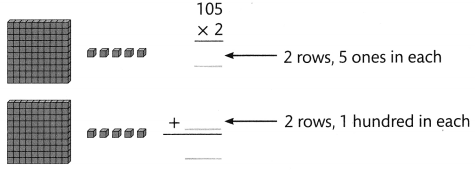
so Jenna spends the closest to one hour on Monday.
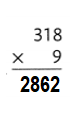
The store sells different colors of men’s socks. The Socks table shows the fraction for each sock color in the store.

Use the Socks table to answer Questions 5 and 6.
Envision Math Common Core Grade 3 Answers Topic 13 Fraction Equivalence and Comparison 127

Question 5.
Part A
Complete the fractions on the number line. Label the fraction that represents each sock color.
Envision Math Common Core Grade 3 Answers Topic 13 Fraction Equivalence and Comparison 128

Answer:
The fraction that represents each sock color = 1/4, 2/4, 3/4, and 1.
1/8, 2/8, 3/8, 4/8, 5/8, 6/8, 7/8, and 1.

Explanation:
In the above-given question,
given that,
The store sells different colors of men’s socks.
the white color socks are 1/8.
the black color sock is 1/4.
the brown color socks are 3/8.
the gray color socks are 2/8.
so the fraction that represents each sock color = 1/4, 2/4, 3/4, and 1.
1/8, 2/8, 3/8, 4/8, 5/8, 6/8, 7/8, and 1.
Envision-Math-Common-Core-3rd-Grade-Answer-Key-Topic-13- Fraction Equivalence and Comparision-68

Part B
Does the store have more brown socks or more white socks?

Answer:
The store has more brown socks = 3/8.

Explanation:
In the above-given question,
given that,
The store sells different colors of men’s socks.
the white color socks are 1/8.
the black color sock is 1/4.
the brown color socks are 3/8.
the gray color socks are 2/8.
3/8 is greater than 1/8.
so brown color socks are more than white color socks.

Question 6.
Use the number line in Exercise 5 Part A to construct an argument to justify the following conjecture: The store has an equal number of gray socks and black socks.

Answer:
Yes, the store has an equal number of gray socks and white socks.

Explanation:
In the above-given question,
given that,
The store sells different colors of men’s socks.
the white color socks are 1/8.
the black color sock is 1/4.
the brown color socks are 3/8.
the gray color socks are 2/8.
2/8 = 1/4.
2 x 1 = 2.
4 x 2 = 8.
so the store has the equal number of gray socks and white socks.

Question 7.
Use the Miguel’s Socks table to answer the question.
Envision Math Common Core Grade 3 Answers Topic 13 Fraction Equivalence and Comparison 129
Miguel bought some socks at the clothing store. After he washed them, he counted the number of individual socks he has. Each sock is \(\frac{1}{2}\) of a pair. How many pairs of black socks does he have? Write this number as a fraction.

Answer:
The number of pairs of black socks does he have = 3 pairs.

Explanation:
In the above-given question,
given that,
Miguel bought some socks at the clothing store.
the number of black color socks = 6.
the number of gray color socks = 8.
3/6 and 4/8.
3/6 = 1/2.
4/8 = 1/2.
so the number of pairs of black socks does he have = 3 pairs.