What is Linear Pair of Angles? | Axioms, Examples

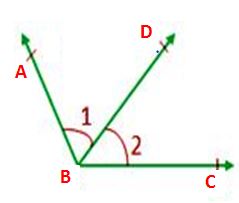
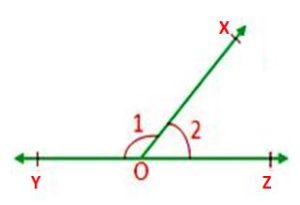
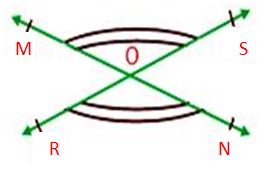
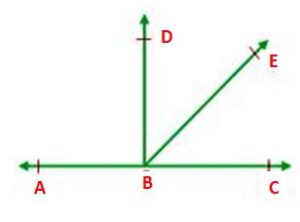
Do you want to know What is linear pair of angles? Linear Pair of Angles are similar to adjacent angles but only the difference is adding two angles we get 180º in linear angles. Linear Pair of Angles will also have a common vertex, common arm like adjacent angles. Their interiors will also do not overlap. Remember that all adjacent angles may not form a linear pair. Learn all the Lines and Angles concepts in one place on our website.

Properties of Linear Pair of Angles

Check the below Linear Pair of Angles properties listed below.

  • They have a common vertex.
  • They have a common arm.
  • Also, they do not overlap.
  • The sum of the angles is 180°.

Linear Pair of Angles

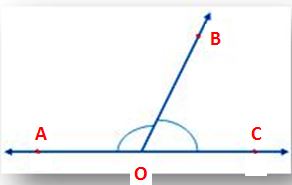
From the above figure, AO and OC are two opposite rays and ∠AOB and ∠BOC are the adjacent angles. Therefore, ∠AOB and ∠BOC form a linear pair.

Explanation for Linear Pair of Angles

The angle between the two straight lines is 180° and they form a straight angle. The line segment is the portion of a line that consists of two endpoints. Also, a line with one endpoint is known as a ray. If you consider a line mn and the middle point is o. A ray OP dividing the two lines MO and ON. The complete angle MOP and angle PON becomes 180º to form a linear pair of angles.

∠MOP + ∠PON = ∠MON = 180°

We have also given Lines and Angles concepts and problems for free of cost on our website.

Axioms

Axiom 1: If a ray stands on a line then the adjacent angles form a linear pair of angles.

Axiom of linear pair of angles

From the above figure, there are different line segments available that are passing through point O. From the figure, we can say that Angle BOD and Angle BOC are Linear Pair of Angles.

Linear Pair of Angles Examples

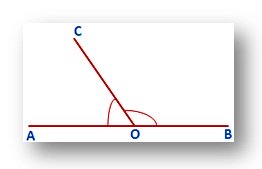
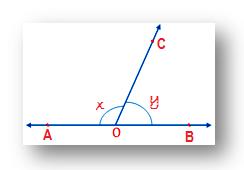
In the given figure, ∠AOC and ∠ BOC form a linear pair if x – y = 50°, find the value of x and y.
Linear pair of angles 1

Solution:
Given x – y = 50° ………… (i)
We know that, x + y = 180° ………… (ii)
Adding (i) and (ii)
x – y + x + y = 180° + 50°
2x = 230°
x = 240°/2
Therefore, x = 115°

Since, x – y = 50°
or, 115° – y = 50°
or, 115° – 115° – y = 50° – 115°
or, -y = -65°
Therefore, y = 65°

The final answer is x = 115° and y = 65°.
What are Adjacent Angles? | Adjacent Angles Definition, Examples

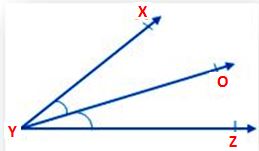
Adjacent Angles are the angles that have a common vertex and common arm. The other arms of the two adjacent angles present on the opposite sides of the common arm. The adjacent angles can be a supplementary angle or complementary angle when they share the common vertex and side. Find other concepts of Lines and Angles along with the adjacent angles on our website with a clear explanation.

Geometric Terms 4

From the above figure, YO is the common arm and Y is the common vertex. The above figure shows a pair of adjacent angles. The Ray XY and ray YZ are present on the opposite sides of the common arm YO. Therefore, ∠XYO and ∠OYZ are adjacent angles.

∠XYZ and ∠XYO are not adjacent angles, because their other arms YZ and YO are not on the opposite sides of the common arm XY.

Adjacent Angle Example

If you take a wall clock, you can see a minute hand, second hand, and also an hour hand. The minute hand and second hand of the clock form one angle represented as ∠XYO and the hour hand form another angle with the second hand represented as∠OYZ. Both the angles i.e.∠XYO and ∠OYZ are present on the opposite sides of the common hand. Therefore, these two angles are adjacent angles.

Properties of Adjacent Angles

Check out the Properties of Adjacent Angles mentioned below as a part of your preparation. They are as such

  • Adjacent Angles share the common vertex
  • Angles do not overlap
  • They share the common arm
  • There is no common interior-point in Adjacent Angles.
  • It may be complementary or supplementary angles.
  • There should be a non-common arm on both sides of the common arm.

Adjacent Angles Solved Problems

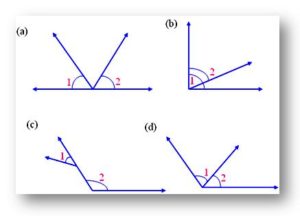
1. Are the following angles adjacent? Give reasons.

problems-on-adjacent-angles

Solution:

(a) From figure a, ∠1, and ∠2 don’t have a common arm. Therefore, ∠1 and ∠2 are not adjacent angles.
(b) Adjacent angles will not overlap each other. From figure b, ∠1 and ∠2 interiors are overlapped. Therefore, ∠1 and ∠2 are not adjacent angles.
(c) Adjacent angles must have a common vertex. from figure c, ∠1, and ∠2 don’t have a common vertex. Therefore, ∠1 and ∠2 are not adjacent angles.
(d) From figure (d), ∠1 and ∠2 are adjacent angles. Because they have a common vertex, a common arm, and their interiors do not overlap.

Complementary and Supplementary Angles Definition, Examples | How to find Complementary, Supplementary Angles?

Complementary and Supplementary Angles are the angles formed by adding two angles. If the sum of the two angles is 90º, they are called Complementary angles. Or else, if the sum of the two angles is 180º, they are called Supplementary angles. Find different problems on Supplementary and Complementary Angles in this article. Also, we have given all the concepts available in Lines and Angles on our website.

Complementary Angles

The two angles are said to be complementary angles if their sum is one right angle i.e. 90°. Each angle is called the complement of the other. If x° is one angle then (90 – x)° is the other angle in Complementary Angles.

For example, if 70° is one angle in Complementary Angles, then the other angle will be 20°. 70° and 20° complement each other.

Example 1: To find the complement of 3y + 52°, subtract the given angle from 90 degrees.
90º – (3y + 52º) = 90º – 3y – 52º = -3y + 38º

The complement of 3y + 52° is 38º – 3y.

Facts of complementary angles

  • Two complementary angles are acute but vice versa is not possible
  • Two right angles cannot complement each other
  • Also, two obtuse angles cannot complement each other

Supplementary Angles

The two angles are said to be Supplementary angles if their sum is 180°. Two angles are added and formed a straight line in Supplementary Angles. If x is one angle then (180 – x)° is the other angle in Supplementary Angles.

For example, if 130° is one angle in Supplementary Angles, then the other angle will be 50°. By adding 130 and 50 degrees, it forms a straight line. In Supplementary Angles, both angles are said to be a supplement to each other.

Solved Examples on Supplementary and Complementary Angles

1. Find the complement of 50 degrees?

Solution:
The given angle is 50 degrees, then, the Complement is 40 degrees.
We know that Sum of Complementary angles = 90 degrees.
By adding 40 degrees to 50 degrees, the total angle becomes 90 degrees.
So, 50° + 40° = 90°

The final answer is 90°

2. Find the Supplement of the angle 1/4 of 200°.

Solution:
Given that the angle 1/4 of 200°
Convert 1/4 of 200°
That is, 1/4 x 200° = 50°
Supplement of 50° = 180° – 50° = 130°
By adding 130 degrees to 50 degrees, the total angle becomes 180 degrees.

Therefore, Supplement of the angle 1/4 of 200° is 130°

3. The measures of two angles are (x + 15)° and (3x + 25)°. Find the value of x if angles are supplementary angles.

Solution:
We know that, Sum of Supplementary angles = 180 degrees.
So, (x + 15)° + (3x + 25)° = 180°
Add the x terms and numbers.
4x + 40° = 180°
Move 40° to the right side and subtract it from 180°.
4x = 140°
Move 4 to the right side and divide it from 140°.
x = 35°

The value of x is 35 degrees.

4. The difference between two complementary angles is 54°. Find both the angles.

Solution:
Given that the difference between two complementary angles is 54°.
Let, the first angle = x degrees, then, Second angle = (90 – x)degrees {as per the definition of complementary angles}
Difference between angles = 54°
Now, (90° – x) – x = 54°
90° – 2x = 54°
– 2x = 54° – 90°
-2x = -36°
x = 36°/2°
x = 18°
Again, Second angle = 90° – 18° = 72°

Therefore, the required angles are 18°, 72°.

5. Find the complement of the angle 4/5 of 90°.

Solution:
Convert 4/5 of 90°
Multiply 4/5 with 90°
4/5 × 90° = 72°
Complement of 72° = 90° – 72° = 18°

Therefore, a complement of the angle 4/5 of 90° = 18°

6. Find the supplement of the angle 2/3 of 90°.

Solution:
Convert 2/3 of 90°
2/3 × 90° = 60°
Supplement of 60° = 180° – 60° = 120°

Therefore, a supplement of the angle 2/3 of 90° = 120°

7. The measure of two complementary angles are (3x – 6)° and (x – 4)°. Find the value of x.

Solution:
According to the problem, (3x – 6)° and (x – 4)°, are complementary angles’ so we get;
(3x – 6)° + (x – 4)° = 90°
or, 3x – 6° + x – 4° = 90°
or, 3x + x – 6° – 4° = 90°
or, 4x – 10° = 90°
Add 10° on both sides.
or, 4x – 10° + 10° = 90° + 10°
or, 4x = 100°
or, x = 100°/4°
or, x = 25°

Therefore, the value of x = 25°.

Supplementary Angles Definition | How to find Supplementary Angles?

Supplementary angles are the angles that are added up to 180 degrees. If one angle is 120 degrees then the other angle is 60 degrees in supplementary angles because by adding 120 and 60, we get 180 degrees. By adding two supplementary angles, they form a straight line and a straight angle. One important thing in supplementary angles is the two angles need not be next to each other.

The important geometry concepts Lines and Angles are explained on our website with detailed explanations and solved examples. Learn all the concepts and improve your preparation level easily.

Supplementary Angle Definition

Supplementary Angle form 180º by adding two angles.

Supplementary Angles

From the given figure, Angle AOC is one angle and angle BOC is another angle. By adding the two angles AOC and BOC, we get 180º. ∠AOC and ∠BOC are Supplementary Angles.
∠AOC + ∠BOC = 180°

Properties of Supplementary Angles

Have a look at the important properties of supplementary angles explained in the below modules. They are as such

  • The two angles are said to be supplementary angles when they add up to form 180°.
  • The two supplementary angles together make a straight line, but the angles need not be together.

  • Two acute angles cannot be a supplement by each other.
  • “S” of supplementary angles stands for the “Straight” line. This means they form 180°.
  • The two right angles are always supplementary.

Adjacent and Non-Adjacent Supplementary Angles

The supplementary angles may be classified as either adjacent or non-adjacent. The adjacent supplementary angles have the common line segment or arm with each other. Also, the non-adjacent supplementary angles do not have the line segment or arm.

Supplementary-angles-non-adjacent

Supplementary Angles Theorem

The supplementary angle theorem states that if two angles are supplementary to the same angle, then the two angles are said to be congruent.

Proof:

If ∠a and ∠b are two different angles that are supplementary to a third angle ∠c, such that,
∠a + ∠c = 180 ……. (1)
∠b + ∠c = 180 ……. (2)
Then, from the above two equations, we can say,
∠a = ∠b

Hence proved.

Supplementary Angles Examples

1. Verify if 125°, 55° are a pair of supplementary angles?

Solution:
Add the given two angles and check if the resultant angle is 180° or not.
125° + 55° = 180°

The resultant angle is 180°. Hence, they are a pair of supplementary angles.

2. Find the supplement of the angle (30 + x)°.

Solution:
To find the supplement of (30 + x)°, subtract it from 180°
Supplement of the angle (30 + x)° = 180° – (30 + x)°
= 180° – 30° – x°
= (150 – x) °

3. If angles of measures (y – 2)° and (3y + 7)° are a pair of supplementary angles. Find the measures.

Solution:
Since (y – 2)° and (3y + 7)° represent a pair of supplementary angles, then their sum must be equal to 180°.
Therefore, (y – 2) + (3y + 7) = 180
y – 2 + 3y + 7 = 180
y + 3y – 2 + 7 = 180
4y + 5 = 180
Subtract 5 from both sides
4y + 5 – 5 = 180 – 5
4y = 180 – 5
4y = 175
y = 175/4
y = 43.75°

Therefore, we know the value of y = 43.75°, put the value in place of y
y – 2
= 43.75 – 2
= 41.75°

And again, 3y + 7
= 3 × 43.75° + 7
= 118 + 5
= 138.25°
Therefore, the two supplementary angles are 41.75° and 138.25°.

4. Two supplementary angles are in the ratio 5 : 4. Find the measure of the angles.

Solution:
Let the common ratio be m.
If one angle is 5m, then the other angle is 4m.
Therefore, 5m + 4m = 180
9m = 180
m = 180/9
m = 20
Put the value of m = 20

One angle is 5m
= 5 × 20
= 100°

And the other angle is 4m
= 4 × 20
= 80°

Therefore, the two supplementary angles are 100° and 80°.

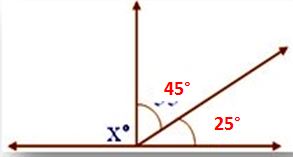
5. In the given figure find the measure of the unknown angle.

supplementary angles 2

Solution:
x + 45° + 25° = 180°
The sum of angles at a point on a line on one side of it is 180°
Therefore, x + 70° = 180°
Subtract 70° from both sides
x + 70° – 70° = 180° – 70°
x = 110°

Complementary Angles – Definition, Observations, Examples

Complementary Angles are the angles with 90°. When we add two angles then the resultant angle should be 90° to call those angles complementary angles. In complementary angles, each angle complements another angle. If an angle is 90 degrees, then it can’t be called a complementary because it doesn’t have any pairs. It consists of only one angle with 90 degrees.

The angles become complementary when the sum of the two angles becomes 90 degrees. Therefore, an angle with 90 degrees cannot be called complementary angles. Find all the Lines and Angles concepts on our website with solved examples.

Complementary angles

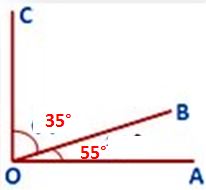
From the above figure, the ∠AOB and ∠BOC are complementary as ∠AOB + ∠BOC = 35° + 55° = 90°. Therefore, they both are Complementary Angles. Also, angles 35 and angle 55 complements each other.

Example 1: If you take a triangle with one angle of 50 degrees and another angle of 40 degrees, the combined angle will become 90 degrees. The two 40 and 50 angles are called complementary angles.

Example 2: If you take a triangle with one angle of 15 degrees and another angle of 75 degrees, the combined angle will become 90 degrees. The two 15 and 75 angles are called complementary angles.

Example 3: If you take a triangle with one angle of 10 degrees and another angle of 80 degrees, the combined angle will become 90 degrees. The two 10 and 80 angles are called complementary angles.

Observations of Complementary Angles

  • If two angles complement each other, then each angle must be an acute angle. But any two acute angles need not be complementary.
    For example, angles of measures 30° and 40° are not a complement to each other.
  • Two right angles cannot complement each other.
  • Also, two obtuse angles cannot complement each other.

Complementary Angles Examples

1. Find the complement of below angles

(a) 58°

Solution:
To find the complement of 58°, subtract it from 90°
90° – 58° = 32°

Therefore, the complement of 58° is 32°

(b) 37°40′

Solution:
To find the complement of 37°40′, subtract it from 90°
90° – 37°40′
90° = 89°60′
= 89°60′ – 37°40′
= 52°20′
Therefore, the complement of 37°40′ is 52°20′

(c) y + 42°

Solution:
To find the complement of y + 42°, subtract it from 90°
90° – (y + 42°)
= 90° – y – 42°
= 56° – y
Therefore, the complement of y + 42° is 56° – y

2. Find the complement of the angle (20 + x)°

Solution:
To find the complement of (20 + x)°, subtract it from 90°
90° – (20 + x)
= 90° – 20 – x°
= 70° – x° = (70 – x)°
Therefore, the complement of (20 + x)° is (70 – x)°

3. Find the measure of an angle that is 36° less than its complement.

Solution:
Let the unknown angle be y, then measure of its complement = (90° – y)
According to the given question,
(90° – y) – y = 36°
90° – y – y = 36°
90° – 2y = 36°
Subtract 90° from both sides
90° – 90° – 2y = 36° – 90°
-2y = -54°
y = 54/2 = 27°
y = 27°
Therefore, 90 – y (Put the value of y = 27°)
= 90 – 27°
= 63°
Therefore, the pair of complementary angles are 63° and 27°

Some Geometric Terms and Results | Geometry Terms and Definitions With Pictures

Have a look at Some Geometric Terms and Results. We have given a useful reference of geometric terms and their definitions along with solved examples. Most of the students feel difficult to understand Some Geometric Terms. So, to help such students, we explained all Geometric Terms in a clear and understandable way. We can get strong and exact results using Certain Geometric Statements. So, make use of the given formulas and get the easy process to solve problems.

We have also given Lines and Angles concepts and problems for free of cost on our website.

Some Geometric Terms and Results

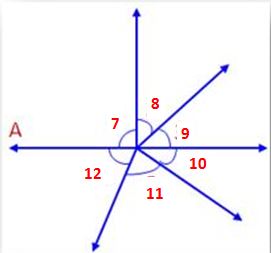
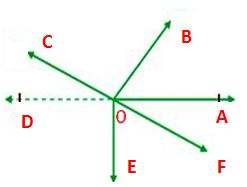
  • The sum of all the angles at a point is 360°.

i.e., ∠7 + ∠8 + ∠9 + ∠10 + ∠11 + ∠12 = 360°

Geometric terms 1

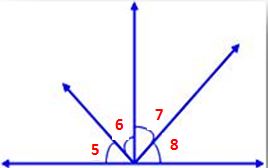
  • The sum of all the angles about a point on a straight line on one side of if it is 180°.

i.e., ∠5 + ∠6 + ∠7 + ∠8 = 360°

Geometric Terms 2

Some Important Geometric Terms

1. Equal Angles

The two angles are considered to be equal if they have the same degree measure.

Geometric terms 3

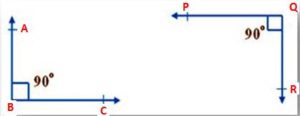
Given that two angles. The angles are ∠ABC and ∠PQR.
∠ABC = 90°; ∠PQR = 90°.
∠ABC and ∠PQR are equal angles of measure 90°.

2. Bisector of an Angle

A ray that divides the given angle into two equal angles is called an angle bisector.

Geometric Terms 4

Given that ∠XYZ along with a ray YO that divides ∠XYZ. In the adjoining figure, the ray YO divides ∠XYZ into two equal angles ∠XYO and ∠OYZ
i.e., ∠XYO = ∠OYZ.

3. Perpendicular Lines

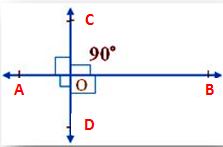
Perpendicular Lines are the lines that intersect each other to form right tangles between them. In the adjoining e, lines AB and CD intersect at 0 such that ∠COB = ∠ COA = ∠AOD = ∠BOD = 90°.
Therefore, we say that AB is perpendicular to CD, i.e., (AB ⊥ CD).

Perpendicular lines

4. Perpendicular Bisector

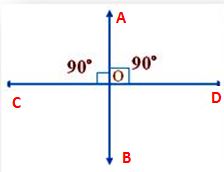
Perpendicular Bisector is the line that passes through the midpoint of the given line segment and also it is perpendicular to it. Here, the CD is the line segment. AB is the perpendicular bisector as ∠AOB = ∠AOD = 90° and CO = OD.

perpendicular-bisector

Related Angles – Interior, Exterior, Corresponding Angles

Related angles are nothing but the pairs of angles and assigned with specific names that we come across. Related angles have some conditions to mention. Learn the detailed concept of Related angles with images and examples in this article. Improve your preparation level by reading the entire concept without missing any subtopic. We have given complete information about Lines and Angles on our website for free of cost.

Different Types of Related Angles

Check different types of Related Angles along with examples to clearly understand the concept. We have explained each of them with definitions, solved examples, etc. Refer to the following modules and get a grip on it.

Complementary Angles

If the sum of the measures of two angles is about 90°, those angles are called complementary angles.

Facts of Complementary Angles

  • The two right angles never complement each other.
  • Also, the two obtuse angles never complement each other.
  • Two complementary angles are always acute but there is no possibility of vice versa.

Example:

Let us take two angles which are complementary angles. If one angle is a, then the other angle is 90° – a.
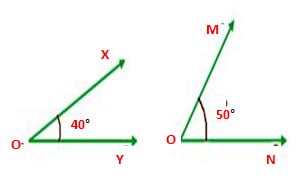
An angle of 40° and another angle of 50° are complementary angles of each other.

Also, complement of 40° is 90° – 40° = 50°.
And complement of 50° is 90° – 50° = 40°

Complementary angle

The ∠XOY is 40° and ∠MON is 50°. By adding two angles ∠XOY and ∠MON, we get 90° as they are the Complementary Angles.

Therefore, the sum of the ∠XOY and ∠MON is 90°
∠XOY + ∠MON = 90°.

Supplementary Angles

Supplementary Angles are the angles when the sum of the measures of two angles is 180°. If the sum of the two angles forms a straight angle, then those angles are called Supplementary Angles. If one angle is a, then the other angle is 180° – a.

Example:

Let us take two angles which are Supplementary angles. If one angle is x, then the other angle is 180° – x.
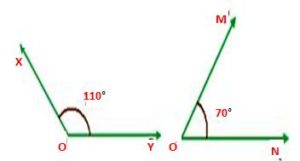
An angle of 110° and another angle of 70° are supplementary angles of each other. Also, a supplement of 110° is 180° – 110° = 70°.
And the supplement of 60° is 180° – 70° = 110°.

Supplementary angle

From the above figure, the ∠XOY is 110° and ∠MON is 70°. By adding two angles ∠XOY and ∠MON, we get 180° as they are the Supplementary Angles.

Therefore, the sum of the ∠XOY and ∠MON is 180°
∠XOY + ∠MON = 180°.

Adjacent Angles

The two angles are called to be Adjacent angles when they have a common arm, a common vertex, and also the non-common arms present on the opposite side of the common arm.

Adjacent angle

From the above figure, ∠ABD and ∠CBD are adjacent angles with the common arm BD. The B is the common vertex and BA, BC is opposite sides of BD.

Linear Pair

When two adjacent angles form a linear pair of angles with the non-common arms are two opposite rays. In other words, the sum of two adjacent angles is 180°.

linear pair of angles

From the above figure, the ∠XOY and ∠XOZ are two adjacent angles. By adding two angles ∠XOY and ∠XOZ, we get 180°.

Therefore, the sum of the ∠XOY and ∠XOZ is 180°
∠XOY + ∠XOZ = 180°.

Vertically Opposite Angles

The arms of the lines are opposite in direction and both lines are interesting to each other in Vertically opposite angles. The pair of vertically opposite angles are equal.

vertically opposite angles

From the above figure, the ∠MOR and ∠SON and ∠MOS and ∠RON are pairs of vertically opposite angles.

Theorems on Related Angles

1. If a ray stands on a line, then the sum of adjacent angles formed is 180°.

Given: A ray BE standing on (AC) ⃡ such that ∠ABE and ∠CBE are formed.

sum-of-adjacent-angles

Construction: Draw BD ⊥ AC.

Proof: Take the angle ABE.
Now ∠ABE = ∠ABD + ∠DBE ……………. (1)
Take the angle CBE.
Also ∠CBE = ∠CBD – ∠DBE ……………. (2)
Now, add equation 1 and equation 2.
Adding (1) and (2),
∠ABE + ∠CBE = ∠ABD + ∠CBD + ∠DBE – ∠DBE
∠DBE – ∠DBE = 0
= ∠ABD + ∠CBD
∠ABD = 90°; ∠CBD = 90°
Substitute ∠ABD and ∠CBD values in ∠ABD + ∠CBD
= 90° + 90°
= 180°

2. The sum of all the angles around a point is equal to 360°.

Given: A point O and rays OA, OB, OC, OD, OE which make angles around O.

angles-around-a-point

Construction: Draw OD opposite to ray OA

Proof: Since, OB stands on DA therefore
∠AOB + ∠BOD = 180°
∠BOD = ∠BOC + ∠COD
Substitute ∠BOD = ∠BOC + ∠COD in ∠AOB + ∠BOD = 180°
∠AOB + (∠BOC + ∠COD) = 180°
∠AOB + ∠BOC + ∠COD = 180° ……………. (i)
Again OE stands on DA, therefore
∠DOE + ∠EOA = 180°
∠EOA = ∠EOF + ∠FOA
Substitute ∠EOA = ∠EOF + ∠FOA in ∠DOE + ∠EOA = 180°
∠DOE + (∠EOF + ∠FOA) = 180°
∠DOE + ∠EOF + ∠FOA = 180° ……………. (ii)
Now, add euqtion (i) and equation (ii)
Adding (i) and (ii),
∠AOB + ∠BOC + ∠COD + ∠DOE + ∠EOF + ∠FOA
= 180° + 180°
= 360°

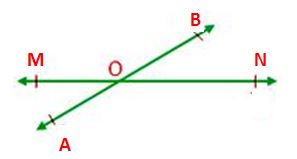
3. If two lines intersect, then vertically opposite angles are equal.

Given: MN and AB intersect at point O.

vertically-opposite

Proof: OB stands on MN.
Therefore, ∠MOB + ∠BON = 180° ……………. (i)
MO stands on AB
∠MOB + ∠MOA = 180° ……………. (ii)
From (i) and (ii),
∠MOB + ∠BON = ∠MOB + ∠MOA
∠BON + ∠MOA
Similarly, ∠MOB = ∠AON can be proved.

Classification of Angles – Acute, Obtuse, Right, Straight, Reflex, and Complete Angles

An Angle is the basic concept of Geometry and it is hard to understand geometry without a grip on Angles. Based on the measurement of an angle, the angles are classified into different types. Find detailed notes on the concept of the angle for free on our page. We have given clear details of the Classification of Angles along with solved examples. Get all Lines and Angles Problems for free of cost and improve your preparation level.

Types of Angles

There are six different types of angles explained below.

1. Acute Angle
2. Right Angle
3. Obtuse Angle
4. Straight Angle
5. Reflex Angle
6. Complete Angle

1. Acute Angle

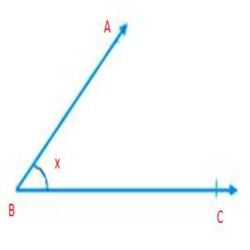
An acute angle is measured when the angle is between 0º but less than 90º. For example, 30º, 60º, 40º are called Acute Angles.

Angle 1

From the above figure, ∠ABC represents an acute angle as it consists of less than 90º.
∠ABC < 90º

2. Right Angle

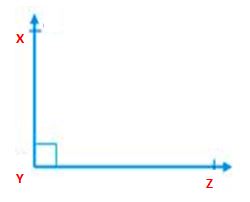
When the angle is equal to 90°, then it is called a right angle.

Angle 2

From the above figure, ∠XYZ represents the right angle as it consists of 90º.
∠XYZ = 90º

3. Obtuse Angle

An Obtuse Angle is an angle when the angle is between more than 90° but less than 180°.

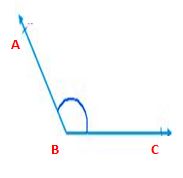
Angle 3

From the above figure, ∠ABC represents the Obtuse angle as it consists of more than 90º.
∠ABC > 90°
∠ABC < 180°

4. Straight Angle

An angle which is equal to 180° is called a straight angle.

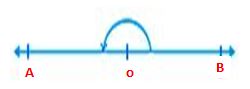
Angle 4

From the above figure, ∠AOB represents the Straight angle as it consists of 180º.
∠AOB = 180º

5. Reflex Angle

An angle that consists of more than 180° but less than 360° is called a reflex angle.

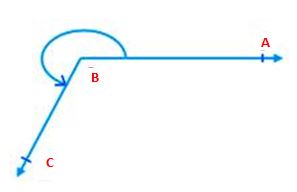
Angle 6

From the above figure, ∠ABC represents the Reflex angle.
∠ABC > 180°
∠ABC < 360°

6. Complete Angle

An angle that is equal to 360° is called a complete angle.
60 minutes = 1 revolution = 1 complete angle.

angle 7

From the above figure, ∠BAC represents the Complete angle.

Frequently Asked Questions on Types of Angles

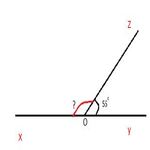
1. The figure shown below is of a straight angle, ∠XOY. Find the missing angle in the given figure?

Angle 8

Solution:

∠XOY is a straight angle, that is ∠XOY = 180°
∠XOY = ∠XOZ +∠YOZ
180 = ?+55
? = 180-55
? = 125 °
The missing angle in the above figure: 125°

2. Mention the types of triangles with respect to the angles?

Based on the different angles, the triangles are classified into 5 types. They are the Obtuse Triangle, Right Triangle, Acute Triangle, and Equiangular Triangle.

3. What is an Equilateral Triangle?

An equilateral triangle consists of the same length of sides and has the same measure angles of 60°.

4. What is a triangle?

A triangle is a closed figure that has 3 lines with endpoints. The sum of the interior angle of the triangle is going to be 180°. Also, the sum of the exterior angles is always going to be 360°.

5. Define an obtuse triangle.

An obtuse triangle consists of two acute angles and one obtuse angle. The acute angle is less than 90° and where the obtuse angle is more than 90°.

Angles – Definition, Types, Properties, Examples

The angle is defined as a figure formed by two rays meeting at a common endpoint. Learn Angle Definition, Parts of an angle, Measure of an angle, etc., Learn the complete concept of an angle along with sample examples. We have explained every part of an angle clearly in this article. Angle denotes with the symbol ‘∠’.

Angle

The name of the angle is ∠ABC or ∠CAB

Lines and Angles

Parts of an Angle

Arms: The two rays that are interset each other to form an angle are called Arms of an angle. From the above-given figure, BA and BC are the arms of the Angle ABC.

Vertex: The endpoint where two arms of an angle interest each other is called the vertex. From the given figure, point B is the vertex of Angle ABC.

Size of an Angle: The amount of turn from one arm of the angle to the other arm of the angle is said to be the size of an angle. The size of the angles represents in degrees. The symbol is º.

Types of Angles

There are different types of angles available based on the measure of an angle. They are,

  1. Acute Angle
  2. Obtuse Angle
  3. Right Angle
  4. Straight Angle
  5. Reflex Angle
  6. Full Rotation

1. Acute Angle: An angle that forms less than 90 degrees is called an acute angle. The measure of an acute angle is between 0º and 90º.

2. Obtuse Angle: An angle that forms greater than 90 degrees is called an Obtuse angle. The measure of an Obtuse angle is between 90º and 180º.
Obtuse Angle Measure = (180 – acute angle measure)

3. Right Angle: An angle that forms exactly 90 degrees is called a right angle. The measure of a right angle is exactly 90º. The two lines are perpendicular to each other at the right angle.

4. Straight Angle: The angle that forms 108º is called the Straight Angle.

5. Reflex Angle: An angle that forms greater than 180 degrees and less than 360 degrees is called a Reflex angle.

6. Full Rotation: The angle that forms 360º called Full Rotation.

Interior and Exterior Angles

In a polygon such as quadrilateral, triangle, hexagon, pentagon, etc., the interior and exterior angles are formed. Interior angles formed inside the polygon or a closed shape. Exterior angles formed outside the given shape.

Positive & Negative Angles

An Angle that calculated in an Anti-Clockwise direction is called a Positive Angle and an angle Clockwise direction is called a Negative Angle.

Angle Measurement

The angle is measured in degrees. The degree symbol is º.

Degree of an Angle

The full angle is 360. Firstly, the full angles are divided using the angle of an equilateral triangle. If the angle is 1, then it is 1/360 of the full rotation. The degree is divided into minutes and seconds.
1°= 60′ = 3600”

Radian of an Angle

The SI unit of angle is the radian of an angle. The Radian of an Angle used in Calculus. All the derivatives and integrals are calculated in the terms of a radian. The radian of an angle is denoted by ‘rad’.
Example: In a complete circle, there are 2π radians available.
360 = 2π; radian
Therefore, 1 radian = 180°/π

Gradian of an Angle

Gradian of an Angle is also called a grade or a gon. The angle is equal to 1 gradian if the rotation starts and moved up to 1/400 of the full rotation. It is denoted by ‘grad’.

Frequently Asked Questions on Angles

1. What is an angle?

The angle is formed by intersecting two rays at a single point. The two rays are called the sides of an angle and the common point is called the vertex.

2. What are the six types of angles?

There are six types of angles. They are

  • Acute angle
  • Obtuse angle
  • Right angle
  • Straight angle
  • Reflex angle
  • Full rotation

3. How angles are calculated?

The angles are calculated with the degree.

4. What is a zero angle?

An angle that consists of zero degree is called zero angle.

Basic Geometrical Concepts: Introduction, General Terms and Examples

Introduction to Basic Geometrical Ideas
The term ‘Geometry’ is derived from the Greek word ‘Geometron’. This has 2 equivalents. ‘Geo’ means Earth and ‘metron’ means Measurement.

Points
It is a position or location on a plane surface, which are denoted by a single capital letter.

Points

Lines and Angles

Line Segment

It is a part of a line with the finite length and 2 endpoints.

Line Segment

The points A and B are called the endpoints of the segment.

It is named as:

Line

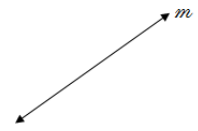
It is made up of infinitely many points with infinite length and no endpoint.

Line

It extends indefinitely in both directions.

Named as:

Or sometimes

Line

Intersecting Lines

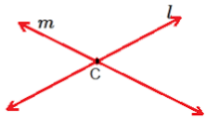
The two lines that share one common point are called Intersecting Lines.

This shared point is called the point of intersection.

Intersecting Lines

Here, line l and m are intersecting at point C.

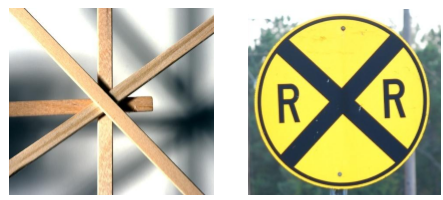
Real life example of intersecting lines:

Fence and Traffic sign

Parallel Lines

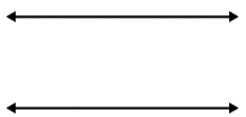
Two or more lines that never intersect (Never cross each other) are called Parallel Lines.

Parallel Lines

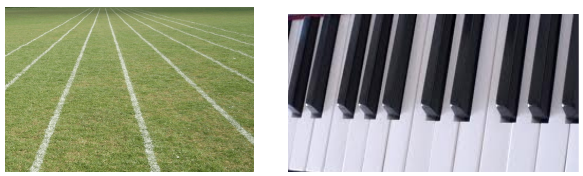
Real life examples of parallel lines:

Racetracks and Piano keys

Ray

It is a part of a line with one starting point whereas extends endlessly in one direction.

Ray

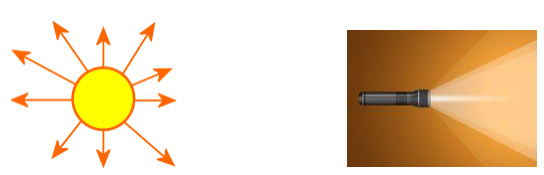
Real life examples of the ray are:

Sun rays and Light rays from a torch

Curves

Anything which is not straight is called a curve.

1. Simple Curve – A curve that does not cross itself.

Simple Curve

2. Open Curve – Curve in which its endpoints do not meet.

Open Curve

3. Closed Curve – Curve that does not have an endpoint and is an enclosed figure.

Closed Curve

A closed curve has 3 parts which are as follows

Closed curve

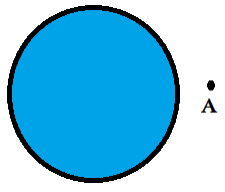
1. Interior of the curve

It refers to the inside/inner area of the curve.

The blue coloured area is the interior of the figure.

2. The exterior of the curve.

It refers to the outside / outer area of the curve.

The point marked A depicts the exterior of the curve.

3. The boundary of the curve

It refers to the dividing line thus it divides the interior and exterior of the curve.

The black line which is dividing the interior and exterior of the curve is the boundary.

The interior and boundary of the curve together are called the curves “region”.

Polygons

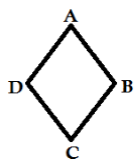
It is a 2d closed shape made of line segments / straight lines only.

Polygons

  • Sides –It refers to the line segments which form the polygon, as in the above figure AB, BC, CD, DA are its sides.
  • Vertex – Point where 2 line segments meet, as in the above figure A, B, C and D are its vertices.
  • Adjacent Sides – If any 2 sides share a common endpoint they are said to be adjacent to each other thus called adjacent sides, as in the above figure AB and BC, BC and CD, CD and DA, DA and AB are adjacent sides.
  • Adjacent Vertices – It refers to the endpoints of the same side of the polygon. As in the above figure A and B, B and C, C and D, D and A are adjacent vertices.
  • Diagonals – It refers to the joins of the vertices which are not adjacent to each other. As in the above figure, AC and BD are diagonals of the polygon.

Angles

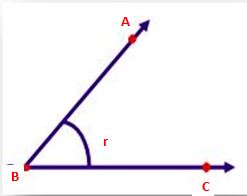
A figure formed from 2 rays which share a common endpoint is called Angle.

Angles

The rays forming the angle are known as its arms or sides.

The common endpoint is known as its vertex.

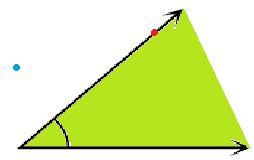
An angle is also associated with 3 parts

1. Interior – It refers to the inside/inner area.

The green coloured area is the interior of the angle.

2. Angle/boundary – It refers to the arms of the angle.

The red point is on the arm of the angle.

3. Exterior – It refers to the outside / outer area.

The blue point depicts the exterior of the figure.

Naming an Angle

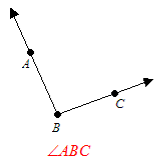
While naming an angle the letter depicting the vertex appears in the middle.

Example

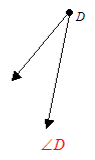
Angle

The above angle can also be named as ∠CBA.

An angle can also be named just by its vertex.

Example

Angle

Triangle

It is a 3 sided polygon. It is also the polygon with the least number of the sides.

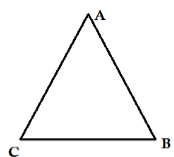
Triangle

Vertices: A, B and C

Sides: AB, BC and CA

Angles: ∠A, ∠B and ∠C

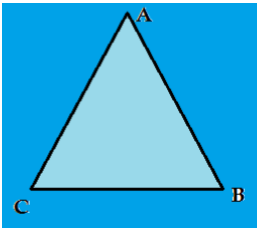
Triangle

  • Here, the light blue coloured area is the interior of the angle.
  • The black line is the boundary.
  • Whereas, the dark blue area is the exterior of the angle.

Quadrilaterals

It is a 4 sided polygon

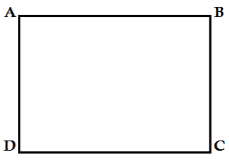
Quadrilaterals

Vertices: A, B, C, D

Sides: AB, BC, CD, DA

Angle: ∠A, ∠B, ∠C, ∠D

Opposite Sides: AB and DC, BC and AD

Opposite Angles: ∠B and ∠D, ∠A and ∠C

Adjacent Angles: ∠A and ∠B, ∠B and ∠C, ∠C and ∠D, ∠D and ∠A.

Circles

It is a simple closed curve and is not considered as a polygon.

Parts of Circles

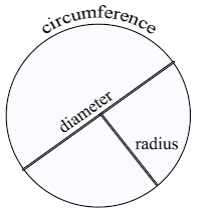
Parts of Circles

1. Radius – It is a straight line connecting the centre of the circle to the boundary of the same. Radii is the plural of ‘radius’.

2. Diameter –It is a straight line from one side of the circle to the other side passing through the centre.

3. Circumference – It refers to the boundary of the circle.

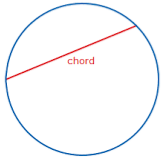
4. Chord – Any line that connects two points on the boundary of the circle is called Chord. Diameter is the longest chord.

Chord

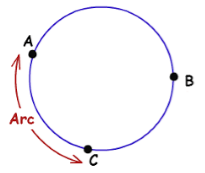
5. Arc – It is the portion of the boundary of the circle.

Arc

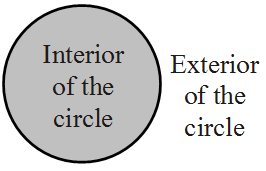
6. Interior of the Circle – Area inside the boundary of the circle is called the Interior of the Circle.

7. The Exterior of the Circle – Area outside the boundary of the circle is called the Exterior of the Circle.

The Exterior of the Circle

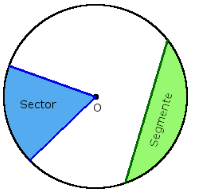
8. Sector– It is the region in the interior of a circle enclosed by an arc on one side and a pair of radii on the other two sides.

9. Segment – It is the region in the interior of the circle enclosed by an arc and a chord.

Segment

Semi-circle

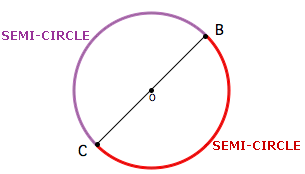
A diameter divides the circle into two semi-circles. Hence the semicircle is the half of the circle, which has the diameter as the part of the boundary of the semicircle.

Semi-circle