Practice Test on Word Problems Involving Simultaneous Linear Equations | Solving Linear Equations Questions

Students can get various questions related to simultaneous linear equations word problems on this page. Practice all the questions to get a clear idea of the topic. You can also find a detailed solution for each problem on the Practice Test on Word Problems Involving Simultaneous Linear Equations page. Solve the questions and verify your answers to get good marks in the exam.

Steps to Solve Linear Equations Word Problems

Follow these steps and instructions while solving the system of linear equations and get the answers easily.

  • Take the unknown parameters as the variables x and y.
  • According to the information provided in the question, make those variables as the linear equations.
  • Solve those simultaneous linear equations by using substitution or elimination or comparison method.
  • And get the value of one variable.
  • Substitute the obtained variable value in any one of the equations to find other variable values.

Simultaneous Linear Equations Word Problems

Example 1.

In a rectangle, if the length is increased and the width is reduced each by 2 cm then the area is reduced by 26 sq.cm . If the length is reduced by 1 cm and the width increased by 2 cm , then the area increases by 30 sq.cm . Find the area of the rectangle?

Solution:

Let the length and width of the rectangle is x and y.

Then, the rectangle area = xy

According to the question,

If the length and width of the rectangle is reduced by 2 cm, then the area is reduced by 26 cm.

(x + 2)(y – 2) = x . y – 26

xy – 2x + 2y – 4 = xy – 26

xy – 2x + 2y – xy = -26 + 4

2y – 2x = -22

2(y – x) = -22

y – x = -22/2

y – x = -11 —– (i)

If the length is reduced by 1 cm and the width increased by 2 cm , then the area increases by 30 sq.cm

(x – 1) . (y + 2) = x . y + 30

xy + 2x – y – 2 = xy + 30

xy + 2x – y – xy = 30 + 2

2x – y = 32 —– (ii)

Add equation (i) and equation (ii)

y – x + (2x – y) = -11 + 32

y – x + 2x – y = 21

x = 21

Substitute x = 21 in equation (i)

y – 21 = -11

y = -11 + 21

y = 10

So, Area of the rectnagle = x . y

= 21 x 10

= 210 sq. cm.

Hence, the rectangle area is 210 sq. cm.

Example 2.

One number is five times the other number. The difference between the two numbers is 32. Find the two numbers?

Solution:

Let the two numbers be x and y.

Given that, one number is five times the other number.

x = 5y ——- (i)

The difference between the two numbers is 32.

x – y = 32 ——- (ii)

Substitute x = 5y in equation (ii)

5y – y = 32

4y = 32

y = 32/4

y = 8

Putting y = 8 in equation (i)

x = 5 x 8

x = 40

Hence, the two numbers are 40, 8.

Example 3.

I am four times old as my grand-daughter. After five years, I will be 2½ times as old as my grand-daughter. Find my present age and the present age of my grand-daughter?

Solution:

Let my present age of is x, the present age of my grand-daughter is y.

According to the question,

I am four times old as my grand-daughter

x = 4y —– (i)

After five years, I will be 2½ times as old as my grand-daughter.

(x + 5) = 2½(y + 5)

x + 5 = 5/2(y + 5)

2(x + 5) = 5(y + 5)

2x + 10 = 5y + 25

2x – 5y = 25 – 10

2x – 5y = 15 —– (ii)

Put x = 4y in equation (ii)

2(4y) – 5y = 15

8y – 5y = 15

3y = 15

y = 5

Put y = 5 in equation (i)

x = 4(5)

x = 20

Therefore, my present age is 20 years, my grand daughter’s present age is 5 years.

Example 4.

The difference between the two numbers is 15. Two times the smaller number added to the larger number gives 30. Find the two numbers?

Solution:

Let the smaller number is x, largest number is y.

Given that, the difference between numbers is 15.

y – x = 15 —– (i)

Two times the smaller number added to the larger number gives 30

2x + y = 30 —— (ii)

Subtract equation (ii) from equation (i)

2x + y – (y – x) = 30 – 15

2x + x = 15

3x = 15

x = 15/3

x = 5

Put x = 5 in equation (i)

y – 5 = 15

y = 15 + 5

y = 20

Therefore, the two numbers are 5, 20.

Example 5.

If I double a number and add three times a second number, the answer is 1. If I multiply the first number by 3 and take away twice the second number, the answer is 8. Find the numbers?

Solution:

Let the two numbers be x, y.

As per the first condition in the question,

Double a number and add three times the second number, the answer is 1.

2x + 3y = 1 —- (i)

Second condition is multiply the first number by 3 and take away twice the second number, the answer is 8.

3x – 2y = 8 —– (ii)

x = (8 + 2y)/3

Substituting x = (8 + 2y)/3 in equation (i)

2(8 + 2y)/3 + 3y = 1

(16 + 4y)/3 + 3y = 1

(16 + 4y + 9y)/3 = 1

16 + 13y = 3

13y = 3 – 16

13y = -13

y = -13/13

y = -1

Substitute y = -1 in equation (ii)

3x – 2(-1) = 8

3x + 2 = 8

3x = 8 – 2

3x = 6

x = 6/3

x = 2

So the numbers are 2, -1.

Example 6.

The numerator of a fraction is 4 smaller than its denominator. If both the numerator and denominator are increased by 1, the fraction is 5/8. Find the original fraction?

Solution:

Let the fraction be x/y.

Given that, the numerator of a fraction is 4 smaller than its denominator.

x – 4 = y

x – y – 4 = 0 —- (i)

If both the numerator and denominator are increased by 1, the fraction is 5/8

(x + 1) / (y + 1) = 5/8

8(x + 1) = 5 (y + 1)

8x + 8 = 5y + 5

8x – 5y + 8 – 5 = 0

8x – 5y + 3 = 0 —- (ii)

Multiply the equation (i) by 5.

5(x – y – 4) = 0

5x – 5y – 20 = 0 —– (iii)

Subtract equation (iii) from the equation (ii)

8x – 5y + 3 – (5x – 5y – 20) = 0

8x – 5y + 3 – 5x + 5y + 20 = 0

3x + 23 = 0

x = -23/3

Put x = -23/3 in equation (i)

-23/3 – y – 4 = 0

y = -23/3 – 4

y = (-23 – 12)/3

y = -35/3

So, the fraction is (-23/3) / (-35/3) = 23/35.

Example 7.

The sum of ages of a mother and her son two years ago was 40. In two years’ time from now, the age of the mother will be three times that of her son by then. Find their ages after 7 years’ time?

Solution:

The present ages of a mother and her son is x and y respectively.

The sum of ages of a mother and her son two years ago was 40

(x – 2) + (y – 2) = 40

x + y – 4 = 40

x + y = 44 ——- (i)

In two years time from now, the age of the mother will be three times that of her son by then

(x + 2) = 3(y + 2)

x + 2 = 3y + 6

x – 3y + 2 – 6 = 0

x – 3y – 4 = 0 —— (ii)

Subtract equation (ii) from equation (i)

x – 3y – 4 – (x + y) = 0 – 44

x – 3y – 4 – x – y = -44

-4y = -44 + 4

-4y = -40

y = 40/4

y = 10

Put y = 10 in equation (i)

x + 10 = 44

x = 44 – 10

x = 34

So, the present ages of mother and son are 34 years, 10 years.

The mother age after 7 years is 34 + 7 = 41 years, son age after 7 years is 10 + 7 = 17 years.

Example 8.

The Sum of the cost price of the two products is $50. The Sum of the selling price of the same two products is $52. If one is sold at 20% profit and another one is sold at 20% loss, find the cost price of each product.

Solution:

Let x, y are the cost prices of two products.

Given that, the sum of the cost prices of the two products is $50.

x + y = 50 —— (i)

One product is sold at 20% profit and another one is sold at 20% loss.

Assume that x is sold at 20% profit. Then its selling price is = 120% of x = 1.2x

Then another product y is sold at 20% loss. Then its selling price = 80% of y = 0.8y

The sum of the selling price of the two products is $52.

1.2x + 0.8y = 52

Multiply both sides by 10.

12x + 8y = 520

3x + 2y = 130 —- (ii)

Multiply the equation (i) by 2 and subtract it from equation (iii).

2x + 2y = 100

3x + 2y – (2x + 2y) = 130 – 100

3x + 2y – 2x – 2y = 30

x = 30

Put x = 30 in equation (i)

30 + y = 50

y = 50 – 30

y = 20

So, the cost prices of the two products are $30 and $20.

Example 9.

Points A and B are 50 km part on a highway. A car starts from A and another car starts from B at the same time. If they traveled in the same direction, they meet in 5 hours but if they move towards each other they meet in 1 hour. Find their speeds?

Solution:

Given that,

The distance between two points = 50 km

Speed = distance / time

When they travel in the same direction,

Suppose take B travels for x km, then A will traveled for 50 + x

Speed of car A = (50 + x) / 5

Speed of car B = x / 5

When they travel in the opposite direction,

Suppose they meet when A travels for y km, then B will have traveled 50−y km in the same time.

Speed of car A = y/1

Speed of car B = (50 – y) / 1

Equating the speeds of the cars in both cases,

Speed of car A,

(50 + x) / 5 = y

50 + x = 5y

x – 5y + 50 = 0 —— (i)

Speed of car B,

x/5 = (50 – y)

x = 5(50 – y)

x = 250 – 5y

x + 5y – 250 = 0 —- (ii)

Subtracting equation (ii) from equation (i)

x + 5y – 250 – (x – 5y + 50) = 0

x + 5y – 250 – x + 5y – 50 = 0

10y – 300 = 0

10y = 300

y = 300/10

y = 30

Substitute y = 30 in equation (i)

x – 5(30) + 50 = 0

x – 150 + 50 = 0

x – 100 = 0

x = 100

Therefore, the speed of car A is 100 km/hr and car B is 30 km/hr.

Example 10.

In the triangle, the sum of two angles is 90° which is the measure of the third angle. Also, the difference between these 2 angles is 10°, find the measure of these two unknown angles?

Solution:

Let the measures of two angles of a triangle are x, y.

The sum of two angles is 90°.

x + y = 90°  —– (i)

The difference between these 2 angles is 10°

x – y = 10° —– (ii)

Add equation (i) and equation (ii)

x + y + x – y = 90 – 10

2x = 80

x = 40°

Put x = 40° in equation (ii)

40° – y = 10°

40° – 10° = y

30° = y

Therefore, the unknown two angles of the triangle are 40°, 30°.
Word Problems on Simultaneous Linear Equations | Simultaneous Linear Equations Questions

By solving the system of linear equations in two variables, you will get an ordered pair having x coordinate and y coordinate values (x, y) that satisfies both equations. Here those simultaneous linear equations are in the form of word problems. So, you can solve different word problems with the help of linear equations.

We have already learned some steps and methods to solve the simultaneous linear equations in two variables. Assume the unknown quantities in the question as x, y variables and represent them in the form of a linear equation according to the condition mentioned in the question. And follow the methods to solve the formed system of linear equations to get the values of unknown quantities. We have also provided simultaneous equations problems with solutions that help you to grasp the concept.

Simultaneous Equations Word Problems

Example 1.

One number is greater than thrice the other number by 6. If 4 times the smaller number exceeds the greater by 7, find the numbers?

Solution:

Let x, y be the two numbers

So that x > y

Given that, one number is greater than thrice the other number by 6.

Then, we can write it as

x = 3y + 6 ——— (i)

According to the question,

4 times the smaller number exceeds the greater by 7.

4y – x = 7 ——— (ii)

Substitute (3y + 6) in equation (ii).

4y – (3y + 6) = 7

4y – 3y – 6 = 7

y – 6 = 7

y = 7 + 6

y = 13

Substitute y = 13 in equation (i)

x = 3(13) + 6

x = 39 + 6

x = 45

So, the two numbers are 45, 13.

Example 2.

The sum of two numbers is 25 and their difference is 5. Find those two numbers?

Solution:

Let the two numbers be x and y.

According to the question,

The sum of two numbers is 25

x + y = 25 —— (i)

The difference of numbers is 5.

x – y = 5 —– (ii)

Add both the equations (i) & (ii)

x + y + x – y = 25 + 5

2x = 30

x = 30/2

x = 15

Putting x = 15 in equation (i)

15 + y = 25

y = 25 – 15

y = 10

So, the two numbers are 15, 10.

Example 3.

The sum of two numbers is 50. If the larger is doubled and the smaller is tripled, the difference is 25. Find the two numbers.

Solution:

Let the two numbers be x and y

According to the given question,

The sum of two numbers is 50.

x + y = 50 —— (i)

The larger number is doubled and the smaller number is tripled, the difference is 25.

2x – 3y = 25 —— (ii)

Multiply the first equation by 3.

3(x + y) = 3 x 50

3x + 3y = 150 —— (iii)

Add equation (ii) and equation (iii)

2x – 3y + 3x + 3y = 25 + 150

5x = 175

x = 175/5

x = 35

Substituting the value of x in equation (i)

35 + y = 50

y = 50 – 35

y = 15

Hence the two numbers are 35, 15.

Example 4.

The class IX students of a certain public school wanted to give a farewell party to the outgoing students of class X. They decided to purchase two kinds of sweets, one costing Rs. 70 per kg and the other costing Rs. 85 per kg. They estimated that 34 kg of sweets were needed. If the total money spent on sweets was Rs. 2500, find how much sweets of each kind they purchased?

Solution:

Let the quantity of sweets purchased be x kg which cost Rs. 70 per kg and sweets purchased y kg which cost Rs. 85 per kg.

According to the question,

x + y = 34 ——- (i)

70x + 85y = 2500 ——– (ii)

Multiplying the equation (i) by 70, we get

70(x + y) = 34 x 70

70x + 70y = 2380 —– (iii)

Subtracting equation (iii) from equation (ii), we get

70x + 70y – (70x + 85y) = 2380 – 2500

70x + 70y – 70x – 85y = -120

-15y = -120

y = 120/75

y = 1.6

Substitute y = 1.6 in equation (i)

x + 1.6 = 34

x = 34 – 1.6

x = 32.4

Hence, the sweets purchased 1 kg 600 grams which cost Rs. 85 per kg and 32 kg 400 grams which cost Rs. 70 per Kg.

Example 5.

A two-digit number is eight times the sum of its digits. The number formed by reversing the digits is 18 less than the given number. Find the given number?

Solution:

Let the two-digit number be xy.

Given that, the two digit number is eight times the sum of its digits.

xy = 8(x + y) —– (i)

In the two digit number xy, x is in the tens position and y is in ones position.

Then,

xy = 10 . x + 1 . y

xy = 10x + y ——- (ii)

Substitute equation (ii) in equation (i)

10x + y = 8(x + y)

10x + y = 8x + 8y

10x – 8x = 8y – y

2x = 7y

2x – 7y = 0 —– (iii)

According to the question,

The number formed by reversing the digits 18 less than the given number.

xy – yx = 18

(10 . x + 1 . y) – (10 . y + 1 . x) = 18

(10x + y) – (10y + x) = 18

10x + y – 10y – x = 18

9x – 9y = 18

9(x – y) = 18

(x – y) = 18/9

x – y = 2 —— (iv)

Multiply equation (iv) by 2.

2(x – y) = 2 x 2

2x – 2y = 4 —— (v)

Subtract equation (v) from equation (iii)

(2x – 2y) – (2x – 7y) = 4 – 0

2x – 2y – 2x + 7y = 4

5y = 4

y = 4/5

Substitute y = 4/5 in equation (iv)

x – 4/5 = 2

x = 2 + 4/5

x = (10 + 4)/5

x = 14/5

So, the required two digit number is 144/5.

Example 6.

If the numerator of a certain fraction is increased by 2 and the denominator by 1, the fraction becomes equal to ⅗ and if the numerator and denominator are each diminished by 1, the fraction becomes equal to ⅔, find the fraction.

Solution:

Let the fraction be x/y.

According the given question,

(x + 2) / (y + 1) = ⅗

5(x + 2) = 3(y + 1)

5x + 10 = 3y + 3

5x – 3y = 3 – 10

5x – 3y = -7 —— (i)

(x – 1) / (y – 1) = ⅔

3(x – 1) = 2(y – 1)

3x – 3 = 2y – 2

3x – 2y = -2 + 3

3x – 2y = 1 —— (ii)

Multiply the equation (i) by 2, equation (ii) by 3.

2(5x – 3y) = 2 x -7 ⇒ 10x – 6y = -14

3(3x – 2y) = 3 x 1 ⇒ 9x – 6y = 3

(10x – 6y) – (9x – 6y) = -14 – 3

10x – 6y – 9x + 6y = -17

x = -17

Substitute x = -17 in equation (i)

5(-17) – 3y = -7

-85 – 3y = -7

-3y = -7 + 85

-3y = 78

y = -78 / 3

y = -26

Therefore, the fraction is 17/26.

Example 7.

If four times the age of the son is added to the age of the father, the sum is 64. But if twice the age of the father is added to the age of the son, the sum is 82. Find the ages of father and son?

Solution:

Let the father’s age be x years, the son’s age be y years.

According to the question,

4y + x = 64 —– (i)

2x + y = 82 —— (ii)

Multiply the equation (i) by 2

2(x + 4y) = 64 x 2

2x + 8y = 128

Subtract 2x + 8y = 128 from equation (ii)

(2x + 8y) – (2x + y) = 128 – 82

2x + 8y – 2x – y = 46

7y = 46

y = 46/7

y = 6 years 7 months

Substituting y = 46/7 in equation (ii)

2x + 46/7 = 82

2x = 82 – 46/7

2x = (574 – 64)/7

2x = 510/7

x = 510/14

x = 36 years 4 months

Therefore, the father’s age is 36 years 4 months, the son’s age is 6 years 7 months.

Pairs of Equations in Two Variables | Pair of Equations Questions and Answers

Solving a pair of equations indicate that those pairs are simultaneous linear equations. By solving the equations, you can say that those equations are the system of linear equations and consistent or not. Get the solved example questions along with solutions in the below-mentioned sections of this page.

Pair of Equations Problems

Example 1.

If solvable, solve the following pairs of equations:

(i) 3x + 2y = 5, x + 4y = 7

(ii) 3x – 2y = 4, 18x – 12y – 24 = 0

Solution:

(i) 3x + 2y = 5, x + 4y = 7

Here, comparing the co-efficient of x, y we get;

3/1 ≠ 2/4

Therefore, subtracting the two equations, we get the general solution.

6x – 10 = x – 7

5x = -7 + 10

5x = 3

x = 3/5

Substitute x = 3/5 in x + 4y = 7

3/5 + 4y = 7

4y = 7 – 3/5 = 32/5

y = 32/20

Therefore, the required solution is x = 3/5, y = 32/20.

(ii) 3x – 2y = 4, 18x – 12y – 24 = 0

Here, comparing the co-efficient of x, y we get;

3/18 = -2/-12 = -4/-24

Therefore, two equations are, in fact, same.

Assuming x = c in 3x – 2y = 4 we get;

y = (3c – 4)/2

Therefore, required solution: x = c

y = (3c – 4)/2 for any real value of c.

Example 2.

From the following pairs of equations find the pair or pairs representing simultaneous equations:

(i) 5x + 2y – 6 = 0, 2x + y – 7 = 0

(ii) 6x + 4y + 9 = 0, 3x + 2y +7 = 0

Solution:

(i) 5x + 2y – 6 = 0, 2x + y – 7 = 0

5/2 ≠ 2/1 ≠ -6/-7

So the two equations represent simultaneous equations; in this case they have only one solution.

(ii) 6x + 4y + 9 = 0, 3x + 2y +7 = 0

6/3 = 4/2 ≠9/7

So, the given equations are not simultaneous equations.

Example 3.

For which value of k, kx + y = 5 and x + ky = 1 are inconsistent?

Solution:

The two equations will be inconsistent if k/1 = 1/k ≠ 5/1 that means, k² = 1 or k = ±1

Therefore, the two given equations will be inconsistent if k = ±1.

Example 4.

From the following pairs of equations find the pair or pairs representing simultaneous equations:

(i) x + y = 5, x – 2y = 11

(ii) 3x – 4y + 2 = 0, 12x – 16y + 8 = 0

Solution:

(i) x + y = 5, x – 2y = 11

1/1 ≠ 1/-2 ≠ -5/-11

So the two equations represent simultaneous equations; in this case they have only one solution.

(ii) 3x – 4y + 2 = 0, 12x – 16y + 8 = 0

3/12 = -2/-16 = 2/8

So, these are simultaneous equations and have infinite solutions.

Example 5.

If solvable, solve the following pairs of equations:

(i) 5x + 7y = 9, x – 2y = 3

(ii) 3x – 2y = 2, 9x – 6y = 6

Solution:

(i) 5x + 7y = 9, x – 2y = 3

Here, comparing co-efficient of x and y, we get;

5/1 ≠ 7/-2

Therefeore, solve the value of x,

x = 39/17

Put x = 39/17 in x – 2y = 3

39/17 – 3 = 2y

(39 – 51)/17 = 2y

2y = -12/17

y = -12/34

Therefore, the required solution is x = 39/17, y = -12/34

(ii) 3x – 2y = 2, 9x – 6y = 6

Here, comparing co-efficient of x and y, we get;

3/9 = -2/-6 = 2/6

Therefore, two equations are, in fact, same.

Assuming x = c in 3x – 2y = 2

3c – 2y = 2

(3c – 2) = 2y

y = (3c – 2)/2

y = (3c – 2)/2 for any real value of c.

Solvability of Linear Simultaneous Equations | How to Determine if a Linear Equation is Solvable or Not?

Learn the conditions for the solvability of a system of linear equations in two variables in the following sections. If the simultaneous equations have no solution, then they are called inconsistent and if they have a solution, then they are called consistent. To help you understand the fundamentals of the concept we have given the Solved Examples with Answers explaining everything in detail.

Conditions for Solvability of Simultaneous Linear Equations in Two Variables

Let the pair of linear equations in two variables are

a₁x + b₁y + c₁ = 0 ——- (1)

a₂x + b₂y + c₂= 0 ——- (2)

By using the cross-multiplication method, we get

x/(b₁c₂ – b₂c₁) = y/(a₂c₁ – a₁c₂) = 1/(a₁b₂ – a₂b₁)

So, x = (b₁c₂ – b₂c₁) / (a₁b₂ – a₂b₁)

y = (a₂c₁ – a₁c₂) / (a₁b₂ – a₂b₁)

Now see when the solvability of simultaneous linear equations in two variables (i), (ii) are solavble.

(I) If (a₁b₂ – a₂b₁) ≠ 0 for any values of (b₁c₂ – b₂c₁), (a₂c₁ – a₁c₂) we will get the unique solutions for the x and y variables.

Example:

x – 2y – 8 = 0 ——- (1)

x + y – 5 = 0 ——— (2)

Here, a₁ = 1, b₁ = -2, c₁ = -8, a₂ = 1, b₂ = 1, c₂ = -5

Substitute these values in (a₁b₂ – a₂b₁), we get

(a₁b₂ – a₂b₁) = (1 x 1 – 1 x -2) = 1 + 2 = 3 ≠ 0

So, x = (b₁c₂ – b₂c₁) / (a₁b₂ – a₂b₁)

= (-2 x -5 – 1 x -8) / 3 = (-10 + 8)/3 = 18/3 = 6

y = (a₂c₁ – a₁c₂) / (a₁b₂ – a₂b₁)

= (1 x -8 – 1 x -5)/3 = (-8 + 5)/3 = -3/3 = -1

Therefore, when (a₁b₂ – a₂b₁) ≠ 0, then the system of linear equations are always consistent.

(II) If (a₁b₂ – a₂b₁) = 0 and any one of (b₁c₂ – b₂c₁) and (a₂c₁ – a₁c₂) is zero, then

Let us take a₁/a₂ = b₁/b₂ = c₁/c₂ = k, where k ≠ 0

Then, a₁ = ka₂, b₁ = kb₂, c₁ = kc₂

And system of linear equations are changed to

ka₂x + kb₂y + kc₂ = 0

a₂x + b₂y + c₂ = 0

From this equation, we can write

x = (-b₂y – c₂) / a₂

This indicates for each value of y, there is a definite value of x or there are infinite number of solutions of the simultaneous equations in this case.

Example:

x + 2y + 5 = 0

3x + 6y + 15 = 0

Here, a₁/a₂ = b₁/b₂ = c₁/c₂ = 1/3

Actually, we get the second equation by multiplying the first equation by 3. Express one equation x interms of y

x = -2y -5

Some of the solutions are

y-1012. . . . . . .
x-3-5-7-9. . . . .

(III) If (a₁b₂ – a₂b₁) = 0 and any one from (b₁c₂ – b₂c₁) and (a₂c₁ – a₁c₂) is non zero, (then other one is also non-zero)

Let us take k = a₁/a₂ = b₁/b₂ ≠ c₁/c₂ = k

So, a₁ = ka₂, b₁ = kb₂

In this case, the chnaged linear equations are

ka₂x + kb₂y + c₂ = 0

a₂x + b₂y + c₂= 0

These equations do not have solution for x and y.

So the equations are inconsistent.

While drawing graphs, we can see that the linear equations in two variables always represent a straight line and the equations of the above form represent two parallel straight lines. This is why these lines do not intersect each other and not have a common point.

Example:

7x + y + 3 = 0

14x + 2y – 1 = 0

Here, a₁ = 7, b₁ = 1, c₁ = 3, a₂ = 14, b₂ = 2, c₂ = -1

And, a₁/a₂ = b₁/b₂ ≠ c₁/c₂

So, the given system of linear equations is inconsistent.

From the above discussions, we can write that

a₁x + b₁y + c₁ = 0, a₂x + b₂y + c₂= 0 will be

(i) Consistent if a₁/a₂ ≠ b₁/b₂, we will get a unique solution

(ii) Inconsistent, there will be no solution if a₁/a₂ = b₁/b₂ ≠ c₁/c₂ where c₁ ≠ 0, c₂ ≠ 0

(iii) Consistent and have infinite solutions if a₁/a₂ = b₁/b₂ = c₁/c₂ where c₁ ≠ 0, c₂ ≠ 0

Solvability of Linear Equations Examples

Example 1.

Check whether the linear equations x + 2y + 4 = 0, 3x – 5y + 1 = 0 are consistent or inconsistent?

Solution:

Given system of linear equations are

x + 2y + 4 = 0

3x – 5y + 1 = 0

Here, a₁ = 1, b₁ = 2, c₁ = 4, a₂ = 3, b₂ = -5, c₂ = 1

(a₁b₂ – a₂b₁) = (1 x -5 – 3 x 2) = (-5 – 6) = -11

x = (b₁c₂ – b₂c₁) / (a₁b₂ – a₂b₁)

= (2 x 1 – (-5) x 4) / -11 = (2 + 20)/-11

= -22/11 = -2

y = (a₂c₁ – a₁c₂) / (a₁b₂ – a₂b₁)

= (3 x 4 – 1 x 1) / -11 = (12 – 1)/-11 = -11/11

= -1

Here, (a₁b₂ – a₂b₁) ≠ 0

Therefore, the given simultaneous linear equations are consistent and have a unique solution.

Example 2.

Check whether the linear simultaneous equations 3x – y – 2 = 0, 6x – 2y – 4 = 0 are consistent or inconsistent?

Solution:

Given Linear Simultaneous Equations are

3x – y – 2 = 0, 6x – 2y – 4 = 0

Here, a₁ = 3, b₁ = -1, c₁ = -2, a₂ = 6, b₂ = -2, c₂ = -4

(a₁b₂ – a₂b₁) = (3 x -2 – 6 x -1) = (-6 + 6) = 0

and (b₁c₂ – b₂c₁) = (-1 x -4 – (-2) x -2) = (4 – 4) = 0

(a₂c₁ – a₁c₂) = (6 x -2 – 3 x (-4)) = (-12 + 12) = 0

a₁/a₂ = b₁/b₂ = c₁/c₂ = 1/2

Actually, we get the second equation by multiplying the first equation by 2. Express one equation x in terms of y

x = (y + 2) / 3

Some of the solutions are

y-1012. . .
x1/32/314/3. . .

Therefore, the given linear equations are consistent and have an infinite number of solutions.

Example 3.

State whether the linear equations -2x + 3y – 2 = 0, 2x – 3y – 5 = 0 are consistent or not?

Solution:

Given linear equations are -2x + 3y – 2 = 0, 2x – 3y – 5 = 0

Here, a₁ = -2, b₁ = 3, c₁ = -2, a₂ = 2, b₂ = -3, c₂ = -5

(a₁b₂ – a₂b₁) = (-2 x -3 – 2 x 3) = (6 – 6) = 0

(b₁c₂ – b₂c₁) = (3 x -5 – (-3) x (-2)) = (-15 – 6) = -21

a₁/a₂ = b₁/b₂ = -1

The equations are inconsistent and has no solution.

Cross-Multiplication Method to Solve System of Linear Equations | Cross Multiplication Method Examples

Cross multiplication method is used to solve a pair of simultaneous linear equations in two variables. This method helps you to find the accurate values of variables easily. It is applicable only when we have two linear equations in two variables. Get the steps to solve the system of linear equations with the cross multiplication method in the following sections. Also, check out the solved examples for a better understanding of the concept.

Cross Multiplication Method for Solving Pair of Linear Equations

Follow the easy and simple guidelines listed below while solving Pair of Linear Equations. They are in the following fashion

  • Observe the given pair of linear equations and transpose them in the form of ax + by + c = 0
  • And represent them as the coefficient constant of term x, the coefficient constant of term y, coefficient of x, and coefficient of y.
  • Cross multiply those constants.
  • Express the cross multiplicands of x, y, and constants under x, y, and 1.
  • Equate them to find the values of x, y.

Check out the derivation to get more details about the Cross-Multiplication Method.

General Solution Using the Method of Cross-Multiplication

Let the pair of linear equations in two variables are

a₁x + b₁y + c₁ = 0

a₂x + b₂y + c₂ = 0

For solving these linear equations follow the below included steps

Given simultaneous linear equations in two variables are

a₁x + b₁y + c₁ = 0 ——- (i)

a₂x + b₂y + c₂ = 0 ——– (ii)

Multiply equation (i) by b₂ and equation (ii) by b₁.

b₂ (a₁x + b₁y + c₁ = 0)

b₂ (a₁x + b₁y + c₁) = b₂ x 0

a₁b₂x + b₁b₂y + b₂c₁ = 0 ——- (iii)

b₁ (a₂x + b₂y + c₂ = 0)

b₁ (a₂x + b₂y + c₂) = b₁ x 0

a₂b₁x + b₂b₁y + c₂b₁ = 0 —- (iv)

Subtract equation (iv) from equation (iii)

[a₁b₂x + b₁b₂y + b₂c₁ = 0] – [a₂b₁x + b₂b₁y + c₂b₁ = 0]

[a₁b₂x + b₁b₂y + b₂c₁] – [a₂b₁x + b₂b₁y + c₂b₁] = 0

a₁b₂x + b₁b₂y + b₂c₁ – a₂b₁x – b₂b₁y – c₂b₁ = 0

x(a₁b₂ – a₂b₁) + b₂c₁ – c₂b₁ = 0

x(a₁b₂ – a₂b₁) = c₂b₁ – b₂c₁

x = (c₂b₁ – b₂c₁) / (a₁b₂ – a₂b₁)

Substitute x = (c₂b₁ – b₂c₁) / (a₁b₂ – a₂b₁) in equation (i)

a₁(c₂b₁ – b₂c₁) / (a₁b₂ – a₂b₁) + b₁y + c₁ = 0

b₁y = -a₁(c₂b₁ – b₂c₁) / (a₁b₂ – a₂b₁) – c₁

y = (-a₁(c₂b₁ – b₂c₁) / (a₁b₂ – a₂b₁) – c₁) / b₁

y = (c₁a₂ – c₂a₁) / (b₂a₁ – b₁a₂)

The solution of the equations is

x / (c₂b₁ – b₂c₁) / (a₁b₂ – a₂b₁) = y / (c₁a₂ – c₂a₁) / (b₂a₁ – b₁a₂) = 1/(b₂a₁ – b₁a₂)

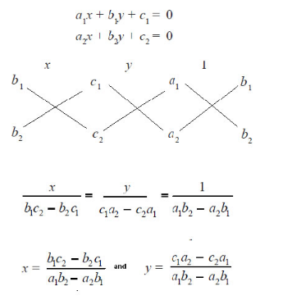
The above method is called Cross-Multiplication Methos as it uses cross-multiplication technique.

You can also represent the cross-multiplication as the following diagram.

Cross Multiplication Method Examples

Example 1.

Solve the linear equations x + y = 5, x – y = 3 by using the cross multiplication method?

Solution:

Given system of linear equations are

x + y = 5

x – y = 3

On transposition, we get

x + y – 5 = 0

x – y – 3 = 0

Writing the co-efficient in the following way, we get:

By cross-multiplication method:

x/[(1(-3) – (-1)(-5)] = y/[(-5)1 – 1(-3)] = 1//[1(-1) – 1(1)]

x/(-3 – 5) = y/(-5 + 3) = 1/(-1 – 1)

x/(-8) = y/(-2) = 1/(-2)

x/(-8) = 1/(-2), y/(-2) = 1/(-2)

x/8 = 1/2, y/2 = 1/2

x = 8/2, y = 2/2

x = 4, y = 1

Therefore, required solution is x = 4, y = 1.

Example 2.

Solve the simultaneous linear equations 3x – 4y = 0, 9x – 8y = 12 by the method of cross-multiplication?

Solution:

Given simultaneous equations are,

3x – 4y = 0

9x – 8y = 12

On transposition, we get

3x – 4y = 0 ——– (i)

9x – 8y – 12 = 0 ———- (ii)

Multiply equation (i) by -8 and equation (ii) by -4.

-8(3x – 4y) = 0 x -8

-24x + 32y = 0 —— (iii)

-4(9x – 8y – 12) = 0 x -4

-36x + 32y + 48 = 0 ——- (iv)

Subtract equation (iv) from equation (iii)

[-24x + 32y = 0] – [-36x + 32y + 48 = 0]

-24x + 32y – (-36x + 32y + 48) = 0

-24x + 32y + 36x – 32y – 48 = 0

12x – 48 = 0

12x = 48

x = 48/12

x = 4

Substitute x = 4 in equation (ii)

9(4) – 8y – 12 = 0

36 – 8y – 12 = 0

-8y + 24 = 0

-8y = -24

y = 24/8

y = 3

Therefore, required solution is x = 4, y = 3.

Example 3.

Solve the linear equations 2x + 3y = 5, x – 4y = 8 by using the cross multiplication method?

Solution:

Given linear equations are 2x + 3y = 5, x – 4y = 8

On transposing, we get

2x + 3y – 5 = 0 ——- (i)

x – 4y – 8 = 0 ——- (ii)

Multiply equation (ii) by 2, equation (i) by 1.

From equation (i), we get

2x + 3y – 5 = 0 —– (iii)

From equation (ii), we get

2(x – 4y – 8) = 0

2x – 8y – 16 = 0 —— (iv)

Subtract equation (iii) from equation (iv).

[2x – 8y – 16] – [2x + 3y – 5] = 0

2x – 8y – 16 – 2x – 3y + 5 = 0

-11y – 11 = 0

-11y = 11

y = -11/11

y = -1

Substitute y = -1 in equation (i)

2x + 3(-1) – 5 = 0

2x – 3 – 5 = 0

2x – 8 = 0

2x = 8

x = 8/2

x = 4

Therefore, the required solution is x = 4, y = -1.

Example 4.

Solve the system of linear equations 2x + 5y = 20, x + 2y = 4?

Solution:

Given simultaneous linear equations are 2x + 5y = 20, x + 2y = 4

On transposing, we get

2x + 5y – 20 = 0 —— (i)

x + 2y – 4 = 0 —— (ii)

Multiply equation (i) by 2.

2(2x + 5y – 20) = 2 x 0

4x + 10y – 40 = 0 ——- (iii)

Multiply equation (ii) by 5.

5(x + 2y – 4) = 0 x 5

5x + 10y – 20 = 0 —– (iv)

Subtract equation (iii) from equation (iv)

[5x + 10y – 20] – [4x + 10y – 40] = 0

5x + 10y – 20 – 4x – 10y + 40 = 0

x + 20 = 0

x = -20

Put x = -20 in equation (iii)

4(-20) + 10y – 40 = 0

-80 + 10y – 40 = 0

10y – 120 = 0

10y = 120

y = 120/10

y = 12

Therefore the required solution is x = -20, y = 12.

What is Substitution Method? | How to Solve System of Linear Equations by Substitution Method?

The solution to the simultaneous linear equations can be obtained by using the substitution method. It is one of the categories of the algebraic methods that give solution for system of linear equations. In this page, you will learn about substitution method definition, and how to solve equations using substitution method with example questions.

What is meant by Substitution Method?

The substitution method is one among the algebraic methods that help you to solve the simultaneous equations. As the word substitution says that, the value of one variable from one equation is substituted in the other equation. So, a pair of linear equations gets transformed into one linear equation in one variable. Later, solve the obtained equation to get the solution.

Substitution Method for Solving System of Linear Equations

For instance, the simultaneous equations with two variables can be solved using the below mentioned detailed steps. Follow them and find the solution of a system of linear equations easily.

  • Simplify the given equations by expanding the paranthesis.
  • Find the value of one variable in terms of the second variable from any of the given equations.
  • Substitute this variable value in other equations.
  • Solve the equation and get the value of one of the variables.
  • Substitute that value in any one of the equations to find the value of another variable.

General Solution using the Substitution Method

Let us take two linear equations

ax + by = c —— (i)

dx + ey = f ——- (ii)

Express y in terms of x

From equation (i), we get

by = c – ax

y = (c – ax) / b

Substitute the obtained value of y in equation (ii), we get

dx + [e(c – ax)] / b = f

On simplifying this equation,

dx + (ec – aex)/b = f

dx + ec/b – aex/b = f

dx – aex/b = f – ec/b

x(d – ae/b) = (bf – ec)/b

x = [(bf – ec)/b] / [(db – ae)/b]

x = (bf – ec) / (bd – ae)

Putting the value of x in equation (i)

a[(bf – ec) / (bd – ae)] + by = c

[(abf – ace)/(bd – ae)] + by = c

by = c – [(abf – ace)/(bd – ae)]

y = {c – [(abf – ace)/(bd – ae)]} / b

y = [bc(bd – ae) – (abf – ace)] / b

Therefore, solution set is x = (bf – ec) / (bd – ae), y = [bc(bd – ae) – (abf – ace)] / b.

Substitution Method Examples with Answers

Example 1.

Solve the equations 3x + 2y = 7, 5x – 3y = 37 by substitution method?

Solution:

Given simultaneous equations are

3x + 2y = 7 ——- (i)

5x – 3y = 37 ——- (ii)

From equation (i) 3x + 2y = 7, express y in terms of x

From equation (i) 3x + 2y = 7, we get;

2y = 7 – 3x

Therefore, y = (7 – 3x) / 2

Substitute the obtained value of y in equation (ii),

By putting y = (7 – 3x) / 2 in equation (ii) 5x – 3y = 37, we get

5x – 3[(7 – 3x) / 2] = 37

5x – (21 – 9x)/2 = 37

5x – 21/2 + 9x/2 = 37

5x + 9x/2 = 37 + 21/2

(10x + 9x)/2 = (74 + 21)/2

19x = 95

x = 95/19

x = 5

Therefore, x = 5

Putting the value of x in equation (ii),

Subsutitute x = 5 in 5x – 3y = 37

5(5) – 3y = 37

25 – 3y = 37

25 – 37 = 3y

-12 = 3y

y = -12/3

y = -4

Therefore, x= 5 and y = -4 is the solution for the system of linear equations 3x + 2y = 7, 5x – 3y = 37.

Example 2.

Solve the simultaneous equations 3x + y = 9, 5x + 4y = 22 using the substitution method?

Solution:

Given system of linear equations are,

3x + y = 9 —— (i)

5x + 4y = 22 —— (ii)

Express y in terms of x

From equation (i), we get

y = 9 – 3x

Substituting y = 9 – 3x in equation (ii), we get

5x + 4(9 – 3x) = 22

5x + 36 – 12x = 22

36 – 7x = 22

36 – 22 = 7x

7x = 14

x = 14/7

x = 2

Putting x = 2 in equation (i), we get

3(2) + y = 9

6 + y = 9

y = 9 – 6

y = 3

Therefore, x = 2, y = 3 is the solution for the linear equations 3x + y = 9, 5x + 4y = 22.

Example 3.

Solve the system of linear equations x – 2y = 8, x + y = 5 by the method of substitution?

Solution:

Given simultaneous linear equations are

x – 2y = 8 —— (i)

x + y = 5 ——- (ii)

Express x in terms of y

From equation (i) we get

x = 8 + 2y

Substitute x = 8 + 2y in equation (ii)

8 + 2y + y = 5

8 + 3y = 5

3y = 5 – 8

3y = -3

y = -3/3

y = -1

Putting y = -1 in equation (i) we get

x – 2(-1) = 8

x + 2 = 8

x = 8 – 2

x = 6

Therefore, x = 6, y = -1 is the solution for the linear equations x – 2y = 8, x + y = 5.

Example 4.

Solve the pair of equations 2x + 3y = 9, x = 3 + y using the substitution method?

Solution:

Given system of linear equations are

2x + 3y = 9 —- (i)

x = 3 + y —— (ii)

Substitute x = 3 + y in the equation (i)

2(3 + y) + 3y = 9

6 + 2y + 3y = 9

6 + 5y = 9

5y = 9 – 6

5y = 3

y = 3/5

Put y = 3/5 in equation (ii)

x = 3 + 3/5

x = (15 + 3)/5

x = 18/5

Therefore, x = 18/5, y = 3/5 is the solution for the equations 2x + 3y = 9, x = 3 + y.

SEO Title: Substitution Method for Solving System of Linear Equations Examples

Meta Description: Use the Substitution Method for Solving the Simultaneous Linear Equations easily. Get Substitution Method Steps explained in detail with Example Problems.


Cross-Multiplication Method to Solve System of Linear Equations | Cross Multiplication Method Examples

Cross multiplication method is used to solve a pair of simultaneous linear equations in two variables. This method helps you to find the accurate values of variables easily. It is applicable only when we have two linear equations in two variables. Get the steps to solve the system of linear equations with the cross multiplication method in the following sections. Also, check out the solved examples for a better understanding of the concept.

Cross Multiplication Method for Solving Pair of Linear Equations

Follow the easy and simple guidelines listed below while solving Pair of Linear Equations. They are in the following fashion

  • Observe the given pair of linear equations and transpose them in the form of ax + by + c = 0
  • And represent them as the coefficient constant of term x, the coefficient constant of term y, coefficient of x, and coefficient of y.
  • Cross multiply those constants.
  • Express the cross multiplicands of x, y, and constants under x, y, and 1.
  • Equate them to find the values of x, y.

Check out the derivation to get more details about the Cross-Multiplication Method.

General Solution Using the Method of Cross-Multiplication

Let the pair of linear equations in two variables are

a₁x + b₁y + c₁ = 0

a₂x + b₂y + c₂ = 0

For solving these linear equations follow the below included steps

Given simultaneous linear equations in two variables are

a₁x + b₁y + c₁ = 0 ——- (i)

a₂x + b₂y + c₂ = 0 ——– (ii)

Multiply equation (i) by b₂ and equation (ii) by b₁.

b₂ (a₁x + b₁y + c₁ = 0)

b₂ (a₁x + b₁y + c₁) = b₂ x 0

a₁b₂x + b₁b₂y + b₂c₁ = 0 ——- (iii)

b₁ (a₂x + b₂y + c₂ = 0)

b₁ (a₂x + b₂y + c₂) = b₁ x 0

a₂b₁x + b₂b₁y + c₂b₁ = 0 —- (iv)

Subtract equation (iv) from equation (iii)

[a₁b₂x + b₁b₂y + b₂c₁ = 0] – [a₂b₁x + b₂b₁y + c₂b₁ = 0]

[a₁b₂x + b₁b₂y + b₂c₁] – [a₂b₁x + b₂b₁y + c₂b₁] = 0

a₁b₂x + b₁b₂y + b₂c₁ – a₂b₁x – b₂b₁y – c₂b₁ = 0

x(a₁b₂ – a₂b₁) + b₂c₁ – c₂b₁ = 0

x(a₁b₂ – a₂b₁) = c₂b₁ – b₂c₁

x = (c₂b₁ – b₂c₁) / (a₁b₂ – a₂b₁)

Substitute x = (c₂b₁ – b₂c₁) / (a₁b₂ – a₂b₁) in equation (i)

a₁(c₂b₁ – b₂c₁) / (a₁b₂ – a₂b₁) + b₁y + c₁ = 0

b₁y = -a₁(c₂b₁ – b₂c₁) / (a₁b₂ – a₂b₁) – c₁

y = (-a₁(c₂b₁ – b₂c₁) / (a₁b₂ – a₂b₁) – c₁) / b₁

y = (c₁a₂ – c₂a₁) / (b₂a₁ – b₁a₂)

The solution of the equations is

x / (c₂b₁ – b₂c₁) / (a₁b₂ – a₂b₁) = y / (c₁a₂ – c₂a₁) / (b₂a₁ – b₁a₂) = 1/(b₂a₁ – b₁a₂)

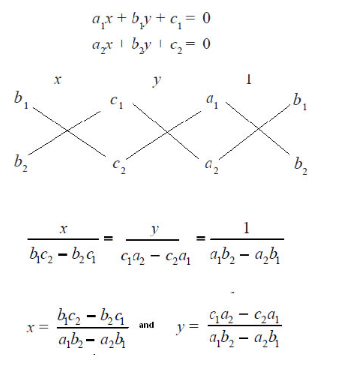
The above method is called Cross-Multiplication Methos as it uses cross-multiplication technique.

You can also represent the cross-multiplication as the following diagram.

Cross Multiplication Method Examples

Example 1.

Solve the linear equations x + y = 5, x – y = 3 by using the cross multiplication method?

Solution:

Given system of linear equations are

x + y = 5

x – y = 3

On transposition, we get

x + y – 5 = 0

x – y – 3 = 0

Writing the co-efficient in the following way, we get:

By cross-multiplication method:

x/[(1(-3) – (-1)(-5)] = y/[(-5)1 – 1(-3)] = 1//[1(-1) – 1(1)]

x/(-3 – 5) = y/(-5 + 3) = 1/(-1 – 1)

x/(-8) = y/(-2) = 1/(-2)

x/(-8) = 1/(-2), y/(-2) = 1/(-2)

x/8 = 1/2, y/2 = 1/2

x = 8/2, y = 2/2

x = 4, y = 1

Therefore, required solution is x = 4, y = 1.

Example 2.

Solve the simultaneous linear equations 3x – 4y = 0, 9x – 8y = 12 by the method of cross-multiplication?

Solution:

Given simultaneous equations are,

3x – 4y = 0

9x – 8y = 12

On transposition, we get

3x – 4y = 0 ——– (i)

9x – 8y – 12 = 0 ———- (ii)

Multiply equation (i) by -8 and equation (ii) by -4.

-8(3x – 4y) = 0 x -8

-24x + 32y = 0 —— (iii)

-4(9x – 8y – 12) = 0 x -4

-36x + 32y + 48 = 0 ——- (iv)

Subtract equation (iv) from equation (iii)

[-24x + 32y = 0] – [-36x + 32y + 48 = 0]

-24x + 32y – (-36x + 32y + 48) = 0

-24x + 32y + 36x – 32y – 48 = 0

12x – 48 = 0

12x = 48

x = 48/12

x = 4

Substitute x = 4 in equation (ii)

9(4) – 8y – 12 = 0

36 – 8y – 12 = 0

-8y + 24 = 0

-8y = -24

y = 24/8

y = 3

Therefore, required solution is x = 4, y = 3.

Example 3.

Solve the linear equations 2x + 3y = 5, x – 4y = 8 by using the cross multiplication method?

Solution:

Given linear equations are 2x + 3y = 5, x – 4y = 8

On transposing, we get

2x + 3y – 5 = 0 ——- (i)

x – 4y – 8 = 0 ——- (ii)

Multiply equation (ii) by 2, equation (i) by 1.

From equation (i), we get

2x + 3y – 5 = 0 —– (iii)

From equation (ii), we get

2(x – 4y – 8) = 0

2x – 8y – 16 = 0 —— (iv)

Subtract equation (iii) from equation (iv).

[2x – 8y – 16] – [2x + 3y – 5] = 0

2x – 8y – 16 – 2x – 3y + 5 = 0

-11y – 11 = 0

-11y = 11

y = -11/11

y = -1

Substitute y = -1 in equation (i)

2x + 3(-1) – 5 = 0

2x – 3 – 5 = 0

2x – 8 = 0

2x = 8

x = 8/2

x = 4

Therefore, the required solution is x = 4, y = -1.

Example 4.

Solve the system of linear equations 2x + 5y = 20, x + 2y = 4?

Solution:

Given simultaneous linear equations are 2x + 5y = 20, x + 2y = 4

On transposing, we get

2x + 5y – 20 = 0 —— (i)

x + 2y – 4 = 0 —— (ii)

Multiply equation (i) by 2.

2(2x + 5y – 20) = 2 x 0

4x + 10y – 40 = 0 ——- (iii)

Multiply equation (ii) by 5.

5(x + 2y – 4) = 0 x 5

5x + 10y – 20 = 0 —– (iv)

Subtract equation (iii) from equation (iv)

[5x + 10y – 20] – [4x + 10y – 40] = 0

5x + 10y – 20 – 4x – 10y + 40 = 0

x + 20 = 0

x = -20

Put x = -20 in equation (iii)

4(-20) + 10y – 40 = 0

-80 + 10y – 40 = 0

10y – 120 = 0

10y = 120

y = 120/10

y = 12

Therefore the required solution is x = -20, y = 12.

What is Elimination Method?| Elimination Method for Solving Simultaneous Linear Equations

The elimination method is one of the process to solve the linear equations having two variables. Here variables are removed to find the solution set. It is more comfortable and easy when compared with the substitution method. Get the simple steps to solve two simultaneous linear equations with two variables in the below sections.

How to Solve System of Equations by Elimination Method?

Elimination methods mean multiplying the variable coefficients with a constant and eliminate one particular variable. Get the detailed steps to solve the system of linear equations in the following sections.

  • Multiply the given two linear equations by some suitable non-zero integer to make the coefficients of either x or y numerically equal.
  • After that, either add or subtract one equation from the second equation such that one variable gets removed. Now, solve that to get an equation in one variable.
  • Here, if you get a statement including no variable, then the given linear equations have infinite solutions.
  • If you get a false statement including no variable, then the given linear equation has no solution.
  • Solve the equation in one variable to get its value.
  • Place the obtained value in any of the linear equations to find the value of another variable.

General Solution:

Let us take two linear equations

ax + by = c — (i)

dx + ey = f —– (ii)

Multiply equation (i) with d

d(ax + by) = d x c

adx + bdy = cd —– (iii)

Similarly, multiply equation (ii) with a

a(dx + ey) = f x a

adx + aey = af —– (iv)

Subtract equation (iii) from equation (iv) as per the elimination method rule

[adx + bdy = cd] – [adx + aey = af]

adx + bdy – adx – aey = cd – af

bdy – aey = cd – af

y(bd – ae) = cd – af

y = (cd – af) / (bd – ae)

Substitute y = (cd – af) / (bd – ae) in equation (i)

ax + b(cd – af) / (bd – ae) = c

ax = c – (bcd – abf) / (bd – ae)

x = [c – (bcd – abf) / (bd – ae)] / a

= [c(bd – ae) – (bcd – abf)] / a(bcd – abf)

= (bcd – ace – bcd + abf) / a(bcd – abf)

= (abf – ace) / a(bcd – abf)

= a(bf – ce) / a(bcd – abf)

= (bf – ce) / (bcd – abf)

Therefore, the solution set is x = (bf – ce) / (bcd – abf), y = (cd – af) / (bd – ae).

Workedout Examples on Elimination Method

Example 1.

Solve the simultaneous linear equations 2x + 2y = 7, 4x + 3y = 12 by the method of elimination?

Solution:

Given system of linear equations are

2x + 2y = 7 —— (i)

4x + 3y = 12 ——- (ii)

Multiply the equation (i) by 2.

(2x + 2y = 7) —– (x 2)

4x + 4y = 14 —— (iii)

Subtract (iii) from (ii), we get

[4x + 4y = 14] – [4x + 3y = 12]

(4x + 4y) – (4x + 3y) = 14 – 12

4x + 4y – 4x – 3y = 2

y = 2

Substituting the value of y = 2 in equation (ii), we get

4x + 3(2) = 12

4x + 6 = 12

4x = 12 – 6

4x = 6

x = 6/4

x = 3/2

Therefore, x = 3/2 and y = 2 is the solution of the system of equations 2x + 2y = 7, 4x + 3y = 12.

Example 2.

Solve the following linear equations by using elimination method?

y = 2x – 6, y = ½x + 6

Solution:

Given simultaneous linear equations are,

y = 2x – 6 —— (i)

y = ½x + 6 ——- (ii)

Subtract equation (i) from equation (ii) to eliminate the variable y.

[y = 2x – 6] – [y = ½x + 6]

y – y = (2x – 6) – (½x + 6)

0 = 2x – 6 – ½x – 6

3x/2 – 12 = 0

3x/2 = 12

3x = 24

x = 24/3

x = 8

Substitute x = 8 in equation (i) to get the value of y.

y = 2(8) – 6

y = 16 – 6

y = 10

Therefore, x = 8 and y = 10 is the solution of the system of equations y = 2x – 6, y = ½x + 6.

Example 3.

Solve the system of linear equations x + 7y = 10, 3x – 2y = 7 by the elimination method?

Solution:

Given linear equations are,

x + 7y = 10 —– (i)

3x – 2y = 7 ——- (ii)

Multiply the equation (i) by 3

(x + 7y = 10) —– (x 3)

3(x + 7y) = 10 x 3

3x + 21y = 30 ——- (iii)

Subtract equation (iii) from equation (ii) to find the value of one variable.

[3x + 21y = 30] – [3x – 2y = 7]

(3x + 21y) – (3x – 2y) = 30 – 7

3x + 21y – 3x + 2y = 23

23y = 23

y = 23/23

y = 1

Place y = 1 in the equation (i) to get the value of another variable.

x + 7(1) = 10

x + 7 = 10

x = 10 – 7

x = 3

Therefore, x = 3, y = 1 is the solution of the linear equations x + 7y = 10, 3x – 2y = 7.

Example 4.

Use elimination method to solve the below included simultaneous equations?

x + 3y = 10, 8x + y = 11

Solution:

Given system of linear equations are

x + 3y = 10 —— (i)

8x + y = 11 ——- (ii)

Multiply the equation (i) by 8

(x + 3y = 10) —— (x 8)

8(x + 3y) = 8 x 10

8x + 24y = 80 —– (iii)

Subtract equation (iii) from equation (ii) to get the value of one variable.

[8x + 24y = 80] – [8x + y = 11]

(8x + 24y) – (8x + y) = 80 – 11

8x + 24y – 8x – y = 69

23y = 69

y = 69/23

y = 3

Put y = 3 in equation (i) and solve to find the value of another variable.

x + 3(3) = 10

x + 9 = 10

x = 10 – 9

x = 1

Therefore, x = 1, y = 3 is the solution for the simultaneous linear equations x + 3y = 10, 8x + y = 11.

Comparison Method for Solving System of Equations | How to Solve Simultaneous Equations Using Comparison?

Students can solve the system of linear equations by using the comparison method. Here, you need to compare a pair of equations and find the value of the variables. You can find a detailed explanation of solving the simultaneous linear equations in the following sections. The comparison method is one of the easiest ways to solve a pair of equations. So, follow the below guidelines and solve the questions.

How to Solve Simultaneous Equations Using Comparison Method?

Simultaneous Equations are nothing but two or more equations having two or more quantities. There are many ways to solve the system of linear equations, but we are using the comparison method to get the answer easily. Check the steps and get the solution.

  • Let us take (i) and (ii) as the equations numbers.
  • Express both equations x in terms of y.
  • And consider obtained equations as (iii), (iv).
  • Equate the obtained equations i.e the values of x in the equation forming the equation in y.
  • Solve the linear equation in y and simplify it.
  • Substitute the obtained y value in any one equation and solve it.
  • Thus, you will get the solution using the comparison method.

Solved Examples on System of Linear Equations

Example 1.

Solve the pair of simultaneous equations 5x + 3y = 9, 2x – 3y = 12 using the comparison method with detailed explanation.

Solution:

Given the system of linear equations are

5x + 3y = 9 —— (i)

2x – 3y = 12 ——- (ii)

Express of x in terms of y.

From Equation (i) 5x + 3y = 9, we get

Subtract 3y from both sides

5x + 3y – 3y = 9 – 3y

5x = 9 – 3y

Divide both sides of the equation by 5.

5x/5 = (9 – 3y)/5

x = (9 – 3y)/5

Therefore, x = (9 – 3y)/5 —— (iii)

From equation (ii) 2x – 3y = 12, we get

Add 3y to both sides of the equation.

2x – 3y + 3y = 12 + 3y

2x = 12 + 3y

Divide both sides by 2.

2x/2 = (12 + 3y)/2

x = (12 + 3y)/2

Therefore, x = (12 + 3y)/2 —– (iv)

Equate the values of x in equation (iii) and equation (iv) forming the equation in y

From equations (iii) and (iv), we get

(9 – 3y)/5 = (12 + 3y)/2

Solve the above linear equation

Cross multiply the fractions.

2(9 – 3y) = 5(12 + 3y)

18 – 6y = 60 + 15y

18 – 60 = 15y + 6y

-42 = 21y

y = -42/21

y = -2

Substituting the value of y in equation (iii) or equation (iv), find the value of x

Put y = -2 in equation (iii), we get

x = (9 – 3(-2))/5

x = (9 + 6)/5

= 15/5

x = 3

Required solution of the two equations

Therefore, x = 3, y = -2.

Therefore, we have compared the values of x obtained from equation (i) and (ii) and formed an equation in y, so this method of solving simultaneous equations is known as the comparison method. Similarly, comparing the two values of y, we can form an equation in x.

Example 2.

Solve the system of linear equations 5x + y = 10, 7x – 3y + 8 = 0 using comparison method.

Solution:

Given pair of system of linear equations are

5x + y = 10 —- (i)

7x – 3y + 8 = 0 —– (ii)

Express x in terms of y

From equation (i) 5x + y = 10, we get

5x = 10 – y

x = (10 – y)/5

From equation (ii) 7x – 3y + 8 = 0, we get

7x – 3y = -8

7x = 3y – 8

x = (3y – 8)/7

Equate the values of x obtained from both equations.

(10 – y)/5 = (3y – 8)/7

Solve the equation in y.

7(10 – y) = 5(3y – 8)

70 – 7y = 15y – 40

70 + 40 = 15y + 7y

110 = 22y

y = 110/22

y = 5

Putting the value of y in equation (i)

Substitute y = 5 in equation (i), we get

5x + 5 = 10

5x = 10 – 5

5x = 5

x = 5/5

x = 1

Required solution of the two equations

Therefore, x = 1, y = 5.

Example 3.

Solve the linear equations 2x + y = 10 and x + y = 4 by comparison method.

Solution:

Given simultaneous linear equations are

2x + y = 10 —- (i)

x + y = 4 —- (ii)

express y in terms of x.

From equation (i), we can write

y = 10 – 2x

From equation (ii), we can write

y = 4 – x

Equate both the values of y obtained from equations (i) and (ii)

10 – 2x = 4 – x

10 – 4 = 2x – x

x = 6

Substitute x = 6 in the equation (ii)

6 + y = 4

y = 4 – 6

y = -2

Required solution of the two equations

Therefore, x = 6, y = -2.

Example 4.

Find the solution to the following simultaneous equations.

4x + 3y = 14 and 5x + 7y = 11.

Solution:

Given linear equations are

4x + 3y = 14 —– (i)

5x + 7y = 11 —— (ii)

Express x in terms of y for both equations.

From equation (i) 4x + 3y = 14, we can write

4x = 14 – 3y

x = (14 – 3y)/4

From equation (ii) 5x + 7y = 11, we can write

5x = 11 – 7y

x = (11 – 7y)/5

Equate the values of x obtained from equations (i), (ii)

(14 – 3y)/4 = (11 – 7y)/5

5(14 – 3y) = 4(11 – 7y)

70 – 15y = 44 – 28y

28y – 15y = 44 – 70

13y = -26

y = -26/13

y = -2

Substitute y = -2 in the equation (i) and simplify it to get the x value.

Put y = -2 in 4x + 3y = 14

4x + 3(-2) = 14

4x – 6 = 14

4x = 14 + 6

4x = 20

x = 20/4

x = 5

Therefore the required solutions are x = 5, y = -2.

Simultaneous Linear Equations Definition | How to Solve Simultaneous Equations?

The equation is a mathematical statement where two things are equal to one another. Every equation contains two expressions, one at the right-hand side of the equality called R.H.S and the second at the left-hand side of the equality called the L.H.S. Among the different types of equations we have are linear equations, quadratic equations, and polynomial equations.

Simultaneous Linear Equations Definition

The Simultaneous Linear Equations are the equations that have two or more quantities related using two or equations. These equations are also called the system of equations, which has a fine set of equations for which the common solution is sought. The general form of the simultaneous equations are as follows:

ax + by + c = 0

dx + ey + f = 0.

Here each linear equation represents a straight line in the graph. Both x, y are variables, a, b, c, d are real numbers either a, b or c, d anyone is non zero. Every linear equation in two variables has an infinite number of solutions. Here, we will learn about two linear equations in 2 variables.

Examples

  • 3x + 2y = 5
  • x – y + 1 = 0
  • y = 2
  • x/2 + y = 6
  • y – 8 = x

Methods to Solve Simultaneous Linear Equations

We have four important methods to solve simultaneous equations. They are comparison, substitution, elimination, and cross-multiplication. Out of all these methods, the simplest methods will effectively solve the equations and get the answers.

1. Comparison Method:

Express one variable like x in terms of another variable called y for both equations. Equate the values of x in the equation, solve the equation, and find the value of y. Substitute the y value in any of the given equation to get the x value. Thus, you can obtain the solutions for the linear equation by using the comparison method.

2. Substitution Method:

Get the value of one variable in terms of the other from any one of the equations. Substitute this value in another equation. Solve the equations to find variable values. Substitute the variable value to find another variable value.

3. Elimination Method:

First of all, observe the given linear equations and multiply the one equation by a suitable constant to make the variable coefficients equal and to be eliminated. Add or subtract the obtained new equations and cancel the terms having the same coefficient. Solve the equation, and substitute the obtained value to get the set of values of two variables.

4. Cross Multiplication Method:

Use the cross multiplication method to find the solution set for the given equations. You can refer to the Cross Multiplication page to know more details about this method.

Simultaneous Linear Equations Examples

Example 1.

Solve the system of equations 2x – 3y = 1, x + y + 1 = 0 by using the substitution method?

Solution:

Given linear equations are,

2x – 3y = 1 ——- (i)

x + y + 1 = 0 ——– (ii)

From (i) Express x in terms of y,

2x = 3y + 1

x = (3y + 1) / 2

Substitute x = (3y + 1) / 2 in (ii) equation

(3y + 1)/2 + y + 1 = 0

(3y + 1) + 2y + 2 = 0

5y + 3 = 0

5y = -3

y = -3/5

Put y = -3/5 in (i) equation

2x – 3(-3/5) = 1

2x + 9/5 = 1

(10x + 9)/5 = 1

10x + 9 = 5

10x = 5 – 9

10x = -4

x = -4/10

x = -2/5

Therefore, the required solution set for the given simultaneous equations is x = -2/5, y = -3/5.

Example 2.

Solve the equations 2x – y – 3 = 0, 3x + 2y – 8 = 0 by using the comparison method?

Solution:

Given simultaneous equations are,

2x – y – 3 = 0 —– (i)

3x + 2y – 8 = 0 —— (ii)

Express x in terms of y for both equations.

From equation (i) 2x – y – 3 = 0, we get

2x – y = 3

2x = 3 + y

x = (y + 3) / 2 —— (iii)

From equation (ii) 3x + 2y – 8 = 0, we get

3x + 2y = 8

3x = 8 – 2y

x = (8 – 2y) / 3 —– (iv)

Equate the values of x in equation (iii) and equation (iv) forming the equation in y

From equation (iii) and (iv), we get,

(y + 3) / 2 = (8 – 2y) / 3

Cross multiply the fractions.

3(y + 3) = 2(8 – 2y)

3y + 9 = 16 – 4y

3y + 4y = 16 – 9

7y = 7

y = 7/7

y = 1

Putting the value of y in equation (iii) or equation (iv), find the value of x

substitute y = 1 in equation (iii)

x = (1 + 3) / 2

x = 4/2

x = 2

The required solution for the equations is x = 2, y = 1.

Therefore, we have compared the values of x obtained from equation (i) and (ii) and formed an equation in y, so this method of solving simultaneous equations is known as the comparison method. Similarly, by comparing the two values of y, we can form an equation in x.

Example 3.

Solve the simultaneous equations 3x + 7y = 27, 5x + 2y = 16 by using the elimination method?

Solution:

Given equations are

3x + 7y = 27 —— (i)

5x + 2y = 16 ——- (ii)

Multiply the equation (i) by 5, we get

5(3x + 7y = 27)

5(3x + 7y) = 27 x 5

15x + 35y = 135 —– (iii)

Multiply the equation (ii) by 3, we get

3(5x + 2y = 16)

3(5x + 2y) = 16 x 3

15x + 6y = 48 —– (iv)

Subtracting (iii) from (iv), we get

15x + 35y = 135

15x + 6y = 48
–      –        –
_________________

0 + 29y = 87

y = 87/29

y = 3

Substitute y = 3 in equation (i)

3x + 7(3) = 27

3x + 21 = 27

3x = 27 – 21

3x = 6

x = 6/3

x = 2

Therefire, required solution set is x = 2, y = 3.

Example 4.

Solve the equations 7x + 3y + 15 = 0, 12y – 5x = 39 by using the cross multiplication method?

Solution:

Given two equations are

7x + 3y + 15 = 0

12y – 5x = 39

On transposition, we get

7x + 3y + 15 = 0

-5x + 12y – 39 = 0

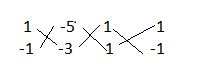
Writing the co-efficient in the following way, we get:

3        15        7          3
12      -39       -5         12

By cross-multiplication method:

x / [(3(-39) – (15)(12)] = y / [(15)(-5) – (-39)(7)] = 1/[(7)(12) – (3)(-5)]

x/[-117 – 180] = y/[-75 + 273] = 1/[84 + 15]

x/(-297) = y/(198) = 1/99

-x/297 = 1/99

-x = 297/99

x = -3

y/198 = 1/99

y = 198/99

y = 2

Therefore, required solution is x = -3, y = 2.

Practice Test on Word Problems on Linear Equations | Linear Equations Questions

This page contains various linear equations word problems. Students have to practice all these questions to score better marks in the exam. To solve these questions on linear equations, you need to understand the given details and make an equation using one variable. And finally, solve that equation. For better understanding, you can check our Linear Equations Practice Problems with Solutions.

Example 1.

Solve the following linear equations:

(a) x/4 – 1/2 = x/5 + 2/3

(b) x – (x + 1)/3 = 1 – (x – 1)/4

Solution:

(a) x/4 – 1/2 = x/5 + 2/3

(x – 2) / 4 = (3x + 10) / 15

Cross multiply the fractions.

15(x – 2) = 4(3x + 10)

15x – 30 = 12x + 40

Transferring 12x from R.H.S to L.H.S becomes -12x, -30 from L.H.S to R.H.S becomes + 30.

15x – 12x = 40 + 30

3x = 70

Divide both sides of the equation by 3.

3x/3 = 70/3

x = 70/3

Therefore, the required solution set is x = 70/3.

(b) x – (x + 1)/3 = 1 – (x – 1)/4

[3x – (x + 1)] / 3 = [4 – (x – 1)] / 4

Cross multiply the fractions.

4(3x – x – 1) = 3(4 – x + 1)

4(2x – 1) = 3(5 – x)

8x – 4 = 15 – 3x

Transferring -3x from R.H.S to L.H.S becomes 3x, -4 from L.H.S to R.H.S becomes +4.

8x + 3x = 15 + 4

11x = 19

x = 19/11

Therefore, the required solution set is x = 19/11.

Example 2.

Solve the following equations and verify them.

(a) 4(3y + 2) – 5(6y – 1) = 2(y – 8) – 6(7y – 4) + 4y

(b) 2/(3x + 1) + 4/(3x + 1) = 5/3x

Solution:

(a) 4(3y + 2) – 5(6y – 1) = 2(y – 8) – 6(7y – 4) + 4y

12y + 8 – 30y + 5 = 2y – 16 – 42y + 24 + 4y

13 – 18y = 8 – 36y

Transferring -36y from R.H.S to L.H.S becomes 36y, 13 from L.H.S to R.H.s becomes -13.

-18y + 36y = 8 – 13

18y = -5

Divide both sides of the equation by 18.

18y/18 = -5/18

y = -5/18

Verification:

L.H.S = 4(3y + 2) – 5(6y – 1)

Substitute y = -5/18

L.H.S = 4(3(-5/18) + 2) – 5(6(-5/18) – 1)

= -60/18 + 8 + 150/18 + 5

= 90/18 + 13

= 5 + 13

= 18

R.H.S = 2(y – 8) – 6(7y – 4) + 4y

Substitute y = -5/18

R.H.S = 2(-5/18 – 8) – 6(7(-5/18) – 4) + 4(-5/18)

= -10/18 – 16 + 210/18 + 24 -20/18

= 180/18 + 8

= 10 + 18

= 18

L.H.S = R.H.S

Hence, proved.

(b) 2/(3x + 1) + 4/(3x + 1) = 5/3x

6/(3x + 1) = 5/3x

Cross multiply the fractions.

6 x 3x = 5 x (3x + 1)

18x = 15x + 5

Transferring 15x from R.H.S to L.H.S becomes -15x.

18x – 15x = 5

3x = 5

Divide both sides of the equation by 3

3x/3 = 5/3

x = 5/3

Verification,

L.H.S = 2/(3x + 1) + 4/(3x + 1)

Put x = 5/3

L.H.S = 2/(3(5/3) + 1)) + 4/(3(5/3) + 1))

= 6/(15/3 + 1)

= 6/((15 + 3)/3)

= 6/(18/3)

= 6/6

= 1

R.H.S = 5/3x

Put x = 5/3

R.H.S = 5/(3 x 5/3)

= 5/(15/3)

= 5/5

= 1

L.H.S = R.H.S

Hence proved.

Example 3.

The sum of the digits of a 2 digit number is 8. The number obtained by interchanging the digits exceeds the original number by 18.

Solution:

Let the 2 digit number at ones place is x, then

Tens place of the number = 8 – x

Original number = 10(8 – x) + x

= 80 – 10x + x

= 80 – 9x

By interchanging the digits

New number = 10x + 1(8 – x)

= 10x + 8 – x

= 9x + 8

According to question,

New number – Original number = 18

9x + 8 – (80 – 9x) = 18

9x + 8 – 80 + 9x = 18

18x – 72 = 18

18x = 18 + 72

18x = 90

x = 90/18

x = 5

Hence, the digits at ones place is 5.

The digits at tens place = (8-5) = 3.

So, the original number is 35 and the new number is 53.

Example 4.

The mother’s age is three times her son’s age. Four years ago, she was 4 times her son’s age. Find their present ages.

Solution:

Let the present age of son be x, then

Present mother’s age = 3x

Four years ago,

Son age = (x – 4)

Mothers age = (3x – 4)

According to the question,

Mothers age = 4 x son’s age

3x – 4 = 4(x – 4)

3x – 4 = 4x – 16

-4 + 16 = 4x – 3x

x = 12

Hence, the son’s present age is 12 years, mothers present age is 12 x 3 = 36 years.

Example 5.

If a rectangle has a width of 8 inches and has a perimeter of 36 inches, then what is the length?

Solution:

Given that,

Rectangle width w = 8 inches

Rectangle perimeter P = 36 inches

Perimeter of a rectangle = 2(length + width)

36 = 2(length + 8)

36 = 2length + 16

36 – 16 = 2length

20 = 2length

length = 20/2

length = 10

Hence, the rectangle length is 10 inches.

Example 6.

A bicycle and a bicycle helmet cost 240 dollars. How much did each cost, if the bicycle cost 5 times as much as the helmet?

Solution:

Let the cost of the bicycle helmet be x, then

Cost of the bicycle = 5x

According to the question,

x + 5x = 240

6x = 240

x = 240/6

x = 40

Hence, the cost of a bicycle helmet is 40 dollars, the cost of the bicycle is 40 x 5 = 200 dollars.

Example 7.

The total cost for tuition plus room and board at State University is 2,584 dollars. Tuition costs 704 dollars more than room and board. What is the tuition fee?

Solution:

Let the room and board cost be x, then

Tuition cost = 704 + x

According to the question,

704 + x + x = 2584

704 + 2x = 2584

2x = 2584 – 704

2x = 1880

x = 1880/2

x = 940

Hence, the tuition fee is 940 + 704 = 1664.

Example 8.

A sum of $2700 is to be given in the form of 63 prizes. If the prize is of either $100 or $25, find the number of prizes of each type.

Solution:

Let x be the number of $100 and y be the number of $25.

x + y = 63

100x + 25y = 2700

Multiply both sides of the equation x + y = 63 by 25.

25(x + y) = 63 x 25

25x + 25y = 1575

Subtract 100x + 25y = 2700 from 25x + 25y = 1575

100x + 25y – (25x + 25y) = 2700 – 1575

100x + 25y – 25x – 25y = 1125

75x = 1125

x = 1125/75

x = 15

Substitute x = 15 in x + y = 63

15 + y = 63

y = 63 – 15

y = 48.

Hence 15 number of $100, 43 number of $25 prizes.

Example 9.

Of 240 stamps that harry and his sister collected, Harry collected 3 times as many as his sisters. How many did each collect?

Solution:

Let x be the number of stamps collected by harry’s sister, then

Number of stamps collected by harry = 3x

According to the question,

x + 3x = 240

4x = 240

x = 240/4

x = 60

Hence, the number of stamps collected by harry is 3 x 60 = 180 and his sister is 60.

Example 10.

A lab technician cuts a 12 inch piece off tubing into two pieces in such a way that one piece is 2 times longer than the other.

Solution:

Let, the smaller piece length is, longer piece length is y.

y = 2x

According to the question,

x + y = 12

x + 2x = 12

3x = 12

x = 12/3

x = 4

y = 2 x 4 = 8

Hence, the length of shorter piece is 4 inches, longer piece is 8 inches.