Worked-out Problems on Volume of a Cuboid | How to Find Cuboid Volume?

Students who want to learn the volume of cuboids and cubes can use the Worked-out Problems on Volume of a Cuboid here. Get to see various examples on the cuboid volume in the coming sections. Try to solve the questions and improve your preparation standards. Check out the Cube and Cuboid Word Problems with solutions in the below sections.

Question 1.

Find the volume of a cuboid of length 18 cm, breadth 25 cm, and height 5 cm?

Solution:

Given that,

Length of cuboid = 18 cm

Breadth of cuboid = 25 cm

Height of cuboid = 5 cm

Cuboid volume = length x breadth x height

Volume = 18 x 25 x 5

= 2250

Therefore, the volume of a cuboid is 2250 cm³.

Question 2.

If the area of the base and height of the cuboid is 212 cm², 8 cm, calculate cuboid volume?

Solution:

Given that,

The base of the base = 212 cm²

Height of a cuboid = 8 cm

Cuboid volume = (Area of the base) x height

Volume = 212 x 8 = 1696 cm³.

Question 3.

Find the volume of the cube whose each side is 16 cm?

Solution:

Given that,

Side length of cube a = 16 cm

The volume of the cube V = a³

V = 16³ = 16 x 16 x 16

V = 4096 cm³

Therefore, the cube volume is 4096 cm³.

Question 4.

If the cuboid volume is 512 cm³, its length and height is 8 cm, 7 cm. Find the cuboid breadth?

Solution:

Given that,

Cuboid Volume = 512 cm³

Cuboid length = 8 cm

Cuboid height = 7 cm

Cuboid breadth = Volume / (length) x (height)

= 512 / (8 x 7)

= 512 / 56 = 9.142 cm

Therefore, the breadth of cuboid is 9.142 cm.

Question 5.

The length, breadth, and depth of a lake are 15 m, 20 m, 9 m respectively. Find the capacity of the lake in liters?

Solution:

Given that,

Length of lake = 15 m

Breadth of lake = 20 m

Depth of lake = 9 m

Capacity of lake = (length) x (breadth) x (depth)

= 15 x 20 x 9 = 2700 m³

1000 liter = 1 m³

Capacity of lake in Litres = 2700 x 1000

= 2700000 litres

Therefore, the capacity of lake is 2700000 litres.

Question 6.

The dimensions of the brick are 25 cm x 8 cm x 10 cm. How many such bricks are required to build a wall of 16 m in length, 20 cm breadth, and 8 m in height?

Solution:

Given that,

Length of brick = 25 cm

Breadth of brick = 8 cm

Height of brick = 10 cm

Length of wall = 16 m

Breadth of wall = 20 m

Height of wall = 8 m

Volume of 1 brick = length x breadth x height

= 25 x 8 x 10 = 2000 cm³

Volume of wall = length x breadth x height

= 16 x 20 x 8

= 2560 = 2560 x 100²

Number of bricks required = (2560 x 100²) / 2000

= 1280 x 10 = 12800

So, the required number of bricks are 12800.

Question 7.

External dimensions of a wooden cuboid are 20 cm × 15 cm × 12 cm. If the thickness of the wood is 2 cm all around, find the volume of the wood contained in the cuboid formed.

Solution:

Given that,

External length of cuboid = 20 cm

External breadth of cuboid = 15 cm

External height of the cuboid = 12 cm

External volume of the cuboid = (length x breadth x height)

= (20 x 15 x 12) = 3600 cm³

Internal length of cuboid = 20 – 4 = 16 cm

Internal breadth of cuboid = 15 – 4 = 11 cm

Internal height of the cuboid = 12 – 4 = 8 cm

Internal volume of a cuboid = (length x breadth x height)

= (16 x 11 x 8) = 1408 cm³

Therefore, volume of wood = External volume of the cuboid – Internal volume of a cuboid

= 3600 – 1408 = 2192 cm³

∴ Volume of the wood contained in the cuboid is 2192 cm³.

Question 8.

The volume of a container is 1440 m³. The length and breadth of the container are 15 m and 8 m respectively. Find its height?

Solution:

Given that,

Length of the container = 15 m

The breadth of the container = 8 m

The volume of the container = 1440 m³

(length x breadth x height) = 1440

15 x 8 x height = 1440

120 x height = 1440

height = 1440/120

height = 12

∴ The height of the container is 12 m.

Volume of Cubes and Cuboids | Formulas, Questions on Volume of Cube, Cuboid

Cube and Cuboids are three-dimensional shapes that have six faces, eight vertices, and twelve edges. The volume of a three-dimensional figure is the number of cubes required to fill the object. It is defined as the side times side. Get the definition, formulas, standard units, and example problems in the following sections.

What is Meant by Volume?

The volume of any three-dimensional solid shape is the measurement of the space occupied by the object. For a hollow 3-dimensional figure, the volume of the object is the difference in space occupied by the body and the amount of space inside a body. The interior capacity of a solid is also called the volume of a substance.

The measuring units of volume are cubic units. Those can be cm³, m³. The volume can also be measured in liters, milliliters, millimeters.

Standard Units of Volume

The volume is always measured in cubic units. The standard unit is cm³, m³, mm³, but various other units of length measurement are m, dm, dam, etc.

Cuboid

The cuboid is a polyhedron made up of six rectangular faces, eight vertices, and twelve edges. The faces of the cuboid are parallel. But all the faces are not equal in dimensions.

The properties of a cuboid are

  • Every cuboid has six rectangles, each rectangle is called the face.
  • It has top faces, bottom faces. Other than the top, bottom faces are called the adjacent faces.
  • It has 12 edges and opposite sides of the rectangle are equal.
  • The point of intersection of 3 edges of a cuboid is called the vertex.
  • And it has 8 vertices.

Volume of Cuboid

The volume of the cuboid is the product of the area of one surface and height. Let us take l, b, h as the length, breadth, and height of the cuboid.

Area of the rectangular base = (l x b)

The volume of the cuboid = (Area of the base) x height

= (l x b) x h

Volume = lbh

Then,

Length of the Cuboid = (volume) / (breadth x height)

Breadth of the Cuboid = (Volume) / (length x height)

Height of the cuboid = (Volume) / (length x breadth)

Cube

Cube is a special type of cuboid where length, breadth and height are equal.

The properties of Cube are as follows:

  • It has six faces and twelve edges of equal length.
  • The shape of all faces of the cube is in square shape.
  • The angles of the cube in the plane are at a right angle.
  • Each face of the cube meets four other faces.
  • Opposite edges are parallel to each other.
  • The vertex of the cube meets three faces and edges.

Volume of Cube

The volume of a cube is nothing but the number of cubic units occupied by the cube completely.

Volume of cube = a x a x a = a³

Example Questions on Volume of Cubes and Cuboids

Example 1.

If the length, breadth, and height of the cuboid are 10 cm, 14 cm, 9 cm, then find its volume?

Solution:

Given that,

Length of the cuboid l = 10 cm

Breadth of the cuboid b = 14 cm

Height of the cuboid h = 9 cm

The volume of cuboid = lbh

Volume = 10 x 14 x 9 = 1260 cm³.

Example 2.

Find the volume of the cube, having a side length of 6 cm?

Solution:

Given that,

Side length of cube a = 6 cm

The volume of cube = a³

Volume = 6³ = 6 x 6 x 6 = 216 cm³.

Example 3.

Calculate volume, the perimeter of the cube whose side length is 14 cm?

Solution:

Given that,

Side length of cube a = 14 cm

The volume of the cube formula is

Volume = a³

Volume V = 14³

= 14 x 14 x 14 = 2744 cm³

The perimeter of the cube formula is

Perimeter = 12a

= 12 x 14 = 168 cm

Therefore, the perimeter and volume of the cube is 168 cm, 2744 cm³

FAQS on Volume of Cubes and Cuboids

1. What are the formulas of cube and cuboid volume?

The volume of the cuboid is defined as the product of length, height, and breath.

Cuboid volume V = length x breadth x height.

Cube volume = side³

2. What is the difference between cuboid and cube?

The sides of the cube are in equal length but the cuboid sides are different. The faces of the cube are in a square shape, the faces of the cuboid are in a rectangle shape. All diagonals of the cube are equal but the cuboid has equal diagonals for parallel sides.

3. What is the perimeter of the cube and cuboid?

Perimeter of cuboid = 4(length + breadth + height)

Perimeter of cube = 12 x length.

Basic Introduction to Division of Integers | How do you Divide Integers?

Are you worried about Division on Integers? Check here to know the complete details about the Integers Division. Like integer multiplication, the division of integers is also an important topic to solve high standard questions. Follow various properties, rules, and tricks to solve division problems. Know the several terminologies involved in this concept. Scroll to the below sections to identify important points about the division on integers.

Division of Integers – Introduction

The division is the inverse operation of multiplication. Multiplication is totalling of numbers whereas division is the distribution of numbers. Though it is the inverse operation, the rules for multiplication and division are similar. The division is used in daily life for various purposes like household, funding, trading, living expenses, etc. Division also has various properties that are used in daily life. Before going to solve division problems, you must know the definitions of various terms.

Definitions

Dividend – The number that is to be divided is called a dividend.

Divisor – The number which divides the other number is called the divisor.

Quotient – The result of the division is called the quotient.

Integers Division Rules

There are various rules to be followed while applying division for integers.

  1. The quotient of 2 positive integer numbers will always be a positive integer.
  2. The quotient of 2 negative integer numbers will always be a negative integer.
  3. 1 positive and 1 negative integer number gives negative integer as a quotient.
  4. If a positive number is divided by a positive number, then the result will be a positive number.
  5. If a negative number is divided by a negative number, then the result will be a positive number.
  6. When a positive number is divided by a negative number, the result will be a negative number.
  7. When a negative number is divided by a positive number, the result will be a negative number.

Properties of Division of Integers

There are 5 properties which multiplication and addition but the division of integers do not follow. They are:

  1. Closure Property of Division
  2. Commutative Property of Division
  3. Associative Property of Division
  4. Identity Property of Division
  5. Distributive Property of Division

Property 1: Closure Property of Division

The division of integer does not follow the actual closure property. The quotient of two integers may or may not be an integer.

If x,y, and z are integers

x/y does not belong to z ( x ÷ y ∉ Z)

Property 2: Commutative Property of Division

The division of integer does not allow commutative property also. If the numbers are swapped, the result varies.

x/y is not equal to y/x (x ÷ y ≠ y ÷ x)

Property 3: Associative Property of Division

This division does not allow associative property also.

(x÷y)÷z ≠ x÷(y÷z)

Property 4: Identity Property of Division

x÷1 = x ≠ 1÷x

Property 5: Distributive Property of Division

Division of Integers does not allow distribution property.

As mentioned above, the division of integers does not allow any of the properties whereas multiplication and addition can be possible with all the above properties.

Important Rules for Division of Integers

Rule 1:

The quotient of two positive or negative integers is a positive integer which is equal to the quotient of the corresponding absolute integer values.

  1. The quotient of 2 positive numbers is positive and here we divide the dividend numerical value by the divisor numerical value.

Example:

(+ 9) ÷ (+ 3) = + 3
2.  The quotient of 2 negative integers is positive and here, we divide the dividend numerical value by the divisor numerical value and assign a positive (+) sign to the quotient present.

Example:

(-9)÷(- 3) = +3

Therefore, for dividing 2 integers with the same signs, we divide their values and give plus (+) sign to the quotient.

Rule 2:

A positive and a negative integer gives quotient as a negative integer and its value is equal to the quotient of the corresponding values of the integers.

Example:

(+16)÷(-4) = -4

Therefore, for dividing integers with different signs, we divide their values and give the minus(-) sign to the quotient.

Important Properties of Division of Integers

Property 1:

If an integer ‘a’ is divided by another integer ‘b’, then the integer ‘a’ is divided into ‘b’ number of equal parts.

If ‘b’ divides ‘a’ without any intimation, then ‘a’ is evenly divisible by ‘b’.

Property 2:

When an integer ‘a’ is divided by another integer ‘b’, the division algorithm is, the sum of the product of quotient and divisor & the remainder is equal to the dividend.

i.e.,

Dividend = Quotient*Divisor+Remainder

Property 3:

When an integer number is divided 1, the result that is the quotient is the number itself.

Property 4:

When an integer number is divided by itself, the result or quotient is 1.

Property 5:

When any positive or negative integer is divided by zero, the result is undefined. Therefore, division by zero is meaningless.

Property 6:

When zero is divided by a positive or negative integer, the result or quotient is zero.

Property 7:

When an integer number is divided by another integer number which is a multiple of 10 like 10, 100, 1000,10000, etc., the decimal point for the number should be moved to the left.

Solved Problems on Division of Integers

Question 1.

Allen’s score was changed to -120 points in a video game because he missed some targets. He got -15 points for each missed target. How many targets did he miss?

Solution:

As given in the question, Allen’s score was changed to -120 and he got -15 points for each missed target.

To find how many targets he missed = -120/-15 =8

He missed 8 targets and got -15 points for each missed target.

Question 2.

Lousia’s savings change by -$9 each time she goes bowling. In all, it changed by -$99 during the summer. How many times did she go bowling in the summer?

Solution: 

As given in the question, Lousia changed -$99 during the summer and she changes her savings by -$9

To find how many times she went bowling = -$99/9 = 11

The solution is 11 times.

Question 3.

Elisa withdraw $20 at a time from her bank account and withdrew a total of $140. How many times did she withdraw the money?

Solution:

As per the question, Elisa withdrew a total amount of $140 (it will be negative) and she withdrew $20 at a time(it will be negative).

Therefore, to find the number of times she withdraws the money = -140/-20 = 7

The solution is 7 times.

We hope that the provided information about the Division of Integers is sufficient for your preparation. We also provide you with the solved examples and procedures in the next articles. Therefore, stay tuned to our site to get the latest updates on various information. Bookmark our page to get instant information.

Properties of Multiplication of Integers

Multiplication of Integers Properties, Rules, and Formulae are here. Follow various tips and shortcuts of Integers Multiplication. Explore the various properties of Integers when multiplying. Know the importance and application of each property rule. Go through the below sections to know more about how multiplication affects integer values. Also, find the example questions and procedures to find solutions.

Properties of Multiplication of Integers

The multiplication of integers refers to the product of 2 or 3 integer values. The set of numbers which consists of whole numbers, natural numbers, the additive inverse, and zero are known as integers. Therefore, integers consist of positive or negative and they have sign or magnitude associated with them. Integers are represented with the letter “Z”. In the below sections, you can get the complete information regarding the properties of the multiplication of integers. Moreover, you can also find the solved examples, rules, definitions, formulae, etc.

Before knowing the properties, get perfection in all the fields of Integers. In the previous articles, you can find the important concepts of Integer values and also various operations. Various arithmetic operations can be performed on Integers like addition, subtraction, multiplication, division, etc. Each operation possesses several properties and here we are going to discuss various properties of multiplication.

Integers Multiplication Properties

There are 6 properties of integers multiplication. Each property will be discussed in detail in the further sections. The important properties are

  1. Closure Property of Multiplication
  2. Commutative Property of Multiplication
  3. Associative Property of Multiplication
  4. Distributive Property of Multiplication
  5. Multiplication by zero
  6. Multiplicative Identity

To carry out multiplication, you need to always multiply the exact integer values and there are a few rules to keep in mind to determine the sign of the final result.

1. Closure Property of Multiplication

According to the closure property, if two positive or negative integers are multiplied, then the result is also an integer.

Suppose two integers are x and y, then the product xy is also an integer.

Example:

7*5 = 35

5*(-2)=-10

(-2)*(-5)= 10

In the above example, we can change the operands of 7 and 5, in either way we get the same result. We can multiply 7 with 5 or we can multiply 5 with 7, we get the same result.

2. Commutative Property of Multiplication

According to the commutative property, altering the integers or operands order does not affect the result of the multiplication.

x*y=y*x, for every integer x and y

Example:

7*(-3)=-(7*3)= -21

(-5)*(-6)=(-6)*(-5)=30

In the above example, we can change the operands or sign. We can multiply 7 with -3 or we can multiply 7 and 3 and add a negative sign to it.

3. Associative Property of Multiplication

According to the associative property, the grouping of integers can be changed and it does not affect the final result.

Suppose x, y and z are integers

x*(y*z)=(x*y)*z

Example:

4*(2*5)=(4*2)*5=40

2*(5*3)=(2*5)*3=30

As shown in the above example, we can multiply 2 and 5, then multiply the product with 4 to get the final result or we can multiply 4 and 2, then multiply the product with 5 to get the final answer.

4. Distributive Property of Multiplication

According to the distributive property of multiplication, it explains the ability to distribute an operation over other mathematical operations within the bracket. This property can be of distributive property of multiplication over addition or distributive property of multiplication over subtraction.

Suppose x,y and z are integers

x*(y+z)=(x*y)=(x*z)

Example:

2*(3+5)=(2*3)+(2*5)=16

4*(4+4)=(4*4)+(4*4)=32

In the above example, we can first add 3 and 5 and then divide it by 2 or we can multiply 2 and 3, then multiply 2 and 5, then add both the products to get the final answer.

5. Multiplication by zero

According to multiplication by zero, any integer multiplied by 0 results in zero

Suppose x is an integer

x*0=0

Example:

2*0=0

5*0=0

In the above example, the integer value 2 is multiplied by 0 and the result is 0.

6. Multiplicative Identity

According to the multiplicative identity, any integer multiplied by 1 results in the same integer value.

Suppose x is an integer

x*1=x

Example:

4*1=4

6*1=6

In the above example, the integer 4 is multiplied by 1 and the result is 4.

Key Points to Remember about Integers Multiplication Properties

  1. Closure Property of integer multiplication refers to that the product of two or three integer values will be an integer.
  2. The commutative property of multiplication refers to that altering two or three integer numbers will not change the value of the final answer
  3. The associative property of multiplication refers that the way the grouping of integer values together does not affect the final answer.
  4. The distributive property of multiplication refers to the distribution procedure of one operation value over other mathematical integer values within the braces.
  5. Multiplication by zero refers that the product of any negative or positive integer by zero
  6. Multiplicative Integer refers to the final answer as 1 when any integer is multiplied with 1.

Solved Examples on Properties of Multiplication of Integers

Question 1.

Adam is Scuba diving. He descends 5 feet. He descends the same distance 4 more times. How many feet is Adam’s new distance from the sea level?

Solution:

As given in the question,

Adam descends 5 feet, descends means traveling down. Therefore, it is negative

Also given, he descends 4 more times. Initially, he descended once and again 4 times. Therefore, it is 5 times.

Hence, (-5)*5=-25

The solution is Adam’s new distance is 25 feet from the sea level.

Question 2.

Clark made four of his trucks payments late and was fined four late fees. The total change to his savings account was -$28. What integer represents one late fee?

Solution:

As given in the question, Clark made four truck payments late which means he did 4 payments. It is positive

Also given, his savings account balance is -$28.

Amount of each payment = -28/4 = -$7

Therefore, each payment for one late fee is $7.

The solution is $7.

Question 3.

Jan lost 22 points on her exam. She got 11 questions wrong. What integer represents the point value of each wrong answer?

Solution:

As given in the question, Jan lost 22 points. Therefore it is negative.

To find the points lost for each wrong answer = 22/11 = 2

Therefore, she lost 2 points for each wrong answer.

Question 4.

During the field trip to the zoo, the class was divided into 8 groups of 3. How many students are there in the class?

Solution:

As given in the question,

The class was divided into 8 groups of 3

Therefore, the total number of students in the class are 8*3=24

The solution is 24.

Question 5.

You are making a snack for 4 friends. Each need 4 crackers. How many crackers do you need?

Solution:

As given in the question,

There are 4 friends and each needs 4 crackers to prepare a snack.

Therefore, the total number of crackers you need are 4*4=16

The solution is 16 crackers.

In the above article, we have provided all the information regarding Properties of Multiplication of Integers, its rules, solved examples, procedure, etc. Before solving the questions, know about the various properties and get perfect in them. Hope you liked the article and this will help you in your preparation. If you need any further clarifications, contact us through the comment section or directly message us. Bookmark our page for all the latest updates.

Multiplication of Integers Definition, Properties | How to Multiply Integers?

Wanna solve challenging Integer Multiplication Problems? Here is the best guide for you. In the below sections, we have mentioned the important rules and examples on Multiplication of Integers. Get a clear idea of types and rules present in Integer Multiplication and know the easy methods to solve problems. Learn about Multiplication of Integers Definitions, Step by Step Procedure to Multiply Integers, Properties, in the coming modules.

What is Multiplication of Integers?

Integers multiplication is defined as the repeated addition of integers. The rules for multiplication and division are almost similar. Integer multiplication includes 3 cases:

  • Multiplication between two positive integers
  • The multiplication between two negative integers
  • Multiplication between one positive integer and negative integers

Key Points about Multiplication of Integers

Have a glance at the important points to be taken into consideration while multiplying integers.

  • A positive integer multiplied by a negative integer is negative.
  • A negative integer multiplied by a negative integer is positive.
  • Multiplication is commutative whereas division is not.
  • When simplifying, calculate the operations of multiplication in order from left to right.

Procedure for Multiplication of Integers

Go through the simple and easy guidelines listed below on How to Multiply Integers. They are as such

  1. First of all, read the problem and make sure all the ideas and words are understood.
  2. Identify the problem to be solved.
  3. Note down the phrase which gives the information for the problem.
  4. Translate the given information to an expression.
  5. Simplify the given expression.
  6. Apply the formulae to the problem and solve it.

Rules for Multiplication of Integers

While Performing the Integer Multiplication keep the below mentioned instructions or rules in mind so that you can solve the problems easily. They are along the lines

  • Product of 2 positive integer numbers is an integer number
  • Product of 2 negative integer numbers is an integer number
  • The addition of 2 positive integer numbers is an integer number
  • The addition of 2 negative integer numbers is an integer number
  • Sum of an integer number and its inverse equals zero
  • Product of an integer number and its reciprocal equals 1

Solved Examples on Product of Integers

Question 1.

Simplify -5*5?

Solution: 

From the given question,

The first number is negative and the second number is positive, so the result must be negative.

5*5 = 25

As the result must be negative.

Therefore, Multiplying -5*5 we get the result as-25.

Question 2.

Simplify -20*-50?

Solution:

From the given question, -20*-50

Hence, both the numbers are negative, the multiplication of two negative numbers will be positive, so the result will be positive.

Therefore, -20*-50 = 1000

Therefore, Multiplying -20*-50 we get the result as 1000.

Question 3.

Simplify 7*0?

Solution:

Any integer multiplied by zero results in zero.

7*0=0

Thus, 7*0 becomes 0.

Question 4.

Simplify the following

a. 4.(5.2)

b. (4.5).2

Solution:

The value of the expression is 40. Changing the group of integers or numbers won’t change the result.

Therefore 4.(5.2) = (4.5).2 = 40.

Question 5.

Simplify 3(-2)(-5)(-1)?

Solution:

From the given question,

3(-2)(-5)(-1)

Multiply 2 numbers as follows:

3(-2)*(-5)(-1)

(-6)(-5)(-1)

30(-1)

-30

As multiplication is commutative, the order of multiplication does not affect the final result. We must work left to right to obtain the correct result.

Therefore, 3(-2)(-5)(-1) is -30.

Properties of Multiplication of Integers

Multiplication of Integers has various properties and each property has a specific rule. All of them are given below.

  1. Closure Property for Multiplication
  2. Commutative Property for Multiplication
  3. Distributive Property for Multiplication
  4. Associativity Property for Multiplication
  5. Multiplication by zero
  6. Multiplicative Identity

Points to Remember Regarding Integer Multiplication Properties

  1. Closure Property of multiplication states that the product of two integer values will be an integer.
  2. Commutative property of multiplication states that swapping of two integer numbers will not change the value of the final result.
  3. Associative property of multiplication states that the way of the grouping of integer values together does not affect the final result.
  4. Distributive property of multiplication states the distribution ability of one operation value over other mathematical values within the bracket.
  5. Multiplication by zero states that the product of any positive or negative integer by zero is zero.
  6. Multiplicative Integer states that when we multiply any integer with one, the final result will be integer itself.

Example Questions on Integer Multiplication

Question 1.

The tank contains a capacity of 30,000 litres and 1,000 litres are taken every day from it. Find the amount of water in the tank 3 days ago?

Solution:

As per the given question, the water in the tank changes by -1000 every day. Therefore, we need to subtract 3 times to calculate the water amount before 3 days, so the change is

-3*-1000=+3000

The complete calculation is :

30,000+(-3*-1000) = 30,000+3,000 = 33,000

Therefore, before 3 days the amount of water in the tank was 33,000 litres.

The solution is 33,000 litres.

Question 2.

Flora made 6 deposits of $7 each from the bank account. What is the overall change in the account?

Solution:

As given in the question, 6 deposits of $7 are made from each bank account.

Therefore 6(7) = 42

The solution is $42.

Question 3.

The temperature dropped by 2 degrees F every hour for 6 hours. What was the total number of degrees the temperature changed in the 6 hours?

Solution:

As given in the question, the temperature is dropped by 2 degrees for 6 hours.

i.e., -2*6 = -12

Therefore, the solution is -12.

Question 4.

The price of one share of Acme company declined $5 per day or 4 days in a row. How much did the price of one share change in total after the 4 days?

Solution:

As given in the question, $5 is declined. Therefore it is negative

Time will always be positive.

Therefore, -5*4 = -20

The solution is $-20.

Question 5.

A mountain climber climbed up a cliff 50 feet at a time. He did this 5 times in one day. What is the overall change in his elevation?

Solution:

As given in the question, The climber climbed up 50 feet. Therefore, it is positive.

He did it 5 times a day.

Hence, 50*5 = 250

The solution is 250 feet.

Question 6.

The price of the jeans was reduced $6 per week for 7 weeks. By how much the price of jeans changed over the 7 weeks?

Solution:

As given in the question, the price is reduced. Therefore, it is negative.

It was reduced for 7 weeks.

Hence, (-6)*7 = -42

The solution is -42$.

Hope the above-given article clears all your doubts regarding Multiplication of Integers. Refer all the mentioned problems to know the various models. Bookmark our site to get all the notifications regarding various competitive exam topics and concepts. In case of any doubts, you can contact us through the below comment section.

Introduction to Integers – Definition, Numbers, Rules, Symbols & Examples

Are you one of those candidates looking eagerly to learn about the concept of Integers? If yes, you must check this page to know the complete details about Integers. Integers is a basic and important concept that lays a stronger foundation for your maths. Know definition, rules, numbers, solved questions, symbols, etc.  Go through the below sections to find various methods and formulae.

Integers – Definition

The integer word is derived from the Latin word “Integer” which represents the whole. Integers are the positive, negative numbers, or zero. Integer values cannot be in decimals, fractions, percents, and we can perform various operations(arithmetic operations) like subtraction, addition, multiplication, division, etc. Examples of integers are 1,2,3,-4,-5, etc.  Integers also include various sets like

Integers also include various sets like zero, whole numbers, natural numbers, additive inverses, etc. These are the subset of real numbers.
Example of integer set: -5,-3, -1, 0, 2, 5

Representation of Integers

As integers contain various numbers and sets and are the subset of real numbers, they are represented with the letter “Z”.

Example:
Z= {5,-3, -1, 0, 2, 5}

Types of numbers in Integers

  • Natural Numbers
  • Whole Numbers
  • Real Numbers
  • Rational Numbers
  • Irrational Numbers
  • Odd Numbers
  • Even Numbers

Integers Rules

  • The Sum of 2 positive integer numbers is an integer number
  • The Sum of 2 negative integer numbers is an integer number
  • Product of 2 positive integer numbers is an integer number
  • Product of 2 negative integer numbers is an integer number
  • Sum of an integer number and its inverse equals zero
  • Product of an integer number and its reciprocal equals 1

Addition of Integer Numbers

While adding 2 positive or negative integers(with the same sign), add the absolute values and note down the sum of those numbers with the sign provided with numbers.

Example:

(+6)+(+5) = +11
(-5)+(-5)= -10

While adding 2 integers with a different sign, subtract the absolute values and note down the difference of those numbers with the sign provided with numbers.

Example:

(-5)+(+2)= -3
(+6)+(-3)= -3

Subtraction of Integer Numbers

While subtracting we follow the rules of addition but change the 2nd number which is being subtracted.

Example:

(-4)+(-3)= (-4)-(+3) = -11
(+5)-(+4)=(+5)+(-4)= +1

Division and Multiplication of Integer Numbers

The rule is simple while dividing and multiplying 2 integer numbers.

  • If both the integers have the same sign, the result is positive.
  • If both the integers have a different sign, the result is negative.

Example:

(+3)*(-4) = -12
(+4)*(+3) = 12
(+16)/(+4) = +4
(-6)/(+2) = -3

Integer Properties

There are 7 properties of integers. The major properties are

1. Associative Property
2. Distributive Property
3. Closure Property
4. Commutative Property
5. Identity Property
6. Multiplicative Inverse Property
7. Additive Inverse Property

1. Associative Property

This property refers to grouping and rules can be applied for addition and multiplication.

Associative Property of Addition

Associative property enables the special feature of grouping the numbers in your own way and still, you get the same answer.

(a+b)+c = a+(b+c)

Example:

(-4+2)+3= -2+(3+4)

In the above example, if we consider the first equation you can solve it in either way i.e., First you take the difference of 4 and 2 and then add 3 to it or you can first add 2 and 3 and then subtract 4 from it. In both ways, you get a constant answer.

Associative Property of Multiplication

This property also refers to the same as the addition property. In whatever way you group numbers, you still get the same answer.

(ab)c= a(bc)

Example:

-2(4)*3=-2(4*3)

In the above example, you can solve it 2 ways and still find the same answer. First, you can multiply 2,4 and then multiply that with 3 or you can first multiply 4,3 and then multiply it with 4.

2. Distributive Property

The distributive property is used when the expression involving addition is then multiplied by a number. This property tells us that we can multiply first and then add or add first and multiply then. In both ways, the multiplication is distributed for all the terms in parentheses.

a(b+c) = ab+ac

Example:

-4(2+3)= (-4*2)+(-4*3)

In the above example, we can first add 2 and 3, then multiply it with 4 or we can multiply 4 with 2 and 3 separately and then add it, still you get the same answer.

3. Closure Property

Closure property for addition or subtraction states that the sum or difference of any 2 integers will be an integer value.

a + b = integer
a x b = integer

Example:

6-3= 3
6+(-3)= 3

The closure property for multiplication also states that the product of any two integer numbers is an integer number.

Example:

5*5=25
(-5)*(-5)=25

The closure property for division does not hold true that the division of two integers is an integer value.

Example:

(-3)/(-12)=1/4, which is not an integer

4. Commutative Property

The commutative property for addition states that when two integer numbers undergo swapping, the result remains unchanged.

a+b=b+a
a*b=b*a

Example:

28+5+43=5+43+28=76

The commutative property for multiplication also states the same that if two integers are swapped, the result remains unchanged.

Example:

5*4*2=2*4*5=40

The commutative property doesn’t hold true for subtraction.

5. Identity Property

Identity Property states that any number that is added with zero will give the same number. Zero is called additive identity.

a+0=a
a*1=a

Example:

5+0=5

The identity property for multiplication also states the same that the integer number multiplied by 1 will give the same number. 1 is called the additive identity.

Example:

5*1=5

6. Multiplicative Inverse Property

Consider “a” as an integer, then as per the multiplicative inverse property of integers,

a*(1/a)=1

Here, 1/a is the multiplicative inverse of integer a.

7. Additive Inverse Property

Consider “a” as an integer, then as per the additive inverse property of integers,

a+(-a)= 0

Here, “-a” is the additive inverse of the integer a

Applications of Integers in Real Life

Integers have many real-life applications. We use them in different situations to quantify things. For example, to check the temperature, positive numbers are used to indicate the temperature above zero and negative numbers are used to indicate the temperature below zero. Integers are also mainly used in real-life situations like hockey, football tournaments, rating for a movie, bank credits and debits, etc.

We have mentioned all the important information about Integers. Hope, the above-provided details will help you in your preparation. Stay tuned to our site to get instant updates on various mathematical concepts.

Parallel and Transversal Lines | Properties of Parallel Lines cut by Transversal

Learn how a pair of angles formed between Parallel and Transversal Lines. When two parallel lines intersect by a Transversal Line, they form different angles. Those angles are given with different names based on their location. Therefore, check what are the angles formed and how to find them, and what names are given to them depending on their location. You can also get all concepts and examples available on Lines and Angles for free on our website.

When the transversal intersects two parallel lines

  • Pairs of alternate angles are equal
  • Pairs of corresponding angles are equal.
  • Interior angles on the same side of the transversal are supplementary.

Parallel Lines Cut by a Transversal Problems

1. In adjoining figure l ∥ m is cut by the transversal t. If ∠5 = 70, find the measure of ∠7, ∠9, ∠10.

Parallel Lines 1

Solution:
Given that ∠5 = 70° ∠5 = ∠7 (Vertically opposite angles)
Therefore, ∠7 = 70°
Now, ∠5 = ∠9 (Corresponding angles)
Therefore, ∠9 = 70°
Also, ∠7 + ∠10 = 180° (Co-interior angles)
70° + ∠10 = 180°

Therefore, ∠10 = 180° – 70° = 110°

2. In the given figure PQ ∥ RS, ∠QAO = 125°, ∠RBO = 40°. Find the measure of ∠AOB.

Solution:

Parallel lines 2

Draw a line AB parallel to PQ and RS passing through O such that PQ ∥ MN and RS ∥ MN
∠QAO + ∠NOA = 180° (Co-interior angles)
Therefore, 125° + ∠NOA = 180°
Therefore, ∠NOA = 180° – 125° = 55°
Also, ∠RBO = ∠NOB (Alternate angles)
Given ∠RBO = 40°
Therefore, ∠NOB = 40°
Then ∠AOB = ∠AON + ∠BON
= 55° + 40° = 95°

3. In the given figure NM ∥ PO ∥ SR and NS ⊥ NM. Also, ∠MNS = 90°. Find the values of ∠a, ∠b and ∠c.

Solution:

Parallel lines 3

b + 45° = 180°
Therefore, ∠b = 180° – 45° (Co-interior angles) = 135°
∠b =∠a (Corresponding angles)
Therefore, ∠a = 135°
Also, 90° + ∠c + 45° = 180°
Therefore, 135° + ∠c = 180°
Therefore, ∠c = 180° – 135° = 45°

The final answer is ∠a = 135°, ∠b = 135°, ∠c = 45°

4. In the given figure, MN ∥ QP, QP ∥ RS, QR ∥ OP. Also, ∠6 = 60°, ∠8 = 55°, then find ∠7, ∠9, ∠10.

Solution:

Parallel lines 4

Since, QR ∥ OP cut by transversal QP
Therefore, ∠8 = ∠10 we know, ∠8 = 55°
Therefore, ∠10 = 55°
Also, QP ∥ XY cut by transversal OP
Therefore, ∠10 = ∠x we know ∠10 = 55°
Therefore,∠x = 55°
Also, ∠x + ∠1 + ∠y = 180°
55° + 60° + ∠y = 180°
115° + ∠y = 180°
∠y = 180° – 115°
Therefore, ∠y = 65°
Now, ∠y + ∠2 = 1800 (Co-interior angles)

Parallel lines 5

65° + ∠7 = 180°
∠7 = 180° – 65°
∠7 = 115°
Since, QP ∥ RS cut by transversal QR
Therefore, ∠8 + ∠9 = 180°
55° + ∠9 = 180°
Therefore, ∠9 = 180° – 55° = 125°

The final answer is ∠7 = 115°, ∠9 = 125°, ∠10 = 55°.

5. In the given figure AB ∥ EF. Also, m : n = 4 : 5 find.

Parallel lines 6

Solution:
Let the common ratio be x
Then m = 4x and n = 5x
Also, ∠n = ∠o (Alternate interior angles)
Since, n = 5x
Therefore, ∠o = 5x [CD ∥ EF cut by transversal t]
Now, ∠o = ∠l (Corresponding angles)
Since, ∠o = 5x
Therefore, ∠l = 5x [AB ∥ CD cut by transversal t]
∠l + ∠m = 180° (Co-interior angles)
5x + 4x = 1800
9x = 180°
x = 180/9
x = 20
Since, m = 4x
Therefore, m = 4 × 20
m = 80°
n = 5x
Therefore, n = 5 × 20
n = 100°
l = 5x
Therefore, l = 5 × 20
l = 100°

Therefore, ∠l = 100°, ∠m = 80°, ∠n = 100°

Transversal Lines – Definition, Properties, & Examples

A Transversal Line is a line that crosses at least two lines (Parallel Lines) and intersects with them. Find Problems on Transversal Lines with Solutions for a better understanding of the concept. Check concept and examples of Lines and Angles on our website for free.

Transversal line

From the above figure, A and B are parallel lines and line C is intersecting both lines at points D and E. The line C is called as Transversal Line.

Transversal line 1

From the above figure, The line M intersecting Lines N and O at a point c. But the Lines N and O are not parallel lines. Therefore, Line M is not a Transversal Line.

Angles made by the Transversal with Two Lines

Transversal angles

From the above figure, Line C intersecting Line A and B (parallel lines). The angles formed around the Transversal line are called Transversal angles. From the given figure, ∠1, ∠2, ∠3, ∠4, ∠5, ∠6, ∠7, ∠8 are the angles with special names.

Interior Angles

The angles that present in the area enclosed between two parallel lines and that are intersected by a transversal are also called interior angles. From figure, ∠3, ∠4, ∠5, ∠6 are interior angles.

Exterior Angles

The angles that present outside two parallel lines and that are intersected by a transversal are called Exterior angles. From the figure, ∠1, ∠2, ∠7, ∠8 are Exterior angles.

Corresponding Pair of Angles

The corresponding pair of angles present on the same side of the transversal. In the Pair of corresponding angles, if one is an interior angle, the other will be an exterior angle. Also, they do not form a linear pair. From the figure, (∠2, ∠6); (∠1, ∠5); (∠3, ∠7); (∠4, ∠8) are the Corresponding pair of angles.

Pair of Alternate Angles

Pair of alternate angles present on the opposite sided of the transversal. Both Pair of Alternate Angles either interior angles or both are exterior angles. They will not form a linear pair. From the figure, (∠4, ∠6) and (∠3, ∠5) are interior alternate angles. Also, (∠1, ∠7) and (∠2, ∠8) are exterior alternate angles.

Pair of Co-interior or Conjoined or Allied Angles

Pair of co-interior or Conjoined or Allied Angles are pairs of interior angles that present on the same side on the transversal. From the figure, (∠3, ∠6); (∠4, ∠5) are co-interior angles.

Two Parallel Lines are cut by the Transversal

Transversal angles

When two parallel lines A and B are intersected by a Transversal line C, then

  • the pairs of alternate angles are equal ∠4 = ∠6, ∠ 1 = ∠7, ∠3 =∠5, ∠2 = ∠8.
  • the pairs of corresponding angles are equal ∠2 = ∠6, ∠1 = ∠5, ∠3 = ∠7, ∠4 = ∠8.
  • Interior angles on the same side of transversal are supplementary ∠4 + ∠ 5 = 180°, ∠6 = 180°.

Converse

When two parallel lines are intersected by a Transversal line

  • pairs of alternate angles are equal
  • pairs of corresponding angles are equal
  • interior angles on the same side of the transversal are supplementary.

Properties of Parallel Lines -Definition, Theorem & Examples

Parallel Lines are two lines in a plane, they do not intersect and parallel to each other. The distance between the parallel lines is always the same. The symbol to denote parallel lines is ||. Learn and practice all Lines and Angles concepts and problems on our website.

parallel lines

From the above figure, Line A and Line B are parallel lines. We can write it as A || B and we can read it as A is parallel to B.

Properties Of Angles Associated with Parallel Lines

Properties of Parallel lines

From the above figure, A and B are two parallel lines and C is passing through two parallel lines by intersecting them at a point. C is a transversal line. If a line intersects two or more lines at distinct points then it is known as a transversal line. When two lines meet at a point in a plane, they are known as intersecting lines.

  • The pair of corresponding angles is equal (∠4 = ∠8); (∠3 = ∠7); (∠2 = ∠6); (∠1 = ∠5).
  • The pair of exterior alternate angles is equal (∠2 = ∠8); (∠1 = ∠7).
  • The pair of interior alternate angles is equal (∠3 = ∠5); (∠4 = ∠6).
  • Interior angles present on the same side of the transversal are supplementary, i.e., ∠4 + ∠5 = 180° and ∠3 + ∠6 = 180°.

Example:

Properties of Parallel lines 1

Look at the above figure and check out the parallel lines, transversal line, and etc.,
From the above figure, AB and CD are parallel lines and MN is a transversal line that cuts the parallel lines AB and CD.
(i) Interior and exterior alternate angles are equal.
i.e. ∠4 = ∠5 and ∠3 = ∠6 [Interior alternate angles]
∠2 = ∠7 and ∠1 = ∠8 [Exterior alternate angles]
(ii) Corresponding angles are equal.
i.e. ∠2 = ∠6; ∠1 = ∠5; ∠3 = ∠7 and ∠4 = ∠8
(iii) Co-interior or allied angles are supplementary.
i.e. ∠4 + ∠6 = 180° and ∠3 + ∠5 = 180°

Conditions of Parallelism

Two straight lines are cut by a transversal, and if

  • the two pairs of corresponding angles are equal and also the lines are parallel to each other.
  • if the pair of interior angles on the same side of the transversal are supplementary, then the two straight lines are parallel.
  • the pair of alternate angles are equal, then the straight lines are parallel to each other.

Parallel Rays

Parallel Rays are two rays that do not intersect each other and have the same distance every time. A ray consists of one endpoint. If AB and CD are two rays and parallel rays, then it is represented as ray AB ∥ ray CD.

Parallel Segments

If two line segments are parallel then those two line segments are called Parallel Segments. The line segment is a line that consists of two endpoints. If AB and CD are two line segments and parallel, then it is represented as line segment AB ∥ line segment CD.

Vertically Opposite Angles – Definition, Theorem, Proof, Examples

Learn what are Vertically Opposite Angles and how to calculate them in this article. Vertically Opposite Angles are the angles formed when two lines intersect each other. The vertically opposite angles are always equal to each other. The adjacent angles of vertically opposite angles are always supplementary angles and they form 180º when we add them. Find Lines and Angles concepts and problems on our website.

If one angle is 35º, then the other angle is 180º – 35º.

vertically opposite angles

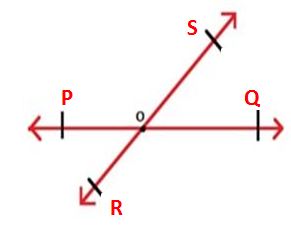
From the above figure, the line segment PQ and RS meet at the point O and these two lines are intersecting lines.

In a pair of intersecting lines, the angles which are opposite to each other form a pair of vertically opposite angles. From the figure, ∠SOQ and ∠POR form a pair of vertically opposite angles.

∠SOQ = ∠POR
∠SOP = ∠ROQ

Note: A vertical angle and its adjacent angle is supplementary to each other. It means they add up to 180 degrees.

Vertical Angles Theorem and Proof

Theorem: In a pair of intersecting lines the vertically opposite angles are equal.

Proof: Consider two lines PQ and RS which intersect each other at O. The two pairs of vertical angles are:
i) ∠SOQ = ∠POR
ii) ∠SOP = ∠ROQ

vertically opposite angles

It can be seen that ray OS stands on the line PQ and according to Linear Pair Axiom, if a ray stands on a line, then the adjacent angles form a linear pair of angles.
Therefore, ∠SOQ + ∠SOP = 180° —(1) (Linear pair of angles)
Similarly, Ray OP stands on the line SR.
Therefore, ∠SOP + ∠POR = 180° —(2) (Linear pair of angles)
From (1) and (2),
∠SOQ + ∠SOP = ∠SOP + ∠POR
⇒ ∠SOQ = ∠POR —(3)
Also, OQ stands on the line SR.
Therefore, ∠SOQ + ∠QOR = 180° —(4) (Linear pair of angles)
From (1) and (4),
∠SOQ + ∠SOP = ∠SOQ + ∠QOR
⇒ ∠SOP = ∠QOR —(5)
Thus, the pair of opposite angles are equal.

Hence, proved.

Vertically Opposite Angles Examples

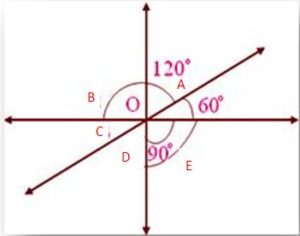
1. In the given figure, find the measure of unknown angles.

Vertically Opposite angles 1

Solution:
From the given figure
(i) ∠C = 60° vertically opposite angles
(ii) ∠B = 90° vertically opposite angles
(iii) ∠B + ∠A + 60° = 180° (straight angle)
90° + ∠ A + 60° = 180°
150° + ∠ A = 180°
Therefore, ∠A = 180° – 150° = 30°
(iv) ∠A = ∠D vertically opposite angles

Therefore, ∠D = 30°

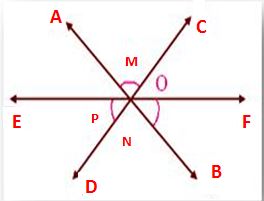
2. In the given figure, lines AB, CD, EF intersects at O. If M : N : P = 1 : 2 : 3, then find the values of M, N, P.

Vertically Opposite Angles 2

Solution:
We know that the sum of all the angles at a point is 360°.
∠AOC = ∠DOB = M° (Pair of vertically opposite angles are equal.)
∠FOB = ∠AOE = N° (Pair of vertically opposite angles are equal.)
∠EOD = ∠COF = P° (Pair of vertically opposite angles are equal.)
Therefore, ∠AOE + ∠AOC + ∠COF + ∠FOB + ∠BOD + ∠DOE = 360°
N + M + P + N + M + P = 360°
⟹ 2M + 2N + 2P = 360°
⟹ 2(M + N + P) = 360°
⟹ M + N + P = 3̶6̶0̶°/2̶
⟹ M + N + P = 180° ——— (i)
Let the common ratio be a.
Therefore, M = a, N = 2a, P = 3a
Therefore, from the equation (i) we get;
a + 2a + 3a = 180°
⟹ 6a = 180°
⟹ a = 1̶8̶0̶°/6̶
⟹ a = 30°
Therefore, M = a, means M = 30°
N = 2a, means N = 2 × 30 = 60°
P = 3a, means P = 3 × 30 = 90°

Therefore, the measures of the angles are 30°, 60°, 90°.