Lines and Angles – Definition, Types, Properties, Solved Problems

Lines and Angles concepts are explained by experts in order to help students to get excellent marks in their examination. The line is a combination of infinite points that has both directions infinitely. There are different lines available such as intersecting lines, perpendicular lines, transversal lines, etc. An angle is nothing but a combination of two rays with a common endpoint.

Based on the operations performed on a line, then the lines are classified as Parallel Lines, Perpendicular Lines, Transversal, etc. In the same way, the angles are classified as Complementary Angles, Supplementary Angles, Adjacent Angles, Vertically Opposite Angles based on their operation.

Quick Links of Lines and Angles

Working on Lines and Angles problems will help students to get an idea about how to solve the problems. All the concept links are given below. Just check out the concepts and open the topic that is difficult for you. After that solve all the problems available on that topic to get a grip on that entire topic.

Line Segment

The line segment is a line that has two endpoints with a fixed length.

line segment

Ray

A ray is a line that has only one endpoint and extends infinitely in another direction. From the below figure, point A is the and point.

ray

Perpendicular Lines

Two lines are said to be Perpendicular Lines when they meet at a single point and forms a right angle. From the below figure, PQ and RS are two lines and they intersect at a point x. Also, the two lines PQ and RS form a right angle 90º.

Perpendicular-lines

Parallel Lines

Two lines are said to be Parallel Lines when they do not intersect each other and they have the same distance throughout the plane. From the below figure, A and B are two parallel lines.

parallel lines

Transversal Line

A transversal Line is a line that intersects two lines at distinct points. From the below figure, C is the Transversal Line, that intersects the lines A and B at two points D and E.

Transversal line

Properties of Lines

  • The points those are not lie on the same line are called non-collinear points.
  • The points that lie on the same line are called Collinear points

Acute Angle

The angle that is less than the right angle is called Acute Angle.

Obtuse Angle

The angle that is more than the right angle is called Acute Angle.

Right Angle

The angle with 90 degrees is called as Right Angle.

Straight Angle

The angle that is equal to 180 degrees is called Straight Angle.

Complementary Angles

If the sum of the two angles is 90 degrees, then they are called Complementary Angles.

Supplementary Angles

If the sum of the angles is 180 degrees, then those angles are called Supplementary Angles.

Properties of Angles

  • An angle is formed at a point where two rays intersecting.
  • If the angle is more than 180 degrees and less than 360 degrees, then it is called a reflex angle.
  • If the two angles are adjacent angles and add up to 180 degrees then they form linear pair.

Quick Access to Lines and Angles

We have given solutions for all questions with step by step explanation in understandable language. Therefore, students can get great knowledge on the entire concepts of Lines and Angles. All the questions and answers that are present in the updated syllabus are included on our website with individual concept explanation. So, students who want to learn a single topic can go through the required link available below and learn it from the concerned link.

Are you searching for Lines and Angles Material? You have free access to Lines and Angles Material on our website. You can read and practice all problems either online or offline. So, immediately bookmark our website and practice all the math problems at your comfortable times. Do hard work and get complete knowledge on the Lines and Angles concept. Clear your doubts by contacting us through the comment section.


Triangle on Same Base and between Same Parallels Theorem – Solved Examples

When two triangles lie on the same base and between the same parallels, then those triangles measure equal area. Check the proof for Triangles on the same base and between the same parallel are equal in Area. Get the relationship between the areas of triangles having the same base in the following sections. For the reference of students, we have also included the solved examples on Triangle on the Same Base and between Same Parallels.

Proof for Area of Triangles are Equal Having the Same Base

Get a detailed explanation for how the areas of triangles are equal when their bases are the same and between the same parallels.

In the following figure, ∆ABD and ∆DEF having equal base length and between the same parallels BF and AD.

In this case, Area of △ ABC = Area of △ DEF

To prove that Triangle on the Same Base and between Same Parallels have the same area, follow these instructions.

Let us take △ ABC and △ ABD on the same base AB and between the same parallels AB and CD.

Draw a parallelogram ABPQ with AB base and lying between the same parallels AB and Q.

The relationship between the area of the triangle and parallelogram says that when they lie on the same base and between the same parallels, then the triangle is half of the parallelogram area.

So, Area of ∆ ABC = 1/2 x Area of parallelogram ABPQ

In the same way, Area of ∆ ABD = 1/2 x Area of parallelogram ABPQ

Therefore, Area of ∆ ABC = Area of ∆ ABD.

Hence proved.

Questions on Triangles on the Same Base and between Same Parallels

Example 1.

AD is the median of ∆ABC and ∆ADC. E is any point on AD. Show that area of ∆ABE = area of ∆ACE.

Solution:

Here, AD is the median for △ ABC.

So, BD = CD

In the above figure, △ ABD and △ ADC are having equal bases BD and CD and they are between the same parallels BC and U.

So, Area of △ ADC = Area of △ ABD —– (i)

Since E lies on AD

Therefore, Ed is the median for △ BCE

Now, BDE and CDE are having the equal base length BD = CD and between the same paralleks BC and m, then

Area of △ CDE = Area of △ BDE —— (ii)

Subtracting equation (i) and equation (ii), we get

Area of △ ADC – Area of △ CDE = Area of ∆ABD – Area of ∆BED

Area of △ ABE = Area of △ ACE

Hence, shown.

Example 2.

Prove that the medians of the triangle divide it into two triangles having equal area?

Solution:

AD is the median of the ∆ BCA and AE is the altitude of ∆ BCA and also ∆ ADC.

And AE is perpendicular to BC

Here, AD is the median of ∆ ABC

Therefore, BD = CD

On multiplying both sides of the equation by AE, we get

BD x AE = CD x AE

Again multiply both sides by 1/2

1/2 x BD x AE = 1/2 x CD x AE

Area of ∆ABD = Area of ∆ADC

Hence shown.

Triangle and Parallelogram on Same Base and between Same Parallels | Example Questions

If a triangle and parallelogram having the same base and between the same parallels, then the area of the triangle is equal to half the area of the parallelogram. Get the example problems and solutions on Triangle and Parallelogram on the Same Base and between Same Parallels. Also, find the relationship between them in the following sections explained step by step.

Proof for Area of Triangle Equal to Half of the Parallelogram having the Same Base

In the following figure, parallelogram ABCD and ∆ABD are on the same base AB and between the same parallels AF and DC. Get the area of the triangle ABD and area of the parallelogram ABCD and check their areas.

Area of the parallelogram ABCD = base x height

= AB x CF

Here, CF and DE area parallel lines CF = DE.

Area of the parallelogram = AB x DE = AB x CF.

Area of △ ABD = 1/2 x base x height

= 1/2 x AB x DE

= 1/2 x Area of the parallelogram ABCD

Therefore, Area of the parallelogram ABCD = 1/2 x Area of △ ABD

Hence proved.

Here are various case studies for the area of the parallelogram is half of the area of the triangle when they lie on the same base.

1. When a triangle and a parallelogram lies on the same base and have the same altitude, then the area of the triangle is equal to half of the parallelogram.
2. If they lie between the same parallels and have the same altitude, then the area of the triangle is equal to half of the area of the parallelogram.
3. When the triangle and rectangle have the same base and between the same parallels, then the area of the triangle is half of the area of the rectangle.

Example Questions for Triangle and Parallelogram on Same Base and between Same Parallels

Example 1:

∆ ABD and parallelogram ABCD are on the same base AB. If the base and altitude of the parallelogram are 10 cm and 6 cm, find the area of the triangle.

Solution:

Given that,

Base of the parallelogram = 10 cm

Altitude of the parallelogram = 6 cm

Area of the parallelogram = base x altitude

= 10 x 6 = 60 cm²

We know that when a triangle and parallelogram having the same base and between the same parallels then the area of the triangle is equal to half of the area of the parallelogram.

So, area of △ ABD = 1/2x Area of the parallelogram ABCD

= 1/2 x 60 = 30 cm²

Therefore, triangle area is 30 cm².

Example 2:

∆ ABD and parallelogram ABCD are on the same base AB. If the base and height of the triangle is 16 cm and 12 cm, find the area of the parallelogram.

Solution:

Given that,

The base length of the triangle = 16 cm

Height of the triangle = 12 cm

Area of ∆ ABD = 1/2 x base x height

= 1/2 x 16 x 12

= 1/2 x 192 = 96 cm²

We know that when a triangle and parallelogram having the same base and between the same parallels then the area of the parallelogram is equal to double the area of the parallelogram.

Area of the parallelogram ABCD = 2 x Area of ∆ ABD

= 2 x 96 = 192 cm²

Therefore, parallelogram area is 192 cm².

Example 3:

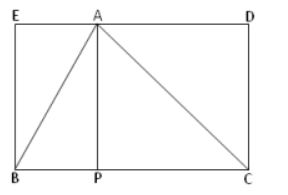
In the adjacent figure, BCDE is a rectangle and ABC is a triangle show that area of the triangle ABC is equal to half of the area of the rectangle BCDE.

Solution:

Given that,

Triangle ABC and rectangle BCDE lies on the same base BC and between the same parallels BC and ED>

Area of triangle ABC = 1/2 x base x height

= 1/2 x BC x AP

AP and Cd are parallel lines and having the same length. So, AP = CD.

△ ABC area = 1/2 x BC x AP = 1/2 x BC x CD

Area of the rectangle = length x breadth

= BC x CD

= 1/2 x Area of △ ABC.

Therefore, the Area of the rectangle BCDE = 1/2 x Area of △ ABC

Hence, shown.

Parallelograms and Rectangles on Same Base and between Same Parallels – Theorem, Examples

When one parallelogram and a rectangle lies on the same base and between the same parallels then they measure equal area. Here we are providing the example questions, answers for Parallelograms, and Rectangles on Same Base and between the Same Parallels. We are also offering proof that shows parallelogram and rectangle on same between same parallels have the same area.

Proof for Rectangles and Parallelograms on the Same Base have Equal Area

Below-mentioned is the steps for the parallelogram and rectangles having the same base and between the same parallels having equal area.

In the following figure, ABCD is a parallelogram and ABEF is the rectangle that lies on the same base AB and the same parallels AB and DF.

Area of parallelogram ABCD = base x altitude

AF is the altitude of the parallelogram.

So, Parallelogram area = AB x AF.

Area of the rectangle ABEF = base x height

= AB x AF

Therefore, the area of the parallelogram ABCD = Area of the rectangle ABEF.

Solved Examples for Parallelograms and Rectangles on Same Base and between Same Parallels

Example 1:

Parallelogram ABCD and rectangle ABFE have the same AB and the length and breadth of the rectangle are 15 cm and 9 cm. Find the area of the parallelogram.

Solution:

Given that,

Length of the rectangle l = 15 cm

The breadth of the rectangle b = 9 cm

Parallelogram ABCD and rectangle ABFE have the same AB.

So, area of the parallelogram = Area of the rectangle.

Area of the rectangle = length x breadth

= 15 x 9 = 135 cm²

Therefore, area of the parallelogram is 135 cm².

Example 2:

In the adjacent figure, ABCD is a parallelogram and EFCD is a rectangle. Also, AL ⊥ DC. Prove that

(a) Area (ABCD) = Area (EFCD)

(b) Area (ABCD) = DC × AL

Solution:

(a)

Rectangle is CDEF.

Parallelogram is ABCD.

In the given figure, AL and DE are parallel and have the same length. So, DE = AL.

Area of ABCD = CD x AL

= CD x DE square units.

Area of EFCD = CD x DE

So, Area of EFCD = Area of ABCD

Hence proved.

(b)

As ABCD is a parallelogram.

Area of ABCD = base x altitude

The base is CD and the altitude is AL.

Therefore, Area of ABCD = CD x AL

Hence proved.

Example 3:

Parallelogram ABCD and rectangle ABFE have the same AB and the base and height of the parallelogram are 28 cm and 16 cm. Find the area of the rectangle.

Solution:

Given that,

Base of the parallelogram = 28 cm

Height of the parallelogram = 16 cm

Area of the parallelogram = base x height

= 28 x 16 = 448 cm²

We know, that when Parallelograms and Rectangles on Same Base and between Same Parallels, then the area of the parallelogram = area of the rectangle.

So, the area of the rectangle = 448 cm².

Parallelograms on the Same Base and between Same Parallels Theorem, Example Questions

Students can check how parallelograms having the same base and between the same parallels are equal in area and proof for that. When two or more parallelogram lies on the same base and between same parallels then they have the same area. Also, find the solved example questions here explaining the concept and learn the concept behind them.

Proof for Theorem: Parallelogram on the Same Base & Between Same Parallels are Equal in Area

Let us draw a parallelogram ABCD on a cardboard sheet or thick sheet of paper.

Now, draw a line segment DE as shown in the figure.

Now, cut the triangle ADE congruent to triangle ADE in a seperate sheet with the help of a tracing paper and place the triangle ADE in such a way that AD coincides BC. The entire process is as shown below.

Note that there are two parallelograms ABCD and EE’CD on the same base CD and between the same parallel AE’ and CD.

∆ADE ≅ ∆ A’ D’ E’

Therefore, Area of ADE = Area of A’D’E’

Also, Area of ABCD = Area of ADE + Area of EBCE

= Area of A’D’E’ + Area of EBCD

= Area of EE’CD

So, the two parallelograms are in an equal area.

Parallelograms on Same Base and Between Same Parallels Examples

Example 1:

A farmer was having a field in the form of a parallelogram ABCD. She took any point P on AB and joined it to points C and D. In how many parts the fields are divided? What are the shapes of these parts? The farmer wants to sow wheat and pulses in equal portions of the field separately. How should she do it?

Solution:

If DP and CP are joined parallelogram ABCD is divided into three triangles.

They are △ APD, △ CDP, △ BCP

△ CDP and parallelogram ABCD are on the same base i.e CD and between parallel sides CD ∥ AC

∴ Area of △ CDP = 1/2 x area of parallelogram ABCD —- (i)

∴ Area of △ APD + Area of △ BCP = 1/2 x area of parallelogram ABCD —- (ii)

From equation (i) and equation (ii)

Area of △ CDP = Area of △ APD + Area of △ BCP

∴ The farmer can use the part of the field to sow wheat, i.e. Area of △ APD + Area of △ BCP, and in the same area he can use the Area of △ CDP to sow pulses.

Example 2:

Parallelograms ABCD and ABEF are situated on the opposite sides of AB in such a way that D, A, F are not collinear. Prove that DCEF is a parallelogram, and parallelogram ABCD + parallelogram ABEF = parallelogram DCEF.

Solution:

AB and DC are two opposite sides of parallelogram ABCD,

Therefore, AB ∥ DC and AB = DC

Again, AB and EF are two opposite sides of parallelogram ABEF

Therefore, AB ∥ EF and AB ∥ EF

Therefore, DC ∥ EF and DC = EF

Therefore, DCEF is a parallelogram.

Therefore, ∆ADF and ∆BCE, we get

AD = BC (opposite sides of parallelogram ABCD)

AF = BE (opposite sides of parallelogram ABEF)

And DF = CE (opposite sides of parallelogram CDEF)

Therefore, ∆ADF ≅ ∆BCE (side – side – side)

Therefore, ∆ADF = ∆BCE

Therefore, polygon AFECD – ∆BCE = polygon AFCED – ∆ADF

Parallelogram ABCD + Parallelogram ABEF = Parallelogram DCEF

Figures on the Same Base and between Same Parallels | How to Identify Figures on the Same Base and between Same Parallels?

Two geometric shapes are said to be on the same base and between the same parallels, if they have a common side called the base and vertices opposite to the common base on the line parallel to the base. In the below sections, you can learn about the How to Identify figure on the same base and between the same parallels. We know the measure of the plane region enclosed by a closed figure called the area.

The area is measured in cm², m², and other square units. We also know how to calculate the area of different figures using various formulas. Here you will use the formulas to study the relationship between the area of figures when they lie on the same base and between the same parallels.

Some Geometric Figures on the Same Base and between Same Parallels

Below-mentioned is the geometric figures for which you can change the same base and between the same parallels.

The common base for triangles ABC, BCD is BC. And both triangles lie on the same base.

Parallelograms ABCD and triangle CDE lie on the same base CD.

Parallelograms ABCD and EFCD are on the same base DC.

Trapezium ABCD and parallelogram EFCD have a common side DC. We say that trapezium ABCD and parallelogram EFCD are on the same base DC.

Example Questions on Figures that Lie on the Same Base and Between Same Parallels

Example 1.

ABC is right-angled at B with BC = 10 cm and AC = 15 cm. also ∆ABC and ∆BCD are on the same base BC. Find the area of ∆BCD.

Solution:

In right angled ∆ ABC, AC = 15 cm and BC = 10 cm. using Pythagoras theorem, we get

AC² = AB² + BC²

15² = x² + 10²

x² = 15² – 10²

x² = 225 – 100

x² = 125

x = √125

x = 11.18 cm

Now, since ∆ ABC and ∆BCD are on the same base BC.

Therefore, area of ∆ ABC = Area of ∆BCD

1/2 × base × height = Area of ∆BCD

1/2 × 10 × 11.18 = Area of ∆BCD

Area of ∆BCD = 5 x 11.18 = 55.9 cm²

Therefore, area of ∆BCD is 55.9 cm².

Example 2.

AD is the median of ∆ABC. E is any point on AD. Show that area of ∆ABE = area of ∆ACE

Solution:

The common base for ∆ABE, ∆ACE is AE.

ABC is a triangle with AD as the median.

i.e BD = CD

E is any point on AD.

In ∆ABC,

Given that,

D is the midpoint of BC.

∴ AD is median

Since median divides the triangle into two triangles of equal area.

So, Area of ∆ABD = Area of ∆ABC —– (i)

In ∆EBC

Given that, D is the midpoint of BC.

∴ ED is median.

Since median divides the triangle into two triangles of equal area.

So, Area of ∆EBD = Area of ∆EDC —— (ii)

Subtracting equation (1) from equation (2)

Area of ∆ABD – Area of ∆EBD = Area of ∆ADC – Area of ∆EDC

Area of ∆ABE = Area of ∆ACE

Hence, proved.

Example 3.

Parallelogram PQRS and PQTU are on the same base PQ and between the same parallels PQ and UR. Area of parallelogram PQRS = 56 cm² and the altitude of the parallelogram PQTU = 7 cm. Find the length of the common side of two parallelograms.

Solution:

Given that,

Area of parallelogram PQRS = 56 cm²

The altitude of the parallelogram PQTU = 7 cm

Area of parallelogram PQRS = base x height

56 = PQ x 7

PQ = 56/7

PQ = 8 cm

Therefore, the length of the common side of the two parallelograms is 8 cm.

Properties of Division of Integers – Closure, Commutative

Properties of Division of Integers are here. Check all the rules, methods, and explanations of integer division properties. Follow simple tricks and tips to remember all rules of division of integer properties. With the Dividing Integers Properties, you can easily simplify and answer the series of operations. Refer to various properties of the division of integers and apply them while solving the problems. Scroll to the below sections to know more details regarding the division of integer properties.

Properties of Division of Integers – Importance

Knowing the properties of the division of integers is important because most of the candidates often get confused between the properties of multiplication and division. Both the operations have different properties and are mandatory to follow all the rules. The properties help to solve many problems in an easy manner. To recall, integer numbers are positive or negative numbers, including zero. All the properties for multiplication, subtraction, division, and addition are applicable to integers. Integers are denoted by the letter “Z”.

Rules for Division of Integers

Rule 1: The quotient of 2 positive(+) integers is positive(+).

Rule 2: The quotient of a positive(+) integer and a negative(-) integer is negative(-).

Rule 3: The quotient of 2 negative(-) integers is positive(+).

In brief, if the signs of the two integers are the same, then the result will be positive. If the signs of the two integers are different, then the result will be negative.

Integers Division Properties

The division is the inverse operation of multiplication.

Let us take the example of whole numbers,

24/4 which means dividing 24 by 4 is nothing but finding an integer when multiplied with 4 that gives us 24, such integer is 6.

So, 24/6=4 and 24/4=6

Hence, for each whole-number multiplication statement, there are two division statements.

1. Division of negative integer by positive integer

Whenever a negative number is divided by a positive number, the result will always be negative.

Steps:

  1. Divide the given number as the whole number first.
  2. Then add, minus symbol before the quotient. Thus we get the final result as a negative integer.

Example:

(-10)/(2) = (-5)

(-32)/(8) = (4)

2. Division of positive integer by negative integer

Whenever a positive integer is divided by a negative integer, the result will always be negative.

Steps:

  1. Divide the given number as the whole number first.
  2. Then add, minus symbol before the quotient. Thus we get the final result as a negative integer.

Example:

81/(–9) = –9

60/(–10) = –6

3. Divide a negative integer by a negative integer

Whenever a negative integer is divided by a negative integer, then the result will always be positive.

Steps:

  1. Divide the given number as the whole number first.
  2. Then add, plus symbol before the quotient. Thus we get the final result as a positive integer.

Example: 

(–15)/(– 3)=5

(–21)/(– 7)=3

4. Closure Under Division Property

Generally, the closure property is, if there are 2 integers, then the addition or subtraction of those integer results in an integer. But integers division does not follow closure property.

Example:

Let us consider the pair of integers.

(-12)/(-6) = 2 (Result is an integer)

(-5)/(-10) = -1/2 (Result is not an integer)

From the above examples, we conclude that integers are not closed under division.

5. Commutative Property of Division

The commutative property states that swapping or changing the order of integers does not affect the final result. Integers division does not follow commutative property also.

Let us consider the pairs of integers.

(– 14)/(– 7)=2

(– 7)/(– 14)=1/2

(– 14)/(– 7)≠(– 7)/(– 14)

From the above examples, we conclude that integers are not commutative for integers.

6. Division of Integer by Zero

Any integer divided by zero gives no result or meaningless result.

Example:

5 ÷ 0 = not defined

When zero is divided by an integer other than zero it results in zero.

Example:

0 ÷ 6 = 0

7. Division of Integer by 1

When an integer is divided by 1, it gives the result as 1.

Example:

(– 7)/1=(– 7)

The above example shows that when a negative integer is divided by 1, it gives the same negative integer.

Dividing Integers Properties Examples

Question 1:

Verify that a/(b+c)≠(a/b)+(a/c) when a = 8, b = – 2, c = 4.

Solution:

L.H.S=a/(b + c)

= 8/(-2+4)

= 8/2=4

R.H.S=(a/b)+(a/c)

= [8/(-2)]+(8/4)

= (-4)+2

= -2

Therefore, L.H.S≠R.H.S

Hence the above equation is verified.

Question 2:

(– 80)/(4) is not the same as 80/(–4). True/False

Solution:

(– 80)/(4)=-20

80/(–4)=-20

As (– 80)/(4) = 80/(–4), therefore the above statement is false.

Question 3:

Evaluate [(– 8)+4)]/[(–5)+1]

Solution: [(– 8)+4)]/[(–5)+1]

= (-4)/(-4)

= 1

Question 4:

Find the quotient of

(-15625)/(-125)

Solution:

From the question, (-15625)/(-125)

= (-15625/-125)

= (15625/125)

= 125

Question 5:

Find the value of [32+2*17+(-6)]/15

Solution:

[32+2*17+(-6)]/15

= [32+34+(-6)]/15

= (66 – 6) ÷ 15

= 60/15

= 4

How to Divide Whole Numbers?

  1. After dividing the first digit of the dividend by divisor, if the divisor is a larger number than the first digit of the dividend, then divide the first 2 digits of the dividend by divisor and so on.
  2. Always, write the quotient above the dividend.
  3. Multiply the quotient value by the divisor and write the product value under the dividend.
  4. Subtract the product value from the dividend and bring down the next digit of that dividend.
  5. Repeat solving from Step 1 until there are no digits left in the dividend.
  6. Finally, verify the solution by multiplying the quotient times the divisor.

Hope you can now get the complete information on the Properties of the Division of Integers. Get the latest updates on all types of mathematical concepts like Integers, Time and Work, Pipes & Cisterns, Ratios and Proportions, Variations, etc. Follow all the articles to get complete clarity on the Integers topic. Stay tuned to our site to get the complete data or information regarding mathematical concepts.

Comparison of Integers Examples | How to Compare Integers?

Comparison of Integers is a bit confusing topic and it requires proper understanding to solve correctly. We have provided the necessary information here when comparing or ordering the integer numbers. Know various methods like comparing integers using absolute value and using number line etc. Follow all the tips given and solve the problems related to it easily. Check the below sections to know the detailed information regarding the comparison and ordering of integers.

Comparison of Integers – Introduction

Are you confused while comparing the integers? We are sure you will get clarity on things by the end of this article. Most people feel confused while comparing negative integers, but if you follow an exact procedure, then it is easy for you to solve all the problems. Two Integers are compared mostly using conditional or arithmetic methods. It is also done using the number line method. When the integers are represented on a number line, we observe that, as we are moving towards the right, the value of the number increases. In the same way, when we move towards the left, the value decreases.

The right side consists of whole numbers and the left side consists of a negative number and zero is present in the middle of the number line. Zero is less than all the positive numbers and greater than negative numbers. It is neither a positive nor a negative number. If you have to order the integer numbers from least to highest, then you would order the numbers from the right of the number line to the left.

Symbolic Representation for comparing Integers

Integers can be compared using the symbols ‘<‘, ‘>’ or ‘=’

Procedure for Comparing or Ordering of Integer Numbers

Follow the below-listed steps while comparing or ordering integer numbers. They are along the lines

  1. Consider, there are 2 numbers to compare. In that case, one of the numbers is greater than or less than or equal to other numbers.
  2. If the count of the first number is higher than the second number, then that first number is greater than the second number. The symbol ‘>’ is used to represent greater than and vice versa. The symbol ‘<‘ is used to represent less than the symbol.
  3. For example, consider 15 and 10 as the two integer numbers to be compared. 15 is greater than 10, as 15 has a higher count when compared to the number 10.
  4. Using a number line, point all the integer numbers on a number line and thus the comparison can be done easily.

Key Points to Remember while comparing Integers

Do remember the following points while ordering integers or comparing them. These help you to solve your problems easily.

  1. As we know, the integer is the set of whole numbers and also their opposites. In other words, Integer numbers are positive or negative whole numbers.
  2. Integers do not include fractions and decimals which are known as rational numbers. Integers only include whole numbers.
  3. Look at the integers and compare the values and then plot the integers on a number line.
  4. Compare the integer values and use the symbols of ‘>’,'<‘,’=’. Drawing the number line will help you to visualize the integers.
  5. Then, order the integer values from least to greatest.
  6. Arrange in order from ‘Least’ to ‘Greatest’ i.e. left to right. ‘Greatest’ to ‘Least’ is right to left.
  7. Consider the absolute value of the number which is the distance from the number line. Absolute values are always positive because it signifies the distance.

Comparing Integers Examples

Example 1:

Josh has $23, his friend Krista has $25 and another friend Mark has $8, his friend Luis has -$5, another friend Tessa has -$10. Josh wants to order and compare the amount of money they have?

Solution:

First, draw the number line and make sure you include all the numbers you have to plot. Plot all the above money values on the number line.

Then, find out the number which is furthest to the left of the number line. -10 is the smallest number which means Tessa is with the least amount of money.

After -10, -5 is the second least number. Therefore, Luis has the second least amount of money. Next comes the Mark with the next least amount of money of $8. Thus the pattern follows with Josh and Krista.

This analysis will give you the numbers that are ordered from least to greatest.

Therefore, the final solution is in the order of -$10,-$5,$8,$23,$25. Thus, Tessa has less amount of money and Krista has the highest amount of money.

Example 2:

Choose the inequality symbol which goes in the blank to make the given statement true: -22 _____ -32

Solution:

First, visualize or draw a number line. Then, plot the points of -22 and -32.

Then, determine where -22 is on the drawn number line when compared to -32. -22 will be to the right of -32.

As it is on the right side, it determines -22 is greater than -32.

The final solution is -22>-32

The inequality symbol which goes in the blank is “>”

Example 3:

Arrange the numbers −4, 2, 8, 9, −11, −5 in order using the number line?

Solution:

First of all, draw a number line and include all the numbers in such a way that the least number -11 is included and the highest number 9 is included.

Once, you draw the number line, start plotting the numbers as per the ascending order. First, start by -11, then -5 followed by -4 and so on.

Continue by reading the points on the plotted number line from left to right which gives you the order of the numbers from least to highest.

The final solution is 11, -5, -4, 2, 8, 9.

Example 4: 

Arrange the numbers 5, −16, 6, -12, 1, 4 in order using the number line?

Solution:

First of all, draw a number line that includes all the numbers given in the above question. The least number must be greater than -16 and the highest number must be greater than 6.

Once, you start drawing the number line, make sure you arrange the numbers in ascending order. The first least number comes as -16, then -12 followed by 1 and so on.

Now, plot the numbers from left to right which you have previously arranged in order. Once you plot the numbers, you will get the list of numbers from least to highest values.

The solution is -16, -12, 1, 4, 5, 6.

Example 5: 

Arrange the numbers −3, −2, −7, −12, −1 in order using the number line?

Solution:

The first step is to draw the number line by including all the numbers that are given in the question. Make sure you draw a number line by including a few extra numbers.

Now, that you are ready with the number line, the next step is to plot the numbers on the graph. Analyze the order of the numbers from least to highest. The least number from the given series is -12. -7 is the second least number, then comes -3, and so on.

Once you are ready with the order of numbers, you can easily plot them on the number line. Plot the numbers from left to right in the order you arranged previously. After plotting the numbers, you will find the final result of numbers from least to highest values.

The final solution is -12,-7,-3,-2,-1.

Here is the detailed information about Comparison of Integers and also how to order the integers. This concept will help you throughout your integers problem-solving methods. I hope, you got clarity on how to order, compare the integers, and also how to include inequality symbols for various integer numbers. For more details regarding other mathematical topics, stay tuned to our site.

Area of a Polygon Definition, Formulas | How to Find Area of a Polygon?

The polygon area is the region occupied by the polygon. The basic types of polygons are regular polygon and irregular polygon. Learn about the area of a polygon, polygon definition, central point of a polygon, radius of the inscribed circle, circumscribed circle, and polygon of n sides.

Types of Polygons

Polygon is a closed shape in a two dimensional plane with straight lines. It has an infinite number of sides but all sides are straight lines. The line segments of a polygon are called the sides or edges. The point of intersection of two line segments is called the vertex.

Based on the sides and angles, the polygons are classified into different types. They are regular polygon, irregular polygon, convex polygon, and concave polygon. The regular polygon measures all sides and angles equal. Some of the polygons are triangle, square, pentagon, hexagon, and others.

Central Point of a Polygon:

The inscribed and the circumscribed circles of a polygon have the same center, called the central point of the polygon.

The radius of the Inscribed Circle of a Polygon:

The length of the perpendicular from the central point of a polygon upon any one of its sides is called the radius of the inscribed circle of the polygon. The radius of the inscribed circle of a polygon is denoted by r.

The radius of the Circumscribed Circle of a Polygon:

The line segment joining the central point of a polygon to any vertex is the radius of the circumscribed circle of the polygon. The radius of the circumscribed circle of a polygon is denoted by R.

Properties of Polygon

The polygon’s properties are based on the sides and angles. Refer to the below properties and learn entirely about Polygons. They are as follows

  • The sum of all interior angles of an n-sided polygon is (n – 2) x 180°.
  • The number of triangles formed by joining the diagonals from one corner of a polygon = n – 2.
  • The number of diagonals in a polygon with n sides = n(n – 3)/2.
  • The measure of each interior angle of n-sided regular polygon = [(n – 2) × 180°]/n
  • The measure of each exterior angle of n sided regular polygon = 360°/n

Area of Regular Polygons Formulas

  • If a regular polygon has three sides, then it is called a triangle and its area formula is ½ x base x height
  • If the regular polygon has 4 sides, then it called square, and its area formula is side².
  • If the regular polygon has 5 sides, then it is called the pentagon and its area formula is /2 x side length × distance from the center of sides to the center of the pentagon.
  • If the regular polygon has 6 sides, then it is called the hexagon and its area formula is (3√3)/2 × distance from the center of sides to the center of the hexagon.
  • The area of the rectangle formula is length x breadth.
  • The area of the rhombus formula is 1/2 x product of diagonals.
  • The area of the hexagon is [3(√3)a²/2] square units.
  • The area of the octagon is 2a² (1 + √2) square units.
  • The area of a polygon is n/2 × a × √(R² – a²/4) square units.

How to Find the Area of N- Sided Polygons?

Follow the below mentioned simple steps and instructions to calculate the area of a polygon having N-Sides easily.

  • If the given is a regular polygon, then substitute the values in the formula.
  • If the given figure is an irregular polygon or regular polygon having n sides can use the below process.
  • Divide the geometric figure into the combination of regular polygons like triangle, square, rectangle, etc.
  • Find the area of each shape.
  • Add up those areas to get the polygon area in square units.

Area of a Polygon Word Problems

Example 1.

Find the area of a regular pentagon whose perimeter is 40 units and whose apothem is 5 units?

Solution:

Given that,

The perimeter of the regular pentagon = 40 units

Apothem = 5 units

Area of the regular pentagon = ½ (perimeter) (apothem)

= ½ (40) (5)

= 20 x 5 = 100 sq units

Therefore, the area of regular pentagon = 100 sq units.

Example 2.

Find the area of a regular octagon each of whose sides measures 25 cm?

Solution:

Given that,

Side of a regular octagon a = 25 cm

Area of octagon A = 2a² (1 + √2)

Substitute a = 25 in above equation.

A = 2 x 25² (1 + √2)

= 2 x 625 (1 + √2) = 1250 (1 + √2)

= 1250 x 2.414 = 3,017.76 cm²

Therefore, regular octagon area is 3017.76 cm².

Example 3.

The area of a regular pentagon is 215 cm². Find the length of the side of the pentagon?

Solution:

Given that,

Regular pentagon area A = 215 cm²

Pentagon area formula is 1/4 ((√(5 (5 + 2 √5) s²))

Pentagon area = 215 cm²

1/4 ((√(5 (5 + 2 √5) s²)) = 215

(√(5 (5 + 2 √5) s²)) = 215 x 4 = 860

s² = 860/(√(5 (5 + 2 √5))

s² = 860/6.88 = 125

s = √125

s = 11.18

Therefore, side of regular pentagon is 11.18 cm.

Example 4.

Find the area of a regular polygon having 12 sides and each side length is 5 m?

Solution:

Given that,

Number of sides of a polygon n = 12

Side length a= 5 cm

Area of regular polygon A = [n * a² * cot(π/n)]/4

A = [12 x 5² x cot(π/12)]/4

= [12 x 25 x (2 + √3)]/4

= (300 x (2 + √3))/4

= 75 (2 + √3)

= 75 (3.73) = 279.9 cm²

Therefore, the area of a regular polygon is 279.9 cm².

Area of a Trapezium- Definition, Formula, Properties, Examples

The trapezium is a quadrilateral that has four sides and one set of parallel sides. The area of trapezium is the region covered by the solid in a two-dimensional plane. Other types of quadrilaterals are parallelogram, rectangle, square, and rhombus. Find the definition, formula, and solved examples on the trapezium area.

Trapezium Definition

The trapezium is a flat closed shape having 4 straight sides with one pair of parallel sides. The parallel sides are called the bases and the non-parallel sides are called the legs. The different types of the trapezium are isosceles trapezium, scalene trapezium, and right trapezium. Some of the properties of the trapezium are along the lines:

  • Every trapezium has exactly one pair of parallel and opposite sides.
  • The diagonals intersect each other.
  • The non-parallel sides in trapezium are unequal except in isosceles trapezium.
  • The line that joins the mid-points of the non-parallel sides is always parallel to the bases or parallel sides which is equal to half of the sum of parallel sides.
  • In isosceles trapezium, the non parallel sides are congruent
  • The sum of interior angles is equal to 360°.
  • The sum of two adjacent angles is 180°.

Area of a Trapezium

The trapezium area is the region covered by the trapezium in a two-dimensional plane. It can be measured by taking the average of two bases and multiplied the result by altitude. Therefore, the area of the trapezium formula is given as,

Trapezium Area A = h(a + b)/2 square units

Where,

a, b are the bases

h is the height or altitude

Area of an isosceles Trapezium = 1/2 [√(c² – (a – b)²) (a + b)]

Where,

a = AB, b = CD, c = AD

The perimeter of trapezium P = a + b + c + d units

Perimeter of the Isosceles Trapezium = a + b + 2c units

Prove that:

Area of trapezium ABCD = 1/2[AD + BC] h

Area of trapezium ABCD = area (∆DFA) + area (rectangle DFEC) + area (∆CEB)

= (¹/₂ × AF × DF) + (FE × DF) + (¹/₂ × EB × CE)

= (¹/₂ × AF × h) + (FE × h) + (¹/₂ × EB × h)

= h/2 x (AF + FE + EB)

= h/2 × (AB + FE)

= h/2 x (AB + DC)

= ¹/₂ × (sum of parallel sides) × (distance between them)

Therefore, The area of a trapezium = ¹/₂ × (sum of parallel sides) × (distance between them)

How to find the Trapezium Area?

Follow the steps to calculate the Area of the Trapezium by referring to the below steps. They are as such

  • Observe the question carefully and make a note of known parameters.
  • Find either height, base sides, or sum of parallel sides, the distance between the parallel sides.
  • Substitute these values in the formula to get the area.

Area of a Trapezium Questions and Answers

Example 1.

In a trapezium, the measurement of one parallel side two more than the other parallel side and the height is 6 cm. The area of the trapezium is 216 cm². Find the lengths of the two parallel sides?

Solution:

Let a, b are the parallel sides of the trapezium.

According to the question,

One parallel side is two more than the other parallel side

a = b + 2

Area of the trapezium = 216 cm²

½(a + b)h = 216

Substitute a = b + 2, h = 6 cm in above equation.

½(b + 2 + b)4 = 216

2(2b + 2) = 216

2b + 2 = 216/2

2b + 2 = 108

2b = 108 – 2

2b = 106

b = 106/2

b = 53

Put b = 53 in a = b + 2

a = 53 + 2 = 55

So, the lengths of the two parallel sides are 55 cm, 53 cm.

Example 2.

The area of a trapezium is 148 cm² and its height is 12 cm. If one of the parallel sides is double of the other, find the two parallel sides?

Solution:

Given that,

Area of the trapezium = 148 cm²

Height = 12 cm

Let one side of the trapezium is a, then another parallel side is b.

As per the question,

One of the parallel sides is double of the other.

a = 2b

Area of the trapezium = 148 cm²

½(a + b)h = 148

Substitute a = 2b, h = 12 in above equation.

½(2b + b) x 12 = 148

3b x 6 = 148

18b = 148

b = 148/18

b = 8.2

Put b = 8.2 in a = 2b

a = 8.2 x 2

a = 16.4

Therefore, the two parallel sides of length are 16.4 cm, 8.2 cm.

Example 3.

Find the area of a trapezium whose parallel sides are AB = 42 cm, CD = 16 cm, and non parallel side AD = 15 cm, BC = 15 cm?

Solution:

In trapezium ABCD,

CE = 15 cm

CD = 16 cm, AE = 16 cm

EB = AB – AE = 42 – 16 = 26 cm

Now, in ∆ EBC

S = (15 + 15 + 26)/2

S = 56/2 = 28

Area of triangle = √(s(s – a) (s – b) (s – c))

= √(28 (28 – 15) (28 – 15) (28 – 26))

= √(28 (13) (13) (2))

= √(9464) = 97.2 cm²

Area of ∆EBC = 1/2 × EB × CP

97.2 = 1/2 × 26 × CP

CP x 13 = 97.2

CP = 97.2/13 = 7.48 cm

Therefore, h = 7.48 cm

Area of trapezium = 1/2(p₁ + p₂) × h

= 1/2(58) × 7.48

= 29 x 7.48 = 216.92 cm²

Therefore, area of a trapezium is 216.92 cm².

Example 4.

The length of the parallel sides of a trapezium is in the ratio 5: 8 and the distance between them is 18 cm. If the area of the trapezium is 256 cm², find the length of the parallel sides?

Solution:

Given that,

The ratio of parallel sides of the trapezium is 5: 8.

The distance between parallel sides = 18 cm

Area of the trapezium = 256 cm²

Let the common ratio be x,

Then, parallel sides are 5x, 8x.

Area of trapezium = 1/2 (p₁ + p₂) h

256 = 1/2 (5x + 8x) x 18

256 = 9(13x)

256 = 117x

x = 256/117

x = 2.188

5x = 5 x 2.188 = 10.94, 8x = 8 x 2.188 = 17.5

Therefore, the length of parallel sides area are 10.94 cm and 17.5 cm.

FAQs on Area of a Trapezium

1. What is the formula for the Area of a trapezium?

Area of trapezium = ½ x Sum of parallel sides x Distance between the parallel sides

Trapezium area = ½ x (a+b) x h

2. What are the applications of a trapezium?

It is used in various physics computations and mathematical calculations.

3. What are the properties of Trapezium?
The trapezium has 4 unequal sides, 2 are parallel and 2 are nonparallel. The sum of the interior angles is 360 degrees and diagonals bisect each other.