Finding a Fraction of a Whole Number

Finding a Fraction of a Whole Number Examples | How to find a Fraction of a Whole Number?

In the initial stages, you might feel Maths Problems complex and difficult? Once, you understand the formula you will no longer the concept or problems difficult. Finding the Fractional Part of a Whole Number may seem a bit difficult if you aren’t aware of the formula. However, the formula for finding a fraction of a whole number involves simple division and multiplication. Learn the step-by-step procedure on How to find a Fraction of a Whole Number and also check the solved examples provided for better understanding.

How to find a Fraction of a Whole Number?

Finding the Fraction of a Whole Number is the same as multiplying the number and fraction. This method is quite simple when it comes to whole numbers. However, to solve the problems you need to know about basic multiplication and division.

  • Obtain the numbers.
  • Multiply the whole number with the numerator of the fraction. The denominator remains unchanged during the entire process.
  • Divide the product by the denominator of the fraction.

Solved Examples on Finding a Fraction of a Number

1. Find \(\frac { 2}{ 3 } \) of 22?

Solution:

To find \(\frac { 2}{ 3 } \) of 22 multiply the numerator 2 with the whole number 22 and then divide the product with denominator 3.

i.e. \(\frac { 2}{ 3 } \) . 22

= \(\frac { 2.22}{ 3 } \)

= \(\frac { 44}{ 3 } \)

2. Find \(\frac { 3}{ 5 } \) of 15?

Solution:

To find \(\frac { 3}{ 5 } \) of 15 multiply the numerator 3 with the whole number 15 and then divide the product with denominator 5 i.e.

= \(\frac { 3}{ 5} \) . 15

= \(\frac { 3.15}{ 5 } \)

= \(\frac { 45}{ 5 } \)

= 9

3. Find \(\frac { 3 }{ 6 } \) of 54?

Solution:

To find \(\frac { 3}{ 6 } \) of 54 multiply the numerator 3 with the whole number 54 and then divide the product with denominator 6 i.e.

= \(\frac { 3}{ 6} \) . 54

= \(\frac { 3.54}{ 6} \)

= 27

Changing Fractions

Changing Fractions | How to Convert Whole Numbers, Mixed Numbers to Improper Fractions and Vice Versa?

Are you looking for ways on how to change Fractions? Then, take the help of this article and learn how to convert an improper fraction to a mixed number or whole number, from whole number or mixed number to improper fraction easily. Refer to Procedures on Changing Fractions to understand the concept better. Practice the Example Problems for Converting Improper Fractions to Mixed Number and Vice Versa.

How to Convert an Improper Fraction to Mixed Number?

To Change an Improper Fraction to Mixed Number follow the below-listed steps. They are as follows

  • Divide the numerator with the denominator
  • Note down the whole number
  • Later make a note of the remainder as a numerator above the denominator

Example:

Convert \(\frac { 9 }{ 4 } \) to a Mixed Fraction?

Solution:

Step 1: Divide the Numerator with Denominator i.e. 9÷4 = 2 with a remainder of 1

Step 2: Write the Quotient obtained as the Whole Number. Note down the Remainder as Numerator in the Fraction while keeping the denominator of the fraction unchanged.

Step 3: Thus, we get 2 \(\frac { 1 }{ 4 } \)

Therefore, improper Fraction \(\frac { 9 }{ 4 } \) converted to Mixed Fraction is 2 \(\frac { 1 }{ 4 } \)

How to Convert a Mixed Number to Improper Fraction?

To convert a Mixed Number to an Improper Fraction go through the below-mentioned steps. They are as such

  • Multiply the whole number part with the fraction’s denominator
  • Add the result to the numerator.
  • Later, place the result obtained in the earlier step as a numerator while keeping the denominator unaltered.

Example:

Convert 4 \(\frac { 3 }{ 5 } \) to Improper Fraction?

Solution:

Step 1: Multiply the whole number part with the denominator of the fraction i.e. 4*5 = 20

Step 2: Add the result to the numerator of the fraction i.e. 20+3 = 23

Step 3: Place the numerator value obtained in the earlier step and keep the denominator unaltered i.e. \(\frac { 23 }{ 5 } \)

Therefore Mixed Number \(\frac { 3 }{ 5 } \)  converted to Improper Fraction is \(\frac { 23 }{ 5 } \)

How to Convert a Whole Number to Improper Fraction?

Go through the following steps to change from a whole number to Improper Fraction and they are outlined as below

  • To change a whole number to Improper Fraction simply place the whole number part as the numerator over the denominator 1.
  • The resultant is called a reduced improper fraction.
  • If you want to change it to an unreduced improper fraction you need to multiply the whole number with a fraction equivalent of 1.

Example

Convert 13 to Improper Fraction?

Solution:

In order to express Whole numbers as Improper Fractions you just need to place the whole number as the numerator over the denominator 1.

13 = \(\frac { 13 }{ 1 } \)

13 converted to Improper Fraction is \(\frac { 13 }{ 1 } \)

FAQs on Changing Fractions

1. What is an Improper Fraction?

An Improper Fraction is a Fraction in which the numerator is greater than the denominator.

2. What is meant by Mixed Fraction?

A Fraction represented with its quotient and remainder is called a Mixed Fraction or Mixed Number. In other words, the mixed fraction is a combination of a whole number and a proper fraction.

3. How to Convert an Improper Fraction into Mixed Number?

Divide the Numerator with the Denominator. Take the Quotient obtained as a Whole Number and the Remainder as Numerator in the Proper Fraction while keeping the Denominator Unchanged.

Square of a Trinomial

Square of a Trinomial Expansion | Perfect Square Trinomial Definition, Formula & Solved Examples

Do you want to expand trinomials easily without any confusion and hassle? You should refer to this page. Here, we have explained how to expand the Square of a Trinomial and perfect square trinomial definition and formulas. Students who need more subject knowledge about square trinomials and solve any kind of trinomial expansions must go with this article completely. In this article, you will also get some worked-out examples on Square of a Trinomial and Perfect square trinomial. So, let’s continue your read and learn the concept of square trinomial.

Perfect Square Trinomial Definition & Formula

An expression obtained from the square of the binomial equation is a perfect square trinomial. When the trinomial is in the form ax² + bx + c then it is said to be a perfect square, if and only if it meets the condition b² = 4ac.

The Perfect Square Trinomial Formula is as follows,

(ax)²+2abx+b² = (ax+b)²
(ax)²−2abx+b² = (ax−b)²

How to Expand the Square of a Trinomial?

Here, we are discussing the expansion of the square of a trinomial (a + b + c).

Let (b + c) = x

(i) Then (a + b + c)2 = (a + x)2 = a2 + 2ax + x2
= a2 + 2a (b + c) + (b + c)2
= a2 + 2ab + 2ac + (b2 + c2 + 2bc)
= a2 + b2 + c2 + 2ab + 2bc + 2ca

Therefore, (a + b + c)2 = a2 + b2 + c2 + 2ab + 2bc + 2ca.

(ii) (a – b – c)2 = [a + (-b) + (-c)]2
= a2 + (-b2) + (-c2) + 2 (a) (-b) + 2 (-b) (-c) + 2 (-c) (a)
= a2 + b2 + c2 – 2ab + 2bc – 2ca

Therefore, (a – b – c)2 = a2 + b2 + c2 – 2ab + 2bc – 2ca.

(iii) (a + b – c)2 = [a + b + (-c)]2
= a2 + b2 + (-c)2 + 2ab + 2 (b) (-c) + 2 (-c) (a)
= a2 + b2 + c2 + 2ab – 2bc – 2ca

Therefore, (a + b – c)2 = a2 + b2 + c2 + 2ab – 2bc – 2ca.

(iv) (a – b + c)2 = [a + (- b) + c]2

= a2 + (-b2) + c2 + 2 (a) (-b) + 2 (-b) (-c) + 2 (c) (a)
= a2 + b2 + c2 – 2ab – 2bc + 2ca

Therefore, (a – b + c)2 = a2 + b2 + c2 – 2ab – 2bc + 2ca.

Solved Examples on Square Trinomial

1. Expand (x+4y+6z)2

Solution:

Given trinomial expression is (x+4y+6z)2

We know that (a + b + c)2 = a2 + b2 + c2 + 2ab + 2bc + 2ca.

Here a=1x, b=4y, c=6z

Now, substitute the values in the expression of (a + b + c)2

Then (x+4y+6z)2 = (1x)2 + (4y)2 + (6z)2 + 2(1x)(4y) + 2(4y)(6z) + 2(6z)(1x)

= x2 + 16y2 + 36z2 + 8xy + 48yz + 12zx

Hence, (x+4y+6z)2 = x2 + 16y2 + 36z2 + 8xy + 48yz + 12zx. 

2. Is the trinomial x2 – 6x + 9 a perfect square?

Solution:

Given trinomial is x2 – 6x + 9, now calculate the expression and find it is a perfect square or not.

x2 – 6x + 9 = x2 – 3x – 3x + 9
= x(x – 3) – 3(x – 3)
= (x – 3)(x – 3)

Otherwise,

x2 – 6x + 9 = x2 – 2(3)(x) + 32 = (x – 3)2

The factors of the given equation are a perfect square.

Therefore, the given trinomial is a perfect square.

3. Simplify a + b + c = 16 and ab + bc + ca = 40. Find the value of a2 + b2 + c2.

Solution:

As per the given question, a + b + c = 16

Now, by squaring both sides, we get

(a+ b + c)2 = (16)2

a2 + b2 + c2 + 2ab + 2bc + 2ca = 256

a2 + b2 + c2 + 2(ab + bc + ca) = 256

a2 + b2 + c2 + 2 × 40 = 256 [Given, ab + bc + ca = 40]

a2 + b2 + c2 + 80 = 256

At this step, we have to subtract 80 from both sides

a2 + b2 + c2 + 80 – 80 = 256 – 80

a2 + b2 + c2 = 176

Hence, the square of a trinomial formula will help us to expand and get the result for a2 + b2 + c2 is 176. 

Worksheet On Trigonometric Identities

Worksheet on Trigonometric Identities | Proving Trigonometric Identities Worksheets with Answers

Trigonometric Identities are useful when you are dealing with Trigonometric Functions in an Algebraic Expression. Usually, the Trig Identities involve certain functions of one or more angles. There are Several Identities involving the angle of a triangle and side length.  Check out all Fundamental Trigonometric Identities derived from Trigonometric Ratios using Worksheet on Trigonometric Identities. Practice the List of Trigonometric Identities, their derivation, and problems easily taking the help of the Trig Identities Worksheet with Answers.

List of Trigonometric Identities

There are several Trigonometric Identities that are used while solving Trigonometric Problems. Have a glance at the basic or fundamental trigonometric identities listed below and make your job simple. They are as follows

Pythagorean Identities

  • sin2 a + cos2 a = 1
  • 1+tan2 a  = sec2a
  • cosec2 a = 1 + cot2 a

Reciprocal Identities

  • Sin θ = \(\frac { 1 }{ Csc θ } \) or Csc θ = \(\frac { 1 }{ Sin θ } \)
  • Cos θ = \(\frac { 1 }{ Sec θ } \) or Sec θ = \(\frac { 1 }{ Cos θ } \)
  • Tan θ = \(\frac { 1 }{ Cot θ } \) or Cot θ = \(\frac { 1 }{ Tan θ } \)

Opposite Angle Identities

  • Sin (-θ) = – Sin θ
  • Cos (-θ) = Cos θ
  • Tan (-θ) = – Tan θ
  • Cot (-θ) = – Cot θ
  • Sec (-θ) = Sec θ
  • Csc (-θ) = -Csc θ

Complementary Angles Identities

  • Sin (90 – θ) = Cos θ
  • Cos (90 – θ) = Sin θ
  • Tan (90 – θ) = Cot θ
  • Cot ( 90 – θ) = Tan θ
  • Sec (90 – θ) = Csc θ
  • Csc (90 – θ) = Sec θ

Ratio Identities

  • Tan θ = \(\frac { Sin θ }{ Cos θ } \)
  • Cot θ = \(\frac { Cos θ }{ Sin θ } \)

Angle Sum and Difference Identities

Consider two angles , α and β, the trigonometric sum and difference identities are as follows:

  • sin(α+β)=sin(α).cos(β)+cos(α).sin(β)
  • sin(α–β)=sinα.cosβ–cosα.sinβ
  • cos(α+β)=cosα.cosβ–sinα.sinβ
  • cos(α–β)=cosα.cosβ+sinα.sinβ
  • tan(α+β) = \(\frac { tanα+tanβ }{ 1-tanα.tanβ } \)
  • tan(α-β) = \(\frac { tanα-tanβ }{ 1+tanα.tanβ } \)

Prove the following Trigonometric Identities

1. (1 – cos2θ) csc2θ  =  1?

Solution:

Let us consider L.H.S =  (1 – cos2θ) csc2θ  and  R.H.S  =  1.

L.H.S =  (1 – cos2θ) csc2θ

We know sin2θ + cos2θ  =  1,

sin2θ  =  1 – cos2θ

L.H.S =  sin2θ ⋅ csc2θ

We also know csc2θ =  1/ sin2θ

L.H.S =  sin2θ ⋅  1 / sin2θ

L.H.S = 1

Hence Proved, L.H.S = R.H.S


2. Prove tan θ sin θ + cos θ  =  sec θ

Solution:

Let L.H.S  =  tan θ sin θ + cos θ  and R.H.S =  sec θ.

L.H.S =  tan θ sin θ + cos θ

We know tanθ = \(\frac { Sin θ }{ Cos θ } \)

L.H.S = \(\frac { Sin θ }{ Cos θ } \) ⋅ sin θ + cos θ

L.H.S =  Sin2 θ / Cos θ+ cos θ

L.H.S = (sin2θ/cos θ) + (cos2θ/cosθ)

L.H.S = (sin2θ + cos2θ) / cos θ

L.H.S= \(\frac { 1}{ cos θ } \)

L.H.S = 1 / cos θ

= Sec θ

Therefore, L.H.S = R.H.S


3. Prove cot θ + tan θ  =  sec θ csc θ?

Solution:

Let L.H.S  =  cot θ + tan θ and R.H.S  =  sec θ csc θ.

L.H.S =  cot θ + tan θ

L.H.S =  \(\frac { Cos θ }{ Sin θ } \) + \(\frac { Sin θ }{ Cos θ } \)

L.H.S = (cos2θ/sin θ cos θ) + (sin2θ/sin θ cos θ)

L.H.S = (cos2θ + sin2θ) / sin θ cos θ

L.H.S = \(\frac { 1 }{ sin θ cos θ } \)

L.H.S = \(\frac { 1 }{ cos θ } \)⋅ \(\frac { 1 }{ sin θ } \)

L.H.S =  sec θ csc θ

L.H.S = R.H.S


4. Prove sec θ √(1 – sin2θ)  =  1?

Solution:

Let L.H.S  =  sec θ √(1 – sin2θ)  and R.H.S  =  1.

L.H.S =  sec θ √(1 – sin2θ)

We know sin2θ + cos2θ  =  1, we have

cos2θ  =  1 – sin2θ

Then,

L.H.S  =  sec θ √cos2θ

L.H.S =  sec θ ⋅ cos θ

L.H.S =  sec θ ⋅ \(\frac { 1 }{ sec θ } \)

L.H.S = \(\frac { sec θ }{ sec θ } \)

L.H.S =  1

L.H.S =  R.H.S


5. Prove (1 – cos θ)(1 + cos θ)(1 + cot2θ)  =  1

Solution:

Let L.H.S  =  (1 – cos θ)(1 + cos θ)(1 + cot2θ)  =  1 and R.H.S  =  1.

L.H.S =  (1 – cos θ)(1 + cos θ)(1 + cot2θ)

L.H.S =  (1 – cos2θ)(1 + cot2θ)

We know sin2θ + cos2θ  =  1, we have

sin2θ  =  1 – cos2θ

Then,

L.H.S =  sin2θ ⋅ (1 + cot2θ)

L.H.S =  sin2θ  + sin2θ ⋅ cot2θ

L.H.S =  sin2θ  + sin2θ ⋅ (cos2θ/sin2θ)

L.H.S =  sin2θ + cos2θ

L.H.S =  1

Therefore, L.H.S = R.H.S


6. Prove tan4θ + tan2θ  =  sec4θ – sec2θ?

Solution:

Let L.H.S  =  tan4θ + tan2θ  and R.H.S  =  sec4θ + sec2θ.

L.H.S =  tan4θ + tan2θ

L.H.S =  tan2θ (tan2θ + 1)

We know that,

tan2θ  =  sec2θ – 1

tan2θ + 1  =  sec2θ

Then,

L.H.S =  (sec2θ – 1)(sec2θ)

L.H.S  =  sec4θ – sec2θ


7. Prove √{(sec θ – 1)/(sec θ + 1)}  =  cosec θ – cot θ?

Solution:

Let L.H.S  = √{(sec θ – 1)/(sec θ + 1)} and R.H.S  =  cosec θ – cot θ

= √{(sec θ – 1)/(sec θ + 1)}

= √[{(sec θ – 1) (sec θ – 1)}/{(sec θ + 1) (sec θ – 1)}]

= √{(sec θ – 1)2 / (sec2θ – 1)}

= √{(sec θ – 1)2 / tan2θ}

= (sec θ – 1)/tan θ

=  (sec θ/tan θ) – (1/tan θ)

=  {(1/cos θ)/(sin θ/cos θ)} – cot θ

= {(1/cos θ) ⋅ (cos θ/sin θ)} – cot θ

=  (1/sin θ) – cot θ

= cosec θ – cot θ

Therefore, L.H.S = R.H.S


Terms Used in Division

Terms Used in Division | Division Terms Explanation and Examples

Wondering what are the Terms used in Division mathematical operation? Then, this page will explain to you all about Division Terms along with some solved examples. Students and Teachers who are searching for a clear explanation about the Terms of Division can make their look at this guide and understand the Division operation so easily. Let’s start with the definition of Division and then we will discuss the Terms used in Division with a brief explanation and worked-out problems.

Also Check: Properties of Division of Integers

Definition of Division

In maths, Division is a process of distributing a group of things into equal parts. Also, the division is one of the basic arithmetic operations that provides a fair output of sharing. In other words, the division is also a repeated subtraction.

However, the division is an operation inverse of multiplication. Mathematical Notation for Division is ÷, /. For example 13 ÷ 5 or 5/7.

Each and every part concerned in the Division Equation has special names.

Dividend ÷ Divisor = Quotient & Remainder

Let’s see the explanation of each part involved in the division equation from the below module.

Terms Used in Division – Explanation

There are four terms that represent the four numbers in a division sum. They are as such,

Dividend: Number that is being divided in the division method.
Divisor: Number that divides the dividend exactly.
Quotient: Number that results after the completion of the division process.
Remainder: “Left Over Number” after the division of the given number.

Facts About Division

  • Division by zero (0) is undefined.
  • The division of the same numerator and denominator is always One (1). For instance: 5/5 = 1.
  • If you divide any number by one then the answer will be the original number. It means, when the divisor is 1 then the quotient will be equal to the dividend. For example: 20 ÷ 1= 20.

Solved Examples of Division Terms

1. Divide 65 by 5 & identify the Terms used in Division

Solution:

Here, the division process is shown in an image along with the division terms. So check out the image and get to know the terms of division:

terms of division in 65 divided by 5

Here, the final values of division terms are:

Dividend = Divisor × Quotient + Remainder ⇒ 65 = 5 × 13 + 0.

2. 20 Divided by 5

Solution:

First, divide 20 by 5 and then know which value is referred to which division term,

20 ÷ 5 = 4 ,

Here, 20 is Dividend

5 is Divisor

4 is Quotient

0 is Remainder ( Because there is no leftover number after the division process).

3. Divide 49474 by 7

Solution:

Given division expression is \(\frac { 49474 }{ 7 } \)

Now, we have to divide the 49474 by 7 and get the result.

After the division process, we get the outcome as \(\frac { 49474 }{ 7 } \) = 7067 R 5.

Here, the terms used in the division of \(\frac { 49474 }{ 7 } \) are 49474 is the dividend, 7 is the divisor, 7067 is the quotient and 5 is the remainder of the division.

For more division problems click on the Examples on Division of Integers and solve all the problems easily.

Converting Decimals To Fractions

Converting Decimals To Fractions Examples | How to Convert Decimals to Fractions?

Are you looking for ways on how to convert from decimals to fractions? Then, look no further as we have listed the easy ways to convert from decimal to fraction in a detailed way here.  Before doing so you need to understand firstly what is meant by a decimal and fractions. Refer to the entire article to know about the procedure on how to convert a decimal to a fraction along with solved examples.

What is meant by a Decimal?

A Decimal Number is a number that has a dot between the digits. In other words, we can say that decimals are nothing but fractions with denominators as 10 or multiples of 10.

Examples: 4. 35, 3.57, 6.28, etc.

What is meant by Fraction?

A fraction is a part of the whole number and is expressed as the ratio of two numbers. Let us consider two numbers a, b and the fraction is the ratio of these two numbers i.e. \(\frac { a }{ b } \) where b≠0. Here a is called the numerator and b is called the denominator. We can perform different arithmetic operations on fractions similar to numbers. There are different types of fractions namely Proper, Improper, Mixed Fractions, etc.

How to Convert Decimal to Fractions?

Follow the simple steps listed below to convert from decimal to fraction and they are as such

  • Firstly, obtain the decimal and write down the decimal value divided by 1 i.e. \(\frac { decimal }{ 1 } \)
  • Later, Multiply both the numerator and denominator with 10 to the power of the number of digits next to the decimal point. For else, if there are two digits after the decimal point then multiply the numerator and denominator with 100.
  • Simplify or Reduce the Fraction to Lowest Terms possible.

Solved Examples on Decimal to Fraction Conversion

1. Convert 0.725 to Fraction?

Solution:

Step 1: Obtain the Decimal and write the down the decimal value divided by 1 i.e. \(\frac { 0.725 }{ 1 } \)

Step 2: Count the number of decimal places next to decimal point. Since there are three digits multiply both the numerator and denominator with 103 i.e.  we get \(\frac { 725 }{ 1000 } \)

Step 3: Reduce the Fraction to the Lowest Terms by dividing with GCF. GCF(725, 1000) is 25. Dividing with GCF we have the equation as follows

= \(\frac { (725÷25) }{ 1000÷25 } \)

= \(\frac { 29 }{ 40 } \)

Therefore, 0.725 converted to fraction is \(\frac { 29 }{ 40 } \)

2. Convert 0.15 to fraction?

Solution:

Step 1: Obtain the decimal and write the decimal value divided by 1 i.e. \(\frac { 0.15 }{ 1 } \)

Step 2: Count the number of decimal places next to the decimal point. Since there are two digits multiply both the numerator and denominator with 102 i.e. we get \(\frac { 15 }{ 100 } \)

Step 3: Simplify the Fraction Obtained to Lowest Terms if possible by dividing with GCF.

We know GCF(15, 100) = 5

Dividing with GCF we get the equation as follows

= \(\frac { (15÷5) }{ 100÷5 } \)

= \(\frac { 3 }{ 20 } \)

Therefore, 0.15 converted to fraction is \(\frac { 3 }{ 20 } \)

FAQs on Converting Decimals to Fractions

1. What is a Decimal?

A Decimal Number is a Number whose Whole Number Part and Fractional Part are separated by a decimal point.

2. How to Convert a Decimal to Fraction?

We can convert Decimal to Fraction by placing the given number without considering decimal point as the numerator and denominator 1 followed by a number of zeros next to the decimal value. Later, reduce the fraction obtained to the lowest terms to obtain the resultant fraction form.

3. What is 0.62 as a Fraction?

0.62 in Fraction Form is obtained by dividing numerator with denominator 10 to the power of the number of zeros next to decimal point i.e. \(\frac { 62 }{ 100 } \). Simplify the fraction to the lowest terms. Thus, we get the fraction form as \(\frac { 31 }{ 50 } \)

Units of Mass and Weight Conversion Chart

Units of Mass and Weight Conversion Chart | Mass & Weight Conversion Table & Solved Examples

Need instant homework help in calculating the Mass and Weight unit conversions? Don’t get stress as we have come up with a helpful article ie., Units of Mass and Weight Conversion Chart. We all know how conversions are important in calculating the unit of measurements in real-life things. So, to make you learn thoroughly about the Mass and Weight Unit Conversions, we have shared the conversion chart table below.

Take a look at the table and calculate all kinds of mass and weight conversion problems. Also, you can learn more about unit conversions such as length, capacity, time, etc. from our article ie., Math Conversion Chart. Moreover, you can also find some worked-out examples and faqs on the Units of Mass and Weight Conversion Table.

Conversion Chart for Units of Mass and Weight

Different Units of Mass and Weight Conversions are tabulated here that you can make use of the most while calculating the mass and weight unit conversions. Have a glance at the below-tabulated Units of Mass and Weight Conversion Chart and utilize them as per your requirements.

Unit NameRelation to kilogram [kg]
assay ton [AT][long]0.0326666666666667 [kg]
assay ton [AT][short]0.0291666666666667 [kg]
atomic unit of mass9.10938E-31 [kg]
bag [Portland cement, Canada]39.689332375 [kg]
bag [Portland cement, US]42.63768278 [kg]
bag coffe60 [kg]
barge2.041166E+4 [kg]
carat [kt]2.591956E-4 [kg]
carat [metric]2E-4 [kg]
cental45.359237 [kg]
chalder2692.52 [kg]
clove3.62873896 [kg]
crith8.9885E-5 [kg]
dram [dr][apothecary]0.0038879346 [kg]
dram [dr][apothecary]0.0017718451953125 [kg]
firkin25.40117272 [kg]
flask34.7 [kg]
gamma1E-9 [kg]
geepound14.5939 [kg]
grain [gr]6.479891E-5 [kg]
gram [g]0.001 [kg]
milligram [mg]1E-6 [kg]
kilogram [kg]1 [kg]
gros0.0102 [kg]
hundredweight [long]50.80234544 [kg]
hundredweight [short]45.359237 [kg]
hyl [cgs]9.80665 [kg]
international unit [ui]1.515152E-9 [kg]
jin [China]0.5 [kg]
kip [kip]453.59237 [kg]
last [General]1814.36948 [kg]
last [US]1981.29147216 [kg]
liang [China]0.05 [kg]
mark0.2488278144 [kg]
metric ton1000 [kg]
mic1E-9 [kg]
millier1000 [kg]
mite3.239946E-6 [kg]
mite [metric]5E-5 [kg]
myriagram [myrg]10 [kg]
ounce [oz][apothecary]0.0311034768 [kg]
ounce [oz av][avoirdupois]0.028349523125 [kg]
ounce [oz][troy]0.0311034768 [kg]
pennyweight [pwt]0.00155517384 [kg]
point2E-6 [kg]
pound [lb av][avoirdupois]0.45359237 [kg]
pound [lb][metric]0.5 [kg]
pound [lb t][troy]0.3732417216 [kg]
quarter [informal]254.0117272 [kg]
quarter [imperial]12.70058636 [kg]
quartern1.587573295 [kg]
quintal [q][metric]100 [kg]
quintal [q]45.36 [kg]
rebah0.00408233133 [kg]
sack [Canada]39.689332375 [kg]
sack [US]42.63768278 [kg]
sack of flour45.36 [kg]
scruple [s ap][apothecary]0.0012959782 [kg]
sheet6.479891E-4 [kg]
shekel0.01632932532 [kg]
slinch175.1268 [kg]
slug14.5939 [kg]
stone [st]6.35029318 [kg]
ton [t]1000 [kg]
tonne [long]1016.0469088 [kg]
tonne [metric]1000 [kg]
tonne [short]907.18474 [kg]
troy0.3732417216 [kg]
truss25.40117272 [kg]
wey114.30527724 [kg]

Mass Metric Conversion Chart

Mass is used to measure the weight of an object. In the metric system of measurement, the most common units of mass are the gram and kilogram.

MetricUS or Imperial
1 milligram [mg]0.0154 grain
1 gram [g]1,000 mg0.0353 oz
1 kilogram [kg]1,000 g2.2046 lb
1 tonne [t]1,000 kg1.1023 short ton
1 tonne [t]1,000 kg0.9842 long ton

Solved Examples on Mass and Weight Unit Conversions

1. Calculate the conversion of 650 g into kilograms.

Solution:

We know 1 Gram = \(\frac { 1 }{ 1000 } \) Kilogram

650 g = \(\frac { 650 }{ 1000 } \) kg

650 g = 0.65 kg

Hence, 650 g converted to kilograms if 0.65 kg.

2. Convert 87 decigram into grams.

Solution:

87 dg = \(\frac { 87 }{ 10 } \) g

= 8.7 g

3. Find the conversion of 6.9 kg into dag.

Solution:

6.9 kg = 6 kg + 900 g

We know, 1 dag = 10 g

So, 6900 g = \(\frac { 6900 }{ 10 } \) dg

= 690 dag

4. Convert 75 cg into dg.

Solution:

We know 1 dg = 10 cg

So, 75 cg = \(\frac { 6900 }{ 10 } \) dg

= 7.5 dg

Therefore, 75 cg converts into 7.5 dg

FAQs on Units of Mass and Weight Conversion Chart

1. What are the units of measurement for mass and weight?

In the International System of Units (SI), the basic unit of mass is the kilogram. The unit of measurement for weight is that of force, which in the International System of Units (SI) is the newton.

2. What is the weight of a 200g mass?

The Weight of a 100 G Mass has a magnitude (0.2 Kg)(9.8 M/s). Hence, the result is 2 N.

3. How do you calculate mass from weight?

In order to calculate the mass of an object using its weight, the formula is M = W ÷ G (where W is weight and G is Acceleration of Gravity).

Fraction in Lowest Terms

Fraction in Lowest Terms Definition, Examples | How to Reduce a Fraction to Lowest Terms?

Check fractions in the lowest terms here. It means that the fractions can be written in the simplest forms. Refer to the steps to reduce the fractions and get the simplified answer. Know the terms greatest common divisor and greatest common factor. Also, know how these terms reflect in reducing the fractions to the lowest terms. Follow the below sections to know more about Simplifying Fractions to Lowest Terms using different methods.

Fraction in Lowest Terms – Definition

Reducing the fraction or simplifying the fraction means that the numerator and denominator can no longer be divided further. These fractions cannot be divided by the whole numbers evenly or exactly other than 1.

Even though the fractions look unique or different, they actually represent the same value or amount. In other words, we can also tell that one of the fraction values will have simplified or reduced terms compared to other values. You have to reduce the terms by dividing by the common factor of numerator and denominator.

Learn the formal way of reducing the fractions which really works in all the cases. There is also an informal way that helps for reducing the fractions and you can use them whenever you are more comfortable.

Example:

Suppose that 2/3 is a fraction value. Now check for the whole numbers other than 1 which helps in dividing both the numbers without having a remainder. Other examples of these king of fully reduced fractions include 5/9,7/8 and 11/20.

There are also fractions that can be reduced further. Suppose that 2/4 is the fraction. Now check for the common factor which divides both the numbers i.e., 2 and 4. 2 is the common factor that divides both the numbers. On further simplification of the fractions, we get the final result as 1/2.

How to Reduce to Lowest Terms?

There are several methods to reduce to the lowest terms. We have outlined all of the methods in detail by considering few examples. They are as follows

Method 1: Dividing out the Common Primes

  1. Note down the numerator and denominator values as a product of primes.
  2. Now that you know the common prime factor, divide the numerator and denominator by each of the common prime factors. Division of fractions is indicated by the slanted line through each factor. This complete process is called canceling common factors.
  3. The product value of the remaining factors in the numerator and also the product value of the remaining factors in the denominator are prime numbers and the fraction value is reduced to the lowest terms.

Example:

Suppose that 6/18 is the fraction number. On dividing the fractions we can write it as 2*3/2*3*3 = 1/3 is the final result.

In the above equation, 1 and 3 are relative primes.

Method 2: Dividing Out Common Factors

  1. First, divide the denominator and numerator by a number of factors which is common to both. Note down the quotient which is above the original number.
  2. Continue the process till the denominator and numerator are relatively prime numbers.

Example:

Suppose 25/30 is the fraction number. Now, consider the common whole number which divides both the numbers. Therefore, 5 is the common number that divides both numerator and denominator. After dividing the numbers by 5, the result will be 5/6. Here 5 and 6 are prime relatively.

Method 3: HCF Method

To reduce the fractions, find the HCF of the denominator and numerator of the given fraction. To reduce the fraction to its lowest terms, we divide the denominator and numerator by their HCF numbers.

Example:

Reduce the fraction 21/56 to its reduced form?

First of all, divide the number 21 by the number 56

The final quotient when dividing the values is 7.

Therefore HCF of 21 and 56 is 7.

Now, divide the denominator and numerator in the fraction by HCF value 7.

Then the final result value will be 3/8

Method 4: Prime Factorization Method

First, find the common factors of both numerators and denominators. Then express both the denominator and numerator of the fraction as the product values of the prime factors. Once you find the equation, then cancel the common factors from them to get the final result value.

Example:

Reduce 120/360 to the lowest term

First of all, find the factors of both numerators and denominators.

The factors of 120 are 2,2,2,3,5

The factors are 360 are 2,2,2,3,3,5

On further simplification, we get the final result as 1/3.

Example Problems on Reducing Fractions to Lowest Terms

Problem 1:

Mr. Lee is planting a vegetable garden. The garden will have no more than 16 equal sections. 3/4 of the garden will have tomatoes. What other fractions could represent the part of the garden that will have tomatoes?

Solution:

As given in the question,

No of equal sections the garden will have = 16

Part of the garden will have tomatoes = 3/4

Now, we have to find fractions that are equivalent to 3/4.

We can use multiplication to find equivalent fractions.

3*2/4*2 = 6/8

3*3/4*3 = 9/12

3*4/4*4 = 12/16

Few parts = Larger Parts = Smaller Parts

Each numerator represents the parts of Mr. Lee’s garden that have tomatoes

Each denominator represents how many parts there are in all the gardens.

As the denominator becomes the greater number, the size of the parts becomes smaller.

Therefore the final result is 1/16

Thus, 1/16th part of the garden has tomatoes.

Problem 2:

Sophia is making bracelets with beads. Each bracelet has 4 beads and 3/4 of the beads are red. If Sophia makes 5 bracelets, how many red beads does she need?

Solution:

As given in the problem,

No of beads each bracelet has = 4

No of red beads = 3/4

No of bracelets = 5

For 1 bracelet, the number of red beads = 3

For 5 bracelets, the number of red beads = 15

Therefore, the total no of beads = 20

Hence, Sophia will need 15 red beads to make 5 bracelets.

Problem 3:

Tala cut a pizza in half. She cuts each half into 2 pieces and cut each piece into 2 slices. What fraction of the pizza did Tala eat?

Solution:

As given in the question,

No of halves she cut = 1

No of pieces she cut half piece = 2

Therefore, Tala ate = 2/8 or 1/4

Problem 4:

2/5 of the students voted for Tala to be the class president, 1/3 voted for Emma, and 4/15 voted for Tim. Which candidate got the most votes?

Solution: 

As given in the question,

We need to make equivalent fractions to solve this

Multiples of 5: 5,10,15…

Multiples of 3: 3,6,9,12,15….

Tals’s voting = 2/5*3/3 = 6/15

Emma’s voting = 1/3*5/5 = 5/15

Hence, Tala got the most votes

Conversion of Fractions

Conversion of Fractions | How do you Convert to a Fraction from Different Forms?

In the previous articles, we have various details regarding all the fractions such as like and unlike fractions, equivalent fractions, etc. Check the conversion of fractions here along with the formulae and methods. Refer to all the steps to convert decimal to fractions as well as fractions to decimals. The detailed process for the conversion of fractions is given here. Go through the below sections to know the rules, methods, and formulae, etc.

Conversion of Fractions – Introduction

Conversion of the fractions involves various steps. Each step is explained in detail here. We are providing the complete guide to converting fractions to decimals and also decimals to fractions.

How to Convert Decimals to Fractions?

To convert the decimals to fractions, we have a process to follow. Below are the steps to convert decimals to fractions.

  1. Note the decimal fraction number as a fraction of the digits number to the right of the numerator i.e., decimal period and denominator to the power of 10.
  2. Find the GCD (greatest common divisor) of the denominator and the numerator.
  3. Now, reduce the fraction value by dividing the denominator and numerator with the greatest common divisor.

Converting a Terminal Decimal to a Fraction

Terminating decimals are any decimal numbers which has finite digits. In other words, terminating decimal has an end.

Examples: 

0.5,0.234,0.864721 etc.

These decimals are the common decimals you will see and they are the easiest way to convert to fractions.

Step 1:

Write the decimal in the form divided by one.

For suppose, you have the decimal number 0.5. Your first step is to write out the decimal. Hence, it looks like 0.5/1

Step 2:

In the next step, you have to multiply both the bottom and top of the new fraction by 10 to all the digits that are at the left of the decimal point.

For suppose, 0.55 is the decimal fraction. In the given fraction, 0.55 has two digits after the decimal point. Therefore, we have to multiply the entire equation by 10 * 10, or 100. If we multiply the fraction with 100/100 gives the result 55/100

Step 3:

The last step is to reduce the fraction to its simplest form.

Suppose that 0.5 is the number, then to denote the fraction value we write it as 5/10 = 1/2. For the number 0.15, we write it as 15/100. Then the result will be 3/20.

Note:

Use the last digits place value to define the fraction with a denominator of 10,100,1000 etc. Then try for further simplification to get the exact result value.

Converting a Fraction into a Decimal

To convert the fraction values into a decimal value, there are certain steps to be followed.

Step 1:

First of all, change the given fraction value into equivalent fraction values with denominators 10,100,1000, etc.

Suppose that 3/4 is a fraction value. Now, divide the denominator value i.e., 3/4 by 25, so that the value becomes 75/100. We have to concentrate on changing the decimal value to an equivalent fraction.

Step 2:

Multiply both numerator and denominator by that number.

Suppose that 3/4 is a fraction value. Now, divide the denominator value i.e., 3/4 by 25, so that the value becomes 75/100. We have to concentrate on changing the decimal value to an equivalent fraction.

Step 3:

Take the count of no of zeros in the denominator after the 1st digit. Now, put the decimal point in the numerator, starting from the extreme of right, and then move that decimal point to the left and equal the number of zeros.

Converting Fractions to Recurring Decimals

In some of the cases, conversion of fraction value leads to the result of repeating decimal value i.e., the same decimal value recurs forever throughout the similar number pattern.

Example:

Consider 2/3 as the fraction value, to convert the fraction value into the decimal value. First, divide the numerator value 2 by the denominator value 3. To continue the process of division, we have to add trailing zeros to the number 2.

Therefore, we can notice that the division continues, no matter the number of trailing zeros you add to the number 2. In this case, 2/3 = 0.6666….

In the above example, the bar is placed above the repeating integers to define that the number recurs forever.

There is also another case where more than 1 integer recurs in the decimal number either by alternating or consecutively.

Example:

Suppose that you have to convert the fraction value 5/11 to the decimal fraction. First, divide the numerator value 5 by the denominator value 11. To continue the process of division, we have to add trailing zeros to the number 5.

We can notice that the pattern of division repeats every integer 4 and 5. If we add trailing zeros to the original decimal value, then the string out the pattern indefinitely. The final result can be written as 0.45454545…..

Conversion of Fraction Value to Decimal Value when the denominator is a Multiple of 10

Whenever the denominator value of a fraction is the multiple of 10 i.e., 10,100,1000,10000, etc. Then conversion of a fraction value to a decimal value is a straightforward process.

First, the total number of zeros present in the denominator are counted, and then the numerator is written down

When the denominator of a fraction value is a multiple of 10, 100, 1000, 10000, etc. Then conversion of the fraction value to a decimal value is a straightforward process. The numerator is written by placing the decimal point before the number where a number of zeros are present from right to left.

Example:

Suppose 25/100 is a fraction value.

To convert the value 25/100 into a decimal value

We have to check for the number of zeros in the denominator, Hence the denominator value is 100, there are 2 zeros present in the denominator. Therefore, we have to shift the decimal point by 2 points in the numerator. Then the final result is 0.25

Example 2:

Suppose 276/1000 is a fraction value.

To convert the value 276/1000 into a decimal value.

We have to check for the number of zeros in the denominator, Hence the denominator value is 1000, there are 3 zeros present in the denominator. Therefore, we have to shift the decimal point by 3 points in the numerator. Then the final result is 0.276

Conversion by long division method

Conversion of the fraction value to decimal value by using the long division method involves various steps. The steps to be followed are:

Step 1:

In the first step, we convert the dividend value to the most suitable equivalent decimal value.

Step 2:

Whenever the digit to the right of the decimal value is bought down, we have to insert the decimal point in the quotient.

Example: Convert 3/4 into decimals.
Solution:

As already given 3/4 is the fractional value. Here 3 has to be divided by 4. As 3 is less than 4, it cannot be f=divided by 4

Therefore, we can write the value as 3.00 which can be divided by 4.

30 can be divided by 4 for 7 times. Therefore we write the quotient as 0.7, on further division, we get the final result as 0.75

Big Ideas Math Algebra 2 Answers Chapter 5 Rational Exponents and Radical Functions

Big Ideas Math Algebra 2 Answers Chapter 5 Rational Exponents and Radical Functions

Want to gain more subject knowledge on the concepts of Rational Exponents and Radical Functions? Then, referring to this Big Ideas Math Algebra 2 Answers Chapter 5 Rational Exponents and Radical Functions is the best option. Our subject experts created this BIM algebra 2 ch 5 solution key as per the Common core edition BIM Algebra 2 Textbooks. It includes Chapter 5 Topic-wise exercise questions, chapter tests, reviews, practices, quiz, cumulative assessment, etc. to make you learn efficiently and become pro in the subject.

Big Ideas Math Book Algebra 2 Answer Key Chapter 5 Rational Exponents and Radical Functions

Ch 5 Rational Exponents and Radical Functions Big Ideas Math Algebra 2 Answers prevailing here in the direct links help students and teachers to enhance their subject knowledge and clarify all their doubts regarding the concepts. Ace up your preparation by taking the help of Big Ideas Math Book Algebra 2 Chapter 5 Answer Key. You can access these BIM Algebra 2 Book Solutions of ch 5 Rational Exponents and Radical Functions via the below links and without paying a single penny.

Rational Exponents and Radical Functions Maintaining Mathematical Proficiency

Simplify the expression

Question 1.
y6 • y

Question 2.
\(\frac{n^{4}}{n^{3}}\)

Question 3.
\(\frac{x^{5}}{x^{6} \cdot x^{2}}\)

Question 4.
\(\frac{x^{-6}}{x^{5}}\) • 3x2/sup>

Question 5.
\(\left(\frac{4 w^{3}}{2 z^{2}}\right)^{3}\)

Question 6.
\(\left(\frac{m^{7} \cdot m}{z^{2} \cdot m^{3}}\right)^{2}\)

Solve the literal equation for y.

Question 7.
4x + y = 2

Question 8.
x − \(\frac{1}{3}\)y = −1

Question 9.
2y − 9 = 13x

Question 10.
2xy + 6y = 10

Question 11.
8x − 4xy = 3

Question 12.
6x + 7xy = 15

Question 13.
ABSTRACT REASONING Is the order in which you apply properties of exponents important? Explain your reasoning.

Rational Exponents and Radical Functions Mathematical Practices

Monitoring Progress

Question 1.
Use the Pythagorean Theorem to find the exact lengths of a, b, c, and d in the figure.

Question 2.
Use a calculator to approximate each length to the nearest tenth of an inch.

Question 3.
Use a ruler to check the reasonableness of your answers.
Big Ideas Math Algebra 2 Answers Chapter 5 Rational Exponents and Radical Functions 1

Lesson 5.1 nth Roots and Rational Exponents

Essential Question

How can you use a rational exponent to represent a power involving a radical?
Previously, you learned that the nth root of a can be represented as
\(\sqrt[n]{a}\) = \(a^{1 / n}\) Definition of rational exponent
for any real number a and integer n greater than 1.

EXPLORATION 1
Exploring the Definition of a Rational Exponent
Work with a partner.
Use a calculator to show that each statement is true.
a. \(\sqrt{9}\) = \(9^{1 / 2}\)
b. \(\sqrt{2}\) = \(2^{1 / 2}\)
c. \(\sqrt[3]{8}\) = \(8^{1 / 3}\)
d. \(\sqrt[3]{3}\) = \(3^{1 / 3}\)
e. \(\sqrt[4]{16}\) = \(16^{1 / 4}\)
f. \(\sqrt[4]{12}\) = \(12^{1 / 4}\)

EXPLORATION 2
Writing Expressions in Rational Exponent Form

Big Ideas Math Algebra 2 Answers Chapter 5 Rational Exponents and Radical Functions 2
Work with a partner. Use the definition of a rational exponent and the properties of exponents to write each expression as a base with a single rational exponent. Then use a calculator to evaluate each expression. Round your answer to two decimal places.
Big Ideas Math Algebra 2 Answers Chapter 5 Rational Exponents and Radical Functions 3
a. \((\sqrt{5})^{3}\)
b. \((\sqrt[4]{4})^{2}\)
c. \((\sqrt[3]{9})^{2}\)
d. \((\sqrt[5]{10})^{4}\)
e. \((\sqrt{15})^{3}\)
f. \((\sqrt[3]{27})^{4}\)

EXPLORATION 3
Writing Expressions in Radical Form
Work with a partner.
Use the properties of exponents and the definition of a rational exponent to write each expression as a radical raised to an exponent. Then use a calculator to evaluate each expression. Round your answer to two decimal places.
Sample \(5^{2 / 3}\) = (\left(5^{1 / 3}\right)\(\))2 = (\((\sqrt[3]{5})\))2 ≈ 2.92
a. \(8^{2 / 3}\)
b. \(6^{5 / 2}\)
c. \(12^{3 / 4}\)
d. \(10^{3 / 2}\)
e. \(16^{3 / 2}\)
f. \(20^{6 / 5}\)

Communicate Your Answer

Question 4.
How can you use a rational exponent to represent a power involving a radical?

Question 5.
Evaluate each expression without using a calculator. Explain your reasoning.
a. \(4^{3 / 2}\)
b. \(32^{4 / 5}\)
c. \(625^{3 / 4}\)
d. \(49^{3 / 2}\)
e. \(125^{4 / 3}\)
f. \(100^{6 / 3}\)

5.1 Lesson

Monitoring Progress

Question 1.
n = 4, a = 16
https://eurekamathanswerkeys.com/wp-content/uploads/2021/02/Big-idea-math-algerbra-2-chapter-5-Rational-Exponents-and-Radical-Functions-monitoring-5.1-1.jpg

Question 2.
n = 2, a = −49
https://eurekamathanswerkeys.com/wp-content/uploads/2021/02/Big-idea-math-algerbra-2-chapter-5-Rational-Exponents-and-Radical-Functions-monitoring-5.1-2.jpg

Question 3.
n = 3, a = −125
https://eurekamathanswerkeys.com/wp-content/uploads/2021/02/Big-idea-math-algerbra-2-chapter-5-Rational-Exponents-and-Radical-Functions-monitoring-5.1-2.jpg


Question 4.

n = 5, a = 243
https://eurekamathanswerkeys.com/wp-content/uploads/2021/02/Big-idea-math-algerbra-2-chapter-5-Rational-Exponents-and-Radical-Functions-monitoring-5.1-4.jpg

Evaluate the expression without using a calculator.

Question 5.
\(4^{5 / 2}\)
https://eurekamathanswerkeys.com/wp-content/uploads/2021/02/Big-idea-math-algerbra-2-chapter-5-Rational-Exponents-and-Radical-Functions-monitoring-5.1-5.jpg

Question 6.
\(9^{-1 / 2}\)
https://eurekamathanswerkeys.com/wp-content/uploads/2021/02/Big-idea-math-algerbra-2-chapter-5-Rational-Exponents-and-Radical-Functions-monitoring-5.1-6.jpg

Question 7.
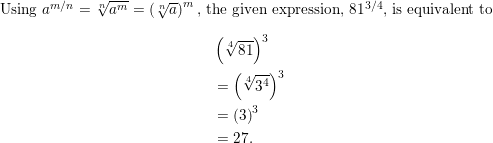
\(81^{3 / 4}\)
https://eurekamathanswerkeys.com/wp-content/uploads/2021/02/Big-idea-math-algerbra-2-chapter-5-Rational-Exponents-and-Radical-Functions-monitoring-5.1-7.jpg

Question 8.
\(1^{7 / 8}\)
https://eurekamathanswerkeys.com/wp-content/uploads/2021/02/Big-idea-math-algerbra-2-chapter-5-Rational-Exponents-and-Radical-Functions-monitoring-5.1-8.jpg

Evaluate the expression using a calculator. Round your answer to two decimal places when appropriate.

Question 9.
\(6^{2 / 5}\)
https://eurekamathanswerkeys.com/wp-content/uploads/2021/02/Big-idea-math-algerbra-2-chapter-5-Rational-Exponents-and-Radical-Functions-monitoring-5.1-9.jpg

Question 10.
\(64^{-2 / 3}\)
https://eurekamathanswerkeys.com/wp-content/uploads/2021/02/Big-idea-math-algerbra-2-chapter-5-Rational-Exponents-and-Radical-Functions-monitoring-5.1-10.jpg

Question 11.
\((\sqrt[4]{16})^{5}\)
https://eurekamathanswerkeys.com/wp-content/uploads/2021/02/Big-idea-math-algerbra-2-chapter-5-Rational-Exponents-and-Radical-Functions-monitoring-5.1-11.jpg

Question 12.
\((\sqrt[3]{-30})^{2}\)
https://eurekamathanswerkeys.com/wp-content/uploads/2021/02/Big-idea-math-algerbra-2-chapter-5-Rational-Exponents-and-Radical-Functions-monitoring-5.1-12.jpg

Find the real solution(s) of the equation. Round your answer to two decimal places when appropriate.

Question 13.
8x3 = 64
https://eurekamathanswerkeys.com/wp-content/uploads/2021/02/Big-idea-math-algerbra-2-chapter-5-Rational-Exponents-and-Radical-Functions-monitoring-5.1-13.jpg

Question 14.
\([\frac{1}{2}/latex]x5 = 512
https://eurekamathanswerkeys.com/wp-content/uploads/2021/02/Big-idea-math-algerbra-2-chapter-5-Rational-Exponents-and-Radical-Functions-monitoring-5.1-13.jpg
Question 15.
(x + 5)4 = 16
https://eurekamathanswerkeys.com/wp-content/uploads/2021/02/Big-idea-math-algerbra-2-chapter-5-Rational-Exponents-and-Radical-Functions-monitoring-5.1-15.jpg

Question 16.
(x − 2)3 = −14
https://eurekamathanswerkeys.com/wp-content/uploads/2021/02/Big-idea-math-algerbra-2-chapter-5-Rational-Exponents-and-Radical-Functions-monitoring-5.1-16.jpg

Question 17.
WHAT IF? In Example 5, what is the annual depreciation rate when the salvage value is $6000?
https://eurekamathanswerkeys.com/wp-content/uploads/2021/02/Big-idea-math-algerbra-2-chapter-5-Rational-Exponents-and-Radical-Functions-monitoring-5.1-17.jpg

nth Roots and Rational Exponents 5.1 Exercises

Vocabulary and Core Concept Check

Question 1.
VOCABULARY Rewrite the expression [latex]a^{-s / t}\) in radical form. Then state the index of the radical.
Answer:
Big Ideas Math Algebra 2 Answers Chapter 5 Rational Exponents and Radical Functions 5.1 Question 1

Question 2.
COMPLETE THE SENTENCE For an integer n greater than 1, if bn = a, then bis a(n) ___________ of a.
Answer:

Question 3.
WRITING Explain how to use the sign of a to determine the number of real fourth roots of a and the number of real fifth roots of a.
Answer:
Big Ideas Math Algebra 2 Answers Chapter 5 Rational Exponents and Radical Functions 5.1 Question 3

Question 4.
WHICH ONE DOESN’T BELONG? Which expression does not belong with the other three? Explain your reasoning.
Big Ideas Math Algebra 2 Answers Chapter 5 Rational Exponents and Radical Functions 4
Answer:

Monitoring Progress and Modeling with Mathematics

In Exercises 5–10, find the indicated real nth root(s) of a.

Question 5.
n = 3, a = 8
Answer:
Big Ideas Math Algebra 2 Answers Chapter 5 Rational Exponents and Radical Functions 5.1 Question 5

Question 6.
n = 5, a = −1
Answer:

Question 7.
n = 2, a = 0
Answer:
Big Ideas Math Algebra 2 Answers Chapter 5 Rational Exponents and Radical Functions 5.1 Question 7

Question 8.
n = 4, a = 256
Answer:

Question 9.
n = 5, a = −32
Answer:
Big Ideas Math Algebra 2 Answers Chapter 5 Rational Exponents and Radical Functions 5.1 Question 9

Question 10.
n = 6, a = −729
Answer:

In Exercises 11–18, evaluate the expression without using a calculator.

Question 11.
\(64^{1 / 6}\)
Answer:
Big Ideas Math Algebra 2 Answers Chapter 5 Rational Exponents and Radical Functions 5.1 Question 11

Question 12.
\(8^{1 / 3}\)
Answer:

Question 13.
\(25^{3 / 2}\)
Answer:
Big Ideas Math Algebra 2 Answers Chapter 5 Rational Exponents and Radical Functions 5.1 Question 13

Question 14.
\(81^{3 / 4}\)
Answer:

Question 15.
\((-243)^{1 / 5}\)
Answer:
Big Ideas Math Algebra 2 Answers Chapter 5 Rational Exponents and Radical Functions 5.1 Question 15

Question 16.
\((-64)^{4 / 3}\)
Answer:

Question 17.
\(8^{-2 / 3}\)
Answer:
Big Ideas Math Algebra 2 Answers Chapter 5 Rational Exponents and Radical Functions 5.1 Question 17

Question 18.
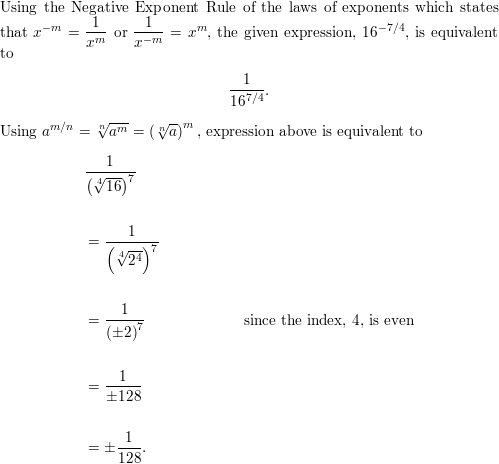
\(16^{-7 / 4}\)
Answer:

ERROR ANALYSIS In Exercises 19 and 20, describe and correct the error in evaluating the expression.

Question 19.
Big Ideas Math Algebra 2 Answers Chapter 5 Rational Exponents and Radical Functions 5
Answer:
Big Ideas Math Algebra 2 Answers Chapter 5 Rational Exponents and Radical Functions 5.1 Question 19

Question 20.
Big Ideas Math Algebra 2 Answers Chapter 5 Rational Exponents and Radical Functions 6
Answer:

USING STRUCTURE In Exercises 21–24, match the equivalent expressions. Explain your reasoning.

Question 21.
\((\sqrt[3]{5})^{4}\) A. \(5^{-1 / 4}\)
Answer:
Big Ideas Math Algebra 2 Answers Chapter 5 Rational Exponents and Radical Functions 5.1 Question 21

Question 22.
\((\sqrt[4]{5})^{3}\) B. \(5^{4 / 3}\)
Answer:

Question 23.
\(\frac{1}{\sqrt[4]{5}}\) C. \(-5^{1 / 4}\)
Answer:
Big Ideas Math Algebra 2 Answers Chapter 5 Rational Exponents and Radical Functions 5.1 Question 23

Question 24.
\(-\sqrt[4]{5}\) D. \(5^{3 / 4}\)
Answer:

In Exercises 25–32, evaluate the expression using a calculator. Round your answer to two decimal places when appropriate.

Question 25.
\(\sqrt[5]{32,768}\)
Answer:
Big Ideas Math Algebra 2 Answers Chapter 5 Rational Exponents and Radical Functions 5.1 Question 25

Question 26.
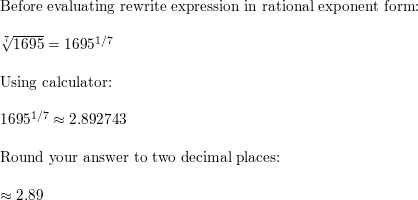
\(\sqrt[7]{1695}\)
Answer:

Question 27.
\(25^{-1 / 3}\)
Answer:
Big Ideas Math Algebra 2 Answers Chapter 5 Rational Exponents and Radical Functions 5.1 Question 27

Question 28.
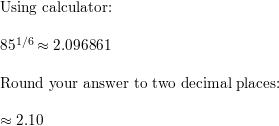
\(85^{1 / 6}\)
Answer:

Question 29.
\(20,736^{4 / 5}\)
Answer:
Big Ideas Math Algebra 2 Answers Chapter 5 Rational Exponents and Radical Functions 5.1 Question 29

Question 30.
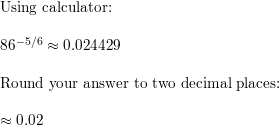
\(86^{-5 / 6}\)
Answer:

Question 31.
\((\sqrt[4]{187})^{3}\)
Answer:
Big Ideas Math Algebra 2 Answers Chapter 5 Rational Exponents and Radical Functions 5.1 Question 31

Question 32.
\((\sqrt[5]{-8})^{8}\)
Answer:

MATHEMATICAL CONNECTIONS In Exercises 33 and 34, find the radius of the figure with the given volume.

Question 33.
V = 216 ft3
Big Ideas Math Algebra 2 Answers Chapter 5 Rational Exponents and Radical Functions 7
Answer:
Big Ideas Math Algebra 2 Answers Chapter 5 Rational Exponents and Radical Functions 5.1 Question 33

Question 34.
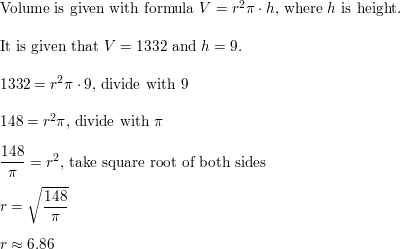
V = 1332 cm3
Big Ideas Math Algebra 2 Answers Chapter 5 Rational Exponents and Radical Functions 8
Answer:

In Exercises 35–44, find the real solution(s) of the equation. Round your answer to two decimal places when appropriate.

Question 35.
x3 = 125
Answer:
Big Ideas Math Algebra 2 Answers Chapter 5 Rational Exponents and Radical Functions 5.1 Question 35

Question 36.
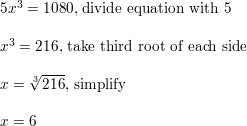
5x3 = 1080
Answer:

Question 37.
(x + 10)5 = 70
Answer:
Big Ideas Math Algebra 2 Answers Chapter 5 Rational Exponents and Radical Functions 5.1 Question 37

Question 38.
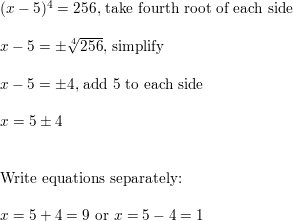
(x − 5)4 = 256
Answer:

Question 39.
x5 = −48
Answer:
Big Ideas Math Algebra 2 Answers Chapter 5 Rational Exponents and Radical Functions 5.1 Question 39

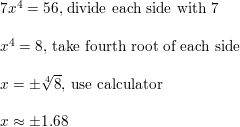
Question 40.
7x4 = 56
Answer:

Question 41.
x6 + 36 = 100
Answer:
Big Ideas Math Algebra 2 Answers Chapter 5 Rational Exponents and Radical Functions 5.1 Question 41

Question 42.
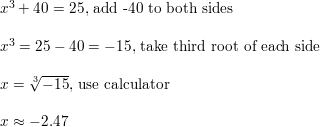
x3 + 40 = 25
Answer:

Question 43.
\(\frac{1}{3}\)x4 = 27

Answer:
Big Ideas Math Algebra 2 Answers Chapter 5 Rational Exponents and Radical Functions 5.1 Question 43

Question 44.
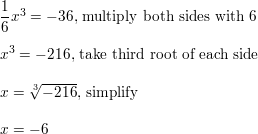
\(\frac{1}{6}\)x3 = −36
Answer:

Question 45.
MODELING WITH MATHEMATICS When the average price of an item increases from p1 to p2 over a period of n years, the annual rate of inflation r (in decimal form) is given by r = \(\left(\frac{p_{2}}{p_{1}}\right)^{1 / n}\) − 1. Find the rate of inflation for each item in the table.
Big Ideas Math Algebra 2 Answers Chapter 5 Rational Exponents and Radical Functions 9
Answer:
Big Ideas Math Algebra 2 Answers Chapter 5 Rational Exponents and Radical Functions 5.1 Question 45.1
Big Ideas Math Algebra 2 Answers Chapter 5 Rational Exponents and Radical Functions 5.1 Question 45.2

Question 46.
HOW DO YOU SEE IT? The graph of y = xn is shown in red. What can you conclude about the value of n? Determine the number of real nth roots of a. Explain your reasoning.
Big Ideas Math Algebra 2 Answers Chapter 5 Rational Exponents and Radical Functions 10
Answer:

Question 47.
NUMBER SENSE Between which two consecutive integers does \(\sqrt[4]{125}\) lie? Explain your reasoning.
Answer:
Big Ideas Math Algebra 2 Answers Chapter 5 Rational Exponents and Radical Functions 5.1 Question 47

Question 48.
THOUGHT PROVOKING In 1619, Johannes Kepler published his third law, which can be given by d3 = t2, where d is the mean distance (in astronomical units) of a planet from the Sun and t is the time (in years) it takes the planet to orbit the Sun. It takes Mars 1.88 years to orbit the Sun. Graph a possible location of Mars. Justify your answer. (The diagram shows the Sun at the origin of the xy-plane and a possible location of Earth.)
Big Ideas Math Algebra 2 Answers Chapter 5 Rational Exponents and Radical Functions 11
Answer:
https://eurekamathanswerkeys.com/wp-content/uploads/2021/02/Big-idea-math-algerbra-2-chapter-5-Rational-Exponents-and-Radical-Functions-5.1-48.jpg

Question 49.
PROBLEM SOLVING A weir is a dam that is built across a river to regulate the flow of water. The flow rate Q (in cubic feet per second) can be calculated using the formula Q= 3.367ℓ\(h^{3 / 2}\), where ℓ is the length (in feet) of the bottom of the spillway and his the depth (in feet) of the water on the spillway. Determine the flow rate of a weir with a spillway that is 20 feet long and has a water depth of 5 feet.
Big Ideas Math Algebra 2 Answers Chapter 5 Rational Exponents and Radical Functions 12
Answer:
Big Ideas Math Algebra 2 Answers Chapter 5 Rational Exponents and Radical Functions 5.1 Question 49

Question 50.
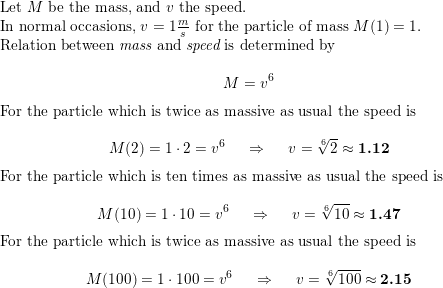
REPEATED REASONING The mass of the particles that a river can transport is proportional to the sixth power of the speed of the river. A certain river normally flows at a speed of 1 meter per second. What must its speed be in order to transport particles that are twice as massive as usual? 10 times as massive? 100 times as massive?
Answer:

Maintaining Mathematical Proficiency

Simplify the expression. Write your answer using only positive exponents. (Skills Review Handbook)

Question 51.
5 • 54

Answer:
Big Ideas Math Algebra 2 Answers Chapter 5 Rational Exponents and Radical Functions 5.1 Question 51

Question 52.
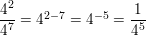
\(\frac{4^{2}}{4^{7}}\)
Answer:

Question 53.
\(\left(z^{2}\right)^{-3}\)
Answer:
Big Ideas Math Algebra 2 Answers Chapter 5 Rational Exponents and Radical Functions 5.1 Question 53

Question 54.
\(\left(\frac{3 x}{2}\right)^{4}\)
Answer:

Write the number in standard form. (Skills Review Handbook)

Question 55.
5 × 10³

Answer:
Big Ideas Math Algebra 2 Answers Chapter 5 Rational Exponents and Radical Functions 5.1 Question 55

Question 56.
4 × 10⁻²
Answer:
https://eurekamathanswerkeys.com/wp-content/uploads/2021/02/Big-idea-math-algerbra-2-chapter-5-Rational-Exponents-and-Radical-Functions-monitoring-5.1-56.jpg
Question 57.
8.2 × 10⁻¹
Answer:
Big Ideas Math Algebra 2 Answers Chapter 5 Rational Exponents and Radical Functions 5.1 Question 57

Question 58.
6.93 × 10⁶
Answer:

https://eurekamathanswerkeys.com/wp-content/uploads/2021/02/Big-idea-math-algerbra-2-chapter-5-Rational-Exponents-and-Radical-Functions-monitoring-5.1-58.jpg
Lesson 5.2 Properties of Rational Exponents and Radicals

Essential Question
How can you use properties of exponents to simplify products and quotients of radicals?

EXPLORATION 1
Reviewing Properties of Exponents
Work with a partner.
Let a and b be real numbers. Use the properties of exponents to complete each statement. Then match each completed statement with the property it illustrates.
Big Ideas Math Algebra 2 Answers Chapter 5 Rational Exponents and Radical Functions 13

EXPLORATION 2
Simplifying Expressions with Rational Exponents
Work with a partner.
Show that you can apply the properties of integer exponents to rational exponents by simplifying each expression. Use a calculator to check your answers.
a. \(5^{2 / 3}\) • \(5^{4 / 3}\)
b. \(3^{1 / 5}\) • \(3^{4 / 5}\)
c. \(\left(4^{2 / 3}\right)^{3}\)
d. \(\frac{\sqrt{98}}{\sqrt{2}}\)
e. \(\frac{\sqrt[4]{4}}{\sqrt[4]{1024}}\)
f. \(\frac{\sqrt[3]{625}}{\sqrt[3]{5}}\)

EXPLORATION 3
Simplifying Products and Quotients of Radicals
Work with a partner.
Use the properties of exponents to write each expression as a single radical. Then evaluate each expression. Use a calculator to check your answers.
Big Ideas Math Algebra 2 Answers Chapter 5 Rational Exponents and Radical Functions 14
a. \(\sqrt{3}\) • \(\sqrt{12}\)
b. \(\sqrt[3]{5}\) • \(\sqrt[3]{25}\)
c. \(\sqrt[4]{27}\) • \(\sqrt[4]{3}\)
d. \(\frac{\sqrt{98}}{\sqrt{2}}\)
e. \(\frac{\sqrt[4]{4}}{\sqrt[4]{1024}}\)
f. \(\frac{\sqrt[3]{625}}{\sqrt[3]{5}}\)

Communicate Your Answer

Question 4.
How can you use properties of exponents to simplify products and quotients of radicals?

Question 5.
Simplify each expression.
a. \(\sqrt{27}\) • \(\sqrt{6}\)
b. \(\frac{\sqrt[3]{240}}{\sqrt[3]{15}}\)
c. (\(5^{1 / 2}\) \(16^{1 / 4}\))2

5.2 Lesson

Monitoring Progress

Simplify the expression.

Question 1.
\(2^{3 / 4}\) • \(2^{1 / 2}\)

Question 2.
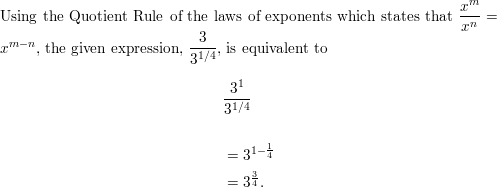
\(\frac{3}{3^{1 / 4}}\)

Question 3.
\(\left(\frac{20^{1 / 2}}{5^{1 / 2}}\right)^{3}\)
https://eurekamathanswerkeys.com/wp-content/uploads/2021/02/Big-idea-math-algerbra-2-chapter-5-Rational-Exponents-and-Radical-Functions-monitoring-5.2-3.jpg

Question 4.
(\(5^{1 / 3}\) • \(7^{1 / 4}\))3

https://eurekamathanswerkeys.com/wp-content/uploads/2021/02/Big-idea-math-algerbra-2-chapter-5-Rational-Exponents-and-Radical-Functions-monitoring-5.2-4.jpg


Simplify the expression

Question 5.
\(\sqrt[4]{27}\) • \(\sqrt[4]{3}\)
https://eurekamathanswerkeys.com/wp-content/uploads/2021/02/Big-idea-math-algerbra-2-chapter-5-Rational-Exponents-and-Radical-Functions-monitoring-5.2-4.jpg

Question 6.
\(\frac{\sqrt[3]{250}}{\sqrt[3]{2}}\)
https://eurekamathanswerkeys.com/wp-content/uploads/2021/02/Big-idea-math-algerbra-2-chapter-5-Rational-Exponents-and-Radical-Functions-monitoring-5.2-6.jpg

Question 7.
\(\sqrt[3]{104}\)

https://eurekamathanswerkeys.com/wp-content/uploads/2021/02/Big-idea-math-algerbra-2-chapter-5-Rational-Exponents-and-Radical-Functions-monitoring-5.2-7.jpg

Question 8.
\(\sqrt[5]{\frac{3}{4}}\)
https://eurekamathanswerkeys.com/wp-content/uploads/2021/02/Big-idea-math-algerbra-2-chapter-5-Rational-Exponents-and-Radical-Functions-monitoring-5.2-8.jpg

Question 9.
\(\frac{3}{6-\sqrt{2}}\)
https://eurekamathanswerkeys.com/wp-content/uploads/2021/02/Big-idea-math-algerbra-2-chapter-5-Rational-Exponents-and-Radical-Functions-monitoring-5.2-9.jpg

Question 10.
\(7 \sqrt[5]{12}\) – \(\sqrt[5]{12}\)
https://eurekamathanswerkeys.com/wp-content/uploads/2021/02/Big-idea-math-algerbra-2-chapter-5-Rational-Exponents-and-Radical-Functions-monitoring-5.2-10.jpg

Question 11.
4(\(9^{2 / 3}\)) + (\(9^{2 / 3}\))

Question 12.
\(\sqrt[3]{5}\) + \(\sqrt[3]{40}\)
https://eurekamathanswerkeys.com/wp-content/uploads/2021/02/Big-idea-math-algerbra-2-chapter-5-Rational-Exponents-and-Radical-Functions-monitoring-5.2-12.jpg

Simplify the expression. Assume all variables are positive.

Question 13.
\(\sqrt[3]{27 q^{9}}\)
https://eurekamathanswerkeys.com/wp-content/uploads/2021/02/Big-idea-math-algerbra-2-chapter-5-Rational-Exponents-and-Radical-Functions-monitoring-5.2-13.jpg

Question 14.
\(\sqrt[5]{\frac{x^{10}}{y^{5}}}\)
https://eurekamathanswerkeys.com/wp-content/uploads/2021/02/Big-idea-math-algerbra-2-chapter-5-Rational-Exponents-and-Radical-Functions-monitoring-5.2-14.jpg

Question 15.
\(\frac{6 x y^{3 / 4}}{3 x^{1 / 2} y^{1 / 2}}\)
https://eurekamathanswerkeys.com/wp-content/uploads/2021/02/Big-idea-math-algerbra-2-chapter-5-Rational-Exponents-and-Radical-Functions-monitoring-5.2-15.jpg

Question 16.
\(\sqrt{9} w^{5}\) – \(w \sqrt{w^{3}}\)
https://eurekamathanswerkeys.com/wp-content/uploads/2021/02/Big-idea-math-algerbra-2-chapter-5-Rational-Exponents-and-Radical-Functions-monitoring-5.2-16.jpg

Properties of Rational Exponents and Radicals 5.2 Exercises

Vocabulary and Core Concept Check

Question 1.
WRITING How do you know when a radical expression is in simplest form?
Answer:
Big Ideas Math Algebra 2 Answers Chapter 5 Rational Exponents and Radical Functions 5.2 Question 1

Question 2.
WHICH ONE DOESN’T BELONG? Which radical expression does not belong with the other three? Explain your reasoning.
Big Ideas Math Algebra 2 Answers Chapter 5 Rational Exponents and Radical Functions 15
Answer:

Monitoring Progress and Modeling with Mathematics

In Exercises 3–12, use the properties of rational exponents to simplify the expression.

Question 3.
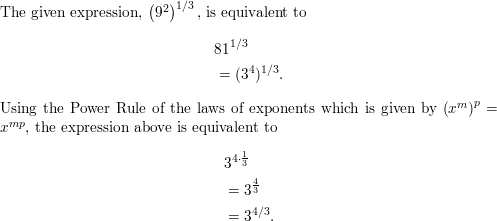
\(\left(9^{2}\right)^{1 / 3}\)
Answer:

Big Ideas Math Algebra 2 Answers Chapter 5 Rational Exponents and Radical Functions 5.2 Question 3

Question 4.
\(\left(12^{2}\right)^{1 / 4}\)
Answer:

Question 5.
\(\frac{6}{6^{1 / 4}}\)
Answer:
Big Ideas Math Algebra 2 Answers Chapter 5 Rational Exponents and Radical Functions 5.2 Question 5

Question 6.
\(\frac{7}{7^{1 / 3}}\)
Answer:
https://eurekamathanswerkeys.com/wp-content/uploads/2021/02/Big-idea-math-algerbra-2-chapter-5-Rational-Exponents-and-Radical-Functions-5.2-6.jpg

Question 7.
\(\left(\frac{8^{4}}{10^{4}}\right)^{-1 / 4}\)
Answer:
Big Ideas Math Algebra 2 Answers Chapter 5 Rational Exponents and Radical Functions 5.2 Question 7

Question 8.
\(\left(\frac{9^{3}}{6^{3}}\right)^{-1 / 3}\)
Answer:
https://eurekamathanswerkeys.com/wp-content/uploads/2021/02/Big-idea-math-algerbra-2-chapter-5-Rational-Exponents-and-Radical-Functions-5.2-8.jpg

Question 9.
(\(3^{-2 / 3}\) • \(3^{1 / 3}\))-1
Answer:
https://eurekamathanswerkeys.com/wp-content/uploads/2021/02/Big-idea-math-algerbra-2-chapter-5-Rational-Exponents-and-Radical-Functions-5.2-9.jpg
Big Ideas Math Algebra 2 Answers Chapter 5 Rational Exponents and Radical Functions 5.2 Question 9

Question 10.
(\(5^{1 / 2}\) • \(5^{-3 / 2}\))-1/4
Answer:
https://eurekamathanswerkeys.com/wp-content/uploads/2021/02/Big-idea-math-algerbra-2-chapter-5-Rational-Exponents-and-Radical-Functions-5.2-10.jpg

Question 11.
\(\frac{2^{2 / 3} \cdot 16^{2 / 3}}{4^{2 / 3}}\)
Answer:
Big Ideas Math Algebra 2 Answers Chapter 5 Rational Exponents and Radical Functions 5.2 Question 11

Question 12.
\(\frac{49^{3 / 8} \cdot 49^{7 / 8}}{7^{5 / 4}}\)
Answer:
https://eurekamathanswerkeys.com/wp-content/uploads/2021/02/Big-idea-math-algerbra-2-chapter-5-Rational-Exponents-and-Radical-Functions-5.2-12.jpg

In Exercises 13–20, use the properties of radicals to simplify the expression.

Question 13.
\(\sqrt{2}\) • \(\sqrt{72}\)
Answer:
Big Ideas Math Algebra 2 Answers Chapter 5 Rational Exponents and Radical Functions 5.2 Question 13

Question 14.
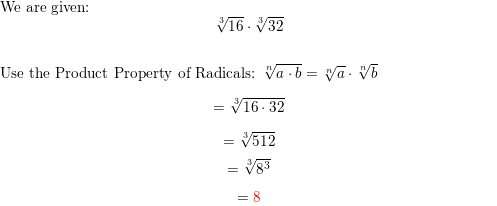
\(\sqrt[3]{16}\) • \(\sqrt[3]{32}\)
Answer:

Question 15.
\(\sqrt[4]{6}\) • \(\sqrt[4]{8}\)
Answer:
Big Ideas Math Algebra 2 Answers Chapter 5 Rational Exponents and Radical Functions 5.2 Question 15

Question 16.
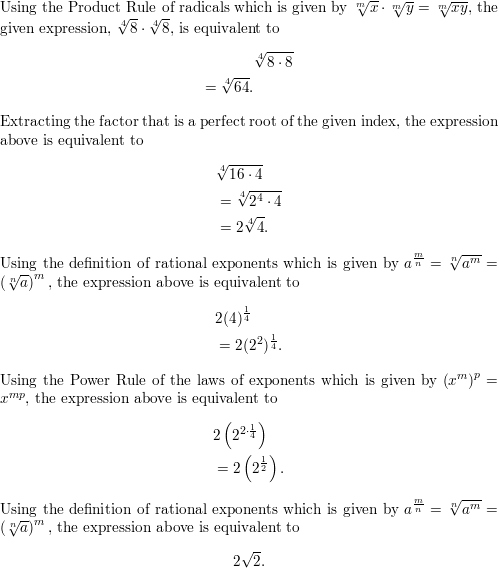
\(\sqrt[4]{8}\) • \(\sqrt[4]{8}\)
Answer:

Question 17.
\(\frac{\sqrt[5]{486}}{\sqrt[5]{2}}\)
Answer:
Big Ideas Math Algebra 2 Answers Chapter 5 Rational Exponents and Radical Functions 5.2 Question 17

Question 18.
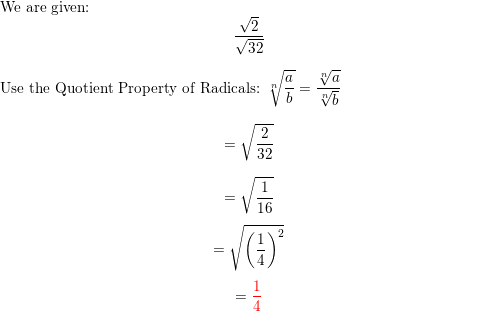
\(\frac{\sqrt{2}}{\sqrt{32}}\)
Answer:

Question 19.
\(\frac{\sqrt[3]{6} \cdot \sqrt[3]{72}}{\sqrt[3]{2}}\)
Answer:
Big Ideas Math Algebra 2 Answers Chapter 5 Rational Exponents and Radical Functions 5.2 Question 19

Question 20.
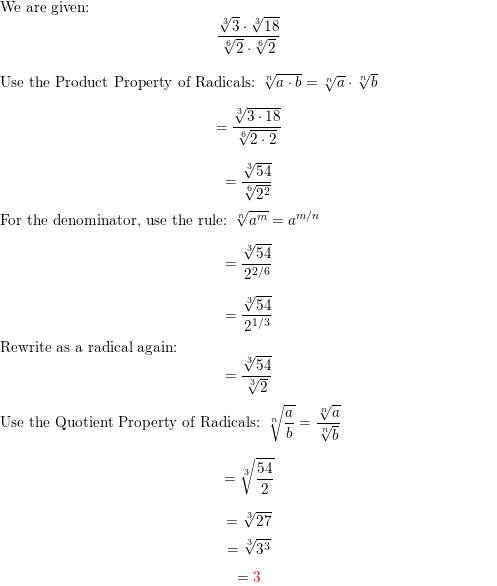
\(\frac{\sqrt[3]{3} \cdot \sqrt[3]{18}}{\sqrt[6]{2} \cdot \sqrt[6]{2}}\)
Answer:

In Exercises 21–28, write the expression in simplest form.

Question 21.
\(\sqrt[4]{567}\)
Answer:
Big Ideas Math Algebra 2 Answers Chapter 5 Rational Exponents and Radical Functions 5.2 Question 21

Question 22.
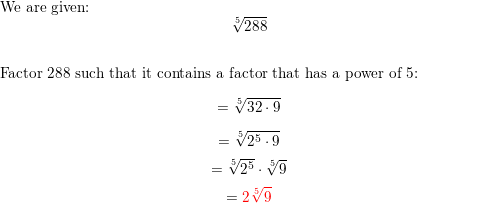
\(\sqrt[5]{288}\)
Answer:

Question 23.
\(\frac{\sqrt[3]{5}}{\sqrt[3]{4}}\)
Answer:
Big Ideas Math Algebra 2 Answers Chapter 5 Rational Exponents and Radical Functions 5.2 Question 23

Question 24.
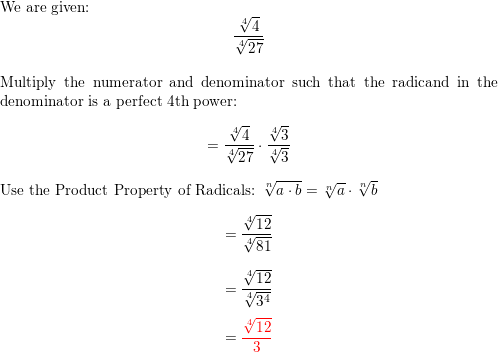
\(\frac{\sqrt[4]{4}}{\sqrt[4]{27}}\)
Answer:

Question 25.
\(\sqrt{\frac{3}{8}}\)
Answer:
Big Ideas Math Algebra 2 Answers Chapter 5 Rational Exponents and Radical Functions 5.2 Question 25

Question 26.
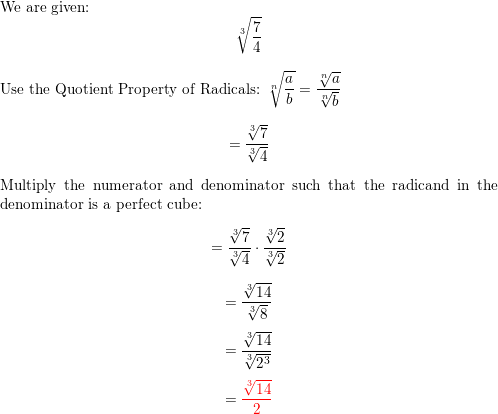
\(\sqrt[3]{\frac{7}{4}}\)
Answer:

Question 27.
\(\sqrt[3]{\frac{64}{49}}\)
Answer:
Big Ideas Math Algebra 2 Answers Chapter 5 Rational Exponents and Radical Functions 5.2 Question 27
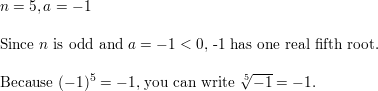
Question 28.
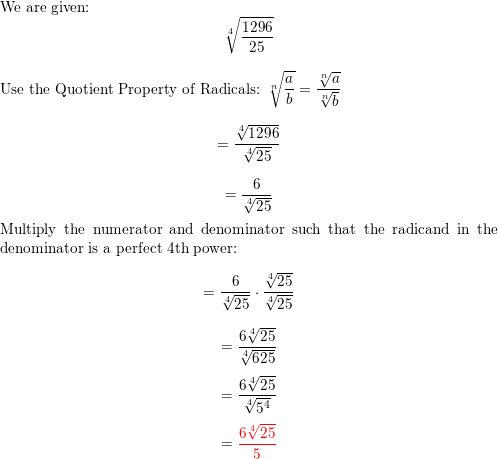
\(\sqrt[4]{\frac{1296}{25}}\)
Answer:

In Exercises 29–36, write the expression in simplest form.

Question 29.
\(\frac{1}{1+\sqrt{3}}\)
Answer:
Big Ideas Math Algebra 2 Answers Chapter 5 Rational Exponents and Radical Functions 5.2 Question 29

Question 30.
\(\frac{1}{2+\sqrt{5}}\)
Answer:

Question 31.
\(\frac{5}{3-\sqrt{2}}\)
Answer:
Big Ideas Math Algebra 2 Answers Chapter 5 Rational Exponents and Radical Functions 5.2 Question 31

Question 32.
\(\frac{11}{9-\sqrt{6}}\)
Answer:
https://eurekamathanswerkeys.com/wp-content/uploads/2021/02/Big-idea-math-algerbra-2-chapter-5-Rational-Exponents-and-Radical-Functions-5.2-32.jpg

Question 33.
\(\frac{9}{\sqrt{3}+\sqrt{7}}\)
Answer:
Big Ideas Math Algebra 2 Answers Chapter 5 Rational Exponents and Radical Functions 5.2 Question 33

Question 34.
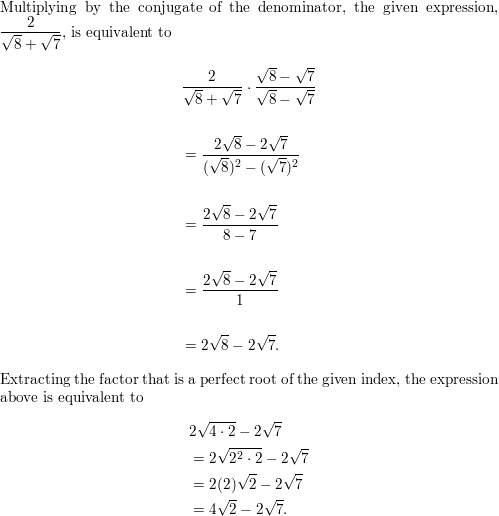
\(\frac{2}{\sqrt{8}+\sqrt{7}}\)
Answer:

Question 35.
\(\frac{\sqrt{6}}{\sqrt{3}-\sqrt{5}}\)
Answer:
Big Ideas Math Algebra 2 Answers Chapter 5 Rational Exponents and Radical Functions 5.2 Question 35

Question 36.
\(\frac{\sqrt{7}}{\sqrt{10}-\sqrt{2}}\)
Answer:
https://eurekamathanswerkeys.com/wp-content/uploads/2021/02/Big-idea-math-algerbra-2-chapter-5-Rational-Exponents-and-Radical-Functions-5.2-36.jpg

In Exercises 37–46, simplify the expression.

Question 37.
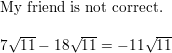
\(9 \sqrt[3]{11}\) + \(3 \sqrt[3]{11}\)
Answer:
Big Ideas Math Algebra 2 Answers Chapter 5 Rational Exponents and Radical Functions 5.2 Question 37

Question 38.
\(8 \sqrt[6]{5}\) – \(12 \sqrt[6]{5}\)
Answer:

Question 39.
\(3\left(11^{1 / 4}\right)\) + \(9\left(11^{1 / 4}\right)\)
Answer:

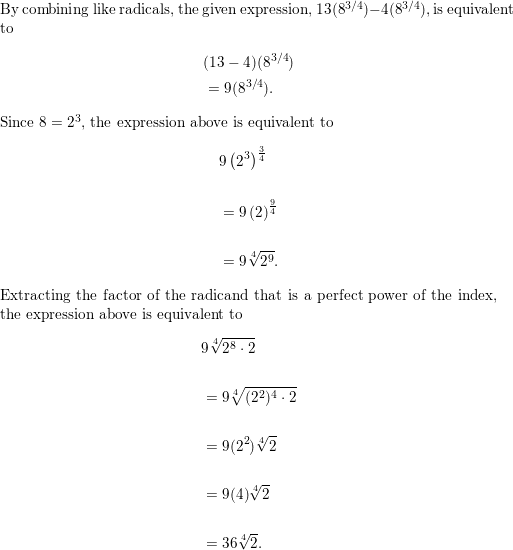
Question 40.
\(13\left(8^{3 / 4}\right)\) – \(4\left(8^{3 / 4}\right)\)
Answer:

Question 41.
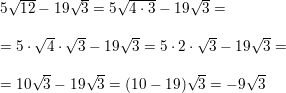
\(5 \sqrt{12}\) – \(19 \sqrt{3}\)
Answer:

Big Ideas Math Algebra 2 Answers Chapter 5 Rational Exponents and Radical Functions 5.2 Question 41

Question 42.
\(27 \sqrt{6}\) + \(7 \sqrt{150}\)

Answer:

Question 43.
\(\sqrt[5]{224}\) + \(3 \sqrt[5]{7}\)
Answer:
Big Ideas Math Algebra 2 Answers Chapter 5 Rational Exponents and Radical Functions 5.2 Question 43

Question 44.
\(7 \sqrt[3]{2}\) – \(\sqrt[3]{128}\)
Answer:

Question 45.
\(5\left(24^{1 / 3}\right)\) – 4(\(\left(3^{1 / 3}\right)\))
Answer:
Big Ideas Math Algebra 2 Answers Chapter 5 Rational Exponents and Radical Functions 5.2 Question 45

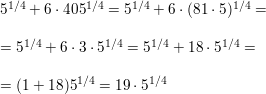
Question 46.
\(5^{1 / 4}\) + 6(\([405^{1 / 4}/latex])
Answer:

Question 47.
ERROR ANALYSIS Describe and correct the error in simplifying the expression.
Big Ideas Math Algebra 2 Answers Chapter 5 Rational Exponents and Radical Functions 16
Answer:
Big Ideas Math Algebra 2 Answers Chapter 5 Rational Exponents and Radical Functions 5.2 Question 47

Question 48.
MULTIPLE REPRESENTATIONS Which radical expressions are like radicals?
A. [latex]\left(5^{2 / 9}\right)^{3 / 2}\)
B. \(\frac{5^{3}}{(\sqrt[3]{5})^{8}}\)
C. \(\sqrt[3]{625}\)
D. \(\sqrt[3]{5} 145\) – \(\sqrt[3]{875}\)
E. \(\sqrt[3]{5}\) + \(3 \sqrt[3]{5}\)
F. \(7 \sqrt[4]{80}\) – \(2 \sqrt[4]{405}\)
Answer:
https://eurekamathanswerkeys.com/wp-content/uploads/2021/02/Big-idea-math-algerbra-2-chapter-5-Rational-Exponents-and-Radical-Functions-5.2-48.jpg

In Exercises 49–54, simplify the expression.

Question 49.
\(\sqrt[4]{81 y^{8}}\)
Answer:
Big Ideas Math Algebra 2 Answers Chapter 5 Rational Exponents and Radical Functions 5.2 Question 49

Question 50.
\(\sqrt[3]{64 r^{3} t^{6}}\)
Answer:

Question 51.
\(\sqrt[5]{\frac{m^{10}}{n^{5}}}\)
Answer:

Big Ideas Math Algebra 2 Answers Chapter 5 Rational Exponents and Radical Functions 5.2 Question 51

Question 52.
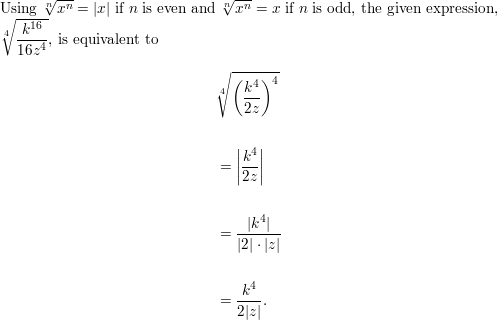
\(\sqrt[4]{\frac{k^{16}}{16 z^{4}}}\)
Answer:

Question 53.
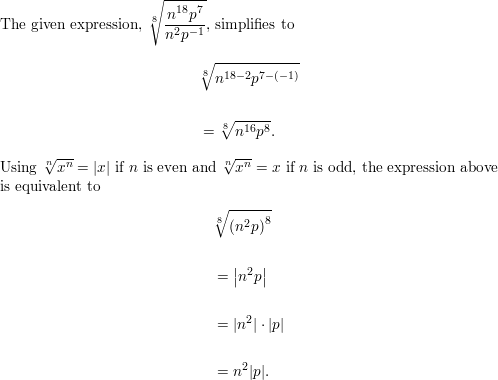
\(\sqrt[6]{\frac{g^{6} h}{h^{7}}}\)
Answer:
Big Ideas Math Algebra 2 Answers Chapter 5 Rational Exponents and Radical Functions 5.2 Question 53

Question 54.
\(\sqr

Question 55.
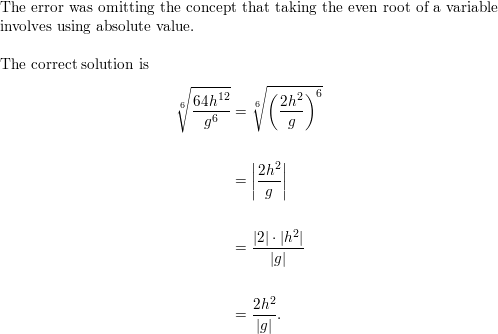
ERROR ANALYSIS Describe and correct the error in simplifying the expression.
Big Ideas Math Algebra 2 Answers Chapter 5 Rational Exponents and Radical Functions 17
Answer:

Big Ideas Math Algebra 2 Answers Chapter 5 Rational Exponents and Radical Functions 5.2 Question 55

Question 56.
OPEN-ENDED Write two variable expressions involving radicals, one that needs absolute value in simplifying and one that does not need absolute value. Justify your answers.
Answer:

In Exercises 57–64, write the expression in simplest form. Assume all variables are positive.

Question 57.
[latex]\sqrt{81 a^{7} b^{12} c^{9}}\)
Answer:
Big Ideas Math Algebra 2 Answers Chapter 5 Rational Exponents and Radical Functions 5.2 Question 57

Question 58.
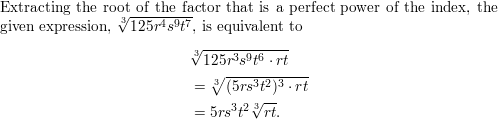
\(\sqrt[3]{125 r^{4} s^{9} t^{7}}\)
Answer:

Question 59.
\(\sqrt[5]{\frac{160 m^{6}}{n^{7}}}\)
Answer:
Big Ideas Math Algebra 2 Answers Chapter 5 Rational Exponents and Radical Functions 5.2 Question 59

Question 60.
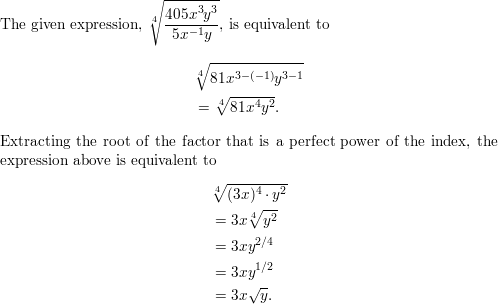
\(\sqrt[4]{\frac{405 x^{3} y^{3}}{5 x^{-1} y}}\)
Answer:

Question 61.
\(\frac{\sqrt[3]{w} \cdot \sqrt{w^{5}}}{\sqrt{25 w^{16}}}\)
Answer:
Big Ideas Math Algebra 2 Answers Chapter 5 Rational Exponents and Radical Functions 5.2 Question 61

Question 62.
\(\frac{\sqrt[4]{v^{6}}}{\sqrt[7]{v^{5}}}\)
Answer

We simplify the expression:

Question 63.
\(\frac{18 w^{1 / 3} v^{5 / 4}}{27 w^{4 / 3} v^{1 / 2}}\)
Answer:
Big Ideas Math Algebra 2 Answers Chapter 5 Rational Exponents and Radical Functions 5.2 Question 63

Question 64.
\(\frac{7 x^{-3 / 4} y^{5 / 2} z^{-2 / 3}}{56 x^{-1 / 2} y^{1 / 4}}\)
Answer:
https://eurekamathanswerkeys.com/wp-content/uploads/2021/02/Big-idea-math-algerbra-2-chapter-5-Rational-Exponents-and-Radical-Functions-5.2-64.jpg

In Exercises 65–70, perform the indicated operation. Assume all variables are positive.

Question 65.
\(12 \sqrt[3]{y}\) + \(9 \sqrt[3]{y}\)
Answer:
Big Ideas Math Algebra 2 Answers Chapter 5 Rational Exponents and Radical Functions 5.2 Question 65

Question 66.
\(11 \sqrt{2 z}\) – \(5 \sqrt{2 z}\)
Answer:

Question 67.
\(3 x^{7 / 2}\) – 5\(x^{7 / 2}\)
Answer:
Big Ideas Math Algebra 2 Answers Chapter 5 Rational Exponents and Radical Functions 5.2 Question 67

Question 68.
\(7 \sqrt[3]{m^{7}}\) + \(3 m^{7 / 3}\)
Answer:

Question 69.
\(\sqrt[4]{16 w^{10}}\) + \(2 w \sqrt[4]{w^{6}}\)
Answer:
Big Ideas Math Algebra 2 Answers Chapter 5 Rational Exponents and Radical Functions 5.2 Question 69

Question 70.
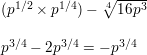
(p1/2 • p1/4) – \(\sqrt[4]{16 p^{3}}\)
Answer:

MATHEMATICAL CONNECTIONS In Exercises 71 and 72, find simplified expressions for the perimeter and area of the given figure.

Question 71.
Big Ideas Math Algebra 2 Answers Chapter 5 Rational Exponents and Radical Functions 18
Answer:
Big Ideas Math Algebra 2 Answers Chapter 5 Rational Exponents and Radical Functions 5.2 Question 71

Question 72
Big Ideas Math Algebra 2 Answers Chapter 5 Rational Exponents and Radical Functions 19
Answer:
https://eurekamathanswerkeys.com/wp-content/uploads/2021/02/Big-idea-math-algerbra-2-chapter-5-Rational-Exponents-and-Radical-Functions-5.2-72.jpg

Question 73.
MODELING WITH MATHEMATICS The optimum diameter d (in millimeters) of the pinhole in a pinhole camera can be modeled by d = 1.9[(5.5 × 10⁻⁴)ℓ]1/2, where ℓ is the length (in millimeters) of the camera box. Find the optimum pinhole diameter for a camera box with a length of 10 centimeters.
Big Ideas Math Algebra 2 Answers Chapter 5 Rational Exponents and Radical Functions 20
Answer:
Big Ideas Math Algebra 2 Answers Chapter 5 Rational Exponents and Radical Functions 5.2 Question 73

Question 74.
MODELING WITH MATHEMATICS The surface area S(in square centimeters) of a mammal can be modeled by S = km2/3, where m is the mass (in grams) of the mammal and k is a constant. The table shows the values of k for different mammals.
Big Ideas Math Algebra 2 Answers Chapter 5 Rational Exponents and Radical Functions 21
a. Find the surface area of a bat whose mass is 32 grams.
b. Find the surface area of a rabbit whose mass is 3.4 kilograms (3.4 × 10³ grams).
c. Find the surface area of a human whose mass is 59 kilograms.
Answer:
https://eurekamathanswerkeys.com/wp-content/uploads/2021/02/Big-idea-math-algerbra-2-chapter-5-Rational-Exponents-and-Radical-Functions-5.2-74.jpg

Question 75.
MAKING AN ARGUMENT Your friend claims it is not possible to simplify the expression 7\(\sqrt{11}\) − 9 \(\sqrt{44}\) because it does not contain like radicals. Is your friend correct? Explain your reasoning.
Answer:

Big Ideas Math Algebra 2 Answers Chapter 5 Rational Exponents and Radical Functions 5.2 Question 75

Question 76.
PROBLEM SOLVING The apparent magnitude of a star is a number that indicates how faint the star is in relation to other stars. The expression f(x) = \(\frac{2.512^{m_{1}}}{2.512^{m_{2}}}\) tells how many times fainter a star with apparent magnitude m1 is than a star with apparent magnitude m2.
Big Ideas Math Algebra 2 Answers Chapter 5 Rational Exponents and Radical Functions 22
a. How many times fainter is Altair than Vega?
b. How many times fainter is Deneb than Altair?
c. How many times fainter is Deneb than Vega?
Big Ideas Math Algebra 2 Answers Chapter 5 Rational Exponents and Radical Functions 23
Answer:
https://eurekamathanswerkeys.com/wp-content/uploads/2021/02/Big-idea-math-algerbra-2-chapter-5-Rational-Exponents-and-Radical-Functions-5.2-76.jpg

Question 77.
CRITICAL THINKING Find a radical expression for the perimeter of the triangle inscribed in the square shown. Simplify the expression.
Big Ideas Math Algebra 2 Answers Chapter 5 Rational Exponents and Radical Functions 24
Answer:
Big Ideas Math Algebra 2 Answers Chapter 5 Rational Exponents and Radical Functions 5.2 Question 77

Question 78.
HOW DO YOU SEE IT? Without finding points, match the functions f(x) = \(\sqrt{64 x^{2}}\) and g(x) = \(\sqrt[3]{64 x^{6}}\) with their graphs. Explain your reasoning.
Big Ideas Math Algebra 2 Answers Chapter 5 Rational Exponents and Radical Functions 25
Answer:

Question 79.
REWRITING A FORMULA You have filled two round balloons with water. One balloon contains twice as much water as the other balloon.
a. Solve the formula for the volume of a sphere, V = \(\frac{4}{3}\)πr3, for r.
b. Substitute the expression for r from part (a) into the formula for the surface area of a sphere, S = 4πr2. Simplify to show that S = (4π)1/3(3V)2/3.
c. Compare the surface areas of the two water balloons using the formula in part (b).
Answer:
Big Ideas Math Algebra 2 Answers Chapter 5 Rational Exponents and Radical Functions 5.2 Question 79.1
Big Ideas Math Algebra 2 Answers Chapter 5 Rational Exponents and Radical Functions 5.2 Question 79.2

Question 80.
THOUGHT PROVOKING Determine whether the expressions (x2)1/6 and (x1/6)2 are equivalent for all values of x.
Answer:

Question 81.
DRAWING CONCLUSIONS Substitute different combinations of odd and even positive integers for m and n in the expression \(\sqrt[n]{x^{m}}\). When you cannot assume x is positive, explain when absolute value is needed in simplifying the expression.
Answer:
Big Ideas Math Algebra 2 Answers Chapter 5 Rational Exponents and Radical Functions 5.2 Question 81
Maintaining Mathematical Proficiency

Identify the focus, directrix, and axis of symmetry of the parabola. Then graph the equation. (Section 2.3)

Question 82.
y = 2x2
Answer:
https://eurekamathanswerkeys.com/wp-content/uploads/2021/02/Big-idea-math-algerbra-2-chapter-5-Rational-Exponents-and-Radical-Functions-5.2-82.jpg

Question 83.
y2 = −x
Answer:
Big Ideas Math Algebra 2 Answers Chapter 5 Rational Exponents and Radical Functions 5.2 Question 83.1
Big Ideas Math Algebra 2 Answers Chapter 5 Rational Exponents and Radical Functions 5.2 Question 83.2

Question 84.
y2 = 4x
Answer:

Write a rule for g. Describe the graph of g as a transformation of the graph of f. (Section 4.7)

Question 85.
f(x) = x4 − 3x2 − 2x, g(x) = −f(x)
Answer:
Big Ideas Math Algebra 2 Answers Chapter 5 Rational Exponents and Radical Functions 5.2 Question 85

Question 86.
f(x) = x3 − x, g(x) = f(x) − 3
Answer:
https://eurekamathanswerkeys.com/wp-content/uploads/2021/02/Big-idea-math-algerbra-2-chapter-5-Rational-Exponents-and-Radical-Functions-5.2-86.jpg

Question 87.
f(x) = x3 − 4, g(x) = f(x − 2)
Answer:
Big Ideas Math Algebra 2 Answers Chapter 5 Rational Exponents and Radical Functions 5.2 Question 87

Question 88.
f(x) = x4 + 2x3 − 4x2, g(x) = f(2x)
Answer:
https://eurekamathanswerkeys.com/wp-content/uploads/2021/02/Big-idea-math-algerbra-2-chapter-5-Rational-Exponents-and-Radical-Functions-5.2-88.jpg

Lesson 5.3 Graphing Radical Functions

Essential Question

How can you identify the domain and range of a radical function?

EXPLORATION 1
Identifying Graphs of Radical Functions
Work with a partner.
Match each function with its graph. Explain your reasoning. Then identify the domain and range of each function.
a. f(x) = \(\sqrt{x}\)
b. f(x) = \(\sqrt[3]{x}\)
c. f(x) = \(\sqrt[4]{x}\)
d. f(x) = \(\sqrt[5]{x}\)
Big Ideas Math Algebra 2 Answers Chapter 5 Rational Exponents and Radical Functions 26

EXPLORATION 2
Identifying Graphs of Transformations
Work with a partner.
Match each transformation of f(x) = \(\sqrt{x}\) with its graph. Explain your reasoning. Then identify the domain and range of each function.
a. g(x) = \(\sqrt{x+2}\)
b. g(x) = \(\sqrt{x-2}\)
c. g(x) = \(\sqrt{x}+2-2\)
d. g(x) = −\(\sqrt{x+2}\)
Big Ideas Math Algebra 2 Answers Chapter 5 Rational Exponents and Radical Functions 27

Communicate Your Answer

Question 3.
How can you identify the domain and range of a radical function?

Big Ideas Math Algebra 2 Answers Chapter 5 Rational Exponents and Radical Functions 28
Question 4.
Use the results of Exploration 1 to describe how the domain and range of a radical function are related to the index of the radical.

5.3 Lesson

Monitoring Progress

Question 1.
Graph g(x) = \(\sqrt{x+1}\). Identify the domain and range of the function.
https://eurekamathanswerkeys.com/wp-content/uploads/2021/02/Big-idea-math-algerbra-2-chapter-5-Rational-Exponents-and-Radical-Functions-monitoring-5.3-1.jpg

Question 2.
Describe the transformation of f(x) = \(\sqrt[3]{x}\) represented by g(x) = −\(\sqrt[3]{x}\) − 2. Then graph each function.

https://eurekamathanswerkeys.com/wp-content/uploads/2021/02/Big-idea-math-algerbra-2-chapter-5-Rational-Exponents-and-Radical-Functions-monitoring-5.3-2.jpg

Question 3.
WHAT IF? In Example 3, the function N(d ) = 2.4 • E(d) approximates the number of seconds it takes a dropped object to fall d feet on the Moon. Write a rule for N. How long does it take a dropped object to fall 25 feet on the Moon?

https://eurekamathanswerkeys.com/wp-content/uploads/2021/02/Big-idea-math-algerbra-2-chapter-5-Rational-Exponents-and-Radical-Functions-monitoring-5.3-3.jpg

Question 4.
In Example 4, is the transformed function the same when you perform the translation followed by the horizontal shrink? Explain your reasoning.

https://eurekamathanswerkeys.com/wp-content/uploads/2021/02/Big-idea-math-algerbra-2-chapter-5-Rational-Exponents-and-Radical-Functions-monitoring-5.3-3.jpg

Question 5.
Use a graphing calculator to graph −4y2 = x + 1. Identify the vertex and the direction that the parabola opens.

https://eurekamathanswerkeys.com/wp-content/uploads/2021/02/Big-idea-math-algerbra-2-chapter-5-Rational-Exponents-and-Radical-Functions-monitoring-5.3-5.jpg

Question 6.
Use a graphing calculator to graph x2 + y2 = 25. Identify the radius and the intercepts.

https://eurekamathanswerkeys.com/wp-content/uploads/2021/02/Big-idea-math-algerbra-2-chapter-5-Rational-Exponents-and-Radical-Functions-monitoring-5.3-6.jpg

Graphing Radical Functions 5.3 Exercises

Vocabulary and Core Concept Check

Question 1.
COMPLETE THE SENTENCE Square root functions and cube root functions are examples of __________ functions.
Answer:
Big Ideas Math Algebra 2 Answers Chapter 5 Rational Exponents and Radical Functions 5.3 Question 1

Question 2.
COMPLETE THE SENTENCE When graphing y = a\(\sqrt[3]{x-h}\) + k, translate the graph of y = a\(\sqrt[3]{x}\)h units __________ and k units __________.
Answer:
Square root functions and cube root functions are examples of radical functions

Monitoring Progress and Modeling with Mathematics

In Exercises 3–8, match the function with its graph.

Question 3.
f(x) = \(\sqrt{x}+3\)
Answer:
Big Ideas Math Algebra 2 Answers Chapter 5 Rational Exponents and Radical Functions 5.3 Question 3

Question 4.
h(x) = \(\sqrt{x}\) + 3
Answer:
https://eurekamathanswerkeys.com/wp-content/uploads/2021/02/Big-idea-math-algerbra-2-chapter-5-Rational-Exponents-and-Radical-Functions-5.3-4.jpg

Question 5.
f(x) = \(\sqrt{x-3}\)
Answer:
Big Ideas Math Algebra 2 Answers Chapter 5 Rational Exponents and Radical Functions 5.3 Question 5

Question 6.
g(x) = \(\sqrt{x}\) − 3
Answer:
https://eurekamathanswerkeys.com/wp-content/uploads/2021/02/Big-idea-math-algerbra-2-chapter-5-Rational-Exponents-and-Radical-Functions-5.3-6.jpg

Question 7.
h(x) = \(\sqrt{x+3}\) − 3
Answer:
Big Ideas Math Algebra 2 Answers Chapter 5 Rational Exponents and Radical Functions 5.3 Question 7

Question 8.
f(x) = \(\sqrt{x-3}\) + 3
Answer:

Big Ideas Math Algebra 2 Answers Chapter 5 Rational Exponents and Radical Functions 28.1

In Exercises 9–18, graph the function. Identify the domain and range of the function.

Question 9.
h(x) = \(\sqrt{x}\) + 4
Answer:
Big Ideas Math Algebra 2 Answers Chapter 5 Rational Exponents and Radical Functions 5.3 Question 9

Question 10.
g(x) = \(\sqrt{x}\) − 5
Answer:
https://eurekamathanswerkeys.com/wp-content/uploads/2021/02/Big-idea-math-algerbra-2-chapter-5-Rational-Exponents-and-Radical-Functions-5.3-10.jpg

Question 11.
g(x) = − \(\sqrt[3]{2 x}\)
Answer:
Big Ideas Math Algebra 2 Answers Chapter 5 Rational Exponents and Radical Functions 5.3 Question 11

Question 12.
f(x) = \(\sqrt[3]{-5 x}\)
Answer:

Question 13.
g(x) = \(\frac{1}{5} \sqrt{x}-3\)
Answer:
Big Ideas Math Algebra 2 Answers Chapter 5 Rational Exponents and Radical Functions 5.3 Question 13

Question 14.
f(x) = \(\frac{1}{2} \sqrt[3]{x}+6\)
Answer:
https://eurekamathanswerkeys.com/wp-content/uploads/2021/02/Big-idea-math-algerbra-2-chapter-5-Rational-Exponents-and-Radical-Functions-5.3-14.jpg

Question 15.
f(x) = \((6 x)^{1 / 2}\) + 3
Answer:
Big Ideas Math Algebra 2 Answers Chapter 5 Rational Exponents and Radical Functions 5.3 Question 15

Question 16.
g(x) = −3(x + 1)1/3

Answer:
https://eurekamathanswerkeys.com/wp-content/uploads/2021/02/Big-idea-math-algerbra-2-chapter-5-Rational-Exponents-and-Radical-Functions-5.3-16.jpg

Question 17.
h(x) = −\(\sqrt[4]{x}\)
Answer:
Big Ideas Math Algebra 2 Answers Chapter 5 Rational Exponents and Radical Functions 5.3 Question 17

Question 18.
h(x) = \(\sqrt[5]{2 x}\)
Answer:
https://eurekamathanswerkeys.com/wp-content/uploads/2021/02/Big-idea-math-algerbra-2-chapter-5-Rational-Exponents-and-Radical-Functions-5.3-18.jpg

In Exercises 19–26, describe the transformation of f represented by g. Then graph each function.

Question 19.
f(x) = \(\sqrt{x}\), g(x) = \(\sqrt{x+1}\) + 8
Answer:
Big Ideas Math Algebra 2 Answers Chapter 5 Rational Exponents and Radical Functions 5.3 Question 19

Question 20.
f(x) = \(\sqrt{x}\), g(x) = 2\(\sqrt{x-1}\)
Answer:
https://eurekamathanswerkeys.com/wp-content/uploads/2021/02/Big-idea-math-algerbra-2-chapter-5-Rational-Exponents-and-Radical-Functions-5.3-20.jpg

Question 21.
f(x) = \(\sqrt[3]{x}\), g(x) = −\(\sqrt[3]{x}\) − 1
Answer:
Big Ideas Math Algebra 2 Answers Chapter 5 Rational Exponents and Radical Functions 5.3 Question 21

Question 22.
f(x) = \(\sqrt[3]{x}\), g(x) = \(\sqrt[3]{x+4}\) − 5
Answer:
https://eurekamathanswerkeys.com/wp-content/uploads/2021/02/Big-idea-math-algerbra-2-chapter-5-Rational-Exponents-and-Radical-Functions-5.3-22.jpg

Question 23.
f(x) = \(x^{1 / 2}\), g(x) = \(\frac{1}{4}(-x)^{1 / 2}\)
Answer:
Big Ideas Math Algebra 2 Answers Chapter 5 Rational Exponents and Radical Functions 5.3 Question 23

Question 24.
f(x) = \(x^{1 / 3}\), g(x) = \(\frac{1}{3} x^{1 / 3}\) + 6
Answer:
https://eurekamathanswerkeys.com/wp-content/uploads/2021/02/Big-idea-math-algerbra-2-chapter-5-Rational-Exponents-and-Radical-Functions-5.3-24.jpg

Question 25.
f(x) = \(\sqrt[4]{x}\), g(x) = \(2 \sqrt[4]{x+5}\) − 4
Answer:
Big Ideas Math Algebra 2 Answers Chapter 5 Rational Exponents and Radical Functions 5.3 Question 25

Question 26.
f(x) = \(\sqrt[5]{x}\), g(x) = \(\sqrt[5]{-32 x}\) + 3
Answer:
https://eurekamathanswerkeys.com/wp-content/uploads/2021/02/Big-idea-math-algerbra-2-chapter-5-Rational-Exponents-and-Radical-Functions-5.3-26.jpg

Question 27.
ERROR ANALYSIS Describe and correct the error in graphing f(x) = \(\sqrt{x-2}\) − 2.
Big Ideas Math Algebra 2 Answers Chapter 5 Rational Exponents and Radical Functions 29
Answer:
Big Ideas Math Algebra 2 Answers Chapter 5 Rational Exponents and Radical Functions 5.3 Question 27

Question 28.
ERROR ANALYSIS Describe and correct the error in describing the transformation of the parent square root function represented by g(x) = \(\sqrt{\frac{1}{2} x}\) + 3.
Big Ideas Math Algebra 2 Answers Chapter 5 Rational Exponents and Radical Functions 30
Answer:

USING TOOLS In Exercises 29–34, use a graphing calculator to graph the function. Then identify the domain and range of the function.

Question 29.
g(x) = \(\sqrt{x^{2}+x}\)
Answer:
Big Ideas Math Algebra 2 Answers Chapter 5 Rational Exponents and Radical Functions 5.3 Question 29

Question 30.
h(x) = \(\sqrt{x^{2}-2 x}\)
Answer:
https://eurekamathanswerkeys.com/wp-content/uploads/2021/02/Big-idea-math-algerbra-2-chapter-5-Rational-Exponents-and-Radical-Functions-5.3-30.jpg

Question 31.
f(x) = \(\sqrt[3]{x^{2}+x}\)
Answer:
Big Ideas Math Algebra 2 Answers Chapter 5 Rational Exponents and Radical Functions 5.3 Question 31

Question 32.
f(x) = \(\sqrt[3]{3 x^{2}-x}\)
Answer:

Question 33.
f(x) = \(\sqrt{2 x^{2}+x+1}\)
Answer:
Big Ideas Math Algebra 2 Answers Chapter 5 Rational Exponents and Radical Functions 5.3 Question 33

Question 34.
h(x) = \(\sqrt[3]{\frac{1}{2} x^{2}-3 x+4}\)
Answer:
https://eurekamathanswerkeys.com/wp-content/uploads/2021/02/Big-idea-math-algerbra-2-chapter-5-Rational-Exponents-and-Radical-Functions-5.3-34.jpg

ABSTRACT REASONING In Exercises 35–38, complete the statement with sometimes, always, or never.

Question 35.
The domain of the function y = a\(\sqrt{x}\) is ______ x ≥ 0.
Answer:
Big Ideas Math Algebra 2 Answers Chapter 5 Rational Exponents and Radical Functions 5.3 Question 35

Question 36.
The range of the function y = a\(\sqrt{x}\) is ______ y ≥ 0.
Answer:

Question 37.
The domain and range of the function y = \(\sqrt[3]{x-h}\) + k are ________ all real numbers.
Answer:
Big Ideas Math Algebra 2 Answers Chapter 5 Rational Exponents and Radical Functions 5.3 Question 37

Question 38.
The domain of the function y = a\(\sqrt{-x}\) + k is ________ x ≥ 0.
Answer:

Question 39.
PROBLEM SOLVING The distance (in miles) a pilot can see to the horizon can be approximated by E(n) = 1.22\(\sqrt{n}\), where n is the plane’s altitude (in feet above sea level) on Earth. The function M(n) = 0.75E(n) approximates the distance a pilot can see to the horizon n feet above the surface of Mars. Write a rule for M. What is the distance a pilot can see to the horizon from an altitude of 10,000 feet above Mars?
Big Ideas Math Algebra 2 Answers Chapter 5 Rational Exponents and Radical Functions 31
Answer:
Big Ideas Math Algebra 2 Answers Chapter 5 Rational Exponents and Radical Functions 5.3 Question 39

Question 40.
MODELING WITH MATHEMATICS The speed (in knots) of sound waves in air can be modeled by
v(K) = 643.855\(\sqrt{\frac{K}{273.15}}\)
where K is the air temperature (in kelvin). The speed (in meters per second) of sound waves in air can be modeled by s(K) = \(\frac{v(K)}{1.944}\)
Write a rule for s. What is the speed (in meters per second) of sound waves when the air temperature is 305 kelvin?
Answer:

In Exercises 41–44, write a rule for g described by the transformations of the graph of f.

Question 41.
Let g be a vertical stretch by a factor of 2, followed by a translation 2 units up of the graph of f(x) = \(\sqrt{x}\) + 3.
Answer:
Big Ideas Math Algebra 2 Answers Chapter 5 Rational Exponents and Radical Functions 5.3 Question 41

Question 42.
Let g be a reflection in the y-axis, followed by a translation 1 unit right of the graph of f(x) = \(2 \sqrt[3]{x-1}\).
Answer:
https://eurekamathanswerkeys.com/wp-content/uploads/2021/02/Big-idea-math-algerbra-2-chapter-5-Rational-Exponents-and-Radical-Functions-5.3-42.jpg

Question 43.
Let g be a horizontal shrink by a factor of \(\frac{2}{3}\), followed by a translation 4 units left of the graph of f(x) = \(\sqrt{6 x}\).
Answer:
Big Ideas Math Algebra 2 Answers Chapter 5 Rational Exponents and Radical Functions 5.3 Question 43

Question 44.
Let g be a translation 1 unit down and 5 units right, followed by a reflection in the x-axis of the graph of f(x) = −\(-\frac{1}{2} \sqrt[4]{x}+\frac{3}{2}\)
Answer:

In Exercises 45 and 46, write a rule for g.

Question 45.
Big Ideas Math Algebra 2 Answers Chapter 5 Rational Exponents and Radical Functions 32
Answer:
Big Ideas Math Algebra 2 Answers Chapter 5 Rational Exponents and Radical Functions 5.3 Question 45

Question 46.
Big Ideas Math Algebra 2 Answers Chapter 5 Rational Exponents and Radical Functions 33
Answer:
https://eurekamathanswerkeys.com/wp-content/uploads/2021/02/Big-idea-math-algerbra-2-chapter-5-Rational-Exponents-and-Radical-Functions-5.3-46.jpg

In Exercises 47–50, write a rule for g that represents the indicated transformation of the graph of f.

Question 47.
f(x) = 2\(\sqrt{x}\), g(x) = f(x + 3)
Answer:
Big Ideas Math Algebra 2 Answers Chapter 5 Rational Exponents and Radical Functions 5.3 Question 47

Question 48.
f(x) = \(\frac{1}{3} \sqrt{x-1}\), g(x) = −f(x) + 9
Answer:

Question 49.
f(x) = −\(\sqrt{x^{2}-2}\), g(x) = −2f(x + 5)
Answer:
Big Ideas Math Algebra 2 Answers Chapter 5 Rational Exponents and Radical Functions 5.3 Question 49

Question 50.
f(x) = \(\sqrt[3]{x^{2}+10 x}\), g(x) =\(\frac{1}{4}\)f(−x) + 6
Answer:
https://eurekamathanswerkeys.com/wp-content/uploads/2021/02/Big-idea-math-algerbra-2-chapter-5-Rational-Exponents-and-Radical-Functions-5.3-50.jpg

In Exercises 51–56, use a graphing calculator to graph the equation of the parabola. Identify the vertex and the direction that the parabola opens.

Question 51.
\(\frac{1}{4}\)y2 = x
Answer:
Big Ideas Math Algebra 2 Answers Chapter 5 Rational Exponents and Radical Functions 5.3 Question 51

Question 52.
3y2 = x
Answer:
https://eurekamathanswerkeys.com/wp-content/uploads/2021/02/Big-idea-math-algerbra-2-chapter-5-Rational-Exponents-and-Radical-Functions-5.3-52.jpg

Question 53.
−8y2 + 2 = x
Answer:
Big Ideas Math Algebra 2 Answers Chapter 5 Rational Exponents and Radical Functions 5.3 Question 53

Question 54.
2y2 = x − 4
Answer:
https://eurekamathanswerkeys.com/wp-content/uploads/2021/02/Big-idea-math-algerbra-2-chapter-5-Rational-Exponents-and-Radical-Functions-5.3-54.jpg

Question 55.
x + 8 = \(\frac{1}{5}\)y2

Answer:
Big Ideas Math Algebra 2 Answers Chapter 5 Rational Exponents and Radical Functions 5.3 Question 55

Question 56.
\(\frac{1}{2}\)x = y2 − 4
Answer:
https://eurekamathanswerkeys.com/wp-content/uploads/2021/02/Big-idea-math-algerbra-2-chapter-5-Rational-Exponents-and-Radical-Functions-5.3-56.jpg

In Exercises 57–62, use a graphing calculator to graph the equation of the circle. Identify the radius and the intercepts.

Question 57.
x2 + y2 = 9
Answer:
Big Ideas Math Algebra 2 Answers Chapter 5 Rational Exponents and Radical Functions 5.3 Question 57

Question 58.
x2 + y2 = 4
Answer:
https://eurekamathanswerkeys.com/wp-content/uploads/2021/02/Big-idea-math-algerbra-2-chapter-5-Rational-Exponents-and-Radical-Functions-5.3-58.jpg

Question 59.
1 − y2 = x2

Answer:
Big Ideas Math Algebra 2 Answers Chapter 5 Rational Exponents and Radical Functions 5.3 Question 59

Question 60.
64 − x2 = y2
Answer:
https://eurekamathanswerkeys.com/wp-content/uploads/2021/02/Big-idea-math-algerbra-2-chapter-5-Rational-Exponents-and-Radical-Functions-5.3-60.jpg

Question 61.
−y2 = x2 − 36
Answer:
Big Ideas Math Algebra 2 Answers Chapter 5 Rational Exponents and Radical Functions 5.3 Question 61

Question 62.
x2 = 100 − y2

Answer:
https://eurekamathanswerkeys.com/wp-content/uploads/2021/02/Big-idea-math-algerbra-2-chapter-5-Rational-Exponents-and-Radical-Functions-5.3-62.jpg

Question 63.
MODELING WITH MATHEMATICS The period of a pendulum is the time the pendulum takes to complete one back-and-forth swing. The period T (in seconds) can be modeled by the function T = 1.11\(\sqrt{\ell}\), where ℓ is the length (in feet) of the pendulum. Graph the function. Estimate the length of a pendulum with a period of 2 seconds. Explain your reasoning.
Big Ideas Math Algebra 2 Answers Chapter 5 Rational Exponents and Radical Functions 34
Answer:
Big Ideas Math Algebra 2 Answers Chapter 5 Rational Exponents and Radical Functions 5.3 Question 63

Question 64.
HOW DO YOU SEE IT? Does the graph represent a square root function or a cube root function? Explain. What are the domain and range of the function?
Big Ideas Math Algebra 2 Answers Chapter 5 Rational Exponents and Radical Functions 35
Answer:
https://eurekamathanswerkeys.com/wp-content/uploads/2021/02/Big-idea-math-algerbra-2-chapter-5-Rational-Exponents-and-Radical-Functions-5.3-64.jpg

Question 65.
PROBLEM SOLVING For a drag race car with a total weight of 3500 pounds, the speed s(in miles per hour) at the end of a race can be modeled by s = 14.8\(\sqrt[3]{p}\), where p is the power (in horsepower). Graph the function.
a. Determine the power of a 3500-pound car that reaches a speed of 200 miles per hour.
b. What is the average rate of change in speed as the power changes from 1000 horsepower to 1500 horsepower?
Answer:
Big Ideas Math Algebra 2 Answers Chapter 5 Rational Exponents and Radical Functions 5.3 Question 65

Question 66.
THOUGHT PROVOKING The graph of a radical function f passes through the points (3, 1) and (4, 0). Write two different functions that could represent f(x + 2) + 1. Explain.
Answer:

Question 67.
MULTIPLE REPRESENTATIONS The terminal velocity vt(in feet per second) of a skydiver who weighs 140 pounds is given by vt = 33.7\(\sqrt{\frac{140}{\Lambda}}\)
where A is the cross-sectional surface area (in square feet) of the skydiver. The table shows the terminal velocities (in feet per second) for various surface areas (in square feet) of a skydiver who weighs 165 pounds.
Big Ideas Math Algebra 2 Answers Chapter 5 Rational Exponents and Radical Functions 36
a. Which skydiver has a greater terminal velocity for each value of A given in the table?
b. Describe how the different values of A given in the table relate to the possible positions of the falling skydiver.
Answer:
Big Ideas Math Algebra 2 Answers Chapter 5 Rational Exponents and Radical Functions 5.3 Question 67

Question 68.
MATHEMATICAL CONNECTIONS The surface area S of a right circular cone with a slant height of 1 unit is given by S = πr + πr2, where r is the radius of the cone.
Big Ideas Math Algebra 2 Answers Chapter 5 Rational Exponents and Radical Functions 37
a. Use completing the square to show that r = \(\frac{1}{\sqrt{\pi}} \sqrt{S+\frac{\pi}{4}}-\frac{1}{2}\).
b. Graph the equation in part (a) using a graphing calculator. Then find the radius of a right circular cone with a slant height of 1 unit and a surface area of \(\frac{3 \pi}{4}\) square units.
Answer:
https://eurekamathanswerkeys.com/wp-content/uploads/2021/02/Big-idea-math-algerbra-2-chapter-5-Rational-Exponents-and-Radical-Functions-5.3-68.jpg

https://eurekamathanswerkeys.com/wp-content/uploads/2021/02/Big-idea-math-algerbra-2-chapter-5-Rational-Exponents-and-Radical-Functions-5.3-68.jpg

Maintaining Mathematical Proficiency

Solve the equation. Check your solutions. (Skills Review Handbook)

Question 69.
| 3x + 2 | = 5
Answer:
Big Ideas Math Algebra 2 Answers Chapter 5 Rational Exponents and Radical Functions 5.3 Question 69

Question 70.
∣4x + 9 ∣ = −7
Answer:

Question 71.
| 2x − 6 ∣ = ∣ x ∣
Answer:
Big Ideas Math Algebra 2 Answers Chapter 5 Rational Exponents and Radical Functions 5.3 Question 71

Question 72.
| x + 8 | = | 2x + 2 |
Answer:

Solve the inequality. (Section 3.6)

Question 73.
x2 + 7x + 12 < 0
Answer:
Big Ideas Math Algebra 2 Answers Chapter 5 Rational Exponents and Radical Functions 5.3 Question 73

Question 74.
x2 − 10x + 25 ≥ 4
Answer:

Question 75.
2x2 + 6 > 13x
Answer:
Big Ideas Math Algebra 2 Answers Chapter 5 Rational Exponents and Radical Functions 5.3 Question 75

Question 76.
\(\frac{1}{8}\)x2 + x ≤ −2
Answer:

Rational Exponents and Radical Functions Study Skills : Analyzing Your Errors

5.1–5.3 What Did You Learn?

Core Vocabulary
Big Ideas Math Algebra 2 Answers Chapter 5 Rational Exponents and Radical Functions 38

Core Concepts
Section 5.1
Real nth Roots of a, p. 238
Rational Exponents, p. 239

Section 5.2
Properties of Rational Exponents, p. 244
Properties of Radicals, p. 245

Section 5.3
Parent Functions for Square Root and Cube Root Functions, p. 252
Transformations of Radical Functions, p. 253

Mathematical Practices

Question 1.
How can you use definitions to explain your reasoning in Exercises 21–24 on page 241?

Question 2.
How did you use structure to solve Exercise 76 on page 250?

Question 3.
How can you check that your answer is reasonable in Exercise 39 on page 257?

Question 4.
How can you make sense of the terms of the surface area formula given in Exercise 68 on page 258?

Study Skills
Analyzing Your Errors
Application Errors
What Happens: You can do numerical problems, but you struggle with problems that have context.
Big Ideas Math Algebra 2 Answers Chapter 5 Rational Exponents and Radical Functions 39
How to Avoid This Error: Do not just mimic the steps of solving an application problem. Explain out loud what the question is asking and why you are doing each step. After solving the problem, ask yourself, “Does my solution make sense?”

Rational Exponents and Radical Functions 5.1 – 5.3 Quiz

5.1–5.3 Quiz

Find the indicated real nth root(s) of a. (Section 5.1)

Question 1.
n = 4, a = 81

Question 2.
n = 5, a = −1024

Question 3.
Evaluate (a) 163/4 and (b) 1252/3 without using a calculator. Explain your reasoning. (Section 5.1)

Find the real solution(s) of the equation. Round your answer to two decimal places.(Section 5.1)

Question 4.
2x6 = 1458

Question 5.
(x + 6)3 = 28

Simplify the expression.(Section 5.2)

Question 6.
\(\left(\frac{48^{1 / 4}}{6^{1 / 4}}\right)^{6}\)

Question 7.
\(\sqrt[4]{3}\) • \(\sqrt[4]{432}\)

Question 8.
\(\frac{1}{3+\sqrt{2}}\)

Question 9.
\(\sqrt[3]{16}\) – \(5 \sqrt[3]{2}\)

Question 10.
Simplify \(\sqrt[8]{x^{9} y^{8} z^{16}}\). (Section 5.2)

Write the expression in simplest form. Assume all variables are positive.(Section 5.2)

Question 11.
\(\sqrt[3]{216 p^{9}}\)

Question 12.
\(\frac{\sqrt[5]{32}}{\sqrt[5]{m^{3}}}\)

Question 13.
\(\sqrt[4]{n^{4} q}\) + \(7 n \sqrt[4]{q}\)

Question 14.
Graph f(x) = 2\(2 \sqrt[3]{x}\) + 1. Identify the domain and range of the function. (Section 5.3)

Describe the transformation of the parent function represented by the graph of g. Then write a rule for g.(Section 5.3)

Question 15.
Big Ideas Math Algebra 2 Answers Chapter 5 Rational Exponents and Radical Functions 40

Question 16.
Big Ideas Math Algebra 2 Answers Chapter 5 Rational Exponents and Radical Functions 41

Question 17.
Big Ideas Math Algebra 2 Answers Chapter 5 Rational Exponents and Radical Functions 42

Question 18.
Use a graphing calculator to graph x = 3y2 − 6. Identify the vertex and direction the parabola opens. (Section 5.3)

Question 19.
A jeweler is setting a stone cut in the shape of a regular octahedron. A regular octahedron is a solid with eight equilateral triangles as faces, as shown. The formula for the volume of the stone is V= 0.47s3, where s is the side length (in millimeters) of an edge of the stone. The volume of the stone is 161 cubic millimeters. Find the length of an edge of the stone. (Section 5.1)
Big Ideas Math Algebra 2 Answers Chapter 5 Rational Exponents and Radical Functions 43

Question 20.
An investigator can determine how fast a car was traveling just prior to an accident using the model s = 4\(\sqrt{d}\), where s is the speed (in miles per hour) of the car and d is the length (in feet) of the skid marks. Graph the model. The length of the skid marks of a car is 90 feet. Was the car traveling at the posted speed limit prior to the accident? Explain your reasoning. (Section 5.3)
Big Ideas Math Algebra 2 Answers Chapter 5 Rational Exponents and Radical Functions 44

Lesson 5.4 Solving Radical Equations and Inequalities

Essential Question
How can you solve a radical equation?

EXPLORATION 1
Solving Radical Equations
Work with a partner.
Match each radical equation with the graph of its related radical function. Explain your reasoning. Then use the graph to solve the equation, if possible. Check your solutions.
a. \(\sqrt{x-1}\) – 1 = 0
b. \(\sqrt{2 x+2}\) – \(\sqrt{x+4}\) = 0
c. \(\sqrt{9-x^{2}}\) = 0
d. \(\sqrt{x+2}\) – x = 0
e. \(\sqrt{-x+2}\) – x = 0
f. \(\sqrt{3 x^{2}+1}\) = 0
Big Ideas Math Algebra 2 Answers Chapter 5 Rational Exponents and Radical Functions 45

EXPLORATION 2
Solving Radical Equations
Work with a partner.
Look back at the radical equations in Exploration 1. Suppose that you did not know how to solve the equations using a graphical approach.
a. Show how you could use a numerical approach to solve one of the equations. For instance, you might use a spreadsheet to create a table of values.
Big Ideas Math Algebra 2 Answers Chapter 5 Rational Exponents and Radical Functions 46
b. Show how you could use an analytical approach to solve one of the equations. For instance, look at the similarities between the equations in Exploration 1. What first step may be necessary so you could square each side to eliminate the radical(s)? How would you proceed to find the solution?

Communicate Your Answer

Question 3.
How can you solve a radical equation?

Question 4.
Would you prefer to use a graphical, numerical, or analytical approach to solve the given equation? Explain your reasoning. Then solve the equation.
\(\sqrt{x+3}\) – \(\sqrt{x-2}\) = 1

Monitoring Progress

Solve the equation. Check your solution.

Question 1.
\(\sqrt[3]{x}\) – 9 = -6
https://eurekamathanswerkeys.com/wp-content/uploads/2021/02/Big-idea-math-algerbra-2-chapter-5-Rational-Exponents-and-Radical-Functions-Monitoring-5.4-1.jpg

Question 2.
\(\sqrt{x+25}\) = 2
https://eurekamathanswerkeys.com/wp-content/uploads/2021/02/Big-idea-math-algerbra-2-chapter-5-Rational-Exponents-and-Radical-Functions-Monitoring-5.4-2.jpg

Question 3.
2\(\sqrt[3]{x-3}\) = 4
https://eurekamathanswerkeys.com/wp-content/uploads/2021/02/Big-idea-math-algerbra-2-chapter-5-Rational-Exponents-and-Radical-Functions-Monitoring-5.4-3.jpg

Question 4.
WHAT IF? Estimate the air pressure at the center of the hurricane when the mean sustained wind velocity is 48.3 meters per second.
https://eurekamathanswerkeys.com/wp-content/uploads/2021/02/Big-idea-math-algerbra-2-chapter-5-Rational-Exponents-and-Radical-Functions-Monitoring-5.4-.5JPG.jpg

Solve the equation. Check your solution(s).

Question 5.
\(\sqrt{10 x+9}\) = x + 3
https://eurekamathanswerkeys.com/wp-content/uploads/2021/02/Big-idea-math-algerbra-2-chapter-5-Rational-Exponents-and-Radical-Functions-Monitoring-5.4-.5JPG-1.jpg

Question 6.
\(\sqrt{2 x+5}\) = \(\sqrt{x+7}\)
https://eurekamathanswerkeys.com/wp-content/uploads/2021/02/Big-idea-math-algerbra-2-chapter-5-Rational-Exponents-and-Radical-Functions-Monitoring-5.4-6.jpg

Question 7.
\(\sqrt{x+6}\) – 2 = \(\sqrt{x-2}\)

https://eurekamathanswerkeys.com/wp-content/uploads/2021/02/Big-idea-math-algerbra-2-chapter-5-Rational-Exponents-and-Radical-Functions-Monitoring-5.4-7.jpg

Solve the equation. Check your solution(s).

Question 8.
(3x)1/3 = −3
https://eurekamathanswerkeys.com/wp-content/uploads/2021/02/Big-idea-math-algerbra-2-chapter-5-Rational-Exponents-and-Radical-Functions-Monitoring-5.4-8.jpg

Question 9.
(x + 6)1/2 = x
https://eurekamathanswerkeys.com/wp-content/uploads/2021/02/Big-idea-math-algerbra-2-chapter-5-Rational-Exponents-and-Radical-Functions-Monitoring-5.4-9.jpg

Question 10.
(x + 2)3/4 = 8
https://eurekamathanswerkeys.com/wp-content/uploads/2021/02/Big-idea-math-algerbra-2-chapter-5-Rational-Exponents-and-Radical-Functions-Monitoring-5.4-10.jpg

Question 11.
Solve
(a) 2\(\sqrt{x}\) − 3 ≥ 3 and
(b) 4\(\sqrt[3]{x+1}\) < 8
https://eurekamathanswerkeys.com/wp-content/uploads/2021/02/Big-idea-math-algerbra-2-chapter-5-Rational-Exponents-and-Radical-Functions-Monitoring-5.4-11.jpg

Solving Radical Equations and Inequalities 5.4 Exercises

Vocabulary and Core Concept Check

Question 1.
VOCABULARY Is the equation 3x − \(\sqrt{2}\) = \(\sqrt{6}\) a radical equation? Explain your reasoning.
Answer:
Big Ideas Math Algebra 2 Answers Chapter 5 Rational Exponents and Radical Functions 5.4 Question 1

Question 2.
WRITING Explain the steps you should use to solve \(\sqrt{x}\) + 10 < 15
Answer:

Monitoring Progress and Modeling with Mathematics

In Exercises 3–12, solve the equation. Check your solution.

Question 3.
\(\sqrt{5 x+1}\) = 6
Answer:
Big Ideas Math Algebra 2 Answers Chapter 5 Rational Exponents and Radical Functions 5.4 Question 3

Question 4.
\(\sqrt{3 x+10}\) = 8
Answer:
https://eurekamathanswerkeys.com/wp-content/uploads/2021/02/Big-idea-math-algerbra-2-chapter-5-Rational-Exponents-and-Radical-Functions-5.4-.4JPG.jpg

Question 5.
\(\sqrt[3]{x-16}\) = 2
Answer:
Big Ideas Math Algebra 2 Answers Chapter 5 Rational Exponents and Radical Functions 5.4 Question 5

Question 6.
\(\sqrt[3]{x}\) − 10 = −7
Answer:
https://eurekamathanswerkeys.com/wp-content/uploads/2021/02/Big-idea-math-algerbra-2-chapter-5-Rational-Exponents-and-Radical-Functions-5.4-6.jpg

Question 7.
−2\(\sqrt{24 x}\) + 13 = −1
Answer:
Big Ideas Math Algebra 2 Answers Chapter 5 Rational Exponents and Radical Functions 5.4 Question 7

Question 8.
8\(\sqrt[3]{10 x}\) − 15 = 17
Answer:
https://eurekamathanswerkeys.com/wp-content/uploads/2021/02/Big-idea-math-algerbra-2-chapter-5-Rational-Exponents-and-Radical-Functions-5.4-8.jpg

Question 9.
\(\frac{1}{5} \sqrt[3]{3 x}\) = 8
Answer:
Big Ideas Math Algebra 2 Answers Chapter 5 Rational Exponents and Radical Functions 5.4 Question 9

Question 10.
\(\sqrt{2 x}-\frac{2}{3}\) = 0
Answer:
https://eurekamathanswerkeys.com/wp-content/uploads/2021/02/Big-idea-math-algerbra-2-chapter-5-Rational-Exponents-and-Radical-Functions-5.4-10.jpg

Question 11.
\(2 \sqrt[5]{x}\) + 7 = 15
Answer:
Big Ideas Math Algebra 2 Answers Chapter 5 Rational Exponents and Radical Functions 5.4 Question 11

Question 12.
\(\sqrt[4]{4 x}\) − 13 = −15
Answer:

Question 13.
MODELING WITH MATHEMATICS Biologists have discovered that the shoulder height h (in centimeters) of a male Asian elephant can be modeled by h = 62.5\(\sqrt[3]{t}\) + 75.8, where t is the age (in years) of the elephant. Determine the age of an elephant with a shoulder height of 250 centimeters.
Big Ideas Math Algebra 2 Answers Chapter 5 Rational Exponents and Radical Functions 47
Answer:
Big Ideas Math Algebra 2 Answers Chapter 5 Rational Exponents and Radical Functions 5.4 Question 13

Question 14.
MODELING WITH MATHEMATICS In an amusement park ride, a rider suspended by cables swings back and forth from a tower. The maximum speed v (in meters per second) of the rider can be approximated by v = \(\sqrt{2 g h}\), where h is the height (in meters) at the top of each swing and g is the acceleration due to gravity (g ≈ 9.8 m/sec2). Determine the height at the top of the swing of a rider whose maximum speed is 15 meters per second.
Answer:
https://eurekamathanswerkeys.com/wp-content/uploads/2021/02/Big-idea-math-algerbra-2-chapter-5-Rational-Exponents-and-Radical-Functions-5.4-14.jpg

In Exercises 15–26, solve the equation. Check your solution(s).

Question 15.
x− 6 = \(\sqrt{3 x}\)
Answer:
Big Ideas Math Algebra 2 Answers Chapter 5 Rational Exponents and Radical Functions 5.4 Question 15

Question 16.
x − 10 = \(\sqrt{9 x}\)
Answer:
https://eurekamathanswerkeys.com/wp-content/uploads/2021/02/Big-idea-math-algerbra-2-chapter-5-Rational-Exponents-and-Radical-Functions-5.4-16.jpg

Question 17.
\(\sqrt{44-2 x}\) = x − 10
Answer:
Big Ideas Math Algebra 2 Answers Chapter 5 Rational Exponents and Radical Functions 5.4 Question 17

Question 18.
\(\sqrt{2 x+30}\) = x + 3
Answer:
https://eurekamathanswerkeys.com/wp-content/uploads/2021/02/Big-idea-math-algerbra-2-chapter-5-Rational-Exponents-and-Radical-Functions-5.4-18.jpg

Question 19.
\(\sqrt[3]{8 x^{3}-1}\) = 2x − 1
Answer:
Big Ideas Math Algebra 2 Answers Chapter 5 Rational Exponents and Radical Functions 5.4 Question 19

Question 20.
\(\sqrt[4]{3-8 x^{2}}\) = 2x
Answer:
https://eurekamathanswerkeys.com/wp-content/uploads/2021/02/Big-idea-math-algerbra-2-chapter-5-Rational-Exponents-and-Radical-Functions-5.4-20.jpg

Question 21.
\(\sqrt{4 x+1}\) = \(\sqrt{x+10}\)
Answer:
Big Ideas Math Algebra 2 Answers Chapter 5 Rational Exponents and Radical Functions 5.4 Question 21

Question 22.
\(\sqrt{3 x-3}\) – \(\sqrt{x+12}\) = 0
Answer:
https://eurekamathanswerkeys.com/wp-content/uploads/2021/02/Big-idea-math-algerbra-2-chapter-5-Rational-Exponents-and-Radical-Functions-5.4-22.jpg

Question 23.
\(\sqrt[3]{2 x-5}\) – \(\sqrt[3]{8 x+1}\) = 0
Answer:
Big Ideas Math Algebra 2 Answers Chapter 5 Rational Exponents and Radical Functions 5.4 Question 23

Question 24.
\(\sqrt[3]{x+5}\) = 2\(\sqrt[3]{2 x+6}\)
Answer:
https://eurekamathanswerkeys.com/wp-content/uploads/2021/02/Big-idea-math-algerbra-2-chapter-5-Rational-Exponents-and-Radical-Functions-5.4-24.jpg

Question 25.
\(\sqrt{3 x-8}\) + 1 = \(\sqrt{x+5}\)
Answer:
Big Ideas Math Algebra 2 Answers Chapter 5 Rational Exponents and Radical Functions 5.4 Question 25.1
Big Ideas Math Algebra 2 Answers Chapter 5 Rational Exponents and Radical Functions 5.4 Question 25.2

Question 26.
\(\sqrt{x+2}\) = 2 – \(\sqrt{x}\)
Answer:
https://eurekamathanswerkeys.com/wp-content/uploads/2021/02/Big-idea-math-algerbra-2-chapter-5-Rational-Exponents-and-Radical-Functions-5.4-26.jpg

In Exercises 27–34, solve the equation. Check your solution(s).

Question 27.
2x2/3 = 8
Answer:
Big Ideas Math Algebra 2 Answers Chapter 5 Rational Exponents and Radical Functions 5.4 Question 27

Question 28.
4x3/2 = 32
Answer:

Question 29.
x1/4 + 3 = 0
Answer:
Big Ideas Math Algebra 2 Answers Chapter 5 Rational Exponents and Radical Functions 5.4 Question 29

Question 30.
2x3/4 − 14 = 40
Answer:

Question 31.
(x + 6)1/2 = x
Answer:
Big Ideas Math Algebra 2 Answers Chapter 5 Rational Exponents and Radical Functions 5.4 Question 31

Question 32.
(5 − x)1/2 − 2x = 0
Answer:

Question 33.
2(x + 11)1/2 = x + 3
Answer:
Big Ideas Math Algebra 2 Answers Chapter 5 Rational Exponents and Radical Functions 5.4 Question 33.1

Question 34.
(5x2 − 4)1/4 = x
Answer:

ERROR ANALYSIS In Exercises 35 and 36, describe and correct the error in solving the equation.

Question 35.
Big Ideas Math Algebra 2 Answers Chapter 5 Rational Exponents and Radical Functions 48
Answer:
Big Ideas Math Algebra 2 Answers Chapter 5 Rational Exponents and Radical Functions 5.4 Question 35.1

Question 36.
Big Ideas Math Algebra 2 Answers Chapter 5 Rational Exponents and Radical Functions 49
Answer:

In Exercises 37–44, solve the inequality.

Question 37.
\(2 \sqrt[3]{x}\) − 5 ≥ 3
Answer:
Big Ideas Math Algebra 2 Answers Chapter 5 Rational Exponents and Radical Functions 5.4 Question 37

Question 38.
\(\sqrt[3]{x-4}\) ≤ 5
Answer:
x-4 <= 125
x <= 129

Question 39.
\(4 \sqrt{x-2}\) > 20
Answer:
Big Ideas Math Algebra 2 Answers Chapter 5 Rational Exponents and Radical Functions 5.4 Question 39

Question 40.
7\(\sqrt{x}\) + 1 < 9
Answer:

Question 41.
2\(\sqrt{x}\) + 3 ≤ 8
Answer:
Big Ideas Math Algebra 2 Answers Chapter 5 Rational Exponents and Radical Functions 5.4 Question 41

Question 42.
\(\sqrt[3]{x+7}\) ≥ 3
Answer:

Question 43.
\(-2 \sqrt[3]{x+4}\) < 12
Answer:
Big Ideas Math Algebra 2 Answers Chapter 5 Rational Exponents and Radical Functions 5.4 Question 43

Question 44.
−0.25\(\sqrt{x}\) − 6 ≤ −3
Answer:
https://eurekamathanswerkeys.com/wp-content/uploads/2021/02/Big-idea-math-algerbra-2-chapter-5-Rational-Exponents-and-Radical-Functions-5.4-44.jpg

Question 45.
MODELING WITH MATHEMATICS The length ℓ (in inches) of a standard nail can be modeled by ℓ = 54d3/2, where d is the diameter (in inches) of the nail. What is the diameter of a standard nail that is 3 inches long?
Answer:
Big Ideas Math Algebra 2 Answers Chapter 5 Rational Exponents and Radical Functions 5.4 Question 45

Question 46.
DRAWING CONCLUSIONS “Hang time” is the time you are suspended in the air during a jump. Your hang time t (in seconds) is given by the function t = 0.5\(\sqrt{h}\), where h is the height (in feet) of the jump. Suppose a kangaroo and a snowboarder jump with the hang times shown.
Big Ideas Math Algebra 2 Answers Chapter 5 Rational Exponents and Radical Functions 50
a. Find the heights that the snowboarder and the kangaroo jump.
b. Double the hang times of the snowboarder and the kangaroo and calculate the corresponding heights of each jump.
c. When the hang time doubles, does the height of the jump double? Explain.
Answer:
https://eurekamathanswerkeys.com/wp-content/uploads/2021/02/Big-idea-math-algerbra-2-chapter-5-Rational-Exponents-and-Radical-Functions-5.4-46.jpg

USING TOOLS In Exercises 47–52, solve the nonlinear system. Justify your answer with a graph.

Question 47.
y2 = x − 3
y = x − 3
Answer:
Big Ideas Math Algebra 2 Answers Chapter 5 Rational Exponents and Radical Functions 5.4 Question 47

Question 48.
y2 = 4x + 17
y = x + 5
Answer:
https://eurekamathanswerkeys.com/wp-content/uploads/2021/02/Big-idea-math-algerbra-2-chapter-5-Rational-Exponents-and-Radical-Functions-5.4-48.jpg

Question 49.
x2 + y2 = 4
y = x – 2
Answer:
Big Ideas Math Algebra 2 Answers Chapter 5 Rational Exponents and Radical Functions 5.4 Question 49

Question 50.
x2 + y2 = 25
y = \(-\frac{3}{4}\)x + \(\frac{25}{4}\)
Answer:
https://eurekamathanswerkeys.com/wp-content/uploads/2021/02/Big-idea-math-algerbra-2-chapter-5-Rational-Exponents-and-Radical-Functions-5.4-50.jpg

Question 51.
x2 + y2 = 1
y = \(\frac{1}{2}\)x2 – 1
Answer:
Big Ideas Math Algebra 2 Answers Chapter 5 Rational Exponents and Radical Functions 5.4 Question 51

Question 52.
x2 + y2 = 4
y2 = x + 2
Answer:
https://eurekamathanswerkeys.com/wp-content/uploads/2021/02/Big-idea-math-algerbra-2-chapter-5-Rational-Exponents-and-Radical-Functions-5.4-52.jpg
Question 53.
PROBLEM SOLVING The speed s (in miles per hour) of a car can be given by s = \(\sqrt{30 f d}\), where f is the coefficient of friction and d is the stopping distance (in feet). The table shows the coefficient of friction for different surfaces.
Big Ideas Math Algebra 2 Answers Chapter 5 Rational Exponents and Radical Functions 51
a. Compare the stopping distances of a car traveling 45 miles per hour on the surfaces given in the table.
b. You are driving 35 miles per hour on an icy road when a deer jumps in front of your car. How far away must you begin to brake to avoid hitting the deer? Justify your answer.
Answer:
Big Ideas Math Algebra 2 Answers Chapter 5 Rational Exponents and Radical Functions 5.4 Question 53.1
Big Ideas Math Algebra 2 Answers Chapter 5 Rational Exponents and Radical Functions 5.4 Question 53.2

Question 54.
MODELING WITH MATHEMATICS The Beaufort wind scale was devised to measure wind speed. The Beaufort numbers B, which range from 0 to 12, can be modeled by B = 1.69\(\sqrt{s+4.25}\) − 3.55, where s is the wind speed (in miles per hour).
Big Ideas Math Algebra 2 Answers Chapter 5 Rational Exponents and Radical Functions 52
a. What is the wind speed for B = 0? B = 3?
b. Write an i
https://eurekamathanswerkeys.com/wp-content/uploads/2021/02/Big-idea-math-algerbra-2-chapter-5-Rational-Exponents-and-Radical-Functions-5.4-54.jpg

Question 55.
USING TOOLS Solve the equation x − 4 = \(\sqrt{2 x}\). Then solve the equation x − 4 = − \(\sqrt{2 x}\).
a. How does changing \(\sqrt{2 x}\) to −\(\sqrt{2 x}\) change the solution(s) of the equation?
b. Justify your answer in part (a) using graphs.
Answer:
Big Ideas Math Algebra 2 Answers Chapter 5 Rational Exponents and Radical Functions 5.4 Question 55.1
Big Ideas Math Algebra 2 Answers Chapter 5 Rational Exponents and Radical Functions 5.4 Question 55.2
Big Ideas Math Algebra 2 Answers Chapter 5 Rational Exponents and Radical Functions 5.4 Question 55.3

Question 56.
MAKING AN ARGUMENT Your friend says it is impossible for a radical equation to have two extraneous solutions. Is your friend correct? Explain your reasoning.
Answer:

Question 57.
USING STRUCTURE Explain how you know the radical equation \(\sqrt{x+4}\) = −5 has no real solution without solving it.
Answer:
Big Ideas Math Algebra 2 Answers Chapter 5 Rational Exponents and Radical Functions 5.4 Question 57

Question 58.
HOW DO YOU SEE IT? Use the graph to find the solution of the equation 2\(\sqrt{x-4}\) = −\(\sqrt{x-1}\) + 4. Explain your reasoning.
Big Ideas Math Algebra 2 Answers Chapter 5 Rational Exponents and Radical Functions 53
Answer:

Question 59.
WRITING A company determines that the price p of a product can be modeled by p = 70 − \(\sqrt{0.02 x+1}\), where x is the number of units of the product demanded per day. Describe the effect that raising the price has on the number of units demanded.
Answer:
Big Ideas Math Algebra 2 Answers Chapter 5 Rational Exponents and Radical Functions 5.4 Question 59

Question 60.
THOUGHT PROVOKING City officials rope off a circular area to prepare for a concert in the park. They estimate that each person occupies 6 square feet. Describe how you can use a radical inequality to determine the possible radius of the region when P people are expected to attend the concert.
Big Ideas Math Answer Key Algebra 2 Chapter 5 Rational Exponents and Radical Functions 54
Answer:

Question 61.
MATHEMATICAL CONNECTIONS The Moeraki Boulders along the coast of New Zealand are stone spheres with radii of approximately 3 feet. A formula for the radius of a sphere is
r = \(\frac{1}{2} \sqrt{\frac{S}{\pi}}\)
where S is the surface area of the sphere. Find the surface area of a Moeraki Boulder.
Answer:
Big Ideas Math Algebra 2 Answers Chapter 5 Rational Exponents and Radical Functions 5.4 Question 61

Question 62.
PROBLEM SOLVING You are trying to determine the height of a truncated pyramid, which cannot be measured directly. The height h and slant heightℓof the truncated pyramid are related by the formula below.
Big Ideas Math Answer Key Algebra 2 Chapter 5 Rational Exponents and Radical Functions 55
In the given formula, b1 and b2 are the side lengths of the upper and lower bases of the pyramid, respectively. When ℓ = 5, b1 = 2, and b2 = 4, what is the height of the pyramid?
Answer:
https://eurekamathanswerkeys.com/wp-content/uploads/2021/02/Big-idea-math-algerbra-2-chapter-5-Rational-Exponents-and-Radical-Functions-5.4-62.jpg

Question 63.
REWRITING A FORMULA A burning candle has a radius of r inches and was initially h0inches tall. After t minutes, the height of the candle has been reduced to h inches. These quantities are related by the formula
r = \(\sqrt{\frac{k t}{\pi\left(h_{0}-h\right)}}\)
where k is a constant. Suppose the radius of a candle is 0.875 inch, its initial height is 6.5 inches, and k = 0.04.
a. Rewrite the formula, solving for h in terms of t.
b. Use your formula in part (a) to determine the height of the candle after burning 45 minutes.
Answer:
Big Ideas Math Algebra 2 Answers Chapter 5 Rational Exponents and Radical Functions 5.4 Question 63

Maintaining Mathematical Proficiency

Perform the indicated operation. (Section 4.2 and Section 4.3)

Question 64.
(x3 − 2x2 + 3x + 1) + (x4 − 7x)
Answer:

Question 65.
(2x5 + x4 − 4x2) − (x5 − 3)
Answer:
Big Ideas Math Algebra 2 Answers Chapter 5 Rational Exponents and Radical Functions 5.4 Question 65

Question 66.
(x3 + 2x2 + 1)(x2 + 5)
Answer:

Question 67.
(x4 + 2x3 + 11x2 + 14x − 16) ÷ (x + 2)
Answer:
Big Ideas Math Algebra 2 Answers Chapter 5 Rational Exponents and Radical Functions 5.4 Question 67

Let f(x) = x3 – 4x2 + 6. Write a rule for g. Describe the graph of g as a transformation of the graph of f.(Section 4.7)

Question 68.
g(x) = f(−x) + 4
Answer:

Question 69.
g(x) = \(\frac{1}{2}\)f(x) − 3
Answer:
Big Ideas Math Algebra 2 Answers Chapter 5 Rational Exponents and Radical Functions 5.4 Question 69

Question 70.
g(x) = −f(x − 1) + 6
Answer:

Lesson 5.5 Performing Function Operations

Essential Question
How can you use the graphs of two functions to sketch the graph of an arithmetic combination of the two functions?
Just as two real numbers can be combined by the operations of addition, subtraction, multiplication, and division to form other real numbers, two functions can be combined to form other functions. For example, the functions f(x) = 2x − 3 and g(x) = x2 − 1 can be combined to form the sum, difference, product, or quotient of f and g.
f(x) + g(x) = (2x − 3) + (x2 − 1) = x2 + 2x − 4 sum
f(x) − g(x) = (2x − 3) − (x2 − 1) = −x2 + 2x − 2 difference
f(x) • g(x) = (2x − 3)(x2 − 1) = 2x3 − 3x2 − 2x + 3 product
Big Ideas Math Answer Key Algebra 2 Chapter 5 Rational Exponents and Radical Functions 56

EXPLORATION 1
Graphing the Sum of Two Functions
Work with a partner.
Use the graphs of f and g to sketch the graph of f + g. Explain your steps.
Sample Choose a point on the graph of g. Use a compass or a ruler to measure its distance above or below the x-axis. If above, add the distance to the y-coordinate of the point with the same x-coordinate on the graph of f. If below, subtract the distance. Plot the new point. Repeat this process for several points. Finally, draw a smooth curve through the new points to obtain the graph of f + g.
Big Ideas Math Answer Key Algebra 2 Chapter 5 Rational Exponents and Radical Functions 57
Big Ideas Math Answer Key Algebra 2 Chapter 5 Rational Exponents and Radical Functions 58

Communicate Your Answer

Question 2.
How can you use the graphs of two functions to sketch the graph of an arithmetic combination of the two functions?

Big Ideas Math Answer Key Algebra 2 Chapter 5 Rational Exponents and Radical Functions 59
Question 3.
Check your answers in Exploration 1 by writing equations for f and g, adding the functions, and graphing the sum.

5.5 Lesson

Monitoring Progress

Question 1.
Let f(x) = −2x2/3 and g(x) = 7x2/3. Find (f + g)(x) and (f − g)(x) and state the domain of each. Then evaluate (f + g)(8) and (f − g)(8).
https://eurekamathanswerkeys.com/wp-content/uploads/2021/02/Big-idea-math-algerbra-2-chapter-5-Rational-Exponents-and-Radical-Functions-Monitoring-5.5-1.jpg

Question 2.
Let f(x) = 3x and g(x) = x1/5. Find (fg)(x) and (\(\frac{f}{g}\))(x) and state the domain of each. Then evaluate (fg)(32) and (\(\frac{f}{g}\))(32).
https://eurekamathanswerkeys.com/wp-content/uploads/2021/02/Big-idea-math-algerbra-2-chapter-5-Rational-Exponents-and-Radical-Functions-Monitoring-5.5-2.jpg

Question 3.
Let f(x) = 8x and g(x) = 2x5/6. Use a graphing calculator to evaluate (f + g)(x), (f − g)(x), (fg)(x), and (\(\frac{f}{g}\)) (x) when x = 5. Round your answers to two decimal places.

https://eurekamathanswerkeys.com/wp-content/uploads/2021/02/Big-idea-math-algerbra-2-chapter-5-Rational-Exponents-and-Radical-Functions-Monitoring-5.5-3.jpg

Question 4.
In Example 5, explain why you can evaluate (f + g)(3), (f − g)(3), and (fg)(3) but not (\(\frac{f}{g}\))(3).
https://eurekamathanswerkeys.com/wp-content/uploads/2021/02/Big-idea-math-algerbra-2-chapter-5-Rational-Exponents-and-Radical-Functions-Monitoring-5.5-4.jpg

Question 5.
Use the answer in Example 6(a) to find the total number of heartbeats over the lifetime of a white rhino when its body mass is 1.7 × 10⁵ kilograms.
https://eurekamathanswerkeys.com/wp-content/uploads/2021/02/Big-idea-math-algerbra-2-chapter-5-Rational-Exponents-and-Radical-Functions-Monitoring-5.5-5.jpg

Performing Function Operations 5.5 Exercises

Vocabulary and Core Concept Check

Question 1.
WRITING Let f and g be any two functions. Describe how you can use f, g, and the four basic operations to create new functions.
Answer:
Big Ideas Math Algebra 2 Answers Chapter 5 Rational Exponents and Radical Functions 5.5 Question 1

Question 2.
WRITING What x-values are not included in the domain of the quotient of two functions?
Answer:

Monitoring Progress and Modeling with Mathematics

In Exercises 3–6, find (f + g)(x) and (f – g)(x) and state the domain of each. Then evaluate f + g and f – g for the given value of x.

Question 3.
f(x) = \(-5 \sqrt[4]{x}\), g(x) = 19\(\sqrt[4]{x}\); x = 16
Answer:
Big Ideas Math Algebra 2 Answers Chapter 5 Rational Exponents and Radical Functions 5.5 Question 3

Question 4.
f(x) = \(\sqrt[3]{2 x}\), g(x) = −11\(\sqrt[3]{2 x}\) ; x = −4
Answer:
https://eurekamathanswerkeys.com/wp-content/uploads/2021/02/Big-idea-math-algerbra-2-chapter-5-Rational-Exponents-and-Radical-Functions-5.5-4.jpg

Question 5.
f(x) = 6x − 4x2− 7x3, g(x) = 9x2− 5x; x = −1
Answer:
Big Ideas Math Algebra 2 Answers Chapter 5 Rational Exponents and Radical Functions 5.5 Question 5

Question 6.
f(x) = 11x + 2x2, g(x) = −7x − 3x2 + 4; x = 2
Answer:
https://eurekamathanswerkeys.com/wp-content/uploads/2021/02/Big-idea-math-algerbra-2-chapter-5-Rational-Exponents-and-Radical-Functions-5.5-6.jpg

In Exercises 7–12, find (fg)(x) and (\(\frac{f}{g}\))(x) and state the domain of each. Then evaluate fg and \(\frac{f}{g}\) for the given value of x.

Question 7.
f(x) = 2x3, g(x) = \(\sqrt[3]{x}\) ; x = −27
Answer:
Big Ideas Math Algebra 2 Answers Chapter 5 Rational Exponents and Radical Functions 5.5 Question 7

Question 8.
f(x) = x4, g(x) = \(3 \sqrt{x}\) ; x = 4
Answer:
https://eurekamathanswerkeys.com/wp-content/uploads/2021/02/Big-idea-math-algerbra-2-chapter-5-Rational-Exponents-and-Radical-Functions-5.5-.8JPG.jpg

Question 9.
f(x) = 4x, g(x) = 9x1/2; x = 9
Answer:
Big Ideas Math Algebra 2 Answers Chapter 5 Rational Exponents and Radical Functions 5.5 Question 9

Question 10.
f(x) = 11x3, g(x) = 7x7/3; x = −8
Answer:
https://eurekamathanswerkeys.com/wp-content/uploads/2021/02/Big-idea-math-algerbra-2-chapter-5-Rational-Exponents-and-Radical-Functions-5.5-10.jpg

Question 11.
f(x) = 7x3/2, g(x) =−14x1/3; x = 64
Answer:
Big Ideas Math Algebra 2 Answers Chapter 5 Rational Exponents and Radical Functions 5.5 Question 11

Question 12.
f(x) = 4x5/4, g(x) = 2x1/2; x = 16
Answer:
https://eurekamathanswerkeys.com/wp-content/uploads/2021/02/Big-idea-math-algerbra-2-chapter-5-Rational-Exponents-and-Radical-Functions-5.5-12.jpg

USING TOOLS In Exercises 13–16, use a graphing calculator to evaluate (f + g)(x), (f − g)(x), (fg)(x), and (\(\frac{f}{g}\))(x) when x = 5. Round your answers to two decimal places.

Question 13.
f(x) = 4x4; g(x) = 24x1/3

Answer:
Big Ideas Math Algebra 2 Answers Chapter 5 Rational Exponents and Radical Functions 5.5 Question 13

Question 14.
f(x) = 7x5/3; g(x) = 49x2/3
Answer:

Question 15.
f(x) =−2x1/3; g(x) = 5x1/2

Answer:
Big Ideas Math Algebra 2 Answers Chapter 5 Rational Exponents and Radical Functions 5.5 Question 15

Question 16.
f(x) = 4x1/2; g(x) = 6x3/4

Answer:

ERROR ANALYSIS In Exercises 17 and 18, describe and correct the error in stating the domain.

Question 17.
Big Ideas Math Answer Key Algebra 2 Chapter 5 Rational Exponents and Radical Functions 60
Answer:
Big Ideas Math Algebra 2 Answers Chapter 5 Rational Exponents and Radical Functions 5.5 Question 17

Question 18.
Big Ideas Math Answer Key Algebra 2 Chapter 5 Rational Exponents and Radical Functions 61
Answer:

Question 19.
MODELING WITH MATHEMATICS From 1990 to 2010, the numbers (in millions) of female F and male M employees from the ages of 16 to 19 in the United States can be modeled by F(t) =−0.007t2 + 0.10t + 3.7 and M(t) = 0.0001t3 − 0.009t2 + 0.11t + 3.7, where t is the number of years since 1990.
a. Find (F + M)(t).
b. Explain what (F + M)(t) represents.
Answer:
Big Ideas Math Algebra 2 Answers Chapter 5 Rational Exponents and Radical Functions 5.5 Question 19

Question 20.
MODELING WITH MATHEMATICS From 2005 to 2009, the numbers of cruise ship departures (in thousands) from around the world W and Florida F can be modeled by the equations
W(t) = −5.8333t3 + 17.43t2 + 509.1t + 11496
F(t) = 12.5t3 − 60.29t2 + 136.6t + 4881
where t is the number of years since 2005.
a. Find (W − F )(t).
b. Explain what (W − F )(t) represents.
Answer:

Question 21.
MAKING AN ARGUMENT Your friend claims that the addition of functions and the multiplication of functions are commutative. Is your friend correct? Explain your reasoning.
Answer:
Big Ideas Math Algebra 2 Answers Chapter 5 Rational Exponents and Radical Functions 5.5 Question 21

Question 22.
HOW DO YOU SEE IT? The graphs of the functions f(x) = 3x2 − 2x − 1 and g(x) = 3x + 4 are shown. Which graph represents the function f + g? the function f − g? Explain your reasoning.
Big Ideas Math Answer Key Algebra 2 Chapter 5 Rational Exponents and Radical Functions 62
Answer:

Question 23.
REASONING The table shows the outputs of the two functions f and g. Use the table to evaluate (f + g)(3), (f − g)(1), (fg)(2), and (\(\frac{f}{g}\))(0).
Big Ideas Math Answer Key Algebra 2 Chapter 5 Rational Exponents and Radical Functions 63
Answer:
Big Ideas Math Algebra 2 Answers Chapter 5 Rational Exponents and Radical Functions 5.5 Question 23

Question 24.
THOUGHT PROVOKING Is it possible to write two functions whose sum contains radicals, but whose product does not? Justify your answers.
Answer:

Question 25.
MATHEMATICAL CONNECTIONS A triangle is inscribed in a square, as shown. Write and simplify a function r in terms of x that represents the area of the shaded region.
Big Ideas Math Answer Key Algebra 2 Chapter 5 Rational Exponents and Radical Functions 64
Answer:
Big Ideas Math Algebra 2 Answers Chapter 5 Rational Exponents and Radical Functions 5.5 Question 25

Question 26.
REWRITING A FORMULA For a mammal that weighs w grams, the volume b (in milliliters) of air breathed in and the volume d (in milliliters) of “dead space” (the portion of the lungs not filled with air) can be modeled by
b(w) = 0.007w and d(w) = 0.002w.
The breathing rate r (in breaths per minute) of a mammal that weighs w grams can be modeled by
r(w) = \(\frac{1.1 w^{0.734}}{b(w)-d(w)}\).
Answer:

Question 27.
PROBLEM SOLVING A mathematician at a lake throws a tennis ball from point A along the water’s edge to point B in the water, as shown. His dog, Elvis, first runs along the beach from point A to point D and then swims to fetch the ball at point B.
Big Ideas Math Answer Key Algebra 2 Chapter 5 Rational Exponents and Radical Functions 65
a. Elvis runs at a speed of about 6.4 meters per second. Write a function r in terms of x that represents the time he spends running from point A to point D. Elvis swims at a speed of about 0.9 meter per second. Write a function s in terms of x that represents the time he spends swimming from point D to point B.
b. Write a function t in terms of x that represents the total time Elvis spends traveling from point A to point D to point B.
c. Use a graphing calculator to graph t. Find the value of x that minimizes t. Explain the meaning of this value.
Answer:
Big Ideas Math Algebra 2 Answers Chapter 5 Rational Exponents and Radical Functions 5.5 Question 27

Maintaining Mathematical Proficiency

Solve the literal equation for n. (Skills Review Handbook)

Question 28.
3xn − 9 = 6y
Answer:

Question 29.
5z = 7n + 8nz
Answer:
Big Ideas Math Algebra 2 Answers Chapter 5 Rational Exponents and Radical Functions 5.5 Question 29

Question 30.
3nb = 5n − 6z
Answer:

Question 31.
\(\frac{3+4 n}{n}\) = 7b
Answer:
Big Ideas Math Algebra 2 Answers Chapter 5 Rational Exponents and Radical Functions 5.5 Question 31

Determine whether the relation is a function. Explain. (Skills Review Handbook)

Question 32.
(3, 4), (4, 6), (1, 4), (2, −1)
Answer:

Question 33.
(−1, 2), (3, 7), (0, 2), (−1, −1)
Answer:
Big Ideas Math Algebra 2 Answers Chapter 5 Rational Exponents and Radical Functions 5.5 Question 33

Question 34.
(1, 6), (7, −3), (4, 0), (3, 0)
Answer:

Question 35.
(3, 8), (2, 5), (9, 5), (2, −3)
Answer:
Big Ideas Math Algebra 2 Answers Chapter 5 Rational Exponents and Radical Functions 5.5 Question 35

Lesson 5.6 Inverse of a Function

Essential Question
How can you sketch the graph of the inverse of a function?

EXPLORATION 1
Graphing Functions and Their Inverses
Work with a partner.
Each pair of functions are inverses of each other. Use a graphing calculator to graph f and g in the same viewing window. What do you notice about the graphs?
Big Ideas Math Answer Key Algebra 2 Chapter 5 Rational Exponents and Radical Functions 65.1
a. f(x) = 4x + 3
g(x) = \(\frac{x-3}{4}\)
b. f(x) = x3 + 1
g(x) = \(\sqrt[3]{x-1}\)
c. f(x) = \(\sqrt{x-3}[latex]
g(x) = x2 + 3, x ≥ 0
d. f(x) = [latex]\frac{4 x+4}{x+5}\)
g(x) = \(\frac{4-5 x}{x-4}\)

EXPLORATION 2
Sketching Graphs of Inverse Functions
Work with a partner.
Use the graph of f to sketch the graph of g, the inverse function of f, on the same set of coordinate axes. Explain your reasoning.
Big Ideas Math Answer Key Algebra 2 Chapter 5 Rational Exponents and Radical Functions 66

Communicate Your Answer

Question 3.
How can you sketch the graph of the inverse of a function?

Question 4.
In Exploration 1, what do you notice about the relationship between the equations of f and g? Use your answer to find g, the inverse function of
f(x) = 2x − 3.
Use a graph to check your answer.

5.6 Lesson

Monitoring Progress

Solve y = f(x) for x. Then find the input(s) when the output is 2.

Question 1.
f(x) = x − 2

Question 2.
f(x) = 2x2

Question 3.
f(x) = −x3 + 3

Find the inverse of the function. Then graph the function and its inverse.

Question 4.
f(x) = 2x

Question 5.
f(x) = −x + 1

Question 6.
f(x) = \(\frac{1}{3}\)x − 2

Find the inverse of the function. Then graph the function and its inverse.

Question 7.
f(x) = −x2, x ≤ 0

Question 8.
f(x) = −x3 + 4

Question 9.
f(x) = \(\sqrt{x+2}\)

Determine whether the functions are inverse functions.

Question 10.
f(x) = x + 5, g(x) = x − 5

Question 11.
f(x) = 8x3, g(x) = \(\sqrt[3]{2 x}\)

Question 12.
The distance d (in meters) that a dropped object falls in t seconds on Earth is represented by d = 4.9t2. Find the inverse of the function. How long does it take an object to fall 50 meters?

Inverse of a Function 5.6 Exercises

Vocabulary and Core Concept Check

Question 1.
VOCABULARY In your own words, state the definition of inverse functions.
Answer:
Big Ideas Math Algebra 2 Answers Chapter 5 Rational Exponents and Radical Functions 5.6 Question 1

Question 2.
WRITING Explain how to determine whether the inverse of a function is also a function.
Answer:

Question 3.
COMPLETE THE SENTENCE Functions f and g are inverses of each other provided that f(g(x)) = ____ and g(f(x)) = ____.
Answer:
Big Ideas Math Algebra 2 Answers Chapter 5 Rational Exponents and Radical Functions 5.6 Question 3

Question 4.
DIFFERENT WORDS, SAME QUESTION Which is different? Find “both” answers.
Big Ideas Math Answer Key Algebra 2 Chapter 5 Rational Exponents and Radical Functions 67
Answer:

Monitoring Progress and Modeling with Mathematics

In Exercises 5–12, solve y = f(x) for x. Then find the input(s) when the output is -3.

Question 5.
f(x) = 3x + 5
Answer:
Big Ideas Math Algebra 2 Answers Chapter 5 Rational Exponents and Radical Functions 5.6 Question 5

Question 6.
f(x) = −7x − 2
Answer:
https://eurekamathanswerkeys.com/wp-content/uploads/2021/02/Big-idea-math-algerbra-2-chapter-5-Rational-Exponents-and-Radical-Functions-5.6-6.jpg

Question 7.
f(x) = \(\frac{1}{2}\)x − 3
Answer:
Big Ideas Math Algebra 2 Answers Chapter 5 Rational Exponents and Radical Functions 5.6 Question 7

Question 8.
f(x) = −\(\frac{2}{3}\)x + 1
Answer:
https://eurekamathanswerkeys.com/wp-content/uploads/2021/02/Big-idea-math-algerbra-2-chapter-5-Rational-Exponents-and-Radical-Functions-5.6-8.jpg
Question 9.
f(x) = 3x3

Answer:
Big Ideas Math Algebra 2 Answers Chapter 5 Rational Exponents and Radical Functions 5.6 Question 9

Question 10.
f(x) = 2x4 − 5
Answer:
https://eurekamathanswerkeys.com/wp-content/uploads/2021/02/Big-idea-math-algerbra-2-chapter-5-Rational-Exponents-and-Radical-Functions-5.6-10.jpg

Question 11.
f(x) = (x − 2)2 − 7
Answer:
Big Ideas Math Algebra 2 Answers Chapter 5 Rational Exponents and Radical Functions 5.6 Question 11

Question 12.
f(x) = (x − 5)3 − 1
Answer:
https://eurekamathanswerkeys.com/wp-content/uploads/2021/02/Big-idea-math-algerbra-2-chapter-5-Rational-Exponents-and-Radical-Functions-5.6-12.jpg

In Exercises 13–20, find the inverse of the function. Then graph the function and its inverse.

Question 13.
f(x) = 6x
Answer:
Big Ideas Math Algebra 2 Answers Chapter 5 Rational Exponents and Radical Functions 5.6 Question 13.1
Big Ideas Math Algebra 2 Answers Chapter 5 Rational Exponents and Radical Functions 5.6 Question 13.2

Question 14.
f(x) = −3x
Answer:
https://eurekamathanswerkeys.com/wp-content/uploads/2021/02/Big-idea-math-algerbra-2-chapter-5-Rational-Exponents-and-Radical-Functions-5.6-12-1.jpg

Question 15.
f(x) = −2x + 5
Answer:
Big Ideas Math Algebra 2 Answers Chapter 5 Rational Exponents and Radical Functions 5.6 Question 15.1
Big Ideas Math Algebra 2 Answers Chapter 5 Rational Exponents and Radical Functions 5.6 Question 15.2

Question 16.
f(x) = 6x − 3
Answer:
https://eurekamathanswerkeys.com/wp-content/uploads/2021/02/Big-idea-math-algerbra-2-chapter-5-Rational-Exponents-and-Radical-Functions-5.6-16.jpg

Question 17.
f(x) = −\(\frac{1}{2}\)x + 4
Answer:
Big Ideas Math Algebra 2 Answers Chapter 5 Rational Exponents and Radical Functions 5.6 Question 17.1
Big Ideas Math Algebra 2 Answers Chapter 5 Rational Exponents and Radical Functions 5.6 Question 17.2

Question 18.
f(x) = \(\frac{1}{3}\)x − 1
Answer:
https://eurekamathanswerkeys.com/wp-content/uploads/2021/02/Big-idea-math-algerbra-2-chapter-5-Rational-Exponents-and-Radical-Functions-5.6-18.jpg

Question 19.
f(x) = \(\frac{2}{3}\)x − \(\frac{1}{3}\)
Answer:
Big Ideas Math Algebra 2 Answers Chapter 5 Rational Exponents and Radical Functions 5.6 Question 19.1
Big Ideas Math Algebra 2 Answers Chapter 5 Rational Exponents and Radical Functions 5.6 Question 19.2

Question 20.
f(x) = −\(\frac{4}{5}\)x + \(\frac{1}{5}\)
Answer:
https://eurekamathanswerkeys.com/wp-content/uploads/2021/02/Big-idea-math-algerbra-2-chapter-5-Rational-Exponents-and-Radical-Functions-5.6-20.jpg

Question 21.
COMPARING METHODS Find the inverse of the function f(x) = −3x + 4 by switching the roles of x and y and solving for y. Then find the inverse of the function f by using inverse operations in the reverse order. Which method do you prefer? Explain.
Answer:
Big Ideas Math Algebra 2 Answers Chapter 5 Rational Exponents and Radical Functions 5.6 Question 21

Question 22.
REASONING Determine whether each pair of functions f and g are inverses. Explain your reasoning.
Big Ideas Math Answer Key Algebra 2 Chapter 5 Rational Exponents and Radical Functions 68
Answer:
https://eurekamathanswerkeys.com/wp-content/uploads/2021/02/Big-idea-math-algerbra-2-chapter-5-Rational-Exponents-and-Radical-Functions-5.6-22.jpg

In Exercises 23–28, find the inverse of the function. Then graph the function and its inverse.

Question 23.
f(x) = 4x2, x ≤ 0
Answer:
Big Ideas Math Algebra 2 Answers Chapter 5 Rational Exponents and Radical Functions 5.6 Question 23

Question 24.
f(x) = 9x2, x ≤ 0
Answer:
https://eurekamathanswerkeys.com/wp-content/uploads/2021/02/Big-idea-math-algerbra-2-chapter-5-Rational-Exponents-and-Radical-Functions-5.6-24.jpg

Question 25.
f(x) = (x − 3)3

Answer:
Big Ideas Math Algebra 2 Answers Chapter 5 Rational Exponents and Radical Functions 5.6 Question 25

Question 26.
f(x) = (x + 4)3

Answer:
https://eurekamathanswerkeys.com/wp-content/uploads/2021/02/Big-idea-math-algerbra-2-chapter-5-Rational-Exponents-and-Radical-Functions-5.6-26PG.jpg

Question 27.
f(x) = 2x4, x ≥ 0
Answer:
Big Ideas Math Algebra 2 Answers Chapter 5 Rational Exponents and Radical Functions 5.6 Question 27

Question 28.
f(x) = −x6, x ≥ 0
Answer:
https://eurekamathanswerkeys.com/wp-content/uploads/2021/02/Big-idea-math-algerbra-2-chapter-5-Rational-Exponents-and-Radical-Functions-5.6-28.jpg

ERROR ANALYSIS In Exercises 29 and 30, describe and correct the error in finding the inverse of the function.

Question 29.
Big Ideas Math Answer Key Algebra 2 Chapter 5 Rational Exponents and Radical Functions 69
Answer:
Big Ideas Math Algebra 2 Answers Chapter 5 Rational Exponents and Radical Functions 5.6 Question 29

Question 30.
Big Ideas Math Answer Key Algebra 2 Chapter 5 Rational Exponents and Radical Functions 70
Answer:

USING TOOLS In Exercises 31–34, use the graph to determine whether the inverse of f is a function. Explain your reasoning.

Question 31.
Big Ideas Math Answer Key Algebra 2 Chapter 5 Rational Exponents and Radical Functions 71
Answer:
Big Ideas Math Algebra 2 Answers Chapter 5 Rational Exponents and Radical Functions 5.6 Question 31

Question 32.
Big Ideas Math Answer Key Algebra 2 Chapter 5 Rational Exponents and Radical Functions 72
Answer:
According to horizontal line test the horizontal line intersects the graph more than once, therefore the inverse of the fuction is not a function.

Question 33.
Big Ideas Math Answer Key Algebra 2 Chapter 5 Rational Exponents and Radical Functions 73
Answer:
Big Ideas Math Algebra 2 Answers Chapter 5 Rational Exponents and Radical Functions 5.6 Question 33

Question 34.
Big Ideas Math Answer Key Algebra 2 Chapter 5 Rational Exponents and Radical Functions 74
Answer:
According to horizontal line test the horizontal line intersects the graph only once, therefore the inverse of the fuction is a function.

In Exercises 35–46, determine whether the inverse of f is a function. Then find the inverse.

Question 35.
f(x) = x3 − 1
Answer:
Big Ideas Math Algebra 2 Answers Chapter 5 Rational Exponents and Radical Functions 5.6 Question 35

Question 36.
f(x) = −x3 + 3
Answer:
https://eurekamathanswerkeys.com/wp-content/uploads/2021/02/Big-idea-math-algerbra-2-chapter-5-Rational-Exponents-and-Radical-Functions-5.6-36.jpg

Question 37.
f(x) = \(\sqrt{x+4}\)
Answer:
Big Ideas Math Algebra 2 Answers Chapter 5 Rational Exponents and Radical Functions 5.6 Question 37

Question 38.
f(x) = \(\sqrt{x-6}\)
Answer:
https://eurekamathanswerkeys.com/wp-content/uploads/2021/02/Big-idea-math-algerbra-2-chapter-5-Rational-Exponents-and-Radical-Functions-5.6-38.jpg

Question 39.
f(x) = \(2 \sqrt[3]{x-5}\)
Answer:
Big Ideas Math Algebra 2 Answers Chapter 5 Rational Exponents and Radical Functions 5.6 Question 39

Question 40.
f(x) = 2x2 − 5
Answer:
https://eurekamathanswerkeys.com/wp-content/uploads/2021/02/Big-idea-math-algerbra-2-chapter-5-Rational-Exponents-and-Radical-Functions-5.6-40.jpg

Question 41.
f(x) = x4 + 2
Answer:
Big Ideas Math Algebra 2 Answers Chapter 5 Rational Exponents and Radical Functions 5.6 Question 41

Question 42.
f(x) = 2x3 − 5
Answer:
https://eurekamathanswerkeys.com/wp-content/uploads/2021/02/Big-idea-math-algerbra-2-chapter-5-Rational-Exponents-and-Radical-Functions-5.6-42.jpg

Question 43.
f(x) = \(3 \sqrt[3]{x+1}\)
Answer:
Big Ideas Math Algebra 2 Answers Chapter 5 Rational Exponents and Radical Functions 5.6 Question 43

Question 44.
f(x) = \(-\sqrt[3]{\frac{2 x+4}{3}}\)
Answer:
https://eurekamathanswerkeys.com/wp-content/uploads/2021/02/Big-idea-math-algerbra-2-chapter-5-Rational-Exponents-and-Radical-Functions-5.6-44.jpg

Question 45.
f(x) = \(\frac{1}{2}\)x5

Answer:
Big Ideas Math Algebra 2 Answers Chapter 5 Rational Exponents and Radical Functions 5.6 Question 45

Question 46.
f(x) = \(-3 \sqrt{\frac{4 x-7}{3}}\)
Answer:
https://eurekamathanswerkeys.com/wp-content/uploads/2021/02/Big-idea-math-algerbra-2-chapter-5-Rational-Exponents-and-Radical-Functions-5.6-46.jpg

Question 47.
WRITING EQUATIONS What is the inverse of the function whose graph is shown?
A. g(x) = \(\frac{3}{2}\)x − 6
B. g(x) = \(\frac{3}{2}\)x + 6
C. g(x) = \(\frac{2}{3}\)x − 6
D. g(x) = \(\frac{2}{3}\)x + 12
Big Ideas Math Answer Key Algebra 2 Chapter 5 Rational Exponents and Radical Functions 75
Answer:
Big Ideas Math Algebra 2 Answers Chapter 5 Rational Exponents and Radical Functions 5.6 Question 47

Question 48.
WRITING EQUATIONS What is the inverse of f(x) = −\(-\frac{1}{64}\)x3?
A. g(x) = −4x3
B. g(x) = 4\(\sqrt[3]{x}\)
C. g(x) = −4\(\sqrt[3]{x}\)
D. g(x) = \(\sqrt[3]{-4 x}\)
Answer:

In Exercises 49–52, determine whether the functions are inverses.

Question 49.
f(x) = 2x − 9, g(x) = x — 2 + 9
Answer:
Big Ideas Math Algebra 2 Answers Chapter 5 Rational Exponents and Radical Functions 5.6 Question 49

Question 50.
f(x) = \(\frac{x-3}{4}\), g(x) = 4x + 3
Answer:

Question 51.
f(x) = \(\sqrt[5]{\frac{x+9}{5}}\), g(x) = 5x5 − 9
Answer:
Big Ideas Math Algebra 2 Answers Chapter 5 Rational Exponents and Radical Functions 5.6 Question 51.1
Big Ideas Math Algebra 2 Answers Chapter 5 Rational Exponents and Radical Functions 5.6 Question 51.2

Question 52.
f(x) = 7x3/2 − 4, g(x) = (\(\frac{x+4}{7}\))3/2

Answer:

Question 53.
MODELING WITH MATHEMATICS The maximum hull speed v (in knots) of a boat with a displacement hull can be approximated by v = 1.34\(\sqrt{\ell}\), where ℓ is the waterline length (in feet) of the boat. Find the inverse function. What waterline length is needed to achieve a maximum speed of 7.5 knots?
Big Ideas Math Answer Key Algebra 2 Chapter 5 Rational Exponents and Radical Functions 76
Answer:
Big Ideas Math Algebra 2 Answers Chapter 5 Rational Exponents and Radical Functions 5.6 Question 53.1

Question 54.
MODELING WITH MATHEMATICS Elastic bands can be used for exercising to provide a range of resistance. The resistance R (in pounds) of a band can be modeled by R = \(\frac{3}{8}\)L − 5, where L is the total length (in inches) of the stretched band. Find the inverse function. What length of the stretched band provides 19 pounds of resistance?
Big Ideas Math Answer Key Algebra 2 Chapter 5 Rational Exponents and Radical Functions 77
Answer:

ANALYZING RELATIONSHIPS In Exercises 55–58, match the graph of the function with the graph of its inverse.

Question 55.
Big Ideas Math Answer Key Algebra 2 Chapter 5 Rational Exponents and Radical Functions 78
Answer:
Big Ideas Math Algebra 2 Answers Chapter 5 Rational Exponents and Radical Functions 5.6 Question 55

Question 56.
Big Ideas Math Answer Key Algebra 2 Chapter 5 Rational Exponents and Radical Functions 79
Answer:

Question 57.
Big Ideas Math Answer Key Algebra 2 Chapter 5 Rational Exponents and Radical Functions 80
Answer:
Big Ideas Math Algebra 2 Answers Chapter 5 Rational Exponents and Radical Functions 5.6 Question 57

Question 58.
Big Ideas Math Answer Key Algebra 2 Chapter 5 Rational Exponents and Radical Functions 81
Answer:

Big Ideas Math Answer Key Algebra 2 Chapter 5 Rational Exponents and Radical Functions 82

Question 59.
REASONING You and a friend are playing a number-guessing game. You ask your friend to think of a positive number, square the number, multiply the result by 2, and then add 3. Your friend’s final answer is 53. What was the original number chosen? Justify your answer.
Answer:
Big Ideas Math Algebra 2 Answers Chapter 5 Rational Exponents and Radical Functions 5.6 Question 59

Question 60.
MAKING AN ARGUMENT Your friend claims that every quadratic function whose domain is restricted to nonnegative values has an inverse function. Is your friend correct? Explain your reasoning.
Answer:
https://eurekamathanswerkeys.com/wp-content/uploads/2021/02/Big-idea-math-algerbra-2-chapter-5-Rational-Exponents-and-Radical-Functions-5.6-60.jpg

Question 61.
PROBLEM SOLVING When calibrating a spring scale, you need to know how far the spring stretches for various weights. Hooke’s Law states that the length a spring stretches is proportional to the weight attached to it. A model for one scale is ℓ = 0.5w + 3, whereℓ is the total length (in inches) of the stretched spring and w is the weight (in pounds) of the object.
Big Ideas Math Answer Key Algebra 2 Chapter 5 Rational Exponents and Radical Functions 83
a. Find the inverse function. Describe what it represents.
b. You place a melon on the scale, and the spring stretches to a total length of 5.5 inches. Determine the weight of the melon.
c. Verify that the function ℓ = 0.5w + 3 and the inverse model in part (a) are inverse functions.
Answer:
Big Ideas Math Algebra 2 Answers Chapter 5 Rational Exponents and Radical Functions 5.6 Question 61.1
Big Ideas Math Algebra 2 Answers Chapter 5 Rational Exponents and Radical Functions 5.6 Question 61.2

Question 62.
THOUGHT PROVOKING Do functions of the form y = xm/n, where m and n are positive integers, have inverse functions? Justify your answer with examples.
Answer:
https://eurekamathanswerkeys.com/wp-content/uploads/2021/02/Big-idea-math-algerbra-2-chapter-5-Rational-Exponents-and-Radical-Functions-5.6-62.jpg

Question 63.
PROBLEM SOLVING At the start of a dog sled race in Anchorage, Alaska, the temperature was 5°C. By the end of the race, the temperature was −10°C. The formula for converting temperatures from degrees Fahrenheit F to degrees Celsius C is C = \(\frac{5}{9}\)(F − 32).
a. Find the inverse function. Describe what it represents.
b. Find the Fahrenheit temperatures at the start and end of the race.
Big Ideas Math Answer Key Algebra 2 Chapter 5 Rational Exponents and Radical Functions 84
c. Use a graphing calculator to graph the original function and its inverse. Find the temperature that is the same on both temperature scales.
Answer:
Big Ideas Math Algebra 2 Answers Chapter 5 Rational Exponents and Radical Functions 5.6 Question 63.1

Question 64.
PROBLEM SOLVING The surface area A (in square meters) of a person with a mass of 60 kilograms can be approximated by A = 0.2195h0.3964, where h is the height (in centimeters) of the person.
a. Find the inverse function. Then estimate the height of a 60-kilogram person who has a body surface area of 1.6 square meters.
b. Verify that function A and the inverse model in part (a) are inverse functions.
Answer:

USING STRUCTURE In Exercises 65–68, match the function with the graph of its inverse.

Question 65.
f(x) = \(\sqrt[3]{x-4}\)
Answer:
Big Ideas Math Algebra 2 Answers Chapter 5 Rational Exponents and Radical Functions 5.6 Question 65.1

Question 66.
f(x) = \(\sqrt[3]{x+4}\)
Answer:

Question 67.
f(x) = \(\sqrt{x+1}\) – 3
Answer:
Big Ideas Math Algebra 2 Answers Chapter 5 Rational Exponents and Radical Functions 5.6 Question 67.1

Question 68.
f(x) = \(\sqrt{x-1}\) + 3
Answer:

Big Ideas Math Answer Key Algebra 2 Chapter 5 Rational Exponents and Radical Functions 85

Question 69.
DRAWING CONCLUSIONS Determine whether the statement is true or false. Explain your reasoning.
a. If f(x) = xn and n is a positive even integer, then the inverse of f is a function.
b. If f(x) = xn and n is a positive odd integer, then the inverse of f is a function.
Answer:
Big Ideas Math Algebra 2 Answers Chapter 5 Rational Exponents and Radical Functions 5.6 Question 69.1

Question 70.
HOW DO YOU SEE IT? The graph of the function f is shown. Name three points that lie on the graph of the inverse of f. Explain your reasoning.
Big Ideas Math Algebra 2 Solutions Chapter 5 Rational Exponents and Radical Functions 86
Answer:

Question 71.
ABSTRACT REASONING Show that the inverse of any linear function f(x) = mx + b, where m ≠ 0, is also a linear function. Identify the slope and y-intercept of the graph of the inverse function in terms of m and b.
Answer:
Big Ideas Math Algebra 2 Answers Chapter 5 Rational Exponents and Radical Functions 5.6 Question 71

Question 72.
CRITICAL THINKING Consider the function f(x) = −x.
a. Graph f(x) = −x and explain why it is its own inverse. Also, verify that f(x) = −x is its own inverse algebraically.
b. Graph other linear functions that are their own inverses. Write equations of the lines you graphed.
c. Use your results from part (b) to write a general equation describing the family of linear functions that are their own inverses.
Answer:

Maintaining Mathematical Proficiency

Simplify the expression. Write your answer using only positive exponents.(Skills Review Handbook)

Question 73.
(−3)−3

Answer:
Big Ideas Math Algebra 2 Answers Chapter 5 Rational Exponents and Radical Functions 5.6 Question 73

Question 74.
23 • 22

Answer:

Question 75.
\(\frac{4^{5}}{4^{3}}\)
Answer:
Big Ideas Math Algebra 2 Answers Chapter 5 Rational Exponents and Radical Functions 5.6 Question 75

Question 76.
(\(\frac{2}{3}\))4

Answer:

Describe the x-values for which the function is increasing, decreasing, positive, and negative.

Question 77.
Big Ideas Math Algebra 2 Solutions Chapter 5 Rational Exponents and Radical Functions 87
Answer:
Big Ideas Math Algebra 2 Answers Chapter 5 Rational Exponents and Radical Functions 5.6 Question 77

Question 78.
Big Ideas Math Algebra 2 Solutions Chapter 5 Rational Exponents and Radical Functions 88
Answer:

Question 79.
Big Ideas Math Algebra 2 Solutions Chapter 5 Rational Exponents and Radical Functions 89
Answer:
Big Ideas Math Algebra 2 Answers Chapter 5 Rational Exponents and Radical Functions 5.6 Question 79

Rational Exponents and Radical Functions Performance Task: Turning the Tables

5.4–5.6 What Did You Learn?

Core Vocabulary
radical equation, p. 262
extraneous solutions, p. 263
inverse functions, p. 277

Core Concepts
Section 5.4

Solving Radical Equations, p. 262
Solving Radical Inequalities, p. 265

Section 5.5
Operations on Functions, p. 270

Section 5.6
Exploring Inverses of Functions, p. 276
Inverses of Nonlinear Functions, p. 278
Horizontal Line Test, p. 278

Mathematical Practices

Question 1.
How did you find the endpoints of the range in part (b) of Exercise 54 on page 267?

Question 2.
How did you use structure in Exercise 57 on page 268?

Question 3.
How can you evaluate the reasonableness of the results in Exercise 27 on page 274?

Question 4.
How can you use a graphing calculator to check your answers in Exercises 49–52 on page 282?

Performance Task

Turning the Tables

In this chapter, you have used properties of rational exponents and functions to find an answer to the problem. Using those same properties, can you find a problem to the answer? How many problems can you find?
Big Ideas Math Algebra 2 Solutions Chapter 5 Rational Exponents and Radical Functions 90
To explore the answers to these questions and more, go to BigIdeasMath.com

Rational Exponents and Radical Functions Chapter Review

Evaluate the expression without using a calculator.

Question 1.
87/3

Question 2.
95/2

Question 3.
(−27)−2/3

Find the real solution(s) of the equation. Round your answer to two decimal places when appropriate.

Question 4.
x5 + 17 = 35

Question 5.
7x3 = 189

Question 6.
(x + 8)4 = 16

Simplify the expression.

Question 7.
(\(\frac{6^{1 / 5}}{6^{2 / 5}}\))3

Question 8.
\(\sqrt[4]{32} \cdot \sqrt[4]{8}\)

Question 9.
\(\frac{1}{2-\sqrt[4]{9}}\)

Question 10.
\(4 \sqrt[5]{8}\) + \(3 \sqrt[5]{8}\)

Question 11.
\(2 \sqrt{48}\) – \(\sqrt{3}\)

Question 12.
(\(5^{2 / 3} \cdot 2^{3 / 2}\))1/2

Simplify the expression. Assume all variables are positive.

Question 13.
\(\sqrt[3]{125 z^{9}}\)

Question 14.
\(\frac{2^{1 / 4} z^{5 / 4}}{6 z}\)

Question 15.
\(\sqrt{10 z^{5}}-z^{2} \sqrt{40 z}\)

Describe the transformation of f represented by g. Then graph each function.

Question 16.
f(x) = \(\sqrt{x}\), g(x) = −2\(\sqrt{x}\)

Question 17.
f(x) = \(\sqrt[3]{x}\), g(x) = \(\sqrt[3]{-x}\) − 6

Question 18.
Let the graph of g be a reflection in the y-axis, followed by a translation 7 units to the right of the graph of f(x) = \(\sqrt[3]{x}\). Write a rule for g.

Question 19.
Use a graphing calculator to graph 2y2 = x − 8. Identify the vertex and the direction that the parabola opens.

Question 20.
Use a graphing calculator to graph x2 + y2 = 81. Identify the radius and the intercepts.

Solve the equation. Check your solution.

Question 21.
\(4 \sqrt[3]{2 x+1}\) = 20

Question 22.
\(\sqrt{4 x-4}\) = \(\sqrt{5 x-1}\) – 1

Question 23.
(6x)2/3 = 36

Solve the inequality.

Question 24.
\(5 \sqrt{x}\) + 2 > 17

Question 25.
\(2 \sqrt{x-8}\) < 24

Question 26.
7\(\sqrt[3]{x-3}\) ≥ 21

Question 27.
In a tsunami, the wave speeds (in meters per second) can be modeled by s(d ) = \(\sqrt{9.8 d}\), where d is the depth (in meters) of the water. Estimate the depth of the water when the wave speed is 200 meters per second.

Question 28.
Let f(x) = 2\(\sqrt{3-x}\) and g(x) = 4\(\sqrt[3]{3-x}\). Find (fg)(x) and (\(\frac{f}{g}\))(x) and state the domain of each. Then evaluate(fg)(2) and (\(\frac{f}{g}\))(2).

Question 29.
Let f(x) = 3x2 + 1 and g(x) = x + 4. Find (f + g)(x) and (f − g)(x) and state the domain of each. Then evaluate (f + g)(−5) and (f − g)(−5).

Question 30.
f(x) = −\(\frac{1}{2}\)x + 10

Question 31.
f(x) = x2 + 8, x ≥ 0

Question 32.
f(x) = −x3 − 9

Question 33.
f(x) = 3\(\sqrt{x}\) + 5

Determine whether the functions are inverse functions.

Question 34.
f(x) = 4(x − 11)2, g(x) = \(\frac{1}{4}\)(x + 11)2

Question 35.
f(x) = −2x + 6, g(x) = −\(\frac{1}{2}\)x + 3

Question 36.
On a certain day, the function that gives U.S. dollars in terms of British pounds is d = 1.587p, where d represents U.S. dollars and p represents British pounds. Find the inverse function. Then find the number of British pounds equivalent to 100 U.S. dollars.

Rational Exponents and Radical Functions Chapter Test

Question 1.
Solve the inequality \(\) − 2 ≤ 13 and the equation 5\(\) − 2 = 13. Describe the similarities and differences in solving radical equations and radical inequalities.

Describe the transformation of f represented by g. Then write a rule for g.

Question 2.
f(x) = \(\sqrt{x}\)
Big Ideas Math Algebra 2 Solutions Chapter 5 Rational Exponents and Radical Functions 92

Question 3.
f(x) = \(\sqrt[3]{x}\)
Big Ideas Math Algebra 2 Solutions Chapter 5 Rational Exponents and Radical Functions 93

Question 4.
f(x) = \(\sqrt[5]{x}\)
Big Ideas Math Algebra 2 Solutions Chapter 5 Rational Exponents and Radical Functions 94

Simplify the expression. Explain your reasoning.

Question 5.
642/3

Question 6.
(−27)5/3

Question 7.
\(\sqrt[4]{48 x y^{11} z^{3}}\)

Question 8.
\(\frac{\sqrt[3]{256}}{\sqrt[3]{32}}\)

Question 9.
Write two functions whose graphs are translations of the graph of y = \(\sqrt{x}\). The first function should have a domain of x ≥ 4. The second function should have a range of y ≥ −2.

Question 10.
In bowling, a handicap is a change in score to adjust for differences in the abilities of players. You belong to a bowling league in which your handicap h is determined using the formula h = 0.9(200 − a), where a is your average score. Find the inverse of the model. Then find the average for a bowler whose handicap is 36.

Question 11.
The basal metabolic rate of an animal is a measure of the amount of calories burned at rest for basic functioning. Kleiber’s law states that an animal’s basal metabolic rate R (in kilocalories per day) can be modeled by R = 73.3w3/4, where w is the mass (in kilograms) of the animal. Find the basal metabolic rates of each animal in the table.
Big Ideas Math Algebra 2 Solutions Chapter 5 Rational Exponents and Radical Functions 95

Question 12.
Let f(x) = 6x3/5 and g(x) = −x3/5. Find (f + g)(x) and (f − g)(x) and state the domain of each. Then evaluate (f + g)(32) and (f − g)(32).

Question 13.
Let f(x) = \(\frac{1}{2}\)x3/4 and g(x) = 8x. Find (fg)(x) and (\(\frac{f}{g}\))(x) and state the domain of each. Then evaluate (fg)(16) and (\(\frac{f}{g}\))(16).

Question 14.
A football player jumps to catch a pass. The maximum height h (in feet) of the player above the ground is given by the function h = \(\frac{1}{64}\)s2, where s is the initial speed (in feet per second) of the player. Find the inverse of the function. Use the inverse to find the initial speed of the player shown. Verify that the functions are inverse functions.
Big Ideas Math Algebra 2 Solutions Chapter 5 Rational Exponents and Radical Functions 96

Rational Exponents and Radical Functions Cumulative Assessment

Question 1.
Identify three pairs of equivalent expressions. Assume all variables are positive. Justify your answer.
Big Ideas Math Algebra 2 Solutions Chapter 5 Rational Exponents and Radical Functions 97

Question 2.
The graph represents the function Big Ideas Math Answers Algebra 2 Chapter 5 Rational Exponents and Radical Functions 98. Choose the correct values to complete the function.
Big Ideas Math Answers Algebra 2 Chapter 5 Rational Exponents and Radical Functions 98.1

Question 3.
In rowing, the boat speed s (in meters per second) can be modeled by s= 4.62\(\sqrt[9]{n}\), where n is the number of rowers.
a. Find the boat speeds for crews of 2 people, 4 people, and 8 people.
b. Does the boat speed double when the number of rowers doubles? Explain.
c. Find the time (in minutes) it takes each crew in part (a) to complete a 2000-meter race.

Question 4.
A polynomial function fits the data in the table. Use finite differences to find the degree of the function and complete the table. Explain your reasoning.
Big Ideas Math Answers Algebra 2 Chapter 5 Rational Exponents and Radical Functions 99

Question 5.
The area of the triangle is 42 square inches. Find the value of x.
Big Ideas Math Answers Algebra 2 Chapter 5 Rational Exponents and Radical Functions 100

Question 6.
Which equations are represented by parabolas? Which equations are functions? Place check marks in the appropriate spaces. Explain your reasoning.
Big Ideas Math Answers Algebra 2 Chapter 5 Rational Exponents and Radical Functions 101

Question 7.
What is the solution of the inequality 2\(\sqrt{x+3}\) − 1 < 3?
A. x < 1
B. −3 < x < 1
C. −3 ≤ x < 1
D. x ≥ −3

Question 8.
Which function does the graph represent? Explain your reasoning.
Big Ideas Math Answers Algebra 2 Chapter 5 Rational Exponents and Radical Functions 102

Question 9.
Your friend releases a weather balloon 50 feet from you. The balloon rises vertically. When the balloon is at height h, the distance d between you and the balloon is given by d = \(\sqrt{2500+h^{2}}\), where h and d are measured in feet. Find the inverse of the function. What is the height of the balloon when the distance between you and the balloon is 100 feet?

Question 10.
The graphs of two functions f and g are shown. Are f and g inverse functions? Explain your reasoning.
Big Ideas Math Answers Algebra 2 Chapter 5 Rational Exponents and Radical Functions 103