Dividing Fractions

Dividing Fractions Definition, Examples | How to Divide Fractions?

In the earlier grades, you must have learned about the division of natural numbers and whole numbers. Fractions are expressed in ratios where numerator and denominator are integers and not equal to zero. Here, we have mentioned the Division of Fractions by using different methods along with examples. Fractions Division is a bit difficult so we have provided an easy and alternative method to perform Division of Fractions. Rather than doing division, you can perform multiplication as it is quite simple in comparison.

Refer to the procedures on how to divide fractions using different methods. For better understanding, we even provided solved examples for a better understanding of the concept.

What is meant by Dividing Fractions?

Dividing Fractions is simply a multiplication of fractions by reversing one of the two fractions or by writing the reciprocal of one of the fractions. If a fraction is given as a/b, then the reciprocal is b/a and is obtained by interchanging the numerator and denominator with each other.

How to Divide Fractions?

Division of Fractions are classified into three different ways and they are as such

  • Dividing fractions by a fraction
  • Dividing fractions by whole number
  • Dividing fractions by mixed fraction

Continue reading the further modules to learn about all three procedures in a detailed way.

Dividing Fraction by a Fraction

Refer to the Procedure of dividing fractions by converting them into a multiplication of fractions. The procedure is as follows

  • Write the Reciprocal of Second Fraction and then multiply with the first fraction number.
  • Multiply the Numerators and Denominators of both the fractions.
  • Simplify the fraction if possible.

If \(\frac { a }{ b } \), \(\frac { c }{ d } \) are two fractions then

\(\frac { a }{ b } \) ÷ \(\frac { c }{ d } \) = \(\frac { a }{ b } \)*\(\frac { d }{ c } \)

= \(\frac { (a×d) }{ (b×c) } \)

= \(\frac { (ad) }{ (bc) } \)

From the above expressions it is clear that we divided \(\frac { a }{ b } \) with \(\frac { c }{ d } \) and then rewrote the same as multiplication of reciprocal of second term i.e. \(\frac { c }{ d } \). Later multiply both the numerators a,d and denominators b,c.

Dividing Fraction by a Whole Number

Division of Fractions with the Whole Number is quite simple. Go through the procedure below to learn how to divide fractions with a whole number. They are along the lines

Step 1: In the first step, change the whole number to a fraction by placing the denominator value 1.

Step 2: Take the Reciprocal of a Number

Step 3: Multiply the fractional value with the given fraction.

Step 4: Simplify the obtained result if possible.

Example:

Divide 3/10 with 5?

Solution:

Given Whole Number is 5

Convert it to a fraction by placing the numerator value as it is  and the denominator as 1 i.e. \(\frac { 5 }{ 1 } \)

Take the reciprocal of it i.e. \(\frac { 1 }{ 5 } \)

Multiply \(\frac { 3 }{ 10 } \) and \(\frac { 1 }{ 5 } \) i.e. \(\frac { 3 }{ 10 } \) *\(\frac { 1 }{ 5 } \)

= \(\frac { 3 }{ 50 } \)

Dividing Fractions by a Mixed Fraction

Process of Dividing fractions by a mixed fraction is similar to dividing fraction by fraction. The Procedure to follow for fractions by a mixed fraction are given in the below modules. They are as such

Step 1: In the initial stage convert the given mixed fraction to improper fraction

Step 2: After that, take the reciprocal of the given improper fraction

Step 3: Multiply the obtained fraction with the given fraction

Step 4: Simplify the resultant fraction to possible extent.

Example:

Divide \(\frac { 3 }{ 4 } \) and 5 \(\frac { 1 }{ 2 } \)?

Solution:

Given Mixed Fraction is 5 \(\frac { 1 }{ 2 } \)

Convert it to Improper Fraction i.e. \(\frac { 11 }{ 2 } \)

Take the reciprocal of improper fraction \(\frac { 11 }{ 2 } \) i.e. \(\frac { 2 }{ 11 } \)

Multipy \(\frac { 3 }{ 4 } \) and \(\frac { 2 }{ 11 } \) i.e. \(\frac { (3*2) }{ (4*11) } \)

= \(\frac { 6 }{ 44 } \)

Simplifying it further we get \(\frac { 3 }{ 22 } \)

FAQs on Dividing Fractions

1. What are the basic arithmetic operations performed on Fractions?

The Basic Arithmetic Operations performed on Fractions are

  • Addition
  • Subtraction
  • Multiplication
  • Division

2. What is meant by dividing fractions?

Dividing a fraction by another fraction is the same as multiplying the fraction by the reciprocal (inverse) of the other.

3. What are the 3 Rules for Dividing Fractions?

The rules to keep in mind while dividing fractions are as follows

  • Flip the divisor into a reciprocal.
  • Change the division sign into a multiplication sign and multiply.
  • Simplify if possible.

4. What are the different methods in Dividing Fractions?

Dividing Fractions are classified into three different methods and they are as follows

  • Dividing fractions by a fraction
  • Dividing fractions by whole number
  • Dividing fractions by mixed fraction
Big Ideas Math Geometry Answers Chapter 7 Quadrilaterals and Other Polygons

Big Ideas Math Geometry Answers Chapter 7 Quadrilaterals and Other Polygons

Need instant help while preparing the BIM Geometry  Chapter 7 topics? Then, here is the perfect guide for you all ie., Big Ideas Math Geometry Answers Chapter 7 Quadrilaterals and Other Polygons. Make use of this easy and helpful study resource at times of preparation and boost up your confidence to attempt the exam. Learn & Prepare by taking the help of BIM Book Geometry Answer Key and clarify all your doubts on the Ch 7 concepts. Big Ideas Math Geometry Chapter 7 Solution Key covers all 7.1 to 7.6 exercise questions, Chapter Tests, Review Tests, Assessments, Cumulative Practice, etc. which enhance your subject knowledge.

Big Ideas Math Book Geometry Answer Key Chapter 7 Quadrilaterals and Other Polygons

Learning the concepts of Ch 7 Quadrilaterals and Other Polygons with the help of our provided BIM Geometry Answers is the best way to answer all the questions asked in the annual exams. The fact that you can observe in this Big Ideas Math Book Geometry Solution Key is covering all exercise questions of Chapter 7 Quadrilaterals and Other Polygons. So, just click on the quick links mentioned below and score better marks in any final exams or competitive examinations.

Quadrilaterals and Other Polygons Maintaining Mathematical Proficiency

Solve the equation by interpreting the expression in parentheses as a single quantity.

Question 1.
4(7 – x) = 16
Answer:
The given equation is:
4 (7 – x) = 16
7 – x = \(\frac{16}{4}\)
7 – x = 4
7 – 4 = x
x = 3
Hence, from the above,
We can conclude that the value of x is: 3

Question 2.
7(1 – x) + 2 = – 19
Answer:
The given equation is:
7 (1 – x) + 2 = -19
7 (1 – x) = -19 – 2
1 – x = –\(\frac{21}{7}\)
1 – x = -3
1 + 3 = x
x = 4
Hence, from the above,
We can conclude that the value of x is: 4

Question 3.
3(x – 5) + 8(x – 5) = 22
Answer:
The given equation is:
3 (x – 5) + 8 (x – 5) = 22
(x – 5) (3 + 8) = 22
x – 5 = \(\frac{22}{11}\)
x – 5 = 2
x = 2 + 5
x = 7
Hence, from the above,
We can conclude that the value of x is: 7

Determine which lines are parallel and which are perpendicular.

Question 4.
Big Ideas Math Geometry Answers Chapter 7 Quadrilaterals and Other Polygons 1
Answer:
The given figure is:
Big Ideas Math Geometry Answers Chapter 7 Quadrilaterals and Other Polygons 1
From the given figure,
The coordinates of line a are: (-2, 2), (4, -2)
The coordinates of line b are: (-3, -2), (0, -4)
The coordinates of line ‘c’ are: (-3, 0), (3, -3)
The coordinates of line ‘d’ are: (1, 0), (3, 4)
Compare the given coordinates with (x1, y1), (x2, y2)
Now,
We know that,
The slope of the line (m) = \(\frac{y2 – y1}{x2 – x1}\)
So,
The slope of line a = \(\frac{-2 – 2}{4 + 2 }\)
= \(\frac{-4}{6}\)
= –\(\frac{2}{3}\)
The slope of line b = \(\frac{-4 + 2}{0 + 3}\)
= \(\frac{-6}{3}\)
= -2
The slope of line c = \(\frac{-3 – 0}{3 + 3}\)
= \(\frac{-3}{6}\)
= –\(\frac{1}{2}\)
The slope of line d = \(\frac{4 – 0}{3 – 1}\)
= \(\frac{4}{2}\)
= 2
Hence, from the above,
We can conclude that line c and line d are perpendicular lines

Question 5.
Big Ideas Math Geometry Answers Chapter 7 Quadrilaterals and Other Polygons 2
Answer:
The given figure is:
Big Ideas Math Geometry Answers Chapter 7 Quadrilaterals and Other Polygons 2
From the given figure,
The coordinates of line a are: (3, 1), (0, -3)
The coordinates of line b are: (0, 1), (-3, -3)
The coordinates of line ‘c’ are: (2, 1), (-2, 4)
The coordinates of line ‘d’ are: (4, -4), (-4, 2)
Compare the given coordinates with (x1, y1), (x2, y2)
Now,
We know that,
The slope of the line (m) = \(\frac{y2 – y1}{x2 – x1}\)
So,
The slope of line a = \(\frac{-3 – 1}{0 – 3}\)
= \(\frac{-4}{-3}\)
= \(\frac{4}{3}\)
The slope of line b = \(\frac{-3 – 1}{-3 – 0}\)
= \(\frac{-4}{-3}\)
= \(\frac{4}{3}\)
The slope of line c = \(\frac{2 + 4}{-4 – 4}\)
= \(\frac{6}{-8}\)
= –\(\frac{3}{4}\)
The slope of line d = \(\frac{4 + 2}{-4 – 4}\)
= \(\frac{6}{-8}\)
= –\(\frac{3}{4}\)
Hence, from the above,
We can conclude that
line a and line b are parallel lines
line c and line d are parallel lines
line b and line c and line a and line c are perpendicular lines

Question 6.
Big Ideas Math Geometry Answers Chapter 7 Quadrilaterals and Other Polygons 3
Answer:
The given figure is:
Big Ideas Math Geometry Answers Chapter 7 Quadrilaterals and Other Polygons 3
From the given figure,
The coordinates of line a are: (4, -4), (-2, -2)
The coordinates of line b are: (-3, -2), (-2, 2)
The coordinates of line ‘c’ are: (3, 1), (2, -3)
The coordinates of line ‘d’ are: (0, 3), (-4, 4)
Compare the given coordinates with (x1, y1), (x2, y2)
Now,
We know that,
The slope of the line (m) = \(\frac{y2 – y1}{x2 – x1}\)
So,
The slope of line a = \(\frac{-2 + 4}{-2 – 4}\)
= \(\frac{2}{-6}\)
= –\(\frac{1}{3}\)
The slope of line b = \(\frac{2 + 2}{-2 + 3}\)
= \(\frac{4}{1}\)
= 4
The slope of line c = \(\frac{-3 – 1}{2 – 3}\)
= \(\frac{-4}{-1}\)
= 4
The slope of line d = \(\frac{4 – 3}{-4 – 0}\)
= \(\frac{1}{-4}\)
= –\(\frac{1}{4}\)
Hence, from the above,
We can conclude that
line b and line c are parallel lines
line b and line d and line c and line d are perpendicular lines

Question 7.
ABSTRACT REASONING
Explain why interpreting an expression as a single quantity does not contradict the order of operations.
Answer:
We know that,
In the order of operations, “Parenthesis” occupies the top position according to the BODMAS rule
So,
The interpreting of an expression as a single quantity or as different quantities don’t change the result
Hence, from the above,
We can conclude that the interpreting of an expression as a single quantity does not contradict the order of operations

Quadrilaterals and Other Polygons Mathematical Practices

Monitoring Progress

Use the Venn diagram below to decide whether each statement is true or false. Explain your reasoning.

Question 1.
Some trapezoids are kites.
Answer:
The given statement is:
Some trapezoids are kites
From the given Venn diagram,
We can observe that there is no relation between trapezoids and kites
Hence, from the above,
We can conclude that the given statement is false

Question 2.
No kites are parallelograms.
Answer:
The given statement is:
No kites are parallelograms
From the given Venn diagram,
We can observe that there is no relation between kites and parallelograms
Hence, from the above,
We can conclude that the given statement is true

Question 3.
All parallelograms are rectangles.
Answer:
The given statement is:
All parallelograms are rectangles
From the given Venn diagram,
We can observe that rectangles are a part of parallelograms but not all parallelograms are rectangles because parallelograms contain rhombuses, squares, and rectangles
Hence, from the above,
We can conclude that the given statement is false

Question 4.
Some quadrilaterals are squares.
Answer:
The given statement is:
Some quadrilaterals are squares
From the given Venn diagram,
We can observe that squares are a small part of quadrilaterals and quadrilaterals contain other than squares
Hence, from the above,
We can conclude that the given statement is true

Question 5.
Example 1 lists three true statements based on the Venn diagram above. Write six more true statements based on the Venn diagram.
Answer:
The given Venn diagram is:

From the above Venn diagram,
The six more true statements based on the Venn diagram are:
a. Some parallelograms are rhombuses
b. Some parallelograms are squares
c. Some parallelograms are rectangles
d. Some quadrilaterals are kites
e. Some quadrilaterals are trapezoids
f. Some quadrilaterals are parallelograms

Question 6.
A cyclic quadrilateral is a quadrilateral that can be circumscribed by a circle so that the circle touches each vertex. Redraw the Venn diagram so that it includes cyclic quadrilaterals.
Big Ideas Math Geometry Answers Chapter 7 Quadrilaterals and Other Polygons 4
Answer:
it is given that a cyclic quadrilateral is a quadrilateral that can be circumscribed by a circle so that the circle touches each vertex.
Hence,
The completed Venn diagram that includes cyclic quadrilaterals is:

7.1 Angles of Polygons

Exploration 1

The Sum of the Angle Measures of a Polygon

Work with a partner. Use dynamic geometry software.

a. Draw a quadrilateral and a pentagon. Find the sum of the measures of the interior angles of each polygon.
Sample
Big Ideas Math Geometry Answers Chapter 7 Quadrilaterals and Other Polygons 5
Answer:
The representation of the quadrilateral and the pentagon are:

From the above figures,
The angle measures of the quadrilateral are 90°, 90°, 90°, 90°, and 90°
So,
The sum of the angle measures of a quadrilateral = 90° + 90° + 90° + 90°
= 360°
Now,
From the above figure,
The angle measures of a pentagon are: 108°, 108°, 108°, 108°, and 108°
So,
The sum of the angle measures of a pentagon = 108° + 108° + 108° + 108° + 108°
= 540°

b. Draw other polygons and find the sums of the measures of their interior angles. Record your results in the table below.
Big Ideas Math Geometry Answers Chapter 7 Quadrilaterals and Other Polygons 6
Answer:
We know that,
The sum of the angle measures of a polygon = 180° (n – 2)
Where
n is the number of sides
Hence,
The completed result of the sums of the internal measures of their internal angles is:

c. Plot the data from your table in a coordinate plane.
Answer:
The table from part (b) is:

Hence,
The representation of the data in the table in the coordinate plane is:

d. Write a function that fits the data. Explain what the function represents.
CONSTRUCTING VIABLE ARGUMENTS
To be proficient in math, you need to reason inductively about data.
Answer:
From part (c),
When we observe the coordinate plane,
The function that fits the data is:
y = 180 (x – 2)
Where
y is the sum of the measures of the internal angles
x is the number of sides

Exploration 2

The measure of one Angle in a Regular Polygon

Work with a partner.

a. Use the function you found in Exploration 1 to write a new function that gives the measure of one interior angle in a regular polygon with n sides.
Answer:
From Exploration 1,
From part (d),
The function that fits the sum of the angle measures of the internal angles of n sides is:
y = 180° (n – 2) ——-(1)
Now,
To find the one interior angle in a regular polygon with n sides,
Divide eq. (1) by n
Hence,
The measure of an interior angle of a polygon = \(\frac{180° (n – 2)}{n}\)

b. Use the function in part (a) to find the measure of one interior angle of a regular pentagon. Use dynamic geometry software are to check your result by constructing a regular pentagon and finding the measure of one of its interior angles.
Answer:
From part (a),
We know that,
The measure of an interior angle of a polygon = \(\frac{180° (n – 2)}{n}\)
So,
The measure of an interior angle of a regular pentagon = \(\frac{180° (5 – 2)}{5}\)
= \(\frac{180° (3)}{5}\)
= 36° × 3
= 108°
Hence, from the above,
We can conclude that the measure of an interior angle of a regular pentagon is: 108°

c. Copy your table from Exploration 1 and add a row for the measure of one interior angle in a regular polygon with n sides. Complete the table. Use dynamic geometry software to check your results.
Answer:
The completed table along with the column of “Measure of one interior angle in a regular polygon” is:

Communicate Your Answer

Question 3.
What is the sum of the measures of the interior angles of a polygon?
Answer:
We know that,
The sum of the measures of the interior angles of a polygon is:
Sum = 180° (n – 2)
Where
n is the number of sides

Question 4.
Find the measure of one interior angle in a regular dodecagon (a polygon with 12 sides).
Answer:
We know that,
The measure of one interior angle in a regular polygon = \(\frac{180° (n – 2)}{n}\)
Where
n is the number of sides
So,
For a regular dodecagon, i.e., a polygon with 12 sides
The measure of one interior angle in a regular dodecagon = \(\frac{180° (12 – 2)}{12}\)
= \(\frac{180° (10)}{12}\)
= 15 × 10
= 150°
Hence, from the above,
We can conclude that the measure of one interior angle in a regular dodecagon is: 150°

Lesson 7.1 Angles of Polygons

Monitoring Progress

Question 1.
The Coin shown is in the shape of an 11-gon. Find the sum of the measures of the interior angles.
Big Ideas Math Geometry Answers Chapter 7 Quadrilaterals and Other Polygons 7
Answer:
It is given that the coin shown is in the shape of an 11-gon
So,
The number of sides in a coin (n) = 11
We know that,
The sum pf the measures of the interior angles = 180° (n – 2)
= 180° (11 – 2)
= 180° (9)
= 1620°
Hence, from the above,
We can conclude that the sum of the measures of the interior angles in a coin is: 1620°

Question 2.
The sum of the measures of the interior angles of a convex polygon is 1440°. Classify the polygon by the number of sides.
Answer:
It is given that the sum of the measures of the interior angles of a convex polygon is 1440°
We know that,
The sum of the measures of the interior angles of a polygon = 180° (n – 2)
Where
n is the number of sides
So,
1440° = 180° (n – 2)
n – 2 = \(\frac{1440}{180}\)
n – 2 = 8
n = 8 + 2
n = 10
Hence, from the above,
We can conclude that the polygon with 10 sides is called “Decagon”

Question 3.
The measures of the interior angles of a quadrilateral are x°, 3x°. 5x°. and 7x° Find the measures of all the interior angles.
Answer:
It is given that the measures of the interior angles of a quadrilateral are x°, 3x°, 5x°, and 7x°
We know that,
The sum of the measures of the interior angles of a quadrilateral is: 360°
So,
x° + 3x° + 5x° + 7x° = 360°
16x° = 360°
x° = \(\frac{360}{16}\)
x° = 22.5°
So,
The measures of all the interior angles of a quadrilateral are:
x° = 22.5°
3x° = 3 (22.5)° = 67.5°
5x° = 5 (22.5)° = 112.5°
7x° = 7 (22.5)° = 157.5°
Hence, from the above,
We can conclude that the measures of the internal angles of a quadrilateral are:
22.5°, 67.5°, 112.5°, and 157.5°

Question 4.
Find m∠S and m∠T in the diagram.

Answer:
The given figure is:

From the given figure,
We can observe that the number of the sides is 5
We know that,
The sum of the measures of the interior angles of the pentagon = 540°
Let
∠S = ∠T = x°
So,
93° + 156° + 85° + x° + x° = 540°
2x° + 334° = 540°
2x° = 540° – 334°
2x° = 206°
x° = \(\frac{206}{2}\)
x° = 103°
Hence, from the above,
We can conclude that
∠S = ∠T = 103°

Question 5.
Sketch a pentagon that is equilateral but not equiangular.
Answer:
e know that,
The “Equilateral” means all the sides are congruent
The “Equiangular” means all the angles are congruent
Hence,
A pentagon that is equilateral but not equiangular is:

Question 6.
A convex hexagon has exterior angles with measures 34°, 49°, 58°, 67°, and 75°. What is the measure of an exterior angle at the sixth vertex?
Answer:
It is given that a convex hexagon has exterior angles with measures 34°, 49°, 58°, 67°, and 75°
We know that,
A hexagon has 6 number of sides
We know that,
The sum of the measures of the exterior angles of any polygon is: 360°
Let the exterior angle measure at the sixth vertex of a convex hexagon be: x°
So,
34° + 49° + 58° + 67° + 75° + x° = 360°
283° + x° = 360°
x° = 360° – 283°
x° = 77°
Hence, from the above,
We can conclude that the measure of the exterior angle at the sixth vertex of the convex hexagon is: 77°

Question 7.
An interior angle and an adjacent exterior angle of a polygon form a linear pair. How can you use this fact as another method to find the measure of each exterior angle in Example 6?
Answer:
It is given that an interior angle and an adjacent exterior angle of a polygon form a linear pair i.e, it forms a supplementary angle
So,
Interior angle measure + Adjacent exterior angle measure = 180°
So,
By using the above property,
The sum of the angle measure of the exterior angle of any polygon = 180° × 4 = 360°
So,
The measure of each exterior angle = \(\frac{360}{4}\)
= 90°

Exercise 7.1 Angles of Polygons

Question 1.
VOCABULARY
Why do vertices connected by a diagonal of a polygon have to be nonconsecutive?
Answer:
Big Ideas Math Answer Key Geometry Chapter 7 Quadrilaterals and Other Polygons 7.1 a 1

Question 2.
WHICH ONE DOESNT BELONG?
Which sum does not belong with the other three? Explain your reasoning.

The sum of the measures of the interior  angles of a quadrilateralThe sum of the measures of the exterior angles of a quadrilateral
The sum of the measures of the interior  angles of a pentagonThe sum of the measures of the exterior angles of a pentagon

Answer:
The given statements are:
a. The sum of the measures of the interior angles of a quadrilateral
b. The sum of the measures of the exterior angles of a quadrilateral
c. The sum of the measures of the interior angles of a pentagon
d. The sum of the measures of the exterior angles of a pentagon
We know that,
The sum of the angle measures of the interior angles of a polygon = 180° (n – 2)
The sum of the angle measures of the exterior angles of any polygon is: 360°
We know that,
The number of sides of a quadrilateral is: 4
The number of sides of a pentagon is: 5
So,
The sum of the angle measures of the interior angles of a quadrilateral = 180° ( 4 – 2)
= 180° (2)
= 360°

The sum of the angle measures of the interior angles of a pentagon = 180° ( 5 – 2)
= 180° (3)
= 540°
Hence, from the above,
We can conclude that the statement (c) does not belong with the other three

Monitoring Progress and Modeling with Mathematics

In Exercises 3-6, find the sum of the measures of the interior angles of the indicated convex po1gon.

Question 3.
nonagon
Answer:
Big Ideas Math Answer Key Geometry Chapter 7 Quadrilaterals and Other Polygons 7.1 a 3

Question 4.
14-gon
Answer:
The given convex polygon is: 14-gon
So,
The number of sides of 14-gon is: 14
We know that,
The sum of the angle measures of the interior angles of a polygon = 180° (n – 2)
So,
The sum of the angle measures of the interior angles of 14-gon = 180° (14 – 2)
= 180° (12)
= 2160°

Question 5.
16-gon
Answer:
Big Ideas Math Answer Key Geometry Chapter 7 Quadrilaterals and Other Polygons 7.1 a 5

Question 6.
20-gon
Answer:
The given convex polygon is: 20-gon
So,
The number of sides of 20-gon is: 20
We know that,
The sum of the angle measures of the interior angles of a polygon = 180° (n – 2)
So,
The sum of the angle measures of the interior angles of 20-gon = 180° (20 – 2)
= 180° (18)
= 3240°

In Exercises 7-10, the sum of the measures of the interior angles of a convex polygon is given. Classify the polygon by the number of sides.

Question 7.
720°
Answer:
Big Ideas Math Answer Key Geometry Chapter 7 Quadrilaterals and Other Polygons 7.1 a 7

Question 8.
1080°
Answer:
It is given that
The sum of the angle measures of the interior angles of a convex polygon is: 1080°
We know that,
The sum of the measures of the interior angles of a polygon = 180° (n – 2)
So,
1080° = 180° (n – 2)
n – 2 = \(\frac{1080}{180}\)
n – 2 = 6
n = 6 + 2
n = 8
Hence, from the above,
We can conclude that the number of sides is: 8
Hence,
The given polygon is: Octagon

Question 9.
2520°
Answer:
Big Ideas Math Answer Key Geometry Chapter 7 Quadrilaterals and Other Polygons 7.1 a 9

Question 10.
3240°
Answer:
It is given that
The sum of the angle measures of the interior angles of a convex polygon is: 3240°
We know that,
The sum of the measures of the interior angles of a polygon = 180° (n – 2)
So,
3240° = 180° (n – 2)
n – 2 = \(\frac{3240}{180}\)
n – 2 = 18
n = 18 + 2
n = 20
Hence, from the above,
We can conclude that the number of sides is: 20
Hence,
The given polygon is: 20-gon or Icosagon

In Exercises 11-14, find the value of x.

Question 11.
Big Ideas Math Geometry Answers Chapter 7 Quadrilaterals and Other Polygons 8
Answer:
Big Ideas Math Answer Key Geometry Chapter 7 Quadrilaterals and Other Polygons 7.1 a 11

Question 12.
Big Ideas Math Geometry Answers Chapter 7 Quadrilaterals and Other Polygons 9
Answer:
The given figure is:
Big Ideas Math Geometry Answers Chapter 7 Quadrilaterals and Other Polygons 9
From the given figure,
We can observe that
The polygon has 4 sides
The given angle measures of a polygon with 4 sides are:
103°, 133°, 58°, and x°
So,
The sum of the angle measures of the interior angles of a polygon with 4 sides = 180° (4 – 2)
= 180° (2)
= 360°
So,
103° + 133° + 58° + x° = 360°
294° + x° = 360°
x° = 360° – 294°
x° = 66°
Hence, from the above,
We can conclude that the value of x is: 66°

Question 13.
Big Ideas Math Geometry Answers Chapter 7 Quadrilaterals and Other Polygons 10
Answer:
Big Ideas Math Answer Key Geometry Chapter 7 Quadrilaterals and Other Polygons 7.1 a 13

Question 14.
Big Ideas Math Geometry Answers Chapter 7 Quadrilaterals and Other Polygons 11
Answer:
The given figure is:
Big Ideas Math Geometry Answers Chapter 7 Quadrilaterals and Other Polygons 11
From the given figure,
We can observe that
The polygon has 4 sides
The given angle measures of a polygon with 4 sides are:
101°, 68°, 92°, and x°
So,
The sum of the angle measures of the interior angles of a polygon with 4 sides = 180° (4 – 2)
= 180° (2)
= 360°
So,
101° + 68° + 92° + x° = 360°
261° + x° = 360°
x° = 360° – 261°
x° = 99°
Hence, from the above,
We can conclude that the value of x is: 99°

In Exercises 15-18, find the value of x.

Question 15.
Big Ideas Math Geometry Answers Chapter 7 Quadrilaterals and Other Polygons 12
Answer:
Big Ideas Math Answer Key Geometry Chapter 7 Quadrilaterals and Other Polygons 7.1 a 15

Question 16.
Big Ideas Math Geometry Answers Chapter 7 Quadrilaterals and Other Polygons 13
Answer:
The given figure is:
Big Ideas Math Geometry Answers Chapter 7 Quadrilaterals and Other Polygons 13
From the given figure,
We can observe that
The polygon has 5 sides
The given angle measures of a polygon with 5 sides are:
140°, 138°, 59°, x°, and 86°
So,
The sum of the angle measures of the interior angles of a polygon with 5 sides = 180° (5 – 2)
= 180° (3)
= 540°
So,
140° + 138° + 59° + x° + 86° = 540°
423° + x° = 540°
x° = 540° – 423°
x° = 117°
Hence, from the above,
We can conclude that the value of x is: 117°

Question 17.
Big Ideas Math Geometry Answers Chapter 7 Quadrilaterals and Other Polygons 14
Answer:
Big Ideas Math Answer Key Geometry Chapter 7 Quadrilaterals and Other Polygons 7.1 a 17

Question 18.
Big Ideas Math Geometry Answers Chapter 7 Quadrilaterals and Other Polygons 15
Answer:
The given figure is:
Big Ideas Math Geometry Answers Chapter 7 Quadrilaterals and Other Polygons 15
From the given figure,
We can observe that
The polygon has 8 sides
The given angle measures of a polygon with 8 sides are:
143°, 2x°, 152°, 116°, 125°, 140°, 139°, and x°
So,
The sum of the angle measures of the interior angles of a polygon with 8 sides = 180° (8 – 2)
= 180° (6)
= 1080°
So,
143° + 2x° + 152° + 116° + 125° + 140° + 139° + x° = 1080°
815° + 3x° = 1080°
3x° = 1080° – 815°
3x° = 265°
x° = \(\frac{265}{3}\)
x° = 88.6°
Hence, from the above,
We can conclude that the value of x is: 88.6°

In Exercises 19 – 22, find the measures of ∠X and ∠Y.

Question 19.
Big Ideas Math Geometry Answers Chapter 7 Quadrilaterals and Other Polygons 16
Answer:
Big Ideas Math Answer Key Geometry Chapter 7 Quadrilaterals and Other Polygons 7.1 a 19

Question 20.
Big Ideas Math Geometry Answers Chapter 7 Quadrilaterals and Other Polygons 17
Answer:
The given figure is:
Big Ideas Math Geometry Answers Chapter 7 Quadrilaterals and Other Polygons 17
From the given figure,
We can observe that
The polygon has 5 sides
We know that,
If the angles are not mentioned in a polygon, the consider that angles as equal angles
Now,
The given angle measures of a polygon with 5 sides are:
47°, 119°, 90°, x°, and x°
So,
The sum of the angle measures of the interior angles of a polygon with 5 sides = 180° (5 – 2)
= 180° (3)
= 540°
So,
47° + 119° + 90° + x° + x° = 540°
256° + 2x° = 540°
2x° = 540° – 256°
2x° = 284°
x° = \(\frac{284}{2}\)
x° = 142°
Hence, from the above,
We can conclude that
∠X = ∠Y = 142°

Question 21.
Big Ideas Math Geometry Answers Chapter 7 Quadrilaterals and Other Polygons 18
Answer:
Big Ideas Math Answer Key Geometry Chapter 7 Quadrilaterals and Other Polygons 7.1 a 21

Question 22.
Big Ideas Math Geometry Answers Chapter 7 Quadrilaterals and Other Polygons 19
Answer:
The given figure is:
Big Ideas Math Geometry Answers Chapter 7 Quadrilaterals and Other Polygons 19
From the given figure,
We can observe that
The polygon has 6 sides
We know that,
If the angles are not mentioned in a polygon, the consider that angles as equal angles
Now,
The given angle measures of a polygon with 6 sides are:
110°, 149°, 91°, 100°,  x°, and x°
So,
The sum of the angle measures of the interior angles of a polygon with 6 sides = 180° (6 – 2)
= 180° (4)
= 720°
So,
110° + 149° + 91° + 100 +  x° + x° = 720°
440° + 2x° = 720°
2x° = 720° – 440°
2x° = 280°
x° = \(\frac{280}{2}\)
x° = 140°
Hence, from the above,
We can conclude that
∠X = ∠Y = 140°

In Exercises 23-26, find the value of x.

Question 23.
Big Ideas Math Geometry Answers Chapter 7 Quadrilaterals and Other Polygons 20
Answer:
Big Ideas Math Answer Key Geometry Chapter 7 Quadrilaterals and Other Polygons 7.1 a 23

Question 24.
Big Ideas Math Geometry Answers Chapter 7 Quadrilaterals and Other Polygons 21
Answer:
The given figure is:
Big Ideas Math Geometry Answers Chapter 7 Quadrilaterals and Other Polygons 21
From the given figure,
We can observe that
The polygon has 7 sides
The given angle measures of a polygon with 7 sides are:
50°, 48°, 59°, x°, x°, 58°, and 39°
So,
The sum of the angle measures of the exterior angles of any polygon is: 360°
So,
50° + 48° + 59° +  x° + x° + 58° + 39° = 360°
254° + 2x° = 360°
2x° = 360° – 254°
2x° = 106°
x° = \(\frac{106}{2}\)
x° = 53°
Hence, from the above,
We can conclude that the value of x is: 53°

Question 25.
Big Ideas Math Geometry Answers Chapter 7 Quadrilaterals and Other Polygons 22
Answer:
Big Ideas Math Answer Key Geometry Chapter 7 Quadrilaterals and Other Polygons 7.1 a 25

Question 26.
Big Ideas Math Geometry Answers Chapter 7 Quadrilaterals and Other Polygons 23
Answer:
The given figure is:
Big Ideas Math Geometry Answers Chapter 7 Quadrilaterals and Other Polygons 23
From the given figure,
We can observe that
The polygon has 5 sides
The given angle measures of a polygon with 5 sides are:
45°, 40°, x°, 77°, and 2x°
So,
The sum of the angle measures of the exterior angles of any polygon is: 360°
So,
45° + 40° +  x° + 77° + 2x° = 360°
162° + 3x° = 360°
3x° = 360° – 162°
3x° = 198°
x° = \(\frac{198}{3}\)
x° = 66°
Hence, from the above,
We can conclude that the value of x is: 66°

In Exercises 27-30, find the measure of each interior angle and each exterior angle of the indicated regular polygon.

Question 27.
pentagon
Answer:
Big Ideas Math Answer Key Geometry Chapter 7 Quadrilaterals and Other Polygons 7.1 a 27

Question 28.
18-gon
Answer:
The given polygon is: 18-gon
So,
The number of sides of 18-gon is: 18
We know that,
The measure of each interior angle of a polygon = \(\frac{180° (n – 2)}{n}\)
The measure of each exterior angle of a polygon = \(\frac{360°}{n}\)
So,
The measure of each interior angle of 18-gon = \(\frac{180° (18 – 2)}{18}\)
= \(\frac{180° (16)}{18}\)
= 160°
The measure of each exterior angle of 18-gon = \(\frac{360°}{18}\)
= 20°
Hence, from the above,
We can conclude that
The measure of each interior angle of 18-gon is: 160°
The measure of each exterior angle of 18-gon is: 20°

Question 29.
45-gon
Answer:
Big Ideas Math Answer Key Geometry Chapter 7 Quadrilaterals and Other Polygons 7.1 a 29

Question 30.
90-gon
Answer:
The given polygon is: 90-gon
So,
The number of sides of 90-gon is: 90
We know that,
The measure of each interior angle of a polygon = \(\frac{180° (n – 2)}{n}\)
The measure of each exterior angle of a polygon = \(\frac{360°}{n}\)
So,
The measure of each interior angle of 90-gon = \(\frac{180° (90 – 2)}{90}\)
= \(\frac{180° (88)}{90}\)
= 176°
The measure of each exterior angle of 90-gon = \(\frac{360°}{90}\)
= 4°
Hence, from the above,
We can conclude that
The measure of each interior angle of 90-gon is: 176°
The measure of each exterior angle of 90-gon is: 4°

ERROR ANALYSIS
In Exercises 31 and 32, describe and correct the error in finding the measure of one exterior angle of a regular pentagon.

Question 31.
Big Ideas Math Geometry Answers Chapter 7 Quadrilaterals and Other Polygons 24
Answer:
Big Ideas Math Answer Key Geometry Chapter 7 Quadrilaterals and Other Polygons 7.1 a 31

Question 32.
Big Ideas Math Geometry Answers Chapter 7 Quadrilaterals and Other Polygons 25
Answer:
It is given that there are 10 exterior angles, two at each vertex
So,
The number of sides based on 10 exterior angles is: 10
We know that,
The measure of each exterior angle of any polygon = \(\frac{360°}{n}\)
So,
The measure of each exterior angle of a polygon with 10 sides = \(\frac{360°}{10}\)
= 36°
Hence, from the above,
We can conclude that the measure of each exterior angle in a polygon of 10 sides is: 36°

Question 33.
MODELING WITH MATHEMATICS
The base of a jewelry box is shaped like a regular hexagon. What is the measure of each interior angle of the jewelry box base?
Answer:
Big Ideas Math Answer Key Geometry Chapter 7 Quadrilaterals and Other Polygons 7.1 a 33

Question 34.
MODELING WITH MATHEMATICS
The floor of the gazebo shown is shaped like a regular decagon. Find the measure of each interior angle of the regular decagon. Then find the measure of each exterior angle.
Big Ideas Math Geometry Answers Chapter 7 Quadrilaterals and Other Polygons 33
Answer:
It is given that the floor of the gazebo shown above is shaped like a regular decagon
Now,
We know that,
The number of sides of a regular decagon is: 10
Now,
We know that,
The measure of each interior angle of a polygon = \(\frac{180° (n – 2)}{n}\)
The measure of each exterior angle of a polygon = \(\frac{360°}{n}\)
So,
We know that,
The measure of each interior angle of a regular decagon = \(\frac{180° (10 – 2)}{10}\)
= \(\frac{180° (8)}{10}\)
= 144°
The measure of each exterior angle of a regular decagon = \(\frac{360°}{10}\)
= 36°
Hence, from the above,
We can conclude that
The measure of each interior angle of a regular decagon is: 144°
The measure of each exterior angle of a regular decagon is: 36°

Question 35.
WRITING A FORMULA
Write a formula to find the number of sides n in a regular polygon given that the measure of one interior angle is x°.
Answer:
Big Ideas Math Answer Key Geometry Chapter 7 Quadrilaterals and Other Polygons 7.1 a 35

Question 36.
WRITING A FORMULA
Write a formula to find the number of sides n in a regular polygon given that the measure of one exterior angle is x°.
Answer:
It is given that the measure of one exterior angle is: x°
We know that,
The measure of each exterior angle of a polygon = \(\frac{360°}{n}\)
Where
n is the number of sides
So,
x° = \(\frac{360°}{n}\)
n = \(\frac{360°}{x°}\)
Hence, from the above,
We can conclude that
The formula to find the number of sides n in a regular polygon given that the measure of one exterior angle is:
n = \(\frac{360°}{x°}\)

REASONING
In Exercises 37-40, find the number of sides for the regular polygon described.

Question 37.
Each interior angle has a measure of 156°.
Answer:
Big Ideas Math Answer Key Geometry Chapter 7 Quadrilaterals and Other Polygons 7.1 a 37

Question 38.
Each interior angle has a measure of 165°.
Answer:
It is given that each interior angle has a measure of 165°
We know that,
The measure of each interior angle of a polygon = \(\frac{180° (n – 2)}{n}\)
So,
165° = \(\frac{180° (n – 2)}{n}\)
165n = 180 (n – 2)
165n = 180n – 360
180n – 165n = 360
15n = 360
n = \(\frac{360}{15}\)
n = 24
Hence, from the above,
We can conclude that the number of sides with each interior angle 165° is: 24

Question 39.
Each exterior angle has a measure of 9°.
Answer:
Big Ideas Math Answer Key Geometry Chapter 7 Quadrilaterals and Other Polygons 7.1 a 39

Question 40.
Each exterior angle has a measure of 6°.
Answer:
It is given that each exterior angle has a measure of 6°
We know that,
The measure of each exterior angle of a polygon = \(\frac{360°}{n}\)
So,
6° = \(\frac{360°}{n}\)
6n = 360
n = \(\frac{360}{6}\)
n = 60
Hence, from the above,
We can conclude that the number of sides with each exterior angle 6° is: 60

Question 41.
DRAWING CONCLUSIONS
Which of the following angle measures are possible interior angle measures of a regular polygon? Explain your reasoning. Select all that apply.
(A) 162°
(B) 171°
(C) 75°
(D) 40°
Answer:
Big Ideas Math Answer Key Geometry Chapter 7 Quadrilaterals and Other Polygons 7.1 a 41

Question 42.
PROVING A THEOREM
The Polygon Interior Angles Theorem (Theorem 7.1) states that the sum of the measures of the interior angles of a convex n-gon is (n – 2) • 180°. Write a paragraph proof of this theorem for the case when n = 5.
Big Ideas Math Geometry Answers Chapter 7 Quadrilaterals and Other Polygons 26
Answer:
Polygon Interior Angles Theorem:
Statement:
The sum of the measures of the interior angles of a convex n-gon is: 180° (n – 2)

Proof of the Polygon Interior Angles Theorem:
Interior Angles of a Polygon
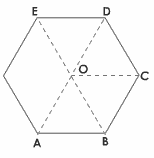
ABCDE is an “n” sided polygon. Take any point O inside the polygon. Join OA, OB, OC.
For “n” sided polygon, the polygon forms “n” triangles.
We know that the sum of the angles of a triangle is equal to 180 degrees
Therefore,
The sum of the angles of n triangles = n × 180°
From the above statement, we can say that
Sum of interior angles + Sum of the angles at O = 2n × 90° ——(1)
But, the sum of the angles at O = 360°
Substitute the above value in (1), we get
Sum of interior angles + 360°= 2n × 90°
So, the sum of the interior angles = (2n × 90°) – 360°
Take 90 as common, then it becomes
The sum of the interior angles = (2n – 4) × 90°
Therefore,
The sum of “n” interior angles is (2n – 4) × 90°
Hence,
When n= 5,
The sum of interior angles = ([2 × 5] – 4) × 90°
= (10 – 4) × 90°
= 6 × 90°
= 540°

Question 43.
PROVING A COROLLARY
Write a paragraph proof of the Corollary to the Polygon Interior Angles Theorem (Corollary 7. 1).
Answer:
Big Ideas Math Answer Key Geometry Chapter 7 Quadrilaterals and Other Polygons 7.1 a 43

Question 44.
MAKING AN ARGUMENT
Your friend claims that to find the interior angle measures of a regular polygon. you do not have to use the Polygon Interior Angles Theorem (Theorem 7. 1). You instead can use the Polygon Exterior Angles Theorem (Theorem 7.2) and then the Linear Pair Postulate (Postulate 2.8). Is your friend correct? Explain your reasoning.
Answer:
Yes, your friend is correct

Explanation:
It is given that your friend claims that to find the interior angle measures of a regular polygon. you do not have to use the Polygon Interior Angles Theorem. You instead can use the Polygon Exterior Angles Theorem and then the Linear Pair Postulate.
We know that
In a polygon,
The sum of the angle measures of exterior angles + The sum of the angle measures of interior angles = 180°
So,
The sum of the angle measures of interior angles = 180° – (The sum of the angle measures of exterior angles)
So,
From the above,
We know that
According to Linear Pair Postulate
The sum of the exterior angle and interior angle measures is: 180°
The angle measures of the exterior angles can be found out by using the “Polygon Exterior Angles Theorem”
Hence, from the above,
We can conclude that the claim of your friend is correct

Question 45.
MATHEMATICAL CONNECTIONS
In an equilateral hexagon. four of the exterior angles each have a measure of x°. The other two exterior angles each have a measure of twice the sum of x and 48. Find the measure of each exterior angle.
Answer:
Big Ideas Math Answer Key Geometry Chapter 7 Quadrilaterals and Other Polygons 7.1 a 45

Question 46.
THOUGHT-PROVOKING
For a concave polygon, is it true that at least one of the interior angle measures must be greater than 180°? If not, give an example. If so, explain your reasoning.
Answer:
We know that,
For a concave polygon,
The angle measure of at least one interior angle should be greater than 180°
Now,
The word “Concave” implies that at least 1 interior angle is folding in and so this “Folding in” should be greater than 180° to produce the required shape
Hence, from the above,
We can conclude that it is true that at least one of the interior angle measures must be greater than 180°

Question 47.
WRITING EXPRESSIONS
Write an expression to find the sum of the measures of the interior angles for a concave polygon. Explain your reasoning.
Big Ideas Math Geometry Answers Chapter 7 Quadrilaterals and Other Polygons 27
Answer:
Big Ideas Math Answer Key Geometry Chapter 7 Quadrilaterals and Other Polygons 7.1 a 47.1
Big Ideas Math Answer Key Geometry Chapter 7 Quadrilaterals and Other Polygons 7.1 a 47.2

Question 48.
ANALYZING RELATIONSHIPS
Polygon ABCDEFGH is a regular octagon. Suppose sides \(\overline{A B}\) and \(\overline{C D}\) are extended to meet at a point P. Find m∠BPC. Explain your reasoning. Include a diagram with your answer.
Answer:
It is given that polygon ABCDEFGH is a regular polygon and \(\overline{A B}\) and \(\overline{C D}\) are extended to meet at a point P.
So,
The representation of the regular octagon is:

We know that,
The angle measure of each exterior angle = \(\frac{360°}{n}\)
Where
n is the number of sides
It is given that a polygon is: Octagon
So,
The number of sides of the Octagon is: 8
So,
The angle measure of each exterior angle = \(\frac{360°}{8}\)
= 45°
We know that,
All the angles in the Octagon are equal
So,
From the given figure,
We can observe that ΔBPC is an Isosceles triangle
So,
From ΔBPC,
∠B = ∠C = 45°, ∠P = x°
We know that,
the sum of the angle measures of a given triangle is: 180°
So,
45° + x° + 45° = 180°
x° + 90° = 180°
x° = 180° – 90°
x° = 90°
Hence, from the above,
∠BPC = 90°

Question 49.
MULTIPLE REPRESENTATIONS
The formula for the measure of each interior angle in a regular polygon can be written in function notation.

a. Write a junction h(n). where n is the number of sides in a regular polygon and h(n) is the measure of any interior angle in the regular polygon.
b. Use the function to find h(9).
c. Use the function to find n when h(n) = 150°.
d. Plot the points for n = 3, 4, 5, 6, 7, and 8. What happens to the value of h(n) as n gets larger?
Answer:
Big Ideas Math Answer Key Geometry Chapter 7 Quadrilaterals and Other Polygons 7.1 a 49.1
Big Ideas Math Answer Key Geometry Chapter 7 Quadrilaterals and Other Polygons 7.1 a 49.2

Question 50.
HOW DO YOU SEE IT?
Is the hexagon a regular hexagon? Explain your reasoning.
Big Ideas Math Geometry Answers Chapter 7 Quadrilaterals and Other Polygons 28
Answer:

Question 51.
PROVING A THEOREM
Write a paragraph proof of the Polygon Exterior Angles Theorem (Theorem 7.2). (Hint: In a convex n-gon. the sum of the measures of an interior angle and an adjacent exterior angle at any vertex is 180°.)
Answer:
Big Ideas Math Answer Key Geometry Chapter 7 Quadrilaterals and Other Polygons 7.1 a 51

Question 52.
ABSTRACT REASONING
You are given a convex polygon. You are asked to draw a new polygon by increasing the sum of the interior angle measures by 540°. How many more sides does our new polygon have? Explain your reasoning.
Answer:
It is given that you are given a convex polygon and you are asked to draw a new polygon by increasing the sum of the interior angle measures by 540°
So,
We know that
The sum of the angle measures of the interior angles in a polygon = 180° (n – 2)
Let the number of sides of a new polygon be x
So,
180° (x – 2) + 540° = 180° (n – 2)
180x – 360° + 540° = 180n – 360°
180x – 180n = -540°
180 (x – n) = -540°
x – n = \(\frac{540}{180}\)
x – n = -3
n – x = 3
n = x + 3
Hence, from the above,
We can conclude that
We have to add 3 more sides to the original convex polygon

Maintaining Mathematical Proficiency

Find the value of x.

Question 53.
Big Ideas Math Geometry Answers Chapter 7 Quadrilaterals and Other Polygons 29
Answer:
Big Ideas Math Answer Key Geometry Chapter 7 Quadrilaterals and Other Polygons 7.1 a 53

Question 54.
Big Ideas Math Geometry Answers Chapter 7 Quadrilaterals and Other Polygons 30
Answer:
The given figure is:
Big Ideas Math Geometry Answers Chapter 7 Quadrilaterals and Other Polygons 30
From the given figure,
We can observe that
113° and x° are the corresponding angles
We know that,
According to the “Corresponding Angles Theorem”, the corresponding angles are congruent i.e., equal
So,
x° = 113°
Hence, from the above,
We can conclude that the value of x is: 113°

Question 55.
Big Ideas Math Geometry Answers Chapter 7 Quadrilaterals and Other Polygons 31
Answer:
Big Ideas Math Answer Key Geometry Chapter 7 Quadrilaterals and Other Polygons 7.1 a 55

Question 56.
Big Ideas Math Geometry Answers Chapter 7 Quadrilaterals and Other Polygons 32
Answer:
The given figure is:
Big Ideas Math Geometry Answers Chapter 7 Quadrilaterals and Other Polygons 32
From the given figure,
We can observe that
(3x + 10)° and (6x – 19)° are the corresponding angles
We know that,
According to the “Corresponding angles Theorem”, the corresponding angles are congruent i.e., equal
So,
(3x + 10)° = (6x – 19)°
6x – 3x = 19° + 10°
3x° = 29°
x° = \(\frac{29}{3}\)
x° = 9.6°
Hence, from the above,
We can conclude that the value of x is: 9.6°

7.2 Properties of Parallelograms

Exploration 1

Discovering Properties of Parallelograms

Work with a partner: Use dynamic geometry software.

a. Construct any parallelogram and label it ABCD. Explain your process.
Sample
Big Ideas Math Answers Geometry Chapter 7 Quadrilaterals and Other Polygons 34
Answer:
The representation of parallelogram ABCD is:

b. Find the angle measures of the parallelogram. What do you observe?
Answer:
The representation of parallelogram ABCD with the angles is:

Hence,
From the parallelogram ABCD,
We can observe that
∠A = 105°, ∠B = 75°, ∠D = 105°, and ∠C = 75°

c. Find the side lengths of the parallelogram. What do you observe?
Answer:
The representation of the parallelogram ABCD along with the side lengths is:

Hence,
From the parallelogram ABCD,
We can observe that
AB = CD = 5cm, and AC = BD = 2.8cm

d. Repeat parts (a)-(c) for several other parallelograms. Use your results to write conjectures about the angle measures and side lengths of a parallelogram.
Answer:
The representation of parallelogram ABCD along with its angles and the side lengths is:

Hence,
From the parallelogram ABCD,
We can conclude that
a. The opposite sides (i.e., AB and CD; AC and BD) are congruent i.e., equal
b. The opposite angles (i.e., A and C; B and D) are congruent i.e, equal

Exploration 2

Discovering a Property of Parallelograms

Work with a partner: Use dynamic geometry software.

a. Construct any parallelogram and label it ABCD.
Answer:
The representation of the parallelogram ABCD is:

b. Draw the two diagonals of the parallelogram. Label the point of intersection E.
Big Ideas Math Answers Geometry Chapter 7 Quadrilaterals and Other Polygons 35
Answer:
The representation of the parallelogram ABCD along with its diagonals is:

From the parallelogram ABCD,
We can observe that
The diagonals of parallelogram ABCD are: AC and BD
The intersection point of AC and BD is: E

c. Find the segment lengths AE, BE, CE, and DE. What do you observe?
Answer:
The representation of the parallelogram ABCD along the segment lengths is:

Hence,
From the parallelogram ABCD,
We can observe that
AE = DE = 1.9 cm
CE = BE = 2.7 cm

d. Repeat parts (a)-(c) for several other parallelograms. Use your results to write a conjecture about the diagonals of a parallelogram.
MAKING SENSE OF PROBLEMS
To be proficient in math, you need to analyze givens, constraints, relationships, and goals.
Answer:
The representation of the parallelogram ABCD along with the length of the diagonals is:

Hence, from the above,
We can conclude that
The diagonals bisect each other
The lengths of the diagonals are:
AD = 3.8 cm and BC = 5.4 cm

Communicate Your Answer

Question 3.
What are the properties of parallelograms?
Answer:
The properties of parallelograms are:
a. The opposite sides are parallel.
b. The opposite sides are congruent.
c. The opposite angles are congruent.
d. Consecutive angles are supplementary.
e. The diagonals bisect each other.

Lesson 7.2 Properties of Parallelograms

Monitoring progress

Question 1.
Find FG and m∠G.
Big Ideas Math Answers Geometry Chapter 7 Quadrilaterals and Other Polygons 36
Answer:
The given figure is:
Big Ideas Math Answers Geometry Chapter 7 Quadrilaterals and Other Polygons 36
It is given that
EH = 8 and ∠E = 60°
We know that,
In a parallelogram,
a. The opposite sides are congruent
b. The opposite angles are congruent
So,
From the given figure,
We can say that
FG = HE and GH = FE
∠G = ∠E and ∠H = ∠F
Hence, from the above,
We can conclude that
FG = 8 and ∠G = 60°

Question 2.
Find the values of x and y.
Big Ideas Math Answers Geometry Chapter 7 Quadrilaterals and Other Polygons 37
Answer:
The given figure is:
Big Ideas Math Answers Geometry Chapter 7 Quadrilaterals and Other Polygons 37
From the given parallelogram,
We can observe that
JK = 18 and LM = y + 3
∠J = 2x° and ∠L = 50°
We know that,
In a parallelogram,
a. The opposite sides are congruent
b. The opposite angles are congruent
So,
JK = LM and ∠J = ∠L
So,
y + 3 =18
y = 18 – 3
y = 15
2x° = 50°
x° = \(\frac{50}{2}\)
x° = 25°
Hence, from the above,
We can conclude that the values of x and y are: 25° and 15

Question 3.
WHAT IF?
In Example 2, find in m∠BCD when m∠ADC is twice the measure of ∠BCD.
Answer:
From Example 2,
It is given that ABCD is a parallelogram
In the parallelogram ABCD,
It is given that
∠ADC = 110°
We know that,
In a parallelogram,
The sum of the angle measure of the consecutive angles is supplementary
So,
From Example 2,
We can observe that
∠ADC + ∠BCD = 180°
So,
∠BCD = 180° – 110°
= 70°
Hence, from the above,
We can conclude that
∠BCD = 70°

Question 4.
Using the figure and the given statement in Example 3, prove that ∠C and ∠F are supplementary angles.
Answer:

Question 5.
Find the coordinates of the intersection of the diagonals of Big Ideas Math Answers Geometry Chapter 7 Quadrilaterals and Other Polygons 51STUV with vertices S(- 2, 3), T(1, 5), U(6, 3), and V(3, 1).
Answer:
The given coordinates of the parallelogram STUV are:
S (-2, 3), T (1, 5), U (6, 3), and V (3, 1)
Compare the given points with (x1, y1), (x2, y2)
We know that,
The opposite vertices form a diagonal
So,
In the parallelogram STUV,
SU and TV are the diagonals
So,
We know that,
The intersection of the diagonals means the midpoint of the vertices of the diagonals because diagonals bisect each other
So,
The midpoint of SU = (\(\frac{x1 + x2}{2}\), \(\frac{y1 + y2}{2}\))
= (\(\frac{6 – 2}{2}\), \(\frac{3 + 3}{2}\))
= (\(\frac{4}{2}\), \(\frac{6}{2}\))
= (2, 3)
Hence, from the above,
We can conclude that the coordinates of the intersection of the diagonals of parallelogram STUV is: (2, 3)

Question 6.
Three vertices of Big Ideas Math Answers Geometry Chapter 7 Quadrilaterals and Other Polygons 51ABCD are A(2, 4), B(5, 2), and C(3, – 1). Find the coordinates of vertex D.
Answer:
The given vertices of parallelogram ABCD are:
A (2, 4), B (5, 2), and C (3, -1)
Let the fourth vertex of the parallelogram ABCD be: (x, y)

We know that,
In a parallelogram,
The diagonals bisect each other i.e., the angle between the diagonals is 90°
So,
We can say that the diagonals are the perpendicular lines
So,
In the given parallelogram,
AC and BD are the diagonals
Now,
Slope of AC = \(\frac{y2 – y1}{x2 – x1}\)
= \(\frac{-1 – 4}{3 – 2}\)
= \(\frac{-5}{1}\)
= -5
Slope of BD = \(\frac{y2 – y1}{x2 – x1}\)
= \(\frac{y – 2}{x – 5}\)
We know that,
AC and BD are the perpendicular lines
SO,
The product of the slopes of the perpendicular lines is equal to -1
So,
(Slope of AC) × (Slope of BD) = -1
-5 × \(\frac{y – 2}{x – 5}\) = -1
\(\frac{y – 2}{x – 5}\) = \(\frac{1}{5}\)
Equate the numerator and denominator of both expreesions
We get,
y – 2 = 1                    x – 5 = 5
y = 1 + 2                   x = 5 + 5
y = 3                          x = 10
Hence, from the above,
We can conclude that the coordinates of the vertex D are: (10, 3)

Exercise 7.2 Properties of Parallelograms

Vocabulary and Core Concept Check

Question 1.
VOCABULARY
Why is a parallelogram always a quadrilateral, but a quadrilateral is only sometimes a parallelogram?
Answer:
Big Ideas Math Answers Geometry Chapter 7 Quadrilaterals and Other Polygons 7.2 a 1

Question 2.
WRITING
You are given one angle measure of a parallelogram. Explain how you can find the other angle measures of the parallelogram.
Answer:
The parallelogram is:

It is given that you have one angle measure of a polygon
Let the one angle measure of the given parallelogram be ∠A
We know that,
In a parallelogram,
The opposite angles are congruent i.e., equal
The consecutive angles have the sum 180°
So,
From the given figure,
We can say that
∠A = ∠C and ∠B = ∠D
Hence, from the above,
We can measure the other angles of the parallelogram by using the property of “The opposite angles are congruent”

Monitoring Progress and Modeling with Mathematics

In Exercises 3-6, find the value of each variable in the parallelogram.

Question 3.
Big Ideas Math Answers Geometry Chapter 7 Quadrilaterals and Other Polygons 38
Answer:
Big Ideas Math Answers Geometry Chapter 7 Quadrilaterals and Other Polygons 7.2 a 3

Question 4.
Big Ideas Math Answers Geometry Chapter 7 Quadrilaterals and Other Polygons 39
Answer:
The given figure is:
Big Ideas Math Answers Geometry Chapter 7 Quadrilaterals and Other Polygons 39
We know that,
According to the Parallelogram Opposite sides Theorem,
AB = CD and AD = BC
So,
From the given figure,
We can say that
n = 12          m + 1 = 6
n = 12          m = 6 – 1
n = 12          m = 5
Hence, from the above,
We can conclude that the values of m and n are: 5 and 12

Question 5.
Big Ideas Math Answers Geometry Chapter 7 Quadrilaterals and Other Polygons 40
Answer:
Big Ideas Math Answers Geometry Chapter 7 Quadrilaterals and Other Polygons 7.2 a 5

Question 6.
Big Ideas Math Answers Geometry Chapter 7 Quadrilaterals and Other Polygons 41
Answer:
The given figure is:
Big Ideas Math Answers Geometry Chapter 7 Quadrilaterals and Other Polygons 41

We know that,
According to the parallelogram Opposite sides Theorem,
AB = CD and AD = BC
According to the parallelogram Opposite Angles Theorem,
∠A = ∠C and ∠B = ∠D
Hence, from the figure,
(g + 4)° = 65°             16 – h = 7
g° = 65° – 4°                h = 16 – 7
g° = 61°                       h = 9
Hence, from he above,
We can conclude that the values of g and h are: 61° and 9

In Exercises 7 and 8. find the measure of the indicated angle in the parallelogram.

Question 7.
Find m∠B.
Answer:
Big Ideas Math Answers Geometry Chapter 7 Quadrilaterals and Other Polygons 7.2 a 7

Question 8.
Find m ∠ N.
Answer:
The given figure is:

We know that,
According to the parallelogram Consecutive angles Theorem,
The sum of the consecutive angle measures is equal to: 180°
So,
From the given figure,
∠M + ∠N = 180°
95° + ∠N = 180°
∠N = 180° – 95°
∠N = 85°
Hence, from the above,
We can conclude that the value of ∠N is: 85°

In Exercises 9-16. find the indicated measure in Big Ideas Math Answers Geometry Chapter 7 Quadrilaterals and Other Polygons 51LMNQ. Explain your reasoning.

Big Ideas Math Answers Geometry Chapter 7 Quadrilaterals and Other Polygons 42

Question 9.
LM
Answer:
Big Ideas Math Answers Geometry Chapter 7 Quadrilaterals and Other Polygons 7.2 a 9

Question 10.
LP
Answer:
The given figure is:
Big Ideas Math Answers Geometry Chapter 7 Quadrilaterals and Other Polygons 42
From the given figure,
We can observe that
LN = 7
We know that,
In the parallelogram,
The diagonals bisect each other. So, the length of each diagonal will be divided into half of the value of the diagonal length
So,
LN can be divided into LP and PN
So,
LP = \(\frac{LN}{2}\)
LP = \(\frac{7}{2}\)
LP = 3.5
Hence, from the above,
We can conclude that the value of LP is: 3.5

Question 11.
LQ
Answer:
Big Ideas Math Answers Geometry Chapter 7 Quadrilaterals and Other Polygons 7.2 a 11

Question 12.
MQ
Answer:
The given figure is:
Big Ideas Math Answers Geometry Chapter 7 Quadrilaterals and Other Polygons 42
Hence,
From the given figure,
We can observe that
MQ = 8.2
Hence, from the above,
We can conclude that the value of MQ is: 8.2

Question 13.
m∠LMN
Answer:
Big Ideas Math Answers Geometry Chapter 7 Quadrilaterals and Other Polygons 7.2 a 13

Question 14.
m∠NQL
Answer:
The given figure is:
Big Ideas Math Answers Geometry Chapter 7 Quadrilaterals and Other Polygons 42
We know that,
According to the parallelogram Consecutive angles Theorem,
The sum of the consecutive angle measures is: 180°
So,
From the figure,
∠L + ∠M = 180°
100° + ∠M = 180°
∠M = 180° – 100°
∠M = 80°
We know that,
According to the parallelogram Opposite angles Theorem,
The opposite angles are congruent i.e., equal
So,
From the figure,
∠M = ∠Q
So,
∠Q = 80°
Hence, from the above,
We can conclude that the value of ∠NQL is: 80°

Question 15.
m∠MNQ
Answer:
Big Ideas Math Answers Geometry Chapter 7 Quadrilaterals and Other Polygons 7.2 a 15

Question 16.
m∠LMQ
Answer:
The given figure is:
Big Ideas Math Answers Geometry Chapter 7 Quadrilaterals and Other Polygons 42
We know that,
According to the parallelogram Consecutive angles Theorem,
The sum of the consecutive angle measures is: 180°
So,
From the figure,
∠L + ∠M = 180°
100° + ∠M = 180°
∠M = 180° – 100°
∠M = 80°
Hence, from the above,
We can conclude that the value of ∠LMQ is: 80°

In Exercises 17-20. find the value of each variable in the parallelogram.

Question 17.
Big Ideas Math Answers Geometry Chapter 7 Quadrilaterals and Other Polygons 43
Answer:
Big Ideas Math Answers Geometry Chapter 7 Quadrilaterals and Other Polygons 7.2 a 17

Question 18.
Big Ideas Math Answers Geometry Chapter 7 Quadrilaterals and Other Polygons 44
Answer:
The given figure is:
Big Ideas Math Answers Geometry Chapter 7 Quadrilaterals and Other Polygons 44
We know that,
According to the parallelogram Opposite Angles Theorem,
∠A = ∠C and ∠B = ∠D
According to the parallelogram Consecutive angles Theorem,
∠A + ∠B = 180° and ∠C + ∠D = 180° and ∠A + ∠D = 180° and ∠B + ∠C = 180°
So,
From the given figure,
(b – 10)° + (b + 10)° = 180°
2b° = 180°
b° = \(\frac{180}{2}\)
b° = 90°
Hence, from the above,
We can conclude that the value of b is: 90°

Question 19.
Big Ideas Math Answers Geometry Chapter 7 Quadrilaterals and Other Polygons 45
Answer:
Big Ideas Math Answers Geometry Chapter 7 Quadrilaterals and Other Polygons 7.2 a 19

Question 20.
Big Ideas Math Answers Geometry Chapter 7 Quadrilaterals and Other Polygons 46
Answer:
The given figure is:
Big Ideas Math Answers Geometry Chapter 7 Quadrilaterals and Other Polygons 46
We know that,
In the parallelogram,
The diagonals bisect each other
So,
From the given figure,
We can say that
\(\frac{v}{3}\) = 6                       2u + 2 = 5u – 10
v = 6 (3)                                                     5u – 2u = 10 + 2
v = 18                                                        3u = 18
v = 18                                                         u = \(\frac{18}{3}\)
v = 18                                                          u = 6
Hence, from the above,
We can conclude that the values of u and v are: 6 and 18

ERROR ANALYSIS
In Exercises 21 and 22, describe and correct the error in using properties of parallelograms.

Question 21.
Big Ideas Math Answers Geometry Chapter 7 Quadrilaterals and Other Polygons 47
Answer:
Big Ideas Math Answers Geometry Chapter 7 Quadrilaterals and Other Polygons 7.2 a 21

Question 22.
Big Ideas Math Answers Geometry Chapter 7 Quadrilaterals and Other Polygons 48
Answer:
We know that,
According to the properties of the parallelogram,
GJ and HK are the diagonals of the parallelogram and F is the perpendicular bisector of the diagonals
So,
Snce F is the perpendicular bisector,
We know that,
GF = FJ and KF = FH
Hence, from the baove,
We can conclude that because quadrilateral GHJK is a parallelogram,
\(\overline{G F}\) = \(\overline{F J}\)

PROOF
In Exercises 23 and 24, write a two-column proof.

Question 23.
Given ABCD and CEFD are parallelograms.
Prove \(\overline{A B} \cong \overline{F E}\)
Big Ideas Math Answers Geometry Chapter 7 Quadrilaterals and Other Polygons 49
Answer:
Big Ideas Math Answers Geometry Chapter 7 Quadrilaterals and Other Polygons 7.2 a 23

Question 24.
Given ABCD, EBGF, and HJKD are parallelograms.
Prove ∠2 ≅∠3
Big Ideas Math Answers Geometry Chapter 7 Quadrilaterals and Other Polygons 50
Answer:
Given:
ABCD, EBGF, and HJKD are parallelograms
Prove:
∠2 ≅ ∠3

In Exercises 25 and 26, find the coordinates of the intersection of the diagonals of the parallelogram with the given vertices.

Question 25.
W(- 2, 5), X(2, 5), Y(4, 0), Z(0, 0)
Answer:
Big Ideas Math Answers Geometry Chapter 7 Quadrilaterals and Other Polygons 7.2 a 25

Question 26.
Q(- 1, 3), R(5, 2), S(1, – 2), T(- 5, – 1)
Answer:
The given coordinates of the parallelogram are:
Q (-1, 3), R (5, 2), S (1, -2), and T (-5, -1)
Compare the given coordinates with (x1, y1), and (x2, y2)
We know that,
By the parallelogram Diagonals Theorem, the diagonals of a parallelogram bisect each other
So,
From the given coordinates,
The diagonals of the parallelogram are: QS and RT
So,
The midpoint of QS = (\(\frac{x1 + x2}{2}\), \(\frac{y1 + y2}{2}\))
= (\(\frac{1 – 1}{2}\), \(\frac{3 – 2}{2}\))
= (0, \(\frac{1}{2}\))
The midpoint of RT = (\(\frac{x1 + x2}{2}\), \(\frac{y1 + y2}{2}\))
= (\(\frac{5 – 5}{2}\), \(\frac{2 – 1}{2}\))
= (0, \(\frac{1}{2}\))
Hence from the above,
We can conclude that the coordinates of the intersection of the diagonals of the given parallelogram are:
(0, \(\frac{1}{2}\))

In Exercises 27-30, three vertices of Big Ideas Math Answers Geometry Chapter 7 Quadrilaterals and Other Polygons 51DEFG are given. Find the coordinates of the remaining vertex.

Question 27.
D(0, 2), E(- 1, 5), G(4, 0)
Answer:
Big Ideas Math Answers Geometry Chapter 7 Quadrilaterals and Other Polygons 7.2 a 27

Question 28.
D(- 2, – 4), F(0, 7), G(1, 0)
Answer:
The given vertices of parallelogram are:
D (-2, -4), F (0, 7), and G (1, 0)
Let the fourth vertex of the parallelogram be: (x, y)
We know that,
In a parallelogram,
The diagonals bisect each other i.e., the angle between the diagonals is 90°
So,
We can say that the diagonals are the perpendicular lines
So,
In the given parallelogram,
DF and EG are the diagonals
Now,
Slope of DF = \(\frac{y2 – y1}{x2 – x1}\)
= \(\frac{7 + 4}{0 + 2}\)
= \(\frac{11}{2}\)
Slope of EG = \(\frac{y2 – y1}{x2 – x1}\)
= \(\frac{y – 0}{x – 1}\)
= \(\frac{y}{x – 1}\)
We know that,
DF and EG are the perpendicular lines
So,
The product of the slopes of the perpendicular lines is equal to -1
So,
(Slope of DF) × (Slope of EG) = -1
\(\frac{11}{2}\) × \(\frac{y}{x – 1}\) = -1
\(\frac{y}{x – 1}\) = –\(\frac{2}{11}\)
Equate the numerator and denominator of both expreesions
We get,
y = -2                        x – 1 = 11
y = -2                        x = 11 + 1
y = -2                        x = 12
Hence, from the above,
We can conclude that the coordinates of the fourth vertex are: (12, -2)

Question 29.
D(- 4, – 2), E(- 3, 1), F(3, 3)
Answer:
Big Ideas Math Answers Geometry Chapter 7 Quadrilaterals and Other Polygons 7.2 a 29

Question 30.
E (1, 4), f(5, 6), G(8, 0)
Answer:
The given vertices of a parallelogram are:
E (1, 4), F (5, 6), and G (8, 0)
Let the fourth vertex of the parallelogram be: (x, y)
We know that,
In a parallelogram,
The diagonals bisect each other i.e., the angle between the diagonals is 90°
So,
We can say that the diagonals are the perpendicular lines
So,
In the given parallelogram,
FH and EG are the diagonals
Now,
Slope of FH = \(\frac{y2 – y1}{x2 – x1}\)
= \(\frac{y – 6}{x – 5}\)
Slope of EG = \(\frac{y2 – y1}{x2 – x1}\)
= \(\frac{0 – 4}{8 – 1}\)
= \(\frac{-4}{7}\)
= –\(\frac{4}{7}\)
We know that,
FH and EG are the perpendicular lines
So,
The product of the slopes of the perpendicular lines is equal to -1
So,
(Slope of FH) × (Slope of EG) = -1
–\(\frac{4}{7}\) × \(\frac{y – 6}{x – 5}\) = -1
\(\frac{y – 6}{x – 4}\) = \(\frac{7}{4}\)
Equate the numerator and denominator of both expreesions
We get,
y – 6 = 7                    x – 4 = 4
y = 7 + 6                   x = 4 + 4
y = 13                        x = 8
Hence, from the above,
We can conclude that the coordinates of the fourth vertex are: (8, 13)

MATHEMATICAL CONNECTIONS
In Exercises 31 and 32. find the measure of each angle.

Question 31.
The measure of one interior angle of a parallelogram is 0.25 times the measure of another angle.
Answer:
Big Ideas Math Answers Geometry Chapter 7 Quadrilaterals and Other Polygons 7.2 a 31

Question 32.
The measure of one interior angle of a parallelogram is 50 degrees more than 4 times the measure of another angle.
Answer:
It is given that the measure of one interior angle of a parallelogram is 50 degrees more than 4 times the measure of another angle.
So,
The measure of one interior angle is: x°
The measure of another interior angle is: 50° + 4x°
We know that,
The opposite angles of the parallelogram are equal
The sum of the angles of the parallelogram is: 360°
So,
x° + 4x + 50° + x° + 4x + 50° = 360°
10x° + 100° = 360°
10x° = 360° – 100°
10x° = 260°
x° = \(\frac{260}{10}\)
x° = 26°
So,
The angle measures of the parallelogram are:
x° = 26°
4x° + 50° = 4 (26°) + 50°
= 104° + 50°
= 154°
Hence, from the above,
We can conclude that the angle measures are: 26° and 154°

Question 33.
MAKING AN ARGUMENT
In quadrilateral ABCD.
m∠B = 124°, m∠A = 56°, and m∠C = 124°.
Your friend claims quadrilateral ABCD could be a parallelogram. Is your friend correct? Explain your reasoning.
Answer:
Big Ideas Math Answers Geometry Chapter 7 Quadrilaterals and Other Polygons 7.2 a 33

Question 34.
ATTENDING TO PRECISION
∠J and ∠K are Consecutive angles in a parallelogram. m∠J = (3t + 7)°. and m∠K = (5t – 11)°. Find the measure of each angle.
Answer:
It is given that ∠J and ∠K are the consecutive angles in a parallelogram
So,
∠J + ∠K = 180°
Now,
It is given that
∠J = (3t + 7)° and ∠K = (5t – 11)°
So,
(3t + 7)° + (5t – 11)° = 180°
8t° – 4 = 180°
8t° = 180° + 4°
8t° = 184°
t° = \(\frac{184}{8}\)
t° = 23°
So,
∠J = (3t + 7)°
= 3 (23)° + 7
= 69° + 7°
= 76°
∠K = (5t – 11)°
= 5 (23)° – 11
= 115° – 11°
= 104°
Hence, from the above,
We can conclude that the measure of each angle is: 76° and 104°

Question 35.
CONSTRUCTION
Construct any parallelogram and label it ABCD. Draw diagonals \(\overline{A C}\) and \(\overline{B D}\). Explain how to use paper folding to verify the Parallelogram Diagonals Theorem (Theorem 7.6) for Big Ideas Math Answers Geometry Chapter 7 Quadrilaterals and Other Polygons 51ABCD.
Answer:
Big Ideas Math Answers Geometry Chapter 7 Quadrilaterals and Other Polygons 7.2 a 35

Question 36.
MODELING WITH MATHEMATICS
The feathers on an arrow from two congruent parallelograms. The parallelograms are reflections of each other over the line that contains their shared side. Show that m ∠ 2 = 2m ∠ 1.
Big Ideas Math Answers Geometry Chapter 7 Quadrilaterals and Other Polygons 52
Answer:

Question 37.
PROVING A THEOREM
Use the diagram to write a two-column proof of the Parallelogram Opposite Angles Theorem (Theorem 7.4).
Big Ideas Math Answers Geometry Chapter 7 Quadrilaterals and Other Polygons 53
Given ABCD is a parallelogram.
Prove ∠A ≅ ∠C, ∠B ≅ ∠D
Answer:
Big Ideas Math Answers Geometry Chapter 7 Quadrilaterals and Other Polygons 7.2 a 37.1
Big Ideas Math Answers Geometry Chapter 7 Quadrilaterals and Other Polygons 7.2 a 37.2

Question 38.
PROVING A THEOREM
Use the diagram to write a two-column proof of the Parallelogram Consecutive Angles Theorem (Theorem 7.5).
Big Ideas Math Answers Geometry Chapter 7 Quadrilaterals and Other Polygons 54
Given PQRS is a parallelogram.
Prove x° + y° = 180°
Answer:
Given:
PQRS is a parallelogram
Prove:
x° + y° = 180°

Question 39.
PROBLEM-SOLVING
The sides of Big Ideas Math Answers Geometry Chapter 7 Quadrilaterals and Other Polygons 51MNPQ are represented by the expressions below. Sketch Big Ideas Math Answers Geometry Chapter 7 Quadrilaterals and Other Polygons 51MNPQ and find its perimeter.
MQ = – 2x + 37 QP = y + 14
NP= x – 5 MN = 4y + 5
Answer:
Big Ideas Math Answers Geometry Chapter 7 Quadrilaterals and Other Polygons 7.2 a 39

Question 40.
PROBLEM SOLVING
In Big Ideas Math Answers Geometry Chapter 7 Quadrilaterals and Other Polygons 51LMNP, the ratio of LM to MN is 4 : 3. Find LM when the perimeter of Big Ideas Math Answers Geometry Chapter 7 Quadrilaterals and Other Polygons 51LMNP is 28.
Answer:
It is given that
In the parallelogram LMNP,
The ratio of LM to MN is: 4 : 3
It is also given that
The perimeter of the parallelogram LMNP is: 28
So,
Let the length of LM be 4x
Let the length of MN be 3x
We know that,
The opposite sides of the parallelogram are equal
The perimeter is the sum of all the sides
So,
4x + 3x + 4x + 3x = 28
8x + 6x = 28
14x = 28
x = \(\frac{28}{14}\)
x = 2
So,
The length of LM = 4 x
= 4 (2)
= 8
Hence, from the above,
We can conclude that the length of LM is: 8

Question 41.
ABSTRACT REASONING
Can you prove that two parallelograms are congruent by proving that all their corresponding sides are congruent? Explain your reasoning.
Answer:
Big Ideas Math Answers Geometry Chapter 7 Quadrilaterals and Other Polygons 7.2 a 41

Question 42.
HOW DO YOU SEE IT?
The mirror shown is attached to the wall by an arm that can extend away from the wall. In the figure. points P, Q, R, and S are the vertices of a parallelogram. This parallelogram is one of several that change shape as the mirror is extended.
Big Ideas Math Answers Geometry Chapter 7 Quadrilaterals and Other Polygons 55
a. What happens to m∠P as m∠Q increases? Explain.
Answer:
From the given figure,
We can observe that
∠P and ∠Q are the consecutive angles
So,
∠P + ∠Q = 180°
Now,
To make the sum 180°, if one angle measure increases, then the other angle measure has to decrease
Hence, from the above,
We can conclude that when ∠Q increases, ∠P has to decrease

b. What happens to QS as m∠Q decreases? Explain.
Answer:
From the given figure,
QS is a diagonal of the parallelogram
Q and S are the opposite angles
We know that,
The opposite angles are equal
So,
As ∠Q decreases, the length of QS may also decrease or may also increase

c. What happens to the overall distance between the mirror and the wall when m∠Q decreases? Explain.
Answer:
From the given figure,
We can observe that,
As the angle between Q and the wall increases,
The overall distance between the mirror and the wall increase

Question 43.
MATHEMATICAL CONNECTIONS
In Big Ideas Math Answers Geometry Chapter 7 Quadrilaterals and Other Polygons 51STUV m∠TSU = 32°, m∠USV = (x2)°, m∠TUV = 12x°, and ∠TUV is an acute angle. Find m∠USV.
Big Ideas Math Answers Geometry Chapter 7 Quadrilaterals and Other Polygons 56
Answer:
Big Ideas Math Answers Geometry Chapter 7 Quadrilaterals and Other Polygons 7.2 a 43

Question 44.
THOUGHT-PROVOKING
Is it possible that any triangle can be partitioned into four congruent triangles that can be rearranged to form a parallelogram? Explain your reasoning.
Answer:
Yes, it is possible that any triangle can be partitioned into four congruent triangles that can be rearranged to form a parallelogram

Explanation:
We know that,
In any quadrilateral,
The diagonals bisect each other and the angles may or may not be 90° in the diagonals
So,
After the bisecting with the diagonals in a quadrilateral,
We can observe that the quadrilateral is divided into four triangles
Hence, from the above,
We can conclude that it is possible that any triangle can be partitioned into four congruent triangles that can be rearranged to form a parallelogram

Question 45.
CRITICAL THINKING
Points W(1. 2), X(3, 6), and Y(6, 4) are three vertices of a parallelogram. How many parallelograms can be created using these three vertices? Find the coordinates of each point that could be the fourth vertex.
Answer:
Big Ideas Math Answers Geometry Chapter 7 Quadrilaterals and Other Polygons 7.2 a 45.1
Big Ideas Math Answers Geometry Chapter 7 Quadrilaterals and Other Polygons 7.2 a 45.2

Question 46.
PROOF
In the diagram. \(\overline{E K}\) bisects ∠FEH, and \(\overline{F J}\) bisects ∠EFG. Prove that \(\overline{E K}\) ⊥ \(\overline{F J}\). (Hint: Write equations using the angle measures of the triangles and quadrilaterals formed.)
Big Ideas Math Answers Geometry Chapter 7 Quadrilaterals and Other Polygons 57
Answer:

Question 47.
PROOF
Prove the congruent Parts of Parallel Lines Corollary: If three or more parallel lines cut off congruent segments on one transversal, then they cut off congruent segments on every transversal.
Big Ideas Math Answers Geometry Chapter 7 Quadrilaterals and Other Polygons 58
Given Big Ideas Math Answers Geometry Chapter 7 Quadrilaterals and Other Polygons 59
Prove \(\overline{H K}\) ≅ \(\overline{K M}\)
(Hint: Draw \(\overline{K P}\) and \(\overline{M Q}\) such that quadrilatcral GPKJ and quadrilateral JQML are parallelorams.)
Answer:
Big Ideas Math Answers Geometry Chapter 7 Quadrilaterals and Other Polygons 7.2 a 47.1
Big Ideas Math Answers Geometry Chapter 7 Quadrilaterals and Other Polygons 7.2 a 47.2

Maintaining Mathematical Proficiency

Determine whether lines l and m are parallel. Explain your reasoning.

Question 48.
Big Ideas Math Answers Geometry Chapter 7 Quadrilaterals and Other Polygons 60
Answer:
The given figure is:
Big Ideas Math Answers Geometry Chapter 7 Quadrilaterals and Other Polygons 60
From the given figure,
We can observe that the given angles are the corresponding angles i.e., an interior angle and an exterior angle
Hence,
According to the Corresponding Angles Theorem,
We can conclude that l and m are parallel lines

Question 49.
Big Ideas Math Answers Geometry Chapter 7 Quadrilaterals and Other Polygons 61
Answer:
Big Ideas Math Answers Geometry Chapter 7 Quadrilaterals and Other Polygons 7.2 a 49

Question 50.
Big Ideas Math Answers Geometry Chapter 7 Quadrilaterals and Other Polygons 62
Answer:
The given figure is:
Big Ideas Math Answers Geometry Chapter 7 Quadrilaterals and Other Polygons 62
From the given figure,
We can observe that the given angles are the consecutive interior angles
We know that,
The sum of the angle measures of the consecutive interior angles is: 180°
But, from the given figure,
The sum of the angle measures is not 180°
Hence, from the above,
We can conclude that l is not parallel to m

7.3 Proving That a Quadrilateral is a Parallelogram

Exploration 1

Proving That a Quadrilateral is a Parallelogram

Work with a partner: Use dynamic geometry software.
Big Ideas Math Geometry Answer Key Chapter 7 Quadrilaterals and Other Polygons 63
a. Construct a quadrilateral ABCD whose opposite sides are congruent.
Answer:

b. Is the quadrilateral a parallelogram? Justify your answer.
Answer:
We know that,
If a quadrilateral which has opposite sides congruent and each angle measure not equal to 90° and the diagonals bisected each other, then that quadrilateral is called the “Parallelogram”
Hence,
The representation of the quadrilateral ABCD as a parallelogram is:

c. Repeat parts (a) and (b) for several other quadrilaterals. Then write a conjecture based on your results.
Answer:

From the above quadrilateral,
The conjecture about the quadrilaterals is:
If the opposite sides of a quadrilateral are equal, then the opposite angles of a quadrilateral are equal

d. Write the converse of your conjecture. Is the Converse true? Explain.

REASONING ABSTRACTLY
To be proficient in math, you need to know and flexibly use different properties of objects.
Answer:
From part (c),
The conjecture about quadrilaterals is:
If the opposite sides of a quadrilateral are equal, then the opposite angles of a quadrilateral are equal
The converse of your conjecture is:
If the opposite angles of a quadrilateral are equal, then the opposite sides of a quadrilateral are equal
Now,
From the below figure,

We can observe that
When ∠B and ∠D are 90°,
AD = BC = 2.9
Hence, from the above,
We can conclude that the converse of the conjecture from part (c) is true

Exploration 2

Proving That a Quadrilateral Is a Parallelogram

Work with a partner: Use dynamic geometry software.

a. Construct any quadrilateral ABCD whose opposite angles are congruent.
Answer:

b. Is the quadrilateral a parallelogram? Justify your answer.
Big Ideas Math Geometry Answer Key Chapter 7 Quadrilaterals and Other Polygons 64
Answer:

We know that,
For a quadrilateral to be a parallelogram,
The opposite sides are equal and the opposite angles are equal
Hence, from the above figure,
We can conclude that the given quadrilateral ABCD is a parallelogram

c. Repeat parts (a) and (b) for several other quadrilaterals. Then write a conjecture based on your results.
Answer:
From parts (a) and (b),
The conjecture about the quadrilaterals is given as:
If the opposite angles of a quadrilateral are equal, then the opposite sides of a quadrilateral are equal

d. Write the converse of your conjecture. Is the converse true? Explain.
Answer:
From part (c),
The conjecture about quadrilaterals is given as:
If the opposite angles of a quadrilateral are equal, then the opposite sides of a quadrilateral are equal
Hence,
The converse of the conjecture of the quadrilaterals is given as:
If the opposite sides of a quadrilateral are equal, then the opposite angles of a quadrilateral are equal

Communicate Your Answer

Big Ideas Math Geometry Answer Key Chapter 7 Quadrilaterals and Other Polygons 65

Question 3.
How can you prove that a quadrilateral is a parallelogram?
Answer:
The number of ways to prove that a quadrilateral is a parallelogram are:
a. The opposite sides are congruent
b. The opposite angles are congruent
c. The opposite sides are parallel
d. The consecutive angles are supplementary
e. An angle is supplementary to both its consecutive angles

Question 4.
Is the quadrilateral at the left a parallelogram? Explain your reasoning
Answer:
From the given figure,
We can observe that the opposite angles are equal
So,
From the conjecture of the quadrilateral,
If the opposite angles of the quadrilateral are equal, then the opposite sides of the quadrilateral are equal
We know that,
if the opposite angles are equal and the angles are not 90°, then the quadrilateral is called the “parallelogram”
Hence, from the above,
We can conclude that the quadrilateral ate the left is the “Parallelogram”

Lesson 7.3 Proving that a Quadrilateral is a Parallelogram

Monitoring Progress

Question 1.
In quadrilateral WXYZ, m∠W = 42°, m∠X = 138°, and m∠Y = 42°. Find m∠Z. Is WXYZ a parallelogram’? Explain your reasoning.
Answer:
It is given that
In quadrilateral WXYZ,
∠W = 42°, ∠X = 138°, and ∠Y = 42°
Let
∠Z = x°
We know that,
The sum of the angles of a quadrilateral is 360°
So,
∠W + ∠X + ∠Y + ∠Z = 360°
42° + 138° + 42° + x° = 360°
84° + 138° + x° = 360°
x° = 360° – 222°
x° = 138°
So,
∠Z = 138°
Now,
We know that,
If the opposite angles of a quadrilateral are equal and the angle is not equal to 90°, then that quadrilateral is called the “Parallelogram”
Hence, from the above,
We can conclude that WXYZ is a parallelogram

Question 2.
For what values of x and y is quadrilateral ABCD a parallelogram? Explain your reasoning.
Big Ideas Math Geometry Answer Key Chapter 7 Quadrilaterals and Other Polygons 66
Answer:
The given figure is:
Big Ideas Math Geometry Answer Key Chapter 7 Quadrilaterals and Other Polygons 66
We know that,
For a quadrilateral to be a parallelogram,
The opposite angles are equal
So,
From the given figure,
4y° = (y + 87)°                                    2x° = (3x – 32)°
4y° – y° = 87°                                      3x° – 2x° = 32°
3y° = 87°                                              x° = 32°
y° = 87 / 3                                            x° = 32°
y° = 29°                                                x° = 32°
Hence, from the above,
We can conclude that for
x° = 32° and y° = 29°
The quadrilateral ABCD is a parallelogram

State the theorem you can use to show that the quadrilateral is a parallelogram.

Question 3.
Big Ideas Math Geometry Answer Key Chapter 7 Quadrilaterals and Other Polygons 67
Answer:
The given figure is:
Big Ideas Math Geometry Answer Key Chapter 7 Quadrilaterals and Other Polygons 67
From the given figure,
We can observe that the opposite sides are equal and are parallel
Hence,
According to the “Opposite sides parallel and congruent Theorem”,
The given quadrilateral is a parallelogram

Question 4.
Big Ideas Math Geometry Answer Key Chapter 7 Quadrilaterals and Other Polygons 68
Answer:
The given figure is:
Big Ideas Math Geometry Answer Key Chapter 7 Quadrilaterals and Other Polygons 68
From the given figure,
We can observe that the opposite sides are congruent and are parallel
Hence,
According to the “Opposite sides parallel and congruent Theorem”,
The given quadrilateral is a parallelogram

Question 5.
Big Ideas Math Geometry Answer Key Chapter 7 Quadrilaterals and Other Polygons 69
Answer:
The given figure is:
Big Ideas Math Geometry Answer Key Chapter 7 Quadrilaterals and Other Polygons 69
From the given figure,
We can observe that the opposite angles are equal and are parallel
Hence,
According to the “Opposite angles parallel and congruent Theorem”,
The given quadrilateral is a parallelogram

Question 6.
For what value of x is quadrilateral MNPQ a parallelogram? Explain your reasoning.
Big Ideas Math Geometry Answer Key Chapter 7 Quadrilaterals and Other Polygons 70
Answer:
The given figure is:
Big Ideas Math Geometry Answer Key Chapter 7 Quadrilaterals and Other Polygons 70
From the “Parallelogram Diagonals Converse Theorem”,
MP and NQ bisect each other
So,
MP = NQ
From the given figure,
It is given that
MP = 10 – 3x
NQ = 2x
So,
2x = 10 – 3x
2x + 3x = 10
5x = 10
x = \(\frac{10}{5}\)
x = 2
Hence, from the above,
We can conclude that for x = 2, the quadrilateral MNPQ is a parallelogram

Question 7.
Show that quadrilateral JKLM is a parallelogram.
Big Ideas Math Geometry Answer Key Chapter 7 Quadrilaterals and Other Polygons 71
Answer:
From the given coordinate plane,
The coordinates of the quadrilateral JKLM are:
J (-5, 3), K (-3, -1), L (2, -3), and M (2, -3)
Now,
For the quadrilateral JKLM to be a parallelogram,
The opposite sides of the quadrilateral JKLM must be equal
So,
JL = KM
We know that,
The distance between the 2 points = \(\sqrt{(x2 – x1)² + (y2 – y1)²}\)
So,
JL = \(\sqrt{(5 + 2)² + (3 + 3)²}\)
= \(\sqrt{(7)² + (6)²}\)
= \(\sqrt{49 + 36}\)
= \(\sqrt{85}\)
= 9.21
KM = \(\sqrt{(5 + 2)² + (3 + 3)²}\)
= \(\sqrt{(7)² + (6)²}\)
= \(\sqrt{49 + 36}\)
= \(\sqrt{85}\)
= 9.21
Hence, from the above,
We can conclude that
The quadrilateral JKLM is a parallelogram according to the “Opposite sides parallel and congruent Theorem”

Question 8.
Refer to the Concept Summary. Explain two other methods you can use to show that quadrilateral ABCD in Example 5 is a parallelogram.
Concept Summary
Ways to Prove a Quadrilateral is a Parallelogram
Big Ideas Math Geometry Answer Key Chapter 7 Quadrilaterals and Other Polygons 72
Answer:
The other ways to prove a quadrilateral parallelogram are:
a. Prove that the sum of the consecutive angles is supplementary
b. Prove that an angle is supplementary to both the consecutive angles

Exercise 7.3 Proving that a Quadrilateral is a Parallelogram

Vocabulary and Core Concept Check

Question 1.
WRITING
A quadrilateral has four congruent sides. Is the quadrilateral a parallelogram? Justify your answer.
Answer:
Big Ideas Math Geometry Answer Key Chapter 7 Quadrilaterals and Other Polygons 7.3 a 1

Question 2.
DIFFERENT WORDS, SAME QUESTION
Which is different? Find “both” answers.

Construct a quadrilateral with opposite sides congruent.Construct a quadrilateral with one pair of parallel sides.
Construct a quadrilateral with opposite angles congruent,Construct a quadrilateral with one pair of opposite sides congruent and parallel.

Answer:
The given statements are:
a. Construct a quadrilateral with opposite sides congruent
b. Construct a quadrilateral with opposite angles congruent
c. Construct a quadrilateral with one pair of parallel sides
d. Construct a quadrilateral with one pair of opposite sides congruent and parallel
Now,
We know that,
For constructing a parallelogram,
We need
a. 2 pairs of opposite sides congruent and parallel
b. 2 pairs of opposite angles congruent and parallel
Now,
From the given sattements,
Statements a., b., and d are needed for onstructing a parallelogram whereas statement c. is unnecessary

Monitoring Progress and Modeling with Mathematics

In Exercises 3-8, state which theorem you can use to show that the quadrilateral is a parallelogram.

Question 3.
Big Ideas Math Geometry Answer Key Chapter 7 Quadrilaterals and Other Polygons 73
Answer:
Big Ideas Math Geometry Answer Key Chapter 7 Quadrilaterals and Other Polygons 7.3 a 3

Question 4.
Big Ideas Math Geometry Answer Key Chapter 7 Quadrilaterals and Other Polygons 74
Answer:
The given figure is:
Big Ideas Math Geometry Answer Key Chapter 7 Quadrilaterals and Other Polygons 74
From the given figure,
We can observe that the opposite sides are congruent and parallel
Hence,
By using the “Parallelogram Opposite sides Congruent and Parallel Theorem”,
We can say that the given quadrilateral is a parallelogram

Question 5.
Big Ideas Math Geometry Answer Key Chapter 7 Quadrilaterals and Other Polygons 75
Answer:
Big Ideas Math Geometry Answer Key Chapter 7 Quadrilaterals and Other Polygons 7.3 a 5

Question 6.
Big Ideas Math Geometry Answer Key Chapter 7 Quadrilaterals and Other Polygons 76
Answer:
The given figure is:
Big Ideas Math Geometry Answer Key Chapter 7 Quadrilaterals and Other Polygons 76
From the given figure,
We can observe that the opposite sides are congruent and parallel
Hence,
By using the “Parallelogram Opposite sides Congruent and Parallel Theorem”,
We can say that the given quadrilateral is a parallelogram

Question 7.
Big Ideas Math Geometry Answer Key Chapter 7 Quadrilaterals and Other Polygons 77
Answer:
Big Ideas Math Geometry Answer Key Chapter 7 Quadrilaterals and Other Polygons 7.3 a 7

Question 8.
Big Ideas Math Geometry Answer Key Chapter 7 Quadrilaterals and Other Polygons 78
Answer:
The given figure is:
Big Ideas Math Geometry Answer Key Chapter 7 Quadrilaterals and Other Polygons 78
From the given figure,
We can observe that the diagonals of the quadrilateral bisected each other
Hence,
By using the “Parallelogram Diagonals Converse Theorem”,
We can say that the given quadrilateral is a parallelogram

In Exercises 9-12, find the values of x and y that make the quadrilateral a parallelogram.

Question 9.
Big Ideas Math Geometry Answer Key Chapter 7 Quadrilaterals and Other Polygons 79
Answer:
Big Ideas Math Geometry Answer Key Chapter 7 Quadrilaterals and Other Polygons 7.3 a 9

Question 10.
Big Ideas Math Geometry Answer Key Chapter 7 Quadrilaterals and Other Polygons 80
Answer:
The given figure is:
Big Ideas Math Geometry Answer Key Chapter 7 Quadrilaterals and Other Polygons 80
It is given that the given quadrilateral is a parallelogram
So,
We know that,
According to the “Parallelogram Opposite sides congruent and parallel Theorem”,
The lengths of the opposite sides of the given quadrilateral are equal
So,
x = 16 and y = 9
Hence, from the above,
We can conclude that for the given quadrilateral to be a parallelogram,
The alues of x and y are:
x = 16 and y = 9

Question 11.
Big Ideas Math Geometry Answer Key Chapter 7 Quadrilaterals and Other Polygons 81
Answer:
Big Ideas Math Geometry Answer Key Chapter 7 Quadrilaterals and Other Polygons 7.3 a 11

Question 12.
Big Ideas Math Geometry Answer Key Chapter 7 Quadrilaterals and Other Polygons 82
Answer:
The given figure is:
Big Ideas Math Geometry Answer Key Chapter 7 Quadrilaterals and Other Polygons 82
It is given that the given quadrilateral is a parallelogram
Now,
We know that,
According to the “Opposite angles Theorem”,
The opposite angles of the parallelogram are equal
So,
(4x + 13)° = (5x – 12)°
4x° – 5x° = -12° – 13°
x° = -25°
x° = 25°
(3x – 8)° = (4y + 7)°
3x – 8 – 7 = 4y°
4y° = 3 (25°)  15
4y° = 75 – 15
4y° = 60°
y° = \(\frac{60}{4}\)
y° = 15°
Hence, from the above,
We can conclude that for a given quadrilateral to be a parallelogram,
The values of x and y are:
x = 25° and y = 15°

In Exercises 13-16, find the value of x that makes the quadrilateral a parallelogram.

Question 13.
Big Ideas Math Geometry Answer Key Chapter 7 Quadrilaterals and Other Polygons 83
Answer:
Big Ideas Math Geometry Answer Key Chapter 7 Quadrilaterals and Other Polygons 7.3 a 13

Question 14.
Big Ideas Math Geometry Answer Key Chapter 7 Quadrilaterals and Other Polygons 84
Answer:
The given figure is:
Big Ideas Math Geometry Answer Key Chapter 7 Quadrilaterals and Other Polygons 84
It is given that the given quadrilateral is a parallelogram
Now,
We know that,
According to the “Parallelogram Opposite angles parallel and congruent Theorem”,
The lengths of the opposite sides of the parallelogram are equal
So,
2x + 3 = x + 7
2x – x = 7 – 3
x = 4
Hence, from the above,
We can conclude that for a given quadrilateral to be a parallelogram,
The value of x is:
x = 4

Question 15.
Big Ideas Math Geometry Answer Key Chapter 7 Quadrilaterals and Other Polygons 85
Answer:
Big Ideas Math Geometry Answer Key Chapter 7 Quadrilaterals and Other Polygons 7.3 a 15

Question 16.
Big Ideas Math Geometry Answer Key Chapter 7 Quadrilaterals and Other Polygons 86
Answer:
The given figure is:
Big Ideas Math Geometry Answer Key Chapter 7 Quadrilaterals and Other Polygons 86
It is given that the given quadrilateral is a parallelogram
Now,
We know that,
According to the “Parallelogram Diagonals Converse Theorem”,
The diagonals bisect each other
So,
6x = 3x + 2
6x – 3x = 2
3x = 2
x = \(\frac{2}{3}\)
Hence, from the above,
We can conclude that for a given quadrilateral to be a parallelogram,
The value of x is:
x = \(\frac{2}{3}\)

In Exercises 17-20, graph the quadrilateral with the given vertices in a coordinate plane. Then show that the quadrilateral is a parallelogram.

Question 17.
A(0, 1), B(4, 4), C(12, 4), D(8, 1)
Answer:
Big Ideas Math Geometry Answer Key Chapter 7 Quadrilaterals and Other Polygons 7.3 a 17

Question 18.
E(- 3, 0), F(- 3, 4), G(3, – 1), H(3, – 5)
Answer:
The given vertices of the quadrilateral are:
E (-3, 0), F (-3, 4), G (3, -1), and H (3, -5)
So,
The representation of the vertices of a quadrilateral in the coordinate plane is:

Now,
We know that,
For a quadrilateral to be a parallelogram,
The length of the opposite sides of a parallelogram are congruent and parallel
We know that,
The distance between 2 points = \(\sqrt{(x2 – x1)² + (y2 – y1)²}\)
So,
EF = \(\sqrt{(4 + 0)² + (3 – 3)²}\)
= \(\sqrt{(4)² + (0)²}\)
= \(\sqrt{16 + 0}\)
= 4

GH = \(\sqrt{(5 – 1)² + (3 – 3)²}\)
= \(\sqrt{(4)² + (0)²}\)
= 4
Hence,
According to the “Parallelogram opposite sides parallel and congruent Theorem”,
We can conclude that the quadrilateral with the given vertices is a parallelogram

Question 19.
J(- 2, 3), K(- 5, 7), L(3, 6), M(6, 2)
Answer:
Big Ideas Math Geometry Answer Key Chapter 7 Quadrilaterals and Other Polygons 7.3 a 19

Question 20.
N(- 5, 0), P(0, 4), Q(3, 0), R(- 2, – 4)
Answer:
The given vertices of the quadrilateral are:
N (-5, 0), P (0, 4), Q (3, 0), R (-2, -4)
So,
The representation of the vertices of the quadrilateral in the coordinate plane is:

Now,
We know that,
The distance between 2 points = \(\sqrt{(x2 – x1)² + (y2 – y1)²}\)
So,
NP = \(\sqrt{(4 – 0)² + (0 + 5)²}\)
= \(\sqrt{(4)² + (5)²}\)
= \(\sqrt{16 + 25}\)
= 6.40

QR = \(\sqrt{(4 + 0)² + (3 + 2)²}\)
= \(\sqrt{(4)² + (5)²}\)
= \(\sqrt{16 + 25}\)
= 6.40
Hence,
According to the “Parallelograms Opposite sides parallel and congruent Theorem”,
We can conclude that the quadrilateral with the given vertices is a parallelogram

ERROR ANALYSIS
In Exercises 21 and 22, describe and correct the error in identifying a parallelogram.

Question 21.
Big Ideas Math Geometry Answer Key Chapter 7 Quadrilaterals and Other Polygons 87
Answer:
Big Ideas Math Geometry Answer Key Chapter 7 Quadrilaterals and Other Polygons 7.3 a 21

Question 22.
Big Ideas Math Geometry Answer Key Chapter 7 Quadrilaterals and Other Polygons 88
Answer:
In the given quadrilateral JKLM,
The lengths of the 2 sides are given and the given 2 lengths are congruent and are parallel to each other
Hence,
The quadrilateral JKLM is said to be a parallelogram by the “Parallelogram Opposite sides parallel and congruent Theorem”

Question 23.
MATHEMATICAL CONNECTIONS
What value of x makes the quadrilateral a parallelogram? Explain how you found your answer.
Big Ideas Math Geometry Answer Key Chapter 7 Quadrilaterals and Other Polygons 89
Answer:
Big Ideas Math Geometry Answer Key Chapter 7 Quadrilaterals and Other Polygons 7.3 a 23

Question 24.
MAKING AN ARGUMENT
Your friend says you can show that quadrilateral WXYZ is a parallelogram by using the Consecutive Interior Angles Converse (Theorem 3.8) and the Opposite Sides Parallel and Congruent Theorem (Theorem 7.9). Is your friend correct? Explain your reasoning.
Big Ideas Math Geometry Answer Key Chapter 7 Quadrilaterals and Other Polygons 90
Answer:
Yes, your friend is correct

Explanation:
The given figure is:
Big Ideas Math Geometry Answer Key Chapter 7 Quadrilaterals and Other Polygons 90
From the given figure,
We can observe that the given angles are the consecutive angles and the sum of the angles are supplementary
We know that,
For the quadrilateral WXYZ to be a parallelogram, any one of the be low condition has to be satisfied:
a. The opposite sides are congruent
b. The sum of the consecutive interior angles are supplementary
So,
From the given figure,
We can observe that the sum of the consecutive interior angles is supplementary
Now,
Your friend says you can show that quadrilateral WXYZ is a parallelogram by using the Consecutive Interior Angles Converse and the Opposite Sides Parallel and Congruent Theorem.
Hence, from the above,
We can conclude that your friend is correct

ANALYZING RELATIONSHIPS
In Exercises 25-27, write the indicated theorems as a biconditional statement.

Question 25.
Parallelogram Opposite Sides Theorem (Theorem 7.3) and Parallelogram Opposite Sides Converse (Theorem 7.7)
Answer:
Big Ideas Math Geometry Answer Key Chapter 7 Quadrilaterals and Other Polygons 7.3 a 25

Question 26.
Parallelogram Opposite Angles Theorem (Theorem 7.4) and Parallelogram Opposite Angles Converse (Theorem 7.8)
Answer:
The given Theorems are:
Parallelograms Opposite angles Theorem and Parallelogram Opposite Angles Converse
Hence,
The representation of Theorems as a biconditional statement is:
A quadrilateral is a parallelogram if and only if both pairs of opposite angles are congruent

Question 27.
Parallclorarn Diagonals Theorem (Theorem 7.6) and
Parallelogram Diagonals Converse (Theorem 7.10)
Answer:
Big Ideas Math Geometry Answer Key Chapter 7 Quadrilaterals and Other Polygons 7.3 a 27

Question 28.
CONSTRUCTION
Describe a method that uses the Opposite Sides Parallel and Congruent Theorem (Theorem 7.9) to construct a parallelogram. Then construct a parallelogram using your method.
Answer:
The steps to construct a parallelogram using the Opposite Sides parallel and Congruent Theorem are:
a.
Draw a segment of length x cm (Say) and name the segment as AB
b.
Take one endpoint as B and draw another segment of length y cm (Say) and name the segment as BC
c.
By using the Opposite sides parallel and congruent Theorem,
The lengths of AB and CD must be equal
So,
AB = CD = x cm
d.
By using the Opposite sides parallel and congruent Theorem,
The lengths of BC and DA must be equal
So,
BC = DA = y cm
Hence,
The representation of the parallelogram by using the above steps is:

Question 29.
REASONING
Follow the steps below to construct a parallelogram. Explain why this method works. State a theorem to support your answer.
Step 1: Use a ruler to draw two segments that intersect at their midpoints.
Big Ideas Math Geometry Answer Key Chapter 7 Quadrilaterals and Other Polygons 91

Step 2: Connect the endpoints of the segments to form a parallelogram.
Big Ideas Math Geometry Answer Key Chapter 7 Quadrilaterals and Other Polygons 92
Answer:
Big Ideas Math Geometry Answer Key Chapter 7 Quadrilaterals and Other Polygons 7.3 a 29

Question 30.
MAKING AN ARGUMENT
Your brother says to show that quadrilateral QRST is a parallelogram. you must show that \(\overline{Q R}\) || \(\overline{T S}\) and \(\overline{Q T}\) || \(\overline{R S}\). Your sister says that you must show that \(\overline{Q R} \cong \overline{T S}\) and \(\overline{Q T} \cong \overline{R S}\). Who is correct? Explain your reasoning.
Big Ideas Math Geometry Answer Key Chapter 7 Quadrilaterals and Other Polygons 93
Answer:
It is given that the quadrilateral QRST is a parallelogram
So,
According to the Opposite Sides Parallel and Congruent Theorem,
In the quadrilateral QRST,
QR ≅TS and QT ≅ RS
QR || TS and QT || RS
Now,
According to your brother,
You have to show that
QR || TS and QT || RS
According t your sisiter,
You have to show that
QR ≅TS and QT ≅ RS
Hence, from the above,
We can conclude that to make the quadrilateral QRSt a parallelogram,
Your brother and sister both are correct

REASONING
In Exercises 31 and 32, our classmate incorrectly claims that the marked information can be used to show that the figure is a parallelogram. Draw a quadrilateral with the same marked properties that are clearly not a parallelogram.

Question 31.
Big Ideas Math Geometry Answer Key Chapter 7 Quadrilaterals and Other Polygons 94
Answer:
Big Ideas Math Geometry Answer Key Chapter 7 Quadrilaterals and Other Polygons 7.3 a 31

Question 32.
Big Ideas Math Geometry Answer Key Chapter 7 Quadrilaterals and Other Polygons 95
Answer:
The given figure is:
Big Ideas Math Geometry Answer Key Chapter 7 Quadrilaterals and Other Polygons 95
It is given that the given quadrilateral is a parallelogram
Hence,
The representation of the given quadrilateral that is not a parallelogram is:

Question 33.
MODELING WITH MATHEMATICS
You shoot a pool ball, and it rolls back to where it started, as shown in the diagram. The ball bounces off each wall at the same angle at which it hits the wall.
Big Ideas Math Geometry Answer Key Chapter 7 Quadrilaterals and Other Polygons 96
a. The ball hits the first wall at an angle of 63°. So m∠AEF = m∠BEH = 63°. What is m∠AFE? Explain your reasoning.
b. Explain why m∠FGD = 63°.
c. What is m∠GHC? m∠EHB?
d. Is quadrilateral EFGH a parallelogram? Explain your reasoning.
Answer:
Big Ideas Math Geometry Answer Key Chapter 7 Quadrilaterals and Other Polygons 7.3 a 33

Question 34.
MODELING WITH MATHEMATICS
In the diagram of the parking lot shown, m∠JKL = 60°, JK = LM = 21 feet, and KL = JM = 9 feet.
Big Ideas Math Geometry Answer Key Chapter 7 Quadrilaterals and Other Polygons 97
a. Explain how to show that parking space JKLM is a parallelogram.
Answer:
It is given that
JK = LM = 21 feet
KL = JM = 9 feet
From the parking lot JKLM,
We can observe that the shape of the parking lot is a quadrilateral
We can also observe that
JK and LM are the opposite sides
JM and KL are the opposite sides
It is given that
JK = LM and JM = KL
We know that,
If the opposite sides are congruent and parallel, then according to the Opposite sides congruent and parallel Theorem,
We can say that the quadrilateral is a parallelogram
Hence, from the above,
We can conclude that the parking space JKLM is a parallelogram

b. Find m∠JML, m∠KJM, and m∠KLM.
Answer:
It is given that
∠JKL = 60°
We know that,
The parking space JKLM is a parallelogram
So,
∠K = ∠M and ∠J = ∠L
So,
∠K = ∠M = 60°
We know that,
In a parallelogram,
The sum of the consecutive interior angles is 180°
So,
∠K + ∠L = 180°
∠L = 180° – ∠K
∠L = 180° – 60°
∠L = 120°
So,
∠J = ∠L = 120°
Hence, from the above,
We can coclude that
∠K = ∠M = 60°
∠J = ∠L = 120°

c. \(\overline{L M}\)||\(\overline{N O}\) and \(\overline{N O}\) || \(\overline{P Q}\) which theorem could you use to show that \(\overline{J K}\) || \(\overline{P Q}\)?
Answer:
It is given that
LM || NO and NO || PQ
So,
From the given data,
We can say that JKPQ is a parallelogram
Hence,
We can conclude that
According to the Opposite sides parallel and Congruent Theorem,
JK || PQ

REASONING
In Exercises 35-37. describe how to prove that ABCD is a parallelogram.

Question 35.
Big Ideas Math Geometry Answer Key Chapter 7 Quadrilaterals and Other Polygons 98
Answer:
Big Ideas Math Geometry Answer Key Chapter 7 Quadrilaterals and Other Polygons 7.3 a 35

Question 36.
Big Ideas Math Geometry Answer Key Chapter 7 Quadrilaterals and Other Polygons 99
Answer:
The given figure is:
Big Ideas Math Geometry Answer Key Chapter 7 Quadrilaterals and Other Polygons 99
From the given figure,
We can observe that the opposite angles are congruent
So,
∠B = ∠D
Hence,
We can conclude that
According to the Opposite Angles Converse Theorem,
The given quadrilateral ABCD is a parallelogram

Question 37.
Big Ideas Math Geometry Answer Key Chapter 7 Quadrilaterals and Other Polygons 100
Answer:
Big Ideas Math Geometry Answer Key Chapter 7 Quadrilaterals and Other Polygons 7.3 a 37

Question 38.
REASONING
Quadrilateral JKLM is a parallelogram. Describe how to prove that ∆MGJ ≅ ∆KHL.
Big Ideas Math Geometry Answer Key Chapter 7 Quadrilaterals and Other Polygons 101
Answer:

Question 39.
PROVING A THEOREM
Prove the Parallelogram Opposite Angles Converse (Theorem 7.8). (Hint: Let x° represent m∠A and m∠C. Let y° represent m∠B and m∠D. Write and simplify an equation involving x and y)
Gien ∠A ≅ ∠C, ∠B ≅∠D
Prove ABCD is a parallelogram.
Big Ideas Math Geometry Answer Key Chapter 7 Quadrilaterals and Other Polygons 102
Answer:
Big Ideas Math Geometry Answer Key Chapter 7 Quadrilaterals and Other Polygons 7.3 a 39.1
Big Ideas Math Geometry Answer Key Chapter 7 Quadrilaterals and Other Polygons 7.3 a 39.2

Question 40.
PROVING A THEOREM
Use the diagram of PQRS with the auxiliary line segment drawn to prove the Opposite Sides Parallel and Congruent Theorem (Theorem 7.9).
Given \(\overline{Q R}\) || \(\overline{P S}\). \(\overline{Q R} \cong \overline{P S}\)
Prove PQRS is a parallelogram.
Big Ideas Math Geometry Answer Key Chapter 7 Quadrilaterals and Other Polygons 103
Answer:

Question 41.
PROVING A THEOREM
Prove the Parallelogram Diagonals Converse (Theorem 7.10).
Given Diagonals \(\overline{J L}\) and \(\overline{K M}\) bisect each other.
Prove JKLM is a parallelogram.
Big Ideas Math Geometry Answer Key Chapter 7 Quadrilaterals and Other Polygons 104
Answer:
Big Ideas Math Geometry Answer Key Chapter 7 Quadrilaterals and Other Polygons 7.3 a 41

Question 42.
PROOF
Write the proof.
Given DEBF is a parallelogram.
AE = CF
Prove ABCD is a parallelogram.
Big Ideas Math Geometry Answer Key Chapter 7 Quadrilaterals and Other Polygons 105
Answer:

Question 43.
REASONING
Three interior angle measures of a quadrilateral are 67°, 67°, and 113°, Is this enough information to conclude that the quadrilateral is a parallelogram? Explain your reasoning.
Answer:
Big Ideas Math Geometry Answer Key Chapter 7 Quadrilaterals and Other Polygons 7.3 a 43

Question 44.
HOW DO YOU SEE IT?
A music stand can be folded up, as shown. In the diagrams. AEFD and EBCF are parallelograms. Which labeled segments remain parallel as the stand is folded?
Big Ideas Math Geometry Answer Key Chapter 7 Quadrilaterals and Other Polygons 106
Answer:
The given music stand when folded and not folded is:
Big Ideas Math Geometry Answer Key Chapter 7 Quadrilaterals and Other Polygons 106
It is given that AEFD and EBCF are the parallelograms
Hence,
The segments that remain parallel as the music stand folded are:
In the parallelogram AEFD,
AE || FD and AD || EF
In the parallelogram EBCF,
EB || CF and EF || BC

Question 45.
CRITICAL THINKING
In the diagram, ABCD is a parallelogram, BF = DE = 12, and CF = 8. Find AE. Explain your reasoning.
Big Ideas Math Geometry Answer Key Chapter 7 Quadrilaterals and Other Polygons 107
Answer:
Big Ideas Math Geometry Answer Key Chapter 7 Quadrilaterals and Other Polygons 7.3 a 45

Question 46.
THOUGHT-PROVOKING
Create a regular hexagon using congruent parallelograms.
Answer:
The representation of a regular hexagon using congruent parallelograms are:

Hence, from the above regular hexagon,
ABCF and CDEF are the consecutive parallelograms

Question 47.
WRITING
The Parallelogram Consecutive Angles Theorem (Theorem 7.5) says that if a quadrilateral is a parallelogram, then its consecutive angles are supplementary. Write the converse of this theorem. Then write a plan for proving the converse. Include a diagram.
Answer:
Big Ideas Math Geometry Answer Key Chapter 7 Quadrilaterals and Other Polygons 7.3 a 47

Question 48.
PROOF
Write the proof.
Given ABCD is a parallelogram.
∠A is a right angle.
Prove ∠B, ∠C, and ∠D are right angles.
Big Ideas Math Geometry Answer Key Chapter 7 Quadrilaterals and Other Polygons 108
Answer:

Question 49.
ABSTRACT REASONING
The midpoints of the sides of a quadrilateral have been joined to turn what looks like a parallelogram. Show that a quadrilateral formed by connecting the midpoints of the sides of any quadrilateral is always a parallelogram. (Hint: Draw a diagram. Include a diagonal of the larger quadrilateral. Show how two sides of the smaller quadrilateral relate to the diagonal.)
Big Ideas Math Geometry Answer Key Chapter 7 Quadrilaterals and Other Polygons 109
Answer:
Big Ideas Math Geometry Answer Key Chapter 7 Quadrilaterals and Other Polygons 7.3 a 49

Question 50.
CRITICAL THINKING
Show that if ABCD is a parallelogram with its diagonals intersecting at E, then you can connect the midpoints F, G, H, and J of \(\overline{A E}\), \(\overline{B E}\), \(\overline{C E}\), and \(\overline{D E}\), respcetively, to form another parallelogram, FGHJ.
Big Ideas Math Geometry Answer Key Chapter 7 Quadrilaterals and Other Polygons 110
Answer:

Maintaining Mathematical proficiency

Classify the quadrilateral.

Question 51.
Big Ideas Math Geometry Answer Key Chapter 7 Quadrilaterals and Other Polygons 111
Answer:
Big Ideas Math Geometry Answer Key Chapter 7 Quadrilaterals and Other Polygons 7.3 a 51

Question 52.
Big Ideas Math Geometry Answer Key Chapter 7 Quadrilaterals and Other Polygons 112
Answer:
The given figure is:
Big Ideas Math Geometry Answer Key Chapter 7 Quadrilaterals and Other Polygons 112
From the given quadrilateral,
We can observe that the opposite sides are congruent and parallel and the angles are 90°
We know that,
A quadrilateral that has congruent and parallel opposite sides and an angle 90° is called a “Rectangle”
Hence, from the above,
We can conclude that the given quadrilateral is a rectangle

Question 53.
Big Ideas Math Geometry Answer Key Chapter 7 Quadrilaterals and Other Polygons 113
Answer:
Big Ideas Math Geometry Answer Key Chapter 7 Quadrilaterals and Other Polygons 7.3 a 53

Question 54.
Big Ideas Math Geometry Answer Key Chapter 7 Quadrilaterals and Other Polygons 114
Answer:
The given figure is:
Big Ideas Math Geometry Answer Key Chapter 7 Quadrilaterals and Other Polygons 114
From the given quadrilateral,
We can observe that all the sides are congruent but the angle measures are not 90°
We know that,
A quadrilateral that has 4 congruent sides but not an angle equal to 90° is called a “Rhombus”
Hence, from the above,
We can conclude that the given quadrilateral is a rhombus

7.1 – 7.3 Quiz

Find the value of x.

Question 1.
Big Ideas Math Geometry Answer Key Chapter 7 Quadrilaterals and Other Polygons 115
Answer:
The given figure is:
Big Ideas Math Geometry Answer Key Chapter 7 Quadrilaterals and Other Polygons 115
We know that,
The sum of the angle measures of a polygon = 180° (n – 2)
Where,
n is the number of sides
So,
The sum of the angle measures of a polygon = 180° (4 – 2)
= 180° (2)
= 360°
So,
115° + 95° + 70° + x° = 360°
280° + x° = 360°
x° = 360° – 280°
x° = 80°
Hence, from the above,
We can conclude that the value of x is: 80°

Question 2.
Big Ideas Math Geometry Answer Key Chapter 7 Quadrilaterals and Other Polygons 116
Answer:
The given figure is:
Big Ideas Math Geometry Answer Key Chapter 7 Quadrilaterals and Other Polygons 116
We know that,
The sum of the angle measures of a polygon = 180° (n – 2)
Where,
n is the number of sides
So,
The sum of the angle measures of a polygon = 180° (5 – 2)
= 180° (3)
= 540°
So,
150° + 120° + 60° + x° + 75° = 540°
405° + x° = 540°
x° = 540° – 405°
x° = 135°
Hence, from the above,
We can conclude that the value of x is: 135°

Question 3.
Big Ideas Math Geometry Answer Key Chapter 7 Quadrilaterals and Other Polygons 117
Answer:
The given figure is:
Big Ideas Math Geometry Answer Key Chapter 7 Quadrilaterals and Other Polygons 117
We know that,
The sum of the exterior angles of any polygon is: 360°
So,
60° + 30° + 72° + 46° + 55° + x° = 360°
263° + x° = 360°
x° = 360° – 263°
x° = 97°
Hence, from the above,
We can conclude that the value of x is: 97°

Find the measure of each interior angle and each exterior angle of the indicated regular polygon.

Question 4.
decagon
Answer:
The given polygon is: Decagon
We know that,
The number of sides of Decagon is: 10
Now,
We know that,
The measure of each interior angle of a polygon = \(\frac{180° (n – 2)}{n}\)
The measure of each exterior angle of a polygon = \(\frac{360°}{n}\)
Where,
n is the number of sides
So,
The measure of each interior angle of Decagon = \(\frac{180° (10 – 2)}{10}\)
= \(\frac{180° (8)}{10}\)
= 144°
The measure of each exterior angle of a Decagon = \(\frac{360°}{10}\)
= 36°
Hence, from the above,
We can conclude that
The measure of each interior angle of Decagon is: 144°
The measure of each exterior angle of Decagon is:36°

Question 5.
15-gon
Answer:
The given polygon is: 15-gon
We know that,
The number of sides of 15-gon is: 15
Now,
We know that,
The measure of each interior angle of a polygon = \(\frac{180° (n – 2)}{n}\)
The measure of each exterior angle of a polygon = \(\frac{360°}{n}\)
Where,
n is the number of sides
So,
The measure of each interior angle of 15-gon = \(\frac{180° (15 – 2)}{15}\)
= \(\frac{180° (13)}{15}\)
= 156°
The measure of each exterior angle of a 15-gon = \(\frac{360°}{15}\)
= 24°
Hence, from the above,
We can conclude that
The measure of each interior angle of 15-gon is: 156°
The measure of each exterior angle of 15-gon is: 24°

Question 6.
24-gon
Answer:
The given polygon is: 24-gon
We know that,
The number of sides of 24-gon is: 24
Now,
We know that,
The measure of each interior angle of a polygon = \(\frac{180° (n – 2)}{n}\)
The measure of each exterior angle of a polygon = \(\frac{360°}{n}\)
Where,
n is the number of sides
So,
The measure of each interior angle of 24-gon = \(\frac{180° (24 – 2)}{24}\)
= \(\frac{180° (22)}{24}\)
= 165°
The measure of each exterior angle of a 24-gon = \(\frac{360°}{24}\)
= 15°
Hence, from the above,
We can conclude that
The measure of each interior angle of 24-gon is: 165°
The measure of each exterior angle of 24-gon is: 15°

Question 7.
60-gon
Answer:
The given polygon is: 60-gon
We know that,
The number of sides of 60-gon is: 60
Now,
We know that,
The measure of each interior angle of a polygon = \(\frac{180° (n – 2)}{n}\)
The measure of each exterior angle of a polygon = \(\frac{360°}{n}\)
Where,
n is the number of sides
So,
The measure of each interior angle of 60-gon = \(\frac{180° (60 – 2)}{60}\)
= \(\frac{180° (58)}{60}\)
= 174°
The measure of each exterior angle of a 60-gon = \(\frac{360°}{60}\)
= 6°
Hence, from the above,
We can conclude that
The measure of each interior angle of 60-gon is: 174°
The measure of each exterior angle of 60-gon is: 6°

Find the indicated measure in Big Ideas Math Answers Geometry Chapter 7 Quadrilaterals and Other Polygons 51ABCD. Explain your reasoning.

Big Ideas Math Geometry Answer Key Chapter 7 Quadrilaterals and Other Polygons 118

Question 8.
CD
Answer:
The given parallelogram is:
Big Ideas Math Geometry Answer Key Chapter 7 Quadrilaterals and Other Polygons 118
We know that,
The lengths of the opposite sides of the parallelogram are equal
So,
In parallelogram ABCD,
AB = CD
In the given figure,
It is given that
AB = 16
So,
CD = 16
Hence, from the above,
We can conclude that the length of the CD is: 16

Question 9.
AD
Answer:
The given parallelogram is:
Big Ideas Math Geometry Answer Key Chapter 7 Quadrilaterals and Other Polygons 118
We know that,
The lengths of the opposite sides of the parallelogram are equal
So,
In parallelogram ABCD,
AD = BC
In the given figure,
It is given that
BC = 7
So,
AD = 7
Hence, from the above,
We can conclude that the length of the AD is: 7

Question 10.
AE
Answer:
The given parallelogram is:
Big Ideas Math Geometry Answer Key Chapter 7 Quadrilaterals and Other Polygons 118
We know that,
The diagonals of the parallelogram bisect each other
So,
In parallelogram ABCD,
AE = EC
In the given figure,
It is given that
EC = 7
So,
AE = 7
Hence, from the above,
We can conclude that the length of the AE is: 7

Question 11.
BD
Answer:
The given parallelogram is:
Big Ideas Math Geometry Answer Key Chapter 7 Quadrilaterals and Other Polygons 118
We know that,
The diagonals of the parallelogram bisect each other
So,
In parallelogram ABCD,
AC ⊥ BD
In the given figure,
It is given that
ED = 10.2
We know that,
BD = BE + ED
BE = ED
So,
BD = 20.4
Hence, from the above,
We can conclude that the length of the BD is: 20.4

Question 12.
m∠BCD
Answer:
The given parallelogram is:
Big Ideas Math Geometry Answer Key Chapter 7 Quadrilaterals and Other Polygons 118
We know that,
The opposite angles of the parallelogram are equal
So,
In parallelogram ABCD,
∠A = ∠C
In the given figure,
∠A = 120°
So,
∠C = 120°
Hence, from the above,
We can conclude that the value of ∠BCD is: 120°

Question 13.
m∠ABC
Answer:
The given parallelogram is:
Big Ideas Math Geometry Answer Key Chapter 7 Quadrilaterals and Other Polygons 118
We know that,
The sum of the consecutive angles of the parallelogram are supplementary
So,
In parallelogram ABCD,
∠A + ∠B = 180°
In the given figure,
∠A = 120°
So,
∠B = 180° – 120°
= 60°
Hence, from the above,
We can conclude that the value of ∠ABC is: 60°

Question 14.
m∠ADC
Answer:
The given parallelogram is:
Big Ideas Math Geometry Answer Key Chapter 7 Quadrilaterals and Other Polygons 118
We know that,
The opposite angles of the parallelogram are equal
So,
In parallelogram ABCD,
∠B = ∠D
From Exercise 13,
∠B = 60°
So,
∠D = 60°
Hence, from the above,
We can conclude that the value of ∠ADC is: 60°

Question 15.
m∠DBC
Answer:
The given parallelogram is:
Big Ideas Math Geometry Answer Key Chapter 7 Quadrilaterals and Other Polygons 118
We know that,
The opposite angles of the parallelogram are equal
So,
In parallelogram ABCD,
∠B = ∠D
In the given figure,
∠D = 60°
So,
∠B = 60°
Hence, from the above,
We can conclude that the value of ∠DBC is: 60°

State which theorem you can use to show that the quadrilateral is a parallelogram.

Question 16.
Big Ideas Math Geometry Answer Key Chapter 7 Quadrilaterals and Other Polygons 119
Answer:
The given quadrilateral is:
Big Ideas Math Geometry Answer Key Chapter 7 Quadrilaterals and Other Polygons 119
From the given quadrilateral,
We can observe that the length of the opposite sides are equal and parallel
Hence,
According to the Parallelograms Opposite sides congruent and parallel Theorem,
We can conclude that the given quadrilateral is a parallelogram

Question 17.
Big Ideas Math Geometry Answer Key Chapter 7 Quadrilaterals and Other Polygons 120
Answer:
The given quadrilateral is:
Big Ideas Math Geometry Answer Key Chapter 7 Quadrilaterals and Other Polygons 120
From the given quadrilateral,
We can observe that the diagonals bisect each other
Hence,
According to the Diagonals Congruent Converse Theorem,
We can conclude that the given quadrilateral is a parallelogram

Question 18.
Big Ideas Math Geometry Answer Key Chapter 7 Quadrilaterals and Other Polygons 121
Answer:
The given quadrilateral is:
Big Ideas Math Geometry Answer Key Chapter 7 Quadrilaterals and Other Polygons 121
From the given quadrilateral,
We can observe that,
The opposite angles of the given quadrilateral are congruent and the angle measures are not 90°
Hence,
According to the Parallelograms Opposite Angles Theorem,
We can conclude that the given quadrilateral is a parallelogram

Graph the quadrilateral with the given vertices in a coordinate plane. Then show that the quadrilateral is a parallelogram.

Question 19.
Q(- 5, – 2) R(3, – 2), S(1, – 6), T(- 7, – 6)
Answer:
The given vertices of a quadrilateral are:
Q (-5, -2), R (3, -2), S (1, -6), and T (-7, -6)
From the given vertices of a quadrilateral,
QS and RT are the opposite vertices
Now,
The representation of the quadrilateral in the coordinate plane is:

We know that,
For the given quadrilateral to be a parallelogram,
The lengths of the opposite sides must be equal
The opposite sides must be parallel
Now,
We know that,
The slope between 2 points = \(\frac{y2 – y1}{x2 – x1}\)
The distance between 2 points = \(\sqrt{(x2 – x1)² + (y2 – y1)²}\)
So,
QS = \(\sqrt{(6 – 2)² + (1 + 5)²}\)
= \(\sqrt{(4)² + (6)²}\)
= \(\sqrt{16 + 36}\)
= 7.2
RT = \(\sqrt{(6 – 2)² + (3 + 7)²}\)
= \(\sqrt{(4)² + (10)²}\)
= \(\sqrt{16 + 100}\)
= 10.77
Hence, from the above,
We can conclude that the given vertices of a quadrilateral are not parallelogram since the lengths of the opposite sides are not equal

Question 20.
W(- 3, 7), X(3, 3), Y(1, – 3), Z(- 5, 1)
Answer:
The given vertices of a quadrilateral are:
W (-3, 7), X (3, 3), Y (1, -3), Z (-5, 1)
From the given vertices of a quadrilateral,
WY and XZ are the opposite vertices
Now,
The representation of the quadrilateral in the coordinate plane is:

We know that,
For the given quadrilateral to be a parallelogram,
The lengths of the opposite sides must be equal
The opposite sides must be parallel
Now,
We know that,
The slope between 2 points = \(\frac{y2 – y1}{x2 – x1}\)
The distance between 2 points = \(\sqrt{(x2 – x1)² + (y2 – y1)²}\)
So,
WY = \(\sqrt{(1 + 3)² + (7 + 3)²}\)
= \(\sqrt{(4)² + (10)²}\)
= \(\sqrt{16 + 100}\)
= 10.77
XZ = \(\sqrt{(3 – 1)² + (3 + 5)²}\)
= \(\sqrt{(2)² + (8)²}\)
= \(\sqrt{4 + 64}\)
= 8.24
Hence, from the above,
We can conclude that the given vertices of a quadrilateral are not parallelogram since the lengths of the opposite
sides are not equal

Question 21.
A stop sign is a regular polygon. (Section 7.1)
Big Ideas Math Geometry Answer Key Chapter 7 Quadrilaterals and Other Polygons 122
a. Classify the stop sign by its number of sides.
Answer:
The given stop sign is:
Big Ideas Math Geometry Answer Key Chapter 7 Quadrilaterals and Other Polygons 122
It is given that the sign is a regular polygon
From the given stop sign,
We can observe that the number of sides is: 6
Hence, from the above,
We can conclude that the stop sign is in the shape of a “Hexagon”

b. Find the measure of each interior angle and each exterior angle of the stop sign.
Answer:
We know that,
The measure of each interior angle of a polygon = \(\frac{180° (n – 2)}{n}\)
The measure of each exterior angle of any polygon = \(\frac{360°}{n}\)
Now,
From part (a),
The stop sign is in the shape of a regular hexagon
We know that,
The number of sides of a regular hexagon is: 6
So,
The measure of each interior angle of a hexagon = \(\frac{180° (6 – 2)}{6}\)
= 120°
The measure of each exterior angle of a hexagon = \(\frac{360°}{6}\)
= 60°

Question 22.
In the diagram of the staircase shown, JKLM is a parallelogram, \(\overline{Q T}\) || \(\overline{R S}\), QT = RS = 9 feet, QR = 3 feet, and m∠QRS = 123°.
Answer:

Big Ideas Math Geometry Answer Key Chapter 7 Quadrilaterals and Other Polygons 123

a. List all congruent sides and angles in Big Ideas Math Answers Geometry Chapter 7 Quadrilaterals and Other Polygons 51JKLM. Explain your reasoning.
Answer:
We know that,
In a parallelogram,
The opposite sides and the angles are congruent
Hence,
In the parallelogram JKLM,
The congruent sides are:
JK || LM and JM || KL
The congruent angles are:
∠J = ∠L and ∠K = ∠M

b. Which theorem could you use to show that QRST is a parallelogram?
Answer:
It is given that
QT = RS = 9 feet
QR = 3 feet
Hence,
According to the “Parallelograms Opposite sides congruent and parallel Theorem”,
We can conclude that QRST is a parallelogram

c. Find ST, m∠QTS, m∠TQR, and m∠TSR. Explain your reasoning.
Answer:
It is given that
QT = RS = 9 feet
QR = 3 feet
m∠QRS = 123°
From part (b),
We know that,
QRST is a parallelogram
So,
From the parallelogram QRST,
QR = ST
So,
ST = 3 feet
Now,
From the parallelogram QRST,
By using the opposite angles Theorem,
∠T = ∠R and ∠Q = ∠S
It is given that
∠R = 123°
So,
∠T = 123°
From the parallelogram QRST,
∠Q + ∠R = 180°
So,
∠Q = 180° – 123°
∠Q = 57°
So,
∠S = 57°
Hence, from the above,
We can conclude that
ST = 3 feet
m∠QTS = 123°
m∠TQR = 57°
m∠TSR = 57°

7.4 Properties of Special Parallelograms

Exploration 1

Identifying Special Quadrilaterals

Work with a partner: Use dynamic geometry software.

Sample
Big Ideas Math Geometry Solutions Chapter 7 Quadrilaterals and Other Polygons 124

a. Draw a circle with center A.
Answer:
The representation of a circle with center A is:

b. Draw two diameters of the circle. Label the endpoints B, C, D, and E.
Answer:
The representation of the two diameters of the circle is:

c. Draw quadrilateral BDCE.
Answer:
The representation of quadrilateral BDCE is:

d. Is BDCE a parallelogram? rectangle? rhombus? square? Explain your reasoning.
Answer:
The representation of quadrilateral BDCE is:

From the above quadrilateral,
We can observe that the opposite sides and the opposite angles are equal
Hence, from the above,
We can conclude that the quadrilateral BDCE is a rhombus

e. Repeat parts (a)-(d) for several other circles. Write a conjecture based on your results.
Answer:
From parts (a) – (d) of the circles,
We can observe that the quadrilaterals formed will be either a rhombus,a parallelogram, or a  square

Exploration 2

Identifying Special Quadrilaterals

Work with a partner: Use dynamic geometry software.

Sample
Big Ideas Math Geometry Solutions Chapter 7 Quadrilaterals and Other Polygons 125

a. Construct two segments that are perpendicular bisectors of each other. Label the endpoints A, B, D, and E. Label the intersection C.
Answer:
The representation of a line segment and its perpendicular bisector is:

b. Draw quadrilateral AEBD.
Answer:

c. Is AEBD a parallelogram? rectangle? rhombus? square? Explain your reasoning.
Answer:
The representation of the quadrilateral AEBD is:

Hence, from the above,
We can conclude that the quadrilateral AEBD is a rhombus because all the sides are equal and the angles bisect each other at 90°

d. Repeat parts (a)-(c) for several other segments. Write a conjecture based on your results.
CONSTRUCTING VIABLE ARGUMENTS
To be proficient in math, you need to make conjectures and build a logical progression of statements to explore the truth of your conjectures.
Answer:
From parts (a) – (c),
We can conclude that the quadrilaterals formed from the perpendicular bisectors will be only a “Rhombus”

Communicate Your Answer

Question 3.
What are the properties of the diagonals of rectangles, rhombuses, and squares?
Answer:
The properties of diagonals of rectangles, rhombuses, and squares are:
Rhombuses:
The two diagonals of the rhombus are perpendicular
Rectangles:
The diagonals are congruent and bisect each other
Squares:
The diagonals bisect each other and the angle is 90°

Question 4.
Is RSTU a parallelogram? rectangle? rhombus? square? Explain your reasoning.
Big Ideas Math Geometry Solutions Chapter 7 Quadrilaterals and Other Polygons 126
Answer:
The given figure is:
Big Ideas Math Geometry Solutions Chapter 7 Quadrilaterals and Other Polygons 126
From the given figure,
We can observe that the diagonals bisect each other at 90 degrees and the diagonals are congruent to each other
Hence, from the above,
We can conclude that the given quadrilateral is a rhombus

Question 5.
What type of quadrilateral has congruent diagonals that bisect each other?
Answer:
We know that,
The quadrilateral that has congruent diagonals that bisect each other is called a “Rectangle”
Hence, from the above,
We can conclude that the quadrilateral that has congruent diagonals that bisect each other is called a “Rectangle”

Lesson 7.4 Properties of Special Parallelograms

Monitoring Progress

Question 1.
For any square JKLM, is it always or sometimes true that \(\overline{J K}\) ⊥ \(\overline{K L}\)? Explain your reasoning.
Answer:
We know that,
The diagonals of a square bisect each other at 90°
All 4 angles of a square are equal i.e., 90°
So,
The angles between any 2 adjacent sides in a square is also 90° i.e., the two adjacent sides are perpendicular
Hence, from the above,
We can conclude that for any square JKLM, it is always true that
\(\overline{j K}\) ⊥ \(\overline{K L}\)

Question 2.
For any rectangle EFGH, is it always or sometimes true that \(\overline{F G} \cong \overline{G H}\)? Explain your reasoning.
Answer:
We know that,
The opposite sides of a rectangle are congruent
So,
In rectangle EFGH,
EF and GH are the parallel sides
FG and EH are the parallel sides
So,
EF ≅GH
FG ≅ EH
Hence, from the above,
We can conclude that for a rectangle EFGH, it is always false that \(\overline{F G} \cong \overline{G H}\)

Question 3.
A quadrilateral has four congruent sides and four congruent angles. Sketch the quadrilateral and classily it.
Answer:
We know that,
A quadrilateral that has 4 congruent sides and 4 congruent angles is called a “Square”
Hence,
The representation of a square is:

Question 4.
In Example 3, what are m∠ADC and m∠BCD?
Answer:

From the given figure,
We know that,
The sum of the angle measures of a triangle is: 180°
So,
From ΔBCD,
∠B + ∠C + ∠D = 180°
Now,
By using the Vertical Angles Theorem,
∠D = ∠4
By using the Corresponding Angles Theorem,
∠4 = ∠C
So,
∠4 = ∠D = 61°
∠C = 61°
Hence, from the above,
We can conclude that
∠ADC = ∠BCD = 61°

Question 5.
Find the measures of the numbered angles in rhombus DEFG.
Big Ideas Math Geometry Solutions Chapter 7 Quadrilaterals and Other Polygons 127
Answer:

Question 6.
Suppose you measure only the diagonals of the window opening in Example 4 and they have the same measure. Can you conclude that the opening is a rectangle? Explain.
Answer:
The representation of the window opening as mentioned in Example 4 is:

From the given figure,
We observe that the opposite sides of the opening window are equal
It is given that the diagonals of the opening window have the same measure
We know that,
By the Rectangle Diagonals measure Theorem,
A parallelogram is said to be a rectangle only when the length of the diagonals are congruent
Hence, from the above,
We can conclude that the opening window is a rectangle

Question 7.
WHAT IF?
In Example 5. QS = 4x – 15 and RT = 3x + 8. Find the lengths of the diagonals of QRST.
Answer:
The given lengths of the diagonals of the rectangle QRST are:
QS = 4x – 15 and RT = 3x + 8
We know that,
By Rectangle Diagonal Measure Theorem,
The diagonals of a rectangle are congruent
So,
In a rectangle QRST,
QS = RT
So,
4x – 15 = 3x + 8
4x – 3x = 15 + 8
x = 23
Now,
QS = 4x – 15
= 4 (23) – 15
= 92 – 15
= 77
RT = 3x + 8
= 3 (23) + 8
= 69 + 8
= 77
Hence, from the above,
We can conclude that the lengths of the diagonals of the rectangle QRST are:
QS = RT = 77

Question 8.
Decide whether Big Ideas Math Answers Geometry Chapter 7 Quadrilaterals and Other Polygons 51PQRS with vertices P(- 5, 2), Q(0, 4), R(2, – 1), and S(- 3, – 3) is a rectangle, a rhombus, or a square. Give all names that apply.
Answer:
The given vertices of the parallelogram PQRS is:
P (-5, 2), Q (0, 4), R (2, -1), and S (-3, -3)
Compare the given points with (x1, y1), and (x2, y2)
Hence,
The representation of the given vertices of the parallelogram PQRS in the coordinate plane is:

Now,
We know that,
The distance between the 2 points = \(\sqrt{(x2 – x1)² + (y2 – y1)²}\)
So,
PR = \(\sqrt{(2 + 5)² + (2 + 1)²}\)
= \(\sqrt{(7)² + (3)²}\)
= \(\sqrt{49 + 9}\)
= 7.61
QS = \(\sqrt{(0 + 3)² + (4 + 3)²}\)
= \(\sqrt{(7)² + (3)²}\)
= \(\sqrt{49 + 9}\)
= 7.61
So,
The diagonals of the parallelogram PQRS are congruent
So,
The parallelogram PQRS must be either a rectangle or a square
So,
Now,
PQ = \(\sqrt{(0 + 5)² + (4 – 2)²}\)
= \(\sqrt{(5)² + (2)²}\)
= \(\sqrt{25 + 4}\)
= 5.38
QR = \(\sqrt{(4 + 1)² + (2 – 0)²}\)
= \(\sqrt{(5)² + (2)²}\)
= \(\sqrt{25 + 4}\)
= 5.38
RS = \(\sqrt{(2 + 3)² + (3 – 1)²}\)
= \(\sqrt{(5)² + (2)²}\)
= \(\sqrt{25 + 4}\)
= 5.38
SP = \(\sqrt{(3 + 2)² + (5 – 3)²}\)
= \(\sqrt{(5)² + (2)²}\)
= \(\sqrt{25 + 4}\)
= 5.38
So,
We can observe that the lengths of all the sides are congruent
Hence, from the above,
We can conclude that the parallelogram ABCD is a square since the diagonals are congruent and all the sides are congruent

Exercise 7.4 Properties of Special Parallelograms

Vocabulary and Core Concept Check

Question 1.
VOCABULARY
What is another name for an equilateral rectangle?
Answer:
Big Ideas Math Geometry Answers Chapter 7 Quadrilaterals and Other Polygons 7.4 a 1

Question 2.
WRITING
What should you look for in a parallelogram to know if the parallelogram is also a rhombus?
Answer:
When you want to look at whether the given parallelogram is a rhombus or not, there are 2 conditions. They are:
a. Check whether the diagonals are not congruent
b. Check whether the angle measures will not be equal to 90°

Monitoring Progress and Modeling with Mathematics

In Exercises 3-8, for any rhombus JKLM, decide whether the statement is always or sometimes true. Draw a diagram and explain your reasoning.

Question 3.
∠L ≅∠M
Answer:
Big Ideas Math Geometry Answers Chapter 7 Quadrilaterals and Other Polygons 7.4 a 3

Question 4.
∠K ≅∠M
Answer:
We know that,
The opposite angles of a rhombus are always congruent

Hence, from the above,
We can conclude that ∠K is always congruent with ∠M

Question 5.
\(\overline{J M} \cong \overline{K L}\)
Answer:
Big Ideas Math Geometry Answers Chapter 7 Quadrilaterals and Other Polygons 7.4 a 5

Question 6.
\(\overline{J K} \cong \overline{K L}\)
Answer:
We know that,
In a rhombus, the opposite sides are congruent

From the figure,
We can say that JK and KL are the adjacent sides
Hence, from the above,
We can conclude that
\(\overline{J K} \cong \overline{K L}\) is sometimes true when the rhombus is a square

Question 7.
\(\overline{J L} \cong \overline{K M}\)
Answer:
Big Ideas Math Geometry Answers Chapter 7 Quadrilaterals and Other Polygons 7.4 a 7

Question 8.
∠JKM ≅ ∠LKM
Answer:
We know that,
The diagonals of a rhombus bisect each other at the right angles i.e., 90°

Hence, from the above,
We can conclude that
∠JKM ≅ ∠LKM is always true

In Exercises 9-12. classify the quadrilateral. Explain your reasoning.

Question 9.
Big Ideas Math Geometry Solutions Chapter 7 Quadrilaterals and Other Polygons 128
Answer:
Big Ideas Math Geometry Answers Chapter 7 Quadrilaterals and Other Polygons 7.4 a 9

Question 10.
Big Ideas Math Geometry Solutions Chapter 7 Quadrilaterals and Other Polygons 129
Answer:
The given figure is:
Big Ideas Math Geometry Solutions Chapter 7 Quadrilaterals and Other Polygons 129
From the given figure,
We can observe that the opposite sides are congruent and all the angles are the right angles
We know that,
A rectangle has opposite sides that are congruent and all the angles are 90°
Hence, from the above,
We can conclude that the given figure is in the form of a rectangle

Question 11.
Big Ideas Math Geometry Solutions Chapter 7 Quadrilaterals and Other Polygons 130
Answer:
Big Ideas Math Geometry Answers Chapter 7 Quadrilaterals and Other Polygons 7.4 a 11

Question 12.
Big Ideas Math Geometry Solutions Chapter 7 Quadrilaterals and Other Polygons 131
Answer:
The given figure is:
Big Ideas Math Geometry Solutions Chapter 7 Quadrilaterals and Other Polygons 131
From the given figure,
We can observe that
The adjacent angle measures are equal to 180°
The opposite sides are congruent
The opposite angles are congruent
The diagonals are not congruent
We know that,
A rhombus has the above properties
Hence, from the above,
We can conclude that the given figure is a rhombus

In Exercises 13-16. find the measures of the numbered angles in rhombus DEFG.

Question 13.
Big Ideas Math Geometry Solutions Chapter 7 Quadrilaterals and Other Polygons 132
Answer:
Big Ideas Math Geometry Answers Chapter 7 Quadrilaterals and Other Polygons 7.4 a 13

Question 14.
Big Ideas Math Geometry Solutions Chapter 7 Quadrilaterals and Other Polygons 133
Answer:

Question 15.
Big Ideas Math Geometry Solutions Chapter 7 Quadrilaterals and Other Polygons 134
Answer:
Big Ideas Math Geometry Answers Chapter 7 Quadrilaterals and Other Polygons 7.4 a 15

Question 16.
Big Ideas Math Geometry Solutions Chapter 7 Quadrilaterals and Other Polygons 135
Answer:

In Exercises 17-22, for any rectangle WXYZ, decide whether the statement is always or sometimes true. Draw a diagram and explain your reasoning.

Question 17.
∠W ≅ ∠X
Answer:
Big Ideas Math Geometry Answers Chapter 7 Quadrilaterals and Other Polygons 7.4 a 17

Question 18.
\(\overline{W X} \cong \overline{Y Z}\)
Answer:
We know that,
A rectangle has the congruent opposite sides
So,
From the rectangle WXYZ,
The opposite sides are:
WX, YZ, WZ, and XY
The representation of the rectangle WXYZ is:

Hence, from the above,
We can conclude that \(\overline{W X} \cong \overline{Y Z}\) is always true

Question 19.
\(\overline{W X} \cong \overline{X Y}\)
Answer:
Big Ideas Math Geometry Answers Chapter 7 Quadrilaterals and Other Polygons 7.4 a 19

Question 20.
\(\overline{W Y} \cong \overline{X Z}\)
Answer:
We know that,
The length of the diagonals is the same in a rectangle
So,
In the rectangle WXYZ,
The diagonals are:
WY and XZ
The representation of the rectangle WXYZ is:

Hence, from the above,
We can conclude that \(\overline{W Y} \cong \overline{X Z}\) is always true

Question 21.
\(\overline{W Y}\) ⊥ \(\overline{X Z}\)
Answer:
Big Ideas Math Geometry Answers Chapter 7 Quadrilaterals and Other Polygons 7.4 a 21

Question 22.
∠WXZ ≅∠YXZ
Answer:
We know that,
The diagonals of a rectangle bisect each other at the right angle i.e., 90°
The representation of the rectangle WXYZ is:

Hence, from the above,
We can conclude that
∠WXZ ≅∠YXZ is always true

In Exercises 23 and 24, determine whether the quadrilateral is a rectangle.

Question 23.
Big Ideas Math Geometry Solutions Chapter 7 Quadrilaterals and Other Polygons 136
Answer:
Big Ideas Math Geometry Answers Chapter 7 Quadrilaterals and Other Polygons 7.4 a 23

Question 24.
Big Ideas Math Geometry Solutions Chapter 7 Quadrilaterals and Other Polygons 137
Answer:
The given figure is:
Big Ideas Math Geometry Solutions Chapter 7 Quadrilaterals and Other Polygons 137
From the given figure,
We can observe that
The length of the opposite sides are congruent
The one angle is a right angle i.e., 90°
We can also observe that
We don’t know anything about the other three angles
Hence, from the above,
We can conclude that the given quadrilateral is not a rectangle

In Exercises 25-28, find the lengths of the diagonals of rectangle WXYZ.

Question 25.
WY = 6x – 7
XZ = 3x + 2
Answer:
Big Ideas Math Geometry Answers Chapter 7 Quadrilaterals and Other Polygons 7.4 a 25

Question 26.
WY = 14x + 10
XZ = 11x + 22
Answer:
We know that,
The length of the diagonals are congruent in a rectangle
So,
WY = XZ
So,
14x + 10 = 11x + 22
14x – 11x = 22 – 10
3x = 12
x = \(\frac{12}{3}\)
x = 4
So,
WY = 14 (4) + 10
= 56 + 10
= 66
XZ = 11 (4) + 22
= 44 + 22
= 66
Hence, from the above,
We can conclude that the length of the diagonals are:
WY = XZ = 66

Question 27.
WY = 24x – 8
XZ = – 18x + 13
Answer:
Big Ideas Math Geometry Answers Chapter 7 Quadrilaterals and Other Polygons 7.4 a 27

Question 28.
WY = 16x – 2
XZ = 36x – 6
Answer:
We know that,
The length of the diagonals are congruent in a rectangle
So,
WY = XZ
So,
16x – 2 = 36x – 6
16x – 36x = -6 + 2
-20x = -4
20x = 4
x = \(\frac{4}{20}\)
x = \(\frac{1}{5}\)
So,
WY = 16 (\(\frac{1}{5}\)) – 2
= 3.2 – 2
= 1
XZ = 36 (\(\frac{1}{5}\)) – 6
= 7 – 6
= 1
Hence, from the above,
We can conclude that the length of the diagonals is:
WY = XZ = 1

In Exercises 29-34, name each quadrilateral – parallelogram, rectangle, rhombus, or square – for which the statement is always true.

Question 29.
It is equiangular.
Answer:
Big Ideas Math Geometry Answers Chapter 7 Quadrilaterals and Other Polygons 7.4 a 29

Question 30.
It is equiangular and equilateral.
Answer:
The quadrilateral that is both equiangular and equilateral is a “Square”

Question 31.
The diagonals are perpendicular.
Answer:
Big Ideas Math Geometry Answers Chapter 7 Quadrilaterals and Other Polygons 7.4 a 31

Question 32.
The opposite sides are congruent.
Answer:
The quadrilaterals where the opposite sides are congruent are:
Parallelogram, Rectangle, Square, and Rhombus

Question 33.
The diagonals bisect each other.
Answer:
Big Ideas Math Geometry Answers Chapter 7 Quadrilaterals and Other Polygons 7.4 a 33

Question 34.
The diagonals bisect opposite angles.
Answer:
The quadrilaterals that the diagonals bisect opposite angles are:
Square, and Rhombus

Question 35.
ERROR ANALYSIS
Quadrilateral PQRS is a rectangle. Describe and correct the error in finding the value of x.
Big Ideas Math Geometry Solutions Chapter 7 Quadrilaterals and Other Polygons 138
Answer:
Big Ideas Math Geometry Answers Chapter 7 Quadrilaterals and Other Polygons 7.4 a 35

Question 36.
ERROR ANALYSIS
Quadrilateral PQRS is a rhombus. Describe and correct the error in finding the value of x.
Big Ideas Math Geometry Solutions Chapter 7 Quadrilaterals and Other Polygons 139
Answer:
We know that,
The sum of the adjacent angles of a rhombus is: 180°
So,
∠Q + ∠R = 180°
37° + x° = 180°
x° = 180° – 37°
x° = 143°
Hence, from the above,
We can conclude that the value of x° is: 143°

In Exercises 37 – 42, the diagonals of rhombus ABCD intersect at E. Ghen that m∠BAC = 53°, DE = 8, and EC = 6, find the indicated measure.

Big Ideas Math Geometry Solutions Chapter 7 Quadrilaterals and Other Polygons 140

Question 37.
m∠DAC
Answer:
Big Ideas Math Geometry Answers Chapter 7 Quadrilaterals and Other Polygons 7.4 a 37

Question 38.
m∠AED
Answer:
By using the Rhombus Opposite Angles Theorem,
∠A = ∠E
So,
∠E = 53°
Hence, from the above,
We can conclude that the value of ∠AED is: 53°

Question 39.
m∠ADC
Answer:
Big Ideas Math Geometry Answers Chapter 7 Quadrilaterals and Other Polygons 7.4 a 39

Question 40.
DB
Answer:
We know that,
The diagonals of a rhombus are equal
So,
DB = 2 (DE)
It is given that
DE = 8
So,
DB = 2 (8)
DB = 16
Hence, from the above,
We can conclude that the length of DE is: 16

Question 41.
AE
Answer:
Big Ideas Math Geometry Answers Chapter 7 Quadrilaterals and Other Polygons 7.4 a 41

Question 42.
AC
Answer:
We know that,
The diagonals of a rhombus are equal
So,
AC = 2 (AE)
It is given that
AE = 6
So,
AC = 2 (6)
AC = 12
Hence, from the above,
We can conclude that the length of AC is: 12

In Exercises 43-48. the diagonals of rectangle QRST intersect at P. Given that n∠PTS = 34° and QS = 10, find the indicated measure.

Question 43.
m∠QTR
Answer:
Big Ideas Math Geometry Answers Chapter 7 Quadrilaterals and Other Polygons 7.4 a 43

Question 44.
m∠QRT
Answer:
We know that,
The opposite angles of a rectangle are equal
So,
From Exercise 43,
We can observe that,
∠QTR = 56°
So,
By using the Rectangle opposite angles Theorem,
∠QRT = 56°
Hence, from te above,
We can conclude that
∠QRT = 56°

Question 45.
m∠SRT
Answer:
Big Ideas Math Geometry Answers Chapter 7 Quadrilaterals and Other Polygons 7.4 a 45

Question 46.
QP
Answer:
We know that,
The diagonals of a rectangle are congruent and bisect each other
It is given that
QS = 10
So,
By using the Diagonals Congruent Theorem,
QP = PS
So,
QP = \(\frac{10}{2}\)
QP = 5
Hence, from the above,
We can coclude that the length of QP is: 5

Question 47.
RT
Answer:
Big Ideas Math Geometry Answers Chapter 7 Quadrilaterals and Other Polygons 7.4 a 47

Question 48.
RP
Answer:
We know that,
The diagonals of arectangle are congruent
So,
QS = RT = 10
Now,
We know that,
The diagonals of a rectangle are congruent and bisect each other
So,
By using the rectangle diagonals Theorem,
RP = PT
So,
RP = \(\frac{10}{2}\)
RP = 5
Hece, from the above,
We can conclude that the length of RP is: 5

In Exercises 49-54. the diagonals of square LMNP intersect at K. Given that LK = 1. find the indicated measure.

Big Ideas Math Geometry Solutions Chapter 7 Quadrilaterals and Other Polygons 142

Question 49.
m∠MKN
Answer:
Big Ideas Math Geometry Answers Chapter 7 Quadrilaterals and Other Polygons 7.4 a 49

Question 50.
m∠LMK
Answer:
We know that,
The diagonals of a square are congruent and they are perpendicular
So,
∠LMK = 90°
Hence, from the above,
We can conclude that the value of ∠LMK is: 90°

Question 51.
m∠LPK
Answer:
Big Ideas Math Geometry Answers Chapter 7 Quadrilaterals and Other Polygons 7.4 a 51

Question 52.
KN
Answer:
We know that,
The diagonals of a square are congruent and bisect each other
So,
By using the Square Dagonals Congruent Theorem,
LN = LK + KN
LK = KN
So,
KN = 1
Hence, from the above,
We can conclude that the length of KN is: 1

Question 53.
LN
Answer:
Big Ideas Math Geometry Answers Chapter 7 Quadrilaterals and Other Polygons 7.4 a 53

Question 54.
MP
Answer:
We know that,
The diagonals of a square are congruent and are perpendicular to each other
So,
By using the Square Diagonals Congruent Theorem,
LN = MP
So,
MP = 2
Hence, from the above,
We can conclude that the length of MP is: 2

In Exercises 55-69. decide whetherBig Ideas Math Answers Geometry Chapter 7 Quadrilaterals and Other Polygons 51JKLM is a rectangle, a rhombus. or a square. Give all names that apply. Explain your reasoning.

Question 55.
J(- 4, 2), K(0, 3), L(1, – 1), M(- 3, – 2)
Answer:
Big Ideas Math Geometry Answers Chapter 7 Quadrilaterals and Other Polygons 7.4 a 55

Question 56.
J(- 2, 7), K(7, 2), L(- 2, – 3), M(- 11, 2)
Answer:
The given vertices are :
J (-2, 7), K (7, 2), L (-2, -3), M (-11, 2)
Now,
The diagonals of the parallelogram JKLM are: JL and KM
Now,
JL = \(\sqrt{(x2 – x1)² + (y2 – y1)²}\)
= \(\sqrt{(2 – 2)² + (7 + 3)²}\)
= \(\sqrt{(0)² + (10)²}\)
= 10
KM = \(\sqrt{(x2 – x1)² + (y2 – y1)²}\)
= \(\sqrt{(2 – 2)² + (7 + 11)²}\)
= \(\sqrt{(0)² + (18)²}\)
= 18
JK = \(\sqrt{(x2 – x1)² + (y2 – y1)²}\)
= \(\sqrt{(7 – 2)² + (7 + 2)²}\)
= \(\sqrt{(5)² + (9)²}\)
= 10.29
KL = \(\sqrt{(x2 – x1)² + (y2 – y1)²}\)
= \(\sqrt{(2 + 3)² + (7 + 2)²}\)
= \(\sqrt{(5)² + (9)²}\)
= 10.29
LM = \(\sqrt{(x2 – x1)² + (y2 – y1)²}\)
= \(\sqrt{(11 – 2)² + (2 + 3)²}\)
= \(\sqrt{(9)² + (5)²}\)
= 10.29
MJ = \(\sqrt{(x2 – x1)² + (y2 – y1)²}\)
= \(\sqrt{(11 – 2)² + (7 – 2)²}\)
= \(\sqrt{(9)² + (5)²}\)
= 10.29
JL = \(\frac{y2 – y1}{x2 – x1}\)
= \(\frac{-3 – 7}{2 – 2}\)
= -10
KM = \(\frac{y2 – y1}{x2 – x1}\)
= \(\frac{2 – 2}{-11 – 7}\)
= -18
Hence, from the above,
We can conclude that the parallelogram JKLM is a rhombus

Question 57.
J(3, 1), K(3, – 3), L(- 2, – 3), M(- 2, 1)
Answer:
Big Ideas Math Geometry Answers Chapter 7 Quadrilaterals and Other Polygons 7.4 a 57

Question 58.
J(- 1, 4), K(- 3, 2), L(2, – 3), M(4, – 1)
Answer:
The given vertices are :
J (-1, 4), K (-3, 2), L (2, -3), M (4, -1)
Now,
The diagonals of the parallelogram JKLM are: JL and KM
Now,
JL = \(\sqrt{(x2 – x1)² + (y2 – y1)²}\)
= \(\sqrt{(2 + 1)² + (4 + 3)²}\)
= \(\sqrt{(3)² + (7)²}\)
= 7.61
KM = \(\sqrt{(x2 – x1)² + (y2 – y1)²}\)
= \(\sqrt{(4 + 3)² + (2 + 1)²}\)
= \(\sqrt{(7)² + (3)²}\)
= 7.61
JK = \(\sqrt{(x2 – x1)² + (y2 – y1)²}\)
= \(\sqrt{(3 – 1)² + (4 – 2)²}\)
= \(\sqrt{(2)² + (2)²}\)
= 2.82
KL = \(\sqrt{(x2 – x1)² + (y2 – y1)²}\)
= \(\sqrt{(2 + 3)² + (2 + 3)²}\)
= \(\sqrt{(5)² + (5)²}\)
= 7.07
LM = \(\sqrt{(x2 – x1)² + (y2 – y1)²}\)
= \(\sqrt{(4 – 2)² + (1 – 3)²}\)
= \(\sqrt{(2)² + (2)²}\)
= 2.82
MJ = \(\sqrt{(x2 – x1)² + (y2 – y1)²}\)
= \(\sqrt{(4 + 1)² + (4 + 1)²}\)
= \(\sqrt{(5)² + (5)²}\)
= 7.07
JL = \(\frac{y2 – y1}{x2 – x1}\)
= \(\frac{-3 – 4}{2 + 1}\)
= –\(\frac{7}{3}\)
KM = \(\frac{y2 – y1}{x2 – x1}\)
= \(\frac{-1 – 2}{4 + 3}\)
= –\(\frac{3}{7}\)
Hence, from the above,
We can conclude that the parallelogram JKLM is a rectangle

Question 59.
J(5, 2), K(1, 9), L(- 3, 2), M(1, – 5)
Answer:
Big Ideas Math Geometry Answers Chapter 7 Quadrilaterals and Other Polygons 7.4 a 59

Question 60.
J(5, 2), K(2, 5), L(- 1, 2), M(2, – 1)
Answer:
The given vertices are :
J (5, 2), K (2, 5), L (-1, 2), M (2, -1)
Now,
The diagonals of the parallelogram JKLM are: JL and KM
Now,
JL = \(\sqrt{(x2 – x1)² + (y2 – y1)²}\)
= \(\sqrt{(2 – 2)² + (5 + 1)²}\)
= \(\sqrt{(0)² + (6)²}\)
= 6
KM = \(\sqrt{(x2 – x1)² + (y2 – y1)²}\)
= \(\sqrt{(2 – 2)² + (5 + 1)²}\)
= \(\sqrt{(0)² + (6)²}\)
= 6
JK = \(\sqrt{(x2 – x1)² + (y2 – y1)²}\)
= \(\sqrt{(5 – 2)² + (5 – 2)²}\)
= \(\sqrt{(3)² + (3)²}\)
= 4.24
KL = \(\sqrt{(x2 – x1)² + (y2 – y1)²}\)
= \(\sqrt{(2 + 1)² + (5 – 2)²}\)
= \(\sqrt{(3)² + (3)²}\)
= 4.24
LM = \(\sqrt{(x2 – x1)² + (y2 – y1)²}\)
= \(\sqrt{(-1 – 2)² + (2 + 1)²}\)
= \(\sqrt{(3)² + (3)²}\)
= 4.24
MJ = \(\sqrt{(x2 – x1)² + (y2 – y1)²}\)
= \(\sqrt{(5 – 2)² + (2 + 1)²}\)
= \(\sqrt{(3)² + (3)²}\)
= 4.24
KM = \(\frac{y2 – y1}{x2 – x1}\)
= \(\frac{-1 – 5}{2 – 2}\)
= Undefined
JL = \(\frac{y2 – y1}{x2 – x1}\)
= \(\frac{2 – 2}{-1 – 5}\)
= 0
So,
JL ⊥ KM
Hence, from the above,
We can conclude that the parallelogram JKLM is a square

MATHEMATICAL CONNECTIONS
In Exercises 61 and 62, classify the quadrilateral. Explain your reasoning. Then find the values of x and y.

Question 61.
Big Ideas Math Geometry Solutions Chapter 7 Quadrilaterals and Other Polygons 143
Answer:
Big Ideas Math Geometry Answers Chapter 7 Quadrilaterals and Other Polygons 7.4 a 61

Question 62.
Big Ideas Math Geometry Solutions Chapter 7 Quadrilaterals and Other Polygons 144
Answer:
The given figure is:
Big Ideas Math Geometry Solutions Chapter 7 Quadrilaterals and Other Polygons 144
From the given figure,
We can observe that all the angles are 90° and the diagonals are perpendicular
So,
The given figure is a Square
We know that,
The opposite angles are congruent in a square
So,
5x° = (3x + 18)°
5x° – 3x° = 18°
2x° = 18°
x° = \(\frac{18}{2}\)
x° = 9°
2y° = 10
y° = \(\frac{10}{2}\)
y° = 5°
Hence, from the above,
We can conclude that
The given figure is a Square
The values of x and y are: 9 and 2 respectively

Question 63.
DRAWING CONCLUSIONS
In the window, \(\overline{B D}\) ≅ \(\overline{D F}\) ≅ \(\overline{B H}\) ≅ \(\overline{H F}\). Also, ∠HAB, ∠BCD, ∠DEF, and ∠FGH are right angles.
Big Ideas Math Geometry Solutions Chapter 7 Quadrilaterals and Other Polygons 145
a. Classify HBDF and ACEG. Explain your reasoning.
Answer:
Big Ideas Math Geometry Answers Chapter 7 Quadrilaterals and Other Polygons 7.4 a 63

b. What can you conclude about the lengths of the diagonals \(\overline{A E}\) and \(\overline{G C}\)? Given that these diagonals intersect at J, what can you conclude about the lengths of \(\overline{A J}\), \(\overline{J E}\), \(\overline{C J}\) and \(\overline{J G}\)? Explain.
Answer:
From part (a),
We can observe that ACEG is a rectangle
We know that,
The diagonals of a rectangle are congruent and bisect each other
So,
AE and GC are the diagonals in the rectangle ACEG
So,
AE = GC
Since we know that the diagonals of a rectangle bisect each other,
AJ = JE and CJ = JG

Question 64.
ABSTRACT REASONING
Order the terms in a diagram so that each term builds off the previous term(s). Explain why each figure is in the location you chose.

Answer:
We know that,
The figure that has 4 sides is called a “Quadrilateral”
Ex:
Parallelogram, Square etc
Hence,
The order of the terms in a diagram so that each term builds off the previous term is:
a. Quadrilateral – No equal sides
b. Parallelogram – The parallel sides are equal and the angles are not 90°
c. Rectangle – The parallel sides are equal and all the angles are 90°
d. Square – All the sides are equal and all the angles are 90°
e. Rhombus – All the sides are equal but only one angle is 90°

CRITICAL THINKING
In Exercises 65-70, complete each statement with always, sometimes, or never. Explain your reasoning.
Question 65.
A square is ____________ a rhombus.
Answer:
Big Ideas Math Geometry Answers Chapter 7 Quadrilaterals and Other Polygons 7.4 a 65

Question 66.
A rectangle is __________ a square.
Answer:
A rectangle is sometimes a square because a rectangle has the congruent opposite sides whereas a square has all the congruent sides

Question 67.
A rectangle _____________ has congruent diagonals.
Answer:
Big Ideas Math Geometry Answers Chapter 7 Quadrilaterals and Other Polygons 7.4 a 67

Question 68.
The diagonals of a square _____________ bisect its angles.
Answer:
The diagonals of a square always bisect its angles by using the Square Diagonals Congruent Theorem

Question 69.
A rhombus __________ has four congruent angles.
Answer:
Big Ideas Math Geometry Answers Chapter 7 Quadrilaterals and Other Polygons 7.4 a 69

Question 70.
A rectangle ____________ has perpendicular diagonals.
Answer:
A rectangle sometimes has perpendicular diagonals because the diagonals of a rectangle bisect each other ut not perpendicular to each other whereas a square has the perpendicular diagonals

Question 71.
USING TOOLS
You want to mark off a square region for a garden at school. You use a tape measure to mark off a quadrilateral on the ground. Each side of the quadrilateral is 2.5 meters long. Explain how you can use the tape measure to make sure that the quadrilateral is a square.
Answer:
Big Ideas Math Geometry Answers Chapter 7 Quadrilaterals and Other Polygons 7.4 a 71

Question 72.
PROVING A THEOREM
Use the plan for proof below to write a paragraph proof for one part of the Rhombus Diagonals Theorem (Theorem 7. 11).
Big Ideas Math Geometry Solutions Chapter 7 Quadrilaterals and Other Polygons 146
Given ABCD is a parallelogram.
\(\overline{A C}\) ⊥ \(\overline{B D}\)
Prove: ABCD is a rhombus.
Plan for Proof: Because ABCD is a parallelogram. its diagonals bisect each other at X. Use \(\overline{A C}\) ⊥ \(\overline{B D}\) to show that ∆BXC ≅ ∆DXC. Then show that \(\overline{B C}\) ≅ \(\overline{D C}\). Use the properties of a parallelogram to show that ABCD is a rhombus.

PROVING A THEOREM
In Exercises 73 and 74, write a proof for parts of the Rhombus Opposite Angles Theorem (Theorem 7.12).

Question 73.
Given: PQRS is a parallelogram.
\(\overline{P R}\) bisects ∠SPQ and ∠QRS.
\(\overline{S Q}\) bisects ∠PSR and ∠RQP.
Prove: PQRS is a rhombus.
Big Ideas Math Geometry Solutions Chapter 7 Quadrilaterals and Other Polygons 147
Answer:
Big Ideas Math Geometry Answers Chapter 7 Quadrilaterals and Other Polygons 7.4 a 73.1
Big Ideas Math Geometry Answers Chapter 7 Quadrilaterals and Other Polygons 7.4 a 73.2

Question 74.
Given: WXYZ is a rhombus
Prove: \(\overline{W Y}\) bisects ∠ZWX and ∠XYZ.
\(\overline{Z X}\) bisects ∠WZY and ∠YXW.
Big Ideas Math Geometry Solutions Chapter 7 Quadrilaterals and Other Polygons 148
Answer:

Question 75.
ABSTRACT REASONING
Will a diagonal of a square ever divide the square into two equilateral triangles? Explain your reasoning.
Answer:
Big Ideas Math Geometry Answers Chapter 7 Quadrilaterals and Other Polygons 7.4 a 75

Question 76.
ABSTRACT REASONING
Will a diagonal of a rhombus ever divide the rhombus into two equilateral triangles? Explain your reasoning.
Answer:
We know that,
The diagonals of a rhombus are not congruent
We know that,
Sometimes, the interior angles of a rhombus are 120°, 120°, 60°, and 60°
We know that,
The interior angles of an equilateral triangle are: 60°
Hence, from the above,
We can conclude that it is possible that a diagonal of a rhombus divides the rhombus into two equilateral triangles

Question 77.
CRITICAL THINKING
Which quadrilateral could be called a regular quadrilateral? Explain your reasoning.
Answer:
Big Ideas Math Geometry Answers Chapter 7 Quadrilaterals and Other Polygons 7.4 a 77

Question 78.
HOW DO YOU SEE IT?
What other information do you need to determine whether the figure is a rectangle?
Big Ideas Math Geometry Solutions Chapter 7 Quadrilaterals and Other Polygons 149
Answer:
From the given figure,
We can observe that the opposite sides are congruent and all the interior angles of the given figure are 90°
We know that,
A quadrilateral that has the congruent opposite sides and all the interior angles are 90° is called a “Rectangle”
Hence, from the above,
We can conclude that the given figure is a rectangle

Question 79.
REASONING
Are all rhombuses similar? Are all squares similar? Explain your reasoning.
Answer:
Big Ideas Math Geometry Answers Chapter 7 Quadrilaterals and Other Polygons 7.4 a 79

Question 80.
THOUGHT PROVOKING
Use the Rhombus Diagonals Theorem (Theorem 7. 1I) to explain why every rhombus has at least two lines of symmetry.
Answer:

PROVING A COROLLARY
In Exercises 81-83, write the corollary as a conditional statement and its converse. Then explain why each statement is true.

Question 81.
Rhombus Corollary (Corollary 7.2)
Answer:
Big Ideas Math Geometry Answers Chapter 7 Quadrilaterals and Other Polygons 7.4 a 81

Question 82.
Rectangle Corollary (Corollary 7.3)
Answer:
Conditional statement:
If a quadrilateral is a rectangle, then it has four right angles
Converse:
If a quadrilateral has four right angles, then it is a rectangle
The conditional statement is true since a quadrilateral is a rectangle, it has 4 right angles
The corollary is not right because by having 4 right angles, the quadrilateral should be either a rectangle or a square

Question 83.
Square Corollary (Corollary 7.4)
Answer:
Big Ideas Math Geometry Answers Chapter 7 Quadrilaterals and Other Polygons 7.4 a 83

Question 84.
MAKING AN ARGUMENT
Your friend claims a rhombus will never have congruent diagonals because it would have to be a rectangle. Is your friend correct? Explain your reasoning.
Answer:
We know that,
If a rhombus has congruent diagonals, then it would have to be a square only when all the angles will be 90°
But, it is not possible
A rhombus with non-congruent diagonals will never be a rectangle because a rhombus won’t have all the angles 90°
Hence, from the above,
We can conclude that the claim of your friend is not correct

Question 85.
PROOF
Write a proof in the style of your choice.
Gien ∆XYZ ≅ ∆XWZ, ∠XYW ≅ ∠ZWY
Prove WVYZ is a rhombus.
Big Ideas Math Geometry Solutions Chapter 7 Quadrilaterals and Other Polygons 150
Answer:
Big Ideas Math Geometry Answers Chapter 7 Quadrilaterals and Other Polygons 7.4 a 85

Question 86.
PROOF
Write a proof in the style of your choice.
Given Big Ideas Math Geometry Solutions Chapter 7 Quadrilaterals and Other Polygons 151
Prove ABCD is a rectangle.
Big Ideas Math Geometry Solutions Chapter 7 Quadrilaterals and Other Polygons 152
Answer:

PROVING A THEOREM
In Exercises 87 and 88. write a proof for part of the Rectangle Diagonals Theorem (Theorem 7.13).

Question 87.
Given PQRS is a rectangle.
Prove \(\overline{P R} \cong \overline{S Q}\)
Answer:
Big Ideas Math Geometry Answers Chapter 7 Quadrilaterals and Other Polygons 7.4 a 87

Question 88.
Given PQRS is a parallelogram.
\(\overline{P R} \cong \overline{S Q}\)
Prove PQRS is a rectangle.
Answer:

Maintaining Mathematical Proficiency

\(\overline{D E}\) is a midsegment of ∆ABC. Find the values of x and y.

Question 89.
Big Ideas Math Geometry Solutions Chapter 7 Quadrilaterals and Other Polygons 153
Answer:
Big Ideas Math Geometry Answers Chapter 7 Quadrilaterals and Other Polygons 7.4 a 89

Question 90.
Big Ideas Math Geometry Solutions Chapter 7 Quadrilaterals and Other Polygons 154
Answer:
The given figure is:
Big Ideas Math Geometry Solutions Chapter 7 Quadrilaterals and Other Polygons 154
It is given that \(\overline {D E}\) is a midsegment of ΔABC
So,
Now,
From the above figure,
We can say that
AD = DB
So,
y = 6
Now,
BC = 2 (DE)
BC = 2 (7)
BC = 14
x = 14
Hence, from the above,
We can conclude that the values of x and y are: 14 and 6 respectively

Question 91.
Big Ideas Math Geometry Solutions Chapter 7 Quadrilaterals and Other Polygons 155
Answer:
Big Ideas Math Geometry Answers Chapter 7 Quadrilaterals and Other Polygons 7.4 a 91

7.5 Properties of Trapezoids and Kites

Exploration 1

Making a conjecture about Trapezoids

Sample
Big Ideas Math Answer Key Geometry Chapter 7 Quadrilaterals and Other Polygons 156

Work with a partner. Use dynamic geometry software.

a. Construct a trapezoid whose base angles are congruent. Explain your process.
Answer:

b. Is the trapezoid isosceles? Justify your answer.
Answer:

c. Repeat parts (a) and (b) for several other trapezoids. Write a conjecture based on your results.
PERSEVERE IN SOLVING PROBLEMS
To be proficient in math, you need to draw diagrams of important features and relationships, and search for regularity or trends.
Answer:

Exploration 2

Discovering a Property of Kites

Work with a partner. Use dynamic geometry software.

Sample
Big Ideas Math Answer Key Geometry Chapter 7 Quadrilaterals and Other Polygons 157

a. Construct a kite. Explain your process.
Answer:

b. Measure the angles of the kite. What do you observe?
Answer:

c. Repeat parts (a) and (b) for several other kites. Write a conjecture based on your results.
Answer:

Communicate Your Answer

Question 3.
What are some properties of trapezoids and kites?
Answer:

Question 4.
Is the trapezoid at the left isosceles? Explain.
Big Ideas Math Answer Key Geometry Chapter 7 Quadrilaterals and Other Polygons 158
Answer:

Question 5.
A quadrilateral has angle measures of 7o, 70°, 1100, and 110°, Is the quadrilateral a kite? Explain.
Answer:

Lesson 7.5 Properties of Trapezoids and Kites

Monitoring progress

Big Ideas Math Answer Key Geometry Chapter 7 Quadrilaterals and Other Polygons 159

Question 1.
The points A(- 5, 6), B(4, 9) C(4, 4), and D(- 2, 2) form the vertices of a quadrilateral. Show that ABCD is a trapezoid. Then decide whether it is isosceles.
Answer:

In Exercises 2 and 3, use trapezoid EFGH.

Question 2.
If EG = FH, is trapezoid EFGH isosceles? Explain.
Answer:

Question 3.
If m∠HEF = 70° and ,m∠FGH = 110°, is trapezoid EFGH isosceles? Explain.
Answer:

Question 4.
In trapezoid JKLM, ∠J and ∠M are right angles, and JK = 9 centimeters. The length of midsegment \(\overline{N P}\) of trapezoid JKLW is 12 centimeters. Sketch trapezoid JKLM and its midsegment. Find ML. Explain your reasoning.
Answer:

Question 5.
Explain another method you can use to find the length of \(\overline{Y Z}\) in Example 4.
Answer:

Question 6.
In a kite. the measures of the angles are 3x° 75°, 90°, and 120°. Find the value of x. What are the measures of the angles that are congruent?
Answer:

Question 7.
Quadrilateral DEFG has at least one pair of opposite sides congruent. What types of quadrilaterals meet this condition?
Answer:

Give the most specific name for the quadrilateral. Explain your reasoning.

Question 8.
Big Ideas Math Answer Key Geometry Chapter 7 Quadrilaterals and Other Polygons 160
Answer:

Question 9.
Big Ideas Math Answer Key Geometry Chapter 7 Quadrilaterals and Other Polygons 161
Answer:

Question 10.
Big Ideas Math Answer Key Geometry Chapter 7 Quadrilaterals and Other Polygons 162
Answer:

Exercise 7.5 Properties of Trapezoids and Kites

Vocabulary and Core Concept Check

Question 1.
WRITING
Describe the differences between a trapezoid and a kite.
Answer:
Big Ideas Math Geometry Solutions Chapter 7 Quadrilaterals and Other Polygons 7.5 a 1

Question 2.
DIFFERENT WORDS, SAME QUESTION
Which is different? Find “both” answers.
Big Ideas Math Answer Key Geometry Chapter 7 Quadrilaterals and Other Polygons 163
Is there enough information to prove that trapezoid ABCD is isosceles?
Answer:

Is there enough information to prove that \(\overline{A B}\) ≅ \(\overline{D C}\)?
Answer:

Is there enough information to prove that the non-parallel sides of trapezoid ABCD are congruent?
Answer:

Is there enough information to prove that the legs of trapezoid ABCD are congruent?
Answer:

Monitoring Progress and Modeling with Mathematics

In Exercises 3-6, show that the quadrilateral with the given vertices is a trapezoid. Then decide whether it is isosceles.

Question 3.
W(1, 4), X(1, 8), Y(- 3, 9), Z(- 3, 3)
Answer:
Big Ideas Math Geometry Solutions Chapter 7 Quadrilaterals and Other Polygons 7.5 a 3

Question 4.
D(- 3, 3), E(- 1, 1), F(1, – 4), G(- 3, 0)
Answer:

Question 5.
M(- 2, 0), N(0, 4), P(5, 4), Q(8, 0)
Answer:
Big Ideas Math Geometry Solutions Chapter 7 Quadrilaterals and Other Polygons 7.5 a 5

Question 6.
H(1, 9), J(4, 2), K(5, 2), L(8, 9)
Answer:

In Exercises 7 and 8, find the measure of each angle in the isosceles trapezoid.

Question 7.
Big Ideas Math Answer Key Geometry Chapter 7 Quadrilaterals and Other Polygons 164
Answer:
Big Ideas Math Geometry Solutions Chapter 7 Quadrilaterals and Other Polygons 7.5 a 7

Question 8.
Big Ideas Math Answer Key Geometry Chapter 7 Quadrilaterals and Other Polygons 165
Answer:

In Exercises 9 and 10. find the length of the midsegment of the trapezoid.

Question 9.
Big Ideas Math Answer Key Geometry Chapter 7 Quadrilaterals and Other Polygons 166
Answer:
Big Ideas Math Geometry Solutions Chapter 7 Quadrilaterals and Other Polygons 7.5 a 9

Question 10.
Big Ideas Math Answer Key Geometry Chapter 7 Quadrilaterals and Other Polygons 167
Answer:

In Exercises 11 and 12, find AB.

Question 11.
Big Ideas Math Answer Key Geometry Chapter 7 Quadrilaterals and Other Polygons 168
Answer:
Big Ideas Math Geometry Solutions Chapter 7 Quadrilaterals and Other Polygons 7.5 a 11

Question 12.
Big Ideas Math Answer Key Geometry Chapter 7 Quadrilaterals and Other Polygons 169
Answer:

In Exercises 13 and 14, find the length of the midsegment of the trapezoid with the given vertices.

Question 13.
A(2, 0), B(8, – 4), C(12, 2), D(0, 10)
Answer:
Big Ideas Math Geometry Solutions Chapter 7 Quadrilaterals and Other Polygons 7.5 a 13

Question 14.
S(- 2, 4), T(- 2, – 4), U(3, – 2), V(13, 10)
Answer:

In Exercises 15 – 18, Find m ∠ G.

Question 15.
Big Ideas Math Answer Key Geometry Chapter 7 Quadrilaterals and Other Polygons 170
Answer:
Big Ideas Math Geometry Solutions Chapter 7 Quadrilaterals and Other Polygons 7.5 a 15

Question 16.
Big Ideas Math Answer Key Geometry Chapter 7 Quadrilaterals and Other Polygons 171
Answer:

Question 17.
Big Ideas Math Answer Key Geometry Chapter 7 Quadrilaterals and Other Polygons 172
Answer:
Big Ideas Math Geometry Solutions Chapter 7 Quadrilaterals and Other Polygons 7.5 a 17

Question 18.
Big Ideas Math Answer Key Geometry Chapter 7 Quadrilaterals and Other Polygons 173
Answer:

Question 19.
ERROR ANALYSIS
Describe and correct the error in finding DC.
Big Ideas Math Answer Key Geometry Chapter 7 Quadrilaterals and Other Polygons 174
Answer:
Big Ideas Math Geometry Solutions Chapter 7 Quadrilaterals and Other Polygons 7.5 a 19

Question 20.
ERROR ANALYSIS
Describe and correct the error in finding m∠A.
Big Ideas Math Answer Key Geometry Chapter 7 Quadrilaterals and Other Polygons 175
Answer:

In Exercises 21 – 24. given the most specific name for the quadrilateral. Explain your reasoning.

Question 21.
Big Ideas Math Answer Key Geometry Chapter 7 Quadrilaterals and Other Polygons 176
Answer:
Big Ideas Math Geometry Solutions Chapter 7 Quadrilaterals and Other Polygons 7.5 a 21

Question 22.
Big Ideas Math Answer Key Geometry Chapter 7 Quadrilaterals and Other Polygons 177
Answer:

Question 23.
Big Ideas Math Answer Key Geometry Chapter 7 Quadrilaterals and Other Polygons 178
Answer:
Big Ideas Math Geometry Solutions Chapter 7 Quadrilaterals and Other Polygons 7.5 a 23

Question 24.
Big Ideas Math Answer Key Geometry Chapter 7 Quadrilaterals and Other Polygons 179
Answer:

REASONING
In Exercises 25 and 26, tell whether enough information is given in the diagram to classify the quadrilateral by the indicated name. Explain.

Question 25.
rhombus
Big Ideas Math Answer Key Geometry Chapter 7 Quadrilaterals and Other Polygons 180
Answer:
Big Ideas Math Geometry Solutions Chapter 7 Quadrilaterals and Other Polygons 7.5 a 25

Question 26.
Square
Big Ideas Math Answer Key Geometry Chapter 7 Quadrilaterals and Other Polygons 181
Answer:

MATHEMATICAL CONNECTIONS
In Exercises 27 and 28, find the value of x.

Question 27.
Big Ideas Math Answer Key Geometry Chapter 7 Quadrilaterals and Other Polygons 182
Answer:
Big Ideas Math Geometry Solutions Chapter 7 Quadrilaterals and Other Polygons 7.5 a 27

Question 28.
Big Ideas Math Answer Key Geometry Chapter 7 Quadrilaterals and Other Polygons 183
Answer:

Question 29.
MODELING WITH MATHEMATICS
In the diagram, NP = 8 inches, and LR = 20 inches. What is the diameter of the bottom layer of the cake?
Big Ideas Math Answer Key Geometry Chapter 7 Quadrilaterals and Other Polygons 184
Answer:
Big Ideas Math Geometry Solutions Chapter 7 Quadrilaterals and Other Polygons 7.5 a 29

Question 30.
PROBLEM SOLVING
You and a friend arc building a kite. You need a stick to place from X to Wand a stick to place from W to Z to finish constructing the frame. You want the kite to have the geometric shape of a kite. How long does each stick need to be? Explain your reasoning.
Big Ideas Math Answer Key Geometry Chapter 7 Quadrilaterals and Other Polygons 185
Answer:

REASONING
In Exercises 31 – 34, determine which pairs of segments or angles must be congruent so that you can prove that ABCD is the indicated quadrilateral. Explain our reasoning. (There may be more than one right answer.)

Question 31.
isosceles trapezoid
Big Ideas Math Answer Key Geometry Chapter 7 Quadrilaterals and Other Polygons 186
Answer:
Big Ideas Math Geometry Solutions Chapter 7 Quadrilaterals and Other Polygons 7.5 a 31

Question 32.
Kite
Big Ideas Math Answer Key Geometry Chapter 7 Quadrilaterals and Other Polygons 187
Answer:

Question 33.
Parallelogram
Big Ideas Math Answer Key Geometry Chapter 7 Quadrilaterals and Other Polygons 188
Answer:
Big Ideas Math Geometry Solutions Chapter 7 Quadrilaterals and Other Polygons 7.5 a 33

Question 34.
square
Big Ideas Math Answer Key Geometry Chapter 7 Quadrilaterals and Other Polygons 189
Answer:

Question 35.
PROOF
Write a proof
Given \(\overline{J L} \cong \overline{L N}\), \(\overline{K M}\) is a midsegment of ∆JLN
Prove Quadrilateral JKMN is an isosceles trapezoid.
Big Ideas Math Answer Key Geometry Chapter 7 Quadrilaterals and Other Polygons 190
Answer:
Big Ideas Math Geometry Solutions Chapter 7 Quadrilaterals and Other Polygons 7.5 a 35

Question 36.
PROOF
Write a proof
Given ABCD is a kite.
\(\overline{A B} \cong \overline{C B}\), \(\overline{A D} \cong \overline{C D}\)
Prove \(\overline{C E} \cong \overline{A E}\)
Big Ideas Math Answer Key Geometry Chapter 7 Quadrilaterals and Other Polygons 191
Answer:

Question 37.
ABSTRACT REASONING
Point U lies on the perpendicular bisector of \(\overline{R T}\). Describe the set of points S for which RSTU is a kite.
Big Ideas Math Answer Key Geometry Chapter 7 Quadrilaterals and Other Polygons 192
Answer:
Big Ideas Math Geometry Solutions Chapter 7 Quadrilaterals and Other Polygons 7.5 a 37

Question 38.
REASONING
Determine whether the points A(4, 5), B(- 3, 3), C(- 6, – 13), and D(6, – 2) are the vertices of a kite. Explain your reasoning.
Answer:

PROVING A THEOREM
In Exercises 39 and 40, use the diagram to prove the given theorem. In the diagram, \(\overline{E C}\)’ is drawn parallel to \(\overline{A B}\).

Big Ideas Math Answer Key Geometry Chapter 7 Quadrilaterals and Other Polygons 193

Question 39.
Isosceles Trapezoid Base Angles Theorem (Theorem 7.14)
Given ABCD is an isosceles trapezoid.
\(\overline{B C}\) || \(\overline{A D}\)
Prove ∠A ≅ ∠D, ∠B ≅ ∠BCD
Answer:
Big Ideas Math Geometry Solutions Chapter 7 Quadrilaterals and Other Polygons 7.5 a 39

Question 40.
Isosceles Trapezoid Base Angles Theorem (Theorem 7.15)
Given ABCD is a trapezoid
∠A ≅ ∠D, \(\overline{B C}\) || \(\overline{A D}\)
Prove ABCD is an isosceles trapezoid.
Answer:

Question 41.
MAKING AN ARGUMENT
Your cousin claims there is enough information to prove that JKLW is an isosceles trapezoid. Is your cousin correct? Explain.
Big Ideas Math Answer Key Geometry Chapter 7 Quadrilaterals and Other Polygons 194
Answer:
Big Ideas Math Geometry Solutions Chapter 7 Quadrilaterals and Other Polygons 7.5 a 41

Question 42.
MATHEMATICAL CONNECTIONS
The bases of a trapezoid lie on the lines y = 2x + 7 and y = 2x – 5. Write the equation of the line that contains the midsegment of the trapezoid.
Answer:

Question 43.
CONSTRUCTION
\(\overline{A C}\) and \(\overline{B D}\) bisect each other.
a. Construct quadrilateral ABCD so that \(\overline{A C}\) and \(\overline{B D}\) are congruent. hut not perpendicular. Classify the quadrilateral. Justify your answer.
Answer:
Big Ideas Math Geometry Solutions Chapter 7 Quadrilaterals and Other Polygons 7.5 a 43

b. Construct quadrilateral ABCD so that \(\overline{A C}\) and \(\overline{B D}\) are perpendicular. hut not congruent. Classify the quadrilateral. Justify your answer.
Answer:

Question 44.
PROOF Write a proof.
Given QRST is an isosceles trapezoid.
Prove ∠TQS ≅ ∠SRT
Big Ideas Math Answer Key Geometry Chapter 7 Quadrilaterals and Other Polygons 195
Answer:

Question 45.
MODELING WITH MATHEMATICS
A plastic spiderweb is made in the shape of a regular dodecagon (12-sided polygon). \(\overline{A B}\) || \(\overline{P Q}\), and X is equidistant from the vertices of the dodecagon.
Big Ideas Math Answer Key Geometry Chapter 7 Quadrilaterals and Other Polygons 196
a. Are you given enough information to prove that ABPQ is an isosceles trapezoid?
b. What is the measure of each interior angle of ABPQ
Answer:
Big Ideas Math Geometry Solutions Chapter 7 Quadrilaterals and Other Polygons 7.5 a 45

Question 46.
ATTENDING TO PRECISION
In trapezoid PQRS, \(\overline{P Q}\) || \(\overline{R S}\) and \(\overline{M N}\) is the midsegment of PQRS. If RS = 5 . PQ. what is the ratio of MN to RS?
(A) 3 : 5
(B) 5 : 3
(C) 1 : 2
(D) 3 : 1
Answer:

Question 47.
PROVING A THEOREM
Use the plan for proof below to write a paragraph proof of the Kite Opposite Angles Theorem (Theorem 7.19).
Given EFGH is a Kite.
\(\), \(\)
Prove ∠E ≅ ∠G, ∠F Big Ideas Math Answer Key Geometry Chapter 7 Quadrilaterals and Other Polygons 197 ∠H
Big Ideas Math Answer Key Geometry Chapter 7 Quadrilaterals and Other Polygons 198
Plan for Proof: First show that ∠E ≅ ∠G. Then use an indirect argument to show that ∠F Big Ideas Math Answer Key Geometry Chapter 7 Quadrilaterals and Other Polygons 197∠H.
Answer:
Big Ideas Math Geometry Solutions Chapter 7 Quadrilaterals and Other Polygons 7.5 a 47

Question 48.
HOW DO YOU SEE IT?
One of the earliest shapes used for cut diamonds is called the table cut, as shown in the figure. Each face of a cut gem is called a facet.
Big Ideas Math Answer Key Geometry Chapter 7 Quadrilaterals and Other Polygons 199
a. \(\overline{B C}\) || \(\overline{A D}\), and \(\overline{A B}\) and \(\overline{D C}\) are not parallel. What shape is the facet labeled ABCD?
b. \(\overline{D E}\) || \(\overline{G F}\), and \(\overline{D G}\) and \(\overline{E F}\) are congruent but not parallel. What shape is the facet labeled DEFG?
Answer:

Question 49.
PROVING A THEOREM
In the diagram below, \(\overline{B G}\) is the midsegment of ∆ACD. and \(\overline{G E}\) is the midsegment of ∆ADF Use the diagram to prove the Trapezoid Midsegment Theorem (Theorem 7.17).
Big Ideas Math Answer Key Geometry Chapter 7 Quadrilaterals and Other Polygons 200
Answer:
Big Ideas Math Geometry Solutions Chapter 7 Quadrilaterals and Other Polygons 7.5 a 49

Question 50.
THOUGHT PROVOKING
Is SSASS a valid congruence theorem be kites? Justify your answer.
Answer:

Question 51.
PROVING A THEOREM
To prove the biconditional statement in the Isosceles Trapezoid Diagonals Theorem (Theorem 7.16), you must prove both Parts separately.
a. Prove part of the Isosceles Trapezoid Diagonals Theorem (Theorem 7. 16).
Given JKLM is an isosecles trapezoid.
\(\overline{K L}\) || \(\overline{J M}\), \(\overline{J L} \cong \overline{K M}\)
Prove \(\overline{J L} \cong \overline{K M}\)
Big Ideas Math Answer Key Geometry Chapter 7 Quadrilaterals and Other Polygons 201
b. Write the other parts of the Isosceles Trapezoid Diagonals Theorem (Theorem 7. 16) as a conditional. Then prove the statement is true.
Answer:
Big Ideas Math Geometry Solutions Chapter 7 Quadrilaterals and Other Polygons 7.5 a 51.1
Big Ideas Math Geometry Solutions Chapter 7 Quadrilaterals and Other Polygons 7.5 a 51.2

Question 52.
PROOF
What special type of quadrilateral is EFGH? Write a proof to show that your answer is Correct.
Given In the three-dimensional figure, \(\overline{J L} \cong \overline{K M}\). E, F, G, and H arc the midpoints of \(\overline{J L}\). \(\overline{K l}\), \(\overline{K M}\), and \(\overline{J M}\). respectively.
Prove EFGH is a ____________ .
Big Ideas Math Answer Key Geometry Chapter 7 Quadrilaterals and Other Polygons 202
Answer:

Maintaining Mathematical Proficiency

Describe a similarity transformation that maps the blue preimage to the green image.

Question 53.
Big Ideas Math Answer Key Geometry Chapter 7 Quadrilaterals and Other Polygons 203
Answer:
Big Ideas Math Geometry Solutions Chapter 7 Quadrilaterals and Other Polygons 7.5 a 53

Question 54.
Big Ideas Math Answer Key Geometry Chapter 7 Quadrilaterals and Other Polygons 204
Answer:

Quadrilaterals and Other Polygons Review

7.1 Angles of Polygons

Question 1.
Find the sum of the measures of the interior angles of a regular 30-gon. Then find the measure of each interior angle and each exterior angle.
Answer:

Find the va1ue of x.

Question 2.
Big Ideas Math Geometry Answers Chapter 7 Quadrilaterals and Other Polygons 205
Answer:

Question 3.
Big Ideas Math Geometry Answers Chapter 7 Quadrilaterals and Other Polygons 206
Answer:

Question 4.
Big Ideas Math Geometry Answers Chapter 7 Quadrilaterals and Other Polygons 207
Answer:

7.2 Properties of Parallelograms

Find the value of each variable in the parallelogram.

Question 5.
Big Ideas Math Geometry Answers Chapter 7 Quadrilaterals and Other Polygons 208
Answer:

Question 6.
Big Ideas Math Geometry Answers Chapter 7 Quadrilaterals and Other Polygons 209
Answer:

Question 7.
Big Ideas Math Geometry Answers Chapter 7 Quadrilaterals and Other Polygons 210
Answer:

Question 8.
Find the coordinates of the intersection of the diagonals of Big Ideas Math Answers Geometry Chapter 7 Quadrilaterals and Other Polygons 51QRST with vertices Q(- 8, 1), R(2, 1). S(4, – 3), and T(- 6, – 3).
Answer:

Question 9.
Three vertices of Big Ideas Math Answers Geometry Chapter 7 Quadrilaterals and Other Polygons 51JKLM are J(1, 4), K(5, 3), and L(6, – 3). Find the coordinates of vertex M.
Answer:

7.3 Proving that a Quadrilateral is a Parallelogram

State which theorem you can use to show that the quadrilateral is a parallelogram.

Question 10.
Big Ideas Math Geometry Answers Chapter 7 Quadrilaterals and Other Polygons 211
Answer:

Question 11.
Big Ideas Math Geometry Answers Chapter 7 Quadrilaterals and Other Polygons 212
Answer:

Question 12.
Big Ideas Math Geometry Answers Chapter 7 Quadrilaterals and Other Polygons 213
Answer:

Question 13.
Find the values of x and y that make the quadrilateral a parallelogram.
Big Ideas Math Geometry Answers Chapter 7 Quadrilaterals and Other Polygons 214
Answer:

Question 14.
Find the value of x that makes the quadrilateral a parallelogram.
Big Ideas Math Geometry Answers Chapter 7 Quadrilaterals and Other Polygons 215
Answer:

Question 15.
Show that quadrilateral WXYZ with vertices W(- 1, 6), X(2, 8), Y(1, 0), and Z(- 2, – 2) is a parallelogram.
Answer:

7.4 Properties of Special Parallelograms

Classify the special quadrilateral. Explain your reasoning.

Question 16.
Big Ideas Math Geometry Answers Chapter 7 Quadrilaterals and Other Polygons 216
Answer:

Question 17.
Big Ideas Math Geometry Answers Chapter 7 Quadrilaterals and Other Polygons 217
Answer:

Question 18.
Big Ideas Math Geometry Answers Chapter 7 Quadrilaterals and Other Polygons 218
Answer:

Question 19.
Find the lengths of the diagonals of rectangle WXYZ where WY = – 2y + 34 and XZ = 3x – 26.
Answer:

Question 20.
Decide whether Big Ideas Math Answers Geometry Chapter 7 Quadrilaterals and Other Polygons 51JKLM with vertices J(5, 8), K(9, 6), L(7, 2), and M(3, 4) is a rectangle. a rhombus, or a square. Give all names that apply. Explain.

Answer:

7.5 Properties of Trapezoids and Kites

Question 21.
Find the measure of each angle in the isosceles trapezoid WXYZ.
Big Ideas Math Geometry Answers Chapter 7 Quadrilaterals and Other Polygons 219
Answer:

Question 22.
Find the length of the midsegment of trapezoid ABCD.
Big Ideas Math Geometry Answers Chapter 7 Quadrilaterals and Other Polygons 220
Answer:

Question 23.
Find the length of the midsegment of trapezoid JKLM with vertices J(6, 10), K(10, 6), L(8, 2), and M(2, 2).
Answer:

Question 24.
A kite has angle measures of 7x°, 65°, 85°, and 105°. Find the value of x. What are the measures of the angles that are congruent?
Answer:

Question 25.
Quadrilateral WXYZ is a trapezoid with one pair of congruent base angles. Is WXYZ all isosceles trapezoid? Explain your reasoning.
Answer:

Give the most specific name for the quadrilateral. Explain your reasoning.

Question 26.
Big Ideas Math Geometry Answers Chapter 7 Quadrilaterals and Other Polygons 221
Answer:

Question 27.
Big Ideas Math Geometry Answers Chapter 7 Quadrilaterals and Other Polygons 222
Answer:

Question 28.
Big Ideas Math Geometry Answers Chapter 7 Quadrilaterals and Other Polygons 223
Answer:

Quadrilaterals and Other Polygons Test

Find the value of each variable in the parallelogram.

Question 1.
Big Ideas Math Geometry Answers Chapter 7 Quadrilaterals and Other Polygons 224
Answer:

Question 2.
Big Ideas Math Geometry Answers Chapter 7 Quadrilaterals and Other Polygons 225
Answer:

Question 3.
Big Ideas Math Geometry Answers Chapter 7 Quadrilaterals and Other Polygons 226
Answer:

Give the most specific name for the quadrilateral. Explain your reasoning.

Question 4.
Big Ideas Math Geometry Answers Chapter 7 Quadrilaterals and Other Polygons 227
Answer:

Question 5.
Big Ideas Math Geometry Answers Chapter 7 Quadrilaterals and Other Polygons 228
Answer:

Question 6.
Big Ideas Math Geometry Answers Chapter 7 Quadrilaterals and Other Polygons 229
Answer:

Question 7.
In a convex octagon. three of the exterior angles each have a measure of x°. The other five exterior angles each have a measure of (2x + 7)°. Find the measure of each exterior angle.
Answer:

Question 8.
Quadrilateral PQRS has vertices P(5, 1), Q(9, 6), R(5, 11), and 5(1, 6), Classify quadrilateral PQRS using the most specific name.
Answer:

Determine whether enough information is given to show that the quadrilateral is a parallelogram. Explain your reasoning.

Question 9.
Big Ideas Math Geometry Answers Chapter 7 Quadrilaterals and Other Polygons 230
Answer:

Question 10.
Big Ideas Math Geometry Answers Chapter 7 Quadrilaterals and Other Polygons 231
Answer:

Question 11.
Big Ideas Math Geometry Answers Chapter 7 Quadrilaterals and Other Polygons 232
Answer:

Question 12.
Explain why a parallelogram with one right angle must be a rectangle.
Answer:

Question 13.
Summarize the ways you can prove that a quadrilateral is a square.
Answer:

Question 14.
Three vertices of Big Ideas Math Answers Geometry Chapter 7 Quadrilaterals and Other Polygons 51JKLM are J(- 2, – 1), K(0, 2), and L(4, 3),
a. Find the coordinates of vertex M.
Answer:

b. Find the coordinates of the intersection of the diagonals of Big Ideas Math Answers Geometry Chapter 7 Quadrilaterals and Other Polygons 51JKLM.
Answer:

Question 15.
You are building a plant stand with three equally-spaced circular shelves. The diagram shows a vertical cross section of the plant stand. What is the diameter of the middle shell?
Big Ideas Math Geometry Answers Chapter 7 Quadrilaterals and Other Polygons 233
Answer:

Question 16.
The Pentagon in Washington. D.C., is shaped like a regular pentagon. Find the measure of each interior angle.
Answer:

Question 17.
You are designing a binocular mount. If \(\overline{B C}\) is always vertical, the binoculars will point in the same direction while they are raised and lowered for different viewers. How can you design the mount so \(\overline{B C}\) is always vertical? Justify your answer.
Answer:

Question 18.
The measure of one angle of a kite is 90°. The measure of another angle in the kite is 30°. Sketch a kite that matches this description.
Big Ideas Math Geometry Answers Chapter 7 Quadrilaterals and Other Polygons 234
Answer:

Quadrilaterals and Other Polygons Cummulative Assessment

Question 1.
Copy and complete the flowchart proof of the Parallelogram Opposite Angles Theorem (Thm. 7.4).
Given ABCD is a parallelogram.
Prove ∠A ≅ ∠C, ∠B ≅ ∠D
Big Ideas Math Answers Geometry Chapter 7 Quadrilaterals and Other Polygons 235
Big Ideas Math Answers Geometry Chapter 7 Quadrilaterals and Other Polygons 236
Answer:

Question 2.
Use the steps in the construction to explain how you know that the circle is inscribed within ∆ABC.
Big Ideas Math Answers Geometry Chapter 7 Quadrilaterals and Other Polygons 237
Answer:

Question 3.
Your friend claims that he can prove the Parallelogram Opposite Sides Theorem (Thm. 7.3) using the SSS Congruence Theorem (Thm. 5.8) and the Parallelogram Opposite Sides Theorem (Thin. 7.3). Is your friend correct? Explain your reasoning.
Answer:

Question 4.
Find the perimeter of polygon QRSTUV Is the polygon equilateral? equiangular? regular? Explain your reasoni ng.
Big Ideas Math Answers Geometry Chapter 7 Quadrilaterals and Other Polygons 238
Answer:

Question 5.
Choose the correct symbols to complete the proof of the Converse of the Hinge Theorem (Theorem 6. 13).
Big Ideas Math Answers Geometry Chapter 7 Quadrilaterals and Other Polygons 239
Given Big Ideas Math Answers Geometry Chapter 7 Quadrilaterals and Other Polygons 240
Prove m ∠ B > m ∠ E
Step 1 Assume temporarily that m ∠ B Big Ideas Math Answers Geometry Chapter 7 Quadrilaterals and Other Polygons 241 m ∠ E. Then it follows that either m∠B____ m∠E or m∠B ______ m ∠ E.

Step 2 If m ∠ B ______ m∠E. then AC _____ DF by the Hinge Theorem (Theorem 6. 12). If, m∠B _______ m ∠ E. then ∠B _____ ∠E. So. ∆ABC ______ ∆DEF by the SAS Congruence Theorem (Theorem 5.5) and AC _______ DF.

Step 3 Both conclusions contradict the given statement that AC _______ DF. So, the temporary assumption that m ∠ B > Big Ideas Math Answers Geometry Chapter 7 Quadrilaterals and Other Polygons 241 m ∠ E Cannot be true. This proves that m ∠ B ______ m ∠ E.
>     <    =    ≠    ≅
Answer:

Question 6.
Use the Isosceles Trapctoid Base Angles Conersc (Thm. 7.15) to prove that ABCD is an isosceles trapezoid.
Given \(\overline{B C}\) || \(\overline{A D}\). ∠EBC ≅ ∠¿ECB, ∠ABE ≅ ∠DCE
Prove ABCD is an isoscelcs trapezoid.
Big Ideas Math Answers Geometry Chapter 7 Quadrilaterals and Other Polygons 242
Answer:

Question 7.
One part of the Rectangle Diagonals Theorem (Thm. 7.13) says. “If the diagonals of a parallelogram are congruent, then it is a rectangle.” Using the reasons given. there are multiple ways to prove this part of the theorem. Provide a statement for each reason to form one possible proof of this part of the theorem.
Given QRST is a parallelogram
\(\overline{Q S} \cong \overline{R T}\)
Prove QRST is a rectangle
Big Ideas Math Answers Geometry Chapter 7 Quadrilaterals and Other Polygons 243

StatementsReasons
1. \(\overline{Q S} \cong \overline{R T}\)1. Given
2. __________________________2. Parallelogram Opposite Sides Theorem (Thm. 7.3)
3. __________________________3. SSS Congruence Theorem (Thm. 5.8)
4. __________________________4. Corresponding parts of congruent triangles are congruent.
5. __________________________5. Parallelogram Consecutive Angles Theorem (Thm. 7.5
6. __________________________6. Congruent supplementary angles have the same measure.
7. __________________________7. Parallelogram Consecutive Angles Theorem (Thm. 7.5)
8. __________________________8. Subtraction Property of Equality
9. __________________________9. Definition of a right angle
10. __________________________10. Definition of a rectangle

Answer:

Big Ideas Math Geometry Answers Chapter 6 Relationships Within Triangles

Big Ideas Math Geometry Answers Chapter 6 Relationships Within Triangles

Need instant homework help for solving all chapter 6 Relationships Within Triangles Questions? Then, don’t worry we have come up with a great study guide and one-stop destination for looking at what you require ie., Big Ideas Math Geometry Answers Chapter 6 Relationships Within Triangles. This BIM Geometry Solution key covered all Chapter 6 Relationships Within Triangles Exercises Questions, Practices, Chapter Review, Chapter Test, Assessments, etc. All you can attain for free of cost and make use of this Ch 6 Relationships Within Triangles Big Ideas Math Geometry Answers for better practice and learning.

Big Ideas Math Book Geometry Answer Key Chapter 6 Relationships Within Triangles

Improve your subject knowledge & clear all your exams with flying colors by taking the help of the BIM Geometry solution key of Ch 6 Relationships Within Triangles. All the questions covered in this study material is very beneficial for students to understand the concept thoroughly. Students who need to learn how to Answer Ch 6 Relationships Within Triangles Questions should definitely go ahead with this page and score maximum marks in the exams. So, here are the links to access Topic-wise Big Ideas Math Geometry Answers Chapter 6 Relationships Within Triangles & ace up your preparation.

Relationships Within Triangles Maintaining Mathematical Proficiency

Write an equation of the line passing through point P that is perpendicular to the given line.

Question 1.
P(3, 1), y = \(\frac{1}{3}\)x – 5

Answer:
y = -3x + 10

Explanation:
The slope of the given line is \(\frac { 1 }{ 3 } \). Since the slope of the perpendicular line must be the negative reciprocal of the slope of the given line.
The slope of the perpendicular line = -3
Substitute the values in y = mx + c
1 = -3(3) + c
1 = -9 + c
c = 1 + 9
c = 10
use the slope intercept form of a linear equation again substitute m, c
y = -3x + 10

Question 2.
P(4, – 3), y = – x – 5

Answer:
y = \(\frac { 1 }{ 3 } \)x – \(\frac { 5 }{ 3 } \)

Explanation:
The slope of the given line is -3. Since the slope of the perpendicular line must be the negative reciprocal of the slope of the given line.
The slope of the perpendicular line = \(\frac { 1 }{ 3 } \)
Substitute the values in y = mx + c
-3 = –\(\frac { 1 }{ 3 } \)(4) + c
c = -3 + \(\frac { 4 }{ 3 } \) = \(\frac { -9 + 4 }{ 3 } \) = \(\frac { -5 }{ 3 } \)
use the slope intercept form of a linear equation again substitute m, c
y = \(\frac { 1 }{ 3 } \)x + \(\frac { -5 }{ 3 } \)
y = \(\frac { 1 }{ 3 } \)x – \(\frac { 5 }{ 3 } \)

Question 3.
P(- 1, – 2), y = – 4x + 13

Answer:
y = \(\frac { 1 }{ 4 } \)x – \(\frac { 7 }{ 4 } \)

Explanation:
The slope of the given line is -4. Since the slope of the perpendicular line must be the negative reciprocal of the slope of the given line.
The slope of the perpendicular line = \(\frac { 1 }{ 4 } \)
Substitute the values in y = mx + c
-2 = \(\frac { 1 }{ 4 } \)(-1) + c
c = -2 + \(\frac { 1 }{ 4 } \) = \(\frac { -8 + 1 }{ 4 } \) = \(\frac { -7 }{ 4 } \)
use the slope intercept form of a linear equation again substitute m, c
y = \(\frac { 1 }{ 4 } \)x + \(\frac { -7 }{ 4 } \)
y = \(\frac { 1 }{ 4 } \)x – \(\frac { 7 }{ 4 } \)

Write the sentence as an inequality.

Question 4.
A number w is at least – 3 and no more than 8.

Answer:
-3 ≤ w < 8

Explanation:
At least means ≥ and no more than means <
w ≥ -3 and w < 8
-3 ≤ w < 8

Question 5.
A number m is more than 0 and less than 11.

Answer:
0 < m < 11

Explanation:
more than means > and less than means <
m > 0 and m < 11
0 < m < 11

Question 6.
A number s is less than or equal to 5 or greater than 2.

Answer:
2 < s ≤ 5

Explanation:
less than or equal to means ≤ and greater than means >
s ≤ 5 or s > 2
2 < s ≤ 5

Question 7.
A number d is fewer than 12 or no less than – 7.

Answer:
-7 < d < 12

Explanation:
fewer than means < no less than means >
d < 12 or d > -7
-7 < d < 12

Question 8.
ABSTRACT REASONING
Is it possible for the solution of a compound inequality to be all real numbers? Explain your reasoning.

Answer:
Yes

Relationships Within Triangles Mathematical Practices

Monitoring Progress

Refer to the figures at the top of the page to describe each type of line, ray, or segment in a triangle.

Question 1.
perpendicular bisector

Answer:
The perpendicular bisector of a side of a triangle is a line perpendicular to the side and passes through its midpoint. Three perpendicular bisectors of sides meet at a point in a triangle.

Question 2.
angle bisector

Answer:
The angle bisector of an angle in a triangle is a straight line that divides the angle into two congruent angles.

Question 3.
median

Answer:
It is a line segment from a vertex to the midpoint of the opposite side.

Question 4.
altitude

Answer:
It is a segment from a vertex of the triangle, perpendicular to the side opposite that vertex of the triangle.

Question 5.
midsegment

Answer:
It is a segment that connects the mid points of two sides in a triangle.

6.1 Perpendicular and Angle Bisectors

Big Ideas Math Geometry Answers Chapter 6 Relationships Within Triangles 1

Exploration 1

Points on a Perpendicular Bisector

Work with a partner. Use dynamic geometry software.

a. Draw any segment and label it \(\overline{A B}\). ConStruct the perpendicular bisector of \(\overline{A B}\).
Answer:

b. Label a point C that is on the perpendicular bisector of \(\overline{A B}\) but is not on \(\overline{A B}\).
Answer:

c. Draw \(\overline{C A}\) and \(\overline{C B}\) and find their lengths. Then move point C to other locations on the perpendicular bisector and note the lengths of \(\overline{C A}\) and \(\overline{C B}\).
Answer:

d. Repeat parts (a) – (c) with other segments. Describe any relationships(s) you notice.
Answer:

Exploration 2

Points on an Angle Bisector

Work with a partner. Use dynamic geometry software.

a. Draw two rays \(\vec{A}\)B and \(\vec{A}\)C to form ∠BAC. Construct the bisector of ∠BAC.
Answer:

b. Label a point D on the bisector of ∠BAC.
Answer:

c. Construct and find the lengths of the perpendicular segments from D to the sides of ∠BAC. Move point D along the angle bisector and note how the lengths change.
Answer:

d. Repeat parts (a)-(c) with other angles. Describe an relationship(s) you notice.
USING TOOLS STRATEGICALLY
To be proficient in math, you need to visualize the results of varying assumptions, explore consequences, and compare predictions with data.
Answer:

Communicate Your Answer

Question 3.
What conjectures can you make about a point on the perpendicular bisector of a segment and a point on the bisector of an angle?
Answer:

Question 4.
In Exploration 2. what is the distance from point D to \(\vec{A}\)B when the distance from D to \(\vec{A}\)C is 5 units? Justify your answer.
Answer:

Lesson 6.1 Perpendicular and Angle Bisectors

Use the diagram and tile given information to find the indicated measure.

Big Ideas Math Geometry Answers Chapter 6 Relationships Within Triangles 2

Question 1.
Big Ideas Math Geometry Answers Chapter 6 Relationships Within Triangles 3 is the perpendicular bisector of \(\overline{W Y}\), and \(\overline{y Z}\) = 13.75. Find WZ.

Answer:
WZ = 13.75

Explanation:
Using the perpendicular bisector theorem YZ = WZ
13.75 = WZ

Question 2.
Big Ideas Math Geometry Answers Chapter 6 Relationships Within Triangles 3 is the perpendicular bisector of \(\overline{W Y}\), WZ = 4n – 13, and YZ = n + 17. Find YZ.

Answer:
YZ = 27

Explanation:
Using the perpendicular bisector theorem YZ = WZ
n + 17 = 4n – 13
4n – n = 17 + 13
3n = 30
n = 10
YZ = 10 + 17 = 27

Question 3.
Find WX when WZ = 20.5. WY = 14.8. and YZ = 20.5.

Answer:
WX = 7.4

Explanation:
Because WZ = ZY and ZX is the perpendicular bisector of WY by the converse of perpendicular bisector theorem. By the definition of segment sector, WY = 2WX
14.8 = 2WX
WX = 7.4

Use the diagram and the given information to find the indicated measure.

Question 4.
\(\vec{B}\)D bisects ∠ABC, and DC = 6.9, Find DA.

Answer:
DA = 6.9

Explanation:
By using the angle bisector theorem
DC = DA
DA = 6.9

Question 5.
\(\vec{B}\)D bisects ∠ABC, AD = 3z + 7, and CD = 2z + 11. Find CD.

Answer:
z = 4

Explanation:
By using the angle bisector theorem
DC = DA
2z + 11 = 3z + 7
3z – 2z = 11 – 7
z = 4

Question 6.
Find m∠ABC when AD = 3.2, CD = 3.2, and m∠DBC = 39°.

Answer:
m∠DBC = 78°

Explanation:
m∠DBC = 39 = m∠DBA
m∠ABC = m∠DBC + m∠DBA
= 39 + 39 = 78°

Question 7.
Do you have enough information to conclude that \(\vec{Q}\)S bisects ∠PQR? Explain.
Big Ideas Math Geometry Answers Chapter 6 Relationships Within Triangles 4
Answer:
Yes,
Because PS = SR.

Question 8.
Write an equation of the perpendicular bisector of the segment with endpoints (- 1, – 5) and (3, – 1).

Answer:
y + 5 = 0

Explanation:
Midpoint = (\(\frac { -1 + 3 }{ 2 } \), \(\frac { -5 – 1 }{ 2 } \))
= (\(\frac { 2 }{ 2 } \), \(\frac { -6 }{ 2 } \)) = (1, -3)
Slope of the line = \(\frac { -1 + 1 }{ 3 + 5 } \) = 0
Slope of the perpendicular line = 0
Equation of the perpendicular bisector is (y + 5) = 0(x + 1)
y + 5 = 0

Exercise 6.1 Perpendicular and Angle Bisectors

Vocabulary and Core Concept Check

Question 1.
COMPLETE THE SENTENCE
Point C is in the interior of ∠DEF. If ∠DEC and ∠CEF are congruent, then \(\vec{E}\)C is the ________ of ∠DEF.
Answer:
Big Ideas Math Geometry Answers Chapter 6 Relationships Within Triangles 6.1 Question 1

Question 2.
DIFFERENT WORDS, SAME QUESTION
Which is different? Find “both” answers.

Big Ideas Math Geometry Answers Chapter 6 Relationships Within Triangles 5

Is point B the same distance from both X and Z?

Answer:
Yes.

Is point B equidistant from X and Z?

Answer:
Yes

Is point B collinear with X and Z?

Answer:
No.

Is point B on the perpendicular bisector of \(\overline{X Z}\)?

Answer:
Yes

Monitoring Progress and Modeling with Mathematics

In Exercises 3-6, find the indicated measure. Explain your reasoning.

Question 3.
GH
Big Ideas Math Geometry Answers Chapter 6 Relationships Within Triangles 6
Answer:
Big Ideas Math Geometry Answers Chapter 6 Relationships Within Triangles 6.1 Question 3

Question 4.
QR
Big Ideas Math Geometry Answers Chapter 6 Relationships Within Triangles 7

Answer:
QR = RS
So, QR = 1.3

Question 5.
AB
Big Ideas Math Geometry Answers Chapter 6 Relationships Within Triangles 8
Answer:
Big Ideas Math Geometry Answers Chapter 6 Relationships Within Triangles 6.1 Question 5

Question 6.
UW
Big Ideas Math Geometry Answers Chapter 6 Relationships Within Triangles 9

Answer:
UW = 55

Explanation:
UV = WU
9x + 1 = 7x + 13
9x – 7x = 13 – 1
2x = 12
x = 6
UW = 7(6) + 13 = 42 + 13 = 55

In Exercises 7-10. tell whether the information in the diagram allows you to conclude that point P lies on the perpendicular bisector of \(\overline{L M}\). Explain your reasoning.

Question 7.
Big Ideas Math Geometry Answers Chapter 6 Relationships Within Triangles 10
Answer:
Big Ideas Math Geometry Answers Chapter 6 Relationships Within Triangles 6.1 Question 7

Question 8.
Big Ideas Math Geometry Answers Chapter 6 Relationships Within Triangles 11

Answer:
PN ⊥ LM. So, LN – MN
Therefore, point P lies on the LM.

Question 9.
Big Ideas Math Geometry Answers Chapter 6 Relationships Within Triangles 12
Answer:
Big Ideas Math Geometry Answers Chapter 6 Relationships Within Triangles 6.1 Question 9

Question 10.
Big Ideas Math Geometry Answers Chapter 6 Relationships Within Triangles 13

Answer:
Yes.

In Exercises 11-14. find the indicated measure. Explain your reasoning.

Question 11.
m∠ABD
Big Ideas Math Geometry Answers Chapter 6 Relationships Within Triangles 14
Answer:
Big Ideas Math Geometry Answers Chapter 6 Relationships Within Triangles 6.1 Question 11

Question 12.
Big Ideas Math Geometry Answers Chapter 6 Relationships Within Triangles 15

Answer:
PS = RS
PS = 12

Question 13.
m∠KJL
Big Ideas Math Geometry Answers Chapter 6 Relationships Within Triangles 16
Answer:
Big Ideas Math Geometry Answers Chapter 6 Relationships Within Triangles 6.1 Question 13

Question 14.
FG
Big Ideas Math Geometry Answers Chapter 6 Relationships Within Triangles 17

Answer:
FG = 16

Explanation:
FG = GH
x + 11 = 3x + 1
3x – x = 11 – 1
2x = 10
x = 5
FG = 5 + 11 = 16

In Exercises 15 and 16, tell whether the information in the diagram allows you to conclude that \(\vec{E}\)H bisects ∠FEG. Explain your reasoning.

Question 15.
Big Ideas Math Geometry Answers Chapter 6 Relationships Within Triangles 18
Answer:
Big Ideas Math Geometry Answers Chapter 6 Relationships Within Triangles 6.1 Question 15

Question 16.
Big Ideas Math Geometry Answers Chapter 6 Relationships Within Triangles 19

Answer:
Yes, because H is equidistant from EF and EG, EH bisects ∠FEG by the Angle Bisector Theorem.

In Exercises 17 and 18, tell whether the information in the diagram allows you to conclude that DB = DC. Explain your reasoning.

Question 17.
Big Ideas Math Geometry Answers Chapter 6 Relationships Within Triangles 20
Answer:
Big Ideas Math Geometry Answers Chapter 6 Relationships Within Triangles 6.1 Question 17

Question 18.
Big Ideas Math Geometry Answers Chapter 6 Relationships Within Triangles 21

Answer:
Yes, because AD is perpendicular to BD and DC. using perpendicular bisector theorem DB = DC.

In Exercises 19-22, write an equation of the perpendicular bisector of the segment with the given endpoints.

Question 19.
M(1, 5), N(7, – 1)
Answer:
Big Ideas Math Geometry Answers Chapter 6 Relationships Within Triangles 6.1 Question 19

Question 20.
Q(- 2, 0), R(6, 12)

Answer:
An equation of the perpendicular bisector is y = –\(\frac { 3 }{ 7 } \)x + \(\frac { 36 }{ 7 } \)

Explanation:
Slope of QR = \(\frac { 12 + 2 }{ 6 – 0 } \) = \(\frac { 7 }{ 3 } \)
The slope of the perpendicular line m = –\(\frac { 3 }{ 7 } \)
Midpoint of QR = (\(\frac { -2 + 6 }{ 2 } \), \(\frac { 0 + 12 }{ 2 } \)
= (-2, 6)
y = mx + b
6 = –\(\frac { 3 }{ 7 } \)(-2) + b
6 = \(\frac { 6 }{ 7 } \) + b
b = \(\frac { 36 }{ 7 } \)
An equation of the perpendicular bisector is y = –\(\frac { 3 }{ 7 } \)x + \(\frac { 36 }{ 7 } \)

Question 21.
U(- 3, 4), V(9, 8)
Answer:
Big Ideas Math Geometry Answers Chapter 6 Relationships Within Triangles 6.1 Question 21

Question 22.
Y( 10, – 7), Z(- 4, 1)

Answer:
An equation of the perpendicular bisector is y = \(\frac { 7 }{ 4 } \)x – \(\frac { 33 }{ 4 } \)

Explanation:
Slope of YZ = \(\frac { 1 + 7 }{ -4 – 10 } \) = \(\frac { -4 }{ 7 } \)
The slope of the perpendicular line m = \(\frac { 7 }{ 4 } \)
Midpoint of YZ = (\(\frac { 10 – 4 }{ 2 } \), \(\frac { -7 + 1 }{ 2 } \))
= (3, -3)
y = mx + b
-3 = \(\frac { 7 }{ 4 } \)(3) + b
b = -3 – \(\frac { 21 }{ 4 } \) = \(\frac { -12 – 21 }{ 4 } \) = \(\frac { -33 }{ 4 } \)
An equation of the perpendicular bisector is y = \(\frac { 7 }{ 4 } \)x – \(\frac { 33 }{ 4 } \)

ERROR ANALYSIS
In Exercises 23 and 24, describe and correct the error in the student’s reasoning.

Question 23.
Big Ideas Math Geometry Answers Chapter 6 Relationships Within Triangles 22
Answer:
Big Ideas Math Geometry Answers Chapter 6 Relationships Within Triangles 6.1 Question 23

Question 24.
Big Ideas Math Geometry Answers Chapter 6 Relationships Within Triangles 23

Answer:
CP is not perpendicular to BP. So, x = 5 is wrong.

Question 25.
MODELING MATHEMATICS
In the photo, the road is perpendicular to the support beam and \(\overline{A B} \cong \overline{C B}\). Which theorem allows you to conclude that \(\overline{A D} \cong \overline{C D}\)?
Big Ideas Math Geometry Answers Chapter 6 Relationships Within Triangles 24
Answer:
Big Ideas Math Geometry Answers Chapter 6 Relationships Within Triangles 6.1 Question 25

Question 26.
MODELING WITH MATHEMATICS
The diagram shows the position of the goalie and the puck during a hockey game. The goalie is at point G. and the puck is at point P.
Big Ideas Math Geometry Answers Chapter 6 Relationships Within Triangles 25
a. What should be the relationship between \(\vec{P}\)G and ∠APB to give the goalie equal distances to travel on each side of \(\vec{P}\)G?

Answer:
PG should be the perpendicular bisector of ∠APB.

b. How does m∠APB change as the puck gets closer to the goal? Does this change make it easier or more difficult for the goalie to defend the goal? Explain your reasoning.
Answer:

Question 27.
CONSTRUCTION
Use a compass and straightedge to construct a copy of \(\overline{X Y}\). Construct a perpendicular bisector and plot a point Z on the bisector so that the distance between point Z and \(\overline{X Y}\) is 3 centimeters. Measure \(\overline{X Z}\) and \(\overline{Y Z}\). Which theorem does this construction demonstrate?
Big Ideas Math Geometry Answers Chapter 6 Relationships Within Triangles 26
Answer:
Big Ideas Math Geometry Answers Chapter 6 Relationships Within Triangles 6.1 Question 27

Question 28.
WRITING
Explain how the Converse of the Perpendicular Bisector Theorem (Theorem 6.2) is related to the construction of a perpendicular bisector.

Answer:
The converse of the perpendicular bisector theorem states if a point is equidistant from both the endpoints of the line segments in the same plane, then that point is on the perpendicular bisector of the line segment.

Question 29.
REASONING
What is the value of x in the diagram?
Big Ideas Math Geometry Answers Chapter 6 Relationships Within Triangles 27
(A) 13
(B) 18
(C) 33
(D) not enough information
Answer:
Big Ideas Math Geometry Answers Chapter 6 Relationships Within Triangles 6.1 Question 29

Question 30.
REASONING
Which point lies on the perpendicular bisector of the segment with endpoints M(7, 5) and m(- 1, 5)?
(A) (2, 0)
(B) (3, 9)
(C) (4, 1)
(D) (1, 3)

Answer:
(B) (3, 9)

Explanation:
The distance from M to (3, 9) is = √(7 – 3)² + (5 – 9)² = √16 + 16 = √32
The distance from m to (3, 9) = √(-1 – 3)² + (5 – 9)² = √16 + 16 = √32

Question 31.
MAKING AN ARGUMENT
Your friend says it is impossible for an angle bisector of a triangle to be the same line as the perpendicular bisector of the opposite side. Is your friend correct? Explain your reasoning.
Answer:
Big Ideas Math Geometry Answers Chapter 6 Relationships Within Triangles 6.1 Question 31

Question 32.
PROVING A THEOREM
Prove the Converse of the Perpendicular Bisector Theorem (Thm. 6.2). (Hint: Construct a line through point C perpendicular to \(\overline{A B}\) at point P.)
Big Ideas Math Geometry Answers Chapter 6 Relationships Within Triangles 28
Given CA = CB
Prove Point C lies on the perpendicular bisector of \(\overline{A B}\).

Answer:
Big Ideas Math Geometry Answers Chapter 6 Relationships Within Triangles 1
Compare △ACP, △CPB
AP = BP
CP = CP
∠APC = ∠BPC = 90°
So, △ACP ≅ △CPB using SAS congruence theorem
So, CA = CB

Question 33.
PROVING A THEOREM
Use a congruence theorem to prove each theorem.
a. Angle Bisector Theorem (Thin. 6.3)
b. Converse of the Angle Bisector Theorem (Thm. 6.4)
Answer:
Big Ideas Math Geometry Answers Chapter 6 Relationships Within Triangles 6.1 Question 33.1
Big Ideas Math Geometry Answers Chapter 6 Relationships Within Triangles 6.1 Question 33.2

Question 34.
HOW DO YOU SEE IT?
The figure shows a map of a city. The city is arranged so each block north to south is the same length and each block east to west is the same length.
Big Ideas Math Geometry Answers Chapter 6 Relationships Within Triangles 29
a. Which school is approximately equidistant from both hospitals? Explain your reasoning.
Answer:

b. Is the museum approximately equidistant from Wilson School and Roosevelt School? Explain your reasoning.
Answer:

Question 35.
MATHEMATICAL CONNECTIONS
Write an equation whose graph consists of all the points in the given quadrants that are equidistant from the x- and y-axes.
a. I and III
b. II and IV
c. I and II
Answer:
Big Ideas Math Geometry Answers Chapter 6 Relationships Within Triangles 6.1 Question 35

Question 36.
THOUGHT PROVOKING
The postulates and theorems in this book represent Euclidean geometry. In spherical geometry, all points are on the surface of a sphere. A line is a circle on the sphere whose diameter is equal to the diameter of the sphere. In spherical geometry, is it possible for two lines to be perpendicular but not bisect each other? Explain your reasoning.
Answer:

Question 37.
PROOF
Use the information in the diagram to prove that \(\overline{A B} \cong \overline{C B}\) if and onI if points D, E, and B are collinear.
Big Ideas Math Geometry Answers Chapter 6 Relationships Within Triangles 30
Answer:
Big Ideas Math Geometry Answers Chapter 6 Relationships Within Triangles 6.1 Question 37

Question 38.
PROOF
prove the statement in parts (a) – (c)
Big Ideas Math Geometry Answers Chapter 6 Relationships Within Triangles 31
Given Plane P is a perpendicular bisector of \(\overline{X Z}\) at point Y.
Prove
a. \(\overline{X W} \cong \overline{Z W}\)
b. \(\overline{X V} \cong \overline{Z V}\)
c. ∠VXW ≅ ∠VZW

Answer:
a. By using the perpendicular bisector theorem \(\overline{X W} \cong \overline{Z W}\)
b. By using the perpendicular bisector theorem \(\overline{X V} \cong \overline{Z V}\)

Maintaining Mathematical Proficiency

Classify the triangle by its sides.

Question 39.
Big Ideas Math Geometry Answers Chapter 6 Relationships Within Triangles 32
Answer:
Big Ideas Math Geometry Answers Chapter 6 Relationships Within Triangles 6.1 Question 39

Question 40.
Big Ideas Math Geometry Answers Chapter 6 Relationships Within Triangles 33

Answer:
The trinagle is scalene as all the sides have different lengths.

Question 41.
Big Ideas Math Geometry Answers Chapter 6 Relationships Within Triangles 34
Answer:
Big Ideas Math Geometry Answers Chapter 6 Relationships Within Triangles 6.1 Question 41

Classify the triangles by its angles.

Question 42.
Big Ideas Math Geometry Answers Chapter 6 Relationships Within Triangles 35
Answer:
The triangle is scalene as all angles are different.

Question 43.
Big Ideas Math Geometry Answers Chapter 6 Relationships Within Triangles 36
Answer:
Big Ideas Math Geometry Answers Chapter 6 Relationships Within Triangles 6.1 Question 43

Question 44.
Big Ideas Math Geometry Answers Chapter 6 Relationships Within Triangles 37

Answer:
The trinagle is an obtuse triangle.

6.2 Bisectors of Triangles

Big Ideas Math Geometry Answers Chapter 6 Relationships Within Triangles 38

Exploration 1

Properties of the Perpendicular Bisectors of a Triangle

Work with a partner: Use dynamic geometry software. Draw any ∆ABC.
a. Construct the perpendicular bisectors of all three sides of ∆ABC. Then drag the vertices to change ∆ABC. ‘What do you notice about the perpendicular bisectors?
Answer:

b. Label a point D at the intersection of the perpendicular bisectors.
Answer:

c. Draw the circle with center D through vertex A of ∆ABC. Then drag the vertices to change ∆ABC. What do you notice?
Answer:

Exploration 2

Big Ideas Math Geometry Answers Chapter 6 Relationships Within Triangles 39

Properties of the Angle Bisectors of a Triangle

Work with a partner. Use dynamic geometry software. Draw any ∆ABC.

a. Construct the angle bisectors of all three angles of ∆ABC, Then drag the vertices to change ∆ABC. What do you notice about the angle bisectors?
Answer:

b. Label a point D at the intersection of the angle bisectors.
Answer:

c. Find the distance between D and \(\overline{A B}\). Draw the circle with center D and this distance as a radius. Then drag the vertices to change ∆ABC. What do you notice?
LOOKING FOR STRUCTURE
To be proficient in math, you need to see complicated things as single objects or as being composed of several objects.
Answer:

Communicate Your Answer

Question 3.
What conjectures can you make about the perpendicular bisectors and the angle bisectors of a triangle?
Answer:

Lesson 6.2 Bisectors of Triangles

Monitoring Progress

Question 1.
Three snack carts sell hot pretzels horn points A, B, and E. What is the location of the pretzel distributor if it is equidistant from the three carts? Sketch the triangle and show the location.
Big Ideas Math Answers Geometry Chapter 6 Relationships Within Triangles 40

Answer:
The location is the circumcenter
Big Ideas Math Geometry Answers Chapter 6 Relationships Within Triangles 6.2 1

Find the coordinates of the circumcenter of the triangle with the given vertices.

Question 2.
R(- 2, 5), S(- 6, 5), T(- 2, – 1)

Answer:
The circumcenter is (4, 7.33)

Explanation:
Recall that the circumcentre of a triangle is equidistant from the vertices of a triangle. Let R(- 2, 5), S(- 6, 5), T(- 2, – 1) be the vertices of the given triangle and let P(x,y) be the circumcentre of this triangle. Then
PR = PS = PT
PR² = PS² = PT²
PR² = PS²
(x + 2)² + (y – 5)² = (x + 6)² + (y – 5)²
x² + 4x + 4 + y² – 10x + 25 = x² + 12x + 36 + y² -10y + 25
4x + 4 = 12x + 36
12x – 4x = 36 – 4
8x = 32
x = 4
PS² = PT²
(x + 6)² + (y – 5)² = (x + 2)² + (y + 1)²
x² + 12x + 36 + y² -10y + 25 = x² + 4x + 4 + y² + 2y + 1
12x – 4x – 10y – 2y + 61 = 5
8x – 12y = -56
8(4) – 12y = -56
32 – 12y = -56
-12y = -56 – 32
-12y = -88
y = 7.33
The circumcenter is (4, 7.33)

Question 3.
W(- 1, 4), X(1, 4), Y( 1, – 6)

Answer:
The circumcenter is (0.25, -1)

Explanation:
Recall that the circumcentre of a triangle is equidistant from the vertices of a triangle. Let W(- 1, 4), X(1, 4), Y( 1, – 6) be the vertices of the given triangle and let P(x,y) be the circumcentre of this triangle. Then
PW = PX = PY
PW² = PY² = PX²
PX² = PY²
(x – 1)² + (y – 4)² = (x – 1)² + (y + 6)²
x² -2x + 1 + y² – 8y + 16 = x² -2x + 1 + y² + 12y + 36
-8y – 12y = 36 – 16
-20y = 20
y = -1
PW² = PX²
(x + 1)² + (y – 4)² = (x – 1)² + (y – 4)²
x² + 2x + 4 + y² – 8y + 16 = x² – 2x + 1 + y² – 8y + 16
4x = 1
x = 0.25
The circumcenter is (0.25, -1)

Question 4.
In the figure shown, QM = 3x + 8 and QN = 7x + 2. Find QP.
Big Ideas Math Answers Geometry Chapter 6 Relationships Within Triangles 41

Answer:
QP = \(\frac { 23 }{ 2 } \)

Explanation:
QM = QN
3x + 8 = 7x + 2
7x – 3x = 8 – 2
4x = 6
x = \(\frac { 3 }{ 2 } \)
QP = QN
= 7(\(\frac { 3 }{ 2 } \)) + 2
= \(\frac { 23 }{ 2 } \)

Question 5.
Draw a sketch to show the location L of the lamppost in Example 4.

Answer:
Big Ideas Math Geometry Answers Chapter 6 Relationships Within Triangles 6.2 2

Exercise 6.2 Bisectors of Triangles

Vocabulary and Core Concept Check

Question 1.
VOCABULARY
When three or more lines, rays, or segments intersect in the same Point. they are called _____________ lines, rays, or segments.
Answer:
Big Ideas Math Geometry Answers Chapter 6 Relationships Within Triangles 6.2 Question 1

Question 2.
WHICH ONE DOESNT BELONG?
Which triangle does not belong with the other three? Explain your reasoning.
Big Ideas Math Answers Geometry Chapter 6 Relationships Within Triangles 42

Answer:
The third triangle does not belong with the other three. Because the point P in the remaining triangles is the circumcenter. But P is not circumcenter in the third triangle.

Monitoring Progress and Modeling with Mathematics

In Exercises 3 and 4, the perpendicular bisectors of ∆ABC intersect at point G and are shown in blue. Find the indicated measure.

Question 3.
Find BG
Big Ideas Math Answers Geometry Chapter 6 Relationships Within Triangles 43
Answer:
Big Ideas Math Geometry Answers Chapter 6 Relationships Within Triangles 6.2 Question 3

Question 4.
Find GA
Big Ideas Math Answers Geometry Chapter 6 Relationships Within Triangles 44

Answer:
Because G is the circumcenter of ∆ABC, AG = BG = CG
AG = BG = 11
So, AG = 11

In Exercises 5 and 6, the angle bisectors of ∆XYZ intersect at point P and are shown in red. Find the indicated measure.

Question 5.
Find PB.
Big Ideas Math Answers Geometry Chapter 6 Relationships Within Triangles 45
Answer:
Big Ideas Math Geometry Answers Chapter 6 Relationships Within Triangles 6.2 Question 5

Question 6.
Find HP.
Big Ideas Math Answers Geometry Chapter 6 Relationships Within Triangles 46

Answer:
Because P is the incenter of ∆XYZ, PH = PF = PK
Therefore, PK = 15
HP = 15

In Exercises 7-10. find the coordinates of the circumcenter of the triangle with the given vertice

Question 7.
A(2, 6), B(8, 6), C(8, 10)
Answer:
Big Ideas Math Geometry Answers Chapter 6 Relationships Within Triangles 6.2 Question 7

Question 8.
D(- 7, – 1), E(- 1, – 1), F(- 7, – 9)

Answer:
The circumcenter is (-4, -5)

Explanation:
Recall that the circumcentre of a triangle is equidistant from the vertices of a triangle. Let D(- 7, – 1), E(- 1, – 1), F(- 7, – 9) be the vertices of the given triangle and let P(x,y) be the circumcentre of this triangle. Then
PD = PE = PF
PD² = PE² = PF²
PD² = PE²
(x + 7)² + (y + 1)² = (x + 1)² + (y + 1)²
x² + 14x + 49 + y² + 2y +1 = x² + 2x + 1 + y² + 2y + 1
14x – 2x = 1 – 49
12x = -48
x = -4
PD² = PF²
(x + 7)² + (y + 1)² = (x + 7)² + (y + 9)²
x² + 14x + 49 + y² + 2y + 1 = x² + 14x + 49 + y² + 18y + 81
18y – 2y = 1 – 81
16y = -80
y = -5
The circumcenter is (-4, -5)

Question 9.
H(- 10, 7), J(- 6, 3), K(- 2, 3)
Answer:
Big Ideas Math Geometry Answers Chapter 6 Relationships Within Triangles 6.2 Question 9.1
Big Ideas Math Geometry Answers Chapter 6 Relationships Within Triangles 6.2 Question 9.2

Question 10.
L(3, – 6), M(5, – 3) , N (8, – 6)

Answer:
The circumcenter is (5.5, -5.5)

Explanation:
Recall that the circumcentre of a triangle is equidistant from the vertices of a triangle. Let L(3, – 6), M(5, – 3) , N (8, – 6) be the vertices of the given triangle and let P(x,y) be the circumcentre of this triangle. Then
PL = PM = PN
PL² = PM² = PN²
PL² = PN²
(x – 3)² + (y + 6)² = (x – 8)² + (y + 6)²
x² – 6x + 9 + y² + 12y + 36 = x² -16x + 64 + y² + 12y + 36
-16x + 6x = 9 – 64
-10x = -55
x = 5.5
PL² = PM²
(x – 3)² + (y + 6)² = (x – 5)² + (y + 3)²
x² – 6x + 9 + y² + 12y + 36 = x² – 10x + 25 + y² + 6y + 9
-6x + 10x + 45 = 6y – 12y + 34
4x = -6y -11
4(5.5) = -6y – 11
22 + 11 = -6y
33 = -6y
y = -5.5
The circumcenter is (5.5, -5.5)

In Exercises 11-14, N is the incenter of ∆ABC. Use the given information to find the indicated measure.

Question 11.
ND = 6x – 2
NE = 3x + 7
Find NF.
Big Ideas Math Answers Geometry Chapter 6 Relationships Within Triangles 47
Answer:
Big Ideas Math Geometry Answers Chapter 6 Relationships Within Triangles 6.2 Question 11

Question 12.
NG = x + 3
NH = 2x – 3
Find NJ.
Big Ideas Math Answers Geometry Chapter 6 Relationships Within Triangles 48

Answer:
NJ = 9

Explanation:
NG = NH = NJ
x + 3 = 2x – 3
2x – x = 3 + 3
x = 6
By Incenter theorem, NG = NH = NJ
NJ = 6 + 3 = 9

Question 13.
NK = 2x – 2
NL = – x + 10
Find NM
Big Ideas Math Answers Geometry Chapter 6 Relationships Within Triangles 49
Answer:
Big Ideas Math Geometry Answers Chapter 6 Relationships Within Triangles 6.2 Question 13

Question 14.
NQ = 2x
NR = 3x – 2
Find NS.
Big Ideas Math Answers Geometry Chapter 6 Relationships Within Triangles 50

Answer:
NS = 4

Explanation:
NQ = NR
2x = 3x – 2
3x – 2x = 2
x = 2
NQ = 2 (2) = 4
By Incenter theorem NS = NR = NQ
So, NS = 4

Question 15.
P is the circumcenter of ∆XYZ. Use the given information to find PZ.
PX = 3x + 2
PY = 4x – 8
Big Ideas Math Answers Geometry Chapter 6 Relationships Within Triangles 51
Answer:
Big Ideas Math Geometry Answers Chapter 6 Relationships Within Triangles 6.2 Question 15

Question 16.
P is the circumcenter of ∆XYZ. Use the given information to find PY.
PX = 4x + 3
PZ = 6x – 11
Big Ideas Math Answers Geometry Chapter 6 Relationships Within Triangles 52

Answer:
PY = 31

Explanation:
PX = PZ
4x + 3 = 6x – 11
6x – 4x = 3 + 11
2x = 14
x = 7
PZ = 6(7) – 11 = 42 – 11 = 31
By the incenter theorem, PX = PZ = PY
PY = 31

CONSTRUCTION
In Exercises 17-20. draw a triangle of the given type. Find the circumcenter. Then construct the circumscribed circle.

Question 17.
right
Answer:
Big Ideas Math Geometry Answers Chapter 6 Relationships Within Triangles 6.2 Question 17

Question 18.
obtuse

Answer:

Question 19.
acute isosceles
Answer:
Big Ideas Math Geometry Answers Chapter 6 Relationships Within Triangles 6.2 Question 19

Question 20.
equilateral

Answer:
Big Ideas Math Geometry Answers Chapter 6 Relationships Within Triangles 6.2 3

CONSTRUCTION
In Exercises 21-24, copy the triangle with the given angle measures. Find the incenter. Then construct the inscribed circle.

Question 21.
Big Ideas Math Answers Geometry Chapter 6 Relationships Within Triangles 53
Answer:
Big Ideas Math Geometry Answers Chapter 6 Relationships Within Triangles 6.2 Question 21

Question 22.
Big Ideas Math Answers Geometry Chapter 6 Relationships Within Triangles 54

Answer:
Big Ideas Math Geometry Answers Chapter 6 Relationships Within Triangles 6.2 4

Question 23.
Big Ideas Math Answers Geometry Chapter 6 Relationships Within Triangles 55
Answer:
Big Ideas Math Geometry Answers Chapter 6 Relationships Within Triangles 6.2 Question 23

Question 24.
Big Ideas Math Answers Geometry Chapter 6 Relationships Within Triangles 56

Answer:
Big Ideas Math Geometry Answers Chapter 6 Relationships Within Triangles 6.2 5

ERROR ANALYSIS
In Exercises 25 and 26. describe and correct the error in identifying equal distances inside the triangle.

Question 25.
Big Ideas Math Answers Geometry Chapter 6 Relationships Within Triangles 57
Answer:
Big Ideas Math Geometry Answers Chapter 6 Relationships Within Triangles 6.2 Question 25

Question 26.
Big Ideas Math Answers Geometry Chapter 6 Relationships Within Triangles 58

Answer:
Because point T is the intersection of the angle bisectors, it is the incenter. But, because TV and TF are not necessarily perpendicular to a side of the trinagle, there is not sufficient evidence to conclude that TV and TZ are congruent. Point T is equidistance from the sides of the triangle.

Question 27.
MODELING WITH MATHEMATICS
You and two friends plan to meet to walk your dogs together. You want the meeting place to be the same distance from each person’s house. Explain how you can use the diagram to locate the meeting place.
Big Ideas Math Answers Geometry Chapter 6 Relationships Within Triangles 59
Answer:
Big Ideas Math Geometry Answers Chapter 6 Relationships Within Triangles 6.2 Question 27

Question 28.
MODELING WITH MATHEMATICS
You are placing a fountain in a triangular koi pond. YOU want the foutain to be the same distance from each edge of the Pond. Where should you place the fountain? Explain your reasoning. Use a sketch to support your answer.
Big Ideas Math Answers Geometry Chapter 6 Relationships Within Triangles 60

Answer:
A, B, C are edges of the pond.
Foutain to be the same distance from each edge of the Pond
Then, you need to find the circumcenter of the triangle.
Place the fountain at the circumcenter.
Big Ideas Math Geometry Answers Chapter 6 Relationships Within Triangles 6.2 6

CRITICAL THINKING
In Exercises 29-32, complete the statement with always, sometimes, or never. Explain your reasoning.

Question 29.
The circumenter of a scalene triangle is ______________ inside the triangle.
Answer:
Big Ideas Math Geometry Answers Chapter 6 Relationships Within Triangles 6.2 Question 29

Question 30.
If the perpendicular bisector of one side of a triangle intersects the opposite vertex. then the triangle is ______________ isosceles.

Answer:
If the perpendicular bisector of one side of a triangle intersects the opposite vertex. then the triangle is always isosceles.

Explanation:
The Vertex is equidistant to other vertices then.

Question 31.
The perpendicular bisectors of a triangle intersect at a point that is ______________ equidistant from the midpoints of the sides of the triangle.
Answer:
Big Ideas Math Geometry Answers Chapter 6 Relationships Within Triangles 6.2 Question 31

Question 32.
The angle bisectors of a triangle intersect at a point that is ______________ equidistant from the sides of the triangle.

Answer:
The angle bisectors of a triangle intersect at a point that is circumcenter equidistant from the sides of the triangle.

CRITICAL THINKING
In Exercises 33 and 34, find the coordinates of the circumcenter of the triangle with the given vertices.

Question 33.
A(2, 5), B(6, 6). C( 12. 3)
Answer:
Big Ideas Math Geometry Answers Chapter 6 Relationships Within Triangles 6.2 Question 33.1
Big Ideas Math Geometry Answers Chapter 6 Relationships Within Triangles 6.2 Question 33.2
Big Ideas Math Geometry Answers Chapter 6 Relationships Within Triangles 6.2 Question 33.3

Question 34.
D(- 9, – 5), E(- 5, – 9), F(- 2, – 2)

Answer:
The circumcenter is (4.45, 4.45)

Explanation:
Recall that the circumcentre of a triangle is equidistant from the vertices of a triangle. Let D(- 9, – 5), E(- 5, – 9), F(- 2, – 2) be the vertices of the given triangle and let P(x,y) be the circumcentre of this triangle. Then
PD = PE = PF
PD² = PE² = PF²
PD² = PE²
(x + 9)² + (y + 5)² = (x + 5)² + (y + 9)²
x² + 18x + 81 + y² + 10y + 25 = x² + 10x + 25 + y² + 18y + 81
18x – 10x = 18y – 10y
8x = 8y
x = y
PE² = PF²
(x + 5)² + (y + 9)² = (x + 2)² + (y + 2)²
x² + 10x + 25 + y² + 18y + 81 = x² + 4x + 4 + y² + 2y + 4
10x – 4x + 106 = 8 + 2y – 18y
6x + 106 = 8 – 16y
6x + 98 = -16x
22x = -98
x = 4.45
y = 4.45
The circumcenter is (4.45, 4.45)

MATHEMATICAL CONNECTIONS
In Exercises 35 and 36. find the a1ue of x that makes N the incenter of the triangle.

Question 35.
Big Ideas Math Answers Geometry Chapter 6 Relationships Within Triangles 61
Answer:
Big Ideas Math Geometry Answers Chapter 6 Relationships Within Triangles 6.2 Question 35

Question 36.
Big Ideas Math Answers Geometry Chapter 6 Relationships Within Triangles 62

Answer:
N the incenter is \(\frac { 12 }{ 2 } \).

Explanation:
25² = 24² + (14x)²
625 = 576 + 196x²
49 = 196x²
x = \(\frac { 7 }{ 14 } \) = \(\frac { 1 }{ 2 } \)
The value of x will make N the incenter is \(\frac { 12 }{ 2 } \).

Question 37.
PROOF
Where is the circumcenter located in any right triangle? Write a coordinate proof of this result.
Answer:
Big Ideas Math Geometry Answers Chapter 6 Relationships Within Triangles 6.2 Question 37

Question 38.
PROVING A THEOREM
Write a proof of the Incenter Theorem (Theorem 6.6).
Given ∆ABC, \(\overline{A D}\) bisects∠CAB,
\(\overline{B D}\) bisects ∠CBA, \(\overline{D E}\) ⊥ \(\overline{A B}\), \(\overline{D F}\) ⊥ \(\overline{B C}\), and \(\overline{D G}\) ⊥ \(\overline{C A}\)
Prove The angle bisectors intersect at D, which is equidistant from \(\overline{A B}\), \(\overline{B C}\), and \(\overline{C A}\)
Big Ideas Math Answers Geometry Chapter 6 Relationships Within Triangles 63

Answer:

Question 39.
WRITING
Explain the difference between the circumcenter and the incenter of a triangle.
Answer:
Big Ideas Math Geometry Answers Chapter 6 Relationships Within Triangles 6.2 Question 39

Question 40.
REASONING
Is the incenter of a triangle ever located outside the triangle? Explain your reasoning.

Answer:
No

Explanation:
Because the incenter is the center of an inscribed circle, it must always be inside the triangle.

Question 41.
MODELING WITH MATHEMATICS
You are installing a circular pool in the triangular courtyard shown. You want to have the largest pool possible on the site without extending into the walkway.
Big Ideas Math Answers Geometry Chapter 6 Relationships Within Triangles 64
a. Copy the triangle and show how to install the pool so that it just touches each edge. Then explain how you can he sure that you could not fit a larger pool on the site.
b. You want to have the largest pool possible while leaving at least I foot of space around the pool. Would the center of the pool be in the same position as in part (a)? Justify your answer.
Answer:
Big Ideas Math Geometry Answers Chapter 6 Relationships Within Triangles 6.2 Question 41

Question 42.
MODELING WITH MATHEMATICS
Archaeologists find three stones. They believe that the stones were once pail of a circle of stones with a community fire pit at its center. They mark the locations of stones A, B, and C on a graph. where distances are measured in feet.
Big Ideas Math Answers Geometry Chapter 6 Relationships Within Triangles 65
a. Explain how archaeologists can use a sketch to estimate the center of the circle of stones.

b. Copy the diagram and find the approximate coordinates of the point at which the archaeologists should look for the fire pit.

Answer:
Big Ideas Math Answers Geometry Chapter 6 Relationships Within Triangles 6.2 3
To get the centre of the circle P, we need to find the circumcenter of the triangle ABC.
Recall that the circumcentre of a triangle is equidistant from the vertices of a triangle. Let A(2, 10), B(13, 6), C(6, 1) be the vertices of the given triangle and let P(x,y) be the circumcentre of this triangle. Then
PA = PB = PC
PA² = PB² = PC²
PA² = PB²
(x – 2)² + (y – 10)² = (x – 13)² + (y – 6)²
x² – 4x + 4 + y² – 20y + 100 = x² – 26x + 169 + y² – 12y + 36
-4x + 26x – 20y + 12y = 205 – 104
22x – 8y = 101 —- (i)
PB² = PC²
(x – 13)² + (y – 6)² = (x – 8)² + (y – 1)²
x² – 26x + 169 + y² – 12y + 36 = x² – 16x + 64 + y² – 2y + 1
-26x + 16x – 12y + 2y = 65 – 205
-10x – 10y = -140
x + y = 14
x = 14 – y — (ii)
Substitute (ii) in (i)
22(14 – y) – 8y = 101
308 – 22y – 8y = 101
308 – 101 = 30y
207 = 30y
y = 6.9
Substitute y = 6.9 in (ii)
x = 14 – 6.9
x = 7.1
The circumcenter is (7.1, 6.9)

Question 43.
REASONING
Point P is inside ∆ABC and is equidistant from points A and B. On which of the following segments must P be located?
(A) \(\overline{A B}\)
(B) the perpendicular bisector of \(\overline{A B}\)
(C) \(\overline{A C}\)
(D) the perpendicular bisector of \(\overline{A C}\)
Answer:
Big Ideas Math Geometry Answers Chapter 6 Relationships Within Triangles 6.2 Question 43

Question 44.
CRITICAL THINKING
A high school is being built for the four towns shown on the map. Each town agrees that the school should be an equal distance from each of the tourist towns. Is there a single point where they could agree to build the school? If so, find it. If not, explain why not. Justify your answer with a diagram.
Big Ideas Math Answers Geometry Chapter 6 Relationships Within Triangles 66
Answer:

Question 45.
MAKING AN ARGUMENT
Your friend says that the circumcenter of an equilateral triangle is also the incenter of the triangle. Is your friend correct? Explain in your reasoning.
Answer:
Big Ideas Math Geometry Answers Chapter 6 Relationships Within Triangles 6.2 Question 45

Question 46.
HOW DO YOU SEE IT?
The arms of the windmill are the angle bisectors of the red triangle. What point of concurrency is the point that Connects the three arms?
Big Ideas Math Answers Geometry Chapter 6 Relationships Within Triangles 67
Answer:

Question 47.
ABSTRACT REASONING
You are asked to draw a triangle and all its perpendicular bisectors and angle bisectors.
a. For which type of triangle would you need the fewest segments? What is the minimum number of segments you would need? Explain.
b. For which type of triangle would you need the most segments? What is the maximum number of segments you would need? Explain.
Answer:
Big Ideas Math Geometry Answers Chapter 6 Relationships Within Triangles 6.2 Question 47

Question 48.
THOUGHT PROVOKING
The diagram shows an official hockey rink used by the National Hockey League. Create a triangle using hockey players as vertices in which the center circle is inscribed in the triangle. The center dot should he the incenter of your triangle. Sketch a drawing of the locations of your hockey players. Then label the actual lengths of the sides and the angle measures in your triangle.
Big Ideas Math Answers Geometry Chapter 6 Relationships Within Triangles 68
Answer:

COMPARING METHODS
In Exercises 49 and 50. state whether you would use perpendicular bisectors or angle bisectors. Then solve the problem.

Question 49.
You need to cut the largest circle possible from an isosceles triangle made of paper whose sides are 8 inches, 12 inches, and 12 inches. Find the radius of the circle.
Answer:
Big Ideas Math Geometry Answers Chapter 6 Relationships Within Triangles 6.2 Question 49

Question 50.
On a map of a camp. You need to create a circular walking path that connects the pool at (10, 20), the nature center at (16, 2). and the tennis court at (2, 4). Find the coordinates of the center of the circle and the radius of the circle.

Answer:
The center of the circular path is located at (10, 10) and the radius of the circular path is 10 units.

Explanation:
Big Ideas Math Geometry Answers Chapter 6 Relationships Within Triangles 6.2 7

Let the centre of the circle be at O (x, y)
Slope of AB = \(\frac { 20 – 4 }{ 10 – 2 } \) = 2
The slope of XO must be \(\frac { -1}{ 2 } \) the negative reciprocal of the slope of AB as the 2 lines are perpendicular
Slope of XO = \(\frac { y – 12 }{ x – 6 } \) = \(\frac { -1 }{ 2 } \)
y – 12 = -0.5x + 3
0.5x + y = 12 + 3 = 15
x + 2y = 30
The slope of BC = \(\frac { 2 – 20 }{ 16 – 10 } \) = -3
The slope of XO must be \(\frac { 1 }{ 3 } \) = \(\frac { 11 – y }{ 13 – x } \)
33 – 3y = 13 – x
x – 3y = -33 + 13 = -20
Subtrcat two equations
x + 2y – x + 3y = 30 + 20
y = 10
x – 30 = -20
x = 10
r = √(10 – 2)² + (10 – 4)²
r = 10

Question 51.
CRITICAL THINKING
Point D is the incenter of ∆ABC. Write an expression for the length x in terms of the three side lengths AB, AC, and BC.
Big Ideas Math Answers Geometry Chapter 6 Relationships Within Triangles 69
Answer:
Big Ideas Math Geometry Answers Chapter 6 Relationships Within Triangles 6.2 Question 51

Maintaining Mathematical Proficiency

The endpoints of \(\overline{A B}\) are given. Find the coordinates of the midpoint M. Then find AB.
Question 52.
A(- 3, 5), B(3, 5)

Answer:
AB = 6

Explanation:
Midpoint of AB = (\(\frac { -3 + 3 }{ 2 } \), \(\frac { 5 + 5 }{ 2 } \)) = (0, 5)
AB = √(3 + 3)² + (5 – 5)² = 6

Question 53.
A(2, – 1), B(10, 7)
Answer:
Big Ideas Math Geometry Answers Chapter 6 Relationships Within Triangles 6.2 Question 53

Question 54.
A(- 5, 1), B(4, – 5)

Answer:
AB = 10.81

Explanation:
Midpoint of AB = (\(\frac { -5 + 4 }{ 2 } \), \(\frac { 1 – 5 }{ 2 } \)) = (\(\frac { -1 }{ 2 } \), -2)
AB = √(4 + 5)² + (-5 – 1)² = √81 + 36 =  10.81

Question 55.
A(- 7, 5), B(5, 9)
Answer:
Big Ideas Math Geometry Answers Chapter 6 Relationships Within Triangles 6.2 Question 55

Write an equation of the line passing through point P that is perpendicular to the given line.
Graph the equations of the lines to check that they are perpendicular.
Question 56.
P(2, 8), y = 2x + 1

Answer:
y = \(\frac { -1 }{ 2 } \)x + 9

Explanation:
The slope of the given line m = 2
The slope of the perpendicular line M = \(\frac { -1 }{ 2 } \)
The perpendicular line passes through the given point P(2, 8) is
8 = \(\frac { -1 }{ 2 } \)(2) + b
b = 9
So, y = \(\frac { -1 }{ 2 } \)x + 9
Big Ideas Math Answers Geometry Chapter 6 Relationships Within Triangles 6.2 4

Question 57.
P(6, -3), y = – 5
Answer:
Big Ideas Math Geometry Answers Chapter 6 Relationships Within Triangles 6.2 Question 57

Question 58.
P(- 8, – 6), 2x + 3y = 18

Answer:
The perpendicular equation is y = \(\frac { 3 }{ 2 } \)x + 6

Explanation:
The given line is 2x + 3y = 18
y = \(\frac { -2 }{ 3 } \)x + 6
The slope of the given line m = \(\frac { -2 }{ 3 } \)
The slope of the perpendicular line is M = \(\frac { 3 }{ 2 } \)
The perpendicular line passing through the point P(-8, -6) is
-6 = \(\frac { 3 }{ 2 } \)(-8) + b
b = 6
The perpendicular equation is y = \(\frac { 3 }{ 2 } \)x + 6
Big Ideas Math Answers Geometry Chapter 6 Relationships Within Triangles 6.2 5

Question 59.
P(- 4, 1), y + 3 = – 4(x + 3)
Answer:
Big Ideas Math Geometry Answers Chapter 6 Relationships Within Triangles 6.2 Question 59

6.3 Medians and Altitudes of Triangles

Exploration 1

Finding Properties of the Medians of a Triangle

Work with a partner. Use dynamic geometry software. Draw any ∆ABC.

Big Ideas Math Geometry Answer Key Chapter 6 Relationships Within Triangles 70

a. Plot the midpoint of \(\overline{B C}\) and label it D, Draw \(\overline{A D}\), which is a median of ABC. Construct the medians to the other two sides of ∆ABC.
Answer:

b. What do you notice about the medians? Drag the vertices to change ∆ABC. Use your observations to write a conjecture about the medians of a triangle.
Answer:

c. In the figure above, point G divides each median into a shorter segment and a longer segment. Find the ratio of the length of each longer segment to the length of the whole median. Is this ratio always the same? Justify your answer.
Answer:

Exploration 2

Finding Properties of the Altitudes of a Triangle

Work with a partner. Use dynamic geometry software. Draw any ∆ABC.

Big Ideas Math Geometry Answer Key Chapter 6 Relationships Within Triangles 71

a. Construct the perpendicular segment from vertex A to \(\overline{B C}\). Label the endpoint D. \(\overline{A D}\) is an altitude of ∆ABC.
Answer:

b. Construct the altitudes to the other two sides of ∆ABC. What do you notice?
Answer:

c. Write a conjecture about the altitudes of a triangle. Test your conjecture by dragging the vertices to change ∆ABC.
LOOKING FOR STRUCTURE
To be proficient in math, you need to look closely to discern a pattern or structure.
Answer:

Communicate Your Answer

Question 3.
What conjectures can you make about the medians and altitudes of a triangle?
Answer:

Question 4.
The length of median \(\overline{R U}\) in ∆RST is 3 inches. The point 0f concurrency of the three medians of ∆RST divides \(\overline{R U}\) into two segments. What are the lengths of these two segments?
Answer:

Lesson 6.3 Medians and Altitudes of Triangles

Monitoring Progress

There are three paths through a triangular park. Each path goes from the midpoint of one edge to the opposite corner. The paths meet at point P.

Big Ideas Math Geometry Answer Key Chapter 6 Relationships Within Triangles 72

Question 1.
Find PS and PC when SC = 2100 feet.

Answer:
PS = 700, PC = 2100

Explanation:
PC = \(\frac { 2 }{ 3 } \)SC
SC = PS + PC
SC = PS + \(\frac { 2 }{ 3 } \)SC
PS = \(\frac { 1 }{ 3 } \)SC
So, PS = \(\frac { 1 }{ 3 } \)(2100) = 700
PC = \(\frac { 2 }{ 3 } \)(2100) = 1400

Question 2.
Find TC and BC when BT = 1000 feet.

Answer:
BC = 2000 ft, TC = 1000 ft

Explanation:
BT = TC
So, TC = 1000 ft
BC = BT + TC
BC = 1000 + 1000 = 2000 ft

Question 3.
Find PA and TA when PT = 800 feet.

Answer:
PA = 2400 ft, TA = 1600 ft

Explanation:
PT = \(\frac { 1 }{ 3 } \)PA
PA = 3PT
= 3 • 800 = 2400
TA = \(\frac { 2 }{ 3 } \)PA
TA = \(\frac { 2 }{ 3 } \)(2400)
= 1600

Find the coordinates of the centroid of the triangle with the given vertices.

Question 4.
F(2, 5), G(4, 9), H(6, 1)

Answer:
The centroid is (4, 5).

Explanation:
The centroid of the triangle FGH is O = (\(\frac { 2 + 4 + 6 }{ 3 } \), \(\frac { 5 + 9 + 1 }{ 3 } \))
= (\(\frac { 12 }{ 3 } \), \(\frac { 15 }{ 3 } \))
= (4, 5)

Question 5.
X(- 3, 3), Y(1, 5), Z(- 1, – 2)

Answer:
The centriod of given triangle is (-1, 2)

Explanation:
The centroid of the triangle XYZ is O = (\(\frac { -3 + 1 – 1 }{ 3 } \), \(\frac { 3 + 5 – 2 }{ 3 } \))
= (\(\frac { -3 }{ 3 } \), \(\frac { 6 }{ 3 } \))
= (-1, 2)

Tell whether the orthocenter of the triangle with the given vertices is inside, on, or outside the triangle. Then find the coordinates of the orthocenter.

Question 6.
A(0, 3), B(0, – 2), C(6, -3)

Answer:
The orthocenter lies outside the triangle.

Explanation:
The slope of the line BC = \(\frac { -3 + 2 }{ 6 – 0 } \) = \(\frac { -1 }{ 6 } \)
The slope of the perpendicular line = 6
The perpendicular line is (y – 3) = 6(x – 0)
y – 3 = 6x
y = 6x + 3
The slope of AC = \(\frac { -3 – 3 }{ 6 – 0 } \) = \(\frac { -6 }{ 6 } \) = -1
The slope of the perpendicular line = 1
The equation of perpendicular line (y + 2) = 1(x – 0)
y + 2 = x
Substitute y = 6x + 3 in above equation
6x + 3 + 2 = x
5x = -5
x = -1
Put x = -1 in y + 2 = x
y + 2 = -1
y = -3
The orthocenter is (-1, -3)
The orthocenter lies outside the triangle.

Question 7.
J(- 3, – 4), K(- 3, 4), L(5, 4)

Answer:
The orthocenter lies on the vertex of the triangle.

Explanation:
The slope of JL = \(\frac { 4 + 4 }{ 5 + 3 } \) = 2
The slope of perpendicular line is \(\frac { -1 }{ 2 } \)
The equation of perpendicular line is (y – 4) = \(\frac { -1 }{ 2 } \)(x + 3)
2y – 8 = -x – 3
x + 2y – 5 = 0
The slope of JK = \(\frac { 4 + 4 }{ -3 + 3 } \) = 0
The slope of the perpendicular line is 0
the equation of perpendicular line is (y – 4) = 0
y = 4
Substitute y = 4 in x + 2y – 5 = 0
x + 2(4) – 5 = 0
x + 3 = 0
x = -3
So, the ortho center is (-3, 4)
It lies on the vertex of the triangle.

Question 8.
WHAT IF?
In Example 4, you want to show that median \(\overline{B D}\) is also an angle bisector. How would your proof be different?
Answer:

Exercise 6.3 Medians and Altitudes of Triangles

Vocabulary and Core Concept Check

Question 1.
VOCABULARY
Name the four types of points of concurrency. Which lines intersect to form each of the points?
Answer:
Big Ideas Math Geometry Answers Chapter 6 Relationships Within Triangles 6.3 Question 1

Question 2.
COMPLETE THE SENTENCE
The length of a segment from a vertex to the centroid is ______________ the length of the median from that vertex.

Answer:
The length of a segment from a vertex to the centroid is one-third of the length of the median from that vertex.

Monitoring progress and Modeling with Mathematics

In Exercises 3-6, point P is the centroid of ∆LMN. Find PN and QP.

Question 3.
QN = 9
Big Ideas Math Geometry Answer Key Chapter 6 Relationships Within Triangles 73
Answer:
Big Ideas Math Geometry Answers Chapter 6 Relationships Within Triangles 6.3 Question 3

Question 4.
QN = 21
Big Ideas Math Geometry Answer Key Chapter 6 Relationships Within Triangles 74

Answer:
PN = 14 units, QP = 7 units

Explanation:
PN = \(\frac { 2 }{ 3 } \)QN
PN = \(\frac { 2 }{ 3 } \)(21)
PN = 14
QP = \(\frac { 1 }{ 3 } \)QN
= \(\frac { 1 }{ 3 } \)(21)
= 7

Question 5.
QN = 30
Big Ideas Math Geometry Answer Key Chapter 6 Relationships Within Triangles 75
Answer:
Big Ideas Math Geometry Answers Chapter 6 Relationships Within Triangles 6.3 Question 5

Question 6.
QN = 42
Big Ideas Math Geometry Answer Key Chapter 6 Relationships Within Triangles 76

Answer:
PN = 28 units, QP = 14 units

Explanation:
PN = \(\frac { 2 }{ 3 } \)QN
PN = \(\frac { 2 }{ 3 } \)(42)
PN = 28
QP = \(\frac { 1 }{ 3 } \)QN
= \(\frac { 1 }{ 3 } \)(42)
= 14

In Exercises 7-10. point D is the centroid of ∆ ABC. Find CD and CE.

Question 7.
DE = 5
Big Ideas Math Geometry Answer Key Chapter 6 Relationships Within Triangles 77
Answer:
Big Ideas Math Geometry Answers Chapter 6 Relationships Within Triangles 6.3 Question 7

Question 8.
DE = 11
Big Ideas Math Geometry Answer Key Chapter 6 Relationships Within Triangles 78

Answer:
CD = 22 units, CE = 33 units

Explanation:
DE = \(\frac { 1 }{ 3 } \)CE
11 = \(\frac { 1 }{ 3 } \) CE
CE = 33
CD = \(\frac { 2 }{ 3 } \) CE
CD = \(\frac { 2 }{ 3 } \)(33)
CD = 22

Question 9.
DE = 9
Big Ideas Math Geometry Answer Key Chapter 6 Relationships Within Triangles 79
Answer:
Big Ideas Math Geometry Answers Chapter 6 Relationships Within Triangles 6.3 Question 9

Question 10.
DE = 15
Big Ideas Math Geometry Answer Key Chapter 6 Relationships Within Triangles 80

Answer:
CE = 45 units, CD = 30

Explanation:
DE = \(\frac { 1 }{ 3 } \)CE
15 = \(\frac { 1 }{ 3 } \) CE
CE = 45
CD = \(\frac { 2 }{ 3 } \) CE
CD = \(\frac { 2 }{ 3 } \)(45)
CD = 30

In Exercises 11-14. point G is the centroid of ∆ABC. BG = 6, AF = 12, and AE = 15. Find the length of the segment.

Big Ideas Math Geometry Answer Key Chapter 6 Relationships Within Triangles 81

Question 11.
\(\overline{F C}\)
Answer:
Big Ideas Math Geometry Answers Chapter 6 Relationships Within Triangles 6.3 Question 11

Question 12.
\(\overline{B F}\)

Answer:
\(\overline{B F}\) = 15

Explanation:
All the medians have same length.
so, AE = 15 = BF

Question 13.
\(\overline{A G}\)
Answer:
Big Ideas Math Geometry Answers Chapter 6 Relationships Within Triangles 6.3 Question 13

Question 14.
\(\overline{G E}\)

Answer:
\(\overline{G E}\) = 5 units

Explanation:
AE = AG + GE
15 = 10 + GE
GE = 5

In Exercises 15-18. find the coordinates of the centroid of the triangle with the given vertices.

Question 15.
A(2, 3), B(8, 1), C(5, 7)
Answer:
Big Ideas Math Geometry Answers Chapter 6 Relationships Within Triangles 6.3 Question 15.1
Big Ideas Math Geometry Answers Chapter 6 Relationships Within Triangles 6.3 Question 15.2
Big Ideas Math Geometry Answers Chapter 6 Relationships Within Triangles 6.3 Question 15.3

Question 16.
F(1, 5), G( – 2, 7), H(- 6, 3)

Answer:
The centroid is (\(\frac { -7 }{ 3 } \), 5)

Explanation:
The centroid of the trinagle = (\(\frac { 1 – 2 – 6 }{ 3 } \), \(\frac { 5 + 7 + 3 }{ 3 } \))
= (\(\frac { -7 }{ 3 } \), 5)

Question 17.
S(5, 5), T(11, – 3), U(- 1, I)
Answer:
Big Ideas Math Geometry Answers Chapter 6 Relationships Within Triangles 6.3 Question 17.1
Big Ideas Math Geometry Answers Chapter 6 Relationships Within Triangles 6.3 Question 17.2

Question 18.
X(1, 4), Y(7, 2), Z(2, 3)

Answer:
The centroid of the triangle is (\(\frac { 10 }{ 2 } \), 3)

Explanation:
The centroid of the trinagle = (\(\frac { 1 + 7 + 2 }{ 3 } \), \(\frac { 4 + 2 + 3 }{ 3 } \))
= (\(\frac { 10 }{ 2 } \), 3)

In Exercises 19-22. tell whether the orthocenter is inside, on, or outside the triangle. Then find the coordinates of the orthocenter.

Question 19.
L(0, 5), M(3, 1), N(8, 1)
Answer:
Big Ideas Math Geometry Answers Chapter 6 Relationships Within Triangles 6.3 Question 19.1
Big Ideas Math Geometry Answers Chapter 6 Relationships Within Triangles 6.3 Question 19.2

Question 20.
X(- 3, 2), Y(5, 2), Z(- 3, 6)

Answer:
The orthocenter lies on the vertex of the triangle.

Explanation:
The slope of YZ = \(\frac { 6 – 2 }{ -3 – 5 } \) = \(\frac { -1 }{ 2 } \)
The slope of the perpendicular line is 2
The equation of perpendicular line is (y – 2) = 2(x + 3)
y – 2 = 2x + 6
2x – y + 8 = 0
The slope of XZ = \(\frac { 6 – 2 }{ -3 + 3 } \) = 0
The equation of perpendicular line is (y – 2) = 0
y = 2
Substitute y = 2 in 2x – y + 8 = 0
2x – 2 + 8 = 0
2x + 6 = 0
x = -3
the orthocenter is (-3, 2)
The orthocenter lies on the vertex of the triangle.

Question 21.
A(- 4, 0), B(1, 0), C(- 1, 3)
Answer:
Big Ideas Math Geometry Answers Chapter 6 Relationships Within Triangles 6.3 Question 21.1
Big Ideas Math Geometry Answers Chapter 6 Relationships Within Triangles 6.3 Question 21.2

Question 22.
T(-2, 1), U( 2, 1), V(0, 4)

Answer:
The orthocenter lies inside the triangle ABC.

Explanation:
The slope of UV = \(\frac { 4 – 1 }{ 0 – 2 } \) = \(\frac { -3 }{ 2 } \)
The slope of the perpendicular line is \(\frac { 2 }{ 3 } \)
The equation of the perpendicular line is (y – 1) = \(\frac { 2 }{ 3 } \)(x + 2)
3(y – 1) = 2(x + 2)
3y – 3 = 2x + 2
2x – 3y + 5 = 0 — (i)
The slope of TV = \(\frac { 4 – 1 }{ 0 + 2 } \) = \(\frac { 3 }{ 2 } \)
The slope of the perpendicular line is \(\frac { -2 }{ 3 } \)
The equation of the perpendicular line is (y – 1) = \(\frac { -2 }{ 3 } \)(x – 2)
3(y – 1) = -2(x – 2)
3y – 3 = -2x + 4
2x + 3y – 7 = 0 —(ii)
Add two equations
2x – 3y + 5 + 2x + 3y – 7 = 0
4x – 2 = 0
x = 0.5
2x – 1.5 + 5 = 0
x = -1.75
So, the orthocenter is (0, 2.33)
The orthocenter lies inside the triangle ABC.

CONSTRUCTION
In Exercises 23-26, draw the indicated triangle and find its centroid and orthocenter.
Question 23.
isosceles right triangle
Answer:
Big Ideas Math Geometry Answers Chapter 6 Relationships Within Triangles 6.3 Question 23

Question 24.
obtuse scalene triangle

Answer:
Construct the medians for all the sides of the trinagle by finding the midpoint. The point where all medians intersect is centroid. The orthocenter lies outside the triangle for an obtuse triangle.
Big Ideas Math Answers Geometry Chapter 6 Relationships Within Triangles 6.3 1

Question 25.
right scalene triangle
Answer:
Big Ideas Math Geometry Answers Chapter 6 Relationships Within Triangles 6.3 Question 25

Question 26.
acute isosceles triangle

Answer:
Big Ideas Math Answers Geometry Chapter 6 Relationships Within Triangles 6.3 2

ERROR ANALYSIS
In Exercises 27 and 28, describe and correct the error in finding DE. Point D is the centroid of ∆ABC.

Question 27.
Big Ideas Math Geometry Answer Key Chapter 6 Relationships Within Triangles 82
Answer:
Big Ideas Math Geometry Answers Chapter 6 Relationships Within Triangles 6.3 Question 27

Question 28.
Big Ideas Math Geometry Answer Key Chapter 6 Relationships Within Triangles 83

Answer:
The length of DE should be 1/3 of length of AE because it is the shorter segment from the centroid
DE = \(\frac { 1 }{ 3 } \)AE
= \(\frac { 1 }{ 3 } \)(24)
= 8
DE = 8

PROOF
In Exercises 29 and 30, write a proof of the statement.

Question 29.
The angle bisector from the vertex angle to the base of an isosceles triangle is also a median.
Answer:
Big Ideas Math Geometry Answers Chapter 6 Relationships Within Triangles 6.3 Question 29.1
Big Ideas Math Geometry Answers Chapter 6 Relationships Within Triangles 6.3 Question 29.2

Question 30.
The altitude from the vertex angle to the base of an isosceles triangle is also a perpendicular bisector.
Answer:

CRITICAL THINKING
In Exercises 31-36, complete the statement with always, sometimes, or never. Explain your reasoning.

Question 31.
The centroid is _____________ on the triangle.
Answer:
Big Ideas Math Geometry Answers Chapter 6 Relationships Within Triangles 6.3 Question 31

Question 32.
The orthocenter is _____________ outside the triangle.

Answer:
The orthocenter is always outside the triangle opposite the longest leg, on the same side as the largest angle. The only time all three of these centers fall in the same spot is in the case of an equilateral triangle. In fact, in this case, the incenter falls in the same place as well.

Question 33.
A median is _____________ the same line segment as a perpendicular bisector.
Answer:
Big Ideas Math Geometry Answers Chapter 6 Relationships Within Triangles 6.3 Question 33

Question 34.
An altitude is ______________ the same line segment as an angle bisector.

Answer:

Question 35.
The centroid and orthocenter are _____________ the same point.
Answer:
Big Ideas Math Geometry Answers Chapter 6 Relationships Within Triangles 6.3 Question 35

Question 36.
The centroid is ______________ formed by the intersection oÍ the three medians.

Answer:
The centroid is a point formed by the intersection oÍ the three medians.

Question 37.
WRITING
Compare an altitude of a triangle with a perpendicular bisector of a triangle.
Answer:
Big Ideas Math Geometry Answers Chapter 6 Relationships Within Triangles 6.3 Question 37

Question 38.
WRITING
Compare a median. an altitude, and an angle bisector of a triangle.

Answer:
Median is a line segment joining a vertex of a triangle with the midoint of the opposite side. Angle bisector is a line segment joining a vertex of a trianglr with the opposite side such that the angle at the vertex split into two equal parts. While altitude is also a line segment joining a vertex of a triangle with opposite side such that the segment is perpendicular to the opposite side. In general, medians, angle bisectors and altitudes drawn from the same vertex of a triangle are different line segments. In an equilateral triagle, altitude, median, and angle bisector drawn from the same vertex overlap. In an isosceles trianglle, the altitude drawn to the base is the median and the angle bisector, the median drawn to the base is the altitude and the angle bisector, the bisector of the angle opposite to the base is the altitude and the median.

Question 39.
MODELING WITH MATHEMATICS
Find the area of the triangular part of the paper airplane wing that is outlined in red. Which special segment of the triangle did you use?
Big Ideas Math Geometry Answer Key Chapter 6 Relationships Within Triangles 84
Answer:
Big Ideas Math Geometry Answers Chapter 6 Relationships Within Triangles 6.3 Question 39

Question 40.
ANALYZING RELATIONSHIPS
Copy and complete the statement for ∆DEF with centroid K and medians
\(\overline{D H}\), \(\overline{E J}\), and \(\overline{F G}\).

a. EJ = ____ KJ

Answer:
EJ = 2KJ

Explanation:
Big Ideas Math Answers Geometry Chapter 6 Relationships Within Triangles 6.3 3
Since KJ is the shorter distance between the two parts of the median, its length is 1/3 of the EJ.

b. DK = ____ KH

Answer:
DK = 2 KH
Since KH is the shorter distance between the two parts of the median, its length is 1/3 of the DH.

c. FG = ___ KF

Answer:
FG = \(\frac { 2 }{ 3 } \)KF
Since KF is the longest distance between two parts, its length is \(\frac { 2 }{ 3 } \) of FG

d. KG = ___ FG

Answer:
KG = 2FG
Since KG is the shorter distance between the two parts of the median, its length is 1/3 of the FG.

MATHEMATCAL CONNETIONS
In Exercises 41-44, point D is the centroid of ∆ABC. Use the given information to find the value of x.

Big Ideas Math Geometry Answer Key Chapter 6 Relationships Within Triangles 85

Question 41.
BD = 4x + 5 and BF = 9x
Answer:
Big Ideas Math Geometry Answers Chapter 6 Relationships Within Triangles 6.3 Question 41

Question 42.
GD = 2x – 8 and GC = 3x + 3

Answer:
x = 9

Explanation:
GD = \(\frac { 1 }{ 3 } \)GC
2x – 8 = \(\frac { 1 }{ 3 } \)(3x + 3)
2x – 8 = x + 1
x = 9

Question 43.
AD = 5x and DE = 3x – 2
Answer:
Big Ideas Math Geometry Answers Chapter 6 Relationships Within Triangles 6.3 Question 43

Question 44.
DF = 4x – 1 and BD = 6x + 4

Answer:
x = 3

Explanation:
BD = 2DF
6x + 4 = 2(4x – 1)
6x + 4 = 8x – 2
2x = 6
x = 3

Question 45.
MATHEMATICAL CONNECTIONS
Graph the lines on the same coordinate plane. Find the centroid of the triangle formed by their intersections.
y1 = 3x – 4
y2 = \(\frac{3}{4}\)x + 5
y2 = – \(\frac{3}{2}\)x – 4
Answer:
Big Ideas Math Geometry Answers Chapter 6 Relationships Within Triangles 6.3 Question 45.1
Big Ideas Math Geometry Answers Chapter 6 Relationships Within Triangles 6.3 Question 45.2

Question 46.
CRITICAL THINKING
In what types of triangles can a vertex be one of the points of concurrency of the triangle? Explain your reasoning.

Answer:
Big Ideas Math Answers Geometry Chapter 6 Relationships Within Triangles 6.3 4
In right angles, the orthocenter forms at the 90 degrees angle.

Question 47.
WRITING EQUATIONS
Use the numbers and symbols to write three different equations for PE.
Big Ideas Math Geometry Answer Key Chapter 6 Relationships Within Triangles 86
Big Ideas Math Geometry Answer Key Chapter 6 Relationships Within Triangles 87
Answer:
Big Ideas Math Geometry Answers Chapter 6 Relationships Within Triangles 6.3 Question 47

Question 48.
HOW DO YOU SEE IT?
Use the figure.
Big Ideas Math Geometry Answer Key Chapter 6 Relationships Within Triangles 88
a. What type of segment is \(\overline{K M}\)? Which point of concurrency lies on \(\overline{K M}\)?

Answer:
KM is the median drawn from K to JL.

b. What type of segments is \(\overline{K N}\)? Which point of concurrency lies on \(\overline{K N}\)?

Answer:
KN is the altitude drawn from K to JL.

c. Compare the areas of ∆JKM and ∆KLM. Do you think the areas of the triangles formed by the median of any triangle will always compare this way? Explain your reasoning.

Answer:

Question 49.
MAKING AN ARGUMENT
Your friend claims that it is possible for the circumcenter, incenter, centroid, and orthocenter to all be the same point. Do you agree? Explain your reasoning.
Answer:
Big Ideas Math Geometry Answers Chapter 6 Relationships Within Triangles 6.3 Question 49

Question 50.
DRAWING CONCLUSIONS
The center of gravity of
a triangle, the point where a triangle can balance on the tip of a pencil, is one of the four points of concurrency. Draw and cut out a large scalene triangle on a piece of cardboard. Which of the four points of concurrency is the center of gravity? Explain.

Answer:
The median is the balancing line of the triangle
The centroid is the point of concurrency of three medians
The centroid is the center of gravity of the triangle.

Explanation:
The median is the balancing line of the triangle i.e median divides the triangle into two triangles of equal areas.
Assuming trinagle ABC
The area of ABC = 0.5bh
The median divides base into two equal parts, each forming a smaller triangle with the same height of the original one.
AD is the median of base BC
So, bD = CD = \(\frac { 1 }{ 2 } \) BC
The area of ABC = \(\frac { 1 }{ 2 } \) x BC x h
Area of ABD = \(\frac { 1 }{ 2 } \) x BD x h = \(\frac { 1 }{ 2 } \) x ABC area
Area of ACD = \(\frac { 1 }{ 2 } \) x CD x h = \(\frac { 1 }{ 2 } \) x ABC area
The centroid is the concurrency point of three medians.
So, the centroid is the gravity centre of the triangle.
Big Ideas Math Answers Geometry Chapter 6 Relationships Within Triangles 6.3 5

Question 51.
PROOF
Prose that a median of an equilateral triangle is also an angle bisector, perpendicular bisector, and altitude.
Answer:
Big Ideas Math Geometry Answers Chapter 6 Relationships Within Triangles 6.3 Question 51.1
Big Ideas Math Geometry Answers Chapter 6 Relationships Within Triangles 6.3 Question 51.2
Big Ideas Math Geometry Answers Chapter 6 Relationships Within Triangles 6.3 Question 51.3

Question 52.
THOUGHT PROVOKING
Construct an acute scalene triangle. Find the orthocenter, centroid, and circumcenter. What can you conclude about the three points of concurrency?

Answer:
The centroid, orthocenter and circumcenter are collinear.

Explanation:
Below is the scalene triangle with the centroid, orthocenter and circumcenter
Point G is the centroid, H is the orthocenter and J is the circumcenter.
Big Ideas Math Answers Geometry Chapter 6 Relationships Within Triangles 6.3 6
If we draw a line through these points, we can see all the points lie on the same line.
Therefore, we can conclude that the centroid, orthocenter and circumcenter are collinear.
Below mentioned is the construction part.
Big Ideas Math Answers Geometry Chapter 6 Relationships Within Triangles 6.3 6

Question 53.
CONSTRUCTION
Follow the steps to construct a nine-point circle. Why is it called a nine-point circle?
Step 1 Construct a large acute scalene triangle.
Step 2 Find the orthocenter and circumcenter of the triangle.
Step 3 Find the midpoint between the orthocenter and circumcenter.
Step 4 Find the midpoint between each vertex and the orthocenter.
Step 5 Construct a circle. Use the midpoint in Step 3 as the center of the circle, and the distance from the center to the midpoint of a side of the triangle as the radius.
Answer:
Big Ideas Math Geometry Answers Chapter 6 Relationships Within Triangles 6.3 Question 53

Question 54.
PROOF
Prove the statements in parts (a)-(c).
Given \(\overline{L P}\) and \(\overline{M Q}\) are medians of scalenc ∆LMN.
Point R is on \(\vec{L}\)P such that \(\overline{L P} \cong \overline{P R}\). Point S is on \(\vec{M}\)Q such that \(\overline{M Q} \cong \overline{Q S}\).
Prove
a. \(\overline{N S} \cong \overline{N R}\)
b. \(\overline{N S}\) and \(\overline{N R}\) are both parallel to \(\overline{L M}\).
c. R, N, and S are collinear.
Answer:

Maintaining Mathematical Proficiency

Determine whether \(\overline{A B}\) is parallel to \(\overline{C D}\).

Question 55.
A(5, 6), B (- 1, 3), C(- 4, 9), D(- 16, 3)
Answer:
Big Ideas Math Geometry Answers Chapter 6 Relationships Within Triangles 6.3 Question 55

Question 56.
A(- 3, 6), B(5, 4), C(- 14, – 10), D(- 2, – 7)

Answer:
AB is not parallel to CD.

Explanation:
Slope of AB = \(\frac { 4 – 6 }{ 5 + 3 } \) = \(\frac { -1 }{ 4 } \)
Slopeof CD = \(\frac { -7 + 10 }{ -2 + 14 } \) = \(\frac { 1 }{ 4 } \)
The slopes of AB and CD are not equal. So AB and CD are not parallel.

Question 57.
A (6, – 3), B(5, 2), C(- 4, – 4), D(- 5, 2)
Answer:
Big Ideas Math Geometry Answers Chapter 6 Relationships Within Triangles 6.3 Question 57

Question 58.
A(- 5, 6), B(- 7, 2), C(7, 1), D(4, – 5)

Answer:
AB is parallel to CD.

Explanation:
Slope of AB = \(\frac { 2 – 6 }{ -7 + 5 } \) = 2
Slopeof CD = \(\frac { -5 – 1 }{ 4 – 7 } \) = 2
The slopes of AB and CD are equal. So, AB is parallel to CD.

6.1 and 6.3 Quiz

Find the indicated measure. Explain your reasoning.

Question 1.
UV
Big Ideas Math Geometry Answer Key Chapter 6 Relationships Within Triangles 89

Answer:
UV = 15

Explanation:
SV = VU
2x + 11 = 8x – 1
8x – 2x = 11 + 1
6x = 12
x = 2
UV = 8(2) – 1 = 15

Question 2.
QP
Big Ideas Math Geometry Answer Key Chapter 6 Relationships Within Triangles 90

Answer:
QP = 18

Explanation:
QP = QR
6x = 3x + 9
3x = 9
x = 3
QP = 6(3) = 18

Question 3.
m∠GJK
Big Ideas Math Geometry Answer Key Chapter 6 Relationships Within Triangles 91

Answer:
m∠GJK = 59°

Explanation:
5x – 4 = 4x + 3
x = 7
∠JGK = 4(7) + 3 = 31
m∠GJK = 180 – (31 + 90) = 180 – 121 = 59

Find the coordinates of the circumcenter of the triangle with the given vertices.

Question 4.
A(- 4, 2), B(- 4, – 4), C(0, – 4)

Answer:
The circumcenter is (-2, -1)

Explanation:
Recall that the circumcentre of a triangle is equidistant from the vertices of a triangle. Let A(- 4, 2), B(- 4, – 4), C(0, – 4) be the vertices of the given triangle and let P(x,y) be the circumcentre of this triangle. Then
PA = PB = PC
PA² = PB² = PC²
PA² = PB²
(x + 4)² + (y – 2)² = (x + 4)² + (y + 4)²
x² + 8x + 16 + y² – 4y + 4 = x² + 8x + 16 + y² + 8y + 16
12y = -12
y = -1
PB² = PC²
(x + 4)² + (y + 4)² = (x – 0)² + (y + 4)²
x² + 8x + 16 + y² + 8y + 16 = x² + y² + 8y + 16
8x = -16
x = -2
The circumcenter is (-2, -1)

Question 5.
D(3, 5), E(7, 9), F(11, 5)

Answer:
The circumcenter is (7, 5)

Explanation:
Recall that the circumcentre of a triangle is equidistant from the vertices of a triangle. Let D(3, 5), E(7, 9), F(11, 5) be the vertices of the given triangle and let P(x,y) be the circumcentre of this triangle. Then
PD = PE = PF
PD² = PE² = PF²
PD² = PE²
(x – 3)² + (y – 5)² = (x – 7)² + (y – 9)²
x² – 6x + 9 + y² – 10y + 25 = x² – 14x + 49 + y² – 18y + 81
-6x + 14x – 10y + 18y = 130 – 34
8x + 8y = 96
x + y = 12 — (i)
PE² = PF²
(x – 7)² + (y – 9)² = (x – 11)² + (y – 5)²
x² – 14x + 49 + y² – 18y + 81 = x² – 22x + 121 + y² – 10y + 25
-14x + 22x – 18y + 10y = 146 – 130
8x – 8y = 16
x – y = 2 — (ii)
Add (i) & (ii)
x + y + x – y = 12 + 2
2x = 14
x = 7
Put x = 7 in (i)
7 + y = 12
y = 5
The circumcenter is (7, 5)

The incenter of ∆ABC is point N. Use the given information to find the indicated measure.

Question 6.
NQ = 2x + 1, NR = 4x – 9
Find NS.
Big Ideas Math Geometry Answer Key Chapter 6 Relationships Within Triangles 92

Answer:
NS = 11

Explanation:
NQ = NR = NS
2x + 1 = 4x – 9
4x – 2x = 10
2x = 10
x = 5
NQ = 10 + 1 = 11
NS = 11

Question 7.
NU = – 3x + 6, NV = – 5x
Find NT.
Big Ideas Math Geometry Answer Key Chapter 6 Relationships Within Triangles 93

Answer:
NT = 15

Explanation:
NU = NV = NT
-3x + 6 = -5x
-3x + 5x = -6
2x = -6
x = -3
NT = -5(-3) = 15

Question 8.
NZ = 4x – 10, NY = 3x – 1
Find NW.
Big Ideas Math Geometry Answer Key Chapter 6 Relationships Within Triangles 94

Answer:
NW = 26

Explanation:
NZ = NY = NW
4x – 10 = 3x – 1
x = 9
NZ = 4(9) – 10 = 36 – 10 = 26
NW = 26

Find the coordinates of the centroid of the triangle wilt the given vertices.
Question 9.
J(- 1, 2), K(5, 6), L(5, – 2)

Answer:
Centroid of the triangle is (3, 2)

Explanation:
Centroid of the triangle = (\(\frac { -1 + 5 + 5 }{ 3 } \), \(\frac { 2 + 6 – 2 }{ 3 } \))
= (3, 2)

Question 10.
M(- 8, – 6), N(- 4, – 2), P(0, – 4)

Answer:
Centroid of the triangle is (-4, -4)

Explanation:
Centroid of the triangle = (\(\frac { -8 – 4 + 0 }{ 3 } \), \(\frac { -6 – 2 – 4 }{ 3 } \))
= (-4, -4)

Tell whether the orthocenter is inside, on, or outside the triangle. Then find its coordinates.

Question 11.
T(- 2, 5), U(0, 1), V(2, 5)

Answer:
The orthocenter lies inside the triangle TUV

Explanation:
The slope of TU = \(\frac { 1 – 5 }{ 0 + 2 } \) = -2
The slope of the perpendicular line is \(\frac { 1 }{ 2 } \)
The perpendicular line is y – 5 = \(\frac { 1 }{ 2 } \)(x – 2)
2y – 10 = x – 2
x – 2y + 8 = 0
The slope of UV = \(\frac { 5 – 1 }{ 2 – 0 } \) = 2
The slope of the perpendicular line is \(\frac { -1 }{ 2 } \)
The perpendicular line is y – 5 = \(\frac { -1 }{ 2 } \)(x + 2)
2y – 10 = -x – 2
x + 2y – 8 = 0
equate both equations
x – 2y + 8 = x + 2y – 8
-4y = -16
y = 4
x – 2(4) + 8 = 0
x = 0
So, the orthocenter is (0, 4)
The orthocenter lies inside the triangle TUV

Question 12.
X(- 1, – 4), Y(7, – 4), Z(7, 4)

Answer:
The orthocenter lies on the vertex.

Explanation:
The slope of XY = \(\frac { -4 + 4 }{ 7 + 1 } \) = 0
The slope of the perpendicular line is 0
The perpendicular line is y – 4 = 0
y = 4
The slope of XZ =\(\frac { 4 + 4 }{ 7 + 1} \) = 1
The slope of the perpendicular line is -1
The perpendicular line is y + 4 = -1(x – 7)
y + 4 = -x + 7
x + y – 3 = 0
x + 4 – 3 = 0
x = -1
So, the orthocenter is (-1, 4)
The orthocenter lies on the vertex.

Question 13.
A woodworker is culling the largest wheel possible from a triangular scrap of wood. The wheel just touches each side of the triangle, as shown.
Answer:

Big Ideas Math Geometry Answer Key Chapter 6 Relationships Within Triangles 95

a. Which point of concurrency is the center of the circle? What type
of segments are \(\overline{B G}\), \(\overline{C G}\), and \(\overline{A G}\)?
Answer:

b.
Which theorem can you use to prove that ∆BGF ≅ ∆BGE?
Answer:

c. Find the radius of the wheel to the nearest tenth of a centimeter. Justify your answer.

Answer:

Question 14.
The Deer County Parks Committee plans to build a park at point P, equidistant from the three largest cities labeled X, Y, and Z. The map shown was created b the committee.

Big Ideas Math Geometry Answer Key Chapter 6 Relationships Within Triangles 96

a. Which point of concurrency did the commIttee use as the location of the Park?
Answer:

b. Did the committee use the best point of concurrency for the location of the park? Ii not, which point would be better to use? Explain.
Answer:

6.4 The Triangle Midsegment Theorem

Exploration 1

Midsegments of a Triangle

Work with a partner. Use dynamic geometry software. Draw any ∆ABC.

Big Ideas Math Geometry Solutions Chapter 6 Relationships Within Triangles 97

a. Plot midpoint D of \(\overline{A B}\) and midpoint E of \(\overline{B C}\). Draw \(\overline{D E}\), which is a midsegment of ∆ABC.
Answer:

b. Compare the slope and length of \(\overline{D E}\) with the slope and length of \(\overline{A C}\).
Answer:

c. Write a conjecture about the relationships between the midsegments and sides of a triangle. Test your conjecture by drawing the other midsegments of ∆ABC, dragging vertices to change ∆ABC. and noting whether the relationships hold.
Answer:

Exploration 2

Midsegments of a Triangle

Work with a partner. Use dynamic geometry software. Draw any ∆ABC.

Big Ideas Math Geometry Solutions Chapter 6 Relationships Within Triangles 98

a. Draw all three midsegments of ∆ABC.
Answer:

b. Use the drawing to write a Conjecture about the triangle formed by the midsegments of the original triangle.
CONSTRUCTING VIABLE ARGUMENTS
To be proficient in math, you need to make conjectures and build a logical progression of statements to explore the truth of your conjectures.
Answer:

Communicate Your Answer

Question 3.
How are the midsegments of a triangle related to the sides of the triangle?
Answer:

Question 4.
In ∆RST. \(\overline{U V}\) is the rnidsegrnent connecting the midpoints of \(\overline{R S}\) and \(\overline{S T}\). Given
UV = 12, find RT.
Answer:

Lesson 6.4 The Triangle Midsegment Theorem

Monitoring progress

Use the graph of △ABC.

Big Ideas Math Geometry Solutions Chapter 6 Relationships Within Triangles 99

Question 1.
In △ABC, show that midsegments \(\overline{D E}\) is parallel to \(\overline{A C}\) and that DE = \(\frac { 1 }{ 2 }\)AC.

Answer:
Find the coordinates of D and E by getting the midpoints of AB, BC
AB midpoint = D(\(\frac { 1 – 1 }{ 2 } \), \(\frac { 4 – 6 }{ 2 } \)) = D(0, -1)
Midpoint of BC = E(\(\frac { 5 – 1 }{ 2 } \), \(\frac { 4 + 0 }{ 2 } \)) = E(2, 2)
Slope of AC = \(\frac { 0 + 6 }{ 5 – 1 } \) =\(\frac { 3 }{ 2 } \)
Slope of DE = \(\frac { 2 + 1 }{ 2 – 0 } \) = \(\frac { 3 }{ 2 } \)
The slopes are same, so the lines are not parallel.
DE = √(2 – 0)² + (2 + 1)² = √13
AC = √(5 – 1)² + (0 + 6)² = √16 + 36 = √52
So, DE = \(\frac { 1 }{ 2 }\)AC

Question 2.
Find the coordinates of the endpoints of midsegments \(\overline{E F}\), Which opposite \(\overline{A B}\). show that \(\overline{E F}\) is parallel to \(\overline{A B}\) and that EF = \(\frac { 1 }{ 2 }\)AB.

Answer:
The coordinates of E = (\(\frac { -1 + 5 }{ 2 } \), \(\frac { 0 + 4 }{ 2 } \)) = (2, 2)
The coordinates of F = (\(\frac { 1 + 5 }{ 2 } \), \(\frac { 0 + 6 }{ 2 } \)) = (3, 3)
The slope of AB = \(\frac { 4 + 6 }{ -1 – 1 } \) = -5
The slope of EF = \(\frac { 3 – 2 }{ 3 – 2 } \) = 1
The slopes are different. So the lines are not parallel
EF = √(3 – 2)² + (3 – 2)² = √2
AB = √(-1 – 1)² + (4 + 6)² = √4 + 100 = √104

Question 3.
In Example 2, find the coordinates of F, the midpoint of \(\overline{O C}\). Show that \(\overline{F E}\) || \(\overline{O B}\) and FE = \(\frac { 1 }{ 2 }\)OB.

Answer:
The coordinates of F = (\(\frac { 0 + 2p }{ 2 } \), \(\frac { 0 + 0 }{ 2 } \))
= (p, 0)
The slope of OB = \(\frac { 2r – 0 }{ 2q – 0 } \) = \(\frac { r }{ q } \)
The slope of FE = \(\frac { r – 0 }{ q + p – p }\) = \(\frac { r }{ q }\)
The slopes are equal. So, the lines are parallel.
FE = √(q + p – p)² + (r – 0)² = √q² + r²
OB = √(2q – 0)² + (2r – 0)² = √4q² + 4r²  = 2√q² + r²
OB = 2(FE)
FE = \(\frac { 1 }{ 2 }\)OB.

Question 4.
Copy the diagram in Example 3. Draw and name the third midsegment.
Then find the length of \(\overline{V S}\) when the length of the third midsegment is 81 inches.

Answer:
Big Ideas Math Answers Geometry Chapter 6 Relationships Within Triangles 6.4 1
The length of third midsegment = 81 in
The length of VS = \(\frac { 81 }{ 2 } \) = 40.5

Question 5.
In Example 4. if F is the midpoint of \(\overline{C B}\), what do you know about \(\overline{D F}\)?

Answer:
DF is parallel to AE.

Question 6.
WHAT IF?
In Example 5, you jog down Peach Street to Plum Street, over Plum Street to Cherry Street. up Cherry Street to Pear Street. over Pear Street to Peach Street. and then back home up Peach Street. Do you jog more miles in Example 5? Explain.

Answer:
The distance you jog = 2.25 + 1.4 + 1.3 + .65 = 5.6

Exercise 6.4 The Triangle Midsegment Theorem

Vocabulary and Core Concept Check

Question 1.
VOCABULARY
The ___________ of a triangle is a segment that connects the midpoints of two sides of the triangle.
Answer:
Big Ideas Math Geometry Answers Chapter 6 Relationships Within Triangles 6.4 Question 1

Question 2.
COMPLETE THE SENTENCE
If \(\overline{D E}\) is the midsegment opposile \(\overline{A C}\) in ∆ABC, then \(\overline{D E}\) || \(\overline{A C}\) and DE = ________ AC by the Triangle Midsegrnent Theorem

Answer:
If \(\overline{D E}\) is the midsegment opposile \(\overline{A C}\) in ∆ABC, then \(\overline{D E}\) || \(\overline{A C}\) and DE = \(\frac { 1 }{ 2 } \) AC by the Triangle Midsegrnent Theorem (Theorem 6.8).

Monitoring Progress and Modeling with Mathematics

In Exercises 3-6, use the graph of ∆ABC with midsegments \(\overline{D E}\), \(\overline{E F}\), and \(\overline{D F}\).

Big Ideas Math Geometry Solutions Chapter 6 Relationships Within Triangles 100

Question 3.
Find the coordinates of points D, E, and F.
Answer:
Big Ideas Math Geometry Answers Chapter 6 Relationships Within Triangles 6.4 Question 3

Question 4.
Show that \(\overline{D E}\) is parallel to \(\overline{C B}\) and that DE = \(\frac{1}{2}\)CB.

Answer:
The slope of DE = \(\frac { 0 + 2 }{ -2 + 4 } \) = 1
The slope of CB = \(\frac { -2 + 6 }{ 1 + 3 } \)  = 1
The slopes are same. So \(\overline{D E}\) is parallel to \(\overline{C B}\)
DE = √(-2 + 4)² + (0 + 2)² = √4 + 4 = √8
CB = √(1 + 3)² + (-2 + 6)² = √16 + 16 = √32
So, DE = \(\frac{1}{2}\)CB

Question 5.
Show that \(\overline{E F}\) is parallel to \(\overline{A C}\) and that EF = \(\frac{1}{2}\)AC.
Answer:
Big Ideas Math Geometry Answers Chapter 6 Relationships Within Triangles 6.4 Question 5

Question 6.
Show that \(\overline{D F}\) is parallel to \(\overline{A B}\) and that DF = \(\frac{1}{2}\)AB.

Answer:
The slope of DF = \(\frac { -4 + 2 }{ -1 + 4 } \) = \(\frac { -2 }{ 3 } \)
The slope of AB = \(\frac { -2 – 2 }{ 1 + 5 } \) = \(\frac { -4 }{ 6 } \) = \(\frac { -2 }{ 3 } \)
The slopes are equal. So, the lines are parallel.
DF = √(-1 + 4)² + (-4 + 2)² = √9 + 4 = √13
AB = √(1 + 5)² + (-2 – 2)² = √36 + 16 = √52
So, DF = \(\frac{1}{2}\)AB.

In Exercises 7-10, \(\overline{D E}\) is a midsegment of ∆ABC Find the value of x.

Question 7.
Big Ideas Math Geometry Solutions Chapter 6 Relationships Within Triangles 101
Answer:
Big Ideas Math Geometry Answers Chapter 6 Relationships Within Triangles 6.4 Question 7

Question 8.
Big Ideas Math Geometry Solutions Chapter 6 Relationships Within Triangles 102

Answer:
x = 10

Explanation:
DE = \(\frac { 1 }{ 2 } \)AB
5 = \(\frac { 1 }{ 2 } \)x
x = 10

Question 9.
Big Ideas Math Geometry Solutions Chapter 6 Relationships Within Triangles 103
Answer:
Big Ideas Math Geometry Answers Chapter 6 Relationships Within Triangles 6.4 Question 9

Question 10.
Big Ideas Math Geometry Solutions Chapter 6 Relationships Within Triangles 104

Answer:
x = 8

Explanation:
BE = EC
x = 8

In Exercise 11-16, \(\overline{X J} \cong \overline{J Y}\), \(\overline{Y L} \cong \overline{L Z}\), and \(\overline{X K} \cong \overline{K Z}\). Copy and complete the statement.

Big Ideas Math Geometry Solutions Chapter 6 Relationships Within Triangles 105

Question 11.
\(\overline{J K}\) || __________
Answer:
Big Ideas Math Geometry Answers Chapter 6 Relationships Within Triangles 6.4 Question 11

Question 12.
\(\overline{X Y}\) || __________

Answer:
\(\overline{X Y}\) || KL

Question 13.
\(\overline{J L}\) || __________
Answer:
Big Ideas Math Geometry Answers Chapter 6 Relationships Within Triangles 6.4 Question 13

Question 14.
\(\overline{J L}\) ≅ __________ ≅ __________

Answer:
\(\overline{J L}\) ≅ JK ≅ KL

Question 15.
\(\overline{J Y}\) ≅ __________ ≅ __________
Answer:
Big Ideas Math Geometry Answers Chapter 6 Relationships Within Triangles 6.4 Question 15

Question 16.
\(\overline{J K}\) ≅ __________ ≅ __________

Answer:
\(\overline{J K}\) ≅ JL ≅ KL

MATHEMATICAL CONNECTIONS
In Exercises 17-19. use ∆GHJ, where A, B, and C are midpoints of the sides.
Big Ideas Math Geometry Solutions Chapter 6 Relationships Within Triangles 106

Question 17.
When AB = 3x + 8 and GJ = 2x + 24, what is AB?
Answer:
Big Ideas Math Geometry Answers Chapter 6 Relationships Within Triangles 6.4 Question 17

Question 18.
When AC = 3y – 5 and HJ = 4y + 2, what is HB?

Answer:
HB = 13

Explanation:
AC = 0.5(HJ)
3y – 5 = 0.5(4y + 2)
3y – 5 = 2y + 1
3y – 2y = 1 + 5
y = 6
HB = 0.5(HJ)
= 0.5(4(6) + 2) = 0.5(26) = 13

Question 19.
When GH = 7 – 1 and CB = 4z – 3. what is GA?
Answer:
Big Ideas Math Geometry Answers Chapter 6 Relationships Within Triangles 6.4 Question 19

Question 20.
ERROR ANALYSIS
Describe and correct the error.
Big Ideas Math Geometry Solutions Chapter 6 Relationships Within Triangles 107

Answer:
BC = \(\frac { 1 }{ 2 } \)DE
10 = \(\frac { 12 }{ 2 } \)(5)
According to triangle midsegment theorem, AD = DB and AE = EC.

Question 21.
MODELING WITH MATHEMATICS
The distance between consecutive bases on a baseball held is 90 feet. A second baseman stands halfway between first base and second base, a shortstop stands hallway between second base and third base, and a pitcher stands halfway between first base and third base. Find the distance between the shortstop and the pitcher.
Big Ideas Math Geometry Solutions Chapter 6 Relationships Within Triangles 108
Answer:
Big Ideas Math Geometry Answers Chapter 6 Relationships Within Triangles 6.4 Question 21

Question 22.
PROVING A THEOREM
Use the figure from Example 2 to prose the Triangle Midsegment Theorem (Theorem 6.8) for midsegment \(\overline{D F}\), where F is the midpoint of \(\overline{O C}\).
Answer:

Question 23.
CRITICAL THINKING
\(\overline{X Y}\) is a midsegment of ∆LMN. Suppose \(\overline{D E}\) is called a “quarter segment” of ∆LMN. What do you think an “eighth segment” would be? Make conjectures about the properties of a quarter segment and an eighth segment. Use variable coordinates to verify your conjectures.
Big Ideas Math Geometry Solutions Chapter 6 Relationships Within Triangles 109
Answer:
Big Ideas Math Geometry Answers Chapter 6 Relationships Within Triangles 6.4 Question 23.1
Big Ideas Math Geometry Answers Chapter 6 Relationships Within Triangles 6.4 Question 23.2

Question 24.
THOUGHT PROVOKING
Find a real-life object that uses midsegments as part of its structure. Print a photograph of the object and identify the midsegments of one of the triangles in the structure.
Answer:

Question 25.
ABSTRACT REASONING
To create the design shown. shade the triangle formed by the three midsegments of the triangle. Then repeat the process for each unshaded triangle.
Big Ideas Math Geometry Solutions Chapter 6 Relationships Within Triangles 110
a. What is the perimeter of the shaded triangle in Stage 1?
b. What is the total perimeter of all the shaded triangles in Stage 2?
c. What is the total perimeter of all the shaded triangles in Stage 3?
Answer:
Big Ideas Math Geometry Answers Chapter 6 Relationships Within Triangles 6.4 Question 25.1
Big Ideas Math Geometry Answers Chapter 6 Relationships Within Triangles 6.4 Question 25.2

Question 26.
HOW DO YOU SEE IT?
Explain how you know that the yellow triangle is the midsegment triangle of the red triangle in the pattern of floor tiles shown.
Big Ideas Math Geometry Solutions Chapter 6 Relationships Within Triangles 111

Answer:
Because the yellow triangle vertices are located at the midpoints of the red triangle sides.

Question 27.
ATTENDING TO PRECISION
The points P(2, 1), Q(4, 5), and R(7, 4) are the midpoints of the sides of a triangle. Graph the three midsegments. Then show how to use your graph and the properties of midsemeriLs to draw the original triangle. Give the coordinates of each vertex.
Answer:
Big Ideas Math Geometry Answers Chapter 6 Relationships Within Triangles 6.4 Question 27

Maintaining Mathematical Proficiency

Find a counter example to show that the conjecture is false.

Question 28.
The difference of two numbers is always less than the greater number.

Answer:
When we subtract -3 from 4 i.e 4 -(-3) = 7. The number is greater than the individual integers. So, the subtraction of a negative number from a positive number gives an answer greater than both numbers.

Question 29.
An isosceles triangle is always equilateral.
Answer:
Big Ideas Math Geometry Answers Chapter 6 Relationships Within Triangles 6.4 Question 29

6.5 Indirect Proof and Inequalities in One Triangle

Exploration 1

Comparing Angle Measures and Side Lengths

Work with a partner: Use dynamic geometry software. Draw any scalene ∆ABC

a. Find the side lengths and angle measures of the triangle.
Big Ideas Math Answer Key Geometry Chapter 6 Relationships Within Triangles 112
Answer:

b. Order the side lengths. Order the angle measures. What do you observe?
Answer:

c. Drug the vertices of ∆ABC to form new triangles. Record the side lengths and angle measures in a table. Write a conjecture about your findings.
Answer:

Exploration 2

A Relationship of the Side Lengths of a Triangle

Work with a partner. Use dynamic geometry software. Draw any ∆ABC.

a. Find the side lengths of the triangle.
Answer:

b. Compare each side length with the sum of the other two side lengths.
ATTENDING TO PRECISION
To be proficient in math, you need to express numerical answers with a degree of precision appropriate for the content.
Big Ideas Math Answer Key Geometry Chapter 6 Relationships Within Triangles 113
Answer:

c. Drag the vertices of ∆ABC to form new triangles and repeat parts (a) and (b). Organize your results in a table. Write a conjecture about your findings.
Answer:

Communicate Your Answer

Question 3.
How are the sides related to the angles of a triangle? How are any two sides of a triangle related to the third side?
Answer:

Question 4.
Is it possible for a triangle to have side lengths of 3, 4, and 10? Explain.
Answer:

Lesson 6.5 Indirect Proof and Inequalities in One Triangle

Monitoring Progress

Question 1.
Write in indirect proof that a scalene triangle cannot have two congruent angles.

Answer:

Question 2.
List the angle of ∆PQR in order from smallest to largest.
Big Ideas Math Answer Key Geometry Chapter 6 Relationships Within Triangles 114

Answer:
The sides from the largest to smallest are PQ, QR, PR
The angles opposite to sides are ∠R, ∠P, ∠Q
The angles from smallest to the largest are ∠Q, ∠P, ∠R

Question 3.
List the sides of ∆RST in order from shortest to longest.
Big Ideas Math Answer Key Geometry Chapter 6 Relationships Within Triangles 115

Answer:
The angles from shortest to longest are ∠R, ∠T, ∠S

Question 4.
A triangle has one side of length 12 inches and another side of length 20 inches. Describe the possible lengths of the third side.

Answer:
The length of the third side must be greater than 8 and lesser than 32.

Explanation:
Let x represent the length of the third side. Draw diagrams to help visualize the small and large values of x. Then use the Triangle Inequality Theorem to write and solve inequalities.
The smallest value of x is x + 12 > 20. So, x > 8
The largest value of x is 12 + 20 > x
32 > x
So, 32 > x or 32 < x
The length of the third side must be greater than 8 and lesser than 32.

Decide Whether it is possible to construct a triangle with the given side lengths. Explain your reasoning.

Question 5.
4 ft, 9 ft, 10 ft

Answer:
It is not possible to construct a triangle.

Explanation:
According to the triangle inequality theorem, the sum of the lengths of any two sides of a triangle is greater than the length of the third side.
So, 9 + 4 = 13
13 is not greater than 10.
So, it is not possible to construct a triangle.

Question 6.
8 ft, 9 ft, 18 ft

Answer:
It is possible to construct a triangle.

Explanation:
According to the triangle inequality theorem, the sum of the lengths of any two sides of a triangle is greater than the length of the third side.
8 + 9 = 17 > 18
So, it is possible to construct a triangle.

Question 7.
5 cm, 7 cm, 12 cm

Answer:
It is not possible to construct a triangle.

Explanation:
According to the triangle inequality theorem, the sum of the lengths of any two sides of a triangle is greater than the length of the third side.
7 + 5 = 12
12 is not greater than 12
so, it is not possible to construct a triangle.

Exercise 6.5 Indirect Proof and Inequalities in One Triangle

Vocabulary and Core Concept Check

Question 1.
VOCABULARY
Why is an indirect proof also called a proof by contradiction?
Answer:
Big Ideas Math Geometry Answers Chapter 6 Relationships Within Triangles 6.5 Question 1

Question 2.
WRITING
How can you tell which side of a triangle is the longest Irom the angle measures of the
triangle? How can you tell which side is the shortest?

Answer:
The angle which is opposite to the longest side is the longest angle.

Monitoring progress and Modeling with Mathematics

In Exercises 3-6, write the first step in an indirect proof of the statement.

Question 3.
If WV + VU ≠ 12 inches and VU = 5 inches, then WV ≠ 7 inches.
Answer:
Big Ideas Math Geometry Answers Chapter 6 Relationships Within Triangles 6.5 Question 3

Question 4.
If x and y are odd integers. then xy is odd.

Answer:
Assume x = 1, y = 3
xy = 3

Question 5.
In ∆ABC. if m∠A = 100°, then ∠B is not a right angle.
Answer:
Big Ideas Math Geometry Answers Chapter 6 Relationships Within Triangles 6.5 Question 5

Question 6.
In ∆JKL, if M is the midpoint of \(\overline{K L}\), then \(\overline{J M}\) is a median.

Answer:
Assume temporarily JM is a median.

In Exercises 7 and 8, determine which two statements contradict each other. Explain your reasoning.

Question 7.
(A) ∆LMN is a right triangle.
(B) ∠L ≅∠V
(C) ∆LMN is equilateral.
Answer:
Big Ideas Math Geometry Answers Chapter 6 Relationships Within Triangles 6.5 Question 7

Question 8.
(A) Both ∠X and ∠Y have measures greater than 20°.
(B) Both ∠X and ∠Y have measures less than 30°.
(C) m∠X + m∠Y = 62°
Answer:
B and C. If ∠X and ∠Y are less than 30, then  m∠X + m∠Y is not equal to 62.

In Exercises 9 and 10, use a ruler and protractor to draw the given type of triangle. Mark the largest angle and longest side in red and the smallest angle and shortest side in blue. What do you notice?

Question 9.
acute scalene
Answer:
Big Ideas Math Geometry Answers Chapter 6 Relationships Within Triangles 6.5 Question 9

Question 10.
right scalene

Answer:
To construct a scalene triangle draw a segment and label it AB. Assuring that three sides have different lengths. Draw an arc with center A and AC as radius draw an arc and draw another arc taking BC as radius and B as centre. Label the point of intersection of two arcs as C.
Big Ideas Math Answers Geometry Chapter 6 Relationships Within Triangles 6.5 1
The largest side is BC. So, the largest angle is ∠A. The smallest side is AB and the smallest angle is ∠C.

In Exercises 11 and 12, list the angles of the given triangle from smallest to largest.

Question 11.
Big Ideas Math Answer Key Geometry Chapter 6 Relationships Within Triangles 116
Answer:
Big Ideas Math Geometry Answers Chapter 6 Relationships Within Triangles 6.5 Question 11

Question 12.
Big Ideas Math Answer Key Geometry Chapter 6 Relationships Within Triangles 117
Answer:
The sides of △JKL from smallest to largest are KL, JL, JK. So by the triangle, longer side theorem, the angles from smallest to largest are ∠J, ∠K, ∠L.

In Exercises 13-16, list the sides of the given triangle from shortest to longest.

Question 13.
Big Ideas Math Answer Key Geometry Chapter 6 Relationships Within Triangles 118
Answer:
Big Ideas Math Geometry Answers Chapter 6 Relationships Within Triangles 6.5 Question 13

Question 14.
Big Ideas Math Answer Key Geometry Chapter 6 Relationships Within Triangles 119
Answer:
The angles of the triangle from smallest to largest are ∠Z, ∠X, ∠Y. So by the trinagle larger angle theorem, the sides from shortest to largest are XY, YZ, and XZ.

Question 15.
Big Ideas Math Answer Key Geometry Chapter 6 Relationships Within Triangles 120
Answer:
Big Ideas Math Geometry Answers Chapter 6 Relationships Within Triangles 6.5 Question 15

Question 16.
Big Ideas Math Answer Key Geometry Chapter 6 Relationships Within Triangles 121
Answer:
∠D = 180 – (90 + 33) = 180 – 57
The angles from smallest to largest are ∠G, ∠D, ∠F. So by the triangle larger angle theorem, the sides from shortest to longest are FD, FG, and DG.

In Exercises 17-20, describe the possible lengths of the third side of the triangle given the lengths of the other to sides.

Question 17.
5 inches, 12 inches
Answer:
Big Ideas Math Geometry Answers Chapter 6 Relationships Within Triangles 6.5 Question 17

Question 18.
12 feet, 18 feet

Answer:
The possible lengths of the third side are greater than 6 and less than 30 ft

Explanation:
x + 12 > 18
x > 6
12 + 18 > x
30 > x or x < 30
The possible lengths of the third side are greater than 6 and less than 30 ft

Question 19.
2 feet, 40 inches
Answer:
Big Ideas Math Geometry Answers Chapter 6 Relationships Within Triangles 6.5 Question 19

Question 20.
25 meters, 25 meters

Answer:
The possible lengths of the third side are greater than 0 and less than 50 m.

Explanation:
x + 25 > 25
x > 0
25 + 25 > x
50 > x or x < 50
The possible lengths of the third side are greater than 0 and less than 50 m.

In Exercises 21-23, is it possible to construct a triangle with the given side lengths? If not, explain why not.

Question 21.
6, 7, 11
Answer:
Big Ideas Math Geometry Answers Chapter 6 Relationships Within Triangles 6.5 Question 21

Question 22.
3, 6, 9

Answer:
No

Explanation:
3 + 6 = 9 → 9 = 9
6 + 9 = 15 → 15 < 9
9 + 3 = 12 → 12 < 9
No, the sum of any two side lengths of a triangle is less than the length of the third side.

Question 23.
28, 17, 46
Answer:
Big Ideas Math Geometry Answers Chapter 6 Relationships Within Triangles 6.5 Question 23

Question 24.
35, 120, 125

Answer:
35 + 120 = 155 → 155 < 125
So, No.

Question 25.
ERROR ANALYSIS
Describe and correct the error in writing the first step of an indirect proof.
Big Ideas Math Answer Key Geometry Chapter 6 Relationships Within Triangles 122
Answer:
Big Ideas Math Geometry Answers Chapter 6 Relationships Within Triangles 6.5 Question 25

Question 26.
ERROR ANALYSIS
Describe and correct the error in labeling the side lengths 1, 2, and √3 on the triangle.
Big Ideas Math Answer Key Geometry Chapter 6 Relationships Within Triangles 123

Answer:
Number 1 is opposite to 90 degrees and 2 is opposite to 60 degrees and the remaining is √3 on the triangle.

Question 27.
REASONING
You are a lawyer representing a client who has been accused of a crime. The crime took place in Los Angeles, California. Security footage shows your client in New York at the time of the crime. Explain how to use indirect reasoning to prove your client is innocent.
Answer:
Big Ideas Math Geometry Answers Chapter 6 Relationships Within Triangles 6.5 Question 27

Question 28.
REASONING
Your class has fewer than 30 students. The teacher divides your class into two groups. The first group has 15 students. Use indirect reasoning to show that the second group must have fewer than 15 students.

Answer:
The assumption that N2 ≥ 15 is false.

Explanation:
The number of students in a class N < 30
The number of students in the first group N1 = 15
The number of students in the second group N2
N = N1 + N2
Assume temporarily that the number of student in the second group has 15 or more students
N2 ≥ 15
N1 + N2 ≥ 15 + 15
30 ≥ 30
So, the assumption that N2 ≥ 15 is false.

Question 29.
PROBLEM SOLVING
Which statement about ∆TUV is false?
Big Ideas Math Answer Key Geometry Chapter 6 Relationships Within Triangles 124
(A) UV > TU
(B) UV + TV > TU
(C) UV < TV
(D) ∆TUV is isosceles.
Answer:
Big Ideas Math Geometry Answers Chapter 6 Relationships Within Triangles 6.5 Question 29

Question 30.
PROBLEM SOLVING
In ∆RST. which is a possible side length for ST? Select all that apply.
Big Ideas Math Answer Key Geometry Chapter 6 Relationships Within Triangles 125
(A) 7
(B) 8
(C) 9
(D) 10
Answer:
A.

Explanation:
∠R = 180 – (65 + 56) = 180 – 121 = 59, which indicates that ∆RST i isosceles. By the trinagle longer side theorem, ST is 7

Question 31.
PROOF
Write an indirect proof that an odd number is not divisible by 4.
Answer:
Big Ideas Math Geometry Answers Chapter 6 Relationships Within Triangles 6.5 Question 31

Question 32.
PROOF
Write an indirect proof of the statement
“In ∆QRS, if m∠Q + m∠R = 90°, then m∠S = 90°.”
Answer:

Question 33.
WRITING
Explain why the hypotenuse of a right triangle must always be longer than either leg.
Answer:
Big Ideas Math Geometry Answers Chapter 6 Relationships Within Triangles 6.5 Question 33

Question 34.
CRITICAL THINKING
Is it possible to decide if three side lengths form a triangle without checking all three inequalities shown in the Triangle Inequality Theorem (Theorem 6. 11)? Explain your reasoning.
Answer:

Question 35.
MODELING WITH MATHEMATICS
You can estimate the width of the river from point A to the tree at point B by measuring the angle to the tree at several locations along the riverbank. The diagram shows the results for locations C and D.
Big Ideas Math Answer Key Geometry Chapter 6 Relationships Within Triangles 126
a. Using ∆BCA and ∆BDA, determine the possible widths of the river. Explain your reasoning.
b. What could you do if you wanted a closer estimate?
Answer:
Big Ideas Math Geometry Answers Chapter 6 Relationships Within Triangles 6.5 Question 35

Question 36.
MODELING WITH MATHEMATICS
You travel from Fort Peck Lake to Glacier National Park and from Glacier National Park to Granite Peak.
Big Ideas Math Answer Key Geometry Chapter 6 Relationships Within Triangles 127
a. Write two inequalities to represent the possible distances from Granite Peak back to Fort Peck Lake.
Answer:

b. How is your answer to part (a) affected if you know that m∠2 < m∠1 and m∠2 < m∠3?
Answer:

Question 37.
REASONING
In the figure. \(\overline{X Y}\) bisects ∠WYZ. List all six angles of ∆XYZ and ∆WXY in order from smallest to largest. Explain ‘our reasoning.
Big Ideas Math Answer Key Geometry Chapter 6 Relationships Within Triangles 128
Answer:
Big Ideas Math Geometry Answers Chapter 6 Relationships Within Triangles 6.5 Question 37

Question 38.
MATHEMATICAL CONNECTIONS
In ∆DEF, m∠D = (x + 25)°. m∠E = (2x – 4)°, and in m∠F = 63°. List the side lengths and angle measures of the triangle in order from least to greatest.

Answer:

Explanation:
sum of angles is 180 degrees
x + 25 + 2x – 4 + 63 = 180
3x + 84 = 180
3x = 96
x = 32
m∠D = 32 + 25 = 57
m∠E = 2(32) – 4 = 60
m∠F = 63
Thwe angles from least to greatest are m∠D, m∠E, m∠F and the side lengths are EF, DF, DE.

Question 39.
ANALYZING RELATIONSHIPS
Another triangle inequality relationship is given by the Exterior Angle Inequality Theorem. It states:

The measures of an exterior angle of a triangle is greater than the measure of either of the nonadjacent interior angles.

Explain how you know that m∠1 > m∠A and m∠1 > m∠B in ∆ABC with exterior angle ∠1.
Big Ideas Math Answer Key Geometry Chapter 6 Relationships Within Triangles 129
Answer:
Big Ideas Math Geometry Answers Chapter 6 Relationships Within Triangles 6.5 Question 39

MATHEMATICAL CONNECTIONS
In Exercises 40 and 41, describe the possible values of x.

Question 40.
Big Ideas Math Answer Key Geometry Chapter 6 Relationships Within Triangles 130
Answer:
The possible values of x are x > \(\frac { 5 }{ 3 } \) and x < 15

Explanation:
JK + JL > KL
x + 11 + 5x – 9 > 2x +10
6x + 2 > 2x + 10
4x > 8
x > 2
JK + KL > JL
x + 11 + 2x + 10 > 5x – 9
3x + 21 > 5x – 9
30 > 2x
15 > x
JL + KL > JK
5x – 9 + 2x + 10 > x + 11
7x + 1 > x + 11
6x > 10
x > \(\frac { 5 }{ 3 } \)
The possible values of x are x > \(\frac { 5 }{ 3 } \) and x < 15

Question 41.
Big Ideas Math Answer Key Geometry Chapter 6 Relationships Within Triangles 131
Answer:
Big Ideas Math Geometry Answers Chapter 6 Relationships Within Triangles 6.5 Question 41

Question 42.
HOW DO YOU SEE IT?
Your house is on the corner of Hill Street and Eighth Street. The library is on the corner of View Street and Seventh Street. What is the shortest route to et from your house to the library? Explain your reasoning.
Big Ideas Math Answer Key Geometry Chapter 6 Relationships Within Triangles 132
Answer:
Through Washington ave is the shortest route to reach from house to the library.

Question 43.
PROVING A THEOREM
Use the diagram to prove the Triangle Longer Side Theorem (Theorem 6.9).
Big Ideas Math Answer Key Geometry Chapter 6 Relationships Within Triangles 133
Given BC > AB, BD = BA
Prove m∠BAC > m∠C
Answer:
Big Ideas Math Geometry Answers Chapter 6 Relationships Within Triangles 6.5 Question 43

Question 44.
USING STRUCTURE
The length of the base of an isosceles triangle is l. Describe the possible lengths for each leg. Explain our reasoning.
Answer:
If other lengths are x and x
Then, x + x > l
2x > l
x > l/2
x + l > x
The possible lengths of each leg are l are l/2.

Question 45.
MAKING AN ARGUMENT
Your classmate claims to have drawn a triangle with one side length of 13 inches and a perimeter of 2 feet. Is this possible? Explain your reasoning.
Answer:
Big Ideas Math Geometry Answers Chapter 6 Relationships Within Triangles 6.5 Question 45

Question 46.
THOUGHT PROVOKING
Cut two pieces of string that are each 24 centimeters long. Construct an isosceles triangle out of one string and a scalene triangle out of the other. Measure and record the side lengths. Then classify each triangle by its angles.
Answer:

Question 47.
PROVING A THEOREM
Prove the Triangle Inequality Theorem (Theorem 6. 11).
Given ∆ABC
Prove AB + BC > AC, AC + BC > AB, and AB + AC > BC
Answer:
Big Ideas Math Geometry Answers Chapter 6 Relationships Within Triangles 6.5 Question 47.1
Big Ideas Math Geometry Answers Chapter 6 Relationships Within Triangles 6.5 Question 47.2
Big Ideas Math Geometry Answers Chapter 6 Relationships Within Triangles 6.5 Question 47.3

Question 48.
ATTENDING TO PRECISION
The perimeter of ∆HGF must be between what two integers? Explain your reasoning.
Big Ideas Math Answer Key Geometry Chapter 6 Relationships Within Triangles 134
Answer:

Question 49.
PROOF
Write an indirect proof that a perpendicular segment is the shortest segment from a point to a plane.
Big Ideas Math Answer Key Geometry Chapter 6 Relationships Within Triangles 135
Given \(\overline{P C}\) ⊥ palne M
Prove \(\overline{P C}\) is the shortest from P to plane M.
Answer:
Big Ideas Math Geometry Answers Chapter 6 Relationships Within Triangles 6.5 Question 49

Maintaining Mathematical Proficiency

Name the indicated angle between the pair of sides given.

Big Ideas Math Answer Key Geometry Chapter 6 Relationships Within Triangles 136

Question 50.
\(\overline{A E}\) and \(\overline{B E}\)
Answer:
The included angle is \(\overline{A E}\) and \(\overline{B E}\) is ∠AEB

Question 51.
\(\overline{A C}\) and \(\overline{D C}\)
Answer:
Big Ideas Math Geometry Answers Chapter 6 Relationships Within Triangles 6.5 Question 51

Question 52.
\(\overline{A D}\) and \(\overline{D C}\)
Answer:
The included angle is \(\overline{A D}\) and \(\overline{D C}\) is ∠ADC

Question 53.
\(\overline{C E}\) and \(\overline{B E}\)
Answer:
Big Ideas Math Geometry Answers Chapter 6 Relationships Within Triangles 6.5 Question 53

6.6 Inequalities in Two Triangles

Exploration 1

Comparing Measures in Triangles

Work with a partner. Use dynamic geometry software.

a. Draw ∆ABC, as shown below.
Answer:

b. Draw the circle with center C(3, 3) through the point A(1, 3).
Answer:

c. Draw ∆DBC so that D is a point on the circle.
Big Ideas Math Geometry Answers Chapter 6 Relationships Within Triangles 137
Answer:

d. Which two sides of ∆ABC are congruent to two sides of ∆DBC? Justify your answer.
Answer:

e. Compare the lengths of \(\overline{A B}\) and \(\overline{D B}\). Then compare the measures of ∠ACB and ∠DCB. Are the results what you expected? Explain.
Answer:

f. Drag point D to several locations on the circle. At each location, repeat part (e). Copy and record your results in the table below.
Big Ideas Math Geometry Answers Chapter 6 Relationships Within Triangles 138
Answer:

g. Look for a pattern of the measures in our table. Then write a conjecture that summarizes your observations.
CONSTRUCTING VIABLE ARGUMENTS
To be proficient in math, you need to make conjectures and build a logical progression of statements to explore the truth of your conjectures.
Answer:

Communicate Your Answer

Question 2.
If two sides of one triangle are congruent to two sides of another triangle, what can you say about the third sides of the triangles?
Big Ideas Math Geometry Answers Chapter 6 Relationships Within Triangles 139
Answer:

Question 3.
Explain how you can use the hinge shown at the left to model the concept described in Question 2.
Answer:

Lesson 6.6 Inequalities in Two Triangles

Monitoring Progress

Use the diagram

Big Ideas Math Geometry Answers Chapter 6 Relationships Within Triangles 140

Question 1.
If PR = PS and m∠QPR > m∠QPS, which is longer, \(\overline{S Q}\) or \(\overline{R Q}\)?

Answer:
Given that,
PR = PS and PQ ≅ PQ by the reflexive property of congruence.
m∠QPR > m∠QPS.
So, two sides of △PSQ are congruent to two sides of △PRQ and included angle in △PRQ is larger.
By the hinge theorem RQ > SQ.

Question 2.
If PR = PS and RQ < SQ, which is larger, ∠RPQ or ∠SPQ?

Answer:
Given that,
PR = PS, RQ < SQ
PQ ≅ PQ by the reflexive property of congruence theorem.
So, two sides of △PSQ are congruent to two sides of △PRQ and third side of △PSQ is longer.
By the converse of the hinge theorem, ∠SPQ > ∠RPQ.

Question 3.
Write a temporary assumption you can make to prove the Hinge Theorem indirectly. What two cases does that assumption lead to?

Answer:
Hinge theorem states that if two sides of the triangle are congruent to two sides of another triangle and the included angle of the first is larger than the included angle of the second, then the third side of the first triangle is longer than the third side of the second triangle.

Question 4.
WHAT IF?
In Example 5, Group C leaves camp and travels 2 miles due north. then turns 40° towards east and travels 1.2 miles. Compare the distances from camp for all three groups.

Answer:
Big Ideas Math Geometry Answers Chapter 6 Relationships Within Triangles 6.6 1
group A = 180 – 45 = 135
group B = 180 – 30 = 150
Group C = 180 – 40 = 140
Because 150 > 140 > 135, the distance Group B from the camp is greater than the distance Group C, A. by the hinge theorem.
The distances are Group B > group C > group A.

Exercise 6.6 Inequalities in Two Triangles

Vocabulary and Core Concept Check

Question 1.
WRITING
Explain why Theorem 6.12 is named the “Hinge Theorem.”
Answer:
Big Ideas Math Geometry Answers Chapter 6 Relationships Within Triangles 6.6 Question 1

Question 2.
COMPLETE THE SENTENCE
In ∆ABC and ∆DEF, \(\overline{A B} \cong \overline{D E}\), \(\overline{B C} \cong \overline{E F}\). and AC < DF. So m∠_______ > m ∠ _______ by the Converse of the Hinge Theorem

Answer:
In ∆ABC and ∆DEF, \(\overline{A B} \cong \overline{D E}\), \(\overline{B C} \cong \overline{E F}\). and AC < DF. So m∠E > m ∠B by the Converse of the Hinge Theorem

Monitoring Progress and Modeling with Mathematics

In Exercises 3-6, copy and complete the statement with <, >, or = Explain your reasoning.

Question 3.
m∠1 ________ m∠2
Big Ideas Math Geometry Answers Chapter 6 Relationships Within Triangles 141
Answer:
Big Ideas Math Geometry Answers Chapter 6 Relationships Within Triangles 6.6 Question 3

Question 4.
m∠1 ________ m∠2
Big Ideas Math Geometry Answers Chapter 6 Relationships Within Triangles 142

Answer:
m∠1 < m∠2 by the converse of the hinge theorem.

Question 5.
m∠1 ________ m∠2
Big Ideas Math Geometry Answers Chapter 6 Relationships Within Triangles 143
Answer:
Big Ideas Math Geometry Answers Chapter 6 Relationships Within Triangles 6.6 Question 5

Question 6.
m∠1 ________ m∠2
Big Ideas Math Geometry Answers Chapter 6 Relationships Within Triangles 144

Answer:
m∠1 > m∠2 by the converse of the hinge theorem.

In Exercises 7-10. copy and complete the statement with <, >, or =. Explain your reasoning.

Question 7.
AD ________ CD
Big Ideas Math Geometry Answers Chapter 6 Relationships Within Triangles 145
Answer:
Big Ideas Math Geometry Answers Chapter 6 Relationships Within Triangles 6.6 Question 7

Question 8.
MN ________ LK
Big Ideas Math Geometry Answers Chapter 6 Relationships Within Triangles 146

Answer:
MN < KL by the converse of the hinge theorem.

Question 9.
TR ________ UR
Big Ideas Math Geometry Answers Chapter 6 Relationships Within Triangles 147
Answer:
Big Ideas Math Geometry Answers Chapter 6 Relationships Within Triangles 6.6 Question 9

Question 10.
AC ________ DC
Big Ideas Math Geometry Answers Chapter 6 Relationships Within Triangles 148

Answer:
AC > Dc by the converse of the hinge theorem.

PROOF
In Exercises 11 and 12, write a proof.

Question 11.
Given \(\overline{X Y} \cong \overline{Y Z}\), m∠WYZ > m∠WYX
Prove WZ > WX
Big Ideas Math Geometry Answers Chapter 6 Relationships Within Triangles 149
Answer:
Big Ideas Math Geometry Answers Chapter 6 Relationships Within Triangles 6.6 Question 11

Question 12.
Given \(\overline{B C} \cong \overline{D A}\), DC < AB
Prove m∠BCA > m∠DAC
Big Ideas Math Geometry Answers Chapter 6 Relationships Within Triangles 150

Answer:
Given that, AD ≅ BC
AC ≅ AC by the reflexive property of congruence theorem
DC < AB is given
So, m∠BCA > m∠DAC by the hinge theorem.

In Exercises 13 and 14, you and your friend leave on different flights from the same airport. Determine which flight is farther from the airport. Explain your reasoning.

Question 13.
Your flight: Flies 100 miles due west, then turns 20° toward north and flies 50 miles.
Friend’s flight: Flies 100 miles due north, then turns 30° toward east and flies 50 miles.
Answer:
Big Ideas Math Geometry Answers Chapter 6 Relationships Within Triangles 6.6 Question 13

Question 14.
Your flight: Flies 21omiles due south, then turns 70° toward west and flies 80 miles.
Friend’s flight: Flies 80 miles due north, then turns 50° toward east and flies 210 miles.

Answer:
My friend flight is farther from the airport.

Explanation:
The figure below represents the situation.
Big Ideas Math Answers Geometry Chapter 6 Relationships Within Triangles 6.6 1
I flew 210 miles north to point B then runed 70° to the west and flew 80 miles to point C.
My friend flew 80 miles north to point D then turned 50° east and flew 210 miles to point F.
We should take into consideration that 70° to west means 110° and 50° to east means 130°
AB = DF
BC = AD
m∠ABC < m∠ADF
So, AC < AF
My friend flight is farther from the airport.

Question 15.
ERROR ANALYSIS
Describe and correct the error in using the Hinge Theorem (Theorem 6.12).
Big Ideas Math Geometry Answers Chapter 6 Relationships Within Triangles 151
Answer:
Big Ideas Math Geometry Answers Chapter 6 Relationships Within Triangles 6.6 Question 15

Question 16.
REPEATED REASONING
Which is possible measure for ∠JKM? Select all that apply.
Big Ideas Math Geometry Answers Chapter 6 Relationships Within Triangles 152
(A) 15°
(B) 22°
(C) 25°
(D) 35°

Answer:
(D) 35°

Explanation:
KL ≅ KJ is given
KM ≅ KM by the reflexive property of congruence
LM > MJ
So, m∠LKM > m∠MKJ
25 > 35

Question 17.
DRAWING CONCLUSIONS
The path from E to F is longer than the path from E to D. The path from G to D is the same length as the path from G to F. What can you conclude about the angles of the paths? Explain your reasoning.
Big Ideas Math Geometry Answers Chapter 6 Relationships Within Triangles 153
Answer:
Big Ideas Math Geometry Answers Chapter 6 Relationships Within Triangles 6.6 Question 17

Question 18.
ABSTRACT REASONING
In ∆EFG, the bisector of ∠F intersects the bisector of ∠G at point H. Explain why \(\overline{F G}\) must be longer than \(\overline{F H}\) or \(\overline{H G}\).

Answer:
The sum of interior angles of a triangle is 180 degrees
The sum of angles F and G cannot be larger than 180 degrees
∠HFG is half of the measurement of ∠F. ∠HGF is half of the measurement of ∠G. thus, ∠HFG + ∠HGF < 90°
∠FHG = 180° – ∠HGF – ∠HFG > 90°

Question 19.
ABSTRACT REASONING
\(\overline{N R}\) is a median of ∆NPQ, and NQ > NP Explain why ∠NRQ is obtuse.
Answer:
Big Ideas Math Geometry Answers Chapter 6 Relationships Within Triangles 6.6 Question 19

MATHEMATICAL CONNECTIONS
In Exercises 20 and 21, write and solve an inequality for the possible values of x.

Question 20.
Big Ideas Math Geometry Answers Chapter 6 Relationships Within Triangles 154
Answer:
3x + 2 = x + 3
3x – x = 3 – 2
2x = 1
x = \(\frac { 1 }{ 2 } \)

Question 21.
Big Ideas Math Geometry Answers Chapter 6 Relationships Within Triangles 155
Answer:
Big Ideas Math Geometry Answers Chapter 6 Relationships Within Triangles 6.6 Question 21

Question 22.
HOW DO YOU SEE IT?
In the diagram, triangles are formed by the locations of the players on the basketball court. The dashed lines represent the possible paths of the basketball as the players pass. How does m∠ACB compare with m∠ACD?
Big Ideas Math Geometry Answers Chapter 6 Relationships Within Triangles 156

Answer:
BC ≅ CD
AC ≅ AC by the reflexive property of congruence theorem
AB < AD
So, m∠ACB < m∠ACD by the converse of the hinge theorem.

Question 23.
CRITICAL THINKING
In ∆ABC, the altitudes from B and C meet at point D, and m∠BDC. What is true about ∆ABC? Justify your answer.
Answer:
Big Ideas Math Geometry Answers Chapter 6 Relationships Within Triangles 6.6 Question 23

Question 24.
THOUGHT PROVOKING
The postulates and theorems in this book represent Euclidean geometry. In spherical geometry, all points are on the surface of a sphere. A line is a circle on the sphere whose diameter is equal to the diameter of the sphere. In spherical geometry, state an inequality involving the sum of the angles of a triangle. Find a formula for the area of a triangle in spherical geometry.

Answer:

Maintaining Mathematical proficiency

Find the value of x.

Question 25.
Big Ideas Math Geometry Answers Chapter 6 Relationships Within Triangles 157
Answer:
Big Ideas Math Geometry Answers Chapter 6 Relationships Within Triangles 6.6 Question 25

Question 26.
Big Ideas Math Geometry Answers Chapter 6 Relationships Within Triangles 158

Answer:
As two sides are congruent, two angles opposite to the congruent sides are also congruent by the converse of the isosceles trinagle theorem.
36 + x + x = 180
36 + 2x = 180
2x = 144
x = 72

Question 27.
Big Ideas Math Geometry Answers Chapter 6 Relationships Within Triangles 159
Answer:
Big Ideas Math Geometry Answers Chapter 6 Relationships Within Triangles 6.6 Question 27

Question 28.
Big Ideas Math Geometry Answers Chapter 6 Relationships Within Triangles 160
Answer:
The sum of interior angles in  a triangle are 180 degrees
44 + 64 + y = 180
y = 180 – 108
y = 72
x + y = 180
x + 72 = 180
x = 108

Relationships Within Triangles Chapter Review

6.1 Perpendicular and Angle Bisectors

Find the indicated measure. Explain your reasoning.

Question 1.
DC
Big Ideas Math Answers Geometry Chapter 6 Relationships Within Triangles 161

Answer:
DC = 20

Explanation:
AD = CD
20 = 7x – 15
7x = 35
x = 5
DC = 7(5) – 15 = 20

Question 2.
RS
Big Ideas Math Answers Geometry Chapter 6 Relationships Within Triangles 162

Answer:
RS = 23

Explanation:
PS = SR
6x + 5 = 9x – 4
9x – 6x = 9
3x = 9
x = 3
RS = 9(3) – 4 = 23

Question 3.
m∠JFH
Big Ideas Math Answers Geometry Chapter 6 Relationships Within Triangles 163

Answer:
m∠JFH = 47°

Explanation:
m∠JFH = m∠JFG
So, m∠JFH = 47°

6.2 Bisectors of Triangles

Find the coordinates of the circumcenter of the triangle with the given vertices.

Big Ideas Math Answers Geometry Chapter 6 Relationships Within Triangles 164

Question 4.
T(- 6, – 5), U(0, – 1), V(0, – 5)

Answer:
The circumcenter is (-3, -3)

Explanation:
Recall that the circumcentre of a triangle is equidistant from the vertices of a triangle. Let T(- 6, – 5), U(0, – 1), V(0, – 5) be the vertices of the given triangle and let P(x,y) be the circumcentre of this triangle. Then
PT = PU = PV
PT² = PU² = PV²
PT² = PU²
(x + 6)² + (y + 5)² = (x – 0)² + (y + 1)²
x² + 12x + 36 + y² + 10y + 25 = x² + y² + 2y + 1
12x + 8y + 61 = 1
12x + 8y + 60 = 0
3x + 2y + 15 = 0
PU² = PV²
(x – 0)² + (y + 1)² = (x – 0)² + (y + 5)²
x² + y² + 2y + 1 = x² + y² + 10y + 25
8y + 24 = 0
8y = -24
y = -3
Substitute y = -3 in 3x + 2y + 15 = 0
3x + 2(-3) + 15 = 0
3x – 6 + 15 = 0
3x = -9
x = -3
The circumcenter is (-3, -3)

Question 5.
X(- 2, 1), Y(2, – 3), Z(6, – 3)

Answer:
The circumcenter is (4, 3)

Explanation:
Recall that the circumcentre of a triangle is equidistant from the vertices of a triangle. Let X(- 2, 1), Y(2, – 3), Z(6, – 3) be the vertices of the given triangle and let P(x, y) be the circumcentre of this triangle. Then
PX = PY = PZ
PX² = PY² = PZ²
PX² = PY²
(x + 2)² + (y – 1)² = (x – 2)² + (y + 3)²
x² + 4x + 4 + y² – 2y + 1 = x² – 4x + 4 + y² + 6y + 9
8x – 8y + 5 = 13
8x – 8y – 8 = 0
x – y = 1
PY² = PZ²
(x – 2)² + (y + 3)² = (x – 6)² + (y + 3)²
x² – 4x + 4 + y² + 6y + 9 = x² – 12x + 36 + y² + 6y + 9
8x = 32
x = 4
Substitue x = 4 in x – y = 1
4 – y = 1
-y = -3
y = 3
The circumcenter is (4, 3)

Question 6.
Point D is the incenter of ∆LMN. Find the value of x.

Answer:
x = 13

6.3 Medians and Altitudes of Triangles

Find the coordinates of the centroid of the triangle with the given vertices.

Question 7.
A(- 10, 3), B(- 4, 5), C(- 4, 1)

Answer:
The centroid is (-6, 3)

Explanation:
The centroid = (\(\frac { -10 – 4 – 4 }{ 3 } \), \(\frac { 3 + 5 + 1 }{ 3 } \))
= (-6, 3)

Question 8.
D(2, – 8), E(2, – 2), F(8, – 2)

Answer:
The centroid is (4, -4)

Explanation:
The centroid = (\(\frac { 2 + 2 + 8 }{ 3 } \), \(\frac { -8 – 2 – 2 }{ 3 } \))
= (4, -4)

Tell whether the orthocenter of the triangle with the given vertices is inside, on, or outside the triangle. Then find the coordinates of the orthocenter.

Question 9.
G(1, 6), H(5, 6), J(3, 1)

Answer:
The orthocenter is (3, 5.2)
The orthocenter lies inside the triangle.

Explanation:
The slope of the line HJ = \(\frac { 1 – 6 }{ 3 – 5} \) = \(\frac { 5 }{ 2 } \)
The slope of the perpendicular line = \(\frac { -2 }{ 5 } \)
The perpendicular line is (y – 6) = \(\frac { -2 }{ 5 } \)(x – 1)
5(y – 6) = -2(x – 1)
5y – 30 = -2x + 2
2x + 5y – 32 = 0 — (i)
The slope of GJ = \(\frac { 1 – 6 }{ 3 – 1 } \) = \(\frac { -5 }{ 2 } \)
The slope of the perpendicular line = \(\frac { 2 }{ 5 } \)
The equation of perpendicular line (y – 6) = \(\frac { 2 }{ 5 } \)(x – 5)
5(y – 6) = 2(x – 5)
5y – 30 = 2x – 10
2x – 5y + 20 = 0 — (ii)
Equate both equations
2x + 5y – 32 = 2x – 5y + 20
10y = 52
y = 5.2
Substitute y = 5.2 in (i)
2x + 5(5.2) – 32 = 0
2x + 26 – 32 = 0
2x = 6
x = 3
The orthocenter is (3, 5.2)
The orthocenter lies inside the triangle.

Question 10.
K(-8, 5), L(- 6, 3), M(0, 5)

Answer:
The othrocenter is (-6, -1)
The orthocenter lies outside of the triangle

Explanation:
The slope of LM = \(\frac { 5 – 3}{ 0 + 6} \) = \(\frac { 1 }{ 3 } \)
The slope of the perpendicular line = -3
The perpendicular line is (y – 5) = -3(x + 8)
y – 5 = -3x – 24
3x + y + 19 = 0 —- (ii)
The slope of KL = \(\frac { 3 – 5 }{ -6 + 8 } \) = -1
The slope of the perpendicular line = \(\frac { 1 }{ 2 } \)
The equation of perpendicular line (y – 5) = \(\frac { 1 }{ 2 } \)(x – 0)
2y – 10 = x —- (ii)
Substitute (ii) in (i)
3(2y – 10) + y + 19 = 0
6y – 30 + y + 19 = 0
7y – 11 = 0
y = \(\frac { 11 }{ 7 } \)
x = -6
The othrocenter is (-6, -1)
The orthocenter lies outside of the triangle

6.4 The Triangle Midsegment Theorem

Find the coordinates of the vertices of the midsegment triangle for the triangle with the given vertices.

Question 11.
A(- 6, 8), B(- 6, 4), C(0, 4)

Answer:
The midsegment of AB = (-6, 6)
The midsegment of BC = (-3, 4)
The midsegment of AC = (-3, 6)

Explanation:
The midsegment of AB = (\(\frac { -6 – 6 }{ 2 } \), \(\frac { 8 + 4 }{ 2 } \))
= (-6, 6)
The midsegment of BC = (\(\frac { -6 + 0 }{ 2 } \), \(\frac { 4 + 4 }{ 2 } \))
= (-3, 4)
The midsegment of AC = (\(\frac { -6 + 0 }{ 2 } \), \(\frac { 8 + 4 }{ 2 } \))
= (-3, 6)

Question 12.
D(- 3, 1), E(3, 5), F(1, – 5)

Answer:
The midsegment of DE = (0, 3)
The midsegment of EF = (2, 0)
The midsegment of DF = (-1, -2)

Explanation:
The midsegment of DE = (\(\frac { -3 + 3 }{ 2 } \), \(\frac { 1 + 5 }{ 2 } \))
= (0, 3)
The midsegment of EF = (\(\frac { 3 + 1 }{ 2 } \), \(\frac { 5 – 5 }{ 2 } \))
= (2, 0)
The midsegment of DF = (\(\frac { -3 + 1 }{ 2 } \), \(\frac { 1 – 5 }{ 2 } \))
= (-1, -2)

6.5 Indirect Proof and Inequalities in One Triangle

Describe the possible lengths of the third side of the triangle given the lengths of the other two sides.

Question 13.
4 inches, 8 inches

Answer:
4 < x < 12

Explanation:
4 + 8 > x
12 > x
4 + x > 8
x > 4
8 + x > 4
x > -4
4 < x < 12

Question 14.
6 meters, 9 meters

Answer:
3 < x < 15

Explanation:
6 + 9 > x
15 > x
6 + x > 9
x > 3
9 + x > 6
x > -3
3 < x < 15

Question 15.
11 feet, 18 feet

Answer:
7 < x < 29

Explanation:
11 + 18 > x
29 > x
11 + x > 18
x > 7
18 + x > 11
x > -7
7 < x < 29

Question 16.
Write an indirect proof 0f the statement “In ∆XYZ, if XY = 4 and XZ = 8. then YZ > 4.”

Answer:
4 + 8 > x
12 > x
4 + x > 8
x > 4
8 + x > 4
x > -4
So, 12 > x > 4
Therefore, YZ > 4

6.6 Inequalities in Two Triangles

Use the diagram.

Big Ideas Math Answers Geometry Chapter 6 Relationships Within Triangles 165

Question 17.
If RQ = RS and m∠QRT > m∠SRT, then how does \(\overline{Q T}\) Compare to \(\overline{S T}\)?

Answer:
TQ > ST

Explanation:
Given that,
RQ = RS and m∠QRT > m∠SRT
RT = RT by the reflexive property of congruence theorem
TQ > ST by the converse of the hinge theorem.

Question 18.
If RQ = RS and QT > ST, then how does ∠QRT compare to ∠SRT?

Answer:
Given that,
RQ = RS and QT > ST
RT = RT by the reflexive property of congruence theorem
So, m∠QRT > m∠SRT by the converse of the hinge theorem.

Relationships Within Triangles Chapter Test

In Exercise 1 and 2, \(\overline{M N}\) is a midsegment of ∆JKL. Find the value of x.

Question 1.
Big Ideas Math Answers Geometry Chapter 6 Relationships Within Triangles 166

Answer:
x = 6

Explanation:
KL = 0.5(MN)
12 = 0.5x
x = 6

Question 2.
Big Ideas Math Answers Geometry Chapter 6 Relationships Within Triangles 167

Answer:
x = 9

Explanation:
JM = ML
x = 9

Find the indicated measure. Identify the theorem you use.

Question 3.
ST
Big Ideas Math Answers Geometry Chapter 6 Relationships Within Triangles 168

Answer:
ST = 17

Explanation:
RS = ST by the perpendicular bisector theorem
3x + 8 = 7x – 4
7x – 3x = 12
4x = 12
x = 3
ST = 7(3) – 4 = 21 – 4 = 17

Question 4.
WY
Big Ideas Math Answers Geometry Chapter 6 Relationships Within Triangles 169

Answer:
WY = 32

Explanation:
6x + 2 = 9x – 13 by the angle bisector theorem
3x = 15
x = 5
WY = 6(5) + 2 = 32

Question 5.
BW
Big Ideas Math Answers Geometry Chapter 6 Relationships Within Triangles 170

Answer:
BW = 20

Explanation:
WC = BW = AW by the incenter theorem
BW = 20

Copy and complete the statement with <, >, or =.

Question 6.
AB _____ CB

Answer:
AB > CB

Question 7.
m∠1 _____ m∠2

Answer:
m∠1 < m∠2 by the converse of the hinge theorem

Question 8.
m∠MNP ________ m∠NPM

Answer:
m∠MNP < m∠NPM

Question 9.
Find the coordinates of the circumcenter, orthocenter, and centroid of the triangle with vertices A(0, – 2), B(4, – 2), and C(0, 6).

Answer:
Circumcenter is (1.5, -0.5)
orthoceter is (0, -2)
centroid is (1.3, 0.7)

Explanation:
Graph the triangle
Draw the bisector of every angle and their intersection to get the circumcenter
Draw the altitudes and their intersections to get orthocenter
Find the midpoint of all sides and then connect it with the opposite vertex. The intersection of these medians is the centroid.
Big Ideas Math Geometry Answers Chapter 6 Relationships Within Triangles 1
Circumcenter is (1.5, -0.5)
orthoceter is (0, -2)
centroid is (1.3, 0.7)

Question 10.
Write an indirect proof of the Corollary to the Base Angles Theorem (Corollary 5.2): If ∆PQR is equilateral, then it is equiangular.

Answer:
Assume for contradiction that there is an equilateral triangle namely △ABC. So, AB = BC = AC. According to the base angles theorem, if two sides of a triangle are congruent, then the angles opposite them are congruent.
Since AB = AC, the base angle theorem tells that m∠B = m∠C
Since AB = BC, the base angle theorem tells that m∠A = m∠C
By the transitive property of equality m∠A = m∠B = m∠C, which contradicts the assumption that triangle ABC is equiangular. Thus, the corollary is true.

Question 11.
∆DEF is a right triangle with area A. Use the area for ∆DEF to write an expression for the area of ∆GEH. Justify your answer.
Big Ideas Math Answers Geometry Chapter 6 Relationships Within Triangles 171

Answer:
The area of ∆DEF = A
As HG is the midsegment of ∆DEF.
Area of ∆GEH = A/2

Question 12.
Two hikers start at a visitor center. The first hikes 4 miles hikes due west, then turns 40° toward south and hikes 1.8 miles. The second hikes 4 miles due east, then turns 52° toward north and hikes 1 .8 miles. Which hiker is farther from the visitor center? Explain how you know.

Answer:
The second hiker is farther away from the visitor center as all things being equal cos 128 < cos 140 from distance² = 4² + 1.8² — 2 x 4 x 1.8 cos (angle turned)

In Exercises 13-15, use the map.

Big Ideas Math Answers Geometry Chapter 6 Relationships Within Triangles 172

Question 13.
Describe the possible lengths of Pine Avenue.

Answer:
The possible lengths of pine avenue are between 2 and 16.

Explanation:
7 + 9 > x
16 > x
7 + x > 9
x > 2
9 + x > 7
x > -2
2 < x < 16
The possible lengths of pine avenue are between 2 and 16.

Question 14.
You ride your bike along a trail that represents the shortest distance from the beach to Main Street. You end up exactly halfway between your house and the movie theatre. How long is Pine Avenue? Explain.

Answer:
halfway between your house and the movie theatre = 7/2 = 3.5
Pine Avenue is 3.5 mi

Question 15.
A market is the same distance from your house, the movie theater, and the beach. Copy the map and locate the market.

Answer:
Centroid is the market.

Relationships Within Triangles Cumulative Assessment

Question 1.
Which definitions(s) and/or theorem(s) do you need to use to prove the Converse of the Perpendicular Bisector Theorem (Theorem 6.2)? Select all that apply.
Given CA = CB
Prove Point C lies on the perpendicular bisector of AB.
Big Ideas Math Geometry Answer Key Chapter 6 Relationships Within Triangles 173

Definition of perpendicular bisectorDefinition of angle bisector
Definition of segment congruenceDefinition of angle congruence
Base Angles Theorem (Theorem 5.6)Converse of the Base Angles Theorem (Theorem 5.7)
ASA Congruence Theorem (Theorem 5.10)AAS Congruence Theorem (Theorem 5.11)

Answer:
Definition of perpendicular bisector is used to prove the Converse of the Perpendicular Bisector Theorem.

Question 2.
Use the given information to write a two-column proof.
Given \(\overline{Y G}\) is the perpendicular bisector of \(\overline{D F}\).
Prove ∆DEY ≅ ∆FEY
Big Ideas Math Geometry Answer Key Chapter 6 Relationships Within Triangles 174
Answer:

Question 3.
What are the coordinates of the centroid of ∆LMN?
Big Ideas Math Geometry Answer Key Chapter 6 Relationships Within Triangles 175
(A) (2, 5)
(B) (3, 5)
(C) (4, 5)
(D) (5, 5)

Answer:
(B) (3, 5)

Explanation:
The coordinates of L(3, 8), M (1, 5), N(5, 2)
Centroid = (\(\frac { 3 + 1 + 5 }{ 3 } \), \(\frac { 8 + 5 + 2 }{ 3 } \))
= (3, 5)

Question 4.
Use the steps in the construction to explain how you know that the circle is circumscribed about ∆ABC.
Big Ideas Math Geometry Answer Key Chapter 6 Relationships Within Triangles 176

Answer:
Draw a perpendicular bisector for AB
Draw a perpendicular bisector for BC
Extend those bisectors to meet at one point.
By taking the point of intersection of perpendicular bisectors as radius, draw a circle that connects three vertices of the triangle.

Question 5.
Enter the missing reasons in the proof of the Base Angles Theorem (Theorem 5.6).
Big Ideas Math Geometry Answer Key Chapter 6 Relationships Within Triangles 177
Given \(\overline{A B} \cong \overline{\Lambda C}\)
Prove ∠B = ∠C

StatementsReasons
1. Draw \(\overline{A D}\), the angle bisector of ∠CAB1. Construction of angle bisector
2. ∠CAD ≅ ∠BAD2. ________________________
3. \( \overline{\Lambda B} \cong \overline{A C} \)3. ________________________
4. \( \overline{D A} \cong \overline{D A} \)4. ________________________
5. ∆ADB ≅ ∆ADC5. ________________________
6. ∠B ≅ ∠C6. ________________________

Answer:

StatementsReasons
1. Draw \(\overline{A D}\), the angle bisector of ∠CAB1. Construction of angle bisector
2. ∠CAD ≅ ∠BAD2. Angle Bisector Congruence Theorem
3. \( \overline{\Lambda B} \cong \overline{A C} \)3. Given
4. \( \overline{D A} \cong \overline{D A} \)4. Reflexive property of congruence theorem
5. ∆ADB ≅ ∆ADC5. SAS congruence theorem
6. ∠B ≅ ∠C6. Angle congruence theorem

Question 6.
Use the graph of ∆QRS.
Big Ideas Math Geometry Answer Key Chapter 6 Relationships Within Triangles 178
a. Find the coordinates of the vertices of the midsegment triangle. Label the vertices T, U, and V.

Answer:
T(0, 7), U(2, 4), V(-1, 5)

Explanation:
The coordinates of Q(-3, 8), R(3, 6), S(1, 2)
The midpoint of QR = T = (\(\frac { -3 +3 }{ 2 } \), \(\frac { 8 + 6 }{ 2 } \)) = (0, 7)
Midpoint of RS = U = (\(\frac { 3 + 1 }{ 2 } \), \(\frac { 6 + 2 }{ 2 } \)) = (2, 4)
Midpoint of SR = V = (\(\frac { 1 – 3 }{ 2 } \), \(\frac { 2 + 8 }{ 2 } \)) = (-1, 5)

b. Show that each midsegment joining the midpoints of two sides is parallel to the third side and is equal to half the length of the third side.
Answer:
The slope of RS = \(\frac { 2 – 6 }{ 1 – 3 } \) = 2
The slope of TV = \(\frac { 5 – 7 }{ -1 – 0 } \) = 2
As the slopes are same. The lines are parallel.
TV = √(-1 – 0)² + (5 – 7)² = √1 + 4 = √5
RS = √(1 – 3)² + (2 – 6)² = √4 + 16 = √20
TV = 0.5(RS)

Question 7.
A triangle has vertices X(- 2, 2), Y(1, 4), and Z(2, – 2). Your friend claims that a translation of (x, y) → (x + 2, y – 3) and a translation by a scale factor of 3 will produce a similarity transformation. Do you support our friend’s claim? Explain our reasoning.

Answer:

Question 8.
The graph shows a dilation of quadrilateral ABCD b a scale factor of 2. Show that the line containing points B and D is parallel to the line Containing points B’ and D’.
Big Ideas Math Geometry Answer Key Chapter 6 Relationships Within Triangles 179
Answer:
The coordinates of B(4, 1), D(1, -1), B'(8, 2), D'(2, -2)
The slope of BD = \(\frac { -1 – 1 }{ 1 – 4 } \) = \(\frac { 2 }{ 3 } \)
The slope of B’D’ = \(\frac { -2 – 2 }{ 2 – 8 } \) = \(\frac { -4 }{ -6 } \) = \(\frac { 2 }{ 3 } \)
The slopes are equal. So, BD is parallel to B’D’.

Big Ideas Math Geometry Answers Chapter 3

Big Ideas Math Geometry Answers Chapter 3 Parallel and Perpendicular Lines

Looking for better preparation opportunities regarding the Geometry Concepts then try out our Big Ideas Math Geometry Answers Chapter 3 Parallel and Perpendicular Lines. Practice using the BIM Book Geometry Solution Key and clear all your doubts on the Ch 3 Parallel and Perpendicular Lines. All the Questions prepared in the Parallel and Perpendicular Lines Big Ideas Math Geometry Ch 3 Answer Key are as per the common core curriculum.

Big Ideas Math Geometry Answer Key Chapter 3 Parallel and Perpendicular Lines covers questions from Exercises, Chapter Tests, Review Tests, Assessments, Cumulative Practice, etc. Learn Math in a fun way and practice Big Ideas Math Geometry Chapter 3 Parallel and Perpendicular Lines Answers on a daily basis. Enhance your confidence levels by solving from the Parallel and Perpendicular Lines Big Ideas Math Geometry Answers Chapter 3 and attempt the exams well.

Big Ideas Math Book Geometry Answer Key Chapter 3 Parallel and Perpendicular Lines

Learn the concepts quickly using the BIM Book Geometry Answer Key Chapter 3 Parallel and Perpendicular Lines. For a better learning experience, we have compiled all the Big Ideas Math Geometry Answers Chapter 3 as per the Big Ideas Math Geometry Textbooks format. You can find all the concepts via the quick links available below. Simply tap on them and learn the fundamentals involved in the Parallel and Perpendicular Lines Chapter.

Parallel and Perpendicular Lines Maintaining Mathematical Proficiency

Find the slope of the line.

Question 1.
Big Ideas Math Geometry Answers Chapter 3 Parallel and Perpendicular Lines 1
Answer:
From the given coordinate plane,
Let the given points are:
A (-1, 2), and B (3, -1)
Compare the given points with
A (x1, y1), B (x2, y2)
We know that,
Slope of the line (m) = \(\frac{y2 – y1}{x2 – x1}\)
So,
Slope of the line (m) = \(\frac{-1 – 2}{3 + 1}\)
= \(\frac{-3}{4}\)
Hence, from the above,
We can conclude that the slope of the given line is: \(\frac{-3}{4}\)

Question 2.
Big Ideas Math Geometry Answers Chapter 3 Parallel and Perpendicular Lines 2
Answer:
From the given coordinate plane,
Let the given points are:
A (-2, 2), and B (-3, -1)
Compare the given points with
A (x1, y1), B (x2, y2)
We know that,
Slope of the line (m) = \(\frac{y2 – y1}{x2 – x1}\)
So,
Slope of the line (m) = \(\frac{-1 – 2}{-3 + 2}\)
= \(\frac{-3}{-1}\)
= 3
Hence, from the above,
We can conclude that the slope of the given line is: 3

Question 3.
Big Ideas Math Geometry Answers Chapter 3 Parallel and Perpendicular Lines 3
Answer:
From the given coordinate plane,
Let the given points are:
A (-3, -2), and B (1, -2)
Compare the given points with
A (x1, y1), B (x2, y2)
We know that,
Slope of the line (m) = \(\frac{y2 – y1}{x2 – x1}\)
So,
Slope of the line (m) = \(\frac{-2 + 2}{3 + 1}\)
= \(\frac{0}{4}\)
= 0
Hence, from the above,
We can conclude that the slope of the given line is: 0

Write an equation of the line that passes through the given point and has the given slope.

Question 4.
(6, 1); m = – 3
Answer:
The given point is: (6, 1)
The slope of the given line is: m = -3
We know that,
The equation of a line is:
y = mx + b
Where,
m is the slope
b is the y-intercept
So,
y = -3x + b ——–(1)
To find the value of b,
Substitute the given point in eq. (1)
So,
1 = -3 (6) + b
1 = -18 + b
1 + 18 = b
b = 19
Hence,
The equation of the line along with y-intercept is:
y = -3x + 19

Question 5.
(-3, 8); m = – 2
Answer:
The given point is: (-3, 8)
The slope of the given line is: m = -2
We know that,
The equation of a line is:
y = mx + b
Where,
m is the slope
b is the y-intercept
So,
y = -2x + b ——–(1)
To find the value of b,
Substitute the given point in eq. (1)
So,
8 = -2 (-3) + b
8 = 6 + b
8 – 6 = b
b = 2
Hence,
The equation of the line along with y-intercept is:
y = -2x + 2

Question 6.
(- 1, 5); m = 4
Answer:
The given point is: (-1, 5)
The slope of the given line is: m = 4
We know that,
The equation of a line is:
y = mx + b
Where,
m is the slope
b is the y-intercept
So,
y = 4x + b ——–(1)
To find the value of b,
Substitute the given point in eq. (1)
So,
5 = 4 (-1) + b
5 = -4 + b
5 + 4 = b
b = 9
Hence,
The equation of the line along with y-intercept is:
y = 4x + 9

Question 7.
(2, – 4); m = \(\frac{1}{2}\)
Answer:
The given point is: (2, -4)
The slope of the given line is: m = \(\frac{1}{2}\)
We know that,
The equation of a line is:
y = mx + b
Where,
m is the slope
b is the y-intercept
So,
y = \(\frac{1}{2}\)x + b ——–(1)
To find the value of b,
Substitute the given point in eq. (1)
So,
-4 = \(\frac{1}{2}\) (2) + b
-4 = 1 + b
-4 – 1 = b
b = -5
Hence,
The equation of the line along with y-intercept is:
y = \(\frac{1}{2}\)x – 5

Question 8.
(- 8, – 5); m = –\(\frac{1}{4}\)
Answer:
The given point is: (-8, -5)
The slope of the given line is: m = –\(\frac{1}{4}\)
We know that,
The equation of a line is:
y = mx + b
Where,
m is the slope
b is the y-intercept
So,
y = –\(\frac{1}{4}\)x + b ——–(1)
To find the value of b,
Substitute the given point in eq. (1)
So,
-5 = –\(\frac{1}{4}\) (-8) + b
-5 = 2 + b
-5 – 2 = b
b = -7
Hence,
The equation of the line along with y-intercept is:
y = –\(\frac{1}{4}\)x – 7

Question 9.
(0, 9); m = \(\frac{2}{3}\)
Answer:
The given point is: (0, 9)
The slope of the given line is: m = \(\frac{2}{3}\)
We know that,
The equation of a line is:
y = mx + b
Where,
m is the slope
b is the y-intercept
So,
y = \(\frac{2}{3}\)x + b ——–(1)
To find the value of b,
Substitute the given point in eq. (1)
So,
9 = \(\frac{2}{3}\) (0) + b
9 = 0 + b
9 – 0 = b
b = 9
Hence,
The equation of the line along with y-intercept is:
y = \(\frac{2}{3}\)x + 9

Question 10.
ABSTRACT REASONING
Why does a horizontal line have a slope of 0, but a vertical line has an undefined slope?
Answer:
We know that,
Slope of the line (m) = \(\frac{y2 – y1}{x2 – x1}\)
We know that,
For a horizontal line,
The coordinates of y are the same. i.e.,
y1 = y2 = y3  ………
For a vertical line,
The coordinates of x are the same. i.e.,
x1 = x2 = x3 …….
So,
The slope of the horizontal line (m) = \(\frac{y2 – y2}{x2 – x1}\)
We know that,
Any fraction that contains 0 in the numerator has its value equal to 0
So,
The slope of horizontal line (m) = 0
The slope of vertical line (m) = \(\frac{y2 – y1}{x2 – x1}\)
We know that,
Any fraction that contains 0 in the denominator has its value undefined
So,
The slope of the vertical line (m) = Undefined

Parallel and Perpendicular Lines Mathematical Practices

Use a graphing calculator to graph the pair of lines. Use a square viewing window. Classify the lines as parallel, perpendicular, coincident, or non-perpendicular intersecting lines. Justify your answer.

Question 1.
x + 2y = 2
2x – y = 4
Answer:
The given pair of lines are:
x + 2y = 2
2x – y = 4
Hence,
The representation of the given pair of lines in the coordinate plane is:

We know that,
For a pair of lines to be perpendicular, the product of the slopes i.e., the product of the slope of the first line and the slope of the second line will be equal to -1
So,
By comparing the given pair of lines with
y = mx + b
We get
The slope of first line (m1) = –\(\frac{1}{2}\)
The slope of second line (m2) = 2
So,
m1 ×m2 = –\(\frac{1}{2}\) × 2
= -1
Hence, from the above,
We can conclude that the given pair of lines are perpendicular lines

Question 2.
x + 2y = 2
2x + 4y = 4
Answer:
The give pair of lines are:
x + 2y = 2
2x + 4y = 4
Hence,
The representation of the given pair of lines in the coordinate plane is:

We know that,
For a pair of lines to be coincident, the pair of lines have the same slope and the same y-intercept
So,
By comparing the given pair of lines with
y = mx + b
We get
m1 = –\(\frac{1}{2}\), b1 = 1
m2 = –\(\frac{1}{2}\), b2 = 1
Hence, from the above,
We can conclude that the given pair of lines are coincident lines

Question 3.
x + 2y = 2
x + 2y = – 2
Answer:
The given pair of lines are:
x + 2y = 2
x + 2y = -2
Hence,
The representation of the given pair of lines in the coordinate plane is:

We know that,
For a pair of lines to be parallel, the pair of lines have the same slope but different y-intercepts
So,
By comparing the given pair of lines with
y = mx + b
We get
m1 = –\(\frac{1}{2}\), b1 = 1
m2 = \(\frac{1}{2}\), b2 = -1
Hence, from the above,
We can conclude that the given pair of lines are parallel lines

Question 4.
x – 2y = 2
x – y = – 4
Answer:
The given pair of lines are:
x – 2y = 2
x – y = -4
Hence,
The representation of the given pair of lines in the coordinate plane is:

We know that,
For a pair of lines to be non-perpendicular, the product of the slopes i.e., the product of the slope of the first line and the slope of the second line will not be equal to -1
So,
By comparing the given pair of lines with
y = mx + b
We get
The slope of first line (m1) = \(\frac{1}{2}\)
The slope of second line (m2) = 1
So,
m1 ×m2  = \(\frac{1}{2}\)
Hence, from the above,
We can conclude that the given pair of lines are non-perpendicular lines

3.1 Pairs of Lines and Angles

Exploration 1

Points of intersection

work with a partner: Write the number of points of intersection of each pair of coplanar lines.
Big Ideas Math Geometry Answers Chapter 3 Parallel and Perpendicular Lines 4
Answer:
The given coplanar lines are:
Big Ideas Math Geometry Answers Chapter 3 Parallel and Perpendicular Lines 4
a. The points of intersection of parallel lines:
We know that,
The “Parallel lines” have the same slope but have different y-intercepts
So,
We can say that any parallel line do not intersect at any point
Hence, from the above,
We can conclude that the number of points of intersection of parallel lines is: 0

a. The points of intersection of intersecting lines:
We know that,
The “Intersecting lines” have a common point to intersect
So,
We can say that any intersecting line do intersect at 1 point
Hence, from the above,
We can conclude that the number of points of intersection of intersecting lines is: 1

c. The points of intersection of coincident lines:
We know that,
The “Coincident lines” may be intersecting or parallel
So,
We can say that any coincident line do not intersect at any point or intersect at 1 point
Hence, from the above,
We can conclude that the number of points of intersection of coincident lines is: 0 or 1

Exploration 2

Classifying Pairs of Lines

Work with a partner: The figure shows a right rectangular prism. All its angles are right angles. Classify each of the following pairs of lines as parallel, intersecting, coincident, or skew. Justify your answers. (Two lines are skew lines when they do not intersect and are not coplanar.)
Big Ideas Math Geometry Answers Chapter 3 Parallel and Perpendicular Lines 5
Big Ideas Math Geometry Answers Chapter 3 Parallel and Perpendicular Lines 6
Answer:
The given rectangular prism is:
Big Ideas Math Geometry Answers Chapter 3 Parallel and Perpendicular Lines 5
We know that,
The “Parallel lines” are the lines that do not intersect with each other and present in the same plane
The “Intersecting lines” are the lines that intersect with each other and in the same plane
The “Coincident lines” are the lines that lie on one another and in the same plane
The “Skew lines” are the lines that do not present in the same plane and do not intersect
Hence,
The completed table of the nature of the given pair of lines is:

Exploration 3

Identifying Pairs of Angles

Work with a partner: In the figure, two parallel lines are intersected by a third line called a transversal.
Big Ideas Math Geometry Answers Chapter 3 Parallel and Perpendicular Lines 7
a. Identify all the pairs of vertical angles. Explain your reasoning.
CONSTRUCTING VIABLE ARGUMENTS
To be proficient in math, you need to understand and use stated assumptions, definitions, and previously established results.
Answer:
We know that,
The angles that are opposite to each other when two lines cross are called “Vertical angles”
Hence, from the given figure,
We can conclude that the vertical angles are:
∠1 and ∠3; ∠2 and ∠4; ∠5 and ∠7; ∠6 and ∠8

b. Identify all the linear pairs of angles. Explain your reasoning.
Answer:
We know that,
A “Linear pair” is a pair of adjacent angles formed when two lines intersect
Hence, from the given figure,
We can conclude that the linear pair of angles is:
∠1 and ∠2; ∠4 and ∠3; ∠5 and ∠6; ∠8 and ∠7

Communicate Your Answer

Question 4.
What does it mean when two lines are parallel, intersecting, coincident, or skew?
Answer:
The two lines are “Parallel” when they do not intersect each other and are coplanar
The two lines are “Intersecting” when they intersect each other and are coplanar
The two lines are “Coincident” when they lie on each other and are coplanar
The two lines are “Skew” when they do not intersect each other and are not coplanar

Question 5.
In Exploration 2. find more pairs of lines that are different from those given. Classify the pairs of lines as parallel, intersecting, coincident, or skew. Justify your answers.
Answer:
The given rectangular prism of Exploration 2 is:
Big Ideas Math Geometry Answers Chapter 3 Parallel and Perpendicular Lines 5
The pair of lines that are different from the given pair of lines in Exploration 2 are:
a. \(\overline{C D}\) and \(\overline{A E}\)
b. \(\overline{D H}\) and \(\overline{F G}\)
Hence, from the above,
We can conclude that
a. \(\overline{C D}\) and \(\overline{A E}\) are “Skew lines” because they are not intersecting and are non coplanar
b. \(\overline{D H}\) and \(\overline{F G}\) are “Skew lines” because they are not intersecting and are non coplanar

Lesson 3.1 Pairs of Lines and Angles

Monitoring Progress

Question 1.
Look at the diagram in Example 1. Name the line(s) through point F that appear skew to Big Ideas Math Geometry Answers Chapter 3 Parallel and Perpendicular Lines 8.
Answer:
From Example 1,
We can observe that
The line that passes through point F that appear skew to \(\overline{E H}\) is: \(\overline{F C}\)

Question 2.
In Example 2, can you use the Perpendicular Postulate to show that Big Ideas Math Geometry Answers Chapter 3 Parallel and Perpendicular Lines 9 is not perpendicular to Big Ideas Math Geometry Answers Chapter 3 Parallel and Perpendicular Lines 10? Explain why or why not.
Answer:
Perpendicular Postulate:
According to this Postulate,
If there is a line and a point not on the line, then there is exactly one line through the point perpendicular to the given line
Now,
In Example 2,
We can observe that \(\overline{A C}\) is not perpendicular to \(\overline{B F}\) because according to the perpendicular Postulate, \(\overline{A C}\) will be a straight line but it is not a straight line when we observe Example 2
Hence, from the above,
We can conclude that we can use “Perpendicular Postulate” to show that \(\overline{A C}\) is not perpendicular to \(\overline{B F}\)

Classify the pair of numbered angles.

Question 3.
Big Ideas Math Geometry Answers Chapter 3 Parallel and Perpendicular Lines 11
Answer:
The given figure is:
Big Ideas Math Geometry Answers Chapter 3 Parallel and Perpendicular Lines 11
We know that,
The angles that have the same corner are called “Adjacent angles”
Hence, from the above,
We can conclude that ∠1 and ∠5 are the adjacent angles

Question 4.
Big Ideas Math Geometry Answers Chapter 3 Parallel and Perpendicular Lines 12
Answer:
The given figure is:
Big Ideas Math Geometry Answers Chapter 3 Parallel and Perpendicular Lines 12
We know that,
The angles that have the opposite corners are called “Vertical angles”
Hence, from the above,
We can conclude that ∠2 and ∠7 are the “Vertical angles”

Question 5.
Big Ideas Math Geometry Answers Chapter 3 Parallel and Perpendicular Lines 13
Answer:
The given figure is:
Big Ideas Math Geometry Answers Chapter 3 Parallel and Perpendicular Lines 13
We know that,
The angles that have the opposite corners are called “Vertical angles”
Hence, from the above,
We can conclude that ∠4 and ∠5 are the “Vertical angles”

Exercise 3.1 Pairs of Lines and Angles

Vocabulary and Core Concept Check

Question 1.
COMPLETE THE SENTENCE
Two lines that do not intersect and are also not parallel are ________ lines.
Answer:
Big Ideas Math Answer Key Geometry Chapter 3 Parallel and Perpendicular Lines 3.1 a 1

Question 2.
WHICH ONE did DOESN’T BELONG?
Which angle pair does not belong with the other three? Explain our reasoning.
Big Ideas Math Geometry Answers Chapter 3 Parallel and Perpendicular Lines 14
∠2 and ∠3
∠4 and ∠5
∠1 and ∠8
∠2 and∠7
Answer:
The given figure is:
Big Ideas Math Geometry Answers Chapter 3 Parallel and Perpendicular Lines 14
We know that,
The angles that have the common side are called “Adjacent angles”
The angles that are opposite to each other when 2 lines cross are called “Vertical angles”
So,
∠2 and ∠3 are vertical angles
∠4 and ∠5 are adjacent angles
∠1 and ∠8 are vertical angles
∠2 and ∠7 are vertical angles
Hence, from the above,
We can conclude that ∠4 and ∠5 angle-pair do not belong with the other three

Monitoring Progress and Modeling with Mathematics

In Exercises 3 – 6, think of each segment in the diagram as part of a line. All the angles are right angles. Which line(s) or plane(s) contain point B and appear to fit the description?
Big Ideas Math Geometry Answers Chapter 3 Parallel and Perpendicular Lines 15
Question 3.
line(s) parallel to Big Ideas Math Geometry Answers Chapter 3 Parallel and Perpendicular Lines 16.
Answer:
Big Ideas Math Answer Key Geometry Chapter 3 Parallel and Perpendicular Lines 3.1 a 3

Question 4.
line(s) PerPendicular to Big Ideas Math Geometry Answers Chapter 3 Parallel and Perpendicular Lines 17.
Answer:
We know that,
The lines that are a straight angle with the given line and are coplanar is called “Perpendicular lines”
So,
From the given figure,
We can conclude that the line that is perpendicular to \(\overline{C D}\) is: \(\overline{A D}\) and \(\overline{C B}\)

Question 5.
line(s) skew to Big Ideas Math Geometry Answers Chapter 3 Parallel and Perpendicular Lines 18
Answer:
Big Ideas Math Answer Key Geometry Chapter 3 Parallel and Perpendicular Lines 3.1 a 5

Question 6.
plane(s) parallel to plane CDH
Answer:
From the given figure,
We can observe that the plane parallel to plane CDH is: Plane BAE

In Exercises 7-10, Use the diagram.

Big Ideas Math Geometry Answers Chapter 3 Parallel and Perpendicular Lines 19

Question 7.
Name a pair of parallel lines.
Answer:
Big Ideas Math Answer Key Geometry Chapter 3 Parallel and Perpendicular Lines 3.1 a 7

Question 8.
Name a pair of perpendicular lines.
Answer:
We know that,
The lines that have an angle of 90° with each other are called “Perpendicular lines”
Hence,
From the figure,
We can conclude that \(\overline{N P}\) and \(\overline{P O}\) are perpendicular lines

Question 9.
Big Ideas Math Geometry Answers Chapter 3 Parallel and Perpendicular Lines 20
Answer:
Big Ideas Math Answer Key Geometry Chapter 3 Parallel and Perpendicular Lines 3.1 a 9

Question 10.
Big Ideas Math Geometry Answers Chapter 3 Parallel and Perpendicular Lines 21
Answer:
We know that,
The lines that have an angle of 90° with each other are called “Perpendicular lines”
Hence,
From the figure,
We can conclude that \(\overline{P R}\) and \(\overline{P O}\) are not perpendicular lines

In Exercises 11-14, identify all pairs of angles of the given type.

Big Ideas Math Geometry Answers Chapter 3 Parallel and Perpendicular Lines 22
Question 11.
corresponding
Answer:
Big Ideas Math Answer Key Geometry Chapter 3 Parallel and Perpendicular Lines 3.1 a 11

Question 12.
alternate interior
Answer:
We know that,
“Alternate Interior angles” are a pair of angles on the inner side of each of those two lines but on opposite sides of the transversal.
Hence,
From the given figure,
We can conclude that the alternate interior angles are: ∠4 and ∠5; ∠3 and ∠6

Question 13.
alternate exterior
Answer:
Big Ideas Math Answer Key Geometry Chapter 3 Parallel and Perpendicular Lines 3.1 a 13

Question 14.
consecutive interior
Answer:
We know that,
The pair of angles on one side of the transversal and inside the two lines are called the “Consecutive interior angles”.
Hence,
From the given figure,
We can conclude that the consecutive interior angles are: ∠3 and ∠5; ∠4 and ∠6

USING STRUCTURE
In Exercises 15-18, classify the angle pair as corresponding. alternate interior, alternate exterior, or consecutive interior angles.
Big Ideas Math Geometry Answers Chapter 3 Parallel and Perpendicular Lines 23

Question 15.
∠5 and ∠1
Answer:
Big Ideas Math Answer Key Geometry Chapter 3 Parallel and Perpendicular Lines 3.1 a 15

Question 16.
∠11 and ∠13
Answer:
We know that,
The pair of angles on one side of the transversal and inside the two lines are called the “Consecutive interior angles”.
Hence,
From the given figure,
We can conclude that ∠11 and ∠13 are the “Consecutive interior angles”

Question 17.
∠6 and ∠13
Answer:
Big Ideas Math Answer Key Geometry Chapter 3 Parallel and Perpendicular Lines 3.1 a 17

Question 18.
∠2 and ∠11
Answer:
We know that,
“Vertical Angles” are the angles opposite each other when two lines cross
Hence, from the above figure,
We can conclude that ∠2 and ∠11 are the “Vertical angles”

ERROR ANALYSIS
In Exercises 19 and 20. describe and correct the error in the conditional statement about lines.

Question 19.
Big Ideas Math Geometry Answers Chapter 3 Parallel and Perpendicular Lines 24
Answer:
Big Ideas Math Answer Key Geometry Chapter 3 Parallel and Perpendicular Lines 3.1 a 19

Question 20.
Big Ideas Math Geometry Answers Chapter 3 Parallel and Perpendicular Lines 25
Answer:
We know that,
The “Perpendicular Postulate” states that if there is a line and a point not on the line, then there is exactly one line through the point perpendicular to the given line.
Hence, from the above,
We can conclude that the given statement is not correct

Question 21.
MODELING WITH MATHEMATICS
Use the photo to decide whether the statement is true or false. Explain Your reasoning.
Big Ideas Math Geometry Answers Chapter 3 Parallel and Perpendicular Lines 26
a. The plane containing the floor of the treehouse is parallel to the ground.
b. The lines containing the railings of the staircase, such as Big Ideas Math Geometry Answers Chapter 3 Parallel and Perpendicular Lines 27, are skew to all lines in the plane containing the ground.
c. All the lines containing the balusters. such as Big Ideas Math Geometry Answers Chapter 3 Parallel and Perpendicular Lines 28, are perpendicular to the plane containing the floor of the treehouse.
Answer:
Big Ideas Math Answer Key Geometry Chapter 3 Parallel and Perpendicular Lines 3.1 a 21

Question 22.
THOUGHT-PROVOKING
If two lines are intersected by a third line, is the third line necessarily a transversal? Justify your answer with a diagram.
Answer:
No, the third line does not necessarily be a transversal

Explanation:
We know that,
“Parallel lines” do not intersect each other
“Perpendicular lines” intersect at each other at right angles
The third intersecting line can intersect at the same point that the two lines have intersected as shown below:

Hence, from the above,
We can conclude that the third line does not need to be a transversal

Question 23.
MATHEMATICAL CONNECTIONS
Two lines are cut by a transversal. Is it possible for all eight angles formed to have the same measure? Explain your reasoning.
Answer:
Big Ideas Math Answer Key Geometry Chapter 3 Parallel and Perpendicular Lines 3.1 a 23

Question 24.
HOW DO YOU SEE IT?
Think of each segment in the figure as part of a line.
Big Ideas Math Geometry Answers Chapter 3 Parallel and Perpendicular Lines 29
a. Which lines are parallel to Big Ideas Math Geometry Answers Chapter 3 Parallel and Perpendicular Lines 30?
Answer:
We know that,
The lines that do not intersect to each other and are coplanar are called “Parallel lines”
Hence, from the above figure,
We can conclude that the line parallel to \(\overline{N Q}\) is: \(\overline{M P}\)

b. Which lines intersect Big Ideas Math Geometry Answers Chapter 3 Parallel and Perpendicular Lines 30?
Answer:
We know that,
The lines that are coplanar and any two lines that have a common point are called “Intersecting lines”
Hence, from the above figure,
We can conclude that the lines that intersect \(\overline{N Q}\) are: \(\overline{N K}\), \(\overline{N M}\), and \(\overline{Q P}\)

c. Which lines are skew to Big Ideas Math Geometry Answers Chapter 3 Parallel and Perpendicular Lines 30?
Answer:
We know that,
The lines that do not intersect or not parallel and non-coplanar are called “Skew lines”
Hence, from the above figure,
We can conclude that \(\overline{K L}\), \(\overline{L M}\), and \(\overline{L S}\)

d. Should you have named all the lines on the cube in parts (a)-(c) except \(\overline{N Q}\)? Explain.
Answer:
No, we did not name all the lines on the cube in parts (a) – (c) except \(\overline{N Q}\)

In exercises 25-28. copy and complete the statement. List all possible correct answers.

Big Ideas Math Geometry Answers Chapter 3 Parallel and Perpendicular Lines 31

Question 25.
∠BCG and __________ are corresponding angles.
Answer:
Big Ideas Math Answer Key Geometry Chapter 3 Parallel and Perpendicular Lines 3.1 a 25

Question 26.
∠BCG and __________ are consecutive interior angles.
Answer:
We know that,
When two lines are cut by a transversal, the pair of angles on one side of the transversal and inside the two lines are called the “Consecutive interior angles”
Hence,
From the given figure,
We can conclude that the consecutive interior angles of ∠BCG are: ∠FCA and ∠BCA

Question 27.
∠FCJ and __________ are alternate interior angles.
Answer:
Big Ideas Math Answer Key Geometry Chapter 3 Parallel and Perpendicular Lines 3.1 a 27

Question 28.
∠FCA and __________ are alternate exterior angles.
Answer:
“Alternate exterior angles” are the pair of angles that lie on the outer side of the two parallel lines but on either side of the transversal line
Hence,
From the above figure,
We can conclude that ∠FCA and ∠JCB are alternate exterior angles

Question 29.
MAKING AN ARGUMENT
Your friend claims the uneven parallel bars in gymnastics are not really Parallel. She says one is higher than the other. so they cannot be on the same plane. Is she correct? Explain.

Answer:
Big Ideas Math Answer Key Geometry Chapter 3 Parallel and Perpendicular Lines 3.1 a 29

Maintaining Mathematical Proficiency

Use the diagram to find the measure of all the angles.

Question 30.
m∠1 = 76°
Answer:
We know that,
The sum of the adjacent angles is: 180°
The vertical angles are congruent i.e., the angle measures of the vertical angles are equal
Now,
From the figure,
The adjacent angles are: ∠1 and ∠2; ∠2 and ∠3; ∠3 and ∠4; and ∠4 and ∠1
The vertical angles are: ∠1 and ∠3; ∠2 and ∠4
Now,
∠1 + ∠2 = 180°
∠2 = 180° – ∠1
= 180° – 76°
= 104°
So,
∠3 = 76° and ∠4 = 104°
Hence, from the above,
We can conclude that,
∠1 = 76°, ∠2 = 104°, ∠3 = 76°, and ∠4 = 104°

Question 31.
m∠2 = 159°
Answer:
Big Ideas Math Answer Key Geometry Chapter 3 Parallel and Perpendicular Lines 3.1 a 31

3.2 Parallel Lines and Transversals

Exploration 1

Exploring parallel Lines

Work with a partner: Use dynamic geometry software to draw two parallel lines. Draw a third line that intersects both parallel lines. Find the measures of the eight angles that are formed. What can you conclude?
Big Ideas Math Answers Geometry Chapter 3 Parallel and Perpendicular Lines 34
Answer:
By using the dynamic geometry,
The representation of the given coordinate plane along with parallel lines is:

Hence, from the coordinate plane,
We can observe that,
∠3 = 53.7° and ∠4 = 53.7°
We know that,
The angle measures of the vertical angles are congruent
So,
∠1 = 53.7° and ∠5 = 53.7°
We know that,
In the parallel lines,
All the angle measures are equal
Hence, from the above,
We can conclude that
∠1 = ∠2 = ∠3 = ∠4 = ∠5 = ∠6 = ∠7 = 53.7°

Exploration 2

Writing conjectures

Work with a partner. Use the results of Exploration 1 to write conjectures about the following pairs of angles formed by two parallel lines and a transversal.
ATTENDING TO PRECISION
To be proficient in math, you need to communicate precisely with others.
a. corresponding angles
Big Ideas Math Answers Geometry Chapter 3 Parallel and Perpendicular Lines 35
Answer:
We know that,
When two lines are crossed by another line (which is called the Transversal), the angles in matching corners are called “Corresponding angles”
Hence, from the given figure,
We can conclude that
The corresponding angles are: ∠ and ∠5; ∠4 and ∠8

b. alternate interior angles
Big Ideas Math Answers Geometry Chapter 3 Parallel and Perpendicular Lines 36
Answer:
We know that,
“Alternate Interior Angles” are a pair of angles on the inner side of each of those two lines but on opposite sides of the transversal.
Hence, from the above figure,
We can conclude that
The alternate interior angles are: ∠3 and ∠5; ∠2 and ∠8

c. alternate exterior angles
Big Ideas Math Answers Geometry Chapter 3 Parallel and Perpendicular Lines 37
Answer:
We know that,
“Alternate exterior angles” are the pair of angles that lie on the outer side of the two parallel lines but on either side of the transversal line.
Hence, from the above figure,
We can conclude that
The alternate exterior angles are: ∠1 and ∠7; ∠6 and ∠4

d. consecutive interior angles
Big Ideas Math Answers Geometry Chapter 3 Parallel and Perpendicular Lines 38
Answer:
We know that,
When two lines are cut by a transversal, the pair of angles on one side of the transversal and inside the two lines are called the “Consecutive interior angles”
Hence, from the above figure,
We can conclude that
The consecutive interior angles are: ∠2 and ∠5; ∠3 and ∠8

Communicate Your Answer

Question 3.
When two parallel lines are cut by a transversal, which of the resulting pairs of angles are congruent?
Answer:
If two parallel lines are cut by a transversal, then the pairs of “Corresponding angles” are congruent.
If two parallel lines are cut by a transversal, then the pairs of “Alternate interior angles” are congruent.
If two parallel lines are cut by a transversal, then the pairs of “Alternate exterior angles” are congruent.

Question 4.
In Exploration 2. m∠1 = 80°. Find the other angle measures.
Answer:
It is given that
In Exploration 2,
∠1 = 80°
We know that,
Exploration 2 comes from Exploration 1
From Exploration 1,
We can say that all the angle measures are equal in Exploration 1
Hence, from the above,
We can conclude that
∠1 = ∠2 = ∠3 = ∠4 = ∠5 = ∠6 = ∠7 = ∠8 = 80°

Lesson 3.2 Parallel Lines and Transversals

Monitoring Progress

Use the diagram
Big Ideas Math Answers Geometry Chapter 3 Parallel and Perpendicular Lines 39

Question 1.
Given m∠1 = 105°, find m∠4, m∠5, and m∠8. Tell which theorem you use in each case.
Answer:
It is given that ∠1 = 105°
Now,
We have to find ∠4, ∠5, and ∠8
Now,
To find ∠4:
Verticle angle theorem:
Vertical Angles Theorem states that vertical angles, angles that are opposite each other and formed by two intersecting straight lines, are congruent
So,
∠1 = ∠4
Hence,
∠4 = 105°

To find ∠5:
Alternate Interior angles theorem:
The Alternate Interior Angles Theorem states that, when two parallel lines are cut by a transversal, the resulting alternate interior angles are congruent
So,
∠4 = ∠5
Hence,
∠5 = 105°

To find ∠8:
Verticle angle theorem:
Vertical Angles Theorem states that vertical angles, angles that are opposite each other and formed by two intersecting straight lines, are congruent
So,
∠5 = ∠8
Hence,
∠8 = 105°

Question 2.
Given m∠3 = 68° and m∠8 = (2x + 4)°, what is the value of x? Show your steps.
Answer:
It is given that
∠3 = 68° and ∠8 = (2x + 4)°
From the given figure,
We can observe that ∠3 and ∠8 are consecutive exterior angles.
So,
According to the consecutive exterior angles theorem,
If parallel lines are cut by a transversal line, then consecutive exterior angles are supplementary.
So,
∠3 + ∠8 = 180°
68° + (2x + 4)° = 180°
2x + 72° = 180°
2x° = 180° – 72°
2x° = 108°
x = \(\frac{108}{2}\)
x = 54°
Hence, from the above,
We can conclude that the value of x is: 54°

Question 3.
In the proof in Example 4, if you use the third statement before the second statement. could you still prove the theorem? Explain.
Answer:
In Example 4, the given theorem is “Alternate interior angle theorem”
If you even interchange the second and third statements, you could still prove the theorem as the second line before interchange is not necessary
Hence, from the above,
We can conclude that if you use the third statement before the second statement, you could still prove the theorem

Question 4.
WHAT IF?
In Example 5. yellow light leaves a drop at an angle of m∠2 = 41°. What is m∠1? How do you know?
Answer:
In Example 5,
If we observe ∠1 and ∠2, then they are alternate interior angles
Now,
According to Alternate interior angle theorem,
∠1 = ∠2
It is given that,
∠2 = 41°
So,
∠1 = 41°
Hence, from the above,
We can conclude that
∠1 = 41°

Exercise 3.2 Parallel Lines and Transversals

Vocabulary and Core Concept Check

Question 1.
WRITING
How are the Alternate Interior Angles Theorem (Theorem 3.2) and the Alternate Exterior
Angles Theorem (Theorem 3.3) alike? How are they different?
Answer:
Big Ideas Math Answers Geometry Chapter 3 Parallel and Perpendicular Lines 3.2 a 1

Question 2.
WHICH ONE did DOESN’T BELONG?
Which pair of angle measures does not belong with the other three? Explain.
Big Ideas Math Answers Geometry Chapter 3 Parallel and Perpendicular Lines 40
m∠1 and m∠3
m∠2 and m∠4
m∠2 and m∠3
m∠1 and m∠5
Answer:
The given figure is:
Big Ideas Math Answers Geometry Chapter 3 Parallel and Perpendicular Lines 40
From the given figure,
∠1 and ∠3 are the vertical angles
∠2 and ∠4 are the alternate interior angles
∠2 and ∠3 are the consecutive interior angles
∠1 and ∠5 are the alternate exterior angles
So,
From the above,
We can observe that all the angles except ∠1 and ∠3 are the interior and exterior angles
Hence, from the above,
We can conclude that ∠1 and ∠3 pair does not belong with the other three

Monitoring Progress and Modeling with Mathematics

In Exercises 3-6, find m∠1 and m∠2. Tell which theorem you use in each case.

Question 3.
Big Ideas Math Answers Geometry Chapter 3 Parallel and Perpendicular Lines 41
Answer:
Big Ideas Math Answers Geometry Chapter 3 Parallel and Perpendicular Lines 3.2 a 3

Question 4.
Big Ideas Math Answers Geometry Chapter 3 Parallel and Perpendicular Lines 42
Answer:
The given figure is:
Big Ideas Math Answers Geometry Chapter 3 Parallel and Perpendicular Lines 42
From the given figure,
We can observe that,
∠1 = ∠2 (By using the Vertical Angles theorem)
∠2 = 150° (By using the Alternate exterior angles theorem)
Hence, from the above,
We can conclude that
∠1 = ∠2 = 150°

Question 5.
Big Ideas Math Answers Geometry Chapter 3 Parallel and Perpendicular Lines 43
Answer:
Big Ideas Math Answers Geometry Chapter 3 Parallel and Perpendicular Lines 3.2 a 5

Question 6.
Big Ideas Math Answers Geometry Chapter 3 Parallel and Perpendicular Lines 44
Answer:
The given figure is:
Big Ideas Math Answers Geometry Chapter 3 Parallel and Perpendicular Lines 44
From the given figure,
We can observe that,
∠1 + ∠2 = 180° (By using the consecutive interior angles theorem)
∠2 = 140° (By using the Vertical angles theorem)
So,
∠1 = 180° – 140°
∠1 = 40°
Hence, from the above,
We can conclude that
∠1 = 40° and ∠2 = 140°

In Exercises 7-10. find the value of x. Show your steps.

Question 7.
Big Ideas Math Answers Geometry Chapter 3 Parallel and Perpendicular Lines 45
Answer:
Big Ideas Math Answers Geometry Chapter 3 Parallel and Perpendicular Lines 3.2 a 7

Question 8.
Big Ideas Math Answers Geometry Chapter 3 Parallel and Perpendicular Lines 46
Answer:
The given figure is:
Big Ideas Math Answers Geometry Chapter 3 Parallel and Perpendicular Lines 46
From the given figure,
We can observe that
72° + (7x + 24)° = 180° (By using the Consecutive interior angles theory)
(7x + 24)° = 180° – 72°
(7x + 24)° = 108°
7x° = 108° – 24°
7x° = 84°
x° = \(\frac{84}{7}\)
x° = 12°
Hence, from the above,
We can conclude that the value of x is: 12°

Question 9.
Big Ideas Math Answers Geometry Chapter 3 Parallel and Perpendicular Lines 47
Answer:
Big Ideas Math Answers Geometry Chapter 3 Parallel and Perpendicular Lines 3.2 a 9

Question 10.
Big Ideas Math Answers Geometry Chapter 3 Parallel and Perpendicular Lines 48
Answer:
The given figure is:
Big Ideas Math Answers Geometry Chapter 3 Parallel and Perpendicular Lines 48
From the given figure,
We can observe that
(8x + 6)° = 118° (By using the Vertical Angles theorem)
8x° = 118° – 6°
8x° = 112°
x° = \(\frac{112}{8}\)
x° = 14°
Hence, from the above,
We can conclude that the value of x is: 14°

In Exercises 11 and 12. find m∠1, m∠2, and m∠3. Explain our reasoning.

Question 11.
Big Ideas Math Answers Geometry Chapter 3 Parallel and Perpendicular Lines 49
Answer:
Big Ideas Math Answers Geometry Chapter 3 Parallel and Perpendicular Lines 3.2 a 11

Question 12.
Big Ideas Math Answers Geometry Chapter 3 Parallel and Perpendicular Lines 50
Answer:
The given figure is:
Big Ideas Math Answers Geometry Chapter 3 Parallel and Perpendicular Lines 50
From the given figure,
We can observe that
∠3 + 133° = 180° (By using the Consecutive Interior angles theorem)
∠3 = 180° – 133°
∠3 = 47°
Now,
We can observe that
∠2 + ∠3 = 180°
∠2 = 180° – ∠3
∠2 = 180° – 47°
∠2 = 133°
Now,
We can observe that
∠1 = ∠2
Hence, from the above,
We can conclude that
∠1 = ∠2 = 133° and ∠3 = 47°

Question 13.
ERROR ANALYSIS
Describe and correct the error in the students reasoning
Big Ideas Math Answers Geometry Chapter 3 Parallel and Perpendicular Lines 51
Answer:
Big Ideas Math Answers Geometry Chapter 3 Parallel and Perpendicular Lines 3.2 a 13

Question 14.
HOW DO YOU SEE IT?
Use the diagram
Big Ideas Math Answers Geometry Chapter 3 Parallel and Perpendicular Lines 52
a. Name two pairs of congruent angles when \(\overline{A D}\) and \(\overline{B C}\) are parallel? Explain your reasoning?
Answer:
Let the congruent angle be ∠P
So,
From the figure,
We can observe that the pair of angle when \(\overline{A D}\) and \(\overline{B C}\) are parallel is: ∠APB and ∠DPB

b. Name two pairs of supplementary angles when \(\overline{A B}\) and \(\overline{D C}\) are parallel. Explain your reasoning.
Answer:
From the given figure,
The two pairs of supplementary angles when \(\overline{A B}\) and \(\overline{D C}\) are parallel is: ∠ACD and ∠BDC

PROVING A THEOREM
In Exercises 15 and 16, prove the theorem.

Question 15.
Alternate Exterior Angles Theorem (Thm. 3.3)
Answer:
Big Ideas Math Answers Geometry Chapter 3 Parallel and Perpendicular Lines 3.2 a 15

Question 16.
Consecutive Interior Angles Theorem (Thm. 3.4)
Answer:
Statement of consecutive Interior angles theorem:
If two parallel lines are cut by a transversal, then the pairs of consecutive interior angles formed are supplementary
Proof:

Question 17.
PROBLEM-SOLVING
A group of campers ties up their food between two parallel trees, as shown. The rope is pulled taut. forming a straight line. Find m∠2. Explain our reasoning.
Big Ideas Math Answers Geometry Chapter 3 Parallel and Perpendicular Lines 53
Answer:
Big Ideas Math Answers Geometry Chapter 3 Parallel and Perpendicular Lines 3.2 a 17

Question 18.
DRAWING CONCLUSIONS
You are designing a box like the one shown.
Big Ideas Math Answers Geometry Chapter 3 Parallel and Perpendicular Lines 54
a. The measure of ∠1 is 70°. Find m∠2 and m∠3.
b. Explain why ∠ABC is a straight angle.
c. If m∠1 is 60°, will ∠ABC still he a straight angle? Will the opening of the box be more steep or less steep? Explain.
Answer:

Question 19.
CRITICAL THINKING
Is it possible for consecutive interior angles to be congruent? Explain.
Answer:
Big Ideas Math Answers Geometry Chapter 3 Parallel and Perpendicular Lines 3.2 a 19

Question 20.
THOUGHT-PROVOKING
The postulates and theorems in this book represent Euclidean geometry. In spherical geometry, all points are points on the surface of a sphere. A line is a circle on the sphere whose diameter is equal to the diameter of the sphere. In spherical geometry, is it possible that a transversal intersects two parallel lines? Explain your reasoning.
Answer:
We know that,
According to Euclidean geometry,
For a parallel line, there will be no intersecting point
But, In spherical geometry, even though there is some resemblance between circles and lines, there is no possibility to form parallel lines as the lines will intersect at least at 1 point on the circle which is called a tangent
Hence, from the above,
We can conclude that it is not possible that a transversal intersects two parallel lines

MATHEMATICAL CONNECTIONS
In Exercises 21 and 22, write and solve a system of linear equations to find the values of x and y.

Question 21.
Big Ideas Math Answers Geometry Chapter 3 Parallel and Perpendicular Lines 55
Answer:
Big Ideas Math Answers Geometry Chapter 3 Parallel and Perpendicular Lines 3.2 a 21

Question 22.
Big Ideas Math Answers Geometry Chapter 3 Parallel and Perpendicular Lines 56
Answer:
The given figure is:
Big Ideas Math Answers Geometry Chapter 3 Parallel and Perpendicular Lines 56
From the given figure,
We can observe that the given pairs of angles are consecutive interior angles
So,
2y° + 4x° = 180°
(2x + 12)° + (y + 6)° = 180°
2x° + y° + 18° = 180°
2x° + y° = 180° – 18°
2x° + y° = 162°———(1)
4x° + 2y° = 180°——–(2)
Solve eq. (1) and eq. (2) to get the values of x and y
2x° = 18°
x° = \(\frac{18}{2}\)
x° = 9°
Now,
y° = 162° – 2 (9°)
y° = 162° – 18°
y° = 144°
Hence, from the above,
We can conclude that the values of x and y are: 9° and 14° respectively

Question 23.
MAKING AN ARGUMENT
During a game of pool. your friend claims to be able to make the shot Shown in the diagram by hitting the cue ball so that m∠1 = 25°. Is your friend correct? Explain your reasoning.
Big Ideas Math Answers Geometry Chapter 3 Parallel and Perpendicular Lines 57
Answer:
Big Ideas Math Answers Geometry Chapter 3 Parallel and Perpendicular Lines 3.2 a 23

Question 24.
REASONING
In diagram. ∠4 ≅∠5 and \(\overline{S E}\) bisects ∠RSF. Find m∠1. Explain your reasoning.
Big Ideas Math Answers Geometry Chapter 3 Parallel and Perpendicular Lines 58
Answer:
It is given that ∠4 ≅∠5 and \(\overline{S E}\) bisects ∠RSF
So,
∠FSE = ∠ESR
From ΔESR,
We know that,
The sum of the angle measures of a triangle is: 180°
So,
∠3 + ∠4 + ∠5 = 180°
So,
∠3 = 60° (Since ∠4 ≅ ∠5 and the triangle is not a right triangle)
From the given figure,
We can observe that,
∠1 = ∠3 (By using the Corresponding angles theorem)
So,
∠1 = 60°
Hence, from the above,
We can conclude that ∠1 = 60°

Maintaining Mathematical Proficiency

Write the converse of the conditional statement. Decide whether it is true or false.

Question 25.
If two angles are vertical angles. then they are congruent.
Answer:
Big Ideas Math Answers Geometry Chapter 3 Parallel and Perpendicular Lines 3.2 a 25

Question 26.
If you go to the zoo, then you will see a tiger.
Answer:
The given statement is:
If you go to the zoo, then you will see a tiger
The converse of the given statement is:
If you will see a tiger, then you go to the zoo———-> False

Question 27.
If two angles form a linear pair. then they are supplementary.
Answer:
Big Ideas Math Answers Geometry Chapter 3 Parallel and Perpendicular Lines 3.2 a 27

Question 28.
If it is warm outside, then we will go to the park.
Answer:
The given statement is:
If it is warm outside, then we will go to the park
The converse of the given statement is:
If you will go to the park, then it is warm outside —————-> False

3.3 Proofs with Parallel Lines

Exploration 1

Exploring Converses

Work with a partner: Write the converse of each conditional statement. Draw a diagram to represent the converse. Determine whether the converse is true. Justify your conclusion.
CONSTRUCTING VIABLE ARGUMENTS
To be proficient in math, you need to make conjectures and build a logical progression of statements to explore the truth of your conjectures.

a. Corresponding Angles Theorem (Theorem 3.1): If two parallel lines are cut by a transversal, then the pairs of corresponding angles are congruent.
Big Ideas Math Geometry Answer Key Chapter 3 Parallel and Perpendicular Lines 59
Converse:
If the pairs of corresponding angles are

congruent, then the two parallel lines are

cut by a transversal.

Answer:
The Converse of the Corresponding Angles Theorem:
The Converse of the Corresponding Angles Theorem says that if two lines and a transversal form congruent corresponding angles, then the lines are parallel.
So,
When we compare the converses we obtained from the given statement and the actual converse,
We can conclude that both converses are the same
Hence,
We can conclude that the converse we obtained from the given statement is true
Now,
Proof of Converse of Corresponding Angles Theorem:
Consider the 2 lines L1 and L2 intersected by a transversal line L3 creating 2 corresponding angles 1 and 2 which are congruent
We want to prove L1 and L2 are parallel and we will prove this by using “Proof of Contradiction”
Now,
According to Contradiction,
Assume L1 is not parallel to L2
Then, according to the parallel line axiom, there is a different line than L2 that passes through the intersection point of L2 and L3 (point A in the drawing), which is parallel to L1.
Let’s draw that line, and call it P. Let’s also call the angle formed by the traversal line and this new line angle 3, and we see that if we add some other angle, call it angle 4, to it, it will be the same as angle 2.
Now,
P || L1
So,
∠1 ≅ ∠3,
as corresponding angles formed by a transversal of parallel lines, and so,
m∠1=m∠3
This contradicts what was given,  that angles 1 and 2 are congruent.
This contradiction means our assumption (“L1 is not parallel to L2”) is false, and so L1 must be parallel to L2.
The representation of the Converse of Corresponding Angles Theorem is:

b. Alternate Interior Angles Theorem (Theorem 3.2): If two parallel lines are cut by a transversal, then the pairs of alternate interior angles are congruent.
Big Ideas Math Geometry Answer Key Chapter 3 Parallel and Perpendicular Lines 60
Converse:
If the pairs of alternate interior angles are

congruent, then the two parallel lines are

cut by a transversal.

Answer:
The converse of the Alternate Interior angles Theorem:
The “Converse of the Alternate Interior Angles Theorem” states that if two lines are cut by a transversal and the alternate interior angles are congruent, then the lines are parallel
So,
When we compare the actual converse and the converse according to the given statement,
we can conclude that the converse we obtained from the given statement is false

c. Alternate Exterior Angles Theorem (Theorem 3.3): If two parallel lines are cut by a transversal, then the pairs of alternate exterior angles are congruent.
Big Ideas Math Geometry Answer Key Chapter 3 Parallel and Perpendicular Lines 61
Converse:
If the pairs of alternate exterior angles

are congruent, then the two parallel

lines are cut by a transversal. 

Answer:
The Converse of the alternate exterior angles Theorem:
The “Converse of the Alternate Exterior Angles Theorem” states that if alternate exterior angles of two lines crossed by a transversal are congruent, then the two lines are parallel.
So,
When we compare the converses we obtained from the given statement and the actual converse,
We can conclude that both converses are the same
Hence,
We can conclude that the converse we obtained from the given statement is true
Now,
Proof of Alternate exterior angles Theorem:
Given: ∠1 ≅ ∠2
Prove: l || m
The flow proof for the Converse of Alternate exterior angles Theorem is:

The representation of the Converse of the Exterior angles Theorem is:

d. Consecutive Interior Angles Theorem (Theorem 3.4): If two parallel lines are cut by a transversal. then the pairs of consecutive interior angles are supplementary.
Big Ideas Math Geometry Answer Key Chapter 3 Parallel and Perpendicular Lines 62
Converse:
If the pairs of consecutive interior angles

are supplementary, then the two parallel lines

are cut by a transversal

Answer:
The Converse of the Consecutive Interior angles Theorem:
The “Converse of the consecutive Interior angles Theorem” states that if the consecutive interior angles on the same side of a transversal line intersecting two lines are supplementary, then the two lines are parallel.
So,
When we compare the converses we obtained from the given statement and the actual converse,
We can conclude that both converses are the same
Hence,
We can conclude that the converse we obtained from the given statement is true
Now,
Proof of the Converse of the Consecutive Interior angles Theorem:
a.  m∠5 + m∠4 = 180° //From the given statement
b.  m∠1 + m∠4 = 180° // Linear pair of angles are supplementary
c. m∠5=m∠1 // (1), (2), transitive property of equality
d.  AB||CD // Converse of the Corresponding Angles Theorem
The representation of the Converse of the Consecutive Interior angles Theorem is:

Communicate Your Answer

Question 2.
For which of the theorems involving parallel lines and transversals is the converse true?
Answer:
From Exploration 1,
The theorems involving parallel lines and transversals that the converse is true are:
a. Corresponding Angles Theorem
b. Alternate Exterior angles Theorem
c. Consecutive Interior angles Theorem

Question 3.
In Exploration 1, explain how you would prove any of the theorems that you found to be true.
Answer:
For the proofs of the theorems that you found to be true, refer to Exploration 1

Lesson 3.3 Proofs with Parallel Lines

Monitoring Progress

Question 1.
Is there enough information in the diagram to conclude that m || n? Explain.
Big Ideas Math Geometry Answer Key Chapter 3 Parallel and Perpendicular Lines 63
Answer:
Yes, there is enough information in the diagram to conclude m || n.

Explanation:
The given figure is:
Big Ideas Math Geometry Answer Key Chapter 3 Parallel and Perpendicular Lines 63
From the given figure,
We can observe that the given angles are the consecutive exterior angles
Now,
We have to prove that m || n
So,
We will use “Converse of Consecutive Exterior angles Theorem” to prove m || n
Proof of the Converse of the Consecutive Exterior angles Theorem:
a.  m∠1 + m∠8 = 180° //From the given statement
b.  m∠1 + m∠4 = 180° // Linear pair of angles are supplementary
c. m∠5=m∠1 // (1), (2), transitive property of equality
d.  AB||CD // Converse of the Corresponding Angles Theorem
The representation of the Converse of the Consecutive Interior angles Theorem is:

Question 2.
Explain why the Corresponding Angles Converse is the converse of the Corresponding Angles Theorem (Theorem 3.1).
Answer:
Corresponding Angles Theorem:
The “Corresponding Angles Postulate” states that, when two parallel lines are cut by a transversal, the resulting corresponding angles are congruent
Converse:
When the corresponding angles are congruent, the two parallel lines are cut by a transversal
Now,
The Converse of Corresponding Angles Theorem:
If the corresponding angles formed are congruent, then two lines l and m are cut by a transversal.
So,
When we observe the Converse of the Corresponding Angles Theorem we obtained and the actual definition, both are the same
Hence, from the above,
We can conclude that the Corresponding Angles Converse is the converse of the Corresponding Angles Theorem

Question 3.
If you use the diagram below to prove the Alternate Exterior Angles Converse. what Given and Prove statements would you use?
Big Ideas Math Geometry Answer Key Chapter 3 Parallel and Perpendicular Lines 64
Answer:
The given figure is:
Big Ideas Math Geometry Answer Key Chapter 3 Parallel and Perpendicular Lines 64
It is given that the given angles are the alternate exterior angles
Now,
Alternate Exterior angle Theorem:
If two parallel lines are cut by a transversal, then the pairs of alternate exterior angles are congruent
The Converse of the Alternate Exterior Angles Theorem:
The “Converse of the Alternate Exterior Angles Theorem” states that if alternate exterior angles of two lines crossed by a transversal are congruent, then the two lines are parallel.
Hence, from the above,
We can conclude that
For the Converse of the alternate exterior angles Theorem,
The given statement is: ∠1 ≅ 8
To prove: l || k

Question 4.
Copy and complete the following paragraph proof of the Alternate Interior Angles Converse using the diagram in Example 2.

It is given that ∠4 ≅∠5. By the _______ . ∠1 ≅ ∠4. Then by the Transitive Property of Congruence (Theorem 2.2), _______ . So, by the _______ , g || h.
Answer:
The completed proof of the Alternate Interior Angles Converse using the diagram in Example 2 is:
It is given that ∠4 ≅∠5.
By the Vertical Angles Congruence Theorem (Theorem 2.6). ∠1 ≅ ∠4.
Then by the Transitive Property of Congruence (Theorem 2.2), ∠1 ≅∠5.
So, by the Corresponding Angles Converse, g || h.

Question 5.
Each step is parallel to the step immediately above it. The bottom step is parallel to the ground. Explain why the top step is parallel t0 the ground.
Big Ideas Math Geometry Answer Key Chapter 3 Parallel and Perpendicular Lines 65
Answer:
From the given figure,
We can observe that not any step is intersecting at each other
In the same way, when we observe the floor from any step,
We can say that they are also parallel
Hence, from the above,
We can conclude that the  top step is also parallel to the ground since they do not intersect each other at any point

Question 6.
In the diagram below. p || q and q || r. Find m∠8. Explain your reasoning.
Big Ideas Math Geometry Answer Key Chapter 3 Parallel and Perpendicular Lines 66
Answer:
The given figure is:
Big Ideas Math Geometry Answer Key Chapter 3 Parallel and Perpendicular Lines 66
From the figure,
We can observe that the given angles are the consecutive exterior angles
We know that,
According to the Consecutive Exterior angles Theorem,
∠8 + 115° = 180°
∠8 = 180° – 115°
∠8 = 65°
Hence, from the above,
We can conclude that
∠8 = 65°

Exercise 3.3 Proofs with Parallel Lines

Vocabulary and Core Concept Check

Question 1.
VOCABULARY
Two lines are cut by a transversal. Which angle pairs must be congruent for the lines to be parallel?
Answer:
Big Ideas Math Geometry Answer Key Chapter 3 Parallel and Perpendicular Lines 3.3 a 1

Question 2.
WRITING
Use the theorems from Section 3.2 and the converses of those theorems in this section to write three biconditional statements about parallel lines and transversals.
Answer:

Monitoring Progress and Modeling with Mathematics

In Exercises 3-8. find the value of x that makes m || n. Explain your reasoning.

Question 3.
Big Ideas Math Geometry Answer Key Chapter 3 Parallel and Perpendicular Lines 67
Answer:
Big Ideas Math Geometry Answer Key Chapter 3 Parallel and Perpendicular Lines 3.3 a 3

Question 4.
Big Ideas Math Geometry Answer Key Chapter 3 Parallel and Perpendicular Lines 68
Answer:
The given figure is:
Big Ideas Math Geometry Answer Key Chapter 3 Parallel and Perpendicular Lines 68
From the given figure,
We can observe that the given angles are the corresponding angles
Now,
According to Corresponding Angles Theorem,
(2x + 15)° = 135°
2x° = 135° – 15°
2x° = 120°
x° = \(\frac{120}{2}\)
x° = 60°
Hence, from the above,
We can conclude that the value of x is: 60°

Question 5.
Big Ideas Math Geometry Answer Key Chapter 3 Parallel and Perpendicular Lines 69
Answer:
Big Ideas Math Geometry Answer Key Chapter 3 Parallel and Perpendicular Lines 3.3 a 5

Question 6.
Big Ideas Math Geometry Answer Key Chapter 3 Parallel and Perpendicular Lines 70
Answer:
The given figure is:
Big Ideas Math Geometry Answer Key Chapter 3 Parallel and Perpendicular Lines 70
From the given figure,
We can observe that the given angles are the corresponding angles
Now,
According to Corresponding Angles Theorem,
(180 – x)° = x°
180° = x°  + x°
2x° = 180°
x° = \(\frac{180}{2}\)
x° = 90°
Hence, from the above,
We can conclude that the value of x is: 90°

Question 7.
Big Ideas Math Geometry Answer Key Chapter 3 Parallel and Perpendicular Lines 71
Answer:
Big Ideas Math Geometry Answer Key Chapter 3 Parallel and Perpendicular Lines 3.3 a 7

Question 8.
Big Ideas Math Geometry Answer Key Chapter 3 Parallel and Perpendicular Lines 72
Answer:
The given figure is:
Big Ideas Math Geometry Answer Key Chapter 3 Parallel and Perpendicular Lines 72
From the given figure,
We can observe that the given angles are the corresponding angles
Now,
According to Corresponding Angles Theorem,
(2x + 20)° = 3x°
20° = 3x°  – 2x°
x° = 20°
Hence, from the above,
We can conclude that the value of x is: 20°

In Exercises 9 and 10, use a compass and straightedge to construct a line through point P that is parallel to line m.

Question 9.
Big Ideas Math Geometry Answer Key Chapter 3 Parallel and Perpendicular Lines 73
Answer:
Big Ideas Math Geometry Answer Key Chapter 3 Parallel and Perpendicular Lines 3.3 a 9

Question 10.
Big Ideas Math Geometry Answer Key Chapter 3 Parallel and Perpendicular Lines 74
Answer:
Let A and B be two points on line m.
Draw \(\overline{A P}\) and construct an angle ∠1 on n at P so that ∠PAB and ∠1 are corresponding angles
Hence,
The representation of the complete figure is:

PROVING A THEOREM
In Exercises 11 and 12. prove the theorem.
Question 11.
Alternate Exterior Angles Converse (Theorem 3.7)
Answer:
Big Ideas Math Geometry Answer Key Chapter 3 Parallel and Perpendicular Lines 3.3 a 11

Question 12.
Consecutive Interior Angles Converse (Theorem 3.8)
Answer:
Proof of the Converse of the Consecutive Interior angles Theorem:
Given: m∠5 + m∠4 = 180°
Prove: AB || CD

Now,
a.  m∠5 + m∠4 = 180° //From the given statement
b.  m∠1 + m∠4 = 180° // Linear pair of angles are supplementary
c. m∠5=m∠1 // (1), (2), transitive property of equality
d.  AB||CD // Converse of the Corresponding Angles Theorem

In Exercises 13-18. decide whether there is enough information to prove that m || n. If so, state the theorem you would use.

Question 13.
Big Ideas Math Geometry Answer Key Chapter 3 Parallel and Perpendicular Lines 75
Answer:
Big Ideas Math Geometry Answer Key Chapter 3 Parallel and Perpendicular Lines 3.3 a 13

Question 14.
Big Ideas Math Geometry Answer Key Chapter 3 Parallel and Perpendicular Lines 76
Answer:
Yes, there is enough information to prove m || n
The theorem we can use to prove that m || n is: Alternate Exterior angles Converse theorem

Question 15.
Big Ideas Math Geometry Answer Key Chapter 3 Parallel and Perpendicular Lines 77
Answer:
Big Ideas Math Geometry Answer Key Chapter 3 Parallel and Perpendicular Lines 3.3 a 15

Question 16.
Big Ideas Math Geometry Answer Key Chapter 3 Parallel and Perpendicular Lines 78
Answer:
No, there is no enough information to prove m || n

Question 17.
Big Ideas Math Geometry Answer Key Chapter 3 Parallel and Perpendicular Lines 79
Answer:
Big Ideas Math Geometry Answer Key Chapter 3 Parallel and Perpendicular Lines 3.3 a 17

Question 18.
Big Ideas Math Geometry Answer Key Chapter 3 Parallel and Perpendicular Lines 80
Answer:
Yes, there is enough information to prove m || n
The theorem we can use to prove that m || n is: Alternate Exterior angles Converse theorem

ERROR ANALYSIS
In Exercises 19 and 20, describe and correct the error in the reasoning.

Question 19.
Big Ideas Math Geometry Answer Key Chapter 3 Parallel and Perpendicular Lines 81
Answer:
Big Ideas Math Geometry Answer Key Chapter 3 Parallel and Perpendicular Lines 3.3 a 19

Question 20.
Big Ideas Math Geometry Answer Key Chapter 3 Parallel and Perpendicular Lines 82
Answer:
The given figure shows that angles 1 and 2 are Consecutive Interior angles
It also shows that a and b are cut by a transversal and they have the same length
So,
From the converse of the Consecutive Interior angles Theorem,
We can conclude that a || b

In Exercises 21-24. are Big Ideas Math Geometry Answer Key Chapter 3 Parallel and Perpendicular Lines 83 and Big Ideas Math Geometry Answer Key Chapter 3 Parallel and Perpendicular Lines 84 parallel? Explain your reasoning.

Question 21.
Big Ideas Math Geometry Answer Key Chapter 3 Parallel and Perpendicular Lines 85
Answer:
Big Ideas Math Geometry Answer Key Chapter 3 Parallel and Perpendicular Lines 3.3 a 21

Question 22.
Big Ideas Math Geometry Answer Key Chapter 3 Parallel and Perpendicular Lines 86
Answer:
The given figure is:
Big Ideas Math Geometry Answer Key Chapter 3 Parallel and Perpendicular Lines 86
From the given figure,
We can observe that
The sum of the given angle measures is: 180°
From the given figure,
We can observe that the given angles are consecutive exterior angles
So,
From the Consecutive Exterior angles Converse,
We can conclude that AC || DF

Question 23.
Big Ideas Math Geometry Answer Key Chapter 3 Parallel and Perpendicular Lines 87
Answer:
Big Ideas Math Geometry Answer Key Chapter 3 Parallel and Perpendicular Lines 3.3 a 23

Question 24.
Big Ideas Math Geometry Answer Key Chapter 3 Parallel and Perpendicular Lines 88
Answer:
The given figure is:
Big Ideas Math Geometry Answer Key Chapter 3 Parallel and Perpendicular Lines 88
From the given figure,
We can observe that the sum of the angle measures of all the pairs i.e., (115 + 65)°, (115 + 65)°, and (65 + 65)° is not 180°
Since,
The sum of the angle measures are not supplementary, according to the Consecutive Exterior Angles Converse,
AC is not parallel to DF

Question 25.
ANALYZING RELATIONSHIPS
The map shows part of Denser, Colorado, Use the markings on the map. Are the numbered streets parallel to one another? Explain your reasoning.
Big Ideas Math Geometry Answer Key Chapter 3 Parallel and Perpendicular Lines 89
Answer:
Big Ideas Math Geometry Answer Key Chapter 3 Parallel and Perpendicular Lines 3.3 a 25

Question 26.
ANALYZING RELATIONSHIPS
Each rung of the ladder is parallel to the rung directly above it. Explain why the top rung is parallel to the bottom rung.
Big Ideas Math Geometry Answer Key Chapter 3 Parallel and Perpendicular Lines 90
Answer:
When we observe the ladder,
The rungs are not intersecting at any point i.e., they have different points
We know that,
The parallel lines do not have any intersecting points
Hence, from the above,
We can conclude that the top rung is parallel to the bottom rung

Question 27.
MODELING WITH MATHEMATICS
The diagram of the control bar of the kite shows the angles formed between the Control bar and the kite lines. How do you know that n is parallel to m?
Big Ideas Math Geometry Answer Key Chapter 3 Parallel and Perpendicular Lines 91
Answer:
Big Ideas Math Geometry Answer Key Chapter 3 Parallel and Perpendicular Lines 3.3 a 27

Question 28.
REASONING
Use the diagram. Which rays are parallel? Which rays are not parallel? Explain your reasoning.
Big Ideas Math Geometry Answer Key Chapter 3 Parallel and Perpendicular Lines 92
Answer:

Question 29.
ATTENDING TO PRECISION
Use the diagram. Which theorems allow you to conclude that m || n? Select all that apply. Explain your reasoning.
Big Ideas Math Geometry Answer Key Chapter 3 Parallel and Perpendicular Lines 93
(A) Corresponding Angles Converse (Thm 3.5)
(B) Alternate Interior Angles Converse (Thm 3.6)
(C) Alternate Exterior Angles Converse (Thm 3.7)
(D) Consecutive Interior Angles Converse (Thm 3.8)
Answer:
Big Ideas Math Geometry Answer Key Chapter 3 Parallel and Perpendicular Lines 3.3 a 29

Question 30.
MODELING WITH MATHEMATICS
One way to build stairs is to attach triangular blocks to angled support, as shown. The sides of the angled support are parallel. If the support makes a 32° angle with the floor, what must m∠1 so the top of the step will be parallel to the floor? Explain your reasoning.
Big Ideas Math Geometry Answer Key Chapter 3 Parallel and Perpendicular Lines 94
Answer:
It is given that the sides of the angled support are parallel and the support makes a 32° angle with the floor
So,
To make the top of the step where ∠1 is present to be parallel to the floor, the angles must be “Alternate Interior angles”
We know that,
The “Alternate Interior angles” are congruent
So,
∠1 = 32°
Hence, from the above,
We can conclude that
∠1 = 32°

Question 31.
ABSTRACT REASONING
In the diagram, how many angles must be given to determine whether j || k? Give four examples that would allow you to conclude that j || k using the theorems from this lesson.
Big Ideas Math Geometry Answer Key Chapter 3 Parallel and Perpendicular Lines 95
Answer:
Big Ideas Math Geometry Answer Key Chapter 3 Parallel and Perpendicular Lines 3.3 a 31

Question 32.
THOUGHT-PROVOKING
Draw a diagram of at least two lines cut by at least one transversal. Mark your diagram so that it cannot be proven that any lines are parallel. Then explain how your diagram would need to change in order to prove that lines are parallel.
Answer:
The diagram that represents the figure that it can not be proven that any lines are parallel is:

From the above,
The diagram can be changed by the transformation of transversals into parallel lines and a parallel line into transversal
Hence,
The diagram that represents the figure that it can be proven that the lines are parallel is:

PROOF
In Exercises 33-36, write a proof.

Question 33.
Given m∠1 = 115°, m∠2 = 65°
Prove m||n
Big Ideas Math Geometry Answer Key Chapter 3 Parallel and Perpendicular Lines 96
Answer:
Big Ideas Math Geometry Answer Key Chapter 3 Parallel and Perpendicular Lines 3.3 a 33

Question 34.
Given ∠1 and ∠3 are supplementary.
Prove m||n
Big Ideas Math Geometry Answer Key Chapter 3 Parallel and Perpendicular Lines 97
Answer:
Given: ∠1 and ∠3 are supplementary
Prove: m || n
Hence,

Question 35.
Given ∠1 ≅ ∠2, ∠3 ≅ ∠4
Prove \(\overline{A B} \| \overline{C D}\)
Big Ideas Math Geometry Answer Key Chapter 3 Parallel and Perpendicular Lines 98
Answer:
Big Ideas Math Geometry Answer Key Chapter 3 Parallel and Perpendicular Lines 3.3 a 35

Question 36.
Given a||b, ∠2 ≅ ∠3
Prove c||d
Big Ideas Math Geometry Answer Key Chapter 3 Parallel and Perpendicular Lines 99
Answer:
Given: a || b, ∠2 ≅ ∠3
Prove: c || d
Hence,

Question 37.
MAKING AN ARGUMENT
Your classmate decided that Big Ideas Math Geometry Answer Key Chapter 3 Parallel and Perpendicular Lines 100 based on the diagram. Is your classmate correct? Explain your reasoning.
Big Ideas Math Geometry Answer Key Chapter 3 Parallel and Perpendicular Lines 101
Answer:
Big Ideas Math Geometry Answer Key Chapter 3 Parallel and Perpendicular Lines 3.3 a 37

Question 38.
HOW DO YOU SEE IT?
Are the markings on the diagram enough to conclude that any lines are parallel? If so. which ones? If not, what other information is needed?
Big Ideas Math Geometry Answer Key Chapter 3 Parallel and Perpendicular Lines 102
Answer:
The given diagram is:
Big Ideas Math Geometry Answer Key Chapter 3 Parallel and Perpendicular Lines 102
From the given diagram,
We can observe that
∠1 and ∠4; ∠2 and ∠3 are the pairs of corresponding angles
We know that,
According to the Converse of the Corresponding angles Theorem,
If the corresponding angles are congruent, then the two lines that cut by a transversal are parallel lines
Hence,
We can conclude that p and q; r and s are the pairs of parallel lines

Question 39.
PROVING A THEOREM
Use these steps to prove the Transitive Property of Parallel Lines Theorem
a. Cops the diagram with the Transitive Property of Parallel Lines Theorem on page 141.
b. Write the Given and Prove statements.
c. Use the properties of angles formed by parallel lines cut by a transversal to prove the theorem.
Answer:
Big Ideas Math Geometry Answer Key Chapter 3 Parallel and Perpendicular Lines 3.3 a 39

Question 40.
MATHEMATICAL CONNECTIONS
Use the diagram
Big Ideas Math Geometry Answer Key Chapter 3 Parallel and Perpendicular Lines 103
a. Find the value of x that makes p || q.
Answer:
From the given figure,
We can observe that when p || q,
The angles are: (2x + 2)° and (x + 56)°
We can observe that the given angles are corresponding angles
Hence,
(2x + 2)° = (x + 56)°
2x – x = 56° – 2°
x° = 54°
Hence, from the above,
We can conclude that the value of x when p || q is: 54°

b. Find the value of y that makes r || s.
Answer:
We can observe that when r || s,
The angles are (y + 7)° and (3y – 17)°
We can observe that the given angles are corresponding angles
Hence,
(y + 7)° = (3y – 17)°
y – 3y = -17° – 7°
-2y° = -24°
y = \(\frac{24}{2}\)
y = 12°
Hence, from the above,
We can conclude that the value of y when r || s is: 12°

c. Can r be parallel to s and can p, be parallel to q at the same time? Explain your reasoning.
Answer:
No, p ||q and r ||s will not be possible at the same time because when p || q, r, and s can act as transversal and when r || s, p, and q can act as transversal

Maintaining Mathematical Proficiency
Use the Distance Formula to find the distance between the two points.

Question 41.
(1, 3) and (- 2, 9)
Answer:
Big Ideas Math Geometry Answer Key Chapter 3 Parallel and Perpendicular Lines 3.3 a 41

Question 42.
(- 3, 7) and (8, – 6)
Answer:
The given points are:
(-3, 7), and (8, -6)
Compare the given points with (x1, y1), and (x2, y2)
We know that,
d = \(\sqrt{(x2 – x1)² + (y2 – y1)²}\)
d = \(\sqrt{(8 + 3)² + (7 + 6)²}\)
d = \(\sqrt{(11)² + (13)²}\)
d = \(\sqrt{290}\)
d = 17.02
Hence, from the above,
We can conclude that the distance between the given 2 points is: 17.02

Question 43.
(5, – 4) and (0, 8)
Answer:
Big Ideas Math Geometry Answer Key Chapter 3 Parallel and Perpendicular Lines 3.3 a 43

Question 44.
(13, 1) and (9, – 4)
Answer:
The given points are:
(13, 1), and (9, -4)
Compare the given points with (x1, y1), and (x2, y2)
We know that,
d = \(\sqrt{(x2 – x1)² + (y2 – y1)²}\)
d = \(\sqrt{(13 – 9)² + (1 + 4)²}\)
d = \(\sqrt{(4)² + (5)²}\)
d = \(\sqrt{41}\)
d = 6.40
Hence, from the above,
We can conclude that the distance between the given 2 points is: 6.40

3.1 – 3.3 Study Skills: Analyzing Your Errors

Mathematical Practices

Question 1.
Draw the portion of the diagram that you used to answer Exercise 26 on page 130.
Answer:
The portion of the diagram that you used to answer Exercise 26 on page 130 is:
Big Ideas Math Geometry Answers Chapter 3 Parallel and Perpendicular Lines 31

Question 2.
In Exercise 40 on page 144. explain how you started solving the problem and why you started that way.
Answer:
In Exercise 40 on page 144,
You started solving the problem by considering the 2 lines parallel and two lines as transversals
So,
If p and q are the parallel lines, then r and s are the transversals
If r and s are the parallel lines, then p and q are the transversals

3.1 – 3.3 Quiz

Think of each segment in the diagram as part of a line. Which lines(s) or plane(s) contain point G and appear to fit the description?

Big Ideas Math Geometry Answer Key Chapter 3 Parallel and Perpendicular Lines 104

Question 1.
line(s) parallel to Big Ideas Math Geometry Answer Key Chapter 3 Parallel and Perpendicular Lines 105.
Answer:
The line parallel to \(\overline{E F}\) is: \(\overline{D H}\)

Question 2.
line(s) perpendicular to Big Ideas Math Geometry Answer Key Chapter 3 Parallel and Perpendicular Lines 105.
Answer:
The lines perpendicular to \(\overline{E F}\) are: \(\overline{F B}\) and \(\overline{F G}\)

Question 3.
line(s) skew to Big Ideas Math Geometry Answer Key Chapter 3 Parallel and Perpendicular Lines 105.
Answer:
The lines skew to \(\overline{E F}\) are: \(\overline{C D}\), \(\overline{C G}\), and \(\overline{A E}\)

Question 4.
plane(s) parallel to plane ADE
Answer:
The plane parallel to plane ADE is: Plane GCB

Identify all pairs of angles of the given type.

Big Ideas Math Geometry Answer Key Chapter 3 Parallel and Perpendicular Lines 106

Question 5.
consecutive interior
Answer:
We know that,
When two lines are cut by a transversal, the pair of angles on one side of the transversal and inside the two lines are called the consecutive interior angles.
Hence, from the given figure,
We can conclude that the consecutive interior angles are: 3 and 5; 4 and 6

Question 6.
alternate interior
Answer:
We know that,
Alternate Interior Angles are a pair of angles on the inner side of each of those two lines but on opposite sides of the transversal.
Hence, from the given figure,
We can conclude that the alternate interior angles are: 3 and 6; 4 and 5

Question 7.
corresponding
Answer:
We know that,
When two lines are crossed by another line (which is called the Transversal), the angles in matching corners are called corresponding angles.
Hence, from the given figure,
We can conclude that the corresponding angles are: 1 and 5; 3 and 7; 2 and 4; 6 and 8

Question 8.
alternate exterior
Answer:
Alternate exterior angles are the pair of angles that lie on the outer side of the two parallel lines but on either side of the transversal line
Hence, from the above figure,
We can conclude that the alternate exterior angles are: 1 and 8; 7 and 2

Find m∠1 and m∠2. Tell which theorem you use in each case.

Question 9.
Big Ideas Math Geometry Answer Key Chapter 3 Parallel and Perpendicular Lines 107
Answer:
The given figure is:
Big Ideas Math Geometry Answer Key Chapter 3 Parallel and Perpendicular Lines 107
From the given figure,
By using the linear pair theorem,
∠1 + 138° = 180°
∠1 = 180° – 138°
∠1 = 42°
Now,
By using the Alternate Exterior Angles Theorem,
∠1 = ∠2
Hence, from the above,
We can conclude that
∠1 = ∠2 = 42°

Question 10.
Big Ideas Math Geometry Answer Key Chapter 3 Parallel and Perpendicular Lines 108
Answer:
The given figure is:
Big Ideas Math Geometry Answer Key Chapter 3 Parallel and Perpendicular Lines 108
From the given figure,
We can observe that
By using the Vertical Angles Theorem,
∠2 = 123°
Now,
By using the vertical Angles Theorem,
∠1 = ∠2
Hence, from the above,
We can conclude that
∠1 = ∠2 = 123°

Question 11.
Big Ideas Math Geometry Answer Key Chapter 3 Parallel and Perpendicular Lines 109
Answer:
The given figure is:
Big Ideas Math Geometry Answer Key Chapter 3 Parallel and Perpendicular Lines 109
From the given figure,
By using the linear pair theorem,
∠1 + 57° = 180°
∠1 = 180° – 57°
∠1 = 123°
Now,
By using the consecutive interior angles theorem,
∠1 + ∠2 = 180°
∠2 = 180° – 123°
∠2 = 57°
Hence, from the above,
We can conclude that
∠1 = 123° and ∠2 = 57°

Decide whether there is enough information to prove that m || n. If so, state the theorem you would use.

Question 12.
Big Ideas Math Geometry Answer Key Chapter 3 Parallel and Perpendicular Lines 110
Answer:
The given figure is:
Big Ideas Math Geometry Answer Key Chapter 3 Parallel and Perpendicular Lines 110
We know that,
By using the “Consecutive Interior angles Converse”,
If the angle measure of the angles is a supplementary angle, then the lines cut by a transversal are parallel
Now,
69° + 111° = 180°
Hence, from the above,
We can conclude that m || n by using the Consecutive Interior angles Theorem

Question 13.
Big Ideas Math Geometry Answer Key Chapter 3 Parallel and Perpendicular Lines 111
Answer:
The given figure is:
Big Ideas Math Geometry Answer Key Chapter 3 Parallel and Perpendicular Lines 111
We know that,
By using the Corresponding Angles Theorem,
If the corresponding angles are congruent, then the lines cut by a transversal are parallel
Hence, from the above,
We can conclude that m || n by using the Corresponding Angles Theorem

Question 14.
Big Ideas Math Geometry Answer Key Chapter 3 Parallel and Perpendicular Lines 112
Answer:
The given figure is:
Big Ideas Math Geometry Answer Key Chapter 3 Parallel and Perpendicular Lines 112
From the given figure,
It is given that l || m and l || n,
So,
We know that,
By using the parallel lines property,
If a || b and b || c, then a || c
Hence, from the above,
We can conclude that m || n

Question 15.
Cellular phones use bars like the ones shown to indicate how much signal strength a phone receives from the nearest service tower. Each bar is parallel to the bar directly next to it.
Big Ideas Math Geometry Answer Key Chapter 3 Parallel and Perpendicular Lines 113
a. Explain why the tallest bar is parallel to the shortest bar.
Answer:
From the given bars,
We can observe that there is no intersection between any bars
If we represent the bars in the coordinate plane, we can observe that the number of intersection points between any bar is: 0
We know that,
The number of intersection points for parallel lines is: 0
Hence, from the above,
We can conclude that the tallest bar is parallel to the shortest bar

b. Imagine that the left side of each bar extends infinitely as a line.
If m∠1 = 58°, then what is m∠2?
Answer:
From the given figure,
We can observe that ∠1 and ∠2 are the consecutive interior angles
We know that,
The sum of the angle measure between 2 consecutive interior angles is: 180°
So,
∠1 + ∠ 2 = 180°
It is given that ∠1 = 58°
So,
∠2 = 180° – 58°
∠2 = 122°
Hence, from the above,
We can conclude that
∠2 = 122°

Question 16.
The diagram shows lines formed on a tennis court.
Big Ideas Math Geometry Answer Key Chapter 3 Parallel and Perpendicular Lines 114
a. Identify two pairs of parallel lines so that each pair is in a different plane.
Answer:
From the given figure,
We can observe that there are a total of 5 lines.
Hence,
The two pairs of parallel lines so that each pair is in a different plane are: q and p; k and m

b. Identify two pairs of perpendicular lines.
Answer:
Fro the given figure,
We can observe that there are 2 perpendicular lines
Hence, from the above,
The two pairs of perpendicular lines are l and n

c. Identify two pairs of skew line
Answer:
From the given figure,
We can observe that there are 2 pairs of skew lines
Hence,
The 2 pair of skew lines are: q and p; l and m

d. Prove that ∠1 ≅ ∠2.
Answer:
From the given figure,
We can observe that ∠1 and ∠2 are the alternate exterior angles
We know that,
According to the Alternate Exterior angles Theorem,
If the line cut by a transversal is parallel, then the corresponding angles are congruent
Hence,
According to the above theorem,
We can conclude that ∠1 ≅ ∠2

3.4 Proofs with Perpendicular Lines

Exploration 1

Writing Conjectures

Work with a partner: Fold a piece of pair in half twice. Label points on the two creases. as shown.
Big Ideas Math Geometry Solutions Chapter 3 Parallel and Perpendicular Lines 115
a. Write a conjecture about \(\overline{A B}\) and \(\overline{C D}\). Justify your conjecture.
Answer:
The conjecture about \(\overline{A B}\) and \(\overline{c D}\) is:
If two lines intersect to form a linear pair of congruent angles, then the lines are perpendicular.

b. Write a conjecture about \(\overline{A O}\) and \(\overline{O B}\) Justify your conjecture.
Answer:
The conjecture about \(\overline{A O}\) and \(\overline{O B}\) is:
In a plane, if two lines are perpendicular to the same line, then they are parallel to each other.

Exploration 2

Exploring a segment Bisector

Work with a partner: Fold and crease a piece of paper. as shown. Label the ends of the crease as A and B.
Big Ideas Math Geometry Solutions Chapter 3 Parallel and Perpendicular Lines 116
a. Fold the paper again so that point A coincides with point B. Crease the paper on that fold.
Answer:
Big Ideas Math Geometry Solutions Chapter 3 Parallel and Perpendicular Lines 116

b. Unfold the paper and examine the four angles formed by the two creases. What can you conclude about the four angles?
Answer:
When we unfold the paper and examine the four angles formed by the two creases, we can conclude that the four angles formed are the right angles i.e., 90°

Exploration 3

Writing a conjecture

Work with a partner.
Big Ideas Math Geometry Solutions Chapter 3 Parallel and Perpendicular Lines 117
a. Draw \(\overline{A B}\), as shown.
b. Draw an arc with center A on each side of AB. Using the same compass selling, draw an arc with center B on each side \(\overline{A B}\). Label the intersections of arcs C and D.
c. Draw \(\overline{C D}\). Label its intersection with \(\overline{A B}\) as O. Write a conjecture about the resulting diagram. Justify your conjecture.
CONSTRUCTING VIABLE ARGUMENTS
To be proficient in math, you need to make conjectures and build a logical progression of statements to explore the truth of your conjectures.
Answer:
The resultant diagram is:

From the above diagram,
We can conclude that
The angles formed at all the intersection points are: 90°
The lengths of the line segments are equal i.e., AO = OB and CO = OD

Communicate Your Answer

Question 4.
What conjectures can you make about perpendicular lines?
Answer:
The conjectures about perpendicular lines are:
a. If two lines intersect to form a linear pair of congruent angles, then the lines are perpendicular.
b. In a plane, if a transversal is perpendicular to one of two parallel lines, then it is perpendicular to the other line. c. In a plane, if two lines are perpendicular to the same line, then they are parallel to each other.

Question 5.
In Exploration 3. find AO and OB when AB = 4 units.
Answer:
From Exploration 2,
We can observe that,
AB = AO + OB
AO = OB
It is given that
AB = 4 units
Hence,
The values of AO and OB are: 2 units

Lesson 3.4 Proofs with Perpendicular Lines

Monitoring Progress

Question 1.
Find the distance from point E to Big Ideas Math Geometry Solutions Chapter 3 Parallel and Perpendicular Lines 118
Big Ideas Math Geometry Solutions Chapter 3 Parallel and Perpendicular Lines 119
Answer:
The given figure is:
Big Ideas Math Geometry Solutions Chapter 3 Parallel and Perpendicular Lines 119
It is given that E is ⊥ to \(\overline{F H}\)
So,
To find the distance between E and \(\overline{F H}\), we need to find the distance between E and G i.e., EG
Now,
From the coordinate plane,
E (-4, -3), G (1, 2)
Compare the given points with
E (x1, y1), G (x2, y2)
So,
EG = \(\sqrt{(x2 – x1)² + (y2 – y1)²}\)
EG = \(\sqrt{(1 + 4)² + (2 + 3)²}\)
EG = \(\sqrt{(5)² + (5)²}\)
EG = \(\sqrt{50}\)
EG = 7.07
Hence, from the above,
We can conclude that the distance from point E to \(\overline{F H}\) is: 7.07

Question 2.
Prove the Perpendicular Transversal Theorem using the diagram in Example 2 and the Alternate Exterior Angles Theorem (Theorem 3.3).
Answer:
Perpendicular transversal theorem:
In a plane, if a line is perpendicular to one of the two parallel lines, then it is perpendicular to the other line also

Proof:
Given: k || l, t ⊥ k
Prove: t ⊥ l

Alternate Exterior Angles Theorem:
The Alternate Exterior Angles Theorem states that, when two parallel lines are cut by a transversal, the resulting alternate exterior angles are congruent

Proof:
Given: k || l
Prove: ∠1 ≅ ∠7 and ∠4 ≅ ∠6
Since k || l, by the Corresponding Angles Postulate,
∠1 ≅ ∠5
Also, by the Vertical Angles Theorem,
∠5 ≅ ∠7
Then, by the Transitive Property of Congruence,
∠1 ≅ ∠7
You can prove that ∠4 and ∠6 are congruent using the same method.

Use the lines marked in the photo.

Question 3.
Is b || a? Explain your reasoning.
Answer:
From the given figure,
There is not any intersection between a and b
Hence, from the above,
We can conclude that b || a

Question 4.
Is b ⊥ c? Explain your reasoning.
Answer:
From the given figure,
We can observe that the angle between b and c is 90°
Hence, from the above,
We can conclude that b is perpendicular to c

Exercise 3.4 Proofs with Perpendicular Lines

Vocabulary and core Concept Check

Question 1.
COMPLETE THE SENTENCE
The perpendicular bisector of a segment is the line that passes through the _______________ of the segment at a _______________ angle.
Answer:
Big Ideas Math Geometry Answers Chapter 3 Parallel and Perpendicular Lines 3.4 a 1

Question 2.
DIFFERENT WORDS, SAME QUESTION
Which is different? Find “both” answers.
Big Ideas Math Geometry Solutions Chapter 3 Parallel and Perpendicular Lines 120
Find the distance from point X to Big Ideas Math Geometry Solutions Chapter 3 Parallel and Perpendicular Lines 121
Answer:
The given figure is:
Big Ideas Math Geometry Solutions Chapter 3 Parallel and Perpendicular Lines 120
To find the distance from point X to \(\overline{W Z}\),
We have to find the distance between X and Y i.e., XY
Now,
The given points are:
X (-3, 3), Y (3, 1)
Compare the given points with
(x1, y1), (x2, y2)
Now,
XY = \(\sqrt{(x2 – x1)² + (y2 – y1)²}\)
XY = \(\sqrt{(3 + 3)² + (3 – 1)²}\)
XY = \(\sqrt{(6)² + (2)²}\)
XY = 6.32
Hence, from the above,
We can conclude that the distance from point X to \(\overline{W Z}\) is: 6.32

Find XZ
Answer:
The given points are:
X (-3, 3), Z (4, 4)
Compare the given points with
(x1, y1), (x2, y2)
Now,
XZ = \(\sqrt{(x2 – x1)² + (y2 – y1)²}\)
XZ = \(\sqrt{(4 + 3)² + (3 – 4)²}\)
XZ = \(\sqrt{(7)² + (1)²}\)
XZ = 7.07
Hence, from the above,
We can conclude that the value of XZ is: 7.07

Find the length of \(\overline{X Y}\)
Answer:
The given points are:
X (-3, 3), Y (3, 1)
Compare the given points with
(x1, y1), (x2, y2)
Now,
XY = \(\sqrt{(x2 – x1)² + (y2 – y1)²}\)
XY = \(\sqrt{(3 + 3)² + (3 – 1)²}\)
XY = \(\sqrt{(6)² + (2)²}\)
XY = 6.32
Hence, from the above,
We can conclude that the value of XY is: 6.32

Find the distance from line l to point X.
Answer:
To find the distance from line l to point X,
We have to find the distance between X and Y i.e., XY
Now,
The given points are:
X (-3, 3), Y (3, 1)
Compare the given points with
(x1, y1), (x2, y2)
Now,
XY = \(\sqrt{(x2 – x1)² + (y2 – y1)²}\)
XY = \(\sqrt{(3 + 3)² + (3 – 1)²}\)
XY = \(\sqrt{(6)² + (2)²}\)
XY = 6.32
Hence, from the above,
We can conclude that the distance from line l to point X is: 6.32

Monitoring Progress and Modeling with Mathematics

In Exercises 3 and 4. find the distance from point A to Big Ideas Math Geometry Solutions Chapter 3 Parallel and Perpendicular Lines 122.

Question 3.
Big Ideas Math Geometry Solutions Chapter 3 Parallel and Perpendicular Lines 123
Answer:
Big Ideas Math Geometry Answers Chapter 3 Parallel and Perpendicular Lines 3.4 a 3

Question 4.
Big Ideas Math Geometry Solutions Chapter 3 Parallel and Perpendicular Lines 124
Answer:
To find the distance from point A to \(\overline{X Z}\),
We have to find the distance between A and Y i.e., AY
Now,
The given points are:
X (3, 3), Y (2, -1.5)
Compare the given points with
(x1, y1), (x2, y2)
Now,
XY = \(\sqrt{(x2 – x1)² + (y2 – y1)²}\)
XY = \(\sqrt{(3 + 1.5)² + (3 – 2)²}\)
XY = \(\sqrt{(4.5)² + (1)²}\)
XY = 4.60
Hence, from the above,
We can conclude that the distance from point A to \(\overline{X Z}\) is: 4.60

CONSTRUCTION
In Exercises 5-8, trace line m and point P. Then use a compass and straightedge to construct a line perpendicular to line m through point P.

Question 5.
Big Ideas Math Geometry Solutions Chapter 3 Parallel and Perpendicular Lines 125
Answer:
Big Ideas Math Geometry Answers Chapter 3 Parallel and Perpendicular Lines 3.4 a 5

Question 6.
Big Ideas Math Geometry Solutions Chapter 3 Parallel and Perpendicular Lines 126
Answer:
The given figure is:
Big Ideas Math Geometry Solutions Chapter 3 Parallel and Perpendicular Lines 126
Now,
Using P as the center, draw two arcs intersecting with line m.
Label the intersections as points X and Y.
Using X and Y as centers and an appropriate radius, draw arcs that intersect.
Label the intersection as Z. Draw \(\overline{P Z}\)

Question 7.
Big Ideas Math Geometry Solutions Chapter 3 Parallel and Perpendicular Lines 127
Answer:
Big Ideas Math Geometry Answers Chapter 3 Parallel and Perpendicular Lines 3.4 a 7

Question 8.
Math
Answer:
The given figure is:
Math
Now,
Using P as the center and any radius, draw arcs intersecting m and label those intersections as X and Y.
Using X as the center, open the compass so that it is greater than half of XP and draw an arc.
Using Y as the center and retaining the same compass setting, draw an arc that intersects with the first
Label the point of intersection as Z. Draw \(\overline{P Z}\)

CONSTRUCTION
In Exercises 9 and 10, trace \(\overline{A B}\). Then use a compass and straightedge to construct the perpendicular bisector of \(\overline{A B}\)

Question 9.
Big Ideas Math Geometry Solutions Chapter 3 Parallel and Perpendicular Lines 129
Answer:
Big Ideas Math Geometry Answers Chapter 3 Parallel and Perpendicular Lines 3.4 a 9

Question 10.
Big Ideas Math Geometry Solutions Chapter 3 Parallel and Perpendicular Lines 130
Answer:
The given figure is:
Big Ideas Math Geometry Solutions Chapter 3 Parallel and Perpendicular Lines 130
Now,
Using a compass setting greater than half of AB, draw two arcs using A and B as centers
Connect the points of intersection of the arcs with a straight line

ERROR ANALYSIS
In Exercises 11 and 12, describe and correct the error in the statement about the diagram.
Question 11.
Big Ideas Math Geometry Solutions Chapter 3 Parallel and Perpendicular Lines 131
Answer:
Big Ideas Math Geometry Answers Chapter 3 Parallel and Perpendicular Lines 3.4 a 11

Question 12.
Big Ideas Math Geometry Solutions Chapter 3 Parallel and Perpendicular Lines 132
Answer:
We know that,
According to the Perpendicular Transversal theorem,
The distance from the perpendicular to the line is given as the distance between the point and the non-perpendicular line
So,
From the given figure,
The distance from point C to AB is the distance between point C and A i.e., AC
Hence, from the above,
We can conclude that the distance from point C to AB is: 12 cm

PROVING A THEOREM 
In Exercises 13 and 14, prove the theorem.
Question 13.
Linear Pair Perpendicular Theorem (Thm. 3. 10)
Answer:
Big Ideas Math Geometry Answers Chapter 3 Parallel and Perpendicular Lines 3.4 a 13

Question 14.
Lines Perpendicular to a Transversal Theorem (Thm. 3.12)
Answer:
In a plane, if a line is perpendicular to one of the two parallel lines, then it is perpendicular to the other line also

Proof:
Given: k || l, t ⊥ k
Prove: t ⊥ l

PROOF
In Exercises 15 and 16, use the diagram to write a proof of the statement.

Question 15.
If two intersecting lines are perpendicular. then they intersect to form four right angles.
Given a ⊥ b
Prove ∠1, ∠2, ∠3, and ∠4 are right angles.
Big Ideas Math Geometry Solutions Chapter 3 Parallel and Perpendicular Lines 133
Answer:
Big Ideas Math Geometry Answers Chapter 3 Parallel and Perpendicular Lines 3.4 a 15.1
Big Ideas Math Geometry Answers Chapter 3 Parallel and Perpendicular Lines 3.4 a 15.2

Question 16.
If two sides of two adjacent acute angles are perpendicular, then the angles are complementary.
Given \(\overrightarrow{B A}\) ⊥\(\vec{B}\)C
Prove ∠1 and ∠2 are complementary
Big Ideas Math Geometry Solutions Chapter 3 Parallel and Perpendicular Lines 134
Answer:

In Exercises 17-22, determine which lines, if any, must be parallel. Explain your reasoning.

Question 17.
Big Ideas Math Geometry Solutions Chapter 3 Parallel and Perpendicular Lines 135
Answer:
Big Ideas Math Geometry Answers Chapter 3 Parallel and Perpendicular Lines 3.4 a 17

Question 18.
Big Ideas Math Geometry Solutions Chapter 3 Parallel and Perpendicular Lines 136
Answer:
The given figure is:
Big Ideas Math Geometry Solutions Chapter 3 Parallel and Perpendicular Lines 136
From the given figure,
We can observe that a is perpendicular to both the lines b and c
Hence, from the above,
We can conclude that
By using the Perpendicular transversal theorem,
a is both perpendicular to b and c and b is parallel to c

Question 19.
Big Ideas Math Geometry Solutions Chapter 3 Parallel and Perpendicular Lines 139
Answer:
Big Ideas Math Geometry Answers Chapter 3 Parallel and Perpendicular Lines 3.4 a 19

Question 20.
Big Ideas Math Geometry Solutions Chapter 3 Parallel and Perpendicular Lines 140
Answer:
The given figure is;
Big Ideas Math Geometry Solutions Chapter 3 Parallel and Perpendicular Lines 140
From the given figure,
We can observe that
a is perpendicular to d and b is perpendicular to c
For parallel lines, we can’t say anything
Hence, from the above,
By using the Perpendicular transversal theorem,
a is perpendicular to d and b isperpendicular to c

Question 21.
Big Ideas Math Geometry Solutions Chapter 3 Parallel and Perpendicular Lines 141
Answer:
Big Ideas Math Geometry Answers Chapter 3 Parallel and Perpendicular Lines 3.4 a 21

Question 22.
Big Ideas Math Geometry Solutions Chapter 3 Parallel and Perpendicular Lines 142
Answer:
The given figure is:
Big Ideas Math Geometry Solutions Chapter 3 Parallel and Perpendicular Lines 142
From the given figure,
We can observe that
w ⊥ v and w⊥ y
So,
We can say that w and v are parallel lines by “Perpendicular Transversal Theorem”
We can observe that
z ⊥ x and w ⊥ z
So,
We can say that w and x are parallel lines by “Perpendicular Transversal theorem”

Question 23.
USING STRUCTURE
Find all the unknown angle measures in the diagram. Justify your answer for cacti angle measure.
Big Ideas Math Geometry Solutions Chapter 3 Parallel and Perpendicular Lines 143
Answer:
Big Ideas Math Geometry Answers Chapter 3 Parallel and Perpendicular Lines 3.4 a 23

Question 24.
MAKING AN ARGUMENT
Your friend claims that because you can find the distance from a point to a line, you should be able to find the distance between any two lines. Is your friend correct? Explain your reasoning.
Answer:
No, your friend is not correct

Explanation:
It is given that your friend claims that because you can find the distance from a point to a line, you should be able to find the distance between any two lines
Now,
This can be proven by following the below steps:

Hence, from the above,
We can conclude that your friend is not correct

Question 25.
MATHEMATICAL CONNECTIONS
Find the value of x when a ⊥ b and b || c.
Big Ideas Math Geometry Solutions Chapter 3 Parallel and Perpendicular Lines 144
Answer:
Big Ideas Math Geometry Answers Chapter 3 Parallel and Perpendicular Lines 3.4 a 25

Question 26.
HOW DO YOU SEE IT?
You are trying to cross a stream from point A. Which point should you jump to in order to jump the shortest distance? Explain your reasoning.
Big Ideas Math Geometry Solutions Chapter 3 Parallel and Perpendicular Lines 145
Answer:
From the given figure,
We can observe that
Point A is perpendicular to Point C
We know that,
According to Perpendicular Transversal Theorem,
The distance between the perpendicular points is the shortest
Hence, from the above,
We can conclude that in order to jump the shortest distance, you have to jump to point C from point A

Question 27.
ATTENDING TO PRECISION
In which of the following diagrams is \(\overline{A C}\) || \(\overline{B D}\) and \(\overline{A C}\) ⊥ \(\overline{C D}\)? Select all that apply.
(A) Big Ideas Math Geometry Solutions Chapter 3 Parallel and Perpendicular Lines 146
(B) Big Ideas Math Geometry Solutions Chapter 3 Parallel and Perpendicular Lines 147
(C) Big Ideas Math Geometry Solutions Chapter 3 Parallel and Perpendicular Lines 148
(D) Big Ideas Math Geometry Solutions Chapter 3 Parallel and Perpendicular Lines 149
(E) Big Ideas Math Geometry Solutions Chapter 3 Parallel and Perpendicular Lines 150
Answer:
Big Ideas Math Geometry Answers Chapter 3 Parallel and Perpendicular Lines 3.4 a 27

Question 28.
THOUGHT-PROVOKING
The postulates and theorems in this book represent Euclidean geometry. In spherical geometry, all points are points on the surface of a sphere. A line is a circle on the sphere whose diameter is equal to the diameter of the sphere. In spherical geometry. how many right angles are formed by two perpendicular lines? Justify your answer.
Answer:
It is given that in spherical geometry, all points are points on the surface of a sphere. A line is a circle on the sphere whose diameter is equal to the diameter of the sphere.
We know that,
In Euclidean geometry, the two perpendicular lines form 4 right angles whereas, In spherical geometry, the two perpendicular lines form 8 right angles according to the “Parallel lines Postulate” in spherical geometry.
Hence, from the above,
We can conclude that 8 right angles are formed by two perpendicular lines in spherical geometry

Question 29.
CONSTRUCTION
Construct a square of side length AB
Big Ideas Math Geometry Solutions Chapter 3 Parallel and Perpendicular Lines 151
Answer:
Big Ideas Math Geometry Answers Chapter 3 Parallel and Perpendicular Lines 3.4 a 29

Question 30.
ANALYZING RELATIONSHIPS
The painted line segments that brain the path of a crosswalk are usually perpendicular to the crosswalk. Sketch what the segments in the photo would look like if they were perpendicular to the crosswalk. Which type of line segment requires less paint? Explain your reasoning.
Big Ideas Math Geometry Solutions Chapter 3 Parallel and Perpendicular Lines 152
Answer:

Question 31.
ABSTRACT REASONING
Two lines, a and b, are perpendicular to line c. Line d is parallel to line c. The distance between lines a and b is x meters. The distance between lines c and d is y meters. What shape is formed by the intersections of the four lines?
Answer:
Big Ideas Math Geometry Answers Chapter 3 Parallel and Perpendicular Lines 3.4 a 31

Question 32.
MATHEMATICAL CONNECTIONS
Find the distance between the lines with the equations y = \(\frac{3}{2}\) + 4 and – 3x + 2y = – 1.
Answer:
The given equations are:
y = \(\frac{3}{2}\) + 4 and -3x + 2y = -1
y = \(\frac{3}{2}\) + 4 and y = \(\frac{3}{2}\)x – \(\frac{1}{2}\)
Compare the given equations with
y = mx + c
So,
m1 = m2 = \(\frac{3}{2}\)
c1 = 4
c2= –\(\frac{1}{2}\)
We know that,
The distance between the two parallel lines is:
d = | c1 – c2 |
So,
The distance between the given 2 parallel lines = | c1 – c2 |
= | 4 + \(\frac{1}{2}\) |
= \(\frac{9}{2}\)
Hence, from the above,
We can conclude that the distance between the given lines is: \(\frac{7}{2}\)

Question 33.
WRITING
Describe how you would find the distance from a point to a plane. Can you find the distance from a line to a plane? Explain your reasoning.
Answer:
Big Ideas Math Geometry Answers Chapter 3 Parallel and Perpendicular Lines 3.4 a 33

Maintaining Mathematical Proficiency

Simplify the ratio.

Question 34.
\(\frac{6-(-4)}{8-3}\)
Answer:
The given expression is:
\(\frac{6 – (-4)}{8 – 3}\)
= \(\frac{6 + 4}{8 – 3}\)
= \(\frac{10}{5}\)
= 2
Hence,f rom the above,
We can conclude that the value of the given expression is: 2

Question 35.
\(\frac{3-5}{4-1}\)
Answer:
Big Ideas Math Geometry Answers Chapter 3 Parallel and Perpendicular Lines 3.4 a 35

Question 36.
\(\frac{8-(-3)}{7-(-2)}\)
Answer:
The given expression is:
\(\frac{8 – (-3)}{7 – (-2)}\)
= \(\frac{8 + 3}{7 + 2}\)
= \(\frac{11}{9}\)
Hence,f rom the above,
We can conclude that the value of the given expression is: \(\frac{11}{9}\)

Question 37.
\(\frac{13-4}{2-(-1)}\)
Answer:
Big Ideas Math Geometry Answers Chapter 3 Parallel and Perpendicular Lines 3.4 a 37

Identify the slope and the y-intercept of the line.

Question 38.
y = 3x + 9
Answer:
The given equation is:
y = 3x + 9 ——-(1)
Compare the above equation with
y = mx + c
Where,
m is the slope
c is the y-intercept
By comparing eq. (1) with the y = mx + c,
m = 3 and c = 9
Hence, from the above,
We can conclude that
The slope is: 3
The y-intercept is: 9

Question 39.
y = –\(\frac{1}{2}\)x + 7
Answer:
Big Ideas Math Geometry Answers Chapter 3 Parallel and Perpendicular Lines 3.4 a 39

Question 40.
y = \(\frac{1}{6}\)x – 8
Answer:
The given equation is:
y = \(\frac{1}{6}\)x – 8
Compare the above equation with
y = mx + c
So,
m = \(\frac{1}{6}\) and c = -8
Hence, from the above,
We can conclude that
The slope is: \(\frac{1}{6}\)
The y-intercept is: -8

Question 41.
y = – 8x – 6
Answer:
Big Ideas Math Geometry Answers Chapter 3 Parallel and Perpendicular Lines 3.4 a 41

3.5 Equations of Parallel and Perpendicular Lines

Exploration 1

Writing Equations of Parallel and Perpendicular Lines

Work with a partner: Write an equation of the line that is parallel or perpendicular to the given line and passes through the given point. Use a graphing calculator to verify your answer. What is the relationship between the slopes?
a.
Big Ideas Math Answer Key Geometry Chapter 3 Parallel and Perpendicular Lines 153
Answer:
The given figure is:
Big Ideas Math Answer Key Geometry Chapter 3 Parallel and Perpendicular Lines 153
We know that,
From the given figure,
We can observe that the given lines are parallel lines
Now,
The equation for another line is:
y = \(\frac{3}{2}\)x + c
Substitute (0, 2) in the above equation
So,
2 = 0 + c
c = 2
So,
The equation for another parallel line is:
y = \(\frac{3}{2}\)x + 2
When we compare the given equation with the obtained equation,
We can observe that the slopes are the same and the y-intercepts are different
We know that,
The lines that have the same slope and different y-intercepts are “Parallel lines”
Hence, from the above,
We can conclude that the parallel lines are:
y = \(\frac{3}{2}\)x – 1
y = \(\frac{3}{2}\)x + 2

b.
Big Ideas Math Answer Key Geometry Chapter 3 Parallel and Perpendicular Lines 154
Answer:
The given figure is:
Big Ideas Math Answer Key Geometry Chapter 3 Parallel and Perpendicular Lines 154
We know that,
From the given figure,
We can observe that the given lines are perpendicular lines
The equation for another line is:
y = \(\frac{3}{2}\)x + c
We know that,
The slope of perpendicular lines is: -1
So,
m1m2 = -1
\(\frac{3}{2}\) . m2 = -1
So,
m2 = –\(\frac{2}{3}\)
So,
y = –\(\frac{2}{3}\)x + c
Substitute (0, 1) in the above equation
So,
1 = 0 + c
c = 1
So,
The equation for another perpendicular line is:
y = –\(\frac{2}{3}\)x + 1
When we compare the given equation with the obtained equation,
We can observe that the product of the slopes are -1 and the y-intercepts are different
We know that,
The lines that have the slopes product -1 and different y-intercepts are “Perpendicular lines”
Hence, from the above,
We can conclude that the perpendicular lines are:
y = \(\frac{3}{2}\)x – 1
y = –\(\frac{2}{3}\)x + 1

c.
Big Ideas Math Answer Key Geometry Chapter 3 Parallel and Perpendicular Lines 155
Answer:
The given figure is:
Big Ideas Math Answer Key Geometry Chapter 3 Parallel and Perpendicular Lines 155
We know that,
From the given figure,
We can observe that the given lines are parallel lines
Now,
The equation for another line is:
y = \(\frac{1}{2}\)x + c
Substitute (2, -2) in the above equation
So,
-2 = \(\frac{1}{2}\) (2) + c
-2 = 1 + c
c = 2 – 1
c = -3
So,
The equation for another parallel line is:
y = \(\frac{1}{2}\)x – 3
When we compare the given equation with the obtained equation,
We can observe that the slopes are the same and the y-intercepts are different
We know that,
The lines that have the same slope and different y-intercepts are “Parallel lines”
Hence, from the above,
We can conclude that the parallel lines are:
y = \(\frac{1}{2}\)x + 2
y = \(\frac{1}{2}\)x – 3

d.
Big Ideas Math Answer Key Geometry Chapter 3 Parallel and Perpendicular Lines 156
Answer:
The given figure is:
Big Ideas Math Answer Key Geometry Chapter 3 Parallel and Perpendicular Lines 156
We know that,
From the given figure,
We can observe that the given lines are perpendicular lines
The equation for another line is:
y = \(\frac{1}{2}\)x + c
We know that,
The slope of perpendicular lines is: -1
So,
m1m2 = -1
\(\frac{1}{2}\) . m2 = -1
So,
m2 = -2
So,
y = -2x + c
Substitute (2, -3) in the above equation
So,
-3 = -2 (2) + c
-3 = -4 + c
c = 4 – 3
c = 1
So,
The equation for another perpendicular line is:
y = -2x + 1
When we compare the given equation with the obtained equation,
We can observe that the product of the slopes are -1 and the y-intercepts are different
We know that,
The lines that have the slopes product -1 and different y-intercepts are “Perpendicular lines”
Hence, from the above,
We can conclude that the perpendicular lines are:
y = \(\frac{1}{2}\)x + 2
y = -2x + 1

e.
Big Ideas Math Answer Key Geometry Chapter 3 Parallel and Perpendicular Lines 157
Answer:
The given figure is:
Big Ideas Math Answer Key Geometry Chapter 3 Parallel and Perpendicular Lines 157
We know that,
From the given figure,
We can observe that the given lines are parallel lines
Now,
The equation for another line is:
y = -2x + c
Substitute (0, -2) in the above equation
So,
-2 = 0 + c
c = -2
So,
The equation for another parallel line is:
y = -2x – 2
When we compare the given equation with the obtained equation,
We can observe that the slopes are the same and the y-intercepts are different
We know that,
The lines that have the same slope and different y-intercepts are “Parallel lines”
Hence, from the above,
We can conclude that the parallel lines are:
y = -2x + 2
y = -2x – 2

f.
Big Ideas Math Answer Key Geometry Chapter 3 Parallel and Perpendicular Lines 158
Answer:
The given figure is:
Big Ideas Math Answer Key Geometry Chapter 3 Parallel and Perpendicular Lines 158
We know that,
From the given figure,
We can observe that the given lines are perpendicular lines
The equation for another line is:
y = -2x + c
We know that,
The slope of perpendicular lines is: -1
So,
m1m2 = -1
-2 . m2 = -1
So,
m2 = \(\frac{1}{2}\)
So,
y = \(\frac{1}{2}\)x + c
Substitute (4, 0) in the above equation
So,
0 = \(\frac{1}{2}\) (4) + c
0 = 2 + c
c = 0 – 2
c = -2
So,
The equation for another perpendicular line is:
y = \(\frac{1}{2}\)x – 2
When we compare the given equation with the obtained equation,
We can observe that the product of the slopes are -1 and the y-intercepts are different
We know that,
The lines that have the slopes product -1 and different y-intercepts are “Perpendicular lines”
Hence, from the above,
We can conclude that the perpendicular lines are:
y = \(\frac{1}{2}\)x – 2
y = -2x + 2

Exploration 2

Writing Equations of Parallel and Perpendicular Lines

Work with a partner: Write the equations of the parallel or perpendicular lines. Use a graphing calculator to verify your answers.

a.
Big Ideas Math Answer Key Geometry Chapter 3 Parallel and Perpendicular Lines 159
Answer:
The given figure is:
Big Ideas Math Answer Key Geometry Chapter 3 Parallel and Perpendicular Lines 159
From the given graph,
We can observe that
The given lines are the parallel lines
Now,
The coordinates of the line of the first equation are: (-1.5, 0), and (0, 3)
The coordinates of the line of the second equation are: (1, 0), and (0, -2)
Compare the given coordinates with
A (x1, y1), and B (x2, y2)
We know that,
Slope (m) = \(\frac{y2 – y1}{x2 – x1}\)
Now,
The slope of the line of the first equation is:
m = \(\frac{3 – 0}{0 + 1.5}\)
m = \(\frac{3}{1.5}\)
m = 2
Now,
We know that,
The standard linear equation is:
y = mx + c
So,
y = 2x + c
We know that,
For parallel lines,
The slopes are the same but the y-intercepts are different
Hence,
The given parallel line equations are:
y = 2x + c1
y = 2x + c2

b.
Big Ideas Math Answer Key Geometry Chapter 3 Parallel and Perpendicular Lines 160
Answer:
The given figure is:
Big Ideas Math Answer Key Geometry Chapter 3 Parallel and Perpendicular Lines 160
From the given figure,
We can observe that
The given lines are perpendicular lines
So,
The coordinates of the line of the first equation are: (0, -3), and (-1.5, 0)
The coordinates of the line of the second equation are: (-4, 0), and (0, 2)
Compare the given coordinates with
A (x1, y1), and B (x2, y2)
We know that,
Slope (m) = \(\frac{y2 – y1}{x2 – x1}\)
Now,
The slope of the line of the first equation is:
m = \(\frac{0 + 3}{0 – 1.5}\)
m = \(\frac{3}{-1.5}\)
m = \(\frac{-30}{15}\)
m = -2
Now,
We know that,
The standard linear equation is:
y = mx + c
So,
y = -2x + c
We know that,
For perpediclar lines,
The product of the slopes is -1 and the y-intercepts are different
So,
m1 × m2 = -1
-2 × m2 = -1
m2 = \(\frac{1}{2}\)
Hence,
The given perpendicular line equations are:
y = -2x + c1
y = \(\frac{1}{2}\)x + c2

Communicate Your Answer

Question 3.
How can you write an equation of a line that is parallel or perpendicular to a given line and passes through a given point?
MODELING WITH MATHEMATICS
To be proficient in math, you need to analyze relationships mathematically to draw conclusions.
Answer:
We know that,
The standard form of a linear equation is:
y = mx + c
Now,
For parallel lines,
We know that,
The slopes are the same and the y-intercepts are different
So,
To find the y-intercept of the equation that is parallel to the given equation, substitute the given point and find the value of c
Now,
For perpendicular lines,
we know that,
The product of the slopes is -1
So,
The slope of the equation that is perpendicular to the given equation is: –\(\frac{1}{m}\)
To find the y-intercept of the equation that is perpendicular to the given equation, substitute the given point and find the value of c

Question 4.
Write an equation of the line that is (a) parallel and (b) perpendicular to the line y = 3x + 2 and passes through the point (1, -2).
Answer:
The given equation is:
y = 3x + 2
The given point is: (1, -2)
a) Parallel line equation:
We know that,
The slope of the parallel equations are the same
So,
The slope of the equation that is parallel t the given equation is: 3
Now,
The equation that is parallel to the given equation is:
y = 3x + c
Substitute (1, -2) in the above equation
So,
-2 = 3 (1) + c
-2 – 3 = c
c = -5
Hence,
The equation of the line that is parallel to the given equation is:
y = 3x – 5
b) Perpendicular line equation:
We know that,
The product of the slope of the perpendicular equations is: -1
So,
m1 m2 = -1
3m2 = -1
So,
m2 = –\(\frac{1}{3}\)
So,
The slope of the equation that is parallel t the given equation is: –\(\frac{1}{3}\)
Now,
The equation that is perpendicular to the given equation is:
y = –\(\frac{1}{3}\)x + c
Substitute (1, -2) in the above equation
So,
-2 = –\(\frac{1}{3}\) (-2) + c
-2 – \(\frac{2}{3}\) = c
c = –\(\frac{8}{3}\)
Hence,
The equation of the line that is perpendicular to the given equation is:
y = –\(\frac{1}{3}\)x –\(\frac{8}{3}\)

Lesson 3.5 Equations of Parallel and Perpendicular Lines

Monitoring Progress

Find the coordinates of point P along the directed line segment AB so that AP to PB is the given ratio.

Question 1.
A(1, 3), B(8, 4); 4 to 1
Answer:
The given coordinates are: A (1, 3), and B (8, 4)
Compare the given points with
A (x1, y1), and B (x2, y2)
It is given that
AP : PB = 4 : 1
So,
We have to divide AB into 5 parts
Now,
We know that,
Slope (m) = \(\frac{y2 – y1}{x2 – x1}\)
So,
Slope of AB = \(\frac{4 – 3}{8 – 1}\)
Slope of AB = \(\frac{1}{7}\)
Now,
To find the coordinates of P, add slope to AP and PB
So,
P = (4 + (4 / 5) × 7, 1 + (4 / 5) × 1)
P = (22.4, 1.8)
Hence, from he above,
We can conclude that
The coordinates of P are (22.4, 1.8)

Question 2.
A(- 2, 1), B(4, 5); 3 to 7
Answer:
The given coordinates are: A (-2, 1), and B (4, 5)
Compare the given points with
A (x1, y1), and B (x2, y2)
It is given that
AP : PB = 3 : 7
So,
We have to divide AB into 10 parts
Now,
We know that,
Slope (m) = \(\frac{y2 – y1}{x2 – x1}\)
So,
Slope of AB = \(\frac{5 – 1}{4 + 2}\)
Slope of AB = \(\frac{4}{6}\)
Slope of AB = \(\frac{2}{3}\)
Now,
To find the coordinates of P, add slope to AP and PB
So,
P = (3 + (\(\frac{3}{10}\) × 3), 7 + (\(\frac{3}{10}\) × 2))
P = (3.9, 7.6)
Hence, from the above,
We can conclude that
The coordinates of P are (3.9, 7.6)

Question 3.
Determine which of the lines are parallel and which of the lines are perpendicular.
Big Ideas Math Answer Key Geometry Chapter 3 Parallel and Perpendicular Lines 161
Answer:
The given figure is:
Big Ideas Math Answer Key Geometry Chapter 3 Parallel and Perpendicular Lines 161
From the given figure,
The coordinates of line a are: (0, 2), and (-2, -2)
The coordinates of line b are: (2, 3), and (0, -1)
The coordinates of line c are: (4, 2), and (3, -1)
The coordinates of line d are: (-3, 0), and (0, -1)
Now,
Compare the given coordinates with (x1, y1), and (x2, y2)
So,
The slope of line a (m) = \(\frac{y2 – y1}{x2 – x1}\)
= \(\frac{-2 – 2}{-2 – 0}\)
= \(\frac{-4}{-2}\)
= 2

The slope of line b (m) = \(\frac{y2 – y1}{x2 – x1}\)
= \(\frac{-1 – 3}{0 – 2}\)
= \(\frac{-4}{-2}\)
= 2

The slope of line c (m) = \(\frac{y2 – y1}{x2 – x1}\)
= \(\frac{-1 – 2}{3 – 4}\)
= \(\frac{-3}{-1}\)
= 3

The slope of line d (m) = \(\frac{y2 – y1}{x2 – x1}\)
= \(\frac{-1 – 0}{0 + 3}\)
= \(\frac{-1}{3}\)
= –\(\frac{1}{3}\)
We know that,
The parallel lines have the same slopes
The perpendicular lines have the product of slopes equal to -1
Hence, from the above,
We can conclude that
Linea and Line b are parallel lines
Line c and Line d are perpendicular lines

Question 4.
Write an equation of the line that passes through the point (1, 5) and is
(a) parallel to the line y = 3x – 5 and
Answer:
The given equation is:
y = 3x – 5
The given point is: (1, 5)
We know that,
The parallel lines have the same slope
Compare the given equation with
y = mx + c
So,
The slope of the parallel line that passes through (1, 5) is: 3
So,
The equation of the parallel line that passes through (1, 5) is
y = 3x + c
To find the value of c, substitute (1, 5) in the above equation
So,
5 = 3 (1) + c
c = 5 – 3
c = 2
Hence,
The equation of the parallel line that passes through (1, 5) is:
y = 3x + 2

(b) perpendicular to the line y = 3x – 5.
Answer:
The given equation is:
y = 3x – 5
The given point is: (1, 5)
We know that,
The product of the slopes of the perpendicular lines is equal to -1
Now,
Compare the given equation with
y = mx + c
So,
m = 3
Now,
The slope of the perpendicular line that passes through (1, 5) is:
m1m2 = -1
3m2 = -1
m2 = –\(\frac{1}{3}\)
Now,
The equation of the perpendicular line that passes through (1, 5) is:
y = –\(\frac{1}{3}\)x + c
To find the value of c, substitute (1, 5) in the above equation
So,
5 = –\(\frac{1}{3}\) + c
c = 5 + \(\frac{1}{3}\)
c = \(\frac{16}{3}\)
Hence,
The equation of the perpendicular line that passes through (1, 5) is:
y = –\(\frac{1}{3}\)x + \(\frac{16}{3}\)

Question 5.
How do you know that the lines x = 4 and y = 2 are perpendiculars?
Answer:
The given lines are:
x = 4 and y = 2
We know that,
The line x = 4 is a vertical line that has the right angle i.e., 90°
The line y = 4 is a horizontal line that have the straight angle i.e., 0°
So,
The angle at the intersection of the 2 lines = 90° – 0° = 90°
Hence, from the above,
We can conclude that the lines x = 4 and y = 2 are perpendicular lines

Question 6.
Find the distance from the point (6, 4) to the line y = x + 4.
Answer:
The given equation is:
y = x + 4
Compare the given equation with
ax + by + c = 0
So,
x – y + 4 = 0
So,
a = 1, and b = -1
The given point is: (6, 4)
We know that,
The distance from the point (x, y) to the line ax + by + c = 0 is:
d = | ax + by + c| /\(\sqrt{a² + b²}\)
d = | x – y + 4 | / \(\sqrt{1² + (-1)²}\)
d = | x – y + 4 | / \(\sqrt{2}\)}
Substitute (6, 4) in the above equation
So,
d = | 6 – 4 + 4 |/ \(\sqrt{2}\)}
d = 3√2
Hence, from the above,
We can conclude that the distance from the given point to the given line is: 3√2

Question 7.
Find the distance from the point (- 1, 6) to the line y = – 2x.
Answer:
The given equation is:
y = -2x
Compare the given equation with
ax + by + c = 0
So,
2x + y = 0
So,
a = 2, and b = 1
The given point is: (-1, 6)
We know that,
The distance from the point (x, y) to the line ax + by + c = 0 is:
d = | ax + by + c| /\(\sqrt{a² + b²}\)
d = | 2x + y | / \(\sqrt{2² + (1)²}\)
d = | 2x + y | / \(\sqrt{5}\)}
Substitute (-1, 6) in the above equation
So,
d = | -2 + 6 |/ \(\sqrt{5}\)
d = \(\frac{4}{√5}\)
Hence, from the above,
We can conclude that the distance from the given point to the given line is: \(\frac{4}{√5}\)

Exercise 3.5 Equations of Parallel and Perpendicular Lines

Vocabulary and Core Concept Check

Question 1.
COMPLETE THE SENTENCE
A _________ line segment AB is a segment that represents moving from point A to point B.
Answer:
Big Ideas Math Geometry Solutions Chapter 3 Parallel and Perpendicular Lines 3.5 a 1

Question 2.
WRITING
How are the slopes of perpendicular lines related?
Answer:
We know that,
The “Perpendicular lines” are lines that intersect at right angles.
If you multiply the slopes of two perpendicular lines in the plane, you get −1 i.e., the slopes of perpendicular lines are opposite reciprocals

Monitoring Progress and Modeling with Mathematics

In Exercises 3 – 6. find the coordinates of point P along the directed line segment AB so that AP to PB is the given ratio.

Question 3.
A(8, 0), B(3, – 2); 1 to 4
Answer:
Big Ideas Math Geometry Solutions Chapter 3 Parallel and Perpendicular Lines 3.5 a 3

Question 4.
A(- 2, – 4), B(6, 1); 3 to 2
Answer:
The given coordinates are: A (-2, -4), and B (6, 1)
Compare the given points with
A (x1, y1), and B (x2, y2)
It is given that
AP : PB = 3 : 2
So,
We have to divide AB into 5 parts
Now,
We know that,
Slope (m) = \(\frac{y2 – y1}{x2 – x1}\)
So,
Slope of AB = \(\frac{1 + 4}{6 + 2}\)
Slope of AB = \(\frac{5}{8}\)
Now,
To find the coordinates of P, add slope to AP and PB
So,
P = (3 + (3 / 5) × 8, 2 + (3 / 5) × 5)
P = (7.8, 5)
Hence, from he above,
We can conclude that
The coordinates of P are (7.8, 5)

Question 5.
A(1, 6), B(- 2, – 3); 5 to 1
Answer:
Big Ideas Math Geometry Solutions Chapter 3 Parallel and Perpendicular Lines 3.5 a 5

Question 6.
A(- 3, 2), B(5, – 4); 2 to 6
Answer:
The given coordinates are: A (-3, 2), and B (5, -4)
Compare the given points with
A (x1, y1), and B (x2, y2)
It is given that
AP : PB = 2 : 6
So,
We have to divide AB into 8 parts
Now,
We know that,
Slope (m) = \(\frac{y2 – y1}{x2 – x1}\)
So,
Slope of AB = \(\frac{-4 – 2}{5 + 3}\)
Slope of AB = \(\frac{-6}{8}\)
Now,
To find the coordinates of P, add slope to AP and PB
So,
P = (2 + (2 / 8) × 8, 6 + (2 / 8) × (-6))
P = (4, 4.5)
Hence, from the above,
We can conclude that
The coordinates of P are (4, 4.5)

In Exercises 7 and 8, determine which of the lines are parallel and which of the lines are perpendicular.

Question 7.
Big Ideas Math Answer Key Geometry Chapter 3 Parallel and Perpendicular Lines 162
Answer:
Big Ideas Math Geometry Solutions Chapter 3 Parallel and Perpendicular Lines 3.5 a 7

Question 8.
Big Ideas Math Answer Key Geometry Chapter 3 Parallel and Perpendicular Lines 163
Answer:

The given figure is:
Big Ideas Math Answer Key Geometry Chapter 3 Parallel and Perpendicular Lines 163
From the given figure,
The coordinates of line a are: (2, 2), and (-2, 3)
The coordinates of line b are: (3, -2), and (-3, 0)
The coordinates of line c are: (2, 4), and (0, -2)
The coordinates of line d are: (0, 6), and (-2, 0)
Now,
Compare the given coordinates with (x1, y1), and (x2, y2)
So,
The slope of line a (m) = \(\frac{y2 – y1}{x2 – x1}\)
= \(\frac{3 – 2}{-2 – 2}\)
= \(\frac{1}{-4}\)
= –\(\frac{1}{4}\)

The slope of line b (m) = \(\frac{y2 – y1}{x2 – x1}\)
= \(\frac{0 + 2}{-3 – 3}\)
= \(\frac{2}{-6}\)
= –\(\frac{1}{3}\)

The slope of line c (m) = \(\frac{y2 – y1}{x2 – x1}\)
= \(\frac{-4 – 2}{0 – 2}\)
= \(\frac{-6}{-2}\)
= 3

The slope of line d (m) = \(\frac{y2 – y1}{x2 – x1}\)
= \(\frac{6 – 0}{0 + 2}\)
= \(\frac{6}{2}\)
= 3
We know that,
The parallel lines have the same slopes
The perpendicular lines have the product of slopes equal to -1
Hence, from the above,
We can conclude that
Line c and Line d are parallel lines
Line b and Line c are perpendicular lines

In Exercises 9 – 12, tell whether the lines through the given points are parallel, perpendicular, or neither. justify your answer.

Question 9.
Line 1: (1, 0), (7, 4)
Line 2: (7, 0), (3, 6)
Answer:
Big Ideas Math Geometry Solutions Chapter 3 Parallel and Perpendicular Lines 3.5 a 9

Question 10.
Line 1: (- 3, 1), (- 7, – 2)
Line 2: (2, – 1), (8, 4)
Answer:
The coordinates of line 1 are: (-3, 1), (-7, -2)
The coordinates of line 2 are: (2, -1), (8, 4)
Compare the given coordinates with
(x1, y1), (x2, y2)
We know that,
Slope (m) = \(\frac{y2 – y1}{x2 – x1}\)
So,
Slope of line 1 = \(\frac{-2 – 1}{-7 + 3}\)
= \(\frac{-3}{-4}\)
= \(\frac{3}{4}\)
Slope of line 2 = \(\frac{4 + 1}{8 – 2}\)
= \(\frac{5}{6}\)
Hence,
By comparing the slopes,
We can conclude that the given lines are neither parallel nor perpendicular

Question 11.
Line 1: (- 9, 3), (- 5, 7)
Line 2: (- 11, 6), (- 7, 2)
Answer:
Big Ideas Math Geometry Solutions Chapter 3 Parallel and Perpendicular Lines 3.5 a 11

Question 12.
Line 1: (10, 5), (- 8, 9)
Line 2: (2, – 4), (11, – 6)
Answer:
The coordinates of line 1 are: (10, 5), (-8, 9)
The coordinates of line 2 are: (2, -4), (11, -6)
Compare the given coordinates with
(x1, y1), (x2, y2)
We know that,
Slope (m) = \(\frac{y2 – y1}{x2 – x1}\)
So,
Slope of line 1 = \(\frac{9 – 5}{-8 – 10}\)
= \(\frac{4}{-18}\)
= –\(\frac{2}{9}\)
Slope of line 2 = \(\frac{4 – 6}{11 – 2}\)
= \(\frac{-2}{9}\)
= –\(\frac{2}{9}\)
Hence,
By comparing the slopes,
We can conclude that the given lines are parallel

In Exercises 13 – 16. write an equation of the line passing through point P that ¡s parallel to the given line. Graph the equations of the lines to check that they are parallel.

Question 13.
P(0, – 1), y = – 2x + 3
Answer:
Big Ideas Math Geometry Solutions Chapter 3 Parallel and Perpendicular Lines 3.5 a 13

Question 14.
P(3, 8), y = \(\frac{1}{5}\)(x + 4)
Answer:
The given equation is:
y = \(\frac{1}{5}\) (x + 4)
The given point is: P (3, 8)
So,
y = \(\frac{1}{5}\)x + \(\frac{4}{5}\)
Now,
We know that,
The slopes are equal fot the parallel lines
So,
The equation that is parallel to the given equation is:
y = \(\frac{1}{5}\)x + c
Substitute P (3, 8) in the above equation to find the value of c
So,
8 = \(\frac{1}{5}\) (3) + c
c = 8 – \(\frac{3}{5}\)
c = \(\frac{37}{5}\)
Hence,
The parallel line equation that is parallel to the given equation is:
y = \(\frac{1}{5}\)x + \(\frac{37}{5}\)
The representation of the parallel lines in the coordinate plane is:

Question 15.
P(- 2, 6), x = – 5
Answer:
Big Ideas Math Geometry Solutions Chapter 3 Parallel and Perpendicular Lines 3.5 a 15

Question 16.
P(4, 0), – x + 2y = 12
Answer:
The given equation is:
-x + 2y = 12
The given point is: P (4, 0)
So,
y = \(\frac{1}{2}\)x + 6
Now,
We know that,
The slopes are equal fot the parallel lines
So,
The equation that is parallel to the given equation is:
y = \(\frac{1}{2}\)x + c
Substitute P (4, 0) in the above equation to find the value of c
So,
0 = \(\frac{1}{2}\) (4) + c
c = 2 – 0
c = 2
Hence,
The parallel line equation that is parallel to the given equation is:
y = \(\frac{1}{2}\)x + 2
The representation of the parallel lines in the coordinate plane is:

In Exercises 17 – 20. write an equation of the line passing through point P that is perpendicular to the given line. Graph the equations of the lines to check that they are perpendicular.

Question 17.
P(0, 0), y = – 9x – 1
Answer:
Big Ideas Math Geometry Solutions Chapter 3 Parallel and Perpendicular Lines 3.5 a 17

Question 18.
P(4, – 6)y = – 3
Answer:
The given equation is:
y = -3
The given point is: P (4, -6)
We know that,
The line that is perpendicular to y=n is:
x = n
So,
The line that is perpendicular to the given equation is:
x = n
Substitute P (4, -6) in the above equation
So,
x = 4
Hence, from the above,
We can conclude that
The equation that is perpendicular to y = -3 is:
x = 4
The representation of the perpendicular lines in the coordinate plane is:

Question 19.
P(2, 3), y – 4 = – 2(x + 3)
Answer:
Big Ideas Math Geometry Solutions Chapter 3 Parallel and Perpendicular Lines 3.5 a 19.1
Big Ideas Math Geometry Solutions Chapter 3 Parallel and Perpendicular Lines 3.5 a 19.2

Question 20.
P(- 8, 0), 3x – 5y = 6
Answer:
The given equation is:
3x – 5y = 6
The given point is: P (-8, 0)
Now,
5y = 3x – 6
y = \(\frac{3}{5}\)x – \(\frac{6}{5}\)
We know that,
The product of the slopes of perpendicular lines is equal to -1
So,
m = –\(\frac{5}{3}\)
So,
The equation that is perpendicular to the given line equation is:
y = –\(\frac{5}{3}\)x + c
Substitute P(-8, 0) in the above equation
0 = –\(\frac{5}{3}\) ( -8) + c
c = \(\frac{40}{3}\)
Hence,
The equation that is perpendicular to the given equation is:
y = –\(\frac{5}{3}\)x + \(\frac{40}{3}\)
The representation of the perpendicular lines in the coordinate plane is:

In Exercises 21 – 24, find the distance from point A to the given line.

Question 21.
A(- 1, 7), y = 3x
Answer:
Big Ideas Math Geometry Solutions Chapter 3 Parallel and Perpendicular Lines 3.5 a 21.1
Big Ideas Math Geometry Solutions Chapter 3 Parallel and Perpendicular Lines 3.5 a 21.2

Question 22.
A(- 9, – 3), y = x – 6
Answer:
The given equation is:
y = x – 6 ——-(1)
The given point is: A (-9, -3)
Compare the given equation with
y = mx + c
We know that,
The product of the slopes of the perpendicular lines is equal to -1
So,
m1m2 = -1
1 (m2) = -3
m2 = -1
So,
The equation that is perpendicular to the given line equation is:
y = -x + c
Substitute A (-9, -3) in the above equation to find the value of c
So,
-3 = 9 + c
c = -9 – 3
c = -12
Hence,
The equation that is perpendicular to the given line equation is:
y = -x – 12 ——(2)
Now,
We have to find the point of intersection
So,
Eq. (1) = Eq. (2)
x – 6 = -x – 12
x + x = -12 + 6
2x = -6
x = \(\frac{-6}{2}\)
x = -3
So,
y = x – 6
y = -3 – 6
y = -9
So,
The point of intersection = (-3, -9)
Now,
The points are: (-9, -3), (-3, -9)
So,
d = \(\sqrt{(x2 – x1)² + (y2 – y1)²}\)
= \(\sqrt{(9 – 3)² + (9 – 3)²}\)
= \(\sqrt{(6)² + (6)²}\)
= 8.48
Hence, from the above,
We can conclude that the distance from point A to the given line is: 8.48

Question 23.
A(15, – 21), 5x + 2y = 4
Answer:
Big Ideas Math Geometry Solutions Chapter 3 Parallel and Perpendicular Lines 3.5 a 23.1
Big Ideas Math Geometry Solutions Chapter 3 Parallel and Perpendicular Lines 3.5 a 23.2

Question 24.
A(- \(\frac{1}{4}\), 5), – x + 2y = 14
Answer:
The given equation is:
-x + 2y = 14
y = \(\frac{1}{2}\)x + 7 ——-(1)
The given point is: A (-\(\frac{1}{4}\), 5)
Compare the given equation with
y = mx + c
We know that,
The product of the slopes of the perpendicular lines is equal to -1
So,
m1m2 = -1
\(\frac{1}{2}\) (m2) = -1
m2 = -2
So,
The equation that is perpendicular to the given line equation is:
y = -2x + c
Substitute A (-\(\frac{1}{4}\), 5) in the above equation to find the value of c
So,
5 = -2 (-\(\frac{1}{4}\)) + c
c = 5 – \(\frac{1}{2}\)
c = \(\frac{9}{2}\)
Hence,
The equation that is perpendicular to the given line equation is:
y = -2x + \(\frac{9}{2}\) ——(2)
Now,
We have to find the point of intersection
So,
Eq. (1) = Eq. (2)
\(\frac{1}{2}\)x + 7 = -2x + \(\frac{9}{2}\)
\(\frac{1}{2}\)x + 2x = -7 + 9/2
\(\frac{5}{2}\)x = –\(\frac{5}{2}\)
x = -1
So,
y = -2x + 3
y = -2 (-1) + \(\frac{9}{2}\)
y = \(\frac{13}{2}\)
So,
The point of intersection = (-1, \(\frac{13}{2}\))
Now,
The points are: (-\(\frac{1}{4}\), 5), (-1, \(\frac{13}{2}\))
So,
d = \(\sqrt{(x2 – x1)² + (y2 – y1)²}\)
= \(\sqrt{(3 / 2)² + (3 / 4)²}\)
= 1.67
Hence, from the above,
We can conclude that the distance from point A to the given line is: 1.67

Question 25.
ERROR ANALYSIS
Describe and correct the error in determining whether the lines are parallel. perpendicular, or neither.
Big Ideas Math Answer Key Geometry Chapter 3 Parallel and Perpendicular Lines 164
Answer:
Big Ideas Math Geometry Solutions Chapter 3 Parallel and Perpendicular Lines 3.5 a 25

Question 26.
ERROR ANALYSIS
Describe and correct the error in writing an equation of the line that passes through the point (3, 4) and is parallel to the line y = 2x + 1.
Big Ideas Math Answer Key Geometry Chapter 3 Parallel and Perpendicular Lines 165
Answer:
The given equation of the line is:
y = 2x + 1
The given point is: (3, 4)
We know that,
The slopes of the parallel lines are the same
Now,
Compare the given equation with
y = mx + c
So,
m = 2
So,
The slope of the line that is aprallle to the given line equation is:
m = 2
So,
The equation of the line that is parallel to the given equation is:
y = 2x + c
To find the value of c,
Substitute (3, 4) in the above equation
So,
4 = 2 (3) + c
4 – 6 = c
c = -2
Hence, from the above,
We can conclude that the equation of the line that is parallel to the given line is:
y = 2x – 2

In Exercises 27-30. find the midpoint of \(\overline{P Q}\). Then write
an equation of the line that passes through the midpoint and is perpendicular to \(\overline{P Q}\). This line is called the perpendicular bisector.

Question 27.
P( – 4, 3), Q(4, – 1)
Answer:
Big Ideas Math Geometry Solutions Chapter 3 Parallel and Perpendicular Lines 3.5 a 27

Question 28.
P(- 5, – 5), Q(3, 3)
Answer:
The given points are: P (-5, -5), Q (3, 3)
Compare the given points with (x1, y1), (x2, y2)
We know that,
The midpoint of PQ = (\(\frac{x1 + x2}{2}\), \(\frac{y1 + y2}{2}\))
= (\(\frac{-5 + 3}{2}\), \(\frac{-5 + 3}{2}\))
= (\(\frac{-2}{2}\), \(\frac{-2}{2}\))
= (-1, -1)
Now,
The slope of PQ = \(\frac{y2 – y1}{x2 – x1}\)
= \(\frac{3 + 5}{3 + 5}\)
= \(\frac{8}{8}\)
= 1
Now,
We know that,
The product of the slopes of the perpendicular lines is equal to -1
So,
m1m2 = -1
So,
m2 = -1
We know that,
The equation of the perpendicular line that passes through the midpoint of PQ is:
y = -x + c
To find the value of c,
Substitute (-1, -1) in the above equation
So,
-1 = -1 + c
c = 0
Hence, from the above,
We can conclude that the equation of the line that is perpendicular bisector is:
y = -x

Question 29.
P(0, 2), Q(6, – 2)
Answer:
Big Ideas Math Geometry Solutions Chapter 3 Parallel and Perpendicular Lines 3.5 a 29

Question 30.
P(- 7, 0), Q(1, 8)
Answer:
The given points are: P (-7, 0), Q (1, 8)
Compare the given points with (x1, y1), (x2, y2)
We know that,
The midpoint of PQ = (\(\frac{x1 + x2}{2}\), \(\frac{y1 + y2}{2}\))
= (\(\frac{8 + 0}{2}\), \(\frac{-7 + 1}{2}\))
= (\(\frac{8}{2}\), \(\frac{-6}{2}\))
= (4, -3)
Now,
The slope of PQ = \(\frac{y2 – y1}{x2 – x1}\)
= \(\frac{8 – 0}{1 + 7}\)
= \(\frac{8}{8}\)
= 1
Now,
We know that,
The product of the slopes of the perpendicular lines is equal to -1
So,
m1m2 = -1
So,
m2 = -1
We know that,
The equation of the perpendicular line that passes through the midpoint of PQ is:
y = -x + c
To find the value of c,
Substitute (4, -3) in the above equation
So,
-3 = -4 + c
c = -3 + 4
c = 1
Hence, from the above,
We can conclude that the equation of the line that is perpendicular bisector is:
y = -x + 1

Question 31.
MODELING WITH MATHEMATICS
Your school lies directly between your house and the movie theater. The distance from your house to the school is one-fourth of the distance from the school to the movie theater. What point on the graph represents your school?
Big Ideas Math Answer Key Geometry Chapter 3 Parallel and Perpendicular Lines 166
Answer:
Big Ideas Math Geometry Solutions Chapter 3 Parallel and Perpendicular Lines 3.5 a 31

Question 32.
REASONING
Is quadrilateral QRST a parallelogram? Explain your reasoning.
Big Ideas Math Answer Key Geometry Chapter 3 Parallel and Perpendicular Lines 167
Answer:
The given figure is:
Big Ideas Math Answer Key Geometry Chapter 3 Parallel and Perpendicular Lines 167
From the above figure,
The coordinates of the quadrilateral QRST is:
Q (2, 6), R (6, 4), S (5, 1), and T (1, 3)
Compare the given points with (x1, y1), and (x2, y2)
Now,
We know that,
If both pairs of opposite sides of a quadrilateral are parallel, then it is a parallelogram
So,
If the slopes of the opposite sides of the quadrilateral are equal, then it is called as “Parallelogram”
We know that,
Slope (m) = \(\frac{y2 – y1}{x2 – x1}\)
So,
Slope of QR = \(\frac{4 – 6}{6 – 2}\)
Slope of QR = \(\frac{-2}{4}\)
Slope of QR = –\(\frac{1}{2}\)

Slope of RS = \(\frac{1 – 4}{5 – 6}\)
Slope of RS = \(\frac{-3}{-1}\)
Slope of RS = 3

Slope of ST = \(\frac{3 – 1}{1 – 5}\)
Slope of ST = \(\frac{2}{-4}\)
Slope of ST = –\(\frac{1}{2}\)

Slope of TQ = \(\frac{3 – 6}{1 – 2}\)
Slope of TQ = \(\frac{-3}{-1}\)
Slope of TQ = 3
Now,
From the slopes,
We can observe that the slopes of the opposite sides are equal i.e., the opposite sides are parallel
Hence, from the above,
We can conclude that the quadrilateral QRST is a parallelogram

Question 33.

REASONING
A triangle has vertices L(0, 6), M(5, 8). and N(4, – 1), Is the triangle a right triangle? Explain ‘your reasoning.
Answer:
Big Ideas Math Geometry Solutions Chapter 3 Parallel and Perpendicular Lines 3.5 a 33

Question 34.
MODELING WITH MATHEMATICS
A new road is being constructed parallel to the train tracks through points V. An equation of the line representing the train tracks is y = 2x. Find an equation of the line representing the new road.
Big Ideas Math Answer Key Geometry Chapter 3 Parallel and Perpendicular Lines 168
Answer:
The given figure is:
Big Ideas Math Answer Key Geometry Chapter 3 Parallel and Perpendicular Lines 168
It is given that a new road is being constructed parallel to the train tracks through points V. An equation of the line representing the train tracks is y = 2x.
So,
From the figure,
V = (-2, 3)
We know that,
The slopes of the parallel lines are the same
So,
By comparing the given equation with
y = mx + c
We get,
m = 2
So,
The equation of the line that is parallel to the line that represents the train tracks is:
y = 2x + c
Now,
To find the value of c,
Substitute (-2, 3) in the above equation
So,
3 = 2 (-2) + x
3 + 4 = c
c = 7
Hence, from the above,
We can conclude that the equation of the line that is parallel to the line representing railway tracks is:
y = 2x + 7

Question 35.
MODELING WITH MATHEMATICS
A bike path is being constructed perpendicular to Washington Boulevard through point P(2, 2). An equation of the line representing Washington Boulevard is y = –\(\frac{2}{3}\)x. Find an equation of the line representing the bike path.
Big Ideas Math Answer Key Geometry Chapter 3 Parallel and Perpendicular Lines 169
Answer:
Big Ideas Math Geometry Solutions Chapter 3 Parallel and Perpendicular Lines 3.5 a 35

Question 36.
PROBLEM-SOLVING
A gazebo is being built near a nature trail. An equation of the line representing the nature trail is y = \(\frac{1}{3}\)x – 4. Each unit in the coordinate plane corresponds to 10 feet. Approximately how far is the gazebo from the nature trail?
Big Ideas Math Answer Key Geometry Chapter 3 Parallel and Perpendicular Lines 170
Answer:
The given figure is:
Big Ideas Math Answer Key Geometry Chapter 3 Parallel and Perpendicular Lines 170
It is given that a gazebo is being built near a nature trail. An equation of the line representing the nature trail is y = \(\frac{1}{3}\)x – 4. Each unit in the coordinate plane corresponds to 10 feet
So,
It can be observed that
1 unit either in the x-plane or y-plane = 10 feet
So,
y = \(\frac{1}{3}\)x – 4
y = \(\frac{1}{3}\) (10) – 4
y = \(\frac{10 – 12}{3}\)
y = –\(\frac{2}{3}\)
We know that,
The distance won’t be in negative value,
y = \(\frac{2}{3}\)
y = 0.66 feet
Hence, from the above,
We can conclude that the distance of the gazebo from the nature trail is: 0.66 feet

Question 37.
CRITICAL THINKING
The slope of line l is greater than 0 and less than 1. Write an inequality for the slope of a line perpendicular to l. Explain your reasoning.
Answer:
Big Ideas Math Geometry Solutions Chapter 3 Parallel and Perpendicular Lines 3.5 a 37

Question 38.
HOW DO YOU SEE IT?
Determine whether quadrilateral JKLM is a square. Explain your reasoning.
Big Ideas Math Answer Key Geometry Chapter 3 Parallel and Perpendicular Lines 171
Answer:
The given figure is:
Big Ideas Math Answer Key Geometry Chapter 3 Parallel and Perpendicular Lines 171
From the given figure,
The coordinates of a quadrilateral are:
J (0 0), K (0, n), L (n, n), M (n, 0)
Compare the given points with (x1, y1), and (x2, y2)
We know that,
Slope (m) = \(\frac{y2 – y1}{x2 – x1}\)
So,
Slope of JK = \(\frac{n – 0}{0 – 0}\)
= Undefined
Slope of KL = \(\frac{n – n}{n – 0}\)
= 0
Slope of LM = \(\frac{0 – n}{n – n}\)
= Undefined
Slope of MJ = \(\frac{0 – 0}{n – 0}\)
= 0
We know that,
For a square,
The slopes of perpendicular lines are undefined and 0 respectively
Hence, from the above,
We can conclude that quadrilateral JKLM is a square

Question 39.
CRITICAL THINKING
Suppose point P divides the directed line segment XY So that the ratio 0f XP to PY is 3 to 5. Describe the point that divides the directed line segment YX so that the ratio of YP Lo PX is 5 to 3.
Answer:
Big Ideas Math Geometry Solutions Chapter 3 Parallel and Perpendicular Lines 3.5 a 39

Question 40.
MAKING AN ARGUMENT
Your classmate claims that no two nonvertical parallel lines can have the same y-intercept. Is your classmate correct? Explain.
Answer:
Yes, your classmate is correct

Explanation:
It is given that your classmate claims that no two nonvertical parallel lines can have the same y-intercept
We know that,
The parallel lines have the same slope but have different y-intercepts and do not intersect
The intersecting lines intersect each other and have different slopes and have the same y-intercept
Hence, from the above,
We can conclude that the claim of your classmate is correct

Question 41.
MATHEMATICAL CONNECTIONS
Solve each system of equations algebraically. Make a conjecture about what the solution(s) can tell you about whether the lines intersect. are parallel, or are the same line.
a. y = 4x + 9
4x – y = 1
b. 3y + 4x = 16
2x – y = 18
c. y = – 5x + 6
10x + 2y = 12
Answer:
Big Ideas Math Geometry Solutions Chapter 3 Parallel and Perpendicular Lines 3.5 a 41.1
Big Ideas Math Geometry Solutions Chapter 3 Parallel and Perpendicular Lines 3.5 a 41.2

Question 42.
THOUGHT-PROVOKING
Find a formula for the distance from the point (x0, Y0) to the line ax + by = 0. Verify your formula using a point and a line.
Answer:


MATHEMATICAL CONNECTIONS
In Exercises 43 and 44, find a value for k based on the given description.

Question 43.
The line through (- 1, k) and (- 7, – 2) is parallel to the line y = x + 1.
Answer:
Big Ideas Math Geometry Solutions Chapter 3 Parallel and Perpendicular Lines 3.5 a 43

Question 44.
The line through (k, 2) and (7, 0) is perpendicular to the line y = x – \(\frac{28}{5}\).
Answer:
The given points are: (k, 2), and (7, 0)
The given line that is perpendicular to the given points is:
y = x – \(\frac{28}{5}\)
Now,
Compare the given points with (x1, y1), and (x2, y2)
So,
Slope (m) = \(\frac{y2 – y1}{x2 – x1}\)
m = \(\frac{0 – 2}{7 – k}\)
m = \(\frac{-2}{7 – k}\)
Now,
The slope that is perpendicular to the given line is:
m = -1 [ Since we know that m1m2 = -1]
So,
-1 = \(\frac{-2}{7 – k}\)
k – 7 = -2
k = -2 + 7
k = 5
Hence, from the above,
We can conclude that the value of k is: 5

Question 45.
ABSTRACT REASONING
Make a conjecture about how to find the coordinates of a point that lies beyond point B along \(\vec{A}\)B. Use an example to support your conjecture.
Answer:
Big Ideas Math Geometry Solutions Chapter 3 Parallel and Perpendicular Lines 3.5 a 45

Question 46.
PROBLEM-SOLVING
What is the distance between the lines y = 2x and y = 2x + 5? Verify your answer.
Answer:
The given lines are:
y = 2x and y = 2x + 5
Compare the given equations with
y = mx + c
Now,
To find the distance between the two lines, we have to find the intersection point of the line
So,
The intersection of the line is the y-intercept
So,
From y = 2x + 5,
The intersection point is: (0, 5)
Now,
For the intersection point of y = 2x,
Find the perpendicular line of y = 2x and find the intersection point of the two lines
We know that,
The product of the slopes of the perpendicular lines is equal to -1
So,
2m2 = -1
m2 = –\(\frac{1}{2}\)
So,
The perpendicular equation of y = 2x is:
y = –\(\frac{1}{2}\)x + c
To find the value of c in the above equation, substitue (0, 5) in the above equation
So,
5 = c
c = 5
So,
The perpendicular line equation of y = 2x is:
y = –\(\frac{1}{2}\)x + 5
Now,
For the intersection point,
2x = –\(\frac{1}{2}\)x + 5
2x + \(\frac{1}{2}\)x = 5
\(\frac{5}{2}\)x = 5
x = 2
So,
y = 2x
= 2 (2)
= 4
So,
The intersection point of y = 2x is: (2, 4)
Now,
The points are: (0, 5), and (2, 4)
Compare the given points with (x1, y1), and (x2, y2)
So,
d = \(\sqrt{(x2 – x1)² + (y2 – y1)²}\)
= \(\sqrt{(4 – 5)² + (2 – 0)²}\)
= \(\sqrt{1 + 4}\)
= 2.23
Hence, from the above,
We can conclude that the distance between the lines y = 2x and y = 2x + 5 is: 2.23

PROVING A THEOREM
In Exercises 47 and 48, use the slopes of lines to write a paragraph proof of the theorem.

Question 47.
Lines Perpendicular to a Transversal Theorem (Theorem 3.12): In a plane. if two lines are perpendicular to the same line. then they are parallel to each other.
Answer:
Big Ideas Math Geometry Solutions Chapter 3 Parallel and Perpendicular Lines 3.5 a 47

Question 48.
Transitive Property of Parallel Lines Theorem (Theorem 3.9),/+: If two lines are parallel to the same line, then they are parallel to each other.
Answer:
The given statement is:
If two lines are parallel to the same line, then they are parallel to each other
Proof:
Let the two parallel lines be E and F and the plane they lie be plane x
Let the two parallel lines that are parallel to the same line be G
Hence,
According to the Transitive Property of parallel lines,
If line E is parallel to line F and line F is parallel to line G, then line E is parallel to line G.

Question 49.
PROOF
Prove the statement: If two lines are vertical. then they are parallel.
Answer:
Big Ideas Math Geometry Solutions Chapter 3 Parallel and Perpendicular Lines 3.5 a 49

Question 50.
PROOF
Prove the statement: If two lines are horizontal, then they are parallel.
Answer:
The given statement is:
If two lines are horizontal, then they are parallel
Proof:
If two lines x and y are horizontal lines and they are cut by a vertical transversal z, then
x ⊥ z and y ⊥ z
Hence,
x || y is proved by the Lines parallel to Transversal Theorem

Question 51.
PROOF
Prove that horizontal lines are perpendicular to vertical lines.
Answer:
Big Ideas Math Geometry Solutions Chapter 3 Parallel and Perpendicular Lines 3.5 a 51

Maintaining Mathematical Proficiency

Plot the point in a coordinate plane.

Question 52.
A(3, 6)
Answer:
The given point is: A(3, 6)
The representation of the given point in the coordinate plane is:

Question 53.
B(0, – 4)
Answer:
Big Ideas Math Geometry Solutions Chapter 3 Parallel and Perpendicular Lines 3.5 a 53

Question 54.
C(5, 0)
Answer:
The given point is: C (5, 0)
The representation of the given point in the coordinate plane is:

Question 55.
D( – 1, – 2)
Answer:
Big Ideas Math Geometry Solutions Chapter 3 Parallel and Perpendicular Lines 3.5 a 55

Copy and complete the table.

Question 56.
Big Ideas Math Answer Key Geometry Chapter 3 Parallel and Perpendicular Lines 172
Answer:
The given table is:
Big Ideas Math Answer Key Geometry Chapter 3 Parallel and Perpendicular Lines 172
From the above table,
The given equation is:
y = x + 9
Hence,
The completed table is:

Question 57.
Big Ideas Math Answer Key Geometry Chapter 3 Parallel and Perpendicular Lines 173
Answer:
Big Ideas Math Geometry Solutions Chapter 3 Parallel and Perpendicular Lines 3.5 a 57

3.4 – 3.5 Performance Task: Navajo Rugs

Mathematical Practices

Question 1.
Compare the effectiveness of the argument in Exercise 24 on page 153 with the argument “You can find the distance between any two parallel lines” What flaw(s) exist in the argument(s)? Does either argument use correct reasoning? Explain.
Answer:
From the argument in Exercise 24 on page 153,
We can say that
The claim of your friend is not correct
We know that,
If we want to find the distance from the point to a given line, we need the perpendicular distance of a point and a line
Hence, from the above,
We can conclude that we can not find the distance between any two parallel lines if a point and a line is given to find the distance

Question 2.
Look back at your construction of a square in Exercise 29 on page 154. How would your
construction change if you were to construct a rectangle?
Answer:
From the construction of a square in Exercise 29 on page 154,
We can observe that the length of all the line segments are equal
Now,
If you were to construct a rectangle,
We have to keep the lengths of the length of the rectangles the same and the widths of the rectangle also the same

Question 3.
In Exercise 31 on page 161, a classmate tells you that our answer is incorrect because you should have divided the segment into four congruent pieces. Respond to your classmates’ argument by justifying your original answer.
Answer:
In Exercise 31 on page 161, from the coordinate plane,
We can observe that we divided the total distance into the four congruent segments or pieces
Hence, from the above,
We can conclude that the argument of your friend that the answer is incorrect is not correct

Parallel and Perpendicular Lines Chapter Review

3.1 Pairs of Lines and Angles

Think of each segment in the figure as part of a line. Which line(s) or plane(s) appear to fit the description?
Big Ideas Math Answer Key Geometry Chapter 3 Parallel and Perpendicular Lines 174
Question 1.
line(s) perpendicular to Big Ideas Math Answer Key Geometry Chapter 3 Parallel and Perpendicular Lines 175
Answer:
We know that,
The lines that are at 90° are “Perpendicular lines”
Hence,
From the above figure,
The lines perpendicular to \(\overline{Q R}\) are: \(\overline{R M}\) and \(\overline{Q L}\)

Question 2.
line(s) parallel to Big Ideas Math Answer Key Geometry Chapter 3 Parallel and Perpendicular Lines 175
Answer:
We know that,
The lines that do not have any intersection points are called “Parallel lines”
Hence,
From the above figure,
The line parallel to \(\overline{Q R}\) is: \(\overline {L M}\)

Question 3.
line(s) skew to Big Ideas Math Answer Key Geometry Chapter 3 Parallel and Perpendicular Lines 175
Answer:
We know that,
The lines that do not intersect and are not parallel and are not coplanar are “Skew lines”
Hence,
From the above figure,
The lines skew to \(\overline{Q R}\) are: \(\overline{J N}\), \(\overline{J K}\), \(\overline{K L}\), and \(\overline{L M}\)

Question 4.
plane(s) parallel to plane LMQ
Answer:
From the given figure,
We can conclude that the plane parallel to plane LMQ is: Plane JKL

3.2 Parallel Lines and Transversals

Find the values of x and y.

Question 5.
Big Ideas Math Answer Key Geometry Chapter 3 Parallel and Perpendicular Lines 176
Answer:
The given figure is:
Big Ideas Math Answer Key Geometry Chapter 3 Parallel and Perpendicular Lines 176
From the given figure,
We can observe that x and 35° are the corresponding angles
We know that,
By using the Corresponding Angles Theorem,
x = 35°
Now,
We can observe that 35° and y are the consecutive interior angles
So,
35° + y = 180°
y = 180° – 35°
y = 145°
Hence, from the above,
We can conclude that
x° = 35° and y° = 145°

Question 6.
Big Ideas Math Answer Key Geometry Chapter 3 Parallel and Perpendicular Lines 177
Answer:
The given figure is:
Big Ideas Math Answer Key Geometry Chapter 3 Parallel and Perpendicular Lines 177
From the given figure,
We can observe that 48° and y are the consecutive interior angles and y and (5x – 17)° are the corresponding angles
So,
By using the Consecutive Interior Angles Theorem,
48° + y° = 180°
y° = 180° – 48°
y° = 132°
Now,
By using the corresponding angles theorem,
y° = (5x – 17)°
132° = (5x – 17)°
5x = 132° + 17°
5x = 149°
x = \(\frac{149}{5}\)
x° = 29.8°
Hence, from the above,
We can conclude that
x° = 29.8° and y° = 132°

Question 7.
Big Ideas Math Answer Key Geometry Chapter 3 Parallel and Perpendicular Lines 178
Answer:
The given figure is:
Big Ideas Math Answer Key Geometry Chapter 3 Parallel and Perpendicular Lines 178
From the above figure,
We can observe that
2x° and 2y° are the alternate exterior angles
2y° and 58° are the alternate interior angles
So,
2x° = 2y° = 58°
So,
x° = y° =29°
Hence, from the above,
We can conclude that
x° = y° = 29°

Question 8.
Big Ideas Math Answer Key Geometry Chapter 3 Parallel and Perpendicular Lines 179
Answer:
The given figure is:
Big Ideas Math Answer Key Geometry Chapter 3 Parallel and Perpendicular Lines 179
From the given figure,
We can observe that
(5y – 21)° and 116° are the corresponding angles
So,
(5y – 21)° = 116°
5y° = 116° + 21°
5y° = 137°
y° = \(\frac{137}{5}\)
y° = 27.4°
Now,
We can observe that
(5y – 21)° ad (6x + 32)° are the alternate interior angles
So,
(5y – 21)° = (6x + 32)°
5 (28)° – 21° = (6x + 32)°
140 – 21 – 32 = 6x°
6x° = 140° – 53°
6x = 87°
x = \(\frac{87}{6}\)
x° = 14.5°
Hence, from the above,
We can conclude that
x° = 14.5° and y° = 27.4°

3.3 Proofs with Parallel Lines

Find the value of x that makes m || n.

Question 9.
Big Ideas Math Answer Key Geometry Chapter 3 Parallel and Perpendicular Lines 180
Answer:
The given figure is:
Big Ideas Math Answer Key Geometry Chapter 3 Parallel and Perpendicular Lines 180
We know that,
m || n is true only when x and 73° are the consecutive interior angles according to the “Converse of Consecutive Interior angles Theorem”
Now,
It is given that m || n
So,
x + 73° = 180°
x = 180° – 73°
x = 107°
Hence, from the above,
We can conclude that the value of x is: 107°

Question 10.
Big Ideas Math Answer Key Geometry Chapter 3 Parallel and Perpendicular Lines 181
Answer:
The given figure is:
Big Ideas Math Answer Key Geometry Chapter 3 Parallel and Perpendicular Lines 181
We know that,
m || n is true only when 147° and (x + 14)° are the corresponding angles by using the “Converse of the Alternate Exterior Angles Theorem”
Now,
It is given that m || n
So,
(x + 14)°= 147°
x° = 147° – 14°
x° = 133°
Hence, from the above,
We can conclude that the value of x is: 133°

Question 11.
Big Ideas Math Answer Key Geometry Chapter 3 Parallel and Perpendicular Lines 182
Answer:
The given figure is:
Big Ideas Math Answer Key Geometry Chapter 3 Parallel and Perpendicular Lines 182
m || n is true only when 3x° and (2x + 20)° are the corresponding angles by using the “Converse of the Corresponding Angles Theorem”
Now,
It is given that m || n
So,
(2x + 20)°= 3x°
3x° – 2x° = 20°
x° = 20°
Hence, from the above,
We can conclude that the value of x is: 20°

Question 12.
Big Ideas Math Answer Key Geometry Chapter 3 Parallel and Perpendicular Lines 183
Answer:
The given figure is:
Big Ideas Math Answer Key Geometry Chapter 3 Parallel and Perpendicular Lines 183
We know that,
m || n is true only when (7x – 11)° and (4x + 58)° are the alternate interior angles by the “Convesre of the Consecutive Interior Angles Theorem”
Now,
It is given that m || n
So,
(7x – 11)° = (4x + 58)°
7x° – 4x° = 58° + 11°
3x° = 69°
x° = \(\frac{69}{3}\)
x° = 23°
Hence, from the above,
We can conclude that the value of x is: 23°

3.4 Proofs with Perpendicular Lines

Determine which lines, if any, must be parallel. Explain your reasoning.

Question 13.
Big Ideas Math Answer Key Geometry Chapter 3 Parallel and Perpendicular Lines 184
Answer:
The given figure is:
Big Ideas Math Answer Key Geometry Chapter 3 Parallel and Perpendicular Lines 184
From the given figure,
We can observe that
x ⊥ z and y ⊥ z
We know that,
According to the Perpendicular Transversal Theorem,
In a plane, if a line is perpendicular to one of two parallel lines, then it is perpendicular to the other line also.
Hence, from the above,
We can conclude that x and y are parallel lines

Question 14.
Big Ideas Math Answer Key Geometry Chapter 3 Parallel and Perpendicular Lines 185
Answer:
The given figure is:
Big Ideas Math Answer Key Geometry Chapter 3 Parallel and Perpendicular Lines 185
From the given figure,
We can observe that
w ⊥ y and z ⊥ x
We can also observe that w and z is not both ⊥ to x and y
We know that,
According to the Perpendicular Transversal Theorem,
In a plane, if a line is perpendicular to one of two parallel lines, then it is perpendicular to the other line also.
Hence, from the above,
We can conclude that there are not any parallel lines in the given figure

Question 15.
Big Ideas Math Answer Key Geometry Chapter 3 Parallel and Perpendicular Lines 186
Answer:
The given figure is:
Big Ideas Math Answer Key Geometry Chapter 3 Parallel and Perpendicular Lines 186
From the given figure,
We can observe that
m ⊥ a, n ⊥ a, l ⊥ b, and n ⊥ b
We know that,
According to the Perpendicular Transversal Theorem,
In a plane, if a line is perpendicular to one of two parallel lines, then it is perpendicular to the other line also.
Hence, from the above,
We can conclude that m and n are parallel lines

Question 16.
Big Ideas Math Answer Key Geometry Chapter 3 Parallel and Perpendicular Lines 187
Answer:
The given figure is:
Big Ideas Math Answer Key Geometry Chapter 3 Parallel and Perpendicular Lines 187
From the given figure,
We can observe that
a ⊥ n, b ⊥ n, and c ⊥ m
We know that,
According to the Perpendicular Transversal Theorem,
In a plane, if a line is perpendicular to one of two parallel lines, then it is perpendicular to the other line also.
Hence, from the above,
We can conclude that there are not any parallel lines in the given figure

3.5 Equations of Parallel and Perpendicular Lines

Write an equation of the line passing through the given point that is parallel to the given line.

Question 17.
A(3, – 4),y = – x + 8
Answer:
The given equation is:
y = -x + 8
The given point is: A (3, -4)
So,
y = -x + 8
Now,
We know that,
The slopes are equal fot the parallel lines
So,
The equation that is parallel to the given equation is:
y = -x + c
Substitute A (3, -4) in the above equation to find the value of c
So,
-4 = -3 + c
c = -4 + 3
c = -1
Hence,
The parallel line equation that is parallel to the given equation is:
y = -x – 1

Question 18.
A(- 6, 5), y = \(\frac{1}{2}\)x – 7
Answer:
The given equation is:
y = \(\frac{1}{2}\)x – 7
The given point is: A (-6, 5)
So,
y = \(\frac{1}{2}\)x – 7
Now,
We know that,
The slopes are equal fot the parallel lines
So,
The equation that is parallel to the given equation is:
y = \(\frac{1}{2}\)x + c
Substitute A (-6, 5) in the above equation to find the value of c
So,
5 = \(\frac{1}{2}\) (-6) + c
c = 5 + 3
c = 8
Hence,
The parallel line equation that is parallel to the given equation is:
y = \(\frac{1}{2}\)x + 8

Question 19.
A(2, 0), y = 3x – 5
Answer:
The given equation is:
y = 3x – 5
The given point is: A (2, 0)
So,
y = 3x – 5
Now,
We know that,
The slopes are equal for the parallel lines
So,
The equation that is parallel to the given equation is:
y = 3x + c
Substitute A (2, 0) in the above equation to find the value of c
So,
0 = 3 (2) + c
c = 6 – 0
c = 6
Hence,
The parallel line equation that is parallel to the given equation is:
y = 3x – 6

Question 20.
A(3, – 1), y = \(\frac{1}{3}\)x + 10
Answer:
The given point is: A (3, -1)
The given equation is:,
y = \(\frac{1}{3}\)x + 10
Now,
We know that,
The slopes are equal fot the parallel lines
So,
The equation that is parallel to the given equation is:
y = \(\frac{1}{3}\)x + c
Substitute A (3, -1) in the above equation to find the value of c
So,
-1 = \(\frac{1}{3}\) (3) + c
c = -1 – 1
c = -2
Hence,
The parallel line equation that is parallel to the given equation is:
y = \(\frac{1}{3}\)x – 2

Write an equation of the line passing through the given point that is perpendicular to the given line.

Question 21.
A(6, – 1), y = – 2x + 8
Answer:
The given equation is:
y = -2x + 8
The given point is:A (6, -1)
Now,
y = -2x + 8
We know that,
The product of the slopes of perpendicular lines is equal to -1
So,
m = \(\frac{1}{2}\)
So,
The equation that is perpendicular to the given line equation is:
y = \(\frac{1}{2}\)x + c
Substitute A (6, -1) in the above equation
-1 = \(\frac{1}{2}\) ( 6) + c
c = -1 – 3
c = -4
Hence,
The equation that is perpendicular to the given equation is:
y = \(\frac{1}{2}\)x – 4

Question 22.
A(0, 3), y = – \(\frac{1}{2}\)x – 6
Answer:
The given equation is:
y = –\(\frac{1}{2}\)x – 6
The given point is: A (0, 3)
Now,
y = \(\frac{1}{2}\)x – 6
We know that,
The product of the slopes of perpendicular lines is equal to -1
So,
m = 2
So,
The equation that is perpendicular to the given line equation is:
y = 2x + c
Substitute A (0, 3) in the above equation
3 = 2 ( 0) + c
c = 3
Hence,
The equation that is perpendicular to the given equation is:
y = 2x + 3

Question 23.
A(8, 2),y = 4x – 7
Answer:
The given equation is:
y = 4x – 7
The given point is: A (8, 2)
Now,
y = 4x – 7
We know that,
The product of the slopes of perpendicular lines is equal to -1
So,
m = –\(\frac{1}{4}\)
So,
The equation that is perpendicular to the given line equation is:
y = –\(\frac{1}{4}\)x + c
Substitute A (8, 2) in the above equation
2 = –\(\frac{1}{4}\) (8) + c
c = 2 + 2
c = 4
Hence,
The equation that is perpendicular to the given equation is:
y = –\(\frac{1}{4}\)x + 4

Question 24.
A(-1, 5), y = \(\frac{1}{7}\)x + 4
Answer:
The given equation is:
y = \(\frac{1}{7}\)x + 4
The given point is: A (-1, 5)
Now,
y = \(\frac{1}{7}\)x + 4
We know that,
The product of the slopes of perpendicular lines is equal to -1
So,
m = -7
So,
the equation that is perpendicular to the given line equation is:
y = -7x + c
Substitute A (-1, 5) in the above equation
5 = -7 ( -1) + c
c = 5 – 7
c = -2
Hence,
The equation that is perpendicular to the given equation is:
y = -7x – 2

Find the distance front point A to the given line.

Question 25.
A(2, – 1), y = – x + 4
Answer:
The given equation is:
y = -x + 4 ——-(1)
The given point is: A (2, -1)
Compare the given equation with
y = mx + c
We know that,
The product of the slopes of the perpendicular lines is equal to -1
So,
m1m2 = -1
(-1) (m2) = -1
m2 = 1
So,
The equation that is perpendicular to the given line equation is:
y = x + c
Substitute A (2, -1) in the above equation to find the value of c
So,
-1 = 2 + c
c = -1 – 2
c = -3
Hence,
The equation that is perpendicular to the given line equation is:
y = x – 3 ——(2)
Now,
We have to find the point of intersection
So,
Eq. (1) = Eq. (2)
-x + 4 = x – 3
-x – x = -3 – 4
2x = 7
x = \(\frac{7}{2}\)
So,
y = x – 3
y = \(\frac{7}{2}\) – 3
y = \(\frac{1}{2}\)
So,
The point of intersection = (\(\frac{7}{2}\), \(\frac{1}{2}\))
Now,
The points are: (2, -1), (\(\frac{7}{2}\), \(\frac{1}{2}\))
So,
d = \(\sqrt{(x2 – x1)² + (y2 – y1)²}\)
= \(\sqrt{(3 / 2)² + (3 / 2)²}\)
= 2.12
Hence, from the above,
We can conclude that the distance from point A to the given line is: 2.12

Question 26.
A(- 2, 3), y = \(\frac{1}{2}\)x + 1
Answer:
The given equation is:
y = \(\frac{1}{2}\)x + 1 ——-(1)
The given point is: A (-2, 3)
Compare the given equation with
y = mx + c
We know that,
The product of the slopes of the perpendicular lines is equal to -1
So,
m1m2 = -1
(\(\frac{1}{2}\)) (m2) = -1
m2 = -2
So,
The equation that is perpendicular to the given line equation is:
y = -2x + c
Substitute A (-2, 3) in the above equation to find the value of c
So,
3 = -2 (-2) + c
c = 3 – 4
c = -1
Hence,
The equation that is perpendicular to the given line equation is:
y = -2x – 1 ——(2)
Now,
We have to find the point of intersection
So,
Eq. (1) = Eq. (2)
\(\frac{1}{2}\)x + 1 = -2x – 1
\(\frac{5}{2}\)x = 2
x = \(\frac{4}{5}\)
So,
y = -2x – 1
y = –\(\frac{8}{5}\) – 1
y = –\(\frac{13}{5}\)
So,
The point of intersection = (\(\frac{4}{5}\), –\(\frac{13}{5}\))
Now,
The points are: (-2, 3), (\(\frac{4}{5}\), –\(\frac{13}{5}\))
So,
d = \(\sqrt{(x2 – x1)² + (y2 – y1)²}\)
= \(\sqrt{31.36 + 7.84}\)
= 6.26
Hence, from the above,
We can conclude that the distance from point A to the given line is: 6.26

Parallel and Perpendicular Lines Test

Find the values of x and y. State which theorem(s) you used.

Question 1.
Big Ideas Math Geometry Answers Chapter 3 Parallel and Perpendicular Lines 188
Answer:
The given figure is:
Big Ideas Math Geometry Answers Chapter 3 Parallel and Perpendicular Lines 188
From the given figure,
We can observe that
x and 61° are the vertical angles
61° and y° are the alternate interior angles
We know that,
According to the “Alternate Interior Angles theorem”, the alternate interior angles are congruent
According to the “Vertical Angles Theorem”, the vertical angles are congruent
Hence,
x° = y° = 61°

Question 2.
Big Ideas Math Geometry Answers Chapter 3 Parallel and Perpendicular Lines 189
Answer:
The given figure is:
Big Ideas Math Geometry Answers Chapter 3 Parallel and Perpendicular Lines 189
From the given figure,
We can observe that
8x° and 96° are the alternate interior angles
(11y + 19)° and 96° are the corresponding angles
We know that,
According to the “Alternate Interior Angles Theorem”, the alternate interior angles are congruent
According to the “Corresponding Angles Theorem”, the corresponding angles are congruent
So,
8x° = 96°
x° = \(\frac{96}{8}\)
x° = 12°
Now,
(11y + 19)° = 96°
11y° = 96° – 19°
11y° = 77°
y° = \(\frac{77}{11}\)
y° = 7°
Hence, from the above,
We can conclude that
x° = 12° and y° = 7°

Question 3.
Big Ideas Math Geometry Answers Chapter 3 Parallel and Perpendicular Lines 190
Answer:
The given figure is:
Big Ideas Math Geometry Answers Chapter 3 Parallel and Perpendicular Lines 190
From the given figure,
We can observe that
42° and 6(2y – 3)° are the consecutive interior angles
42° and (8x + 2)° are the vertical angles
We know that,
According to the “Consecutive Interior Angles Theorem”, the sum of the consecutive interior angles is 180°
According to the “Vertical Angles Theorem”, the vertical angles are congruent
So,
42° + 6 (2y – 3)° = 180°
6 (2y°) –  6(3)° = 180° – 42°
12y° – 18° = 138°
12y° = 138° + 18°
12y° = 156°
y° = \(\frac{156}{12}\)
y° = 13°
Now,
42° = (8x + 2)°
8x° = 42° – 2°
x° = 40°
x° = \(\frac{40}{8}\)
x° = 5°
Hence, from the above,
We can conclude that
x° = 5° and y° = 13°

Find the distance from point A to the given line.

Question 4.
A(3, 4), y = – x
Answer:
The given equation is:
y = -x ——-(1)
The given point is: A (3, 4)
Compare the given equation with
y = mx + c
We know that,
The product of the slopes of the perpendicular lines is equal to -1
So,
m1m2 = -1
(-1) (m2) = -1
m2 = 1
So,
The equation that is perpendicular to the given line equation is:
x = c
Substitute A (3, 4) in the above equation to find the value of c
So,
c = 3
Hence,
The equation that is perpendicular to the given line equation is:
x = 3 ——(2)
Now,
We have to find the point of intersection
So,
Eq. (1) = Eq. (2)
-x = x – 3
-x – x = -3
2x = 3
x = \(\frac{3}{2}\)
So,
y = -x
y = –\(\frac{3}{2}\)
So,
The point of intersection = (\(\frac{3}{2}\), –\(\frac{3}{2}\))
Now,
The points are: (3, 4), (\(\frac{3}{2}\), –\(\frac{3}{2}\))
So,
d = \(\sqrt{(x2 – x1)² + (y2 – y1)²}\)
= \(\sqrt{30.25 + 2.25}\)
= 5.70
Hence, from the above,
We can conclude that the distance from point A to the given line is: 5.70

Question 5.
A(- 3, 7), y = \(\frac{1}{3}\)x – 2
Answer:
The given equation is:
y = \(\frac{1}{3}\)x – 2 ——-(1)
The given point is: A (-3, 7)
Compare the given equation with
y = mx + c
We know that,
The product of the slopes of the perpendicular lines is equal to -1
So,
m1m2 = -1
(\(\frac{1}{3}\)) (m2) = -1
m2 = -3
So,
The equation that is perpendicular to the given line equation is:
y = -3x + c
Substitute A (-3, 7) in the above equation to find the value of c
So,
7 = -3 (-3) + c
c = 7 – 9
c = -2
Hence,
The equation that is perpendicular to the given line equation is:
y = -3x – 2 ——(2)
Now,
We have to find the point of intersection
So,
Eq. (1) = Eq. (2)
\(\frac{1}{3}\)x – 2 = -3x – 2
\(\frac{1}{3}\)x + 3x = -2 + 2
x = 0
So,
y = -3x – 2
y = -3 (0) – 2
y = -2
So,
The point of intersection = (0, -2)
Now,
The points are: (-3, 7), (0, -2)
So,
d = \(\sqrt{(x2 – x1)² + (y2 – y1)²}\)
= \(\sqrt{(-2 – 7)² + (0 + 3)²}\)
= 9.48
Hence, from the above,
We can conclude that the distance from point A to the given line is: 9.48

Find the value of x that makes m || n.

Question 6.
Big Ideas Math Geometry Answers Chapter 3 Parallel and Perpendicular Lines 191
Answer:
The given figure is:
Big Ideas Math Geometry Answers Chapter 3 Parallel and Perpendicular Lines 191
From the given figure,
We can observe that
x° and 97° are the corresponding angles
We know that,
According to the “Converse of the Corresponding Angles Theorem”, m || n is true only when the corresponding angles are congruent
It is given that m || n
So,
x° = 97°
Hence, from the above,
We can conclude that
x° = 97°

Question 7.
Big Ideas Math Geometry Answers Chapter 3 Parallel and Perpendicular Lines 192
Answer:
The given figure is:
Big Ideas Math Geometry Answers Chapter 3 Parallel and Perpendicular Lines 192
From the given figure,
We can observe that
8x° and (4x + 24)° are the alternate exterior angles
We know that,
According to the “Converse of the Alternate Exterior Angles Theorem”, m || n is true only when the alternate exterior angles are congruent
It is given that m || n
So,
8x° = (4x + 24)°
8x° – 4x° = 24°
4x° = 24°
x° = \(\frac{24}{4}\)
x° = 6°
Hence, from the above,
We can conclude that
x° = 6°

Question 8.
Big Ideas Math Geometry Answers Chapter 3 Parallel and Perpendicular Lines 193
Answer:
The given figure is:
Big Ideas Math Geometry Answers Chapter 3 Parallel and Perpendicular Lines 193
From the given figure,
We can observe that
(11x + 33)° and (6x – 6)° are the interior angles
We know that,
According to the “Converse of the Interior Angles Theory”, m || n is true only when the sum of the interior angles are supplementary
It is given that m || n
So,
(11x + 33)°+(6x – 6)° = 180°
17x° + 27° = 180°
17x° = 180° – 27°
x° = –\(\frac{153}{17}\)
x° = 9°
Hence, from the above,
We can conclude that
x° = 9°

Write an equation of the line that passes through the given point and is
(a) parallel to and
(b) perpendicular to the given line.

Question 9.
(- 5, 2), y = 2x – 3
Answer:
The given equation is:
y= 2x – 3
The given point is: (-5, 2)
a) Parallel to the given line:
We know that,
The slopes of the parallel lines are the same
Compare the given equation with
y = mx + c
So,
The equation of the line that is parallel to the given line is:
y = 2x + c
To find the value of c,
Substitute (-5, 2) in the above equation
So,
2 = 2 (-5) + c
2 + 10 = c
c = 12
Hence,
The equation of the line that is parallel to the given line equation is:
y = 2x + 12
b) Perpendicular to the given line:
We know that,
The product of the slopes of the perpendicular lines is equal to -1
So,
m1 m2 = -1
2m2 = -1
m2 = –\(\frac{1}{2}\)
So,
The equation of the line that is perpendicular to the given line equation is:
y = –\(\frac{1}{2}\)x + c
To find the value of c,
Substitute (-5, 2) in the given equation
2 = –\(\frac{1}{2}\) (-5) + c
c = –\(\frac{1}{2}\)
Hence,
The equation of the line that is perpendicular to the given line equation is:
y = –\(\frac{1}{2}\)x – \(\frac{1}{2}\)

Question 10.
(- 1, – 9), y = – \(\frac{1}{3}\)x + 4
Answer:
The given equation is:
y= –\(\frac{1}{3}\)x + 4
The given point is: (-1, -9)
a) Parallel to the given line:
We know that,
The slopes of the parallel lines are the same
Compare the given equation with
y = mx + c
So,
The equation of the line that is parallel to the given line is:
y = –\(\frac{1}{3}\)x + c
To find the value of c,
Substitute (-1, -9) in the above equation
So,
-9 = –\(\frac{1}{3}\) (-1) + c
c = \(\frac{26}{3}\)
Hence,
The equation of the line that is parallel to the given line equation is:
y = –\(\frac{1}{3}\)x + \(\frac{26}{3}\)
b) Perpendicular to the given line:
We know that,
The product of the slopes of the perpendicular lines is equal to -1
So,
m1 m2 = -1
–\(\frac{1}{3}\)m2 = -1
m2 = 3
So,
The equation of the line that is perpendicular to the given line equation is:
y = 3x + c
To find the value of c,
Substitute (-1, -9) in the given equation
-9 = 3 (-1) + c
c = -6
Hence,
The equation of the line that is perpendicular to the given line equation is:
y = 3x – 6

Question 11.
A student says. “Because j ⊥ K, j ⊥ l’ What missing information is the student assuming from the diagram? Which theorem is the student trying to use?
Big Ideas Math Geometry Answers Chapter 3 Parallel and Perpendicular Lines 194
Answer:
The given figure is:
Big Ideas Math Geometry Answers Chapter 3 Parallel and Perpendicular Lines 194
It is given that a student claimed that j ⊥ K, j ⊥ l
We know that,
According to the “Perpendicular Transversal Theorem”,
In a plane, if a line is perpendicular to one of two parallel lines, then it is perpendicular to the other line also.
So,
From the above definition,
The missing information the student assuming from the diagram is:
The line l is also perpendicular to the line j
Hence, from the above,
We can conclude that the theorem student trying to use is the “Perpendicular Transversal Theorem”

Question 12.
You and your family are visiting some attractions while on vacation. You and your mom visit the shopping mall while your dad and your sister visit the aquarium. You decide to meet at the intersection of lines q and p. Each unit in the coordinate plane corresponds to 50 yards.
Big Ideas Math Geometry Answers Chapter 3 Parallel and Perpendicular Lines 195
Answer:
You and your family are visiting some attractions while on vacation. You and your mom visit the shopping mall while your dad and your sister visit the aquarium. You decide to meet at the intersection of lines q and p. Each unit in the coordinate plane corresponds to 50 yards.

a. Find an equation of line q.
Answer:
From the figure,
The coordinates of line q are:
(50, 500), (200, 50)
Compare the given points with
(x1, y1), (x2, y2)
We know that,
Slope (m) = \(\frac{y2 – y1}{x2 – x1}\)
= \(\frac{50 – 500}{200 – 50}\)
= \(\frac{-450}{150}\)
= –\(\frac{45}{15}\)
= -3
Now,
We know that,
The standard form of the equation is:
y – y1 = m (x – x1)
So,
y – 500 = -3 (x -50)
y – 500 = -3x + 150
y = -3x + 150 + 500
y = -3x + 650
Hence, from the above,
We can conclude that
The equation of line q is:
y = -3x + 650

b. Find an equation of line p.
Answer:
From the figure,
The coordinates of line p are:
(50, 175), (500, 325)
Compare the given points with
(x1, y1), (x2, y2)
We know that,
Slope (m) = \(\frac{y2 – y1}{x2 – x1}\)
= \(\frac{325 –  175}{500 – 50}\)
= \(\frac{15}{45}\)
= \(\frac{1}{3}\)
Now,
We know that,
The standard form of the equation is:
y – y1 = m (x – x1)
So,
y – 175 = \(\frac{1}{3}\) (x -50)
3 (y – 175) = x – 50
3y – 525 = x – 50
3y = x – 50 + 525
3y = x + 475
y = \(\frac{1}{3}\)x + \(\frac{475}{3}\)
Hence, from the above,
We can conclude that
The equation of line p is:
y = \(\frac{1}{3}\)x + \(\frac{475}{3}\)

c. What are the coordinates of the meeting point?
Answer:
From the given figure,
We can conclue that
The coordinates of the meeting point are: (150. 200)

d. What is the distance from the meeting point to the subway?
Answer:
From the given figure,
The coordinates of the meeting point are: (150, 200)
The coordinates of the subway are: (500, 300)
Now,
The distance between the meeting point and the subway is:
d = \(\sqrt{(x2 – x1)² + (y2 – y1)²}\)
d = \(\sqrt{(300 – 200)² + (500 – 150)²}\)
d = 364.5 yards
Hence, from the above,
We can conclude that the distance between the meeting point and the subway is: 364.5 yards

Question 13.
Identify an example on the puzzle cube of each description. Explain your reasoning.
Big Ideas Math Geometry Answers Chapter 3 Parallel and Perpendicular Lines 196
a. a pair of skew lines
Answer:
We know that,
The “Skew lines” are the lines that are non-intersecting, non-parallel and non-coplanar
Hence,
From the given figure,
We can conclude that the pair of skew lines are:
\(\overline{A B}\) and \(\overline{G H}\)

b. a pair of perpendicular lines
Answer:
We know that,
The “Perpendicular lines” are the lines that are intersected at the right angles
Hence,
From the given figure,
We can conclude that the pair of perpendicular lines are:
\(\overline{I J}\) and \(\overline{C D}\)

c. a pair of paralIeI lines
Answer:
We know that,
The “parallel lines” are the lines that do not have any intersection point
Hence,
From the given figure,
We can conclude that the pair of parallel lines are:
\(\overline{C D}\) and \(\overline{E F}\)

d. a pair of congruent corresponding angles
Answer:
From the given figure,
We can conclude that
∠1 and ∠3 are the corresponding angles

e. a pair of congruent alternate interior angles
Answer:
From the given figure,
We can conclude that
∠2 and ∠3 are the congruent alternate interior angles

Parallel and Perpendicular Lines Cumulative Assessment

Question 1.
Use the steps in the construction to explain how you know that\(\overline{C D}\) is the perpendicular bisector of \(\overline{A B}\).
Big Ideas Math Geometry Answers Chapter 3 Parallel and Perpendicular Lines 198
Answer:
Step 1:
Draw a line segment of any length and name that line segment as AB
Step 2:
Draw an arc by using a compass with above half of the length of AB by taking the center at A above AB
Step 3:
Draw another arc by using a compass with above half of the length of AB by taking the center at B above AB
Step 4:
Repeat steps 3 and 4 below AB
Step 5:
Draw a line segment CD by joining the arcs above and below AB
Step 6:
Measure the lengths of the midpoint of AB i.e., AD and DB.
By measuring their lengths, we can prove that CD is the perpendicular bisector of AB

Question 2.
The equation of a line is x + 2y = 10.
Big Ideas Math Geometry Answers Chapter 3 Parallel and Perpendicular Lines 199
a. Use the numbers and symbols to create the equation of a line in slope-intercept form
that passes through the point (4, – 5) and is parallel to the given line.
Answer:
The given line equation is:
x + 2y = 10
The given point is: (4, -5)
Now,
The given equation in the slope-intercept form is:
y = –\(\frac{1}{2}\)x + 5
We know that,
The slopes of the parallel lines are the same
So,
The equation of the line that is parallel to the given line equation is:
y = –\(\frac{1}{2}\)x + c
To find the value of c,
Substitute (4, -5) in the above equation
So,
-5 = –\(\frac{1}{2}\) (4) + c
c = -5 + 2
c = -3
Hence, from the above,
We can conclude that the line that is parallel to the given line equation is:
y = –\(\frac{1}{2}\)x – 3

b. Use the numbers and symbols to create the equation of a line in slope-intercept form
that passes through the point (2, – 1) and is perpendicular to the given line.
Answer:
The given line equation is:
x + 2y = 10
The given point is: (4, -5)
Now,
The given equation in the slope-intercept form is:
y = –\(\frac{1}{2}\)x + 5
We know that,
The product of the slopes of the perpendicular lines is equal to -1
So,
m1m2 = -1
–\(\frac{1}{2}\) (m2) = -1
m2 = 2
So,
The equation of the line that is perpendicular to the given line equation is:
y = 2x + c
To find the value of c,
Substitute (4, -5) in the above equation
So,
-5 = 2 (4) + c
-5 – 8 = c
c = -13
Hence, from the above,
We can conclude that a line equation that is perpendicular to the given line equation is:
y = 2x – 13

Question 3.
Classify each pair of angles whose measurements are given.
a.
Big Ideas Math Geometry Answers Chapter 3 Parallel and Perpendicular Lines 200
Answer:
The given figure is:
Big Ideas Math Geometry Answers Chapter 3 Parallel and Perpendicular Lines 200
From the given figure,
We can conclude that 44° and 136° are the adjacent angles

b.
Big Ideas Math Geometry Answers Chapter 3 Parallel and Perpendicular Lines 201
Answer:
The given figure is:
Big Ideas Math Geometry Answers Chapter 3 Parallel and Perpendicular Lines 201
From the given figure,
We can conclude that 18° and 23° are the adjacent angles

c.
Big Ideas Math Geometry Answers Chapter 3 Parallel and Perpendicular Lines 202
Answer:
The given figure is:
Big Ideas Math Geometry Answers Chapter 3 Parallel and Perpendicular Lines 202
From the given figure,
We can conclude that 75° and 75° are alternate interior angles

d.
Big Ideas Math Geometry Answers Chapter 3 Parallel and Perpendicular Lines 203
Answer:
The given figure is:
Big Ideas Math Geometry Answers Chapter 3 Parallel and Perpendicular Lines 203
From the given figure,
We can conclude that 42° and 48° are the vertical angles

Question 4.
Your school is installing new turf on the football held. A coordinate plane has been superimposed on a diagram of the football field where 1 unit = 20 feet.
Big Ideas Math Geometry Answers Chapter 3 Parallel and Perpendicular Lines 204
a. What is the length of the field?
Answer:
It is given that a coordinate plane has been superimposed on a diagram of the football field where 1 unit is 20 feet.
So,
From the given figure,
The length of the field = | 20 – 340 |
= 320 feet
Hence, from the above,
We can conclude that the length of the field is: 320 feet

b. What is the perimeter of the field?
Answer:
From the figure,
The width of the field is: 140 feet
From the figure,
We can observe that the figure is in the form of a rectangle
We know that,
The perimeter of the field = 2 ( Length + Width)
= 2 (320 + 140)
= 2 (460)
= 920 feet
Hence, from the above,
We can conclude that the perimeter of the field is: 920 feet

c. Turf costs $2.69 per square foot. Your school has a $1,50,000 budget. Does the school have enough money to purchase new turf for the entire field?
Answer:
We know that,
The area of the field = Length × Width
So,
The area of the field = 320 × 140
= 44,800 square feet
it is given that the turf costs $2.69 per square foot
So,
The total cost of the turf = 44,800 × 2.69
= $1,20,512
It is given that your school has a budget of $1,50,000 but we only need $1,20,512
Hence, from the above,
We can conclude that the school have enough money to purchase new turf for the entire field

Question 5.
Enter a statement or reason in each blank to complete the two-column proof.
Big Ideas Math Geometry Answers Chapter 3 Parallel and Perpendicular Lines 205
Given ∠1 ≅∠3
Prove ∠2 ≅∠4

Answer:
The given table is:

Hence,
The completed table is:

Question 6.
Your friend claims that lines m and n are parallel. Do you support your friend’s claim? Explain your reasoning.
Big Ideas Math Geometry Answers Chapter 3 Parallel and Perpendicular Lines 206
Answer:
Yes, I support my friend’s claim

Explanation:
Big Ideas Math Geometry Answers Chapter 3 Parallel and Perpendicular Lines 206
From the given figure,
We can observe that 141° and 39° are the consecutive interior angles
We know that,
According to the consecutive Interior Angles Theorem,
If the sum of the angles of the consecutive interior angles is 180°, then the two lines that are cut by a transversal are parallel
Hence, from the above,
We can conclude that the claim of your friend can be supported

Question 7.
Which of the following is true when Big Ideas Math Geometry Answers Chapter 3 Parallel and Perpendicular Lines 207 are skew?
(A) Big Ideas Math Geometry Answers Chapter 3 Parallel and Perpendicular Lines 207 are parallel.
(B) Big Ideas Math Geometry Answers Chapter 3 Parallel and Perpendicular Lines 207 intersect
(C) Big Ideas Math Geometry Answers Chapter 3 Parallel and Perpendicular Lines 207 are perpendicular
(D) A, B, and C are noncollinear.
Answer:
We know that,
The “Skew lines” are the lines that are not parallel, non-intersect, and non-coplanar
Hene, from the given options,
We can conclude that option D) is correct because parallel and perpendicular lines have to be lie in the same plane

Question 8.
Select the angle that makes the statement true.
Big Ideas Math Geometry Answers Chapter 3 Parallel and Perpendicular Lines 208
∠1    ∠2    ∠3    ∠4    ∠5     ∠6     ∠7     ∠8
a. ∠4 ≅ ________ b the Alternate Interior Angles Theorem (Thm. 3.2).
Answer:
From the given figure,
We can conclude that
By using the Alternate interior angles Theorem,
∠4 ≅ ∠5

b. ∠2 ≅ ________ by the Corresponding Angles Theorem (Thm. 3. 1)
Answer:
From the given figure,
We can conclude that
By using the Corresponding angles Theorem,
∠2 ≅ ∠6

c. ∠1 ≅ ________ by the Alternate Exterior Angles Theorem (Thm. 3.3).
Answer:
From the given figure,
We can conclude that
By using the Alternate exterior angles Theorem,
∠1 ≅ ∠8

d. m∠6 + m ________ = 180° by the Consecutive Interior Angles Theorem (Thm. 3.4).
Answer:
From the given figure,
We can conclude that
By using the Consecutive interior angles Theorem,
∠6 + ∠4 = 180°

Question 9.
You and your friend walk to school together every day. You meet at the halfway point between your houses first and then walk to school. Each unit in the coordinate plane corresponds to 50 yards.
Big Ideas Math Geometry Answers Chapter 3 Parallel and Perpendicular Lines 209
Answer:
It is given that you and your friend walk to school together every day. You meet at the halfway point between your houses first and then walk to school. Each unit in the coordinate plane corresponds to 50 yards.
a. What are the coordinates of the midpoint of the line segment joining the two houses?
Answer:
From the given figure,
We can conclude that the midpoint of the line segment joining the two houses is:
M = (150, 250)

b. What is the distance that the two of you walk together?
Answer:
From the given figure,
We can observe that
The coordinates of the school = (400, 300)
The coordinates of the midpoint of the line segment joining the two houses = (150, 250)
It is given that the two friends walk together from the midpoint of the houses to the school
Now,
We know that,
The distance that the two of you walk together is:
d = \(\sqrt{(x2 – x1)² + (y2 – y1)²}\)
= \(\sqrt{(250 – 300)² + (150 – 400)²}\)
= \(\sqrt{2500 + 62,500}\)
= 255 yards
Hence, from the above,
We can conclude that the distance that the two of the friends walk together is: 255 yards

Big Ideas Math Geometry Answers Chapter 4

Big Ideas Math Geometry Answers Chapter 4 Transformations

Your Practice Session without Big Ideas Math Geometry Answers Chapter 4 Transformations is incomplete. Resolve all your queries taking the help of the BIM Math Geometry Ch 4 Transformations Solution Key prepared by subject experts. All the Solutions given in the Big Ideas Math Textbook Geometry Chapter 4 Transformations Answer Key are explained in a detailed way as per the latest Common Core Curriculum syllabus guidelines.

Improve your subject knowledge and master the concepts of Transformations Big Ideas Math Geometry Chapter 4 by practicing the questions available frequently. Big Ideas Math Geometry Answers Chapter 4 Transformations covers questions related to Exercises, Practice Tests, Cumulative Assessments, Chapter Test, Review Tests, etc. Make the most out of them and clear the exam with flying colors.

Big Ideas Math Book Geometry Answer Key Chapter 4 Transformations

Become Pro in Maths and gain deeper insights on each and every concept of Big Ideas Geometry Chapter 4 Transformations Answer Key through the direct links available. Just tap on them and learn the respective topics in no time. Clear your doubts taking the help of the Topicwise BIM Geometry Chapter 4 Transformations for free of cost and prepare whenever you need.

Transformations

Lesson: 1 Translations

Lesson: 2 Reflections

Lesson: 3 Rotations

Quiz

Lesson: 4 Congruence and Transformations

Lesson: 5 Dilations

Lesson: 6 Similarity and Transformations

Review

Transformations Maintaining Mathematical Proficiency

Tell whether the red figure is a translation, reflection, rotation, or dilation of the blue figure.

Question 1.
Big Ideas Math Geometry Answers Chapter 4 Transformations 1
Answer: The red figure is the mirror image of the blue figure so it is a reflection.

Question 2.
Big Ideas Math Geometry Answers Chapter 4 Transformations 2
Answer: The blue figure turns to form the red figure so it is a rotation.

Question 3.
Big Ideas Math Geometry Answers Chapter 4 Transformations 3
Answer: A dilation produces an image similar to the original figure. So, the blue polygon is a dilation of the red figure.

Question 4.
Big Ideas Math Geometry Answers Chapter 4 Transformations 4
Answer: The blue figure is similar to the red figure and one is a dilation of the other.

Tell whether the two figures are similar. Explain your reasoning.

Question 5.
Big Ideas Math Geometry Answers Chapter 4 Transformations 5
Answer:
Length of A/Length of B = 12/14 = 6/7
Width of A/Width of B = 5/7
Thus Rectangle A and Rectangle B are not similar.

Question 6.
Big Ideas Math Geometry Answers Chapter 4 Transformations 6
Answer:
Base of triangle A/Base of triangle B = 6/9 = 2/3
Height of triangle A/Height of triangle B = 8/12 = 2/3
Hypotenuse of triangle A/Hypotenuse of triangle B = 10/12 = 5/6
Triangle A and Triangle B are similar.

Question 7.
Big Ideas Math Geometry Answers Chapter 4 Transformations 7
Answer:
Length of A/Length of B = 6/3 = 2
Width of A/Width of B = 10/5 = 2
The two figures are similar.

Transformations Mathematical Practices

Monitoring Progress

Use dynamic geometry software to draw the polygon with the given vertices. Use the software to find the side lengths and angle measures of the polygon. Round your answers to time nearest hundredth.

Question 1.
A(0, 2), B(3, – 1), C(4, 3)
Answer:
Big Ideas Math Geometry Chapter 4 Transformations Answer Key img_119
Points:
A(0, 2), B(3, – 1), C(4, 3)
Segments:
AB = 3 units
BC = 4 units
AC = 4 units

Question 2.
A(- 2, 1), B(- 2, – 1), C(3, 2)
Answer:
Big Ideas Math Geometry Chapter 4 Transformations Answer Key img_120
points:
A(- 2, 1), B(- 2, – 1), C(3, 2)
Segments:
AB = 2 units
BC = 5 units
AC = 5 units

Question 3.
A(1, 1), B(- 3, 1), C(- 3, – 2), D(1, – 2)
Answer:
Big Ideas Math Geometry Chapter 4 Transformations Answer Key img_121
Points:
A(1, 1), B(- 3, 1), C(- 3, – 2), D(1, – 2)
Segments:
AB = 2 units
BC = 3 units
DC = 2 units
AD = 3 units
Angles:
∠A = ∠B = ∠C = ∠D = 90°

Question 4.
A(1, 1) B(- 3, 1), C(- 2, – 2), D(2, – 2)
Answer:
Big Ideas Math Geometry Chapter 4 Transformations Answer Key img_122
Points:
A(1, 1) B(- 3, 1), C(- 2, – 2), D(2, – 2)
Segments:
AB = 4 units
BC = 4 units
CD = 4 units
DA = 4 units

Question 5.
A(- 3, 0), B(0, 3), C(3, 0), D(0, – 3)
Answer:
Big Ideas Math Geometry Chapter 4 Transformations Answer Key img_124
Points:
A(- 3, 0), B(0, 3), C(3, 0), D(0, – 3)
Segments:
AB = 3.5 units
BC = 3.5 units
CD = 3 units
AD = 6 units

Question 6.
A(0, 0), B(4, 0), C(1, 1), D(0, 3)
Answer:
Big Ideas Math Geometry Chapter 4 Transformations Answer Key img_125
Points:
A(0, 0), B(4, 0), C(1, 1), D(0, 3)

4.1 Translations

Exploration 1

Translating a Triangle in a Coordinate Plane

Big Ideas Math Geometry Answers Chapter 4 Transformations 8
Work with a partner.
a. Use dynamic geometry software to draw any triangle and label it ∆ABC.
Answer:

b. Copy the triangle and translate (or slide) it to form a new figure, called an image, ∆A’B’C’ (read as triangle A prime, B prime. C prime”).
USING TOOLS STRATEGICALLY
To be proficient in math, you need to use appropriate tools strategically, including dynamic geometry software.
Answer:

c. What is the relationship between the coordinates of the vertices of ∆ABC and
those of ∆A’B’C’?
Answer:

d. What do you observe about the side lengths and angle measures of the two triangles?
Answer:

Exploration 2

Translating a Triangle in a Coordinate Plane

Big Ideas Math Geometry Answers Chapter 4 Transformations 9
Work with a partner.
a. The point (x, y) is translated a units horizontally and b units vertically. Write a rule to determine the coordinates of the image of (x, y).
Big Ideas Math Geometry Answers Chapter 4 Transformations 10
Answer: (x + a, y + b)

b. Use the rule you wrote in part (a) to translate ∆ABC 4 units left and 3 units down. What are the coordinates of the vertices of the image. ∆A’B’C’?
Answer:
A'(-4, 0), B'(0, 2) and C'(-1, -6)

c. Draw ∆A’B’C.’ Are its side lengths the same as those of ∆ABC? Justify your answer.
Answer:
Big Ideas Math Geometry Chapter 4 Transformations Answer Key img_126

Exploration 3

Comparing Angles of Translations

Work with a partner.

a. In Exploration 2, is ∆ABC a righL triangle? Justify your answer.
Answer:

b. In Exploration 2, is ∆A’B’C’ a right triangle? Justify your answer.
Answer:

c. Do you think translations always preserve angle measures? Explain your reasoning.
Answer:

Communicate Your Answer

Question 4.
How can you translate a figure in a coordinate plane?
Answer:

Question 5.
En Exploration 2. translate ∆A’B’C’ 3 units right and 4 units up. What are the coordinates of the vertices of the image, ∆A”B”C”? How are these coordinates
related to the coordinates of the vertices of the original triangle. ∆ABC?
Answer:

Lesson 4.1 Translations

Monitoring Progress

Question 1.
Name the vector and write its component form.
Big Ideas Math Geometry Answers Chapter 4 Transformations 11
Answer:

Question 2.
The vertices of ∆LMN are L(2, 2), M(5, 3), and N(9, 1). Translate ∆LMN using the vector (- 2, 6).
Answer:
The vertices of ∆LMN are L(2, 2), M(5, 3), and N(9, 1)
L(2, 2) → L'(0, 8)
M(5, 3) → M'(3, 9)
N(9, 1) → N'(7, 7)
BIM Answer Key Geometry Chapter 4 Transformations img_127

Question 3.
In Example 3. write a rule to translate ∆A’B’C’ back to ∆ABC.
Answer:

Question 4.
Graph ∆RST with vertices R(2, 2), S(5, 2), and T(3, 5) and its image alter the translation (x, y) → (x + 1, y + 2).
Answer:
R(2, 2), S(5, 2), and T(3, 5)
translation (x, y) → (x + 1, y + 2).
x = 2 and y = 2 to find R’
R(2, 2) → (2 + 1, 2 + 2) = R'(3, 4)
S(5, 2) → (5 + 1, 2 + 2) = S'(6, 4)
T(3, 5) → (3 + 1, 5 + 2) = R'(4, 7)
BIM Answer Key Geometry Chapter 4 Transformations img_129

Question 5.
Graph \(\overline{T U}\) with endpoints T(1, 2) and U(4, 6) and its image after the composition.
Translation: (x, y) → (x – 2, y – 3)
Translation: (x, y) → (x – 4, y + 5)
Answer:

Question 6.
Graph \(\overline{V W}\) with endpoints V(- 6, – 4) and W(- 3, 1) and its image after the composition.
Translation: (x, y) → (x + 3, y + 1)
Translation: (x, y) → (x – 6, y – 4)
Answer:

Question 7.
In Example 6, you move the gray square 2 units right and 3 units up. Then you move the gray square 1 unit left and 1 unit down. Rewrite the composition as a single transformation.
Answer:

Exercise 4.1 Translations

Vocabulary and Core Concept Check

Question 1.
VOCABULARY
Name the preimage and image of the transformation ∆ABC – ∆A’B’C’.
Answer:
∆ABC is the preimage and ∆A’B’C’ is the image.

Question 2.
COMPLETE THE SENTENCE
A _______ moves every point of a figure the same distance in the same direction.
Answer: A translation moves every point of a figure the same distance in the same direction.

Monitoring Progress and Modeling with Mathematics

In Exercises 3 and 4, name the vector and write its component form.

Question 3.
Big Ideas Math Geometry Answers Chapter 4 Transformations 12
Answer:
Big Ideas Math Geometry Answers Chapter 4 Transformations 4.1 Question 3

Question 4.
Big Ideas Math Geometry Answers Chapter 4 Transformations 13
Answer:
A vector is quantity that has both direction and magnitude.
The vertor is ST to more from the initial point S to the terminal point T, you move 2 units left and 4 units down.
So, the component form is (-2, 4)

In Exercises 5 – 8, the vertices of ∆DEF are D(2, 5), E(6, 3), and F(4, 0). Translate ∆DEF using the given vector. Graph ∆DEF and its image.

Question 5.
(6, 0)
Answer:
Big Ideas Math Geometry Answers Chapter 4 Transformations 4.1 Question 5

Question 6.
(5, – 1)
Answer:
D(2, 5), E(6, 3) and F(4, 0)
BIM Answer Key Geometry Chapter 4 Transformations img_130
D'(7, 4)
E'(11, 2)
F'(9, -1)
BIM Answer Key Geometry Chapter 4 Transformations img_131

Question 7.
(- 3, – 7)
Answer:
Big Ideas Math Geometry Answers Chapter 4 Transformations 4.1 Question 7

Question 8.
(- 2, – 4)
Answer:
D(2, 5), E(6, 3) and F(4, 0)
BIM Answer Key Geometry Chapter 4 Transformations img_130
D'(0, 1)
E'(4, -1)
F'(2, -4)
BIM Answer Key Geometry Chapter 4 Transformations img_132

In Exercises 9 and 10, find the component form of the vector that translates P(- 3, 6) to P’.

Question 9.
P'(0, 1)
Answer:
Big Ideas Math Geometry Answers Chapter 4 Transformations 4.1 Question 9

Question 10.
P'(- 4, 8)
Answer:
P(-3, 6) → P'(-3 + x, 6 + y) = P'(- 4, 8)
-3 + x = -4
x = -1
6 + y = 8
y = 8 – 6
y = 2
The component form is (x, y) = (-1, 2)

In Exercises 11 and 12, write a rule for the translation of ∆LMN to ∆L’M’W’.

Question 11.
Big Ideas Math Geometry Answers Chapter 4 Transformations 14
Answer:
Big Ideas Math Geometry Answers Chapter 4 Transformations 4.1 Question 11

Question 12.
Big Ideas Math Geometry Answers Chapter 4 Transformations 15
Answer:
To go from M to M’, you move 3 units right and 1 unit up
So you unmove along vector (3, 1)

In Exercises 13 – 16, use the translation.
(x, y) → (x – 8,y + 4)

Question 13.
What is the image of A(2, 6)?
Answer:
Big Ideas Math Geometry Answers Chapter 4 Transformations 4.1 Question 13

Question 14.
What is the image of B(- 1, 5)?
Answer:
(x, y) → (x – 8,y + 4)
B(- 1, 5)
(-1, 5) → (-1 – 8,5 + 4) = B'(-9, 9)
Big Ideas Math Answer Geometry Chapter 4 Transformations img_132

Question 15.
What is the preimage of C'(- 3, – 10)?
Answer:
Big Ideas Math Geometry Answers Chapter 4 Transformations 4.1 Question 15

Question 16.
What is the preimage of D'(4, – 3)?
Answer:
(x, y) → (x – 8,y + 4)
D'(4, – 3)
x – 8 = 4
x = 12
y + 4 = -3
y = 7
D(12, 7)
BIM Answer Key Geometry Chapter 4 Transformations img_133

In Exercises 17 – 20, graph ∆PQR with vertices P (-2, 3) Q(1, 2), and R(3, – 1) and its image after the translation.
Question 17.
(x, y) → (x + 4, y + 6)
Answer:
Big Ideas Math Geometry Answers Chapter 4 Transformations 4.1 Question 17

Question 18.
(x, y) → (x + 9, y – 2)
Answer:
P (-2, 3) Q(1, 2), and R(3, – 1)
(x, y) → (x + 9, y – 2)
P'(7, 1)
Q'(10, 0)
R'(12, -3)
Bigideas Math Answer Key Geometry Chapter 4 Transformations img_134

Question 19.
(x, y) → (x – 2, y – 5)
Answer:
Big Ideas Math Geometry Answers Chapter 4 Transformations 4.1 Question 19

Question 20.
(x, y) → (x – 1, y + 3)
Answer:

P (-2, 3) Q(1, 2), and R(3, – 1)
translation: (x, y) → (x – 1, y + 3)
BIM Answers Geometry Chapter 4 Transformations img_136
(x, y) → (x – 1, y + 3)
x = -2 and y = -3 from point P(-2, 3)
(-2, 3) → (-2 – 1, 3 + 3) = P'(-3, 6)
Q(1, 2) → (1 – 1, 2 + 3) = Q'(0, 5)
R(3, -1) → (3 – 1, -1 + 3) = R'(2, 2)
BIM Answers Geometry Chapter 4 Transformations img_137

In Exercises 21 and 22. graph ∆XYZ with vertices X(2, 4), Y(6, 0). and Z(7, 2) and its image after the composition.

Question 21.
Translation: (x, y) → (x + 12, y + 4)
Translation: (x, y) → (x – 5, y – 9)
Answer:
Big Ideas Math Geometry Answers Chapter 4 Transformations 4.1 Question 21

Question 22.
Translation: (x, y) → (x – 6, y)
Translation: (x, y) → (x + 2, y + 7)
Answer:
X(2, 4), Y(6, 0). and Z(7, 2)
BIM Answers Geometry Chapter 4 Transformations img_138
Translation: (x, y) → (x – 6, y)
X(2, 4) → (2 – 6, 4) = X'(-4, 4)
Y(6, 0) → (6 – 6, 0) = Y'(0, 0)
Z(7, 2) → (7 – 6, 2) = Z'(1, 2)
Big Ideas Math Solution Key Geometry Chapter 4 transformations img_139
translation: (x, y) → (x + 2, y + 7)
(x, y) → (x + 2, y + 7)
X'(-4, 4) → (-4 + 2, 4 + 7) = X”(-2, 11)
Y'(0, 0) → (0 + 2, 0 + 7) = Y”(2, 7)
Z'(1, 2) → (1 + 2, 2 + 7) = Z”(3, 9)
Big Ideas Math Answer Geometry Chapter 4 Transformations img_140

In Exercises 23 and 24, describe the composition of translations.

Question 23.
Big Ideas Math Geometry Answers Chapter 4 Transformations 16
Answer:
Big Ideas Math Geometry Answers Chapter 4 Transformations 4.1 Question 23

Question 24.
Big Ideas Math Geometry Answers Chapter 4 Transformations 17
Answer:
vertex 6 units right and 4 units down.
1. translation (x, y) → (x + 6, y – 4)
vertex 6 units left
2. translation (x, y) → (x – 6, y)

Question 25.
ERROR ANALYSIS
Describe and correct the error in graphing the image of quadrilateral EFGH after the translation (x, y) → (x – 1, y – 2).
Big Ideas Math Geometry Answers Chapter 4 Transformations 18
Answer:
Big Ideas Math Geometry Answers Chapter 4 Transformations 4.1 Question 25

Question 26.
MODELING WITH MATHEMATICS
In chess, the knight (the piece shaped like a horse) moves in an L pattern. The hoard shows two consecutive moves of a black knight during a game. Write a composition of translations for the moves. Then rewrite the composition as a single translation that moves the knight from its original position to its ending position.
Big Ideas Math Geometry Answers Chapter 4 Transformations 19
Answer:
Assuming the initial position of the knight is (x, y)
The first translation moved the knight 2 units right and 1 unit down.
The first translation is (x, y) → (x + 2, y – 1)
The second translation moved the knight 1 unit right and 2 unit down.
The first translation is (x, y) → (x + 1, y – 2)
Single translation rule is the sum of both first and second translations
(x, y) → (x + 2 + 1, y – 1 – 2) = (x + 3, y – 3)

Question 27.
PROBLEM SOLVING
You are studying an amoeba through a microscope. Suppose the amoeba moves on a grid-indexed microscope slide in a straight line from square B3 to square G7.
Big Ideas Math Geometry Answers Chapter 4 Transformations 20
a. Describe the translation.
b. The side length of each grid square is 2 millimeters. How far does the amoeba travel?
c. The amoeba moves from square B3 to square G7 in 24.5 seconds. What is its speed in millimeters per second?
Answer:
Big Ideas Math Geometry Answers Chapter 4 Transformations 4.1 Question 27

Question 28.
MATHEMATICAL CONNECTIONS
Translation A maps (x, y) to (x + n, y + t). Translation B maps (x, y) to (x + s, y + m).
a. Translate a point using Translation A, followed by Translation B. Write an algebraic rule for the final image of the point after this composition.
Answer:
Translation A maps (x, y) to (x + n, y + t)
Translation B maps (x, y) to (x + s, y + m)
Translating a point using translation A followed by translation B.
First: Applying translation A from the initial point (x, y) maps it to the final point (x + n, y + t)
Applying translation B from the initial point (x + n, y + t) maps it to the final point (x + n + s, y + t + m)
The single translation rule for the composition
(x, y) → (x + n + s, y + t + m)

b. Translate a point using Translation B, followed by Translation A. Write an algebraic rule for the final image of the point after this composition.
Answer:
Translating a point using translation A followed by translation B.
First: Applying translation A from the initial point (x, y) maps it to the final point (x + s, y + m)
Applying translation B from the initial point (x + s, y + m) maps it to the final point (x + n + s, y + t + m)
The single translation rule for the composition
(x, y) → (x + n + s, y + t + m)

c. Compare the rules you wrote for parts (a) and (b) Does it matter which translation you do first? Explain your reasoning.
Answer:
Translating a point using translation A followed by translation B is the same as translation using B followed by A.
(x, y) → (x + n + s, y + t + m)
is equivalent to the single rule of the second case
(x, y) → (x + s + n, y + m + t)

MATHEMATICAL CONNECTIONS
In Exercises 29 and 30, a translation maps the blue figure to the red figure. Find the value of each variable.
Question 29.
Big Ideas Math Geometry Answers Chapter 4 Transformations 21
Answer:
The blue figure is congruent to the red figure.
r = 100 because corresponding angles are congruent.
162 = 3w
w = 54 because corresponding sides are congruent.
2t = 10
t = 5 because corresponding sides are congruent.
s = 8 because corresponding sides are congruent.

Question 30.
Big Ideas Math Geometry Answers Chapter 4 Transformations 22
Answer:
Since translation is a rigid motion, then the lengths and angles of the image are the same as the preimage.
a = 180 – 90 – 55
a = 35
b + 6 = 20
b = 20 – 6
b = 14
4c – 6 = 14
4c = 14 + 6
4c = 20
c = 20/4 = 5
c = 5

Question 31.
USING STRUCTURE
Quadrilateral DEFG has vertices D(- 1, 2), E(- 2, 0), F(- 1, – 1), and G( 1, 3). A translation maps quadrilateral DEFG to quadrilateral D’E’F’G’. The image of D is D'(- 2, – 2). What are the coordinates of E’, F’, and G’?
Answer:
Big Ideas Math Geometry Answers Chapter 4 Transformations 4.1 Question 31

Question 32.
HOW DO YOU SEE IT?
Which two figures represent a translation? Describe the translation.
Big Ideas Math Geometry Answers Chapter 4 Transformations 23
Answer:
To move from figure 5 to figure 7 you must move 4 units right and 8 units up.

Question 33.
REASONING
The translation (x, y) → (x + m, y + n) maps \(\overline{P Q}\) to \(\overline{P’ Q’}\). Write a rule for the translation of \(\overline{P’ Q’}\) to \(\overline{P Q}\). Explain your reasoning.
Answer:
Big Ideas Math Geometry Answers Chapter 4 Transformations 4.1 Question 33

Question 34.
DRAWING CONCLUSIONS
The vertices of a rectangle are Q(2, – 3), R(2, 4), S(5, 4), and T(5, – 3),
a. Translate rectangle QRST 3 units left and 3 units down to produce rectangle Q’R’S’T’. Find the area of rectangle QRST and the area of rectangle Q’R’S’T’.
Answer:
Bigideas Math Answer Key Geometry Chapter 4 Transformations img_141
The length of each rectangle = 7 units
Width of each rectangle = 3 units
The area of QRST = 7 × 3 = 21 sq. units
The area of Q’R’S’T’ = 7 × 3 = 21 sq. units

b. Compare the areas. Make a conjecture about the areas of a preimage and its image after a translation.
Answer:
The area of QRST = The area of Q’R’S’T’ = 21 sq. units
Translation creates an image that is congruent to the original figure.

Question 35.
PROVING A THEOREM
Prove the Composition Theorem (Theorem 4.1).
Answer:
Big Ideas Math Geometry Answers Chapter 4 Transformations 4.1 Question 35

Question 36.
PROVING A THEOREM
Use properties of translations to prove each theorem.
a. Corresponding Angles Theorem (Theorem 3. 1)
Answer:
BIM Answer Key Geometry Chapter 4 Transformations img_144
\(\overline{A B}\)|| \(\overline{C D}\)
Using \(\overline{E F}\) a translation vector.
Translating ∠BEF along \(\overline{E F}\) until F becomes the image of E.
\(\overline{E B}\) || \(\overline{E’ B’}\)
So, \(\overline{E’ B’}\) coincides \(\overline{F D}\) as they are parallel and have a common endpoint.
Since translation is a rigid motions.
Then ∠1 ≅ ∠2
Thus, If two lines are cut by a transversal and the alternate interior angles are congruent, then the lines are parallel.

b. Corresponding Angles Converse (Theorem 3.5)
Answer:
Given,
∠AEF ≅ ∠EFD
Assume \(\overline{A B}\) and \(\overline{C D}\) are not parallel.
If two lines are cut by a transversal and the alternate interior angles are congruent, then the lines are parallel.

Question 37.
WRITING
Explain how to use translations to draw a rectangular prism.
Answer:
Big Ideas Math Geometry Answers Chapter 4 Transformations 4.1 Question 37

Question 38.
MATHEMATICAL CONNECTIONS
The vector PQ = (4, 1) describes the translation of A(- 1, w) Onto A'(2x + 1, 4) and B(8y – 1, 1) Onto B'(3, 3z). Find the values of w, x, y, and z.
Answer:
The vector PQ = (4, 1) describes the translation of A(- 1, w) Onto A'(2x + 1, 4) and B(8y – 1, 1) Onto B'(3, 3z).
(-1, w) → (-1 + 4, w + 1) = (3, w + 1)
A'(2x + 1, 4)
(3, w + 1) = (2x + 1, 4)
3 = 2x + 1
2x = 2
x = 1
w + 1 = 4
w = 4 – 1
w = 3
We know that vector PQ = (4, 1) describes the translation of B(8y – 1, 1)
(8y – 1, 1) → (8y – 1 + 4, 1 + 1) = (8y + 3, 2)
B'(3, 3z)
(8y + 3, 2) = (3, 3z)
8y + 3 = 3
8y = 3 – 3
8y = 0
y = 0
3z = 2
z = 2/3

Question 39.
MAKING AN ARGUMENT
A translation maps \(\overline{G H}\) to \(\overline{G’ H’}\). Your friend claims that if you draw segments connecting G to G’ and H to H’, then the resulting quadrilateral is a parallelogram. Is your friend correct? Explain your reasoning.
Answer:
Big Ideas Math Geometry Answers Chapter 4 Transformations 4.1 Question 39

Question 40.
THOUGHT PROVOKING
You are a graphic designer for a company that manufactures floor tiles. Design a floor tile in a coordinate plane. Then use translations to show how the tiles cover an entire floor. Describe the translations that map the original tile to four other tiles.
Answer:
Let the tile by a square of side length of 2 units on a coordinate grid.
If one of its vertex lies at the origin, then its other vertices, in that order are (2, 0), (2, 2) and (0, 2)
BIM Geometry Answer Key for Chapter 4 Transformations img_147
This design can then be used to cover the entire floor by horizontal and vertical translations of 2 units right and upwards.
A horizontal translation of 2 units towards the right maps the tile onto X.
A vertical translation of 2 units upwards maps the tile onto Y and a horizontal translation of Y by 2 units towards the right maps the tile onto Z.
BIM Geometry Answer Key for Chapter 4 Transformations img_148

Question 41.
REASONING
The vertices of ∆ABC are A(2, 2), B(4, 2), and C(3, 4). Graph the image of ∆ABC after the transformation (x, y) → (x + y, y). Is this transformation a translation? Explain your reasoning.
Answer:
Big Ideas Math Geometry Answers Chapter 4 Transformations 4.1 Question 41

Question 42.
PROOF
\(\overline{M N}\) is perpendicular to line l. \(\overline{M’ N’}\) is the translation of \(\overline{M N}\) 2 units to the left. Prove that \(\overline{M’ N’}\) is perpendicular to l.
Answer:
M’N’ is a horizontal translation of MN by 2 units to the left.
MN and M’N’ are parallel to each other and so their slopes must be equal.
If a line l is perpendicular to MN, then it must be perpendicular to M’N’

Maintaining Mathematical Proficiency

Tell whether the figure can be folded in half so that one side matches the other.

Question 43.
Big Ideas Math Geometry Answers Chapter 4 Transformations 24
Answer:
Yes; The figure can be folded in half in several ways so that one side matches the other.

Question 44.
Big Ideas Math Geometry Answers Chapter 4 Transformations 25
Answer: The shape is symmetrical along a diagnol.

Question 45.
Big Ideas Math Geometry Answers Chapter 4 Transformations 26
Answer:
The shape is asymmetrical

Question 46.
Big Ideas Math Geometry Answers Chapter 4 Transformations 27
Answer: The shape is symmetrical along its x-axis.

Simplify the expression.

Question 47.
– (- x)
Answer:
When we multiply two negative numbers we get the positive number.
-1 × -x = x

Question 48.
– (x + 3)
Answer:
In this expression minus is multiplied with the whole term
-1 × x + -1 × 3 = -x – 3

Question 49.
x – (12 – 5x)
Answer:
When we multiply two negative numbers we get the positive number.
x – 12 + 5x

Question 50.
x – (- 2x + 4)
Answer:
When we multiply two negative numbers we get the positive number.
x + 2x – 4

4.2 Reflections

Exploration

Reflecting a Triangle Using a Reflective Device

Work with a partner:
Use a straightedge to draw any triangle on paper. Label if ∆ABC.
Big Ideas Math Answers Geometry Chapter 4 Transformations 28

a. Use the straightedge to draw a line that does not pass through the triangle. Label it m.
Answer:

b. Place a reflective device on line in.
Answer:

c. Use the reflective device to plot the images of the vertices of ∆ABc. Label the images of vertices A, B. and C as A’, B’, and C’, respectively.
Answer:

d. Use a straightedge to draw ∆A’B’C by connecting the vertices.
Answer:

Exploration 2

Reflecting a Triangle in a Coordinate Plane

Work with a partner: Use dynamic geometry software to draw any triangle and label it ∆ABC.
Big Ideas Math Answers Geometry Chapter 4 Transformations 29
a. Reflect ∆ABC in the y-axis to form ∆A’B’C’.
Answer:

b. What is the relationship between the coordinates of the vertices of ∆ABC and
those of ∆A’B’C’?
LOOKING FOR STRUCTURE
To be proficient in math, you need to look closely to discern a pattern or structure.
Answer:

c. What do you observe about the side lengths and angle measures of the two triangles?
Answer:

d. Reflect ∆ABC in the x-axis to form ∆A’B’C’. Then repeal parts (b) and (c).
Answer:

Communicate Your Answer

Question 3.
How can you reflect a figure in a coordinate plane?
Answer:

Lesson 4.2 Reflections

Monitoring progress

Graph ∆ABC from Example 1 and its image after a reflection in the given line.
Question 1.
x = 4
Answer:

Question 2.
x = – 3
Answer:

Question 3.
y = 2
Answer:

Question 4.
y = – 1
Answer:

The vertices of ∆JKL are J(1, 3), K(4, 4), and L(3, 1).

Question 5.
Graph ∆JKL and its image after a reflection in the x-axis.
Answer:

Question 6.
Graph ∆JKL and its image after a reflection in the y-axis.
Answer:

Question 7.
Graph ∆JKL and its image after a reflection in the line y = x.
Answer:

Question 8.
Graph ∆JKL and its image aIter a reflection in the line y = – x.
Answer:

Question 9.
In Example 3. verify that \(\overline{F F’}\) is perpendicular to y = – x.
Answer:

Question 10.
WHAT IF?
In Example 4, ∆ABC is translated 4 units down and then reflected in the y-axis. Graph ∆ABC and its image after the glide reflection.
Answer:

Question 11.
In Example 4. describe a glide reflection from ∆A”B”C” to ∆ABC.
Answer:

Determine the number of lines of symmetry for the figure.

Question 12.
Big Ideas Math Answers Geometry Chapter 4 Transformations 30
Answer:

Question 13.
Big Ideas Math Answers Geometry Chapter 4 Transformations 31
Answer:

Question 14.
Big Ideas Math Answers Geometry Chapter 4 Transformations 32
Answer:

Question 15.
Draw a hexagon with no lines of symmetry.
Answer:

Question 16.
Look back at Example 6. Answer the question by Using a reflection of point A instead of point B.
Answer:

Exercise 4.2 Reflections

Vocabulary and Core Concept Check

Question 1.
VOCABULARY
A glide reflection is a combination of which two transformations?
Answer:
A glide reflection is a combination of a translation and reflection.

Question 2.
WHICH ONE DOESN’T BELONG?
Which transformation does not belong with the other three? Explain your reasoning.
Answer:
Big Ideas Math Answers Geometry Chapter 4 Transformations 33

Monitoring Progress and Modeling with Mathematics

In Exercises 3-6, determine whether the coordinate plane shows a reflection in the x-axis, y-axis, or neither.

Question 3.
Big Ideas Math Answers Geometry Chapter 4 Transformations 34
Answer:
Reflection in the y-axis

Question 4.
Big Ideas Math Answers Geometry Chapter 4 Transformations 35
Answer:
We see the triangle ABC with vertices A(-2, 0), B(-1, 2) and C(-2, 3)
We also see the triangle DEF with vertices D(1, 0), E(2, -1) and F(1, -3)
Apply reflection in the x-axis to the triangle ABC, we do not have the points D, E and F in the same place on opposite sides.
Apply reflection in the y-axis to the triangle ABC, we do not have the points D, E and F in the same place on opposite sides.
There is no reflection.

Question 5.
Big Ideas Math Answers Geometry Chapter 4 Transformations 36
Answer:
We observe the triangles ABC and DEF, we can say that there is no reflection.

Question 6.
Big Ideas Math Answers Geometry Chapter 4 Transformations 37
Answer:
The triangle ABC with vertices A(2, 1), B(2, 3) and C(6, 1)
Apply reflection in the x-axis to the triangle ABC.
By seeing the above graph we say that the point which is in the same place on opposite sides x-axis with respect to the point A.
The point is D(2, -1)
By seeing the above graph we say that the point which is in the same place on opposite sides x-axis with respect to the point B.
The point is E(2, -3)
By seeing the above graph we say that the point which is in the same place on opposite sides x-axis with respect to the point C.
The point is F(6, -1)
We see that the triangle DEF with vertices D(2, -1), E(2, -3) and F(6, -1).
When we apply reflection in the y-axis to the triangle ABC, we do not have the points D, E, F in the same place on opposite sides.

In Exercises 7 – 12, graph ∆JKL and its image after a reflection in the given line.
Question 7.
J(2, – 4), K(3, 7), L(6, – 1); x-axis
Answer:
Big Ideas Math Geometry Answers Chapter 4 Transformations 4.2 Question 7

Question 8.
J(5, 3), K(1, – 2), L(- 3, 4); y-axis
Answer:
J(5, 3), K(1, – 2), L(- 3, 4)
Bigideas Math Answer Key Geometry Chapter 4 Transformations img_104
We will apply reflection in the y-axis to the triangle JKL.
J’ which is in the same place on opposite sides y-axis with respect to the point J(5, 3)
The coordinates of this point are J'(-5, 3)
K’ which is in the same place on opposite sides y-axis with respect to the point K(1, -2)
The coordinates of this point are K'(-1, -2)
L’ which is in the same place on opposite sides y-axis with respect to the point L(-3, 4)
The coordinates of this point are L'(3, 4)
Big Ideas Math Answer Key Geometry Chapter 4 Transformations img_103

Question 9.
J(2, – 1), K(4, – 5), L(3, 1); x = – 1
Answer:
Big Ideas Math Geometry Answers Chapter 4 Transformations 4.2 Question 9

Question 10.
J(1, – 1), K(3, 0), L(0, – 4); x = 2
Answer:
Big Ideas Math Answer Key Geometry Chapter 4 Transformations img_104
Apply reflection in the line x = 2 to the triangle JKL.
J = (1, -1) J’ = (3, -1)
K = (3, 0) K’= (1, 0)
L(0, – 4) L’ = (4, -4)
Big Ideas Math Answer Key Geometry Chapter 4 Transformations img_105

Question 11.
J(2, 4), K(- 4, – 2), L(- 1, 0); y = 1
Answer:
Big Ideas Math Geometry Answers Chapter 4 Transformations 4.2 Question 11

Question 12.
J(3, – 5), K(4, – 1), L(0, – 3); y = – 3
Answer:
Graph the triangle by using the given vertices J(3, – 5), K(4, – 1), L(0, – 3)
BIM Answer Key Geometry Chapter 4 Transformations img_104
J(3, – 5) → J'(3, -1)
K(4, – 1) → K'(4, -5)
L(0, – 3) → L'(0, 3)
BIM Answer Key Geometry Chapter 4 Transformations img_105

In Exercises 13-16, graph the polygon and its image after a reflection in the given line.

Question 13.
y = x
Big Ideas Math Answers Geometry Chapter 4 Transformations 38
Answer:
Big Ideas Math Geometry Answers Chapter 4 Transformations 4.2 Question 13

Question 14.
y = x
Big Ideas Math Answers Geometry Chapter 4 Transformations 39
Answer:
The vertices of the above polygon are A(2, -1), B(-1, 2), C(2, 3) and D(4, 2)
Apply reflection in the line y = x to the polygon ABCD.
So, A'(-1, 2)
B(-1, 2) → B'(2, -1)
C(2, 3) → C'(3, 2)
D(4, 2) → D'(2, 4)
When the point is reflected in the line y = x the coordinates of the point image change place.
Point A’ and B have the same coordinates, and points A and B have the same coordinates.
Big Ideas Math Geometry Chapter 4 Transformations Answer Key img_108

Question 15.
y = -x
Big Ideas Math Answers Geometry Chapter 4 Transformations 40
Answer:
Big Ideas Math Geometry Answers Chapter 4 Transformations 4.2 Question 15

Question 16.
y = -x
Big Ideas Math Answers Geometry Chapter 4 Transformations 41
Answer:
Apply reflection in the line y = x to the triangle ABC.
The vertices are A(1, 2), B(4, 2), C(3, -2)
A(1, 2) → A'(-2, -1)
B(4, 2) → B'(-2, -4)
C(3, -2) → C'(2, -3)
Big Ideas Math Geometry Chapter 4 Transformations Answer Key img_109

In Exercises 17-20. graph ∆RST with vertices R(4, 1), s(7, 3), and T(6, 4) and its image after the glide reflection.

Question 17.
Translation: (x, y) → (x, y – 1)
Reflection: in the y-axis
Answer:
Big Ideas Math Geometry Answers Chapter 4 Transformations 4.2 Question 17

Question 18.
Translation: (x, y) → (x – 3,y)
Reflection: in the line y = – 1
Answer:
Big Ideas Math Geometry Chapter 4 Transformations Answer Key img_110
Translation: (x, y) → (x – 3,y)
R(4, 1) to find R’
(4, 1) → (4 – 3,1) = R'(1, 1)
S(7, 3) to find S’
(7, 3) → (7 – 3,3) = S'(4, 3)
T(6, 4) to find T’
(6, 4) → (6 – 3,4) = T'(3, 4)
BIM Answer Key Geometry Chapter 4 Transformations img_111
Apply reflection in the line y = -1 to the triangle R’S’T’
R'(1, 1) → R”(1, -3)
S'(4, 3) → S”(4, -5)
T'(3, 4) → T”(3, -6)
BIM Answer Key Geometry Chapter 4 Transformations img_112

Question 19.
Translation: (x, y) → (x, y + 4)
Reflection: in the line x = 3
Answer:
Big Ideas Math Geometry Answers Chapter 4 Transformations 4.2 Question 19

Question 20.
Translation: (x, y) → (x + 2, y + 2),
Reflection: in the line y = x
Answer:
BIM Answer Key Geometry Chapter 4 Transformations img_113
Translation: (x, y) → (x + 2, y + 2),
R(4, 1) to find R’
(4, 1) → (4 + 2,1 + 2) = R'(6, 3)
S(7, 3) to find S’
(7, 3) → (7 + 2,3 + 2) = S'(9, 5)
T(6, 4) to find T’
(6, 4) → (6 + 2,4 + 2) = T'(8, 6)
Big Ideas Math Solution Key Geometry Chapter 4 transformations img_114
R'(6, 3) → R”(3, 6)
S'(9, 5) → S”(5, 9)
T'(8, 6) → T”(6, 8)
BIM Geometry Answer Key for Chapter 4 Transformations img_115

In Exercises 21 – 24, determine the number of lines of symmetry for the figure.

Question 21.
Big Ideas Math Answers Geometry Chapter 4 Transformations 42
Answer:
Big Ideas Math Geometry Answers Chapter 4 Transformations 4.2 Question 21

Question 22.
Big Ideas Math Answers Geometry Chapter 4 Transformations 43
Answer:
The figure has 4 lines of symmetry.

Question 23.
Big Ideas Math Answers Geometry Chapter 4 Transformations 44
Answer:
There are no lines of symmetry.

Question 24.
Big Ideas Math Answers Geometry Chapter 4 Transformations 45
Answer: The figure has 5 lines of symmetry.

Question 25.
USING STRUCTURE
Identify the line symmetry (if any) of each word.
a. LOOK
b. MOM
c. OX
d. DAD
Answer:
Big Ideas Math Geometry Answers Chapter 4 Transformations 4.2 Question 25

Question 26.
ERROR ANALYSIS
Describe and correct the error in describing the transformation.
Big Ideas Math Answers Geometry Chapter 4 Transformations 46
Answer:
By drawing \(\overline{A B}\)
A(5, -1) and B(2, -2)
A(5, -1) → A'(7, 2)
B(2, -2) → B'(4, 1)
Translating \(\overline{A B}\) with the rule (x, y) → (x + 2, y + 3)
Reflecting \(\overline{A’ B’}\) over the y-axis
A'(7, 2) → A”(-7, 2)
B'(4, 1) → B”(-4, 1)
Bigideas Math Answer Key Geometry Chapter 4 Transformations img_116
Thus the transformation is a glide reflection.

Question 27.
MODELING WITH MATHEMATICS
You park at some point K on line n. You deliver a pizza to House H, go back to your car. and deliver a pizza to House J. Assuming that you can cut across both lawns, how can you determine the parking location K that minimizes the distance HK + KJ?
Big Ideas Math Answers Geometry Chapter 4 Transformations 47
Answer:
Reflect H in line n to obtain H’. Connect H’ to J to draw \(\overline{J H’}\).
Label the intersection of JH’ and n as K. Because JH’ is the shortest distance between J and H’ and HK = H’K, park at point K.

Question 28.
ATTENDING TO PRECISION
Use the numbers and symbols to create the glide reflection resulting in the image shown.
Big Ideas Math Answers Geometry Chapter 4 Transformations 48
Answer:
We will find the preimage of point A”(5, 6)
That is point A'(6, 5)
We will find the preimage of point B”(4, 2)
That is point B'(2, 4)
We will find the preimage of point C”(-1, 5)
That is point C'(5, -1)
Translation is: (x, y) → (x + 3, y + 3)
A(3, 2) in the translation to find A’
(x, y) → (x + 3, y + 3)
(3, 2) → (3 + 3, 2 + 3) = (6, 5)
B(-1, 1) in the translation to find B’
(x, y) → (x + 3, y + 3)
(-1, 1) → (-1 + 3, 1 + 3) = (2, 4)
C(2, -4) in the translation to find C’
(x, y) → (x + 3, y + 3)
(2, -4) → (2 + 3, -4 + 3) = (5, -1)

In Exercises 29 – 32, find point C on the x-axis so AC + BC is a minimum.

Question 29.
A(1, 4), B(6, 1)
Answer:
Big Ideas Math Geometry Answers Chapter 4 Transformations 4.2 Question 29

Question 30.
A(4, – 5), B(12, 3)
Answer:
Given,
A(4, – 5), B(12, 3)
We have to find the point C on the x-axis.
Ac + BC is minimum.
First we will plot points in the coordinate system.
The shortest distance from point A to point B gives the line that join these two points.
The line intersects the x-axis at point C.
x = 9 and y = 0
Bigideas Math Answer Key Geometry Chapter 4 Transformations img_117

Question 31.
A(- 8, 4), B(- 1, 3)
Answer:
Big Ideas Math Geometry Answers Chapter 4 Transformations 4.2 Question 31

Question 32.
A(- 1, 7), B(5, – 4)
Answer:
A(- 1, 7), B(5, – 4)
We have to find the point C on the x-axis.
AC + BC is minimum.
First we will plot points in the coordinate system.
The shortest distance from point A to point B gives the line that join these two points.
The line intersects the x-axis at point C.
x = 2.8 and y = 0
BIM Answer Key Geometry Chapter 4 Transformations img_118

Question 33.
MATHEMATICAL CONNECTIONS
The line y = 3x + 2 is reflected in the line y = – 1. What is the equation of the image?
Answer:
Big Ideas Math Geometry Answers Chapter 4 Transformations 4.2 Question 33

Question 34.
HOW DO YOU SEE IT?
Use Figure A.
Big Ideas Math Answers Geometry Chapter 4 Transformations 49

a. Which figure is a reflection of Figure A in the line x = a? Explain.
Answer:
The reflection of Figure A in the line x =a is Fig 2.
Points of Fig 2 is in the same place on opposite sides x = a with respect to the points of Fig A.

b. Which figure is a reflection of Figure A in the line y = b? Explain.
Answer:
The reflection of Figure A in the line y = b is Fig 4.
Points of Fig 4 is in the same place on opposite sides y = b with respect to the points of Fig A.

c. Which figure is a reflection of Figure A in the line y = x? Explain.
Answer:
The reflection of Figure A in the line y = x is Fig 1.
Points of Fig 1 is in the same place on opposite sides y = x-axis with respect to the points of Fig A.

d. Is there a figure that represents a glide reflection? Explain your reasoning.
Answer: The figure that represent glide reflection is Fig 4.

Question 35.
CONSTRUCTION
Follow these steps to construct a reflection of △ ABC in line m. Use a compass and straightedge.
Big Ideas Math Answers Geometry Chapter 4 Transformations 50
Step 1 Draw △ABC and line m.
Step 2 Use one compass setting to find two points that are equidistant from A on line m. Use the same compass setting to find a point on the other side of m that is the same distance from these two points. Label that point as A’.
Step 3 Repeat Step 2 to find points B’ and C’.
Draw △A’B’C.
Answer:
Big Ideas Math Geometry Answers Chapter 4 Transformations 4.2 Question 35

Question 36.
USING TOOLS
Use a reflective device to verify your construction in Exercise 35.
Answer:
Big-Ideas-Math-Geometry-Answers-Chapter-4-Transformations-4.2-Question-35

Question 37.
MATHEMATICAL CONNECTIONS
Reflect △MNQ in the line y = -2x.
Big Ideas Math Answers Geometry Chapter 4 Transformations 51
Answer:
Big Ideas Math Geometry Answers Chapter 4 Transformations 4.2 Question 37

Question 38.
THOUGHT PROVOKING
Is the composition of a translation and a reflection commutative? (In other words, do you obtain the same image regardless of the order in which you perform the transformations?) Justify your answer.
Answer:
When the direction of the translation is parallel to the line of reflection, that is only case when the composition of a translation and a reflection is commutative.

Question 39.
MATHEMATICAL CONNECTIONS
Point B (1, 4) is the image of B(3, 2) after a reflection in line c. Write an equation for line c.
Answer:
Big Ideas Math Geometry Answers Chapter 4 Transformations 4.2 Question 39

Maintaining Mathematical Proficiency

Use the diagram to Íind the angle measure.

Big Ideas Math Answers Geometry Chapter 4 Transformations 52

Question 40.
m∠AOC
Answer:
Place the center of the protractor at point O parallel to the longer AB, and then read the measure of the angle from the protractor.
m∠AOC = 60°

Question 41.
m∠AOD
Answer:
Place the center of the protractor at point O parallel to the longer AB, and then read the measure of the angle from the protractor.
m∠AOD = 130°

Question 42.
m∠BOE
Answer:
Place the center of the protractor at point O parallel to the longer AB, and then read the measure of the angle from the protractor.
m∠BOE = 20°

Question 43.
m∠AOE
Answer:
Place the center of the protractor at point O parallel to the longer AB, and then read the measure of the angle from the protractor.
m∠AOE = 160°

Question 44.
m∠COD
Answer:
Place the center of the protractor at point O parallel to the longer AB, and then read the measure of the angle from the protractor.
m∠COD = 70°

Question 45.
m∠EOD
Answer:
Place the center of the protractor at point O parallel to the longer AB, and then read the measure of the angle from the protractor.
m∠EOD = 30°

Question 46.
m∠COE
Answer:
Place the center of the protractor at point O parallel to the longer AB, and then read the measure of the angle from the protractor.
m∠COE = 100°

Question 47.
m∠AOB
Answer:
Place the center of the protractor at point O parallel to the longer AB, and then read the measure of the angle from the protractor.
m∠AOB = 180°

Question 48.
m∠COB
Answer:
Place the center of the protractor at point O parallel to the longer AB, and then read the measure of the angle from the protractor.
m∠COB = 120°

Question 49.
m∠BOD
Answer:
Place the center of the protractor at point O parallel to the longer AB, and then read the measure of the angle from the protractor.
m∠BOD = 50°

4.3 Rotations

Exploration 1

Rotating a Triangle in a Coordinate Plane

Work with a partner:

Big Ideas Math Geometry Answer Key Chapter 4 Transformations 53

a. Use dynamic geometry software to draw any triangle and label it ∆ABC.
Answer:

b. Rotate the triangle 90° counterclockwise about the origin to from ∆A’B’C’.
Answer:

c. What is the relationship between the coordinates of the vertices of ∆ABC and those of ∆A’B’C’?
Answer:

d. What do you observe about the side lengths and angle measures of the two triangles?
Answer:

Exploration 2

Rotating a Triangle in a Coordinate Plane

Work with a partner:
a. The point (x, y) is rotated 90° counterclockwise about the origin. Write a rule to determine the coordinates of the image of (x, y).
CONSTRUCTING VIABLE ARGUMENTS
To be proficient in math, you need to use previous established results in constructing arguments.
Answer:

b. Use the rule you wrote in part (a) to rotate ∆ABC 90° counterclockwise about the origin. What are the coordinates of the vertices of the image. ∆A’B’C’?
Answer:

c. Draw ∆A’B’C’. Are its side lengths the same as those of ∆ABC? Justify your answer.
Answer:

Exploration 3

Rotating a Triangle in a Coordinate Plane

Work with a partner.
Big Ideas Math Geometry Answer Key Chapter 4 Transformations 54

a. The point (x, y) is rotated 180° counterclockwise about the origin. Write a rule to
determine the coordinates of the image of (x, y). Explain how you found the rule.
Answer:

b. Use the rule you wrote in part (a) to rotate ∆ABC (front Exploration 2) 180° counterclockwise about the origin. What are the coordinates of the vertices of the image, ∆A’B’C’?
Answer:

Communicate Your Answer

Question 4.
How can you rotate a figure in a coordinate plane?
Answer:

Question 5.
In Exploration 3. rotate A’B’C’ 180° counterclockwise about the origin. What are the coordinates of the vertices of the image. ∆A”B”C”? How are these coordinates related to the coordinates of the vertices of the original triangle, ∆ABC?
Answer:

Lesson 4.3 Rotations

Monitoring Progress

Question 1.
Trace ∆DEF and point P. Then draw a 50° rotation of ∆DEF about point P.
Big Ideas Math Geometry Answer Key Chapter 4 Transformations 55
Answer:

Question 2.
Graph ∆JKL with vertices J(3, 0), K(4, 3), and L(6, 0) and its image after a 90° rotation about the origin.
Answer:

Question 3.
Graph \(\overline{R S}\) from Example 3. Perform the rotation first, followed by the reflection. Does the order of the transformations matter? Explain.
Answer:

Question 4.
WHAT IF?
In Example 3. \(\overline{R S}\) is reflected in the x-axis and rotated 180° about the origin. Graph \(\overline{R S}\) and its image after the composition.
Answer:

Question 5.
Graph \(\overline{A B}\) with endpoints A(- 4, 4) and B(- 1, 7) and its image after the composition.
Translation: (x, y) → (x – 2, y – 1)
Rotation: 90° about the origin
Answer:

Question 6.
Graph ∆TUV with vertices T(1, 2), U(3. 5), and V(6, 3) and its image after the composition.
Rotation: 180° about the origin
Reflection: in the x-axis
Answer:

Determine whether the figure has rotational symmetry. If so, describe any rotations that map the figure onto itself.

Question 7.
rhombus
Big Ideas Math Geometry Answer Key Chapter 4 Transformations 56
Answer:
So within 360∘ rhombus turns 2 times into itself as 360∘ divided by 180∘ is 2.
Hence the order of rotational symmetry of the rhombus is 2.

Question 8.
octagon
Big Ideas Math Geometry Answer Key Chapter 4 Transformations 57
Answer:
A regular octagon has 8 lines of symmetry and a rotational symmetry of order 8. This means that it can be rotated in such a way that it will look the same as the original shape 8 times in 360°.

Question 9.
right triangle
Big Ideas Math Geometry Answer Key Chapter 4 Transformations 58
Answer: A right triangle does not have rotational symmetry.

Exercise 4.3 Rotations

Vocabulary and Core Concept Check

Question 1.
COMPLETE THE SENTENCE
When a point (a, b) is rotated counterclockwise about the origin. (a, b) → (b, – a) is the result of a rotation of _________ .
Answer:
When a point (a, b) is rotated counterclockwise about the origin. (a, b) → (b, – a) is the result of a rotation of 270°

Question 2.
DIFFERENT WORDS, SAME QUESTION
Which is different? Find “both” answers.
Big Ideas Math Geometry Answer Key Chapter 4 Transformations 59
What are the coordinates of the vertices of the image after a 90° counterclockwise rotation about the origin?
Answer:
When rotating the figure 90° counterclockwise the coordinates will be
A(1, 2) → A'(-2, 1)
B(2, 4) → B'(-4, 2)
C(4, 2) → C'(-2, 4)
Big Ideas Math Geometry Chapter 4 Transformations Answer Key img_87

What are the coordinates of the vertices of the image after a 270° clockwise rotation about the origin?
Answer:
When rotating the figure 270° counterclockwise the coordinates will be
A(1, 2) → A'(-2, 1)
B(2, 4) → B'(-4, 2)
C(4, 2) → C'(-2, 4)
Big Ideas Math Geometry Chapter 4 Transformations Answer Key img_88

What are the coordinates of the vertices of the image after turning the figure 90° to the left about the origin?
Answer:
Rotating 90° to the left is equivalent to rotating the figure 90° counterclockwise the coordinates will be
A(1, 2) → A'(-2, 1)
B(2, 4) → B'(-4, 2)
C(4, 2) → C'(-2, 4)
Big Ideas Math Geometry Chapter 4 Transformations Answer Key img_89

What are the coordinates of the vertices of the image after a 270° counterclockwise rotation about the origin?
Answer:
When rotating the figure 270°clockwise the coordinates will be
A(1, 2) → A'(-2, 1)
B(2, 4) → B'(-4, 2)
C(4, 2) → C'(-2, 4)
BIM Solution Key for Geometry Chapter 4 Transformations img_90

Monitoring Progress and Modeling with Mathematics

In Exercises 3-6. trace the polygon and point P. Then draw a rotation o the polygon about point P using the given number of degrees.

Question 3.
30°
Big Ideas Math Geometry Answer Key Chapter 4 Transformations 60
Answer:
Big Ideas Math Geometry Answers Chapter 4 Transformations 4.3 Question 3

Question 4.
80°
Big Ideas Math Geometry Answer Key Chapter 4 Transformations 61
Answer:
BIM Solution Key for Geometry Chapter 4 Transformations img_91

Question 5.
150°
Big Ideas Math Geometry Answer Key Chapter 4 Transformations 62
Answer:
Big Ideas Math Geometry Answers Chapter 4 Transformations 4.3 Question 5

Question 6.
130°
Big Ideas Math Geometry Answer Key Chapter 4 Transformations 63
Answer:
BIM Solution Key for Geometry Chapter 4 Transformations img_92

In Exercises 7-10. graph the polygon and its image after a rotation of the given number of degrees about the origin.

Question 7.
90°
Big Ideas Math Geometry Answer Key Chapter 4 Transformations 64
Answer:
Big Ideas Math Geometry Answers Chapter 4 Transformations 4.3 Question 7

Question 8.
180°
Big Ideas Math Geometry Answer Key Chapter 4 Transformations 65
Answer:
The vertices of DEF are D(-3, -1), E(-1, 2) and F(4, -2)
BIM Solution Key for Geometry Chapter 4 Transformations img_93
Rotate D(-3, -1) through an angle 180° about the origin, we will get the point D'(3, 1)
Rotate E(-1, 2) through an angle 180° about the origin, we will get the point E'(1, -2)
Rotate F(4, -2) through an angle 180° about the origin, we will get the point F'(-4, 2)
We will rotate the point of triangle through an angle 180° about the origin, the coordinates of the point image change sign.
Then we will graph the triangle D’E’F’ with vertices D'(3, 1), E'(1, -2) and F'(-4, 2)
BIM Solution Key for Geometry Chapter 4 Transformations img_94

Question 9.
180°
Big Ideas Math Geometry Answer Key Chapter 4 Transformations 66
Answer:
Big Ideas Math Geometry Answers Chapter 4 Transformations 4.3 Question 9

Question 10.
270°
Big Ideas Math Geometry Answer Key Chapter 4 Transformations 67
Answer:
Rotation 270°
Q(-6, -3) → Q'(-3, 6)
R(-5, 0) → R'(0, 5)
S(-3, 0) → S'(0, 3)
T(-1, -3) → T'(-3, 1)
BIM Geometry Answer Key for Chapter 4 Transformations img_91

In Exercises 11-14, graph \(\overline{X Y}\) with endpoints X(-3, 1) and Y(4, – 5) and its image after the composition.

Question 11.
Translation: (x, y) → (x, y + 2)
Rotation: 90° about the origin
Answer:
Big Ideas Math Geometry Answers Chapter 4 Transformations 4.3 Question 11

Question 12.
Rotation: 180° about the origin
Translation: (x, y) → (x – 1, y + 1)
Answer:
X(-3, 1) and Y(4, -5)
BIM Geometry Answer Key for Chapter 4 Transformations img_93
Translation: (x, y) → (x – 1, y + 1)
x = -3 and y = 1 in the translation to find X’
(x, y) → (x – 1, y + 1)
(-3, 1) → (-3 – 1, 1 + 1) = (-4, 2)
x = 4 and y = -5 in the translation to find Y’
(x, y) → (x – 1, y + 1)
(4, -5) → (4 – 1, -5 + 1) = (3, -4)
X'(-4, 2) and Y'(3, -4)
BIM Geometry Answer Key for Chapter 4 Transformations img_94
Rotate 180° about the origin
X'(-4, 2) = X”(4, -2)
Y'(3, -4) = Y”(-3, 4)
X”(4, -2) and Y”(-3, 4)
BIM Geometry Answer Key for Chapter 4 Transformations img_95

Question 13.
Rotation: 270° about the origin
Reflection: in the y-axis
Answer:
Big Ideas Math Geometry Answers Chapter 4 Transformations 4.3 Question 13

Question 14.
Reflection: in the line y = x
Rotation: 180° about the origin
Answer:
X(-3, 1) and Y(4, -5)
BIM Answer Key Geometry Chapter 4 Transformations img_95
Reflection in the line y = x to the \(\overline{X Y}\)
X'(1, -3)
Y'(-5, 4)
\(\overline{X’ Y’}\) with end points X'(1, -3) and Y'(-5, 4)
BIM Geometry Answer Key for Chapter 4 Transformations img_96
Rotate X'(1, -3) through an angle 180° we get X”(-1, 3)
Rotate Y'(-5, 4) through an angle 180° we get Y”(5, -4)
BIM Geometry Answer Key for Chapter 4 Transformations img_97

In Exercises 15 and 16, graph ∆LMN with vertices 2 L(1, 6), M(- 2, 4), and N(3, 2) and its image after the composition.

Question 15.
Rotation: 90° about the origin
Translation: (x, y) → (x – 3, y + 2)
Answer:
Big Ideas Math Geometry Answers Chapter 4 Transformations 4.3 Question 15

Question 16.
Reflection: in the x-axis
Rotation: 270° about the origin
Answer:
The vertices are L(1, 6), M(-2, 4) and N(3, 2)
BIM Solution Key for Geometry Chapter 4 Transformations img_95
L’ which is in the same place on opposite sides x-axis with respect to the point L(1, 6).
The coordinates of this point are L'(1, -6)
M’ which is in the same place on opposite sides x-axis with respect to the point M(-2, 4).
The coordinates of this point are M'(-2, -4)
N’ which is in the same place on opposite sides x-axis with respect to the point N(3, 2).
The coordinates of this point are N'(3, -2)
L'(1, -6), M'(-2, -4) and N'(3, -2)
BIM Solution Key for Geometry Chapter 4 Transformations img_96
L'(1, -6) → L”(-6, -1)
M'(-2, -4) → M”(-4, 2)
N'(3, -2) → N”(-2, -3)
Big Ideas Math Answer Key Geometry Chapter 4 Transformations img_97

In Exercises 17-20, determine whether the figure has rotational symmetry. If so, describe any rotations that map the figure onto itself.

Question 17.
Big Ideas Math Geometry Answer Key Chapter 4 Transformations 68
Answer:
The rotations of 90° and 180° about the center will map this figure onto itself.

Question 18.
Big Ideas Math Geometry Answer Key Chapter 4 Transformations 69
Answer:
Big Ideas Math Answer Key Geometry Chapter 4 Transformations img_98
The figure has rotational symmetry.
The rotation center is the center of the shape.
Rotation of 72°, 144°, 216°, 288° and 360° about the center all map the shape onto itself.

Question 19.
Big Ideas Math Geometry Answer Key Chapter 4 Transformations 70
Answer:
The rotations of 45°, 90°, 135° and 180° about the center will map this figure onto itself.

Question 20.
Big Ideas Math Geometry Answer Key Chapter 4 Transformations 71
Answer:
A rectangle has two equal sides and all equal angles.
We have to determine which angles of rotation map the figure onto itself.
Geometry Big Ideas Math Answers Chapter 4 Transformations img_99
The interior angles are 90°
The angle of rotational symmetry for the rectangle is 180°

REPEATED REASONING
In Exercises 21-24, select the angles of rotational symmetry for the regular polygon. Select all that apply.

(A) 30°        (B) 45°       (C) 60°         (D) 72°
(E) 90°         (F) 120°     (G) 144°      (H) 180°

Question 21.
Big Ideas Math Geometry Answer Key Chapter 4 Transformations 72
Answer: Option F
The angle of rotational symmetry of this figure is 120°

Question 22.
Big Ideas Math Geometry Answer Key Chapter 4 Transformations 73
Answer:
The above figure has equal lengths of sides and angles.
Big Ideas Math Answer Key Geometry Chapter 4 Transformations img_100
The angles of rotational symmetry for the regular polygon are 90° and 180°.

Question 23.
Big Ideas Math Geometry Answer Key Chapter 4 Transformations 74
Answer:
The above figure has equal lengths of sides and angles.
The angles of rotational symmetry for the regular polygon are 72° and 144°.

Question 24.
Big Ideas Math Geometry Answer Key Chapter 4 Transformations 75
Answer:
The above figure has equal lengths of sides and angles.
The interior angles in the hexagon are 60°
The angles of rotational symmetry for the regular polygon are 60°, 120° and 180°

ERROR ANALYSIS
In Exercises 25 and 26, the endpoints of \(\overline{C D}\) are C(- 1, 1) and D(2, 3). Describe and correct the error in finding the coordinates of the vertices of the image after a rotation of 270° about the origin.

Question 25.
Big Ideas Math Geometry Answer Key Chapter 4 Transformations 76
Answer:
Big Ideas Math Geometry Answers Chapter 4 Transformations 4.3 Question 25

Question 26.
Big Ideas Math Geometry Answer Key Chapter 4 Transformations 77
Answer:
Rotating 270° (a, b) → (b, -a)
Reflection about y = x
The correct answer is
C(-1, 1) = C'(1, 1)
D(2, 3) = D'(3, -2)
Big Ideas Math Answer Key Geometry Chapter 4 Transformations img_101

Question 27.
CONSTRUCTION
Follow these Steps to construct a rotation of ∆ABC by angle D around a point O. Use a compass and straightedge.
Big Ideas Math Geometry Answer Key Chapter 4 Transformations 78
Step 1 Draw ∆ABC, ∠D, and O, the center of rotation.
Step 2 Draw \(\overline{O A}\). Use the construction for copying an angle to copy ∠D at O. as shown. Then use distance OA and center O to find A’.
Step 3 Repeat Step 2 to find points B’ and C’. Draw ∆ A’B’C’.
Answer:
Big Ideas Math Geometry Answers Chapter 4 Transformations 4.3 Question 27

Question 28.
REASONING
You enter the revolving door at a hotel.
Big Ideas Math Geometry Answer Key Chapter 4 Transformations 79
a. You rotate the door 180°. what does this mean in the context of the situation? Explain.
Answer:
The revolving door is composed of 3 rectangular glass parts intersecting at the door axis.
In the context of our lesson, Rotating the revolving door 180° means rotating the short sides of the rectangles 180° about the origin.

b. You rotate the door 360°. What does this mean in the Context of the situation? Explain.
Answer:
Rotating the revolving door 360° means rotating the short sides of the rectangles 360° about the origin.

Question 29.
MATHEMATICAL CONNECTIONS
Use the graph of Y = 2X – 3.
Big Ideas Math Geometry Answer Key Chapter 4 Transformations 80
a. Rotate the line 90°, 180° 270°, and 360° about the origin. Write the equation of the line for each image. Describe the relationship between the equation of the preimage and the equation of each image.
b. Do you think that the relationships you described in part (a) are true for any line? Explain your reasoning.
Answer:
Big Ideas Math Geometry Answers Chapter 4 Transformations 4.3 Question 29

Question 30.
MAKING AN ARGUMENT
Your friend claims that rotating a figure by 180° is the same as reflecting a figure in the y-axis arid then reflecting it in the x-axis. Is your friend correct? Explain your reasoning.
Answer:
rotating a figure by 180° (a, b) → (-a, -b)
reflecting a figure in the y-axis (a, b) → (-a, b)
reflecting a figure in the x-axis (a, b) → (a, -b)
For reflecting a figure in the y-axis and then reflecting in the x-axis
the first step will result (a, b) → (a, -b)
Reflecting (-a, b) in the x-axis (-a, b) → (-a, -b)
Thus your friend is correct.

Question 31.
DRAWING CONCLUSIONS
A figure only has point symmetry. How many times can you rotate the figure before it is back where it started?
Answer:
If a figure only has point symmetry, then it has 180° rotational symmetry. One rotation will rotate the figure 180°. A second rotation will rotate the figure another 180°. The two rotations combined result in a 360° rotation and therefore the rotations map the figure onto itself. So, you can rotate the figure 2 times before it is back where it started.

Question 32.
ANALYZING RELATIONSHIPS
Is it possible for a figure to have 90° rotational symmetry but not 180° rotational symmetry? Explain your reasoning.
Answer:
No, it is not possible.
When figure has 90° rotational symmetry, it must has 180° rotational symmetry.
When we rotate the figure twice by 90°, we get 180°

Question 33.
ANALYZING RELATIONSHIPS
Is it possible for a figure to have 180° rotational symmetry hut not 90° rotational symmetry? Explain your reasoning.
Answer:
Big Ideas Math Geometry Answers Chapter 4 Transformations 4.3 Question 33

Question 34.
THOUGHT PROVOKING
Can rotations of 90°, 180°, 270°, and 360° be written as the composition of two reflections? Justify your answer.
Answer:
1. 180°
BIM Answer Key Geometry Chapter 4 Transformations img_102
The 1st image is original. The vertical lines in the above image are mirrors.
So, if I use two reflections I get image 3 eventually from two possible paths.
Image 3 is the 180° rotation of original object 1.
2. 360° rotation
BIM Answer Key Geometry Chapter 4 Transformations img_103
The 1st image is original. The horizontal lines in the above image are mirrors.
So, if I use two reflections – First take the reflection of 1st image to get it flipped.
Then again take reflection of this flipped image again to get original image.

Question 35.
USING AN EQUATION
Inside a kaleidoscope. two mirrors are placed next to each other to form a V. The angle between the mirrors determines the number of lines of symmetry in the image. Use the formula n(m∠1) = 180° to find the measure of ∠1, the angle between the mirrors, for the number n of lines of symmetry.
Big Ideas Math Geometry Answer Key Chapter 4 Transformations 81
a.
Big Ideas Math Geometry Answer Key Chapter 4 Transformations 82

b.
Big Ideas Math Geometry Answer Key Chapter 4 Transformations 83
Answer:
Big Ideas Math Geometry Answers Chapter 4 Transformations 4.3 Question 35

Question 36.
REASONING
Use the coordinate rules for counterclockwise rotations about the origin to write coordinate rules 11w clockwise rotations of 9o°. 180°, or 270° about the origin.
Answer:
For a rotation of 90° (a, b) = (b, -a)
For a rotation of 180° (a, b) = (-a, -b)
For a rotation of 270° (a, b) = (-b, a)

Question 37.
USING STRUCTURE
∆XYZ has vertices X(2, 5). Y(3, 1), and Z(0, 2). Rotate ∆XYZ 90° about the point P(- 2, – 1).
Answer:
Big Ideas Math Geometry Answers Chapter 4 Transformations 4.3 Question 37

Question 38.
HOW DO YOU SEE IT?
You are finishing the puzzle. The remaining two pieces both have rotational symmetry.
Big Ideas Math Geometry Answer Key Chapter 4 Transformations 84
a. Describe the rotational symmetry of Piece 1 and of Piece 2.
Answer: The rotational symmetry of the two pieces are 180°

b. You pick up Piece 1. How many different ways can it fit in the puzzle?
Answer:
There are 2 different ways piece 1 can fit in the puzzle.
If we fit it in one of the two ways, we rotate it 180° to get the second way.

c. Before putting Piece 1 into the puzzle, you connect it to Piece 2. Now how many ways can it fit in the puzzle? Explain.
Answer:
If we connect piece 1 to piece 2 before putting them in the puzzle, there is only one way we can fit it in the puzzle.

Question 39.
USING STRUCTURE
A polar coordinate system locates a point in a plane by its distance from the origin O and by the measure of an angle with its vertex at the origin. For example, the point A(2, 30°) is 2 units from the origin and m∠XOA = 30°. What are the polar coordinates of the image of point A after a 90° rotation? a 180° rotation? a 270° rotation? Explain.
Big Ideas Math Geometry Answer Key Chapter 4 Transformations 85
Answer:
Big Ideas Math Geometry Answers Chapter 4 Transformations 4.3 Question 39

Maintaining Mathematical Proficiency

The figures are congruent. Name the corresponding angles and the corresponding sides.

Question 40.
Big Ideas Math Geometry Answer Key Chapter 4 Transformations 86
Answer:
Each of the figures is a reflection to the other on a vertical line between them
\(\overline{V W}\) ≅ \(\overline{Q P}\) and ∠V ≅ ∠Q
\(\overline{W X}\) ≅ \(\overline{P T}\) and ∠W ≅ ∠P
\(\overline{X Y}\) ≅ \(\overline{T S}\) and ∠X ≅ ∠T
\(\overline{Y Z}\) ≅ \(\overline{R S}\) and ∠Y ≅ ∠S
\(\overline{Z V}\) ≅ \(\overline{R Q}\) and ∠Z ≅ ∠R
Thus QPTSR ≅ VWXYZ

Question 41.
Big Ideas Math Geometry Answer Key Chapter 4 Transformations 87
Answer:
Big Ideas Math Geometry Answers Chapter 4 Transformations 4.3 Question 41

4.1 – 4.3 Quiz

Graph quadrilateral ABCD with vertices A(- 4, 1), B(- 3, 3), C(0, 1), and D(- 2, 0) and its
image alter the translation.

Question 1.
(x, y) → (x + 4, y – 2)
Answer:
Given the vertices of the quadrilateral are A(- 4, 1), B(- 3, 3), C(0, 1), and D(- 2, 0)
translation: (x, y) → (x + 4, y – 2)
A(- 4, 1) → (-4 + 4, 1 – 2) → A'(0, -1)
B(- 3, 3) → (-3 + 4, 3 – 2) → B'(1, 1)
C(0, 1) → (0 + 4, 1 – 2) → C'(4, -1)
D(- 2, 0) → (-2 + 4, 0 – 2) → D'(2, -2)
Big Ideas Math Answers Geometry 4th Chapter Transformations img_61

Question 2.
(x, y) → (x – 1, y – 5)
Answer:
Given the vertices of the quadrilateral are A(- 4, 1), B(- 3, 3), C(0, 1), and D(- 2, 0)
Translation: (x, y) → (x – 1, y – 5)
A(- 4, 1) → (-4 – 1, 1 – 5) → A'(-5, -4)
B(- 3, 3) → (-3 – 1, 3 – 5) → B'(-4, -2)
C(0, 1) → (0 – 1, 1 – 5) → C'(-1, -4)
D(- 2, 0) → (-2 – 1, 0 – 5) → D'(-3, -5)
BIM Answer Key Geometry Chapter 4 Transformations img_62

Question 3.
(x, y) → (x + 3, y + 6)
Answer:
Given the vertices of the quadrilateral are A(- 4, 1), B(- 3, 3), C(0, 1), and D(- 2, 0)
Translation: (x, y) → (x + 3, y + 6)
A(- 4, 1) → (-4 + 3, 1 + 6) = A’ (-1, 7)
B(- 3, 3) → (-3 + 3, 3 + 6) = B'(0, 9)
C(0, 1) → (0 + 3, 1 + 6) = C'(3, 7)
D(- 2, 0) → (-2 + 3, 0 + 6) = D'(1, 6)
BIM Answer Key Geometry Chapter 4 Transformations img_63

Graph the polygon with the given vertices and its image after a reflection in the given line.

Question 4.
A(- 5, 6), B(- 7, 8), c(- 3, 11); x – axis
Answer:
BIM Answer Key Geometry Chapter 4 Transformations img_64
Now we will apply reflection in the x-axis to the ΔABC.
A(-5, 6) → A'(-5, -6)
B(-7, 8) → B'(-7, -8)
C(-3, 11) → C'(-3, -11)
The vertices are A'(-5, -6), B'(-7, -8) and C'(-3, -11)
BIM Solution Key for Geometry Chapter 4 Transformations img_65

Question 5.
D(- 5, – 1), E(- 2, 1), F(- 1, – 3); y = x
Answer:
BIM Solution Key for Geometry Chapter 4 Transformations img_66
Apply reflection in the line y = x to the ΔDEF
D(- 5, – 1) → D'(-1, -5)
E(- 2, 1) → E'(1, -2)
F(- 1, – 3) → F'(-3, -1)
D'(-1, -5), E'(1, -2) and F'(-3, -1).
BIM Solution Key for Geometry Chapter 4 Transformations img_69

Question 6.
J(- 1, 4), K(2, 5), L(5, 2), M(4, – 1); x = 3
Answer:
J(- 1, 4), K(2, 5), L(5, 2), M(4, – 1); x = 3
BIM Answer Key Geometry Chapter 4 Transformations img_70
J(- 1, 4) → J'(7, 4)
K(2, 5) → K'(4, 5)
L(5, 2) → L'(1, 2)
M(4, – 1) → M'(2, -1)
J'(7, 4), K'(4, 5), L'(1, 2) and M'(2, -1)
BIM Solution Key for Geometry Chapter 4 Transformations img_71

Question 7.
P(2, – 4), Q(6, – 1), R(9, – 4), S(6, – 6); y = – 2
Answer:
P(2, – 4), Q(6, – 1), R(9, – 4), S(6, – 6)
BIM Solution Key for Geometry Chapter 4 Transformations img_72
P(2, – 4) → P'(2, 0)
Q(6, – 1) → Q'(6, -3)
R(9, – 4) → R'(9, 0)
S(6, – 6) → S'(6, 2)
BIM Solution Key for Geometry Chapter 4 Transformations img_73

Graph ∆ABC with vertices A(2, – 1), B(5, 2), and C(8, – 2) and its image after the glide reflection.

Question 8.
Translation: (x, y) → (x, y + 6)
Reflection: in the y – axis
Answer:
A(2, – 1), B(5, 2), and C(8, – 2)
BIM Solution Key for Geometry Chapter 4 Transformations img_74
Translation: (x, y) → (x, y + 6)
A(2, -1) → (2, -1 + 6) = A'(2, 5)
B(5, 2) → (5, 2 + 6) = B'(5, 8)
C(8, – 2) → (8, -2 + 6) = C'(8, 4)
A'(2, 5), B'(5, 8) and C'(8, 4)
BIM Answer Key Geometry Chapter 4 Transformations img_75
A'(2, 5) → A”(-2, 5)
B'(5, 8) → B”(-5, 8)
C'(8, 4) → C”(-8, 4)
BIM Answer Key Geometry Chapter 4 Transformations img_76

Question 9.
Translation: (x, y) → (x – 9, y)
Reflection: in the line y = 1
Answer:
A(2, – 1), B(5, 2), and C(8, – 2)
BIM Answer Key Geometry Chapter 4 Transformations img_77
Translation: (x, y) → (x – 9, y)
A(2, – 1) → (2 – 9, -1) = A'(-7, -1)
B(5, 2) → (5 – 9, 2) = B'(-4, 2)
C(8, – 2) → (8 – 9, -2) = C'(-1, -2)
Big Ideas Math Answers Geometry 4th Chapter Transformations img_77
Apply reflection in the line y = 1 to the triangle A’B’C’
A'(-7, -1) → A”(-7, 3)
B'(-4, 2) → B”(-4, 0)
C'(-1, -2) → C”(-1, 4)
Bigideas Math Answer Key Geometry Chapter 4 Transformations img_78

Determine the number of lines of symmetry for the figure.

Question 10.
Big Ideas Math Geometry Answer Key Chapter 4 Transformations 88
Answer: The hexagon has 6 lines of symmetry.

Question 11.
Big Ideas Math Geometry Answer Key Chapter 4 Transformations 89
Answer: The figure has no lines of symmetry. It cannot be reflected anyway.

Question 12.
Big Ideas Math Geometry Answer Key Chapter 4 Transformations 90
Answer: The figure has two lines of symmetry.

Question 13.
Big Ideas Math Geometry Answer Key Chapter 4 Transformations 91
Answer: The figure has only 1 line of symmetry.

Graph the polygon and its image after a rotation of the given number of degrees about the origin.

Question 14.
90°
Big Ideas Math Geometry Answer Key Chapter 4 Transformations 92
Answer: ABC with the vertices are A(1, 1), B(2, 4) and C(4, 1)
A(1, 1) through an angle 90° about the origin, A'(-1, 1)
B(2, 4) through an angle 90° about the origin, B'(-4, 2)
C(4, 1) through an angle 90° about the origin, C'(-1, 4)
Bigideas Math Answers Geometry Chapter 4 Transformations img_79

Question 15.
270°
Big Ideas Math Geometry Answer Key Chapter 4 Transformations 93
Answer:
Rotate D(-3, 2) through an angle 270° about the origin, we get D'(2, 3)
Rotate E(-1, 4) through an angle 270° about the origin, we get E'(4, 1)
Rotate F(1, 2) through an angle 270° about the origin, we get F'(2, -1)
Rotate G(1, -1) through an angle 270° about the origin, we get G'(-1, -1)
Big Ideas Math Answer Key Geometry Chapter 4 Transformations img_80

Question 16.
180°
Big Ideas Math Geometry Answer Key Chapter 4 Transformations 94
Answer:
Rotating 180° (a, b) → (-a, -b)
H(-4, 1) → H'(4, -1)
I(-2, 2) → I'(2, -2)
J(-1, -2) → J'(1, 2)
K(-4, -4) → K'(4, 4)
BIM Geometry Answer Key for Chapter 4 Transformations img_81

Graph ∆LMN with vertices L(- 3, – 2), M (- 1, 1), and N(2, – 3) and its image after
the composition.

Question 17.
Translation: (x, y) → (x – 4, y + 3)
Rotation: 180° about the origin
Answer:
L(- 3, – 2), M (- 1, 1), and N(2, – 3)
Big Ideas Math Answers Geometry 4th Chapter Transformations img_81
Translation: (x, y) → (x – 4, y + 3)
L(- 3, – 2) → (-3 – 4, -2 + 3) = L'(-7, 1)
M (- 1, 1) → (-1 – 4, 1 + 3) = M'(-5, 4)
N(2, – 3) → (2 – 4, -3 + 3) = N'(-2, 0)
Big Ideas Math Answer Key Geometry Chapter 4 Transformations img_82
L'(-7, 1) through an angle 180° about the origin, we will get L”(7, -1).
M'(-5, 4) through an angle 180° about the origin, we will get M”(5, -4).
N'(-2, 0) through an angle 180° about the origin, we will get N”(2, 0).
L”(7, -1), M”(5, -4) and N”(2, 0)
Big Ideas Math Answer Key Geometry Chapter 4 Transformations img_83

Question 18.
Rotation: 90° about the origin
Reflection: in the y-axis
Answer:
L(- 3, – 2), M (- 1, 1), and N(2, – 3)
Big Ideas Math Answer Key Geometry Chapter 4 Transformations img_84
L(- 3, – 2) through an angle 90° about the origin, we will get L'(2, -3)
M (- 1, 1) through an angle 90° about the origin, we will get M'(-1, -1)
N(2, – 3) through an angle 90° about the origin, we will get N'(3, 2)
L'(2, -3), M'(-1, -1) and N'(3, 2)
BIM Solution Key for Geometry Chapter 4 Transformations img_86
L” which is in the same place on opposite sides y-axis with respect to the point L'(2, -3)
L”(-2, -3)
M'(-1, -1) = M”(1, -1)
N'(3, 2) = N”(-3, 2)
L”(-2, -3), M”(1, -1), and N”(-3, 2) will be vertices of the triangle L”M”N”

Question 19.
The figure shows a game in which the object is to create solid rows using the pieces given. Using only translations and rotations, describe the transformations for each piece at the top that will form two solid rows at the bottom.
Big Ideas Math Geometry Answer Key Chapter 4 Transformations 95
Answer:
Figure A can be moved on to its location A at the bottom of the chart by a rotation 90° anticlockwise followed by a translation of 4 units horizontally towards the right and 6 units downwards.
Figure B can be moved on to its location B at the bottom of the chart by translation of 3 units horizontally towards the right and 7 units downwards.
Figure C can be moved on to its location C at the bottom of the chart by a rotation 180° anticlockwise followed by a translation of 5 units horizontally towards the right and 7 units downwards.

4.4 Congruence and Transformations

Exploration 1

Reflections in Parallel Lines

Work with a partner. Use dynamic geometry software to draw any scalene triangle and label it ∆ABC.

Big Ideas Math Geometry Solutions Chapter 4 Transformations 96

a. Draw an line Big Ideas Math Geometry Solutions Chapter 4 Transformations 97. Reflect ∆ ABC in Big Ideas Math Geometry Solutions Chapter 4 Transformations 97 to form ∆A’B’C’.
Answer:

b. Draw a line parallel to Big Ideas Math Geometry Solutions Chapter 4 Transformations 97. Reflect ∆A’B’C’ in the new line to form ∆A”B”C”.
Answer:

c. Draw the line through point A that is perpendicular to Big Ideas Math Geometry Solutions Chapter 4 Transformations 97. What do you notice?
Answer:

d. Find the distance between points A and A”. Find the distance between the two parallel lines. What do You notice?
Answer:

e. Hide ∆A’B’C’. Is there a single transformation that maps ∆ABC to ∆A”B”C”? Explain.
Answer:

f. Make conjectures based on your answers in parts (c)-(e). Test our conjectures by changing ∆ABC and the parallel lines.
CONSTRUCTING VIABLE ARGUMENTS
To be proficient in math, you need to make conjectures and justify your conclusions.
Answer:

Exploration 2

Reflections in Intersecting Lines

Work with a partner: Use dynamic geometry software to draw any scalene triangle and label it ∆ABC.

Big Ideas Math Geometry Solutions Chapter 4 Transformations 99

a. Draw an line Big Ideas Math Geometry Solutions Chapter 4 Transformations 97. Reflect ∆ABC in Big Ideas Math Geometry Solutions Chapter 4 Transformations 97 to form ∆A’B’C’.
Answer:

b. Draw any line Big Ideas Math Geometry Solutions Chapter 4 Transformations 98 so that angle EDF is less than or equal to 90°. Reflect ∆A’B’C’ in Big Ideas Math Geometry Solutions Chapter 4 Transformations 98 to form ∆A”B”C”.
Answer:

c. Find the measure of ∠EDF. Rotate ∆ABC counterclockwise about point D using an angle twice the measure of ∠EDF.
Answer:

d. Make a conjecture about a figure reflected in two intersecting lines. Test your conjecture by changing ∆ABC and the lines.
Answer:

Communicate your Answer

Question 3.
What conjectures can you make about a figure reflected in two lines?
Answer:

Question 4.
Point Q is reflected in two parallel lines, Big Ideas Math Geometry Solutions Chapter 4 Transformations 100 and Big Ideas Math Geometry Solutions Chapter 4 Transformations 101. to form Q’ and The distance from Big Ideas Math Geometry Solutions Chapter 4 Transformations 100 to Big Ideas Math Geometry Solutions Chapter 4 Transformations 101 is 3.2 inches. What is the distance QQ”?
Answer:

Lesson 4.4 Congruence and Transformations

Monitoring Progress

Question 1.
Identify any congruent figures in the coordinate plane. Explain.
Big Ideas Math Geometry Solutions Chapter 4 Transformations 102
Answer:

Question 2.
In Example 2. describe another congruence transformation that maps ▱ABCD to ▱EFGH.
Answer:
Reflected over the x-axis and then translate 5 units left.

Question 3.
Describe a congruence transformation that maps △JKL to △MNP.
Big Ideas Math Geometry Solutions Chapter 4 Transformations 103
Answer:
J(-1, 2)
K(-3, 4)
L(-4, 2)
M(4, -2)
N(2, -4)
P(1, -2)
Reflect over the y-axis and translate 5 units right.

Use the figure. The distance between line k and line m is 1.6 centimeters.

Big Ideas Math Geometry Solutions Chapter 4 Transformations 104

Question 4.
The preimage is reflected in line k, then in line m. Describe a single transformation that maps the blue figure to the green figure.
Answer: Translation 3.2 cm to the right.

Question 5.
What is the relationship between \(\overline{P P’}\) and line k? Explain.
Answer: \(\overline{P P’}\) is perpendicular to line k by reflections in parallel lines.

Question 6.
What is the distance between P and P”?
Answer: 3.2 cm

Question 7.
In the diagram. the preimage is reflected in line k, then in line m. Describe a single transformation that maps the blue figure onto the green figure.
Answer:  160° rotation about point P.

Question 8.
A rotation of 76° maps C to C’. To map C to C’ Using two reflections, what is the measure of the angle formed by the intersecting lines of reflection?
Big Ideas Math Geometry Solutions Chapter 4 Transformations 105
Answer: 38°

Exercise 4.4 Congruence and Transformations

Vocabulary and Core Concept Check

Question 1.
COMPLETE THE SENTENCE
Two geometric figures are __________ if and only if there is a rigid motion or a composition of rigid motions that moves one of the figures onto the other.
Answer:
Two geometric figures are congruent if and only if there is a rigid motion or a composition of rigid motions that moves one of the figures onto the other.

Question 2.
VOCABULARY
Why is the term congruence transformation used to refer to a rigid motion?
Answer: preimage and image are congruent.

Monitoring Progress and Modeling with Mathematics

In Exercises 3 and 4, identify an congruent figures in the coordinate plane. Explain.

Question 3.
Big Ideas Math Geometry Solutions Chapter 4 Transformations 106
Answer:
Big Ideas Math Geometry Answers Chapter 4 Transformations 4.4 Question 3

Question 4.
Big Ideas Math Geometry Solutions Chapter 4 Transformations 107
Answer:
Rectangle ABCD ≅ Rectangle HJKL
Both rectangle are 3 units length and 2 units width.
Rectangle HJKL is the image Rectangle ABCD after translating the second 7 units right and 4 units Down.
ΔMNP ≅ ΔTUV
Both triangles are isosceles with 2 units base and 2 units altitude.
ΔMNP is the image of ΔTUV after rotating the second 90°
Rotating 90° is (a, b) → (-b, a)
T(2, 0) → M(0, 2)
U(3, 2) → N(-2, 3)
V(4, 0) → P(0, 4)
ΔQRS ≅ ΔEFG
Both triangles are right isosceles with 3 units length.
ΔEFG is the image of ΔQRS after rotating the second 180°
Rotating 180° is (a, b) → (-a, -b)
Q(5, 5) → E(-5, -5)
R(5, 2) → F(-5, -2)
S(2, 5) → G(-2, -5)

In Exercises 5 and 6, describe a congruence transformation that maps the blue preimage to the green image.

Question 5.
Big Ideas Math Geometry Solutions Chapter 4 Transformations 108
Answer:
Big Ideas Math Geometry Answers Chapter 4 Transformations 4.4 Question 5

Question 6.
Big Ideas Math Geometry Solutions Chapter 4 Transformations 109
Answer:
The congruent transformation is 180° rotation about the origin.
180° rotation: (a, b) → (-a, -b)
P(5, -4) → W(-5, 4)
Q(3, -4) → X(-3, 4)
R(1, -2) → Y(-1, 2)
S(5, -2) → Z(-5, 2)
PQRS ≅ WXYZ

In Exercises 7-10. determine whether the polygons with the given vertices are congruent. Use transformations to explain your reasoning.

Question 7.
Q(2, 4), R(5, 4), S(4, 1) and T(6, 4), U(9, 4), V(8, 1)
Answer:
Big Ideas Math Geometry Answers Chapter 4 Transformations 4.4 Question 7

Question 8.
W(- 3, 1), X(2, 1), Y(4, -,4),,Z(- 5, – 4) and C(- 1, – 3) D(- 1, 2), E(4, 4), F(4, – 5)
Answer:
Big Ideas Math Answers Geometry 4th Chapter Transformations img_58
We have to check whether two polygons are congruent.
Now Rotate W(-3, 1) through an angle 90° about the origin, we will get C(-1, -3)
Now Rotate Y(4, -4) through an angle 90° about the origin, we will get E(4, 4)
Now Rotate X(2, 1) through an angle 90° about the origin, we will get D(-1, 2)
Now Rotate Z(-5, -4) through an angle 90° about the origin, we will get F(4, -5)
These two polygons are congruent when we apply rotation.

Question 9.
J(1, 1), K(3, 2), L(4, 1) and M(6, 1), N(5, 2), P(2, 1)
Answer:
Big Ideas Math Geometry Answers Chapter 4 Transformations 4.4 Question 9

Question 10.
A(0, 0), B(1, 2), C(4, 2), D(3, 0) and E(0, – 5), F( – 1, – 3), G(- 4, – 3), H(- 3, – 5)
Answer:
A(0, 0), B(1, 2), C(4, 2), D(3, 0)
(x, y) → (x, y – 5)
A(0, 0) → A'(0, -5)
B(1, 2) → B'(1, -3)
C(4, 2) → C'(4, -3)
D(3, 0) → D'(3, -5)
Then reflecting the image A’B’C’D’ in the y-axis with the rule
(x, y) → (-x, y)
A'(0, -5) → A”(0, -5) ≅ E
B'(1, -3) → B”(-1, -3) ≅ F
C'(4, -3) → C”(-4, -3) ≅ G
D'(3, -5) → D”(-3, -5) ≅ H
So, ABCD ≅ EFGH
BIM Geometry Answer Key for Chapter 4 Transformations img_59

In Exercises 11-14, k || m, ∆ABC is reflected in line k, and ∆A’B’C” is reflected in line in.

Big Ideas Math Geometry Solutions Chapter 4 Transformations 110

Question 11.
A translation maps ∆ABC onto which triangle?
Answer:
Big Ideas Math Geometry Answers Chapter 4 Transformations 4.4 Question 11

Question 12.
Which lines are perpendicular to \(\overline{A A”}\)?
Answer: The lines k and m are perpendicular

Question 13.
If the distance between k and m is 2.6 inches. what is the length of \(\overline{C C”}\)?
Answer:
Big Ideas Math Geometry Answers Chapter 4 Transformations 4.4 Question 13

Question 14.
Is the distance from B’ to in the same as the distance from B” to m? Explain.
Answer:
The lines k and m are parallel.
The triangle ABC is reflected in the line k.
The triangle ABC is reflected in the line m.
Let us apply reflection in the line m to the triangle A’B’C’
Point A’ which is in the same place on opposite sides from the line m with respect to the point A”
Point B’ which is in the same place on opposite sides from the line m with respect to the point B”
Point C’ which is in the same place on opposite sides from the line m with respect to the point C”
When we join point B and point B”, then we get \(\overline{B B”}\)”
The distance from B’ to m is the same as the distance from B” to m.

In Exercises 15 and 16, find the angle of rotation that maps A onto A”.

Question 15.
Big Ideas Math Geometry Solutions Chapter 4 Transformations 111
Answer:
Big Ideas Math Geometry Answers Chapter 4 Transformations 4.4 Question 15

Question 16.
Big Ideas Math Geometry Solutions Chapter 4 Transformations 112
Answer:
In the intersection of the line m and the line n there is a point that we will mark with M.
When we join point A and point M, then we get \(\overline{A M}\)
When we join point A” and point M, then we get \(\overline{A” M}\)
Now observe at the angle ∠AMA’
∠AMA” = 2 × 15 = 30

Question 17.
ERROR ANALYSIS
Describe and correct the error in describing the congruence transformation.
Big Ideas Math Geometry Solutions Chapter 4 Transformations 113
Answer:
Big Ideas Math Geometry Answers Chapter 4 Transformations 4.4 Question 17

Question 18.
ERROR ANALYSIS
Describe and correct the error in using the Reflections in Intersecting Lines Theorem
Big Ideas Math Geometry Solutions Chapter 4 Transformations 114
Answer:
When a figure is reflected in two intersecting lines, then the image is a rotation of the preimage about the point of intersection of the 2 reflecting lines through an angle between the intersecting lines.
This means that the blue figure should be rotated about the point of intersection by
72° × 2 = 144° anticlockwise to obtain the image of given preimage.
The solution shown here is incorrect because the reflection is done in the first line first, followed by the reflection in the second line, which is incorrect.

In Exercises 19 – 22, find the measure of the acute or right angle formed by intersecting lines so that C can be mapped to C’ using two reflections.

Question 19.
A rotation of 84° maps C to C’.
Answer:
Big Ideas Math Geometry Answers Chapter 4 Transformations 4.4 Question 19

Question 20.
A rotation of 24° maps C to C’.
Answer:
By using the theorem we can find the measure of the angle formed by two intersecting lines.
In the intersection of the line m and the line n there is a point that we will mark with M.
When we join point C and point M, then we get \(\overline{C M}\)
When we join point C’ and point M, then we get \(\overline{C’ M}\)
Now observe at the angle ∠CMC’
∠CMC’ = 24
84/2 = 12

Question 21.
The rotation (x, y) → (- x, – y) maps C to C’.
Answer:
Big Ideas Math Geometry Answers Chapter 4 Transformations 4.4 Question 21

Question 22.
The rotation (x, y) → (y, – x) maps C to C’.
Answer:
The rotation (x, y) → (y, – x) is a 270° counterclockwise rotation, that is equivalent to 90° clockwise rotation.
The reflection on intersecting lines theorem considers the acute or right angle of the intersecting lines.
So, we will consider that the rotation is 90° clockwise
The angle of intersection is 45°

Question 23.
REASONING
Use the Reflection in Parallel Lines Theorem (Theorem 4.2) to explain how you can make a glide reflection using three reflections. How are the lines of reflection related?
Answer:
Big Ideas Math Geometry Answers Chapter 4 Transformations 4.4 Question 23

Question 24.
DRAWING CONCLUSIONS
The pattern shown is called a tessellation.
Big Ideas Math Geometry Solutions Chapter 4 Transformations 115
a. What transformations did the artist use when creating this tessellation?
Answer: The artist used translation and rotation in creating the tessellation.

b. Are the individual figures in the tessellation congruent? Explain your reasoning.
Answer: The individual figures are congruent to connect each other.

CRITICAL THINKING
In Exercises 25-28, tell whether the statement is away, sometime or never true. Explain your reasoning.

Question 25.
A Congruence transformation changes the size of a figure.
Answer: Never; A congruence transformation is a rigid motion that preserves length and angle measurement.

Question 26.
If two figures are Congruent, then there is a rigid motion or a composition of rigid motions that maps one figure onto the other.
Answer:
This statement is always true, because if two figures are congruent.
Then there is a grid motion or a composition of rigid motions that maps one figure onto the other.

Question 27.
The composition of two reflections results in the same image as a rotation.
Answer:
Sometimes; Reflecting in y =x and then y = x is not a rotation. Reflecting in the y-axis and then the x-axis is a rotation of 180°

Question 28.
A translation results in the same image as the composition of two reflections.
Answer: The statement is sometimes true because depends on the position.

Question 29.
REASONING
During a presentation, a marketing representative uses a projector so everyone in the auditorium can view the advertisement. Is this projection a congruence transformation? Explain your reasoning.
Answer:
No; the preimage is smaller than the projected image.

Question 30.
HOW DO YOU SEE IT?
What type of congruence transformation can be used to verify each statement about the stained glass window?
Big Ideas Math Geometry Solutions Chapter 4 Transformations 116
a. Triangle 5 is congruent to Triangle 8.
Answer: Triangle 5 can be mapped on to triangle 8 by a translation towards right.

b. Triangle 1 is congruent to Triangle 4.
Answer: Triangle 1 and Triangle 4 are congruent as they are reflection of one another in the line perpendicular to their common smaller acute angle vertex.

c. Triangle 2 is congruent to Triangle 7.
Answer: Triangle 2 can be mapped on to triangle 7 by 90° clockwise rotation.

d. Pen1aon 3 is congruent to Pentagon 6.
Answer: Pentagon 3 can be mapped on to pentagon 6 by a reflection in the horizontal followed by a rotation.

Question 31.
PROVING A THEOREM
Prove the Reflections in Parallel Lines Theorem (Theorem 4.2).
Big Ideas Math Geometry Solutions Chapter 4 Transformations 117
Given A reflection in line l maps \(\overline{J K}\) to \(\overline{J’ K’}\).
a reflection in line in maps \(\overline{J’ K’}\) to \(\overline{J” K”}\).
and l || m.
Prove a. \(\overline{K K”}\) is perpendicular to l and m. b. KK” = 2d, where d is the distance between l and m.
Answer:
Big Ideas Math Geometry Answers Chapter 4 Transformations 4.4 Question 31.1
Big Ideas Math Geometry Answers Chapter 4 Transformations 4.4 Question 31.2

Question 32.
THOUGHT PROVOKING
A tessellation is the covering of a plane with congruent figures so that there are no gaps or overlaps (see Exercise 24). Draw a tessellation that involves two or more types of transformations. Describe the transformations that are used to create the tessellation.
Answer:
Big Ideas Math Geometry Chapter 4 Transformations Answer Key img_60
A tessellation using equuilateral triangles transformation types used are
180° rotation to construct opposite triangles.
Translation to construct adjacent triangles.

Question 33.
MAKING AN ARGUMENT
\(\overline{P Q}\), with endpoints P(1, 3) and Q(3, 2). is reflected in the y-axis. The image \(\overline{P’ Q’}\) is then reflected in the x-axis to produce the image \(\overline{P” Q”}\). One classmate says that \(\overline{P Q}\) is mapped to \(\overline{P” Q”}\) by the translation (x, y) → (x – 4, y – 5). Another classmate says that \(\overline{P Q}\) is mapped to \(\overline{P” Q”}\) by a (2 • 90)°, or 180°, rotation about the origin. Which classmate is correct? Explain your reasoning.
Answer:
Big Ideas Math Geometry Answers Chapter 4 Transformations 4.4 Question 33

Question 34.
CRITICAL THINKING
Does the order of reflections for a composition of two reflections in parallel lines matter? For example, is reflecting ∆XYZ in line l and then its image in line in the same as reflecting ∆XYZ in line in and then its image in line l ?
Big Ideas Math Geometry Solutions Chapter 4 Transformations 118

Answer:
Yes, the order of reflections for a composition of two reflections in parallel lines matter.
When reflecting ΔXYZ the places of the middle images ΔX’Y’Z’ and the final images ΔX”Y”Z” will differ between the two cases.
In this case the reflecting ΔXYZ in l then m, results middle image ΔX’Y’Z’ between l and m. and the final image ΔX”Y”Z” after the line m.
BIM Geometry Answer Key for Chapter 4 Transformations img_61
In this case the reflecting ΔXYZ in l then m, results middle image ΔX’Y’Z’ to the extreme right of the two lines l and m and the final image ΔX”Y”Z” to the extreme left to the two lines l and m.
Big Ideas Math Answer Key Geometry Chapter 4 Transformations img_62

CONSTRUCTION
In Exercises 35 and 36. copy the figure. Then use a compass and straightedge to construct two lines of reflection that produce a composition of reflections resulting in the same image as the given transformation.

Question 35.
Translation: ∆ABC → ∆A”B”C”
Big Ideas Math Geometry Solutions Chapter 4 Transformations 119
Answer:
Big Ideas Math Geometry Answers Chapter 4 Transformations 4.4 Question 35

Question 36.
Rotation about P: ∆XYZ → ∆X”Y”Z”
Big Ideas Math Geometry Solutions Chapter 4 Transformations 120
Answer:
Two construct the two reflections lines that produce ∆XYZ → ∆X”Y”Z equivalent to rotation about P.
Connecting \(\overline{P Y}\) and \(\overline{P Y”}\) and bisecting ∠YPY”
The bisector of ∠YPY” is the first line of reflection and \(\overline{P Y”}\) is the second one.

Maintaining Mathematical Proficiency

Solve the equation. Check your solution.

Question 37.
5x + 16 = – 3x
Answer:
Big Ideas Math Geometry Answers Chapter 4 Transformations 4.4 Question 37

Question 38.
12 + 6m = 2m
Answer:
6m – 2m = 12
4m = 12
m = 12/4
m = 3

Question 39.
4b + 8 = 6b – 4
Answer:
Big Ideas Math Geometry Answers Chapter 4 Transformations 4.4 Question 39

Question 40.
7w – 9 = 13 – 4w
Answer:
7w + 4w = 13 + 9
11w = 22
w = 22/11
w = 2

Question 41.
7(2n + 11) = 4n
Answer:
Big Ideas Math Geometry Answers Chapter 4 Transformations 4.4 Question 41

Question 42.
-2(8 – y) = – 6y
Answer:
-2(8 – y) = – 6y
-16 + 2y = -6y
-16 = -6y – 2y
-16 = -8y
y = 2

Question 43.
Last year. the track team’s yard sale earned $500. This year. the yard sale earned $625. What is the percent of increase?
Answer:
Big Ideas Math Geometry Answers Chapter 4 Transformations 4.4 Question 43

4.5 Dilations

Exploration 1

Dilating a Triangle in a Coordinate Plane

Work with a partner: Use dynamic geometry software to draw any triangle and label
it ∆ABC.

a. Dilate ∆ABC using a scale factor of 2 and a center of dilation at the origin to form ∆A’B’C’. Compare the coordinates, side lengths. and angle measures of ∆ABC and ∆A’B’C’.
Big Ideas Math Answer Key Geometry Chapter 4 Transformations 121
Answer:

b. Repeat part (a) using a scale factor of \(\frac{1}{2}\)
LOOKING FOR STRUCTURE
To be proficient in math, you need to look closely to discern a pattern or structure.
Answer:

c. What do the results of parts (a) and (b) suggest about the coordinates, side lengths, and angle measures of the image of ∆ABC after a dilation with a scale factor of k?
Answer:

Exploration 2

Dilating Lines in a Coordinate Plane

Work with a partner. Use dynamic geometry software to draw Big Ideas Math Answer Key Geometry Chapter 4 Transformations 122 that passes through the origin and Big Ideas Math Answer Key Geometry Chapter 4 Transformations 123 that does not pass through the origin.

Big Ideas Math Answer Key Geometry Chapter 4 Transformations 124

a. Dilate Big Ideas Math Answer Key Geometry Chapter 4 Transformations 122 using a scale factor of 3 and a center of dilation at the origin. Describe the image.
Answer:

b. Dilate Big Ideas Math Answer Key Geometry Chapter 4 Transformations 123 using a scale factor of 3 and a center of dilation at the origin. Describe the image.
Answer:

c. Repeat parts (a) and (b) using a scale factor of \(\frac{1}{4}\)
Answer:

d. What do you notice about dilations of lines passing through the center of dilation and dilations of lines not passing through the center of dilation?
Answer:

Communicate Your Answer

Question 3.
What does it mean to dilate a figure?
Answer:

Question 4.
Repeat Exploration 1 using a center of dilation at a point other than the origin.
Answer:

Lesson 4.5 Dilations

Monitoring Progress

Question 1.
In a dilation. CP’ = 3 and CP = 12. Find the scale factor. Then tell whether the dilation is a reduction or an enlargement.
Answer:
Given,
In a dilation. CP’ = 3 and CP = 12.
3/12 = 1/4
k = 1/4
The dilation is a reduction.

Graph ∆PQR and its image alter a dilation with scale factor k.

Question 2.
P(- 2, – 1), Q(- 1, 0), R(0, – L); k = 4
Answer:
Use the coordinate rule for a dilation with k = 4 to find the coordinates of the vertices of the image.
(x, y) → (4x, 4y)
P(-2, -1) → P'(4(-2), 4(-1)) = P'(-8, -4)
Q(-1, 0) → Q'(-1(4), 0(4)) = Q'(-4, 0)
R(0, – 1) → R'(4(0), 4(-1)) = R'(0, -4)

Question 3.
P(5, – 5), Q( 10, – 5), R( 10, 5); k = 0.4
Answer:
Big Ideas Math Answers Geometry Chapter 4 Transformations img_60

Question 4.
Graph ∆PQR with vertices P(1, 2), Q(3, 1). and R( 1, – 3) and its image after a dilation with a scale factor of – 2.
Answer:
P'(-2, -4)
Q'(-6, -2)
R'(-2, 6)
Big Ideas Math Answers Geometry Chapter 4 Transformations img_59

Question 5.
Suppose a figure containing the origin is dilated. Explain why the corresponding point in the image of the figure is also the origin
Answer:
According to the coordinate rule for dilations. if the origin P(0, 0) is the preimage of a point, then its image after a dilation centered at the origin with a scale factor k is the point P'(k0, k0) which is also the origin.

Question 6.
An optometrist dilates the pupils of a patient’s eyes to get a better look at the back of the eyes. A pupil dilates from 4.5 millimeters to 8 millimeters. What is the scale factor of this dilation?

Answer:
Given,
An optometrist dilates the pupils of a patient’s eyes to get a better look at the back of the eyes.
A pupil dilates from 4.5 millimeters to 8 millimeters.
= 8/4.5 = 80/45 = k

Question 7.
The image of a spider seen through the magnifying glass in Example 6 is shown at the left. Find the actual length of the spider.
Big Ideas Math Answer Key Geometry Chapter 4 Transformations 125
Answer:

Exercise 4.5 Dilations

Vocabulary and Core Concept Check

Question 1.
COMPLETE THE SENTENCE
If P(x. y) is the preimage of a point, then its image after a dilation centered at the origin (0, 0) with scale factor k is the point _________.
Answer:
If P(x. y) is the preimage of a point, then its image after a dilation centered at the origin (0, 0) with scale factor k is the point P'(kx, ky).

Question 2.
WHICH ONE DOESNT BELONG?
Which scale factor does not belong with the other three? Explain your reasoning.
\(\frac{5}{4}\) 60% 115% 2
Answer:
2 scale factor does not belong with the other 3. Because it is an integer while the others are fractions.

Monitoring Progress Modeling with Mathematics

In Exercises 3-6. find the scale factor of the dilation. Then tell whether the dilation is a reduction or an enlargement.

Question 3.
Big Ideas Math Answer Key Geometry Chapter 4 Transformations 126
Answer:
Big Ideas Math Geometry Answers Chapter 4 Transformations 4.5 Question 3

Question 4.
Big Ideas Math Answer Key Geometry Chapter 4 Transformations 127
Answer:
To find the scale factor put P’/P
24/9 = 8/3, which is enlargement.

Question 5.
Big Ideas Math Answer Key Geometry Chapter 4 Transformations 128
Answer:
To find the scale factor put P’/P
9/15 = 3/5, which is a reduction.

Question 6.
Big Ideas Math Answer Key Geometry Chapter 4 Transformations 129
Answer:
To find the scale factor put P’/P
28/8 = 7/2
If P’ is greater than P than it is an enlargement.

CONSTRUCTION
In Exercises 7-10. copy the diagram. Then use a compass and straightedge to construct a dilation of ∆LMN with the given center and scale factor k.
Big Ideas Math Answer Key Geometry Chapter 4 Transformations 130

Question 7.
Center C, k = 2
Answer:
Big Ideas Math Geometry Answers Chapter 4 Transformations 4.5 Question 7

Question 8.
Center P, k = 3
Answer:
BIM Geometry Answer Key for Chapter 4 Transformations img_42

Question 9.
Center M, k = \(\frac{1}{2}\)
Answer:
Big Ideas Math Geometry Answers Chapter 4 Transformations 4.5 Question 9

Question 10.
Center C. k = 25%
Answer:
BIM Geometry Answer Key for Chapter 4 Transformations img_43

CONSTRUCTION
In Exercises 11-14, copy the diagram. Then use a coin pass and straightedge to construct a dilation of quadrilateral RSTU with the given center and scale factor k.
Big Ideas Math Answer Key Geometry Chapter 4 Transformations 131
Question 11.
Center C, k = 3
Answer:
Big Ideas Math Geometry Answers Chapter 4 Transformations 4.5 Question 11

Question 12.
Center P, k = \(\frac{1}{3}\)
Answer:
BIM Geometry Answer Key for Chapter 4 Transformations img_44

Question 13.
Center P, k = 0.25
Answer:
Big Ideas Math Geometry Answers Chapter 4 Transformations 4.5 Question 13

Question 14.
Center C, k = 75%
Answer:
BIM Geometry Answer Key for Chapter 4 Transformations img_45

In Exercises 15-18, graph the polygon and its image after a dilation with scale factor k.

Question 15.
X(6, – 1), Y(- 2, – 4), Z(1, 2); k = 3
Answer:
Big Ideas Math Geometry Answers Chapter 4 Transformations 4.5 Question 15

Question 16.
A(0, 5), B(- 10, – 5), C(5, – 5); k = 12o%
Answer:
BIM Geometry Answer Key for Chapter 4 Transformations img_46

Question 17.
T(9, – 3), U(6, 0), V(3, 9), W(0. 0); k = \(\frac{2}{3}\)
Answer:
Big Ideas Math Geometry Answers Chapter 4 Transformations 4.5 Question 17

Question 18.
J(4, 0), K(- 8, 4), L(0, – 4), M(12, – 8);k = 0. 25
Answer:
BIM Geometry Answer Key for Chapter 4 Transformations img_47
J(4, 0) → J'(4 × 1/4, 0 × 1/4) = (1, 0)
K(-8, 4) → K'(-8 × 1/4, 4 × 1/4) = (-2, 1)
L(0, -4) → L'(0 × 1/4, -4 × 1/4) = (0, -1)
M(12, -8) → M'(12 × 1/4, -8 × 1/4) = (3, -2)

In Exercises 19-22, graph the polygon and its image after a dilation with scale factor k.

Question 19.
B(- 5, – 10), C(- 10, 15), D(0, 5); k = 3
Answer:
Big Ideas Math Geometry Answers Chapter 4 Transformations 4.5 Question 19

Question 20.
L(0, 0), M(- 4, 1), N(- 3, – 6); k = – 3
Answer:
Big Ideas Math Answer Key Geometry Chapter 4 Transformations img_47

Question 21.
R(- 7, – 1), S(2, 5), T(- 2, – 3), U(- 3,- 3); k = – 4
Answer:
Big Ideas Math Geometry Answers Chapter 4 Transformations 4.5 Question 21

Question 22.
W(8, – 2), X(6, 0), Y(- 6, 4), Z(- 2, 2); k = – 0.5
Answer:
We need to use the coordinate rule for dilation with scale factor k = -0.5 to find the coordinates of the vertices.
(x, y) → (-0.5x, -0.5y)
W(8, -2) → W'(-0.5 × 8, -0.5 × (-2)) = W'(-4, 1)
X(6, 0) → X'(-0.5 × 6, -0.5 × 0) = X'(-3, 0)
Y(-6, 4) → Y'(-0.5 × (-6), -0.5 × 4) Y'(3, -2)
Z(-2, 2) → Z'(-0.5 × (-2). -0.5 × 2) = Z'(1, -1)
Big Ideas Math Answer Key Geometry Chapter 4 Transformations img_48

ERROR ANALYSIS
In Exercises 23 and 24, describe and correct the error in finding the scale factor of the dilation.

Question 23.
Big Ideas Math Answer Key Geometry Chapter 4 Transformations 132
Answer:
Big Ideas Math Geometry Answers Chapter 4 Transformations 4.5 Question 23

Question 24.
Big Ideas Math Answer Key Geometry Chapter 4 Transformations 133
Answer:
A side length of the original triangle in blue is 2, and a side length of its image is 4.
The scale factor is a ratio of a side length of the image triangle to a side length of the original triangle.
scale factor k = 4/2 = 2

In Exercises 25-28, the red figure is the image of the blue figure after a dilation with center C. Find the scale factor of the dilation. Then find the value of the variable.

Question 25.
Big Ideas Math Answer Key Geometry Chapter 4 Transformations 134
Answer:
Big Ideas Math Geometry Answers Chapter 4 Transformations 4.5 Question 25

Question 26.
Big Ideas Math Answer Key Geometry Chapter 4 Transformations 135
Answer:
To find the scale factor put P’/P
28/14 = 2
12 × 1/2 = 6

Question 27.
Big Ideas Math Answer Key Geometry Chapter 4 Transformations 136
Answer:
Big Ideas Math Geometry Answers Chapter 4 Transformations 4.5 Question 27

Question 28.
Big Ideas Math Answer Key Geometry Chapter 4 Transformations 137
Answer:
The length of the original rectangle is 28
The length of its image after dilation with the center C and scale facator k is 7.
k = 7/28
k = 1/4
k = length of the image/length of the actual image
4/m = 1/4
1/m = 1/16
m = 16

Question 29.
FINDING A SCALE FACTOR
You receive wallet-sized photos of your school picture. The photo is 2.5 inches by 3.5 inches. You decide to dilate the photo to 5 inches by 7 inches at the store. What is the scale factor of this dilation?
Answer:
Big Ideas Math Geometry Answers Chapter 4 Transformations 4.5 Question 29

Question 30.
FINDING A SCALE FACTOR
Your visually impaired friend asked you to enlarge your notes from class so he can study. You took notes on 8.5-inch by 11-inch paper. The enlarged copy has a smaller side with a length of 10 inches. What is the scale factor of this dilation?
Answer:
The scale factor is a ratio of a side length of the copy image to a side length of the original notes.
k = 10/8.5
k = 100/85
k = 20/17

In Exercises 31-34, you are using a magnifying glass. Use the length of the insect and the magnification level to determine the length of the image seen through the magnifying glass.

Question 31.
emperor moth
Magnification: 5×
Big Ideas Math Answer Key Geometry Chapter 4 Transformations 138
Answer:
The length of the image of the emperor moth is
5 × 60 = 300 millimeters

Question 32.
ladybug
Magnification: 10×
Big Ideas Math Answer Key Geometry Chapter 4 Transformations 139
Answer:
image length = 4.5 mm × 10
= 45 mm
Thus the image length of ladybug is 45mm.

Question 33.
dragonfly
Magnification: 20×
Big Ideas Math Answer Key Geometry Chapter 4 Transformations 140
Answer:
The length of the image of the dragonfly is
20 × 47 = 940 millimeters

Question 34.
carpenter ant
Magnification: 15×
Big Ideas Math Answer Key Geometry Chapter 4 Transformations 141
Answer:
Carpenter ant length = 12mm
Magnification = 15x
The length of the image = 15 × 12 = 180 mm
Now convert from mm to cm
180 mm = 18 cm

Question 35.
ANALYZING RELATIONSHIPS
Use the given actual and magnified lengths to determine which of the following insects were looked at using the same magnifying in glass. Explain your reasoning.
Big Ideas Math Answer Key Geometry Chapter 4 Transformations 142
Answer:
Big Ideas Math Geometry Answers Chapter 4 Transformations 4.5 Question 35

Question 36.
THOUGHT PROVOKING
Draw ∆ABC and ∆A’B’C’ so that ∆A’B’C’ is a dilation of ∆ABC. Find the center of dilation and explain how you found it.
Answer:
BIM Geometry Answer Key for Chapter 4 Transformations img_49
The point of concurrency of the 3 lines connecting each point to its image is the center of dilation.

Question 37.
REASONING
Your friend prints a 4-inch by 6-inch photo for you from the school dance. All you have is an 8-inch by 10-inch frame. Can you dilate the photo to fit the frame? Explain your reasoning.
Answer:
No, the scale factor for the shorter sides is 8/4 = 2, but the scale factor for the longer sides is 10/6 = 5/3.
The scale factor for both sides has to be the same or the picture will be disturbed.

Question 38.
HOW DO YOU SEE IT?
Point C is the center of dilation of the images. The scale factor is \(\frac{1}{3}\). Which figure is the original figure? Which figure is the dilated figure? Explain your reasoning.
Big Ideas Math Answer Key Geometry Chapter 4 Transformations 143
Answer:
The larger star is the original figure while the smaller star is the dilated image.
Since 1/3 is less than one but more than 0, the image should be reduced thus making the smaller star the dilated figure.

Question 39.
MATHEMATICAL CONNECTIONS
The larger triangle is a dilation of the smaller triangle. Find the values of x and y.
Big Ideas Math Answer Key Geometry Chapter 4 Transformations 144
Answer:
Big Ideas Math Geometry Answers Chapter 4 Transformations 4.5 Question 39

Question 40.
WRITING
Explain why a scale factor of 2 is the same as 200%.
Answer:
to convert a percentage into a whole number, divide by 100.
200% = 200/100 = 2

In Exercises 41-44, determine whether the dilated figure or the original figure is closer to the center of dilation. Use the given location of the center of dilation and scale factor k.

Question 41.
Center of dilation: inside the figure; k = 3
Answer:
With a scale factor of 3, this indicates that the dilated figure is larger than the original (3 > 1).
So, the original figure is closer to the center of dilation, which is inside both.

Question 42.
Center of dilation: inside the figure; k = \(\frac{1}{2}\)
Answer:
Since k < 1, Then the dilation is the reduction and the original image is closest to the center of dilation.
Big Ideas Math Answer Key Geometry Chapter 4 Transformations img_50

Question 43.
Center of dilation: outside the figure; k = 120%
Answer:
Big Ideas Math Geometry Answers Chapter 4 Transformations 4.5 Question 43

Question 44.
Center of dilation: outside the figure; k = 0. 1
Answer:
Since k < 1, Then the dilation is the enlargement and the original image is closest to the center of dilation.
Big Ideas Math Answer Key Geometry Chapter 4 Transformations img_51

Question 45.
ANALYZING RELATIONSHIPS
Dilate the line through 0(0, 0) and A(1, 2) using a scale factor of 2.
a. What do you notice about the lengths of \(\overline{O’ A’}\) and \(\overline{O A}\)?
b. What do you notice about Big Ideas Math Answer Key Geometry Chapter 4 Transformations 145
Answer:
Big Ideas Math Geometry Answers Chapter 4 Transformations 4.5 Question 45

Question 46.
ANALYZING RELATIONSHIPS
Dilate the line through A(0, 1) and B( 1, 2) using a scale factor of \(\frac{1}{2}\).

a. What do you notice about the lengths of \(\overline{A’ B’}\) and \(\overline{A B}\)?
Answer:
BIM Answer Key Geometry Chapter 4 Transformations img_54
It is clear that the length of \(\overline{O’ B’}\) is half the length of \(\overline{O B}\)

b. What do you notice about Big Ideas Math Answer Key Geometry Chapter 4 Transformations 146?
Answer:
\(\overline{O’ B’}\) ia parallel to \(\overline{O B}\)

Question 47.
ATTENDING TO PRECISION
You are making a blueprint of your house. You measure the lengths of the walls of your room to be 11 feet by 12 feet. When you draw your room on the blueprint, the lengths of the walls are 8.25 inches by 9 inches. What scale factor dilates your room to the blueprint?
Answer:
Big Ideas Math Geometry Answers Chapter 4 Transformations 4.5 Question 47

Question 48.
MAKING AN ARGUMENT
Your friend claims that dilating a figure by 1 is the same as dilating a figure by – 1 because the original figure will not be enlarged or reduced. Is your friend correct? Explain your reasoning.
Answer:
Dilating a figure with scale factor 1 is not the same as a dilating a figure with scale factor -1.

Question 49.
USING STRUCTURE
Rectangle WXYZ has vertices W(- 3, – 1), X(- 3, 3), Y(5, 3), and Z(5, – 1).
a. Find the perimeter and area of the rectangle.
b. Dilate the rectangle using a scale factor of 3. Find the perimeter and area of the dilated rectangle. Compare with the original rectangle. What do you notice?
c. Repeat part (b) using a scale factor of \(\frac{1}{4}\).
d. Make a conjecture for how the perimeter and area change when a figure is dilated.
Answer:
Big Ideas Math Geometry Answers Chapter 4 Transformations 4.5 Question 49.1
Big Ideas Math Geometry Answers Chapter 4 Transformations 4.5 Question 49.2
Big Ideas Math Geometry Answers Chapter 4 Transformations 4.5 Question 49.3
Big Ideas Math Geometry Answers Chapter 4 Transformations 4.5 Question 49.4

Question 50.
REASONING
You put a reduction of a page on the original page. Explain why there is a point that is in the same place on both pages.
Answer:
The center of dilation is the common point on both pages, so that must be present, that is on the same place on both pages.

Question 51.
REASONING
∆ABC has vertices A(4, 2), B(4, 6), and C(7, 2). Find the coordinates of the vertices of the image alter a dilation with center (4, 0) and a scale factor of 2.
Answer:
Big Ideas Math Geometry Answers Chapter 4 Transformations 4.5 Question 51

Maintaining Mathematical Proficiency

The vertices of ∆ABC are A(2,- 1), B(0, 4), and C(- 3, 5). Find the coordinates of the vertices of the image after the translation.

Question 52.
(x, y) → (x, y – 4)
Answer:
translation (x, y) → (x, y – 4)
The vertices of ∆ABC are A(2,- 1), B(0, 4), and C(- 3, 5)
A(2,- 1) → A'(2, -5)
B(0, 4) → B'(0, 0)
C(-3, 5) → C'(-3, 1)
Big Ideas Math Answers Geometry Chapter 4 Transformations img_55

Question 53.
(x, y) → (x – 1, y + 3)
Answer:
Big Ideas Math Geometry Answers Chapter 4 Transformations 4.5 Question 53

Question 54.
(x, y) → (x + 3, y – 1)
Answer:
translation: (x, y) → (x + 3, y – 1)
A(2, -1) → (x + 3, y – 1)
A(2, -1) → (2 + 3, -1 – 1) = A'(5, -2)
B(0, 4) → (x + 3, y – 1)
B(0, 4) → (0 + 3, 4 – 1) = B'(3, 3)
C(-3, 5) → (x + 3, y – 1)
C(-3, 5) → (-3 + 3, 5 – 1) = C'(0, 4)
BIM Answers Geometry Chapter 12 Probability img_56

Question 55.
(x, y) → (x – 2, y)
Answer:
Big Ideas Math Geometry Answers Chapter 4 Transformations 4.5 Question 55

Question 56.
(x, y) → (x + 1, y – 2)
Answer:
(x, y) → (x – 2, y)
A(2, -1) → A'(3, -3)
B(0, 4) → B'(1, 2)
C(-3, 5) → C'(-2, 3)
BIM Solution Key for Geometry Chapter 4 Transformations img_57

Question 57.
(x, y) → (x – 3y + 1)
Answer:
Big Ideas Math Geometry Answers Chapter 4 Transformations 4.5 Question 57

4.6 Similarity and Transformations

Exploration 1

Dilations and similarity

Work with a partner.

Big Ideas Math Geometry Answers Chapter 4 Transformations 147

a. Use dynamic geometry software to draw any triangle and label it ∆ABC.
Answer:
We have a triangle ABC with vertices A(2, 1), B(1, 3) and C(3, 2).
The image of the graph of ΔABC along with its dilated figure by scale factor 2 that is ΔA’B’C’ are A'(4,2), B'(2, 6) and C'(6, 4)
Thus each coordinate of ΔA’B’C’ are twice than the coordinates of corresponding vertices ΔABC.
Also the side lengths of dilated image ΔA’B’C’ are double than the side lengths of the original image ΔABC.
But the measure of ∠A, ∠B and ∠C are same as the measure of ∠A’, ∠B’ and ∠C’ respectively.
Big Ideas Math Answers Geometry Chapter 4 Transformations img_40

b. Dilate the triangle using a scale factor of 3. Is the image similar to the original triangle? Justify your answer.
ATTENDING TO PRECISION
To be proficient in math, you need to use clear definitions in discussions with others and in your own reasoning.
Answer:
We have a triangle ABC with vertices A(2, 1), B(1, 3) and C(3, 2).
The image of the graph of ΔABC along with its dilated figure by scale factor 1/2 that is ΔA”B”C”
It can be observed that the coordinates of ΔA”B”C” are A”(1, 0.5), B”(0.5, 1.5) and C”(1.5, 1)
Thus each coordinate of vertices ΔA”B”C” are half than the coordinates of corresponding vertices of ΔABC.
Big Ideas Math Answer Key Geometry Chapter 4 Transformations img_41

Exploration 2

Rigid Motions and Similarity

Work with a partner.
a. Use dynamic geometry software to draw any triangle.
Answer:

b. Copy the triangle and translate it 3 units left and 4 units up. Is the image similar to the original triangle? Justify your answer.
Answer:

c. Reflect the triangle in the y-axis. Is the image similar to the original triangle? Justify your answer.
Answer:

d. Rotate the original triangle 90° counterclockwise about the origin. Is the image similar to the original triangle? Justify your answer.
Answer:

Communicate Your Answer

Question 3.
When a figure is translated, reflected, rotated, or dilated in the plane, is the image always similar to the original figure? Explain your reasoning.
Answer:

Question 4.
A figure undergoes a composition of transformations. which includes translations.
reflections, rotations, and dilations. Is the image similar to the original figure?
Explain your reasoning.
Answer:

Lesson 4.6 Similarity and Transformations

Monitoring Progress

Question 1.
Graph \(\overline{C D}\) with endpoints C(- 2, 2) and D(2, 2) and its image after the similarity transformation.
Rotation: 90° about the origin
Dilation: (x, y) → \(\left(\frac{1}{2} x, \frac{1}{2} y\right)\)
Answer:
Rotation: 90° about the origin
Dilation: (x, y) → \(\left(\frac{1}{2} x, \frac{1}{2} y\right)\)
C'(-2, -2)
D'(-2, 2)
C”(-1, -1)
D”(-1, 1)
Big Ideas Math Answers Geometry Chapter 4 Transformations img_36

Question 2.
Graph ∆FGH with vertices F(1, 2), G(4, 4), and H(2, 0) and its image after the similarity transformation.
Reflection: in the x-axis
Dilation: (x, y) → (1.5x, 1.5y)
Answer:
Reflection: in the x-axis is (-b, a)
Dilation: (x, y) → (1.5x, 1.5y)
F'(1, -2)
G'(4, -4)
H'(2, 0)
F”(1.5, -3)
G”(6, -6)
H”(3, 0)
BIM Geometry Answer Key for Chapter 4 Transformations img_40

Question 3.
In Example 2, describe another similarity transformation that maps trapezoid PQRS to trapezoid WXYZ.
Answer:
Sample answer: Reflection in the x-axis followed by a dilation with a scale factor of -1/3

Question 4.
Describe a similarity transformation that maps quadrilateral DEFG to quadrilateral STUV.
Big Ideas Math Geometry Answers Chapter 4 Transformations 148
Answer:
Sample answer: dilation with a scale factor of 1/2 followed by a 180° rotation about the origin.

Question 5.
Prove that ∆JKL is similar to ∆MNP.
Given Right isosceles ∆JKL with leg length t, right isosceles ∆MNP with leg length ν,
\(\overline{L J}\) || \(\overline{P M}\)
Prove ∆JKL is similar to ∆MNP.
Big Ideas Math Geometry Answers Chapter 4 Transformations 149
Answer:

Exercise 4.6 Similarity and Transformations

Vocabulary and Core Concept Check

Question 1.
VOCABULARY
What is the difference between similar figures and congruent figures?
Answer:
Congruent figures have the same size and shape. Similar figures have the same shape, but not necessarily the same size.

Question 2.
COMPLETE THE SENTENCE
A transformation that produces a similar figure. such as a dilation.
is called a _________ .
Answer: A transformation that produces a similar figure. such as a dilation is called a similarity transformation.

Monitoring Progress and Modeling with Mathematics

In Exercises 3-6, graph ∆FGH with vertices F(- 2, 2), G(- 2, – 4), and H(- 4, – 4) and its image after the similarity transformation.

Question 3.
Translation: (x, y) → (x + 3, y + 1)
Dilation: (x, y) → (2x, 2y)
Answer:
Big Ideas Math Geometry Answers Chapter 4 Transformations 4.6 Question 3

Question 4.
Dilation: (x, y) → \(\left(\frac{1}{2} x, \frac{1}{2} y\right)\)
Reflection: in the y-axis
Answer:
Dilation: (x, y) → \(\left(\frac{1}{2} x, \frac{1}{2} y\right)\)
F(-2, 2) → F'(-1, 1)
G(-2, -4) → G'(-1, -2)
H(-4, -4) → F'(-2, -2)
Reflection: in the y-axis
F'(-1, 1) → F”(1, 1)
G'(-1, -2) → G”(1, -2)
H'(-2, -2) → H”(2, -2)
Big Ideas Math Answers Geometry Chapter 12 Probability img_30

Question 5.
Rotation: 90° about the origin
Dilation: (x, y) → (3x, 3y)
Answer:
Big Ideas Math Geometry Answers Chapter 4 Transformations 4.6 Question 5

Question 6.
Dilation: (x, y) → \(\left(\frac{3}{4} x, \frac{3}{4} y\right)\)
Reflection: in the x-axis
Answer:
First draw ΔFGH with vertices F(-2, 2), G(-2, -4) and H(-4, -4)
Big Ideas Math Geometry Chapter 4 Transformations Answer Key img_31
Dilation: (x, y) → \(\left(\frac{3}{4} x, \frac{3}{4} y\right)\)
Scale factor is \(\frac{3}{4}\)
F(-2, 2) = F'(-\(\frac{3}{2}\), \(\frac{3}{2}\))
G(-2, -4) = G'(-\(\frac{3}{2}\), -3)
H(-4, -4) = H'(-3, -3)
Big Ideas Math Answers Geometry Chapter 4 Transformations img_32
Reflection: in the x-axis
F'(-\(\frac{3}{2}\), \(\frac{3}{2}\)) → F”(-\(\frac{3}{2}\), – \(\frac{3}{2}\))
G'(-\(\frac{3}{2}\), -3) → G”(-\(\frac{3}{2}\), 3)
H'(-3, -3) → H”(-3, 3)
BIM Geometry Answer Key for Chapter 4 Transformations img_33

In Exercises 7 and 8. describe a similarity transformation that maps the blue preimage to the green image.

Question 7.
Big Ideas Math Geometry Answers Chapter 4 Transformations 150
Answer:
Big Ideas Math Geometry Answers Chapter 4 Transformations 4.6 Question 7

Question 8.
Big Ideas Math Geometry Answers Chapter 4 Transformations 151
Answer:
The similarity transformation that maps the blue preimage to green image is:
Reflection on y-axis. Then dilation with the scale factor is 1/2 about the center point (0, 0)
The length of \(\overline{J K}\) = 4 units
The length of \(\overline{J” K”}\) = 2 units
Scale factor =\(\overline{J” K”}\) / \(\overline{J K}\) = 2/4 = 1/2
Big Ideas Math Answer Key Geometry Chapter 4 Transformations img_34

In Exercises 9-12, determine whether the polygons with the given vertices are similar. Use transformations to explain your reasoning.
Question 9.
A6, 0), B(9, 6), C(12, 6) and D(0, 3), E( 1, 5), F(2. 5)
Answer:
Big Ideas Math Geometry Answers Chapter 4 Transformations 4.6 Question 9

Question 10.
Q(- 1, 0), R(- 2, 2), S(1, 3), T(2, 1) and W(0, 2), X(4, 4), Y(6, – 2), Z(2, – 4)
Answer:
The length of a segment with two points (x1, y1) and (x2, y2)
= √(y2 – y1)² + (x2 – x1)²
The length of \(\overline{R S}\) = √(3 – 2)² + (1 – (-2))²
= √1² + 3²
= √10
The length of \(\overline{X Y}\) = √(-2 – 4)² + (6 – 4)²
= √(-6)² + 2²
= √36 + 4 = √40
= 2 × √10
\(\overline{X Y}\) = 2 × \(\overline{R S}\)
The length of \(\overline{S T}\) = √(1 – 3)² + (2 – 1)²
= √4 + 1
= √5
The length of \(\overline{Y Z}\) = √(-4 – (-2))² + (2 – 6)²
= √(-2)² + (-4)²
= √4 + 16 = √20
= 2 × √5
\(\overline{Y Z}\) = 2 × \(\overline{S T}\)
So, Quadrilateral WXYZ is a symmetry transformation of Quadrilateral QRST with a scale factor 2.
By dilation quadrilateral QRST from the origin and with a scale factor of 2, we get the image Q’R’S’T’
Q'(-2, 0) → W(0, 2)
R'(-4, 4) → X(4, 4)
S'(2, 6) → Y(6, -2)
T'(4, 2) → Z(2, -4)
The symmetry transformation of the two figures is 270° rotation and silation with a scale factor of 2.
Big Ideas Math Answers Geometry Chapter 4 Transformations img_35

Question 11.
G(- 2, 3), H(4, 3), I(4, 0) and J(1, 0), K(6, – 2), L(1, – 2)
Answer:
Big Ideas Math Geometry Answers Chapter 4 Transformations 4.6 Question 11

Question 12.
D(- 4, 3), E(- 2, 3), F(- 1, 1), G(- 4, 1) and L(1, – 1), M(3, – 1), N(6, – 3), P(1, – 3)
Answer:
\(\overline{L P}\) = 2 units
\(\overline{D G}\) = 2 units
The ratio = 2/2 = 1
The long leg:
\(\overline{P N}\) = 5 units
\(\overline{G F}\) = 3 units
The ratio = 5/3
Since the ratio is not a constant, then the figures are not similar.

In Exercises 13 and 14, prove that the figures are similar.

Question 13.
Given Right isosceles ∆ABC with leg length j.
right isosceles ∆RST with leg length k.
\(\overline{C A}\) || \(\overline{R T}\)
Prove ∆ABC is similar to ∆RST.
Big Ideas Math Geometry Answers Chapter 4 Transformations 152
Answer:
Big Ideas Math Geometry Answers Chapter 4 Transformations 4.6 Question 13.1
Big Ideas Math Geometry Answers Chapter 4 Transformations 4.6 Question 13.2
Big Ideas Math Geometry Answers Chapter 4 Transformations 4.6 Question 13.3

Question 14.
Given Rectangle JKLM with side lengths x and y, rectangle QRST with side lengths 2x and 2y
Prove Rectangle JKLM is similar to rectangle QRST.
Big Ideas Math Geometry Answers Chapter 4 Transformations 153
Answer:
It can be seen that both the dimensions of QRST are 2 times that of JKLM and that they are both rectangles so the 2 rectangles must be similar.
QRST are 2y/y = 2x/x = 2 times larger than that of JKLM
Therefore the 2 rectangles are similar.

Question 15.
MODELING WITH MATHEMATICS
Determine whether the regular-sized stop sign and the stop sign sticker are similar. Use transformations to explain your reasoning.
Big Ideas Math Geometry Answers Chapter 4 Transformations 154
Answer:
Big Ideas Math Geometry Answers Chapter 4 Transformations 4.6 Question 15

Question 16.
ERROR ANALYSIS
Describe and correct the error in comparing the figures.
Big Ideas Math Geometry Answers Chapter 4 Transformations 155
Answer:
Two figures are similar if they are the same shape, if their corresponding angles are congruent, and the ratios of the lengths of their corresponding sides are equal.
Length of longer side of a figure A/Length of longer side of a figure B = 6/4 = 3/2
Length of shorter side of a figure A/Length of shorter side of a figure B = 4/2 = 2
When two figures are similar, the ratios of the lengths of their corresponding sides are equal, but this case the ratios of the lengths of their corresponding sides are not equal, so figure A and B are not similar.

Question 17.
MAKING AN ARGUMENT
A member of the homecoming decorating committee gives a printing company a banner that is 3 inches by 14 inches to enlarge. The committee member claims the banner she receives is distorted. Do you think the printing company distorted the image she gave it? Explain.
Big Ideas Math Geometry Answers Chapter 4 Transformations 156
Answer:
No. The scale factor is 6 for both dimensions. So, the enlarged banner is proportional to the smaller one.

Question 18.
HOW DO YOU SEE IT?
Determine whether each pair of figures is similar. Explain your reasoning.
a.
Big Ideas Math Geometry Answers Chapter 4 Transformations 157
Answer: The above figure is similar because the right sun can be obtained by shrinking the left sum.

b.
Big Ideas Math Geometry Answers Chapter 4 Transformations 158
Answer:
Not similar, because both figures appear to have the same height, but the right heart appears to be wider than the left heart and thus it is not possible to obtain one of the hearts by shrinking one of the other hearts.

Question 19.
ANALYZING RELATIONSHIPS
Graph a polygon in a coordinate plane. Use a similarity transformation involving a dilation (where k is a whole number) and a translation to graph a second polygon. Then describe a similarity transformation that maps the second polygon onto the first.
Answer:
Big Ideas Math Geometry Answers Chapter 4 Transformations 4.6 Question 19

Question 20.
THOUGHT PROVOKING
Is the composition of a rotation and a dilation commutative? (In other words. do you obtain the same image regardless of the order in which you perform the transformations?) Justify your answer.
Answer:
Assuming we have a point A(a, b) on the coordinate plane.
Assuming the dilation and rotation center is the origin.
On dilating it with the scale factor k then rotating with 90° for instance.
Dilating first: A(a, b) → A'(ka, kb)
Then rotating 90°: A'(ka, kb) → A”(-kb, ka)

Question 21.
MATHEMATICAL CONNECTIONS
Quadrilateral JKLM is mapped to quadrilateral J’K’L’M’ using the dilation (x, y) → \(\left(\frac{3}{2} x, \frac{3}{2} y\right)\). Then quadrilateral J’K’L’M is mapped to quadrilateral J”K”L”M” using the translation (x, y) → (x + 3, y – 4). The vertices of quadrilateral J’K’L’M’ are J(- 12, 0), K(- 12, 18), L(- 6, 18), and M(- 6, 0), Find the coordinates of the vertices of quadrilateral JKLM and quadrilateral J”K”L”M”. Are quadrilateral JKLM and quadrilateral J”K”L”M” similar? Explain.
Answer:
Big Ideas Math Geometry Answers Chapter 4 Transformations 4.6 Question 21

Question 22.
REPEATED REASONING
Use the diagram.
Big Ideas Math Geometry Answers Chapter 4 Transformations 159
a. Connect the midpoints of the sides of ∆QRS to make another triangle. Is this triangle similar to ∆QRS? Use transformations to support your answer.
Answer:
Big Ideas Math Answers Geometry Chapter 4 Transformations img_36
The midpoints of the line segments are algebraically evaluated using midpoint formula and triangle ABC is plotted.
It can be seen that the 2 triangles are similar as the corresponding side lengths of ABC are half in length of that QRS.

b. Repeat part (a) for two other triangles. What conjecture can you make?
Answer:
Big Ideas Math Answers Geometry Chapter 4 Transformations img_36
The midpoints of the line segments are algebraically evaluated using midpoint formula and triangle STU is plotted.
It can be seen that the 2 triangles are similar as the corresponding side lengths of STU are half in length of that MNP.
BIM Geometry Answer Key for Chapter 4 Transformations img_38
The midpoints of the line segments are algebraically evaluated using midpoint formula and triangle EFG is plotted.
It can be seen that the 2 triangles are similar as the corresponding side lengths of EFG are half in length of that KLM.
The triangle formed inside a bigger triangle by joining the midpoints of the line segments bigger triangle is also similar to the bigger triangle.

Maintaining Mathematical Proficiency

Classify the angle as acute, obtuse, right, or straight.

Question 23.
Big Ideas Math Geometry Answers Chapter 4 Transformations 160
Answer:
Big Ideas Math Geometry Answers Chapter 4 Transformations 4.6 Question 23

Question 24.
Big Ideas Math Geometry Answers Chapter 4 Transformations 161
Answer: Straight angle

Question 25.
Big Ideas Math Geometry Answers Chapter 4 Transformations 162
Answer:
Big Ideas Math Geometry Answers Chapter 4 Transformations 4.6 Question 25

Question 26.
Big Ideas Math Geometry Answers Chapter 4 Transformations 163
Answer: Right angle

Transformations Chapter Review

4.1 Translations

Graph ∆XYZ with vertices X(2, 3), Y(- 3, 2), and Z(- 4, – 3) and its image after the translation.
Question 1.
(x, y) → (x, y + 2)
Answer:
Given,
(x, y) → (x, y + 2)
(2, 3) → (2, 3 + 2)
(2, 3) → (2, 5)
x = -3 and y = 2 in the translation to find Y’
(x, y) → (x, y + 2)
(-3, 2) → (-3, 2 + 2)
(-3, 2) → (-3, 4)
x = -3 and y = 2 in the translation to find Z’
(x, y) → (x, y + 2)
(-4, -3) → (-4, -3 + 2)
(-4, -3) → (-4, -1)
Then we will graph the triangle X’Y’Z’ with vertices X'(2, 5), Y'(-3, 4) and Z'(-4, -1)
Big Ideas Math Answers Geometry Chapter 4 Transformations img_1

Question 2.
(x, y) → (x – 3, y)
Answer:
Given,
(x, y) → (x – 3, y)
Substitute x = 2 and y = 3 in the translation to find X’
(2, 3) → (2 – 3, 3)
(2, 3) → (-1, 3)
Substitute x = -3 and y = 2 in the translation to find Y’
(x, y) → (x – 3, y)
(-3, 2) → (-3 – 3, 2)
(-3, 2) → (-6, 2)
Substitute x = -4 and y = -3 in the translation to find Z’
(x, y) → (x – 3, y)
(-4, -3) → (-4 – 3, -3)
(-4, -3) → (-7, -3)
Then we will graph the triangle X’Y’Z’ with vertices X'(-1, 3), Y'(-6, 2) and Z'(-7, -3)
BIM Answers Geometry Chapter 4 Transformations img_2

Question 3.
(x, y) → (x + 3, y – 1)
Answer:
Given,
(x, y) → (x + 3, y – 1)
Substitute x = 2 and y = 3 in the translation to find X’
(x, y) → (x + 3, y – 1)
(2, 3) → (2 + 3, 3 – 1)
(2, 3) → (5, 2)
Substitute x = -3 and y = 2 in the translation to find Y’
(x, y) → (x + 3, y – 1)
(-3, 2) → (-3 + 3, 2 – 1)
(-3, 2) → (0, 1)
Substitute x = -4 and y = -3 in the translation to find Z’
(x, y) → (x + 3, y – 1)
(-4, -3) → (-4 + 3, -3 – 1)
(-4, -3) → (-1, -4)
Bigideas Math Answer Key Geometry Chapter 4 Transformations img_3

Question 4.
(x, y) → (x + 4, y + 1)
Answer:
Given,
(x, y) → (x + 4, y + 1)
Substitute x = 2 and y = 3 in the translation to find X’
(x, y) → (x + 4, y + 1)
(2, 3) → (2 + 4, 3 + 1)
(2, 3) → (6, 4)
Substitute x = -3 and y = 2 in the translation to find Y’
(x, y) → (x + 4, y + 1)
(-3, 2) → (-3 + 4, 2 + 1)
(-3, 2) → (1, 3)
Substitute x = -4 and y = -3 in the translation to find Z’
(x, y) → (x + 4, y + 1)
(-4, -3) → (-4 + 4, -3 + 1)
(-4, -3) → (0, -2)
Big Ideas Math Solution Key Geometry Chapter 4 transformations img_4

Graph ∆PQR with vertices P(0, – 4), Q(1, 3), and R(2, – 5) and its image after the composition.

Question 5.
Translation: (x, y) → (x + 1, y + 2)
Translation: (x, y) → (x – 4, y + 1)
Answer:
Substitute x = 0 and y = -4 from point P(0, -4) in the translation to find P’
(x, y) → (x + 1, y + 2)
(0, -4) → (0 + 1, -4 + 2)
(0, -4) → (1, -2)
Substitute x = 1 and y = 3 from point Q(1, 3) in the translation to find Q’
(x, y) → (x + 1, y + 2)
(1, 3) → (1 + 1, 3 + 2)
(1, 3) → (2, 5)
Substitute x = 2 and y = -5 from point R(2, -5) in the translation to find R’
(x, y) → (x + 1, y + 2)
(2, -5) → (2 + 1, -5 + 2)
(2, -5) → (3, -3)
P’Q’R’ with vertices P(1, -2), Q'(2, 5) and R'(3, -3)
Big Ideas Math Answers Geometry Chapter 4 Transformations img_5
Translation: (x, y) → (x – 4, y + 1)
Substitute x = 1 and y = -2 from point P'(1, -2) in the translation to find P”
(x, y) → (x – 4, y + 1)
(1, -2) → (1 – 4, -2 + 1)
(1, -2) → (-3, -1)
Substitute x = 2 and y = 5 from point Q'(2, 5) in the translation to find Q”
(x, y) → (x – 4, y + 1)
(2, 5) → (2 – 4, 5 + 1)
(2, 5) → (-2, 6)
Substitute x = 3 and y = -3 from point R'(3, -3) in the translation to find R”
(x, y) → (x – 4, y + 1)
(3, -3) → (3 – 4, -3 + 1)
(3, -3) → (-1, -2)
P”Q”R” with vertices P”(-3, -1), Q”(-2, 6) and R”(-1, -2)
Chapter 4 Transformations Big Ideas Math Answers Geometry img_5(1)

Question 6.
Translation: (x, y) → (x, y + 3)
Translation: (x, y) → (x – 1, y + 1)
Answer:
Given,
Translation: (x, y) → (x, y + 3)
x = 0 and y = -4 from P(0, -4) in the translation to find P1
(x, y) → (x, y + 3)
(0, -4) → (0, -4 + 3)
(0, -4) → (0, -1)
Substitute x = 1 and y = 3 from point Q(1, 3) in the translation to find Q’
(x, y) → (x, y + 3)
(1, 3) → (1, 3 + 3)
(1, 3) → (1, 6)
Substitute x = 2 and y = -5 from point R(2, -5) in the translation to find R’
(x, y) → (x, y + 3)
(2, -5) → (2, -5 + 3)
(2, -5) → (2, -2)
P’Q’R’ with vertices P(0, -1), Q'(1, 6) and R'(2, -2)
Big Ideas Math Solutions Geometry Chapter 4 Transformations img_6
Substitute x = 0 and y = -1 from point P'(0, -1) in the translation to find P”
Translation: (x, y) → (x – 1, y + 1)
(x, y) → (x – 1, y + 1)
(0, -1) → (0 – 1, -1 + 1)
(0, -1) → (-1, 0)
Substitute x =1 and y = 6 from point Q'(1, 6) in the translation to find Q”
(x, y) → (x – 1, y + 1)
(1, 6) → (1 – 1, 6 + 1)
(1, 6) → (0, 7)
Substitute x = 2 and y = -2 from point R'(2, -2) in the translation to find R”
(x, y) → (x – 1, y + 1)
(2, -2) → (2 – 1, -2 + 1)
(2, -2) → (1, -1)
P”Q”R” with vertices P”(-1, 0), Q”(0, 7) and R”(1, -1)
BIM Answer Key Geometry Chapter 4 Transformations img_6.1

4.2 Reflections

Graph the polygon and its image after a reflection in the given line.

Question 7.
x = 4
Big Ideas Math Geometry Answers Chapter 4 Transformations 164
Answer:
x = 4 to the triangle ABC.
We will find a point A’
The coordinates of this point are A'(7, 2)
Find B’:
The coordinates of this point are B'(5, 4)
Find C’:
The coordinates of this point are C'(3, 1)
When the point is reflect in the line x = 4 the x-coordinate changes, the y-coordinate remains the same.
A'(7, 2), B'(5, 4) and C'(3, 1)
Big Ideas Math Answer Key Geometry Chapter 4 Transformations img_7

Question 8.
y = 3
Big Ideas Math Geometry Answers Chapter 4 Transformations 165
Answer:
y = 3 to the triangle EFGH.
We will find a point E’
The coordinates of this point are E'(1, 3)
Find F’:
The coordinates of this point are F'(4, 3)
Find G’:
The coordinates of this point are G'(5, 6)
Find H’:
The coordinates of this point are H'(2, 6)
E’ and F’ have the same coordinate like points E and F.
E’F’G’H’ with vertices E'(1, 3), F'(4, 3), G'(5, 6) and H'(2, 6)
Bigideas Math Answer Key Geometry Chapter 4 Transformations img_8

Question 9.
How many lines of symmetry does the figure have?
Big Ideas Math Geometry Answers Chapter 4 Transformations 166
Answer: The above figure has 2 lines of symmetry.

4.3 Rotations

Question 10.
A(- 3, – 1), B(2, 2), C(3, – 3); 90°
Answer:
Bigideas Math Answer Key Geometry Chapter 4 Transformations img_9
A(-3, -1) through an angle 90° about the origin, we will get the point A'(1, -3)
B(2, 2) through an angle 90° about the origin, we will get the point B'(-2, 2)
C(3, -3) through an angle 90° about the origin, we will get the point C'(3, 3)
Graph the polygon A’B’C’ with the vertices A'(1, -3), B'(-2, 2) and C'(3, 3)
BIM Solution Key for Geometry Chapter 4 Transformations img_9

Question 11.
W(- 2, – 1), X(- 1, 3), Y(3, 3), Z(3, – 3); 180°
Answer:
Given the vertices
W(- 2, – 1), X(- 1, 3), Y(3, 3), Z(3, – 3); 180°
Geometry Big Ideas Math Answers Chapter 4 Transformations img_10
Now you have to rotate W(2, 1) through an angle 180° about the origin, we will get the point W'(2, 1)
We will also X(1, 3) through an angle 180° about the origin, we will get the point X'(1, -3)
We will also Y(3, 3) through an angle 180° about the origin, we will get the point Y'(-3, -3)
At the end we will rotate Z(3, 3) through an angle 180° about the origin, we will get the point Z'(-3, 3)
The x-coordinates of new points change sign, the y-coordinate of new points change sign.
W'(2, 1), X'(1, -3), Y'(-3, -3), Z'(-3, 3)
BIM Geometry Answer Key for Chapter 4 Transformations img_11

Question 12.
Graph \(\overline{X Y}\) with endpoints X(5, – 2) and Y(3, – 3) and its image after a reflection in the x-axis and then a rotation of 270° about the origin.
Answer:

Now we will apply reflection in the x-axis to the \(\overline{X Y}\)
We will find the point X’ which is in the same place on the opposite sides x-axis with respect to the point X.
The coordinates of this point are X'(5, 2)
We will find the point Y’ which is in the same place on the opposite sides x-axis with respect to the point Y.
The coordinates of this point are Y'(3, 3)
Graph \(\overline{X’ Y’}\) with end points X'(5, 2) and Y'(3, 3)
Big Ideas Math Geometry Chapter 4 Transformations Answer Key img_12

Determine whether the figure has rotational symmetry. If so, describe any rotations that map the figure onto itself.
Now we have to rotate X'(5, 2) through an angle 270° about the origin, we will get the point X”(2, -5)
Now we have to rotate Y'(3, 3) through an angle 270° about the origin, we will get the point Y”(3, -3)
Graph \(\overline{X” Y”}\) with end points X”(2, -5) and Y”(3, -3)
Big Ideas Math Answers Geometry Chapter 4 Transformations img_13

Question 13.
Big Ideas Math Geometry Answers Chapter 4 Transformations 167
Answer:
Big-Ideas-Math-Geometry-Answers-Chapter-4-Transformations-167
The above figure has 6 rotations that can map the figure onto itself.

Question 14.
Big Ideas Math Geometry Answers Chapter 4 Transformations 168
Answer:
A pentagon has a rotational symmetry.
It has 5 rotations that can map the figure onto itself.

4.4 Congruence and Transformations

Describe a congruence transformation that maps ∆DEF to ∆JKL.

Question 15.
D(2, – 1), E(4, 1), F(1, 2) and J(- 2, – 4), K(- 4, – 2), L(- 1, – 1)
Answer:
Graphing ∆DEF and ∆JKL.
On reflecting ∆DEF on y-axis, we obtain ∆D’E’F’ with the vertices.
D(-2, – 1), E(-4, 1), F(-1, 2)
On translating ∆D’E’F’ 3 units down
D'(-2, – 1) → D”(-2, -4) ≅ J
E'(-4, 1) → E”(-4, -2) ≅ K
F'(-1, 2) → F”(-1, -1) ≅ L
The congruence transformation that maps ∆DEF and ∆JKL is reflecting on the y-axis. then translating 3 units downwards.

Question 16.
D(- 3, – 4), E(- 5, – 1), F(- 1, 1) and J(1, 4), K(- 1, 1), L(3, – 1)
Answer:
Graphing ∆DEF and ∆JKL.
On reflecting ∆DEF on y-axis, we obtain ∆D’E’F’ with the vertices.
D'(- 3, 4), E'(- 5, 1), F'(- 1, -1)
On translating ∆D’E’F’ 3 units down
D'(-3, 4) → D”(1, 4) ≅ J
E'(-5, 1) → E”(-1, 1) ≅ K
F'(-1, -1) → F”(3, -1) ≅ L
The congruence transformation that maps ∆DEF and ∆JKL is reflecting on the y-axis. then translating 4 units right.

Question 17.
Which transformation is the same as reflecting an object in two Parallel lines? in two intersecting lines?
Answer:
Reflection in 2 parallel lines can be represented by a single translation of the preimage to form the image.
Reflection in 2 intersecting lines can be represented by a single rotation of preimage to form the image about the point of intersecting of the 2 lines and through the angle twice that of angle between 2 intersecting lines.

4.5 Dilations

Graph the triangle and its image after a dilation with scale factor k.

Question 18.
P(2, 2), Q(4, 4), R(8, 2); k = \(\frac{1}{2}\)
Answer:
dilation (x, y) → (\(\frac{1}{2}\)x, \(\frac{1}{2}\)y)
P(2, 2), Q(4, 4), R(8, 2)
Big Ideas Math Geometry Chapter 4 Transformations Answer Key img_14

Question 19.
X(- 3, 2), Y(2, 3), Z(1, – 1); k = – 3
Answer:
We need to use the coordinate rule for dilation with scale factor k = -3 to find the coordinates of the vertices.
(x, y) → (-3x, -3y)
X(-3, 2) → X'(-3 . (-3), -3 . 2) = X'(9, -6)
Y(2, 3) → Y'(-3 . 2, -3 . 3) = Y'(-6, -9)
Z(1, -1) → Z'(-3 . 1, -3 . (-1)) = Z'(-3, 3)
Big Ideas Math Geometry Chapter 4 Transformations Answer Key img_17

Question 20.
You are using a magnifying glass that shows the image of an object that is eight times the object’s actual size. The image length is 15.2 centimeters. Find the actual length of the object.
Answer:
Given,
You are using a magnifying glass that shows the image of an object that is eight times the object’s actual size.
The image length is 15.2 centimeters.
15.2/8 = 1.9 centimeters

4.6 Similarity and Transformations

Describe a similarity transformation that maps ∆ABC to ∆RST.

Question 21.
A(1, 0), B(- 2, – 1), C(- 1, – 2) and R(- 3, 0), S(6, – 3), T(3, – 6)
Answer:
\(\overline{A C}\) = √(-2 – 0)² + (-1 – 1)² = √8 = 2 × √2
\(\overline{R T}\) = √(-6 – 0)² + (3 – (-3))² = √72 = 6 × √2
The ratio \(\overline{R T}\)/\(\overline{A C}\) = 6 × √2/2 × √2 = 3
\(\overline{B C}\) = √(-2 + 1)² + (-1 + 2)² = √2
\(\overline{S T}\) = √(-6 + 3)² + (3 – 6)² = √18 = 3 × √2
The ratio \(\overline{S T}\)/\(\overline{B C}\) = 3 × √2/ √2 = 3
\(\overline{A B}\) = √(-1 – 0)² + (-2 – 1)² = √10
\(\overline{R S}\) = √(-3 – 0)² + (6 + 3)² = √90= 3 × √10
The ratio \(\overline{R S}\)/\(\overline{A B}\) = 3 × √10/ √10 = 3
∆RST is a dilation of ∆ABC with a scale factor 3.
By dilating ∆ABC with a scale factor of 3
A(1, 0) → A'(3, 0)
B(-2, -1) → B'(-6, -3)
C(-1, -2) → C'(-3, -6)
On reflecting ∆A’B’C’ about the y-axis:
A'(3, 0) → A”(-3, 0) ≅ R
B'(-6, -3) → B”(6, -3) ≅ S
C'(-3, -6) → C”(3, -6) ≅ T
The similarity transformation that maps ∆ABC to ∆RST is dilating with a scale factor of 3.
Big Ideas Math Answer Key Geometry Chapter 4 Transformations img_17

Question 22.
A(6, 4), B(- 2, 0), C(- 4, 2) and R(2, 3), S(0, – 1), T(1, – 2)
Answer:
\(\overline{A B}\) = √(0 – 4)² + (-2 – 6)² = √80 = 4 × √5
\(\overline{R S}\) = √(-1 – 3)² + (0 – 2)² = √20 = 2 × √5
The ratio \(\overline{R S}\)/\(\overline{A B}\) = 2 × √5/4 × √5 = 1/2
\(\overline{B C}\) = √(2 – 0)² + (-4 + 2)² = √8 = 2 × √2
\(\overline{S T}\) = √(-2 + 1)² + (1 – 0)² = √2
The ratio \(\overline{S T}\)/\(\overline{B C}\) =√2/ 2 × √2 = 1/2
\(\overline{A C}\) = √(2 – 4)² + (-4 – 6)² = √104 = 2 × √26
\(\overline{R T}\) = √(-2 – 3)² + (1 – 2)² = √26
The ratio \(\overline{R T}\)/\(\overline{A C}\) =√26 / 2 × √26 = 1/2
∆RST is a dilation of ∆ABC with a scale factor 1/2
By dilating ∆ABC with a scale factor of 1/2
A(6, 4) → A'(3, 2)
B(-2, 0) → B'(-1, 0)
C(-4, 2) → C'(-2, 1)
On reflecting ∆A’B’C’ about the line y = x
A'(3, 2) → A”(-3, 0) ≅ R
B'(-1, 0) → B”(0, -1) ≅ S
C'(-2, 1) → C”(1, -2) ≅ T
The similarity transformation that maps ∆ABC to ∆RST is dilating with a scale factor of 1/2
Big Ideas Math Answers Geometry Chapter 4 Transformations img_18

Question 23.
A(3, – 2), B(0, 4), C(- 1, – 3) and R(- 4, – 6), S(8, 0), T(- 6, 2)
Answer:
\(\overline{A B}\) = √(4 + 2)² + (0 – 3)² = √45 = 3 × √5
\(\overline{R S}\) = √(0 + 6)² + (8 + 4)² = √180 = 6 × √5
The ratio \(\overline{R S}\)/\(\overline{A B}\) = 6 × √5/3 × √5 = 2
\(\overline{B C}\) = √(-3 – 4)² + (-1 – 0)² = √50 = 5 × √2
\(\overline{S T}\) = √(2 – 0)² + (-6 – 8)² = √200 = 10 × √2
The ratio \(\overline{S T}\)/\(\overline{B C}\) =10 × √2/ 5 × √2 = 2
\(\overline{A C}\) = √(-3 + 2)² + (-1 – 3)² = √17
\(\overline{R T}\) = √(2 + 6)² + (-6 + 4)² = √68 = 2 × √17
The ratio \(\overline{R T}\)/\(\overline{A C}\) =2 × √17 / √17 = 2
∆RST is a dilation of ∆ABC with a scale factor 2
By dilating ∆ABC with a scale factor of 2
A(3, 2) → A'(-2, -3)
B(0, 4) → B'(4, 0)
C(-1, -3) → C'(-3, 1)
On reflecting ∆A’B’C’ about the line y = x
A'(-2, -3) → A”(-4, -6) ≅ R
B'(4, 0) → B”(8, 0) ≅ S
C'(-3, 1) → C”(-6, 2) ≅ T
The similarity transformation that maps ∆ABC to ∆RST is dilating with a scale factor of 2.

Transformations Test

Graph ∆RST with vertices R(- 4, 1), S(- 2, 2), and T(3, – 2) and its image after the translation.

Question 1.
(x, y) → (x – 4, y + 1)
Answer:
Given,
(x, y) → (x – 4, y + 1)
Substitute x = -4 and y = 1 in the translation to find R’
(x, y) → (x – 4, y + 1)
(-4, 1) → (-4 – 4, 1 + 1)
(-4, 1) → (-8, 2)
Substitute x = -2 and y = 2 in the translation to find S’
(x, y) → (x – 4, y + 1)
(-2, 2) → (-2 – 4, 2 + 1)
(-2, 2) → (-6, 3)
Substitute x = 3 and y = -2 in the translation to find T’
(x, y) → (x – 4, y + 1)
(3, -2) → (3 – 4, -2 + 1)
(3, -2) → (-1, -1)
R'(-8, 2), S'(-6, 3) and T'(-1, -1)
Big Ideas Math Answer Key Geometry Chapter 4 Transformations img_18

Question 2.
(x, y) → (x + 2, y – 2)
Answer:
Given,
(x, y) → (x + 2, y – 2)
Substitute x = -4 and y = 1 in the translation to find R’
(x, y) → (x + 2, y – 2)
(-4, 1) → (-4 + 2, 1 – 2)
(-4, 1) → (-2, -1)
Substitute x = -2 and y = 2 in the translation to find S’
(x, y) → (x + 2, y – 2)
(-2, 2) → (-2 + 2, 2 – 2)
(-2, 2) → (0, 0)
Substitute x = 3 and y = -2 in the translation to find T’
(x, y) → (x + 2, y – 2)
(3, -2) → (3 + 2, -2 – 2)
(3, -2) → (5, -4)
R’S’T’ with vertices R'(-2, -1), S'(0, 0) and T'(5, -4)
Big Ideas Math Geometry Chapter 4 Transformations Answer Key img_19

Graph the polygon with the given vertices and its image after a rotation of the given number of degrees about the origin.

Question 3.
D(- 1, – 1), E(- 3, 2), F(1, 4); 270°
Answer:
Rotate D(-1, -1) through an angle 270° about the origin we get D'(-1, 1)
Rotate E(-3, 2) through an angle 270° about the origin we get E'(2, 3)
Rotate F(1, 4) through an angle 270° about the origin we get F'(4, -1)
D'(-1, 1), E'(2, 3) and F'(4, -1)
BIM Geometry Answer Key for Chapter 4 Transformations img_20

Question 4.
J(- 1, 1), K(3, 3), L(4, – 3), M(0, – 2); 90°
Answer:
Given,
J(- 1, 1), K(3, 3), L(4, – 3), M(0, – 2); 90°
BIM Answer Key Geometry Chapter 4 Transformations img_21
Rotate J(-1, 1) through an angle 90° about the origin we get J'(-1, -1)
Rotate K(3, 3) through an angle 90° about the origin we get K'(-3, 3)
Rotate L(4, -3) through an angle 90° about the origin we get L'(3, 4)
Rotate M(0, -2) through an angle 90° about the origin we get M'(2, 0)
J'(-1, -1), K'(-3, 3), L'(3, 4) and M'(2, 0)
BIM Answer Key Geometry Chapter 4 Transformations img_22

Determine whether the polygons with the given vertices are congruent or similar. Use transformations to explain your reasoning.

Question 5.
Q(2, 4), R(5, 4), S(6, 2), T(1, 2) and W(6, – 12), X(15, – 12), Y(18, – 6), Z(3, -,6)
Answer:
First we will graph the given points QRST and WXYZ
Q(2, 4), R(5, 4), S(6, 2), T(1, 2) and W(6, – 12), X(15, – 12), Y(18, – 6), Z(3, -,6)
BIM Answer Key Geometry Chapter 4 Transformations img_23
k = 15/5
k = 3
Thus the scale factor is 3.
(x, y) → (3x, 3y)
x = 2 and y = 4 from point Q(2, 4) in the translation to find the Q’
(x, y) → (3x, 3y)
(2, 4) → (3(2), 3(4))
(2, 4) → (6, 12)
x = 5 and y = 4 from point R(5, 4) in the translation to find the R’
(x, y) → (3x, 3y)
(5, 4) → (3(5), 3(4))
(5, 4) → (15, 12)
x = 6 and y = 2 from point S(6, 2) in the translation to find the S’
(x, y) → (3x, 3y)
(6, 2) → (3(6), 3(2))
(6, 2) → (18, 6)
x = 1 and y = 2 from point T(1, 2) in the translation to find the T’
(x, y) → (3x, 3y)
(1, 2) → (3(1), 3(2))
(1, 2) → (3, 6)
Q'(6, 12), R'(15, 12), S'(18, 6) and T'(3, 6)
BIM Answer Key Geometry Chapter 4 Transformations img_24
Now find Q” which is in the same place on opposite sides x-axis with respect to the point Q’.
The coordinates of this point are Q”(6, -12)
Now find R” which is in the same place on opposite sides x-axis with respect to the point R’.
The coordinates of this point are R”(15, -12)
Now find S” which is in the same place on opposite sides x-axis with respect to the point S’.
The coordinates of this point are S”(18, -6)
Now find T” which is in the same place on opposite sides x-axis with respect to the point T’.
The coordinates of this point are T”(3, -6)
Q”(6, -12), R”(15, -12), S”(18, -6) and T”(3, -6)
Big Ideas Math Answers Geometry Chapter 4 Transformations img_24
The sides of polygons WXYZ and QRST do not have equal length.
WXYZ and QRST are not congruent they are similar.

Question 6.
A(- 6, 6), B(- 6, 2), C(- 2, – 4) and D(9, 7), E(5, 7), F(- 1, 3)
Answer:
Given,
A(- 6, 6), B(- 6, 2), C(- 2, – 4) and D(9, 7), E(5, 7), F(- 1, 3)
Big Ideas Math Answer Key Geometry Chapter 4 Transformations img_25
Rotate A(-6, 6) through an angle 270° about the origin, we will get the point A'(6, 6)
Rotate B(-6, 2) through an angle 270° about the origin, we will get the point B'(2, 6)
Rotate C(-2, -4) through an angle 270° about the origin, we will get the point C'(-4, 2)
A'(6, 6), B'(2, 6) and C'(-4, 2)
BIM Answer Key Geometry Chapter 4 Transformations img_26
(x, y) → (x + 3, y + 1)
x = 6 and y = 6 from point A'(6, 6) in the translation to find A”
(x, y) → (x + 3, y + 1)
(6, 6) → (6 + 3, 6 + 1) = (9, 7)
x = 2 and y = 6 from point B'(2, 6) in the translation to find B”
(x, y) → (x + 3, y + 1)
(2, 6) → (2 + 3, 6 + 1) = (5, 7)
x = -4 and y = 2 from point C'(-4, 2) in the translation to find C”
(x, y) → (x + 3, y + 1)
(-4, 2) → (-4 + 3, 2 + 1) = (-1, 3)
A”(9, 7), B”(5, 7) and C”(-1, 3)
Bigideas Math Answer Key Geometry Chapter 4 Transformations img_27

Determine whether the object has line symmetry and whether it has rotational symmetry.
Identify all lines of symmetry and angles of rotation that map the figure onto itself.

Question 7.
Big Ideas Math Answers Geometry Chapter 4 Transformations 169
Answer:
It can be cut one directly down the middle from the top and from the side. It has rotational symmetry when rotated 180°
2 lines of symmetry and yes it has rotation symmetry.

Question 8.
Big Ideas Math Answers Geometry Chapter 4 Transformations 170
Answer:
Big-Ideas-Math-Answers-Geometry-Chapter-4-Transformations-170

Question 9.
Big Ideas Math Answers Geometry Chapter 4 Transformations 171
Answer:
The above figure is a four of diamond and because of the 4 written on it the figure has no line of symmetry by a rotational symmetry of 180° about the center of the card.

Question 10.
Draw a diagram using a coordinate plane. two parallel lines, and a parallelogram that demonstrates the Reflections in Parallel Lines Theorem (Theorem 4.2).
Answer:
If AB and CD are parallel, then a reflection in AB followed by a reflection in CD is the same as a translation.
Big-Ideas-Math-Answers-Geometry-Chapter-4-Transformations-img-29
QRST can be translated 16 units right to construct Q”R”S”T”

Question 11.
A rectangle with vertices W(- 2, 4), X(2, 4), Y(2, 2), and Z(- 2, 2) is reflected in the y-axis. Your friend says that the image. rectangle W’X’ Y’Z. is exactly the same as the preimage. Is your friend correct? Explain your reasoning.
Answer:
Reflection is a transformation that does not affect the shape or size of an image with respect to its preimage, therefore, the friend is correct as WXYZ and W’X’Y’Z’ will be the same in shape and size.

Question 12.
Write a composition of transformations that maps ∆ABC Onto ∆CDB in the tesselation shown. Is the composition a congruence transformation? Explain your reasoning.
Big Ideas Math Answers Geometry Chapter 4 Transformations 172
Answer:
The composition of transformation the maps ∆ABC Onto ∆CDB is reflecting ∆ABC on the x-axis.
Then translating its image with the rule
(a, b) → (a + 1, b + 2)

Question 13.
There is one slice of a large pizza and one slice of a small pizza in the box.
Big Ideas Math Answers Geometry Chapter 4 Transformations 173
a. Describe a similarity transformation that maps pizza slice ABC to pizza slice DEF.
Answer:
Rule of given dilation is (x, y) → (1/2x, 1/b2y)
A(0, 0) → A'(0, 0)
B(2, 4) → B'(1, 2)
C(4, 2) → C'(2, 1)
The second similarity transformation is reflection across x-axis.
A'(0, 0) → A”(0, 0)
B'(1, 2) → B”(1, -2)
C'(2, 1) → C”(2, -1)

b. What is one possible scale factor for a medium slice of pizza? Explain your reasoning.
Answer:
If we use a dilation of a scale factor of 1/2 we will get a small pizza slice.
Thus a medium slice of pizza we will get if we use a dilation of a scale factor k which is in between 1 and 1/2.
This means the following inequality must apply
1/2 < k < 1
1/2 < k < 2/2
k = 1.5/2 = 3/4

Question 14.
The original photograph shown is 4 inches by 6 inches.
Big Ideas Math Answers Geometry Chapter 4 Transformations 174
a. What transformations can you use to produce the new photograph?
Answer:
There are 2 types of transformations
1. Enlargement
2. Reflection on the vertical axis

b. You dilate the original photograph b a scale factor of \(\frac{1}{2}\). What are the dimensions of the new photograph?
Answer:
New dimension = scale factor .  old dimension
4 . 1/2 = 2 and 6 . 1/2 = 3
Dimensions of new photograph: 2 inches by 3 inches

c. YOU have a frame that holds photos that are 8.5 inches by 11 inches. Can you dilate the original photograph to fit the frame? Explain your reasoning.
Answer:
8.5/4 = 2.125 and 11/6 = 1.833
Since the scale factors for both the dimensions are different, it will not be possible to dilate the photo to fit the frame.

Transformations Cumulative Assessment

Question 1.
Which composition 0f transformations maps ∆ABC to ∆DEF?
Big Ideas Math Answers Geometry Chapter 4 Transformations 175
(A) Rotation: 90° counterclockwise about the origin
Translation: (x, y) → (x + 4, y – 3)

(B) Translation: (x, y) → (x – 4, y – 3)
Rotation: 90° counterclockwise about the origin

(C) Translation: (x, y) → (x + 4, y – 3)
Rotation: 90° counterclockwise about the origin

(b) Rotation: 90° counterclockwise about the origin
Translation: (x, y) → (x – 4, y – 3)
Answer: Option B is correct answer

Explanation:
The ΔABC with vertices A(-1, 2), B(3, 4) and C(2, 2).
(x, y) → (x – 4, y – 3)
(-1, 2) → (-1 – 4, 2 – 3) = (-5, -1)
x = 3 and y = 4 from point B(3, 4) in the translation to find B’
(x, y) → (x – 4, y – 3)
(3, 4) → (3 – 4, 4 – 3) = (-1, 1)
x = 2 and y = 2 from point C(2, 2) in the translation to find C’
(x, y) → (x – 4, y – 3)
(2, 2) → (2 – 4, 2 – 3) = (-2, -1)
Rotate A’ through an angle 90° about the origin, we will get the point D(1, -5)
Rotate B’ through an angle 90° about the origin, we will get the point E(-1, -1)
Rotate C’ through an angle 90° about the origin, we will get the point F(1, -2)
Thus the correct answer is option B.

Question 2.
Use the diagrams to describe the steps you would take to construct a line perpendicular to line m through point P. which is not on line m.
Big Ideas Math Answers Geometry Chapter 4 Transformations 176
Answer:
Step 1: The fixed end of the compass is placed on P and an arc is drawn through the given line such that this intersects the given line at 2 points, A and B such that A and B are equidistant from P.
Measure this distance A and B, open the compass to a length greater than half of AB.
Place the fixed end at A and mark an ac below the given line.
Step 2: Without changing the length of the compass, move the fixed end to B and mark another arc below the given line. This point is labeled Q.
Step 3: Join P and Q by a straight line. Here PQ is perpendicular to the given line.

Question 3.
Your friend claims that she can find the perimeter of the school crossing sign without using the Distance Formula. Do you support your friend’s claim? Explain your reasoning.
Big Ideas Math Answers Geometry Chapter 4 Transformations 177
Answer:
It can be seen that each unit here is equal to 1 unit.
Therefore the straight-lined perimeter can be evaluated by counting the number of boxes.
E = C = 2 units
D = 4 units
A = B and these form the hypotenuse of right isosceles triangles with side lengths of 2 units.
Therefore A = B = 2√2 units.
The perimeter of the sign is 2(2√2) + 4 + 2(2)
= 8 + 4√2 = 13.657 units

Question 4.
Graph the directed line segment ST with endpoints S(- 3, – 2) and T(4, 5). Then find the coordinates of point P along the directed line segment ST so that the ratio of SP to PT is 3 to 4.
Answer:
Graph the directed line segment ST with endpoints S(- 3, – 2) and T(4, 5).
4 – (-3) = 4 + 3 = 7
The point P along the directed line segment ST so that the ratio of SP to PT is 3 to 4.
P = -3 + 3 = 0
P = (0, 1)
BIM Answer Key Geometry Chapter 4 Transformations img_29

Question 5.
The graph shows quadrilateral WXYZ and quadrilateral ABCD.
Big Ideas Math Answers Geometry Chapter 4 Transformations 178
a. Write a composition of transformations that maps quadrilateral WXYZ to
quadrilateral ABCD.
Answer:
It can be seen that ABCD and WXYZ are symmetrical about the line y = -x
It can be concluded that WXYZ can be mapped on to ABCD by reflection in the line y = -x

b. Are the quadrilaterals congruent? Explain your reasoning.
Answer:
Reflection is a transformation that does not change the size of an image with respect to its preimage.
So it can be said that the quadrilateral ABCD and WXYZ are congruent.

Question 6.
Which equation represents the line passing through the point (- 6, 3) that is parallel to
the line y = – \(\frac{1}{3}\)x – 5?
(A) y = 3x + 21
(B) y = –\(\frac{1}{3}\)x – 5
(C) y = 3x – 15
() y = –\(\frac{1}{3}\)x + 1
Answer:
y = mx + c
y = –\(\frac{1}{3}\)x – 5
Slope = –\(\frac{1}{3}\)
point (-6, 3)
y = –\(\frac{1}{3}\)x + n
3 = –\(\frac{1}{3}\) (-6) + n
n = 1
y = –\(\frac{1}{3}\)x + 1
Thus the correct answer is option D.

Question 7.
Which scale factor(s) would create a dilation of \(\overline{A B}\) that is shorter than \(\overline{A B}\)? Select all that apply.
Big Ideas Math Answers Geometry Chapter 4 Transformations 179
Answer:
In order to create a dilation of AB that is shorter than AB, the dilation factor must greater than 0 but less than 1
Therefore the possible values of the dilation factor here are 1/3, 1/2 and 3/4

Question 8.
List one possible set of coordinates of the vertices of quadrilateral ABCD for each description.
a. A reflection in the y-axis maps quadrilateral ABCD onto itself.
Answer:
If the preimage and image of the figure are same after the reflection in the y-axis, then this implies that the line of symmetry of the quadrilateral is the y-axis.
Thus the coordinates can be A(-1, 2), B(1, 2), C(1, -2) and D(-1, -2)

b. A reflection in the x-axis maps quadrilateral ABCD onto itself
Answer:
If the preimage and image of a figure are same after reflection in the x-axis then this implies that the line of symmetry of the quadrilateral is the x-axis.
The coordinates can be A(-1, 2), B(1, 2), C(1, -2) and D(-1, -2)

c. A rotation of 90° about the origin maps quadrilateral ABCD onto itself.
Answer:
If the preimage and image of a figure are same after reflection 90° about the origin then this implies that the quadrilateral has a rotational symmetry.
The coordinates can be A(-1, 1), B(1, 1), C(1, -1) and D(-1, -1)

d. A rotation of 180° about the origin maps quadrilateral ABCD onto itself.
Answer:
If the preimage and image of a figure are same after reflection 180° about the origin then this implies that the quadrilateral has a rotational symmetry.
The coordinates can be A(-1, 2), B(1, 2), C(1, -2) and D(-1, -2)

Big Ideas Math Geometry Answers Chapter 2

Big Ideas Math Geometry Answers Chapter 2 Reasoning and Proofs

If you ever stuck up during your Homework or Assignments regarding Geometry Concepts take the help of Big Ideas Math Answers Geometry Ch 2 Reasoning and Proofs available. Solve the BIM Geometry Ch 2 Reasoning and Proofs Textbook Questions provided with Solutions given by subject experts. Bridge the knowledge gap by practicing from Big Ideas Math Geometry Answers and clear your exams with higher grades.

The Big Ideas Math Book Geometry Answer Key Ch 2 Reasoning and Proofs cover the Questions belonging to Exercises, Practice Tests, Cumulative Assessments, Review Tests, Chapter Tests, etc. We don’t charge any amount and you can make use of the Reasoning and Proofs Big Ideas Math Geometry Answer Key whenever needed.

Big Ideas Math Book Geometry Answer Key Chapter 2 Reasoning and Proofs

Learn embedded mathematical practices and become proficient in the concepts of Big Ideas Math Geometry Chapter 2 Reasoning and Proofs by using the quick links below. In order to access the underlying concepts, all you have to do is simply tap on the respective concepts and prepare accordingly. You can download the Big Ideas Math Geometry Answers Chapter 2 Reasoning and Proofs for free of cost and ace up your preparation.

Reasoning and Proofs Maintaining Mathematical Proficiency

Write an equation for the nth term of the arithmetic sequence. Then find a50.

Question 1.
3, 9, 15, 21, ……..
Answer:
an = a1 + (n – 1)d
a1 = 1
d = 6
d =  the difference between the two numbers
a1 = first number in the series
a50 = 3 + (50 – 1)6
= 3 + (49)6
= 3 + 296 = 299

Question 2.
– 29, – 12, 5, 22, ……..
Answer:
an = a1 + (n – 1)d
a1 = -29
d = 17
d =  the difference between the two numbers
a1 = first number in the series
a50 = -29 + (50 – 1)17
= -29 + 833
= 804

Question 3.
2.8, 3.4, 4.0, 4.6, ………
Answer:
an = a1 + (n – 1)d
a1 = 2.8
d = 0.6
d =  the difference between the two numbers
a1 = first number in the series
a50 = 2.8 + (50 – 1)0.6
= 2.8 + 29.6
= 32.4

Question 4.
\(\frac{1}{3}, \frac{1}{2}, \frac{2}{3}, \frac{5}{6}\), ………
Answer:
an = a1 + (n – 1)d
a1 = \(\frac{1}{3}\)
d = 0.16
d =  the difference between the two numbers
a1 = first number in the series
a50 = \(\frac{1}{3}\) + (50 – 1)0.16
= \(\frac{1}{3}\) + (49)0.16
= 8.17

Question 5.
26, 22, 18, 14, ………
Answer:
an = a1 + (n – 1)d
a1 = 26
d = -4
d =  the difference between the two numbers
a1 = first number in the series
a50 = 26 + (50 – 1)-4
= 26 + (-196)
= -170

Question 6.
8, 2, – 4, – 10, ………
Answer:
an = a1 + (n – 1)d
a1 = 8
d = -6
d =  the difference between the two numbers
a1 = first number in the series
a50 = 8 + (50 – 1)(-6)
= 8 + (-294)
= -286

Solve the literal equation for x.

Question 7.
2y – 2x = 10
Answer:
Given equation
2y – 2x = 10
2(y – x) = 10
y – x = 10/2
y – x = 5
x – y = -5
x = -5 + y

Question 8.
20y + 5x = 15
Answer:
Given equation
20y + 5x = 15
5(4y + x) = 15
4y + x = 15/5
4y + x = 3
x = 3 – 4y

Question 9.
4y – 5 = 4x + 7
Answer:
Given equation
4y – 5 = 4x + 7
4y – 4x = 7 + 5
y – x = 3
x – y = -3

Question 10.
y = 8x – x
Answer:
Given equation
y = 8x – x
7x = y
x = y/7

Question 11.
y = 4x + zx + 6
Answer:
Given equation
y = 4x + zx + 6
y – 6 = 4x + zx
y – 6 = x(4 + z)
x = (y – 6)/(4 + z)

Question 12.
z = 2x + 6xy
Answer:
Given equation
z = 2x + 6xy
z = x(2 + 6y)
z/(2 + 6y) = x

Question 13.
ABSTRACT REASONING
Can you use the equation for an arithmetic sequence to write an equation for the sequence 3, 9, 27, 81. . . . ? Explain our reasoning.
Answer:

Reasoning and Proofs Mathematical Practices

Monitoring Progress

Decide whether the syllogism represents correct or flawed reasoning, If flawed, explain why the conclusion Is not valid.

Question 1.
All triangles are polygons.
Figure ABC is a triangle.
Therefore, figure ABC is a polygon.
Answer:
Yes, all the triangles are examples of polygons the name itself tells how many sides the shape has.
Thus all the triangles are polygons.

Question 2.
No trapezoids are rectangles.
Some rectangles are not squares.
Therefore, some squares are not trapezoids.
Answer:
No, all the squares are not trapezoids.
A trapezoid is a quadrilateral with at least one pair of parallel sides.
In square there are always two pairs of parallel sides.

Question 3.
If polygon ABCD is a square. then ills a rectangle.
Polygon ABCD is a rectangle.
Therefore, polygon ABCD is a square.
Answer:
Yes, Polygon ABCD is a square.

Question 4.
If polygon ABCD is a square, then it is a rectangle.
Polygon ABCD is not a square.
Therefore, polygon ABCD is not a rectangle.
Answer:
No, Polygon ABCD is not a rectangle.
Polygons are plane figures made up of line segment.

2.1 Conditional Statements

Exploration 1

Determining Whether a Statement is True or False

Work with a partner: A hypothesis can either be true or false. The same is true of a conclusion. For a conditional statement to be true, the hypothesis and conclusion do not necessarily both have to be true. Determine whether each conditional statement is true or false. Justify your answer.

a. If yesterday was Wednesday, then today is Thursday.
Answer: Yes the statement is true.

b. If an angle is acute. then it has a measure of 30°.
Answer: False

c. If a month has 30 days. then it is June.
Answer: 30 days has September, April, June and November. The statement is false.

d. If an even number is not divisible by 2. then 9 is a perfect cube.
Answer: False, All even numbers are divisible by 2,9 is not a perfect cube.

Exploration 2

Determining Whether a Statement is True or False

Work with a partner: Use the points in the coordinate plane to determine whether each statement is true or false. Justify your answer.
Big Ideas Math Geometry Answers Chapter 2 Reasoning and Proofs 1
a. ∆ABC is a right triangle.
Answer: True
Big-Ideas-Math-Geometry-Answers-Chapter-2-Reasoning-and-Proofs-1

b. ∆BDC is an equilateral triangle.
Answer: True
Big-Ideas-Math-Geometry-Answers-Chapter-2-Reasoning-and-Proofs-1.2

c. ∆BDC is an isosceles triangle.
Answer: False
Big-Ideas-Math-Geometry-Answers-Chapter-2-Reasoning-and-Proofs-1.2

d. Quadrilateral ABCD is a trapezoid.
Answer: True
Big-Ideas-Math-Geometry-Answers-Chapter-2-Reasoning-and-Proofs-1.3

e. Quadrilateral ABCD is a parallelogram.
Answer: False

Exploration 3

Determining Whether a Statement is True or False

Work with a partner: Determine whether each conditional statement is true or false. Justify your answer.

CONSTRUCTING VIABLE ARGUMENTS
To be proficient in math, you need to distinguish correct logic or reasoning from that which is flawed.

a. If ∆ ADC is a right triangle, then the Pythagorean Theorem is valid for ∆ADC.
Answer: Yes it is a correct logic.

b. If ∠A and ∠B are complementary, then the sum of their measures is 180°.
Answer: No

c. If figure ABCD is a quadrilateral, then the sum of its angle measures is 180°.
Answer:

d. If points A, B, and C are collinear, then the lie on the same line.
Answer:

e. It Big Ideas Math Geometry Answers Chapter 2 Reasoning and Proofs 2 and Big Ideas Math Geometry Answers Chapter 2 Reasoning and Proofs 3 intersect at a point, then they form two pairs of vertical angles.
Answer:

Communicate Your Answer

Question 4.
When is a conditional statement true or false?
Answer:
The logical connector in a conditional statement is denoted by the symbol. The conditional is defined to be true unless a true hypothesis leads to a false conclusion

Question 5.
Write one true conditional statement and one false conditional statement that are different from those given in Exploration 3. Justify your answer.
Answer:

Lesson 2.1 Conditional Statements

Monitoring Progress

Use red to identify the hypothesis and blue to identify the conclusion. Then rewrite the conditional statement in if-then form.

Question 1.
All 30° angles are acute angles.
Answer: If an angle measures 30°, then it is acute angle.

Question 2.
2x + 7 = 1. because x = – 3.
Answer: If x = -3, then 2x + 7 = 1

In Exercises 3 and 4, write the negation of the statement.

Question 3.
The shirt is green.
Answer: The shirt is not green

Question 4.
The Shoes are not red.
Answer: The shoes are red

Question 5.
Repeat Example 3. Let p be “the stars are visible” and let q be “it is night.”
Answer:
p → q If the stars are visbile, then it is night True
q → p If it is night, then the stars are visible False
∼p → ∼q If the stars are not visbile, then it is not night False
∼q → ∼p If it is not night, then the stars are not visible True

Use the diagram. Decide whether the statement is true. Explain your answer using the definitions you have learned.

Big Ideas Math Geometry Answers Chapter 2 Reasoning and Proofs 4

Question 6.
∠JMF and ∠FMG are supplementary.
Answer: True. They are a linear pair

Question 7.
Point M is the midpoint of \(\overline{F H}\).
Answer: False. There is mo marking to show \(\overline{F H}\) ≅ \(\overline{M H}\)

Question 8.
∠JMF and ∠HMG arc vertical angles.
Answer: True. They share a vertex and their sides for, opposite rays.

Question 9.
Big Ideas Math Geometry Answers Chapter 2 Reasoning and Proofs 5
Answer: False. You cannot assume their intersection is a right angle without markings.

Question 10.
Rewrite the definition of a right angle as a single biconditional statement.
Definition: If an angle is a right angle. then its measure is 90°.
Answer: An angle is a right angle if and only if its measure is 90°.

Question 11.
Rewrite the definition of congruent segments as a single biconditional statement.
Definition: If two line segments have the same length. then they are congruent segments.
Answer: Two line segments are congruent if and only if they have the same length.

Question 12.
Rewrite the statements as a single biconditional statement.
If Mary is in theater class, then she will be in the fall play. If Mary is in the fall play. then she must be taking theater class.
Answer: Mary will be in the fall play if and only if she is in theater class.

Question 13.
Rewrite the statements as a single biconditional statement.
If you can run for President. then you are at least 35 years old. If you are at least 35 years old. then you can run for President.
Answer: You can run for president if and only if you are at least 35 years old.

Question 14.
Make a truth table for the conditional statement p → ~ q.
Answer:

Conditional
pqp → q
TTT
TFF
FTT
FFT


Converse
pqq→p
TTT
TFT
FTF
FFT

Question 15.
Make a truth table for the conditional statement ~(p → q).
Answer:

Conditional
pqp → q
TTT
TFF
FTT
FFT
pq∼p∼q∼p→∼q
TTFFT
TFFTT
FTTFF
FFTTT

Exercise 2.1 Conditional Statements

Vocabulary and Core Concept Check

Question 1.
VOCABULARY
What type of statements are either both true or both false?
Answer:
A conditional statement and its contrapositive, as well as the converse and inverse of a conditional statement, are both true or both false.

Question 2.
WHICH ONE DOESN’T BELONG?
Which statement does not belong with the other three? Explain your reasoning.
If today is Tuesday, then tomorrow is Wednesday
If it is Independence Day, then it is July.
If an angle is acute. then its measure is less than 90°.
If you are an athlete, then you play soccer.
Answer:
Statement: “If you are an athlete, then you play soccer.” is difficult from others because it is not true statement. If you are an athlete, maybe you play basketball or volleyball.

In Exercises 3 – 6. copy the conditional statement. Underline the hypothesis and circle the conclusion.

Question 3.
If a polygon is a pentagon, then it has five sides.
Answer:
Big Ideas Math Geometry Answers Chapter 2 Reasoning and Proofs 2.1 Question 3

Question 4.
If two lines form vertical angles, then they intersect.
Answer:
Hypothesis is underlined and the conclusion is colored in red.
If two lines from vertical angles, then they intersect.

Question 5.
If you run, then you are fast.
Answer:
Big Ideas Math Geometry Answers Chapter 2 Reasoning and Proofs 2.1 Question 5

Question 6.
If you like math. then you like science.
Answer:
Hypothesis is underlined and the conclusion is colored in red.
If you like math, then you like science.

In Exercises 7 – 12. rewrite the conditional statement in if-then form.

Question 7.
9x + 5 = 23, because x = 2.
Answer:
Big Ideas Math Geometry Answers Chapter 2 Reasoning and Proofs 2.1 Question 7

Question 8.
Today is Friday, and tomorrow is the weekend.
Answer:
Hypotesis: Today is Friday
Conclusion: Tomorrow is the weekend.
Sentence:
If today is Friday, then tomorrow is the weekend.

Question 9.
You are in a hand. and you play the drums.
Answer:
Big Ideas Math Geometry Answers Chapter 2 Reasoning and Proofs 2.1 Question 9

Question 10.
Two right angles are supplementary angles.
Answer:
If two angles are right angles, then they are supplementary.

Question 11.
Only people who are registered are allowed to vote.
Answer:
Big Ideas Math Geometry Answers Chapter 2 Reasoning and Proofs 2.1 Question 11

Question 12.
The measures complementary angles sum to 90°
Answer: If two angles are complementary, then their measures sum to 90°

In Exercises 13 – 16. write the negation of the statement.

Question 13.
The sky is blue.
Answer:
Big Ideas Math Geometry Answers Chapter 2 Reasoning and Proofs 2.1 Question 13

Question 14.
The lake is cold.
Answer: The lake is not cold.

Question 15.
The ball is not pink.
Answer:
Big Ideas Math Geometry Answers Chapter 2 Reasoning and Proofs 2.1 Question 15

Question 16.
The dog is not a Lab.
Answer:
The dog is a Lab.

In Exercises 17 – 24. write the conditional statement p → q. the converse q → p, the inverse ~ p → ~ q, and the contrapositive ~ q → ~ p in words. Then decide whether each statement is true or false.

Question 17.
Let p be “two angles are supplementary” and let q be “the measures of the angles sum to 180°
Answer:
Big Ideas Math Geometry Answers Chapter 2 Reasoning and Proofs 2.1 Question 17

Question 18.
Let p be “you are in math class” and let q be “you are in Geometry:”
Answer:
p → q
If you are in math class, then you in Geometry.
Statement is not true, because you might be in Algebra.
q → p
If you are in Geometry, then you are in math class.
Statement is true
∼p → ∼q
If you are not in math class, then you are not in Geometry.
Statement is true.
∼q → ∼p
If you are not in Geometry, then you are not in math class.
Statement is not true, because you might be in Algebra.

Question 19.
Let p be “you do your math homework” and let q be “you will do well on the test.”
Answer:
Big Ideas Math Geometry Answers Chapter 2 Reasoning and Proofs 2.1 Question 19

Question 20.
Let p be “you are not an only child” and let q be “you have a sibling.
Answer:
p → q
If you are not an only child, then you have a sibling.
Statement is true.
q → p
If you have a sibling, then you are not an only child.
Statement is true.
∼p → ∼q
If you are an only child, then you do not have a sibling.
Statement is true.
∼q → ∼p
If do not have a sibling, then you are an only child.
Statement is true.

Question 21.
Let p be “it does not snow” and let q be I will run outside.”
Answer:
Big Ideas Math Geometry Answers Chapter 2 Reasoning and Proofs 2.1 Question 21

Question 22.
Let p be “the Sun is out” and let q be “it is day time”
Answer:
p → q
If the sun is out, then it is day time.
Statement is true.
q → p
If it is day time, then the sun is out.
Statement is true.
∼p → ∼q
If the sun is not out, then it is not day time.
Statement is true.
∼q → ∼p
If it is not day time, then the sun is not out.
Statement is true.

Question 23.
Let p be “3x – 7 = 20” and let q be “x = 9.”
Answer:
Big Ideas Math Geometry Answers Chapter 2 Reasoning and Proofs 2.1 Question 23

Question 24.
Let p be “it is Valentine’s Day” and let q be “it is February.
Answer:
p → q
If it is Valentine’s Day, then it is February.
q → p
If it is February, then it is Valentine’s Day.
∼p → ∼q
If it is not Valentine’s Day, then it is not February.
∼q → ∼p
If it is not February, then it is not Valentine’s Day.

In Exercises 25 – 28, decide whether the statement about the diagram is true. Explain your answer using the definitions you have learned.

Question 25.
m∠ABC = 90°
Big Ideas Math Geometry Answers Chapter 2 Reasoning and Proofs 6
Answer:
Big Ideas Math Geometry Answers Chapter 2 Reasoning and Proofs 2.1 Question 25

Question 26.
Big Ideas Math Geometry Answers Chapter 2 Reasoning and Proofs 7
Big Ideas Math Geometry Answers Chapter 2 Reasoning and Proofs 8
Answer: If intersecting lines from a right angle, then they are perpendicular.

Question 27.
m∠2 + m∠3 = 180°
Big Ideas Math Geometry Answers Chapter 2 Reasoning and Proofs 9
Answer:
Big Ideas Math Geometry Answers Chapter 2 Reasoning and Proofs 2.1 Question 27

Question 28.
M is the midpoint of \(\overline{A B}\).
Big Ideas Math Geometry Answers Chapter 2 Reasoning and Proofs 10
Answer: It cannot be assumed that M is the midpoint unless \(\overline{A M}\) and \(\overline{B M}\) are marked as congruent.

In Exercises 29 – 32. rewrite the definition of the term as a biconditional statement.

Question 29.
The midpoint of a segment is the point that divides the segment into two congruent segments.
Answer:
Big Ideas Math Geometry Answers Chapter 2 Reasoning and Proofs 2.1 Question 29

Question 30.
Two angles are vertical angles when their sides form two pairs of opposite rays.
Answer: Two angles are vertical angles if and only if their sides form two pairs of opposite rays.

Question 31.
Adjacent angles are two angles that share a common vertex and side but have no common interior points.
Answer:
Big Ideas Math Geometry Answers Chapter 2 Reasoning and Proofs 2.1 Question 31

Question 32.
Two angles are supplementary angles when the sum of their measures 180°.
Answer: Two angles are supplementary angles if and only if the sum of their measures 180°.

In Exercises 33 – 36. rewrite the statements as a single biconditional statement.

Question 33.
If a polygon has three sides. then it is a triangle.
If a polygon is a triangle, then it has three sides.
Answer:
Big Ideas Math Geometry Answers Chapter 2 Reasoning and Proofs 2.1 Question 33

Question 34.
If a polygon has four sides, then it is a quadrilateral.
If a polygon is a quadrilateral, then it has four sides.
Answer: A polygon is a quadrilateral, if and only if it has four sides.

Question 35.
If an angle is a right angle. then it measures 90°.
If an angle measures 90°. then it is a right angle.
Answer:
Big Ideas Math Geometry Answers Chapter 2 Reasoning and Proofs 2.1 Question 35

Question 36.
If an angle is obtuse, then ii has a measure between 90° and 180°.
If an angle has a measure between 90° and 180°. then it is obtuse.
Answer:
An angle is obtuse if and only if it has measure between 90° and 180°.

Question 37.
ERROR ANALYSIS
Describe and correct the error in rewriting the conditional statement in if – then form.
Big Ideas Math Geometry Answers Chapter 2 Reasoning and Proofs 11
Answer:
Big Ideas Math Geometry Answers Chapter 2 Reasoning and Proofs 2.1 Question 37

Question 38.
ERROR ANALYSIS
Describe and correct the error in writing the converse of the conditional statement.
Big Ideas Math Geometry Answers Chapter 2 Reasoning and Proofs 12
Answer:
Converse statement should just change a premise and conclusion. It should go like:
If I bring an umbrella, then it is raining.

In Exercises 39 – 44. create a truth table for the logical statement.
Question 39.
~ p → q
Answer:
Big Ideas Math Geometry Answers Chapter 2 Reasoning and Proofs 2.1 Question 39

Question 40.
~ q → p
Answer:
Big Ideas Math Geometry Answers Chapter 2 Reasoning and Proofs img_4

Question 41.
~(~ p → ~ q)
Answer:
Big Ideas Math Geometry Answers Chapter 2 Reasoning and Proofs 2.1 Question 41

Question 42.
~ (p → ~ q)
Answer:
Big Ideas Math Geometry Answers Chapter 2 Reasoning and Proofs img_5

Question 43.
q → ~ p
Answer:
Big Ideas Math Geometry Answers Chapter 2 Reasoning and Proofs 2.1 Question 43

Question 44.
~ (q → p)
Answer:
Big Ideas Math Geometry Answers Chapter 2 Reasoning and Proofs img_6

Question 45.
USING STRUCTURE
The statements below describe three ways that rocks are formed.

Igneous rock is formed from the cooling of Molten rock.
Big Ideas Math Geometry Answers Chapter 2 Reasoning and Proofs 13

Sedimentary rock is formed from pieces of other rocks.
Big Ideas Math Geometry Answers Chapter 2 Reasoning and Proofs 14

Metamorphic rock is formed by changing, temperature, pressure, or chemistry.
Big Ideas Math Geometry Answers Chapter 2 Reasoning and Proofs 15

a. Write each sLaternenl in if-then form.
b. Write the converse of each of the statements in part (a). Is the converse of each statement true? Explain your reasoning.
c. Write a true if-then statement about rocks that is different from the ones in parts (a) and (b). Is the converse of our statement true or false? Explain your reasoning
Answer:
Big Ideas Math Geometry Answers Chapter 2 Reasoning and Proofs 2.1 Question 45.1
Big Ideas Math Geometry Answers Chapter 2 Reasoning and Proofs 2.1 Question 45.2

Question 46.
MAKING AN ARGUMENT
Your friend claims the statement “If I bought a shirt, then I went to the mall’ can he written as a true biconditional statement. Your sister says you cannot write it as a biconditional. Who is correct? Explain your reasoning.
Answer:
Converse of statement “If I bought a shirt, then I went to the mall” is If I went to the mall, then I bought a shirt.
As you can see, converse is false, so it cannot be written as biconditional statement, because both must be true or for that.
Your sister is correct.

Question 47.
REASONING
You are told that the contrapositive of a statement is true. Will that help you determine whether the statement can be written as a true biconditional statement’? Explain your reasoning.
Answer:
Big Ideas Math Geometry Answers Chapter 2 Reasoning and Proofs 2.1 Question 47

Question 48.
PROBLEM SOLVING
Use the conditional statement to identify the if-then statement as the converse. inverse. or contrapositive of the conditional statement. Then use the symbols to represent both statements.
Conditional statement: It I rode my bike to school, then I did not walk to school.
If-then statement: If did not ride my bike to school, then I walked to school.
p      q     ~    →    ↔
Answer:
Both premise and conclusion are negated, so if then statement is invetse of conditional statement.
Premise: p = “I rode my bike to school”
Conclusion: q = “I walked to school”
Conditional: p → ~q
If-then statement:~p → q

USING STRUCTURE
In Exercises 49 – 52. rewrite the conditional statement in if-then form. Then underline the hypothesis and circle the conclusion.
Question 49.
Big Ideas Math Geometry Answers Chapter 2 Reasoning and Proofs 16
Answer:
Big Ideas Math Geometry Answers Chapter 2 Reasoning and Proofs 2.1 Question 49

Question 50.
Big Ideas Math Geometry Answers Chapter 2 Reasoning and Proofs 17
Answer:
If you expect things from yourself, then you can do them.

Question 51.
Big Ideas Math Geometry Answers Chapter 2 Reasoning and Proofs 18
Answer:
Big Ideas Math Geometry Answers Chapter 2 Reasoning and Proofs 2.1 Question 51

Question 52.
Big Ideas Math Geometry Answers Chapter 2 Reasoning and Proofs 19
Answer:
If someone is happy, then he will make others happy too.

Question 53.
MATHEMATICAL CONNECTIONS
Can the statement “If x2 – 10 = x + 2. then x = 4″ be combined with its converse to form a true biconditional statement?
Answer:
Big Ideas Math Geometry Answers Chapter 2 Reasoning and Proofs 2.1 Question 53

Question 54.
CRITICAL THINKING
The largest natural arch in the United States is Landscape Arch. located in Thompson, Utah. h spans 290 feet.
Big Ideas Math Geometry Answers Chapter 2 Reasoning and Proofs 20
a. Use the information to write at least two true conditional statements.
Answer:
Two true conditional statements are:
1. If the largest natural arch is the Landscape Arch, then it spans 290 feet
2. If the largest natural arch is in the United States, then it is located in Thompson, Utah.

b. Which type of related conditional statement must also be true? Write the related conditional statements.
Answer:
One true related conditional statement is its contrapositive.
We can say the following based on the answers in a:
If a natural arch does not span 290 feet, then it is not the Landscape Arch.

C. What are the other two types of related conditional statements? Write the related conditional statements. Then determine their truth values. Explain your reasoning.
Answer:
Inverse and Converse: These statements are false because other natural archs in different countries can also span in 290 feet.

Question 55.
REASONING
Which statement has the same meaning as the given statement?
Given statement:
You can watch a movie after you do your homework.
(A) If you do your homework, then you can watch a movie afterward.
(B) If you do not do your homework, then you can watch a movie afterward.
(C) If you cannot watch a movie afterward. then do your homework.
(D) If you can watch a movie afterward, then do not do your homework.
Answer:
Big Ideas Math Geometry Answers Chapter 2 Reasoning and Proofs 2.1 Question 55

Question 56.
THOUGHT PROVOKING
Write three conditional statements. where one is always true, one is always false, and one depends on the person interpreting the statement.
Answer:
Always true: If the sun is up, then it is day.
Always false: If the sun is up, then it is night.
Depends: If the sun is up, then it is warm.

Question 57.
CRITICAL THINKING
One example of a conditional statement involving dates is “If today is August 31, then tomorrow is September 1 Write a conditional statement using dates from two different months so that the truth value depends on when the statement is read.
Answer:
Big Ideas Math Geometry Answers Chapter 2 Reasoning and Proofs 2.1 Question 57

Question 58.
HOW DO YOU SEE IT?
The Venn diagram represents all the musicians at a high school. Write three conditional statements in if-then form describing the relationships between the various groups of musicians.
Big Ideas Math Geometry Answers Chapter 2 Reasoning and Proofs 21
Answer:
If you are in the jazz band, then you are in the band.
If you are in the chorus you are not in the band.
If you are in the band or chorus you are a musician.

Question 59.
MULTIPLE REPRESENTATIONS
Create a Venn diagram representing each conditional statement. Write the converse of each conditional statement. Then determine whether each conditional statement and its converse are true or false. Explain your reasoning.
a. If you go to the zoo to see a lion, then you will see a Cat.
b. If you play a sport. then you wear a helmet.
c. If this month has 31 days. then it is not February.
Answer:
Big Ideas Math Geometry Answers Chapter 2 Reasoning and Proofs 2.1 Question 59.1
Big Ideas Math Geometry Answers Chapter 2 Reasoning and Proofs 2.1 Question 59.2

Question 60.
DRAWING CONCLUSIONS
You measure the heights of your classmates to gel a data set.
a. Tell whether this statement is true: If s and y are the least and greatest values in your data set, then the mean of the data is between x and y.
Answer: It is true

b. Write the converse of the statement in part (a). Is the converse true? Explain your reasoning.
Answer: If the mean of the data is between x and y, then x and y are the least and greatest values in your data set. No, because the x and y values are not always the least and the greatest numbers in the data set.

c. Copy and complete the statement below using mean, median, or mode to make a conditional statement that is true for an data set. Explain your reasoning.
If a data set has a mean. median, and a mode. then the _____________ of the data set will always be a data value.
Answer: If a data set has a mean. median, and a mode. then the mode of the data set will always be a data value.

Question 61.
WRITING
Write a conditional statement that is true, but its converse is false.
Answer:
Big Ideas Math Geometry Answers Chapter 2 Reasoning and Proofs 2.1 Question 61

Question 62.
CRITICAL THINKING
write a series of if-then statements that allow you to find the measure of each angle, given that m∠1 = 90° Use the definition of linear pairs.
Big Ideas Math Geometry Answers Chapter 2 Reasoning and Proofs 22
Answer:
∠1 = 90° then ∠2 = 180° – 90° = 90° as they are supplementary angles and form a linear pair.
∠2 = 90° then ∠3 = 180° – 90° = 90° as they are supplementary angles and form a linear pair.
∠1 = 90° then ∠4 = 180° – 90° = 90° as they are supplementary angles and form a linear pair.

Question 63.
WRITING
Advertising slogans such as “Buy these shoes! They will make you a better athlete!” often imply conditional statements. Find an advertisement or write your own slogan. Then write it as a conditional statement.
Answer:
Big Ideas Math Geometry Answers Chapter 2 Reasoning and Proofs 2.1 Question 63

Maintaining Mathematical Proficiency

Find the pattern. Then draw the next two figures in the sequence.

Question 64.
Big Ideas Math Geometry Answers Chapter 2 Reasoning and Proofs 23
Answer:
Sequence continues with pentagon and hexagon.
Big Ideas Math Answer Geometry Chapter 2 img_6

Question 65.
Big Ideas Math Geometry Answers Chapter 2 Reasoning and Proofs 24
Answer:
Big Ideas Math Geometry Answers Chapter 2 Reasoning and Proofs 2.1 Question 65

Find the pattern. Then write the next two numbers.

Question 66.
1, 3, 5, 7 ……..
Answer:
This is a sequence of odd numbers
Next two numbers: 9, 11

Question 67.
12, 23, 34, 45 ……..
Answer:
Big Ideas Math Geometry Answers Chapter 2 Reasoning and Proofs 2.1 Question 67

Question 68.
2, \(\frac{4}{3}, \frac{8}{9}, \frac{16}{27}\), ……..
Answer:
Each number gets multiplied with 2/3 to obtain next number.
Next two numbers: 32/81, 64/243

Question 69.
1, 4, 9, 16, ……..
Answer:
Big Ideas Math Geometry Answers Chapter 2 Reasoning and Proofs 2.1 Question 69

2.2 Inductive and Deductive Reasoning

Exploration 1

Writing a Conjecture

Work with a partner: Write a conjecture about the pattern. Then use your conjecture to draw the 10th object in the pattern.
a.
Big Ideas Math Answers Geometry Chapter 2 Reasoning and Proofs 25
Answer:
The circle is rotating from one vertex to the next in a clockwise direction

b.
Big Ideas Math Answers Geometry Chapter 2 Reasoning and Proofs 26
Answer:
The pattern alternates between a curve in an odd quadrant and a line with a negative slope in the even quadrant.

c.
Big Ideas Math Answers Geometry Chapter 2 Reasoning and Proofs 27
Answer:
The pattern alternates between the first three arrangements, then their respective mirror images.

Exploration 2

Using a Venn Diagram

Work with a partner: Use the Venn diagram to determine whether the statement is true or false. Justify your answer. Assume that no region of the Venn diagram is empty.

CONSTRUCTING VIABLE ARGUMENTS
To be proficient in math, you need to justify your conclusions and communicate them to others.

Big Ideas Math Answers Geometry Chapter 2 Reasoning and Proofs 28

a. If an item has Property B. then it has Property A.
Answer:

b. If an item has Property A. then it has Property B.
Answer:

c. If an item has Property A, then it has Property C.
Answer:

d. Some items that have Property A do not have Property B.
Answer:

e. If an item has Property C. then it does not have Property B.
Answer:

f. Sonic items have both Properties A and C.
Answer:

g. Some items have both Properties B and C.
Answer:

Exploration 3

Reasoning and Venn Diagrams

Work with a partner: Draw a Venn diagram that shows the relationship between different types of quadrilateral: squares. rectangles. parallelograms. trapezoids. rhombuses, and kites. Then write several conditional statements that are shown in your diagram. such as “If a quadrilateral is a square. then it is a rectangle.”
Answer:

Communicate Your Answer

Question 4.
How can you use reasoning to solve problems?
Answer:

Question 5.
Give an example of how you used reasoning to solve a real-life problem.
Answer:

Lesson 2.2 Inductive and Deductive Reasoning

Monitoring Progress

Question 1.
Sketch the fifth figure in the pattern in Example 1.
Answer:

Question 2.
Big Ideas Math Answers Geometry Chapter 2 Reasoning and Proofs 29
Answer:

Question 3.
Big Ideas Math Answers Geometry Chapter 2 Reasoning and Proofs 30
Answer:

Question 4.
Make and test a conjecture about the sign o1 the product of any three negative integers.
Answer:

Question 5.
Make and test a conjecture about the sum of any five consecutive integers.
Answer:

Find a counterexample to show that the conjecture is false.

Question 6.
The value of x2 is always greater than the value of x.
Answer:

Question 7.
The sum of two numbers is always greater than their difference.
Answer:
yes, the sum of two whole numbers is always greater than either number because even if one of the numbers to be added is 0, the answer will not be greater, but at least equal to it.

Question 8.
If 90° ∠ m ∠ R ∠ 180°, then ∠R is obtuse. The measure of ∠R is 155°. Using the Law of Detachment. what statement can you make?
Answer:

Question 9.
Use the Law of Syllogism to write a new conditional statement that follows from the pair of true statements.
If you get an A on your math test. then you can go to the movies.
If you go to the movies, then you can watch your favorite actor.
Answer:

Question 10.
Use inductive reasoning to make a conjecture about the sum of a number and itself. Then use deductive reasoning to show that the conjecture is true.
Answer:

Question 11.
Decide whether inductive reasoning or deductive reasoning is used to reach the
conclusion. Explain your reasoning.
All multiples of 8 are divisible by 4.
64 is a multiple of 8.
So, 64 is divisible by 4.
Answer:

Exercise 2.2 Inductive and Deductive Reasoning

Vocabulary and Core Concept Check

Question 1.
VOCABULARY
How does the prefix “counter” help you understand the term counterexample?
Answer:
Because the prefix counter means “opposing,” a counter example opposes the truth of the statement.

Question 2.
WRITING
Explain the difference between inductive reasoning and deductive reasoning.
Answer:
Inductive reasoning is finding a pattern in specific case and then writing a conjecture for the general case.
Deductive reasoning uses facts, definitions, accepted properties and the laws of logic to form a logical argument.
Inductive reasoning would be like generalizing and deductive reasoning would be like concluding.

Monitoring Progress and Modeling with Mathematics

In Exercises 3 – 8, describe the pattern. Then write or draw the next two numbers, letters, or figures.

Question 3.
1, – 2, 3, – 4, 5, ……..
Answer:
Big Ideas Math Geometry Answers Chapter 2 Reasoning and Proofs 2.2 Question 3

Question 4.
0, 2, 6, 12, 20, ……..
Answer:
This is sequence of numbers where first number is 0, and every next number is obtained by adding 2, 4, 6, … to previous number.
Next two numbers are: 30, 42

Question 5.
Z, Y, X, W, V, ……..
Answer:
Big Ideas Math Geometry Answers Chapter 2 Reasoning and Proofs 2.2 Question 5

Question 6.
J, F, M, A, M, ……..
Answer:
J = January, F = February, M = March, A = April, M = May
The next two letters would be J and J
J = June, J = July

Question 7.
Big Ideas Math Answers Geometry Chapter 2 Reasoning and Proofs 31
Answer:
Big Ideas Math Geometry Answers Chapter 2 Reasoning and Proofs 2.2 Question 7

Question 8.
Big Ideas Math Answers Geometry Chapter 2 Reasoning and Proofs 32
Answer:
To identify the pattern and the next two numbers, letters or figures, use inductive reasoning.
The next two figures should contain 16 and 21 cubes.

In Exercises 9 – 12. make and test a conjecture about the given quantity.

Question 9.
the product of any two even integers
Answer:
Big Ideas Math Geometry Answers Chapter 2 Reasoning and Proofs 2.2 Question 9

Question 10.
the sum of an even integer and an odd integer
Answer:
4 + 3 = 7
10 + 15 = 25
The sum of an even integer and an odd integer is an odd integer.

Question 11.
the quotient of a number and its reciprocal
Answer:
Big Ideas Math Geometry Answers Chapter 2 Reasoning and Proofs 2.2 Question 11

Question 12.
the quotient of two negative integers
Answer:
-10/-2 = 5
-6/-3 = 2
The quotient of two negative integers is positive rational number.

In Exercises 13 – 16, find a counter example to show that the conjecture is false.

Question 13.
The product of two positive numbers is always greater than either number,
Answer:
Big Ideas Math Geometry Answers Chapter 2 Reasoning and Proofs 2.2 Question 13

Question 14.
If n is a nonzero integer, then \(\frac{n+1}{n}\) is always greater than 1.
Answer:
n = -1
-1+1/-1 = 0

Question 15.
If two angles are supplements of each other. then one of the angles must be acute.
Answer:
Big Ideas Math Geometry Answers Chapter 2 Reasoning and Proofs 2.2 Question 15

Question 16.
A line s divides \(\overline{M N}\) into two line segments. So, the lines is a segment bisector of \(\overline{M N}\)
Answer:
A segment bisector by definition has to separate two lines into two equal pieces. In this case, we don’t know if the line s bisects MN into two equal parts.

In Exercises 17 – 20. use the Law of Detachment to determine what you can conclude from the given information, if possible.

Question 17.
If you pass the final, then you pass the class. You passed the final.
Answer:
Big Ideas Math Geometry Answers Chapter 2 Reasoning and Proofs 2.2 Question 17

Question 18.
If your parents let you borrow the ear, then you will go to the movies with your friend. you will go to the movies with your friend.
Answer: Conclusion of a true conditional statement is true, so we cannot conclude if the hypothesis is true or false.

Question 19.
If a quadrilateral is a square. then it has four right angles. Quadrilateral QRST has four right angles.
Answer:
Big Ideas Math Geometry Answers Chapter 2 Reasoning and Proofs 2.2 Question 19

Question 20.
If a point divides a line segment into two congruent line segments. then the point is a midpoint. Point P divides \(\overline{L H}\) into two congruent line segments.
Answer:
The law of Detachment can be used to deduce that since the hypothesis of true conditional statement is true, the conclusion is also true.

In Exercises 21 – 24, use the Law of Syllogism to write a new conditional statement that follows from the pair of true statements, if possible.

Question 21.
If x < – 2, then |x| > 2. If x > 2. then |x| > 2.
Answer:
Big Ideas Math Geometry Answers Chapter 2 Reasoning and Proofs 2.2 Question 21

Question 22.
If a = 3. then 5a = 15. If \(\frac{1}{2}\)a = 1\(\frac{1}{2}\), then a = 3.
Answer:
If \(\frac{1}{2}\)a = 1\(\frac{1}{2}\) then 5a = 15

Question 23.
If a figure is a rhombus then the figure is a parallelogram. If a figure is a parallelogram, then the figure has two pairs of opposite sides that are parallel.
Answer:
Big Ideas Math Geometry Answers Chapter 2 Reasoning and Proofs 2.2 Question 23

Question 24.
If a figure is a square, then the figure has four congruent sides. If a figure is a square, then the figure has tour right angles.
Answer: The law of Syllogism cannot be used because the conclusion of neither conditional is the hypothesis of the other.

In Exercises 25 – 28. state the law of logic that is illustrated.

Question 25.
If you do your homework, then you can watch TV If you watch TV, then you can watch your favorite show.
If you do your homework. then you can watch your favorite show.
Answer:
Big Ideas Math Geometry Answers Chapter 2 Reasoning and Proofs 2.2 Question 25

Question 26.
If you miss practice the day before a game. then you will not be a starting player in the game.
You miss practice on Tuesday. You will not start the game Wednesday.
Answer:
Deductive reasoning because Tuesday is before Wednesday, and you know that if you miss a practice the day before a game, you will not be a starting player, no matter what day the practice is

Question 27.
If x > 12, then x + 9 > 20. The value of x is 14. So, x + 9 > 20.
Answer:
Big Ideas Math Geometry Answers Chapter 2 Reasoning and Proofs 2.2 Question 27

Question 28.
If ∠1 and ∠2 are vertical angles. then ∠1 ≅∠2.
If ∠1 ≅∠2 then m∠1 ≅ m∠2.
If ∠1 and ∠2 are vertical angles. then m∠1 = m∠2.
Answer:
Answer: The law of Syllogism cannot be used because the conclusion of neither conditional is the hypothesis of the other.

In Exercises 29 and 30, use inductive reasoning to make a conjecture about the given quantity. Then use deductive reasoning to show that the conjecture is true.

Question 29.
the sum of two odd integers
Answer:
Big Ideas Math Geometry Answers Chapter 2 Reasoning and Proofs 2.2 Question 29

Question 30.
the product of two odd integers
Answer:
3 . 5 = 15
3 . 9 = 27
the product of two odd integers is odd integer.

In Exercises 31 – 34. decide whether inductive reasoning or deductive reasoning is used to reach the conclusion. Explain your reasoning.

Question 31.
Each time your mom goes to the store. she buy s milk. So. the next time your mom goes to the store. she will buy milk.
Answer:
Big Ideas Math Geometry Answers Chapter 2 Reasoning and Proofs 2.2 Question 31

Question 32.
Rational numbers can be written as fractions. Irrational numbers cannot be written as tractions. So. \(\frac{1}{2}\) is a rational number
Answer: Deductive reasoning because facts and laws of logic are used.

Question 33.
All men are mortal. Mozart is a man. so Mozart is mortal.
Answer:
Big Ideas Math Geometry Answers Chapter 2 Reasoning and Proofs 2.2 Question 33

Question 34.
Each time you clean your room. you are allowed to go out with your friends. So, the next time you clean your room. you will be allowed to go out with your friends.
Answer: Inductive reasoning because pattern is used.

ERROR ANALYSIS
In Exercises 35 and 36, describe and correct the error in interpreting the statement.

Question 35.
If a figure is a rectangle. then the figure has four sides.
A trapezoid has four sides.
Big Ideas Math Answers Geometry Chapter 2 Reasoning and Proofs 33
Answer:
Big Ideas Math Geometry Answers Chapter 2 Reasoning and Proofs 2.2 Question 35

Question 36.
Each day, you get to school before your friend.
Big Ideas Math Answers Geometry Chapter 2 Reasoning and Proofs 34
Answer: Using a pattern is inductive not deductive reasoning.

Question 37.
REASONING
The table Shows the average weights of several subspecies of tigers. What conjecture can you make about the relation between the weights of female tigers and the weights of male tigers? Explain our reasoning.
Big Ideas Math Answers Geometry Chapter 2 Reasoning and Proofs 35
Answer:
Big Ideas Math Geometry Answers Chapter 2 Reasoning and Proofs 2.2 Question 37

Question 38.
HOW DO YOU SEE IT?
Determine whether you can make each conjecture from the graph. Explain your reasoning.
Big Ideas Math Answers Geometry Chapter 2 Reasoning and Proofs 36
a. More girls will participate in high school lacrosse in Year 8 than those who participated in Year 7.
Answer: From graph you can see that the number of participants in high school lacrosse increases each year, so you can make that conjecture.

b. The number of girls participating in high school lacrosse will exceed the number of boys participating in high school lacrosse in Year 9.
Answer: You have no information about the number of boys participants in high school lacrosse.

Question 39.
MATHEMATICAL CONNECTIONS
Use inductive reasoning to write a formula for the sum of the first n positive even integers.
Answer:
Big Ideas Math Geometry Answers Chapter 2 Reasoning and Proofs 2.2 Question 39

Question 40.
FINDING A PATTERN
The following are the first nine Fibonacci numbers.
1, 1, 2, 3, 5, 8, 13, 21, 34, …….
a. Make a conjecture about each of the Fibonacci numbers after the first two.
Answer: Each number is the sum of two numbers before it

b. Write the next three numbers in the pattern.
Answer:
21 + 34 = 55
34 + 55 = 89

c. Research to find a real-world example of this pattern.
Answer:
Real life example Fibonacci numbers is number of pairs of rabbits after each generation.
Search for “Fibonacci’s Rabbits” on web.

Question 41.
MAKING AN ARGUMENT
Which argument is correct? Explain your reasoning.
Argument 1: If two angles measure 30° and 60° then the angles are complementary. ∠1 and ∠2 are complementary. So. m∠1 = 30° and m∠2 = 60°

Argument 2: If two angles measure 30° and 60°. then the angles are complementary. The measure of ∠1 is 30° and the measure of ∠2 is 60°. So, ∠1 and ∠2 are complementary.
Answer:
Big Ideas Math Geometry Answers Chapter 2 Reasoning and Proofs 2.2 Question 41

Question 42.
THOUGHT PROVOKING
The first two terms of a sequence are \(\frac{1}{4}\) and \(\frac{1}{2}\) Describe three different possible Patterns for the sequence. List the first five terms for each sequence.
Answer: Each term is multiplied with 2 to obtain next ter,
\(\frac{1}{4}\), \(\frac{1}{2}\), 1, 2, 4, 8, 16,….
Add \(\frac{1}{4}\) to each term to obtain next term
\(\frac{1}{4}\), \(\frac{1}{2}\), \(\frac{3}{4}\), 1, \(\frac{5}{4}\), \(\frac{3}{2}\), \(\frac{7}{4}\),….
terms \(\frac{1}{4}\) and \(\frac{1}{2}\) repeat
\(\frac{1}{4}\), \(\frac{1}{2}\), \(\frac{1}{4}\), \(\frac{1}{2}\),\(\frac{1}{4}\), \(\frac{1}{2}\),….

Question 43.
MATHEMATICAL CONNECTIONS
Use the table to make a conjecture about the relationship between x and y. Then write an equation for y in terms of x. Use the equation to test your conjecture for other values of x.
Big Ideas Math Answers Geometry Chapter 2 Reasoning and Proofs 37
Answer:
Big Ideas Math Geometry Answers Chapter 2 Reasoning and Proofs 2.2 Question 43

Question 44.
REASONING
Use the pattern below. Each figure is made of squares that are 1 unit by 1 unit.
Big Ideas Math Answers Geometry Chapter 2 Reasoning and Proofs 38
a. Find the perimeter of each figure. Describe the pattern of the perimeters.
Answer:
Perimeters:
4, 8, 12, 16, 20
Each figure has perimeter 4 times the order number of figure.

b. Predict the perimeter of the 20th figure.
Answer: 20th figure will have perimeter 80.

Question 45.
DRAWING CONCLUSIONS
Decide whether each conclusion is valid. Explain your reasoning.

  • Yellowstone is a national park in Wyoming.
  • You and your Friend went camping at Yellowstone National Park.
  • When you go camping. you go canoeing.
  • If you go on a hike, your Friend goes with you.
  • You go on a hike.
  • There is a 3-mile-long trail near your campsite.

a. You went camping in Wyoming.
b. Your Friend went canoeing.
c. Your friend went on a hike.
d. You and your Friend went on a hike on a 3-mile-long trail.
Answer:
Big Ideas Math Geometry Answers Chapter 2 Reasoning and Proofs 2.2 Question 45

Question 46.
CRITICAL THINKING
Geologists use the Mohs’ scale to determine a mineral’s hardness. Using the scale. a mineral with a higher rating will leave a scratch on a mineral with a lower rating. Testing a mineral’s hardness can help identify the mineral.
Big Ideas Math Answers Geometry Chapter 2 Reasoning and Proofs 39
a. The four minerals are randomly labeled A, B, C, and D. Mineral A is scratched by Mineral B. Mineral C is scratched by all three of the other minerals. What can you conclude? Explain your reasoning.
Answer:
We start by the substance, mineral C, that is scratched by all.
This implies that it is softest of all so C should be task.
Mineral A is scratched by Mineral B implies that A is softer than B, so if A is Gypsum, the B can be Calcite or Fluotite. And if A is Calcite then B should be Fluorite.

b. What additional test(s) can you use to identify all the minerals in part (a)?
Answer:
A test should be conducted between mineral B and D to differentiate between them, as in which one of this is Calcite and which one of them is Fluorite. According to the given data, this information is absent.

Maintaining Mathematical Proficiency

Determine which postulate is illustrated by the statement.
Big Ideas Math Answers Geometry Chapter 2 Reasoning and Proofs 40

Question 47.
AB + BC = AC
Answer:
Big Ideas Math Geometry Answers Chapter 2 Reasoning and Proofs 2.2 Question 47

Question 48.
m∠DAC = m∠DAE + m∠EAB
Answer: Any angle measure is equal to the sum of its parts.

Question 49.
AD is the absolute value of the difference of the coordinates of A and D.
Answer:
Big Ideas Math Geometry Answers Chapter 2 Reasoning and Proofs 2.2 Question 49

Question 50.
m∠DAC is equal to the absolute value of the difference between the real numbers matched with \(\vec{A}\)D and \(\vec{A}\)C on a protractor.
Answer: Since the item is asking for the absolute value of the difference of the real numbers of the given rays on a protractor, it will yield the measure of m∠DAC.
This demonstrates the Protractor Postulate.

2.3 Postulates and Diagrams

Exploration 1

Looking at a Diagram

Work with a partner. On a piece of paper. draw two perpendicular lines. Label them Big Ideas Math Geometry Answer Key Chapter 2 Reasoning and Proofs 41 and Big Ideas Math Geometry Answer Key Chapter 2 Reasoning and Proofs 42. Look at the diagram from different angles. Do the lines appear perpendicular regardless of the angle at which you look at them? Describe all the angles at which you can l00k at the lines and have them appear perpendicular.
Big Ideas Math Geometry Answer Key Chapter 2 Reasoning and Proofs 43
Answer:

Exploration 2

Interpreting a Diagram

Work with a partner: When you draw a diagram, you are communicating with others. It is important that you include sufficient information in the diagram. Use the diagram to determine which of the following statements you can assume to be true. Explain your reasoning.

ATTENDING TO PRECISION
To be proficient in math, you need to state the meanings of the symbols you choose.
Big Ideas Math Geometry Answer Key Chapter 2 Reasoning and Proofs 44
Big Ideas Math Geometry Answer Key Chapter 2 Reasoning and Proofs 45
Big Ideas Math Geometry Answer Key Chapter 2 Reasoning and Proofs 46
Answer:

Communicate Your Answer

Question 3.
In a diagram, what can be assumed and what needs to be labeled?
Answer:

Question 4.
Use the diagram in Exploration 2 to write two statements you can assume to be true and two statements you cannot assume to be true. Your statements should be different from those given in Exploration 2. Explain our reasoning.
Answer:

Lesson 2.3 Postulates and Diagrams

Monitoring progress

Question 1.
Use the diagram in Example 2. Which postulate allows you to say that the intersection of plane P and plane Q is a line?
Answer:

Question 2.
Use the diagram in Example 2 to write an example of the postulate.
a. Two Point Postulate
Answer:

b. Line-Point Postulate
Answer:

c. Line Intersection Postulate
Answer:

Refer back to Example 3.

Question 3.
If the given information states that \(\overline{P W}\) and \(\overline{Q W}\) arc congruent. how can you indicate that in the diagram?
Answer:

Question 4.
Name a pair of supplementary angles in the diagram. Explain.
Answer:

Use the diagram in Example 4.

Question 5.
Can you assume that plane S intersects plane T at Big Ideas Math Geometry Answer Key Chapter 2 Reasoning and Proofs 47?
Answer:

Question 6.
Explain how you know Big Ideas Math Geometry Answer Key Chapter 2 Reasoning and Proofs 48
Answer:

Exercise 2.3 Postulates and Diagrams

Vocabulary and Core Concept Check

Question 1.
COMPLETE THE SENTENCE
Through any ___________ non collinear points. there exists exactly one plane.
Answer:
Through any three noncollinear points, there exists exactly one plane.

Question 2.
WRITING
Explain why you need at least three noncollinear points to determine a plane.
Answer:
Two points determine a line, which could be on infinitely many planes, but only one plane will go through those two points and a third noncollinear point.

Monitoring Progress and Modeling with Mathematics

In Exercises 3 and 4. state the postulate illustrated by the diagram.

Question 3.
Big Ideas Math Geometry Answer Key Chapter 2 Reasoning and Proofs 49
Answer:
Big Ideas Math Geometry Answers Chapter 2 Reasoning and Proofs 2.3 Question 3

Question 4.
Big Ideas Math Geometry Answer Key Chapter 2 Reasoning and Proofs 50
Answer: This says that there are atleast 3 noncollinear points on a plane.

In Exercises 5 – 8, use the diagram to write an example of the postulate.

Big Ideas Math Geometry Answer Key Chapter 2 Reasoning and Proofs 51

Question 5.
Line-Point Postulate (Postulate 2.2)
Answer:
Big Ideas Math Geometry Answers Chapter 2 Reasoning and Proofs 2.3 Question 5

Question 6.
Line Intersection Postulate (Postulate 2.3)
Answer: If two lines intersect, then their intersection is exactly one point.
The intersection of the line p and q is point H.

Question 7.
Three Point Postulate (Postulate 2.4)
Answer:
Big Ideas Math Geometry Answers Chapter 2 Reasoning and Proofs 2.3 Question 7

Question 8.
Plane-Line Postulate (Postulate 2.6)
Answer:
If two points lie in a plane, then the line containing them lies in the plane.
Points H and G lie in a plane M, so line p lies in plane M

In Exercises 9 – 12. sketch a diagram of the description.

Question 9.
plane P and line m intersection plane P at a 90° angle
Answer:
Big Ideas Math Geometry Answers Chapter 2 Reasoning and Proofs 2.3 Question 9

Question 10.
\(\overline{X Y}\) in plane P, \(\overline{X Y}\) bisected by point A. and point C not on \(\overline{X Y}\)
Answer:
Draw the necessary figures and label them properly. Make sure to put a red line across the bisected lines to indicate that they are congruent.
Big-Ideas-Math-Answers-Geometry-Chapter-2-img-7

Question 11.
\(\overline{X Y}\) intersecting \(\overline{W V}\) at point A. so that XA = VA
Answer:
Big Ideas Math Geometry Answers Chapter 2 Reasoning and Proofs 2.3 Question 11

Question 12.
\(\overline{A B}\), \(\overline{C D}\), and \(\overline{E F}\) are all in plane P. and point x is the midpoint of all three segments.
Answer:
Draw the necessary figures and label them properly. Make sure to put a red line across the bisected lines to indicate that they are congruent.
Big-Ideas-Math-Answers-Geometry-Chapter-2-img-8

In Exercises 13 – 20, use the diagram to determine whether you can assume the statement.

Big Ideas Math Geometry Answer Key Chapter 2 Reasoning and Proofs 52

Question 13.
Planes Wand X intersect at Big Ideas Math Geometry Answer Key Chapter 2 Reasoning and Proofs 53.
Answer:
Big Ideas Math Geometry Answers Chapter 2 Reasoning and Proofs 2.3 Question 13

Question 14.
Points K, L, M, and N are coplanar.
Answer: Points K, L, M, and N are contained in plane X.

Question 15.
Points Q, J, and M are collinear.
Answer:
Big Ideas Math Geometry Answers Chapter 2 Reasoning and Proofs 2.3 Question 15

Question 16.
Big Ideas Math Geometry Answer Key Chapter 2 Reasoning and Proofs 54
Answer:
\(\overline{M N}\), \(\overline{R P}\) do not intersect.

Question 17.
Big Ideas Math Geometry Answer Key Chapter 2 Reasoning and Proofs 55 lies in plane X.
Answer:
Big Ideas Math Geometry Answers Chapter 2 Reasoning and Proofs 2.3 Question 17

Question 18.
∠PLK is a right angle.
Answer: ∠PLK is not marked as a right angle.

Question 19.
∠NKL and ∠JKM are vertical angles.
Answer:
Big Ideas Math Geometry Answers Chapter 2 Reasoning and Proofs 2.3 Question 19

Question 20.
∠NKJ and ∠JKM are supplementary angles.
Answer:
∠NKJ and ∠JKM form a linear pair, so ∠NKI and ∠JKM are supplementary angles.

ERROR ANALYSIS
In Exercises 21 and 22. describe and correct the error in the statement made about the diagram.
Big Ideas Math Geometry Answer Key Chapter 2 Reasoning and Proofs 56

Question 21.
Big Ideas Math Geometry Answer Key Chapter 2 Reasoning and Proofs 57
Answer:
Big Ideas Math Geometry Answers Chapter 2 Reasoning and Proofs 2.3 Question 21

Question 22.
Big Ideas Math Geometry Answer Key Chapter 2 Reasoning and Proofs 58
Answer: There is no right angle, therefore the two intersecting segments are not perpendicular.

Question 23.
ATTENDING TO PRECISION
Select all the statements about the diagram that you cannot conclude.
Big Ideas Math Geometry Answer Key Chapter 2 Reasoning and Proofs 59
(A) A, B, and C are coplanar.
(B) Plane T intersects plane S in Big Ideas Math Geometry Answer Key Chapter 2 Reasoning and Proofs 60.
(C) Big Ideas Math Geometry Answer Key Chapter 2 Reasoning and Proofs 61 intersects Big Ideas Math Geometry Answer Key Chapter 2 Reasoning and Proofs 62.
(D) H, F, and D are coplanar.
(E) Plane T ⊥ plane S.
(F) Point B bisects \(\overline{H C}\).
(G) ∠ABH and ∠HBF are a linear pair.
(H) Big Ideas Math Geometry Answer Key Chapter 2 Reasoning and Proofs 63
Answer:
Big Ideas Math Geometry Answers Chapter 2 Reasoning and Proofs 2.3 Question 23

Question 24.
HOW DO YOU SEE IT?
Use the diagram of line m and point C. Make a conjecture about how many planes can be drawn so that line m and point C lie in the same plane. Use postulates too justify your conjecture.
Big Ideas Math Geometry Answer Key Chapter 2 Reasoning and Proofs 64
Answer:
Since line m already has two points based on the Line-Point Postulate, and these points are not collinear with point C, we can say that there is only one plane that goes through these three points based on the Three-Point Postulate.

Question 25.
MATHEMATICAL CONNECTIONS
One way to graph a linear equation is to plot two points whose coordinates satisfy the equation and then connect them with a line. Which postulate guarantees this process works for any linear equation?
Answer:
Big Ideas Math Geometry Answers Chapter 2 Reasoning and Proofs 2.3 Question 25

Question 26.
MATHEMATICAL CONNECTIONS
A way to solve a system of two linear equations that intersect is to graph the lines and find the coordinates of their intersection. Which postulate guarantees this process works for an two linear equations?
Answer: If two lines intersect, then their intersection is exactly one point.

In Exercises 27 and 28, (a) rewrite the postulate in if-then form. Then (b) write the converse, inverse, and contrapositive and state which ones are true.

Question 27.
Two Point Postulate (Postulate 2.1)
Answer:
Big Ideas Math Geometry Answers Chapter 2 Reasoning and Proofs 2.3 Question 27

Question 28.
Plane-Point Postulate (Postulate 2.5)
Answer:
If there are more than three points then there is a plane.
Converse:
There is a plane if there are more than three points
Inverse: If there isn’t more than three points then there isn’t a plane.
Contrapositive: there isn’t a plane if there are not more than three points.

Question 29.
REASONING
Choose the correct symbol to go between the statements.
65
<         ≤         =        ≥          >
Answer:
Big Ideas Math Geometry Answers Chapter 2 Reasoning and Proofs 2.3 Question 29

Question 30.
CRITICAL THINKING
If two lines intersect, then they intersect in exactly one point by the Line Intersection Postulate (Postulate 2.3). Do the two lines have to be in the same plane ? Draw a picture to support your answer. Then explain your reasoning.
Answer:
If two lines intersect then they intersect in exactly on one point by the line intersection postulate, but it is not necessary for them to lie on the same plane. Two lines can lie on 2 seperate planes and still intersect at a single point.

Question 31.
MAKING AN ARGUMENT
Your friend claims that even though two planes intersect in a line, it is possible for three planes to intersect in a point. Is your friend correct? Explain your reasoning.
Answer:
Big Ideas Math Geometry Answers Chapter 2 Reasoning and Proofs 2.3 Question 31

Question 32.
MAKING AN ARGUMENT
Your friend claims that by the Plane Intersection Postulate (Post. 2.7), any two planes intersect in a line. Is your friend’s interpretation 0f the Plane Intersection Postulate (Post. 2.7) correct? Explain your reasoning.
Answer: Your friend calims that by the plane intersection postulate, any two planes intersect in a line.
No. The postulate says that if two planes intersect, they will intersect in aline. But planes can be parallel and never intersect.

Question 33.
ABSTRACT REASONING
Points E, F, and G all lie in plane P and in plane Q. What must be true about points E, F. and G so that planes P and Q are different planes? What must be true about points E, F, and G to force planes P and Q to be the same plane? Make sketches to support your answers.
Answer:
Big Ideas Math Geometry Answers Chapter 2 Reasoning and Proofs 2.3 Question 33

Question 34.
THOUGHT PROVOKING
The postulates in this book represent Euclidean geometry. In spherical geometry. all points are points on the surface of a sphere. A line is a circle on the sphere whose diameter is equal to the diameter of the sphere. A plane is the surface of the sphere. Find a postulate on page 84 that is not true in spherical geometry. Explain your reasoning.
Answer:
Since in Euclysian Geometry, the 3-point postulate states that for any three noncollinear points, there exists exactly one plane.
In spherical geometry, we can say that for three noncollinear points, they create three line segments. The endpoints of the line segments are the three noncollinear points.

Maintaining Mathematical Proficiency

Solve the equation. Tell which algebraic property of equality you used.

Question 35.
t – 6 = – 4
Answer:
Big Ideas Math Geometry Answers Chapter 2 Reasoning and Proofs 2.3 Question 35

Question 36.
3x = 21
Answer:
Divison Property of Equality
3x = 21
x = 21/3
x = 7

Question 37.
9 + x = 13
Answer:
Big Ideas Math Geometry Answers Chapter 2 Reasoning and Proofs 2.3 Question 37

Question 38.
\(\frac{x}{7}\) = 5
Answer:
\(\frac{x}{7}\) = 5
x = 5 × 7
x = 35
Multiplication Property of Equuality

2.1 – 2.3 Study Skills: Using the Features of Your Textbook to Prepare for Quizzes and Tests

Mathematical Practices

Question 1.
Provide a counter example for each false conditional statement in Exercises 17 – 24 on page 71.
(You do not need to consider the converse. inverse, and contrapositive statements.)

Question 2.
Create a truth table for each of your answers to Exercise 59 on page 74.
Answer:

Question 3.
For Exercise 32 on page 88. write a question you would ask your friend about his or her interpretation.
Answer:

2.1 – 2.3 Quiz

Rewrite the conditional statement in if-then form. Then write the converse, inverse, and contrapositive of the conditional statement. Decide whether each statement is true or false.

Question 1.
An angle measure of 167° is an obtuse angle.
Answer:
We are given the statement: An angle measure of 167° is an obtuse angle.
If then form: If angle measure of 167° then it is an obtuse angle. True
Converse: An angle is obtuse, its measure is 167°. False
Inverse: If angle measure is not167° then it is not an obtuse angle. False
Contrapositive: An angle is not obtuse, its measure is not 167°. False

Question 2.
You are in a physics class, so you always have homework.
Answer:
If then: If you are in a physics class, then you always have homework. True
Inverse: If you are not in a physics class, then you never have homework. False
Converse: If you always have homework, then you are in a physics class. False

Question 3.
I will take my driving test, So I will get my driver’s license.
Answer:
If then: If I will take my driving test, then I will get my driver’s license. True
Converse: If I will get my driver’s license, then I will take my driving test. False
Inverse: If I won’t take my driving test, then I won’t get my driver’s license. True

Find a counterexample to show that the conjecture is false.

Question 4.
The sum of a positive number and a negative number is always positive.
Answer: Remember that a counterexample is to provide a number or reasoning to disprove the conjecture.

Question 5.
If a figure has four sides, then it is a rectangle.
Answer:
Remember that a counterexample is to provide a number or reasoning to disprove the conjecture.
A counterexample for the given conjecture is a square. A square also has 4 sides.

Use inductive reasoning to make a conjecture about the given quantity. Then use deductive reasoning to show that the conjecture is true.

Question 6.
the sum of two negative integers
Answer:
According to inductive reasoning, the sum of two negative integers is always negative.

Question 7.
the difference of two even integers
Answer:
According to inductive reasoning, the difference of two even integers is always an even integer.

Use the diagram to determine whether you can assume the statement.

Big Ideas Math Geometry Answer Key Chapter 2 Reasoning and Proofs 66

Question 8.
Points D, B, and C are coplanar.
Answer: They all appear to be on the same plane.

Question 9.
Plane EAF is parallel to plane DBC.
Answer: There is no proof to assume that they are parallel.

Question 10.
Line m intersects line Big Ideas Math Geometry Answer Key Chapter 2 Reasoning and Proofs 67 at point it.
Answer: It appears to intersect AB at point A.

Question 11.
Line Big Ideas Math Geometry Answer Key Chapter 2 Reasoning and Proofs 68 lies in plane DBC.
Answer:

Question 12.
m∠DBG = 90°
Answer: We can’t assume this as we do not know the measures of these angles.

Question 13.
You and your friend are bowling. Your friend claims that the statement “If I got a strike, then I used thegreen ball” can be written as a true biconditional statement. Is your friend correct? Explain your reasoning. (Section 2.1)
Answer:
You do not have a green ball to get a strike.
Flip around the if-then statement.
If I used the green ball. then I got a strike.

Question 14.
The table shows the 1 – mile running times of the members of a high school track team.
Big Ideas Math Geometry Answer Key Chapter 2 Reasoning and Proofs 69
a. What conjecture can you make about the running times of females and males?
Answer: males were faster

b. What type of reasoning did you use? Explain.
Answer: Deductive reasoning because I used facts based on the chart.

Question 15.
List five of the seven Point, Line, and Plane Postulates on page 84 that the diagram of the house demonstrates. Explain how the postulate is demonstrated in the diagram.
Big Ideas Math Geometry Answer Key Chapter 2 Reasoning and Proofs 70
Answer:
The points A, B and X demonstrate 3 point postulate that a plane must contain three noncollinear points.
The plane containing the points A, B and X and the line CD demonstrate plane intersection postulate that when 2 planes intersect, then their intersection is a line.
The points m, n and G demonstrate three point postulate that a plane must contain three noncollinear points.
The point G demonstrate line intersection postulate that when 2 lines intersect then their point of intersection is 1 point. The end points of the lines here are m and n.
The points E and Y demonstrate plane line postulate that a plane containing these linear points must be a plane.

2.4 Algebraic Reasoning

Exploration 1

Justifying steps in a solution

Work with a partner: In previous courses. you studied diíIrcnt properties. such as the properties of equality and the Distributive, Commutative, and Associative Properties. Write the property that justifies each of the following solution steps.
Big Ideas Math Geometry Solutions Chapter 2 Reasoning and Proofs 69
Answer:

Exploration 2

Stating Algebraic Properties

Work with a partner: The symbols Big Ideas Math Geometry Solutions Chapter 2 Reasoning and Proofs 70 and Big Ideas Math Geometry Solutions Chapter 2 Reasoning and Proofs 71 represent addition and multiplication (not necessarily in that order). Determine which symbol represents which operation. Justify your answer. Then state each algebraic property being illustrated.

LOOKING FOR STRUCTURE
To be proficient in math, you need to look closely to discern a pattern or structure.
Big Ideas Math Geometry Solutions Chapter 2 Reasoning and Proofs 72
Answer:

Communicate Your Answer

Question 3.
How can algebraic properties help you solve an equation?
Answer:

Question 4.
Solve 3(x + 1) – 1 = – 13. Justify each step.
Answer:

Lesson 2.4 Algebraic Reasoning

Monitoring Progress

Solve the equation. Justify each step.

Question 1.
6x – 11 = – 35
Answer:
Given,
6x – 11 = – 35
6x = -35 + 11
6x = -24
x = -24/6
x = -4

Question 2.
– 2p – 9 = 10p – 17
Answer:
– 2p – 9 = 10p – 17
-2p – 10p = -17 + 9
-12p = -8
12p = 8
p = 8/12
p = 2/3

Question 3.
39 – 5z = -1 + 5z
Answer:
39 – 5z = -1 + 5z
-5z – 5z = -1 – 39
-10z = -40
10z = 40
z = 4

Question 4.
3(3x + 14) = – 3
Answer:
3(3x + 14) = – 3
9x + 42 = -3
9x = -3 – 42
9x = -45
x = -45/9
x = -5

Question 5.
4 = – 10b + 6(2 – b)
Answer:
4 = – 10b + 6(2 – b)
4 = -10b + 12 – 6b
4 = -16b + 12
-16b = 12 – 4
-16b = 8
b = -1/2

Question 6.
Solve the formula A = \(\frac{1}{2}\)bh for b. Justify each step. Then find the base of a
triangle whose area is 952 square feet and whose height is 56 feet.
Answer:
Given,
area is 952 square feet
height is 56 feet
A = \(\frac{1}{2}\)bh
952 = \(\frac{1}{2}\)b × 56
b = 34 feet

Name the property of equality that the statement illustrates.

Question 7.
If m∠6 = m∠7, then m∠7 = m∠6.
Answer:

Question 8.
34° = 34°
Answer:

Question 9.
m∠1 = m∠2 and m∠2 = m∠5. So, m∠1 = m∠5.
Answer:

Question 10.
If JK = KL and KL = 16, then JK = 16.
Answer:

Question 11.
PQ = ST, so ST = PQ.
Answer:

Question 12.
ZY = ZY
Answer:

Question 13.
In Example 5. a hot dog stand is located halfway between the shoe store and the pizza shop. at point H. Show that PH = HM.
Answer:

Exercise 2.4 Algebraic Reasoning

Vocabulary and Core Concept Check

Question 1.
VOCABULARY
The statement “The measure of an angle is equal to itself” is true because of what property?
Answer:
Reflexive Property of Equality

Question 2.
DIFFERENT WORDS, SAME QUESTION
Which is different? Find both answers.
What property justifies the following statement?
If c = d, then d = c.
If JK = LW. then LM = JK.
If e = f and f = g, then e = g.
If m∠R = m∠S, then m∠S = m∠R.
Answer:
The statement which is different here is If e = f and f = g, then e = g because this made use of Transitive Property of Equality and all other options made use of Reflexive Property of Equality.

Monitoring Progress and Modeling with Mathematics

In Exercises 3 and 4, write the property that justifies each step.

Question 3.
3x – 12 = 7x + 8             Given
– 4x – 12 = 8                   ___________
– 4x = 20                        ___________
x = – 5                            ___________
Answer:
Big Ideas Math Geometry Answers Chapter 2 Reasoning and Proofs 2.4 Question 3

Question 4.
5(x – 1) = 4x + 13                Given
5x – 5 = 4x + 13                  ___________
x – 5 = 13                            ___________
x = 18                                 ___________
Answer:
Distributive Property of Multiplication over Subtraction
Subtraction Property of Equality
Addition Property of Equality

In Exercises 5 – 14. solve the equation. Justify each step.

Question 5.
5x – 10 = – 40
Answer:
Big Ideas Math Geometry Answers Chapter 2 Reasoning and Proofs 2.4 Question 5

Question 6.
6x + 17 = – 7
Answer:
Given,
6x + 17 = – 7
6x = -7 – 17
6x = -24
x = -24/6
x = -4

Question 7.
2x – 8 = 6x – 20
Answer:
Big Ideas Math Geometry Answers Chapter 2 Reasoning and Proofs 2.4 Question 7

Question 8.
4x + 9 = 16 – 3x
Answer:
4x + 9 = 16 – 3x
4x + 3x = 16 – 9
7x = 7
x = 1

Question 9.
5(3x – 20) = – 10
Answer:
Big Ideas Math Geometry Answers Chapter 2 Reasoning and Proofs 2.4 Question 9

Question 10.
3(2x + 11) = 9
Answer:
3(2x + 11) = 9
6x + 33 = 9
6x = 9 – 33
6x = -24
x = -24/6
x = -4

Question 11.
2(- x – 5) = 12
Answer:
Big Ideas Math Geometry Answers Chapter 2 Reasoning and Proofs 2.4 Question 11

Question 12.
44 – 2(3x + 4) = – 18x
Answer:
44 – 2(3x + 4) = – 18x
44 – 6x – 8 = -18x
-6x + 18x = 8 – 44
12x = -36
x = -36/12
x = -3

Question 13.
4(5x – 9) = – 2(x + 7)
Answer:
Big Ideas Math Geometry Answers Chapter 2 Reasoning and Proofs 2.4 Question 13

Question 14.
3(4x + 7) = 5(3x + 3)
Answer:
3(4x + 7) = 5(3x + 3)
12x + 21 = 15x + 15
12x – 15x = 15 – 21
-3x = -6
x = 2

In Exercises 15 – 20, solve the equation for y. Justify each step.

Question 15.
5x + y = 18
Answer:
Big Ideas Math Geometry Answers Chapter 2 Reasoning and Proofs 2.4 Question 15

Question 16.
– 4x + 2y = 8
Answer:
– 4x + 2y = 8
2y = 8 + 4x
y = 4 + 2x

Question 17.
2y – 0.5x = 16
Answer:
Big Ideas Math Geometry Answers Chapter 2 Reasoning and Proofs 2.4 Question 17

Question 18.
\(\frac{1}{2} x-\frac{3}{4} y\) = – 2
Answer:
\(\frac{1}{2} x-\frac{3}{4} y\) = – 2
2x – 3y = -8
-3y = -8 – 2x
3y = 8 + 2x
y = 8/3 + 2x/3

Question 19.
12 – 3y = 30x + 6
Answer:
Big Ideas Math Geometry Answers Chapter 2 Reasoning and Proofs 2.4 Question 19

Question 20.
3x + 7 = – 7 + 9y
Answer:
3x + 7 = – 7 + 9y
3x – 9y = -7 – 7
3x – 9y = -14
-9y = -14 – 3x
y = x/3 + 14/9

In Exercises 21 – 24. solve the equation for the given variable. Justify each step

Question 21.
C = 2πr; r
Answer:
Big Ideas Math Geometry Answers Chapter 2 Reasoning and Proofs 2.4 Question 21

Question 22.
I = Prt;P
Answer:
I = Prt
P = I/rt

Question 23.
S = 180(n – 2); n
Answer:
Big Ideas Math Geometry Answers Chapter 2 Reasoning and Proofs 2.4 Question 23

Question 24.
S = 2πr2 + 2πrh; h
Answer:
S = 2πr2 + 2πrh
S – 2πr2 = 2πrh
h = S – 2πr2/2πr

In Exercises 25 – 32, name the property of equality that the statement illustrates.

Question 25.
If x = y, then 3x = 3y.
Answer:
Big Ideas Math Geometry Answers Chapter 2 Reasoning and Proofs 2.4 Question 25

Question 26.
If AM = MB. then AM + 5 = MB + 5.
Answer:
If a = b, the a + c = b + c
This is Addition Property of Equality

Question 27.
x = x
Answer:
Big Ideas Math Geometry Answers Chapter 2 Reasoning and Proofs 2.4 Question 27

Question 28.
If x = y, then y = x.
Answer: This is Symmetric Property of Equality used for Real Numbers.

Question 29.
m∠Z = m∠Z
Answer:
Big Ideas Math Geometry Answers Chapter 2 Reasoning and Proofs 2.4 Question 29

Question 30.
If m∠Z = 29° and m∠B = 29°, then m∠A = m∠B
Answer: For use Symmetric Property of Equality to show that 29° = m∠B, and then use Transitive Property of Equality.

Question 31.
If AB = LM, then LM = AB.
Answer:
Big Ideas Math Geometry Answers Chapter 2 Reasoning and Proofs 2.4 Question 31

Question 32.
If BC = XY and XY = 8, then BC = 8.
Answer: This is Transitive Property of Equality used for segment lengths.

In Exercises 33 – 40. use the property to copy and complete the statement.

Question 33.
Substitution Property of Equality:
If AB = 20. then AB + CD = ________ .
Answer:
Big Ideas Math Geometry Answers Chapter 2 Reasoning and Proofs 2.4 Question 33

Question 34.
Symmetric Property oÌ Equality:
If m∠1 = m∠2. then ________ .
Answer:
Symmetric Property says that you can switch left and right side of equality.
If m∠1 = m∠2. then m∠2 = m∠1

Question 35.
Addition Property of Equality:
If AB = CD. then AB + EF = ________ .
Answer:
Big Ideas Math Geometry Answers Chapter 2 Reasoning and Proofs 2.4 Question 35

Question 36.
Multiplication Property of Equality:
If AB = CD, then 5 • AB = ________ .
Answer: Multiplication property says that you can multiply both sides of equality with same number.
If AB = CD, then 5 • AB = 5 . CD

Question 37.
Subtraction Property of Equality:
If LM = XY, then LM – GH = ________ .
Answer:
Big Ideas Math Geometry Answers Chapter 2 Reasoning and Proofs 2.4 Question 37

Question 38.
Distributive Property:
If 5(x + 8) = 2, then ___ + ___ = 2.
Answer:
If a(b + c) = d, then a . b + a . c = d
If 5(x + 8) = 2, then 5x + 40 = 2.

Question 39.
Transitive Property of Equality:
If m∠1 = m∠2 and m∠2 = m∠3, then ________ .
Answer:
Big Ideas Math Geometry Answers Chapter 2 Reasoning and Proofs 2.4 Question 39

Question 40.
Reflexive Properly of Equality:
m∠ABC = ________ .
Answer:
Reflexive property for angle measures says that each angle measure equals to itself.
m∠ABC = m∠ABC

ERROR ANALYSIS
In Exercises 41 and 42, describe and correct the error in solving the equation.

Question 41.
Big Ideas Math Geometry Solutions Chapter 2 Reasoning and Proofs 73
Answer:
Big Ideas Math Geometry Answers Chapter 2 Reasoning and Proofs 2.4 Question 41

Question 42.
Big Ideas Math Geometry Solutions Chapter 2 Reasoning and Proofs 74
Answer:
6x + 14 = 32
6x = 32 – 14
6x = 18
x = 3
The second step should have stated that it made use of the subtraction property of equality since it has subtracted 14 from both sides of the equation.

Question 43.
REWRITING A FORMULA
The formula for the perimeter P of a rectangle is P = 2l + 2w, where l is the length and w is the width. Solve the formula for l. Justify each step. Then find the length of a rectangular lawn with a perimeter of 32 meters and a width of 5 meters.
Answer:
Big Ideas Math Geometry Answers Chapter 2 Reasoning and Proofs 2.4 Question 43

Question 44.
REWRITING A FORMULA
The formula for the area
A of a trapezoid is A = \(\frac{1}{2}\)h (b1 + b2), where h is the
height and b1 and b2 are the lengths of the two bases. Solve the formula for b1. Justify each step. Then find the length of one of the bases of the trapezoid when the area of the trapezoid is 91 square meters. the height is 7 meters. and the length of the other base is 20 meters.
Answer:
A = \(\frac{1}{2}\)h (b1 + b2)
2(A) = 2(\(\frac{1}{2}\)h (b1 + b2))
2A = h(b1 + b2)
b1 = 2A/h – b2
b1 = 2(91)/7 – 20
b1 = 26 – 20
b1 = 6 meters

Question 45.
ANALYZING RELATIONSHIPS
In the diagram,
m∠ABD = m∠CBE. Show that m∠1 = m∠3.
Big Ideas Math Geometry Solutions Chapter 2 Reasoning and Proofs 75
Answer:
Big Ideas Math Geometry Answers Chapter 2 Reasoning and Proofs 2.4 Question 45

Question 46.
ANALYZING RELATIONSHIPS
In the diagram,
AC = BD. Show that AB = CD.
Big Ideas Math Geometry Solutions Chapter 2 Reasoning and Proofs 76
Answer:
AB = CD
Sum of 2 lengths
AB + BC = BC + CD
AB = CD
Hence proved that AB = CD.

Question 47.
ANALYZING RELATIONSHIPS
Copy and complete the table to show that m∠2 = m∠3.

EquationReason
m∠1 = m∠4, m∠EFH = 90°, m∠GHF = 90°Given
m∠EHF = m∠GHF
m∠EHF = m∠1 + m∠2
m∠GHF = m∠3 + m∠4
m∠1 + m∠2 = m∠3 + m∠4
Substitution Property of Equality
m∠2 = m∠3

Answer:
Big Ideas Math Geometry Answers Chapter 2 Reasoning and Proofs 2.4 Question 47

Question 48.
WRITING
Compare the Reflexive Property of Equality with the Symmetric Property of Equality. How are the properties similar? How are they different?
Answer:
Both these properties are similar in the sense that they shoe relation between 2 quantities, the difference is that in the reflexive property the relation is with itself, while in Symmetric is with something else.
Example a = a is a reflexive property, but if a = b, then b = a based on symmetric property of equality.

REASONING
In Exercises 49 and 50. show that the perimeter of ∆ABC is equal to the perimeter of ∆ADC.

Question 49.
Big Ideas Math Geometry Solutions Chapter 2 Reasoning and Proofs 78
Answer:
Big Ideas Math Geometry Answers Chapter 2 Reasoning and Proofs 2.4 Question 49

Question 50.
Big Ideas Math Geometry Solutions Chapter 2 Reasoning and Proofs 79
Answer:
BC = DA, AB = CD
AC = AC
Ac + BC + AB = AC + BC + AB
AC + BC + AB = AC + DA + CD

Question 51.
MATHEMATICAL CONNECTIONS
In the figure, \(\overline{Z Y}\) ≅ \(\overline{X W}\), ZX = 5x + 17, YW = 10 – 2x, and YX = 3. Find ZY and XW
Big Ideas Math Geometry Solutions Chapter 2 Reasoning and Proofs 80
Answer:
Big Ideas Math Geometry Answers Chapter 2 Reasoning and Proofs 2.4 Question 51

Question 52.
HOW DO YOU SEE IT?
The bar graph shows the number of hours each employee works at a grocery store. Give an example of the Reflexive, Symmetric, and Transitive Properties of Equality.
Big Ideas Math Geometry Solutions Chapter 2 Reasoning and Proofs 81
Answer:
1. Employee 1 worked the same number of hours as employee 1.
2. If employee 4 worked the same number of hours as employee 5, then employee 5 worked the same number of hours as employee 4.
3. If employee 2 worked the same number of hours as employee 4 and employee 4 worked the same number of hours as employee 5, then employee 2 worked the same number of hours as employee 5.

Question 53.
ATTENDING TO PRECISION
Which of the following statements illustrate the Symmetric Property of Equality? Select all that apply.
(A) If AC = RS, then RS = AC.
(B) If x = 9 then 9 = x.
(C) If AD = BC, then DA = CB.
(D) AB = BA
(E) If AB = LW and LM = RT, then AB = RT.
(F) If XY = EF, then FE = XY.
Answer:
Big Ideas Math Geometry Answers Chapter 2 Reasoning and Proofs 2.4 Question 53

Question 54.
THOUGHT PROVOKING
Write examples from your everyday life lo help you remember the Reflexive, Symmetric, and Transitive Properties of Equality. Justify your answers.
Answer:
Reflexive Property: Pauline stayed in the bazaar same as the number of hours Pauline stayed.
Symmetric: If Pauline stayed in the bazaar same as the number of hours Nika stayed, then Nika stayed in the bazaar the same number of hours Pauline stayed.
Transitive Property: If Pauline stayed in the bazaar same as the number of hours Nika stayed, and Nika stayed in the bazaar the same number of hours Daniel did, then Pauline stayed in the bazaar the same number of hours Daniel did.

Question 55.
MULTIPLE REPRESENTATIONS
The formula to convert
a temperature in degrees Fahrenheit (°F) to degrees
Celsius (°C) is C = \(\frac{5}{9}\)(F – 32).
a. Solve the formula for F. Justify each step.
b. Make a table that shows the conversion to Fahrenheit for each temperature: 0°C. 20°C, 32°C. and 41°C.
c. Use your table to graph the temperature in degrees Fahrenheit as a function of the temperature in degrees Celsius. Is this a linear function?

Answer:
Big Ideas Math Geometry Answers Chapter 2 Reasoning and Proofs 2.4 Question 55.1
Big Ideas Math Geometry Answers Chapter 2 Reasoning and Proofs 2.4 Question 55.2
Big Ideas Math Geometry Answers Chapter 2 Reasoning and Proofs 2.4 Question 55.3

Question 56.
REASONING
Select all the properties that would also apply to inequalities. Explain your reasoning.
(A) Addition Property
Answer: Addition and subtraction properties can be applied since adding and subtracting values have the same effect on inequalities.

(B) Subtraction Properly
Answer: Addition and subtraction properties can be applied since adding and subtracting values have the same effect on inequalities.

(C) Substitution Property
Answer: Substitution Property cannot be applied since unequal sides cannot just have substituted values right away.

(D) Reflexive Property
Answer:
Reflexive Property cannot be applied since this property states that one value is equal to itself, and that does not hold true for inequalities.

(E) Symmetric Property
Answer:
Symmetric Property cannot be used unless the inequality symbols will be reversed when switching the values, as in If x > y, then y < x

(F) Transitive Property
Answer:
Transitive Property can be used as long as the inequality symbol used in the same for all statements.

Maintaining Mathematical Proficiency

Name the definition property, or postulate that is represented by each diagram.

Question 57.
Big Ideas Math Geometry Solutions Chapter 2 Reasoning and Proofs 82
XY + YZ = XZ
Answer:
Big Ideas Math Geometry Answers Chapter 2 Reasoning and Proofs 2.4 Question 57

Question 58.
Big Ideas Math Geometry Solutions Chapter 2 Reasoning and Proofs 83
Answer: An angle bisector cuts an angle into two congruent angles.

Question 59.
Big Ideas Math Geometry Solutions Chapter 2 Reasoning and Proofs 84
Answer:
A midpoint cuts a segment into two congruent segments.

Question 60.
Big Ideas Math Geometry Solutions Chapter 2 Reasoning and Proofs 85
m∠ABD + m∠DBC = m∠ABC
Answer:
An angle measure is equal to the sum of its parts.

2.5 Proving Statements about Segments and Angles

Exploration 1

Writing Reasons in a proof

Work with a partner: Four steps of a proof are shown. Write the reasons for each statement
Given AC = AB + AB
Prove AB = BC
Big Ideas Math Answer Key Geometry Chapter 2 Reasoning and Proofs 86

REASONING ABSTRACTLY
To be proficient in math, you need to know and be able to use algebraic properties.

StatementsReasons
1. AC = AB + AB1. Given
2. AB = BC  = AC2. ______________________
3. AB + AB = AB + BC3. ______________________
4. AB = BC4. ______________________

Answer:

Exploration 2

Writing Steps in a Proof

Work with a partner: Six steps of a proof are shown. Complete the statements that correspond to each reason.
Given m∠1 = m∠3
Prove m∠EBA = m∠CBD
Big Ideas Math Answer Key Geometry Chapter 2 Reasoning and Proofs 87

StatementsReasons
1. ___________________________1. Given
2. m∠EBA = m∠2 + m∠32. Angle Addition Postulate (Post.1.4)
3. m∠EBA = m∠2 + m∠13. Substitution Property of Equality
4. m∠EBA = ___________________________4. Commutative Property of Addition
5. m∠1 + m∠2 = ______________________5. Angle Addition Postulate (Post. 1.4)
6. ________________________________________6. Transitive Property of Equality

Answer:

Communicate Your Answer

Question 3.
How can you prove a mathematical statement?
Answer:

Question 4.
Use the given information and the figure to write a proof for the statement.
Given B is the midpoint of \(\overline{A C}\).
C is the midpoint of \(\overline{B D}\).
Prove AB = CD
Big Ideas Math Answer Key Geometry Chapter 2 Reasoning and Proofs 88
Answer:

Lesson 2.5 Proving Statements about Segments and Angles

Monitoring Progress

Question 1.
Six Steps of a two-column proof are shown. Copy and complete the proof.
Big Ideas Math Answer Key Geometry Chapter 2 Reasoning and Proofs 89
Given T is the midpoint of \(\overline{S U}\).
Prove x = 5

StatementReason
1. T is the midpoint of \(\overline{S U}\).1. ________________________________________
2. \( \overline{S T} \cong \overline{T U} \)2. Definition of midpoint
3. ST = TU3. Definition of congruent segments
4. 7x = 3x + 204. ________________________________________
5. ________________________________________5. Subtraction Property of Equality
6. x = 56. ________________________________________

Answer:

Exercise 2.5 Proving Statements about Segments and Angles

Vocabulary and Core Concept Check

Question 1.
WRITING
How is a theorem different from a postulate?
Answer:
A postulate is a rule that is accepted to be true without proof and a theorem is a statement that can be proven by using definitions, postulates, and previously proven theorems.

Question 2.
COMPLETE THE SENTENCE
In a two-column proof, each __________ is on the left and each __________ is on the right.
Answer: In a two-column proof, each statement is on the left and each reason is on the right.

Monitoring Progress and Modeling with Mathematics

In Exercises 3 and 4. copy and complete the proof.

Question 3.
Given PQ = RS
Prove PR = QS
Big Ideas Math Answer Key Geometry Chapter 2 Reasoning and Proofs 90

Answer:

StatementsReasons
1. PQ = RS1. Given
2. PQ + QR = RS + QR2. Addition property of equality. You can add same amount on both sides
3. PQ + QR = PR3. Segment Addition Postulate (Post. 1.2)
4. RS + QR = QS4. Segment Addition Postulate (Post. 1.2)
5. PR = QS5. Substitution property. Substitute PQ + QR with PR and RS + QR with QS in equation from step 2.

Answer:
Big Ideas Math Geometry Answers Chapter 2 Reasoning and Proofs 2.5 Question 3

Question 4.
Given ∠1 is a complement of ∠2.
∠2 ≅ ∠3
Prove ∠1 is a complement of ∠3.
Big Ideas Math Answer Key Geometry Chapter 2 Reasoning and Proofs 91

Answer:

StatementsReasons
1. ∠1 is a complement of ∠2.1. Given
2. ∠2 ≅ ∠32. Given
3. m∠1 + m∠2 = 90°3. Definition of complementary angles
4. m∠2 = m∠34.  Definition of congruent angles
5. m∠1 + m∠3 = 90°5. Substitution Property Of Equality
6. ∠1 is a complement of ∠3.6. Definition of complementary angles is that their measure add up to 90.

In Exercises 5-10, name the property that the statement illustrates.

Question 5.
If \(\overline{P Q} \cong \overline{S T}\) and \(\overline{S T} \cong \overline{U V}\), then \(\overline{P Q} \cong \overline{U V}\).\
Answer:
Big Ideas Math Geometry Answers Chapter 2 Reasoning and Proofs 2.5 Question 5

Question 6.
∠F ≅ ∠F
Answer: Reflexive Property of Angle Congruence

Question 7.
If ∠G ≅∠H. then ∠H ≅ ∠G.
Answer:
Big Ideas Math Geometry Answers Chapter 2 Reasoning and Proofs 2.5 Question 7

Question 8.
\(\overline{D E} \cong \overline{D E}\)
Answer: The statement is talking about reflexity involving line segments, we can say that this observes the Reflexive Property of Segment Congruence

Question 9.
If \(\overline{X Y} \cong \overline{U V}\), then \(\overline{U V} \cong \overline{X Y}\).
Answer:
Big Ideas Math Geometry Answers Chapter 2 Reasoning and Proofs 2.5 Question 9

Question 10.
If ∠L ≅∠M and ∠M ≅∠N, then ∠L ≅∠N.
Answer: Since the if-then statement is talking about transitivity involving angles, we can say that this observes the Transitive Property of Angle Congruence

PROOF
In Exercises 11 and 12, write a two-column proof for the property.

Question 11.
Reflexive Property of Segment Congruence (Thm. 2.1)
Answer:
Big Ideas Math Geometry Answers Chapter 2 Reasoning and Proofs 2.5 Question 11

Question 12.
Transitive Property of Angle Congruence (Thm. 2.2)
Answer:
∠1 ≅∠2
∠2 ≅∠3
m∠1 = m∠2
m∠2 = m∠3
Transitive property of equality
m∠1 = m∠3
Congruent angles
∠1 ≅∠3

PROOF
Exercises 13 and 14. write a two-column proof.

Question 13.
Given ∠GFH ≅ ∠GHF
Prove ∠EFG and ∠GHF are supplementary
Big Ideas Math Answer Key Geometry Chapter 2 Reasoning and Proofs 92
Answer:
Big Ideas Math Geometry Answers Chapter 2 Reasoning and Proofs 2.5 Question 13

Question 14.
Big Ideas Math Answer Key Geometry Chapter 2 Reasoning and Proofs 93
Big Ideas Math Answer Key Geometry Chapter 2 Reasoning and Proofs 94
Answer:
Big Ideas Math Answer Key Geometry Chapter 2 Reasoning and Proofs 93
AB = FG
\(\overline{A B}\) ≅ \(\overline{F G}\)
\(\overline{D F}\) ≅ \(\overline{F G}\)
Congruent segments
AB = BC
DF = FG
From AB = BC and AB = FG – substitution property of equality
BC = FG
From BC = FG and DF = FG – substitution property of equality
\(\overline{B C}\) ≅ \(\overline{D F}\)

Question 15.
ERROR ANALYSIS
In the diagram \(\overline{M N} \cong \overline{L Q}\) and \(\overrightarrow{L Q} \cong \overrightarrow{P N}\). Describe and correct the error in the reasoning.
Big Ideas Math Answer Key Geometry Chapter 2 Reasoning and Proofs 95
Answer:
Big Ideas Math Geometry Answers Chapter 2 Reasoning and Proofs 2.5 Question 15

Question 16.
MODELING WITH MATHEMATICS
The distance fr the restaurant to the shoe store is the same as the distance from the cafe to the florist. The distance from the shoe store to the movie theater is the same as the distance from the movie theater to the cafe, and from the florist to the dry cleaners.
Big Ideas Math Answer Key Geometry Chapter 2 Reasoning and Proofs 96
Use the steps below to prove that the distance from the restaurant to the movie theater is the same as the distance from the cafe to the dry cleaners.
a. State what is given and what is to be proven for the situation.
Answer:
Name each point:
R – restaurant
S – shoe store
M – movie theater
C – cafe
F – florist
D – dry cleaners
RS = CF
SM = MC = FD
RM = CD

b. Write a two-column proof.
Answer:
RM  = RS + SM
CD = CF + FD
RM = CF + SM
CD = CF + MC
RM = CD

Question 17.
REASONING
In the sculpture shown, \(\angle 1 \cong \angle 2\) and \(\angle 2 \cong \angle 3\) classify the triangle and justify your answer.
Big Ideas Math Answer Key Geometry Chapter 2 Reasoning and Proofs 97
Answer:
Big Ideas Math Geometry Answers Chapter 2 Reasoning and Proofs 2.5 Question 17

Question 18.
MAKING AN ARGUMENT
In the figure, \(\overline{S R} \cong \overline{C B}\) and \(\overline{A C} \cong \overline{Q R}\) Your friend claims that, because of this. \( \overline{C B} \cong \overline{A C}\) by the Transitive Property of Segment Congruence (Thin. 2. 1). Is your friend correct? Explain your reasoning.
Big Ideas Math Answer Key Geometry Chapter 2 Reasoning and Proofs 98
Answer:
Your friend is not correct, because there is no basis for using Transitive property.
It should be given \(\overline{S B} \cong \overline{C B}\) and \(\overline{S R} \cong \overline{A C}\)
So we conclude that \( \overline{C B} \cong \overline{A C}\) by the transitive property of segment congruence.

Question 19.
WRITING
Explain why you do not use inductive reasoning when writing a proof.
Answer:
Big Ideas Math Geometry Answers Chapter 2 Reasoning and Proofs 2.5 Question 19

Question 20.
HOW DO YOU SEE IT?
Use the figure to write Given and Prove statements for each conclusion.
Big Ideas Math Answer Key Geometry Chapter 2 Reasoning and Proofs 99
a. The acute angles of a right triangle are complementary.
Answer:
The given statement here is that ΔJML is a right triangle.
Prove that the acute angles of a right triangle are complementary.

b. A segment connecting the midpoints of two sides of a triangle is half as long as the third side.
Answer:
The given statement here is that ΔJML is a right triangle, K is the midpoint of \(\overline{J L}\) and N is the midpoint of \(\overline{J M}\) because the midpoints bisects the segment into two congruent parts

Question 21.
REASONING
Fold two corners of a piece of paper So their edges match. as shown.
Big Ideas Math Answer Key Geometry Chapter 2 Reasoning and Proofs 100
a. What do you notice about the angle formed at the top of the page by the folds?
b. Write a two-column proof to show that the angle measure is always the same no matter how you make the folds.
Answer:
Big Ideas Math Geometry Answers Chapter 2 Reasoning and Proofs 2.5 Question 21

Question 22.
THOUGHT PROVOKING
The distance from Springfield
to Lakewood City is equal to the distance from Springfield Lo BettsilIe. Janisburg is 50 miles farther from Springfield titan Bettsville. Moon Valley is 50 miles Farther from Springfield than Lakewood City is. Use line segments to draw a diagram that represents this situation.
Answer:
Big Ideas Math Geometry Answers Chapter 2 Reasoning and Proofs img_3

Question 23.
MATHEMATICAL CONNECTIONS
Solve for x using the given information. Justify each step.
Given \(\overline{Q R} \cong \overline{P Q}, \overline{R S} \cong \overline{P Q}\)
Big Ideas Math Answer Key Geometry Chapter 2 Reasoning and Proofs 101
Answer:
Big Ideas Math Geometry Answers Chapter 2 Reasoning and Proofs 2.5 Question 23

Maintaining Mathematical Proficiency

Use the figure

Question 24.
∠1 is a complement of ∠4. and m∠1 33°. Find in m∠4.
Answer:
m∠1 + m∠4 = 90°
33° + m∠4 = 90°
m∠4 = 90° – 33°
m∠4 = 57°

Question 25.
∠3 is a supplement of ∠2, and m∠2 = 147°. Find m∠3.
Answer:
Big Ideas Math Geometry Answers Chapter 2 Reasoning and Proofs 2.5 Question 25

Question 26.
Name a pair of vertical angles.
Big Ideas Math Answer Key Geometry Chapter 2 Reasoning and Proofs 102
Answer: ∠2 and ∠3

2.6 Proving Geometric Relationships

Exploration 1

Matching Reasons in a Flowchart Proof

work with a partner: Match each reason with the correct step in the flowchart.
Big Ideas Math Geometry Answers Chapter 2 Reasoning and Proofs 103
Given AC = AB + AB
Prove AB = BC
Big Ideas Math Geometry Answers Chapter 2 Reasoning and Proofs 104

MODELING WITH MATHEMATICS
To be proficient in math, you need to map relationships using such tools as diagrams, two-way tables, graphs, flowcharts, and formulas.

A. Segment Addition Postulate (Post. 1.2)
Answer:

B. Given
Answer:

C. Transitive Property of Equality
Answer:

D. Subtraction Property of Equality
Answer:

Exploration 2

Matching Reasons in a Flowchart Proof

Work with a partner. Match each reason with the Correct step in the flowchart.
Big Ideas Math Geometry Answers Chapter 2 Reasoning and Proofs 105
Given m∠1 = m∠3
Prove m∠EBA = m∠CBD
Big Ideas Math Geometry Answers Chapter 2 Reasoning and Proofs 106
A. Angle Addition Postulate (Post. 1.4)
Answer:

B. Transitive Property of Equality
Answer:

C. Substitution Property of Equality
Answer:

D. Angle Addition Postulate (Post. 1.4)
Answer:

E. Given
Answer:

F. Commutative Property of Addition
Answer:

Communicate Your Answer

Question 3.
How can you use a flowchart to prove a mathematical statement?
Answer:

Question 4.
Compare the flowchart proofs above with the two-column proofs in the Section 2.5 Explorations. Explain the advantages and disadvantages of each.
Answer:

Lessson 2.6 Proving Geometric Relationships

Monitoring Progress

Question 1.
Copy and complete the flowchart proof. Then write a two-column proof.
Big Ideas Math Geometry Answers Chapter 2 Reasoning and Proofs 107
Given \(\overline{A B}\) ⊥ \(\overline{B C}\), \(\overline{D C}\) ⊥ \(\overline{B C}\)
Prove ∠B ≅∠C
Big Ideas Math Geometry Answers Chapter 2 Reasoning and Proofs 108
Answer:

Question 2.
Copy and complete the two-column proof. Then write a flowchart proof.
Big Ideas Math Geometry Answers Chapter 2 Reasoning and Proofs 109
Given AB = DE, BC = CD
Prove \(\overline{A C} \cong \overline{C E}\)

StatementsReasons
1. AB = DE, BC = CD1. Given
2. AB + BC = BC + DE2. Addition Property of Equality
3. _____________________________3. Substitution Property of Equality
4. AB + BC = AC, CD + DE = CE4. _____________________________
5. _____________________________5. Substitution Property of Equality
6. \( \overline{A C} \cong \overline{C E} \)6. _____________________________

Answer:

Question 3.
Rewrite the two-column proof in Example 3 without using the Congruent Supplements Theorem. How many steps do you save by using the theorem?
Answer:

Use the diagram and the given angle measure to find the other three angle measures.

Big Ideas Math Geometry Answers Chapter 2 Reasoning and Proofs 110

Question 4.
m∠1 = 117°
Answer:

Question 5.
m∠2 = 59°
Answer:

Question 6.
m∠4 = 88°
Answer:

Question 7.
Find the value of w.
Big Ideas Math Geometry Answers Chapter 2 Reasoning and Proofs 111
Answer:

Question 8.
write a paragraph proof.
Big Ideas Math Geometry Answers Chapter 2 Reasoning and Proofs 112
Given ∠1 is a right angle.
Prove ∠2 is a right angle.
Answer:

Exercise 2.6 Proving Geometric Relationships

Vocabulary and Core Concept Check

Question 1.
WRITING
Explain why all right angles are congruent.
Answer:
All the right angles have a measure of 90°, and angles with the same measure are congruent.

Question 2.
VOCABULARY
What are the two types of angles that are formed by intersecting lines?
Answer:
Angles formed by intersecting lines are vertical angles and supplementary angles.

Monitoring Progress and Modeling with Mathematics

In Exercises 3-6. identify the pairs) of congruent angles in the figures. Explain how you know they are congruent.

Question 3.
Big Ideas Math Geometry Answers Chapter 2 Reasoning and Proofs 113
Answer:
Big Ideas Math Geometry Answers Chapter 2 Reasoning and Proofs 2.6 Question 3

Question 4.
Big Ideas Math Geometry Answers Chapter 2 Reasoning and Proofs 114
Answer:
By angle addition postulate:
m∠JKM = 45°+ 44° = 89°
m∠WXZ = 58° + 32° = 90°
Congruent angles are ∠FGH ≅ WXZ, because they are both right angles.

Question 5.
Big Ideas Math Geometry Answers Chapter 2 Reasoning and Proofs 115
Answer:
Big Ideas Math Geometry Answers Chapter 2 Reasoning and Proofs 2.6 Question 5

Question 6.
∠ABC is supplementary to ∠CBD
∠CBD is supplementary to ∠DEF
Big Ideas Math Geometry Answers Chapter 2 Reasoning and Proofs 116
Answer:
Remember the different theorems and postulates discussed in this lesson for proving.
1. Since ∠ABC is supplementary to ∠CBD and ∠CBD is supplementary to ∠DEF, then by congruent supplements theorem, we can say that ∠ABC ≅ ∠DEF
2. Since ∠FEA is supplementary to ∠DEFand ∠DEFis supplementary to ∠CBD, then by congruent supplements theorem, we can say that ∠FEA≅ ∠CBD.

In Exercises 7 – 10. use the diagram and the given angle measure to find the other three measures.

Big Ideas Math Geometry Answers Chapter 2 Reasoning and Proofs 117

Question 7.
m∠1 = 143°
Answer:
Big Ideas Math Geometry Answers Chapter 2 Reasoning and Proofs 2.6 Question 7

Question 8.
m∠3 = 159°
Answer:
m∠1 = m∠3 , because they are vertical angles.
m∠1 = 159°
m∠2 = 180° – m∠3, because they are supplementary angles
m∠2 = 180° – 159° = 21°
m∠4 = m∠2, because they are vertical angles.
m∠4 = 21°

Question 9.
m∠2 = 34°
Answer:
Big Ideas Math Geometry Answers Chapter 2 Reasoning and Proofs 2.6 Question 9

Question 10.
m∠4 = 29°
Answer:
m∠2 = m∠4 , because they are vertical angles.
m∠2 = 29°
m∠1 = 180° – m∠4, because they are supplementary angles
m∠1 = 180° – 29° = 151°
m∠3 = m∠1, because they are vertical angles.
m∠3 = 151°

In Exercises 11 – 14, find the values of x and y.

Question 11.
Big Ideas Math Geometry Answers Chapter 2 Reasoning and Proofs 118
Answer:
Big Ideas Math Geometry Answers Chapter 2 Reasoning and Proofs 2.6 Question 11

Question 12.

Answer:
4x = 6x – 26
4x – 6x = -26
-2x = -26
x = 26/2
x = 13
7y – 12 = 6y + 8
7y – 6y = 8 + 12
y = 20

Question 13.
Big Ideas Math Geometry Answers Chapter 2 Reasoning and Proofs 120
Answer:
Big Ideas Math Geometry Answers Chapter 2 Reasoning and Proofs 2.6 Question 13

Question 14.
Big Ideas Math Geometry Answers Chapter 2 Reasoning and Proofs 121
Answer:
2(5x – 5) = 6x + 50
10x – 10 = 6x + 50
10x – 6x = 50 + 10
4x = 60
x = 60/4
x = 15
7y – 9 = 5y + 5
7y – 5y = 5 + 9
2y = 14
y = 14/2
y = 7

ERROR ANALYSIS
In Exercises 15 and 16, describe and correct the error in using the diagram to find the value of x.
Big Ideas Math Geometry Answers Chapter 2 Reasoning and Proofs 122

Question 15.
Big Ideas Math Geometry Answers Chapter 2 Reasoning and Proofs 123
Answer:
Big Ideas Math Geometry Answers Chapter 2 Reasoning and Proofs 2.6 Question 15

Question 16.
Big Ideas Math Geometry Answers Chapter 2 Reasoning and Proofs 124
Answer:
Angles they are adding are supplementary, not complementary, so their sum is 180° and not 90°
13x + 45 + 12x – 40 = 180
25x + 5 = 180
25x = 180 – 5
25x = 175
x = 175/25 = 7
x = 7

Question 17.
PROOF
Copy and complete the flowchart proof. Then write a two-column proof.
Big Ideas Math Geometry Answers Chapter 2 Reasoning and Proofs 125
Given ∠1 ≅ ∠3
Prove ∠2 ≅ ∠4
Big Ideas Math Geometry Answers Chapter 2 Reasoning and Proofs 126
Answer:
Big Ideas Math Geometry Answers Chapter 2 Reasoning and Proofs 2.6 Question 17.1
Big Ideas Math Geometry Answers Chapter 2 Reasoning and Proofs 2.6 Question 17.2

Question 18.
PROOF
Copy and complete the two-column proof. Then write a flowchart proof.
Big Ideas Math Geometry Answers Chapter 2 Reasoning and Proofs 127
Given ∠ABD is a right angle
∠CBE is a right angle
Prove ∠ABC ≅ ∠DBE

StatementsReasons
1. ∠ABD is a right angle.

∠CBE is a right angle.

1. _____________________________
2. ∠ABC and ∠CBD are complementary.2. Definition of complementary
3. ∠DBE and ∠CBD are complementary3. _____________________________
4. ∠ABE ≅ ∠DBE4. _____________________________

Answer:

StatementsReasons
1. ∠ABD is a right angle.

∠CBE is a right angle.

1. Given
2. ∠ABC and ∠CBD are complementary.2. Definition of complementary angles
3. ∠DBE and ∠CBD are complementary3. Definition of complementary angles
4. ∠ABE ≅ ∠DBE4. Congruent Complements Theorem

Question 19.
PROVING A THEOREM
Copy and complete the paragraph proof be the Congruent Complements Theorem (Theorem 2.5). Then write a two-column proof.
Big Ideas Math Geometry Answers Chapter 2 Reasoning and Proofs 128
Given ∠1 and ∠2 are complementary
∠1 and ∠3 are complementary
Prove ∠2 ≅ ∠3
∠1 and ∠2 are complementary, and ∠1 and ∠3 are complementary. By the definition
of ____________ angles. m∠1 + m∠2 = 90° and ____________ = 90°. By the ____________ m∠1 + m∠2 = m∠1 + m∠3. By the Subtraction ____________
Property of Equality, ____________ . So. ∠2 ≅∠3 by the definition of ____________ .
Answer:
Big Ideas Math Geometry Answers Chapter 2 Reasoning and Proofs 2.6 Question 19.1
Big Ideas Math Geometry Answers Chapter 2 Reasoning and Proofs 2.6 Question 19.2

Question 20.
PROVING A THEOREM
Copy and complete the two – column proof for the Congruent Supplement Theorem (Theorem 2.4). Then write a paragraph proof. (See Example 5.)
Big Ideas Math Geometry Answers Chapter 2 Reasoning and Proofs 129
Given ∠1 and ∠2 are supplementary
∠3 and ∠4 are supplementary
∠1 and ∠4
Prove ∠2 ≅∠3

StatementsReasons
1. ∠1 and ∠2 are supplementary
∠3 and ∠4 are supplementary
∠1 ≅ ∠4
1. Given
2. m∠1 + m∠2 = 180
m∠3 + m∠4 = 180
2. _____________________________
3. ______________ = m∠3 + m∠43. Transitive Property of Equality
4. m∠1 = m∠44. Definition of Congruent angles
5. m∠1 + m∠2 = ___________________5. Substitution property of Equality
6. m∠2 = m∠36. _____________________________
7. __________________________7. _____________________________

Answer:

StatementsReasons
1. ∠1 and ∠2 are supplementary
∠3 and ∠4 are supplementary
∠1 ≅ ∠4
1. Given
2. m∠1 + m∠2 = 180°
m∠3 + m∠4 = 180°
2. Definition of Supplementary angles
3. m∠1 + m∠2 = m∠3 + m∠43. Transitive Property of Equality
4. m∠1 = m∠44. Definition of Congruent angles
5. m∠1 + m∠2 = m∠3 + m∠15. Substitution property of Equality
6. m∠2 = m∠36. Substitution property of Equality
7. ∠2 ≅ ∠37. Definition of Congruent angles

PROOF
In Exercises 21 – 24. write a proof using any format.

Question 21.
Given ∠QRS and ∠PSR are supplementary
Prove ∠QRL ≅ ∠PSR
Big Ideas Math Geometry Answers Chapter 2 Reasoning and Proofs 130
Answer:
Big Ideas Math Geometry Answers Chapter 2 Reasoning and Proofs 2.6 Question 21

Question 22.
Given ∠1 and ∠3 are complementary.
∠2 and ∠4 are complementary.
Prove ∠1 ≅ ∠4
Big Ideas Math Geometry Answers Chapter 2 Reasoning and Proofs 131
Answer:
Given ∠1 and ∠3 are complementary.
∠2 and ∠4 are complementary.
∠2 ≅ ∠3
m∠1 + m∠3 = 90°
m∠2 + m∠4 = 90°
m∠2 = m∠3
m∠1 + m∠3 = m∠2 + m∠4
m∠1 + m∠2 = m∠2 + m∠4
m∠1 = m∠4
∠1 ≅ ∠4

Question 23.
Given ∠AEB ≅ ∠DEC
Prove ∠AEC ≅ ∠DEB

Answer:
Big Ideas Math Geometry Answers Chapter 2 Reasoning and Proofs 2.6 Question 23.1
Big Ideas Math Geometry Answers Chapter 2 Reasoning and Proofs 2.6 Question 23.2

Question 24.
Big Ideas Math Geometry Answers Chapter 2 Reasoning and Proofs 133

Answer:
\(\overline{J K}\) ⊥ \(\overline{J M}\), \(\overline{K L}\) ⊥ \(\overline{M L}\)
∠J ≅∠M, ∠K ≅∠L
m∠J = 90°
m∠L = 90°
m∠M = m∠J = 90°
m∠K = m∠L = 90°
\(\overline{J M}\) ⊥ \(\overline{M L}\), \(\overline{J K}\) ⊥ \(\overline{K L}\)

Question 25.
MAKING AN ARGUMENT
You overhear your friend discussing the diagram shown with a classmate. Your classmate claims ∠1 ≅∠4 because they are vertical angles Your friend claims they are not congruent because he can tell by looking at the diagram. Who is correct? Support your answer with definitions or theorems.
Big Ideas Math Geometry Answers Chapter 2 Reasoning and Proofs 135
Answer:
Big Ideas Math Geometry Answers Chapter 2 Reasoning and Proofs 2.6 Question 25

Question 26.
THOUGHT PROVOKING
Draw three lines all intersecting at the same point. Explain how you can give two of the angle measures so that you can find the remaining four angle measures.
Answer:
You need only information about angles ∠1 and ∠2. Then you know measures of their vertical angles.
Full circle has a measure of 360°, so m∠p can be calculated by subtracting 2m∠1 and 2m∠2 from 360° and dividing by 2.

Question 27.
CRITICAL THINKING
Is the converse of the Linear Pair Postulate (Postulate 2.8) true? If so, write a biconditional statement. Explain your reasoning.
Answer:
Big Ideas Math Geometry Answers Chapter 2 Reasoning and Proofs 2.6 Question 27

Question 28.
WRITING
How can you save time writing proofs?
Answer: Remember the different theorems and postulates discussed in this lesson for proving.

Question 29.
MATHEMATICAL CONNECTIONS
Find the measure of each angle in the diagram.
Big Ideas Math Geometry Answers Chapter 2 Reasoning and Proofs 136
Answer:
Big Ideas Math Geometry Answers Chapter 2 Reasoning and Proofs 2.6 Question 29

Question 30.
HOW DO YOU SEE IT?
Use the student’s two-column proof.
Given ∠1 ≅ ∠2
∠1 and ∠2 are supplementary.
Prove ___________

StatementsReasons
1. ∠1 ≅ ∠2
∠1 and ∠2 are supplementary
1. Given
2. m∠1 = m∠22. Definitions of congruent angles
3. m∠1 + m∠2 = 180°3. Definition of supplementary angles
4. m∠1 + m∠1 = 180°4. substitution property of Equality
5. 2m∠1 = 180°5. Simplify
6. m∠1 = 90°6. Division Property of Equality
7. m∠2 = 90°7. Transitive Property of Equality
8. __________________________8. ________________________________________

a What is the student trying to prove?
Answer: Angle 1 and Angle 2 are right angles.

b. Your friend claims that the last line of the proof should be ∠1 ≅ ∠2. because the measures of the angles are both 90°. Is your friend correct? Explain.
Answer: No, because this was one of the given statements.

Maintaining Mathematical Proficiency

Use the cube

Big Ideas Math Geometry Answers Chapter 2 Reasoning and Proofs 137

Question 31.
Name three collinear points.
Answer:
Big Ideas Math Geometry Answers Chapter 2 Reasoning and Proofs 2.6 Question 31

Question 32.
Name the intersection of plane ABF and plane EHG.
Answer:\(\overline{E F}\) is contained in both plane ABF and plane EHG.

Question 33.
Name two planes containing \(\overline{B C}\).
Answer:
Big Ideas Math Geometry Answers Chapter 2 Reasoning and Proofs 2.6 Question 33

Question 34.
Name three planes containing point D.
Answer: Point D is contained in plane ADH, plane CDH, and plane ABC.

Question 35.
Name three points that are not collinear,
Answer:
Big Ideas Math Geometry Answers Chapter 2 Reasoning and Proofs 2.6 Question 35

Question 36.
Name two planes containing point J.
Answer: Point J is contained in plane ADH and plane EFG.

2.4 – 2.6 Performance Task: Induction and the Next Dimension

Mathematical Practices

Question 1.
Explain the purpose of justifying each step in Exercises 5-14 on page 96.
Answer:

Question 2.
Create a diagram to model each statement in Exercises 5-10 on page 103.
Answer:

Question 3.
Explain why you would not be able to prove the statement in Exercise 21 on page 113 if you were provided with the given information or able to use an postulates or theorems.
Answer:

Reasoning and Proofs Chapter Review

2.1 Conditional Statements

Write the if-then form, the converse, the inverse, the contrapositive. and the biconditional of the conditional statement.

Question 1.
Two lines intersect in a Point.
Answer:
If then form:
If two lines intersect, then the intersection is a point.
Converse:
If the intersection of lines is a point, the two lines intersect.
Inverse:
If two lines do not intersect, then a point is not intersection.
Contrapositive:
If a point is not intersection, then two lines do not intersect.
Biconditional:
Two lines intersect if and only if the intersection is a point.

Question 2.
4x + 9 = 21 because x = 3.
Answer:
If then form:
If x = 3, then 4x + 9 = 21
Converse:
If 4x + 9 = 21, then x = 3
Inverse:
If x ≠ 3, then 4x + 9 ≠ 21
Contrapositive:
If 4x + 9 ≠ 21, then x ≠ 3
Biconditional:
x = 3 if and only if 4x + 9 = 21
Note that x + 3 is hypotesis and 4x + 9 = 21 is conclusion in this sentence.

Question 3.
Supplementary angles sum to 180°.
Answer:
If then form:
If angles are supplementary, then their sum is 180°.
Converse:
If the sum of angles is 180°, then these angles are supplementary.
Inverse:
Contrapositive:
If angles are not supplementary, then these angles are not supplementary.
Biconditional:
Angles are supplementary if and only if then their sum is 180°

Question 4.
Right angles are 90°.
Answer:
If then form:
Angles are right if and only if then its measure is 90°
Converse:
If the measure of angles is 90°, then these angles are right.
Inverse:
If angles are not right, then these angles are not 90°.
Contrapositive:
If the measure of angles is not 90°, then these angles are not right.
Biconditional:
Angle is right if and only if its measure is 90°.

2.2 Inductive and Deductive Reasoning

Question 5
conclusion can you make about the difference of any two odd integers?
Answer:
Look for a pettern in several examples:
3 – 1 = 2
-3 – 5 = -8
9 – 11 = -2
15 – 31 = -16
Step 2:
Let m, n be any two intergers.
2m + 1 and 2n + 1 are odd intergers because 2m and 2n are even integers.
2m + 1 – (2n + 1) = 2m + 1 – 2m – 1
= 2m – 2n
= 2(m – n)
2(m – n) is even number.

Question 6.
What conclusion can you make about the product of an even and an odd integer?
Answer:
Look for a pettern in several examples:
2 . 1 = 2
3 . 6 = 18
10 . 5 = 50
Product of an even and an odd interger is even interger.
Let m, n be any two intergers.
2m is even and 2n + 1 odd integer
2m . (2n + 1) = 4mn + 2m
2(2mn + m) is even number.

Question 7.
Use the Law of Detachment to make a valid conclusion.
If an angle is a right angle, then the angle measures 90°. ∠B is a right angle.
Answer:
m∠B = 90°
Law of detachment:
If a, then b
a is true
Conclusion: b is true

Question 8.
Use the Law of Syllogism to write a new conditional statement that follows from the pair of true statements: If x = 3, then 2x = 6. If 4x = 12. then x = 3.
Answer:
Law of detachment:
If a, then b
If b, then c
Conclusion: If a, then c
Conclusion of one conditional statement must be bypotesis of another.
if 4x = 12 then 2x = 6

2.3 Postulates and Diagrams

Use the diagram at the right to determine whether you can assume the statement.

Big Ideas Math Geometry Answers Chapter 2 Reasoning and Proofs 138

Question 9.
Points A, B, C, and E are coplanar.
Answer:
Points lie on two parallel lines, meaning that they lie in same plane, so ther are coplanar.

Question 10.
Big Ideas Math Geometry Answers Chapter 2 Reasoning and Proofs 139
Answer:
Big Ideas Math Geometry Answers Chapter 2 Reasoning and Proofs 139 are perpendicular because it is given on graph that angle ∠HCE is right angle.

Question 11.
Points F, B, and G are collinear.
Answer:
We cannot assume this statement, because we cannot see from the graph if the line \(\overline{B G}\) goes through point F. so we cannot conclude whether these points are collinear.

Question 12.
Big Ideas Math Geometry Answers Chapter 2 Reasoning and Proofs 140
Answer:
From graph you can see that \(\overline{A B}\) || \(\overline{C E}\).
Since point lies G lies on \(\overline{C E}\), \(\overline{A B}\) must also be parallel with \(\overline{G E}\), because \(\overline{C E}\) and \(\overline{G E}\) are the same lines.

sketch a diagram of the description.

Question 13.
∠ABC, an acute angle, is bisected by Big Ideas Math Geometry Answers Chapter 2 Reasoning and Proofs 141.
Answer:
Big-Ideas-Math-Geometry-Answers-Chapter-2-Reasoning-and-Proofs-img_1
The compass is opened to a certain length and its fixed end of the compass is placed on B and two arcs are made on both if the given lines, subtending the given angle. Without changing this length, the fixed point is placed on A and a third arc is draw. Then the fixed point is placed on B and a fourth arx is shown. These arcs should intersect at a certain point, here shown by the point E. Join E and B to form the line BE which bisects the given angle into 2 equal halves.

Question 14.
∠CDE, a straight angle, is bisected by Big Ideas Math Geometry Answers Chapter 2 Reasoning and Proofs 142.
Answer:
The line DK is the angle bisector of ∠CDE. Since ∠CDE is a straight angle, DK can also be called its perpendicular bisector.
Big-Ideas-Math-Geometry-Answers-Chapter-2-Reasoning-and-Proofs-img_2

Question 15.
Plane P and plane R intersect perpendicularly in Big Ideas Math Geometry Answers Chapter 2 Reasoning and Proofs 143. \(\overline{Z W}\) lies in plane P
Answer:
Big-Ideas-Math-Geometry-Answers-Chapter-2-Reasoning-and-Proofs-img_3

2.4 Algebraic Reasoning

Solve the equation. Justify each step.

Question 16.
– 9x – 21 = – 20x – 87
Answer:
– 9x – 21 = – 20x – 87
Add 21 on both sides
– 9x – 21 + 21 = – 20x – 87 + 21
-9x = -20x – 66
-9x + 20x = -66
11x = -66
x = -66/11
x = -6

Question 17.
15x + 22 = 7x + 62
Answer:
15x + 22 = 7x + 62
15x – 7x = 62 – 22
8x = 40
x = 40/8
x = 5

Question 18.
3(2x + 9) = 30
Answer:
3(2x + 9) = 30
2x + 9 = 30/3
2x + 9 = 10
2x = 10 – 9
2x = 1
x = 1/2

Question 19.
5x + 2(2x – 23) = – 154
Answer:
5x + 2(2x – 23) = – 154
5x + 4x – 46 = – 154
9x – 46 = -154
9x = -154 + 46
9x = -108
x = -108/9
x = -12

Name the property of equality that the statement illustrates.

Question 20.
If LM = RS and RS = 25, then LM = 25.
Answer:
This is the illustration of Transitive property of equality
If a = b and b = c then a = c

Question 21.
AM = AM
Answer:
This is the illustration of Reflexive property of equality
a = a

2.5 Proving Statements about Segments and Angles

Name the property that the statement illustrates.

Question 22.
If ∠DEF ≅∠JKL, then ∠JKL ≅ ∠DEF
Answer:
This is the illustration of Symmetric property of Angle Congruence.
Symmetric property of Angle Congruence
If ∠1 ≅ ∠2, then ∠2 ≅ ∠1

Question 23.
∠C ≅ ∠C
Answer:
This is the illustration of Reflexive property of Angle Congruence.
Reflexive property of Angle Congruence
∠1 ≅ ∠1

Question 24.
If MN = PQ and PQ = RS. then MN = RS.
Answer:
Transitive Property of Segment Congruence

Question 25.
Write a two-column proof be the Reflexive Property of Angle Congruence (Thm. 2.2).
Answer:
Given
An angle with vertex A exists.
m of angle A = m of the angle with vertex A
m of angle A = m of angle A
angle A is congruent to angle A.

2.6 Proving Geometric Relationships

Question 26.
Write a proof using any format
Given ∠3 and ∠2 are complementary.
m∠1 + m∠2 = 90°
Prove ∠3 ≅∠1
Answer:
Given ∠3 and ∠2 are complementary.
m∠1 + m∠2 = 90°
m∠3 + m∠2 = 90°
m∠1 + m∠2 = m∠3 + m∠2
m∠1 = m∠3
∠1 ≅∠3

Reasoning and Proofs Test

Use the diagram to determine whether you can assume the statement.
Explain your reasoning.

Big Ideas Math Answers Geometry Chapter 2 Reasoning and Proofs 144

Question 1.
Big Ideas Math Answers Geometry Chapter 2 Reasoning and Proofs 145 ⊥ plane M
Answer:
Since there are no indications that of a right angle being formed between Big Ideas Math Answers Geometry Chapter 2 Reasoning and Proofs 145 and plane M, then we cannot assume the statement.

Question 2.
Points F, G, and A are coplanar.
Answer:
Points F, G and A lie on parallel lines, so they must be coplanar.

Question 3.
Points E, C, and G are collinear.
Answer: Points E, C, and G lie on same line, so by definition, they are collinear.

Question 4.
Planes M and P intersect at Big Ideas Math Answers Geometry Chapter 2 Reasoning and Proofs 146.
Answer: Intersection of planes P and M contains line Big Ideas Math Answers Geometry Chapter 2 Reasoning and Proofs 146 Since the intersection of planes is a line, then intersection of planes P and M Big Ideas Math Answers Geometry Chapter 2 Reasoning and Proofs 146

Question 5.
Big Ideas Math Answers Geometry Chapter 2 Reasoning and Proofs 147 lies in plane P.
Answer: Big Ideas Math Answers Geometry Chapter 2 Reasoning and Proofs 147 must lie in plane P because points F and A lie in plane P.

Question 6.
Big Ideas Math Answers Geometry Chapter 2 Reasoning and Proofs 148
Answer: You cannot see if Big Ideas Math Answers Geometry Chapter 2 Reasoning and Proofs 148 because line \(\overline{F G}\) is not drawn.

Solve the equation. Justify each step.

Question 7.
9x + 31 = – 23 + 3x
Answer:
9x + 31 = – 23 + 3x
9x – 3x = -23 – 31
6x = -54
x = -54/6
x = -9

Question 8.
26 + 2(3x + 11) = – 18
Answer:
Given,
26 + 2(3x + 11) = – 18
26 + 6x + 22 = -18
6x + 48 = -18
6x = -18 – 48
6x = -66
x = -66/6
x = -11

Question 9.
3(7x – 9) – 19x = – 15
Answer:
Given,
3(7x – 9) – 19x = – 15
21x – 19x = – 15 + 27
2x = 12
x = 12/2
x = 6

Write the if-then form, the converse, the inverse, the contrapositive. and the biconditional of the conditional statement.

Question 10.
Two planes intersect at a line.
Answer:
If then form:
If two planes intersect, then the intersection is a line.
Converse:
If the intersection of two objects is a line, then the objects that intersect are planes.
Inverse:
If two planes do not intersect, then a line is not intersection.
Contrapositive:
If the intersection of two object is not a line, then the objects that intersect are not planes.
Biconditional:
Two planes intersect if and only if the intersection is a line.

Question 11.
A relation that pairs each input with exactly one output is a function.
Answer:
If then form:
If a relation pairs each input with exactly one output, then that relation is a function.
Converse:
If a relation is a function, then it pairs each input with exactly one output.
Inverse:
If a relation does not pairs each input with exactly one output, then that relation is not a function.
Contrapositive:
If a relation is not a function, then it does not pairs each input with exactly one output.
Biconditional:
A relation is function if and only if it pairs each input with exactly one output.

Use inductive reasoning to make a conjecture about the given quantity. Then use deductive reasoning to sIm that the conjecture is true.

Question 12.
the sum of three odd integers
Answer:
1 + 3 + 7 = 11
The sum of three odd integers is odd integer.

Question 13.
the product of three even integers
Answer:
2 × 2 × 4 = 16
Thus the product of three even integers is even integer.

Question 14.
Give an example of two statements for which the Law of Detachment does not apply.
Answer:
Law of Detachment
If a, then b
a is true
Conclusion: b is true
Example:
If two angles are vertical, then they are congruent.
Two angles are congruent.
We cannot use law of detachment because the conclusion of the conditional statement is given true, not the hypotesis.
If two angles are right and supplementary, then they are congruent.
Two angles are congruent.
We cannot use law of detachment because the conclusion of the conditional statement is given true, not the hypotesis.

Question 15.
The formula for the area A of a triangle is A = \(\frac{1}{2}\)bh, where b is the base and h is the height. Solve the formula for h and justify each step. Then find the height of a standard yield sign when the area is 558 square inches and each side is 36 inches.
Big Ideas Math Answers Geometry Chapter 2 Reasoning and Proofs 149
Answer:
Given,
A = \(\frac{1}{2}\)bh
where b is the base and h is the height
2A = bh
h = 2A/b
h = 2(558)/36
h – 31

Question 16.
You visit the zoo and notice the following

  • The elephants, giraffes, lions, tigers, and zebras are located along a straight walkway.
  • The giraffes are halfway between the elephants and the lions.
  • The tigers are halfway between the lions and the zebras.
  • The lions are hallway between the giraffes and the tigers.

Draw and label a diagram that represents this information. Then prove that the distance between the elephants and the giraffes is equal to the distance between the tigers and the zebras. Use any proof format.
Answer:
Diagram according to the given conditions. The blue line shows each enclosure and the labeled alphabets are the endpoint of the front of each enclosure and respective seperation:
Big Ideas Math Geometry Answers Chapter 2 Reasoning and Proofs img_2
Distance between the elephants and the giraffes is equal to BC and that between tigers as zebras if HI.
Here BD = HI according to the given conditions.

Question 17.
Write a proof using an format.
Given ∠2 ≅∠3
\(\vec{T}\)V bisects ∠UTW.
Prove ∠1 ≅ ∠3
Big Ideas Math Answers Geometry Chapter 2 Reasoning and Proofs 150
Answer:
Given ∠2 ≅∠3
\(\vec{T}\)V bisects ∠UTW.
∠1 ≅ ∠2
Transitive property of Angle Congruence.
∠1 ≅ ∠3

Reasoning and Proofs Cumulative Assessment

Question 1.
Use the diagram to write an example of each postulate.
Big Ideas Math Answers Geometry Chapter 2 Reasoning and Proofs 151
a. Two Point Postulate (Postulate 2.1): Through any two points, there exists exactly one line.
Answer:
Read the different postulates and use the diagram to look for an example for each postulate.
Passing through two points, A and F there exists exactly one line which is \(\overline{A F}\)

b. Line Intersection Postulate (Postulate 2.3): If two lines intersect, then their intersection is exactly one point.
Answer: \(\overline{B C}\) intersects \(\overline{C D}\) at exactly one point which is point C.

c. Three Point Postulate (Postulate 2.4): Through any three noncollinear points, there exists exactly one plane.
Answer:
Points E, B, C there exists exactly one plane which is plane S.

d. Plane-Line Postulate (Postulate 2.6): If two points lie in a plane, then the line containing them lies in the plane.
Answer: Points A and F lies in plane T, therefore \(\overline{A F}\) also lies in the plane T.

e. Plane Intersection Postulate (Postulate 2.7): If two planes intersect, then their intersection is a line
Answer: Planes S and T at \(\overline{B C}\)

Question 2.
Enter the reasons in the correct positions to complete the two-column proof.
Big Ideas Math Answers Geometry Chapter 2 Reasoning and Proofs 152
Answer:
2. AX = DX according to definition of congruent segments.
4. XB = XC according to definition of congruent segments.
5. AX + XC = AC according to segment addition postulate.
6. DX + XB = DB according to segment addition postulate.
7. AC = DX + XB according to substitution property of equality.
8. AC = BD according to substitution property of equality.
9. \(\overline{A C}\) = \(\overline{B D}\) according to substitution property of equality and definition of congruent segments.

Question 3.
Classify each related conditional statement. based on the conditional statement
“If I study, then I will pass the final exam.”
a. I will pass the final exam if and only if I study.
Answer: biconditional statement

b. If I do not study, then I will not pass the final exam.
Answer: inverse

c. If I pass the final exam, then I studied.
Answer: converse

d. If I do not pass the final exam, then I did not study.
Answer: contrapositive

Question 4.
List all segment bisectors given x = 3.
Big Ideas Math Answers Geometry Chapter 2 Reasoning and Proofs 153
Answer:
Remember that a segment bisector divides a segment into two equal parts.
\(\overline{A B}\) = x + 1 = (3) + 1 = 4
\(\overline{B C}\) = 6(4 – x) = 6(4 – (3)) = 6(1) = 6
\(\overline{C D}\) = 4x – 6 = 4(3) – 6 = 12 – 6 = 6
\(\overline{D E}\) = 2(5x – 7) – 8 = 2(5(3) – 7) – 8
= 2(8) – 8 = 8
\(\overline{E F}\) = 3(5 – x) + 2 = 3(5 – 3) + 2 = 6 + 2 = 8
Line l bisects \(\overline{B D}\)
Line n bisects \(\overline{D F}\)
Line m bisects \(\overline{A F}\)

Question 5.
You are given m∠FHE = m∠BHG = m∠AHF = 90°. Choose the symbol that makes each statement true. State which theorem or postulate. if any, supports your answer.
Big Ideas Math Answers Geometry Chapter 2 Reasoning and Proofs 154

=       ≅         ≠
a. ∠3 _____ ∠6
Answer: ∠3 = ∠6 as they are vertically opposite angles.

b. m∠4 ______ m∠7
Answer: m∠4 = m∠7 as they are vertically opposite angles.

c. m∠FHE _______ m∠AHG
Answer: m∠FHE ≠ m∠AHG as ∠FHE is a right angle while ∠AHG is an acute angle.

d. m∠AHG + m∠GHE _______180°
Answer: m∠AHG + m∠GHE = 180° as m∠AHG and m∠GHE are supplementary angles lying on the straight line AHE.

Question 6.
Find the distance between each pair of points. Then order each line
segment from longest to shortest.
a. A(- 6, 1), B(- 1, 6)
Answer:
d = √(x2 – x1)² + (y2 – y1)²
AB = √(-1 – (-6))² + (6 – 1)² = 5√2 = 7.071

b. C(- 5, 8), D(5, 8)
Answer:
AB = √(5 – (-5))² + (8 – 8)² = √100 = 10

c. E(2, 7), F(4, – 2)
Answer:
EF = √(4 – (2))² + (-2 – 7)² = √85 = 9.22

d. G(7, 3), H(7, – 1)
Answer:
GH = √(7 – 7)² + (-1 – 3)² = √16 = 4

e. J(- 4, – 2), K(1, – 5)
Answer:
JK = √(1 – (-4))² + (-5 – (-2))² = √34 = 5.83

f. L(3, – 8), M(7, – 5)
Answer:
LM = √(7 – 3)² + (-5 – (-8))² = √25 = 5

Question 7.
The proof shows that ∠MRL is congruent to ∠NSR. Select all other angles that are also congruent to ∠NSR.
Given ∠MRS and ∠NSR are supplementary.
Prove ∠MRL ≅ ∠VSR
Big Ideas Math Answers Geometry Chapter 2 Reasoning and Proofs 155

StatementsReasons
1. ∠MRS and ∠NSR are supplementary1. Given
2. ∠MRL and ∠MRS are a linear pair.2. Definition of linear pair, as shown in the diagram
3. ∠MRL and ∠MRS are supplementary.3. Linear Pair Postulate (Postulate 2.8)
4. ∠MRL ≅ ∠NSR4. Congruent Supplements Theorem (Theorem 2.4)

∠PSK         ∠KSN        ∠PSR       ∠QRS          ∠QRL
Answer:
1. ∠MRL and ∠QRS are vertical angles so by the vertical angles congruence theorem, we can say that ∠MRL ≅ ∠QRS
2. ∠NSR and ∠PSR are vertical angles so by the vertical angles congruence theorem, we can say that ∠NSR ≅ ∠PSR
3. Because ∠MRL ≅ ∠NSR based on the proof by Transitive Property of angles congruence, we can say that ∠NSR ≅ ∠QRS

Question 8.
Your teacher assigns your class a homework problem that asks you to prove the Vertical Angles Congruence Theorem (Theorem 2.6) using the picture and information given at the right. Your friend claims that this can be proved without using the Linear Pair Postulate (Postulate 2.8). Is our friend correct? Explain your reasoning.
Given ∠1 and ∠3 arc vertical angles.
Prove ∠1 ≅ ∠3
Big Ideas Math Answers Geometry Chapter 2 Reasoning and Proofs 156
Answer:
Your friend is incorrect because in order to prove vertical angles congruence theorem, you need to state that ∠1 forms a linear pair with ∠2 and ∠3 with ∠2.
With this, you can state that each of those two angles are supplementary to ∠2 using the linear pair postulate. From here ∠1 and ∠3 are congruent because of the congruent supplements theorem.

Properties of Perfect Squares, Examples | How to Find a Perfect Square?

Have a look at the Properties of Perfect Squares and know how to solve problems on Perfect Square concepts. You can easily learn to solve problems on your own once you get a complete grip on the Perfect Square Concept. We have clearly mentioned every property of a perfect square along with examples. Check out the examples for a better understanding. All concepts available on Square are given on our website for free of cost and you can prepare anytime and anywhere.

Different Properties of Perfect Squares

See different properties of perfect squares given below.

Property 1:
Numbers those end with 2, 3, 7, or 8 will never a perfect square. Also, all the numbers ending in 1, 4, 5, 6, 9, 0 are not square numbers.
Examples:
The numbers 20, 32, 73, 167, 298 end in 0, 2, 3, 7, 8 respectively.
So, none of them is a perfect square.

Property 2:
A number that ends with an odd number of zeros is never a perfect square.
Examples:
The numbers 150, 3000, 700000 end in one zero, three zeros, and five zeros respectively.
So, none of them is a perfect square.

Property 3:
The square of an even number is always even.
Examples:
12² = 144, 14² = 196, 16² = 256, 18² = 324, etc.

Property 4:
The square of an odd number is always odd.
Examples:
11² = 121, 13² = 169, 15² = 225, 17² = 289, 19² = 361, etc. All the numbers are odd.

Property 5:
The square of a proper fraction is smaller than the fraction.
Examples:
(3/4)² = (3/4 × 3/4) = 9/16 and 9/16 < 3/4, since (16 × 3) < (9 × 4).

Property 6:
For every natural number n, we have
(n + 1)² – n² = (n + 1 + n)(n + 1 – n) = {(n + 1) + n}.
Therefore, {(n + 1)² – n²} = {(n + 1) + n}.
Examples:
(i) {1 + 3 + 5 + 7 + 9} = sum of first 5 odd numbers = 5²
(ii) {1 + 3 + 5 + 7 + 9 + 11 + 13 + 15} = sum of first 8 odd numbers = 8²

Property 7:
For every natural number n, we can write as the sum of the first n odd numbers = n²
Examples:
(i) {1 + 3 + 5 + 7 + 9} = sum of first 5 odd numbers = 5²
(ii) {1 + 3 + 5 + 7 + 9 + 11 + 13 + 15} = sum of first 8 odd numbers = 8²

Property 8 (Pythagorean Triplets):
Three natural numbers m, n, p is said to form a Pythagorean triplet (m, n, p) if (m² + n²) = p².
Note:
For every natural number m > 1, we have (2m, m² – 1, m² + 1) as a Pythagorean triplet.
Examples:
(i) Putting m = 6 in (2m, m² – 1, m² + 1) we get (12, 35, 37) as a Pythagorean triplet.
(ii) Putting m = 7 in (2m, m² – 1, m² + 1) we get (14, 48, 50) as a Pythagorean triplet.

Solved Examples on Properties of Perfect Squares

1. Without adding, find the sum (1 + 3 + 5 + 7 + 9 + 11 + 13 + 15 + 17 + 19).

Solution:
(1 + 3 + 5 + 7 + 9 + 11 + 13 + 15 + 17 + 19) = sum of first 10 odd numbers
Find the square of the 10 to get the answer.
= (10)² = 100

100 is the sum of the given numbers 1 + 3 + 5 + 7 + 9 + 11 + 13 + 15 + 17 + 19.

2. Express 81 as the sum of nine odd numbers.

Solution:
81 = 9² = sum of first nine odd numbers
Let us write the first nine odd numbers and add them naturally.
= (1 + 3 + 5 + 7 + 9 + 11 + 13) = 81.

3. Find the Pythagorean triplet whose smallest member is 4.

Solution:
For every natural number m > 1. (2m, m² – 1, m² + 1) is a Pythagorean triplet.
Putting 2m = 8, i.e., m = 4, we get the triplet (8, 15, 17).

The final answer is (8, 15, 17).

Perfect Square or Square Number Definition, Examples | How to find the Perfect Square of a Number?

A Perfect Square is formed by squaring a whole number. For example 1² = 1; 2² = 4; 3² = 9; 4² = 16; 5² = 25 and so on. Thus 1, 4, 9, 16, 25, etc., are perfect squares. Learn complete information regarding the perfect square and how to find it in this article. We have given examples and also their explanations to understand it easily. Therefore, it is now your part to begin practice and get a complete grip on the concept.

Examples:
1 = 1²; 4 = 2²; 9 = 3²; 16 = 4²; 25 = 5² and so on. Here 1, 4, 9, 16, 25, etc., are perfect squares.

How to Find a Perfect Square or Square Number?

A perfect square number is defined as the product of pairs of equal factors. Or it can also express as grouped in pairs of equal factors.

1. Find out if the following numbers are perfect squares?
(i) 169
(ii) 512
(iii) 64

Solution:
(i) Given number is 169
Find the prime factors of the given number 169.
The prime factors of 169 are 13 and 13.
Grouping the factors into the pairs of equal factors.
(13 × 13)
Factors of the 169 are 13 × 13.

Therefore, 169 is a perfect square.

(ii) Given number is 512
Find the prime factors of the given number 512.
The prime factors of 169 are 8, 8, and 8.
Grouping the factors into the pairs of equal factors.
(8 × 8) × 8
Factors of the 169 are 8 × 8 × 8.
8 is not grouped in pairs of equal factors.

Therefore, 512 is not a perfect square.

(iii) Given number is 64
Find the prime factors of the given number 64.
The prime factors of 64 are 8, and 8.
Grouping the factors into the pairs of equal factors.
(8 × 8)
Factors of the 169 are 8 × 8.

Therefore, 64 is a perfect square.

2. Is 16 a perfect square? If so, find the number whose square is 16.

Solution:
Given number is 16
Find the prime factors of the given number 16.
The prime factors of 16 are 2, 2, 2, and 2.
Grouping the factors into the pairs of equal factors.
(2 × 2) ×(2 × 2)
Therefore, 16 is a perfect square.
Take one number from each group and multiply them to find the number whose square is 16.
2 × 2 = 4.

4 is the number whose square is 16.

3. Is 576 a perfect square? If so, find the number whose square is 576.

Solution:
Given number is 576
Find the prime factors of the given number 16.
The prime factors of 16 are 2, 2, 3, 3, 4, and 4.
Grouping the factors into the pairs of equal factors.
(2 × 2) × (3 × 3) × (4 × 4)
Therefore, 576 is a perfect square.
Take one number from each group and multiply them to find the number whose square is 576.
2 × 3 × 4 = 24.

24 is the number whose square is 576.

4. Show that 288 is not a perfect square.

Solution:
Given number is 288
Find the prime factors of the given number 288.
The prime factors of 16 are 2, 3, 3, 4, and 4.
Grouping the factors into the pairs of equal factors.
2 × (3 × 3) × (4 × 4)
2 is not grouped in pairs of equal factors.

Therefore, 288 is not a perfect square.

5. Find the smallest number by which 100 must be multiplied to make it a perfect square?

Solution:
The given number is 100.
Find the prime factors of the given number 100.
The prime factors of 100 are 5, 5, and 4.
Grouping the factors into the pairs of equal factors.
4 × (5 × 5)
4 is not grouped in pairs of equal factors.
Therefore, by multiplying 4 to 100, we make 100 as a perfect square.

4 is the smallest number by which 100 must be multiplied to make it a perfect square

6. Find the smallest number by which 180 must be divided so as to get a perfect square.

Solution:
The given number is 180.
Find the prime factors of the given number 180.
The prime factors of 180 are 2, 2, 3, 3, and 5.
Grouping the factors into the pairs of equal factors.
5 × (3 × 3) × (2 × 2)
5 is not grouped in pairs of equal factors.
Therefore, by dividing 5 by 180, we make 180 a perfect square.

5 is the smallest number by which 180 must be divided so as to get a perfect square.

Greater or Less Than and Equal To Symbols

Greater or Less Than and Equal To Symbols | Tricks to Memorize Symbols & Solved Examples

In mathematics, symbols play a major role in calculating various concepts. Greater or Less Than and Equal To aid in your preparation and make you understand how one number is separate from another number. If the value of one numeric is larger or smaller than the value of another numeric or both the numeric is equal then you can compare them easily by using the symbols of greater than, less than, and equal to. Let’s discuss deeply on this topic in this article. Dive into the below modules and grasp the whole concept of Greater or Less than and equal to signs.

Greater Than or Less Than and Equal To Signs

Greater than and less than symbols are used for the comparison of any two values. When a numeric is bigger than another numeric then we have to use greater than a symbol. When a number is lesser than another number, then the symbol of less than is used. Greater than and less than symbols signifies an inequality between two values. Greater than Less than Signs decreases the time complexity and it provides an easy way for the reader to follow.

The symbol for greater than is “ >” and for less than is “<”. Get more math symbols here with us.

Greater Than Sign:

In maths, the greater than symbol is located between two numbers in which the first value is larger than the second value. The symbol for greater than is “>”. For example, 34 > 23. Here 34 is greater than 23.

Less Than Sign:

The Less than sign is placed between two numbers for comparison. If the first value is smaller than the second value then the symbol less than is used like this “<“. ie., smaller number < bigger number. For instance, 27 is less than 40, so we write it like 27<40.

Equal To Symbol:

The symbol of Equal To is applied to show the equality in two given numerics. This equal to sign is opposite to both greater than and less than signs. Not only for equality between two values also use this sign for writing the equations. The indication of the Equal To sign seems like “=”. Illustration: If P = 10 and Q = 10, then P = Q.

Trick to Memorize Greater Than & Less Than Signs

Assume that the sign of greater than less than the letter V rotated. Always, the large opening points to the greater number and the smaller end means the tip points to the smaller number. For instance:

5 > 4: Five is greater than Four, so the large opening of the rotated V symbol faces five and the tip of the V faces four.

3 < 9: Three is less than Nine, where the tip end faces the three and larger side points the nine.

Bigger number > Smaller number: This sign here is greater than

Smaller number < Bigger number: This sign here is less than

Also, there are two more tricks that you can remember the greater than less than symbols easily. They are,

  1. Alligator Method
  2. L Method

All The Symbols

Below is the table that helps students to understand all the symbols briefly:

Symbol
Words
Example Use
=
equals
1 + 1 = 2
≠
not equal to
1 + 1 ≠ 1
>
greater than
5 > 2
<
less than
7 < 9
≥
greater than or equal to
marbles ≥ 1
≤
less than or equal to
dogs ≤ 3

Solved Examples on Greater Than or Less Than and Equal To Signs

1. How do you sign for the following statements,

(i) 19 is greater than 5

(ii) 7 is less than 3

Solution:

Given statements are,

(i) 19 is greater than 5: Here the answer is 19 > 5

(ii) 7 is less than 87: Here the answer is 7< 87

2. Is -0.1 is less than 0.1, if yes write down its mathematical expression?

Solution:

Yes, -0.1 is less than 0.1. So, the mathematical expression for the given -0.1 is less than 0.1 statement is -0.1 < 0.1.

3. Jasmin had 10 stones but lost some. How many has he now?

Solution:

Jasmin had 10 stones, let’s assume the scenarios and find out how many she has now:

She should have less than 10

Stones < 10

Still, she has some stones we can say

Stones > 0

If Jasmin could have lost all her stones we would say

Stones ≥ 0

Simply, the number of stones is greater than or equal to zero.

4. Dolly has Ten bananas and Maneesha has six bananas. Find out who has more bananas.

Given,

Dolly has 10 bananas.

Maneesha has 6 bananas.

so, 10 is greater than 6, 10 >6

Therefore Dolly has more bananas than Maneesha.

Square Definition, Properties, Formulas, Examples | How to find Square of a Number?

A square of a number is calculated by multiplying a number by itself twice. Geometrically, a square is a two-dimensional plane that has equal sides.
Area of a square = Side × Side
Square number = a × a = a²

1, 4, 9, 16, 25, 36, 49, 64, etc. are some of the examples of the number for a square of a number. If S is a number that formed by multiplying a by two times, then S is called the square of a number. For example, 16 is a number then it can write as 4 . 4 where 4 is the natural number and 16 is the square of a number. Also, 42 is a number and it is the multiplication of 7 and 6. However, 42 is not considered as a square of a number. Square numbers are also treated as perfect square numbers.

List of Square Concepts

We have given a list of Square Concepts and their concerned links for you. Click on the required link and learn the entire topic easily.

Solved Examples on Square of a Number

Check the below examples to understand which numbers are called squares of a number.

  • 2² = (2 × 2) = 4. Therefore, we can say that the square of 2 is 4.
  • 3² = (3 × 3) = 9. Therefore, we can say that the square of 3 is 9.
  • 4² = (4 × 4) = 16. Therefore, we can say that the square of 4 is 16.
  • 5² = (5 × 5) = 25. Therefore, we can say that the square of 5 is 25.
  • 6² = (6 × 6) = 36. Therefore, we can say that the square of 6 is 36.
  • 7² = (7 × 7) = 49. Therefore, we can say that the square of 7 is 49.
  • 8² = (8 × 8) = 64. Therefore, we can say that the square of 8 is 64.
  • 9² = (9 × 9) = 81. Therefore, we can say that the square of 9 is 81.
  • 10² = (10 × 10) = 100. Therefore, we can say that the square of 10 is 100.
  • 11² = (11 × 11) = 121. Therefore, we can say that the square of 11 is 121.
  • 12² = (12 × 12) = 144. Therefore, we can say that the square of 12 is 144.
  • 13² = (13 × 13) = 169. Therefore, we can say that the square of 13 is 169.
  • 14² = (14 × 14) = 196. Therefore, we can say that the square of 14 is 196.
  • 15² = (15 × 15) = 225. Therefore, we can say that the square of 15 is 225.

Square of a Negative Number

The square of a negative number always a positive number.

  • (-2)² = ((-2) × (-2)) = 4. Therefore, we can say that the square of (-2) is 4.
  • (-3)² = ((-3) × (-3)) = 9. Therefore, we can say that the square of (-3) is 9.
  • (-4)² = ((-4) × (-4)) = 16. Therefore, we can say that the square of (-4) is 16.
  • (-5)² = ((-5) × (-5)) = 25. Therefore, we can say that the square of (-5) is 25.
  • (-6)² = ((-6) × (-6)) = 36. Therefore, we can say that the square of (-6) is 36.
  • (-7)² = ((-7) × (-7)) = 49. Therefore, we can say that the square of (-7) is 49.
  • (-8)² = ((-8) × (-8)) = 64. Therefore, we can say that the square of (-8) is 64.
  • (-9)² = ((-9) × (-9)) = 81. Therefore, we can say that the square of (-9) is 81.
  • (-10)² = ((-10) × (-10)) = 100. Therefore, we can say that the square of (-10) is 100.
  • (-11)² = ((-11) × (-11)) = 121. Therefore, we can say that the square of (-11) is 121.
  • (-12)² = ((-12) × (-12)) = 144. Therefore, we can say that the square of (-12) is 144.
  • (-13)² = ((-13) × (-13)) = 169. Therefore, we can say that the square of (-13) is 169.
  • (-14)² = ((-14) × (-14)) = 196. Therefore, we can say that the square of (-14) is 196.
  • (-15)² = ((-15) × (-15)) = 225. Therefore, we can say that the square of (-15) is 225.

What is the Square of a number?

A number is multiplied by itself to form a square of a number. Thus, the number with exponent 2 is called the square number.
Example:
\(\frac { 3 }{ 7 } \) × \(\frac { 3 }{ 7 } \) = (\(\frac { 3 }{ 7 } \))² = \(\frac { 9 }{ 49 } \)
Here \(\frac { 9 }{ 49 } \) is the square of \(\frac { 3 }{ 7 } \).
0.2 × 0.2 = (0.2)² = 0.04
Here 0.04 is the square of 0.2.

Odd and Even Square numbers

  • Square of an even number is always even, i.e, (2n)² = 4n².
  • Square of an odd numbers is always odd, i.e, (2n + 1) = 4(n² + n) + 1.
  • Since every odd square is of the form 4n + 1, the odd numbers that are of the form 4n + 3 are not square numbers.

Properties of Square Numbers

Check out the properties of Square Numbers given below to completely understand the Square concept.

1. If the numbers 2, 3, 7, or 8 present in the unit’s place, then the number will not become a perfect square. Therefore, the numbers that end with 2, 3, 7, or 8 will never become a perfect square.
2. The number ends with even zeros becomes perfect squares. Also, the numbers with an odd number of zeros will never become a perfect square.
3. Square of even numbers always an even number and square of odd numbers always an odd number.
4. If the natural numbers that are more than one are squared, then it should be either of multiple of 3 or more than the multiple of 3 by 1.
5. Also, if the natural numbers that are more than one are squared, then it should be either of multiple of 4 or more than the multiple of 4 by 1.
6. If the unit’s digit of the square of a number is equal to the unit’s digit of the square of the digit at the unit’s place of the given natural number.
7. If there are n natural numbers, say x and y such that x² = 2y².
8. For every natural number n, we can write it as (n + 1)² – n² = ( n + 1) + n.
9. For any natural number, say”n” which is greater than 1, we can say that (2n, n² – 1, n²+ 1) should be a Pythagorean triplet.
10. If a number n is squared, it equals the sum of first n odd natural numbers.