Different Notations in Sets

Different Notations in Sets | What do Symbols in Sets Mean?

Everything cannot be explained with sentences. There are some rotations to represent some words. In maths, there are some notations given for sets of numbers. Learn the Different Notations in Sets and know how to use them while solving problems. We have given Notations of sets of numbers and also their explanation. Also, get a complete grip on notations of numbers. Refer to the entire article to improve your preparation level.

What are Different Notations in Sets?

Check out the different notations insets below.

∈ – Belongs to
∉ – Does not belong to
: or | – Such that
∅ – Null set or empty set
n(A) – Cardinal number of the set A
∪ – Union of two sets
∩ – The intersection of two sets
N – Set of natural numbers = {1, 2, 3, ……}
W – Set of whole numbers = {0, 1, 2, 3, ………}
I or Z – Set of integers = {………, -2, -1, 0, 1, 2, ………}
Z+ – Set of all positive integers
Q – Set of all rational numbers
Q+ – Set of all positive rational numbers
R – Set of all real numbers
R+ – Set of all positive real numbers
C – Set of all complex numbers

The above notations are the various types of problems on sets.

Note:
(i) The pair of curly braces { } denotes a set. All the elements of a set are placed inside the pair of curly braces. Those elements are separated using commas.
(ii) The set always represents a capital letter such as; A, B, C, ………
(iii) The elements of the sets are represented with small letters.
(iv) There is no particular order for elements of a set.
(v) Also, the elements of a set are not repeated.
(vi) The Greek letter Epsilon ‘∈’ is used for the words ‘belongs to’, ‘is an element of’, etc. Therefore, p ∈ S will be read as ‘p belongs to set S’ or ‘p is an element of the set S’.
(vii) The symbol ‘∉’ stands for ‘does not belong to’ also for ‘is not an element of’. Therefore, p ∉ S will read as ‘p does not belong to set S’ or ‘p is not an element of the set S’.

Read Related Articles:

Union

Let A and B be two sets.
Now, we can define the following new set.
A ∪ B = {c | c ∈ A or c ∈ B}
(That is, c may be in A or in B or in both A and B)
A ∪ B is read as “A union B”
Now that A u B contains all the elements of A and all the elements of B and the figure given below illustrates this.
It is clear that A ⊆ A ∪ B and also B ⊆ A ∪ B.
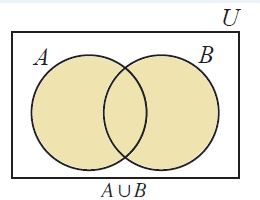
union

Intersection

Let A and B be two sets.
Now, we can define the following new set.
A ∩ B = {c | c ∈ A and c ∈ B}
(That is c must be in both A and B)
A ∩ B is read as “A intersection B”
Now that A n B contains only those elements which belong to both A and B and the figure given below illustrates this.
It is trivial that A ∩ B ⊆ A and also A ∩ B ⊆ B.
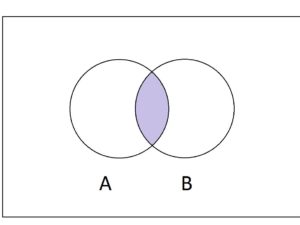
intersection

Set Difference

Let A and B be two sets.
Now, we can define the following new set.
A \ B = {c | c ∈ A but c ∉ B}
(That is c must be in A and must not be in B)
A \ B is read as “A difference B”
Now that A \ B contains only elements of A that are not in B and the figure given below illustrates this. A \ B can also write as A – B
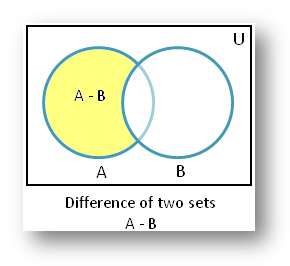
set difference

Symmetric Difference

Let A and B be two sets.
Now, we can define the following new set.
A Δ B = (A \ B) u (B \ A)
A Δ B is read as “A symmetric difference B”
Now that A Δ B contains all elements in A u B which are not in A n B and the figure given below illustrates this.
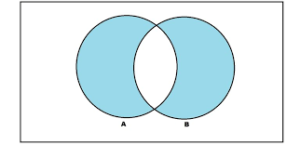
Symmetric Difference

Complement

If A ⊆ U, where U is a universal set, then U \ A is called the complement of A with respect to U. If the underlying universal set is fixed, then we denote U \ A by A’ and it is called the complement of A.
A’ = U \ A
The difference set A \ B can also be viewed as the complement of B with respect to A.
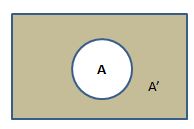
complement

Disjoint Sets

Two sets A and B are said to be disjoint if they do not have any common element. That is, A and B are disjoint if A n B = ᵩ
It is clear that n(A u B) = n(A) + n(B), if A and B are disjoint finite set.

Subset of a Set

A set M is a subset of set N if every element of M is also an element of N.
In symbol, we write m ⊆ n. We can read it as “M is a subset of N” or “M is contained in N”.
Read ⊈ as “M is a not subset of N” or “M is not contained in N”

Proper Subset

A set M is said to be a proper subset of set N if M ⊆ N and M ≠ N.
In symbol, we write M ⊂ N. We can read it as “M is a proper subset of N”

Power Set

The set of all subsets of X is said to be the power set of the set X.
The power set of X is denoted by P(X)

Superset

A set M is said to be a proper subset of set N if M ⊆ N and M ≠ N.
In symbol, we write M ⊂ N. We can read it as N is called superset of M.

Formula to Find Number of Subsets

If M is denoted as the given set and it has n number of elements, then we can find the formula of subsets as
Number of subsets = 2n
Formula to find the number of proper subsets
Number of proper subsets = 2n-1

Null set or Empty set

A set that contains no element is called a null set or an empty set. And it is denoted by { } or ∅. Hence, the cardinal number of a null set is zero.

Multiplication of Fractions

Multiplication of Fractions Tips & Tricks, Examples | How to Multiply Fractions?

Multiplication of Fractions steps and methods are here. Check rules, tricks, and tips to solve fraction multiplication problems. Refer to the important formulae and also types involved in it. Know the fraction multiplication solved examples, types, and parts of fractions, variables, etc. Go through the below sections to get the complete details regarding multiplication methods, formulae, rules, etc.

Multiplication of Fractions – Introduction

Fractions multiplication starts with numerators multiplication followed by denominators multiplication. The resultant fraction of the multiplication fraction can be simplified further and can be reduced to its lowest terms. Fraction Multiplication is not the same as adding or subtracting the fraction values.

Any two or more fractions with different denominators can easily be multiplied. The main thing to be considered is the fractions should not be mixed fractions, they should be either proper or improper fractions. There are various steps involved in multiplying the fractions. They are:

  1. In the fractions multiplication, we multiply the numerator with the numerator term to get the desired result of the numerator.
  2.  In the fractions multiplication, we multiply the denominator with the denominator term to get the desired result of the denominator.
  3. After finding the resultant numerator and denominator values, check for simplification if possible
  4. Once the simplification is done, we get the final resultant value.

How to Multiply Mixed Fractions?

Consider a mixed fraction which is the form of a \(\frac { b }{ c } \).

In the above-mixed fraction, convert the fraction value into an improper fraction. After converting it into an improper fraction, apply all the above steps we do in the multiplication of fractions. To convert mixed fractions into improper fractions, we apply the following steps:

  • Multiply the whole number (a) with the denominator (c). We get the result value (a * c)
  • To the above result value (a * c), add the numerator value (b). After the addition of the numerator, we find the numerator of the improper fraction.
  • The denominator value of the improper fraction will be the denominator of the same mixed fraction.
  • Generally, we can write it as a \(\frac { b }{ c } \) = \(\frac { c*a + b}{ c } \)

Also Read:

Multiplication of Proper Fractions

Multiplication of proper fractions is the easiest form of all the fractions multiplication.

Example:

Solve the equation \(\frac { 2 }{ 3 } \) × \(\frac { 4 }{ 6 } \)?

Solution:

As given in the question,

The equation is \(\frac { 2 }{ 3 } \) × \(\frac { 4 }{ 6 } \)

Here, \(\frac { 2 }{ 3 } \), \(\frac { 4 }{ 6 } \) are the proper fractions. To multiply the proper fractions, we have to follow the steps.

Step 1: First of all, multiply the numerators together i.e., 2 and 4. The solution is 2 * 4 = 8

Step 2: Next, multiply the denominators together ie., 3 and 6. The solution is 3 * 6 = 18. The fraction value can be written as \(\frac { 2*4 }{ 3*6 } \) = \(\frac { 8 }{ 18 } \)

Step 3: Check if you can simplify the resultant equation. On simplification, we can write it as \(\frac { 4 }{ 9 } \)

Multiplication of Improper Fractions

An improper fraction is the one that has a greater denominator than the numerator. If we multiply an improper fraction, we result in an improper fraction.

Example: 

Solve the equation \(\frac { 3 }{ 2 } \) × \(\frac { 7 }{ 5 } \) of the improper fractions?

Solution:

As given in the question,

The equation is \(\frac { 3 }{ 2 } \) × \(\frac { 7 }{ 5 } \)

Here, \(\frac { 3 }{ 2 } \), \(\frac { 7 }{ 5 } \) are improper fractions. To multiply the improper fractions, we have to follow the steps.

Step 1: First of all, multiply the numerators together i.e., 3 and 7. The solution is 3 * 7 = 21

Step 2: Next, multiply the denominators together i.e., 2 and 5. The solution is 2 * 5 = 10. The fraction value can be written as \(\frac { 3*7 }{ 2*5 } \) = \(\frac { 21 }{ 10 } \)

Step 3: Check if you can simplify the resultant equation. In the above equation, simplification is not possible.

Step 4: Now, convert the fraction into an improper fraction. Hence, the result is 2[/latex] = \(\frac { 1 }{ 10 } \)

Multiplication of Mixed Fractions

Mixed Fractions are those fractions which have a whole number and a fraction like 2 [/latex] = \(\frac { 1 }{ 2 } \). When multiplying both the mixed fractions, we have to convert the mixed fractions into improper fractions.

Example:

Multiply the fractions 2\(\frac { 2 }{ 3 } \) and 3\(\frac { 1 }{ 4 } \)

Solution:

The given equation is 2\(\frac { 2 }{ 3 } \) x 3\(\frac { 1 }{ 4 } \)

Here, 2\(\frac { 2 }{ 3 } \) and 3\(\frac { 1 }{ 4 } \) are mixed fractions. To multiply the mixed fractions, we have to follow the following steps.

Step 1: First of all, convert the mixed fractions to improper fractions. To convert the mixed fraction of 2\(\frac { 2 }{ 3 } \), we write it as \(\frac { (3×2+2) }{ 3 } \). The result is 8/3. To convert the mixed fraction of 3\(\frac { 1 }{ 4 } \), we write it as \(\frac { (4×3+1) }{ 4 } \). The result is 13/4

Step 2: Multiply the numerators together i.e., 8 and 13. The solution is 8 * 13 = 104

Step 3: Next, multiply the denominators together i.e., 3 and 4. The solution is 3 * 4 = 12. The fraction value can be written as \(\frac { 8*13 }{ 3*4 } \) = \(\frac { 104 }{ 12 } \)

Step 4: Check if you can simplify the resultant equation. In the above equation, the simplification can be done as \(\frac { 26 }{3 } \).

Step 5: Now, convert the fraction into an improper fraction. Hence the result is 8\(\frac { 2 }{ 3 } \)

Multiplying Fractions Examples

Problem 1: 

A recipe calls for \(\frac { 3 }{ 4 } \) cups of sugar. Amari is tripling the recipe. How much amount of sugar will be needed?

Solution:

As given in the question,

Amount of sugar for recipe = \(\frac { 3 }{ 4 } \)

No of times Amari multiplied the recipe = 3

Therefore, to find the amount of sugar we apply the multiplication of fractions

Hence, \(\frac { 3 }{ 4 } \) * \(\frac { 3 }{ 1 } \) = \(\frac { 9 }{ 4 } \)

Now, convert the proper fraction into an improper fraction i.e., 2\(\frac { 1 }{ 4 } \)

Thus, the final solution is 2\(\frac { 1 }{ 4 } \)

Problem 2:

\(\frac { 4 }{ 5 } \) of all students at Riverwood High School are involved in an extracurricular activities. Of those students, \(\frac { 2 }{ 3 } \) are involved in a fall activity. What fraction of students at Riverwood are involved in a fall activity?

Solution:

As given in the question,

No of students involved in extracurricular activities = \(\frac { 4 }{ 5 } \)

No of students involved in fall activity = \(\frac { 2 }{ 3 } \)

To find the fraction of students involved in a fall activity, we have to apply the multiplication of fractions

Hence \(\frac { 2 }{ 3 } \) x \(\frac { 4 }{ 5 } \) = \(\frac { 8 }{ 15 } \)

Thus, \(\frac { 8 }{ 15 } \) fraction of students are involved in a fall activity.

Therefore, the final solution is \(\frac { 8 }{ 15 } \)

Problem 3:

Jimmy has a collection of 18 video games. Of the 18 video games. \(\frac { 1 }{ 3 } \) are sports games. How many of his games are sports games?

Solution:

As given in the question,

No of video games = 18

Part of sports games = \(\frac { 1 }{ 3 } \)

To find the no of sports games, we apply multiplication of fractions

Hence \(\frac { 1 }{ 3 } \) x \(\frac { 18 }{ 1 } \)

=\(\frac { 18 }{ 3 } \)

On further simplications, we get the result as 6.

Therefore, Jimmy has a collection of 6 sports games.

Units of Capacity and Volume Conversion Chart

Units of Capacity and Volume Conversion Chart | How to Convert Units of Capacity or Volume?

Worried about where to find instant help regarding the Capacity and Volume Conversions Chart in both Metric and Customary units? Then, halt your search as you have reached the right place and we will provide you with the necessary Capacity and Volume Units Conversion Chart. You can use them during your calculations in day-to-day life and make your problem-solving easy.

For the sake of your convenience, we have prepared the Capacity and Volume Conversion Table. In addition to the Metric and Customary Units of Capacity and Volume, we explained the concept much better by considering few examples. Check out the Solved Problems on Capacity and Volume Conversions and learn to apply the logic when you need them during your math calculations.

Capacity and Volume Conversion Charts

When it comes to Capacity and Volume the standard unit is the liter. The other standard units in the Capacity and Volume Conversion are explained below. Make the most out of them whenever you need to change between one unit of capacity or volume to the other. Having Units of Capacity or Volume in similar units makes it easy for you to solve problems. They are as follows

1 milliliter = 0.001 liter

1 centiliter = 0.01 liter

1 deciliter = 0.1 liter

1 kiloliter = 1000 liters

Customary Units for Capacity and Volume Conversion Table are explained as follows

1 gallon = 4 quarts

1 gallon = 128 ounces

1 quart = 2 pints

1 pint = 2 cups

1 cup = 8 ounces

Also, Read:

Solved Examples on Capacity and Volume Conversions

1. Convert 45 ml into l?

Solution:

We know 1 ml = \(\frac { 1 }{ 1000 } \) l

Substituting the value of 1 ml we get the equation as

= 45*\(\frac { 1 }{ 1000 } \) l

= \(\frac { 45 }{ 1000 } \) l

= 0.045 l

Therefore, 45 ml converted to l is 0.045l

2. Convert 8 hl into l?

Solution:

We know 1 hl = 100 l

Substituting the value of 1 hl we have the equation as follows

= 8*100 l

= 800 l

Therefore 8hl converted to l is 800 l

3. Convert 0.025l into ml?

Solution:

We know 1 l = 1000 ml

0.025 l = 0.025*1000 ml

= \(\frac { 25 }{ 1000 } \)*1000 ml

= 25 ml

Therefore, 0.025l converted to ml is 25ml

FAQs on Units of Capacity and Volume Conversion Chart

1. What are all the Units of Capacity?

There are five basic units in the customary system of measurement and units are as follows

  • Ounce
  • Cup
  • Pint
  • Quart
  • Gallon

2. What is th Biggest Unit of Capacity?

The Biggest Unit of Capacity is Liter(L).

3. What’s the difference between capacity and volume?

Volume and capacity both are properties of three-dimensional objects. Volume is the space that a three-dimensional object occupies, whereas capacity, on the other hand, describes how much a container can hold.

What is Variation

What is Variation? | Types of Variation – Direct, Inverse, Joint, Combined, Partial Variation

Variation can be clearly understood if you know about Variables. In Mathematics, we generally deal with two types of quantities namely variables and constants. If the value of a quantity remains unchanged during different scenarios then it is said to be constant. On the other hand, if the value of a quantity changes under varying conditions then it is said to be a variable. Refer to the complete article to know about the Definition of Variation, Types of Variation, and Solved Examples on Variation, etc.

What is Variation?

In Mathematical Equations when a relationship is established there exist two types of quantities one is constant and the other is variable. Constant will not alter with the change in other parameters of the equation and the other is a variable that changes with different situations. The Changing of variable parameters is called a Variation.

You can understand the concept of variation with a simple equation y = mx

Here m is the constant and if we consider m = 2 then y becomes 2x

If x = 1, then y becomes y = 2*1 = 2

If x = 2, then y becomes y = 2*2 = 4

By changing the value of y, x gets different values. This is the variation of y with different values of x and similarly, you can get different values of y if the value of x changes.

Types of Variation

Variations can be of different types according to the pattern of changing or relationships of variables. We have explained the most common types of variation here and they are as follows

Direct Variation: If variables change proportionately i.e. either decrease or increase then it is said to be a direct variation. If A is in direct variation with B then it can be symbolically written as A α B.

Indirect Variation: In the case of Indirect or Inverse Variation variables change disproportionately i.e. when one variable increases the other one decreases. The behavior of Variables is exactly the opposite of direct variation. Thus, it is called an Indirect or Inverse Variation. If A is in indirect variation with B then it is symbolically written as A α \(\frac { 1 }{ B } \)

Joint Variation: If Two or more variables are related directly or one variable change with change product of two or more variables then it is said to be a Joint Variation. If A is in joint variation with B and C then it is symbolically represented as such A α BC

Combined Variation: Combined Variation is a combination of direct, indirect, or joint variation. In this kind of variation, three or more variables exist. If A is in combination with B, C then it can be symbolically represented as A α \(\frac { B }{ C } \) or A α \(\frac { C }{ B } \)

Partial Variation: If two variables are related using a formula or a variable is related by the sum of two or more variables then it is said to be a Partial Variation. y = mx+c is a straight line equation and is an example of Partial Variation.

FAQs on Variation

1. How do you define Variation?

Changing of Variable Parameters is called a Variation.

2. What are the Types of Variation?

There are different types of variation and they are as follows

  • Direct Variation
  • Indirect Variation
  • Joint Variation
  • Combined Variation
  • Partial Variation

3. What is a direct variation proportion?

A Relations is said to be in direct variation when one variable changes and the second variable changes proportionally.

Subset

Subsets – Definition, Symbol, Formula, Types, Properties and Examples

Subsets fall under the mathematics concept Sets. A Set is a collection of objects or elements enclosed within curly braces {}. If Set A is a Collection of Odd Numbers and Set B includes { 1, 3, 5} then B is said to be a subset of A and is denoted by B⊆A whereas A is the Superset of B.

Elements of Set can be anything such as variables, constants, real numbers, whole numbers, etc. It can include a null set too at times. Learn about Subsets Definition, Symbol, Formula, Types, and Examples in the later modules.

What is a Subset?

Set A is said to be a subset of Set B if all the elements present in Set A are also present in Set B. In other words, we can say Set A is contained within Set B.

Example:  If Set A has {a, b} and set B has {a, b, c}, then A is the subset of B because elements of A are also present in set B.

Subset Symbol

In Set theory, the Subset is denoted by the symbol ⊆ and is usually read as the Subset of. Using the symbol let us denote the subsets as follows

A ⊆ B; which denotes Set A is a subset of Set B.

Remember a Subset may include all the elements that are present in the Set.

Also, Read:

All Subsets of a Set

Subsets of any set consist of all possible sets including its elements and even null set. Let us provide you an example and provide the possible combinations of a set so that you can better understand.

Example:

What are the Subsets of Set A = {5, 6, 7, 8}?

Solution:

Given Set A = {5, 6, 7, 8}

Subsets include

{}

{5}, {6}, {7}, {8},

{5,6}, {5, 7}, {5,8}, {6,7},{6,8}, {7,8},

{5,6,7}, {6,7,8}, {5,7,8}, {5,6,8}

{5,6,7,8}

Types of Subsets

Subsets are Classified into two types namely

  • Proper subsets
  • Improper subsets

Proper Subsets: Proper Set includes only a few elements of the original set.

Improper Subsets: Improper Set includes all the elements of the original set along with the null set.

Example:

If set A = { 4, 6, 8}, then,

Number of subsets: {4}, {6}, {8}, {4,6}, {6,8}, {4,8}, {4,6,8} and Φ or {}.

Proper Subsets: {}, {4}, {6}, {8}, {4,6}, {6,8}, {4,8}

Improper Subset: {4,6,8}

There is no proper formula to find how many subsets are there. You just need to write each one of them and distinguish whether it is a proper subset or improper subset.

What are Proper Subsets?

Set A is said to be a Proper Subset of Set B if Set B has at least one element that doesn’t exist in Set A.

Example: If Set A has elements as {4, 6} and set B has elements as {4, 6, 16}, then Set A is the Proper Subset of B because 16 is not present in the set A.

Proper Subset Symbol

A Proper Subset is represented by the symbol ⊂ and is read as “Proper Subset of”. Using this symbol we can denote the Proper Subset for Set A and Set B as A ⊂ B.

Proper Subset Formula

If we have to pick the “n” number of elements from a set containing the “N” number of elements you can do so in NCn number of ways.

How many Subsets and Proper Subsets does a Set have?

If a Set has “n” elements then there are 2n subsets for the given set and there are 2n -1 proper subsets for the given set.

Consider an example, If set X has the elements, X = {x, y}, then the proper subset of the given subset are { }, {x}, and {y}.

Here, the number of elements in the set is 2.

We know that the formula to calculate the number of proper subsets is 2n – 1.

= 22 – 1

= 4 – 1

= 3

Thus, the number of proper subset for the given set is 3 ({ }, {x}, {y}).

What are Improper Subsets?

A Subset that contains all the elements of the original set are called Improper Sets. It is represented using the symbol ⊆.

Set A ={1,2,3} Then, the subsets of A are;

{}, {1}, {2}, {3}, {1,2}, {2,3}, {1,3} and {1,2,3}.

Where, {}, {1}, {2}, {3}, {1,2}, {2,3}, {1,3} are the proper subsets and {1,2,3} is the improper subsets. Therefore, we can write {1,2,3} ⊆ A.

Note: Empty Set is an Improper Subset of itself and is a Proper Subset of any other set.

Power Set

Power Set is said to be a collection of all subsets. It is denoted by P(A).

If Set A has elements {a, b} then the Power Set of A is

P(A) = {∅, {a}, {b}, {a, b}}

Properties of Subsets

Below is the list of Some of the Important Properties of Subsets and they are as such

  • Every Set is a subset of the given set itself. It means A ⊂ A or B ⊂ B, etc.
  • Empty Set is a Subset of Every Set.
  • If A is a Subset of B it means A is contained within B.
  • If Set A is a subset of Set B then we can infer that B is a superset of A.

Subsets Example Problems

1. How many subsets containing three elements can be formed from the set?

S = { 1, 2, 3, 4, 5, 6, 7 }

Solution:

No. of Elements in the Set = 7

No. of Elements in the Subset = 3

No. of Possible Elements containing the 3 Elements is 7C3

=\(\frac { 7! }{ (7-3)!*3! } \)

= \(\frac { 7*6*5*4! }{ 4!*3! } \)

= 35

2. Find the number of subsets and the number of proper subsets for the given set A = {4, 5, 6, 7,8}?

Solution:

Given: A = {4, 5, 6, 7,8}

The number of elements in the set is 4

We know that,

The formula to calculate the number of subsets of a given set is 2n

= 25 = 32

The number of subsets is 32

The formula to calculate the number of proper subsets of a given set is 2n – 1

= 25 – 1

= 32 – 1 = 31

The number of proper subsets is 31.

FAQs on Subsets

1. What are Types of Subsets?

Subsets are classified into two types and they are as follows

  • Proper Subsets
  • Improper Subsets

2. What is the formula to calculate the number of proper subsets and subsets for a given set?

If a set has “n” number of elements then the number of subsets and proper subsets is given by the formulas

The formula to calculate the number of proper subsets for a given set is 2n-1

The formula to find the number of subsets is 2n

3. What is the symbol to denote Subset?

The subset is denoted by the symbol ⊆.

Intersection of Sets - Definition, Symbol, Properties & Solved Examples on Intersection of Sets

Intersection of Sets – Definition, Symbol, Properties & Solved Examples

In Set theory, there are various types of set operations like Subsets, Difference of sets, Union of sets, Complement of sets, and Intersections of sets. Students can easily understand and learn the set theory concepts by referring to our articles. So, today we have come up with the Intersection of Sets topic. Let’s go through this page and learn about the intersection of sets definition, symbol, properties, and examples.

Intersection of Sets Definition

If the Intersection of two sets A and B, then it is denoted by A∩B, where it contains all the elements which are common to both A and B. The symbol to denote the intersection of sets is ‘∩’. All those elements that relate to both A and B denote the intersection of A and B. Hence, we can say that,
A ∩ B = {x : x ∈ A and x ∈ B}

For n sets A1, A2, A3,……A n where all these sets are the subset of Universal set (set U). The definition of the intersection is the set of all elements which are common to all these n sets.

What is the Intersection of Two Sets?

If there are two sets, Set A and Set B, then the intersection of sets is given by:

A∩B = n(A) + n(B) – n(A∪B), where

n(A) is the cardinal number of set A,
n(B) is the cardinal number of set B,
n(A∪B) is the cardinal number of a union of two sets ie., A and B.

For Example: The intersection of two sets ie., A = {1, 2, 3} and B = {2, 3, 4} then find A∩B?

We know, A∩B = n(A) + n(B) – n(A∪B)

After calculating the process of the intersection of two sets, the result is like this A∩B = {2, 3}.

Properties of Intersection of a Set

i) Commutative Law: The union of two sets A and B follow the commutative law i.e., A ∩ B = B ∩ A

ii) Associative Law: The intersection operation follows the associative law i.e., If we have three sets A, B, and C then, (A ∩ B) ∩ C = A ∩ (B ∩ C)

iii) Identity Law: The intersection of an empty set with any set A gives the empty set itself i.e., A ∩ ∅ = ∅

iv) Idempotent Law: The intersection of any set A with itself gives the set A i.e., A ∩ A = A

v) Law of U: The intersection of a universal set U with its subset A gives the set A itself. A ∩ U = A

vi) Distributive Law: According to this law: A ∩ (B ∪ C) = ( A ∩ B ) ∪ (A ∩ C)

Solved Examples on Intersection of Sets

1. Let U be the universal set consisting of all the n – sided regular polygons where 5 ≤ n ≤ 9. If set A, B, and C are defined as:

A = {pentagon, hexagon, octagon}

B = {pentagon, hexagon, nonagon, heptagon}

C = {nonagon}

Find the intersection of the sets A and B

Solution:

Given Universal Set U = {pentagon , hexagon , heptagon , octagon , nonagon}, A = {pentagon, hexagon, octagon}, B = {pentagon, hexagon, nonagon, heptagon}, C = {nonagon}

Now, calculate the intersection of sets A and B

Here, the intersection of sets means the common elements consist in both A and B:

The elements of A = {pentagon, hexagon, octagon}, and B = {pentagon, hexagon, nonagon, heptagon}

Then, A ∩ B = {pentagon, hexagon}.

2. If A = {1,3,5,7,9} and B = {2,3,5,6,8}. Find intersection of two set A and B.

Solution:

Given Set A = {1,3,5,7,9} and Set B = {2,3,5,6,8}

Here 3, 5 are the common elements in both A and B sets.

So, the intersection of two sets A and B are, A ∩ B = {3, 5}.

3. If P = {x, y, z} and Q = {ф}. Find the intersection of two given sets P and Q.

Solution:

Given sets are P = {x, y, z} and Q = {ф}

The Intersection of given sets P ∩ Q = { }.

Expanded Form of a Number

Expanded form of a Number Definition, Facts, Examples | How to Write a Number in Expanded Form?

A number composed of the sum of the place-values of its digits is called an expanded form of a number. Learn how a number can be expanded using the place values of its digits. We have given the process to expand a number and with different examples. All the examples are given along with the explanation. Practice all the problems available here and get a grip on the expanded form a number concept.

How to Expand a Number?

Check out the below steps to learn how to expand the number. Following these simple steps, you can expand a number easily. They are as follows

1. Firstly, take the unit place of a number and multiply it with 1.
2. Take the next number left to it and multiply it by 10.
3. Repeat the same process by increasing the 0 in the multiplicand.

Example: Write the expanded form for the number 2385?

Solution:
The given number is 2385.
Firstly, multiply the number 5 with 1. 5 × 1 = 5.
Multiply 8 with 10. 8 × 10 = 80.
Next, Multiply 3 with 100. 3 × 100 = 300.
Multiply 2 with 1,000. 2 × 1,000 = 2,000.
Add all the numbers to get the number.
2,000 + 300 + 80 + 5 = 2385.

Here, 2385 is the standard form and 2,000 + 300 + 80 + 5 is the expanded form.

Expanded Form of Numbers Examples

1. Write the expanded form for the number 70,34,51,395?

Solution:
The given number is 70,34,51,395.
Firstly, multiply the number 5 with 1. 5 × 1 = 5.
Multiply 9 with 10. 9 × 10 = 90.
Next, Multiply 3 with 100. 3 × 100 = 300.
Multiply 1 with 1000. 1 × 1000 = 1000.
Multiply 5 with 10000. 5 × 10000 = 50000.
Also, Multiply 4 with 100000. 4 × 100000 = 400000.
Multiply 3 with 1000000. 3 × 1000000 = 3000000.
Multiply 0 with 10000000. 0 × 10000000 = 0.
Next, Multiply 7 with 100000000. 7 × 100000000 = 700000000.
Add all the numbers to get the number.
700000000 + 0 + 3000000 + 400000 + 50000 + 1000 + 300 + 90 + 5 = 70,34,51,395.

Here, 70,34,51,395 is the standard form and 700000000 + 0 + 3000000 + 400000 + 50000 + 1000 + 300 + 90 + 5 is the expanded form.

2. Write the number in figures and then in words for the following expanded form
(i) 70000 + 6000 + 400 + 40 + 6

Solution:
Given expanded form is 70000 + 6000 + 400 + 40 + 6
Add the values to get a expanded form.
76446 (in figures)
Seventy-six thousand four hundred forty-six (in words)

(ii) 200000 + 40000 + 3000 + 20 + 7

Solution:
Given expanded form is 200000 + 40000 + 3000 + 20 + 7
Add the values to get an expanded form.
24327 (in figures)
Twenty-four thousand three hundred twenty-seven (in words)

3. Write in expanded form
(i) 39369

Solution:
The given number is 39369.
Firstly, multiply the number 9 with 1. 9 × 1 = 9.
Multiply 6 with 10. 6 × 10 = 60.
Next, Multiply 3 with 100. 3 × 100 = 300.
Multiply 9 with 1000. 9 × 1000 = 9000.
Multiply 3 with 10000. 3 × 10000 = 30000.
Add all the numbers to get the number.
30000 + 9000 + 300 + 60 + 9 = 39369.

Here, 39369 is the standard form and 30000 + 9000 + 300 + 60 + 9 is the expanded form.

(ii) 528,358

Solution:
The given number is 528,358.
Firstly, multiply the number 8 with 1. 8 × 1 = 8.
Multiply 5 with 10. 5 × 10 = 50.
Next, Multiply 3 with 100. 3 × 100 = 300.
Multiply 8 with 1000. 8 × 1000 = 8000.
Multiply 2 with 10000. 2 × 10000 = 20000.
Also, Multiply 5 with 100000. 5 × 100000 = 500000.
Add all the numbers to get the number.
500000 + 20000 + 8000 + 300 + 50 + 5 = 528,358.

Here, 528,358 is the standard form and 500000 + 20000 + 8000 + 300 + 50 + 5 is the expanded form.

Examples on Writing a Number in Expanded Form

I. Write the expanded form for the given numbers
(i) 6,01,217
(ii) 7,06,283
(iii) 5,33,786
(iv) 4,84,848
(v) 8,33,004

Solution

(i) The given number is 6,01,217.
Firstly, multiply the number 7 with 1. 7 × 1 = 7.
Multiply 1 with 10. 1 × 10 = 10.
Next, Multiply 2 with 100. 2 × 100 = 200.
Multiply 1 with 1000. 1 × 1000 = 1000.
Multiply 0 with 10000. 0 × 10000 = 0.
Also, Multiply 6 with 100000. 6 × 100000 = 600000.
Add all the numbers to get the number.
600000 + 0+ 1000 + 200 + 10 + 7 = 6,01,217.

Here, 6,01,217 is the standard form and 600000 + 0+ 1000 + 200 + 10 + 7 is the expanded form.

(ii) The given number is 7,06,283.
Firstly, multiply the number 3 with 1. 3 × 1 = 3.
Multiply 8 with 10. 8 × 10 = 80.
Next, Multiply 2 with 100. 2 × 100 = 200.
Multiply 6 with 1000. 6 × 1000 = 6000.
Multiply 0 with 10000. 0 × 10000 = 0.
Also, Multiply 7 with 100000. 7 × 100000 = 700000.
Add all the numbers to get the number.
700000 + 0 + 6000 + 200 + 80 + 3 = 7,06,283.

Here, 7,06,283 is the standard form and 700000 + 0 + 6000 + 200 + 80 + 3 is the expanded form.

(iii) The given number is 5,33,786.
Firstly, multiply the number 6 with 1. 6 × 1 = 6.
Multiply 8 with 10. 8 × 10 = 80.
Next, Multiply 7 with 100. 7 × 100 = 700.
Multiply 3 with 1000. 3 × 1000 = 3000.
Multiply 3 with 10000. 3 × 10000 = 30000.
Also, Multiply 5 with 100000. 5 × 100000 = 500000.
Add all the numbers to get the number.
500000 + 30000 + 3000 + 700 + 80 + 6 = 5,33,786.

Here, 5,33,786 is the standard form and 500000 + 30000 + 3000 + 700 + 80 + 6 is the expanded form.

(iv) The given number is 4,84,848.
Firstly, multiply the number 8 with 1. 8 × 1 = 8.
Multiply 4 with 10. 4 × 10 = 40.
Next, Multiply 8 with 100. 8 × 100 = 800.
Multiply 4 with 1000. 4 × 1000 = 4000.
Multiply 8 with 10000. 8 × 10000 = 80000.
Also, Multiply 4 with 100000. 4 × 100000 = 400000.
Add all the numbers to get the number.
400000 + 80000 + 4000 + 800 + 40 + 8 = 4,84,848.

Here, 4,84,848 is the standard form and 400000 + 80000 + 4000 + 800 + 40 + 8 is the expanded form.

(v) The given number is 8,33,004.
Firstly, multiply the number 4 with 1. 4 × 1 = 4.
Multiply 0 with 10. 0 × 10 = 0.
Next, Multiply 0 with 100. 0 × 100 = 0.
Multiply 3 with 1000. 3 × 1000 = 3000.
Multiply 3 with 10000. 3 × 10000 = 30000.
Also, Multiply 8 with 100000. 8 × 100000 = 800000.
Add all the numbers to get the number.
800000 + 30000 + 3000 + 0 + 0 + 4 = 8,33,004.

Here, 8,33,004 is the standard form and 800000 + 30000 + 3000 + 0 + 0 + 4 is the expanded form.

II. Write the given number in standard form
(i) 40,000 + 3,000 + 600 + 3
(ii) 3,00,000 + 70,000 + 5,000 + 600 + 40
(iii) 7,00,000 + 50,000 + 3,000 + 200 + 80 + 4
(iv) 6,00,000 + 20,000 + 7,000 + 300 + 40 + 6
(v) 2,00,000 + 30,000 + 4,000 + 300 + 20 + 3
(vi) 8,00,000 + 3

Solution:
(i) Given expanded form is 40,000 + 3,000 + 600 + 3
Add the values to get an expanded form.
43603 (in figures)
Forty-three thousand six hundred three (in words)

(ii) Given expanded form is 3,00,000 + 70,000 + 5,000 + 600 + 40
Add the values to get a expanded form.
375640 (in figures)
Three hundred seventy-five thousand six hundred forty (in words)

(iii) Given expanded form is 7,00,000 + 50,000 + 3,000 + 200 + 80 + 4
Add the values to get an expanded form.
753284 (in figures)
Seven hundred fifty-three thousand two hundred eighty-four (in words)

(iv) Given expanded form is 6,00,000 + 20,000 + 7,000 + 300 + 40 + 6
Add the values to get a expanded form.
627346 (in figures)
Six hundred twenty-seven thousand three hundred forty-six (in words)

(iv) Given expanded form is 2,00,000 + 30,000 + 4,000 + 300 + 20 + 3
Add the values to get a expanded form.
234323 (in figures)
Two hundred thirty-four thousand three hundred twenty-three (in words)

(v) Given expanded form is 8,00,000 + 3
Add the values to get an expanded form.
8,00,003 (in figures)
Eight hundred thousand three (in words)

Trigonometrical Ratios of (90°+θ)

Trigonometrical Ratios of (90°+θ) | Relation between All Six Quadrants | Solved Problems on Trigonometrical Ratios

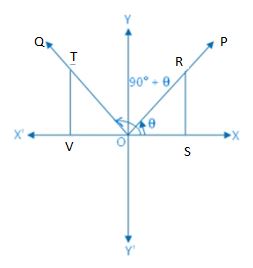
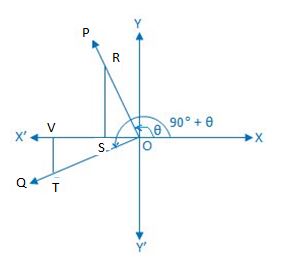
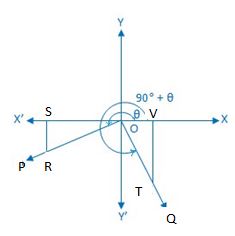
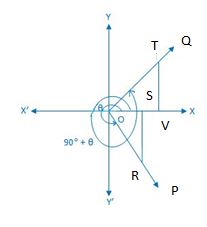
Learn all the relations of Trigonometrical Ratios of (90° + θ). There are six different trigonometrical ratios depends on the (90° + θ). Let a rotating line OP rotates about O in the anti-clockwise direction, from starting position to ending position. It makes an angle ∠XOP = θ again the same rotating line rotates in the same direction and makes an angle ∠POQ =90°. Therefore, we see that ∠XOQ = 90° + θ.

Trigonometrical Ratios 1                                                  Trigonometrical Ratios 2
Trigonometrical Ratios 3                                                Trigonometrical Ratios 4

Take a point R on OP and draw RS perpendicular to OX or OX’. Again, take a point T on OQ such that OT = OR and draw TV perpendicular to OX or OX’. From the right-angled ∆ ORS and ∆ OTV, we get,
∠ROS = ∠OTV [since OQ ⊥ OP] and OR = OT.
Therefore, ∆ ORS ≅ ∆ OTV (congruent).
Therefore according to the definition of a trigonometric sign, OV = – SR, VT = OS and OT = OR
We observe that in diagrams 1 and 4 OV and SR are opposite signs and VT, OS are either both positive. Again we observe that in diagrams 2 and 3 OV and SR are opposite signs and TV, OS are both negative.

Check out Worksheet on Trigonometric Identities to learn more about Trig Identities and know the relation between all six quadrants.

Evaluate Trigonometrical Ratios of (90° + θ)

1. Evaluate sin (90° + θ)?

Solution:
To find sin (90° + θ), we need to consider the following important points.
(i) (90° + θ) will present in the IInd quadrant.
(ii) When we have 90°, “sin” will become “cos”.
(iii) In the IInd quadrant, the sign of “sin” is positive.
From the above points, we have sin (90° + θ) = cos θ
sin (90° + θ) = VT/OT
sin (90° + θ) = OS/OR, [VT = OS and OT = OR, since ∆ ORS ≅ ∆ OTV]

sin (90° + θ) = cos θ

2. Evaluate cos (90° + θ)?

Solution:
To find cos (90° + θ), we need to consider the following important points.
(i) (90° + θ) will present in the IInd quadrant.
(ii) When we have 90°, “cos” will become “sin”.
(iii) In the IInd quadrant, the sign of “cos” is negative.
From the above points, we have cos (90° + θ) = – sin θ
cos (90° + θ) = OV/OT
cos (90° + θ) = – SR/OR, [OV = -SR and OT = OR, since ∆ ORS ≅ ∆ OTV]

cos (90° + θ) = – sin θ.

3. Evaluate tan (90° + θ)?

Solution:
To find tan (90° + θ), we need to consider the following important points.
(i) (90° + θ) will present in the IInd quadrant.
(ii) When we have 90°, “tan” will become a “cot”.
(iii) In the IInd quadrant, the sign of “tan” is negative.
From the above points, we have a tan (90° + θ) = – cot θ
tan (90° + θ) = VT/OV
tan (90° + θ) = OS/-SR, [VT = OS and OV = – SR, since ∆ ORS ≅ ∆ OTV]

tan (90° + θ) = – cot θ.

4. Evaluate csc (90° + θ)?

Solution:
To find csc (90° + θ), we need to consider the following important points.
(i) (90° + θ) will present in the IInd quadrant.
(ii) When we have 90°, “csc” will become “sec”.
(iii) In the IInd quadrant, the sign of “csc” is positive.
From the above points, we have csc (90° + θ) = sec θ
csc (90° + θ) = 1/sin(90°+θ)
csc (90° + θ) = 1/cosθ

csc (90° + θ) = sec θ.

5. Evaluate sec (90° + θ)?

Solution:
To find sec (90° + θ), we need to consider the following important points.
(i) (90° + θ) will present in the IInd quadrant.
(ii) When we have 90°, “sec” will become “csc”.
(iii) In the IInd quadrant, the sign of “sec” is negative.
From the above points, we have sec (90° + θ) = – csc θ
sec (90° + θ) = 1/cos(90° + θ)
sec (90° + θ) = 1/-sinθ

sec (90° + θ) = – csc θ.

6. Evaluate cot (90° + θ)?

Solution :
To find cot (90° + θ), we need to consider the following important points.
(i) (90° + θ) will present in the IInd quadrant.
(ii) When we have 90°, “cot” will become “tan”
(iii) In the IInd quadrant, the sign of “cot” is negative.
From the above points, we have cot (90° + θ) = – tan θ
cot (90° + θ) = 1/tan(90° + θ)
cot (90° + θ) = 1/-cotθ

cot (90° + θ) = – tan θ.

Solved Examples on Trigonometrical Ratios of (90° + θ)

1. Find the value of sin 135°?

Solution:
Given value is sin 135°
sin 135° = sin (90 + 55)°
We know that sin (90° + θ) = cos θ
= cos 45°;
The value of cos 45° = 1/√2.

Therefore, the value of sin 135° = 1/√2.

2. Find the value of tan 150°?

Solution:
Given value is tan 150°
tan 150° = tan (90 + 60)°
We know that tan (90° + θ) = – cot θ
= – cot 60°;
The value of -cot 60° = 1/√3.

Therefore, the value of tan 150° = 1/√3.

Addition and Subtraction of Fractions

Addition and Subtraction of Fractions Tips & Tricks, Examples | How to Add, Subtract Fractions?

Addition and Subtraction of Fractions tips and tricks are here. Know the various formulae, methods, and rules involved in adding or subtracting the fractions. Refer to steps on how to add and subtract fractions from each other. Find Solved Example Problems on fractions addition and subtraction of values. Check the below sections to know the complete details regarding fraction values addition and subtraction.

Addition and Subtraction of Fractions

Addition and Subtraction of Fractions are not that easy as adding or subtracting the whole numbers. It requires an extra procedure to get the desired results. There are certain steps to follow while adding or subtracting the fractions. Though you come to know various steps, you have to practice more problems to become perfect in this concept.

How to Add and Subtract Fractions?

Follow the below-listed procedure to know in detail about Adding and Subtracting Fractions. By following these simple steps you can solve Addition, Subtraction of Fractions Problems easily. They are as under

  • In the first step, you have to verify if both the denominators are equal or not.
  • In the case of different denominators, you have to convert the denominator to the same value to make them equivalent fractions. Equivalent fractions are those which has the same denominator value.
  • Once the denominator is the same for both the fractions, then we go for further simplification.
  • We add or subtract the numerator values in the simplification process.
  • Write the answer to the numerator value with the common denominator.

Tips for Adding and Subtracting Fractions

  •  Make sure, denominators are similar or equal before adding or subtracting the fractions.
  • On multiplying the top and bottom of the fraction with the same number, the value of the fractions remains the same.
  • Before starting the simplification of adding and subtracting fractions, practice converting fractions to common denominators beforehand.
  • You have to simplify your answer once addition and subtraction are done. In some of the cases, we find that the result of the answers can be reduced even if the original fractions cannot be reduced. The same procedure is followed in both the cases of adding and subtracting fractions.
  • In the case of mixed fractions, first, you have to convert them to improper fractions and then start the simplification of adding and subtracting fractions.

Methods of Adding and Subtracting Fractions

Fractions addition and subtraction involve different methods. They are

  • Like fractions addition and subtraction
  • Unlike fractions addition and subtraction
  • Mixed Fractions addition and subtraction

Like Fractions Addition and Subtraction

The fraction values which possess the same denominators are called “like fractions”. Addition and subtraction of these like fractions are easy because the value of the denominator is the same for both the fractions.

Example 1:

Solve the equation 1/4 + 2/4

Solution:

Given equation is 1/4 + 2/4

In the above equation, the denominator has the same values. Therefore, we have to consider the common denominator and then add the numerator values.

Step 1: Verify if the denominators of the fractions are the same.

Step 2: As the denominator’s values are the same, then add the numerator values to get the final result.

Step 3: Simplification of the equation

1+\(\frac { 2 }{ 4 } \) = \(\frac { 3 }{ 4 } \)

Therefore, the final result is \(\frac { 3 }{ 4 } \)

Example 2:

Solve the equation \(\frac { 6 }{ 8 } \)– \(\frac { 2 }{ 8 } \)?

Solution:

Given equation is \(\frac { 6 }{ 8 } \)– \(\frac { 2 }{ 8 } \)

In the above equation, we have the same denominator values, so we can directly subtract the values to get the final result.

Step 1: Verify if the denominators of the fractions are the same.

Step 2: As the denominator’s values are the same, subtract the numerator values to get the final result.

Step 3: \(\frac { 6 }{ 8 } \)– \(\frac { 2 }{ 8 } \) = \(\frac { (6-2) }{ 8 } \)

= \(\frac { 4 }{ 8 } \)

Step 4: Check if further simplification is possible

As the fraction value is \(\frac { 4 }{ 8 } \), on further simplification it results as \(\frac { 1 }{ 2 } \)

Unlike Fractions Addition and Subtraction

The fractions with different denominators are called “unlike fractions”. It is mandatory that the denominator value should be the same to add or subtract the numerator values. So, for the unlike fractions, first, we have to convert them to equivalent fractions and then simplify the equation.

Example 1:

Solve the equation \(\frac { 4 }{ 6 } \) + \(\frac { 2 }{ 8 } \)?

Solution:

Given equation is \(\frac { 4 }{ 6 } \) + \(\frac { 2 }{ 8 } \)

In the above equation, the denominator values are different and hence the fractions should be made equivalent first and then simplify them.

Step 1: Verify if the denominators are the same. The denominators are not the same and hence to make it equivalent. First, take the LCM of denominator values ie., 6 and 8. The LCM is 24

Step 2: To get the same denominator value, we multiply 6 and 8 with the multiple that converts both into 24. Multiple the multiple to both numerator and denominator of the fraction.

For the fraction value \(\frac { 4 }{ 6 } \), \(\frac { 4 }{ 4 } \) is to be multiplied. Therefore,

\(\frac { 4 }{ 6 } \) . \(\frac { 4 }{ 4 } \)

= \(\frac { 16 }{ 24 } \)

For the fraction value, \(\frac { 2 }{ 8 } \), \(\frac { 3 }{ 3 } \) is to be multiplied. Therefore,

\(\frac { 2 }{ 8 } \) . \(\frac { 3 }{ 3 } \)

= \(\frac { 6 }{ 24 } \)

Step 3: After the simplification, now verify if the denominators are the same.

The equations are \(\frac { 16 }{ 24 } \) and \(\frac { 6 }{ 24 } \). Therefore the denominators are the same.

Step 4: Now that the denominators are the same, now add the numerator values and give the common denominator

= \(\frac { 16 }{ 24 } \) + \(\frac { 6 }{ 24 } \)

= \(\frac { 22 }{ 24 } \)

Example 2:

Solve the equation \(\frac { 4 }{ 6 } \) – \(\frac { 2 }{ 8 } \)?

Solution:

The given equation is \(\frac { 4 }{ 6 } \) – \(\frac { 2 }{ 8 } \)

In the above-given equation, the denominator values are different and hence the fractions should be made equivalent first and then simplify them.

Step 1: Verify if the denominators are the same. The denominators are not the same and hence to make it equivalent. First, take the LCM of denominator values ie., 6 and 8. The LCM is 24

Step 2: To get the same denominator value, we multiply 6 and 8 with the multiple that converts both into 24. Multiple the multiple to both numerator and denominator of the fraction.

For the fraction value \(\frac { 4 }{ 6 } \), \(\frac { 4 }{ 4 } \) is to be multiplied. Therefore,

\(\frac { 4 }{ 6 } \) . \(\frac { 4 }{ 4 } \)

= \(\frac { 16 }{ 24 } \)

For the fraction value, \(\frac { 2 }{ 8 } \), \(\frac { 3 }{ 3 } \) is to be multiplied. Therefore,

\(\frac { 2 }{ 8 } \) . \(\frac { 3 }{ 3 } \)

= \(\frac { 6 }{ 24 } \)

Step 3: After the simplification, now verify if the denominators are the same.

The equations are \(\frac { 16 }{ 24 } \) and \(\frac { 6 }{ 24 } \). Therefore the denominators are the same.

Step 4: Now that the denominators are same, now subtract the numerator values and give the common denominator

= \(\frac { 16 }{ 24 } \) – \(\frac { 6 }{ 24 } \)

= \(\frac { 10 }{ 24 } \)

Mixed Fractions Addition and Subtraction

Example for addition of fractions

Solve the equation 3 \(\frac { 3 }{ 4 } \) + 2 \(\frac { 2 }{ 4 } \)?

Solution:

Given equation is 3 \(\frac { 3 }{ 4 } \) + 2 \(\frac { 2 }{ 4 } \)

The given fraction is a mixed fraction, hence we have to convert it to the whole number and simplify further.

Step 1: First of all, add the whole number to the mixed fractions

3 + 2 = 5

Step 2: Now, in the next step add the fractional part of the mixed number

\(\frac { 3 }{ 4 } \)  + \(\frac { 2 }{ 4 } \)

= \(\frac { 5 }{ 4 } \)

Step 3: As both the fractions are added separately, then convert an improper fraction into a proper fraction

\(\frac { 5 }{ 4 } \) = 1 \(\frac { 1 }{ 4 } \)

Step 4: Combining the equation

5 + 1 \(\frac { 1 }{ 4 } \) = 6 \(\frac { 1 }{ 4 } \)

Example for subtraction of mixed fractions

Solve the equation 3 \(\frac { 3 }{ 4 } \) – 2 \(\frac { 2 }{ 4 } \)?

Solution:

Step 1: In the first step, we subtract the whole numbers of both the fractions

3 – 2 =1

Step 2: In the next step, we subtract the fraction part of the mixed numbers

\(\frac { 3 }{ 4 } \)  – \(\frac { 2 }{ 4 } \)

= \(\frac { 1 }{ 4 } \)

Step 3: Now, that the result of the 2 parts are found, combine the equations

1 + \(\frac { 1 }{ 4 } \) = 1 \(\frac { 1 }{ 4 } \)

Unlike Mixed Fractions Addition and Subtraction

In unlike mixed fractions, the denominator value is different and it needs to be made the same by using the LCM method.

Adding Mixed Unlike Fractions

Solve the equation 3 \(\frac { 3 }{ 4 } \) + 2 \(\frac { 2 }{ 6 } \)?

Step 1: In the first step, add the whole numbers of the equation i.e.,

3 + 2 = 5

Step 2: As the denominators of both the equations are different, take the LCM of both the denominators.

Hence the LCM value of 4 and 6 is 12.

To get the same denominator value, we multiply 4 and 6 with the multiple that converts both into 12. Multiple the multiple to both numerator and denominator of the fraction.

For \(\frac { 3 }{ 4 } \), \(\frac { 3 }{ 3 } \) should be multiplied to get the denominator value as 12.

For \(\frac { 2 }{ 6 } \), \(\frac { 2 }{ 2 } \) should be multiplied to get the denominator value as 12.

Step 3: Now, that both the fractions have the same denominators

\(\frac { 9 }{ 12 } \) + \(\frac { 4 }{ 12 } \)

= \(\frac { 13 }{ 12 } \)

Step 4: Convert improper fraction to proper fraction

\(\frac { 13 }{ 12 } \) = 1 \(\frac { 1 }{ 12 } \)

Step 5: Now combine both the fractions

5 +1 \(\frac { 1 }{ 12 } \) = 6 \(\frac { 1 }{ 12 } \)

Subtracting unlike mixed fractions

Solve the equation 3 \(\frac { 3 }{ 4 } \) – 2 \(\frac { 2 }{ 6 } \)?

Solution:

Step 1: In the first step, add the whole numbers of the equation i.e.,

3 – 2 = 1

Step 2: As the denominators of both the equations are different, take the LCM of both the denominators.

Hence the LCM value of 4 and 6 is 12.

To get the same denominator value, we multiply 4 and 6 with the multiple that converts both into 12. Multiple the multiple to both numerator and denominator of the fraction.

For \(\frac { 3 }{ 4 } \), \(\frac { 3 }{ 3 } \) should be multiplied to get the denominator value as 12.

For \(\frac { 2 }{ 6 } \), \(\frac { 2 }{ 2 } \) should be multiplied to get the denominator value as 12.

Step 3: Now, that both the fractions have the same denominators

\(\frac { 9 }{ 12 } \) – \(\frac { 4 }{ 12 } \)

= \(\frac { 5 }{ 12 } \)

Step 4: Now combine both the fractions

1 + \(\frac { 5 }{ 12 } \) = 1 \(\frac { 5 }{ 12 } \)

Even And Odd Numbers Between 1 And 100

Even and Odd Numbers Between 1 and 100 | Definitions & List of Even & Odd Numbers

One of the most important concepts in a Mathematical journey is Even numbers and Odd numbers. Students who learn basic maths will start with even & odd numbers after arithmetic operations. These Even and odd numbers calculations are crucial for many students who are studying computer science engineering. Those students also practice the logic behind the even and odd number concept to code and generate an easy way of determining a given number is even or odd. Here, we have shared the List of Even and Odd Numbers Between 1 and 100 along with the definition and examples.

Even and Odd Numbers Between 1 and 100 Chart

Here is the chart for Even and Odd Numbers Between 1 and 100. Even numbers from 1 to 100 are marked in blue color and the rest of the numbers are odd numbers from 1 to 100. Check out the chart and find the given number is even or odd easily.

Even And Odd Numbers from 1 to 100

Now, we will see the definitions for both even and odd numbers with examples for a clear understanding of the concept:

What are Even Numbers?

The numbers that are divided by 2 evenly are called Even numbers. However, even numbers cannot have decimals. One of the common ways to check the number is even or not is when the last digit of the number is having 0, 2, 4, 6, or 8. In the mathematical form, we can find an even number by using ‘2n’, where n is an integer,

Example: Find the number 28 is an even number or not?

Solution: We know that the mathematic form is 2n for finding the even number, so

2n = 28
n = 28/2 = 14

Hence, 28 is divided by 2 so it is an even number.

What are Odd Numbers?

The definition of Odd numbers is any number that cannot be divided by two. In short, a number in form of 2k+1, where k ∈ Z (i.e. integers) are called odd numbers. These numbers are not evenly divided by 2, which implies there is some remainder left after division. For example, 1, 3, 5, 7, etc.

Example: Find 85 is an odd number or not?

Solution: We know 2k + 1 are the odd numbers

To find the number is odd or not, we have to check the unit place is having an odd number.

Hence, 85 is an Odd number.

List of Even Numbers Between 1 and 100

Below are the even numbers that exist between 1 and 100:

2             4             6             8           10

12           14           16           18           20

22           24           26           28           30

32           34           36           38           40

42           44           46           48           50

52           54           56           58           60

62           64           66           68           70

72           74           76           78           80

82           84           86           88           90

92           94           96           98           100

List of Odd Numbers Between 1 and 100

The following are the odd numbers from 1 to 100:

1             3             5             7             9

11           13           15           17           19

21           23           25           27           29

31           33           35           37           39

41           43           45           47           49

51           53           55           57           59

61           63           65           67           69

71           73           75           77           79

81           83           85           87           89

91           93           95           97           99

FAQs on Even and Odd Numbers between 1 and 100

1. Is 55 an odd number or even?

As we can see 55 number is even or odd in the list of an odd number above. If not, check the unit place of 55, if it consists of an odd number that is not evenly divisible by 2, then 55 is an odd number.

2. How do you find if a number is even or odd?

When the given number is divisible by 2 evenly then it’s an even number else odd number. If the number is bigger like thousands or millions, check the unit place. If the unit place contains an even number, then the bigger number is even else it’s an odd one.

3. Where can I get the list of even and odd numbers between 1 and 100?

You can get the even and odd numbers between 1 and 100 list elaborately from this page of a reliable website.