Eureka Math Grade 3 Module 2 Lesson 9 Answer Key

Engage NY Eureka Math 3rd Grade Module 2 Lesson 9 Answer Key

Eureka Math Grade 3 Module 2 Lesson 9 Problem Set Answer Key

Part 1
a.
Predict whether each container holds less than, more than, or about the same as 1 liter.
Eureka Math Grade 3 Module 2 Lesson 9 Problem Set Answer Key 1

b. After measuring, what surprised you? Why?

Part 2

c. Illustrate and describe the process of decomposing 1 liter of water into 10 smaller units.

Answer:

Explanation:
I decomposed 1liter of water into 10 smaller units by pouring 100 milliliter of water into each cup.Then count each cup by 100ml.I found that 1000ml that is 10 groups of 100ml is equal to 1 liter.
1000ml/10=100ml.

d. Illustrate and describe the process of decomposing Cup K into 10 smaller units.

Answer:

Explanation:
I decomposed 100ml of water into 10 smaller units by pouring 10milliliter of water into each cup.Then count each cup by 10ml.I found that 100ml that is 10 groups of 10ml is equal to 100ml.
100ml/10=10ml

e. Illustrate and describe the process of decomposing Cup L into 10 smaller units.

Answer:

Explanation:
I decomposed 10ml of water into 10 smaller units by pouring 1milliliter of water into each cup.Then count each cup by 1ml.I found that 10ml that is 10 groups of 1ml is equal to 1ml.
10ml/10=1ml

f. What is the same about decomposing 1 liter into milliliters and decomposing 1 kilogram into grams?

Answer:
Decomposing of 1 liter into milliliters and decomposing 1 kilogram into grams will work same.10ml is ten 1ml, 100ml is ten 10ml and 1 liter is ten 100ml.Both kilograms and grams and liters and milliters are same.

g. One liter of water weighs 1 kilogram. How much does 1 milliliter of water weigh? Explain how you know.

Answer:
Since decomposing 1 liter into milliters is same as decomposing 1 kilogram into grams, we know that 1ml weighs same as 1 gram.

Eureka Math Grade 3 Module 2 Lesson 9 Exit Ticket Answer Key

Question 1.
Morgan fills a 1-liter jar with water from the pond. She uses a 100-milliliter cup to scoop water out of the pond and pour it into the jar. How many times will Morgan scoop water from the pond to fill the jar?

Answer:
10 times

Explanation:
Morgan fills a 1-liter jar with water from the pond. She uses a 100-milliliter cup to scoop water out of the pond and pour it into the jar
As we know 1l is ten 100ml
To find the number of times Morgan scoop water from the pond to fill the jar morgan has to pour 10 times.

Question 2.
How many groups of 10 milliliters are in 1 liter? Explain.
There are _____________ groups of 10 milliliters in 1 liter.

Answer:
There are 100 groups of 10 milliliters in 1 liter.

Explanation:
As we know 1l is equal to ten 100ml and 100ml is equal to ten 10ml.Therefore 1l is equal to hundred 10ml.
Therefore, There are 100 groups of 10 milliliters in 1 liter.

Eureka Math Grade 3 Module 2 Lesson 9 Homework Answer Key

Question 1.
Find containers at home that have a capacity of about 1 liter. Use the labels on containers to help you identify them.
a.

Name of Container
Example:  Carton of orange juice
A water bottle
A tin of oil
A pack of milk
A pack of curd

b. Sketch the containers. How do their sizes and shapes compare?

Question 2.
The doctor prescribes Mrs. Larson 5 milliliters of medicine each day for 3 days. How many milliliters of medicine will she take altogether?

Answer:
The doctor prescribes Mrs. Larson 5 milliliters of medicine each day for 3 days
To find the number of milliliters medicine will she take altogether multiply 5 by 3
5 x 3=15milliliters
Therefore, 15milliliters medicine will she take altogether.

Question 3.
Mrs. Goldstein pours 3 juice boxes into a bowl to make punch. Each juice box holds 236 milliliters. How much juice does Mrs. Goldstein pour into the bowl?

Answer:
Mrs. Goldstein pours 3 juice boxes into a bowl to make punch. Each juice box holds 236 milliliters.
To find the number of milliliters of juice Mrs. Goldstein pour into the bowl multiply 236 by 3
236 x 3=708
Therefore, 708milliliters of juice Mrs. Goldstein pour into the bowl.

Question 4.
Daniel’s fish tank holds 24 liters of water. He uses a 4-liter bucket to fill the tank. How many buckets of water are needed to fill the tank?

Answer:
Daniel’s fish tank holds 24 liters of water. He uses a 4-liter bucket to fill the tank
To find the number of buckets of water needed to fill the tank divide 24 with 4
24/4=6
Therefore, 6 buckets of water are needed to fill the tank.

Question 5.
Sheila buys 15 liters of paint to paint her house. She pours the paint equally into 3 buckets. How many liters of paint are in each bucket?

Answer:
Sheila buys 15 liters of paint to paint her house.She pours the paint equally into 3 buckets.
To find the number of liters of paint are in each bucket divide 15 with 3
15/3=5
Therefore, 5 liters of paint are in each bucket.

Eureka Math Grade 3 Module 2 Answer Key

Eureka Math Grade 3 Module 2 Lesson 8 Answer Key

Engage NY Eureka Math 3rd Grade Module 2 Lesson 8 Answer Key

Eureka Math Grade 3 Module 2 Lesson 8 Problem Set Answer Key

Question 1.
Tim goes to the market to buy fruits and vegetables. He weighs some string beans and some grapes.
Eureka Math Grade 3 Module 2 Lesson 8 Problem Set Answer Key 1
List the weights for both the string beans and grapes.
The string beans weigh _____________ grams.
The grapes weigh _____________ grams.

Answer:
The string beans weigh 464 grams.
The grapes weigh 355 grams.

Question 2.
Use tape diagrams to model the following problems. Keiko and her brother Jiro get weighed at the doctor’s office. Keiko weighs 35 kilograms, and Jiro weighs 43 kilograms.
a. What is Keiko and Jiro’s total weight?
Keiko and Jiro weigh __________ kilograms.

Answer:

Explanation:
Keiko and her brother Jiro get weighed at the doctor’s office. Keiko weighs 35 kilograms, and Jiro weighs 43 kilograms.
Add 35 and 43
35+43=78kgs
Therefore, Keiko and Jiro weigh 78 kilograms

b. How much heavier is Jiro than Keiko?
Jiro is __________ kilograms heavier than Keiko.

Answer:

Explanation:
Keiko weighs 35 kilograms, and Jiro weighs 43 kilograms.
Subtract 35 from 43
43-35=8kgs
Therefore, Jiro is 8 kilograms heavier than Keiko

Question 3.
Jared estimates that his houseplant is as heavy as a 5-kilogram bowling ball. Draw a tape diagram to estimate the weight of 3 houseplants.

Answer:

Explanation:
If weight of 1 house plant is 5kg then weight of 3 houseplants will be 5 x 3=15 kg.Therefore the weight of 3houseplants is 15kg.

Question 4.
Jane and her 8 friends go apple picking. They share what they pick equally. The total weight of the apples they pick is shown to the right.
a. About how many kilograms of apples will Jane take home?
Eureka Math Grade 3 Module 2 Lesson 8 Problem Set Answer Key 2

Answer:

Explanation:
Jane and her 8 friends go apple picking. They share what they pick equally.
There are 27kgs of apples in the weighing balance.
divide 27 kgs of apples with 9 people
27/9=3
Therefore, Jane will take about 3kgs of apples home

b. Jane estimates that a pumpkin weighs about as much as her share of the apples. About how much do 7 pumpkins weigh altogether?

Answer:

Explanation:
Jane estimates that a pumpkin weighs about as much as her share of the apples.Jane’s share of apples is 3kg.If each pumpkin weighs 3 kgs then the weight of 7 pumpkins will be
7 x 3=21 kg.
Therefore 7 pumpkins weigh 21kgs altogether.

Eureka Math Grade 3 Module 2 Lesson 8 Exit Ticket Answer Key

The weights of a backpack and suitcase are shown below.
Engage NY Math 3rd Grade Module 2 Lesson 8 Exit Ticket Answer Key 3
a. How much heavier is the suitcase than the backpack?

Answer:

Explanation:
The weight of suitcase is 21 kg but weight of backpack is 7 kg.So, subtract 7 from 21.
21-7=14
Therefore, the suitcase is 14 kg more than the backpack.

b. What is the total weight of 4 identical backpacks?

Answer:

Explanation:
If the weight of each backpack is 7 kgs then the weight of 4 such backpacks will be 7 x 4=28kgs
Therefore, total weight of 4 identical backpacks is 28kgs.

c. How many backpacks weigh the same as one suitcase?

Answer:

Explanation:
The weight of suitcase is 21 kg and weight of backpack is 7 kg.Divide weight of suitcase and weight of backpack.
21/7=3.
Therefore 3 backpacks weigh the same as one suitcase.

Eureka Math Grade 3 Module 2 Lesson 8 Homework Answer Key

Question 1.
The weights of 3 fruit baskets are shown below.
Eureka Math 3rd Grade Module 2 Lesson 8 Homework Answer Key 4
a. Basket ______ is the heaviest.

Answer:
Basket C is the heaviest as it has fruits of 16kgs.

b. Basket ______ is the lightest.

Answer:
Basket B is the lightest as it has fruits of 8kgs.

c. Basket A is __________ kilograms heavier than Basket B.

Answer:

Explanation:
Weight of Basket A is 12kgs and Basket B is 8kgs.Subtract 8 from 12.
12-8=4
Therefore, Basket A is 4 kilograms heavier than Basket B.

d. What is the total weight of all three baskets?

Answer:

Explanation:
Add the weights of all the 3 baskets
12+8+16=36kgs
Therefore, the total weight of all three baskets is 36kgs.

Question 2.
Each journal weighs about 280 grams. What is total weight of 3 journals?

Answer:

Explanation:
If each journal weighs about 280 grams then total weight of 3 journals will be 3 x 280g=840g
Therefore, weight of 3 journals is 840grams.

Question 3.
Ms. Rios buys 453 grams of strawberries. She has 23 grams left after making smoothies. How many grams of strawberries did she use?

Answer:

Explanation:
Ms. Rios buys 453 grams of strawberries. She has 23 grams left after making smoothies.Subtract 23g from 453 is 453-23=430
Therefore, Ms. Rios used 430 grams of strawberries.

Question 4.
Andrea’s dad is 57 kilograms heavier than Andrea. Andrea weighs 34 kilograms.
a. How much does Andrea’s dad weigh?

Answer:

Explanation:
Andrea’s dad is 57 kilograms heavier than Andrea.If Andrea weighs 34 kilograms then her fathers weight is 34+57=91kgs.

b. How much do Andrea and her dad weigh in total?

Answer:

Explanation:
The weight of Andrea is 34kgs and weight of Andreas father is 91kgs.Add 91 and 34
91+34=125kg
Therefore, Andrea and her dad weigh 125kgs in total.

Question 5.
Jennifer’s grandmother buys carrots at the farm stand. She and her 3 grandchildren equally share the carrots. The total weight of the carrots she buys is shown below.
a. How many kilograms of carrots will Jennifer get?
Eureka Math 3rd Grade Module 2 Lesson 8 Homework Answer Key 5

Answer:

Explanation:
Jennifer’s grandmother buys carrots at the farm stand. She and her 3 grandchildren equally share the carrots.She buys 28kgs of carrots.
Her share of carrots is 28/4=7kgs.
Therefore, jennifer gets 7 kilograms of carrots.

b. Jennifer uses 2 kilograms of carrots to bake muffins. How many kilograms of carrots does she have left?

Answer:

Explanation:
Jennifer gets 7 kilograms of carrots.
If Jennifer uses 2 kilograms of carrots to bake muffins then she will be left with 7-2=5kgs
Therefore, 5 kilograms of carrots she have left.

Eureka Math Grade 3 Module 2 Answer Key

Eureka Math Grade 3 Module 2 Lesson 7 Answer Key

Engage NY Eureka Math 3rd Grade Module 2 Lesson 7 Answer Key

Eureka Math Grade 3 Module 2 Lesson 7 Problem Set Answer Key

Work with a partner. Use the corresponding weights to estimate the weight of objects in the classroom. Then, check your estimate by weighing on a scale.
A.

Objects that Weigh About 1 Kilogram

Actual Weight

               A Water bottle                      980g
               A Dictionary                     1100g
               My shoes                      1250g

B.

Objects that Weigh About 100 grams

Actual Weight

                  A Notebook                         110g
                  An Apple                          95g
                 A Pencil box                          108g

C.

Objects that Weigh About 10 grams

Actual Weight

                      An   Eraser                             8g
                      A Marker                             12g
                      My Bracelet                             9g

D.

Objects that Weigh About 1 gram

Actual Weight

                      A Coin                              2g
                      A Pencil                              4g
                     A Sharpener                              3g

E. Circle the correct unit of weight for each estimation.

Question 1.
A box of cereal weighs about 350 (grams / kilograms).

Question 2.
A watermelon weighs about 3 (grams / kilograms).

Question 3.
A postcard weighs about 6 (grams / kilograms).

Question 4.
A cat weighs about 4 (grams / kilograms).

Question 5.
A bicycle weighs about 15 (grams / kilograms).

Question 6.
A lemon weighs about 58 (grams / kilograms).

F. During the exploration, Derrick finds that his bottle of water weighs the same as a 1-kilogram bag of rice. He then exclaims, “Our class laptop weighs the same as 2 bottles of water!” How much does the laptop weigh in kilograms? Explain your reasoning.

Answer:
The laptop weighs 2kg.

Explanation:
Derrick finds that his bottle of water weighs the same as a 1-kilogram bag of rice and he says that class laptop weighs the same as 2 bottles of water.So, If 1 bottle of water weighs 1 kg then 2 bottles of water weighs 2 kg.Therefore laptop weighs 2kg.

G. Nessa tells her brother that 1 kilogram of rice weighs the same as 10 bags containing 100 grams of beans each. Do you agree with her? Explain why or why not.

Answer:
Yes, 1 kilogram of rice weighs the same as 10 bags containing 100 grams of beans each.

Explanation:
Yes, because 10 X 100g=1000g and as we know 1000g is equal to 1 kilogram.

Engage NY Math 3rd Grade Module 2 Lesson 7 Exit Ticket Answer Key

Question 1.
Read and write the weights below. Write the word kilogram or gram with the measurement.
Engage NY Math 3rd Grade Module 2 Lesson 7 Exit Ticket Answer Key 1


Engage NY Math 3rd Grade Module 2 Lesson 7 Exit Ticket Answer Key 1.1

Question 2.
Circle the correct unit of weight for each estimation.
a. An orange weighs about 200 (grams / kilograms).

b. A basketball weighs about 624 (grams / kilograms).

c. A brick weighs about 2 (grams / kilograms).

d. A small packet of sugar weighs about 4 (grams / kilograms).

e. A tiger weighs about 190 (grams / kilograms).

Eureka Math 3rd Grade Module 2 Lesson 7 Homework Answer Key

Question 1.
Match each object with its approximate weight.
Eureka Math 3rd Grade Module 2 Lesson 7 Homework Answer Key 2

Question 2.
Alicia and Jeremy weigh a cell phone on a digital scale. They write down 113 but forget to record the unit. Which unit of measurement is correct, grams or kilograms? How do you know?

Question 3.
Read and write the weights below. Write the word kilogram or gram with the measurement.
Eureka Math 3rd Grade Module 2 Lesson 7 Homework Answer Key 3


Eureka Math 3rd Grade Module 2 Lesson 7 Homework Answer Key 4


Eureka Math 3rd Grade Module 2 Lesson 7 Homework Answer Key 5


Eureka Math 3rd Grade Module 2 Lesson 7 Homework Answer Key 6


Eureka Math 3rd Grade Module 2 Lesson 7 Homework Answer Key 7

Eureka Math Grade 3 Module 2 Answer Key

Eureka Math Grade 3 Module 2 Lesson 6 Answer Key

Engage NY Eureka Math 3rd Grade Module 2 Lesson 6 Answer Key

Eureka Math Grade 3 Module 2 Lesson 6 Problem Set Answer Key

Question 1.
Illustrate and describe the process of making a 1-kilogram weight.

Answer:

Explanation:
I put a 1 kg beans on one side of the pan balance.Then i filled a bag of rice on the other side of pan until the pan gets balanced.

Question 2.
Illustrate and describe the process of decomposing 1 kilogram into groups of 100 grams.

Answer:

Explanation:
I drew a ten-frame on the 1kg bag of rice.Each part of frame is 100g.There are 10 hundreds which is equal to 1000g.

Question 3.
Illustrate and describe the process of decomposing 100 grams into groups of 10 grams.

Answer:

Explanation:
I erased one of the 100g labels and drew a new ten frame .Each part of ten frame is 10g.There are 10 tens which is equal to 100g.

Question 4.
Illustrate and describe the process of decomposing 10 grams into groups of 1 gram.

Answer:

Explanation:
I erases one of the 10g  labels and drew a new ten frame.Each part of new frame is 1g.There are 10 ones which is equal to 10 g.

Question 5.
Compare the two place value charts below. How does today’s exploration using kilograms and grams relate to your understanding of place value?

1 kilogram100 grams10 grams

1 gram

Thousands

HundredsTens

Ones

Answer:
Todays exploration with weights relates to place value because 1 tens is equal to 10 ones, 1 hundreds is equal to 10 tens and 1 thousands is equal to 10 hundreds.The weights we used today also worked in the same way.10g is ten 1g, 100g is ten 10g and the 1000g is ten 100g.

Eureka Math Grade 3 Module 2 Lesson 6 Exit Ticket Answer Key

Ten bags of sugar weigh 1 kilogram. How many grams does each bag of sugar weigh?

Answer:

Explanation:
If I drew a ten frame on the 1kg bag of sugar, Each part of ten frame is 100g.So, If ten bags of sugar weigh 1kg then each bag of sugar weighs 100g.

Eureka Math Grade 3 Module 2 Lesson 6 Homework Answer Key

Question 1.
Use the chart to help you answer the following questions:

1 kilogram100 grams10 grams

1 gram

a. Isaiah puts a 10-gram weight on a pan balance. How many 1-gram weights does he need to balance the scale?

Answer:
As we know one 10g is equal to ten 1g.So, needs to put ten 1g to balance the scale.

b. Next, Isaiah puts a 100-gram weight on a pan balance. How many 10-gram weights does he need to balance the scale?

Answer:
As we know one 100g is equal to ten 10g.So, needs to put ten 10g to balance the scale.

c. Isaiah then puts a kilogram weight on a pan balance. How many 100-gram weights does he need to balance the scale?

Answer:
As we know one 1000g is equal to ten 100g.So, needs to put ten 100g to balance the scale.

d. What pattern do you notice in Parts (a–c)?

Answer:
I noticed here the pattern of place values.1 tens is equal to 10 ones, 1 hundreds is equal to 10 tens and 1 thousands is equal to 10 hundreds.In the same way one 10g is ten 1g,  one100g is ten 10g and the one 1000g is ten 100g

Question 2.
Read each digital scale. Write each weight using the word kilogram or gram for each measurement.
Eureka Math 3rd Grade Module 2 Lesson 6 Homework Answer Key 1


Eureka Math 3rd Grade Module 2 Lesson 6 Homework Answer Key 2


Eureka Math 3rd Grade Module 2 Lesson 6 Homework Answer Key 3


Eureka Math 3rd Grade Module 2 Lesson 6 Homework Answer Key 4


Eureka Math 3rd Grade Module 2 Lesson 6 Homework Answer Key 5


Eureka Math 3rd Grade Module 2 Lesson 6 Homework Answer Key 6

Eureka Math Grade 3 Module 2 Answer Key

Eureka Math Grade 3 Module 2 Lesson 5 Answer Key

Engage NY Eureka Math 3rd Grade Module 2 Lesson 5 Answer Key

Eureka Math Grade 3 Module 2 Lesson 5 Problem Set Answer Key

Question 1.
Cole read his book for 25 minutes yesterday and for 28 minutes today. How many minutes did Cole read altogether? Model the problem on the number line, and write an equation to solve.
Eureka Math Grade 3 Module 2 Lesson 5 Problem Set Answer Key 1
Cole read for __________ minutes.

Answer:

Explanation:
Cole read his book for 25 minutes yesterday and for 28 minutes today.
25+28=53
Cole read altogether 53 minutes.

Question 2.
Tessa spends 34 minutes washing her dog. It takes her 12 minutes to shampoo and rinse and the rest of the time to get the dog in the bathtub! How many minutes does Tessa spend getting her dog in the bathtub? Draw a number line to model the problem, and write an equation to solve.

Answer:

Explanation:
Tessa spends 34 minutes washing her dog. It takes her 12 minutes to shampoo and rinse and the rest of the time to get the dog in the bathtub.
34-12=22
Tessa spend getting her dog in the bathtub for about 22 minutes.

Question 3.
Tessa walks her dog for 47 minutes. Jeremiah walks his dog for 30 minutes. How many more minutes did tessa walks her dog than jeremiah?

Answer:

Explanation:
Tessa walks her dog for 47 minutes. Jeremiah walks his dog for 30 minutes
47-30=17
17 more minutes tessa walks her dog than jeremiah

Question 4.
a. It takes Austin 4 minutes to take out the garbage, 12 minutes to wash the dishes, and 13 minutes to mop the kitchen floor. How long does it take Austin to do his chores?
b. Austin’s bus arrives at 7:55 a.m. If he starts his chores at 7:30 a.m., will he be done in time to meet his bus? Explain your reasoning.

Answer:

Explanation:
It takes Austin 4 minutes to take out the garbage, 12 minutes to wash the dishes, and 13 minutes to mop the kitchen floor.
4+12+13=29
It take Austin to do his chores for about 29 minutes.

Explanation:
Austin’s bus arrives at 7:55 a.m. If he starts his chores at 7:30 a.m., will he be done in time to meet his bus.
It take Austin to do his chores for about 29 minutes, If he starts his chores at 7:30am he cannot finish the work within 25min as the bus starts at 7:55am.

Question 5.
Gilberto’s cat sleeps in the sun for 23 minutes. It wakes up at the time shown on the clock below. What time did the cat go to sleep?
Eureka Math Grade 3 Module 2 Lesson 5 Problem Set Answer Key 2

Answer:

Explanation:
Gilberto’s cat sleeps in the sun for 23 minutes. It wakes up at the time 11:36.So, the cat sleeps for 23 minutes.

Eureka Math Grade 3 Module 2 Lesson 5 Exit Ticket Answer Key

Michael spends 19 minutes on his math homework and 17 minutes on his science homework.
How many minutes does Michael spend doing his homework?

Model the problem on the number line, and write an equation to solve.
Engage NY Math 3rd Grade Module 2 Lesson 5 Exit Ticket Answer Key 3
Michael spends __________ minutes on his homework.

Answer:


Explanation:
Michael spends 19 minutes on his math homework and 17 minutes on his science homework
19+17=36
Michael spends 36 minutes on his homework

Eureka Math Grade 3 Module 2 Lesson 5 Homework Answer Key

Question 1.
Abby spent 22 minutes working on her science project yesterday and 34 minutes working on it today. How many minutes did Abby spend working on her science project altogether? Model the problem on the number line, and write an equation to solve.
Eureka Math 3rd Grade Module 2 Lesson 5 Homework Answer Key 4
Abby spent __________ minutes working on her science project.

Answer:

Explanation:
Abby spent 22 minutes working on her science project yesterday and 34 minutes working on it today
22+34=56
Abby spent 56 minutes working on her science project

Question 2.
Susanna spends a total of 47 minutes working on her project. How many more minutes than Susanna does Abby spend working? Draw a number line to model the problem, and write an equation to solve.

Answer:

Explanation:
Abby spents 56minutes and susanna spents 47 minutes to work on their projects.
56-47=9 minutes.
Abby spend working 9 minutes more than Susanna.

Question 3.
Peter practices violin for a total of 55 minutes over the weekend. He practices 25 minutes on Saturday. How many minutes does he practice on Sunday?

Answer:

Explanation:
Peter practices violin for total of 55 minutes over the weekend
He practices 25 minutes on Saturday.
55-25=30
Peter practices violin for 30 minutes on sunday.

Question 4.
a. Marcus gardens. He pulls weeds for 18 minutes, waters for 13 minutes, and plants for 16 minutes. How many total minutes does he spend gardening?
b. Marcus wants to watch a movie that starts at 2:55 p.m. It takes 10 minutes to drive to the theater. If Marcus starts the yard work at 2:00 p.m., can he make it on time for the movie? Explain your reasoning.

Answer:

Explanation:
Marcus gardens. He pulls weeds for 18 minutes, waters for 13 minutes, and plants for 16 minutes
18+13+16=47
Marcus spend gardening for a total of 47 minutes.

Explanation:
Marcus wants to watch a movie that starts at 2:55 p.m. It takes 10 minutes to drive to the theater. If Marcus starts the yard work at 2:00 p.m, he cannot reach the movie on time as it takes 57 minutes for him to reach but he has only 55 minutes.

Question 5.
Arelli takes a short nap after school. As she falls asleep, the clock reads 3:03 p.m. She wakes up at the time shown below. How long is Arelli’s nap?
Eureka Math 3rd Grade Module 2 Lesson 5 Homework Answer Key 5

Answer:

Explanation:
Arelli takes a short nap after school. As she falls asleep, the clock reads 3:03 p.m. She wakes up at the time 3:30pm
30-3=27
Thus 27 minutes long is Arelli’s nap.

Eureka Math Grade 3 Module 2 Answer Key

Eureka Math Grade 3 Module 2 Lesson 3 Answer Key

Engage NY Eureka Math 3rd Grade Module 2 Lesson 3 Answer Key

Eureka Math Grade 3 Module 2 Lesson 3 Problem Set Answer Key

Question 1
Plot a point on the number line for the times shown on the clocks below. Then, draw a line to match the clocks to the points.
Eureka Math Grade 3 Module 2 Lesson 3 Problem Set Answer Key 1

Answer:

Explanation:
The red lines shows the time 7:17pm, the pink line shows 7:03pm, the green line shows the time 7:55pm and the blue line shows the time 7:42pm on the number line.

Question 2.
Jessie woke up this morning at 6:48 a.m. Draw hands on the clock below to show what time Jessie woke up.
Eureka Math Grade 3 Module 2 Lesson 3 Problem Set Answer Key 2

Answer:

Explanation:
To show the time 6:48am in the clock draw the hours hand on six and minutes hand between 9 and 10.

Question 3.
Mrs. Barnes starts teaching math at 8:23 a.m. Draw hands on the clock below to show what time Mrs. Barnes starts teaching math.
Eureka Math Grade 3 Module 2 Lesson 3 Problem Set Answer Key 3

Answer:

Explanation:
To show the time 8:23am in the clock draw the hours hand on 8 and minutes hand between 4 and 5.

Question 4.
The clock shows what time Rebecca finishes her homework. What time does Rebecca finish her homework?
Eureka Math Grade 3 Module 2 Lesson 3 Problem Set Answer Key 4
Rebecca finishes her homework at _______________.

Answer:
Rebecca finishes her homework at 5:27pm.

Explanation:
As the hours hand is pointed between 5 and 6 and the minutes hand is placed between 25 and 30, The time is 5 hours and 27 minutes.

Question 5.
The clock below shows what time Mason’s mom drops him off for practice.
a. What time does Mason’s mom drop him off?
Eureka Math Grade 3 Module 2 Lesson 3 Problem Set Answer Key 5
b. Mason’s coach arrived 11 minutes before Mason. What time did Mason’s coach arrive?

Answer:

Explanation:
As the hours hand is pointing 4 and the minutes hand 9 ie 45 minutes, The time is 3:45.Therefore Mason’s coach arrived at 3:45.

Eureka Math Grade 3 Module 2 Lesson 3 Exit Ticket Answer Key

The clock shows what time Jason gets to school in the morning.
a. What time does Jason get to school?
Engage NY Math 3rd Grade Module 2 Lesson 3 Exit Ticket Answer Key 6

Answer:
Jason gets to school at 8:04am in the morning.

Explanation:
A the clock shows the hours hand on 8 and the minutes hand on 4 so, the time is 8:04am.

b. The first bell rings at 8:23 a.m. Draw hands on the clock to show when the first bell rings.
Engage NY Math 3rd Grade Module 2 Lesson 3 Exit Ticket Answer Key 7

Answer:

Explanation:
As the first bell rings at 8:23am point the hours hand at 8 and the minutes hands between 4 and 5 ie 20 and 25.

c. Label the first and last tick marks 8:00 a.m. and 9:00 a.m. Plot a point to show when Jason arrives at school. Label it A. Plot a point on the line when the first bell rings and label it B.
Engage NY Math 3rd Grade Module 2 Lesson 3 Exit Ticket Answer Key 7.1

Answer:

Explanation:
The first and last tick marks are 8:00am and 9:00am.The pointed marks on the number line are A Jason gets to school at 8:04am and B first bell rings at 8:23am.

Eureka Math Grade 3 Module 2 Lesson 3 Homework Answer Key

Question 1.
Plot points on the number line for each time shown on a clock below. Then, draw lines to match the clocks to the points.
Eureka Math 3rd Grade Module 2 Lesson 3 Homework Answer Key 8

Answer:

Explanation:
The red lines shows the time 04:34pm, the pink line shows 04:53pm, the green line shows the time 04:16pm and the orange line shows the time 4:01pm on the number line.


Question 2.
Julie eats dinner at 6:07 p.m. Draw hands on the clock below to show what time Julie eats dinner.
Eureka Math 3rd Grade Module 2 Lesson 3 Homework Answer Key 9

Answer:

Explanation:
To show the time 06:07am in the clock draw the hours hand on 6 and minutes hand between 1 and 2.

Question 3.
P.E. starts at 1:32 p.m. Draw hands on the clock below to show what time P.E. starts.
Eureka Math 3rd Grade Module 2 Lesson 3 Homework Answer Key 10

Answer:

Explanation:
To show the time 1:32am in the clock draw the hours hand on 1 and minutes hand between 6 and 7.

Question 4.
The clock shows what time Zachary starts playing with his action figures.
a. What time does he start playing with his action figures?
Eureka Math 3rd Grade Module 2 Lesson 3 Homework Answer Key 11

Explanation:
As the hours hand on 2 and the minutes hand between 6 and 7.So, the time 2:32.

b. He plays with his action play finishes after 23 minutes.What time does he finish playing?
c. Draw hands on the clock to the right to show what time Zachary finishes playing.
Eureka Math 3rd Grade Module 2 Lesson 3 Homework Answer Key 12

Answer:

Explanation:
Zachary finishes playing after 23 minutes from P.E. at 1:32 p.m. so, the time is 1:55.Mark the hours hand on 1 and the minutes hand on 11 ie 55 minutes.

d. Label the first and last tick marks with 2:00 p.m. and 3:00 p.m. Then, plot Zachary’s start and finish times. Label his start time with a B and his finish time with an F.
Eureka Math 3rd Grade Module 2 Lesson 3 Homework Answer Key 13

Answer:

Explanation:
The first and last tick marks are labled with the timings 2:00 p.m. and 3:00 p.m.The start and finish time of Zachary are marked as B the start time(2:32) and F the finish time(2:55).

Eureka Math Grade 3 Module 2 Answer Key

Eureka Math Grade 3 Module 2 Lesson 2 Answer Key

Engage NY Eureka Math 3rd Grade Module 2 Lesson 2 Answer Key

Eureka Math Grade 3 Module 2 Lesson 2 Problem Set Answer Key

Question 1.
Follow the directions to label the number line below.
Eureka Math Grade 3 Module 2 Lesson 2 Problem Set Answer Key 1
a. Ingrid gets ready for school between 7:00 a.m. and 8:00 a.m. Label the first and last tick marks as 7:00 a.m. and 8:00 a.m.
b. Each interval represents 5 minutes. Count by fives starting at 0, or 7:00 a.m. Label each 5-minute interval below the number line up to 8:00 a.m.
c. Ingrid starts getting dressed at 7:10 a.m. Plot a point on the number line to represent this time. Above the point, write D.
d. Ingrid starts eating breakfast at 7:35 a.m. Plot a point on the number line to represent this time. Above the point, write E.
e. Ingrid starts brushing her teeth at 7:40 a.m. Plot a point on the number line to represent this time. Above the point, write T.
f. Ingrid starts packing her lunch at 7:45 a.m. Plot a point on the number line to represent this time. Above the point, write L.
g. Ingrid starts waiting for the bus at 7:55 a.m. Plot a point on the number line to represent this time. Above the point, write W.

Answer:

Explanation:
The number line above shows the following points
The point D shows Ingrid begins getting dressed(7:10am)
The point E shows Ingrid begins Eating breakfast(7:35am)
The point T shows Ingrid begins brussing her teeth(7:40am)
The point L shows Ingrid begins packing her lunch(7:45am)
The point W shows Ingrid begins waiting for the bus(7:55am).

Question 2.
Label every 5 minutes below the number line shown. Draw a line from each clock to the point on the number line which shows its time. Not all of the clocks have matching points.
Eureka Math Grade 3 Module 2 Lesson 2 Problem Set Answer Key 2

Answer:

Explanation:
The black line points the time 05:50 am,the red line points the time 05:15am, the pink line points the time 05:25am and the orange line points the time 05:40am.

Question 3.
Noah uses a number line to locate 5:45 p.m. Each interval is 5 minutes. The number line shows the hour from 5 p.m. to 6 p.m. Label the number line below to show his work.
Eureka Math Grade 3 Module 2 Lesson 2 Problem Set Answer Key 3

Answer:

Explanation:
Noah wanted to point the 5:45pm.Draw a number line lable the points of number line with intervels of 5 starting from 0 to 60.Mark 45 and this point will be the time 5:45 that Noah wanted to locate.

Question 4.
Tanner tells his little brother that 11:25 p.m. comes after 11:20 a.m. Do you agree with Tanner? Why or why not?

Answer:
I donot agree with tanner because after 11:20 am comes 11:25 am not 11:25 pm.AM AntiMeridian means before midday and PM PostMeridian means after midday.

Eureka Math Grade 3 Module 2 Lesson 2 Exit Ticket Answer Key

The number line below shows a math class that begins at 10:00 a.m. and ends at 11:00 a.m. Use the number line to answer the following questions.

Eureka Math Grade 3 Module 2 Lesson 2 Exit Ticket Answer Key 4

a. What time do Sprints begin?
b. What time do students begin the Application Problem?
c. What time do students work on the Exit Ticket?

d. How long is math class?

Answer:
a. Sprints begin at 10:10am.

Explanation:
As sprints is located on 10 min mark on number line it means the time is 10:10 am.

b. Students begin application problems at 10:20 am.

Explanation:
As application problem is located on 20 min mark on number line it means the time is 10:20 am.

c. Students work on Exit Ticket at 10:50am

Explanation:
As Exit ticket is located on 50 min mark on number line it means the time is 10:50 am.

d. The math class is 1 hour long because the number line denotes 60 minutes from 0 to 60 that is from 10am to 11am.

Eureka Math Grade 3 Module 2 Lesson 2 Homework Answer Key

Follow the directions to label the number line below.
Eureka Math Grade 3 Module 2 Lesson 2 Homework Answer Key 5
a. The basketball team practices between 4:00 p.m. and 5:00 p.m. Label the first and last tick marks as 4:00 p.m. and 5:00 p.m.
b. Each interval represents 5 minutes. Count by fives starting at 0, or 4:00 p.m. Label each 5-minute interval below the number line up to 5:00 p.m.
c. The team warms up at 4:05 p.m. Plot a point on the number line to represent this time. Above the point, write W.
d. The team shoots free throws at 4:15 p.m. Plot a point on the number line to represent this time. Above the point, write F.
e. The team plays a practice game at 4:25 p.m. Plot a point on the number line to represent this time. Above the point, write G.
f. The team has a water break at 4:50 p.m. Plot a point on the number line to represent this time. Above the point, write B.
g. The team reviews their plays at 4:55 p.m. Plot a point on the number line to represent this time. Above the point, write P.

Answer:

Explanation:
The number line above shows the following points
The point W shows the team warms up(4:05pm)
The point F shows the team shoots free throws(4:15pm)
The point G shows the team plays a practice game(4:25pm)
The point B shows the team has a water break(4:50pm)
The point P shows the team reviews their plays(4:55pm).

Eureka Math Grade 3 Module 2 Answer Key

Addition of Mixed Fractions

Addition of Mixed Fractions – Definition, Examples | How to Add Mixed Fractions with Like and Unlike Denominators?

Looking for ways on How to Add Mixed Fractions? If so, halt your search as we have listed all about Mixed Fractions Addition and different methods of it clearly in the later modules. Mixed Fractions are one of the types of fractions. These are also called Mixed Numbers. Go through the entire article to be well versed with the details like Adding Mixed Fractions Definition, How to Add Mixed Fractions with Same and Different Denominators, Examples, etc.

Mixed Fraction – Definition

A Mixed Fraction is a form of a fraction that has a whole number next to a fraction.

Example: 3 \(\frac { 1 }{ 5 } \) where 3 is a whole number and \(\frac { 1 }{ 5 } \) is a fraction.

How to Add Mixed Numbers?

When it comes to Adding Mixed Fractions we can have either the same or different denominators for both the fractions to be added. There are two different methods for Adding Mixed Numbers with Like, Unlike Denominators. Here is a Step by Step Procedure on How to Add Mixed Fractions. They are as such

Method 1: Adding the Whole Numbers and Fractions Separately

  • In the first step add the whole numbers separately.
  • In order to add fractions with the same denominator, simply add the numerators and keep the denominator unaltered. However, if you have different or unlike denominators take the LCM of them and change to Like Fractions.
  • Once, you have a Common Denominator adding fractions is much simpler.
  • Find the Sum of Whole Numbers and Fractions in Simplest Form.

Method 2: Convert Mixed Numbers to Improper Fractions and then Add them

  • Initially, change the given Mixed Fractions to Improper Fractions.
  • If Denominators of the Improper Fractions are the same simply add the numerators. If the Denominators of Improper Fractions are Unlike or Different take the LCM of Denominators and change them to like fractions.
  • Add Like Fractions and express the sum to its Simplest Form.

Also, Check:

Examples on Adding Mixed Fractions using Method 1

1. Add 3 \(\frac { 1 }{ 3 } \), 2 \(\frac { 1 }{ 4} \)?

Solution:

3 \(\frac { 1 }{ 3 } \)+ 2 \(\frac { 1 }{ 4} \)

Let us add the whole numbers and fraction parts separately i.e.

Whole Numbers Part 3+2 = 5

Fractions Part = \(\frac { 1 }{ 3 } \)+ \(\frac { 1 }{ 4} \)

Since the denominators of the fractions are not same find the LCM of the Denominators to make them like fractions

LCM(3,4) = 12

\(\frac { 1*4 }{ 3*4 } \) + \(\frac { 1*3 }{ 4*3} \)

= \(\frac { 4 }{ 12 } \) + \(\frac { 3 }{ 12 } \)

= \(\frac { (4+3) }{ 12 } \)

= \(\frac { 7 }{ 12 } \)

Now add the like fractions and express the sum to its simplest form

= 5 \(\frac { 7 }{ 12 } \)

Therefore, 3 \(\frac { 1 }{ 3 } \), 2 \(\frac { 1 }{ 4} \) when added gives 5 \(\frac { 7 }{ 12 } \)

2. Add 5 \(\frac { 1 }{ 4} \), 2 \(\frac { 1 }{ 5} \), \(\frac { 1 }{ 6 } \)?

Solution:

5 \(\frac { 1 }{ 4} \) + 2 \(\frac { 1 }{ 5} \) + \(\frac { 1 }{ 6 } \)

Firstly, let us add the whole numbers and fraction parts separately i.e.

Whole Numbers Part (5+2+0) = 7

Fractions Part = \(\frac { 1 }{ 4} \) + \(\frac { 1 }{ 5} \) + \(\frac { 1 }{ 6 } \)

Since the Denominators of Fractions aren’t the same find the LCM of Denominators and express them as like fractions

LCM(4, 5, 6) = 60

= \(\frac { (1*15) }{ (4*15) } \) + \(\frac { (1*12) }{ (5*12)} \) + \(\frac { (1*10) }{ (6*10) } \)

= \(\frac { 15 }{ (60) } \) + \(\frac { 12 }{ 60} \) + \(\frac { 10 }{ 60 } \)

= \(\frac { (15+12+10) }{ 60 } \)

= \(\frac { 37 }{ 60 } \)

Now add the like fractions and express the sum to its simplest form

= 7 \(\frac { 37 }{ 60 } \)

Therefore, 5 \(\frac { 1 }{ 4} \), 2 \(\frac { 1 }{ 5} \), \(\frac { 1 }{ 6 } \) when added gives 7 \(\frac { 37 }{ 60 } \)

Adding Mixed Fractions Examples using Method 2

1. Add 5 \(\frac { 1 }{ 4 } \), 3 \(\frac { 1 }{ 2 } \)?

Solution:

5 \(\frac { 1 }{ 4 } \) + 3 \(\frac { 1 }{ 2 } \)

Change the given Mixed Numbers to Improper Fractions

= \(\frac { (5*4+1) }{ 4 } \) +  \(\frac { (3*2+1) }{ 2 } \)

= \(\frac { 21 }{ 4 } \) +  \(\frac { 7 }{ 2 } \)

Since the Denominators aren’t same find the LCM and express them as Like Fractions

LCM(4,2) = 2

= \(\frac { (21*1) }{ 4*1 } \) +  \(\frac { (7*2) }{ (2*2) } \)

= \(\frac { 21 }{ 4 } \) +  \(\frac { 14 }{ 4 } \)

= \(\frac { (21+14) }{ 4 } \)

= \(\frac { 35 }{ 4 } \)

Thus, 5 \(\frac { 1 }{ 4 } \), 3 \(\frac { 1 }{ 2 } \) added results in \(\frac { 35 }{ 4 } \)

2. Add 6 \(\frac { 1 }{ 4 } \), 7 \(\frac { 1 }{ 4 } \), 3 \(\frac { 1 }{ 4 } \)?

Solution:

6 \(\frac { 1 }{ 4 } \) + 7 \(\frac { 1 }{ 4 } \) + 3 \(\frac { 1 }{ 4 } \)

Change the given Mixed Fractions to Improper Fractions

= \(\frac { (6*4+1) }{ 4 } \) +  \(\frac { (7*4+1) }{ 4 } \) + \(\frac { (3*4+1) }{ 4 } \)

= \(\frac { 25 }{ 4 } \) + \(\frac {29 }{ 4 } \) + \(\frac { 13 }{ 4 } \)

= \(\frac { (25+29+13) }{ 4 } \)

= \(\frac { 67 }{ 4 } \)

Thus, 6 \(\frac { 1 }{ 4 } \), 7 \(\frac { 1 }{ 4 } \), 3 \(\frac { 1 }{ 4 } \) results in \(\frac { 67 }{ 4 } \)

FAQs on Adding Mixed Fractions

1. What is a Mixed Fraction with Example?

A Mixed Fraction is a form of a fraction that has a whole number next to a fraction. For Example 6 \(\frac { 1 }{ 4 } \) is a Mixed Fraction where 6 is a whole number and \(\frac { 1 }{ 4 } \) is the fraction part.

2. What does a Mixed Fraction look like?

Mixed Fraction is simply an improper fraction written as the sum of a whole number and a proper fraction. For instance, improper fraction \(\frac { 5 }{ 2 } \) can be written as Mixed Fraction 2 \(\frac { 1 }{ 2 } \).

3. How to add Mixed Fractions Step by Step?

Follow the simple and easy steps listed below to add Mixed Fractions and they are as such

  • Convert the given Mixed Fractions to Improper Fractions
  • Find the LCM of Denominators and then make them like fractions.
  • Add the Like Fractions and Express the Sum to its Simplest Form.
Perimeter of Quadrilateral

Perimeter of Quadrilateral – Definition, Formula, Examples | How to Find the Perimeter of Quadrilateral?

The perimeter is the distance around a shape. A quadrilateral is a polygon that has four sides and four angles. To find the perimeter of a quadrilateral adds the measurements of four sides of it. We have given the most common types of quadrilaterals along with the perimeter of that quadrilateral. Check out the complete article and know how to find the perimeter of the quadrilateral. Some of the examples of a quadrilateral are Parallelogram, Rectangle, Square, Rhombus, and Trapezium, etc.

Also, Read:

Perimeter of Different Types of Quadrilaterals

The sum of the four angles of the quadrilateral is equal to 360°. We have different types of quadrilateral. They are

  1. Parallelogram
  2. Rectangle
  3. Square
  4. Rhombus
  5. Trapezium

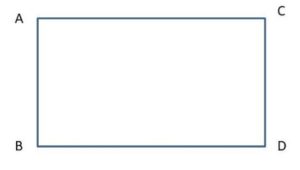
The perimeter of the Quadrilateral is the sum of the distance around the image. That means the perimeter of a quadrilateral is equal to the sum of the four sides of the image or object. That is,

Perimeter of quadrilateral. introduction.image1

(AB + BD + DC + CA) = Perimeter of the Quadrilateral.

1. Parallelogram

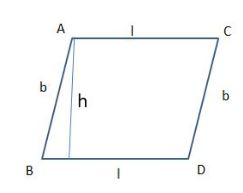
Perimeter of quadrilateral. introduction.image2

Here, the lengths of the two sides of the parallelogram are equal and the breadths of the two sides of the parallelogram are equal. Opposite sides are equal in a parallelogram.
Perimeter of the Parallelogram = (AB + BD + DC + CA)
= (b + l + b + l).
Perimeter of the Parallelogram = 2(l + b).
Here, ‘l’ represents the length and ‘b’ represents the breadth of the parallelogram.
Area of the parallelogram = Base * height.

2. Rectangle

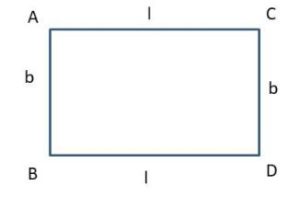
Perimeter of quadrilateral. introduction.image3

In a rectangle, both the lengths of the sides are equal and the breadths of the sides of a rectangle are equal. That means, opposite sides of the rectangle are equal.
Perimeter of the rectangle = (AB + BD + DC + CA) = (b + l + b + l) = 2(l + b).
Perimeter of the Rectangle = 2(l + b).
Area of the Rectangle = length * breadth = l *b.
Here, ‘l’ indicates the length of the rectangle and ‘b’ indicates the breadth of the rectangle.

3. Square

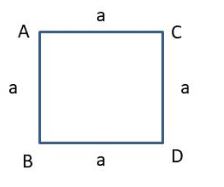
Perimeter of quadrilateral. introduction.image4

In this, a square is also enclosed with the four sides and the lengths of these four sides are equal.
Here, ‘a’ indicates the length of the sides of the square.
Perimeter of the square = (AB + BD + DC + CA) = (a + a + a + a) = 4a.
The perimeter of the square = 4a.
Area of the Square = Side * Side = a * a = a^2.

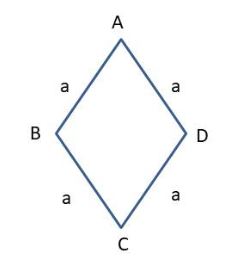
4. Rhombus

Perimeter of quadrilateral. introduction.image5

The lengths of the four sides of the rhombus are equal. Here, ‘a’ represents the length of the side.
Perimeter of the Rhombus = (AB + BC + CD + DA) = (a + a + a + a) = 4a.
The perimeter of the Rhombus = 4a.
Area of the Rhombus = (Base * height).

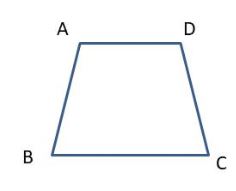
5. Trapezium

Perimeter of quadrilateral. introduction.image6

Two opposite sides of the trapezium are parallel. Perimeter of the Trapezium = (AB + BC + CD + DA).
AB + BC + CD + DA = (c + b + d + a)cm.
Area of the Trapezium = (a + b) / 2 * h.
Here, a, b, c, d are the sides of the trapezium. And ‘h’ indicates the height of the trapezium.

Perimeter of Quadrilateral Examples

1. Find the Perimeter of the Quadrilateral with the sides 2cm, 10cm, 5cm, and 20cm?

Solution:
The given information is the length of the four sides of the quadrilateral is = 2cm, 10cm, 5cm, 20cm.
The perimeter of the quadrilateral = sum of the length of the four sides of the quadrilateral.
Perimeter of the quadrilateral = (2 + 10 + 5 + 20)cm. = 37cm.

So, the perimeter of the quadrilateral is equal to 37cm.

2. The Perimeter of the quadrilateral is 40cm and the length of the three sides of the quadrilateral is 5cm, 10cm, and 5cm. Find the length of the four sides of the quadrilateral?

Solution:
The given details are the Perimeter of the quadrilateral = 40cm.
Length of the three sides of quadrilateral = 5cm, 10cm, and 5cm.
The perimeter of the quadrilateral = sum of the length of four sides of the quadrilateral.
40cm = (5 + 10 + 5 + x) cm.
40 = 20 + x.
x = 40 – 20 = 20cm.

Finally, the length of the fourth side of the quadrilateral is equal to 20cm.

3. A woman crosses a distance of 24m long while going round a quadrilateral field twice. What will be the cost of fencing the field at the rate of cost $1.20per m?

Solution:
The given information is Women crosses a distance of 24m long = perimeter of its boundary = 24 / 2 = 12m.
Cost of fencing the field for 1m = $1.20.
Then the cost of 12m of fencing the field = 12 * $1.20 = $14.4.

Therefore, the cost of the 12m fencing field is equal to $14.4.

4. One side of the square is 4cm. Find the perimeter of the square?

Solution:
As per the given information, the length of the side of the square = 4cm.
The perimeter of the square = 4a.
Here, a = 4.
By substituting the ‘a’ value in the formulae, we will get
Perimeter of the square = 4 * 4 = 16cm.

So, the perimeter of the square is equal to 16cm.

5. Length of the rectangle is 10cm and the breadth of the rectangle is 5cm. Calculate the Perimeter of the Rectangle?

Solution:
As per the given details, the Length of the rectangle (l) = 10cm.
Breadth of the rectangle (b) = 5cm.
Perimeter of the rectangle = 2(l + b).
By substituting the values in the formulae, we will get like
Perimeter of the rectangle = 2(10 + 5) = 2(15) = 30cm.

Therefore, the perimeter of the rectangle is equal to 30cm.

6. If the area of the rhombus is 20 square units and the height of the rhombus is 6 units, then calculate the base of the rhombus?

Solution:
From the given information, Area of the Rhombus = 20 Sq units.
Height of the Rhombus (h) = 6 units.
Area of the Rhombus = Base * height.
20 = Base * 6.
Base = 20 / 6 = 10 / 3 = 0.3 units.

The base of the Rhombus is equal to 0.3 units.

Frequently Asked Questions

1. What is Quadrilateral?

The quadrilateral is enclosed with four sides. It has four corners, four angles, and four sides. The total angle of the quadrilateral is equal to 360°.

2. What are the types of Quadrilateral?

The types of Quadrilateral are,
1. Square
2. Rectangle
3. Parallelogram
4. Trapezium
5. Rhombus

3. How we can find the perimeter of a quadrilateral?

The area of the quadrilateral is the sum of all sides of the quadrilateral. Yes, by adding all sides of the quadrilateral, we can find the perimeter of the quadrilateral.