Types of Symmetry

Types of Symmetry – Line, Translation, Rotational, Reflection, Glide | Different Types of Symmetry with Examples

Symmetry is one of the important concepts of geometry. If one part of the object looks like the same as another part of the object when we turn, flip, or slide, then it is called symmetry. If an object is not looking like another part of the object then it is called asymmetric.

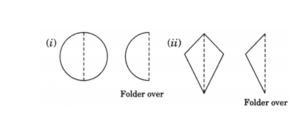
To find out a given object is symmetric, we need to follow some steps. Firstly, draw a line on the middle of the image or object, and observe the image or object whether the left side of the object is the same as the right side or not. If the image is symmetrical, then the left side of the image is looking like a mirror image of the right side of the image or not. We can define different types of symmetries as below.

Also, Read:

Example Images of Symmetry
Types of Symmetry. Example for Symmetry. Image 1. jpg

Line of Symmetry

An object is divided into two parts with the help of a line and the two parts are mirror images of an object, then it is called a line of symmetry. The line of symmetry is also called as ‘axis of symmetry’. The line may be either vertical or horizontal or diagonal.

Vertical Line of Symmetry

The above figure shows the hexagonal image divided into two parts with the help of a vertical line. Here, the vertical line divides the above image into two parts and these two parts are mirror images for each other. That means, both the parts of an image are the same. This type of symmetry is called as Vertical line of Symmetry.
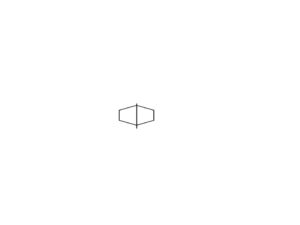
Types of Symmetry. vertical line of Symmetry. Image 2

Horizontal Line of Symmetry

The above diagram shows that the image is split into two parts with the help of a horizontal line. Here, the horizontal line dividing the above image into two parts, and these two parts are equal halves of the image. This type of symmetry is called a horizontal line of symmetry.
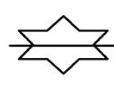
Types of Symmetry. Horizontal line of Symmetry. Image 3. jpg

Diagonal Line of Symmetry

From the above diagram, an image is divided into two equal halves by the diagonal line. These two equal halves are mirror images of each other. This type of line of symmetry is called as Diagonal Line of Symmetry.

Again we have a number of types in line of symmetry. Yes, we can divide the image into a number of parts with the help of one line, two-line,s or more lines. Every part must be the mirror image of another.
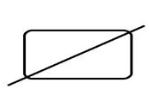
Types of Symmetry. Diagonal line of Symmetry.image 4

One Line of Symmetry

By using the vertical or horizontal or diagonal line, we need to divide the image into equal halves and it is called one line of symmetry. Above mentioned, vertical, horizontal, and diagonal lines of symmetry are examples of one line of symmetry.

Two Lines of Symmetry

Same like one line of symmetry, in two lines of symmetry also we can use the vertical or horizontal or diagonal lines but we need to use only two lines to divide the image equally. This type of line of symmetry is called Two lines of Symmetry.
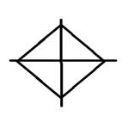
Types of Symmetry. Two lines of Symmetry.image 5

Infinite Lines of Symmetry

An image or object is divided into a number of parts with the help of a number of lines and these equal halves of the image. It is called Infinite Lines of Symmetry. These lines are either vertical or horizontal or diagonal lines.
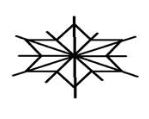
Types of Symmetry. Infinite lines of Symmetry.image 6

Some Other Types of Symmetry

We have different types of symmetries considered depending on the various cases. They are

  1. Translational Symmetry
  2. Rotational Symmetry
  3. Reflexive Symmetry
  4. Glide Symmetry

1.Translational Symmetry

An object or image is moving forward or backward or changing the position from one place to another, but there is no change in the image or object. This type of Symmetry is called Translational Symmetry.
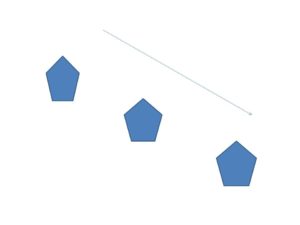
Types of Symmetry. Translational Symmetry.image 7

2.Rotational Symmetry

An object or image is rotated in a particular direction but the position of an object or image is identical to the origin of an image or object, then it is called rotational symmetry. It is also called radial symmetry.
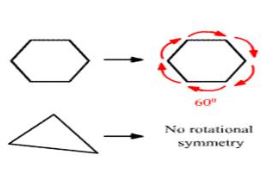
Types of Symmetry. Rotational Symmetry.image 8

From the above figure, we can observe the rotational symmetry. If you rotate the hexagonal object or image in a 60° clockwise direction with respect to the origin, there is no change in the shape of an image. More Examples for Rotational Symmetry are Circle, Hexagonal, Square, Rectangle, and etc…

3.Reflexive Symmetry

Reflexive Symmetry is the same as a line of symmetry. Yes, in this type of symmetry one part of the image or object represents the mirror image of another part of the image. Reflexive Symmetry is also called a line of symmetry or mirror symmetry. The below figure is a better example of Reflexive symmetry.
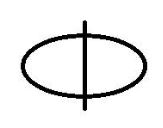
Types of Symmetry. Reflexive Symmetry.image 9

The above object is divide into two parts and the left side part is the mirror image of the right side of the image.

4.Glide Symmetry

It is the combination of both translation symmetry and reflection symmetry.

Point Symmetry

When an object is in opposite direction, every part of the object must be matched with the original object. It is called Point Symmetry. It is the same as Rotational Symmetry, so we can call it Rotational Symmetry order 2.
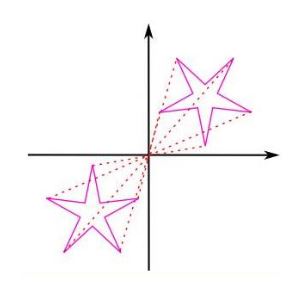
Types of Symmetry. Translational Symmetry.image 7

Solved Examples on Types of Symmetry

1. Name and draw the shape which possesses linear symmetry, point symmetry, and rotational symmetry?

Solution:
(i) Line Segment
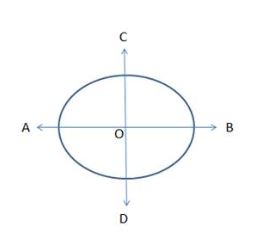
Types of Symmetry. Line segment.image 11

  • Linear symmetry is a line of symmetry. here, it indicates ‘AB’.
  • Point symmetry, the mid-point of the line of origin of the image that is ‘O’.
  • Rotational Symmetry, If we move the above image in any direction with respect to the origin, there is no change in the image. Here, the origin of the image is ‘O’

(ii) Square
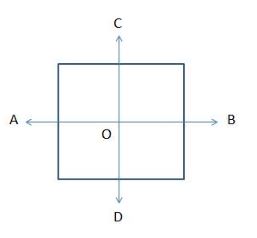
Types of Symmetry. Square.image 12

  • Linear symmetry, two lines of symmetry.
  • Point symmetry, the intersection of two lines that is ‘O’.
  • Rotational Symmetry order of 2.

2. If the following figure shows a line of symmetry, then complete the figure?
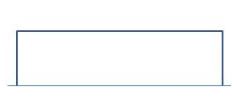
Types of Symmetry. line of symmetry.image 13

Solution:
The line of symmetry, vertical or horizontal line divides the image into two equal halves and two parts are look as same. So, the remaining part of the image also the same as the above figure. That is,
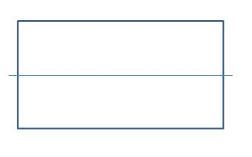
Types of Symmetry. line of symmetry.image 14

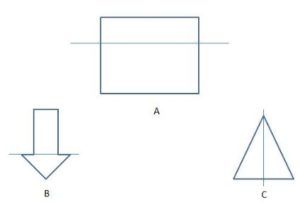
3. Identify which of the following figure is the example for symmetry?
Types of Symmetry. symmetry.image 15

Solution:
In the symmetry method, an image or object is divided into equal halves either it may be vertical lines or horizontal lines. Each part must be a mirror image of the other part of the image. That particular image, we can consider as the example for symmetry. In the above diagrams, figure ‘c’ is showing as an example of symmetry. In that one only, the image is divided into two equal halves and the remaining A and B are not divided into equal halves.

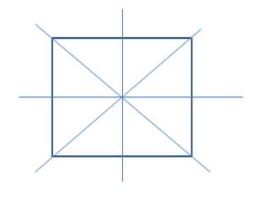
4. How many lines of symmetry does a rectangle have?
Types of Symmetry. symmetry.image 16

Solution:
Four lines of symmetry. One horizontal line, one vertical line, and two diagonal lines.

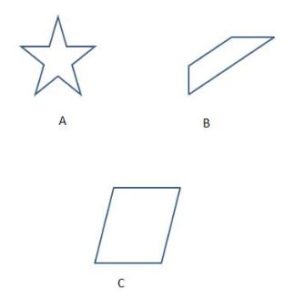
5. Identify which of the following image indicates the rotational symmetry?
Types of Symmetry. Rotational symmetry.image 17

Solution:
By moving in a forward or backward direction, an object or image will be in the same as the original image, which is called rotational symmetry. From the above, Figure (A) is the best example for Rotational symmetry.

FAQs on Types of Symmetry

1. What is Symmetry?

In symmetry, an object is divided into equal parts and each part of an object is a mirror image of another part of the object. 

2. What are the Types of Symmetry?

There are four types of symmetry. They are

  1. Translational Symmetry
  2. Rotational Symmetry
  3. Reflexive Symmetry
  4. Glide Symmetry

3. What is a Line of Symmetry?

An object or image is divided into equal halves with horizontal or vertical or diagonal lines. But the left side of the image is the same as the right side of the image that is called a line of symmetry.

4. What is Point Symmetry?

If we place the image or object in the opposite direction, then every part of the image must be matched with the equal distance that is called point symmetry.

5. What is Asymmetric?

An object is divided into equal parts but the left side of the image is not the same as the right side of the image and it is called an asymmetric method.

Common Solid Figures

Common Solid Figures – Definition, Shapes, Formulas, Properties, Examples

Solid shapes or figures are solids having 3 dimensions, namely length, breadth, and height. Solid figures are classified into different categories. The characteristics and properties of solid shapes, the number of faces, edges, and also the number of vertices are explained below. Also, we have given examples for a better understanding of solid shapes. Also, we have given the solid shapes with clear explanations. Check out the complete concept to learn about solid shapes.

Attributes of Solid Figures

Face: The flat surface present on the solid figure is known as the Face of the solid figure.
Edge: The edge of the solid figure is defined as the line where two faces meet.
Corner: The corner is a point where three or more edges join together is known as a corner.

Different Types of Solid Figures

There are different types of solid figures available in geometry. Check out the detailed explanation of some of the examples of solid figures below.

Cube

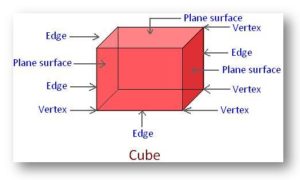
The first and important solid figure everyone discusses Cube. A cube is defined as a slid box-shaped that has six identical square faces. One solid figure that called a cube must consist of 6 equal and plane surfaces they appear as a square in shape.

A cube consists of 6 plane surfaces, 8 vertices and, 12 edges. There are two adjoining planes available in a cube which are called surfaces that meet at an edge. Also, it consists of 12 edges that are equal in length. These edges are straight edges. Furthermore, the joining point of two corners called a vertex. In a cube, there are 8 such vertices available.

cube solid figures

Parts of a Cube

(i) Face: The sides of a cube are known as the Face of the cube. A cube consists of six faces. All the faces of a cube are square in shapes. Each face of a cube has four equal sides.
(ii) Edge: When two edges join each other with a line segment, then that corner is called the edge. The cube has 12 edges. All the 12 edges are equal in length as all faces are squares. These edges are straight edges.
(iii) Vertex: A point formed with the joint of the three edges is known as a vertex of a cube. There are 8 vertices in a cube.
(iv) Face Diagonals: Face Diagonals of a cube is the line segment that joins the opposite vertices of a face. There are 12 diagonals in the cube that are formed with 2 diagonals in each face altogether.
(v) Space Diagonals: Space diagonals of a cube are the line segment that joins the opposite vertices of a cube and also cutting through its interior. There are 4 space diagonals in a cube.

Properties of a Cube

Volume: The volume of a cube is shown by s³ where s is the length of one edge.
Surface Area: The surface area of a cube is 6s², where s is the length of one edge.

Also, Read:

Cuboid

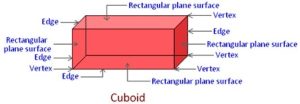
The cuboid consists of 6 rectangular faces which form a convex polyhedron. The opposite rectangular plane surfaces are equal. It has 8 vertices and 12 edges.

A cuboid consists of 6 rectangular plane surfaces. There are 8 vertices and 12 edges. All the faces of a cuboid are equal and square. Therefore, a cube has all the six faces equal, whereas a cuboid has the opposite faces equal.

cuboid solid figures

Properties of a Cuboid

Volume: The volume of a cuboid is lwh, where l is the length, h is the height, and w is the width.
Lateral Surface Area: The lateral surface area of a cuboid is 2lh + 2wh, where l is the length, w is the width, and h is the height.
Surface Area: The surface area of a cuboid is 2lw + 2lh + 2wh, where l is the length, w is the width and h is the height.

Cylinder

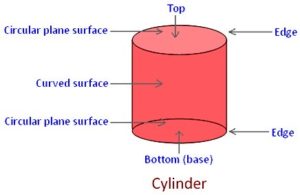
The cylinder is one of the basic 3d shapes that stands on a circular plane surface consisting of circular plane surfaces on its top and bottom. A cylinder has two circular plane surfaces. One surface presents at its base and the other one presents at its top. Also, it has a curved surface in the middle. Two edges at which the two plane surfaces meet with the curved surface present on a cylinder. The edges are curved in a shape.

A cylinder has 2 plane surfaces and 1 curved surface. There are 2 edges and no vertices. Furthermore, the top and bottom of the cylinder are of the same shape as well as in size. They both are equal.

cylinder solid figures

Cone

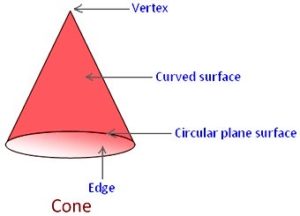
A cone is a distinctive three-dimensional geometric figure that has one plane circular surface. It consists of a base and only one curved surface. There are 1 edge and 1 vertex present in the cone. The edge of the cone is a curved edge. It is formed by the circular plane surface meeting with the curved surface.

Cone solid figures

Sphere

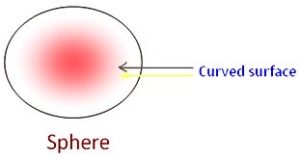
A sphere is a geometrical figure that has a ball-like shape. There is only one curve surface present in the sphere and no edge and no vertex present in it.

sphere solid figures

Triangle

Triangle in Geometry – Definition, Types, Shapes, Properties, and Examples

Triangle is one of the topics in geometry. The word ‘Tri’ in a triangle indicates three. Yes, Triangle is designed with three lines and is shaped as a closed curve with three lines. Each line is considered as a side of the triangle. Totally, one triangle has three sides or faces. The points, where the two sides of the triangle are intersected that particular points are called vertices and the angles are formed at the point of vertices.

Symbol of Triangle

The symbol of the triangle is a closed loop with three sides.
traingle symbol

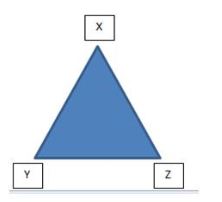
Here, the name of the triangle is XYZ.

Properties of the Triangle

Have a glance at the Properties of Triangle listed below and they are along the lines

  • Basically, the triangle has three sides. Here, the sides of the triangle are XY, YZ, and ZX.
  • The vertices of the triangle are X, Y, and Z.
  • Angles of the triangle are XYZ, YXZ, and XZY.
  • The sum of the three angles is equal to 180°.
  • The sum of any two sides of the triangle must be greater than the third side of the triangle. That is, XY + YZ = ZX or YZ + ZX = XY or XY + XZ = YZ.
  • In Triangles, we have two types of angles. They are interior angles and exterior angles. Interior angles are formed inside of the intersected point of the sides. Exterior angles are formed outside of the intersected points of the sides.

Also, Read:

Area of a Triangle

Area of the Triangle is equal to 1 / 2 * base * height. Here, Area is denoted by ‘A’, the base is denoted by ‘b’ and the height is denoted by ‘h’.

Area (A) = (1 / 2) b*h.

Perimeter of a Triangle

Perimeter of a triangle is equal to half of the sum of the three sides of the triangle. Perimeter is denoted by s and sides of the triangle are denoted as a, b, c.

Perimeter (s) = (a+ b + c) / 2.

  • We can find out the area of the triangle by using the perimeter and sides of the triangle. That is, Area = √s(s – a) (s – b) (s – c).

Types of Triangles

We have different types of triangles. Based on the sides and angles, triangles are classified into different types. They are

  1. Equilateral Triangle
  2. Isosceles Triangle
  3. Scalene Triangle
  4. Acute angled Triangle
  5. Obtuse angled Triangle
  6. Right-sided angle Triangle

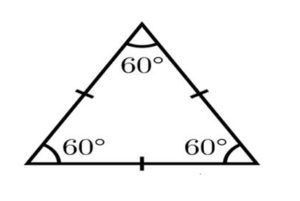
1. Equilateral Triangle: Three sides of the triangle, as well as three angles of the triangle, are equal and it is called as Equilateral Triangle.

Triangle.Equilateral triangle. image2

Area of the Equilateral Triangle is equal to √3 / 4 *(side)^2.

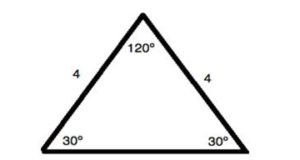
2. Isosceles Triangle: In this type of Triangle, two sides of the triangle and two angles are equal.

Triangle.Isosceles triangle. image3

The area of an Isosceles Triangle is equal to (base * height) / 2.

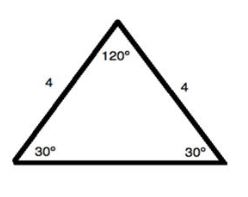
3. Scalene Triangle: A Triangle that is generated with three different sides and three different angles is called a Scalene Triangle.

Triangle.Isosceles triangle. image3

Area of the Scalene Triangle is equal to (1 / 2) * base * height.

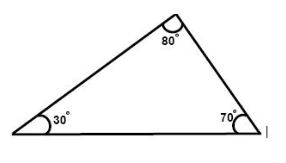
4. Acute Angled Triangle: Three internal angles of the triangle are measured less than 90° and it is called an Acute Angled Triangle.

Triangle.Acute Angled triangle. image5

Area of the Acute angled triangle is equal to (1 / 2) * base * height.

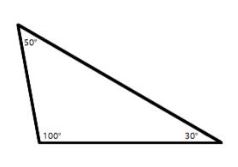
5. Obtuse Angled Triangle: Generally, three angles there is a triangle. If any one of the interior angles is measured as greater than 90°, then it is called as Obtuse Angled Triangle.

Triangle.obtuse Angled triangle. image6

Area of the obtuse angle is equal to (1 / 2) * base * height.

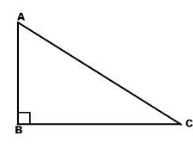
6. Right-sided angle Triangle: The angle between two sides is equal to 90° and the sum of the remaining two angles must be equal to 90°, then it is called a Right-sided angle triangle.

Triangle.Right sided Angle triangle. image7

Area of the Right-angled triangle is equal to (1 / 2) * base * height.

Solved Problems on Triangle

1. The Base of the triangle is 4 cm and the height of the triangle is 9 cm. find the area of the triangle?

Solution:
As per the given data, the base of the triangle (b) = 4 cm.
Height of the triangle (h) = 9 cm.
Area of the triangle (A) = (1 / 2) * base * height.
A = (1 / 2) * 4 * 9.
A = 2 * 9 =18 cm².

The area of the triangle is equal to 18 cm².

2. A triangle has an area of 60 cm² and the base of the triangle is 30 cm. Find the height of the triangle?

Solution:
As per the given information, the Area of the triangle (A) = 60 cm².
Base of the triangle (b) = 30 cm².
Area of the triangle (A) = (1 / 2) * base * height.
60 = (1 / 2) * 30 * h.
60 *2 =30 * h.
120 = 30 * h.
H = 120 / 30 = 4 cm.

Height of the triangle = 4 cm.

3. Two sides of the Isosceles triangle are 10 cm each while the third side is 15 cm. Find the area of the isosceles triangle?

Solution:
As per the given data, two sides of the Isosceles triangle = 10 cm
The third side of the triangle = 15 cm.
Area of the Isosceles triangle (A) = √s (s – a) (s – b) (s – c).
S = (a + b + c) / 2
Here, a = 10, b = 10, c =15
S = (10 + 10 + 15) / 2 = 35 / 2 = 17.5
A = √ 17.5 ( 17.5 – 10) (17.5 – 10) ( 17.5 – 15).
A = √17.5 (7.5) (7.5) (2.5) = 588.27.

The area of the Isosceles Triangle is equal to 588.27.

4. Three sides of the triangle are 12 cm, 10 cm, 10 cm. Find the perimeter of the triangle?

Solution:
As per the given information, three sides of the triangle are 12 cm, 10 cm, 10 cm.
Perimeter of the triangle = (a + b + c) / 2.
Here, a = 12 cm, b = 10 cm, c = 10 cm.
Perimeter = (12 + 10 + 10) / 2 = 32 / 2 = 16 cm.

The perimeter of the triangle = 16 cm.

5. Area of the triangle is 20 cm² and the height of the triangle is 60 cm. What is the base of the triangle?

Solution:
As per the given information, the Area of the triangle (A) = 20 cm².
Height of the triangle (h) = 60 cm.
Area of the triangle (A) = (1 / 2) * base * height.
20 = (1 / 2) * base * 60.
20 *2 = base * 60.
40 / 60 = base.
Base = 4 / 6.

The base of the triangle is equal to 2 / 3.

Frequently Asked Questions on Triangle

1. What is Triangle?

Triangle is made up of three lines and it is a closed curve.

2. What are the properties of the Triangle?

Properties of the triangle are

  • Triangle has three sides, three angles, and three vertices.
  • The Sum of the three angles must be equal to 180°.
  • The Sum of any two angles must be greater than the third angle.

3. What are the types of Triangles?

Based on the angles and sides triangles are divided into 6 types. They are

Classification of triangles based on the sides.

  1. Scalene Triangle
  2. Isosceles Triangle
  3. Equilateral Triangle

Classification of triangles based on the angle

  1. Acute Angle Triangle
  2. Obtuse Angle Triangle
  3. Right Angle Triangle

4. What are the basic formulas for triangles?

The basic formulas of triangles are Area and Perimeter Formulas. They are
Area of the Triangle (A) = (1 / 2) * base * height.
Or
Area (A) = √s(s – a) (s – b) (s – c).
Perimeter of the Triangle (s) = (a + b + c) / 2.

5. Difference between the Isosceles triangle and scalene triangle?

Isosceles Triangle: Two sides of the triangle are equal and the third side is different, then it is called as Isosceles Triangle.
Scalene Triangle: If the three sides of the triangle values are different, then it is called a scalene triangle.


Probability for Rolling Two Dice

Probability for Rolling Two Dice – Examples | How to find Probability of Rolling Two Dice?

Probability is a possibility of outcome for a nonoccurrence event. That means, when we are not sure about the outcome or result of an event, at that moment we can apply the probability method to the event. So that, we will know the chances of outcome of an event. For example, if we are trying to flip a coin and we don’t know the result or outcome of a coin that means, either it may be heads or tails. In such a case, we can use the probability method. If you want to know What is the Probability for Rolling Two Dices

Get to know the Probability When Two Dice are Rolled, Solved Examples on How to Calculate the Two Dice Rolling Probability, etc.  Also, find the Possible Outcomes Whe Two Dice are Rolled by checking out the Probability Table.

Two Dice Rolling Probability

In order to determine the probability of a dice roll we need to know two things namely

  • Size of the Sample Space or Set of Possible Outcomes
  • How often an Event Occurs

If you throw a single die the sample space is equal to values on the die i.e. (1, 2, 3, 4, 5, 6). Since th die is fair each number in the set occurs only once. To obtain the probability of rolling any number on the die we divide the event frequency by the size of sample space.

In the same way, When Two Dice are Rolled calculating the Probability becomes difficult. Here, Rolling One Die is independent of the other. One roll has no effect on the other and while dealing with the independent events we use the multiplication rule.

Also, Read:

Possibilities of Outcomes When Two Dice are Rolled

As said above, when we throw two dice, there is the possibility to get 36 outcomes. Have a look at the possibilities below.
Probability of an event = Number of favorable outcomes/ Total number of outcomes
Two dice are thrown at a time. Here, one die is x and another one is y.
X = {1,2,3,4,5,6} and Y = {1,2,3,4,5,6}

Probability Table for Rolling Two Dice 

The Possible Outcomes When Two Dice are Rolled is given below. Total Possible Outcomes is equal to the Product of sample space of the first die(6) and the sample space of the second die(6) that is 36.

123456
1(1, 1)(1, 2)(1, 3)(1, 4)(1, 5)(1, 6)
2(2, 1)(2, 2)(2, 3)(2, 4)(2, 5)(2, 6)
3(3, 1)(3, 2)(3, 3)(3, 4)(3, 5)(3, 6)
4(4, 1)(4, 2)(4, 3)(4, 4)(4, 5)(4, 6)
5(5, 1)(5, 2)(5, 3)(5, 4)(5, 5)(5, 6)
6(6, 1)(6, 2)(6, 3)(6, 4)(6, 5)(6, 6)

Possibility of outcomes are {(1,1), (1,2), (1,3), (1,4), (1,5), (1,6),
(2,1), (2,2), (2,3), (2,4), (2,5), (2,6),
(3,1), (3,2), (3,3), (3,4), (3,5), (3,6),
(4,1), (4,2), (4,3), (4,4), (4,5), (4,6),
(5,1), (5,2), (5,3), (5,4), (5,5), (5,6),
(6,1), (6,2), (6,3), (6,4), (6,5), (6,6)}
Total number of outcomes are 36.

Two Dice Probability Examples

1. Two dice are rolled. Find the Probability of the sum of scores is an even number?

Solution:
Two dices are rolled at a time.
That is, X = {1,2,3,4,5,6} and Y = {1,2,3,4,5,6}.
The total number of outcomes of the two dices is 36.
Add the scores of the two dices. That is
{(1,1), (1,3), (1,5), (2,2), (2,4), (2,6), (3,1), (3,3), (3,5), (4,2), (4,4), (4,6), (5,1), (5,3), (5,5), (6,2), (6,4), (6,6)}.
So, the number of possibilities of the sum of even numbers is 18.
The probability of an event = number of favorable outcomes/ total number of outcomes.

Probability of sum of an even numbers = 18 / 36 = 1 / 2.

2. Two dice are rolled. Find the Probability of the sum of scores is an odd number?

Solution:
Two dices are rolled at a time.
That is, X = {1,2,3,4,5,6} and Y = {1,2,3,4,5,6}.
The total number of outcomes of two dices are 36.
Add the scores of the two dices. That is
{(1,2), (1,4), (1,6), (2,1), (2,3), (2,5), (3,2), (3,4), (3,6), (4,1), (4,3), (4,5), (5,2), (5,4), (5,6), (6,1), (6,3), (6,5)}.
So, the number of possibilities of the sum of odd numbers is 18.
The probability of an event = number of favorable outcomes/ total number of outcomes.

Probability of sum of an odd numbers = 18 / 36 = 1 / 2.

3. Two dice are rolled. Find the probability of the sum of 2, 4, and 12?

Solution:
Two dice are rolled at a time.
That is, X = {1,2,3,4,5,6} and Y = {1,2,3,4,5,6}.
The total number of outcomes of the two dices is 36.
(i) Number of favorable outcomes of the sum of 2 is (1,1).
So, only 1 outcome.
The total number of outcomes = 36.
So, the probability of an event = number of favorable outcomes/ total number of outcomes.
Probability of sum of 2 = 1/36.
(ii) Number of favorable outcomes of sum of 4 are {(1,3), (2,2), (3,1)}.
So, the number of favorable outcomes is 3.
The total number of outcomes = 36.
So, the probability of an event = number of favorable outcomes/ total number of outcomes.
Probability of sum of 4 = 3/36 = 1/12.
(iii) Number of favorable outcomes of the sum of 12 are {(6,6)}.
So, a number of favorable outcomes is 1.
The total number of outcomes = 36.
So, the probability of an event = number of favorable outcomes/ total number of outcomes.
Probability of sum of 12 = 1/36.

4. Two dice are rolled. P is the event that the sum of the numbers shown on the two dice is 5, and Q is the event that at least one of the dice shows up a 3?
Are the two events (i) mutually exclusive, (ii) exhaustive? Give arguments in support of your answer.

Solution:
Two dice are rolled at a time.
That is, X = {1,2,3,4,5,6} and Y = {1,2,3,4,5,6}.
The total number of outcomes of the two dices is 36.
P is sum of 5. That is, P = {(1,4), (2,3), (3,2), (4,1)}.
Q is at least one of the dice shows up 3. That is, Q = {(1,3), (2,3), (3,1), (3,2), (3,3), (3,4), (3,5), (3,6), (4,3), (5,3), (6,3)}
(i) Mutually Exclusive
P ∩ Q = {(2, 3), (3, 2)} ≠ ∅.
Hence, P and Q are not mutually exclusive.
(ii) Exhaustive
P∪ Q ≠ S.

Therefore, P and Q are not exhaustive events.

5. Two dice are thrown simultaneously. Find the probability of (i) doublet (ii) product of 6 (iii) Divisible by 4 (iv) total of at least 10 (v) sum of 8?

Solution:
Two dice are rolled at a time.
That is, X = {1,2,3,4,5,6} and Y = {1,2,3,4,5,6}.
The total number of outcomes of two dices is 36.
(i) Doublets
Possibilities of doublets are {(1,1), (2,2), (3,3), (4,4), (5,5), (6,6)} = 6.
Probability of an event = number of favorable outcomes / total number of outcomes.
Probability of an event = 6 / 36 = 1 / 6.
(ii) Product of 6.
Possibilities of product of 6 is {(1,6), (2,3), (3,2), (6,1)} = 4.
Probability of an event = number of favorable outcomes / total number of outcomes.
Probability of an event = 4 / 36 = 1 / 9.
(iii) Divisible by 4.
Possibilities of Divisible by 4 is {(1,4), (2,2), (2,6), (3,1), (3,5), (4,1), (4,4), (5,3), (6,2), (6,6)} = 10.
Probability of an event = number of favorable outcomes / total number of outcomes.
Probability of an event = 10 / 36 = 5 / 18.
(iv) Total of at least 10.
Possibilities of Total of at least 10 are {(4,6), (5,5), (5,6), (6,4), (6,5), (6,6)} = 6.
Probability of an event = number of favorable outcomes / total number of outcomes.
Probability of an event = 6 / 36 = 1 / 6.
(v) Sum of 8.
Possibilities of sum of 8 are {(2,6), (3,5), (4,4), (5,3), (6,2)} = 5.
Probability of an event = number of favorable outcomes / total number of outcomes.
Probability of an event = 5 / 36.

6. Two dice are thrown. Find the probability of
(i) multiple of 4.
(ii) multiple of 5.
(iii) prime number as the sum.
(iv) product as 2.
(v) sum as < = 5.
(vi) getting a multiple of 4 on one die and multiple of 2 on another die.

Solution:
Two dice are rolled at a time.
That is, X = {1,2,3,4,5,6} and Y = {1,2,3,4,5,6}.
The total number of outcomes of the two dices is 36.
(i) Multiple of 4.
Possibilities of multiple of 4 are {(1,3), (2,2), (2,6), (3,1), (3,5), (4,4), (5,3), (6, 2), (6,6)} = 9.
Probability of an event = number of favorable outcomes / total number of outcomes.
Probability of Multiple of 4 = 9 / 36 = 1 / 4.
(ii) Multiple of 5.
Possibilities of multiple of 5 are {(1,4), (2,3), (3,2), (4,1), (4,6), (5,5), (6,4)} = 7.
Probability of an event = number of favorable outcomes / total number of outcomes.
Probability of Multiple of 5 = 7 / 36.
(iii) Prime number as sum
Prime numbers are 1,2,3,5,7,11,13…..
Possibilities of prime number as sum = {(1,1), (1,2), (1,4), (1,6), (2,1), (2,3), (2,5), (3,2), (3,4), (4,1), (4,3), (5,2), (5,6), (6,1), (6,5)} = 15.
Probability of an event = number of favorable outcomes / total number of outcomes.
Probability of Prime number as sum = 15 / 36 = 5 / 12.
(iv) Product as 2
Possibilities of product as 2 are {(1,2), (2,1)} = 2.
Probability of an event = number of favorable outcomes / total number of outcomes.
Probability of Product as 2 = 2 / 36 = 1 / 18.
(v) sum as < = 5.
Possibilities of sum as < = 5 are {(1,1), (1,2), (1,3), (1,4), (2,1), (2,2), (2,3), (3,1), (3,2), (4,1)} = 10.
Probability of an event = number of favorable outcomes / total number of outcomes.
Probability of sum as <=5 = 10 / 36 = 5 / 18.
(vi) getting a multiple of 4 on one die and multiple of 2 on another die.
Possibilities of getting a multiple of 4 on one die and multiple of 2 on another die are {(4, 2), (4, 4), (4,6), (2,4), (6,4)} = 5.
Probability of an event = number of favorable outcomes / total number of outcomes.

Probability of getting a multiple of 4 on one die and multiple of 2 on another die = 5 / 36.

7. Two dice are thrown. Find out the (i) the odds in favor of getting the sum 4, and (ii) the odds against getting the sum 3.

Solution:
Two dice are rolled at a time.
That is, X = {1,2,3,4,5,6} and Y = {1,2,3,4,5,6}.
The total number of outcomes of the two dices is 36.

(i) The odds in favor of getting the sum 4.
Possibilities of getting the sum 4 = {(1,3), (2,2), (3,1)} = 3.
Probability of an event = number of favorable outcomes / total number of outcomes.
Probability of getting the sum 4 = 3 / 36 = 1 / 12.
Odds in favor of getting the sum 4 = probability of getting the sum 4 / (1 – probability of getting the sum 4).
Odds in favor of getting the sum 4 = (1 / 12) / (1 – (1 / 12).
= (1 / 12) / (11 / 12).
=1 / 11.

Finally, the odds I favor of getting the sum of 4 is equal to 1 / 11.

(ii) the odds against getting the sum 3.
Possibilities of getting the sum 3 = {(1,2), (2,1)} = 2.
Probability of an event = number of favorable outcomes / total number of outcomes.
Probability of getting the sum 3 = 2 / 36 = 1 / 18.
Odds in favor of getting the sum 3 = probability of getting the sum 3 / (1 – the probability of getting the sum 3).
Odds in favor of getting the sum 3 = (1 / 18) / (1 – (1 / 18).
= (1 / 18) / (17 / 18).
=1 / 17.

Finally, the odds I favor of getting the sum 3 is equal to 1 / 17.

8. Two dice are thrown. Find the probability that the numbers on the two dices are different?

Solution:
Two dice are rolled at a time.
That is, X = {1,2,3,4,5,6} and Y = {1,2,3,4,5,6}.
The total number of outcomes of the two dices is 36.
Possibilities of the numbers on the two dices are different = {(1,2), (1,3), (1,4), (1,5), (1,6), (2,1), (2,3), (2,4), (2,5), (2,6), (3,1), (3,2), (3,4), (3,5), (3,6), (4,1), (4,2), (4,3), (4,5), (4,6), (5,1), (5,2), (5,3), (5,4), (5,6), (6,1), (6,2), (6,3), (6,4), (6,5)} = 30.
Probability of an event = number of favorable outcomes / total number of outcomes.

Probability of the numbers on the two dices are different = 30 / 36 = 5 / 6.

Problems on Trigonometric Identities

Problems on Trigonometric Identities | Word Problems Involving Trigonometric Identities

Check problems on trigonometric identities along with the solutions. Find the step by step procedure to know the trigonometric identities problems. Refer to all the solutions present in the below sections to prepare for the exam. Scroll down the page to get the Trigonometric Identities Word Problems and study material. Know the various formulae involved in solving trigonometric identities below. Assess your knowledge level taking the help of the Practice Problems on Trigonometric Identities available.

Also, Read:

Problem 1:

The angle of inclination from a point on the ground 30 feet away to the top of Lakeland’s Armington Clocktower is 60°. Find the height of the clock tower which is nearest to the foot?

Solution:

As given in the question,

The angle of inclination (θ) = 60°

The height from the ground(a) = 30 feet

To find the height of the Clocktower to the nearest foot, we use the formula

tan θ = h/a

tan 60° = h / 30

h = 30 tan 60°

h = 9.60 ≅ 10 feet

Therefore, the height of the clocktower to the nearest foot is 10 feet.

Hence, the final solution is 10 feet.

Problem 2:

Mary wants to determine the California redwood tree height, there are two sightings available from the ground which one is 200 feet directly behind the other. If the angles of inclination (Θ) are 45° and 30° respectively, how tall is the tree to the nearest foot?

Solution:

As given in the question,

Length at which trees are slighting = 200

The angle of inclinations = 45° and 30°

To find the inclination on the first tree, we apply the Pythagorean theorem,

tan 45° = h/x

h = x tan 45° is the (1) equation

tan 30° = h/(200+x)

h = (200 + x) tan 30 is the (2) equation

From both the equations,

x tan 45° = (200 + x) tan 30°

x tan 45° = 200 tan 30° + x tan 30°

x tan 45° – x tan 30° = 200 tan 30

Divide the equation with tan 45° – tan 30°

x (tan 45° – tan 30°) / tan 45° – tan 30° = 200 tan 30° / tan 45° – tan 30°

x = 273.21 feet

h = 273.21 tan 45

h = 273. 21 feet

h ≅ 273 feet

Therefore, the height of the tree to the nearest foot = 273 feet

Thus, the final solution = 273 feet

Problem 3:

A tree that is standing vertically on the level ground casts the 120 foot long shadow. The angle of elevation from the end of the shadow of the top of the tree is 21.4°. Find the height of the tree to the nearest foot?

Solution:

As given in the question,

Length of the foot-long shadow = 120

The inclination of the tree = 21.4°

To find the height of the tree to the nearest foot, we apply the Pythagorean theorem

tan θ = 0/a

tan 214° = h/120

h = 120 tan 214°

h = 47.03

h ≅ 47 feet

The height of the tree to the nearest foot = 47 feet

Thus, the final solution is 47 feet

Problem 4:

The broadcast tower which is for the radio station WSAZ (“Carl” and “Jeff”‘s home of algebra) has 2 enormous flashing red lights on it. Of the 2 enormous flashing lights, one is at the very top and the other one is few feet below the top. From that point to the base of the tower it is 5000 feet away from level ground, the top light angle of elevation is 7.970° and the light angle of elevation of the second light is 7.125°. Find the distance between the nearest foot and the lights.

Solution:

As given in the question,

Height of the tower = 5000 feet

The angle of elevation of top light = 7.970

The angle of elevation of second light = 7.125°

To find the distance between the nearest foot and the lights, we have to use the Pythagorean theorem

tan θ = h/5000

h = 5000 tan 7.97°

tan β = h-x/5000

h-x = 5000 tan (7.125)°

x = h – 5000 tan (7.125)°

x = 5000 tan 7.97° – 5000 tan 7.125°

x = 5000 (tan 7.97° – tan 7.125°)

x = 75.04 feet

x ≅ 75  feet

Therefore, 75 feet is the distance between the nearest foot and the lights

Thus, the final solution is 75 feet.

Problem 5:

Find the solution of tan (θ) = sin (θ) sec (θ)?

Solution:

sinθ/ cosθ = sinθ secθ

sinθ. (1/cosθ) = sinθ secθ

sinθ secθ = sinθ secθ

tanθ = sinθ secθ

= sinθ(1/cosθ)

= sinθ/cosθ

= tanθ

∴ Hence it is proved

Problem 6:

Prove that (sec(θ)-tan(θ))(sec(θ)+tan(θ))=1

Solution:

sec²(θ)-tan²(θ)=1

1/cos²(θ)-sin²(θ)/cos(θ)=1

(1-sin²(θ))/cos²(θ)=1

cos²(θ)/cos²(θ)=1

(1-sin²(θ))/cos²(θ)

1/cos²(θ)-sin²(θ)/cos²(θ)=sec²(θ)-tan²(θ)

(sec(θ)-tan(θ))(sec(θ)+tan(θ))

Therefore, (sec(θ)-tan(θ))(sec(θ)+tan(θ)) = 1

∴Hence, it is proved

Problem 7:

Prove that sec(θ)/(1-tan(θ))=1/(cos(θ)-sin(θ))

Solution:

1/((cos(θ)-sin(θ)).1/cos(θ).1/cos(θ)

(1/cos(θ))/((cos(θ)-sin(θ))-(cos(θ))=sec(θ)/(1-tan(θ))

Therefore, sec(θ)/(1-tan(θ))=1/(cos(θ)-sin(θ))

∴Hence, it is proved

Problem 8 :

An aeroplane over the Pacific sights an atoll at a 20° angle of depression. If the plane is 435 ma above water, how many kilometres is it from a point 435m directly above the centre of a troll?

Solution:

As given in the question,

The angle of depression = 20°

Height of the plane above water = 435ma

Height above the centre of a troll = 435m

To find the kilometers, we use the pythegorean theorem

tan = θ/A

tan 20° = 435/x

x = 435/tan20°

x = 1.195 km

Therefore, 1.195 kilometres is it from a point 435m directly above the centre of a troll

Thus, the final solution is 1.195 kilometres

Problem 9:

The force F (in pounds)on the back of a person when he or she bends over an acute angle θ (in degrees) is given by F = 0.2W sin(θ + 70)/sin12° where w is the weight in pounds of the person

a) Simplify the formula or F.

b) Find the force on the back of a person where an angle of 30° weight is 50 pounds if he bends an angle of 30°

c) How many pounds should a person weigh for his book to endure a force of 400 lbs if he bends 40°?

Solution: 

a. F = 0.2W sin (θ + 90)/sin 12°

= 0.2W [sinθ cos 90 + cosθ sin90]/sin 12°

= 0.2W [θ(sinθ) + (cosθ) (1)]/sin 12°

= 0.2W [0 + cosθ]/sin 12°

F = 0.2W(cosθ)/sin 12°

The value of F is 0.2W(cosθ)/sin 12°

b. W = 50, θ = 30°, F=?

F = 0.2W cosθ/sin 12°

F = 0.2 (50) (cos30°)/sin 12°

F = 41.45

The force on the back of a person wherein the angle of 30e weight is 50 pounds if he bends an angle of 30° is 41.45

c. F = 400, θ = 40°, W = ?

400 = 0.2(w)(cos 40°)/sin 12°

400(sin 12°)/0.2 cos 40 = 0.2 (w) (cos 40°)/0.2 cos40°

542.82 = w

Therefore, the weigh for his book to endure a force of 400 lbs if he bends 40° is 542.82 pounds

Problem 10:

An observer standing on the top of vertical cliff pots a house in the adjacent valley at an angle of depression of 12°. The cliff is 60m tall. How far is the house from the base of the cliff?

Solution:

As given in the question,

The angle of depression = 12°

Height of the cliff = 60m

To find, the distance of the house from the base of the cliff, we apply the Pythagorean theorem

tan 12° = 60/x

x = 60/tan 12°

x = 282m

282m is the distance of the house from the base of the cliff

Hence, the final solution is 282m

Problem 11:

Building A and B are across the street from each other which is 35m apart. From the point on the roof of building A, the angle of elevation of the top of building B is 24°, the angle of depression of the base of building B is 34° How tall is each building?

Solution:

As given in the question,

The angle of elevation of the top of the building = 24°

The angle of depression of the base of the building = 34°

The distance of both buildings = 35m

To find the height of each building, we apply the Pythagoras theorem,

tan 24° = c/35

c = 15.6

tan 56° = 35/a

a = 23.6m

b = a+c

b = 39.2m

A is 23.6m tall

B is 39.2m tall

Therefore, the height of building A is 23.6m tall

The height of building B is 39.2m tall

Thus the final solution is 23.6m, 39.2m

Problem 12:

In Johannesburg in June, the daily low temperature is usually around 3°C, and the daily temperature is around 18°. The temperature is typically halfway between the daily high and daily low at 10 am and 10 pm. and the highest temperatures are in the afternoon. Find out the trigonometric function which models the temperature T in Johannesburg t hours after midnight?

Solution:

As per the question,

To determine the trigonometric model, the temperature ‘T’ which is Celsius degree and the temperature in axis and then right over here is time in hours. To think about the range of temperatures, the daily temperature is around 3-degree celsius and the highest is 18°. The midpoint between 18 and 3 is 10.5 (21 divided by 2)

Let F(t) is the temperature t hours after 10 am

F(t) = 7.5sin(2Π/24 t) + 10.5

T (t) = 7.5sin (Π/12(t-10)) + 10.5

T(10) = F(0) where T(10) is temperature at 10 pm

F(0) is the temperature at 10 am

Therefore, T(10) = F(0) is the trigonometric function that models the temperature T in Johannesburg t hours after midnight

Problem 13:

A ladder is 6 meters long and reaches the wall at a point of 5m from the ground. What is the angle which the ladder will make with the wall?

Solution:

Let θ be the inclination of the ladder which it makes with the wall

As given in the question,

Length of the ladder = 6m

The distance at which the ladder touches the wall = 5m

The angle at which the ladder will make with the wall

cos θ = 5/6

θ = cos¯¹ (5/6)

θ = 33.56°

Problem 14:

The acceleration of the piston is given by a = 5.0(sinωt + cos2ωt). At what positive values of ωt less than 2Π does a = 0?

Solution:

Let ωt be the crank angle(product of time and angular velocity) in piston acceleration, a be the accelaration of a piston.

a = 5.0(sinωt + cos2ωt)

0 = 5.0(sinωt + cos2ωt)

0 = sinωt + cos2ωt

0 = sinωt + 1 – 2sin²ωt

2sin²ωt – sinωt – 1 = 0

(2sinωt + 1) (sinωt – 1) = 0

2sinωt + 1 = 0

2sinωt = -1

sinωt = -1/2

ωt = sin¯¹(-1/2)

ωt = (7π/6, 11π/6)

sinωt – 1 = 0

sinωt = 1

ωt = sin¯¹(1)

ωt = π/2

{π/2, 7π/6, 11π/6}

Problem 15:

A lighthouse at sea level is 34 mi from a boat. It is known that the top of the lighthouse is 42.5mi from the boat. Find the angle of depression from the top of the lighthouse.

Solution:

Let θ be the angle of inclination from the top of the lighthouse to the boat

Let x be the horizontal distance from the base of the lighthouse to the boat, and

r be the distance from the top of the lighthouse to the boat.

As given in the question,

The length of the lighthouse at sea level = 34 mi

The distance of the top lighthouse from the boat = 42.5 mi

To find the angle of depression from the top of the lighthouse, we apply the Pythagorean theorem

cosθ = 34/42.5

θ = cos¯¹(34/42.5)

θ = 36.87°


Eureka Math Grade 3 Module 4 Mid Module Assessment Answer Key

Engage NY Eureka Math 3rd Grade Module 4 Mid Module Assessment Answer Key

Eureka Math Grade 3 Module 4 Mid Module Assessment Answer Key

Question 1.
Jasmine and Roland each use unit squares to tile a piece of paper. Their work is shown below.
Eureka Math Grade 3 Module 4 Mid Module Assessment Answer Key 1
a. Can one of the arrays be used to correctly measure the area of the piece of paper? If so, whose array would you use? Explain why.
Answer:

b. What is the area of the piece of paper? Explain your strategy for finding the area.
Answer:

c. Jasmine thinks she can skip-count by sixes to find the area of her rectangle. Is she correct? Explain why or why not.
Answer:

Question 2.
Jaheim says you can create three rectangles with different side lengths using
12 unit squares. Use pictures, numbers, and words to show what Jaheim is saying.
Answer:

Question 3.
The area of a rectangle is 72 square units. One side has a length of 9 units. What is the other side length? Explain how you know using pictures, equations, and words.
Answer:

Question 4.
Jax started to draw a grid inside the rectangle to find its area.
Eureka Math Grade 3 Module 4 Mid Module Assessment Answer Key 2
a. Use a straight edge to complete the drawing of the grid.
Answer:

b. Write a skip-count sequence you could use to find the area.
Answer:

c. Write a multiplication equation that you could use to find the area, and then solve.
Answer:

Question 5.
Half of the rectangle below has been tiled with unit squares.
Eureka Math Grade 3 Module 4 Mid Module Assessment Answer Key 3
a. How many more unit squares are needed to fill in the rest of the rectangle?
Answer:

b. What is the total area of the large rectangle? Explain how you found the area.
Answer:

Eureka Math Grade 3 Module 4 End of Module Assessment Answer Key

Engage NY Eureka Math 3rd Grade Module 4 End of Module Assessment Answer Key

Eureka Math Grade 3 Module 4 End of Module Assessment Answer Key

Question 1.
Sarah says the rectangle on the left has the same area as the sum of the two on the right. Pam says they do not have the same areas. Who is correct? Explain using numbers, pictures, and words.
Eureka Math Grade 3 Module 4 End of Module Assessment Answer Key 1

Answer:
Sarah was correct.

Explanation:
In the above-given question,
given that,
the area of the left rectangle = l x b.
area = 5 x 7.
area = 35 sq cm.
the area of the right rectangle 1 = l x b.
area = l x b.
area = 4 x 5.
area = 20 sq cm.
the area of the right rectangle 2 = l x b.
area = l x b.
area = 3 x 5.
area = 15 sq cm.
35 = 20 + 15.
35 = 35.
the area of the left rectangle = sum of the two rectangles on the right.

Question 2.
Draw three different arrays that you could make with 36 square inch tiles. Label the side lengths on each of your arrays. Write multiplication sentences for each array to prove that the area of each array is 36 square inches.

Answer:
The side lengths of the different arrays = 9 x 4, 4 x 9, 6 x 6.

Explanation:
In the above-given question,
given that,
the area of the rectangle 1 = 36 sq in.
area = l x b.
area = 9 x 4.
the area of the rectangle 2 = 36 sq in.
area = l x b.
area = 4 x 9.
the area of the rectangle 3 = 36 sq in.
area = l x b.
area = 6 x 6.

Question 3.
Mr. and Mrs. Jackson are buying a new house. They are deciding between the two floor plans below.
Eureka Math Grade 3 Module 4 End of Module Assessment Answer Key 2
Which floor plan has the greater area? Show how you found your answer on the drawings above. Show your calculations below.

Answer:
The area of the shaded figure = 102 sq m.

Explanation:
In the above-given question,
given that,
area of longer rectangle = 120 sq m.
area = l x b.
area = 12 x 10.
area = 120 sq m.
area of longer rectangle 2 = 36 sq m.
area = l x b.
area = 12 x 3.
area = 36 sq m.
area of smaller rectangle = 18 sq m.
area = l x b.
area = 6 x 3.
area = 18 sq cm.
area of shaded rectangle = area of longer rectangle – area of smaller rectangle.
area of shaded rectangle = 120 – 18.
area of shaded figure = 102.

area of longer rectangle = 48 sq m.
area = l x b.
area = 12 x 4.
area = 48 sq m.
area of longer rectangle 2 = 27 sq m.
area = l x b.
area = 9 x 3.
area = 27 sq m.
area of smaller rectangle = 9 sq m.
area = l x b.
area = 3 x 3.
area = 9 sq cm.
House A has a greater area.

Question 4.
Superior Elementary School uses the design below for their swimming pool. Shapes A, B, and C are rectangles.
Eureka Math Grade 3 Module 4 End of Module Assessment Answer Key 3
a. Label the side lengths of Rectangles A and B on the drawing.

Answer:
The side lengths of Rectangle A = 7 m x 3 m.
The side lengths of Rectangle B = 10 m x 3 m.
The side lengths of Rectangle C = 10 m x 6 m.

Explanation:
In the above-given question,
given that,
the area of the rectangle A = 21 sq m.
area = 7 x 3.
area = 21 sq m.
the area of the rectangle B = 30 sq m.
area = 10 x 3.
area = 30 sq m.
the area of the rectangle C = 60 sq m.
area = 10 x 6.
area = 60 sq m.

b. Find the area of each rectangle.

Answer:
The side lengths of Rectangle A = 7 m x 3 m.
The side lengths of Rectangle B = 10 m x 3 m.
The side lengths of Rectangle C = 10 m x 6 m.

Explanation:
In the above-given question,
given that,
the area of the rectangle A = 21 sq m.
area = 7 x 3.
area = 21 sq m.
the area of the rectangle B = 30 sq m.
area = 10 x 3.
area = 30 sq m.
the area of the rectangle C = 60 sq m.
area = 10 x 6.
area = 60 sq m.

c. Find the area of the entire pool. Explain how you found the area of the pool.

Answer:
The area of the entire pool = 111 sq m.

Explanation:
In the above-given question,
given that,
the area of the rectangle A = 21 sq m.
area = 7 x 3.
area = 21 sq m.
the area of the rectangle B = 30 sq m.
area = 10 x 3.
area = 30 sq m.
the area of the rectangle C = 60 sq m.
area = 10 x 6.
area = 60 sq m.

Eureka Math Grade 3 Module 4 Lesson 16 Answer Key

Engage NY Eureka Math 3rd Grade Module 4 Lesson 16 Answer Key

Eureka Math Grade 3 Module 4 Lesson 16 Pattern Sheet Answer Key

Multiply
Eureka Math Grade 3 Module 4 Lesson 16 Pattern Sheet Answer Key 1–

Answer:
9 x 1 = 9, 9 x 2 = 18, 9 x 3 = 27, 9 x 4 = 36, 9 x 5 = 45, 9 x 6 = 54, 9 x 7 = 63, 9 x 8 = 72, 9 x 9 = 81, 9 x 10 = 90, 9 x 5 = 45, 9 x 6 = 54, 9 x 5 = 45, 9 x 7 = 63, 9 x 8 = 72, 9 x 5 = 45, 9 x 5 = 45, 9 x 10 = 90, 9 x 6 = 54, 9 x 5 = 45, 9 x 6 = 54, 9 x 7 = 63, 9 x 6 = 54, 9 x 8 = 72, 9 x 6 = 54, 9 x 9 = 81, 9 x 6 = 54, 9 x 7 = 63, 9 x 6 = 54, 9 x 7 = 63, 9 x 8 = 72, 9 x 7 = 63, 9 x 9 = 81, 9 x 7 = 63, 9 x 8 = 72, 9 x 6 = 54, 9 x 8 = 72, 9 x 7 = 63, 9 x 8 = 72, 9 x 9 = 81, 9 x 9 = 81, 9 x 6 = 54, 9 x 9 = 81, 9 x 7 = 63, 9 x 9 = 81, 9 x 8 = 72, 9 x 9 = 81, 9 x 8 = 72, 9 x 6 = 54, 9 x 9 = 81, 9 x 7 = 63, 9 x 9 = 81, 9 x 6 = 54, 9 x 8 = 72, 9 x 9 = 81, 9 x 7 = 63, 9 x 6 = 54, 9 x 8 = 72.

Explanation:
In the above-given question,
given that,
multiply with 9.
Eureka-Math-Grade-3-Module-4-Lesson-16-Answer Key-1

Eureka Math Grade 3 Module 4 Lesson 16 Problem Set Answer Key

Record the new side lengths you have chosen for each of the rooms and show that these side lengths equal the required area. For non-rectangular rooms, record the side lengths and areas of the small rectangles. Then, show how the areas of the small rectangles equal the required area.

RoomNew Side lengths
Bedroom 1
60 sq cm
12 cm x 5 cm
Bedroom
56 sq cm
8 cm x 7 cm
Kitchen
42 sq cm
6 cm x 7 cm
Hallway
24 sq cm
6 cm x 4 cm
Bathroom
25 sq cm
5 cm x 5 cm
Dinning Room
28 sq cm
7 cm x 4 cm
Living Room
88 Sq cm
11 cm x 8 cm

Answer:
The side lengths of Bedroom 1 = 12 cm x 5 cm.
the side lengths of Bedroom 2 = 8 cm x 7 cm.
the side lengths of the Kitchen = 6 cm x 7 cm.
the side lengths of the hallway = 6 cm x 4 cm.
the side lengths of the bathroom = 5 cm x 5 cm.
the side lengths of the dining room = 7 cm x 4 cm.
the side lengths of the living room = 11 cm x 8 cm.

Explanation:
In the above-given question,
given that,
the area of the rooms.
The side lengths of Bedroom 1 = 12 cm x 5 cm.
the side lengths of Bedroom 2 = 8 cm x 7 cm.
the side lengths of the Kitchen = 6 cm x 7 cm.
the side lengths of the hallway = 6 cm x 4 cm.
the side lengths of the bathroom = 5 cm x 5 cm.
the side lengths of the dining room = 7 cm x 4 cm.
the side lengths of the living room = 11 cm x 8 cm.

Eureka Math Grade 3 Module 4 Lesson 16 Exit Ticket Answer Key

Find the area of the shaded figure. Then, draw and label a rectangle with the same area.
Eureka Math Grade 3 Module 4 Lesson 16 Exit Ticket Answer Key 2

Answer:
The area of the shaded figure = 40 sq cm.

Explanation:
In the above-given question,
given that,
area of longer rectangle = 49 sq cm.
area = l x b.
area = 7 x 7.
area = 49 sq cm.
area of smaller rectangle = 9 sq cm.
area = l x b.
area = 3 x 3.
area = 9 sq cm.
area of shaded rectangle = area of the longer rectangle – the area of the smaller rectangle.
area of shaded rectangle = 49 – 9.
area = 40 sq cm

Eureka Math Grade 3 Module 4 Lesson 16 Homework Answer Key

Jeremy plans and designs his own dream playground on grid paper. His new playground will cover a total area of 100 square units. The chart shows how much space he gives for each piece of equipment, or area. Use the information in the chart to draw and label a possible way Jeremy can plan his playground.

Basketball court10 square units
Jungle gym9 Square units
Slide6 Square units
Soccer area24 Square units

Eureka Math Grade 3 Module 4 Lesson 16 Exit Ticket Answer Key 3

Answer:
The area of the basketball court = 10 sq units.
The area of the Jungle gym = 9 sq units.
The area of the slide = 6 sq units.
The area of the soccer area = 24 sq units.

Explanation:
In the above-given question,
given that,
The area of the basketball court = 10 sq units.
area = 5 cm x 2 cm.
The area of the Jungle gym = 9 sq units.
area = 3 cm x 3 cm.
The area of the slide = 6 sq units.
area = 3 cm x 2 cm.
The area of the soccer area = 24 sq units.
area = 6 cm x 4 cm.
Eureka-Math-Grade-3-Module-4-Lesson-16-Answer Key-2