Eureka Math Grade 7 Module 6 Lesson 20 Answer Key

Engage NY Eureka Math 7th Grade Module 6 Lesson 20 Answer Key

Eureka Math Grade 7 Module 6 Lesson 20 Example Answer Key

Example 1.
A landscape company wants to plant lawn seed. A 20 lb. bag of lawn seed will cover up to 420 sq.ft. of grass and costs $49.98 plus the 8% sales tax. A scale drawing of a rectangular yard is given. The length of the longest side is 100 ft. The house, driveway, sidewalk, garden areas, and utility pad are shaded. The unshaded area has been prepared for planting grass. How many 20 lb. bags of lawn seed should be ordered, and what is the cost?
Engage NY Math 7th Grade Module 6 Lesson 20 Example Answer Key 1
Answer:
The following calculations demonstrate how to find the area of the lawn by subtracting the area of the home from the area of the entire yard.
→ Find the non – grassy sections in the map of the yard and their areas.
A1 = 4 units • 4 units = 16 units2
A2 = 1 units • 13 units = 13 units2
A3 = 7 units • 13 units = 91 units2
A4 = 1 units • 6 units = 6 units2
A5 = 6 units • 1 units = 6 units2
A6 = 1 units • 6 units = 6 units2
A7 = 2 units • 1 units = 2 units2
Engage NY Math 7th Grade Module 6 Lesson 20 Example Answer Key 3
→ What is the total area of the non – grassy sections?
A1 + A2 + A3 + A4 + A5 + A6 + A7 = 16 units2 + 13 units2 + 91 units2 + 6 units2 + 6 units2 + 6 units2 + 2 units2 = 140 units2

→ What is the area of the grassy section of the yard?
Subtract the area of the non – grassy sections from the area of the yard.
A = (20 units • 18 units) – 140 units2 = 220 units2

→ What is the scale of the map of the yard?
The scale of the map is 5 ft.
What is the grassy area in square feet?
220 units2 • 25 (ft2)/(units2 ) = 5,500 ft2
The area of the grassy space is 5,500 ft2.

→ If one 20 lb. bag covers 420 square feet, write a numerical expression for the number of bags needed to cover the grass in the yard. Explain your expression.
→ Grassy area ÷ area that one bag of seed covers
5,500 ÷ 420
→ How many bags are needed to cover the grass in the yard?
5,500 ÷ 420≈13.1
It will take 14 bags to seed the yard.
→ What is the final cost of seeding the yard?
1.08 • 14 • $49.98≈$755.70
The final cost with sales tax is $755.70.

Example 2.
Ten dartboard targets are being painted as shown in the following figure. The radius of the smallest circle is 3 in., and each successive larger circle is 3 in. more in radius than the circle before it. A can of red paint and a can of white paint is purchased to paint the target. Each 8 oz. can of paint covers 16 ft2. Is there enough paint of each color to create all ten targets?
Engage NY Math 7th Grade Module 6 Lesson 20 Example Answer Key 2
Answer:
Let each circle be labeled as in the diagram.
Engage NY Math 7th Grade Module 6 Lesson 20 Example Answer Key 4
Radius of C1 is 3 in.; area of C1 is 9π in2.
Radius of C2 is 6 in.; area of C2 is 36π in2.
Radius of C3 is 9 in.; area of C3 is 81π in2.
Radius of C4 is 12 in.; area of C4 is 144π in2.

→ Write a numerical expression that represents the area painted red. Explain how your expression represents the situation.
→ The area of red and white paint in square inches is found by finding the area between circles of the target board.
Red paint: (144π in2 – 81π in2) + (36π in2 – 9π in2)
White paint: (81π in2 – 36π in2) + 9π in2
The following calculations demonstrate how to find the area of red and white paint in the target.
Target area painted red
The area between C4 and C3: 144π in2 – 81π in2 = 63π in2
The area between C2 and C1: 36π in2 – 9π in2 = 27π in2
Area painted red in one target: 63π in2 + 27π in2 = 90π in2; approximately 282.7 in2
Area of red paint for one target in square feet: 282.7 in2 (\(\frac{1 \mathrm{ft}^{2}}{144 \mathrm{in}^{2}}\))≈1.96 ft2
Area to be painted red for ten targets in square feet: 1.96 ft2×10 = 19.6 ft2

Target area painted white
The area between C3 and C2: 81π in2 – 36π in2 = 45π in2
The area of C1: 9π in2
Area painted white in one target: 45π in2 + 9π in2 = 54π in2; approximately 169.6 in2
Area of white paint for one target in square feet: 169.6 in2 (\(\frac{1 \mathrm{ft}^{2}}{144 \mathrm{in}^{2}}\))≈1.18 ft2
Area of white paint for ten targets in square feet: 1.18 ft2×10 = 11.8 ft2
There is not enough red paint in one 8 oz. can of paint to complete all ten targets; however, there is enough white paint in one 8 oz. can of paint for all ten targets.

Eureka Math Grade 7 Module 6 Lesson 20 Exercise Answer Key

Opening Exercise
Find the area of each shape based on the provided measurements. Explain how you found each area.
Engage NY Math Grade 7 Module 6 Lesson 20 Exercise Answer Key 1
Answer:
Engage NY Math Grade 7 Module 6 Lesson 20 Exercise Answer Key 2
Triangular region: half base times height
area = \(\frac{1}{2}\) • 10 units • 7.5 units
= 37.5 units2

Engage NY Math Grade 7 Module 6 Lesson 20 Exercise Answer Key 3
Parallelogram: base times height
area = 12 units • 9 units
= 108 units2

Engage NY Math Grade 7 Module 6 Lesson 20 Exercise Answer Key 4
Regular hexagon: area of the shown triangle times six for the six triangles that fit into the hexagon
area = 6(\(\frac{1}{2}\)6 units • 5.2 units)
= 93.6 units2

Engage NY Math Grade 7 Module 6 Lesson 20 Exercise Answer Key 5
Semicircle: half the area of a circle with the same radius
area = \(\frac{\pi}{2}\) (4.5 unit)2
= 10.125π units2
≈31.81 units2

Exercise 1.
A landscape contractor looks at a scale drawing of a yard and estimates that the area of the home and garage is the same as the area of a rectangle that is 100 ft. × 35 ft. The contractor comes up with 5,500 ft2. How close is this estimate?
Answer:
The entire yard (home and garage) has an area of 100 ft.×35 ft. = 3,500 ft2. The contractor’s estimate is 5,500 ft2. He is 2,000 ft2 over the actual area, which is quite a bit more (2,000 ft2 is roughly 57% of the actual area).

Eureka Math Grade 7 Module 6 Lesson 20 Problem Set Answer Key

Question 1.
A farmer has four pieces of unfenced land as shown to the right in the scale drawing where the dimensions of one side are given. The farmer trades all of the land and $10,000 for 8 acres of similar land that is fenced. If one acre is equal to 43,560 ft2, how much per square foot for the extra land did the farmer pay rounded to the nearest cent?
Eureka Math 7th Grade Module 6 Lesson 20 Problem Set Answer Key 1
Answer:
Eureka Math 7th Grade Module 6 Lesson 20 Problem Set Answer Key 5
A1 = \(\frac{1}{2}\) (6 units∙4 units) = 12 units2
A2 = \(\frac{1}{2}\) (6 units + 7 units)(4 units) = 26 units2
A3 = (3 units • 6 units) + (3 units • 5 units) = 33 units2
A4 = (4 units • 7 units) + (3 units • 3 units) + \(\frac{1}{2}\)(3 units∙4 units) = 43 units2

The sum of the farmer’s four pieces of land:
A1 + A2 + A3 + A4 = 12 units2 + 26 units2 + 33 units2 + 43 units2 = 114 units2

The sum of the farmer’s four pieces of land in square feet:
6 units = 300 ft.; divide each side by 6.
1 unit = 50 ft. and 1 unit2 = 2,500 ft2
114 • 2,500 = 285,000
The total area of the farmer’s four pieces of land: 285,000 ft2.

The sum of the farmer’s four pieces of land in acres:
285,000 ÷ 43,560≈6.54
The farmer’s four pieces of land total about 6.54 acres.
Extra land purchased with $10,000: 8 acres – 6.54 acres = 1.46 acres
Extra land in square feet:
1.46 acres(\(\frac{43,560 \mathrm{ft}^{2}}{1 \text { acre }}\))≈63597.6 ft2
Price per square foot for extra land:
(\(\frac{\$ 10,000}{63,597.6 \mathrm{ft}^{2}}\))≈$0.16

Question 2.
An ordinance was passed that required farmers to put a fence around their property. The least expensive fences cost $10 for each foot. Did the farmer save money by moving the farm?
Answer:
At $10 for each foot, $10,000 would purchase 1,000 feet of fencing. The perimeter of the third piece of land (labeled A3) has a perimeter of 1,200 ft. So, it would have cost over $10,000 just to fence that piece of property. The farmer did save money by moving the farm.

Question 3.
A stop sign is an octagon (i.e., a polygon with eight sides) with eight equal sides and eight equal angles. The dimensions of the octagon are given. One side of the stop sign is to be painted red. If Timmy has enough paint to cover 500 ft2, can he paint 100 stop signs? Explain your answer.
Eureka Math 7th Grade Module 6 Lesson 20 Problem Set Answer Key 2
Answer:
Area of top trapezoid = \(\frac{1}{2}\)(12 in. + 29 in.)(8.5 in.) = 174.25 in2
Area of middle rectangle = 12 in. • 29 in. = 348 in2
Area of bottom trapezoid = \(\frac{1}{2}\)(12 in. + 29 in.)(8.5 in.) = 174.25 in2
Total area of stop sign in square inches:
A1 + A2 + A3 = 174.25 in2 + 348 in2 + 174.25 in2 = 696.5 in2
Total area of stop sign in square feet:
696.5 in 2 (\(\frac{1 \mathrm{ft}^{2}}{144 \mathrm{in}^{2}}\))≈4.84 ft 2
Yes, the area of one stop sign is less than 5 ft 2 (approximately 4.84 ft 2). Therefore, 100 stop signs would be less than 500 ft 2.
Eureka Math 7th Grade Module 6 Lesson 20 Problem Set Answer Key 6

Question 4.
The Smith family is renovating a few aspects of their home. The following diagram is of a new kitchen countertop. Approximately how many square feet of counter space is there?
Eureka Math 7th Grade Module 6 Lesson 20 Problem Set Answer Key 3
Answer:
Eureka Math 7th Grade Module 6 Lesson 20 Problem Set Answer Key 7
A1 = (20 in. + 16 in.)(18 in. + 14 in.) = 1,152 in2
A2 = (18 in. • 7 in.) + 1/2 (49π in2 )
≈(126 in2 + 77 in2 )
≈203 in2
A3 = (50 in. • 16 in.) – (17 in. • 16 in.) = 528 in2

Total area of counter space in square inches:
A1 + A2 + A3 ≈ 1,152 in2 + 203 in2 + 528 in2
A1 + A2 + A3 ≈ 1,883 in2

Total area of counter space in square feet:
1,883 in2 (\(\frac{1 \mathrm{ft}^{2}}{144 \mathrm{in}^{2}}\))≈13.1 ft2
There is approximately 13.1 ft2 of counter space.

Question 5.
In addition to the kitchen renovation, the Smiths are laying down new carpet. Everything but closets, bathrooms, and the kitchen will have new carpet. How much carpeting must be purchased for the home?
Eureka Math 7th Grade Module 6 Lesson 20 Problem Set Answer Key 4
Answer:
Eureka Math 7th Grade Module 6 Lesson 20 Problem Set Answer Key 8
A1 = (9 units • 7 units) + 3 units2 = 66 units2
A2 = (6 units • 7 units) – 4 units2 = 38 units2
A3 = (6 units • 7 units) – 4 units2 = 38 units2
A4 = 2 units • 11 units = 22 units2
A5 = (5 units • 3 units) + (4 units⋅6 units) = 39 〖units2
A6 = 5 units • 8 units = 40 〖units2

Total area that needs carpeting:
A1 + A2 + A3 + A4 + A5 + A6 = 66 units2 + 38 units2 + 38 units2 + 22 units2 + 39 units2 + 40 units2
= 243 units2

Scale: 1 unit = 2 ft.; 1 unit2 = 4 ft2
Total area that needs carpeting in square feet:
243 units2 (\(\frac{4 \mathrm{ft}^{2}}{1 \mathrm{unit}^{2}}\)) = 972 ft2

Question 6.
Jamie wants to wrap a rectangular sheet of paper completely around cans that are 8\(\frac{1}{2}\) in. high and 4 in. in diameter. She can buy a roll of paper that is 8\(\frac{1}{2}\) in. wide and 60 ft. long. How many cans will this much paper wrap?
Answer:
A can with a 4 – inch diameter has a circumference of 4π in. (i.e., approximately 12.57 in.). 60 ft. is the same as 720 in.; 720 in. ÷ 12.57 in. is approximately 57.3 in., so this paper will cover 57 cans.

Eureka Math Grade 7 Module 6 Lesson 20 Exit Ticket Answer Key

Question 1.
A homeowner called in a painter to paint the bedroom walls and ceiling. The bedroom is 18 ft. long, 12 ft. wide, and 8 ft. high. The room has two doors each 3 ft. by 7 ft. and three windows each 3 ft. by 5 ft. The doors and windows do not have to be painted. A gallon of paint can cover 300 ft2. A hired painter claims he will need 4 gallons. Show that the estimate is too high.
Answer:
Area of 2 walls: 2(18 ft. • 8 ft.) = 288 ft2
Area of remaining 2 walls: 2(12 ft. • 8 ft.) = 192 ft2
Area of ceiling: 18 ft. • 12 ft. = 216 ft2
Area of 2 doors: 2(3 ft. • 7 ft.) = 42 ft2
Area of 3 windows: 3(3 ft. • 5 ft.) = 45 ft2
Area to be painted: (288 ft2 + 192 ft2 + 216 ft2) – (42 ft2 + 45 ft2) = 609 ft2
Gallons of paint needed: 609 ÷ 300 = 2.03; The painter will need a little more than 2 gal.
The painter’s estimate for how much paint is necessary is too high.

Eureka Math Grade 7 Module 6 Lesson 19 Answer Key

Engage NY Eureka Math 7th Grade Module 6 Lesson 19 Answer Key

Eureka Math Grade 7 Module 6 Lesson 19 Example Answer Key

Example 1.
If slices parallel to the tabletop (with height a whole number of units from the tabletop) were taken of this figure, then what would each slice look like?
Engage NY Math 7th Grade Module 6 Lesson 19 Example Answer Key 1
Answer:
Engage NY Math 7th Grade Module 6 Lesson 19 Example Answer Key 4

Example 2.
If slices parallel to the tabletop were taken of this figure, then what would each slice look like?
Engage NY Math 7th Grade Module 6 Lesson 19 Example Answer Key 2
Answer:
Engage NY Math 7th Grade Module 6 Lesson 19 Example Answer Key 5

Example 3.
Given the level slices in the figure, how many unit cubes are in the figure?
Engage NY Math 7th Grade Module 6 Lesson 19 Example Answer Key 3
Answer:
The number of unit cubes can be determined by counting the shaded squares in Levels 1–4.
Level 1: There are 18 cubes between Level 0 and Level 1.
Level 2: There are 13 cubes between Level 1 and Level 2.
Level 3: There are 9 cubes between Level 2 and Level 3.
Level 4: There are 5 cubes between Level 3 and Level 4.
The total number of cubes in the solid is 45.

Eureka Math Grade 7 Module 6 Lesson 19 Exercise Answer Key

Exercise 1.
Based on the level slices you determined in Example 2, how many unit cubes are in the figure?
Answer:
The number of unit cubes can be determined by counting the shaded squares in Levels 1–3.
Level 1: Five shaded squares; there are 5 cubes between Level 0 and Level 1.
Level 2: Two shaded squares; there are 2 cubes between Level 1 and Level 2.
Level 3: One shaded square; there is 1 cube between Level 2 and Level 3.
The total number of cubes in the solid is 8.

Exercise 2.
a. If slices parallel to the tabletop were taken of this figure, then what would each slice look like?
Engage NY Math Grade 7 Module 6 Lesson 19 Exercise Answer Key 1
b. Given the level slices in the figure, how many unit cubes are in the figure?
Answer:
a.
Engage NY Math Grade 7 Module 6 Lesson 19 Exercise Answer Key 2
b. The number of unit cubes can be determined by counting the shaded squares in Levels 1–4.
Level 1: There are 12 cubes between Level 0 and Level 1.
Level 2: There are 7 cubes between Level 1 and Level 2.
Level 3: There are 6 cubes between Level 2 and Level 3.
Level 4: There are 3 cubes between Level 3 and Level 4.
The total number of cubes in the solid is 28.

Exercise 3.
Sketch your own three-dimensional figure made from cubes and the slices of your figure. Explain how the slices relate to the figure.
Answer:
Responses will vary.

Eureka Math Grade 7 Module 6 Lesson 19 Problem Set Answer Key

In the given three-dimensional figures, unit cubes are stacked exactly on top of each other on a tabletop. Each block is either visible or below a visible block.
Question 1.
a. The following three-dimensional figure is built on a tabletop. If slices parallel to the tabletop are taken of this figure, then what would each slice look like?
b. Given the level slices in the figure, how many cubes are in the figure?
Eureka Math 7th Grade Module 6 Lesson 19 Problem Set Answer Key 1
Answer:
a.
Eureka Math 7th Grade Module 6 Lesson 19 Problem Set Answer Key 4
b. Given the level slices in the figure, how many cubes are in the figure?
The number of unit cubes can be determined by counting the shaded squares in Levels 1–3.
Level 1: There are 9 cubes between Level 0 and Level 1.
Level 2: There are 5 cubes between Level 1 and Level 2.
Level 3: There are 3 cubes between Level 2 and Level 3.
The total number of cubes in the solid is 17.

Question 2.
a. The following three-dimensional figure is built on a tabletop. If slices parallel to the tabletop are taken of this figure, then what would each slice look like?
b. Given the level slices in the figure, how many cubes are in the figure?
Eureka Math 7th Grade Module 6 Lesson 19 Problem Set Answer Key 2
Answer:
a.
Eureka Math 7th Grade Module 6 Lesson 19 Problem Set Answer Key 5
b. The number of unit cubes can be determined by counting the shaded squares in Levels 1–4.
Level 1: There are 15 cubes between Level 0 and Level 1.
Level 2: There are 6 cubes between Level 1 and Level 2.
Level 3: There are 2 cubes between Level 2 and Level 3.
Level 4: There is 1 cube between Level 3 and Level 4.
The total number of cubes in the solid is 24.

Question 3.
a. The following three-dimensional figure is built on a tabletop. If slices parallel to the tabletop are taken of this figure, then what would each slice look like?
b. Given the level slices in the figure, how many cubes are in the figure?
Eureka Math 7th Grade Module 6 Lesson 19 Problem Set Answer Key 3
Answer:
a.
Eureka Math 7th Grade Module 6 Lesson 19 Problem Set Answer Key 6
b. The number of unit cubes can be determined by counting the shaded squares in Levels 1–4.
Level 1: There are 6 cubes between Level 0 and Level 1.
Level 2: There are 3 cubes between Level 1 and Level 2.
Level 3: There is 1 cube between Level 2 and Level 3.
Level 4: There is 1 cube between Level 3 and Level 4.
The total number of cubes in the solid is 11.

Question 4.
John says that we should be including the Level 0 slice when mapping slices. Naya disagrees, saying it is correct to start counting cubes from the Level 1 slice. Who is right?
Answer:
Naya is right because the Level 0 slice and Level 1 slice are the tops and bottoms of the same set of cubes; counting cubes in both slices would be double counting cubes.

Question 5.
Draw a three-dimensional figure made from cubes so that each successive layer farther away from the tabletop has one less cube than the layer below it. Use a minimum of three layers. Then draw the slices, and explain the connection between the two.
Answer:
Responses will vary.

Eureka Math Grade 7 Module 6 Lesson 19 Exit Ticket Answer Key

Question 1.
The following three-dimensional figure is built on a tabletop. If slices parallel to the tabletop are taken of this figure, then what would each slice look like?
Eureka Math Grade 7 Module 6 Lesson 19 Exit Ticket Answer Key 1
Answer:
Eureka Math Grade 7 Module 6 Lesson 19 Exit Ticket Answer Key 2

Question 2.
Given the level slices in the figure, how many cubes are in the figure?
Answer:
The number of unit cubes can be determined by counting the shaded squares in Levels 1–4.
Level 1: There are 11 cubes between Level 0 and Level 1.
Level 2: There are 6 cubes between Level 1 and Level 2.
Level 3: There are 5 cubes between Level 2 and Level 3.
Level 4: There is 1 cube between Level 3 and Level 4.
The total number of cubes in the solid is 23.

Eureka Math Grade 7 Module 6 Lesson 18 Answer Key

Engage NY Eureka Math 7th Grade Module 6 Lesson 18 Answer Key

Eureka Math Grade 7 Module 6 Lesson 18 Example Answer Key

Example 1.
With your group, discuss whether a right rectangular prism can be sliced at an angle so that the resulting slice looks like the figure in Figure 1. If it is possible, draw an example of such a slice into the following prism.
Engage NY Math 7th Grade Module 6 Lesson 18 Example Answer Key 1
Answer:
Once students have had some time to attempt Example 1, pose the following questions:
→ Is it possible to make a triangular slice from this prism? Where would this slice have to be made? Students may choose their method of how to represent the slice (e.g., drawing a 2D or 3D sketch or describing the slice in words).
→ Yes, it is possible. It can be done by slicing off a corner of the right rectangular prism.

Here, and elsewhere, some students may be able to visualize this right away, while others may struggle.
Allow some time to see if any one group has a valid answer. If there is a valid answer, use it for the next item; otherwise, share the following triangular slice of a right rectangular prism.
→ Here is a slice that results in a triangular region. Does this triangle have three equal sides, two equal sides, or no equal sides?
Encourage students to use a ruler to verify their answers.
Engage NY Math 7th Grade Module 6 Lesson 18 Example Answer Key 6
→ The slice is a triangle with no equal sides.
→ At how many points does the slice meet an edge of the right rectangular prism? What makes these points important with respect to the triangle?
→ The slice meets an edge of the right rectangular prism at three points, one on each of three edges; these three points are the vertices of the triangle.
→ Find another slice that will create another scalene triangular region. Mark the vertices on the edges of the prism.

Example 2.
With your group, discuss whether a right rectangular prism can be sliced at an angle so that the resulting slice looks like the figure in Figure 4. If it is possible, draw an example of such a slice into the following prism.
Engage NY Math 7th Grade Module 6 Lesson 18 Example Answer Key 2
Answer:
Once students have had some time to attempt Example 2, pose the following questions:
→ Is it possible to slice this right rectangular prism to form a quadrilateral cross section? Remember, we are slicing at an angle now. Consider what you know about vertices and the edges they fall on from Example 1.

Again, some students may be able to visualize this right away, while some might not. Give students time to experiment with the solution. Use a valid response to the question to move forward, or simply share the image provided.
Engage NY Math 7th Grade Module 6 Lesson 18 Example Answer Key 7
→ Here is one possible slice in the shape of a quadrilateral. Notice that the slice is, in fact, made by a plane.
A common error, especially when outlining a quadrilateral slice by its vertices, is to make a slice that is not a true slice because the figure could not be made by a single plane.
→ What must be true about the opposite sides of the quadrilateral?
→ The opposite sides are parallel.
The conclusion that the opposite sides of the quadrilateral region are parallel is based on the above image. This conclusion likely comes from their understanding that the opposite faces of the right rectangular prism are parallel. Therefore, since the opposite sides lie in these faces, they too must be parallel.
This might be an appropriate time to show them an image like the following:
Engage NY Math 7th Grade Module 6 Lesson 18 Example Answer Key 8
→ Though the segments lie in planes that are a constant distance apart, the segments are not parallel.
→ Because the earlier slice is made by one plane, the segments that form the sides of the quadrilateral-shaped slice both lie in the same plane as each other and in opposite faces that are an equal distance apart. Together, this means the segments are parallel.
→ Not only is this slice a quadrilateral, but it is a special quadrilateral. What kind of special quadrilateral-shaped slice must it be?
→ Since we have determined the opposite sides of the quadrilateral to be parallel, the quadrilateral must be a parallelogram.
Have students draw another example of a slice through the right rectangular prism that results in a parallelogram shape.

Example 3.
a. If slicing a plane through a right rectangular prism so that the slice meets the three faces of the prism, the resulting slice is in the shape of a triangle; if the slice meets four faces, the resulting slice is in the shape of a quadrilateral. Is it possible to slice the prism in a way that the region formed is a pentagon (as in Figure 5)? A hexagon (as in Figure 6)? An octagon (as in Figure 7)?
Engage NY Math 7th Grade Module 6 Lesson 18 Example Answer Key 3
b. Draw an example of a slice in a pentagon shape and a slice in a hexagon shape.
Answer:
a. Yes, it is possible to slice a right rectangular prism with a plane so that the resulting cross section is a pentagon; the slice would have to meet five of the six faces of the prism. Similarly, it is possible for the slice to take the shape of a hexagon if the slice meets all six faces. It is impossible to create a slice in the shape of an octagon because a right rectangular prism has six faces, and it is not possible for the shape of a slice to have more sides than the number of faces of the solid.

b. Engage NY Math 7th Grade Module 6 Lesson 18 Example Answer Key 9

Example 4.
a. With your group, discuss whether a right rectangular pyramid can be sliced at an angle so that the resulting slice looks like the figure in Figure 8. If it is possible, draw an example of such a slice into the following pyramid.
Engage NY Math 7th Grade Module 6 Lesson 18 Example Answer Key 4
b. With your group, discuss whether a right rectangular pyramid can be sliced at an angle so that the resulting slice looks like the figure in Figure 9. If it is possible, draw an example of such a slice into the pyramid above.
Engage NY Math 7th Grade Module 6 Lesson 18 Example Answer Key 5
Answer:
Allow students time to experiment with this slice. Remind students that marking the vertices of the slice on the edges of the pyramid facilitates the drawing of the slice.
If there is no valid response, share the figure below.
Engage NY Math 7th Grade Module 6 Lesson 18 Example Answer Key 10
Ask students to find a second slice in the shape of a pentagon.

b. It is impossible to create a slice in the shape of a hexagon because a right rectangular pyramid has five faces, and it is not possible for the shape of a slice to have more sides than the number of faces of the solid.

Eureka Math Grade 7 Module 6 Lesson 18 Exercise Answer Key

Exercise 1.
a. With your group, discuss how to slice a right rectangular prism so that the resulting slice looks like the figure in Figure 2. Justify your reasoning.
Engage NY Math Grade 7 Module 6 Lesson 18 Exercise Answer Key 1
b. With your group, discuss how to slice a right rectangular prism so that the resulting slice looks like the figure in Figure 3. Justify your reasoning.
Engage NY Math Grade 7 Module 6 Lesson 18 Exercise Answer Key 2
Answer:
a. I would use a ruler to measure two segments of equal length on two edges that meet at a common vertex. Then, I would join these two endpoints with a third segment.
b. I would use a ruler to measure three segments of equal length on three edges that meet at a common vertex.

Exercise 2.
In Example 2, we discovered how to slice a right rectangular prism to makes the shapes of a rectangle and a parallelogram. Are there other ways to slice a right rectangular prism that result in other quadrilateral-shaped slices?
Answer:
Allow students more time to experiment with other possible slices that might result in another kind of quadrilateral.
If there is no valid response, share the figure below.
Engage NY Math Grade 7 Module 6 Lesson 18 Exercise Answer Key 3
A slice can be made to a right rectangular prism at an angle so that the resulting cross section is a trapezoid
(as in the example shown above). In addition to slicing at an angle, it is also possible to slice perpendicular to a face or base to form a trapezoid-shaped slice.

Eureka Math Grade 7 Module 6 Lesson 18 Problem Set Answer Key

Question 1.
Draw a slice into the right rectangular prism at an angle in the form of the provided shape, and draw each slice as a 2D shape.
Eureka Math 7th Grade Module 6 Lesson 18 Problem Set Answer Key 1
Answer:
Eureka Math 7th Grade Module 6 Lesson 18 Problem Set Answer Key 6 Eureka Math 7th Grade Module 6 Lesson 18 Problem Set Answer Key 7

Question 2.
Draw slices at an angle in the form of each given shape into each right rectangular pyramid, and draw each slice as a 2D shape.
Eureka Math 7th Grade Module 6 Lesson 18 Problem Set Answer Key 2
Answer:
Eureka Math 7th Grade Module 6 Lesson 18 Problem Set Answer Key 8

Question 3.
Why is it not possible to draw a slice in the shape of a hexagon for a right rectangular pyramid?
Answer:
It is not possible for the shape of a slice to have more sides than the number of faces of the solid.

Question 4.
If the slicing plane meets every face of a right rectangular prism, then the slice is a hexagonal region. What can you say about opposite sides of the hexagon?
Answer:
The opposite sides of the hexagon lie in opposite faces; therefore, they are parallel.

Question 5.
Draw a right rectangular prism so that rectangles ABCD and A’B’C’D’ are base faces. The line segments AA’, BB’, CC’, and DD’ are edges of the lateral faces.
a. A slicing plane meets the prism so that vertices A, B, C, and D lie on one side of the plane, and vertices A’, B’, C’, and D’ lie on the other side. Based on the slice’s position, what other information can be concluded about the slice?
b. A slicing plane meets the prism so that vertices A, B, C, and B’ are on one side of the plane, and vertices A’, D’, C’, and D are on the other side. What other information can be concluded about the slice based on its position?
Answer:
a. The slice misses the base faces ABCD and A’B’C’D’ since all the vertices of each face lie on the same side of the plane. The slice meets each of the lateral faces in an interval since each lateral face has two vertices on each side. The slice is a quadrilateral. In fact, the slice is a parallelogram because opposite faces of a right rectangular prism lie in parallel planes.

b. The slice meets each face in line segments because, in each case, three of the vertices of the face are on one side of the plane and the remaining vertex lies in the opposite side. The slice is a hexagon because it has six edges. Opposite sides of the hexagon are parallel since they lie in parallel planes.

Eureka Math Grade 7 Module 6 Lesson 18 Exit Ticket Answer Key

Question 1.
Draw a slice that has the maximum possible number of sides for each solid. Explain how you got your answer.
Eureka Math Grade 7 Module 6 Lesson 18 Exit Ticket Answer Key 1
Answer:
The slice in the right rectangular prism should be hexagonal (diagrams will vary); the slice in the right rectangular pyramid should be pentagonal (again, diagrams will vary).
The edges of a slice are determined by the number of faces the slicing plane meets; there cannot be more sides to the polygon than there are faces of the solid.

Eureka Math Grade 7 Module 6 Lesson 17 Answer Key

Engage NY Eureka Math 7th Grade Module 6 Lesson 17 Answer Key

Eureka Math Grade 7 Module 6 Lesson 17 Example Answer Key

Example 1.
Use the models you built to assist in a sketch of a pyramid. Though you are sketching from a model that is opaque, use dotted lines to represent the edges that cannot be seen from your perspective.
Answer:
Sketches will vary; emphasize the distinction between the pyramids by asking how each must be drawn.

Students may struggle with this example; remind them that attempting these sketches is not a test of artistic ability but rather an exercise in becoming more familiar with the structure of a pyramid. They are working toward visualizing how a plane slices a rectangular pyramid perpendicular and parallel to its base.

Example 2.
Sketch a right rectangular pyramid from three vantage points: (1) from directly over the vertex, (2) from facing straight on to a lateral face, and (3) from the bottom of the pyramid. Explain how each drawing shows each view of the pyramid.
Answer:
Possible sketches:
Engage NY Math 7th Grade Module 6 Lesson 17 Example Answer Key 5
1. From directly overhead, all four lateral faces are visible.
2. From facing a lateral face, the one entire lateral face is visible, as well as a bit of the adjacent lateral faces. If the pyramid were transparent, I would be able to see the entire base.
3. From the bottom, only the rectangular base is visible.

Example 3.
Assume the following figure is a top-down view of a rectangular pyramid. Make a reasonable sketch of any two adjacent lateral faces. What measurements must be the same between the two lateral faces? Mark the equal measurement. Justify your reasoning for your choice of equal measurements.
Engage NY Math 7th Grade Module 6 Lesson 17 Example Answer Key 1
Answer:
Engage NY Math 7th Grade Module 6 Lesson 17 Example Answer Key 6
The equal sides in each triangle are the same between both triangles.

Students may think that the heights of the triangles are equal in length, when in fact they are not, unless the base is a square. The triangle with the shorter base has a height greater than that of the triangle with the longer base.
An easy way of making this point is by looking at a right rectangular pyramid with a rectangular base of exaggerated dimensions: a very long length in contrast to a very short width. Though students do not yet have the Pythagorean theorem at their disposal to help them quantify the difference in heights of the lateral faces, an image should be sufficiently persuasive.
Engage NY Math 7th Grade Module 6 Lesson 17 Example Answer Key 7

Example 4.
a. A slicing plane passes through segment a parallel to base B of the right rectangular pyramid below. Sketch what the slice will look like into the figure. Then sketch the resulting slice as a two-dimensional figure. Students may choose how to represent the slice (e.g., drawing a 2D or 3D sketch or describing the slice in words).
Engage NY Math 7th Grade Module 6 Lesson 17 Example Answer Key 2
b. What shape does the slice make? What is the relationship between the slice and the rectangular base of the pyramid?
Answer:
a. Engage NY Math 7th Grade Module 6 Lesson 17 Example Answer Key 8
b. The slice is a rectangle; the slice looks a lot like the rectangular base but is smaller in size.

Example 5.
A slice is to be made along segment a perpendicular to base B of the right rectangular pyramid below.
a. Which of the following figures shows the correct slice? Justify why each of the following figures is or is not a correct diagram of the slice.
Engage NY Math 7th Grade Module 6 Lesson 17 Example Answer Key 3
b. A slice is taken through the vertex of the pyramid perpendicular to the base. Sketch what the slice will look like into the figure. Then, sketch the resulting slice itself as a two-dimensional figure.
Engage NY Math 7th Grade Module 6 Lesson 17 Example Answer Key 4
Answer:
a. Engage NY Math 7th Grade Module 6 Lesson 17 Example Answer Key 9
This is not a slice by a plane because there is space between the base and the lateral face. This could be a slice by a rectangle with the same width as in the figure but not a plane that extends in all directions.
Engage NY Math 7th Grade Module 6 Lesson 17 Example Answer Key 10
This is not a slice by a plane perpendicular to the base because the marked rectangular region is in the same plane as the lateral face in which it lies.
Engage NY Math 7th Grade Module 6 Lesson 17 Example Answer Key 11
This is a slice made by a plane meeting the rectangular pyramid perpendicular to its base. The slice shows all the possible points at which the slicing plane would make contact with the right rectangular pyramid. The slice is in the shape of an isosceles trapezoid.

b. A slice is taken through the vertex of the pyramid perpendicular to the base. Sketch what the slice will look like into the figure. Then, sketch the resulting slice itself as a two-dimensional figure.
Engage NY Math 7th Grade Module 6 Lesson 17 Example Answer Key 12

Eureka Math Grade 7 Module 6 Lesson 17 Problem Set Answer Key

Question 1.
A side view of a right rectangular pyramid is given. The line segments lie in the lateral faces.
Eureka Math 7th Grade Module 6 Lesson 17 Problem Set Answer Key 1
a. For segments n, s, and r, sketch the resulting slice from slicing the right rectangular pyramid with a slicing plane that contains the line segment and is perpendicular to the base.
b. For segment m, sketch the resulting slice from slicing the right rectangular pyramid with a slicing plane that contains the segment and is parallel to the base.
Note: To challenge yourself, you can try drawing the slice into the pyramid.
c. A top view of a right rectangular pyramid is given. The line segments lie in the base face. For each line segment, sketch the slice that results from slicing the right rectangular pyramid with a plane that contains the line segment and is perpendicular to the base.
Eureka Math 7th Grade Module 6 Lesson 17 Problem Set Answer Key 2
Answer:
Eureka Math 7th Grade Module 6 Lesson 17 Problem Set Answer Key 3
Eureka Math 7th Grade Module 6 Lesson 17 Problem Set Answer Key 4
Note that the diagram for the slice made through s is from a perspective different from the one in the original pyramid. From the original perspective, the slice itself would not be visible and would appear as follows:
Eureka Math 7th Grade Module 6 Lesson 17 Problem Set Answer Key 5
c. Eureka Math 7th Grade Module 6 Lesson 17 Problem Set Answer Key 6

Eureka Math Grade 7 Module 6 Lesson 17 Exit Ticket Answer Key

Question 1.
Two copies of the same right rectangular pyramid are shown below. Draw in the slice along segment c perpendicular to the base and the slice along segment c parallel to the base. Then, sketch the resulting slices as two-dimensional figures.
Eureka Math Grade 7 Module 6 Lesson 17 Exit Ticket Answer Key 1
Slice Perpendicular to Base Slice Parallel to Base
Answer:
Eureka Math Grade 7 Module 6 Lesson 17 Exit Ticket Answer Key 2

Eureka Math Grade 7 Module 6 Lesson 16 Answer Key

Engage NY Eureka Math 7th Grade Module 6 Lesson 16 Answer Key

Eureka Math Grade 7 Module 6 Lesson 16 Example Answer Key

Example 1.
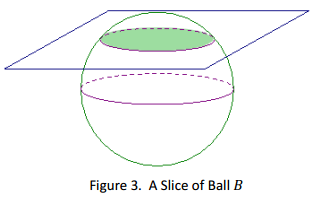
Consider a ball B. Figure 3 shows one possible slice of B.
a. What figure does the slicing plane form? Students may choose their method of representation of the slice (e.g., drawing a 2D sketch, a 3D sketch, or describing the slice in words).
Engage NY Math 7th Grade Module 6 Lesson 16 Example Answer Key 1
b. Will all slices that pass through B be the same size? Explain your reasoning.
c. How will the plane have to meet the ball so that the plane section consists of just one point?
Answer:
a. A circle (or disc)
b. No, different slices can result in circles of different sizes; it will depend on where the slicing plane meets the ball.
c. If you picture the ball and the plane as distinct but being brought toward each other, the plane section of just one point occurs when the plane just makes contact with the ball.

Example 2.
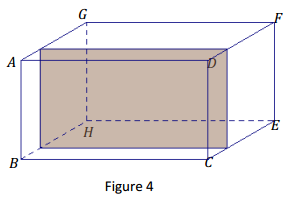
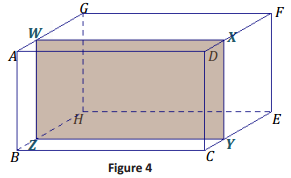
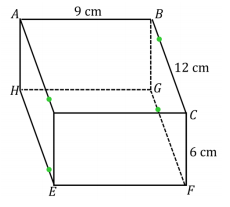
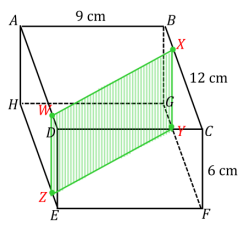
The right rectangular prism in Figure 4 has been sliced with a plane parallel to face ABCD. The resulting slice is a rectangular region that is identical to the parallel face.
Engage NY Math 7th Grade Module 6 Lesson 16 Example Answer Key 2
a. Label the vertices of the rectangular region defined by the slice as WXYZ.
b. To which other face is the slice parallel and identical?
c. Based on what you know about right rectangular prisms, which faces must the slice be perpendicular to?
Answer:
a. Engage NY Math 7th Grade Module 6 Lesson 16 Example Answer Key 4
b. The slice is parallel and identical to the face EFGH.
c. Since the slice is parallel to two faces, it will be perpendicular to whichever sides those faces are perpendicular to. Therefore, the slice is perpendicular to faces ABHG, CDFE, BCEH, and ADFG.

Example 3.
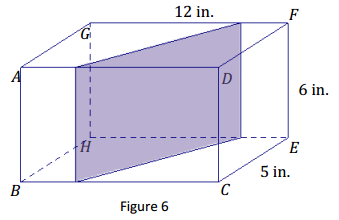
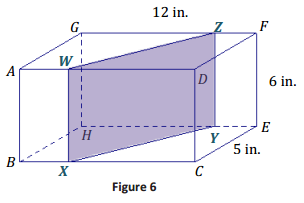
The right rectangular prism in Figure 6 has been sliced with a plane perpendicular to BCEH. The resulting slice is a rectangular region with a height equal to the height of the prism.
Engage NY Math 7th Grade Module 6 Lesson 16 Example Answer Key 3
a. Label the vertices of the rectangle defined by the slice as WXYZ.
b. To which other face is the slice perpendicular?
c. What is the height of rectangle WXYZ?
d. Joey looks at WXYZ and thinks that the slice may be a parallelogram that is not a rectangle. Based on what is known about how the slice is made, can he be right? Justify your reasoning.
Answer:
a. Engage NY Math 7th Grade Module 6 Lesson 16 Example Answer Key 5
b. The slice is perpendicular to the face ADFG.
c. 6 in.
d. The slice was made perpendicular to face BCEH. Then we know that the angles in the slice, ∠X and ∠Y, formed by the slicing plane and face BCEH, are right angles. If we focus on ∠X of the slice, since it is a right angle, we know that \(\overline{W X}\) must be perpendicular to face BCEH. \(\overline{W X}\) lies in face ABCD, which is perpendicular to both BCEH and to ADFG, so \(\overline{W X}\)is perpendicular to ABCD. This means that \(\overline{W X}\) must also be perpendicular to \(\overline{W Z}\). A similar argument can be made for ∠Y of the slice, making all four angles of WXYZ right angles and making WXYZ a rectangle.

Eureka Math Grade 7 Module 6 Lesson 16 Exercise Answer Key

Exercise 1.
Discuss the following questions with your group.
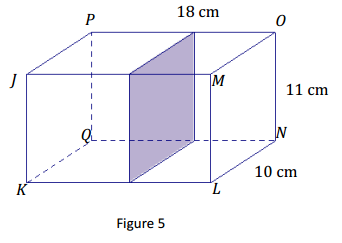
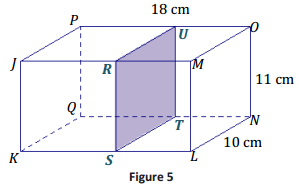
The right rectangular prism in Figure 5 has been sliced with a plane parallel to face LMON.
Engage NY Math Grade 7 Module 6 Lesson 16 Exercise Answer Key 1
a. Label the vertices of the rectangle defined by the slice as RSTU.
b. What are the dimensions of the slice?
c. Based on what you know about right rectangular prisms, which faces must the slice be perpendicular to?
Answer:
a. Engage NY Math Grade 7 Module 6 Lesson 16 Exercise Answer Key 7
b. 10 cm × 11 cm
c. Since the slice is parallel to two faces, it will be perpendicular to whichever sides those faces are perpendicular to. Therefore, the slice is perpendicular to faces JKLM, JMOP, NOPQ, and KLNQ.

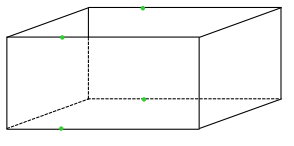
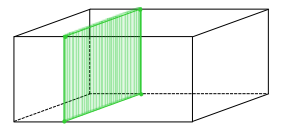
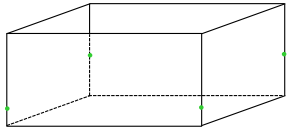
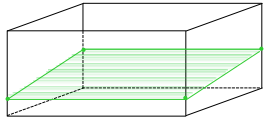
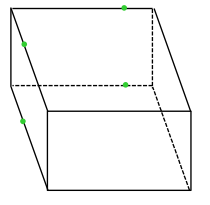
In the following exercises, the points at which a slicing plane meets the edges of the right rectangular prism have been marked. Each slice is either parallel or perpendicular to a face of the prism. Use a straightedge to join the points to outline the rectangular region defined by the slice, and shade in the rectangular slice.
Exercise 2.
A slice parallel to a face
Engage NY Math Grade 7 Module 6 Lesson 16 Exercise Answer Key 2
Answer:
Engage NY Math Grade 7 Module 6 Lesson 16 Exercise Answer Key 8.1

Exercise 3.
A slice perpendicular to a face
Engage NY Math Grade 7 Module 6 Lesson 16 Exercise Answer Key 3
Answer:
Engage NY Math Grade 7 Module 6 Lesson 16 Exercise Answer Key 8

Exercise 4.
A slice perpendicular to a face
Engage NY Math Grade 7 Module 6 Lesson 16 Exercise Answer Key 4
Answer:
Engage NY Math Grade 7 Module 6 Lesson 16 Exercise Answer Key 9

In Exercises 5–6, the dimensions of the prisms have been provided. Use the dimensions to sketch the slice from each prism, and provide the dimensions of each slice.
Exercise 5.
A slice parallel to a face
Engage NY Math Grade 7 Module 6 Lesson 16 Exercise Answer Key 5
Answer:
Engage NY Math Grade 7 Module 6 Lesson 16 Exercise Answer Key 10

Exercise 6.
A slice perpendicular to a face
Engage NY Math Grade 7 Module 6 Lesson 16 Exercise Answer Key 6
Answer:
Engage NY Math Grade 7 Module 6 Lesson 16 Exercise Answer Key 11

Eureka Math Grade 7 Module 6 Lesson 16 Problem Set Answer Key

Question 1.
A right rectangular prism is shown along with line segments that lie in a face. For each line segment, draw and give the approximate dimensions of the slice that results when the slicing plane contains the given line segment and is perpendicular to the face that contains the line segment.
Eureka Math 7th Grade Module 6 Lesson 16 Problem Set Answer Key 1
a.
Eureka Math 7th Grade Module 6 Lesson 16 Problem Set Answer Key 2

b.
Eureka Math 7th Grade Module 6 Lesson 16 Problem Set Answer Key 3

c.
Eureka Math 7th Grade Module 6 Lesson 16 Problem Set Answer Key 4

d.
Eureka Math 7th Grade Module 6 Lesson 16 Problem Set Answer Key 5

e.
Eureka Math 7th Grade Module 6 Lesson 16 Problem Set Answer Key 6

f.
Eureka Math 7th Grade Module 6 Lesson 16 Problem Set Answer Key 7

g.
Eureka Math 7th Grade Module 6 Lesson 16 Problem Set Answer Key 8
Answer:
a.
Eureka Math 7th Grade Module 6 Lesson 16 Problem Set Answer Key 9

b.
Eureka Math 7th Grade Module 6 Lesson 16 Problem Set Answer Key 10

c.
Eureka Math 7th Grade Module 6 Lesson 16 Problem Set Answer Key 11

d.
Eureka Math 7th Grade Module 6 Lesson 16 Problem Set Answer Key 12

e.
Eureka Math 7th Grade Module 6 Lesson 16 Problem Set Answer Key 13

f.
Eureka Math 7th Grade Module 6 Lesson 16 Problem Set Answer Key 14

g.
Eureka Math 7th Grade Module 6 Lesson 16 Problem Set Answer Key 15

Eureka Math Grade 7 Module 6 Lesson 16 Exit Ticket Answer Key

In the following figures, use a straightedge to join the points where a slicing plane meets with a right rectangular prism to outline the slice.
i) Label the vertices of the rectangular slice WXYZ.
ii) State any known dimensions of the slice.
iii) Describe two relationships slice WXYZ has in relation to faces of the right rectangular prism.
Question 1.
Eureka Math Grade 7 Module 6 Lesson 16 Exit Ticket Answer Key 1
Answer:
Eureka Math Grade 7 Module 6 Lesson 16 Exit Ticket Answer Key 3
Sides \(\overline{W Z}\) and \(\overline{X Y}\) are 6 cm in length. Slice WXYZ is perpendicular to faces ABCD and EFGH.

Question 2.
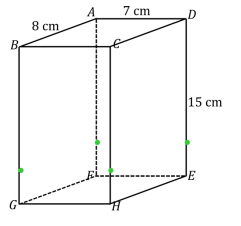
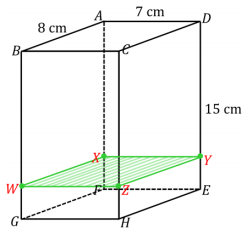
Eureka Math Grade 7 Module 6 Lesson 16 Exit Ticket Answer Key 2
Answer:
Eureka Math Grade 7 Module 6 Lesson 16 Exit Ticket Answer Key 4
Sides \(\overline{W Z}\) and \(\overline{X Y}\) are 7 cm in length. Sides \(\overline{W X}\) and \(\overline{Z Y}\) are 8 cm in length. Slice WXYZ is parallel to faces ABCD and EFGH and perpendicular to faces CDEH, ADEF, ABGF, and BCHG.
Note: Students are only required to state two of the relationships the slice has with the faces of the prism.

Eureka Math Grade 7 Module 6 Lesson 15 Answer Key

Engage NY Eureka Math 7th Grade Module 6 Lesson 15 Answer Key

Eureka Math Grade 7 Module 6 Lesson 15 Example Answer Key

Example 1.
A triangular fence with two equal angles, ∠S = ∠T, is used to enclose some sheep. A fence is constructed inside the triangle that exactly cuts the other angle into two equal angles: ∠SRW = ∠TRW. Show that the gates, represented by \(\overline{S W}\) and \(\overline{W T}\), are the same width.
Engage NY Math 7th Grade Module 6 Lesson 15 Example Answer Key 1
Answer:
There is a correspondence △SRW ↔ △TRW that matches two pairs of angles of equal measurement, ∠S = ∠T and ∠SRW = ∠TRW, and one pair of sides of equal length shared, side \(\overline{R W}\). The triangles satisfy the two angles and side opposite a given angle condition. From the correspondence, we can conclude that SW = WT, or that the gates are of equal width.

Example 2.
In △ABC, AC = BC, and △ABC ↔ △B’ A’ C’. John says that the triangle correspondence matches two sides and the included angle and shows that ∠A = ∠B’. Is John correct?
Engage NY Math 7th Grade Module 6 Lesson 15 Example Answer Key 2
Answer:
We are told that AC = BC. The correspondence △ABC ↔ △B’A’C’ tells us that BC ↔ A’C’, CA ↔ C’B’, and ∠C↔∠C’, which means △ABC is identical to △B’A’C’ by the two sides and included angle condition. From the correspondence, we can conclude that ∠A = ∠B’; therefore, John is correct.

Eureka Math Grade 7 Module 6 Lesson 15 Exercise Answer Key

Exercise 1.
Mary puts the center of her compass at the vertex O of the angle and locates points A and B on the sides of the angle. Next, she centers her compass at each of A and B to locate point C. Finally, she constructs the ray \(\overrightarrow{O C}\). Explain why ∠BOC = ∠AOC.
Engage NY Math Grade 7 Module 6 Lesson 15 Exercise Answer Key 1
Answer:
Since Mary uses one compass adjustment to determine points A and B, OA = OB. Mary also uses the same compass adjustment from B and A to find point C; this means BC = AC. Side \(\overrightarrow{O C}\) is common to both the triangles,
△OBC and △OAC. Therefore, there is a correspondence △OBC ↔ △OAC that matches three pairs of equal sides, and the triangles are identical by the three sides condition. From the correspondence, we conclude that
∠BOC = ∠AOC.
Engage NY Math Grade 7 Module 6 Lesson 15 Exercise Answer Key 5

Exercise 2.
Quadrilateral ACBD is a model of a kite. The diagonals \(\overline{A B}\) and \(\overline{C D}\) represent the sticks that help keep the kite rigid.
a. John says that ∠ACD = ∠BCD. Can you use identical triangles to show that John is correct?
Engage NY Math Grade 7 Module 6 Lesson 15 Exercise Answer Key 2
b. Jill says that the two sticks are perpendicular to each other. Use the fact that ∠ACD = ∠BCD and what you know about identical triangles to show ∠AEC = 90°.
c. John says that Jill’s triangle correspondence that shows the sticks are perpendicular to each other also shows that the sticks cross at the midpoint of the horizontal stick. Is John correct? Explain.
Answer:
a. From the diagram, we see that AC = BC, and AD = BD. \(\overline{C D}\) is a common side to both triangles, △ACD and △BCD. There is a correspondence △ACD ↔ △BCD that matches three pairs of equal sides; the two triangles are identical by the three sides condition. From the correspondence, we conclude that ∠ACD = ∠BCD. John is correct.

b. Since we know that AC = BC and ∠ACD = ∠BCD, and that △ACE and △BCE share a common side, \(\overline{C E}\), we can find a correspondence that matches two pairs of equal sides and a pair of equal, included angles. The triangles are identical by the two sides and included angle condition. We can then conclude that ∠AEC = ∠BEC. Since both angles are adjacent to each other on a straight line, we also know their measures must sum to 180°. We can then conclude that each angle measures 90°.

c. Since we have established that △ACE and △BCE are adjacent to each other, we know that AE = BE. This means that E is the midpoint of \(\overline{A B}\), by definition.

Exercise 3.
In △ABC, ∠A = ∠B, and △ABC ↔ △B’A’C’. Jill says that the triangle correspondence matches two angles and the included side and shows that AC = B’C’. Is Jill correct?
Engage NY Math Grade 7 Module 6 Lesson 15 Exercise Answer Key 3
Answer:
We are told that ∠A = ∠B. The correspondence △ABC ↔ △B’A’C’ tells us that ∠A = ∠B’, ∠B = ∠A’, and AB = B’A’, which means △ABC is identical to △B’A’C’ by the two angles and included side condition. From the correspondence, we can conclude that AC = B’C’; therefore, Jill is correct.

Exercise 4.
Right triangular corner flags are used to mark a soccer field. The vinyl flags have a base of 40 cm and a height of 14 cm.
a. Mary says that the two flags can be obtained by cutting a rectangle that is 40 cm×14 cm on the diagonal. Will that create two identical flags? Explain.
Engage NY Math Grade 7 Module 6 Lesson 15 Exercise Answer Key 4
b. Will measures the two non-right angles on a flag and adds the measurements together. Can you explain, without measuring the angles, why his answer is 90°?
Answer:
a. If the flag is to be cut from a rectangle, both triangles will have a side of length 40 cm, a length of 14 cm, and a right angle. There is a correspondence that matches two pairs of equal sides and an included pair of equal angles to the corner flag; the two triangles are identical to the corner flag as well as to each other.

b. The two non-right angles of the flags are adjacent angles that together form one angle of the four angles of the rectangle. We know that a rectangle has four right angles, so it must be that the two non-right angles of the flag together sum to 90°.

Eureka Math Grade 7 Module 6 Lesson 15 Problem Set Answer Key

Question 1.
Jack is asked to cut a cake into 8 equal pieces. He first cuts it into equal fourths in the shape of rectangles, and then he cuts each rectangle along a diagonal.
Did he cut the cake into 8 equal pieces? Explain.
Eureka Math 7th Grade Module 6 Lesson 15 Problem Set Answer Key 1
Answer:
Eureka Math 7th Grade Module 6 Lesson 15 Problem Set Answer Key 3
Yes, Jack cut the cake into 8 equal pieces. Since the first series of cuts divided the cake into equal fourths in the shape of rectangles, we know that the opposite sides of the rectangles are equal in length; that means all 8 triangles have two sides that are equal in length to each other. Each of the triangular pieces also has one right angle because we know that rectangles have four right angles. Therefore, there is a correspondence between all 8 triangles that matches two pairs of equal sides and an equal, 90° non-included angle, determining 8 identical pieces of cake.

Question 2.
The bridge below, which crosses a river, is built out of two triangular supports. The point M lies on \(\overline{B C}\) . The beams represented by \(\overline{A M}\) and \(\overline{D M}\) are equal in length, and the beams represented by \(\overline{A B}\) and \(\overline{D C}\) are equal in length. If the supports were constructed so that ∠A and ∠D are equal in measurement, is point M the midpoint of \(\overline{B C}\)? Explain.
Eureka Math 7th Grade Module 6 Lesson 15 Problem Set Answer Key 2
Answer:
Yes, M is the midpoint of \(\overline{B C}\). The triangles are identical by the two sides and included angle condition. The correspondence △ABM ↔ △DCM matches two pairs of equal sides and one pair of included equal angles. Since the triangles are identical, we can use the correspondence to conclude that BM = CM, which makes M the midpoint, by definition.

Eureka Math Grade 7 Module 6 Lesson 15 Exit Ticket Answer Key

Question 1.
Alice is cutting wrapping paper to size to fit a package. How should she cut the rectangular paper into two triangles to ensure that each piece of wrapping paper is the same? Use your knowledge of conditions that determine unique triangles to justify that the pieces resulting from the cut are the same.
Eureka Math Grade 7 Module 6 Lesson 15 Exit Ticket Answer Key 1
Answer:
Alice should cut along the diagonal of rectangle ABCD. Since ABCD is a rectangle, the opposite sides will be equal in length, or AB = DC and AD = BC. A rectangle also has four right angles, which means a cut along the diagonal will result in each triangle with one 90° angle. The correspondence △ABD ↔ △CDB matches two equal pairs of sides and an equal, included pair of angles; the triangles are identical by the two sides and included angle condition.

Eureka Math Grade 7 Module 6 Lesson 14 Answer Key

Engage NY Eureka Math 7th Grade Module 6 Lesson 14 Answer Key

Eureka Math Grade 7 Module 6 Lesson 14 Example Answer Key

Example 1.
What is the relationship between the two triangles below?
Engage NY Math 7th Grade Module 6 Lesson 14 Example Answer Key 1
Answer:
What is the relationship between the two triangles below?
The triangles share a common side.
Imagine that △WXY and △WZY were pulled apart and separated. Sketch the triangles separately. Based on how they were joined, what kind of tick mark should be added to each triangle?
\(\overline{W Y}\) is a common side. Since it belongs to each triangle, we should put a triple tick mark on \(\overline{W Y}\) to indicate that it is a part of equal measure in both triangles.
Engage NY Math 7th Grade Module 6 Lesson 14 Example Answer Key 3
Are the triangles identical? How do you know?
The triangles are identical by the three sides condition. The correspondence that matches the three equal pairs of sides is △WXY↔△YZW.

Example 2.
Are the triangles identical? Justify your reasoning.
Engage NY Math 7th Grade Module 6 Lesson 14 Example Answer Key 2
Answer:
The triangles are identical by the two sides and the included angle condition. The correspondence △AOC ↔ △BOD matches two equal pairs of sides and a pair of equal angles, ∠AOC = ∠BOD, which we know to be equal in measurement because they are vertical angles.

Eureka Math Grade 7 Module 6 Lesson 14 Exercise Answer Key

Exercise 1.
Are the triangles identical? Justify your reasoning.
Engage NY Math Grade 7 Module 6 Lesson 14 Exercise Answer Key 1
Answer:
The triangles are not necessarily identical. The correspondence △QRT ↔ △SRT matches a pair of equal angles and a pair of equal sides. The correspondence also matches a common side, \(\overline{R T}\), to both triangles. Two sides and a non-included acute angle do not necessarily determine a unique triangle.

Exercise 2.
Are the triangles identical? Justify your reasoning.
Engage NY Math Grade 7 Module 6 Lesson 14 Exercise Answer Key 2
Answer:
These triangles are identical by the two angles and side opposite a given angle condition. The correspondence △EFH ↔ △GFH matches two pairs of equal angles and a pair of equal sides. ∠HFE must be a right angle since ∠HFG is a right angle, and they are both on a line. Also, \(\overline{H F}\) is a common side to both triangles. Since both triangles have parts under the condition of the same measurement, the triangles must be identical.

Exercise 3.
Are the triangles identical? Justify your reasoning.
Engage NY Math Grade 7 Module 6 Lesson 14 Exercise Answer Key 3
Answer:
These triangles are identical by the two angles and side opposite a given angle condition. The correspondence △AOB ↔ △COD matches the two pairs of equal angles and one pair of equal sides. There is a marked pair of equal sides and one pair of marked, equal angles. The second pair of equal angles, ∠AOB = ∠COD, are vertical angles.

Exercise 4.
Are the triangles identical? Justify your reasoning.
Engage NY Math Grade 7 Module 6 Lesson 14 Exercise Answer Key 4
Answer:
The triangles are not necessarily identical. The correspondence △AEB ↔ △CED matches three pairs of equal angles, including the unmarked angles, ∠AEB and ∠CED, which are equal in measurement because they are vertical angles. The triangles could have different side lengths; therefore, they are not necessarily identical.

Exercise 5.
Are the triangles identical? Justify your reasoning.
Engage NY Math Grade 7 Module 6 Lesson 14 Exercise Answer Key 5
Answer:
The triangles are identical by the two sides and non-included 90° (or greater) angle condition. The correspondence △MPO ↔ △NPO matches two pairs of equal sides and one pair of equal angles. One of the two pairs of equal sides is side \(\overline{O P}\), which is common to both triangles.

Exercise 6.
Are the triangles identical? Justify your reasoning.
Engage NY Math Grade 7 Module 6 Lesson 14 Exercise Answer Key 6
Answer:
These triangles are not necessarily identical. The triangles have a pair of marked equal sides and equal angles; side \(\overline{C E}\) is also common to both triangles. The triangles satisfy the two sides and non-included acute angle condition, which does not determine a unique triangle.

Exercise 7.
Are the triangles identical? Justify your reasoning.
Engage NY Math Grade 7 Module 6 Lesson 14 Exercise Answer Key 7
Answer:
These triangles are identical by the two angles and a side opposite a given angle condition. The triangle correspondence △RWS ↔ △RWT matches two pairs of equal angles and one pair of equal sides. The equal pair of sides, \(\overline{R W}\), is common to both triangles.

Exercise 8.
Create your own labeled diagram and set of criteria for a pair of triangles. Ask a neighbor to determine whether the triangles are identical based on the provided information.
Answer:
Answers will vary.

Eureka Math Grade 7 Module 6 Lesson 14 Problem Set Answer Key

In the following problems, determine whether the triangles are identical, not identical, or not necessarily identical; justify your reasoning. If the relationship between the two triangles yields information that establishes a condition, describe the information. If the triangles are identical, write a triangle correspondence that matches the sides and angles.
Question 1.
Eureka Math 7th Grade Module 6 Lesson 14 Problem Set Answer Key 1
Answer:
These triangles are identical by the two sides and the included angle condition. The triangle correspondence △ABC ↔ △ADC matches two pairs of equal sides and one pair of equal angles. One of the equal pairs of sides is shared side \(\overline{A C}\).

Question 2.
Eureka Math 7th Grade Module 6 Lesson 14 Problem Set Answer Key 2
Answer:
These triangles are not necessarily identical. The triangles have a pair of marked equal sides, and a pair of marked, acute, equal angles; side \(\overline{A C}\) is also common to both triangles. The triangles satisfy the two sides and non-included acute angle condition, which does not determine a unique triangle.

Question 3.
Eureka Math 7th Grade Module 6 Lesson 14 Problem Set Answer Key 3
Answer:
These triangles are identical by the two angles and included side condition. The triangle correspondence △QPR ↔ △TSR matches the two pairs of equal angles and one pair of equal sides. One pair of equal angles is the vertical angle pair ∠PRQ = ∠SRT.

Question 4.
Eureka Math 7th Grade Module 6 Lesson 14 Problem Set Answer Key 4
Answer:
These triangles are not necessarily identical. A correspondence that matches up the equal pair of sides and the equal pair of vertical angles does not match the marked equal pair of angles.

Question 5.
Eureka Math 7th Grade Module 6 Lesson 14 Problem Set Answer Key 5
Answer:
The triangles are identical by the two sides and non-included 90° (or greater) angle condition. The correspondence △IFG ↔ △GHI matches two pairs of equal sides and one pair of equal angles. One of the two pairs of equal sides is side \(\overline{I G}\), which is common to both triangles.

Question 6.
Eureka Math 7th Grade Module 6 Lesson 14 Problem Set Answer Key 6
Answer:
The triangles are not identical since a correspondence that matches the two marked equal pairs of sides also matches sides \(\overline{V X}\) and \(\overline{X Y}\), which are not equal in length.

Question 7.
Eureka Math 7th Grade Module 6 Lesson 14 Problem Set Answer Key 7
Answer:
These triangles are identical by the two angles and side opposite a given angle condition. The correspondence △ABD ↔ △CBD matches the two pairs of equal angles and one pair of equal sides. The pair of equal sides is the common side, \(\overline{B D}\). We know ∠ADB must be a right angle since ∠CDB is a right angle; they are both on a line, and of course angles ∠A and ∠C are equal in measurement.

Question 8.
Are there any identical triangles in this diagram?
Eureka Math 7th Grade Module 6 Lesson 14 Problem Set Answer Key 8
Answer:
△TUX and △VWX are not necessarily identical; we only know about a single pair of equal angles in the triangles, which are vertical angles. △TUV and △VWT are also not necessarily identical. We only know about a single pair of equal angles and a side common to both triangles, which is not enough information to determine the triangles as identical or non-identical.

Question 9.
Eureka Math 7th Grade Module 6 Lesson 14 Problem Set Answer Key 9
Answer:
The triangles are not necessarily identical since there is no correspondence that matches the two marked equal pairs of sides as well as the two pairs of equal angles. One of the pairs of equal angles is the pair of vertical angles.

Question 10.
Eureka Math 7th Grade Module 6 Lesson 14 Problem Set Answer Key 10
Answer:
△ABE and △CBD are not necessarily identical. The triangles satisfy the two sides and non-included acute angle condition, which does not determine a unique triangle.

Eureka Math Grade 7 Module 6 Lesson 14 Exit Ticket Answer Key

Question 1.
Are △DEF and △DGF identical, not identical, or not necessarily identical? Justify your reasoning. If the relationship between the two triangles yields information that establishes a condition, describe the information. If the triangles are identical, write a triangle correspondence that matches the sides and angles.
Eureka Math Grade 7 Module 6 Lesson 14 Exit Ticket Answer Key 1
Answer:
These triangles are identical by the two angles and side opposite a given angle condition. The triangle correspondence △DEF ↔ △DGF matches the two pairs of equal angles and one pair of equal sides condition. The pair of equal sides, \(\overline{D F}\), is common to both triangles.

Eureka Math Grade 7 Module 6 Lesson 13 Answer Key

Engage NY Eureka Math 7th Grade Module 6 Lesson 13 Answer Key

Eureka Math Grade 7 Module 6 Lesson 13 Example Answer Key

Example 1.
Engage NY Math 7th Grade Module 6 Lesson 13 Example Answer Key 1
Answer:
The triangles are identical by the two angles and the included side condition. The correspondence △ABC↔△YXZ matches two pairs of angles and one pair of equal sides. Since both triangles have parts under the condition of the same measurement, the triangles must be identical.

In Example 2 and Exercises 4–6, three pieces of information are given for △ABC and △XYZ. Draw, freehand, the two triangles (do not worry about scale), and mark the given information. If the triangles are identical, give a triangle correspondence that matches equal angles and equal sides. Explain your reasoning.

Example 2.
AB = XZ, AC = XY, ∠A = ∠X
Answer:
Engage NY Math 7th Grade Module 6 Lesson 13 Example Answer Key 2
These triangles are identical by the two sides and included angle condition. The triangle correspondence △ABC ↔ △XZY matches two pairs of equal sides and one pair of equal, included angles. Since both triangles have parts under the condition of the same measurement, the triangles must be identical.

Eureka Math Grade 7 Module 6 Lesson 13 Exercise Answer Key

Opening Exercise
a. List all the conditions that determine unique triangles.
b. How are the terms identical and unique related?
Answer:
a.
→ Three sides condition
→ Two sides and included angle condition
→ Two angles and included side condition
→ Two angles and the side opposite a given angle condition
→ Two sides and a non-included angle, provided the angle is 90° or greater
→ Two sides and a non-included angle, provided the side adjacent to the angle is shorter than the side opposite the angle.

b. When drawing a triangle under a given condition, the triangle will either be identical or non-identical to the original triangle. If only one triangle can be drawn under the condition, we say the condition determines a unique triangle. A triangle drawn under a condition that is known to determine a unique triangle will be identical to the original triangle.

Each of the following problems gives two triangles. State whether the triangles are identical, not identical, or not necessarily identical. If the triangles are identical, give the triangle conditions that explain why, and write a triangle correspondence that matches the sides and angles. If the triangles are not identical, explain why. If it is not possible to definitively determine whether the triangles are identical, write “the triangles are not necessarily identical,” and explain your reasoning.

Exercises 1–3
1.
Engage NY Math Grade 7 Module 6 Lesson 13 Exercise Answer Key 1
Answer:
The triangles are identical by the two sides and the included angle condition. The correspondence △DEF↔△GIH matches two equal pairs of sides and one equal pair of angles. Since both triangles have parts under the condition of the same measurement, the triangles must be identical.

2.
Engage NY Math Grade 7 Module 6 Lesson 13 Exercise Answer Key 2
Answer:
The triangles are not necessarily identical. Although the two angles in each triangle match, the marked sides do not correspond. In △ABC, the marked side is not between the marked angles; whereas in △DEF, the marked side is between the marked angles.

3.
Engage NY Math Grade 7 Module 6 Lesson 13 Exercise Answer Key 3
Answer:
The triangles are identical by the three sides condition. The correspondence △ABC↔△YZX matches three equal pairs of sides. Since both triangles have the same side lengths, the triangles must be identical.

Exercises 4–6
4. ∠A = ∠Z, ∠B = ∠Y, AB = YZ
Answer:
Engage NY Math Grade 7 Module 6 Lesson 13 Exercise Answer Key 4
These triangles are identical by the two angles and included side condition. The triangle correspondence
△ABC ↔ △ZYX matches two pairs of equal angles and one pair of equal, included sides. Since both triangles have parts under the condition of the same measurement, the triangles must be identical.

5. ∠A = ∠Z, ∠B = ∠Y, BC = XY
Answer:
Engage NY Math Grade 7 Module 6 Lesson 13 Exercise Answer Key 5
These triangles are identical by the two angles and side opposite a given angle condition. The triangle correspondence △ABC ↔ △ZYX matches two pairs of equal angles and one pair of equal sides. Since both triangles have parts under the condition of the same measurement, the triangles must be identical.

6. ∠A = ∠Z, ∠B = ∠Y, BC = XZ
Answer:
Engage NY Math Grade 7 Module 6 Lesson 13 Exercise Answer Key 6
These triangles are not necessarily identical. In △ABC, the marked side is opposite ∠A. In △XYZ, the marked side is not opposite ∠Z, which is equal to ∠A. Rather, it is opposite ∠Y, which is equal to ∠B.

Eureka Math Grade 7 Module 6 Lesson 13 Problem Set Answer Key

In each of the following four problems, two triangles are given. State whether the triangles are identical, not identical, or not necessarily identical. If the triangles are identical, give the triangle conditions that explain why, and write a triangle correspondence that matches the sides and angles. If the triangles are not identical, explain why. If it is not possible to definitively determine whether the triangles are identical, write “the triangles are not necessarily identical,” and explain your reasoning.
Question 1.
Eureka Math 7th Grade Module 6 Lesson 13 Problem Set Answer Key 1
Answer:
The triangles are identical by the two angles and included side condition. The correspondence △MNO↔△RQP matches two equal pairs of angles and one equal pair of included sides. Since both triangles have parts under the condition of the same measurement, the triangles must be identical.

Question 2.
Eureka Math 7th Grade Module 6 Lesson 13 Problem Set Answer Key 2
Answer:
The triangles are identical by the two angles and side opposite a given angle condition. The correspondence △EGF ↔ △RQS matches two equal pairs of angles and one equal pair of sides. Since both triangles have parts under the condition of the same measurement, the triangles must be identical.

Question 3.
Eureka Math 7th Grade Module 6 Lesson 13 Problem Set Answer Key 3
Answer:
The triangles are identical by the two sides and non-included 90° (or greater) angle condition. The correspondence △WXY ↔ △EDC matches two pairs of equal sides and one pair of equal angles. Since both triangles have parts under the condition of the same measurement, the triangles must be identical.

Question 4.
Eureka Math 7th Grade Module 6 Lesson 13 Problem Set Answer Key 4
Answer:
The triangles are not necessarily identical by the two angles and side opposite a given angle condition. In △ABC, the marked side is adjacent to the angle marked with a single arc mark. In △WXY, the marked side is not adjacent to the angle marked with a single arc mark.

For Problems 5–8, three pieces of information are given for △ABC and △YZX. Draw, freehand, the two triangles (do not worry about scale), and mark the given information. If the triangles are identical, give a triangle correspondence that matches equal angles and equal sides. Explain your reasoning.
Question 5.
AB = YZ, BC = ZX, AC = YX
Answer:
Eureka Math 7th Grade Module 6 Lesson 13 Problem Set Answer Key 5
These triangles are identical by the three sides condition. The triangle correspondence △ABC ↔ △YZX matches three pairs of equal sides. Since both triangles have parts under the condition of the same measurement, the triangles must be identical.

Question 6.
AB = YZ, BC = ZX, ∠C = ∠Y
Answer:
Eureka Math 7th Grade Module 6 Lesson 13 Problem Set Answer Key 6
These triangles are not necessarily identical. In △ABC, the marked angle is adjacent to \(\overline{B C}\). In △YZX, the marked angle is not adjacent to the side equal to ZX, which is equal to BC.

Question 7.
AB = XZ, ∠A = ∠Z, ∠C = ∠Y
Answer:
Eureka Math 7th Grade Module 6 Lesson 13 Problem Set Answer Key 7
These triangles are identical by the two angles and a side opposite a given angle condition. The triangle correspondence △ABC ↔ △ZXY matches two pairs of equal angles and one pair of equal sides. Since both triangles have parts under the condition of the same measurement, the triangles must be identical.

Question 8.
AB = XY, AC = YZ, ∠C = ∠Z (Note that both angles are obtuse.)
Answer:
Eureka Math 7th Grade Module 6 Lesson 13 Problem Set Answer Key 8
The triangles are identical by the two sides and non-included 90° (or greater) angle condition. The correspondence △ABC ↔ △YXZ matches two pairs of equal sides and one pair of equal angles. Since both triangles have parts under the condition of the same measurement, the triangles must be identical.

Eureka Math Grade 7 Module 6 Lesson 13 Exit Ticket Answer Key

Question 1.
∠A and ∠D are equal in measure. Draw two triangles around each angle, and mark parts appropriately so that the triangles are identical; use ∠A and ∠D as part of the chosen condition. Write a correspondence for the triangles.
Eureka Math Grade 7 Module 6 Lesson 13 Exit Ticket Answer Key 1
Answer:
Answers will vary; students should select any condition except for the three sides condition and show the appropriate correspondence for their condition on the two triangles.

Eureka Math Grade 7 Module 6 Lesson 12 Answer Key

Engage NY Eureka Math 7th Grade Module 6 Lesson 12 Answer Key

Eureka Math Grade 7 Module 6 Lesson 12 Exploratory Challenge Answer Key

Question 1.
Use your tools to draw △ABC in the space below, provided AB = 5 cm, BC = 3 cm, and ∠A = 30°. Continue with the rest of the problem as you work on your drawing.
a. What is the relationship between the given parts of △ABC?
b. Which parts of the triangle can be drawn without difficulty? What makes this drawing challenging?
c. A ruler and compass are instrumental in determining where C is located.
✓ Even though the length of segment AC is unknown, extend the ray AC in anticipation of the intersection with segment BC.
✓ Draw segment BC with length 3 cm away from the drawing of the triangle.
✓ Adjust your compass to the length of \(\overline{B C}\).
✓ Draw a circle with center B and a radius equal to BC, or 3 cm.
d. How many intersections does the circle make with segment AC? What does each intersection signify?
e. Complete the drawing of △ABC.
f. Did the results of your drawing differ from your prediction?
Answer:
Engage NY Math 7th Grade Module 6 Lesson 12 Exploratory Challenge Answer Key 1
a. Two sides and a non-included angle are provided.

b. The parts that are adjacent, \(\overline{A B}\) and ∠A, are easiest to draw. It is difficult to position \(\overline{B C}\).

c. Engage NY Math 7th Grade Module 6 Lesson 12 Exploratory Challenge Answer Key 2

d. Two intersections; each intersection represents a possible location for vertex C.
e. Engage NY Math 7th Grade Module 6 Lesson 12 Exploratory Challenge Answer Key 3
f. Answers will vary.

Question 2.
Now attempt to draw △DEF in the space below, provided DE = 5 cm, EF = 3 cm, and ∠F = 90°. Continue with the rest of the problem as you work on your drawing.
a. How are these conditions different from those in Exercise 1, and do you think the criteria will determine a unique triangle?
b. What is the relationship between the given parts of △DEF?
c. Describe how you will determine the position of \(\overline{D E}\).
d. How many intersections does the circle make with \(\overline{F D}\)?
e. Complete the drawing of △DEF. How is the outcome of △DEF different from that of △ABC?
f. Did your results differ from your prediction?
Answer:
a. The provided angle was an acute angle in Exercise 1; now the provided angle is a right angle. Possible prediction: Since the same general criteria (two sides and a non-included angle) determined more than one triangle in Exercise 1, the same can happen in this situation.
Engage NY Math 7th Grade Module 6 Lesson 12 Exploratory Challenge Answer Key 4
b. Two sides and a non-included angle are provided.

c. I will draw a segment equal in length to \(\overline{D E}\), or 5 cm, and adjust my compass to this length. Then, I will draw a circle with center E and radius equal to DE. This circle should intersect with the ray FD.

d. Just one intersection.
Engage NY Math 7th Grade Module 6 Lesson 12 Exploratory Challenge Answer Key 5
e. In drawing △ABC, there are two possible locations for vertex C, but in drawing △DEF, there is only one location for vertex D.
Engage NY Math 7th Grade Module 6 Lesson 12 Exploratory Challenge Answer Key 6
f. Answers will vary.

Question 3.
Now attempt to draw △JKL, provided KL = 8 cm, KJ = 4 cm, and ∠J = 120°. Use what you drew in Exercises 1 and 2 to complete the full drawing.
Answer:
Engage NY Math 7th Grade Module 6 Lesson 12 Exploratory Challenge Answer Key 7

Question 4.
Review the conditions provided for each of the three triangles in the Exploratory Challenge, and discuss the uniqueness of the resulting drawing in each case.
Answer:
All three triangles are under the condition of two sides and a non-included angle. The non-included angle in △ABC is an acute angle, while the non-included angle in △DEF is 90°, and the non-included angle in △JKL is obtuse. The triangles drawn in the latter two cases are unique because there is only one possible triangle that could be drawn for each. However, the triangle drawn in the first case is not unique because there are two possible triangles that could be drawn.

Eureka Math Grade 7 Module 6 Lesson 12 Problem Set Answer Key

Question 1.
In each of the triangles below, two sides and a non-included acute angle are marked. Use a compass to draw a nonidentical triangle that has the same measurements as the marked angle and marked sides (look at Exercise 1,
part (e) of the Exploratory Challenge as a reference). Draw the new triangle on top of the old triangle. What is true about the marked angles in each triangle that results in two non-identical triangles under this condition?
Eureka Math 7th Grade Module 6 Lesson 12 Problem Set Answer Key 1
Answer:
a. The non-included angle is acute.
Eureka Math 7th Grade Module 6 Lesson 12 Problem Set Answer Key 4

b. The non-included angle is acute.
Eureka Math 7th Grade Module 6 Lesson 12 Problem Set Answer Key 5

c. The non-included angle is acute.
Eureka Math 7th Grade Module 6 Lesson 12 Problem Set Answer Key 6

Question 2.
Sometimes two sides and a non-included angle of a triangle determine a unique triangle, even if the angle is acute. In the following two triangles, copy the marked information (i.e., two sides and a non-included acute angle), and discover which determines a unique triangle. Measure and label the marked parts.
In each triangle, how does the length of the marked side adjacent to the marked angle compare with the length of the side opposite the marked angle? Based on your drawings, specifically state when the two sides and acute non-included angle condition determines a unique triangle.
Eureka Math 7th Grade Module 6 Lesson 12 Problem Set Answer Key 2
Answer:
While redrawing △ABC, students will see that a unique triangle is not determined, but in redrawing △DEF, a unique triangle is determined. In △ABC, the length of the side opposite the angle is shorter than the side adjacent to the angle. However, in △DEF, the side opposite the angle is longer than the side adjacent to the angle.
The two sides and acute non-included angle condition determines a unique triangle if the side opposite the angle is longer than the side adjacent to the angle.
Eureka Math 7th Grade Module 6 Lesson 12 Problem Set Answer Key 7

Question 3.
A sub-condition of the two sides and non-included angle is provided in each row of the following table. Decide whether the information determines a unique triangle. Answer with a yes, no, or maybe (for a case that may or may not determine a unique triangle).
Eureka Math 7th Grade Module 6 Lesson 12 Problem Set Answer Key 3
Answer:
Eureka Math 7th Grade Module 6 Lesson 12 Problem Set Answer Key 8

Question 4.
Choose one condition from the table in Problem 3 that does not determine a unique triangle, and explain why.
Answer:
Possible response: Condition 6 does not determine a unique triangle because the condition of two sides and an acute non-included angle determines two possible triangles when the side adjacent to the angle is longer than the side opposite the angle.

Question 5.
Choose one condition from the table in Problem 3 that does determine a unique triangle, and explain why.
Answer:
Possible response: Condition 1 determines a unique triangle because the condition of two sides and a non-included angle with a measurement of 90° or more has a ray that only intersects the circle once.

Eureka Math Grade 7 Module 6 Lesson 12 Exit Ticket Answer Key

Question 1.
So far, we have learned about four conditions that determine unique triangles: three sides, two sides and an included angle, two angles and an included side, and two angles and the side opposite a given angle.
a. In this lesson, we studied the criterion two sides and a non-included angle. Which case of this criterion determines a unique triangle?
b. Provided \(\overline{A B}\) has length 5 cm, \(\overline{B C}\) has length 3 cm, and the measurement of ∠A is 30°, draw △ABC, and describe why these conditions do not determine a unique triangle.
Answer:
a. For the criterion two sides and a non-included angle, the case where the non-included angle is 90° or greater determines a unique triangle.
b. Eureka Math Grade 7 Module 6 Lesson 12 Exit Ticket Answer Key 1
The non-included angle is an acute angle, and two different triangles can be determined in this case since \(\overline{B C}\) can be in two different positions, forming a triangle with two different lengths of \(\overline{A C}\).

Eureka Math Grade 7 Module 6 Lesson 10 Answer Key

Engage NY Eureka Math 7th Grade Module 6 Lesson 10 Answer Key

Eureka Math Grade 7 Module 6 Lesson 10 Exploratory Challenge Answer Key

Question 1.
A triangle XYZ has angle measures ∠X = 30° and ∠Y = 50° and included side XY = 6 cm. Draw △X’Y’Z’ under the same condition as △XYZ. Leave all construction marks as evidence of your work, and label all side and angle measurements.
Under what condition is △X’Y’Z’ drawn? Compare the triangle you drew to two of your peers’ triangles. Are the triangles identical? Did the condition determine a unique triangle? Use your construction to explain why.
Answer:
Engage NY Math 7th Grade Module 6 Lesson 10 Exploratory Challenge Answer Key 1
The condition on △X’Y’Z’ is the two angles and included side condition. All of the triangles are identical; the condition determined a unique triangle. After drawing the included side length, I used the protractor to draw the provided angle measurements at either endpoint of the included side \(\overline{X^{\prime} Y^{\prime}}\). Since these two angle measurements are fixed, the two remaining side lengths will intersect in one location, which is the third vertex of the triangle, Z’. There is no other way to draw this triangle; therefore, the condition determines a unique triangle.

Question 2.
A triangle RST has angle measures ∠S = 90° and ∠T = 45° and included side ST = 7 cm. Draw △R’S’T’ under the same condition. Leave all construction marks as evidence of your work, and label all side and angle measurements.
Under what condition is △R’S’T’ drawn? Compare the triangle you drew to two of your peers’ triangles. Are the triangles identical? Did the condition determine a unique triangle? Use your construction to explain why.
Answer:
Engage NY Math 7th Grade Module 6 Lesson 10 Exploratory Challenge Answer Key 2
The condition on △R’ S’ T’ is the two angles and included side condition. All of the triangles are identical; the condition determined a unique triangle. After drawing the included side length, I used the protractor to draw the provided angle measurements at either endpoint of the included side \(\overline{S^{\prime} T^{\prime}}\). The intersection of the sides of the angle is the third vertex of the triangle, R’. There is no other way to draw this triangle; therefore, the condition determines a unique triangle.

Question 3.
A triangle JKL has angle measures ∠J = 60° and ∠L = 25° and side KL = 5 cm. Draw △J’K’L’ under the same condition. Leave all construction marks as evidence of your work, and label all side and angle measurements.
Under what condition is △J’K’L’ drawn? Compare the triangle you drew to two of your peers’ triangles. Are the triangles identical? Did the condition determine a unique triangle? Use your construction to explain why.
Answer:
The condition on △J’K’L’ is the two angles and the side opposite a given angle condition. All of the triangles are identical; the condition determined a unique triangle. After drawing the given side length, I used the protractor to draw ∠L’ adjacent to \(\overline{K^{\prime} L^{\prime}}\). I drew the angle opposite the given side, ∠J’, on a slip of paper and lined up one ray of the angle on patty paper with one ray of the angle adjacent to the given side. I moved the angle on patty paper along the coinciding rays until the free ray just met the endpoint of \(\overline{K^{\prime} L^{\prime}}\). There is no other way to draw this triangle; therefore, the condition determines a unique triangle.
Engage NY Math 7th Grade Module 6 Lesson 10 Exploratory Challenge Answer Key 3

Question 4.
A triangle ABC has angle measures ∠C = 35° and ∠B = 105° and side AC = 7 cm. Draw △A’B’C’ under the same condition. Leave all construction marks as evidence of your work, and label all side and angle measurements.
Under what condition is △A’B’C’ drawn? Compare the triangle you drew to two of your peers’ triangles. Are the triangles identical? Did the condition determine a unique triangle? Use your construction to explain why.
Answer:
Engage NY Math 7th Grade Module 6 Lesson 10 Exploratory Challenge Answer Key 4
The condition on △A’B’C’ is the two angles and the side opposite a given angle condition. All of the triangles are identical; the condition determined a unique triangle. After drawing the given side length, I used the protractor to draw ∠C’ adjacent to \(\overline{A^{\prime} C^{\prime}}\). I drew the angle opposite the given side, ∠B’, on a slip of paper and lined up one ray of the angle on patty paper with one ray of the angle adjacent to the given side. I moved the angle on patty paper along the coinciding rays until the free ray just met the endpoint of \(\overline{A^{\prime} C^{\prime}}\). There is no other way to draw this triangle; therefore, the condition determines a unique triangle.

Eureka Math Grade 7 Module 6 Lesson 10 Problem Set Answer Key

Question 1.
In △FGH, ∠F = 42° and ∠H = 70°. FH = 6 cm. Draw △F’G’H’ under the same condition as △FGH. Leave all construction marks as evidence of your work, and label all side and angle measurements.
What can you conclude about △FGH and △F’G’H’? Justify your response.
Answer:
Eureka Math 7th Grade Module 6 Lesson 10 Problem Set Answer Key 1
△FGH and △F’G’H’ are identical triangles by the two angles and included side condition. Since both triangles are drawn under the same condition, and the two angles and included side condition determines a unique triangle, both triangles determine the same unique triangle. Therefore, they are identical.

Question 2.
In △WXY, ∠Y = 57° and ∠W = 103°. Side YX = 6.5 cm. Draw △W’X’Y’ under the same condition as △WXY. Leave all construction marks as evidence of your work, and label all side and angle measurements.
What can you conclude about △WXY and △W’X’Y’? Justify your response.
Answer:
Eureka Math 7th Grade Module 6 Lesson 10 Problem Set Answer Key 2
△WXY and △W’X’Y’ are identical triangles by the two angles and the side opposite a given angle condition. Since both triangles are drawn under the same condition, and the two angles and the side opposite a given angle condition determines a unique triangle, both triangles determine the same unique triangle. Therefore, they are identical.

Question 3.
Points A, Z, and E are collinear, and ∠B = ∠D. What can be concluded about △ABZ and △EDZ? Justify your answer.
Eureka Math 7th Grade Module 6 Lesson 10 Problem Set Answer Key 3.1
Answer:
Eureka Math 7th Grade Module 6 Lesson 10 Problem Set Answer Key 3
△ABZ and △EDZ are identical by the two angles and the side opposite a given angle condition. Since segments add, and AE is 9.2 cm and ZE is 4.6 cm, AZ must be 4.6 cm. Since angles on a line sum to 180°, ∠BZD = 124°,
and ∠DZE = 28°, then ∠AZB = 28°. From the diagram, we can see that ∠B = ∠D. The same measurements in both triangles satisfy the two angles and the side opposite a given angle condition, which means they both determine the same unique triangle; thus, they are identical.

Question 4.
Draw △ABC so that ∠A has a measurement of 60°, ∠B has a measurement of 60°, and \(\overline{A B}\) has a length of 8 cm. What are the lengths of the other sides?
Answer:
Both of the other side lengths are 8 cm.
Eureka Math 7th Grade Module 6 Lesson 10 Problem Set Answer Key 4

Question 5.
Draw △ABC so that ∠A has a measurement of 30°, ∠B has a measurement of 60°, and \(\overline{B C}\) has a length of 5 cm. What is the length of the longest side?
Answer:
The longest side has a length of 10 cm.
Eureka Math 7th Grade Module 6 Lesson 10 Problem Set Answer Key 5

Eureka Math Grade 7 Module 6 Lesson 10 Exit Ticket Answer Key

Question 1.
△ABC has angle measures ∠A = 50° and ∠C = 90° and side AB = 5.5 cm. Draw △A’B’C’ under the same condition. Under what condition is △A’B’C’ drawn? Use your construction to explain why △A’B’C’ is or is not identical to △ABC.
Answer:
Eureka Math Grade 7 Module 6 Lesson 10 Exit Ticket Answer Key 1
The condition on △A’B’C’ is the two angles and the side opposite a given angle condition. △A’B’C’ is identical to △ABC. After drawing the given side length, I used the protractor to draw ∠A’ adjacent to \(\overline{A^{\prime} B^{\prime}}\). I drew the angle opposite the given side, ∠B’, on a slip of paper and lined up one ray of the angle on patty paper with one ray of the angle adjacent to the given side. I moved the angle on patty paper along the coinciding rays until the free ray just met the endpoint of \(\overline{A^{\prime} B^{\prime}}\). There is no other way to draw this triangle; therefore, △A’B’C’ must be identical to △ABC.

Question 2.
△PQR has angle measures ∠Q = 25° and ∠R = 40° and included side QR = 6.5 cm. Draw △P’Q’R’ under the same condition. Under what condition is △P’Q’R’ drawn? Use your construction to explain why △P’Q’R’ is or is not identical to △PQR.
Answer:
Eureka Math Grade 7 Module 6 Lesson 10 Exit Ticket Answer Key 2
The condition on △P’Q’R’ is the two angles and included side condition. △P’Q’R’ is identical to △PQR. After drawing the given side length, I used the protractor to draw ∠Q’ adjacent to \(\overline{Q^{\prime} R^{\prime}}\). After drawing the included side length, I used the protractor to draw the provided angle measurements at either endpoint of the included side \(\overline{Q^{\prime} R^{\prime}}\). Since these two angle measurements are fixed, the two remaining side lengths will intersect in one location, which is the third vertex of the triangle, P’. There is no other way to draw this triangle; therefore,
△P’Q’R’ must be identical to △PQR.