Comparing Decimals

Comparing Decimals | Less than and Greater than Decimals | How to Compare Decimal Numbers?

Trying to Solve Problems on Comparing Decimals and facing any difficulties? You have come to the right place where you can get a complete idea of Decimal Comparison. Learn the Step by Step Procedure to Compare Decimal Numbers and check whether they are greater or smaller. Refer to Solved Examples on Comparing Decimals explained along with detailed steps in the later sections.

How to Compare Decimal Numbers?

When comparing decimal numbers use the following steps. They are along the lines

  • We know a decimal number has whole number part and decimal part. The Decimal Number with Greater whole number part is greater.
  • If the Decimals you are comparing have the same number of digits in them check the value of the number without a decimal point. The Larger the Decimal Number the Closer it is to One and thus it is greater.

Also, Read:

Comparing Decimals Examples

1. Compare 6.4 and 2.98?

Solution:

Firstly, check the whole number part in both the decimals

Since 6 >2

The Decimal Number 6.4 is greater than 2.98

2. Compare 5.45 and 5.62?

Solution:

Given Decimal Numbers are 5.45 and 5.62

In these two decimal numbers, the whole number part is the same

So we need to check the value after the decimal point

45<62

Therefore, decimal number 5.62 is greater than 5.45

3. Which is Smaller 18.02 or 18.234?

Solution:

Given Decimals are 18.02 and 18.234

Check the whole number parts, since both the whole number parts are the same check for the values next to the decimal point

.02<.234

As .234 is closer to one it is greater than .02

Thus, in the given decimals 18.02 is smaller than 18.234

4. Find the greater number 163.19 and 136.21?

Solution:

Given Decimals are 163.19 and 136.21

Check the whole number parts initially

163<136

Since the Whole Number 163 is greater the Decimal Number 163.19 is greater.

5. Find the greater number; 2332.47 or 2332.99?

Solution:

Given Decimals are 2332.47 and 2332.99

Firstly, check the whole number parts

2332=2332

As the whole number parts are the same check the values of digits after the decimal point. The number closer to one is greater

.47<.99

.99 is closer to one thus it is larger

Therefore, 2332.99 is greater.

6. Find the greater number 321.13 or 321.13?

Solution:

Given Decimal Numbers are 321.13, 32.13

Check the Whole Number Parts

321= 321

Now, check the decimal parts of the given numbers

.13 = .13

Therefore, both the decimal numbers are equal.

Conversion of Unlike Decimals to Like Decimals

Conversion of Unlike Decimals to Like Decimals | How to Change Unlike Decimals to Like Decimals?

Learn about Changing Unlike Decimals to Like Decimals by going through this article. Know the Procedure on How to Convert, Unlike Decimals to Like Decimals explained with solved examples here. We can change Unlike Decimals to Like Decimals by simply adding the required number of Zeros on the extreme right side of the decimal so that the value doesn’t alter.

Also, See: Like and Unlike Decimals

How to Convert Unlike Decimals to Like Decimals?

We follow the Annexing Zeros on the Extreme Right Side of the Decimal Method. Follow the simple procedure listed below to change Unlike Decimals to Like Decimals. They are along the lines

  • The first and foremost step is to find the decimal number having maximum number of decimal places say(n)
  • Now change the decimals to their equivalent decimals that have the same number of decimal places with the highest number of decimal places.

Solved Examples on Changing Unlike Decimals to Like Decimals

1. Convert the following unlike decimals into like decimals: 83.439, 164.2, 427.23

Solution:

In the Given Decimals 83.439, 164.2, 427.23 we observe that the Decimal Number 83.439 has the maximum number of decimal places i.e. 3

Therefore, to change the given unlike decimals to like decimals we convert all of them into like decimals having three places of decimal.

83.439  is already having 3 decimal places thus it remains the same➙ 83.439

164.2 ➙ 164.200

427.23 ➙ 427.230

Therefore, 83.439, 164.200, 427.230 are all expressed as Like Decimals.

2. Covert the following unlike decimals 3.72, 24.361, 3.32, and 0.7 into like decimals?

Solution:

Given Decimal Numbers are 3.72, 24.361, 3.32, and 0.7

We observe that 24.361 has the maximum number of decimal places i.e. 3

Thus, we can change the given unlike decimals to like decimals we covert all of them into like decimals having three places of decimal

3.72 ➙ 3.720

24.361 ➙ 24.361

3.32 ➙ 3.320

0.7 ➙ 0.700

Therefore, 3.720, 24.361, 3.320, 0.700 are all expressed as Like Decimals.

3. Check whether the following decimals are like or unlike and if not so Convert them to Like Decimals?

33.04, 84.32, 105.432

Solution:

Given Decimals are 33.04, 84.32, 105.4326

We observe that the decimal number 105.432 has the maximum number of decimal places i.e. 4

Thus, we annex with zeros on the right side of the decimal part to make them all like decimals

33.04 ➙ 33.0400

84.32 ➙ 84.3200

105.4326 ➙105.4326

Therefore, 33.0400, 84.3200, 105.4326 are all expressed as Like Decimals.

4. Convert 0.4444, 147.03, 65.4 to Like Decimals

Solution:

Given Decimal Numbers are 0.4444, 147.03, 65.4

We observe the decimal number 0.4444 has the maximum number of decimal places i.e. 4

Thus, we annex with zeros on the right side of the decimal part to make them all like decimals

0.4444 ➙ 0.4444

147.03 ➙ 147.0300

65.4 ➙ 65.4000

Therefore, 0.4444, 147.0300, 65.4000 are all expressed as Like Decimals.

Like and Unlike Decimals

Like and Unlike Decimals – Definition, Examples | How to Convert Unlike Decimals to Like Decimals

Are you confused about how to check if Decimal Numbers are Like or Unlike? If so, you have arrived at the right place as you will get a complete idea of the entire concept of Like and Unlike Decimals. Get to Know in detail the Like and Unlike Decimals such as Definitions, Procedure to Convert Unlike Decimals to Like Decimals, Solved Examples, etc. in the later sections.

Like and Unlike Decimals – Definitions

Decimals having the same number of decimal places i.e. decimals having the same number of digits on the right side of the decimal part are called Like Decimals.

Example: 2.35, 6.54, 7.28 are all Like Decimals

On the other hand, Decimals having a different number of decimals i.e. decimals having different digits on the right side of the decimal part are called, Unlike Decimals.

Example: 4.56, 7.854, 9.634 are Unlike Decimals

How to Check if given Decimal Numbers are Like and Unlike?

Like Decimals will have the same number of digits after the decimal point. For Example, 2.34 and 5.76 are like decimals since both the numbers have 2 decimal places after the decimal point.

Unlike Decimals will not have the same number of decimal places after the decimal point. For Example, 3.2 and 4.568 are unlike since both of them don’t have the same number of decimal places after the decimal point.

Also, Read:

How to Convert Unlike Decimals to Like Decimals?

If we place any number of annexing zeros on the right side of the extreme right digit of the decimal part of a number then the value of the number is not altered. Thus, Unlike Decimals can be converted to Like Decimals by annexing with the required number of zeros on the extreme right digit in the decimal part.

We can convert Unlike Decimals to Like Decimals by simply adding Zeros to the right of the Decimal Point or by finding the Equivalent Decimal. However, Unlike Decimals can also be equivalent decimals. For Example, 0.4, 0.40, 0.400 are all, Unlike Decimals but not equivalent decimals.

Like and Unlike Decimals Examples

1. Check if the two decimals are like or unlike: 43.47 and 53.895?

Solution:

Given Decimals are 43.47 and 53.895

Number of Decimal Places in 43.47 = 2

Number of Decimal Places in 53.895 = 3

Since both the numbers don’t have the same number of decimal places in the decimal part given decimals are unlike decimals.

2. Check if two decimals 34.5 and 547.6 are like or unlike?

Solution:

Given Decimals are 34.5 and 547.6

Number of Decimal Places in 34.5 = 1

Number of Decimal Places in 547.6 = 1

Since both the numbers have the same number of decimal places in the decimal part given decimals are like decimals

3. Convert Decimals 1.3, 4.23, 6.756 into Like Decimals?

Solution:

Given Decimals are 1.3, 4.23, 6.756

To Change the given Unlike Decimals to Like Decimals annex with a required number of zeros as placing the zeros after the right side of the decimal part will not alter the value.

Decimal Places in 1.3 = 1

Decimal Places in 4.23 = 2

Decimal Places in 6.756 = 3

To make them into like decimals annex with the required number of Zeros

Annexing with Zeros for the given decimals to make them like decimals

1.3 ➝1.300

4.23➝4.230

6.756➝6.756

Thus, given decimals changed to like decimals are 1.300, 4.230, 6.756

Fractional and Decimal Expansion

Decimal and Fractional Expansion | How to do Decimal Expansion? | How to Write Fractional Expansion?

In this article, you will learn about the Decimal and Fractional Expansion of a Decimal Number. Before Proceeding further know the definitions of Decimal, Fraction, and the Place Value Chart. A Decimal is any number in the base 10 number system and is used to separate units place from tenths place in decimal. The decimal point present in between separates the Whole Number Part and Decimal Part.

Also, Read:

Decimal Expansion of a Number

Decimal Expansion of a Number is its representation in the base-10 system. In this System, each decimal place consists of digits 0-9 arranged such that each digit is multiplied by a power of 10 decreasing from left to right and a decimal place with 10^0 is the one’s place.

Decimal Expansion of Number 1423.25 is defined as

1423.25 = 1*103+4*102+2*101+3*100+2*10-1+5*10-2

= 1000+400+20+3+0.2+0.05

Decimal Expansion of a Number may terminate and in such case, the number is called a regular number or finite decimal. At times, the Decimal Expansion of a Number may become periodic and in such case, it is called a repeating decimal. However, the expansion may continue infinitely without repeating and it is called an irrational number.

Fractional Expansion of Decimals

In the Expanded Form of Decimal Fractions, you will learn how to read and write the Decimal Numbers. Decimal Numbers can be written in expanded form using the Place Value Chart.

Decimal and Fractional Expansion

Let us understand the same by considering an example

384.264

384.264 = 3 × 100 + 8 × 10 + 4 × 1 + 2 × \(\frac { 1 }{10 } \) + 6 × \(\frac { 1 }{100 } \) + 4 × \(\frac { 1 }{1000 } \)

= 300+80+4+\(\frac { 2 }{10 } \)+\(\frac { 6 }{100 } \)+\(\frac { 4 }{1000 } \)

Solved Examples on Decimal and Fractional Expansion

1. Write the decimal and fractional expansion of 334.252?

Solution:

In Decimal Expansion

334.252 = 3*100+3*10+4*1+2*\(\frac { 1 }{10 } \)+5*\(\frac { 1 }{100 } \)+2*\(\frac { 1 }{1000 } \)

= 300+30+4+\(\frac { 2 }{10 } \)+\(\frac { 5 }{100 } \) + \(\frac { 2 }{1000 } \)

= 300+30+4+0.2+0.05+0.002

In Fractional Expansion

= 3*100+3*10+4*1+2*\(\frac { 1 }{10 } \)+5*\(\frac { 1 }{100 } \)+2*\(\frac { 1 }{1000 } \)

= 300+30+4+\(\frac { 2 }{10 } \)+\(\frac { 5 }{100 } \) + \(\frac { 2 }{1000 } \)

2. Write the decimal and fractional expansion of 543.32?

Solution:

In Decimal Expansion

543.32 = 5*100+4*10+3*1+3*\(\frac { 1 }{10 } \)+2*\(\frac { 1 }{100 } \)

= 500+40+3+\(\frac { 3 }{10 } \)+\(\frac { 2 }{100 } \)

= 500+40+3+0.3+0.02

In Fractional Expansion

= 5*100+4*10+3*1+3*\(\frac { 1 }{10 } \)+2*\(\frac { 1 }{100 } \)

= 500+40+3+\(\frac { 3 }{10 } \)+\(\frac { 2 }{100 } \)

3. Write the Decimal and Fractional Expansion of 647.345?

Solution:

In Decimal Expansion

647.345 = 6*100+4*10+7*1+3*\(\frac { 1 }{10 } \)+4*\(\frac { 1 }{100 } \)+5*\(\frac { 1 }{1000 } \)

= 600+40+7+\(\frac { 3 }{10 } \)+\(\frac { 4 }{100 } \)+\(\frac { 5 }{1000 } \)

= 600+40+7+0.3+0.04+0.005

In Fractional Expansion

647.345 = 6*100+4*10+7*1+3*\(\frac { 1 }{10 } \)+4*\(\frac { 1 }{100 } \)+5*\(\frac { 1 }{1000 } \)

= 600+40+7+\(\frac { 3 }{10 } \)+\(\frac { 4 }{100 } \)+\(\frac { 5 }{1000 } \)

FAQ’s on Decimal and Fractional Expansion

1. What is Decimal in Expanded Form?

Expanded form notation for the decimal numbers is the mathematical expression that shows the sum of the values of each digit in the number.

2. What is the Decimal Expansion of Number 164.38?

Decimal Number 164.38 can be written in expanded form by writing it as the sum of the place value of all the digits i.e. 1*100+6*10+4*1+3*\(\frac { 1 }{10 } \)+8*\(\frac { 1 }{100 } \) = 100+60+4+0.3+0.08

3. What is the Fractional Expansion of Number 94.38?

Fractional Expansion of Number 94.38 is 9*10+4*10+3*\(\frac { 1 }{10 } \)+8*\(\frac { 1 }{100 } \) which inturn results in 90+40+\(\frac { 3 }{10 } \)+\(\frac { 8 }{100 } \)

Straight Line in Two-Point Form

Straight Line in Two-Point Form – Formula, Examples | How to find the Equation of a Straight Line Passing through Two Points

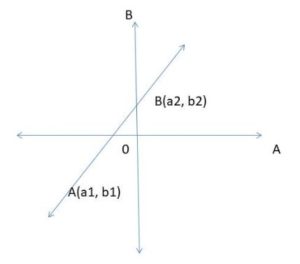
The equation of a straight line represents each and every point on that line. Let us consider the straight line created by passing through the two points such as (a1, b1) and (a2, b2). There are no curves present in the straight line. The basic equation for the straight line in Two-point for is ax + by + c = 0. Here, a, b, c are constants, and x and y are variables.

How to find the Equation of a Straight Line Passing Through Two Points?

The below diagram shows the straight line in two-point form. In this, (a1, b1) is the starting point of the straight line, and (a2, b2) is the ending point of the straight line.

Straight line in Two-point form. Image 1

The equation of the straight line which is passing through the two points A(a1, b1) and B(a2, b2) is b – b1 = (b2 – b1) / (a2 – a1) * (a – a1). P(a, b)is the joining point of A and B.
The straight line is passing through the two points A and B. Then the slope of the line AB = (b1 – b2) / (a1- a2).———( 1 ).
Now, the straight line is passing through the two – points A and P. Then the slope of the line AP = (b – b1) / (a – a1). ——- ( 2 ).
To find out the equation of a straight line with two point form, we need to equate the two equations. That is,
Slope of the line AP = Slope of the line AB.
(b – b1) / (a – a1) = (b1 – b2) / (a1 – a2).
(b – b1) = (b1 – b2) / (a1 – a2) * (a – a1).
Equation for the straight line of two – point form is equal to (b – b1) = (b1 – b2) / (a1 – a2) * (a – a1).
Let us consider the slope (b1 – b2) / (a1 – a2) as ‘m’. substitute the value in the above equation. Then straight line equation becomes as
(b – b1) = m(a – a1).

Steps to Solve Equation of the Straight Line Problems

Follow the three steps to find the Equation of the Straight Line. They are

1. Find the slope of the line.
2. Put the slope and one point into the “Point-Slope Formula”.
3. Simplify the equation.

Also, See:

Two – Point Form Examples with Solutions

1. Find the Equation of the straight line passing through the points (1, 2), and (3, -2)?

Solution:
The given details are (a1, b1) = (1, 2) and (a2, b2) = (3, -2).
The equation for the straight line is (b – b1) = (b1 – b2) / (a1 – a2) * (a – a1).
Substitute the values in the above equation, then we will get
(b – 2) = (2 – (-2)) / (1 – 3) * (a – 1).
(b – 2) = (2 + 2) / (-2) * (a – 1).
(b – 2) = 4 / (-2) * (a – 1).
(b – 2) = -2 * ( a – 1).
b – 2 = -2a + 1.
2a + b – 2 -1 = 0.
2a + b – 3 = 0.

Finally the straight line equation is 2a + b – 3 = 0.

2. Find the equation of the straight line joining the points (-2, 4) and (5, 6)?

Solution:
As per the given information, the straight line is created by joining the two – points. They are (a1, b1) = (-2, 4) and (a2, b2) = (5, 6).
Equation for the straight line of joining two points is (b – b1) = (b1 – b2) / (a1 – a2) * (a – a1).
Substitute the values in the above equation, then we will get like
(b – 4) = (4 – 6) / (-2 – 5) * (a – (-2)).
(b – 4) = (- 2 / – 7) *(a + 2).
(b –4) (7) = 2 * (a + 2).
7b – 28 = 2a + 4.
-2a + 7b – 28 – 4 = 0.
-2a + 7b -32 = 0.

Therefore, the final equation for the straight line is -2a +7b – 32 = 0.

3. Find the straight-line equation with the help of two points (6, 2) and (8, 4)?

Solution:
The given information is the straight line is crossing the two points. They are (a1, b1) = (6, 2) and (a2, b2) = (8, 4).
The equation for the straight line in Two – point form is (b – b1) = (b1 – b2) / (a1 – a2) * (a – a1).
Substitute the values in the above equation, we will get
(b – 2) = (2 – 4) / ( 6 – 8) * ( a – 6).
(b – 2) = ( – 2) / ( – 2) * (a – 6).
(b – 2) = (a – 6).
-a + b – 2 + 6 = 0.
-a + b + 4 = 0.
a – b – 4 = 0.

Finally, the equation for the straight line in two – points is equal to a – b – 4 = 0.

4. Find the equation of a straight line that is passing through points A(6, 6) and B(10, 4)?

Solution:
As per the given information, the straight line is passing through the two points. They are
(a1, b1) = (6, 6) and (a2, b2) = (10, 4).
The basic equation for the straight line in two – point form is (b – b1) = (b1 – b2) / (a1 – a2) * (a – a1).
Substitute the above values in the equation. Then we will get like
(b – 6) = (6 – 4) / (6 – 10) * (a – 6).
(b – 6) = 2 / (-4) * (a – 6).
(b – 6) = 1 / (-2) * (a – 6).
-2 ( b – 6) = a – 6.
-2b + 12 = a – 6.
-a – 2b + 12 + 6 = 0.
a + 2b – 18 = 0.

Finally the equation for the straight line is a + 2b – 18 = 0.

5. Find the values of a for which the points A(a, -2), B(4, 2) and C(8, 10) are collinear?

Solution:
As per the given information, the given points A(a, -2), B(4, 2), and C(8, 10) are collinear.
(a, b) = (a, -2), (a1, b1) = (4, 2), and (a2, b2) = (8, 10)
So, the slope of the AB = slope of the BC.
(b1 – b) / (a1 – a) = (b2 – b1) / (a2 – a1).
Substitute the values in the above equation. Then we will get
(2 – (-2)) / ( 4 – a) = (10 – 2) / (8 – 4).
(2 + 2) / (4 – a) = 8 / 4.
4 / (4 – a) = 2.
4 = 2(4 – a).
4 – a = 2.
4 – 2 = a.
a = 2.

Finally, a is equal to 2.

Decimal Places

Decimal Places – Definition, Facts, Examples | How to Learn to Count Decimal Places?

A Decimal Number consists of a whole number part and a fractional part separated by a decimal point. If you wish to learn completely about Decimal Places and How to Learn to Count Decimal Places. Know about Decimal Place Value Chart Definition, Facts, Solved Examples in the further modules. We are sure you will be familiar with the Decimal Places by the end of this article.

What is meant by Decimal Places?

A Decimal Number consists of both whole number part and decimal number part. The digits right to the decimal point are called the Decimal Part and the digits left to the decimal point are called the whole number part. The Number of Digits present in the decimal part of the given decimal number is known as Decimal Places.

Decimal Place Value

Based on the position of the digit in the number it has a value named place value. For Example, the Place Value of the digit 2 in 1234.45 is 200 as 2 is in the hundreds place. However, if you interchange the digits 3 and 2 we get a new number i.e. 1324.45. In 1324.45 the place value of a digit is 20 as it is in the tens place.

How to Learn to Count Decimal Places?

The number of digits present in the decimal part of the given decimal number is nothing but the Decimal Places. Check out the below-listed examples to understand how to read and count the decimal places for the given decimal number.

For Example:

Decimal Number 5.34 has 2 decimal places.

Decimal Number 0.376 has 3 decimal places.

The Number 86.261 has 3 decimal places.

The Number 912.67 has 2 decimal places.

To better understand the Decimal Numbers you need to be aware of the Place Value.

For Example Decimal Number 51.048053 Place Value is explained clearly below.

Decimal Place Value Example

In the above-illustrated example, 51 is the whole number part and 048053 is the decimal or fractional part.

Whole Number Part

Place of 1 is Ones and its place value is 1

Place of 5 is Tens and its place value is 50

Decimal Number Part

Place of 0 is Tenths and its place value is 0*\(\frac { 1 }{ 10 } \) = 0

Place of 4 is hundredths and its place value is 4*\(\frac { 1 }{ 100 } \) = \(\frac { 4 }{ 100 } \) = 0.04

Place of 8 is Thousandths and its place value is 8*\(\frac { 1 }{ 1000 } \) = \(\frac { 8 }{ 1000 } \) = 0.008

Place of 0 is Ten Thousandths and its place value is 0*\(\frac { 1 }{ 10,000 } \) = 0

Place of 5 is Hundred Thousandths and its place value is 5*\(\frac { 1 }{ 100,000 } \) = \(\frac { 5 }{ 100,000 } \) = 0.00005

Place of 3 is Millionths and its place value is 3*\(\frac { 1 }{ 1000000 } \) = \(\frac { 3 }{ 1000000 } \) = 0.000003

= 5*10+1*1+0*10-1+4*10-2+8*10-3+0*10-4+5*10-5+3*10-6

= 51.048053

FAQs on Decimal Places

1. What are Decimal Places?

Decimal Places are nothing but the number of digits next to the decimal point or in the decimal part.

2. How do you find the Decimal Places?

Firstly, count the number of digits after the decimal point and the number itself tells the Decimal Places for a particular decimal number.

3. How many decimal places are there in the Decimal Number 32.4356?

The number of Decimal Places in the Decimal Number 32.4356 is 4.

eureka-math-answer-key-for-grades-pre-k-k-1-2-3-4-5-6-7-8-algebra-geometry-precalculus

Eureka Math Answer Key for Grades Pre K – 12 | Engage NY Math Book Answers for Grades Pre K, K, 1, 2, 3, 4, 5, 6, 7, 8, 9, 10, 11, 12

Eureka Math Answer Key provided drives equity and sparks the student’s love for math. Eureka Math Book Solutions provided are built by subject experts adhering to today’s fluid learning environment. You can access these resources whenever you need them anytime and anywhere. Download the Eureka Math Solutions for Grades Pre K -12 in PDF format and make your toggling between homework and classroom quite seamless.

Learn, Practice, and Succeed using the Extra Practice, Assessment Tests, Chapter Test, Review Tests available in all the Chapterwise Eureka Math Answers. Students can catch up on their learning using the Eureka Math Textbook Answers for Grades Pre K, Kindergarten, 1, 2, 3, 4, 5, 6, 7, 8, 9, 10, 11, 12.

EngageNY Math Answers Free Download | Great Minds Eureka Math Answer Key

We have curated the common collection of Eureka Math Book Solutions for Elementary School to High School Students all in one place. Our Gradewise Engage NY Math Answers are designed with an intense focus on key concepts so that they can create enduring knowledge among you. Furthermore, you can gain complete knowledge of math and learn various problem-solving math.

Elementary School Eureka Math Answers

Intermediate School Eureka Math Answers

High School/Commencement Level Eureka Math Answers

You can download the different Grades Eureka Math Textbook Solutions provided using the quick links available. Simply tap on the respective link you wish to prepare and learn the underlying concepts easily.

Importance of Solving Eureka Math Textbook Solutions

There are various perks of solving the Gradewise Eureka Math Book Answers provided here. We have outlined the major benefits for your learning. They are in the below fashion

  • Eureka Math Answers provided acts as a full complement for Pre K – 12 materials.
  • Both Students and Teachers can identity and remediate Knowledge Gap so as to achieve your potential.
  • Track your Progress and Identify your Areas of Need taking the help of the Engage NY Math Answers for Grades Pre K -12.
  • All the Engage NY Math Answers for Grades Pre K, Kindergarten, 1, 2, 3, 4, 5, 6, 7, 8, 9, 10, 11, 12 are provided keeping in mind the Latest Common Core Curriculum.
  • You can download the Eureka Math Textbook Answer Key in PDF Format for free of cost and prepare it anywhere and anytime.

FAQs on Eureka Math Answers for Grades Pre K, K, 1, 2, 3, 4, 5, 6, 7, 8, 9, 10, 11, 12

1. Where do I get Gradewise Eureka Math Answers in PDF Format?

You can get Gradewise Eureka Math Answers in PDF Format for free of cost on our page organized via quick links.

2. Is there any portal that provides the Eureka Math Solutions from Elementary School to High School?

eurekamathanswerkeys.com is a trusted portal that provides the Eureka Math Answers from Elementary School to High School all in one place.

3. How to download the Engage NY Math Textbook Answers?

You can download the Engage NY Math Textbook Answers via quick links available on our page. Simply tap on the respective chapter you wish to prepare and learn the underlying concepts in it.

Eureka Math Grade 3 Module 6 End of Module Assessment Answer Key

Engage NY Eureka Math 3rd Grade Module 6 End of Module Assessment Answer Key

Eureka Math Grade 3 Module 6 End of Module Assessment Task Answer Key

Question 1.
The picture graph below represents all the trees in the park.
Engage NY Math 3rd Grade Module 6 End of Module Assessment Answer Key 1
Use the grid to create and label a scaled bar graph representing the data in the picture graph above.
Engage NY Math 3rd Grade Module 6 End of Module Assessment Answer Key 2
b. How many more maple and oak trees are there than birch trees?
Answer:
a.
Engage-NY-Math-3rd-Grade-Module-6-End-of-Module-Assessment-Answer-Key-2
b. 4 trees
Maple trees =3×4=12
Oka trees =5×4= 20
Birch trees = 7×4=28
Total Maple and Oak trees = 12 + 20 =32
32-28=4

Question 2.
2. The table below shows the number of flowers that were planted by the science club.
a. Complete the table by filling in the number of marigolds that were planted.

Flowers Planted by Science Club

Type of FlowerNumber Planted
Roses24
Lilies12
Marigolds________
TOTAL Flowers Planted:54

b. Use the lines below to create and label a picture graph using the data in the table. Determine a picture and scale to represent the number of each type of flower.
Engage NY Math 3rd Grade Module 6 End of Module Assessment Answer Key 3
Answer:
a.18
Explanation:
24+12+x=54
36+x=54
x=54-36
x=18
Engage-NY-Math-3rd-Grade-Module-6-End-of-Module-Assessment img 2
b.Engage-NY-Math-3rd-Grade-Module-6-End-of-Module-Assessment-Answer-Key-3

Question 3.
Fred measures the heights of all the sunflowers in his backyard. His measurements in inches are shown on the line plot below.
Engage NY Math 3rd Grade Module 6 End of Module Assessment Answer Key 4
a. How many sunflowers are in Fred’s backyard? Explain how you know.
b. What are the three most frequent measurements on the line plot? Write them in order from shortest to longest.
Answer:
a. 18
The plot shoes that x= one sunflower
and ther are total of 18 x’s in the plot whuch mean thet there are total of 18 sunflowers
b.The three most frequent measurements on the line plot are 20\(\frac{1}{2}\),19\(\frac{1}{2}\) ,19\(\frac{3}{4}\).
Where
19\(\frac{3}{4}\) = 3 sunflowers
19\(\frac{1}{2}\) = 4 sunflowers
20\(\frac{1}{2}\) = 5 sunflowers

Question 4.
Carol measures 16 bamboo shoots. Her measurements are recorded in the table below.

Heights of Bamboo Shoots (in Inches)

94\(\frac{1}{2}\)94\(\frac{1}{4}\)93\(\frac{3}{4}\)94\(\frac{3}{4}\)
94\(\frac{3}{4}\)9594\(\frac{3}{4}\)95\(\frac{1}{4}\)
94\(\frac{1}{2}\)94\(\frac{3}{4}\)94\(\frac{3}{4}\)94\(\frac{1}{2}\)
9594\(\frac{3}{4}\)94\(\frac{3}{4}\)95

a. Make a line plot of the bamboo shoot data. Explain your choice of scale.
b. How many more bamboo shoots measured 94\(\frac{3}{4}\) inches than both 95 and 94\(\frac{1}{2}\) inches combined?
Answer:
a.The recordings vary from 93\(\frac{3}{4}\) to 95\(\frac{1}{4}\)
There by the line plot scale is considered from 93\(\frac{3}{4}\) to 95\(\frac{1}{4}\)
Engage-NY-Math-Grade-3-Module-6-Lesson-7-Problem
b.  1 more Bambbo shoot
Number of Bamboo shoots measured 94\(\frac{3}{4}\) inches = 7 Bamboo shoots
Number of Bamboo shoots measured combines of 95 and 94\(\frac{1}{2}\) inches =6 Bamboo shoots
Explanation:
7-6=1

Eureka Math Grade 3 Module 6 Answer Key

Eureka Math Grade 3 Module 6 Lesson 9 Answer Key

Engage NY Eureka Math 3rd Grade Module 6 Lesson 9 Answer Key

Eureka Math Grade 3 Module 6 Lesson 9 Pattern Sheet Answer Key

Multiply.
Engage NY Math 3rd Grade Module 6 Lesson 9 Sprint Answer Key 1
Engage NY Math 3rd Grade Module 6 Lesson 9 Sprint Answer Key 2
multiply by 7 (6–10)
Answer:
Engage-NY-Math-3rd-Grade-Module-6-Lesson-8-Pattern-Sheet-Answer-Key-1

Eureka Math Grade 3 Module 6 Lesson 9 Problem Set Answer Key

Question 1.
Four children went apple picking. The chart shows the number of apples the children picked.

Name

Number of Apples Picked

Stewart16
Roxanne______
Trisha12
Philip20
Total:                 72

a. The number of apples Roxanne picked to complete the chart is 24
Engage-NY-Math-3rd-Grade-Module-6-Lesson-8-Pattern-Sheet-Answer-Key-2

b. Create a picture graph below using the data in the table.
Engage NY Math Grade 3 Module 6 Lesson 9 Problem Set Answer Key p 1
Answer:
Engage-NY-Math-Grade-3-Module-6-Lesson-9-Problem-Set-Answer-Key-p-1

Question 2.
Use the chart or graph to answer the following questions.
a. How many more apples did Stewart and Roxanne pick than Philip and Trisha?
b. Trisha and Stewart combine their apples to make apples pies. Each pie takes 7 apples. How many pies can they make?
Answer:
a. eight more apples Stewart and Roxanne pick than Philip and Trisha
b. Trisha and Stewart combine their apples to make apples pies. Each pie takes 7 apples.  they can make are 5 pies

Question 3.
Ms. Pacho’s science class measured the lengths of blades of grass from their school field to the nearest \(\frac{1}{4}\) inch. The lengths are shown below.

Lengths of Blades of Grass (in Inches)

2\(\frac{1}{4}\)2\(\frac{3}{4}\)3\(\frac{1}{4}\)32\(\frac{1}{2}\)2\(\frac{3}{4}\)
2\(\frac{3}{4}\)3\(\frac{3}{4}\)22\(\frac{3}{4}\)3\(\frac{3}{4}\)3\(\frac{1}{4}\)
32\(\frac{1}{2}\)3\(\frac{1}{4}\)2\(\frac{1}{4}\)2\(\frac{3}{4}\)3
3\(\frac{1}{4}\)2\(\frac{1}{4}\)3\(\frac{3}{4}\)33\(\frac{1}{4}\)2\(\frac{3}{4}\)

a. Make a line plot of the grass data. Explain your choice of scale.
b. How many blades of grass were measured? Explain how you know.
c. What was the length measured most frequently on the line plot? How many blades of grass had this length?
d. How many more blades of grass measured 2\(\frac{3}{4}\) inches than both 3\(\frac{3}{4}\) inches and 2 inches combined?
Answer:
a. The recordings vary from 2 to 3\(\frac{3}{4}\)
So the scale vary from 2 to 3\(\frac{3}{4}\)
Engage-NY-Math-Grade-3-Module-6-Lesson-7-Problem 1 img
b. 27 blades of grass were measured because each X in the plot indicates a blades of grass.
c. 2\(\frac{3}{4}\) length measured most frequently on the line plot.
6 blades of grass had this length
d. 2 more
Explination:
3\(\frac{3}{4}\) inches and 2 inches combined = 3+1 = 4
2\(\frac{3}{4}\) = 6
6-4=2

Eureka Math Grade 3 Module 6 Lesson 9 Exit Ticket Answer Key

Mr. Gallagher’s science class goes bird watching. The picture graph below shows the number of birds the class observes.
Eureka Math 3rd Grade Module 6 Lesson 9 Exit Ticket Answer Key t 1
a. How many more birds did Mr. Gallagher’s class observe on Wednesday and Thursday than on Monday and Tuesday?
b. Mr. Manning’s class observed 104 birds. How many more birds did Mr. Gallagher’s class observe?
Answer:
a. 12 more birds
Birds observed on Wednes day and Thursday = (5×6)+(5×6) = 30+30 =60
Birds observed on Monday and Tuesday  = (4×6)+(4×6) = 24+24 =48
60-48=12
b. 4 more birds
Explination:
Mr. Manning’s class observed =104 birds
Mr. Gallagher’s class observe:
(4×6)+(4×6)+(5×6)+(5×6)=24+24+30+30=108 birds
108-104=4

Eureka Math Grade 3 Module 6 Lesson 9 Homework Answer Key

Question 1.
The table below shows the amount of money Danielle saves for four months.

Month

Money Saved

January$9
February$18
March$36
April$27

Create a picture graph below using the data in the table.
Eureka Math Grade 3 Module 6 Lesson 9 Homework Answer Key h 1
Answer:
Eureka-Math-Grade-3-Module-6-Lesson-9-Homework-Answer-Key-h-1

Question 2.
2. Use the table or graph to answer the following questions.
a. How much money does Danielle save in four months?
b. How much more money does Danielle save in March and April than in January and February?
c. Danielle combines her savings from March and April to buy books for her friends. Each book costs $9. How many books can she buy?
d. Danielle earns $33 in June. She buys a necklace for $8 and a birthday present for her brother. She saves the $13 she has left. How much does the birthday present cost?
Answer:
a.$90
Explination:
$9+$18+$36+$27 =$90
b. $36 more
Explination:
Total amount saved on March and April combined = $9+$18 =$27
Total amount saved on January  and February combined = $36+$27 =$63
$63-$27 =$36
c. 3 books
Explination:
Given:
Savings of March and April = $27
One book cost = $9
Therefor
$9+$9+$9=$27
d. $12
Explination:
Given:
Necklace cost = $8
Saved amount = $13
Total earning of june =$33
There by
$8+$13+x=$33
$21+x=$33
x=$33-$21
x=$12

Eureka Math Grade 3 Module 6 Answer Key

Eureka Math Grade 3 Module 6 Lesson 8 Answer Key

Engage NY Eureka Math 3rd Grade Module 6 Lesson 8 Answer Key

Eureka Math Grade 3 Module 6 Lesson 8 Pattern Sheet Answer Key

Multiply.
Engage NY Math 3rd Grade Module 6 Lesson 8 Pattern Sheet Answer Key 1
Engage NY Math 3rd Grade Module 6 Lesson 8 Pattern Sheet Answer Key 2
multiply by 7 (1–5)
Answer:
Engage-NY-Math-3rd-Grade-Module-6-Lesson-8-Pattern-Sheet-Answer-Key-1

Eureka Math Grade 3 Module 6 Lesson 8 Problem Set Answer Key

Question 1.
Delilah stops under a silver maple tree and collects leaves. At home, she measures the widths of the leaves to the nearest \(\frac{1}{4}\) inch and records the measurements as shown below.

Widths of Silver Maple Tree Leaves (in Inches)

5\(\frac{3}{4}\)66\(\frac{1}{4}\)65\(\frac{3}{4}\)
6\(\frac{1}{2}\)6\(\frac{1}{4}\)5\(\frac{1}{2}\)5\(\frac{3}{4}\)6
6\(\frac{1}{4}\)666\(\frac{1}{2}\)6\(\frac{1}{4}\)
6\(\frac{1}{2}\)5\(\frac{3}{4}\)6\(\frac{1}{4}\)66\(\frac{3}{4}\)
66\(\frac{1}{4}\)65\(\frac{3}{4}\)6\(\frac{1}{2}\)

a. Use the data to create a line plot below.
b. Explain the steps you took to create the line plot.
c. How many more leaves were 6 inches wide than 6\(\frac{1}{2}\) inches wide?
d. Find the three most frequent measurements on the line plot. What does this tell you about the typical width of a silver maple tree leaf?
Answer:
a. line plot below
Eureka-Math-Grade-3-Module-6-Lesson-7-Homework-Answer-Key-h-2 f
b. The steps you took to create the line plot
To create a line plot, ​first, create a number line that includes all the values in the data set. Next, place an X  above each data value on the number line. If a value occurs more than once in a data set, place ​an Xs​ over that number for each time it occurs.
c. There are eight more leaves that were 6 inches wide than 6\(\frac{1}{2}\) inches wide
d. The three most frequent measurements on the line plot are 6 inches leaves and 6\(\frac{1}{4}\) inches leaves. this tell you about the typical width of a silver maple tree leaf are there are most frequent measurements on the line plot are 6 inches leaves and 6\(\frac{1}{4}\) inches leaves

Eureka Math Grade 3 Module 6 Lesson 8 Exit Ticket Answer Key

Question 1.
The line plot below shows the lengths of fish the fishing boat caught.
Lengths of Fish
Eureka Math 3rd Grade Module 6 Lesson 8 Exit Ticket Answer Key t 1
a. Find the three most frequent measurements on the line plot.
b. Find the difference between the lengths of the longest and shortest fish.
c. How many more fish were 23\(\frac{1}{4}\) inches long than 24 inches long?
Answer:
a. The three most frequent measurements on the line plot are 23\(\frac{1}{4}\) and 23\(\frac{1}{2}\)
b. The difference between the lengths of the longest and shortest fish is longest fish length is 2 inches as the longest fish length is 24 inches and the shortest fish length is 22 inches
c. There are 3 more fish were 23\(\frac{1}{4}\) inches longer than 24 inches long?

Eureka Math Grade 3 Module 6 Lesson 8 Homework Answer Key

Question 1.
Mrs. Leah’s class uses what they learned about simple machines to build marshmallow launchers. They record the distances their marshmallows travel in the chart below.

Distance Traveled (in Inches)

48\(\frac{3}{4}\)4949\(\frac{1}{4}\)5049\(\frac{3}{4}\)
49\(\frac{1}{2}\)48\(\frac{1}{4}\)49\(\frac{1}{2}\)48\(\frac{3}{4}\)49
49\(\frac{1}{4}\)49\(\frac{3}{4}\)4849\(\frac{1}{4}\)48\(\frac{1}{4}\)
4948\(\frac{3}{4}\)494948\(\frac{3}{4}\)

a. Use the data to create a line plot below.
b. Explain the steps you took to create the line plot.
c. How many more marshmallows traveled 48\(\frac{3}{4}\) inches than 48\(\frac{1}{4}\) inches?
d. Find the three most frequent measurements on the line plot. What does this tell you about the distance that most of the marshmallows traveled?
Answer:
a. Used the data to create a line plot below.
Eureka-Math-Grade-3-Module-6-Lesson-7-Homework-Answer-Key-h-2 v
b. The steps you took to create the line plot.
To create a line plot, ​first, create a number line that includes all the values in the data set. Next, place an X  above each data value on the number line. If a value occurs more than once in a data set, place ​an Xs​ over that number for each time it occurs.
c. Two more marshmallows traveled 48\(\frac{3}{4}\) inches than 48\(\frac{1}{4}\) inches
d. The three most frequent measurements on the line plot are 48\(\frac{3}{4}\) and 49. the 49 inches tell you about the distance that most of the marshmallows traveled

Eureka Math Grade 3 Module 6 Answer Key