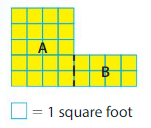
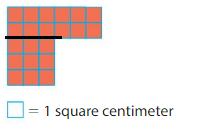
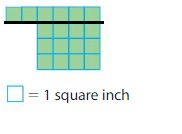
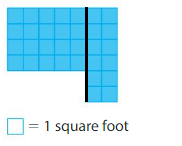
Big Ideas Math Answers Grade 3 Chapter 6 Relate Area to Multiplication

Big Ideas Math Answers Grade 3 Chapter 6 Relate Area to Multiplication pdf is available here. We have provided the solutions to all the questions in the BIM 3rd Grade Chapter 6 Relate Area to Multiplication in the pdf format. This Big Ideas Math Answers Grade 3 Chapter 6 Relate Area to Multiplication helps you to complete the homework in time and also to enhance the knowledge. You can learn the concepts in depth.

Big Ideas Math Book 3rd Grade Answer Key Chapter 6 Relate Area to Multiplication

Check out the topics before you start your preparation. We have prepared the solutions for the entire chapter in an easy manner. The topics covered in this chapter are areas, measure area using standard units, etc. You can know how to use the formula for suitable problems from here. Hence make use of the below links and learn the fundamentals or basics from the primary level itself.

Lesson: 1 Understand Area

Lesson: 2 Measure Area Using Standard Units

Lesson: 3 Find Area by Multiplying

Lesson: 4 Area and the Distributive Property

Lesson: 5 Find Areas of More Shapes

Performance Task

Lesson 6.1 Understand Area

Explore and Grow

Try to cover the rectangle with the given number of color tiles.
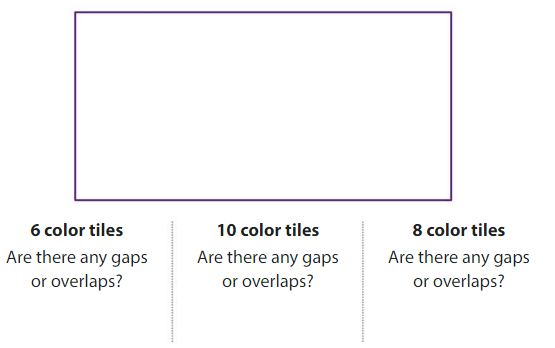
Big Ideas Math Answer Key Grade 3 Chapter 6 Relate Area to Multiplication 6.1 1
How many color tiles do you need to completely cover the rectangle with no gaps or overlaps?
____ color tiles
Answer:
6 + 10 + 8 = 24 tiles are needed to cover the rectangle

Precision
Why is it important to line up the tiles side to side?
Think and Grow: Counting to Find Area

Answer:
It is important to line up tiles side to side with out gaps so that we can count tiles to find area of the shape.
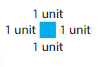
Area is the amount of surface a shape covers. The area of a unit square is 1 square unit.
Big Ideas Math Answer Key Grade 3 Chapter 6 Relate Area to Multiplication 6.1 2
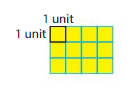
12 unit squares cover the rectangle with no gaps or overlaps. So, the area of the rectangle is 12 square units.
Big Ideas Math Answer Key Grade 3 Chapter 6 Relate Area to Multiplication 6.1 3

Example
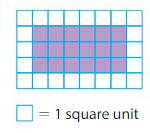
Find the area of the rectangle. Count the unit squares needed to cover the rectangle.
Big Ideas Math Answer Key Grade 3 Chapter 6 Relate Area to Multiplication 6.1 4.1
Big Ideas Math Answer Key Grade 3 Chapter 6 Relate Area to Multiplication 6.1 4
___ unit squares cover the rectangle.
So, the area is ___ square units.

Answer:
18 unit squares cover the rectangle.
So, the area is 18 square units.

Explanation:
There are 3 rows with 6 color tiles each in the grid
6+6+6=18.
18 unit squares cover the rectangle.
So, The area is 18 square units.

Show and Grow

Question 1.
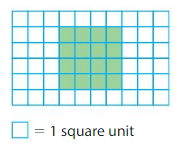
Find the area of the shape.
Big Ideas Math Answer Key Grade 3 Chapter 6 Relate Area to Multiplication 6.1 5
___ unit squares cover the shape.
So, the area is ___ square units.
Answer:
16 unit squares cover the shape.
So, the area is 16 square units.

Explanation:
There are 4 color tiles in row and there are 4 such rows of color tiles in the shape.
So, 4+4+4+4=16
Therefore 16 unit squares cover the shape.
So, the area is 16 square units.

Question 2.
Big Ideas Math Answer Key Grade 3 Chapter 6 Relate Area to Multiplication 6.1 6
___ unit squares cover the shape.
So, the area is ___ square units.

Answer:
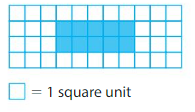
10 unit squares cover the shape.
So, the area is 10 square units.

Explanation:
There are 5 color tiles in a row and there are 2 such rows in the shape.
So, 5×2=10
Therefore
10 unit squares cover the shape.
So, The area is 10 unit squares.

Apply and Grow: Practice

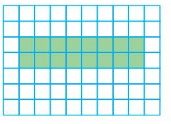
Find the area of the shape.
Question 3.
Big Ideas Math Answer Key Grade 3 Chapter 6 Relate Area to Multiplication 6.1 7
___ unit squares cover the shape.
So, the area is ___ square units.

Answer:
16 unit squares cover the shape.
So, the area is 16 square units.

Explanation:
So, There are 8 color tiles in a row and there are 2 such rows in the shape.
8×2=16
Therefore 16 unit squares cover the shape.
So, the area is 16 unit squares.

Question 4.
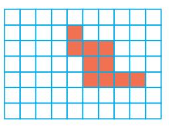
Big Ideas Math Answer Key Grade 3 Chapter 6 Relate Area to Multiplication 6.1 8
Area = ___ square units.

Answer:
Area =10 square units.

Explanation:
In the above grid there are 10 color boxes.
So, the area of the given shape is 10 square units.

Question 5.
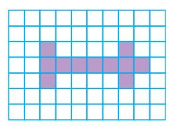
Big Ideas Math Answer Key Grade 3 Chapter 6 Relate Area to Multiplication 6.1 9
Area = ___ square units.

Answer:
Area = 11 square units.

Explanation:

In the above grid there are 11 color boxes
so, the area of the shape is 11 square units.

Question 6.
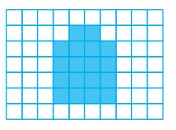
Big Ideas Math Answer Key Grade 3 Chapter 6 Relate Area to Multiplication 6.1 10
Area = ___ square units.
Answer:
Area =18 square units.

Explanation:
There are 2 color boxes in first row and there are 4 color boxes in the following 4 rows.
So, 2+4+4+4+4=18
Therefore the area of the shape is 18 square units.

Question 7.
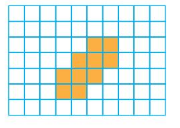
Big Ideas Math Answer Key Grade 3 Chapter 6 Relate Area to Multiplication 6.1 11
Area = square units.
Answer:
Area = 10 square units.

Explanation:
In the above grid there are 2 color boxes in the first row ,last row and 3 color boxes each in middle two rows.
So,2+3+3+2=10
Therefore the area of the shape is 10 square units.

Question 8.
YOU BE THE TEACHER
Big Ideas Math Answer Key Grade 3 Chapter 6 Relate Area to Multiplication 6.1 12
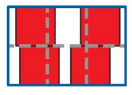
Newton uses 4 color tiles to cover the rectangle. He says the area is 4 square units. Is he correct? Explain.
Answer:
No, Newton is not correct. To find the area of the shape using tiles they must be arranged side by side without any gaps or overlaps. In the above picture there are gaps between the color tiles.

Question 9.
Open-Ended
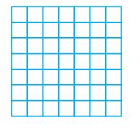
Draw a shape that has an area of 16 square units
Big Ideas Math Answer Key Grade 3 Chapter 6 Relate Area to Multiplication 6.1 13
Answer:

Think and Grow: Modeling Real Life

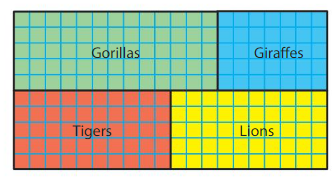
Part of a zoo map is shown. What is the area of the lion exhibit?
Big Ideas Math Answer Key Grade 3 Chapter 6 Relate Area to Multiplication 6.1 14
The lion exhibit is ___ square units.

Answer:
The lion exhibit is  50 square units.

Explanation:
In the above zoo map the area of lion exhibit is represented using yellow colored tiles.
There are 10 yellow colored tiles in a row and there are 5 such rows of yellow color tiles.
So,10×5=50
Therefore the area of the lion exhibit in the zoo is 50 square units.

Show and Grow

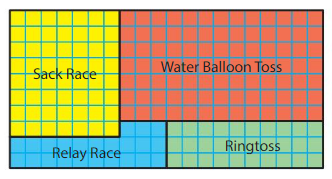
Use the field day map to answer the question.
Big Ideas Math Answer Key Grade 3 Chapter 6 Relate Area to Multiplication 6.1 15

Question 10.
What is the area of the relay race section?

Answer:
Area of Relay Race section is 23 square units.

Explanation:
In the above field day map Relay Race section is represented using blue colored tiles.
There are 3 tiles in first row and 10 tiles in the following two rows.
So,3+10+10=23
Therefore the area of the Relay Race section is 23 square units.

Question 11.
Which area is greater, the ring toss section or the relay race section? Explain.

Answer:
The ring toss section is greater than relay race section.

Explanation:
The area of ring toss section is 30 square units and the area of the relay race section is 23 square units.so the ring toss section is greater than relay race section.

Understand Area Homework & practice 6.1

Find the area of the shape.
Question 1.
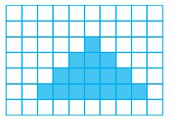
Big Ideas Math Answer Key Grade 3 Chapter 6 Relate Area to Multiplication 6.1 16
___ unit squares cover the shape.
So, the area is ___ square units.

Answer:
18 unit squares cover the shape.
So, the area is 18 square units.

Explanation:
In the above grid there is 1 blue color tile in first row followed by 3 tiles in the next,5 tiles in the later and 9 tiles at the end.
So,1+3+5+9=18
18 color tiles cover the area.
Therefore the area of the given shape is 18 square units.

Question 2.
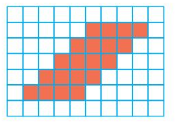
Big Ideas Math Answer Key Grade 3 Chapter 6 Relate Area to Multiplication 6.1 17
Area = ___ square units.

Answer:
Area = 20 square units.

Explanation:
In the above grid there are 4 red colored tiles in a row and there are 5 such rows.
So,4×5=20
20 tiles cover the shape.
Therefore the area of the given shape is 20 square units.

Question 3.
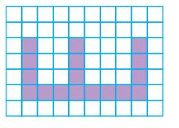
Big Ideas Math Answer Key Grade 3 Chapter 6 Relate Area to Multiplication 6.1 18
Area = ___ square units.

Answer:
Area = 17 square units.

Explanation:
In the above grid there are 17 purple colored tiles.
Therefore the area of the given shape is 17 square units.

Question 4.
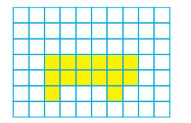
Big Ideas Math Answer Key Grade 3 Chapter 6 Relate Area to Multiplication 6.1 19
Area = ___ square units.

Answer:
Area = 14 square units.

Explanation:
There are 6 yellow colored tiles in 2 rows each followed  by 2 more tiles in the third row.
So,6+6+2=14
14 tiles cover the shape.
Therefore the area of the shape is 14 square units.

Question 5.
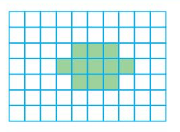
Big Ideas Math Answer Key Grade 3 Chapter 6 Relate Area to Multiplication 6.1 20
Area = ___ square units.

Answer:
Area = 11 square units.

Explanation:
There are 3 green colored boxes in the first and third row of the above shape and 5 boxes in the middle row.
So,3+5+3=11
11 color tiles cover the shape.
Therefore the area of the shape is 11 square units.

Question 6.
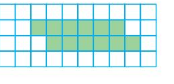
Big Ideas Math Answer Key Grade 3 Chapter 6 Relate Area to Multiplication 6.1 21
Area = ___ square units.

Answer:
Area =12 square units.

Explanation:
There are 6 color tiles each in two rows.
So,6+6=12
12 color tiles cover the shape
Therefore the area of the shape is 12 square units.

Question 7.
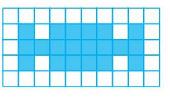
Big Ideas Math Answer Key Grade 3 Chapter 6 Relate Area to Multiplication 6.1 22
Area = ___ square units.

Answer:
Area = 20 square units.

Explanation:
There are 20 color tiles in the above grid.
So, the area of the shape is 20 square units.

Question 8.
Your friend says each shape has an area of 8 square units. Is your friend correct? Explain.
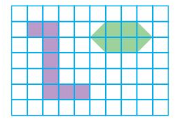
Big Ideas Math Answer Key Grade 3 Chapter 6 Relate Area to Multiplication 6.1 23

Answer:
My friend is incorrect.

Explanation:
One of the shape in in the above grid has gaps.

Modeling Real Life
Use the amusement park map to answer the question.
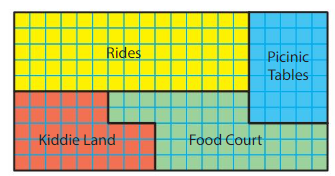
Big Ideas Math Answer Key Grade 3 Chapter 6 Relate Area to Multiplication 6.1 24
Answer:

Question 9.
What is the area of the food court section?

Answer:
The area of the food court is 51 square units.

Explanation:
There are 9 green tiles in first 2 rows each and 11 green tiles in the following 3 rows.
So,9+9+11+11+11=51
51 green tiles cover the food court area
Therefore the area of the food court is 51 square units.

Question 10.
Which area is greater, the kiddie land section or the picnic tables section? Explain.

Answer:
Area of kiddie land section is greater than area of picnic tables.

Explanation:
The kiddie land section is covered with 39 color tiles and the picnic tables section is covered with 35 color tiles.

Review & Refresh

Find the quotient.
Question 11.
Big Ideas Math Answer Key Grade 3 Chapter 6 Relate Area to Multiplication 6.1 25
Answer:6
Explanation:(2×6=12)

Question 12
Big Ideas Math Answer Key Grade 3 Chapter 6 Relate Area to Multiplication 6.1 26
Answer:4
Explanation:(7×4=28)

Question 13.
Big Ideas Math Answer Key Grade 3 Chapter 6 Relate Area to Multiplication 6.1 27
Answer:9
Explanation:(6×9=54)

Question 14.
Big Ideas Math Answer Key Grade 3 Chapter 6 Relate Area to Multiplication 6.1 28
Answer:7
Explanation:(7×7=49)

Lesson 6.2 Measure Area Using Standard Units

Explore and Grow

Use the colored squares.
How many blue squares do you think it will take to cover the rectangle?
___ blue squares
How many red squares do you think it will take to cover the rectangle?
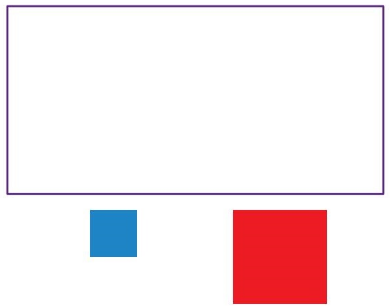
Big Ideas Math Answer Key Grade 3 Chapter 6 Relate Area to Multiplication 6.1 29
Answer:

Find the area of the rectangle using the blue squares.
Area = ___ blue square units
Find the area of the rectangle using the red squares.
Area = ___ red square units
Answer:

Reasoning
Why is the number of blue squares needed to cover the rectangle different from the number of red squares needed?

Answer:
The number of blue squares needed to cover the rectangle is different from the number of red squares as sizes of the squares are different.

Think and Grow: Measuring Area Using Standard Units

You can measure area using different standard units. Here are some standard units of length and area.
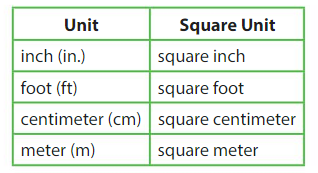
Big Ideas Math Answer Key Grade 3 Chapter 6 Relate Area to Multiplication 6.1 31
Unit squares can represent different standard units.
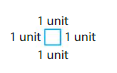
Big Ideas Math Answers 3rd Grade Chapter 6 Relate Area to Multiplication 32
Each side is 1 unit. The area is 1 square unit.
Big Ideas Math Answers 3rd Grade Chapter 6 Relate Area to Multiplication 33
Each Side represents 1 inch. The area is 1 square inch.

Example
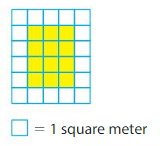
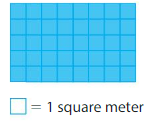
Big Ideas Math Answers 3rd Grade Chapter 6 Relate Area to Multiplication 34
Find the area of the rectangle
___ unit squares cover the rectangle.
Each unit square represents
___________________
So, the area is _____

Answer:
In the above grid there are 3 yellow colored tiles in a row and there are 4 such rows.
So,3×4=12
12 unit squares cover the rectangle.
Each unit square represents 1 square meter.
So, the area is 12 square meters.

Show and Grow

Question 1.
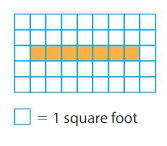
Big Ideas Math Answers 3rd Grade Chapter 6 Relate Area to Multiplication 35.1
Find the area of the shape.
___ unit squares cover the rectangle.
Each unit square represents
________
So, the area is ____

Answer:
In the above grid there are 7 color tiles.
7 unit squares cover the rectangle.
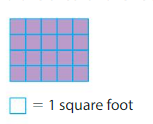
Each unit square represents 1 square foot.
So, the area is 7 square feet.

Apply and Grow: Practice

Find the area of the shape.
Question 2.
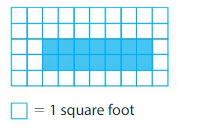
Big Ideas Math Answers 3rd Grade Chapter 6 Relate Area to Multiplication 35
Area = ____
Answer:

There are 14 color tiles in the above grid.
14 unit squares cover the rectangle.
Each unit square represents 1 square foot.
So, the area is 14 square feet.


Question 3.
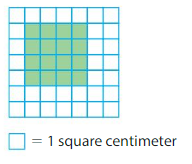
Big Ideas Math Answers 3rd Grade Chapter 6 Relate Area to Multiplication 36
Area = ___

Answer:
There are 16 color tiles in the above grid.
16 unit squares cover the area.
Each unit square represents 1 square centimeter.
So, the area is 16 square centimeters.

Question 4.
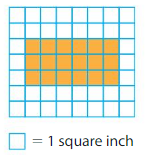
Big Ideas Math Answers 3rd Grade Chapter 6 Relate Area to Multiplication 37
Area = ____

Answer:
There are 18 color tiles in the grid
18 square units cover the rectangle.
Each unit square represents 1 square inch.
So, the area is 18 square inches.

Question 5.
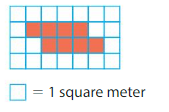
Big Ideas Math Answers 3rd Grade Chapter 6 Relate Area to Multiplication 38
Area = ___

Answer:
There are 8 color boxes in the above grid.
8 unit squares cover the shape.
Each unit square represents 1 square meter.
So, the area is 8 square meters.

Question 6.
Number Sense
Which rectangle has an area of 12 square inches?
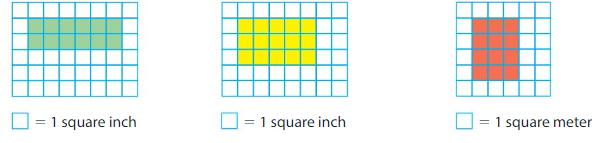
Big Ideas Math Answers 3rd Grade Chapter 6 Relate Area to Multiplication 39

Answer:
In the above grid  the green rectangle has 12 colored tiles, Yellow rectangle has 15 colored tiles and the orange rectangle also has 12 colored tiles but the unit square representation of orange rectangle is square meter. As green rectangle unit square representation is square inch, Green colored rectangle has the area of 12 square inches.

Question 7.
Reasoning
Is the area of a blanket more likely to be 30 square feet or 30 square centimeters? Explain.
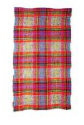
Big Ideas Math Answers 3rd Grade Chapter 6 Relate Area to Multiplication 40
Answer:
Centimeter is the smaller when compared to feet. usually we have blankets in bigger size so that a person fits in to it.
Therefore the area of the blanket will more likely be 30 square feet.

Think and Grow: Modeling Real Life

Whose puzzle has a greater area?
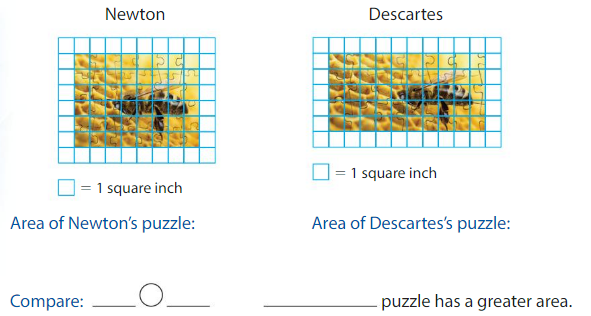
Big Ideas Math Answers 3rd Grade Chapter 6 Relate Area to Multiplication 41

Answer:
Newton’s puzzle is covered with 48 tiles and Descartes puzzle is covered with 40 tiles.
Area of Newton’s puzzle is 48 square inches and area of  Descartes’s puzzle is 40 square inches.
48>40.
Therefore Newton’s puzzle has the greater area.

Show and Grow

Question 8.
Compare the area of Newton’s puzzle shown above to the area of your friend’s puzzle. Whose puzzle has a greater area?
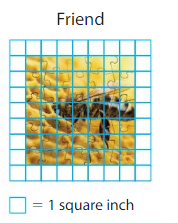
Big Ideas Math Answers 3rd Grade Chapter 6 Relate Area to Multiplication 42

Answer:
In the above given puzzle there are 49 colored tiles .
The area of my friend’s puzzle is 49 square inches.
The area of Newton’s puzzle is 48 square inches.
48<49
Therefore Area of my friend’s puzzle is greater.

Question 9.
You want to weave a rectangular rug that has an area of 12 square feet. Draw and shade a rectangle to represent the rug.
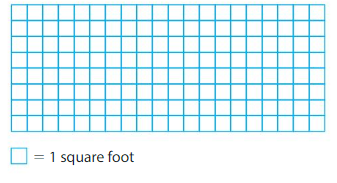
Big Ideas Math Answers 3rd Grade Chapter 6 Relate Area to Multiplication 43

Answer:

Measure Area Using Standard Units  Homework & Practice 6.2

Find the area of the shape.
Question 1.
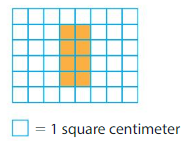
Big Ideas Math Answers 3rd Grade Chapter 6 Relate Area to Multiplication 44

Answer:
Area = 8 square centimeters

Explanation:
There are 8 colored unit squares in the rectangle.
Each unit square represents 1 square centimeter.
So, area is 8 square centimeters.

Question 2.
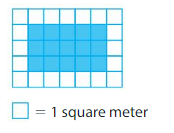
Big Ideas Math Answers 3rd Grade Chapter 6 Relate Area to Multiplication 45
Area = ___

Answer:
Area = 15 square meters

Explanation:
There are 15 colored unit squares in the above rectangle.
Each unit square represents 1 square meter.
So, area is 15 square meters.

Question 3.
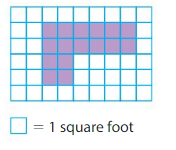
Big Ideas Math Answers 3rd Grade Chapter 6 Relate Area to Multiplication 46
Area = ___

Answer:
Area = 16 square feet

Explanation:
There are 16 color unit squares in the above grid.
Each unit square represents 1 square foot.
So, area of the shape is 16 square feet.

Question 4.
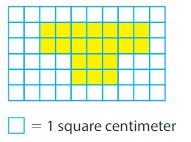
Big Ideas Math Answers 3rd Grade Chapter 6 Relate Area to Multiplication 47
Area = ___

Answer:
Area = 20 square centimeters

Explanation:
There are 20 colored unit squares in above grid.
Each unit square represents 1 square centimeter.
So, area of the shape is 20 square centimeters.

Question 5.
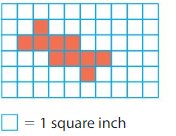
Big Ideas Math Answers 3rd Grade Chapter 6 Relate Area to Multiplication 48
Area = ___

Answer:
Area = 10 square inches

Explanation:
There are 10 colored unit squares in the above grid.
Each unit square represents 1 square inch.
So, area of the shape is 10 square inches.

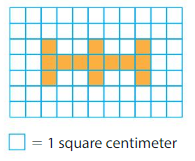
Question 6.
Precision
Your friend says the area of the shape is 13. What is wrong with her answer?
Big Ideas Math Answers 3rd Grade Chapter 6 Relate Area to Multiplication 49

Answer:
My friend’s answer wrong as he/she didn’t mention the units of the area.
There are 13 color unit squares in the above grid.
Each unit square represents 1 square centimeter.
Therefore area is 13 square centimeters.

Question 7.
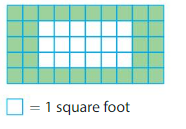
Number Sense
Find the area of the shape.
Big Ideas Math Answers 3rd Grade Chapter 6 Relate Area to Multiplication 50

Answer:
Area = 32 square feet

Explanation:
In the above grid there are 32 color unit squares.
Each unit square represents 1 square foot.
Therefore area of the given shape is 32 square feet.


Question 8.
Modeling Real Life
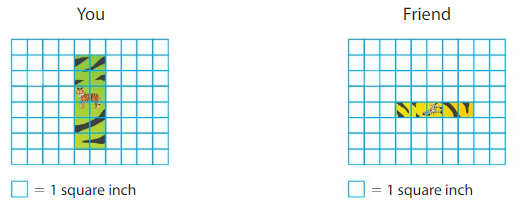
Compare the areas of your bookmark and your friend’s bookmark. Whose bookmark has a greater area?
Big Ideas Math Answers 3rd Grade Chapter 6 Relate Area to Multiplication 51

Answer:
My book mark has 12 colored unit squares and my friend’s book mark has 5 colored unit squares.
So area of my book mark is 12 square inches and my friend’s book mark is 5 square inches.
12>5
So, area of my book mark is greater.

Review & Refresh

Question 9.
Find the product of 4 × 5.
Number of jumps: ___
Size of jumps: ___

Big Ideas Math Answers 3rd Grade Chapter 6 Relate Area to Multiplication 52
4 × 5 = ___

Answer:
Number of jumps =4
Size of jumps=5
4×5=20.

Lesson 6.3 Find Area by Multiplying

Explore and Grow

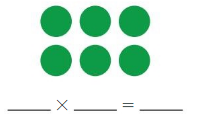
Write an equation for the array.
Big Ideas Math Answers Grade 3 Chapter 6 Relate Area to Multiplication 6.3 1

Answer: 2×3=6

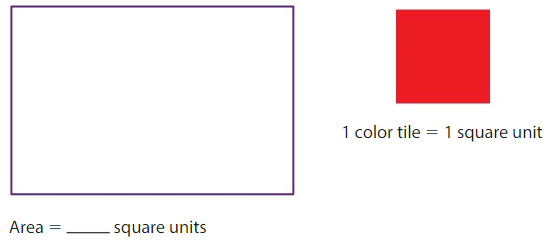
Cover the rectangle with color tiles. Find the area of the rectangle.
Big Ideas Math Answers Grade 3 Chapter 6 Relate Area to Multiplication 6.3 2
Answer:

Structure
How can you use an array to find the area of rectangle?

Answer:
We can count the number of unit squares in a row and number of unit squares in a column and note them in the form of an array.
The answer of the equation will be the area of the rectangle.

Think and Grow: Find Area by Multiplying

Example
Find the area of the rectangle.
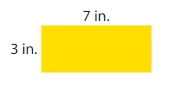
Big Ideas Math Answers Grade 3 Chapter 6 Relate Area to Multiplication 6.3 3
One Way:
Count the unit squares to find the area.
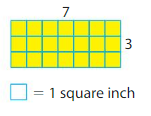
Big Ideas Math Answers Grade 3 Chapter 6 Relate Area to Multiplication 6.3 4
There are ___ unit squares

Another Way:
Think of the rectangle as an array.
Then use repeated addition or multiplication to find the area.
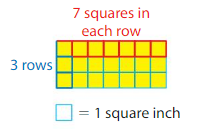
Big Ideas Math Answers Grade 3 Chapter 6 Relate Area to Multiplication 6.3 5
3 rows of ____ unit squares
7 + 7 + 7 = ____
3 × 7 = _____
So, the area is _____.

Show and Grow

Question 1.
Find the area of the rectangle.
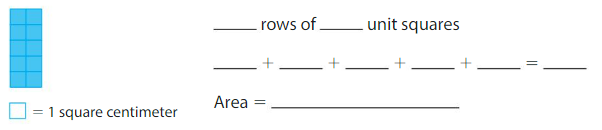
Big Ideas Math Answers Grade 3 Chapter 6 Relate Area to Multiplication 6.3 6

Answer:
There are 5 rows of 2 unit squares in each row.
So, 5 rows of 2 unit squares
2+2+2+2+2=10
Area=10 unit squares

Question 2.

Big Ideas Math Answers Grade 3 Chapter 6 Relate Area to Multiplication 6.3 7

Answer:
6ft×4ft=24ft
Area =24 square feet.

Apply and Grow: Practice

Find the area of the rectangle
Question 3.
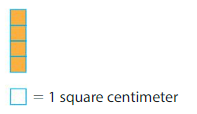
Big Ideas Math Answers Grade 3 Chapter 6 Relate Area to Multiplication 6.3 8
____ × _____ = ____
Area = _____

Answer:
There are 4 rows of 1 unit square in each row.so,
4×1=4
Area=4 square centimeter.

Question 4.
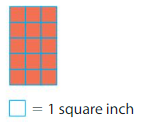
Big Ideas Math Answers Grade 3 Chapter 6 Relate Area to Multiplication 6.3 9
____ × _____ = ____
Area = _____

Answer:
There are 5 rows with 3 unit squares in each roe.so,
5×3=15
Area =15 square inches.

Question 5.
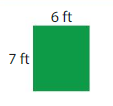
Big Ideas Math Answers Grade 3 Chapter 6 Relate Area to Multiplication 6.3 10
___ × ____ = ____
Area = _____

Answer:
7ft×6ft=42ft
Area=42 square feet

Question 6.
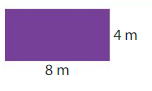
Big Ideas Math Answers Grade 3 Chapter 6 Relate Area to Multiplication 6.3 11
____ × _____ = ____
Area = ______

Answer:
8m×4m=32m
Area=32 square meters.

Question 7.
Open-Ended
Draw and label two different rectangles that each have an area of 12 square meters.

Answer:

Question 8.
DIG DEEPER!
Explain how to find the area of the rectangle.
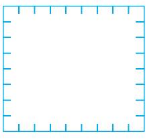
Big Ideas Math Answers Grade 3 Chapter 6 Relate Area to Multiplication 6.3 12

Answer:
We can find area of the given rectangle by counting the number of square units in a row and in a column and multiplication of both is the area of the rectangle.

Think and Grow: Modeling Real Life

Space Poster Your rectangular animal poster is 4 feet long and 1 foot wide. Which poster has a greater area, your animal poster or your space poster?
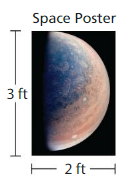
Big Ideas Math Answers Grade 3 Chapter 6 Relate Area to Multiplication 6.3 13
Understand the problem:
Make a plan:

Solve:
Area of my  animal poster is
4ft×1ft=4 square feet.
Area of my space poster is
3ft×2ft=6 square feet.
4<6
So, my space poster has a greater area.

Show and Grow

Question 9.
Descartes’s rectangular tablet is 10 inches long and 7 inches wide. Whose tablet has a greater area, Newton’s tablet or Descartes’s?
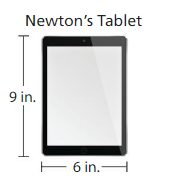
Big Ideas Math Answers Grade 3 Chapter 6 Relate Area to Multiplication 6.3 14

Answer:
Area of Newton’s table is
9in.×6in.=54 square inches.
Area of Descartes’s table is
10in.×7in.=70 square inches.
54<70
Therefore Descartes’s table has greater area.

Question 10.
Your friend paints a rectangular tile that is 8 inches long and 4 inches wide. You paint a square tile that is 6 inches long. Whose tile has a greater area?

Answer:
Area of rectangular tile is
8in.×4in.=32 square inches.
Area of square tile is
6in.×6in.=36 square inches.
32<36
So, square tile has greater area.


Question 11.
DIG DEEPER!
A sign has an area of 18 square feet. The sign is 6 feet long. How wide is the sign?

Answer:
There is a sign with an area of 18 square feet and length of 6 feet.
We have to find width of sign
Area=length ×width
18=6×width Or 6×width=18
Calculate and check 6 table 6×1=6,6×2=12,6×3=18
Therefore width of the sign is 3 feet.


Find Area by Multiplying Homework & Practice 6.3

Find the area of the rectangle
Question 1.
Big Ideas Math Answers Grade 3 Chapter 6 Relate Area to Multiplication 6.3 15
____ × ____ = ____
Area = _____

Answer:
There are 4 rows with 4 unit squares in each row.
4×4=16
Area =16 square feet.

Question 2.
Big Ideas Math Answers Grade 3 Chapter 6 Relate Area to Multiplication 6.3 16
____ × _____ = _____
Area = _____

Answer:
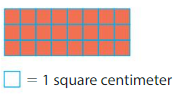
There are 3 rows with 8 unit squares in each row.
3×8=24
Area=24 square centimeters.

Question 3.
Big Ideas Math Answers Grade 3 Chapter 6 Relate Area to Multiplication 6.3 17
____ × _____ = _____
Area = _____

Answer:
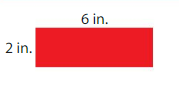
6 in.×2 in.=12
Area=12 square inches.

Question 4.
Big Ideas Math Answers Grade 3 Chapter 6 Relate Area to Multiplication 6.3 18
____ × _____ = _____
Area = _____

Answer:
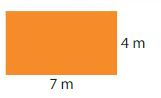
7 m×4 m=28
Area=28 square meters.

Question 5.
DIG DEEPER!
Find the missing side length.
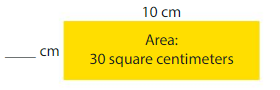
Big Ideas Math Answers Grade 3 Chapter 6 Relate Area to Multiplication 6.3 19

Answer:
Given Area of rectangle =30 square centimeters
Length =10 square meters
We have to find the length of the other side called breadth or width
Area= length ×width
30=10×width or 10×width=30
Count 10 table10×1=10,10×2=20,10×3=30
Therefore width or the length of the other side is 3 square meters.

Question 6.
YOU BE THE TEACHER
Descartes says he only needs the length of one side of a square to find the area. Is he correct? Explain.

Answer:
Yes he is correct. A square has sides with equal lengths on all sides.so length of one side is sufficient to measure the area of a square.

Question 7.
Modeling Real Life
A picture of your friend is 6 inches long and 4 inches wide. Which picture has a greater area, the picture of your friend or the picture of your pets?
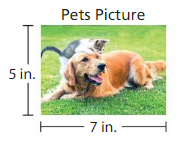
Big Ideas Math Answers Grade 3 Chapter 6 Relate Area to Multiplication 6.3 20

Answer:
Area of my friend’s picture is
6 in.×4 in.=24 square inches.
Area of my pets picture is
7 in.×5 in.=35 square inches.
24<35
Therefore pets picture has greater area.

Question 8.
DIG DEEPER!
A city street parking spot has an area of 72 square feet. The parking spot is 9 feet long. How wide is the parking spot?

Answer:
The city street parking spot has an area of 72 square feet. The length of the parking spot is 9 feet
We have to find the width of the parking spot.
Area =length × breadth
72=9×width or 9×width=72
So 9×1=9,9×2=18,———9×8=72
Therefore Width of the parking spot is 8 feet.

Review & Refresh

Use the Distributive Property to fill in the blanks
Question 9.
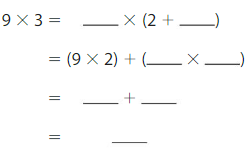
Big Ideas Math Answers Grade 3 Chapter 6 Relate Area to Multiplication 6.3 21

Answer:
9×3= 9×(2+1)
= (9×2)+(9×1)
= 18+9
= 27

Question 10.
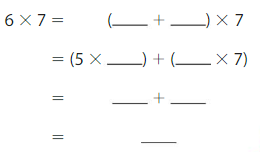
Big Ideas Math Answers Grade 3 Chapter 6 Relate Area to Multiplication 6.3 22

Answer:
6×7 = (5+1)×7
= (5×7)+(1×7)
= 35+7
= 42

Lesson 6.4 Area and the Distributive Property

Explore and Grow

Find the area of the rectangle two different ways.
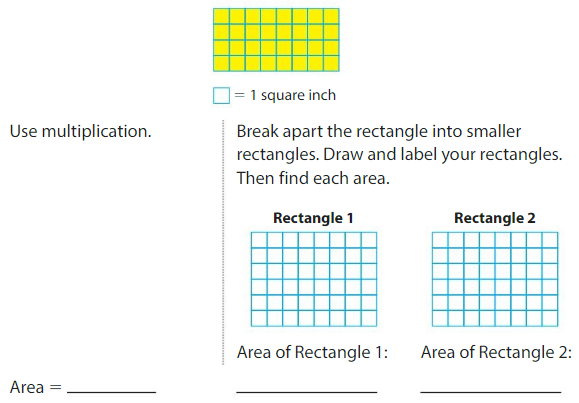
Big Ideas Math Solutions Grade 3 Chapter 6 Relate Area to Multiplication 6.4 1

Structure
How does the area of the large rectangle compare to the areas of the smaller rectangles? What property does this show?

Answer:
The area of larger rectangle is divided in two smaller rectangles so the sum of the areas of smaller rectangles will be equal to area of larger rectangle.

Think and Grow: Area and the Distributive Property

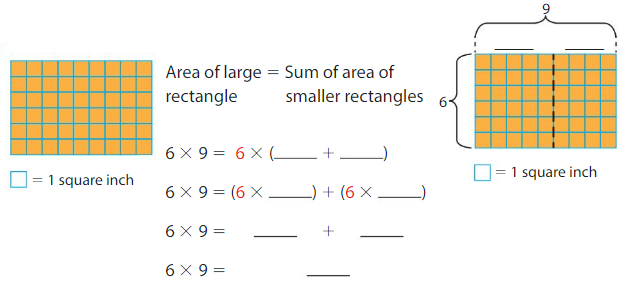
You can use the Distributive Property to find the area of a rectangle. First, break apart the large rectangle into smaller rectangles. Then find the sum of the areas of the smaller rectangles.

Big Ideas Math Solutions Grade 3 Chapter 6 Relate Area to Multiplication 6.4 2

Example
Use the Distributive Property to find the area of the rectangle.
Big Ideas Math Solutions Grade 3 Chapter 6 Relate Area to Multiplication 6.4 3
So, the area is _____.

Show and Grow

The area  of  large rectangle=sum of area of smaller rectangles
In the above grid there are 6 rows and 9 columns in the larger rectangle and this rectangle is divided into two smaller rectangles with 5 and 4 columns each.

Therefore
6×9=6×(5+4)
6×9=(6×5)+(6×4)
6×9=30+24
6×9=54
So, the area is 54 square inches.

Question 1.
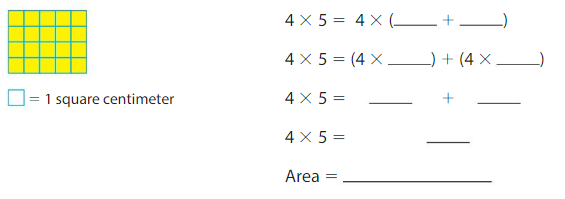
Use the Distributive Property to find the area of the rectangle.
Big Ideas Math Solutions Grade 3 Chapter 6 Relate Area to Multiplication 6.4 4

Answer:
In the above rectangle there are 4 rows and 5 columns. This is divided  into smaller rectangles with 3 and 2 columns each.
Therefore
4×5=4×(3+2)
4×5=(4×3)+(4×2)
4×5=12+8
4×5=20
Area=20 square centimeters.

Apply and Grow: Practice

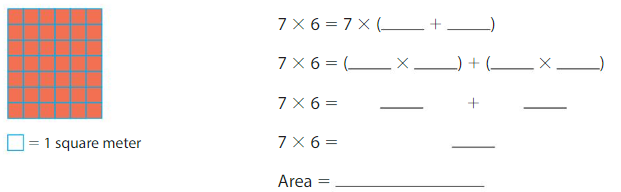
Use the Distributive Property to find the area of the rectangle.
Question 2.
Big Ideas Math Solutions Grade 3 Chapter 6 Relate Area to Multiplication 6.4 5

Answer:
There are 6 columns in the above large rectangle so the columns of  smaller rectangles are 4 and
2 columns each.
Therefore
7×6=7×(4+2)
7×6=(7×4)+(7×2)
7×6=28+14
7×6=42
Area=42 square meters.

Question 3.
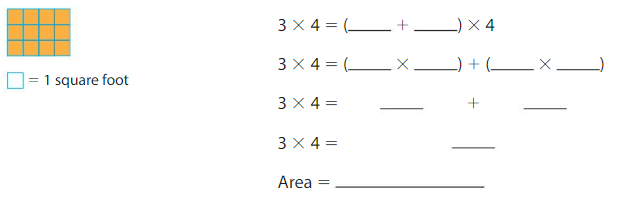
Big Ideas Math Solutions Grade 3 Chapter 6 Relate Area to Multiplication 6.4 6

Answer:
Here we divide the rectangle using rows.
There are 3 rows in the above rectangle. so, the rows of the smaller rectangles are 2 and 1 each.
3×4=(2+1)×4
3×4=(2×4)+(1×4)
3×4=8+4
3×4=12
Area=12 square feet

Question 4.
Structure
Which equation represents the area of the rectangle?
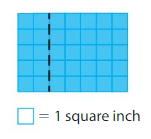
Big Ideas Math Solutions Grade 3 Chapter 6 Relate Area to Multiplication 6.4 7
5 × 7 = 5 × (6 + 1) = (5 × 6) + (5 × 1)
5 × 8 = 5 × (6 + 2) = (5 × 6) + (5 × 2)
5 × 7 = 5 × (2 + 5) = (5 × 2) + (5 × 5)

Answer:
Form the above grid we can understand that the large rectangle has 7 columns is divided into two smaller rectangles with 2 and 5 columns each. Therefore the 3rd equation represents the area of the rectangle.

Question 5.
DIG DEEPER!Explain how to use the Distributive Property to find the area of the rectangle.
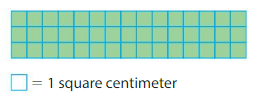
Big Ideas Math Solutions Grade 3 Chapter 6 Relate Area to Multiplication 6.4 8

Explanation:
To find the area of the rectangle using distributive property we have to divide the length of the rectangle into two and make two small rectangles.

Think and Grow: Modeling Real Life

Descartes cuts 1 rectangular piece of construction paper into2 rectangles. One rectangle is 8 inches wide and 10 inches long. The other rectangle is 8 inches wide and2 inches long. What were the dimensions and total area of the paper before it was cut?
Big Ideas Math Solutions Grade 3 Chapter 6 Relate Area to Multiplication 6.4 9
Draw a picture:
Multiplication equation:
Distributive Property:

The piece of paper was _____ inches wide and ____ inches long before it was cut.
The total area of the piece of paper was _____ square inches.

Show and Grow

Question 6.
You cut 1 rectangular piece of fabric into 2 rectangles. One rectangle is 3 feet wide and 6 feet long. The other rectangle is3 feet wide and 9 feet long. What were the dimensions and total area of the fabric before it was cut?
Answer:

The piece of paper was 3 feet wide and 15 long before it was cut.
The total area of the piece of paper was 45 square feets.

Area of rectangle 1: 3×6=18 square feet
Area of rectangle 2: 3×9=27 square feet.
Area of paper is area of rectangle 1+2=18+27=45 square feet

Area and the Distributive Property Homework & Practice 6.4

Use the Distributive Property to find the area of the rectangle.
Question 1.
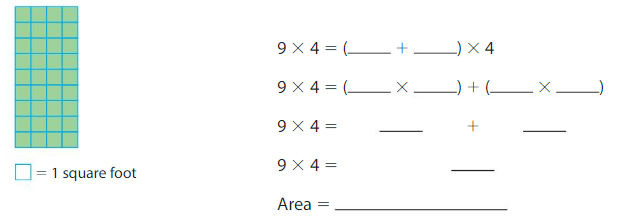
Big Ideas Math Solutions Grade 3 Chapter 6 Relate Area to Multiplication 6.4 10

Answer:
In the above large rectangle there are 9 rows so, using Distributive Property we will find the area of large rectangle by dividing it  into two smaller rectangles of 5 and 4 rows each.
9×4=(5+4)×4
9×4=(5×4)+(4×4)
9×4=20+16
9×4=36
Therefore Area=36 square feet.

Question 2.
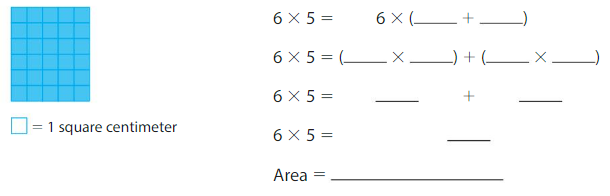
Big Ideas Math Solutions Grade 3 Chapter 6 Relate Area to Multiplication 6.4 11

Answer:
In the above large rectangle there are 5 columns so, using Distributive Property we will find the area of the large rectangle by dividing it into two smaller rectangles of 3 and 2 columns each.
6×5=6×(3+2)
6×5=(6×3)+(6×2)
6×5=18+12
6×5=30
Area=30 square centimeters.

Structure
Draw rectangle for the expression
Question 3.
6 × (4 + 5)
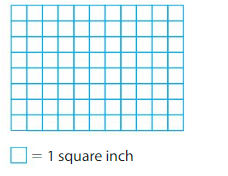
Big Ideas Math Solutions Grade 3 Chapter 6 Relate Area to Multiplication 6.4 12
Answer:

6x(4+5)= (6×4)+(6×5)
=24+30
=54.


Question 4.
(7 + 1) × 3
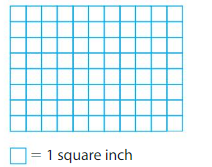
Big Ideas Math Solutions Grade 3 Chapter 6 Relate Area to Multiplication 6.4 13
Answer:


(7+1)x3=(7×3)+(1×3)
= 21+3
=24

Question 5.
Which One Doesn’t Belong?
Which is not a way to break apart the rectangle?
Big Ideas Math Solutions Grade 3 Chapter 6 Relate Area to Multiplication 6.4 14
5 × (4 + 4)
5 × (4 + 1)
(4 + 1) × 8
(2 + 3) × 8

Answer:
5×(4+1) is not a way to break apart the given rectangle as the columns given in the rectangle are 8 and the equation shows only 5 columns.

Question 6.
Modeling Real Life
You cut a rectangular piece of wrapping paper into2 rectangles. One rectangle is 10 inches wide and 6 inches long. The other rectangle is 10 inches wide and 5 inches long. What werethe dimensions and the total area of the wrapping paper before it was cut?
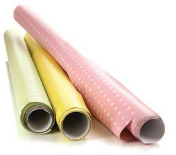
Big Ideas Math Solutions Grade 3 Chapter 6 Relate Area to Multiplication 6.4 15

Answer:
As we know that the area of the larger rectangle is the sum of the areas of the smaller rectangles. So the areas of 2 rectangles are
Rectangle 1: 10 in. ×6 in.=60 square inches.
Rectangle 2: 10 in. ×5 in.=50 square inches.
Therefore Total Area=110(60+50) square inches.

Review & Refresh

Write the fact family for the numbers.
Question 7.
3, 8, 24
___ × ____ = _____
___ × ____ = _____
___ ÷ ____ = _____
___ ÷ ____ = _____

Answer:
Fact family of the numbers  3,8,24 is given below.
3×8=24
8×3=42
24÷3=8
24÷8=3

Question 8.
4, 9, 36
___ × ____ = _____
___ × ____ = _____
___ ÷ ____ = _____
___ ÷ ____ = _____

Answer:
Fact family of the numbers 4,9,36 is given below.
4×9=36
9×4=36
36÷4=9
36÷9=4

Question 8.
2, 7, 14
___ × ____ = _____
___ × ____ = _____
___ ÷ ____ = _____
___ ÷ ____ = _____

Answer:
Fact family of the numbers 2,7,14 is given below.
2×7=14
7×2=14
14÷2=7
14÷7=2

Lesson 6.5 Find Areas of More Shapes

Explore and Grow

Break apart the shape into two rectangles. Color each rectangle a different color. Find the area of each rectangle. Then find the total area of the shape.
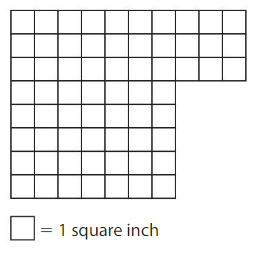
Big Ideas Math Answer Key Grade 3 Chapter 6 Relate Area to Multiplication 6.5 1
Areas of Rectangles
Rectangle 1: _____ × ____ = _____ square inches
Rectangle 2: _____ × ____ = ______ square inches
Total Area of Shape: ____ + ____ = ____ square inches

Answer:
We have broken the shape into two rectangles
Rectangle 1:3×10=30 square inches
Rectangle 2: 5×7  =35 square inches
Total Area of Shape: 30+35=75 square inches.

Reasoning
Break apart the shape into two different rectangles and find the total area. What do you notice? Why is this true?

Answer:
When we broke apart the shape into two rectangles we noticed that the counting of rows and columns or units squares became possible. yes it is right to break the shape to find the area.

Think and Grow: Find Areas of More Shapes

Example
Find the area of the shape
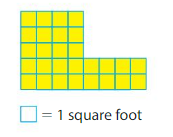
Big Ideas Math Answer Key Grade 3 Chapter 6 Relate Area to Multiplication 6.5 2

One Way:
Big Ideas Math Answer Key Grade 3 Chapter 6 Relate Area to Multiplication 6.5 3
Areas of Rectangles
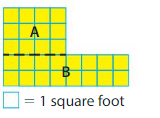
Rectangle A: 5 × 4 = _____ square feet
Rectangle B: 2 × 4 = ______ square feet
Area of Shape: ____ + ____ = ____ square feet

Another Way:
Big Ideas Math Answer Key Grade 3 Chapter 6 Relate Area to Multiplication 6.5 4
Areas of Rectangles
Rectangle A: 3 × 4 = _____ square feet
Rectangle B: 2 × 8 = ______ square feet
Area of Shape: ____ + ____ = ____ square feet

Answer:
Areas of Rectangles
Rectangle A:3×4=12 square feet
Rectangle B:2×8=16 square feet
Area of the shape:12+16=28 square feet.

Show and Grow

Question 1.
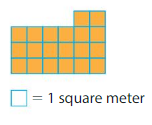
Find the area of the shape
Big Ideas Math Answer Key Grade 3 Chapter 6 Relate Area to Multiplication 6.5 5
Areas of Rectangles
Rectangle A: _____ × ____ = _____ square meters
Rectangle B: _____ × ____ = ______ square meters
Area of Shape: ____ + ____ = ____ square meters

Answer:
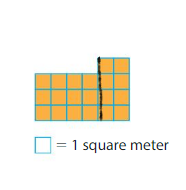

Rectangle A:3×4=12 square meters
Rectangle B:4×2=8 square meters
Area of shape:12+8=20 square meters.

Apply and Grow: Practice

Find the area of the shape
Question 2.
Big Ideas Math Answer Key Grade 3 Chapter 6 Relate Area to Multiplication 6.5 6
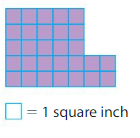
Areas of Rectangle A: _____ × ____ = _____ square inches
Areas of Rectangle B: _____ × ____ = ______ square inches
Area of Shape: ____ + ____ = ____ square inches

Answer:
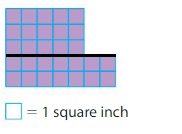

Divide the shape into two rectangles as 1st rectangle with 3 rows and 5 columns 2nd rectangle with 2 rows and 7 columns
Area of Rectangle A:3×5=15 square inches
Area of Rectangle B:2×7=14 square inches
Area of shape:15+14=29 square inches.

Question 3.
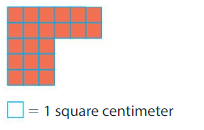
Big Ideas Math Answer Key Grade 3 Chapter 6 Relate Area to Multiplication 6.5 7
Area = _____

Answer:

Divide the shape into two rectangles as 1st rectangle with 2 rows and 6 columns 2nd rectangle with 3 rows and 3 columns
Area of Rectangle 1: 2×6=12 square centimeters
Area of Rectangle 2: 3×3=9 square centimeters
Area of shape: 12+9=21 square centimeters.

Question 4.
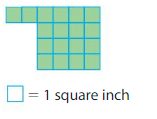
Big Ideas Math Answer Key Grade 3 Chapter 6 Relate Area to Multiplication 6.5 8
Area = ____

Answer:


Divide the shape into two rectangles as 1st rectangle with 1 row and 6 columns 2nd rectangle with 3 rows and 4 columns
Area of Rectangle 1: 1×6=6 square inches
Area of Rectangle 2: 3×4=12 square inches
Area of shape: 6+12=18 square inches.

Question 5.
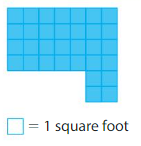
Big Ideas Math Answer Key Grade 3 Chapter 6 Relate Area to Multiplication 6.5 9
Area = ____

Answer:


Divide the shape into two rectangles as 1st rectangle with 4 rows and 5 columns 2nd rectangle with 6 rows and 2 columns
Area Of Rectangle 1:4×5=20 square feet
Area of Rectangle 2:6×2=12 square feet
Area of shape : 20+12=32 square feet.

Question 6.
Big Ideas Math Answer Key Grade 3 Chapter 6 Relate Area to Multiplication 6.5 10
Area = _____

Answer:


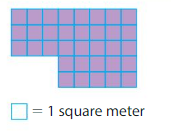
Divide the shape into two rectangles as 1st rectangle with 3 rows and 8 columns 2nd rectangle with 2 rows and 5 columns
Area of Rectangle 1:3×8=24 square meters
Area of Rectangle 2:2×5=10 square meters
Area of shape:24+10=34 square meters.

Question 7.
YOU BE THE ANSWER
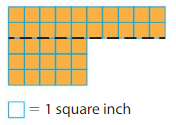
Your friend says there is only one way to break apart the shape. Is your friend correct? Explain.
Big Ideas Math Answer Key Grade 3 Chapter 6 Relate Area to Multiplication 6.5 11

Answer:
No my friend is correct if we break the shape in any other way we will not get 2 rectangles.we may get 1 square and 1 rectangle.

Question 8.
DIG DEEPER!
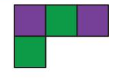
Newton uses square tiles to make the design. Each tile is 2 inches long. What is the area of the design? Explain.
Big Ideas Math Answer Key Grade 3 Chapter 6 Relate Area to Multiplication 6.5 12

Answer:
Given: Each tile is 2 inches long and tile is square shape
Therefore area of each square tile is 2×2=4 square inches.
In the above shape we have 4 tiles
So, Area of shape = 4 × (area of tile) = 4 ×4=16 square inches.
Area=16 square inches.

Think and Grow: Modeling Real Life

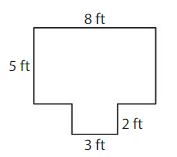
What is the area of the balcony?
Big Ideas Math Answer Key Grade 3 Chapter 6 Relate Area to Multiplication 6.5 13

Answer:
The area of the balcony is 46 square feet

Explanation:
Area of Rectangle A:5×8=40 square feet , Area of Rectangle B:3×2=6 square feet
Area of the balcony:46 square feet

Show and Grow

Find the area of the miniature golf hole.
Question 9.
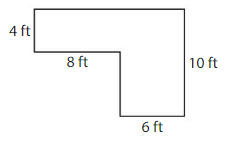
Big Ideas Math Answer Key Grade 3 Chapter 6 Relate Area to Multiplication 6.5 14

Answer:
Area of Rectangle A:4×(8+6)=4×(14)=56 square feet
Area of Rectangle B:6×(10-4)=6×6=36 square feet
Area of the golf hole:56+36=92 square feet

Question 10.
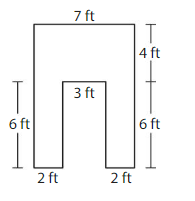
Big Ideas Math Answer Key Grade 3 Chapter 6 Relate Area to Multiplication 6.5 15

Answer:
Area=52 square feet

Explanation:
To find area here we need to calculate the total area and subtract the middle area from it. Total shape Length =6+4=10 , width =2+3+2=7 , Area of total shape =10×7=70 square feet, Part to be subtracted length =3 ,width =6
Area =3×6=18 square feet
Therefore area of the shape =Total area-area of part to be subtracted
=70‐18=52 square feet.

Question 11.
DIG DEEPER!
The floors of the classroom and closet have an area of 98 square meters. What is the area of the closet floor? Explain
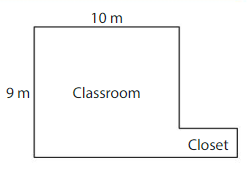
Big Ideas Math Answer Key Grade 3 Chapter 6 Relate Area to Multiplication 6.5 16

Answer:
Area of closets =8 square meters.

Explanation:
Given here that total area is 98 square meters. As shown in the figure above area of class room is 9×10=90 square meters.
Therefore Area of closets = Total area – Area of class room
=98-90=8
Area of closets =8 square meters.

Find Areas of More Shapes Homework & Practice 6.5

Find the area of the shape
Question 1.
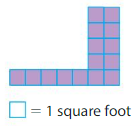
Big Ideas Math Answer Key Grade 3 Chapter 6 Relate Area to Multiplication 6.5 17
Areas of Rectangle A: _____ × ____ = _____ square feet
Areas of Rectangle B: _____ × ____ = ______ square feet
Area of Shape: ____ + ____ = ____ square feet

Answer:
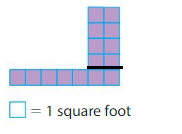

Area of Rectangle A:4×2=8 square feet
Area of Rectangle B:=1×7=7 square feet
Area of shape:=8+7=15 square feet.

Question 2.
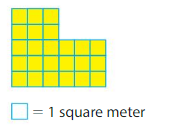
Big Ideas Math Answer Key Grade 3 Chapter 6 Relate Area to Multiplication 6.5 18
Area = ____

Answer:


Area of Rectangle A: 2×3=6 square meters
Area of Rectangle B: 3×6=18 square meters
Area of shape: 6+18=24 square meters.

Question 3.
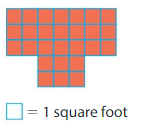
Big Ideas Math Answer Key Grade 3 Chapter 6 Relate Area to Multiplication 6.5 19
Area = _____

Answer:


Area of Rectangle A: 3×7=21 square feet
Area of Rectangle B: 2×3=6 square feet
Area of shape: 21+6=27 square feet.

Question 4.
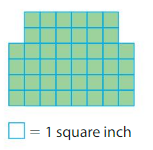
Big Ideas Math Answer Key Grade 3 Chapter 6 Relate Area to Multiplication 6.5 20
Area = _____

Answer:


Area of Rectangle A:2×6=12 square inches.
Area of Rectangle B:4×8=36 square inches.
Area of shape :12+36=48 square inches.

Question 5.
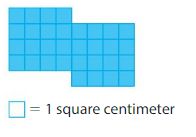
Big Ideas Math Answer Key Grade 3 Chapter 6 Relate Area to Multiplication 6.5 21
Area = _____

Answer:


Area of square A:4×4=16 square centimeters
Area of square B:4×4=16 square centimeters
Area of shape:16+16=32 square centimeters.

Question 6.
Number Sense
Newton makes a design with squares. What is the total area of his design?
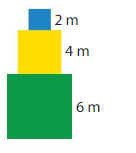
Big Ideas Math Answer Key Grade 3 Chapter 6 Relate Area to Multiplication 6.5 22

Answer:
Area of blue square is 2×2=4 square meters
Area of yellow square is 4×4=16 square meters
Area of green square is 6×6=36 square meters
Therefore Area of shape=4+16+36=56 square meters

Question 7.
Precision
A landscaper sketches a design for a yard.How much greater is the area of the grass than the area of the rocks?
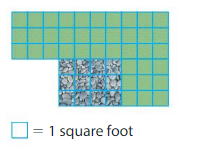
Big Ideas Math Answer Key Grade 3 Chapter 6 Relate Area to Multiplication 6.5 23

Answer:
Area of rock is 3×4=12 square feet.
To find area of the grass we divide it into 2 rectangles with 3 rows, 7 columns and 6 rows and 3 columns.
Area=(3×7)+(7×6) =21+42=63.
Area of grass- area of rock=63‐12=51.
So, area of grass is 53 square feet more than area of rock.

Question 8.Modeling Real Life
What is the area of the counter top?
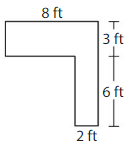
Big Ideas Math Answer Key Grade 3 Chapter 6 Relate Area to Multiplication 6.5 24

Answer:
Divide the shape into 2 parts
1:8ft×3ft=24 square feet
2:6ft×2ft=12 square feet
Area of counter top = 21+12=33 square feet.

Question 9.
DIG DEEPER!
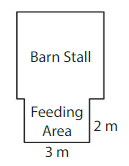
The floors of the barn stall and feeding area havean area of 22 square meters. What is the area of the barn stall floor? Explain.
Big Ideas Math Answer Key Grade 3 Chapter 6 Relate Area to Multiplication 6.5 25

Answer:
The total area of bran stall and feeding areas 22 square meters. Feeding area =3×2=6 square meters
The area of only barn stall floor =Total area ‐feeding area
=22‐6 = 16 square meters
Therefore area of barn stall floor is 16 square meters.

Review & Refresh

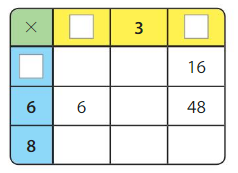
Complete the table.
Question 10.
Big Ideas Math Answer Key Grade 3 Chapter 6 Relate Area to Multiplication 6.5 26
Answer:

Question 11.
Big Ideas Math Answer Key Grade 3 Chapter 6 Relate Area to Multiplication 6.5 27
Answer:

Relate Area to Multiplication Performance Task

Question 1.
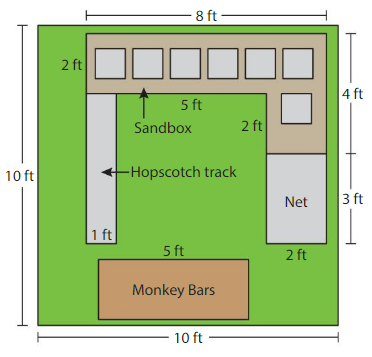
The map shows the top view of an obstacle course.
a. What is the area of the net?
b. What is the area of the hopscotch track?
Big Ideas Math Answers 3rd Grade Chapter 6 Relate Area to Multiplication 53
c. The area of the mud pit under the monkey bars is 10 square feet. What is the missing side length of the mud pit?
d. Each stepping-stone in the sandbox covers 1 square foot. What not is the area of the sandbox not covered with stones?
e. What is the area of just the grass?
Answer:

a.

Area of net=length ×width =3×2=6 square feet
Therefore area of net =6 square feet

b.

To find area of hopscotch track we have to find length of the track.
Total length of obstacle course is 10 ft
Length below the hopscotch= total length-length of sand box and net ie 10-4+3=3
Length above the hopscotch is 2 ft
Therefore Length of hopscotch =total length- length above and below the track=10-(2+3)=5ft
So, area of hopscotch course =5ft×1ft=5 square feet.

c.

Area of mud pit under the monkeys bars is 10 square feet.
Length of monkeys bars is 5ft
Length of the other side of monkeys bars is total area divided by length
Width of other side=10÷5=2
Therefore length of other side of mud pit is 2 feet.

d.

The total area of sand box is
8×2=16 square feet + 2×2=4 square feet
Area=20 square feet
As given in the question each sandbox covers 1 square foot of area.
As there are 7 sandboxes area of sandboxes is 7 square feet.
Therefore area of sandbox not covered with stones is 20-7 = 13 square feet.

e.

The area of just grass is the total area subtracted with area of all courses .
Total area=10×10= 100 square feet.
Area of net=6 square feet, Area of hopscotch =5 square feet, Area of monkeys bar=10 square feet, Area of sandbox = 20 square feet
Area of just grass= 100‐(6+5+10+20)=100‐41
Therefore area of just grass=59 square feet.

Question 2.
The obstacle course opens at 1 o’clock. It is half past 12. How many more minutes until the course opens?

Answer:
1 hour = 60 minutes, Half past 12 indicates 12:30
As Obstacle course opens at 1 o’ clock so, There are 30 more minutes until the course open.

Relate Area to Multiplication Activity

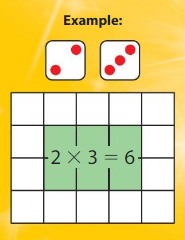
Area Roll and Conquer

Directions:

  1. Players take turns rolling two dice.
  2. On your turn, create a rectangle with the numbers on the dice as the side lengths. Your rectangle cannot cover another rectangle.
  3. Shade the rectangle in your color. Record the multiplication equation for the rectangle.
  4. If you cannot create a rectangle on the board, then you lose your turn. Play 10 rounds, if possible.
  5. The player with the greatest area covered wins!
Big Ideas Math Answers 3rd Grade Chapter 6 Relate Area to Multiplication 54
Big Ideas Math Answers 3rd Grade Chapter 6 Relate Area to Multiplication 55
Answer:

Relate Area to Multiplication Chapter Practice

6.1 Understand Area

Find the area of the shape.
Question 1.
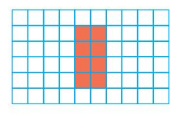
Big Ideas Math Answers 3rd Grade Chapter 6 Relate Area to Multiplication 56
Area = ___ square units

Answer:
In the above grid there are 8 color tiles.
1 tile is equal to 1 square unit.
So, area =8 square units.

Question 2.
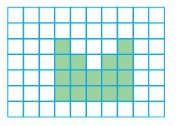
Big Ideas Math Answers 3rd Grade Chapter 6 Relate Area to Multiplication 57
Area = ___ square units

Answer:
In the above grid there are 15 color tiles.
1 tile is equal to 1 square unit.
So, area =15 square units.

6.2 Measure Area Using Standard Units

Find the area of the shape.
Question 3.
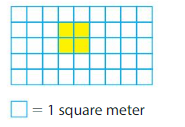
Big Ideas Math Answers 3rd Grade Chapter 6 Relate Area to Multiplication 58
Area = ___

Answer:
In the above grid there are 4 colored unit squares.
1 unit represents 1 square meter.
Therefore Area=4 square meters.

Question 4.
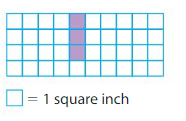
Big Ideas Math Answers Grade 3 Chapter 6 Relate Area to Multiplication 59
Area = ___

Answer:
In the above grid there are 3 colored unit squares.
1 unit square represents 1 square inch.
Therefore Area=3 square inches.

Question 5.
Big Ideas Math Answers Grade 3 Chapter 6 Relate Area to Multiplication 60
Area = ___

Answer:
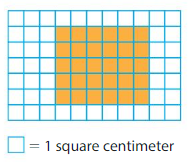
In the above grid there are 30 colored unit squares.
1 unit square represents 1 square centimeter.
Therefore Area=30 square centimeters.

Question 6.
Big Ideas Math Answers Grade 3 Chapter 6 Relate Area to Multiplication 61
Area = ___

Answer:
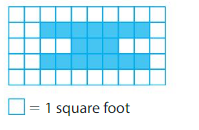
In the above grid there are 16 colored unit squares.
1 unit square represents 1 square foot.
Therefore Area=16 square feet.

6.3 Find Area by Multiplying

Question 7.
Find the area of the rectangle.

Big Ideas Math Answers Grade 3 Chapter 6 Relate Area to Multiplication 62

Answer:
The above rectangle is 7ft long and 4 feet wide
So area of the rectangle is length ×breadth
7ft×4ft=28 square feet.
Therefore Area=28 square feet.

Question 8.
Modeling Real Life
A textbook cover has an area of 80 square inches. The cover is 8 inches wide. How long is the cover?
Big Ideas Math Answers Grade 3 Chapter 6 Relate Area to Multiplication 63

Answer:
Area of the book is 80 square inches and width is 8 inches, We have to find the length of the book
Area=length × width
So, 80=length ×8 or 8×length=80 square inches
Count 8 table: 8×1=8,8×2=16,——8×10=80.
Therefore Length f the book is 10 inches.

6.4 Area and the Distributive Property

Question 9.
Use the Distributive Property to find the area of the rectangle.
Big Ideas Math Answers Grade 3 Chapter 6 Relate Area to Multiplication 64

Answer:
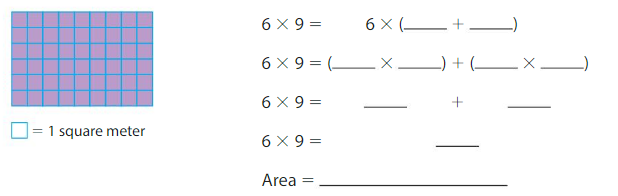
The above rectangle has 9 columns and to find  the area of rectangle using Distributive property this is divided into two smaller rectangles with  6 and 3 columns each.
6×9=6×(6+3)
6×9=(6×6)+(6×3)
6×9=36+18
6×9=54
Area=54 square meters.

6.5 Find Area of More Shapes

Question 10.
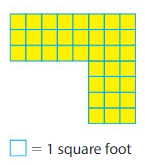
Find the area of the shape.
Big Ideas Math Answers Grade 3 Chapter 6 Relate Area to Multiplication 65
Area=________

Answer:
To find the area of the shape we can divide the shape into two rectangles. Rectangle A:3 rows and 8 columns Rectangle B:4 rows and 3 columns
Area of rectangle A:3×8=24 square feet
Area of rectangle B:4×3=12 square feet
Therefore area of shape:24+12=35 square feet.

Conclusion:

The Solution Key of Big Ideas Math Grade 3 Chapter 6 Relate Area to Multiplication helps the teachers and parents to explain the problems to the children. Feel free to clarify your doubts by posting the comments in the below box. Keep in touch with our ccssmath answers to get the solutions of all grade 3 chapters.

Big Ideas Math Answers Grade 3 Chapter 7 Round and Estimate Numbers

The students who are searching for the study material of grade 3 maths can get them on this page. You can get a strong foundation of maths with the help of Big Ideas Math Answers Grade 3 Chapter 7 Round and Estimate Numbers. The solutions are prepared by the highly professional math experts in a simple and easy manner. The students and teachers can find the easy methods to solve the problems with the help of Big Ideas Math Answers Grade 3 Ch 7 Round and Estimate Numbers.

Big Ideas Math Book 3rd Grade Answer Key Chapter 7 Round and Estimate Numbers

With the help of BIM 3rd Grade Answer Key Chapter 7 Round and Estimate Numbers, you can easily finish your assessments, homework, and also grab knowledge about this chapter. You can get the step by step explanation for all the chapters here. So, Download Big Ideas Math Book 3rd Grade Answer Key Chapter 7 Round and Estimate Numbers pdf and enhance your math skills. Hit the links and start practicing the problems and compare them with real-time problems.

Lesson 1: Place value

Lesson 2: Round Numbers Using a Number Line

Lesson 3: Round Numbers Using Place Value

Lesson 4: Estimate Sums

Lesson 5: Estimate Differences

Performance Task

Lesson 7.1 Place value

Explore and Grow
Model each number. Write each number in expanded form.
Big Ideas Math Answer Key Grade 3 Chapter 7 Round and Estimate Numbers 7.1 1
130
310
103

Answer:
100+30+0=130
300+10+0=310
100+00+3=103
Reasoning
Which number is the greatest? How do you know?

Answer: 310 is the greatest number because the number value of the digit in hundreds place is great compared to others numbers i.e 103 and 130.

Think and Grow: Place value

Find the value of the underlined digit.
Example
253
Big Ideas Math Answer Key Grade 3 Chapter 7 Round and Estimate Numbers 7.1 2
Expanded form: 200 + 50 + 3
The digit 5 has a value of _5 tens_, or __50__.

Example
517
Big Ideas Math Answer Key Grade 3 Chapter 7 Round and Estimate Numbers 7.1 3
Expanded form: _500__ + __10__ + ___7__
The digit 5 has a value of __5 hundreds___, or ___500__.

Show and Grow
Circle the value of the underlined digit.

Question.
Big Ideas Math Answer Key Grade 3 Chapter 7 Round and Estimate Numbers 7.1 4

Answer:


Circle the value of the underlined digit.

Question.
Big Ideas Math Answer Key Grade 3 Chapter 7 Round and Estimate Numbers 7.1 5

Answer:


Write the value of the underlined digit

Question 8.
152

Answer:

The value of the place of  one digit in the number 152.
The digit 1 has a place value of  100 because its in the hundreds place.
Question 9.
725

Answer:

The value of the place of the five digit in the number 725.
The digit 5 has a place value of one’s because its in the one’s place.

Question 10.
2o7

Answer:

The value of the place of the digit in the number 207.
The digit 0 has a place value of  tens because its in the tens place.

Identify the value of each digit.

Question 11.
Big Ideas Math Answer Key Grade 3 Chapter 7 Round and Estimate Numbers 7.1 6

Answer:

The value of 3 in 386 = 300
The value of 8 in 386 = 80
The value of 6 in 386 = 6
Question 12.
Big Ideas Math Answer Key Grade 3 Chapter 7 Round and Estimate Numbers 7.1 7

Answer:

The value of 5 in 569 = 500
The value of 6 in 569 = 60
The value of 9 in 569 = 9

Question 13.
Reasoning
Use each number card once to write the greatest three-digit number. Then use each number card once to write the least three-digit number.
Big Ideas Math Answer Key Grade 3 Chapter 7 Round and Estimate Numbers 7.1 8

Answer:
Among three digits given hundreds place= 8( its greater than other 2 three digits)
Among 2 digits three digits given tens place= 5 (its greater than other  2)
Last ones place = 2(its left out digit)

Think and Grow: Modeling Real Life
Newton spends two hundred two dollars atthe grocery store.Descartes spends $220. Who spends more money?
Make quick sketches:
Big Ideas Math Answer Key Grade 3 Chapter 7 Round and Estimate Numbers 7.1 9
Big Ideas Math Answer Key Grade 3 Chapter 7 Round and Estimate Numbers 7.1 10
_____ spends more money.

Answer:
Newton amount spent value= 2 hundred and 2 dollar
= $200+ $2=$202
Descartes amount spent value= $220
$202   <    $220
Hence, Descartes spends more money.

Show and Grow

Question 4.
Newton spends one hundred forty-two dollars at the pet store. Descartes spends $124. Who spends more money?

Answer:
Newton amount spent value= 1 hundred and forty two dollar
= $100+ $40+$2=$142
Descartes amount spent value= $124
$142   >    $124
Hence, Newton spends more money.

Question 15.
DIG DEEPER!
Order the weights of the zoo animals from least to greatest. Which animal weighs the least? Which animal weighs the most?
Big Ideas Math Answer Key Grade 3 Chapter 7 Round and Estimate Numbers 7.1 11

Answer:

Lion weighs the least of a weighting of 404 pounds.
Zebra weighs the most of weighting of 474 pounds.

Place value Property Homework & Practice 7.1

Circle the value of the underlined digit.

Question.
Big Ideas Math Answer Key Grade 3 Chapter 7 Round and Estimate Numbers 7.1 12

Answer:


The value of 2 in 325= 20
The value of 1 in 541= 1
The value of 6 in 653= 600
The value of 4 in 194= 4

Write the value of the underlined digit

Question 5.
736

Answer:

7 X 100 +3 X 10 +6 X 1=700+30+6 = 736
The value of 3 digit in the number 736 is 3 tens or 30.

Question 6.
962

Answer:

9 X 100+6 X 10+2 X 1=900+60+2 = 962
The  value of 9 digit in the number 962 is 9 hundreds or 900.

Question 7.
897

Answer:

8 X 100+9 X 10+7 X 1=800+90+7 = 897
The value of 7 digit in the number 897 is  7 one’s or 7.

Identify the value of each digit.

Question 8.
Big Ideas Math Answer Key Grade 3 Chapter 7 Round and Estimate Numbers 7.1 13

Answer:

Question 9.
Big Ideas Math Answer Key Grade 3 Chapter 7 Round and Estimate Numbers 7.1 14

Answer:

Question 10.
DIG DEEPER!
Descartes is thinking of a number. What is his number?
The three digits of my number are 2, 7, and 5.
My number is even.
My number is less than 750.
Big Ideas Math Answer Key Grade 3 Chapter 7 Round and Estimate Numbers 7.1 15

Answer:
The three digits numbers are 2,7,5
CONDITIONS :
The three digits numbers are 2,7,5
My number is even.
My number is less than 750.
So, Among three digits 2 is even, the last digit is “2”
Out of 7 and 5 digits,5 < 7. so the first digit in my number is 5.
The middle digit is going to be 7.
Hence,the three-digit my number= 572.

Question 11.
Modeling Real Life A skating rink gives out three hundred thirty glow sticks on Friday and 303 glow sticks on Saturday. On which day does the skating rink give out more glow sticks?

Answer:
Glow  sticks given on Friday = three hundred thirty
=3 x 100+3 x 10=300+30=330
Glow  sticks given on Saturday=303
Comparison:  330 > 303
Hence, the day the skating rink given out more glow sticks is on Friday.

Question 12.
DIG DEEPER!
Order the basketball field goals made in a season of the basketball players from least to greatest. Which player made the least number of field goals? Which made the most number of field goals?
Big Ideas Math Answer Key Grade 3 Chapter 7 Round and Estimate Numbers 7.1 16

Answer:

Player who made the least number of field goals is D player.
Player who made the most number of field goals is C player.

Review & Refresh
Complete the related facts

Question 13.
9 ÷ 3 = ____
3 × ____ = 9

Answer:
9 ÷ 3 = 3
3 × __3__ = 9

Question 14.
40 ÷ 8 = __5___
8 × ___5_ = 40

Answer:
40 ÷ 8 = __5___
8 × ___5_ = 40

Question 15.
63 ÷ 7 = __9__
7 × ___9_ = 63

Answer:
63 ÷ 7 = __9__
7 × __9___ = 63

Lesson 7.2 Round Numbers Using a Number Line

Explore and Grow
Plot 32 on the number line. Circle the two closest multiples of ten.
Big Ideas Math Answers 3rd Grade Chapter 7 Round and Estimate Numbers 7.2 1
Which multiple of ten is 32 closer to?

Answer:

The two closest multiples of 32 ten is 30 and 40.

Hence, the multiple of ten close to 32 is 30.

Repeated Reasoning
Which multiple of ten is closer to 38? 31? 36? How did you decide? Explain.

Answer:

38 is between 30 and 40.
38 is closer to 40 than it is to 30.
So, 38 is rounded to the nearest ten to 40.

Think and Grow: Round Numbers Using a Number Line
To round a number to the nearest ten, replace the number with its nearest multiple of ten. When a number is half way between two multiples of ten, use the greater number.
Example
Round 23 to the nearest ten.
Big Ideas Math Answers 3rd Grade Chapter 7 Round and Estimate Numbers 7.2 2
23 is between 20 and 30.
23 is closer to ___ than it is to _____. So, 23 rounded to the nearest ten is _____

Answer:
Big Ideas Math Answers 3rd Grade Chapter 7 Round and Estimate Numbers 7.2 2
23 is between 20 and 30.
23 is closer to 20 than it is to 30.
So, 23 rounded to the nearest ten is 20.

Example
Round 175 to the nearest ten
Big Ideas Math Answers 3rd Grade Chapter 7 Round and Estimate Numbers 7.2 3
175 is halfway between 170 and 180.
So, 175 rounded to the nearest ten is _____.
You can round a number to the nearest hundred in a similar way.

Answer:
Big Ideas Math Answers 3rd Grade Chapter 7 Round and Estimate Numbers 7.2 3
175 is halfway between 170 and 180.
175 rounded to the Nearest Ten is 180.
So, the Nearest Hundred  Value of 175 is 200.

Example
Round 465 to the nearest hundred
Big Ideas Math Answers 3rd Grade Chapter 7 Round and Estimate Numbers 7.2 4
465 is close to ____ than it is to ____.
So, 465 rounded to the nearest hundred is _____.

Answer:

465 is halfway in between  460 and 470.
So, the Nearest Hundred Value of 465 is 500.

Show and Grow

Question 1.
Round 59 to the nearest ten _____.
Big Ideas Math Answers 3rd Grade Chapter 7 Round and Estimate Numbers 7.2 5

Answer:

The Nearest Ten of 59  is 60.

Question 2.
Round 350 to the nearest ten _____.

Answer:

The Nearest Ten is 350 is 350.

Apply and Grow: Practice
Round the number to the nearest ten and to the nearest hundred/

Question 3.
203
Big Ideas Math Answers 3rd Grade Chapter 7 Round and Estimate Numbers 7.2 7

Answer:

Nearest Ten: 200

Nearest Hundred: 200
Question 4.
75
Big Ideas Math Answers 3rd Grade Chapter 7 Round and Estimate Numbers 7.2 8

Answer:

Nearest Ten of 75 is 80.

The nearest Hundred of 75 is 100.

Question 5.
961
Nearest ten: ______
Nearest hundred: _____

Answer:
Nearest Ten of 961 is 960.

Nearest Hundred of 961 is 1000

Question 6.
47
Nearest ten: _______
Nearest hundred: _____

Answer:

Nearest Ten of 47 is 50.

Nearest Hundred of 47 is 0.

Question 7.
DIG DEEPER!
Round ? to the nearest ten and to the nearest hundred
Big Ideas Math Answers 3rd Grade Chapter 7 Round and Estimate Numbers 7.2 9
Nearest ten: ____
Nearest hundred: ______

Answer:

Big Ideas Math Answers 3rd Grade Chapter 7 Round and Estimate Numbers 7.2 9
Nearest Ten is 550
Nearest Hundred is 600.

Think and Grow: Modeling Real Life
On which days does the school collect about 90 food items?
Big Ideas Math Answers 3rd Grade Chapter 7 Round and Estimate Numbers 7.2 10
Big Ideas Math Answers 3rd Grade Chapter 7 Round and Estimate Numbers 7.2 11
The school collects about 90 food and items on _____ and _____

Answer:

The school collects about 90 food and items on Monday and Thursday because they are nearest to 90 on number line.

Show and Grow

Question 8.
Use the table above to and on which days the school collects about 80 food items.

Answer:

The school collects about 80 food and items on Wednesday and Friday because they are nearest to 80 on number line.

Question 9.
Your teacher wants you to read a book with about 200 pages. Circle the books you can read. Explain.
Big Ideas Math Answers 3rd Grade Chapter 7 Round and Estimate Numbers 7.2 12

Answer:


Books contains 200 about pages are 272 pages and 238 pages because these books having pages of 200 pages and above.
Question 10.
DIG DEEPER!
There are 9 rows and 9 columns of soup cans on a shelf. Round the number of soup cans in all to the nearest ten and to the nearest hundred.

Answer:
Number of rows of soups=9
Number of columns of soups=9
Total number of cans of soups in all shelf=9 x 9=81
Nearest Ten of 81= 80
Nearest Hundred of 81=100

Round Numbers Using a Number Line Homework & Practice 7.2

Round the number to the nearest ten and to the nearest hundred.

Question 1.
39
Big Ideas Math Answers 3rd Grade Chapter 7 Round and Estimate Numbers 7.2 13

Answer:
Big Ideas Math Answers 3rd Grade Chapter 7 Round and Estimate Numbers 7.2 13


39 lies between 30 and 40.
So, the Nearest Ten of 39 is 40.

39 lies between 0 and 100.
So, the Nearest Hundred of 39 is 100.

Question 2.
156
Big Ideas Math Answers 3rd Grade Chapter 7 Round and Estimate Numbers 7.2 14

Answer:

156 lies in between 150 and 160.
So, the Nearest ten of 156 is 160.

156 lies in between 100 and 200.
So, the Nearest Hundred of 156 is 200.
Round the number to the nearest ten and to the nearest hundred.

Question 3.
402
Nearest ten: _____
Nearest hundred: _____

Answer:

402 lies in between 400 and 410.
So, the Nearest Ten of 402 is 400.

402 lies in between 400 and 500.
So, the Nearest Hundred of 402 is 400.

Question 4.
627
Nearest ten: _____
Nearest hundred: ______

Answer:

627 lies in between 620 and 630.
So, the Nearest Ten of 627 is 630.

627 lies in between 600 and 700.
So, the Nearest Hundred of 627 is 600.

Question 5.
Writing
Explain how to use a number line to round 24 to the nearest ten.

Answer:

A line on which numbers are marked at intervals used to illustrate simple numerical operations is known as a number line.
24 is closest to 20 because the number does not cross half way between 20 and 30 on the line. Hence, rounded 24 to the nearest ten is 20.

Question 6.
Modeling Real Life
Your class is painting stones for a garden mosaic. On which days does your class paint about 30 stones?
Big Ideas Math Answers 3rd Grade Chapter 7 Round and Estimate Numbers 7.2 15

Answer:
Big Ideas Math Answers 3rd Grade Chapter 7 Round and Estimate Numbers 7.2 15
The class paint about 30 stones on Monday and Friday because on these days the paints are above and about 30.

Question 7.
Modeling Real Life
A giant panda eats about 300 pounds of bamboo every week. Which weights of bamboo can a zookeeper buy to  feed a giant panda for a week?
Big Ideas Math Answers 3rd Grade Chapter 7 Round and Estimate Numbers 7.2 16

Answer:
Big Ideas Math Answers 3rd Grade Chapter 7 Round and Estimate Numbers 7.2 16
Weight of bamboo eats the giant panda per week= 300 pounds
Hence,weights of bamboo a zookeeper buys to  feed the giant panda for a week= 310 and 340 pounds(because these two are more than 300 pounds).
Review & Refresh
Tell whether the product is even or odd.

Question 8.
3 × 5 ______

Answer:
3 x 5 = 15

So,15 is odd number.

Question 9.
10 × 8 ______

Answer:
10 x 8 = 80
So, 80 is even number.

Question 10.
7 × 2 _____

Answer:
7 x 2 = 14
So, 14 is even number.

Lesson 7.3 Round Numbers Using Place Value

Explore and Grow
Plot 376 on each number line. Round the number to the nearest ten and to the nearest hundred.
Big Ideas Math Answers Grade 3 Chapter 7 Round and Estimate Numbers 7.3 1
Nearest ten: ______
Nearest hundred: ______

Answer:

Nearest Ten of 376 is 380

Nearest Hundred of 376 is 400.
Reasoning
How can you round the number without using the number line?

Answer:
We can round the number without using the number line by checking if it is less than 5, then the digit in the place you are rounding decreases by 1. If it is 5 or greater, then the digit in the place you are rounding increases by 1 .

Think and Grow: Round Numbers Using Place Value
Use Place Value to Round Numbers
• Find the place to which you are rounding.
• Look at the digit to the right. If it is less than 5, then the digit in the place you are rounding stays the same. If it is 5 or greater, then the digit in the place you are rounding increases by 1.
• Write Zeros for the digits to the right of the place you are rounding.
Big Ideas Math Answers Grade 3 Chapter 7 Round and Estimate Numbers 7.3 2.1
Example
Round 68 to the nearest ten.
Big Ideas Math Answers Grade 3 Chapter 7 Round and Estimate Numbers 7.3 2
68 rounded to the nearest ten is ______.

Answer:
Big Ideas Math Answers Grade 3 Chapter 7 Round and Estimate Numbers 7.3 2
The Nearest Ten  of  68 is 70.
Example
Round 235 to the nearest hundred and to the nearest ten.
Big Ideas Math Answers Grade 3 Chapter 7 Round and Estimate Numbers 7.3 3
235 rounded to the nearest hundred is ____. 235 rounded to the nearest ten is ____.

Answer:
Big Ideas Math Answers Grade 3 Chapter 7 Round and Estimate Numbers 7.3 3
The Nearest Hundred of 235 is 200.
The Nearest Ten of 235 is 240.

Show and Grow
Round the number to the nearest ten.

Question 1.
41 _____

Answer:


41 lies in between 40 and 50.
So, Nearest Ten of 41 is 40.

Question 2.
85 _____

Answer:

85 lies in between 80 and 90.
85 is the half way of 80 and 90.
So,Nearest Ten of 85 is 90.

Question 3.
153 _____

Answer:


153 lies in between 150 and 160.
Nearest Ten of 153: 150.
Round the number to the nearest hundred.

Question 4.
749 _____

Answer:


749 lies between 700 and 800.
Nearest hundred of 749 is 700.

Question 5.
372 ______

Answer:

372 lies in between 300 and 400.
Nearest Hundred of 372 is 400.

Question 6.
94 _____

Answer:

94 lies in between 0 and 100.
The nearest Hundred of 94 is 100.

Apply and Grow: Practice
Round the number to the nearest ten.

Question 7.
17 ____

Answer:

17 lies in between 10 and 20.
So, the Nearest Ten of 17 is 20.

Question 8.
52 _____

Answer:

52 lies in between 50 and 60.
So, Nearest Ten of 52 is 50.

Question 9.
79 _____

Answer:

79 lies in between 70 and 80.
So, Nearest Ten of 79 is 80.

Question 10.
673 _____

Answer:

673 lies in between 670 and 680.
So, Nearest Ten of 673 is 670.

Question 11.
521 ____

Answer:

521 lies in between 520 and 530.
So, Nearest Ten of 521 of 520.

Question 12.
208 ___

Answer:


208 lies in between 200 and 210.
So, Nearest Ten of 208 is 210.
Round the number to the nearest hundred.

Question 13.
161 ____

Answer:

161 lies in between 100 and 200.
So, the Nearest Hundred of 161 is 200.

Question 14.
738 _____

Answer:


738 lies in between 700 and 800.
So, the Nearest Hundred of 738 is 700.

Question 15.
504 ____

Answer:

504 lies in between 500 and 600.
So, Nearest Hundred of 504 is 500.

Question 16.
50 ____

Answer:

50 lies in between 0 and 100.
So, Nearest Hundred of 50 is 100.

Question 17.
22 ____

Answer:

22 lies in between 0 and 100.
So, Nearest Hundred of 22 is 0.

Question 18.
999 _____

Answer:


999 lies in between 900 and 1000.
So, the Nearest Hundred of 999 is 1000.

Round the number to the nearest ten to the nearest hundred.

Question 19.
836
Nearest ten: ______
Nearest hundred: ____

Answer:

The nearest Ten of  836 is 840.


The nearest Hundred of 836 is 800.

Question 20.
945
Nearest ten: ______
Nearest hundred: ____

Answer:

Nearest Ten of 945 is 950.


Nearest Hundred of 945 is 900.

Question 21.
72
Nearest ten: ______
Nearest hundred: ____

Answer:


Nearest Ten of  72 is 70.


Nearest Hundred of 72 is 100.

Question 22.
Number Sense
Newton rounds 587 to 590. To what place does he round?

Answer:
Newton rounds 587 to 590.

Newton rounds 587 to its Nearest ten-value 590.

Question 23.
Number Sense
Which numbers round to 400 when rounded to the nearest hundred?
Big Ideas Math Answers Grade 3 Chapter 7 Round and Estimate Numbers 7.3 4

Answer:


Numbers rounded to 400 when rounded to the nearest hundreds are 356 and 437.
Think and Grow: Modeling Real Life
On which day do about 800 people attend the concert? Explain.
Big Ideas Math Answers Grade 3 Chapter 7 Round and Estimate Numbers 7.3 5
About 800 people attend the concert on ______
Explain:
About 800 people attend the concert on all the days because in all the days people count is about n above 800.

Show and Grow

Question 24.
Use the table above to find on which days about 940 people attend the concert. Explain.

Answer:
About  940 people attend the concert on Friday and Sunday because in these days the people count is about n above 940.
DIG DEEPER!
Round the time to the nearest ten minutes.

Question 25.
Big Ideas Math Answers Grade 3 Chapter 7 Round and Estimate Numbers 7.3 6

Answer:
The nearest Ten minutes of 7:23 is 7:20.

Question 26.
Big Ideas Math Answers Grade 3 Chapter 7 Round and Estimate Numbers 7.3 7

Answer:
The nearest Ten minutes of 3:05 is 3:10.

Question 27.
Explain how using place value to round is similar to using a number line to round.

Answer:
In math, every digit in a number has a place value.
Place value can be defined as the value represented by a digit in a number on the basis of its position in the number.
A number line is a line on which numbers are placed in intervals, to show basic numerical calculations.
Using place value to round is similar to using a number line to round is THE SAME. If we’re rounding the number 111 to the nearest ten, it’s between 110 and 120 on the number line, and it’s closer to 110. Furthermore, the process is the same when we’re rounding to the nearest hundred–only now we’re asking which two multiples of 100 the number falls between.

Round Numbers Using a Place Value Homework & Practice 7.3

Round the number to the nearest ten

Question 1.
29 _____

Answer:

Nearest Ten of 29 is 30.

Question 2.
564 _____

Answer:

Nearest Ten of 564 is 560.

Question 3.
843 ____

Answer:

Nearest Ten of 843 is 840.
Round the number to the nearest hundred

Question 4.
281 ____

Answer:


The nearest Hundred of 281 is 300.

Question 5.
36 ____

Answer:


The nearest Hundred of 36 is 0.

Question 6.
975 ____

Answer:


The nearest Hundred of 975 is 1000.
Round the number to the nearest ten to the nearest hundred.

Question 7.
152
Nearest ten: ______
Nearest hundred: ____

Answer:


Nearest Ten of 152 is 150.


Nearest Hundred of 152 is 200.

Question 8.
308
Nearest ten:
Nearest hundred: ____

Answer:

The nearest ten of 308 is 310.


The nearest hundred of 308 is 300.

Question 9.
45
Nearest ten: ______
Nearest hundred: ____

Answer:


Nearest Ten of 45 is 50.


The nearest Hundred of 45 is 0.

Question 10.
What is the least number that rounds to 20 when rounded to the nearest ten? What is the greatest number?
Least: ____
Greatest: ____

Answer:

The least number that rounds to 20 when rounded to the Nearest Ten is 15.

The greatest number that rounds to 20 when rounded to the Nearest Ten is 24.

Question 11.
DIG DEEPER!
Number Sense A three-digit number has the digits 3, 5, and 6.It rounds to 700 when rounded to the nearest hundred. What is the number? Explain.

Answer:
Given: Three digit number digits are 3,5 and 6.
Three digit number rounded to 700 is 653 because in given numbers Hundred place has to be 6 as it has to be rounded to 700.
Tens place has to be equal to 5 or greater than 5, 5 taken for tens place.
Ones place is left out digit that is 3.

The number is 653.

Question 12.
YOU BE THE TEACHER
Descartes says that a number rounded to the nearest ten can be greater than the same number rounded to the nearest hundred. Is Descartes correct? Explain.

Answer:
Descartes says that a number rounded to the Nearest Ten can be greater than the same number rounded to the Nearest Hundred is correct.
For Example: Estimate the sum 1,472 + 398 + 772 + 164 by rounding each number to the nearest hundred.

1,472….1,500

398……. 400

772……..800

164……..200

Total amount rounded to hundred:2900

In the example above, the exact sum is 2,806. Note how close this is to the estimate, which is 94 greater.
Estimate the sum 1,472 + 398 + 772 + 164 by first rounding each number to the nearest ten.

1,472….1,470

398…….. 400

772………770

164………160

Total amount rounded to tens place is 2,800.

Note that the estimate is 2,800, which is only 6 less than the actual sum of 2,806.

Question 13.
Modeling Real Life
On which months are there about 450 people at the basketball courts? Explain
Big Ideas Math Answers Grade 3 Chapter 7 Round and Estimate Numbers 7.3 8

Answer:
Months about 450 people at the basketball courts are July and August because in these months only courts count is about and above 450.

DIG DEEPER!
Round the time to the nearest ten minutes.

Question 14.
Big Ideas Math Answers Grade 3 Chapter 7 Round and Estimate Numbers 7.3 9

Answer:
Nearest Ten Minutes of 5:48 is 5:50.

Question 15.
Big Ideas Math Answers Grade 3 Chapter 7 Round and Estimate Numbers 7.3 10

Answer:
Nearest Ten Minutes of 2:35 is 2:40.

Review & Refresh
Find the product

Question 16.
Big Ideas Math Answers Grade 3 Chapter 7 Round and Estimate Numbers 7.3 11

Answer:
9 X 0=0.

Question 17.
Big Ideas Math Answers Grade 3 Chapter 7 Round and Estimate Numbers 7.3 12

Answer:
10 X 9= 90.

Question 18.
Big Ideas Math Answers Grade 3 Chapter 7 Round and Estimate Numbers 7.3 13

Answer:
9 X 3= 27.

Question 19.
Big Ideas Math Answers Grade 3 Chapter 7 Round and Estimate Numbers 7.3 14

Answer:
6 X 9= 54.

Lesson 7.4 Estimate Sums

Explore and Grow
Round each addend. Then find the sum.
Big Ideas Math Solutions Grade 3 Chapter 7 Round and Estimate Numbers 7.4 1

Answer:
83 rounded=80                                                       156 rounded=200
119 rounded=120                                                   103 rounded= 100
Sum =120+80=200                                             Sum= 200+100= 300

Construct Arguments
Compare your answers to your partner’s answers. Explain why they are the same or why they are different.

Answer:
The answers are different because the numbers are given to me and my partner are completely different.

Think and Grow: Estimate Sums
An estimate is a number that is close to an exact number. You can estimate a sum by rounding or by using compatible numbers. Compatible numbers are numbers that are easy to add mentally and are close to the actual numbers.
Example
Estimate 258 + 631.
One Way: Use rounding. Round each addend to the nearest hundred. Then f ind the sum of the rounded numbers.
Big Ideas Math Solutions Grade 3 Chapter 7 Round and Estimate Numbers 7.4 2
Another Way: Use compatible numbers.
Big Ideas Math Solutions Grade 3 Chapter 7 Round and Estimate Numbers 7.4 3

Answer:

ONE WAY: Rounding system
258 rounded nearest hundred: 300
631 rounded nearest hundred: 600
Total Rounded Nearest Hundred of 258 and 631=900
OTHER WAY:  Use Compatible number
Compatible number of 258=250
Compatible number of 631= 625
Total Sum of Compatible number of  258 and 631= 250+625= 875

Show and Grow

Question 1.
Round to the nearest ten to estimate the sum.
Big Ideas Math Solutions Grade 3 Chapter 7 Round and Estimate Numbers 7.4 4

Answer:


Nearest Ten of 38= 40.


Nearest Ten of 45= 50
Total sum of Nearest Ten of 45 and 38=40+50=90.

Question 2.
Round to the nearest hundred to estimate the sum.
Big Ideas Math Solutions Grade 3 Chapter 7 Round and Estimate Numbers 7.4 5

Answer:


Nearest Hundred of 407= 400.

Nearest Hundred of 189= 200
Total Sum of Nearest Hundred of 407 and 189= 400+200=600.

Use compatible numbers to estimate the sum.

Question 3.
Big Ideas Math Solutions Grade 3 Chapter 7 Round and Estimate Numbers 7.4 6

Answer:
71 Compatible Number= 75
22 Compatible Number=  20
Total Sum of  Compatible Number of 71 and 22= 75+20=95.

Question 4.
Big Ideas Math Solutions Grade 3 Chapter 7 Round and Estimate Numbers 7.4 7

Answer:
353 Compatible Number= 355
142 Compatible Number= 140
Total Sum of Compatible Number of 353 and 142=  355+140= 495.

Apply and Grow: Practice
Round to the nearest ten to estimate the sum.

Question 5.
Big Ideas Math Solutions Grade 3 Chapter 7 Round and Estimate Numbers 7.4 8

Answer:

Nearest Ten of 214= 210.

Nearest Ten of 357= 360
Sum of Nearest Ten of 214 and 357= 210+360 =  570.

Question 6.
Big Ideas Math Solutions Grade 3 Chapter 7 Round and Estimate Numbers 7.4 9

Answer:

Nearest Ten of 465= 470.


Nearest Ten of 23= 20
Sum of Nearest Ten of 465 and 23= 470+20 = 490.

Question 7.
Big Ideas Math Solutions Grade 3 Chapter 7 Round and Estimate Numbers 7.4 10

Answer:


 Nearest Ten of 532= 530.

Nearest Ten of 241= 240
Total Sum of Nearest Ten of 214 and 357= 530+240 = 570.
Round to the nearest hundred to estimate the sum.

Question 8.
Big Ideas Math Solutions Grade 3 Chapter 7 Round and Estimate Numbers 7.4 11

Answer:


Nearest Hundred of 62 = 100.

Nearest Hundred of 75= 100
Total Sum of Nearest Hundred of 62 and 75=  100+100=200.

Question 9.
Big Ideas Math Solutions Grade 3 Chapter 7 Round and Estimate Numbers 7.4 12

Answer:

Nearest Hundred of 304 = 300.


Nearest Hundred of 381= 400
Total Sum of Nearest Hundred of 304 and 381= 300+400=700.

Question 10.
Big Ideas Math Solutions Grade 3 Chapter 7 Round and Estimate Numbers 7.4 13

Answer:


Nearest Hundred of 897 = 900.


Nearest Hundred of 126= 100
Total Sum of Nearest Hundred of 897 and 126= 900+100=1000.
Use compatible numbers to estimate the sum.

Question 11.
Big Ideas Math Solutions Grade 3 Chapter 7 Round and Estimate Numbers 7.4 14

Answer:
Compatible Number of 222= 225
Compatible Number of 678= 670
Total Sum of Compatible Number of 222 and 678= 225+670=895.

Question 12.
Big Ideas Math Solutions Grade 3 Chapter 7 Round and Estimate Numbers 7.4 15

Answer:
Compatible Number of 491= 495
Compatible Number of 407= 465
Total Sum of Compatible Number of 491 and 407= 495+465=960.

Question 13.
Big Ideas Math Solutions Grade 3 Chapter 7 Round and Estimate Numbers 7.4 16

Answer:
Compatible Number of 347= 350
Compatible Number of 52= 45
Total Sum of Compatible Number of 347 and 52= 395.

Estimate the sum.

Question 14.
326 + 472
__ + ___ = ____

Answer:
Sum of 326 + 472 = 798.

Question 15.
205 + 101
____ + ____ = _____

Answer:
Sum of 205 + 101 = 306.

Question 16.
58 + 24
____ + ____ = ____

Answer:
Sum of 58 +24 = 82.

Question 17.
Structure
Estimate the sum of 324 + 277 two different ways.

Answer:
ONE WAY: Rounding system
Nearest Ten of 324= 320
Nearest Ten of 277= 280
Total Sum of Nearest Hundred of 324 and 277= 320+280= 600.
OTHER WAY: Compatible Numbers
Compatible Numbers of  324=330
Compatible Numbers of 277= 285
Total Sum of Compatible Numbers of 324 and 277=330+285=615.
Think and Grow: Modeling Real Life
An airplane flies from Cleveland to Saint Louis. Then it flies from Saint Louis to Chicago. About how many miles does the airplane fly in all?
Big Ideas Math Solutions Grade 3 Chapter 7 Round and Estimate Numbers 7.4 17
Understand the problem:
Make a plan:
Solve:
The airplane flies about ______ miles in all.

Answer:

Distance covered by the airplane flies  overall = 262 miles+49 miles+253 miles+547 miles= 1553 miles .
Distance covered by Airplane from Cleveland to Saint Louis=491 miles
Distance covered by Airplane from Saint Louis to Chicago= 262 miles
Total  distance covered by the Airplane from Cleveland to Saint Louis and  Saint Louis to Chicago = 491 miles + 262 miles= 753 miles.
Show and Grow

Question 18.
Use the map above. An airplane flies from Dallas to Saint Louis, and then flies from Saint Louis to Nashville. About how many miles does the airplane fly in all?

Answer:
Miles covered by the airplane from Dallas to Saint Louis= 547 miles
Miles covered by the airplane from Saint Louis to Nashville= 253 miles
Total Number of miles the airplane flew in all= 547 miles+253 miles= 800 miles.

Question 19.
There are 178 third-grade students, 239 fourth-grade students, and 309 fifth-grade students at a museum. About how many students are at the museum? Explain.
Is there another way you can estimate to solve the problem? Explain.

Answer:
Number of third-grade students at a museum=178
Number of fourth-grade students at a museum=239
Number of fifth-grade students at a museum=309
Total Number of students at a museum=178+239+309=726.
No, there is no other way to estimate the solution except addition.

Estimate Sums Homework & Practice 7.4

Round to the nearest ten to estimate the sum.

Question 1.
Big Ideas Math Solutions Grade 3 Chapter 7 Round and Estimate Numbers 7.4 18

Answer:

Nearest Ten of 239= 240.


Nearest Ten of 417= 420
Total Sum of Nearest Ten of 239 and 417= 240+420 = 660.

Question 2.
Big Ideas Math Solutions Grade 3 Chapter 7 Round and Estimate Numbers 7.4 19

Answer:

Nearest Ten of 351= 350.


Nearest Ten of 164= 160
Total Sum of Nearest Ten of 351 and 164 = 350+160 = 510.

Question 3.
Big Ideas Math Solutions Grade 3 Chapter 7 Round and Estimate Numbers 7.4 20

Answer:


Nearest Ten of 55= 60.


Nearest Ten of 43= 40
Total Sum of Nearest Ten of 55 and 43 = 60+40 = 100.
Round to the nearest hundred to estimate the sum.

Question 4.
Big Ideas Math Solutions Grade 3 Chapter 7 Round and Estimate Numbers 7.4 21

Answer:

Nearest Hundred of 523= 500.


Nearest Hundred of 376=400
Total Sum of Nearest Hundred of 523 and 376= 500 + 400 = 900.

Question 5.
Big Ideas Math Solutions Grade 3 Chapter 7 Round and Estimate Numbers 7.4 22

Answer:

Nearest Hundred of 648=600


Nearest Hundred of 21=0
Total Sum of Nearest Hundred of 648 and 21= 600+0 = 600.

Question 6.
Big Ideas Math Solutions Grade 3 Chapter 7 Round and Estimate Numbers 7.4 23

Answer:

Nearest Hundred of 762=800.


Nearest Hundred of 235= 200
Total Sum of Nearest Hundred of 762 and 235 = 800+200 = 1000.

Use compatible numbers to estimate the sum.

Question 7.
Big Ideas Math Solutions Grade 3 Chapter 7 Round and Estimate Numbers 7.4 24

Answer:
Compatible Number of 26= 30
Compatible Number of 51= 55
Total Sum of Compatible Number of 26 and 51 = 30+55 = 85.

Question 8.
Big Ideas Math Solutions Grade 3 Chapter 7 Round and Estimate Numbers 7.4 25

Answer:
Compatible Number of 454= 465
Compatible Number of 448= 455
Total Sum of Compatible Number of 454 and 448 = 465+455 = 910.

Question 9.
Big Ideas Math Solutions Grade 3 Chapter 7 Round and Estimate Numbers 7.4 26

Answer:
Compatible Number of 177= 185
Compatible Number of 522= 530
Total Sum of Compatible Number of 177 and 552 =185+530 = 715.

Estimate the sum

Question 10.
621 + 314
____ + ____ = ____

Answer:
Sum of 621 + 314 = 935.

Question 11.
105 + 82
____ + ____ = _____

Answer:
Sum of 105 + 82 =187.

Question 12.
228 + 276
____ + ____ = _____

Answer:
Sum of 228 + 276 = 504.

Question 13.
DIG DEEPER!
Will Newton’s estimated sum be greater than or less than the actual sum? Explain.
Big Ideas Math Solutions Grade 3 Chapter 7 Round and Estimate Numbers 7.4 27

Answer:
Actual Sum of 486 + 379 = 486 + 379 = 865
Estimated Sum of 486 + 379 =500 + 400 = 900
Comparison:   865 >  900
Hence, the Actual Sum is lesser than the Estimated Sum because the estimated value is the value roughly calculated whereas the actual sum is the correct and accurate value.

Question 14.
Logic
Newton has $25. Descartes has $32. Do they have more than $50 in all? Use estimates to explain.

Answer:
Amount Newtons having= $ 25
Estimated value of $25= $ 30
Amount Descartes having = $32
Estimated value of $32 = $35
Total  Estimated Sum Newtons and Descartes having= $ 30 + $35 = $65.

Question 15.
Modeling Real Life
An airplane flies from San Francisco to Las Vegas and then files from Las Vegas to Los Angeles. About how many miles does the airplane fly in all?
Big Ideas Math Solutions Grade 3 Chapter 7 Round and Estimate Numbers 7.4 28

Answer:

Distance covered by Airplane from San Francisco to Las Vegas=418 miles.
Distance covered by Airplane from Las Vegas to Los Angeles= 236 miles.
Total  distance covered by the Airplane from San Francisco to Las Vegas and Las Vegas to Los Angeles= 418 miles + 236 miles = 654 miles.

Question 16.
Modeling Real Life
A beach hut owner sells 118 towels, 121 surfboards, and 162 bathing suits. About how many items does the owner sell? Explain.

Answer:
Number of towels the owner sells= 118
Number of surfboards the owner sells= 121
Number of bathing suits the owner sells= 162
Total number of items the owner sells= 118 towels + 121 surfboards +162 bathing suits = 401.
Review & Refresh
Compare

Question 17.
Big Ideas Math Solutions Grade 3 Chapter 7 Round and Estimate Numbers 7.4 29

Answer:
Big Ideas Math Solutions Grade 3 Chapter 7 Round and Estimate Numbers 7.4 29 =

Question 18.
Big Ideas Math Solutions Grade 3 Chapter 7 Round and Estimate Numbers 7.4 30

Answer:
Big Ideas Math Solutions Grade 3 Chapter 7 Round and Estimate Numbers 7.4 30 =

Question 19.
Big Ideas Math Solutions Grade 3 Chapter 7 Round and Estimate Numbers 7.4 31 =

Answer:
Big Ideas Math Solutions Grade 3 Chapter 7 Round and Estimate Numbers 7.4 31 =

Lesson 7.5 Estimate Differences

Explore & Sum
Estimate each difference.
Big Ideas Math Answer Key Grade 3 Chapter 7 Round and Estimate Numbers 7.5 1

Answer:

Use Compatible numbers

Construct Arguments—–
Compare your answers to your partner’s answers. Explain why they are the same or why they are different.

Answer: The answers differ from my partners answer because the numbers given to me and him are differ  may be the process is same which we followed to solve.
Think and Grow: Estimate Differences
You can estimate difference by rounding or by using compatible numbers
Example
Estimate 673 – 429.
One Way: Use rounding. Round each number to the nearest ten. Then find the difference of the rounded numbers.
Big Ideas Math Answer Key Grade 3 Chapter 7 Round and Estimate Numbers 7.5 2
Another Way: Use compatible numbers.
Big Ideas Math Answer Key Grade 3 Chapter 7 Round and Estimate Numbers 7.5 3

Answer:
One way: Rounding numbers
Nearest ten of 673= 670
Nearest ten of 429= 430
Difference of Nearest ten of 673 and 429= 670 – 430 = 240.
Another Way: Use compatible numbers.
Compatible number of 673 =675
Compatible number of 429=425
Difference of Compatible number of 673 and 429= 675 – 425 = 250.
Show and Grow

Question 1.
Round to the nearest ten to estimate the difference.
Big Ideas Math Answer Key Grade 3 Chapter 7 Round and Estimate Numbers 7.5 4

Answer:


Nearest Ten of 72= 70.


Nearest Ten of 37= 40
Difference of Nearest Ten of 72 and 37= 70- 40 = 30.

Question 2.
Round to the Nearest Hundred to estimate the difference.
Big Ideas Math Answer Key Grade 3 Chapter 7 Round and Estimate Numbers 7.5 5

Answer:

Nearest Hundred of 586= 600.


Nearest Hundred of 314= 300
Difference of Nearest Ten of 586 and 314= 590- 310 = 280.
Use compatible numbers to estimate the difference

Question 3.
Big Ideas Math Answer Key Grade 3 Chapter 7 Round and Estimate Numbers 7.5 6

Answer:
Compatible number of 95=100
Compatible number of 26= 25
Difference of Compatible Number of 95 and 26= 100 – 25 = 75.

Question 4.
Big Ideas Math Answer Key Grade 3 Chapter 7 Round and Estimate Numbers 7.5 7

Answer:
Compatible number of 768=775
Compatible number of 273= 270
Difference of Compatible Number of 768 and 273= 775 – 270 = 505.
Apply and Grow: Practice
Round to the nearest ten to estimate the difference.

Question 5.
Big Ideas Math Answer Key Grade 3 Chapter 7 Round and Estimate Numbers 7.5 8

Answer:

Nearest Ten of 556=560.


Nearest Ten of 129= 130
Difference of Nearest Ten of 556 and 129 = 560 – 130 = 430.

Question 6.
Big Ideas Math Answer Key Grade 3 Chapter 7 Round and Estimate Numbers 7.5 9

Answer:

Nearest Ten of 384=380.

Nearest Ten of 31= 30
Difference of Nearest Ten of 384 and 31 = 380 – 30 = 350.

Question 7.
Big Ideas Math Answer Key Grade 3 Chapter 7 Round and Estimate Numbers 7.5 10

Answer:

Nearest Ten of 702=700.


Nearest Ten of 428= 430
Difference of Nearest Ten of 702 and 428= 700 – 430 = 270.
Round to the nearest hundred to estimate the difference.

Question 8.
Big Ideas Math Answer Key Grade 3 Chapter 7 Round and Estimate Numbers 7.5 11

Answer:

Nearest Hundred of 763=800.


Nearest Hundred of 98 =100
Difference of  Nearest Hundred of 763 and 98= 800 – 100 =700.

Question 9.
Big Ideas Math Answer Key Grade 3 Chapter 7 Round and Estimate Numbers 7.5 12

Answer:

Nearest Hundred of 901= 900

Nearest Hundred of 305 = 300
Difference of  Nearest Hundred of 901 and 305= 900 – 300 = 600.

Question 10.
Big Ideas Math Answer Key Grade 3 Chapter 7 Round and Estimate Numbers 7.5 13

Answer:

Nearest Hundred of 875 = 900.


Nearest Hundred of 529 = 500
Difference of  Nearest Hundred of 875 and 529 = 900 – 500 = 400.
Use compatible numbers to estimate the difference

Question 11.
Big Ideas Math Answer Key Grade 3 Chapter 7 Round and Estimate Numbers 7.5 14

Answer:
Compatible Number of 985= 990
Compatible Number of 148=  145
Difference of Compatible Number of 985 and 148= 990 – 145 = 845.

Question 12.
Big Ideas Math Answer Key Grade 3 Chapter 7 Round and Estimate Numbers 7.5 15

Answer:
Compatible Number of 676= 680
Compatible Number of 226= 255
Difference of Compatible Number of 676 and 226 = 680 – 255 = 455.

Question 13.
Big Ideas Math Answer Key Grade 3 Chapter 7 Round and Estimate Numbers 7.5 16

Answer:
Compatible Number of 549= 550
Compatible Number of 52=  45
Difference of Compatible Number of 549 and 52 = 550 – 45 = 505.
Estimate the difference

Question 14.
455 – 221
____ – ____ = _____

Answer:
Difference of 455 – 221 = 234.

Question 15.
674 – 348
____ – ____ = ____

Answer:
Difference of 674 – 348 =  326.

Question 16.
97 – 53
____ – _____ – _____

Answer:
Difference of 97 – 53 = 44.

Question 17.
DIG DEEPER!
Write a subtraction problem using 2 three-digit numbers that have an estimated difference of 200.

Answer: A Fruit seller has 469 mangoes with him on Monday. On Tuesday he finds 269 mangoes got rotten. How many are left out with him on Tuesday?

Question 18.
Structure
Did Descartes round to the nearest ten or to the nearest hundred to estimate the difference?
Big Ideas Math Answer Key Grade 3 Chapter 7 Round and Estimate Numbers 7.5 17

Answer:
Given: 407 – 302 = 100

Nearest Ten of 407= 410


Nearest Ten of 302= 300
Difference of Nearest Ten of 407 and 302= 410 – 300 = 110.

Nearest Hundred of 407=400

Nearest Hundred of 302= 300
Difference of Nearest Hundred of 407 and 302= 400 – 300 = 100
Therefore, Descartes rounds to the nearest hundred of 407 and 302.
Think and Grow: Modeling Real Life
The diagram shows the numbers of days it takes four planets to orbit the Sun. About how many more days does it take Mars to orbit the Sun than Venus?
Estimate:
Big Ideas Math Answer Key Grade 3 Chapter 7 Round and Estimate Numbers 7.5 18
It takes Mars about _____ more days than Venus.

Answer:
Number of days Mars to orbit the sun= 687 days
Number of days Venus to orbit the sun= 225 days

Number of more days it takes Mars to orbit the Sun than Venus= 687 – 225 = 462 days.

Show and Grow

Question 19.
Use the diagram above to find about how many more days it takes Earth to orbit the Sun than Mercury.

Answer:
Number of days Earth to orbit the sun = 365 days
Number of days Mercury to orbit the sun = 88 days
Number of more days it takes Earth to orbit the Sun than Mercury= 365 – 88 = 277 days.

Question 20.
Your school gym can seat 500 people on one side and 350 people on the other side. There are 459 people in their seats. About how many more people can be seated in the gym?

Answer:
Number of people seating on one side in the gym = 500
Number of people seating on other side in the gym = 350
Total number of seats in the gym = 500 + 350 = 850
Number of people occupied in the seats in the gym = 459
Number of more people can be seated in the gym = total seats – seats occupied = 850 – 459 =  391 seats.

Question 21.
A bus is traveling 876 miles from Raleigh to New Orleans. The bus travels 264 miles in the morning and 327 miles in the afternoon. About how many more miles does the bus have left to travel? Explain.

Answer:
The distance the bus traveled from Raleigh to New Orleans = 876 miles
The distance the bus traveled in the morning = 264 miles
The distance the bus traveled in the afternoon = 327 miles
Total distance covered by the bus in the morning and afternoon= 264 miles+ 327 miles = 591 miles
The number of more miles the bus has left to travel = 876 miles – 591 miles = 285 miles.

Estimate Differences Homework & Practice 7.5

Round to the nearest ten to estimate the difference.

Question 1.
Big Ideas Math Answer Key Grade 3 Chapter 7 Round and Estimate Numbers 7.5 19

Answer:


Nearest Ten of 847= 850


Nearest Ten of 468= 470
Difference of Nearest Ten of 847 and 468= 850 – 470= 380.

Question 2.
Big Ideas Math Answer Key Grade 3 Chapter 7 Round and Estimate Numbers 7.5 20

Answer:


Nearest Ten of 153=  150

Nearest Ten of 129= 130
Difference of Nearest Ten of 153 and 129= 150 – 130 = 20.

Question 3.
Big Ideas Math Answer Key Grade 3 Chapter 7 Round and Estimate Numbers 7.5 21

Answer:

Nearest Ten of 34= 30

Nearest Ten of 21= 20
Difference of Nearest Ten of 34 and 21 = 30 – 20= 10.
Round to the nearest hundred to estimate the difference.

Question 4.
Big Ideas Math Answer Key Grade 3 Chapter 7 Round and Estimate Numbers 7.5 22

Answer:

Nearest Hundred of 598= 600

Nearest Hundred of 347= 350
Difference of Nearest Hundred of 598 and 347= 600  – 350 = 250.

Question 5.
Big Ideas Math Answer Key Grade 3 Chapter 7 Round and Estimate Numbers 7.5 23

Answer:


Nearest Hundred of  811 =800

Nearest Hundred of 67 = 100
Difference of Nearest Hundred of 811 and 67 = 800 – 100 =700.

Question 6.
Big Ideas Math Answer Key Grade 3 Chapter 7 Round and Estimate Numbers 7.5 24

Answer:


Nearest Hundred of 931 = 900


Nearest Hundred of 747 =700
Difference of Nearest Hundred of 931 and 747 = 900 – 700 = 200.
Use compatible numbers to estimate the difference

Question 7.
Big Ideas Math Answer Key Grade 3 Chapter 7 Round and Estimate Numbers 7.5 25

Answer:
Compatible Number of 96 = 100
Compatible Number of 47 = 45
Difference of Compatible Number of 96 and 47= 100 – 45 = 65.

Question 8.
Big Ideas Math Answer Key Grade 3 Chapter 7 Round and Estimate Numbers 7.5 26

Answer:
Compatible Number of 678 = 685
Compatible Number of 142 = 135
Difference of Compatible Number of 678 and 142 = 685 – 135 = 550.

Question 9.
Big Ideas Math Answer Key Grade 3 Chapter 7 Round and Estimate Numbers 7.5 27

Answer:
Compatible Number of 746 = 755
Compatible Number of 51 = 45
Difference of Compatible Number of 746 and 51 = 755 – 45 = 715.
Estimate the difference.

Question 10.
258 – 205
___ – ____ = ____

Answer:
Difference of 258 – 205 = 53.

Question 11.
781 – 62
____ – ____ = ____

Answer:
Difference of 781 – 62 = 719.

Question 12.
914 – 522
____ – ____ = ____

Answer:
Difference of 914 – 522 = 392.

Question 13.
YOU BE THE TEACHER
Your friend estimated the difference by rounding to the nearest hundred. Is your friend correct? Explain.
Big Ideas Math Answer Key Grade 3 Chapter 7 Round and Estimate Numbers 7.5 28

Answer:
Given:
Big Ideas Math Answer Key Grade 3 Chapter 7 Round and Estimate Numbers 7.5 28
Nearest Hundred of 649 = 600
Nearest Hundred of 308 =  300
Difference of Nearest Hundred of 649 and 308 = 600 – 300 = 300
My friend’s value of the difference of Nearest Hundred of 649 and 308 is wrong because he has added the numbers instead of subtracting.

Question 14.
Structure
Estimate the difference of 581 – 213 in two different ways.

Answer:
ONE WAY: Rounding System
Nearest Hundred of 581= 600
Nearest Hundred of 213= 200
The difference of Nearest Hundred of 581 and 213= 600 – 200 = 400.
OTHER WAY: Use Compatible Numbers
Compatible Number of 581= 575
Compatible Numbers of 213 = 220
Difference of Compatible Numbers of 581 and 213= 575 – 220 =  355.

Question 15.
Modeling Real Life
A drama club sold 259 tickets for a school play. So far, 103 people have arrived for the play. About how many more people are expected to arrive?
Big Ideas Math Answer Key Grade 3 Chapter 7 Round and Estimate Numbers 7.5 29

Answer:
Number of tickets sold for school play= 259
Number of people arrived for the play = 103
Number of people expected to arrive still = 259 – 103 = 156.

Question 16.
Modeling Real Life
Construction workers are building an 800-foot tall building. They complete 76 feet one month and 195 feet the next month. About how many more feet do they have left to build?

Answer:
The total length of the foot ball building = 800 feet
Number of feet workers completed in one month =76 feet
Number of feet workers completed in next month = 195 feet
Construction left out to build = Total -Completed work in one month – Completed work in next month
=800 – 76 – 195 = 529 feet.

Review & Refresh

Question 17.
Find the area of the rectangle
Big Ideas Math Answer Key Grade 3 Chapter 7 Round and Estimate Numbers 7.5 30

Answer:
Given: Length of Rectangle= 10 m
Breath of Rectangle= 2 m
Area of Rectangle= Length x Breath = 10 m X 2 m = 20 square metres.

Round and Estimate Numbers Performance Task

Question 1.
The table shows the number of photos a photographer takes each day.
Big Ideas Math Answers 3rd Grade Chapter 7 Round and Estimate Numbers 1
a. About how many more photos does the photographer take on Saturday than Sunday?
b.Estimate the total number of photos taken all four days.
c.Is the actual number of photos more than or less than your estimate from above? Explain.
d.The photographer’s camera can store 700 photos. About how many more photos can the photographer take?
Big Ideas Math Answers 3rd Grade Chapter 7 Round and Estimate Numbers 2
e. The photographer gives you all of the photos. You put some photos in an album. You have 453 photos left. How many photos are in your album?
f. Your album has 10 pages. You put an equal number of photos on each page. How many photos are on each page?
Big Ideas Math Answers 3rd Grade Chapter 7 Round and Estimate Numbers 3

Answer:
Big Ideas Math Answers 3rd Grade Chapter 7 Round and Estimate Numbers 1
a) Photos taken on Saturday by the photographer = 221
Photos taken on Sunday by the photographer = 91

Difference of photos taken on Saturday than on Sunday by the photographer= 221 – 91 = 130.
b) Photos taken on Thursday by the photographer = 157
Photos taken on Friday by the photographer = 104
Photos taken on Saturday by the photographer = 221
Photos taken on Sunday by the photographer = 91

Total Number of photos taken by the photographer in all four days= 157+104+221+91 =  573.
c)Actual total number of photos the album holds =700
Total photos were taken by the photographer = 573
The actual total number of photos is greater than the total estimated photos taken by the photographer.
d)Actual number of photos taken =573
Total number of photos camera can hold = 700
Number of more photos can the photographer take= 700 – 573 = 127.
e) Total number of photos given to me by the photographer = 573
Number of photos left with me = 453
Number of photos are in your album = 573 – 453 = 120.
f) Number of pages the album has = 10 pages
Total number of photos album holds = 700
Number of photos on each page= 700 10 =70 pages.

Round and Estimate Numbers Activity

Round to Find a Pearl
Directions:
1.Players take turns rolling a die.
2.On your turn, move your piece the number of spaces shown on the die. If the space is purple, then round the number to the nearest ten. If the space is green, then round the number to the nearest hundred.
3.Find the rounded number on a pearl and cover it with a counter.
4.Repeat this process until all of the pearls are covered.The player who covers the most pearls wins
Big Ideas Math Answers 3rd Grade Chapter 7 Round and Estimate Numbers 4

Round and Estimate Numbers Chapter Practice

7.1 Place Value
Circle the value of the underlined digit.

Question
Big Ideas Math Answers Grade 3 Chapter 7 Round and Estimate Numbers chp 1

Answer:


Identify the value of each digit.

Question 3.
Big Ideas Math Answers Grade 3 Chapter 7 Round and Estimate Numbers chp 3

Answer:

Question 4.
Big Ideas Math Answers Grade 3 Chapter 7 Round and Estimate Numbers chp 4

Answer:

7.2 Round Numbers Using a Number Line
Round the number to the nearest ten and to the nearest hundred.

Question 5.
725
Nearest ten: ____
Nearest hundred: _____

Answer:

The nearest Ten of 725 is 730.

The nearest Hundred of 725 is 700.

Question 6.
34 Nearest ten: ______
Nearest hundred: ______

Answer:

Nearest Ten of 34 is 30.

Nearest Hundred of 34 is 0.
7.3 Round Numbers Using Place Value
Round the number to the nearest ten and to the nearest hundred.

Question 7.
247
Nearest ten: ____
Nearest hundred: _____

Answer:

Nearest Ten of 247 is 250.

Nearest Hundred of 247 is 200.

Question 8.
571
Nearest ten: ____
Nearest hundred: _____

Answer:

The nearest Ten of 571 is  570.

The nearest Hundred of 571 is 600.

Question 9.
86
Nearest ten: ____
Nearest hundred: _____

Answer:

Nearest Ten of  86 is 90

The nearest Hundred of 86 is 100.

Question 4.
Number Sense
Descartes rounds 742 to 700. To what place does he round?

Answer:

Nearest Ten of 742 is 740

The nearest Hundred of 742 is 700.
Descartes rounds 742 to its Nearest Hundred.
7.4 Estimate Sums
Estimate the sum

Question 11.
33 + 59
___ + ____ = ___

Answer:
Sum of 33 + 59 = 92.

Question 12.
124 + 477
____ + ____ = ____

Answer:
Sum of  124 + 477 = 601.

Question 13.
122 + 181
____ + ____ = ____

Answer:
Sum of 122 + 181 = 303.
7.5 Estimate Differences
Estimate the difference

Question 14.
692 – 71
___ – ____ = _____

Answer:
Difference of 692 – 71 = 621

Question 15.
478 – 152
____ – ____ = ____

Answer:
Difference of 478 – 152 = 326.

Question 16.
537 – 409
____ – ____ = _____

Answer:
Difference of 537 – 409 = 128.

Question 17.
Modeling Real Life
A killer whale is 312 inches long. A striped dolphin is 102 inches long. About how much longer is the killer whale than the striped dolphin?
Big Ideas Math Answers Grade 3 Chapter 7 Round and Estimate Numbers chp 17

Answer:
Length of killer whale = 312 inches
Length of striped dolphin = 102 inches
The difference in Length of the killer whales and striped dolphin = 312 inches – 102 inches = 210 inches.

Final Words:
We believe that the information regarding the Big Ideas Math Answers Grade 3 Chapter 7 Round and Estimate Numbers is helpful for all the students of grade 3. Along with this chapter, you can get the solutions for all the chapters in ccss math answers. Download all the pdfs of Big Ideas Math Answers Grade 3 Chapters from here.

Big Ideas Math Answers Grade 3 Chapter 5 Patterns and Fluency

Get more ideas about Big Ideas Math Answers of Grade 3 Chapter 5 Patterns and Fluency from here. Learn the basics of mathematics with fun and joy with the help of Big Ideas Math Answers Grade 3 Chapter 5 Patterns and Fluency. Now it is the time to redefine yourself by using the BIM 3rd Grade 5th Chapter Patterns and Fluency. Get the solution Key for Bigideas Math Grade 3 Chapter 5 Patterns and Fluency in the pdf format for free of cost.

Big Ideas Math Book 3rd Grade Answer Key Chapter 5 Patterns and Fluency

The Big Ideas Math Book 3rd Grade Answer Key Chapter 5 Patterns and Fluency helps you to complete the homework, assignments in time. Practice the given problems more number of times so that you can score good marks in the exams. You can download Big Ideas Math 3rd Grade Answer Key Chapter 5 Patterns and Fluency pdf and prepare offline. After your preparation, you can test your knowledge by solving the question which is given at the end of the chapter.

Lesson 1: Identify Patterns in the Multiplication Table

Lesson 2: Use the Multiplication Table

Lesson 3: Complete Multiplication Tables

Lesson 4: More Problem Solving

Performance Task

Lesson 5.1 Identify Patterns in the Multiplication Table

Explore and Grow

Complete the table
Big Ideas Math Answer Key Grade 3 Chapter 5 Patterns and Fluency 5.1 1
Answer:

Structure
Describe a pattern you notice

Think and Grow: The Multiplication Table

Example
Identify the property shown by the pattern in the multiplication table.
(1 × 3) + (1 × 5) = 1 × (3 + 5)
(2 × 3) + (2 × 5) = 2 × (3 + 5)
(3 × 3) + (3 × 5) = 3 × (3 + 5)
Describe the pattern in your own words.
Big Ideas Math Answer Key Grade 3 Chapter 5 Patterns and Fluency 5.1 2
What property does the pattern show?
Answer:
It shows the Distributive property. The distributive property tells us how to solve expressions in the form of a(b + c).  The distributive property is sometimes called the distributive law of multiplication and division.
Distributive property => a(b+c)=ab+ac.

Show and Grow

Question 1.
Show how the Distributive Property works for other columns above.
Answer: As per distributive property. b and c are presented on column.It is represented in above figure clearly.

Question 2
Describe the pattern shown by the shaded products in the multiplication table.
Big Ideas Math Answer Key Grade 3 Chapter 5 Patterns and Fluency 5.1 3
Look at the factors of the shaded products that are the same. What do you notice?
What property explains this pattern?
Shade a different diagonal in the table that shows a similar pattern as the shaded products
Answer:
It shows the products are same (a x b) = (b x a) equations. whatever may be the order but multiplication of of any two numbers will always be the same in vice versa.
This is a commutative property.
The commutative property states that the numbers on which we operate can be moved or swapped from their position without making any difference to the answer. The property holds for Addition and Multiplication, but not for subtraction and division.

Apply and Grow: Practice

Use the multiplication table.
Big Ideas Math Answer Key Grade 3 Chapter 5 Patterns and Fluency 5.1 4

Question 3.
Shade the rows for 2, 4, 6, 8, and 10 one color. Describe the pattern in the products.
Answer:
The products end in 0, 2, 4, 6, and 8; the products are even.

Question 4.
Compare the rows for 2 and 4. Describe the pattern in the products.
Answer:
The products of 4 are the products of 2 doubled.

Question 5.
Shade the rows for 1, 3, 5, 7, and 9 another color. Describe the pattern in the products. What do you notice about the products and their factors?
Answer:
The products repeat–even, odd.

Question 6.
YOU BE THE TEACHER
Is Descartes correct? Explain.
Big Ideas Math Answer Key Grade 3 Chapter 5 Patterns and Fluency 5.1 5
Answer:
No, It cannot be.
Explanation:
An odd times even is always even.It means when an even number is multiplied by odd number product will be even.

Question 7.
DIG DEEPER!
Does the multiplication table above have more even products or more odd products? Explain.
Answer:
Sometimes there are even numbers next to each other in the table. However, there are never odd numbers next to each other.

Think and Grow: Modeling Real Life

Newton earns the same amount of money each week. The multiplication table shows the amount (in dollars) he earns after 2 weeks, 4 weeks, and 6 weeks. If the pattern continues, how much money will he earn after 10 weeks?
Describe the pattern.
Big Ideas Math Answer Key Grade 3 Chapter 5 Patterns and Fluency 5.1 6
Newton will earn $ _____ after 10 weeks.
Answer:
Money earned in one week = 8
Money earned in 10 weeks = 8 x 10 = 80.

Show and Grow

Question 8.
You plant a 10-inch-tall bamboo cane in the ground. It grows thesame number of inches each day. Find and shade the pattern inthe multiplication table above. How many inches does the bamboo grow each day?
Big Ideas Math Answer Key Grade 3 Chapter 5 Patterns and Fluency 5.1 7
How tall is the bamboo after 6 days? If the pattern continues, how tall will the bamboo be after 8 days?
Big Ideas Math Answer Key Grade 3 Chapter 5 Patterns and Fluency 5.1 8

Answer:
As per tablular form given for every 2 days it goes 3 inches.
Bamboo tree growth after 8 days = 3 x 8 = 24 inches.

DIG DEEPER!
A different type of bamboo grows two times as fast. Explain how you can use the multiplication table tofind how many inches this bamboo will grow in 8 days
Answer:
Bamboo tree growth is 2 times faster than old bamboo tree so, 2 days growth is 2 x 3 = 6 inches.
Bamboo tree growth after 8 days = 8 x 6 =48 inches.

Identify Patterns in the Multiplication Table Homework & Practice 5.1

Question 1.
Use the multiplication table.
Big Ideas Math Answer Key Grade 3 Chapter 5 Patterns and Fluency 5.1 9
Look at the shaded products. Describe the pattern.
Look at the factors of the shaded products that are the same. What do you notice?
What property explains this pattern?
What do you notice about the factors of the shaded product that does not repeat? Explain why you think this happens.
Shade a different diagonal in the table that shows a similar pattern as the shaded products.
Answer:
It shows the products are same (a x b) = (b x a) equations. whatever may be the order but multiplication of of any two numbers will always be the same in vice versa.
This is a cummutative property.
The commutative property states that the numbers on which we operate can be moved or swapped from their position without making any difference to the answer. The property holds for Addition and Multiplication, but not for subtraction and division.

Question 2.
YOU BE THE TEACHER
Descartes says the product of a number and 6 is double the product of that same number and 3. Is he correct? Explain.
Big Ideas Math Answer Key Grade 3 Chapter 5 Patterns and Fluency 5.1 10
Answer:
As per above condition equation formed => a x 6 = 2(a x 3)
=> 6a=6a.
Therefore, It is true.

Question
Modeling Real Life
A 10-pound GrA 10-pound great Dane puppy gains the same number of against the same number of pounds each week. The multiplication table shows how many pounds she gains after 2 weeks, 4 weeks, and 6 weeks. How many pounds does she gain each week?
Big Ideas Math Answer Key Grade 3 Chapter 5 Patterns and Fluency 5.1 11
How much does the puppy weigh after 6 weeks?
If she continues togain the same number of pounds each week, how much will she weigh after 7 weeks?
Another puppy gains 6 pounds in 2 weeks and 12 pounds in 4 weeks. How many pounds does he gain each week?
Answer:
As per table for 2 weeks it gains 4 pounds then one week it gains 2 pounds.
It is clear that each week it gains = 2 pounds.
After 7 weeks it gains = 7 x 2 =14 pounds.

Another puppy gains 6 pounds in 2 weeks and 12 pounds in 4 weeks. so it is clear that it gains 3 pounds in one week.
one week weight gain = 6 by 2 = 3 pounds.

Review & Refresh

Question 4.
A total of 20 horses are divided equally into 4 races. How many horses are in each race?
Answer:
Total number horses = 20
No. of races = 4
Number of horses in each race= 20/4 = 5 horses .

Lesson 5.2 Use the Multiplication Table

Explore and Grow

Use the multiplication table to complete the equations.
Big Ideas Math Answers 3rd Grade Chapter 5 Patterns and Fluency 5.2 1
3 × 1 = _____
5 × ____ = 15
15 ÷ ____ = 3
15 ÷ 3 = ____
Answer:
3 × 1 = _3____

5 × __3__ = 15

15 ÷ ____ = 3
__5___x 3=15

.

15 ÷ 3 = ____
3x__5__=15.

Structure
How can you use the multiplication table to divide?
Answer:
convert the equation into multiplication form.
and represent the product and factors in the multiplication table
Explanation: 12÷3=____.
3 x ____ = 12.
3 x 4 = 12.

Think and Grow: Use the Multiplication Table

Example
Use the multiplication table to find 6 × 3.
Think: Find the number where the row for 6 and the column for 3 meet.
6 × 3 = ____
Big Ideas Math Answers 3rd Grade Chapter 5 Patterns and Fluency 5.2 2
Example
Use the multiplication table to find 72 ÷ 8.
Think: Find 72 in the row for 8. In what column is 72?
A related fact is 8 × __9__ = 72.
So, 72 ÷ 8 = __9___

Show and Grow

Use the multiplication table.

Big Ideas Math Answers 3rd Grade Chapter 5 Patterns and Fluency 5.2 1

a X b = c

where a,b are factors and c is the product

a is represented in rows and b is represented in columns.

common point where a and b intersect gives c .

Question 1.
4 × 7 = ____
Answer: 28

Question 2.
10 × 9 = ____
Answer: 90

Question 3.
1 × 6 = ____
Answer:6


Question 4.
20 =5 X ____
5 × ____ = 20
Answer: 4

Question 5.
12 ÷ 2 = ____
2 × ____ = 12
Answer:6

Question 6.
27 ÷ 9 = ____
9 × _____ = 27
Answer:3

Question 7.
32 ÷ 4 = _____
4 × ____ = 32
Answer:8

Question 8.
49 ÷ 7 = ____
7 × ____ = 49
Answer:7

Question 9.
56 ÷ 8 = _____
8 × _____ = 56
Answer:7

Write the related multiplication equation. Then use the multiplication table to complete the related facts.
Question 10.
42 ÷ 6 = ____
Answer:

6 x ____ = 42

6 x 7=42

Question 11.
64 ÷ 8 = _____
Answer:

8 x ____ = 64

8 x 8 = 64

Question 12.
35 ÷ 7 = ____
Answer:

7 x ____ = 35

7 x 5 = 35

Apply and Grow: Practice

Write the related multiplication equation. Then use the multiplication table to complete the related facts.
Question 13.
8 ÷ 2 = ____
Answer:

2 x ____ = 8

2 x 4 = 8

Question 14.
21 ÷ 3 = ____
Answer:

3 x ____ = 21

3 x 7 = 21

Question 15.
50 ÷ 10 = _____
Answer:

10 x ____ = 50

10 x 5 = 50.

Question 16.
24 ÷ 8 = _____
Answer:

8 x ____ = 24

8 x 3 = 24.

Question 17.
54 ÷ 9 = _____
Answer:

9 x ____ = 54

9 x 6 = 54

Question 18.
40 ÷ 5 = _____
Answer:

5 x ____ = 40

5 x 8 = 40

Question 19.
63 ÷ 7 = _____
Answer:

7 x ____ = 63

7 x 9 = 63

Question 20.
25 ÷ 5 = ____
Answer:

5 x ____ = 25

5 x 5 = 25

Question 21.
56 ÷ 8 = _____
Answer:

8 x ____ = 56

8 x  7= 56

Question 22.
5 × 2 = ____
Answer: 10

Question 23.
6 × 6 = ____
Answer:  36

Question 24.
9 × 5 = ____
Answer: 45

Question 25.
4 × 10 = ____
Answer: 40

Question 26.
2 × 8 = ____
Answer: 16

Question 27.
10 × 10 = ____
Answer: 100

Question 28.
Precision
Explain how to use the multiplication table to solve
Big Ideas Math Answers 3rd Grade Chapter 5 Patterns and Fluency 5.2 3
Answer:
a x b = c
Where a is represented in row and b is represented in the column of the tabular form then c is the intersection point.
36 = 4 x ____
36= 4 x 9.

Question 29.
Which One Doesn’t Belong?
Which equation does not belong with the other three?
Big Ideas Math Answers 3rd Grade Chapter 5 Patterns and Fluency 5.2 4
Answer:
6 x 2 = 12 doesnot belong to other three equation here the product is 12 where other 3 equations has product as 6 .

Think and Grow: Modeling Real Life

A frozen treat tray has 12 molds arranged in 3 equal rows. How many columns of molds are in the tray?
Use the multiplication table.
Big Ideas Math Answers 3rd Grade Chapter 5 Patterns and Fluency 5.2 5
There are _______ columns of molds.
Answer:
Number of molds = 12
Number of rows = 3
Number of columns = 12 ÷  3
= 4 molds.

Show and Grow

Use the multiplication table to solve.
Question 30.
There are 28 pictures hanging on a classroom wall. They are arranged in 7 equal columns. How many rows of pictures are there?
Answer:
Total Number of pictures = 28
Number of columns = 7
Number of rows = 28 ÷  7
= 4 rows.

Question 31.
A street vendor has 24 drums to sell. She arranges them into equal rows. What are three different ways she can arrange the drums? Describe each arrangement by the number of rows and columns.
Big Ideas Math Answers 3rd Grade Chapter 5 Patterns and Fluency 5.2 6
Answer:
The number of drums=24.
Number of rows = 2
Number of columns = 24 ÷  2 = 12 .

Question 32.
DIG DEEPER!
A stage crew sets up 2 equal arrays of chairs for a school concert. There are 6 rows and 7 columns of chairs in each array. Are there enough chairs for 80 people?
Answer:
Number of rows = 6
Number of columns = 7
Number of chairs in one array = 6 x 7 = 42.
The number of array = 2 .
Total Number of chairs in 2 arrays = 2 x 42 = 84 chairs .
Therefore, 84 chairs are available for 80 people. so enough chairs are available.

Use the Multiplication Table Homework & Practice 5.2

Use the Multiplication Table
Question 1.
5 × 6 = _____
Answer: 30

Question 2.
9 × 7 = _____
Answer: 63

Question 3.
3 × 8 = _____
Answer: 24

Question 4.
14 ÷ 7 = _____
7 × ____ = 14
Answer: 2

Question 5.
16 ÷ 4 = ____
4 × ____ = 16
Answer: 4

Question 6.
30 ÷ 10 = ____
10 × _____ = 30
Answer: 3

Write the related multiplication or division equation. Then use the multiplication table to complete the related facts.
Question 7.
9 ÷ 9 = ____
Answer:
9 x ____ = 9
9 x 1 = 9

Question 8.
24 ÷ 4 = _____
Answer:
4 x ____ = 24
4 x 6 = 24.

Question 9.
18 ÷ 2 = ____
Answer:
2 x ____ = 18
2 x 9 = 18.

Question 10.
6 × 10 = ____
Answer: 60

Question 11.
1 × 5 = _____
Answer: 5

Question 12.
7 × 8 = ____
Answer: 56

Question 13.
YOU BE THE TEACHER
Descartes says that 8 ÷ 2 = 16. Is he correct? Explain.
Answer:
No.
Explanation:
8 ÷ 2 =4.

Question 14.
Precision 
Explain how to use the multiplication table to solve
Big Ideas Math Answers 3rd Grade Chapter 5 Patterns and Fluency 5.2 7
Answer:
Covert the above equation in multiplication form.
7 x ____ = 28.
7 x 4 = 28.

Question 15.
Modeling Real Life
There are 30 umbrellas arranged in 5 equal rows. How many columns of umbrellas are there?
Big Ideas Math Answers 3rd Grade Chapter 5 Patterns and Fluency 5.2 8
Answer:
Number of Umbrellas = 30
Number of rows = 5
Number of columns = 30÷5
= 6.

Question 16.
DIG DEEPER!
There are 20 sweet potato slices divided equally between 2 oven trays. There are 2 rows of slices on each tray. How many columns are on each tray?
Big Ideas Math Answers 3rd Grade Chapter 5 Patterns and Fluency 5.2 9
Answer:
Total Number of sweet potatoes = 20.
The number of ovens=2.
Number of potatoes in each tray=20 ÷ 2 = 10.
The number of rows in each tray = 2.
Number of columns in each tray = 10 ÷ 2 = 5.

Review & Refresh

Find the product
Question 17.
Big Ideas Math Answers 3rd Grade Chapter 5 Patterns and Fluency 5.2 10
Answer:80

Question 18.
Big Ideas Math Answers 3rd Grade Chapter 5 Patterns and Fluency 5.2 11
Answer:50

Question 19.
Big Ideas Math Answers 3rd Grade Chapter 5 Patterns and Fluency 5.2 12
Answer:100

Question 20.
Big Ideas Math Answers 3rd Grade Chapter 5 Patterns and Fluency 5.2 13
Answer:70

Find the missing factor.
Question 21.
10 × ____ = 90
Answer:10 x 9=90

Question 22.
60 = 10 × _____
Answer:60=10 x 6

Question 23.
____ × 10 = 0
Answer:0 x 10= 0

Lesson 5.3 Complete Multiplication Tables

Explore and Grow

  1. Complete the table
    Big Ideas Math Answers Grade 3 Chapter 5 Patterns and Fluency 5.3 1
    Answer:

Critique Reasoning
Describe how you completed the table. Compare your method to your partner’s method. How are they the same? How are they different?
Answer:

Think and Grow: Complete Multiplication Tables

Example
Complete the table
Big Ideas Math Answers Grade 3 Chapter 5 Patterns and Fluency 5.3 2
Answer:

Step 1: Use multiplication or division to find the missing factors
2 × __8__ = 16 or 16 ÷ __8__ = 2
__5__ × 4 = 20 or 20 ÷ 4 = __5__

Step 2: Use multiplication to find the missing products
2 × 4 = __8___
2 × 9 = __18__
5 × 9 = __45___
6 × 4 = ____24_
6 × 8 = ____48_
6 × 9 = ___54__

Show and Grow

Complete the table.
Question 1.
Big Ideas Math Answers Grade 3 Chapter 5 Patterns and Fluency 5.3 3
Answer:

Question 2.

← Back

Thank you for your response. ✨