Decimal Numbers

Decimal Numbers – Definition, Types, Properties, Facts & Examples

Decimal numbers are the part of numbers that have two parts. The decimal numbers are in the standard form representing integer and non-integer numbers. Generally, the decimal points are written in a fraction which consists of 10, 100, 1000 in the denominators. The numbers that are expressed in the decimal form are called decimal numbers. Let us check the complete concept on decimal in the below article.

Also, Read:

Decimals – Definition

A decimal number is a number that has two parts. One part has a whole number and the other part is a fractional part. Both parts are separated by decimal points. If 2.48 is a decimal number, then 2 is the whole number and 48 is the fractional part. “.” is the decimal point.

  • The digits having in the whole number part are called ones, then tens, then hundreds, then thousands, and so on.
  • The places after the decimal point begin with tenths, then hundredths, then thousandths, and so on………

Examples:

(i) In the decimal number 47.25, the whole number part is 47 and the decimal part is .25
(ii) In the decimal number 89.063, the whole number part is 89 and the decimal part is .063
(iii) Take the decimal number 11.056 where the whole number part is 11 and the decimal part is .056

Types of Decimal Numbers

Decimal numbers are classifieds into different types. They are given with definitions and examples explained in detail.

Recurring Decimal Numbers – Recurring Decimal Numbers are Repeating or Non-Terminating Decimals.
Examples of Recurring Decimal Numbers are 2.123123 (Finite) and 4.252525252525… (Infinite)

Non-Recurring Decimal Numbers – Non-Recurring Decimal Numbers are Non Repeating or Terminating Decimals.
Examples of Non-Recurring Decimal Numbers are 5.14812 (Finite) and 2.5428454845…. (Infinite)

Decimal Fraction – Decimal Fraction is the fraction that consists of the denominator as powers of ten.
Examples are 72.66 = 7266/100 and 43.536 = 43536/1000.

Converting a Decimal Number into Decimal Fraction
To convert the Decimal Number into Decimal Fraction, place the 1 in the denominator and remove the decimal point from the given number. The 1 is followed by the number of zeros that are equal to the number of digits given after the decimal point.

Examples:
1. 47.59
The given decimal number is 47.59
47.59 = 4759/100
4 represents the power of 101 that is the tenths position.
7 represents the power of 100 that is the unit’s position.
5 represents the power of 10-1 that is the one-tenth position.
9 represents the power of 10-2 that is the one-hundredths position.
So that is how each digit is represented by a particular power of 10 in the decimal number.
2. 61.27
The given decimal number is 61.27
61.27 = 6127/100
6 represents the power of 101 that is the tenths position.
1 represents the power of 100 that is the unit’s position.
2 represents the power of 10-1 that is the one-tenth position.
7 represents the power of 10-2 that is the one-hundredths position.
So that is how each digit is represented by a particular power of 10 in the decimal number.

Place Value in Decimals

Place value of a number in decimals is the position of every digit that helps to find its value. The position of each digit that before and after the decimal point is different. Check out the below examples to know each digit’s place value.

Examples:
Let us take a number 296.

  • The position of “2” is in One’s place, which means 2 ones (i.e. 2).
  • The position of “9” is in the Ten’s place, which means 9 tens (i.e. ninety).
  • The position of “6” is in the Hundred’s place, which means 6 hundred.
  • As we go left, each position becomes ten times greater.
  • Hence, we read it as “two hundred ninety-six”.

As each digit, we move to the left side the value becomes 10 times greater than the previous value.

  • The tens place digit is 10 times bigger than Ones.
  • The hundreds place digit is 10 times bigger than Tens.

If we consider a decimal number, the digits after the decimal points will become 10 times smaller than other digits. The digits present on the left side of the decimal are multiplied with the positive powers of ten in increasing order from right to left. The digits present in the right of the decimal point are multiplied with the negative powers of 10 in increasing order from left to right.

Example:
1. 61.28
The decimal expansion of the given number 61.28 is
[(6 * 10) + (1 * 1)] + [(2 * 0.1) + (5 * 0.01)]

Properties of Decimals

We have given the main properties of the decimal numbers below those are under multiplication and division operations. Check out all the properties of decimals given below.

  • When two decimal numbers are multiplied with each other, then the result will be a decimal number.
  • When a decimal number and a whole number are multiplied with each other, then the result will be a decimal number.
  • If any decimal fraction is multiplied by 1, the product remains the same decimal fraction by itself.
  • If any decimal fraction is multiplied by 0, then the product becomes 0.
  • When a decimal number divided by 1, then the quotient must be a decimal number.
  • Also, when a decimal number is divided by the same number, then the quotient becomes 1.
  • If in case, 0 divided by any decimal number, the quotient becomes 0.
  • The division of a decimal number by 0 is not applicable and possible as the reciprocal of 0 does not exist.

Arithmetic Operations on Decimals

We can perform addition, subtraction, multiplication, and division operations on Decimals easily. Check out the below concepts to understand different Arithmetic Operations on Decimals.

Addition Operation on Decimals
When you add two decimal numbers, line up the decimal points of the given numbers and add them. If you don’t see a decimal point, then that is only a whole number.

Subtraction Operation on Decimals
Subtraction Operation on Decimals is also similar to the Addition Operation on Decimals. You need to line up the decimal point of the given numbers and subtract the values.

Multiplication Operation on Decimals
Multiplication Operation on Decimals is like integers as if the decimal point not present. Firstly, find out the product and count the number after the decimal point in the given numbers. The count will let you know how many numbers present after the decimal point in the result.

Division Operation on Decimals
The Division Operation on Decimals is simply dividing the given two decimal numbers. Move the decimal points to make them whole numbers. Then, perform the division operation like normal integers.

Decimal to Fraction Conversion

We consider the digits after the decimal point as the tenths, hundredths, thousandths, and so on. Write down the decimal numbers in the expanded form and simplify the values.
Example:
Let us consider a decimal number 5.21
Conver it into a fraction number.
The expanded form of 5.21 is 521 x (1/100) = 521/100.

Fraction to Decimal Conversion

To convert the fraction number into a decimal number, divide the numerator by denominator.
Example: 9/7 is a fraction. If it is divided, we get 1.285714

Decimal Problems with Solutions

Example 1:

Convert 6/10 in decimal form?
Solution:
Given fraction number is 6/10.
To convert fraction to decimal, divide 6 by 10, we get the decimal form.
Thus, 6/10 = 0.6
Hence, the decimal form of 6/10 is 0.6.

Example 2:

Express 2.36 in fraction form?
Solution:
The given decimal number is 2.36
The expanded form of 2.36 is
= 236 x (1/100)
= 236 /100
= 118/50
= 59/25
Hence, the equivalent fraction for 2.36 is 59/25.

Frequently Asked Questions on Decimals

1. What is meant by Decimal?

A decimal is a number that mainly has two parts named as a whole number part and a fractional part separated by a decimal point.

2. What are the different types of decimals?

There are two types of decimals considered. They are

  • Terminating decimals (or) Non-recurring decimals
  • Non-terminating decimals (or) Recurring decimals

3. Write the expanded form of 85.3?

The expanded form of 85.3 is 80 + 5 + (3/10)

4. How to convert fractions to decimals?

Factions to decimals are converted by dividing the numerator by the denominator value.

Different Types of Polygons

Different Types of Polygons – Definition, Properties, Shapes, Examples

A polygon is a two-dimensional figure that consists of a finite number of sides. The sides of a polygon are connected by line segments. The end connected by the line segments is called the vertex. There are Different Types of Polygons available in geometry. Poly means many and gon means an angle. The area and perimeter of the polygon completely depend on their shape. Any polygon can be classified depends on its sides and vertices. If a polygon has four sides and four vertices, then that polygon is named a quadrilateral.

Also, Read:

Types of Polygons and their Properties

Based on the sides and vertices, the polygons are classified into different types. Check out the below polygons and their properties along with the examples and images.

  • Regular Polygons
  • Irregular Polygons
  • Concave Polygons
  • Convex Polygons
  • Trigons
  • Quadrilateral Polygons
  • Pentagon Polygons
  • Hexagon Polygons
  • Equilateral Polygons
  • Equiangular Polygons

Regular Polygon

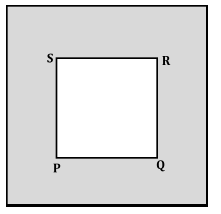
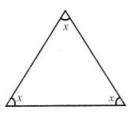
A Polygon is said to be a Regular Polygon when all of its sides are equal. Also, a regular polygon has all the interior angles are the same. For example, a regular hexagon consists of equal six sides, and also its interior angles give a total of 120 degrees.
square 2 CBSE Class 7 Maths The Triangle and Its Properties Worksheets 3

Examples:

  • A square consists of all its sides equal to 4cm, and also all the angles are at 90°.
  • A regular pentagon that has 5 equal sides. All the interior angles measure 108 degrees.
  • An equilateral triangle has all three sides equal to 8cm and angles measure to 60°.

Irregular Polygon

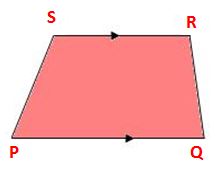
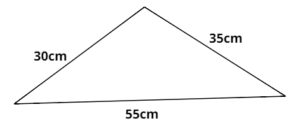
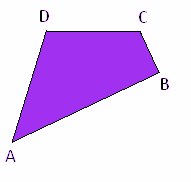
A Polygon is said to be an irregular polygon when all of its sides are not equal. They have irregular shapes. Also, the angles of irregular polygons are not equal.
trapezium

Examples:

  • A triangle with unequal sides.
  • A quadrilateral with unequal sides.

Convex Polygon

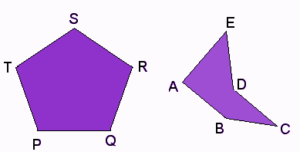
A Polygon is said to be a convex polygon when the measure of the interior angle is less than 180 degrees. The corners of a convex polygon are always outwards. Convex Polygon is completely opposite to the concave polygon.

Example:

An irregular hexagon that vertices are completely outwards.

Concave Polygon

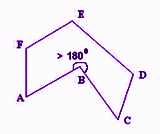
A Polygon is said to be a concave polygon when there are at least one angle measures more than 180 degrees. The corners of a concave polygon present inwards and also outwards.
concave-polygon

Trigons

A Polygon is said to be a trigon that has three sides. Trigons are also known as triangles. The triangles are classifieds into different categories. They are
Scalene Triangle: It has all sides that are unequal.
Isosceles Triangle: It has two sides that are equal.
Equilateral Triangle: All sides are equal in length and also all angles are 60 degrees.

Quadrilateral Polygon

A Polygon is said to be a Quadrilateral Polygon when it has four sides. Examples of Quadrilateral Polygon are square, rectangle, rhombus, and parallelogram.
quadrilateral-polygon

Pentagon Polygon

A Polygon is said to be a Pentagon Polygon when it has five sides. If all the sides of a pentagon polygon are equal, then it is called a regular pentagon. If not it is called an irregular pentagon.
pentagon

Hexagons

A polygon is called a hexagon when that has six sides and six vertices. If all the six sides of a hexagon are equal, then it is called a regular hexagon. Also, in a regular hexagon, all the interior and exterior angles are equal.

Equilateral Polygons

The polygons are called equilateral polygons when it has all sides are equal. An equilateral triangle, a square, etc., are examples of Equilateral Polygons.

Equiangular Polygons

The polygons are called Equiangular Polygons when all of their interior angles are equal. An example is a rectangle.

Types of Polygons with Sides 3-20

Below is the Classification of Polygons according to the number of sides and the angle measure. They are as follows

Name of the PolygonsSidesVerticesAngle
Triangle (also called Trigon)3360°
Quadrilateral (also called Tetragon)4490°
Pentagon55108°
Hexagon66120°
Heptagon77128.571°
Octagon88135°
Nonagon (also called Enneagon)99140°
Decagon1010144°
Hendecagon1111147.27
Dodecagon1212150
Tridecagon or triskaidecagon1313152.3
Tetradecagon or tetrakaidecago1414154.28
Pendedecagon1515156
Hexdecagon1616157.5
Heptdecagon1717158.82
Octdecagon1818160
Enneadecagon1919161.05
Icosagon2020162
n-gonnn(n-2)× 180° / n

FAQs on Different Types of Polygons?

1. What is a Polygon?

A polygon is a two-dimensional figure that consists of a finite number of sides.

2. How many different types of Polygons are there?

There are two different types of Polygons namely Regular and Irregular. However, depending on the sides and vertices they are furthermore classified as Concave Polygons, Convex Polygons, Trigons, Quadrilateral Polygons, Pentagon Polygons, Hexagon Polygons, Equilateral Polygons, Equiangular Polygons, etc.

3. What is a 9 sided shape called?

9 Sided Shape is Called an Enneagon or Nonagon.

Worksheet on Decimal Word Problems

Worksheet on Decimal Word Problems | Decimal Word Problems with Answers

Worksheet on Decimal Word Problems will help the students to explore their knowledge of decimal word problems. Solve all the problems to learn the depth concept of Decimal Word Problems. Know the definition, properties, different operations performed on decimals by visiting our website. We have given the complete decimal concepts along with examples. Check out the Decimal Word Problems Worksheet and know the various strategies to solve problems in an easy way.

Also, Read:

What are Decimals?

The decimal is a number that has the whole number and the fractional part separated by a decimal point. The point between the whole number and fractions part is known as the decimal point. For example, 24.9 is the decimal number where 24 is a whole number and 9 is the fractional part after the decimal. We have included addition, subtraction, multiplication, and division decimal word problems below.

Word Problems on Decimals

Have a look at all the problems given below and get a grip on all types of problems on decimals.

1. Anshika scored 521 marks out of 600 in the final examination. How many marks did she lose?

Solution:

Given that Anshika scored 521 marks out of 600 in the final examination.
So, the total marks are 600.
She scored 521 marks.
To get the marks she loses in an examination, we have to subtract 521 marks from 600.
Now, subtract 521 from 600.
600 – 521 = 79 marks.

Anshika lost 79 marks in the final examination.


2. Arun had 0.24 liters of cold drink. Kiran had 0.68 liters more cold drink. How much cold drink did they have together?

Solution:

Given that Arun had 0.87 liters of cold drink. Kiran had 0.92 liters more cold drink.
Arun = 0.24 litres of cold drink
Kiran = 0.68 liters more cold drink
To find the cold drink they have together we have to add both cold drink liters.
So, add 0.24 liters of cold drink and 0.68 liters more cold drink
0.24 liters of cold drink + 0.68 liters more cold drink = 0.92 liters of cold drink.

They have 0.92 liters of cold drink together.


3. The weight of a baby lion was 169.24 kg. After two years, his weight increased by 107.64 kg. Find the weight of the lion after two years?

Solution:

Given that the weight of a baby lion was 169.24 kg. After two years, his weight increased by 107.64 kg.
The lion’s present age is 169.24 kg.
After two years, his weight increased by 107.64 kg.
Now, add both weights to get the lion’s age after two years.
So, add 169.24 kg and 107.64 kg
169.24 kg + 107.64 kg = 276.88 kg

After two years, the lion weight is 276.88 kg.


4. Ganesh had a rope of 54.28 m. He cut the rope into two pieces. If the length of one piece was 13.26 m, what was the length of the other piece?

Solution:

Given that Ganesh had a rope of 54.28 m. He cut the rope into two pieces.
The total length of the rope is 54.28 m.
The rope is cut into two pieces.
If the length of one piece was 13.26 m, let the other piece’s length is x.
Add two pieces 13.26 m and x m.
13.26 m + x m = 54.28 m
x = 54.28 m – 13.26 m
x = 41.02 m

The length of the other piece is 41.02 m.


5. Each side of a regular polygon is 21.7 m and its perimeter is 108.5 m. Find the number of sides of the polygon?

Solution:

Given that each side of a regular polygon is 21.7 m and its perimeter is 108.5 m.
The perimeter of a polygon is the sum of all sides of a polygon.
To find the number of sides of the polygon, divide the perimeter with each side of a regular polygon is 21.7 m.
Divide 108.5 m with 21.7 m
108.5 m/21.7 m = 5.

The number of sides of the polygon is 5.


6. Fariha took 2.4 minutes to complete the race and Anil took 2.1 minutes to complete the race. Who won the race?

Solution:

Given that Fariha took 2.4 minutes to complete the race and Anil took 2.1 minutes to complete the race.
To find the winner of the race, we need to compare the time taken by each of them. The one who traveled in less time is the winner of the race.
Fariha took 2.4 minutes.
Anil took 2.1 minutes.
2.1 minutes is less time compared to 2.4 minutes.
Therefore, Anil took less time to complete the race.

Anil won the race.


7. The annual rainfall received by Arunachal Pradesh is 261.5 cm and that by Assam is 297.4 cm. Who received less rainfall?

Solution:

Given that the annual rainfall received by Arunachal Pradesh is 261.5 cm and that by Assam is 297.4 cm.
To find the less rainfall received, we need to compare the rainfall in two states. The place where the less cm rainfall occurred will be the answer.
Arunachal Pradesh = 261.5 cm rainfall
Assam = 297.4 cm rainfall
261.5 cm rainfall is less time compared to 297.4 cm rainfall.
Therefore, Arunachal Pradesh received less rainfall.

The answer is Arunachal Pradesh.


8. Rishu’s height is 134.51 cm. She stands on a tool of height 9.40 cm. What is the combined height now?

Solution:

Given that Rishu’s height is 134.51 cm. She stands on a tool of height 9.40 cm.
To find the combined height, add both given heights.
Add 134.51 cm and 9.40 cm
134.51 cm + 9.40 cm = 143.91 cm.

The combined height is 143.91 cm.


9. The milkman delivers 6.03 liter of milk to a house in the morning and 3.230 liters in the evening. What is the total quantity of milk delivered by the milkman?

Solution:

Given that the milkman delivers 6.03 liter of milk to a house in the morning and 3.230 liters in the evening.
To get the total quantity of milk delivered by the milkman, combine the milk he delivers in the morning and also in the evening.
Milkman delivers 6.03 liter of milk in the morning
Milkman delivers 3.230 liters of milk in the evening
Add 6.03 liter of milk and 3.230 liters of milk.
6.03 liter of milk + 3.230 liters of milk = 9.26 liters of milk

The total quantity of milk delivered by the milkman = 9.26 liters of milk.


10. Rebecca‘s kite is flying at a height of 28.3 m and Shelly’s at a height of 32.6 m from the ground. Whose kite is flying high and by how much?

Solution:

Given that Rebecca‘s kite is flying at a height of 28.3 m and Shelly’s at a height of 32.6 m from the ground.
To find whose kite is flying high, compare the two heights. The largest height of the kite considered to be flying high.
Rebecca‘s kite is flying at a height of 28.3 m
Shelly’s at a height of 32.6 m
32.6 m is greater than the 28.3 m.
Shelly’s kite is flying high.
To find how much the kite is flying high, subtract the heights.
Subtract 28.3 m from 32.6 m.
32.6 m – 28.3 m = 4.3 m

Shelly’s kite is flying high of 4.3 m than Rebecca‘s kite.


11. A bike travels 39.2 km in 7 hours. How much distance will it travel in 1 hour?

Solution:

Given that a bike travels 39.2 km in 7 hours.
Now, to find the distance it will travel in 1 hour, we have to divide the 39.2 km by 7 hours.
Divide 39.2 km by 7 hours.
39.2 km/7 hours = 5.6km/hr

The bike travels 5.6km in one hour.


12. Ron jogged 3.3 km, Mike jogged 4.8 times more distance than Ron. Find the distance covered by Mike?

Solution:

Given that Ron jogged 3.3 km, Mike jogged 4.8 times more distance than Ron.
The distance covered by Mike, multiply the Ron jogged km with the Mike jogged 4.8 times more distance than Ron.
The distance covered by Ron 3.3 kilometers.
Mike jogged 4.8 times more distance than Ron.
Multiply 3.3 kilometers and 4.8 kilometers.
The distance jogged is 3.3 kilometers × 4.8 kilometers = 15.84 kilometers.

The distance covered by mike is 15.84 kilometers.


13. The daily consumption of milk in a house is 4.36 liters. How much milk will be consumed in 30 days?

Solution:

Given that the daily consumption of milk in a house is 4.36 liters.
To find the milk that will be consumed in 30 days, we need to multiply 30 with 4.36 liters.
Multiply 4.36 liters with 30.
4.36 liters × 30 = 130.8 liters

130.8 liters of milk will be consumed in 30 days.


14. A tin contains 13.4 liters of oil. How many such tin contains 80.4 liters of oil?

Solution:

Given that a tin contains 13.4 liters of oil.
To find the number of tins that contain 80.4 liters of oil, we need to divide the 80.4 liters of oil by 13.4 liters of oil.
Divide 80.4 liters of oil by 13.4 liters of oil
80.4 liters of oil/13.4 liters of oil = 6.

6 tins contain 80.4 liters of oil.


15. Find the cost of 58.3 m cloth if the cost of 1 m cloth is $44.80.

Solution:

Given that the cost of 1 m cloth is $44.80
To find the cost of 58.3 m cloth, multiply 58.3 m cloth with $44.80.
Multiply 58.3 m cloth with $44.80
58.3 m cloth × $44.80 = $2611.84

The cost of 58.3 m cloth is $2611.84.


16. Shruti bought a bag for $387.05. She gave the shopkeeper 2 notes of $200. How much money will she get back?

Solution:

Given that Shruti bought a bag for $387.05. She gave the shopkeeper 2 notes of $200.
she gave 2 notes of 200
Add 2 notes cost = 200 + 200 = 400.
Now, subtract $400 from $387.05 to get the amount she gets back from the shopkeeper.
Subtract $400 from $387.05.
$400 – $387.05 = $12.95

Shruti gets back $12.95 from the shopkeeper.


17. A tailor needs 46.36 m of cloth for the shirts and 56.90 m for trousers. How much cloth does the tailor need in all?

Solution:

Given that a tailor needs 46.36 m of cloth for the shirts and 56.90 m for trousers.
The tailor needs all will get by adding the cloth for the shirts and cloth for the trousers.
46.36 m of cloth for the shirts
56.90 m of cloth for trousers.
Add 46.36 m and 56.90 m
46.36 m + 56.90 m = 103.26 m

The tailor needs 103.26 m cloth in total.


18. A spool of thread has a thread measuring 97.60 m. If 53.44 m thread has been cut, what length of thread is still left in the spool?

Solution:

Given that a spool of thread has a thread measuring 97.60 m.
If 53.44 m thread has been cut, subtract the 53.44 m thread from the thread measuring 97.60 m.
The total amount of thread is 97.60 m.
The thread that has been cut is 53.44 m.
Subtract 53.44 m from 97.60 m.
97.60 m – 53.44 m = 44.16 m.

The length of thread is still left in the spool is 44.16 m.


19. The cost of a chair is $3056.94. Tania wants to buy 7 chairs for her house. How much money will she pay to the shopkeeper?

Solution:

Given that the cost of a chair is $3056.94. Tania wants to buy 7 chairs for her house.
To find the money she will pay to the shopkeeper, multiply the number of chairs by the cost of the chair.
The cost of a chair is $3056.94.
The number of chairs is 7.
Multiply $3056.94 with 7.
$3056.94 × 7 = $21398.58

She will pay $21398.58 to the shopkeeper.


20. David has a jug full of milk. He pours the complete milk in 5 glasses, each glass of capacity 0.6 l. How much milk was there in the jug?

Solution:

Given that David has a jug full of milk. He pours the complete milk in 5 glasses, each glass of capacity 0.6 l.
To find the total milk in the jug, multiply 5 glasses of milk with 0.6 l capacity.
The total number of glasses = 5.
Each glass capacity is 0.6 l
Multiply 0.6 l with 5.
0.6 l × 5 = 3 l.

The total milk in the jug is 3 l.


21. Find the area of a square whose side is 2.50 m.

Solution:

Given that the side of a square is 2.50 m.
To find the area of a square, multiply 2.50 m with 2.50 m.
2.50 m × 2.50 m = 6.25 m.

The area of a square whose side is 2.50 m is 6.25 m.


22. The weight of 1 bag of sugar is 11.4 kg. What is the weight of 14 such bags?

Solution:

Given that the weight of 1 bag of sugar is 11.4 kg.
To find the weight of 14 such bags, multiply the weight of 1 bag of sugar with 14 bags.
Multiply the weight of 1 bag of sugar 11.4 kg with 14.
11.4 kg × 14 = 159.6 kg

The weight of 14 such bags is 159.6 kg.


23. A vehicle covers a distance of 10.2 km in 3.4 liters of petrol. How much distance will it cover in 1 liter of petrol?

Solution:

Given that a vehicle covers a distance of 10.2 km in 3.4 liters of petrol.
To find the distance that covers 1 liter of petrol, divide the total distance by given liters of petrol.
The total distance covered is 10.2 km.
The total liters of petrol is 3.4 liters.
Divide 10.2 km by 3.4 liters.
10.2 km/3.4 liters = 3 km/liter.

3 km covered in 1 liter of petrol.


24. Ron has 5.60 l of juice. He pours it into 8 glasses equally. How much juice is there in each glass?

Solution:

Given that Ron has 5.60 l of juice. He pours it into 8 glasses equally.
The total amount of juice is 5.60 l.
The number of glasses is 8.
To find out the juice in each glass, divide the 5.60 l by 8.
divide the 5.60 l by 8
5.60 l/8 = 0.7 l.

0.7 l juice is there in each glass.


25. Shelly has a ribbon of length 44.44 m. She cuts it into 11 equal parts. What is the length of each equal part?

Solution:

Given that Shelly has a ribbon of length 44.44 m. She cuts it into 11 equal parts.
To find the length of each equal part, divide the length of the ribbon by the number of equal parts.
The ribbon length is 44.44 m.
The number of equal parts is 11.
Divide 44.44 m by 11.
44.44 m/11 = 4.4 m.

4.4 m is the length of each equal part.


26. The cost of 4 pens is $49.24. What is the cost of 1 pen?

Solution:

Given that the cost of 4 pens is $49.24.
To find the cost of each pen, divide the total amount by the number of pens.
The total cost of the pens is $49.24.
The total number of pens is 4.
Divide $49.24 by 4.
$49.24/4 = $12.31

The cost of 1 pen is $12.31.


27. The weight of a box is 141.029 kg. What will be the weight of 23 such boxes?

Solution:

Given that the weight of a box is 141.029 kg.
To find the weight of 23 such boxes, multiply 141.029 kg by 23.
Divide 141.029 kg by 23.
141.029 kg × 23 = 3243.667 kg.

The weight of 23 such boxes is 3243.667 kg.


28. Sonia has 18.48 l of juice. She pours it into 8 jars equally. How much juice is there in each jar?

Solution:

Given that Sonia has 18.48 l of juice. She pours it into 8 jars equally.
To find the amount of juice in each jar, divide the total liters of juice by the number of jars.
The total liters of juice is 18.48 l.
The number of jars is 8.
Divide 18.48 l of juice by 8 jars.
18.48 l/8 = 2.31 liters

2.31 liters of juice present in each jar.


Eureka Math Grade 5 Module 4 Lesson 25 Answer Key

Engage NY Eureka Math 5th Grade Module 4 Lesson 25 Answer Key

Eureka Math Grade 5 Module 4 Lesson 25 Problem Set Answer Key

Question 1.
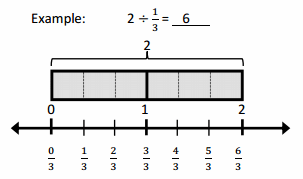
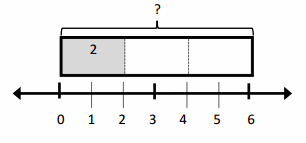
Draw a tape diagram and a number line to solve. You may draw the model that makes the most sense to you. Fill in the blanks that follow. Use the example to help you.
Eureka Math Grade 5 Module 4 Lesson 25 Problem Set Answer Key 1
There are 3 halves in 1 whole.
There are 6 halves in 4 wholes.

Eureka Math Grade 5 Module 4 Lesson 25 Problem Set Answer Key 2
If 2 is \(\frac{1}{3}\), what is the whole? 6

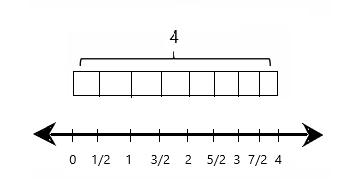
a. 4 ÷ \(\frac{1}{2}\) = _________
There are __ halves in 1 whole.
There are ___ halves in 4 wholes.
If 4 is \(\frac{1}{2}\), what is the whole? __

Answer:
4 ÷ \(\frac{1}{2}\) = 8
There are 2 halves in 1 whole.
There are 8 halves in 4 wholes.
If 4 is \(\frac{1}{2}\), the whole is 4.

Explanation:
Given that 4 ÷ \(\frac{1}{2}\) on solving we will get the result as 8. And there are 2 halves in 1 whole and there are 8 halves in 4 whole.
Eureka-Math-Grade-5-Module-4-Lesson-25-Problem-Set-Answer-Key-1-2

b. 2 ÷ \(\frac{1}{4}\) = __
There are ____ fourths in 1 whole.
There are ____ fourths in 2 wholes.
If 2 is \(\frac{1}{4}\), what is the whole? __

Answer:
2 ÷ \(\frac{1}{4}\) = 8
There are 4 fourths in 1 whole.
There are 8 fourths in 2 wholes.
If 2 is \(\frac{1}{4}\), the whole is 8

Explanation:
Given that 2 ÷ \(\frac{1}{4}\) on solving we will get the result as 8. And there are 4 fourths in 1 whole and there are 8 fourths in 2 wholes.

c. 5 \(\frac{1}{3}\) = __
There are ____ thirds in 1 whole.
There are ____ thirds in 5 wholes.
If 5 is \(\frac{1}{3}\), what is the whole? __

Answer:
5 \(\frac{1}{3}\) = 15
There are 3 thirds in 1 whole.
There are 15 thirds in 5 wholes.
If 5 is \(\frac{1}{3}\), the whole is 15.

Explanation:
Given that 5 \(\frac{1}{3}\) on solving we will get the result as 15. And there are 3 thirds in 1 whole and there are 15 thirds in 5 wholes.

d. 3 ÷ \(\frac{1}{5}\) = _________
There are ____ fifths in 1 whole.
There are ____ fifths in 3 wholes.
If 3 is \(\frac{1}{5}\), what is the whole? __

Answer:
3 ÷ \(\frac{1}{5}\) = 15
There are 5 fifths in 1 whole.
There are 15 fifths in 3 wholes.
If 3 is \(\frac{1}{5}\), the whole 15.

Explanation:
Given that 3 ÷ \(\frac{1}{5}\) on solving we will get the result as 15. And there are 5 fifths in 1 whole and tThere are 15 fifths in 3 wholes.

Question 3.
Divide. Then, multiply to check.

a. 5 ÷ \(\frac{1}{2}\)

Answer:
5 ÷ \(\frac{1}{2}\) = 10.

Explanation:
Given that 5 ÷ \(\frac{1}{2}\) which is 5 × 2 = 10. To check we will \(\frac{1}{2}\) × 10 which is 5.

b. 3 ÷ \(\frac{1}{2}\)

Answer:
3 ÷ \(\frac{1}{2}\) = 6.

Explanation:
Given that 3 ÷ \(\frac{1}{2}\) which is 3 × 2 = 6. To check we will \(\frac{1}{2}\) × 6 which is 3.

c. 4 ÷ \(\frac{1}{5}\)

Answer:
4 ÷ \(\frac{1}{5}\) = 20.

Explanation:
Given that 4 ÷ \(\frac{1}{5}\) which is 4 × 5 = 20. To check we will \(\frac{1}{5}\) × 20 which is 4.

d. 1 ÷ \(\frac{1}{6}\)

Answer:
1 ÷ \(\frac{1}{6}\) = 6.

Explanation:
Given that 1 ÷ \(\frac{1}{6}\) which is 1 × 6 = 6. To check we will \(\frac{1}{6}\) × 6 which is 1.

e. 2 ÷ \(\frac{1}{8}\)

Answer:
2 ÷ \(\frac{1}{8}\) = 16.

Explanation:
Given that 2 ÷ \(\frac{1}{8}\) which is 2 × 8 = 16. To check we will \(\frac{1}{8}\) × 16 which is 2.

f. 7 ÷ \(\frac{1}{6}\)

Answer:
7 ÷ \(\frac{1}{6}\) = 42.

Explanation:
Given that 7 ÷ \(\frac{1}{6}\) which is 7 × 6 = 42. To check we will \(\frac{1}{6}\) × 42 which is 7.

g. 8 ÷ \(\frac{1}{3}\)

Answer:
8 ÷ \(\frac{1}{3}\) = 24.

Explanation:
Given that 8 ÷ \(\frac{1}{3}\) which is 8 × 3 = 24. To check we will \(\frac{1}{3}\) × 24 which is 8.

h. 9 ÷ \(\frac{1}{4}\)

Answer:
9 ÷ \(\frac{1}{4}\) = 36.

Explanation:
Given that 9 ÷ \(\frac{1}{4}\) which is 9 × 4  = 36. To check we will \(\frac{1}{4}\) × 36 = 9.

Question 3.
For an art project, Mrs. Williams is dividing construction paper into fourths. How many fourths can she make from 5 pieces of construction paper?

Answer:
The number of fourths can she make from 5 pieces of construction paper is 20 fourths.

Explanation:
Here, Mrs. Williams is dividing construction paper into fourths, so the number of fourths can she make from 5 pieces of construction paper is 5 ÷ \(\frac{1}{4}\) which is 5 × 4 = 20.

Question 4.
Use the chart below to answer the following questions.
Donnie’s Diner Lunch Menu

Food

Serving Size

Hamburger

 lb

Pickles

 pickle

Potato chips

 bag

Chocolate milk

 cup

a. How many hamburgers can Donnie make with 6 pounds of hamburger meat?

Answer:
The number of hamburgers can Donnie make with 6 pounds of hamburger meat is 18 hamburgers.

Explanation:
The number of hamburgers can Donnie make with 6 pounds of hamburger meat is 6 ÷ \(\frac{1}{3}\) which is 6 × 3 = 18 hamburgers.

b. How many pickle servings can be made from a jar of 15 pickles?

Answer:
The number of pickle servings can be made from a jar of 15 pickles is 60 pickles.

Explanation:
The number of pickle servings can be made from a jar of 15 pickles is 15 ÷ \(\frac{1}{4}\) which is 15 × 4 = 60 pickles

c. How many servings of chocolate milk can he serve from a gallon of milk?

Answer:
The number of servings of chocolate milk can he serve from a gallon of milk is 32 servings of chocolate milk..

Explanation:
The number of servings of chocolate milk can he serve from a gallon of milk is, as 1 gallon is 16 cups and 16 ÷ \(\frac{1}{2}\) which is 16 × 2 = 32 servings of chocolate milk.

Question 5.
Three gallons of water fill \(\frac{1}{4}\) of the elephant’s pail at the zoo. How much water does the pail hold?

Answer:
The pail holds 12 gallons.

Explanation:
Here, Three gallons of water fill \(\frac{1}{4}\) of the elephant’s pail at the zoo, so the pail holds 3 ÷ \(\frac{1}{4}\) which is 3 × 4 = 12 gallons.

Eureka Math Grade 5 Module 4 Lesson 25 Exit Ticket Answer Key

Question 1.
Draw a tape diagram and a number line to solve. Fill in the blanks that follow.

a. 5 ÷ \(\frac{1}{2}\) = _________
There are ____ halves in 1 whole.
There are ____ halves in 5 wholes.
5 is \(\frac{1}{2}\) of what number? _______

Answer:
5 ÷ \(\frac{1}{2}\) = 10
There are 2 halves in 1 whole.
There are 10 halves in 5 wholes.
5 is \(\frac{1}{2}\) the number is 10

Explanation:
Given that 5 ÷ \(\frac{1}{2}\) which is 5 × 2 = 10. And there are 2 halves in 1 whole and there are 10 halves in 5 wholes.

b. 4 ÷ \(\frac{1}{4}\) = _________
There are ____ fourths in 1 whole.
There are ____ fourths in ____ wholes.
4 is \(\frac{1}{4}\) of what number? _______

Answer:
4 ÷ \(\frac{1}{4}\) = 16
There are 4 fourths in 1 whole.
There are 16 fourths in 4 wholes.
4 is \(\frac{1}{4}\) the number 16

Explanation:
Given that 4 ÷ \(\frac{1}{4}\) which is 4 × 4 = 16. And there are 4 fourths in 1 whole and there are 16 fourths in 4 wholes.

Question 2.
Ms. Leverenz is doing an art project with her class. She has a 3 foot piece of ribbon. If she gives each student an eighth of a foot of ribbon, will she have enough for her class of 22 students?

Answer:
Ms. Leverenz has 3 foot ribbon or 36 inches, so she have enough for her class 22 students.

Explanation:
Here, Ms. Leverenz is doing an art project with her class and she has a 3 foot piece of ribbon, which is 12 × 3 = 36 foot. and if she gives each student an eighth of a foot of ribbon which is \(\frac{8}{12}\) = 1.5 inches of ribbon. Here Ms. Leverenz gives each students 1.5 inches ribbon. Therefore she needs for 22 students which is 22 × 1.5 = 33 inches. So she has 3 foot ribbon or 36 inches, so she have enough for her class 22 students.

Eureka Math Grade 5 Module 4 Lesson 25 Homework Answer Key

Question 1.
Draw a tape diagram and a number line to solve. Fill in the blanks that follow.
a. 3 ÷ \(\frac{1}{3}\) = _________
There are ____ thirds in 1 whole.
There are ____ thirds in 3 wholes.
If 3 is \(\frac{1}{3}\), what is the whole? _______

Answer:
3 ÷ \(\frac{1}{3}\) = 9
There are 3 thirds in 1 whole.
There are 9 thirds in 3 wholes.
If 3 is \(\frac{1}{3}\), the whole is 9.

Explanation:
Given that 3 ÷ \(\frac{1}{3}\) which is 3 × 3 = 9. And there are 3 thirds in 1 whole and there are 9 thirds in 3 wholes.

b. 3 ÷ \(\frac{1}{4}\) = _________
There are ____ fourths in 1 whole.
There are ____ fourths in __ wholes.
If 3 is \(\frac{1}{4}\), what is the whole? _______

Answer:
3 ÷ \(\frac{1}{4}\) = 12
There are 4 fourths in 1 whole.
There are 12 fourths in 3 wholes.
If 3 is \(\frac{1}{4}\), the whole 12.

Explanation:
Given that 3 ÷ \(\frac{1}{4}\) which is 3 × 4 = 12. And there are 4 fourths in 1 whole and there are 12 fourths in 3 wholes.

c. 4 ÷ \(\frac{1}{3}\) = _________
There are ____ thirds in 1 whole.
There are ____ thirds in __ wholes.
If 4 is \(\frac{1}{3}\), what is the whole? _______

Answer:
4 ÷ \(\frac{1}{3}\) = 12
There are 3 thirds in 1 whole.
There are 12 thirds in 4 wholes.
If 4 is \(\frac{1}{3}\), the whole 12.

Explanation:
Given that 4 ÷ \(\frac{1}{3}\) which is 4 × 3 = 12. And there are 3 thirds in 1 whole and there are 12 thirds in 4 wholes.

d. 5 ÷ \(\frac{1}{4}\) = _________
There are ____ fourths in 1 whole.
There are ____ fourths in __ wholes.
If 5 is \(\frac{1}{4}\), what is the whole? _______

Answer:
5 ÷ \(\frac{1}{4}\) = 20
There are 4 fourths in 1 whole.
There are 20 fourths in 5 wholes.
If 5 is \(\frac{1}{4}\), the whole is 20.

Explanation:
Given that 5 ÷ \(\frac{1}{4}\) which is 5 × 4 = 20. And there are 4 fourths in 1 whole and there are 20 fourths in 5 wholes.

Question 2.
Divide. Then, multiply to check.

a. 2 ÷ \(\frac{1}{4}\)

Answer:
2 ÷ \(\frac{1}{4}\) = 8.

Explanation:
Given that 2 ÷ \(\frac{1}{4}\) which is 2 × 4 = 8. To check we will perform multiplication \(\frac{1}{4}\) × 8 which is 2.

b. 6 ÷ \(\frac{1}{2}\)

Answer:
6 ÷ \(\frac{1}{2}\) = 12.

Explanation:
Given that 6 ÷ \(\frac{1}{2}\) which is 6 × 2 = 12. To check we will perform multiplication \(\frac{1}{2}\) × 12 which is 6.

c. 5 ÷ \(\frac{1}{4}\)

Answer:
5 ÷ \(\frac{1}{4}\) = 20.

Explanation:
Given that 5 ÷ \(\frac{1}{4}\) which is 5 × 4 = 20. To check we will perform multiplication \(\frac{1}{4}\) × 20 which is 5.

d. 5 ÷ \(\frac{1}{8}\)

Answer:
5 ÷ \(\frac{1}{8}\) = 40.

Explanation:
Given that 5 ÷ \(\frac{1}{8}\) which is 5 × 8 = 40. To check we will perform multiplication \(\frac{1}{8}\) × 40 which is 5.

e. 6 ÷ \(\frac{1}{3}\)

Answer:
6 ÷ \(\frac{1}{3}\) = 18.

Explanation:
Given that 6 ÷ \(\frac{1}{3}\) which is 6 × 3 = 18. To check we will perform multiplication \(\frac{1}{3}\) × 18 which is 6.

f. 3 ÷ \(\frac{1}{6}\)

Answer:
3 ÷ \(\frac{1}{6}\) = 18.

Explanation:
Given that 3 ÷ \(\frac{1}{6}\) which is 3 × 6 = 18. To check we will perform multiplication \(\frac{1}{6}\) × 18 which is 3.

g. 6 ÷ \(\frac{1}{5}\)

Answer:
6 ÷ \(\frac{1}{5}\) = 30.

Explanation:
Given that 6 ÷ \(\frac{1}{5}\) which is 6 × 5 = 30. To check we will perform multiplication \(\frac{1}{5}\) × 30 which is 6.

h. 6 ÷ \(\frac{1}{10}\)

Answer:
6 ÷ \(\frac{1}{10}\) = 60.

Explanation:
Given that 6 ÷ \(\frac{1}{10}\) which is 6 × 10 = 60. To check we will perform multiplication \(\frac{1}{10}\) × 60 which is 6.

Question 3.
A principal orders 8 sub sandwiches for a teachers’ meeting. She cuts the subs into thirds and puts the mini-subs onto a tray. How many mini-subs are on the tray?

Answer:
There will be 24 mini-subs are on the tray.

Explanation:
Given there are 8 sub sandwiches for a teachers meeting and each sandwich cuts into third. So 1 ÷ \(\frac{1}{3}\) which is 1 × 3 = 3 as there are 8 sub sandwiches, so there will be 8 × 3 = 24 mini-subs are on the tray.

Question 4.
Some students prepare 3 different snacks. They make \(\frac{1}{8}\) pound bags of nut mix, \(\frac{1}{4}\) pound bags of cherries, and \(\frac{1}{6}\) pound bags of dried fruit. If they buy 3 pounds of nut mix, 5 pounds of cherries, and 4 pounds of dried fruit, how many of each type of snack bag will they be able to make?

Answer:
There are 24 nut mix, 20 cherry bags and 24 dried fruits.

Explanation:
As some students prepare 3 different snacks and they make \(\frac{1}{8}\) pound bags of nut mix and they will be able to make number of nut mix bag is 3 ÷ \(\frac{1}{8}\)  which is 3 × 8 = 24, and \(\frac{1}{4}\) pound bags of cherries they will be able to make number of cherries bag is 5 ÷ \(\frac{1}{4}\) which is 5 × 4 = 20 , and \(\frac{1}{6}\) pound bags of dried fruit and they will be able to make number of bags of dried fruit is 4 ÷ \(\frac{1}{6}\) which is 4 × 6 = 24. So there are 24 nut mix, 20 cherry bags and 24 dried fruits.

Multiplying Fractions

Multiplying Fractions – Definition, Examples | How to Multiply Fractions?

Multiplying numbers is so easy compared to Multiplying Fractions. The fraction is represented as the division of the whole. The fraction is in the form of “x/y” where “x” is the numerator and “y” is the denominator. One can apply the fraction concept to real-time examples easily after reading the entire concept here. If you have an apple and you made it into 4 equal parts, then it can represent as \(\frac { 1 }{ 4 } \). Or else if it cut into 7 pieces then it can represented as \(\frac { 1 }{ 7 } \).

How to Multiply Fractions?

We have provided simple steps to multiply fractions and find the solution of multiplying fractions. It is easy to find out the solution using the below procedure. Multiplying fractions can be defined as the product of a fraction with another fraction or with the variables or with an integer. Follow the below process to multiply fractions

  • Multiply the numerator with numerator
  • Multiply the denominator with the denominator
  • Simplify the fractions, if needed

Example:
1. Multiply \(\frac { 2 }{ 3 } \) × \(\frac { 1 }{ 5 } \)

Solution:
Given that \(\frac { 2 }{ 3 } \) × \(\frac { 1 }{ 5 } \)
To multiply the above fractions, firstly multiply the numerators
2 × 1 = 2
multiply the denominators
3 × 5 = 15
Now, simplify the fraction, we get \(\frac { 2 }{ 15 } \)
If \(\frac { x }{ y } \) and \(\frac { m }{ n } \) are the multiplicand and multiplier, then the output is \(\frac { xm }{ yn } \)
Product of Fraction = Product of Numerator/Product of Denominator

Fractions Parts and Types

A fraction consists of two parts. One is the numerator and another one is the denominator. If \(\frac { a }{ b } \) is a fraction, then the two parts are a and b where a is the numerator and b is the denominator. Or else if \(\frac { 3 }{ 4 } \) is a fraction, then the two parts are 3 and 4 where 3 is the numerator and 4 is the denominator.

Mainly, there are three types of fractions considered. They are proper fractions, improper fractions, and mixed fractions.
Proper fractions: A fraction is said to be a proper fraction when the numerator of a fraction is less than the denominator.
Examples: \(\frac { 1 }{ 4 } \), \(\frac { 5 }{ 6 } \), \(\frac { 7 }{ 11 } \)
Improper fractions: A fraction is said to be an improper fraction when the numerator is greater than the denominator.
Examples: \(\frac { 5 }{ 4 } \), \(\frac { 7 }{ 6 } \), \(\frac { 13 }{ 11 } \)
Mixed Fraction: A fraction is said to be a mixed fraction when we write the improper fraction in the combination of a whole number and a fraction.
Examples: 1 \(\frac { 5 }{ 4 } \), 3 \(\frac { 9 }{ 6 } \), 2 \(\frac { 6 }{ 7 } \)

Also, Read:

Fractional Simplification

Generally, the multiplication of fractions can be finished by multiplying numerators with numerators and multiplying denominators with denominators. To make the fractional multiplication simpler, we can reduce the fraction by canceling the common factors. By canceling out the common factors from the given factor, it becomes easier to find the exact output.

Example: \(\frac { 9 }{ 4 } \) and \(\frac { 2 }{ 3 } \)
\(\frac { 9 }{ 4 } \) can written as \(\frac { 3 × 3 }{ 2×2 } \)
\(\frac { 3 × 3 }{ 2×2 } \) × \(\frac { 2 }{ 3 } \) = \(\frac { 3 }{ 2 } \)
If there is no common factors, then the numerators and denominators are multiplied directly.

Types of Fraction Multiplication

There are different types of Fraction Multiplication available. They are

  • Multiplication of Fraction with Whole Numbers
  • Multiplication of Fraction with another Fraction
  • Multiplication of Fraction with Variables

Multiplication of Fractional Number by a Whole Number

In Multiplication of Fractional Number by a Whole Number, we multiply the numerator with the numerator and the denominator remains the same. Before you multiply, reduce the fraction to the lowest terms. Check out different problems on the Multiplication of Fractional Number by a Whole Number below.

1. Multiply 2 \(\frac { 2 }{ 3 } \) by 9

Solution:
Given that multiply 2 \(\frac { 2 }{ 3 } \) by 9.
Firstly, convert given mixed fraction 2 \(\frac { 2 }{ 3 } \) to fraction.
2 \(\frac { 2 }{ 3 } \) = \(\frac { 8 }{ 3 } \)
Now, multiply \(\frac { 8 }{ 3 } \) by 9.
Multiply the numerator of the fractional number by the whole number. The denominator remains the same.
8 × 9 = 72.
So, the fraction is \(\frac { 72 }{ 3 } \)
Simplify the fraction to get the final answer.
\(\frac { 72 }{ 3 } \) = 24.

The final answer is 24.

(ii) Multiply \(\frac { 3 }{ 4 } \) by 6

Solution:
Given that multiply \(\frac { 3 }{ 4 } \) by 6
multiply \(\frac { 3 }{ 4 } \) by 6.
Multiply the numerator of the fractional number by the whole number. The denominator remains the same.
3 × 6 = 18.
So, the fraction is \(\frac { 18 }{ 4 } \)
Simplify the fraction to get the final answer.
\(\frac { 18 }{ 4 } \) = \(\frac { 9 }{ 2 } \).

The final answer is \(\frac { 9 }{ 2 } \).

(iii) Multiply 3 \(\frac { 3 }{ 2 } \) by 6

Solution:
Given that multiply 3 \(\frac { 3 }{ 2 } \) by 6.
Firstly, convert given mixed fraction 3 \(\frac { 3 }{ 2 } \) to fraction.
3 \(\frac { 3 }{ 2 } \) = \(\frac { 9 }{ 2 } \)
Now, multiply \(\frac { 9 }{ 2 } \) by 6.
Multiply the numerator of the fractional number by the whole number. The denominator remains the same.
9 × 6 = 54.
So, the fraction is \(\frac { 54 }{ 2 } \)
Simplify the fraction to get the final answer.
\(\frac { 54 }{ 2 } \) = 27.

The final answer is 27.

Multiplication of Fractional Number by Another Fractional Number

Multiplying Fraction with Another Fraction is explained with the below examples.

(i). Multiply \(\frac { 3 }{ 5 } \) by \(\frac { 6 }{ 5 } \)

Solution:
Given that Multiply \(\frac { 3 }{ 5 } \) by \(\frac { 6 }{ 5 } \).
Firstly, multiply the numerators with numerators.
3 × 6 = 18.
Next, multiply the denominators with denominators.
5 × 5 = 25.
Finally, write the fraction in the simplest form.
\(\frac { 18 }{ 25 } \)

The final answer is \(\frac { 18 }{ 25 } \)

(ii) Multiply \(\frac { 3 }{ 4 } \) by \(\frac { 7 }{ 2 } \)

Solution:
Given that Multiply \(\frac { 3 }{ 4 } \) by \(\frac { 7 }{ 2 } \).
Firstly, multiply the numerators with numerators.
3 × 7 = 21.
Next, multiply the denominators with denominators.
4 × 2 = 8.
Finally, write the fraction in the simplest form.
\(\frac { 21 }{ 8 } \)

The final answer is \(\frac { 21 }{ 8 } \).

(iii) Multiply \(\frac { 2 }{ 3 } \), \(\frac { 2 }{ 5 } \), and \(\frac { 2 }{ 7 } \)

Solution:
Given that Multiply \(\frac { 2 }{ 3 } \), \(\frac { 2 }{ 5 } \), and \(\frac { 2 }{ 7 } \).
Firstly, multiply the numerators with numerators.
2 × 2 × 2 = 8.
Next, multiply the denominators with denominators.
3 × 5 × 7 = 105.
Finally, write the fraction in the simplest form.
\(\frac { 8 }{ 105 } \)

The final answer is \(\frac { 8 }{ 105 } \).

Multiplication of a Mixed number by Another Mixed Number

To find the multiplication of a mixed number with another mixed number, we need to change the mixed fractions to fractions and multiply them.

(i) Multiply 3 \(\frac { 2 }{ 5 } \) and 2 \(\frac { 3 }{ 7 } \)

Solution:
Given that multiply 3 \(\frac { 2 }{ 5 } \) and 2 \(\frac { 3 }{ 7 } \).
Firstly, convert given mixed fractions 3 \(\frac { 2 }{ 5 } \) and 2 \(\frac { 3 }{ 7 } \) to fractions.
3 \(\frac { 2 }{ 5 } \) = \(\frac { 17 }{ 5 } \)
2 \(\frac { 3 }{ 7 } \) = \(\frac { 17 }{ 7 } \)
Now, multiply \(\frac { 17 }{ 5 } \) by \(\frac { 17 }{ 7 } \).
Firstly, multiply the numerators with numerators.
17 × 17 = 289.
Next, multiply the denominators with denominators.
5 × 7 = 35.
Finally, write the fraction in the simplest form.
\(\frac { 289 }{ 35 } \)

The final answer is \(\frac { 289 }{ 35 } \).

(ii) Multiply 2 \(\frac { 4 }{ 3 } \) and 1 \(\frac { 6 }{ 5 } \)

Solution:
Given that multiply 2 \(\frac { 4 }{ 3 } \) and 1 \(\frac { 6 }{ 5 } \).
Firstly, convert given mixed fractions 2 \(\frac { 4 }{ 3 } \) and 1 \(\frac { 6 }{ 5 } \) to fractions.
2 \(\frac { 4 }{ 3 } \) = \(\frac { 10 }{ 3 } \)
1 \(\frac { 6 }{ 5 } \) = \(\frac { 11 }{ 5 } \)
Now, multiply \(\frac { 10 }{ 3 } \) by \(\frac { 11 }{ 5 } \).
Firstly, multiply the numerators with numerators.
10 × 11 = 110.
Next, multiply the denominators with denominators.
5 × 3 = 15.
Finally, write the fraction in the simplest form.
\(\frac { 110 }{ 15 } \) = \(\frac { 22 }{ 3 } \)

The final answer is \(\frac { 22 }{ 3 } \).

(i) Multiply 4 \(\frac { 2 }{ 9 } \) and 5 \(\frac { 1 }{ 4 } \)

Solution:
Given that multiply 4 \(\frac { 2 }{ 9 } \) and 5 \(\frac { 1 }{ 4 } \).
Firstly, convert given mixed fractions 4 \(\frac { 2 }{ 9 } \) and 5 \(\frac { 1 }{ 4 } \) to fractions.
4 \(\frac { 2 }{ 9 } \) = \(\frac { 38 }{ 9 } \)
5 \(\frac { 1 }{ 4 } \) = \(\frac { 21 }{ 4 } \)
Now, multiply\(\frac { 38 }{ 9 } \) by \(\frac { 21 }{ 4 } \).
Firstly, multiply the numerators with numerators.
38 × 21 = 798.
Next, multiply the denominators with denominators.
9 × 4 = 36.
Finally, write the fraction in the simplest form.
\(\frac { 798 }{ 36 } \)

The final answer is \(\frac { 798 }{ 36 } \).

Multiplying Fractions Examples

I. Find the product
(i) \(\frac { 5 }{ 4 } \) × 1
(ii) \(\frac { 3 }{ 5 } \) × 6
(iii) \(\frac { 10 }{ 15 } \) × 7
(iv) \(\frac { 2 }{ 3 } \) × 0
(v) \(\frac { 1 }{ 4 } \) × \(\frac { 2 }{ 7 } \)
(vi) 2\(\frac { 9 }{ 13 } \) × 4
(vii) \(\frac { 1 }{ 6 } \) × \(\frac { 7 }{ 1 } \)
(viii) \(\frac { 1 }{ 4 } \) × \(\frac { 8 }{ 6 } \) × \(\frac { 3 }{ 10 } \)
(ix) \(\frac { 5 }{ 16 } \) × \(\frac { 11 }{ 23 } \)
(x) \(\frac { 1 }{ 2 } \) of 50
(xi) \(\frac { 1 }{ 3 } \) of 90
(xii) \(\frac { 5 }{ 6 } \) of \(\frac { 9 }{ 12 } \)

(i) \(\frac { 5 }{ 4 } \) × 1
Solution:
Given that \(\frac { 5 }{ 4 } \) × 1
Now, multiply \(\frac { 5 }{ 4 } \) by 1.
Multiply the numerator of the fractional number by the whole number. The denominator remains the same.
5 × 1 = 5.
So, the fraction is \(\frac { 5 }{ 4 } \)

The final answer is \(\frac { 5 }{ 4 } \).

(ii) \(\frac { 3 }{ 5 } \) × 6
Solution:
Given that \(\frac { 3 }{ 5 } \) × 6
multiply \(\frac { 3 }{ 5 } \) by 6
Multiply the numerator of the fractional number by the whole number. The denominator remains the same.
3 × 6 = 18.
So, the fraction is \(\frac { 18 }{ 5 } \)
Simplify the fraction to get the final answer.
\(\frac { 18 }{ 5 } \).

The final answer is \(\frac { 18 }{ 5 } \).

(iii) \(\frac { 10 }{ 15 } \) × 7
Solution:
Given that \(\frac { 10 }{ 15 } \) × 7
multiply \(\frac { 10 }{ 15 } \) by 7
Multiply the numerator of the fractional number by the whole number. The denominator remains the same.
10 × 7 = 70.
So, the fraction is \(\frac { 70 }{ 15 } \)
Simplify the fraction to get the final answer.
\(\frac { 70 }{ 15 } \) = \(\frac { 14 }{ 3 } \).

The final answer is \(\frac { 14 }{ 3 } \).

(iv) \(\frac { 2 }{ 3 } \) × 0
Solution:
Any fraction that multiplies with 0 gives 0.
Therefore, the answer is 0.

(v) \(\frac { 1 }{ 4 } \) × \(\frac { 2 }{ 7 } \)
Solution:
Given that Multiply \(\frac { 1 }{ 4 } \) by \(\frac { 2 }{ 7 } \).
Firstly, multiply the numerators with numerators.
1 × 2 = 2.
Next, multiply the denominators with denominators.
4 × 7 = 28.
Finally, write the fraction in the simplest form.
\(\frac { 2 }{ 28 } \)
Simplify the fraction to get the final answer.
\(\frac { 1 }{ 14 } \).

The final answer is \(\frac { 1 }{ 14 } \).

(vi) 2\(\frac { 9 }{ 13 } \) × 4
Solution:
Given that multiply 2\(\frac { 9 }{ 13 } \) × 4.
Firstly, convert given mixed fraction 2\(\frac { 9 }{ 13 } \) to fraction.
2\(\frac { 9 }{ 13 } \) = \(\frac { 35 }{ 13 } \)
Now, multiply \(\frac { 35 }{ 13 } \) by 4.
Multiply the numerator of the fractional number by the whole number. The denominator remains the same.
35 × 4 = 140.
So, the fraction is \(\frac { 140 }{ 13 } \)
Simplify the fraction to get the final answer.
\(\frac { 140 }{ 13 } \).

The final answer is \(\frac { 140 }{ 13 } \).

(vii) \(\frac { 1 }{ 6 } \) × \(\frac { 7 }{ 1 } \)
Solution:
Given that Multiply \(\frac { 1 }{ 6 } \) × \(\frac { 7 }{ 1 } \).
Firstly, multiply the numerators with numerators.
1 × 7 = 7.
Next, multiply the denominators with denominators.
6 × 1 = 6.
Finally, write the fraction in the simplest form.
\(\frac { 7 }{ 6 } \)
Simplify the fraction to get the final answer.
\(\frac { 7 }{ 6 } \).

The final answer is \(\frac { 7 }{ 6 } \).

(viii) \(\frac { 1 }{ 4 } \) × \(\frac { 8 }{ 6 } \) × \(\frac { 3 }{ 10 } \)
Solution:
Given that Multiply \(\frac { 1 }{ 4 } \) × \(\frac { 8 }{ 6 } \) × \(\frac { 3 }{ 10 } \).
Firstly, multiply the numerators with numerators.
1 × 8 × 3 = 24.
Next, multiply the denominators with denominators.
4 × 6 × 10 = 240.
Finally, write the fraction in the simplest form.
\(\frac { 24 }{ 240 } \)
Simplify the fraction to get the final answer.
\(\frac { 1 }{ 10 } \).

The final answer is \(\frac { 1 }{ 10 } \).

(ix) \(\frac { 5 }{ 16 } \) × \(\frac { 11 }{ 23 } \)
Solution:
Given that Multiply \(\frac { 5 }{ 16 } \) × \(\frac { 11 }{ 23 } \).
Firstly, multiply the numerators with numerators.
5 × 11 = 55.
Next, multiply the denominators with denominators.
16 × 23 = 368.
Finally, write the fraction in the simplest form.
\(\frac { 55 }{ 368 } \)
Simplify the fraction to get the final answer.
\(\frac { 55 }{ 368 } \).

The final answer is \(\frac { 55 }{ 368 } \).

(x) \(\frac { 1 }{ 2 } \) of 50
Solution:
Given that \(\frac { 1 }{ 2 } \) of 50
multiply \(\frac { 1 }{ 2 } \) by 50
Multiply the numerator of the fractional number by the whole number. The denominator remains the same.
1 × 50 = 50.
So, the fraction is \(\frac { 50 }{ 2 } \)
Simplify the fraction to get the final answer.
\(\frac { 50 }{ 2 } \) = 25.

The final answer is 25.

(xi) \(\frac { 1 }{ 3 } \) of 90

Solution:
Given that \(\frac { 1 }{ 3 } \) of 90
multiply \(\frac { 1 }{ 3 } \) by 90
Multiply the numerator of the fractional number by the whole number. The denominator remains the same.
1 × 90 = 90.
So, the fraction is \(\frac { 90 }{ 3 } \)
Simplify the fraction to get the final answer.
\(\frac { 90 }{ 3 } \) = 30.

The final answer is 30.

II. Multiply and write the product in the lowest terms.

(i) \(\frac { 1 }{ 2 } \) × 60
(ii) \(\frac { 1 }{ 3 } \) × 18
(iii) \(\frac { 2 }{ 5 } \) × 25
(iv) \(\frac { 4 }{ 3 } \) × 0
(v) \(\frac { 7 }{ 29 } \) × 1
(vi) 6 × \(\frac { 7 }{ 36 } \)
(vii) \(\frac { 5 }{ 34 } \) × \(\frac { 34 }{ 8 } \)
(viii) \(\frac { 12 }{ 25 } \) × \(\frac { 5 }{ 6 } \)
(ix) \(\frac { 6 }{ 14 } \) × \(\frac { 56 }{ 7 } \)
(x) \(\frac { 1 }{ 3 } \) × \(\frac { 4 }{ 5 } \) × \(\frac { 5 }{ 8 } \)
(xi) \(\frac { 6 }{ 3 } \) × \(\frac { 1 }{ 2 } \) × \(\frac { 3 }{ 3 } \)
(xii) 3\(\frac { 8 }{ 5 } \) × \(\frac { 5 }{ 4 } \)

(i) \(\frac { 1 }{ 2 } \) × 60
Solution:
Given that \(\frac { 1 }{ 2 } \) × 60
Now, multiply \(\frac { 1 }{ 2 } \) by 60.
Multiply the numerator of the fractional number by the whole number. The denominator remains the same.
1 × 60 = 60.
So, the fraction is \(\frac { 60 }{ 2 } \)
Simplify the fraction to get the final answer.
\(\frac { 60 }{ 2 } \) = 30.

The final answer is 30.

(ii) \(\frac { 1 }{ 3 } \) × 18
Solution:
Given that \(\frac { 1 }{ 3 } \) × 18
Now, multiply \(\frac { 1 }{ 3 } \) by 18.
Multiply the numerator of the fractional number by the whole number. The denominator remains the same.
1 × 18 = 18.
So, the fraction is \(\frac { 18 }{ 3 } \)
Simplify the fraction to get the final answer.
\(\frac { 18 }{ 3 } \) = 6.

The final answer is 6.

(iii) \(\frac { 2 }{ 5 } \) × 25
Solution:
Given that \(\frac { 2 }{ 5 } \) × 25
Now, multiply \(\frac { 2 }{ 5 } \) by 25.
Multiply the numerator of the fractional number by the whole number. The denominator remains the same.
2 × 25 = 50.
So, the fraction is \(\frac { 50 }{ 5 } \)
Simplify the fraction to get the final answer.
\(\frac { 50 }{ 5 } \) = 10.

The final answer is 10.

(iv) \(\frac { 4 }{ 3 } \) × 0
Solution:
Any fraction that multiplies with 0 gives 0.
Therefore, the answer is 0.

(v) \(\frac { 7 }{ 29 } \) × 1
Solution:
Any fraction that multiplies with 1 gives the same output.
Therefore, the answer is \(\frac { 7 }{ 29 } \).

(vi) 6 × \(\frac { 7 }{ 36 } \)
Solution:
Given that 6 × \(\frac { 7 }{ 36 } \)
Now, multiply 6 by \(\frac { 7 }{ 36 } \).
Multiply the numerator of the fractional number by the whole number. The denominator remains the same.
6 × 7 = 42.
So, the fraction is \(\frac { 42 }{ 36 } \)
Simplify the fraction to get the final answer.
\(\frac { 42 }{ 36 } \) = \(\frac { 21 }{ 18 } \).

The final answer is \(\frac { 21 }{ 18 } \).

(vii) \(\frac { 5 }{ 34 } \) × \(\frac { 34 }{ 8 } \)
Solution:
Given that Multiply \(\frac { 5 }{ 34 } \) × \(\frac { 34 }{ 8 } \).
Firstly, multiply the numerators with numerators.
5 × 34 = 170.
Next, multiply the denominators with denominators.
34 × 8 = 272.
Finally, write the fraction in the simplest form.
\(\frac { 170 }{ 272 } \)
Simplify the fraction to get the final answer.
\(\frac { 5 }{ 8 } \).

The final answer is \(\frac { 5 }{ 8 } \).

(viii) \(\frac { 12 }{ 25 } \) × \(\frac { 5 }{ 6 } \)
Solution:
Given that Multiply \(\frac { 12 }{ 25 } \) × \(\frac { 5 }{ 6 } \).
Firstly, multiply the numerators with numerators.
12 × 5 = 60.
Next, multiply the denominators with denominators.
25 × 6 = 150.
Finally, write the fraction in the simplest form.
\(\frac { 60 }{ 150 } \)
Simplify the fraction to get the final answer.
\(\frac { 60 }{ 150 } \) = \(\frac { 2 }{ 5 } \).

The final answer is \(\frac { 2 }{ 5 } \).

(ix) \(\frac { 6 }{ 14 } \) × \(\frac { 56 }{ 7 } \)
Solution:
Given that Multiply \(\frac { 6 }{ 14 } \) × \(\frac { 56 }{ 7 } \).
Firstly, multiply the numerators with numerators.
6 × 56 = 336.
Next, multiply the denominators with denominators.
14 × 7 = 98.
Finally, write the fraction in the simplest form.
\(\frac { 336 }{ 98 } \)
Simplify the fraction to get the final answer.
\(\frac { 336 }{ 98 } \) = 168.

The final answer is 168.

(x) \(\frac { 1 }{ 3 } \) × \(\frac { 4 }{ 5 } \) × \(\frac { 5 }{ 8 } \)
Solution:
Given that Multiply \(\frac { 1 }{ 3 } \) × \(\frac { 4 }{ 5 } \) × \(\frac { 5 }{ 8 } \).
Firstly, multiply the numerators with numerators.
1 × 4 × 5 = 20.
Next, multiply the denominators with denominators.
3 × 5 × 8 = 120.
Finally, write the fraction in the simplest form.
\(\frac { 20 }{ 120 } \)
Simplify the fraction to get the final answer.
\(\frac { 20 }{ 120 } \) = \(\frac { 1 }{ 6 } \).

The final answer is \(\frac { 1 }{ 6 } \).

(xi) \(\frac { 6 }{ 3 } \) × \(\frac { 1 }{ 2 } \) × \(\frac { 3 }{ 3 } \)
Solution:
Given that Multiply \(\frac { 6 }{ 3 } \) × \(\frac { 1 }{ 2 } \) × \(\frac { 3 }{ 3 } \).
Firstly, multiply the numerators with numerators.
6 × 1 × 3 = 18.
Next, multiply the denominators with denominators.
3 × 2 × 3 = 18.
Finally, write the fraction in the simplest form.
\(\frac { 18 }{ 18 } \)
Simplify the fraction to get the final answer.
\(\frac { 18 }{ 18 } \) = 1.

The final answer is 1.

(xii) 3\(\frac { 8 }{ 5 } \) × \(\frac { 5 }{ 4 } \)
Solution:
Given that multiply 3\(\frac { 8 }{ 5 } \) × \(\frac { 5 }{ 4 } \).
Firstly, convert given mixed fraction 3\(\frac { 8 }{ 5 } \) to fraction.
3\(\frac { 8 }{ 5 } \) = \(\frac { 23 }{ 5 } \)
Multiply \(\frac { 23 }{ 5 } \) × \(\frac { 5 }{ 4 } \).
Firstly, multiply the numerators with numerators.
23 × 5 = 115.
Next, multiply the denominators with denominators.
5 × 4 = 20.
Finally, write the fraction in the simplest form.
\(\frac { 115 }{ 20 } \)
Simplify the fraction to get the final answer.
\(\frac { 115 }{ 20 } \) = \(\frac { 23 }{ 4 } \).

The final answer is \(\frac { 23 }{ 4 } \).

III. Find the given quantity.

(i) \(\frac { 1 }{ 6 } \) of 48 kg apples
Solution:
Given that \(\frac { 1 }{ 6 } \) of 48 kg apples.
\(\frac { 1 }{ 6 } \) × 48 kg
8 kg

The answer is 8 kg.

(ii) \(\frac { 1 }{ 7 } \) of $280
Solution:
Given that \(\frac { 1 }{ 7 } \) of $280.
\(\frac { 1 }{ 7 } \) × $280
$40

The answer is $40.

(iii) \(\frac { 6 }{ 3 } \) of 54 km
Solution:
Given that \(\frac { 6 }{ 3 } \) of 54 km.
\(\frac { 6 }{ 3 } \) × 54 km
108 km

The answer is 108 km.

(iv) \(\frac { 2 }{ 8 } \) of 40 chairs
Solution:
Given that \(\frac { 2 }{ 8 } \) of 40 chairs.
\(\frac { 2 }{ 8 } \) × 40 chairs
10 chairs

The answer is 10 chairs.

Word problems on Multiplying Fractions

1. 3\(\frac { 5 }{ 8 } \) m of cloth is required to make a shirt. Sam wants to make 32 shirts, what length of cloth does he need?

Solution:
Given that 3\(\frac { 5 }{ 8 } \) m of cloth is required to make a shirt.
Sam wants to make 32 shirts.
3\(\frac { 5 }{ 8 } \) m of 32.
Firstly, convert given mixed fraction 3\(\frac { 5 }{ 8 } \) to fraction.
3\(\frac { 5 }{ 8 } \) = \(\frac { 29 }{ 8 } \)
\(\frac { 29 }{ 8 } \) × 32
Now, multiply \(\frac { 29 }{ 8 } \) by 32.
Multiply the numerator of the fractional number by the whole number. The denominator remains the same.
29 × 32 = 928.
So, the fraction is \(\frac { 928 }{ 8 } \)
Simplify the fraction to get the final answer.
\(\frac { 928 }{ 8 } \) = 116.

The final answer is 116.

2. \(\frac { 5 }{ 2 } \) cups of milk is required to make a cake of 1 kg. How many cups of milk is required to make a cake of \(\frac { 2 }{ 5 } \) kg?

Solution:
Given that \(\frac { 5 }{ 2 } \) cups of milk is required to make a cake of 1 kg.
To make a cake of \(\frac { 2 }{ 5 } \) kg, multiply \(\frac { 5 }{ 2 } \) with \(\frac { 2 }{ 5 } \).
Firstly, multiply the numerators with numerators.
2 × 5 = 10.
Next, multiply the denominators with denominators.
5 × 2 = 10.
Finally, write the fraction in the simplest form.
\(\frac { 10 }{ 10 } \)
Simplify the fraction to get the final answer.
\(\frac { 10 }{ 10 } \) = 1.

The final answer is 1.

3. Shelly bought \(\frac { 11 }{ 9 } \) liters of juice. If the cost of 1-liter juice is $36, find the total cost of juice?

Solution:
Given that Shelly bought \(\frac { 11 }{ 9 } \) liters of juice.
If the cost of 1-liter juice is $36, multiply \(\frac { 11 }{ 9 } \) with $36.
\(\frac { 11 }{ 9 } \) × $36 = $44.

The final answer is $44.

4. The weight of each bag is 7\(\frac { 1 }{ 9 } \) Kg. What would be the weight of 36 such bags?

Solution:
Given that the weight of each bag is 7\(\frac { 1 }{ 9 } \) Kg.
If the weight of 36 such bags is 7\(\frac { 1 }{ 9 } \) Kg × 36.
Firstly, convert given mixed fraction 7\(\frac { 1 }{ 9 } \) to fraction.
7\(\frac { 1 }{ 9 } \) = \(\frac { 64 }{ 9 } \)
Now, multiply \(\frac { 64 }{ 9 } \) by 36.
Multiply the numerator of the fractional number by the whole number. The denominator remains the same.
64 × 36 = 2304.
So, the fraction is \(\frac { 2304 }{ 9 } \)
Simplify the fraction to get the final answer.
\(\frac { 2304 }{ 9 } \) = 256.

The final answer is 256.

5. Sam works for 1 \(\frac { 5 }{ 6 } \) hours each day. For how much time will she work in a month if she works for 24 days in a month?

Solution:
Given that Sam works for 1 \(\frac { 5 }{ 6 } \) hours each day.
If she works for 24 days in a month, 1 \(\frac { 5 }{ 6 } \) hours each day × 24
Firstly, convert given mixed fraction 1 \(\frac { 5 }{ 6 } \) to fraction.
1 \(\frac { 5 }{ 6 } \) = \(\frac { 11 }{ 6 } \)
Now, multiply \(\frac { 11 }{ 6 } \) by 24.
Multiply the numerator of the fractional number by the whole number. The denominator remains the same.
11 × 24 = 264.
So, the fraction is \(\frac { 264 }{ 6 } \)
Simplify the fraction to get the final answer.
\(\frac { 264 }{ 6 } \) = 44.

The final answer is 44.

Fraction as a Part of a Whole

Fraction as a Part of a Whole – Definition, Facts and Examples | How to write Fraction as a Whole?

Fraction as a part of a whole definition, rules, facts, and examples here. Get various problems and solutions involved in whole fractions. Know the tips to solve various problems and find the definition here. Follow the step-by-step procedure to solve part-whole fraction problems. Refer to the models that are present in whole fractions. Check the below sections to know the various concepts involved in fraction whole parts.

What is a Fraction of a Whole?

In the interpretation of part-whole, the denominator value shows equal parts number in whole and the numerator represents the number of parts that are included in a particular fraction. The construct of the whole-part is often represented with the model area like dividing the shape into equal parts. The fraction represents the part of the object. Therefore, the fraction is the whole object part. It is a collection of objects or part of the collection. If the number is not a whole number, then it is a fraction number.

The fraction is a whole number part like 1, 2, 3, 4, 5, 6, ………. 200 …….. etc.

Example of fraction numbers: \(\frac { 1 }{ 3 } \), \(\frac { 1 }{ 5 } \), \(\frac { 1 }{ 7 } \), \(\frac { 1 }{ 9 } \), \(\frac { 1 }{ 11 } \), \(\frac { 1 }{ 13 } \), etc.

How do you write a Fraction as a Whole?

The way to represent whole parts is a fraction. If the fraction is represented with a/b, then the numerator “a” represents the equal number of parts where the whole number is divided into parts. The denominator “b” represents the way that represents the whole number. The denominator value cannot be zero, as division by zero is the undefined value.

Important Concepts of Whole Parts

Property of one

The number which is divided by itself and which is not divided by zero is called the property of one.

Example: 3/3 = 1 where 3 ≠ 0

Mixed Numbers

The mixed number is nothing but the whole number (a) along with the fraction value (b/c) where c ≠ 0 and it ca be written as a b/c where c ≠ 0

Example: 4¾ is the mixed fraction

Proper and Improper Fractions

If the proper fraction is ab, then a<b and if the improper fraction is ab, then a≥b

Conversion of an improper fraction into a mixed fraction

  1. The numerator has to be divided with denominator
  2. Check remainder, quotient, divisor
  3. Note down the mixed number as the quotient i.e., remainder/divisor

Conversion of a mixed fraction into an improper fraction

  1. The denominator has to be multiplied by the whole number
  2. The product we get in Step 1 has to be added to the numerator
  3. In the last step, add the final product and put the denominator as it is

Fractions of equivalent property

If the numbers are a, b and c where c ≠ 0, b ≠ 0 then a/b = a-c/b-c

Also, Check:

Problems on Fraction as a Part of a Whole

Problem 1:

Mary had some stamps. She gave 7 stamps to her younger brothers. Mary then had 14 stamps. How many stamps did Mary have at first?

Solution:

As given in the question,

No of stamps she gave to her younger brother = 7

No of stamps she had = 14

To find the number of stamps at first, we have to add the values

Therefore 7 + 14 = 21

Thus, Mary had 21 stamps at first

Problem 2:

Rahul spent \(\frac { 3 }{ 4 } \) of an hour for 2 days working on his science project. Kite spent \(\frac { 1 }{ 4 } \)of an hour for 6 days working on his science project. Find the one who spent most f his time working on the science project?

Solution:

As given in the question,

Amount of time Rahul spent for an hour = \(\frac { 3 }{ 4 } \)

No of working days = 2

Amount of time Kite spent for an hour = \(\frac { 1 }{ 4 } \)

No of working days = 6

To find the total time they spent on the science project, we apply the law of multiplication here

Therefore, amount of time Rahul spent = \(\frac { 3 }{ 4 } \) * 2

It can be written as \(\frac { 3 }{ 4 } \) + \(\frac { 3 }{ 4 } \) = \(\frac { 6 }{ 4 } \) hours

Hence, Rahul takes \(\frac { 6 }{ 4 } \) hours to complete the science project

The amount of time Kite spent on his project = \(\frac { 1 }{ 4 } \) * 6

It can be written as \(\frac { 1 }{ 4 } \) + \(\frac { 1 }{ 4 } \) +\(\frac { 1 }{ 4 } \) +\(\frac { 1 }{ 4 } \) +\(\frac { 1 }{ 4 } \) +\(\frac { 1 }{ 4 } \) = \(\frac { 6 }{ 4 } \)

Hence, Kite takes \(\frac { 6 }{ 4 } \) hours to complete the science project

From, the above simplification, we came to know that both of them completes the project in some time.

Therefore, they both complete the science project in \(\frac { 6 }{ 4 } \) hours

Problem 3:

Baine worked 3\(\frac { 1 }{ 5 } \) hrs before work and 2\(\frac { 2 }{ 3 } \) hrs after lunch. How many hours did she work altogether? How many hours did she leave in her 8 days of work?

Solution:

As given in the question,

Baine worked before work = 3\(\frac { 1 }{ 5 } \) hrs

Baine worked after lunch = 2\(\frac { 2 }{ 3 } \)

Therefore, the total amount of time he worked = 3\(\frac { 1 }{ 5 } \) hrs + 2\(\frac { 2 }{ 3 } \)

We have to find the common denominator for 3 and 5

To find the no of hours she worked altogether, we have to add both the fraction values

3\(\frac { 1 }{ 5 } \) hrs + 2\(\frac { 2 }{ 3 } \)

The result is 5\(\frac { 13 }{ 15 } \) hours

To find the number of hours left in her day, we have to subtract the fraction values

Now, we just can’t drop 5\(\frac { 13 }{ 15 } \) as it is \(\frac { 0 }{ 15 } \)

The way we can write 8 is 7 plus 1 and \(\frac { 0 }{ 15 } \)

Thus, \(\frac { 0 }{ 15 } \) is 1 times 15 is 15, plus 0 is just 15

So, I have 7 and \(\frac { 15 }{ 15 } \) minus 5 and \(\frac { 13 }{ 15 } \)

Now, I am ready to subtract 15 minus 13 is 2, and 7 minus 5 is 2

She has two hours and \(\frac { 2 }{ 15 } \)

That is what she has left

Hence, she has worked so far is \(\frac { 2 }{ 15 } \)

Therefore, 5\(\frac { 13 }{ 15 } \) hours they work altogether

\(\frac { 2 }{ 15 } \) hours she left in her 8 days of work

Joint Variation

Joint Variation – Formula, Examples | How to Solve Problems Involving Joint Variation?

Joint Variation definition, rules, methods and formulae are here. Check the joint variation problems and solutions to prepare for the exam. Refer to problems of direct and inverse variations and the relationship between the variables. Know the different type of variations like inverse, direct, combined and joint variation. Go through the below sections to check definition, various properties, example problems, value tables, concepts etc.

Joint Variation – Introduction

Joint Variation refers to the scenario where the value of 1 variable depends on 2 or more and other variables that are held constant. For example, if C varies jointly as A and B, then C = ABX for which constant “X”. The joint variation will be useful to represent interactions of multiple variables at one time.

Most of the situations are complicated than the basic inverse or direct variation model. One or the other variables depends on the multiple other variables. Joint Variation is nothing but the variable depending on 2 or more variables quotient or product. To understand clearly with an example, The amount of busing candidates for each of the school trip varies with the no of candidates attending the distance from the school. The variable c (cost) varies jointly with n (number of students) and d (distance).

Joint Variation problems are very easy once you get the perfection of the lingo. These problems involve simple formulae or relationships which involves one variable which is equal to the “one” term which may be linear (with just an “x” axis), a quadratic equation (like “x²) where more than one variable (like “hr²”), and square root (like “\sqrt{4 – r^2\,}4−r2​”) etc.

Functions of 2 or More Variables

It is very uncommon for the output variable to depend on 2 or more inputs. Most of the familiar formulas describe the several variables functions. For suppose, if the rectangle perimeter depends on the length and width. The cylinder volume depends on its height and radius. The travelled distance depends on the time and speed while travelling. The function notation of the formulas can be written as

P = f(l,w) = 2l + 2w where P is the perimeter and is a function of width and length

V = f(r,h) = Πr²h where V is the volume and is a function of radius and height

d = f(r,t) = rt where d is the distance and is a function of time and rate.

Tables of Values

Just for the single variable functions, we use the tables to describe two-variable functions. The heading of the table shows row and column and it shows the value if two input variables and the complete table shows the values of the output variable.

Graphs

You can easily make graphs in three dimensions for two-variable functions. Instead of representing graphs, we represent functions by holding two or one variable constants.

Also, Read:

How to Solve Joint Variation Problems?

Follow the step by step procedure provided below to solve problems involving Joint Variation and arrive at the solution easily. They are along the lines

Step 1: Write the exact equation. The problems of joint variation can be solved using the equation y =kxz. While dealing with the word problems. you should also consider using variables other than x,y and z. Use the variables which are relevant to the problem being solved. Read the problem carefully and determine the changes in the equation of joint variation such as cubes, squares or square roots.

Step 2: With the help of the information in the problem, you have to find the value of k which is called the constant of proportionality and variation.

Step 3: Rewrite the equation starting with 1 substituting the value of k and found in step 2.

Step 4: Use the equation in step 3 and the information in the problem to answer the question. While solving the word problems, remember including the units in the final answer.

Joint Variation Problems with Solutions

Problem 1:

The area of a triangle varies jointly as the base and the height. Area = 12m² when base = 6m and height = 4m. Find base when Area = 36m² and height = 8m?

Solution:

The area of the triangle is represented with A

The base is represented with b

Height is represented with h

As given in the question,

A = 12m² when B = 6m and H = 4m

We know the equation,

A = kbh where k is the constant value

12 = k(6)(4)

12 = k(24)

Divide by 24 on both sides, we get

12/24 = k(24)/24

1/2 = k

The value of k = 1/2

As the equation is

A = kbh

A = 1/2bh

To find the base of the triangle of A = 36m² and H = 8m

A = 1/2bh

36 = 1/2(b)(8)

36 = 4b

Dividing both sides by 4, we get

36/4 = 4b/4

9 = b

The value of base = 9m

Hence, the base of the triangle when A = 36m² and H = 8m is 9m

Problem 2:

Wind resistance varies jointly as an object’s surface velocity and area. If the object travels at 80 miles per hour and has a surface area of 30 square feet which experiences 540 newtons wind resistance. How much fast will the car move with 40 square feet of the surface area in order to experience a wind resistance of 495 newtons?

Solution:

Let w be the wind resistance

Let s be the object’s surface area

Let v be the object velocity

The object’s surface area = 80 newtons

The wind resistance = 540 newtons

The object velocity = 30

We know the equation,

w = ksv where k is the constant

(540) = k (80) (30)

540 = k (2400)

540/2400 = k

9/40 = k

The value of k is 9/40

To find the velocity of the car with s = 40, w = 495 newtons and k = 9/40

Substitute the values in the equation

w = ksv

495 = (9/40) (40) v

495 = 9v

495/9 = v

v = 55 mph

The velocity of a car is 55mph for which the object’s surface area is 40 and wind resistance is 495 newtons

Hence, the final solution is 55mph

Problem 3:

For the given interest, SI (simple interest) varies jointly as principal and time. If 2,500 Rs left in an account for 5 years, then the interest of 625 Rs. How much interest would be earned, if you deposit 7,000 Rs for 9 years?

Solution:

Let i be the interest

Let p be the principal

Let t be the time

The interest is 625 Rs

The principal is 2500

The time is 5 hours

We know the equation,

i = kpt where k is the constant

Substituting the values in the equation,

(625) = k(2500)(5)

625 = k(12,500)

Dividing 12,500 on both the sides

625/12,500 = k (12,500)/12,500

1/20 = k

The value of k = 1/20

To find the interest where the deposit is 7000Rs for 9 years, use the equation

i = kpt

i = (1/20) (7000) (9)

i = (350) (9)

i = 3,150

Therefore, the interest is 3,150 Rs, if you deposit 7,000 Rs for 9 years

Thus, the final solution is Rs. 3,150

Problem 4:

The volume of a pyramid varies jointly as its height and the area of the base. A pyramid with a height of 21 feet and a base with an area of 24 square feet has a volume of 168 cubic feet. Find the volume of a pyramid with a height of 18 feet and a base with an area of 42 square feet?

Solution:

Let v be the volume of a pyramid

Let h be the height of a pyramid

Let a be the area of a pyramid

The volume v = 168 cubic feet

The height h = 21 feet

The area a = 24 square feet

We know the equation,

V = Kha where K is the constant,

Substitute the values in the equation

168 = k(21)(24)

168 = k(504)

Divide 504 on both sides

168/504 = k(504)/504

1/3 = k

The value of k = 1/3

To find the volume of a pyramid with a height of 18 feet and a base with an area of 42 square feet

Therefore,

h = 18 feet

a = 42 square feet

V = kha

V = (1/3) (18) (42)

V = (6) (42)

V = 252 ft³

The volume of the pyramid = 252 ft³ which has a height of 18 feet and a base with an area of 42 square feet

Therefore, the final solution is 252 ft³

Problem 5:

The amount of oil used by a ship travelling at a uniform speed varies jointly with the distance and the square of the speed. If the ship uses 200 barrels of oil in travelling 200 miles at 36 miles per hour, determine how many barrels of oil are used when the ship travels 360 miles at 18 miles per hour?

Solution:

As given in the question,

No of barrels of oil = 200

The distance at which the oil is travelling = 200 miles

The distance at which the ship is travelling = 36 miles per hour

We know the equation,

A = kds² where k is constant

200 = k.200.(36)²

Dividing both sides by 200

200/200 = k.200.(36)²/200

1 = k.(36)²

k = 1/1296

The value of k is 1/1296

To find the no of barrels when the ship travels 360 miles at 18 miles per hour

Substitute the values in the equation

A = kds²

A = 1/1296 * 360 * 18²

A = 90

Therefore, 90 barrels of oil is used when the ship travels 360 miles at 18 miles per hour

Thus, the final solution is 90 barrels

Word Problems on Pythagorean Theorem

Word Problems on Pythagorean Theorem | Pythagorean Theorem Problems with Answers

Check Word Problems On Pythagorean Theorem in the below sections. Refer Pythagorean Theorem Study Material along with the solutions and steps to solve them. Get various model questions on Pythagoreans theorem and improve your mathematical knowledge along with other math skills. Know the shortcuts, tips, and tricks to solve Pythagorean Theorem Problems. Assess your preparation standard taking the help of the Pythagorean Theorem Questions available and cross-check your solutions here.

How to Solve Problems on Pythagorean Theorem?

Follow the simple steps listed here to solve problems related to the Pythagorean Theorem. They are along the lines

Step 1: Look at all the terms in the final equation

Step 2: Find out which right triangles contain those terms

Step 3: Start with those right triangles and apply the Pythagorean Theorem

Pythagorean Theorem Word Problems

Problem 1:

A 35-foot ladder is leaning against the side of a building and its positioned such that the base of the ladder is 21 feet from the base of the building. Find the distance above the ground where the point of the ladder touches the building?

Solution:

Let the point above the ground = x

As given in the question,

Length of the foot ladder = 35

Base of the ladder = 21 feet

Let the equation be a² + b² = c²

(21)² + (x)² = (35)²

441 + x = 1225

Subtracting by 441 on both sides

x = 784

Squaring and both sides

x = √784

x = 28

28 feet far above the ground is the point where the ladder touches the building.

Problem 2:

Lainey runs a string of lights from the ground straight up a door frame that is 2.5 meters tall. Then they run the rest of the string in a straight line to a point on the ground that is 6 meters from the base of the door frame. There are 10 lights per meter of a string. How many total lights are on the string?

Solution:

As given in the question,

The length of the lights = 2.5 meters

The base of the door frame = 6 meters

No of lights per meter = 10

To find the total number of lights on a string, we write the equation

h² = (2.5)² + (6)²

h²= 6.25 + 36

h²= 42.25

h = √42.25

String Length = 2.5 + √42.25

Therefore, no of lights = 9m * 10 lights = 90 lights

Thus, the total lights on the string = 90 lights

Problem 3:

Fencing at a hardware store costs $16.97 per yard. How much would it cost to fence in a triangular-shaped yard that has a leg of 11 feet and another leg of 60 feet?

Note: The yard is in the shape of a right triangle.

Solution:

Amount of fencing at hardware store = $16.97 per yard

Length of one leg = 11 feet

Length of another leg = 60 feet

As given the yard is in the shape of right triangle

We know the equation,

a² + b² = c²

(11)² + (60)² = c²

121 + 3600 = c²

3721 = c²

Squaring on both sides

√3721 = √c²

61 = c

The amount for a fence in a triangular-shaped yard = $61

Thus, the final solution is $61

Problem 4:

If a 34-foot ladder is placed against the top of a 30-foot building. How many feet will be at the bottom of the ladder from the bottom of the building?

Solution:

As given in the question,

Length of the ladder = 34 foot

Length of the building = 30 foot

Let the length of bottom of the ladder = x

a² + b² = c²

(30)² + x² = (34)²

900 + x² = 1156

x² = 256

Add square root on both sides

√x² = √256

x = 16 feets

Therefore, the bottom of the ladder from the bottom of the building will be 16 feets

Thus, the final solution is 16 feet

Problem 5:

A certain television is advertised as a 34-inch TV. If the width of the TV is 30 inches, how many inches tall is the TV?

Solution:

As given in the question,

Size of the TV = 34 inch

Width of the TV = 30 inch

Length of TV = x

To know the length of TV, we have to find the equation

a² + b² = c²

(30)² + x² = (34)²

900 + x² = 1156

Add square root on both sides

√x² = √1156

x = 34

TV is 34 inches tall.

Thus, the final solution is 34 inches

Problem 6:

Ramu starts driving north for 9 miles, then takes a right turn, and then he drives east for another 40 miles. At the end of driving, what is the distance of a straight line from the starting point?

Solution:

As given in the question,

Driving for north = 9 miles

Driving for east =40 miles

Let the straight line distance = x

The equation will be

a² + b² = c²

(9)² + (40)² = c²

81 + 1600 = c²

1681 = c²

Add square roots on both sides

√1681 = √c²

41 = c

Therefore, the straight line distance from the starting point is 41 miles

Thus, the final solution is 41 miles

Problem 7:

In a right-angled triangle, the hypotenuse square is equal to the sum of the squares of other two sides?

Solution:

Given: A right-angle triangle in which one of the sides is 90°

To prove: AC² = AB² + BC²

Construction: Draw BD ⊥ AC

In Δ’s ADB and ABC

∠ADB = ∠ABC (Each 90°)

∠A = ∠A (Common)

ΔADB ∼ ΔABC (By A-A Criteria)

AD/AB = AB/AC

AB² = AD * AC is the first equation

In Δ’s BDC and ABC

∠CDB = ∠ABC (Each 90°)

∠C = ∠C (Common)

ΔBDC ∼ ΔABC (By A-A Criteria)

DC/BC = BC/AC

BC² = AC * DC is the (2) equation

AB² = AD * AC is the (3) equation

Adding the equations (1) and (2)

AB² + BC² = AD * AC + AC * AD

AB² + BC² = AC (AD + DC)

AB² + BC² = AC (AC)

AB² + BC² = AC²

∴ Hence proved

Problem 8:

In the triangle, if the square of one side of the triangle is equal to the sum of the squares of another two sides of the triangle, then the angle that is opposite to the first side is a right angle triangle?

Solution:

 Given: ΔABC such that AB² + BC² = AC²

To prove: ∠B = 90°

Construction: Draw ΔDEF such that DE = AB, EF = BC and ∠E = 90°

Since ΔDEF is right-angled,

By Pythagoras theorem

DE² + EF² = DF²

AB² + BC² = DF² (By const DE = AB and EF = BC)

AC² = DF² (Given AB² + BC² = AC²)

AC = DF

To prove: ∠B = 90°

In Δs ABC and DEF

AB = DE (By const)

BC = EF (By const)

AC = DF (Proved)

ΔABC ≅ ΔDEF (SSS)

∠B = ∠E = 90°

ΔABC is a right triangle

Problem 9:

Mary wants to cut across a rectangular lot rather than walk around it. Of the lot is 120 feet long and 50 feet wide. Mary walks diagonally across the lot, how many feet is the short cut?

Solution:

As given in the question,

Length of the lot = 120 feet

Width of the lot = 50 feet

Let the shortcut distance be x

As per the Pythagorean theorem,

a² + b² = c²

(50)² + (120)² = x²

2500 + 14,400 = x²

16,900 = x²

130 = x

Therefore, Mary walks 130 feet shortcut

Thus, the final solution is 130 feet

Problem 10:

The length of a living room is 2 feet less than twice its width. If the diagonal is 2 feet more than twice the width, find the dimensions of the room?

Solution:

Let the width of the living room = x

Given that

Length of the living room = 2 feet less than twice its width

Diagonal = 2 feet more than twice the width

From the given equations,

Width represents x² + (2x – 2)² = (2x + 2)²

Length represents x² = (2x + 2)² – (2x-2)²

From both the equations,

x² = (4x + 8x + 4) – (4x – 8x + 4)

x² = 16x

(x²-16x) = 0

x(x-16) = 0

x = 0, x=16

Therefore, the width = 16

Length = (2x – 2) = 2(16) – 2 = 30

Thus, the length of the living room = 30 feet

Width = 16 feet

Hence, the final solution is l = 30 feet and w = 16 feet

Problem 11:

A man goes 12m east and 9m north. Find the distance from the initial point?

Solution:

As given in the question,

The distance man goes to east = 12m

i.e., BC = 12m

The distance man goes to north = 9m

i.e., AB = 9m

To find the initial point (AC), apply the Pythagorean theorem

AC² = AB² + BC²

AC² = (9)² + (12)²

AC² = 81 + 144

AC² = 225

AC = √225

AC = 15

Therefore, he is 15m far from his initial point

Thus, the final solution is 15m

Problem 12:

Hari wants to hang a 7m long banner from the roof of her shop. The hooks for the strings are 10m apart. Hari wants the top of the banner to hang 1m below the roof. How long should each of the strings be?

Solution:

As per the question,

Length of the long banner = 7m

Hooks for strings = 10m apart

Length where the banner to hang below the roof = 1m

Let the length of the string = x

Hence, the equation will be

7 + 2x = 10

2x = 3

x = 1.5

Now, apply the Pythagorean theorem,

C² = (1)² + (1.5)²

C² = 1 + 2.25

C² = 3.25

C = √3.25

C = 1.80

Hence, each string should be 1.80m

Thus, the final solution is 1.80m

Problem 13:

Two kids are flying a kite with a string of 50 meters long. If the kids are 35 meters apart, how high is the kite off the ground?

Solution:

As given in the question,

Length of the string = 50 meters

The distance of kids apart = 35 meters

The height of the kite off the ground = b

Applying the Pythagorean theorem, we get

a² + b² = c²

(35)² + b² = (50)²

1225 + b² = 2500

b² = 1275

b = √1275

b = 35.70

Therefore, 35.70m is the kite off the ground

Thus, the final solution is 35.70 m

Problem 14:

A carpenter needs to add 2 braces to a barn door. If the door measures 12 * 16 feet, how much wood will he need for both braces?

Solution:

As given in the question,

No of braces = 2

Length of the door = 12 feet

The breadth of the door = 16 feet

To find the amount of wood for braces, we apply Pythagorean theorem

a² + b² = c²

(12)² + (16)² = c²

144 + 256 = c²

400 = c²

c = √400

c = 20

Amount of wood for both the braces = 2 * 20 = 40ft

Therefore, the carpenter requires 40 ft of wood for both the braces.

Thus, the final solution is 40 ft

Problem 15:

M and N are points on the sides RP and RQ respectively of triangle PQR right-angled at R. Prove that PN² + QM² = PQ² + MN²?

Solution:

PN² = PR² + RN² is the (1) equation

QM² = MR² + RQ² is the (2) equation

Adding the equation (1) and (2)

PN² + QM² = MR² + RQ² + PR² + RN²

PN² + QM² = (MR² + RN²) + (RQ² + PR²)

PN² + QM² = MN² + PQ²

∴ Hence, it is proved

Modulus of a Complex Number

Modulus of a Complex Number | Properties of Absolute Value of a Complex Number | How to find the Modulus of a Complex Number?

The modulus of a Complex Number is here. Know the example problems of modules and various forms involved in them. Follow cartesian form, trigonometric or polar form, exponential form, modulus properties, the principal value of the argument of LPA. Refer to the important topics and terminology used in complex values. Check the below sections to know the absolute value and the modulus of the complex number.

Modulus of a Complex Number – Definition

The modulus of a complex number gives you the distance of the complex numbers from the origin point in the argand plane. the conjugate of the complex number gives the reflection of that number about the real axis in the same argand plane. The modulus of the complex number is always positive which is |z| > 0. Also, the complex values have a similar module that lies on a circle.

Cartesian Form

z¡ = x + iy is the complex number that is in the cartesian form. The modulus can be represented as |z|. The value of |z| = √x2 + y2

Trigonometric or Polar Form

The complex number in the polar form is represented with z. The equation of z = r cisθ or z = r∠θ, r(cosθ + isinθ) where r represents the distance of the point z from the origin or the modulus. θ is the subtended angle by z from the positive x-axis.

Here, r = √x2 + y2 & θ represents its argument.

Exponential Form

The complex number “z” in the form of exponential can be expressed as z = rei∅ or |z|eiarg(z) represents the complex number modulus and ∅ is the argument value.

Properties of Modulus

  • If |z| = 0, then z = 0 + i0
  • |z| = |-z| = |\(\overline{z}\)| = |iz|
  • -|z| ≤ Re(z) ≤ |z|
  • -|z| ≤ Im(z) ≤ |z|
  • \(\overline{z}\)z = |z|², if |\(\overline{z}\)| = 1

These type of modulus are called as unimodulars

then \(\overline{z}\) = 1/z

    • |z1z2| = |z1||z2|, is true for n complex numbers
    • |zn|= |z|n
    • |z1/z2| = |z1|/|z2|
    • |z1 + z2|² + |z1 – z2|² = 2(|z1|² + |z2|²)

Definition and Meaning of Arg

Argument or Arg in complex numbers resembles the angle which is subtended by any of the complex points on the argand plane from the +(positive) x-axis. For the complex number z, the argument is represented with arg(z) which gives us the measurement of the angle between the + (positive) x-axis and also the

For any complex number z, its argument is represented by arg(z). It gives us the measurement of the angle between the positive x-axis and the line joining origin and the point. There are three ways to express an argument of a complex number. The three ways are as follows.

General Argument

For all the complex numbers z, the general argument is z = x + iy or r(cosθ + isinθ)

Im(z) = r sinØ and Re(z) = r cosØ which shows the real and imaginary parts of the complex numbers and also are the functions of sin and cosine. Hence, they are periodic with the period 2Π which means that there exist infinite complex numbers which have the same argument or angle. The same case follows for modulus too.

Assume the complex numbers in the first quadrant (z) = x + iy (x,y >0)

The general argument will be defined as Ø = 2nΠ + tan-1y/x where n ∈l.

Here, tan-1y/x is known as the argument principle value and hence its value depends upon the quadrant in that point lies.

Also, Read: Properties of Complex Numbers

Prinicipal Value of Argument (PA) or Amplitude (amp)

A general argument or a well-defined complex number cannot be expressed. We used the principle value or amplitude instead of the general argument in the case where the well-defined complex function is required.

In the principle argument, Φ value is restricted to be in interval ( -Π < Φ ≤ Π) or (-Π, Π]. The range of principle argument represents the half-circled range from the +(positive) x-axis in either direction.

QuadrantSign of x & yArg (z)
Ix,y>0tan-1y/x
IIx<0,y>0Π – tan-1|y/x|
IIIx,y<0-Π + tan-1|y/x|
IVx>0,y<0-tan-1|y/x|

LPA (Least Positive Argument)

LPA is another type of argument, where the angle range Ø is kept as (0< Ø ≤ 2Π) or (0,2Π]. This type of argument has only anticlockwise rotation is considered. To find the complex number in any of the quadrants, the angle has to be calculated from the positive x-axis in the counterclockwise or anticlockwise direction only.

The native way of calculating the angle to the point (a,b) can be done by using arctan (b/a) but arctan takes the value in the range of [-Π/2, Π/2], which gives the wrong result for the negative x component coordinates. We can fix it by adding or subtracting Π and it depends on the quadrant of the Argand diagram in which the point lies in

  • 1st quadrant (Θ) = arctan (b/a)
  • 2nd quadrant (Θ) = arctan (b/a) + Π
  • 3rd quadrant (Θ) = arctan (b/a) – Π
  • 4th quadrant (Θ) = arctan (b/a)

Modulus of a Complex Number Examples

Problem 1:

If |z-(4/z)| = 2. Find the maximum value of |z|?

Solution:

As given in the question,

|z-(4/z)|

The equation is

|z-(4/z)| ≥ |z| -|4/z|

2 ≥ |z| – 4/|z|

2|z| ≥ |z|² – 4

|z|² – 2|z| – 4 ≤ 0

|z| ≤ √5 + 1

The maximum value of z,

|z| ≤ √5 + 1

Problem 2:

If z + |z| = 1 + 4i. Find the value of |z|?

Solution:

The given equation is

z= x + iy

z + |z| = 1 + 4i

x + iy + √(x² + y²) = 1 + 4i

y=4 and x + √(x² + y²) = 1

x + √(x² + 4²) = 1

√(x² + 4²) = 1-x

Squaring on both the sides, we get

x² + 4² = 1 + x² – 2x

2x = -15

or x = -15/2

|z| = √x² + y²

|z| = √(-15/2)² + 4²

|z| = √(225/4 + 16)

|z| = √(225 + 64/4

|z| = √(289/4)

|z| = 17/2

The value of |z| = 17/2

Problem 3:

For the equation, z = (3-2i)/2i. Find the complex number modulus?

Solution:

As given in the question,

z = (3-2i)/2i

z = (3)/2i – 2i/2i

z= 3/2i – 1

z= 3i/(2i)² – 1

z = -3i/2 – 1

|z| = √(-3/2)² + (-1)²

|z| = √(9/4 + 1)

|z| = √(9+4)/4

|z| = √13/4

|z| = √13/2

Therefore, the complex modules is |z| = √13/2