Eureka Math Grade 3 Module 7 Lesson 31 Answer Key

Engage NY Eureka Math 3rd Grade Module 7 Lesson 31 Answer Key

Eureka Math Grade 3 Module 7 Lesson 31 Sprint Answer Key

A
Multiply or Divide by 9
Engage NY Math 3rd Grade Module 7 Lesson 31 Sprint Answer Key s 1
Answer:
Engage-NY-Eureka-Math-3rd-Grade-Module-7-Lesson-31-Answer-Key-Eureka Math Grade 3 Module 7 Lesson 31 Sprint Answer Key-A

Question 1.
2 × 9 =
Answer:
2 × 9 = 18.

Question 2.
3 × 9 =
Answer:
3 × 9 = 27.

Question 3.
4 × 9 =
Answer:
4 × 9 = 36.

Question 4.
5 × 9 =
Answer:
5 × 9 = 45.

Question 5.
1 × 9 =
Answer:
1 × 9 = 9.

Question 6.
18 ÷ 9 =
Answer:
18 ÷ 9 = 2.

Question 7.
27 ÷ 9 =
Answer:
27 ÷ 9 = 3.

Question 8.
45 ÷ 9 =
Answer:
45 ÷ 9 = 5.

Question 9.
9 ÷ 9 =
Answer:
9 ÷ 9 = 1.

Question 10.
36 ÷ 9 =
Answer:
36 ÷ 9 = 4.

Question 11.
6 × 9 =
Answer:
6 × 9 = 54.

Question 12.
7 × 9 =
Answer:
7 × 9 = 63.

Question 13.
8 × 9 =
Answer:
8 × 9 = 72.

Question 14.
9 × 9 =
Answer:
9 × 9 = 81.

Question 15.
10 × 9 =
Answer:
10 × 9 = 90.

Question 16.
72 ÷ 9 =
Answer:
72 ÷ 9 = 8.

Question 17.
63 ÷ 9 =
Answer:
63 ÷ 9 = 7.

Question 18.
81 ÷ 9 =
Answer:
81 ÷ 9 = 9.

Question 19.
54 ÷ 9 =
Answer:
54 ÷ 9 = 6.

Question 20.
90 ÷ 9 =
Answer:
90 ÷ 9 = 10.

Question 21.
___ × 9 = 45
Answer:
5 × 9 = 45.

Question 22.
___ × 9 = 9
Answer:
1 × 9 = 9.

Question 23.
___ × 9 = 90
Answer:
10 × 9 = 90.

Question 24.
___ × 9 = 18
Answer:
2 × 9 = 18.

Question 25.
___ × 9 = 27
Answer:
3 × 9 = 27.

Question 26.
90 ÷ 9 =
Answer:
90 ÷ 9 = 10.

Question 27.
45 ÷ 9 =
Answer:
45 ÷ 9 = 5.

Question 28.
9 ÷ 9 =
Answer:
9 ÷ 9 = 1.

Question 29.
18 ÷ 9 =
Answer:
18 ÷ 9 = 2.

Question 30.
27 ÷ 9 =
Answer:
27 ÷ 9 = 3.

Question 31.
___ × 9 = 54
Answer:
6 × 9 = 54.

Question 32.
___ × 9 = 63
Answer:
7 × 9 = 63.

Question 33.
___ × 9 = 81
Answer:
9 × 9 = 81.

Question 34.
___ × 9 = 72
Answer:
8 × 9 = 72.

Question 35.
63 ÷ 9 =
Answer:
63 ÷ 9 = 7.

Question 36.
81 ÷ 9 =
Answer:
81 ÷ 9 = 9.

Question 37.
54 ÷ 9 =
Answer:
54 ÷ 9 = 6.

Question 38.
72 ÷ 9 =
Answer:
72 ÷ 9 = 8.

Question 39.
11 × 9 =
Answer:
11 × 9 = 99.

Question 40.
99 ÷ 9 =
Answer:
99 ÷ 9 = 11.

Question 41.
12 × 9 =
Answer:
12 × 9 = 108.

Question 42.
108 ÷ 9 =
Answer:
108 ÷ 9 = 12.

Question 43.
14 × 9 =
Answer:
14 × 9 = 126.

Question 44.
126 ÷ 9 =
Answer:
126 ÷ 9 = 14.

B
Multiply or Divide by 9
Engage NY Math 3rd Grade Module 7 Lesson 31 Sprint Answer Key s 2
Answer:
Engage-NY-Eureka-Math-3rd-Grade-Module-7-Lesson-31-Answer-Key-Eureka Math Grade 3 Module 7 Lesson 31 Sprint Answer Key-B

Question 1.
1 × 9 =
Answer:
1 × 9 = 9.

Question 2.
2 × 9 =
Answer:
2 × 9 = 18.

Question 3.
3 × 9 =
Answer:
3 × 9 = 27.

Question 4.
4 × 9 =
Answer:
4 × 9 = 36.

Question 5.
5 × 9 =
Answer:
5 × 9 = 45.

Question 6.
27 ÷ 9 =
Answer:
27 ÷ 9 = 3.

Question 7.
18 ÷ 9 =
Answer:
18 ÷ 9 = 2.

Question 8.
36 ÷ 9 =
Answer:
36 ÷ 9 = 4.

Question 9.
9 ÷ 9 =
Answer:
9 ÷ 9 = 1.

Question 10.
45 ÷ 9 =
Answer:
45 ÷ 9 = 5.

Question 11.
10 × 9 =
Answer:
10 × 9 = 90.

Question 12.
6 × 9 =
Answer:
6 × 9 = 54.

Question 13.
7 × 9 =
Answer:
7 × 9 = 63.

Question 14.
8 × 9 =
Answer:
8 × 9 = 72.

Question 15.
9 × 9 =
Answer:
9 × 9 = 81.

Question 16.
63 ÷ 9 =
Answer:
63 ÷ 9 = 7.

Question 17.
54 ÷ 9 =
Answer:
54 ÷ 9 = 6.

Question 18.
72 ÷ 9 =
Answer:
72 ÷ 9 = 8.

Question 19.
90 ÷ 9 =
Answer:
90 ÷ 9 = 10.

Question 20.
81 ÷ 9 =
Answer:
81 ÷ 9 = 9.

Question 21.
___ × 9 = 9
Answer:
1 × 9 = 9.

Question 22.
___ × 9 = 45
Answer:
5 × 9 = 45.

Question 23.
___ × 9 = 18
Answer:
2 × 9 = 18.

Question 24.
___ × 9 = 90
Answer:
10 × 9 = 90.

Question 25.
___ × 9 = 27
Answer:
3 × 9 = 27.

Question 26.
18 ÷ 9 =
Answer:
18 ÷ 9 = 2.

Question 27.
9 ÷ 9 =
Answer:
9 ÷ 9 = 1.

Question 28.
90 ÷ 9 =
Answer:
90 ÷ 9 = 10.

Question 29.
45 ÷ 9 =
Answer:
45 ÷ 9 = 5.

Question 30.
27 ÷ 9 =
Answer:
27 ÷ 9 = 3.

Question 31.
___ × 9 = 27
Answer:
_3__ × 9 = 27.

Question 32.
___ × 9 = 36
Answer:
4 × 9 = 36.

Question 33.
___ × 9 = 81
Answer:
9 × 9 = 81.

Question 34.
___ × 9 = 63
Answer:
7 × 9 = 63.

Question 35.
72 ÷ 9 =
Answer:
72 ÷ 9 = 8.

Question 36.
81 ÷ 9 =
Answer:
81 ÷ 9 = 9.

Question 37.
54 ÷ 9 =
Answer:
54 ÷ 9 = 6.

Question 38.
63 ÷ 9 =
Answer:
63 ÷ 9 = 7.

Question 39.
11 × 9 =
Answer:
11 × 9 = 99.

Question 40.
99 ÷ 9 =
Answer:
99 ÷ 9 = 11.

Question 41.
12 × 9 =
Answer:
12 × 9 = 108.

Question 42.
108 ÷ 9 =
Answer:
108 ÷ 9 = 12.

Question 43.
13 × 9 =
Answer:
13 × 9 = 117.

Question 44.
117 ÷ 9 =
Answer:
117 ÷ 9 = 13.

Eureka Math Grade 3 Module 7 Lesson 31 Problem Set Answer Key

Use this form to analyze your classmate’s representations of one-half shaded.

Square (letter)Does this square show one-half shaded?Explain why or why not.

Describe changes to make so the square shows one-half shaded.

Answer:
Engage-NY-Eureka-Math-3rd-Grade-Module-7-Lesson-30-Answer-Key-Eureka Math Grade 3 Module 7 Lesson 31 Problem Set Answer Key
Explanation:
Any figure can be one-half shaded by shading its equal half part in it.

Eureka Math Grade 3 Module 7 Lesson 31 Exit Ticket Answer Key

Marty shades the square as shown below and says one-half of the big square is shaded. Do you agree? Why or why not?
Eureka Math 3rd Grade Module 7 Lesson 31 Exit Ticket Answer Key t 1
Answer:
Yes, Marty is correct in saying one-half of the big square is shaded because the square half part is shaded and half not shaded.

Explanation:
Total number of blocks in the square = 36
Number of shaded blocks in the square = 18
Marty is correct her square is half shaded.

Eureka Math Grade 3 Module 7 Lesson 31 Homework Answer Key

Question 1.
Use the rectangle below to answer Problem 1(a–d).
Eureka Math Grade 3 Module 7 Lesson 31 Homework Answer Key h 1
a. What is the area of the rectangle in square units?
b. What is the area of half of the rectangle in square units?
c. Shade in half of the rectangle above. Be creative with your shading!
d. Explain how you know you shaded in half of the rectangle.
Answer:
a. Area of the ABCD rectangle = 18 square units.
b. Area of half of the rectangle = 9 square units.
c.  Engage-NY-Eureka-Math-3rd-Grade-Module-7-Lesson-31-Answer-Key-Eureka Math Grade 3 Module 7 Lesson 31 Homework Answer Key-1c

d.  Number of shaded blocks in the rectangle = Total number of blocks in the rectangle  ÷ 2
= 18 units ÷ 2
= 9 units. This is how  we get to know half shaded in rectangle.

Explanation:
a.  Engage-NY-Eureka-Math-3rd-Grade-Module-7-Lesson-31-Answer-Key-Eureka Math Grade 3 Module 7 Lesson 31 Homework Answer Key-1a
Length of the ABCD rectangle = 6 units
Width of the ABCD rectangle = 3 units
Area of the ABCD rectangle = Length × Width
= 6 units × 3 units
= 18 square units.

b. Area of the ABCD rectangle = 18 square units.
Area of half of the rectangle = Area of the ABCD rectangle ÷ 2
= 18 square units ÷ 2
= 9 square units.

c. Engage-NY-Eureka-Math-3rd-Grade-Module-7-Lesson-31-Answer-Key-Eureka Math Grade 3 Module 7 Lesson 31 Homework Answer Key-1c

d. Total number of blocks in the rectangle = 18 units
Number of shaded blocks in the rectangle = Total number of blocks in the rectangle  ÷ 2
= 18 units ÷ 2
= 9 units.

Question 2.
During math class, Arthur, Emily, and Gia draw a shape and then shade one-half of it. Analyze each student’s work. Determine if each student was correct or not, and explain your thinking.
Eureka Math Grade 3 Module 7 Lesson 31 Homework Answer Key h 2
Answer:
Engage-NY-Eureka-Math-3rd-Grade-Module-7-Lesson-31-Answer-Key-Eureka Math Grade 3 Module 7 Lesson 31 Homework Answer Key-2
Explanation:
Strategy  used is shading the figure into half. when you fold the figure into half, if the shape folded matches the unshaded one, that means your figure is half shaded.

Question 3.
Shade the grid below to show two different ways of shading half of each shape..
Eureka Math Grade 3 Module 7 Lesson 31 Homework Answer Key h 3

Answer:
Engage-NY-Eureka-Math-3rd-Grade-Module-7-Lesson-31-Answer-Key-Eureka Math Grade 3 Module 7 Lesson 31 Homework Answer Key-3
Explanation:
Half of the given shapes or figures are shaded as per asked in the question.

Eureka Math Grade 3 Module 7 Lesson 30 Answer Key

Engage NY Eureka Math 3rd Grade Module 7 Lesson 30 Answer Key

Eureka Math Grade 3 Module 7 Lesson 30 Pattern Sheet Answer Key

Multiply.
Engage NY Math 3rd Grade Module 7 Lesson 30 Pattern Sheet Answer Key p 1
multiply by 9 (6–10)
Answer:
Engage-NY-Eureka-Math-3rd-Grade-Module-7-Lesson-30-Answer-Key-Eureka Math Grade 3 Module 7 Lesson 30 Pattern Sheet Answer Key

Explanation:
9 × 5 = 45
9 × 6 = 54
9 × 7 = 63
9 × 8 = 72
9 × 9 = 81
9 × 10 = 90.

Eureka Math Grade 3 Module 7 Lesson 30 Problem Set Answer Key

Use this form to critique your classmate’s problem-solving work.

Classmate: 


Problem Number:
Strategies My Classmate Used:
Things My Classmate Did Well:
Suggestions for Improvement:
Strategies I Would Like to Try Based on My Classmate’s Work:

Answer:
Engage-NY-Eureka-Math-3rd-Grade-Module-7-Lesson-30-Answer-Key-Eureka Math Grade 3 Module 7 Lesson 30 Problem Set Answer Key

Eureka Math Grade 3 Module 7 Lesson 30 Exit Ticket Answer Key

Jayden solves the problem as shown below.
The recreation center soccer field measures 35 yards by 65 yards. Chris dribbles the soccer ball around the field 4 times. What is the total number of yards Chris dribbles the ball?

Question 1.
What strategies did Jayden use to solve this problem?
Answer:
First took the required measurements of the recreation center soccer field and calculated its perimeter using formula. Finally , calculated the total number of yards Chris dribbles the ball

Explanation:
First, Jayden took the information about measurements of the rectangle.
Later Jayden calculated its required perimeter of the recreation center soccer field using the formula.
Last Jayden calculated the total number of yards Chris dribbles the ball.

Question 2.
What did Jayden do well?
Answer:
Jayden has did the calculation well and solved the problem in a systematic way.

Explanation:
Jayden solved the problem every well in a systematic and understandable way.

Eureka Math Grade 3 Module 7 Lesson 30 Homework Answer Key

Use this form to critique Student A’s problem-solving work on the next page.

Student:Student AProblem Number:
Strategies Student A Used:
Things Student A Did Well:
Suggestions for Improvement:
Strategies I Would Like to Try Based on Student A’s Work:


Answer:
Engage-NY-Eureka-Math-3rd-Grade-Module-7-Lesson-30-Answer-Key-Eureka Math Grade 3 Module 7 Lesson 30 Homework Answer Key

Question 1.
Katherine puts 2 squares together to make the rectangle below. The side lengths of the squares measure 8 inches.
Eureka Math Grade 3 Module 7 Lesson 30 Homework Answer Key h 1
a. What is the perimeter of Katherine’s rectangle?
b. What is the area of Katherine’s rectangle?
c. Katherine draws 2 of the rectangles in Problem 1 side by side. Her new, larger rectangle is shown below. What is the area of the new, larger rectangle?
Eureka Math Grade 3 Module 7 Lesson 30 Homework Answer Key h 2
Answer:

a. Perimeter of  the ACDF Katherine’s rectangle =  32 in.
b.  Area of  the ACDF Katherine’s rectangle = 64 square in.
c. Area of the OQRT new, Katherine’s larger rectangle  =  64 square in.

Explanation:
a.  Engage-NY-Eureka-Math-3rd-Grade-Module-7-Lesson-29-Answer-Key-Eureka Math Grade 3 Module 7 Lesson 29 Homework Answer Key-1a
Length of the AC side of ACDF Katherine’s rectangle = 8 in
Length of the CD side of ACDF Katherine’s rectangle = 8 in
Length of the DF side of ACDF Katherine’s rectangle = 8 in
Length of the AF side of ACDF Katherine’s rectangle = 8 in
Perimeter of ACDF Katherine’s rectangle = Length of the AC side of ACDF Katherine’s rectangle + Length of the CD side of ACDF Katherine’s rectangle + Length of the DF side of ACDF Katherine’s rectangle + Length of the AF side of ACDF Katherine’s rectangle
= 8 in + 8 in + 8 in + 8 in
= 16 in + 8 in + 8 in
= 24 in + 8 in
= 32 in.

b. Length of the AC side of the ACDF Katherine’s rectangle = 8 in
Width of the side FG of the ACDF Katherine’s rectangle = 8 in
Area of the ACDF Katherine’s rectangle = Length × Width
= 8 in × 8 in
= 64 square in.

c.  Engage-NY-Eureka-Math-3rd-Grade-Module-7-Lesson-29-Answer-Key-Eureka Math Grade 3 Module 7 Lesson 29 Homework Answer Key-1c
Length of the OQ side of the OQRT new, Katherine’s larger rectangle = 8 in
Width of the  QR side of the OQRT new, Katherine’s larger rectangle = 8 in
Area of the OQRT new, Katherine’s larger rectangle  = Length × Width
= 8 in × 8 in
= 64 square in.

Eureka Math Grade 3 Module 7 Lesson 29 Answer Key

Engage NY Eureka Math 3rd Grade Module 7 Lesson 29 Answer Key

Eureka Math Grade 3 Module 7 Lesson 29 Sprint Answer Key

A
Multiply or Divide by 8
Engage NY Math 3rd Grade Module 7 Lesson 29 Sprint Answer Key s 1
Answer:
Engage-NY-Eureka-Math-3rd-Grade-Module-7-Lesson-29-Answer-Key-Eureka Math Grade 3 Module 7 Lesson 29 Sprint Answer Key-A
Question 1.
2 × 8 =
Answer:
2 × 8 = 16.

Question 2.
3 × 8 =
Answer:
3 × 8 = 24.

Question 3.
4 × 8 =
Answer:
4 × 8 = 32.

Question 4.
5 × 8 =
Answer:
5 × 8 = 40.

Question 5.
1 × 8 =
Answer:
1 × 8 = 8.

Question 6.
16 ÷ 8 =
Answer:
16 ÷ 8 = 2.

Question 7.
24 ÷ 8 =
Answer:
24 ÷ 8 = 3.

Question 8.
40 ÷ 8 =
Answer:
40 ÷ 8 = 5.

Question 9.
8 ÷ 8 =
Answer:
8 ÷ 8 = 1.

Question 10.
32 ÷ 8 =
Answer:
32 ÷ 8 = 4.

Question 11.
6 × 8 =
Answer:
6 × 8 = 48.

Question 12.
7 × 8 =
Answer:
7 × 8 = 56.

Question 13.
8 × 8 =
Answer:
8 × 8 = 64.

Question 14.
9 × 8 =
Answer:
9 × 8 = 72.

Question 15.
10 × 8 =
Answer:
10 × 8 = 80.

Question 16.
64 ÷ 8 =
Answer:
64 ÷ 8 = 8.

Question 17.
56 ÷ 8 =
Answer:
56 ÷ 8 = 7.

Question 18.
72 ÷ 8 =
Answer:
72 ÷ 8 = 9.

Question 19.
48 ÷ 8 =
Answer:
48 ÷ 8 = 6.

Question 20.
80 ÷ 8 =
Answer:
80 ÷ 8 = 10.

Question 21.
___ × 8 = 40
Answer:
5 × 8 = 40.

Question 22.
___ × 8 = 8
Answer:
1 × 8 = 8.

Question 23.
___ × 8 = 80
Answer:
10 × 8 = 80.

Question 24.
___ × 8 = 16
Answer:
2 × 8 = 16.

Question 25.
___ × 8 = 24
Answer:
3 × 8 = 24.

Question 26.
80 ÷ 8 =
Answer:
80 ÷ 8 = 10.

Question 27.
40 ÷ 8 =
Answer:
40 ÷ 8 = 5.

Question 28.
8 ÷ 8 =
Answer:
8 ÷ 8 = 1.

Question 29.
16 ÷ 8 =
Answer:
16 ÷ 8 = 2.

Question 30.
24 ÷ 8 =
Answer:
24 ÷ 8 = 3.

Question 31.
___ × 8 = 48
Answer:
6 × 8 = 48.

Question 32.
___ × 8 = 56
Answer:
7 × 8 = 56.

Question 33.
___ × 8 = 72
Answer:
9 × 8 = 72.

Question 34.
___ × 8 = 64
Answer:
8 × 8 = 64.

Question 35.
56 ÷ 8 =
Answer:
56 ÷ 8 = 7.

Question 36.
72 ÷ 8 =
Answer:
72 ÷ 8 = 9.

Question 37.
48 ÷ 8 =
Answer:
48 ÷ 8 = 6.

Question 38.
64 ÷ 8 =
Answer:
64 ÷ 8 = 8.

Question 39.
11 × 8 =
Answer:
11 × 8 = 88.

Question 40.
88 ÷ 8 =
Answer:
88 ÷ 8 = 11.

Question 41.
12 × 8 =
Answer:
12 × 8 = 96.

Question 42.
96 ÷ 8 =
Answer:
96 ÷ 8 = 12.

Question 43.
14 × 8 =
Answer:
14 × 8 = 112.

Question 44.
112 ÷ 8 =
Answer:
112 ÷ 8 = 14.

B
Multiply or Divide by 8
Engage NY Math 3rd Grade Module 7 Lesson 29 Sprint Answer Key s 2
Answer:
Engage-NY-Eureka-Math-3rd-Grade-Module-7-Lesson-29-Answer-Key-Eureka Math Grade 3 Module 7 Lesson 29 Sprint Answer Key-B

Question 1.
1× 8 =
Answer:
1× 8 = 8.

Question 2.
2 × 8 =
Answer:
2 × 8 = 16.

Question 3.
3 × 8 =
Answer:
3 × 8 = 24.

Question 4.
4 × 8 =
Answer:
4 × 8 = 32.

Question 5.
5 × 8 =
Answer:
5 × 8 = 40.

Question 6.
24 ÷ 8 =
Answer:
24 ÷ 8 = 3.

Question 7.
16 ÷ 8 =
Answer:
16 ÷ 8 = 2.

Question 8.
32 ÷ 8 =
Answer:
32 ÷ 8 = 4.

Question 9.
8 ÷ 8 =
Answer:
8 ÷ 8 = 1.

Question 10.
40 ÷ 8 =
Answer:
40 ÷ 8 = 5.

Question 11.
10 × 8 =
Answer:
10 × 8 = 80.

Question 12.
6 × 8 =
Answer:
6 × 8 = 48.

Question 13.
7 × 8 =
Answer:
7 × 8 = 56.

Question 14.
8 × 8 =
Answer:
8 × 8 = 64.

Question 15.
9 × 8 =
Answer:
9 × 8 = 72.

Question 16.
56 ÷ 8 =
Answer:
56 ÷ 8 = 7.

Question 17.
8 ÷ 8 =
Answer:
8 ÷ 8 = 1.

Question 18.
64 ÷ 8 =
Answer:
64 ÷ 8 = 8.

Question 19.
80 ÷ 8 =
Answer:
80 ÷ 8 = 10.

Question 20.
72 ÷ 8 =
Answer:
72 ÷ 8 = 9.

Question 21.
___ × 8 = 8
Answer:
1 × 8 = 8.

Question 22.
___ × 8 = 40
Answer:
5 × 8 = 40.

Question 23.
___ × 8 = 16
Answer:
2 × 8 = 16.

Question 24.
___ × 8 = 80
Answer:
10 × 8 = 80.

Question 25.
___ × 8 = 24
Answer:
3 × 8 = 24.

Question 26.
16 ÷ 8 =
Answer:
16 ÷ 8 = 2.

Question 27.
8 ÷ 8 =
Answer:
8 ÷ 8 = 1.

Question 28.
80 ÷ 8 =
Answer:
80 ÷ 8 = 10.

Question 29.
40 ÷ 8 =
Answer:
40 ÷ 8 = 5.

Question 30.
24 ÷ 8 =
Answer:
24 ÷ 8 = 3.

Question 31.
___ × 8 = 24
Answer:
3 × 8 = 24.

Question 32.
___ × 8 = 32
Answer:
4 × 8 = 32.

Question 33.
___ × 8 = 72
Answer:
9 × 8 = 72.

Question 34.
___ × 8 = 56
Answer:
7 × 8 = 56.

Question 35.
64 ÷ 8 =
Answer:
64 ÷ 8 = 8.

Question 36.
72 ÷ 8 =
Answer:
72 ÷ 8 = 9.

Question 37.
48 ÷ 8 =
Answer:
48 ÷ 8 = 6.

Question 38.
56 ÷ 8 =
Answer:
56 ÷ 8 = 7.

Question 39.
11 × 8 =
Answer:
11 × 8 = 88.

Question 40.
88 ÷ 8 =
Answer:
88 ÷ 8 = 11.

Question 41.
12 × 8 =
Answer:
12 × 8 = 96.

Question 42.
96 ÷ 8 =
Answer:
96 ÷ 8 = 12.

Question 43.
13 × 8 =
Answer:
13 × 8 = 104.

Question 44.
104 ÷ 8 =
Answer:
104 ÷ 8 = 13.

Eureka Math Grade 3 Module 7 Lesson 29 Problem Set Answer Key

Question 1.
Kyle puts two rectangles together to make the L-shaped figure below. He measures some of the side lengths and records them as shown.
Engage NY Math Grade 3 Module 7 Lesson 29 Problem Set Answer Key p 1
a. Find the perimeter of Kyle’s shape.
b. Find the area of Kyle’s shape.
c. Kyle makes two copies of the L-shaped figure to create the rectangle shown below. Find the perimeter of the rectangle.
Engage NY Math Grade 3 Module 7 Lesson 29 Problem Set Answer Key p 2
Answer:
a. Perimeter of ABCDEF Kyle’s shape = 56 in.
b. Area of ABCDEF Kyle’s shape = 144 in.
c. Perimeter of ABCD rectangle = 56 in.

Explanation:
a. Engage-NY-Eureka-Math-3rd-Grade-Module-7-Lesson-29-Answer-Key-Eureka Math Grade 3 Module 7 Lesson 29 Problem Set Answer Key-1a
Length of AB side of ABCDEF Kyle’s shape = 16 in
Length of BC side of ABCDEF Kyle’s shape = 6 in
Length of CD side of ABCDEF Kyle’s shape = 8 in
Length of DE side of ABCDEF Kyle’s shape = 6 in
Length of EF side of ABCDEF Kyle’s shape = 8 in
Length of FA side of ABCDEF Kyle’s shape = 12 in
Perimeter of ABCDEF Kyle’s shape = Length of AB side of ABCDEF Kyle’s shape + Length of BC side of ABCDEF Kyle’s shape + Length of CD side of ABCDEF Kyle’s shape + Length of DE side of ABCDEF Kyle’s shape + Length of EF side of ABCDEF Kyle’s shape +
Length of FA side of ABCDEF Kyle’s shape
= 16 in + 6 in + 8 in + 6 in + 8 in + 12 in
= 22 in + 8 in + 6 in + 8 in + 12 in
= 30 in + 6 in + 8 in + 12 in
= 36 in + 8 in + 12 in
= 44 in + 12 in
= 56 in.

b. Engage-NY-Eureka-Math-3rd-Grade-Module-7-Lesson-29-Answer-Key-Eureka Math Grade 3 Module 7 Lesson 29 Problem Set Answer Key-1b

Length of  ABCG Kyle’s shape = 16 in
Width of  ABCG Kyle’s shape = 6 in
Area of  ABCG Kyle’s shape = Length × Width
= 16 in × 6 in
= 96 in.
Length of  DEFG Kyle’s shape = 8 in
Width of  DEFG Kyle’s shape = 6 in
Area of  DEFG Kyle’s shape = Length × Width
= 8 in × 6 in
= 48 in.
Area of ABCDEF Kyle’s shape = Area of  ABCG Kyle’s shape + Area of  DEFG Kyle’s shape
= 96 in + 48 in
= 144 in.

c. Engage-NY-Eureka-Math-3rd-Grade-Module-7-Lesson-29-Answer-Key-Eureka Math Grade 3 Module 7 Lesson 29 Problem Set Answer Key-1c
Length of ABCD rectangle = 16 in
Width of ABCD rectangle = 12 in
Perimeter of ABCD rectangle = 2 ( Length + Width )
= 2 ( 16 in + 12 in )
= 2 × 28 in
= 56 in.

Question 2.
Jeremiah and Hayley use a piece of rope to mark a square space for their booth at the science fair. The area of their space is 49 square feet. What is the length of the rope that Jeremiah and Hayley use if they leave a 3-foot opening so they can get in and out of the space?
Answer:
Length of the rope that Jeremiah and Hayley use if they leave a 3-foot opening so they can get in and out of the space = 25 feet.

Explanation:
Area of the square space = 49 square feet.
Area of the square space = Side × Side
= 49 square feet = 7 feet × 7 feet
Length of the rope that Jeremiah and Hayley = 7 feet.
Length of the rope that Jeremiah and Hayley use if they leave a 3-foot opening so they can get in and out of the space = (4 × Length of the rope that Jeremiah and Hayley)  – 3 foot
= 28 feet – 3 foot
= 25 feet.

Question 3.
Vivienne draws four identical rectangles as shown below to make a new, larger rectangle. The perimeter of one of the small rectangles is 18 centimeters, and the length is 6 centimeters. What is the perimeter of the new, larger rectangle?
Engage NY Math Grade 3 Module 7 Lesson 29 Problem Set Answer Key p 3
Answer:
Perimeter of the new, larger rectangle = 36 cm.

Explanation:
Engage-NY-Eureka-Math-3rd-Grade-Module-7-Lesson-29-Answer-Key-Eureka Math Grade 3 Module 7 Lesson 29 Problem Set Answer Key-3

Width of the small rectangle = ??
Length  of the small rectangle = 6 cm
Perimeter of the small rectangle = 2 ( Length + Width )
=> 18 cm = 2 ( 6 cm + Width )
=> 18 cm = 12 cm + 2 Width
=> 18 cm – 12 cm = 2 Width
=> 6 cm = 2 Width
=>6 cm ÷ 2 = Width
= 3 cm = Width.
Engage-NY-Eureka-Math-3rd-Grade-Module-7-Lesson-29-Answer-Key-Eureka Math Grade 3 Module 7 Lesson 29 Problem Set Answer Key-3..

Length of ACEG larger Rectangle = AB + BC = 6 cm + 6 cm = 12 cm.
Width of ACEG larger Rectangle = ED + DC = 3 cm + 3 cm = 6 cm.
Perimeter of the new, larger rectangle = 2 ( Length + Width )
= 2 ( 12 cm + 6 cm )
= 2 × 18 cm
= 36 cm.

Question 4.
A jogging path around the outside edges of a rectangular playground measures 48 yards by 52 yards. Maya runs 3\(\frac{1}{2}\) laps on the jogging path. What is the total number of yards Maya runs?
Answer:
The total number of yards Maya runs = 700 yards.

Explanation:
Engage-NY-Eureka-Math-3rd-Grade-Module-7-Lesson-29-Answer-Key-Eureka Math Grade 3 Module 7 Lesson 29 Problem Set Answer Key-4

Length of the jogging rectangular playground = 52 yards
Width of the jogging rectangular playground = 48 yards
Perimeter of the jogging rectangular playground = 2 ( Length + Width )
= 2 ( 52 yards + 48 yards )
= 2 × 100 yards
= 200 yards.
Half of Perimeter of the jogging rectangular playground = 200 yards ÷ 2 = 100 yards.
Perimeter of 3\(\frac{1}{2}\) = (3 × Perimeter of the jogging rectangular playground ) + Half of Perimeter of the jogging rectangular playground
= (3 × 200 yards) + 100 yards
= 600 yards + 100 yards
= 700 yards.

Eureka Math Grade 3 Module 7 Lesson 29 Exit Ticket Answer Key

Jeannette draws four identical squares as shown below to make a new, larger square. The length of one of the small square sides is 8 centimeters. What is the perimeter of the new, larger square?
Eureka Math 3rd Grade Module 7 Lesson 29 Exit Ticket Answer Key t 1
Answer:
Perimeter of ACEG Jeannette new, larger square = 64 cm.

Explanation:
Engage-NY-Eureka-Math-3rd-Grade-Module-7-Lesson-29-Answer-Key-Eureka Math Grade 3 Module 7 Lesson 29 Exit Ticket Answer Key

Length of AC side the ACEG Jeannette new, larger square = AB + BC = 8 cm + 8 cm = 16 cm.
Length of CE side the ACEG Jeannette new, larger square =  CD + DE = 8 cm + 8 cm = 16 cm.
Length of EG side the ACEG Jeannette new, larger square =  EF + FG = 8 cm + 8 cm = 16 cm.
Length of GA side the ACEG Jeannette new, larger square = GH + HA = 8 cm + 8 cm = 16 cm.
Perimeter of ACEG Jeannette new, larger square = Length of AC side the ACEG new, larger square + Length of CE side the ACEG new, larger square + Length of EG side the ACEG new, larger square + Length of GA side the ACEG new, larger square
= 16 cm + 16 cm + 16 cm + 16 cm
= 32 cm + 16 cm + 16 cm
= 48 cm + 16 cm
= 64 cm.

Eureka Math Grade 3 Module 7 Lesson 29 Homework Answer Key

Question 1.
Katherine puts two squares together to make the rectangle below. The side lengths of the squares measure 8 inches.
Eureka Math Grade 3 Module 7 Lesson 29 Homework Answer Key h 1
a. What is the perimeter of the rectangle Katherine made with her 2 squares?
b. What is the area of Katherine’s rectangle?
c. Katherine decides to draw another rectangle of the same size. What is the area of the new, larger rectangle?
Eureka Math Grade 3 Module 7 Lesson 29 Homework Answer Key h 2
Answer:
a. Perimeter of  the ACDF Katherine’s rectangle =  32 in.
b.  Area of  the ACDF Katherine’s rectangle = 64 square in.
c. Area of the OQRT new, Katherine’s larger rectangle  =  64 square in.

Explanation:
a.  Engage-NY-Eureka-Math-3rd-Grade-Module-7-Lesson-29-Answer-Key-Eureka Math Grade 3 Module 7 Lesson 29 Homework Answer Key-1a
Length of the AC side of ACDF Katherine’s rectangle = 8 in
Length of the CD side of ACDF Katherine’s rectangle = 8 in
Length of the DF side of ACDF Katherine’s rectangle = 8 in
Length of the AF side of ACDF Katherine’s rectangle = 8 in
Perimeter of ACDF Katherine’s rectangle = Length of the AC side of ACDF Katherine’s rectangle + Length of the CD side of ACDF Katherine’s rectangle + Length of the DF side of ACDF Katherine’s rectangle + Length of the AF side of ACDF Katherine’s rectangle
= 8 in + 8 in + 8 in + 8 in
= 16 in + 8 in + 8 in
= 24 in + 8 in
= 32 in.

b. Length of the AC side of the ACDF Katherine’s rectangle = 8 in
Width of the side FG of the ACDF Katherine’s rectangle = 8 in
Area of the ACDF Katherine’s rectangle = Length × Width
= 8 in × 8 in
= 64 square in.

c.  Engage-NY-Eureka-Math-3rd-Grade-Module-7-Lesson-29-Answer-Key-Eureka Math Grade 3 Module 7 Lesson 29 Homework Answer Key-1c
Length of the OQ side of the OQRT new, Katherine’s larger rectangle = 8 in
Width of the  QR side of the OQRT new, Katherine’s larger rectangle = 8 in
Area of the OQRT new, Katherine’s larger rectangle  = Length × Width
= 8 in × 8 in
= 64 square in.

Question 2.
Daryl draws 6 equal-sized rectangles as shown below to make a new, larger rectangle. The area of one of the small rectangles is 12 square centimeters, and the length of the small rectangle is 4 centimeters..
Eureka Math Grade 3 Module 7 Lesson 29 Homework Answer Key h 3
a. What is the perimeter of Daryl’s new rectangle?
b. What is the area of Daryl’s new rectangle?
Answer:
a. Perimeter of the ADFI Daryl’s new rectangle = 36cm.
b. Area of the ADFI Daryl’s new rectangle = 72 square cm.

Explanation:
a. Engage-NY-Eureka-Math-3rd-Grade-Module-7-Lesson-29-Answer-Key-Eureka Math Grade 3 Module 7 Lesson 29 Homework Answer Key-2a
Area of the small rectangles = 12 square centimeters.
Length of the small rectangles = 4 centimeters
Width of the small rectangles = ??
Area of the small rectangles = Length × Width
=> 12 square centimeters = 4cm × Width
=> 12 square centimeters  ÷ 4cm= Width
=> 3cm = Width.
Engage-NY-Eureka-Math-3rd-Grade-Module-7-Lesson-29-Answer-Key-Eureka Math Grade 3 Module 7 Lesson 29 Homework Answer Key-2a

Length of the AD Side of the ADFI Daryl’s new rectangle = AB + BC + CD = 4cm + 4cm + 4cm = 8cm + 4cm = 12cm.
Width of the DF side of the ADFI Daryl’s new rectangle = ED + EF = 3cm + 3cm = 6cm.
Perimeter of the ADFI Daryl’s new rectangle = 2 ( Length + Width )
= 2 ( 12cm + 6cm )
= 2 × 18cm
= 36cm.

b. Length of the AD Side of the ADFI Daryl’s new rectangle = AB + BC + CD = 4cm + 4cm + 4cm = 8cm + 4cm = 12cm.
Width of the DF side of the ADFI Daryl’s new rectangle = ED + EF = 3cm + 3cm = 6cm.
Area of the ADFI Daryl’s new rectangle = Length × Width
= 12cm × 6cm
= 72 square cm

Question 3.
The recreation center soccer field measures 35 yards by 65 yards. Chris dribbles the soccer ball around the perimeter of the field 4 times. What is the total number of yards Chris dribbles the ball?
Answer:
Total number of yards Chris dribbles the ball = 800 yards.

Explanation:
Length of the recreation center soccer field = 65 yards
Width of the recreation center soccer field = 35 yards
Perimeter of the recreation center soccer field = 2 ( Length + Width )
= 2 ( 65 yards + 35 yards )
= 2 × 100 yards
= 200 yards.
Chris dribbles the soccer ball around the perimeter of the field 4 times.
Total number of yards Chris dribbles the ball = Perimeter of the recreation center soccer field × 4
= 200 yards × 4
= 800 yards.

Eureka Math Grade 3 Module 7 Lesson 27 Answer Key

Engage NY Eureka Math 3rd Grade Module 7 Lesson 27 Answer Key

Eureka Math Grade 3 Module 7 Lesson 27 Sprint Sheet Answer Key

A
Multiply or Divide by 7
Engage NY Math 3rd Grade Module 7 Lesson 27 Sprint Answer Key s 1
Answer:
Engage-NY-Eureka-Math-3rd-Grade-Module-7-Lesson-26-Answer-Key-Eureka Math Grade 3 Module 7 Lesson 27 Sprint Sheet Answer Key
Question 1.
2 × 7 =
Answer:
2 × 7 = 14.

Question 2.
3 × 7 =
Answer:
3 × 7 = 21.

Question 3.
4 × 7 =
Answer:
4 × 7 = 28.

Question 4.
5 × 7 =
Answer:
5 × 7 = 35.

Question 5.
1 × 7 =
Answer:
1 × 7 = 7.

Question 6.
14 ÷ 7 =
Answer:
14 ÷ 7 = 2.

Question 7.
21 ÷ 7 =
Answer:
21 ÷ 7 = 3.

Question 8.
35 ÷ 7 =
Answer:
35 ÷ 7 = 5.

Question 9.
7 ÷ 7 =
Answer:
7 ÷ 7 = 1.

Question 10.
28 ÷ 7 =
Answer:
28 ÷ 7 = 4.

Question 11.
6 × 7 =
Answer:
6 × 7 = 42.

Question 12.
7 × 7 =
Answer:
7 × 7 = 49.

Question 13.
8 × 7 =
Answer:
8 × 7 = 56.

Question 14.
9 × 7 =
Answer:
9 × 7 = 63.

Question 15.
10 × 7 =
Answer:
10 × 7 = 70.

Question 16.
56 ÷ 7 =
Answer:
56 ÷ 7 = 8.

Question 17.
49 ÷ 7 =
Answer:
49 ÷ 7 = 7.

Question 18.
63 ÷ 7 =
Answer:
63 ÷ 7 = 9.

Question 19.
42 ÷ 7 =
Answer:
42 ÷ 7 = 6.

Question 20.
70 ÷ 7 =
Answer:
70 ÷ 7 = 10.

Question 21.
___ × 7 = 35
Answer:
5 × 7 = 35.

Question 22.
___ × 7 = 7
Answer:
1 × 7 = 7.

Question 23.
___ × 7 = 70
Answer:
10 × 7 = 70.

Question 24.
___ × 7 = 14
Answer:
2 × 7 = 14.

Question 25.
___ × 7 = 21
Answer:
3 × 7 = 21.

Question 26.
70 ÷ 7 =
Answer:
70 ÷ 7 = 10.

Question 27.
35 ÷ 7 =
Answer:
35 ÷ 7 = 5.

Question 28.
7 ÷ 7 =
Answer:
7 ÷ 7 = 1.

Question 29.
14 ÷ 7 =
Answer:
14 ÷ 7 = 2.

Question 30.
21 ÷ 7 =
Answer:
21 ÷ 7 = 3.

Question 31.
___ × 7 = 42
Answer:
6 × 7 = 42.

Question 32.
___ × 7 = 49
Answer:
7 × 7 = 49.

Question 33.
___ × 7 = 63
Answer:
9 × 7 = 63.

Question 34.
___ × 7 = 56
Answer:
8 × 7 = 56.

Question 35.
49 ÷ 7 =
Answer:
49 ÷ 7 = 7.

Question 36.
63 ÷ 7 =
Answer:
63 ÷ 7 = 9.

Question 37.
42 ÷ 7 =
Answer:
42 ÷ 7 = 6.

Question 38.
56 ÷ 7 =
Answer:
56 ÷ 7 = 8.

Question 39.
11 × 7 =
Answer:
11 × 7 = 77.

Question 40.
77 ÷ 7 =
Answer:
77 ÷ 7 = 11.

Question 41.
12 × 7 =
Answer:
12 × 7 = 84.

Question 42.
84 ÷ 7 =
Answer:
84 ÷ 7 = 12.

Question 43.
14 × 7 =
Answer:
14 × 7 = 98.

Question 44.
98 ÷ 7 =
Answer:
98 ÷ 7 = 14.

B
Multiply or Divide by 7
Engage NY Math 3rd Grade Module 7 Lesson 27 Sprint Answer Key s 2
Answer:
Engage-NY-Eureka-Math-3rd-Grade-Module-7-Lesson-26-Answer-Key-Eureka Math Grade 3 Module 7 Lesson 27 Sprint Sheet Answer Key-B
Question 1.
1 × 7 =
Answer:
1 × 7 = 7.

Question 2.
2 × 7 =
Answer:
2 × 7 = 14.

Question 3.
3 × 7 =
Answer:
3 × 7 = 21.

Question 4.
4 × 7 =
Answer:
4 × 7 = 28.

Question 5.
5 × 7 =
Answer:
5 × 7 = 35.

Question 6.
21 ÷ 7 =
Answer:
21 ÷ 7 = 3.

Question 7.
14 ÷ 7 =
Answer:
14 ÷ 7 = 2.

Question 8.
28 ÷ 7 =
Answer:
28 ÷ 7 = 4.

Question 9.
7 ÷ 7 =
Answer:
7 ÷ 7 = 1.

Question 10.
35 ÷ 7 =
Answer:
35 ÷ 7 = 5.

Question 11.
10 × 7 =
Answer:
10 × 7 = 70.

Question 12.
6 × 7 =
Answer:
6 × 7 = 42.

Question 13.
7 × 7 =
Answer:
7 × 7 = 49.

Question 14.
8 × 7 =
Answer:
8 × 7 = 56.

Question 15.
9 × 7 =
Answer:
9 × 7 = 63.

Question 16.
49 ÷ 7 =
Answer:
49 ÷ 7 = 7.

Question 17.
42 ÷ 7 =
Answer:
42 ÷ 7 = 6.

Question 18.
56 ÷ 7 =
Answer:
56 ÷ 7 = 8.

Question 19.
70 ÷ 7 =
Answer:
70 ÷ 7 = 10.

Question 20.
63 ÷ 7 =
Answer:
63 ÷ 7 = 9.

Question 21.
___ × 7 = 7
Answer:
1 × 7 = 7.

Question 22.
___ × 7 = 35
Answer:
5 × 7 = 35.

Question 23.
___ × 7 = 14
Answer:
2 × 7 = 14.

Question 24.
___ × 7 = 70
Answer:
10 × 7 = 70.

Question 25.
___ × 7 = 21
Answer:
3 × 7 = 21.

Question 26.
14 ÷ 7 =
Answer:
14 ÷ 7 = 2.

Question 27.
7 ÷ 7 =
Answer:
7 ÷ 7 = 1.

Question 28.
70 ÷ 7 =
Answer:
70 ÷ 7 = 10.

Question 29.
35 ÷ 7 =
Answer:
35 ÷ 7 = 5.

Question 30.
21 ÷ 7 =
Answer:
21 ÷ 7 = 3.

Question 31.
___ × 7 = 21
Answer:
3 × 7 = 21.

Question 32.
___ × 7 = 28
Answer:
4 × 7 = 28.

Question 33.
___ × 7 = 63
Answer:
9 × 7 = 63.

Question 34.
___ × 7 = 49
Answer:
7 × 7 = 49.

Question 35.
56 ÷ 7 =
Answer:
56 ÷ 7 = 8.

Question 36.
63 ÷ 7 =
Answer:
63 ÷ 7 = 9.

Question 37.
42 ÷ 7 =
Answer:
42 ÷ 7 = 6.

Question 38.
49 ÷ 7 =
Answer:
49 ÷ 7 = 7.

Question 39.
11 × 7 =
Answer:
11 × 7 = 77.

Question 40.
77 ÷ 7 =
Answer:
77 ÷ 7 = 11.

Question 41.
12 × 7 =
Answer:
12 × 7 = 84.

Question 42.
84 ÷ 7 =
Answer:
84 ÷ 7 = 12.

Question 43.
13 × 7 =
Answer:
13 × 7 = 91.

Question 44.
91 ÷ 7 =
Answer:
91 ÷ 7 = 13.

Eureka Math Grade 3 Module 7 Lesson 27 Problem Set Answer Key

Question 1.
Use the chart below to evaluate your friend’s robot. Measure the width and length of each rectangle. Then, calculate the perimeter. Record that information in the chart below. If your measurements differ from those listed on the project, put a star by the letter of the rectangle.

Item

Width and LengthStudent’s Perimeter

Required Perimeter

JAbout 25 cm
K__________ cm by __________cm82 cm
LAbout 30 cm
M__________ cm by __________cm30 cm
NAbout 20 cm
O__________ cm by __________cm20 cm
P
Q

Answer:
Engage-NY-Eureka-Math-3rd-Grade-Module-7-Lesson-26-Answer-Key-Eureka Math Grade 3 Module 7 Lesson 27 Problem Set Answer Key-1
Engage-NY-Eureka-Math-3rd-Grade-Module-7-Lesson-26-Answer-Key-Eureka Math Grade 3 Module 7 Lesson 27 Problem Set Answer Key-1..

Explanation:
Rectangles with their perimeter values are recorded in the above chart. There is a difference noticed in my friend’s perimeters to my perimeters.

Question 2.
Is the perimeter of the robot’s body double that of the arm? Show calculations below.
Answer:
Yes, the perimeter of the robot’s body is doubled that of the arm.

Explanation:
Perimeter of my Robot’s body = 28cm.
Perimeter of one arm doubled = 14cm + 14cm = 28cm.
Yes, the perimeter of the robot’s body is doubled that of the arm.

Question 3.
Is the perimeter of the robot’s neck half the perimeter of the head? Show calculations below.
Answer:
Yes, the perimeter of the robot’s neck half the perimeter of the head. Both, calculations are correct.

Explanation:
Perimeter of Robot’s neck = 8cm.
Perimeter of Robot’s head= 16cm.
Half the perimeter of the head = 16cm ÷ 2 = 8cm.

Question 4.
Use the chart below to evaluate your friend’s robot environment. Measure the width and length of each rectangle. Then, calculate the perimeter. Use your string to measure the perimeters of non-rectangular items. Record that information in the chart below. If your measurements differ from those listed on the project, put a star by the letter of the shape.

Rectangle:Width and Length:Perimeter

Area

A_________ cm by _________cm
B_________ cm by _________cm

Answer:
Engage-NY-Eureka-Math-3rd-Grade-Module-7-Lesson-26-Answer-Key-Eureka Math Grade 3 Module 7 Lesson 27 Problem Set Answer Key-4

Explanation:
The required width and length of A and B are recorded with their Perimeter and Area.

Eureka Math Grade 3 Module 7 Lesson 27 Exit Ticket Answer Key

Question 1.
Record the perimeters and areas of Rectangles A and B in the chart below.
Eureka Math 3rd Grade Module 7 Lesson 27 Exit Ticket Answer Key t 1
table
Answer:
Perimeter of A Rectangle = 20cm.
Perimeter of B Rectangle = 20cm.
Area of A Rectangle = 25 square cm.
Area of B Rectangle = 16 square cm.

Explanation:
Length of A rectangle = 5cm
Width of of A rectangle = 5cm
Perimeter of A Rectangle = 2 ( Length  + Width )
= 2 ( 5cm + 5cm )
= 2 × 10cm
= 20cm.
Area of A Rectangle =  Length × Width
= 5cm × 5cm
= 25 square cm.

Length of B rectangle = 8cm
Width of of B rectangle = 2cm
Perimeter of B Rectangle = 2 ( Length  + Width )
= 2 ( 8cm + 2cm )
= 2 × 10cm
= 20cm.
Area of B Rectangle =  Length × Width
= 8cm × 2cm
= 16 square cm.

Question 2.
What is the same about Rectangles A and B? What is different?
Answer:
Well, Areas of A and B are different, whereas their Perimeters are same.

Explanation:
Perimeter of A Rectangle = 20cm.
Perimeter of B Rectangle = 20cm.
Area of A Rectangle = 25 square cm.
Area of B Rectangle = 16 square cm.

Eureka Math Grade 3 Module 7 Lesson 27 Homework Answer Key

Record the perimeters and areas of the rectangles in the chart on the next page.
Eureka Math Grade 3 Module 7 Lesson 27 Homework Answer Key h 1

Question 1.
Find the area and perimeter of each rectangle.

Rectangle

Width and LengthPerimeter

Area

A__________ cm by __________cm
B__________ cm by __________cm
C__________ cm by __________cm
D__________ cm by __________cm
E_________ cm by __________cm
F__________ cm by __________cm

Answer:
Engage-NY-Eureka-Math-3rd-Grade-Module-7-Lesson-26-Answer-Key-Eureka Math Grade 3 Module 7 Lesson 27 Homework Answer Key-1
Engage-NY-Eureka-Math-3rd-Grade-Module-7-Lesson-26-Answer-Key-Eureka Math Grade 3 Module 7 Lesson 27 Homework Answer Key-1....

Explanation:
Length and width of the given rectangles with their  Perimeters and Areas calculations are Recorded in the above chart as asked in the question.

Question 2.
What do you notice about the perimeters of Rectangles A, B, and C?
Answer:
Well, Areas and Perimeters of all rectangles given are different, whereas the  Perimeters of A and B are same having 24cm and Perimeters of D, E and F are same having 20cm.

Explanation:
Perimeter of A rectangle = 24cm.
Perimeter of B rectangle = 24cm.
Perimeter of C rectangle = 44cm.
Perimeter of D rectangle = 20cm.
Perimeter of E rectangle = 20cm.
Perimeter of F rectangle = 20cm.

Question 3.
What do you notice about the perimeters of Rectangles D, E, and F?
Answer:
It is noticed that rectangles  D, E and F are same having 20cm.

Explanation:
Perimeter of D rectangle = 20cm.
Perimeter of E rectangle = 20cm.
Perimeter of F rectangle = 20cm.

Question 4.
Which two rectangles are squares? Which square has the greater perimeter?
Answer:
Rectangle A and D are squares. Perimeter of Square A is greater than Square B.

Explanation:
Length and Width of Rectangle A  = 6cm , 6cm.
Perimeter of  Rectangle A  = 2 ( Length + Width  )
= 2 ( 6cm + 6cm )
=2 × 12cm
= 24cm.
Length and Width of Rectangle B  = 5cm , 5cm.
Perimeter of  Rectangle B  = 2 ( Length + Width  )
= 2 ( 5cm + 5cm )
=2 × 10cm
= 20cm.

Eureka Math Grade 3 Module 7 Lesson 27 Evaluation Rubric Answer Key

Evaluation Rubric

4322Subtotal
Perimeter calculations for all shapes are correct, and both evaluations of a classmate’s project have been completed.Perimeter calculations include 1 to 2 errors, and both evaluations of a classmate’s project have been completed.Perimeter calculations include 3 to 4 errors, and at least 1 evaluation of a classmate’s project has been completed.Perimeter calculations include 5 or more errors, and at least 1 evaluation of a classmate’s project has been completed._____/4

Answer:
Engage-NY-Eureka-Math-3rd-Grade-Module-7-Lesson-26-Answer-Key-Eureka Math Grade 3 Module 7 Lesson 27 Evaluation Rubric Answer Key

Eureka Math Grade 3 Module 7 Lesson 26 Answer Key

Engage NY Eureka Math 3rd Grade Module 7 Lesson 26 Answer Key

Eureka Math Grade 3 Module 7 Lesson 26 Pattern Sheet Answer Key

Multiply.
Engage NY Math 3rd Grade Module 7 Lesson 26 Sprint Answer Key p 1
multiply by 7 (6–10)
Answer:
Engage-NY-Eureka-Math-3rd-Grade-Module-7-Lesson-26-Answer-Key-Eureka Math Grade 3 Module 7 Lesson 26 Pattern Sheet Answer Key
Explanation:
7 × 6 = 42
7 × 7 = 49
7 × 8 = 56
7 × 9 = 63
7 × 10 = 70.

Eureka Math Grade 3 Module 7 Lesson 26 Problem Set Answer Key

Question 1.
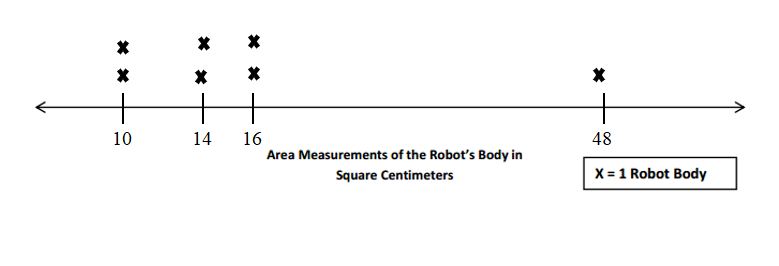
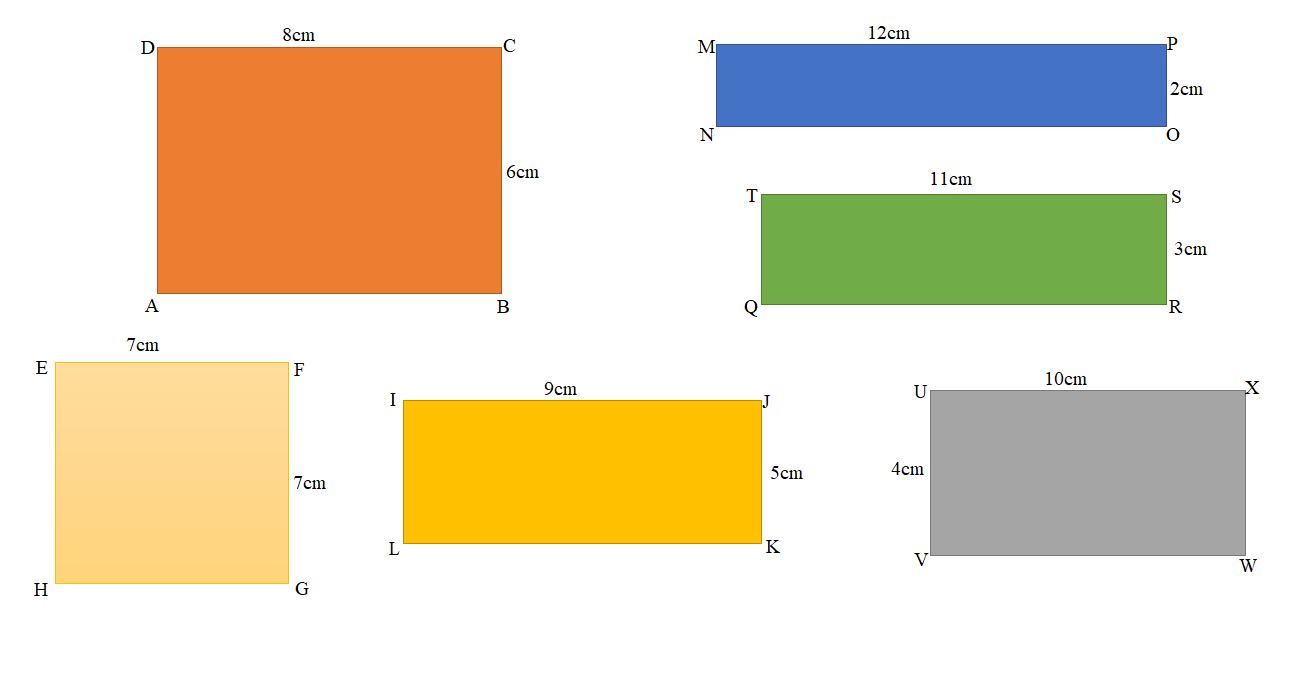
Collect the area measurements of your classmates’ robot bodies. Make a line plot using everyone’s area measurements.
Areas of Robot Bodies
Engage NY Math Grade 3 Module 7 Lesson 26 Problem Set Answer Key pr 1
a. How many different measurements are on the line plot? Why are the measurements different?
b. What does this tell you about the relationship between area and perimeter?
Answer:
a. Engage-NY-Eureka-Math-3rd-Grade-Module-7-Lesson-26-Answer-Key-Eureka Math Grade 3 Module 7 Lesson 26 Problem Set Answer Key-1a
There are four different kinds of measurements represented on the number line. They are different in values because the values of every rectangle is different from each other.

b. Perimeter is the measurement of the distance around a shape. Area is the measurement of space inside a shape. Area and Perimeter are not having any relationship because they are totally two different things. Perimeter is going to be more than the area of the rectangle.

Explanation:
a.
Eureka Math Grade 3 Module 7 Lesson 25 Homework Answer Key h 1
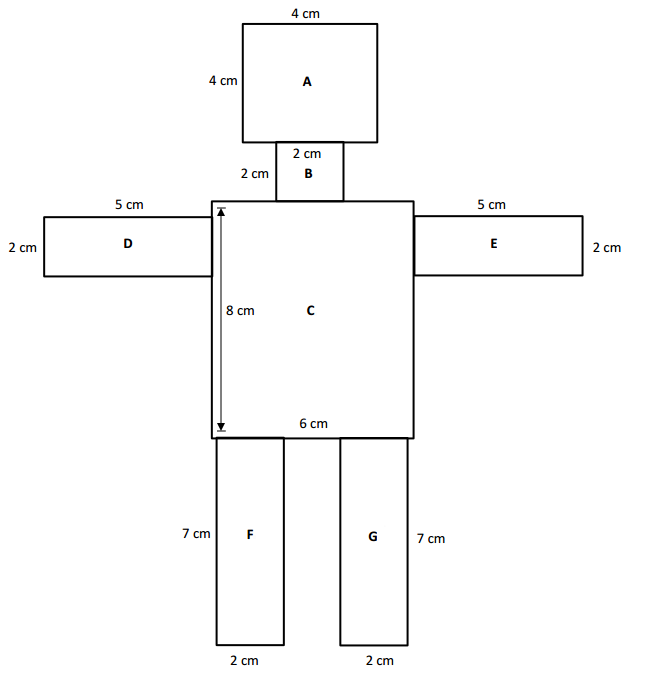
Area of the A rectangle = Length × Width = 4cm × 4cm = 16 square cm.
Area of the B rectangle = Length × Width = 2cm × 2cm = 16 square cm.
Area of the C rectangle = Length × Width = 8cm × 6cm = 48 square cm.
Area of the D rectangle = Length × Width = 5cm × 2cm = 10 square cm.
Area of the E rectangle = Length × Width = 5cm × 2cm = 10 square cm.
Area of the F rectangle = Length × Width = 7cm × 2cm = 14 square cm.
Area of the G rectangle = Length × Width = 7cm × 2cm = 14 square cm.
There are four different kinds of measurements represented on the number line. They are different in values because the values of every rectangle is different from each other.

b. Perimeter is the measurement of the distance around a shape. Area is the measurement of space inside a shape.
For Example : If a rectangle having length as 2cm and width as 1cm.
Perimeter = 2 (Length + Width) = 2 ( 2cm + 1cm) = 2 × 3cm = 6cm.
Area = length × Width = 2cm × 1cm = 2 square cm.
Area and Perimeter are not having any relationship because they are totally two different things.


Question 2.
Measure and calculate the perimeter of your construction paper in inches. Show your work below.
Answer:
Perimeter of my construction paper = 80 inches.

Explanation:
This is my construction paper.
Engage-NY-Eureka-Math-3rd-Grade-Module-7-Lesson-26-Answer-Key-Eureka Math Grade 3 Module 7 Lesson 26 Problem Set Answer Key-2
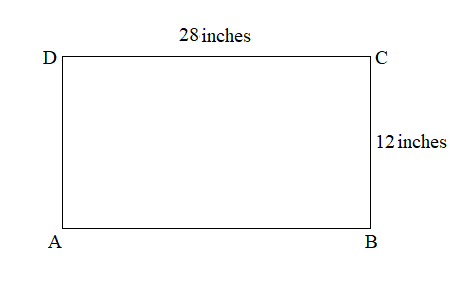
Length of my construction paper = 28 inches.
Width of my construction paper = 12 inches.
Perimeter of my construction paper = 2 ( Length + Width )
= 2 ( 28 inches + 12 inches )
= 2 × 40 inches
= 80 inches.

Question 3.
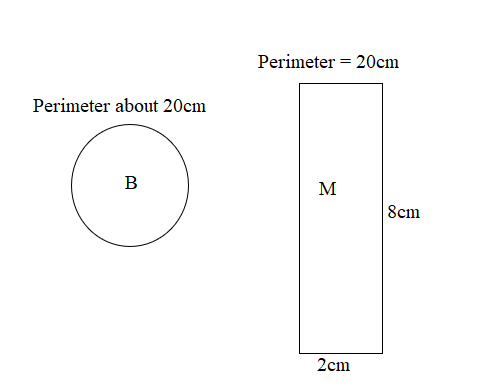
Sketch and label two shapes with the same perimeter from the robot’s environment. What do you notice about the way they look?
Answer:
Even though my two figure have the same Perimeter as 20cm yet they appearances are complete different in size and looks.

Explanation:

Same in perimeter the figure are yet different in size and appearance.

Question 4.
Write two or three sentences describing your robot and the environment in which it lives.
Answer:
My Robot name is Mr. Kool. He lives in machine land, where there are different kinds of Robots.  He is very friendly in nature. He loves to help others in their works. He is taller than other Robots in his locality. He does all kinds of works and loves to be around people. He makes difficult works in a easy way.

Eureka Math Grade 3 Module 7 Lesson 26 Exit Ticket Answer Key

Question 1.
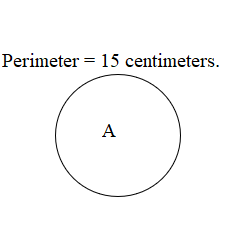
Use string to help you sketch a circle with a perimeter of about 15 centimeters.
Answer:
Engage-NY-Eureka-Math-3rd-Grade-Module-7-Lesson-26-Answer-Key-Eureka Math Grade 3 Module 7 Lesson 26 Exit Ticket Answer Key-1

Explanation:
A figure is the circle having its Perimeter as 15 centimeters.

Question 2.
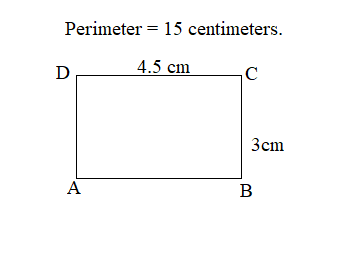
Estimate to draw a rectangle with a perimeter of 15 centimeters. Label the width and length.
Answer:
Perimeter of the ABCD rectangle = 15 centimeters.

Explanation:
Engage-NY-Eureka-Math-3rd-Grade-Module-7-Lesson-26-Answer-Key-Eureka Math Grade 3 Module 7 Lesson 26 Exit Ticket Answer Key-2
Length of the ABCD rectangle = 4.5cm
Width of the ABCD rectangle =  3cm
Perimeter of the ABCD rectangle = 2 ( Length + Width )
= 2 ( 4.5cm + 3cm )
= 2 × 7.5cm
= 15 centimeters.

Eureka Math Grade 3 Module 7 Lesson 26 Homework Answer Key

Question 1.
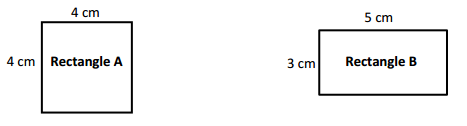
Use Rectangles A and B to answer the questions below.
Eureka Math Grade 3 Module 7 Lesson 26 Homework Answer Key h 1
a. What is the perimeter of Rectangle A?
b. What is the perimeter of Rectangle B?
c. What is the area of Rectangle A?
d. What is the area of Rectangle B?
e. Use your answers to parts (a–d) to help you explain the relationship between area and perimeter.

Answer:
a. Perimeter of the Rectangle A =  16cm.
b. Perimeter of the Rectangle B = 16cm.
c. Area of the Rectangle A = 16 Square cm.
d. Area of the Rectangle B = 15 square cm.
e. The Perimeter of Rectangle A and Rectangle B are same 16cm. The Area of the Rectangle A is 16 square cm and Rectangle B is 15 square cm. There is no connection between the Perimeter and the Area. It is observed that the Perimeter values are more than the Area values of the rectangles.

Explanation:
a. Eureka Math Grade 3 Module 7 Lesson 26 Homework Answer Key h 1
Length of the Rectangle A = 4cm
Width of the Rectangle A =  4cm
Perimeter of the Rectangle A = 2 ( Length + Width )
= 2 ( 4cm + 4cm )
= 2 × 8cm
= 16cm.

b. Length of the Rectangle B = 5cm
Width of the Rectangle B =  3cm
Perimeter of the Rectangle B = 2 ( Length + Width )
= 2 ( 5cm + 3cm )
= 2 × 8cm
= 16cm.

c. Length of the Rectangle A = 4cm
Width of the Rectangle A =  4cm
Area of the Rectangle A =  Length × Width
=  4cm × 4cm
= 16 Square cm.

d. Length of the Rectangle B = 5cm
Width of the Rectangle B =  3cm
Area of the Rectangle B =  Length × Width
=  5cm × 3cm
= 15 square cm.

e. There is no connection between the Perimeter and the Area. It is observed that the Perimeter values are more than the Area values of the rectangles.

Question 2.
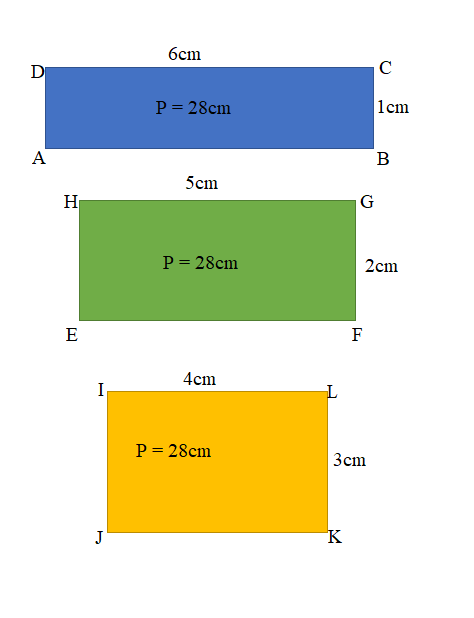
Each student in Mrs. Dutra’s class draws a rectangle with whole number side lengths and a perimeter of 28 centimeters. Then, they find the area of each rectangle and create the table below.

Area in Square Centimeters

Number of Students

132
241
333
405
454
482
492

a. Give two examples from Mrs. Dutra’s class to show how it is possible to have different areas for rectangles that have the same perimeter.
b. Did any students in Mrs. Dutra’s class draw a square? Explain how you know.
c. What are the side lengths of the rectangle that most students in Mrs. Dutra’s class made with a perimeter of 28 centimeters?
Answer:
a. Engage-NY-Eureka-Math-3rd-Grade-Module-7-Lesson-26-Answer-Key-Eureka Math Grade 3 Module 7 Lesson 26 Exit Ticket Answer Key-3a
b. Yes, among all students in  Mrs. Dutra’s class there is one student whose rectangle is said to be a square because all the sides are of 6cm each and have an area as 24 square cm.

c. Engage-NY-Eureka-Math-3rd-Grade-Module-7-Lesson-26-Answer-Key-Eureka Math Grade 3 Module 7 Lesson 26 Exit Ticket Answer Key-3c

Explanation:
a. Here are two students rectangles having same perimeters yet different in areas for their rectangles are shown.

b. Area of the rectangles whose is 24 square cm, is said to be a square of having side length value as 6 cm.

c. Well, the side lengths of the rectangle that most students in Mrs. Dutra’s class made with a perimeter of 28 centimeters are: ( Length, Width)
(12,2);  (11,3);  (10,4);  (9,5);  (8,6);  (7,7).

Eureka Math Grade 3 Module 7 Lesson 25 Answer Key

Engage NY Eureka Math 3rd Grade Module 7 Lesson 25 Answer Key

Eureka Math Grade 3 Module 25 Lesson 4 Sprint Answer Key

A
Multiply or Divide by 6
Engage NY Math 3rd Grade Module 7 Lesson 25 Sprint Answer Key s 1
Answer:
Engage-NY-Eureka-Math-3rd-Grade-Module-7-Lesson-25-Answer-Key-Eureka Math Grade 3 Module 25 Lesson 4 Sprint Answer Key
Question 1.
2 × 6 =
Answer:
2 × 6 = 12.

Question 2.
3 × 6 =
Answer:
3 × 6 = 18.

Question 3.
4 × 6 =
Answer:
4 × 6 = 24.

Question 4.
5 × 6 =
Answer:
5 × 6 = 30.

Question 5.
1 × 6 =
Answer:
1 × 6 = 6.

Question 6.
12 ÷ 6 =
Answer:
12 ÷ 6 = 2.

Question 7.
18 ÷ 6 =
Answer:
18 ÷ 6 = 3.

Question 8.
30 ÷ 6 =
Answer:
30 ÷ 6 = 5.

Question 9.
6 ÷ 6 =
Answer:
6 ÷ 6 = 1.

Question 10.
24 ÷ 6 =
Answer:
24 ÷ 6 = 4.

Question 11.
6 × 6 =
Answer:
6 × 6 = 36.

Question 12.
7 × 6 =
Answer:
7 × 6 = 42.

Question 13.
8 × 6 =
Answer:
8 × 6 = 48.

Question 14.
9 × 6 =
Answer:
9 × 6 = 54.

Question 15.
10 × 6 =
Answer:
10 × 6 = 60.

Question 16.
48 ÷ 6 =
Answer:
48 ÷ 6 = 8.

Question 17.
42 ÷ 6 =
Answer:
42 ÷ 6 = 7.

Question 18.
54 ÷ 6 =
Answer:
54 ÷ 6 = 9.

Question 19.
36 ÷ 6 =
Answer:
36 ÷ 6 = 6.

Question 20.
60 ÷ 6 =
Answer:
60 ÷ 6 = 10.

Question 21.
___ × 6 = 30
Answer:
5 × 6 = 30.

Question 22.
___ × 6 = 6
Answer:
1 × 6 = 6.

Question 23.
___ × 6 = 60
Answer:
10 × 6 = 60.

Question 24.
___ × 6 = 12
Answer:
2 × 6 = 12.

Question 25.
___ × 6 = 18
Answer:
3 × 6 = 18.

Question 26.
60 ÷ 6 =
Answer:
60 ÷ 6 = 10.

Question 27.
30 ÷ 6 =
Answer:
30 ÷ 6 = 5.

Question 28.
6 ÷ 6 =
Answer:
6 ÷ 6 = 1.

Question 29.
12 ÷ 6 =
Answer:
12 ÷ 6 = 2.

Question 30.
18 ÷ 6 =
Answer:
18 ÷ 6 = 3.

Question 31.
___ × 6 = 36
Answer:
6 × 6 = 36.

Question 32.
___ × 6 = 42
Answer:
7 × 6 = 42.

Question 33.
___ × 6 = 54
Answer:
9 × 6 = 54.

Question 34.
___ × 6 = 48
Answer:
8 × 6 = 48.

Question 35.
42 ÷ 6 =
Answer:
42 ÷ 6 = 7.

Question 36.
54 ÷ 6 =
Answer:
54 ÷ 6 = 9.

Question 37.
36 ÷ 6 =
Answer:
36 ÷ 6 = 6.

Question 38.
48 ÷ 6 =
Answer:
48 ÷ 6 = 8.

Question 39.
11 × 6 =
Answer:
11 × 6 = 66.

Question 40.
66 ÷ 6 =
Answer:
66 ÷ 6 = 11.

Question 41.
12 × 6 =
Answer:
12 × 6 = 72.

Question 42.
72 ÷ 6 =
Answer:
72 ÷ 6 = 12.

Question 43.
14 × 6 =
Answer:
14 × 6 = 84.

Question 44.
84 ÷ 6 =
Answer:
84 ÷ 6 = 14.

B
Multiply or Divide by 6
Engage NY Math 3rd Grade Module 7 Lesson 25 Sprint Answer Key s 2
Answer:
Engage-NY-Eureka-Math-3rd-Grade-Module-7-Lesson-25-Answer-Key-Eureka Math Grade 3 Module 25 Lesson 4 Sprint Answer Key-B
Question 1.
1 × 6 =
Answer:
1 × 6 = 6.

Question 2.
2 × 6 =
Answer:
2 × 6 = 12.

Question 3.
3 × 6 =
Answer:
3 × 6 = 18.

Question 4.
4 × 6 =
Answer:
4 × 6 = 24.

Question 5.
5 × 6 =
Answer:
5 × 6 = 30.

Question 6.
18 ÷ 6 =
Answer:
18 ÷ 6 = 3.

Question 7.
12 ÷ 6 =
Answer:
12 ÷ 6 = 2.

Question 8.
24 ÷ 6 =
Answer:
24 ÷ 6 = 4.

Question 9.
6 ÷ 6 =
Answer:
6 ÷ 6 = 1.

Question 10.
30 ÷ 6 =
Answer:
30 ÷ 6 = 5.

Question 11.
10 × 6 =
Answer:
10 × 6 = 60.

Question 12.
6 × 6 =
Answer:
6 × 6 = 36.

Question 13.
7 × 6 =
Answer:
7 × 6 = 42.

Question 14.
8 × 6 =
Answer:
8 × 6 = 48.

Question 15.
9 × 6 =
Answer:
9 × 6 = 54.

Question 16.
42 ÷ 6 =
Answer:
42 ÷ 6 = 7.

Question 17.
36 ÷ 6 =
Answer:
36 ÷ 6 = 6.

Question 18.
48 ÷ 6 =
Answer:
48 ÷ 6 = 8.

Question 19.
60 ÷ 6 =
Answer:
60 ÷ 6 = 10.

Question 20.
54 ÷ 6 =
Answer:
54 ÷ 6 = 9.

Question 21.
___ × 6 = 6
Answer:
1 × 6 = 6.

Question 22.
___ × 6 = 30
Answer:
5 × 6 = 30.

Question 23.
___ × 6 = 12
Answer:
2 × 6 = 12.

Question 24.
___ × 6 = 60
Answer:
10 × 6 = 60.

Question 25.
___ × 6 = 18
Answer:
3 × 6 = 18.

Question 26.
12 ÷ 6 =
Answer:
12 ÷ 6 = 2.

Question 27.
6 ÷ 6 =
Answer:
6 ÷ 6 = 1.

Question 28.
60 ÷ 6 =
Answer:
60 ÷ 6 = 10.

Question 29.
30 ÷ 6 =
Answer:
30 ÷ 6 = 5.

Question 30.
18 ÷ 6 =
Answer:
18 ÷ 6 = 3.

Question 31.
___ × 6 = 18
Answer:
3 × 6 = 18 .

Question 32.
___ × 6 = 24
Answer:
4 × 6 = 24.

Question 33.
___ × 6 = 54
Answer:
9 × 6 = 54.

Question 34.
___ × 6 = 42
Answer:
7 × 6 = 42.

Question 35.
48 ÷ 6 =
Answer:
48 ÷ 6 = 8.

Question 36.
54 ÷ 6 =
Answer:
54 ÷ 6 = 9.

Question 37.
36 ÷ 6 =
Answer:
36 ÷ 6 = 6.

Question 38.
42 ÷ 6 =
Answer:
42 ÷ 6 = 7.

Question 39.
11 × 6 =
Answer:
11 × 6 = 66.

Question 40.
66 ÷ 6 =
Answer:
66 ÷ 6 = 11.

Question 41.
12 × 6 =
Answer:
12 × 6 = 72.

Question 42.
72 ÷ 6 =
Answer:
72 ÷ 6 = 12.

Question 43.
13 × 6 =
Answer:
13 × 6 = 78.

Question 44.
78 ÷ 6 =
Answer:
78 ÷ 6 = 13.

Eureka Math Grade 3 Module 7 Lesson 25 Problem Set Answer Key

Draw a picture of your robot in its environment in the space below. Label the widths, lengths, and perimeters of all rectangles. Label the perimeters of all circular shapes.
Answer:
Engage-NY-Eureka-Math-3rd-Grade-Module-7-Lesson-25-Answer-Key-Eureka Math Grade 3 Module 7 Lesson 25 Problem Set Answer Key

Explanation:
Here is the picture of my Robot with all the labeling of its body parts and their perimeters.

Eureka Math Grade 3 Module 7 Lesson 25 Exit Ticket Answer Key

Question 1.
1. Sketch rectangles with the following perimeters. Label the side lengths.
a. 22 cm
b. 30 cm
Answer:
a. Engage-NY-Eureka-Math-3rd-Grade-Module-7-Lesson-25-Answer-Key-Eureka Math Grade 3 Module 7 Lesson 25 Exit Ticket Answer Key-1a

b. Engage-NY-Eureka-Math-3rd-Grade-Module-7-Lesson-25-Answer-Key-Eureka Math Grade 3 Module 7 Lesson 25 Exit Ticket Answer Key-1b
Explanation:
a. We could draw four different rectangles for having Perimeter as 22cm.
b. We could draw five different rectangles for having Perimeter as 30cm.

Question 2.
Explain the steps you took to create the rectangles with the given perimeters.
Answer:
Step 1 : Considered the perimeter value.
Step 2 : Later, considered the formula of perimeter of rectangle = 2 ( Length + Width ).
Step 3 : Divided the perimeter value by 2.
Step 4 : Result  is taken and divided into two parts where one value is going to be higher than the other.
Step 5 : Considered higher value as Length and smaller as Width.

Eureka Math Grade 3 Module 7 Lesson 25 Homework Answer Key

The robot below is made of rectangles. The side lengths of each rectangle are labeled. Find the perimeter of each rectangle, and record it in the table on the next page.
Eureka Math Grade 3 Module 7 Lesson 25 Homework Answer Key h 1

Rectangle

Perimeter

AP = 4 × 4 cm
P = 16 cm
B
C
D
E
F
G

Answer:
Engage-NY-Eureka-Math-3rd-Grade-Module-7-Lesson-25-Answer-Key-Eureka Math Grade 3 Module 7 Lesson 25 Homework Answer Key
Explanation:
The Robot all body Parts  Perimeters are calculated in the above chart.


Eureka Math Grade 3 Module 7 Lesson 25 Evaluation Rubric Answer Key

Evaluation Rubric

4321Subtotal
Perimeter calculations for all shapes are correct, and both evaluations of a classmate’s project have been completed.Perimeter calculations include 1 to 2 errors, and both evaluations of a classmate’s project have been completed.Perimeter calculations include 3 to 4 errors, and at least 1 evaluation of a classmate’s project has been completed.Perimeter calculations include 5 or more errors, and at least 1 evaluation of a classmate’s project has been completed._____/4
Perimeter calculations include 1 2 3  to 5 errors, and all evaluation of a classmate’s project has been completed.

Eureka Math Grade 3 Module 7 Lesson 24 Answer Key

Engage NY Eureka Math 3rd Grade Module 7 Lesson 24 Answer Key

Eureka Math Grade 3 Module 7 Lesson 24 Pattern Sheet Answer Key

Multiply.
Engage NY Math 3rd Grade Module 7 Lesson 23 Pattern Sheet Answer Key p 1
multiply by 6 (6–10)
Answer:
Engage-NY-Eureka-Math-3rd-Grade-Module-7-Lesson-24-Answer-Key-Eureka Math Grade 3 Module 7 Lesson 24 Pattern Sheet Answer Key
Explanation:
6 × 6 = 36
6 × 7 = 42
6 × 8 = 48
6 × 9 = 54
6 × 10 = 60.

Eureka Math Grade 3 Module 7 Lesson 24 Problem Set Answer Key

Use the given perimeters in the chart below to choose the widths and lengths of your robot’s rectangular body parts. Write the widths and lengths in the chart below. Use the blank rows if you want to add extra rectangular body parts to your robot.

Letter

Body PartPerimeter

Width and Length

Aarm14 cm__________ cm by __________cm
Barm14 cm__________ cm by __________cm
Cleg18 cm__________ cm by __________cm
Dleg18 cm__________ cm by __________cm
EbodyDouble the perimeter of one arm = _______ cm__________ cm by __________cm
Fhead16 cm__________ cm by __________cm
GneckHalf the perimeter of the head =

_______ cm

__________ cm by __________cm
H__________ cm by __________cm
I__________ cm by __________cm
My robot has 7 to 9 rectangular body parts.  Number of body parts:  _______

Answer:
Engage-NY-Eureka-Math-3rd-Grade-Module-7-Lesson-24-Answer-Key-Eureka Math Grade 3 Module 7 Lesson 24 Problem Set Answer Key Engage-NY-Eureka-Math-3rd-Grade-Module-7-Lesson-24-Answer-Key-Eureka Math Grade 3 Module 7 Lesson 24 Problem Set Answer Key-

Use the information in the chart below to plan an environment for your robot. Write the width and length for each rectangular item. Use the blank rows if you want to add extra circular or rectangular items to your robot’s environment.

LetterItemShapePerimeter

Width and Length

Jsuncircleabout 25 cm
Khouserectangle82 cm__________ cm by __________cm
Ltree topcircleabout 30 cm
Mtree trunkrectangle30 cm__________ cm by __________cm
Ntree topcircleabout 20 cm
Otree trunkrectangle20 cm__________ cm by __________cm
P
Q
My robot’s environment has 6 to 8 items.  Number of items:  _______

Answer:
Engage-NY-Eureka-Math-3rd-Grade-Module-7-Lesson-24-Answer-Key-Eureka Math Grade 3 Module 7 Lesson 24 Problem Set Answer Key-1

Eureka Math Grade 3 Module 7 Lesson 24 Exit Ticket Answer Key

Estimate to draw three different rectangles with a perimeter of 16 centimeters. Label the width and length of each rectangle.
Answer:
Engage-NY-Eureka-Math-3rd-Grade-Module-7-Lesson-24-Answer-Key-Eureka Math Grade 3 Module 7 Lesson 24 Exit Ticket Answer Key

Explanation:
Using the Perimeter of 16 cm we can draw three rectangles ABCD, EFGH, IJKL with different lengths and width.

Eureka Math Grade 3 Module 7 Lesson 24 Homework Answer Key

Question 1.
Brian draws a square with a perimeter of 24 inches. What is the length of the side of the square?
Answer:
Length of the side of the square = 6 inches.

Explanation:
Perimeter of the Square = 24 inches
Number of sides in the square = 4
Length of the side of the square = Perimeter of the Square  ÷ Number of sides in the square
= 24 inches ÷ 4
= 6 inches.

Question 2.
A rectangle has a perimeter of 18 centimeters.
a. Estimate to draw as many different rectangles as you can that have a perimeter of 18 centimeters. Label the width and length of each rectangle.
b. How many different rectangles did you find?
c. Explain the strategy you used to find the rectangles.
Answer:
a. Engage-NY-Eureka-Math-3rd-Grade-Module-7-Lesson-24-Answer-Key-Eureka Math Grade 3 Module 7 Lesson 24 Homework Answer Key-2a

b. I could find three different rectangles having perimeter as 18 centimeters.

c. The strategy which I used to find the rectangles is that :
Step 1:  Considered the Perimeter formula 2 ( Length + Width ) and its perimeter value 18 centimeters.
Step 2: Calculated the Length and width values.
Step 3: Keeping in mind highest value as length and lesser as Width.

Explanation:
a. Engage-NY-Eureka-Math-3rd-Grade-Module-7-Lesson-24-Answer-Key-Eureka Math Grade 3 Module 7 Lesson 24 Homework Answer Key-2a
b. I could find three different rectangles having perimeter as 18 centimeters.
c. The strategy which I used to find the rectangles is that :
Step 1:  Considered the Perimeter formula 2 ( Length + Width ) and its perimeter value 18 centimeters.
Step 2: Calculated the Length and width values.
Step 3: Keeping in mind highest value as length and lesser as Width.

Question 3.
The chart below shows the perimeters of three rectangles.
a. Write possible widths and lengths for each given perimeter.

RectanglePerimeter

Width and Length

A6 cm__________ cm by __________ cm
B10 cm__________ cm by __________ cm
C14 cm__________ cm by __________ cm

b. Double the perimeters of the rectangles in part (a). Then, find possible widths and lengths.

RectanglePerimeter

Width and Length

A12 cm__________ cm by __________ cm
B__________ cm by __________ cm
C__________ cm by __________ cm

Answer:
a. Engage-NY-Eureka-Math-3rd-Grade-Module-7-Lesson-24-Answer-Key-Eureka Math Grade 3 Module 7 Lesson 24 Homework Answer Key-3
b. Engage-NY-Eureka-Math-3rd-Grade-Module-7-Lesson-24-Answer-Key-Eureka Math Grade 3 Module 7 Lesson 24 Homework Answer Key-3b
Explanation:
a. For the perimeter of 6cm, we have a rectangle length as 2cm and width as 1cm.
For the perimeter of 10cm, we have a rectangle length as 2cm and width as 3cm.
For the perimeter of 14cm, we have a rectangle length as 3cm and width as 4cm.

b. For the perimeter of 12cm, we have a rectangle length as 2cm and width as 4cm.

Go Math Grade 1 Answer Key Chapter 11 Three-Dimensional Geometry

Go Math Grade 1 Chapter 11 Answer Key Three-Dimensional Geometry

Curious George

What three-dimensional shapes do you see in the sand castle?
Go Math Grade 1 Answer Key Chapter 11 Three-Dimensional Geometry 1

Answer:
Cone,cylinder,cube.

Explanation:
In the above sand castle there are many three-dimensional shapes that are cone,cylinder,cube.

Three–Dimensional Geometry Show What You Know

Alike and Different

Circle the objects that are alike.

Question 1.
Go Math Grade 1 Answer Key Chapter 11 Three-Dimensional Geometry 2

Answer:

Explanation:
In the above shapes there are 2 cubes.So, circle cubes.

Question 2.
Go Math Grade 1 Answer Key Chapter 11 Three-Dimensional Geometry 3

Answer:

Explanation:
In the above shapes there are 2 cones.So, circle cones.

Identify Three-Dimensional Shapes

Color the Go Math Grade 1 Answer Key Chapter 11 Three-Dimensional Geometry 4 blue. Color the Go Math Grade 1 Answer Key Chapter 11 Three-Dimensional Geometry 5 red. Color the yellow.

Question 3.
Go Math Grade 1 Answer Key Chapter 11 Three-Dimensional Geometry 5.1

Answer:

Explanation:
The above given shape is cube.So, color it yellow.

Question 4.
Go Math Grade 1 Answer Key Chapter 11 Three-Dimensional Geometry 5.2

Answer:

Explanation:
The above given shape is circle.So, color it blue.

Question 5.
Go Math Grade 1 Answer Key Chapter 11 Three-Dimensional Geometry 6

Answer:

Explanation:
The above given shape is cylinder.So, color it red.

Sort by Size
Mark an X on the object that does not belong.

Question 6.
Go Math Grade 1 Answer Key Chapter 11 Three-Dimensional Geometry 7

Answer:

Explanation:
In the above shapes the 3rd shape is big compared to the others.So, put a cross mark across it.

Three–Dimensional Geometry Vocabulary Builder

Visualize It
Write review words to name the shapes.
Go Math Grade 1 Answer Key Chapter 11 Three-Dimensional Geometry 8

Answer:

Understand Vocabulary

Look at the three-dimensional shapes. Color the sphere Go Math Grade 1 Answer Key Chapter 11 Three-Dimensional Geometry 8.1 Color the cube Go Math Grade 1 Answer Key Chapter 11 Three-Dimensional Geometry 9 Color the cylinder Go Math Grade 1 Answer Key Chapter 11 Three-Dimensional Geometry 10

Question 1.
Go Math Grade 1 Answer Key Chapter 11 Three-Dimensional Geometry 10.1

Answer:

Explanation:
The above given shape is cylinder.So, color it green.

Question 2.
Go Math Grade 1 Answer Key Chapter 11 Three-Dimensional Geometry 11

Answer:

Explanation:
The above given shape is sphere.so, color it blue.

Question 3.
Go Math Grade 1 Answer Key Chapter 11 Three-Dimensional Geometry 12

Answer:

Explanation:
The above given shape is cube.So, color it yellow

Three–Dimensional Geometry Game: Shape Match Bingo

Materials • 9 Go Math Grade 1 Answer Key Chapter 11 Three-Dimensional Geometry 13 • 9 Go Math Grade 1 Answer Key Chapter 11 Three-Dimensional Geometry 14 • Go Math Grade 1 Answer Key Chapter 11 Three-Dimensional Geometry 15
Play with a partner. Take turns.
1. One player uses Go Math Grade 1 Answer Key Chapter 11 Three-Dimensional Geometry 16. The other player uses Go Math Grade 1 Answer Key Chapter 11 Three-Dimensional Geometry 17.
2. Spin Go Math Grade 1 Answer Key Chapter 11 Three-Dimensional Geometry 17.1. Use a counter to cover a space with that shape.
3. If you cannot cover a space, your turn is over.
4. The first player to cover all of his or her spaces wins.
Go Math Grade 1 Answer Key Chapter 11 Three-Dimensional Geometry 18

Three–Dimensional Geometry Vocabulary Game

Going Places with GOMATH! words

Going on a Train Trip

For 2 players

Materials
Go Math Grade 1 Answer Key Chapter 11 Three-Dimensional Geometry 19

How to Play
1. Choose a Go Math Grade 1 Answer Key Chapter 11 Three-Dimensional Geometry 20 and put it on START.
2. Toss the Go Math Grade 1 Answer Key Chapter 11 Three-Dimensional Geometry 21 to take a turn. Move your Go Math Grade 1 Answer Key Chapter 11 Three-Dimensional Geometry 22 that many spaces.
3. If you land on these spaces:
Red Space Take a Clue Card. Answer the question. If you are correct, move ahead 1. Return the Clue Card to the bottom of the pile.
Blue Space Follow the directions on the space.
4. Collect 5 Clue Cards. Move around the track as many times as you need to. Then, follow the closest center path to reach FINISH.
5. The first player to reach FINISH wins.
Go Math Grade 1 Answer Key Chapter 11 Three-Dimensional Geometry 23
Go Math Grade 1 Answer Key Chapter 11 Three-Dimensional Geometry 24

The Write Way

Reflect
Choose one idea. Draw and write about it.
• Tell about two of these words.
Go Math Grade 1 Answer Key Chapter 11 Three-Dimensional Geometry 25
• Compare a curved surface to a flat surface. Tell how are they alike and how they are different.
Go Math Grade 1 Answer Key Chapter 11 Three-Dimensional Geometry 26

Answer:

Lesson 11.1 Three-Dimensional Shapes

Essential Question
How can you identify and describe three-dimensional shapes?

Listen and Draw

Draw to sort the three-dimensional shapes.
Go Math Grade 1 Answer Key Chapter 11 Three-Dimensional Geometry 27

Answer:

Explanation:
In the above picture there are two different shapes.They are cubes and spheres.

Math Talk
MATHEMATICAL PRACTICES
Generalize Explain how you sorted the shapes.

Model and Draw

These are three-dimensional shapes.
Go Math Grade 1 Answer Key Chapter 11 Three-Dimensional Geometry 28

Share and Show MATH BOARD

Use three-dimensional shapes. Sort the shapes into three groups. Name and draw the shapes.

Question 1.
only flat surfaces

Answer:

Explanation:
Rectangular prism and cube both have only flat surfaces.

Question 2.
only a curved surface

Answer:

Explanation:
Sphere has only a curved surface.

Question 3.
both flat and curved surfaces

Answer:

Explanation:
Cone and cylinder both have flat and curved surfaces.

On Your Own

MATHEMATICAL PRACTICE

Use Models Use three-dimensional shapes.
Write the number of flat surfaces for each shape.

Question 4.
A rectangular prism has __ flat surfaces.

Answer:
A rectangular prism has 6 flat surfaces.

Question 5.
A cube has __ flat surfaces.

Answer:
A cube has 6 flat surfaces

Question 6.
A cylinder has __ flat surfaces.

Answer:
A cylinder has 2 flat surfaces

Question 7.
A sphere has __ flat surfaces

Answer:
A sphere has 0 flat surfaces

GO DEEPER
Write to name each shape.
Go Math Grade 1 Answer Key Chapter 11 Three-Dimensional Geometry 29

Question 8.
Go Math Grade 1 Answer Key Chapter 11 Three-Dimensional Geometry 30

Question 9.
Go Math Grade 1 Answer Key Chapter 11 Three-Dimensional Geometry 31

Answer:

Explanation:
The above given shape is cone.So, write cone.

Question 10.
Go Math Grade 1 Answer Key Chapter 11 Three-Dimensional Geometry 32

Answer:

Explanation:
The above shape is cube.So, write cube.

Question 11.
Go Math Grade 1 Answer Key Chapter 11 Three-Dimensional Geometry 33

Answer:

Explanation:
The above given shape is cylinder.So, write cylinder.

Question 12.
Go Math Grade 1 Answer Key Chapter 11 Three-Dimensional Geometry 34

Answer:

Explanation:
The above givem shape is rectangular prism.So, write rectangular prism.

Problem Solving • Applications

Circle the objects that match the clues

Question 13.
Kelly drew objects that have both flat and curved surfaces.
Go Math Grade 1 Answer Key Chapter 11 Three-Dimensional Geometry 35

Answer:

Explanation:
In the above objects the circled objects have both flat and curved surfaces.

Question 14.
Sandy drew some rectangular prisms.
Go Math Grade 1 Answer Key Chapter 11 Three-Dimensional Geometry 36

Answer:

Explanation:
The circled objects in the above picture are in the shape of rectangular prisms.

Question 15.
Match each shape to the group where it belongs
Go Math Grade 1 Answer Key Chapter 11 Three-Dimensional Geometry 37

Answer:

Explanation:
Cone and cylinder have both flat and curved surfaces, cube and rectangular prism have only flat surfaces an dthe sphere has only a curved surface.

TAKE HOME ACTIVITY
• Ask your child to name real objects shaped like a sphere, a rectangular prism, and a cylinder.

Three-Dimensional Shapes Homework & practice 11.1

Three-Dimensional Shapes

Use three-dimensional shapes. Write the number of flat surfaces for each shape.

Question 1.
A cylinder has __ flat surfaces.

Answer:
A cylinder has 2 flat surfaces.

Question 2.
A rectangular prism has _ flat surfaces.

Answer:
A rectangular prism has 6 flat surfaces.

Question 3.
A cone has _ flat surface.

Answer:
A cone has 1 flat surface.

Question 4.
A cube has _ flat surfaces.

Answer:
A cube has 6 flat surfaces.

Problem Solving

Question 5.
Circle the object that matches the clue. Mike finds an object that has only a curved surface.
Go Math Grade 1 Answer Key Chapter 11 Three-Dimensional Geometry 38

Answer:

Explanation:
Th circled object in the above objects is sphere.A sphere has only a curved surface.

Question 6.
WRITE Math
Use pictures or words to describe a cone.
Go Math Grade 1 Answer Key Chapter 11 Three-Dimensional Geometry 39

Answer:

Lesson Check

Question 1.
Circle the shape that has both flat and curved surfaces.
Go Math Grade 1 Answer Key Chapter 11 Three-Dimensional Geometry 40

Answer:

Explanation:
The circled shape in the above shapes has both flat and curved surfaces.

Question 2.
Circle the shape that has only a curved surface.
Go Math Grade 1 Answer Key Chapter 11 Three-Dimensional Geometry 41

Answer:

Explanation:
The circled shape in the above shapes is a sphere.A sphere has only curved surface.

Spiral Review

Question 3.
Count forward. Write the number that is missing.
109, 110, 111, __, 113

Answer:
109,110,111,112,113.

Explanation:
There is a missng number in between the given number.Count forward.112 comes after 111.So, the missing number is 112.

Question 4.
What is the sum of 2 and 3? Write the number sentence.
Go Math Grade 1 Answer Key Chapter 11 Three-Dimensional Geometry 42

Answer:

Explanation:
When we add 2 and 3, the sum is 5.So, 2+3=5.

Lesson 11.2 Combine Three-Dimensional Shapes

Essential Question
How can you combine three-dimensional shapes to make new shapes?
Answer:
To make new shapes using three-dimensional shapes we have to put the shapes above,below or besides the the other shape so that a new shape will be formed.

Listen and Draw

Trace to draw the new shape. Write to name the new shape.
Go Math Grade 1 Answer Key Chapter 11 Three-Dimensional Geometry 43

Answer:

Explanation:
The above shapes are made by combing two shapes.The new shapes are cylinder and rectangular prism.

Math Talk
MATHEMATICAL PRACTICES
Apply Describe the new shapes Mandy and Carl made.

Model and Draw

You can put shapes together to make a new shape.
Go Math Grade 1 Answer Key Chapter 11 Three-Dimensional Geometry 44

Share and Show MATH BOARD

Use three-dimensional shapes.
Go Math Grade 1 Answer Key Chapter 11 Three-Dimensional Geometry 45
Go Math Grade 1 Answer Key Chapter 11 Three-Dimensional Geometry 46

Answer:

Explanation:
In the above shapes the circled shapes are the shapes that are made by combing the given shapes besides them.

On Your Own

MATHEMATICAL PRACTICE

Attend to Precision
Use three-dimensional shapes.
Go Math Grade 1 Answer Key Chapter 11 Three-Dimensional Geometry 47
Go Math Grade 1 Answer Key Chapter 11 Three-Dimensional Geometry 48

Answer:

Explanation:
In the above shapes the circled shapes are the shapes that are made by combing the given shapes besides them.

Problem Solving • Applications WRITE Math

GO DEEPER
Circle the shapes you could use to model the ice cream cone.

Question 9.
Go Math Grade 1 Answer Key Chapter 11 Three-Dimensional Geometry 49

Answer:

Explanation:
In the above shapes the circles shapes make the icecream.

Question 10.
Circle the ways that make the same shape.
Go Math Grade 1 Answer Key Chapter 11 Three-Dimensional Geometry 50

Answer:

Explanation:
The circled shapes in the above shapes is a cube and is formed by combining cubes.

Question 11.
Combine Go Math Grade 1 Answer Key Chapter 11 Three-Dimensional Geometry 51 and Go Math Grade 1 Answer Key Chapter 11 Three-Dimensional Geometry 52.
Choose all the new shapes you can make.
Go Math Grade 1 Answer Key Chapter 11 Three-Dimensional Geometry 51.1

Answer:

Explanation:
The marked shapes in the above picture are formed by combing the two given shapes that are rectangular prism and a cone.

TAKE HOME ACTIVITY
• Ask your child to show you two different new shapes he or she can make by combining a soup can and a cereal box.

Combine Three-Dimensional Shapes Homework & Practice 11.2

Use three-dimensional shapes.

Go Math Grade 1 Answer Key Chapter 11 Three-Dimensional Geometry 52.1

Answer:

Explanation:.
The circled shapes in the above picture are formed by combing the two given shapes besides them.

Problem Solving

Question 3.
Circle the shapes you could use to model the bird feeder.
Go Math Grade 1 Answer Key Chapter 11 Three-Dimensional Geometry 54

Answer:

Explanation:
The circled shapes cone and the cylinder are used to make the model the bird feeder

Question 4.
WRITE Math
Combine two shapes to make a new shape. Describe how you put the shapes together.
_____________
_____________
_____________
_____________

Answer:
We can put the shapes together by placing the shapes one beside,above or below the other shapes.

Lesson Check

Question 1.
Circle the shape that combines Go Math Grade 1 Chapter 11 Answer Key Pdf Three-Dimensional Geometry 55 and Go Math Grade 1 Chapter 11 Answer Key Pdf Three-Dimensional Geometry 56
Go Math Grade 1 Answer Key Chapter 11 Three-Dimensional Geometry 57

Answer:

Explanation:

The circled shapes in the above picture are formed by combing the two given shapes cylinder and cone.

Spiral Review

Question 2.
Write the sum. Write how many tens.
40 + 20 = __ __ tens

Answer:
40+20=60=6 tens

Explanation:
When we add 4 tens and 2 tens we get 6 tens.

Question 3.
Emi has 15 crayons. She gives some crayons to Jo. Now she has 9 crayons. How many crayons did Emi give to Jo? Use the model to solve
Go Math Grade 1 Chapter 11 Answer Key Pdf Three-Dimensional Geometry 58
__ crayons

Answer:
6 crayons

Explanation:
Emi has 15 crayons. She gives some crayons to Jo. Now she has 9 crayons.When we subtract 9 from 15 we get 6.So, the number of crayons Emi gave to Jo are 6 crayons.

Lesson 11.3 Make New Three-Dimensional Shapes

Essential Question
How can you use a combined shape to build new shapes?

Listen and Draw

Draw to copy the shape.

Go Math Grade 1 Chapter 11 Answer Key Pdf Three-Dimensional Geometry 59

Math Talk
MATHEMATICAL PRACTICES
Describe how to draw to copy the new shape.

Model and Draw
Go Math Grade 1 Chapter 11 Answer Key Pdf Three-Dimensional Geometry 60

Answer:

Explanation:
By repeating the bulided shape we can make the circled shape.We cannot make the other shape because its not like the shape given.

Share and Show MATH BOARD

Use three-dimensional shapes
Go Math Grade 1 Chapter 11 Answer Key Pdf Three-Dimensional Geometry 61

Answer:

Explanation:
In the above shapes the circled shapes are the shapes that are made by combing the given shapes besides them.

On Your Own

MATHEMATICAL PRACTICE
Use a Concrete Model
Use three-dimensional shapes.
Go Math Grade 1 Chapter 11 Answer Key Pdf Three-Dimensional Geometry 62

Answer:

Explanation:
In the above shapes the circled shapes are the shapes that are made by combing the given shapes besides them.

Question 7.
THINK SMARTER
Look at the shape.
How many Go Math Grade 1 Chapter 11 Answer Key Pdf Three-Dimensional Geometry 63 are used to make the shape?
Go Math Grade 1 Chapter 11 Answer Key Pdf Three-Dimensional Geometry 64

Answer:

Explanation:
The given shape is made by combining the 2 cubes 3 times.

How many Go Math Grade 1 Chapter 11 Answer Key Pdf Three-Dimensional Geometry 63.1 are used to make the shape?
Go Math Grade 1 Chapter 11 Answer Key Pdf Three-Dimensional Geometry 63.2

Answer:

Explanation:
The given shape is made by combining 1 cube 6 times.

TAKE HOME ACTIVITY
• Ask your child to explain how he or she solved Exercise 4.

Make New Three-Dimensional Shapes Homework & Practice 11.3

Use three-dimensional shapes.

Go Math Grade 1 Chapter 11 Answer Key Pdf Three-Dimensional Geometry 65

Answer:

Explanation:
In the above shapes the circled shapes are the shapes that are made by combing the given shapes besides them.

Question:

Go Math Grade 1 Chapter 11 Answer Key Pdf Three-Dimensional Geometry 66

Answer:

Explanation:
The above shape is formed by repeating the given shape.

Question 4.
WRITE Math
Use a cube and a cylinder to build a new shape. Repeat. Draw to show how you can combine these two new shapes to make a larger shape.
Go Math Grade 1 Chapter 11 Answer Key Pdf Three-Dimensional Geometry 67

Answer:

Explanation:
By drawing a cube and a cylinder and repeating it we can make a larger shape like the above.

Lesson Check

Question 1.
Which new shape can you make? Circle the shape.
Go Math Grade 1 Chapter 11 Answer Key Pdf Three-Dimensional Geometry 68

Answer:

Explanation:
In the above shapes the circled shapes are the shapes that are made by combing the given shapes above them.

Spiral Review

Question 2.
Which addition fact helps you solve 15 − 6 = ? Write the number sentence.
__ + __ = __

Answer:
6+3=9

Explanation:
When we add 6 and 3 we get the sum 9.Therefore the sum of 6 and 3 is 9.

Question 3.
Which doubles fact helps you solve 5 + 6 = 11?
Circle the number sentence.
Go Math Grade 1 Chapter 11 Answer Key Pdf Three-Dimensional Geometry 69

Answer:

Explanation:
When we add 5 and 6 we get the sum as 11.The dobubles fact 5+5=10 helps us to solve 5+6=11.

Three–Dimensional Geometry Mid-Chapter Check Point

Concepts and Skills

Question 1.
Circle the rectangular prisms.

Question 2.
Draw a line under the shapes that have both flat and curved surfaces.
Go Math Grade 1 Chapter 11 Answer Key Pdf Three-Dimensional Geometry 70

Answer:

Explanation:
The circled ojects in the above picturehave both flat and curved surfaces.

Use three-dimensional shapes.
Go Math Grade 1 Chapter 11 Answer Key Pdf Three-Dimensional Geometry 71

Answer:

Explanation:
The circled object in the above picture is formed by combining the shapes cube and cone.

Question 4.
THINK SMARTER
Which new shape can you make?
Go Math Grade 1 Chapter 11 Answer Key Pdf Three-Dimensional Geometry 72

Answer:

Explanation:
When we combine and repeat the shape given in the question we get the third shape marked in the above picture.

Lessson 11.4 Problem Solving • Take Apart Three-Dimensional Shapes

Essential Question
How can acting it out help you take apart combined shapes?
Mike has Go Math Grade 1 Chapter 11 Answer Key Pdf Three-Dimensional Geometry 73 and Go Math Grade 1 Chapter 11 Answer Key Pdf Three-Dimensional Geometry 75. He chose some shapes to build a bridge. Which shapes did Mike use to build the bridge?
Go Math Grade 1 Chapter 11 Answer Key Pdf Three-Dimensional Geometry 76

Unlock the Problem

What do I need to find?
Go Math Answer Key Grade 1 Chapter 11 Three-Dimensional Geometry 77
What information do I need to use?
Mike has these shapes.
Go Math Answer Key Grade 1 Chapter 11 Three-Dimensional Geometry 78

Show how to solve the problem.
Go Math Answer Key Grade 1 Chapter 11 Three-Dimensional Geometry 79

Answer:

Explanation:
The above shape is made by combining the circled shapes cylinder and rectangular prism.

HOME CONNECTION
• Your child is investigating how shapes can be taken apart. Being able to decompose shapes into smaller parts provides a foundation for future work with fractions.

Try Another Problem

Kim used shapes to build this castle.

Use three-dimensional shapes. Circle your answer.

Question 1.
Which shapes did Kim use to build the tower?
Go Math Answer Key Grade 1 Chapter 11 Three-Dimensional Geometry 80

Answer:

Explanaton:
Kim made the tower by combining the circled shapes cone and a cylinder.

Question 2.
Which shapes did Kim use to build this wall?
Go Math Answer Key Grade 1 Chapter 11 Three-Dimensional Geometry 81

Answer:

Explanation:
Kim made the wall by combining the circled shapes cube and rectangular prism.

Question 3.
Which shapes did Kim use to build this wall?
Go Math Answer Key Grade 1 Chapter 11 Three-Dimensional Geometry 82

Answer:

Explanation:
Kim made the above wall by combining the above circled shapes cylinder and cube.

Question 4.
Which shapes did Kim use to build the gate?
Go Math Answer Key Grade 1 Chapter 11 Three-Dimensional Geometry 83

Answer:

Explanation:
Kim bulid the above gate by combining the circled shapes cylinder and rectangular prism.

Math Talk
MATHEMATICAL PRACTICES
Look for Structure How do you know which shapes Kim used to build the tower?

Share and Show MATH BOARD

MATHEMATICAL PRACTICE
Analyze Use three-dimensional shapes. Circle your answer.

Question 5.
Zack used shapes to build this gate. Which shapes did Zack use?
Go Math Answer Key Grade 1 Chapter 11 Three-Dimensional Geometry 84

Answer:

Explanation:
zack build the gate by using the circled shapes cone and rectangular prism.

Question 6.
Chris used shapes to build this wall. Which shapes did Chris use?
Go Math Answer Key Grade 1 Chapter 11 Three-Dimensional Geometry 85

Answer:

Explanation:
Chris build the above wall by using the circled shapes cylinder,cube and rectangular prism.

Question 7.
THINK SMARTER
Rosa uses Go Math Answer Key Grade 1 Chapter 11 Three-Dimensional Geometry 86 and Go Math Answer Key Grade 1 Chapter 11 Three-Dimensional Geometry 87 to build a tower. Draw to show a tower Rosa could build.
Go Math Answer Key Grade 1 Chapter 11 Three-Dimensional Geometry 88

Answer:

Explanation:
Roscone and cylinder.a build the tower by using the shapes .

On Your Own

GO DEEPER
Circle the ways that show the same shape.

Question 8.
Go Math Answer Key Grade 1 Chapter 11 Three-Dimensional Geometry 89

Answer:

Explanation:
The circled shape in the above pictures is a cube and it is formed by combining cubes only.

Question 9.
THINK SMARTER
Go Math Answer Key Grade 1 Chapter 11 Three-Dimensional Geometry 90

Answer:

Explanation:
The circled shape in the above pictures is a cube and it is formed by combining cubes only.

Question 10.
THINK SMARTER
Sharon has many different blocks. She built this shape with her blocks.
Go Math Answer Key Grade 1 Chapter 11 Three-Dimensional Geometry 91
Choose all the shapes Sharon used.
Go Math Answer Key Grade 1 Chapter 11 Three-Dimensional Geometry 92

Answer:

Explanation:
Sharon made the shapes by using the shapes cube and rectangular prism.

TAKE HOME ACTIVITY
• Use real items such as a soup can (cylinder) and a cereal box (rectangular prism) to build a shape. Ask your child to name the shapes you used.

Problem Solving • Take Apart Three-Dimensional Shapes Homework & practice 11.4

Use three-dimensional shapes.
Circle your answer.

Question 1.
Paco used shapes to build this robot. Circle the shapes he used.
Go Math Answer Key Grade 1 Chapter 11 Three-Dimensional Geometry 93

Answer:

Explanation:
Paco made a robot by using the circled shapes cylinder and rectangular prism.

Problem Solving

Question 2.
Circle the ways that show the same shape.
Go Math 1st Grade Answer Key Chapter 11 Three-Dimensional Geometry 94

Answer:

Explanation:
The circled shape in the above picture is a rectangular prism and it is made by combining rectangular prisms only.

Question 3.
WRITE Math
Draw a picture of a house made from shapes. Write the shape names you used.
Go Math 1st Grade Answer Key Chapter 11 Three-Dimensional Geometry 95

Answer:

Explanation:
I made a by using some shapes that are cone and rectangular prisms.

Lesson Check

Question 1.
Lara made this picture frame. Circle the shapes she used to make the frame
Go Math 1st Grade Answer Key Chapter 11 Three-Dimensional Geometry 96

Answer:

Explanation:
The circled shapes in the above picture are used  by lara to make the picture frame.

Spiral Review

Question 2.
Compare each pair of numbers. Write <, >, or =.
Go Math 1st Grade Answer Key Chapter 11 Three-Dimensional Geometry 97

Answer:

Explanation:
In the above picture we used the symbols <,> and = to compare the numbers.
13 is lessthan 31 so, use < symbol to compare
13 is equal to 13 so, use = symbol to compare
31 is greaterthan 13 so, use > symbol to compare
31 isnequal to 31 so, use = symbol to compare.

Question 3.
Subtract. What is the difference? Write the number.
60 – 30 = __

Answer:
60-30=30.

Explanation:
When we subtract 30 from 60 we get 30.3 tens fro 6 tens is 3 tens.Therefore 60-30=30.

Lesson 11.5 Two-Dimensional Shapes on Three-Dimensional Shapes

Essential Question
What two-dimensional shapes do you see on the flat surfaces of three-dimensional shapes?

Listen and Draw
Go Math 1st Grade Answer Key Chapter 11 Three-Dimensional Geometry 98
Use a cone.

Math Talk
MATHEMATICAL PRACTICES
Analyze What other shape could you use to draw the same kind of picture?

Answer:
I could have used circle to draw the same kind of picture.

Model and Draw

Trace around the flat surfaces of the three-dimensional shape to find the two-dimensional shapes.
Go Math 1st Grade Answer Key Chapter 11 Three-Dimensional Geometry 99

Answer:

Explanation:
When we trace around the flat surfaces of the three-dimensional shapes we get two-dimensional shapes they are square and rectangle.

Share and Show MATH BOARD
Use three-dimensional shapes. Trace around the flat surfaces. Circle the shapes you draw.

Question 1.
Go Math 1st Grade Answer Key Chapter 11 Three-Dimensional Geometry 100

Answer:

Explanation:
When we trace around the flat surfaces of the three-dimensional shape cube we get two-dimensional shape that is square.

Question 2.
Go Math 1st Grade Answer Key Chapter 11 Three-Dimensional Geometry 101

Answer:

Explanation:
When we trace around the flat surfaces of the three-dimensional shape cylinder we get two-dimensional shape that is circle.

Question 3.
Go Math 1st Grade Answer Key Chapter 11 Three-Dimensional Geometry 102

Answer:

Explanation:
When we trace around the flat surfaces of the three-dimensional shape rectangular prism we get two-dimensional shapes they are square and rectangle.

On Your Own

MATHEMATICAL PRACTICE
Make Connections Circle the objects you could trace to draw the shape.

Question 4.
Go Math 1st Grade Answer Key Chapter 11 Three-Dimensional Geometry 103

Answer:

Explanation:
When we trace around the flat surfaces of the three-dimensional object which is circled abovewe get two-dimensional shape that is rectangle.

Question 5.
Go Math 1st Grade Answer Key Chapter 11 Three-Dimensional Geometry 104

Answer:

Explanation:
When we trace around the flat surfaces of the three-dimensional objects which are circled above we get two-dimensional shape that is circle.

Question 6.
Go Math 1st Grade Answer Key Chapter 11 Three-Dimensional Geometry 105

Answer:

Explanation:
When we trace around the flat surfaces of the three-dimensional objects which are circled above we get two-dimensional shape that is square.

Question 7.
Go Math 1st Grade Answer Key Chapter 11 Three-Dimensional Geometry 106

Answer:

Explanation:
When we trace around the flat surfaces of the three-dimensional object which is circled abovewe get two-dimensional shape that is rectangle.

Question 8.
THINK SMARTER
Draw a shape you would make if you traced this object.
Go Math 1st Grade Answer Key Chapter 11 Three-Dimensional Geometry 107

Answer:

Explanation:
When we trace around the flat surfaces of the three-dimensional shape which is given above we get two-dimensional shape that is triangle.

Problem Solving • Applications

Circle the shape that the pattern will make if you fold it and tape it together.

Question 9.
Go Math 1st Grade Answer Key Chapter 11 Three-Dimensional Geometry 108

Answer:

Explanation:
If we fold the above given pattern we get the three-dimensional shape that is rectangular prism.

Question 10.
Go Math 1st Grade Answer Key Chapter 11 Three-Dimensional Geometry 109

Answer:

Explanation:
If we fold the above given pattern we get the three-dimensional shape that is cube.

Question 11.
THINK SMARTER
Kei wants to trace a Go Math 1st Grade Answer Key Chapter 11 Three-Dimensional Geometry 110 She finds these objects. Which object should she use?
Go Math 1st Grade Answer Key Chapter 11 Three-Dimensional Geometry 110.1

Answer:

Explanation:
Kie wants to trace a rectangle.If he trace the flat surfaces of the gift box which is circled above he gets a two-dimensional shape rectangle.
What would happen if Kei used the Go Math 1st Grade Answer Key Chapter 11 Three-Dimensional Geometry 111 to trace a shape?
Go Math 1st Grade Answer Key Chapter 11 Three-Dimensional Geometry 111.1

Answer:

Explanation:
If kie trace the above given object he gets the two-dimensional shape that is circle.

TAKE HOME ACTIVITY
• Collect a few three-dimensional objects, such as boxes, that are shaped like rectangular prisms or cubes. Ask your child what two-dimensional shapes are on those objects.

Two-Dimensional Shapes on Three-Dimensional Shapes Homework & practice 11.5

Circle the objects you could trace to draw the shape.

Question 1.
Go Math 1st Grade Answer Key Chapter 11 Three-Dimensional Geometry 112

Answer:

Explanation:
When we trace around the flat surfaces of the three-dimensional objects which are circled above we get two-dimensional shape that is rectangle.

Question 2.
1st Grade Go Math Answer Key Chapter 11 Three-Dimensional Geometry 113

Answer:

Explanation:
When we trace around the flat surfaces of the three-dimensional objects which are circled above we get two-dimensional shape that is circle.

Problem Solving

Question 3.
Look at this shape. Draw the shape you would make if you traced this object.
1st Grade Go Math Answer Key Chapter 11 Three-Dimensional Geometry 114

Answer:

Explanation:
When we trace around the flat surfaces of the three-dimensional object which is given above we get two-dimensional shape that is circle.

Question 4.
WRITE Math
Use pictures or words to explain how you would describe the shapes of flat surfaces you may see on a tissue box.
1st Grade Go Math Answer Key Chapter 11 Three-Dimensional Geometry 115

Answer:

Lesson Check

Question 1.
Which flat surface does a cone have? Circle the shape.
1st Grade Go Math Answer Key Chapter 11 Three-Dimensional Geometry 116

Answer:

Explanation:
When we trace around the flat surfaces of the three-dimensional object cone which is mentioned above we get two-dimensional shape that is circle.

Question 2.
Which flat surfaces could a rectangular prism have? Circle the pair of shapes.
1st Grade Go Math Answer Key Chapter 11 Three-Dimensional Geometry 117

Answer:

Explanation:
When we trace around the flat surfaces of the three-dimensional object rectangular prism which is mentioned above we get two-dimensional shape that is rectangle and square.

Spiral Review

Write a subtraction sentence to solve.

Question 3.
Jade has 8 books. She gives some of them to Dana. Now Jade has 6 books. How many did she give to Dana?
__ – __ = __
__ books

Answer:
8-6=2
2 books

Explanation:
Jade has 8 books. She gives some of them to Dana. Now Jade has 6 books.
8-6=2
Therefore, the number of books she give to Dana are 2.

Question 4.
Write the sum.
3 + 0 = __

Answer:
3+0=3

Explanation:
If we add any number with zero we get the sum same as the number we added.

Three–Dimensional Geometry Chapter 11 Review/Test

Question 1.
Match each shape to the group where it belongs.
1st Grade Go Math Answer Key Chapter 11 Three-Dimensional Geometry 118

Answer:

Explanation:
The shapes that has only flat surfaces are cube and rectangular prism
The shapes that has only a curved surface is a sphere
The shapes that has both flat and curved surfaces are cone and cylinder.

Question 2.
Combine 1st Grade Go Math Answer Key Chapter 11 Three-Dimensional Geometry 119 and 1st Grade Go Math Answer Key Chapter 11 Three-Dimensional Geometry 120 Choose all the new shapes you can make.
1st Grade Go Math Answer Key Chapter 11 Three-Dimensional Geometry 120.1

Answer:

Explanation:
The marked shapes in the above picture can be made by joining the shapes cube and cylinder given above.

Question 3.
Build and repeat. Choose Yes or No.
1st Grade Go Math Answer Key Chapter 11 Three-Dimensional Geometry 120.2

Answer:

Question 4.
Damon built this shape.
1st Grade Go Math Answer Key Chapter 11 Three-Dimensional Geometry 121
Choose all the shapes Damon used.
1st Grade Go Math Answer Key Chapter 11 Three-Dimensional Geometry 122

Answer:

Explanation:
Demon used the marked shapes cube and cone to build the shape given above.

Question 5.
Circle the number that makes the sentence true
1st Grade Go Math Answer Key Chapter 11 Three-Dimensional Geometry 123

Answer:

Explanation:
When we trace the flat surface of the  three-dimensional shape cone we get a two-dimensional shape that is circle.

Question 6.
GO DEEPER
Sara wants to trace a 1st Grade Go Math Answer Key Chapter 11 Three-Dimensional Geometry 124.1. She finds these objects.
1st Grade Go Math Answer Key Chapter 11 Three-Dimensional Geometry 124
Which object should she use?
1st Grade Go Math Answer Key Chapter 11 Three-Dimensional Geometry 125

Answer:

Explanation:
When sara trace the flat surface of the shape given above he will get the two-dimensionla shape that is circle.

What would happen if she used the 1st Grade Go Math Answer Key Chapter 11 Three-Dimensional Geometry 126 to trace a shape?
1st Grade Go Math Answer Key Chapter 11 Three-Dimensional Geometry 127

Answer:

Question 7.
Which shape has only 2 flat surfaces?
1st Grade Go Math Answer Key Chapter 11 Three-Dimensional Geometry 128

Answer:

Explanation:
In the above given shapes the marked shape cylinder has 2 flat surfaces.

Question 8.
Look at the shape.
1st Grade Go Math Answer Key Chapter 11 Three-Dimensional Geometry 129
How many 1st Grade Go Math Answer Key Chapter 11 Three-Dimensional Geometry 130 are used to make the shape?
1st Grade Go Math Answer Key Chapter 11 Three-Dimensional Geometry 131

Answer:

Explanation:
We need 3 1st Grade Go Math Answer Key Chapter 11 Three-Dimensional Geometry 130 to make the above shape.

Question 9.
Ellen built this shape.
1st Grade Go Math Answer Key Chapter 11 Three-Dimensional Geometry 132

Which objects did Ellen use? Circle them.
1st Grade Go Math Answer Key Chapter 11 Three-Dimensional Geometry 133

Answer:

Explanation:
Ellen used the above circled shapes cylinder and rectangular prism to build the shape given.

Draw another way to combine the objects
1st Grade Go Math Answer Key Chapter 11 Three-Dimensional Geometry 134

Answer:

Explanation:
When we combine the two shapes cylinder and rectangular prism we can also build another shape mentioned above.

Question 10.
THINK SMARTER
Hector built this shape.
1st Grade Go Math Answer Key Chapter 11 Three-Dimensional Geometry 135
Choose all the shapes Hector used
1st Grade Go Math Answer Key Chapter 11 Three-Dimensional Geometry 136

Answer:

Explanation:
Hector build the above shape by using the marked shapes from the picture given they are cone, cube and cylinder.

Eureka Math Grade 3 Module 7 Lesson 23 Answer Key

Engage NY Eureka Math 3rd Grade Module 7 Lesson 23 Answer Key

Eureka Math Grade 3 Module 7 Lesson 23 Sprint Answer Key

A
Multiply or Divide by 5
Engage NY Math 3rd Grade Module 7 Lesson 23 Sprint Answer Key s 1
Answer:
Engage-NY-Eureka-Math-3rd-Grade-Module-7-Lesson-23-Answer-Key-Eureka Math Grade 3 Module 7 Lesson 23 Sprint Answer Key-A
Question 1.
2 × 5 =
Answer:
2 × 5 = 10.

Question 2.
3 × 5 =
Answer:
3 × 5 = 15.

Question 3.
4 × 5 =
Answer:
4 × 5 = 20.

Question 4.
5 × 5 =
Answer:
5 × 5 = 25.

Question 5.
1 × 5 =
Answer:
1 × 5 = 5.

Question 6.
10 ÷ 5 =
Answer:
10 ÷ 5 = 2.

Question 7.
15 ÷ 5 =
Answer:
15 ÷ 5 = 3.

Question 8.
25 ÷ 5 =
Answer:
25 ÷ 5 = 5.

Question 9.
5 ÷ 5 =
Answer:
5 ÷ 5 = 1.

Question 10.
20 ÷ 5 =
Answer:
20 ÷ 5 = 4.

Question 11.
6 × 5 =
Answer:
6 × 5 = 30.

Question 12.
7 × 5 =
Answer:
7 × 5 = 35.

Question 13.
8 × 5 =
Answer:
8 × 5 = 40.

Question 14.
9 × 5 =
Answer:
9 × 5 = 45.

Question 15.
10 × 5 =
Answer:
10 × 5 = 50.

Question 16.
40 ÷ 5 =
Answer:
40 ÷ 5 = 8.

Question 17.
35 ÷ 5 =
Answer:
35 ÷ 5 = 7.

Question 18.
45 ÷ 5 =
Answer:
45 ÷ 5 = 9.

Question 19.
30 ÷ 5 =
Answer:
30 ÷ 5 = 6.

Question 20.
50 ÷ 5 =
Answer:
50 ÷ 5 = 10.

Question 21.
___ × 5 = 25
Answer:
5 × 5 = 25.

Question 22.
___ × 5 = 5
Answer:
1 × 5 = 5.

Question 23.
___ × 5 = 50
Answer:
10 × 5 = 50.

Question 24.
___ × 5 = 10
Answer:
2 × 5 = 10.

Question 25.
___ × 5 = 15
Answer:
3 × 5 = 15.

Question 26.
50 ÷ 5 =
Answer:
50 ÷ 5 = 10.

Question 27.
25 ÷ 5 =
Answer:
25 ÷ 5 = 5.

Question 28.
5 ÷ 5 =
Answer:
5 ÷ 5 = 1.

Question 29.
10 ÷ 5 =
Answer:
10 ÷ 5 = 2.

Question 30.
15 ÷ 5 =
Answer:
15 ÷ 5 = 3.

Question 31.
___ × 5 = 30
Answer:
6 × 5 = 30.

Question 32.
___ × 5 = 35
Answer:
7 × 5 = 35.

Question 33.
___ × 5 = 45
Answer:
9 × 5 = 45.

Question 34.
___ × 5 = 40
Answer:
8 × 5 = 40.

Question 35.
35 ÷ 5 =
Answer:
35 ÷ 5 = 7.

Question 36.
45 ÷ 5 =
Answer:
45 ÷ 5 = 9.

Question 37.
30 ÷ 5 =
Answer:
30 ÷ 5 = 6.

Question 38.
40 ÷ 5 =
Answer:
40 ÷ 5 = 8.

Question 39.
11 × 5 =
Answer:
11 × 5 = 55.

Question 40.
55 ÷ 5 =
Answer:
55 ÷ 5 = 11.

Question 41.
15 ÷ 5 =
Answer:
15 ÷ 5 = 3.

Question 42.
60 ÷ 5 =
Answer:
60 ÷ 5 = 12.

Question 43.
12 × 5 =
Answer:
12 × 5 = 60.

Question 44.
70 ÷ 5 =
Answer:
70 ÷ 5 = 14.

B
Multiply or Divide by 5
Engage NY Math 3rd Grade Module 7 Lesson 23 Sprint Answer Key s 2
Answer:
Engage-NY-Eureka-Math-3rd-Grade-Module-7-Lesson-23-Answer-Key-Eureka Math Grade 3 Module 7 Lesson 23 Sprint Answer Key-B
Question 1.
1 × 5 =
Answer:
1 × 5 = 5.

Question 2.
2 × 5 =
Answer:
2 × 5 = 10.

Question 3.
3 × 5 =
Answer:
3 × 5 = 15.

Question 4.
4 × 5 =
Answer:
4 × 5 = 20.

Question 5.
5 × 5 =
Answer:
5 × 5 = 25.

Question 6.
15 ÷ 5 =
Answer:
15 ÷ 5 = 3.

Question 7.
10 ÷ 5 =
Answer:
10 ÷ 5 = 2.

Question 8.
20 ÷ 5 =
Answer:
20 ÷ 5 = 4.

Question 9.
5 ÷ 5 =
Answer:
5 ÷ 5 = 1.

Question 10.
25 ÷ 5 =
Answer:
25 ÷ 5 = 5.

Question 11.
10 × 5 =
Answer:
10 × 5 = 50.

Question 12.
6 × 5 =
Answer:
6 × 5 = 30.

Question 13.
7 × 5 =
Answer:
7 × 5 = 35.

Question 14.
8 × 5 =
Answer:
8 × 5 = 40.

Question 15.
9 × 5 =
Answer:
9 × 5 = 45.

Question 16.
35 ÷ 5 =
Answer:
35 ÷ 5 = 7.

Question 17.
30 ÷ 5 =
Answer:
30 ÷ 5 = 6.

Question 18.
40 ÷ 5 =
Answer:
40 ÷ 5 = 8.

Question 19.
50 ÷ 5 =
Answer:
50 ÷ 5 = 10.

Question 20.
45 ÷ 5 =
Answer:
45 ÷ 5 = 9.

Question 21.
___ × 5 = 5
Answer:
1 × 5 = 5.

Question 22.
___ × 5 = 25
Answer:
5 × 5 = 25.

Question 23.
___ × 5 = 10
Answer:
2 × 5 = 10.

Question 24.
___ × 5 = 50
Answer:
10 × 5 = 50.

Question 25.
___ × 5 = 15
Answer:
3 × 5 = 15.

Question 26.
10 ÷ 5 =
Answer:
10 ÷ 5 = 50.

Question 27.
5 ÷ 5 =
Answer:

Question 28.
50 ÷ 5 =
Answer:

Question 29.
25 ÷ 5 =
Answer:

Question 30.
15 ÷ 5 =
Answer:

Question 31.
___ × 5 = 15
Answer:

Question 32.
___ × 5 = 20
Answer:

Question 33.
___ × 5 = 45
Answer:

Question 34.
___ × 5 = 35
Answer:

Question 35.
40 ÷ 5 =
Answer:

Question 36.
45 ÷ 5 =
Answer:

Question 37.
30 ÷ 5 =
Answer:

Question 38.
35 ÷ 5 =
Answer:

Question 39.
11 × 5 =
Answer:

Question 40.
55 ÷ 5 =
Answer:

Question 41.
12 × 5 =
Answer:

Question 42.
60 ÷ 5 =
Answer:

Question 43.
13 × 5 =
Answer:

Question 44.
65 ÷ 5 =
Answer:

Eureka Math Grade 3 Module 7 Lesson 23 Problem Set Answer Key

Question 1.
Gale makes a miniature stop sign, a regular octagon, with a perimeter of 48 centimeters for the town he built with blocks. What is the length of each side of the stop sign?
Answer:
The length of each side of the stop sign = 6 centimeters.
Engage-NY-Eureka-Math-3rd-Grade-Module-7-Lesson-23-Answer-Key-Eureka Math Grade 3 Module 7 Lesson 23 Problem Set Answer Key-1

Explanation:
Perimeter of Gale a miniature stop sign, a regular octagon = 48 centimeters
Number of sides of Gale a miniature stop sign, a regular octagon = 8
The length of each side of the stop sign = Perimeter of Gale a miniature stop sign, a regular octagon  ÷ Number of sides of Gale a miniature stop sign, a regular octagon
= 48 centimeters ÷  8
= 6 centimeters.

Question 2.
Travis bends wire to make rectangles. Each rectangle measures 34 inches by 12 inches. What is the total length of the wire needed for two rectangles?
Answer:
The total length of the wire needed for two rectangles = 184 inches.

Explanation:
Length of the Travis’s rectangle = 34 inches
Width of the Travis’s rectangle = 12 inches
Perimeter of the Travis’s rectangle = 2 ( Length + Width)
= 2 ( 34 inches + 12 inches )
= 2 × 46 inches
= 92 inches.
The total length of the wire needed for two rectangles = 2 ×  Perimeter of the Travis’s rectangle
= 2 ×  92 inches
= 184 inches.

Question 3.
The perimeter of a rectangular bathroom is 32 feet. The width of the room is 8 feet. What is the length of the room?
Answer:
The length of the room = 8 feet.

Explanation:
Perimeter of a rectangular bathroom = 32 feet.
Width of a rectangular bathroom = 8 feet.
Length of a rectangular bathroom = ??
Perimeter of a rectangular bathroom = 2 ( Length + Width)
=> 32 feet = (2 × Length) + (2 × 8 feet)
=> 32 feet = (2 × Length) + 16 feet
=> 32 feet – 16 feet = (2 × Length)
=> 16 feet = (2 × Length)
=> 16 feet ÷ 2 = Length
=> 8 feet = Length

Question 4.
Raj uses 6-inch square tiles to make a rectangle, as shown below. What is the perimeter of the rectangle in inches?
Engage NY Math Grade 3 Module 7 Lesson 23 Problem Set Answer Key p 1
Answer:
Perimeter of the rectangle in inches =96-inches.

Explanation:
Engage-NY-Eureka-Math-3rd-Grade-Module-7-Lesson-23-Answer-Key-Eureka Math Grade 3 Module 7 Lesson 23 Problem Set Answer Key-4
Length of the side square tiles Raj uses to make a rectangle = 6-inch
Number of side of square tiles in the rectangle = 16
Perimeter of the rectangle in inches = Length of the side square tiles Raj uses to make a rectangle × Number of side of square tiles in the rectangle
= 6-inch × 16
= 96-inches.

Question 5.
Mischa makes a 4-foot by 6-foot rectangular banner. She puts ribbon around the outside edges. The ribbon costs $2 per foot. What is the total cost of the ribbon?
Answer:
Total cost of the ribbon = $20.

Explanation:
Length of the rectangular banner = 6-foot
Width of the rectangular banner = 4-foot
Perimeter of the rectangular banner = 2 ( Length + Width)
= 2 ( 6-foot + 4-foot )
= 2 × 10-foot
= 20- foot.
Cost of the ribbon per foot = $2
Total cost of the ribbon = Perimeter of the rectangular banner × Cost of the ribbon per foot
= 20- foot × $2
= $40.

Question 6.
Colton buys a roll of wire fencing that is 120 yards long. He uses it to fence in his 18-yard by 24-yard rectangular garden. Will Colton have enough wire fencing left over to fence in a 6-yard by 8-yard rectangular play space for his pet rabbit?
Answer:
Yes, Colton has wire fencing left over to fence for rectangular play space for his pet rabbit.

Explanation:
Total length of wire Colton purchased = 120 yards.
Length of the rectangular garden = 24-yard
Width of the rectangular garden = 18-yard
Perimeter of the rectangular garden = 2 ( Length + Width)
= 2 ( 24-yard + 18-yard )
= 2 × 42-yard
= 84-yard.
Wire used = Total length of wire Colton purchased – Perimeter of the rectangular garden
= 120 yards – 84 yards
= 36 yards.
Length of the rectangular play space for his pet rabbit = 8-yard
Width of the rectangular play space for his pet rabbit = 6-yard
Perimeter of the rectangular play space for his pet rabbit = 2 ( Length + Width)
= 2 ( 8-yard + 6-yard )
= 2 × 14-yard
= 28-yard.
Wire left = Wire used – Perimeter of the rectangular play space for his pet rabbit
= 36 yards – 28 yards
= 8 yards.

Eureka Math Grade 3 Module 7 Lesson 23 Exit Ticket Answer Key

Adriana traces a regular triangle to create the shape below. The perimeter of her shape is 72 centimeters. What are the side lengths of the triangle?
Eureka Math 3rd Grade Module 7 Lesson 23 Exit Ticket Answer Key t 1
Answer:
The side lengths of the triangle = 9 centimeters.

Explanation:
Engage-NY-Eureka-Math-3rd-Grade-Module-7-Lesson-23-Answer-Key-Eureka Math Grade 3 Module 7 Lesson 23 Exit Ticket Answer Key
Perimeter of Adriana’s shape = 72 centimeters
Number of sides of the triangle shape = 8
The side lengths of the triangle = Perimeter of Adriana’s shape  ÷ Number of sides of the triangle shape
= 72 centimeters ÷ 8
= 9 centimeters.

Eureka Math Grade 3 Module 7 Lesson 23 Homework Answer Key

Question 1.
Rosie draws a square with a perimeter of 36 inches. What are the side lengths of the square?
Answer:
The side lengths of the square = 9 inches.

Explanation:
Perimeter of the Square = 36 inches
Number of sides in the square = 4
The side lengths of the square = Perimeter of the Square  ÷ Number of sides in the square
= 36 inches ÷ 4
= 9 inches.

Question 2.
Judith uses craft sticks to make two 24-inch by 12-inch rectangles. What is the total perimeter of the 2 rectangles?
Answer:
Total perimeter of the 2 rectangles = 144 inches.

Explanation:
Length of the rectangle = 24-inch
Width of the rectangle = 12-inch
Perimeter of the rectangle = 2 ( Length + Width)
= 2 ( 24-inch + 12-inch )
= 2 × 36-inch
= 72 inches.
Total perimeter of the 2 rectangles = Perimeter of the rectangle × 2
= 72 inches × 2
= 144 inches.

Question 3.
An architect draws a square and a rectangle, as shown below, to represent a house that has a garage. What is the total perimeter of the house with its attached garage?
Eureka Math Grade 3 Module 7 Lesson 23 Homework Answer Key h 1
Answer:
Perimeter of the attached garage = 250 ft.

Explanation:
Engage-NY-Eureka-Math-3rd-Grade-Module-7-Lesson-23-Answer-Key-Eureka Math Grade 3 Module 7 Lesson 23 Homework Answer Key-3
Length of the side AB in the attached garage = 55 ft
Length of the side BC in the attached garage = 10 ft
Length of the side CD in the attached garage = 30 ft
Length of the side DE in the attached garage = 30 ft
Length of the side EF in the attached garage = 30 ft
Length of the side FG in the attached garage = 55 ft
Length of the side GA in the attached garage = 40 ft
Perimeter of the attached garage = Length of the side AB in the attached garage  +  Length of the side BC in the attached garage + Length of the side CD in the attached garage + Length of the side DE in the attached garage + Length of the side EF in the attached garage + Length of the side FG in the attached garage + Length of the side GA in the attached garage
= 55 ft + 10 ft + 30 ft + 30 ft + 30 ft + 55 ft + 40 ft
= 65 ft + 30 ft + 30 ft + 30 ft + 55 ft + 40 ft
= 95 ft + 30 ft + 30 ft + 55 ft + 40 ft
= 125 ft + 30 ft + 55 ft + 40 ft
= 155 ft + 55 ft + 40 ft
= 210 ft + 40ft
= 250 ft.

Question 4.
Manny draws 3 regular pentagons to create the shape shown below. The perimeter of 1 of the pentagons is 45 inches. What is the perimeter of Manny’s new shape?
Eureka Math Grade 3 Module 7 Lesson 23 Homework Answer Key h 2
Answer:
Perimeter of Manny’s new shape = 99 inches.

Explanation:
Engage-NY-Eureka-Math-3rd-Grade-Module-7-Lesson-23-Answer-Key-Eureka Math Grade 3 Module 7 Lesson 23 Homework Answer Key-4
Perimeter of the regular pentagons Manny draws = 45 inches
Number of side in the regular pentagons Manny draws = 5
Length of the side of the regular pentagons Manny draws = Perimeter of the regular pentagons Manny draws ÷ Number of side in the regular pentagons Manny draws
= 45 inches ÷ 5
= 9 inches.
Number of side Manny’s new shape  has = 11 ( Side AB + Side BC +Side CD + Side DE + Side EF +Side FG + Side GH + Side HI + Side IJ +Side JK + Side KA )
Perimeter of Manny’s new shape = Number of side Manny’s new shape has × Length of the side of the regular pentagons Manny draws
= 11 × 9 inches
= 99 inches.

Question 5.
Johnny uses 2-inch square tiles to make a square, as shown below. What is the perimeter of Johnny’s square?
Eureka Math Grade 3 Module 7 Lesson 23 Homework Answer Key h 3
Answer:
Perimeter of Johnny’s square = 24 inches.

Explanation:
Engage-NY-Eureka-Math-3rd-Grade-Module-7-Lesson-23-Answer-Key-Eureka Math Grade 3 Module 7 Lesson 23 Homework Answer Key-5
Number of side in the Johnny’s square = 12
Length of  side  in the Johnny’s square = 2 inches
Perimeter of Johnny’s square = Number of side in the Johnny’s square  × Length of side in the Johnny’s square
= 12 × 2 inches
= 24 inches.

Question 6.
Lisa tapes three 7-inch by 9-inch pieces of construction paper together to make a happy birthday sign for her mom. She uses a piece of ribbon that is 144 inches long to make a border around the outside edges of the sign. How much ribbon is leftover?
Eureka Math Grade 3 Module 7 Lesson 23 Homework Answer Key h 4
Answer:
Ribbon  leftover = 76 inches.

Explanation:
Engage-NY-Eureka-Math-3rd-Grade-Module-7-Lesson-23-Answer-Key-Eureka Math Grade 3 Module 7 Lesson 23 Homework Answer Key-6
Length of the Lisa’s piece of construction paper = 9-inch
Width of the Lisa’s piece of construction paper = 7-inch
Perimeter of the pieces of construction paper used to make a happy birthday sign for her mom = Side AB + Side BC + Side CD + Side DE + Side EF + Side FG + Side GH +Side HA
= 9-inch + 9-inch + 9-inch + 7-inch + 9-inch + 9-inch + 9-inch + 7-inch
= 18-inch + 9-inch + 7-inch + 9-inch + 9-inch + 9-inch + 7-inch
= 27-inch + 7-inch + 9-inch + 9-inch + 9-inch + 7-inch
= 34-inch + 9-inch + 9-inch + 9-inch + 7-inch
= 43-inch + 9-inch + 9-inch + 7-inch
= 52-inch + 9-inch + 7-inch
= 61-inch + 7-inch
= 68-inch.
Piece of ribbon Lisa’s  has = 144 inches
Ribbon  leftover = Piece of ribbon Lisa’s  has  – Perimeter of the pieces of construction paper used to make a happy birthday sign for her mom
= 144 inches – 68-inch.
= 76 inches.

Eureka Math Grade 3 Module 7 Lesson 22 Answer Key

Engage NY Eureka Math 3rd Grade Module 7 Lesson 22 Answer Key

Eureka Math Grade 3 Module 7 Lesson 22 Sprint Answer Key

A
Multiply or Divide by 4
Engage NY Math 3rd Grade Module 7 Lesson 22 Sprint Answer Key s 1
Answer:
Engage-NY-Eureka-Math-3rd-Grade-Module-7-Lesson-22-Answer-Key-Eureka Math Grade 3 Module 7 Lesson 22 Sprint Answer Key-A
Question 1.
2 × 4 =
Answer:
2 × 4 = 8.

Question 2.
3 × 4 =
Answer:
3 × 4 = 12.

Question 3.
4 × 4 =
Answer:
4 × 4 = 16.

Question 4.
5 × 4 =
Answer:
5 × 4 = 20.

Question 5.
1 × 4 =
Answer:
1 × 4 = 4.

Question 6.
8 ÷ 4 =
Answer:
8 ÷ 4 = 2.

Question 7.
12 ÷ 4 =
Answer:
12 ÷ 4 = 3.

Question 8.
20 ÷ 4 =
Answer:
20 ÷ 4 = 5.

Question 9.
4 ÷ 4 =
Answer:
4 ÷ 4 = 1.

Question 10.
16 ÷ 4 =
Answer:
16 ÷ 4 = 4.

Question 11.
6 × 4 =
Answer:
6 × 4 = 24.

Question 12.
7 × 4 =
Answer:
7 × 4 = 28.

Question 13.
8 × 4 =
Answer:
8 × 4 = 32.

Question 14.
9 × 4 =
Answer:
9 × 4 = 36.

Question 15.
10 × 4 =
Answer:
10 × 4 = 40.

Question 16.
32 ÷ 4 =
Answer:
32 ÷ 4 = 8.

Question 17.
28 ÷ 4 =
Answer:
28 ÷ 4 = 7.

Question 18.
36 ÷ 4 =
Answer:
36 ÷ 4 = 9.

Question 19.
24 ÷ 4 =
Answer:
24 ÷ 4 = 6.

Question 20.
40 ÷ 4 =
Answer:
40 ÷ 4 = 10.

Question 21.
___ × 4 = 20
Answer:
5 × 4 = 20.

Question 22.
___ × 4 = 4
Answer:
1 × 4 = 4.

Question 23.
___ × 4 = 40
Answer:
10 × 4 = 40.

Question 24.
___ × 4 = 8
Answer:
2 × 4 = 8.

Question 25.
___ × 4 = 12
Answer:
3 × 4 = 12.

Question 26.
40 ÷ 4 =
Answer:
40 ÷ 4 = 10.

Question 27.
20 ÷ 4 =
Answer:
20 ÷ 4 = 5.

Question 28.
4 ÷ 4 =
Answer:
4 ÷ 4 = 1.

Question 29.
8 ÷ 4 =
Answer:
8 ÷ 4 = 2.

Question 30.
12 ÷ 4 =
Answer:
12 ÷ 4 = 3.

Question 31.
___ × 4 = 24
Answer:
6 × 4 = 24.

Question 32.
___ × 4 = 28
Answer:
7 × 4 = 28.

Question 33.
___ × 4 = 36
Answer:
9 × 4 = 36.

Question 34.
___ × 4 = 32
Answer:
8 × 4 = 32.

Question 35.
28 ÷ 4 =
Answer:
28 ÷ 4 = 7.

Question 36.
36 ÷ 4 =
Answer:
36 ÷ 4 = 9.

Question 37.
24 ÷ 4 =
Answer:
24 ÷ 4 = 6.

Question 38.
32 ÷ 4 =
Answer:
32 ÷ 4 = 8.

Question 39.
11 × 4 =
Answer:
11 × 4 = 44.

Question 40.
44 ÷ 4 =
Answer:
44 ÷ 4 = 11.

Question 41.
12 ÷ 4 =
Answer:
12 ÷ 4 = 3.

Question 42.
48 ÷ 4 =
Answer:
48 ÷ 4 = 12.

Question 43.
14 × 4 =
Answer:
14 × 4 = 56.

Question 44.
56 ÷ 4 =
Answer:
56 ÷ 4 = 14.

B
Multiply or Divide by 4
Engage NY Math 3rd Grade Module 7 Lesson 22 Sprint Answer Key s 2
Answer:
Engage-NY-Eureka-Math-3rd-Grade-Module-7-Lesson-22-Answer-Key-Eureka Math Grade 3 Module 7 Lesson 22 Sprint Answer Key-B
Question 1.
1 × 4 =
Answer:
1 × 4 = 4.

Question 2.
2 × 4 =
Answer:
2 × 4 = 8.

Question 3.
3 × 4 =
Answer:
3 × 4 = 12.

Question 4.
4 × 4 =
Answer:
4 × 4 = 16.

Question 5.
5 × 4 =
Answer:
5 × 4 = 20.

Question 6.
12 ÷ 4 =
Answer:
12 ÷ 4 = 3.

Question 7.
8 ÷ 4 =
Answer:
8 ÷ 4 = 2.

Question 8.
16 ÷ 4 =
Answer:
16 ÷ 4 = 4.

Question 9.
4 ÷ 4 =
Answer:
4 ÷ 4 = 1.

Question 10.
20 ÷ 4 =
Answer:
20 ÷ 4 = 5.

Question 11.
10 × 4 =
Answer:
10 × 4 = 40.

Question 12.
6 × 4 =
Answer:
6 × 4 = 24.

Question 13.
7 × 4 =
Answer:
7 × 4 = 28.

Question 14.
8 × 4 =
Answer:
8 × 4 = 32.

Question 15.
9 × 4 =
Answer:
9 × 4 = 36.

Question 16.
28 ÷ 4 =
Answer:
28 ÷ 4 = 7.

Question 17.
24 ÷ 4 =
Answer:
24 ÷ 4 = 6.

Question 18.
32 ÷ 4 =
Answer:
32 ÷ 4 = 8.

Question 19.
40 ÷ 4 =
Answer:
40 ÷ 4 = 10.

Question 20.
36 ÷ 4 =
Answer:
36 ÷ 4 = 9.

Question 21.
___ × 4 = 4
Answer:
1 × 4 = 4.

Question 22.
___ × 4 = 20
Answer:
5 × 4 = 20.

Question 23.
___ × 4 = 8
Answer:
2 × 4 = 8.

Question 24.
___ × 4 = 40
Answer:
10 × 4 = 40.

Question 25.
___ × 4 = 12
Answer:
3 × 4 = 12.

Question 26.
8 ÷ 4 =
Answer:
8 ÷ 4 = 2.

Question 27.
4 ÷ 4 =
Answer:
4 ÷ 4 = 1.

Question 28.
40 ÷ 4 =
Answer:
40 ÷ 4 = 10.

Question 29.
20 ÷ 4 =
Answer:
20 ÷ 4 = 10.

Question 30.
12 ÷ 4 =
Answer:
12 ÷ 4 = 3.

Question 31.
___ × 4 = 12
Answer:
3 × 4 = 12.

Question 32.
___ × 4 = 16
Answer:
4 × 4 = 16.

Question 33.
___ × 4 = 36
Answer:
9 × 4 = 36.

Question 34.
___ × 4 = 28
Answer:
7 × 4 = 28.

Question 35.
32 ÷ 4 =
Answer:
32 ÷ 4 = 8.

Question 36.
36 ÷ 4 =
Answer:
36 ÷ 4 = 9.

Question 37.
24 ÷ 4 =
Answer:
24 ÷ 4 = 6.

Question 38.
28 ÷ 4 =
Answer:
28 ÷ 4 = 7.

Question 39.
11 × 4 =
Answer:
11 × 4 = 44.

Question 40.
44 ÷ 4 =
Answer:
44 ÷ 4 = 11.

Question 41.
12 × 4 =
Answer:
12 × 4 = 48.

Question 42.
48 ÷ 4 =
Answer:
48 ÷ 4 = 12.

Question 43.
13 × 4 =
Answer:
13 × 4 = 52.

Question 44.
52 ÷ 4 =
Answer:
52 ÷ 4 = 13.

Eureka Math Grade 3 Module 7 Lesson 22 Problem Set Answer Key

Question 1.
Use the data you gathered from your Problem Sets to create a line plot for the number of rectangles you created with each given perimeter.
Number of Rectangles Made with a Given Perimeter
Engage NY Math Grade 3 Module 7 Lesson 22 Problem Set Answer Key p 1
Answer:
Engage-NY-Eureka-Math-3rd-Grade-Module-7-Lesson-22-Answer-Key-Eureka Math Grade 3 Module 7 Lesson 22 Problem Set Answer Key-1
Explanation:
The data  gathered from Problem Sets to create a line plot for the number of rectangles created with each given perimeter are : 10 units, 12 units, 14 units, 16 units,18 units, 20 units.

Question 2.
Why are all of the perimeter measurements even? Do all rectangles have an even perimeter?
Answer:
Well all perimeters of the rectangles are even because we have used the whole numbers and when we add them twice, we get the even numbers as the result.

Explanation:
Well all perimeters of the rectangles are even because we have used the whole numbers and when we add them twice, we get the even numbers as the result. Generally we used rulers to find the lengths of rectangles not the string. We have used string to show to get an odd perimeter.

Question 3.
Compare the two line plots we created. Is there any reason to think that knowing only the area of a rectangle would help you to figure out its perimeter or knowing only the perimeter of a rectangle would help you figure out its area?
Answer:
No, there is no reason to think that knowing only the area of a rectangle would help you to figure out its perimeter or knowing only the perimeter of a rectangle would help you figure out its area.

Explanation:
There is no connection between the area and perimeter of rectangle. Knowing one, doesnot help you to find the other.

Question 4.
Sumi uses unit square tiles to build 3 rectangles that have an area of 32 square units. Does knowing this help her find the number of rectangles she can build for a perimeter of 32 units? Why or why not?
Answer:
No, knowing the number of rectangles she built with the area of 32 square units does not help her to find the number of rectangles she can build for a perimeter of 32 units.

Explanation:
For example, if we do half 32 square units, we have the chance to make more than 3 pairs of number that add to 16. No, knowing the number of rectangles she built with the area of 32 square units does not help her to find the number of rectangles she can build for a perimeter of 32 units.

Question 5.
George draws 3 rectangles that have a perimeter of 14 centimeters. Alicia tells George that there are more than 3 rectangles that have a perimeter of 14 centimeters. Explain why Alicia is correct.
Answer:
Yes, I completely agree with Alicia because George  probably drew the rectangles using the whole numbers side lengths. He could have drawn more rectangles using fraction values as lengths.

Explanation:
Yes, I completely agree with Alicia ” George that there are more than 3 rectangles that have a perimeter of 14 centimeters. ” because George  probably drew the rectangles using the whole numbers side lengths. He could have drawn more rectangles using fraction values as lengths.

Eureka Math Grade 3 Module 7 Lesson 22 Exit Ticket Answer Key

Suppose you have a rectangle with a perimeter of 2 cm. What can you conclude about the side lengths? Can all 4 sides of the rectangle measure a whole number of centimeters?
Answer:
Well, if the perimeter of the rectangle is 2cm, I do not think the lengths are going to be whole numbers of centimeters. Because perimeter  is the total distance covered by the rectangle around its outside.

Explanation:
Perimeter is the total distance covered by the rectangle around its outside. Well, if the rectangles perimeter is 2cm, I do not think the lengths are going to be whole numbers of centimeters.

Eureka Math Grade 3 Module 7 Lesson 22 Homework Answer Key

Question 1.
The following line plot shows the number of rectangles a student made using square unit tiles. Use the line plot to answer the questions below.
Eureka Math Grade 3 Module 7 Lesson 22 Homework Answer Key h 1
a. Why are all of the perimeter measurements even? Do all rectangles have even perimeters?
b. Explain the pattern in the line plot. What types of side lengths make this pattern possible?
c. How many X’s would you draw for a perimeter of 32? Explain how you know.
Answer:
a. Well all perimeters of the rectangles are even because the student has used the whole numbers and when they are added twice, we get the even numbers as the result.  Yes, mostly all rectangles have even perimeters as we use whole numbers not fractions.

b. The pattern in the line plot is showing all rectangles Perimeters which are even in numbers. Whole numbers types of side lengths make this pattern possible.

c. Number of X’s would be drawn for a perimeter of 32 are six or 6: : (2,14) (3,13) (4,12) (5,11) (6,10) (7,9).

Explanation:
a.  Well all perimeters of the rectangles are even because the student has used the whole numbers and when they are added twice, we get the even numbers as the result. Generally we used rulers to find the lengths of rectangles not the string. We have used string to show to get an odd perimeter.

b. The whole numbers are the part of the number system in which it includes all the positive integers from 0 to infinity. The pattern in the line plot is showing all rectangles Perimeters which are even in numbers.

c. Number of X’s would be drawn for a perimeter of 32 are six or 6 : (2,14) (3,13) (4,12) (5,11) (6,10) (7,9).
Engage-NY-Eureka-Math-3rd-Grade-Module-7-Lesson-22-Answer-Key-Eureka Math Grade 3 Module 7 Lesson 22 Homework Answer Key-1c

Question 2.
Luis uses square inch tiles to build a rectangle with a perimeter of 24 inches. Does knowing this help him find the number of rectangles he can build with an area of 24 square inches? Why or why not?
Answer:
Luis uses square inch tiles to build a rectangle with a perimeter of 24 inches.
No, knowing this cannot help him find the number of rectangles he can build with an area of 24 square inches because there is no connection  between the area and perimeter to find the number of rectangles to be obtained.

Explanation:
No, knowing this cannot help him find the number of rectangles he can build with an area of 24 square inches because there is no connection  between the area and perimeter to find the number of rectangles to be obtained.

Question 3.
Esperanza makes a rectangle with a piece of string. She says the perimeter of her rectangle is 33 centimeters. Explain how it’s possible for her rectangle to have an odd perimeter.
Answer:
Well, Esperanza  is correct in what she says ” the perimeter of her rectangle is 33 centimeters.”
because she is using her string to find the lengths of her rectangle.

Explanation:
Well, Esperanza  is correct in what she says ” the perimeter of her rectangle is 33 centimeters.”
because she is using her string to find the lengths of her rectangle. The measurements of rectangles forming an odd perimeter of Esperanza rectangles can be: (2,14.5) (4,12.5) (4.5,12) (5,11.5) (6, 10.5) ( 7, 9.5).