Worksheet on LCM

Worksheet on LCM | Least Common Multiples Worksheet | LCM Problems with Answers

Worksheet on LCM is given here. Students can get the important questions on the least common multiples on this page. Along with the problems, you can also see the solutions, steps to solve all types of LCM questions. Check out the detailed explanation on solving the L.C.M of numbers, monomials, and polynomials in the following sections. By solving all the questions of Worksheet on Least Common Multiples, you can prepare well for the exams.

You can find the lowest common multiple of numbers by finding the common prime factors, prime factorization method, division method, listing multiples, and others. Practice the problems as much as possible to clear the exam.

Also, Read: Common Factors

What is L.C.M?

The least common multiple of two integers a, b is denoted as lcm(a, b), which means the smallest positive integer that is divisible by both a and b. As the division of integers by zero is undefined, the definition has meaning only if a and b are both different from zero. The lcm is the lowest common denominator (LCD) that can be used before adding, subtracting, or comparing the fractions. The L.C.M of two or more integers can be the smallest positive integer that is divisible by all of them.

Problem 1:

Find the L.C.M of the following integers by listing their multiples.

(i) 10, 15, 35

(ii) 6, 42, 54

(iii) 16, 24, 48

Solution:

(i) The given three integers are 10, 15, 35

The process of listing multiples is

10 = 2 x 5

15 = 3 x 5

35 = 7 x 5

L.C.M = 2 x 3 x 7 x 5

= 210

Therefore, the least common multiple of 10, 15, 35 is 210.

(ii) The given three integers are 6, 42, 54

The process of listing multiples is

6 = 2 x 3

42 = 2 x 3 x 7

54 = 2 x 3 x 3 x 3

L.C.M = 2 x 3 x 3 x 3 x 7

= 378

Therefore, the least common multiple of 6, 42, 54 is 378.

(iii) The given three integers are 16, 24, 48

The process of listing multiples is

16 = 2 x 2 x 2 x 2

24 = 2 x 2 x 2 x 3

48 = 2 x 2 x 2 x 2 x 3

L.C.M = 2 x 2 x 2 x 2 x 3

= 48.

Therefore, the least common multiple of 16, 24, 48 is 48.


Problem 2:

Find the first 3 common multiples of the given using a number line.

(i) 2 and 3

(ii) 3 and 4

(iii) 9 and 12

Solution:

(i) The given numbers are 2 and 3

Multiples of 2 are 2, 4, 6, 8, 10, 12, 16, 18, 20, 22, 24, 26, 28, 30, . . .

Multiples of 3 are 3, 6, 9, 12, 15, 18, 21, 24, 27, 30, . .

The first three common multiples of 2 and 3 are 6, 12, 18.

(ii) The given numbers are 3 and 4

Multiples of 3 are 3, 6, 9, 12, 15, 18, 21, 24, 27, 30, 33, 36, 39, 42, 45, 48, . . . . .

Multiples of 4 are 4, 8, 12, 16, 20, 24, 28, 32, 36, 40, 44, 48, . . . .

The first three common multiples of 3 and 4 are 12, 24, 36.

(iii) The given numbers are 9 and 12

Multiples of 9 are 9, 18, 27, 36, 45, 54, 63, 72, 81, 90, 99, 108, . . .

Multiples of 12 are 12, 24, 36, 48, 60, 72, 84, 96, 108, 120, . . . .

The first three common multiples of 9 and 12 are 36, 72, 108.


Problem 3:

Find the Lowest Common Multiple of the following by finding common prime factors.

(i) 2, 8, 10

(ii) 56, 72

(iii) 25, 30, 150

Solution:

(i) The given three integers are 2, 8, 10

Using common prime factors to get the L.C.M

2 = 2 x 1

8 = 2 x 2 x 2

10 = 2 x 5

The common factor is 2. The remaining factors are 2, 2, and 5.

So, the L.C.M = 2 x 2 x 2 x 5

= 40

Therefore, the LCM of 2, 8, 10 is 40.

(ii) The given two integers are 56, 72

Using common prime factors to get the L.C.M

56 = 2 x 2 x 2 x 7

72 = 2 x 2 x 2 x 3 x 3

The common factors are 2, 2, 2 and other factors are 7, 3, 3

So, the Least common multiple = 2 x 2 x 2 x 7 x 3 x 3

= 504

Therefore, the lowest common multiple of 56 and 72 is 504.

(iii) The given three integers are 25, 30, 150

Using common prime factors to get the L.C.M

25 = 5 x 5

30 = 5 x 2 x 3

150 = 2 x 3 x 5 x 5

The common factor is 5, remaining factors are 2, 3, 5

So, the LCM = 5 x 2 x 3 x 5

= 150

Therefore, the least common multiple of 25, 30, 150 is 150.


Problem 4:

Find the L.C.M. of the given numbers by division method.

(i) 70, 110, 150

(ii) 36, 60, 120

(iii) 21, 49, 63

Solution:

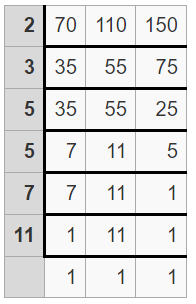
(i) The given three integers are 70, 110, 150

To find the L.C.M of three numbers using the long division method, divide the numbers by the least prime number until you left nothing common.
Worksheet on LCM 1

Find the product of prime numbers in the first column to get the LCM

LCM = 2 x 3 x 5 x 5 x 7 x 11

= 11,550

Therefore, LCM(70, 110, 150) = 11,550.

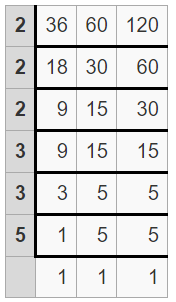
(ii) The given three integers are 36, 60, 120

Divide your numbers by prime numbers as long as at least one of your numbers is evenly divisible by a prime number.
Worksheet on LCM 2

Find the product of prime numbers in the first column to get the LCM

So, LCM = 2 x 2 x 2 x 3 x 3 x 5

= 360

Therefore, LCM of 36, 60, 120 is 360.

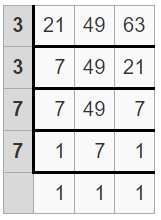
(iii) The given three integers are 21, 49, 63

Divide your numbers by prime numbers as long as at least one of your numbers is evenly divisible by a prime number.
Worksheet on LCM 3

Find the product of prime numbers in the first column to get the LCM

So, least common multiple = 3 x 3 x 7 x 7

= 441

Therefore, the LCM of 21, 49, 63 si 441.


Problem 5:

Find the LCM of the given numbers by the prime factorization method.

(i) 10, 15 and 45

(ii) 36, 27 and 18

(iii) 18, 54, 72

Solution:

(i) The given three integers are 10, 15 and 45

We use prime factorization to solve LCM

Prime factorization of 10 is 2 x 5 = 2¹ x 5¹

Prime factorization of 15 is 3 x 5 = 3¹ x 5¹

Prime factorization of 45 is 3 x 3 x 5 = 3² x 5¹

For each prime factor, find where it occurs most often as a factor and write it that many times in a new list.

The new list is 2, 3, 3, 5

Multiply these factors together to find the LCM.

LCM = 2 x 3 x 3 x 5

= 90

In exponential form: LCM = 2¹ x 3² x 5¹ = 90

Therefore, the LCM of 10, 15, and 45 is 90

(ii) The given three integers are 36, 27 and 18

We use prime factorization to find the lowest common multiple

Prime factorization of 36 = 2 x 2 x 3 x 3 = 2² x 3²

Prime factorization of 27 = 3 x 3 x 3 = 3³

Prime factorization of 18 = 2 x 3 x 3 = 2¹ x 3²

For each prime factor, find where it occurs most often as a factor and write it that many times in a new list.

The new list is 2, 2, 3, 3, 3

Multiply these factors together to find the LCM.

LCM = 2 x 2 x 3 x 3 x 3

= 108

In exponential form: LCM = 2² x 3³ = 108

Therefore, the LCM of 36, 27, and 18 is 108

(iii) The given three integers are 18, 54, 72

We use prime factorization to solve LCM

Prime factorization of 18 = 2 x 3 x 3= 2¹ x 3²

Prime factorization of 54 = 2 x 3 x 3 x 3 = 2¹ x 3³

Prime factorization of 72 = 2 x 2 x 2 x 3 x 3 = 2³ x 3²

For each prime factor, find where it occurs most often as a factor and write it that many times in a new list.

The new list is 2, 2, 2, 3, 3, 3

Multiply these factors together to find the LCM.

LCM = 2 x 2 x 2 x 3 x 3 x 3

= 216

In exponential form: LCM = 2³ x 3³ = 216

Therefore, the LCM of 18, 54, 72 is 216.


Problem 6:

Calculate the LCM of integers using the Cake/Ladder method.

(i) 5, 27, 15

(ii) 48, 64 and 120

(iii) 12 and 20

Solution:

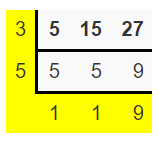
(i) The given three integers are 5, 27, 15

Divide your numbers by prime numbers as long as at least two numbers are evenly divisible by that prime.
Worksheet on LCM 4

The LCM is the product of the numbers in the L shape.

Least common multiple = 3 x 5 x 9

= 135

Therefore, the lowest common multiple of 5, 27, 15 is 135.

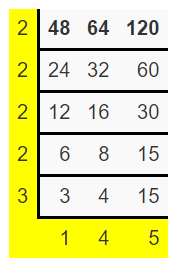
(ii) The given three integers are 48, 64, and 120

Divide your numbers by prime numbers as long as at least two numbers are evenly divisible by that prime.
Worksheet on LCM 5

The LCM is the product of the numbers in the L shape

So, LCM = 2 x 2 x 2 x 2 x 3 x 4 x 5

= 960

Therefore, the lowest common multiple of 48, 64, and 120 is 960.

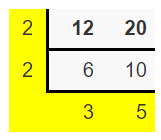
(iii) The given two integers are 12 and 20

Divide your numbers by prime numbers as long as at least two numbers are evenly divisible by that prime.
Worksheet on LCM 6

The LCM is the product of the numbers in the L shape

So, LCM = 2 x 2 x 3 x 5

= 60

Therefore, the lowest common multiple of 12, 20 is 60.


Problem 7:

Calculate the least common multiple of numbers using the G.C.F method.

(i) 49, 14, 70

(ii) 84, 90

(iii) 10, 25, 60

Solution:

(i) The given integers are 49, 14, 70

LCM(14, 49, 70) = LCM( LCM(14, 49), 70 )

L.C.M (14, 49) = \(\frac { 14 x 49 }{ G.C.F(14, 49) } \)

= \(\frac { 686 }{ 7 } \)

= 98

LCM( LCM(14, 49), 70 ) = LCM(98, 70)

= \(\frac { 98 x 70 }{ G.C.F(98, 70) } \)

= \(\frac { 6860 }{ 14 } \)

= 490

Therefore, LCM(14, 49, 70) = 490

(ii) The given integers are 84, 90

LCM of 84, 90 = \(\frac { 84 x 90 }{ G.C.F(84, 90) } \)

= \(\frac { 7560 }{ 6 } \)

= 1260

Therefore, LCM(84, 90) = 1260.

(iii) The given numbers are 10, 25, 60

LCM(10, 25, 60) = LCM( LCM(10, 25), 60 )

LCM(10, 25) = \(\frac { 10 x 25 }{ G.C.F(10, 25) } \)

= \(\frac { 250 }{ 5 } \)

= 50

LCM(10, 25, 60) = LCM(50, 60) = \(\frac { 50 x 60 }{ G.C.F(50, 60) } \)

= \(\frac { 3000 }{ 10 } \)

= 300

Therefore, LCM(10, 25, 60) = 300.


Problem 8:

Find the lowest number which is less by 2 to be divided by 56 and 98 exactly.

Solution:

Given that,

A number is less by 2 to be divided by 56 and 98 exactly

Let us take the lowest number as x

x is less by 2 to be divided by 56 and 98 exactly

So, x + 2 divided by 56 and 98 exactly

x + 2 is LCM of 56, 98

56 = 2 x 2 x 2 x 7

98 = 2 x 7 x 7

LCM = 2 x 2 x 2 x 7 x 7

= 392

So, x + 2 = 392

x = 392 – 2

x = 390

Therefore, the lowest number which is less by 2 to be divided by 56 and 98 exactly is 390


Problem 9:

The H.C.F. two numbers are 6 and their L.C.M. is 36. If one of the numbers is 18, find the other number.

Solution:

Given that,

H.C.F. two numbers = 6

L.C.M. of two numbers = 36

One number = 18

Let us consider the second number is y

x * y = LCM x HCF

18 x y = 36 x 6

18y = 216

y = \(\frac { 216 }{ 18 } \)

y = 12

Therefore, the other number is 12.


Problem 10:

The product of two numbers is 144. If the L.C.M. of these numbers is 12, find their H.C.F.

Solution:

Given that,

Product of two numbers = 144

LCM of two numbers = 12

Let us take two numbers as a, b

Then a x b = HCF x LCM

144 = HCF x 12

HCF = \(\frac { 144 }{ 12 } \)

= 12

Therefore, the highest common factor is 12.


Problem 11:

Find the LCm of monomials 4mn, 10n

Solution:

Numeral coefficients = 4 , 10

4 = 2 x 2, 10 = 2 x 5

LCM of numeral coefficients = 2 x 2 x 5 = 20

Literal coefficients = mn, n

L.C.M of mn, n = mn

Therefore, LCM(4mn, 10n) = 20mn


Problem 12:

Find the LCM of polynomials x² – 5², (x + 5)²

Solution:

First polynomial = x² – 2²

= (x – 5) (x + 5)

Second polynomial = (x + 5)²

= (x + 5) (x + 5)

In both the polynomials, the common factors are (x + 5), the extra common factor of the first polynomial (x – 5), the second polynomial is (x + 5).

Therefore, required the least common multiple = (x + 5) (x + 5) (x – 5).


13 Times Table Multiplication Chart

13 Times Table Multiplication Chart | How to Read and Write Multiplication Table of 13?

Students do you want to know that the number 13 is a prime number or not? Also, learn more about the 13 Times Table Multiplication Chart from this article. Here, you will find various options to understand, learn and remember the multiplication table of thirteen. So, read this complete page and gather the useful information that helps to learn the Math Tables from 0 to 25. These tables are mandatory at the time of prime classes. Hence have a look at the tips and tricks to memorize the 13 Times Table and the solved example questions.

Multiplication Table of 13 | Table of Thirteen

In the below sections, we have provided the 13 Times Table Multiplication Chart both in the image and tabular format. Students can download it from here and prepare offline too whenever they need it. By downloading Multiplication Table of 13 you can revise it regularly and remember it easily. You can get it free of cost from our site which is useful to make your math calculations quickly.

13 times table 1

13 Times Multiplication Table up to 25

It is very easy to learn the Thirteen Times Table Multiplication Chart. Just we need to add 13 to the first multiple and get the next multiple. It is a process of repeated addition where 13 x 0 = 0 and then add 13 to get the next multiple results. So, go through the table and learn the writing the Multiplication Table of 13 up to 25 whole numbers. Also, you will find the section to learn how to read 13 times Multiplication Table on this page.

13x0=0
13x1=13
13x2=26
13x3=39
13x4=52
13x5=65
13x6=78
13x7=91
13x8=104
13x9=117
13x10=130
13x11=143
13x12=156
13x13=169
13x14=182
13x15=195
13x16=208
13x17=221
13x18=234
13x19=247
13x20=260
13x21=273
13x22=286
13x23=299
13x24=312
13x25=325

How to Read Thirteen Times Table

Zero time thirteen is 0

One time thirteen is 13

Two times thirteen is 26

Three times thirteen is 39

Four times thirteen is 52

Five times thirteen is 65

Six times thirteen is 78

Seven times thirteen is 91

Eight times thirteen is 104

Nine times thirteen is 117

Ten times thirteen is 130.

Get More Multiplication Tables

0 Times Table Multiplication Chart1 Times Table Multiplication Chart2 Times Table Multiplication Chart
3 Times Table Multiplication Chart4 Times Table Multiplication Chart5 Times Table Multiplication Chart
6 Times Table Multiplication Chart7 Times Table Multiplication Chart8 Times Table Multiplication Chart
9 Times Table Multiplication Chart10 Times Table Multiplication Chart11 Times Table Multiplication Chart
12 Times Table Multiplication Chart14 Times Table Multiplication Chart15 Times Table Multiplication Chart
16 Times Table Multiplication Chart17 Times Table Multiplication Chart18 Times Table Multiplication Chart
19 Times Table Multiplication Chart20 Times Table Multiplication Chart21 Times Table Multiplication Chart
22 Times Table Multiplication Chart23 Times Table Multiplication Chart24 Times Table Multiplication Chart
25 Times Table Multiplication Chart

Why One Should Read 13 Times Table Multiplication Chart?

Learning 13 times Multiplication table is very important and it has several advantages for solving mathematical problems. There are many aspects of mathematics that require multiplication tables to spend less amount of time.

  • Math Tables saves your time while doing arithmetical operations like multiplications, divisions, and reducing fractions, finding LCM, GCF, etc
  • In this way, learning tables are helpful to solve math problems easily and quickly.
  • 13 Times Table makes you perfect in performing the quick calculations.

Tips & Tricks to Remember 13th Table

We have 2 simple techniques to remember and memorize the Multiplication table of 13. So, interested students must check out these tips to learn the table quickly.

  • To memorize the 13 Times Table Multiplication Chart, first, you need to remember the 3rd Table. The multiples of three are 3, 6, 9, 12, 15, 18, . . .
  • And then add natural numbers to the ten’s digit of the 3 multiples. The obtaines 13 multiples are (1 + 0)3 = 13, (2 + 0)6 = 26, (3 + 0)9 = 39, (4 + 1)2 = 52, (5 + 1)5 = 65, (6 + 1)8 = 78, (7 + 2)1 = 91, (8 + 2)4 = 104, (9 + 2)7 = 117, (10 + 3)0 = 130, (11 + 3)3 = 143, . .
  • Thirteen does not have any rules that make the multiplication table easier to memorize. Them here is a structure for every 10 multiples of 13. They are 13, 26, 39, 52, 65, 78, 91, 104, 117, 130. In all these multiples, the last digit i.e units place digit is repeating. So, one can remember this logic to memorize the table.

Solved Examples on 13 Times Multiplication Table

Example 1:

Calculate the value of 3 plus 13 times of 7 minus 4, using the 13 Times Table.

Solution:

Given, calculate the value using 13 Times Table

First, we have to write down the given statement plus 13 times of 7 minus 4

Now, solving the above expression by using 13 Times Table Multiplication Chart,

3 plus 13 times 7 minus 4 = 3 + 13 x 7 – 4

= 3 + 91 – 4

= 3 + 87

= 90

Therefore, the value of 3 plus 13 times 7 minus is 90.

Example 2:

Check using the table of 13 whether 8 times 13 minus 4 is 100?

Solution:

Given, calculate the value using 13 Times Table

First, we have to write down the given statement 8 times 13 minus 4

8 times 13 minus 4 = 8 x 13 – 4

= 104 – 4

= 100

Therefore, the given statement is true.

Example 3:

Use the 13 times table multiplication chart, and evaluate the value of 6 plus 13 times 5 minus 9.

Solution:

Given, calculate the value using 13 Times Table

First, we have to write down the given statement 6 plus 13 times 5 minus 9

6 plus 13 times 5 minus 9 = 6 + 13 x 5 – 9

= 6 + 65 – 9

= 6 + 56

= 62

Therefore, 6 plus 13 times 5 minus 9 is 62.

Example 4:

Using the Multiplication Table of 13, evaluate 13 times 15 plus 25 minus 4.

Solution:

Given, calculate the value using 13 Times Table

First, we have to write down the given statement 13 times 15 plus 25 minus 4

Now, solving the above expression by using 13 Times Table

13 times 15 plus 25 minus 4 = 13 x 15 + 25 – 4

= 195 + 25 – 4

= 195 + 21

= 216

Therefore, 13 times 15 plus 25 minus 4 is 216.

International Numbering System

International Numbering System – Definition, Examples | How to Write Numbers in International Number System?

Numbers were invented for the purpose of counting. The number system is defined as a writing system to express the number in a consistent manner. The place values of digits express in the sequence of ones, tens, hundreds, thousands, ten thousand, hundred thousand, millions, ten million, and so on in the international number system. Students can also know more about the international numbering system with example questions in the following sections.

International Numbering System Definition

The international numbering system is followed by most of the countries in the world. In this system, a number is split into groups or periods. In the international number system, we use ones (1), tens (10), hundreds (100), thousands (1000), ten thousands (10,000), hundred thousand’s (100,000), one millions (1,000,000), ten millions (10,000,000), hundreds millions (100,000,000), etc. We place the numbers according to their place value. We place a comma after each period to differentiate the periods.

How to Express Numbers in International System?

Based on the number of digits in the number, it is divided into periods.

  • The first period is known as one’s period, formed with the first 3 digits of the number.
  • The second period is called the thousands period, formed with the next 3 digits of the number.
  • The third period is called the millions period, formed with the digits after thousands.

Also, Read

International Numbering System Examples

Question 1:

Write the following figures in the international system.

(i) Six hundred thousand

(ii) Fifty million

(iii) Six hundred million

Solution:

To represent the given figures in the international numbering system, we must identify the period.

(i) The given figure is six hundred thousand

The hundred thousand means 100,000

six hundred thousand is 600,000.

(ii) The given figure is fifty million

Million means the third period formed after three digits of the thousands period. One million is 1,000,000

So, fifty million means 50,000,000.

(iii) The given figure is six hundred million

Million means the third period formed after three digits of the thousands period. One million is 1,000,000 and one hundred million is 100,000,000.

So, five hundred million is 500,000,000.

Question 2:

Write the following in figures in the International system:

(i) Six thousand, five hundred and twenty-two.

(ii) Three hundred and twenty-five thousand, four hundred and two

(iii) Three hundred and fifteen million, one hundred and twenty-one thousand, eight hundred and ten

Solution:

To express these word figures into the international numbering system, we need to have a clear idea of the periods.

(i) The given figure is six thousand, five hundred and twenty-two

six thousand means 6,000

five hundred means 500

twenty means 20

two means 2.

So, six thousand, five hundred and twenty-two is 6,522.

(ii) The given figure is Three hundred and twenty-five thousand, four hundred and two

Three hundred and twenty-five thousand means 325,000

four hundred means 400

two means 2

So, Three hundred and twenty-five thousand, four hundred and two is 325,402.

(iii) The given figure is Three hundred and fifteen million, one hundred and twenty-one thousand, eight hundred and ten

Three hundred and fifteen million is 315,000,000

one hundred and twenty-one thousand means 125,000

eight hundred means 800

ten means 10

So, Three hundred and fifteen million, one hundred and twenty-one thousand, eight hundred and ten is 315,125,810.

Question 3:

Write the following figures in the international system.

(i) Five million six hundred and twenty-five thousand seven hundred

(ii) One hundred ninety-six thousand eight hundred sixty-seven

(iii) Four hundred and ten thousand one hundred and six

Solution:

To express these word figures into the international numbering system, we need to have a clear idea of the periods.

(i) The given figure is Five million six hundred and twenty-five thousand seven hundred

Five million six hundred means 560,000,000

twenty-five thousand means 25,000

seven hundred means 700.

So, Five million six hundred and twenty-five thousand seven hundred is 560,025,700.

(ii) The given figure is One hundred ninety-six thousand eight hundred sixty-seven

One hundred ninety-six thousand means 196,000

eight hundred sixty-seven means 867.

So, One hundred ninety-six thousand eight hundred sixty-seven is 196,867.

(iii) The given figure is Four hundred and ten thousand one hundred and six

Four hundred and ten thousand means 410,000

one hundred and six means 106

So, Four hundred and ten thousand one hundred and six is 410,106.

Question 4:

(i) 25,896

(ii) 185,200,604

(iii) 568,952

Solution:

Write the following figures in the international system.

(i) The given figure is 25,896

25,000 is twenty-five thousand.

896 is eight hundred and ninety-six.

So, 25,896 is twenty-five thousand eight hundred and ninety-six

(ii) The given figure is 185,200,604

185,000,000 is one hundred and eighty-five million

200,000 is two hundred thousand

604 is six hundred and four.

So, 185,200,604 is eighty-five million and two hundred thousand six hundred and four..

(iii) The given figure is 568,952

568,000 is five hundred and sixty-eight thousand

952 is nine hundred fifty-two.

So, 568,952 is five hundred and sixty-eight thousand nine hundred and fifty-two.

FAQs on International Numbering System

1. Compare Indian and International Number System?

The major difference between the Indian and international number systems is the placement of the separators and nomenclature of different place values. In the international system, nine places are grouped into three periods ones, thousands, and millions.

In the Indian system, nine places are grouped into four periods. The place values of the Indian system are ones, tens, hundreds, thousands, ten thousand, lakhs, ten lakhs, crores, and ten crores. The international system place values are ones, tens, hundreds, thousands, ten thousand, hundred thousand, millions, ten million, and hundred million.

2. How do you write 6 digit numbers in the international system?

The 1st digit is ones, 2nd is tens, 3rd is hundreds, fourth is thousand, the fifth digit is ten thousand and six-digit is hundred thousand. The six digits have 2 periods.

3. How many periods are there in an international number system?

The international number system has 3 periods. They are ones, thousands, and millions. One period has ones, tens, and hundreds.

Conversion of Seconds into Minutes

Conversion of Seconds into Minutes – Definitions, Formula, Examples | How to Convert Seconds to Minutes?

Do you want to know one second is how many minutes? Then read this complete page. Here, you can learn about the seconds to minutes conversion with a detailed explanation. You will also learn the steps of converting seconds into minutes. Get to know more about what is a second, minute, and what are different units of time, and others. Refer to Seconds to Minutes Conversion Formula, Step by Step Procedure on how to convert seconds into minutes, solved examples, here.

Minutes and Seconds – Definitions

Minute, second are the different units of time. In general, hours is the highest unit, next minutes and then seconds. Minute is a period of time which is equal to sixty seconds or sixtieth of an hour. Actually, a second is the duration of 9,192,631,770 periods of the radiation corresponding to the transition between the two hyperfine levels of the ground state of the cesium-133 atom. And it is a small division of an hour.

Also, Check:

Seconds to Minutes Conversion Formula

The simple formula to convert minutes into seconds is as follows:

1 Minute = 60 Seconds

So, 1 Second = \(\frac { 1 }{ 60 } \) Minute

Number of minutes = \(\frac { 1 }{ 60 } \) x number of seconds

How to Convert Seconds to Minutes?

Check out the simple and detailed steps to convert the seconds into minutes. They are in the following fashion

  • Let us take the number of seconds you want to convert into minutes.
  • In general, 1 second = \(\frac { 1 }{ 60 } \) minute
  • Multiply the given number of seconds by \(\frac { 1 }{ 60 } \).
  • The result is called the minutes.

Also, Read

Seconds to Minutes Conversion Examples

Example 1: 

Convert 150 seconds into minutes?

Solution:

The given number of seconds = 150

Multiply 150 by (\(\frac { 1 }{ 60 } \))

So, 150 seconds = \(\frac { 150 }{ 60 } \)

Conversion of Seconds into Minutes 1

Therefore, 150 seconds = 2.5 Minutes

Example 2:

Convert 215 seconds into minutes.

Solution:

The given number of seconds = 215

Multiply 215 by \(\frac { 1 }{ 60 } \)

So, 215 seconds = \(\frac { 215 }{ 60 } \)

Conversion of Seconds into Minutes 2

Therefore, 215 seconds = 3.583 minutes.

Example 3:

Convert 180 seconds into minutes.

Solution:

The given number of seconds = 180

Multiply 180 by \(\frac { 1 }{ 60 } \)

So, 180 seconds = \(\frac { 180 }{ 60 } \) minutes

Conversion of Seconds into Minutes 3

Therefore, 180 seconds = 3 minutes

Example 4:

Convert 516 seconds into minutes.

Solution:

The given number of seconds = 516

Multiply 516 by \(\frac { 1 }{ 60 } \)

So, 516 seconds = \(\frac { 516 }{ 60 } \) minutes

Conversion of Seconds into Minutes 4

Therefore, 516 seconds = 8.6 minutes.

Example 5:

Convert 1020 seconds into minutes.

Solution:

The given number of seconds = 1020

Multiply 1020 by \(\frac { 1 }{ 60 } \)

So, 1020 seconds = \(\frac { 1020 }{ 60 } \) minutes

Conversion of Seconds into Minutes 5

Therefore, 1020 seconds = 17 minutes.

Common Conversions Facts About Time

Below are a few easy & quick conversion facts about the unit of time.

1 Hour = 60 Minutes

1 Minute = 60 seconds

1 Second = \(\frac { 1 }{ 60 } \) Minute

1 Minute = \(\frac { 1 }{ 3600 } \) Hour

1 Hour = 3600 seconds

12 hours = 1 day

12 hours = 43,200 seconds

1 day = 24 hours = 1440 minutes

1 day = 24 hours = 86,400 seconds

Seconds to Minutes Conversion Table

Here is the conversion table of Seconds (sec) to Minutes (min):

SecondsMinutes
1 Second\(\frac { 1 }{ 60 } \) Minute
2 Seconds\(\frac { 2 }{ 60 } \) Minute
10 Seconds\(\frac { 1 }{ 6 } \) Minute
25 Seconds\(\frac { 25 }{ 60 } \) Minute
50 Seconds\(\frac { 5 }{ 6 } \) Minute
60 Seconds1 Minute
120 Seconds2 Minutes
180 Seconds3 Minutes
240 Seconds4 Minutes
300 Seconds5 Minutes

FAQ’s on Conversion of Seconds into Minutes

1. How do you convert seconds to minutes?

To convert seconds into minutes, multiply the number of seconds by \(\frac { 1 }{ 60 } \). The obtained product is the converted minutes.

2. How many minutes is 540 seconds?

540 seconds = \(\frac { 540 }{ 60 } \) = \(\frac { 54 }{ 6 } \)

540 seconds = 9 minutes.

3. How do you convert minutes into seconds?

Generally, we know that 1 minute = 60 seconds. To convert minutes into seconds, multiply the number of minutes by 60 to get the number of seconds.

Worksheet on 18 Times Table

Worksheet on 18 Times Table | Printable 18 Times Table Worksheet with Answers

Worksheet on Multiplication Table of 18 is provided here. Check out the important questions involved in the 18 Times Table Multiplication Chart. Have a look at the various methods, rules, formulas that helps to solve the questions of the 18 Times Table. After reading this page, you will be able to understand and importance of the 18 tables along with their applications. Solved example questions on the Worksheet on 18 Times Table will help you to get a piece of detailed information and also helps you to score good marks in the exam.

18 Times Multiplication Table Chart up to 25

Check out the multiplication table of 18 and remember the output to make your math-solving problems easy.

18x0=0
18x1=18
18x2=36
18x3=54
18x4=72
18x5=90
18x6=108
18x7=126
18x8=144
18x9=162
18x10=180
18x11=198
18x12=216
18x13=234
18x14=252
18x15=270
18x16=288
18x17=306
18x18=324
18x19=342
18x20=360
18x21=378
18x22=396
18x23=414
18x24=432
18x25=450

Problem 1:

Find each product using the multiplication table of 18

(i) 16 x 18

(ii) 21 x 18

(iii) 8 x 18

(iv) 5 x 18

(v) 9 x 18

Solution:

(i) The given two numbers are 16, 18

16 x 18 = 288

The product of 16 and 18 is 288.

(ii) The given two numbers are 21, 18

21 x 18 = 378

The product of 21 and 18 is 378.

(iii) The given two numbers are 8, 18

8 x 18 = 144

The product of 8 and 18 is 144.

(iv) The given two numbers are 5, 18

5 x 18 = 90

The product of 5 and 18 is 90.

(v) The given two numbers are 9, 18

9 x 18 = 162

The product of 9 and 18 is 162.


Problem 2:

Name the number just after:

(i) 7 x 18

(ii) 18 x 18

(iii) 15 x 18

(iv) 10 x 18

Solution:

(i) The given numbers are 7, 18

7 x 18 = 126

The number just after is 126 + 1 = 127.

(ii) The given numbers are 18, 18

18 x 18 = 324

The number just after is 324 + 1 = 325.

(iii) The given numbers are 15, 18

15 x 18 = 270

The number just after is 270 + 1 = 271.

(iv) The given numbers are 10, 18

10 x 18 = 180

The number just after is 180 + 1 = 181.


Problem 3:

Name the number just before:

(i) 18 x 12

(ii) 18 x 24

(iii) 18 x 17

(iv) 18 x 4

Solution:

(i) The given numbers are 18, 12

18 x 12 = 216

The number just before 216 is 216 – 1 = 215.

(ii) The given numbers are 18, 24

18 x 24 = 432

The number just before 432 is 432 – 1 = 431.

(iii) The given numbers are 18, 17

18 x 17 = 306

The number just before 306 is 306 – 1 = 305.

(iv) The given numbers are 18, 4

18 x 4 = 72

he number just before 72 is 72 – 1 = 71.


Problem 4:

The cost of a cricket bat is $18. How much will 50 such cricket bats cost?

Solution:

Given that,

The cost of one cricket bat = $18

The cost of 50 such cricket bats is obtained by multiplying one cricket bat by 50.

So, the cost of 50 cricket bats = 18 x 50 = 900

Worksheet on 18 Times Table 1

Therefore, the cost of 50 cricket bats is $900.


Problem 5:

A doll costs $15. How much will 18 such dolls cost?

Solution:

Given that,

The cost of a doll = $15

The cost for 18 dolls = 18 x 15 = 270

Worksheet on 18 Times Table 2

Therefore, $270 is the cost for 18 dolls.


Problem 6:

Complete the chart by multiplying the numbers by 18.

(i) 1, 2, 3, 4, 5, 6, 7, 8, 9, 10 (ii) 52, 85, 96, 152, 638, 452

Solution:

The 18 table multiplication chart is along the lines.

(i) 18 x 1 = 18

18 x 2 = 36

18 x 3 = 54

18 x 4 = 72

18 x 5 = 90

18 x 6 = 108

18 x 7 = 126

18 x 8 = 144

18 x 9 = 162

18 x 10 = 180

(ii) 18 x 52 = 936

Worksheet on 18 Times Table 3

18 x 85 = 1530

Worksheet on 18 Times Table 4

18 x 96 = 1728

Worksheet on 18 Times Table 5

18 x 152 = 2736

Worksheet on 18 Times Table 6

18 x 638 = 11,484

Worksheet on 18 Times Table 7

16 x 452 = 8136

Worksheet on 18 Times Table 8


Problem 7:

(i) What are 18 elevens?

(ii) 18 times 9?

(iii) 12 eighteen’s?

(iv) Eighteen times 9?

(v) What are 6 times 18?

(vi) Eighteen’s 4?

(vii) 18 times 11?

(viii) Eighteen’s 7?

(ix) What is 18 multiplied by 8?

(x) 5 multiplied by 18?

Solution:

(i) 18 elevens mean the product of 18 and 11

18 x 11 = 198

So, 18 elevens is 198.

(ii) 18 times 9 means the product of 18 and 9

18 x 9 = 162

So, 18 times 9 is 162.

(iii) 12 eighteen’s means the product of 12 and 18

12 x 18 = 216

So, 12 eighteen’s is 216.

(iv) Eighteen times 9 means the product of 18 and 9

18 x 9 = 162

So, Eighteen times 9 is 162.

(v) 6 times 18 means the product of

6 x 18 = 108

So, 6 times 18 is 108

(vi) Eighteen’s 4 means the product of 18 and 4

18 x 4 = 72

So, Eighteen’s 4 is 72.

(vii) 18 times 11 means the product of 18 and 11

18 x 11 = 198

So, 18 times 11 is 198.

(viii) Eighteen’s 7 means the product of 18 and 7

18 x 7 = 126

So, eighteen’s 7 is 126.

(ix) 18 multiplied by 8 means the product of 18 and 8

18 x 8 = 144

So, 18 multiplied by 8 is 144.

(x) 5 multiplied by 18 means the product of 5 and 18

5 x 18 = 90

So, 5 multiplied by 18 is 90.


Problem 8:

The cost of a pocket Radio set is 18 dollars. What will be the cost of 7 such Radio sets?

Solution:

Given that,

The cost of a pocket Radio set = 18 dollars

The cost of 7 such Radio sets = The cost of one pocket radio set x 7

= 18 x 7

= 126

Therefore, the cost of 7 such Radio sets is 126 dollars.


Problem 9:

What does 18 × 82 mean? What number is it equal to?

Solution:

18 x 82 means the product of 18 and 82

Worksheet on 18 Times Table 9

18 x 82 = 1476

So, 18 x 82 is equal to 1476 and 18 x 82 means 1476.


Problem 10:

Solve the following using the 18 times table.

(i) How many eighteen’s in 198?

(ii) 18 times 6 minus 4

(iii) How many eighteen’s in 972?

(iv) How many eighteen’s in 1728?

(v) 18 times 16 minus 45

(vi) How many eighteen’s in 1134?

(vii) 18 times 2 plus 6

(viii) How many eighteen’s in 108?

(ix) How many eighteen’s in 1170?

(x) How many eighteen’s in 1332?

Solution:

(i) How many eighteen’s in 198 means divide 198 by 18.

Worksheet on 18 Times Table 10

198 ÷ 18 = 11

There are 11 eighteen’s in 198.

(ii) 18 times 6 minus 4

18 times 6 means the product of 18 and 6

18 x 6 = 108

108 – 4 = 104

18 times 6 minus 4 is 104.

(iii) How many eighteen’s in 972 means divide 972 by 18

Worksheet on 18 Times Table 11

972 ÷ 18 = 54

So, there are 54 eighteen’s in 972.

(iv) How many eighteen’s in 1728 means divide 1728 by 18

Worksheet on 18 Times Table 12

1728 ÷ 18 = 96

So, there are 96 eighteen’s in 1728.

(v) 18 times 16 minues 45

18 times 16 means the product of 18 and 16

18 x 16 = 288

18 times 16 minues 45 = 288 + 45 = 333

So, 18 times 16 minues 45 is 333.

(vi) How many eighteen’s in 1134 means divide 1134 by 18

Worksheet on 18 Times Table 13

1134 ÷ 18 = 63

So, there are 63 eighteen’s in 1134

(vii) 18 times 2 plus 6

18 times 2 means the product of 18 and 2

18 x 2 = 36

18 times 2 plus 6 = 36 + 6 = 42

So, 18 times 2 plus 6 is 42

(viii) How many eighteen’s in 108 means divide 108 by 18

Worksheet on 18 Times Table 14

108 ÷ 18 = 6

So, there are 6 eighteen’s in 108.

(ix) How many eighteen’s in 1170 means divide 1170 by 18

Worksheet on 18 Times Table 15

1170 ÷ 18 = 65

So, there are 65 eighteen’s in 1170

(x) How many eighteen’s in 1332 means divide1332 by 18

Worksheet on 18 Times Table 16

1332 ÷ 18 = 74

So, there are 74 eighteen’s in 1332


Examples on the Formation of Greatest and the Smallest Number

Examples on the Formation of Greatest and the Smallest Number | How to find the Greatest and Smallest Number?

Do you want to know how to form the greatest and smallest numbers using the digits? If yes, then stay tuned to this page. On this page, students can learn about the detailed steps to form the largest and smallest numbers with their definitions. We have also covered plenty of examples on the formation of the greatest and the smallest numbers in the below-mentioned sections.

What is Greatest and Smallest Number?

The greatest number is a number which is having the highest value when compared with other numbers. And we can also say that the largest number has all the digits arranged in descending order. The position of the digit at the extreme left of a number increases its place value. So the greatest digit from the given digits must be placed at the extreme left side of the number to raise its value.

The smallest number is a number that is having the lowest value compared with other numbers. In the lowest number, the digits are arranged in ascending order. If the given digits have 0, we never write 0 at the extreme left place, instead write at the second place from the left to get the smallest number.

Detailed Process on Formation of Greatest and the Smallest Number

Check out the step-by-step process of forming the greatest and smallest numbers from the given digits along the lines.

  • To form the greatest numbers from the given digits, arrange the digits in descending order. And the extreme left digit has the highest value when compared with others.
  • To form the lowest numbers from the given digits, arrange the digits in ascending order. And the extreme left digit has the lowest value compared with other digits.
  • If there is a 0, then don’t write 0 at the extreme left position instead place it at the second place from the left to obtain the lowest number.

Example:

Form the greatest and smallest number using the digits 5, 4, 8, 6.

To form the greatest number, follow these steps.

  • The smallest digit is placed at one’s place
  • The next greater digit at ten’s place and so on
  • The greatest digit is placed at the highest place of the number

To form the smallest number, follow the reverse procedure

  • The greatest digit is placed at one’s position
  • The next smaller digit is placed at ten’s position and so on.
  • So, the smallest digit is placed at the highest place of the number.

The ascending order of the numbers 4, 5, 6, 8

So, the smallest number is 4568.

The descending order of the numbers 8, 6, 5, 4

So, the greatest number is 8654.

Also, Read

Worked Out Examples on the Formation of Greatest and the Smallest Number

Example 1:

Write the greatest and smallest 4 digit numbers using the digits 1, 0, 8, 4

Solution:

The given digits are 1, 0, 8, 4.

We know that the four-digit number has four places those are thousands, hundreds, tens, and ones. If the given digits are arranged in descending order (from greatest to lowest value), we get the greatest number. If digits are arranged in ascending order (from lowest to highest), we get the smallest number.

The descending order is 8 < 4 < 1 < 0.

The ascending order is 0 < 1 < 4 < 8.

                                     Th      H       T       O

Greatest number           8       4       1       0
Lowest Number            1       0       4       8

As the given digits have 0, place zero at the second-highest position i.e hundredth position.

So, the greatest number using the digits 1, 0, 8, 4 is 8410.

The smallest number using the digits 1, 0, 8, 4 is 1048.

Example 2:

Write the greatest and smallest 5 digit number using the digits 7, 5, 6, 8, 2.

Solution:

The given digits are 7, 5, 6, 8, 2.

                           Tth      Th     H       T       O 
Greatest number    8       7       6       5       2
Smallest number    2       5       6       7       8

Arrange the given digits in the descending order 2 < 5 < 6 < 7 < 8.

To get the greatest number, the greatest digit 8 is placed at the highest valued place, i.e., ten thousand place, next smaller digit 7 at thousands place, next smaller digit 6 at hundred’s place, still smaller digit 5 is placed at ten’s place and the smallest digit 2 at one’s or units place.

Therefore, the greatest 5 digit number using the digits 7, 5, 6, 8, 2 is 87652.

Arrange the given digits in the ascending order 8 > 7 > 6 > 5 > 2.

To get the smallest number, the greatest digit 8 is placed at the lowest valued place i.e one’s place, next highest digit 7 is placed at ten’s place, next highest digit 6 is placed at hundred’s place, still greatest digit 5 is placed at thousand’s place, remaining digit 2 is placed at ten thousand place.

Therefore, the smallest 5 digit number using the digits 7, 5, 6, 8, 2 is 25678.

Example 3:

Write the greatest and smallest 5 digit number using 1, 2, 5. The digit may be repeated.

Solution:

The given digits are 1, 2, 5.
 Tth      Th     H       T       O
Greatest number    5       5       5       2       1

Smallest number    1       1       1       2       5

Arrange the given digits in the descending order 1 < 2 < 5

Since we have to make the greatest 5 digit number using 3 digits, we will repeat the greatest digit required a number of times.

To get the greatest number, the greatest digit 5 is placed at the highest valued place, i.e., ten thousand place, next smaller digit 5 at thousands place, next smaller digit 5 at hundred’s place, still smaller digit 2 is placed at ten’s place and the smallest digit 1 at one’s or units place.

Therefore, the greatest 5 digit number using the digits 1, 2, 5 is 55521.

To get the smallest number, the smallest digit 1 is placed at ten thousands-place, next greater digit 1 at thousand’s place, still greater digit 1 at hundred’s place, next greatest digit 2 is placed at ten’s place,  and greatest digit 1 at one’s or units place.

Therefore, the smallest 5 digit number using the digits 1, 2, 5 is 11125.

Example 4:

Write the greatest and smallest 4 digit number using 8, 7, 1, 4.

Solution:

The given digits are 8, 7, 1, 4.

       Th     H       T       O 
Greatest number      8       7       4       1

Smallest number       1       4       7       8

Arrange the given digits in the descending order 1 < 4 < 7 < 8

The greatest number using the digits 8, 7, 1, 4 is 8741.

To get the smallest number, we arrange the digits in ascending order.

Ascending order of 8, 7, 1, 4 is 8 > 7 > 4 > 1.

The smallest number using the digits 8, 7, 1, 4 is 1478.

FAQs on Formation of Greatest and Smallest Numbers

1. How to obtain the greatest and the smallest among the group of numbers?

The greatest number among the number of numbers is obtained by arranging the group of digits in the descending order and writing the numbers as it is. The smallest number is obtained by arranging the group of digits in the ascending order and representing them as it is.

2. Which is the greatest and smallest 4 digit number?

The greatest 4 digit number is 9999 and the smallest 4 digit number is 1000.

3. What is the ascending order?

The process of arranging the group of numbers or items of the same category from the lowest to the highest in value is called the ascending order.

Word Problems on Multiplication

Word Problems on Multiplication | Multiplication Word Problems with Solutions

Multiplication is one of the important arithmetic operations which helps to solve math problems easily. Usually, math tables are used for solving multiplication problems. So, make use of the Multiplication Tables for 0 to 25 and get the solution for your multiplication word problems quickly and easily. Students can get different types of word problems in the below sections.

What is Meant by Multiplication?

Multiplication is one of the basic arithmetic operations which gives the result of combining groups of equal sizes. Multiplication is a process of repeated addition. It is represented by the cross “x”, asterisk “*”, dot “.” symbol. When we multiply two numbers the answer is called the product.

Solved Problems on Multiplication

Question 1:

Find the product of 125 and 78.

Solution:

Given numbers are 125, 78.

125 x 78 = 9750

Word Problems on Multiplication 1

Question 2:

The product of two numbers is 175 and the multiplier is 7. Find the multiplicand?

Solution:

Given that,

The product of two numbers = 175

Multiplier = 7

Multiplicand = ?

Multiplicand * multiplier = Product

Multiplicand * 7 = 175

Multiplicand = 175/7

Word Problems on Multiplication 2

So, multiplicand = 25

Question 3:

Solve 78 x 96?

Solution:

Multiplicand = 78

Multiplier = 96

Word Problems on Multiplication 3

78 x 96 = 7488.

Also, Read

Worked out Word Problems on Multiplication

Question 1:

The weight of a rice bag is 50 kg. What will be the weight of 75 such bags?

Solution:

Given that,

Weight of a rice bag = 50 kg

Weight of 75 rice bags = 50 x 75

Word Problems on Multiplication 4

So, the total weight of 75 rice bags is 3750 kgs.

Question 2:

The price of a wooden box is $179 and a plastic box is $82. Find the cost of 40 wooden boxes and 150 plastic boxes in total?

Solution:

Given that,

The price of a wooden box = $179

The price of a plastic box = $82

The cost of 40 wooden boxes = 179 x 40 = 7160

Word Problems on Multiplication 5

The cost of 150 plastic boxes = 150 x 82 = 12300

Word Problems on Multiplication 6

The total cost of 40 wooden boxes and 150 plastic boxes = 7160 + 12300

= 19460

Word Problems on Multiplication 7

Therefore, the total cost of 40 wooden boxes and 150 plastic boxes is $19460.


Question 3:

A toy costs $216. How much will be paid for such 56 toys?

Solution:

Given that,

The cost of one toy = $216

The amount to be paid to buy 56 toy means add 216, 56 times

Otherwise, multiply 216 and 56 the obtained product is the amount paid.

So, the amount paid for 56 toys = 216 x 56

Word Problems on Multiplication 8

Therefore, $12096 must be paid to buy 56 toys.

Question 4:

The monthly salary of a man is $3156. What is his annual income by salary?

Solution:

Given that,

The monthly salary of a man = $3156

The annual income of the man by salary = Add man’s salary 12 times

Or, multiply the man’s monthly salary by 12 months to get the annual income in dollars.

So, the annual income of the man by salary = 3156 x 12

Word Problems on Multiplication 9

Therefore, the annual income of the man by salary is $37872.

Question 5:

Each student of class IV $75 for the flood victims. If there are 368 students in class IV, what is the total amount of money collected?

Solution:

Given that,

All the students of Class IV have given $75 for the flood victims

The total number of students in class IV = 368

The total amount of money collected from class IV students for flood victims = 75 should be added 368 times.

Otherwise, multiply the number of students by the amount each student is given.

So, the total amount of money collected from class IV students for flood victims = 75 x 368

Word Problems on Multiplication 10

Therefore, the total amount of money collected from class IV students for flood victims is $27600.

Question 6:

Prove that by adding multiplicand, multiplier times is equal to multiplicand into multiplier by solving the following question.

Ramu buys 7 pencils in a shop. The cost of each pencil is $2. Find the total amount paid to buy 7 pencils.

Solution:

Given that,

The cost of each pencil = $2

The number of pencils bought = 7

The amount paid to buy 7 pencils = cost of each pencil x total number of pencils bought

= 2 x 7

= $14

The amount paid to buy 7 pencils = Add the total number of pencils by the cost of each pencil times

= 2 + 2 + 2 + 2 + 2 + 2 + 2

= $14

Therefore, the cost of 7 pencils is $14

Hence proved.

Question 7:

A truck can carry 2,545 kg of coal per trip. How much coal will be carried if the truck makes 135 trips?

Solution:

Given that,

A truck can carry 2,545 kg of coal per trip

The amount of coal carried by 135 trips = 2545 x 135 = 343575

Word Problems on Multiplication 11

Therefore, 3,43,575 kgs of coal will be carried if the truck makes 135 trips.

Question 8:

There are 365 days in a year. How many days are there in 29 years?

Solution:

Given that,

The number of days in a year = 365

The number of days in 29 years = 365 x 29

Word Problems on Multiplication 12

Therefore, the number of days in 29 years is 10585.

Question 9:

A bookseller sells 875 books per day in the month of July. How many books will he be able to sell in 25 days of July?

Solution:

Given that,

A bookseller sells 875 books per day in the month of July

The number of books the bookseller will sell in 25 days of July = 875 x 25

Word Problems on Multiplication 13

Therefore, 21875 books will the bookseller be able to sell in 25 days of July.

Question 10:

There are 1125 students in a school. If a student pays $ 365 as fees and $ 150 as bus charge per month, how much money is collected after 8 months?

Solution:

Given that,

The number of students in a school = 1125

A student pays $ 365 as fees and $ 150 as bus charge per month

The amount of money collected from one student in a month = 365 + 150 = 515

Word Problems on Multiplication 14

The total amount of money collected from all students in a month = 515 x 1125 = $579375

Word Problems on Multiplication 15

The total amount of money collected from all students in 8 months = $579375 x 8

Word Problems on Multiplication 16

Therefore, the total amount of money collected from 1125 students of a school as fee and bus fee in 8 months is $4635000.

Nets of Solids

Nets of Solids – Definition | Geometry Shapes | Nets of a Cube, Cone, Pyramid, Prism, Cylinder

A net is a flattened out 3-dimensional solid. It is the basic skeleton outline in two dimensions, that can be folded and glued together to obtain the 3D structure. Nets are used for making 3D shapes. In the below sections, we have discussed the nets of different geometric shapes along with the examples.

Nets of Solids – Definition

A geometry net is a two-dimensional shape that can be folded to form a three-dimensional solid. When the surface of a three-dimensional figure is laid out flat showing each face of the solid, the pattern obtained is called the net. Nets are useful in finding the surface area of the solids. The following are some steps we must take to determine whether a net forms a solid:

  • Ensure that the net and a solid have the same number of faces and that there is a match between the shapes of faces of the solid and the shapes of the corresponding faces in the net.
  • Visualize how the net is to be folded to form the solid and all the sides fit together properly.

Nets of Cube

A cube is a 3-dimensional figure having 6 faces of equal length. The cube has 8 vertices, 12 edges. All the faces of a cube are in square shape. The plane angles of the cube are the right angle. The edges opposite to each other are parallel.

Nets of Solid 1

Cube Image

Nets of Solid 2

11 possible nets of a cube

Nets of Cylinder

A cylinder has two parallel bases joined by a curved surface at a fixed distance. The bases are in circular shape and the center of two bases are joined by a line segment, called the axis. The perpendicular distance between the bases is the height and the distance from the axis to the outer surface is the radius of the cylinder.

Nets of Solid 3

Cylinder Image

Nets of Solid 4

Nets of Cylinder

Nets of Rectangular Prism

A rectangular prism has six faces and each face is a rectangle. Both the bases of the prism are rectangles and other lateral faces are also rectangles. it is also called a cuboid.

Nets of solid 5

Rectangular Prism Image

nets of Solid 6

Nets of a Rectangular Prism

Nets of Triangular Prism

A triangular prism is a polyhedron having two triangular bases and three rectangular sides. Like other prisms, two bases are congruent and parallel. The prism has 5 faces, 9 sides and 6 vertices.

Nets of Solid 7

Triangular Prism Image

Nets of Solid 8

Nets of Triangular Prism

Nets of Cone

A cone is a shape formed by using a set of line segments which connects a common point, called vertex to all the points of a circular base. the distance between vertex to base of the cone is known as its height.

nets of solid 9

Cone Image

Nets of Solid 10

Nets of Cone

Also, Read

Nets of Square Pyramid

A three-dimensional geometric shape with square base and four triangular faces all those faces meet at a single point is called the square pyramid. If all triangular faces have equal edges, then this pyramid is called an equilateral square pyramid.

Nets of solid 11

Square Pyramid Image

Nets of Solid 12

Nets of Square Pyramid

Solved Examples on Nets of Solid

Example 1:

Sketch the net of the solid shape given below.

Nets of Solid 13

Solution:

If the pyramid is unfolded along its edges we get the following net.

The net of the pentagonal pyramid is as follows.

Nets of Solid 14

Example 2:

Sketch the net of the solid shape given below.

Nets of Solid 16

Solution:

If the prism is unfolded along its edges we get the following net.

The net of the hexagonal prism is as follows.

Nets of solid 15

Example 3:

Sketch the net of the solid shape given below.

Nets of Solid 17

Solution:

If the prism is unfolded along its edges we get the following net.

The net of the hexagonal prism is as follows.

Nets of Solid 18

Frequently Asked Questions on Nets of Solid

1. How are nets useful in real life?

Nets are used in finding the surface area of the solids. The examples of nets are all three dimensional geometric shapes. Some of the 3 dimensional geometric shapes are square pyramid, cone, cylinder, triangular prism, rectangular pyramid, rectangular prism nad others.

2. Can a solid have different Nets?

Yes, a solid have different nets. Visualize how the net is folded to form a solid and make sure that all sides fit together properly. Make sure the solid and the net have same number of faces, shape of faces should match.

3. What is the net of a 3D shape?

The net of a 3D shape is what it looks like if it is opened out flat. A net can be folded up to ake a 3D shape. There can be several possible nets for one 3D shape. Draw a net on paper, then fold it into the shape.

4. How many nets are there for a cube?

There are exactly eleven nets that will form a cube.

Binary Addition Using 1s Complement

Binary Addition Using 1s Complement – Definition, Examples | How to Add Binary Numbers in 1’s Complement?

Are you searching for a tool that computes the addition of two binary numbers using 1’s complement method? If yes, then you have reached the correct place. Here we are giving the detailed steps on how binary addition of two numbers with 1s complement. You can also get Binary Addition Using 1s Complement definition, how to get 1s complement of a binary number, and example questions to improve the levels of understanding.

What is Binary Addition?

A binary number is a number with the base 2. Binary addition is one of the basic arithmetic operations. The binary system has only two digits 0 and 1. The binary code uses the digits 0’s and 1’s to make certain processes turn on or off. The process of the binary addition operation is very familiar to the decimal system by adjusting to the base 2.

Before attempting the binary addition, you must have complete knowledge of how the place works in the binary number system. Almost all modern digital computers and electronic circuits perform the binary operation by representing each bit as a voltage signal. The binary bit 0 means OFF state, 1 means ON state.

1’s Complement of a Binary Number

We have a simple algorithm to convert a binary number into 1’s complement. To get 1’s complement of a binary number, invert the given binary number. You can also implement a logic circuit using only NOT gate for each bit of binary number input.

Example:

Calculate the 1’s complement of a binary number 10101110

Invert each bit of a given binary number

So, 1’s complement of 10101110 is 01010001.

Also, Read

Binary Addition Using 1’s Complement

Binary addition means simply performing an addition operation between two binary numbers. You can add two binary numbers digit by digit just like decimal numbers. The rules for adding two binary digits is 0 + 0 = 0, 1 + 0 = 1, 0 + 1 = 1, 1 + 1 = 10(1 is carry). At first, convert the given numbers to the 1’s complement and add those numbers using thee rules. Also, have a look at the detailed process on how to add binary numbers using 1’s complement in the following section.

How to do Binary Addition Using 1s Complement?

The process of adding binary numbers purely depends on their sign and magnitude. Here are the different cases.

Case I: Adding a positive and a negative number. If the positive number has a greater magnitude

Here, the addition of numbers is performed after taking 1’s complement of the negative number, and at the end round carry of the sum is added to the LSB (least significant bit).

Example: + 1101 – 1011

+ 1101 ⇒ 0 1 1 0 1

– 1011 ⇒ 1 0 1 0 0 (1’s complement)

⇒ 0 0 0 0 1 + 1 = 0 0 0 1 0

Hence the sum is +0010.

Case II: If the negative number has a greater magnitude

Here the addition is done in the same way as in case I but there will be non-end-around carry. The sum is obtained by taking the 1’s complement of the magnitude bits of the result and the sum is negative.

Example: 1011 – 1101

+ 1 0 1 1 ⇒ 0 1 0 1 1

– 1 1 0 1 ⇒ 1 0 0 1 0 (1’s complement)

⇒ 1 1 1 0 1

The sum is 1’s complement of 1101

Hence the sum is – 0010.

Case III: If two binary numbers are negative.

To add two negative binary numbers, 1’s complements of both the numbers are taken later addition is performed. In this case, an end-around carry will always appear. This along with a carry from the MSB will generate a 1 in the sign bit. 1’s complement of the magnitude bits of the result of an addition will give the final sum.

Example: -0110 and -0111

– 0 1 1 0 ⇒ 1 1 0 0 1 (1’s complement)

– 0 1 1 1 ⇒ 1 1 0 0 0 (1’s complement)

⇒ 1 0 0 0 1 + 1 = 1 0 0 1 0

1’s complement of 0010 is 1101 and the sign bit is 1

Hence the sum is -1101.

Binary Addition Using 1s Complement Examples

Example 1:

Calculate the sum of 0100, -1000 using the 1’s complement.

Solution:

The given binary numbers are 0100, -1000

1’s complement of -1000 is 10111

0 0 1 0 0 + 1 0 1 1 1 = 1 1 0 1 1

1’s complement of 1011 is 0100

Hence the sum is -0100.

Example 2:

Find the sum of 10000, -00111 using the 1’s complement.

Solution:

The given binary numbers are 10000, -00111

Find the 1’s complement of the negative number i.e 00111

1’s complement of 000111 = 111000

010000 + 111000 = 1 0 0 1 0 0 0

0 0 1 0 0 0 + 1 = 0 0 1 0 0 1

Hence, the sum is 001001.

Example 3:

Find the sum of -0100, -0010 using the 1’s complement method.

Solution:

The given numbers are -0100, -0010

Find the 1’s complement of the negative numbers

1’s complement of 0100 is 1011

1’s complement of 0010 is 1101

1 0 1 1 + 1 1 0 1 = 1 1 0 0 0

1 1 0 0 0 + 1 = 1 1 0 0 1

1’s complement of 1 0 01 is 0 1 1 0 and 1 is the sign bit

Hence, the sum is -0110

Example 4:

Find the sum of 1000 and -0101 using the 1’s complement.

Solution:

The given binary numbers are 1000 and -0101.

Find the 1’s complement of the negative number

1’s complement of 0101 is 11010.

0 1 0 0 0 + 1 1 0 1 0 = 1 0 0 0 1 0

1 0 0 0 1 0 + 1 = 1 0 0 0 1 1

Hence the sum is 00011.

FAQ’s on Binary Addition using 1’s Complement

1. How to find 1’s complement of a binary number?

To get the 1’s complement of binary numbers, just invert the number. Inversion means placing 1’s in place of 0’s and 0’s in place of 1’s. Otherwise, you can also use NOT logic gate to find the 1’s complement.

2. How to add two negative binary numbers using the 1’s complement?

For adding two negative binary numbers with the 1’s complement, just find the 1’s complement of both numbers. Add those 1’s complement numbers and add 1 to the obtained result. Then you will get 1 in place of the sign bit. Get the 1’s complement of the obtained sum to get the final result.

3. What’s the purpose of using complements in binary number operations?

Compared to other systems for representing the signed numbers 1’s complement, 2’s complement has the advantage that the fundamental arithmetic operations are identical to those for unsigned binary numbers.

Correct to One Decimal Place

Correct to One Decimal Place – Definition, Rules, Examples | How to Round to One Decimal Place?

Do you want to round numbers to one decimal place? If yes, then stay on this page. Here we will discuss how to correct to one decimal place. Rounding off is a type of estimation. We generally use estimation in everyday life and also in maths, physics subjects. You will also learn rounding decimals to the nearest tenth, rules, and example questions with the solutions in the following sections.

Correct to One Decimal Place – Definition

Correct to one decimal place is also known as round off to the nearest tenths. The rounding decimals technique is used to find the approximate values of a decimal number. Here the decimal numbers are rounded to the one decimal place to make them easier to read, understand instead of having lengthy string decimal places.

Rules for Rounding Decimals to Nearest Tenths or Rounding off to One Decimal Place

To correct the decimals to the nearest tenths, you have to check the below-mentioned rules.

  • Rule 1: If the digit in the hundredths place of the number is lesser than 5, then remove the following digits or substitute 0 in place of them.
  • Rule 2: If the digit in the hundredths of the number is equal to or greater than 5, then the digit in the tenths place is increased by 1 and the following digits are replaced by 0.

How to Round to One Decimal Place?

Have a look at the detailed step-by-step process on correct to one decimal place in the further sections.

  • Identify the number to which you need to round off to the nearest tenths.
  • Observe the digit in the hundredths position of the given number.
  • If the observed digit is less than 5 i.e 0, 1, 2, 3, 4 then replace the following digits with 0.
  • When the digit is more than 5 i.e 5, 6, 7, 8, 9 then add 1 to the digit in the tenths place and remove the following digits.

Also, Read

Rounding to 1 Decimal Place Examples

Example 1:

Round off the following numbers to one decimal place.

(a) 5.256

(b) 17.89

(c) 146.36

Solution:

(a) The given decimal number is 5.256

We see the digit in the hundredths place is 5 then round it to the nearest tenths which is greater than the given decimal number. Since 5 = 5 then the decimal number is rounded to 5.3.

Therefore, the solution is 5.3

(b) The given decimal number is 17.89

We can identify the digit in the hundredths place is 9 then round it to the nearest hundredths which is greater than the given decimal number. Since 9 > 5 then the decimal number is rounded to 17.80.

Therefore, the solution is 17.8.

(c) The given decimal number is 146.36

We see the digit in the hundredths place is 6 then round it to the nearest tenths which is greater than the given decimal number. Since 6 > 5 then the decimal number is rounded to 146.4.

Therefore, the solution is 146.4.

Example 2:

Round off the numbers to the nearest tenths.

(i) 14.732

(ii) 80.75

(iii) 16.54

Solution:

(i) The given decimal number is 14.732

We see the digit in the hundredths place is 3 then round it to the nearest tenths which is smaller than the given decimal number. Since 3 < 5 then the decimal number is rounded to 14.7.

(ii) The given decimal number is 80.75

The digit in the hundredths place is 5. ie equal to 5

Increase the digit in the tenths place by 1 and replace the following digits by 0.

The rounded number is 80.8.

(iii) The given decimal number is 16.54

We see the digit in the hundredths place is 4 then round it to the nearest tenths which is smaller than the given decimal number. Since 4 < 5 then the decimal number is rounded to 16.5.

Example 3:

Correct the following to one decimal place.

(i) 185.04

(ii) 77.49

(iii) 111.12

Solution:

(i) The given decimal number is 185.04

We can identify the digit in the hundredths place is 4 then round it to the nearest hundredths which is smaller than the given decimal number. Since 4 < 5 then the decimal number is rounded to 185.0.

Therefore, the solution is 185.0

(ii) The given decimal number is 77.49

We can identify the digit in the hundredths place is 9 then round it to the nearest hundredths which is greater than the given decimal number. Since 9 > 5 then the decimal number is rounded to 77.5.

Therefore, the solution is 77.5

(iii) The given decimal number is 111.12

We can identify the digit in the hundredths place is 2 then round it to the nearest hundredths which is smaller than the given decimal number. Since 2 < 5 then the decimal number is rounded to 111.1.

Therefore, the solution is 111.1.