Systems of Numeration

Different Systems of Numeration | Types of Numeration Systems – Roman, Hindu-Arabic, Babylonian

Numbers are invented long back but there is a difference in the placement of commas in the numerals. There are many ways of representing an integer. The best-known method is the decimal number system. The systems of numerations include mixed-radix, factorial representation. The system of numeration is also known as the Number system or numeral system.

There are different types of number systems likewise Roman, Greek, Arabic, Binary, Decimal, Hindu-Arabic, Egyptian, Babylonian, etc. This article is about expressing different types of numeral systems, solved problems on systems of numeration here. Thus check out this page and know the importance of systems of numeration.

Also, Read:

Systems of Numeration – Definition

A numeral is a written symbol used to represent a number. The systems of numeration consist of a set of numerals and a rule for combining them to represent the numbers. The symbols used in the Hindu-Arabic system are 0, 1, 2, 3, 4, 5, 6, 7, 8, 9, and the decimal point ‘.’ The systems of numeration that is used all over the world is the Hindu-Arabic system. The decimal is a place value system with base ten.

Different Types of Numeration System

The systems of numeral systems are of many types. The well-known numeral system is Roman Numeral System or Hindu-Arabic Numeral System. Study the following systems of numerals to enhance your knowledge.

1. Hindu-Arabic Numerals System
2. Tally Numerals System
3. Egyptian Numerals System
4. Roman Numerals System
5. Babylonian Numerals System
6. Mayam Numerals System
7. Additive Numeral system
8. Place Value Systems
1. Hindu Arabic Numerals System:
Hindu-Arabic Number System is a set of ten symbols that represents a decimal number system. The Hindu-Arabic Number Systems are the standard systems that are used even today which include 0, 1, 2, 3, 4, 5, 6, 7, 8, 9. Learn the numbers and compare them with the other systems of numeration.
2. Tally Numerals system:
This is the simplest of all the number systems. The tally number systems are usually seen in the concept of statistics.
3. Egyptian Numerals system:
The system uses symbols such as fish, lotus flower, and so on to represent the numbers.
Egyptian Numerals
4. Roman Numerals System:
Roman Numbers are the symbols that represent the Hindu-Arabic Number System. The Roman Numbers are seen to write the page numbers.
5. Babylonian Numerals System:
It uses only two symbols to represent the possible numbers.
6. Mayan Numerals System:
It uses three basic symbols which is one of the most sophisticated and complicated of all the systems of numeration.
7. Additive Numeral system:
In an additive system of numeration, symbols are given for groups of ten and powers of ten. The value of a combination of symbols is simply the sum of the values of each symbol used. Base-10, Base-5, Base-2, Base-12 are additive systems. These additive systems of numerations are used in computer systems.
8. Place Value Systems:
A place value system is one in which the position of a digit in a number determines its value. The place value system represents the value of the particular digit like ones, tens, hundreds, etc.

Importance of Systems of Numeration

A number system is a set of values that is used to represent the quantity.
1. The system of numeration is used in our everyday life.
2. It helps to count the money.
3. Roman Numerals are used in class numbers, index pages.
4. The place value systems like binary, decimal, hexagonal values are used in the computer systems.
5. Roman symbols are used to represent numbers.

Problems on Numeral Systems

Example 1:
Write the Roman number MCMCCXLVI as a Hindu-Arabic number.
Solution:
Divide the Roman Number into separate powers of ten, starting from the left.
Then translate each set of symbols into its corresponding Hindu-Arabic Number System.
MCMXLVI = M CM XL VI
= (1 × 1000) + (1000 – 100) + (50 – 10) + (5 + 1)
= 1000 + 900 + 40 + 6
= 1946

Example 2.
Write the number 103 in Egyptian Numerals.
Solution:
Systems of Numerations img_1

Example 3.
Express the number 1024 in Ruman Numerals.
Solution:
Roman Numerals is a number system that uses a combination of letters to express a number.
First split the numbers
1024 can be written as follow
1024 = 1000 + 20 + 4
1000 can be written as ‘M’
10 can be written as ‘X’
1 can be written as ‘I’
4 in Roman Numbers can be written as ‘IV’
Thus 1024 in Ruman Numerals can be written as MXXIV.

Example 4.
Write the binary number 1010 in Hindu-Arabic Numeration System.
Solution:
1 × 2³ + 0 × 2² + 1 × 2¹ + 0 × 20
8 + 0 + 3 + 1 = 12
Thus 1010 in Hindu-Arabic Number System is 12.

Example 5.
Write the number 3846 in Roman Numerals.
Solution:
3846 = 3000 + 800 + 40 + 6
3846 = 3000 + (500 + 300) + (50 – 10) + (5 + 1)
1000 can be written as ‘M’
500 can be written as ‘D’
100 can be written as ‘C’
50 can be written as ‘L’
10 can be written as ‘X’
1 can be written as ‘I’
6 in Roman Numbers can be written as ‘VI’
Therefore 3846 = MMMMDCCCXLVI

FAQs on Number System

1. What are the different systems of numeration?

  • The Decimal System
  • Base-Five Numeration System
  • The Base-Two, or Binary, System
  • The Base-Twelve, or Duodecimal, System
  • Converting from One Base to Another
  • Hindu-Arabic and Roman Numeral Systems
  • The Real Numbers

2. What is base 8 called?

The octal numeral system, or oct for short, is the base-8 number system and uses the digits 0, 1, 2, 3, 4, 5, 6 and 7.

3. Write any two types of Place Value System of numeration?

The binary (base 2), octal (base 8), and hexadecimal (or base 16) are some types of place value numbering systems are used in computers.

Addition of Like Fractions

Addition of Like Fractions – Definition, Examples | How to Add Like Fractions?

Fractions are a part of a whole number where we split a number into equal parts. The addition of fractions is somewhat different from the normal addition since the fractions have a numerator and denominator. The like fractions will have common denominators where you have to add the numerators and denominators will remain unchanged. Read this page thoroughly to know what is meant by the addition of like fractions, steps to add like fractions, and examples related to adding like fractions.

Do Refer:

Addition of Like Fractions – Definition

If denominators are the same, then such fractions are said to be like fractions and can be added directly. To add the like fractions we have to simplify the numerators and the denominators remain the same. Let us discuss about the addition of like fractions with an example.
Example:
Add \(\frac{1}{4}\) and \(\frac{2}{4}\).
Solution:
Step 1: The denominators of the given numbers are the same.
Step 2: Now add the numerators without changing the denominators.
\(\frac{1}{4}\) + \(\frac{2}{4}\)
1 + 2 = 3
Step 3: Simplify the fraction if necessary.
\(\frac{1}{4}\) + \(\frac{2}{4}\) = \(\frac{3}{4}\)

Like Fractions – Definition

When fractions have the same denominator they are known as like fractions. You can add or subtract fractions when you have the same denominators.

How to do Addition of Like Fractions? | Adding Similar Fractions Steps

In order to add like fractions, there are some steps to follow. They are
1. Make sure that you have like fractions.
2. Add the numerators.
3. Write the sum over the denominator.
4. Write the answer in the simplest form.

Problems on Adding Fractions with Like Denominators

Question 1.
Add the fractions \(\frac{3}{4}\) and \(\frac{1}{4}\).
Solution:
Given two fractions \(\frac{3}{4}\) and \(\frac{1}{4}\)
Step 1: The denominators of the given numbers are the same.
Step 2: Now add the numerators without changing the denominators.
\(\frac{3}{4}\) + \(\frac{1}{4}\)
3 + 1 = 4
Step 3: Simplify the fraction
\(\frac{3}{4}\) + \(\frac{1}{4}\) = \(\frac{4}{4}\) = 1

Question 2.
Find the fractions \(\frac{2}{7}\) and \(\frac{3}{7}\).
Solution:
Given two fractions \(\frac{2}{7}\) and \(\frac{3}{7}\).
Step 1: The denominators of the given numbers are the same.
Step 2: Now add the numerators without changing the denominators.
\(\frac{2}{7}\) + \(\frac{3}{7}\)
2 + 3 = 5
Step 3: Simplify the fraction
\(\frac{2}{7}\) + \(\frac{3}{7}\) = \(\frac{5}{7}\)

Question 3.
Find the fractions \(\frac{1}{5}\) and \(\frac{3}{5}\).
Solution:
Given two fractions \(\frac{1}{5}\) and \(\frac{3}{5}\)
Step 1: The denominators of the given numbers are the same.
Step 2: Now add the numerators without changing the denominators.
\(\frac{1}{5}\) + \(\frac{3}{5}\)
1 + 3 = 4
Step 3: Simplify the fraction
\(\frac{1}{5}\) + \(\frac{3}{5}\) = \(\frac{4}{5}\)

Question 4.
Add the fractions \(\frac{1}{3}\) and \(\frac{1}{3}\).
Solution:
Given two fractions \(\frac{1}{3}\) and \(\frac{1}{3}\)
Step 1: The denominators of the given numbers are the same.
Step 2: Now add the numerators without changing the denominators.
Add \(\frac{1}{3}\) + \(\frac{1}{3}\)
1 + 1 = 2
Step 3: Simplify the fraction
\(\frac{1}{3}\) + \(\frac{1}{3}\) = \(\frac{2}{3}\)

Question 5.
Find the fractions \(\frac{7}{17}\), \(\frac{7}{17}\) and \(\frac{2}{17}\).
Solution:
Given three fractions \(\frac{7}{17}\), \(\frac{7}{17}\) and \(\frac{2}{17}\)
Step 1: The denominators of the given numbers are the same.
Step 2: Now add the numerators without changing the denominators.
Add \(\frac{7}{17}\) + \(\frac{7}{17}\) + \(\frac{2}{17}\)
7 + 7 + 2 = 16
Step 3: Simplify the fraction
\(\frac{7}{17}\) + \(\frac{7}{17}\) + \(\frac{2}{17}\) = \(\frac{16}{17}\)

FAQs on Addition of Like Fractions

1. How to Add Like Fractions?

The basic steps that are followed to add fractions are given below.
1. Check the denominators.
2. Add the numerators and place the sum on the common denominator.
3. Then simplify the fraction.

2. Write the sum of \(\frac{1}{10}\) and \(\frac{2}{10}\).

Given the fractions \(\frac{1}{10}\) and \(\frac{2}{10}\)
The denominators are the same so we have to add the numerators.
\(\frac{1}{10}\) + \(\frac{2}{10}\) = \(\frac{3}{10}\)

3. What is meant by like fraction? Write an example.

The group of two or more fractions that have exactly the same denominator is called like fractions.
Example: \(\frac{2}{7}\), \(\frac{3}{7}\), \(\frac{4}{7}\),….

Multiplication of Decimals

Multiplication of Decimals – Definition, Facts, Examples | How to Multiply Decimals by Whole Numbers & Powers of 10?

Multiplication is an important arithmetic operation in maths for primary level students. The concept of multiplication will be a more interesting concept than addition for the students. Multiplying decimals is similar to multiplying whole numbers except for the placement of the decimal point in the result. Read this article thoroughly to know what is meant by multiplication of decimals, how to multiply with decimal numbers with a brief explanation.

Do Read:

Multiplication of Decimals – Definition

Decimal numbers are the standard system for denoting integer and non-integer numbers. The multiplication of decimals is the same as the multiplication with whole numbers. In this concept, the decimals are multiplied by neglecting the points. After multiplication, add the decimal points to the result. Here we provide some examples on multiplication with decimal numbers for better understanding.

How to Multiply Decimals?

Multiplication of decimals has few simple rules to follow.
1. First count the total number of decimal places contained in both multiplicand and multiplier.
2. Ignore the decimals and right-align the numbers one on top and the other at the bottom.
3. Multiply the numbers.
4. Now insert a decimal point in the product so it has the same number of decimal places equal to the total.
Let us consider an example so that you can know what is the multiplication of decimal numbers.
Example: Multiply two decimal numbers 0.24 and 0.3
Solution:
There are 3 decimal points in both numbers.
Ignore the decimal places and complete the multiplication as if operating on two integers.

Rewrite the product with 3 total decimal places.
Therefore, the multiplication of two decimal numbers 0.24 and 0.3 is 0.072.

Multiplication of Decimals with Whole Numbers

In this case, we multiply the decimal number with another non-decimal number i.e, whole number. First, multiply the two numbers by neglecting the points. After that count, the decimal points and place the points in the result from the left side.
Example: Multiply two numbers 1.5 and 3
Solution:
There is only a decimal point in the given number.
Ignore the decimal places and complete the multiplication as if operating on two integers.
Multiplication of decimals img_6
Now add the decimal point in the result.
So, the product of the decimals 1.5 and 3 becomes 4.5
Thus the answer is 4.5

Multiplying a Decimal by Powers of 10

Multiplying a decimal by powers of 10 means shifting the decimal point to the right as many places as the number of zeros in the power of 10.
Example: Multiply 1.5 and 10
Solution:
Here we see one zero. So shift 1 point to the right.
So it becomes 1.5 × 10 = 15
Thus the answer is 15.

Examples of Multiplying Decimals

Example 1.
Multiply 4.52 and 2.1
Solution:
Given the numbers 4.52 and 2.1
There is a total of 4 decimal places in both numbers.
Ignore the decimal places and complete the multiplication as if operating on two integers.
Multiplication of decimals img_1
Rewrite the product with decimal places. Shift 4 decimal points from left to right.
Thus multiplication of two decimal numbers 0.24 and 0.24 is 0.0576

Example 2.
Multiply the decimals 10.24 and 0.2
Solution:
Given the numbers 10.24 and 0.2
There is total of 3 decimal places in both numbers.
Ignore the decimal places and complete the multiplication as if operating on two integers.
Multiplication of decimals img_2
Rewrite the product with 3 total decimal places. Shift 3 decimal points from left to right.
Thus multiplication of two decimal numbers 10.24 and 0.2 is 2.048

Example 3.
Multiply the decimals 0.24 and 0.24
Solution:
Given the numbers 0.24 and 0.24
There is total 4 decimal places in both numbers.
Ignore the decimal places and complete the multiplication as if operating on two integers.
Multiplication of decimals img_3
Rewrite the product with 4 total decimal places from left to right.
Thus multiplication of two decimal numbers 0.24 and 0.24 is 0.0576

Example 4.
Multiply the decimals 2.56 and 3.2
Solution:
Given the numbers 2.56 and 3.2
There is total 3 decimal places in both numbers.
Ignore the decimal places and complete the multiplication as if operating on two integers.
Multiplication of decimals img_4
Rewrite the product with 3 total decimal places.
Thus multiplication of two decimal numbers 2.56 and 3.2 is 8.192

Example 5.
Multiply the decimals 3.14 and 2.27
Solution:
Given the numbers 3.14 and 2.27
There is total 4 decimal places in both numbers.
Ignore the decimal places and complete the multiplication as if operating on two integers.
Multiplication of decimals img_5
Rewrite the product with 4 total decimal places from left to right.
Thus multiplication of two decimal numbers 3.14 and 2.27 is 7.1278

FAQs on Multiplication of Decimals

1. What happens when you multiply decimals?

When you multiply decimals, the decimal point is placed in the product so that the number of decimal places in the product is the sum of the decimal places in the factors.

2. What are the steps in multiplying decimals?

Step 1: Ignore the decimal point and multiply both the numbers.
Step 2: Count the number of decimal places in the decimal number.
Step 3: Then, place the decimal point in the product such that the number of decimal places in the product and the original decimal number should be the same.

3. Why is it important to know how do you solve problems involving decimals?

It is helpful to relate the decimal numbers to something you can understand easier, such as money.

Concept of Decimal

Concept of Decimal – Types, Properties, Arithmetic Operations, Examples

In Math, a decimal number system is a standard system that is the same as the whole number. The whole number part and fraction part is separated by a decimal point. The left side part of the number is the fraction part and the right side part of the number is a whole number part. The concept of the decimal point or number is briefly explained with examples in the coming sections. So, check out this page to know the types of decimals, decimal place values, properties, etc from here.

Read More:

Basic Concept of Decimal

The decimal number system is called the base-ten positional number system. Generally, a decimal numeral refers to the notation of a number in the decimal numeral system. The representation of decimal numbers is known as decimal fractions.

Decimal numbers do not allow the exact representation of the real numbers. Usually, there are two parts in decimal numbers one is the whole number part and the other is the fraction part. And the decimal point or point is represented by (.)

Types of Decimals

The decimal numbers are of three types. They are
1. Recurring Decimal Numbers
2. Non-Recurring Decimal Numbers
3. Decimal Fraction

1. Recurring Decimal Numbers:
Recurring Decimal Numbers are known as Repeating or Non-Terminal Decimals. It consists of finite or infinite numbers.
Example:
3.12 is Finite
3.2454… is Infinite
2. Non-Recurring Decimal Numbers:
Non-Recurring Decimal Numbers are known as Non-Repeating or Terminal Decimals with finite or infinite numbers.
Example:
4.534 is Finite
1.7321…is Infinite
3. Decimal Fraction:
The decimal fraction represents the power of 10. The point means 1 and the numbers after the points will be zeros which are equal to the digits according to the place value.
Example: Convert the decimal 1.23 into the decimal fraction.
Solution:
There are two numbers after the point
The decimal point ‘.’ is equal to 1
‘2’ represents hundredths of positions
‘3’ represents tenths positions

Concept of Decimal Places

The place value represents the position of the digits in a number. The Place values in decimals will determine its value or position. The position of the digit is important in decimals. So, it is necessary to know the place values in decimals.
Example:
Write the place value in decimals for 12.36
Solution:
The position of 1 is the tens place
The position of 2 is the ones place.
The position of 3 is the tenths place
The position of 6 is hundredths place

Properties of Decimals

There are some properties of decimal numbers under arithmetic operations. The properties of decimals are as follows
Property 1:
If a decimal number or fraction is multiplied by 0, the product is 0.
Example: 1.2 × 0 = 0
Property 2.
If a decimal number or fraction is multiplied by 1, the product is the decimal fraction itself.
Example: 1.2 × 1 = 1.2
Property 3:
If any two decimal numbers are multiplied in any order, the product remains the same.
Example: 0.1 × 0.3 = 0.3 × 0.1
Property 4:
If 0 is divided by any decimal number, the quotient will be 0.
Example: 0 ÷ 1.2 = 0
Property 5:
If a decimal number or fraction is divided by 1, the quotient is the decimal number.
Example: 1.2 ÷ 1 = 1.2
Property 6:
If a decimal number or fraction is divided by the same number, then the quotient is 1.
Example: 1.24 ÷ 1.24 = 1
Property 8:
The division of the decimal number or whole number is not possible.
Example: 1.2 ÷ 0 = undefined

Arithmetic Operations on Decimals

Arithmetic Operations are of four types such as addition, subtraction, multiplication, and division. Let us discuss how the arithmetic operations are applicable in decimal numbers with examples.
1. Addition: In decimal numbers, we line up the numbers according to the decimal points and then add the numbers.
Example:
1.2 + 1.2 = 2.4
2. Subtraction: In decimal numbers, we line up the numbers according to the decimal points and then subtract the numbers.
Example: 2.4 – 1.2 = 1.2
3. Multiplication: In multiplication, the numbers will be multiplied by ignoring the decimal points. After the result, we add the decimal points from left to right.
Example: Multiply 6.25 × 2.5
4. Division: In division operations, the decimal points will be shifted from right to left.
Example: 6.26 ÷ 10 = 0.626

Decimal Examples

Example 1.
Add two decimal numbers 17.52 and 14.25
Solution: 
First, add the hundredths place
2 + 5 = 7
Now add tenths place value
5 + 2 = 7
Add ones place value
7 + 4 = 11
Put the 1 in ones place and carry 1 to the tens place.
Add tens place value
1 + 1 + 1 = 3
Concept of Decimals img_2
Thus the sum of two decimal numbers 17.52 and 14.25 is 31.77

Example 2.
Multiply the numbers 1.464 and 0.245.
Solution: 
There are six decimal places in both numbers.
Ignore the decimal places and then multiply the two given numbers.
Concept of Decimals img_1
And then rewrite the product by placing six decimal places in the result.
Thus the multiplication of two decimal numbers 1.464 and 0.245 is 0.358680

Example 3.
Convert 3/100 in decimal form.
Solution:
In the fraction 3/100, 3 is the numerator and 100 is the denominator.
Divide 3 by 100.
3 ÷ 100 = 0.03
Here one represents 1 and two zeros represent two numbers after the points.

Example 4.
Write the decimal place value for the highlighted numbers.
i. 12.534
ii. 0.4624
iii. 1.2467
Solution:
i. 12.534
Here we have to write the place value for 4.
4 is placed 3 numbers after the decimal point.
So, the decimal place value is 4 × thousandth = 4 × 1/1000
ii. 0.4624
Here we have to write the place value for 6.
6 is placed two numbers after the decimal point.
So, the decimal place value is 6 × hundredth = 6 × 1/100
iii. 1.2467
Here we have to write the place value for 2.
2 is placed one number after the decimal point.
So, the decimal place value is 2 × tenths = 2 × 1/10

Example 5.
Multiply the two decimal numbers 46.789 with 100.
Solution:
Given the decimal numbers 46.789 and 100.
The concept to use here is multiplying decimal with part 100
We know that,
The decimal point will shift to the right when we multiply with 10, 100, 1000…
Here we have to multiply with 100 which means there are two zeros.
So we have to place the decimal point after the two numbers.
That means 46.789 × 100 = 4678.9

FAQs on Concept of Decimals

1. What is the decimal number?

Decimals are the integer and non-integer numbers which consist of two parts whole numbers and fractions and these are separated by the decimal point.
Example: 1.24 is a decimal number.

2. What are the types of decimals?

There are three types of decimals. They are
i. Recurring decimals(Non-Terminating or Repeating)
ii. Non-Recurring decimals (Terminating or Non-Repeating)
iii. Decimal Fraction

3. What are decimal places?

The position of a digit to the right of the decimal point in a number written in decimal notation.

Decimal in Expanded Form

Decimal in Expanded Form – Definition, Facts, Examples | How to Write a Decimal in Expanded Form?

The expanded form which is also known as the expanded notation is the sum of all the place values. Decimal in the expanded form is similar to the integer expanded form. To write the expanded form with decimals first you have to know what is expanded form, place value system, etc. Let us see how to write the expanded form of decimal numbers with different examples.

Do Read:

What is Expanded Form?

Expanded form is a method of writing the number by adding the value of its digits. For better understanding let us expand each of the digits in the place value.
Example: Write expanded form of 2567.
Solution:
The expanded form of 2567 is
2567 – 2× 1000 + 5 × 100 + 6 × 10 + 7 × 1

What is a Decimal Number?

The decimal number system is the standard form for denoting integer and non-integer numbers. Decimals are a short way to write the fractions and mixed fractions. The points placed in the numbers will represent the place value like tenths, hundredths, etc.
Example: Write the decimal 0.5 into a fraction.
Solution:
Here we observe that there is one number after the point.
0.5 can be written as \(\frac{1}{2}\).

Place Value System

A place value system determines the position of the digit in a number. Each digit represents some value in the number, depending upon its position. When a number is represented in the general form, the position of each digit will be expanded like ones, tens, hundreds, and so on.

Decimal in Expanded Form

Decimal in Expanded Form means writing each number according to the place value. It means to multiply each number and write each digit in its given place value and add them all. Learn how to read and write decimals in Expanded form with an example.
Example:
Write the decimal 156.24 in expanded form.
Solution:
Given the number 156.24
We have to write the expanded form with decimals for the number 156.24
156.24 = 1 × 100 + 5 × 10 + 6 × 1 . 2 × \(\frac{1}{10}\) + 4 × \(\frac{1}{100}\)
= 100 + 50 + 6 + \(\frac{2}{10}\) + \(\frac{4}{100}\)
156.24 = 100 + 50 + 6 + 0.2 + 0.04

How to Write Decimal Fractions in Expanded Form?

Learn how to write decimals in expanded form from the below.
1. First take the decimal number.
2. Now write the digits according to the place value.
3. Now multiply the number with the place value and add the digits.
Example:
Write 25.25 decimal in expanded form.
Solution:
25.25 = 2 × tens + 5 × ones + decimal point + 2 × tenths + 5 × hundredths
= 2 × 10 + 5 × 1 . 2 × \(\frac{1}{10}\) + 5 × \(\frac{1}{100}\)
= 20 + 5 + \(\frac{2}{10}\) + \(\frac{5}{100}\)

Examples of Decimals in Expanded Form

Example 1.
Write the number 129.15 Decimal in Expanded form.
Solution:
First, write the given number 129.15
Write the number according to the place value and multiply the digits.
129.15 = 1 × hundreds + 2 × tens + 9 × ones + decimal point + 1 × tenths + 5 × hundredths
= 1 × 100 + 2 × 10 + 9 × 1 + 1 × \(\frac{1}{10}\) + 5 × \(\frac{1}{100}\)
= 100 + 20 + 9 + \(\frac{1}{10}\) + \(\frac{5}{100}\)
Decimal in Expanded Form img_1

Example 2.
Write the following numbers in Expanded Form of Decimal Fractions
i. 45.12
ii. 4987.56
iii. 961.63
Solution:
i. 45.12
First, write the given number 45.12
Write the number according to the place value and multiply the digits.
45.12 = 4 × tens + 5 × ones + decimal point + 1 × tenths + 2 × hundredths
45.12 = 4 × 10 + 5 × 1 + 1 × \(\frac{1}{10}\) + 2 × \(\frac{1}{100}\)
45.12 = 40 + 5 + \(\frac{1}{10}\) + \(\frac{2}{100}\)
Decimal in Expanded Form img_7
ii. 4987.56
First, write the given number 4987.56
Write the number according to the place value and multiply the digits.
= 4 × thousands + 9 × hundreds + 8 × tens + 7 × ones + decimal point + 5 × tenths + 6 × hundredths
= 4 × 1000 + 9 × 100 + 8 × 10 + 7 × 1 + 5 × \(\frac{1}{10}\) + 6 × \(\frac{1}{100}\)
= 4000 + 900 + 80 + 7 + \(\frac{5}{10}\) + \(\frac{6}{100}\)
Expanded form of Decimal Fractions img_5
iii. 961.63
First, write the given number 961.63
Write the number according to the place value and multiply the digits.
961.63 = 9 × hundreds + 6 × tens + 1 × ones + decimal point + 6 × tenths + 3 × hundredths
= 9 × 100 + 6 × 10 + 1 × 1 + 6 × \(\frac{1}{10}\) + 3 × \(\frac{1}{100}\)
= 900 + 60 + 6 + \(\frac{6}{10}\) + \(\frac{3}{100}\)
Decimal in Expanded Form img_2

Example 3.
Write the number 70.18 in Expanded form with decimals.
Solution:
First, write the given number 70.18
Write the number according to the place value and multiply the digits.
70.18 = 7 × tens + 0 × ones + decimal point + 1 × tenths + 8 × hundredths
70.18 = 7 × 10 + 0 × 1 + 1 × \(\frac{1}{10}\) + 8 × \(\frac{1}{100}\)
70.18 = 70 + 0 + \(\frac{1}{10}\) + \(\frac{8}{100}\)
Decimal in Expanded Form img_8

Example 4.
Write Decimals in Expanded form for 111.12
Solution:
First, write the given number 111.12
Write the number according to the place value and multiply the digits.
111.12= 1 × hundreds + 1 × tens + 1 × ones + decimal point + 1 × tenths + 2 × hundredths
111.12 = 1 × 100 + 1 × 10 + 1 × 1 + 1 × \(\frac{1}{10}\) + 2 × \(\frac{1}{100}\)
111.12 = 100 + 10 + 1 + \(\frac{1}{10}\) + \(\frac{2}{100}\)
Decimal in Expanded Form img_3

Example 5.
Write 1000.42 in Expanded form with decimals.
Solution:
First, write the given number 1000.42
Write the number according to the place value and multiply the digits.
= 1 × thousands + 0 × hundreds + 0 × tens + 0 × ones + decimal point + 4 × tenths + 2 × hundredths
= 1 × 1000 + 0 × 100 + 0 × 10 + 0 × 1 + 4× \(\frac{1}{10}\) + 2 × \(\frac{1}{100}\)
= 1000 + 0 + 0 + 0 + \(\frac{4}{10}\) + \(\frac{2}{100}\)
Expanded form of Decimal Fractions img_6

FAQs on Decimal in Expanded Form

1. How do you write a decimal number in expanded form?

Writing decimals in expanded form simply means writing each number according to its place value. Decimal in Expanded Form is done by multiplying each digit by its place value and adding them together.

2. What is expanded notation with decimals?

The expanded notation for decimals is writing decimal numbers as a sum of each of the digit’s place values.

3. How to write 74.052 in expanded form with decimals?

74.052 in expanded form with decimals can be written as
74.052 = 7 × 10 + 4 × 1 . 0 × \(\frac{1}{10}\) + 5 × \(\frac{1}{100}\) + 2 × \(\frac{1}{1000}\)
= 70 + 4 + 0.0 + 0. 05 + 0.002

Method of LCM

Three Methods in finding the LCM | How to find L.C.M using Prime Factorization, Division, Listing Multiples Methods?

LCM or Least Common Multiple which is used to add or subtract any two fractions when the denominators are unlike. It is used while performing arithmetic operations like addition, subtraction, multiplication, and division. This L.C.M will help to make the denominators common. There are different methods to find the L.C.M of two or more numbers such as listing multiples method, prime factors method, division method, etc. The Methods of Least Common Multiple are shown in the below sections.

Do Refer:

Methods of L.C.M

There are three methods in finding the LCM and we have explained each one of them in detail by considering few examples. Check out all the methods and choose the one that you are comfortable and find the Least Common Multiple easily. They are as follows

1. LCM by Listing Multiples Method
Follow the below Steps to Find LCM by Listing Multiples and they are as such
1. First write the numbers.
2. Then write the several multiples of the first number.
3. Next, write the several multiples of the second number.
4. Now find the smallest multiple from the given numbers.
Example: Find the LCM of 8 and 16.
Solution:
The multiples of 8 are 8, 16, 24
The factors of 16 are 16, 32, 48
Thus the Least Common Multiple of 8 and 16 is 16.

2. Prime Factorization Method of LCM
The prime factors are another method to find the least common multiples of two or more numbers. Steps to find the LCM using Prime Factors Method is as under
1. Find the prime factorization of each number.
2. Write each number as a product of primes, matching primes vertically when possible.
3. Bring down the primes in each column.
4. Multiply the factors to get the LCM.
Example: Find the LCM of 12 and 16.
Solution:
First, find the factors of 12 and 16.
Factors of 12 = 2 × 2 × 3
Factors of 16 = 2 × 2 × 2 × 2
Now write the prime factors of two numbers
12 × 16 = 2 × 2 × 3 × 2 × 2 × 2 × 2
= 3 × 2 × 2 × 2 × 2 = 48
Thus the LCM of 12 and 16 is 48.

L.C.M by Division Method
Finding LCM using the Division method is very easy. Follow the below steps to find the LCM of two or more numbers.
1. First the write the numbers by putting commas.
2. Now divide the numbers with the prime numbers like 2, 3, 5…
3. If any number is not divisible, then write down that and continue the procedure.
4. Keep on dividing the numbers with the least prime numbers until you get the remainder for the given numbers.
5. Now LCM of the numbers must be equal to the product of all the prime numbers.
Example: Find the LCM of 10 and 20.
Solution:
Method of L.C.M. img_1
LCM = 2 × 2 × 5 = 20
Thus the LCM of 10 and 20 is 20.

Relation Between HCF and LCM

HCF means highest common factor and LCM means Least Common Multiple. These are the two methods that are used to find multiples and factors in arithmetic operations like addition, subtraction, multiplication, and division.
LCM(a, b) = a × b/HCF(a, b)
HCF(a, b) = a × b/LCM(a, b)

LCM Method Examples

Example 1.
Find the LCM of 25 and 50 by using the division method.
Solution:
Dividing the numbers with the least prime numbers until you get the remainder for the given numbers.
Let us start with 2.
50 = 2 × 25
Now divide two numbers by 5 until you get the remainder as 1.
Method of L.C.M. img_2
LCM = 2 × 5 × 5 = 50
Thus the Least Common Multiple of 25 and 50 is 50.

Example 2.
Find the LCM of 6, 12, and 18 by listing multiples.
Solution:
We have to find the LCM of 6, 12 and 18 by listing multiples.
Multiples of 6 are 6, 12, 18, 24, 30, 36, 42
Multiples of 12 are 12, 24, 36, 48, 60
Multiples of 18 are 18, 36, 54, 72, 90
Thus the LCM of 6, 12 and 18 is 36.

Example 3.
Find the LCM of two numbers 42 and 54 by using the prime factorization method.
Solution:
The prime factors of 42 = 2 × 3 × 7
The prime factors of 54 = 2 × 3 × 3 × 3
The common prime factors are 2 × 3 × 3 × 3 × 7 = 378.

Example 4.
Find the LCM of 24 and 36
Solution:
Method of L.C.M. img_3
LCM = 2 × 2 × 2 × 3 × 3 = 72
Thus the LCM of 24 and 36 is 72.

Example 5.
Find the LCM of 30 and 40 by using the prime factorization method.
Solution:
The prime factors of 30 are 2 × 3 × 5
The prime factors of 40 are 2 × 2 × 2 × 5
LCM = 2 × 2 × 2 × 3 × 5 = 120
Thus the LCM of 30 and 40 is 120.

FAQs on Method of finding L.C.M

1. What is the LCM of 4 and 12.
We can find the LCM of 4 and 12 using the listing multiples method.
Multiples of 4 – 4, 8, 12, 16, 20
Multiples of 12 – 12, 24, 36
Thus the LCM of 4 and 12 is 12.

2. What are the methods to find the LCM?
There are 3 ways to find the LCM of the given numbers.
1. Prime Factorization Method or Factor Tree Method
2. Division Method
3. Listing Multiples

3. What is L.C.M?
LCM stands for Least common multiple. LCM is the method to find the smallest possible multiple of two or more numbers.

Properties of H.C.F

Properties of H.C.F – Formulas & Tricks | Highest Common Factor Properties with Examples

The greatest common factor for two or more natural numbers is known as HCF. The properties of HCF are given in the below section. Also learn the relationship between HCF and LCM from this page. For better understanding, we have provided various questions with a brief explanation here. So, the students who are lagging the Highest Common Factors concept practice the problems given in this article and enhance their math skills.

Do Read:

What is meant by H.C.F?

HCF is nothing but Highest or Greatest Common Factor. H.C.F is found by multiplying factors which is appeared in both the numbers. There are few methods to find the HCF of two or more numbers. Division method, prime factorization method, and factorization methods are known to find the Highest Common Factors or Greatest Common Factors of the given numbers. The highest factors among both the given numbers are considered as H.C.F
Example: Find the HCF of 21 and 42.
Solution:
Given two numbers 21 and 42.
First, find the factors of 21 and 42.
The factors of 21 are 3, 7, 21
The factors of 42 are 2, 6, 7, 14, 21 and 42.
The common factors of 21 and 42 are 7 and 21.
The highest among both is 21.
Thus the HCF of 21 and 42 is 21.

Properties of HCF | Highest Common Factor Properties

Property 1.
HCF of any two or more numbers is never greater than any of the given numbers.
Example: HCF of 2 and 4 is 2.
Here one number is 2 itself and another number 4 is greater than HCF i.e, 2
Property 2.
If one number is a factor of the other numbers, their HCF will be that smallest number.
Example: HCF of 8 and 16 is 8.
Property 3.
The H.C.F. of the numbers is the product of the co-prime factors.

HCF Questions and Answers

Example 1.
What is the Highest Common Factor of 30 and 36?
Solution:
First, we have to find the factors of 30 and 36.
30 = 1 × 30
= 2 × 15
= 3 × 10
= 5 × 6
= 6 × 5
= 10 × 3
= 15 × 2
= 30 × 1
The factors of 30 are 1, 2, 3, 5, 6, 10, 15, 30.
The factors of 36 are 1, 2, 3, 4, 6, 9, 12, 18 and 36
Now identify the common factors of 30 and 36 – 1, 2, 3, 6.
The highest common factor is 6.

Example 2. 
What is the HCF of 24 and 96?
Solution:
First, we have to find the factors of 24 and 96.
The factors of 24 are 1, 2, 3, 4, 6, 8, 12, 24.
The factors of 96 are 1, 2, 3, 4, 6, 8, 12, 16, 24, 32, 48 and 96.
Now identify the common factors of 24 and 96 – 1, 2, 3, 4, 6, 8, 12, 24.
Thus the HCF of 24 and 96 is 24.

Example 3.
What is the HCF of 14 and 28?
Solution:
First, we have to find the factors of 14 and 28.
Prime factorization of 14 is 2 × 7
Prime factorization of 28 is 2 × 2 × 7
The common factors are 2 × 7
Thus the HCF of the two numbers 14 and 28 is 14.

Example 4.
What is the HCF of 21 and 35?
Solution:
First, we have to find the prime factors of two numbers 21 and 35.
After we will calculate the factors of 21 and 35 and find the highest common factor number.
Prime factorization of 21 is 3 × 7
Prime factorization of 35 is 5 × 7
The factors of 21 are 1, 3, 7, 21
The factors of 35 are 1, 5, 7, 35
The common factors of 21 and 35 are 7.
Thus the Highest Common Factor of 21 and 35 is 7.

Example 5.
What is the HCF of the two numbers 51 and 68?
Solution:
We will first find the prime factorization of 51 and 68.
After we will calculate the factors of 51 and 68 and find the highest common factor number.
Prime factorization of 51 = 3 × 17
Prime factorization of 68 = 2 × 2 × 17
The factors of 51 are 1, 3, 17, 51
The factors of 68 are 1, 2, 17, 68
The common factors are 1, 17
The highest common factor of 51 and 68 is 17.

FAQs on Highest Common Factors

1. How do you find the HCF of the numbers?

There are many ways to find the highest common factor of the given numbers.
1. HCF by listing out the common factors
2. HCF by prime factorization
3. HCF by division method

2. What is the formula of HCF?

HCF = HCF of Numerators/LCM of Denominators

3. Write an Example of HCF?

Example: Find the H.C.F of 10 and 25.
Solution:
Find the factors of 10 and 25.
Factors of 10 are 1, 2, 5, and 10.
Factors of 25 are 1, 5, 5, 25.
The common factors of 10 and 25 are 1, 5
The HCF of 10 and 20 is 5.

Method of H.C.F

List of Methods to find the Highest Common Factor | How to find HCF Quickly?

HCF or Highest Common Factor is the method of factorization which is used to find the greatest number which divides exactly the given numbers. Students who are confused about the HCF concept can make use of this article and learn the concept in depth. Know the method of finding the H.C.F from here. Know the Methods of the Highest Common Factor like Prime Factorization, Division Method, Factorization, etc. from the below sections.

Do Read:

HCF – Definition

HCF of two or more numbers is the highest common factor of the given numbers. The Highest Common Factors are found by multiplying two or more numbers. There are 3 methods to find the HCF. They are the Factorization method, prime factorization method, and division method.

Methods of finding H.C.F | How to find HCF?

There are three methods to find the Highest Common Factors for the given numbers. They are as follows
1. Prime Factorization Method(Factor Tree Method)
2. Division Method
3. Factorization Method
Let us learn briefly about the methods of HCF.
1. Prime Factorization Method (Factor Tree Method):
In prime factorization, we factorize the numbers into prime numbers.
1. First check whether the given number is divisible by 2.
2. Divide until you cannot divide the number any further.
3. Now write the numbers as the product of the prime numbers.
4. The product of these common factors is the highest common factors of the given numbers.
Example: What is the HCF of 6 and 12?
Solution:
Factors of 6:
LCM of 6
6 = 2 × 3
Factors of 12:
LCM of 12
12 = 2 × 2 × 3
The common factors are 2 × 3 = 6
Thus the HCF of 6 and 12 is 6.

2. Division Method: 
1. In the division method treat the smallest number as the divisor and the bigger number as the dividend.
2. Further divide the divisor by the remainder.
3. Divide the given number until you get the remainder as 0.
Example: What is the HCF of 12 and 18?
Solution:
HCF in division method img_1

3. Factorization Method:
In this factorization method, we find the greatest common factor by listing down the factors of the numbers.
1. First write the factors of all the given numbers.
2. Now look for the highest factor among the listed factors which are common for both the given numbers.
Example:
Find the HCF of 6, 12 and 18?
Solution:
Factors of 6 are 1, 2, 3, 6
Factors of 12 are 1, 2, 3, 4, 6, 12
Factors of 18 are 1, 2, 3, 6, 9, 18
The common factors are 1, 2, 3, 6
Thus the HCF of 6, 12 and 18 is 6.

Highest Common Factor Examples

Example 1.
Find the HCF of 12 and 24 by the prime factorization method.
Solution:
Factors of 12 = 2 × 2 × 3
Factors of 24 = 2 × 2 × 2 × 3
The common factors of 12 and 24 are 2 × 2 × 3
The Highest common factor is 2 × 2 = 4

Example 2.
Find the HCF of three numbers 10, 15, 25.
Solution:
We can find the HCF of 10, 15 and 25 using the factorization method.
10 = 2 × 5
15 = 3 × 5
25 = 5 × 5
The common factors are 2, 3 and 5.
Thus the highest common factor of 10, 15 and 25 is 5.

Example 3.
Find the HCF of 18 and 24 by the division method.
Solution:
Method of HCF img_3

The factors of 18 are 1, 2, 3, 6, 9, 18
Method of HCF img_4
The factors of 24 are 1, 2, 3, 4, 6, 12, 24.
The common factors are 1, 2, 3, 6.
Among them, the highest common factors of 18 and 24 are 6.

Example 4.
Find the Highest Common Factor of two numbers 15, 24 by the division method.
Solution:
First, divide 15 and 24
15 will be the divisor and 24 will be dividend
Now the remainder will become the new divisor and 15 will become the new dividend.
Proceed till the remainder is zero and the last divisor will be the HCF of the given numbers.
HCF in division method img_2
Thus the HCF of 15 and 24 is 3.

Example 5.
Find the H.C.F. of three numbers 36, 48, 60 by prime factorization method.
Solution:
First we have to write the factors of the given numbers.
The factors of 36 are 1, 2, 3, 4, 6, 9, 12, 18 and 36
The factors of 48 are 1, 2, 3, 4, 6, 8, 12, 16, 24, and 48.
The factors of 60 are 1, 2, 3, 4, 5, 6, 10, 12, 15, 20, 30, and 60.
Now write the common factors of all three numbers.
Common factors of 36, 48, 60 = 1, 2, 3, 4, 6, 12
Thus the HCF of three numbers 36, 48, 60 is 12.

FAQs on Method of H.C.F.

1. How Do I find HCF?

There are three methods to find H.C.F of two or more numbers
1. Division Method
2. Factorization method
3. Prime Factorization method

2. How do we use Highest Common Factor?

The HCF is used to simplify the fractions. HCF or GCD is the greatest number that divides exactly into two numbers.

3. What are the tricks and formulas to find HCF and LCM?

  • Two numbers are said to be co-prime if their HCF is 1.
  • Product of two numbers = product of their HCF and LCM.
  • HCF = HCF of Numerators/LCM of denominators
  • LCM = LCM of Numerators/HCF of denominators
Odd Numbers Patterns

Odd Numbers Patterns – Definition, Facts, Examples | Recognizing Odd Numbers Pattern Ideas

The number system is made up of odd and even numbers. An odd number pattern is a sequence or series of odd numbers. The purpose of the odd number pattern is to help the students to recognize the difference between odd numbers and even numbers. This odd pattern establishes the relation between the odd numbers. Know how to find the odd number patterns from here.

The formula to find the odd number pattern is 2n + 1, 2n + 3, 2n + 5, 2n + 7….

Do Refer:

What is an Odd Number Pattern?

A sequence of odd numbers to prove their sum is known as odd number patterns. Generally, the odd numbers are 1, 3, 5, 7, 9.. and so on. We can find the sum of odd numbers easily by using arithmetic progression.

  • The sum of odd numbers is even numbers.
  • The product of two odd numbers is odd numbers.
  • The sum of one odd number and one even number is an odd number.

What is the sum of n Consecutive Odd Numbers?

The odd number sequence is to prove their sum. The sum of the first odd number is 1 is always equal to the square of the number of digits added together.
The sum of first n odd numbers are 1, 3, 5…. (2n – 1)
The sum of odd numbers is n²
Example:
What is the sum of the first two odd numbers?
Solution:
Odd numbers = 1, 3, 5
So, the sum of first two odd numbers = 1 + 3 = 4
Thus the sum of the first two odd numbers is 4.

Examples on Odd Number Patterns

Example 1.
What is the sum of the first four odd numbers?
Solution:
The sum of odd numbers = 1, 3, 5…. (2n – 1)
a + b + c + d = n
n = 1 + 3 + 5 + 7
n = 16
Thus the sum of first four odd numbers is 16.

Example 2.
What is the sum of odd numbers from 1 to 20?
Solution:
The sum of odd numbers = 1, 3, 5…. (2n – 1)
Odd numbers from 1 to 20 are 1, 3, 5, 7, 9, 11, 13, 15, 17, 19
Sn = 1 + 3 + 5 + 7 + 9 + 11 + 13 + 15 + 17 + 19
Sn = 100
There are 10 odd numbers from 1 to 20.
Sn = n²
Sn = 10² = 100.

Example 3.
What is the product of the first three odd numbers?
Solution:
The first three odd numbers are 1, 3, 5
The product of the first three odd numbers are 1 × 3 × 5 = 15
Therefore the product of the first three odd numbers is 15.

Example 4.
What is the sum of one even number and one odd number?
Solution:
Let the even number be 8
Let the odd number be 9
8 + 9 = 17
17 is an odd number.
Thus the sum of one even number and one odd number is an odd number.
Hence it is proved that the sum of an even number and an odd number is an odd number.

Example 5.
What is the product of one even number and one odd number?
Solution:
Let the even number be 6
Let the odd number be 7
6 × 7 = 42
42 is an even number.
Thus the product of one even number and one odd number is an even number
Hence it is proved that the product of an even number and an odd number is an even number.

FAQs on Odd Number Pattern

1. What is an odd number sequence?

An odd number sequence is a pattern of odd numbers. The total of any set of sequential odd numbers beginning with 1 is always equal to the square of the number of digits, added together

2. What are the rules for odd and even numbers?

1. An odd number can only be formed by the sum of an odd and even number.
2. An odd number can only be formed by multiplication in one way: odd·odd = odd.
3. An even number can only be formed by multiplication in three ways: even·odd, odd·even, and even·even.

3. Why is the sum of an odd and even number odd?

When adding two of the addends together at a time, the answer rotates between even and odd. When the final two numbers are added together, one is even and the other odd. Therefore, the sum is odd, which makes the product odd since it is equivalent to the sum.

Properties of LCM

Properties of L.C.M | Least Common Multiple Properties with Examples

The Least Common Multiple is the smallest number of all common multiples. Students can find the L.C.M of the numbers by finding the common prime factors, division method, listing multiples, prime factorization, etc. Go through the below section to know the properties of L.C.M or Least Common Multiples and solve the problems easily. Practice the given problems and score the highest marks in the exams.

Do Check:

Least Common Multiple Definition

LCM stands for Least Common Multiple is the smallest positive number that will be divisible by each of them. LCM is used before fractions can be added, subtracted, or compared.

Properties of LCM

The properties of the Least Common Multiples are discussed below,

  1. The L.C.M. of two or more numbers cannot be less than any one of them.
  2.  In a given set of two natural numbers if one number is the factor of the other number, then the LCM will be the bigger number.
  3. L.C.M is Associative that means, LCM(a,b)= LCM(b,a)
  4. L.C.M is Communicative, that means LCM (a, b, c) = LCM (LCM (a, b), c) = LCM (a, LCM(b, c))
  5. The LCM of 2 prime numbers will be the product of the two given numbers.
    Example: What is the LCM of 3 and 5.
    The LCM of 3 and 5 is 15.

LCM Examples

Example 1.
Find the LCM of two numbers 6 and 12.
Solution:
The LCM can be found by multiplying the highest exponent prime factors of 6 and 12.
First we will calculate the prime factors of 6 and 12.
Prime Factorization of 6
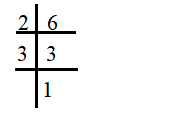
LCM of 6
Prime factors of 6 are 2, 3
Prime Factorization of 12
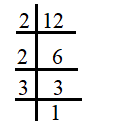
LCM of 12
Prime factors of 12 are 2, 3.
Now multiplying the highest prime factors to calculate the LCM of 6 and 12.
Factors of 6
6 = {1, 2, 3, 6}
Factors of 12
12 = {1, 2, 3, 4, 6, 12}

Example 2.
Find the LCM of 8 and 24.
Solution:
The LCM can be found by multiplying the highest exponent prime factors of 8 and 24.
First we will calculate the prime factors of 8 and 24.
Prime Factorization of 8
Prime factors of 8 are 2.
The prime factorization of 8 is 2 × 2 × 2.
Prime Factorization of 24
The prime factors of 24 are 2, 3.
24 = 2 × 2 × 2 × 3
LCM(8, 24) = 24
Factors of 8
List of positive integer factors of 8 that divides 8 without a remainder.
8 = 1, 2, 4, 8
Factors of 24
List of positive integer factors of 24 that divides 24 without a remainder.
24 = 1, 2, 3, 4, 6, 8, 12, 24

Example 3.
How to find the LCM of 7 and 21?
Solution:
LCM of 7 and 21 = 21
Step 1: Find the prime factorization of 7
7 = 7
Step 2: Find the prime factorization of 21
21 = 3 × 7
Step 3: Multiply each factor the greater number of times it occurs in steps i and ii
LCM = 21 = 3 × 7
Step 4: Therefore the Least Common Multiple of 7 and 21 is 21.

Example 4.
Find the LCM of 12 and 96.
Solution:
The Least Common Multiple of 12 and 96 = 96
Factors of 12 = 1, 2, 3, 4, 6, 12
Factors of 96 = 1, 2, 3, 4, 6, 8, 12, 16, 24, 32, 48, 96.
Step 1: Find the prime factorization of 12
12 = 2 × 2 × 3
Step 2: Find the prime factorization of 96
96 = 2 × 2 × 2 × 2 × 2 × 3
Step 3: Therefore the Least Common Multiple of 12 and 96 is 96.

Example 5.
Find the factors of 625 and 5.
Solution:
The Least Common Multiple of 625 and 5 = 625
The factors of 5 are 1, 5. There are two integers that are factors of 5. The greatest factor of 5 is 5.
The factors of 625 are 1, 5, 25, 125, 625. There are 5 integers that are factors of 625. The greatest factor of 625 is 625.
Step 1: Find the prime factorization of 625
625 = 5 × 5 × 5 × 5
Step 2: Find the prime factorization of 5
5 = 5
Step 3: Multiply each factor the greater number of times it occurs in step i and step ii.
LCM = 625 = 5 × 5 × 5 × 5

FAQs on Properties of L.C.M

1. What is the rule of LCM?

The LCM of two or more numbers is equal to the product of each factor by the maximum number of times it appears in the prime factorization of those numbers.

2. Write any 2 Properties of L.C.M.

1. LCM is Associative that means, LCM(a,b)= LCM(b,a)
2. The LCM of 2 or more numbers can not be less than the smallest numbers given in the set.

3. Why do we use Least Common Multiples(LCM)?

The L.C.M or L.C.D can be used before fractions can be added, subtracted, or compared. The LCM is the smallest positive number that is divisible by each of them.