Examples on Factors

Examples on Factors | Questions on How to find Factors of a Number?

Multiplying two whole numbers gives a product. The numbers that we multiply are the factors of the product. The Examples on Factors on various questions are explained step by step. Know how to make use of the properties of factors from here and solve problems. Practice the given questions on finding factors using various methods such as prime factorization, factor tree, etc, and learn how to find factors of a number. Check your answers with the given solutions and test your knowledge.
Factor × Whole Number = Multiple

Do Refer:

Examples on Factors

Example 1.
What are the factors of 50?
Solution:
The factors of 50 are as follows
1 × 50
2 × 25
5 × 10
10 × 5
25 × 2
50 × 1
Thus the factors of 50 are 1, 2, 5, 10, 25, 50.

Example 2.
What are the factors of 74?
Solution:
The factors of 74 are as follows
1 × 74
2 × 37
37 × 2
74 × 1
Thus the factors of 74 are 1, 2, 37 and 74.

Example 3.
What are the common factors of 20 and 24?
Solution:
To find the common factors of 20 and 24 we have to write the factors of 20 and 24 first.
Factors of 20 are 1, 2, 4, 5, 10, 20.
Factors of 24 are 1, 2, 3, 4, 6, 8, 12 and 24.
Thus the common factors of 20 and 24 are 1, 2, 4.

Example 4.
Write the prime factors of 64.
Solution:
The prime factors of 64 are as follows
64 = 2 × 32
= 2 × 2 × 16
= 2 × 2 × 2 × 8
= 2 × 2 × 2 × 2 × 4
= 2 × 2 × 2 × 2 × 2 × 2
Thus the prime factors of 64 are 2, 4, 8, 16, 32 and 64.

Example 5.
Write the prime factors of 26.
Solution:
The prime factors of 26 are as follows
26 = 2 × 13
Therefore 2 and 13 are the prime factors of 26.

Example 6.
Check if 8 is a factor of 96.
Solution:
To check whether 8 is a factor of 96 we have to write the factors of 96.
The factors of 96 are as follows
1 × 96
2 × 48
3 × 32
4 × 24
6 × 16
8 × 12
16 × 6
24 × 4
32 × 3
48 × 2
96 × 1
Thus the factors of 96 are 1, 2, 3, 4, 6, 8, 12, 24, 32, 48, and 96.
Therefore we can say that 8 is a factor of 96.

Example 7.
Check whether 2 is a factor of 18.
Solution:
To check whether 2 is a factor of 18 we have to write the factors of 18.
The factors of 18 are as follows
1 × 18
2 × 9
3 × 6
6 × 3
9 × 2
18 × 1
Thus the factors of 18 are 1, 2, 3, 6, 9, 18.
Hence 2 is a factor 18.

Example 8.
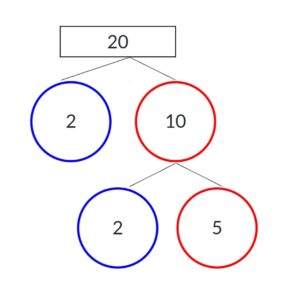
Find the factors of 20 using the factor tree method.
Solution:
Examples on factors

Factor tree of 20 is the list of prime numbers when multiplied results in the original number 20.
20 = 2 × 10
10 = 2 × 5
20 = 2 × 2 × 5

Example 9.
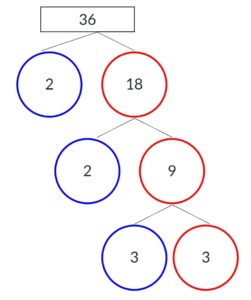
Find the factors of 36 using the factor tree method.
Solution:
Factor Tree img_6

Factor tree of 36 is the list of prime numbers when multiplied results in the original number 36.
Split 36 until you get the prime numbers.
36 = 2 × 18
Split 18 into 18 = 2 × 9
Split 9 into 3 × 3
9 = 3 × 3
Factors of 36 are 2 × 2 × 3 × 3
Thus the prime factors of 36 are 2, 2, 3, 3

Example 10.
Write the prime factors of 15.
Solution:
The prime factors of 15 can be written as
15 = 3 × 5
Here 3 and 5 are the prime numbers.
Thus the prime factors of 15 are 3, 5.

Example 11. 
Find the missing factors
i. 256 × _ = 256
ii. _ × 5 = 25
iii. 12 × _ = 60
Solution:
i. 256 × _ = 256
Let the missing factor be x
256 × x = 256
x = 256/256
x = 1
Thus the missing factor is 1.
ii. _ × 5 = 25
Let the missing factor be y.
y × 5 = 25
y = 25/5
y = 5
Thus the missing factor is 5.
iii. 12 × _ = 60
Let the missing factor be z.
12 × z = 60
z = 60/12
z = 5
Thus the missing factor is 5.

Properties of Factors

Properties of Factors – Definition, Examples | How to Make a Chart of Properties of Factors?

A factor is one of two or more numbers that divides a given number without a remainder. Here we learn the different properties of factors to solve the problems. Know how to find the factors of different numbers from here. There are two methods to find the factors of the numbers. They are the division method and factor tree method. Scroll down this page to know different methods to find the factors with the help of properties of factors.

Also, Refer:

Factor – Definition

Factors are defined as the numbers that are multiplied to give the product. For Example, Factors of 18 are 1, 2 3, 6, 9, 18. All these divide the number 18 exactly.

Chart of Properties of Factors

Here is the Factors Properties Chart the lists the major properties. You can employ them while solving related problems and arrive at solutions easily.

Chart of Properties of Factors

Properties of Factors

Follow the properties given below to know how to find the factors of the multiples.

Property 1.
1 is a factor of every number.
Example:
Multiply 1 with any number you get the same number.
1 × 31 = 31
1 × 534 = 534
1 × 76 = 76
1 × 467 = 467
Property 2.
Every number is a factor of itself.
Example: Multiply any number with 1 you get the original number.
15 × 1 = 15
5464 × 1 = 5464
530 × 1 = 530
66468 × 1 = 66468
Property 3.
Every factor of a number is an exact divisor of that number.
Example:
Factors of 10 are 1, 2, 5, 10.
Here each factor is exactly divisible by 10.
Property 4.
Every factor of a number is less than or equal to the number.
Example:
6 = 2 × 3
Here 2 and 3 are the factors that are less than 6.
Property 5.
Factors of a given number are finite.
Property 6.
Every multiple of a number is greater than or equal to that number.
Example:
Multiple of 2 = 2, 4, 6, 8, 10, 12, 14, 16, 18, 20.
Property 7.
Every number is multiple in itself.
Property 8.
The number of multiples of a given number is infinite.

Examples on Finding the Factors using Properties

Example 1.
Find the factors of 8 using the factor tree method.
Solution:
Properties of factors img_1

Factor tree of 8 is the list of prime numbers when multiplied results in the original number.
If we write into multiples it would be 4 × 2.
On splitting 4 further and writing it as multiples of number it would be 2 × 2.
Altogether expressing the number in terms of prime factors would be 2 × 2 × 2.

Example 2.
Find the factors of 72 using the factor tree method.
Solution:
properties of factors img_2

72 = 2 × 36
9 = 3 × 3
Split 72 into two pairs 2 × 36
Now split 36 we get 36 = 2 × 18
Now split the factors of 18 into two 18 = 2 × 9.
On splitting 9 we get 3 × 3.
Altogether expressing the number in terms of prime factors 2 × 2 × 2 × 3 × 3.

Example 3.
What are the factors of 18?
Solution:
The factors of 18 are as follows
1 × 18
2 × 9
3 × 6
6 × 3
9 × 2
18 × 1
Thus the factors of 18 are 1, 2, 3, 6, 9, and 18.

Example 4.
What are the prime factors of 25?
Solution:
Prime factors of a number are the set of prime numbers which when multiplied by together give the actual number.
We have to multiply directly with the prime number to find the factors of 25.
25 = 5 × 5
Thus the prime factors of 25 are 5.

Example 5.
What are the factors of 30?
Solution:
The factors of 30 are as follows
30 = 1 × 30
30 = 2 × 15
30 = 3 × 10
30 = 5 × 6
30 = 6 × 5
30 = 10 × 3
30 = 15 × 2
30 = 30 × 1
Thus the factors of 30 are 1, 2, 3, 5, 6, 10, 15, and 30.

FAQs on Properties of Factors

1. What are the properties of factors?

1. Smallest Multiple is the Number itself.
2. There can be an infinite number of multiples.
3. Multiples are greater than or equal to the given number.

2. What is a factor?

A factor is a number or an algebraic expression that divides another number or expression evenly with no remainder.

3. How many types of factors are there?

Factors are classified into two types.
1. Prime factors
2. Composite factors

Factor Tree Method

Factor Tree Method – Definition, Facts, Examples | How to do Factor Tree Method?

The Factor Tree method is a simple way to break down the given numbers into prime factors. It is written in such a way that you get the exact divisibility by using the prime factors of the original number. Students who are unable to understand the concept of the Factor Tree Method can make use of this article and practice the problems. You can see questions with clear-cut solutions in the below section. Know how to solve the multiples using the Factor Tree Method from this page.

Refer:

Factor Tree – Definition

A factor tree is a diagram where we can find the factors of a number, from that we can find the factors of those numbers till we get the prime factors for the given number.
For example, let us see how to find the prime factors of 12.
Solution:
First split the numbers into factor pairs.
12 can be written as 4 × 3.
Factor Tree Method img_1
12 = 2 × 2 × 3
The prime factors of 12 are 2 and 3.

How to do Prime Factorization using the Factor Tree Method?

The factor Tree Method is one of the simple ways to find the prime factors of the original number. There are some to step to solve the problems using a factor tree method.
1. The first step in making a factor tree is to find a pair of factors whose product is the number that we are factoring.
2. Check whether 2 is a factor of the given number.
3. Break down each set into factors.
4. Check for other prime numbers like 3, 5 factors of the original number.
5. Then split the factors until you get all the prime factors.
6. At last write the prime factors of the original number.

Factor Trees Examples

Example 1.
Find the factors of 24.
Solution:
Use Factor Tree Method to find the factors of 24.
The first step in making a factor tree is to find a pair of factors whose product is the number that we are factoring.
Write the factors of 24
Break down each set into factors.
Then split the factors until you get all the prime factors.
12 can be written as 2 × 12
2 is a prime number. So split 12 into 2 × 6
2 is a prime number. So split 6 into 2 × 2
24 = 2 × 2 × 2 × 3
Factor Tree img_5
Thus the prime factors of 24 are 2, 2, 2, 3.

Example 2.
Find the factors of 36
Solution:
Use Factor Tree Method to find the factors of 36.
The first step in making a factor tree is to find a pair of factors whose product is the number that we are factoring.
Write the factors of 36
4 × 9
Break down each set into factors.
Then split the factors until you get all the prime factors.
Split 4 into 2 × 2
Split 9 into 3 × 3
36 = 2 × 2 × 3 × 3
Factor Tree img_6
Thus the prime factors of 36 are 2, 2, 3, 3.

Example 3.
Find the factors of 25
Solution:
Use Factor Tree Method to find the factors of 25.
The first step in making a factor tree is to find a pair of factors whose product is the number that we are factoring.
Break down each set into factors.
Write the factors of 25
25 = 5 × 5
5 is a prime number.
Factor Tree Method img_2
Thus the prime factors of 25 are 5, 5.

Example 4.
Find the factors of 32
Solution:
Use Factor Tree Method to find the factors of 32.
The first step in making a factor tree is to find a pair of factors whose product is the number that we are factoring.
Write the factors of 32.
Break down each set into factors.
Then split the factors until you get all the prime factors.
32 can be written as 8 × 4
8 can be written as 4 × 2
4 can be written as 2 × 2
The factors of 32 are 2 × 2 × 2 × 2 × 2
Factor Tree img_3
Thus the prime factors of 32 are 2, 2, 2, 2, 2.

Example 5.
Find the factors of 48
Solution:
Use Factor Tree Method to find the factors of 48.
The first step in making a factor tree is to find a pair of factors whose product is the number that we are factoring.
Write the factors of 48.
Break down each set into factors.
Then split the factors until you get all the prime factors.
48 can be written as 4 × 12
Split the factor pairs
4 = 2 × 2
12 × 2 × 6
6 can be written as 2 × 3
Thus the factors of 48 are 2 × 2 × 2 × 2 × 3
Factor Tree img_4
Thus the prime factors of 48 are 2 and 3.

FAQs on Factor Tree Method

1. What is a Factor Tree?

One method for producing the prime factorization of a natural number is called a factor tree.

2. How to make a factor tree?

1. First write the given number
2. Find a pair of factors
3. Break down each set into its own factors.
4. Repeat until you reach nothing but prime numbers.

3. What is the factor tree of 27?
Factor Tree Method img_7

Factors

Factors – Definition, Facts, Examples | How to find Factors of a Number?

In math, a Factor is a number or algebraic expression that is an exact divisor with no remainder. An integer that has the factors one and itself is known as prime factors. The integer that has more than two factors is known as composite factors. Let us learn more about the factors from this article. Go through the below section to know how to find the factors of the numbers from here.

Do refer:

Factor – Definition

A factor is derived from the Latin word which means “a maker” or “a doer” or “a performer”. A factor is a whole number that can be multiplied by another whole number to produce a whole number.
Factor × Factor = Multiple

Types of Factors

There are two types of factors. They are
1. Prime factors
2. Composite Factors

Prime Factors

Prime factors of a number are the set of prime numbers which when multiplied by together give the actual number. The prime numbers are 2, 3, 5, 7, 11, 13, 17,….
Example:
Write the prime factors for 6.
Solution:
1 × 6 = 6
2 × 3 = 6
3 × 2 = 6
6 × 1 = 6
2 and 3 are the prime numbers.
Hence, 2 and 3 are the prime factors of 6.

Composite Factors

Composite factors of a number are the factors that are not prime. That means the numbers which have more than two factors are known as the composite factors.
Example:
Write the composite factors of 12.
Solution:
1 × 12 = 12
2 × 6 = 12
3 × 4 = 12
4 × 3 = 12
6 × 2 = 12
12 × 1 = 12
Thus the factors of 12 are 1, 2, 3, 4, 6, 12.

How to Find Factors of a Number?

We can find the factors of a number by using both the division method and the multiplication method. First, we will see how to find the factors of a number by division.
Factors by Division
1. Find the numbers less than or equal to the given number.
2. Now divide the given number by each of the numbers.
3. The remainder should be 0.
For example, let us divide 6 and 3
6 ÷ 3 = 2
Thus the factors of 6 are 2 and 3 as the remainder leaves zero.
Factors by Multiplication
Follow the below steps to find the factors using the multiplication method.
1. First write the given numbers as the product of two numbers in possible ways.
2. All the numbers involved in all these products are the factors of the given number.
3. With this we can find whether the given number is a prime factor or composite factor.
For example, write the factors of 12.
1 × 12 = 12
2 × 6 = 12
3 × 4 = 12
4 × 3 = 12
6 × 2 = 12
12 × 1 = 12
Thus the factors of 12 are 1, 2, 3, 4, 6 and 12.

Solved Problems on Finding Factors

Example 1.
Find the factors of 16.
Solution:
The factors of 16 are as follows
1 × 16
2 × 8
4 × 4
8 × 2
16 × 1
Therefore the factors of 16 are 1, 2, 4, 8, 16.

Example 2.
Write the prime factors for 15.
Solution:
Prime factors of a number are the set of prime numbers which when multiplied by together give the actual number.
We have to multiply directly with the prime number to find the factors of 15.
15 = 3 × 5
Thus the prime factors of 15 are 3, 5.

Example 3.
Find the Missing Factors of the following
i. 2 × _ = 10
ii. _ × 7 = 21
iii. 7 × _ = 49
iv. 9 × _ = 54
v. 10 × _ = 30
Solution:
i. 2 × _ = 10
Let the missing factor be x.
2 × x = 10
x = 10 ÷ 2
x = 5
Thus the missing factor is 5.
ii. _ × 7 = 21
Let the missing factor be a.
a × 7 = 21
a = 21 ÷ 7
a = 3
Thus the missing factor is 3.
iii. 7 × _ = 49
Let the missing factor be b.
7 × b = 49
b = 49 ÷ 7
b = 7
Thus the missing factor is 7.
iv. 9 × _ = 54
Let the missing factor be c.
9 × c = 54
c = 54 ÷ 9
c = 6
Thus the missing factor is 6.
v. 10 × _ = 30
Let the missing factor be y.
10 × y = 30
y = 30 ÷ 10
y = 3
Thus the missing factor is 3.

Example 4.
What are the factors of 72?
Solution:
The factors of 72 are
1 × 72
2 × 36
3 × 24
4 × 18
6 × 12
8 × 9
9 × 8
12 × 6
18 × 4
24 × 3
36 × 2
72 × 1
Therefore the factors of 72 are 1, 2, 3, 4, 6, 8, 9, 12, 18, 24, 36 and 72

Example 5.
What are the factors of 120?
Solution:
The factors of 120 are
1 × 120
2 × 60
3 × 40
4 × 30
5 × 24
6 × 20
8 × 15
10 × 12
12 × 10
15 × 8
20 × 6
24 × 5
30 × 4
40 × 3
60 × 2
120 × 1
Therefore the factors of 120 are 1, 2, 3, 4, 5, 6, 8, 10, 12, 15, 24, 30, 40, 60 and 120

Example 6.
Write the common factors of 21.
Solution:
Multiples of 3 – 3, 6, 9, 12, 15, 18, 21, 24.
Multiples of 7 – 7, 14, 21, 28.
Thus the common factors of 21 are 3 and 7.

FAQs on Factors

1. Define Factor

Factors are the numbers you multiply together to get another number. The factor may be both positive integer and negative integer.

2. What are the factors of 18?

The factors of 18 are
1 × 18
2 × 9
3 × 6
6 × 3
9 × 2
18 × 1
Thus the factor of 18 is 1, 2, 3, 6, 9, 18.

3. What are the types of factors?

There are three types of factors. They are
1. Direct
2. Distributed
3. Augmentative

Examples on Multiples

Examples on Multiples – Definition, Meaning | Solved Questions on Multiples using Different Properties

Multiples are defined as the number obtained when multiplied by other numbers. Multiplication is used to find the multiples. The factor of two or more numbers results in multiple. Scroll down this page to solve the examples on multiples. Learn how to solve problems on multiples using different properties of multiples in the examples given below.

Multiplication of the number = Main Number × n; where n is an integer

Do Read:

Worked Examples on Multiples

Make use of the properties of multiples such as Every number is multiple in itself, Every multiple of a number is either greater than or equal to the number, Every number is a multiple of 1, etc to solve the problems given below.

Example 1.
Write first five multiples of 10.
Solution:
The first five multiples of 10 are
10 × 1 = 10
10 × 2 = 20
10 × 3 = 30
10 × 4 = 40
10 × 5 = 50
Therefore the first five multiples of 10 are 10, 20, 30, 40, 50.

Example 2.
Write the first three multiples of 14.
Solution:
The first three multiples of 14 are
14 × 1 = 14
14 × 2 = 28
14 × 3 = 42
Therefore the first three multiples of 14 are 14, 28 and 42.

Example 3.
Write the first 5 common multiples of 3 and 6.
Solution:
M(3) = {3, 6, 9, 12, 15, 18, 21, 24, 27, 30, 33, 36, 39, 41, 44….}
M(6) = {6, 12, 18, 24, 30, 36, 42, 48, 54, 60….}
From the above multiples we can write the first 5 common multiples of 3 and 6 as 6, 12, 18, 24, 30.

Example 4.
Write first five multiples of
i. 21       ii. 13     iii. 17        iv. 18        v. 4
Solution:
i. 21
The first five multiples of 21 are
21 × 1 = 21
21 × 2 = 42
21 × 3 = 63
21 × 4 = 84
21 × 5 = 105
Therefore the first five multiples of 21 are 21, 42, 63, 84, 105.
ii. 13
The first five multiples of 13 are
13 × 1 = 13
13 × 2 = 26
13 × 3 = 39
13 × 4 = 52
13 × 5 = 65
Therefore the first five multiples of 13 are 13, 26, 39, 52, 35.
iii. 17
The first five multiples of 17 are
17 × 1 = 17
17 × 2 = 34
17 × 3 = 51
17 × 4 = 68
17 × 5 = 85
Therefore the first five multiples of 17 are 17, 34, 51, 68, 85.
iv. 18
The first five multiples of 18 are
18 × 1 = 18
18 × 2 = 36
18 × 3 = 54
18 × 4 = 72
18 × 5 = 90
Therefore the first five multiples of 18 are 18, 36, 54, 72, 90.
v. 4
The first five multiples of 4 are
4 × 1 = 4
4 × 2 = 8
4 × 3 = 12
4 × 4 = 16
4 × 5 = 20
Therefore the first five multiples of 4 are 4, 8, 12, 16, 20.

Example 5.
Find the common multiples of 4 and 12.
Solution:
A common multiple is a multiple that two or more numbers having a common number.
Multiples of 4 are 4, 8, 12, 16, 20, 24, 28, 32, 36, 40, 44, 48….
Multiples of 12 are 12, 24, 36, 48, 60, 72, 84,…
Thus the common multiples of 4 and 12 are 12, 24, 36, 48.

Example 6.
Write three common multiples of 6 and 8.
Solution:
A common multiple is a multiple that two or more numbers having a common number.
Multiples of 6 are 6, 12, 18, 24, 30, 36, 42, 48,…
Multiples of 8 are 8, 16, 24, 32, 40, 48,….
Thus the common multiples of 6 and 8 are 24, 48.

Example 7.
Prove that every number is multiple in itself.
Solution:
Let us solve some problems to prove that every number is multiple in itself.
22 × 1 = 22
4656 × 1 = 4656
9 × 1 = 9
59 × 1 = 59
By writing this product we can say that any number multiplied by 1 will be always the same number.

Example 8.
Write the first ten multiples of 7
Solution:
The first ten multiples of 7 are
7 × 1 = 7
7 × 2 = 14
7 × 3 = 21
7 × 4 = 28
7 × 5 = 35
7 × 6 = 42
7 × 7 = 49
7 × 8 = 56
7 × 9 = 63
7 × 10 = 70
Thus the first 10 multiples of 7 are 7, 14, 21, 28, 35, 42, 49, 56, 63, 70.
M(7) = {7, 14, 21, 28, 35, 42, 49, 56, 63, 70}

Example 9.
The numbers which are multiples of 2 are called ________
Solution:
The multiples of 2 are 2, 4, 6, 8, 10, 12, 14,….
Thus the numbers which are multiples of 2 are called Even numbers.

Example 10.
Write first five multiples of 90.
Solution:
The first five multiples of 90 are
90 × 1 = 90
90 × 2 = 180
90 × 3 = 270
90 × 4 = 360
90 × 5 = 450
Thus the first five multiples of 90 are 90, 180, 270, 360 and 450.

Properties of Multiples

Properties of Multiples – Definition, Examples | Chart of Properties of Multiples

Multiples are the basic level of maths which you have to learn to become a master. It is a product of two or more numbers. You can check the multiples of the given numbers with the exact divisor method. Know the definition, properties of multiples in this article. Know the difference between factors and multiples from here. Also, you can get a detailed explanation for all the problems related to multiples. All these concepts will help your child enhance their knowledge, resulting in the best score in the exams.

Do Refer:

Multiples – Definition

Multiples are defines are the products you get when you multiply two or more numbers. Multiples are nothing but tables of given numbers.
Example: Product of 2 and 5
2 × 5 = 10
Here 10 is multiple.
Thus the multiples of 2 and 5 are 10.

Chart of Properties of Multiples

Chart of Properties of Multiples

Properties of Multiples

The properties of multiples are explained step by step in the below section.
Property 1.
1 is a factor of every number
Example:
1 × 42 = 42
1 × 524 = 524
1 × 9 = 9
We get the given number when we multiple 1 with any number.
Property 2.
Every number is a factor in itself.
Example:
464 = 1 × 464
24 = 1 × 24
We know that 1 is a factor, so that means we get the same result when we multiply with 1.
Therefore every number is a factor in itself.
Property 3.
Every factor of a number is an exact divisor of that number.
Example:
Factors of 10 are 1, 2, 5, 10.
Property 4.
Factors of a given number are finite.
Example: Factors of 8 are 1, 2, 4, 8 only.
Property 5.
Every factor of a number is less than or equal to the number.
Example:
Let us take the factors of 6 are 1, 2, 3 and 6.
2 × 3 = 6
Here 2 and 3 are less than 6.
1 × 6 = 6
Here 6 is equal to 6.
Therefore the above example satisfies the property “Every factor of a number is less than or equal to the number.”
Property 6.
The number of multiples of a given number is infinite.
For example, let us write the multiples of 2
M(2) = {0, 2, 4, 6, 8, 10, 12, 14, 16, 18, 20, 22,…..}
As we know that the numbers are infinite the multiples of 2 will be infinite.
Thus it shows that “The number of multiples of a given number is infinite.”
Property 7.
Every number is a multiple of itself.
Property 8.
Any number multiplied by 0 will be always 0.
Example:
For example, when we multiply 2 with 0 we get 0.
0 × 2 = 0
When we multiply 0 with 649 we get 0.
0 × 649 = 0
When we multiply 25 with 0 we get 0.
25 × 0 = 0
When we multiply 16 with 0 we get 0.
16 × 0 = 0
Property 9.
Every multiple of a number is greater than or equal to that number.
For example, we multiply 24 with 2
24 × 2 = 48
48 is greater than 24.
24 × 1 = 24
24 is equal to 24.
Thus it satisfies the property that “Every multiple of a number is greater than or equal to that number”

Difference Between Factors and Multiples

FactorsMultiples
1. Factors are defines as the exact divisors of a number.1. Multiples are defined as the product you get when you multiply two or more numbers.
2. The operation used to find the factors of a number is division.2. The operation used to find the multiples is multiplication.
3. The outcome of the factors should be less than or equal to the given number.3. The outcomes of the multiples should be greater than or equal to the given number.
4. The number of factors is finite.4. The number of multiples is infinite.

Examples of Properties of Multiples

Example 1.
Write 5 multiples of
i). 12           ii). 5           iii). 9         iv). 15           v). 3

Solution:
i. 12
12 × 1 = 12
12 × 2 = 24
12 × 3 = 36
12 × 4 = 48
12 × 5 = 60
ii. 5
5 × 1 = 5
5 × 2 = 10
5 × 3 = 15
5 × 4 = 20
5 × 5 = 25
iii. 9
9 × 1 = 9
9 × 2 = 18
9 × 3 = 27
9 × 4 = 36
9 × 5 = 45
iv. 15
15 × 1 = 15
15 × 2 = 30
15 × 3 = 45
15 × 4 = 60
15 × 5 = 75
v. 3
3 × 1 = 3
3 × 2 = 6
3 × 3 = 9
3 × 4 = 12
3 × 5 = 15

Example 2.
Write the properties of multiples of 3
Solution:
By using the properties we can know the multiples of 3, which indicates that by adding their figures the result can be 3, 6 or 9 is a multiple of 3.
M(3) = {0, 3, 6, 9, 12, 15, 18, 21, 24, 27, 30,…}
Number 30: 3 + 0 = 3, 3 is a multiple of itself.
Number 27: 2 + 7 = 9, 9 is a multiple of 3.
Number 24: 2 + 4 = 6, 6 is a multiple of 3.
Number 21: 2 + 1 = 3,3 is a multiple of 3.
Number 18: 1 + 8 = 9,9 is a multiple of 3.
Number 15: 1 + 5 = 6,3 is a multiple of 3.
Number 12: 1 + 2 = 3,3 is a multiple of 3.

Example 3.
Write the properties of multiples of 6.
Solution:
6 × 1 = 6
6 × 2 = 12
6 × 3 = 18
6 × 4 = 24
6 × 5 = 30
6 × 6 = 36
6 × 7 = 42
6 × 8 = 48
6 × 9 = 54
6 × 10 = 60
M(6) = {0,6, 12, 18, 24, 30, 36, 42, 48, 54, 60….}

Example 4.
Write the properties of multiples of 9.
Solution:
By using the properties we can know the multiples of 9, which indicates that by adding their figures the result can be 9 is a multiple of 9.
M(9) = {0, 9, 18, 27, 36, 45, 54,….}
Number 9: 9 + 0 = 9,9 is a multiple of 9.
Number 18: 1 + 8 = 9,9 is a multiple of 9.
Number 27: 2 + 7 = 9, 9 is a multiple of 9.
Number 36: 3 + 6 = 9, 9 is a multiple of 9.
Number 45: 4 + 5 = 9, 9 is a multiple of 9.

Example 5.
Write the 10 multiples of 5.
Solution:
5 × 1 = 5
5 × 2 = 10
5 × 3 = 15
5 × 4 = 20
5 × 5 = 25
5 × 6 = 30
5 × 7 = 35
5 × 8 = 40
5 × 9 = 45
5 × 10 = 50
Therefore M(5) = {5, 10, 15, 20, 25, 30, 35, 40, 45, 50}

FAQs on Properties of Multiples

1. Write 10 multiples of 3.
3 × 1 = 3
3 × 2 = 6
3 × 3 = 9
3 × 4 = 12
3 × 5 = 15
3 × 6 = 18
3 × 7 = 21
3 × 8 = 24
3 × 9 = 27
3 × 10 = 30
Thus M(3) = 3, 6, 9, 12, 15, 18, 21, 24, 27, 30

2. What is a multiple number?

The multiples of a number are the result of the multiplication of the number by another number, therefore, a number is a multiple of another if it contains an integer number of times.
Multiple of the number = main number × n

3. Write the common multiples for 2 and 3

The common multiples of 2 and 3 are 6, 12, 18, 24, 30, 36, 42. The multiples of 6 will be common multiples of 2 and 3.

Number Formed by any Power

Number Formed by Any Power – Definition, Rules, Examples | How to Raise a Number by any Power?

A power tells how many times the base is used as a factor. The number formed by any power will be the multiple of the given number. The sum of the digits of the product will be equal to the factors of the given number. Before you start solving the problems students must remember that there are some rules to find a product. Know the Procedure on how to raise a number by any power, examples of numbers formed by any power, etc.

Do Read:

How to Raise a Number by any Power?

Follow the simple guidelines listed below to obtain Number Formed by any Power. They are as follows

  • Firstly, identify the base and power in the given number.
  • Later, write down the base as many times as the power and place a multiplication symbol in between them.
  • Multiply the numbers and find the result.

Rules on Numbers Raised by any Powers

1. Any number raised to the power of zero, except zero, equals one.
a0 = 1
2. Any number raised to the power of one equals the number itself.
a¹ = a
3. When bases are equal powers should be added.

Examples of Number Raised by any Power

Example 1.
Write the number 3 formed by any power.
Solution:
We have to write the number formed any power for 3.
Let us take random multiples of 3 to check the result.
First multiple any number with 3 and then add the result and check whether it is multiple of 3 like 3, 6, 9.
3¹  = 3 → 3 + 0 = 3 → 3 is a multiple of 3.
3³ = 27 → 2 + 7 = 9 → 9 is a multiple of 3.
3 × 2 = 6 → 6 is a multiple of 3.
3 × 10 = 30 → 3 + 0 = 3 → 3 is a multiple of 3.
3 × 18 = 54 → 5 + 4 = 9 → 9 is a multiple of 3.
3 × 42 = 126 → 1 + 2 + 6 = 9 → 9 is a multiple of 3.
We observe that the number formed by any power is 3, 6, 9.
The sum of the digits of a number formed by 3 will be the multiples of 3.

Example 2.
Write the number 9 formed by any power.
Solution:
We have to write the number formed any power for 9.
Let us take random multiples of 9 to check the result.
First multiple any number with 9 and then add the result and check whether it is a multiple of 9.
9¹ = 9
9² = 9 × 9 = 81 = 8 + 1 = 9 → 9 is a multiple of 9.
9³ = 9 × 9 × 9 = 729 = 7 + 2 + 9 = 18 = 1 + 8 = 9 → 9 is a multiple of 9.
94 = 9 × 9 × 9 × 9 = 6561 = 6 + 5 + 6 + 1 = 18 = 1 + 8 = 9 → 9 is a multiple of 9.
9 × 12 = 108 = 1 + 0 + 8 = 9 → 9 is a multiple of 9.
9 × 428 = 3852 = 3 + 8 + 5 + 2 = 18 = 1 + 8 = 9 → 9 is a multiple of 9.
We observe that the number formed by any power is 9.
The sum of the digits of a number formed by any power for 9 is 9.

Example 3.
Write the number 5 formed by any power.
Solution:
We have to write the number formed any power for 5.
Let us take random multiples of 5 to check the result.
Multiply the numbers with any power and then check whether it is a multiple of 5.
We know that the multiplies of 5 will have 0 or 5 in its last digit.
5¹ = 5 → 5 is a multiple of 5.
5² = 5 × 5 = 25 → 5 is a multiple of 5.
5³ = 5 × 5 × 5 = 125 → 5 is a multiple of 5.
56 = 5 × 5 × 5 × 5 × 5 × 5 = 15625 → 5 is a multiple of 5.
All the values above are having 5 in their last digit which means the above numbers are multiples of 5.

Example 4.
Write the number 2 formed by any power.
Solution:
We have to write the number formed any power for 2.
Let us take random multiples of 2 to check the result.
Multiply the numbers with any power and then check whether it is a multiple of 2.
We know that the multiplies of 2 will have 0, 2, 4, 6, 8 at its last digit.
2¹ = 2 → 2 is a multiple of 2.
2² = 2 × 2 = 4 → 4 is a multiple of 2.
2³ = 2 × 2 × 2 = 8 → 8 is a multiple of 2.
2 × 126 = 252 = 252 is a multiple of 2.
All the values above are having 2, 4, 8 in their last digit which means the above numbers are multiples of 2.

Example 5. Write the number 6 formed by any power.
Solution:
We have to write the number formed any power for 6.
Multiply the numbers with any power and then check whether it is a multiple of 5.
Let us take random multiples of 6 to check the result.
6 × 50 = 300 = 3 + 0 + 0 = 3
6 × 23 = 138 = 1 + 3 + 8 = 12 = 1 + 2 = 3
6 × 68 = 408 = 4 + 8 = 12 = 1 + 2 = 3
6² = 6 × 6 = 36 = 3 + 6 = 9
6³ = 6 × 6 × 6 = 216 = 2 + 1 + 6 = 9
We observe that the number formed by any power is 3, 9.
The sum of the digits of a number formed by 6 will be the multiples of 3.

Counting Numbers in Proper Pattern

Counting Numbers in Proper Pattern | Number Patterns Examples with Answers

There are several ways for counting the numbers. Counting Numbers in Proper Pattern is one of the methods to learn multiples. We get multiples of numbers by counting the numbers in a proper pattern. It is very important for the students to count numbers such as 1, 2, 3, 4, 5, 6, 7, 8, 9, and so on. After that, it will be easy for the students to remember the number pattern.

This article helps you to understand the concept and score good marks in the exams. If you have good knowledge of counting numbers you can start learning the numbers in the proper patterns. For better understanding, we suggest you guys go through the below examples related to counting numbers in proper pattern.

Also, Check: Concept of Pattern

What is a Number Pattern?

A number pattern is a sequence of numbers that are formed in accordance with a definite rule.
For example, the proper pattern for the natural numbers is 1, 2, 3, 4, 5,…..

Counting Number Patterns and Sequences Examples

Example 1.
Count the Numbers in a pattern of 2.
Solution:
1            2
3            4
5            6
7            8
9           10
11         12
13         14
15         16
17         18
19         20
In this pattern, the numbers are written in a sequence of 2. By counting numbers in a pattern of 2 we get the multiples of 2 such as 2, 4, 6, 8, 10, 12, 14, 16, 18, 20…

Example 2.
Count the Numbers in a pattern of 3.
Solution:
1            2             3
4            5             6
7            8             9
10          11          12
13          14          15
16          17          18
19          20          21
22          23          24
25          26          27
28          29          30
In this pattern, the numbers are written in a sequence of 3. By counting numbers in a pattern of 3 we get the multiples of 3 such as 3, 6, 9, 12, 15, 18, 21, 24, 27, 30…..

Example 3.
Show the number pattern for 4, 8, 12, 16, 20, 24, 28, 32, 36, 40.
Solution:
Counting Numbers in Proper Pattern img_2
In this pattern, we see that every term in the sequence has grown or increased by 4 or the difference between any two consecutive numbers is 4. So, we can get the next term by adding 4 to the previous term.

Example 4.
Count the Numbers in a pattern of 5.
Solution:

12345
678910
1112131415
1617181920
2122232425
2627282930
3132333435
3637383940
4142434445
4647484950

From the above table we observe that in this pattern, the numbers are written in a sequence of 5. By counting numbers in a pattern of 5 the table of 5 likewise 5, 10, 15, 20, 25, 30, 35, 40, 45, 50.

Example 5.
Count the Numbers in a pattern of 7.

1234567
891011121314
15161718192021
22232425262728
29303132333435
36373839404142
43444546474849
50515253545556
57585960616263
64656667686970

From the above table we observe that in this pattern, the numbers are written in a series of 7. By counting numbers in a pattern of 7 the table of 7 such as 7, 14, 21, 28, 35, 42, 49, 56, 63, 70.

FAQs on Counting Numbers Patterns in Mathematics

1. What is the rule for the pattern of numbers?

A numerical pattern is a sequence of numbers that have been created based on pattern rules. Pattern rules can use one or more mathematical operations to describe the relationship between consecutive numbers in the pattern.
1. When numbers in a pattern get larger as the sequence continues, they are in an ascending pattern. Ascending patterns involve addition or multiplication.
2. When numbers in a pattern get smaller as the sequence continues, they are in a descending pattern. Descending patterns involve subtraction or division.

2. What is Counting Pattern?

The Number pattern is a series of numbers that shows the relationship between all the numbers.

3. Write one example for Counting Numbers in Proper Pattern.
2, 4, 6, 8, 10, 12, 14, 16, 18, 20Counting Numbers in Proper Pattern img_1

Three Consecutive Numbers

Three Consecutive Numbers – Definition, Formula, Examples | How to find Three Consecutive Numbers?

Three Consecutive Numbers are the numbers that follow each other from the smallest number to the largest number. There are two types of consecutive numbers. They are even consecutive numbers and odd consecutive numbers. Know more on Consecutive Numbers Definition, Facts, Formulas, Procedure on How to find the Three Consecutive Numbers when Sum or Product is known. Have a look at the examples related to three consecutive numbers.

Also, Read: Prime and Composite Numbers

Consecutive Numbers – Definition

Consecutive Numbers are the sequence or chain of numbers where each number is one more than the previous number. Consecutive Numbers are represented as n, n + 1, n + 2, n + 3, n + 4, …….

Consecutive Numbers Formula

The formula to find the three consecutive numbers is n, n + 1, n + 2.
The formula for consecutive even numbers are 2n, 2n + 2, 2n + 4, 2n + 6,…
The formula for consecutive odd number are 2n + 1, 2n + 3, 2n + 5, 2n + 7,…

How to find Three Consecutive Numbers?

Follow the simple steps provided to know about the procedure for finding the three consecutive numbers. They are as follows

  • We know the three consecutive numbers are in general as n, n + 1, n + 2…
  • You can find the value of integer ‘n’ you will be given either three consecutive numbers sum or product.
  • Frame an equation on what the question is asked for.
  • Solve for the variable ‘n’ as per the equation and then substitute the value of n in the consecutive numbers.

Three Consecutive Numbers Examples with Solutions

Example 1.
What are the first three consecutive natural numbers?
Solution:
Natural Numbers are the numbers that start with 1.
N = 1, 2, 3, 4, 5, 6….
The formula for three consecutive numbers is n, n + 1, n + 2
1, 1 + 1, 1 + 2 = 1, 2, 3
Thus the first three consecutive natural numbers are 1, 2, 3.

Example 2.
Find the three consecutive numbers of 54.
Solution:
Let n be 54.
The formula to find the three consecutive numbers is n, n + 1, n + 2.
n = 54
n + 1 = 55
n + 2 = 56
n + 3 = 57
Thus the three consecutive numbers after 54 are 55, 56, 57.

Example 3.
What is the sum of three consecutive odd numbers?
Solution:
The formula for consecutive even numbers are 2n, 2n + 2, 2n + 4, 2n + 6,…
2n + 2n + 2 + 2n + 4
For n = 1
2n = 2(1) = 2
2n + 2 = 2(1) + 2 = 2 + 2 = 4
2n + 4 = 2(1) + 4 = 2 + 4 = 6
Thus the three consecutive even numbers are 2, 4, 6

Example 4.
The sum of three consecutive even numbers is 84. How do you find the numbers?
Solution:
Given,
The sum of three consecutive even numbers is 84.
The formula for consecutive even numbers are 2n, 2n + 2, 2n + 4.
2n + 2n + 2 + 2n + 4 = 84
6n + 6 = 84
6n = 84 – 6
6n = 78
n = 78/6
n = 13

Example 5.
The sum of three consecutive odd numbers is 27, how do you find the numbers?
Solution:
Given,
The sum of three consecutive odd numbers is 30
The formula for consecutive odd number are 2n + 1, 2n + 3, 2n + 5
2n + 1 + 2n + 3 + 2n + 5 = 27
6n + 9 = 27
6n = 18
n = 18/6
n = 3
2n + 1 = 2(3) + 1 = 6 + 1 = 7
2n + 3 = 2(3) + 3 = 6 + 3 = 9
2n + 5 = 2(3) + 5 = 6 + 5 = 11
Thus the three consecutive odd numbers are 7, 9, 11.

FAQs on Three Consecutive Numbers

1. What are Consecutive Numbers?
The Numbers that follow each other from smallest to largest are known as Consecutive Numbers.

2. The Sum of Three Consecutive Integers is 48. How do you find the Numbers?
Three Consecutive Integers Sum is 48 i.e. n+n+1+n+2 = 48
3n+3=48
3n=48-3
3n=45
n=45/3 =15
Substituting the n value in the formula for three consecutive numbers we have n =15, n+1 = 15+1, n+2 =15+2
Thus, three consecutive integers are 15, 16, 17.

3. What is the algebraic expression for the sum of three consecutive integers?

The Sum of Three Consecutive Integers is 3 times the middle value i.e. 3n

4. What is the product of three consecutive integers?

The Product of Three Consecutive Integers is always divisible by 6.

Find the Missing Digits

Find the Missing Digits in Addition & Subtraction | Fill in the Missing Digits in a Number Sentence

Missing digits are nothing but the numbers that get missed in the given series of numbers. You have to check the missing number with the result and find the missing digit. This article helps you know how to find the missing digits in addition & subtraction problems. Here you can find the example problems related to addition and subtraction. The problem contains a missing digit which you have to replace and find the result.

Do Check:

Fill in the Missing Digits

Example 1.
How do you find the missing digits for
Find-the-missing-digits-img_1
Solution:
First add the ones values
7 + 1 = 8
Then add tens value
5 + _ = 7
_ = 7 – 5
_ = 2
Thus the missing digit is 2.
Now add hundreds value
3 + 4 = 7
Find-the-missing-digits-img_1-2
Thus the missing digit is 2.

Example 2.
How do you find the missing digits for
Find the missing digits img_2
Solution:
Find the missing digits img_2
First subtract ones place
4 – x = 1
4 – 1 = x
x = 3
Thus the missing digit is 3.

Example 3.
How do you find the missing digits for
Find the missing digits img_3
Solution:
First subtract the number in ones place
6 – 5 = 1
7 – 4 = 3
Find the missing digits img_3
Thus the missing digit is 1.

Example 4.
How do you find the missing digits for
Find the missing digits img_4

Solution:
Add the 2-digit numbers.
First add the ones value
x + 7 = 9
x = 9 – 7
x = 2
Now add the tens value
5 + 4 = 9
Find the missing digits img_4
Thus the missing digit is 2

Example 5.
How do you find the missing digits for
Find the missing digits img_5
Solution:
Add the 4-digit numbers.
First add the ones place
1 + 5 = 6
Add tens place numbers
2 + 4 = 6
Add hundreds place values
1 + 3 = 4
Now add thousands place values
6 + 1 = 7
Find the missing digits img_5
Therefore the missing digits are 7 and 6

Example 6.
How do you find the missing digits for
Find the missing digits img_6
Solution:
Subtract the 4-digits numbers
Subtract the numbers in ones place value
2 – 0 = 2
Subtract the numbers in tens place value
Let the missing digit be x.
5 – x = 4
5 – 4 = x
x = 1
Subtract the numbers in hundreds place value
9 – 8 = 1
Subtract the numbers in thousands place value
x – 2 = 6
x = 6 + 2
x = 8
Find the missing digits img_6
Thus the missing numbers are 8 and 1.

Example 7.
How do you find the missing digits for
Find the missing digits img_7
Solution:
Add the 5-digit numbers
Let the missing number be x.
Add the number in one’s place.
5 + x = 9
x = 9 – 5
x = 4
Thus the missing number in one place value is 4.
Add the number in the tens place.
2 + 7 = 9
Add the numbers in the hundreds place.
Let the missing number be y.
1 + y = 7
y = 7 – 1
y = 6
Thus the missing number in hundreds place is 6.
Add the number in thousands’ place.
3 + 2 = 5
Add the number in ten thousand place.
Let the missing number be z.
2 + z = 3
z = 3 – 2
z = 1
Thus the missing number in ten thousand place is 1.
Find the missing digits img_7.1

Example 8.
How do you find the missing digits for
Find the missing digits img_8
Solution:
Subtract the two 5-digit numbers
Subtract one’s place numbers.
Let the missing number be x.
6 – x = 5
6 – 5 = x
x = 1
Thus the missing digit in ones place is 1.
Now Subtract tens place numbers.
7 – 6 = 1
Now Subtract hundred’s place numbers.
Let the missing number be y.
5 – y = 5
5 – 5 = y
y = 0
Thus the missing digit in tens place is 0.
Now Subtract thousand’s place numbers.
8 – 6 = 2
Now Subtract numbers in the ten thousand places.
Let the missing number be z.
9 – 2 = z
z = 9 – 7
z = 2
Find the missing digits img_8.1