y-intercept of the Graph of y = mx + c

Finding y-intercept of the Graph y = mx + c | Tricks to find Slope Intercept Form of Line y=mx+c

y = mx + c is called the slope-intercept form equation of the straight line. In this article, we are going to learn more details about the y = mx + c graph of the straight line. In y = mx + c, m represents the slope value of the equation and c is the y-intercept. The graph y = mx + c cuts the y-axis at the point p the OP is the y-intercept of the graph and O is the origin.

Related Topics:

y-intercept of y = mx + c

The general form of the equation of the straight line is y = mx + c where m is slope or gradient and c is the y-intercept that cuts the y-axis at some point c. It is a linear equation and the variables x and y are the coordinates on the plane. x, y are independent and dependent variables respectively. The y-intercept of the line that is on the graph y = mx + c is c.
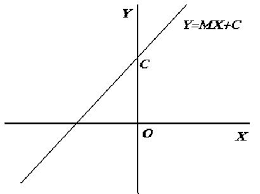
y = mx+c

Slope y = mx+c Formula

The equation y = mx + c is derived from the slope formula.
m = (y-c)/(x-0)
m = (y-c)/x
mx = y – c
mx + c = y
y = mx + c
Thus the slope-intercept form of the equation of the line is derived.

How to find the y-intercept of Equation of Straight Line y = mx + c?

  1. To find the y-intercept of the line y = mx + c we have to rearrange the equation to make y the subject.
  2. Substitute x = 0 into the equation to find the y-intercept.
  3. Declare the coefficient of x.

Slope Intercept Form of Equation y = mx + c Examples

Example 1.
What is the y-intercept of the graph of 6x + 2y = 3?
Solution:
Given that the equation is 6x + 2y = 3
2y = -6x + 3
y = – 6/2x + 3/2
y = -3x + 3/2
We know that
y = mx + c,
Comparing the equation with y = mx + c
we get c = 3/2. So, the y-intercept = 3/2

Example 2.
What is the y-intercept of the graph of x + y = 3?
Solution:
Given that the equation is 7x + 2y = 3
y = -x + 3
y = – x + 3
y = -x + 3
We know that
y = mx + c,
Comparing the equation with y = mx + c
we get c = 3. So, the y-intercept = 3

Example 3.
What is the y intercept of the graph of 5y = 2x + 3
Solution:
Given that the equation is 5y = 2x + 3
y = 2/5x + 3/5
We know that
y = mx + c
Comparing the equation with y = mx + c
We get c = 3/5
Therefore the y-intercept = 3/5

Example 4.
What is the y-intercept of the graph of 4x + 2y = 6?
Solution:
Given that the equation is 4x + 2y = 6
4x + 2y – 6 = 0
2y = -4x + 6
y = – 4/2x + 6/2
y = -2x + 3
We know that
y = mx + c,
Comparing the equation with y = mx + c
we get c = 3. So, the y-intercept = 3

Example 5.
What is the y-intercept of the graph of 7x + 8y = 26?
Solution:
Given that the equation is 7x + 8y = 26
8y = -7x + 26
y = – 7/8x + 26/8
y = -7/8x + 13/4
We know that
y = mx + c,
Comparing the equation with y = mx + c
we get c = 13/4. So, the y-intercept = 13/4

FAQs on y-intercept of the Graph of y = mx + c

1. What is y = mx + c?

The expression y = mx + c is an equation of a line
Here m is the slope of the line and the y-intercept of c.
This equation is formed by knowing the slope of the line and the intercept which the line cuts on the y-axis. This equation y = mx + c is the basic equation of the line.

2. How to use y = mx + c?

  1. To find the y-intercept of the line y = mx + c we have to rearrange the equation to make y the subject.
  2. Substitute x = 0 into the equation to find the y-intercept.
  3. Declare the coefficient of x.

3. What is the y-intercept of the graph 5x + 2y = 5?

5x + 2y = 5
2y = -5x + 5
y = -5/2 x + 5/2
Now compare the equation with y = mx + c
c = 5/2 so, the y-intercept = 5/2.

Plotting a Point in Cartesian Plane

Plotting a Point in Cartesian Plane and Determining the Quadrants | How to draw a Cartesian Plane and Label Points on Graph?

Plotting a Point in Cartesian Plane is very easy if you know how to draw a cartesian plane in a coordinate geometry graph. A cartesian graph is an intersection of two points at O. They are represented by two numbers in parentheses, separated by a comma that is called coordinates. Learn more about the cartesian plane from here and know how to draw a cartesian plane and then plot points on the cartesian graph. Scroll down this page to learn plotting points on a cartesian plane with solved examples.

Read Articles:

What is Cartesian Plane?

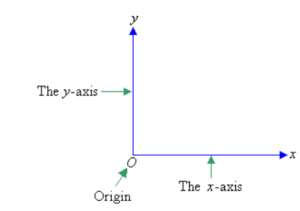
The cartesian plane is a representation of the position of a point by referring to it in terms of x-axis horizontal line and y-axis vertical line respectively. The point of intersection of x-axes and y-axes is known as the origin. The origin is represented by the letter ‘O’. The coordinates have two values the first number represents the x-coordinate and the second number represents the y-coordinate.
Cartesian Plane_1

How to Plot Points in Cartesian Plan?

  1. First, check the signs of the coordinates of a point and then identify the quadrant in which the point is to be plotted.
  2. Take the rectangular cartesian frames XOX’ and YOY’ intersecting at the right angles at origin ‘O’.
  3. Take a point P on the x-axis on the side of the involved quadrant such that the distance of the point P from the origin O equals the value of the x-coordinate.
  4. Draw a perpendicular line PQ on the x-axis. Take a point M on this perpendicular such that PM is equal to the value of the y-coordinate and M in the relevant quadrant. Thus the point M is plotted as per the given coordinate points.

Plotting a Point in Cartesian Plane Examples

Plot the following points in the cartesian plane then identify which quadrant or axis it belongs

Example 1.
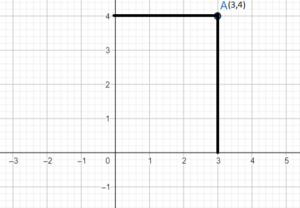
Plot the points (3,4) in the Cartesian plane.
Solution:
Given that the points are (3,4)
Here the x-coordinate is 3 and the y-coordinate is 4.
(3, 4) is a point in the first quadrant because both the coordinates are positive.
Now plot the graph using the coordinates (3,4)
Cartesian Plane_2

Example 2.
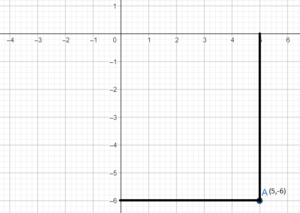
Plot the points (5,-6) in the Cartesian plane.
Solution:
Given that the points are (5,-6)
Here the x-coordinate is 5 and the y-coordinate is -6.
(5, -6) is a point in the fourth quadrant because both the coordinates are positive.
Now plot the graph using the coordinates (5,-6)
Cartesian Plane_3

Example 3.
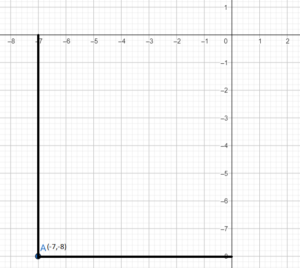
Plot the points (-7,-8) in the Cartesian plane.
Solution:
Given that the points are (-7,-8)
Here the x-coordinate is -7 and the y-coordinate is -8.
(-7, -8) is a point in the third quadrant because both the coordinates are positive.
Now plot the graph using the coordinates (-7,-8)
Cartesian Plane_4

Example 4.
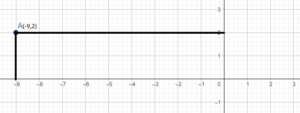
Plot the points (-9,2) in the Cartesian plane.
Solution:
Given that the points are (-9,2)
Here the x-coordinate is -9 and the y-coordinate is 2.
(-9, 2) is a point in the second quadrant because both the coordinates are positive.
Now plot the graph using the coordinates (-9,2)
Cartesian Plane_5

Example 5.
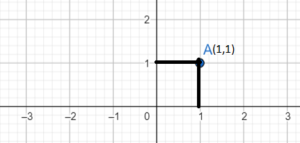
Plot the points (1,1) in the Cartesian plane.
Solution:
Given that the points are (1,1)
Here the x-coordinate is 1 and the y-coordinate is 1.
(1, 1) is a point in the first quadrant because both the coordinates are positive.
Now plot the graph using the coordinates (1,1).
Cartesian Plane_6

Invariant Points for Reflection in a Line

Invariant Points for Reflection in a Line – Definition, Facts, Examples | How do you find Invariant Points and Lines?

Invariant Points for Reflection in a Line is nothing a point that remains unvaried after the transformation applied to it. Any point on a graph on the line of reflection is an invariant point. Learn more about Invariant Points Under Reflection in a Line from this article. By making this page as a reference you can know about the Invariant Points on the graph on the line of reflection which helps you to score good marks in the exams.

Also Read:

Invariant Points for Reflection in a Line – Definition

Invariant points means the points which lie on the line and when reflected in the line. So, only those points are invariant which lie on the y-axis.
The invariant points must have x-coordinate = 0.
Therefore, only (0, 4) is the invariant point. No points lying outside the line will be an invariant point.

Invariant Points in Reflection in a Line Examples with Answers

Example 1.
Which of the following points (-2, 0), (0, -5), (3, -3) are invariant points when reflected in the x-axis?
Solution:
Given points are (-2,0), (0,-5) and (-3,3)
We know that
The points lying on the line are invariant points. when reflected in the line.
So, only those points are invariant which lie on the x-axis.
Hence, the invariant points must have y-coordinate = 0.
Therefore, only (-2, 0) is the invariant point.

Example 2.
Which of the following points (-2, 3), (0, 6), (4, -3), (-3, 6) are invariant points when reflected in the line parallel to the x-axis at a distance of 4 on the positive side of the y-axis?
Solution:
Given points are (-2,3), (0,6), (4,-3) and (-3,6)
We know that,
The points lying on the line are invariant points when reflected in the line.
So, only those points are invariant which are on the line parallel to the x-axis at a distance of 4 on the positive side of the y-axis.
Hence, the invariant points must have a y-coordinate = 4.
Therefore, (0, 6) and (-3, 6) are the invariant points.

Example 3.
Points A and B have coordinates (4,6) respectively. Find the reflection of A’ of A under reflection in the x-axis and A” of A under reflection in the y axis.
Solution:
Given that the coordinates are (4,6)
A’ = image of A under reflection in the x axis = (4,-6).
A” = image of A under reflection in the y axis = (-4,6).

Example 4.
A point P(a,b) is reflected in the x-axis to P'(6,-5). Write down the values of a and b. P” is the image of P reflected in the y axis. Write down the coordinates of P”. Find the coordinates of P”‘, when P is reflected in the line parallel to y-axis such that x = 3.
Solution:
A point P(a,b) is reflected in the x axis P'(6,-5)
We know that Mx(x,y) = (x,-y)
Thus, the coordinates of P are (6,5)
Hence a = 6, and b = 5.
P” = image of P reflected in the y axis = (-6,5)
P”‘ = reflection of P in the line (x = 3) = (-9,5).

Example 5.
Which of the following points (-1, 0), (0, -8), (2, -7) are invariant points when reflected in the x-axis?
Solution:
Given points are (-1,0), (0,-8) and (2,-7)
We know that
The points lying on the line are invariant points. when reflected in the line.
So, only those points are invariant which lie on the x-axis.
Hence, the invariant points must have y-coordinate = 0.
Therefore, only (-1, 0) is the invariant point.

FAQs on Invariant Points Under Reflection in a Line

1. Is a line of invariant points an invariant line?

In linear transformation maps the origin to the origin.
So the origin is always an invariant point under a linear transformation. Every point on the invariant line maps to a point on the line itself.

2. What are invariant points?

Invariant points are points on a line or a shape which do not move when the specific transformation is applied.

3. How do you find invariant points on a graph?

Sketch each graph by using the key points, including invariant points, Determine the image points on the graph by square rooting the points. And locate invariant points on y = f(x) and y = g(x). When graphing the square root of a function, invariant points occur at y = 0 and y = 1.

Rectangular Cartesian Coordinates of a Point

Rectangular Cartesian Coordinates of a Point – Definition, Formula, Examples | How do you find the Rectangular Coordinates of a Point?

You must have searched various sites to learn about Rectangular Cartesian Coordinates of a Point. Cartesian coordinates are the pair of numbers that specify the distance on the coordinate axis. Rectangular Cartesian Coordinates of a Point are defined by the ordered pairs x and y that indicate the points on the graph. Refer to our page to gather more information regarding the rectangular cartesian coordinates of a point. In addition to the concept of cartesian coordinates, the students can also find the solved examples on Rectangular Cartesian Coordinates of a Point from this article.

Also, See:

Rectangular Cartesian Coordinates of a Point – Definition

In order to find the rectangular cartesian coordinates of a point, you have to take two intersecting lines x-axis and the y-axis. They are perpendicular to each other which cuts at the origin O. Let P be the point in a plane. Draw the perpendicular lines from P to x-axis and P to y-axis. That point is M and N. Measure the lines PA and PB in a and b units. Here (a,b) are called the rectangular Cartesian coordinates of a point. The point P represents the position of the point in a plane.
rectangular cartesian coordinates of a point_1

Rectangular Coordinate System Examples with Answers

Example 1.
Find the new coordinates of the point (3,4) if the origin is shifted to the point (1,2) by translation of the axis.
Solution:
The given points are
(h,k)=(1,2) and (x,y)=(3,4)
Therefore new coordinates (X,Y)
x=X+h and y=Y+k
Therefore 3=X+1 and 4=Y+2
Which gives, X=4 and Y=2.
Hence, the new coordinates are (4,2)
rectangular cartesian coordinates of a point_2

Example 2.
Plot the rectangular coordinates of the points (2,3) (-2,4).
Solution:
Given that
The first point is (2,3)
Here the x coordinate is positive and the y coordinate is also positive, so the point lies in the first coordinate and plots the graph using the points (2,3).
The second point is (-2,4).
Here the x coordinate is negative and the y coordinate is positive, so the points lie in the second quadrant and plot the graph using the points (-2,4).
rectangular cartesian coordinates of a point_3

Example 3.
Find the new coordinates of the point (5,6) if the origin is shifted to the point (3,7) by translation of the axis.
Solution:
The given points are
(h,k)=(5,6) and (x,y)=(3,7)
Therefore new coordinates (X,Y) .
x=X+h and y=Y+k
Therefore 3 = X+5 and 7 = Y+6
Which gives, X=2 and Y= -1
Hence, the new coordinates are (2,-1)
rectangular cartesian coordinates of a point_4

Example 4.
Plot the rectangular coordinates of the points (-1,-2) (-12,8)
Solution:
Given that
The first point is (-1,-2)
Here the x coordinate is negative and the y coordinate is also negative, so the point lies in the third coordinate and plots the graph using the points (-1,-2).
The second point is (-12,8)
Here the x coordinate is negative and the y coordinate is positive, so the points lie in the second quadrant and plot the graph using the points (-12,8).
rectangular cartesian coordinates of a point_5

Example 5.
Plot the rectangular coordinates of the points (7,-6)
Solution:
Given that
The first point is (7,-6)
Here the x coordinate is positive and the y coordinate is negative, so the point lies in the fourth coordinate and plot the graph using the points (2,3).
rectangular cartesian coordinates of a point_6

Frequently Asked Questions

1. What is a rectangular Cartesian coordinate?

Cartesian coordinates are also called rectangular coordinates, it is a method of plotting graphs and pointing the positions of points on a two-dimensional surface or in three-dimensional space. The Cartesian plane consists of two perpendicular axes that cross the origin.

2. What is the point in rectangular coordinates?

In the rectangular coordinate every point is represented as an ordered pair. The first number in the ordered pair is called the x-coordinate, and the second number is called the y-coordinate.

3. How are polar coordinates and rectangular coordinates related?

Rectangular coordinates or cartesian coordinates come in the form of (x,y). Polar coordinates on the opposite hand, are available in the shape (r,θ). rather than moving out from the origin victimization horizontal and vertical lines, we tend to instead choose the angle θ, that is that the direction, then moves out from the origin a particular distance r.

Worksheet on Collinearity of Three Points

Worksheet on Collinearity of Three Points | Collinearity of Three Points Worksheet PDF

Worksheet on Collinearity of Three Points with step-by-step solutions is available on this page. Thus the students who are interested to learn the concept of conditions of collinearity of three points and solving the problems can refer to this article. By practicing the problems from the given Collinearity of Three Points worksheet you can know different types of questions asked in the exams and know how to solve them.

Also Read:

Collinearity of Three Points Worksheet with Answers

Example 1.
Find the value of p for which the points (p, -1), (4, 1), and (3, 5) are collinear.

Solution:

Let the given points be:
A(p, -1) = (x1, y1)
B(4, 1) = (x2, y2)
C(3, 5) = (x3, y3)
Given that A, B, and C are collinear.
Slope of AB = Slope of BC
(y2 – y1)/(x2 – x1) = (y3 – y2)/(x3 – x2)
Substituting the values of coordinates of given points,
(1 + 1)/(4 – p) = (5 – 1)/(3 – 2)
2/(4 – p) = 4/1
2/(4 – p) = 4
4 – p = 8
p = 4 – 8
p = -4
Hence, the value of p is -4.


Example 2.
Using the equation method, check the collinearity of the points A(6,-4), B(1,1), and C(-1,6).

Solution:

We know that the equation of a line passing through the points (x1, y1) and (x2, y2) is:
y – y1 = [(y2 – y1) /(x2 – x1)] (x – x1)
Let A(6, -4) = (x1, y1) and B(1,1) = (x2, y2).
So, the equation of a line passing through the points A(6, -4) and B(1, 1) is given by:
y + 2 = [(1 + 4)/(1 – 6)] (x – 7)
y + 2 = (5/-5) (x – 7)
y + 2 = -x + 7
x + y + 2 – 7 = 0
x + y – 5 = 0
Now, substituting the point C(-1, 6) in the above equation,
-1 + 6 – 5 = 0
0 = 0
Thus, the third point satisfies the equation of the line passing through the two of the given three points.
Therefore, the given points A, B and C are collinear.


Example 3.
Prove that the three points A(2,2), B(6,4), and C(10,6) are collinear.

Solution:

Given three points A(2,2),B(6,4), and C(10,6) are collinear, then the slopes of any two pairs of points will be equal.
That is,
Slope of AB = 6 – 2/4 – 2 = 4/2 = 2
Slope of BC=10 – 6/6 – 4 = 4/2 = 2
Slope of AC=10 -2/6 – 2 = 8/4 = 2
Thus, slope of AB = Slope of BC = Slope of AC
Hence, proved.


Example 4.
The points A(10,1),B(15,7) and C(a,3) are collinear. Find a.

Solution:

The given points A,B and C are collinear
We know that the slope of the line segment is slope = m = y2−y1/x2−x1
The slope of AB= slope of BC
7−1/15−10 = 3−7/a−15
6/5 = -4/a−15
6(a−15) = -4×5
6a−90 = -20
6a = -20+90
6a = 70
a=70/6
=70/6
Hence, the value of a is 70/6.


Example 5.
Using the equation method, check the collinearity of the points A(1,-4), B(1,2) and C(-4,6).

Solution:

We know that the equation of a line passing through the points (x1, y1) and (x2, y2) is:
y – y1 = [(y2 – y1) /(x2 – x1)] (x – x1)
Let A(1, -4) = (x1, y1) and B(1,2) = (x2,y2).
So, the equation of a line passing through the points A(1, -4) and B(1, 2) is given by:
y + 2 = [(2 + 4)/(1 – 1)] (x – 7)
y + 2 = (6/0) (x – 7)
y + 2 = 6x + 42
-6x + y + 2 – 42 = 0
-6x + y – 40 = 0
Now, substituting the point C(-4, 6) in the above equation,
-6(-4) + 6 – 5 = 0
-24+1 = 0
-23 = 0
Thus, the third point does not satisfy the equation of the line passing through two of the given three points.
Therefore, the given points A, B, and C are not collinear.


Example 6.
Prove that the three points A(4,2), B(5,4), and C(7,6) are collinear.

Solution:

Given three points A(4,2),B(5,4), and C(7,6) are collinear, then the slopes of any two pairs of points will be equal.
That is,
Slope formula = y2 – y1/x2 – x1
Slope of AB = 4-2/ 5-4 = 2
Slope of BC= 6-4/ 7-5 7 = 1
Slope of AC= 6-2/ 7-4 = 4/3
Thus, slope of AB ≠ Slope of BC ≠ Slope of AC
Hence, the given points are not collinear.


Example 7.
The points A(2,3), B(4,5) and C(a,6) are collinear. Find a.

Solution:

The given points A,B and C are collinear
We know that the slope of the line segment is slope = m = y2 – y1/x2−x1
The slope of AB= slope of BC
5-3/ 4-2= 6 – 5/a – 4
2/2 = 1/a-4
1 = 1/a – 4
a – 4 = 1
a = 4 – 1
a = -3
Hence, the value of a is -3.


Example 8.
Show that the points (1,-1), (5,2) and (9,5) are collinear

Solution:

Given that the points are
A(1,-1)
B(5,2)
C(9,5)
We know that the distance formula is√(x2−x1)²+(y2 – y1)²
Distance of AB = √(5-1)² + (2+1)² = √16 + 9 = √25 = 5
Distance of BC = √(5-9)² + (2-5)² = √16+9 = √25 = 5
Distance of AC = √(1-9)² + (-1-5)² = √64 + 36 = √100 = 10
From these distance od AB+ distance of BC = distance of AC
So the given points are collinear.


Example 9.
Show that the given points (1,2), (3,2), and (6,2) are collinear or not.

Solution:

Given that the points are
A(1,-1)
B(5,2)
C(9,5)
We know that the distance formula is √(x2−x1)²+(y2 – y1)²
Distance of AB = √(3-1)² + (2-2)² = √4 = 2
Distance of BC = √(6-3)² + (2-2)² = √9 = 3
Distance of AC = √(6-1)² + (2-2)² = √25 = 5
From these distance od AB+ distance of BC = distance of AC
So the given points are collinear.


Example 10.
Find the value of p for which the points (k, -2), (3, 4), and (4, 5) are collinear.

Solution:

Let the given points be:
A(k, -2) = (x1, y1)
B(3, 4) = (x2, y2)
C(4, 5) = (x3, y3)
Given that A, B, and C are collinear.
Slope of AB = Slope of BC
(y2 – y1)/(x2−x1) = (y3 – y2)/(x3 – x2)
Substituting the values of coordinates of given points,
(4 + 2)/(3 – p) = (5 – 3)/(4 – 4)
6/(3 – p) = 2
6/(3 – p) = 2
3 – p = 12
-p = 12 – 3
p = -9
Hence, the value of p is -9.


Distance and Section Formulae

Distance and Section Formulae – Derivation, Examples | How to Solve Problems on finding Distance and Section?

Attention Reader!! This article is the one-stop solution for all the students who are feeling distance and section formulae is a tough chapter. We are providing the information deeply about the Distance and Section Formulae Syllabus. All the details seen in this article are prepared by the math experts. So, use this opportunity to learn more about Distance Formula, Section Formula with examples, worksheets, and problems.

Topics Covered in Distance and Section Formulae

Distance Formula

The distance formula is used to calculate the distance between the points on the two-dimensional and three-dimensional coordinate plane. You can find the distance between the points by substituting the distance formula.
d = √(x2 – x1)² + (y2 – y1)²
where,
d = distance between the points
(x1, y1) and (x2, y2) are the ordered pairs of the two coordinate planes.
Distance between three points formula:
The distance formula for two points is used to find the distance between two points A(x1, y1, z1) and B(x2, y2, z3).
d = √(x2 – x1)² + (y2 – y1)² + (z2 – z1)²
where,
d = distance between the points
(x1, y1, z1) and (x2, y2, z2) are the ordered pairs of the two coordinate planes.

Section Formula

The Section formula is used to find the ratio in which a line segment is divided by a point internally or externally. This formula is used to find the centroid, incenter, and excenters of a triangle.

Do Check: Co-ordinate Geometry

Distance and Section Formulae Solved Problems

Example 1.
Given a triangle ABC in which A = (4,-4) B = (0,5) and C(5,6) A point P lies on BC such that BP : PC = 3:2 find the length of line segment AP.
Solution:
Given BP : PC = 3 : 2
Using the section formula
The coordinates of the point p(x,y) divide the line segment joining the points A(x1,y1) and B(x2,y2) internally in the ratio m1: m2.
[m1x2 + m2x1/m2 + m1 , m1y2 + m2y1/m2 + m1]
m1 = 3
m2 = 2
x1 = 0
x2 = 5
y1 = 5
y2 = 10
[3×5 + 2×0/3 + 2, 3×10 + 2×5/3 + 2]
[15/2 , 40/5]
(3,8)
Using distance formula we have
AP = √(3 – 4)² + (8 + 4)²
√1 + 144
√145
= 12.04

Example 2.
A(10,0) and B(5,15) are two fixed points. Find the coordinates of the point P is AB such that 5PB = AB also find the coordinates of some other points Q in AB such that AB = 6AQ.
Solution:
Given that,
5PB = AB
AB/PB = 5/1
AB – PB/PB = 5 – 1/1
AB/PB = 4/1
Using section formula coordinates of P are
P(x,y) = P(4×10 + 1×5/4 + 1 , 4×15 + 1 × 0/4 + 1
(40 + 5/5 , 60/5)
(9,12)
Given AB = 6AQ
AQ/AB = 1/6
AQ/AB – AQ = 1/6 – 1
AQ/QB = 1/5
Using section formula coordinates of Q are
Q(x,y) = Q(1×10 + 5×5/1 + 5, 1×15 + 5×0/1 + 5
Q(x,y) = Q(10 + 25/6, 15/6)
Q(35/6, 15/6)

Example 3.
Coordinates of the points which Divide the join of (1,7) and (4,3) in the ratio of 2:3 is.
Solution:
We know that the coordinates of the point dividing (x1, y1) and (x2,y2) in the ratio m:n is given by
(m1x1 + m2xx1/m1 + m2 , m1y2 + m2y1/m1 + m2)
Given that
(x1,y1) = (1,7)
(x2,y2) = (4,3)
(m1, m2) = 2 : 3
Coordinates of point of intersection of line segment is
(2×4 + 3×1/2 + 3, 2×3 + 3×7/2 + 3)
(8 + 3/5, 6 + 21/5)
(11/5, 27/5)

Example 4.
Using the section formula, the points A(7,5) B(9,3) and C(13,1) are collinear.
Solution:
If three points are collinear, then one of the points divides the line segment joining the order points in the ratio r : 1.
If the P is between the line A and B and AP/PB = r.
Distance AB = √(x1 – x2)² + (y2 – y1)²
= √(9 – 7)² + (3 – 5)²
= √(7)² + (-2)²
= √49 + 4
= √53
= 7.28
Distance BC = √(13 – 9)² + (1 – 3)²
= √(4)² + (-2)²
= √16 + 4
= √20
To find r
r = AB/BC = 7.28/4.47
The line divides in the ratio of 7.28 : 4.47
A line divides internally in the ratio m : n the point P = (mx1 + nx1/m + n, my2 + ny2/m + n)
m = 7.28, n = 4.47
x1 = 7
x2 = 13
y1 = 5
y2 = 1
By point B = 7.28×1 + 4.47×7/7.28 + 4.47
(94.64 + 31.29/11.75, 7.28 + 22.35/11.75)
The three points AB and C are collinear
(125.93/11.75, 29.63/11.27)
(10.7, 2.6)

Example 5.
Find the values of a such that PQ = QR, where P, Q, and R are the points whose coordinates are (1, – 1), (1, 3), and (a, 8) respectively.
Solution:
We know that
Distance AB = √(x1 – x2)² + (y2 – y1)²
PQ = √(1−1)²+(−1−3)²
=√0+(−4)²
=√ 0+16
= √16
QR =√ (1−a)²+(3−8)²
= √(1−a)²+(−5)²
= √(1−a)²+25
Therefore, PQ = QR
√16 =√ (1−a)²+25
16 = (1 – a)² + 25
(1 – a)² = 16 – 25
(1 – a)² = -9
1 – a = ±3
a = 1 ±3
a = (4, -2)

FAQs on Distance and Section Formulae

1. Which is section formula?

Section formula is used to find the ratio in which a line segment is divided by a point internally or externally. It is used to find out the centroid, incenter, and excenters of a triangle.

2. What are the distance formula section formula and midpoint formula?

The distance formula is used to find the distance between two points in the plane. The Pythagorean Theorem, a2+b2=c2, is based on a right triangle where a and b are the lengths of the legs adjacent to the right angle, and c is the length of the hypotenuse.

3. Is the section formula and distance formula the same?

The distance formula is used to find the distance between two defined points on a graph. The section formula gives the coordinates of a point that divides the line joining two points in a ratio, internally or externally.

Coordinate Geometry Graph

Coordinate Geometry Graph – Definition, Facts, Examples | How do you Plot the Coordinates of a Graph?

Are you confused about plotting the coordinate geometry graph maker? If yes then don’t worry we will help you plot the points on the coordinate geometry graph paper. The coordinate geometry graph the points and states whether they are collinear are or not. Coordinate geometry is one of the branches of geometry. The graph is plotted using the coordinates (x, y).

Do Refer:

Coordinate Geometry Graph – Definition

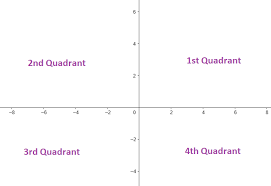
Coordinate geometry graphs deal with plotting and evaluating points, lines on the coordinate plane. The graph has two axes horizontal line is known as the x-axis and the vertical line is known as the y-axis. The coordinate graph is divided into four parts quadrant 1, quadrant 2, quadrant 3, and quadrant 4. The point of intersection of two lines is known as the origin with the ordinates (0, 0).
Quadrant

Coordinate Geometry Graph Questions and Answers

Example 1.
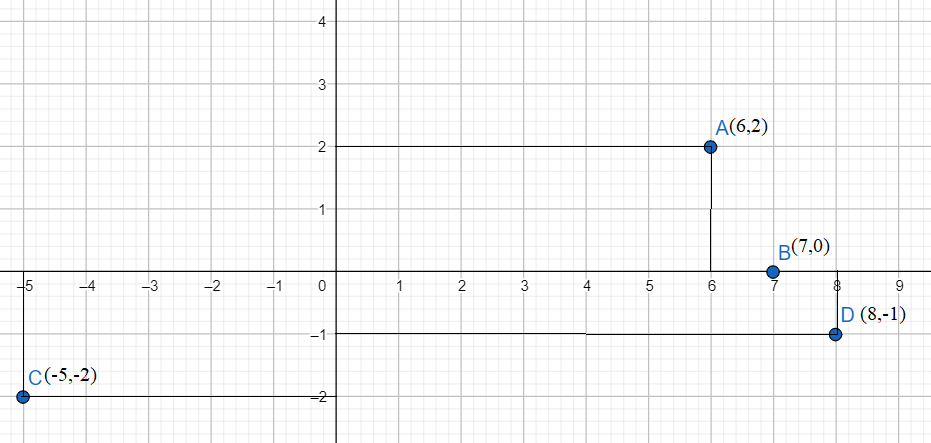
Plot each of the following points on a graph?
a. (6, 2) b. (7, 0) c. (-5, -2) d. (8, -1)
Solution:
Given points are (5, 2), (8, 0), (-5, -2), (9, -1)
Coordinates of the point (6, 2) both the x coordinate and y coordinate are positive so the point lies in the first quadrant. On the x-axis, take 6 units to the right of the y-axis and then on the y-axis, take 2 units above the x-axis.
Therefore, we get the point (6, 2).
Coordinates of the point (7, 0) both x coordinate and y coordinate are positive so the point lies in the first quadrant.
On the x-axis take 7 units and take 0 units on the y-axis to get the point (7, 0).
For the point (-5, -2), both x coordinate and y coordinate are negative so the point lies in the third quadrant. Take -5 units on the x-axis and take -2 units on the y-axis
and therefore we get the points (-5,-2).
The point (8, -1) lies in the fourth quadrant because the x-coordinate is positive and the y-coordinate is negative.
To plot this point, take 8 units on the x-axis and take -1 units on the y-axis.
Coordinate geometry graph_3

Example 2.
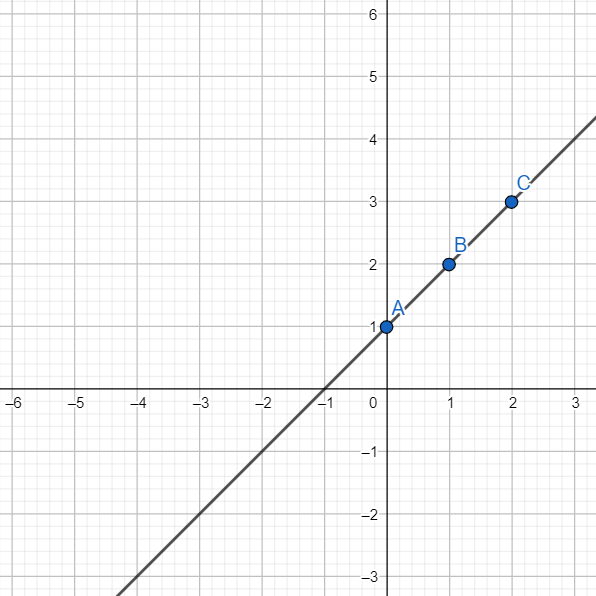
Draw the graph of the linear equation y = x + 1?
Solution:
Given linear equation is y = x + 1
The given equation is in the form of y = mx + c
slope m = 1, and constant c = 1
By using the trial and error method, find the value of y for each value of x.
If x = 0, y = 0 + 1, then y = 1
If x = 1, then y = 1 + 1 = 2
If x = 2, then y = 2 + 1 = 3
X    0      1      2
y    1      2      3
Plot the graph using the above table
Mark the points (0, 1), (1, 2), (2, 3) on the graph.
Coordinate geometry graph_1

Example 3.
Find the equation of a line parallel to 3x+6y = 5 and pass-through points (2,2).
Solution:
For a line parallel to the given line, the slope will be of the same magnitude.
Thus the equation of a line will be represented as 3x+6y=k
Substituting the given points in this new equation, we have
k = 3 × 2 + 6 × 2 = 6 + 12 = 18
Therefore the equation is 3x + 6y = 18

Example 4.
Find the ratio in which the y−axis divides the line segment joining the points (5,-6) and (-1,-4). Also, find the point of intersection.
Solution:
Let the point be A(3,-6), B(-1,-4) and P(0,y)
Point P is on the y−axis,hence its x coordinate is 0.
So, it is in the form of P(0,y)
Now, we have to find a ratio.
Let the ratio be k:1
Hence m
m1=k, m2 =1, x1 = 3, y1= -6, x2 = -1,y2 = -4, x=0, y=0
Using sections formula x= m1x2 + m2x1/ m1 + m2
​0= -k+3/k+1
Therefore k = 3
Again y= m1y2+m2y1/m1 + m2
​= -4k-6/k+1
= -20-6/6
for k=3
= -18/4
Hence the coordinates of the point is P(0, -18/4).

Example 5.
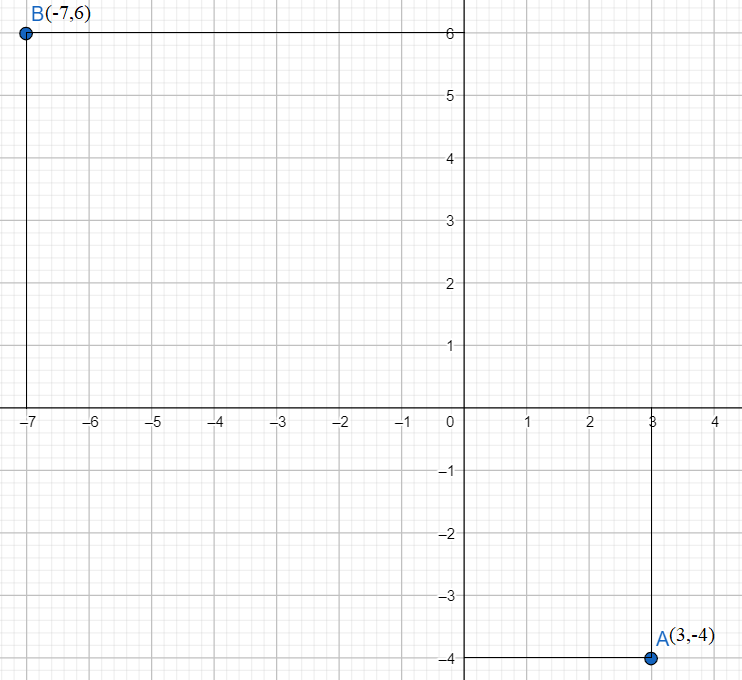
Plot the points (3,-4) and (-7,6)?
Solution:
Given that the points are (3,-4) and (-7,6)
Coordinates of the point (3, -4). Here the x coordinate is positive and the y coordinate is negative so the point lies in the fourth quadrant.
On the x-axis, take 3 units to the right of the y-axis and then on the y-axis, take 4 units above the x-axis.
Therefore, we get the point (3, -4).
Coordinates of the point (-7, 6). Here the x coordinate is negative and the y coordinate is positive so the point lies in the second quadrant.
On the x-axis, take 7 units to the right of the y-axis and then on the y-axis, take 6 units above the x-axis.
Therefore, we get the point (-7, 6).
Coordinate geometry graph_2

FAQs on Coordinate Geometry Graph

1. What is the linear equation of the coordinate geometry?

The general form of a line in the coordinate geometry is Ax + By + C = 0
Where
A is the coefficient of x
B is the coefficient of y
C is the constant value.
Intercept form of a line is y = mx + c.
Where (x, y) is a point on the line m is the slope.

2. What is meant by Coordinate and Coordinate Planes?

A coordinate plane could be a 2-dimensional plane created by the intersection of two axes named horizontal axis (x-axis) and also the vertical axis (y-axis). These lines are perpendicular to every difference and meet at the purpose known as origin or zero. The axes divide the coordinate plane into four equal sections, and every section is understood because of the quadrant. The quantity line that has quadrants is additionally referred to as the sheet.

3. What are the Four different quadrants and their respective signs?

There are four quadrants
Quadrant 1: In this quadrant both x and y are positive. The point represented in this quadrant is (+x, +y).
Quadrant 2: In this quadrant X-axis is negative and the y-axis is positive. So, the point is shown as (-x, +y).
Quadrant 3: In this quadrant both the x and y-axis are negative. So the point in this quadrant is represented as (-x, -y).
Quadrant 4: In this quadrant, x is positive, and y is negative. The points in these Coordinates are (+x, -y).

Worksheet on Plotting Points in the Coordinate Plane

Worksheet on Plotting Points in the Coordinate Plane | Plotting Points on a Graph Worksheet PDF

Plotting points on a coordinate plane worksheet pdf in coordinate geometry is available here. In the worksheet on plotting points in the coordinate plane, the students can learn how to plot the points on graph paper. Practice plotting points on a coordinate plane worksheet answers help you to identify axes, quadrants, ordered pairs on the x-y plane. This plotting points on a graph worksheet pdf will help you to score better grades in the exams.

Plotting Points in the Coordinate Plane Worksheet PDF with Answers

Example 1.
Plot the points (−2,3) in the coordinate plane.

Solution:

Given that the point is (-2,3)
Here the x coordinate is -2 and the y coordinate is 3.
Here the second coordinate is positive and the first coordinate is negative
The x-coordinate is -2 moves two units to the left from the origin. The y-coordinate 3 moves three units up in the positive y-direction.
Plotting Points in the Coordinate Plane_1


Example 2.
Plot the points (4,4) in the coordinate plane.

Solution:

Given that the point is (4,4)
Here the x coordinate is 4 and the y coordinate is 4 both the coordinates are positive.
The x-coordinate is 4 moves four units to the right. The y-coordinate is also 4 moves four units up in the positive y-direction.
Plotting Points in the Coordinate Plane_2


Example 3.
Plot the points (0,-6) in the coordinate plane.

Solution:

Given that the points are (0,-6)
Here the x-coordinate is 0 and the y-coordinate is -6.
Here the x-coordinate is positive and the y-coordinate is negative at the point (0,-6) beginning at the origin.
The x-coordinate is 0 not to move in either direction along the x-axis.
The y-coordinate is -6 moves six units down in the negative y-direction.
Plotting Points in the Coordinate Plane_3


Example 4.
Plot the point (-6,5) in the coordinate plane.

Solution:

In the given points -6 is the x coordinate and 5 is the y coordinate.
Here the x coordinate is negative and the y coordinate is positive so the point lies in the second quadrant.
We move 6 units to the left from the origin and then 5 units vertically up to plot the point (−6,5).
Plotting Points in the Coordinate Plane_4


Example 5.
Plot the points (−4,6) in the coordinate plane.

Solution:

Given that the point is (-4,6)
Here the x coordinate is -4 and the y coordinate is 6.
Here the second coordinate is positive and the first coordinate is negative
The x-coordinate is -4 moves four units to the left from the origin. The y-coordinate 6 moves six units up in the positive y-direction.
Plotting Points in the Coordinate Plane_5


Example 6.
Plot the point (-9,-5) in the coordinate plane.

Solution:

In the given points -9 is the x coordinate and -5 is the y coordinate.
Here the x coordinate is negative and the y coordinate is also negative so the point lies in the third quadrant. We move 9 units to the left from the origin and then 5 units vertically up to plot the point (−9,-5)
Plotting Points in the Coordinate Plane_6


Example 7.
Plot the point (1,7) in the coordinate plane.

Solution:

In the given points 1 is the x coordinate and 7 is the y coordinate.
Here the x coordinate is positive and the y coordinate is also positive so the point lies in the first quadrant. We move 1 unit to the left from the origin and then 7 units vertically up to plot the point (1,7)
Plotting Points in the Coordinate Plane_7


Example 8.
Plot the point (9,-11) in the coordinate plane.

Solution:

In the given points 9 is the x coordinate and -11 is the y coordinate.
Here the x coordinate is positive and the y coordinate is negative so the point lies in the fourth quadrant. We move 9 units to the left from the origin and then 11 units vertically up to plot the point (9,-11)
Plotting Points in the Coordinate Plane_8


Example 9.
Plot the point (-1,-2) in the coordinate plane.

Solution:

In the given points -1 is the x coordinate and -2 is the y coordinate.
Here the x coordinate is negative and the y coordinate is also negative so the point lies in the third quadrant. We move 1 unit to the left from the origin and then 2 units vertically up to plot the point (−1,-2)
Plotting Points in the Coordinate Plane_9


Example 10.
Plot the point (-8,7) in the coordinate plane.

Solution:

In the given points -8 is the x coordinate and 7 is the y coordinate.
Here the x coordinate is negative and the y coordinate is also negative so the point lies in the third quadrant. We move 8 units to the left from the origin and then 7 units vertically up to plot the point (−8,7)
Plotting Points in the Coordinate Plane_10


Reflection in Lines Parallel to Axes

Reflection in Lines Parallel to Axes – Definition, Facts, Examples | How do you Reflect Over the Axes?

The complete information on reflection in lines parallel to axes is available on this page. Thus the students who wish to learn in detail about the reflection in lines parallel to axes can refer to our page and practice the problems. Let us discuss how to solve the problems on Reflection in Lines Parallel to Axes (x-axis and y-axis) here. The solutions seen at the end of this page are prepared by the math experts that helps you to score the highest marks in the exams.

Do Refer:

Reflection in Lines Parallel to Axes Examples

Example 1.
The reflection of the point (4, -1) about the line 5x + y + 6 = 0 is
Solution:
Given that
The reflection point be A (h, k)
Now, the mid point of the line joining (h, k) and (4, -1) will lie on the line
5x + y + 6 = 0
Therefore
5(h+4)/2 + (k−1)/2 + 6 = 0
5h + 20 + k – 1 + 12 = 0
5h + k + 31 = 0……(i)
Now, the slope of the line joining points (h, k) and (4, -1) are perpendicular to the line is
5x + y + 6 = 0
Slope of the line=−5
Slope of the joining by points (h, k) and (4, -1)
k+1/h−4
Therefore
k+1/h−4(−5) = -1
5k − h + 69 = 0…..(ii)
Solving (i) and (ii), we get
5h + k + 6 – 5k + h – 69 = 0
6h – 4k – 63
h = 6 and k = -4

Example 2.
The point (-3, 0) on reflection in a line is mapped to (3, 0) and the point (4, -6) on reflection in the same line is mapped to (-4, -6).
(i) State the name of the mirror line and write its equation.
(ii) State the coordinates of the image of (-7, -5) in the mirror line.
Solution:
(i) We know the reflection of a point (x, y) in the y-axis is (-x, y).
Hence, the point (-3, 0) when reflected in the y-axis is mapped to (3, 0).
Therefore, the mirror line is the y-axis and its equation is x = 0.
(ii) Coordinates of the image of (-7, -5) in the mirror line in the y-axis are (7, -5).

Example 3.
The point (-4, 0) on reflection in a line is mapped as (4, 0) and the point (-7, -6) on reflection in the same line is mapped as (2, -6).
(a) Name the line of reflection.
(b) Write the coordinates of the image of (5, -9).
Solution:
(a) We know that reflection in line x = 0 is the reflection in the y-axis.
Given that the point is
Point (-4, 0) on reflection in a line is mapped as (4, 0).
Point (-7, -6) on reflection in the same line is mapped as (7, -6).
Hence, the line of reflection is x = 0.
(b) we know that
My (x, y) = (-x, y)
Coordinates of the image of (5, -9) in the line x = 0 are (-5, -9).

Example 4.
Point P(4, -3) is reflected as P’ in the y-axis. Point B on reflection in the x-axis is mapped as Q’ (-2, 7). Write the coordinates of P’ and Q.
Solution:
Given that the points are P(4,-3) and Q(-2,7)
Reflection in y-axis is given by
My (x, y) = (-x, y)
P’ = Reflection of P(4, -3) in y-axis
P’= (-4, -3)
Reflection in x-axis is given by
Mx (x, y) = (x, -y)
Q’ = Reflection of Q in x-axis = (-2, 7)
Therefore Q = (-2, -7)

Example 5.
The point (-3, 0) on reflection in a line is mapped as (3, 0) and the point (-8, -6) on reflection in the same line is mapped as (4, -6).
(a) Name the line of reflection.
(b) Write the coordinates of the image of (5, -6).
Solution:
(a) We know that reflection in line x = 0 is the reflection in the y-axis.
Given that the point is
Point (-3, 0) on reflection in a line is mapped as (3, 0).
Point (-8, -6) on reflection in the same line is mapped as (8, -6).
Hence, the line of reflection is x = 0.
(b) we know that
My (x, y) = (-x, y)
Coordinates of the image of (5, -6) in the line x = 0 are (-5, -6).

FAQs on Reflection in Lines Parallel to Axes

1. What does parallel to the axes mean?

If a line is parallel to the x-axis or y-axis either the x-coordinate or y-coordinate is constant or fixed throughout the line and it should pass through either (0, a) or (a, 0).

2. How do you reflect over the axis?

A reflection of a point over the y -axis is. The rule for a reflection over the y -axis is (x,y) = (-x,y). And the reflection over the x- axis is (x,y) = (x,-y).

3. What Does Parallel to the Axes Mean?

Parallel to axes means that the lines are parallel to either the x-axis or y-axis.
If a line parallel to the x-axis is called a horizontal line whose equation is in the form of y = k,
where ‘k’ is the distance of the line from the x-axis.
Similarly, a line parallel to the y-axis is called a vertical line whose equation is in the form of x = k,
where ‘k’ is the distance of the line from the y-axis.

Reflection of a Point in a Line Parallel to the y-axis

Reflection of a Point in a Line Parallel to the y-axis – Rules, Formula, Examples | How do you find the Reflection of a Point Parallel to y-axis?

In order to score well in the exams, one must understand the concepts in maths. That is possible with us here we provide quick and easy learning tricks in reflection here. Reflection of a Point in a Line Parallel to the y-axis is a scoring topic from the chapter reflection. Scroll down this page to know what is meant by Reflection of a Point in a Line Parallel to the y-axis with suitable examples. Step by step explanation is given for the problems by the math experts.

Also Refer:

What is the Reflection of a Point in a Line Parallel to the y-axis?

Let P be the point on the x-axis with the coordinates (x, y). Let the image of P be P’ in the horizontal line drawn on the y-axis. The image of the point (x, y) in the line parallel to the y-axis. When it comes to the refection of a point in a line parallel to the y-axis the sign of the y-axis will be changed and the sign of the x-axis remains the same.
Reflection of a point in the line parallel to the x-axis

Reflection of a Point in a Line Parallel to the y-axis Examples

Example 1.
The point P ( -4, -7) on reflection in the y-axis is mapped on P’. The point P’ on reflection in the origin is mapped on P”. Find the coordinates of P’ and P”. Write down a single transformation that maps P onto P”.
Solution:
Given that the point P (-4, -7)
And, P’ is the image of point P in the y-axis
The coordinates of P’ will be (4, -7)
Again,
P” is the image of P’ under reflection in origin.
Thus, the coordinates of P” will be (-4, 7).
The single transformation that maps P onto P” is the x-axis.
Reflection of a point in the line parallel to the y-axis example_1

Example 2.
Point A(5, 7) is first reflected in the origin to point A’. Point A’ is then reflected in the y-axis to point A”.find the coordinates of A”.
Solution:
Given that the point is A(5,7)
Coordinates of A’ after reflection from origin =(-5,-7)
And after reflection from y-axis coordinates becomes =A”=(5,-7)
Reflection of a point in the line parallel to the y-axis example_2

Example 3.
A point P (a, b) is reflected in the x-axis to P’ (4, 3). Write down the values of a and b. P” is the image of P, reflected in the y-axis. Write down the coordinates of P”. Find the coordinates of P”, when P is reflected in the line, parallel to the y-axis, such that x = 4.
Solution:
The coordinates of the point P be(4,-3)
Hence the value of a and b are
4 and -3
Reflection of a point in the line parallel to the x-axis example_3
after reflection coordinates of P”=(-4,3)
Coordinates of p after reflection from x=4 are (8,-3)

Example 4.
The reflection of point (-7, -9) through the y-axis is.
Solution:
When reflected through the y axis, the coordinates x value reverses its sign
This means the positive becomes negative, and the negative becomes positive.
Now we have, the coordinates (-7, -9) its reflection through the y-axis gives us (-7, 9).
Reflection of a point in the line parallel to the y-axis example_4

Example 5.
The reflection of point (-3, -5) through the y-axis is.
Solution:
When reflected through the y axis, the coordinates x value reverses its sign
This means the positive becomes negative, and the negative becomes positive.
Now we have, the coordinates (-3, -5) its reflection through the y-axis gives us (-3, 5).
Reflection of a point in the line parallel to the y-axis example_5

FAQs on Reflection of a Point in a Line Parallel to the y-axis

1. When a line is parallel to the Y-axis What is the slope?

The slope of the line parallel to the y-axis is undefined.
The line parallel to the y axis is at an angle of 90º to the x-axis
Then the slope of this line is tan90º, which is undefined.

2. How do you find the slope of the y-axis?

The slope-intercept form of a line is: y=mx+b
where m is the slope and
b is the y-intercept.

3. When a line is parallel to the y-axis?

A line is parallel to the x-axis and y-axis either the x-coordinate or y-coordinate is fixed or constant throughout the line and the line passes from either (0, a) or (a, 0).