Reflection of a Point in a Line Parallel to the x-axis

Reflection of a Point in a Line Parallel to the x-axis – Definition, Rules, Formula, Examples | How to find the Reflection of a Point across the x-axis?

In this article, we will explain in detail the reflection of a point in a line parallel to the x-axis by taking an example. We will show how to plot the points on the graph to know the reflection of a point in the x-axis. The y-coordinate of each point on the line parallel to the x-axis is constant i.e., remain the same.

Also Read:

What is Reflection of a Point in a Line along the x-axis?

Let P be the point on the x-axis with the coordinates (x, y). Let the image of P be P’ in the horizontal line drawn on the x-axis. The image of the point (x, y) in the line parallel to the x-axis. When it comes to the refection of a point in a line parallel to the x-axis the sign of the x-axis will be changed and the sign of the y-axis remains the same.

Reflection of a point in the line parallel to the x-axis

Reflection of a Point in a Line Parallel to the x-axis Examples

Let us discuss the concept of Reflection of a Point in a Line Parallel to the x-axis with some examples.

Example 1.
Point P (a, b) is reflected in the x-axis to P’ (-5, 3). Write down the values of a and b.
Solution:
Given points are (-5, 3)
We know Mx (x, y) = (x, -y)
P'(-5, 3) = reflection of P (a, b) in x-axis.
Thus, the coordinates of P are (5, 3).
Hence, a = 5 and b = 3
Reflection of a point in the line parallel to the x-axis example_1

Example 2.
Find the Reflection of the point (-5,7).
Solution:
Given that the point is (-5,7)
When a point is reflected in the x-axis, the sign of its ordinate changes.
Reflection of the point
(-5,7) in the x-axis is (5,7).
Reflection of a point in the line parallel to the x-axis example_2

Example 3.
The image of a point P reflected in the x-axis is (-4,4). Find the coordinates of P.
Solution:
Given that the point is P(-4,4)
When a point is reflected in the x-axis, the sign of its ordinate changes. Hence, the coordinates of P are (4,4)
Reflection of a point in the line parallel to the x-axis example_3

Example 4.
A point P is reflected in the x-axis. Coordinates of its image are (-3,9). Find the coordinates of the image of P under reflection in the x-axis.
Solution:
Given that the point is P(-3,9)
The Coordinates of the image of P are under reflection in the x-axis (3,9).
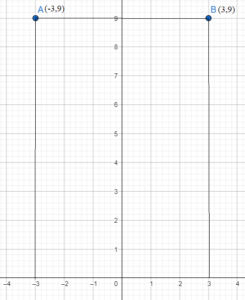
Reflection of a point in the line parallel to the x-axis example_4

Example 5.
Find the Reflection of the point (-3,8).
Solution:
Given that the point is (-3,8)
When a point is reflected in the x-axis, the sign of its ordinate changes.
Reflection of the point
(-3,8) in the x-axis is (3,8).
Reflection of a point in the line parallel to the x-axis example_5

FAQs on Reflection of a Point in a Line Parallel to the x-axis

1. What does it mean if a point is parallel to the x-axis?

The point Parallel to the axis means the lines that are parallel to either the x-axis or y-axis.
A line parallel to the x-axis is called the horizontal line.
The equation is in the form of y = k, where ‘k’ is the distance of the line from the x-axis.

2. What is the rule for reflecting a point across the x-axis?

The rule for a reflection of the x -axis is (x,y) = (x,−y).

3. What is the image of a point after a reflection in the x-axis?

The point M is reflected in the x-axis the image M’ is formed in the fourth quadrant and their coordinates are (h, -k). Hence the point is reflected in the x-axis the x-coordinate remains the same, but the y-coordinate becomes negative. Thus, the image of point M (h, k) is M’ (h, -k).

Reflection of a Point in a Line

Reflection of a Point in a Line – Definition, Formula, Examples | How do you find the Image of a Point Reflected over a Line?

In geometry, reflection is the type of transformation in the coordinate plane. A reflection is a mirror image of the given shape. In the previous articles, we have seen the reflection of a point in a plane, line, x-axis, y-axis, and origin. Let us discuss here the reflection of a point about a line formula from this page.  Go through the examples given below and try to solve the problems in an easy manner.

Also, Refer:

Reflection of a Point in a Line – Definition

Reflection of a point is an interesting topic in the coordinate system. The reflection of the point in the x-axis means the x-coordinate remains the same and the y-coordinate sign will be changed. The reflection of the point in the y-axis means the y-coordinate remains the same and the x-coordinates sign will be changed.

Reflection of a Point in a Line Examples

Example 1.
What is the reflection of the point (-1,3) on the line x = -3?
Solution:
The line x = -3 is a straight line parallel to the y-axis and at a distance of 3 units in the negative direction of the x-axis
Point (-1,3) is 3 units away from the given line x = -3.
Therefore the distance of the image from the line is also 3 units.
Thus the distance of image from y axis = 3+4+1 = 7.
Units in the negative direction of the x-axis.
Thus, the reflection of point (-1,3) in the line x = -3 is (-6,3).
Reflection of a point in a line_1

Example 2.
What is the reflection of the point (1,2) in the line y = 4
Solution:
The line y = 4 bisects the line joining A and A’ the midpoint of these two points must lie on the line y = 4.
If we take point A’ as (a,b) the midpoint of A and A’ are
(1+1)/2, (b+3)/2 must satisfy the equation y = 4.
= (b+2)/2 = 4.
= b + 2 = 8
b = 6.
The required point is (1,6).
Reflection of a point in a line_2

Example 3.
What is the reflection of the point (5,3) if the line is y = -6?
Solution:
The perpendicular distance between line y = -6.
And the point A(5,3) must be the same as the distance between line y = -6 and required reflection point P’
y = -6 is a line parallel to the x-axis.
Since the reflection is on the x-axis the x coordinate of P’ remains the same as 5.
y coordinate must be |-6| + 3 = 9 units away from the line y = -6.
The required y coordinate is -15.
Required point A’ = (5,-15).
Reflection of a point in a line_3

Example 4.
What is the reflection of the point (-1,2) on the line x = -2.
Solution:
The line x = -2 is a straight line parallel to the y-axis and at a distance of 2 units in the negative direction of x-axis
Point (-1,2) is 2 units away from the given line x = -2.
Therefore the distance of the image from the line is also 2 units.
Thus the distance of image from y axis = 2+2+1 = 5.
Units in the negative direction of the x-axis.
Thus, the reflection of point (-1,2) in the line x = -2 is (-4,3).
Reflection of a point in a line_4

Example 5.
What is the reflection of the point (1,3) in the line y = 5
Solution:
The line y = 5 bisects the line joining P and P’ the midpoint of these two points must lie on the line y = 5.
If we take point P’ as (a,b) the midpoint of P and P’ are
(1+1)/2, (b+3)/2 must satisfy the equation y = 4.
= (b+2)/2 = 5.
= b + 2 = 10
b = 8
Required point is (1,8).
Reflection of a point in a line_5

FAQs on Reflection of a Point in a Line

1. What is a reflection line?

A reflection is a transformation, it means flipping of a figure. Figures may be reflected in a point, line, or a plane. When reflecting a figure in a line or in a point, then the image is congruent to the preimage. The fixed line is called the line of reflection.

2. How do you write a line of reflection?

The line of reflection is given in the form of y = mx + b. And draw the line of reflection using the point in the starting figure that is the same perpendicular distance from the line of reflection as its corresponding point in the image.

3. What does reflection across y = 2 mean?

The x-value of the mirror image will be the same. At the y-values. the y-values must be the same number of units below the line y = 2 as above the line y = 2.

Problems on Plotting Points in the x-y Plane

Problems on Plotting Points in the x-y Plane | Plotting Points on a xy Plane Questions and Answers

Problems on Plotting Points in the x-y Plane in Coordinate Geometry with answers are available here. Let us learn how to plot the points in the x-y Plane with examples from this page. So, have a look at this article to know plotting points in the x-y plane on the graph. The right part of the origin in the horizontal line is the positive x-axis and the left part of the origin in the horizontal line is the negative x-axis. Topside of the origin is the positive y-axis and the bottom part from the origin is the negative y-axis.

Also, Read:

Plotting Points in x-y Plane Problems with Solutions

Example 1.
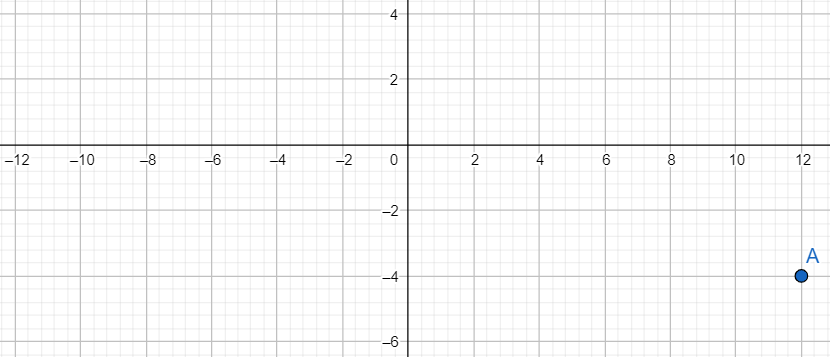
Plot the Points (12, -4) on the Coordinate Graph in the x-y plane.
Solution:
First Taking the scale 1 cm = 4 on the graph
Let the point P = (12, -4).
Here the x-coordinate = 12 and y-coordinate = -4.
So, move 12 units from origin to towards the positive direction of the x-axis.
From that place to move 4 units towards the negative direction of the y-axis.
Now the position of the point is reached as the coordinates (12, -4)
Plotting points on the coordinate x-y plane_1

Example 2.
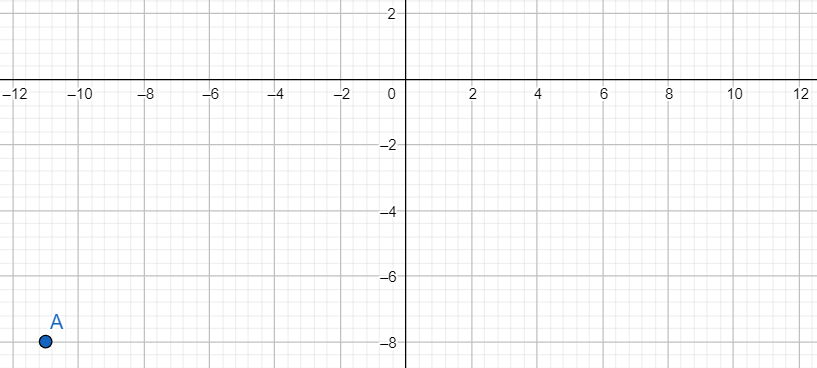
Plot the points (-11, -8) on the Coordinate Graph in the x-y plane.
Solution:
First taking the scale as your wish
Here I am taking 1 cm = 4 units on the graph.
Let the point Q = (-11, -8).
Here, the x-coordinate = -11 and the y-coordinate = -8.
So, move 11 units from the origin towards the negative direction of the x-axis.
From that place to move 8 units towards the negative direction of the y-axis.
Now the position of the point reached as the coordinates (-11, -8)
Plotting points on the coordinate x-y plane_2

Example 3.
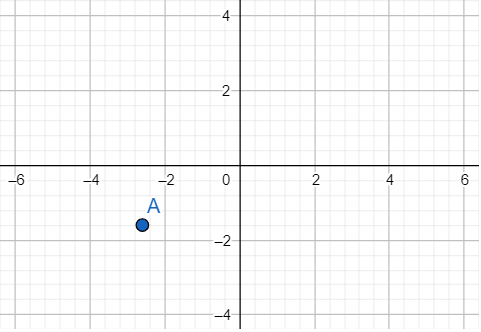
Plot the Points (-2.6, -1.6) on the Coordinate Graph in the x-y plane.
Solution:
First taking the scale as your wish
Here I am taking 1 cm = 5 units on the graph.
Let the point E = (-2.6, -1.6).
Here, the x-coordinate = -2.5 and the y-coordinate = -1.5.
So, move 2.6 units from the origin towards the negative direction of the x-axis.
From that place to move 1.6 units towards the negative direction of the y-axis.
Now the position of the point is reached as the coordinates (-2.6, -1.6).
Plotting points on the coordinate x-y plane_3

Example 4.
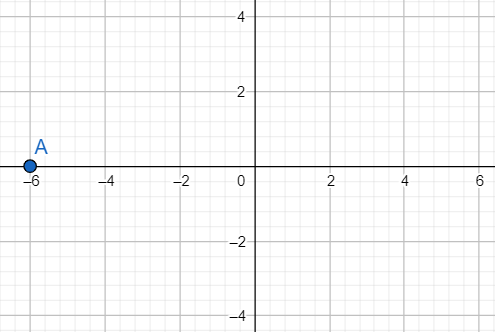
Plot the Points (-6, 0) on the Coordinate Graph in the x-y plane.
Solution:
First taking the scale as your wish
Here I am taking 1 cm = 5 units on the graph.
Let the point B = (-6, 0).
Here, the x-coordinate = -6 and the y-coordinate = 0.
So, the point is on the x-axis. Move 6 units from the origin towards the negative direction of the x-axis. Now the position of the point is reached as the coordinates (-6, 0).
Plotting points on the coordinate x-y plane_4

Example 5.
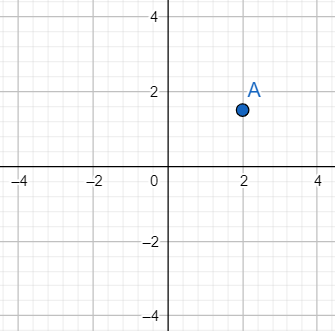
Plot the Points (2, 1.5) on the Coordinate Graph in the x-y plane.
Solution:
First taking the scale as your wish
Here I am taking 1 cm = 3 units on the graph.
Let the point C = (2, 1.5).
Here, the x-coordinate = 2 and the y-coordinate = 1.5.
So, move 2 units from the origin towards the positive direction of the x-axis.
From that place to move 1.5 units towards the positive direction of the y-axis.
Now the position of the point reached has the coordinates (2, 1.5).
Plotting points on the coordinate x-y plane_5

Example 6.
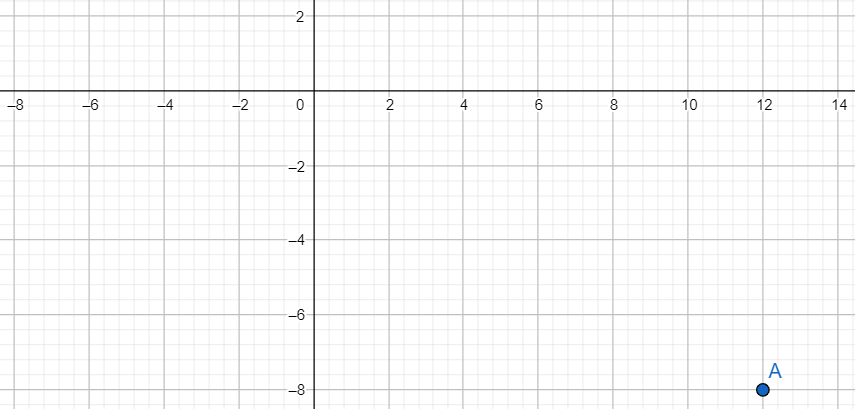
Plot the points (12, -8) and (-16, -20) in the x-y plane.
Solution:
Taking 1 cm = 4 as the scale of representation the points are plotted as shown below.
(i) Let P = (12, -8). Here the x-coordinate = 12 and y-coordinate = -8. So, move 12 units from O towards the positive direction of the x-axis. From that place move 8 units towards the negative direction of the y-axis. The position of the point now reached has the coordinates (12, -8).
Plotting points on the coordinate x-y plane_6

Reflection of a Point in the Origin

Reflection of a Point in the Origin – Definition, Formula, Rules | How to find Reflection of a Point in the Origin?

Hello Students!!! Are you excited and interested to know in-depth about reflection? Don’t worry we are here to help you to give detailed information about the reflection of a point in the origin, x-axis, y-axis, and so on. We know that point reflection is a type of reflection. Know how to find the coordinates of the reflection of the point in the origin from this article. The image of the point (p, q) in the origin is the point (-p, -q).

Read Article:

Reflection of a Point in the Origin

In order to locate the coordinates in the contiguous figure, the origin represents the plane mirror. Let X be any point in the first coordinates (h, k). M’ is the reflected point in the origin formed by the third quadrant whose coordinates will be (-h, -k). To find the reflection of a point in the origin are have to change the signs of the x-coordinates and y-coordinates.
Reflection of a point in the origin
By seeing the above figure we can say that X'(-h, -k) is the mirror image of X(h, k).

Rules to find the Reflection of a Point in the Origin

To find the reflection of the point in the origin there are some rules to follow.
i. Change the sign of the x-coordinate i.e., abscissa.
ii. Change the sign of the y-coordinate.

Reflection of a Point in the Origin Solved Problems

Example 1.
What is the reflection of the point A(2, 5) in origin?
Solution:
Given that A(2,5)
The reflection of the point A (2, 5) is P’ (-2, -5).
Reflection of a point in the origin example_1

Example 2.
What is the reflection of the point B(-6, -9) in the origin?
Solution:
Given that B(-6,-9)
The reflection of point B (-6, -9) is B’ (6, 9).
Reflection of a point in the origin example_2

Example 3.
What is the reflection of the point C(-3,8) in the origin?
Solution:
Given that C(-3,8)
The reflection of point C (-3, 8) is C’ (3, -8).
Reflection of a point in the origin example_3

Example 4.
What is the reflection of the point D(1, -1) in the origin?
Solution:
Given that D(1,-1)
The reflection of the point D(1,-1) is C'(-1, 1)
Reflection of a point in the origin example_4

Example 5.
What is the reflection of the point E(5,-1)
Solution:
Given that E(5,-1)
The reflection of the point S (5, -1) is S’ (-5, 1).
Reflection of a point in the origin example_5

FAQs on Reflection of a Point in the Origin

1. What does reflection in the origin mean?

When you reflect a point in the origin, both the x-coordinate and the y-coordinate change their signs. In a point reflection in the origin, the image of the point (x,y) is the point (-x,-y).

2. Which functions have graphs that are symmetrical with respect to the origin?

A function that is symmetrical with respect to the origin is called an odd function. f(x).
Since f(−x) = f(x), this function is symmetrical with respect to the y-axis.

3. What is the rule for reflection?

If you reflect a point across the line y = x, the x-coordinate, and y-coordinate change places.
If you reflect over the line y = -x, the x-coordinate and y-coordinate change places.
The line y = x is the point (y, x). the line y = -x is the point (-y, -x).

Worksheet on Slope and Y-Intercept

Worksheet on Slope and Y-Intercept | Finding Slope and Y Intercept from an Equation Worksheets

Worksheet on Slope and Y-intercept with stepwise solutions are available here. So, the students who are all in search of the concept of slope and Y-intercept in coordinate geometry can make use of this slope and y intercept worksheets with answer key pdf and practice the problems. You can find different types of problems related to the slope (m) and y-intercept. Look into the problems given below in the slope and y intercept worksheet with answers and enhance your math skills.

Do Refer:

Identifying Slope and Y Intercept Worksheet PDF

Example 1.
Find the slope of the line joining the points (4,−6) and (5,−2).

Solution:

Let A(4,−8) and B(5,−2) be two points.
Slope of the line = y2 – y1/x2 – x1
= -2-(-6)/5 – 4
= -2+6/1
= 4/1
= 4
Therefore the slope of the given points are 4.


Example 2.
If the slope of the line joining the points A(x,3) and B(6,−8) is -6/4, find the value of x.

Solution:

Given that the two points are
A(x,3) and B(6,-8)
x1 = x, y1 = 3, x2 = 6, y2 = -8
Given slope = -6/4
We know that
x2 – x1/y2 – y1
6 – x/-8 – 3 = -6/4
6 – x/-11 = -6/4
24 – 4x = -66
24 + 66 = 4x
90 = 4x
x = 90/4
Hence the value of x = 90/4


Example 3.
The following points are plotted in the x-y plane. Find the slope and y-intercept of the line joining each pair of (1,4) & (-2,3).

Solution:

Given that the points are (1,4) and (-2,3)
x1 = 1, y1 = 4, x2 = -2 and y2 = 3
slope is (y2-y1)/(x2-x1)
(3 – 4)/(-2-1)
= -1/-3
Slope = 1/3
then y=mx+c
you get x-3y+4=0
at y axis x=0
y = 4/3
Therefore y-intercept = 4/3


Example 4.
Find the slope of the line, which makes an angle of 40° with the positive direction of the y-axis measured anticlockwise.

Solution:

If a line makes an angle of 40° with the positive direction of the y-axis measured anticlockwise, then the angle made by the line with the positive direction of the x-axis measured anticlockwise is 90° +40° = 130°
Thus, the slope of the given line is
tan 130°
= tan(180° – 50°)
= −tan50°
= − 1.19175


Example 5.
Determine the slope and y-intercept of the line 4x + 16y + 10 = 0

Solution:

Given that the equation is 4x + 16y + 10 = 0
16y = – 4x – 10
y = -4/16x – 10/16
y = -1/4x – 5/8.
Comparing this with y = mx + c,
Then we get m = – 1/4 and c = – 5/8
Therefore, slope = -1/4 and y-intercept = -5/8


Example 6.
The points (-3, 3) and (1, -4) are plotted in the x-y plane. Find the slope and y-intercept of the line joining the points.

Solution:

Let the line graph obtained by joining the points are (-3, 3) and (1, -4) be the graph of y = mx + c.
So, the given pairs of values of (x, y) obey the relation y = mx + c.
Therefore, 3 = -3m + c …….(i)
-4 = m + c …… (ii)
Subtracting (ii) from (i),
then we get
3 + 3 = -2m – m
9 = -3m
-3m = 9
m = 9/-3
m = -3
Putting m = -3 in (ii),
Then
-4 = -3 + c
c = -1.
Now, m = -3
The slope of the line graph = -3,
c = -1
The y-intercept of the line graph = -1


Example 7.
Find the slope and y-intercept of 3x – √4y = 2√4

Solution:

Given that the equation is 3x – √3y = 2√4
– √4y = -3x + 2√4
√4y = 3x – 2√4
y = 3/√4x – 2√4/√4
y = 3/√4x – 2
Comparing the above equation with y = mx + c,
Then the slope m = 3/√4 and y-intercept = -2.


Example 8.
Find the equation of a line in the form of y = mx + c, having a slope of 10 units and an intercept of -12 units.

Solution:

Given that
The slope of the line, m = 10, and The y-intercept of the line, c = -12.
We know that
The slope-intercept form of the equation of a line is y = mx + c.
From the equation
y = 10x – 12
Therefore the required equation of the line is y = 10x – 12.


Example 9.
Determine the slope and y-intercept of the line 4y + 12 = 0

Solution:

Given that the equation is
4y + 12 = 0
4y = -12
y = -12/4
y = 0 and x = -3
Comparing with y = mx + c,
Then we get m = 0 and c = -3
Therefore, slope = 0 and y-intercept = -3


Example 10.
What is the y-intercept of the graph of 2x + 7y = 6?

Solution:

Given that the equation is 2x + 7y = 6
7y = -2x + 6
y = – 2/7x + 6/7
We know that
y = mx + c,
Comparing the equation with y = mx + c
we get c = 13/4. So, the y-intercept = 13/4
and m = -2/7 therefore slope = -2/7


Problems on Slope and Y-Intercept

Problems on Slope and Y-Intercept | Slope and Y-Intercept Form Equation Questions and Answers

Problems on Slope and Y-intercept with step-by-step explanations are available here. The equation of the slope-intercept form is y = mx + c. An intercept is a point on the y-axis by which the slope of the line passes. The point where the line crosses the x-axis is known as the x-intercept and the point where the line crosses the y-axis is known as the y-intercept. The Problems on Slope and Y-intercept in coordinate geometry is a combination of different types of questions. Start practicing the problems on slope-intercept from this page and score good marks in the exams.

Also Read:

  • Worksheet on Slope and Y-intercept

Slope and Y-Intercept Form Problems with Solutions

Example 1.
Determine the slope and y-intercept of the line 6x – 5y + 7 = 0
Solution:
Given that the equation is 6x – 5y – 7 = 0
-5y = -6x + 7
y = −6/−5x + 7/−5.
y = 6/5x – 7/5.
Comparing this with y = mx + c, we have: m = 6/5 and c = -7/5
Therefore, slope = 6/5 and y-intercept = -7/5

Example 2.
What is the slope and y-intercept of the equation 2x – 3y + 4 = 0?
Solution:
Given that the equation is
2x – 3y + 4 = 0
3y = 2x + 4
y = 2/3x + 4/3.
y = 2/3x + 4/3
Comparing the equation with y = mx + c,
we have m = 2/3.
Therefore, the slope of the line is 4/3.

Example 3.
Find the slope and y-intercept of the equation √3x – 3y + 8 = 0
Solution:
Given that the equation is √3x – 3y + 8 = 0
3y = √3x + 8
y = √3/3x + 8/3
Comparing with the equation y = mx + c
Then we have m = √3/3 and c = 8/3
Therefore the slope = √3/3 and y-intercept = 8/3.

Example 4.
What is the slope and y-intercept of the equation 6x – 7y + 8 = 0?
Solution:
Given that the equation is
6x – 7y + 8 = 0
7y = 6x + 8
y = 6/7x + 8/7.
Comparing the equation with y = mx + c,
we have m = 6/7 and c = 8/7
Therefore, the slope of the line is 6/7 and y-intercept = 8/7.

Example 5.
What is the slope and y-intercept of the equation 9x – 10y -11 = 0?
Solution:
Given that the equation is
9x – 10y – 11 = 0
10y = 9x – 11
y = 9/10x – 11/10.
Comparing the equation with y = mx + c,
we have m = 9/10 and c = 11/10
Therefore, the slope of the line is 9/10 and y-intercept = 11/10

Example 6.
If the slope of the line joining the points A(x,2) and B(3,6) is 5/4, find the value of x.
Solution:
Given that the two points are
A(x,2) and B(3,6)
x1 = x, y1 = 2, x2 = 3, y2 = 6
Given slope = 5/4
We know that
x2 – x1/y2 – y1
3 – x/6 – 2 = 5/4
3 – x/4 = 5/4
12 – 4x = 20
12 – 20= 4x
-8 = 4x
x = -2
Hence the value of x = -2.

Example 7.
Find the slope of the line joining the points (4,8) and (5,2)
Solution:
Let A(4,8) and B(5,2) be two points.
Slope of the line = y2 – y1/x2 – x1
= 2-8/5 – 4
= -6/1
= -6/1
= -6
Therefore the slope of the given points are 6.

Example 8.
The following points are plotted in x-y plane.Find the slope and y intercept of the line joining each pair of (1,2) & (3,4)
Solution:
Given that the points are (1,2) and (3,4)
x1 = 1, y1 = 2, x2 = 3 and y2 = 4
slope is (y2-y1)/(x2-x1)
(4 – 2)/(3 -1)
= 2/2
Slope =1
then y=mx+c
you get x-y+1=0
at y axis x=0
y = 1
Therefore y-intercept = 1

Example 9.
What is the slope and y-intercept of the equation x – y + 1 = 0?
Solution:
Given that the equation is
x – y + 1 = 0
y = x + 1
Comparing the equation with y = mx + c,
we have m = 1 and c = 1
Therefore, the slope of the line is 1, and y-intercept = 1.

Example 10.
What is the slope and y-intercept of the equation x – 3y – 7 = 0?
Solution:
Given that the equation is
x – 3y – 7 = 0
3y = x – 7
y = 1/3x – 7/3.
Comparing the equation with y = mx + c,
we have m = 1/3 and c = 7/3
Therefore, the slope of the line is 1/3 and y-intercept = 7/3.

Quadrants and Convention for Signs of Coordinates

Quadrants and Convention for Signs of Coordinates | What are 4 Quadrants in Order?

Are you searching for the information regarding the Quadrants and Convention for Signs of Coordinates on various websites? If our guess is correct, then you are on the right page. Stop your search and start your preparation now. Here you can get complete and brief info about the quadrants and signs of coordinates. Know what is quadrant and what are the signs of the coordinates in each quadrant from here. Also, the students of grade 9 can find examples on the quadrants of coordinate geometry in the below sections.

Also Read:

What are the Sign Convention of the Coordinates?

What is Quadrant?
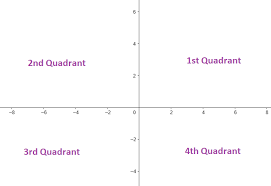
In a coordinate plane, a quadrant is defined as the region of a cartesian plane formed by the two axes i.e, x-axis and y-axis. The region of the plane falling in XOY is the first quadrant, the region of the plane falling in X’OY is the second quadrant, the region of the plane falling in X’OY’ is the third quadrant, and the region of the plane falling in XOY’ is the fourth quadrant.

Four Quadrants in a Plane:
1st Quadrant: The upper right-hand corner is the first quadrant. In this quadrant x and y values are positive.
2nd Quadrant: The upper left-hand corner is the second quadrant. In this quadrant, the value of x is negative and the value of y is positive.
3rd Quadrant: The lower left-hand corner is the third quadrant. In this quadrant both the x and y values are negative.
4th Quadrant: The fourth quarter is at the lower right-hand corner, in which the x value is positive(+) and y value is negative(-).

Quadrant

What are the Signs of the Coordinates in Each Quadrant?

Quadrantsx-coordinatey-coordinate
Quadrant – IPositive (+)Positive (+)
Quadrant – IINegative (-)Positive (+)
Quadrant – IIINegative (-)Negative (-)
Quadrant – IVPositive (+)Negative (-)

From the table, we observe that there are two signs of the coordinates in each quadrant.
Quadrant – I: In the first quadrant both the coordinates have positive signs.
Quadrant – II: In the second quadrant x-coordinate has a negative sign and the y-coordinate has a positive sign.
Quadrant – III: In the third quadrant both the coordinates have negative signs.
Quadrant – IV: In the fourth quadrant x-coordinate has a positive sign and the y-coordinate has a negative sign.

Quadrants and Convention for Signs of Coordinates Examples

Example 1.
Check and answer to which quadrants do the given points lie?
(2, 4)
(-4, -5)
(-3, 6)
(4, -4)
Solution:
The coordinates of (2, 4) are positive, thus it lies on the first quadrant.
Quadrant img_1
The coordinates of the point (-4, -5) are both negative, thus it lies on the third quadrant.
Quadrant img_2
The coordinates of the point (-3, 6) are negative on the x-axis and positive on the y-axis, thus it lies on the second quadrant.
Quadrant img_3
The coordinates of the point (4, -4) are positive on the x-axis and negative on the y-axis, thus it lies on the fourth quadrant.
Quadrant img_4

Example 2.
Give an example of a point that lies on the third quadrant.
Solution:
In the third quadrant, the coordinates of the x-axis and y-axis both are negative.
(-6, -8) is an example of a point in the third quadrant.

Example 3.
Where does the point (-6, 0) lie in the cartesian plane? Does it lie in a quadrant?
Solution:
The point (-6, 0) lies on the horizontal axis or x-axis,
which is at a distance of 6 units from the origin. It does not lie in any quadrant.
Quadrant img_5

Example 4.
Give an example of a point that lies on the second quadrant.
Solution:
In the third quadrant, the coordinates of the x-axis are negative and the y-axis is positive.
(-4, 7) is an example of a point in the third quadrant.

Example 5.
Where does the point (-1,4) lie?
Solution:
Given that the point is (-1,4)
The point x coordinate is negative and the y coordinate is positive so the point lies in the second quadrant.
Quadrant img_6

FAQs on Quadrants and Convention for Signs of Coordinates

1. What is a quadrant?

A quadrant is defined as the region of a cartesian plane. It is formed when the x-axis and y-axis both intersect each other.

2. What is the intersection of two axes called?

The intersection of the x-axis and y-axis is called the reference point or the origin.

3. What are the Four Quadrants in a Coordinate Plane?

The graph has been divided into 4 parts.
1st Quadrant: In a graph, the upper right-hand corner is the first quadrant. In this quadrant x and y values are positive.
2nd Quadrant: In a graph, the upper left-hand corner is the second quadrant. In this quadrant, the value of x is negative and the value of y is positive.
3rd Quadrant: In the graph, the lower left-hand corner is the third quadrant. In this quadrant both the x and y values are negative.
4th Quadrant: In the fourth quarter is at the lower right-hand corner, which the x value is positive and the y value is negative.

Position of a Point in a Plane

Position of a Point in a Plane | How do you find the Position of a Point on a Plane?

The position of a point in a plane is provided by the coordinates on the graph. XOX’ and YOY’ are the two intersecting and perpendicular lines. We know that x-axis and y-axis divide the XY-plane into four parts known as quadrants. The position of a point in the plane is defined with the help of ordered pairs. Let us discuss more about the position of a point in a plane from this article. Scroll down this page to practice the examples problems on the position of a point in the plane from the chapter reflection.

Also Go through:

Position of a Point in a Plane

The position of a point in the plane is expressed by a set of values or numbers called coordinates. There are two coordinates in the geometry they are x-coordinate known as abscissa and y-coordinate known as ordinate. Any point in a plane is referred to by a point (x, y), where the x-value is the position of the point with reference to the x-axis and the y-value is the position of the point with reference to the y-axis.

Position of a Point in a Plane Examples

Check out the problems given in the below section to understand in depth about the position of a point in a plane.

Example 1.
Find the position of a point in a plane (2,4).
Solution:
Given that the point is (2,4)
Consider the point (2,4) has A.
Plot the point A(2,4) in the first quadrant takes a distance of 2 from the x-axis and 4 from the y axis.
So, the coordinates of A are (2, 4). We express it by writing A = (2, 4).
And also consider B, C, and D are also points in the other quadrant whose distance from the y-axis and the x-axis are the same point. But due to their positions in different quadrants, their coordinates are different. Thus, the coordinates of B, in the second quadrant, are (-2, 4), and C is the third quadrant, are (-2, -4) and D is the fourth quadrant, are (2, -4).
Position of a point in a plane_1

Example 2.
Find the position of a point in a plane (6,7).
Solution:
Given that the point is (6,7)
Consider the point (6,7) has A.
Plot the point A(6,7) in the first quadrant takes a distance of 6 from the x-axis and 7 from the y axis.
So, the coordinates of A are (6, 7). We express it by writing A = (6, 7).
And also consider B, C, and D are also points in the other quadrant whose distance from the y-axis and the x-axis are the same point. But due to their positions in different quadrants, their coordinates are different. Thus, the coordinates of B, in the second quadrant, are (-6, 7), and C is the third quadrant, are (-6, -7) and D is the fourth quadrant, are (6, -7).
Position of a point in a plane_2

Example 3.
Find the position of a point in a plane (12,14).
Solution:
Given that the point is (12,14)
Consider the point (12,14) has A.
Plot the point A(12,14) in the first quadrant takes a distance of 12 from the x-axis and 14 from the y axis.
So, the coordinates of A are (12, 14). We express it by writing A = (12, 14).
And also consider B, C, and D are also points in the other quadrant whose distance from the y-axis and the x-axis are the same point. But due to their positions in different quadrants, their coordinates are different. Thus, the coordinates of B, in the second quadrant, are (-12, 14), and C is the third quadrant, are (-12, -14) and D is the fourth quadrant, are (12, -14)
Position of a point in a plane_3

Example 4.
Find the position of a point in a plane (5,10).
Solution:
Given that the point is (5,10)
Consider the point (5,10) has A.
Plot the point A(5,10) in the first quadrant takes a distance of 5 from the x-axis and 10 from the y axis.
So, the coordinates of A are (5, 10). We express it by writing A = (5, 10).
And also consider B, C, and D are also points in the other quadrant whose distance from the y-axis and the x-axis are the same point. But due to their positions in different quadrants, their coordinates are different. Thus, the coordinates of B, in the second quadrant, are (-5, 10), and C is the third quadrant, are (-5, -10) and D is the fourth quadrant, are (5, -10).
Position of a point in a plane_4

Example 5.
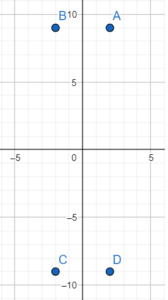
Find the position of a point in a plane (2,9).
Solution:
Given that the point is (2,9)
Consider the point (2,9) has A.
Plot the point A(2,9) in the first quadrant takes a distance of 2 from the x axis and 9 from the y axis.
So, the coordinates of A are (2, 9). We express it by writing A = (2, 9).
And also consider B, C, and D are also points in the other quadrant whose distance from the y-axis and the x-axis are the same point. But due to their positions in different quadrants, their coordinates are different. Thus, the coordinates of B, in the second quadrant, are (-2, 9), and C is the third quadrant, are (-2, -9) and D is the fourth quadrant, are (2, -9).
Position of a point in a plane_5

FAQs on Position of a Point in a Plane

1. What is the position of a plane?

A plane is a surface in which any two points are taken and the straight line drawn to join these two points that lie within that plane or surface.

2. What is the first coordinate of a point?

If the coordinates points are (a,b). The first point named in the ordered pair is called x-coordinate and the second is called the y-coordinate.

3. How many points determine a line?

If any two distinct points in a plane determine a line, and the equation is also determined by the coordinates of the points.

Coordinates of a Point

Coordinates of a Point – Definition, Meaning, Examples | How to Find the Coordinates of a point?

The complete information on finding the coordinates of a point are given on this page. So, go through the entire article to learn the points on the coordinate plane with a detailed explanation. Also, learn the basics of coordinate geometry from here. We suggest you practice the problems given at the end of this page to know how much knowledge you have gained from this topic. So, that you can know where you are lagging and overcome the difficulties from the chapter coordinate geometry.

Also Read:

What do you mean by Coordinates of a Point?

The exact position of the points on the cartesian plane is known as the coordinates of the points. We know that there are two coordinates on the plane one is x-coordinate and the other is y-coordinate. These coordinates represent the exact position of the point on a coordinate plane. There are four quadrants in the coordinate plane first quadrant has both positive values, the second quadrant has a negative x-axis, positive y-axis, the third quadrant has both negative signs and the fourth quadrant has a positive x-axis and negative y-axis.
Coordinates of a point

Coordinates Meaning

A coordinate is a set of values that defines the accurate location of the points on a plane. Each point in a plane is assigned with some set of numbers called coordinates of a plane. There are two coordinates in the coordinate plane the first coordinate of a point is called x-coordinate and the second coordinate of a point is called y-coordinate.
x-coordinate: 
The first number in the ordered pair is known as the x-coordinate of the point. This represents the points on the x-axis. The values on the x-axis may be positive and negative. The positive values on the x-axis will be the right side of the origin and the negative values on the x-axis will be the left side of the origin.
y-coordinate: 
The second number in the ordered pair is known as the y-coordinate of the two-dimensional plane. The numbers on the y-axis are both positive and negative. The positive values on the y-axis will be located on the north and the negative values on the y-axis will be located on the south part of the graph.
x-axis: The horizontal line on the coordinate plane is known as the x-axis. The positive values on the horizontal line are indicated as the x-axis and the negative values on the horizontal line are indicated as the x’-axis.
y-axis: The vertical line on the coordinate plane is known as the y-axis. The positive values on the vertical line are indicated as the y-axis and the negative values on the vertical line are indicated as the y’-axis.

How to find Coordinates of a Point?

There are some necessary steps to follow in order to find the coordinates of a point.
1. XOX’ and YOY’ are the co-ordinate axes on the graph.
2. To locate the point on the axes we need to draw a perpendicular from P on X’OX.
3. P(OT, PT) coordinate of a point is formed.

Coordinates of a Point Examples

Example 1.
To find the coordinate of point P the distance of P from the x-axis is 4 units and the distance of P from the y axis is 6 units.
Solution:
Therefore the coordinates of a point P are (4,6).
Here a = 4 locates on x coordinate
b = 6 locates on y coordinates
Coordinates of a point_1

Example 2.
To find the coordinate of point P the distance of P from the y-axis is 7 units and the distance of P from the x-axis is 7 units.
Solution:
Therefore the coordinates of a point P are (7,7).
Here a = 7 locates on x coordinate
b = 7 locates on y coordinates
Coordinates of a point_2

Example 3.
In the adjoining figure, XOX’ and YOY’ are the coordinate axis. Find out the coordinates of point A?
Solution:
To locate the position of point A, draw a straight line and perpendicular line from point A to the x-axis OX, y-axis OY’.
Measure the distance between the point on the x-axis and origin, a new point on the y-axis, and origin.
The value of that point on the x-axis is 3. And the value of the point on the y-axis is -5.
So, the x coordinate is 4, y coordinate is -5.
Therefore The ordered pair is A (4, -5)
Coordinates of a point_3

Example 4.
Find the coordinates of three marks in the following figure?
Solution:
To locate the position of point A
The ordered pair A is located in the first quadrant where both coordinates are positive.
The perpendicular distance of A from the x-axis is 4 units and the y-axis is 4 units.
So, the abscissa is 4, ordinate is 4
Therefore, the coordinates of P are (4, 4).
To locate the position of point B
The ordered pair B is also located in quadrant 1.
The perpendicular of point B from the x-axis is 0.
So, the x coordinate is 0 and the point lies on the y-axis.
The distance of B from the origin on the y-axis is 3 units.
Therefore the y coordinate is 3.
The coordinates of point Q
B (0, 3)
To locate the position of point C
Point C is located on the x-axis means its y coordinate is 0.
The distance of point C from the origin is -3 units.
So the x coordinate is -3.
Thus the Coordinates of point C (0, -3).

Example 5.
To find the coordinate of point P the distance of P from the y-axis is 3 units and the distance of P from the x-axis is -8 units.
Solution:
Therefore the coordinates of a point P are (3,-8).
Here a = 3 locates on x coordinate
b = -8 locates on y coordinates.
Coordinates of a point_4

FAQs on Coordinates of a Point

1. How many coordinates are there at a point?

The point in a two-dimensional plane has two coordinates. One is x coordinate and it is also called abscissa and the second is y coordinate and it is also called ordinate.

2. What is meant by coordinates?

In a plane, the set of values of a point are called coordinates.

3. What do you mean by the coordinates of a point?

A pair of numbers describes the position of a point in a coordinate plane by using the horizontal and vertical distances from the two reference axis they represent by (x,y) means x coordinate and y coordinate.

Independent Variables and Dependent Variables

Independent Variables and Dependent Variables – Definition, Examples | How do you Identify Independent and Dependent Variables?

Independent Variables and Dependent Variables are the categories of the variables in maths. Before going into the concept of Independent and Dependent Variables in coordinate geometry we will discuss variables in maths. Also, let us know the similarities of independent variables and dependent variables, differences between Independent Variables and Dependent Variables with example problems. Hence utilize the content provided in this article and score the highest marks in the exams.

Variable – Definition

In maths, a variable is an alphabetic character that expresses the value or number. A variable is used to represent the unknown number of unknown values. A variable is a value that can vary the expression or equation depending on the conditions.

Independent Variables and Dependent Variables

Depending and Independent Variables are the variables in maths. A cartesian plane or coordinate system is used for plotting the chain of points that shows the relationship between the independent variables and dependent variables. the x-axis shows the independent variables i.e, input values and the y-axis shows the output values of the dependent variables.

Compare and Contrast Independent Variables and Dependent Variables?

In coordinate geometry, the independent variables can be seen on the x-axis and comprise the input values. In short, we can say that the independent variable is an arbitrary input on the cartesian plane. Whereas the dependent variable is an arbitrary output on the cartesian plane i.e., on the y-axis. The dependent variables are found on the y-axis and include output values.

Examples of Independent Variables and Dependent Variables

Check out the below examples to know how to solve the problems on dependent variables and independent variables.

Example 1.
Find the independent variables of the equation 3y = 6x + 1
Solution:
Given that
3y = 6x + 1 is an algebraic expression
Here x is an independent variable.
Each value of x will be a different value of y.

Example 2.
Find the dependent variables of the equation y = 4x.
Solution:
Given that
y = 4x is an algebraic expression
Here y depends on x
So, if x = 1 then y = 4.

Example 3.
Find the variables of the equation 2x + 6 = 20
Solution:
Given that
2x + 6 = 20 is an algebraic expression
Here x is a variable
2 is the coefficient
6 and 20 are the constants.

Example 4.
Find the independent variables of the equation 4y = 5x + 3
Solution:
Given that
4y = 5x + 3 is an algebraic expression
Here x is an independent variable.
Each value of x will be a different value of y.

Example 5.
Find the dependent variables of the equation y = 7x.
Solution:
Given that
y = 7x is an algebraic expression
Here y depends on x
So, if x = 1 then y = 7.

FAQs on Correlation between Independent Variables and Dependent Variables

1. What is meant by Dependent Variables?

The dependent variable is a variable whose quality depends on another variable in its condition. If the estimation of the word variable is dependably said to be dependent on the free variable of math conditions.

2. What is meant by Independent Variables?

In an algebraic equation, an independent variable is related to a variable whose values are independent of changes. If x and y are two variables of an equation and every value of x is linked with any other value of y, then ‘y’ value is said to be a function of x value, it is known as an independent variable, and therefore ‘y’ value is known as a dependent variable.

3. How do you write the independent and dependent variables in an equation?

y = a + bx
Here a and b are constant numbers.
x is the independent variable, and
y is the dependent variable. Therefore we choose a value to substitute for the independent variable and then solve for the dependent variable.