go-math-grade-8-chapter-9-transformations-and-congruence-answer-key

Go Math Grade 8 Answer Key Chapter 9 Transformations and Congruence

There are multiple ways to learn maths. But choosing the best material is also important for the students to score good marks and also to improve their knowledge. This will be possible only with the help of our Go Math Grade 8 Answer Key Chapter 9 Transformations and Congruence. You can get the explanation for all the questions in detail in Go Math Grade 8 Chapter 9 Transformations and Congruence Answer Key here. Refer to Go Math Grade 8 Answer Key for learning the problems in an easy manner.

Go Math Grade 8 Answer Key Chapter 9 Transformations and Congruence

Practice makes you perfect become a master in maths. Without proper knowledge on the subject, you cannot solve the problems in real-time. This will affect your exam. So, keeping this in our mind we have prepared the solutions briefly which will help you to understand the concept in depth. Get free access to Download Go Math Grade 8 Chapter 9 Transformations and Congruence Solution Key pdf. In this article, you will get the solutions according to the topics. Therefore, students who want to score good marks in the exam must practice with Go Math Grade 8 Answer Key Chapter 9 Transformations and Congruence.

Lesson 1: Properties of Translations

Lesson 2: Properties of Reflections

Lesson 3: Algebraic Representations of Transformations

Lesson 4: Congruent Figures

Model Quiz

Mixed Review

Guided Practice – Properties of Translations – Page No. 282

Question 1.
Vocabulary A __________________is a change in the position, size, or shape of a figure.
____________

Answer:
transformation

Explanation:
A transformation is a change in the position, size, or shape of a figure.

Question 2.
Vocabulary When you perform a transformation of a figure on the coordinate plane, the input of the transformation is called the ________________, and the output of the transformation is called the_________________ .
Type below:
____________

Answer:
pre-image
image

Explanation:
When you perform a transformation of a figure on the coordinate plane, the input of the transformation is called the pre-image, and the output of the transformation is called the image.

Question 3.
Joni translates a right triangle 2 units down and 4 units to the right. How does the orientation of the image of the triangle compare with the orientation of the preimage?
Orientation is: _______

Answer:
Orientation is: Same

Explanation:
Since translation does not change the shape and size of a geometric figure, the two triangles are identical in shape and size, so they are congruent and the orientation is the same

Question 4.
Rashid drew rectangle PQRS on a coordinate plane. He then translated the rectangle 3 units up and 3 units to the left and labeled the image P ‘Q ‘R ‘S ‘. How do rectangle PQRS and rectangle P ‘Q ‘R ‘S ‘ compare?
They are: _______

Answer:
congruent

Explanation:
Since translation does not change the shape and size of a geometric figure, the two rectangles are identical in shape and size, so they are congruent.

Question 5.
The figure shows trapezoid WXYZ. Graph the image of the trapezoid after a translation of 4 units up and 2 units to the left.
Go Math Grade 8 Answer Key Chapter 9 Transformations and Congruence Lesson 1: Properties of Translations img 1
Type below:
____________

Answer:
After translation:
W'(-4, 3)
X'(2, 3)
Y'(1, 1)
Z'(-3, 1)

ESSENTIAL QUESTION CHECK-IN

Question 6.
What are the properties of translations?
Type below:
____________

Answer:
-> a translation is a geometric transformation that moves every point of a figure or space by the same amount in a given direction.
-> So the figures are identical and are congruent.

9.1 Independent Practice – Properties of Translations – Page No. 283

Question 7.
The figure shows triangle DEF.
Go Math Grade 8 Answer Key Chapter 9 Transformations and Congruence Lesson 1: Properties of Translations img 2
a. Graph the image of the triangle after the translation that maps point D to point D ‘.
Type below:
____________

Answer:
2 left, and 4 down

Question 7.
b. How would you describe the translation?
Type below:
____________

Answer:
It has the same size, shape. and orientation, but a different location

Question 7.
c. How does the image of triangle DEF compare with the preimage?
____________

Answer:
congruent

Question 8.
a. Graph quadrilateral KLMN with vertices K(-3, 2), L(2, 2), M(0, -3), and N(-4, 0) on the coordinate grid.
Go Math Grade 8 Answer Key Chapter 9 Transformations and Congruence Lesson 1: Properties of Translations img 3
Type below:
____________

Question 8.
b. On the same coordinate grid, graph the image of quadrilateral KLMN after a translation of 3 units to the right and 4 units up.
Type below:
____________

Answer:
grade 8 chapter 9 image 1

Question 8.
c. Which side of the image is congruent to side \(\overline { LM } \)?
___________
Name three other pairs of congruent sides.
___________
Type below:
____________

Answer:
Line LM is congruent to Line L!M!
Line KL is equal to K’L’
Line MN is equal to M’N’
Line KN is equal to K’N’

Draw the image of the figure after each translation.

Question 9.
4 units left and 2 units down
Go Math Grade 8 Answer Key Chapter 9 Transformations and Congruence Lesson 1: Properties of Translations img 4
Type below:
____________

Answer:
After translation
P'(-3, 1)
Q'(0, 2)
R'(0, -1)
S'(-3, -3)

Question 10.
5 units right and 3 units up
Go Math Grade 8 Answer Key Chapter 9 Transformations and Congruence Lesson 1: Properties of Translations img 5
Type below:
____________

Answer:
After translation
A'(0, 4)
B'(3, 5)
C'(3, 1)
D'(0, 0)

Properties of Translations – Page No. 284

Question 11.
The figure shows the ascent of a hot air balloon. How would you describe the translation?
Go Math Grade 8 Answer Key Chapter 9 Transformations and Congruence Lesson 1: Properties of Translations img 6
Type below:
____________

Answer:
4 units along positive X and 5 units along positive Y

Explanation:
Initial coordinate of balloon = ( -2 , -4)
Final coordinates of the balloon = (2,1)
Translation along x axis = 2 – (-2)
= 4 units along positive x direction
Translation along y axis = 1-(-4)
= 5 units along the positive y direction

Question 12.
Critical Thinking Is it possible that the orientation of a figure could change after it is translated? Explain.
_________

Answer:
No, it is not possible to change the orientation just by translation. As translation means, a transformation in which a figure is moved to another location without any change in size or orientation.

FOCUS ON HIGHER ORDER THINKING

Question 13.
a. Multistep Graph triangle XYZ with vertices X(-2, -5), Y(2, -2), and Z(4, -4) on the coordinate grid.
Go Math Grade 8 Answer Key Chapter 9 Transformations and Congruence Lesson 1: Properties of Translations img 7

Question 13.
b. On the same coordinate grid, graph and label triangle X’Y’Z’, the image of triangle XYZ after a translation of 3 units to the left and 6 units up.

Question 13.
c. Now graph and label triangle X”Y”Z”, the image of triangle X’Y’Z’ after a translation of 1 unit to the left and 2 units down.
Type below:
____________

Answer:
grade 8 chapter 9 image 2

Question 13.
d. Analyze Relationships How would you describe the translation that maps triangle XYZ onto triangle X”Y”Z”?
Type below:
____________

Answer:
Triangle XYZ has translated 4 units up and 4 units to the left

Question 14.
Critical Thinking The figure shows rectangle P’Q’R’S’, the image of rectangle PQRS after a translation of 5 units to the right and 7 units up. Graph and label the preimage PQRS.
Go Math Grade 8 Answer Key Chapter 9 Transformations and Congruence Lesson 1: Properties of Translations img 8
Type below:
____________

Answer:
grade 8 chapter 9 image 3

Question 15.
Communicate Mathematical Ideas Explain why the image of a figure after a translation is congruent to its preimage.
Type below:
____________

Answer:
A translation is a geometric transformation that moves every point of a figure or space by the same amount in a given direction. So the 2 figures are identical and the translated figure is congruent to its pre-image.

Guided Practice – Properties of Reflections – Page No. 288

Question 1.
Vocabulary A reflection is a transformation that flips a figure across a line called the __________ .
____________

Answer:
Reflection Axis

Explanation:
A reflection is a transformation that flips a figure across a line called the Reflection Axis.

Question 2.
The figure shows trapezoid ABCD.
Go Math Grade 8 Answer Key Chapter 9 Transformations and Congruence Lesson 2: Properties of Reflections img 9
a. Graph the image of the trapezoid after a reflection across the x-axis. Label the vertices of the image.
Type below:
____________

Answer:
A'(-3, -4)
B'(1, -4)
C'(3, -1)
D'(-3, -1)

Question 2.
b. How do trapezoid ABCD and trapezoid A’B’C’D’ compare?
____________

Answer:
congruent

Explanation:
trapezoid ABCD and trapezoid A’B’C’D’ are congruent

Question 2.
c. What If? Suppose you reflected trapezoid ABCD across the y-axis. How would the orientation of the image of the trapezoid compare with the orientation of the preimage?
Type below:
____________

Answer:
The orientation would be reversed horizontally.

ESSENTIAL QUESTION CHECK-IN

Question 3.
What are the properties of reflections?
Type below:
____________

Answer:
properties of reflections
-> the size stays the same
-> the shape stays the same
-> the orientation does NOT stay the same

9.2 Independent Practice – Properties of Reflections – Page No. 289

The graph shows four right triangles. Use the graph for Exercises 4-7.
Go Math Grade 8 Answer Key Chapter 9 Transformations and Congruence Lesson 2: Properties of Reflections img 10

Question 4.
Which two triangles are reflections of each other across the x-axis?
Type below:
____________

Answer:
Triangles A and C are the reflections of each other across the x-axis.

Question 5.
For which two triangles is the line of reflection the y-axis?
Type below:
____________

Answer:
For triangle C & D the line of reflection is y-axis.

Question 6.
Which triangle is a translation of triangle C? How would you describe the translation?
Type below:
____________

Answer:
Triangle B is the translation of triangle C.
Lets take any one point of the triangle = (-2, -6)
Lets take the corresponding side of triangle B = (4,2)
Translation across x axis = 4 -(-2) = 6 units
Translation across y axis = 2 -(-6) = 8 units

Question 7.
Which triangles are congruent? How do you know?
Type below:
____________

Answer:
All the 4 triangles A, B, C, D are congruent.
The length of base and height of all the four triangles are 3 units, 4 units respectively.

Explanation:
All the 4 triangles A, B, C, D are congruent.
If base and height are equal then the hypotenuse should also be equal. Thus all three sides of the triangles A,B,C,D are equal. Thus these triangles are congruent,
The length of base and height of all the four triangles are 3 units, 4 units respectively.

Question 8.
a. Graph quadrilateral WXYZ with vertices W(-2, -2), X(3, 1), Y(5, -1), and Z(4, -6) on the coordinate grid.
Type below:
____________

Question 8.
b. On the same coordinate grid, graph quadrilateral W’X’Y’Z’, the image of quadrilateral WXYZ after a reflection across the x-axis.
Type below:
____________

Answer:
grade 8 chapter 9 image 4

Question 8.
c. Which side of the image is congruent to side \(\overline { YZ } \)?
_______________
Name three other pairs of congruent sides.
_______________
Type below:
____________

Answer:
Line YZ = Line Y’Z’
Line WX = Line W’X’
Line XY = Line X’Y’
Line WZ = Line W’Z’

Question 8.
d. Which angle of the image is congruent to ∠X?
_______________
Name three other pairs of congruent angles.
_______________
Type below:
____________

Answer:
Angle X’
Angle W and Angle W’
Angle Y and Angle Y’
Angle Z and Angle Z’

Properties of Reflections – Page No. 290

Question 9.
Critical Thinking Is it possible that the image of a point after a reflection could be the same point as the preimage? Explain.
________

Answer:
Yes

Explanation:
It is possible that the image of a point after a reflection could be the same point as the preimage

FOCUS ON HIGHER ORDER THINKING

Question 10.
a. Graph the image of the figure shown after a reflection across the y-axis.
Go Math Grade 8 Answer Key Chapter 9 Transformations and Congruence Lesson 2: Properties of Reflections img 11
Type below:
____________

Answer:
grade 8 chapter 9 image 5

Question 10.
b. On the same coordinate grid, graph the image of the figure you drew in part a after a reflection across the x-axis.
Type below:
____________

Answer:
grade 8 chapter 9 image 6

Question 10.
c. Make a Conjecture What other sequence of transformations would produce the same final image from the original preimage? Check your answer by performing the transformations. Then make a conjecture that generalizes your findings.
Type below:
____________

Answer:
The same image can be obtained by reflecting first across the x-axis and then across the y-axis.
Reflecting a figure first across the y-axis and then across the x-axis has the same outcome,. reflecting first across the x-axis and then across the y-axis.

Question 11.
a. Graph triangle DEF with vertices D(2, 6), E(5, 6), and F(5, 1) on the coordinate grid.

Question 11.
b. Next graph triangle D ′E ′F ′, the image of triangle DEF after a reflection across the y-axis.
Type below:
____________

Question 11.
c. On the same coordinate grid, graph triangle D′′ E′′ F′′, the image of triangle D ′E ′F ′ after a translation of 7 units down and 2 units to the right.
Type below:
____________

Answer:
grade 8 chapter 9 image 7

Question 11.
d. Analyze Relationships Find a different sequence of transformations that will transform triangle DEF to triangle D ′′E ′′F ′′.
Type below:
____________

Answer:
Translate triangle DEF 7 units down and 2 units to the left. Then reflect the image across the y-axis.

Guided Practice – Properties of Reflections – Page No. 294

Question 1.
Vocabulary A rotation is a transformation that turns a figure around a given _____ called the center of rotation.
____________

Answer:
point

Explanation:
A rotation is a transformation that turns a figure around a given point called the center of rotation.

Siobhan rotates a right triangle 90° counterclockwise about the origin.

Question 2.
How does the orientation of the image of the triangle compare with the orientation of the preimage?
Type below:
____________

Answer:
Each leg in the preimage is perpendicular to its corresponding leg in the image.

Question 3.
Is the image of the triangle congruent to the preimage?
______

Answer:
Yes

Explanation:
The image of the triangle is congruent to the preimage

Draw the image of the figure after the given rotation about the origin.

Question 4.
90° counterclockwise
Go Math Grade 8 Answer Key Chapter 9 Transformations and Congruence Lesson 3: Properties of Rotation img 12
Type below:
____________

Answer:
grade 8 chapter 9 image 8

Question 5.
180°
Go Math Grade 8 Answer Key Chapter 9 Transformations and Congruence Lesson 3: Properties of Rotation img 13
Type below:
____________

Answer:
After 180° rotation
A'(-2, -3)
B'(-4, -1)
C'(-2, 0)
D'(0, -1)

ESSENTIAL QUESTION CHECK-IN

Question 6.
What are the properties of rotations?
Type below:
____________

Answer:
Rotations preserve size and shape but change orientation.

9.3 Independent Practice – Properties of Reflections – Page No. 295

Question 7.
The figure shows triangle ABC and a rotation of the triangle about the origin.
Go Math Grade 8 Answer Key Chapter 9 Transformations and Congruence Lesson 3: Properties of Rotation img 14
a. How would you describe the rotation?
____________

Answer:
ABC was rotated 90º counterclockwise about the origin

Question 7.
b. What are the coordinates of the image?
Type below:
____________

Answer:
A'(3, 1)
B'(2, 3)
C'(-1, 4)

Question 8.
The graph shows a figure and its image after a transformation.
Go Math Grade 8 Answer Key Chapter 9 Transformations and Congruence Lesson 3: Properties of Rotation img 15
a. How would you describe this as a rotation?
____________

Answer:
The figure was rotated 180º about the origin.

Question 8.
b. Can you describe this as a transformation other than a rotation? Explain.
____________

Answer:
Yes

Explanation:
This can also be described as a reflection across the y-axis.

Question 9.
What type of rotation will preserve the orientation of the H-shaped figure in the grid?
Go Math Grade 8 Answer Key Chapter 9 Transformations and Congruence Lesson 3: Properties of Rotation img 16
____________

Answer:
A 180º rotation about the origin will preserve the orientation of the H-shaped figure in the grid.

Question 10.
A point with coordinates (-2, -3) is rotated 90° clockwise about the origin. What are the coordinates of its image?
(_______ , _______)

Answer:
(-3, 2)

Explanation:
The new coordinates are (-3, 2)

Complete the table with rotations of 180° or 90°. Include the direction of rotation for rotations of 90°.

Question 11.
Go Math Grade 8 Answer Key Chapter 9 Transformations and Congruence Lesson 3: Properties of Rotation img 17
Type below:
____________

Answer:
grade 8 chapter 9 image 10

Properties of Reflections – Page No. 296

Draw the image of the figure after the given rotation about the origin.

Question 14.
180°
Go Math Grade 8 Answer Key Chapter 9 Transformations and Congruence Lesson 3: Properties of Rotation img 18
Type below:
____________

Answer:
After 180°
A'(4, 0)
B'(2, -1)
C'(0, 0)
D'(2, 1)

Question 15.
270° counterclockwise
Go Math Grade 8 Answer Key Chapter 9 Transformations and Congruence Lesson 3: Properties of Rotation img 19
Type below:
____________

Answer:
After 270º counterclockwise rotation
A'(1, 2)
B'(2, -1)
C'(4, 2)

Question 16.
Is there a rotation for which the orientation of the image is always the same as that of the preimage? If so, what?
______

Answer:
Yes

Explanation:
A 360º rotation will always be the same as the original image

FOCUS ON HIGHER ORDER THINKING

Question 17.
Problem Solving Lucas is playing a game where he has to rotate a figure for it to fit in an open space. Every time he clicks a button, the figure rotates 90 degrees clockwise. How many times does he need to click the button so that each figure returns to its original orientation?
Figure A ____________
Figure B ____________
Figure C ____________
Go Math Grade 8 Answer Key Chapter 9 Transformations and Congruence Lesson 3: Properties of Rotation img 20
Figure A: _________ time(s)
Figure B: _________ time(s)
Figure C: _________ time(s)

Answer:
Figure A: 2 time(s)
Figure B: 1 time(s)
Figure C: 4 time(s)

Explanation:
2 times to return to original orientation
1 time to return to original orientation
4 times to return to original orientation

Question 18.
Make a Conjecture Triangle ABC is reflected across the y-axis to form the image A′B′C′. Triangle A′B′C′ is then reflected across the x-axis to form the image A″B″C″. What type of rotation can be used to describe the relationship between triangle A″B″C″ and triangle ABC?
Type below:
____________

Answer:
Triangle A’B’C’ is a 90º rotation of triangle ABC
Triangle A”B”C” is a 90º rotation of triangle A’B’C’
Therefore, Triangle A”B”C” is a 180º rotation of triangle ABC

Question 19.
Communicate Mathematical Ideas Point A is on the y-axis. Describe all possible locations of image A′ for rotations of 90°, 180°, and 270°. Include the origin as a possible location for A.
Type below:
____________

Answer:
If Point A is on the y-axis, Point A’ will be on the x-axis for 190° and 270° rotations and on the y-axis for 180° rotation
If point A is at the origin,
A’ is at the origin for any rotation about the origin.

Guided Practice – Algebraic Representations of Transformations – Page No. 300

Question 1.
Triangle XYZ has vertices X(-3, -2), Y(-1, 0), and Z(1, -6). Find the vertices of triangle X′Y′Z′ after a translation of 6 units to the right. Then graph the triangle and its image.
Go Math Grade 8 Answer Key Chapter 9 Transformations and Congruence Lesson 4: Algebraic Representations of Transformations img 21
Type below:
____________

Answer:
After a translation of 6 units to the right:
X'(3, -2)
Y'(5, 0)
Z'(7, -6)

Question 2.
Describe what happens to the x- and y-coordinates after a point is reflected across the x-axis.
Type below:
____________

Answer:
The x-coordinate remains the same, while the sign of the y-coordinate changes

Question 3.
Use the rule (x, y) → (y, -x) to graph the image of the triangle at right. Then describe the transformation.
Go Math Grade 8 Answer Key Chapter 9 Transformations and Congruence Lesson 4: Algebraic Representations of Transformations img 22
Type below:
____________

Answer:
The triangle is rotated 90º clockwise about the origin

ESSENTIAL QUESTION CHECK-IN

Question 4.
How do the x- and y-coordinates change when a figure is translated right a units and down b units?
Type below:
____________

Answer:
The x-coordinates increase by a, and the y-coordinates decrease by b

9.4 Independent Practice – Algebraic Representations of Transformations – Page No. 301

Write an algebraic rule to describe each transformation.Then describe the transformation.

Question 5.
Go Math Grade 8 Answer Key Chapter 9 Transformations and Congruence Lesson 4: Algebraic Representations of Transformations img 23
Type below:
____________

Answer:
algebraic rule
(x, y) -> (x-2, y-5)
transformation
translation of 2 units to the left and 5 units down
new coordinates
M'(-4, -2)
N'(-2, -2)
O'(-1, -4)
P'(-4, -4)

Question 6.
Go Math Grade 8 Answer Key Chapter 9 Transformations and Congruence Lesson 4: Algebraic Representations of Transformations img 24
Type below:
____________

Answer:
algebraic rule
(x, y) -> (-x, -y)
transformation
rotation of 180º
new coordinates
A'(0, 0)
B'(0, -3)
C'(2, -3)
D'(2, 0)

Question 7.
Triangle XYZ has vertices X(6, -2.3), Y(7.5, 5), and Z(8, 4). When translated, X′ has coordinates (2.8, -1.3). Write a rule to describe this transformation. Then find the coordinates of Y′ and Z′.
Type below:
____________

Answer:
algebraic rule
(x, y) -> (x-3.2, y+1)
new coordinates
Y'(4.3, 6)
Z'(4.8, 5)

Question 8.
Point L has coordinates (3, -5). The coordinates of point L′ after a reflection are (-3, -5). Without graphing, tell which axis point L was reflected across. Explain your answer.
____________

Answer:
Point L was reflected on the y-axis.
When you reflect a point across the y-axis, the sign of the x-coordinate changes, and the sign of the y-coordinate remains the same

Question 9.
Use the rule (x, y) → (x – 2, y – 4) to graph the image of the rectangle. Then describe the transformation.
Go Math Grade 8 Answer Key Chapter 9 Transformations and Congruence Lesson 4: Algebraic Representations of Transformations img 25
Type below:
____________

Answer:
The rectangle is translated 2 units to the left and 4 units down

Question 10.
Parallelogram ABCD has vertices A(−2, −5\(\frac{1}{2}\)), B(−4, −5\(\frac{1}{2}\)),C(-3, -2), and D(-1, -2). Find the vertices of parallelogram A′B′C′D′ after a translation of 2 \(\frac{1}{2}\) units down.
Type below:
__________

Answer:
after a translation of 2 \(\frac{1}{2}\) units
A'(-2, -8)
B'(-4, -8)
C'(-3, -4 \(\frac{1}{2}\))
D'(-1, -4 \(\frac{1}{2}\))

Algebraic Representations of Transformations – Page No. 302

Question 11.
Alexandra drew the logo shown on half-inch graph paper. Write a rule that describes the translation Alexandra used to create the shadow on the letter A.
Go Math Grade 8 Answer Key Chapter 9 Transformations and Congruence Lesson 4: Algebraic Representations of Transformations img 26
Type below:
__________

Answer:
(x,y) –> (x+1,y-0.5)
(x+1,y-0.5) –> (x+0.5,y-0.25)

Explanation:
translation in units
(x,y) –> (x+1,y-0.5)
This step converts translation rule in units to translation rule in inches. (Divide by 2 since graph paper is half inch paper.
(x+1,y-0.5) –> (x+0.5,y-0.25)

Question 12.
Kite KLMN has vertices at K(1, 3), L(2, 4), M(3, 3), and N(2, 0). After the kite is rotated, K′ has coordinates (-3, 1). Describe the rotation, and include a rule in your description. Then find the coordinates of L′, M′, and N′.
Type below:
__________

Answer:
rotation
90 counterclockwise
rule
(x, y) -> (-y, x)
new coordinates
L'(-4, 2)
M'(-3, 3)
N'(0, 2)

FOCUS ON HIGHER ORDER THINKING

Question 13.
Make a Conjecture Graph the triangle with vertices (-3, 4), (3, 4), and (-5, -5). Use the transformation (y, x) to graph its image.
a. Which vertex of the image has the same coordinates as a vertex of the original figure? Explain why this is true.
Go Math Grade 8 Answer Key Chapter 9 Transformations and Congruence Lesson 4: Algebraic Representations of Transformations img 27
Type below:
__________

Answer:
(-5, 5) has the same coordinates

Question 13.
b. What is the equation of a line through the origin and this point?
Type below:
__________

Answer:
x and y are equal so switching x and y has no effect on the coordinates

Question 13.
c. Describe the transformation of the triangle.
Type below:
__________

Answer:
x and y are equal so switching x and y has no effect on the coordinates

Question 14.
Critical Thinking Mitchell says the point (0, 0) does not change when reflected across the x- or y-axis or when rotated about the origin. Do you agree with Mitchell? Explain why or why not.
_______

Answer:
Yes, I agree with Mitchell

Explanation:
Reflecting across the x-axis or y-axis changes the sign of the y or x coordinate 0 cannot change signs.
Rotating about the origin does not change the origin (0, 0)

Question 15.
Analyze Relationships Triangle ABC with vertices A(-2, -2), B(-3, 1), and C(1, 1) is translated by (x, y) → (x – 1, y + 3). Then the image, triangle A′B′C′, is translated by (x, y) → (x + 4, y – 1), resulting in A″B″C″.
a. Find the coordinates for the vertices of triangle A″B″C″.
Type below:
__________

Answer:
A”(-2-1+4, -2+3-1) = A”(1, 0)
B”(-3-1+4, 1+3-1) = B”(0, 3)
C”(1-1+4, 1+3-1) = C”(4, 3)

Question 15.
b. Write a rule for one translation that maps triangle ABC to triangle A″B″C″.
Type below:
__________

Answer:
(x, y) -> (x-1+4, y+3-1)
(x, y) -> (x+3, y+2)

Guided Practice – Congruent Figures – Page No. 306

Question 1.
Apply the indicated series of transformations to the rectangle. Each transformation is applied to the image of the previous transformation, not the original figure. Label each image with the letter of the transformation applied.
Go Math Grade 8 Answer Key Chapter 9 Transformations and Congruence Lesson 5: Congruent Figures img 28
A. Reflection across the y-axis
B. Rotation 90° clockwise around the origin
C. (x, y) → (x – 2, y)
D. Rotation 90° counterclockwise around the origin
E. (x, y) → (x – 7, y – 2)
Type below:
__________

Answer:
A. After transformation
(1, 3)
(1, 4)
(4, 4)
(4, 3)
B. After transformation
(3, -1)
(4, -1)
(4, -4)
(3, -4)
C. After transformation
(1, -1)
(2, -1)
(2, -4)
(1, -4)
D. After transformation
(1, 1)
(1, 2)
(4, 2)
(4, 1)
E. After transformation
(-6, -1)
(-6, 0)
(-3, 0)
(-3, -1)

Identify a sequence of transformations that will transform figure A into figure C.
Go Math Grade 8 Answer Key Chapter 9 Transformations and Congruence Lesson 5: Congruent Figures img 29

Question 2.
What transformation is used to transform figure A into figure B?
Type below:
__________

Answer:
Reflection across the y-axis

Explanation:
Reflection across the y-axis is used to transform figure A into figure B

Question 3.
What transformation is used to transform figure B into figure C?
Type below:
__________

Answer:
Translation 3 units right and 4 units down

Explanation:
Translation 3 units right and 4 units down is used to transform figure B into figure C

Question 4.
What sequence of transformations is used to transform figure A into figure C? Express the transformations algebraically.
Type below:
__________

Answer:
Reflection across the y-axis is used to transform figure A into figure B
Translation 3 units right and 4 units down is used to transform figure B into figure C
Algebraically:
(x, y) -> (-x, y)
(x, y) -> (x +3, y-4)

Question 5.
Vocabulary What does it mean for two figures to be congruent?
Type below:
__________

Answer:
Two figures are congruent when the figures have the same size and the same shape.

ESSENTIAL QUESTION CHECK-IN

Question 6.
After a sequence of translations, reflections, and rotations, what is true about the first figure and the final figure?
Type below:
__________

Answer:
After a sequence of translations, reflections, and rotations, the first and final figures have the same size and shape. (They are congruent)

9.5 Independent Practice – Congruent Figures – Page No. 307

For each given figure A, graph figures B and C using the given sequence of transformations. State whether figures A and C have the same or different orientation.

Question 7.
Go Math Grade 8 Answer Key Chapter 9 Transformations and Congruence Lesson 5: Congruent Figures img 30
Figure B: a translation of 1 unit to the right and 3 units up
Figure C: a 90° clockwise rotation around the origin
Type below:
__________

Answer:
Different orientation

Explanation:
grade 8 chapter 9 image 11
Different orientation

Question 8.
Go Math Grade 8 Answer Key Chapter 9 Transformations and Congruence Lesson 5: Congruent Figures img 31
Figure B: a reflection across the y-axis
Figure C: a 180° rotation around the origin
Type below:
__________

Answer:
Different orientation

Explanation:
grade 8 chapter 9 image 12
Different orientation

Question 9.
Go Math Grade 8 Answer Key Chapter 9 Transformations and Congruence Lesson 5: Congruent Figures img 32
Figure B: a reflection across the y-axis
Figure C: a translation 2 units down
Type below:
__________

Answer:
Different orientation

Explanation:
grade 8 chapter 9 image 13
Different orientation

Question 10.
Go Math Grade 8 Answer Key Chapter 9 Transformations and Congruence Lesson 5: Congruent Figures img 33
Figure B: a translation 2 units up
Figure C: a rotation of 180° around the origin
Type below:
__________

Answer:
Different orientation

Explanation:
grade 8 chapter 9 image 14
Different orientation

Congruent Figures – Page No. 308

Question 11.
Represent Real-World Problems A city planner wanted to place the new town library at site A. The mayor thought that it would be better at site B. What transformations were applied to the building at site A to relocate the building to site B? Did the mayor change the size or orientation of the library?
Go Math Grade 8 Answer Key Chapter 9 Transformations and Congruence Lesson 5: Congruent Figures img 34
Type below:
__________

Answer:
From Site A to Site B: Translation 2 units right and 4 units down
The size did NOT change
The orientation changed

Question 12.
Persevere in Problem Solving Find a sequence of three transformations that can be used to obtain figure D from figure A. Graph the figures B and C that are created by the transformations.
Go Math Grade 8 Answer Key Chapter 9 Transformations and Congruence Lesson 5: Congruent Figures img 35
Type below:
__________

Answer:
From figure A to D:
Reflection across the x-axis (-1, -5) (-1, -6) (2, -5) (4, -6)
90º clockwise rotation (4, -1) (5, -1) (5, -4) (4, -6)
translation 6 units left (4, -1) (5, -1) (5, -4) (4, -6)

FOCUS ON HIGHER ORDER THINKING

Question 13.
Counterexamples The Commutative Properties for Addition and Multiplication state that the order of two numbers being added or multiplied does not change the sum or product. Are translations and rotations commutative? If not, give a counterexample.
________

Answer:
No, Translation and rotations are not commutative

Explanation:
The point (2, 2) becomes (2, -4) when translated 2 units to the right then rotated 90 around the origin.
The point (2, 2) becomes (4, -2) when rotated 90 around the origin then translated 2 units to the right.
The above two points are not the same.

Question 14.
Multiple Representations For each representation, describe a possible sequence of transformations.
a. (x, y) → (-x – 2, y + 1)
Type below:
____________

Answer:
translation 2 units right and 1 unit up
reflection across y-axis

Question 14.
b. (x, y) → (y, -x – 3)
Type below:
____________

Answer:
rotation 90º clockwise around the origin
translation 3 units down

Ready to Go On? – Model Quiz – Page No. 309

9.1–9.3 Properties of Translations, Reflections, and Rotations

Question 1.
Graph the image of triangle ABC after a translation of 6 units to the right and 4 units down. Label the vertices of the image A’, B’, and C’.
Go Math Grade 8 Answer Key Chapter 9 Transformations and Congruence Model Quiz img 36
Type below:
____________

Answer:
After translation:
A'(2, 1)
B'(2, -1)
C'(5, -1)

Question 2.
On the same coordinate grid, graph the image of triangle ABC after a reflection across the x-axis. Label the vertices of the image A”, B”, and C”.
Type below:
____________

Answer:
After reflection:
A”(-4, -5)
B”(-4, -3)
C”(-1, -3)

Question 3.
Graph the image of HIJK after it is rotated 180° about the origin. Label the vertices of the image H’I’J’K’.
Go Math Grade 8 Answer Key Chapter 9 Transformations and Congruence Model Quiz img 37
Type below:
____________

Answer:
After rotation:
H'(0, -4)
I'(0, -1)
J'(2, -2)
K'(2, -3)

9.4 Algebraic Representations of Transformations

Question 4.
A triangle has vertices at (2, 3), (−2, 2), and (−3, 5). What are the coordinates of the vertices of the image after the translation (x, y) → (x + 4, y − 3)?
Type below:
____________

Answer:
After translation:
(6, 0)
(2, -1)
(1, 2)

9.5 Congruent Figures

Question 5.
Vocabulary Translations, reflections, and rotations produce a figure that is _____ to the original figure.
Type below:
____________

Answer:
congruent

Explanation:
Vocabulary Translations, reflections, and rotations produce a figure that is congruent to the original figure.

Question 6.
Use the coordinate grid for Exercise 3. Reflect H’I’J’K’ over the y-axis, then rotate it 180° about the origin. Label the new figure H″I″J″K″.
Type below:
____________

Answer:
after reflection
H'(0, -4)
I'(0, -1)
J'(-2, -2)
K'(-2, -3)
after rotation
H”(0, 4)
I”(0, 1)
J”(2, 2)
K”(2, 3)

ESSENTIAL QUESTION

Question 7.
How can you use transformations to solve real-world problems?
Type below:
____________

Answer:
Transformational properties allow the systematic movement of congruent figures while maintaining or adjusting their orientation.

Selected Response – Mixed Review – Page No. 310

Question 1.
What would be the orientation of the figure L after a translation of 8 units to the right and 3 units up?
Go Math Grade 8 Answer Key Chapter 9 Transformations and Congruence Mixed Review img 38
Options:
a. A
b. B
c. C
d. D

Answer:
c. C

Explanation:
After a translation of 8 units right and 3 units up, the orientation of figure L stays the same.

Question 2.
Figure A is reflected over the y-axis and then lowered 6 units. Which sequence describes these transformations?
Options:
a. (x, y) -> (x, -y) and (x, y) -> (x, y – 6)
b. (x, y) -> (-x, y) and (x, y) -> (x, y – 6)
c. (x, y) -> (x, -y) and (x, y) -> (x – 6, y)
d. (x, y) -> (-x, y) and (x, y) -> (x – 6, y)

Answer:
b. (x, y) -> (-x, y) and (x, y) -> (x, y – 6)

Explanation:
reflection over y-axis:
(x, y) -> (-x, y)
Translation 6 units down
(x, y) -> (x, y-6)

Question 3.
What quadrant would the triangle be in after a rotation of 90° counterclockwise about the origin?
Go Math Grade 8 Answer Key Chapter 9 Transformations and Congruence Mixed Review img 39
Options:
a. I
b. II
c. III
d. IV

Answer:
d. IV

Explanation:
After a rotation of 90° counterclockwise about the origin, the triangle will be in QIV

Question 4.
Which rational number is greater than −3 \(\frac{1}{3}\) but less than −\(\frac{4}{5}\)?
Options:
a. −0.4
b. −\(\frac{9}{7}\)
c. −0.19
d. −\(\frac{22}{5}\)

Answer:
b. −\(\frac{9}{7}\)

Question 5.
Which of the following is not true of a trapezoid that has been reflected across the x-axis?
Options:
a. The new trapezoid is the same size as the original trapezoid.
b. The new trapezoid is the same shape as the original trapezoid.
c. The new trapezoid is in the same orientation as the original trapezoid.
d. The x-coordinates of the new trapezoid are the same as the x-coordinates of the original trapezoid.

Answer:
d. The x-coordinates of the new trapezoid are the same as the x-coordinates of the original trapezoid.

Explanation:
The x-coordinates of the new trapezoid are the same as the x-coordinates of the original trapezoid.

Question 6.
A triangle with coordinates (6, 4), (2, −1), and (−3, 5) is translated 4 units left and rotated 180° about the origin. What are the coordinates of its image?
Options:
a. (2, 4), (-2, -1), (-7, 5)
b. (4, 6), (-1, 2), (5, -3)
c. (4, -2), (-1, 2), (5, 7)
d. (-2, -4), (2, 1), (7, -5)

Answer:
d. (-2, -4), (2, 1), (7, -5)

Question 7.
A rectangle with vertices (3, -2), (3, -4), (7, -2), (7, -4) is reflected across the x-axis and then rotated 90° counterclockwise.
a. In what quadrant does the image lie?
____________

Answer:
After reflection and rotation, the image lies in QII

Question 7.
b. What are the vertices of the image?
Type below:
____________

Answer:
image vertices
(-2, 3)
(-4, 3)
(-2, 7)
(-4, 7)

Question 7.
c. What other transformations produce the same image?
Type below:
____________

Answer:
A reflection across the y-axis and 90º clockwise rotation will produce the same result.

Conclusion:

The Go Math Grade 8 Answer Key Chapter 9 Transformations and Congruence pdf are available both online and offline. We have provided in pdf format so that students can practice the problems offline. We know that maths is the scoring and also typical among all the subjects. But you can make it easy if you understand the concept of the chapter. Students can refer to the Go Math Grade 8 Answer Key in their convenient way. Practice well and make maths your favorite subject. Best of Luck!!!

go-math-grade-8-chapter-8-solving-systems-of-linear-equations-answer-key

Go Math Grade 8 Answer Key Chapter 8 Solving Systems of Linear Equations

Students of Grade 8 can get a detailed explanation for all the questions in Go Math Answer Key Chapter 8 Solving Systems of Linear Equations. In addition to the exercise problems we also provide the solutions for the review test. So, go through all the answers and explanations provided by the math experts in Go Math Grade 8 Chapter 8 Solving Systems of Linear Equations Answer Key. Our aim is to provide easy and simple tricks to solve the problems in Go Math Grade 8 Answer Key Chapter 8 Solving Systems of Linear Equations.

Download Go Math Grade 8 Chapter 8 Solving Systems of Linear Equations Answer Key Pdf

Students who are interested to secure the highest marks in the exams are suggested to download the Go Math Grade 8 Answer Key Chapter 8 Solving Systems of Linear Equations pdf. All the solutions are provided in the pdf format as per the list of the chapters provided in the latest edition. Hence refer to Go Math 8th Grade Solution Key to learning the easy way of maths practice. Check the list of the topics covered in Chapter 8 Solving Systems of Linear Equations from the following section.

Lesson 1: Solving Systems of Linear Equations by Graphing

Lesson 2: Solving Systems by Substitution

Lesson 3: Solving Systems by Elimination

Lesson 4: Solving Systems by Elimination with Multiplication

Lesson 5: Solving Solving Special Systems

Model Quiz

Review

Guided Practice – Solving Systems of Linear Equations by Graphing – Page No. 232

Solve each system by graphing.

Question 1.
\(\left\{\begin{array}{l}y=3 x-4 \\y=x+2\end{array}\right.\)
Go Math Grade 8 Answer Key Chapter 8 Solving Systems of Linear Equations Lesson1: Solving Systems of Linear Equations by Graphing img 1
Type below:
______________

Answer:
grade 8 chapter 8 image 1

Explanation:
y = 3x – 4
y = x + 2
The solution of thr linear system of equations is the intersection point of the two equations.
(3, 5) is the solution of the system of equations.
If x = 3, y = 3(3) – 4 = 9 – 4 = 5; y = 3 + 2 = 5
5 = 5; True

Question 2.
\(\left\{\begin{array}{l}x-3 y=2 \\-3x+9y=-6\end{array}\right.\)
Go Math Grade 8 Answer Key Chapter 8 Solving Systems of Linear Equations Lesson1: Solving Systems of Linear Equations by Graphing img 2
Type below:
______________

Answer:
grade 8 chapter 8 image 2
Infinitely many solutions

Explanation:
x – 3y = 2
-3x + 9y = -6
x – 3y – x = -x + 2
-3y = -x + 2
y = 1/3 . x – 2/3
-3x + 9y + 3x = 3x – 6
9y = 3x – 6
y = 3/9 . x – 6/9
y = 1/3 . x – 2/3
The solution of the linear system of equations is the intersection of the two equations.
Infinitely many solutions

Question 3.
Mrs. Morales wrote a test with 15 questions covering spelling and vocabulary. Spelling questions (x) are worth 5 points and vocabulary questions (y) are worth 10 points. The maximum number of points possible on the test is 100.
a. Write an equation in slope-intercept form to represent the number of questions on the test.
Go Math Grade 8 Answer Key Chapter 8 Solving Systems of Linear Equations Lesson1: Solving Systems of Linear Equations by Graphing img 3
Type below:
______________

Answer:
y = -x + 15

Explanation:
Mrs. Morales wrote a test with 15 questions covering spelling and vocabulary. Spelling questions (x) are worth 5 points and vocabulary questions (y) are worth 10 points.
x + y = 15
x + y – x = -x + 15
y = -x + 15

Question 3.
b. Write an equation in slope-intercept form to represent the total number of points on the test.
Type below:
______________

Answer:
y = -1/2 . x + 10

Explanation:
The total number of points on test is 100
5x + 10y = 100
5x + 10y – 5x = -5x + 100
10y = -5x + 100
y = -5/10 . x + 100/10
y = -1/2 . x + 10

Question 3.
c. Graph the solutions of both equations.
Type below:
______________

Answer:
grade 8 chapter 8 image 3

Question 3.
d. Use your graph to tell how many of each question type are on the test.
_________ spelling questions
_________ vocabulary questions

Answer:
10 spelling questions
5 vocabulary questions

ESSENTIAL QUESTION CHECK-IN

Question 4.
When you graph a system of linear equations, why does the intersection of the two lines represent the solution of the system?
Type below:
______________

Answer:
To solve a system of linear equations means finding the solutions that satisfy all the equations of that system. When we graph a system of linear equations, the intersection point lies on the line of each equation, which means that satisfies all the equations. Therefore, it is considered to be the solution to that system.

Solving Systems of Linear Equations by Graphing – Page No. 233

Question 5.
Vocabulary
A_________________ is a set of equations that have the same variables.
______________

Answer:
system of equations

Explanation:
A system of equations is a set of equations that have the same variables.

Question 6.
Eight friends started a business. They will wear either a baseball cap or a shirt imprinted with their logo while working. They want to spend exactly $36 on the shirts and caps. Shirts cost $6 each and caps cost $3 each.
a. Write a system of equations to describe the situation. Let x represent the number of shirts and let y represent the number of caps.
______________

Answer:
6x + 3y = 36

Explanation:
The sum of caps and shirts is 8. The total cost of caps and shirts is $36.
x + y = 8
6x + 3y = 36

Question 6.
b. Graph the system. What is the solution and what does it represent?
Go Math Grade 8 Answer Key Chapter 8 Solving Systems of Linear Equations Lesson1: Solving Systems of Linear Equations by Graphing img 4
Type below:
______________

Answer:
The solution is (4, 4)
grade 8 chapter 8 image 4

Explanation:
x + y – x = -x + 8
y = -x + 8
6x + 3y – 6x = -6x + 36
3y = -6x + 36
y = -6/2 . x + 36/3
y = -2x + 12
(4, 4). They should order 4 shirts and 4 caps.

Question 7.
Multistep The table shows the cost for bowling at two bowling alleys.
Go Math Grade 8 Answer Key Chapter 8 Solving Systems of Linear Equations Lesson1: Solving Systems of Linear Equations by Graphing img 5
a. Write a system of equations, with one equation describing the cost to bowl at Bowl-o-Rama and the other describing the cost to bowl at Bowling Pinz. For each equation, let x represent the number of games played and let y represent the total cost.
Type below:
______________

Answer:
y = 2.5x + 2
y = 2x + 4

Explanation:
Cost at Bowl-o-Rama => y = 2.5x + 2
Cost at Bowling Pinz => y = 2x + 4

Question 7.
b. Graph the system. What is the solution and what does it represent?
Go Math Grade 8 Answer Key Chapter 8 Solving Systems of Linear Equations Lesson1: Solving Systems of Linear Equations by Graphing img 6
Type below:
______________

Answer:
grade 8 chapter 8 image 5

Explanation:
The solution of the linear system of equations is the intersection of the two equations.
(4, 12)
When 4 games are played, the total cost is $12.

Solving Systems of Linear Equations by Graphing – Page No. 234

Question 8.
Multi-Step Jeremy runs 7 miles per week and increases his distance by 1 mile each week. Tony runs 3 miles per week and increases his distance by 2 miles each week. In how many weeks will Jeremy and Tony be running the same distance? What will that distance be?
Type below:
______________

Answer:
After 4 weeks Jeremy and Tony will be running the same distance and that distance would be 11 miles.

Explanation:
Multi-Step Jeremy runs 7 miles per week and increases his distance by 1 mile each week.
y = x + 7
Tony runs 3 miles per week and increases his distance by 2 miles each week.
y = 2x + 3
grade 8 chapter 8 image 6
The solution of the system of linear equation is (4, 11) which means that after 4 weeks Jeremy and Tony will be running the same distance and that distance would be 11 miles.

Question 9.
Critical Thinking Write a real-world situation that could be represented by the system of equations shown below.
\(\left\{\begin{array}{l}y=4 x+10 \\y=3x+15\end{array}\right.\)
Type below:
______________

Answer:
The entry fee of the first gym is $10 and for every hour that you spend there, you pay an extra $4. If we denote with x the number of hours that somebody spends at the gym and with y the total cost is
y = 4x + 10
The entry fee of the second gym is $15 and for every hour that you spend there, you pay an extra $3. If we denote with x the number of hours that somebody spends at the gym and with y the total cost is
y = 3x + 15
y = 4x + 10
y = 3x + 15

FOCUS ON HIGHER ORDER THINKING

Question 10.
Multistep The table shows two options provided by a high-speed Internet provider.
Go Math Grade 8 Answer Key Chapter 8 Solving Systems of Linear Equations Lesson1: Solving Systems of Linear Equations by Graphing img 7
a. In how many months will the total cost of both options be the same? What will that cost be?
________ months
$ ________

Answer:
5 months
$ 200

Explanation:
Let y be the total cost after x month
y = 30x + 50
Let y be the total cost after x month
y = 40x
Substitute y = 40x in y = 30x + 50
40x = 30x + 50
40x – 30x = 50
10x = 50
x = 50/10
x = 5
The total cost of both options will be the same after 5 months. Total cost would be y = 40(5) = $200.

Question 10.
b. If you plan to cancel your Internet service after 9 months, which is the cheaper option? Explain.
______________

Answer:
When x = 9 months
y = 30(9) + 50 = $320
y = 40(9) = $360
$320 < $360
Option 1 is cheaper as the total cost is less for option 1

Question 11.
Draw Conclusions How many solutions does the system formed by x − y = 3 and ay − ax + 3a = 0 have for a nonzero number a? Explain.
Type below:
______________

Answer:
x – y = 3
ay – ax + 3a =0
ay – ax + 3a – 3a = 0 – 3a
ay – ax = – 3a
a(y – x) = -3a
y – x = -3
x – y = 3
Both equations are the same. The system of linear equations have infinitely many solutions.

Guided Practice – Solving Systems by Substitution – Page No. 240

Solve each system of linear equations by substitution.

Question 1.
\(\left\{\begin{array}{l}3x-2y=9 \\y=2x-7\end{array}\right.\)
x = ________
y = ________

Answer:
x = 5
y = 3

Explanation:
\(\left\{\begin{array}{l}3x-2y=9 \\y=2x-7\end{array}\right.\)
Substitute 2x – 7 in 3x – 2y = 9
3x – 2(2x – 7) = 9
3x – 4x + 14 = 9
-x + 14 = 9
-x + 14 – 14 = 9 – 14
-x = -5
x = -5/-1 = 5
y = 2(5) – 7 = 3
Solution is (5, 3)

Question 2.
\(\left\{\begin{array}{l}y=x-4 \\2x+y=5\end{array}\right.\)
x = ________
y = ________

Answer:
x = 3
y = -1

Explanation:
\(\left\{\begin{array}{l}y=x-4 \\2x+y=5\end{array}\right.\)
2x + x – 4 = 5
3x – 4 = 5
3x – 4 + 4 = 5 + 4
3x = 9
x = 9/3 = 3
y = 3 – 4 = -1
The solution is (3, -1)

Question 3.
\(\left\{\begin{array}{l}x+4y=6 \\y=-x+3\end{array}\right.\)
x = ________
y = ________

Answer:
x = 2
y = 1

Explanation:
\(\left\{\begin{array}{l}x+4y=6 \\y=-x+3\end{array}\right.\)
Substitute y = -x + 3 in x + 4y = 6
x + 4(-x + 3) = 6
x – 4x + 12 = 6
-3x + 12 = 6
-3x + 12 – 12 = 6 – 12
-3x = -6
x = -6/-3 = 2
y = -2 + 3 = 1
The solution is (2, 1)

Question 4.
\(\left\{\begin{array}{l}x+2y=6 \\x-y=3\end{array}\right.\)
x = ________
y = ________

Answer:
x = 4
y = 1

Explanation:
\(\left\{\begin{array}{l}x+2y=6 \\x-y=3\end{array}\right.\)
y = x – 3
Substitute y = x – 3 in x + 2y = 6
x + 2(x – 3) = 6
x + 2x – 6 = 6
3x = 12
x = 12/3
x = 4
4 – y = 3
-y = 3 – 4
-y = -1
y = 1
The solution is (4, 1)

Solve each system. Estimate the solution first.

Question 5.
\(\left\{\begin{array}{l}6x+y=4 \\x-4y=19\end{array}\right.\)
Estimate ______________
Solution ______________
Type below:
______________

Answer:
Estimate (2, -5)
Solution (1.4, -4.4)

Explanation:
\(\left\{\begin{array}{l}6x+y=4 \\x-4y=19\end{array}\right.\)
Let’s find the estimation by graphing the equations
Estimate: (2, -5)
grade 8 chapter 8 image 7
x = 4y + 19
6(4y + 19) + y = 4
24y + 114 + y = 4
25y + 114 = 4
25y = 4 – 114
25y = -110
y = -110/25
y = -4.4
x + 4(-4.4) = 19
x + 17.6 = 19
x = 19 – 17.6
x = 1.4
The solution is (1.4, -4.4)

Question 6.
\(\left\{\begin{array}{l}x+2y=8 \\3x+2y=6\end{array}\right.\)
Estimate ______________
Solution ______________
Type below:
______________

Answer:
Estimate (-1, 5)
Solution (-1, 4.5)

Explanation:
\(\left\{\begin{array}{l}x+2y=8 \\3x+2y=6\end{array}\right.\)
Let’s find the estimation by graphing the equations
Estimate: (-1, 5)
grade 8 chapter 8 image 8
x = -2y + 8
Substitute the equation x = -2y + 8 in 3x + 2y = 6
3(-2y + 8) + 2y = 6
-6y + 24 + 2y = 6
-4y = 6 – 24
-4y = -18
y = -18/-4
y = 4.5
x + 2(4.5) = 8
x + 9 = 8
x = 8 – 9
x = -1
The solution is (-1, 4.5)

Question 7.
\(\left\{\begin{array}{l}3x+y=4 \\5x-y=22\end{array}\right.\)
Estimate ______________
Solution ______________
Type below:
______________

Answer:
Estimate (3, -6)
Solution (3.25, -5.75)

Explanation:
\(\left\{\begin{array}{l}3x+y=4 \\5x-y=22\end{array}\right.\)
Find the Estimation using graphing the equations.
Estimate: (3, -6)
grade 8 chapter 8 image 9
y = -3x + 4
Substitute y = -3x + 4 in 5x – y = 22
5x – (-3x + 4) = 22
5x + 3x -4 = 22
8x = 26
x = 26/8
x = 3.25
3(3.25) + y = 4
9.75 + y = 4
y = 4 – 9.75
y = -5.75
The solution is (3.25, -5.75)

Question 8.
\(\left\{\begin{array}{l}2x+7y=2 \\x+y=-1\end{array}\right.\)
Estimate ______________
Solution ______________
Type below:
______________

Answer:
Estimate (-2, 1)
Solution (-1.8, 0.8)

Explanation:
\(\left\{\begin{array}{l}2x+7y=2 \\x+y=-1\end{array}\right.\)
Find the Estimation using graphing the equations.
Estimate: (-2, 1)
grade 8 chapter 8 image 10
y = -x -1
Substitute y = -x – 1 in 2x + 7y = 2
2x + 7(-x – 1) = 2
2x – 7x -7 = 2
-5x = 2 + 7
-5x = 9
x = -9/5
x = -1.8
-1.8 + y = -1
y = -1 + 1.8
y = 0.8
The solution is (-1.8, 0.8)

Question 9.
Adult tickets to Space City amusement park cost x dollars. Children’s tickets cost y dollars. The Henson family bought 3 adult and 1 child tickets for $163. The Garcia family bought 2 adult and 3 child tickets for $174.
a. Write equations to represent the Hensons’ cost and the Garcias’ cost.
Hensons’ cost: ________________
Garcias’ cost:__________________
Type below:
______________

Answer:
Hensons’ cost: 3x + y = 163
Garcias’ cost: 2x + 3y = 174

Explanation:
Henson’s cost
3x + y = 163
Garcia’s cost
2x + 3y = 174

Question 9.
b. Solve the system.
adult ticket price: $ _________
Garcias’ cost: $ _________

Answer:
adult ticket price: $ 45
Garcias’ cost: $ 28

Explanation:
y = -3x + 163
Substitute y = -3x + 163 in 2x + 3y = 174
2x + 3(-3x + 163) = 174
2x -9x + 489 = 174
-7x = -315
x = -315/-7 = 45
3(45) + y = 163
135 + y = 163
y = 163 – 135
y = 28
adult ticket price: $ 45
Garcias’ cost: $ 28

ESSENTIAL QUESTION CHECK-IN

Question 10.
How can you decide which variable to solve for first when you are solving a linear system by substitution?
Type below:
______________

Answer:
The variable with the unit coefficient should be solved first when solving a linear system by substitution.

8.2 Independent Practice – Solving Systems by Substitution – Page No. 241

Question 11.
Check for Reasonableness Zach solves the system
\(\left\{\begin{array}{l}x+y=-3 \\x-y=1\end{array}\right.\)
and finds the solution (1, -2). Use a graph to explain whether Zach’s solution is reasonable.
Go Math Grade 8 Answer Key Chapter 8 Solving Systems of Linear Equations Lesson 2: Solving Systems by Substitution img 8
Type below:
______________

Answer:
grade 8 chapter 8 image 11

Explanation:
\(\left\{\begin{array}{l}x+y=-3 \\x-y=1\end{array}\right.\)
The x coordinate of the solution is negative, hence Zach’s solution is not reasonable.

Represent Real-World Problems Angelo bought apples and bananas at the fruit stand. He bought 20 pieces of fruit and spent $11.50. Apples cost $0.50 and bananas cost $0.75 each.
a. Write a system of equations to model the problem. (Hint: One equation will represent the number of pieces of fruit. A second equation will represent the money spent on the fruit.)
Go Math Grade 8 Answer Key Chapter 8 Solving Systems of Linear Equations Lesson 2: Solving Systems by Substitution img 9
Type below:
______________

Answer:
x + y = 20
0.5x + 0.75y = 11.5

Explanation:
x + y = 20
0.5x + 0.75y = 11.5
where c is the number of Apples and y is the number of Bananas.

Question 12.
b. Solve the system algebraically. Tell how many apples and bananas Angelo bought.
________ apples
________ bananas

Answer:
14 apples
6 bananas

Explanation:
y = -x + 20
Substitute y = -x + 20 in 0.5x + 0.75y = 11.5
0.5x + 0.75(-x + 20) = 11.5
0.5x – 0.75x + 15 = 11.5
-0.25x + 15 = 11.5
-0.25x = 11.5 – 15
-0.25x = -3.5
x = -3.5/-0.25
x = 14
14 + y = 20
y = 6
Angelo bought 14 apples and 6 bananas.

Question 13.
Represent Real-World Problems A jar contains n nickels and d dimes. There is a total of 200 coins in the jar. The value of the coins is $14.00. How many nickels and how many dimes are in the jar?
________ nickels
________ dimes

Answer:
120 nickels
80 dimes

Explanation:
A jar contains n nickels and d dimes. There is a total of 200 coins in the jar. The value of the coins is $14.00.
$14 = 1400 cents
n + d = 200
5n + 10d = 1400
d = -n + 200
5n + 10(-n + 200) = 1400
5n – 10n + 2000 = 1400
-5n = -600
n = -600/-5
n = 120
120 + d = 200
d = 200 – 120
d = 80
There are 120 nickles and 80 dimes in the jar.

Question 14.
Multistep The graph shows a triangle formed by the x-axis, the line 3x−2y=0, and the line x+2y=10. Follow these steps to find the area of the triangle.
a. Find the coordinates of point A by solving the system
\(\left\{\begin{array}{l}3x-2y=0 \\x-2y=10\end{array}\right.\)
Point A: ____________________
Go Math Grade 8 Answer Key Chapter 8 Solving Systems of Linear Equations Lesson 2: Solving Systems by Substitution img 10
Type below:
______________

Answer:
Point A: (2.5, 3.75)Coordinate of A is (2.5, 3.75)

Explanation:
\(\left\{\begin{array}{l}3x-2y=0 \\x-2y=10\end{array}\right.\)
x = -2y + 10
Substitute x = -2y + 10 in 3x – 2y = 0
3(-2y + 10) -2y = 0
-6y + 30 – 2y = 0
-8y = -30
y = -30/-8 = 3.75
x + 2(3.75) = 10
x + 7.5 = 10
x = 10 – 7.5
x = 2.5
Coordinate of A is (2.5, 3.75)

Question 14.
b. Use the coordinates of point A to find the height of the triangle.
height:__________________
height: \(\frac{□}{□}\) units

Answer:
height: 3.75
height: \(\frac{15}{4}\) units

Explanation:
Height of the triangle is the y coordinate of A
Height = 3.75

Question 14.
c. What is the length of the base of the triangle?
base:________________
base: ______ units

Answer:
base: 10 units

Explanation:
Length of the base = 10

Question 14.
d. What is the area of the triangle?
A = ______ \(\frac{□}{□}\) square units

Answer:
A = 18.75 square units
A = 18 \(\frac{3}{4}\) square units

Explanation:
Area of the triangle = 1/2 . Height . Base
Area = 1/2 . 3.75 . 10 = 18.75

Solving Systems by Substitution – Page No. 242

Question 15.
Jed is graphing the design for a kite on a coordinate grid. The four vertices of the kite are at A(−\(\frac{4}{3}\), \(\frac{2}{3}\)), B(\(\frac{14}{3}\), −\(\frac{4}{3}\)), C(\(\frac{14}{3}\), −\(\frac{16}{3}\)), and D(\(\frac{2}{3}\), −\(\frac{16}{3}\)). One kite strut will connect points A and C. The other will connect points B and D. Find the point where the struts cross.
Go Math Grade 8 Answer Key Chapter 8 Solving Systems of Linear Equations Lesson 2: Solving Systems by Substitution img 11
Type below:
______________

Answer:
The struts cross as (8/3, 10/3)

Explanation:
1. From AC
Slope = (y2 – y1)/(x2 – x1) = [(-16/3)-(2/3)] ÷ [(14/3) – (-4/3)] = (-18/3) ÷ (18/3) = -1
y = mx + b
2/3 = -1(-4/3) + b
2/3 = 4/3 + b
1. From BD
Slope = (y2 – y1)/(x2 – x1) = [(-16/3)-(-4/3)] ÷ [(2/3) – (144/3)] = (-12/3) ÷ (-12/3) = 1
y = mx + b
-4/3 = 1(14/3) + b
-4/3 = 14/3 + b
-18/3 = b
-6 = b
y = mx + b
y = x -6
3. y = -x -2/3
y = x – 6
4. y = -x – 2/3
x – 6 = -x – 2/3
x = -x – 2/3 + 6
x = – x + 16/3
2x = 16/3
x = 16/6
x = 8/3
then y = x – 6
y = 8/3 – 18/3
y = -10/3
The struts cross as (8/3, 10/3)

FOCUS ON HIGHER ORDER THINKING

Question 16.
Analyze Relationships Consider the system
\(\left\{\begin{array}{l}6x-3y=15 \\x+3y=-8\end{array}\right.\)
Describe three different substitution methods that can be used to solve this system. Then solve the system.
Type below:
______________

Answer:
(1, -3) is the answer.

Explanation:
As there are three different substitution methods, we can write
Solve for y in the first equation, then substitute that value into the second equation.
Solve for x in the second equation, then substitute that value into the first equation.
Solve either equation for 3y, then substitute that value into the other equation.
From the Second method,
x + 3y = -8
x = -3y – 8
6x – 3y = 15
6 (-3y – 8) -3y = 15
-18y – 48 -3y = 15
-21y – 48 = 15
-21y = 63
y = -3
x + 3y = -8
x + 3(-3) = -8
x – 9 = -8
x = 1
(1, -3) is the answer.

Question 17.
Communicate Mathematical Ideas Explain the advantages, if any, that solving a system of linear equations by substitution has over solving the same system by graphing.
Type below:
______________

Answer:
The advantage of solving a system of linear equations by graphing is that it is relatively easy to do and requires very little algebra.

Question 18.
Persevere in Problem Solving Create a system of equations of the form
\(\left\{\begin{array}{l}Ax+By=C \\Dx+Ey=F\end{array}\right.\)
that has (7, −2) as its solution. Explain how you found the system.
Type below:
______________

Answer:
x + y = 5
x – y = 9
solves in :
x = (5+9)/2 = 7
y = 5-9)/2 = -2
A=1, B=2, C= 5
D=1, E= -1, F=9
x = 7
y = -2
IS a system (even if it is a trivial one) of equations so this answer would be acceptable.
The target for a system is to find it SOLUTION SET and not to conclude with x=a and y=b

Guided Practice – Solving Systems by Elimination – Page No. 248

Question 1.
Solve the system
\(\left\{\begin{array}{l}4x+3y=1 \\x-3y=-11\end{array}\right.\)
by adding.
Go Math Grade 8 Answer Key Chapter 8 Solving Systems of Linear Equations Lesson 3: Solving Systems by Elimination img 12
Type below:
______________

Answer:
4x + 3y = 1
x – 3y = -11
Add the above two equations
4x + 3y = 1
+(x – 3y = -11)
Add to eliminate the variable y
5x + 0y = -10
Simplify and solve for x
5x = -10
Divide both sided by 5
x = -10/5 = -2
Substitute into one of the original equations and solve for y.
4(-2) + 3y = 1
-8 + 3y = 1
3y = 9
y = 9/3 = 3
So, (-2, 3) is the solution of the system.

Solve each system of equations by adding or subtracting.

Question 2.
\(\left\{\begin{array}{l}x+2y=-2 \\-3x+2y=-10\end{array}\right.\)
x = ________
y = ________

Answer:
x = 2
y = -2

Explanation:
\(\left\{\begin{array}{l}x+2y=-2 \\-3x+2y=-10\end{array}\right.\)
Subtract the equations
x + 2y = -2
-(-3x + 2y = -10)
y is eliminated as it has reversed coefficients. Solve for x
x + 2y + 3x – 2y = -2 + 10
4x = 8
x = 8/4 = 2
Substituting x in either of the equation to find y
2 + 2y = -2
2 + 2y -2 = -2 -2
2y = -4
y = -4/2 = -2
(2, -2) is the answer.

Question 3.
\(\left\{\begin{array}{l}3x+y=23 \\3x-2y=8\end{array}\right.\)
(________ , ________)

Answer:
(6, 5)

Explanation:
\(\left\{\begin{array}{l}3x+y=23 \\3x-2y=8\end{array}\right.\)
Subtract the equations
3x + y = 23
-(3x – 2y = 8)
x is eliminated as it has reversed coefficients. Solve for y
3x + y – 3x + 2y = 23 – 8
3y = 15
y = 15/3 = 5
Substituting y in either of the equation to find x
3x + 5 = 23
3x + 5 – 5 = 23 – 5
3x = 18
x = 18/3 = 6
Solution is (6, 5)

Question 4.
\(\left\{\begin{array}{l}-4x-5y=7 \\3x+5y=-14\end{array}\right.\)
(________ , ________)

Answer:
(7, -7)

Explanation:
\(\left\{\begin{array}{l}-4x-5y=7 \\3x+5y=-14\end{array}\right.\)
Add the equations
-4x – 5y = 7
+(3x + 5y = -14)
y is eliminated as it has reversed coefficients. Solve for x
-4x -5y +3x + 5y = 7 -14
-x = -7
x = -7/-1 = 7
Substituting x in either of the equation to find y
3(7) + 5y = -14
21 + 5y -21 = -14 -21
5y = -35
y = -35/5 = -7
The answer is (7, -7)

Question 5.
\(\left\{\begin{array}{l}x-2y=-19 \\5x+2y=1\end{array}\right.\)
(________ , ________)

Answer:
(-3, 8)

Explanation:
\(\left\{\begin{array}{l}x-2y=-19 \\5x+2y=1\end{array}\right.\)
Add the equations
x – 2y = -19
+(5x + 2y = 1)
y is eliminated as it has reversed coefficients. Solve for x
x – 2y + 5x + 2y = -19 + 1
6x = -18
x = -18/6 = -3
Substituting x in either of the equation to find y
-3 -2y = -19
-3 -2y + 3 = -19 + 3
-2y = -16
y = -16/-2 = 8
The answer is (-3, 8)

Question 6.
\(\left\{\begin{array}{l}3x+4y=18 \\-2x+4y=8\end{array}\right.\)
(________ , ________)

Answer:
(2, 3)

Explanation:
\(\left\{\begin{array}{l}3x+4y=18 \\-2x+4y=8\end{array}\right.\)
Subtract the equations
3x + 4y = 18
-(-2x + 4y = 8)
y is eliminated as it has reversed coefficients. Solve for x
3x + 4y + 2x – 4y = 18 – 8
5x = 10
x = 10/5 = 2
Substituting x in either of the equation to find y
3(2) + 4y = 18
6 + 4y – 6 = 18 – 6
4y = 12
y = 12/4 =3
Solution is (2, 3)

Question 7.
\(\left\{\begin{array}{l}-5x+7y=11 \\-5x+3y=19\end{array}\right.\)
(________ , ________)

Answer:
(-5, -2)

Explanation:
\(\left\{\begin{array}{l}-5x+7y=11 \\-5x+3y=19\end{array}\right.\)
Subtract the equations
-5x + 7y = 11
-(-5x + 3y = 19)
x is eliminated as it has reversed coefficients. Solve for y
-5x + 7y + 5x – 3y = 11 – 19
4y = -8
y = -8/4 = -2
Substituting y in either of the equation to find x
-5x + 7(-2) = 11
-5x -14 + 14 = 11 + 14
-5x = 25
x = 25/-5 = -5
Solution is (-5, -2)

Question 8.
The Green River Freeway has a minimum and a maximum speed limit. Tony drove for 2 hours at the minimum speed limit and 3.5 hours at the maximum limit, a distance of 355 miles. Rae drove 2 hours at the minimum speed limit and 3 hours at the maximum limit, a distance of 320 miles. What are the two speed limits?
a. Write equatios to represent Tony’s distance and Rae’s distance.
Type below:
______________

Answer:
Tony’s distance: 2x + 3.5y = 355
Rae’s distance: 2x + 3y = 320
where x is the minimum speed and y is the maximum speed.

Question 8.
b. Solve the system.
minimum speed limit:______________
maximum speed limit______________
minimum speed limit: ________ mi/h
maximum speed limit: ________ mi/h

Answer:
minimum speed limit:55
maximum speed limit70
minimum speed limit: 55mi/h
maximum speed limit: 70mi/h

Explanation:
Subtract the equations
2x + 3.5y = 355
-(2x + 3y = 320)
x is eliminated as it has reversed coefficients. Solve for y
2x + 3.5y – 2x – 3y = 355 – 320
0.5y = 35
y = 35/0.5 = 70
Substituting y in either of the equation to find x
2x + 3(70) = 320
2x + 210 – 210 = 320 – 210
2x = 110
x = 110/2 = 55
Minimum speed limit: 55 miles per hour
Maximum speed limit: 70 miles per hour

ESSENTIAL QUESTION CHECK-IN

Question 9.
Can you use addition or subtraction to solve any system? Explain.
________

Answer:
No. One of the variables should have the same coefficient in order to add or subtract the system.

8.3 Independent Practice – Solving Systems by Elimination – Page No. 249

Question 10.
Represent Real-World Problems Marta bought new fish for her home aquarium. She bought 3 guppies and 2 platies for a total of $13.95. Hank also bought guppies and platies for his aquarium. He bought 3 guppies and 4 platies for a total of $18.33. Find the price of a guppy and the price of a platy.
Go Math Grade 8 Answer Key Chapter 8 Solving Systems of Linear Equations Lesson 3: Solving Systems by Elimination img 13
Guppy: $ ________
Platy: $ ________

Answer:
Guppy: $ 3.19
Platy: $ 2.19

Explanation:
3x + 2y = 13.95
3x + 4y = 18.33
where x is the unit price of guppy and y is the unit price of platy
Subtract the equations
3x + 2y = 13.95
-(3x + 4y = 18.33)
x is eliminated as it has reversed coefficients. Solve for y
3x + 2y – 3x – 4y = 13.95 – 18.33
-2y = -4.38
y = -4.38/-2 = 2.19
Substituting y in either of the equation to find x
3x + 2(2.19) = 13.95
3x + 4.38 – 4.38 = 13.95 – 4.38
3x = 9.57
x = 9.57/3 = 3.19
The price of a guppy is $3.19 and price of a platy is $2.19

Question 11.
Represent Real-World Problems The rule for the number of fish in a home aquarium is 1 gallon of water for each inch of fish length. Marta’s aquarium holds 13 gallons and Hank’s aquarium holds 17 gallons. Based on the number of fish they bought in Exercise 10, how long is a guppy and how long is a platy?
Length of a guppy = ________ inches
Length of a platy = ________ inches

Answer:
Length of a guppy = 3 inches
Length of a platy = 2 inches

Explanation:
3x + 2y = 13
3x + 4y = 17
where x is the length of guppy and y is the length of a platy
Subtract the equations
3x + 2y = 13
-(3x + 4y = 17)
x is eliminated as it has reversed coefficients. Solve for y
3x + 2y – 3x – 4y = 13 – 17
-2y = -4
y = -4/-2 = 2
Substituting y in either of the equation to find x
3x + 2(2) = 13
3x + 4 – 4 = 13 – 4
3x = 9
x = 9/3 = 3
The length of a guppy is 3 inches and price of a platy is 2 inches

Question 12.
Line m passes through the points (6, 1) and (2, -3). Line n passes through the points (2, 3) and (5, -6). Find the point of intersection of these lines.
Type below:
________________

Answer:
The intersection of these lines is (3.5, -1.5)

Explanation:
Find the slope of line m = (y2 – y1)/(x2 – x1) where (x2, y2) = (2, -3) and (x1, y1) = (6, 1)
Slope = (-3 -1)/(2 – 6) = -4/-4 = 1
Substitute the value of m and any of the given ordered pair (x, y) in point-slope form of equation: y – y1 = m(x – x1)
y – 1 = 1(x – 6)
y – 1 = x – 6
y = x – 6 + 1
x – y = 5
Find the slope of line n = (y2 – y1)/(x2 – x1) where (x2, y2) = (5, -6) and (x1, y1) = (2, 3)
Slope = (-6 -3)/(5 – 2) = -9/3 = -3
Substitute the value of m and any of the given ordered pair (x, y) in point-slope form of equation: y – y1 = m(x – x1)
y – 3 = -3(x – 2)
y – 3 = -3x + 6
y = -3x + 6 + 3
3x + y = 9
Add the equations
x – y = 5
+(3x + y = 9)
y is eliminated as it has reversed coefficients. Solve for x
x – y + 3x + y = 5 + 9
4x = 14
x = 14/4 = 3.5
Substituting x in either of the equation to find y
3.5 – y = 5
3.5 – y – 3.5 = 5 – 3.5
-y = 1.5
y = -1.5
The intersection of these lines is (3.5, -1.5)

Question 13.
Represent Real-World Problems Two cars got an oil change at the same auto shop. The shop charges customers for each quart of oil plus a flat fee for labor. The oil change for one car required 5 quarts of oil and cost $22.45. The oil change for the other car required 7 quarts of oil and cost $25.45. How much is the labor fee and how much is each quart of oil?
Labor fee: $ ________
Quart of oil: $ ________

Answer:
Labor fee: $ 14.95
Quart of oil: $ 1.5

Explanation:
5x + y = 22.45
7x + y = 25.45
where x is the unit cost of quarts of oil and y is the flat fee for labor
Subtract the equations
5x + y = 22.45
-(7x + y = 25.45)
y is eliminated as it has reversed coefficients. Solve for x
5x + y – 7x – y = 22.45 – 25.45
-2x = -3
x = -3/-2 = 1.5
Substituting x in either of the equation to find y
5(1.5) + y = 22.45
7.5 + y – 7.5 = 22.45 – 7.5
y = 14.95
Labor fee is $14.95 and unit cost of quart of oil is $1.5

Question 14.
Represent Real-World Problems A sales manager noticed that the number of units sold for two T-shirt styles, style A and style B, was the same during June and July. In June, total sales were $2779 for the two styles, with A selling for $15.95 per shirt and B selling for $22.95 per shirt. In July, total sales for the two styles were $2385.10, with A selling at the same price and B selling at a discount of 22% off the June price. How many T-shirts of each style were sold in June and July combined?
________ T-shirts of style A and style B were sold in June and July.

Answer:
15.95x + 22.95y = 2779
15.95x + 17.9y = 2385.10
where x is number of style A shirt and y is the number of style B shirt
In July, the price of style B shirt is 22% of the price of style B shirt in June, hence 0.78(22.95) = 17.90
Subtract the equations
15.95x + 22.95y = 2779
-(15.95x + 17.9y = 2385.10)
x is eliminated as it has reversed coefficients. Solve for y
15.95x + 22.95 – 15.95x – 17.9y = 2779 – 2385.10
5.05y = 393.9
y = 393.9/5.05 = 78
Substituting y in either of the equation to find x
15.95x +22.95(78) = 2779
15.95x + 1790.1 – 1790.1 = 2779 – 1790.1
15.95x = 988.9
x = 988.9/15.95 = 62
The number of style A T shirt sold in June is 62.
Since the number of T-shirts sold in both numbers is the same, the total number = 2. 62 = 124.
The number of style B T-shirts sold in June is 78.
Since the number of T-shirts sold in both numbers is the same, the total number = 2. 78 = 156.

Question 15.
Represent Real-World Problems Adult tickets to a basketball game cost $5. Student tickets cost $1. A total of $2,874 was collected on the sale of 1,246 tickets. How many of each type of ticket were sold?
Go Math Grade 8 Answer Key Chapter 8 Solving Systems of Linear Equations Lesson 3: Solving Systems by Elimination img 14img 14
________ adult tickets
________ student tickets

Answer:
407 adult tickets
839 student tickets

Explanation:
x + y = 1246
5x + y = 2874
where x is the number of adult tickets sold and y is the number of student tickets sold.
Subtract the equations
x + y = 1246
-(5x + y = 2874)
y is eliminated as it has reversed coefficients. Solve for x
x + y – 5x – y = 1246 – 2874
-4x = -1628
x = -1628/-4 = 407
Substituting x in either of the equation to find y
407 + y = 1246
407 + y – 407 = 1246 – 407
y = 839
The number of adult tickets sold is 407 and student tickets sold is 839.

FOCUS ON HIGHER ORDER THINKING – Solving Systems by Elimination – Page No. 250

Question 16.
Communicate Mathematical Ideas Is it possible to solve the system
\(\left\{\begin{array}{l}3x-2y=10 \\x+2y=6\end{array}\right.\)
by using substitution? If so, explain how. Which method, substitution or elimination, is more efficient? Why?
________

Answer:
The system can be solved by substitution as x in equation 2 can be isolated.
3x – 2y = 10
x + 2y = 6
Solve the equation for x in the equation.
x = -2y + 6
Substitute the expression for x in the other equation and solve.
3(-2y + 6) -2y = 10
-6y + 18 – 2y = 10
-8y + 18 = 10
-8y = -8
y = -8/-8 = 1
Substitute the values of y into one of the equations and solve for the other variable x.
x + 2(1) = 6
x = 4
The solution is (4, 1)
As the cofficient if variable y is opposite, it will be eliminated and solved for x in less number of steps.
Elimination would be more efficient.

Question 17.
Jenny used substitution to solve the system
\(\left\{\begin{array}{l}2x+y=8 \\x-y=1\end{array}\right.\). Her solution is shown below.
Step 1: y = -2x + 8               Solve the first equation for y.
Step 2: 2x + (-2x + 8) = 8     Substitute the value of y in an original equation.
Step 3: 2x – 2x + 8 = 8          Use the Distributive Property.
Step 4: 8 = 8                         Simplify.
a. Explain the Error Explain the error Jenny made. Describe how to correct it.
Type below:
______________

Answer:
2x + y = 8
x – y = 1
Rewritten equation should be substituted in the other original equation
Error is that Jenny solved for y in the first equation and substitute it in the original equation.
x – (-2x + 8) = 1
3x – 8 = 1
3x = 9
x = 9/3 = 3
x = 3

Question 17.
b. Communicate Mathematical Ideas Would adding the equations have been a better method for solving the system? If so, explain why.
________

Answer:
Yes

Explanation:
As the coefficient, if variable y is the opposite, it will be eliminated and solved for x in less number of steps.

Guided Practice – Solving Systems by Elimination with Multiplication – Page No. 256

Question 1.
Solve the system
\(\left\{\begin{array}{l}3x-y=8 \\-2x+4y=-12\end{array}\right.\)
by multiplying and adding.
Go Math Grade 8 Answer Key Chapter 8 Solving Systems of Linear Equations Lesson 4: Solving Systems by Elimination with Multiplication img 15
Type below:
______________

Answer:
\(\left\{\begin{array}{l}3x-y=8 \\-2x+4y=-12\end{array}\right.\)
Multiply each term in the first equation by 4 to get opposite coefficients for the y-terms.
4(3x – y = 8)
12x – 4y = 32
Add the second equation to the new equation
12x – 4y = 32
+(-2x + 4y = -12)
Add to eliminate the variable y
10x = 20
Divide both sides by 10
x = 20/10 = 2
Substitue into one of the original equations and solve for y
y = 3(2) – 8 = -1
S0, (2, -2)is the solution of the system.

Solve each system of equations by multiplying first.

Question 2.
\(\left\{\begin{array}{l}x+4y=2 \\2x+5y=7\end{array}\right.\)
(________ , ________ )

Answer:
(6, -1)

Explanation:
x + 4y = 2
2x + 5y = 7
To eliminate x terms, multiply the 2nd equation by 2
2(x + 4y = 2)
2x + 8y = 4
Subtract the equations
2x + 8y = 4
-(2x + 5y = 7)
x is eliminated as it has reversed coefficients. Solve for y
2x + 8y – 2x – 5y = 4 – 7
3y = -3
y = -3/3 = -1
Substituting y in either of the equation to find x
x + 4(-1) = 2
x – 4 + 4 = 2 + 4
x = 6
Solution: (6, -1)

Question 3.
\(\left\{\begin{array}{l}3x+y=-1 \\2x+3y=18\end{array}\right.\)
(________ , ________ )

Answer:
(-3, 8)

Explanation:
\(\left\{\begin{array}{l}3x+y=-1 \\2x+3y=18\end{array}\right.\)
To eliminate y terms, multiply the 1st equation by 3
3(3x + y = -1)
9x + 3y = -3
Subtract the equations
9x + 3y = -3
-(2x + 3y = 18)
y is eliminated as it has reversed coefficients. Solve for x
9x + 3y – 2x – 3y = -3 -18
7x = -21
x = -21/7
x = -3
Substituting x in either of the equation to find y
3(-3) + y = -1
-9 + y + 9 = -1 + 9
y = 8
Solution: (-3, 8)

Question 4.
\(\left\{\begin{array}{l}2x+8y=21 \\6x-4y=14\end{array}\right.\)
Type below:
______________

Answer:
The soultion is (3.5, 1.75)

Explanation:
\(\left\{\begin{array}{l}2x+8y=21 \\6x-4y=14\end{array}\right.\)
To eliminate y terms, multiply the 2nd equation by 2
2(6x – 4y = 14)
2x + 8y = 21
Add the equations
2x + 8y = 21
+(12x – 8y = 28)
y is eliminated it has reversed coefficients. Solve for x
2x + 8y + 12x – 8y = 21 + 28
14x = 49
x = 49/14 = 3.5
Substituting x in either of the equation to find y
6(3.5) – 4y = 14
21 – 4y – 21 = 14 – 21
-4y = -7
y = -7/-4 = 1.75
The soultion is (3.5, 1.75)

Question 5.
\(\left\{\begin{array}{l}2x+y=3 \\-x+3y=-12\end{array}\right.\)
(________ , ________ )

Answer:

Explanation:
\(\left\{\begin{array}{l}2x+y=3 \\-x+3y=-12\end{array}\right.\)
To eliminate x terms, multiply the 2nd equation by 2
2(-x + 3y = -12)
-2x + 6y = -24
Add the equations
2x + y = 3
+(-2x + 6y = -24)
x is eliminated it has reversed coefficients. Solve for y
2x + y – 2x + 6y = 3 – 24
7y = -21
y = -21/7 = -3
Substituting y in either of the equation to find x
-x + 3(-3) = -12
-x -9 + 9 = -12 + 9
-x = -3
x = 3
The soultion is (3, -3)

Question 6.
\(\left\{\begin{array}{l}6x+5y=19 \\2x+3y=5\end{array}\right.\)
(________ , ________ )

Answer:
The soultion is (4, -1)

Explanation:
\(\left\{\begin{array}{l}6x+5y=19 \\2x+3y=5\end{array}\right.\)
To eliminate x terms, multiply the 2nd equation by 3
3(2x + 3y = 5)
6x + 9y = 15
Subtract the equations
6x + 5y = 19
-(6x + 9y = 15)
x is eliminated it has reversed coefficients. Solve for y
6x + 5y – 6x – 9y = 19 – 15
-4y = 4
y = 4/-4 = -1
Substituting y in either of the equation to find x
2x + 3(-1) = 5
2x – 3 + 3 = 5 + 3
2x = 8
x = 8/2 = 4
The soultion is (4, -1)

Question 7.
\(\left\{\begin{array}{l}2x+5y=16 \\-4x+3y=20\end{array}\right.\)
(________ , ________ )

Answer:
The soultion is (-2, 4)

Explanation:
\(\left\{\begin{array}{l}2x+5y=16 \\-4x+3y=20\end{array}\right.\)
To eliminate x terms, multiply the 1st equation by 2
2(2x + 5y = 16)
4x + 10y = 32
Add the equations
4x + 10y = 32
+(-4x + 3y = 20)
x is eliminated it has reversed coefficients. Solve for y
10y + 3y = 32 + 20
13y = 52
y = 52/13 = 4
Substituting y in either of the equation to find x
2x + 5(4) = 16
2x + 20 – 20 = 16 – 20
2x = -4
x = -4/2 = -2
The soultion is (-2, 4)

Question 8.
Bryce spent $5.26 on some apples priced at $0.64 each and some pears priced at $0.45 each. At another store he could have bought the same number of apples at $0.32 each and the same number of pears at $0.39 each, for a total cost of $3.62. How many apples and how many pears did Bryce buy?
a. Write equations to represent Bryce’s expenditures at each store
First store: _____________
Second store: _____________
Type below:
_____________

Answer:
First store: 0.64x + 0.45y = 5.26
Second store: 0.32x + 0.39y = 3.62

Explanation:
First store = 0.64x + 0.45y = 5.26
Second store = 0.32x + 0.39y = 3.62
where x is the number of apples and y is the number of pears.

Question 8.
b. Solve the system.
Number of apples: _______
Number of pears: _______

Answer:
Number of apples: 4
Number of pears: 6

Explanation:
First store = 0.64x + 0.45y = 5.26
Second store = 0.32x + 0.39y = 3.62
Multiply by 100
64x + 45y = 526
32x + 39y = 362
To eliminate x terms, multiply the 2nd equation by 2
2(32x + 39y = 362)
64x + 45y = 526
Subtract the equations
64x + 45y = 526
-(64x + 78y = 724)
x is eliminated it has reversed coefficients. Solve for y
64x + 45y – 64x – 78y = 526 – 724
-33y = -198
y = -198/-33 = 6
Substituting y in either of the equation to find x
32x + 39(6) = 362
32x + 234 – 234 = 362 – 234
32x = 128
x = 128/32 = 4
He bought 4 apples and 6 pears.

ESSENTIAL QUESTION CHECK-IN

Question 9.
When solving a system by multiplying and then adding or subtracting, how do you decide whether to add or subtract?
Type below:
_____________

Answer:
If the variable with the same coefficient but reversed sign, we add and if they have the same sign, we subtract.

Solving Systems by Elimination with Multiplication – Page No. 257

Question 10.
Explain the Error Gwen used elimination with multiplication to solve the system
\(\left\{\begin{array}{l}2x+6y=3 \\x-3y=-1\end{array}\right.\)
Her work to find x is shown. Explain her error. Then solve the system.
2(x − 3y) = -1
2x − 6y = -1
+2x + 6y = 3
_____________
4x + 0y = 2
x = \(\frac{1}{2}\)
Type below:
____________

Answer:
2x + 6y = 3
x – 3y = -1
To eliminate x terms, multiply the 2nd equation by 2
2(x – 3y = -1)
2x – 6y = -2
Error is the Gnew did not multiply the entire expression with 2.
Add the equations
2x + 6y = 3
+(2x – 6y = -2)
y is eliminated it has reversed coefficients. Solve for x
2x + 6y + 2x – 6y = 3 – 2
4x = 1
x = 1/4
Substituting x in either of the equation to find y
x – 3y = -1
1/4 – 3y – 1/4 = -1 -1/4
-3y = -5/4
y = -5/4(-3) = 5/12

Question 11.
Represent Real-World Problems At Raging River Sports, polyester-fill sleeping bags sell for $79. Down-fill sleeping bags sell for $149. In one week the store sold 14 sleeping bags for $1,456.
a. Let x represent the number of polyester-fill bags sold and let y represent the number of down-fill bags sold. Write a system of equations you can solve to find the number of each type sold.
Go Math Grade 8 Answer Key Chapter 8 Solving Systems of Linear Equations Lesson 4: Solving Systems by Elimination with Multiplication img 16
Type below:
____________

Answer:
x + y = 14
79x + 149y = 1456
where x is the polyster-fill bags and y is the number of down-fill bags

Question 11.
b. Explain how you can solve the system for y by multiplying and subtracting.
Type below:
____________

Answer:
x + y = 14
79x + 149y = 1456
Multiply the second equation by 79. Subtract the new equation from the first equation and solve the resulting equation for y.

Question 11.
c. Explain how you can solve the system for y using substitution.
Type below:
____________

Answer:
Solve the second equation for x. Substitute the expression for x , in the first equation and solve the resulting equation for y.

Question 11.
d. How many of each type of bag were sold?
_______ polyester-fill
_______ down-fill

Answer:
9 polyester-fill
5 down-fill

Explanation:
x + y = 14
79x + 149y = 1456
To eliminate x terms, multiply the 2nd equation by 2
79(x + y = 14)
79x + 149y = 1456
Subtract the equations
79x + 79y = 1106
-(79x + 149y = 1456)
x is eliminated it has reversed coefficients. Solve for y
79x + 79y – 79x – 149y = 1106 – 1456
-70y = -350
y = -350/-70 = 5
Substituting y in either of the equation to find x
x + 5 = 14
x = 14 – 5
x = 9
There were 9 polyster-fill bags and 5 down-fill bags sold.

Question 12.
Twice a number plus twice a second number is 310. The difference between the numbers is 55. Find the numbers by writing and solving a system of equations. Explain how you solved the system.
x = _______
y = _______

Answer:
x = 105
y = 50

Explanation:
2x + 2y = 310
x – y = 55
To eliminate y terms, multiply the 2nd equation by 2
2(x – y = 55)
2x – 2y = 110
Add the equations
2x + 2y = 310
+ (2x – 2y = 110)
y is eliminated it has reversed coefficients. Solve for x
2x + 2y + 2x – 2y = 310 + 110
4x = 420
x = 420/4 = 105
Substituting x in either of the equation to find y
105 – y = 55
y = 105 – 55
y = 50
The solution is (105, 50)

Solving Systems by Elimination with Multiplication – Page No. 258

Question 13.
Represent Real-World Problems A farm stand sells apple pies and jars of applesauce. The table shows the number of apples needed to make a pie and a jar of applesauce. Yesterday, the farm picked 169 Granny Smith apples and 95 Red Delicious apples. How many pies and jars of applesauce can the farm make if every apple is used?
Go Math Grade 8 Answer Key Chapter 8 Solving Systems of Linear Equations Lesson 4: Solving Systems by Elimination with Multiplication img 17
_______ pies
_______ jars of applesauce

Answer:
21 pies
16 jars of applesauce

Explanation:
5x + 4y = 169
3x + 2y = 95
where x is the number of apples needed for pie and y is the number of apples for jar of applesauce
To eliminate y terms, multiply the 2nd equation by 2
2(3x + 2y = 95)
6x + 4y = 190
Subtract the equations
5x + 4y = 169
– (6x + 4y = 190)
y is eliminated it has reversed coefficients. Solve for x
5x + 4y – 6x – 4y = 169 – 190
-x = -21
x = -21/-1 = 21
Substituting x in either of the equation to find y
5(21) + 4y = 169
105 + 4y – 105 = 169 – 105
4y = 64
y = 64/4 = 16
The number of apples needed for pie is 21 and the number of apples for jar of applesauce is 16.

FOCUS ON HIGHER ORDER THINKING

Question 14.
Make a Conjecture Lena tried to solve a system of linear equations algebraically and in the process found the equation 5 = 9. Lena thought something was wrong, so she graphed the equations and found that they were parallel lines. Explain what Lena’s graph and equation could mean.
Type below:
____________

Answer:
Lena’s graph is a parallel line which means the graph does not intersect each other, hence they have no solutions. Equation 5 = 9 means variables are eliminated and this statement is not true. This linear system has no solution.

Question 15.
Consider the system
\(\left\{\begin{array}{l}2x+3y=6 \\3x+7y=-1\end{array}\right.\)
a. Communicate Mathematical Ideas Describe how to solve the system by multiplying the first equation by a constant and subtracting. Why would this method be less than ideal?
Type below:
____________

Answer:
Multiplying the first equation by a constant and subtracting
2x + 3y = 6
3x + 7y = -1
Multiply the first equation by 1.5 and subtract. This would be less than ideal because you would introduce decimals into the solution process.

Question 15.
b. Draw Conclusions Is it possible to solve the system by multiplying both equations by integer constants? If so, explain how.
Type below:
____________

Answer:
Yes

Explanation:
Multiply the first equation by 3 and the second equation by 2. Both x-term coefficients would be 6. Solve by eliminating the x-terms using subtraction.

Question 15.
c. Use your answer from part b to solve the system.
(_______ , _______)

Answer:
(9, -4)

Explanation:
2x + 3y = 6
3x + 7y = -1
Multiply the first equation by 3 and the second equation by 2.
3(2x + 3y = 6)
2(3x + 7y = -1)
Subtract the equations
6x + 9y = 18
-(6x + 14y = -2)
x is eliminated it has reversed coefficients. Solve for y
6x + 9y – 6x – 14y = 18 + 2
-5y = 20
y = 20/-5 = -4
Substituting y in either of the equation to find x
2x + 3(-4) = 6
2x = 18
x = 18/2 = 9
The solution is (9, -4)

Guided Practice – Solving Solving Special Systems – Page No. 262

Use the graph to solve each system of linear equations

Question 1.
A. \(\left\{\begin{array}{l}4x-2y=-6 \\2x-y=4\end{array}\right.\)
B. \(\left\{\begin{array}{l}4x-2y=-6 \\x+y=6\end{array}\right.\)
C. \(\left\{\begin{array}{l}2x-y=4 \\6x-3y=-12\end{array}\right.\)
STEP 1 Decide if the graphs of the equations in each system intersect, are parallel, or are the same line.
Go Math Grade 8 Answer Key Chapter 8 Solving Systems of Linear Equations Lesson 5: Solving Solving Special Systems img 18
System A: The graphs __________
System B: The graphs __________
System C: The graphs __________

Answer:
System A: The graphs are parallel
System B: The graphs are intersecting
System C: The graphs are  the same line

Explanation:
System A: 4x – 2y = -6
2x – y = 4
System B: 4x – 2y = -6
x + y = 6
System C: 2x – y = 4
6x – 3y = 12

Question 1.
STEP 2 Decide how many points the graphs have in common.
a. Intersecting lines have _______________ point(s) in common.
b. Parallel lines have _______________ point(s) in common.
c. The same lines have ___________ point(s) in common.
a. __________
b. __________
c. __________

Answer:
a. Intersecting lines have one point(s) in common.
b. Parallel lines have no point(s) in common.
c. The same lines have infinitely many points (s) in common.

Explanation:
From the graphs,
Intersecting lines have one point(s) in common
Parallel lines have no point(s) in common
The same lines have infinitely many points (s) in common

Question 1.
STEP 3 Solve each system.
System A has __________ points in common, so it has __________ solution.
System B has __________ point in common. That point is the solution, __________.
System C has __________ points in common. ________ ordered pairs on the line will make both equations true.
Type below:
___________

Answer:
System A has no points in common, so it has no solution. System B has one point in common. That point is the solution, (1,5). System C has an infinite number of points in common. All ordered pairs on the line will make both equations true.

Explanation:
Number of solutions for each system
System A has no points in common, so it has no solution. System B has one point in common. That point is the solution, (1,5). System C has an infinite number of points in common. All ordered pairs on the line will make both equations true.

Solve each system. Tell how many solutions each system has.

Question 2.
\(\left\{\begin{array}{l}x-3y=4 \\-5x+15y=-20\end{array}\right.\)
___________

Answer:
infinitely many solutions

Explanation:
x – 3y = 4
-5x + 15y = -20
To eliminate y terms, multiply the 1st equation by 5
5(x – 3y = 4)
5x – 15y = 20
Add the equations
5x – 15y = 20
+(-5x + 15y = -20)
x and y is eliminated as it has reversed coefficients.
5x – 15y – 5x + 15y = 20 – 20
0 = 0
The statement is true, hence the solution has infinitely many solutions.

Question 3.
\(\left\{\begin{array}{l}6x+2y=-4 \\3x+y=4\end{array}\right.\)
___________

Answer:
no solution

Explanation:
6x + 2y = -4
3x + y = 4
To eliminate y terms, multiply the 2nd equation by 5
2(3x + y = 4)
6x + 2y = 8
Subtract the equations
6x + 2y = -4
-(6x + 2y = 8)
x and y is eliminated as it has reversed coefficients.
6x + 2y – 6x – 2y = -4 -8
0 = -12
The statement is false, hence the solution has no solution.

Question 4.
\(\left\{\begin{array}{l}6x-2y=-10 \\3x+4y=-25\end{array}\right.\)
___________

Answer:
one solution

Explanation:
6x – 2y = -10
3x + 4y = -25
To eliminate y terms, multiply the 1st equation by 2
2(6x – 2y = -10)
12x – 4y = -20
Add the equations
12x – 4y = -20
+(3x + 4y = -25)
y is eliminated as it has reversed coefficients. Solve for x.
12x – 4y + 3x + 4y = -20 – 25
15x = -45
x = -45/15 = -3
Substitute x in any one of the original equations and solve for y
3(-3) + 4y = -25
-9 + 4y + 9 = -25 + 9
4y = -16
y = -16/4
y = -4
There is one solution, (-3, -4)

ESSENTIAL QUESTION CHECK-IN

Question 5.
When you solve a system of equations algebraically, how can you tell whether the system has zero, one, or an infinite number of solutions?
Type below:
___________

Answer:
When x and y are eliminated and the statement is true, the system has infinitely many solutions.
When x and y are eliminated and the statement is false, the system has no solutions.
When the system has one solution by solving, the system has one solution.

8.5 Independent Practice – Solving Solving Special Systems – Page No. 263

Solve each system by graphing. Check your answer algebraically.

Question 6.
\(\left\{\begin{array}{l}-2x+6y=12 \\x-3y=3\end{array}\right.\)
Go Math Grade 8 Answer Key Chapter 8 Solving Systems of Linear Equations Lesson 5: Solving Solving Special Systems img 19
Solution: ______________
___________

Answer:
\(\left\{\begin{array}{l}-2x+6y=12 \\x-3y=3\end{array}\right.\)
Graph the equations on same coordinate plane
No solution as equations are parallel
grade 8 chapter 8 image 1
To eliminate y terms, multiply the 2nd equation by 2
2(x – 3y = 3)
2x – 6y = 6
Add the equations
-2x + 6y = 12
2x – 6y = 6
x and y is eliminated as it has reversed coefficients.
-2x + 6y + 2x – 6y = 12 + 6
0 = 18
The statement is false, hence the system has no solution.

Question 7.
\(\left\{\begin{array}{l}15x+5y=5 \\3x+y=1\end{array}\right.\)
Go Math Grade 8 Answer Key Chapter 8 Solving Systems of Linear Equations Lesson 5: Solving Solving Special Systems img 20
Solution: ______________
___________

Answer:
\(\left\{\begin{array}{l}15x+5y=5 \\3x+y=1\end{array}\right.\)
Graph the equations on same coordinate plane
grade 8 chapter 8 image 2
Infinitely many solutions as equations are overlapping
To eliminate y terms, multiply the 2nd equation by 5
5(3x + y = 1)
15x + 5y = 5
Subtarct the equations
15x + 5y = 5
-(15x + 5y = 5)
x and y is eliminated as it has reversed coefficients.
15x + 5y -15x – 5y = 5 – 5
0 = 0
The statement is true, hence the system has infinitely many solutions.

For Exs. 8–

14, state the number of solutions for each system of linear equations

Question 8.
a system whose graphs have the same slope but different y-intercepts
___________

Answer:
No solutions

Explanation:
Equations are parallel
No solutions

Question 9.
a system whose graphs have the same y-intercepts but different slopes
___________

Answer:
One solution

Explanation:
Equations are intersecting
One solution

Question 10.
a system whose graphs have the same y-intercepts and the same slopes
___________

Answer:
Infinitely many solutions

Explanation:
Equations are overlapping
Infinitely many solutions

Question 11.
a system whose graphs have different y-intercepts and different slopes
___________

Answer:
One solution

Explanation:
Equations are intersecting
One solution

Question 12.
the system
\(\left\{\begin{array}{l}y=2 \\y=-3\end{array}\right.\)
___________

Answer:
No solutions

Explanation:
Equations are parallel
No solutions

Question 13.
the system
\(\left\{\begin{array}{l}y=2 \\y=-3\end{array}\right.\)
___________

Answer:
One solution

Explanation:
Equations are intersecting
One solution

Question 14.
the system whose graphs were drawn using these tables of values:
Go Math Grade 8 Answer Key Chapter 8 Solving Systems of Linear Equations Lesson 5: Solving Solving Special Systems img 21
___________

Answer:
No solutions

Explanation:
Equations are parallel The slope is the same for both equations but the y-intercept is different.
No solutions

Question 15.
Draw Conclusions The graph of a linear system appears in a textbook. You can see that the lines do not intersect on the graph, but also they do not appear to be parallel. Can you conclude that the system has no solution? Explain.
___________

Answer:

No; although the lines do not intersect on the graph, they intersect at a point that is not on the graph. To prove that a system has no solution, you must do so algebraically

Solving Solving Special Systems – Page No. 264

Question 16.
Represent Real-World Problems Two school groups go to a roller skating rink. One group pays $243 for 36 admissions and 21 skate rentals. The other group pays $81 for 12 admissions and 7 skate rentals. Let x represent the cost of admission and let y represent the cost of a skate rental. Is there enough information to find values for x and y? Explain.
Go Math Grade 8 Answer Key Chapter 8 Solving Systems of Linear Equations Lesson 5: Solving Solving Special Systems img 22
___________

Answer:
36x + 21y = 243
12x + 7y = 81
where x is the cost of admission and y is the cost of stake rentals.
Although the information can be used to develop a system of linear equation, where each equation has two variables when the system is solved, the number of solutions is infinite, Mee the values of x and y cannot be determined.
No

Question 17.
Represent Real-World Problems Juan and Tory are practicing for a track meet. They start their practice runs at the same point, but Tory starts 1 minute after Juan. Both run at a speed of 704 feet per minute. Does Tory catch up to Juan? Explain.
___________

Answer:
No; Both Juan and Tory-run at the same rate, so the lines representing the distances each has run are parallel. There is no solution to the system

FOCUS ON HIGHER ORDER THINKING

Question 18.
Justify Reasoning A linear system with no solution consists of the equation y = 4x − 3 and a second equation of the form y = mx + b. What can you say about the values of m and b? Explain your reasoning.
Type below:
___________

Answer:
y = 4x – 3
y = mx + b
Since the system has no solutions, the two equations are parallel. The value of the slope, m would be the same i.e. 4. The value of y-intercept, b can be any number except -3 as b is different for parallel lines.

Question 19.
Justify Reasoning A linear system with infinitely many solutions consists of the equation 3x + 5 = 8 and a second equation of the form Ax + By = C. What can you say about the values of A, B, and C? Explain your reasoning.
Type below:
___________

Answer:
3x + 5 = 8
Ax + By = C
Since the system has infinitely many solutions, the values of A, B, and C must all be the same multiple of 3, 5, and 8, respectively. The two equations represent a single line, so the coefficients and constants of one equation must be a multiple of the other.

Question 20.
Draw Conclusions Both the points (2, -2) and (4, -4) are solutions of a system of linear equations. What conclusions can you make about the equations and their graphs?
Type below:
___________

Answer:
If a system has more than one solution, the equations represent the same line and have infinitely many solutions.

Ready to Go On? – Model Quiz – Page No. 265

8.1 Solving Systems of Linear Equations by Graphing

Solve each system by graphing.

Question 1.
\(\left\{\begin{array}{l}y=x-1 \\y=2x-3\end{array}\right.\)
Go Math Grade 8 Answer Key Chapter 8 Solving Systems of Linear Equations Model Quiz img 23
(________ , ________)

Answer:
(2, 1)

Explanation:
y = x – 1
y = 2x – 3
Graph the equations on the same coordinate plane
grade 8 chapter 8 image 3
The solution of the system is the point of intersection
The solution is (2, 1)

Question 2.
\(\left\{\begin{array}{l}x+2y=1 \\-x+y=2\end{array}\right.\)
Go Math Grade 8 Answer Key Chapter 8 Solving Systems of Linear Equations Model Quiz img 24
(________ , ________)

Answer:
(-1, 1)

Explanation:
x + 2y = 1
-x + y = 2
Graph the equations on same coordinate plane
grade 8 chapter 8 image 4
The solution of the system is the point of intersection
The solution is (-1, 1)

8.2 Solving Systems by Substitution

Solve each system of equations by substitution.

Question 3.
\(\left\{\begin{array}{l}y=2x \\x+y=-9\end{array}\right.\)
(________ , ________)

Answer:
(-3, -6)

Explanation:
y = 2x
x + y = -9
Substitute y from equation 1 in the other equation.
x + 2x = -9
3x = -9
x = -9/3
x = -3
Then, y = 2(-3) = -6
The Solution is (-3, -6)

Question 4.
\(\left\{\begin{array}{l}3x-2y=11 \\x+2y=9\end{array}\right.\)
(________ , ________)

Answer:
(5, 2)

Explanation:
3x – 2y = 11
x + 2y = 9
Solve for x in equation 2
x = – 2y + 9
Substitute x from equation 2 in the other equation
3(-2y + 9) – 2y = 11
-6y + 27 -2y = 11
-8y = -16
y = -16/-8 = 2
Substitute y in any of the equations to find x
x + 2(2) = 9
x + 4 – 4 = 9 – 4
x = 5
The solution is (5, 2)

8.3 Solving Systems by Elimination

Solve each system of equations by adding or subtracting.

Question 5.
\(\left\{\begin{array}{l}3x+y=9 \\2x+y=5\end{array}\right.\)
(________ , ________)

Answer:
(4, -3)

Explanation:
\(\left\{\begin{array}{l}3x+y=9 \\2x+y=5\end{array}\right.\)
Subtract the equations
3x + y = 9
-(2x + y = 5)
y is eliminated as it has reversed coefficients. Solve for x
3x + y – 2x – y = 9 – 5
x = 4
Substituting x in either of the equation to find y
2(4) + y = 5
8 + y – 8 = 5 – 8
y = -3
The solution is (4, -3)

Question 6.
\(\left\{\begin{array}{l}-x-2y=4 \\3x+2y=4\end{array}\right.\)
(________ , ________)

Answer:
(4, -4)

Explanation:
\(\left\{\begin{array}{l}-x-2y=4 \\3x+2y=4\end{array}\right.\)
Add the equations
-x – 2y = 4
+(3x + 2y = 4)
y is eliminated as it has reversed coefficients. Solve for x
-x – 2y + 3x + 2y = 4 + 4
2x = 8
x = 8/2 = 4
Substituting x in either of the equation to find y
3(4) + 2y = 4
12 + 2y – 12 = 4 – 12
2y = -8
y = -8/2 = -4
The solution is (4, -4)

8.4 Solving Systems by Elimination with Multiplication

Solve each system of equations by multiplying first.

Question 7.
\(\left\{\begin{array}{l}x+3y=-2 \\3x+4y=-1\end{array}\right.\)
(________ , ________)

Answer:
(1, -1)

Explanation:
\(\left\{\begin{array}{l}x+3y=-2 \\3x+4y=-1\end{array}\right.\)
Subtract the equations
3x + 9y = -6
-(3x + 4y = -1)
x is eliminated as it has reversed coefficients. Solve for y
3x + 9y – 3x – 4y = -6 + 1
5y = -5
y = -5/5
y = -1
Substituting y in either of the equation to find x
x + 3(-1) = -2
x – 3 = -2
x = -2 + 3
x = 1
The solution is (1, -1)

Question 8.
\(\left\{\begin{array}{l}2x+8y=22 \\3x-2y=5\end{array}\right.\)
(________ , ________)

Answer:
(3, 2)

Explanation:
\(\left\{\begin{array}{l}2x+8y=22 \\3x-2y=5\end{array}\right.\)
Multiply equation 2 by 4 so that y can be eliminated
4(3x – 2y = 5)
12x – 8y = 20
Add the equations
2x + 8y = 22
+(12x – 8y = 20)
y is eliminated as it has reversed coefficients. Solve for x
2x + 8y + 12x – 8y = 22 + 20
14x = 42
x = 42/14
x = 3
Substituting y in either of the equation to find x
2(3) + 8y = 22
6 + 8y = 22
8y = 22 – 6
8y = 16
y = 16/8
y = 2
The solution is (3, 2)

8.5 Solving Special Systems

Solve each system. Tell how many solutions each system has.

Question 9.
\(\left\{\begin{array}{l}-2x+8y=5 \\x-4y=-3\end{array}\right.\)
_____________

Answer:
no solution

Explanation:
\(\left\{\begin{array}{l}-2x+8y=5 \\x-4y=-3\end{array}\right.\)
Multiply equation 2 by 2 so that y can be eliminated
2(x – 4y = -3)
2x – 8y = -6
Add the equations
-2x + 8y = 5
+(2x – 8y = -6)
x and y is eliminated
-2x + 8y + 2x – 8y = 5 – 6
0 = -1
The statement is false. Hence, the system has no solution.

Question 10.
\(\left\{\begin{array}{l}6x+18y=-12 \\x+3y=-2\end{array}\right.\)
_____________

Answer:
infinitely many solutions

Explanation:
\(\left\{\begin{array}{l}6x+18y=-12 \\x+3y=-2\end{array}\right.\)
Multiply equation 2 by 6 so that x can be eliminated
6(x + 3y = -2)
6x + 18y = -12
Subtract the equations
6x + 18y = -12
-(6x + 18y = -12)
x and y is eliminated
6x + 18y -6x -18y = -12 + 12
0 = 0
The statement is true. Hence, the system has infinitely many solutions.

ESSENTIAL QUESTION

Question 11.
What are the possible solutions to a system of linear equations, and what do they represent graphically?
Type below:
___________

Answer:
System of linear equations can have no solution, which is represented by parallel lines; one solution, which is represented by intersecting lines; and infinitely many solutions, which is represented by overlapping lines.

Selected Response – Mixed Review – Page No. 266

Question 1.
The graph of which equation is shown?
Go Math Grade 8 Answer Key Chapter 8 Solving Systems of Linear Equations Mixed Review img 25
Options:
A. y = −2x + 2
B. y = −x + 2
C. y = 2x + 2
D. y = 2x + 1

Answer:
C. y = 2x + 2

Explanation:
Option A and B are eliminated as the slope of the graph is 2.
Option D is eliminated as the y-intercept from the graph should be 2.
Option C is the equation of the graph

Question 2.
Which best describes the solutions to the system
\(\left\{\begin{array}{l}x+y=-4 \\-2x-2y=0\end{array}\right.\)
Options:
A. one solution
B. no solution
C. infinitely many
D. (0, 0)

Answer:
B. no solution

Explanation:
\(\left\{\begin{array}{l}x+y=-4 \\-2x-2y=0\end{array}\right.\)
Multply equation 1 by 2 so that x can be eliminated
2(x + y = -4)
2x + 2y = -8
Add the equations
2x + 2y = -8
-2x – 2y = 0
x and y is eliminated
2x + 2y – 2x -2y = -8 + 0
0 = -8
The statement is false. Hence, the system has no solution.

Question 3.
Which of the following represents 0.000056023 written in scientific notation?
Options:
A. 5.6023 × 10⁵
B. 5.6023 × 10⁴
C. 5.6023 × 10⁻⁴
D. 5.6023 × 10⁻⁵

Answer:
D. 5.6023 × 10⁻⁵

Explanation:
Move the decimal 5 points right to get the equation.
D. 5.6023 × 10⁻⁵

Question 4.
Which is the solution to
\(\left\{\begin{array}{l}2x-y=1 \\4x+y=11\end{array}\right.\)
Options:
A. (2, 3)
B. (3, 2)
C. (-2, 3)
D. (3, -2)

Answer:
A. (2, 3)

Explanation:
\(\left\{\begin{array}{l}2x-y=1 \\4x+y=11\end{array}\right.\)
Add the equations
2x – y = 1
4x + y = 11
y is eliminated as it has reversed coefficients. Solve for x.
2x – y + 4x + y = 1 + 11
6x = 12
x = 12/6 = 2
Substituting x in either of the equation to find y
4(2) + y = 11
8 + y = 11
y = 11 – 8
y = 3
The solution is (2, 3)

Question 5.
Which expression can you substitute in the indicated equation to solve
\(\left\{\begin{array}{l}3x-y=5 \\x+2y=4\end{array}\right.\)
Options:
A. 2y – 4 for x in 3x – y = 5
B. 4 – x for y in 3x – y = 5
C. 3x – 5 for y in 3x – y = 5
D. 3x – 5 for y in x + 2y = 4

Answer:
D. 3x – 5 for y in x + 2y = 4

Explanation:
\(\left\{\begin{array}{l}3x-y=5 \\x+2y=4\end{array}\right.\)
Solve for y in equation 1
y = 3x – 5
Substitute in other equation x + 2y = 4

Question 6.
What is the solution to the system of linear equations shown on the graph?
Go Math Grade 8 Answer Key Chapter 8 Solving Systems of Linear Equations Mixed Review img 26
Options:
A. -1
B. -2
C. (-1, -2)
D. (-2, -1)

Answer:
C. (-1, -2)

Explanation:
The point of intersection is (-1, -2), which is the solution of the system

Question 7.
Which step could you use to start solving
\(\left\{\begin{array}{l}x-6y=8 \\2x-5y=3\end{array}\right.\)
Options:
A. Add 2x – 5y = 3 to x – 6y = 8.
B. Multiply x – 6y = 8 by 2 and add it to 2x – 5y = 3.
C. Multiply x – 6y = 8 by 2 and subtract it from 2x – 5y = 3.
D. Substitute x = 6y – 8 for x in 2x – 5y = 3.

Answer:
C. Multiply x – 6y = 8 by 2 and subtract it from 2x – 5y = 3.

Explanation:
x – 6y = 8
2x – 5y = 3
Multiply the 1st equation by 2 so that the coefficient of variable x is the same in both equations
Subtract the equations as x has the same sign.

Mini-Task

Question 8.
A hot-air balloon begins rising from the ground at 4 meters per second at the same time a parachutist’s chute opens at a height of 200 meters. The parachutist descends at 6 meters per second.
a. Define the variables and write a system that represents the situation.
Type below:
_____________

Answer:
y represents the distance from the ground and x represents the time in seconds
y = 4x
y = -6x + 200

Question 8.
b. Find the solution. What does it mean?
Type below:
_____________

Answer:
Substitute y from the equation 1 in the equation 2
4x = -6x + 200
4x + 6x = -6x + 200 + 6x
10x = 200
x = 200/10 = 20
Substitute x in any one of the equations and solve for x
y = 4(20) = 80
The solution is (20, 80)
The ballon and parachute meets after 20sec at 80m from the ground.

Final Words:

No Need to go to the tuitions or study hours if you follow our Go Math Grade 8 Answer Key Chapter 8 Solving Systems of Linear Equations PDF. I think the information seen in the Go Math 8th Grade Chapter 8 Solving Systems of Linear Equations is helpful for all the students. Get the step by step explanation for all the questions along with answers from the eurekamathanswerkeys.com site. Bookmark our website to get the solutions for all the chapters in pdf format. All the Best Guys!!!

go-math-grade-8-chapter-7-solving-linear-equations-answer-key

Go Math Grade 8 Answer Key Chapter 7 Solving Linear Equations

Are you searching for Go Math Grade 8 Answer Key Chapter 7 Solving Linear Equations? If your answer is yes, then you are on the right page. Students of 8th standard can get the Download link of HMH Go Math Grade 8 Solution Key Chapter 7 Solving Linear Equations for free. Get the best maths tactics and ways of solving the problems for all the questions with the help of the Go Math Grade 8 Chapter 7 Solving Linear Equations Answer Key. You can practice all the questions to have a perfect grip on the Grade 8 maths subject. Go Math Grade 8 Answer Key is the best resource to improve math skills.

Go Math Grade 8 Chapter 7 Solving Linear Equations Answer Key

Improve your performance in exams with the help of Go Math Grade 8 Answer Key Chapter 7 Solving Linear Equations. You can find the review questions at the end of the chapter to test your knowledge. The topics covered in this Solving Linear Equations chapter are equations with the variable on both sides, equations with rational numbers, equations with the distributive property, equations with many solutions or no solution, etc. Just go through the online pdf and start practicing now. By looking into the questions and answers available on Go Math Grade 8 Answer Key Chapter 7 Solving Linear Equations.

Lesson 1: Equations with the Variable on Both Sides

Lesson 2: Equations with Rational Numbers

Lesson 3: Equations with the Distributive Property

Lesson 4: Equations with Many Solutions or No Solution

Lesson 5: Equations with the Variable on Both Sides

Reviews

Guided Practice – Equations with the Variable on Both Sides – Page No. 200

Use algebra tiles to model and solve each equation.

Question 1.
x + 4 = -x – 4
x = ________

Answer:
x = -4

Explanation:
Model x + 4 on the left side of the mat and -x -4 on the right side.
grade 8 chapter 7 image 1
Add one c-tile to both sides. This represents adding x to both sides of the equation. Remove zero pairs.
grade 8 chapter 7 image 2
Place four -1-tiles on both sides. This represents subtracting -4 from both sides of the equation. Remove zero pairs.
grade 8 chapter 7 image 3
Separate each side into 2 equal groups. One x-tile is equivalent to four -1-tiles.
grade 8 chapter 7 image 4
x = -4

Question 2.
2 – 3x = -x – 8
x = ________

Answer:

Explanation:
Given 2 – 3x = -x – 8
Model 2-3x on the left side of the mat and -x-8 on the right side.
grade 8 chapter 7 image 5
Place one x tile to both sides. This represents subtracting from both sides of the equation.
grade 8 chapter 7 image 6
Remove 2 1 tiles from sides. This represents subtracting from both sides of the equation.
grade 8 chapter 7 image 7
Separate each side into 2 equal groups. One -x tile is equivalent to 5 – 1 tile.
grade 8 chapter 7 image 8
The solution is -x = -5 or x = 5

Question 3.
At Silver Gym, membership is $25 per month, and personal training sessions are $30 each. At Fit Factor, membership is $65 per month, and personal training sessions are $20 each. In one month, how many personal training sessions would Sarah have to buy to make the total cost at the two gyms equal?
________ sessions

Answer:
4 sessions

Explanation:
At Silver Gym, membership is $25 per month, and personal training sessions are $30 each.
Membership + Personal training session = 25 + 30x
At Fit Factor, membership is $65 per month, and personal training sessions are $20 each.
Membership + Personal training session = 65 + 20x
Membership at Silver Gym = Membership at Fit Factor
25 + 30x = 65 + 20x
30x – 20x = 65 – 25
10x = 40
x = 4
Sarah would have to buy 4 sessions for the total cost at the two gyms to be equal.

Question 4.
Write a real-world situation that could be modeled by the equation 120 + 25x = 45x.
Type below:
_______________

Answer:
120 + 25x = 45x
Sarah offers a plan to tutor a student at $25 per her plus a one-time registration fee of $ 120.
Surah offers an alternative plan to tutor a student at $45 per hour and no registration fee.
120 + 25x = 45x

Question 5.
Write a real-world situation that could be modeled by the equation 100 – 6x = 160 – 10x.
Type below:
_______________

Answer:
100 – 6x = 160 – 10x
The initial water in Tank A is 100 gallons and leaks at 6 gallons per week.
The initial water in Tank B is 160 gallon and leaks at 10 gallons per week
100 – 6x = 160 – 10x

Essential Question Check-In

Question 6.
How can you solve an equation with the variable on both sides?
Type below:
_______________

Answer:
Isolate the variable on one side. Add/subtract the variable with a lower coefficient from both sides. Add/subtract the constant (with the variable) from both sides. Divide both sides by coefficient of isolated variable.

Independent Practice – Equations with the Variable on Both Sides – Page No. 201

Question 7.
Derrick’s Dog Sitting and Darlene’s Dog Sitting are competing for new business. The companies ran the ads shown.
Go Math Grade 8 Answer Key Chapter 7 Solving Linear Equations Lesson 1: Equations with the Variable on Both Sides img 1
a. Write and solve an equation to find the number of hours for which the total cost will be the same for the two services.
________ hours

Answer:
3 hours

Explanation:
Hourly rate + One time fee = 5x + 12
Hourly rate + One time fee = 3x + 18
5x + 12 = 3x + 18
5x – 3x = 18 – 12
2x = 6
x = 3
the cost of the two dog sitting would be same for 3 hrs.

Question 7.
b. Analyze Relationships
Which dog sitting service is more economical to use if you need 5 hours of service? Explain.
____________

Answer:
Darlene’s Dog Sitting would be cheaper

Explanation:
Let y be the cost of dog sitting after x hours for both companies
y = 5x +12
y = 3x +18
Substitute x = 5
y = 5(5) + 12 = 37
y = 3 (5) + 18 = 33
compare the cost for both companies for x = 5hr.
$37 > $33
Darlene’s Dog Sitting would be cheaper

Question 8.
Country Carpets charges $22 per square yard for carpeting, and an additional installation fee of $100. City Carpets charges $25 per square yard for the same carpeting, and an additional installation fee of $70.
a. Write and solve an equation to find the number of square yards of carpeting for which the total cost charged by the two companies will be the same.
_______ square yards

Answer:
10 square yards

Explanation:
Unit square rate + One time installation fee = 22x + 100
Unit square rate + One time installation fee = 25x + 70
22x + 100 = 25x + 70
25x – 22x = 100 – 70
3x = 30
x = 10
the total cost charged by the two companies will be the same for 10 square yards of carpeting.

Question 8.
b. Justify Reasoning
Mr. Shu wants to hire one of the two carpet companies to install carpeting in his basement. Is he more likely to hire Country Carpets or City Carpets? Explain your reasoning.
___________

Answer:
City Carpets are cheaper when x < 10
y = 25(9) + 70 = 295
y = 22(9) + 100 = 298
Country Carpets are cheaper when x > 10
y = 25(11) + 70 = 345
y = 25(11) + 100 = 342
If Mr.Shu needs the carpenting done for less than 10square yards, he will hire City Carpets and if he needs carpenting for more than 10 square yard, he will hire Country Carpets.

Write an equation to represent each relationship. Then solve the equation.

Question 9.
Two less than 3 times a number is the same as the number plus 10.
________

Answer:
3x – 2 = x + 10
x = 6

Explanation:
Two less than 3 times a number is the same as the number plus 10.
Two less than 3 times x is the same as the x plus 10.
Two less than 3x is the same as the x + 10
3x – 2 is the same as x + 10
3x – 2 = x + 10
3x – x = 10 + 2
2x = 12
x = 6

Question 10.
A number increased by 4 is the same as 19 minus 2 times the number.
______

Answer:
x + 4 = 19 – 2x
x = 5

Explanation:
A number increased by 4 is the same as 19 minus 2 times the number.
x increased by 4 is the same as 19 minus 2x.
x + 4 is the same as 19 – 2x
x + 4 = 19 – 2x
x + 2x = 19 – 4
3x = 15
x = 15/3
x = 5

Question 11.
Twenty less than 8 times a number is the same as 15 more than the number.
Type below:
____________

Answer:
8x – 20 = x + 15
x = 5

Explanation:
Twenty less than 8 times a number is the same as 15 more than the number.
Twenty less than 8 times x is the same as 15 more than the x.
Twenty less than 8x is the same as 15 more than the x
8x – 20 is the same as x + 15
8x – 20 = x + 15
8x – x = 15 + 20
7x = 35
x = 35/7 = 5
x = 5

Equations with the Variable on Both Sides – Page No. 202

Question 12.
The charges for an international call made using the calling card for two phone companies are shown in the table.
Go Math Grade 8 Answer Key Chapter 7 Solving Linear Equations Lesson 1: Equations with the Variable on Both Sides img 2
a. What is the length of a phone call that would cost the same no matter which company is used?
_______ minutes

Answer:
10 minutes

Explanation:
Cost of minutes + One time fee = 3x + 35
Cost of minutes + One time fee = 2x + 45
3x + 35 = 2x + 45
3x – 2x = 45 – 35
x = 10
The cost would be same for 10 minutes.

Question 12.
b. Analyze Relationships
When is it better to use the card from Company B?
Type below:
____________

Answer:
y = 3x + 35
y = 3(11) + 35 = $68
y = 2x + 45
y = 2(11) + 45 = $67
Since when x > 10, Company B is cheaper so it should be better to use when the length of the call is greater than 10 minutes.

H.O.T.

Focus on Higher Order Thinking

Question 13.
Draw Conclusions
Liam is setting up folding chairs for a meeting. If he arranges the chairs in 9 rows of the same length, he has 3 chairs left over. If he arranges the chairs in 7 rows of that same length, he has 19 left over. How many chairs does Liam have?
______ chairs

Answer:
75 chairs

Explanation:
Number of chairs in 9 row + left over chairs = 9x + 3
Number of chairs in 7 row + left over chairs = 7x + 19
9x + 3 = 7x + 19
9x – 7x = 19 – 3
2x = 16
x = 16/2
x = 8
Total number of chairs = 9(8) + 3 = 75

Question 14.
Explain the Error
Rent-A-Tent rents party tents for a flat fee of $365 plus $125 a day. Capital Rentals rents party tents for a flat fee of $250 plus $175 a day. Delia wrote the following equation to find the number of days for which the total cost charged by the two companies would be the same:
365x + 125 = 250x + 175
Find and explain the error in Delia’s work. Then write the correct equation.
Type below:
____________

Answer:
Delia’s equation
365x + 125 = 250x + 175
The error is that she attached the variable with the flat fee (which is constant) and put the daily rent as a constant (which is variable).
Correct equation
125x + 365 = 175x + 250

Question 15.
Persevere in Problem Solving
Lilliana is training for a marathon. She runs the same distance every day for a week. On Monday, Wednesday, and Friday, she runs 3 laps on a running trail and then runs 6 more miles.On Tuesday and Sunday, she runs 5 laps on the trail and then runs 2 more miles. On Saturday, she just runs laps. How many laps does Lilliana run on Saturday?
________ laps

Answer:
2 laps

Explanation:
Miles covered by lap + Addition number of miles = 3x + 6
Miles covered by lap + Addition number of miles = 5x + 2
3x + 6 = 5x + 2
5x – 3x = 6 – 2
2x = 4
x = 4/2
x = 2

Guided Practice – Equations with Rational Numbers – Page No. 206

Question 1.
Sandy is upgrading her Internet service. Fast Internet charges $60 for installation and $50.45 per month. Quick Internet has free installation but charges $57.95 per month.
a. Write an equation that can be used to find the number of months at which the Internet service would cost the same.
Type below:
____________

Answer:
50.45x + 60 = 57.95x

Explanation:
Write an equation for Fast Internet, where x is the number of months.
Charge per Month × Number of Month + Installation Fee
50.45x + 60
Write an equation for Quick Internet, where x is the number of months.
Charge per Month × Number of Month + Installation Fee
57.95x
50.45x + 60 = 57.95x

Question 1.
b. Solve the equation.
_______ hours

Answer:
8

Explanation:
50.45x + 60 = 57.95x
57.95x – 50.45x = 60
7.5x = 60
x = 60/7.5
x = 8
The total cost will be the same for 8 months.

Solve.

Question 2.
\(\frac{3}{4}\) n – 18 = \(\frac{1}{4}\) n – 4
______

Answer:
n = 28

Explanation:
3/4 . n – 18 = 1/4 . n – 4
Determine the least common multiple of the denominators
LCM is 4
Multiply both sides of the equation by the LCM
4(3/4 . n – 18) = 4(1/4 . n – 4)
3n – 72 = n – 16
3n – n = -16 + 72
2n = 56
n = 56/2
n = 28

Question 3.
6 + \(\frac{4}{5}\) b = \(\frac{9}{10}\) b
_______

Answer:
b = 60

Explanation:
6 + \(\frac{4}{5}\) b = \(\frac{9}{10}\) b
LCM is 10
10(6 + \(\frac{4}{5}\) b) = 10(\(\frac{9}{10}\) b)
60 + 8b = 9b
9b – 8b = 60
b = 60

Question 4.
\(\frac{2}{11}\) m + 16 = 4 + \(\frac{6}{11}\) m
_______

Answer:
m = 33

Explanation:
\(\frac{2}{11}\) m + 16 = 4 + \(\frac{6}{11}\) m
The LCM is 11
11(\(\frac{2}{11}\) m + 16) = 11(4 + \(\frac{6}{11}\) m)
2m + 176 = 44 + 6m
6m – 2m = 176 – 44
4m = 132
m = 132/4
m = 33

Question 5.
2.25t + 5 = 13.5t + 14
_______

Answer:
t = -0.8

Explanation:
2.25t + 5 = 13.5t + 14
13.5t – 2.25t = 5 – 14
11.25t = -9
t = -9/11.25
t = -0.8

Question 6.
3.6w = 1.6w + 24
_______

Answer:
w = 12

Explanation:
3.6w = 1.6w + 24
3.6w – 1.6w = 24
2w = 24
w = 24/2
w = 12

Question 7.
-0.75p – 2 = 0.25p
_______

Answer:
p = -2

Explanation:
-0.75p – 2 = 0.25p
-2 = 0.25p + 0.75p
-2 = p
p = -2

Question 8.
Write a real-world problem that can be modeled by the equation 1.25x = 0.75x + 50.
Type below:
______________

Answer:
1.25x = 0.75x + 50.
Cell offer Plan A for no base fee and $1.25 per minute.
Cell offer Plan B for a $50 base fee and $0.75 per minute.
The equation shows when the total cost of the plan would be equal.

Essential Question Check-In

Question 9.
How does the method for solving equations with fractional or decimal coefficients and constants compare with the method for solving equations with integer coefficients and constants?
Type below:
______________

Answer:
When solving equations with fractional or decimal coefficients, the equations need to be multiplied by the multiple of denominator such that the equations have integer coefficients and constants.

Independent Practice – Equations with Rational Numbers – Page No. 207

Question 10.
Members of the Wide Waters Club pay $105 per summer season, plus $9.50 each time they rent a boat. Nonmembers must pay $14.75 each time they rent a boat. How many times would a member and a non-member have to rent a boat in order to pay the same amount?
_______ times

Answer:
20 times

Explanation:
Members of the Wide Waters Club pay $105 per summer season, plus $9.50 each time they rent a boat.
9.5x + $105
Nonmembers must pay $14.75 each time they rent a boat.
9.5x + $105 = 14.75x
9.5x – 14.75x = $105
5.25x = 105
x = 105/5.25
x = 20
The cost for members and non-members will be the same for 8 visits.

Question 11.
Margo can purchase tile at a store for $0.79 per tile and rent a tile saw for $24. At another store she can borrow the tile saw for free if she buys tiles there for $1.19 per tile. How many tiles must she buy for the cost to be the same at both stores?
_______ tiles

Answer:
60 tiles

Explanation:
Margo can purchase tile at a store for $0.79 per tile and rent a tile saw for $24.
0.79x + 24
At another store she can borrow the tile saw for free if she buys tiles there for $1.19 per tile.
1.19x
0.79x + 24 = 1.19x
1.19x – 0.79x = 24
0.4x = 24
x = 24/0.4
x = 60
Margo should buy 60 tiles for the cost to be the same at both stores.

Question 12.
The charges for two shuttle services are shown in the table. Find the number of miles for which the cost of both shuttles is the same.
Go Math Grade 8 Answer Key Chapter 7 Solving Linear Equations Lesson 2: Equations with Rational Numbers img 3
_______ miles

Answer:
40 miles

Explanation:
0.1x + 10
0.35x
0.1x + 10 = 0.35x
0.35x – 0.1x = 10
0.25x = 10
x = 10/0.25
x = 40
The cost of shuttles would be the same for 40 miles.

Question 13.
Multistep
Rapid Rental Car charges a $40 rental fee, $15 for gas, and $0.25 per mile driven. For the same car, Capital Cars charges $45 for rental and gas and $0.35 per mile.
a. For how many miles is the rental cost at both companies the same?
_______ miles

Answer:
100 miles

Explanation:
0.25x + 40 + 15 = 0.35x + 45
0.35x – 0.25x = 55 – 45
0.1x = 10
x = 10/0.1
x = 100
The cost of car rentals would be the same for 100 miles.

Question 13.
b. What is that cost?
$ _______

Answer:
$80

Explanation:
Let y be the total cost. Substitute 100 miles in any one of the two equations
y = 0.35x + 45
y = 0.35(100) + 45 = $80
Total cost would be $80.

Question 14.
Write an equation with the solution x = 20. The equation should have the variable on both sides, a fractional coefficient on the left side, and a fraction anywhere on the right side.
Type below:
______________

Answer:
4/3x + 10 = 50/3 + x

Explanation:
Write an equation with the solution x = 20. The equation should have the variable on both sides, a fractional coefficient on the left side, and a fraction anywhere on the right side.
1/3 . x = 1/3 . 20
1/3 . x + x = 1/3 . 20 + x
4/3x = 20/3 + x
4/3x + 10 = 20/3 + x + 10
4/3x + 10 = 50/3 + x

Question 15.
Write an equation with the solution x = 25. The equation should have the variable on both sides, a decimal coefficient on the left side, and a decimal anywhere on the right side. One of the decimals should be written in tenths, the other in hundredths.
Type below:
______________

Answer:
x=25
divide both sides by 25
x/25 = 1
convert 1/25 to decimal form 0.04
0.04x = 1
add x on both sides
1.04x = 1 + x
add 0.1 on both sides
1.04x + 0.1 = x + 1.1

Question 16.
Geometry
The perimeters of the rectangles shown are equal. What is the perimeter of each rectangle?
Go Math Grade 8 Answer Key Chapter 7 Solving Linear Equations Lesson 2: Equations with Rational Numbers img 4
Perimeter = _______

Answer:
Perimeter = 3.2

Explanation:
Perimeter of the first rectangle
P = 2(n + n + 0.6) = 2(2n + 0.6) = 4n + 1.2
Perimeter of the second rectangle
P = 2(n + 0.1 + 2n) = 2(3n + 0.1) = 6n + 0.2
the perimeter is equal
4n + 1.2 = 6n + 0.2
6n – 4n = 1.2 – 0.2
2n = 1
n = 1/2
n = 0.5
P = 4n + 1.2 = 4(0.5) + 1.2 = 3.2

Question 17.
Analyze Relationships
The formula F = 1.8C + 32 gives the temperature in degrees Fahrenheit (F) for a given temperature in degrees Celsius (C). There is one temperature for which the number of degrees Fahrenheit is equal to the number of degrees Celsius. Write an equation you can solve to find that temperature and then use it to find the temperature
Type below:
______________

Answer:
x = 1.8x + 32

Explanation:
F = 1.8C +32
let x be the temperature such that it is same in both celsius and in fahrenheit
Then the required equation is
x = 1.8x + 32
subtract 1.8x from both sides
-0.8x = 32
divide by -0.8 on both sides
x = -40
So -40 degree celsius

Equations with Rational Numbers – Page No. 208

Question 18.
Explain the Error
Agustin solved an equation as shown. What error did Agustin make? What is the correct answer?
Go Math Grade 8 Answer Key Chapter 7 Solving Linear Equations Lesson 2: Equations with Rational Numbers img 5
x = _______

Answer:
x = -12

Explanation:
Agustin did not multiply by 12 on both sides in step 2. He only partially multiplied the variable and left the constants as such, which doesn’t make any sense.
The correct solution is
12(x/3 – 4) = 12(3x/4 + 1)
4x – 48 = 9x + 12
subtract 12 on both sides
4x – 60 = 9x
subtract 4x on both sides
-60 = 5x
x = -12

H.O.T.

Focus on Higher Order Thinking

Question 19.
Draw Conclusions
Solve the equation \(\frac{1}{2} x-5+\frac{2}{3} x=\frac{7}{6} x+4\). Explain your results.
Type below:
_____________

Answer:
\(\frac{1}{2} x-5+\frac{2}{3} x=\frac{7}{6} x+4\)
The least common multiple of the denominators: LCM(2, 3, 6) = 6
6(\(\frac{1}{2} x-5+\frac{2}{3} x=\frac{7}{6} x+4\))
6.1/2x – 6.5 + 6.2/3x = 6.7/6x +6.4
3x – 30 + 4x = 7x + 24
7x – 30 = 7x + 24
-30 = 24
This is not true. The equation has no solution.

Question 20.
Look for a Pattern
Describe the pattern in the equation. Then solve the equation.
0.3x + 0.03x + 0.003x + 0.0003x + .. = 3
x = ______

Answer:
x = 9

Explanation:
0.3x + 0.03x + 0.003x + 0.0003x + .. = 3
0.3x = 3
0.9x = 9
x = 9

Question 21.
Critique Reasoning
Jared wanted to find three consecutive even integers whose sum was 4 times the first of those integers. He let k represent the first integer, then wrote and solved this equation : k + (k + 1) + (k + 2) = 4k. Did he get the correct answer? Explain.
__________

Answer:
No, it is wrong on two accounts.
First, he has not specified if k is even or not. An easy way of doing so would assume x to be any integer and k=2a
This ensures that k is an even integer.
Nest the question asks for 3 consecutive even integers, Jared just took 3 consecutive integers, and thus at least 1 of them is odd.
So correct representation would be
k + (k+2) + (k + 4) = 4k
which upon solving yields k=6

Guided Practice – Equations with the Distributive Property – Page No. 212

Solve each equation.

Question 1.
4(x + 8) – 4 = 34 – 2x
________

Answer:
x = 1

Explanation:
4(x + 8) – 4 = 34 – 2x
4x + 32 – 4 = 34 – 2x
4x + 2x = 34 – 28
6x = 6
x = 6/6
x = 1

Question 2.
\(\frac{2}{3}\)(9 + x) = -5(4 – x)
________

Answer:
x = 6

Explanation:
\(\frac{2}{3}\)(9 + x) = -5(4 – x)
2/3(9 + x) = -5(4 – x)
3 (2/3(9 + x)) = 3(-5(4 – x))
2(9 + x ) = -15 (4 – x)
18 + 2x = -60 + 15x
15x – 2x = 18 + 60
13x = 78
x = 78/13
x = 6

Question 3.
-3(x + 4) + 15 = 6 – 4x
________

Answer:
x = 3

Explanation:
-3(x + 4) + 15 = 6 – 4x
-3x – 12 + 15 = 6 – 4x
-3x + 3 = 6 – 4x
-3x + 4x = 6 – 3
x = 3

Question 4.
10 + 4x = 5(x – 6) + 33
________

Answer:
x = 7

Explanation:
10 + 4x = 5(x – 6) + 33
10 + 4x = 5x – 30 + 33
10 + 4x = 5x + 3
5x – 4x = 10 – 3
x = 7

Question 5.
x – 9 = 8(2x + 3) – 18
________

Answer:
x = -1

Explanation:
x – 9 = 8(2x + 3) – 18
x – 9 = 16x + 24 – 18
x – 9 = 16x + 6
16x – x = -9 – 6
15x = – 15
x = -15/15
x = -1

Question 6.
-6(x – 1) – 7 = -7x + 2
________

Answer:
x = 3

Explanation:
-6(x – 1) – 7 = -7x + 2
-6x + 6 – 7 = -7x + 2
-6x – 1 = -7x + 2
-7x + 6x = -1 -2
-x = -3
x = 3

Question 7.
\(\frac{1}{10}\)(x + 11) = -2(8 – x)
________

Answer:
x = 9

Explanation:
\(\frac{1}{10}\)(x + 11) = -2(8 – x)
10(\(\frac{1}{10}\)(x + 11)) = 10 (-2(8 – x))
x + 11 = -20(8 – x)
x + 11 = -160 + 20x
20x – x = 11 + 160
19x = 171
x = 171/19 = 9

Question 8.
-(4 – x) = \(\frac{3}{4}\)(x – 6)
________

Answer:
x = -2

Explanation:
-(4 – x) = \(\frac{3}{4}\)(x – 6)
4(-(4 – x)) = 4 (3/4(x – 6))
-16 + 4x = 3x – 18
4x – 3x = -18 + 16
x = -2

Question 9.
-8(8 – x) = \(\frac{4}{5}\)(x + 10)
________

Answer:
x = 10

Explanation:
-8(8 – x) = \(\frac{4}{5}\)(x + 10)
5(-8(8 – x)) = 5(\(\frac{4}{5}\)(x + 10))
-40(8 – x) = 4(x + 10)
-320 + 40x = 4x + 40
40x – 4x = 40 + 320
36x = 360
x = 360/36
x = 10

Question 10.
\(\frac{1}{2}\)(16 – x) = -12(x + 7)
________

Answer:
x = 8

Explanation:
\(\frac{1}{2}\)(16 – x) = -12(x + 7)
2 (\(\frac{1}{2}\)(16 – x)) = 2 (-12(x + 7))
16 – x = -24 (x + 7)
16 – x = -24x – 168
24x – x = -168 – 16
23x = 184
x = 184/23
x = 8

Question 11.
Sandra saves 12% of her salary for retirement. This year her salary was $3,000 more than in the previous year, and she saved $4,200.What was her salary in the previous year?
Write an equation _____
Sandra’s salary in the previous year was _____
Salary = $ _____

Answer:
Write an equation 0.12x + 360 = 4200
Sandra’s salary in the previous year was $32000
Salary = $3000

Explanation:
0.12(x + 3000) = 4200
0.12x + 360 = 4200
0.12x = 4200 – 360
0.12x = 3840
x = 3840/0.12
x = 32000
Sandra’s salary in the previous year was $32000

Essential Question Check-In

Question 12.
When solving an equation using the Distributive Property, if the numbers being distributed are fractions, what is your first step? Why?
Type below:
___________

Answer:
Multiply both sides by the denominator of the fraction

Independent Practice – Equations with the Distributive Property – Page No. 213

Question 13.
Multistep
Martina is currently 14 years older than her cousin Joey. In 5 years she will be 3 times as old as Joey. Use this information to answer the following questions.
a. If you let x represent Joey’s current age, what expression can you use to represent Martina’s current age?
Type below:
___________

Answer:
y = x + 14

Explanation:
y = x + 14
where x is Joey’s current age and t is Martna’s current age.

Question 13.
b. Based on your answer to part a, what expression represents Joey’s age in 5 years? What expression represents Martina’s age in 5 years?
Type below:
___________

Answer:
Ages in 5 years
Joey’s age = x + 5
Martina’s age = x + 14 + 5 = x + 19

Question 13.
c. What equation can you write based on the information given?
Type below:
___________

Answer:
3(x + 5) = x + 19

Explanation:
In 5 years, Martina will be three times as old as Joey
3(x + 5) = x + 19

Question 13.
d. What is Joey’s current age? What is Martina’s current age?
Joey’s current age ___________
Martina’s current age ___________

Answer:
Joey’s current age 2
Martina’s current age 16

Explanation:
3(x + 5) = x + 19
3x + 15 = x + 19
3x – x = 19 – 15
2x = 4
x = 2

Question 14.
As part of a school contest, Sarah and Luis are playing a math game. Sarah must pick a number between 1 and 50 and give Luis clues so he can write an equation to find her number. Sarah says, “If I subtract 5 from my number, multiply that quantity by 4, and then add 7 to the result, I get 35.” What equation can Luis write based on Sarah’s clues and what is Sarah’s number?
Type below:
___________

Answer:
x = 12

Explanation:
As part of a school contest, Sarah and Luis are playing a math game. Sarah must pick a number between 1 and 50 and give Luis clues so he can write an equation to find her number. Sarah says, “If I subtract 5 from my number, multiply that quantity by 4, and then add 7 to the result, I get 35.”
4 (x – 5) + 7 = 35
4x – 20 + 7 = 35
4x – 13 = 35
4x = 35 + 13
4x = 48
x = 48/4
x = 12

Question 15.
Critical Thinking
When solving an equation using the Distributive Property that involves distributing fractions, usually the first step is to multiply by the LCD to eliminate the fractions in order to simplify computation. Is it necessary to do this to solve \(\frac{1}{2}\)(4x + 6) = 13(9x – 24)? Why or why not?
___________

Answer:
It is not necessary. In this case, distributing the fractions directly results in whole-number coefficients and constants, however, if the results are not in whole-number coefficients and constants it is harder to solve fractions.

Question 16.
Solve the equation given in Exercise 15 with and without using the LCD of the fractions. Are your answers the same?
___________

Answer:
x = 11

Explanation:
\(\frac{1}{2}\)(4x + 6) = 13(9x – 24)
6(\(\frac{1}{2}\)(4x + 6)) = 6(13(9x – 24))
3(4x + 6) = 2(9x – 24)
12x + 18 = 18x – 48
18x – 12x = 18 + 48
6x = 66
x = 66/6
x = 11

Equations with the Distributive Property – Page No. 214

Question 17.
Represent Real-World Problems
A chemist mixed x milliliters of 25% acid solution with some 15% acid solution to produce 100 milliliters of a 19% acid solution. Use this information to fill in the missing information in the table and answer the questions that follow.
Go Math Grade 8 Answer Key Chapter 7 Solving Linear Equations Lesson 3: Equations with the Distributive Property img 6
a. What is the relationship between the milliliters of acid in the 25% solution, the milliliters of acid in the 15% solution, and the milliliters of acid in the mixture?
Type below:
_____________

Answer:
The milliliters of acid in the 25% solution plus the milliliters of acid in the 15% solution equals the milliliters of acid in the mixture

Explanation:
grade 8 chapter 7 image 9

Question 17.
b. What equation can you use to solve for x based on your answer to part a?
Type below:
_____________

Answer:
0.25x + 0.15(100 – x) = 19

Question 17.
c. How many milliliters of the 25% solution and the 15% solution did the chemist use in the mixture?
Go Math Grade 8 Answer Key Chapter 7 Solving Linear Equations Lesson 3: Equations with the Distributive Property img 7
Type below:
_____________

Answer:
0.25x + 0.15(100 – x) = 19
0.25x + 15 – 0.15x = 19
0.1x + 15 = 19
0.1x = 4
x = 4/0.1
x = 40
The chemist used 40ml of the 25% solution and 100 – 40 = 60ml of the 15% solution.

H.O.T.

Focus on Higher Order Thinking

Question 18.
Explain the Error
Anne solved 5(2x) – 3 = 20x + 15 for x by first distributing 5 on the left side of the equation. She got the answer x = -3. However, when she substituted -3 into the original equation for x, she saw that her answer was wrong. What did Anne do wrong, and what is the correct answer?
x = ________

Answer:
x = -1.8

Explanation:
Dado que 5 solo se multiplica por 2x, no tiene sentido usar la distribución aquí. Básicamente, distribuir 5 fue el problema
Solución correcta:
5 (2x) – 3 = 20x + 15
10x -3 = 20x + 15
restar 15 en ambos lados
10x – 18 = 20x
restar 10x de ambos lados
-18 = 10x
x = -1.8

Question 19.
Communicate Mathematical Ideas
Explain a procedure that can be used to solve 5[3(x + 4) – 2(1 – x)] – x – 15 = 14x + 45. Then solve the equation.
x = ________

Answer:
x = 1

Explanation:
5[3(x + 4) – 2(1 – x)] – x – 15 = 14x + 45
5[3x + 12 – 2 + 2x] – x – 15 = 14x + 45
5[5x + 10] – x – 15 = 14x + 45
25x + 50 – x – 15 = 14x + 45
24x + 35 = 14x + 45
24x – 14x = 45 – 35
10x = 10
x = 1

Guided Practice – Equations with Many Solutions or No Solution – Page No. 218

Use the properties of equality to simplify each equation. Tell whether the final equation is a true statement.

Question 1.
Go Math Grade 8 Answer Key Chapter 7 Solving Linear Equations Lesson 4: Equations with Many Solutions or No Solution img 8
The statement is: _______

Answer:
The statement is: true

Explanation:
3x – 2 = 25 – 6x
3x + 6x -2 = 25 -6x + 6x
9x – 2 = 25
9x -2 + 2 = 25 + 2
9x = 27
x = 27/9
x = 3
The statement is true.

Question 2.
Go Math Grade 8 Answer Key Chapter 7 Solving Linear Equations Lesson 4: Equations with Many Solutions or No Solution img 9
____________

Answer:
The statement is false.

Explanation:
2x – 4 = 2(x – 1) + 3
2x – 4 = 2x – 2 + 3
2x – 4 = 2x + 1
2x – 4 – 2x = 2x + 1 – 2x
-4 not equal to 1
The statement is false.

Question 3.
How many solutions are there to the equation in Exercise 2?
____________

Answer:
There is no solution to exercise 2.

Question 4.
After simplifying an equation, Juana gets 6 = 6. Explain what this means.
____________

Answer:
When 6 = 6, there are infinite solutions.

Write a linear equation in one variable that has infinitely many solutions.

Question 5.
Start with a _____ statement.
Add the _____ to both sides.
Combine _____ terms.
Go Math Grade 8 Answer Key Chapter 7 Solving Linear Equations Lesson 4: Equations with Many Solutions or No Solution img 10
Type below:
____________

Answer:
Start with a “true” statement
Add the “same variable” to both sides
Add the “same constant” to both sides
Combine “like” terms

Explanation:
Start with a “true” statement
10 = 10
Add the “same variable” to both sides
10 + x = 10 + x
Add the “same constant” to both sides
10 + x + 5 = 10 + x + 5
Combine “like” terms
15 + x = 15 + x

Essential Question Check-In

Question 6.
Give an example of an equation with an infinite number of solutions. Then make one change to the equation so that it has no solution.
Type below:
____________

Answer:
An equation with infinitely many solutions
x – 2x + 3 = 3 – x
-x + 3 = 3 – x
+x/3 = +x/3
An equation for no solution
x – 2x + 3 = 3 – x + 4
-x + 3 = 7 – x
-x/3 = -x/7

Independent Practice – Equations with Many Solutions or No Solution – Page No. 219

Tell whether each equation has one, zero, or infinitely many solutions.

Question 7.
-(2x + 2) – 1 = -x – (x + 3)
____________

Answer:
The statement is true

Explanation:
-(2x + 2) – 1 = -x – (x + 3)
-2x – 2 – 1 = -x – x + 3
-2x – 3 = -2x + 3
-3 = -3
The statement is true

Question 8.
-2(z + 3) – z = -z – 4(z + 2)
____________

Answer:
The statement is false.

Explanation:
-2(z + 3) – z = -z – 4(z + 2)
-3z – 6 = -3z -8
-3z -6 + 3z = -3z – 8 + 3z
-6 not equal to -8
The statement is false.

Create an equation with the indicated number of solutions.

Question 9.
No solution:
3(x – \(\frac{4}{3}\)) = 3x + _____
Type below:
______________

Answer:
3(x – \(\frac{4}{3}\)) = 3x + ?
3x – 4 = 3x + ?
3x – 4 = 3x + 2
When there is no solution, the statement should be false. Any number except -4 would make the equation have no solutions.

Question 10.
Infinitely many solutions:
2(x – 1) + 6x = 4( _____ – 1) + 2
Type below:
______________

Answer:
2(x – 1) + 6x = 4( _____ – 1) + 2
2(x – 1) + 6x = 4( ? – 1) + 2
2x – 2 + 6x = 4(? – 1) + 2
8x – 2 = 4(? – 1) + 2
8x – 2 = 4(2x – 1) + 2
8x – 2 = 8x – 4 + 2
8x – 2 = 8x – 2
When there are infinitely many solutions, the statement should be true

Question 11.
One solution of x = -1:
5x – (x – 2) = 2x – ( _____ )
Type below:
______________

Answer:
Put x = -1 in the equation
-5 – (-1 – 2) = -2 – blank
simplifying
-2 = -2 – blank
add 2 on both sides
0 = blank

Question 12.
Infinitely many solutions:
-(x – 8) + 4x = 2( _____ ) + x
Type below:
______________

Answer:
-(x – 8) + 4x = 2( ?) + x
-x + 8 + 4x = 2(?) + x
3x + 8 = 2(?) + x
3x + 8 = 2 (x + 4) + x
3x + 8 = 2x + 8x + x
3x + 8 = 3x + 8
When there are infinitely many solutions, the statement should be true.

Question 13.
Persevere in Problem Solving
The Dig It Project is designing two gardens that have the same perimeter. One garden is a trapezoid whose nonparallel sides are equal. The other is a quadrilateral. Two possible designs are shown at the right.
Go Math Grade 8 Answer Key Chapter 7 Solving Linear Equations Lesson 4: Equations with Many Solutions or No Solution img 11
a. Based on these designs, is there more than one value for x? Explain how you know this.
______________

Answer:
There are more than one value of x

Explanation:
Perimeter of the trapezoid
P = 2x – 2 + x + 1 + x + x + 1 = 5x
Perimeter of the quadrilateral
P = 2x – 9 + x + x + 8 + x + 1 = 5x
5x = 5x
There are more than one value of x

Question 13.
b. Why does your answer to part a make sense in this context?
Type below:
______________

Answer:
The condition was that the two perimeters are to be equal. However, a specific number was not given, so there are an infinite number of possible perimeters

Explanation:
Interpretation of part a in this context
The condition was that the two perimeters are to be equal. However, a specific number was not given, so there are an infinite number of possible perimeters

Question 13.
c. Suppose the Dig It Project wants the perimeter of each garden to be 60 meters. What is the value of x in this case? How did you find this?
______ meters

Answer:
12 meters

Explanation:
2x – 2 + x + 1 + x + x + 1 = 60
5x = 60
x = 60/5
x = 12

Equations with Many Solutions or No Solution – Page No. 220

Question 14.
Critique Reasoning
Lisa says that the indicated angles cannot have the same measure. Marita disagrees and says she can prove that they can have the same measure. Who do you agree with? Justify your answer.
Go Math Grade 8 Answer Key Chapter 7 Solving Linear Equations Lesson 4: Equations with Many Solutions or No Solution img 12
I agree with: ______________

Answer:
I agree with: Marita

Explanation:
9x – 25 + x = x + 50 + 2x – 12
10x – 25 = 3x + 38
10x – 3x = 38 + 25
7x = 63
x = 63/7
x = 9
When x = 9 the angles will be same and for any other value of x, the angles will not be the same.

Question 15.
Represent Real-World Problems
Adele opens an account with $100 and deposits $35 a month. Kent opens an account with $50 and also deposits $35 a month. Will they have the same amount in their accounts at any point? If so, in how many months and how much will be in each account? Explain.
______________

Answer:
Adele’s amount after x months
A = 100 + 35x
Kent’s amount after x months
A = 50 + 35x
100 + 35x = 50 + 35x
100 is not equal to 50
The statement is false, the amounts in two accounts would never be equal.

H.O.T.

Focus on Higher Order Thinking

Question 16.
Communicate Mathematical Ideas
Frank solved an equation and got the result x = x. Sarah solved the same equation and got 12 = 12. Frank says that one of them is incorrect because you cannot get different results for the same equation. What would you say to Frank? If both results are indeed correct, explain how this happened.
Frank is: ____________

Answer:
Both of them can be correct as both equations give the same result i.e. there are infinitely many solutions. Frank eliminated the constant from both sides while Sarah eliminated the variable from both sides.

Question 17.
Critique Reasoning
Matt said 2x – 7 = 2(x – 7) has infinitely many solutions. Is he correct? Justify Matt’s answer or show how he is incorrect.
Matt is: ____________

Answer:

Explanation:
2x – 7 = 2(x – 7)
2x – 7 = 2x – 14
-7 not equal to -14
The statement is false, there is no solution. Matt is incorrect.

7.1 Equations with the Variable on Both Sides – Model Quiz – Page No. 221

Solve.

Question 1.
4a – 4 = 8 + a
_______

Answer:
a = 4

Explanation:
4a – 4 = 8 + a
4a – a = 8 + 4
3a = 12
a = 12/3
a = 4

Question 2.
4x + 5 = x + 8
_______

Answer:
x = 1

Explanation:
4x + 5 = x + 8
4x – x = 8 – 5
3x = 3
x = 3/3
x = 1

Question 3.
Hue is arranging chairs. She can form 6 rows of a given length with 3 chairs left over, or 8 rows of that same length if she gets 11 more chairs. Write and solve an equation to find how many chairs are in that row length.
_______ chairs

Answer:
7 chairs

Explanation:
Hue is arranging chairs. She can form 6 rows of a given length with 3 chairs left over, or 8 rows of that same length if she gets 11 more chairs.
6x + 3 = 8x – 11
8x – 6x = 3 + 11
2x = 14
x = 14/2
x = 7
There are 7 chairs in each row.

7.2 Equations with Rational Numbers

Solve.

Question 4.
\(\frac{2}{3} n-\frac{2}{3}=\frac{n}{6}+\frac{4}{3}\)
_______

Answer:
n = 4

Explanation:
\(\frac{2}{3} n-\frac{2}{3}=\frac{n}{6}+\frac{4}{3}\)
The LCM is 6.
6(2/3n – 2/3) = 6(n/6 + 4/3)
6(2/3n) -6(2/3) = 6(n/6) + 6(4/3)
4n – 4 = n + 8
4n – n = 8 + 4
3n = 12
n = 12/3
n = 4

Question 5.
1.5d + 3.25 = 1 + 2.25d
_______

Answer:
d = 3

Explanation:
1.5d + 3.25 = 1 + 2.25d
2.25d – 1.5d = 3.25 – 1
0.75d = 2.25
d = 2.25/0.75
d = 3

Question 6.
Happy Paws charges $19.00 plus $1.50 per hour to keep a dog during the day. Woof Watchers charges $14.00 plus $2.75 per hour. Write and solve an equation to find for how many hours the total cost of the services is equal.
_______ hours

Answer:
3.2 hours

Explanation:
Happy Paws charges $19.00 plus $1.50 per hour to keep a dog during the day.
1.5x + 19
Woof Watchers charges $14.00 plus $2.75 per hour.
2.75x + 15
1.5x + 19 = 2.75x + 15
2.75x – 1.5x = 19 – 15
1.25x = 4
x = 4/1.25
x = 3.2
The total cost of the services is equal after 3.2 hrs.

7.3 Equations with the Distributive Property

Solve.

Question 7.
14 + 5x = 3(-x + 3) – 11
_______

Answer:
x = -2

Explanation:
14 + 5x = 3(-x + 3) – 11
14 + 5x = -3x + 9 – 11
14 + 5x = -3x – 2
5x + 3x = -2 –  14
8x = – 16
x = -16/8
x = -2

Question 8.
\(\frac{1}{4}\)(x – 7) = 1 + 3x
_______

Answer:
x = -1

Explanation:
\(\frac{1}{4}\)(x – 7) = 1 + 3x
4(\(\frac{1}{4}\)(x – 7)) = 4(1 + 3x)
(x – 7) = 4 + 12x
12x – x = -7 – 4
11x = -11
x = -11/11
x = -1

Question 9.
-5(2x – 9) = 2(x – 8) – 11
_______

Answer:
x = 6

Explanation:
-5(2x – 9) = 2(x – 8) – 11
-10x + 45 = 2x – 16 – 11
-10x + 45 = 2x – 27
2x + 10x = 45 + 27
12x = 72
x = 72/12
x = 6

Question 10.
3(x + 5) = 2(3x + 12)
_______

Answer:
x = -3

Explanation:
3(x + 5) = 2(3x + 12)
3x + 15 = 6x + 24
6x – 3x = 15 – 24
3x = -9
x = -9/3
x = -3

7.4 Equations with Many Solutions or No Solution

Tell whether each equation has one, zero, or infinitely many solutions.

Question 11.
5(x – 3) + 6 = 5x – 9
____________

Answer:
There are infinitely many solutions

Explanation:
5(x – 3) + 6 = 5x – 9
5x – 15 + 6 = 5x – 9
5x – 9 = 5x – 9
The statement is true. There are infinitely many solutions.

Question 12.
5(x – 3) + 6 = 5x – 10
____________

Answer:
There are no solutions

Explanation:
5(x – 3) + 6 = 5x – 10
5x – 15 + 6 = 5x – 10
5x – 9 = 5x – 10
-9 not equal to -10
The statement is false. There are no solutions.

Question 13.
5(x – 3) + 6 = 4x + 3
____________

Answer:
There is one solution

Explanation:
5(x – 3) + 6 = 4x + 3
5x – 15 + 6 = 4x + 3
5x – 9 = 4x + 3
5x – 4x = 3 + 9
x = 12
There is one solution

Selected Response – Mixed Review – Page No. 222

Question 1.
Two cars are traveling in the same direction. The first car is going 40 mi/h, and the second car is going 55 mi/h. The first car left 3 hours before the second car. Which equation could you solve to find how many hours it will take for the second car to catch up to the first car?
Options:
a. 55t + 3 = 40t
b. 55t + 165 = 40t
c. 40t + 3 = 55t
d. 40t + 120 = 55t

Answer:
d. 40t + 120 = 55t

Explanation:
Two cars are traveling in the same direction. The first car is going 40 mi/h, and the second car is going 55 mi/h. The first car left 3 hours before the second car.
3 × 40 + 40t = 120 + 40t
55t
40t + 120 = 55t

Question 2.
Which linear equation is represented by the table?
Go Math Grade 8 Answer Key Chapter 7 Solving Linear Equations Mixed Review img 13
Options:
a. y = -x + 5
b. y = 2x – 1
c. y = x + 3
d. y = -3x + 11

Answer:
a. y = -x + 5

Explanation:
Find the slope using
m = (y2 – y1)/(x2 – x1)
where (x1, y1) = (3, 2), (x2, y2) = (1, 4)
Slope = (4 – 2)/(1 – 3) = -2/2 = -1

Question 3.
Shawn’s Rentals charges $27.50 per hour to rent a surfboard and a wetsuit. Darla’s Surf Shop charges $23.25 per hour to rent a surfboard plus $17 extra for a wetsuit. For what total number of hours are the charges for Shawn’s Rentals the same as the charges for Darla’s Surf Shop?
Options:
a. 3
b. 4
c. 5
d. 6

Answer:
b. 4

Explanation:
Shawn’s Rentals charges $27.50 per hour to rent a surfboard and a wetsuit.
27.5x
Darla’s Surf Shop charges $23.25 per hour to rent a surfboard plus $17 extra for a wetsuit.
23.25x + 17
23.25x + 17 = 27.5x
27.5x – 23.25x = 17
4.25x = 17
x = 17/4.25
x = 4
The charge would be equal after 4 hrs

Question 4.
Which of the following is irrational?
Options:
a. -8
b. 4.63
c. \(\sqrt { x } \)
d. \(\frac{1}{3}\)

Answer:
c. \(\sqrt { x } \)

Explanation:
\(\sqrt { x } \) is irrational

Question 5.
Greg and Jane left a 15% tip after dinner. The amount of the tip was $9. Greg’s dinner cost $24. Which equation can you use to find x, the cost of Jane’s dinner?
Options:
a. 0.15x + 24 = 9
b. 0.15(x + 24) = 9
c. 15(x + 24) = 9
d. 0.15x = 24 + 9

Answer:
b. 0.15(x + 24) = 9

Explanation:
Let x be the cost of Jane’s dinner. The amount of tip is the 15% of the total cost of dinner.
0.15(x + 24) = 9

Question 6.
For the equation 3(2x − 5) = 6x + k, which value of k will create an equation with infinitely many solutions?
Options:
a. 15
b. -5
c. 5
d. -15

Answer:
d. -15

Explanation:
3(2x – 5) = 6x + k
6x – 15 = 6x + k
6x – 15 = 6x – 15
The statement is true. k = -15

Question 7.
Which of the following is equivalent to 2−4?
Options:
a. \(\frac{1}{16}\)
b. \(\frac{1}{8}\)
c. -2
d. -16

Answer:
a. \(\frac{1}{16}\)

Explanation:
2−4
1/24
1/16

Mini-Task

Question 8.
Use the figures below for parts a and b.
Go Math Grade 8 Answer Key Chapter 7 Solving Linear Equations Mixed Review img 14
a. Both figures have the same perimeter. Solve for x.
_______

Answer:
x=12

Explanation:
4x+10=3x+22
4x – 3x = 22 – 10
x = 12
Answer: x=12

Question 8.
b. What is the perimeter of each figure?
_______

Answer:
Both are 58

Explanation:
x + x + 5 + x + x + 5
12 + 12 + 5 + 12 + 12 + 5
58
x + 7 + x + 4 + x + 11
12 + 7 + 12 + 4 + 12 + 11
58

Conclusion:

Go Math Grade 8 Answer Key is the best source to enhance your math skills. Learn all the solutions from Go Math Grade 8 Answer Key Chapter 7 Solving Linear Equations and complete your homework. Hope the information provided in Go Math Grade 8 Chapter 7 Solving Linear Equations Answer Key is satisfactory for all the 8th standard students. Stay with our CCSS Math Answers website to get the solutions of all grade 8 chapters.

go-math-grade-8-chapter-6-functions-answer-key

Go Math Grade 8 Answer Key Chapter 6 Functions

The solutions of Go Math Grade 8 Answer Key Chapter 6 Functions are provided in the pdf format here. HMH Go Math Grade 8 Answer Key Chapter 6 Functions are presented by the professional math experts in an easy manner and with brief explanations. You can find different ways of solving the problems on this page. So, we suggest the students to refer to Go Math Grade 8 Answer Key Chapter 6 Functions now to begin your practice.

Go Math Grade 8 Chapter 6 Functions Answer Key

Test and improve your knowledge by using Go Math Grade 8 Chapter 6 Functions Solution Key. The Go Math Grade 8 Chapter 6 Functions Answer Key consists of the topics like Identifying and representing functions, describing functions, analyzing graphs, etc. Use HMH Go Math Grade 8 Answer Key for the best practice of maths. After completion of your preparation test yourself by solving the problems given in the model quiz.

Lesson 1: Identifying and Representing Functions 

Lesson 2: Describing Functions

Lesson 3: Comparing Functions 

Lesson 4: Analyzing Graphs

Model Quiz 

Mixed Review 

Guided Practice – Identifying and Representing Functions – Page No. 158

Complete each table. In the row with x as the input, write a rule as an algebraic expression for the output. Then complete the last row of the table using the rule.

Question 1.
Go Math Grade 8 Answer Key Chapter 6 Functions Lesson 1: Identifying and Representing Functions img 1
Type below:
_______________

Answer:
Grade 8 Chapter 6 image 1

Explanation:
Unit Cost of ticket = 40/2 = 20
Total cost = 20x where x is the number of tickets.
x = 20x
10 = 20(100) = 200

Question 2.
Go Math Grade 8 Answer Key Chapter 6 Functions Lesson 1: Identifying and Representing Functions img 2
Type below:
_______________

Answer:
Grade 8 Chapter 6 image 2

Explanation:
Number of pages per minute = 1/2 = 0.5
Total cost = 0.5x where x is the number of minutes.
x = 0.5x
30 = 0.5(30) = 15

Question 3.
Go Math Grade 8 Answer Key Chapter 6 Functions Lesson 1: Identifying and Representing Functions img 3
Type below:
_______________

Answer:
Grade 8 Chapter 6 image 3

Explanation:
Units cost of Muffins = 2.25/1 = 2.25
Total cost = 2.25x where x is the number of muffins
x = 2.25x
12 = 2.25(12) = 27

Determine whether each relationship is a function.

Question 4.
Go Math Grade 8 Answer Key Chapter 6 Functions Lesson 1: Identifying and Representing Functions img 4
_______________

Answer:
Function

Explanation:
Each input is assigned to exactly one output.

Question 5.
Go Math Grade 8 Answer Key Chapter 6 Functions Lesson 1: Identifying and Representing Functions img 5
_______________

Answer:
Not a function

Explanation:
The input value is 4 is paired with two outputs 25 and 35

Question 6.
The graph shows the relationship between the weights of 5 packages and the shipping charge for each package. Is the relationship represented by the graph a function? Explain.
Go Math Grade 8 Answer Key Chapter 6 Functions Lesson 1: Identifying and Representing Functions img 6
_______________

Answer:
Function

Explanation:
Each input is assigned to exactly one output.

Essential Question Check-In

Question 7.
What are four different ways of representing functions? How can you tell if a relationship is a function?
Type below:
_______________

Answer:
The function can be represented by an equation, table, graph, and Venn diagram.
If a relationship is a function, each input is paired with exactly one output.

Independent Practice – Identifying and Representing Functions – Page No. 159

Determine whether each relationship represented by the ordered pairs is a function. Explain.

Question 8.
(2, 2), (3, 1), (5, 7), (8, 0), (9, 1)
_______________

Answer:
Function

Explanation:
Each input value is paired with exactly one output value.

Question 9.
(0, 4), (5, 1), (2, 8), (6, 3), (5, 9)
_______________

Answer:
Not a function

Explanation:
The input value is 5 is paired with two outputs 1 and 9

Question 10.
Draw Conclusions
Joaquin receives $0.40 per pound for 1 to 99 pounds of aluminum cans he recycles. He receives $0.50 per pound if he recycles more than 100 pounds. Is the amount of money Joaquin receives a function of the weight of the cans he recycles? Explain your reasoning.
_______________

Answer:
Yes

Explanation:
The amount of money increases with the weight of the cans. No weight will result in the same amount of money earned.

Question 11.
A biologist tracked the growth of a strain of bacteria, as shown in the graph.
Go Math Grade 8 Answer Key Chapter 6 Functions Lesson 1: Identifying and Representing Functions img 7
a. Explain why the relationship represented by the graph is a function.
Type below:
_______________

Answer:
The relationship is a function as each input has been assigned exactly one output. There is only one number of bacteria for each number of hours.

Question 11.
b. What If?
Suppose there was the same number of bacteria for two consecutive hours. Would the graph still represent a function? Explain.
Type below:
_______________

Answer:
Yes. If the number of bacteria for two consecutive hours is the same, one input will still be paired with one output, hence the relationship is still a function.

Question 12.
Multiple Representations
Give an example of a function in everyday life, and represent it as a graph, a table, and a set of ordered pairs. Describe how you know it is a function.
Go Math Grade 8 Answer Key Chapter 6 Functions Lesson 1: Identifying and Representing Functions img 8
Type below:
_______________

Answer:
The cost of a bouquet of flowers and the number of flowers in the bouquet is a function. The unit cost of flowers = $0.85 and x the number of flowers. Hence, C= 0.85x
Grade 8 Chapter 6 image 4
Grade 8 Chapter 6 image 5
(2, 1.7), (4, 3.4), (6, 5.1), (8, 6.8), (10, 8.5)
Each value of the input is paired with exactly one output.

Identifying and Representing Functions – Page No. 160

The graph shows the relationship between the weights of six wedges of cheese and the price of each wedge.
Go Math Grade 8 Answer Key Chapter 6 Functions Lesson 1: Identifying and Representing Functions img 9

Question 13.
Is the relationship represented by the graph a function? Justify your reasoning. Use the words “input” and “output” in your explanation, and connect them to the context represented by the graph.
_______________

Answer:
Yes, the relationship represented by the graph is a function.
Each input (weight) in the graph is paired with exactly one output(price).

Question 14.
Analyze Relationships
Suppose the weights and prices of additional wedges of cheese were plotted on the graph. Might that change your answer to question 13? Explain your reasoning.
Type below:
_______________

Answer:
No. As the weight of the cheese will increase, the cost of wedges of cheese will increase as well. Hence, for each input (weight), there would be exactly one output (price).

H.O.T.

Focus on Higher Order Thinking

Question 15.
Justify Reasoning
A mapping diagram represents a relationship that contains three different input values and four different output values. Is the relationship a function? Explain your reasoning.
_______________

Answer:
No. Since there are three inputs and four outputs, one of the inputs will have more than one output, hence the relationship cannot be a function.

Question 16.
Communicate Mathematical Ideas
An onion farmer is hiring workers to help harvest the onions. He knows that the number of days it will take to harvest the onions is a function of the number of workers he hires. Explain the use of the word “function” in this context.
Type below:
_______________

Answer:
Number of days = f(number of workers)

Explanation:
We know that the more the number of workers will be involved in the harvesting of onion, the lesser days it will take to complete.
Thus the number of workers becomes the independent variable and the number of days becomes the dependent variable.
Here the word function is used to describe that the number of days is dependent on the number of workers.
Number of days = f(number of workers)

Guided Practice – Describing Functions – Page No. 164

Plot the ordered pairs from the table. Then graph the function represented by the ordered pairs and tell whether the function is linear or nonlinear.

Question 1.
y = 5 − 2x
Go Math Grade 8 Answer Key Chapter 6 Functions Lesson 2: Describing Functions img 10
_______________

Answer:
Grade 8 Chapter 6 image 6
Grade 8 Chapter 6 image 7
Graph of a linear function is a straight line
Linear relationship

Explanation:
Given y = 5 – 2x
y = 5 – 2(-1) = 5 + 2 = 7
y = 5 – 2(1) = 5 – 2 = 3
y = 5 – 2(3) = 5 – 6 = -1
y = 5 – 2(5) = 5 – 10 = -5

Question 2.
y = 2 − x2
Go Math Grade 8 Answer Key Chapter 6 Functions Lesson 2: Describing Functions img 11
_______________

Answer:
y = 2 − x2
Grade 8 Chapter 6 image 8
Graph the ordered pairs. Then draw a line through the points to represent the solution.
Grade 8 Chapter 6 image 9
Graph of a linear function is not a straight line
Non-linear relationship

Explanation:
y = 2 − x2
y = 2 – 4 = -2
y = 2 – 1 = 1
y = 2 – 0 = 2
y = 2 – 1 = 1
y = 2 – 4 = -2

Explain whether each equation is a linear equation.

Question 3.
y = x2 – 1
_______________

Answer:
The equation is not in the form of a linear equation, hence is not a linear equation.

Explanation:
Compare the equation with the general linear equation y = mx + b.
The equation is not in the form of a linear equation, hence is not a linear equation.

Question 4.
y = 1 – x
_______________

Answer:
The equation is in the form of a linear equation, hence is a linear equation.

Explanation:
Compare the equation with the general linear equation y = mx + b.
The equation is in the form of a linear equation, hence is a linear equation.

Essential Question Check-In

Question 5.
Explain how you can use a table of values, an equation, and a graph to determine whether a function represents a proportional relationship.
Type below:
_______________

Answer:
From a table, determine the ratio y/x. If it is constant the relationship is proportional.
From a graph, note if the graph passes through the origin. The graph of a proportional relationship must pass through the origin (0, 0).
From an equation, compare with general linear form of equation, y = mx + b. If b = 0, the relationship is proportional.

Independent Practice – Describing Functions – Page No. 165

Question 6.
State whether the relationship between x and y in y = 4x – 5 is proportional or nonproportional. Then graph the function.
Go Math Grade 8 Answer Key Chapter 6 Functions Lesson 2: Describing Functions img 12
_______________

Answer:
Grade 8 Chapter 6 image 10

Explanation:
First, we compare the equation with the general linear equation y = mx + b. y = 4x – 5 is in the form of y = mx + b, with m = 4 and b = -5. Therefore, the equation is a linear equation. Since b is not equal to 0, the relationship is non-proportional.
Then, we choose several values for the input x. We substitute these values of x in the equation to find the output y.
y = 4x – 5
If x = 0; y = 4(0) – 5 = -5; (0, -5)
If x = 2; y = 4(2) – 5 = 3; (2, 3)
If x = 4; y = 4(4) – 5 = 11; (4, 11)
If x = 6; y = 4(6) – 5 = 19; (6, 19)
We graph the ordered pairs and we draw a line through the points to represent the solutions of the function.

Question 7.
The Fortaleza telescope in Brazil is a radio telescope. Its shape can be approximated with the equation y = 0.013x2. Is the relationship between x and y linear? Is it proportional? Explain.
____________
____________

Answer:
Compare the equation with the general linear equation y = mx + b.
The equation is not in the form of a linear equation, hence it is not a linear equation. Since x is squared, it is not proportional.

Question 8.
Kiley spent $20 on rides and snacks at the state fair. If x is the amount she spent on rides, and y is the amount she spent on snacks, the total amount she spent can be represented by the equation x + y = 20. Is the relationship between x and y linear? Is it proportional? Explain.
____________
____________

Answer:
x + y = 20
Rewriting the equation
y = 20 – x
Compare the equation with the general linear equation y = mx + b.
It is linear
Since b is not equal to 0, the relationship is not proportional.

Question 9.
Represent Real-World Problems
The drill team is buying new uniforms. The table shows y, the total cost in dollars, and x, the number of uniforms purchased.
Go Math Grade 8 Answer Key Chapter 6 Functions Lesson 2: Describing Functions img 13
a. Use the data to draw a graph. Is the relationship between x and y linear? Explain.
____________

Answer:
Grade 8 Chapter 6 image 10
The graph of a linear relationship is a straight line.
x and y are linear.

Question 9.
b. Use your graph to predict the cost of purchasing 12 uniforms.
$ ________

Answer:
$720

Explanation:
Grade 8 Chapter 6 image 10
The cost of 12 uniforms is $720

Question 10.
Marta, a whale calf in an aquarium, is fed a special milk formula. Her handler uses a graph to track the number of gallons of formula y the calf drinks in x hours. Is the relationship between x and y linear? Is it proportional? Explain.
Go Math Grade 8 Answer Key Chapter 6 Functions Lesson 2: Describing Functions img 14
____________
____________

Answer:
The relationship is linear
The relationship is proportional

Explanation:
As the data lies on a straight line, the relationship is linear
As the graph passes through the origin, the relationship is proportional

Describing Functions – Page No. 166

Question 11.
Critique Reasoning
A student claims that the equation y = 7 is not a linear equation because it does not have the form y=mx + b. Do you agree or disagree? Why?
Go Math Grade 8 Answer Key Chapter 6 Functions Lesson 2: Describing Functions img 15
____________

Answer:
Disagree; The equation can be written in the form y = mx + b Where m is 0. The graph of the solutions is a horizontal line.

Question 12.
Make a Prediction
Let x represent the number of hours you read a book and y represent the total number of pages you have read. You have already read 70 pages and can read 30 pages per hour. Write an equation relating x hours and y pages you read. Then predict the total number of pages you will have read after another 3 hours.
_______ pages

Answer:
160 pages

Explanation:
Let x represent the number of hours you read a book and y represents the total number of pages you have read. You have already read 70 pages and can read 30 pages per hour.
m = 30; b = 70 pages
y = 30x + 70
x = 3 hrs
y = 30(3) + 70 = 160

H.O.T.

Focus on Higher Order Thinking

Question 13.
Draw Conclusions
Rebecca draws a graph of a real-world relationship that turns out to be a set of unconnected points. Can the relationship be linear? Can it be proportional? Explain your reasoning.
Type below:
______________

Answer:
The relationship is linear if all the points lie on the same line. If the relationship is linear and passes through the origin, it is proportional.

Question 14.
Communicate Mathematical Ideas
Write a real-world problem involving a proportional relationship. Explain how you know the relationship is proportional.
Type below:
______________

Answer:
The amount of money earned at a car wash is a proportional relationship. When there are 0 cars washed, $0 are earned. The amount of money earned increases by the unit cost of a car wash.

Question 15.
Justify Reasoning
Show that the equation y + 3 = 3(2x + 1) is linear and that it represents a proportional relationship between x and y.
Type below:
______________

Answer:
y + 3 = 3(2x + 1)
y +3 = 6x + 3
y = 6x
As b = 0, it is a Proportional Relationship.

Guided Practice – Comparing Functions – Page No. 170

Doctors have two methods of calculating maximum heart rate. With the first method, maximum heart rate, y, in beats per minute is y = 220 − x, where x is the person’s age. Maximum heart rate with the second method is shown in the table.
Go Math Grade 8 Answer Key Chapter 6 Functions Lesson 3: Comparing Functions img 16

Question 1.
Which method gives the greater maximum heart rate for a 70-year-old?
____________ method

Answer:
Second

Explanation:
y = 220 – x
y = 220 – 70 = 150
Find the slope using two points from the grapgh by
Slope m = (y2 -y1)/(x2 – x1) where (x1, y1) = (20, 194) and (x2, y2) = (30, 187)
Slope m = (y2 -y1)/(x2 – x1) = (187 – 194)/(30 – 20) = -7/10 = -0.7
197 = -0.7(20) + b
y-intercept b = 208
Substituting the value of the slope m and y-intercept in the slope-intercept form. y = mx + b where, m = -0.7 and b = 208.
y = -0.7x +208
x = 70yrs
y = -0.7(70) + 208 = 159
150 < 159
Second method gives the greater maximum heart rate for a 70 year ols.

Question 2.
Are heart rate and age proportional or nonproportional for each method?
____________

Answer:
For method 1, the relationship is non-propotional.
For method 2, the relationship is non-propotional.

Explanation:
Compare the equation with the general linear equation y = mx + b.
It is linear
Since b is not equal to 0, the relationship is not proportional.

Aisha runs a tutoring business. With Plan 1, students may choose to pay $15 per hour. With Plan 2, they may follow the plan shown on the graph.
Go Math Grade 8 Answer Key Chapter 6 Functions Lesson 3: Comparing Functions img 17

Question 3.
Describe the plan shown on the graph.
Type below:
______________

Answer:
Choose two points on the graph to find the slope.
Find the slope
m = (y2 -y1)/(x2 – x1)
m = (60 – 40)/(4 – 0) = 20/4 = 5
Read the y-intercept from the graph: b = 40
Use your slope and y-intercept values to write an equation in slope-intercept
form.
y = 5x + 40
Plan 2 has an intial cost of $40 and a rate of $5 per hour.

Question 4.
Sketch a graph showing the $15 per hour option.
Type below:
______________

Answer:
Grade 8 Chapter 6 image 11

Question 5.
What does the intersection of the two graphs mean?
Type below:
______________

Answer:
The intersection of the two graphs represents the number of hours for which both plans will cost the same,

Question 6.
Which plan is cheaper for 10 hours of tutoring?
______________

Answer:
Plan 1
y = 15x
x = 10 hrs
y = 15(10) = $150
Plan 2
y = 5x + 40
y = 5(10) + 40 = $90
$150 > $90
Plane 2 is cheaper

Question 7.
Are cost and time proportional or nonproportional for each plan?
Type below:
______________

Answer:
Comparing with the general linear form of equation y = mx + b. Since b = 0, the relationship is proportional
The cost and time are proportional for Plan 1
Comparing with the general linear form of equation y = mx + b. Since b is not equal to 0, the relationship is proportional
The cost and time are not proportional for Plan 2

Essential Question Check-In

Question 8.
When using tables, graphs, and equations to compare functions, why do you find the equations for tables and graphs?
Type below:
______________

Answer:
The tables and graphs represent a part of the solution of the function. By writing the equation, any value can be a substitute to evaluate the function and compared it with the equations.

Independent Practice – Comparing Functions – Page No. 171

The table and graph show the miles driven and gas used for two scooters.
Go Math Grade 8 Answer Key Chapter 6 Functions Lesson 3: Comparing Functions img 18

Question 9.
Which scooter uses fewer gallons of gas when 1350 miles are driven?
______________

Answer:
Scooter B uses fewer gallons of gas when 1350 miles are driven

Explanation:
The equation for Scooter A Slope m = m = (y2 -y1)/(x2 – x1) where (x1, y1) = (150, 2) and (x2, y2) = (300, 4)
Slope m = (y2 -y1)/(x2 – x1) = (4 – 2)/(300 – 150) = 2/150 = 1/75
2 = 1/75(150) + b
y-intercept b = 0
Substituting the value of the slope m and y-intercept in the slope-intercept form. y = mx + b where, m = 1/75 and b = 0.
y = 1/75x
x = 1350 miles
y = 1/75(1,350)
y = 18gal
The equation for Scooter B Slope m = m = (y2 -y1)/(x2 – x1) where (x1, y1) = (0, 0) and (x2, y2) = (90, 1)
Slope m = (y2 -y1)/(x2 – x1) = (1 – 0)/(90 – 0) = 1/90
2 = 1/90(90) + b
y-intercept b = 0
Substituting the value of the slope m and y-intercept in the slope-intercept form. y = mx + b where, m = 1/90 and b = 0.
y = 1/90x
x = 1350 miles
y = 1/90(1,350)
y = 15gal
Compare the gallons of gas to drive 1,350 miles
18 > 15
Scooter B uses fewer gallons of gas when 1,350 miles are driven.

Question 10.
Are gas used and miles proportional or nonproportional for each scooter?
______________

Answer:
The gas used and miles are proportional to both scooters.

Explanation:
Compare with general linear form of an equation, y = mx + b. If b = 0, the relationship is proportional.
The gas used and miles are proportional to both scooters.

A cell phone company offers two texting plans to its customers. The monthly cost, y dollars, of one plan is y = 0.10x + 5, where x is the number of texts. The cost of the other plan is shown in the table.
Go Math Grade 8 Answer Key Chapter 6 Functions Lesson 3: Comparing Functions img 19

Question 11.
Which plan is cheaper for under 200 texts?
______________

Answer:
Plane 1 is cheaper

Explanation:
Plan 1
y = 0.10x + 5
Subsitute x = 199
y = 0.10(199) + 5 = $24.90
Find the slope using two points from the graph by m = (y2 -y1)/(x2 – x1) where (x1, y1) = (100, 20), (x2, y2) =(200, 25)
Substitute the value of m and (x1, y1) = (100, 20), (x2, y2) =(200, 25)
Slope m = (y2 -y1)/(x2 – x1) = (25 – 20)/(200 – 100) = 5/100 = 0.05
20 = 0.05(100) + b
y-intercept b = 15
Substituting the value of slope (m) and (x, y) in the slope intercept form to find y intercept (b):
y = 0.05x + 15
x = 199
y = 0.05(199) + 15 = $24.95
Compare the cost for two plans for text < 200
$24.90 < $24.95
Plane 1 is cheaper

Question 12.
The graph of the first plan does not pass through the origin. What does this indicate?
Type below:
______________

Answer:
Plan 1
y = 0.10x + 5
The graph that does not pass through the origin indicates that there is a base price of $5 for the plan.

Question 13.
Brianna wants to buy a digital camera for a photography class. One store offers the camera for $50 down and a payment plan of $20 per month. The payment plan for a second store is described by y = 15x + 80, where y is the total cost in dollars and x is the number of months. Which camera is cheaper when the camera is paid off in 12 months? Explain.
______________

Answer:
For first store, the slope interecept form y = mx + b where m = 20 dollars per month and b = 50 dollar.
y = 20x + 50
x = 12 months
y = 20(12) + 50 = $290
Second store
y = 15x + 80
x = 12 months
y = 15(12) + 80 = $260
Compare the cost of camera if it paid off in 12 months $290 > $260
Camera is cheaper at second store

Comparing Functions – Page No. 172

Question 14.
The French club and soccer team are washing cars to earn money. The amount earned, y dollars, for washing x cars is a linear function. Which group makes the most money per car? Explain.
Go Math Grade 8 Answer Key Chapter 6 Functions Lesson 3: Comparing Functions img 20
______________

Answer:

Explanation:
Find the slope using two points from the grapgh by
Slope m = (y2 -y1)/(x2 – x1) where (x1, y1) = (2, 10) and (x2, y2) = (4, 20)
Slope m = (y2 -y1)/(x2 – x1) = (20 – 10)/(4 – 2) = 10/2 = 5
French Club makes $5 per car.
Find the slope using two points from the grapgh by
Slope m = (y2 -y1)/(x2 – x1) where (x1, y1) = (0, 0) and (x2, y2) = (2, 16)
Slope m = (y2 -y1)/(x2 – x1) = (16 – 0)/(2 – 0) = 16/2 = 8
Soccer Club makes $8 per car.
Compare the money earned for washing one car $5 < $8
Soccer club makes the most money per car

H.O.T.

Focus on Higher Order Thinking

Question 15.
Draw Conclusions
Gym A charges $60 a month plus $5 per visit. The monthly cost at Gym B is represented by y = 5x + 40, where x is the number of visits per month. What conclusion can you draw about the monthly costs of the gyms?
__________ is more expensive

Answer:
Gym A is more expensive

Explanation:
Since the rate per visit is the same, the monthly cost of Gyn A is always more than Gym B.

Question 16.
Justify Reasoning
Why will the value of y for the function y = 5x + 1 always be greater than that for the function y = 4x + 2 when x > 1?
Type below:
______________

Answer:
y1 = 5x + 1 and y2 = 4x + 2 Subtracting y2 from y1
y1 – y2 = 5x + 1 – (4x + 2)
y1 – y2 = x -1
For x>= 1 we get x – 1 >= 0
So y1 – y2 >= 0 or y1 >= y2

Question 17.
Analyze Relationships
The equations of two functions are y = −21x + 9 and y = −24x + 8. Which function is changing more quickly? Explain.
______________

Answer:
y = -21x + 9
y = -24x + 8
y = -24x + 8 is changing more quickly as the absolute value of -24 is greater than the absolute value of -21.

Guided Practice – Analyzing Graphs – Page No. 176

In a lab environment, colonies of bacteria follow a predictable pattern of growth. The graph shows this growth over time.
Go Math Grade 8 Answer Key Chapter 6 Functions Lesson 4: Analyzing Graphs img 21

Question 1.
What is happening to the population during Phase 2?
______________

Answer:
For Phase 2, the graph is increasing quickly. This shows a period of rapid growth.

Question 2.
What is happening to the population during Phase 4?
______________

Answer:
In Phase 4, the graph is decreasing, hence the number of bacterias is decreasing.

The graphs give the speeds of three people who are riding snowmobiles. Tell which graph corresponds to each situation.
Go Math Grade 8 Answer Key Chapter 6 Functions Lesson 4: Analyzing Graphs img 22

Question 3.
Chip begins his ride slowly but then stops to talk with some friends. After a few minutes, he continues his ride, gradually increasing his speed.
______________

Answer:
Graph 2

Explanation:
The slope of the graph is increasing, then it becomes constant and starts increasing again.
Graph 2

Question 4.
Linda steadily increases her speed through most of her ride. Then she slows down as she nears some trees.
______________

Answer:
Graph 3

Explanation:
The slope of the graph is increasing and then decreasing.
Graph 3

Question 5.
Paulo stood at the top of a diving board. He walked to the end of the board, and then dove forward into the water. He plunged down below the surface, then swam straight forward while underwater. Finally, he swam forward and upward to the surface of the water. Draw a graph to represent Paulo’s elevation at different distances from the edge of the pool.
Go Math Grade 8 Answer Key Chapter 6 Functions Lesson 4: Analyzing Graphs img 23
Type below:
______________

Answer:
Grade 8 Chapter 6 image 12

Independent Practice – Analyzing Graphs – Page No. 177

Tell which graph corresponds to each situation below.
Go Math Grade 8 Answer Key Chapter 6 Functions Lesson 4: Analyzing Graphs img 24

Question 6.
Arnold started from home and walked to a friend’s house. He stayed with his friend for a while and then walked to another friend’s house farther from home.
______________

Answer:
Graph 3

Explanation:
The graph increases (as Arnold walks from home to friend’s house), then becomes constant (when he stayed with his friend) and then increases again (when he walk to another friend’s house farther away).
Graph 3

Question 7.
Francisco started from home and walked to the store. After shopping, he walked back home.
______________

Answer:
Graph 1

Explanation:
The graph increases (as Francisco walked from home to store), becomes constant (when he shops), and then decreases (as he walked back home)
Graph 1

Question 8.
Celia walks to the library at a steady pace without stopping.
______________

Answer:
Graph 2

Explanation:
The graph increases at a constant rate (as Celia walks to library without any stops)
Graph 2

Regina rented a motor scooter. The graph shows how far away she is from the rental site after each half hour of riding.
Go Math Grade 8 Answer Key Chapter 6 Functions Lesson 4: Analyzing Graphs img 25

Question 9.
Represent Real-World Problems
Use the graph to describe Regina’s trip. You can start the description like this: “Regina left the rental shop and rode for an hour…”
Type below:
______________

Answer:
Regina left the rental shop and rode for an hour. She rested for half an hour and then started back. After half an hour, she changed her mind and rode for another half an hour. She rest for half an hour. Then she started back and ranched the rental site in 2 hours.

Question 10.
Analyze Relationships
Determine during which half hour Regina covered the greatest distance.
Type below:
______________

Answer:
Regina covered the greatest distance between 0.5 to 1hr of the journey. She covered 12 miles.

Analyzing Graphs – Page No. 178

The data in the table shows the speed of a ride at an amusement park at different times one afternoon.
Go Math Grade 8 Answer Key Chapter 6 Functions Lesson 4: Analyzing Graphs img 26

Question 11.
Sketch a graph that shows the speed of the ride over time.
Type below:
______________

Answer:
Grade 8 Chapter 6 image 13

Question 12.
Between which times is the ride’s speed increasing the fastest?
Type below:
______________

Answer:
The speed is increasing the fastest during the 3: 21 and 3: 22

Question 13.
Between which times is the ride’s speed decreasing the fastest?
Type below:
______________

Answer:
The speed is decreasing the fastest during the 3: 23 and 3: 24

H.O.T.

Focus on Higher Order Thinking
Go Math Grade 8 Answer Key Chapter 6 Functions Lesson 4: Analyzing Graphs img 27

Question 14.
Justify Reasoning
What is happening to the fox population before time t? Explain your reasoning.
Go Math Grade 8 Answer Key Chapter 6 Functions Lesson 4: Analyzing Graphs img 28
Type below:
______________

Answer:
The population decreases and then increases before time t

Question 15.
What If?
Suppose at time t, a conservation organization moves a large group of foxes to the island. Sketch a graph to show how this action might affect the population on the island after time t.
Go Math Grade 8 Answer Key Chapter 6 Functions Lesson 4: Analyzing Graphs img 29
Type below:
______________

Answer:
Grade 8 Chapter 6 image 14

Explanation:
Population is decreasing at first, then it is increasing rapidly.

Question 16.
Make a Prediction
At some point after time t, a forest fire destroys part of the woodland area on the island. Describe how your graph from problem 15 might change.
Type below:
______________

Answer:
The population would dramatically decrease if there was a fire due to lack of food supply and good land.

6.1 Identifying and Representing Functions – Model Quiz – Page No. 179

Determine whether each relationship is a function.

Question 1.
Go Math Grade 8 Answer Key Chapter 6 Functions Model Quiz img 30
__________

Answer:
Not a function

Explanation:
A relationship is a function when each input is paired with exactly one output. The input 5 has more than one output.
Not a function

Question 2.
Go Math Grade 8 Answer Key Chapter 6 Functions Model Quiz img 31
__________

Answer:
Function

Explanation:
A relationship is a function when each input is paired with exactly one output.
Each input is paired with only one output.
Function

Question 3.
(2, 5), (7, 2), (−3, 4), (2, 9), (1, 1)
__________

Answer:
Not a function

Explanation:
A relationship is a function when each input is paired with exactly one output. Input 2 has more than one output.
Not a function

6.2 Describing Functions

Determine whether each situation is linear or nonlinear, and proportional or nonproportional.

Question 4.
Joanna is paid $14 per hour.
__________
__________

Answer:
Linear
Proportional

Explanation:
Writing the situation as an equation, where x is the number of hours.
y = 14x
Compare with general linear equation y = mx + b
Linear
Since b = 0, the relationship is proportional.
Proportional

Question 5.
Alberto started out bench pressing 50 pounds. He then added 5 pounds every week.
__________
__________

Answer:
Linear
Non-proportional

Explanation:
Writing the situation as an equation, where x is the number of hours.
y = 5x + 50
Compare with general linear equation y = mx + b
Linear
Since b is not equal to 0, the relationship is non-proportional.
Non-proportional

6.3 Comparing Functions

Question 6.
Which function is changing more quickly? Explain.
Go Math Grade 8 Answer Key Chapter 6 Functions Model Quiz img 32
__________

Answer:
Function 2 is changing more quickly.

Explanation:
Find the rate of change for function 1
Rate of Change = (20 – 0)/(0 – 5) = -4
Find the rate of change for function 1
Rate of Change = (6.5 – 11)/(3 – 2) = -4.5
Althogh -4.5 < -4, the absolute value of -4.5 s greater than -4.
Function 2 is changing more quickly.

6.4 Analyzing Graphs

Question 7.
Describe a graph that shows Sam running at a constant rate.
Type below:
______________

Answer:
The graph would be a straight line

Explanation:
Since Sam is running at a constant rate, distance covered per unit of time remains the same and the relationship is linear and proportional.
The graph would be a straight line

Essential Question

Question 8.
How can you use functions to solve real-world problems?
Type below:
______________

Answer:
If in the equation the power of x is 1 then it is linear otherwise nonlinear.
In a graph, if the points form a line it is linear if they form a curve it is a nonlinear function.

Selected Response – Mixed Review – Page No. 180

Question 1.
Which table shows a proportional function?
Go Math Grade 8 Answer Key Chapter 6 Functions Mixed Review img 33
Options:
a. A
b. B
c. C
d. D

Answer:
c. C

Explanation:
It contains the ordered pair of the origin (0, 0)
Option C represents a proportional relationship.

Question 2.
What is the slope and y-intercept of the function shown in the table?
Go Math Grade 8 Answer Key Chapter 6 Functions Mixed Review img 34
Options:
a. m = -2; b = -4
b. m = -2; b = 4
c. m = 2; b = 4
d. m = 4; b = 2

Answer:
c. m = 2; b = 4

Explanation:
Find the slope using two points from the grapgh by
Slope m = (y2 -y1)/(x2 – x1) where (x1, y1) = (1, 6) and (x2, y2) = (4, 12)
Slope m = (y2 -y1)/(x2 – x1) = (12 – 6)/(4 – 1) = 6/3 = 2
Substituting the value of the slope m and (x, y) to find the slope-intercept form.
12 = 4(2) + b
y-intercept b = 4

Question 3.
The table below shows some input and output values of a function.
Go Math Grade 8 Answer Key Chapter 6 Functions Mixed Review img 35
What is the missing output value?
Options:
a. 20
b. 21
c. 22
d. 23

Answer:
b. 21

Explanation:
Find the rate of change = (17.5 – 14)/(5 – 4) = 3.5
Since the missing output is corresponding to x = 6 and 3.5 to 17.5 (for x = 5)
Output = 17.5 + 3.5 = 21

Question 4.
Tom walked to school at a steady pace, met his sister, and they walked home at a steady pace. Describe this graph.
Options:
a. V-shaped
b. upside down V-shaped
c. Straight line sloping up
d. Straight line sloping down

Answer:
b. upside-down V-shaped

Explanation:
The graph would increase at a constant rate and would decrease at a constant rate.
The graph would be the upside-down V-shaped

Mini-Task

Question 5.
Linear functions can be used to find the price of a building based on its floor area.Below are two of these functions.
y = 40x + 15,000
Go Math Grade 8 Answer Key Chapter 6 Functions Mixed Review img 36
a. Find and compare the slopes.
Type below:
____________

Answer:
Compare the slopes
The slope for the first function is less than the slope of the second function.
y = 40x + 15000
Compare with slope intercept form y = mx + b where m is the slope m = 40
Second function find the slope using given points by Slope m = (y2 -y1)/(x2 – x1) where (x1, y1) = (7, 3) and (x2, y2) = (6, 4)
Slope m = (y2 -y1)/(x2 – x1) = (56000 – 32000)/(700 – 400) = 24000/300 = 80
m = 80

Question 5.
b. Find and compare the y-intercepts.
Type below:
____________

Answer:
y = 40x + 15,000
Compare with slope-intercept form y = mx + b where m is the slope b = 15000
The second function find the slope using given points by Slope m and (x, y) in the slope-intercept form to fins y-intercept b
y = mx + b where (x, y) = (700, 56000) and m = 80
56000 = 80(700) + b
b = 0
Compare y intercepts
The y-intercept of the first function is greater than the y-intercept of the second function

Question 5.
c. Describe each function as proportional or nonproportional.
Type below:
____________

Answer:
Comparable to slope interecept form y = mx + b
First function: y = 40x + 15000
Second function: y = 80x
Since b is not equal to 0
First function is non-proportional
Since b = 0
The second function is proportional.

Conclusion:

we wish the detailed prevailed in HMH Go Math 8th Grade Chapter 6 Functions are helpful for you to score the best in the exams. Download our Go Math Grade 8 Solution Key Chapter 6 Functions PDF for free of cost. Keep in touch with us to get the fastest updates about the Go Math Grade 8 Chapter 6 Functions Answer Key. For any queries, you can post your comments in the below comment section.

go-math-grade-8-chapter-5-writing-linear-equations-answer-key

Go Math Grade 8 Answer Key Chapter 5 Writing Linear Equations

It is essential for the students to have the best material to study for the exams. Go Math Grade 8 Answer Key Chapter 5 Writing Linear Equations recommend to every student who wants to succeed in math. Fall in love with math by practicing the problems from Go Math 8th Grade Chapter 5 Writing Linear Equations Solution Key. We have provided the step by step explanation for each and every question in CCSS Math Answers. Quick & smart learning is possible with the Go Math Grade 8 Answer Key Chapter 5 Writing Linear EquationsPDF.

Go Math Grade 8 Chapter 5 Writing Linear Equations Answer Key

The students who are willing to become masters in maths are suggested to follow our Go Math 8th Grade Chapter 5 Writing Linear Equations Solution Key. You can get free access for Go Math Grade 8 Answer Key Chapter 5 Writing Linear equations topicwise here. Check out the topics of Writing Linear equations from the below section.

Lesson 1: Writing Linear Equations from Situations and Graphs 

Lesson 2: Writing Linear Equations from a Table

Lesson 3: Linear Relationships and Bivariate Data

Model Quiz

Mixed Review

Guided Practice – Writing Linear Equations from Situations and Graphs – Page No. 130

Question 1.
Li is making beaded necklaces. For each necklace, she uses 27 spacers, plus 5 beads per inch of necklace length. Write an equation to find how many beads Li needs for each necklace.
a. input variable:
____________

Answer:
The length of the necklace in inches

Question 1.
b. output variable:
____________

Answer:
The total number of beads in the necklace

Question 1.
c. equation:
Type below:
____________

Answer:
y = 5x

Question 2.
Kate is planning a trip to the beach. She estimates her average speed to graph her expected progress on the trip. Write an equation in slope-intercept form that represents the situation.
Go Math Grade 8 Answer Key Chapter 5 Writing Linear Equations Lesson 1: Writing Linear Equations from Situations and Graphs img 1
Type below:
____________

Answer:
y = -60x + 300

Explanation:
Choose two points on the graph to find the slope.
Find the slope
m = (y2 -y1)/(x2 – x1)
m = -300/5 = -60
Read the y-intercept from the graph: b = 300
Use your slope and y-intercept values to write an equation in slope-intercept
form.
y = -60x + 300

Question 3.
At 59 °F, crickets chirp at a rate of 76 times per minute, and at 65 °F, they chirp 100 times per minute. Write an equation in slope-intercept form that represents the situation.
Type below:
____________

Answer:
y = 4x – 160

Explanation:
Input variable: Temperature
Output variable: Number of chirps per minute
Slope:
m = (y2 -y1)/(x2 – x1) = (100 – 76)/(65 – 59) = 24/6 = 4
100 = 4(65) + b
y-intercept:
b = -160
Substituting the value of the slope m and y-intercept in the slope-intercept form. y = mx + b where, m = 4 and b = -160.
y = 4x – 160

Essential Question Check-In

Question 4.
Explain what m and b in the equation y = mx + b tell you about the graph of the line with that equation.
Type below:
____________

Answer:
The equation of any straight line, called a linear equation, can be written as: y = mx + b, where m is the slope of the line and b is the y-intercept.
m = change in y-value/change in x-value
The y-intercept of this line is the value of y at the point where the line crosses the y-axis.

Independent Practice – Writing Linear Equations from Situations and Graphs – Page No. 131

Question 5.
A dragonfly can beat its wings 30 times per second. Write an equation in slope-intercept form that shows the relationship between flying time in seconds and the number of times the dragonfly beats its wings
Type below:
____________

Answer:
y = 30x

Explanation:
The linear equation is y = mx + b where m is the slope and b is the y-intercept.
y variable will be the number of times the dragonfly has beat its wings and the x variable will be the time.
A dragonfly can beat its wings 30 times per second.
To find b, let’s consider how many times the dragonfly has beat its wings at time 0s.
So, the equation of the line is y = 30x

Question 6.
A balloon is released from the top of a platform that is 50 meters tall. The balloon rises at the rate of 4 meters per second. Write an equation in slope-intercept form that tells the height of the balloon above the ground after a given number of seconds.
Type below:
____________

Answer:
y = 4x + 50

Explanation:
Input variable: Number of seconds
Output variable: Height of the balloon
The balloon rises at a rate of 4 meters per second. m = 4;
A balloon is released from the top of a platform that is 50 meters tall. b = 50.
y = 4x + 50

The graph shows a scuba diver’s ascent over time.
Go Math Grade 8 Answer Key Chapter 5 Writing Linear Equations Lesson 1: Writing Linear Equations from Situations and Graphs img 2

Question 7.
Use the graph to find the slope of the line. Tell what the slope means in this context.
Slope = _______ meters per second

Answer:
Slope = 1/8 or 0.125 meters per second

Explanation:
10m/80sec = 1/8
The scuba diver’s ascent gives up 1 meter per 16 seconds.

Question 8.
Identify the y-intercept. Tell what the y-intercept means in this context.
y-intercept = _______ meters

Answer:
y-intercept = -10 meters

Explanation:
The scuba divers start 10 meters below the water surface

Question 9.
Write an equation in slope-intercept form that represents the diver’s depth over time.
Type below:
____________

Answer:
y = 1/8 x – 10

Question 10.
The formula for converting Celsius temperatures to Fahrenheit temperatures is a linear equation. Water freezes at 0°C, or 32°F, and it boils at 100°C, or 212°F. Find the slope and y-intercept for a graph that gives degrees Celsius on the horizontal axis and degrees Fahrenheit on the vertical axis. Then write an equation in slope-intercept form that converts degrees Celsius into degrees Fahrenheit.
Type below:
____________

Answer:
Input variable: Celsius
Output variable: Fahrenheit
(0, 32) (100, 212)
m = (y2 -y1)/(x2 – x1) = (212 – 32)/(100 – 0) = 180/100 = 1.8
y intercepts = 32 when x = 0
F = 1.8C + 32

Question 11.
The cost of renting a sailboat at a lake is $20 per hour plus $12 for lifejackets. Write an equation in slope-intercept form that can be used to calculate the total amount you would pay for using this sailboat.
Type below:
____________

Answer:
y = 20x + 12

Explanation:
Input variable: Number of hours sailboat is rented
Output variable: Total cost
The cost of renting a sailboat at a lake is $20 per hour plus $12 for lifejackets.
Slope m = 20; y-intercept b = 12
Substituting the value of the slope m and y-intercept in the slope-intercept form. y = mx + b where, m = 20 and b = 12.
y = 20x + 12

Writing Linear Equations from Situations and Graphs – Page No. 132

The graph shows the activity in a savings account.
Go Math Grade 8 Answer Key Chapter 5 Writing Linear Equations Lesson 1: Writing Linear Equations from Situations and Graphs img 3

Question 12.
What was the amount of the initial deposit that started this savings account?
$ _______

Answer:
$1000

Explanation:
The amount of the initial deposit that started this savings account is $1000

Question 13.
Find the slope and y-intercept of the graphed line.
Type below:
____________

Answer:
slope = 500
y-intercept = 1000

Explanation:
slope m = (y2 -y1)/(x2 – x1) = (2000 – 1500)/(2 – 1) = 500/1 = 500
y-intercept = 1000

Question 14.
Write an equation in slope-intercept form for the activity in this savings account.
Type below:
____________

Answer:
y = 500x + 1000

Explanation:
Substituting the value of the slope m and y-intercept in the slope-intercept form. y = mx + b where, m = 500 and b = 1000.
y = 500x + 1000

Question 15.
Explain the meaning of the slope in this graph.
Type below:
____________

Answer:
The slope represents the amount of money saved in dollars per month in the plan.

H.O.T.

Focus on Higher Order Thinking

Question 16.
Communicate Mathematical Ideas
Explain how you decide which part of a problem will be represented by the variable x, and which part will be represented by the variable y in a graph of the situation.
Type below:
____________

Answer:
y=mx+b
M-slope
B-Y intercept
and
(x,y)- would be any point on the graph and if you were to plug those points in for x and y the equation would solve if done properly

Question 17.
Represent Real-World Problems
Describe what would be true about the rate of change in a situation that could not be represented by a graphed line and an equation in the form y = mx + b.
Type below:
____________

Answer:
The rate of change would not be constant. Using different pairs of points in the slope formula would give different results.

Question 18.
Draw Conclusions
Must m, in the equation y = mx + b, always be a positive number? Explain.
Type below:
____________

Answer:
No; The slope m can be negative or positive. If the slope of the number is positive (the graph goes upward from left to right), then m will be positive, but if the slope is negative (the graph goes down from left to right), then m is negative.

Guided Practice – Writing Linear Equations from a Table – Page No. 136

Question 1.
Jaime purchased a $20 bus pass. Each time he rides the bus, a certain amount is deducted from the pass. The table shows the amount, y, left on his pass after x rides. Graph the data, and find the slope and y-intercept from the graph or from the table. Then write the equation for the graph in slope-intercept form.
Go Math Grade 8 Answer Key Chapter 5 Writing Linear Equations Lesson 2: Writing Linear Equations from a Table img 4
Type below:
____________

Answer:
Grade 8 Chapter 5 image 1
y = -5/4 x + 20

Explanation:
Slope = -20/16 = -5/4 = -1.25
y- intercepts = 20
Substituting the value of the slope m and y-intercept in the slope-intercept form. y = mx + b where, m = -1.25 and b = 20.
y = -5/4 x + 20

The table shows the temperature (y) at different altitudes (x). This is a linear relationship.
Go Math Grade 8 Answer Key Chapter 5 Writing Linear Equations Lesson 2: Writing Linear Equations from a Table img 5

Question 2.
Find the slope for this relationship.
_______

Answer:
Slope m = (y2 -y1)/(x2 – x1) = (51 – 59)/(2000 – 0) = -8/2000 = -0.004

Explanation:
(x1, y1) = (0, 59), (x2, y2) = (2000, 51)
Slope m = (y2 -y1)/(x2 – x1) = (51 – 59)/(2000 – 0) = -8/2000 = -0.004

Question 3.
Find the y-intercept for this relationship.
y-intercept = _______

Answer:
b = 50

Explanation:
y-intercept = 59 when x = 0

Question 4.
Write an equation in slope-intercept form that represents this relationship.
Type below:
____________

Answer:
y = -0.004x + 59

Explanation:
Substituting the value of the slope m and y-intercept in the slope-intercept form. y = mx + b where, m = -0.004 and b = 59.

Question 5.
Use your equation to determine the temperature at an altitude of 5000 feet.
_______ °F

Answer:
39°F

Explanation:
y = -0.004x + 59
y = -0.004(5000) + 59 = -20 + 59 = 39
The temperature is 39°F at the altitude of 5000 feet.

Essential Question Check-In

Question 6.
Describe how you can use the information in a table showing a linear relationship to find the slope and y-intercept for the equation.
Type below:
____________

Answer:
Use any two points from the table to fins teh slope.
Slope m = (y2 -y1)/(x2 – x1)
If the value of y-intercept, when x=0 is not given in the table, use the slope and any ordered pair from the table and substitute in slope-intercept from y=mx + b to find b.

Independent Practice – Writing Linear Equations from a Table – Page No. 137

Question 7.
The table shows the costs of a large cheese pizza with toppings at a local pizzeria. Graph the data, and find the slope and y-intercept from the graph. Then write the equation for the graph in slope-intercept form.
Go Math Grade 8 Answer Key Chapter 5 Writing Linear Equations Lesson 2: Writing Linear Equations from a Table img 6
Type below:
____________

Answer:
Grade 8 Chapter 5 image 2

Slope m = (y2 -y1)/(x2 – x1) = (10 – 8)/(1 – 0) = 2/1 = 2
y-intercept b = 8
Substituting the value of the slope m and y-intercept in the slope-intercept form. y = mx + b where, m = 2 and b = 8.
y = 2x + 8

Question 8.
The table shows how much an air-conditioning repair company charges for different numbers of hours of work. Graph the data, and find the slope and y-intercept from the graph. Then write the equation for the graph in slope-intercept form.
Go Math Grade 8 Answer Key Chapter 5 Writing Linear Equations Lesson 2: Writing Linear Equations from a Table img 7
Type below:
____________

Answer:
Grade 8 Chapter 5 image 3

Slope m = (y2 -y1)/(x2 – x1) = (100 – 50)/(1 – 0) = 50/1 = 50
y-intercept b = 50
Substituting the value of the slope m and y-intercept in the slope-intercept form. y = mx + b where, m = 50 and b = 50.
y = 50x + 50

Question 9.
A friend gave Ms. Morris a gift card for a local car wash. The table shows the linear relationship of how the value left on the card relates to the number of car washes.
a. Write an equation that shows the number of dollars left on the card.
Go Math Grade 8 Answer Key Chapter 5 Writing Linear Equations Lesson 2: Writing Linear Equations from a Table img 8
Type below:
____________

Answer:
y = -1.50x + 30

Explanation:
Slope m = (y2 -y1)/(x2 – x1) = (18 – 30)/(8 – 0) = -12/8 = -1.5
y-intercept b = 30
Substituting the value of the slope m and y-intercept in the slope-intercept form. y = mx + b where, m = -1.50 and b = 30.
y = -1.50x + 30

Question 9.
b. Explain the meaning of the negative slope in this situation.
Type below:
____________

Answer:
The negative slope means that the amount on the card decreased by $1.5 per car wash

Question 9.
c. What is the maximum value of x that makes sense in this context? Explain.
x = _______

Answer:
x = 20

Explanation:
0 = -1.50x + 30
1.5x = 30
x = 30/1.5 = 20
the maximum value of x = 20

The tables show linear relationships between x and y. Write an equation in slope-intercept form for each relationship.

Question 10.
Go Math Grade 8 Answer Key Chapter 5 Writing Linear Equations Lesson 2: Writing Linear Equations from a Table img 9
Type below:
____________

Answer:
Slope m = (y2 -y1)/(x2 – x1) = (3 – 1)/(2 – 0) =  2/2 = 1
y-intercept b = 1
Substituting the value of the slope m and y-intercept in the slope-intercept form. y = mx + b where, m = 1 and b = 1.
y =  x + 1

Question 11.
Go Math Grade 8 Answer Key Chapter 5 Writing Linear Equations Lesson 2: Writing Linear Equations from a Table img 10
Type below:
____________

Answer:
Slope m = (y2 -y1)/(x2 – x1) = (6 – 4)/(0 – 1) =  -2/1 = -2
y-intercept b = 6
Substituting the value of the slope m and y-intercept in the slope-intercept form. y = mx + b where, m = -2 and b = 6.
y = -2x + 6

Writing Linear Equations from a Table – Page No. 138

Question 12.
Finance
Desiree starts a savings account with $125.00. Every month, she deposits $53.50.
a. Complete the table to model the situation.
Go Math Grade 8 Answer Key Chapter 5 Writing Linear Equations Lesson 2: Writing Linear Equations from a Table img 11
Type below:
____________

Answer:
Grade 8 Chapter 5 image 4

Question 12.
b. Write an equation in slope-intercept form that shows how much money Desiree has in her savings account after x months.
Type below:
____________

Answer:
y = 53.5x + 125

Explanation:
Desiree starts a savings account with $125.00. Every month, she deposits $53.50.
Substituting the value of the slope m and y-intercept in the slope-intercept form. y = mx + b where, m = 53.5 and b = 125.
y = 53.5x + 125

Question 12.
c. Use the equation to find how much money Desiree will have in savings after 11 months.
$ ________

Answer:
$713.5

Explanation:
y = 53.5x + 125
The value of x is 11
y = 53.5 (11) + 125 = 588.5 + 125 = 713.5
Desiree will have $713.5 in savings after 11 months.

Question 13.
Monty documented the amount of rain his farm received on a monthly basis, as shown in the table.
Go Math Grade 8 Answer Key Chapter 5 Writing Linear Equations Lesson 2: Writing Linear Equations from a Table img 12
a. Is the relationship linear? Why or why not?
Type below:
____________

Answer:
No

Explanation:
The change in the months is constant but the change in rainfall is not constant.

Question 13.
b. Can an equation be written to describe the amount of rain? Explain.
Type below:
____________

Answer:
No

Explanation:
There is no apparent pattern in the given data.

H.O.T.

Focus on Higher Order Thinking

Question 14.
Analyze Relationships
If you have a table that shows a linear relationship, when can you read the value for b, in y = mx + b, directly from the table without drawing a graph or doing any calculations? Explain.
Type below:
____________

Answer:
You can read the value of b directly from the table whrn the table contains the input value of 0 and its corresponding output values (value of y when x = 0)

Question 15.
What If?
Jaíme graphed linear data given in the form (cost, number). The y-intercept was 0. Jayla graphed the same data given in the form (number, cost). What was the y-intercept of her graph? Explain.
Type below:
____________

Answer:
Jaíme graphed linear data given in the form (cost, number). The y-intercept was 0. Jayla graphed the same data given in the form (number, cost).
Jaíme’s graph contained (0, 0). Since Jayal’s data were the same y-intercept is 0 but x and y are switched.

Guided Practice – Linear Relationships and Bivariate Data – Page No. 144

Use the following graphs to find the equation of the linear relationship.

Question 1.
Go Math Grade 8 Answer Key Chapter 5 Writing Linear Equations Lesson 3: Linear Relationships and Bivariate Data img 13
Type below:
____________

Answer:
y = 30x

Explanation:
Grade 8 Chapter 5 image 5
Find the slope using two points from the grapgh by
Slope m = (y2 -y1)/(x2 – x1) where (x1, y1) = (1, 30) and (x2, y2) = (2, 60)
Slope m = (y2 -y1)/(x2 – x1) = (60 – 30)/(2 – 1) = 30/1 = 30
y-intercept b = 0
Substituting the value of the slope m and y-intercept in the slope-intercept form. y = mx + b where, m = 30 and b = 0.
y = 30x

Question 2.
Go Math Grade 8 Answer Key Chapter 5 Writing Linear Equations Lesson 3: Linear Relationships and Bivariate Data img 14
Type below:
____________

Answer:
y = 2.5x + 2

Explanation:
Grade 8 Chapter 5 image 6
Find the slope using two points from the grapgh by
Slope m = (y2 -y1)/(x2 – x1) where (x1, y1) = (2, 7) and (x2, y2) = (4, 12)
Slope m = (y2 -y1)/(x2 – x1) = (12 – 7)/(4 – 2) = 5/2 = 2.5
y-intercept b = 2
Substituting the value of the slope m and y-intercept in the slope-intercept form. y = mx + b where, m = 2.5 and b = 2.
y = 2.5x + 2

Question 3.
The graph shows the relationship between the number of hours a kayak is rented and the total cost of the rental. Write an equation of the relationship. Then use the equation to predict the cost of a rental that lasts 5.5 hours.
Go Math Grade 8 Answer Key Chapter 5 Writing Linear Equations Lesson 3: Linear Relationships and Bivariate Data img 15
Type below:
____________

Answer:
y = 20x + 30
The cost of a rental that lasts 5.5 hours is $140

Explanation:
Find the slope using two points from the grapgh by
Slope m = (y2 -y1)/(x2 – x1) where (x1, y1) = (2, 70) and (x2, y2) = (4, 110)
Slope m = (y2 -y1)/(x2 – x1) = (110 – 70)/(4 – 2) = 40/2 = 20
y-intercept b = 30
Substituting the value of the slope m and y-intercept in the slope-intercept form. y = mx + b where, m = 20 and b = 30.
y = 20x + 30
Substitue the value of x is 5.5 hrs
y = 20 (5.5) + 30
y = 110 + 30 = 140
The cost of a rental that lasts 5.5 hours is $140

Does each of the following graphs represent a linear relationship? Why or why not?

Question 4.
Go Math Grade 8 Answer Key Chapter 5 Writing Linear Equations Lesson 3: Linear Relationships and Bivariate Data img 16
____________

Answer:
Yes; The graph has a constant rate of change

Explanation:
Find the slope using two points from the grapgh by
Slope m = (y2 -y1)/(x2 – x1) where (x1, y1) = (2, 6) and (x2, y2) = (5, 15)
Slope m = (y2 -y1)/(x2 – x1) = (15 – 6)/(5 – 2) = 9/3 = 3
y-intercept b = 6
Substituting the value of the slope m and y-intercept in the slope-intercept form. y = mx + b where, m = 3 and b = 6.
y = 3x + 6
The values changing according to the constant change in the x values.

Question 5.
Go Math Grade 8 Answer Key Chapter 5 Writing Linear Equations Lesson 3: Linear Relationships and Bivariate Data img 17
____________

Answer:
No; The graph does not have a constant rate of change

Essential Question Check-In

Question 6.
How can you tell if a set of bivariate data shows a linear relationship?
Type below:
____________

Answer:
It is a linear relationship if the rate of change is constant or the graph is a straight line.

Independent Practice – Linear Relationships and Bivariate Data – Page No. 145

Does each of the following tables represent a linear relationship? Why or why not?

Question 7.
Go Math Grade 8 Answer Key Chapter 5 Writing Linear Equations Lesson 3: Linear Relationships and Bivariate Data img 18
____________

Answer:
Linear Relationship

Explanation:
Find Rate of Change using Slope m = (y2 -y1)/(x2 – x1)
Rate of Change = (45 – 15)/(9 – 3) = 30/6 = 5
Rate of Change = (105 – 45)/(21 – 9) = 60/12 = 5
It is a Linear Relationship as the rate of the change is constant.

Question 8.
Go Math Grade 8 Answer Key Chapter 5 Writing Linear Equations Lesson 3: Linear Relationships and Bivariate Data img 19
____________

Answer:
not a Linear Relationship

Explanation:
Find Rate of Change using Slope m = (y2 -y1)/(x2 – x1)
Rate of Change = (76.8 – 30)/(8 – 5) = 46./3 = 15.6
Rate of Change = (235.2 – 76.8)/(14 – 8) = 158.4/6 = 26.4
It is not a Linear Relationship as the rate of the change is varies.

Explain whether or not you think each relationship is linear.

Question 9.
the cost of equal-priced DVDs and the number purchased
____________

Answer:
y = cx

Explanation:
The relation between the cost of equal-priced DVDs and the number purchased is linear because the change rate is constant. If we denote with c the cost of a DVD, with x the number of purchased DVDs and with y the total cost of the purchased DVDs, we get an equation of the form:
y = cx

Question 10.
the height of a person and the person’s age
____________

Answer:
Non – Linear relationship

Explanation:
The height of a person does not increase at a constant rate with a person’s age

Question 11.
the area of a square quilt and its side length
____________

Answer:
Non – Linear relationship

Explanation:
The rate of change in the area of a square quilt increase as the side length increases.

Question 12.
the number of miles to the next service station and the number of kilometers
____________

Answer:
Linear relationship

Explanation:
The number of miles increases at a constant rate with the number of kilometers.

Question 13.
Multistep
The Mars Rover travels 0.75 feet in 6 seconds. Add the point to the graph. Then determine whether the relationship between distance and time is linear, and if so, predict the distance that the Mars Rover would travel in 1 minute.
Go Math Grade 8 Answer Key Chapter 5 Writing Linear Equations Lesson 3: Linear Relationships and Bivariate Data img 20
Distance traveled in 1 min.: _______ ft.

Answer:
Relationship is linear
Distance traveled in 1 min.: 7.5 ft.

Explanation:
Grade 8 Chapter 5 image 7
The graph is a straight line. So, the Relationship is linear
The equation representing the relationship between distance and time.
y = 0.125x
The value of x is 1 min = 60 sec
y = 0.125 (60) = 7.5 ft
Distance traveled in 1 min.: 7.5 ft.

Linear Relationships and Bivariate Data – Page No. 146

Question 14.
Make a Conjecture
Zefram analyzed a linear relationship, found that the slope-intercept equation was y=3.5x+16, and made a prediction for the value of y for a given value of x. He realized that he made an error calculating the y-intercept and that it was actually 12. Can he just subtract 4 from his prediction if he knows that the slope is correct? Explain.
____________

Answer:
Yes

Explanation:
The value of y is calculated using y = 3.5x+ 16. Since the slope of the point remains the same, 4 can be subtracted from the predicted answer as the value of y would be: y = 3.5x+ 16 – 4

H.O.T.

Focus on Higher Order Thinking

Question 15.
Communicate Mathematical Ideas
The table shows a linear relationship. How can you predict the value of y when x = 6 without finding the equation of the relationship?
Go Math Grade 8 Answer Key Chapter 5 Writing Linear Equations Lesson 3: Linear Relationships and Bivariate Data img 21
Type below:
____________

Answer:
57

Explanation:
Find Rate of Change using Slope m = (y2 -y1)/(x2 – x1)
Rate of Change = (76 – 38)/(8 – 4) = 38/4 = 9.5
Since the difference between 8 and S is 2, subtract twice the value of the rate of change from 76
y = 76 – (9.5 × 2) =57

Question 16.
Critique Reasoning
Louis says that if the differences between the values of x are constant between all the points on a graph, then the relationship is linear. Do you agree? Explain.
____________

Answer:
No

Explanation:
The difference between y should be constant for a constant interval of x.

Question 17.
Make a Conjecture
Suppose you know the slope of a linear relationship and one of the points that its graph passes through. How could you predict another point that falls on the graph of the line?
Type below:
____________

Answer:
Find the equation of the linear relationship using the slope and given point. The insert any x-value to find a y value on the graph of the line.

Question 18.
Explain the Error
Thomas used (7, 17.5) and (18, 45) from a graph to find the equation of a linear relationship as shown. What was his mistake?
m = \(\frac{45-7}{18-17.5}=\frac{38}{0.5}\) = 79
y = 79x + b =
49 = 79 × 18 + b
45 = 1422 + b, so b = −1337
The equation is y = 79x − 1377
Type below:
____________

Answer:
He subtracted the x value of the first point from the y of the second point and the y value of the second point from the x value of the first point.
Hence, the slope is incorrect and the equation is incorrect as well. The correct slope is
(45 – 17.5)/(18 – 7) = 27.5/11 = 2.5

5.1 Writing Linear Equations from Situations and Graphs – Model Quiz – Page No. 147

Write the equation of each line in slope-intercept form.

Question 1.
Go Math Grade 8 Answer Key Chapter 5 Writing Linear Equations Model Quiz img 22
Type below:
____________

Answer:
y = 30x + 20

Explanation:
Find the slope using two points from the graph by m = (y2 -y1)/(x2 – x1) where (x1, y1) = (0, 20), (x2, y2) = (2, 80)
Substitute the value of m and (x1, y1) = (0, 20), (x2, y2) = (2, 80)
Slope m = (y2 -y1)/(x2 – x1) = (80 – 20)/(2 – 0) = 60/2 = 30
Substituting the value of slope (m) and (x, y) in the slope intercept form to find y intercept (b):
80 = 30(2) + b
y-intercept b = 20
Substituting the value of the slope m and y-intercept in the slope-intercept form. y = mx + b where, m = 30 and b = 20.
y = 30x + 20

Question 2.
Go Math Grade 8 Answer Key Chapter 5 Writing Linear Equations Model Quiz img 23
Type below:
____________

Answer:
y = -10x + 60

Explanation:
Find the slope using two points from the graph by m = (y2 -y1)/(x2 – x1) where (x1, y1) = (6, 0), (x2, y2) = (0, 60)
Substitute the value of m and (x1, y1) = (6, 0), (x2, y2) = (0, 60)
Slope m = (y2 -y1)/(x2 – x1) = (60 – 0)/(0 – 6) = -60/6 = -10
Substituting the value of slope (m) and (x, y) in the slope intercept form to find y intercept (b):
60 = -10(0) + b
y-intercept b = 60
Substituting the value of the slope m and y-intercept in the slope-intercept form. y = mx + b where, m = -10 and b = 60.
y = -10x + 60

5.2 Writing Linear Equations from a Table

Write the equation of each linear relationship in slope-intercept form.

Question 3.
Go Math Grade 8 Answer Key Chapter 5 Writing Linear Equations Model Quiz img 24
Type below:
____________

Answer:
y = 0.35x + 1.5

Explanation:
Find the slope using two points from the graph by m = (y2 -y1)/(x2 – x1) where (x1, y1) = (0, 1.5), (x2, y2) = (100, 36.5)
Substitute the value of m and (x1, y1) = (0, 1.5), (x2, y2) = (100, 36.5)
Slope m = (y2 -y1)/(x2 – x1) = (36.5 – 1.5)/(100 – 0) = 35/100 = 0.35
Substituting the value of slope (m) and (x, y) in the slope intercept form to find y intercept (b):
1.5 =0.35(0) + b
y-intercept b = 1.5
Substituting the value of the slope m and y-intercept in the slope-intercept form. y = mx + b where, m = 0.35 and b = 1.5.
y = 0.35x + 1.5

Question 4.
Go Math Grade 8 Answer Key Chapter 5 Writing Linear Equations Model Quiz img 25
Type below:
____________

Answer:
y = -0.6x + 109

Explanation:
Find the slope using two points from the graph by m = (y2 -y1)/(x2 – x1) where (x1, y1) = (25, 94), (x2, y2) = (35, 88)
Substitute the value of m and (x1, y1) = (25, 94), (x2, y2) = (35, 88)
Slope m = (y2 -y1)/(x2 – x1) = (88 – 94)/(35 – 25) = -6/10 = -0.6
Substituting the value of slope (m) and (x, y) in the slope intercept form to find y intercept (b):
88 = -0.6(35) + b
y-intercept b = 109
Substituting the value of the slope m and y-intercept in the slope-intercept form. y = mx + b where, m = -0.6 and b = 109.
y = -0.6x + 109

5.3 Linear Relationships and Bivariate Data

Write the equation of the line that connects each set of data points.

Question 5.
Go Math Grade 8 Answer Key Chapter 5 Writing Linear Equations Model Quiz img 26
Type below:
____________

Answer:
y = 2/3x + 26 2/3

Explanation:
Grade 8 Chapter 5 image 8
Find the slope using two points from the graph by m = (y2 -y1)/(x2 – x1) where (x1, y1) = (20, 40), (x2, y2) = (50, 60)
Substitute the value of m and (x1, y1) = (20, 40), (x2, y2) = (50, 60)
Slope m = (y2 -y1)/(x2 – x1) = (60 – 40)/(50 – 20) = 20/30 = 2/3
Substituting the value of slope (m) and (x, y) in the slope intercept form to find y intercept (b):
40 = 2/3(20) + b
y-intercept b = 26 2/3
Substituting the value of the slope m and y-intercept in the slope-intercept form. y = mx + b where, m = 2/3 and b = 26 2/3.
y = 2/3x + 26 2/3

Question 6.
Go Math Grade 8 Answer Key Chapter 5 Writing Linear Equations Model Quiz img 27
Type below:
____________

Answer:
y = -3x + 140

Explanation:
Grade 8 Chapter 5 image 9
Find the slope using two points from the graph by m = (y2 -y1)/(x2 – x1) where (x1, y1) = (25, 65), (x2, y2) = (30, 50)
Substitute the value of m and (x1, y1) = (25, 65), (x2, y2) = (30, 50)
Slope m = (y2 -y1)/(x2 – x1) = (50 – 65)/(30 – 25) = -15/5 = -3
Substituting the value of slope (m) and (x, y) in the slope intercept form to find y intercept (b):
50 = -3(30) + b
y-intercept b = 140
Substituting the value of the slope m and y-intercept in the slope-intercept form. y = mx + b where, m = -3 and b = 140.
y = -3x + 140

Essential Question

Question 7.
Write a real-world situation that can be represented by a linear relationship.
Type below:
____________

Answer:
There is an hourly fee of $15 for renting the ski gears per hour and an entry fee of $10 for the ski lodge.

Selected Response – Mixed Review – Page No. 148

Question 1.
An hourglass is turned over with the top part filled with sand. After 3 minutes, there are 855 mL of sand in the top half. After 10 minutes, there are 750 mL of sand in the top half. Which equation represents this situation?
Options:
a. y = 285x
b. y = −10.5x + 900
c. y = −15x + 900
d. y = 75x

Answer:
c. y = −15x + 900

Explanation:
Identify the input and output variable
Input: Number of minutes
Output: Quantity of sand in the hourglass
Write the given information as ordered pair (3, 855), (10, 750)
Find the slope using two points from the graph by m = (y2 -y1)/(x2 – x1) where (x1, y1) = (10, 750), (x2, y2) =(3, 855)
Substitute the value of m and (x1, y1) = (10, 750), (x2, y2) =(3, 855)
Slope m = (y2 -y1)/(x2 – x1) = (855 – 750)/(3 – 10) = -105/7 = -15
Substituting the value of slope (m) and (x, y) in the slope intercept form to find y intercept (b):
750 = -15(10) + b
y-intercept b = 900
Substituting the value of the slope m and y-intercept in the slope-intercept form. y = mx + b where, m = -15 and b = 900.
y = -15x + 900

Question 2.
Which graph shows a linear relationship?
Go Math Grade 8 Answer Key Chapter 5 Writing Linear Equations Mixed Review img 28
Options:
a. A
b. B
c. C
d. D

Answer:
b. B

Explanation:
Graph B represents the linear relationship
The data appears to lie on a straight line

Question 3.
What are the slope and y-intercept of the relationship shown in the table?
Go Math Grade 8 Answer Key Chapter 5 Writing Linear Equations Mixed Review img 29
Options:
a. slope = 0.05, y-intercept = 1,500
b. slope = 0.5, y-intercept = 1,500
c. slope = 0.05, y-intercept = 2,000
d. slope = 0.5, y-intercept = 2,000

Answer:
c. slope = 0.05, y-intercept = 2,000

Explanation:
Find the slope using two points from the graph by m = (y2 -y1)/(x2 – x1) where (x1, y1) = (10,000, 2,500), (x2, y2) =(20,000, 3,000)
Substitute the value of m and (x1, y1) = (10,000, 2,500), (x2, y2) =(20,000, 3,000)
Slope m = (y2 -y1)/(x2 – x1) = (3,000 – 2,500)/(20,000 – 10,000) = 500/10,000 = 0.05
Substituting the value of slope (m) and (x, y) in the slope intercept form to find y intercept (b):
3,000 = 0.05(20,000) + b
y-intercept b = 2,000

Question 4.
Which is the sum of 3.15 × 10⁷ + 9.3 × 10⁶? Write your answer in scientific notation.
Options:
a. 4.08 × 10⁷
b. 4.08 × 10⁶
c. 0.408 × 10⁸
d. 40.8 × 10⁶

Answer:
a. 4.08 × 10⁷

Explanation:
Given 3.15 × 10⁷ + 9.3 × 10⁶?
(3.15 + 0.93) × 107
4.08 × 10⁷

Mini-Task

Question 5.
Franklin’s faucet was leaking, so he put a bucket underneath to catch the water. After a while, Franklin started keeping track of how much water was in the bucket. His data is in the table below.
Go Math Grade 8 Answer Key Chapter 5 Writing Linear Equations Mixed Review img 30
a. Is the relationship linear or nonlinear?
_____________

Answer:
The relationship linear

Explanation:
Find the rate of change by Difference in Quarts/Hours
(6.5 – 5)/(3 – 2) = 1.5
(8 – 6.5)/(4 – 3) = 1.5
(9.5 – 8)/(5 – 4) = 1.5
Since the rate of change is constant, the relationship is linear.

Question 5.
b. Write the equation for the relationship.
Type below:
_____________

Answer:
Rate of change is the slope of the linear equation
m = 1.5

Question 5.
c. Predict how much water will be in the bucket after 14 hours if Franklin doesn’t stop the leak.
_______ quarts

Answer:
23 quarts

Explanation:
Substituting the value of slope (m) and (x, y) in the slope intercept form to find y-intercept (b)
y = mx + b
5 = 1.5(2) + b
y-intercept b = 2
Substituting the value of the slope m and y-intercept in the slope-intercept form. y = mx + b where, m = 1.5 and b = 2.
y = 1.5x + 2
The x value is 2
y = 1.5(2) + 2 = 23
There will be 23 quarts after 14 hrs.

Conclusion:

Every expert’s choice is utilizing Go math Grade 8 Chapter 5 Writing Linear Equations Answer Key PDF. Practice the question from our Go Math 8th Grade Chapter 5 Writing Linear Equations Answers to score the highest marks in the exams. Compare the questions with the real-time problems and solve the problems with the help of Go Math Grade 8 Chapter 5 Answer Key Chapter 5 Writing Linear Equations. Stay tuned to our eurekamathanswerkeys.com to get the all Go Math Grade 8 Answer Key Chapterwise pdfs.

go-math-grade-4-chapter-13-algebra-perimeter-and-area-pages-245-258-answer-key

Go Math Grade 4 Answer Key Homework Practice FL Chapter 13: Algebra: Perimeter and Area

Are you viewing for Go Math Grade 4 Answer Key Homework Practice FL Chapter 13 Algebra: Perimeter and Area? This is the correct page for you. We have listed chapterwise Go math grade 4 practice FL Answer key along with homework practice FL solution Key on our site. So, you can learn the concepts in an understanding manner & score maximum scores in the assessments and standardized tests. Hence, download the HMH Go Math 4th Grade Chapter 13 Perimeter and Area Answer key to find out the area & perimeter of the rectangle & square quickly & easily.

Go Math Grade 4 Answer Key Homework Practice FL Chapter 13: Algebra: Perimeter and Area

Go Math Grade 4 Ch 13 Answer Key includes topics covered in Algebra: Perimeter and Area. Students who are pursuing 4th grade can find the HMH Go Math Grade 4 Solution Key Chapter 13 Algebra: Perimeter and Area extremely useful. Simply identify your preparation level and weak areas by practicing and solving the questions from 4th Grade Go Math Answer Key Chapter 13 Algebra: Perimeter and Area. Tap on the below provided links and check the detailed explanation for each and every question covered here.

Lesson: 1 – Perimeter

Lesson: 2 – Area

Lesson: 3 – Area of Combined Rectangles

Lesson: 4 – Find Unknown Measures

Lesson: 5 – Problem Solving Find the Area

Lesson: 6 

Common Core – Algebra: Perimeter and Area – Page No. 247

Perimeter

Find the perimeter of the rectangle or square.

Question 1.
Go Math Grade 4 Answer Key Homework Practice FL Chapter 13 Algebra Perimeter and Area Common Core - Algebra: Perimeter and Area img 1
9 + 3 + 9 + 3 = 24
24 inches

Question 2.
Go Math Grade 4 Answer Key Homework Practice FL Chapter 13 Algebra Perimeter and Area Common Core - Algebra: Perimeter and Area img 2
_____ meters

Answer: 32

Explanation:
Given,
sides = 8 m
we know that the perimeter of a square is 4×s
P = 4 × s
P = 4 × 8m
P = 32m
Therefore the perimeter of the above square is 32m

Question 3.
Go Math Grade 4 Answer Key Homework Practice FL Chapter 13 Algebra Perimeter and Area Common Core - Algebra: Perimeter and Area img 3
_____ feet

Answer: 44

Explanation:
Given,
Length (L) = 10 ft
Width (W) = 12 ft
we know that the perimeter of a Rectangle is L + L+ W + W
P = L + L+ W + W
P = 10 ft + 10 ft + 12 ft + 12 ft
P = 44 ft
Therefore the perimeter of the above Rectangle is 44 ft

Remember: The perimeter is the total distance around the outside, which can be found by adding together the length of each side. In the case of a rectangle, opposite sides are equal in length, so the perimeter is twice its width plus twice its height.

Question 4.
Go Math Grade 4 Answer Key Homework Practice FL Chapter 13 Algebra Perimeter and Area Common Core - Algebra: Perimeter and Area img 4
____ centimeters

Answer: 108

Explanation:
Given,
Length (L) = 30 cm
Width (W) = 24 cm
we know that the perimeter of a Rectangle is L + L+ W + W
P = L + L+ W + W
P = 30 cm + 30 cm + 24 cm + 24 cm
P = 108 cm
Therefore the perimeter of the above Rectangle is 108 cm

Question 5.
Go Math Grade 4 Answer Key Homework Practice FL Chapter 13 Algebra Perimeter and Area Common Core - Algebra: Perimeter and Area img 5
____ inches

Answer: 216

Explanation:
Given,
Length (L) = 25 in.
Width (W) = 83 in.
we know that the perimeter of a Rectangle is L + L+ W + W
P = L + L+ W + W
P = 25 in. + 25 in. + 83 in. + 83 in.
P = 216 in.
Therefore the perimeter of the above Rectangle is 216 in.

Question 6.
Go Math Grade 4 Answer Key Homework Practice FL Chapter 13 Algebra Perimeter and Area Common Core - Algebra: Perimeter and Area img 6
_____ meters

Answer: 240

Explanation:
Given,
sides = 60 m
we know that the perimeter of a square is 4×s
P = 4×s
P = 4×60 m
P = 240 m
Therefore the perimeter of the above square is 240 m

Problem Solving

Question 7.
Troy is making a flag shaped like a square. Each side measures 12 inches. He wants to add ribbon along the edges. He has 36 inches of ribbon. Does he have enough ribbon? Explain.
_____

Answer: no. He needs 48 inches of ribbon.

Explanation:
Since each side is 12 inches, then multiply 12 by 4 since it’s a square and has 4 sides which make 48.
48 is bigger than 36.
Therefore, Troy does not have enough ribbon.

Question 8.
The width of the Ochoa Community Pool is 20 feet. The length is twice as long as its width. What is the perimeter of the pool?
_____ feet

Answer: 120

Explanation:

Width of the Ochoa community pool = 20 feet
Length is twice as long as its width = 2(20) = 40 feet
Use this formula to get perimeter = 2(w) + 2(L)
then the perimeter equals to = 2(20)+ 2(40)
P = 40 feet + 80 feet  = 120 feet
Therefore The perimeter of the pool is 120 feet.

Common Core – Algebra: Perimeter and Area – Page No. 248

Lesson Check

Question 1.
What is the perimeter of a square window with sides 36 inches long?
Options:
a. 40 inches
b. 72 inches
c. 144 inches
d. 1,296 inches

Answer: 144 inches

Explanation:
Perimeter of a square = L + L + L + L = 4L
From the question given L=36 inches
substitute the value of L into the formula
Perimeter of a square (P)= L + L + L + L
P = 36 in. + 36 in.. +36 in.+ 36 in.
P =144 inches
Therefore the perimeter of a square window with sides 36 inches long is 144 inches.

Question 2.
What is the perimeter of the rectangle below?
Go Math Grade 4 Answer Key Homework Practice FL Chapter 13 Algebra Perimeter and Area Common Core - Algebra: Perimeter and Area img 7
Options:
a. 11 meters
b. 14 meters
c. 18 meters
d. 400 meters

Answer: 18 meters

Explanation:
Given,
Length (L) = 5 m
Width (W) = 4 m
we know that the perimeter of a Rectangle is L + L+ W + W
P = L + L+ W + W
P = 5 m + 5 m + 4 m + 4 m
P = 18 m
Therefore the perimeter of the above Rectangle is 18 m
Thus the correct answer is option c.

Spiral Review

Question 3.
Which is the most reasonable estimate for the measure of the angle Natalie drew?
Go Math Grade 4 Answer Key Homework Practice FL Chapter 13 Algebra Perimeter and Area Common Core - Algebra: Perimeter and Area img 8
Options:
a. 30°
b. 90°
c. 180°
d. 210°

Answer: 90°

Explanation:
Right angle: An angle of 90°, as in a corner of a square or at the intersection of two perpendicular straight lines.
As we can see in the figure, that an angle is made at the intersection of the two perpendicular straight lines, thus the figure will be definitely a right-angled figure.
Therefore, the measure of the angle Natalie draw is 90°.
Thus the correct answer is option b.

Question 4.
Ethan has 3 pounds of mixed nuts. How many ounces of mixed nuts does Ethan have?
Options:
a. 30 ounces
b. 36 ounces
c. 48 ounces
d. 54 ounces

Answer: 48 ounces

Explanation:
Since we have given that
Number of pounds of mixed nuts = 3
As we know that
1 pound = 16 ounces
So, we need to find the number of ounces of mixed nuts Ethan has.
So, the number of ounces of mixed nuts Ethan have is given by
= 3 × 16
= 48 ounces
Thus the correct answer is option c.

Question 5.
How many lines of symmetry does the shape below appear to have?
Go Math Grade 4 Answer Key Homework Practice FL Chapter 13 Algebra Perimeter and Area Common Core - Algebra: Perimeter and Area img 9
Options:
a. 0
b. 1
c. 2
d. more than 2

Answer: 1

Explanation:
It has only one line of symmetry on the horizontal axis because it is an arrow.
Thus the correct answer is option b.

Question 6.
Which of the following comparisons is correct?
Options:
a. 0.70 > 7.0
b. 0.7 = 0.70
c. 0.7 < 0.70
d. 0.70 = 0.07

Answer: 0.7 = 0.70
The decimal 0.7 and 0.70 are the same so the correct answer is option b.

Common Core – Algebra: Perimeter and Area – Page No. 249

Area

Find the area of the rectangle or square.

Question 1.
Go Math Grade 4 Answer Key Homework Practice FL Chapter 13 Algebra Perimeter and Area Common Core - Algebra: Perimeter and Area img 10

Answer: 108 Square feet

Explanation:
Given,
Height (h) = 9 ft.
Breath (b) = 12 ft.
Area of the rectangle  A = b×h
A = 12 ft × 9 ft
A = 108 Square feet.
Therefore the Area of the rectangle is 108 Square feet.

Question 2.
Go Math Grade 4 Answer Key Homework Practice FL Chapter 13 Algebra Perimeter and Area Common Core - Algebra: Perimeter and Area img 11
_____ square yards

Answer: 64

Explanation:
Given,
Sides (s) = 8 yd
Area of the square. A = s×s
A = 8 yd × 8 yd
A = 64 Square yards
Therefore the Area of the square is 64 Square yards.

Question 3.
Go Math Grade 4 Answer Key Homework Practice FL Chapter 13 Algebra Perimeter and Area Common Core - Algebra: Perimeter and Area img 12
______ square meters

Answer: 45

Explanation:
Given,
Height (h) = 3 m
Breath (b) = 15 m
Area of the rectangle or square. A = b×h
A = 3 m× 15 m
A = 45 Square meters
Therefore the Area of the rectangle is 45 Square meters

Question 4.
Go Math Grade 4 Answer Key Homework Practice FL Chapter 13 Algebra Perimeter and Area Common Core - Algebra: Perimeter and Area img 13
______ square inches

Answer: 78

Explanation:
Given,
Height (h) = 6 in.
Breath (b) = 13 in.
Area of the rectangle =  A = b×h
A = 6 in. × 13 in.
A = 78 square inches
Therefore the Area of the rectangle is 78 square inches.

Question 5.
Go Math Grade 4 Answer Key Homework Practice FL Chapter 13 Algebra Perimeter and Area Common Core - Algebra: Perimeter and Area img 14
______ square centimeters

Answer: 150 square cm

Explanation:
Given,
Height (h) = 5 cm
Breath (b) = 30 cm
Area of the rectangle or square. A = b×h
A =  5 cm × 30 cm
A = 150 square centimeters
Therefore the Area of the rectangle is 150 square centimeters.

Question 6.
Go Math Grade 4 Answer Key Homework Practice FL Chapter 13 Algebra Perimeter and Area Common Core - Algebra: Perimeter and Area img 15
______ square feet

Answer: 56 square ft

Explanation:
Given,
Height (h) = 4 ft
Breath (b) = 14 ft
Area of the rectangle or square. A = b×h
A = 4 ft × 14 ft
A = 56 square feet
Therefore the Area of the rectangle is 56 square feet.

Problem Solving

Question 7.
Meghan is putting wallpaper on a wall that measures 8 feet by 12 feet. How much wallpaper does Meghan need to cover the wall?
_____ square feet wallpaper

Answer: 96 square feet wallpaper

Explanation:
Given,
Length = 8 feet.
Width = 12 feet.
the area (area=length × width)
area=8 × 12
area=96 square feets.
Therefore the area is always expressed in units squared it would be 96 square feet of wallpaper.

Question 8.
Bryson is laying down sod in his yard to grow a new lawn. Each piece of sod is a 1-foot by 1-foot square. How many pieces of sod will Bryson need to cover his yard if his yard measures 30 feet by 14 feet?
_____ pieces

Answer: 420 pieces

Explanation:
Given,
length (l) = 30 ft
Breath (b) = 14 ft
Area of the rectangle or square. A = l×b
A = 30 ft × 14 ft
A = 420
Therefore 420 pieces of sod will Bryson need to cover his yard if his yard measures 30 feet by 14 feet.

Common Core – Algebra: Perimeter and Area – Page No. 250

Lesson Check

Question 1.
Ellie and Heather drew floor models of their living rooms. Ellie’s model represented 20 feet by 15 feet. Heather’s model represented 18 feet by 18 feet. Whose floor model represents the greater area? How much greater?
Options:
a. Ellie; 138 square feet
b. Heather; 24 square feet
c. Ellie; 300 square feet
d. Heather; 324 square feet

Answer: Heather; 24 square feet

Explanation:

Given,
Ellie’s model represented 20 feet by 15 feet.
Heather’s model represented 18 feet by 18 feet.
Length of Ellie’s model = 20 feet
Width of Ellie’s model = 15 feet
Area = Length × Breadth
A = 20 × 15
A = 300 ft²
Length of Heather’s model = 18 feet
Width of Heather’s model = 18 feet
Area = Length × Breadth
A= 18 × 18
A= 324 ft²
Therefore Heather’s model has a greater area by (324-300)= 24 sq.ft.
Thus the correct answer is option b.

Question 2.
Tyra is laying down square carpet pieces in her photography studio. Each square carpet piece is 1 yard by 1 yard. If Tyra’s photography studio is 7 yards long and 4 yards wide, how many pieces of square carpet will Tyra need?
Options:
a. 10
b. 11
c. 22
d. 28

Answer: 28

Explanation:
Given,
Tyra’s photography studio  length is 7 yards
Tyra’s photography studio width is  4 yards
Area = Length × Breadth
Area = 7 yards × 4 yards
Area = 28 square yards
Therefore as Each square carpet piece is 1 yard by 1 yard. No.of pieces of square carpet Tyra needed is 28.
Thus the correct answer is option d.

Spiral Review

Question 3.
Typically, blood fully circulates through the human body 8 times each minute. How many times does blood circulate through the body in 1 hour?
Options:
a. 48
b. 240
c. 480
d. 4,800

Answer: 480

Explanation:
Given,
blood fully circulates through the human body 8 times each minute
one hour = 60 minutes
blood circulates through the body in 1 hour = 8 times × 60 minutes.
= 480 Times.
Therefore blood circulates through the body in 1 hour is 480 times.
Thus the correct answer is option c.

Question 4.
Each of the 28 students in Romi’s class raised at least $25 during the jump-a-thon. What is the least amount of money the class raised?
Options:
a. $5,200
b. $700
c. $660
d. $196

Answer: $700

explanation:
If each of the 28 students made at least $25,
you would multiply 28 and 25 together to obtain the least amount of money the class raised.
That gets,
28×25 = 700.
Therefore The class made at least $700.
Thus the correct answer is option b.

Question 5.
What is the perimeter of the shape below if 1 square is equal to 1 square foot?
Go Math Grade 4 Answer Key Homework Practice FL Chapter 13 Algebra Perimeter and Area Common Core - Algebra: Perimeter and Area img 16
Options:
a. 12 feet
b. 14 feet
c. 24 feet
d. 28 feet

Answer: 28 feet

Explanation:
From the above figure we can observe that there area 2 rows and 12 columns.
L = 12 feet
W = 2 feet
We know that perimeter of the rectangle is 2l + 2w
P = 2l + 2w
P = 2(12) + 2(2)
P = 24 feet + 4 feet
P = 28 feet
Thus the correct answer is option d.

Question 6.
Ryan is making small meat loaves. Each small meat loaf uses \(\frac{3}{4 }\) pound of meat. How much meat does Ryan need to make 8 small meat loaves?
Options:
a. 4 pounds
b. 6 pounds
c. 8 pounds
d. 10 \(\frac{2}{3}\) pounds

Answer: 6 pounds

Explanation:
Given,
3/4 pound=1 small meatloaf
So Multiply 3/4 pound by 8
because he wants to make 8 small meatloaves.
= 3/4 × 8
= 24/4 (24 divided by 4)
= 6 pounds
Therefore Ryan need 6 pounds to make 8 small meat loaves.
Thus the correct answer is option b.

Common Core – Algebra: Perimeter and Area – Page No. 251

Area of Combined Rectangles

Find the area of the combined rectangles.

Question 1.
Go Math Grade 4 Answer Key Homework Practice FL Chapter 13 Algebra Perimeter and Area Common Core - Algebra: Perimeter and Area img 17

Question 2.
Go Math Grade 4 Answer Key Homework Practice FL Chapter 13 Algebra Perimeter and Area Common Core - Algebra: Perimeter and Area img 18
_____ square feet

Answer: 143

Explanation:
Divide the figure into two parts
Figure 1:
L = 9 ft
W = 5 ft
Area of the rectangle = l × w
A = 9 ft × 5 ft = 45 sq. ft
Figure 2:
L = 14 ft
W = 7 ft
Area of the rectangle = l × w
A = 14 ft × 7 ft = 98 sq. ft
Area of the combined rectangles = 98 sq. ft + 45 sq. ft = 143 sq. ft.

Question 3.
Go Math Grade 4 Answer Key Homework Practice FL Chapter 13 Algebra Perimeter and Area Common Core - Algebra: Perimeter and Area img 19
_____ square inches

Answer: 63

Explanation:
Divide the figure into two parts
Figure 1:
L = 9 in.
W = 5 in.
Area of the rectangle = l × w
A = 9 in. × 5 in. = 45 sq. in.
Figure 2:
L = 3 in.
W = 6 in.
Area of the rectangle = l × w
A = 3 in. × 6 in. = 18 sq. in.
Area of the combined rectangles = 45 sq. in + 18 sq. in = 63 square inches.

Question 4.
Go Math Grade 4 Answer Key Homework Practice FL Chapter 13 Algebra Perimeter and Area Common Core - Algebra: Perimeter and Area img 20
_____ square feet

Answer: 50 square feet

Explanation:
Divide the figure into two parts
Figure 1:
L = 4 ft
W = 2 ft
Area of the rectangle = l × w
A = 4 ft × 2 ft = 8 sq. ft
Figure 2:
L = 6 ft
W = 7 ft
Area of the rectangle = l × w
A = 6 ft × 7 ft = 42 sq. ft
Area of the combined rectangles = 8 sq. ft + 42 sq. ft = 50 sq. ft.

Question 5.
Go Math Grade 4 Answer Key Homework Practice FL Chapter 13 Algebra Perimeter and Area Common Core - Algebra: Perimeter and Area img 21
_____ square centimeters

Answer: 180 square centimeters

Explanation:
Divide the figure into two parts
Figure 1:
L = 12 cm
W = 7 cm
Area of the rectangle = l × w
A = 12 cm × 7 cm = 84 sq. cm.
Figure 2:
L = 16 cm
W = 6 cm
Area of the rectangle = l × w
A = 16 cm × 6 cm = 96 sq. cm
Area of the combined rectangles = 84 sq. cm + 96 sq. cm = 180 square centimeters

Question 6.
Go Math Grade 4 Answer Key Homework Practice FL Chapter 13 Algebra Perimeter and Area Common Core - Algebra: Perimeter and Area img 22
______ square yards

Answer: 68

Explanation:
Divide the figure into two parts
Figure 1:
L = 20 yd
W = 1 yd
Area of the rectangle = l × w
A = 20 yd × 1 yd = 20 sq. yd.
Figure 2:
L = 6 yard
W = 8 yard
Area of the rectangle = l × w
A = 6 yard × 8 yard = 48 sq. yard
Area of the combined rectangles = 20 sq. yd + 48 sq. yd = 68 square yards

Problem Solving

Use the diagram for 7–8.

Nadia makes the diagram below to represent the counter space she wants to build in her craft room.
Go Math Grade 4 Answer Key Homework Practice FL Chapter 13 Algebra Perimeter and Area Common Core - Algebra: Perimeter and Area img 23

Question 7.
What is the area of the space that Nadia has shown for scrapbooking?
_____ square feet

Answer: 52

Explanation:
The length of the Scrapbooking is 13 ft
Width of the Scrapbooking is 4 ft
Area of the rectangle = l × w
A = 13 ft × 4 ft = 52 square feet
Thus the area of the space that Nadia has shown for scrapbooking is 52 square feet.

Question 8.
What is the area of the space she has shown for painting?
_____ square feet

Answer: 25

Explanation:
The area of the space shown for painting is square.
side = 5 ft
The area of the square is 5 ft × 5 ft = 25 sq. ft
Thus the area of the space she has shown for painting is 25 square feet.

Common Core – Algebra: Perimeter and Area – Page No. 252

Lesson Check

Question 1.
What is the area of the combined rectangles below?
Go Math Grade 4 Answer Key Homework Practice FL Chapter 13 Algebra Perimeter and Area Common Core - Algebra: Perimeter and Area img 24
Options:
a. 136 square yards
b. 100 square yards
c. 76 square yards
d. 64 square yards

Answer: 76 square yards

Explanation:
Divide the figure into two parts
Figure 1:
L = 8 yd
W = 5 yd
Area of the rectangle = l × w
A = 8 yd × 5 yd = 40 sq. yd.
Figure 2:
L = 12 yard
W = 3 yard
Area of the rectangle = l × w
A = 12 yard × 3 yard = 36 sq. yard
Area of the combined rectangles = 40 sq. yd + 36 sq. yd = 76 square yards
Therefore the correct option is c.

Question 2.
Marquis is redecorating his bedroom. What could Marquis use the area formula to find?
Options:
a. how much space should be in a storage box
b. what length of wood is needed for a shelf
c. the amount of paint needed to cover a wall
d. how much water will fill up his new aquarium

Answer: the amount of paint needed to cover a wall
The correct answer is option c.

Spiral Review

Question 3.
Giraffes are the tallest land animals. A male giraffe can grow as tall as 6 yards. How tall would the giraffe be in feet?
Options:
a. 2 feet
b. 6 feet
c. 12 feet
d. 18 feet

Answer: 18 feet

Explanation:
Given,
Giraffes are the tallest land animals. A male giraffe can grow as tall as 6 yards.
we have to find How tall would the giraffe be in feet
Converting from Yards to feet.
one Yard = 3 Feet.
So 6 yards = 6 × 3 feet
= 18 feet
Therefore the correct option is d.

Question 4.
Drew purchased 3 books for $24. The cost of each book was a multiple of 4. Which of the following could be the prices of the 3 books?
Options:
a. $4, $10, $10
b. $4, $8, $12
c. $5, $8, $11
d. $3, $7, $14

Answer: $4, $8, $12

Explanation:
Given,
Drew purchased 3 books for $24. The cost of each book was a multiple of 4.
To find the prices of the 3 books
The cost of one book is $4
the cost of two books is $4 × 2 = $8
The cost of three books is $4 × 3 = $12
Therefore the correct option is b.

Question 5.
Esmeralda has a magnet in the shape of a square. Each side of the magnet is 3 inches long. What is the perimeter of her magnet?
Options:
a. 3 inches
b. 7 inches
c. 9 inches
d. 12 inches

Answer: 12 inches

Explanation:
Given,
Esmeralda has a magnet in the shape of a square.
Each side of the magnet is 3 inches long.
To find the perimeter of her magnet
P = 4 × s
P = 4 × 3 in.
P = 12 in.
Therefore the correct option is d.

Question 6.
What is the area of the rectangle below?
Go Math Grade 4 Answer Key Homework Practice FL Chapter 13 Algebra Perimeter and Area Common Core - Algebra: Perimeter and Area img 25
Options:
a. 63 square feet
b. 32 square feet
c. 18 square feet
d. 16 square feet

Answer: 63 square feet

Explanation:
Given,
Height (h) = 7 ft.
Breath (b) = 9 ft.
Area of the rectangle  A = b×h
A = 7 ft × 9 ft
A = 63 Square feet.
The Area of the rectangle is 63 Square feet.
Therefore the correct option is a.

Common Core – Algebra: Perimeter and Area – Page No. 253

Find Unknown Measures

Find the unknown measure of the rectangle.

Question 1.
Go Math Grade 4 Answer Key Homework Practice FL Chapter 13 Algebra Perimeter and Area Common Core - Algebra: Perimeter and Area img 26
Perimeter = 54 feet
width = 7 feet
Think: P = (2 × l) + (2 × w)
54 = (2 × 20) + (2 × w)
54 = 40 + (2 × w)
Since 54 = 40 + 14, 2 × w = 14, and w = 7.

Question 2.
Go Math Grade 4 Answer Key Homework Practice FL Chapter 13 Algebra Perimeter and Area Common Core - Algebra: Perimeter and Area img 27
Perimeter = 42 meters
length = _____ meters

Answer: 12 meters

Explanation:
Given
Perimeter = 42 meters
width = 9 m
To find Length (l) of the rectangle
P = (2 × l) + (2 × w)
42 = (2 × l ) + (2 × 9)
42 = 2l + 18
2l = 42 – 18
2l = 24
l = 24/2
l = 12 m
Thus the length of the above rectangle is 12 m

Question 3.
Go Math Grade 4 Answer Key Homework Practice FL Chapter 13 Algebra Perimeter and Area Common Core - Algebra: Perimeter and Area img 28
Area = 28 square centimeters
height = _____ centimeters

Answer: 7 centimeters

Explanation:
Given
Area = 28 square centimeters
length  = 4 cm
To find Height (w) of the rectangle
A = l × w
28 = 4 cm × w
w = 28/4
w = 7 cm
Thus the height of the above rectangle is 7 cm

Question 4.
Go Math Grade 4 Answer Key Homework Practice FL Chapter 13 Algebra Perimeter and Area Common Core - Algebra: Perimeter and Area img 29
Area = 200 square inches
base = _____ inches

Answer: 8 inches

Explanation:
Given
Area = 200 square inches
width  = 25 in.
To find Base (b) of the rectangle
A = w × b
200 = 25 in. × b
b = 200/25
b = 8 inches
Thus the base of the above rectangle is 8 inches

Problem Solving

Question 5.
Susie is an organic vegetable grower. The perimeter of her rectangular vegetable garden is 72 yards. The width of the vegetable garden is 9 yards. How long is the vegetable garden?
length = _____ yards

Answer: 27 yards

Explanation:
Given,
The perimeter (P) of her rectangular vegetable garden is 72 yards.
The width (w) of the vegetable garden is 9 yards.
to find length (l)
P = (2 × l) + (2 × w)
72 yards  = (2 × l ) + (2 × 9 yards)
72 = 2l + 18
2l = 72 – 18
2l = 54
l = 54/2
l = 27 yards
Therefore length = 27 yards

Question 6.
An artist is creating a rectangular mural for the Northfield Community Center. The mural is 7 feet tall and has an area of 84 square feet. What is the length of
the mural?
length = _____ feet

Answer: 12 feet

Explanation:
Given,
The mural is 7 feet (w) tall and has an area of 84 square feet(A).
To find the length (l)
A = l × w
84 = l × 7
l = 84 /7
l= 12 feets
Therefore the length is 12 feets

Common Core – Algebra: Perimeter and Area – Page No. 254

Lesson Check

Question 1.
The area of a rectangular photograph is 35 square inches. If the width of the photo is 5 inches, how tall is the photo?
Options:
a. 5 inches
b. 7 inches
c. 25 inches
d. 30 inches

Answer: 7 inches

Explanation:
Given,
The area of a rectangular photograph is 35 square inches (A)
The width of the photo is 5 inches (w)
To find how tall is the photo (l)
A= l × b
35 square in. = l × 5 in.
l = 35/5
l = 7 inches
Therefore the photo height is 7 inches.
Thus the correct answer is option b.

Question 2.
Natalie used 112 inches of blue yarn as a border around her rectangular bulletin board. If the bulletin board is 36 inches wide, how long is it?
Options:
a. 20 inches
b. 38 inches
c. 40 inches
d. 76 inches

Answer: 20 inches

Explanation:
Given width is 36 in and the total inches used was 112.
To find length
Perimeter of Rectangle = 2(L + W)
Your equation is, 2(L + 36) = 112
Solving for L:
2(L + 36) = 112
L + 36 = 112 / 2
L + 36 = 56
L = 56 – 36
L = 20
Therefore the correct option is a.

Spiral Review

Question 3.
A professional basketball court is in the shape of a rectangle. It is 50 feet wide and 94 feet long. A player ran one time around the edge of the court. How far did the player run?
Options:
a. 144 feet
b. 194 feet
c. 238 feet
d. 288 feet

Answer: 288 feet

Explanation:
Given, the basketball court is 50 feet wide and 94 feet long
The perimeter of the rectangle(P) is given by:
P = 2(length + width)
50 + 94 = 144
144 x 2 = 288
The player ran 288 feet
Therefore the correct option is d.

Question 4.
On a compass, due east is a \(\frac{1}{4}\) turn clockwise from due north. How many degrees are in a \(\frac{1}{4}\) turn?
Options:
a. 45°
b. 60°
c. 90°
d. 180°

Answer: 90°

Explanation:
We have been given that on a compass, due east is a 1/4 turn clockwise from due north.
Since we know that a compass is in form of a circle and the measure of degrees in a circle is 360 degrees.
To find the number of degrees in a one-fourth turn, we will divide 360° by 4.
Number of degrees in a 1/4 turn of compass = 360°/4
Number of degrees in a 1/4 turn of compass = 90°
Therefore, there are 90 degrees in a 1/4 turn of the compass.
The correct option is c.

Question 5.
Hakeem’s frog made three quick jumps. The first was 1 meter. The second jump was 85 centimeters. The third jump was 400 millimeters. What was the total length of the frog’s three jumps?
Options:
a. 189 centimeters
b. 225 centimeters
c. 486 centimeters
d. 585 millimeters

Answer: 225 centimeters

Explanation:
Given:
distance of first jump = d1= 1 meter
distance of second jump = d2 = 85 centimeters
distance of third jump = d3 = 400 millimeters
This problem is about the conversion unit of length.
We have to recall that :
1 m = 100 cm
1 m = 1000 mm
Total distance = d = d1 + d2 + d3
d = 1 m + 85 m + 400 mm
d = 1 m + 85/100 m + 400/1000 m
d = 2.25  × 100 cm
d = 225 centimeters
Therefore the correct option is b.

Question 6.
Karen colors in squares on a grid. She colored \(\frac{1}{8}\) of the squares blue and \(\frac{5}{8}\) of the squares red. What fraction of the squares are not colored in?
Options:
a. \(\frac{1}{8}\)
b. \(\frac{1}{4}\)
c. \(\frac{1}{2}\)
d. \(\frac{3}{4}\)

Answer: \(\frac{1}{4}\)

Explanation:
since karen colored in 1/8 and 5/8 you add the numerators to get 6/8 you subtract the 8/8 the whole grid from 6/8 to get 2/8
⇒ 1/8 + 5/8 = 6/8
⇒ 8/8 – 6/8 = 2/8
= 1/4
There fore the correct option is b.

Common Core – Algebra: Perimeter and Area – Page No. 255

Problem Solving Find the Area

Solve each problem.

Question 1.
A room has a wooden floor. There is a rug in the center of the floor. The diagram shows the room and the rug. How many square feet of the wood floor still shows?
Go Math Grade 4 Answer Key Homework Practice FL Chapter 13 Algebra Perimeter and Area Common Core - Algebra: Perimeter and Area img 30
82 square feet
Area of the floor: 13 × 10 = 130 square feet
Area of the rug: 8 × 6 = 48 square feet
Subtract to find the area of the floor still showing: 130 – 48 = 82 square feet

Question 2.
A rectangular wall has a square window, as shown in the diagram.
Go Math Grade 4 Answer Key Homework Practice FL Chapter 13 Algebra Perimeter and Area Common Core - Algebra: Perimeter and Area img 31
What is the area of the wall NOT including the window?
The area of the wall NOT including the window = _____ square feet

Answer: 96 square feet

Explanation:
The area of the square window is 4 ft × 4 ft = 16 square feet.
Area of the rectangle = 14 ft × 8 ft = 112 square feet
Now we have to find the area of the wall NOT including the window
112 square feet – 16 square feet = 96 square feet
Thus the area of the wall NOT including the window is 96 square feet.

Question 3.
Bob wants to put down new sod in his backyard, except for the part set aside for his flower garden. The diagram shows Bob’s backyard and the flower garden.
Go Math Grade 4 Answer Key Homework Practice FL Chapter 13 Algebra Perimeter and Area Common Core - Algebra: Perimeter and Area img 32
How much sod will Bob need?
The area covered with new sod = _____ square yards

Answer: 235 square yards

Explanation:
The area of the non-shaded rectangle is 5 yd × 9 yd = 45 square yards.
The area of the rectangle is 20 yd × 14 yd = 280 square yard
The area covered with new sod is 280 square yard – 45 square yard = 235 square yards.

Question 4.
A rectangular painting is 24 inches wide and 20 inches tall without the frame. With the frame, it is 28 inches wide and 24 inches tall. What is the area of the frame not covered by the painting?
The area of the frame = _____ square inches

Answer: 192 square inches

Explanation:
area of painting without frame
A1 = l × b
= 24 x 20
= 480 square inches
area of painting with frame
A2 = l × b
=28×24
=672 square inches
area of the frame not covered by paint
=area with frame(A1) – area without frame(A2)
=672 – 480
=192
Therefore the area of the frame is 192 square inches

Question 5.
One wall in Jeanne’s bedroom is 13 feet long and 8 feet tall. There is a door 3 feet wide and 6 feet tall. She has a poster on the wall that is 2 feet wide and 3 feet tall. How much of the wall is visible?
The area of the wall visible = _____ square feet

Answer: 80

Explanation:
One wall in Jeanne’s bedroom is 13 feet long and 8 feet tall.
There is a door 3 feet wide and 6 feet tall.
She has a poster on the wall that is 2 feet wide and 3 feet tall.
13 × 8 is 104. 104 – (3×6) and -(2 × 3) is 80
Thus the area of the wall visible is 80 square feet.

Common Core – Algebra: Perimeter and Area – Page No. 256

Lesson Check

Question 1.
One wall in Zoe’s bedroom is 5 feet wide and 8 feet tall. Zoe puts up a poster of her favorite athlete. The poster is 2 feet wide and 3 feet tall. How much of the wall is not covered by the poster?
Options:
a. 16 square feet
b. 34 square feet
c. 35 square feet
d. 46 square feet

Answer: 34 square feet

Explanation:
One wall in Zoe’s bedroom is 5 feet wide and 8 feet tall.
Area of the rectangle = l × w
A = 5 feet × 8 feet
A = 40 square feet
Zoe puts up a poster of her favorite athlete. The poster is 2 feet wide and 3 feet tall.
Area of the rectangle = l × w
A = 2 feet × 3 feet
S = 6 square feet
To find:
How much of the wall is not covered by the poster, we need to subtract 6 square feet from 40 square feet
40 square feet – 6 square feet = 34 square feet
Thus the are of the wall is not covered by the poster is 34 square feet.
The correct answer is option b.

Question 2.
A garage door is 15 feet wide and 6 feet high. It is painted white, except for a rectangular panel 1 foot high and 9 feet wide that is brown. How much of the garage door is white?
Options:
a. 22 square feet
b. 70 square feet
c. 80 square feet
d. 81 square feet

Answer: 81 square feet

Explanation:
Given that the garage door is 15 feet wide and 6 feet high.
W = 15 feet
H = 6 feet
Area of the rectangle = l × w
A = 6 feet × 15 feet
A = 90 square feet
It is painted white, except for a rectangular panel 1 foot high and 9 feet wide that is brown.
H = 1 foot
W = 9 feet
Area of the rectangle = l × w
A = 1 feet × 9 feet
A = 9 feet
To find:
How much of the garage door is white, we need to subtract 9 feet from 90 feet.
90 feet – 9 feet = 81 feet.
Thus the area of the garage door is white is 81 square feet.
The correct answer is option d.

Spiral Review

Question 3.
Kate baked a rectangular cake for a party. She used 42 inches of frosting around the edges of the cake. If the cake was 9 inches wide, how long was the cake?
Options:
a. 5 inches
b. 12 inches
c. 24 inches
d. 33 inches

Answer: 12 inches

Explanation:
Given,
Kate baked a rectangular cake for a party. She used 42 inches of frosting around the edges of the cake.
The width of the cake is 9 inches.
9 + 9 = 18
42 – 18 = 24
24 / 2 = 12
the length is 12 inches
Thus the correct answer is option b.

Question 4.
Larry, Mary, and Terry each had a full glass of juice. Larry drank \(\frac{3}{4}\) of his. Mary drank \(\frac{3}{8}\) of hers. Terry drank \(\frac{7}{10}\) of his. Who drank less than \(\frac{1}{2}\) of their juice?
Options:
a. Larry
b. Mary
c. Mary and Terry
d. Larry and Terry

Answer: Mary
Mary drank the least because when half of 8 is \(\frac{4}{8}\).
The correct answer is option b.

Question 5.
Which of the following statements is NOT true about the numbers 7 and 9?
Options:
a. 7 is a prime number.
b. 9 is a composite number.
c. 7 and 9 have no common factors other than 1.
d. 27 is a common multiple of 7 and 9.

Answer: 27 is a common multiple of 7 and 9.

Explanation:
Statement 27 is a common multiple of 7 and 9 is false because 27 is not the multiple of 7.
Thus the correct answer is option d.

Question 6.
Tom and some friends went to a movie. The show started at 2:30 P.M. and ended at 4:15 P.M. How long did the movie last?
Options:
a. 1 hour 35 minutes
b. 1 hour 45 minutes
c. 1 hour 55 minutes
d. 2 hours 15 minutes

Answer: 1 hour 45 minutes

Explanation:
Given,
Tom and some friends went to a movie. The show started at 2:30 P.M. and ended at 4:15 P.M.
Subtract ending time and starting time.
4 hr 15 min
-2 hr 30 min
1 hr 45 min
Thus the correct answer is option B.

Common Core – Algebra: Perimeter and Area – Page No. 257

Lesson 13.1

Find the perimeter of the rectangle or square.

Question 1.
Go Math Grade 4 Answer Key Homework Practice FL Chapter 13 Algebra Perimeter and Area Common Core - Algebra: Perimeter and Area img 33
P =____ ft

Answer: 50

Explanation:
Given,
Length (L) = 16 ft
Width (W) = 9 ft
we know that the perimeter of a Rectangle is L + L+ W + W
P = L + L+ W + W
P = 16 ft + 16 ft + 9 ft + 9 ft
P = 50 ft
Therefore the perimeter of the above Rectangle is 50 ft

Question 2.
Go Math Grade 4 Answer Key Homework Practice FL Chapter 13 Algebra Perimeter and Area Common Core - Algebra: Perimeter and Area img 34
P =____ in.

Answer: 52

Explanation:
Given,
sides = 13 in.
we know that the perimeter of a square is 4×s
P = 4 × 13 in.
P = 4 × 13 in.
P = 52 in.
Therefore the perimeter of the above square is 52 in.

Question 3.
Go Math Grade 4 Answer Key Homework Practice FL Chapter 13 Algebra Perimeter and Area Common Core - Algebra: Perimeter and Area img 35
P =____ cm

Answer: 130

Explanation:
Given,
Length (L) = 40 cm
Width (W) = 25 cm
we know that the perimeter of a Rectangle is L + L+ W + W
P = L + L+ W + W
P = 40 cm + 40 cm + 25 cm + 25 cm
P = 130 cm
Therefore the perimeter of the above Rectangle is 130 cm.

Question 4.
Go Math Grade 4 Answer Key Homework Practice FL Chapter 13 Algebra Perimeter and Area Common Core - Algebra: Perimeter and Area img 36
P =____ m

Answer: 68

Explanation:
Given,
Length (L) = 16 m
Width (W) = 18 m
we know that the perimeter of a Rectangle is L + L+ W + W
P = L + L+ W + W
P = 16 m+ 16 m+ 18 m+ 18 m
P = 68 m
Therefore the perimeter of the above Rectangle is 68 m.

Lesson 13.2

Find the area of the rectangle or square.

Question 5.
Go Math Grade 4 Answer Key Homework Practice FL Chapter 13 Algebra Perimeter and Area Common Core - Algebra: Perimeter and Area img 37
A = ____ square inches

Answer: 180

Explanation:
Given,
Height (h) = 15 in.
Breath (b) = 12 in.
Area of the rectangle =  A = b×h
A = 12 in. × 15 in.
A = 180 square inches
Therefore the Area of the rectangle is 180 square inches.

Question 6.
Go Math Grade 4 Answer Key Homework Practice FL Chapter 13 Algebra Perimeter and Area Common Core - Algebra: Perimeter and Area img 38
A = ____ square yards

Answer: 300

Explanation:
Given,
Height (h) = 15 yd
Breath (b) = 20 yd
Area of the rectangle =  A = b×h
A = 15 yd. × 20 yd
A = 300 square yard
Therefore the Area of the rectangle is 300 square yards.

Question 7.
Go Math Grade 4 Answer Key Homework Practice FL Chapter 13 Algebra Perimeter and Area Common Core - Algebra: Perimeter and Area img 39
A = ____ square km

Answer: 25

Explanation:
Given,
Sides (s) = 5 km
Area of the square. A = s×s
A = 5 km × 5 km
A = 25 Square km
Therefore the Area of the square is 25 square km.

Question 8.
Go Math Grade 4 Answer Key Homework Practice FL Chapter 13 Algebra Perimeter and Area Common Core - Algebra: Perimeter and Area img 40
A = ____ square ft

Answer: 98

Explanation:
Given,
Height (h) = 14 ft
Breath (b) = 7 ft
Area of the rectangle =  A = b×h
A = 14 ft. × 7 ft
A = 98 square ft
Therefore the Area of the rectangle is 98 square ft.

Page No: 258

Lesson 13.3

Find the area of the combined rectangles.

Question 1.
Go Math Grade 4 Answer Key Homework Practice FL Chapter 13 Algebra Perimeter and Area Common Core - Algebra: Perimeter and Area img 41
A = ____ square cm

Answer: 116 square cm

Explanation:
Divide the figure into two parts
Figure 1:
L = 6 cm
Area of the square = s × s
A = 6 cm × 6 cm = 36 sq. cm.
Figure 2:
L = 10 cm
W = 8 cm
Area of the rectangle = l × w
A = 10 cm × 8 cm = 80 sq. cm
Area of the combined rectangles = 36 sq. cm + 80 sq. cm = 116 square centimeters

Question 2.
Go Math Grade 4 Answer Key Homework Practice FL Chapter 13 Algebra Perimeter and Area Common Core - Algebra: Perimeter and Area img 42
A = ____ square in.

Answer: 112 square in.

Explanation:
Divide the figure into two parts
Figure 1:
L = 8 in.
W = 4 in.
Area of the rectangle = l × w
A = 8 in. × 4 in. = 32 sq. in.
Figure 2:
L = 4 in.
W = 12 in.
Area of the rectangle = l × w
A = 4 in. × 12 in. = 48 sq. in.
Figure 3:
L = 8 in.
W = 4 in.
Area of the rectangle = l × w
A = 8 in. × 4 in. = 32 sq. in.
Area of the combined rectangles = 32 sq. in + 48 sq. in + 32 sq. in. = 112 square inches.

Lesson 13.4

Find the unknown measure of the rectangle.

Question 3.
Go Math Grade 4 Answer Key Homework Practice FL Chapter 13 Algebra Perimeter and Area Common Core - Algebra: Perimeter and Area img 43
base = ____ feet

Answer: 25 feet

Explanation:
A = 375 sq. ft
h = 15 ft
Area of the rectangle =  A = b×h
375 sq. ft = b × 15 ft
b = 375/15 = 25 ft
Thus the base of the figure is 25 ft.

Question 4.
Go Math Grade 4 Answer Key Homework Practice FL Chapter 13 Algebra Perimeter and Area Common Core - Algebra: Perimeter and Area img 44
height = ____ mi

Answer: 8 mi

Explanation:
A = 56 sq. mi
b = 7 mi
Area of the rectangle =  A = b×h
56 sq. mi = 7 mi × h
h = 56/7= 8 mi
Thus the height of the figure is 8 mi.

Lesson 13.5

Solve.

Question 5.
Jeanette is painting a rectangular wall that is 10 feet long and 8 feet tall. There is a window that is 5 feet wide and 3 feet tall on the wall. What is the area of the wall that Jeannette will paint?
____ square feet

Answer: 65 square feet

Explanation:
Given,
Jeanette is painting a rectangular wall that is 10 feet long and 8 feet tall.
There is a window that is 5 feet wide and 3 feet tall on the wall.
8 times 10 is eighty, then you need to subtract 3 times 5 (which is 15), and that makes it 65 feet squared.
80 sq. ft – 15 sq. ft = 65 square feet

Question 6.
Rob has a combined flower and vegetable garden that is 9 meters long and 11 meters wide. The flower garden is in the center and is a square with sides of 3 meters. How many square meters of the garden is used for vegetables?
____ square meters

Answer: 90 square meters

Explanation:
First, you would need to find the area of both the FULL veggie garden and flower garden.
Veggie Garden = 9×11 = 99
Flower Garden = 3×3 = 9
Then you would subtract the area of the veggie garden by the area of the flower garden.
99 – 9 = 90 meters squared

Conclusion:

Just solve all exercise questions and cross-check your solutions from Go Math Grade 4 Solution Key Chapter 13  Algebra Perimeter and Area. Like this, you can easily examine your strengths and weaknesses and focus on the areas you are faltering. Step-by-step Solutions presented here in the 4th Grade Go Math Answer Key Chapter Algebra Perimeter and Area useful for homework help and gain subject knowledge perfectly.

go-math-grade-4-chapter-12-relative-sizes-of-measurement-units-pages-219-244-answer-key

Go Math Grade 4 Answer Key Homework Practice FL Chapter 12 Relative Sizes of Measurement Units

Grade 4 Students can easily gain the basic learning knowledge of Relative sizes of measurement units math concepts by using the Go Math Answer Key Homework Practice FL provided here. All exercise problems & their answers are easily available here in Go Math Grade 4 Answer Key Homework Practice FL Chapter 12 Relative Sizes of Measurement Units for free of cost. Hence, make use of the detailed explanative solutions of all Homework practice questions from our subject expertise provided Go Math Grade 4 Answer Key.

Go Math Grade 4 Answer Key Homework Practice FL Chapter 12 Relative Sizes of Measurement Units

If you wanna succeed in your academics math concepts and enhance your skills then preparing the questions from Go Math Grade 4 Solution Key Homework Practice FL Chapter 11 Angles is the best way. So, practice well from HMH Go Math Grade 4 Answer Key will let you give so many advantages while preparation. Click on the links and kickstart your preparation with Go math 4th Grade homework practice questions and answers.

Lesson 1: Measurement Benchmarks

Lesson 2: Customary Units of Length

Lesson 3: Customary Units of Weight

Lesson 4: Customary Units of Liquid Volume

Lesson 5: Line Plots

Lesson 6: Metric Units of Length

Lesson 7: Metric Units of Mass and Liquid Volume

Lesson 8: Units of Time

Lesson 9: Problem Solving Elapsed Time

Lesson 10: Mixed Measures

Lesson 11:

Lesson 12:

Common Core – Relative Sizes of Measurement Units – Page No. 221

Measurement Benchmarks

Use benchmarks to choose the customary unit you would use to measure each.
Go Math Grade 4 Answer Key Homework Practice FL Chapter 12 Relative Sizes of Measurement Units Common Core - Relative Sizes of Measurement Units img 1

Question 1.
height of a computer
foot

Question 2.
weight of a table
_________

Answer: pound
The customary unit to measure the weight of a table is the pound.

Question 3.
length of a semi-truck
_________

Answer: foot
The customary unit to measure the length of a semi-truck is foot

Question 4.
the amount of liquid a bathtub holds
_________

Answer: gallon

Explanation:
To start, the standard bathtub will hold roughly around 80 gallons of water. Much smaller bathtubs can only hold around 40 gallons of water, which typically are more suited for smaller children or function more as a shower space.
The customary unit to measure the amount of liquid a bathtub holds is a gallon.

Use benchmarks to choose the metric unit you would use to measure each.
Go Math Grade 4 Answer Key Homework Practice FL Chapter 12 Relative Sizes of Measurement Units Common Core - Relative Sizes of Measurement Units img 2

Question 5.
mass of a grasshopper
_________

Answer: gram
The metric unit to measure the mass of a grasshopper is the gram.

Question 6.
the amount of liquid a water bottle holds
_________

Answer: liter
Liquid volume is the amount of liquid in a container. You can measure liquid volume using metric units such as milliliter (mL) and liter (L). A dropper holds about 1 milliliter. A water bottle holds about 1 liter.

Question 7.
length of a soccer field
_________

Answer: meter
The metric unit to measure the length of a soccer field is meter.

Question 8.
length of a pencil
_________

Answer: centimeter
The metric unit to measure the length of a pencil is centimeter.

Circle the better estimate.

Question 9.
mass of a chicken egg
Options:
a. 50 grams
b. 50 kilograms

Answer: 50 grams

Explanation:
The estimated mass of the chicken egg is 50 grams.
Thus the correct answer is option A.

Question 10.
length of a car
Options:
a. 12 miles
b. 12 feet

Answer: 12 feet

Explanation:
The length of the car will be measured in feet. So the estimated length of a car is 12 feet.
Thus the correct answer is option B.

Question 11.
amount of liquid a drinking glass holds
Options:
a. 8 ounces
b. 8 quarts

Answer: 8 ounces

Explanation:
A small glass holds about 8 fluid ounces. The amount of liquid a drinking glass holds is 8 ounces.
Thus the correct answer is option A.

Complete the sentence. Write more or less.

Question 12.
A camera has a length of ____ than one centimeter.

Answer: more
A camera has a length of more than one centimeter.

Question 13.
A bowling ball weighs ____ than one pound.

Answer: more
A bowling ball weighs more than one pound.

Problem Solving

Question 14.
What is the better estimate for the mass of a textbook, 1 gram or 1 kilogram?
1 _________

Answer: kilogram
The mass of the textbook will more than a gram. So, the better estimate for the mass of a textbook is 1 kilogram.

Question 15.
What is the better estimate for the height of a desk, 1 meter or 1 kilometer?
1 _________

Answer: meter
The height of the desk will be less than a kilometer. So, the better estimate for the height of a desk is 1 meter.

Common Core – Relative Sizes of Measurement Units – Page No. 222

Lesson Check

Question 1.
Which is the best estimate for the weight of a stapler?
Options:
a. 4 ounces
b. 4 pounds
c. 4 inches
d. 4 feet

Answer: 4 pounds

Explanation:
Ounces are the way to light for a stapler. Four ounces would be a small cup paper cup filled with water, thus making it four pounds.
Thus the correct answer is option B.

Question 2.
Which is the best estimate for the length of a car?
Options:
a. 4 kilometers
b. 4 tons
c. 4 kilograms
d. 4 meters

Answer: 4 meters

Explanation:
The metric unit to measure the length of the car is meter.
The best estimate for the length of a car is 4 meters.
Thus the correct answer is option D.

Spiral Review

Question 3.
Bart practices his trumpet 1 \(\frac{1}{4}\) hours each day. How many hours will he practice in 6 days?
Options:
a. 8 \(\frac{2}{4}\) hours
b. 7 \(\frac{2}{4}\) hours
c. 7 hours
d. 6 \(\frac{2}{4}\) hours

Answer: 7 \(\frac{2}{4}\) hours

Explanation:
Given that,
Bart practices his trumpet 1 \(\frac{1}{4}\) hours each day.
We have to find the number of hours he practices in 6 days.
Multiply the number of hours he practices per day with the number of days.
= 6 × 1 \(\frac{1}{4}\) hours
= 7 \(\frac{2}{4}\) hours
Bart practices his trumpet 7 \(\frac{2}{4}\) hours in 6 days.
Thus the correct answer is option B.

Question 4.
Millie collected 100 stamps from different countries. Thirty-two of the stamps are from countries in Africa. What is \(\frac{32}{100}\) written as a decimal?
Options:
a. 32
b. 3.2
c. 0.32
d. 0.032

Answer: 0.32

Explanation:
Given,
Millie collected 100 stamps from different countries. Thirty-two of the stamps are from countries in Africa.
The decimal form of \(\frac{32}{100}\) is 0.32
Thus the correct answer is option C.

Question 5.
Diedre drew a quadrilateral with 4 right angles and 4 sides of the same length. What kind of polygon did Diedre draw?
Options:
a. square
b. trapezoid
c. hexagon
d. pentagon

Answer: square

Explanation:
A square contains 4 congruent sides. 4 right angles (90°). Opposite sides are parallel. All angles are congruent.
Thus the correct answer is option A.

Question 6.
How many degrees are in an angle that turns through \(\frac{1}{2}\) of a circle?
Options:
a. 60°
b. 90°
c. 120°
d. 180°

Answer: 180°

Explanation:
The angle of a circle is 360°. The degrees are in an angle that turns through \(\frac{1}{2}\) of a circle is 180°
Thus the correct answer is option D.

Common Core – Relative Sizes of Measurement Units – Page No. 223

Customary Units of Length

Complete.

Question 1.
3 feet = 36 inches
Think: 1 foot = 12 inches,
so 3 feet = 3 × 12 inches, or 36 inches

Question 2.
2 yards = _____ feet

Answer: 6

Explanation:
Convert from yards to feet.
1 yard = 3 feet
2 yards = 2 × 3 ft
= 6 feet
Thus 2 yards = 6 feet.

Question 3.
8 feet = _____ inches

Answer: 96

Explanation:
Convert from feet to inches.
We know that
1 feet = 12 inches
8 feet = 8 × 12 inches = 96 inches
Thus 8 feet = 96 inches

Question 4.
7 yards = _____ feet

Answer: 21

Explanation:
Convert from yards to feet.
1 yard = 3 feet
7 yards = 7 × 3 ft = 21 feet
Thus 7 yards = 21 feet

Question 5.
4 feet = _____ inches

Answer: 48

Explanation:
Convert from feet to inches.
1 feet = 12 inches
4 feet = 4 × 12 inches = 48 inches
Thus 4 feet = 48 inches

Question 6.
15 yards = _____ feet

Answer: 45

Explanation:
Convert from yards to feet.
1 yard = 3 feet
15 yards = 15 × 3ft = 45 feet
Thus 15 yards = 45 feet

Question 7.
10 feet = _____ inches

Answer: 120

Explanation:
Convert from feet to inches.
1 feet = 12 inches
10 feet = 10 × 12 in. = 120 inches
Thus 10 feet = 120 inches

Compare using <, >, or =.

Question 8.
3 yards _____ 10 feet

Answer: <

Explanation:
Convert from yards to feet.
1 yard = 3 feet
3 yards = 3 × 3 ft = 9 feet
9 feet is less than 10 feet
3 yards < 10 feet

Question 9.
5 feet _____ 60 inches

Answer: =

Explanation:
Convert from feet to inches.
1 feet = 12 inches
5 feet = 5 × 12 inches = 60 inches
5 feet = 60 inches

Question 10.
8 yards _____ 20 feet

Answer: >

Explanation:
Convert from yards to feet.
1 yard = 3 feet
8 yards = 8 × 3 feet = 24 feet
24 feet is greater than 20 feet
8 yards > 20 feet

Question 11.
3 feet _____ 10 inches

Answer: >

Explanation:
Convert from feet to inches.
1 feet = 12 inches
3 feet = 3 × 12 inches = 36 inches
3 feet is greater than 10 inches
3 feet > 10 inches

Question 12.
3 yards _____ 21 feet

Answer: <

Explanation:
Convert from yards to feet.
1 yard = 3 feet
3 yards = 3 × 3 feet = 9 feet
9 feet is less than 21 feet
3 yards < 21 feet

Question 13.
6 feet _____ 72 inches

Answer: =

Explanation:
Convert from feet to inches.
1 feet = 12 inches
6 feet = 6 × 12 inches = 72 inches
6 feet = 72 inches

Problem Solving

Question 14.
Carla has two lengths of ribbon. One ribbon is 2 feet long. The other ribbon is 30 inches long. Which length of ribbon is longer?
2 feet _____ 30 inches

Answer: <

Explanation:
Convert from feet to inches.
1 feet = 12 inches
2 feet = 2 × 12 inches = 24 inches
24 inches is less than 30 inches
2 feet < 30 inches

Question 15.
A football player gained 2 yards on one play. On the next play, he gained 5 feet. Was his gain greater on the first play or the second play?
2 yards _____ 5 feet

Answer: >

Explanation:
Convert from yards to feet.
1 yard = 3 feet
2 yards = 2 × 3 feet = 6 feet
2 yards > 5 feet

Common Core – Relative Sizes of Measurement Units – Page No. 224

Lesson Check

Question 1.
Marta has 14 feet of wire to use to make necklaces. She needs to know the length in inches so she can determine how many necklaces to make. How many inches of wire does Marta have?
Options:
a. 42 inches
b. 84 inches
c. 168 inches
d. 504 inches

Answer: 168 inches

Explanation:
Marta has 14 feet of wire to use to make necklaces.
We have to convert from feet to inches.
1 feet = 12 inches
14 feet = 14 × 12 inches = 168 inches
Thus the correct answer is option C.

Question 2.
Jarod bought 8 yards of ribbon. He needs 200 inches to use to make curtains. How many inches of ribbon does he have?
Options:
a. 8 inches
b. 80 inches
c. 96 inches
d. 288 inches

Answer: 288 inches

Explanation:
Jarod bought 8 yards of ribbon. He needs 200 inches to use to make curtains.
Convert from yards to inches
1 yard = 36 inches
8 yards = 8 × 36 inches = 288 inches
Thus the correct answer is option D.

Spiral Review

Question 3.
Which describes the turn shown below?
Go Math Grade 4 Answer Key Homework Practice FL Chapter 12 Relative Sizes of Measurement Units Common Core - Relative Sizes of Measurement Units img 3
Options:
a. \(\frac{1}{4}\) turn counterclockwise
b. \(\frac{1}{4}\) turn clockwise
c. \(\frac{1}{2}\) turn clockwise
d. \(\frac{3}{4}\) turn counterclockwise

Answer: \(\frac{1}{4}\) turn counterclockwise

Explanation:
By seeing the above figure we can say that the shaded part turn \(\frac{1}{4}\) counterclockwise.
Thus the correct answer is option A.

Question 4.
Which decimal represents the shaded part of the model below?
Go Math Grade 4 Answer Key Homework Practice FL Chapter 12 Relative Sizes of Measurement Units Common Core - Relative Sizes of Measurement Units img 4
Options:
a. 0.03
b. 0.3
c. 0.33
d. 0.7

Answer: 0.3

Explanation:
The figure shows that there are 10 blocks in which 3 of them are shaded.
The decimal form of the shaded part is 3/10 = 0.3
Thus the correct answer is option B.

Question 5.
Three sisters shared $3.60 equally. How much did each sister get?
Options:
a. $1.00
b. $1.20
c. $1.80
d. $10.80

Answer: $1.20

Explanation:
Given,
Three sisters shared $3.60 equally.
3.60/3 = 1.20
Thus the correct answer is option B.

Question 6.
Which is the best estimate for the width of your index finger?
Options:
a. 1 millimeter
b. 1 gram
c. 1 centimeter
d. 1 liter

Answer: 1 millimeter

Explanation:
The best estimate to measure the width of the index finger is 1 millimeter.
Thus the correct answer is option A.

Common Core – Relative Sizes of Measurement Units – Page No. 225

Customary Units of Weight

Complete.

Question 1.
5 pounds = 80 ounces
Think: 1 pound = 16 ounces, so
5 pounds = 5 × 16 ounces, or 80 ounces

Question 2.
7 tons = _____ pounds

Answer: 14000

Explanation:
Convert from tons to pounds.
1 ton = 2000 pounds
7 tons = 7 × 2000 pounds = 14,000 pounds
Thus 7 tons = 14,000 pounds

Question 3.
2 pounds = _____ ounces

Answer: 32

Explanation:
Convert from pounds to ounces.
1 pound = 16 ounces
2 pounds = 2 × 16 ounces = 32 ounces
Thus 2 pounds = 32 ounces

Question 4.
3 tons = _____ pounds

Answer: 6000

Explanation:
Convert from tons to pounds
1 ton = 2000 pounds
3 tons = 3 × 2000 pounds = 6000 pounds
Thus 3 tons = 6000 pounds

Question 5.
10 pounds = _____ ounces

Answer: 160

Explanation:
Convert from pounds to ounces
1 pound = 16 ounces
10 pounds = 10 × 16 ounces = 160 ounces
Thus 10 pounds = 160 ounces

Question 6.
5 tons = _____ pounds

Answer: 10000

Explanation:
Convert from tons to pounds
1 ton = 2000 pounds
5 tons = 5 × 2000 pounds = 10,000 piunds
Thus 5 tons = 10,000 pounds

Question 7.
7 pounds = _____ ounces

Answer: 112 ounces

Explanation:
Convert from pounds to ounces
1 pound = 16 ounces
7 pounds = 7 × 16 ounces = 112 ounces
Thus 7 ounces = 112 ounces

Compare using <, >, or =.

Question 8.
8 pounds _____ 80 ounces

Answer: >

Explanation:
Convert from pounds to ounces
1 pound = 16 ounces
8 pounds = 8 × 16 ounces = 128 ounces
8 pounds > 80 ounces

Question 9.
1 ton _____ 100 pounds

Answer: >

Explanation:
Convert from tons to pounds
1 ton = 2000 pounds
1 ton > 100 pounds

Question 10.
3 pounds _____ 50 ounces

Answer: <

Explanation:
Convert from pounds to ounces
1 pound = 16 ounces
3 pounds = 3 × 16 ounces = 48 ounces
3 pounds < 50 ounces

Question 11.
5 tons _____ 1,000 pounds

Answer: >

Explanation:
Convert from tons to pounds
1 ton = 2000 pounds
5 tons = 5 × 2000 pounds = 10000
5 tons > 1,000 pounds

Question 12.
16 pounds _____ 256 ounces

Answer: =

Explanation:
Convert from pounds to ounces
1 pound = 16 ounces
16 pounds = 16 × 16 ounces = 256 ounces
16 pounds = 256 ounces

Question 13.
8 tons _____ 16,000 pounds

Answer: =

Explanation:
Convert from tons to pounds
1 ton = 2000 pounds
8 tons = 8 × 2000 pounds = 16000
8 tons = 16,000 pounds

Problem Solving

Question 14.
A company that makes steel girders can produce 6 tons of girders in one day. How many pounds is this?
6 tons = _____ pounds

Answer: 12000

Explanation:
A company that makes steel girders can produce 6 tons of girders in one day.
Convert from tons to pounds
1 ton = 2000 pounds
6 tons = 6 × 2000 pounds = 12000
6 tons = 12,000 pounds

Question 15.
Larry’s baby sister weighed 6 pounds at birth. How many ounces did the baby weigh?
6 pounds = _____ ounces

Answer: 96

Explanation:
Larry’s baby sister weighed 6 pounds at birth.
Convert from pounds to ounces
1 pound = 16 ounces
6 pounds = 6 × 16 ounces = 96 ounces

Common Core – Relative Sizes of Measurement Units – Page No. 226

Lesson Check

Question 1.
Ann bought 2 pounds of cheese to make lasagna. The recipe gives the amount of cheese needed in ounces. How many ounces of cheese did she buy?
Options:
a. 20 ounces
b. 32 ounces
c. 40 ounces
d. 64 ounces

Answer: 32 ounces

Explanation:
Given,
Ann bought 2 pounds of cheese to make lasagna. The recipe gives the amount of cheese needed in ounces.
Convert from pounds to ounces.
1 pound = 16 ounces
2 pounds = 2 × 16 ounces = 32 ounces
Thus the correct answer is option B.

Question 2.
A school bus weighs 7 tons. The weight limit for a bridge is given in pounds. What is this weight of the bus in pounds?
Options:
a. 700 pounds
b. 1,400 pounds
c. 7,000 pounds
d. 14,000 pounds

Answer: 14,000 pounds

Explanation:
Given,
A school bus weighs 7 tons. The weight limit for a bridge is given in pounds.
Convert from tons to pounds
1 ton = 2000 pounds
7 tons = 7 × 2000 pounds = 14,000 pounds
Thus the correct answer is option D.

Spiral Review

Question 3.
What is the measure of m∠EHG?
Go Math Grade 4 Answer Key Homework Practice FL Chapter 12 Relative Sizes of Measurement Units Common Core - Relative Sizes of Measurement Units img 5
Options:
a. 60°
b. 100°
c. 120°
d. 130°

Answer: 120°

Explanation:
From the above diagram, we can see that there is one right angle and one 30° angle.
90° + 30° = 120°
Thus the correct answer is option C.

Question 4.
How many lines of symmetry does the square below have?
Go Math Grade 4 Answer Key Homework Practice FL Chapter 12 Relative Sizes of Measurement Units Common Core - Relative Sizes of Measurement Units img 6
Options:
a. 0
b. 2
c. 4
d. 6

Answer: 4
The above figure consists of 4 symmetric lines.
The correct answer is option C.

Question 5.
To make dough, Reba needs 2 \(\frac{1}{2}\) cups of flour. How much flour does she need to make 5 batches of dough?
Options:
a. 14 \(\frac{1}{2}\) cups
b. 12 \(\frac{1}{2}\) cups
c. 11 \(\frac{1}{2}\) cups
d. 10 \(\frac{1}{2}\) cups

Answer: 12 \(\frac{1}{2}\) cups

Question 6.
Judi’s father is 6 feet tall. The minimum height to ride a rollercoaster is given in inches. How many inches tall is Judi’s father?
Options:
a. 60 inches
b. 66 inches
c. 72 inches
d. 216 inches

Answer: 72 inches

Explanation:
Given,
Judi’s father is 6 feet tall. The minimum height to ride a rollercoaster is given in inches.
Convert from feet to inches
1 feet = 12 inches
6 feet = 6 × 12 inches = 72 inches
Thus the correct answer is option C.

Common Core – Relative Sizes of Measurement Units – Page No. 227

Customary Units of Liquid Volume

Complete.

Question 1.
6 gallons = 24 quarts
Think: 1 gallon = 4 quarts,
so 6 gallons = 6 × 4 quarts, or 24 quarts

Question 2.
12 quarts = ______ pints

Answer: 24

Explanation:
Convert from quarts to pints.
1 quart = 2 pints
12 quarts = 12 × 2 pints = 24 pints
12 quarts = 24 pints

Question 3.
6 cups = ______ fluid ounces

Answer: 48

Explanation:
Convert from cups to fluid cups
1 cup = 8 fluid ounces
6 cups = 6 × 8 fluid ounces
= 48 fluid ounces
Thus 6 cups = 48 fluid ounces

Question 4.
9 pints = ______ cups

Answer: 18

Explanation:
Convert from pints to cups.
1 pint = 2 cups
9 pints = 9 × 2 cups = 18 cups
Thus 9 pints = 18 cups

Question 5.
10 quarts = ______ cups

Answer: 40

Explanation:
Convert from quarts to cups.
1 quart = 4 cups
10 quarts = 10 × 4 cups = 40 cups
Thus 10 quarts = 40 cups

Question 6.
5 gallons = ______ pints

Answer: 40

Explanation:
Convert from gallons to pints.
1 gallon = 8 pints
5 gallons = 5 × 8 pints = 40 pints
Thus 5 gallons = 40 pints

Question 7.
3 gallons = ______ cups

Answer: 48

Explanation:
Convert from gallons from cups.
1 gallon = 16 cups
3 gallons = 3 × 16 cups = 48 cups
3 gallons = 48 cups

Compare using <, >, or =.

Question 8.
6 pints ______ 60 fluid ounces

Answer: >

Explanation:
Convert from pints to fluid ounces.
1 pint = 16 fluid ounces
6 pints = 6 × 16 fluid ounces = 96 fluid ounces
6 pints = 96 fluid ounces
6 pints > 60 fluid ounces

Question 9.
3 gallons ______ 30 quarts

Answer: <

Explanation:
Convert from gallons to quarts.
1 gallon = 4 quarts
3 gallons = 3 × 4 quarts = 12 quarts

Question 10.
5 quarts ______ 20 cups

Answer: =

Explanation:
Convert from quarts to cups.
1 quart = 4 cups
5 quarts = 5 × 4 cups = 20 cups
5 quarts = 20 cups

Question 11.
6 cups ______ 12 pints

Answer: <

Explanation:
Convert from cups to pints.
1 cup = 1/2 pint
6 cups = 6 × 1/2 pint = 3 cups
6 cups < 12 pints

Question 12.
8 quarts ______ 16 pints

Answer: =

Explanation:
Convert from quarts to pints.
1 quart = 2 pints
8 quarts = 8 × 2 pints = 16 pints
8 quarts = 16 pints

Question 13.
6 gallons ______ 96 pints

Answer: <

Explanation:
Convert gallons to pints.
1 gallon = 8 pints
6 gallons = 6 × 8 pints = 48 pints
6 gallons < 96 pints

Problem Solving

Question 14.
A chef makes 1 \(\frac{1}{2}\) gallons of soup in a large pot. How many 1-cup servings can the chef get from this large pot of soup?
______ 1-cup servings

Answer: 24

Explanation:
A chef makes 1 \(\frac{1}{2}\) gallons of soup in a large pot.
1 gallon = 16 cups
1/2 gallon = 8 cups
16 + 8 = 24 cups

Question 15.
Kendra’s water bottle contains 2 quarts of water. She wants to add drink mix to it, but the directions for the drink mix give the amount of water in fluid ounces. How many fluid ounces are in her bottle?
______ fluid ounces

Answer: 64

Explanation:
Kendra’s water bottle contains 2 quarts of water. She wants to add drink mix to it, but the directions for the drink mix give the amount of water in fluid ounces.
1 quart = 32 fluid ounces
2 quarts = 2 × 32 fluid ounces = 64 fluid ounces.
Thus there are 64 fluid ounces in her bottle.

Common Core – Relative Sizes of Measurement Units – Page No. 228

Lesson Check

Question 1.
Joshua drinks 8 cups of water a day. The recommended daily amount is given in fluid ounces. How many fluid ounces of water does he drink each day?
Options:
a. 16 fluid ounces
b. 32 fluid ounces
c. 64 fluid ounces
d. 128 fluid ounces

Answer: 64 fluid ounces

Explanation:
Given,
Joshua drinks 8 cups of water a day. The recommended daily amount is given in fluid ounces.
1 cup = 8 fluid ounces
8 cups = 8 × 8 fluid ounces = 64 fluid ounces
Thus the correct answer is option C.

Question 2.
A cafeteria used 5 gallons of milk in preparing lunch. How many 1-quart containers of milk did the cafeteria use?
Options:
a. 10
b. 20
c. 40
d. 80

Answer: 20

Explanation:
A cafeteria used 5 gallons of milk in preparing lunch.
Convert from gallons to quarts
1 gallon = 4 quarts
5 gallons = 5 × 4 quarts = 20 quarts
Thus the correct answer is option B.

Spiral Review

Question 3.
Roy uses \(\frac{1}{4}\) cup of batter for each muffin. Which list shows the amounts of batter he will use depending on the number of muffins he makes?
Options:
a. \(\frac{1}{4}, \frac{1}{5}, \frac{1}{6}, \frac{1}{7}, \frac{1}{8}\)
b. \(\frac{1}{4}, \frac{2}{4}, \frac{3}{4}, \frac{4}{4}, \frac{5}{4}\)
c. \(\frac{1}{4}, \frac{2}{8}, \frac{3}{12}, \frac{4}{16}, \frac{5}{20}\)
d. \(\frac{1}{4}, \frac{2}{8}, \frac{4}{16}, \frac{6}{24}, \frac{8}{32}\)

Answer: \(\frac{1}{4}, \frac{2}{8}, \frac{4}{16}, \frac{6}{24}, \frac{8}{32}\)

Explanation:
All fractions must be equal to \(\frac{1}{4}\)
a. \(\frac{1}{4}, \frac{1}{5}, \frac{1}{6}, \frac{1}{7}, \frac{1}{8}\)
In this all fractions are not equal to \(\frac{1}{4}\)
b. \(\frac{1}{4}, \frac{2}{4}, \frac{3}{4}, \frac{4}{4}, \frac{5}{4}\)
\(\frac{2}{4}\) = \(\frac{1}{2}\)
\(\frac{4}{4}\) = 1
In this all fractions are not equal to \(\frac{1}{4}\)
c. \(\frac{1}{4}, \frac{2}{8}, \frac{3}{12}, \frac{4}{16}, \frac{5}{20}\)
\(\frac{2}{8}\) = \(\frac{1}{4}\)
\(\frac{3}{12}\) = \(\frac{1}{4}\)
\(\frac{4}{16}\) = \(\frac{1}{4}\)
\(\frac{5}{20}\) = \(\frac{1}{4}\)
d. \(\frac{1}{4}, \frac{2}{8}, \frac{4}{16}, \frac{6}{24}, \frac{8}{32}\)
\(\frac{2}{8}\) = \(\frac{1}{4}\)
\(\frac{4}{16}\) = \(\frac{1}{4}\)
\(\frac{6}{24}\) = \(\frac{1}{4}\)
\(\frac{8}{32}\) = \(\frac{1}{4}\)
Thus the correct answer is option D.

Question 4.
Beth has \(\frac{7}{100}\) of a dollar. Which shows the amount of money Beth has?
Options:
a. $7.00
b. $0.70
c. $0.07
d. $0.007

Answer: $0.07

Explanation:
Beth has \(\frac{7}{100}\) of a dollar.
The decimal form of \(\frac{7}{100}\) = 0.07
Thus the correct answer is option C.

Question 5.
Name the figure that Enrico drew below.
Go Math Grade 4 Answer Key Homework Practice FL Chapter 12 Relative Sizes of Measurement Units Common Core - Relative Sizes of Measurement Units img 7
Options:
a. a ray
b. a line
c. a line segment
d. an octagon

Answer: a ray

Explanation:
In geometry, a ray can be defined as a part of a line that has a fixed starting point but no endpoint. It can extend infinitely in one direction. On its way to infinity, a ray may pass through more than one point. When naming a ray, it is denoted by drawing a small ray on top of the name of the ray.
Thus the correct answer is option A.

Question 6.
A hippopotamus weighs 4 tons. Feeding instructions are given for weights in pounds. How many pounds does the hippopotamus weigh?
Options:
a. 4,000 pounds
b. 6,000 pounds
c. 8,000 pounds
d. 12,000 pounds

Answer: 8,000 pounds

Explanation:
A hippopotamus weighs 4 tons. Feeding instructions are given for weights in pounds.
Convert from tons to pounds.
1 ton = 2000 pounds
4 tons = 2 × 2000 pounds = 4000 pounds.
Thus the correct answer is option A.

Common Core – Relative Sizes of Measurement Units – Page No. 229

Line Plots

Question 1.
Some students compared the time they spend riding the school bus. Complete the tally table and line plot to show the data.
Go Math Grade 4 Answer Key Homework Practice FL Chapter 12 Relative Sizes of Measurement Units Common Core - Relative Sizes of Measurement Units img 8
Go Math Grade 4 Answer Key Homework Practice FL Chapter 12 Relative Sizes of Measurement Units Common Core - Relative Sizes of Measurement Units img 9

Time Spent on School Bus
Time (in hour)Tally
\(\frac{1}{6}\)||
\(\frac{2}{6}\)
\(\frac{3}{6}\)
\(\frac{4}{6}\)

Answer:

Time Spent on School Bus
Time (in hour)Tally
\(\frac{1}{6}\)||
\(\frac{2}{6}\)|
\(\frac{3}{6}\)||||
\(\frac{4}{6}\)|

Go-Math-Grade-4-Answer-Key-Homework-Practice-FL-Chapter-12-Relative-Sizes-of-Measurement-Units-img-9

Use your line plot for 2 and 3.

Question 2.
How many students compared times?
______ students

Answer: 8
By seeing the above line plot we can say that there is 8 number of students.

Question 3.
What is the difference between the longest time and shortest time students spent riding the bus?
\(\frac{□}{□}\) hour

Answer: \(\frac{1}{2}\) hour

Explanation:
\(\frac{4}{6}\) – \(\frac{1}{6}\) = \(\frac{3}{6}\) = \(\frac{1}{2}\) hour

Problem Solving

For 4–5, make a tally table on a separate sheet of paper.

Make a line plot in the space below the problem.

Question 4.
Go Math Grade 4 Answer Key Homework Practice FL Chapter 12 Relative Sizes of Measurement Units Common Core - Relative Sizes of Measurement Units img 10
Go Math Grade 4 Answer Key Homework Practice FL Chapter 12 Relative Sizes of Measurement Units Common Core - Relative Sizes of Measurement Units img 11

Answer:
Go Math Grade 4 Answer Key Homework FL img-1

Question 5.
Go Math Grade 4 Answer Key Homework Practice FL Chapter 12 Relative Sizes of Measurement Units Common Core - Relative Sizes of Measurement Units img 12
Go Math Grade 4 Answer Key Homework Practice FL Chapter 12 Relative Sizes of Measurement Units Common Core - Relative Sizes of Measurement Units img 13

Answer:
Go Math Grade 4 Answer Key Homework FL img-2

Common Core – Relative Sizes of Measurement Units – Page No. 230

Lesson Check

Use the line plot for 1 and 2.

Question 1.
How many students were reading during study time?
Go Math Grade 4 Answer Key Homework Practice FL Chapter 12 Relative Sizes of Measurement Units Common Core - Relative Sizes of Measurement Units img 14
Options:
a. 5
b. 6
c. 7
d. 8

Answer: 8

Explanation:
By seeing the above line plot we can say that there are 8 students.
The correct answer is option D.

Question 2.
What is the difference between the longest time and the shortest time spent reading?
Options:
a. \(\frac{4}{8}\) hour
b. \(\frac{3}{8}\) hour
c. \(\frac{2}{8}\) hour
d. \(\frac{1}{8}\) hour

Answer: \(\frac{3}{8}\) hour

Explanation:
\(\frac{4}{8}\) hour – \(\frac{1}{8}\) hour
(4 – 1)/8 = \(\frac{3}{8}\) hour
Thus the correct answer is option B.

Spiral Review

Question 3.
Bridget is allowed to play on-line games for \(\frac{75}{100}\) of an hour each day. Which shows that fraction as a decimal?
Options:
a. 75.0
b. 7.50
c. 0.75
d. 0.075

Answer: 0.75

Explanation:
The decimal form of \(\frac{75}{100}\) is 0.75
Thus the correct answer is option C.

Question 4.
Bobby’s collection of sports cards has \(\frac{3}{10}\) baseball cards and \(\frac{39}{100}\) football cards. The rest are soccer cards. What fraction of Bobby’s sports cards are baseball or football cards?
Options:
a. \(\frac{9}{100}\)
b. \(\frac{42}{100}\)
c. \(\frac{52}{100}\)
d. \(\frac{69}{100}\)

Answer: \(\frac{42}{100}\)

Question 5.
Jeremy gives his horse 12 gallons of water each day. How many 1-quart pails of water is that?
Options:
a. 24
b. 48
c. 72
d. 96

Answer: 48

Explanation:
Convert from gallons to quarts
1 gallon = 4 quarts
12 gallons = 12 × 4 quarts = 48 quarts
12 gallons = 48 quarts
Thus the correct answer is option B.

Question 6.
An iguana at a pet store is 5 feet long. Measurements for iguana cages are given in inches. How many inches long is the iguana?
Options:
a. 45 inches
b. 50 inches
c. 60 inches
d. 72 inches

Answer: 60 inches

Explanation:
Convert from feet to inches.
1 feet = 12 inches
5 feet = 5 × 12 inches = 60 inches
Thus the correct answer is option C.

Common Core – Relative Sizes of Measurement Units – Page No. 231

Metric Units of Length

Complete.

Question 1.
4 meters = 400 centimeters
Think: 1 meter = 100 centimeters,
so 4 meters = 4 × 100 centimeters, or 400 centimeters

Question 2.
8 centimeters = ______ millimeters

Answer: 80 millimeters

Explanation:
Convert from centimeters to millimeters
1 centimeter = 10 millimeter
8 centimeters = 8 × 10 millimeters = 80 millimeters

Question 3.
5 meters = ______ decimeters

Answer: 50

Explanation:
Converting from meters to decimeters
We know that,
1 meter = 10 decimeters
5 meters = 5 × 10 decimeters = 50 decimeters

Question 4.
9 meters = ______ millimeters

Answer: 90

Explanation:
Convert from meters to millimeters
1 meter = 10 millimeters
9 meters = 9 × 10 millimeters = 90 millimeters

Question 5.
7 meters = ______ centimeters

Answer: 700

Explanation:
Convert from meters to centimeters
We know that
1 meter = 100 centimeters
7 meters = 7 × 100 centimeters
7 meters = 700 centimeters

Compare using <, >, or =.

Question 6.
8 meters ______ 80 centimeters

Answer: <

Explanation:
Convert from meters to centimeters
We know that
1 meter = 100 centimeters
8 meters = 800 centimeters
8 meters is less than 80 centimeters
8 meters < 80 centimeters

Question 7.
3 decimeters ______ 30 centimeters

Answer: =

Explanation:
Convert from decimeters to centimeters
We know that
1 decimeter = 10 centimeters
3 decimeters = 30 centimeters

Question 8.
4 meters ______ 450 centimeters

Answer: <

Explanation:
Convert from meters to centimeters
We know that
1 meter = 100 centimeters
4 meters = 400 centimeters
4 meters < 450 centimeters

Question 9.
90 centimeters ______ 9 millimeters

Answer: >

Explanation:
Converting from centimeters to millimeters
1 centimeter = 10 millimeter
90 centimeters = 900 millimeters
90 centimeters > 9 millimeters

Describe the length in meters. Write your answer as a fraction and as a decimal.

Question 10.
43 centimeters =
Type below:
_________

Answer: 0.43 meters

Explanation:
Convert from centimeters to meters
1 centimeter = 1/100 meter
43 centimeters = 43 × 1/100 = 0.43 meters

Question 11.
6 decimeters =
Type below:
_________

Answer: 0.6 meters

Explanation:
Convert from decimeter to meter
1 decimeter = 1/10 meter
6 decimeters = 6 × 1/10 meter = 0.6 meter

Question 12.
8 centimeters =
Type below:
_________

Answer:  0.08

Explanation:
Convert from centimeters to meters
1 centimeter = 1/100 meter
8 centimeters = 8 × 1/100 meter = 0.08 meter

Question 13.
3 decimeters =
Type below:
_________

Answer: 0.3 meter

Explanation:
Convert from decimeter to meter
1 decimeter = 1/10 meter
3 decimeter = 3 × 1/10 meter = 0.3 meter

Problem Solving

Question 14.
A flagpole is 4 meters tall. How many centimeters tall is the flagpole?
_____ centimeters

Answer: 400 centimeters

Explanation:
Given that,
A flagpole is 4 meters tall
We have to convert the meters to centimeters.
1 meter = 100 centimeter
4 meters = 4 × 100 cm = 400 centimeters
Thus the flagpole is 400 centimeters tall.

Question 15.
A new building is 25 meters tall. How many decimeters tall is the building?
_____ decimeters

Answer: 250 decimeters

Explanation:
A new building is 25 meters tall.
Convert from meters to decimeters.
1 meter = 10 decimeters
25 meters = 25 × 10 decimeters = 250 decimeters
Thus the building is 250 decimeters tall.

Common Core – Relative Sizes of Measurement Units – Page No. 232

Lesson Check

Question 1.
A pencil is 15 centimeters long. How many millimeters long is that pencil?
Options:
a. 1.5 millimeters
b. 15 millimeters
c. 150 millimeters
d. 1,500 millimeters

Answer: 150 millimeters

Explanation:
Convert from centimeters to millimeters.
1 centimeter = 10 millimeters
15 centimeters = 15 × 10 = 150 millimeters
Thus the correct answer is 150 millimeters.

Question 2.
John’s father is 2 meters tall. How many centimeters tall is John’s father?
Options:
a. 2,000 centimeters
b. 200 centimeters
c. 20 centimeters
d. 2 centimeters

Answer: 200 centimeters

Explanation:
Convert from meters to centimeters.
1 meter = 100 centimeters
2 meters = 2 × 100 centimeters
= 200 centimeters
Thus the correct answer is option B.

Spiral Review

Question 3.
Bruce reads for \(\frac{3}{4}\) hour each night. How long will he read in 4 nights?
Options:
a. \(\frac{3}{16}\) hours
b. \(\frac{7}{4}\) hours
c. \(\frac{9}{4}\) hours
d. \(\frac{12}{4}\) hours

Answer: \(\frac{12}{4}\) hours

Explanation:
Given that,
Bruce reads for \(\frac{3}{4}\) hour each night.
\(\frac{3}{4}\) × 4 = \(\frac{12}{4}\) hours
Thus the correct answer is option D.

Question 4.
Mark jogged 0.6 mile. Caroline jogged 0.49 mile. Which inequality correctly compares the distances they jogged?
Options:
a. 0.6 = 0.49
b. 0.6 > 0.49
c. 0.6 < 0.49
d. 0.6 + 0.49 = 1.09

Answer: 0.6 > 0.49

Explanation:
0.6=Mark
>
0.49= Caroline
This is because 0.6 equals 0.60 so 0.60>0.49
Thus the correct answer is option B.

Use the line plot for 5 and 6.
Go Math Grade 4 Answer Key Homework Practice FL Chapter 12 Relative Sizes of Measurement Units Common Core - Relative Sizes of Measurement Units img 15

Question 5.
How many lawns were mowed?
Options:
a. 8
b. 9
c. 10
d. 11

Answer: 11

Explanation:
By seeing the above line plot we can say that 11 lawns were mowed.
Thus the correct answer is option D.

Question 6.
What is the difference between the greatest amount and least amount of gasoline used to mow lawns?
Options:
a. \(\frac{6}{8}\) gallon
b. \(\frac{5}{8}\) gallon
c. \(\frac{4}{8}\) gallon
d. \(\frac{3}{8}\) gallon

Answer: \(\frac{4}{8}\) gallon

Explanation:
\(\frac{5}{8}\) – \(\frac{1}{8}\) = \(\frac{4}{8}\) gallon
Thus the correct answer is option C.

Common Core – Relative Sizes of Measurement Units – Page No. 233

Metric Units of Mass and Liquid Volume

Complete.

Question 1.
5 liters = 5,000 milliliters
Think: 1 liter 5 1,000 milliliters,
so 5 liters 5 5 × 1,000 milliliters, or 5,000 milliliters

Question 2.
3 kilograms = ______ grams

Answer: 3000

Explanation:
Convert from kilograms to grams.
1 kilogram = 1000 grams
3 kilograms = 3 × 1000 grams = 3000 grams
3 kilograms = 3000 grams

Question 3.
8 liters = ______ milliliters

Answer: 8000

Explanation:
Convert from liters to milliliters
1 liter = 1000 milliliters
8 liters = 8 × 1000 milliliters = 8000 milliliters
8 liters = 8000 milliliters

Question 4.
7 kilograms = ______ grams

Answer: 7000

Explanation:
Convert from kilograms to grams.
1 kilogram = 1000 grams
7 kilograms = 7 × 1000 grams = 7000 grams

Question 5.
9 liters = ______ milliliters

Answer: 9000

Explanation:
Convert from liters to milliliters
1 liter = 1000 milliliters
9 liters = 9 × 1000 milliliters = 9000 milliliters
9 liters = 9000 milliliters

Question 6.
2 liters = ______ milliliters

Answer: 2000

Explanation:
Convert from liters to milliliters
1 liter = 1000 milliliters
2 liters = 2 × 1000 milliliters = 2000 milliliters
2 liters = 2000 milliliters

Question 7.
6 kilograms = ______ grams

Answer: 6000

Explanation:
Convert from kilograms to grams.
1 kilogram = 1000 grams
6 kilograms = 6 × 1000 grams = 6000 grams
6 kilograms = 6000 grams

Compare using <, >, or =.

Question 8.
8 kilograms ______ 850 grams

Answer: >

Explanation:
Convert from kilograms to grams.
1 kilogram = 1000 grams
8 kilograms = 8000 grams
8 kilograms > 850 grams

Question 9.
3 liters ______ 3,500 milliliters

Answer: <

Explanation:
Convert from liters to milliliters
1 liter = 1000 milliliters
3 liters = 3000 milliliters
3 liters < 3,500 milliliters

Question 10.
1 kilogram ______ 1,000 grams

Answer: =

Explanation:
Convert from kilograms to grams.
1 kilogram = 1000 grams

Question 11.
5 liters ______ 520 milliliters

Answer: >

Explanation:
Convert from liters to milliliters
1 liter = 1000 milliliters
5 liter = 5000 milliliters
5 liters > 520 milliliters

Problem Solving

Question 12.
Kenny buys four 1-liter bottles of water. How many milliliters of water does Kenny buy?
______ milliliters

Answer: 4000

Explanation:
Given that,
Kenny buys four 1-liter bottles of water.
Convert from liters to milliliters
1 liter = 1000 milliliters
4 liter = 4000 milliliters
Thus Kenny can buy 4000 milliliters.

Question 13.
Mrs. Jones bought three 2-kilogram packages of flour. How many grams of flour did she buy?
______ grams

Answer: 6000

Explanation:
Mrs. Jones bought three 2-kilogram packages of flour.
Convert from kilograms to grams.
1 kilogram = 1000 grams
6 kilograms = 6 × 1000 grams = 6000 grams
Thus she can buy 6000 grams of flour.

Question 14.
Colleen bought 8 kilograms of apples and 2.5 kilograms of pears. How many more grams of apples than pears did she buy?
______ grams

Answer: 5500

Explanation:
Colleen bought 8 kilograms of apples and 2.5 kilograms of pears.
8 kilograms – 2.5 kilograms = 5.5 kilograms
Convert from kilograms to grams.
1 kilogram = 1000 grams
5.5 kilograms = 5500 grams

Question 15.
Dave uses 500 milliliters of juice for a punch recipe. He mixes it with 2 liters of ginger ale. How many milliliters of punch does he make?
______ milliliters

Answer: 2500

Explanation:
Dave uses 500 milliliters of juice for a punch recipe. He mixes it with 2 liters of ginger ale.
Convert from liters to milliliters
1 liter = 1000 milliliters
2 liter = 2000 milliliters
2000 milliliters + 500 milliters = 2500 milliters.

Common Core – Relative Sizes of Measurement Units – Page No. 234

Lesson Check

Question 1.
During his hike, Milt drank 1 liter of water and 1 liter of sports drink. How many milliliters of liquid did he drink in all?
Options:
a. 20 milliliters
b. 200 milliliters
c. 2,000 milliliters
d. 20,000 milliliters

Answer: 2,000 milliliters

Explanation:
Convert from liters to milliliters
1 liter = 1000 milliliters
2 liters = 2 × 1000 milliliters = 2000 milliliters
Thus the correct answer is option C.

Question 2.
Larinda cooked a 4-kilogram roast. The roast left over after the meal weighed 3 kilograms. How many grams of roast were eaten during that meal?
Options:
a. 7,000 grams
b. 1,000 grams
c. 700 grams
d. 100 grams

Answer: 1,000 grams

Explanation:
Given,
Larinda cooked a 4-kilogram roast. The roast left over after the meal weighed 3 kilograms.
So subtract the amount Larinda cooked and left over roast
That means 4 kilograms – 3 kilograms = 1 kilogram
Now convert from kilograms to grams.
1 kilogram = 1000 grams
Thus the correct answer is option B.

Spiral Review

Question 3.
Use a protractor to find the angle measure.
Go Math Grade 4 Answer Key Homework Practice FL Chapter 12 Relative Sizes of Measurement Units Common Core - Relative Sizes of Measurement Units img 16
Options:
a. 15°
b. 35°
c. 135°
d. 145°

Answer: 135°
By measuring with the help of the protractor we can say that the angle measure is 135°
Thus the correct answer is option is C.

Question 4.
Which of the following shows parallel lines?
Options:
a. Go Math Grade 4 Answer Key Homework Practice FL Chapter 12 Relative Sizes of Measurement Units Common Core - Relative Sizes of Measurement Units img 17
b. Go Math Grade 4 Answer Key Homework Practice FL Chapter 12 Relative Sizes of Measurement Units Common Core - Relative Sizes of Measurement Units img 18
c. Go Math Grade 4 Answer Key Homework Practice FL Chapter 12 Relative Sizes of Measurement Units Common Core - Relative Sizes of Measurement Units img 19
d. Go Math Grade 4 Answer Key Homework Practice FL Chapter 12 Relative Sizes of Measurement Units Common Core - Relative Sizes of Measurement Units img 20

Answer: Go Math Grade 4 Answer Key Homework Practice FL Chapter 12 Relative Sizes of Measurement Units Common Core - Relative Sizes of Measurement Units img 19
By seeing the above figures we can say that option c is parallel.
So, the correct answer is option C.

Question 5.
Carly bought 3 pounds of birdseed. How many ounces of birdseed did she buy?
Options:
a. 30 ounces
b. 36 ounces
c. 42 ounces
d. 48 ounces

Answer: 48 ounces

Explanation:
Convert from pounds to ounces.
1 pound = 16 ounces
3 pounds = 3 × 16 ounces = 48 ounces
Thus the correct answer is option D.

Question 6.
A door is 8 decimeters wide. How wide is the door in centimeters?
Options:
a. 8 centimeters
b. 80 centimeters
c. 800 centimeters
d. 8,000 centimeters

Answer: 80 centimeters

Explanation:
Given that,
A door is 8 decimeters wide.
Convert from decimeter to centimeter.
1 decimeter = 10 centimeter
8 decimeter = 8 × 10 cm = 80 centimeters
Thus the correct answer is option B.

Common Core – Relative Sizes of Measurement Units – Page No. 235

Units of Time

Complete.

Question 1.
6 minutes = 360 seconds
Think: 1 minute = 60 seconds,
so 6 minutes = 6 × 60 seconds, or 360 seconds

Question 2.
5 weeks = ______ days

Answer: 35

Explanation:
Convert from weeks to days
1 week = 7 days
5 weeks = 5 × 7 days = 35 days

Question 3.
3 years = ______ weeks

Answer: 156 weeks

Explanation:
Convert from years to weeks.
1 year = 52 weeks
3 years = 3 × 52 weeks = 156 weeks

Question 4.
9 hours = ______ minutes

Answer: 540 minutes

Explanation:
Convert from hours to minutes.
1 hour = 60 minutes
9 hours = 9 × 60 minutes = 540 minutes

Question 5.
9 minutes = ______ seconds

Answer: 540 seconds

Explanation:
Convert from minutes to seconds.
1 minute = 60 seconds
9 minutes = 9 × 60 seconds = 540 seconds

Question 6.
5 years = ______ months

Answer: 60 minutes

Explanation:
Convert from years to months.
1 year = 12 minutes
5 years = 5 × 12 minutes = 60 minutes

Question 7.
7 days = ______ hours

Answer: 168 hours

Explanation:
Convert days to hours
1 day = 24 hours
7 days = 7 × 24 hours = 168 hours

Compare using <, >, or =.

Question 8.
2 years ______ 14 months

Answer: >

Explanation:
Convert from years to months.
1 year = 12 months
2 years = 24 months
2 years > 14 months

Question 9.
3 hours ______ 300 minutes

Answer: <

Explanation:
Convert from hours to minutes
1 hour = 60 minutes
3 hours = 3 × 60 minutes = 180 minutes
3 hours < 300 minutes

Question 10.
2 days ______ 48 hours

Answer: =

Explanation:
Convert from days to hours.
1 day = 24 hours
2 days = 48 hours

Question 11.
6 years ______ 300 weeks

Answer: >

Explanation:
Convert from years to weeks.
1 year = 52 weeks
6 years = 6 × 52 weeks = 312 weeks
312 weeks > 300 weeks

Question 12.
4 hours ______ 400 minutes

Answer: <

Explanation:
Convert from hours to minutes.
1 hour = 60 minutes
4 hours = 4 × 60 minutes = 240 minutes

Question 13.
5 minutes ______ 300 seconds

Answer: =

Explanation:
Convert from minutes to seconds.
1 minute = 60 seconds
5 minutes = 5 × 60 seconds = 300 seconds
5 minutes = 300 seconds

Problem Solving

Question 14.
Jody practiced a piano piece for 500 seconds. Bill practiced a piano piece for 8 minutes. Who practiced longer?
_________

Answer: Jody

Explanation:
Given that,
Jody practiced a piano piece for 500 seconds. Bill practiced a piano piece for 8 minutes.
Convert from minutes to seconds.
1 minute = 60 seconds
8 minutes = 8 × 60 seconds = 480 seconds
By this, we can say that Jody practiced longer.

Question 15.
Yvette’s younger brother just turned 3 years old. Fred’s brother is now 30 months old. Whose brother is older?
_________ ‘s brother

Answer: Yvette

Explanation:
Given,
Yvette’s younger brother just turned 3 years old.
Fred’s brother is now 30 months old.
Convert years to months.
1 year = 12 months
3 years = 36 months
By this, we can say that Yvette’s brother is older.

Common Core – Relative Sizes of Measurement Units – Page No. 236

Lesson Check

Question 1.
Glen rode his bike for 2 hours. For how many minutes did Glen ride his bike?
Options:
a. 60 minutes
b. 100 minutes
c. 120 minutes
d. 150 minutes

Answer: 120 minutes

Explanation:
Glen rode his bike for 2 hours.
Convert from hours to minutes.
1 hour = 60 minutes
2 hours = 2 × 60 minutes = 120 minutes
Thus the correct answer is option C.

Question 2.
Tina says that vacation starts in exactly 4 weeks. In how many days does vacation start?
Options:
a. 28 days
b. 35 days
c. 42 days
d. 48 days

Answer: 28 days

Explanation:
Tina says that vacation starts in exactly 4 weeks.
Convert from weeks to days.
1 week = 7 days
4 weeks = 4 × 7 days = 28 days
Thus the correct answer is option A.

Spiral Review

Question 3.
Kayla bought \(\frac{9}{4}\) pounds of apples. What is that weight as a mixed number?
Options:
a. 1 \(\frac{1}{4}\) pounds
b. 1 \(\frac{4}{9}\) pounds
c. 2 \(\frac{1}{4}\) pounds
d. 2 \(\frac{3}{4}\) pounds

Answer: 2 \(\frac{1}{4}\) pounds

Explanation:
Kayla bought \(\frac{9}{4}\) pounds of apples.
Convert the improper fraction to the mixed fraction.
\(\frac{9}{4}\) = 2 \(\frac{1}{4}\) pounds
Thus the correct answer is option C.

Question 4.
Judy, Jeff, and Jim each earned $5.40 raking leaves. How much did they earn in all?
Options:
a. $1.60
b. $10.80
c. $15.20
d. $16.20

Answer: $16.20

Explanation:
Judy, Jeff, and Jim each earned $5.40 raking leaves.
5.40 + 5.40 + 5.40 = 16.20
The amount earned in total is $16.20
Thus the correct answer is option D.

Question 5.
Melinda rode her bike \(\frac{54}{100}\)mile to the library. Then she rode \(\frac{4}{10}\) mile to the store. How far did Melinda ride her bike in all?
Options:
a. 0.14 mile
b. 0.58 mile
c. 0.94 mile
d. 1.04 miles

Answer: 0.94 mile

Explanation:
Melinda rode her bike \(\frac{54}{100}\) mile to the library.
Then she rode \(\frac{4}{10}\) mile to the store.
Convert from fraction to decimal form.
\(\frac{54}{100}\) = 0.54 mile
\(\frac{4}{10}\) = 0.4 mile
0.54 + 0.4 = 0.94 mile
Thus the correct answer is option C.

Question 6.
One day, the students drank 60 quarts of milk at lunch. How many pints of milk did the students drink?
Options:
a. 30 pints
b. 120 pints
c. 240 pints
d. 480 pints

Answer: 120 pints

Explanation:
One day, the students drank 60 quarts of milk at lunch.
Convert from quarts to pints.
We know that 1 quart = 2 pints
60 quarts = 60 × 2 pints = 120 pints
Thus the correct answer is option B.

Common Core – Relative Sizes of Measurement Units – Page No. 237

Problem Solving Elapsed Time

Read each problem and solve.

Question 1.
Molly started her piano lesson at 3:45 P.M. The lesson lasted 20 minutes. What time did the piano lesson end?
Think: What do I need to find?
How can I draw a diagram to help?
4:05 P.M.

Question 2.
Brendan spent 24 minutes playing a computer game. He stopped playing at 3:55 P.M and went outside to ride his bike. What time did he start playing the computer game?
_____ P.M.

Answer: 3: 31 P.M

Explanation:
Given,
Brendan spent 24 minutes playing a computer game.
He stopped playing at 3:55 P.M and went outside to ride his bike.
To find at what time did he start playing the computer game,
we have to subtract 24 minutes from 3:55 P.M
3 hr 55 min
0 hr 24 min
3 hr 31 min
He started playing the computer game at 3: 31 P.M.

Question 3.
Aimee’s karate class lasts 1 hour and 15 minutes and is over at 5:00 P.M. What time does Aimee’s karate class start?
_____ P.M.

Answer: 3:45 P.M

Explanation:
Given,
Aimee’s karate class lasts 1 hour and 15 minutes and is over at 5:00 P.M.
Subtract 1 hour and 15 minutes from 5:00 P.M
5 hr 00 min
1 hr 15 min
3 hr 45 min
Therefore, Aimee’s karate class start at 3:45 P.M.

Question 4.
Mr. Giarmo left for work at 7:15 A.M. Twenty-five minutes later, he arrived at his work. What time did Mr. Giarmo arrive at his work?
_____ A.M.

Answer: 7: 40 A.M

Explanation:
Mr. Giarmo left for work at 7:15 A.M. Twenty-five minutes later, he arrived at his work.
7 hr 15 min
+ 0 hr 25 min
7 hr 40 min
Mr. Giarmo arrive at his work at 7: 40 A.M

Question 5.
Ms. Brown’s flight left at 9:20 A.M. Her plane landed 1 hour and 23 minutes later. What time did her plane land?
_____ A.M.

Answer: 10:43 A.M

Explanation:
Given,
Ms. Brown’s flight left at 9:20 A.M. Her plane landed 1 hour and 23 minutes later.
9 hr 20 min
1 hr 23 min
10 hr 43 min
Thus plane land at 10:43 A.M.

Common Core – Relative Sizes of Measurement Units – Page No. 238

Lesson Check

Question 1.
Bobbie went snowboarding with friends at 10:10 A.M. They snowboarded for 1 hour and 43 minutes, and then stopped to eat lunch. What time did they stop for lunch?
Options:
a. 8:27 A.M.
b. 10:53 A.M.
c. 11:53 A.M.
d. 12:53 A.M.

Answer: 11:53 A.M.

Explanation:
Given,
Bobbie went snowboarding with friends at 10:10 A.M.
They snowboarded for 1 hour and 43 minutes and then stopped to eat lunch.
10 hr 10 min
+ 1 hr 43 min
11 hr 53 min
They stop for lunch at 11:53 A.M.
Thus the correct answer is option C.

Question 2.
The Cain family drove for 1 hour and 15 minutes and arrived at their camping spot at 3:44 P.M. What time did the Cain family start driving?
Options:
a. 4:59 P.M.
b. 2:44 P.M.
c. 2:39 P.M.
d. 2:29 P.M.

Answer: 2:29 P.M.

Explanation:
Given,
The Cain family drove for 1 hour and 15 minutes and arrived at their camping spot at 3:44 P.M.
3 hr 44 min
-1 hr 15 min
2 hr 29 min
Thus the Cain family start driving at 2:29 P.M
The correct answer is option D.

Spiral Review

Question 3.
A praying mantis can grow up to 15 centimeters long. How long is this in millimeters?
Options:
a. 15 millimeters
b. 150 millimeters
c. 1,500 millimeters
d. 15,000 millimeters

Answer: 150 millimeters

Explanation:
A praying mantis can grow up to 15 centimeters long.
Convert from centimeters to millimeters.
1 centimeter = 10 millimeters
15 centimeter = 15 × 10 millimeter = 150 millimeters
Thus the correct answer is option B.

Question 4.
Thom’s minestrone soup recipe makes 3 liters of soup. How many milliliters of soup is this?
Options:
a. 30 milliliters
b. 300 milliliters
c. 3,000 milliliters
d. 30,000 milliliters

Answer: 3,000 milliliters

Explanation:
Given,
Thom’s minestrone soup recipe makes 3 liters of soup.
Converting from liters to milliliters.
1 liter = 1000 milliliters
3 liters = 3 × 1000 milliliters = 3000 milliliters
Thus the correct answer is option C.

Question 5.
Stewart walks \(\frac{2}{3}\) mile each day. Which is a multiple of \(\frac{2}{3}\) ?
Options:
a. \(\frac{4}{3}\)
b. \(\frac{4}{6}\)
c. \(\frac{8}{10}\)
d. \(\frac{2}{12}\)

Answer: \(\frac{4}{3}\)

Explanation:
\(\frac{2}{3}\) × 2 = \(\frac{4}{3}\)
Thus the correct answer is option A.

Question 6.
Angelica colored in 0.60 of the squares on her grid. Which of the following expresses 0.60 as tenths in fraction form?
Options:
a. \(\frac{60}{100}\)
b. \(\frac{60}{10}\)
c. \(\frac{6}{100}\)
d. \(\frac{6}{10}\)

Answer: \(\frac{6}{10}\)

Explanation:
Given,
Angelica colored in 0.60 of the squares on her grid.
The fraction form of \(\frac{6}{10}\) is 0.60
Thus the correct answer is option D.

Common Core – Relative Sizes of Measurement Units – Page No. 239

Mixed Measures

Complete.

Question 1.
8 pounds 4 ounces = 132 ounces
Think: 8 pounds = 8 × 16 ounces, or 128 ounces.
128 ounces + 4 ounces = 132 ounces

Question 2.
5 weeks 3 days = _____ days

Answer: 38 days

Explanation:
Given,
Convert from weeks to days.
1 week = 7 days
5 weeks = 5 × 7 days = 35 days
35 days + 3 days = 38 days

Question 3.
4 minutes 45 seconds = _____ seconds

Answer: 285 seconds

Explanation:
Convert from minutes to seconds.
1 minute = 60 seconds
4 minutes = 4 × 60 seconds = 240 seconds
240 seconds + 45 seconds = 285 seconds

Question 4.
4 hours 30 minutes = _____ minutes

Answer: 270 minutes

Explanation:
Convert from hours to minutes.
1 hour = 60 min
4 hours = 4 × 60 mins = 240 mins
240 mins + 30 mins = 270 mins

Question 5.
3 tons 600 pounds = _____ pounds

Answer: 6600 pounds

Explanation:
1 ton = 2000 pounds
3 tons = 3 × 2000 pounds = 6000 pounds
6000 pounds + 600 pounds = 6600 pounds

Question 6.
6 pints 1 cup = _____ cups

Answer: 13 cups

Explanation:
Convert from pints to cups.
1 pint = 2 cups
6 pints = 6 × 2 cups = 12 cups
12 cups + 1 cup = 13 cups

Question 7.
7 pounds 12 ounces = _____ ounces

Answer: 124 ounces

Explanation:
Convert from pounds to ounces.
1 pound = 16 ounces
7 pounds = 7 × 16 ounces = 112 ounces
112 ounces + 12 ounces = 124 ounces

Add or subtract.

Question 8.
9 gal 1 qt
+ 6 gal 1 qt
—————
_____ gal _____ qt

Answer: 15 gal 2 qt

Explanation:
We add
9 gal 1 qt
+ 6 gal 1 qt
15 gal 2 qt

Question 9.
12 lb 5 oz
– 7 lb 10 oz
—————
_____ lb _____ oz

Answer: 4 lb 11 oz

Explanation:
We subtract
12 lb 5 oz
– 7 lb 10 oz
Borrow 1 lb and then convert it into ounces
we know that
1 lb = 16 ounces
11 lb 21 oz
– 7 lb 10 oz
4 lb 11 oz

Question 10.
8 hr 3 min
+ 4 hr 12 min
—————
_____ hr _____ min

Answer: 12 hr 15 min

Explanation:
We add
8 hr 3 min
+ 4 hr 12 min
12 hr 15 min

Problem Solving

Question 11.
Michael’s basketball team practiced for 2 hours 40 minutes yesterday and 3 hours 15 minutes today. How much longer did the team practice today than yesterday?
_____ minutes

Answer: 35 minutes

Explanation:
Given,
Michael’s basketball team practiced for 2 hours 40 minutes yesterday and 3 hours 15 minutes today.
Subtract
3 hours 15 minutes
-2 hours 40 minutes
0 hour 35 minutes

Question 12.
Rhonda had a piece of ribbon that was 5 feet 3 inches long. She removed a 5-inch piece to use in her art project. What is the length of the piece of ribbon now?
_____ feet _____ inches

Answer: 4 feet 10 inches

Explanation:
Rhonda had a piece of ribbon that was 5 feet 3 inches long. She removed a 5-inch piece to use in her art project.
We subtract
5 feet 3 inches
– 0 feet 5 inches
Borrow one feet and then convert it into the inches
1 foot = 12 inches
4 feet 15 inches
-0 feet 5 inches
4 feet 10 inches

Common Core – Relative Sizes of Measurement Units – Page No. 240

Lesson Check

Question 1.
Marsha bought 1 pound 11 ounces of roast beef and 2 pounds 5 ounces of corned beef. How much more corned beef did she buy than roast beef?
Options:
a. 16 ounces
b. 10 ounces
c. 7 ounces
d. 6 ounces

Answer: 10 ounces

Explanation:
Given,
Marsha bought 1 pound 11 ounces of roast beef and 2 pounds 5 ounces of corned beef.
Subtract roast beef from corned beef.
2 pounds 5 ounces  – 1 pound 11 ounces
Borrow 1 pound and convert it into the ounces.
1 pound 21 ounces
– 1 pound 11 ounces
0 pound 10 ounces
Thus the correct answer is option B.

Question 2.
Theodore says there are 2 weeks 5 days left in the year. How many days are left in the year?
Options:
a. 14 days
b. 15 days
c. 19 days
d. 25 days

Answer: 19 days

Explanation:
Convert from weeks to days.
1 week = 7 days
2 weeks = 14 days
14 + 5 = 19 days
Thus the correct answer is option C.

Spiral Review

Question 3.
On one grid, 0.5 of the squares are shaded. On another grid, 0.05 of the squares are shaded. Which statement is true?
Options:
a. 0.05 > 0.5
b. 0.05 = 0.5
c. 0.05 < 0.5
d. 0.05 + 0.5 = 1.0

Answer: 0.05 < 0.5

Explanation:
On one grid, 0.5 of the squares are shaded. On another grid, 0.05 of the squares are shaded.
0.5 is greater than 0.05
0.05 < 0.5
Thus the correct answer is option C.

Question 4.
Classify the triangle shown below.
Go Math Grade 4 Answer Key Homework Practice FL Chapter 12 Relative Sizes of Measurement Units Common Core - Relative Sizes of Measurement Units img 21
Options:
a. right
b. acute
c. equilateral
d. obtuse

Answer: right
By seeing the above figure we can say that the figure is right-angle triangle.
Thus the answer is option A.

Question 5.
Sahil’s brother is 3 years old. How many weeks old is his brother?
Options:
a. 30 weeks
b. 36 weeks
c. 90 weeks
d. 156 weeks

Answer: 156 weeks

Explanation:
Convert from years to weeks
1 year = 52 weeks
3 years = 3 × 52 weeks = 156 weeks
Thus the correct answer is option D.

Question 6.
Sierra’s swimming lessons last 1 hour 20 minutes. She finished her lesson at 10:50 A.M. At what time did her lesson start?
Options:
a. 9:30 A.M.
b. 9:50 A.M.
c. 10:30 A.M.
d. 12:10 A.M.

Answer: 9:30 A.M.

Explanation:
Sierra’s swimming lessons last 1 hour 20 minutes.
She finished her lesson at 10:50 A.M.
10 hr 50 min
– 1 hr 20 min
9 hr 30 min
Thus Sierra’s swimming lesson starts at 9:30 A.M
Thus the correct answer is option A.

Common Core – Relative Sizes of Measurement Units – Page No. 241

Patterns in Measurement Units

Each table shows a pattern for two customary units of time or volume. Label the columns of the table.

Question 1.
Go Math Grade 4 Answer Key Homework Practice FL Chapter 12 Relative Sizes of Measurement Units Common Core - Relative Sizes of Measurement Units img 22

Question 2.

__________________
112
224
336
448
560

Answer:
The label for the columns of the table is shown below:

FeetInches
112
224
336
448
560

Question 3.

__________________
12
24
36
48
510

Answer:
The label for the columns of the table is shown below:

QuartPints
12
24
36
48
510

Question 4.

__________________
17
214
321
428
535

Answer:
The label for the columns of the table is shown below:

WeekDays
17
214
321
428
535

Problem Solving

Use the table for 5 and 6.
Go Math Grade 4 Answer Key Homework Practice FL Chapter 12 Relative Sizes of Measurement Units Common Core - Relative Sizes of Measurement Units img 23

Question 5.
Marguerite made the table to compare two metric measures of length. Name a pair of units Marguerite could be comparing.
1 ________
= 10 ________

Answer:
1 = centimeter
10 = millimeters

Question 6.
Name another pair of metric units of length that have the same relationship.
1 ________
= 10 ________

Answer:
1 = meter
10 = decimeters

Common Core – Relative Sizes of Measurement Units – Page No. 242

Lesson Check

Question 1.
Joanne made a table to relate two units of measure. The number pairs in her table are 1 and 16, 2 and 32, 3 and 48, 4 and 64. Which are the best labels for
Joanne’s table?
Options:
a. Cups, Fluid Ounces
b. Gallons, Quarts
c. Pounds, Ounces
d. Yards, Inches

Answer: Pounds, Ounces

Explanation:
Joanne made a table to relate two units of measure. The number pairs in her table are 1 and 16, 2 and 32, 3 and 48, 4 and 64.
By seeing the pairs we can say that the units of the measure are pounds, ounces.
Thus the correct answer is option C.

Question 2.
Cade made a table to relate two units of time. The number pairs in his table are 1 and 24, 2 and 48, 3 and 72, 4 and 96. Which are the best labels for Cade’s table?
Options:
a. Days, Hours
b. Days, Weeks
c. Years, Months
d. Years, Weeks

Answer: Days, Hours

Explanation:
Cade made a table to relate two units of time. The number pairs in his table are 1 and 24, 2 and 48, 3 and 72, 4 and 96.
By seeing the above pairs we can say that the unit of measure is Days, Hours.
Thus the correct answer is option A.

Spiral Review

Question 3.
Anita has 2 quarters, 1 nickel, and 4 pennies. Write Anita’s total amount as a fraction of a dollar
Options:
a. \(\frac{39}{100}\)
b. \(\frac{54}{100}\)
c. \(\frac{59}{100}\)
d. \(\frac{84}{100}\)

Answer: \(\frac{59}{100}\)

Explanation:

Well, first off, you should know that the denominator of the fraction will be $1.00, since we’re putting it in a fraction as a dollar.
2 quarters = $0.50
1 nickel = $0.05
4 pennies = $0.04
Add them all,
$0.50 + $0.05 + $0.04 = $0.59
The fraction of 0.59 is \(\frac{59}{100}\)
Thus the correct answer is option C.

Question 4.
The minute hand of a clock moves from 12 to 6. Which describes the turn the minute hand makes?
Options:
a. \(\frac{1}{4}\) turn
b. \(\frac{1}{2}\) turn
c. \(\frac{3}{4}\) turn
d. 1 full turn

Answer: \(\frac{1}{2}\) turn

Explanation:
The minute hand of a clock moves from 12 to 6.
If we observe the clock we can say that the minute hand makes \(\frac{1}{2}\) turn.
Thus the correct answer is option B.

Question 5.
Roderick has a dog that has a mass of 9 kilograms. What is the mass of the dog in grams?
Options:
a. 9 grams
b. 900 grams
c. 9,000 grams
d. 90,000 grams

Answer: 9,000 grams

Explanation:
Given,
Roderick has a dog that has a mass of 9 kilograms.
Convert from 9 kilograms to grams.
1 kilogram = 1000 grams
9 kilograms = 9000 grams
Thus the correct answer is option C.

Question 6.
Kari mixed 3 gallons 2 quarts of lemonlime drink with 2 gallons 3 quarts of pink lemonade to make punch. How much more lemon-lime drink did Kari use than pink lemonade?
Options:
a. 3 quarts
b. 4 quarts
c. 1 gallon 1 quart
d. 1 gallon 2 quarts

Answer: 3 quarts

Explanation:
Given,
Kari mixed 3 gallons 2 quarts of lemonlime drink with 2 gallons 3 quarts of pink lemonade to make punch.
Subtract
3 gallons 2 quarts
2 gallons 3 quarts
Borrow 1 gallon and then convert it to the quarts.
2 gallons 6 quarts
-2 gallons 3 quarts
0 gallons 3 quarts
Thus the correct answer is option A.

Common Core – Relative Sizes of Measurement Units – Page No. 243

Lesson 12.1

Use benchmarks to choose the unit you would use to measure each.

Question 1.
length of a car
customary unit: ________
metric unit: ________

Answer:
The customary units of the length of a car are a foot.
The metric unit to measure the length of a car is meter.

Question 2.
liquid volume of a sink
customary unit: ________
metric unit: ________

Answer:
The customary unit to measure the liquid volume of a sink is a gallon.
The metric unit to find the liquid volume of a sink is a liter.

Question 3.
weight or mass of a parakeet
customary unit: ________
metric unit: ________

Answer:
The customary unit to measure the weight or mass of a parakeet is an ounce.
The metric unit to find the weight or mass of a parakeet is a gram.

Question 4.
length of your thumb
customary unit: ________
metric unit: ________

Answer:
The customary unit to measure the length of your thumb is inch.
The metric unit to find the length of your thumb is centimeter.

Lessons 12.2—12.4

Complete.

Question 5.
6 yards = _____ feet

Answer: 18 feet

Explanation:
Convert from yards to feet
1 yard = 3 feet
6 yards = 6 × 3 feet = 18 feet

Question 6.
2 feet = _____ inches

Answer: 24 inches

Explanation:
Convert from feet to inches
1 feet = 12 inches
2 feet = 2 × 12 inches = 24 inches

Question 7.
3 pounds = _____ ounces

Answer: 48

Explanation:
Convert from pounds to ounces.
1 pound = 16 ounces
3 pounds = 3 × 16 ounces = 48 ounces

Question 8.
2 tons = _____ pounds

Answer: 4000

Explanation:
Convert from Tons to pounds.
1 ton = 2000 pounds
2 tons = 4000 pounds

Question 9.
5 gallons = _____ quarts

Answer: 20 quarts

Explanation:
Convert from gallons to quarts
1 gallon = 4 quarts
5 gallons = 5 × 4 quarts = 20 quarts

Question 10.
4 quarts = _____ cups

Answer: 16 cups

Explanation:
Convert from quarts to cups.
1 quart = 4 cups
4 quarts = 4 × 4 cups = 16 cups

Lesson 12.5

Use the line plot for 1–2.
Go Math Grade 4 Answer Key Homework Practice FL Chapter 12 Relative Sizes of Measurement Units Common Core - Relative Sizes of Measurement Units img 24

Question 11.
What is the difference in height between the tallest plant and the shortest plant?
\(\frac{□}{□}\) foot

Answer: \(\frac{1}{2}\) foot

Explanation:
By seeing the line plot we can say that the tallest plant is \(\frac{5}{6}\) foot.
the tallest plant is \(\frac{2}{6}\) foot
\(\frac{5}{6}\) foot – \(\frac{2}{6}\) = \(\frac{3}{6}\)
= \(\frac{1}{2}\) foot

Question 12.
How many plants are in Box A?
_____ plants

Answer: 10 plants

Explanation:
By seeing the line plot we can say that there are 10 plants in Box A.

Common Core – Relative Sizes of Measurement Units – Page No. 244

Lessons 12.6—12.8

Complete.

Question 1.
9 centimeters = _____ millimeters

Answer: 90

Explanation:
Converting from centimeters to millimeters.
We know that,
1 centimeter = 10 millimeters
9 centimeters = 9 × 10 millimeters = 90 millimeters

Question 2.
7 meters = _____ decimeters

Answer: 70

Explanation:
Converting from meters to decimeters
1 meter = 10 decimeter
7 meters = 7 × 10 decimeter = 70 decimeters

Question 3.
5 decimeters = _____ centimeters

Answer: 50

Explanation:
Converting from decimeters to centimeters.
1 decimeter = 10 centimeters
5 decimeters = 5 × 10 centimeters = 50 centimeters

Question 4.
4 liters = _____ milliliters

Answer: 4000

Explanation:
Converting from liters to milliliters
1 liter = 1000 milliliters
4 liters = 4 × 1000 milliliters = 4000 milliliters

Question 5.
3 kilograms = _____ grams

Answer: 3000

Explanation:
Converting from kilograms to grams
1 kilogram = 1000 grams
3 kilograms = 3 × 1000 grams = 3000 grams

Question 6.
3 weeks = _____ days

Answer: 21

Explanation:
Converting from weeks to days.
1 week = 7 days
3 weeks = 3 × 7 days = 21 days

Question 7.
6 hours = _____ minutes

Answer: 360

Explanation:
Converting from hours to minutes
1 hour = 60 minutes
6 hours = 6 × 60 minutes = 360 minutes

Question 8.
2 days = _____ hours

Answer: 48

Explanation:
Converting from days to hours.
1 day = 24 hours
2 days = 2 × 24 hours = 48 hours

Lesson 12.10

Add or subtract.

Question 9.
3 ft 8 in.
+ 1 ft 2 in.
————–
_____ ft _____ in.

Answer: 4 ft 10 in.

Explanation:
3 ft 8 in.
+ 1 ft 2 in.
4 ft 10 in

Question 10.
9 lb 6 oz
– 4 lb 2 oz
————–
_____ lb _____ oz

Answer: 5 lb 4 oz.

Explanation:
9 lb 6 oz
– 4 lb 2 oz
5 lb 4 oz

Question 11.
5 gal 2 qt
– 1 gal 3 qt
————–
_____ gal _____ qt

Answer: 3 gal 3 qt

Explanation:
Borrow one gallon and convert it into quarts.
4 gal 6 qt
– 1 gal 3 qt
3 gal 3 qt

Question 12.
7 hr 10 min
– 3 hr 40 min
————–
_____ hr _____ min

Answer: 3 hr 30 min

Explanation:
Borrow one hour and convert it into minutes.
6 hr 70 min
– 3 hr 40 min
3 hr 30 min

Lessons 12.9 and 12.11

Question 13.
Rick needs to be at school at 8:15 A.M. It takes him 20 minutes to walk to school. At what time does he need to leave to get to school on time?
_____ : _____ A.M.

Answer: 7 : 55 A.M

Explanation:
Given,
Rick needs to be at school at 8:15 A.M. It takes him 20 minutes to walk to school.
Subtract 20 mins from 8:15 A.M
8 hr 15 min
– 0 hr 20 min
Borrow 1 hour and convert it to minutes
7 hr 75 min
– 0 hr 20 min
7 : 55 A.M

Question 14.
Sunny’s gymnastics class lasts 1 hour 20 minutes. The class starts at 3:50 P.M. At what time does the gymnastics class end?
_____ : _____ P.M.

Answer: 5 : 10 P.M

Explanation:
Given,
Sunny’s gymnastics class lasts 1 hour 20 minutes. The class starts at 3:50 P.M.
3 hr 50 min
+1 hr 20 min
5 hr 10 min
Thus the gymnastics class ends at 5:10 P.M.

Question 15.
David made a table to relate two customary units. Label the columns of the table.

Question 15.

__________________
116
232
348
464
580

Answer:
The label for the columns of the table is shown below:

PoundsOunces
116
232
348
464
580

Conclusion:

Ace up your preparation with these chapterwise Go Math Grade 4 Answer Key Chapter 12 Relative Sizes of Measurement Units provided here and score good marks in the standard tests. Bookmark CCSSMathAnswers portal and get more information about Go Math Answer Keys for various grades.

go-math-grade-8-chapter-4-nonproportional-relationships-answer-key

Go Math Grade 8 Answer Key Chapter 4 Nonproportional Relationships

Are you searching for Go Math 8th Grade Answer Key Chapter 4 Nonproportional Relationships? If yes, then download Go Math Grade 8 Answer Key pdf from here in this article. It helps the students to score good marks in the exams. All the solutions are prepared by the math experts according to the latest edition. Get free access for all topics on Go Math Grade 8 Chapter 4 Nonproportional Relationships from here.

Go Math Grade 8 Answer Key Chapter 4 Nonproportional Relationships

Check the list of the exercises contained in Go Math Grade 8 Answer Key Chapter 4 Nonproportional Relationships. With the help of this Go Math Grade 8 Chapter 4 Nonproportional Relationships Solution Key students can improve their performance in the tests or assignments. Refer to HMH Go Math Grade 8 Chapter 4 Answer Key to complete your homework in time.

Lesson 1: Representing Linear Nonproportional Relationships

Lesson 2: Determining Slope and y-intercept

Lesson 3: Graphing Linear Nonproportional Relationships Using Slope and y-intercept

Lesson 4: Proportional and Nonproportional Situations 

Lesson 5: Representing Linear Nonproportional Relationships – Model Quiz

Mixed Review 

Guided Practice – Representing Linear Nonproportional Relationships – Page No. 98

Make a table of values for each equation.

Question 1.
y = 2x + 5
Go Math Grade 8 Answer Key Chapter 4 Nonproportional Relationships Lesson 1: Representing Linear Nonproportional Relationships img 1
Type below:
____________

Answer:
grade 8 chapter 4 image 13

Explanation:
y = 2x + 5
Choose several values for x and substitute in the equation to find y.
x = 2(-2) + 5 = 1
x = 2(-1) + 5 = 3
x = 2(0) + 5 = 5
x = 2(1) + 5 = 7
x = 2(2) + 5 = 9

Question 2.
y = \(\frac{3}{8}\)x − 5
Go Math Grade 8 Answer Key Chapter 4 Nonproportional Relationships Lesson 1: Representing Linear Nonproportional Relationships img 2
Type below:
____________

Answer:
grade 8 chapter 4 image 14

Explanation:
y = \(\frac{3}{8}\)x − 5
Choose several values for x and substitute in the equation to find y.
x = 3/8(-8) – 5 = -8
x = 3/8(0) – 5 = -5
x = 3/8(8) – 5 = -2
x = 3/8(16) – 5 = 1
x = 3/8(24) – 5 = 4

Explain why each relationship is not proportional.

Question 3.
Go Math Grade 8 Answer Key Chapter 4 Nonproportional Relationships Lesson 1: Representing Linear Nonproportional Relationships img 3
First calculate \(\frac{y}{x}\) for the values in the table.
____________

Answer:
The relationship is not proportional

Explanation:
Find y/x
3/0 = undefined
7/2 = 3.5
11/4 = 2.75
15/6 = 2.5
19/8 = 2.375
The ratio is not constant, hence relationship is not proportional.

Question 4.
Go Math Grade 8 Answer Key Chapter 4 Nonproportional Relationships Lesson 1: Representing Linear Nonproportional Relationships img 4
__________________

Answer:
The graph is a straight line but does not pass through the origin. So, the relationship is not proportional.

Complete the table for the equation. Then use the table to graph the equation.

Question 5.
y = x − 1
Go Math Grade 8 Answer Key Chapter 4 Nonproportional Relationships Lesson 1: Representing Linear Nonproportional Relationships img 5
Go Math Grade 8 Answer Key Chapter 4 Nonproportional Relationships Lesson 1: Representing Linear Nonproportional Relationships img 6
Type below:
____________

Answer:
grade 8 chapter 4 image 15

grade 8 chapter 4 image 16

Explanation:
y = x – 1
Choose several values of x and substitute in the equation to find y to draw a table.
x = -2; y = -2 – 1 = -2
x = -1; y = -1 -1 = -2
x = 0; y = 0 -1 = -1
x = 1; y = 1 – 1 = 0
x = 2; y = 2 -1 = 1
Also, Plot the ordered pairs from the table. Then draw a line connecting the points to represent all the possible solutions

Essential Question Check-In

Question 6.
How can you choose values for x when making a table of values representing a real world situation?
Type below:
____________

Answer:
When choosing values for x in a real-world situation, you choose positive values with an appropriate interval to represent the array of data.

Independent Practice – Representing Linear Nonproportional Relationships – Page No. 99

State whether the graph of each linear relationship is a solid line or a set of unconnected points. Explain your reasoning.

Question 7.
The relationship between the number of $4 lunches you buy with a $100 school lunch card and the money remaining on the card
____________

Answer:
Set of unconnected points.

Explanation:
You cannot buy a fractional part of a lunch.
Set of unconnected points.

Question 8.
The relationship between time and the distance remaining on a 3-mile walk for someone walking at a steady rate of 2 miles per hour.
____________

Answer:
A solid line

Explanation:
The relationship between time and the distance remaining on a 3-mile walk for someone walking at a steady rate of 2 miles per hour. The distance remaining can be a fraction. The time can be in a fraction as well.
A solid line

Question 9.
Analyze Relationships
Simone paid $12 for an initial year’s subscription to a magazine. The renewal rate is $8 per year. This situation can be represented by the equation y = 8x + 12, where x represents the number of years the subscription is renewed and y represents the total cost.
a. Make a table of values for this situation.
Go Math Grade 8 Answer Key Chapter 4 Nonproportional Relationships Lesson 1: Representing Linear Nonproportional Relationships img 7
Type below:
____________

Answer:
grade 8 chapter 4 image 17

Explanation:
y = 8x + 12
Choose several values for x and substitute in the equation to find y.

Question 9.
b. Draw a graph to represent the situation. Include a title and axis labels.
Type below:
____________

Answer:
grade 8 chapter 4 image 18

Explanation:
Plot the ordered pairs from the table. Then draw a line connecting the points to represent all the possible solutions

Question 9.
c. Explain why this relationship is not proportional.
Go Math Grade 8 Answer Key Chapter 4 Nonproportional Relationships Lesson 1: Representing Linear Nonproportional Relationships img 8
Type below:
____________

Answer:
It is not proportional as the graph does not pass through the origin

Explanation:
When a relationship is proportional, the graph of the equation passes through the origin.
It is not proportional as the graph does not pass through the origin

Question 9.
d. Does it make sense to connect the points on the graph with a solid line? Explain.
Type below:
____________

Answer:
No

Explanation:
No; The subscription is rewened for the entire year and cannot be done for a fraction of the year. The number of years must be a whole numb, so the total cost goes up in $8 increments.

Representing Linear Nonproportional Relationships – Page No. 100

Question 10.
Analyze Relationships
A proportional relationship is a linear relationship because the rate of change is constant (and equal to the constant of proportionality). What is required of a proportional relationship that is not required of a general linear relationship?
Type below:
____________

Answer:
The ratio between one quantity to the other quantity should be constant for a proportional linear relationship. The graph should be a straight line that passes through the origin.

Question 11.
Communicate Mathematical Ideas
Explain how you can identify a linear non-proportional relationship from a table, a graph, and an equation.
Type below:
____________

Answer:
In a table, the ratios y/x will not be equal. A graph will not pass through the origin. An equation will be in the form y = mx + b where b is not equal to 0.

Focus on Higher Order Thinking

Question 12.
Critique Reasoning
George observes that for every increase of 1 in the value of x, there is an increase of 60 in the corresponding value of y. He claims that the relationship represented by the table is proportional. Critique George’s reasoning.
Go Math Grade 8 Answer Key Chapter 4 Nonproportional Relationships Lesson 1: Representing Linear Nonproportional Relationships img 9
Type below:
____________

Answer:
The ratio is not constant, hence the relationship cannot be proportional.

Explanation:
Find y/x
90/1 = 90
150/2 = 75
210/3 = 70
270/4 = 67.5
330/5 = 66
The ratio is not constant, hence the relationship cannot be proportional.

Question 13.
Make a Conjecture
Two parallel lines are graphed on a coordinate plane. How many of the lines could represent proportional relationships? Explain.
Type below:
____________

Answer:
Maximum one

Explanation:
When there are two parallel lines, only one can pass through the origin and a line representing a proportional relationship must pass through the origin.
Maximum one

Guided Practice – Determining Slope and y-intercept – Page No. 104

Find the slope and y-intercept of the line in each graph.

Question 1.
Go Math Grade 8 Answer Key Chapter 4 Nonproportional Relationships Lesson 2: Determining Slope and y-intercept img 10
slope m = _____ y-intercept b = _____
m = ____________
b = ____________

Answer:
slope m = -2 y-intercept b = 1
m = -2
b = 1

Explanation:
Find the slope using two points from the grapgh by
Slope m = (y2 -y1)/(x2 – x1) where (x1, y1) = (0, 1) and (x2, y2) = (2, -3)
Slope m = (y2 -y1)/(x2 – x1) = (-3 – 1)/(2 – 0) = -4/2 = -2
From the graph when x = 0
y-intercept (b) = 1

Question 2.
Go Math Grade 8 Answer Key Chapter 4 Nonproportional Relationships Lesson 2: Determining Slope and y-intercept img 11
slope m = _____ y-intercept b = _____
m = ____________
b = ____________

Answer:
slope m = 5 y-intercept b = -15
m = 5
b = -15

Explanation:
Find the slope using two points from the grapgh by
Slope m = (y2 -y1)/(x2 – x1) where (x1, y1) = (3, 0) and (x2, y2) = (0, -15)
Slope m = (y2 -y1)/(x2 – x1) = (-15 – 0)/(0 – 3) = 15/3 = 5
From the graph when x = 0
y-intercept (b) = -15

Question 3.
Go Math Grade 8 Answer Key Chapter 4 Nonproportional Relationships Lesson 2: Determining Slope and y-intercept img 12
slope m = _____ y-intercept b = _____
Type below:
____________

Answer:
slope m = 3/2 y-intercept b = -2
m = 3/2
b = -2

Explanation:
Find the slope using two points from the grapgh by
Slope m = (y2 -y1)/(x2 – x1) where (x1, y1) = (0, -2) and (x2, y2) = (2, 1)
Slope m = (y2 -y1)/(x2 – x1) = (1 – (-2))/(2 – 0) = 3/2
From the graph when x = 0
y-intercept (b) = -2

Question 4.
Go Math Grade 8 Answer Key Chapter 4 Nonproportional Relationships Lesson 2: Determining Slope and y-intercept img 13
slope m = _____ y-intercept b = _____
m = ____________
b = ____________

Answer:
slope m = -3 y-intercept b = 9
m = -3
b = 9

Explanation:
Find the slope using two points from the grapgh by
Slope m = (y2 -y1)/(x2 – x1) where (x1, y1) = (3, 0) and (x2, y2) = (0, 9)
Slope m = (y2 -y1)/(x2 – x1) = (9 – 0))/(0 – 3) = -9/3 = -3
From the graph when x = 0
y-intercept (b) = 9

Find the slope and y-intercept of the line represented by each table.

Question 5.
Go Math Grade 8 Answer Key Chapter 4 Nonproportional Relationships Lesson 2: Determining Slope and y-intercept img 14
slope m = _____ y-intercept b = _____
m = ____________
b = ____________

Answer:
slope m = 3 y-intercept b = 1
m = 3
b = 1

Explanation:
Find the slope using two points from the grapgh by
Slope m = (y2 -y1)/(x2 – x1) where (x1, y1) = (8, 25) and (x2, y2) = (6, 19)
Slope m = (y2 -y1)/(x2 – x1) = (19 – 25)/(6 – 8) = 6/2 = 3
From the graph when x = 0
y-intercept (b) = 1

Question 6.
Go Math Grade 8 Answer Key Chapter 4 Nonproportional Relationships Lesson 2: Determining Slope and y-intercept img 15
slope m = _____ y-intercept b = _____
m = ____________
b = ____________

Answer:
slope m = -4 y-intercept b = 140
m = -4
b = 140

Explanation:
Find the slope using two points from the grapgh by
Slope m = (y2 -y1)/(x2 – x1) where (x1, y1) = (5, 120) and (x2, y2) = (15, 80)
Slope m = (y2 -y1)/(x2 – x1) = (80 – 120)/(15 – 5) = -40/10 = -4
From the graph when x = 0
y-intercept (b) = 140

Essential Question Check-In

Question 7.
How can you determine the slope and the y-intercept of a line from a graph?
Type below:
____________

Answer:
Choose any two points on the line from the graph and use it to find the slope. Determine the point where the line crosses the y-axis to find the y-intercept.

Independent Pratice – Determining Slope and y-intercept – Page No. 105

Question 8.
Some carpet cleaning costs are shown in the table. The relationship is linear. Find and interpret the rate of change and the initial value for this situation.
Go Math Grade 8 Answer Key Chapter 4 Nonproportional Relationships Lesson 2: Determining Slope and y-intercept img 16
Type below:
_____________

Answer:
Find the slope using two points
Slope m = (y2 -y1)/(x2 – x1) where (x1, y1) = (1, 125) and (x2, y2) = (3, 225)
Slope m = (y2 -y1)/(x2 – x1) = (225 – 125)/(3 – 1) = 100/2 = 50
Find the initial value when the value of x is 0
Work backward from x = 1 to x = 0
(175 – 125)/(2 – 1) = 50/1 = 50
Subtract the difference of x and y from the first point.
x = 1 – 1 = 0
y = 125 – 50 = 75
y intercept (b) = 75
The slope/rate of change represents the increase in the cost of cleaning the rooms for a unit increase in the number of rooms. The y-intercept shows the initial cost of carpet cleaning.

Question 9.
Make Predictions
The total cost to pay for parking at a state park for the day and rent a paddleboat are shown.
Go Math Grade 8 Answer Key Chapter 4 Nonproportional Relationships Lesson 2: Determining Slope and y-intercept img 17
a. Find the cost to park for a day and the hourly rate to rent a paddleboat.
Type below:
_____________

Answer:
$5

Explanation:
Find the slope using two points
Slope m = (y2 -y1)/(x2 – x1) where (x1, y1) = (1, 17) and (x2, y2) = (2, 29)
Slope m = (y2 -y1)/(x2 – x1) = (29 – 17)/(2 – 1) = 12/1 = 12
Find the initial value when the value of x is 0
Work backward from x = 1 to x = 0
(29 – 17)/(2 – 1) = 12/1 = 12
Subtract the difference of x and y from the first point.
x = 1 – 1 = 0
y = 17 – 12 = 5
The cost to park for a day is $5.

Question 9.
b. What will Lin pay if she rents a paddleboat for 3.5 hours and splits the total cost with a friend? Explain.
$ _____________

Answer:
$23.5

Explanation:
When Lin paddles for 3.5hr
Total Cost = 3.5(12) + 5 = 47
Lin’s cost = 47/2 = 23.5

Question 10.
Multi-Step
Raymond’s parents will pay for him to take sailboard lessons during the summer. He can take half-hour group lessons or half-hour private lessons. The relationship between cost and number of lessons is linear.
Go Math Grade 8 Answer Key Chapter 4 Nonproportional Relationships Lesson 2: Determining Slope and y-intercept img 18
a. Find the rate of change and the initial value for the group lessons.
Type below:
____________

Answer:
$25

Explanation:
Find the slope using two points
Slope m = (y2 -y1)/(x2 – x1) where (x1, y1) = (1, 55) and (x2, y2) = (2, 85)
Slope m = (y2 -y1)/(x2 – x1) = (85 – 55)/(2 – 1) = 30/1 = 30
Rate of change is $30 for per lesson
Find the initial value when the value of x is 0
Work backward from x = 1 to x = 0
(85 – 55)/(2 – 1) = 30/1 = 30
Subtract the difference of x and y from the first point.
x = 1 – 1 = 0
y = 55 – 30 = 25
The initial value of the group lesson is $25.

Question 10.
b. Find the rate of change and the initial value for the private lessons.
Type below:
_____________

Answer:
$25

Explanation:
Find the slope using two points
Slope m = (y2 -y1)/(x2 – x1) where (x1, y1) = (1, 75) and (x2, y2) = (2, 125)
Slope m = (y2 -y1)/(x2 – x1) = (125 – 75)/(2 – 1) = 50/1 = 50
Rate of change is $50 for per lesson
Find the initial value when the value of x is 0
Work backward from x = 1 to x = 0
(125 – 75)/(2 – 1) = 50/1 = 50
Subtract the difference of x and y from the first point.
x = 1 – 1 = 0
y = 75 – 50 = 25
The initial value of the private lesson is $25.

Question 10.
c. Compare and contrast the rates of change and the initial values.
Type below:
_____________

Answer:
The initial value for both types of lessons is the same. The rate of change is higher for private lessons then group lesson

Explanation:
Compare the results of a and b
The initial value for both types of lessons is the same. The rate of change is higher for private lessons then group lesson

Vocabulary – Determining Slope and y-intercept – Page No. 106

Explain why each relationship is not linear.

Question 11.
Go Math Grade 8 Answer Key Chapter 4 Nonproportional Relationships Lesson 2: Determining Slope and y-intercept img 19
Type below:
_____________

Answer:
The rate of change is not constant, hence the relationship is not linear

Explanation:
Find the rate of change using two points Slope m = (y2 -y1)/(x2 – x1)
(6.5 – 4.5)/(2 – 1) = 2
(8.5 – 6.5)/(3 – 2) = 2
(11.5 – 8.5)/(4 – 3) = 3
The rate of change is not constant, hence the relationship is not linear

Question 12.
Go Math Grade 8 Answer Key Chapter 4 Nonproportional Relationships Lesson 2: Determining Slope and y-intercept img 20
Type below:
_____________

Answer:
The rate of change is not constant, hence the relationship is not linear

Explanation:
Find the rate of change using two points Slope m = (y2 -y1)/(x2 – x1)
(126 – 140)/(5 – 3) = -7
(110 – 126)/(7 – 5) = -8
(92 – 110)/(9 – 7) = -9
The rate of change is not constant, hence the relationship is not linear

Question 13.
Communicate Mathematical Ideas
Describe the procedure you performed to derive the slope-intercept form of a linear equation.
Type below:
_____________

Answer:
Express the slope m between a random point (x, y) on the line and the point (0, b) where the line crosses the y-axis. Then solve the equation for y.

H.O.T.

Focus on Higher Order Thinking

Question 14.
Critique Reasoning
Your teacher asked your class to describe a realworld situation in which a y-intercept is 100 and the slope is 5. Your partner gave the following description: My younger brother originally had 100 small building blocks, but he has lost 5 of them every month since.
a. What mistake did your partner make?
Type below:
_____________

Answer:
If the brother loses 5 blocks every month, the slope would be -5 and not 5.

Explanation:
When the initial value is decreasing, the slope is negative.
If the brother loses 5 blocks every month, the slope would be -5 and not 5.

Question 14.
b. Describe a real-world situation that does match the situation.
Type below:
_____________

Answer:
I bought a 100 card pack and buy 5 additional cards every month.

Explanation:
Real world situation
I bought a 100 card pack and buy 5 additional cards every month.

Question 15.
Justify Reasoning
John has a job parking cars. He earns a fixed weekly salary of $300 plus a fee of $5 for each car he parks. His potential earnings for a week are shown in the graph. At what point does John begin to earn more from fees than his fixed salary? Justify your answer.
Go Math Grade 8 Answer Key Chapter 4 Nonproportional Relationships Lesson 2: Determining Slope and y-intercept img 21
Type below:
_____________

Answer:
After parking 60 cars, John’s earning become $600 double of his initial base salary of $300.
Hence, after parking 61 cars, his earning from the fee becomes more than his fixed salary.

Explanation:
He earns the same in fees as his fixed salary for perking 300/5 = 60
After parking 60 cars, John’s earning become $600 double of his initial base salary of $300.
Hence, after parking 61 cars, his earning from the fee becomes more than his fixed salary.

Guided Practice – Graphing Linear Nonproportional Relationships Using Slope and y-intercept – Page No. 110

Graph each equation using the slope and the y-intercept.

Question 1.
y = \(\frac{1}{2}\)x − 3
slope = _____ y-intercept = _____
Go Math Grade 8 Answer Key Chapter 4 Nonproportional Relationships Lesson 3: Graphing Linear Nonproportional Relationships Using Slope and y-intercept img 22
Type below:
_____________

Answer:
slope = 1/2 y-intercept = -3
Grade 8 Chapter 4 image 1

Explanation:
y = 1/2 x – 3
The y-intercept is b = -3. Plot the point that contains the y-intercept (0, -3)
The slope m = 1/2. Use the slope to find a second point. From (0, -3) count 1 unit up and 2 unit right. The new point is (2, -2)
Draw a line through the points

Question 2.
y = −3x + 2
slope = _____ y-intercept = _____
Go Math Grade 8 Answer Key Chapter 4 Nonproportional Relationships Lesson 3: Graphing Linear Nonproportional Relationships Using Slope and y-intercept img 23
Type below:
_____________

Answer:
slope = -3 y-intercept = 2
Grade 8 Chapter 4 image 2

Explanation:
y = -3x + 2
The y-intercept is b = 2. Plot the point that contains the y-intercept (0, 2)
The slope m = -3/1. Use the slope to find a second point. From (0, 2) count 3 unit down and 1 unit right. The new point is (1, -1)
Draw a line through the points

Question 3.
A friend gives you two baseball cards for your birthday. Afterward, you begin collecting them. You buy the same number of cards once each week. The equation y = 4x + 2 describes the number of cards, y, you have after x weeks.
a. Find and interpret the slope and the y-intercept of the line that represents this situation. Graph y = 4x + 2. Include axis labels.
Go Math Grade 8 Answer Key Chapter 4 Nonproportional Relationships Lesson 3: Graphing Linear Nonproportional Relationships Using Slope and y-intercept img 24
Type below:
_____________

Answer:
Grade 8 Chapter 4 image 3

Explanation:
y = 4x + 2
The y-intercept is b = 2. Plot the point that contains the y-intercept (0, 2)
The slope m = 4. Use the slope to find a second point. From (0, 2) count 4 unit up and 1 unit right. The new point is (1, 6)
Draw a line through the points

Question 3.
b. Discuss which points on the line do not make sense in this situation. Then plot three more points on the line that do make sense.
Type below:
_____________

Answer:
Grade 8 Chapter 4 image 4

Explanation:
The points with a negative value of x or y do not make sense as the number of cards or weeks cannot be negative.

Essential Question Check-In

Question 4.
Why might someone choose to use the y-intercept and the slope to graph a line?
Type below:
_____________

Answer:
When the relationship is given in the form y = mx + b, the y-intercept (b) and the slope (m) are easily accessible and easily calculable. Therefore, it is a good practice to use them to graph the line.

Independent Practice – Graphing Linear Nonproportional Relationships Using Slope and y-intercept – Page No. 111

Question 5.
Science
A spring stretches in relation to the weight hanging from it according to the equation y = 0.75x + 0.25 where x is the weight in pounds and y is the length of the spring in inches.
a. Graph the equation. Include axis labels.
Type below:
_____________

Answer:
grade 8 chapter 4 image 7

Explanation:
y = 0.75x + 0.25
Slope m = 0.75 and y-intercept = 0.25
Plot the point that contains the y-intercept (0, 0.25)
The slope is m = 0.75/1. Use the slope to find a second point. From (0,0.25) count 0.75 unit up and 1 unit right. The new point is (1, 1)

Question 5.
b. Interpret the slope and the y-intercept of the line.
Type below:
_____________

Answer:
The slope represents the increase in the length of spring in inches for each increase of pound of weight. y-intercept represents the unstretched length of the spring When there is no weight attached.

Question 5.
c. How long will the spring be if a 2-pound weight is hung on it? Will the length double if you double the weight? Explain
Type below:
_____________

Answer:
When there is a 2-pound weight hung, the length of the spring would be 1.75 inches. No, When there is a 4-pound weight hung, the length of the spring would be 3.25 inches and not 3.5 inches.

Look for a Pattern

Identify the coordinates of four points on the line with each given slope and y-intercept.

Question 6.
slope = 5, y-intercept = -1
Type below:
_____________

Answer:
(2, 9)
(3, 14)

Explanation:
slope = 5, y-intercept = -1
Plot the point that contains the y-intercept (0, -1)
The slope is m = 5/1. Use the slope to find a second point. From (0, -1) count 5 unit up and 1 unit right. The new point is (1, 4)
Follow the same procedure to find the remaining three points.
(2, 9)
(3, 14)

Question 7.
slope = -1, y-intercept = 8
Type below:
_____________

Answer:
(2, 6)
(3, 5)

Explanation:
slope = -1, y-intercept = 8
Plot the point that contains the y-intercept (0, 8)
The slope is m = -1/1. Use the slope to find a second point. From (0, 8) count 1 unit down and 1 unit right. The new point is (1, 7)
Follow the same procedure to find the remaining three points.
(2, 6)
(3, 5)

Question 8.
slope = 0.2, y-intercept = 0.3
Type below:
_____________

Answer:
(2, 0.7)
(3, 0.9)

Explanation:
slope = 0.2, y-intercept = 0.3
Plot the point that contains the y-intercept (0, 0.3)
The slope is m = 0.2/1. Use the slope to find a second point. From (0, 0.3) count 0.2 unit up and 1 unit right. The new point is (1, 0.5)
Follow the same procedure to find the remaining three points.
(2, 0.7)
(3, 0.9)

Question 9.
slope = 1.5, y-intercept = -3
Type below:
_____________

Answer:
(2, 0)
(3, 1.5)

Explanation:
slope = 1.5, y-intercept = -3
Plot the point that contains the y-intercept (0, -3)
The slope is m = 1.5/1. Use the slope to find a second point. From (0, -3) count 1.5 unit up and 1 unit right. The new point is (1, -1.5)
Follow the same procedure to find the remaining three points.
(2, 0)
(3, 1.5)

Question 10.
slope = −\(\frac{1}{2}\), y-intercept = 4
Type below:
_____________

Answer:
(4, 2)
(6, 1)

Explanation:
slope = −\(\frac{1}{2}\), y-intercept = 4
Plot the point that contains the y-intercept (0, 4)
The slope is m = −\(\frac{1}{2}\)/1. Use the slope to find a second point. From (0, 4) count 1 unit down and 2 unit right. The new point is (2, 3)
Follow the same procedure to find the remaining three points.
(4, 2)
(6, 1)

Question 11.
slope = \(\frac{2}{3}\), y-intercept = -5
Type below:
_____________

Answer:
(6, -1)
(9, 1)

Explanation:
slope = \(\frac{2}{3}\), y-intercept = -5
Plot the point that contains the y-intercept (0, -5)
The slope is m = \(\frac{2}{3}\). Use the slope to find a second point. From (0, -5) count 2 unit up and 3 unit right. The new point is (3, -3)
Follow the same procedure to find the remaining three points.
(6, -1)
(9, 1)

Question 12.
A music school charges a registration fee in addition to a fee per lesson. Music lessons last 0.5 hour. The equation y = 40x + 30 represents the total cost y of x lessons. Find and interpret the slope and y-intercept of the line that represents this situation. Then find four points on the line.
Type below:
_____________

Answer:
y = 40x + 30
Slope = 40
y-intercept = 30
The slope represents the fee of the classes per lesson and y-intercept represents the registration fee.
Plot the point that contains the y-intercept (0, 30)
The slope is m = 40/1. Use the slope to find a second point. From (0, 30) count 40 unit up and 1 unit right. The new point is (1, 70)
Follow the same procedure to find the remaining three points.
(2, 110)
(3, 150)

Graphing Linear Nonproportional Relationships Using Slope and y-intercept – Page No. 112

Question 13.
A public pool charges a membership fee and a fee for each visit. The equation y = 3x + 50 represents the cost y for x visits.
a. After locating the y-intercept on the coordinate plane shown, can you move up three gridlines and right one gridline to find a second point? Explain.
Go Math Grade 8 Answer Key Chapter 4 Nonproportional Relationships Lesson 3: Graphing Linear Nonproportional Relationships Using Slope and y-intercept img 25
Type below:
_____________

Answer:
Yes

Explanation:
Yes; Since the horizontal and vertical gridlines each represents 25 units, hence moving up 3 gridlines and right 1 gridline represent a slope a 75/25 or 3

Question 13.
b. Graph the equation y = 3x + 50. Include axis labels. Then interpret the slope and y-intercept.
Type below:
_____________

Answer:
grade 8 chapter 4 image 8
The slope represents the fee per visit and the y-intercept represents the membership fee.

Explanation:
Slope = 3
y-intercept = 50
The slope represents the fee of the classes per lesson and the y-intercept represents the registration fee.
Plot the point that contains the y-intercept (0, 50)
The slope is m = 3/1. Use the slope to find a second point. From (0, 50) count 3 unit up and 1 unit right. The new point is (1, 53)

Question 13.
c. How many visits to the pool can a member get for $200?
______ visits

Answer:
50 visits

Explanation:
You would get 50 visits for $200
grade 8 chapter 4 image 9

H.O.T.

Focus on Higher Order Thinking

Question 14.
Explain the Error
A student says that the slope of the line for the equation y = 20 − 15x is 20 and the y-intercept is 15. Find and correct the error.
Type below:
_____________

Answer:
The slope is -15 as it represents the change in y per unit change in x. The y-intercept is 20, when x = 0.

Explanation:
y = 20 − 15x
The slope is -15 as it represents the change in y per unit change in x. The y-intercept is 20, when x = 0.

Question 15.
Critical Thinking
Suppose you know the slope of a linear relationship and a point that its graph passes through. Can you graph the line even if the point provided does not represent the y-intercept? Explain.
Type below:
_____________

Answer:
Yes. You can plot the given point and use the slope to find a second point. Connect the points by drawing a line.

Question 16.
Make a Conjecture
Graph the lines y = 3x, y = 3x − 3, and y = 3x + 3. What do you notice about the lines? Make a conjecture based on your observation.
Go Math Grade 8 Answer Key Chapter 4 Nonproportional Relationships Lesson 3: Graphing Linear Nonproportional Relationships Using Slope and y-intercept img 26
Type below:
_____________

Answer:
grade 8 chapter 4 image 10

Explanation:
let’s tale the example
y = 3x
y = 3x – 3
y = 3x + 3
We notice that the lines are parallel to each other: the slopes of the lines are equal but the y-intersection point differs.

Guided Practice – Proportional and Nonproportional Situations – Page No. 117

Determine if each relationship is a proportional or nonproportional situation. Explain your reasoning.

Question 1.
Go Math Grade 8 Answer Key Chapter 4 Nonproportional Relationships Lesson 4: Proportional and Nonproportional Situations img 27
Look at the origin.
_____________

Answer:
Proportional relationship

Explanation:
Proportional relationship
The graph passes through the origin. Graph of a proportional relationship must pass through the origin

Question 2.
Go Math Grade 8 Answer Key Chapter 4 Nonproportional Relationships Lesson 4: Proportional and Nonproportional Situations img 28
_____________

Answer:
Non-proportional relationship

Explanation:
The graph does not pass through the origin. Graph of a proportional relationship must pass through the origin
Non-proportional relationship

Question 3.
q = 2p + \(\frac{1}{2}\)
Compare the equation with y = mx + b.
_____________

Answer:
q = 2p + \(\frac{1}{2}\)
The equation is in the form y = mx + b, with p being used es the variable instead of x and q instead of y. The value of m is 2, and the value b is 1/2. Since b is not 0, the relationship presented through the above equation is non-proportional.

Question 4.
v = \(\frac{1}{10}\)u
_____________

Answer:
Proportional relationship

Explanation:
v = \(\frac{1}{10}\)u
Compare with the form of equation y = mx + b. The equation represent proportional relationship if b = 0
Proportional relationship

Proportional and Nonproportional Situations – Page No. 118

The tables represent linear relationships. Determine if each relationship is a proportional or nonproportional situation.

Question 5.
Go Math Grade 8 Answer Key Chapter 4 Nonproportional Relationships Lesson 4: Proportional and Nonproportional Situations img 29
Find the quotient of y and x.
_____________

Answer:
proportional relationship

Explanation:
Find the ratio y/x
12/3 = 4
36/9 = 4
84/21 = 4
Since the ratio is constant, the relationship is proportional.

Question 6.
Go Math Grade 8 Answer Key Chapter 4 Nonproportional Relationships Lesson 4: Proportional and Nonproportional Situations img 30
_____________

Answer:
non-proportional

Explanation:
Find the ratio y/x
4/22 = 2/11
8/46 = 4/23
10/58 = 5/29
Since the ratio is not constant, the relationship is non-proportional.

Question 7.
The values in the table represent the numbers of households that watched three TV shows and the ratings of the shows. The relationship is linear. Describe the relationship in other ways.
Go Math Grade 8 Answer Key Chapter 4 Nonproportional Relationships Lesson 4: Proportional and Nonproportional Situations img 31
Type below:
_____________

Answer:
proportional relationship

Explanation:
Find the ratio y/x
12/15,000,000 = 0.0000008
16/20,000,000 = 0.0000008
20/25,000,000 = 0.0000008
Since the ratio is constant, the relationship is proportional.

Essential Question Check-In

Question 8.
How are using graphs, equations, and tables similar when distinguishing between proportional and nonproportional linear relationships?
Type below:
_____________

Answer:
The ratio between y to x is constant when the relationship is proportional. Graphs, tables, and equations all can be used to find the ratio. The ratio is not constant when the relationship is non-proportional.

Independent Practice – Proportional and Nonproportional Situations – Page No. 119

Question 9.
The graph shows the weight of a cross-country team’s beverage cooler based on how much sports drink it contains.
Go Math Grade 8 Answer Key Chapter 4 Nonproportional Relationships Lesson 4: Proportional and Nonproportional Situations img 32
a. Is the relationship proportional or nonproportional? Explain.
_____________

Answer:
Non-proportional

Explanation:
The graph does not pass through the origin. Graph of a proportional relationship must pass through the origin
Non-proportional

Question 9.
b. Identify and interpret the slope and the y-intercept.
Type below:
_____________

Answer:
Slope m = (y2 -y1)/(x2 – x1) = (12 – 10)/(4 – 0) = 0.5
y-intercept is the weight of the empty cooler, which is 10 lbs.

Explanation:
Find the slope using two points from the grapgh by
Slope m = (y2 -y1)/(x2 – x1) where (x1, y1) = (0, 10) and (x2, y2) = (4, 12)
Slope m = (y2 -y1)/(x2 – x1) = (12 – 10)/(4 – 0) = 0.5
From the graph when x = 0
y-intercept (b) = 10
y-intercept is the weight of the empty cooler, which is 10 lbs.

In 10–11, tell if the relationship between a rider’s height above the first floor and the time since the rider stepped on the elevator or escalator is proportional or nonproportional. Explain your reasoning.

Question 10.
The elevator paused for 10 seconds after you stepped on before beginning to rise at a constant rate of 8 feet per second.
Go Math Grade 8 Answer Key Chapter 4 Nonproportional Relationships Lesson 4: Proportional and Nonproportional Situations img 33
_____________

Answer:
Non-proportional

Explanation:
As there is a pause of 10 seconds, it would be the y-intercept of the graph (when x = 0)
Non-proportional

Question 11.
Your height, h, in feet above the first floor on the escalator is given by h = 0.75t, where t is the time in seconds.
_____________

Answer:
Proportional

Explanation:
Comparing with y = mx + b, where b = 0
Proportional

Analyze Relationships

Compare and contrast the two graphs.

Question 12.
Graph A       Graph B
y = \(\frac{1}{3}\) x        y = \(\sqrt { x } \)
Go Math Grade 8 Answer Key Chapter 4 Nonproportional Relationships Lesson 4: Proportional and Nonproportional Situations img 34
Go Math Grade 8 Answer Key Chapter 4 Nonproportional Relationships Lesson 4: Proportional and Nonproportional Situations img 35
Type below:
_____________

Answer:
Graph A represents a linear relationship while Graph B represents an exponential relationship. They both pass through the origin and the value of y increases with an increase in x.

Proportional and Nonproportional Situations – Page No. 120

Question 13.
Represent Real-World Problems
Describe a real-world situation where the relationship is linear and nonproportional.
Type below:
_____________

Answer:
The entrance fee to the amusement park is $8 and there is a fee of $2 per ride.

H.O.T.

Focus on Higher Order Thinking

Question 14.
Mathematical Reasoning
Suppose you know the slope of a linear relationship and one of the points that its graph passes through. How can you determine if the relationship is proportional or nonproportional?
Type below:
_____________

Answer:
Use the graph and the given point to determine the second point. Connect the two points by a straight line. If the graph passes through the origin, the relationship is proportional and if the graph does not pass through the origin, the relationship is non-proportional.

Question 15.
Multiple Representations
An entrant at a science fair has included information about temperature conversion in various forms, as shown. The variables F, C, and K represent temperatures in degrees Fahrenheit, degrees Celsius, and kelvin, respectively.
Go Math Grade 8 Answer Key Chapter 4 Nonproportional Relationships Lesson 4: Proportional and Nonproportional Situations img 36
a. Is the relationship between kelvins and degrees Celsius proportional? Justify your answer in two different ways.
_____________

Answer:
No, the relationship is not proportional.

Explanation:
Compare the equation B to the form: y = mx + b. Since b is not equal to 0, the relationship is non-proportional.
Find the ratio between the Kelvin and Degrees Celsius. Since the ration is not constant, the relationship is non-proportional.
281.15/8 = 35.14
288.15/15 = 19.21
309.15/36 = 8.59
No, the relationship is not proportional.

Question 15.
b. Is the relationship between degrees Celsius and degrees Fahrenheit proportional? Why or why not?
_____________

Answer:
No, the relationship is not proportional.

Explanation:
Compare the equation A to the form: y = mx + b. Since b is not equal to 0, the relationship is non-proportional.
No, the relationship is not proportional.

4.1 Representing Linear Nonproportional Relationships – Model Quiz – Page No. 121

Question 1.
Complete the table using the equation y = 3x + 2.
Go Math Grade 8 Answer Key Chapter 4 Nonproportional Relationships Model Quiz img 37
Type below:
_____________

Answer:
grade 8 chapter 4 image 11

Explanation:
Given y = 3x + 2
grade 8 chapter 4 image 11
x = -1; y = 3(-1) + 2 = -3 + 2 = -1
x = 0; y = 3(0) +2 = 2
x = 1; y = 3(1) + 2 = 3 + 2 = 5
x = 2; y = 3(2) + 2 = 6 + 2 = 8
x = 3: y = 3(3) + 2 = 9 + 2 = 11

4.2 Determining Slope and y-intercept

Question 2.
Find the slope and y-intercept of the line in the graph.
Go Math Grade 8 Answer Key Chapter 4 Nonproportional Relationships Model Quiz img 38
Type below:
_____________

Answer:
Slope = 3
y-intercept (b) = 1

Explanation:
Find the slope using two points from the grapgh by
Slope m = (y2 -y1)/(x2 – x1) where (x1, y1) = (0, 1) and (x2, y2) = (1, 4)
Slope m = (y2 -y1)/(x2 – x1) = (4 – 1)/(1 – 0) = 3/1
From the graph when x = 0
y-intercept (b) = 1

4.3 Graphing Linear Nonproportional Relationships

Question 3.
Graph the equation y = 2x − 3 using slope and y-intercept.
Go Math Grade 8 Answer Key Chapter 4 Nonproportional Relationships Model Quiz img 39
Type below:
_____________

Answer:
grade 8 chapter 4 image 12

Explanation:
Slope = 2
y-intercept = -3
Plot the point that contains the y-intercept (0, -3)
The slope is m = 2/1. Use the slope to find a second point. From (0, -3) count 2 unit up and 1 unit right. The new point is (1, -1)
Draw a line through the points

4.4 Proportional and Nonproportional Situations

Question 4.
Does the table represent a proportional or a nonproportional linear relationship?
Go Math Grade 8 Answer Key Chapter 4 Nonproportional Relationships Model Quiz img 40
_____________

Answer:
Since the ratio is constant, the table represents a proportional linear relationship.

Explanation:
Find the ratio y/x
4/1 = 4
8/2 = 4
12/3 = 4
16/4 = 4
20/5 = 4
Since the ratio is constant, the table represents a proportional linear relationship.

Question 5.
Does the graph in Exercise 2 represent a proportional or a nonproportional linear relationship?
_____________

Answer:
It represents a non-proportional linear relationship

Explanation:
The line of the graph does not pass through the origin. The graph of a proportional relationship must pass through the origin.
It represents a non-proportional linear relationship

Question 6.
Does the graph in Exercise 3 represent a proportional or a nonproportional relationship?
_____________

Answer:
It represents a non-proportional linear relationship

Explanation:
The line of the graph does not pass through the origin. The graph of a proportional relationship must pass through the origin
It represents a non-proportional linear relationship

Essential Question

Question 7.
How can you identify a linear nonproportional relationship from a table, a graph, and an equation?
Type below:
_____________

Answer:
In a table, the ratio of y/x is not constant for non-proportional relationship.
In a graph, the line of the graph does not pass through the origin for non-proportional relationship.
In an equation, the b is not equal to for y = mx +b for non-proportional relationship.

Selected Response – Mixed Review – Page No. 122

Question 1.
The table below represents which equation?
Go Math Grade 8 Answer Key Chapter 4 Nonproportional Relationships Mixed Review img 41
Options:
a. y = −x − 10
b. y = −6x
c. y = −4x − 6
d. y = −4x + 2

Answer:
c. y = −4x − 6

Explanation:
From the table, you can see that the y-intercept (when x = 0) is b = -6. Comparable to y = mx + b
The table is represented by Option C y = -4x – 6

Question 2.
The graph of which equation is shown below?
Go Math Grade 8 Answer Key Chapter 4 Nonproportional Relationships Mixed Review img 42
Options:
a. y = −2x + 3
b. y = −2x + 1.5
c. y = 2x + 3
d. y = 2x + 1.5

Answer:
a. y = −2x + 3

Explanation:
From the table, you can see that the y-intercept (when x = 0) is b = 3. Comparable to y = mx + b
The Option B and D are rejected.
Since the graph is slanting downwards, the slope is negative.
Option C is rejected
The graph represents y = -2x + 3

Question 3.
The table below represents a linear relationship.
Go Math Grade 8 Answer Key Chapter 4 Nonproportional Relationships Mixed Review img 43
What is the y-intercept?
Options:
a. -4
b. -2
c. 2
d. 3

Answer:
b. -2

Explanation:
Find the rate of change
(7 – 4)/(3 – 2) = (10 – 7)/(4 – 3) = 3
Find the value of y for x = 0
Works backward from x = 2 to x = 1
x = 2 – 1 = 1
y = 4 – 3 = 1
x = 1 – 1 = 0
y = 1 – 3 = -2
y intercept = -2

Question 4.
Which equation represents a nonproportional relationship?
Options:
a. y = 3x + 0
b. y = −3x
c. y = 3x + 5
d. y = \(\frac{1}{3}\)x

Answer:
c. y = 3x + 5

Explanation:
For a non-proportional relationship, the equation is y = mx + b and b is not equal to 0.
Option C represents a non-proportional relationship y = 3x + 5

Question 5.
The table shows a proportional relationship. What is the missing y-value?
Go Math Grade 8 Answer Key Chapter 4 Nonproportional Relationships Mixed Review img 44
Options:
a. 16
b. 20
c. 18
d. 24

Answer:
c. 18

Explanation:
Find the ratio y/x
6/4 = 3/2
Since the relationship is proportional, the ratio is constant.
Using the ratio to fins missing y
3/2 = y/12
y = 3/2 × 12 = 18

Question 6.
What is 0.00000598 written in scientific notation?
Options:
a. 5.98 × 10⁻⁶
b. 5.98 × 10⁻⁵
c. 59.8 × 10⁻⁶
d. 59.8 × 10⁻⁷

Answer:
c. 59.8 × 10⁻⁶

Explanation:
0.00000598
Move the decimal 6 points
59.8 × 10⁻⁶

Mini-Task

Question 7.
The graph shows a linear relationship.
Go Math Grade 8 Answer Key Chapter 4 Nonproportional Relationships Mixed Review img 45
a. Is the relationship proportional or nonproportional?
____________

Answer:
It represents a non-proportional linear relationship

Explanation:
The line of the graph does not pass through the origin. The graph of a proportional relationship must pass through the origin.
It represents a non-proportional linear relationship

Question 7.
b. What is the slope of the line?
_______

Answer:
Slope m = -2

Explanation:
Find the slope using two points from the grapgh by
Slope m = (y2 -y1)/(x2 – x1) where (x1, y1) = (0, -2) and (x2, y2) = (2, 1)
Slope m = (y2 -y1)/(x2 – x1) = (-3 -1)/(0 + 2) = -4/2 = -2

Question 7.
c. What is the y-intercept of the line?
_______

Answer:
y-intercept (b) = -3

Explanation:
From the graph when x = 0
y-intercept (b) = -3

Question 7.
d. What is the equation of the line?
Type below:
____________

Answer:
y = -2x – 3

Explanation:
Substitute m and b in the form: y = mx + b
y = -2x – 3

Conclusion:

I believe that our Go Math Grade 8 Answer Key Chapter 4 Nonproportional Relationships pdf brought a smile to your face. All the beginners can easily start their practice with our step by step explanations. Bookmark our eurekamathanswerkeys.com to get the latest information about the solutions.

go-math-grade-8-chapter-3-proportional-relationships-answer-key

Go Math Grade 8 Answer Key Chapter 3 Proportional Relationships

Who doesn’t love the best learning? HMH Grade 8 Go Math Answer Key Chapter 3 Proportional Relationships is the perfect guide for students who love maths. Pupils can habituate practice maths if they start their practice with Go Math 8th Grade Chapter 3 Proportional Relationships Solution Key. The Go Math Grade 8 Answer Key includes an explanation for all the questions where students can easily understand the methods in an easy manner.

Go Math Grade 8 Chapter 3 Proportional Relationships Answer Key

Go Math Grade 8 Answer Key Chapter 3 Proportional Relationships offers the best way to practice math with simple techniques. The students can download and practice the questions from Go Math Grade 8 Text Book for free. The HMH Go Math Grade 8 Answer Key is provided will help the students to score the highest marks in the exams.

Lesson 1: Representing Proportional Relationships

Lesson 2: Rate of Change and Slope

Lesson 3: Interpreting the Unit As Slope

Lesson 4: Representing Proportional Relationships – Model Quiz

Mixed Review

Guided Practice – Representing Proportional Relationships – Page No. 74

Question 1.
Vocabulary
A proportional relationship is a relationship between two quantities in which the ratio of one quantity to the other quantity is/is not constant.
______ constant

Answer:
is constant

Explanation:
The rent would be proportional so therefore it is.

Question 2.
Vocabulary
When writing an equation of a proportional relationship in the form y = kx, k represents the __________________________.
______________

Answer:
constant of proportionality

Explanation:
When writing an equation of a proportional relationship in the form y = kx, k represents the constant of proportionality.

Question 3.
Write an equation that describes the proportional relationship between the number of days and the number of weeks in a given length of time.
a. Complete the table.
Go Math Grade 8 Answer Key Chapter 3 Proportional Relationships Lesson 1: Representing Proportional Relationships img 1
Type below:
______________

Answer:
Grade 8 Chapter 3 image 1

Question 3.
b. Let x represent _____.
Let y represent _____.
The equation that describes the relationship is _____.
Type below:
______________

Answer:
Let x represent the time in weeks.
Let y represent the time in days.
The equation that describes the relationship is y = 7x.

Each table or graph represents a proportional relationship. Write an equation that describes the relationship.

Question 4.
Physical Science
The relationship between the numbers of oxygen atoms and hydrogen atoms in water.
Go Math Grade 8 Answer Key Chapter 3 Proportional Relationships Lesson 1: Representing Proportional Relationships img 2
Type below:
______________

Answer:
y = 2x
Grade 8 Chapter 3 image 2

Explanation:
x represents the Oxygen atoms
y represents the Hydrogen atoms
For every point of the x-axis, the y-axis is varying with 2x times.
y = 2x

Question 5.
Go Math Grade 8 Answer Key Chapter 3 Proportional Relationships Lesson 1: Representing Proportional Relationships img 3
Type below:
______________

Answer:
y = 30x

Explanation:
x represents the Distance in inches
y represents the Actual Distance in miles
For every point of the x-axis, the y-axis is varying with 30x times.
y = 30x

Essential Question Check-In

Question 6.
If you know the equation of a proportional relationship, how can you draw the graph of the equation?
Type below:
______________

Answer:
Use the equation to make a table with x-values and y-values. Then graph the points (x, y) and draw a line through the points.

Independent Practice – Representing Proportional Relationships – Page No. 75

The table shows the relationship between temperatures measured on the Celsius and Fahrenheit scales.
Go Math Grade 8 Answer Key Chapter 3 Proportional Relationships Lesson 1: Representing Proportional Relationships img 4

Question 7.
Is the relationship between the temperature scales proportional? Why or why not?
______________

Answer:
No. The ratios of the numbers in each column are not equal.

Explanation:
Fahrenheit Temperature/Celsius Temperature = 50/10 = 5
86/30 = 2.87
122/50 = 2.44
The relationship is not propotional as the ratio is not constant.

Question 8.
Describe the graph of the Celsius-Fahrenheit relationship.
Type below:
______________

Answer:
A line starting at (0, 32) and slanting upward to the right.

Explanation:
The graph is a straight line with a y-intercept of 32.

Question 9.
Analyze Relationships
Ralph opened a savings account with a deposit of $100. Every month after that, he deposited $20 more.
a. Why is the relationship described not proportional?
Type below:
______________

Answer:
The account had a balance of $100, to begin with.

Question 9.
b. How could the situation be changed to make the situation proportional?
Type below:
______________

Answer:
Have Ralph open the account with no money, to begin with, and then put $20 every month.

Question 10.
Represent Real-World Problems
Describe a real-world situation that can be modeled by the equation y = \(\frac{1}{20}\)x. Be sure to describe what each variable represents.
Type below:
______________

Answer:
If x is the number of nickels you have, y = \(\frac{1}{20}\)x is the amount of money you have in dollars.

Look for a Pattern

The variables x and y are related proportionally.

Question 11.
When x = 8, y = 20. Find y when x = 42.
_______

Answer:
y = 105

Explanation:
x = 8, y = 20
y/x = 20/8
y = 20x/8
when x = 42
y = (20 × 42)/8
y = 105

Question 12.
When x = 12, y = 8. Find x when y = 12.
_______

Answer:
x = 18

Explanation:
x/y = 12/8
x = 12y/8
when y = 12
x = (12 × 12)/8
x = 18

Representing Proportional Relationships – Page No. 76

Question 13.
The graph shows the relationship between the distance that a snail crawls and the time that it crawls.
a. Use the points on the graph to make a table.
Go Math Grade 8 Answer Key Chapter 3 Proportional Relationships Lesson 1: Representing Proportional Relationships img 5
Go Math Grade 8 Answer Key Chapter 3 Proportional Relationships Lesson 1: Representing Proportional Relationships img 6
Type below:
______________

Answer:
Grade 8 Chapter 3 image 10

Question 13.
b. Write the equation for the relationship and tell what each variable represents.
Type below:
______________

Answer:
y = 1/10 x, where y is the time in minutes and x is the distance in inches

Question 13.
c. How long does it take the snail to crawl 85 inches?
_______ minutes

Answer:
8.5 minutes

H.O.T.

Focus on Higher Order Thinking

Question 14.
Communicate Mathematical Ideas
Explain why all of the graphs in this lesson show the first quadrant but omit the other three quadrants.
Type below:
______________

Answer:
All of the graphs represent real-world data for which both x and y take on only nonnegative values, which graph in the first quadrant or on the axes. If either x or y or both could be negative, then other quadrants would be needed.

Question 15.
Analyze Relationships
Complete the table.
Go Math Grade 8 Answer Key Chapter 3 Proportional Relationships Lesson 1: Representing Proportional Relationships img 7

Grade 8 Chapter 3 image 10
a. Are the length of a side of a square and the perimeter of the square related proportionally? Why or why not?
______________

Answer:
Yes. The ratio of the perimeter of a square to its side length is always 4.

Question 15.
b. Are the length of a side of a square and the area of the square related proportionally? Why or why not?
______________

Answer:
No. The ratio of the area of a square to its side length is not constant

Question 16.
Make a Conjecture
A table shows a proportional relationship where k is the constant of proportionality. The rows are then switched. How does the new constant of proportionality relate to the original one?
Type below:
______________

Answer:
It is the reciprocal of the original constant of proportionality

Guided Practice – Rate of Change and Slope – Page No. 80

Tell whether the rates of change are constant or variable.

Question 1.
building measurements _____
Go Math Grade 8 Answer Key Chapter 3 Proportional Relationships Lesson 2: Rate of Change and Slope img 8
______________

Answer:
constant

Explanation:
Input variable: Feet
Output variable: Yard
For every point of the Yard, the Feet is increasing 3 times.
So, the answer is constant.

Question 2.
computers sold _____
Go Math Grade 8 Answer Key Chapter 3 Proportional Relationships Lesson 2: Rate of Change and Slope img 9
______________

Answer:
variable

Explanation:
Identify the input and output variables
Input variable: Week
Output variable: The number sold
x-axis and y-axis points are not varying constantly. So, the answer is variable.

Question 3.
distance an object falls _____
Go Math Grade 8 Answer Key Chapter 3 Proportional Relationships Lesson 2: Rate of Change and Slope img 10
______________

Answer:
variable

Explanation:
Identify the input and output variables
Input variable: Time
Output variable: Distance
x-axis and y-axis points are not varying constantly. So, the answer is variable.

Question 4.
cost of sweaters _____
Go Math Grade 8 Answer Key Chapter 3 Proportional Relationships Lesson 2: Rate of Change and Slope img 11
______________

Answer:
constant

Explanation:
Identify the input and output variables
Input variable: Number
Output variable: Cost
x-axis and y-axis points are varying constantly. So, the answer is constant.

Erica walks to her friend Philip’s house. The graph shows Erica’s distance from home over time.

Question 5.
Find the rate of change from 1 minute to 2 minutes.
Go Math Grade 8 Answer Key Chapter 3 Proportional Relationships Lesson 2: Rate of Change and Slope img 12
\(\frac{\text { change in distance }}{\text { change in time }}=\frac{400-?}{2-?}=\frac{?}{?}=?\) ft per min
________ feet per minute

Answer:
200 feet per minute

Explanation:
(400 – 200)/(2 – 1)
200/1
200 feet per minute

Question 6 (request help)
Find the rate of change from 1 minute to 4 minutes.
______ feet per minute

Answer:
200 ft per min

Explanation:
change in distance/change in time
(800 – 200)/(4 – 1)
600/3 = 200 ft per min

Find the slope of each line.

Question 7.
Go Math Grade 8 Answer Key Chapter 3 Proportional Relationships Lesson 2: Rate of Change and Slope img 13
slope = _____
________

Answer:
slope = -2

Explanation:
From the given image, the x-axis is separated with 1 unit.
the y-axis is separated with 1 unit.
For every 1 unit of the x-axis, the slope is taken -2 units on the y-axis
The slope of the line is -2

Question 8.
Go Math Grade 8 Answer Key Chapter 3 Proportional Relationships Lesson 2: Rate of Change and Slope img 14
slope = _____
\(\frac{□}{□}\)

Answer:
\(\frac{3}{2}\)

Explanation:
From the given image, the slope is 3/2

Essential Question Check-In

Question 9.
If you know two points on a line, how can you find the rate of change of the variables being graphed?
Type below:
_____________

Answer:
Find the coordinates of two points on the line. Then divide the change in y-values from one point to the next by the change in x-values.

Independent Practice – Rate of Change and Slope – Page No. 81

Question 10.
Rectangle EFGH is graphed on a coordinate plane with vertices at E(-3, 5), F(6, 2), G(4, -4), and H(-5, -1).
a. Find the slopes of each side.
Type below:
_____________

Answer:
Slope EF = 1/3
slope FG = 3
slope GH = -1/3
slope HE =3

Question 10.
b. What do you notice about the slopes of opposite sides?
Type below:
_____________

Answer:
They are the same.

Question 10.
c. What do you notice about the slopes of adjacent sides?
Type below:
_____________

Answer:
They are negative reciprocals of one another.

Question 11.
A bicyclist started riding at 8:00 A.M. The diagram below shows the distance the bicyclist had traveled at different times. What was the bicyclist’s average rate of speed in miles per hour?
Go Math Grade 8 Answer Key Chapter 3 Proportional Relationships Lesson 2: Rate of Change and Slope img 15
_______ miles per hour

Answer:
15 miles per hour

Explanation:
Total distance traveled by bicyclist = 4.5 mile + 7.5 mile = 12 mile
Total time taken by bicyclist = (8:48 A.M – 8:00 A.M) = 48 min = 0.8 hr
conversion used : ( 1 hour = 60 minute)
Average rate of speed = total distance/total time = 15 mile/hr

Question 12.
Multistep
A line passes through (6, 3), (8, 4), and (n, -2). Find the value of n.
_______

Answer:
n = -4

Explanation:
A line passes through (6, 3), (8, 4), and (n, -2).
From the given information, for every 2 points on x-axis, the y-values are changing one point.
(4, 2), (2, 1), (0, 0), (-2, -1), (-4, -2)

Question 13.
A large container holds 5 gallons of water. It begins leaking at a constant rate. After 10 minutes, the container has 3 gallons of water left.
a. At what rate is the water leaking?
_______ gallons per minute

Answer:
1 gallon every 5 minutes, or 0.2 gal/min

Explanation:
Rate = (5 – 3)/(0 – 10)
= 2/-10
= -0.2
The rate of water leaking is 1 gallon every 5 minutes, or 0.2 gal/min

Question 13.
b. After how many minutes will the container be empty?
_______ minutes

Answer:
25 minutes

Explanation:
Number of minutes = 5/0.2 = 25
It will take 25 minutes for the container to be empty.

Question 14.
Critique Reasoning
Billy found the slope of the line through the points (2, 5) and (-2, -5) using the equation \(\frac{2-(-2)}{5-(-5)}=\frac{2}{5}\). What mistake did he make?
Type below:
_____________

Answer:
He used the change in x over the change in y instead of the change in y over the change in x.

Rate of Change and Slope – Page No. 82

Question 15.
Multiple Representations
Graph parallelogram ABCD on a coordinate plane with vertices at A(3, 4), B(6, 1), C(0, -2), and D(-3, 1).
a. Find the slope of each side.
Go Math Grade 8 Answer Key Chapter 3 Proportional Relationships Lesson 2: Rate of Change and Slope img 16
Type below:
_____________

Answer:
slope AB = -1;
slope BC = 1/2
slope CD = -1;
slope DA = 1/2

Explanation:
Grade 8 Chapter 3 image 5

Question 15.
b. What do you notice about the slopes?
Type below:
_____________

Answer:
The slopes of the opposite sides are the same.

Question 15.
c. Draw another parallelogram on the coordinate plane. Do the slopes have the same characteristics?
Type below:
_____________

Answer:
Yes; opposite sides still have the same slope.

H.O.T.

Focus on Higher Order Thinking

Question 16.
Communicate Mathematical Ideas
Ben and Phoebe are finding the slope of a line. Ben chose two points on the line and used them to find the slope. Phoebe used two different points to find the slope. Did they get the same answer? Explain.
_____________

Answer:
Yes. The slope of a line is constant. Therefore, the slope that you calculate will be the same no matter which two points you choose.

Question 17.
Analyze Relationships
Two lines pass through the origin. The lines have slopes that are opposites. Compare and contrast the lines.
Type below:
_____________

Answer:
One line has a positive slope and one has a negative slope. The lines are equally steep, but one slants upward left to right while the other slants downward left to right. The lines cross at the origin.

Question 18.
Reason Abstractly
What is the slope of the x-axis? Explain.
_____________

Answer:
Zero. The rise along the x-axis is zero, while the run along the x-axis is not zero. The slope zero/run or zero.

Guided Practice – Interpreting the Unit As Slope – Page No. 86

Give the slope of the graph and the unit rate.

Question 1.
Jorge: 5 miles every 6 hours
Go Math Grade 8 Answer Key Chapter 3 Proportional Relationships Lesson 3: Interpreting the Unit As Slope img 17
\(\frac{□}{□}\) miles per hour

Answer:
\(\frac{5}{6}\) miles per hour

Explanation:
Grade 8 Chapter 3 image 11
Slope = rise/run = 5/6
The unit rate a the distance traveled and the slope a the graph of the relationship is equal, 5/6 miles per hour
Calculate miles PER hour
5/6

Question 2.
Akiko
Go Math Grade 8 Answer Key Chapter 3 Proportional Relationships Lesson 3: Interpreting the Unit As Slope img 18
\(\frac{□}{□}\) miles per hour

Answer:
\(\frac{5}{4}\) miles per hour

Explanation:
Calculate miles PER hour
5 miles/4hours = 5/4 miles per hour

Question 3.
The equation y = 0.5x represents the distance Henry hikes, in miles, over time, in hours. The graph represents the rate that Clark hikes. Determine which hiker is faster. Explain.
Go Math Grade 8 Answer Key Chapter 3 Proportional Relationships Lesson 3: Interpreting the Unit As Slope img 19
___________

Answer:
Clark is faster.

Explanation:
From the equation, Henry’s rate is equal to 0.5, or 1/2 mile per hour. Clark’s rate is the slope of the line, which is 3/2 or 1.5 miles per hour.

Write an equation relating the variables in each table.

Question 4.
Go Math Grade 8 Answer Key Chapter 3 Proportional Relationships Lesson 3: Interpreting the Unit As Slope img 20
Type below:
___________

Answer:
y = 15x

Explanation:
y/x = 15/1
y = 15x
Multiply 15 with the x values to get the y values.
y = 15x

Question 5.
Go Math Grade 8 Answer Key Chapter 3 Proportional Relationships Lesson 3: Interpreting the Unit As Slope img 21
Type below:
___________

Answer:
y = 3/8 x

Explanation:
y/x = 6/16
y/x = 3/8
y = 3/8 x

Essential Question Check-In

Question 6.
Describe methods you can use to show a proportional relationship between two variables, x and y. For each method, explain how you can find the unit rate and the slope.
Type below:
___________

Answer:
The ratio of y to x gives the unit rate and slope.

Explanation:
If the equation can be written as y = mx, then m is the unit rate and the slope. Graph: When the line passes through the origin, then the value of r at the point (1, r) is the unit rate and the slope.

Independent Practice – Interpreting the Unit As Slope – Page No. 87

Question 7.
A Canadian goose migrated at a steady rate of 3 miles every 4 minutes.
a. Fill in the table to describe the relationship.
Go Math Grade 8 Answer Key Chapter 3 Proportional Relationships Lesson 3: Interpreting the Unit As Slope img 22
Type below:
___________

Answer:
Grade 8 Chapter 3 image 6

Explanation:
Canadian goose migrated at a steady rate of 3 miles every 4 minutes
y/x = 3/4; x/y = 4/3
y = 3/4 x; x = 4/3 y
If x = 8, y = 3/4 × 8 = 6
If y = 9, x = 4/3 × 9 = 12
If y = 12, x = 4/3 × 12 = 16
If x = 20, y = 3/4 × 20 = 15

Question 7.
b. Graph the relationship.
Go Math Grade 8 Answer Key Chapter 3 Proportional Relationships Lesson 3: Interpreting the Unit As Slope img 23
Type below:
___________

Answer:
Grade 8 Chapter 3 image 7

Explanation:
The points are (4, 3), (8, 6), (12, 9), (16, 12), (20, 15)

Question 7.
c. Find the slope of the graph and describe what it means in the context of this problem.
Slope: \(\frac{□}{□}\) miles per minute

Answer:
Slope: \(\frac{3}{4}\) miles per minute

Explanation:
The unit rate of migration of the goose and the slope of the graph both equal 3/4 mi/min

Question 8.
Vocabulary
A unit rate is a rate in which the first quantity / second quantity in the comparison is one unit.
___________

Answer:
second quantity

Explanation:
A unit rate is a rate in which the “second quantity” in the comparison is one unit

Question 9.
The table and the graph represent the rate at which two machines are bottling milk in gallons per second.
Go Math Grade 8 Answer Key Chapter 3 Proportional Relationships Lesson 3: Interpreting the Unit As Slope img 24
a. Determine the slope and unit rate of each machine.
Type below:
___________

Answer:
Machine 1: slope = unit rate = 0.6/1 = 0.6 gal/s
Machine 2: slope = unit rate = 3/4 = 0.75 gal/s

Question 9.
b. Determine which machine is working at a faster rate.
___________

Answer:
Machine 2 is working at a faster rate since 0.75 > 0.6

Interpreting the Unit As Slope – Page No. 88

Question 10.
Cycling
The equation y = \(\frac{1}{9}\) x represents the distance y, in kilometers, that Patrick traveled in x minutes while training for the cycling portion of a triathlon. The table shows the distance y Jennifer traveled in x minutes in her training. Who has the faster training rate?
Go Math Grade 8 Answer Key Chapter 3 Proportional Relationships Lesson 3: Interpreting the Unit As Slope img 25
___________

Answer:
Jennifer has a faster training rate

Explanation:
Patrick’s rate is 1/9 kilometer per minute. Jennifer’s rate is 1/8 kilometer per minute. 1/9 < 1/8. So, Jennifer has a faster training rate.

H.O.T.

Focus on Higher Order Thinking

Question 11.
Analyze Relationships
There is a proportional relationship between minutes and dollars per minute, shown on a graph of printing expenses. The graph passes through the point (1, 4.75). What is the slope of the graph? What is the unit rate? Explain.
______ dollars per minute

Answer:
$4.75/min

Explanation:
slope = unit rate = 4.75.
If the graph of a proportional relationship passes through the point (1, r), then r equals the slope and the unit rate, which is $4.75/min.

Question 12.
Draw Conclusions
Two cars start at the same time and travel at different constant rates. A graph for Car A passes through the point (0.5, 27.5), and a graph for Car B passes through (4, 240). Both graphs show distance in miles and time in hours. Which car is traveling faster? Explain.
___________

Answer:
Car B

Explanation:
The slope and unit rate of speed of Car A is (27.5 – 0)/(0.5 – 0) = 27.5/0.5 = 55 mi/h.
The slope and unit rate of speed of Car B is (240 – 0)/(4 – 0) = 240/4 = 60 mi/h.
60 > 55, so Car B is traveling faster.

Question 13.
Critical Thinking
The table shows the rate at which water is being pumped into a swimming pool. Use the unit rate and the amount of water pumped after 12 minutes to find how much water will have been pumped into the pool after 13 \(\frac{1}{2}\) minutes. Explain your reasoning.
Go Math Grade 8 Answer Key Chapter 3 Proportional Relationships Lesson 3: Interpreting the Unit As Slope img 26
______ gallons

Answer:
243 gallons

Explanation:
The unit rate is 36/2 = 18gal/min.
So, 1 1/2 minutes after 12 minutes, an additional 18 × 1 1/2 = = 27 gallons will be pumped in.
So, the total is 216 + 27 = 243 gal.

3.1 Representing Proportional Relationships – Model Quiz – Page No. 89

Question 1.
Find the constant of proportionality for the table of values.
Go Math Grade 8 Answer Key Chapter 3 Proportional Relationships Model Quiz img 27
______

Answer:
1.5

Explanation:
constant of proportionality
k = y/x = 3/2 = 1.5
k = y/x = 4.5/3 = 1.5
k = y/x = 6/4 = 1.5
k = y/x = 7.5/5 = 1.5

Question 2.
Phil is riding his bike. He rides 25 miles in 2 hours, 37.5 miles in 3 hours, and 50 miles in 4 hours. Find the constant of proportionality and write an equation to describe the situation.
Type below:
___________

Answer:
The constant of proportionality is 12.5 miles per hour.

Explanation:
The equation is d = 12.5 × t
25 miles ÷ 2 hours = 12.5 miles/hour
A direct proportionality d = 12.5 × t

3.2 Rate of Change and Slope

Find the slope of each line.

Question 3.
Go Math Grade 8 Answer Key Chapter 3 Proportional Relationships Model Quiz img 28
______

Answer:
Slope = 3

Question 4.
Go Math Grade 8 Answer Key Chapter 3 Proportional Relationships Model Quiz img 29
______

Answer:
Slope = -5

3.3 Interpreting the Unit Rate as Slope

Question 5.
The distance Train A travels is represented by d = 70t, where d is the distance in kilometers and t is the time in hours. The distance Train B travels at various times is shown in the table. What is the unit rate of each train? Which train is going faster?
Go Math Grade 8 Answer Key Chapter 3 Proportional Relationships Model Quiz img 30
____________

Answer:
Train A: 70 km per hour; Train B: 75 km per hour; Train B is faster.

Explanation:
The distance Train A travels is represented by d = 70t
where d is the distance in kilometers and t is the time in hours
The speed of train A is 70 kilometer per hour
To find the speed of train B use the table
Slope = (300 – 150)/(4 – 2) = 75
The speed of train B is 75 km per hour
The speed of train B is more

Essential Question

Question 6.
What is the relationship among proportional relationships, lines, rates of change, and slope?
Type below:
____________

Answer:
The relationship between the x-axis and y-axis of any graph is a proportional Relationship which is defined by slope i.e. calculating the rate of change of the plotted line.
1) Here proportional change and rate of change are algebraic quantities which specify how one quantity changes with respect to another.
2) Line and Slope are geometric quantities which describe the graph of any equation.

Selected Response – Mixed Review – Page No. 90

Question 1.
Which of the following is equivalent to 5-1?
Options:
a. 4
b. \(\frac{1}{5}\)
c. −\(\frac{1}{5}\)
d. -5

Answer:
b. \(\frac{1}{5}\)

Explanation:
5-1
1/5

Question 2.
Prasert earns $9 an hour. Which table represents this proportional relationship?
Go Math Grade 8 Answer Key Chapter 3 Proportional Relationships Mixed Review img 31
Options:
a. A
b. B
c. C
d. D

Answer:
a. A

Explanation:
a. 36/4 = 9; 54/6 = 9; 72/8 = 9
b. 36/4 = 9; 45/6 = 7.5; 54/8 = 6.75
c. 9/2 = 4.5
d. 18/2 = 9; 27/3 = 9; 54/4 = 13.5

Question 3.
A factory produces widgets at a constant rate. After 4 hours, 3,120 widgets have been produced. At what rate are the widgets being produced?
Options:
a. 630 widgets per hour
b. 708 widgets per hour
c. 780 widgets per hour
d. 1,365 widgets per hour

Answer:
c. 780 widgets per hour

Explanation:
A factory produces widgets at a constant rate. After 4 hours, 3,120 widgets have been produced.
3,120/4 = 780 widgets per hour

Question 4.
A full lake begins dropping at a constant rate. After 4 weeks it has dropped 3 feet. What is the unit rate of change in the lake’s level compared to its full level?
Options:
a. 0.75 feet per week
b. 1.33 feet per week
c. -0.75 feet per week
d. -1.33 feet per week

Answer:
c. -0.75 feet per week

Explanation:
A full lake begins dropping at a constant rate. After 4 weeks it has dropped 3 feet.
(-3 ft)/(4 weeks) = -3/4 ft/wk = -0.75 ft/wk

Question 5.
What is the slope of the line below?
Go Math Grade 8 Answer Key Chapter 3 Proportional Relationships Mixed Review img 32
Options:
a. -2
b. −\(\frac{1}{2}\)
c. \(\frac{1}{2}\)
d. 2

Answer:
c. \(\frac{1}{2}\)

Explanation:
(-1.5, 1.5) & (1.5, 0)
(0 – 1..5)/(1.5 – (-1.5))
1.5/3
= 1/2

Question 6.
Jim earns $41.25 in 5 hours. Susan earns $30.00 in 4 hours. Pierre’s hourly rate is less than Jim’s, but more than Susan’s. What is his hourly rate?
Options:
a. $6.50
b. $7.75
c. $7.35
d. $8.25

Answer:
b. $7.75

Explanation:
Jim earns $41.25 in 5 hours.
$41.25/5 = 8.25
Jim’s unit rate is $8.25 per hour
30/4 = 7.5
Pierre’s hourly rate is is less than $8.25 but more than $7.50
$7.75

Mini-Task

Question 7.
Joelle can read 3 pages in 4 minutes, 4.5 pages in 6 minutes, and 6 pages in 8 minutes.
a. Make a table of the data.
Go Math Grade 8 Answer Key Chapter 3 Proportional Relationships Mixed Review img 33
Type below:
______________

Answer:
Grade 8 Chapter 3 image 8

Explanation:
Joelle can read 3 pages in 4 minutes,
y/x = 3/4
y = 3/4 x
If x = 6, y = 3/4 × 6 = 4.5
If x = 8, y = 3/4 × 8 = 6

Question 7.
b. Use the values in the table to find the unit rate.
_______ pages per minute

Answer:
0.75 pages per minute

Explanation:
3/4 = 0.75
4.5/6 = 0.75
6/8 = 0.75
The unit rate is 0.75 pages per minute

Question 7.
c. Graph the relationship between minutes and pages read.
Type below:
______________

Answer:
Grade 8 Chapter 3 image 9

Conclusion:

I wish the info prevailed regarding the Go Math Grade 8 Answer Key Chapter 3 Proportional Relationships PDF is beneficial for you. Share this pdf with your besties in order to help them to overcome the difficulties in maths. Students can definitely score good marks in the exam with the help of the Go Math 8th Grade Ch 3 Proportional Relationships Solution Key.All the Best!!!

go-math-grade-8-chapter-2-exponents-and-scientific-notation-answer-key

Go Math Grade 8 Answer Key Chapter 2 Exponents and Scientific Notation

Get Free Access to Download Go Math Grade 8 Answer Key Chapter 2 Exponents and Scientific Notation PDF from here. Start your preparation with the help of Go Math Grade 8 Answer Key. It is essential for all the students to learn the concepts of this chapter in-depth. So, make use of the Go Math Grade 8 Chapter 2 Exponents and Scientific Notation Solution Key links and go through the solutions.

Go Math Grade 8 Chapter 2 Exponents and Scientific Notation Answer Key

Check out the list of the topics before you start your preparation. You can step by step explanation for all the questions in HMH Go Math Grade 8 Answer Key Chapter 2 Exponents and Scientific Notation for free of cost. Quickly download Go Math Grade 8 Chapter 2 Answer Key PDF and fix the timetable to prepare.

Lesson 1: Integer Exponents

Lesson 2: Scientific Notation with Positive Powers of 10

Lesson 3: Scientific Notation with Negative Powers of 10

Lesson 4: Operations with Scientific Notation

Model Quiz

Mixed Review

Guided Practice – Integer Exponents – Page No. 36

Find the value of each power.

Question 1.
8−1 =
\(\frac{□}{□}\)

Answer:
\(\frac{1}{8}\)

Explanation:
Base = 8
Exponent = 1
8−1 = (1/8)1 = 1/8

Question 2.
6−2 =
\(\frac{□}{□}\)

Answer:
\(\frac{1}{36}\)

Explanation:
Base = 6
Exponent = 2
6−2 = (1/6)2 = 1/36

Question 3.
2560 =
______

Answer:
1

Explanation:
2560
Base = 256
Exponent = 0
Anything raised to the zeroth power is 1.
2560 = 1

Question 4.
102 =
______

Answer:
100

Explanation:
Base = 10
Exponent = 2
102 = 10 × 10 = 100

Question 5.
54 =
______

Answer:
625

Explanation:
Base = 5
Exponent = 4
54 = 5 × 5 × 5 × 5 = 625

Question 6.
2−5 =
\(\frac{□}{□}\)

Answer:
\(\frac{1}{32}\)

Explanation:
Base = 2
Exponent = 5
2−5 = (1/2)5 = (1/2) × (1/2) × (1/2) × (1/2) × (1/2) = 1/32

Question 7.
4−5 =
\(\frac{□}{□}\)

Answer:
\(\frac{1}{1,024}\)

Explanation:
Base = 4
Exponent = 5
4−5 = (1/4)5 = (1/4) × (1/4) × (1/4) × (1/4) × (1/4) = 1/1,024

Question 8.
890 =
______

Answer:
1

Explanation:
890
Base = 89
Exponent = 0
Anything raised to the zeroth power is 1.
890 = 1

Question 9.
11−3 =
\(\frac{□}{□}\)

Answer:
\(\frac{1}{1,331}\)

Explanation:
Base = 11
Exponent = 3
11−3 = (1/11)3 = (1/11) × (1/11) × (1/11) = 1/1,331

Use properties of exponents to write an equivalent expression.

Question 10.
4 ⋅ 4 ⋅ 4 = 4?
Type below:
_____________

Answer:
43

Explanation:
The same number 4 is multiplying 3 times.
The number of times a term is multiplied called the exponent.
So the base is 4 and the exponent is 3
4 ⋅ 4 ⋅ 4 = 43

Question 11.
(2 ⋅ 2) ⋅ (2 ⋅ 2 ⋅ 2) = 2? ⋅ 2? = 2?
Type below:
_____________

Answer:
25

Explanation:
The same number 2 is multiplying 5 times.
The number of times a term is multiplied called the exponent.
So the base is 2 and the exponent is 5
(2 ⋅ 2) ⋅ (2 ⋅ 2 ⋅ 2) = 22 ⋅ 23 = 25

Question 12.
\(\frac { { 6 }^{ 7 } }{ { 6 }^{ 5 } } \) = \(\frac{6⋅6⋅6⋅6⋅6⋅6⋅6}{6⋅6⋅6⋅6⋅6}\) = 6?
Type below:
_____________

Answer:
62

Explanation:
\(\frac { { 6 }^{ 7 } }{ { 6 }^{ 5 } } \) = \(\frac{6⋅6⋅6⋅6⋅6⋅6⋅6}{6⋅6⋅6⋅6⋅6}\)
Cancel the common factors
6.6
Base = 6
Exponent = 2
62

Question 13.
\(\frac { { 8 }^{ 12 } }{ { 8 }^{ 9 } } \) = 8?-? = 8?
Type below:
_____________

Answer:
83

Explanation:
\(\frac { { 8 }^{ 12 } }{ { 8 }^{ 9 } } \)
Bases are common. So, the exponents are subtracted
812-9 = 83

Question 14.
510 ⋅ 5 ⋅ 5 = 5?
Type below:
_____________

Answer:
512

Explanation:
Bases are common and multiplied. So, the exponents are added
Base = 5
Exponents = 10 + 1 + 1 = 12
512

Question 15.
78 ⋅ 75 = 7?
Type below:
_____________

Answer:
713

Explanation:
Bases are common and multiplied. So, the exponents are added
Base = 7
Exponents = 8 + 5 = 13
713

Question 16.
(62)4 = (6 ⋅ 6)? = (6 ⋅ 6) ⋅ (6 ⋅ 6) ⋅ (? ⋅ ?) ⋅ ? = 6?
Type below:
_____________

Answer:
68

Explanation:
(62)4 = (6 ⋅ 6)4 = (6 ⋅ 6) ⋅ (6 ⋅ 6) ⋅ (6 ⋅ 6) ⋅ (6 ⋅ 6) = 62 ⋅ 62 . 62 ⋅ 62
Bases are common and multiplied. So, the exponents are added
= 62+2+2+2
68

Question 17.
(33)3 = (3 ⋅ 3 ⋅ 3)3 = (3 ⋅ 3 ⋅ 3) ⋅ (? ⋅ ? ⋅ ?) ⋅ ? = 3?
Type below:
______________

Answer:
39

Explanation:
(3 ⋅ 3 ⋅ 3) ⋅ (3 ⋅ 3 ⋅ 3) ⋅ (3 ⋅ 3 ⋅ 3) = 33 ⋅ 33 ⋅ 33
Bases are common and multiplied. So, the exponents are added
33 + 3 + 3
39

Simplify each expression.

Question 18.
(10 − 6)3⋅42 + (10 + 2)2
______

Answer:
1,168

Explanation:
4³. 4² + (12)² = 45 + (12)² = 45 + (12 . 12)²
45 + (144) = 1,024 + 144 = 1,168

Question 19.
\(\frac { { (12-5) }^{ 7 } }{ { [(3+4)^{ 2 }] }^{ 2 } } \)
________

Answer:
343

Explanation:
77 ÷ (7²)² = 77 ÷ 74
77-4
7³
7 . 7 . 7 = 343

ESSENTIAL QUESTION CHECK-IN

Question 20.
Summarize the rules for multiplying powers with the same base, dividing powers with the same base, and raising a power to a power.
Type below:
______________

Answer:
The exponent “product rule” tells us that, when multiplying two powers that have the same base, you can add the exponents.
The quotient rule tells us that we can divide two powers with the same base by subtracting the exponents.
The “power rule” tells us that to raise a power to a power, just multiply the exponents.

Independent Practice – Integer Exponents – Page No. 37

Question 21.
Explain why the exponents cannot be added in the product 123 ⋅ 113.
Type below:
______________

Answer:
The exponent “product rule” tells us that, when multiplying two powers that have the same base, you can add the exponents.
The bases are not the same in the given problem.
=> (12)³ x (11)³
If we solve this equation following the rule of exponent will get the correct answer:
=> (12 x 12 x 12) x (11 x 11 x 11)
=> 1728 X 1331
=> the answer is 2 299 968
But if we add the exponent, the answer would be wrong
=> (12)³ x (11)³
=> 132^6
=> 5289852801024 which is wrong.

Question 22.
List three ways to express 35 as a product of powers.
Type below:
______________

Answer:
3¹ . 34
3² . 33
3³ . 32

Question 23.
Astronomy
The distance from Earth to the moon is about 224 miles. The distance from Earth to Neptune is about 227 miles. Which distance is the greater distance and about how many times greater is it?
_______ times

Answer:
(22)³ or 10,648 times

Explanation:
The distance from Earth to the moon is about 224 miles. The distance from Earth to Neptune is about 227 miles.
227 – 224  = (22)³
The greatest distance is from Earth to Neptune
The distance from Earth to Neptune is greater by (22)³ or 10,648 miles

Question 24.
Critique Reasoning
A student claims that 83 ⋅ 8-5 is greater than 1. Explain whether the student is correct or not.
______________

Answer:
83 ⋅ 8-5 is = 8-2
(1/8)²
(1/8) . (1/8) = 1/64 = 0.015
The student is not correct.

Find the missing exponent.

Question 25.
(b2)? = b-6
_______

Answer:
(b2)-8

Explanation:
(b2)? = b-6
(b-6) = b2-8
(b2-8) = b2 . b-8
(b2)-8 = b-6

Question 26.
x? ⋅ x6 = x9
_______

Answer:
x³

Explanation:
x? ⋅ x6 = x9
x9 = x3 + 6
x³ x6

Question 27.
\(\frac { { y }^{ 25 } }{ { y }^{ ? } } \) = y6
_______

Answer:
y25 ÷ y16

Explanation:
\(\frac { { y }^{ 25 } }{ { y }^{ ? } } \) = y6 
y6 = y25 – 16
y25 ÷ y16

Question 28.
Communicate Mathematical Ideas
Why do you subtract exponents when dividing powers with the same base?
Type below:
______________

Answer:
To divide exponents (or powers) with the same base, subtract the exponents. The division is the opposite of multiplication, so it makes sense that because you add exponents when multiplying numbers with the same base, you subtract the exponents when dividing numbers with the same base.

Question 29.
Astronomy
The mass of the Sun is about 2 × 1027 metric tons, or 2 × 1030 kilograms. How many kilograms are in one metric ton?
________ kgs in one metric ton

Answer:
1,000 kgs in one metric ton

Explanation:
The mass of the Sun is about 2 × 1027 metric tons, or 2 × 1030 kilograms.
2 × 1027 metric tons = 2 × 1030 ki
1 metric ton = 2 × 1030 ki ÷ 2 × 1027 = (10)³ = 1,000 kgs in one metric ton

Question 30.
Represent Real-World Problems
In computer technology, a kilobyte is 210 bytes in size. A gigabyte is 230 bytes in size. The size of a terabyte is the product of the size of a kilobyte and the size of a gigabyte. What is the size of a terabyte?
Type below:
______________

Answer:
240 bytes

Explanation:
In computer technology, a kilobyte is 210 bytes in size. A gigabyte is 230 bytes in size. The size of a terabyte is the product of the size of a kilobyte and the size of a gigabyte.
terabyte = 210 bytes × 230 bytes = 210+30 bytes = 240 bytes

Integer Exponents – Page No. 38

Question 31.
Write equivalent expressions for x7 ⋅ x-2 and \(\frac { { x }^{ 7 } }{ { x }^{ 2 } } \). What do you notice? Explain how your results relate to the properties of integer exponents.
Type below:
______________

Answer:
x^a * x^b = x^(a+b)
and
x^-a = 1/x^a
Therefore, x^7 * x^-2 = x^7/x^2 = x^5
or
x^7 * x^-2 = x^(7-2) = x^5
x^7 / x^2 = x^7 * x^-2

A toy store is creating a large window display of different colored cubes stacked in a triangle shape. The table shows the number of cubes in each row of the triangle, starting with the top row.
Go Math Grade 8 Answer Key Chapter 2 Exponents and Scientific Notation Lesson 1: Integer Exponents img 1

Question 32.
Look for a Pattern
Describe any pattern you see in the table.
Type below:
______________

Answer:
As the number of rows increased, the number of cubes in each row by multiple of 3.

Question 33.
Using exponents, how many cubes will be in Row 6? How many times as many cubes will be in Row 6 than in Row 3?
_______ times more cubes

Answer:
(33) times more cubes

Explanation:
For row 6, the number of cubes in each row = (36)
(36) ÷ (33) = (36-3) = (33)
(33) times more cubes

Question 34.
Justify Reasoning
If there are 6 rows in the triangle, what is the total number of cubes in the triangle? Explain how you found your answer.
______ cubes

Answer:
1,092 cubes

Explanation:
(31) + (32) + (33) + (34) + (35) + (36)
3 + 9 + 27 + 81 + 243 + 729 = 1,092

H.O.T.

Focus on Higher Order Thinking

Question 35.
Critique Reasoning
A student simplified the expression \(\frac { { 6 }^{ 2 } }{ { 36 }^{ 2 } } \) as \(\frac{1}{3}\). Do you agree with this student? Explain why or why not.
______________

Answer:
\(\frac { { 6 }^{ 2 } }{ { 36 }^{ 2 } } \)
(62) ÷ (62)²
(62) ÷ (64)
(62 – 4)
(6-2) = 1/36
I don’t agree with the student

Question 36.
Draw Conclusions
Evaluate –an when a = 3 and n = 2, 3, 4, and 5. Now evaluate (–a)n when a = 3 and n = 2, 3, 4, and 5. Based on this sample, does it appear that –an = (–a)n? If not, state the relationships, if any, between –an and (–a)n.
Type below:
______________

Answer:
–an when a = 3 and n = 2, 3, 4, and 5.
-3n
-(32 )= -9
(–a)n = -3 . -3 = 9
–an = (–a)n are not equal.

Question 37.
Persevere in Problem Solving
A number to the 12th power divided by the same number to the 9th power equals 125. What is the number?
_______

Answer:
Let’s call our number a.
(a12 ) ÷ (a9 )
(a12-9 ) = (a3 )
(a3 ) = 125
a = (125)1/3
a = 5

Guided Practice – Scientific Notation with Positive Powers of 10 – Page No. 42

Write each number in scientific notation.

Question 1.
58,927
(Hint: Move the decimal left 4 places)
Type below:
______________

Answer:
5.8927 × (10)4

Explanation:
58,927
Move the decimal left 4 places
5.8927 × (10)4

Question 2.
1,304,000,000
(Hint: Move the decimal left 9 places.)
Type below:
______________

Answer:
1.304 × (10)9

Explanation:
1,304,000,000
Move the decimal left 9 places
1.304 × (10)9

Question 3.
6,730,000
Type below:
______________

Answer:

Explanation:
6,730,000
Move the decimal left 6 places
6.73 × (10)6

Question 4.
13,300
Type below:
______________

Answer:

Explanation:
13,300
Move the decimal left 4 places
1.33 × (10)4

Question 5.
An ordinary quarter contains about 97,700,000,000,000,000,000,000 atoms.
Type below:
______________

Answer:

Explanation:
97,700,000,000,000,000,000,000
Move the decimal left 22 places
9.77 × (10)22

Question 6.
The distance from Earth to the Moon is about 384,000 kilometers.
Type below:
______________

Answer:
3.84 × (10)6

Explanation:
384,000
Move the decimal left 6 places
3.84 × (10)6

Write each number in standard notation.

Question 7.
4 × 10⁵
(Hint: Move the decimal right 5 places.)
Type below:
______________

Answer:
400,000

Explanation:
4 × 10⁵
Move the decimal right 5 places
400,000

Question 8.
1.8499 × 10⁹
(Hint: Move the decimal right 9 places.)
Type below:
______________

Answer:
1849900000

Explanation:
1.8499 × 10⁹
Move the decimal right 9 places
1849900000

Question 9.
6.41 × 10³
Type below:
______________

Answer:
6410

Explanation:
6.41 × 10³
Move the decimal right 3 places
6410

Question 10.
8.456 × 10⁷
Type below:
______________

Answer:
84560000

Explanation:
8.456 × 10⁷
Move the decimal right 7 places
84560000

Question 11.
8 × 10⁵
Type below:
______________

Answer:
800,000

Explanation:
8 × 10⁵
Move the decimal right 5 places
800,000

Question 12.
9 × 10¹⁰
Type below:
______________

Answer:
90000000000

Explanation:
9 × 10¹⁰
Move the decimal right 10 places
90000000000

Question 13.
Diana calculated that she spent about 5.4 × 10⁴ seconds doing her math homework during October. Write this time in standard notation.
Type below:
______________

Answer:
5400

Explanation:
Diana calculated that she spent about 5.4 × 10⁴ seconds doing her math homework during October.
5.4 × 10⁴
Move the decimal right 4 places

5400

Question 14.
The town recycled 7.6 × 10⁶ cans this year. Write the number of cans in standard notation
Type below:
______________

Answer:
7600000

Explanation:
The town recycled 7.6 × 10⁶ cans this year.
7.6 × 10⁶
Move the decimal right 10 places
7600000

ESSENTIAL QUESTION CHECK-IN

Question 15.
Describe how to write 3,482,000,000 in scientific notation.
Type below:
______________

Answer:
3.482 × (10)9

Explanation:
3,482,000,000
Move the decimal left 9 places
3.482 × (10)9

Independent Practice – Scientific Notation with Positive Powers of 10 – Page No. 43

Paleontology

Use the table for problems 16–21. Write the estimated weight of each dinosaur in scientific notation.
Go Math Grade 8 Answer Key Chapter 2 Exponents and Scientific Notation Lesson 2: Scientific Notation with Positive Powers of 10 img 2

Question 16.
Apatosaurus ______________
Type below:
______________

Answer:
6.6 × (10)4

Explanation:
66,000
Move the decimal left 4 places
6.6 × (10)4

Question 17.
Argentinosaurus ___________
Type below:
______________

Answer:
2.2 × (10)5

Explanation:
220,000
Move the decimal left 5 places
2.2 × (10)5

Question 18.
Brachiosaurus ______________
Type below:
______________

Answer:
1 × (10)5

Explanation:
100,000
Move the decimal left 5 places
1 × (10)5

Question 19.
Camarasaurus ______________
Type below:
______________

Answer:
4 × (10)4

Explanation:
40,000
Move the decimal left 4 places
4 × (10)4

Question 20.
Cetiosauriscus ____________
Type below:
______________

Answer:
1.985 × (10)4

Explanation:
19,850
Move the decimal left 4 places
1.985 × (10)4

Question 21.
Diplodocus _____________
Type below:
______________

Answer:
5 × (10)4

Explanation:
50,000
Move the decimal left 4 places
5 × (10)4

Question 22.
A single little brown bat can eat up to 1,000 mosquitoes in a single hour. Express in scientific notation how many mosquitoes a little brown bat might eat in 10.5 hours.
Type below:
______________

Answer:
1.05 × (10)4

Explanation:
(1000 x 10.5) = 10500.
The little brown bat can eat 10500 mosquitoes in 10.5 hours.
1.05 × (10)4

Question 23.
Multistep
Samuel can type nearly 40 words per minute. Use this information to find the number of hours it would take him to type 2.6 × 10⁵ words.
Type below:
______________

Answer:
Samuel can type 40 words per minute.
Then how many hours will it take for him to type 2.6 words times 10 to the power of five words
2.6 words time 10 to the power of 5
2.6 × (10)4
2.6 x 100 000 = 260 000 words in all.
Now, we need to find the number of words Samuel can type in an hour
40 words/minutes, in 1 hour there are 60 minutes
40 x 60
2,400 words /hour
Now, let’s divide the total of words he needs to type to the number of words he can type in an hour
260 000 / 2 400
108.33 hours.

Question 24.
Entomology
A tropical species of mite named Archegozetes longisetosus is the record holder for the strongest insect in the world. It can lift up to 1.182 × 10³ times its own weight.
a. If you were as strong as this insect, explain how you could find how many pounds you could lift.
Type below:
______________

Answer:
Number of pounds you can lift by 1.182 × 10³ by your weight

Question 24.
b. Complete the calculation to find how much you could lift, in pounds, if you were as strong as an Archegozetes longisetosus mite. Express your answer in both scientific notation and standard notation.
Type below:
______________

Answer:
scientific notation: 1.182 × 10⁵
standard notation: 118200

Explanation:
1.182 × 103 × 102
1.182 × 10⁵
118200

Question 25.
During a discussion in science class, Sharon learns that at birth an elephant weighs around 230 pounds. In four herds of elephants tracked by conservationists, about 20 calves were born during the summer. In scientific notation, express approximately how much the calves weighed all together.
Type below:
______________

Answer:
4.6 × 10³

Explanation:
During a discussion in science class, Sharon learns that at birth an elephant weighs around 230 pounds. In four herds of elephants tracked by conservationists, about 20 calves were born during the summer.
Total weight of the claves = 230 × 20 = 4600
Move the decimal left 3 places
4.6 × 10³

Question 26.
Classifying Numbers
Which of the following numbers are written in scientific notation?
0.641 × 10³          9.999 × 10⁴
2 × 101                 4.38 × 510
Type below:
______________

Answer:
0.641 × 10³
4.38 × 510

Scientific Notation with Positive Powers of 10 – Page No. 44

Question 27.
Explain the Error
Polly’s parents’ car weighs about 3500 pounds. Samantha, Esther, and Polly each wrote the weight of the car in scientific notation. Polly wrote 35.0 × 10², Samantha wrote 0.35 × 10⁴, and Esther wrote 3.5 × 10⁴.
a. Which of these girls, if any, is correct?
______________

Answer:
None of the girls is correct

Question 27.
b. Explain the mistakes of those who got the question wrong.
Type below:
______________

Answer:
Polly did not express the number such first part is greater than or equal to 1 and less than 10
Samantha did not express the number such first part is greater than or equal to 1 and less than 10
Esther did not express the exponent of 10 correctly

Question 28.
Justify Reasoning
If you were a biologist counting very large numbers of cells as part of your research, give several reasons why you might prefer to record your cell counts in scientific notation instead of standard notation.
Type below:
______________

Answer:
It is easier to comprehend the magnitude of large numbers when in scientific notation as multiple zeros in the number are removed and express as an exponent of 10.
It is easier to compare large numbers when in scientific notation as numbers are be expressed as a product of a number greater than or equal to 1 and less than 10
It is easier to multiply the numbers in scientific notation.

H.O.T.

Focus on Higher Order Thinking

Question 29.
Draw Conclusions
Which measurement would be least likely to be written in scientific notation: number of stars in a galaxy, number of grains of sand on a beach, speed of a car, or population of a country? Explain your reasoning.
Type below:
______________

Answer:
speed of a car

Explanation:
As we know scientific notation is used to express measurements that are extremely large or extremely small.
The first two are extremely large, then, they could be expressed in scientific notation.
If we compare the speed of a car and the population of a country, it is clear that the larger will be the population of a country.
Therefore, it is more likely to express that in scientific notation, so the answer is the speed of a car.

Question 30.
Analyze Relationships
Compare the two numbers to find which is greater. Explain how you can compare them without writing them in standard notation first.
4.5 × 10⁶              2.1 × 10⁸
Type below:
______________

Answer:
2.1 × 10⁸

Explanation:
2.1 × 10⁸ is greater because the power of 10 is greater in  2.1 × 10⁸

Question 31.
Communicate Mathematical Ideas
To determine whether a number is written in scientific notation, what test can you apply to the first factor, and what test can you apply to the second factor?
Type below:
______________

Answer:
The first term must have one number before the decimal point
the second term (factor) must be 10 having some power.

Guided Practice – Scientific Notation with Negative Powers of 10 – Page No. 48

Write each number in scientific notation.

Question 1.
0.000487
Hint: Move the decimal right 4 places.
Type below:
______________

Answer:
4.87 × 10⁻⁴

Explanation:
0.000487
Move the decimal right 4 places
4.87 × 10⁻⁴

Question 2.
0.000028
Hint: Move the decimal right 5 places
Type below:
______________

Answer:
2.8 × 10⁻⁵

Explanation:
0.000028
Move the decimal right 5 places
2.8 × 10⁻⁵

Question 3.
0.000059
Type below:
______________

Answer:
5.9 × 10⁻⁵

Explanation:
0.000059
Move the decimal right 5 places
5.9 × 10⁻⁵

Question 4.
0.0417
Type below:
______________

Answer:
4.17 × 10⁻²

Explanation:
0.0417
Move the decimal right 2 places
4.17 × 10⁻²

Question 5.
Picoplankton can be as small as 0.00002 centimeters.
Type below:
______________

Answer:
2 × 10⁻⁵

Explanation:
0.00002
Move the decimal right 5 places
2 × 10⁻⁵

Question 6.
The average mass of a grain of sand on a beach is about 0.000015 gram.
Type below:
______________

Answer:
1.5 × 10⁻⁵

Explanation:
0.000015
Move the decimal right 5 places
1.5 × 10⁻⁵

Write each number in standard notation.

Question 7.
2 × 10⁻⁵
Hint: Move the decimal left 5 places.
Type below:
______________

Answer:
0.00002

Explanation:
2 × 10⁻⁵
Move the decimal left 5 places
0.00002

Question 8.
3.582 × 10⁻⁶
Hint: Move the decimal left 6 places.
Type below:
______________

Answer:
0.000003582

Explanation:
3.582 × 10⁻⁶
Move the decimal left 6 places
0.000003582

Question 9.
8.3 × 10⁻⁴
Type below:
______________

Answer:
0.00083

Explanation:
8.3 × 10⁻⁴
Move the decimal left 4 places
0.00083

Question 10.
2.97 × 10⁻²
Type below:
______________

Answer:
0.0297

Explanation:
2.97 × 10⁻²
Move the decimal left 2 places
0.0297

Question 11.
9.06 × 10⁻⁵
Type below:
______________

Answer:
0.0000906

Explanation:
9.06 × 10⁻⁵
Move the decimal left 5 places
0.0000906

Question 12.
4 × 10⁻⁵
Type below:
______________

Answer:
0.00004

Explanation:
4 × 10⁻⁵
Move the decimal left 5 places
0.00004

Question 13.
The average length of a dust mite is approximately 0.0001 meters. Write this number in scientific notation.
Type below:
______________

Answer:
1 × 10⁻⁴

Explanation:
The average length of a dust mite is approximately 0.0001 meters.
0.0001
Move the decimal right 4 places
1 × 10⁻⁴

Question 14.
The mass of a proton is about 1.7 × 10⁻²⁴ grams. Write this number in standard notation.
Type below:
______________

Answer:
0.000000000000000000000017

Explanation:
The mass of a proton is about 1.7 × 10⁻²⁴ grams.
1.7 × 10⁻²⁴
Move the decimal left 24 places
0.000000000000000000000017

ESSENTIAL QUESTION CHECK-IN

Question 15.
Describe how to write 0.0000672 in scientific notation.
Type below:
______________

Answer:
6.72 × 10⁻⁵

Explanation:
0.0000672
Move the decimal right 5 places
6.72 × 10⁻⁵

Independent Practice – Scientific Notation with Negative Powers of 10 – Page No. 49

Use the table for problems 16–21. Write the diameter of the fibers in scientific notation.
Go Math Grade 8 Answer Key Chapter 2 Exponents and Scientific Notation Lesson 3: Scientific Notation with Negative Powers of 10 img 3

Question 16.
Alpaca _______
Type below:
______________

Answer:
2.77 × 10⁻³

Explanation:
0.00277
Move the decimal right 3 places
2.77 × 10⁻³

Question 17.
Angora rabbit _____________
Type below:
______________

Answer:
1.3 × 10⁻³

Explanation:
0.0013
Move the decimal right 3 places
1.3 × 10⁻³

Question 18.
Llama ____________
Type below:
______________

Answer:
3.5 × 10⁻³

Explanation:
0.0035
Move the decimal right 3 places
3.5 × 10⁻³

Question 19.
Angora goat ____________
Type below:
______________

Answer:
4.5 × 10⁻³

Explanation:
0.0045
Move the decimal right 3 places
4.5 × 10⁻³

Question 20.
Orb web spider ___________
Type below:
______________

Answer:
1.5 × 10⁻²

Explanation:
0.015
Move the decimal right 2 places
1.5 × 10⁻²

Question 21.
Vicuña __________
Type below:
______________

Answer:
8 × 10⁻⁴

Explanation:
0.0008
Move the decimal right 4 places
8 × 10⁻⁴

Question 22.
Make a Conjecture
Which measurement would be least likely to be written in scientific notation: the thickness of a dog hair, the radius of a period on this page, the ounces in a cup of milk? Explain your reasoning.
Type below:
______________

Answer:
The ounces in a cup of milk would be least likely to be written in scientific notation. The ounces in a cup of milk is correct.
Scientific notation is used for either very large or extremely small numbers.
The thickness of dog hair is very small as the hair is thin. Hence can be converted to scientific notation.
The radius of a period on this page is also pretty small. Hence can be converted to scientific notation.
The ounces in a cup of milk. There are 8 ounces in a cup, so this is least likely to be written in scientific notation.

Question 23.
Multiple Representations
Convert the length 7 centimeters to meters. Compare the numerical values when both numbers are written in scientific notation
Type below:
______________

Answer:
7 centimeters convert to meters
In every 1 meter, there are 100 centimeters = 7/100 = 0.07
Therefore, in 7 centimeters there are 0.07 meters.
7 cm is a whole number while 0.07 m is a decimal number
Scientific Notation of each number
7 cm = 7 x 10°
7 m = 1 x 10¯²
Scientific notation, by the way, is an expression used by the scientist to make a large number of very small number easy to handle.

Question 24.
Draw Conclusions
A graphing calculator displays 1.89 × 10¹² as 1.89E12. How do you think it would display 1.89 × 10⁻¹²? What does the E stand for?
Type below:
______________

Answer:
1.89E-12. E= Exponent

Explanation:

Question 25.
Communicate Mathematical Ideas
When a number is written in scientific notation, how can you tell right away whether or not it is greater than or equal to 1?
Type below:
______________

Answer:
A number written in scientific notation is of the form
a × 10-n where 1 ≤ a < 10 and n is an integer
The number is greater than or equal to one if n ≥ 0.

Question 26.
The volume of a drop of a certain liquid is 0.000047 liter. Write the volume of the drop of liquid in scientific notation.
Type below:
______________

Answer:
4.7 × 10⁻⁵

Explanation:
The volume of a drop of a certain liquid is 0.000047 liter.
Move the decimal right 5 places
4.7 × 10⁻⁵

Question 27.
Justify Reasoning
If you were asked to express the weight in ounces of a ladybug in scientific notation, would the exponent of the 10 be positive or negative? Justify your response.
______________

Answer:
Negative

Explanation:
Scientific notation is used to express very small or very large numbers.
Very small numbers are written in scientific notation using negative exponents.
Very large numbers are written in scientific notation using positive exponents.
Since a ladybug is very small, we would use the very small scientific notation, which uses negative exponents.

Physical Science – Scientific Notation with Negative Powers of 10 – Page No. 50

The table shows the length of the radii of several very small or very large items. Complete the table.
Go Math Grade 8 Answer Key Chapter 2 Exponents and Scientific Notation Lesson 3: Scientific Notation with Negative Powers of 10 img 4

Question 28.
Type below:
______________

Answer:
1.74 × (10)6

Explanation:
The moon = 1,740,000
Move the decimal left 6 places
1.74 × (10)6

Question 29.
Type below:
______________

Answer:
1.25e-10

Explanation:
1.25 × (10)-10
Move the decimal left 10 places
1.25e-10

Question 30.
Type below:
______________

Answer:
2.8 × (10)3

Explanation:
0.0028
Move the decimal left 3 places
2.8 × (10)3

Question 31.
Type below:
______________

Answer:
71490000

Explanation:
7.149 × (10)7
Move the decimal left 7 places
71490000
Question 32.
Type below:
______________

Answer:
1.82 × (10)-10

Explanation:
0.000000000182
Move the decimal right 10 places
1.82 × (10)-10

Question 33.
Type below:
______________

Answer:
3397000

Explanation:
3.397 × (10)6
Move the decimal left 6 places
3397000

Question 34.
List the items in the table in order from the smallest to the largest.
Type below:
______________

Answer:
1.82 × (10)-10
1.25 × (10)-10
2.8 × (10)3
1.74 × (10)6
3.397 × (10)6
7.149 × (10)7

H.O.T.

Focus on Higher Order Thinking

Question 35.
Analyze Relationships
Write the following diameters from least to greatest. 1.5 × 10⁻²m ; 1.2 × 10² m ; 5.85 × 10⁻³ m ; 2.3 × 10⁻² m ; 9.6 × 10⁻¹ m.
Type below:
______________

Answer:
5.85 × 10⁻³ m, 1.5 × 10⁻²m, 2.3 × 10⁻² m, 9.6 × 10⁻¹ m, 1.2 × 10² m

Explanation:
1.5 × 10⁻²m = 0.015
1.2 × 10² m = 120
5.85 × 10⁻³ m = 0.00585
2.3 × 10⁻² m = 0.023
9.6 × 10⁻¹ m = 0.96
0.00585, 0.015, 0.023, 0.96, 120

Question 36.
Critique Reasoning
Jerod’s friend Al had the following homework problem:
Express 5.6 × 10⁻⁷ in standard form.
Al wrote 56,000,000. How can Jerod explain Al’s error and how to correct it?
Type below:
______________

Answer:

Explanation:
5.6 × 10⁻⁷ in
0.000000056
Al wrote 56,000,000. AI wrote the zeroes to the right side of the 56 which is not correct. As the exponent of 10 is negative zero’s need to add to the left of the number.

Question 37.
Make a Conjecture
Two numbers are written in scientific notation. The number with a positive exponent is divided by the number with a negative exponent. Describe the result. Explain your answer.
Type below:
______________

Answer:
When the division is performed, the denominator exponent is subtracted from the numerator exponent. Subtracting a negative value from the numerator exponent will increase its value.

Guided Practice – Operations with Scientific Notation – Page No. 54

Add or subtract. Write your answer in scientific notation.

Question 1.
4.2 × 10⁶ + 2.25 × 10⁵ + 2.8 × 10⁶
4.2 × 10⁶ + ? × 10 ? + 2.8 × 10⁶
4.2 + ? + ?
? × 10?
Type below:
______________

Answer:
4.2 × 10⁶ + 0.225 × 10 × 105 + 2.8 × 10⁶
Rewrite 2.25 = 0.225 × 10
(4.2 + 0.225 + 2.8) × 106
7.225 × 10⁶

Question 2.
8.5 × 10³ − 5.3 × 10³ − 1.0 × 10²
8.5 × 10³ − 5.3 × 10³ − ? × 10?
? − ? − ?
? × 10?
Type below:
______________

Answer:
8.5 × 10³ − 5.3 × 10³ − 0.1 × 10³
(8.5 − 5.3 − 0.1) × 103
(3.1) × 103

Question 3.
1.25 × 10² + 0.50 × 10² + 3.25 × 10²
Type below:
______________

Answer:
1.25 × 10² + 0.50 × 10² + 3.25 × 10²
(1.25 + 0.50 + 3.25) × 102
5 × 10²

Question 4.
6.2 × 10⁵ − 2.6 × 10⁴ − 1.9 × 10²
Type below:
______________

Answer:
6.2 × 10⁵ − 2.6 × 10⁴ − 1.9 × 10²
6.2 × 10⁵ − 0.26 × 10⁵ − 0.0019 × 10⁵
(6.2 – 0.26 – 0.0019) × 105
5.9381 × 10⁵

Multiply or divide. Write your answer in scientific notation.

Question 5.
(1.8 × 10⁹)(6.7 × 10¹²)
Type below:
______________

Answer:
12.06 × 10²¹

Explanation:
(1.8 × 10⁹)(6.7 × 10¹²)
1.8 × 6.7 = 12.06
109+12 = 1021
12.06 × 10²¹

Question 6.
\(\frac { { 3.46×10 }^{ 17 } }{ { 2×10 }^{ 9 } } \)
Type below:
______________

Answer:
1.73 × 10⁸

Explanation:
3.46/2 = 1.73
1017/109 = 1017-9 = 108
1.73 × 10⁸

Question 7.
(5 × 10¹²)(3.38 × 10⁶)
Type below:
______________

Answer:
16.9 × 10¹⁸

Explanation:
(5 × 10¹²)(3.38 × 10⁶)
5 × 3.38 = 16.9
106+12 = 1018
16.9 × 10¹⁸

Question 8.
\(\frac { { 8.4×10 }^{ 21 } }{ { 4.2×10 }^{ 14 } } \)
Type below:
______________

Answer:
2 × 10⁷

Explanation:
8.4/4.2 = 2
1021/1014 = 1021-14 = 107
2 × 10⁷

Write each number using calculator notation.

Question 9.
3.6 × 10¹¹
Type below:
______________

Answer:
3.6e11

Question 10.
7.25 × 10⁻⁵
Type below:
______________

Answer:
7.25e-5

Question 11.
8 × 10⁻¹
Type below:
______________

Answer:
8e-1

Write each number using scientific notation.

Question 12.
7.6E − 4
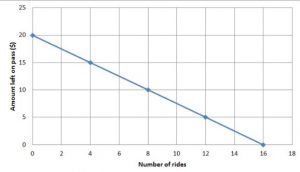
Type below:
______________

Answer:
7.6 × 10⁻⁴

Question 13.
1.2E16
Type below:
______________

Answer:
1.2 × 10¹⁶

Question 14.
9E1
Type below:
______________

Answer:
9 × 101

ESSENTIAL QUESTION CHECK-IN

Question 15.
How do you add, subtract, multiply, and divide numbers written in scientific notation?
Type below:
______________

Answer:
Numbers with exponents can be added and subtracted only when they have the same base and exponent.
To multiply two numbers in scientific notation, multiply their coefficients and add their exponents.
To divide two numbers in scientific notation, divide their coefficients, and subtract their exponents.

Independent Practice – Operations with Scientific Notation – Page No. 55

Question 16.
An adult blue whale can eat 4.0 × 10⁷ krill in a day. At that rate, how many krill can an adult blue whale eat in 3.65 × 10² days?
Type below:
______________

Answer:
14.6 × 10⁹

Explanation:
(4.0 × 10⁷ )(3.65 × 10² )
4.0 × 3.65 = 14.6
107+2  =  109
14.6 × 10⁹

Question 17.
A newborn baby has about 26,000,000,000 cells. An adult has about 4.94 × 10¹³ cells. How many times as many cells does an adult have than a newborn? Write your answer in scientific notation.
Type below:
______________

Answer:
1.9 × 10³

Explanation:
26,000,000,000 = 2.6 × 10¹⁰
4.94 × 10¹³
(4.94 × 10¹³ )/(2.6 × 1010 )
1.9 × 10³

Represent Real-World Problems

The table shows the number of tons of waste generated and recovered (recycled) in 2010.
Go Math Grade 8 Answer Key Chapter 2 Exponents and Scientific Notation Lesson 4: Operations with Scientific Notation img 5

Question 18.
What is the total amount of paper, glass, and plastic waste generated?
Type below:
______________

Answer:
11.388 × 10⁷

Explanation:
7.131 × 10⁷ + 1.153 × 10⁷ + 3.104 × 10⁷
11.388 × 10⁷

Question 19.
What is the total amount of paper, glass, and plastic waste recovered?
Type below:
______________

Answer:
5.025 × 10⁷

Explanation:
4.457 × 10⁷  + 0.313 × 10⁷  + 0.255 × 10⁷
5.025 × 10⁷

Question 20.
What is the total amount of paper, glass, and plastic waste not recovered?
Type below:
______________

Answer:
6.363 × 10⁷

Explanation:
(11.388 × 10⁷ )  – (5.025 × 10⁷)
6.363 × 10⁷

Question 21.
Which type of waste has the lowest recovery ratio?
Type below:
______________

Answer:
Plastics

Explanation:
7.131 × 10⁷  – 4.457 × 107 = 2.674 × 10⁷
1.153 × 10⁷  – 0.313 × 107 = 0.84 × 10⁷
3.104 × 10⁷  – 0.255 × 107 = 2.849 × 10⁷
Plastics has the lowest recovery ratio

Social Studies

The table shows the approximate populations of three countries.
Go Math Grade 8 Answer Key Chapter 2 Exponents and Scientific Notation Lesson 4: Operations with Scientific Notation img 6

Question 22.
How many more people live in France than in Australia?
Type below:
______________

Answer:
4.33 × 10⁷

Explanation:
(6.48 × 10⁷ )  – (2.15× 10⁷)
4.33 × 10⁷

Question 23.
The area of Australia is 2.95 × 10⁶ square miles. What is the approximate average number of people per square mile in Australia?
Type below:
______________

Answer:
About 7 people per square mile

Explanation:
2.95 × 10⁶ square miles = (2.15× 10⁷)
1 square mile = (2.15× 10⁷)/(2.95 × 106) = 7.288

Question 24.
How many times greater is the population of China than the population of France? Write your answer in standard notation.
Type below:
______________

Answer:
20.52; there are about 20 people in china for every 1 person in France.

Question 25.
Mia is 7.01568 × 10⁶ minutes old. Convert her age to more appropriate units using years, months, and days. Assume each month to have 30.5 days.
Type below:
______________

Answer:
13 years 3 months 22.5 days

Explanation:
7.01568 × 10⁶ minutes
(7.01568 × 10⁶ minutes) ÷ (6 × 101)(2.4 × 101)(1.2 × 101)(3.05 × 101)
= (1.331 × 101)
= 13 years 3 months 22.5 days

Operations with Scientific Notation – Page No. 56

Question 26.
Courtney takes 2.4 × 10⁴ steps during her a long-distance run. Each step covers an average of 810 mm. What total distance (in mm) did Courtney cover during her run? Write your answer in scientific notation. Then convert the distance to the more appropriate unit kilometers. Write that answer in standard form.
______ km

Answer:
19.4 km

Explanation:
Courtney takes 2.4 × 10⁴ steps during her a long-distance run. Each step covers an average of 810 mm.
(2.4 × 10⁴ steps) × 810mm
(2.4 × 10⁴ ) × (8.1 × 10² )
The total distance covered = (19.44 × 10⁶ )
Convert to unit kilometers:
(19.44 × 10⁶ ) × (1 × 10⁻⁶ )
(1.94 × 101 )
19.4 km

Question 27.
Social Studies
The U.S. public debt as of October 2010 was $9.06 × 10¹². What was the average U.S. public debt per American if the population in 2010 was 3.08 × 10⁸ people?
$ _______

Answer:
$29,400 per American

Explanation:
($9.06 × 10¹².)/(3.08 × 108 )
($2.94 × 10⁴.) = $29,400 per American

H.O.T.

Focus on Higher Order Thinking

Question 28.
Communicate Mathematical Ideas
How is multiplying and dividing numbers in scientific notation different from adding and subtracting numbers in scientific notation?
Type below:
______________

Answer:
When you multiply or divide in scientific notation, you just add or subtract the exponents. When you add or subtract in scientific notation, you have to make the exponents the same before you can do anything else.

Question 29.
Explain the Error
A student found the product of 8 × 10⁶ and 5 × 10⁹ to be 4 × 10¹⁵. What is the error? What is the correct product?
Type below:
______________

Answer:
The error student makes is he multiply the terms instead of addition.

Explanation:
product of 8 × 10⁶ and 5 × 10⁹
40 × 1015
4 × 10¹⁶
The student missed the 10 while multiplying the product of 8 × 10⁶ and 5 × 10⁹

Question 30.
Communicate Mathematical Ideas
Describe a procedure that can be used to simplify \(\frac { { (4.87×10 }^{ 12 }) – { (7×10 }^{ 10 }) }{ { (3×10 }^{ 7 })-{ (6.1×10 }^{ 8 }) } \). Write the expression in scientific notation in simplified form.
Type below:
______________

Answer:
\(\frac { { (4.87×10 }^{ 12 }) – { (7×10 }^{ 10 }) }{ { (3×10 }^{ 7 })-{ (6.1×10 }^{ 8 }) } \)
\(\frac { { (487×10 }^{ 10 }) – { (7×10 }^{ 10 }) }{ { (3×10 }^{ 7 })-{ (61×10 }^{ 7 }) } \)
(480 × 1010 )/(64 × 107 )
7.50 × 10³

2.1 Integer Exponents – Model Quiz – Page No. 57

Find the value of each power.

Question 1.
3-4
\(\frac{□}{□}\)

Answer:
\(\frac{1}{81}\)

Explanation:
Base = 3
Exponent = 4
3-4 = (1/3)4 = 1/81

Question 2.
350
______

Answer:
1

Explanation:
350
Base = 35
Exponent = 0
Anything raised to the zeroth power is 1.
350 = 1

Question 3.
44
______

Answer:
256

Explanation:
Base = 4
Exponent = 4
44 = 4 . 4 . 4 . 4 = 2561

Use the properties of exponents to write an equivalent expression.

Question 4.
83 ⋅ 87
Type below:
____________

Answer:
810

Explanation:
83 ⋅ 87
83+7
810

Question 5.
\(\frac { 12^{ 6 } }{ 12^{ 2 } } \)
Type below:
____________

Answer:
124

Explanation:
126 ÷ 122
126-2
124

Question 6.
(103)5
Type below:
____________

Answer:
108

Explanation:
(103)5
(103+5)
(108)

2.2 Scientific Notation with Positive Powers of 10

Convert each number to scientific notation or standard notation.

Question 7.
2,000
Type below:
____________

Answer:
2 × (103)

Explanation:
2 × 1,000
Move the decimal left 3 places
2 × (103)

Question 8.
91,007,500
Type below:
____________

Answer:
9.10075 × (107)

Explanation:
91,007,500
Move the decimal left 7 places
9.10075 × (107)

Question 9.
1.0395 × 10⁹
Type below:
____________

Answer:
1039500000

Explanation:
1.0395 × 10⁹
Move the decimal right 9 places
1039500000

Question 10.
4 × 10²
Type below:
____________

Answer:
400

Explanation:
4 × 10²
Move the decimal right 2 places
400

2.3 Scientific Notation with Negative Powers of 10

Convert each number to scientific notation or standard notation.

Question 11.
0.02
Type below:
____________

Answer:
2 × 10⁻²

Explanation:
0.02
Move the decimal right 2 places
2 × 10⁻²

Question 12.
0.000701
Type below:
____________

Answer:
7.01 × 10⁻⁴

Explanation:
0.000701
Move the decimal right 4 places
7.01 × 10⁻⁴

Question 13.
8.9 × 10⁻⁵
Type below:
____________

Answer:
0.000089

Explanation:
8.9 × 10⁻⁵
Move the decimal left 5 places
0.000089

Question 14.
4.41 × 10⁻²
Type below:
____________

Answer:
0.0441

Explanation:
4.41 × 10⁻²
Move the decimal left 2 places
0.0441

2.4 Operations with Scientific Notation

Perform the operation. Write your answer in scientific notation.

Question 15.
7 × 10⁶ − 5.3 × 10⁶
Type below:
____________

Answer:
1.7 × 10⁶

Explanation:
7 × 10⁶ − 5.3 × 10⁶
(7 – 5.3) × 106
1.7 × 10⁶

Question 16.
3.4 × 10⁴ + 7.1 × 10⁵
Type below:
____________

Answer:
7.44 × 10⁴

Explanation:
3.4 × 10⁴ + 7.1 × 10⁵
0.34 × 10⁵ + 7.1 × 10⁵
(0.34 + 7.1) × 105
7.44 × 10⁵

Question 17.
(2 × 10⁴)(5.4 × 10⁶)
Type below:
____________

Answer:
10.8 × 10¹⁰

Explanation:
(2 × 10⁴)(5.4 × 10⁶)
(2 × 5.4)(104 × 106)
10.8 × 10¹⁰

Question 18.
\(\frac { 7.86×10^{ 9 } }{ 3×10^{ 4 } } \)
Type below:
____________

Answer:
2.62 × 10⁵

Explanation:
7.86/3 = 2.62
109/104 = 105
2.62 × 10⁵

Question 19.
Neptune’s average distance from the Sun is 4.503×10⁹ km. Mercury’s average distance from the Sun is 5.791 × 10⁷ km. About how many times farther from the Sun is Neptune than Mercury? Write your answer in scientific notation.
Type below:
____________

Answer:
(0.7776 × 10² km) = 77.76 times

Explanation:
As Neptune’s average distance from the sun is 4.503×10⁹ km and Mercury is 5.791 × 10⁷ km
(4.503×10⁹ km)/(5.791 × 107 km)
(0.7776 × 10⁹-7 km)
(0.7776 × 10² km)
77.76 times

Essential Question

Question 20.
How is scientific notation used in the real world?
Type below:
____________

Answer:
Scientific notation is used to write very large or very small numbers using less digits.

Selected Response – Mixed Review – Page No. 58

Question 1.
Which of the following is equivalent to 6-3?
Options:
a. 216
b. \(\frac{1}{216}\)
c. −\(\frac{1}{216}\)
d. -216

Answer:
b. \(\frac{1}{216}\)

Explanation:
Base = 6
Exponent = 3
63 = (1/6)3 = 1/216

Question 2.
About 786,700,000 passengers traveled by plane in the United States in 2010. What is this number written in scientific notation?
Options:
a. 7,867 × 105 passengers
b. 7.867 × 10² passengers
c. 7.867 × 10⁸ passengers
d. 7.867 × 10⁹ passengers

Answer:
c. 7.867 × 10⁸ passengers

Explanation:
786,700,000
Move the decimal left 8 places
7.867 × 10⁸ passengers

Question 3.
In 2011, the population of Mali was about 1.584 × 10⁷ people. What is this number written in standard notation?
Options:
a. 1.584 people
b. 1,584 people
c. 15,840,000 people
d. 158,400,000 people

Answer:
c. 15,840,000 people

Explanation:
1.584 × 10⁷
Move the decimal right 7 places
15,840,000 people

Question 4.
The square root of a number is between 7 and 8. Which could be the number?
Options:
a. 72
b. 83
c. 51
d. 66

Answer:
c. 51

Explanation:
7²= 49
8²=64
(49+64)/2
56.5

Question 5.
Each entry-level account executive in a large company makes an annual salary of $3.48 × 10⁴. If there are 5.2 × 10² account executives in the company, how much do they make in all?
Options:
a. $6.69 × 101
b. $3.428 × 10⁴
c. $3.532 × 10⁴
d. $1.8096 × 10⁷

Answer:
d. $1.8096 × 10⁷

Explanation:
Each entry-level account executive in a large company makes an annual salary of $3.48 × 10⁴. If there are 5.2 × 10² account executives in the company,
($3.48 × 10⁴)( 5.2 × 10²)
$1.8096 × 10⁷

Question 6.
Place the numbers in order from least to greatest.
0.24,4 × 10-2, 0.042, 2 × 10⁻⁴, 0.004
Options:
a. 2 × 10⁻⁴, 4 × 10⁻², 0.004, 0.042, 0.24
b. 0.004, 2 × 10⁻⁴, 0.042, 4 × 10⁻², 0.24
c. 0.004, 2 × 10⁻⁴, 4 × 10⁻², 0.042, 0.24
d. 2 × 10⁻⁴, 0.004, 4 × 10⁻², 0.042, 0.24

Answer:
d. 2 × 10⁻⁴, 0.004, 4 × 10⁻², 0.042, 0.24

Explanation:
2 × 10-4 = 0.0002
4 × 10-2 = 0.04

Question 7.
Guillermo is 5 \(\frac{5}{6}\) feet tall. What is this number of feet written as a decimal?
Options:
a. 5.7 feet
b. 5.\(\bar{7}\) feet
c. 5.83 feet
d. 5.8\(\bar{3}\) feet

Answer:
c. 5.83 feet

Question 8.
A human hair has a width of about 6.5 × 10⁻⁵ meters. What is this width written in standard notation?
Options:
a. 0.00000065 meter
b. 0.0000065 meter
c. 0.000065 meter
d. 0.00065 meter

Answer:
c. 0.000065 meter

Explanation:
6.5 × 10⁻⁵ meter = 0.000065

Mini-Task

Question 9.
Consider the following numbers: 7000, 700, 70, 0.7, 0.07, 0.007
a. Write the numbers in scientific notation.
Type below:
_____________

Answer:
7000 = 7 × 10³
700 = 7 × 10²
70 = 7 × 10¹
0.7 = 7 × 10¯¹
0.07 = 7 × 10¯²
0.007 = 7 × 10¯³

Question 9.
b. Look for a pattern in the given list and the list in scientific notation. Which numbers are missing from the lists?
Type below:
_____________

Answer:
In the given list the decimal is moving to the left by one place. From the scientific notation, numbers are decreasing by 10. The number missing is 7

Question 9.
c. Make a conjecture about the missing numbers.
Type below:
_____________

Answer:
The numbers will continue to decrease by 10 in the given list.

Conclusion:

We wish the information provided in the Go Math Grade 8 Answer Key Chapter 2 Exponents and Scientific Notation for all the students. Go through the solved examples to have a complete grip on the subject and also on the way of solving each problem. Go Math Grade 8 Chapter 2 Exponents and Scientific Notation Key will help the students to score the highest marks in the exam.