Big Ideas Math Answers Grade 6 Chapter 9 Statistical Measures

Students who are looking for Big Ideas Math Answers Grade 6 Chapter 9 Statistical Measures pdf can get them on this page. In order to help you guys, we have prepared the Big Ideas Math Answers Grade 6 in pdf format to prepare in offline mode. Hit the links attached in the below section to know the topics covered in the Statistical Measures chapter. Hence Download Big Ideas Math Answers Grade 6 Chapter 9 Statistical Measures pdf for free and start practicing the problems now.

Big Ideas Math Book 6th Grade Answer Key Chapter 9 Statistical Measures

Know the concept of the statistical measures with the help of our Big Ideas Math Grade 6 Solution Key Chapter 9. This BIM 6th Grade Chapter 9 Statistical Measures download pdf will help the students to overcome the difficulties in maths and also to improve their performance in the exams. You can score good marks in exams by referring to our Big Ideas Math Book 6th Grade Answer Key Chapter 9 Statistical Measures.

Performance Task

Lesson: 1 Introduction to Statistics

Lesson: 2 Mean

Lesson: 3 Measures of Center

Lesson: 4 Measures of Variation

Lesson: 5 Mean Absolute Deviation

Chapter 9: Statistical Measures

Statistical Measures STEAM Video/Performance Task

STEAM Video
Daylight in the Big City
Averages can be used to compare different sets of data. How can you use averages to compare the amounts of day light in different cities? Can you think of any other real-life situations where averages are useful?
Big Ideas Math Answer Key Grade 6 Chapter 9 Statistical Measures 1
Watch the STEAM Video “Daylight in the Big City.” Then answer the following questions.
1. Why do different cities have different amounts of daylight throughout the year?

Answer:
Our amount of daylight hours depends on our latitude and how Earth orbits the sun. This causes a seasonal variation in the intensity of sunlight reaching the surface and the number of hours of daylight. The variation in intensity results because the angle at which the sun’s rays hit the Earth changes with the time of year.

2. Robert’s table includes the difference of the greatest amount of daylight and the least amount of daylight in Lagos, Nigeria, and in Moscow, Russia.
Lagos: 44 minutes
Moscow:633 minutes
Use these values to make a prediction about the difference between the greatest amount of daylight and the least amount of daylight in a city in Alaska.

Answer:
The least daylight in Alaska is 1092 minutes in Juneau
The greatest daylight in Alaska is 1320 minutes in Fairbanks

Performance Task
Which Measure of Center Is Best: Mean, Median, or Mode?
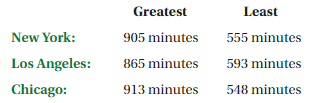
After completing this chapter, you will be able to use the concepts you learned to answer the questions in the STEAM Video Performance Task. You will be given the greatest and least amounts of daylight in the 15 cities in the United States with the greatest populations.
s
Big Ideas Math Answer Key Grade 6 Chapter 9 Statistical Measures 3
You will determine which measure of center best represents the data. Why might someone be interested in the amounts of daylight throughout the year in a city?

Statistical Measures Getting Ready for Chapter 9

Chapter Exploration
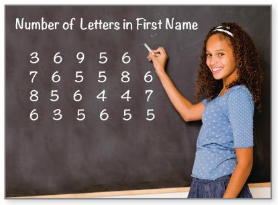
Work with a partner. Write the number of letters in each of your first names on the board.
Big Ideas Math Answer Key Grade 6 Chapter 9 Statistical Measures 4
1. Write all of the numbers on a piece of paper. The collection of numbers is called data.
2. Talk with your partner about how you can organize the data. What conclusions can you make about the numbers of letters in the first names of the students in your class?
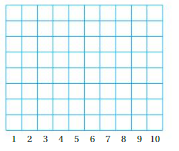
3. Draw a grid like the one shown below. Then use the grid to draw a graph of the data.
Big Ideas Math Answer Key Grade 6 Chapter 9 Statistical Measures 5

Answer:
3,6,9,5,6,7,6,5,5,8,6,8,5,6,4,4,7,6,3,5,6,5,5

4. THE CENTER OF THE DATA Use the graph of the data in Exercise 3 to answer the following.
a. Is there one number that occurs more than any of the other numbers? If so, write a sentence that interprets this number in the context of your class.
b. Complete the sentence, “In my class, the average number of letters in a student’s first name is __________.” Justify your reasoning.
c. Organize your data using a different type of graph. Describe the advantages or disadvantages of this graph.

Answer:
a. Yes, 6, 5, 8 are more than other numbers given in the data.
b. “In my class, the average number of letters in a student’s first name is 5 and 6.

Vocabulary
The following vocabulary terms are defined in this chapter. Think about what each term might mean and record your thoughts.
statistical question
measure of center
measure of variation
mean
median
range

Lesson 9.1 Introduction to Statistics

EXPLORATION 1

Using Data to Answer a Question
Work with a partner.
a. Use your pulse to find your heart rate in beats per minute.

Big Ideas Math Answer Key Grade 6 Chapter 9 Statistical Measures 9.1 1
b. Collect the recorded heart rates of the students in your class, including yourself. How spread out are the data? Use a diagram to justify your answer.
c. REASONING How would you answer the following question by using only one value? Explain your reasoning.
“What is the heart rate of a sixth-grade student?”
Answer: Your pulse is measured by counting the number of times your heart beats in one minute. For example, if your heart contracts 72 times in one minute, your pulse would be 72 beats per minute (BPM).

EXPLORATION 2

Identifying Types of Questions
Work with a partner.
a. Answer each question on your own. Then compare your answers with your partner’s answers. For which questions should your answers be the same? For which questions might your answers be different?
1. How many states are in the United States?
Answer: There are 50 states in the United States.

2. How much does a movie ticket cost? Math Practice
Answer: $9.16
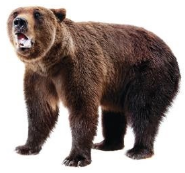
3. What color fur do bears have? Build Arguments How can comparing your answers help you support your conjecture?
Answer: The color white becomes visible to our eyes when an object reflects back all.

4. How tall is your math teacher?
Big Ideas Math Answer Key Grade 6 Chapter 9 Statistical Measures 9.1 2
b. CONJECTURE
Some of the questions in part(a) are considered statistical questions. Which ones are they? Explain.
Answer: 5.10 inches
Big Ideas Math Answer Key Grade 6 Chapter 9 Statistical Measures 9.1 3

Statistics is the science of collecting, organizing, analyzing, and interpreting data. A statistical question is one for which you do not expect to get a single answer. Instead, you expect a variety of answers, and you are interested in the distribution and tendency of those answers.

Try It
Determine whether the question is a statistical question. Explain.
Question 1.
What types of cell phones do students have in your class?
Answer:
Smartphones, Cell phones give students access to tools and apps that can help them complete and stay on top of their class work. These tools can also teach students to develop better study habits, like time management and organization skills.

Question 2.
How many desks are in your classroom?
Answer: 25

Question 3.
How much do virtual-reality headsets cost?
Answer: $499

Question 4.
How many minutes are in your lunch period?
Answer: 45 minutes

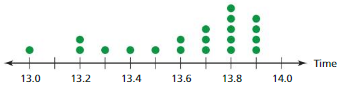
A dot plot uses a number line to show the number of times each value in a data set occurs. Dot plots show the spread and the distribution of a data set.

Question 5.
Repeat parts (a)–(c)using the dot plot below that shows the times of students in a 100-meter race.
Big Ideas Math Answer Key Grade 6 Chapter 9 Statistical Measures 9.1 7
Answer:

Self-Assessment for Concepts & Skills

Solve each exercise. Then rate your understanding of the success criteria in your journal.
Question 6.
VOCABULARY
What is a statistical question? Give an example and a non-example.
Answer:
Eg for statistical question: a. How much do bags of pretzels cost at the grocery store?
Because you can anticipate that the prices will vary, it is a statistical question. table at the right may represent the prices of several bags of pretzels at a grocery store.
Eg for non-statistical question: b. How many days does your school have off for spring break this year?
Answer: Because there is only one answer, it is not a statistical question.

Question 7.
OPEN-ENDED
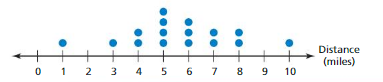
Write and answer a statistical question using the dot plot. Then find and interpret the number of data values.
Big Ideas Math Answer Key Grade 6 Chapter 9 Statistical Measures 9.1 8
Answer: There are 16 data values on the dot plot.

Question 8.
You record the amount of snowfall each day for several days. Then you create the dot plot.
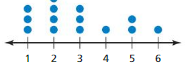
Big Ideas Math Answer Key Grade 6 Chapter 9 Statistical Measures 9.1 11
a. Find and interpret the number of data values on the dot plot.
Answer: There are 13 data values on the dot plot.

b. How can you collect these data? What are the units?
Answer: We can collect the data by using the dots given in the above figure.
c. Write a statistical question that you can answer using the dot plot. Then answer the question.
Answer: dot plots are best used to show a distribution of data.

Question 9.
You conduct a survey to answer, “How many hours does a typical sixth-grade student spend exercising during a week?” Use the data in the table to answer the question.
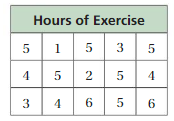
Big Ideas Math Answer Key Grade 6 Chapter 9 Statistical Measures 9.1 12
Answer:
Given the data
5, 1, 5, 3, 5, 4, 5, 2, 5, 4, 3, 4, 6, 5, 6
The typical sixth-grade student spend exercising during a week is 6 hours.

Introduction to Statistics Homework & Practice 9.1

Review & Refresh

Solve the inequality. Graph the solution.
Question 1.
x – 16 > 8
Answer: x>3.

big ideas math answers grade 6 chapter 9 statistical measures img_1

Question 2.
p + 6 ≤ 8
Answer:   p ≤ 2

big ideas math answers grade 6 chapter 9 statistical measures img_2

Question 3.
54 > 6k
Answer: 9>k

big ideas math answers grade 6 chapter 9 statistical measures img_3

Question 4.
\(\frac{m}{12}\) ≥ 3
Answer: m ≤ 36

Tell whether the ordered pair is a solution of the equation.
Question 5.
y = 4x; (2, 8)
Answer: The given ordered pair is a solution of the equation.
Given : y = 4x;(2,8)
y=8;x=2
8=4 × 2
8=8 (satisfied)

Question 6.
y = 3x + 5; (3, 15)
Answer: Given order pair is not an absolute solution of ordered pair
Given: y = 3x + 5; (3, 15)
y=15;x=3
15=3(3)+5
15=9+5
15=14 (not satisfied)

Question 7.
y = 6x – 15; (4, 9)
Answer:
The given ordered pair is a solution of the equation.
Given: y = 6x – 15; (4, 9)
9=6(4)-15
9=24-15
9=9

Question 8.
A point is reflected in the x-axis. The reflected point is (4, −3). What is the original point?
A. (-3, 4)
B. (-4, 3)
C. (-4, -3)
D. (4, 3)
Answer: B,(-4,3)

Order the numbers from least to greatest.
Question 9.
24%, \(\frac{1}{4}\) , 0.2, \(\frac{7}{20}\) , 0.32
Answer:0.24,0.25,0.2.0.35,0.32
0.2,0.24,0.32,0.35

Question 10.
\(\frac{7}{8}\), 85%, 0.88, \(\frac{3}{4}\) , 78%
Answer:0.875,0.78,0.88,0.75,0.78
0.75,0.78,0.85,0.875,0.88

Concepts, Skills, &Problem Solving

IDENTIFYING TYPES OF QUESTIONS Answer the question. Tell whether your answer should be the same as your classmates’. (See Exploration 2, p. 413.)
Question 11.
How many inches are in 1 foot?
Answer: 12 inches

Question 12.
How many pets do you have?
Answer: none

Question 13.
On what day of the month were you born?
Answer: 27th April

Question 14.
How many senators are in Congress?
Answer: The Senate is composed of 100 Senators, 2 for each state. Until the ratification of the 17th Amendment in 1913, Senators were chosen by state legislatures, not by popular vote. Since then, they have been elected to six-year terms by the people of each state.

IDENTIFYING STATISTICAL QUESTIONS
Determine whether the question is a statistical question. Explain.
Big Ideas Math Answer Key Grade 6 Chapter 9 Statistical Measures 9.1 13
Question 15.
What are the eye colors of sixth-grade students?
Answer: brown

Question 16.
At what temperature (in degrees Fahrenheit) does water freeze?
Answer: 32 degrees Fahrenheit

Question 17.
How many pages are in the favorite books of students your age?
Answer: 200 pages

Question 18.
How many hours do sixth-grade students use the Internet each week?
Answer: 1.5 hour each

Question 19.
MODELING REAL LIFE
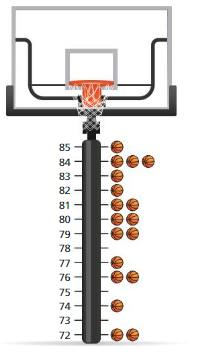
The vertical dot plot shows the heights of the players on a recent NBA championship team.
a. Find and interpret the number of data values on the dot plot.
b. How can you collect these data? What are the units?
c. Write a statistical question that you can answer using the dot plot. Then answer the question.
Answer:

Question 20.
MODELING REAL LIFE
The dot plot shows the lengths of earthworms.
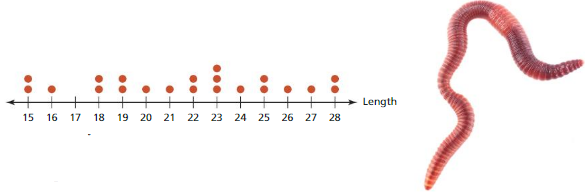
Big Ideas Math Answer Key Grade 6 Chapter 9 Statistical Measures 9.1 14
a. Find and interpret the number of data values on the dot plot.
Answer: There are 21 data values on the plot.
b. How can you collect these data? What are the units?
Answer: Based on dot plots and units are measured in mm.
c. Write a statistical question that you can answer using the dot plot. Then answer the question.
Answer: Find the mode of the length of earthworms using the dot plot.
23 is repeated times.
So, the mode is 23.

DESCRIBING DATA
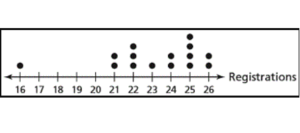
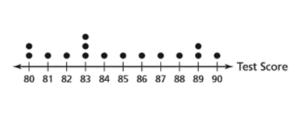
Display the data in a dot plot. Identify any clusters, peaks, or gaps in the data.
Question 21.
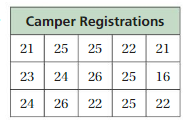
Big Ideas Math Answer Key Grade 6 Chapter 9 Statistical Measures 9.1 15
Answer:
bim grade 6 chapter 9 statictical measures answers key img_5

Data are clustered around 22 and around 25
Peak at 25
The gap between 16 and 21

Question 22.
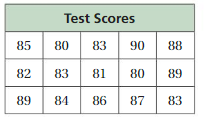
Big Ideas Math Answer Key Grade 6 Chapter 9 Statistical Measures 9.1 16
Answer:
bim grade 6 chapter 9 statictical measures answers key img_6

No clusters
Peak at 83
No gaps

INTERPRETING DATA
The dot plot shows the speeds of cars in a traffic study. Estimate the speed limit. Explain your reasoning.
Question 23.
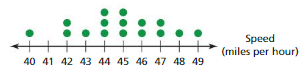
Big Ideas Math Answer Key Grade 6 Chapter 9 Statistical Measures 9.1 17
Answer: Most of the data clustered around 44 and 45 , hence the estimated speed is between 44-45 miles per hour

Question 24.
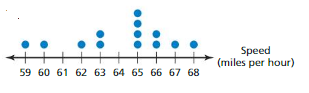
Big Ideas Math Answer Key Grade 6 Chapter 9 Statistical Measures 9.1 18
Answer: Most of the data clustered around 65 , there is a peak at 65 and gaps between”60-62″ and 63-65.

Question 25.
DIG DEEPER!
You conduct a survey to answer, “How many hours does a sixth-grade student spend on homework during a school night?” The table shows the results.
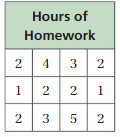
Big Ideas Math Answer Key Grade 6 Chapter 9 Statistical Measures 9.1 19
a. Is this a statistical question? Explain.
Answer: yes, it is a statistical question because students work in the different time zone based on individual student capacity.
b. Identify any clusters, peaks, or gaps in the data.
Answer: cluster is around 2. There is a peak at 2 and there is no gap.
c. Use the distribution of the data to answer the question.
Answer: A total of 29 data values are distributed.

RESEARCH
Use the Internet to research and identify the method of measurement and the units used when collecting data about the topic.
Question 26.
wind speed
Answer: The instruments used to measure wind are known as anemometers and can record wind speed, direction, and the strength of gusts. The normal unit of wind speed is the knot (nautical mile per hour = 0.51 m sec-1 = 1.15 mph).

Question 27.
amount of rainfall
Answer:
The standard instrument for the measurement of rainfall is the 203mm (8 inches) rain gauge. This is essentially a circular funnel with a diameter of 203mm which collects the rain into a graduated and calibrated cylinder. The measuring cylinder can record up to 25mm of precipitation

Question 28.
earthquake intensity
Answer: The Richter scale measures the largest wiggle (amplitude) on the recording, but other magnitude scales measure different parts of the earthquake. The USGS currently reports earthquake magnitudes using the Moment Magnitude scale, though many other magnitudes are calculated for research and comparison purposes.

Question 29.
REASONING
Write a question about letters in the English alphabet that is not a statistical question. Then write a question about letters that is a statistical question. Explain your reasoning.
Answer: Statistical Question: How many letters in the English alphabet are used to spell a student’s name in class?
Reasoning: The original question has one answer. This Question will have many answers.

Question 30.
REASONING
A bar graph shows the favorite colors of 30 people. Does it make sense to describe clusters in the data? peaks? gaps? Explain.
Answer: No, It doesn’t make sense to describe the distribution. Colors are not measures numerically.

Lesson 9.2 Mean

EXPLORATION 1

Finding a Balance Point
Work with a partner. The diagrams show the numbers of tokens brought to a batting cage. Where on the number line is the data set balanced ? Is this a good representation of the average? Explain.
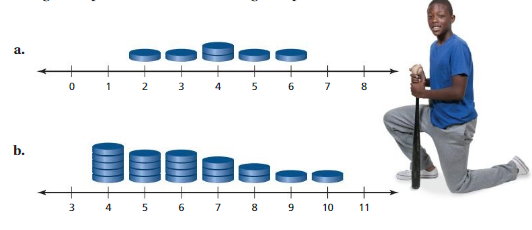
Big Ideas Math Answers 6th Grade Chapter 9 Statistical Measures 9.2 1

EXPLORATION 2

Finding a Fair Share
Work with a partner. One token lets you hit 12 baseballs in a batting cage. The table shows the numbers of tokens six friends bring to the batting cage.
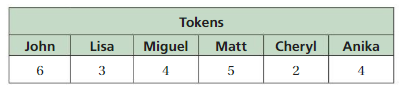
Big Ideas Math Answers 6th Grade Chapter 9 Statistical Measures 9.2 2
a. Regroup the tokens so that everyone has the same amount. How many times can each friend use the batting cage? Explain how this represents a “fair share. “Use Clear Definitions What does it mean for data to have an average? How does this help you answer the question?
b. how can you find the answer in part(a) algebraically?
c. Write a statistical question that can be answered using the value in part(a).
Answer:
Big Ideas Math Answers 6th Grade Chapter 9 Statistical Measures 9.2 3

Try It

Find the mean of the data.
Question 1.
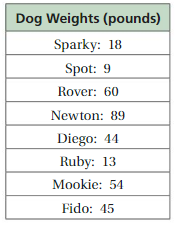
Big Ideas Math Answers 6th Grade Chapter 9 Statistical Measures 9.2 6
Answer:
The sum of the data/no of values
The sum of the data=45+54+13+44+89+60+9+18;
no of values=8
The sum of the data=332:no of values=8; 332/8=41.5 is the mean of the data

Question 2.
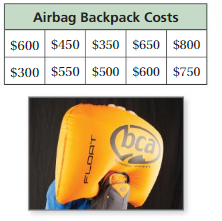
Big Ideas Math Answers 6th Grade Chapter 9 Statistical Measures 9.2 7
Answer:
555 is mean for the above-given data.

Question 3.
WHA IT?
The monthly rainfall in May was 0.5 inch in City A and 2 inches in City B. Does this affect your answer in Example 2? Explain.
Answer:

Self-Assessment for Concepts & Skills

Solve each exercise. Then rate your understanding of the success criteria in your journal.
Question 4.
NUMBER SENSE
Is the mean always equal to a value in the data set? Explain.
Answer: It is the value that is most common. You will notice, however, that the mean is not often one of the actual values that you have observed in your data set. In addition, the mean is the only measure of central tendency where the sum of the deviations of each value from the mean is always zero.

Question 5.
WRITING
Explain why the mean describes a typical value in a data set.
Answer:
A measure of central tendency is a single value that attempts to describe a set of data by identifying the central position within that set of data. The mean (often called the average) is most likely the measure of central tendency that you are most familiar with, but there are others, such as the median and the mode.

Question 6.
NUMBER SENSE
What can you determine when the mean of one data set is greater than the mean of another data set? Explain your reasoning.
Answer:

Question 7.
COMPARING MEANS
Compare the means of the data sets.
Data set A: 43, 32, 16, 41, 24, 19, 30, 27
Data set B: 44, 18, 29, 24, 36, 22, 26, 21
Answer:
An outlier is a data value that is much greater or much less than the other values. When included in a data set, it can affect the mean.

Question 8.
DIG DEEPER!
The monthly numbers of customers at a store in the first half of a year are 282, 270, 320, 351, 319, and 252. The monthly numbers of customers in the second half of the year are 211, 185, 192, 216, 168, and 144. Compare the mean monthly customers in the first half of the year with the mean monthly customers in the second half of the year.
Answer:

Question 9.
The table shows tournament finishes for a golfer. What place does the golfer typically finish in tournaments? Explain how you found your answer.
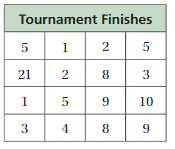
Big Ideas Math Answers 6th Grade Chapter 9 Statistical Measures 9.2 12
Answer: Mean=sum of data/number of data values
Mean=118/16
Mean=7.375
a. The golfer’s mean finish was about 7th
b. The finishes 37 and 26 are much greater than other finishes. They are outliers

Mean Homework & Practice 9.2

Review & Refresh

Determine whether the question is a statistical question. Explain.
Question 1.
How tall are sixth-grade students?
Answer: The average height for a sixth grader (age 12) is about five feet. Girls tend to be about an inch taller on average. But there is a wide range. Any height from about 52 inches (4′4″) to 65 inches (5′5″) is in the normal range according to the CDC.

Question 2.
How many minutes are there in 1 Year?
Answer:
An average Gregorian year is 365.2425 days (52.1775 weeks, 8765.82 hours, 525949.2 minutes, or 31556952 seconds). For this calendar, a common year is 365 days (8760 hours, 525600 minutes, or 31536000 seconds), and a leap year is 366 days (8784 hours, 527040 minutes, or 31622400 seconds).

Question 3.
How many counties are in Tennessee?
Answer: Tennessee’s 95 counties are divided into four TDOT regions. Regional offices are located in Jackson (Region 4), Nashville (Region 3), Chattanooga (Region 2), and Knoxville (Region 1).

Question 4.
What is a student’s favorite sport?
Answer: cricket

Write the percent as a fraction or mixed number in simplest form.
Question 5.
84%
Answer:0.84

Question 6.
71%
Answer:0.71

Question 7.
353%
Answer:3.53

Question 8.
0.2%
Answer:0.002

Divide. Check your answer.
Question 9.
11.7 ÷ 9
Answer:1.3

Question 10.
\(\sqrt [ 5 ]{ 72.8 } \)
Answer: 2.35

Question 11.
\(\sqrt [ 6.8 ]{ 28.56 } \)
Answer: 1.63

Question 12.
93 ÷ 3.75
Answer:24.8

Concepts, Skills, & Problem Solving

FINDING A FAIR SHARE Regroup the amounts so that each person has the same amount. What is the amount? (See Exploration 2, p. 419.)
Question 13.
Dollars brought by friends to a fair: 11, 12, 12, 12, 12, 12, 13
Answer:
Given : 11,12,12,12,12,12,13.
Mean=Sum of data/number of data values
Mean=84/7
Mean=12
Answer = 12 dollars for each friend

Question 14.
Tickets earned by friends playing an arcade game: 0, 0, 0, 1, 1, 2, 3
Answer:
Given : 0,0,0,1,1,2,3.
Mean=Sum of data/number of data values
Mean= 7/7
Mean=1
Answer = 1 Tickets each friend

FINDING THE MEAN
Find the mean of the data.
Question 15.
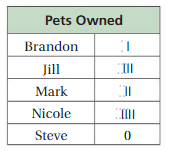
Big Ideas Math Answers 6th Grade Chapter 9 Statistical Measures 9.2 13
Answer: 2 is the mean of the data.

Question 16.
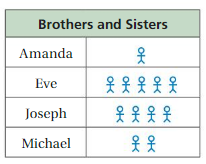
Big Ideas Math Answers 6th Grade Chapter 9 Statistical Measures 9.2 14
Answer: 3 is the mean of the above-given data.

Question 17.
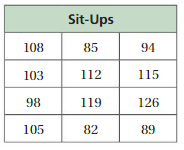
Big Ideas Math Answers 6th Grade Chapter 9 Statistical Measures 9.2 15
Answer: 103 is the mean of the above-given data

Question 18.
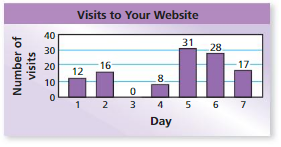
Big Ideas Math Answers 6th Grade Chapter 9 Statistical Measures 9.2 16
Answer: 14.8 is the mean of the above-given data.

Question 19.
MODELING REAL LIFE
You and your friends are watching a television show. One of your friends asks, “How long are the commercial breaks during this show?”Break Times (minutes)
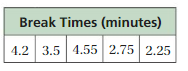
Big Ideas Math Answers 6th Grade Chapter 9 Statistical Measures 9.2 17
a. Is this a statistical question? Explain.
Answer: Yes it is a statistical question.

b.Use the mean of the values in the table to answer the question.
Answer:
Given the data,
4.2, 3.5, 4.55, 2.75, 2.25
x̄ = (4.2 + 3.5 + 4.55 + 2.75 + 2.25)/5
x̄ = 17.25/5
= 3.45

Question 20.
MODELING REAL LIFE
The table shows the monthly rainfall amounts at a measuring station.

Big Ideas Math Answers 6th Grade Chapter 9 Statistical Measures 9.2 18
a. What is the mean monthly rainfall?
Answer:
x̄ = (22.5 + 1.51 + 1.86 + 2.06 + 3.48 + 4.47 + 3.37 + 5.40 + 5.45 + 4.34 + 2.64 + 2.14)/12
= 33.54/12
= 2.795

b. Compare the mean monthly rainfall for the first half of the year with the mean monthly rainfall for the second half of the year.
Answer:
Mean:
x̄ = (22.5 + 1.51 + 1.86 + 2.06 + 3.48 + 4.47)/6
= 15.6/6
= 2.6
For second 6 months:
x̄ = (3.37 + 5.40 + 5.45 + 4.34 + 2.64 + 2.14)/6
= 23.34/6
= 3.89
The mean value of the second 6 months is greater than the first 6 months.

Question 21.
OPEN-ENDED
Create two different data sets that have six values and a mean of 21.
Answer:
Mean of 21:
Set 1:
12, 31, 21, 24, 13, 25 for these numbers we can calculate the mean we get 21
Set 2:
12, 31, 20, 30, 10, 18 for these numbers we can calculate the mean we get 21

Question 22.
MODELING REAL LIFE
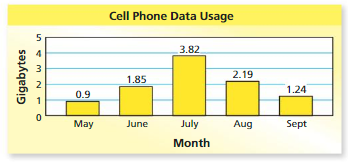
The bar graph shows your cell phone data usage for five months. Describe how the outlier affects the mean. Then use the data to answer the statistical question, “How much cell phone data do you use in a month?”
Big Ideas Math Answers 6th Grade Chapter 9 Statistical Measures 9.2 19
Answer: 288 is a lot less than the other data values so it is an outlier
Mean with outlier=10/5
Mean with outlier = 2
Mean without outlier = 6.18/5
Mean without outlier = 1.236
The outlier causes the mean to be about 0.76 data usage.

Question 23.
MODELING REAL LIFE
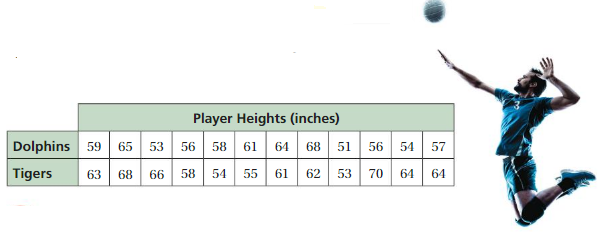
The table shows the heights of the volleyball players on two teams. Compare the mean heights of the two teams. Do outliers affect either mean? Explain.
Big Ideas Math Answers 6th Grade Chapter 9 Statistical Measures 9.2 20
Answer:
Dolphins=59+65+53+56+58+61+64+68+51+56+54+57=702
Total no of observations=12;Mean=702\12=58.5
Tigers=63+68+66+58+54+55+61+62+53+70+64+64=683
Total no of observations=12; Mean=683/12=56.9

Question 24.
REASONING
Use a dot plot to explain why the mean of the data set below is the point where the data set is balanced.
11, 13, 17, 15, 12, 18, 12
Answer:
mean = (11 + 13 + 17 + 15 + 18 + 12)/6
= 86/6
= 14.3

Question 25.
DIG DEEPER!
In your class, 7 students do not receive a weekly allowance, 5 students receive $3, 7 students receive $5, 3 students receive $6, and 2 students receive $8.
a. What is the mean weekly allowance? Explain how you found your answer.
b. A new student who joins your class receives a weekly allowance of $3.50. Without calculating, explain how this affects the mean.
Answer:
Given number of students receive no amount = 7
Number of students receive $3 = 5
Then, total amount 5 students receive = 5 × 3 = $15
Then, total amount 7 students receive = 5 × 7 = $35
Number of students receive $6 = 3
Then total amount 3 students receive = 6 × 3 = $18
Number of students receive $8 = 2
Then, total amount 2 students receive = 2 × 8 = $16
Now, the total amount all students receive =
15 + 35 + 18 + 6 = 84
The total students = 7 + 5 + 7 + 3 + 2 = 24
Mean = total amount/total amount = 84/24 = $3.5
Hence, the mean weekly allowance is $3.5

Question 26.
PRECISION
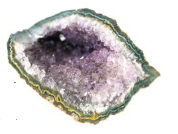
A collection of 8 geodes has a mean weight of 14 ounces. A different collection of 12 geodes has a mean weight of 14 ounces. What is the mean weight of the 20 geodes? Explain how you found your answer.
Big Ideas Math Answers 6th Grade Chapter 9 Statistical Measures 9.2 21
Answer:
Given,
A collection of 8 geodes has a mean weight of 14 ounces.
A different collection of 12 geodes has a mean weight of 14 ounces.
Total weight of the first 8 backpacks
8×14
112 pounds
Total weight of the second 12 backpacks
12×9
108
Total weight of the whole 20 backpacks
112+108
220
So the mean weight of the 20 backpacks
220 / 20
11

Lesson 9.3 Measures of Center

EXPLORATION 1

Finding the Median
Work with a partner.
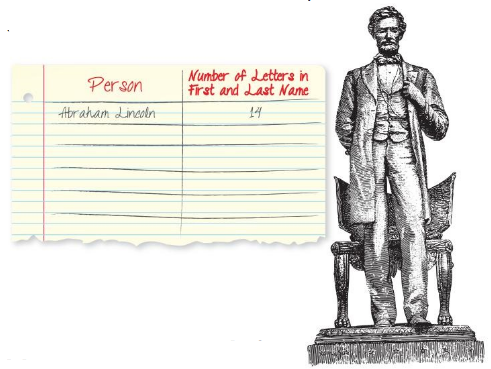
a. Write the total numbers of letters in the first and last names of 15 celebrities, historical figures, or people you know. One person is already listed for you.
Big Ideas Math Answers Grade 6 Chapter 9 Statistical Measures 9.3 1

Dr. B. R. Ambedkar-8
Otto von Bismarck-15
A. P. J. Abdul Kalam-10
Vallabhbhai Patel-16
Alexander Hamilton-17
Jawaharlal Nehru -15
Mother Teresa -12
Thomas Jefferson-15
J. R. D. Tata -4
Indira Gandhi -12
Sachin Tendulkar-15
Napoleon Bonaparte-17
John Adams-9
Karl Marx-8
Andrew Jackson-13
b. Order the values in your data set from least to greatest. Then write the data on a strip of grid paper with 15 boxes.
Big Ideas Math Answers Grade 6 Chapter 9 Statistical Measures 9.3 2
c. The middle value of the data set is called the median. The value (or values) that occur most often is called the mode. Find the median and the mode of your data set. Explain how you found your answers.
Big Ideas Math Answers Grade 6 Chapter 9 Statistical Measures 9.3 3
d. Why are the median and the mode considered averages of a data set?
Answer:
Big Ideas Math Answers Grade 6 Chapter 9 Statistical Measures 9.3 4

A measure of center is a measure that describes the typical value of a data set. The mean is one type of measure of center. Here are two others.

Try It

Question 1.
Find the median and mode of the data.1, 2, 20, 4, 17, 8, 12, 9, 5, 20, 13
Answer: Given the data,
1, 2, 20, 4, 17, 8, 12, 9, 5, 20, 13
First, write the numbers in the ascending or descending order.
1, 2, 4, 5, 8, 9, 12, 13, 17, 20, 20
The Median is 9.
The mode is 20 because it is repeated more than once.

Question 2.
100, 75, 90, 80, 110, 102
Answer:
Given the data,
100, 75, 90, 80, 110, 102
First, write the numbers in the ascending or descending order.
75, 80, 90, 100, 102, 110
= (90+100)/2
= 85
Mode:
No mode in the data.

Question 3.
One member of the class was absent and ends up voting for horror. Does this change the mode? Explain.
Answer: No

Question 4.
The times (in minutes) it takes six students to travel to school are 8, 10, 10, 15, 20, and 45. Find the mean, median, and mode of the data with and without the outlier. Which measure does the outlier affect the most?
Answer:
Median:
Write the numbers in ascending or descending order
8, 10, 10, 15, 20, and 45
= (10 + 15)/2 = 25/2 = 12.5
Mode:
10 is the mode. Because it is the most repeated number.
Mean:
Adding up the values and then dividing by the number of values.
= (8 + 10 + 10 + 15 + 20 + 45)/6
= 108/6
= 18

Question 5.
WHAT IF?
The store decreases the price of each video game by$3. How does this decrease affect the mean, median, and mode?
Answer:

Self-Assessment for Concepts & Skills

Solve each exercise. Then rate your understanding of the success criteria in your journal.
Question 6.
FINDING MEASURES OF CENTER
Consider the data set below.
15, 18, 13, 11, 12, 21, 9, 11
a. Find the mean, median, and mode of the data.

Answer:
Given the data,
15, 18, 13, 11, 12, 21, 9, 11
x̄ = (15 + 18 + 13 + 11 + 12 + 21 + 9 + 11)/8
x̄ = 110/8
x̄ = 13.75
Median:
Write the numbers in ascending order and descending order.
9, 11, 11, 12, 13, 15, 18, 21
= (12 + 13)/2
= 12.5
Mode:
11 is the mode because this is repeated more than one time.

b. Each value in the data set is decreased by 7. How does this change affect the mean, median, and mode?
Answer:
Each value is decreased by 7 in the given data
8, 11, 6, 4, 5, 14, 2, 4
x̄ = (8 + 11 + 6 + 4 + 5 + 14 + 2 + 4)/8
x̄ = 54/8
x̄ = 6.75

Question 7.
WRITING
Explain why a typical value in a data set can be described by the median or the mode.
Answer:
For data from skewed distributions, the median is better than the mean because it isn’t influenced by extremely large values. The mode is the only measure you can use for nominal or categorical data that can’t be ordered

Question 8.
How does removing the outlier affect your answer in Example 5?
Answer:

Question 9.
It takes 10 contestants on a television show 43, 41, 62, 40, 44, 43, 44, 46, 45, and 41 seconds to cross a canyon on a zipline. Find the mean, median, and mode of the data with and without the outlier. Which measure does the outlier affect the most?
Answer:

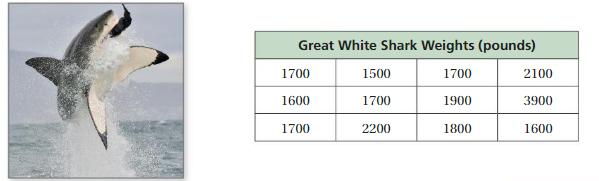
Question 10.
The table shows the weights of several great white sharks. Use the data to answer the statistical question, “What is the weight of a great white shark?”
Big Ideas Math Answers Grade 6 Chapter 9 Statistical Measures 9.3 12
Answer:

Measures of Center Homework & Practice 9.3

Review & Refresh

Find the mean of the data.
Question 1.
1, 5, 8, 4, 5, 7, 6, 6, 2, 3
Answer: 4.7

Explanation:
Given the data,
1, 5, 8, 4, 5, 7, 6, 6, 2, 3
x̄ = ∑x/n
x̄ = (1 + 5 + 8 + 4 + 5 + 7 + 6 + 6 + 2 + 3)/16
x̄ = 49/16
x̄ = 3.06

Question 2.
9, 12, 11, 11, 10, 7, 4, 8
Answer: 9

Explanation:
Given the data,
9, 12, 11, 11, 10, 7, 4, 8
x̄ = ∑x/n
x̄ = (9 + 12 + 11 + 11 + 10 + 7 + 4 + 8)/8
x̄ = 72/8
x̄ = 9

Question 3.
26, 42, 31, 50, 29, 37, 44, 31
Answer: 36.25

Explanation:
Given the data,
26, 42, 31, 50, 29, 37, 44, 31
x̄ = ∑x/n
x̄ = (26+42+31+50+29+37+44+31)/8
x̄ = 290/8
x̄ = 36.25

Question 4.
53, 45, 43, 55, 28, 21, 61, 29, 24, 40, 27, 42
Answer: 39

Explanation:
Given the data,
53, 45, 43, 55, 28, 21, 61, 29, 24, 40, 27, 42
x̄ = ∑x/n
x̄ = (53+45+43+55+28+21+61+29+24+40+27+42)/12
x̄ = 468/12
x̄ = 39

Question 5.
A shelf in your room can hold at most 30 pounds.  ere are 12 pounds of books already on the shelf. Which inequality represents the number of pounds you can add to the shelf?
A. x < 18
B. x ≥ 18
C. x ≤ 42
D. x ≤ 18
Answer: x ≤ 18

Explanation:
12+x ≤ 30
12+x -12 ≤ 30-12
x ≤ 18

Find the missing values in the ratio table. Then write the equivalent ratios.
Question 6.
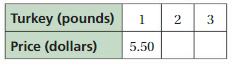
Big Ideas Math Answers Grade 6 Chapter 9 Statistical Measures 9.3 13
Answer:
Big-Ideas-Math-Answers-Grade-6-Chapter-9-Statistical-Measures-9.3-13

Question 7.
Big Ideas Math Answers Grade 6 Chapter 9 Statistical Measures 9.3 14
Answer:
Big-Ideas-Math-Answers-Grade-6-Chapter-9-Statistical-Measures-9.3-14

Find the surface area of the prism.

Question 8.
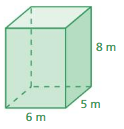
Big Ideas Math Answers Grade 6 Chapter 9 Statistical Measures 9.3 15
Answer:
Given,
l = 6m
w = 5m
h = 5m
We know that,
Surface Area of the Prism = 2lw + 2lh + 2hw
= 2(6 × 5) + 2(6 × 8) + 2(8 × 5)
= 60 + 96 + 80
= 236 sq. meters

Question 9.
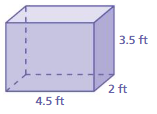
Big Ideas Math Answers Grade 6 Chapter 9 Statistical Measures 9.3 16
Answer:
Given,
l = 4.5 ft
w = 2ft
h = 3.5ft
We know that,
Surface Area of the Prism = 2lw + 2lh + 2hw
= 2(4.5 × 2) + 2(4.5 × 3.5) + 2(2 × 3.5)
= 18 + 31.5 + 14
= 63.5 sq. ft

Question 10.
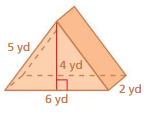
Big Ideas Math Answers Grade 6 Chapter 9 Statistical Measures 9.3 17
Answer:
Given,
l = 6 yd
w = 4 yd
h = 2 yd
We know that,
Surface Area of the Prism = bh + 2lh + lb
= 2 × 4 + 2(6 × 5) + 6 × 2
= 8 + 60 + 12
= 80 sq. yards

Concepts, Skills, & Problem Solving

FINDING THE MEDIAN Use grid paper to find the median of the data. (See Exploration 1, p. 425.)
Question 11.
9, 7, 2, 4, 3, 5, 9, 6, 8, 0, 3, 8
Answer:
First, arrange the numbers in ascending or descending order.
= 0, 2, 3, 3, 4, 5, 6, 7, 8, 8, 9, 9
= (5 + 6)/2
= 11/2
= 5.5

Question 12.
16, 24, 13, 36, 22, 26, 22, 28, 25
Answer:
First, arrange the numbers in ascending or descending order.
13, 16, 22, 22, 24, 25, 26, 28, 36
24 is the median.
The median is the middle score in a set of given data.

FINDING THE MEDIAN AND MODE
Find the median and mode of the data.
Question 13.
3, 5, 7, 9, 11, 3, 8
Answer: The Median is 7; The Mode is 3.
Given: 3, 5, 7, 9, 11, 3, 8
Sorted list: 3,3,5,7,8,9,11
Median is the middle number in a sorted list of numbers = 7
The mode is the value that appears most frequently in a data set = 3

Question 14.
14, 19, 16, 13, 16, 14
Answer: The Median is 15; The Modes are 14 and 16.
Given: 13,14,14,16,16,19
Sorted list: 14, 19, 16, 13, 16, 14
Median is the middle number in a sorted list of numbers = 15
The mode is the value that appears most frequently in a data set = 14,16

Question 15.
16. 93, 81, 94, 71, 89, 92, 94, 99
Answer: The Median is 90.5; The Mode is 94.
Given: 16, 93, 81, 94, 71, 89, 92, 94, 99
Sorted list: 16,71,81,89,92,93,94,94,99
Median is the middle number in a sorted list of numbers = 92
The mode is the value that appears most frequently in a data set = 94

Question 16.
44, 13, 36, 52, 19, 27, 33
Answer: The Median is 33; There are no modes.
Given: 44, 13, 36, 52, 19, 27, 33
Sorted list: 13,19,27,33,36,44,52
Median is the middle number in a sorted list of numbers = 33
The mode is the value that appears most frequently in a data set = no mode

Question 17.
12, 33, 18, 28, 29, 12, 17, 4, 2
Answer: The Median is 17; The Modes are 12.
Given: 12, 33, 18, 28, 29, 12, 17, 4, 2
Sorted list: 2,4,12,12,17,18,28,29,33
Median is the middle number in a sorted list of numbers = 17
The mode is the value that appears most frequently in a data set = 12

Question 18.
55, 44, 40, 55, 48, 44, 58, 67
Answer:
The Median is 51.5
The Modes are 44 and 55.
Given: 55, 44, 40, 55, 48, 44, 58, 67
Sorted list: 40,44,44,48,55,55,58,67
Median is the middle number in a sorted list of numbers = 51.5
The mode is the value that appears most frequently in a data set = 44,55

Question 19.
YOU BE THE TEACHER
Your friend finds the median of the data. Is your friend correct? Explain your reasoning.
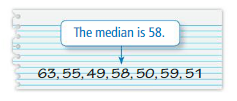
Big Ideas Math Answers Grade 6 Chapter 9 Statistical Measures 9.3 18
Answer: No, first the given data is arranged in ascending order then after median is to be found. The median is 55

FINDING THE MODE
Find the mode of the data.
Question 20.
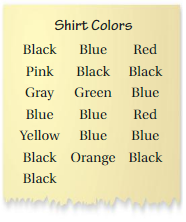
Big Ideas Math Answers Grade 6 Chapter 9 Statistical Measures 9.3 19
Answer: The modes are Black and Blue.

Question 21.
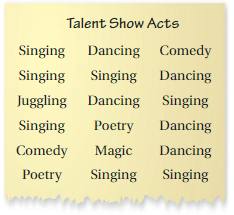
Big Ideas Math Answers Grade 6 Chapter 9 Statistical Measures 9.3 20
Answer: The modes are singing, dancing, comedy.

Question 22.
REASONING
In Exercises 20 and 21, can you find the mean and median of the data? Explain.
Answer: You can’t find the mean and median in exercises 20 and 21.
The data set is not made up of numbers

FINDING MEASURES OF CENTER
Find the mean, median, and mode of the data.
Question 23.
4.7, 8.51, 6.5, 7.42, 9.64, 7.2, 9.3
Answer: Given: 4.7, 8.51, 6.5, 7.42, 9.64, 7.2, 9.3
Sorted list: 4.7, 6.5, 7.2, 7.42, 8.51, 9.64
Mean: x̄ = ∑x/n
x̄ = (4.7+6.5+7.2+7.42+8.51+9.64)/6
x̄ = 43.97/6
x̄ =7.32
Median: 7.42.
Mode: no mode.

Question 24.
8\(\frac{1}{2}\), 6\(\frac{5}{8}\), 3\(\frac{1}{8}\), 5\(\frac{3}{4}\), 6\(\frac{5}{8}\), 5\(\frac{1}{4}\), 10\(\frac{5}{8}\), 4\(\frac{1}{2}\)
Answer: Given: 8.5, 6.62, 3.12, 5.75, 6.62, 5.25, 10.62, 4.5
Sorted list: 3.12, 4.5, 5.25, 5.75, 6.62, 6.62, 8.5, 10.62
Mean: x̄ = ∑x/n
x̄ = (3.12, 4.5, 5.25, 5.75, 6.62, 6.62, 8.5, 10.62)/8
x̄ =
x̄ =
Median: 6.18
Mode: 6.62

Question 25.
MODELING REAL LIFE
The weights (in ounces) of several moon rocks are shown in the table. Find the mean, median, and mode of the weights.
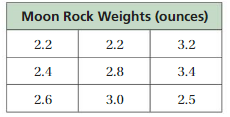
Big Ideas Math Answers Grade 6 Chapter 9 Statistical Measures 9.3 21
Answer:
Mean
x̄ = (2.2 + 2.2 + 3.2 + 2.4 + 2.8 + 3.4 + 2.6 + 3.0 + 2.5)/9
Median:
Write the moon rock weights in ascending or descending order.
2.6 is the median
Mode:
2.2 is repeated move times
So, 2.2 is the mode.

REMOVING AN OUTLIER Find the mean, median, and mode of the data with and without the outlier. Which measure does the outlier affect the most?
Question 26.
45, 52, 17, 63, 57, 42, 54, 58
Answer:
Outliners means removing of the small data value
17 is the outliner
x̄ = ∑x/n
= (45 + 52 + 17 + 63 + 57 + 42 + 54 + 58)/8
= 388/8 = 48.5
Mean without outliner:
= (45 + 52 + 63 + 57 + 42 + 54 + 58)/7
= 371/7 = 53
Median with outliner:
17, 42, 45, 52, 54, 57, 58, 63
= (52 + 54)/2
= 106/2
= 53
Median without outliner:
42, 45, 52, 54, 57, 58, 63
54 is the median
Mode:
There is no change of value in the without outliner and with the outliner.
So, there is no mode in the data values.

Question 27.
85, 77, 211, 88, 91, 84, 85
Answer:
77 is the outliner
Mean with outliner:
x̄ = (85 + 77 + 211 + 88 + 91 + 84 + 85)/7
=721/7
= 103
Mean without outliner:
x̄ = (85 + 211 + 88 + 91 + 84 + 85)/6
= 644/6
= 107
Median with outliner:
Write the data values in ascending or descending order.
77, 84, 85, 88, 91, 211
85 is the median.
Median without outliner:
84, 85, 85, 88, 91, 211
= (85 + 88)/2
= 173/2
= 86.5
Mode:
There is no change of value in the without outliner and with the outliner.
85 is the mode.

Question 28.
23, 73, 45, 27, 23, 25, 43, 45
Answer:
73 is the outliner
Mean with outliner:
Mean = (23 + 45 + 27 + 23 + 25 + 43 + 45)
= 231/7
= 33
Mean with outliner:
Mean = (23 + 45 + 27 + 23 + 25 + 43 + 45+ 73)
= 304/8
= 38

Question 29.
101, 110, 99, 100, 64, 112, 110, 111, 102
Answer:
64 is the outliner
Mean with outliner:
x̄ = (101 + 110 + 99 + 100 + 64 + 112 + 110 + 111 + 102)/9
= 901/9 = 101
Mean with outliner:
x̄ = (101 + 110 + 99 + 100 + 112 + 110 + 111 + 102)/8
= 755/8
= 94.37
Median:
Write the data values in ascending or descending order
64, 99, 100, 101, 102, 110, 111, 112
Median without outliner:
= (101 + 102)/2
= 203/2
= 101.5
Mode:
Mode with and without outliner = 110

Question 30.
REASONING
The table shows the monthly salaries for employees at a company.
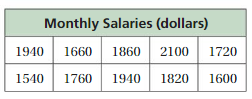
Big Ideas Math Answers Grade 6 Chapter 9 Statistical Measures 9.3 22
a. Find the mean, median, and mode of the data.
b. Each employee receives a 5% raise. Find the mean, median, and mode of the data with the raise. How does this increase affect the mean, median, and mode of the data?
c. How are the mean, median, and mode of the monthly salaries related to the mean, median, and mode of the annual salaries?
Answer:

CHOOSING A MEASURE OF CENTER
Find the mean, median, and mode of the data. Choose the measure that best represents the data. Explain your reasoning.
Question 31.
48, 12, 11, 45, 48, 48, 43, 32
Answer:
Write the data in ascending order or descending order.
11, 12, 32, 43, 45, 48, 48, 48
= (32 + 43)/2
= 75/2
= 37.5
48 is the mode of the data

Question 32.
12, 13, 40, 95, 88, 7, 95
Answer:
Mean:
x̄ = ∑x/n
= (12 + 13 + 40 + 95 + 88 + 7 + 95)/7
= 350/7 = 50
Median:
7, 12, 13, 40, 88, 95, 95
40 is the median
mode:
95 is the mode.

Question 33.
2, 8, 10, 12, 56, 9, 5, 2, 4
Answer:
Mean:
x̄ = ∑x/n
= (2 + 8 + 10 + 12 + 56 + 9 + 5 + 2 + 4)/9
= 108/9
= 12
Median:
2, 2, 4, 5, 8, 9, 10, 12, 56
8 is the median
Mode:
2 is the mode.

Question 34.
126, 62, 144, 81, 144, 103
Answer:
Mean:
x̄ = ∑x/n
= (126 + 62 + 144 + 81 + 144 + 103)6
= 660/60
= 11
Median:
62, 81, 103, 126, 144, 144
= (103 + 126)/2
= 114.5

Question 35.
MODELING REAL LIFE
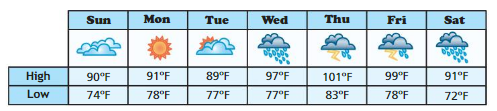
The weather forecast for a week is shown. Which measure of center best represents the high temperatures? the low temperatures? Explain your reasoning.
Big Ideas Math Answers Grade 6 Chapter 9 Statistical Measures 9.3 23
Answer:

Question 36.
RESEARCH
Find the costs of 10 different boxes of cereal. Choose one cereal whose cost will be an outlier.
a. Which measure of center does the outlier affect the most? Justify your answer.
b. Use the data to answer the statistical question, “How much does a box of cereal cost?”
Answer:

Question 37.
PROBLEM SOLVING
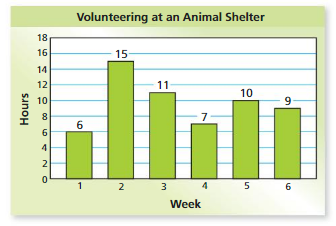
The bar graph shows the numbers of hours you volunteered at an animal shelter. What is the minimum number of hours you need to volunteer in the seventh week to justify that you volunteered an average of 10 hours per week for the 7 weeks? Explain your answer using measures of center.
Big Ideas Math Answers Grade 6 Chapter 9 Statistical Measures 9.3 24
Answer:

Question 38.
REASONING
Why is the mode the least frequently used measure of center to describe a data set? Explain.
Answer:
The mode can be helpful in some analyses, but generally it does not contain enough accurate information to be useful in determining the shape of a distribution. When it is not a “Normal Distribution” the Mode can be misleading, although it is helpful in conjunction with the Mean for defining the amount of skewness in a distribution.

Question 39.
DIG DEEPER!
The data are the prices of several fitness wristbands at a store.
$130 $170 $230 $130
$250 $275 $130 $185
a. Does the price shown in the advertisement represent the prices well? Explain.

Big Ideas Math Answers Grade 6 Chapter 9 Statistical Measures 9.3 25
b. Why might the store use this advertisement?
c. In this situation, why might a person want to know the mean? the median? the mode? Explain.
Answer:

Question 40.
CRITICAL THINKING
The expressions 3x, 9x, 4x, 23x, 6x, and 3x form a data set. Assume x> 0.
a. Find the mean, median, and mode of the data.
b. Is there an outlier? If so, what is it?
Answer:
Mean: This is an average of all the numbers. Add up the numbers and then divide by how many numbers there are.
(3 + 9 + 4 + 23 + 6 + 3)/6 = 48/6 = 8
Median: The number in the middle, when the numbers are in order. If there are 2 middle numbers, average them together.
3, 3, 4, 6, 9, 23 : 4 and 6 are the middle numbers. 4+6/2 = 10/2 = 5
Mode: What value occurs most frequently? 3 is the only duplicate
Outlier: What value is abnormal to our set of data? All of our numbers are small (single digits), except for 23. That makes it an outlier.

Lesson 9.4 Measures of Variation

EXPLORATION 1

Interpreting Statements
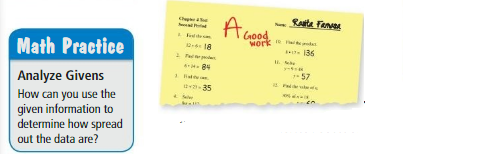
Work with a partner. There are 24 students in your class. Your teacher makes the following statements.
Big Ideas Math Solutions Grade 6 Chapter 9 Statistical Measures 9.4 1
• “The exam scores range from 75% to 96%.”
a. What does each statement mean? Explain.
b. Use your teacher’s statements to make a dot plot that can represent the distribution of the exam scores of the class.
c. Compare your dot plot with other groups’. How are they alike? different?

EXPLORATION 2

Grouping Data
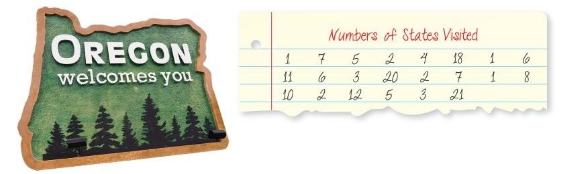
Work with a partner. The numbers of U.S.states visited by students in a sixth-grade class are shown.
Big Ideas Math Solutions Grade 6 Chapter 9 Statistical Measures 9.4 2
a. Represent the data using a dot plot. Between what values do the data range?
b. Use the dot plot to make observations about the data.
c. How can you describe the middle half of the data?

A measure of variation is a measure that describes the distribution of a data set. A simple measure of variation to find is the range. The range of a data set is the difference of the greatest value and the least value.
Big Ideas Math Solutions Grade 6 Chapter 9 Statistical Measures 9.4 3

Try It
Question 1.
The ages of people in line for a roller coaster are 15, 17, 21, 32, 41, 30, 25, 52, 16, 39, 11, and 24. Find and interpret the range of the ages.
Answer:
Given,
The ages of people in line for a roller coaster are 15, 17, 21, 32, 41, 30, 25, 52, 16, 39, 11, and 24.
Range = (upper value – lower value)/2
= (52 – 11)/2
= 41/2
= 20.5

Question 2.
The data are the number of pages in each of an author’s novels. Find and interpret the interquartile range of the data.
356, 364, 390, 468, 400, 382, 376, 396, 350
Answer:
Given,
The data are the number of pages in each of an author’s novels.
356, 364, 390, 468, 400, 382, 376, 396, 350
Lower quartile = 360
Upper quartile = 398
Interquartile range = 38

Self-Assessment for Concepts & Skills

Solve each exercise. Then rate your understanding of the success criteria in your journal.
Question 3.
WRITING
Explain why the variability of a data set can be described by the range or the interquartile range.
Answer:
The interquartile range is the third quartile (Q3) minus the first quartile (Q1). But the IQR is less affected by outliers: the 2 values come from the middle half of the data set, so they are unlikely to be extreme scores. The IQR gives a consistent measure of variability for skewed as well as normal distributions.

Question 4.
DIFFERENT WORDS, SAME QUESTION
Which is different? Find “both” answers.
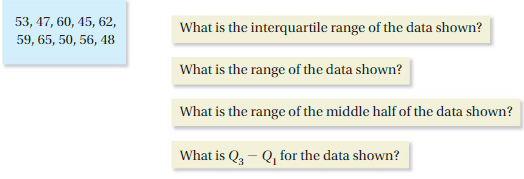
Big Ideas Math Solutions Grade 6 Chapter 9 Statistical Measures 9.4 8
Answer:

Question 5.
The table shows the distances traveled by a paper airplane. Find and interpret the range and interquartile range of the distances.
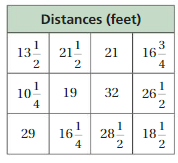
Big Ideas Math Solutions Grade 6 Chapter 9 Statistical Measures 9.4 11
Answer: Given: 13.5, 12.5, 21, 16.75, 10.25, 19, 32, 26.5, 29,16.25, 28.5, 18.5.

Question 6.
The table shows the years of teaching experience of math teachers at a school. How do the outlier or outliers affect the variability of the data?
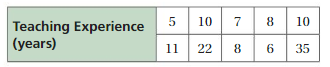
Big Ideas Math Solutions Grade 6 Chapter 9 Statistical Measures 9.4 12
Answer:
Given the data
5, 10, 7, 8, 10, 11, 22, 8, 6, 35
22 is added to the data set
22 is the outliner
so there is no effect to measure of center and the measure of variability.

Measures of Variation Homework & Practice 9.4

Review & Refresh

Find the mean, median, and mode of the data.
Question 1.
4, 8, 11, 6, 4, 5, 9, 10, 10, 4
Answer:
Mean = x̄ = (4 + 8 + 11 + 6 + 4 + 5 + 9 + 10 + 10 + 4)/10
= 71/10
= 7.1
Median:
Write the data in ascending or descending order.
4, 4, 4, 5, 6, 8, 9, 10, 10, 11
= (5 + 8)/2
= 13/2
=6.5
Mode:
More number if data repeated is called mode.
4 is the mode.

Question 2.
74, 78, 86, 67, 80
Answer:
Mean = x̄ = (74 + 78 + 86 + 67 + 80)/5
= 385/5
= 77
Median:
Write the data in ascending or descending order.
67, 74, 78, 80, 86
78 is the median
Mode:
There is no mode in the data.

Question 3.
15, 18, 17, 17, 15, 16, 14
Answer:
Mean = x̄ = (15 + 18 + 17 + 17 + 15 + 16 + 14)/7
= 112/7 = 16
Median:
Write the data in ascending or descending order.
14, 15, 15, 16, 17, 17, 18
16 is the median
Mode:
17, 15 are the median.

Question 4.
31, 14, 18, 26, 17, 32
Answer:
Mean:
x̄ = (31 + 14 + 18 + 26 + 17 + 32)/6
Median:
Write the data in ascending or descending order.
14, 17, 18, 26, 31, 32
= (18 + 26)/2
= 44/2
= 22
Mode:
There is no mode in the data.

Copy and complete the statement using < or >.
Question 5.
Big Ideas Math Solutions Grade 6 Chapter 9 Statistical Measures 9.4 13
Answer:
A negative number is less than the positive number
6 > -7

Question 6.
Big Ideas Math Solutions Grade 6 Chapter 9 Statistical Measures 9.4 14
Answer:
A negative number is less than the positive number
-3 < 0

Question 7.
Big Ideas Math Solutions Grade 6 Chapter 9 Statistical Measures 9.4 15
Answer:
A negative number is less than the positive number
14 > -14

Question 8.
Big Ideas Math Solutions Grade 6 Chapter 9 Statistical Measures 9.4 16
Answer:
A negative number is less than the positive number
8 > -10

Find the surface area of the pyramid.
Question 9.
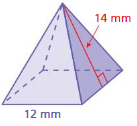
Big Ideas Math Solutions Grade 6 Chapter 9 Statistical Measures 9.4 17
Answer:
Given,
Length = 12 mm
Height = 14 mm
A = a² + 2a √a²/4 + h²
Area = 509.56 sq. mm

Question 10.
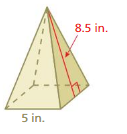
Big Ideas Math Solutions Grade 6 Chapter 9 Statistical Measures 9.4 18
Answer:
Given,
Length = 5 in
Height = 8.5 in
A = a² + 2a √a²/4 + h²
Area = 113.6 sq. inches

Question 11.
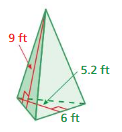
Big Ideas Math Solutions Grade 6 Chapter 9 Statistical Measures 9.4 19
Answer:
Given,
Length = 6 ft
Height = 9 ft
A = a² + 2a √a²/4 + h²
Area = 149.84 sq.ft

Concepts, Skills, &Problem Solving

INTERPRETING STATEMENTS There are 20 students in your class. Your teacher makes the two statements shown. Use your teacher’s statements to make a dot plot that can represent the distribution of the scores of the class. (See Exploration 1, p. 433.)
Question 12.
“The quiz scores range from 65% to 95%.”
“The scores were evenly spread out.”
Answer:

Question 13.
“The project scores range from 78% to 93%.”
“Most of the students received low scores.”
Answer:

FINDING THE RANGE Find the range of the data.
Question 14.
4, 8, 2, 9, 5, 3
Answer: 7

Explanation:
Range is the difference of higher value and lower value
lowest value = 2
highest value = 9
R = 9 – 2
R = 7

Question 15.
28, 42, 36, 23, 14, 47, 40
Answer: 33

Explanation:
The range is the difference between higher value and lower value
Lowest value: 14
Highest value: 47
Range = 47 – 14
R = 33

Question 16.
26, 21, 27, 33, 24, 29
Answer: 12

Explanation:
The range is the difference between higher value and lower value
Lowest value: 21
Highest value: 33
Range = 33 – 21
R = 12

Question 17.
52, 40, 49, 48, 62, 54, 44, 58, 39
Answer: 23

Explanation:
The range is the difference between higher value and lower value
Lowest value: 39
Highest value: 62
Range = 62 – 39
R = 23

Question 18.
133, 117, 152, 127, 168, 146, 174
Answer: 57

Explanation:
The range is the difference between higher value and lower value
Lowest value: 117
Highest value: 174
Range = 174 – 117
R = 57

Question 19.
4.8, 5.5, 4.2, 8.9, 3.4, 7.5, 1.6, 3.8
Answer: 7.3

Explanation:
The range is the difference of higher value and lower value
Lowest value: 1.6
Highest value: 8.9
Range = 8.9 – 1.6
R = 7.3

Question 20.
YOU BE THE TEACHER
Your friend finds the range of the data. Is your friend correct? Explain your reasoning.
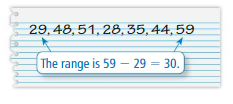
Big Ideas Math Solutions Grade 6 Chapter 9 Statistical Measures 9.4 20
Answer:
The range is the difference between higher value and lower value
Lowest value: 28
Highest value: 59
Range =  59 – 28
Range = 31

FINDING THE INTERQUARTILE RANGE Find the interquartile range of the data.
Question 21.
4, 6, 4, 2, 9, 1, 12, 7
Answer: 6

Explanation:
This simple formula is used for calculating the interquartile range:
IQR = Xu – Xl
Lower quartile (xL): 2.5
Upper quartile (xU): 8.5
IQR = 8.5 – 2.5
IQR = 6

Question 22.
18, 22, 15, 16, 15, 13, 19, 18
Answer: 3.75

Explanation:
This simple formula is used for calculating the interquartile range:
IQR = Xu – Xl
Lower quartile (xL): 15
Upper quartile (xU): 18.75
IQR = 18.75 – 15
= 3.75

Question 23.
40, 33, 37, 54, 41, 34, 27, 39, 35
Answer: 7

Explanation:
This simple formula is used for calculating the interquartile range:
IQR = Xu – Xl
Lower quartile (xL): 33.5
Upper quartile (xU): 40.5
IQR = 40.5 – 33.5
= 7

Question 24.
84, 75, 90, 87, 99, 91, 85, 88, 76, 92, 94
Answer: 8

Explanation:
This simple formula is used for calculating the interquartile range:
IQR = Xu – Xl
Lower quartile (xL): 84
Upper quartile (xU): 92
IQR = 92 – 84
= 8

Question 25.
132, 127, 106, 140, 158, 135, 129, 138
Answer: 12

Explanation:
This simple formula is used for calculating the interquartile range:
IQR = Xu – Xl
Lower quartile (xL): 127.5
Upper quartile (xU): 139.5
IQR = 139.5 – 127.5
= 12

Question 26.
38, 55, 61, 56, 46, 67, 59, 75, 65, 58
Answer: 12.75

Explanation:
This simple formula is used for calculating the interquartile range:
IQR = Xu – Xl
Lower quartile (xL): 52.75
Upper quartile (xU): 65.5
IQR = 65.5  – 52.75
= 12.75

Question 27.
MODELING REAL LIFE
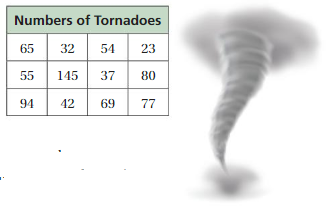
The table shows the number of tornadoes in Alabama each year for several years. Find and interpret the range and interquartile range of the data. Then determine whether there are any outliers.
Big Ideas Math Solutions Grade 6 Chapter 9 Statistical Measures 9.4 21
Answer:
The data is 65, 32, 54, 23, 55, 145,37, 80, 94, 42, 69, 77
Range:
Lowest value: 23
Highest value: 145
R = Highest value – Lowest value
R = 145 – 23
R = 122
IQR:
This simple formula is used for calculating the interquartile range:
IQR = Xu – Xl
Lower quartile (xL): 38.25
Upper quartile (xU): 79.25
IQR = 79.25 – 38.25
= 41

Question 28.
WRITING
Consider a data set that has no mode. Which measure of variation is greater, the range or the interquartile range? Explain your reasoning.
Answer:
It would be based on the set of numbers you have, but in most cases, it is the interquartile range, because the mode is usually closer to the median. This leaves the interquartile range as a larger number.

Question 29.
CRITICAL THINKING
Is it possible for the range of a data set to be equal to the interquartile range? Explain your reasoning.
Answer:
The interquartile range (IQR) is a measure of variability, based on dividing a data set into quartiles. Quartiles divide a rank-ordered data set into four equal parts.

Question 30.
REASONING
How does an outlier affect the range of a data set? Explain.
Answer:
Outlier An extreme value in a set of data that is much higher or lower than the other numbers. Outliers affect the mean value of the data but have little effect on the median or mode of a given set of data.

Question 31.
MODELING REAL LIFE
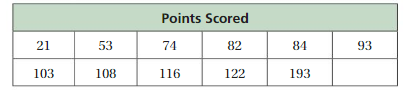
The table shows the numbers of points scored by players on a sixth-grade basketball team in a season.
Big Ideas Math Solutions Grade 6 Chapter 9 Statistical Measures 9.4 22
a. Find the range and interquartile range of the data.
b. Identify the outlier(s) in the data set. Find the range and interquartile range of the data set without the outlier(s). Which measure does the outlier or outliers affect more?
Answer:

Question 32.
DIG DEEPER!
Two data sets have the same range. Can you assume that the interquartile ranges of the two data sets are about the same? Give an example to justify your answer.
Answer:
Yes,
A data set with the least value of 2 and the greatest value of 20 will have the same range as a data set with the least value of 82 and the greatest value of 100 will have the same range of 18.

Question 33.
MODELING REAL LIFE
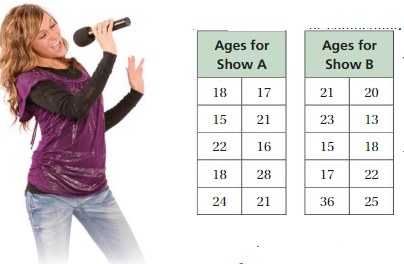
The tables show the ages of the finalists for two reality singing competitions.
Big Ideas Math Solutions Grade 6 Chapter 9 Statistical Measures 9.4 23
a. Find the mean, median, range, and interquartile range of the ages for each show. Compare the results.

Answer:
18, 15, 22, 18, 24, 17, 21, 16, 28, 21
Mean:
x̄ = ∑x/n = (18 + 15 + 22 + 18 + 24 + 17 + 21 + 16 + 28 + 21)/10
=200/10 = 20
Median:
15, 16,  17,  18,  18, 21, 22, 24, 28
= (18 + 21)/2
= 39/2
= 19.5
Range:
(28 – 15)/2
= 13/2
= 6.5
interquartile range:
Number of observations: 10
Xl = 16.75
Xu = 22.5
Xu – Xl = 5.75
Ages of show B:
Mean:
x̄ = ∑x/n = (21 + 20 + 23 + 13 + 15 + 18 + 17 + 22 + 36 + 25)/10
= 210/10 = 21
Median:
13, 15, 17, 18, 20, 21, 22, 23, 25, 36
= (20 + 21)/2 = 41/2 = 20.5
Range:
(36 – 13)/2
= 23/2
= 11.5
Interquartile Range:
Samples = 10
Xl = 16.5
Xu = 23.5

b. A 21-year-old is voted off Show A, and the 36-year-old is voted off Show B. How do these changes affect the measures in part(a)? Explain.
Answer:
Mean:
x̄ = ∑x/n = (18 + 17 + 15 + 22 + 16 + 18 + 28 + 24)/8
= 158/8
= 79
Median: 15, 16, 17, 18, 18, 22, 24, 28
(18 + 18)/2
= 36/2
= 18
Range:
(28 – 15)/2
= 13/2
= 6.5
Interquartile Range:
Samples = 8
Xl = 16.25
Xu = 23.5
Interquartile Range = 23.5 – 16.25
= 7.25
21, 20, 23, 13, 15, 18, 17, 22, 25
Mean = (21 + 20 + 23 + 13 + 15 + 18 + 17 + 22 + 25)/9
= 174/2
= 87
Median:
13, 15, 17, 18, 21, 20, 22, 23, 25
21 is the median
Range:
(25 – 13)/2
= 12/2
= 6
Interquartile Range:
data = 9
Xl = 16
Xu = 22.5
(Xu – Xl) = 22.5 – 16
= 6.5
In Part A there is no effect on the range and it affects the mean, median, interquartile.

Question 34.
OPEN-ENDED
Create a set of data with 7 values that has a mean of 30, a median of 26, a range of 50, and an interquartile range of 36.
Answer:
The first thing we need to do is to put the data in increasing order. This is needed to calculate the median:
30,31,32,33,34,35,35,36,37,39

Lesson 9.5 Mean Absolute Deviation
Big Ideas Math Answer Key Grade 6 Chapter 9 Statistical Measures 9.5 1

EXPLORATION 1

Finding Distances from the Mean
Work with a partner. The table shows the exam scores of 14 students in your class.
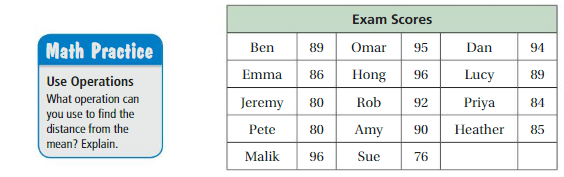
Big Ideas Math Answer Key Grade 6 Chapter 9 Statistical Measures 9.5 2
a. Which exam score deviates the most from the mean? Which exam score deviates the least from the mean? Explain how you found your answers.
b. How far is each data value from the mean?
c. Divide the sum of the values in part(b) by the number of values. In your own words, what does this represent?
d. REASONING Ina data set, what does it mean when the value you found in part(c) is close to 0? Explain.
Big Ideas Math Answer Key Grade 6 Chapter 9 Statistical Measures 9.5 3

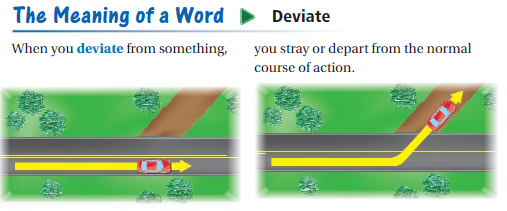
Another measure of variation is the mean absolute deviation. The mean absolute deviation is an average of how much data values differ from the mean.

Try It
Question 1.
Find and interpret the mean absolute deviation of the data.
5, 8, 8, 10, 13, 14, 16, 22
Answer: Number of observations : 8
Mean: 12

Question 2.
WHAT IF?
The pitcher allows 4 runs in the next game. How would you expect the mean absolute deviation to change? Explain.
Answer:

Self-Assessment for Concepts & Skills

Solve each exercise. Then rate your understanding of the success criteria in your journal.
Question 3.
WRITING
Explain why the variability of a data set can be described by the mean absolute deviation.
Answer:

Question 4.
FINDING THE MEAN ABSOLUTE DEVIATION
Find and interpret the mean absolute deviation of the data. 8, 12, 4, 3, 14, 1, 9, 13
Answer: number of observations:8
Mean: 8
mean absolute deviation: 4

Question 5.
WHICH ONE do DOESN’T BELONG?
Which one does not belong with the other three? Explain your reasoning.
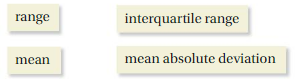
Big Ideas Math Answer Key Grade 6 Chapter 9 Statistical Measures 9.5 6
Answer: MEAN
A mean is different from all the above-given factors
A mean is the simple mathematical average of a set of two or more numbers.
The mean for a given set of numbers can be computed in more than one way, including the arithmetic mean method, which uses the sum of the numbers in the series, and the geometric mean method, which is the average of a set of products.

Question 6.
The tables show the numbers of questions answered correctly by members of two teams on a game show. Compare the mean, median, and mean absolute deviation of the numbers of correct answers for each team. What can you conclude?
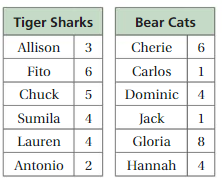
Big Ideas Math Answer Key Grade 6 Chapter 9 Statistical Measures 9.5 9
Answer:
Tiger sharks
3, 6, 5, 4, 4, 2
Mean: (3 + 6 + 5 + 4 + 4 + 2)/6
= 24/6
= 4
Median:
2, 3, 4, 4, 5, 6
= (4 + 4)/2
= 4
MAD:
Number of observations: 6
Mean = 4
MAD = 1
Bear Cats:
Mean:
6, 1, 4, 1, 8, 4
(6 + 1 + 4 + 1 + 8 + 4)/6
= 24/6
= 4
Median:
1, 1, 4, 4, 6, 8
= (4 + 4)/2
= 4
MAD:
Number of observations: 6
Mean = 4
MAD = 2
The mean, Median, Mean Absolute Deviation of both tiger sharks and Bear Cats are the same.

Question 7.
DIG DEEPER!
The data set shows the numbers of books that students in your book club read last summer.
8, 6, 11, 12, 14, 12, 11, 6, 15, 9, 7, 10, 9, 13, 5, 8
A new student who read 18 books last summer joins the club. Is18 an outlier? How does including this value in the data set affect the measures of center and variation? Explain.
Answer: 8 is added to the dataset.
Yes, 18 is an outliner
No, it does not affect the measures of the center and variation by removing the outliner.
If the outliner is not removed then it affects the measures of center and variation.

Mean Absolute Deviation Homework & Practice 9.5

Review & Refresh

Find the range and interquartile range of the data.
Question 1.
23, 45, 39, 34, 28, 41, 26, 33
Answer:
Number of observations:8
Lower quartile (xL): 26.5
Upper quartile (xU): 40.5
interquartile range = 14
Range:
Number of observations:8
Lowest value: 23
Highest value: 45
Range = 45 – 23
= 22

Question 2.
63, 53, 48, 61, 69, 63, 57, 72, 46
Answer:
Number of observations:9
Lower quartile (xL): 50.5
Upper quartile (xU): 66
interquartile range = 15.5
Range:
Number of observations:9
Lowest value: 46
Highest value: 72
Range = 26

Graph the integer and its opposite.
Question 3.
15
Answer:
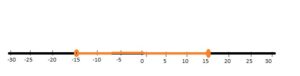
Big Ideas Math Grade 6 Chapter 9 Statistics Answer Key img_5

Question 4.
17
Answer:
Big Ideas Math Grade 6 Chapter 9 Statistics Answer Key img_6

Question 16.
– 22
Answer:
Big Ideas Math Grade 6 Chapter 9 Statistics Answer Key img_7

Question 7.
Find the numbers of faces, edges, and vertices of the solid.
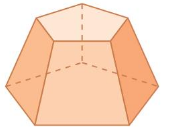
Big Ideas Math Answer Key Grade 6 Chapter 9 Statistical Measures 9.5 10
Answer:
The name of the solid is a pentagon.
Number of vertices = 5
Number of faces = 5
Numver of edges = 5

Write the word sentence as an equation.
Question 8.
17 plus a number q is 40.
Answer:
We have to write the equation for the word sentence.
The phrase ‘plus’ indicates ‘+’
17 + q = 40

Question 9.
The product of a number s and 14 is 49.
Answer:
We have to write the equation for the word sentence.
The phrase product indicates ‘×’
s × 14 = 49

Question 10.
The difference of a number b and 9 is 32.
Answer:
We have to write the equation for the word sentence.
The phrase difference indicates ‘-‘
b – 9 = 32

Question 11.
The quotient of 36 and a number g is 9.
Answer:
We have to write the equation for the word sentence.
The phrase quotient indicates ‘÷’
36 ÷ g = 9

Concepts, Skills, &Problem Solving

FINDING DISTANCES FROM THE MEAN Find the average distance of each data value in the set from the mean. (See Exploration 1, p. 439.)
Question 12.
Model years of used cars on a lot: 2014, 2006, 2009, 2011, 2005
Answer:

Question 13.
Prices of kites at a shop: $7, $20, $9, $35, $12, $15, $7, $10, $20, $25
Answer:

FINDING THE MEAN ABSOLUTE DEVIATION Find and interpret the mean absolute deviation of the data.
Question 14.
69, 51, 71, 77, 71, 80, 75, 63, 73
Answer:
Given the data
69, 51, 71, 77, 71, 80, 75, 63, 73
Number of samples = 9
Mean Absolute Deviation = 70

Question 15.
94, 86, 95, 99, 88, 90
Answer:
Given the data
94, 86, 95, 99, 88, 90
Number of samples = 6
Mean Absolute Deviation = 92

Question 16.
46, 54, 43, 57, 50, 62, 78, 42
Answer:
Given the data
46, 54, 43, 57, 50, 62, 78, 42
Number of samples = 8
Mean Absolute Deviation = 54

Question 17.
25, 28, 20, 22, 32, 28, 35, 34, 30, 36
Answer:
Given the data
25, 28, 20, 22, 32, 28, 35, 34, 30, 36
Number of samples = 10
Mean Absolute Deviation = 29

Question 18.
101, 115, 124, 125, 173, 165, 170
Answer:
Given the data
101, 115, 124, 125, 173, 165, 170
Number of samples = 7
Mean Absolute Deviation = 139

Question 19.
1.1, 7.5, 4.9, 0.4, 2.2, 3.3, 5.1
Answer:
Given the data
1.1, 7.5, 4.9, 0.4, 2.2, 3.3, 5.1
Number of samples = 7
Mean Absolute Deviation = 3.5

Question 20.
\(\frac{1}{4}, \frac{5}{8}, \frac{3}{8}, \frac{3}{4}, \frac{1}{2}\)
Answer:
Number of observations:5
Mean (x̄): 0.5
Mean Absolute Deviation (MAD): 0.15

Question 21.
4.6, 8.5, 7.2, 6.6, 5.1, 6.2, 8.1, 10.3
Answer:
Number of observations:8
Mean (x̄): 7.075
Mean Absolute Deviation (MAD): 1.45

Question 22.
YOU BE THE TEACHER
Your friend finds and interprets the mean absolute deviation of the data set 35, 40, 38, 32, 42, and 41. Is your friend correct? Explain your reasoning.
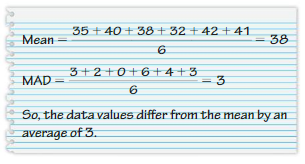
Big Ideas Math Answer Key Grade 6 Chapter 9 Statistical Measures 9.5 11
Answer:
x̄ = ∑x/n = (35 + 40 + 38)/3
= 113/3
= 37.6
Yes, the data values are different from the mean by an average of 3.

Question 23.
MODELING REAL LIFE
The data set shows the admission prices at several glass-blowing workshops.
$20, $20, $16, $12, $15, $25, $11
Find and interpret the range, interquartile range, and mean absolute deviation of the data.

Big Ideas Math Answer Key Grade 6 Chapter 9 Statistical Measures 9.5 12
Answer:
Range = (25 – 11)
= 14/2
= 7
Interquartile range:
Samples = 7
Xl = 12
Xu = 20
Xu – Xl = 20 – 12
= 8
Absolute Deviation of the data:
Data = 7
Mean = 17
Mean Absolute Deviation = 4

Question 24.
MODELING REAL LIFE
The table shows the prices of the five most-expensive and least-expensive dishes on a menu. Find the MAD of each data set. Then compare their variations.

Big Ideas Math Answer Key Grade 6 Chapter 9 Statistical Measures 9.5 13
Answer:
Five expensive dishes
$28, $30, $28, $39, $25
MAD:
Dishes = 5
Mean $30
MAD = $3.6
First leasr expensive dishes:
$7, $7, $10, $8, $12
MAD:
Dishes = 5
Mean $8.8
MAD = $1.76
Mean Absolute Deviation of five most expensive dishes is greater than Mean Absolute Deviation of five least expensive dishes.

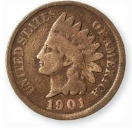
Question 25.
REASONING
The data sets show the years of the coins in two collections.
Your collection: 1950, 1952, 1908, 1902, 1955, 1954, 1901, 1910
Your friend’s collection: 1929, 1935, 1928, 1930, 1925, 1932, 1933, 1920
Compare the measures of center and the measures of variation for each data set. What can you conclude?
Big Ideas Math Answer Key Grade 6 Chapter 9 Statistical Measures 9.5 14
Answer:
The measure of center is a value of the center or middle of a data set.
There are 4 measures of center they are
Mean
Median
Mode
Midrange
four measures of variations
Range
Interquartile range
Variance
Standard deviation
your collection:
Mean: (1950 + 1952 + 1908 + 1902 + 1955 + 1954 + 1901 + 1910)/8
= 1,929
Median: 1901, 1902, 1908, 1910, 1950, 1952, 1954, 1955
= (1910 + 1952)/2
= 1930
Mode: There is no mode
Midrange:
(1955 + 1901)/2
= 3856/2
= 1928
Range:
(1955 – 1901)/2
= 54/2
= 27
Interquartile range:
Number of observations = 8
Xl = 1903.5
Xu = 1953.5
Interquartile range = 50
Variance = 655.14
Standard deviation = 25.59

Question 26.
MODELING REAL LIFE
You survey students in your class about the numbers of movies they watched last month. A new student joins the class who watched 22 movies last month. Is22 an outlier? How does including this value affect the measures of center and the measures of variation? Explain.
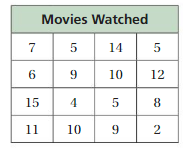
Big Ideas Math Answer Key Grade 6 Chapter 9 Statistical Measures 9.5 15
Answer:

REASONING
Which data set would have the greater mean absolute deviation? Explain your reasoning.
Question 27.
guesses for number of gumballs in a jar
guesses for number of baseballs in a jar
Answer:
Gumballs in the jar have a greater mean absolute deviation because baseballs are larger than baseballs.

Question 28.
monthly rainfall amounts in a city
monthly amounts of water used in a home
Answer:

Question 29.
REASONING
Range, interquartile range, and mean absolute deviation are all measures of variation. Which measure of variation is most reliable? Explain your reasoning.
Answer:

Question 30.
DIG DEEPER!
Add and subtract the MAD from the mean in the original data set in Exercise 26.
a. What percent of the values are within one MAD of the mean? two MADs of the mean? Which values are more than twice the MAD from the mean?
b. What do you notice as you get more and more MADs away from the mean? Explain.
Answer:

Statistical Measures Connecting Concepts

Using the Problem-Solving Plan

Question 1.
Six friends play a carnival game in which a person throws darts at balloons. Each person throws the same number of darts and then records the portion of the balloons that pop. Find and interpret the mean, median, and MAD of the data.
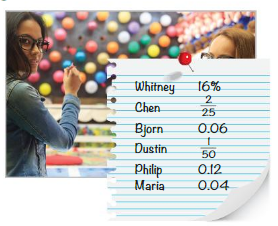
Big Ideas Math Answers 6th Grade Chapter 9 Statistical Measures cc 1
Understand the problem.
You know that each person throws the same number of darts. You are given the portion of balloons popped by each person as a fraction, a decimal, or a percent.

Make a plan.
First, write each fraction and each decimal as a percent. Next, order the percents from least to greatest. Then find and interpret the mean, median, and MAD of the data.

Solve and check.
Use the plan to solve the problem. Then check your solution.
Answer:

Question 2.
The cost c (in dollars) to rent skis at a resort for n days is represented by the equation c = 22n. The durations of several ski rentals are shown in the table. Find the range and interquartile range of the costs of the ski rentals. Then determine whether any of the costs are outliers.
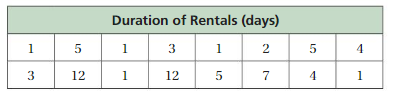
Big Ideas Math Answers 6th Grade Chapter 9 Statistical Measures cc 2
Answer:
Given the equation c = 22n
c = 22(1) = 22
c = 22(5) = 1100
c = 22(1) = 22
c = 22(3) = 66
c = 22(5) = 110
c = 22(4) = 88
c = 22(3) = 66
c = 22(12) = 264
c = 22(1) = 22
c = 22(12) = 264
c = 22(5) = 110
c = 22(7) = 154
c = 22(4) = 88
c = 22(1) = 22
22, 110, 22, 66, 110, 88, 66, 264, 22, 264, 110, 154, 88, 22
Range = (264 – 22)/2 = 242/2
= 141
Interquartile range:
Number of observations: 14
lower quartile = 22
upper quartile = 121
Interquartile range = upper quartile – lower quartile
= 121 – 22
= 99

Performance Task
Which Measure of Center Is Best: Mean, Median, or Mode?
At the beginning of this chapter, you watched a STEAM Video called “Daylight in the Big City.“ You are now ready to complete the performance task related to this video, available at BigIdeasMath.com. Be sure to use the problem-solving plan as you work through the performance task.

Big Ideas Math Answers 6th Grade Chapter 9 Statistical Measures cc 3

Statistical Measures Chapter Review

Review Vocabulary

Write the definition and give an example of each vocabulary term.

Big Ideas Math Answers 6th Grade Chapter 9 Statistical Measures cr 1

Graphic Organizers

You can use a Definition and Example Chart to organize information about a concept. Here is an example of a Definition and Example Chart for the vocabulary term statistical question.
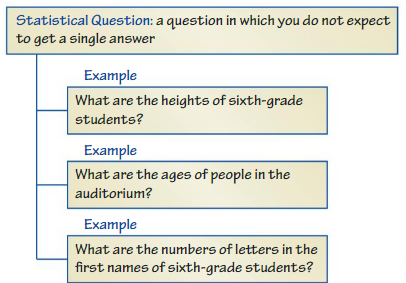
Big Ideas Math Answers 6th Grade Chapter 9 Statistical Measures cr 2

Choose and complete a graphic organizer to help you study the concept.
Big Ideas Math Answers 6th Grade Chapter 9 Statistical Measures cr 3
1. mean
2. outlier
3. median
4. mode
5. range
6. quartiles
7. interquartile range

Chapter Self-Assessment

As you complete the exercises, use the scale below to rate your understanding of the success criteria in your journal.

Big Ideas Math Answers 6th Grade Chapter 9 Statistical Measures crr 1

9.1 Introduction to Statistics (pp. 413–418)
Learning Target: Identify statistical questions and use data to answer statistical questions.

Determine whether the question is a statistical question. Explain.
Question 1.
How many positive integers are less than 20?
Answer: There are only 19 numbers in that group

Question 2.
In what month were the students in a sixth-grade class born?
Answer: February

Question 3.
The dot plot shows the number of televisions owned by each family on a city block.
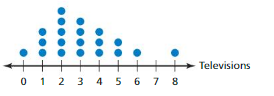
Big Ideas Math Answers 6th Grade Chapter 9 Statistical Measures crr 3
a. Find and interpret the number of data values on the dot plot.
b. Write a statistical question that you can answer using the dot plot. Then answer the question.
Answer:

Display the data in a dot plot. Identify any clusters, peaks, or gaps in the data
Question 4.
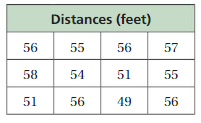
Big Ideas Math Answers 6th Grade Chapter 9 Statistical Measures crr 4
Answer:

Question 5.
Big Ideas Math Answers 6th Grade Chapter 9 Statistical Measures crr 5
Answer:

Question 6.
You conduct a survey to answer, “What is the heart rate of a typical sixth-grade student?” e table shows the results. Use the distribution of the data to answer the question.
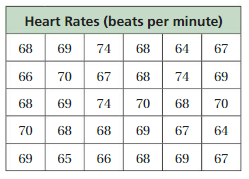
Big Ideas Math Answers 6th Grade Chapter 9 Statistical Measures crr 6
Answer:

9.2 Mean (pp. 419–424)
Learning Target: Find and interpret the mean of a data set.

Question 7.
Find the mean of the data.

Big Ideas Math Answers 6th Grade Chapter 9 Statistical Measures crr 7
Answer:
x̄ = ∑x/n =(1112+1409+675+536+1398+162)/6
x̄ = ∑x/n=6751/6
x̄ = ∑x/n=1125.16

Question 8.
The double bar graph shows the monthly profit for two toy companies over a four-month period. Compare the mean monthly profits.
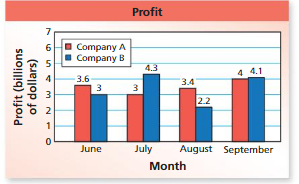
Big Ideas Math Answers 6th Grade Chapter 9 Statistical Measures crr 8
Answer:
Company A:
3.6, 3, 3.4, 4
Mean: (3.6 + 3 + 3.4 + 4)/4 = 14/4 = 3.5
Company B:
3, 4.3, 2.2, 4.1
Mean: (3 + 4.3 + 2.2 + 4.1)/4
= 13.6/4
= 3.4

Question 9.
The table shows the test scores for a class of sixth-grade students. Describe how the outlier affects the mean. Then use the data to answer the statistical question, “What is the typical test score for a student in the class?”
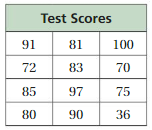
Big Ideas Math Answers 6th Grade Chapter 9 Statistical Measures crr 9
Answer:

9.3 Measures of Center (pp. 425–432)
Learning Target: Find and interpret the median and mode of a data set.

Find the median and mode of the data.
Question 10.
8, 8, 6, 8, 4, 5, 6
Answer:
Median:
write the given data in ascending order or descending order.
4, 5, 6, 8, 8, 8
= (6 + 8)/2
= 14/2
= 7
Mode:
8 is the mode.

Question 11.
24, 74, 61, 29, 38, 27, 68, 54
Answer:
Median:
write the given data in ascending order or descending order.
24, 74, 61, 29, 38, 27, 68, 54
= 24, 27, 29, 38, 54, 61, 68, 74
= (38 + 54)/2
= 92/2
= 48
Mode:
There is no mode in the data.

Question 12.
Find the mean, median, and mode of the data set 67, 52, 50, 99, 66, 50, and 57 with and without the outlier. Which measure does the outlier affect the most?
Answer:
Given the data,
67, 52, 50, 99, 66, 50, and 57
Mean with outliner:
(67 + 52 + 50 + 99 + 66 + 50 + 57)/7
= 441/7
= 63
Mean without outliner:
66 is the median
Mode with outliner: 50
Mode without outliner:
No mode
Outliners affect the mean value of the data but have little effect on the median or mode of a given set of data.

Question 13.
The table shows the lengths of several movies. Which measure of center best represents the data? Explain your reasoning.
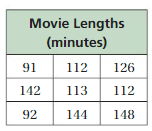
Big Ideas Math Answers 6th Grade Chapter 9 Statistical Measures crr 13
Answer:

Question 14.
Give an example of a data set that does not have a median. Explain why the data set does not have a median.
Answer:

9.4 Measures of Variation (pp. 433–438)
Learning Target: Find and interpret the range and interquartile range of a data set.

Find the range of the data.
Question 15.
45, 76, 98, 21, 52, 39
Answer:
Lowest value = 21
Highest value = 98
Range = (98 – 21)/2
= 77/2
= 38.5

Question 16.
95, 63, 52, 8, 93, 16, 42, 37, 62
Answer:
Lowest value = 8
Highest value = 95
Range = (95 – 8)/2
= 87/2
= 43.5

Find the interquartile range of the data.
Question 17.
28, 46, 25, 76, 18, 25, 47, 83, 44
Answer:
Given the data
28, 46, 25, 76, 18, 25, 47, 83, 44
Number of observations: 9
lower quartile: 25
upper quartile: 61.5
Interquartile range (Xu – Xl) = 36.5

Question 18.
14, 25, 97, 55, 66, 28, 92, 38, 94
Answer:
Given the data
14, 25, 97, 55, 66, 28, 92, 38, 94
Number of observations: 9
lower quartile: 26.5
upper quartile: 93
Interquartile range (Xu – Xl) = 66.5

Question 19.
The table shows the weights of several adult emperor penguins. Find and interpret the range and interquartile range of the data. Then determine whether there are any outliers.
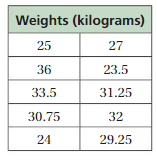
Big Ideas Math Answers 6th Grade Chapter 9 Statistical Measures crr 19
Answer:
25, 27, 36, 23.5, 33.5, 31.25, 30.75, 32, 24, 29.25
Yes there are outliner
Range: (36  – 25)/2
= 11/2
= 5.5
Interquartile range:
Number of observations = 10
Mean = 29.225
MAD = 3.98

Question 20.
Two data sets have the same interquartile range. Can you assume that the ranges of the two data sets are about the same? Give an example to justify your answer.
Answer:
23
Yes, a data set with the least value of 2 and the greatest value of 20 will have the same range as a data set with the least value of 82 and the greatest value of 100 will have the same range of 18.

9.5 Mean Absolute Deviation (pp. 439–444)
Learning Target: Find and interpret the mean absolute deviation of a data set.

Find and interpret the mean absolute deviation of the data.
Question 21.
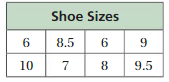
Big Ideas Math Answers 6th Grade Chapter 9 Statistical Measures crr 21
Answer:
Given data,
6, 8.5, 6, 9, 10, 7, 8, 9.5
No. of observations: 8
Mean = 8
Mean Absolute Deviation: 1.25

Question 22.
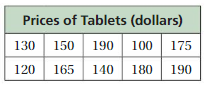
Big Ideas Math Answers 6th Grade Chapter 9 Statistical Measures crr 22
Answer:
Given data,
130, 150, 190, 100, 175, 120, 165, 140, 180, 190
No. of observations: 10
Mean = 154
Mean Absolute Deviation: 26

Question 23.
The table shows the prices of the five most-expensive and least-expensive manicures given by a salon technician on a particular day. Find the MAD of each data set. Then compare their variations.

Big Ideas Math Answers 6th Grade Chapter 9 Statistical Measures crr 23
Answer:
five most-expensive:
$58, $52, $70, $49, $56
No. of observations: 5
Mean = 57
Mean Absolute Deviation: 5.6
5 least-expensive manicures:
$10, $10, $15, $10, $15
No. of observations: 5
Mean = 12
Mean Absolute Deviation: 2.4
The Mean Absolute Deviation of the five most-expensive is greater than the Mean Absolute Deviation of the 5 least-expensive manicures.

Question 24.
You record the lengths of songs you stream. The next song is 276 seconds long. Is 276 an outlier? How does including this value affect the measures of center and the measures of variation? Explain.
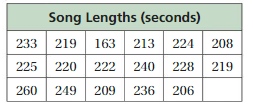
Big Ideas Math Answers 6th Grade Chapter 9 Statistical Measures crr 24
Answer:
Given the data,
233, 219, 163, 213, 224, 208, 225, 220, 222, 240, 228, 219, 260, 249, 209, 236,  206
The next song is 276 seconds long.
276 is the outliner.
We can remove 276 from the given data set.
So, there is no effect on the center and the measure of variations.

Statistical Measures Practice Test

Find the mean, median, mode, range, and interquartile range of the data.
Question 1.
5, 6, 4, 24, 10, 6, 9, 8
Answer:
Mean = (5 + 6 + 4 + 24 + 10 + 6 + 9 + 8)/8
= 72/8
= 9
Median:
4, 5, 6, 6, 8, 9, 10, 24
= (6 + 8)/2 = 14/2
= 7
Mode:
6 is the mode
range = (24 – 4)/2
= 20/2
= 10
Range:
Lowest value: 4
Highest value: 24
Range: 20
Interquartile range:
Lower quartile (xL): 5.25
Upper quartile (xU): 9.75
Interquartile range (xU-xL): 4.5

Question 2.
46, 27, 94, 56, 53, 65, 43
Answer:
Given the data,
46, 27, 94, 56, 53, 65, 43
Mean = (46 + 27 + 94 + 56 + 53 + 65 + 43)/7
= 16.75
Median = 15.5
Mode: There is no mode
Range:
Number of observations = 7
Lowest value: 27
Highest value: 94
Range: 67
Interquartile range:
Lower quartile (xL): 43
Upper quartile (xU): 65
Interquartile range (xU-xL): 22

Question 3.
32, 58, 19, 36, 44, 57, 11, 26, 74
Answer:
Given the data,
32, 58, 19, 36, 44, 57, 11, 26, 74
Mean = (32 + 58 + 19 + 36 + 44 + 57 + 11 + 26 + 74)/9
= 357/9
= 39.66
Median:
Arrange the data in ascending or descending order.
11, 19, 26, 32, 36, 44, 57, 58, 74
Median = 36
Mode: There is no mode in the data
Range:
Lowest value: 11
Highest value: 74
Range: 63
Interquartile range:
Lower quartile (xL): 22.5
Upper quartile (xU): 57.5
Interquartile range (xU-xL): 35

Question 4.
36, 24, 49, 32, 37, 28, 38, 40, 39
Answer:
Given the data
36, 24, 49, 32, 37, 28, 38, 40, 39
Arrange the data in ascending or descending order.
24, 28, 32, 36, 37, 38, 39, 40, 49
Mean = (24 + 28 + 32 + 36 + 37 + 28 + 38 + 40 + 49)/9
= 34.66
Median: 37
Mode: There is no mode
Range:
Lowest value: 24
Highest value: 49
Range: 25
Interquartile range:
Lower quartile (xL): 30
Upper quartile (xU): 39.5
Interquartile range (xU-xL): 9.5

Find and interpret the mean absolute deviation of the data.
Question 5.
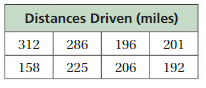
Big Ideas Math Answers Grade 6 Chapter 9 Statistical Measures pt 5
Answer:
Given the data,
312, 286, 196, 201, 158, 225, 206, 192
Mean (x̄): 0.5
Mean Absolute Deviation (MAD): 0.15

Question 6.
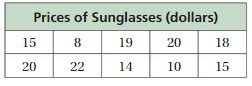
Big Ideas Math Answers Grade 6 Chapter 9 Statistical Measures pt 6
Answer:
Given the data,
15, 8, 19, 20, 18, 20, 22, 14, 10, 15
Mean (x̄): 16.1
Mean Absolute Deviation (MAD): 3.7

Question 7.
You conduct a survey to answer, “How many Times (minutes)minutes does it take a typical sixth-grade student to run a mile?” The table shows the results. Use the distribution of the data to answer the question.
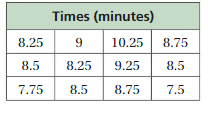
Big Ideas Math Answers Grade 6 Chapter 9 Statistical Measures pt 7
Answer:

Question 8.
The table shows the weights of Alaskan malamute 8181808281dogs at a veterinarian’s office. Which measure of center best represents the weight of an Alaskan malamute? Explain your reasoning.
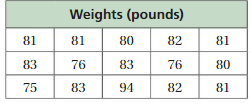
Big Ideas Math Answers Grade 6 Chapter 9 Statistical Measures pt 8
Answer:

Question 9.
The table shows the numbers of guests Numbers of Guests at a hotel on different days.
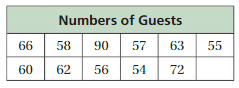
Big Ideas Math Answers Grade 6 Chapter 9 Statistical Measures pt 9
a. Find the range and interquartile range of the data.
b. Use the interquartile range to identify the outlier(s) in the data set. Find the range and interquartile range of the data set without the outlier(s). Which measure did the outlier or outliers affect more?
Answer:

Question 10.
The data sets show the numbers of hours worked each week by two people for several weeks.
Person A: 9, 18, 12, 6, 9, 21, 3, 12
Person B: 12, 18, 15, 16, 14, 12, 15, 18
Compare the measures of center and the measures of variation for each data set. What can you conclude?
Answer:

Question 11.
The table shows the lengths of several bearded dragons captured for a study. Find the mean, median, and mode of the data in centimeters and in inches. How does converting to inches affect the mean, median, and mode?
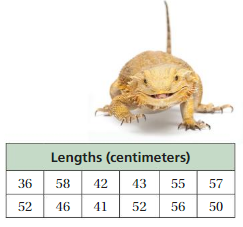
Big Ideas Math Answers Grade 6 Chapter 9 Statistical Measures pt 11
Answer:

Statistical Measures Cumulative Practice

Question 1.
Which statement can be represented by a negative integer?
A. The temperature rises 15 degrees.
B. A hot-air balloon ascends 450 yards.
C. You earn $50 completing chores.
D. A submarine submerges 260 feet.
Big Ideas Math Answers Grade 6 Chapter 9 Statistical Measures cp 1
Answer: D. A submarine submerges 260 feet.

Question 2.
What is the height h (in inches) of the prism?
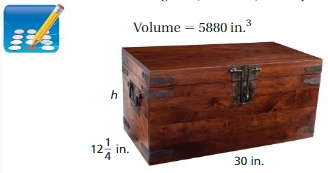
Big Ideas Math Answers Grade 6 Chapter 9 Statistical Measures cp 2
Answer:
h = v/lw
h = 5850/30(12 1/4)
h = 5850/(30 × 12.25)
h = 5850/367.50
h = 15.91 inches

Question 3.
Which is the solution of the inequality \(\frac{2}{3}\)x < 6?
F. x < 4
G. x < 5\(\frac{1}{3}\)
H. x < 6\(\frac{2}{3}\)
I. x < 9
Answer: I. x < 9

Question 4.
The number of hours that each of six students spent reading last week is shown in the bar graph.
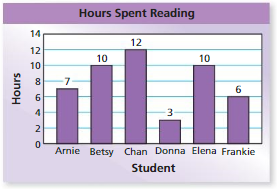
Big Ideas Math Answers Grade 6 Chapter 9 Statistical Measures cp 4
For the data in the bar graph, which measure is the?
A. mean
B. median
C. mode
D. range
Answer: C. mode

Explanation:
In the above bar graph, 10 is repeated two ways.
Thus the correct answer is option C.

Question 5.
Which list of numbers is in order from least to greatest?
F. – 5.41, – 3.6, – 3.2, – 3.06, – 1
G. – 1, – 3.06, – 3.2, – 3.6, – 5.41
H. – 5.41, – 3.06, – 3.2, – 3.6, – 1
I. – 1, – 3.6, – 3.2, – 3.06, – 5.41
Answer: F. – 5.41, – 3.6, – 3.2, – 3.06, – 1

Explanation:
We have to write the numbers from least to greatest
The negative sign with the highest number will be the least.
– 5.41, – 3.6, – 3.2, – 3.06, – 1
Thus the correct answer is option F.

Question 6.
What is the mean absolute deviation of the data shown in the dot plot, rounded to the nearest tenth?
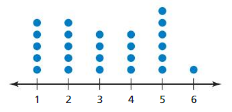
Big Ideas Math Answers Grade 6 Chapter 9 Statistical Measures cp 6
A. 1.4
B. 3
C. 3.2
D. 57.
Answer:
Data from the dot plot
5, 5, 4, 4, 6, 1
Number of observations: 6
Mean = 4.166
Mean absolute deviation = 1.66
Thus the correct answer is option A.

Question 7.
A family wants to buy tickets to a theme park. There are separate ticket prices for adults and children.

Big Ideas Math Answers Grade 6 Chapter 9 Statistical Measures cp 7
Which expression represents the total cost (in dollars) for adult tickets c and child tickets?
F. 600 (a + c)
G. 50(a × c)
H. 30a + 20c
I. 30a × 20c
Answer: H. 30a + 20c

Question 8.
The dot plot shows the leap distances (in feet) of a tree frog. How many leaps were recorded?
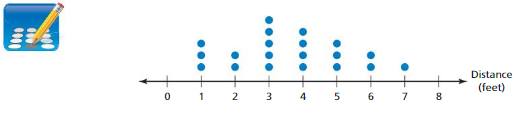
Big Ideas Math Answers Grade 6 Chapter 9 Statistical Measures cp 8
Answer: 7 leaps were recorded

Question 9.
What is the value of the expression when a = 6 and b = 14?
0.8a + 0.02b
A. 0.4828
B. 0.8814
C. 5.08
D. 16.4
Answer:
Given the expression,
0.8a + 0.02b
a = 6
b = 14
0.8(6) + 0.02(14)
4.8 + 0.28
= 5.08
Thus the correct answer is option C.

Question 10.
Which property was not used to simplify the expression?
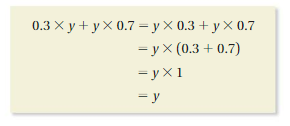
Big Ideas Math Answers Grade 6 Chapter 9 Statistical Measures cp 10
F. Distributive Property
G. Associative Property of Addition
H. Multiplication Property of One
I. Commutative Property of Multiplication
Answer: I. Commutative Property of Multiplication

Question 11.
What are the coordinates of Point P?
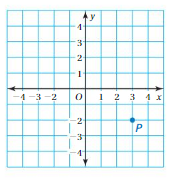
Big Ideas Math Answers Grade 6 Chapter 9 Statistical Measures cp 11
A. (- 3, – 2)
B. (3, – 2)
C. (- 2, – 3)
D. (-2, 3)
Answer: B. (3, – 2)

Explanation:
By seeing the above graph we can write the ordered pair P.
the x-axis is on 3 and the y-axis is on -2
Thus the correct answer is option B.

Question 12.
Create a data set with 5 numbers that has the following measures.
Think
Solve
Explain
• a mean of 7
• a median of 9
Explain how you created your data set.
Answer:
The data set is 3, 2, 9, 1, 20

Final Words:

I hope the article regarding the Big Ideas Math Answers Grade 6 Chapter 9 Statistical Measures is helpful for the students who are lagging in this concept. Feel free to post the comments if you have any doubts regarding the methods or answers. We will try to clarify your doubts as early as possible.

Big Ideas Math Answers Grade 6 Chapter 5 Algebraic Expressions and Properties

Get free step by step solutions to Big Ideas Math Answers Grade 6 Chapter 5 Algebraic Expressions and Properties here. The topics covered in Algebraic Expressions and Properties chapter are Algebraic Expressions, Writing Expressions, Properties of Addition and Multiplication, and so on. We have provided solutions for all the problems in an easy manner. Learn the properties with examples on this page. This Big Ideas Math Answers Grade 6 Chapter 5 Algebraic Expressions and Properties will help you to enhance your performance in math.

Big Ideas Math Book 6th Grade Answer Key Chapter 5 Algebraic Expressions and Properties

Quick and simple learning is possible only with our Big Ideas Math Book 6th Grade Solution Key Chapter 5 Algebraic Expressions and Properties. The concepts of Algebraic Expressions and Properties are well explained by the math experts. We have provided the solutions as per the list of the topics. Just tap the links and start practicing the problems for the exams and score well.

Algebraic Expressions and Properties STEAM Video/Performance

Lesson: 1 Algebraic Expressions

Lesson: 2 Writing Expressions

Lesson: 3 Properties of Addition and Multiplication

Lesson: 4 The Distributive Property

Lesson: 5 Factoring Expressions

Chapter: 5 – Algebraic Expressions and Properties

Algebraic Expressions and Properties STEAM Video/Performance

Shadow Drawings
Expressions can be used to represent the growth of living things over time. Can you think of any other real-life situations in which you would want to use an expression to represent a changing quantity?
Watch the STEAM Video “Shadow Drawings.” Then answer the following questions.

Question 1.
Tory traces the shadow of a plant each week on the same day of the week and at the same time of day. Why does she need to be so careful about the timing of the drawing?

Answer:
Tory traces the shadow of a plant each week on the same day of the week and at the same time of day.
Because she needs to represent the growth of the plant over time. Thus she needs to be very careful about the timing of the drawing.

Question 2.
The table shows the height of the plant each week for the first three weeks. About how tall was the plant after 1.5 weeks? Explain your reasoning.
Big Ideas Math Answers Grade 6 Chapter 5 Algebraic Expressions and Properties 1

Answer: 10.5 inches

Explanation:
The above table represents the height of the plant for 3 weeks.
1 week = 7 inches
0.5 week = 7/2 = 3.5 inches
1.5 week = 7 + 3.5 = 10.5 inches

Question 3.
Predict the height of the plant when Tory makes her next three weekly drawings.

Answer: 42 inches (approx)

Explanation:
The height of the plant is increased by 7 inches every week.
The height of the plant is increased to 22 inches for the first three weeks.
7 × 6 = 42 inches
Thus we predict the height of the plant when Tory makes her next three weekly drawings is 42 inches.

Performance Task

Describing Change

After completing this chapter, you will be able to use the concepts you learned to answer the questions in the STEAM Video Performance Task. You will be given data sets for the following real-life situations.
Big Ideas Math Answer Key Grade 6 Chapter 5 Algebraic Expressions and Properties 2
You will be asked to use given data to write expressions and make predictions. Do the expressions provide accurate predictions far into the future?
Big Ideas Math Answer Key Grade 6 Chapter 5 Algebraic Expressions and Properties 3

Getting Ready for Chapter 5

Question 1.
Work with a partner.
a. You baby sit for 3 hours. You receive $24. What is your hourly wage?

  • Write the problem. Underline the important numbers and units you need to solve the problem.
  • Read the problem carefully a second time. Circle the key phrase for the question.
    Big Ideas Math Answer Key Grade 6 Chapter 5 Algebraic Expressions and Properties 4
  • Write each important number or phrase, with its units, on a piece of paper. Write +, −, ×, ÷, and = on five other pieces of paper.
    Big Ideas Math Answer Key Grade 6 Chapter 5 Algebraic Expressions and Properties 5
  • Arrange the pieces of paper to answer the question, “What is your hourly wage?”
  • Evaluate the expression that represents the hourly wage.
    Big Ideas Math Answer Key Grade 6 Chapter 5 Algebraic Expressions and Properties 6

Answer:
Big-Ideas-Math-Answer-Key-Grade-6-Chapter-5-Algebraic-Expressions-and-Properties-6
According to the given details, Babysit receives $24 for 3 hours.
3 hours = $24
1 hour = 24/3 = $8
Thus your hourly wage is $8

b. How can you use your hourly wage to find how much you will receive for any number of hours worked?

Answer:
You can multiply by $8 in given any number of hours worked to get the total receive.

Vocabulary

The following vocabulary terms are defined in this chapter. Think about what each term might mean and record your thoughts.
Big Ideas Math Answer Key Grade 6 Chapter 5 Algebraic Expressions and Properties 7

Lesson 5.1 Algebraic Expressions

EXPLORATION 1
Big Ideas Math Answer Key Grade 6 Chapter 5 Algebraic Expressions and Properties 8
Work with a partner. Identify any missing information that is needed to answer each question. Then choose a reasonable quantity and write an expression for each problem. After you have written the expression, evaluate it using mental math or some other method.
Big Ideas Math Answer Key Grade 6 Chapter 5 Algebraic Expressions and Properties 9
a. You receive $24 for washing cars. How much do you earn per hour?

Answer:
Let the number of hours 8.
24 ÷ 8 = 3
Thus you earn $3 per hour.

b. You buy 5 silicone baking molds at a craft store. How much do you spend?
Big Ideas Math Answer Key Grade 6 Chapter 5 Algebraic Expressions and Properties 10

Answer:
Let the cost of each silicone baking molds is $3
5 × $3 = $15
Thus you spend $15 to buy 5 silicone baking molds.
c. You are running in a mud race. How much farther do you have to go after running 2000 feet?
Big Ideas Math Answer Key Grade 6 Chapter 5 Algebraic Expressions and Properties 11

Answer:
You are running a 4500-foot race.
4500 – 2000 = 2500 feet
Thus you have to run 2500 feet more.

d. A rattlesnake is 25 centimeters long when it hatches. The snake grows at a rate of about 1.6 centimeters per month for several months. What is the length of the rattlesnake?
Big Ideas Math Answer Key Grade 6 Chapter 5 Algebraic Expressions and Properties 12

Answer:
Given,
A rattlesnake is 25 centimeters long when it hatches. The snake grows at a rate of about 1.6 centimeters per month for several months.
Let the number of months be m
25 + 1.6m
If months = 12
1.6 × 12 = 19.2 cms
25 + 19.2 = 44.2 centimeters

5.1 Lesson

Big Ideas Math Answer Key Grade 6 Chapter 5 Algebraic Expressions and Properties 13

An algebraic expression is an expression that may contain numbers, operations, and one or more variables. A variable is a symbol that represents one or more numbers. Each number or variable by itself, or product of numbers and variables in an algebraic expression, is called a term.
Big Ideas Math Answer Key Grade 6 Chapter 5 Algebraic Expressions and Properties 14

Try It

Identify the terms, coefficients, and constants in the expression.

Question 1.
12 + 10c

Answer:
12 – constant
10 – coefficient
c – variable or term
A term without a variable is called a constant.
The numerical factor of a term that contains a variable is called a coefficient.
A variable is a symbol that represents one or more numbers. Each number or variable by itself, or product of numbers and variables in an algebraic expression, is called a term.

Question 2.
15 + 3w + \(\frac{1}{2}\)

Answer:
15 and \(\frac{1}{2}\) – constant
3 – coefficient
w – variable or term
A term without a variable is called a constant.
The numerical factor of a term that contains a variable is called a coefficient.
A variable is a symbol that represents one or more numbers. Each number or variable by itself, or product of numbers and variables in an algebraic expression, is called a term.

Question 3.
z2 + 9z

Answer:
2 – exponent
9 – coefficient
z – variable or term
An exponent is a number or letter written above and to the right of a mathematical expression called the base
The exponent tells us how many times the base is used as a factor
The numerical factor of a term that contains a variable is called a coefficient.
A variable is a symbol that represents one or more numbers. Each number or variable by itself, or product of numbers and variables in an algebraic expression, is called a term.

write the expression using exponents.

Question 4.
j . j . j . j . j . j

Answer:
j raised to the sixth power
An exponent is a number or letter written above and to the right of a mathematical expression called the base
The exponent tells us how many times the base is used as a factor

Question 5.
9 . k . k . k . k . k

Answer:
9 – constant
k raised to the fifth power
An exponent is a number or letter written above and to the right of a mathematical expression called the base
The exponent tells us how many times the base is used as a factor

Question 6.
Evaluate 24 + c when c = 9.

Answer: 33

Explanation:
Given equation
24 + c
and also given c is equal to 9
substitute c value in the equation we get
24 + 9 = 33

Question 7.
Evaluate d − 17 when d = 30.

Answer: 13

Explanation:
Given equation
d – 17
and also given d is equal to 30
substitute d value in the equation we get
30 – 17 = 13

Question 8.
Evaluate 18 ÷ q when q = \(\frac{1}{2}\)

Answer: 36

Explanation:
Given equation
18 ÷ q
and also given q is equal to \(\frac{1}{2}\)
substitute q value in the equation we get
18 ÷ \(\frac{1}{2}\) = 36

Evaluate the expression when p = 24 and q = 8.

Question 9.
p ÷ q

Answer:
p = 24
q = 8
p ÷ q
Substitute the value of p and q in the expression
24 ÷ 8 = 3

Question 10.
q + p

Answer:  32

Explanation:
Given,
p = 24
q = 8
q + p
Substitute the value of p and q in the expression
8 + 24 = 32
Hence we get the answer is 32

Question 11.
p – q

Answer: 16

Explanation:
Given,
p = 24
q = 8
p – q
Substitute the value of p and q in the expression
24 – 8 = 16
Hence we get the answer is 16

Question 12.
p . q

Answer: 192

Explanation:
Given,
p = 24
q = 8
p . q
Substitute the value of p and q in the expression
24 . 8  by multiplying 24 with 8 we get 192
Hence  the answer is 192

Evaluate the expression when y = 6.

Question 13.
5y + 1

Answer: 31

Explanation:
Given equation
5y + 1
and also given y = 6
Now substitute 6 in the given equation
5.6 + 1 is
5 multiply with 6 and then add with 1 we get 30 + 1 is 31
hence answer is 31

Question 14.
30 – 24 ÷ y

Answer: 1

Explanation:
Given equation
30 – 24 ÷ y
and also given y = 6
Now substitute 6 in the given equation
30 – 24 ÷ y is
30 – 24 ÷6
6 ÷ 6
six divided by six
we get 1
Hence answer is 1

Question 15.
y2 – 7

Answer: 29

Explanation:
Given equation
y² – 7
and also given y = 6
Now substitute 6 in the given equation
y2 – 7
6² – 7
6 × 6 – 7
36 – 7
29
Hence answer is 29

Question 16.
1.5 + y2

Answer: 37.5

Explanation:
Given equation
1.5 + y²
and also given y = 6
Now substitute 6 in the given equation
1.5 + 6²
1.5 +36
37.5
Hence answer is 37.5

Self-Assessment for Concepts & Skills

Solve each exercise. Then rate your understanding of the success criteria in your journal.

Question 17.
WHICH ONE DOESN’T BELONG?
Which expression does not belong with the other three? Explain your reasoning.
Big Ideas Math Answer Key Grade 6 Chapter 5 Algebraic Expressions and Properties 15

Answer: The expression 3(4) + 5 does not belong to the other three. Because it does not contain any variable in the expression.

Question 18.
ALGEBRAIC EXPRESSIONS
Identify the terms, coefficients, and constants in the expression 9h + 1.

Answer:
1 – constant
9 – coefficient
h – variable or term
A term without a variable is called a constant.
The numerical factor of a term that contains a variable is called a coefficient.
A variable is a symbol that represents one or more numbers. Each number or variable by itself, or product of numbers and variables in an algebraic expression, is called a term.

EVALUATING EXPRESSIONS
Evaluate the expression when m = 8.

Question 19.
m – 7

Answer: 1
Given equation
m – 7
given m value is 8
Now substitute m value 8  in the given equation we get
m – 7
8 – 7
1
Hence the answer is 1

Question 20.
5m + 4

Answer: 44
Given equation
5m + 4
given m value is 8
Now substitute m value 8  in the given equation we get
5 . 8 + 4
40 + 4
44
Hence the answer is 44

Question 21.
NUMBER SENSE
Does the value of the expression 20 − x increase, decrease, or stay the same as x increases? Explain.

Answer:
When the value of x increases, the value of 20 – x decreases. And when the value of x does not change, 20 – x remains the same. When greater values of x are subtracted from 20, you will have a lower value left. Therefore, as x increases, the value of the expression 20 – x will decrease.

Question 22.
OPEN-ENDED
Write an algebraic expression using more than one operation. When you evaluate the expression, how do you know which operation to perform first?

Answer:
Example  40 – 2(6 – 4)²
40 – 2 (2)²
40 – 2(4)
40 – 8
32

When evaluating an expression, proceed in this order:

parentheses are done first.
exponents are done next.
multiplication and division are done as they are encountered from left to right.
addition and subtraction are done as they are encountered from left to right.

Question 23.
STRUCTURE
Is the expression 8.2 ÷ m . m . m . m the same as the expression 8.2 ÷ m4? Explain your reasoning.

Answer: Yes
An exponent is a number or letter written above and to the right of a mathematical expression called the base
The exponent tells us how many times the base is used as a factor
Hence the expression 8.2 ÷ m . m . m . m the same as the expression 8.2 ÷ m⁴

Self-Assessment for Problem Solving

Solve each exercise. Then rate your understanding of the success criteria in your journal.

Question 24.
The expression 12.25m + 29.99 gives the cost (in dollars) of a gym membership for m months. You have $180 to spend on a membership. Can you buy a one-year membership?

Answer: Yes.
Given
The expression 12.25m + 29.99
gym membership for m months
You have $180 to spend on a membership
Let’s solve your equation step-by-step.
12.25m+29.99=180
Step 1: Subtract 29.99 from both sides.
12.25m+29.99−29.99=180−29.99
12.25m=150.01
Step 2: Divide both sides by 12.25.
12.25m/12.25=150.01/12.25
m=12.245714
The expression 12.25m + 29.99= 12.25(12.24)+29.99 = 179.93

Question 25.
DIG DEEPER!
The expression p −15 gives the amount (in dollars) you pay after using the coupon when the original amount of a purchase is p dollars. The expression 30 + 6n gives the amount of money (in dollars) you save after n weeks. A jacket costs $78. Can you buy the jacket after 6 weeks? Explain.
Big Ideas Math Answer Key Grade 6 Chapter 5 Algebraic Expressions and Properties 16

Answer:
The amount you pay using coupon = p (purchase) -15
so we simply plug in our value into this equation
$78- $15 = $63
so $63 is the amount you pay after using the coupon on an original purchase of $78
n = 6 weeks
30 + 6n
30 + 6(6)
30 + 36 = 66
No, you cannot buy the jacket after 6 weeks.

Algebraic Expressions Homework & Practice 5.1

Review & Refresh

You ask 40 students which of three items from the cafeteria they like the best. You record the results on the piece of paper shown.

Big Ideas Math Solutions Grade 6 Chapter 5 Algebraic Expressions and Properties 500

Question 1.
What percent of students answered salad?

Answer: 25%

Explanation:
Total number of students = 40
The number of students who like a salad in the Cafeteria food is 10 students
40/10 = 4
The percentage of the students is
(10/40) × 100 = 25%
Thus the percentage of students who answered salad is 25%.

Question 2.
How many students answered pizza?

Answer: 12 students

Explanation:
Total number of students = 40
The number of students who like a salad in the Cafeteria food is 10 students
The number of students who answered pasta is 18
40 – 18 – 10 = 12
Thus the number of students who answered pizza is 12.

Question 3.
What percent of students answered pasta?

Answer: 45%

Explanation:
Total number of students = 40
The number of students who answered pasta is 18
(18/40) × 100 = 45
Thus the percentage of students who answered pasta is 45%

Find the missing quantity in the double number line.

Question 4.
Big Ideas Math Answer Key Grade 6 Chapter 5 Algebraic Expressions and Properties 17

Answer:
Big-Ideas-Math-Answer-Key-Grade-6-Chapter-5-Algebraic-Expressions-and-Properties-17
The ratio of 2 and 10 is 1:5
The equivalent ratio of 1:5 is 6:30
So, the missing quantity is 6.

Question 5.
Big Ideas Math Answer Key Grade 6 Chapter 5 Algebraic Expressions and Properties 18

Answer:
Based on the ratios we can find the missing quantity.
The cost of 1 pastry is $2.5
The cost of 9 pastries is $22.5
Big-Ideas-Math-Answer-Key-Grade-6-Chapter-5-Algebraic-Expressions-and-Properties-18

Divide. Write the answer in simplest form.

Question 6.
1\(\frac{3}{8}\) ÷ \(\frac{3}{4}\)

Answer: \(\frac{1}{2}\)
To simplify a fraction, divide the top and bottom by the highest number that
can divide into both numbers exactly.
Simplifying (or reducing) fractions means making the fraction as simple as possible

Question 7.
2\(\frac{7}{9}\) ÷ 2

Answer: \(\frac{7}{9}\)
To simplify a fraction, divide the top and bottom by the highest number that
can divide into both numbers exactly.
Simplifying (or reducing) fractions means making the fraction as simple as possible

Question 8.
4 ÷ 4\(\frac{2}{5}\)

Answer: \(\frac{5}{2}\)
To simplify a fraction, divide the top and bottom by the highest number that
can divide into both numbers exactly.
Simplifying (or reducing) fractions means making the fraction as simple as possible

Question 9.
3\(\frac{2}{3}\) ÷ 1\(\frac{2}{7}\)

Answer: latex]\frac{14}{3}[/latex]
To simplify a fraction, divide the top and bottom by the highest number that
can divide into both numbers exactly.
Simplifying (or reducing) fractions means making the fraction as simple as possible

Concepts, Skills, & Problem Solving

EVALUATING EXPRESSIONS
Write and evaluate an expression for the problem. (See Exploration 1, p. 201.)

Question 10.
The scores on your first two history tests are 82 and 95. By how many points did you improve on your second test?

Answer: 13

Explanation:
The scores on your first two history tests are 82 and 95.
95 – 82 = 13
Thus you have to improve 13 points on your second test.

Question 11.
You buy a hat for $12 and give the cashier a $20 bill. How much change do you receive?

Answer: $8

Explanation:
Given,
You buy a hat for $12 and give the cashier a $20 bill.
20 – 12 = 8
Thus you receive $8 change.

Question 12.
You receive $8 for raking leaves for 2 hours. What is your hourly wage?

Answer: $4

Explanation:
Given,
You receive $8 for raking leaves for 2 hours.
2 hour = $8
1 hour = ?
8/2 = 4
Thus the hourly wage is $4.

Question 13.
Music lessons cost $20 per week. How much do 6 weeks of lessons cost?

Answer: $120

Explanation:
Given,
Music lessons cost $20 per week.
1 week = $20
$20 × 6 = $120
Thus the cost of 6 weeks is $120.

ALGEBRAIC EXPRESSIONS
Identify the terms, coefficients, and constants in the expression.

Question 14.
7h + 3

Answer:
3 – constant
7 – coefficient
h – variable or term
A term without a variable is called a constant.
The numerical factor of a term that contains a variable is called a coefficient.
A variable is a symbol that represents one or more numbers. Each number or variable by itself, or product of numbers and variables in an algebraic expression, is called a term.

Question 15.
g + 12 + 9g

Answer:
12 – constant
9 – coefficient
g – variable or term
A term without a variable is called a constant.
The numerical factor of a term that contains a variable is called a coefficient.
A variable is a symbol that represents one or more numbers. Each number or variable by itself, or product of numbers and variables in an algebraic expression, is called a term.

Question 16.
5c2 + 7d

Answer:
2 – exponent
5 and 7 – coefficient
c and d – variable or term
An exponent is a number or letter written above and to the right of a mathematical expression called the base
The exponent tells us how many times the base is used as a factor
The numerical factor of a term that contains a variable is called a coefficient.
A variable is a symbol that represents one or more numbers. Each number or variable by itself, or product of numbers and variables in an algebraic expression, is called a term.

Question 17.
2m2 + 15 + 2p2

Answer:
15 – constant
2 – exponent
2 – coefficient
m and p – variable or term
A term without a variable is called a constant.
An exponent is a number or letter written above and to the right of a mathematical expression called the base
The exponent tells us how many times the base is used as a factor
The numerical factor of a term that contains a variable is called a coefficient.
A variable is a symbol that represents one or more numbers. Each number or variable by itself, or product of numbers and variables in an algebraic expression, is called a term.

Question 18.
6 + n2 + \(\frac{1}{2}\)d

Answer:
6 – constant
\(\frac{1}{2}\)– exponent
2 – coefficient
n and d – variable or term
A term without a variable is called a constant.
An exponent is a number or letter written above and to the right of a mathematical expression called the base
The exponent tells us how many times the base is used as a factor
The numerical factor of a term that contains a variable is called a coefficient.
A variable is a symbol that represents one or more numbers. Each number or variable by itself, or product of numbers and variables in an algebraic expression, is called a term.

Question 19.
Big Ideas Math Answer Key Grade 6 Chapter 5 Algebraic Expressions and Properties 19

Answer:
2 – exponent
8 and \(\frac{1}{3}\)– coefficient
x – variable or term
A term without a variable is called a constant.
An exponent is a number or letter written above and to the right of a mathematical expression called the base
The exponent tells us how many times the base is used as a factor
The numerical factor of a term that contains a variable is called a coefficient.
A variable is a symbol that represents one or more numbers. Each number or variable by itself, or product of numbers and variables in an algebraic expression, is called a term.

Question 20.
YOU BE THE TEACHER
Your friend finds the terms, coefficients, and constants in the algebraic expression 2x2y. Is your friend correct? Explain your reasoning.
Big Ideas Math Answer Key Grade 6 Chapter 5 Algebraic Expressions and Properties 20

Answer:
Big-Ideas-Math-Answer-Key-Grade-6-Chapter-5-Algebraic-Expressions-and-Properties-20
A term without a variable is called a constant.
An exponent is a number or letter written above and to the right of a mathematical expression called the base
The exponent tells us how many times the base is used as a factor
The numerical factor of a term that contains a variable is called a coefficient.
A variable is a symbol that represents one or more numbers. Each number or variable by itself, or product of numbers and variables in an algebraic expression, is called a term.

Question 21.
PERIMETER
You can use the expression 2ℓ + 2w to find the perimeter of a rectangle, where ℓ is the length and w is the width.
a. Identify the terms, coefficients, and constants in the expression.
Big Ideas Math Answer Key Grade 6 Chapter 5 Algebraic Expressions and Properties 21

Answer:
Given Expression 2ℓ + 2w
The coefficients of the expression are 2.
terms – l, w
b. Interpret the coefficients of the terms.

Answer: The coefficients of the terms are 2, 2
2 + 2 = 4

USING EXPONENTS
Write the expression using exponents.

Question 22.
b . b . b

Answer:
b raised to the third power
An exponent is a number or letter written above and to the right of a mathematical expression called the base
The exponent tells us how many times the base is used as a factor

Question 23.
g . g . g . g . g

Answer:
g raised to the fifth power
An exponent is a number or letter written above and to the right of a mathematical expression called the base
The exponent tells us how many times the base is used as a factor

Question 24.
8 . w . w . w . w

Answer:
8 – constant
w raised to the fourth power
An exponent is a number or letter written above and to the right of a mathematical expression called the base
The exponent tells us how many times the base is used as a factor

Question 25.
5 . 2 . y . y . y

Answer:
5 and 2 – constant
y raised to the third power
An exponent is a number or letter written above and to the right of a mathematical expression called the base
The exponent tells us how many times the base is used as a factor

Question 26.
a . a . c . c

Answer:
a and c  raised to the two power
An exponent is a number or letter written above and to the right of a mathematical expression called the base
The exponent tells us how many times the base is used as a factor

Question 27.
2 . 1 . x . z . z .z . z

Answer:
2 and 1 – constant
x raised to the 1 power
z raised to the fourth power
An exponent is a number or letter written above and to the right of a mathematical expression called the base
The exponent tells us how many times the base is used as a factor

Question 28.
YOU BE THE TEACHER
Your friend writes the product using exponents. Is your friend correct? Explain your reasoning.
Big Ideas Math Answer Key Grade 6 Chapter 5 Algebraic Expressions and Properties 22

Answer: correct
5  – constant
n  raised to the fourth power
An exponent is a number or letter written above and to the right of a mathematical expression called the base
The exponent tells us how many times the base is used as a factor

Question 29.
AREA
Write an expression using exponents that represents the area of the square.
Big Ideas Math Answer Key Grade 6 Chapter 5 Algebraic Expressions and Properties 23

Answer:
Side = 5d
Area of the square = s × s
A = 5d × 5d
A = 25d²

Question 30.
REASONING
Suppose the man in the St. Ives poem has x wives, each wife has x sacks, each sack has x cats, and each cat has x kits. Write an expression using exponents that represent the total number of kits, cats, sacks, and wives.
Big Ideas Math Answer Key Grade 6 Chapter 5 Algebraic Expressions and Properties 24

Answer:
Suppose the man in the St. Ives poem has x wives, each wife has x sacks, each sack has x cats, and each cat has x kits.
x = 7
7 × 7 × 7 × 7

EVALUATING EXPRESSIONS
Evaluate the expression when a = 3, b = 2, and c = 12.

Question 31.
6 + a

Answer: 9

Explanation:
Given equation
6 + a
given data
a = 3
now substitute given data in the equation we get
6 + 3 = 9
hence the answer is 9

Question 32.
b.5

Answer: 10

Explanation:
Given equation
b.5
given data
b = 2
now substitute given data in the equation we get
2 . 5= 10 (2 multiply by 5)
hence the answer is 10

Question 33.
c – 1

Answer: 11

Explanation:
Given equation
c – 1
given data
c = 12
now substitute given data in the equation we get
12 – 1 = 11
hence the answer is 11

Question 34.
27 ÷ a

Answer: 9

Explanation:
Given equation
27 ÷a
given data
a = 3
now substitute given data in the equation we get
27 ÷ 3 = 9
Hence the answer is 9

Question 35.
12 – b

Answer: 10

Explanation:
Given equation
12 -b
given data
b = 2
now substitute given data in the equation we get
12 – 2 = 10
Hence the answer is 10

Question 36.
c + 5

Answer: 17

Explanation:
Given equation
c + 5
given data
c = 12
now substitute given data in the equation we get
12+ 5 = 17
Hence the answer is 17

Question 37.
2a

Answer: 6

Explanation:
Given equation
2a
given data
a = 3
now substitute given data in the equation we get
2(3) = 6
Hence the answer is 6

Question 38.
c ÷ 6

Answer: 2

Explanation:
Given equation
c ÷ 6
given data
c = 12
now substitute given data in the equation we get
12 ÷ 6 = 2
Hence the answer is 2

Question 39.
a + b

Answer: 5

Explanation:
Given equation
a + b
given data
a = 3, b = 2
now substitute given data in equation we get
3 + 2 = 5
hence the answer is 5

Question 40.
c + a

Answer: 15

Explanation:
Given equation
a + b
given data
a = 3, b = 2
now substitute given data in equation we get
3 + 2 = 5
hence the answer is 5

Question 41.
c – a

Answer: 11

Explanation:
Given equation
c – a
given data
a = 3, c = 12
now substitute given data in equation we get
12 – 3 = 11
hence the answer is 11

Question 42.
a – b

Answer: 1

Explanation:
Given equation
a – b
given data
a = 3, b = 2
now substitute given data in equation we get
3 – 2 = 1
hence the answer is 1

Question 43.
\(\frac{c}{a}\)

Answer: 4

Explanation:
Given equation
\(\frac{c}{a}\)
given data
a = 3, c = 12
now substitute given data in equation we get
\(\frac{12}{3}\) = 4
hence the answer is 4

Question 44.
\(\frac{c}{b}\)

Answer: 6

Explanation:
Given equation
\(\frac{c}{b}\)
given data
b = 2, c = 12
now substitute given data in equation we get
\(\frac{12}{2}\) = 6
hence the answer is 6

Question 45.
b.c

Answer: 24

Explanation:
Given equation
b . a
given data
b = 2, c = 12
now substitute given data in equation we get
2(12) = 24
hence the answer is 24

Question 46.
c(a)

Answer: 36

Explanation:
Given equation
c(a)
given data
a = 3, c = 12
now substitute given data in equation we get
12(3) = 36
hence the answer is 36

Question 47.
PROBLEM SOLVING
You earn 15n dollars for mowing n lawns. How much do you earn for mowing 1 lawn? 7 lawns?

Answer:
Given,
You earn 15n dollars for mowing n lawns.
n = 1
15 × 1 = 15
n = 7
15 × 7 = 105
Thus you earn $15 for mowing 1 lawn and $105 for mowing 7 lawns.

EVALUATING EXPRESSIONS
Copy and complete the table.

Question 48.
Big Ideas Math Answer Key Grade 6 Chapter 5 Algebraic Expressions and Properties 25

Answer:
Big-Ideas-Math-Answer-Key-Grade-6-Chapter-5-Algebraic-Expressions-and-Properties-25
Explanation:
Given data from the table
x = 3 ,6, and 9
substitute x values in the given equation x . 8
3(8) = 24
6(8) = 48
9(8) = 72

Question 49.
Big Ideas Math Answer Key Grade 6 Chapter 5 Algebraic Expressions and Properties 26

Answer:
Big-Ideas-Math-Answer-Key-Grade-6-Chapter-5-Algebraic-Expressions-and-Properties-26
Explanation:
Given data from the table
x = 2 ,4, and 8
substitute x values in the given equation 64 ÷ x = 24
64 ÷ 2 = 32
64 ÷ 4 = 16
64 ÷ 8 = 8

Question 50.
MODELING REAL LIFE
Due to gravity, an object falls 16t2 feet in t seconds. You drop a rock from a bridge that is 75 feet above the water. Will the rock hit the water in 2 seconds? Explain.

Answer:  No
Given
Due to gravity, an object falls 16t2 feet in t seconds. You drop a rock from a bridge that is 75 feet above the water
d = 16t² (d in ft, t in sec)
Set d = 75 ft and solve for t.
75 = 16t²
t = √(75/16) sec ≅ 2.17 sec
It hits the water in 2.17 sec.

EVALUATING EXPRESSIONS
Evaluate the expression when a = 10, b = 9, and c = 4.

Question 51.
2a + 3

Answer: 23
Given equation
2a + 3
given data
a = 10,
now substitute given data in equation we get
2(10)+3
= 20 + 3
= 23
hence the answer is 23

Question 52.
4c – 7.8

Answer:
Given equation
4c – 7.8
given data
a = 10,
now substitute given data in equation we get
4(4) – 7.8
= 16 – 7.8
= 8.2
Hence the answer is 8.2

Question 53.
\(\frac{a}{4}\) + \(\frac{1}{3}\)

Answer: \(\frac{17}{6}\) or 2.83
Given equation
\(\frac{a}{4}\) + \(\frac{1}{3}\)
given data
a = 10,
now substitute given data in equation we get
\(\frac{10}{4}\) + \(\frac{1}{3}\)
= \(\frac{17}{6}\)
= 2.83
hence the answer is \(\frac{17}{6}\) or 2.83

Question 54.
\(\frac{24}{b}\) + 8

Answer:
\(\frac{32}{3}\) or 10.66
Given equation
\(\frac{24}{b}\) + 8
given data
b = 9,
now substitute given data in equation we get
\(\frac{24}{9}\) + 8
= \(\frac{8}{3}\) + 8
= \(\frac{32}{3}\)
= 10.66
Hence the answer is \(\frac{32}{3}\) or 10.66

Question 55.
c2 + 6

Answer: 22
Given equation
c² + 6
given data
c = 4,
now substitute given data in equation we get
c² + 6
= 4² + 6
= (4 × 4) + 6
= 16 + 6
= 22
Hence the answer is 22

Question 56.
a2 – 18

Answer: 82
Given equation
a² – 18
given data
a = 10,
now substitute given data in equation we get
a² – 18
= 10² – 18
= (10 × 10) – 18
= 100 – 18
= 82
Hence the answer is 82

Question 57.
a + 9c

Answer: 40
Given equation
a  + 9c
given data
a = 10, c = 4
now substitute given data in equation we get
10 + 9(4)
= 10 + 36
= 46
Hence the answer is 46

Question 58.
bc + 12.3

Answer: 48.3
bc + 12.3
given data
b = 9, c = 4
now substitute given data in equation we get
9(4) + 12.3
= 36 + 12.3
= 48.3
Hence the answer is 48.3

Question 59.
3a + 2b – 6c

Answer: 24
3a + 2b – 6c
given data
a = 10, b = 9, c = 4
now substitute given data in equation we get
3(10) + 2(9) – 6(4)
= 30 + 18 – 24
= 24
Hence the answer is 24

Question 60.
YOU BE THE TEACHER
Your friend evaluates the expression when m = 8. Is your friend correct? Explain your reasoning.
Big Ideas Math Answer Key Grade 6 Chapter 5 Algebraic Expressions and Properties 27

Answer:  incorrect.

Explanation:
Given the expression 5m + 3
m = 8
5 × 8 + 3
40 + 3 = 43
By this we can say that your friend is incorrect.

Question 61.
PROBLEM SOLVING
After m months, the height of a plant is (10 + 3m) millimeters. How tall is the plant after 8 months? 3 years?

Answer:
8 months = 34 millimeters
EXPLANATION:
You have to plug in the number 8 as “m” in the equation then solve. 10 + 3(8)
3 years = 118 millimeters
3 years converted to months would be 12×3 which equals 36. Then put it into the equation 10 + 3(36) and you do the multiplication first.

Question 62.
STRUCTURE
You use a video streaming service to rent x new releases and y standard rentals. Which expression tells you how much money you will need?
Big Ideas Math Answer Key Grade 6 Chapter 5 Algebraic Expressions and Properties 28
Big Ideas Math Answer Key Grade 6 Chapter 5 Algebraic Expressions and Properties 29

Answer:
4x+3y

Explanation:
It is given that,
The number of new releases are represented by ‘x’ and number of standard rentals are represented by ‘y’.
Also, the cost for one new release = $4 and the cost of one standard rental = $3.
Thus, the cost of ‘x’ new releases = $4x and the cost of ‘y’ new releases = $3y.
So, the total cost = cost of ‘x’ new releases + cost of ‘y’ standard rentals.
i.e. Total cost = 4x + 3y in dollars.
Thus, the expression to tell the money required is 4x+3y.

Question 63.
OPEN-ENDED
You float 2000 feet along a lazy river water ride. The ride takes less than 10 minutes. Give two examples of possible times and speeds.

Answer:
if you travel at 200 feet per minute you can make in ten minutes

Question 64.
DIG DEEPER!
The expression 20a + 13c is the cost (in dollars) for a adults and c students to enter a science center.
a. How much does it cost for an adult? a student? Explain your reasoning.

Answer:
It costs $20 per adult. If this is a cost function,
which it is because the wording is “the cost (in dollars) for adults and c students”, the adult is the cost for 1 adult, 1a, is 20.
That relates the number of adults to the cost of 1 adult.
It costs $13 per student. Again, this is a cost function, so since the student is c,
the cost for 1 student, 1c, is 13. That relates the number of students to the cost of 1 student.

b. Find the total cost for 4 adults and 24 students.

Answer:
The total cost for 4 adult and 24 students looks like this:
20(4) + 13(24) which is 80 + 312 = $392

c. You find the cost for a group. Then the numbers of adults and students in the group both double. Does the cost double? Explain your answer using an example.

Answer:
If you have 3 adults and 3 students in your group, the cost is 20(3) + 13(3) which is $99.
If you double the number of each, let’s see if the cost doubles.
We will “up” the numbers to 6 each. 20(6) + 13(6) = $198. Is $198 the double of $99.
Yes it is. Let’s do it again to check. Let’s double the 6.
20(12) + 13(12) = $396, and $198 doubled does in fact equal $396

d. In part(b), the number of adults is cut in half, but the number of students doubles. Is the cost the same? Explain your answer.

Answer:
20(12) + 13(12) = $396, and $198 doubled does in fact equal $396.

Question 65.
REASONING
The volume of the cube (in cubic inches) is equal to four times the area of one of its faces (in square inches). What is the volume of the cube?
Big Ideas Math Answer Key Grade 6 Chapter 5 Algebraic Expressions and Properties 30

Answer:
Given,
The volume of the cube (in cubic inches) is equal to four times the area of one of its faces (in square inches).
We know that,
The volume of a cube = x³
Multiply 3 sides = x × x × x = x³

Lesson 5.2 Writing Expressions

EXPLORATION 1
Writing Expressions
Work with a partner. You use a $20 bill to buy lunch at a café. You order a sandwich from the menu board shown.
Big Ideas Math Answer Key Grade 6 Chapter 5 Algebraic Expressions and Properties 31
a. Complete the table. In the last column, write a numerical expression for the amount of change you receive.
Big Ideas Math Answer Key Grade 6 Chapter 5 Algebraic Expressions and Properties 32

Answer:
Big-Ideas-Math-Answer-Key-Grade-6-Chapter-5-Algebraic-Expressions-and-Properties-32
b. Write an algebraic expression that represents the amount of change you receive when you order any sandwich from the menu board.

Answer:
You have only $20 for lunch, so if you order any sandwich from the menu
the board then the amount will be change
if you ordered chicken salad then your changing amount is
price = $ 4.95
change Received = $20 – $4.95 = $15.05
change Received = $15.05

c. The expression 20 − 4.65 represents the amount of change one customer receives after ordering from the menu board. Explain what each part of the expression represents. Do you know what the customer ordered? Explain your reasoning.
Big Ideas Math Answer Key Grade 6 Chapter 5 Algebraic Expressions and Properties 32.1

Answer:
calculated changing amount for chicken salad in part (b),
so comparison between chicken salad expression and beef expression
For Chicken salad
Price = $4.95
change Recived = $20 – $4.95 = $15.05
change Recieved = $15.05
For Roast Beef
price = $6.75
Change Recived = $20 – $6.75 = $13.25
change Recived = $13.25

5.2 Lesson

Some words can imply math operations.
Big Ideas Math Answer Key Grade 6 Chapter 5 Algebraic Expressions and Properties 33

Try It

Write the phrase as an expression.

Question 1.
the sum of 18 and 35

Answer: 53
Given
the sum of 18 and 35
so by add 18 with 35
we get 18+35
=53
So the answer is 53

Question 2.
6 times 50

Answer: 300
given
6 times 50
so multiply 6 with 50 we get
300
Hence the answer is 300

Write the phrase as an expression.

Question 3.
25 less than a number b

Answer: b – 25

Question 4.
a number x divided by 4

Answer:  \(\frac{x}{4}\)

Question 5.
the total of a number t and 11

Answer: t + 11

Question 6.
100 decreased by a number k.

Answer: 100 – k

Try It

Question 7.
Your friend has 5 more than twice as many game tokens as you. Let t be the number of game tokens you have. Write an expression for the number of game tokens your friend has.

Answer: 5+2t
given
Your friend has 5 more than twice as many game tokens as you
5+2t because 5 more then is adding 5 and twice as many is doubling or multiplying by 2

Self-Assessment for Concepts & Skills
Solve each exercise. Then rate your understanding of the success criteria in your journal.

WRITING EXPRESSIONS
Write the phrase as an expression.

Question 8.
the sum of 7 and 11

Answer: 7 + 11 we get 18

Question 9.
5 subtracted from 9

Answer: 9 – 5 we get 4

Question 10.
DIFFERENT WORDS, SAME QUESTION
Which is different? Write “both” expressions.
Big Ideas Math Answer Key Grade 6 Chapter 5 Algebraic Expressions and Properties 34

Answer: 12 more than x and x increased by 12 has different words but the question is same.

Question 11.
PRECISION
Your friend says that the phrases below have the same meaning. Is your friend correct? Explain your reasoning.
Big Ideas Math Answer Key Grade 6 Chapter 5 Algebraic Expressions and Properties 35

Answer: No your friend is incorrect.
“the difference of number x and 12” is x – 12
“the diffrence of 12 and number x” is 12 – x

Self-Assessment for Problem Solving

Solve each exercise. Then rate your understanding of the success criteria in your journal.

Question 12.
A company rents paddleboards by charging a rental fee plus an hourly rate. Write an expression that represents the cost (in dollars) of renting a paddleboard for h hours. How much does an eight-hour rental cost?
Big Ideas Math Answer Key Grade 6 Chapter 5 Algebraic Expressions and Properties 36

Answer:
The independent variable is that whose values do not take into account the values of other variables.
That is the time in hours for this item. Then, for the dependent variable, the answer would be the cost of renting.
The value of the dependent variable is based on the changes done in the values of the independent variable.

Question 13.
DIG DEEPER!
A county fair charges an entry fee of $7 and $0.75 for each ride token. You have $15. Write an expression that represents the amount (in dollars) you have left after entering the fair and purchasing n tokens. How many tokens can you purchase? How much money do you have left after purchasing 6 tokens?
Big Ideas Math Answer Key Grade 6 Chapter 5 Algebraic Expressions and Properties 37

Answer:
Given,
A county fair charges an entry fee of $7 and $0.75 for each ride token.
You have $15.
15.00 – 7.00 = 8.00
6 x .75 = 4.50
8.00- 4.5 = 3.50

Writing Expressions Homework & Practice 5.2

Review & Refresh

Identify the terms, coefficients, and constants in the expression.

Question 1.
4f + 8

Answer:
8 – constant
4 – coefficient
f- variable or term
A term without a variable is called a constant.
The numerical factor of a term that contains a variable is called a coefficient.
A variable is a symbol that represents one or more numbers. Each number or variable by itself, or product of numbers and variables in an algebraic expression, is called a term.

Question 2.
\(\frac{4}{5}\) + 3s + 2

Answer:
\(\frac{4}{5}\) and 2 – constant
3 – coefficient
s- variable or term
A term without a variable is called a constant.
The numerical factor of a term that contains a variable is called a coefficient.
A variable is a symbol that represents one or more numbers. Each number or variable by itself, or product of numbers and variables in an algebraic expression, is called a term.

Question 3.
9h2 + \(\frac{8}{9}\)p + 1

Answer:
1 – constant
2 – exponent
9 and \(\frac{8}{9}\)  – coefficient
h and p – variable or term
An exponent is a number or letter written above and to the right of a mathematical expression called the base
The exponent tells us how many times the base is used as a factor
The numerical factor of a term that contains a variable is called a coefficient.
A variable is a symbol that represents one or more numbers. Each number or variable by itself, or product of numbers and variables in an algebraic expression, is called a term.

Copy and complete the statement.

Question 4.
Big Ideas Math Answer Key Grade 6 Chapter 5 Algebraic Expressions and Properties 38

Answer: 7.5 gallon per hour

Explanation:
Convert from cup per minute to gallon per hour
1 Cup per minute = 3.75 gallon per hour
2 cup per minute = 2 × 3.75 = 7.5 gallon per hour

Question 5.
Big Ideas Math Answer Key Grade 6 Chapter 5 Algebraic Expressions and Properties 39

Answer: 2362.2 feet per minute

Explanation:
Convert from meter per second to feet per minute
1 meter per second = 196.85 feet per minute
12 minute per second = 2362.2 feet per minute

Question 6.
Big Ideas Math Answer Key Grade 6 Chapter 5 Algebraic Expressions and Properties 40

Answer: 4898.79 kg per hour

Explanation:
Convert from lb per second to kg per hour
1 lb per second = 1632.93 kg per hour
3 lb per second = 4898.79 kg per hour

Divide. Write the answer in simplest form.

Question 7.
Big Ideas Math Answer Key Grade 6 Chapter 5 Algebraic Expressions and Properties 41

Answer:  \(\frac{8}{9}\) or 0.533

Explanation:
by dividing \(\frac{1}{2}\) with \(\frac{5}{8}\)
we get \(\frac{1}{2}\) ÷ \(\frac{5}{8}\)
\(\frac{8}{9}\)
0.533

Question 8.
Big Ideas Math Answer Key Grade 6 Chapter 5 Algebraic Expressions and Properties 42

Answer: \(\frac{4}{9}\)

Explanation:
by dividing \(\frac{1}{3}\) with \(\frac{3}{4}\)
we get \(\frac{1}{3}\) ÷ \(\frac{3}{4}\)
\(\frac{4}{9}\)
0.44

Question 9.
Big Ideas Math Answer Key Grade 6 Chapter 5 Algebraic Expressions and Properties 43

Answer: \(\frac{2}{15}\) or 0.133

Explanation:
by dividing \(\frac{2}{5}\) with \(\frac{3}{1}\)
we get \(\frac{2}{5}\) ÷ \(\frac{3}{1}\)
\(\frac{2}{15}\)
0.133

Question 10.
Big Ideas Math Answer Key Grade 6 Chapter 5 Algebraic Expressions and Properties 44

Answer: \(\frac{7}{2}\) or 3.5

Explanation:
by dividing \(\frac{3}{1}\) with \(\frac{6}{7}\)
we get \(\frac{3}{1}\) ÷ \(\frac{6}{7}\)
\(\frac{7}{2}\)
3.5

Concepts, Skills, & Problem Solving

STRUCTURE
The expression represents the amount of change you receive after buying n sandwiches. Explain what each part of the expression represents. (See Exploration 1, p. 209.)

Question 11.
10 – 5.25n

Answer:
Let us assume that you buy 1 sandwich.
10 – 5.25(1)
= 10 – 5.25
= 4.75

Question 12.
20 – 4.95n

Answer:
Let us assume that you buy 2 sandwiches.
20 – 4.95(2)
20 – 9.9 = 10.1

Question 3.
100 – 6.75n

Answer:
Let us assume that you buy 6 sandwiches.
100 – 6.75(6)
= 100 – 40.50
= 59.50

WRITING EXPRESSIONS
Write the phrase as an expression.

Question 14.
5 less than 8

Answer: 5 < 8

Explanation:
The phrase “less than” indicates < symbol.
So, the expression is 5 < 8

Question 15.
the product of 3 and 12

Answer: 3 × 12

Explanation:
The phrase “product” indicates multiplication.
So, the expression is 3 × 12

Question 16.
28 divided by 7

Answer: 28 ÷ 7

Explanation:
The phrase “divided by” indicates ÷ symbol
So, the expression is 28 ÷ 7

Question 17.
the total of 6 and 10

Answer: 6 + 10 = 16

Explanation:
The phrase “total” indicates ‘+’ symbol.
So, the expression is 6 + 10 = 16

Question 18.
3 fewer than 18

Answer: 18 – 3

Explanation:
The phrase fewer than indicates ‘subtraction’
So, the expression is 18 – 3

Question 19.
17 added to 15

Answer: 17 + 15

Explanation:
Given 17 added to 15
so add 17 with 15

Question 20.
13 subtracted from a number x

Answer: 13 – x

Explanation:
The number represents the variable x
So here we have to subtract number x from 13
That gives the expression 13 – x

Question 21.
5 times a number d

Answer: 5d

Explanation:
The number represents variable d.
The word “times” represents ×
So the expression is 5d

Question 22.
the quotient of 18 and a number a

Answer: 18 ÷ a

Explanation:
a represents the number
So, the expression would be 18 ÷ a

Question 23.
the difference of a number s and 6

Answer: s – 6

Question 24.
7 increased by a number w

Answer: 7 + w

Question 25.
a number t cubed

Answer: t³

YOU BE THE TEACHER
Your friend writes the phrase as an expression. Is your friend correct? Explain your reasoning.

Question 26.
Big Ideas Math Answer Key Grade 6 Chapter 5 Algebraic Expressions and Properties 45

Answer: incorrect

Explanation:
Given,
The quotient of 8 and a number is y is 8 ÷ y
By this, we can say that your friend is incorrect.

Question 27.
Big Ideas Math Answer Key Grade 6 Chapter 5 Algebraic Expressions and Properties 46

Answer: correct

Explanation:
Given,
16 decreased by a number x
It means we have to subtract x from 16.
Thus the expression is 16 – x.

Question 28.
NUMBER SENSE
Five friends share the cost of a dinner equally.
a. Write an expression that represents the cost (in dollars) per person.

Answer: 600 ÷ p

b. Make up a reasonable total cost and test your expression.

Answer:
The total cost of dinner is $600.
Now divide the cost per person.
There are 5 friends.
The expression is 600 ÷ p
p = 5
600 ÷ 5 = 12
The cost per person is $120

Question 29.
MODELING REAL LIFE
A biologist analyzes 15 bacteria samples each day.
a. Copy and complete the table.
b. Write an expression that represents the total number of samples analyzed after n days.
Big Ideas Math Answer Key Grade 6 Chapter 5 Algebraic Expressions and Properties 47

Answer:
Big-Ideas-Math-Answer-Key-Grade-6-Chapter-5-Algebraic-Expressions-and-Properties-47
The expression that represents the total number of samples analyzed after n days is 15n

Question 30.
PROBLEM SOLVING
To rent a moving truck for the day, it costs $33 plus $1 for each mile driven.
a. Write an expression that represents the cost (in dollars) to rent the truck.

Answer: 33 + d
b. You drive the truck 300 miles. How much do you pay?

Answer:
Use the expression 33 + d to find how much do you pay.
33 + 300 = 333
Thus you pay $333 for 300 miles.

WRITING PHRASES
Give two ways to write the expression as a phrase.

Question 31.
n + 6

Answer:
According to the given details, we can write the expression in two ways
a number n more than 6
the sum of a number n and 6

Question 32.
4w

Answer:
According to the given details, we can write the expression in two ways
a number w is four times
The product of 4 and a number w

Question 33.
15 – b

Answer:
According to the given details we can write the expression in two ways.
15 decreased by a number d
The difference of 15 and a number b

Question 34.
14 – 3z

Answer:
According to the given details, we can write the expression in two ways.
The product of 3 and z subtracted from 14.
The difference of 14 and product of 3 and a number z.

EVALUATING EXPRESSIONS
Write the phrase as an expression. Then evaluate the expression when x = 5 and y = 20.

Question 35.
3 less than the quotient of a number y and 4

Answer:
given 3 less than the quotient of a number y and 4
The quotient of a number y and 4
Now we are given that 3 less than the quotient of a number y and 4
So, \(\frac{y}{4}\) – 3
Hence the expression becomes \(\frac{y}{4}\) – 3

Question 36.
the sum of a number x and 4, all divided by 3

Answer:
given
a sum, x and 4, so that becomes x + 4
All divided by denotes that we need to do the addition before division, so we need to put it in parentheses:
(x + 4)
And it is divided by 3.
So you can write the answer down in a few different ways:
(x + 4) ÷ 3
(x + 4) / 3
\(\frac{x + 4}{3}\)

Question 37.
6 more than the product of 8 and a number x

Answer:
A Product is an answer to a multiplication.
The product of 8 and a number is 8×n=8n
6 more than that means to add on 6
So the expression “6 more than the product of 8 and a number” is
8n+6

Question 38.
the quotient of 40 and the difference of a number y and 16

Answer:
as we know that
The expression ” the quotient of and the difference of a number y and ” is equivalent to the algebraic equation
\(\frac{40}{y-16}\)
For  y = 20  given problem
substitute the value of y in the equation
\(\frac{40}{20-16}\)  = \(\frac{40}{4}\) = 10

Question 39.
MODELING REAL LIFE
It costs $3 to bowl a game and $2 for shoe rental.
a. Write an expression that represents the total cost (in dollars) of g games.
b. Use your expression to find the total cost of 8 games.
Big Ideas Math Answer Key Grade 6 Chapter 5 Algebraic Expressions and Properties 48

Answer:
a. If shoes are for all games in row, P=2+3g
b. If not, P=5g, with g the number of games
Explanation:
The price depends if shoes are included for the whole games, you just have to pay them once and then you have to pay g games, so P(g)=2+3g
Else, you have to pay for g shoes and g bowl party, so P(g)=2g+3g⇔P(g)=5g

Question 40.
MODELING REAL LIFE
Florida has 8 less than 5 times the number of counties in Arizona. Georgia has 25 more than twice the number of counties in Florida.
a. Write an expression that represents the number of counties in Florida.
b. Write an expression that represents the number of counties in Georgia.
c. Arizona has 15 counties. How many do Florida and Georgia have?

Answer:
Number of countries in Florida=5×a-8
Number of countries in Georgia=2×f+25
Explanation:
Given that the number of countries in Florida is denoted by f,
The number of countries in Arizona is given by a and the number of countries in Georgia is given by g.
as Florida has 8 less than five times the number of countries in Arizona
So f=5×a-8
Georgia has 25 more than twice the number of countries in Florida
So g=2×f+25
Now it is given that Arizona has 15 countries i.e. a=15
So f=5×15-8
f=67
g=2×67+25
g=159
Hence, the number of countries in Florida is:67
number of countries in Georgia is:159

Question 41.
PATTERNS
There are 140 people in a singing competition. The graph shows the results for the first five rounds.
a. Write an expression that represents the number of people after each round.
b. Assuming this pattern continues, how many people compete in the ninth round? Explain your reasoning.
Big Ideas Math Answer Key Grade 6 Chapter 5 Algebraic Expressions and Properties 49

Answer:
a) The expression is y = 140 – 15 x
b ) There are 5 participants in the 9th round

Step-by-step explanation:
Step 1 :
From the graph we can see that,
Number of people in the singing competition = 140
Number of people in the first round = 125
Number of people in the second round = 110
Number of people in the third round = 95
Number of people in the fourth round = 80
Number of people in the fifth round = 65
Step 2 :
From the given data, We can get that the difference between the number of people participating in each round is 15 less than the previous round .
The first round has 15 people less than the total number of 140
Let x represent the number of the round and y represent the number of people participating in each round .
Then the expression to represent this would be
y = 140 – 15 x
Step 3 :
To find the number of participants in the 9th round given the same pattern continues.
For the 9th round x = 9, as x represents the number of the round
Substituting this in the equation obtained in step 2, we get
y = 140 -15 (9) = 140 – 135 = 5
There are 5 participants in the 9th round

Question 42.
NUMBER SENSE
The difference between two numbers is 8. The lesser number is a. Write an expression that represents the greater number.

Answer:
Given The difference between the two numbers is 8. The lesser number is a.
b-a=8
b is the greater number; b>a
So, b=a+8

Question 43.
NUMBER SENSE
One number is four times another. The greater number is x. Write an expression that represents the lesser number

Answer: y = x/4

Let us assume the smaller number y.
We know that four times the smaller number is equal to x. So, four times y is equal to x.
Turning this into an expression, you get 4y = x.
This means, to get y on its own, we need to divide by 4 on both sides, giving us the answer of y = x/4

Lesson 5.3 Properties of Addition and Multiplication

EXPLORATION 1

Identifying Equivalent Expressions
Work with a partner.
a. Choose four values for a variable x. Then evaluate each expression for each value of x. Are any of the expressions equivalent? Explain your reasoning.
Big Ideas Math Answer Key Grade 6 Chapter 5 Algebraic Expressions and Properties 49.1

Answer:
Big-Ideas-Math-Answer-Key-Grade-6-Chapter-5-Algebraic-Expressions-and-Properties-49.1
The equation x + 8, 4 + 4 + x, x + 4 + 4 are equal.
The equation 16x, 4.(x.4), (4.x).x are equal.
b. You have used the following properties in a previous course. Use the examples to explain the meaning of each property.
Big Ideas Math Answer Key Grade 6 Chapter 5 Algebraic Expressions and Properties 50
Big Ideas Math Answer Key Grade 6 Chapter 5 Algebraic Expressions and Properties 51
Are these properties true for algebraic expressions? Explain your reasoning.

Answer:
Commutative property of addition: The commutative property of addition says that changing the order of addends does not change the sum. Here’s an example: 5 + 2 = 7 or 2 + 5 = 7
Commutative property of multiplication: The commutative property of multiplication tells us that we can multiply a string of numbers in any order. Basically: 2 x 3 x 5 will create the same answer as 3 x 5 x 2, or 2 x 5 x 3
Associative property of addition: The associative property of addition says that changing the grouping of the addends does not change the sum.
Example: 2 + (7 + 5) = (2 + 7) + 5
Associative Property of Multiplication: The associative property is a math rule that says that the way in which factors are grouped in a multiplication problem does not change the product.
Example: 2 × (7 × 5) = (2 × 7) × 5

5.3 Lesson

Expressions that result in the same number for any value of each variable are equivalent expressions. You can use the Commutative and Associative Properties to write equivalent expressions.
Big Ideas Math Answer Key Grade 6 Chapter 5 Algebraic Expressions and Properties 52

Try It

Simplify the expression. Explain each step.

Question 1.
10 + (a + 9)

Answer: a+19
Step 1: Eliminate redundant parentheses
10+(a+9)=10+a+9
Step 2:Add the numbers
Step 3: Rearrange terms
a+19

Question 2.
(c + \(\frac{2}{3}\)) + \(\frac{1}{2}\)

Answer: c + \(\frac{7}{6}\)
(c + \(\frac{2}{3}\)) + \(\frac{1}{2}\)
c+ \(\frac{7}{6}\)

Question 3.
5(4n)

Answer: 20n
Multiply 5 with 4n
we get 20n

Simplify the expression. Explain each step.

Question 4.
12.b.0

Answer: 0
step 1
12 multiply with a number b
and then multiply with 0
we get 0

Question 5.
1.m.24

Answer: 24m
step 1
1 multiply with a number m
and then multiply with 24
we get 24m

Question 6.
(t + 15) + 0

Answer: t + 15
step 1
Add t + 15 with 0
and then
we get t + 15

Self-Assessment for Concepts & Skills

Solve each exercise. Then rate your understanding of the success criteria in your journal.

USING PROPERTIES
Simplify the expression. Explain each step.

Question 7.
(7 + c) + 4

Answer:
Step 1: Eliminate redundant parentheses
4+(7+c)= 4+7+c
Step 2:Add the numbers
Step 3: Rearrange terms
11 + c

Question 8.
4(b.6)

Answer: 24b
Step 1: Eliminate redundant parentheses
4 × b× 6 = 4 × 6× b
multiply 4 with 6 we get 24 and then with b
so we get 24b

Question 9.
0.b.9

Answer: 0
Step 1: Eliminate redundant parentheses
0 × b× 9 = 0 × 9× b
multiply 0 with 9 we get 0 and then with b
so we get 0

Question 10.
WRITING
Explain what it means for expressions to be equivalent. Then give an example of equivalent expressions.

Answer:
equivalent expressions are algebraic expressions that, although they look different, turn out to really be the same.

Example:
Let’s consider this algebraic expression: 2(x^2 + x). If we substitute 1 for the variable, the expression equals 4. But what about the expression
2x^2 + 2x? If, again, we substitute 1 for the variable x, we still get 4. How does this happen?
What we really did was simplify the original expression by distributing the 2 into the part in parentheses. So we really haven’t changed the expression at all – all we’ve done is rewrite it in a different form.
Because these two expressions are really the same, no matter what number we substitute for x, the results will always be identical. If we use 0, both expressions come out to 0. If we use 10, both expressions come out to 220. If we use 100, both expressions come out to 20,200. We get the same result no matter how large or small the number we use for x.

Question 11.
OPEN-ENDED
Write an algebraic expression that can be simplified using the Associative Property of Multiplication and the Multiplication Property of One.

Answer:
Let us consider an expression 4 × 30.
We can simplify the expression by using the Associative Property of Multiplication
4 × 30 = 4 × (5 × 6)
(4 × 5) × 6 = 4 × (5 × 6)
20 × 6 = 4 × 30
120 = 120

Self-Assessment for Problem Solving

Solve each exercise. Then rate your understanding of the success criteria in your journal.

Question 12.
You and five friends form a team for an outdoor adventure race. Your team needs to raise money to pay for $130 of travel fees, x dollars for each team member’s entry fee, and $85.50 for food. Use an algebraic expression to find the total amount your team needs to raise when the entry fee is $25.50 per person.
Big Ideas Math Answer Key Grade 6 Chapter 5 Algebraic Expressions and Properties 53

Answer: (130+85)+25.5p=total amount

Step-by-step explanation:
130+85 is how much you’d need just for the fees and food, for the entry fee its per person
so it would be $25.5 for every person that is part of your team.

Question 13.
You have $50 and a $15 gift card to spend online. You purchase a pair of headphones for $34.99 and 8 songs for x dollars each. Use an algebraic expression to find the amount you have left when each song costs $1.10.

Answer: $21.21
Given
You have $50 and a $15 gift card to spend online
purchase a pair of headphones for $34.99 and 8 songs for x dollars each.
Use an algebraic expression to find the amount you have left when each song costs $1.10.
so
50 + 15 -34.99 – 8x
65 – 34.99 – 8(1.10)
30.01 – 8.8
$21.21

Properties of Addition and Multiplication Homework & Practice 5.3

Review & Refresh

Write the phrase as an expression.

Question 1.
10 added to a number p

Answer:  p + 10
First consider the expression for
10 added to a number p
we get p + 10
An algebraic expression is a mathematical phrase that contains a combination of numbers, variables and operational symbols.
A variable is a letter that can represent one or more numbers.

Question 2.
the product of 6 and a number m

Answer: 6m
First consider the expression for
the product of 6 and a number m
so multiply 6 with m
we get 6m
An algebraic expression is a mathematical phrase that contains a combination of numbers, variables and operational symbols.
A variable is a letter that can represent one or more numbers.

Question 3.
the quotient of a number b and 15

Answer: \(\frac{b}{15}\)
First consider the expression for
the quotient of a number b and 15
so divide b by 15
we get \(\frac{b}{15}\)
An algebraic expression is a mathematical phrase that contains a combination of numbers, variables and operational symbols.
A variable is a letter that can represent one or more numbers.

Question 4.
7 fewer than a number s

Answer:  s – 7
First consider the expression for
7 fewer than a number s
so subtract a number s with 7
we get s – 7
An algebraic expression is a mathematical phrase that contains a combination of numbers, variables and operational symbols.
A variable is a letter that can represent one or more numbers.

Write the prime factorization of the number.

Question 5.
36

Answer:
The number 36 can be written as a product of primes as
36 = 2² x 3².
The expression 2² x 3² is said to be the prime factorization of 36

Question 6.
144

Answer:
The prime factor of the 144 is 24 x 32.
144 = 2 x 2 x 2 x 2 x 3 x 3

Question 7.
147

Answer:
Factors of 147: 1, 3, 7, 21, 49, 147.
Prime factorization: 147 = 3 x 7 x 7,
which can also be written
147 = 3 x (7²)

Question 8.
205

Answer:
the prime factors of the number 205.
If we put all of it together we have the factors 5 x 41 = 205.
it can also be written in exponential form as 5¹ x 41¹.

Evaluate the expression.

Question 9.
8.092 + 3.5

Answer: 11.592
Given expression 8.092 + 3.5
now add 8.092 with 3.5 we get
11.592

Question 10.
16.78 – 12.237

Answer: 4.543
Given expression 16.78 – 12.237
now subtract  16.75 with 12.237  we get
4.543

Question 11.
9.17 + 1.83 + 2.641

Answer:  13.641
Given expression 9.17 + 1.83 + 2.641
now add 9.17  with 1.83  we get  11 then add with 2.641
we get 13.641

Question 12.
8.43 – 6.218 + 4.2

Answer:
Given expression 8.43 – 6.218 + 4.2
now subtract  8.43 with 6.218  we get 2.212  then add with 4.2
we get  6.412

Represent the ratio relationship using a graph.

Question 13.
Big Ideas Math Answer Key Grade 6 Chapter 5 Algebraic Expressions and Properties 54

Answer:
Big Ideas Math Grade 6 Chapter 5 Algebraic Expressions and Properties Answers img_1

Question 14.
Big Ideas Math Answer Key Grade 6 Chapter 5 Algebraic Expressions and Properties 55

Answer:
Big Ideas Math Grade 6 Chapter 5 Algebraic Expressions and Properties Answers img_2

Concepts, Skills, & Problem Solving
MATCHING
Match the expression with an equivalent expression. (See Exploration 1, p. 215.)

Question 15.
Big Ideas Math Answer Key Grade 6 Chapter 5 Algebraic Expressions and Properties 56

Answer: B

Explanation:
3 + 3 + y is equivalent to y + 3 + 3
So, the correct answer is option B

Question 16.
Big Ideas Math Answers 6th Grade Chapter 5 Algebraic Expressions and Properties 57

Answer: C

Explanation:
(y.y).3 = y(3 . y)
So, the correct answer is option C.

Question 17.
Big Ideas Math Answers 6th Grade Chapter 5 Algebraic Expressions and Properties 58

Answer: A

Explanation:
3 . 1 . y = y . 3
So, the correct answer is option A.

Question 18.
Big Ideas Math Answers 6th Grade Chapter 5 Algebraic Expressions and Properties 59

Answer: D

Explanation:
(3 + 0) + (y + y)
(3 + y) + y
So, the correct answer is option D.

IDENTIFYING PROPERTIES
Tell which property the statement illustrates.

Question 19.
Big Ideas Math Answer Key Grade 6 Chapter 5 Algebraic Expressions and Properties 60

Answer: commutative property of multiplication

Explanation:
The commutative property of multiplication tells us that we can multiply a string of numbers in any order.
5 . p = p . 5

Question 20.
2 + (12 + r) = (2 + 12) + r

Answer: associative property of addition

Explanation:
Associative property of addition: Changing the grouping of addends does not change the sum.
2 + (12 + r) = (2 + 12) + r

Question 21.
4 . (x . 10) = (4 . x) . 10

Answer: associative property of multiplication

Explanation:
The associative property is a math rule that says that the way in which factors are grouped in a multiplication problem does not change the product.

Question 22.
x + 7.5 = 7.5 + x

Answer: commutative property of addition

Explanation:
The commutative property of addition says that changing the order of addends does not change the sum.

Question 23.
(c + 2) + 0 = c + 2

Answer: Additive Identity

Explanation:
Additive identity is a number, which when added to any number, gives the sum as the number itself. It means that additive identity is “0” as adding 0 to any number, gives the sum as the number itself.

Question 24.
a . 1 = a

Answer: Multiplicative Identity

Explanation:
According to the multiplicative identity property of 1, any number multiplied by 1, gives the same result as the number itself. It is also called the Identity property of multiplication because the identity of the number remains the same.

Question 25.
YOU BE THE TEACHER
Your friend states the property that the statement illustrates. Is your friend correct? Explain your reasoning.
Big Ideas Math Answer Key Grade 6 Chapter 5 Algebraic Expressions and Properties 61

Answer: correct

Explanation:
Associative property of addition: Changing the grouping of addends does not change the sum.
(7 + x) + 3 = (x + 7) + 3
Thus we can say that your friend is correct.

USING PROPERTIES
Simplify the expression. Explain each step.

Question 26.
6 + (5 + x)

Answer: 11 + x
Step 1: Eliminate redundant parentheses
6 + (5 + x) = 6+5+x
Step 2:Add the numbers
Step 3: Rearrange terms
11 + x

Question 27.
(14 + y) + 3

Answer: 17 + y
Step 1: Eliminate redundant parentheses
(14 + y) + 3 = 14 + 3 + y
Step 2:Add the numbers
Step 3: Rearrange terms
17 + y

Question 28.
6(2b)

Answer: 12b
Step 1: Eliminate redundant parentheses
6(2b) = 6 × 2 ×b
Step 2:multiply  the numbers
Step 3: Rearrange terms
we get 12b

Question 29.
7(9w)

Answer: 63w
Step 1: Eliminate redundant parentheses
7(9w) = 7 ×  ×w
Step 2:multiply  the numbers
Step 3: Rearrange terms
we get 63w

Question 30.
3.2 + (x + 5.1)

Answer: 8.3 + x
Step 1: Eliminate redundant parentheses
3.2 + (x + 5.1) = 3.2 + 5.1 + x
Step 2:Add the numbers
Step 3: Rearrange terms
8.3 + x

Question 31.
(0 + a) + 8

Answer: 8 + a
Step 1: Eliminate redundant parentheses
(0 + a) + 8 = 0 + 8 +a
Step 2:Add the numbers
Step 3: Rearrange terms
8 + a

Question 32.
9 . c . 4

Answer: 36c
Step 1: Eliminate redundant parentheses
9 . c . 4 = 9 . 4 . c
Step 2: multiply the numbers
Step 3: Rearrange terms
36c

Question 33.
(18.6 . d) . 1

Answer: 18.6 d
Step 1: Eliminate redundant parentheses
(18.6 . d) . 1 = (18.6 . 1) d
Step 2: multiply the numbers
Step 3: Rearrange terms
18.6 d

Question 34.
Big Ideas Math Answer Key Grade 6 Chapter 5 Algebraic Expressions and Properties 62

Answer:
Step 1: Eliminate redundant parentheses
Big Ideas Math Answer Key Grade 6 Chapter 5 Algebraic Expressions and Properties 62 = 3k + (4\(\frac{1}{5}\) + 8\(\frac{3}{5}\))
Step 2: add the numbers
Step 3: Rearrange terms
3k + 12\(\frac{4}{5}\)

Question 35.
(2.4 + 4n) + 9

Answer:
Step 1: Eliminate redundant parentheses
(2.4 + 4n) + 9 = 2.4 + 9 + 4n
Step 2:Add the numbers
Step 3: Rearrange terms
11.4 + 4n

Question 36.
(3s) . 8

Answer: 24s
Step 1: Eliminate redundant parentheses
(3s) . 8 = (3 . 8) s
Step 2: multiply the numbers
Step 3: Rearrange terms
24s

Question 37.
z . 0 . 12

Answer: 0
Step 1: Eliminate redundant parentheses
z . 0 . 12 = z × 0 × 12
Step 2: multiply the numbers
Step 3: Rearrange terms
0

Question 38.
GEOMETRY
The expression 12 + x + 4 represents the perimeter of a triangle. Simplify the expression.

Answer: x+16

Explanation:
your simplifying so you only combine like terms.
12 and 4 dont have any variables following them so you add the two.
12+4=16
there is only 1 x in the expression so just add it on.
16+x

Question 39.
PRECISION
A case of scout cookies has 10 cartons. A carton has 12 boxes. The amount you earn on a whole case is 10(12x) dollars.
a. What does x represent?
b. Simplify the expression.

Answer:
Given
A case of scout cookies has 10 cartons. A carton has 12 boxes
A. x represents the money made per box
B. 10(12x) = 120x

Question 40.
MODELING REAL LIFE
A government estimates the cost to design new radar technology over a period of m months. The government estimates $840,000 for equipment, $15,000 for software,and $40,000 per month for wages. Use an algebraic expression to find the total cost the government estimates when the project takes 16 months to complete.
Big Ideas Math Answer Key Grade 6 Chapter 5 Algebraic Expressions and Properties 63

Answer: $1,495,000.

Explanation:
The cost that is affected by the number of months mm is the wages while the first two costs are fixed. Hence, you multiply $40,000 by the number of months so that
840,000+15,000+40,000m
For m=16m=16 (16 months),
=840,000+15,000+40,000(16)
=840,000+15,000+40,000(16)
=840,000+15,000+640,000
=840,000+15,000+640,000
=1,495,000
=1,495,000
So, the total cost is $1,495,000.

WRITING EXPRESSIONS
Write the phrase as an expression. Then simplify the expression.

Question 41.
7 plus the sum of a number x and 5

Answer:
7+(x+5)  sum means addition and it says x and 5. then it says 7 plus that so you put 7.
In reality, you wouldn’t need parenthesis,
but if you want it to match the phrase, you can put it in parenthesis.

Question 42.
the product of 8 and a number y, multiplied by 9

Answer: 8y x 9 ⇒ 72y
Given
the product of 8 and a number y ⇒ 8 × y = 8y
and also given multiplied by 9 ⇒ 8y × 9
so we get 72 y

USING PROPERTIES
Copy and complete the statement using the specified property.

Big Ideas Math Answer Key Grade 6 Chapter 5 Algebraic Expressions and Properties 64

Answer:
Big-Ideas-Math-Answer-Key-Grade-6-Chapter-5-Algebraic-Expressions-and-Properties-64

Question 48.
GEOMETRY
Five identical triangles form the trapezoid shown.
Big Ideas Math Answer Key Grade 6 Chapter 5 Algebraic Expressions and Properties 65
a. What is the perimeter of the trapezoid?

Answer:
The perimeter of the trapezoid is a + b + c + d
P = sum of four sides
P = 3x + 7 + 7 + 2x
P = 5x + 14
Thus the perimeter of the trapezoid is 5x + 14
b. How can you use some or all of the triangles to form a new trapezoid with a perimeter of 3x +14? Explain your reasoning.

Answer:
You can reduce the size of the triangle to form a new trapezoid with a perimeter of 3x +14
The perimeter of the trapezoid is a + b + c + d
P = sum of four sides
P = 2x + 7 + 7 + 1x
P = 3x + 14

Question 49.
DIG DEEPER!
You and a friend sell hats at a fair booth. You sell 16 hats on the first shift and 21 hats on the third shift. Your friend sells x hats on the second shift.
a. The expression 37(14) + 10x represents the amount (in dollars) that you both earn. How can you tell that your friend is selling the hats for a lower price?
b. You earn more money than your friend. What can you say about the value of x?

Answer:
37+x

Explanation:
1st shift: 16 hats were sold
2nd shift: x hats were sold
3rd shift: 21 hats were sold
The total is
16+x+21
Simplifying
37+x
another step
16 + 21 + x = y
y = the number of hats sold
16 = hats sold on first shift
21 = hats on the third shift
x = hats on the second shift

Lesson 5.4 The Distributive Property

EXPLORATION 1
Using Models to Simplify Expressions
Work with a partner.
a. Use the models to simplify the expressions. Explain your reasoning.
Big Ideas Math Answer Key Grade 6 Chapter 5 Algebraic Expressions and Properties 66

Answer:
Big-Ideas-Math-Answer-Key-Grade-6-Chapter-5-Algebraic-Expressions-and-Properties-66
b. In part(a), check that the original expressions are equivalent to the simplified expressions.
c. You used the Distributive Property in a previous course. Use the example to explain the meaning of the property.
Big Ideas Math Answer Key Grade 6 Chapter 5 Algebraic Expressions and Properties 67
Distributive Property: 6(20 + 3) = 6(20) + 6(3)
Is this property true for algebraic expressions? Explain your reasoning.

Answer:
The distributive property of multiplication over addition can be used when you multiply a number by a sum.
6(20 + 3) = 6(20) + 6(3)
6(23) = 120 + 18
138 = 138
Yes this property true for algebraic expressions

Try It

Use the Distributive Property to simplify the expression.

Question 1.
7(a + 2)

Answer: 7(a) + 7(2)

Explanation:
Given,
The distributive property of multiplication over addition can be used when you multiply a number by a sum.
7(a + 2) = (7 × a) + (7 × 2)
7a + 14
Thus 7(a + 2) = 7a + 14

Question 2.
3(d – 11)

Answer: 3(d) – 3(11)

Explanation:
Given,
The distributive property of multiplication over addition can be used when you multiply a number by a sum.
3(d – 11) = (3 × d) – (3 × 11)
3d – 33
Thus 3(d – 11) = 3d – 33

Question 3.
Big Ideas Math Answer Key Grade 6 Chapter 5 Algebraic Expressions and Properties 68

Answer: 12a + 12\(\frac{2}{3}\)b

Explanation:
Given,
The distributive property of multiplication over addition can be used when you multiply a number by a sum.
Big Ideas Math Answer Key Grade 6 Chapter 5 Algebraic Expressions and Properties 68= (12 × a) + (12 × \(\frac{2}{3}\)b)
= 12a + 12\(\frac{2}{3}\)b
Thus Big Ideas Math Answer Key Grade 6 Chapter 5 Algebraic Expressions and Properties 68= 12a + 12\(\frac{2}{3}\)b

Question 4.
7(2 + 6 – 4d)

Answer: 7(2) + 7(6) – 7(4d)

Explanation:
Given,
The distributive property of multiplication over addition can be used when you multiply a number by a sum.
7(2 + 6 – 4d) = 7(8 – 4d)
56 – 28d
Thus 7(2 + 6 – 4d) = 56 – 28d

Simplify the expression.

Question 5.
8 + 3z – z

Answer: 8 + 2z

Explanation:
Combine the like terms and simplify the expression.
8 + 3z – z
8 + z(3 – 1)
8 + 2z
So, 8 + 3z – z = 8 + 2z

Question 6.
3(b + 5) + b + 2

Answer: 4b + 17

Explanation:
Combine the like terms and simplify the expression.
3(b + 5) + b + 2
= 3b + 15 + b + 2
= 3b + b + 15 + 2
= 4b + 17
Thus 3(b + 5) + b + 2 = 4b + 17

Self-Assessment for Concepts & Skills

Solve each exercise. Then rate your understanding of the success criteria in your journal.

Question 7.
WRITING
One meaning of the word distribute is to give something to each member of a group. How can this help you remember the Distributive Property?

Answer:
You must distribute or give the number outside the parenthesis to all the numbers inside the parenthesis

SIMPLIFYING EXPRESSIONS
Use the Distributive Property to simplify the expression.

Question 8.
3(x + 10)

Answer: 3(x) + 3(10)

Explanation:
We can simplify the expression by using the Distributive Property
The distributive property of multiplication over addition can be used when you multiply a number by a sum.
3(x + 10) = (3 × x) + (3 × 10)
= 3x + 30
So, 3(x + 10) = 3x + 30

Question 9.
15(4n – 2)

Answer: 15(4n) – 15(2)

Explanation:
We can simplify the expression by using the Distributive Property
The distributive property of multiplication over addition can be used when you multiply a number by a sum.
15(4n – 2) = (15 × 4n) – (15 × 2)
= 60n – 30
So, 15(4n – 2) = 60n – 30

Question 10.
2w + 4 + 13w + 1

Answer:15w + 5 = 5(3w + 1)

Explanation:
We can simplify the expression by using the Distributive Property
The distributive property of multiplication over addition can be used when you multiply a number by a sum.
2w + 4 + 13w + 1
Combine the like terms
=2w + 13w + 4 + 1
=15w + 5
=5(3w + 1)

Self-Assessment for Problem Solving

Solve each exercise. Then rate your understanding of the success criteria in your journal.

Question 11.
You purchase a remote-controlled drone for d dollars. Your friend purchases a drone that costs $35 more than your drone. Your brother purchases a drone that costs three times as much as your friend’s drone. Write and simplify an expression that represents the cost (in dollars) of your brother’s drone.

Answer:
Brother = 105+3d

Explanation:
Given
Drone = d
Friend = $35 more expensive than yours.
Brother = 3 times as much as your friend
Required
Write an expression for the cost of your brother’s drone
I’ll solve by analyzing the question one sentence after the other
You: Drone = d

Your friend:
Friend = $35 more expensive than yours.
This means
Brother = 3 × Friend
Substitute 35 + d for Friend
Brother = 3 × (35+d)
Open bracket
Brother = 3×35+3×d
Brother=105+3d

Question 12.
Write and simplify an expression that represents the total cost (in dollars) of buying the items shown for each member of a baseball team.
Big Ideas Math Answer Key Grade 6 Chapter 5 Algebraic Expressions and Properties 68.1

Answer: 9(10 + x)

Explanation:
Number of members in the baseball team = 9
Cost of the pant = $10
Cost of a belt = $x
The expression that represents the total cost (in dollars) of buying the items shown for each member of a baseball team is 9(10 + x)

Question 13.
DIG DEEPER!
One molecule of caffeine contains x oxygen atoms, twice as many nitrogen atoms as oxygen atoms, 4 more carbon atoms than nitrogen atoms, and 1.25 times as many hydrogen atoms as carbon atoms. Write and simplify an expression that represents the number of hydrogen atoms in one molecule of caffeine.

Answer:
Given,
One molecule of caffeine contains x oxygen atoms, twice as many nitrogen atoms as oxygen atoms, 4 more carbon atoms than nitrogen atoms, and 1.25 times as many hydrogen atoms as carbon atoms.
One molecule of caffeine contains x oxygen atoms = x
twice as many nitrogen atoms as oxygen atoms = 2 . x
4 more carbon atoms than nitrogen atoms = 4 . x
1.25 times as many hydrogen atoms as carbon atoms = 1.25 × x
x + 2x + 6x + 1.25(6x)

The Distributive Property Homework & Practice 5.4

Review & Refresh

Simplify the expression. Explain each step.

Question 1.
(s + 4) + 8

Answer: s + 12

Explanation:
According to the distributive property, multiplying the sum of two or more addends by a number will give the same result as multiplying each addend individually by the number and then adding the products together.
(s + 4) + 8
= s + 4 + 8
= s + 12

Question 2.
(12 + x) + 2

Answer: 14 + x

Explanation:
According to the distributive property, multiplying the sum of two or more addends by a number will give the same result as multiplying each addend individually by the number and then adding the products together.
12 + x + 2
x + 12 + 2
x + 14

Question 3.
3(4n)

Answer: 12n

Explanation:
According to the distributive property, multiplying the sum of two or more addends by a number will give the same result as multiplying each addend individually by the number and then adding the products together.
3 × 4n = 12n

You are given the difference of the numbers of boys and girls in a class and the ratio of boys to girls. How many boys and how many girls are in the class?

Question 4.
3 more boys; 5 for every 4

Answer:
Let the total number of boys in the class be x.
The ratio of boys and girls is 5 : 4
Number of boys = 5x
Number of girls = 4x
5x – 4x = 3
x = 3
Number of boys = 5(3) = 15
15 + 3 = 18
Number of girls = 4(3) = 12
To find the total number of boys and girls in the class we have to add them
18 + 12 = 30
Thus there are 30 boys and girls in the class.

Question 5.
8 more girls; 3 for every 2

Answer:
Let the total number of boys in the class be x.
The ratio of boys and girls is 3 : 2
Number of boys = 3x
Number of girls = 2x
3x – 2x = 8
x = 8
Number of boys = 3x = 3(8) = 24
Number of girls = 2x = 2(8) = 16
More number of girls = 16 + 8 = 24
To find the total number of boys and girls in the class we have to add them
24 + 24 = 48
Thus there are 48 boys and girls in the class.

Question 6.
4 more girls; 9 for every 13

Answer:
Let the total number of boys in the class be x.
The ratio of girls and boys is 13 : 9
Number of boys = 9x
Number of girls = 13x
13x – 9x = 4
4x = 4
x = 1
Number of boys = 9x = 9(1) = 9
Number of girls = 13x = 13(1) = 13
13 + 4 = 17
To find the total number of boys and girls in the class we have to add them
9 + 17 = 26
Thus there are 26 boys and girls in the class.

Question 7.
6 more boys; 7 for every 4

Answer:
Let the total number of boys in the class be x.
The ratio of girls and boys is 7 : 4
Number of boys = 7x
Number of girls = 4x
7x – 4x = 6
3x = 6
x = 2
Number of boys = 7(2) = 14
Number of girls = 4(2) = 8
15 + 6 = 21
To find the total number of boys and girls in the class we have to add them
21 + 8 = 29
Thus there are 29 boys and girls in the class.

Divide.

Question 8.
301 ÷ 7

Answer: 43
So divide 301 with 7
then we get 43

Question 9.
1722 ÷ 14

Answer: 123
So divide 1722 with 14
then we get 123

Question 10.
629 ÷ 12

Answer: 52.41
So divide 629 with 12
then we get 52.14

Question 11.
8068 ÷ 31

Answer: 260.25
So divide 8068 with 31
then we get 260.25

Concepts, Skills, & Problem Solving
USING MODELS
Use the model to simplify the expression. Explain your reasoning. (See Exploration 1, p. 221.)

Question 12.
Big Ideas Math Answer Key Grade 6 Chapter 5 Algebraic Expressions and Properties 69

Answer: 5z + 30

Explanation:
The shape of the above figure is a rectangle.
Area of the rectangle = l × b
A = (z + 6) × 5
A = 5z + 30

Question 13.
Big Ideas Math Answer Key Grade 6 Chapter 5 Algebraic Expressions and Properties 70

Answer: 6s

Explanation:
Combine the like terms
There are 4s in the first block
There are 2s in the second block
4s + 2s = 6s

SIMPLIFYING EXPRESSIONS
Use the Distributive Property to simplify the expression.

Question 14.
3(x + 4)

Answer: 3x + 12

Explanation:
We can use the distributive property to simplify the expression.
3(x + 4) = (3 × x) + (3 × 4)
= 3x + 12

Question 15.
10(b – 6)

Answer: 10b – 60

Explanation:
We can use the distributive property to simplify the expression.
10(b – 6) = (10 × b) – (10 × 6)
= 10b – 60

Question 16.
6(s – 9)

Answer: 6s – 54

Explanation:
We can use the distributive property to simplify the expression.
6(s – 9) = (6 × s) – (6 × 9)
= 6s – 54

Question 17.
7(8 + y )

Answer: 56 + 7y

Explanation:
We can use the distributive property to simplify the expression.
7(8 + y) = (7 × 8) + (7 × y)
= 56 + 7y

Question 18.
8(12 + a)

Answer: 96 + 8a

Explanation:
We can use the distributive property to simplify the expression.
8(12 + a) = (8 × 12) + (8 × a)
= 96 + 8a

Question 19.
9(2n + 1)

Answer: 18n + 9

Explanation:
We can use the distributive property to simplify the expression.
9(2n + 1) = (9 × 2n) + (9 × 1)
= 18n + 9

Question 20.
12(6 – k)

Answer: 72 – 12k

Explanation:
We can use the distributive property to simplify the expression.
12(6 – k) = (12 × 6) – (12 × k)
= 72 – 12k

Question 21.
18(5 – 3w)

Answer: 90 – 54w

Explanation:
We can use the distributive property to simplify the expression.
18(5 – 3w) = (18 × 5) – (18 × 3w)
= 90 – 54w

Question 22.
9(3 + c + 4)

Answer: 63 + 9c

Explanation:
We can use the distributive property to simplify the expression.
9(3 + c + 4) = 9(7 + c)
(9 × 7) + ( 9 × c)
63 + 9c

Question 23.
Big Ideas Math Answer Key Grade 6 Chapter 5 Algebraic Expressions and Properties 71

Answer: 3 + x/4

Explanation:
We can use the distributive property to simplify the expression.
1/4(8 + x + 4) = 1/4(12 + x)
= 3 + x/4

Question 24.
8(5g + 5 – 2)

Answer: 40g + 24

Explanation:
We can use the distributive property to simplify the expression.
8(5g + 5 – 2) = 8(5g) + 8(5) – 8(2)
40g + 40 – 16
40g + 24

Question 25.
6(10 + z + 3)

Answer: 78 + 6z

Explanation:
We can use the distributive property to simplify the expression.
6(10 + z + 3) = 6(10) + 6(z) + 6(3)
= 60 + 6z + 18
= 78 + 6z

Question 26.
4(x + y)

Answer: 4x + 4y

Explanation:
We can use the distributive property to simplify the expression.
4(x + y) = (4 × x) + (4 × y)
= 4x + 4y

Question 27.
25(x – y)

Answer: 25x – 25y

Explanation:
We can use the distributive property to simplify the expression.
25(x – y) = (25 × x) – (25 × y)
= 25x – 25y

Question 28.
7(p + q + 9)

Answer: 7p + 7q + 63

Explanation:
We can use the distributive property to simplify the expression.
7(p + q + 9) = (7 × p) + (7 × q) + (7 × 9)
= 7p + 7q + 63

Question 29.
Big Ideas Math Answer Key Grade 6 Chapter 5 Algebraic Expressions and Properties 72

Answer: n + 3m + 2

Explanation:
We can use the distributive property to simplify the expression.
1/2 (2n + 4 + 6m) = 1/2 (2n) + 1/2 (4) + 1/2 (6m)
= n + 2 + 3m

MATCHING
Match the expression with an equivalent expression.

Question 30.
Big Ideas Math Answer Key Grade 6 Chapter 5 Algebraic Expressions and Properties 73

Answer: C

Explanation:
Given,
6(n + 4) = 6n + 24
Now take 3 as common factor
3(2n + 8)
Thus the equivalent expression is option C.

Question 31.
Big Ideas Math Answers Grade 6 Chapter 5 Algebraic Expressions and Properties 74

Answer: A

Explanation:
Given,
2(3n + 9) = 6n + 18
Now take 3 as common factor
6n + 18 = 3(2n + 6)
Thus the equivalent expression is option A.

Question 32.
Big Ideas Math Answers Grade 6 Chapter 5 Algebraic Expressions and Properties 75

Answer: D

Explanation:
Given,
6(n + 2) = 6n + 12
Thus the equivalent expression is option D.

Question 33.
Big Ideas Math Answers Grade 6 Chapter 5 Algebraic Expressions and Properties 76

Answer: B

Explanation:
Given,
3(2n + 3) = 6n + 9
Thus the equivalent expression is option B.

Question 34.
STRUCTURE
Each day, you run on a treadmill for r minutes and lift weights for 15 minutes. Which expressions can you use to find how many minutes of exercise you do in 5 days? Explain your reasoning.
Big Ideas Math Answers Grade 6 Chapter 5 Algebraic Expressions and Properties 77

Answer: 5(r + 15)

Explanation:
Each day, you run on a treadmill for r minutes and lift weights for 15 minutes.
They are both expressions with r as the variable.
They are not equivalent expressions.
They are equivalent expressions.
Both expressions contain the terms 5, r, and 15.
5(15 + r) = 5(15) + 5(r)

Question 35.
MODELING REAL LIFE
A cheetah can run 103 feet per second. A zebra can run x feet per second. Write and simplify an expression that represents how many feet farther the cheetah can run in 10 seconds.
Big Ideas Math Answers Grade 6 Chapter 5 Algebraic Expressions and Properties 78

Answer:
Given,
A cheetah can run 103 feet per second. A zebra can run x feet per second.
We are given that the rate of cheetah Rc is:
Rc = 103 ft / sec
And the rate of zebra Rz is:
Rz = x ft / sec
We are to find the distance between the two after 10 seconds, that is:
distance = (103 – x) 10
distance = 1030 – 10 x

COMBINING LIKE TERMS
Simplify the expression.

Question 36.
6(x + 4) + 1

Answer: 6x + 25

Explanation:
Given the expression
6(x + 4) + 1
= (6 × x) + (6 × 4) + 1
= 6x + 24 + 1
= 6x + 25
Thus, 6(x + 4) + 1 = 6x + 25

Question 37.
5 + 8(3 + x)

Answer: 29 + 8x

Explanation:
Given the expression
5 + 8(3 + x)
= 5 + (8 × 3) + (8 × x)
= 5 + 24 + 8x
= 29 + 8x
Thus 5 + 8(3 + x) = 29 + 8x

Question 38.
x + 3 + 5x

Answer: 6x + 3

Explanation:
Given the expression
x + 3 + 5x
Combine the like terms
x + 5x + 3
6x + 3
So, x + 3 + 5x = 6x + 3

Question 39.
7y + 6 – 1 + 12y

Answer: 19y + 5

Explanation:
Given the expression
7y + 6 – 1 + 12y
Combine the like terms
7y + 12y + 6 – 1
= 19y + 5
So, 7y + 6 – 1 + 12y = 19y + 5

Question 40.
4d + 9 – d – 8

Answer: 3d + 1

Explanation:
Given the expression
4d + 9 – d – 8
Combine the like terms
4d – d + 9 – 8
3d + 1
So, 4d + 9 – d – 8 = 3d + 1

Question 41.
n + 3(n – 1)

Answer: 4n – 3

Explanation:
Given the expression
n + 3(n – 1)
n + (3 × n) – (3 × 1)
n + 3n – 3
4n – 3
So, n + 3(n – 1) = 4n – 3

Question 42.
2v + 8v – 5v

Answer: 5v

Explanation:
Given the expression
2v + 8v – 5v
Combine the like terms
v(2 + 8 – 5)
v(5) = 5v
Thus 2v + 8v – 5v = 5v

Question 43.
5(z + 4) + 5(2 – z)

Answer: 30

Explanation:
Given the expression
5(z + 4) + 5(2 – z)
= (5 × z) + (5 × 4) + (5 × 2) – (5 × z)
= 5z + 20 + 10 – 5z
Now combine the like terms
5z + 20 + 10 – 5z = 30

Question 44.
2.7(w – 5.2)

Answer: 2.7w – 14.04

Explanation:
Given the expression
2.7(w – 5.2)
= (2.7 × w) – (2.7 × 5.2)
= 2.7w – 14.04
Thus 2.7(w – 5.2) = 2.7w – 14.04

Question 45.
Big Ideas Math Answers Grade 6 Chapter 5 Algebraic Expressions and Properties 79

Answer:1 \(\frac{1}{2}\)y

Explanation:
Given the expression
\(\frac{2}{3}\)y + \(\frac{1}{6}\)y + y
y(\(\frac{2}{3}\) + \(\frac{1}{6}\) + 1)
= 1 \(\frac{1}{2}\)y
So, Big Ideas Math Answers Grade 6 Chapter 5 Algebraic Expressions and Properties 79 = 1 \(\frac{1}{2}\)y

Question 46.
Big Ideas Math Answers Grade 6 Chapter 5 Algebraic Expressions and Properties 80

Answer: 2\(\frac{3}{4}\)z + \(\frac{3}{10}\)

Explanation:
Given the expression
Big Ideas Math Answers Grade 6 Chapter 5 Algebraic Expressions and Properties 80
\(\frac{3}{4}\)z + \(\frac{3}{10}\) + 2z
2\(\frac{3}{4}\)z + \(\frac{3}{10}\)

Question 47.
7(x + y) – 7x

Answer: 7y

Explanation:
Given the expression
7(x + y) – 7x
= (7 × x) + (7 × y) – 7x
= 7x + 7y – 7x
= 7y
So, 7(x + y) – 7x = 7y

Question 48.
4x + 9y + 3(x + y)

Answer: 7x + 12y

Explanation:
Given the expression
4x + 9y + 3(x + y)
=4x + 9y + 3x + 3y
=4x + 3x + 9y + 3y
=7x + 12y
Thus 4x + 9y + 3(x + y) = 7x + 12y

Question 49.
YOU BE THE TEACHER
Your friend simplifies the expression. Is your friend correct? Explain your reasoning.
Big Ideas Math Answers Grade 6 Chapter 5 Algebraic Expressions and Properties 81

Answer: your friend is incorrect

Explanation:
8x – 2x + 5x
= 6x + 5x
= 11x
By this we can say that your friend is incorrect.

Question 50.
REASONING
Evaluate each expression by(1) using the Distributive Property and (2) evaluating inside the parentheses first. Which method do you prefer? Is your preference the same for both expressions? Explain your reasoning.
Big Ideas Math Answers Grade 6 Chapter 5 Algebraic Expressions and Properties 82

Answer:
a. 2(3.22 – 0.12)
We can solve this by using the Distributive Property
= 2(3.22) – 2(0.12)
= 6.44 – 0.24
= 6.20
2(3.22 – 0.12) = 6.20
b. 12(\(\frac{1}{2}\) + \(\frac{2}{3}\))
We can solve this by using the Distributive Property
(12 × \(\frac{1}{2}\)) + (12 × \(\frac{2}{3}\))
= 6 + 8
= 14
12(\(\frac{1}{2}\) + \(\frac{2}{3}\)) = 14

Question 51.
DIG DEEPER!
An art club sells 42 large candles and 56 small candles.
a. Write and simplify an expression that represents the profit.
b. A large candle costs $5, and a small candle costs $3. What is the club’s profit?
Big Ideas Math Answer Key Grade 6 Chapter 5 Algebraic Expressions and Properties 83

Answer:
For large candles, the selling price is $10 and its making cost is $x.
So, by selling a large candle the profit is $(10 – x)
Again for small candles, the selling price is $5 and its making cost is $y.
So, by selling a small candle the profit is $(5 – y)
Therefore, in a sale of 42 large candles and 56 small candles, the total profit will be, P = 42 (10 – x) + 56 (5 – y)
P = 420 – 42x + 280 – 56y
P = $(700 – 42x – 56y

Question 52.
REASONING
Find the difference between the perimeters of the rectangle and the hexagon. Interpret your answer.
Big Ideas Math Answer Key Grade 6 Chapter 5 Algebraic Expressions and Properties 84

Answer:
Rectangle:
Perimeter of the Rectangle = 2l + 2w
P = 2(2x + 7) + 2(2x)
P = 4x + 14 + 4x
P = 8x + 14
Hexagon:
Perimeter of the Hexagon = 6a
P = x + x + 2x + 2x + x + 6 + x + 8
P = 8x + 14
The difference between the perimeters of the rectangle and the hexagon is (8x + 14) – (8x + 14) = 0

Question 53.
PUZZLE
Add one set of parentheses to the expression 7 . x + 3 + 8 . x + 3 . x + 8 − 9 so that it is equivalent to 2(9x + 10).

Answer:
7×(X+3)+8×X+3×X+8-9
=7×(X+3)+11×X-1
=7×X+21+11×X-1
=18×X+20
=2(9X+10)

Lesson 5.5 Factoring Expressions

EXPLORATION 1
Finding Dimensions
Work with a partner.
a. The models show the area (in square units) of each part of a rectangle. Use the models to find missing values that complete the expressions. Explain your reasoning.
Big Ideas Math Answer Key Grade 6 Chapter 5 Algebraic Expressions and Properties 85
b. In part(a), check that the original expressions are equivalent to the expressions you wrote. Explain your reasoning.
c. Explain how you can use the Distributive Property to rewrite a sum of two whole numbers with a common factor.

Answer:
Big-Ideas-Math-Answer-Key-Grade-6-Chapter-5-Algebraic-Expressions-and-Properties-85

Try It

Factor the expression using the GCF.

Question 1.
9 + 15

Answer: 3

Explanation:
The factors of 9 are: 1, 3, 9
The factors of 15 are: 1, 3, 5, 15
The number does not contain any common variable factors.
Then the greatest common factor is 3.

Question 2.
60 + 45

Answer: 15

Explanation:
The factors of 45 are: 1, 3, 5, 9, 15, 45
The factors of 60 are: 1, 2, 3, 4, 5, 6, 10, 12, 15, 20, 30, 60
The number does not contain any common variable factors.
Then the greatest common factor is 15.

Question 3.
30 – 20

Answer: 10

Explanation:
The factors of 20 are: 1, 2, 4, 5, 10, 20
The factors of 30 are: 1, 2, 3, 5, 6, 10, 15, 30
Then the greatest common factor is 10.

Factor the expression using the GCF.

Question 4.
7x + 49

Answer: 7

Explanation:
Since 7x, 49 contain both numbers and variables, there are two steps to find the GCF.
The factors of 7 are: 1, 7
The factors of 49 are: 1, 7, 49
Then the greatest common factor is 7.

Question 5.
8y – 44

Answer: 4

Explanation:
Since 8y, 44 contain both numbers and variables, there are two steps to find the GCF.
The factors of 8 are: 1, 2, 4, 8
The factors of 44 are: 1, 2, 4, 11, 22, 44
Then the greatest common factor is 4.

Question 6.
25a + 10b

Answer: 5

Explanation:
Since 25a, 10b contain both numbers and variables, there are two steps to find the GCF.
The factors of 10 are: 1, 2, 5, 10
The factors of 25 are: 1, 5, 25
Then the greatest common factor is 5.

Self-Assessment for Concepts & Skills
Solve each exercise. Then rate your understanding of the success criteria in your journal.

FACTORING EXPRESSIONS
Factor the expression using the GCF.

Question 7.
16 + 24

Answer: 8

Explanation:
The factors of 16 are: 1, 2, 4, 8, 16
The factors of 24 are: 1, 2, 3, 4, 6, 8, 12, 24
Then the greatest common factor is 8.

Question 8.
49 – 28

Answer: 7

Explanation:
The factors of 28 are: 1, 2, 4, 7, 14, 28
The factors of 49 are: 1, 7, 49
Then the greatest common factor is 7.

Question 9.
8y + 14

Answer: 2

Explanation:
Since 8y, 14 contain both numbers and variables, there are two steps to find the GCF.
The factors of 8 are: 1, 2, 4, 8
The factors of 14 are: 1, 2, 7, 14
Then the greatest common factor is 2.

Question 10.
WHICH ONE DOESN’T BELONG?
Which expression does not belong with the other three? Explain your reasoning.
Big Ideas Math Answer Key Grade 6 Chapter 5 Algebraic Expressions and Properties 86

Answer: 6(4n + 3)

Explanation:
i. 3(8n + 12)
= 24n + 36
ii. 4(6n + 9)
24n + 36
iii. 6(4n + 3)
24n + 18
iv. 12(2n + 3)
24n + 36
Thus the third expression does not belong to the other three.

Question 11.
REASONING
Use what you know about factoring to explain how you can factor the expression 18x + 30y + 9z. Then factor the expression.

Answer: 3 (6x + 10y + 3z)

Explanation:
Factoring is a mathematical representation of the expression with the help of common factors.
In this expression, we have given terms and their coefficients. Since we cannot factorize the terms, they will be intact in the process.
We can factorize this expression with the help of prime numbers:
2 × 3 × 3 × x + 2 × 3 × 5 × y + 3 × 3 × z
And finally, we will be able to obtain common factor from this expression:
3 ( 6x + 10y + 3z)

Question 12.
CRITICAL THINKING
Identify the GCF of the terms (x . x) and (4 . x). Explain your reasoning. Then use the GCF to factor the expression x2 + 4x.

Answer:
x2 + 4x
= x(x + 4)
The factors of 1 are: 1
The factors of 4 are: 1, 2, 4
Then the greatest common factor is 1.

Self-Assessment for Problem Solving

Solve each exercise. Then rate your understanding of the success criteria in your journal.

Question 13.
A youth club receives a discount on each pizza purchased for a party. The original price of each pizza is x dollars. The club leader purchases 8 pizzas for a total of (8x − 32) dollars. Factor the expression. What can you conclude about the discount?

Answer:
Given that,
A youth club receives a discount on each pizza purchased for a party.
The original price of each pizza is x dollars.
The club leader purchases 8 pizzas for a total of (8x − 32) dollars.

Question 14.
Three crates of food are packed on a shuttle departing for the Moon. Each crate weighs x pounds. On the Moon, the combined weight of the crates is (3x − 81) pounds. What can you conclude about the weight of each crate on the Moon?
Big Ideas Math Answer Key Grade 6 Chapter 5 Algebraic Expressions and Properties 87

Answer:
Three crates of food are packed on a shuttle departing for the Moon.
Each crate weighs x pounds. On the Moon, the combined weight of the crates is (3x − 81) pounds.
The factors of 3 are: 1, 3
The factors of 81 are: 1, 3, 9, 27, 81
Then the greatest common factor is 3.

Factoring Expressions Homework & Practice 5.5

Review & Refresh

Use the Distributive Property to simplify the expression.

Question 1.
2(n + 8)

Answer: 2n + 16

Explanation:
Given the expression 2(n + 8)
The distributive property explains that multiplying two numbers (factors) together will result in the same thing as breaking up one factor into two addends, multiplying both addends by the other factor, and adding together both products.
(2 × n) + (2 × 8)
= 2n + 16

Question 2.
3(4 + m)

Answer: 12 + 3m

Explanation:
The distributive property explains that multiplying two numbers (factors) together will result in the same thing as breaking up one factor into two addends, multiplying both addends by the other factor, and adding together both products.
3(4 + m)
= (3 × 4) + (3 × m)
= 12 + 3m

Question 3.
7(b – 3)

Answer: 7b – 21

Explanation:
The distributive property explains that multiplying two numbers (factors) together will result in the same thing as breaking up one factor into two addends, multiplying both addends by the other factor, and adding together both products.
7(b – 3)
= (7 × b) – (7 × 3)
= 7b – 21

Question 4.
10(4 – w)

Answer: 40 – 10w

Explanation:
The distributive property explains that multiplying two numbers (factors) together will result in the same thing as breaking up one factor into two addends, multiplying both addends by the other factor, and adding together both products.
10 (4 – w)
= (10 × 4) – (10 × w)
= 40 – 10w

Write the phrase as an expression.

Question 5.
5 plus a number p

Answer: 5 + p

Explanation:
The phrase plus indicates addition.
The Express would be 5 + p

Question 6.
18 less than a number r

Answer: 18 < r

Explanation:
The phrase less than indicates < symbol.
So the expression would be 18 < r

Question 7.
11 times a number d

Answer: 11d

Explanation:
The phrase times indicates × symbol.
So, the expression would be 11d

Question 8.
a number c divided by 25

Answer: c ÷ 25

Explanation:
The phrase divided by indicates ÷
So, the expression would be c ÷ 25

Decide whether the rates are equivalent.

Question 9.
84 feet in 12 seconds
217 feet in 31 seconds

Answer: The rates are equivalent

Explanation:
Given,
84 feet in 12 seconds
217 feet in 31 seconds
Here we have to check whether the rates are equivalent or not.
84 feet in 12 seconds = 7 : 1
217 feet in 31 seconds = 7 : 1
Thus the rates are equivalent.

Question 10.
12 cups of soda for every 54 cups of juice
8 cups of soda for every 36 cups of juice

Answer: the rates are equivalent

Explanation:
Given,
12 cups of soda for every 54 cups of juice
8 cups of soda for every 36 cups of juice
Here we have to check whether the rates are equivalent or not.
12 cups of soda for every 54 cups of juice = 2 : 9
8 cups of soda for every 36 cups of juice = 2 : 9
Thus the rates are equivalent.

Match the decimal with its equivalent percent.

Question 11.
Big Ideas Math Answer Key Grade 6 Chapter 5 Algebraic Expressions and Properties 88

Answer: C

Explanation:
The fraction form of the decimal 0.36 is \(\frac{36}{100}\)
\(\frac{36}{100}\) × 100 = 36%
Thus the equivalent percent is option C.

Question 12.
Big Ideas Math Answer Key Grade 6 Chapter 5 Algebraic Expressions and Properties 89

Answer: B

Explanation:
The fraction form of the decimal 3.6 is \(\frac{36}{10}\)
\(\frac{36}{10}\) × 100 = 36 × 10 = 360%
Thus the equivalent percent is option B.

Question 13.
Big Ideas Math Answer Key Grade 6 Chapter 5 Algebraic Expressions and Properties 90

Answer: A

Explanation:
The fraction form of the decimal 0.0036 is \(\frac{36}{10000}\)
\(\frac{36}{10000}\) × 100 = \(\frac{36}{100}\) = 0.36%
Thus the equivalent percent is option A.

Question 14.
Big Ideas Math Answer Key Grade 6 Chapter 5 Algebraic Expressions and Properties 91

Answer: B

Explanation:
Explanation:
The fraction form of the decimal 0.0036 is \(\frac{36}{1000}\)
\(\frac{36}{1000}\) × 100 = \(\frac{36}{10}\) =3.6%
Thus the equivalent percent is option D.

Concepts, Skills, & Problem Solving
FINDING DIMENSIONS
The model shows the area (in square units) of each part of a rectangle. Use the model to find missing values that complete the expression. Explain your reasoning. (See Exploration 1, p. 227.)

Question 15.
Big Ideas Math Answer Key Grade 6 Chapter 5 Algebraic Expressions and Properties 92

Answer:4(3 + 4)

Explanation:
We can find the area of the rectangle by using the distributive property.
Let us take 4 as the common factor
(12 + 16) = 4(3 + 4)

Question 16.
Big Ideas Math Answer Key Grade 6 Chapter 5 Algebraic Expressions and Properties 93

Answer: 8(6 + 4)

Explanation:
We can find the area of the rectangle by using the distributive property.
Let us take 8 as a common factor
48 + 32 = 8 (6 + 4)

FACTORING NUMERICAL EXPRESSIONS
Factor the expression using the GCF.

Question 17.
7 + 14

Answer: 7

Explanation:
The factors of 7 are: 1, 7
The factors of 14 are: 1, 2, 7, 14
Then the greatest common factor is 7.

Question 18.
12 + 42

Answer: 6

Explanation:
The factors of 12 are: 1, 2, 3, 4, 6, 12
The factors of 42 are: 1, 2, 3, 6, 7, 14, 21, 42
Then the greatest common factor is 6.

Question 19.
22 + 11

Answer: 11

Explanation:
The factors of 11 are: 1, 11
The factors of 22 are: 1, 2, 11, 22
Then the greatest common factor is 11.

Question 20.
70 + 95

Answer: 5

Explanation:
The factors of 70 are: 1, 2, 5, 7, 10, 14, 35, 70
The factors of 95 are: 1, 5, 19, 95
Then the greatest common factor is 5.

Question 21.
60 – 36

Answer: 12

Explanation:
The factors of 36 are: 1, 2, 3, 4, 6, 9, 12, 18, 36
The factors of 60 are: 1, 2, 3, 4, 5, 6, 10, 12, 15, 20, 30, 60
Then the greatest common factor is 12.

Question 22.
100 – 80

Answer: 20

Explanation:
The factors of 80 are: 1, 2, 4, 5, 8, 10, 16, 20, 40, 80
The factors of 100 are: 1, 2, 4, 5, 10, 20, 25, 50, 100
Then the greatest common factor is 20.

Question 23.
84 + 28

Answer: 28

Explanation:
The factors of 28 are: 1, 2, 4, 7, 14, 28
The factors of 84 are: 1, 2, 3, 4, 6, 7, 12, 14, 21, 28, 42, 84
Then the greatest common factor is 28.

Question 24.
48 + 80

Answer: 16

Explanation:
The factors of 48 are: 1, 2, 3, 4, 6, 8, 12, 16, 24, 48
The factors of 80 are: 1, 2, 4, 5, 8, 10, 16, 20, 40, 80
Then the greatest common factor is 16.

Question 25.
19 + 95

Answer: 19

Explanation:
The factors of 19 are: 1, 19
The factors of 95 are: 1, 5, 19, 95
Then the greatest common factor is 19.

Question 26.
44 – 11

Answer: 11

Explanation:
The factors of 11 are: 1, 11
The factors of 44 are: 1, 2, 4, 11, 22, 44
Then the greatest common factor is 11.

Question 27.
18 – 12

Answer: 6

Explanation:
The factors of 12 are: 1, 2, 3, 4, 6, 12
The factors of 18 are: 1, 2, 3, 6, 9, 18
Then the greatest common factor is 6.

Question 28.
48 + 16

Answer: 16

Explanation:
The factors of 16 are: 1, 2, 4, 8, 16
The factors of 48 are: 1, 2, 3, 4, 6, 8, 12, 16, 24, 48
Then the greatest common factor is 16.

Question 29.
98 – 70

Answer: 14

Explanation:
The factors of 70 are: 1, 2, 5, 7, 10, 14, 35, 70
The factors of 98 are: 1, 2, 7, 14, 49, 98
Then the greatest common factor is 14.

Question 30.
58 + 28

Answer: 2

Explanation:
The factors of 28 are: 1, 2, 4, 7, 14, 28
The factors of 58 are: 1, 2, 29, 58
Then the greatest common factor is 2.

Question 31.
72 – 39

Answer: 3

Explanation:
The factors of 39 are: 1, 3, 13, 39
The factors of 72 are: 1, 2, 3, 4, 6, 8, 9, 12, 18, 24, 36, 72
Then the greatest common factor is 3.

Question 32.
69 + 84

Answer: 3

Explanation:
The factors of 69 are: 1, 3, 23, 69
The factors of 84 are: 1, 2, 3, 4, 6, 7, 12, 14, 21, 28, 42, 84
Then the greatest common factor is 3.

Question 33.
REASONING
The whole numbers a and b are divisible by c, where b is greater than a. Is a + b divisible by c ? Is b − a divisible by c ? Explain your reasoning.

Answer:
Let the whole numbers a and b be 12 and 54
Let c be 6.
In this case b is greater than a.
Now let us check whether and b are divisible by c.
a + b ÷ c:
12 + 54 ÷ 6
66 ÷ 6 = 11
b – a ÷ c:
54 – 12 ÷ 6
42 ÷ 6 = 7

Question 34.
MULTIPLE CHOICE
Which expression is not equivalent to 81x + 54?
A. 27(3x + 2)
B. 3(37x + 18)
C. 9(9x + 6)
D. 6(13x + 9)

Answer: B. 3(37x + 18), D. 6(13x + 9)

Explanation:
Given the expression 81x + 54
A. 27(3x + 2)
= (27 × 3x) + (27 × 2)
= 81x + 54
B. 3(37x + 18)
= 111x + 54
C. 9(9x + 6)
= 81x + 54
D. 6(13x + 9)
78x + 54
Thus the expression is not equivalent to 81x + 54 are option B and D.

FACTORING ALGEBRAIC EXPRESSIONS
Factor the expression using the GCF.

Question 35.
2x + 10

Answer: 2

Explanation:
Since 2x, 10 contain both numbers and variables, there are two steps to find the GCF.
The factors of 2 are: 1, 2
The factors of 10 are: 1, 2, 5, 10
Then the greatest common factor is 2.

Question 36.
15x + 6

Answer: 3

Explanation:
Since 15x, 6 contain both numbers and variables, there are two steps to find the GCF.
The factors of 6 are: 1, 2, 3, 6
The factors of 15 are: 1, 3, 5, 15
Then the greatest common factor is 3.

Question 37.
26x – 13

Answer: 13

Explanation:
Since 26x, 13 contain both numbers and variables, there are two steps to find the GCF.
The factors of 13 are: 1, 13
The factors of 26 are: 1, 2, 13, 26
Then the greatest common factor is 13

Question 38.
50x – 60

Answer: 10

Explanation:
Since 50x, 60 contain both numbers and variables, there are two steps to find the GCF.
The factors of 50 are: 1, 2, 5, 10, 25, 50
The factors of 60 are: 1, 2, 3, 4, 5, 6, 10, 12, 15, 20, 30, 60
Then the greatest common factor is 10.

Question 39.
36x + 9

Answer: 9

Explanation:
Since 36x, 9 contain both numbers and variables, there are two steps to find the GCF.
The factors of 9 are: 1, 3, 9
The factors of 36 are: 1, 2, 3, 4, 6, 9, 12, 18, 36
Then the greatest common factor is 9

Question 40.
14x – 98

Answer: 14

Explanation:
Since 14x, 98 contain both numbers and variables, there are two steps to find the GCF.
The factors of 14 are: 1, 2, 7, 14
The factors of 98 are: 1, 2, 7, 14, 49, 98
Then the greatest common factor is 14.

Question 41.
18p + 26

Answer: 2

Explanation:
Since 18p, 26 contain both numbers and variables, there are two steps to find the GCF.
The factors of 18 are: 1, 2, 3, 6, 9, 18
The factors of 26 are: 1, 2, 13, 26
Then the greatest common factor is 2.

Question 42.
16m + 40

Answer: 8

Explanation:
Since 16m, 40 contain both numbers and variables, there are two steps to find the GCF.
The factors of 16 are: 1, 2, 4, 8, 16
The factors of 40 are: 1, 2, 4, 5, 8, 10, 20, 40
Then the greatest common factor is 8.

Question 43.
24 + 72n

Answer: 24

Explanation:
Since 24, 72n contain both numbers and variables, there are two steps to find the GCF.
The factors of 24 are: 1, 2, 3, 4, 6, 8, 12, 24
The factors of 72 are: 1, 2, 3, 4, 6, 8, 9, 12, 18, 24, 36, 72
Then the greatest common factor is 24.

Question 44.
50 + 65h

Answer: 5

Explanation:
Since 50, 65h contain both numbers and variables, there are two steps to find the GCF.
The factors of 50 are: 1, 2, 5, 10, 25, 50
The factors of 65 are: 1, 5, 13, 65
Then the greatest common factor is 5.

Question 45.
76d – 24

Answer: 4

Explanation:
Since 76d, 24 contain both numbers and variables, there are two steps to find the GCF.
The factors of 24 are: 1, 2, 3, 4, 6, 8, 12, 24
The factors of 76 are: 1, 2, 4, 19, 38, 76
Then the greatest common factor is 4.

Question 46.
27 – 45c

Answer: 9

Explanation:
Since 27, 45c contains both numbers and variables, there are two steps to find the GCF.
The factors of 27 are: 1, 3, 9, 27
The factors of 45 are: 1, 3, 5, 9, 15, 45
Then the greatest common factor is 9.

Question 47.
18t + 38x

Answer: 2

Explanation:
Since 18t, 38x contains both numbers and variables, there are two steps to find the GCF.
The factors of 18 are: 1, 2, 3, 6, 9, 18
The factors of 38 are: 1, 2, 19, 38
Then the greatest common factor is 2.

Question 48.
90y + 65z

Answer: 5

Explanation:
Since 90y, 65z contains both numbers and variables, there are two steps to find the GCF.
The factors of 65 are: 1, 5, 13, 65
The factors of 90 are: 1, 2, 3, 5, 6, 9, 10, 15, 18, 30, 45, 90
Then the greatest common factor is 5.

Question 49.
10x – 25y

Answer: 5

Explanation:
Since 10x, 25y contains both numbers and variables, there are two steps to find the GCF.
The factors of 10 are: 1, 2, 5, 10
The factors of 25 are: 1, 5, 25
Then the greatest common factor is 5.

Question 50.
24y + 88x

Answer: 8

Explanation:
Since 24y, 88x contains both numbers and variables, there are two steps to find the GCF.
The factors of 24 are: 1, 2, 3, 4, 6, 8, 12, 24
The factors of 88 are: 1, 2, 4, 8, 11, 22, 44, 88
Then the greatest common factor is 8.

Question 51.
OPEN-ENDED
Use the Distributive Property to write two expressions that are equivalent to 8x + 16.

Answer: 8(x + 2), 4(2x + 4)

Explanation:
By using the Distributive Property we can write 8x + 16 in two ways.
8x + 16
Take 8 as a common factor
8(x + 2)
Next take 4 as a common factor
4(2x + 4)
The expressions 8(x + 2) and 4(2x + 4) are equivalent to 8x + 16

MATCHING
Match the expression with an equivalent expression.

Question 52.
Big Ideas Math Answer Key Grade 6 Chapter 5 Algebraic Expressions and Properties 94

Answer: C

Explanation:
Given the expression 8x + 16y
Let us take 4 as a common factor.
4(2x + 4y)
Thus the equivalent expression is option C.

Question 53.
Big Ideas Math Answer Key Grade 6 Chapter 5 Algebraic Expressions and Properties 95

Answer: B

Explanation:
Given the expression 4x + 8y
Let us take 2 as a common factor.
4x + 8y = 2(4y + 2x)
Thus the equivalent expression is option B.

Question 54.
Big Ideas Math Answer Key Grade 6 Chapter 5 Algebraic Expressions and Properties 96

Answer: D

Explanation:
Given the expression 16x + 8y
Let us take 8 as a common factor.
16x + 8y = 8(2x + y)
This can also be written as 8(y + 2x)
Thus the equivalent expression is option D.

Question 55.
Big Ideas Math Answer Key Grade 6 Chapter 5 Algebraic Expressions and Properties 97

Answer: A

Explanation:
Given the expression 8x + 4y
Let us take 4 as a common factor.
8x + 4y = 4(2x + y)
Thus the equivalent expression is option A.

Question 56.
YOU BE THE TEACHER
Your friend factors the expression 24x + 56. Is your friend correct? Explain your reasoning.
Big Ideas Math Answer Key Grade 6 Chapter 5 Algebraic Expressions and Properties 98

Answer: your friend is incorrect

Explanation:
Given the expression 24x + 56
Take 8 as the common factor from the expression.
24x + 56 = 8(3x + 7)
By this, we can say that your friend is incorrect.

Question 57.
MODELING REAL LIFE
You sell soup mixes for a fundraiser. For each soup mix you sell, the company that makes the soup receives x dollars, and you receive the remaining amount. You sell 16 soup mixes for a total of (16x + 96) dollars. How much money do you receive for each soup mix that you sell?

Answer: $6

Explanation:
Here, the cost price of each soup = x dollars
The cost price of 16 soup = 16 x
The selling price of 16 soup = 16 x + 96
Since, the total money received for 16 soup = The selling price of 16 soup – The cost price of 16 soup
= 16 x + 96 – 16 x
= 96
Thus, the total money received for 16 soup = 96 dollars
⇒ The total money received for 1 soup = 96/16 dollars
⇒ The total money received for 1 soup = 6 dollars
Hence, for each soup 6 dollars is received.

Question 58.
PROBLEM SOLVING
A clothing store is having a sale on holiday socks. Each pair of socks costs x dollars. You leave the store with 6 pairs of socks and spend a total of (6x − 14) dollars. You pay with $40. How much change do you receive? Explain your reasoning.
Big Ideas Math Answer Key Grade 6 Chapter 5 Algebraic Expressions and Properties 99

Answer: $14

Explanation:
Given,
A clothing store is having a sale on holiday socks. Each pair of socks costs x dollars.
You leave the store with 6 pairs of socks and spend a total of (6x − 14) dollars.
You pay with $40.
Since, the cost of 1 pair of socks = x
The cost of 6 pair of socks = 6 x
Total amount spend = $ 40
According to the question,
6 x – 14 = 40
6 x = 40 + 14
6 x = 54
x = 9
Thus, the original price of one pair of socks = $ 9
The original price of 6 pairs of socks = $ 54
Hence, the total change = original price of socks – the price of socks in the sale = 54 – 40 = $ 14

Question 59.
STRUCTURE
You buy 37 concert tickets for $8 each, and then sell all 37 tickets for $11 each. The work below shows two ways you can determine your profit. Describe each solution method. Which do you prefer? Explain your reasoning.
Big Ideas Math Answer Key Grade 6 Chapter 5 Algebraic Expressions and Properties 100

Answer:
Given,
You buy 37 concert tickets for $8 each, and then sell all 37 tickets for $11 each.
I prefer the second method which is simplified using the distributive property.
Number of concert tickets = 37
Actual price = $8
selling price = $11
Profit = Number of tickets (selling price – cost price)
P = 37 (11 – 8)
P = 37(3)
P = $111

Question 60.
NUMBER SENSE
The prime factorizations of two numbers are shown, where a and b represent prime numbers. Write the sum of the two numbers as an expression of the form Big Ideas Math Answer Key Grade 6 Chapter 5 Algebraic Expressions and Properties 101. Explain your reasoning.
Big Ideas Math Answer Key Grade 6 Chapter 5 Algebraic Expressions and Properties 101.1

Answer:
Let us consider a and b are 2 and 5
Number 1:
2 × 11 × 5 × a
Number 2:
7 × b × 3 × 3
14 (2 + 5) = 140

Algebraic Expressions and Properties Connecting Concepts

Connecting Concepts
Using the Problem-Solving Plan

Question 1.
A store sells 18 pairs of the wireless earbuds shown. Customers saved a total of $882 on the earbuds. Find the original price of the earbuds.
Understand the problem.
You know the percent discount on a pair of wireless earbuds, the number of pairs of earbuds sold, and the total amount of money that customers saved. You are asked to find the original price of the earbuds.
Big Ideas Math Answer Key Grade 6 Chapter 5 Algebraic Expressions and Properties 102
Make a plan
First, write an expression that represents the total amount of money that customers pay for the earbuds. Then factor the expression to find the discount (in dollars) on each pair of earbuds. Finally, solve a percent problem to find the original price.
Solve and check.
Use the plan to solve the problem. Then check your solution.

Answer:
Number of pairs = 18
Amount saved = $882
Let d be the cost of the wireless earbuds
So, the expression would be 18d + 882

Question 2.
All of the weight plates in a gym are labeled in kilograms. You want to convert the weights to pounds. Write an expression to find the number of pounds in z kilograms. Then find the weight in pounds of a plate that weighs 20.4 kilograms.
Big Ideas Math Solutions Grade 6 Chapter 5 Algebraic Expressions and Properties 103

Answer:
All of the weight plates in a gym are labeled in kilograms. You want to convert the weights to pounds
Convert from kilograms to pounds
1 kg = 2.20 pounds
The expression would be 2.20z
Now we have to find the weight of 20.4 kilograms to pounds.
20.4kg = 2.20 × 20.4
= 44.97 pounds

Question 3.
You buy apple chips and banana chips in the ratio of 2 : 7.
a. How many ounces of banana chips do you buy when you buy n ounces of apple chips? Explain.

Answer:
The ratio of apple chips and banana chips = 2 : 7
Apple chips = 2
Banana chips = 7
2 + 7 = 9
n/2 = 9
n = 18
18 ounces of apple chips
n/7 = 9
n = 9 × 7
n = 63
63 ounces of banana chips for 18 ounces of apple chips.
b. You buy 12 ounces of apple chips. How many ounces of banana chips do you buy?

Answer:
You buy 12 ounces of apple chips.
The ratio of apple chips and banana chips = 2 : 7
Apple chips = 2x
Banana chips = 7x
2 + 7 = 9
n = 12
For 12 ounces of apple chips you buy 42 ounces of banana chips

Performance Task

Describing Change

At the beginning of this chapter, you watched a STEAM video called “Shadow Drawings.” You are now ready to complete the performance task related to this video, available at BigIdeasMath.com. Be sure to use the problem-solving plan as you work through the performance task.
Big Ideas Math Solutions Grade 6 Chapter 5 Algebraic Expressions and Properties 104

Algebraic Expressions and Properties Chapter Review

Review Vocabulary

Write the definition and give an example of each vocabulary term.
Big Ideas Math Solutions Grade 6 Chapter 5 Algebraic Expressions and Properties 105

Graphic Organizers

You can use an Example and Non-Example Chartto list examples and non-examples of a concept. Here is an Example and Non-Example Chart for the CommutativeProperty of Addition.
Big Ideas Math Solutions Grade 6 Chapter 5 Algebraic Expressions and Properties 106

Choose and complete a graphic organizer to help you study the concept.

  1. algebraic expressions
  2. variable
  3. Commutative Property of Multiplication
  4. Associative Property of Addition
  5. Associative Property of Multiplication
  6. Addition Property of Zero
  7. Multiplication Property of Zero
  8. Multiplication Property of One
  9. Distributive Property

Big Ideas Math Solutions Grade 6 Chapter 5 Algebraic Expressions and Properties 107

Chapter Self-Assessment

As you complete the exercises, use the scale below to rate your understanding of the success criteria in your journal.
Big Ideas Math Solutions Grade 6 Chapter 5 Algebraic Expressions and Properties 108

5.1 Algebraic Expressions (pp. 201 – 208)

Identify the terms, coefficients, and constants in the expression.

Question 1.
9x + 2 + 8y

Answer:
2 – constant
9, 8 – coefficient
x, y – variable or term
A term without a variable is called a constant.
The numerical factor of a term that contains a variable is called a coefficient.
A variable is a symbol that represents one or more numbers. Each number or variable by itself, or product of numbers and variables in an algebraic expression, is called a term.

Question 2.
3x2 + x + 7

Answer:
7 – constant
3, 1 – coefficient
x – variable or term
2 is the exponent
A term without a variable is called a constant.
The numerical factor of a term that contains a variable is called a coefficient.
An exponent refers to the number of times a number is multiplied by itself.
A variable is a symbol that represents one or more numbers. Each number or variable by itself, or product of numbers and variables in an algebraic expression, is called a term.

Question 3.
Big Ideas Math Solutions Grade 6 Chapter 5 Algebraic Expressions and Properties 109

Answer:
1 – constant
7, 1/4 – coefficient
q – variable or term
A term without a variable is called a constant.
The numerical factor of a term that contains a variable is called a coefficient.
A variable is a symbol that represents one or more numbers. Each number or variable by itself, or product of numbers and variables in an algebraic expression, is called a term.

Evaluate the expression when x = 20, y = 4, and z = 7.

Question 4.
x ÷ 5

Answer: 4

Explanation:
Given expression is x ÷ 5
Where x = 20
20 ÷ 5 = 4
Thus x ÷ 5 = 4

Question 5.
12 – z

Answer: 5

Explanation:
Given expression is 12 – z
Where z = 7
12 – z
= 12 – 7
= 5
Thus 12 – z = 5

Question 6.
4y

Answer: 16

Explanation:
The given expression is 4y
Where
y = 4
4y = 4(4) = 16

Question 7.
y + x

Answer: 24

Explanation:
Given expression is y + x
Where
y = 4
x = 20
y + x
= 4 + 20 = 24
Thus y + x = 24

Question 8.
x . z

Answer: 80

Explanation:
Given expression is x . z
Where
x = 20
z = 7
x . z = 20 × 7 = 140
Thus x . z = 140

Question 9.
x – y

Answer: 16

Explanation:
Given expression is x – y
Where
y = 4
x = 20
20 – 4 = 16
Thus x – y = 16

Question 10.
3z + 8

Answer: 29

Explanation:
Given expression is 3z + 8
Where
z = 7
3z + 8 = 3(7) + 8
= 21 + 8
= 29
Thus 3z + 8 = 29

Question 11.
8y – x

Answer: 12

Explanation:
Given expression is 8y – x
Where
y = 4
x = 20
8y – x = 8(4) – 20
= 32 – 20
= 12
Thus 8y – x = 12

Question 12.
Big Ideas Math Solutions Grade 6 Chapter 5 Algebraic Expressions and Properties 110

Answer:

Explanation:
Given expression is Big Ideas Math Solutions Grade 6 Chapter 5 Algebraic Expressions and Properties 110
Where
y = 4
x = 20
(20)²/4
= (20 × 20)/4
= 5 × 20
= 100

Question 13.
The amount earned (in dollars) for recycling pounds of copper is 2p. How much do you earn for recycling 28 pounds of copper?

Answer: 56

Explanation:
Given,
The amount earned (in dollars) for recycling pounds of copper is 2p.
Substitute the value of p in the expression.
p = 28
2p = 2(28) = 56

Question 14.
While playing a video game, you score p game points and b triple bonus points. An expression for your score is p + 3b. What is your score when you earn 245 game points and 20 triple bonus points?
Big Ideas Math Solutions Grade 6 Chapter 5 Algebraic Expressions and Properties 111

Answer:
Given,
While playing a video game, you score p game points and b triple bonus points. An expression for your score is p + 3b.
p = 245
b = 20
Substitute the value of p and b in the given expression
p + 3b = 245 + 3(22)
245 + 66 = 311

Question 15.
Tickets for a baseball game cost a dollars for adults and c dollars for children. The expression 2a + 3c represents the cost (in dollars) for a family to go to the game. What is the cost for the family when an adult ticket is $17 and a child ticket is $12?

Answer:
Given,
Tickets for a baseball game cost a dollars for adults and c dollars for children.
The expression 2a + 3c represents the cost (in dollars) for a family to go to the game.
a = 17
c = 12
2a + 3c
Substitute the value of a and c in the given expression
= 2(17) + 3(12)
= 34 + 36
= 70

Question 16.
Add one set of parentheses to the expression 2x2 + 4 − 5 so that the value of the expression is 75 when x = 6.

Answer:
2x2 + 4 − 5
x = 6
2(6)2 + 4 − 5
= 2(36) – 1
= 72 – 1
= 71
Add 4 to the expression to get the value 75
2x2 + 4 − 5 + 4
x = 6
2(6)2 + 4 − 5 + 4
= 2(36) – 1 + 4
= 72 – 1 + 4
= 71 + 4
= 75

5.2 Writing Expressions (pp. 209–214)

Write the phrase as an expression.

Question 17.
9 fewer than 23

Answer: 9 – 23

Explanation:
The phrase “fewer than” represents – symbol
Thus the expression would be 9 – 23

Question 18.
6 more than the quotient of 15 and 3

Answer: 6 + (15 ÷ 3)

Explanation:
The phrase more than represents ‘+’ and quotient represents ‘÷’
Thus the expression would be 6 + (15 ÷ 3)

Question 19.
the product of a number d and 32

Answer: 32d

Explanation:
The phrase product represents ‘×’ symbol.
Thus the expression would be 32d

Question 20.
a number t decreased by 17

Answer: d – 17

Explanation:
The phrase “decreased” represents ‘-‘ symbol.
Thus the expression would be d – 17

Question 21.
Your basketball team scored 4 fewer than twice as many points as the other team.
a. Write an expression that represents the number of points your team scored.

Answer:
Your basketball team scored 4 fewer than twice as many points, x, as the other team.
n = 2x – 4
b. The other team scored 24 points. How many points did your team score?

Answer: 14

Explanation:
The other team scored 24 points i.e. n=24.
24 = 2x – 4
2x = 24 + 4
2x = 28
x = 28/2
x = 14
Thus the team score 14 points.

Question 22.
The boiling temperature (in degrees Celsius) of platinum is 199 more than four times the boiling temperature (in degrees Celsius) of zinc.
a. Write an expression that represents the boiling temperature (in degrees Celsius) of platinum.

Answer: P = 199 + 4z
b. The boiling temperature of zinc is 907 degrees Celsius. What is the boiling temperature of platinum?

Answer:
The boiling temperature of zinc is 907 degrees Celsius.
P = 199 + 4z
P = 199 + 4(907)
P = 3827

Question 23.
Write an algebraic expression with two variables, x and y, that has a value of 50 when x = 3 and y = 5. (pp. 215–220)

Answer: 5x + 7y = 50

Explanation:
Let us assume that the algebraic expression is 5x + 7y = 50
Where x = 3 and y = 5
5(3) + 7(5) = 50
15 + 35 = 50
50 = 50
Our assumption is correct.

5.3 Properties of Addition and Multiplication

Simplify the expression. Explain each step.

Question 24.
10 + (2 + y)

Answer: 12 + y

Explanation:
Given the expression 10 + (2 + y)
Combine the like terms
10 + 2 + y = 12 + y

Question 25.
(21 + b) + 1

Answer: 22 + b

Explanation:
Given the expression (21 + b) + 1
Combine the like terms
21+ 1 + b
22 + b

Question 26.
3(7x)

Answer: 21x

Explanation:
Given the expression 3(7x)
3 × 7x = 21x

Question 27.
1(3.2w)

Answer: 3.2w

Explanation:
Given the expression 1(3.2w)
1 × 3.2w = 3.2w

Question 28.
5.3 + (w + 1.2)

Answer: 6.5 + w

Explanation:
Given the expression 5.3 + (w + 1.2)
Combine the like terms
5.3 + 1.2 + w
= 6.5 + w

Question 29.
(0 + t) + 9

Answer: t + 9

Explanation:
Given the expression (0 + t) + 9
Combine the like terms
(0 + t) + 9 = t + 9

Question 30.
The expression 7 + 3x+ 4 represents the perimeter of the triangle. Simplify the expression.
Big Ideas Math Solutions Grade 6 Chapter 5 Algebraic Expressions and Properties 112

Answer:
Given,
The expression 7 + 3x+ 4 represents the perimeter of the triangle.
Combine the like terms
7 + 3x+ 4 = 11 + 3x

Question 31.
Write an algebraic expression that can be simplified using the Associative Property of Addition.

Answer:
Associative property of addition: Changing the grouping of addends does not change the sum. For example, ( 2 + 3 ) + 4 = 2 + ( 3 + 4 ) (2 + 3) + 4 = 2 + (3 + 4) (2+3)+4=2+(3+4) left parenthesis, 2, plus, 3, right parenthesis, plus, 4, equals, 2, plus, left parenthesis, 3, plus, 4, right parenthesis.

5.4 The Distributive Property

Use the Distributive Property to simplify the expression.

Question 32.
2(x + 12)

Answer:
We can simplify the expression by using the Distributive Property.
The distributive property explains that multiplying two numbers together will result in the same thing as breaking up one factor into two addends, multiplying both addends by the other factor, and adding together both products.
2(x + 12) = 2 × x + 2 × 12
= 2x + 24

Question 33.
11(4b – 3)

Answer:
Given the expression 11(4b – 3)
We can simplify the expression by using the Distributive Property.
The distributive property explains that multiplying two numbers together will result in the same thing as breaking up one factor into two addends, multiplying both addends by the other factor, and adding together both products.
11(4b – 3) = 11 × 4b – 11 × 3
= 44b – 33

Question 34.
8(s – 1)

Answer:
Given the expression 8(s – 1)
We can simplify the expression by using the Distributive Property.
The distributive property explains that multiplying two numbers together will result in the same thing as breaking up one factor into two addends, multiplying both addends by the other factor, and adding together both products.
8(s – 1) = 8 × s – 8 × 1
= 8s – 8

Question 35.
6(6 + y)

Answer:
Given the expression 6(6 + y)
We can simplify the expression by using the Distributive Property.
The distributive property explains that multiplying two numbers together will result in the same thing as breaking up one factor into two addends, multiplying both addends by the other factor, and adding together both products.
6(6 + y) = 6 × 6 + 6 × y
36 + 6y

Simplify the expression.

Question 36.
5(n + 3) + 4n

Answer:
Given the expression 5(n + 3) + 4n
Combine the like terms
5(n + 3) + 4n
= 5 × n + 5 × 3 + 4n
= 5n + 15 + 4n
= 9n + 15

Question 37.
t + 2 + 6t

Answer:
Given the expression t + 2 + 6t
Combine the like terms
t + 2 + 6t
7t + 2

Question 38.
3z + 14 + 5z – 9

Answer:
Given the expression 3z + 14 + 5z – 9
Combine the like terms
3z + 14 + 5z – 9
8z – 5

Question 39.
A family of three goes to a salon. Each person gets a haircut and highlights. The cost of each haircut is $15, and the cost per person for highlights is x dollars. Write and simplify an expression that represents the total cost (in dollars) for the family at the salon.

Answer: 45 + 3(x)

Explanation:
Given,
A family of three goes to a salon. Each person gets a haircut and highlights.
The cost of each haircut is $15, and the cost per person for highlights is x dollars.
The expression would be 45 + 3x
Each person gets a haircut = 3 × 15 = 45

Question 40.
Each day, you take vocal lessons for v minutes and trumpet lessons for 30 minutes. Write and simplify an expression to find how many minutes of lessons you take in 4 days.
Big Ideas Math Solutions Grade 6 Chapter 5 Algebraic Expressions and Properties 113

Answer:
Given,
Minutes of vocal lessons I take each day =
Minutes of trumpet lessons I take each day = 30
To write and simplify how many minutes of lessons I take in 4 days.
Solution:
Total number of minutes of lesson I take each day can be calculated by adding the minutes of lessons taken each day and can be given as:
= v + 30
The expression would be (v + 30)
So in 4 days I will take = 4(v + 30)
= 4v + 120
Thus, total minutes of lessons I take in 4 days = 4v + 120

5.5 Factoring Expressions (pp. 227 – 232)

Factor the expression using the GCF.

Question 41.
42 – 12

Answer: 6

Explanation:
The factors of 12 are: 1, 2, 3, 4, 6, 12
The factors of 42 are: 1, 2, 3, 6, 7, 14, 21, 42
Then the greatest common factor is 6.

Question 42.
15 + 35

Answer: 5

Explanation:
The factors of 15 are: 1, 3, 5, 15
The factors of 35 are: 1, 5, 7, 35
Then the greatest common factor is 5.

Question 43.
36x – 28

Answer: 4

Explanation:
The factors of 28 are: 1, 2, 4, 7, 14, 28
The factors of 36 are: 1, 2, 3, 4, 6, 9, 12, 18, 36
Then the greatest common factor is 4.

Question 44.
24 + 64x

Answer: 8

Explanation:
The factors of 24 are: 1, 2, 3, 4, 6, 8, 12, 24
The factors of 64 are: 1, 2, 4, 8, 16, 32, 64
Then the greatest common factor is 8.

Question 45.
60 – 150x

Answer: 30

Explanation:
The factors of 60 are: 1, 2, 3, 4, 5, 6, 10, 12, 15, 20, 30, 60
The factors of 150 are: 1, 2, 3, 5, 6, 10, 15, 25, 30, 50, 75, 150
Then the greatest common factor is 30.

Question 46.
16x + 56y

Answer: 8

Explanation:
The factors of 16 are: 1, 2, 4, 8, 16
The factors of 56 are: 1, 2, 4, 7, 8, 14, 28, 56
Then the greatest common factor is 8.

Question 47.
A soccer team receives a discount on each jersey purchased. The original price of each jersey is x dollars. The team buys 18 jerseys for a total of (18x − 36) dollars. What can you conclude about the discount?

Answer:
Given,
A soccer team receives a discount on each jersey purchased.
The original price of each jersey is x dollars.
The team buys 18 jerseys for a total of (18x − 36) dollars.
Multiply 18 with the original price after that you decrease 36 dollars.
By this, we can conclude that $36 is the discount

Question 48.
You sell apple cider for a fundraiser. For each gallon of cider you sell, the company that makes the cider receives x dollars, and you receive the remaining amount. You sell 15 gallons of cider for (15x + 45) dollars. How much money do you receive for each gallon of cider that you sell?
Big Ideas Math Solutions Grade 6 Chapter 5 Algebraic Expressions and Properties 113.1

Answer:
Given,
You sell apple cider for a fundraiser. For each gallon of cider you sell, the company that makes the cider receives x dollars, and you receive the remaining amount.
You sell 15 gallons of cider for (15x + 45) dollars
Let x = 1
15(1) + 45 = 60
x = 2
15(2) + 45 = 30 + 45 = 75

Algebraic Expressions and Properties Practice Test

Question 1.
Identify the terms, coefficients, and constants of \(\frac{q}{3}\) + 6 + 9q.

Answer:
6 – constant
9,  \(\frac{1}{3}\) – coefficient
q – variable or term
A term without a variable is called a constant.
The exponent tells us how many times the base is used as a factor
The numerical factor of a term that contains a variable is called a coefficient.
A variable is a symbol that represents one or more numbers. Each number or variable by itself, or product of numbers and variables in an algebraic expression, is called a term.

Question 2.
Evaluate 4b – a when a = 12 and b = 7.

Answer: 16

Explanation:
Given the expression 4b – a
where a = 12 and b = 7
4(7) – 12
28 – 12 = 16
Thus 4b – a = 16

Write the phrase as an expression.

Question 3.
25 more than 50

Answer: The phrase for the expression 25 more than 50 is 25 + 50

Question 4.
6 less than the quotient of 32 and a number y.

Answer: The phrase for the expression 6 less than the quotient of 32 and a number y is 6 – 32 ÷ y

Simplify the expression. Explain each step.

Question 5.
3.1 + (8.6 + m)

Answer:
Given the expression 3.1 + (8.6 + m)
Combine the like terms
3.1 + (8.6 + m)
3.1 + 8.6 + 3
11.7 + m

Question 6.
Big Ideas Math Solutions Grade 6 Chapter 5 Algebraic Expressions and Properties 114

Answer:
Given the expression (\(\frac{2}{3}\) × t) × 1 \(\frac{1}{2}\)
First, convert the mixed fraction to the improper fraction
1 \(\frac{1}{2}\) = \(\frac{3}{2}\)
\(\frac{3}{2}\) × \(\frac{2}{3}\) × t
= t
Thus (\(\frac{2}{3}\) × t) × 1 \(\frac{1}{2}\) = t

Question 7.
4(x + 8)

Answer:
Given the expression 4(x + 8)
= 4 × x + 4 × 8
= 4x + 32

Question 8.
4t + 7 + 2t – 2

Answer: 6t + 5

Explanation:
Combine the like terms
4t + 7 + 2t – 2
6t + 5
Thus 4t + 7 + 2t – 2 = 6t + 5

Factor the expression using the GCF.

Question 9.
18 + 24

Answer:
Find the GCF for 18, 24
The factors of 18 are 1, 2, 3, 6, 9, 18
The factors of 24 are 1, 2, 3, 4, 6, 8, 12, 24
The common factors are 1, 2, 3, 6.
Thus the GCF of 18 + 24 is 6.

Question 10.
15x + 20

Answer:
Since 15x, 20 contain both numbers and variables, there are two steps to find the GCF.
Find the GCF fo the numerical part 15, 20
The factors of 20 are 1, 2, 4, 5, 10, 20
The factors of 15 are 1, 3, 5, 15
The number do not contain any common variable factors.
The greatest common factor is 5

Question 11.
32x – 40y

Answer: 8

Explanation:
Since 32x, 40y contain both numbers and variables, there are two steps to find the GCF.
Find the GCF for the numerical part 32, 40
The factors of 32 are 1, 2, 4, 8, 16, 32
The factors of 40 are: 1, 2, 4, 5, 8, 10, 20, 40
The number do not contain any common variable factors.
Then the greatest common factor is 8.

Question 12.
Playing time is added at the end of a soccer game to make up for stoppages. An expression for the length (in minutes) of a 90-minute soccer game with minutes of stoppage time is 90 + x. How long is a game with 4 minutes of stoppage time?
Big Ideas Math Solutions Grade 6 Chapter 5 Algebraic Expressions and Properties 114.1

Answer: 94

Explanation:
Given,
Playing time is added at the end of a soccer game to make up for stoppages.
An expression for the length (in minutes) of a 90-minute soccer game with minutes of stoppage time is 90 + x.
x = 4
Substitute the value of x in the expression
90 + 4 = 94

Question 13.
The expression 15 . x . 6 represents the volume of a rectangular prism with a length of 15, a width of x, and a height of 6. Simplify the expression.

Answer:
Given,
The expression 15 . x . 6 represents the volume of a rectangular prism with a length of 15, a width of x, and a height of 6.
The formula for the volume of a rectangular prism is lwh
V = 15 × x × 6
V = 90x

Question 14.
The Coiling Dragon Cliff Skywalk in China is 128 feet longer than the length x (in feet) of the Tianmen Skywalk in China. The world’s longest glass-bottom bridge, located in China’s Zhangjiajie National Park, is about 4.3 times longer than the Coiling Dragon Cliff Skywalk. Write and simplify an expression that represents the length (in feet) of the world’s longest glass-bottom bridge.
Big Ideas Math Solutions Grade 6 Chapter 5 Algebraic Expressions and Properties 115

Answer:
The Coiling Dragon Cliff Skywalk in China is 128 feet longer than the length x (in feet) of the Tianmen Skywalk in China.
128 + x
The world’s longest glass-bottom bridge, located in China’s Zhangjiajie National Park, is about 4.3 times longer than the Coiling Dragon Cliff Skywalk.
(128 + x) × 4.3
128 × 4.3 + 4.3 × x
550.4 + 4.3x
Thus the expression is 4.3x + 550.4ft

Question 15.
A youth group is making and selling sandwiches to raise money. The cost to make each sandwich is dollars. The group sells 150 sandwiches for a total of (150h + 450) dollars. How much profit does the group earn for each sandwich sold?

Answer:
We are given that
Cost to make each sandwich= h dollar
The total selling price of 150 sandwiches=(150h+450 )dollars
We have to find the profit earn by the group on each sandwich sold.
Total cost for making 150 sandwiches= 150 × h
Total cost for making 150 sandwiches=150 h
Now,
Profit made by the group on 150 sandwiches
=150h+450-150h
=450 dollars
Profit earn by group for each sandwich sold= 450/150
Profit earn by group for each sandwich sold=$ 3

Question 16.
You make party favors for an event. You tie 9 inches of ribbon around each party favor. Write an expression for the number of inches of ribbon needed for n party favors. The ribbon costs $3 for each yard. Write an expression for the total cost (in dollars) of the ribbon.

Answer:
Need 9n inches of ribbon Cost is $0.75n
Since you need 9 inches per party favor and you have n party favors, the amount of ribbon you need is 9 times n inches.
So R = 9n inches
Since the ribbon costs $3 per yard and our current equation is inches, we need to do a bit of conversion.
There are 36 inches per yard and 9 inches per ribbon, so each yard of ribbon can make 36/9 = 4 ribbons for the party favors.
So the cost per party favor will be one-fourth of the cost per yard of ribbon per party favor.
So $3.00 / 4 = $0.75, making the cost equation: C = $0.75n

Algebraic Expressions and Properties Cumulative Practice

Question 1.
The student council is organizing a school fair. Council members are making signs to show the prices for admission and for each game a person can play.
Big Ideas Math Solutions Grade 6 Chapter 5 Algebraic Expressions and Properties 116

Big Ideas Math Solutions Grade 6 Chapter 5 Algebraic Expressions and Properties 117

Let x represent the number of games. Which expression can you use to determine the total amount (in dollars) a person pays for admission and playing x games?
A. 2.25
B. 2.25x
C. 2 + 0.25x
D. 2x + 0.25

Answer: 2 + 0.25x

Explanation:
Given the data,
The student council is organizing a school fair. Council members are making signs to show the prices for admission and for each game a person can play.
Admission fee is $2
Price per game is $0.25
Let x represent the number of games.
The expression would be the sum of admission and product of price and number of games
That is 2 + 0.25x
Thus the correct answer is option C.

Question 2.
Which ratio relationship is represented in the graph?
Big Ideas Math Solutions Grade 6 Chapter 5 Algebraic Expressions and Properties 118
F. 2 cups of flour for every cup of sugar \(\frac{1}{2}\) up of sugar
G. 6 cups of flour for every 3 cups of sugar
H. 1 cup of flour for every 4 cups of sugar
I. \(\frac{1}{2}\) cup of flour for every 1 cup of sugar

Answer: 2 cups of flour for every cup of sugar \(\frac{1}{2}\) up of sugar

Explanation:
The graph represents that 2 cups of flour for every cup of sugar.
Thus the correct answer is option F.

Question 3.
At a used bookstore, you can purchase two types of books.
Big Ideas Math Solutions Grade 6 Chapter 5 Algebraic Expressions and Properties 119
You can use the expression 3h + 2p to find the total cost (in dollars) for h hardcover books and p paperback books. What is the total cost (in dollars) for 6 hardcover books and 4 paperback books?
Big Ideas Math Solutions Grade 6 Chapter 5 Algebraic Expressions and Properties 120

Answer:
Given expression 3h + 2p
h represents hardcover books
p represents paperback books
The cost of hardcover books is $3
The cost of paperback books is $2
3h + 2p = 3(3) + 2(2)
= 9 + 4
= 13
We have to find the total cost (in dollars) for 6 hardcover books and 4 paperback books.
The equation will be 6h + 4p
= 6(3) + 4(5)
= 18 + 20
= 38
The total cost (in dollars) for 6 hardcover books and 4 paperback books is $38.

Question 4.
Your friend divided two decimal numbers. Her work is shown in the box below. What should your friend change in order to divide the two decimal numbers correctly?
Big Ideas Math Solutions Grade 6 Chapter 5 Algebraic Expressions and Properties 121

Answer: C

Explanation:
0.07 ÷ 14.56 can be written as
7 ÷ 0.1456
Thus the correct answer is option C.

Question 5.
What is the value of 4.391 + 5.954?
F. 9.12145
G. 9.245
H. 9.345
I. 10.345

Answer: 10.345

Explanation:
Add two decimal numbers 4.391 and 5.954
4.391
+5.954
10.345
Thus the correct answer is option I.

Question 6.
The circle graph shows the eye color of students in a sixth-grade class. Nine students in the class have brown eyes. How many students are in the class?
Big Ideas Math Answer Key Grade 6 Chapter 5 Algebraic Expressions and Properties 122
A. 4 students
B. 18 students
C. 20 students
D. 405 students

Answer: 20 students

Explanation:
By seeing the above figure we can find the number of students in the class.
The circle graph shows the eye color of students in a sixth-grade class. Nine students in the class have brown eyes.
45/9 = 5
Each student is equal to 5%
35/5 = 7 students
20/5 = 4 students
9 + 7 + 4 = 20 students
Thus the correct answer is option C.

Question 7.
Properties of Addition and Multiplication are used to simplify an expression.
Big Ideas Math Solutions Grade 6 Chapter 5 Algebraic Expressions and Properties 123
What number belongs in place of the x?

Answer:
36 × 23 + 33 × 64 = 36 × 23 + 64 × 33
= 36 × 23 + 64 × (23 + 10)
= 36 × 23 + 64 × 23 + 64 × 10
= 23(36 + 64) + 64 × 10
= 100 × 23 + 64 × 10
x = 100
Thus the number that belong to x is 100.

Question 8.
What is the prime factorization of 1350?
F. 10 . 135
G. 2 . 3 . 5
H. 6 . 225
I. 2 . 33 . 52

Answer:
The prime factorisation of 1350 is
1350 = 2 × 3 × 3 × 3 × 5 × 5
1350 = 2 . 33 . 52
Thus the correct answer is option I.

Question 9.
A horse gallops at a speed of 44 feet per second. What is the speed of the horse in miles per hour?
A. \(\frac{1}{2}\) mile per hour
B. 30 miles per hour
C. 64\(\frac{8}{15}\) miles per hour
D. 158,400 miles per hour

Answer: 30 miles per hour

Explanation:
Given,
A horse gallops at a speed of 44 feet per second.
Convert from feet per second to miles per hour.
1 foot per second = 0.68 miles per hour
44 feet per second = 30 miles per hour
Thus the correct answer is option B.

Question 10.
Which equation correctly demonstrates the Distributive Property?
F. a(b + c) = ab + ac
G. a(b + c) = ab + ac
H. a + (b + c) = (a + b) + (a + c)
I. a + (b + c) = (a + b) . (a + c)

Answer: F

Explanation:
The distributive property explains that multiplying two numbers (factors) together will result in the same thing as breaking up one factor into two addends, multiplying both addends by the other factor, and adding together both products.
a(b + c) = ab + ac
Thus the correct answer is option F.

Question 11.
Which number is equivalent to 2\(\frac{4}{5}\) . 1\(\frac{2}{7}\) ?
Big Ideas Math Answer Key Grade 6 Chapter 5 Algebraic Expressions and Properties 124

Answer: C

Explanation:
Convert the mixed fraction to the improper fraction.
2\(\frac{4}{5}\) = \(\frac{14}{5}\)
1\(\frac{2}{7}\) = \(\frac{9}{7}\)
Now multiply both the fractions
\(\frac{14}{5}\) × \(\frac{9}{7}\) = \(\frac{126}{35}\)
Now convert from improper fraction to the mixed fractions.
\(\frac{126}{35}\) = 3 \(\frac{3}{5}\)
Thus the correct answer is option C.

Question 12.
Which pair of numbers does not have a least common multiple of 24?
F. 2, 12
G. 3, 8
H. 6, 8
I. 12, 24

Answer: 6, 8
The least common multiple of 24 is 24.
2, 12 is 24
3, 8 is 24
6, 8 is 48
Thus the correct answer is option H.

Question 13.
Use the Properties of Multiplication to simplify the expression in an efficient way. Show your work and explain how you used the Properties of Multiplication.
Big Ideas Math Answer Key Grade 6 Chapter 5 Algebraic Expressions and Properties 125
Big Ideas Math Answer Key Grade 6 Chapter 5 Algebraic Expressions and Properties 126

Answer:
We can use the associative property of multiplication to simplify the expression.
The associative property is a math rule that says that the way in which factors are grouped in a multiplication problem does not change the product.
(25 × 18) × 4 = 25 × (18 × 4)
450 × 4 = 1800

Question 14.
Which number is not a perfect square?
A. 64
B. 81
C. 96
D. 100

Answer: 96

Explanation:
A. 64 = 8 × 8
It is a perfect square.
B. 81 = 9 × 9
It is a perfect square.
C. 96 = 12 × 8
96 is not a perfect square.
D. 100 = 10 × 10
It is a perfect square.
Thus the correct answer is option C.

Conclusion:

I wish the article regarding the Big Ideas Math Answers Grade 6 Chapter 5 Algebraic Expressions and Properties is helpful for you. For any queries, you can ask your questions in the below-mentioned comment box. Also, share the pdf link with your friends and help them to overcome the issues in maths.

Big Ideas Math Answers Grade 1 Chapter 4 Add Numbers within 20

Get a detailed explanation for all the questions on Big Ideas Math Answers Grade 1 Chapter 4 Add Numbers within 20. The solutions mentioned in the Big Ideas Math Book 1st Grade Answer Key Chapter 4 Add Numbers within 20 are prepared by the math professionals. So, we suggest the students to download Big Ideas Math Answers Grade 1 Chapter 4 Add Numbers within 20 pdf. With the help of this Solution Key, your children can complete the homework within time.

Big Ideas Math Book 1st Grade Answer Key Chapter 4 Add Numbers within 20

Check out the links before you start planning for the preparation. We have provided the links according to the topics seen in the latest edition. Hence make use of the Big Ideas Math Answers Grade 1 Chapter 4 Add Numbers within 20 links and secure the highest marks in the exam.

Vocabulary

Lesson: 1 Add Doubles from 6 to 10

Lesson: 2 Use Doubles within 20

Lesson: 3 Count on to Add within 20

Lesson 4: Add Three Numbers

Lesson 5 Add Three Numbers by Making a 10

Lesson: 6 Add 9

Lesson 7 Make a 10 to Add

Lesson: 8 Problem Solving: Addition within 20

Performance Task

Add Numbers within 20 Vocabulary

Organize It

Review Words:
addend
doubles
doubles minus 1
doubles plus 1
sum

Use the review words to complete the graphic organizer.

Big Ideas Math Answer Key Grade 1 Chapter 4 Add Numbers within 20 1

Answer:

Explanation:
By Looking at graphic organizer
1.  Here we have 2 blocks and in second block we have one more added,
so we write the review words as doubles plus 1.
2. Here we have only two block so we write the review words as doubles.
3. Here also we have 2 blocks, but in second block on one dot it is crossed,
so we write the review words as doubles minus 1.

Define It

Match the review word to its definition.

Big Ideas Math Answer Key Grade 1 Chapter 4 Add Numbers within 20 2
Answer:

Explanation:
Addend means any of the numbers that are added together.
Sum can be defined as the result or answer we get on adding two or more numbers or terms.
Here 1. 5 + 3 = 8  numbers 5, 3 are addends and 8 is sum
2. 4 + 3 = 7 number 4,3 are addends and 7 is sum.

Lesson 4.1 Add Doubles from 6 to 10

Explore and Grow

Use counters to model the story.

You have 7 marbles. Your friend has 7 marbles. How many marbles are there in all?

Big Ideas Math Answer Key Grade 1 Chapter 4 Add Numbers within 20 3
Answer:
In all, there are total of 14 marbles.

Explanation:
Given I have 7 marbles and my friend has 7 marbles,
The total number of marbles available are ( my marbles and friend’s marble),
7 + 7 = 14 marbles. So 14 marbles are there in all.

Show and Grow

Question 1.
Big Ideas Math Answer Key Grade 1 Chapter 4 Add Numbers within 20 4
___8____ + ___8___ = __16_____
Answer:
8 + 8 = 16 dots

Explanation:
Given in block 1 we have 8 dots and in block 2 we have 8 dots,
So in total we have 8 + 8 = 16 dots.

Question 2.
Big Ideas Math Answer Key Grade 1 Chapter 4 Add Numbers within 20 5
____7___ + __7____ = ___14____
Answer:
7 + 7 = 14 dots

Explanation:
Given in block 1 we have 7 dots and in block 2 we have 7 dots,
So in total we have 7 + 7 = 14 dots.

Question 3.
Big Ideas Math Answer Key Grade 1 Chapter 4 Add Numbers within 20 6 =
Answer:
9 + 9 = 18 dots

Explanation:
Given in block 1 we have 9 dots and in block 2 we have 9 dots,
So in total we have 9 + 9 = 18 dots.

Question 4.
Big Ideas Math Answer Key Grade 1 Chapter 4 Add Numbers within 20 7

Answer:
10 + 10 = 20 dots

Explanation:
Given in block 1 we have 10 dots and in block 2 we have 10 dots,
So in total we have 10 + 10 = 20 dots.

Question 5.
Big Ideas Math Answer Key Grade 1 Chapter 4 Add Numbers within 20 8
____8___ + _8_____ = _______
Answer:
8 + 8 = 16 dots

Explanation:
Given in block 1 we have 8 dots and in block 2 we have 8 dots,
So in total we have 8 + 8 = 16 dots.

Question 6.
Big Ideas Math Answer Key Grade 1 Chapter 4 Add Numbers within 20 9
___6____ + __6___ = ___12____
Answer:
6 + 6 = 12 dots

Explanation:
Given in block 1 we have 6 dots and in block 2 we have 6 dots,
So in total we have 6 + 6 = 12 dots.

Question 7.
7 + 7 = ___14____
Answer:
7 + 7 = 14 dots

Explanation:
Given first number is 7 and second number is 7,
So in total we have 7 + 7 = 14 dots.

Question 8.
10 + 10 = ___20_____
Answer:
10 + 10 = 20

Explanation:
Given first number is 10 and second number is 10,
So in total we have 10 + 10 = 20.

Question 9.
Big Ideas Math Answer Key Grade 1 Chapter 4 Add Numbers within 20 10
Answer:

Explanation:
Given first number as 9 and second number as 9,
So in total we have 9 + 9 = 18.

Question 10.
Big Ideas Math Answer Key Grade 1 Chapter 4 Add Numbers within 20 11
Answer:

Explanation:
Given first number as 8 and second number as 8,
So in total we have 8 + 8 = 16.

Question 11.
MP Reasoning
You and your friend each read 6 books. How many books do you and your friend read in all?
____12______ books
Answer:
Total number of books I and my friend read are 12.

Explanation:
Given I and my friend each read 6 books, that means I read 6 books,
my friend read 6 books, So in total we read 6 + 6 = 12.

Think and Grow: Modeling Real Life

You and your friend have the same number of video games. There are 16 in all. How many video games do you have?
Big Ideas Math Answer Key Grade 1 Chapter 4 Add Numbers within 20 12
Draw a Picture:

Addition equation: X + X = 16,

___8_______ video games
Answer:
I have 8 number of video games.

Explanation:
Given I and my friend have same number of video games,
So in all both have 16 video games , Let us take I have X number of video games,
means friend will also have X number of video games,
Now addition equation is X + X = 16, 2 X = 16 , So X = 16 ÷ 2 = 8,
So I have 8 video games.

Show and Grow

Question 12.
2 friends give you the same number of pictures. You have 12 in all. How many pictures does each friend give you?
Big Ideas Math Answer Key Grade 1 Chapter 4 Add Numbers within 20 13
Draw a Picture:

Addition equation:
X + X = 12,

____6______ pictures
Answer:
Each friend gives 6 pictures to me.

Explanation:
Given 2 friends gave me same number of pictures,
So in all both gave 12 pictures , Let us take each gave X number of pictures,
So we write addition equation as X + X = 12, 2 X = 12 , So X = 12 ÷ 2 = 6,
So each friend gave me 6 number of pictures.

Add Doubles from 6 to 10 Practice 4.1

Question 1.
Big Ideas Math Answer Key Grade 1 Chapter 4 Add Numbers within 20 14
____10______ + ____10______ = ___20______
Answer:
10 + 10 = 20 dots

Explanation:
Given in block 1 we have 10 dots and in block 2 we have 10 dots,
So in total we have 10 + 10 = 20 dots.

Question 2.
Big Ideas Math Answer Key Grade 1 Chapter 4 Add Numbers within 20 15
_____6_____ + ____6______ = ____12_____
Answer:
6 + 6 = 12 dots

Explanation:
Given in block 1 we have 6 dots and in block 2 we have 6 dots,
So in total we have 6 + 6 = 12 dots.

Question 3.
Big Ideas Math Answer Key Grade 1 Chapter 4 Add Numbers within 20 16
Answer:


Explanation:
Given first number as 9 and second number as 9,
So in total we have 9 + 9 = 18.

Question 4.
Big Ideas Math Answer Key Grade 1 Chapter 4 Add Numbers within 20 17
Answer:

Explanation:
Given first number as 10 and second number as 10,
So in total we have 10 + 10 = 20.

Question 5.
MP Reasoning
You and your friend each do 7 jumping jacks. How many jumping jacks do you and your friend do in all?

____14______ jumping jacks
Answer:
14 jumping jacks I and my friend do in all .

Explanation:
Given I and my friend each do 7 jumping jacks,
means I did 7 jumping jacks, My friend did 7 jumping jacks,
So both overall did 7 + 7 = 14 jumping jacks.

Question 6.
Modeling Real Life
Newton and Descartes each have the same number of treats. They have 18 treats in all.
How many treats does Newton have?
Big Ideas Math Answer Key Grade 1 Chapter 4 Add Numbers within 20 18

____9______ treats
Answer:
Newton have 9 treats.

Explanation:
Given Newton and Descartes each have the same number of treats,
Suppose if  Newton have  X treats means Descartes have same X treats
and in all both have 18 treats, So X + X = 18 , 2X = 18 , X = 18 ÷ 2 = 9,
So Newton has 9 treats.

Review & Refresh

Use the picture to write an equation.

Question 7.
Big Ideas Math Answer Key Grade 1 Chapter 4 Add Numbers within 20 19
____3______ + ____2_____ = ____5_____
Answer:
3 + 2 = 5

Explanation:
By seeing the picture there are 3 children sitting and reading books on the chair and
2 children are having bags and going to school, So we write the equation as
3 + 2 = 5.

Question 8.
Big Ideas Math Answer Key Grade 1 Chapter 4 Add Numbers within 20 20
___5_______ + ____1_____ = ____6_____
Answer:
5 + 1 = 6

Explanation:
By seeing the picture there are 5 children sitting on the ground and reading books,
1 child having book is waving hand, So we write the equation as
5 + 1 = 6.

Lesson 4.2 Use Doubles within 20

Explore and Grow

Use counters to model the story.

You collect 8 leaves. Your friend collects 8 leaves. How many leaves are there in all?

____16_____ leaves
Explanation:
Both I and friend collect same leaves ,
8 + 8 = 16 leaves we call the sum as doubles as both addends are 8.

You collect 1 more leaf. How many leaves are there now?

_____17_____ leaves
Explanation:
We got doubles as 16, Now the required sum is one more than doubles,
That is 17,Therefore 8+8+1= 17 so we call as double plus 1.

Big Ideas Math Answers 1st Grade 1 Chapter 4 Add Numbers within 20 21

Show and Grow

Question 1.
Use the double 6 + 6 to find each sum.
6 + 7 = ___13____
Big Ideas Math Answers 1st Grade 1 Chapter 4 Add Numbers within 20 22
Answer:
6 + 7= 13

Explanation:
We Know the double  6 + 6 = 12 , The number 7 is one more than 6,
So we can write 7 as 6 + 1, The required sum is one more than double,
12 + 1 =13, Sum is 13, therefore 6 + 7 = 13, Double plus 1.

6 + 5 = ___11____
Big Ideas Math Answers 1st Grade 1 Chapter 4 Add Numbers within 20 23
Answer:
6+5 = 11

Explanation:
We Know the double of 6 + 6 = 12 , The number 5 is one less than 6,
So we can write 5 as 6 – 1, The required sum is one less than double,
12 – 1 = 11, Sum is 11, therefore 6 + 5 = 11, Double minus 1.

Apply and Grow: Practice

Use the double 7 + 7 to find each sum.

Question 2.
7 + 8 = ___15_____
Big Ideas Math Answers 1st Grade 1 Chapter 4 Add Numbers within 20 24
Answer:
7 + 8 = 15

Explanation:
We know the double of 7 + 7 = 14 , The number 8 is one more than 7,
So we can write 8 as 7 + 1, The required sum is one more than double,
14 + 1 =15, Sum is 15, therefore 7 + 8 = 15, Double plus 1.

7 + 6 = ____13_____
Big Ideas Math Answers 1st Grade 1 Chapter 4 Add Numbers within 20 25
Answer:
7 + 6 = 13

Explanation:
We know the double of 7+ 7 = 14 , The number 6 is one less than 7,
So we can write 6 as 7 – 1, The required sum is one less than double,
14 – 1 = 13, Sum is 13, therefore 7 + 6 = 13, Double minus 1.

Find the sum. Write the double you used.

Question 3.
5 + 6 = ___11______

___5_+5__+_ ○ ___1___ = ___11____
Answer:
5 + 6 = 11, we use double 5 + 5,

Explanation:
As the first addend is 5 and we know the double is 5 + 5 ,
So 5 + 5 = 10 , The number 6 is one more than 5,
So we can write 6 as 5 + 1, The required sum is one more than double,
10 + 1 =11, Sum is 11, therefore 5 + 6 = 11, Double plus 1.
We use double 5 + 5.

Question 4.
9 + 8 = ___17______

___9+9 -____ ○ ___1____ = __17_____
Answer:
9 + 8 = 17, we use double 9 + 9 ,

Explanation:
As the first addend is 9 and we know the double is 9 + 9,
9 + 9 = 18 , The number 8 is one less than 9,
So we can write 8 as 9 – 1, The required sum is one less than double,
18 – 1 = 17, Sum is 17, therefore 9 + 8 = 17, Double minus 1.
We use double 9 + 9

Question 5.
DIG DEEPER!
Circle two ways you can solve 9 + 10. Show how you know.
9 + 9 and 1 more
9 + 9 and 1 less
10 – 10 and 1 more
10 + 10 and 1 less
Answer:
To solve 9 + 10 the two ways  which we can solve are
9 + 9 and 1 more and other is 10 + 10 and 1 less.

Explanation:
We know 9 + 10 = 19 now we will see which way we can solve,
1. 9 + 9 and 1 more means , it is 18 + 1 which is equal to 19,
Similar to 9 + 10 = 19 , therefore we can solve with 9 + 9 and 1 more .
2. 9 + 9 and 1 less means it is 18 – 1 which is 17,
As 17 is not equal to 9 + 10 = 19, So 9 + 9 and 1 less way we will not solve 9 + 10 .
3. 10 – 10 and 1 more means 0 + 1 = 1 , here this is not equal to 9 + 10,
So by 10 – 10 and 1 more way we will not solve for 9 + 10.
4. 10 + 10 and 1 less means 10 + 9 = 19 which is equal to 9 + 10 ,
So 10 + 10 and 1 less way we will solve 9 + 10.
Therefore to solve 9 + 10 the two ways which we can solve are
9 + 9 and 1 more and other is 10 + 10 and 1 less.

Think and Grow: Modeling Real Life

A music room has 7 keyboards. There is 1 more recorder than keyboards. How many instruments are there?
Big Ideas Math Answers 1st Grade 1 Chapter 4 Add Numbers within 20 26
Which doubles can you use to find the sum?
7 + 7          8 + 8            6 + 6
Equation:

__15_____ instruments
Answer:
There are 15 instruments in the music room.
We use doubles 7 + 7  to find the sum 7 + 8 = 15.

Explanation:
Given a music room has 7 keyboards and there are  1 more recorder than keyboards,
means number of recorders are 7 + 1 = 8, so total number of instruments in room are
7+ 8 = 7 + 7 + 1 = 15, Here we have used doubles 7 + 7.
Therefore  to find the sum we use doubles 7 + 7 and the sum is 7 + 8 = 15.

Show and Grow

Question 6.
A museum has lo paintings. There is 1 fewer sculpture than paintings. How many art pieces are there?
Big Ideas Math Answers 1st Grade 1 Chapter 4 Add Numbers within 20 27
Which doubles can you use to find the sum?
8 + 8        9 + 9      10 + 10
Equation:

____19______ art pieces
Answer:
There are 19 art pieces, We use doubles 10 + 10  to find the sum 10 + 9 = 19.

Explanation:
Given a museum has 10 paintings and there is 1 fewer sculpture than paintings,
means number of sculptures are one less than paintings 10 – 1 = 9,
So total number of art pieces are 10 + 9 = 10 + 10 – 1 = 19,
Here we have used doubles 10 + 10.
Therefore  to find the sum we use doubles 10 + 10 and the sum is 10 + 9 = 19.

Use Doubles within 20 Practice 4.2

Question 1.
9 + 10 = ____19____
Big Ideas Math Answers 1st Grade 1 Chapter 4 Add Numbers within 20 28
Answer:
9 + 10 = 19, We use double 9 + 9

Explanation:
As the first addend is 9 and we know the double is 9 + 9 ,
So 9 + 9 = 18 , The number 10 is one more than 9,
So we can write 10 as 9 + 1, The required sum is one more than double,
18 + 1 =19, Sum is 19, therefore 9 + 10 = 19, Double plus 1.
Here we have use double 9 + 9

9 + 8 = ____17____
Big Ideas Math Answers 1st Grade 1 Chapter 4 Add Numbers within 20 29
Answer:
9 + 8 = 17, We use double 9 + 9

Explanation:
As the first addend is 9 and we know the double is 9 + 9,
9 + 9 = 18 , The number 8 is one less than 9,
So we can write 8 as 9 – 1, The required sum is one less than double,
18 – 1 = 17, Sum is 17, therefore 9 + 8 = 17, Double minus 1.
We have use double 9 + 9

Find the sum. Write the double you used.

Question 2.
10 + 9 = ____19_____

____10+10___ -○ ___1____ = __19_____
Answer:
10 + 9 = 19, we use double 10 + 10,

Explanation:
As the first addend is 10 and we know the double is 10 + 10,
10 + 10 = 20 , The number 9 is one less than 10,
So we can write 9 as 10 – 1, The required sum is one less than double,
20 – 1 = 19, Sum is 19, therefore 10 + 9 = 17, Double minus 1.
We have use double 10 + 10 .

Question 3.
7 + 8 = ____15_____

_7_+ 7_+____ ○ __1_____ = ___15___
Answer:
7 + 8 = 15, We use double 7 + 7
Explanation:
As the first addend is 7 and we know the double is 7 +7  ,
So 7 + 7 = 14 , The number 8 is one more than 7,
So we can write 8 as 7 + 1, The required sum is one more than double,
14 + 1 =15, Sum is 15, therefore 7 + 8 = 15, Double plus 1.
We use double 7 + 7.

Question 4.
DIG DEEPER!
Circle two ways you can solve 8 + 9. Show how you know.
8 + 8 and 1 more
8 + 8 and 1 less
9 + 9 and 1 more
9 + 9 and 1 less
Answer:
To solve 8 + 9 the two ways  which we can solve are
8 + 8 and 1 more and other is 9 + 9 and 1 less.

Explanation:
We know 8 + 9 = 17 now we will see which way we can solve,
1. 8 + 8 and 1 more means , it is 16 + 1 which is equal to 17,
Similar to 8 + 9 = 17 , therefore we can solve with 8 + 8 and 1 more .
2. 8 + 8 and 1 less means it is 16 – 1 which is 15,
As 15 is not equal to 8 + 9 = 17, So 8 + 8 and 1 less way we will not solve 8 + 9 .
3. 9 + 9 and 1 more means 18 + 1 = 19 , here this is not equal to 17,
So by 9 + 9 and 1 more way we will not solve for 8 + 9.
4. 9 + 9 and 1 less means 18 -1 = 17 which is equal to sum of 8 + 9  ,
So 9 + 9 and 1 less way we will solve 8 + 9.
Therefore to solve 8 + 9 the two ways which we can solve are
8 + 8 and 1 more and other is 9 + 9 and 1 less.

Question 5.
Modeling Real Life
There are 6 balls. There is 1 more toy hoop than balls. How many toys are there?
Which doubles can you use to find the sum?
Big Ideas Math Answers 1st Grade 1 Chapter 4 Add Numbers within 20 30
7 + 7           8 + 8          6 + 6

___13_____ toys
Answer:
There are 13 toys in total,
We use doubles 6 + 6 to find the sum 6 + 7 = 13.

Explanation:
Given there are 6 balls and there is  1 more toy hoop than balls means
number of toy hoops =  6 + 1 = 7, so total number of toys are
6+ 7 = 6+ 6 + 1 = 13, Here we have used doubles 6 + 6.
Therefore to find the sum we use doubles 6 + 6 and the sum is 6 + 7 = 13.

Review & Refresh

Use the picture to write an equation.

Question 6.
Big Ideas Math Answers 1st Grade 1 Chapter 4 Add Numbers within 20 31
____7____ – ___1____ = ____6____
Answer:
Equation is 7 – 1 = 6

Explanation:
By seeing the picture there are total 7 children in the picture,
6 children are sitting and reading books and one boy with bag on shoulder’s is
walking away from other children, So we write the equation as 7 -1 = 6.

Question 7.
Big Ideas Math Answers 1st Grade 1 Chapter 4 Add Numbers within 20 32
____5____ – ___1____ = ___4_____
Answer:
Equation is 5 – 1 = 4

Explanation:
By seeing the picture there are total 5 children ,
in them four are sitting and playing with toy,
one boy is walking away from others,
So we write the equation as 5 – 1 =4.

Lesson 4.3 Count on to Add within 20

Explore and Grow

Model the story.

There are 8 coins in a piggy bank. You put in 5 more. How many coins are in the bank now?
Big Ideas Math Answers Grade 1 Chapter 4 Add Numbers within 20 33
Answer:
There are 13 coins in the piggy bank.

Explanation:
Given there are 8 coins in a piggy bank and I have put 5 more means,
we start from 8 and move 5 units from 8 on number line we get 13, 8 + 5 = 13,
There are total 13 coins in the piggy bank.

Show and Grow

Question 1.
8 + 4 = _____12_____
Big Ideas Math Answers Grade 1 Chapter 4 Add Numbers within 20 34
Answer:
8 + 4 = 12

Explanation:
First we start from 8 and move 4 units we get 12 on the number line,
So sum is 8 + 4 = 12 .

Question 2.
5 + 10 = ___15______
Big Ideas Math Answers Grade 1 Chapter 4 Add Numbers within 20 35
Answer:
5 + 10 = 15

Explanation:
First we start from 5 and move 10 units we get 15 on the number line,
So sum is 5 + 10 = 15 .

Apply and Grow: Practice

Question 3.
Big Ideas Math Answers Grade 1 Chapter 4 Add Numbers within 20 36
6 + 8 = _____14_____
Answer:
6 + 8 = 14

Explanation:
First we start from 6 and move 8 units we get 14 on the number line,
So sum is 6 + 8 = 14 .

Question 4.
Big Ideas Math Answers Grade 1 Chapter 4 Add Numbers within 20 36
12 + 5 = __17______
Answer:
12 + 5 = 17

Explanation:
First we start from 12 and move 5 units we get 17 on the number line,
So sum is 12 + 5 = 17 .

Question 5.
Big Ideas Math Answers Grade 1 Chapter 4 Add Numbers within 20 36
7 + 8 = ___15______
Answer:
7 + 8 = 15

Explanation:
First we start from 7 and move 8 units we get 15 on the number line,
So sum is 7 + 8 = 15 .

Question 6.
Big Ideas Math Answers Grade 1 Chapter 4 Add Numbers within 20 36
10 + 9 = ___19_____
Answer:
10 + 9 = 19

Explanation:
First we start from 10 and move 9 units we get 19 on the number line,
So sum is  10 + 9 = 19 .

Question 7.
Big Ideas Math Answers Grade 1 Chapter 4 Add Numbers within 20 36
____11___ = 0 + 11
Answer:
11 = 0 + 11 or 0 + 11 = 11

Explanation:
First we start from 0 and move 11 units we get 11 on the number line,
So sum is 11= 0 + 11 or 0 + 11 = 11.

Question 8.
Big Ideas Math Answers Grade 1 Chapter 4 Add Numbers within 20 36
___13_____ = 4 + 9
Answer:
13 = 4 + 9

Explanation:
First we start from 4 and move 9 units we get 13 on the number line,
So sum is 13= 4 + 9  or 4 + 9 = 13.

Question 9.
MP Structure
Write the equation shown by the number line. Then write the equation another way.
Big Ideas Math Answers Grade 1 Chapter 4 Add Numbers within 20 37
Answer:
7 + 4 = 11     or  4 + 7 = 11 or 11 = 7 + 4

Explanation:
As shown in the number line we are starting from 7
and moving 4 units we get 11,
So the equation is 7 + 4 = 11, we can also write  the equation as 4 + 7 =11,
there is no change in the value of sum.
We get sum 11 if we add 7 and 4.

Think and Grow: Modeling Real Life

You have 7 train cars. Newton has 5 more than you. Descartes has 4 more than you. Who has more train cars, Newton or Descartes?
Big Ideas Math Answers Grade 1 Chapter 4 Add Numbers within 20 38
Model:
Big Ideas Math Answers Grade 1 Chapter 4 Add Numbers within 20 39

Equations:
Newton               Descartes
7 + 5 = 12          7 + 4 = 11

Who has more?         Newton             Descartes
Newton has more trains.

Explanation:
Given I have 7 trains, Newton has 5 more than you,
So the equation is 7 + 5 = 12, Newton has 12 trains,
and Descartes has 4 more than me , the equation is
7 + 4 = 11, Descartes has 11 trains. Now we compare with
Newton and Descartes so in between 12 and 11 we compare,
as 12 is more or greater than 11, means Newton has more trains = 12.

Show and Grow

Question 10.
You have 6 comic books. Newton has 5 more than you. Descartes has 6 more than you. Who has more comic books, Newton or Descartes?
Big Ideas Math Answers Grade 1 Chapter 4 Add Numbers within 20 40
Model:
Big Ideas Math Answers Grade 1 Chapter 4 Add Numbers within 20 39

Equations:
Newton             Descartes
6 + 5 = 11          6 + 6 = 12

Who has more?         Newton             Descartes
Descartes has more comic books.

Explanation:
Given I have 6 comic books , Newton has 5 more than you,
So the equation is 6 + 5 = 11, Newton has 11 comic books,
and Descartes has 6 more than me , the equation is
6 + 6 = 12, Descartes has 12 comic books. Now we compare with
Newton and Descartes so in between 11 and 12 we compare,
as 12 is more or greater than 11, means Descartes has more comic books = 12.

Count on to Add within 20 Practice 4.3

Question 1.
Big Ideas Math Answers Grade 1 Chapter 4 Add Numbers within 20 41
10 + 7 = ___17_______
Answer:
10 + 7 = 17

Explanation:
First we start from 10 and move 7 units we get 17 on the number line,
So sum is 10 + 7 = 17.

Question 2.
Big Ideas Math Answers Grade 1 Chapter 4 Add Numbers within 20 41
8 + 9 = ____17_____
Answer:
8 + 9 = 17

Explanation:
First we start from 8 and move 9 units we get 17 on the number line,
So sum is 10 + 7 = 17.

Question 3.
Big Ideas Math Answers Grade 1 Chapter 4 Add Numbers within 20 41
_____15_____ = 6 + 9
Answer:
6 + 9 = 15 or 15 = 6 + 9

Explanation:
First we start from 6 and move 9 units we get 15 on the number line,
So sum is 6 + 9 = 15 or 15 = 6 + 9.

Question 4.
Big Ideas Math Answers Grade 1 Chapter 4 Add Numbers within 20 41
______16_____ = 12 + 4
Answer:
16= 12 + 4 or 12 + 4 = 16

Explanation:
First we start from 12 and move 4 units we get 16 on the number line,
So sum is  12 + 4 = 16 or 16 = 12 + 4.

Question 5.
MP Structure
Write the equation shown by the number line. Then write the equation another way.
Big Ideas Math Answers Grade 1 Chapter 4 Add Numbers within 20 42
Answer:
5 + 8 = 13  or  8 + 5 = 13 or 13 = 5 + 8

Explanation:
As shown in the number line we are starting from 5
and moving 8 units we get 13,
So the equation is 5 + 8 = 13, we can also write  the equation as 8 + 5 =13,
there is no change in the value of sum.
We get sum 13 if we add 5 and 8.

Question 6.
Modeling Real Life
You have 11 toys. Newton has 3 more than you. Descartes has 6 more than you. Who has more toys, Newton or Descartes?
Big Ideas Math Answers Grade 1 Chapter 4 Add Numbers within 20 43
Big Ideas Math Answers Grade 1 Chapter 4 Add Numbers within 20 44
Answer:
Equations:     Newton             Descartes
11 + 3 = 14          11 + 6 = 17
Descartes has more toys than Newton

Explanation:
Given I have 11 toys , Newton has 3 more than you,
So the equation is 11 + 3 = 14, Newton has 14 toys,
and Descartes has 6 more than me , the equation is
11 + 6 = 17, Descartes has 17 toys. Now we compare with
Newton and Descartes so in between 14 and 17 toys if  we compare
we get 17 is more or greater than 14, means Descartes has more toys = 17.

Review & Refresh

Question 7.
Circle the triangle. Draw a rectangle around the hexagon.
Big Ideas Math Answers Grade 1 Chapter 4 Add Numbers within 20 45
Answer:

Explanation:
We know triangle means a closed, two-dimensional shape with three straight sides.
In shapes given in figure we have triangle in green so we will circle it,
and we know hexagon can be defined as a polygon with six sides.
In shapes given in the figure we have hexagon in yellow,
So we draw a rectangle around the hexagon.

Question 8.
Circle the cube. Draw a rectangle around the sphere.
Big Ideas Math Answers Grade 1 Chapter 4 Add Numbers within 20 46
Answer:

Explanation:
Cube means a symmetrical three-dimensional shape,
either solid or hollow, contained by six equal squares,
In figure we have cube in purple so we circle the cube.
Sphere means a round solid figure, or its surface,
with every point on its surface equidistant from its center.
In the shapes given in figure we have sphere in yellow,
So we draw a rectangle around hexagon.

Lesson 4.4 Add Three Numbers

Explore and Grow

Use linking cubes to model the story.

You have 5 red pencils, 4 yellow pencils, and 3 blue pencils. How many pencils do you have in all?
Big Ideas Math Solutions Grade 1 Chapter 4 Add Numbers within 20 47
Answer:

Explanation:
Given 5 red pencils , 4 yellow pencils  and 3 blue pencils,
a. Now by using linking the cubes first we link with 5 red and 4 yellow pencils
we get 5 + 4 = 9 pencils now we link with 3 blue pencils 9 + 3 = 12 pencils.
b. Now by using linking the cubes first we link with 4 yellow pencils and 3 blue pencils
we get 4 + 3 = 7 pencils now we link with 5 red pencils 7 + 5 = 12 pencils.
c. Now by using linking the cubes first we link with 5 red and 3 blue pencils
we get 5 + 3 = 8 pencils now we link with 4 yellow pencils 8 + 4 = 12 pencils.
In all we have 12 pencils.

Show and Grow

Question 1.
Big Ideas Math Solutions Grade 1 Chapter 4 Add Numbers within 20 48
Answer:

Explanation:
By using linking the cubes
a. First we add 2 + 5 = 7 and now we add 7+ 6 we get 13.
b. Here we add 5 + 6 =11, now we add 11 + 2 =13
c. Now here we add first 2 with 6 we get 8 to 8 we add 5
we will get 8 + 5 = 13, So we get sum as 13.

Question 2.
Big Ideas Math Solutions Grade 1 Chapter 4 Add Numbers within 20 49
Answer:

Explanation:
By using linking the cubes
a. First we add 4 + 4 = 8 and now we add 8+ 3 we get 11.
b. Here we add 3 + 4 =7, now we add 7 + 4 =11
c. Now here we add first 4 with 3 we get 7 to 7 we add 4
we will get 7 + 4 = 11, So we get sum as 11.

Apply and Grow: Practice

Question 3.
Big Ideas Math Solutions Grade 1 Chapter 4 Add Numbers within 20 50
Answer:

Explanation:
By using linking the cubes
a. First we add 3 + 3 = 6 and now we add 6+ 5 we get 11.
b. Here we add 3 + 5 =8, now we add 8 + 3 =11
c. Now here we add first 5 with 3 we get 8 to 8 we add 3
we will get 8 + 3 = 11, So we get sum as 11.

Question 4.
Big Ideas Math Solutions Grade 1 Chapter 4 Add Numbers within 20 51
Answer:

Explanation:
By using linking the cubes
a. First we add 3 + 1 = 4 and now we add 4+ 2 we get 6.
b. Here we add 1 + 2 =3, now we add 3 + 3 =6,
c. Now here we add first 3 with 2 we get 5 to 5 we add 1
we will get 5 + 1 = 6, So we get sum as 6.

Question 5.
Big Ideas Math Solutions Grade 1 Chapter 4 Add Numbers within 20 52
Answer:

Explanation:
By using linking the cubes
a. First we add 7 + 5 = 12 and now we add 12+ 5 we get 17.
b. Here we add 5 + 5 =10, now we add 10 + 7 = 17,
c. Now here we add first 7 with 5 we get 12 to 12 we add 5
we will get 12 + 5 = 17, So we get sum as 17.

Question 6.
Big Ideas Math Solutions Grade 1 Chapter 4 Add Numbers within 20 53
Answer:

Explanation:
By using linking the cubes
a. First we add 4 + 5 = 9 and now we add 9 + 2 we get 11.
b. Here we add 5 + 2 = 7, now we add 7 + 4 = 11,
c. Now here we add first 4 with 2 we get 6 to 6 we add 5
we will get 6 + 5 = 11, So we get sum as 11.

Question 7.
7 + 8 + 1 = _________
Answer:
7 + 8 +1 = 16

Explanation:
By using linking the cubes
a. First we add 7 + 1 = 8 and now we add 8 + 8 we get 16.
b. Here we add 7 + 8 = 15, now we add 15 + 1 = 16,
c. Now here we add first 8 with 1 we get 9 to 9 we add 7
we will get 9 + 7 = 16, So we get sum as 16.

Question 8.
8 + 6 + 2 = _________
Answer:
8 + 6 + 2 = 16

Explanation:
By using linking the cubes
a. First we add 8 + 2 = 10 and now we add 10 + 6 we get 16.
b. Here we add 8 + 6 = 14, now we add 14 + 2 = 16,
c. Now here we add first 6 with 2 we get 8 to 8 we add
8 we will get 8 + 8 = 16, So we get sum as 16.

Question 9.
4 + 9 + 4 = __________
Answer:
4 + 9 + 4 = 17

Explanation:
By using linking the cubes
a. First we add 4 + 4 = 8 and now we add 8 + 9 we get 17.
b. Here we add 4 + 9 = 13, now we add 13 + 4 = 17,
c. Now here we add first 9 with 4 we get 13 to 13 we add 4
we will get 13 + 4 = 17, So we get sum as 17.

Question 10.
DIG DEEPER
Complete the number puzzle so that each branch has a sum of 14.
Big Ideas Math Solutions Grade 1 Chapter 4 Add Numbers within 20 54
Answer:

Explanation:
Let us take the missing number as X, Y Z, P
We take 6 + 1 + ___X___ = 14 , means X = 7 + X = 14,
therefore X = 14 – 7 = 7, So 6 + 1 + 7 = 14,
Next  Y, 5 + Y + 6 = 14 , 11 + Y = 14 , Y = 14 -11,
We get Y = 3,Making 5 + 3 + 6 = 14
Now Z, 6 + 7 + Z = 14, 13 + Z = 14, Z = 14 – 13,
Z = 1 Making 6 + 7 + 1 = 14
Now P, 4 + P + 3 = 14, 7 + P = 14 ,P = 14 – 7,
We get P = 7 making  4 + 7 + 3 = 14.

Think and Grow: Modeling Real Life

You have 6 goldfish, 7 minnows, and 6 guppies. Will the tank hold all of your fish?
Big Ideas Math Solutions Grade 1 Chapter 4 Add Numbers within 20 55
Equation:
Big Ideas Math Solutions Grade 1 Chapter 4 Add Numbers within 20 56

Show how you know:
Answer:

Explanation:
Given I have 6 goldfish, 7 minnows and 6 guppies, Total Number of
Fishes with me are  6 + 7 + 6 = 19 , No the tank can not hold
all of fishes as given in the figure a tank can hold 15 Fish and
I have 19 which are more than 15 ,
No, it is not possible for the tank to hold 19 Fish.

Show and Grow

Question 11.
You have 2 lovebirds, 4 canaries, and 3 finches. Will the cage hold all of your birds?
Big Ideas Math Solutions Grade 1 Chapter 4 Add Numbers within 20 57
Equation:
Big Ideas Math Solutions Grade 1 Chapter 4 Add Numbers within 20 58

Show how you know:
Answer:

Explanation:
Given I have 2 lovebirds, 4 canaries, and 3 finches ,
Total Number of birds I have are 2 + 4 + 3 = 9,
Now as shown in the picture a cage can holds 10 birds,
We have total 9 birds which is less than 10 means,
Yes, the cage can hold all of my birds .

Add Three Numbers Practice 4.4

Question 1.
Big Ideas Math Solutions Grade 1 Chapter 4 Add Numbers within 20 59
Answer:

Explanation:
By using linking the cubes
a. First we add 2 + 2 = 4 and now we add 6 + 4 we will get 10.
b. Here we add first 6 + 2 = 8, now we add 8 + 2 = 10,
c. Now here we add 6 with 2 we get 8 to 8 we add 2,
we will get  8 + 2 = 10, So we get sum as 10.

Question 2.
Big Ideas Math Solutions Grade 1 Chapter 4 Add Numbers within 20 60
Answer:

Question 3.
Big Ideas Math Solutions Grade 1 Chapter 4 Add Numbers within 20 61
Answer:

Explanation:
By using linking the cubes
a. First we add 8 + 7 = 15 and now we add 15 + 4 we will get 19.
b. Here we add first 7 + 4 = 11, now we add 8 + 11 = 19,
c. Now here we add 8 with 4 we get 12 to 12 we add 7,
we will get  12 + 7 = 19, So we get sum as 19.

Question 4.
Big Ideas Math Solutions Grade 1 Chapter 4 Add Numbers within 20 62
Answer:

Explanation:
By using linking the cubes
a. First we add 9 + 1 = 10 and now we add 10 + 10 we will get 20.
b. Here we add first 9 + 10 = 19, now we add 19 + 1 = 20,
c. Now here we add 10 with 1 we get 11 to 11 we add 9,
we will get  11 + 9 = 20, So we get sum as 20.

Question 5.
3 + 4 + 5 = _________
Answer:

Explanation:
By using linking the cubes
a. First we add 3 + 5 = 8 and now we add 8 + 4 we will get 12.
b. Here we add first 3 + 4 = 7, now we add  7 and 5 as 7 + 5 = 12,
c. Now here we add 4 with 5 we get 9 to 9 we add 3,
we will get  3 + 9 = 12, So we get sum as 12.

Question 6.
7 + 5 + 5 = ________
Answer:

Explanation:
By using linking the cubes
a. First we add 7 + 5 = 12 and now we add 12 + 5 we will get 17.
b. Here we add first 7 + 5 = 12, now we add  12 and 5 as 12 + 5 = 17,
c. Now here we add 5 and 5 we get 10, we add 7 to 10,
we will get  7 + 10 = 17, So we get sum as 17.

Question 7.
8 + 4 + 8 = ________
Answer:

Explanation:
By using linking the cubes
a. First we add 8 + 8 = 16 and now we add 16 + 4 we will get 20.
b. Here we add first 8 + 4 = 12, now we add 12 and 8 as 12 + 8 = 20,
c. Now here we add 4 with 8 we get 12 ,we add 8 to 12,
we will get  8 + 12 = 20, So we get sum as 20.

Question 8.
DIG DEEPER!
Complete the number puzzle so that each branch has the sum of 13.
Big Ideas Math Solutions Grade 1 Chapter 4 Add Numbers within 20 63
Answer:

Explanation:
Let us take the missing number as X, Y Z, P
We take 5 + 1 + ___X___ = 13 , means X = 6 + X = 13,
therefore X = 13 – 6 = 7, So 5 + 1 + 7 = 13,
Next  Y, 1 + Y + 6 = 13 , 7 + Y = 13, Y = 13 – 7,
We get Y = 6,Making 1 + 6 + 6 = 13
Now Z, 4 + 5 + Z = 13, 9 + Z = 13, Z = 13 – 9,
Z = 4 Making 4 + 5 + 4 = 13
Now P, 7 + P + 2 = 13, 9 + P = 13 ,P = 13 – 9,
We get P = 4 making  7 + 4 + 2 = 13.

Question 9.
Modeling Real Life
You have 7 white chickens, I black chicken, and 8 brown chickens. Will the chicken coop hold all of your chickens?
Big Ideas Math Solutions Grade 1 Chapter 4 Add Numbers within 20 64
Big Ideas Math Solutions Grade 1 Chapter 4 Add Numbers within 20 65

Show how you know:
Answer:

Explanation:
Given I have 7 white chickens, 1 black chicken and 8 brown chickens,
Total Number of  chickens with me are  7 + 1 + 8 = 16 ,
Given in the figure a chicken coop can hold 15 chickens and
I have 16 which is more than 15.
No, it is not possible for the chicken coop to hold all 16 chickens.

Review & Refresh

Question 10.
5 + __5__ = 10
Answer:
5 + 5 = 10

Explanation:
Let us take the missing number as X,
It is given in the equation that 5 + X = 10,
So X = 10 – 5 = 5, means 5 + 5 = 10.

Question 11.
10 = 6 + ___4___
Answer:
10 = 6 + 4

Explanation:
Let us take the missing number as X,
It is given in the equation that 10 = 6 + X,
So X = 10 – 6 = 4, means 10 = 6 + 4 .

Question 12.
8 + __2___ = 10
Answer:
8 + 2 = 10

Explanation:
Let us take the missing number as X,
It is given in the equation that 8 + X = 10,
So X = 10 – 8 = 2, means 8 + 2 = 10.

Question 13.
10 = 3 + __7___
Answer:
10 = 3 + 7

Explanation:
Let us take the missing number as X,
It is given in the equation that 10 = 3 + 7,
So X = 10 – 3 = 7, means 10 = 3 + 7.

Lesson 4.5 Add Three Numbers by Making a 10

Explore and Grow

Show three ways to find a sum.
4 + 3 + 7 = ________

4 + 3 + 7 = ________

4 + 3 + 7 = ________
Answer:
4 + 3 + 7 = 14

Explanation:
By using the three ways we find sum,
Way 1. First we add 4 + 7 = 11 and now we add 11 + 3 we will get 14.
Way 2. Here we add first 4 + 3 = 7, now we add 7 and 7 as 7 + 7 = 14,
Way 3. Now here we add 3 with 7 we get 10 to 10 we add 4,
we will get  4 + 10 = 14, So we get sum as 14.

Show and Grow

Make a 10 to add.

Question 1.

Big Ideas Math Answer Key Grade 1 Chapter 4 Add Numbers within 20 66

Answer:

Add 9,1 first to make 10 then add 3, sum = 9 + 1 + 3 = 13

Explanation:
To make 10 first we see adding 9 + 1 = 10 is equal to 10,
next we add 1 +3 =4 not equal to 10, 9 + 3 = 12 which
is not equal to 10 ,So to make 10 we add  9,1 first, then add 3,
So the sum is 9 + 1 + 3 = 13.

Question 2.
Big Ideas Math Answer Key Grade 1 Chapter 4 Add Numbers within 20 67
Answer:

Add 2,8 first to make 10 then add 4, sum = 4 + 2 + 8 = 14

Explanation:
To make 10 first we see adding 4 + 2 = 6,
6 is not equal to 10, 2 + 8 = 10 which is equal to 10 ,
and now we add 4 + 8 = 12 which is not equal to 10,
So to make 10 we add 2,8 first then add 4
So the sum is 4 + 2 + 8 = 14.

Question 3.
Big Ideas Math Answer Key Grade 1 Chapter 4 Add Numbers within 20 68
Answer:

Add 3,7 first to make 10 then add 2, sum = 2 + 3 + 7 = 12

Explanation:
To make 10 first we see adding 2 + 3 = 5,
5 is not equal to 10, 3 + 7 = 10 which is equal to 10 ,
and now we add 2 + 7 = 9 which is not equal to 10,
So to make 10 we add 3,7 first and then add 2
So the sum is 2 + 3 + 7 = 12.

Question 4.
Big Ideas Math Answer Key Grade 1 Chapter 4 Add Numbers within 20 69
Answer:

Add 5,5 first to make 10 then add 9, sum = 5 + 5 + 9 = 19

Explanation:
To make 10 first we see adding 5 + 5 = 10,
so is equal to 10, now we add 5 + 9 = 14  which is not equal to 10 ,
and now we add other 5 + 9 = 14 which is also not equal to 10,
So to make 10 we add 5,5 first and then add 9,
So the sum is 5 + 5 + 9 = 19.

Apply and Grow: Practice

Make a 10 add.

Question 5.
Big Ideas Math Answer Key Grade 1 Chapter 4 Add Numbers within 20 70
Answer:

Add 3,7 or 7,3 first to make 10 then add 3, sum = 3 + 7 + 3 = 13

Explanation:
To make 10 first we see adding 3 + 7 = 10,
so is equal to 10, now we add 7 + 3 = 10  which is also equal to 10 ,
and now we add other 3 + 3 = 6 which is not equal to 10,
So to make 10 we add 3,7 or 7,3 first and then add 3
So the sum is 3 + 7 + 3 = 13.

Question 6.
Big Ideas Math Answer Key Grade 1 Chapter 4 Add Numbers within 20 71
Answer:

Add 8,2 first to make 10 then add 6, sum = 8 + 6 + 2 = 16

Explanation:
To make 10 first we see adding 8 + 6 = 14,
14 is not equal to 10, now we add 6 + 2 = 8  which is not equal to 10 ,
and now we add 8 + 2 = 10 which is equal to 10,
So to make 10 we add 8,2 first and then add 6
So the sum is 8 + 6 + 2 = 16.

Question 7.
Big Ideas Math Answer Key Grade 1 Chapter 4 Add Numbers within 20 72
Answer:

Add 6,4 first to make 10 then add 7, sum = 6 + 7 + 4 = 17

Explanation:
To make 10 first we see adding 6 + 7 = 13,
It is not equal to 10, now we add 7 + 4 = 11  which is not equal to 10 ,
and now we add 6 + 4 = 10 which is equal to 10,
So to make 10 we add 6,4 first then add 7
So the sum is 6 + 7 + 4 = 17.

Question 8.
Big Ideas Math Answer Key Grade 1 Chapter 4 Add Numbers within 20 73
Answer:

Add 5,5 first to make 10 then add 8, sum = 8 + 5 + 5 = 18

Explanation:
To make 10 first we see adding 8 + 5 = 13,
It is not equal to 10, now we add 5 + 5 = 10  which equal to 10 ,
and now we add 8 + 5 = 13 which is not equal to 10,
So to make 10 we add 5,5 first then add 8
So the sum is 8 + 5 + 5 = 18.

Question 9.
4 + 6 + 2 = ________
Answer:

Add 4,6 first to make 10 then add 2, sum = 4 + 6 + 2 = 12

Explanation:
To make 10 first we see adding 4 + 6 = 10,
which is equal to 10, now we add 6 + 2 = 8  which is not equal to 10 ,
and now we add 4 + 2 = 6 which is not equal to 10,
So to make 10 we add 4,6 first then add 2
So the sum is 4 + 6 + 2 = 12.

Question 10.
5 + 9 + 1 = ________
Answer:

Add 9,1 first to make 10 then add 5, sum = 5 + 9 + 1 = 15

Explanation:
To make 10 first we see adding 5 + 9 = 14,
which is not equal to 10, now we add 9 + 1 = 10  which is equal to 10 ,
and now we add 5 + 1 = 6 which is not equal to 10,
So to make 10 we add 9,1 first then add 5,
So the sum is 5 + 9 + 1 = 15.

Question 11.
DIG DEEPER!
What do you know about the missing addends and the sum?
Big Ideas Math Answer Key Grade 1 Chapter 4 Add Numbers within 20 74
Answer:
We know the sum of the missing addends is 10 and the total sum is 10 + 3 = 13.

Explanation:
From the picture it is showing that if we add the missing
addends we get sum as 10 and the total sum is 10 + 3 = 13.
So whenever we are adding two missing addends we should always check,
their sum should be always 10, Example if one number is 1
other numbers will be 10-1 = 9. So the missing numbers are (1,9).
It can be even (2,8), (3,7),(4,6),(5,5),(6,4),(7,3),(8,2) or (9,1).

Think and Grow: Modeling Real Life

You need to knock down 20 pins to win. Do you win?
Big Ideas Math Answer Key Grade 1 Chapter 4 Add Numbers within 20 75
Equation:
Big Ideas Math Answer Key Grade 1 Chapter 4 Add Numbers within 20 76
Show how you know:
Answer:

6 + 3 + 7 = 16, No we will not win.

Explanation:
Given pins as 6,3,7 if we add all we get 6 + 3 + 7 = 16,
we need 20 pins to knock down to win and we got 16 which are less than 20,
So no we will not win.

Show and Grow

Question 12.
Your hockey team needs 12 goals to break a record. Does your team break the record?
Big Ideas Math Answer Key Grade 1 Chapter 4 Add Numbers within 20 77
Big Ideas Math Answer Key Grade 1 Chapter 4 Add Numbers within 20 78
Equation:
Big Ideas Math Answer Key Grade 1 Chapter 4 Add Numbers within 20 79
Show how you know:
Answer:

5 + 6 + 4 = 15, Yes my hockey team will break the record.

Explanation:
Given the goals made are 5,6,4 so the total number of goals
made are 5 + 6 + 4 = 15, to break hockey record
we need 12 goals as my team made 15 goals which is more than 12,
Yes my hockey team will break the record.

Add Three Numbers by Making a 10 Practice 4.5

Make a 10 to add.

Question 1.
Big Ideas Math Answer Key Grade 1 Chapter 4 Add Numbers within 20 80
Answer:

Add 6,4 first to make 10 then add 8, sum = 6 + 8 + 4 = 18

Explanation:
To make 10 first we see adding 6 + 8 = 14,
which is not equal to 10, now we add 8 + 4 = 12
which is not equal to 10 ,
and now we add 6 + 4 = 10 which is equal to 10,
So to make 10 we add 6,4 first then add 8,
So the sum is 6 + 8 + 4 = 18.

Question 2.
Big Ideas Math Answer Key Grade 1 Chapter 4 Add Numbers within 20 81
Answer:

Add 3,7 first to make 10 then add 4, sum = 3 + 7 + 4 = 14

Explanation:
To make 10 first we see adding 3 + 7 = 10,
which is equal to 10, now we add 7 + 4 = 11
which is not equal to 10 ,
and now we add 3 + 4 = 7 which is not equal to 10,
So to make 10 we add 3,7 first then add 4,
So the sum is 3 + 7 + 4 = 14.

Question 3.
5 + 8 + 2 = _______
Answer:

Add 8,2 first to make 10 then add 5, sum = 5 + 8 + 2 = 15

Explanation:
To make 10 first we see adding 5 + 8 = 13,
which is not equal to 10, now we add 8 + 2 = 10
which is equal to 10 ,
and now we add 5 + 2 = 7 which is not equal to 10,
So to make 10 we add 8,2 first then add 5,
So the sum is 5 + 8 + 2 = 15.

Question 4.
1 + 9 + 7 = _________
Answer:

Add 1,9 first to make 10 then add 7, sum = 1 + 9 + 7 = 17

Explanation:
To make 10 first we see adding 1 + 9 = 10,
which is equal to 10, now we add 9 + 7 = 16
which is not equal to 10 ,
and now we add 1 + 7 = 8 which is not equal to 10,
So to make 10 we add 1,9 first then add 7,
So the sum is 1 + 9 + 7 = 17.

Question 5.
DIG DEEPER!
What do you know about the missing addends and the sum?
Big Ideas Math Answer Key Grade 1 Chapter 4 Add Numbers within 20 82
Answer:
we know the sum of the missing addends is 10 and the total sum is 10 + 2 = 12.

Explanation:
From the picture it is showing that if we add the missing
addends we get sum as 10 and the total sum is 10 + 2 = 12.
So whenever we are adding two missing addends we should always check,
their sum should be always 10, Example if one number is 2
other number will be 10-2 = 8. So the missing addends here are (2,8).
It can be (1,9),(3,7),(4,6),(5,5),(6,4),(7,3),(8,2) or (9,1).

Question 6.
Modeling Real Life
Your baseball team needs 15 runs to break a record. Does your team break the record?
Big Ideas Math Answer Key Grade 1 Chapter 4 Add Numbers within 20 83
Big Ideas Math Answer Key Grade 1 Chapter 4 Add Numbers within 20 84
Equation:
Big Ideas Math Answer Key Grade 1 Chapter 4 Add Numbers within 20 85
Show how you know:
Answer:

6 + 4 + 6 = 16, Yes my team will break the record.

Explanation:
Given my team makes 6,4,6 runs so total runs made are
6 + 4 + 6 = 16, to break the record we require 15 runs
but the team made 16 as 16 is more than 15,
Yes, my team will break the record.

Review & Refresh

Circle the heavier object.

Question 7.
Big Ideas Math Answer Key Grade 1 Chapter 4 Add Numbers within 20 86
Answer:

Explanation:
By looking at the pictures book is heavier than a pencil.
So the book is circled.

Question 8.
Big Ideas Math Answer Key Grade 1 Chapter 4 Add Numbers within 20 87
Answer:

Explanation:
By looking at the pictures apple is heavier than the feather,
So apple is circled.

Lesson 4.6 Add 9

Explore and Grow

Use counters and the ten frames to find the sum. Show how you can make a lo to solve.

Big Ideas Math Answers 1st Grade 1 Chapter 4 Add Numbers within 20 88
Answer:
9 + 1 + 4 = 14

Explanation:
First we make sum 10 , For 9 to make 10 we need 10-9=1,
as we have add 1 to 9 now we will minus 1 from 5 we get 5 – 1 = 4,
Now we write the total sum as 9 + 1 + 4 = 14 .

Show and Grow

Make a 10 to add.

Question 1.
Big Ideas Math Answers 1st Grade 1 Chapter 4 Add Numbers within 20 89
Answer:

Sum is 9 + 1 + 2 = 12  or  9 + 3 = 12.

Explanation:
First we make sum 10 , For 9 to make 10 we need 10-9=1,
as we have to  add 1 to 9 now  we will minus 1 from 3 we get 3 – 1 = 2,
Now we write the total sum as 9 + 1 + 2 = 12  or 9 + 3 = 12.

Question 2.
Big Ideas Math Answers 1st Grade 1 Chapter 4 Add Numbers within 20 90
Answer:

Sum is 9 + 1 + 5 = 15 or 9 + 6 = 15.
Explanation:
First we make sum 10 , For 9 to make 10 we need 10-9=1,
as we have to  add 1 to 9 now  we will minus 1 from 6 we get 6 – 1 = 5,
Now we write the total sum as 9 + 1 + 5 = 15 or 9 + 6 = 15.

Apply and Grow: Practice

Make a 10 to add.

Question 3.
Big Ideas Math Answers 1st Grade 1 Chapter 4 Add Numbers within 20 91
Answer:

Sum is 9 + 1 + 1 = 11  or 9 + 2 = 11.

Explanation:
First we make sum 10 , For 9 to make 10 we need 10-9=1,
as we have to  add 1 to 9 now  we will minus 1 from 2 we get 2 – 1 = 1,
Now we write the total sum as 9 + 1 + 1 = 11  or 9 + 2 = 11.

Question 4.
Big Ideas Math Answers 1st Grade 1 Chapter 4 Add Numbers within 20 92
Answer:

Sum is 9 + 1 + 8 = 18  or 9 + 9 = 18.

Explanation:
First we make sum 10 , For 9 to make 10 we need 10-9=1,
as we have to add 1 to 9 now  we will minus 1 from 9 we get 9 – 1 = 8,
Now we write the total sum as 9 + 1 + 8 = 18  or 9 + 9 = 18.

Question 5.
Big Ideas Math Answers 1st Grade 1 Chapter 4 Add Numbers within 20 93
Answer:

Sum is 9 + 1 + 4 = 14 or 9 + 5 = 14.

Explanation:
First we make sum 10 , For 9 to make 10 we need 10-9=1,
as we have to add 1 to 9 now  we will minus 1 from 5 we get 5 – 1 = 4,
Now we write the total sum as 9 + 1 + 4 = 14 or 9 + 5 = 14.

Question 6.
DIG DEEPER!
Use the ten frame to complete the equations.
9 + ? = 17
Big Ideas Math Answers 1st Grade 1 Chapter 4 Add Numbers within 20 94
10 + _______ = 17
So, 9 + ________ = 17
Answer:
10 + 7 = 17,
So  9 + 1 + 7 = 17

Explanation:
Given 10 + ____ = 17, to find the missing number we take it as X,
10 + X = 17 , X = 17 – 10 =7. So the equation is 10 + 7 = 17.
Now we write 10 as 9 + 1 by using ten frame and
add 7 so the total sum is 9 + 1 + 7 = 17 or 10 + 7 = 17.

Think and Grow: Modeling Real Life

You have 9 stickers and earn 5 more. Your friend has 6 stickers and earns 10 more. Do you and your friend have the same number of stickers?
Big Ideas Math Answers 1st Grade 1 Chapter 4 Add Numbers within 20 95
Addition equations:
you                Friend
9 + 5 = 14          6 + 10 = 16

Yes       No

Show how you know:
Answer:
My equation is 9 + 5 = 14 and friend has 6 + 10 =16
as 14 is not equal to 16, so I and my friend don’t
have the same number of stickers.

Explanation:
Given I have 9 stickers and earn 5 more means in total I have 9 + 5 = 14 stickers and friend has 6 stickers and earns 10 more means in total friend have 6 + 10 = 16 stickers,
Now comparing between me and my friend as 14 and 16 are not same, So No, I and my friend do not have the same number of stickers.

Show and Grow

Question 7.
Your friend has 9 magnets and finds 6 more. You have 5 magnets and find 10 more. Do you and your friend have the same number of magnets?
Big Ideas Math Answers 1st Grade 1 Chapter 4 Add Numbers within 20 96
Addition equations:
 you             Friend
5 + 10 =15      9 + 6 = 15

Yes       No

Show how you know:

Answer:
My equation is 5 + 10 = 15 and friend equation is 9 + 6 = 15,
as both are equal, So Yes, I and my friend have the same number of magnets.

Explanation:
Given I have 5 magnets and find 10 more means in total, I have 5 + 10 = 15 magnets and friend has 9 magnets and finds 6 more means in total friend have 9 + 6 = 15 magnets, Now comparing between me and my friend as 15 and 15 are same, So Yes, I and my friend have the same number of magnets.

Add 9 Practice 4.6

Make a 10 to add

Question 1.
Big Ideas Math Answers 1st Grade 1 Chapter 4 Add Numbers within 20 97
Answer:

Sum is 9 + 1 + 2 = 12 or 9 + 3 = 12.

Explanation:
First we make sum 10, For 9 to make 10 we need 10-9=1,
as we have to add 1 to 9 now we will minus 1 from 3 we get 3 – 1 = 2,
Now we write the total sum as 9 + 1 + 2 = 12 or 9 + 3 = 12.

Question 2.
DIG DEEPER!
Use the ten frame to complete the equations.
16 = ? + ?
Big Ideas Math Answers 1st Grade 1 Chapter 4 Add Numbers within 20 98
10 + ___6_____ = ___16____
So, 16 = __9 +__1____ + __6___.
Answer:
We write the equation as 16 = 10 + 6
So 16 =  9 + 1 + 6 or 16 = 10 + 6

Explanation:
Given 10 + ____ = 16, to find the missing number we take it as X,
10 + X = 16 , X = 16 – 10 =6. So the equation is 10 + 6 = 16.
Now we write 10 as 9 + 1 by using the ten frame
and add 6 so the total sum is 9 + 1 + 6 = 16 or 10 + 6 = 16.

Question 3.
Modeling Real Life
You have 9 rocks and collect 7 more. Your friend has 8 rocks and collects 8 more. Do you and your friend have the same number of rocks?
Big Ideas Math Answers 1st Grade 1 Chapter 4 Add Numbers within 20 99
Yes             No
Show how you know:
Answer:
I have 9 + 7 = 16 rocks,
Friend have 8 + 8 = 16 rocks,
Yes, I and my friend have the same number of rocks.

Explanation:
Given I have 9 rocks and collected 7 more,
So I have total 9 + 7 = 16 rocks and my friend have 8 rocks and collects 8 rocks total he have 16 rocks,
Now comparing both me and my friend both have the equal number of rocks, Yes, I and my friend have the same number of rocks.

Review & Refresh

Circle the longer object.

Question 4.
Big Ideas Math Answers 1st Grade 1 Chapter 4 Add Numbers within 20 100
Answer:

Explanation:
By seeing the picture we can identify yellow spectacles are longer than the red spectacles, So circled the yellow spectacles.

Question 5.
Big Ideas Math Answers 1st Grade 1 Chapter 4 Add Numbers within 20 101
Answer:

Explanation:
By seeing the picture we can identify tooth paste is longer than the toothbrush, So circled the toothpaste.

Lesson 4.7 Make a 10 to Add

Explore and Grow

Use counters and the ten frame to find the sum.
Show how you can make a lo to solve.

Big Ideas Math Answers Grade 1 Chapter 4 Add Numbers within 20 102
Answer:

Explanation:
First we make sum 10, For 8 to make 10 we need 10-8=2,
as we have to add 2 to 8 now we will minus 2 from 6 we get 6 – 2 = 4,
Now we write the total sum as 8 + 2 + 4 = 14.

Show and Grow

Make a 10 to add.

Question 1.
Big Ideas Math Answers Grade 1 Chapter 4 Add Numbers within 20 103
Answer:

Sum as 8 + 2 + 3 = 13 or 8 + 5 = 13.

Explanation:
First we make sum 10, For 8 to make 10 we need 10-8=2,
as we have to add 2 to 8 now we will minus 2 from 5 we get 5 – 2 = 3,
Now we write the total sum as 8 + 2 + 3 = 13 or 8 + 5 = 13.

Question 2.
Big Ideas Math Answers Grade 1 Chapter 4 Add Numbers within 20 104
Answer:

Sum as 7 + 3 + 4  = 14 or 7 + 7 = 14.

Explanation:
First, we make sum 10, For 7 to make 10 we need 10-7=3,
as we have to add 3 to 7 now we will minus 3 from 7 we get 7 – 3 = 4,
Now we write the total sum as 7 + 3 + 4  = 14 or 7 + 7 = 14.

Apply and Grow: Practice

Make a 10 to add.

Question 3.
Big Ideas Math Answers Grade 1 Chapter 4 Add Numbers within 20 105
Answer:

Sum as 7 + 3 + 3  = 13 or 7 + 6 = 13.

Explanation:
First we make sum 10, For 7 to make 10 we need 10-7=3,
as we have to add 3 to 7 now we will minus 3 from 6 we get 6 – 3 = 3,
Now we write the total sum as 7 + 3 + 3  = 13 or 7 + 6 = 13.

Question 4.
Big Ideas Math Answers Grade 1 Chapter 4 Add Numbers within 20 106
Answer:

Sum as 7 + 3 + 1  = 11 or 7 + 4 = 11.

Explanation:
First we make sum 10, For 7 to make 10 we need 10-7=3,
as we have to add 3 to 7 now we will minus 3 from 4 we get 4 – 3 = 1,
Now we write the total sum as 7 + 3 + 1  = 11 or 7 + 4 = 11.

Question 5.
Big Ideas Math Answers Grade 1 Chapter 4 Add Numbers within 20 107
Answer:

Sum as 8 + 2 + 5 = 15 or 8 + 7 = 15.

Explanation:
First we make sum 10, For 8 to make 10 we need 10-8=2,
as we have to add 2 to 8 now we will minus 2 from 7 we get 7 – 2 = 5,
Now we write the total sum as 8 + 2 + 5 = 15 or 8 + 7 = 15.

Question 6.
Big Ideas Math Answers Grade 1 Chapter 4 Add Numbers within 20 108
Answer:

Sum as 6 + 4 + 2 = 12 or 6 + 6 = 12.
Explanation:
First we make sum 10, For 8 to make 10 we need 10-6=4,
as we have to add 4 to 6 now we will minus 4 from 6 we get 6 – 4 = 2,
Now we write the total sum as 6 + 4 + 2 = 12 or 6 + 6 = 12.

Question 7.
MP Number Sense
Use 4, 7, and 10 to complete the sentence.
7 + ___7_____ has the same sum as ___4___ + __10_____.
Answer:
7 + 7  has the same sum as  4 + 10

Explanation:
Given to use numbers 4,7,10 to make the sentence
7 +  _____ = ________ + _______ both sides sum is same
As left side 7 is given we substitute and check first we use 4, then 7 and 10
7 +  4 = 11 now we have numbers 7 and 10, sum is 7+10 = 17
So (7 + 4)= 11  ≠ (7 + 10) =17, next we take 7 and check 7 + 7 = 14
now we have numbers 4 , 10 and sum is 4 + 10 = 14
So (7 + 7) = 14 = (4 + 10) = 14 here if we take for 7 left side and 4,10 right
we get same sum both side, now we  even check taking 10 first,
7 + 10 = 17 in left side and we have numbers 7 and 4 for right as 7 + 4 =11,
So (7 + 10)= 17 ≠ (7 + 4) =11, So to make both the same sum
we take left side number as 7 and right side numbers 4, 10
making the sentence as (7 + 7) = (4 + 10) = 14.

Think and Grow: Modeling Real Life

There are 8 crabs. 7 more join them. There are 10 turtles. 5 more join them.
Is the number of crabs the same as the number of turtles?
Big Ideas Math Answers Grade 1 Chapter 4 Add Numbers within 20 109
Addition equations:
Yes              No
Show how you know:
Answer:
Addition equations:
Crabs                 Turtles
8 + 7 = 15          10 + 5 =15
Yes, the number of crabs are the same as the number of turtles.

Explanation:
Given 8 crabs and 7 more joined them so the number of crabs are 8 + 7 = 15 crabs and there are 10 turtles and 5 more joined them
So the total number of turtles are 10 + 5 = 15 turtles, as both are 15,
Yes, the number of crabs are the same as the number of turtles.

Show and Grow

Question 8.
There are 6 squirrels. 6 more join them. There are 10 birds. 2 more join them. Is the number of squirrels the same as the number of birds?
Big Ideas Math Answers Grade 1 Chapter 4 Add Numbers within 20 110
Addition equations:
Yes               No
Show how you know:
Answer:
Squirrels          Birds
6 + 6 = 12    10 + 2 = 12
Yes, the number of squirrels are the same as the number of birds.

Explanation:
Given 6 squirrels and 6 more joined them so total squirrels are 6 + 6 = 12 and 10 birds, 2 more birds joined making total as 10 + 2 = 12 birds as both are 12,
Yes, the number of squirrels are the same as the number of birds.

Make a 10 to Add Practice 4.7

Make a 10 to add.

Question 1.
Big Ideas Math Answers Grade 1 Chapter 4 Add Numbers within 20 111
Answer:

Sum as 6 + 4 + 1  = 11 or 6 + 5 = 11.

Explanation:
First we make sum 10, For 6 to make 10 we need 10-6=4,
as we have to add 4 to 6 now we will minus 4 from 5 we get 5 – 4 = 1,
Now we write the total sum as 6 + 4 + 1  = 11 or 6 + 5 = 11.

Question 2.
MP Number Sense
Use 2, 6, and 10 to complete the sentence.
________ + ________ has the same sum as ______ + 6.
Answer:

2 + 10   has the same sum as  6 + 6

Explanation:
Given to use numbers 2,6,10 to make the sentence
_______ +  _____ = ________ +  6 both sides sum is same
As right side 6 is given we substitute and check first we use 2, then 6 and 10,
2 +  6 = 8 now we have numbers 6 and 10, sum is 6 + 10 = 16
So (6 + 10) = 16  ≠ (2 + 6) = 8, next we take 6 and check 6 + 6 = 12
now we have numbers 2 , 10 and sum is 2 + 10 = 12
So (2 + 10) = 12 = ( 6 + 6) = 12 here if we take for 6 right side and 2,10 left
we get same sum both side, now we  even check taking 10 first,
10 + 6 = 16 in right side and we have numbers 2 and 6 for left as 2 + 6 =8,
So (2 + 6)= 8 ≠ (10 + 6) =16, So to make both the same sum
we take left side numbers as 2,10 and right side number 6
making the sentence as (2 + 10) = (6 + 6) = 12.

Question 3.
Modeling Real Life
There are 7 monkeys. 4 more join them. There are 6 birds. 5 more join them. Is the number of monkeys the same as the number of birds?
Big Ideas Math Answers Grade 1 Chapter 4 Add Numbers within 20 112
Yes            No
Show how you know:
Answer:
Equations are:   Monkeys       Birds
7 + 4 = 11     6 + 5 = 11
Yes, the number of monkeys are the same as the number of birds.

Explanation:
Given 7 monkeys and 4 more joined them so total
monkeys are 7 + 4 = 11 and 6 birds, 5 more birds joined
making total as 6 + 5 = 11 birds as both are 11,
Yes, the number of monkeys are the same as the number of birds.

Review & Refresh

Question 4.
There are 3 Big Ideas Math Answers Grade 1 Chapter 4 Add Numbers within 20 113
2 more Big Ideas Math Answers Grade 1 Chapter 4 Add Numbers within 20 113 join them.
How many Big Ideas Math Answers Grade 1 Chapter 4 Add Numbers within 20 113 are there now?
____3____ + ___2____ = ____5____ Big Ideas Math Answers Grade 1 Chapter 4 Add Numbers within 20 113
Answer:
3 + 2 = 5, there are 5 aero planes now.

Explanation:
Given there are 3 aero planes and 2 more join them making total
as 3 + 2 = 5 , therefore there are 5 aero planes now.

Question 5.
There are 4 Big Ideas Math Answers Grade 1 Chapter 4 Add Numbers within 20 114
6 more Big Ideas Math Answers Grade 1 Chapter 4 Add Numbers within 20 114 join them.
How many Big Ideas Math Answers Grade 1 Chapter 4 Add Numbers within 20 114 are there now?
___4_____ + ___6_____ = ___10_____ Big Ideas Math Answers Grade 1 Chapter 4 Add Numbers within 20 114
Answer:
4 + 6 = 10, there are 10 airplanes now.

Explanation:
Given there are 4 aero planes and 6 more join them making total as  4 + 6 = 10, therefore there are 10 aero planes now.

Lesson 4.8 Problem Solving: Addition within 20

Explore and Grow

Newton has 9 red crayons, 3 blue crayons, and 1 yellow crayon. How many crayons does he have in all?

________ crayons
Answer:
Newton has 9 + 3 + 1 = 13 crayons in all.

Explanation:
Given Newton has 9 red crayons, 3 blue crayons and 1 yellow crayon,
So the total number of crayons Newton has are 9 + 3 + 1 = 13 crayons,
therefore Newton has 13 crayons in all.

Show and Grow

Question 1.
You have 6 notebooks. You buy 5 more. How many notebooks do you have now?
Big Ideas Math Answers Grade 1 Chapter 4 Add Numbers within 20 115
Circle what you know.
Underline what you need to find.
Solve:

_______ ○ _______ = _______                           _______ notebooks
Answer:
notebooks
I have 11 notebooks in all.

Explanation:
Given I have 6 note books and buy 5 more , So I know
I have 6 & 5 books, So I circled what I know, I need to find
how many total notebooks I do have now, so I underlined it,
making 6 + 5 = 11 notebooks. So I have  total 11 notebooks now.

Apply and Grow: Practice

Question 2.
There are 6 soccer balls, 10 basketballs, and 4 volleyballs. How many balls are there in all?
Big Ideas Math Answers Grade 1 Chapter 4 Add Numbers within 20 116
Circle what you know.
Underline what you need to find.
Solve:
Big Ideas Math Answers Grade 1 Chapter 4 Add Numbers within 20 117
Answer:
balls
I have 20 balls in all.

Explanation:
Given there are  6 soccer balls, 10 basketballs, and 4 volleyballs, So I know 6 , 10 & 4 balls, So I circled what I know, I need to find
how many total balls there in all so I underlined it, making 6 + 10 + 4 = 20 balls, therefore there are total 20 balls in all.

Question 3.
You do 8 push-ups. Your friend does I fewer than you. How many push-ups do you and your friend do in all?

____15_____ push-ups
Answer:
In total, I and my friend does 15 push-ups in all.

Explanation:
Given I do 8 push-ups and friend does 1 fewer than me
means 8-1 = 7 push-ups now total number of push-ups are
8 + 7 = 15, So in total I and my friend does 15 push-ups in all.

Question 4.
YOU BE THE TEACHER
Newton has 9 magnets. Descartes has 8 more than Newton. Your friend uses a bar model to show how many magnets Descartes has. Is your friend correct? Show how you know.
Big Ideas Math Answers Grade 1 Chapter 4 Add Numbers within 20 118Big Ideas Math Answers Grade 1 Chapter 4 Add Numbers within 20 118
Answer:
No, your friend is not correct as in bar model it is showing Descartes has 8 magnets.

Descartes has 9 + 8 =  17 magnets.
Explanation :
Given Newton has 9 magnets and Descartes has 8 more than Newton means Descartes has 9 + 8 = 17 magnets. But the bar model is showing Descartes has only 8 magnets, I have shown in the figure Descartes have 9 + 8 = 17 Magnets.

Think and Grow: Modeling Real Life

You have 5 bracelets. You have 7 fewer than your friend. How many bracelets does your friend have?
Big Ideas Math Answers Grade 1 Chapter 4 Add Numbers within 20 119
Circle what you know.
Underline what you need to find.
Solve:
Big Ideas Math Answers Grade 1 Chapter 4 Add Numbers within 20 120

________ + ________ = _________                                       ____12____ bracelets
Answer:

Friend have 12 bracelets.

Explanation:
Given I have 5 bracelets, I have 7 fewer than my friend means
friend have in total as 5 + 7 = 12 bracelets, So circled what I know
5, 7 and underlined the number how many bracelets does friend have,
So friend have 12 bracelets.

Show and Grow

Question 5.
Your friend finds 9 seashells. You find 6 more than your friend. How many seashells do you find?
Big Ideas Math Answers Grade 1 Chapter 4 Add Numbers within 20 121
Circle what you know.
Underline what you need to find.
Solve:

____6_____ + ___9____ = __15_____                                          ___15_____ seashells
Answer:

I found 15 seashells.

Explanation:
Given friend finds 9 seashells and I found 6 more than my friend,
So the total number of shells I found are 9 + 6 = 15 seashells.
I Know friend has 9 and I have more 6 seashells,
So I circled it and underlined to find how many seashells I found.

Problem Solving: Addition within 20 Practice 4.8

Question 1.
You have 5 robots. Your friend gives you more. Now you have 14. How many robots did your friend give you?
Big Ideas Math Answers Grade 1 Chapter 4 Add Numbers within 20 122
Big Ideas Math Answers Grade 1 Chapter 4 Add Numbers within 20 123
Answer:

Friend has 9 robots.

Explanation :
Given I have 5 robots and now I have 14 robots so I circled it,
I need to find how many friend gives I have underlined it.
Let us take friend gives X robots and we write equation as
5 + X = 14, therefore X = 14 – 5 = 9 means friend gave 9 robots.

Question 2.
There are some plates on a table. You add 8 more. Now there are 12. How many plates were on the table to start?

______4____ plates
Answer:
There were 4 plates on the table to start.

Explanation:
Let us take X as some plates on the table, I added 8 more and
there are 12 now means X + 8 = 12, Therefore X = 12 – 8 = 4,
So 4 plates are there on the table to start.

Question 3.
YOU BE THE TEACHER
Newton has 8 tickets. Descartes has 5 more than Newton. Your friend uses a number line to show how many tickets Descartes has. Is your friend correct? Show how you know.
Big Ideas Math Answers Grade 1 Chapter 4 Add Numbers within 20 124
Answer:
Descartes has 13 Tickets,
Yes, Friend is correct.

Explanation:
Given Newton has 8 tickets and Descartes has 5 more than Newton means 8 + 5 = 13 tickets, Descartes has 13  tickets, Now my friend is showing this on number line he is starting from 8 because Newton has 8 and moving 5 units to right as Descartes has 5 more tickets till 13
which is the same as we did sum 8 +5 = 13, So yes, friend is correct.

Question 4.
Modeling Real Life You have 9 medals. You have 9 fewer than your friend. How many medals does your friend have?
Big Ideas Math Answers Grade 1 Chapter 4 Add Numbers within 20 125
Big Ideas Math Answers Grade 1 Chapter 4 Add Numbers within 20 126

____18_______ medals
Answer:

Friend have 18 medals.

Explanation:
Given I have 9 medals and 9 fewer than friend, So friend have
9 + 9 what I have, So friend have 18 medals.

Review & Refresh

Question 5.
4 – 3 = ________
Answer:
4- 3 = 1

Explanation:
Given the equation as 4 – 3 = _____ means subtract 3 from 4 we get 1
making equation as 4- 3 = 1.

Question 6.
5 – 2 = ________
Answer:
5 – 2 = 3

Explanation:
Given the equation as 5 – 2 = _____ means subtract 2 from 5 we get 3
making equation as 5 – 2 = 3.

Question 7.
9 – 9 = _________
Answer:
9 – 9 = 0

Explanation:
Given the equation as 9 – 9 = _____ means subtract 9 from 9 we get 0
making equation as 9 – 9 = 0.

Question 8.
7 – 0 = _________
Answer:
7 – 0 = 7

Explanation:
Given the equation as 7 – 0 = _____ means subtract 0 from 7 we get 7
making equation as 7- 0 = 7.

Add Numbers within 20 Performance Task

Question 1.
You track the weather for a few weeks. Each week has 7 days.
Big Ideas Math Answers Grade 1 Chapter 4 Add Numbers within 20 127

a. You track the weather every day for the first week. But you miss 1 day in the second week. How many days do you track the weather?

___13_______ days
Answer:
I have track of 13 days weather.

Explanation:
Given each week has 7 days, I have the track for every day for the first week,
Means the first week = 7 days, Now in the second week I missed 1 day means
7 – 1 = 6 days track in the second week, So the total number of days are
first week track + second week track = 7 + 6 = 13 , total I have track of 13 days weather.

b. You track the weather for 1 more week. How many days in all do you track the weather?

____20______ days
Answer:
I have track of 20 days weather in all.

Explanation :
Given that I have tracked for 1 more week, We got 13 days before
and now we have 1 more week means 7 days to 13 making total as
13 +  7 = 20 days, So now I have track of 20 days weather in all.

Question 2.
Your friend also tracks the weather. She records 9 sunny days and 5 cloudy days.
How many days does your friend track the weather?

____14______ days
Answer:
My friend has 14 days track record of the weather.

Explanation:
Given my friend records 9 sunny days and 5 cloudy days
track of the weather so in all my friend has track of
9 + 5 = 14 days. Therefore my friend has 14 days track record of the weather.

Question 3.
You record 10 rainy days in the first three weeks. Is the number of rainy days the same as the number of sunny days?
Big Ideas Math Answers Grade 1 Chapter 4 Add Numbers within 20 128
Yes                                No
Show how you know:
Answer:
No, Number of rainy days are not the same as the number of sunny days.

Explanation:
Given I record 10 rainy days in first three weeks and number of
sunny days for three weeks are 4 + 3 + 4 = 11 days , now comparing
with rainy days as rainy days are less to number of sunny days we say
No, number of rainy days are not the same as the number of sunny days.

Add Numbers within 20 Chapter Practice

Add Doubles from 6 to 10 Homework & Practice 4.1

Question 1.
Big Ideas Math Solutions Grade 1 Chapter 4 Add Numbers within 20 129
____10______ + ____10____ = ___20______
Answer:
10 + 10 = 20 dots

Explanation:
Given in block 1 we have 10 dots and in block 2 we have 10 dots,
So in total we have 10 + 10 = 20 dots.

Question 2.
Big Ideas Math Solutions Grade 1 Chapter 4 Add Numbers within 20 130
Answer:

9 + 9 = 18 dots

Explanation:
Given in block 1 we have 9 dots and in block 2 we have 9 dots,
So in total we have 9 + 9 = 18 dots.

Use Doubles within 20 Homework & Practice 4.2

Use the doubles 6 + 6 to find each sum.

Question 3.
6 + 7 = ___13_____
Big Ideas Math Solutions Grade 1 Chapter 4 Add Numbers within 20 131
Answer:
6 + 7  = 13

Explanation:
We Know the double  6 + 6 = 12 , The number 7 is one more than 6,
So we can write 7 as 6 + 1, The required sum is one more than double,
12 + 1 =13, Sum is 13, therefore 6 + 7 = 13, Double plus 1.

6 + 5 = _______
Big Ideas Math Solutions Grade 1 Chapter 4 Add Numbers within 20 132
Answer:
6 + 5 = 11

Explanation:
We Know the double of 6 + 6 = 12 , The number 5 is one less than 6,
So we can write 5 as 6 – 1, The required sum is one less than double,
12 – 1 = 11, Sum is 11, therefore 6 + 5 = 11, Double minus 1.

Find the sum. Write the double you used.

Question 4.
7 + 8 = _______

____7_____ ○ ____8____ = ___15____
Answer:

7 + 8 = 15, 7 + 7 double is used

Explanation:
As the first addend is 7 and we know the double of 7 + 7 = 14 ,
The number 8 is one more than 7, So we can write 8 as 7 + 1,
The required sum is one more than double,
14 + 1 =15, Sum is 15, therefore 7 + 8 = 15, we used the double 7 +7.

Question 5.
10 + 9 = ___19______

_________ ○ ________ = _______
Answer:
10 + 9 = 19, we use double 10 + 10,

Explanation:
As the first addend is 10 and we know the double is 10 + 10,
10 + 10 = 20 , The number 9 is one less than 10,
So we can write 9 as 10 – 1, The required sum is one less than double,
20 – 1 = 19, Sum is 19, therefore 10 + 9 = 17, Double minus 1.
We have use double 10 + 10 .

Count on to Add within 20 Homework & Practice 4.3

Question 6.
11 + 6 = ___17____
Big Ideas Math Solutions Grade 1 Chapter 4 Add Numbers within 20 133
Answer:

11 + 6 = 17

Explanation:
First we start from 11 and move 6 units we get 17 on the number line,
So sum is 11 +6 = 17 .

Add Three Numbers Homework & Practice 4.4

Question 7.
Big Ideas Math Solutions Grade 1 Chapter 4 Add Numbers within 20 134
Answer:

6 + 4 + 4 = 14

Explanation:
By using linking the cubes
a. First we add 4 + 4 = 8 and now we add 6 + 8 we get 14.
b. Here we add 6 + 4 = 10, now we add 10 + 4 =14,
c. Now here we add first 6 with 4 we get 10 to 10 we add 4
we will get 10 + 4 = 14, So we get sum as 14.

Question 8.
Big Ideas Math Solutions Grade 1 Chapter 4 Add Numbers within 20 135
Answer:

7 + 8 + 5 = 20

Explanation:
By using linking the cubes
a. First we add 7 + 8 = 15 and now we add 15+ 5 we get 20.
b. Here we add 8 + 5 = 13, now we add 13 + 7 =20,
c. Now here we add first 7 with 5 we get 12 to 12 we add 8
we will get 12 + 8 = 20, So we get sum as 20.

Question 9.
Big Ideas Math Solutions Grade 1 Chapter 4 Add Numbers within 20 136
Answer:

9 + 8 + 1 = 18

Explanation:
By using linking the cubes
a. First we add 9 + 8 = 17 and now we add 17 + 1 we get 18.
b. Here we add 8 + 1 =9, now we add 9 + 9 =18,
c. Now here we add first 9 with 1 we get 10 to 10 we add 8
we will get 10 + 8 = 18, So we get sum as 18.

Question 10.
Big Ideas Math Solutions Grade 1 Chapter 4 Add Numbers within 20 137
Answer:

2 + 3 + 5 = 10

Explanation:
By using linking the cubes
a. First we add 2 + 3 = 5 and now we add 5 + 5 we get 10.
b. Here we add 3 + 5 =8, now we add 8 + 2 =10,
c. Now here we add first 2 with 5 we get 7 to 7 we add 3
we will get 7 + 3 = 10, So we get sum as 10.

Add Three Numbers by Making a 10 Homework & Practice 4.5

Make a 10 to add.

Question 11.
Big Ideas Math Solutions Grade 1 Chapter 4 Add Numbers within 20 138
Answer:

Add 7,3 first to make 10 then add 9, sum = 7 + 9 + 3 = 19

Explanation:
To make 10 first we see adding 7 + 9 = 16 is not equal to 10,
next we add 9 + 3 = 12 not equal to 10, 7 + 3 = 10 which
is equal to 10 ,So to make 10 we add  7,3 first, then add 9,
So the sum is 7 + 9 + 3 = 19.

Question 12.
Big Ideas Math Solutions Grade 1 Chapter 4 Add Numbers within 20 139
Answer:

Add 9,1 first to make 10 then add 4, sum = 4 + 9 + 1 = 14

Explanation:
To make 10 first we see adding 4 + 9 = 13 is not equal to 10,
next we add 9 + 1 = 10 is equal to 10, 4 + 1 = 5 which
is not equal to 10 ,So to make 10 we add  9,1 first, then add 4,
So the sum is 4 + 9 + 1 = 14.

Question 13.
MP Number Sense
What do you know about the missing addends and the sum?
Big Ideas Math Solutions Grade 1 Chapter 4 Add Numbers within 20 140
Answer:
We know the sum of the missing addends is 10 and the total sum is 10 + 5 = 15.

Explanation:
From the picture it is showing that if we add the missing
addends we get sum as 10 and the total sum is 10 + 5 = 15.
So whenever we are adding two missing addends we should always check,
their sum should be always 10, Example if one number is 1
other number will be 10-1 = 9. So the missing numbers are (1,9).
It can be even (2,8), (3,7),(4,6),(5,5),(6,4),(7,3),(8,2) or (9,1).

Add 9 Homework & Practice 4.6

Question 14.
Make a 10 to add 9 + 4.
Big Ideas Math Solutions Grade 1 Chapter 4 Add Numbers within 20 141
Big Ideas Math Solutions Grade 1 Chapter 4 Add Numbers within 20 142
Answer:

Sum as 9 + 1 + 3 = 13  or 9 + 4 = 13.

Explanation:
First we make sum 10 , For 9 to make 10 we need 10-9=1,
as we have to  add 1 to 9 now  we will minus 1 from 4 we get 4 – 1 = 3,
Now we write the total sum as 9 + 1 + 3 = 13  or 9 + 4 = 13.

Make a 10 to Add Homework & Practice 4.7

Question 15.
Make a 10 to add 8 + 5.
Big Ideas Math Solutions Grade 1 Chapter 4 Add Numbers within 20 143
Answer:

Sum as 8 + 2 + 3 = 13  or 8 + 5 = 13.

Explanation:
First we make sum 10 , For 8 to make 10 we need 10-8=2,
as we have to  add 2 to 8 now  we will minus 2 from 5 we get 5 – 2 = 3,
Now we write the total sum as 8 + 2 + 3 = 13  or 8 + 5 = 13.

Question 16.
7 + 7 = ?
Big Ideas Math Solutions Grade 1 Chapter 4 Add Numbers within 20 144
Answer:

Sum as 7 + 3 + 4  = 14 or 7 + 7 = 14.

Explanation:
First we make sum 10, For 7 to make 10 we need 10-7=3,
as we have to add 3 to 7 now we will minus 3 from 7 we get 7 – 3 = 4,
Now we write the total sum as 7 + 3 + 4  = 14 or 7 + 7 = 14.

Question 17.
9 + 8 = ?
Big Ideas Math Solutions Grade 1 Chapter 4 Add Numbers within 20 145
Answer:

Sum as 9 + 1 + 7  = 17 or 9 + 8 = 17.

Explanation:
First we make sum 10, For 9 to make 10 we need 10-9=1,
as we have to add 1 to 9 now we will minus 1 from 8 we get 8 – 1 = 7,
Now we write the total sum as 9 + 1 + 7  = 17 or 9 + 8 = 17.

Problem Solving: Addition within 20 Homework & Practice 4.8

Question 18.
Modeling Real Life
Your friend finds 7 insects. You find 9 more than your friend. How many insects do you find?
Big Ideas Math Solutions Grade 1 Chapter 4 Add Numbers within 20 146

_____16____ insects
Answer:
I found 16 insects.

Explanation:
Given a friend finds 7 insects, I find 9 more than my friend means
I have in total as 7 + 9 = 16 insects,
So I found 16 insects.

BIM Grade 1 Chapter 4 Add Numbers within 20

Quick and easy learning is possible with our Big Ideas Math Answers Grade 1 Chapter 4 Add Numbers within 20. It helps students and also teachers to learn new methods to solve the problems. We wish the answers that prevailed in this chapter are helpful for all the students of 1st grade. Bookmark this page to get the latest updates regarding the Big Ideas Grade 1 Answer Key.

Big Ideas Math Answers Grade 6 Chapter 4 Percents

Refer to our Big Ideas Math Book 6th Grade Answer key chapter 4 Percents and solve the problems. You can understand the concepts in-depth with the help of the Big Ideas Math Book Answers 6th Grade solution key. We provide the step by step explanations for all the questions by using the figures. You can easily understand the concepts in-depth with the help of the Big Ideas Math Answers Grade 6 Chapter 4 Percents.

Big Ideas Math Book 6th Grade Answer Key Chapter 4 Percents

Students who feel difficulty in solving the problems can quickly understand the concepts with the help of our Big Ideas Math Book 6th Grade Answer key for Chapter 4 Percents. In order to excel in the exam, we suggest the students of 6th standard refer to the Big Ideas Math Book 6th Grade Chapter 4 Percents Answer key.

Performance

Lesson 1: Percents and Fractions

Lesson 2: Percents and Decimals

Lesson: 3 Comparing and Ordering Fractions, Decimals, and Percents

Lesson: 4 Solving Percent Problems

Chapter – 4: Concepts

Percents STEAM Video/Performance


Chargaff’s Rules

DNA is a molecule made up of four nucleotide bases called adenine (A), thymine (T), cytosine (C), and guanine (G). DNA contains the genetic information for a living organism. What can you learn about an organism from its DNA?
Watch the STEAM Video “Chargaff’s Rules.” Then answer the following questions.
1. Veronica says that the DNA of most mammals contains about 60 percent A and T nucleotides and 40 percent C and G nucleotides. What do you think this means?

Answer:
According to the above stated DNA structure both adenine and thymine contains 60%, cytosine and guanine contain 40%. The difference between them is 20%.

Explanation:
In the above-given DNA structure, they stated that adenine and thymine contain 60%, cytosine and guanine contain 40% and the difference is 20%.
60% – 40% = 20%

2. Use your answer in Question 1 to determine which of the following DNA samples is most likely to belong to a mammal. Explain your reasoning.
Big Ideas Math Answers Grade 6 Chapter 4 Percents 1

Big Ideas Math Answers Grade 6 Chapter 4 Percents 2

Answer:
Sample 2 satisfies the condition because the 1st question statement is near to the sample2.

Explanation:
Sample 2 is near to the 1st question.

Performance Task
Genetic Ancestry

After completing this chapter, you will be able to use the concepts you learned to answer the questions in the STEAM Video Performance Task. You will be given the results of your friend’s ancestry test.
Big Ideas Math Answer Key Grade 6 Chapter 4 Percents 3
Big Ideas Math Answer Key Grade 6 Chapter 4 Percents 3.1
You will be asked to compare the portions of your friend’s ancestry from different regions of the world. How can you order the portions of your friend’s ancestry from least to greatest?

Answer:
Native American, SouthWest Asian, Mediterranean, Northern European, African.

Explanation:
Native American = (1/50) = 0.02
African = (30/40) = 0.75
Northern European = 0.10
SouthWest Asian = (3/75) = 0.04
Mediterranean = 0.06

Percents Getting Ready for Chapter 4

Chapter Exploration

Question 1.
THE MEANING OF A WORD
Work with a partner. Match the “cent” word with its definition.
Big Ideas Math Answer Key Grade 6 Chapter 4 Percents 4

Answer:
one hundredth of a dollar

Explanation:
cent meaning

Question 2.
THE MEANING OF A WORD
Work with a partner. Describe a situation where you have seen the word perused and explain its use. In your own words, what do you think the word percent means? Use the word percent in a sentence.
Work with a partner. Represent the shaded portion of the square as
(a) a fraction whose denominator is 100,
(b) a fraction in the simplest form,
(c) a decimal, and
(d) a percent.

Answer:
A fraction whose denominator is 100.

Explanation:
Per meaning in percentage.
Question 3.
Big Ideas Math Answer Key Grade 6 Chapter 4 Percents 6

Answer:
4%

Explanation:
The Total number of boxes is 100. In the above-given boxes, 4 boxes are filled with color.
(4/100) x 100 = 4%.

Question 4.
Big Ideas Math Answer Key Grade 6 Chapter 4 Percents 7

Answer:
15%

Explanation:
The number of boxes are 100. In the above-given boxes, 15 are filled with color.
(15/100) x 100 = 15%

Question 5.
Big Ideas Math Answer Key Grade 6 Chapter 4 Percents 8

Answer:
30%

Explanation:
The number of boxes are 100. In the above-given boxes, 30 are filled with color.
(30/100) x 100 = 30%

Question 6.
Big Ideas Math Answer Key Grade 6 Chapter 4 Percents 9

Answer:
50%

Explanation:
The Total number of boxes are 100. In the above-given boxes, 50 boxes are filled with color.
(50/100) x 100 = 50

Question 7.
Big Ideas Math Answer Key Grade 6 Chapter 4 Percents 10

Answer:
100%

Explanation:
The Total number of boxes are 100. In the above given 100 boxes are filled with color.

(100/100) x 100 = 100

Question 8.
Big Ideas Math Answer Key Grade 6 Chapter 4 Percents 11

Answer:
0%

Explanation:
The number of boxes are 100. In the above given no boxes are filled with color.
(0/100) x 100 = 0

Vocabulary

The following terms are used in this chapter. Think about what each term might mean and record your thoughts.
Big Ideas Math Answer Key Grade 6 Chapter 4 Percents 12

Lesson 4.1 Percents and Fractions

Big Ideas Math Answer Key Grade 6 Chapter 4 Percents 13
Cent means one hundred, so percent means per one hundred. The symbol for percent is %.

EXPLORATION 1

Interpreting Models
Work with a partner. Write a percent, a fraction, and a ratio shown by each model. How are percents, fractions, and ratios related?
a. Big Ideas Math Answer Key Grade 6 Chapter 4 Percents 14

Answer:
Percentage = 60%
Fraction = 6/10
Ratio = 3:5

Explanation:
In the above-given boxes, 60 boxes are filled with color.
Percentage = (60/100) x 100 = 60
Fraction = (60/100) = 6/10
Ratio = 6:10 = 3:5
The Relationship between Fractions, Percentages, Ratios is since a percent can be written as a fraction as well as a ratio. The ratio and fraction are same.

b. Big Ideas Math Answer Key Grade 6 Chapter 4 Percents 15

Answer:
Percentage = 8%
Fraction = 8/100
Ratio = 2:25

Explanation:
In the above given boxes, 8 boxes are filled with color.
percentage = (8/100) x 100 = 8
Fraction = 2 : 25
Ratio = 2:5
The Relationship between percents, ratios, fractions are percents can be written as ratios. The ratios and fractions are the same.
c.Big Ideas Math Answer Key Grade 6 Chapter 4 Percents 16

Answer:
Percentage = 51%
Fraction = 51/100
Ratio = 51:100

Explanation:
percentage = (51/100) x 100 = 51%
Fraction = 51 : 100
In the above given boxes 51 boxes are filled with color.

d. Big Ideas Math Answer Key Grade 6 Chapter 4 Percents 17

Answer:
Percentage = 25%
Fraction = 1/4
Ratio = 1:4

Explanation:
percentage = (25/100)
Fraction = 0.25
In the above given boxes 51 boxes are filled with color.
Big Ideas Math Answer Key Grade 6 Chapter 4 Percents 18

4.1 Lesson

Try It
Write the percent as a fraction or mixed number in simplest form.

Question 1.
5%
Answer:
1: 20

Explanation:
(5/100) = 1: 20

Question 2.
168%
Answer:
42/25

Explanation:
(168/100 )= 42: 25

Question 3.
36%
Answer:
3/25

Explanation:
(36/100) = 3: 25

Question 4.
83%

Answer:
83/100

Explanation:
(83/100) = 83: 100

Key Idea
Writing Fractions as Percents
Words Write an equivalent fraction with a denominator of 100. Then write the numerator with the percent symbol.
Big Ideas Math Answer Key Grade 6 Chapter 4 Percents 19

Try It
Write the fraction or mixed number as a percent.

Question 5.
\(\frac{31}{50}\)

Answer:
62%

Explanation:
(31/50)  = (31 x 2)/(50 x 2) = 62/100 = 62%
Question 6.
\(\frac{19}{20}\)

Answer:
19/20

Explanation:
(19/20) = (19 x 5)/(20 x 5) = 95/100 = 95%

Question 7.
\(\frac{1}{200}\)

Answer:
1/200

Explanation:
(1/200) = (1 x 1)/(2 x 1) = 0.5%

Question 8.
1\(\frac{1}{2}\)

Answer:
3/2

Explanation:
(3/2) = (3 x 50)/(2 x 50) = 150%

Self-Assessment for Concepts & Skills

Solve each exercise. Then rate your understanding of the success criteria in your journal.

Question 9.
WRITING A FRACTION
Write 40% as a fraction in simplest form. Draw a model that represents this fraction.

Answer:
2/5

Question 10.
WRITING A PERCENT
Write \(\frac{9}{20}\) as a percent.

Answer:
45

Explanation:
9/20 x 100 = 45

Question 11.
WHICH ONE DOESN’T BELONG?
Which number does not belong with the other three? Explain your reasoning.
Big Ideas Math Answer Key Grade 6 Chapter 4 Percents 20

Answer:
0.01

Explanation:
They are in the fraction and 0.01 is in the decimal

Question 12.
OPEN-ENDED
Write three different fractions that are less than 40%.

Answer:
1/10, 1/5, 3/10

Explanation:
10%,20%,30%

Question 13.
NUMBER SENSE
Can 1\(\frac{1}{4}\) be written as a percent? Explain.

Answer:
25%

Explanation:
(1/4) x 100 = (50/2) = 25

Self-Assessment for Problem Solving

Solve each exercise. Then rate your understanding of the success criteria in your journal.

Question 14.
You and a friend fill balloons with water. Two out of every 25 balloons pop while they are being filled. What percent of the balloons do not pop while they are being filled?

Answer:
92%

Explanation:
Given that or every 25 ballons 2 ballons are popped, It means 23 ballons are not popped . For 100 ballons 92 ballons are not popped.

Big Ideas Math Answer Key Grade 6 Chapter 4 Percents 21

Question 15.
During the month of April, it rains 2 days for every 3 days that it does not rain. What percent of the days in April does it rain?

Answer:
20 Days

Explanation:
In April month there are 30 days, so for every 3 days it rains 2 days.
3 x10 = 30 days
2 x10 = 20 days

Question 16.
DIG DEEPER!
There are 100 students in a band. Forty percent are 12 years old, \(\frac{1}{2}\) are 13 years old, and the rest are 14 years old. Write the portion of the band for each age as a fraction and a percent.

Answer:
12 years old = 40%, 2:5.
13 years old = 50%, 1:2.
14 yars old = 10%,1:10.

Explanation:
In the given quesion 40% are 12 years old ,50% are 13 years old and the rest are 14 years old.
percent = 40% , fraction = 2: 5
percent = 50% , fraction = 1:2
percent = 10% , fraction = 1: 10

Percents and Fractions Practice 4.1

Review & Refresh

Copy and complete the statement. Round to the nearest hundredth if necessary.

Question 1.
Big Ideas Math Answer Key Grade 6 Chapter 4 Percents 22

Answer:
3000m

Explanation:
1 km = 1000 m so 3 x 1000 =3000m

Question 2.
Big Ideas Math Answer Key Grade 6 Chapter 4 Percents 23

Answer:
112 c

Explanation:
1 gal = 6 c so 7 gal = 112 c

Question 3.
Big Ideas Math Answer Key Grade 6 Chapter 4 Percents 24

Answer:
1.5 yd

Explanation:
1 Inch = 0.0277778 yds so 54 inches = 1.5 yds

Question 4.

Big Ideas Math Answer Key Grade 6 Chapter 4 Percents 25

Answer:
6 kilometers

Explanation:
1 mile = 1.6093kms. So 4 miles = 6.4 km ~6 kms

Question 5.
Big Ideas Math Answer Key Grade 6 Chapter 4 Percents 26

Answer:
1
Explanation:
1 liter = 0.2647 gal
6.5 liters = 1

Question 6.
Big Ideas Math Answer Key Grade 6 Chapter 4 Percents 27

Answer:
20 kgs

Explanation:
1 lb = 0.4535 kgs so 45lb = 20 kgs

Divide

Question 7.
120 ÷ 12

Answer:
10

Explanation:
12 x 10 = 120

Question 8.
208 ÷ 4

Answer:
52

Explanation:
4×52 = 208

Question 9.
195 ÷ 15

Answer:
13

Explanation:
15×13 = 195

Question 10.
1428 ÷ 34

Answer:
42

Explanation:
34×42 = 1428

Question 11.
8528 ÷ 164

Answer:
52

Explanation:
164×52 = 8528

Question 12.
295 ÷ 8

Answer:
36.875

Explanation:
36.875 x 8 = 295

Use the table to write the ratio.

USING TOOLS
Use a 10-by-10 grid to model the percent. (See Exploration 1, p. 163)

Question 17.
10%

Answer:
1/10

Explanation:
10 x (1/100) = 1/10

Question 18.
55%

Answer:
11/20

Explanation:
55 x (1/100) = 11/20

Question 19.
45%

Answer:
9/20

Explanation:
45 x (1/100) = 9/20

WRITING PERCENTS AS FRACTIONS
Write the percent as a fraction or mixed number in simplest form.

Question 20.
45%

Answer:
9:20

Explanation:
45 x (1/100) = 9:20

Question 21.
90%

Answer:
9:10

Explanation:
90 x (1/100) = 9:10

Question 22.
15%

Answer:
3:20

Explanation:
(15/100) = 3:20

Question 23.
7%

Answer:
7:100

Explanation:
(7/100) = 7:100

Question 24.
34%

Answer:
17:50

Explanation:
(34/100) = (17/50) = 17:50

Question 25.
79%

Answer:
79:100

Explanation:
(79/100) = 79:100

Question 26.
77.5%

Answer:
151:200

Explanation:
(775/1000) = 151/200 = 151:200

Question 27.
188%

Answer:
47:25

Explanation:

(188/100) = 94/50 =47/25

Question 28.
8%

Answer:
2:25

Explanation:
(8/100) = (4/500) = 2/25

Question 29.
224%

Answer:
56:25

Explanation:
(224/100) = 112/50 = 56/25

Question 30.
0.25%

Answer:
1:400

Explanation:
(25/10000) = (5/2000) = 1/400

Question 31.
0.4%

Answer:
1:250

Explanation:
(4/1000) = (2/500) = 1/250

Question 32.
YOU BE THE TEACHER
Your friend writes 225% as a fraction. Is your friend correct? Explain your reasoning.
Big Ideas Math Answer Key Grade 6 Chapter 4 Percents 28

Answer:
correct

Explanation:
(225/100) = (45/20) = 9/4

WRITING FRACTIONS AS PERCENTS
Write the fraction or mixed number as a percent.

Question 33.
\(\frac{1}{10}\)

Answer:
0.1%

Explanation:
(1/10 x 100) = (10/100) = (1/10) = 0.1%

Question 34.
\(\frac{1}{5}\)

Answer:
0.2%

Explanation:
(1/5) x 100 = (20/100) = (10/100) = (1/5) = 0.2%

Question 35.
\(\frac{11}{20}\)

Answer:
0.55%

Explanation:
(11/20) x 100 = (55/100) = 0.55%

Question 36.
\(\frac{1}{400}\)

Answer:
0.0025%

Explanation:
(1/400) x 100 = (1/400) = 0.0025%

Question 37.
\(\frac{2}{25}\)

Answer:
0.08%

Explanation:
(2/25) x 100 = (8/100) = 0.08%

Question 38.
\(\frac{27}{50}\)

Answer:
0.27

Explanation:
(27/50) x 100 = (54/200) = 0.27%

Question 39.
\(\frac{3}{250}\)

Answer:
0.3%

Explanation:
(3/250) x 100 = (12/40)  = 0.3%

Question 40.
\(\frac{18}{25}\)

Answer:
0.72%

Explanation:
(18/25) x 100 = (72/100) = 0.72%

Question 41.
1\(\frac{17}{20}\)

Answer:
0.85%

Explanation:
(17/20) x 100 = (85/100) = 0.85%

Question 42.
2\(\frac{41}{50}\)

Answer:
282%

Explanation:
2 x (41/50) =(141/50)  = 2.82 x 100 = 282%

Question 43.
3\(\frac{1}{200}\)

Answer:
300.5%

Explanation:
3 x (1/200) = (601/200) = 3.005 x 100 = 300.5

Question 44.
4\(\frac{7}{500}\)

Answer:
200700%

Explanation:
4 x (7/500) = (2007/500) = 2007 x 100 = 200700

Question 45.
YOU BE THE TEACHER
Your friend writes \(\frac{14}{25}\) as a percent. Is your friend correct? Explain your reasoning.
Big Ideas Math Answer Key Grade 6 Chapter 4 Percents 29

Answer:
correct

Explanation:
(14/25) = (56/100) = 0.56%

Question 46.
MODELING REAL LIFE
During a 10-year period, 6 out of 30 Major League Baseball teams won the World Series. What percent of Major League Baseball teams won the World Series during the 10-year period?
Big Ideas Math Answer Key Grade 6 Chapter 4 Percents 30

Answer:
5%

Explanation:
Out of 30 games, 6 matches are won for 100 games 15 matches are won
(6/30) = (X/100)
X = 5

Question 47.
MODELING REAL LIFE
A doctor conducts an experiment to test new treatments for a medical condition. Of the 16 volunteers in the experiment, 4 do not receive any treatment. What percent of the volunteers do not receive any treatment?

Answer:
25%

Explanation:
In the above-given statement out of 16 volunteers in the experiment, 4 do not receive any treatment. So (4/4) = 16. If it is 100% (100/4) = 25

Question 48.
LOGIC
Of the students in your class, 12% are left-handed and the rest are right-handed. What fraction of the students are left-handed? Are there more right-handed or left-handed students? Explain.

Answer:
12% of students are left handed = 3: 25

Explanation:
Given that 12% are left handed and remaining are right handed = 100% – 12% = 88%.
There are more right-handed students.

Question 49.
NUMBER SENSE
You have 125% of the tickets required for a prize. What fraction of the required tickets do you have? Do you need more tickets for the prize? Explain.

Answer:
5:4

Explanation:
We have 125% of the tickets required for a prize. No we do not need more tickets for the prize. We have more enough 125 percent of the tickets required for a prize.

FINDING PERCENTS
Find the percent.

Question 50.
3 is what percent of 8?

Answer:
37.5

Explanation:
(3/8)  x 100 = 37.5

Question 51.
13 is what percent of 16?

Answer:
81.25

Explanation:
(13/16) x 100 = 81.25

Question 52.
9 is what percent of 16?

Answer:
56.25

Explanation:
(9/16) x 100 = 56.25

Question 53.
33 is what percent of 40?

Answer:
82.5

Explanation:
(33/40) x 100 = 82.5

Question 54.
Modeling Real Life
A survey asked students to choose their favorite social media website.
a. What fraction of the students chose Website A?
b. What percent of the students chose Website C?
Big Ideas Math Answer Key Grade 6 Chapter 4 Percents 30.1

Answer:
a = 5:20, b = 0.22

Explanation:
The fraction of students who choose website A is 35. 35 :100 = 5:20
The percent of students who choose website c is 22.(  25/100) = 0.22

Question 55.
DIG DEEPER!
The percent of the total area of the United States that is in each of four states is shown.
Big Ideas Math Answer Key Grade 6 Chapter 4 Percents 31
a. Write the percents as fractions in simplest form.b. Compared to the map of Florida, is the map of Alaska the correct size? Explain your reasoning.
c. RESEARCH
Which of the 50 states are larger than Illinois?

Answer:
Alaska, California, Montana, New Mexico, Arizona, Nevada, Colorado, Oregon,

Question 56.
CRITICAL THINKING
A school fundraiser raised 120% of last year’s goal and 25% of this year’s goal. Did the fundraiser raise more money this year? Explain your reasoning.

Question 57.

Answer:
No

Explanation:
The fundraiser did not raise more money this year. Last year fundraiser raised 120% and this year fundraiser raised 25%,
CRITICAL THINKING
How can you use a 10-by-10 grid to model \(\frac{1}{2}\)?

Question 58.

Answer:

REASONING
Write \(\frac{1}{12}\) as a percent. Explain how you found your answer.

Answer:
8.33

Explanation:
(1/12) x 100 = 8.33

Lesson 4.2 Percents and Decimals

EXPLORATION 1
Interpreting Models
Work with a partner. Write a percent and a decimal shown by each model. How are percents and decimals related?

Big Ideas Math Answer Key Grade 6 Chapter 4 Percents 32
Big Ideas Math Answer Key Grade 6 Chapter 4 Percents 33

Answer:
a :  Fraction = 100% , Decimal = 1.0
b : Fraction = 33%, Decimal = 0.33
c : Fraction = 37%, Decimal = 0.37
d : Fraction = 64%, Decimal = 0.64
e : Fraction = 50%, Decimal = 0.5
f : Fraction = 60%, Decimal = 0.6
g : Fraction = 130%, Decimal = 0.65

Explanation:
a : 100% =  (100/100) = 1 and Decimal = 1.0. The total boxes are filled.
b : 33% = (33/100) = 0.33.  So 33% boxes are filled.
c : 37% = (37/100) = 0.37. So 37 boxes are filled.
d : 64% = (64/100) = 0.64. So 64 boxes are filled.
e : 50% = (50/100) = 0.5. So 50 boxes are filled.
f : 60% = (60/100) = 0.6. So 60 boxes are filled.
g : 130% = (130/200) = 0.65. So 130 boxes are filled.
Big Ideas Math Answer Key Grade 6 Chapter 4 Percents 33.1

4.2 Lesson

Try It

Write the percent as a decimal. Use a model to represent the decimal.

Question 1.
24%

Answer:
(24/100) = (6/25) = 0.24

Explanation:

Question 2.
3%

Answer:
(3/100) = 0.03

Explanation:

Question 3.
107%

Answer:
1.07 = (107/100)

Explanation:

Question 4.
92.5%

Answer:
92.5% = (925/1000) = 0.925

Explanation:

Key Idea
Writing Decimals as Percents
Words Multiply by 100, which moves the decimal point two places to the right. Then add a percent symbol.
Big Ideas Math Answer Key Grade 6 Chapter 4 Percents 34

Try It
Write the decimal as a percent.

Question 5.
0.94

Answer:
94%

Explanation:
94% = (94/100) = 0.94

Question 6.
1.2

Answer:
120%

Explanation:
120% = (120/100) = 1.2

Question 7.
0.316

Answer:
31.6%

Explanation:
31.6% = (31.6/100) = 0.316

Question 8.
0.005

Answer:
5%

Explanation:
5% = (5/1000) = 0.005

Try It

Question 9.
WHAT IF? You earn 90 out of a possible 100 points on the test. Write “90 out of 100” as a fraction, a decimal, and a percent.

Answer:
Fraction = 90: 100
Decimal = 0.9
percent = 90%

Explanation:
They had given that 90 out of possible 100 points on the test. So 90% = (90/100), fraction = 90 :  100, decimal = 0.9.

Self-Assessment for Concepts & Skills

Solve each exercise. Then rate your understanding of the success criteria in your journal.

WRITING PERCENTS AS DECIMALS
Write the percent as a decimal. Use a model to represent the decimal.

Question 10.
32%

Answer:
32% = (32/100) = 0.32

Explanation:

Question 11.
54.5%

54.5% = (54.5/100 = 0.545

Explanation:

Question 12.
108%

Answer:
108% = (108/100) = 1.08

Explanation:

WRITING DECIMALS AS PERCENTS
Write the decimal as a percent.

Question 13.
0.71

Answer:
71%

Explanation:
(71/100) = 71%

Question 14.
0.052

Answer:
52%

Explanation:
(52/1000) = 52%

Question 15.
9.66

Answer:
966%

Explanation:
966% = (966/100) = 9.66

Question 16.
WRITING
Explain why the decimal point moves left when dividing a number by 100.

Answer:
It moves 2 digits left because it has 2 zeros.

Explanation:
It is dividing by 100 so the decimal point moves left when dividing a number by 100.

Self-Assessment for Problem Solving

Solve each exercise. Then rate your understanding of the success criteria in your journal.

Question 17.
Write the amount of occupied space on the computer as a percent.
Big Ideas Math Answer Key Grade 6 Chapter 4 Percents 35

Answer:
0.18%

Explanation:
In the above given condition the total capacity is 150GB and the free space is 132GB. The remaining space is 18.

Question 18.
Salinity is a measure of the salt content of a body of water. One researcher measures the salinity of the Indian Ocean as 3.2%. Another researcher measures the salinity of the Dead Sea as 34%. A bucket of water from the Indian Ocean contains 56 grams of salt.
Big Ideas Math Answer Key Grade 6 Chapter 4 Percents 36
How much salt is contained in the same amount of water from the Dead Sea? Justify your answer.

Answer:
34%

Explanation:
They have said that 34% of salt is ontained in the dead water.

Percents and Decimals Practice 4.2

Review & Refresh

Write the fraction or mixed number as a percent.

Question 1.
\(\frac{7}{50}\)

Answer:
0.14%

Explanation:
(7/50) x 100 = (7 x 2)/(50 x 2) = (14/100) = 0.14

Question 2.
\(\frac{2}{5}\)

Answer:
0.4%

Explanation:
(2/5) x 100 = (2 x 20)/(5 x 100) = (40/100) = 0.4

Question 3.
\(\frac{1}{250}\)

Answer:
0.004%

Explanation:
(1/250) x 100 = (1 x 4)/(250 x 4) = (4/1000) = 0.004

Question 4.
\(\frac{1}{500}\)

Answer:
0.002%

Explanation:
(1/500) x 100 = (1 x 1)/(500 x 1) = 0.002

Represent the ratio relationship using a graph.

Question 5.
Big Ideas Math Answer Key Grade 6 Chapter 4 Percents 37

Question 6.
Big Ideas Math Answer Key Grade 6 Chapter 4 Percents 38
Multiply. Write the answer in simplest form.

Question 7.
Big Ideas Math Answer Key Grade 6 Chapter 4 Percents 39

Answer:
(6/63)

Explanation:
(3 x 2) = 6 ,(7 x 9) = 63

Question 8.
Big Ideas Math Answer Key Grade 6 Chapter 4 Percents 40

Answer:
(5/60)

Explanation:
(5 x 1) = 5,(12 x 5) = 60

Question 9.
Big Ideas Math Answer Key Grade 6 Chapter 4 Percents 41

Answer:
(126/30)

Explanation:
(14 x 9) = 126,(3 x 10) = 30

Question 10.

Big Ideas Math Answer Key Grade 6 Chapter 4 Percents 42

Answer:
(91/12)

Explanation:
(13 x 7) = 91, (6 x 2) = 12

Concepts, Skills, & Problem Solving

INTERPRETING MODELS
Write the percent and the decimal shown by the model. (See Exploration 1, p. 169.)

Question 11.
Big Ideas Math Answer Key Grade 6 Chapter 4 Percents 43

Answer:
51%, 0.51

Explanation:
In the above given box 51 boxes are filled with color. So 51% = (51/100) = 0.51

Question 12.
Big Ideas Math Answer Key Grade 6 Chapter 4 Percents 44

Answer:
144%, 0.72

Explanation:
In the above given box 144 boxes are filled with color. So 144% = (144/200) = 0.72

WRITING PERCENTS AS DECIMALS
Write the percent as a decimal.

Question 13.
78%

Answer:
0.78

Explanation:
(78/100) = 0.78

Question 14.
55%

Answer:
0.55

Explanation:
(55/100) = 0.55

Question 15.
18.5%

Answer:
0.185

Explanation:
(18.5/100) = 0.185

Question 16.
57.4%

Answer:
0.574

Explanation:

(57.4 /100) = 0.574

Question 17.
33%

Answer:
0.33

Explanation:
(33/100) = 0.33

Question 18.
9%

Answer:
0.09

Explanation:
(9/100) = 0.09

Question 19.
47.63%

Answer:
0.4763

Explanation:
(47.63/100) = 0.4763

Question 20.
91.25%

Answer:
0.9125

Explanation:
(91.25/100) = 0.9125

Question 21.
166%

Answer:
1.66

Explanation:
(166/100) = 1.66

Question 22.
217%

Answer:
2.17

Explanation:
(217/100) = 2.17

Question 23.
0.06%

Answer:
6%

Explanation:
(6/100) = 0.06

Question 24.
0.034%

Answer:

WRITING DECIMALS AS PERCENTS
Write the decimal as a percent.

Question 25.
0.74

Answer:
74%

Explanation:
(74/100) = 0.74

Question 26.
0.52

Answer:
52%

Explanation:
(52/100) = 0.52

Question 27.
0.89

Answer:
89%

Explanation:
(89/100) = 0.89

Question 28.
0.768

Answer:
768%

Explanation:
(768/1000) = 0.768

Question 29.
0.99

Answer:
99%

Explanation:
(99/100) = 0.99

Question 30.
0.49

Answer:
49%

Explanation:
(49/100) = 0.49

Question 31.
0.487

Answer:
48.7%

Explanation:
48.7% = (48.7/100) = 0.487

Question 32.
0.128

Answer:
12.8%

Explanation:
12.8% = (12.8/100) = 0.128

Question 33.
3.68

Answer:
368%

Explanation:
368% = (368/100) = 3.68

Question 34.
5.12

Answer:
512%

Explanation:
512% = (512/100) = 5.12

Question 35.
0.0371

Answer:
3.71%

Explanation:
3.71% = (3.71/100) = 0.0371

Question 36.
0.0046

Answer:
46%

Explanation:
46% = (46/1000) = 0.0046

Question 37.
YOU BE THE TEACHER
Your friend writes 0.86 as a percent. Is your friend correct? Explain your reasoning.
Big Ideas Math Answer Key Grade 6 Chapter 4 Percents 45

Answer:
No my friend is not correct.

Explanation:
0.86 = 0.086 = 0.0086.

MATCHING
Match the decimal with its equivalent percent.

Question 38.
0.42

Answer:
0.42 = 0.042 = 0.0042

Explanation:
(42/100) = 0.42

Question 39.
4.02

Answer:
4.02 = 4.002 = 4.0002

Explanation:

Question 40.
0.042

Answer:
0.042 = 0.0042 = 0.00042

Explanation:
(42/100000) = 0.00042

Question 41.
0.0402
A. 4.02%
B. 42%
C. 4.2%
D. 402%

Answer:
A

Explanation:
4.02% = (4.02/100) = 0.0402

Question 42.
MODELING REAL LIFE
About 80% of the precipitation that enters Crater Lake falls directly on the surface of the lake. Write this percent as a decimal.
Big Ideas Math Answers 6th Grade Chapter 4 Percents 46

Answer:
0.8

Explanation:
(80/100) = 0.8 . In the above-given statement, they are given in percentage and said that write it in the decimal points.

Question 43.
MODELING REAL LIFE
About 0.34 of the length of a cat is its tail. Write this decimal as a percent.

Answer:
34%

Explanation:
(34/100) = 0.34. In the given question, they are given in decimal and they said that convert it in percents.

Question 44.
OPEN-ENDED
Write three different decimals that are between 10% and 20%.

Answer:
0.13,0.16,0.19

Explanation:
In the above-given question, they said to write the decimals between 10% and 20%. So 13%,16%,19% is between the 10% and 20%.

WRITING PERCENTS AS FRACTIONS AND DECIMALS
Write the percent as a fraction in simplest form and as a decimal.

Question 45.
36%

Answer:
Decimal = 0.36, Fraction = 18 : 25

Explanation:
36% = (36/100) = 0.36 , fraction = 18: 25
Question 46.
23.5%

Answer:
Decimal = 0.235, Fraction = 47: 200

Explanation:
23.5% = (23.5/100) = 0.235 , fraction = 47 : 200

Question 47.
16.24%

Answer:
Decimal = 0.1624, Fraction =

Question 48.
DIG DEEPER!
The percents of students who travel to school by car, bus, and bicycle are shown for a school of 825 students.
Big Ideas Math Answer Key Grade 6 Chapter 4 Percents 47
a. Write the percents as decimals.

Answer:
car:0.2 , school bus:0.48 , bicycle:0.08

Explanation:
In the above-given figures, they have given in percents and said to write in decimals.
b. Write the percents as fractions.

Answer:

c. What percent of students use another method to travel to school?

Answer:
24%

Explanation:
They go by walk or either they go by bike.

d. RESEARCH
Make a bar graph that represents how the students in your class travel to school.

Question 49.
LOGIC
A running back was the MVP (most valuable player) in 0.14 of the first 50 Super Bowls.
a. What percent of the MVPs were running backs?
b. What fraction of the MVPs were not running backs?

Question 50.
CHOOSING A METHOD
Students in a class were asked to tell their favorite color.
Big Ideas Math Answer Key Grade 6 Chapter 4 Percents 48
a. Whatpercent said red, blue, or yellow?

Answer:
Red = 26% , blue = 40% , yellow = 4%

Explanation:
In the above given that the students who like red are 26%, blue is40%, yellow is 4%.
b. How many times more students said red than yellow?

Answer:
22

Explanation:
The students who like red color more than yellow color is 22%
c. Use two methods to find the percent of students who said green. Which method do you prefer? Explain.

Answer:
The students who said green is 16%.

Explanation:
In the above given the students who like red 26%, blue 40%, yellow 4%, purple 14%. So the total percentage is 100 and the remaining is 16. (100-84) = 16

Lesson 4.3 Comparing and Ordering Fractions, Decimals, and Percents

EXPLORATION 1
Using a Number Line to Order Numbers

Work with three partners. Create a number line on the floor. Have your group stand on the number line to represent the four numbers in each list. Use the results to order each list of numbers from least to greatest. How did you know where to stand?
Big Ideas Math Answer Key Grade 6 Chapter 4 Percents 49

Answer:
a =
b =
c =
d =
e =
f =

Explanation:
a = 0.25 = 25%
0.5 = (0.5/10) x 100 = 50%
b =  (3/4) = (3/4) x 100 = 75%
(1/20) = (1/20) x 100 = 5%
c = 0.125 = 12.5%
(3/10) = (3/10) x 100 = 30%
d = 1.02 = (1.02/100) x 100 = 102%
(1/100) = (1/100) x 100 = 1%
e = 0.3 = 30%
(1/8) = (1/8) x 100 = 5%
0.75 = (0.75/100) x 100 = 75%
f = (51/50) = (51/50) x 100 = 102%
(9/10) = 90%
1.5 = (1.5/10) x 100 = 150%
Big Ideas Math Answer Key Grade 6 Chapter 4 Percents 50

4.3 Lesson

When comparing and ordering fractions, decimals, and percents, write the numbers as all fractions, all decimals, or all percents.

Try It
Tell which number is greater.

Question 1.
25%, \(\frac{7}{25}\)

Answer:
(7/25) is greater

Explanation:
25% = (25/100) = 0.25, (7/25) = 0.28

Question 2.
0.49, 94%

Answer:
94% is greater

Explanation:
94% = (94/100) = 0.94

Try It
Order the numbers from least to greatest.

Question 3.
\(\frac{3}{10}\), 15%, 0.2, \(\frac{3}{8}\), 0.09

Answer:
0.09, 0.15, 0.2, 0.3, 0.375

Explanation:
(3/10) = 0.3, 15% = 0.15, (3/8) = 0.375. They said to write from least to greast. So 0.09, 0.15, 0.2, 0.3, 0.375.

Question 4.
100%, 0.95, 1.2, \(\frac{5}{4}\), 110%

Answer:
0.95, 1, 1.1, 1.2,1.25

Explanation:
100% = 1, (5/4) = 1.25, 110% = 1.1 so 0.95, 1, 1.1, 1.2, 1.25.

Question 5.
WHAT IF?
Your friend makes \(\frac{3}{4}\) of his shots. Did your friend make more shots than you? your sister?

Self-Assessment for Concepts & Skills

Solve each exercise. Then rate your understanding of the success criteria in your journal.

Big Ideas Math Answer Key Grade 6 Chapter 4 Percents 51

Answer:
72%
0.85
0.26, 26%
(31/50),62%
(9/20),0.45

Explanation:
Fraction = 18 : 25 ,decimal = 0.72, percent = 72%
Fraction = 17 : 20 , decimal = 0.85, percent = 85%
Fraction = 13 :50 , decimal = 0.26, percent = 26%
Fraction = 31 :50, decimal = 0.62, percent = 62%
Fraction = 9 : 20 , decimal = 0.45, percent = 45%

Question 6.
NUMBER SENSE
Copy and complete the table.

Answer:

Explanation:

Fraction = 18 : 25 ,decimal = 0.72, percent = 72%
Fraction = 17 : 20 , decimal = 0.85, percent = 85%
Fraction = 13 :50 , decimal = 0.26, percent = 26%
Fraction = 31 :50, decimal = 0.62, percent = 62%
Fraction = 9 : 20 , decimal = 0.45, percent = 45%

Question 7.
NUMBER SENSE
How would you decide whether \(\frac{3}{5}\) or 59% is greater? Explain.

Answer:
(3/5) is greater.

Explanation:
(3/5) = 0.6, 59% = 0.59 so 0.6 is greater than 0.59

COMPARING NUMBERS

Tell which number is greater.

Question 8.
33%, 0.34

Answer:
0.34 is greater.

Explanation:
0.34 = (34/100). 34 is greater than 33.

Question 9.
0.85, \(\frac{4}{5}\)

Answer:
0.8 is greater.

Explanation:
0.85 = (85/100)

Question 10.
\(\frac{9}{50}\), 17%

Answer:
(9/50) is greater.

Explanation:
17% = (17/100) = 0.17,(9/50) = (18/100) = 0.18. So 0.18 is greater.

ORDERING NUMBERS
Order the numbers from least to greatest.

Question 11.
12%, 0.1, \(\frac{4}{25}\)

Answer:
0.1,12%,4/25.

Explanation:
12% = 0.12, (4/25) = 0.16

Question 12.
1.35, 125%, \(\frac{6}{5}\), 1.5, 130%

Answer:
0.2, 1.25, 1.3, 1.35, 1.5.

Explanation:
125% = 1.25, (6/5) = 0.2, 130% = 1.3

Self-Assessment for Problem Solving

Solve each exercise. Then rate your understanding of the success criteria in your journal.

Question 13.
The table shows the portions of copper in three rings. Which ring has the highest portion of copper?
Big Ideas Math Answers 6th Grade Chapter 4 Percents 52

Answer:
All the 3 rings are approximately equal.

Explanation:
25% = 0.25, 0.2, (9/40) = 0.225. So the 3 rings has approximately equal values.

Question 14.
DIG DEEPER!
The table shows the results of five teams competing in a scavenger hunt. List the five teams in order by the portion of items collected from least to greatest. What is the minimum number of items in the scavenger hunt? Explain.
Big Ideas Math Answers 6th Grade Chapter 4 Percents 53

Answer:
Team 5, team 1, team 3, team 2, team 4.

Explanation:
(13/20) = 0.65, (3/4) = 0.75, 77.5% = 0.775,  0.8, 0.825. So the minimum number of items in scavenger hunt is 5.

Comparing and Ordering Fractions, Decimals, and Percents Homework & Practice 4.3

Review & Refresh

Write the percent as a decimal.

Question 1.
12%

Answer:
0.12

Explanation:
(12/100) = 0.12

Question 2.
98.37%

Answer:
0.9837

Explanation:
(98.37/100) = 0.9837

Question 3.
0.046%

Answer:
0.00046

Explanation:
(0.046/100) = 0.00046

Find the missing value(s) in the ratio table. Then write the equivalent ratios.

Question 4.
Big Ideas Math Answers 6th Grade Chapter 4 Percents 54

Answer:
45

Explanation:
(4 x 9) = 36, (5 x 9) = 45

Question 5.
Big Ideas Math Answers 6th Grade Chapter 4 Percents 55

Multiply.

Question 6.
Big Ideas Math Answers 6th Grade Chapter 4 Percents 56

Answer:
(5.3 x 6) = 31.8

Explanation:

Question 7.
Big Ideas Math Answers 6th Grade Chapter 4 Percents 57

Answer:
162.9

Explanation:

Question 8.
12.43 × 1.51

Answer:
(12.43 x 1.51) = 18.7693

Explanation:

Question 9.
0.852 × 6.7

Answer:
(0.852 x 6.7) = 5.7084

Explanation:

Find the GCF of the numbers.

Question 10.
15, 36

Answer:
3

Explanation:
(36/15) = 6 . (15/6) =3, (6/3) = 0

Question 11.
51, 85

Answer:
17

Explanation:
(85/51) = 34,(51/34) = 17, (34/17) = 0

Question 12.
88, 112

Answer:
8

Explanation:
(112/88) = 24, (88/24) = 16, (24/16) = 8, (16/8) = 0

Concepts, Skills, & Problem Solving

USING A NUMBER LINE
Use a number line to order the numbers from least to greatest. (See Exploration 1, p. 175.)

Question 13.
80%, 0.65, \(\frac{3}{10}\), 40%

Answer:

Explanation:
(3/10) = (3/10) x 100 = (3 x 10)/(10 x 10) = (30/100) =30%
0.65 = (0.65/100) x 100 = 65%

Question 14.
0.27, 20%, \(\frac{1}{25}\), 9%

Answer:

Explanation:
0.27 = (0.27/100) x 100 = 27%
(1/25) = (1/25) x 100 = (1 x 4/25 x 4) = (4/100) = 4%

Question 15.
\(\frac{1}{8}\), 0.25, 15%, \(\frac{27}{100}\)

Answer:

Explanation:
(1/8) = (1/8) x 100 = (1 x 50/4 x 50) = (50/200) = 0.25 = 25%
0.25 = (0.25 x 100) = 25%
(27/100) = (27/100) x 100 = 27%

COMPARING NUMBERS
Tell which number is greater.

Question 16.
0.9, 95%

Answer:
95%

Explanation:
95% = (95/100) = 0.95

Question 17.
20%, 0.02

Answer:
20%

Explanation:
20% = 0.2

Question 18.
\(\frac{37}{50}\), 37%

Answer:
(37/50)

Explanation:
(37/50) = 0.74, 37% = 0.37. So (37/50) is greater.

Question 19.
50%, \(\frac{13}{25}\)

Answer:
(13/25)

Explanation:
50% = (50/100) = 0.5, (13/25) = 0.52

Question 20.
0.086, 86%

Answer:
86%

Explanation:
86% = 0.86, 0.086 so 0.86 is greater

Question 21.
76%, 0.67

Answer:
76%

Explanation:
76% = 0.76, 67% = 0.67

Question 22.
60%, \(9\frac{5}{8}\)

Answer:
(5/8)

Explanation:
(5/8) = 0.625, 60% = 0.6

Question 23.
0.12, 1.2%

Answer:
0.12

Explanation:
0.12 = 12%, 1.2%

Question 24.
17%, \(\frac{4}{25}\)

Answer:
17%

Explanation:
17% = 0.17, (4/25) = 16% = 0.16

Question 25.
140%, 0.14

Answer:
140%

Explanation:
140% = 1.4

Question 26.
\(\frac{3}{8}\), 30%

Answer:
0.375

Explanation:
30% = 0.3, (3/8) = 0.375

Question 27.
80%, \(\frac{7}{10}\)

Answer:
80%

Explanation:
80% = 0.8, (7/10) = 0.7

ORDERING NUMBERS
Order the numbers from least to greatest.

Question 28.
38%, \(\frac{8}{25}\), 0.41

Answer:
(8/25) , 38%, 0.41

Explanation:
38% = 0.38, (8/25) = 0.32, 0.41

Question 29.
68%, 0.63, \(\frac{13}{20}\)

Answer:
0.63, (13/20), 68%

Explanation:
68% = 0.68, (13/20) = 0.65

Question 30.
\(\frac{43}{50}\), 0.91, \(\frac{7}{8}\), 84%

Answer:
84%, (43/50), (7/8) , 0.91

Explana;tion:
(43/50) = 0.86, (7/8) = 0.875, 84% = (84/100) = 0.84

Question 31.
0.15%, \(\frac{3}{20}\), 0.015

Answer:
0.15%, 0.015, (3/20)

Explanation:
0.15% =(0.15/100) = 0.0015, (3/20) = 2.5

Question 32.
2.62, 2\(\frac{2}{5}\), 26.8%, 2.26, 271%

Answer:
2 x (2/5) ,26.8%, 2.26, 2.62, 2.71

Explanation:
2 x (2/5) = 0.024, 26.8% = 0.268, 271% = 2.71
So 0.024, 0.268, 2.26, 2.62, 2.71

Question 33.
\(\frac{87}{200}\), 0.44, 43.7%, \(\frac{21}{50}\)

Answer:
(21/50),0.44, 43.7%, (87/200)

Explanation:
(21/50) = 0.42, (87/200) = 0.435, 43.7% = 0.437

Question 34.
NUMBER SENSE
You answer 21 out of 25 questions correctly on a test. Do you reach your goal of answering at least 80% of the questions correctly?

Answer:
yes we reach our goal of answering .

Explanation:
We answer 21 out of 25 questions correctly on a test. Yes we reach our goal of answering 80%.

Question 35.
MODELING REAL LIFE
The table shows the approximate portions of the world population that live in four countries. Order the countries by population from least to greatest.
Big Ideas Math Answers 6th Grade Chapter 4 Percents 58

PRECISION
Order the numbers from least to greatest.

Answer:
Russia, Brazil, India, United States.

Explanation:
Brazil = 2.8%
India = (7/40) = (7/40) x 100 = 17.5%
Russia = (1/50) = (1/50) x 100 = 2%
United States = 0.044 = (444/1000) x 100 = 44.4%

Question 36.
66.1%, 0.66, \(\frac{133}{200}\), 0.667

Answer:
0.66, 66.1%, (133/200), 0.667

Explanation:
66.1% = 0.661, (13/200) = 0.665

Question 37.
\(\frac{111}{500}\), 21%, 0.211, \(\frac{11}{50}\)

Answer:
21%, 0.211, (11/50), (111/500)

Explanation:
21% = 0.21, (11/50) = 0.22, (111/500) = 0.222

MATCHING
Tell which letter shows the graph of the number.

Question 38.
\(\frac{2}{5}\)

Question 39.
45.2%

Question 40.
0.435

Question 41.
\(\frac{89}{200}\)

Big Ideas Math Answers 6th Grade Chapter 4 Percents 59

Question 42.
PRECISION
The Tour de France is a bicycle road race. The whole race is made up of 21 small races called stages. The table shows how several stages compare to the whole Tour de France in a recent year. Order the stages by distance from shortest to longest.
Big Ideas Math Answers 6th Grade Chapter 4 Percents 60

Answer:
Stage21, Stage 8, Stage1, Stage17, Stage7

Explanation:
Stage 1 = (11/200 x 100) = 5.5%
Stage 7 = (444/1000 x 100 )  = 44.4%
Stage 8 = (6/125 x 100) = 4.8%
Stage 17 = (6/100 x 100) = 6%
Stage 21 = 4%

Question 43.
PRECISION
The table shows the portions of the day that several animals sleep.
a. Order the animals by sleep time from least to greatest.
b. Estimate the portion of the day that you sleep.
c. Where do you fit on the ordered list?
Big Ideas Math Answers 6th Grade Chapter 4 Percents 61

Answer:
a : Dolphin, Rabbit, Lion, Squirrel,Tiger
b : 8 hours
c : Dolhpin:

Explanation:
a : dolphin = 43.3%, rabbit = (19/40 x 100) = 47.5%, squirrel = (31/50 x 100) = 62
b : I will sieep 8 hours per a day
c : Dolhpin

Question 44.
NUMBER SENSE
Tell what whole number you can substitute for a in each list so the numbers are ordered from least to greatest. If there is none, explain why.
a. \(\frac{1}{a}\), \(\frac{a}{20}\), 28%
b. \(\frac{3}{a}\), \(\frac{a}{5}\), 75%

Answer:
a : 0.1

Lesson 4.4 Solving Percent Problems

EXPLORATION 1

Using Percent Models
Work with a partner
a. Find the missing values. What does the model represent?
Big Ideas Math Answers 6th Grade Chapter 4 Percents 62

Answer:
The missing values of 15= 16.6%, (100/3) = 22.5, 40 = 62.5, 75% = 50

Explanation:
The missing value of 15 = (0+33.5)/2 = 16.6%
The missing value of 33.5 = (15 + 30)/2 = 22.5%
The missing value of 40 = (50 + 75)/2 = 62.5%
The missing value of 75 = (40 + 60)/2 = 50%

b. Label atleast three percents and their corresponding numbers on the model below. How do you know you are correct?
Big Ideas Math Answers 6th Grade Chapter 4 Percents 63

EXPLORATION 2
Solving a Percent Problem
Big Ideas Math Answers 6th Grade Chapter 4 Percents 64
Work with a partner. You purchase a national parks annual pass for 75% of the full price of the pass.
a. Suppose you know the full price or the discounted price. How can you find the other price? Compare your answers with other students in your class.
b. Suppose the full price of the pass is $80. How can you use a percent model to find the purchase price?
Big Ideas Math Answers 6th Grade Chapter 4 Percents 65

Answer:
If we purchase national parks annual pass for 75% = (75 x 80)/100 = 6
if they give 25% discount = (25 x 80)/100 = 20

Explanation:
We purchase a national parks annual pass for 75% of the full price . If the full price is 100% then the discounted price is 25% = 100%-25% = 75%
So if we purchase annual pass for 80% = (75 x 80)/100 = 6
If we purchase it for 25% = (25 x 80) /100 = 20
Big Ideas Math Answers 6th Grade Chapter 4 Percents 66

4.4 Lesson

Try It

Find the percent of the number.

Question 1.
90% of 20

Answer:
18

Explanation:
90% = (90/100) x 20 = 18

Question 2.
75% of 32

Answer:
24
Eplanation:
(75/100) x 32 = 24

Because n% means n per 100, you can also solve percent problems using part-to-whole ratios.

Try It

Find the percent of the number.

Question 3.
10% of 110

Answer:
11
Explanation:
(10/100) x 110 = 11

Question 4.
30% of 75

Answer:
22.5

Explanation:
(30/100) x 75 = 22.5

Try It

Find the whole.

Question 5.
15% of what number is 9?

Answer:
60

Explanation:
(15/100) x 60 = 9

Question 6.
5% of what number is 10?

Answer:
200

Explanation:
(5/100) x 200 = 10

Try It

Question 7.
62% of what number is 31?

Answer:
50

Explanation:
(62/100) x 50 = 31

Question 8.
125% of what number is 50?

Answer:
40

Explanation:
(120/100) x 40 = 50

Try It

Question 9.
The width of a rectangular stage is 55% of its length. The stage is 120 feet long. What is the area of the stage?

Self-Assessment for Concepts & Skills

Solve each exercise. Then rate your understanding of the success criteria in your journal.

Question 10.
DIFFERENT WORDS, SAME QUESTION
Which is different? Find “both” answers.
Big Ideas Math Answers 6th Grade Chapter 4 Percents 67

Answer:
Twenty percent of what number is 30 is different.

Explanations:
1 : (20/100) x 150 = 30
2 : (20/100) x ? = 30 then 30 x (100/20) = 150

Question 11.
FINDING THE PERCENT OF A NUMBER
Find 12% of 75.

Answer:
9
Explanation:
(12/100) x 75 = 9

Question 12.
FINDING THE WHOLE
35% of what number is 21?

Answer:
60

Explanation:
(35/100) x 60 = 21

Question 13.
NUMBER SENSE
If 52 is 130% of a number, is the number greater than or less than 52? Explain.

Answer:
The number is less than 52

Explanation:
(130/100) x 40 = 52. So 40 is less than 52

Question 14.
STRUCTURE
How can you find 10% of any number without multiplying or dividing? Explain your reasoning.

Answer:
(10/100) = (1/10) = 0.1

Explanation:
First, we have canceled zeros we got (1/10) automatically the point moves to the front then we get 0.1

Self-Assessment for Problem Solving

Solve each exercise. Then rate your understanding of the success criteria in your journal.

Question 15.
You raise $420 during a fundraising event. The amount of money that you raise is 120% of your goal. How much more did you raise than your goal?

Answer:
70$ I raise more than my goal

Explanation:
If i raise 120% of our goal for $420
So for 100% i raise more than 20%
(420 x 20)/120 = 70$

Question 16.
Big Ideas Math Answers 6th Grade Chapter 4 Percents 68
A shirt is on sale for 60% of the original price. The original price is $28 more than the sale price. What was the original price?

Answer:
The original price is 70

Explanation:
A shirt is on sale for 60% that  means for 100% 40% is remaining.
The original price is $28 more than the sale price.
(100 x 28)/40 = 70

Question 17.
You have a meal at a restaurant. The sales tax is 8%. You leave a tip for the waitress that is 20% of the pretax price. You spend a total of $23.04. What is the pretax price of the meal?

Answer:
The pretax price of the meal =

Solving Percent Problems Homework & Practice 4.4

Review & Refresh

Order the numbers from least to greatest.

Question 1.
latex]\frac{1}{8}[/latex], 35%, 0.33

Answer:
(1/8), 0.33, 35%

Explanation:
(1/8) = 0.125, 35% = 0.35, 0.33 so 0.125, 0.33, 0.35

Question 2.
0.3, latex]\frac{9}{25}[/latex], 0.35, 33%

Answer:
0.3, 33%, 0.35, (9/25)

Explanation:
33% = 0.33, (9/25) = 0.36 . So 0.3, 0.33, 0.35, 0.36

Question 3.
latex]\frac{13}{50}[/latex], 22%, 0.28, latex]\frac{1}{5}[/latex], 0.41

Answer:
(1/5), 22%, 0.28, 0.41, (13/50)

Explanation:
(13/50) = 2.66, 22% = 0.22, (1/5) = 0.2 so (1/5), 22%, 0.28, 0.41,2.66 is from least to greatest.

Write the percent as a fraction or mixednumber in simplest form.

Question 4.
65%

Answer:
(65/100)

Explanation:
65% = (65/100)

Question 5.
0.45%

Answer:
(45/100)

Explanation:
0.45% = (45/100)

Question 6.
110%

Answer:
(110/100)

Explanation:
110% = (110/100)

Divide.

Question 7.
19.2 ÷ 1.6

Answer:
12

Explanation:
(19.2 % 1.6) = 12

Question 8.
Big Ideas Math Answers 6th Grade Chapter 4 Percents 69

Answer:
10.2459016

Explanation:
(0.244 x 0.244) = 0.059536
0.61/0.244 = 10.2459016

Question 9.
Big Ideas Math Answers 6th Grade Chapter 4 Percents 70

Answer:
2.89050757
Explanation:
(0.558 x 0.558) = 0.311364
0.9/0.311364 = 2.89050757

Question 10.
4.65 ÷ 0.003

Answer:
1550

Explanation:
(4.65 % 0.003) = 1550

The tape diagram represents the ratio of the time you spend online to the time your friend spends online. You are online for 30 minutes. How many minutes does your friend spend online?

Question 11.
Big Ideas Math Answers 6th Grade Chapter 4 Percents 71

Answer:
2 hrs

Explanation:
I spend it online for 30 minutes and my friend spends it online for 2 hrs. The above diagram shows that 1:4 ratio that is 120 minutes.

Question 12.
Big Ideas Math Answers 6th Grade Chapter 4 Percents 72

Answer:
45 minutes

Explanation:
1 spend it online for 30 minutes and my friend spends it online for 45 minutes. The above diagram shows that my friend spends 45 minutes in online.

Concepts, Skills, & Problem Solving

USING TOOLS
An annual pass to a park costs $120. Use a percent model to find the given percent of the full price of the annual pass. (See Exploration 2, p. 181.)

Question 13.
25%

Answer:
30$

Explanation:
(25/100) x 120 = 30$

Question 14.
50%

Answer::
60$

Explanation:
(50/100) x 120 = 60$

Question 15.
200%

Answer:
240$

Explanation:
(200/100) x 120 = 240$

FINDING THE PERCENT OF A NUMBER
Find the percent of the number. Explain your method.

Question 16.
20% of 60

Answer:
12

Explanation:
(20/100) x 60 = 12

Question 17.
10% of 40

Anwer:
4

Explanation:
(10/100) x 40 = 4

Question 18.
50% of 70

Answer:
35

Explanation:
(50/100) x 70 = 35

Question 19.
30% of 30

Answer:
9

Explanation:
(30/100) x 100 = 9

Question 20.
10% of 90

Answer:
9

Explanation:
(10/100) x 90 = 9

Question 21.
15% of 20

Answer:
3

Explanation:
(15/100) x 20 = 3

Question 22.
25% of 50

Answer:
12.5

Explanation:
(25/100) x 50 = 12.5

Question 23.
5% of 60

Answer:
3

Explanation:
(5/100) x 60 = 3

Question 24.
30% of 70

Answer:
21

Explanation:
(30/100) x 70 = 21

Question 25.
75% of 48

Answer:
36

Explanation:
(75/100) x 48 = 36

Question 26.
45% of 45

Answer:
20.25

Explanation:
(45/100) x 45 = 20.25

Question 27.
92% of 19

Answer:
17.48

Explanation:
(92/100) x 19 = 17.48

Question 28.
40% of 60

Answer:
24

Explanation:
(40/100) x 60 = 24

Question 29.
38% of 22

Answer:
8.36

Explanation:
(38/100) x 22 = 8.36

Question 30.
70% of 20

Answer:
14

Explanation:
(70/100) x 20 = 14

Question 31.
87% of 55

Answer:
47.85

Explanation:
(87/100) x 55 = 47.85

Question 32.
140% of 60

Answer:
84

Explanation:
(140/100) x 60 = 84

Question 33.
120% of 33

Answer:
39.6

Explanation:
(120/100) x 33 = 39.6

Question 34.
175% of 54

Answer:
94.5

Explanation:
(175/100) x 54 = 94.5

Question 35.
250% of 146

Answer:
365

Explanation:
(250/100) x 146 = 365

Question 36.
MODELING REAL LIFE
The tail of the spider monkey is 64% of the length shown. What is the length of the tail?
Big Ideas Math Answers 6th Grade Chapter 4 Percents 73

Answer:
28

Explanation:
The length of the tail is 28

Question 37.
PROBLEM SOLVING
A family pays $45 each month for cable television. The cost increases 7%.
a. How many dollars is the increase?

Answer:
3.15$

Explanation:
(7/100) x 45 = 3.15$
b. What is the new monthly cost?

Answer:
3.15$

Explanation:
The cost increases by 7% so we have to pay 3.15$ for the new month.

Question 38.
YOU BE THE TEACHER
Your friend finds 40% of 75. Is your friend correct? Explain your reasoning.
Big Ideas Math Answers 6th Grade Chapter 4 Percents 74

Answer:
correct

Explanation:
40% = 0.4 so (40/100) x 75 = 0.4 x 75 = 30. Yes my friend is correct.

FINDING THE WHOLE
Find the whole. Explain your method.

Question 39.
10% of what number is 14?

Answer:
1.4

Explanation:
(14/10) = 1.4

Question 40.
20% of what number is 18?

Answer:
0.9

Explanation:
(18/20) = 0.9

Question 41.
25% of what number is 21?

Answer:
0.84

Explanation:
(21/25) = 0.84

Question 42.
75% of what number is 27?

Answer:
0.36

Explanation:
(27/75) = 0.36

Question 43.
15% of what number is 12?

Answer:
0.8

Explanation:
(12/15) = 0.8

Question 44.
85% of what number is 17?

Answer:
0.2

Explanation:
(17/85) = 0.2

Question 45.
140% of what number is 35?

Answer:
0.25

Explanation:
(35/140) = 0.25

Question 46.
160% of what number is 32?

Answer:
0.2

Explanation:
(32/160) = 0.2

Question 47.
125% of what number is 25?

Answer:
0.2

Explanation:
(25/125) = 0.2

Question 48.
175% of what number is 42?

Answer:
0.24

Explanation:
(42/175) = 0.24

Question 49.
YOU BE THE TEACHER
Your friend answers the question “20% of what number is 5?” Is your friend correct? Explain your reasoning.
Big Ideas Math Answers 6th Grade Chapter 4 Percents 75

Answer:
correct

Explanation:
(5/20) = 0.25 = (1/4)

Question 50.
PROBLEM SOLVING
You have a coupon for a restaurant. You save $3 on a meal. What was the original cost of the meal?
Big Ideas Math Answers 6th Grade Chapter 4 Percents 76

Answer:
12$

Explanation:
The original cost of the meal is 12$ because they save 3$ on a meal.

Question 51.
PROBLEM SOLVING
The results of a survey are shown at the right. In the survey, 12 students said that they would like to learn French. How many of the students surveyed would like to learn Spanish?

Big Ideas Math Answers 6th Grade Chapter 4 Percents 77

Answer:
18

Explanation:
The students who would like to learn French is 12. The students who would like  to learn spanish is 18

Question 52.
MODELING REAL LIFE
A sixth grader weighs 90 pounds, which is 120% of what he weighed in fourth grade. How much did he weigh in fourth grade?

Answer:
60

Explanation:

Question 53.
LOGIC
In an asteroid field, 75% of the asteroids are carbonaceous asteroids. There are 375,000 carbonaceous asteroids in the asteroid field. How many asteroids are not carbonaceous?

Answer:
281250

Explanation:
(75/100) x  375,000 = 281250

Question 54.
DIG DEEPER!
A bottle contains 20 fluid ounces of lotion and sells for $5.80. The 20-fluid-ounce bottle contains 125% of the lotion in the next smallest size, which sells for $5.12. Which is the better buy? Explain.
Big Ideas Math Answers 6th Grade Chapter 4 Percents 78

COMPARING PERCENTS
Copy and complete the statement using <, >, or =

Question 55.
Big Ideas Math Answers 6th Grade Chapter 4 Percents 79

Answer:
equals to

Explanation:
80% = 0.8, (80/100) x 60 = 48
60% = 0.6, (60/100) x 80 = 48 so both the values are equal.

Question 56.
Big Ideas Math Answers 6th Grade Chapter 4 Percents 80

Answer:
6 is less than 12

Explanation:
20% = 0.2, (20/100) x 30 = 6
30% = 0.3, (30/100) x 40 = 12 so 6 is less than 12

Question 57.
Big Ideas Math Answers 6th Grade Chapter 4 Percents 81

Answer:
6 is greater than 2

Explanation:
120% = 1.2, (120/100) x 5 = 6
0.8% = 0.008, (0.8/100) x 250 = 2 so 6 is greater than 2.

Question 58.
Big Ideas Math Answers 6th Grade Chapter 4 Percents 82

Answer:
equals to

Explanation:
85% = 0.85, (85/100) x 40 = 34
25% = 0.25, (25/100) x 136 = 34 so both the values are equal

Question 59.
Time
How many minutes is 40% of 2 hours?

Answer:
48 minutes

Explanation:
120 x (40/100) = 48

Question 60.
LENGTH
How many inches is 78% of 3 feet?

Answer:

Explanation:

Question 61.
GEOMETRY
The width of the rectangle is 75% of its length.
a. What is the area of the rectangle?

Answer:
108

Explanation:
Area of the Rectangle = L x W, width =( 75/100) x 24 = 18, L = (25/100) x 24 = 6 so (18 x 6 ) = 108
b. The length of the rectangle is doubled. What percent of the length is the width now? Explain your reasoning.
Big Ideas Math Answers Grade 6 Chapter 4 Percents 83

Answer:

Question 62.
PRECISION
To pass inspection, a new basketball should bounce between 68% and 75% of the starting height. A new ball is dropped from 6 feet and bounces back 4 feet 1 inch. Does the ball pass inspection? Explain.

Answer:
Yes the ball passes the inspection.

Explanation:
If the ball is dropped from 6 feet and it bounces back 4 feet 1 inch so it bounces 68% then it satisfies the condition.

Question 63.
REASONING
You know that 15% of a number n is 12. How can you use this to find 30% of n? 45% of n? Explain.

Answer:
To find 30% = 24
To find 45% = 36

Explanation:
(15/100) x 80 = 12 = n
(30/100) x 80 = 24
(45/100) x 80 = 36

Question 64.
REASONING
You have a coupon for 10% off the sale price of a surfboard. Which is the better buy? Explain your reasoning.

  • 40% off the regular price
  • 30% off the regular price and then 10% off the sale price

Big Ideas Math Answers Grade 6 Chapter 4 Percents 84

Answer:
40% of the regular price is better to buy.

Explanation:
40% is the better buy because they are giving more discount than the other.

Question 65.
CRITICAL THINKING
Consider two different numbers x and y. Is x% of y the same as y% of x? Justify your answer

Answer:
same

Explanation:
X = 10 and Y = 50 then X% of Y = (10/100) x 50 = 5
Y% of X = (50/100) x 10 =5

Question 66.
GEOMETRY
Square ABCD and Square EFGH both have side lengths of 8 inches. The squares overlap and form Rectangle ABGH, which has a length of 10 inches. What percent of Rectangle ABGH is shaded purple?
Big Ideas Math Answers Grade 6 Chapter 4 Percents 85

Answer:
60%

Explanation:
In the above figure, the square ABCD and EFGH have 8 inches. The percent of Rectangle ABGH shaded purple is 60%. Total percent is 100% so 100-40 = 60

Question 67.
NUMBER SENSE
On three 150-point geography tests, you earned grades of 88%, 94%, and 90%. The final test is worth 250 points. What percent do you need on the final to earn 93% of the total points on all tests?
Big Ideas Math Answers Grade 6 Chapter 4 Percents 86

Answer:
97.2%

Explanation:
(88 + 94 +90) x 150 + p x 250 = 93 x (3 x 150 + 250)
40800 + 250p = 65100
250p = 24300
p = 24300/250
p = 97.2%

Percents Connecting Concepts

4 Connecting Concepts

Using the Problem-Solving Plan

Question 1.
During a football game, a total of 63 points are scored by the two teams. Team A scores 80% of the number of points that Team B scores. What is the final score of the game?
Big Ideas Math Answers Grade 6 Chapter 4 Percents 87

Understand the Problem
You know that Team A’s score is 80% of Team B’s score, and the total points scored is 63. You are asked to find the final score of the football game.
Make a Plan
Because 80% means 80 per 100, write the relationship between the scores of the teams as a ratio. Then represent the situation using a tape diagram. Use the total points to find the value of each part of the tape diagram and the final score of the game.
Solve and check
Use the plan to solve the problem.

Question 2.
A pen at a pet store contains male and female guinea pigs. The ratio of female guinea pigs to male guinea pigs is 7 to 3. Find the percent of guinea pigs in the pen that is male. Justify your answer.

Answer:
30

Explanation:
(7/10) x 100 =  30. 30 % of guinea pigs are male

Question 3.
You multiply two numbers. The first number, 21, is 6.25% of the product. What is the second number? Justify your answer.

Answer:
29.76

Explanation:
The first number x second number = product of two numbers.
21 x X = (625/100) x 100
X = 625/21= 29.76

Question 4.
You have a bag containing dollar coins, dimes, and pennies. The bag contains 40 coins. The number of dollar coins is 20% of the total number of coins. The number of pennies is \(\frac{7}{9}\) of the number of dimes. How much money is in the bag?
Big Ideas Math Solutions Grade 6 Chapter 4 Percents 88

Answer:
8 rs  are there in the bag

Explanation:
The bag contains 40 coins.
The number of dollar coins is 20% of the total number of coins that is 40 coins.

Performance Task

Genetic Ancestry
At the beginning of this chapter, you watched a STEAM video called “Chargaff’s Rules.” You are now ready to complete the performance task for this video, available at BigIdeasMath.com. Be sure to use the problem-solving plan as you work through the performance task.
Big Ideas Math Solutions Grade 6 Chapter 4 Percents 89

Percents Chapter Review

Review Vocabulary
Write the definition and give an example of the vocabulary term.
percent, p. 164

Answer:
A part of a whole expressed in hundredths.
(42/100) = 0.42

Graphic Organizers

You can use a Four Square to organize information about a concept. Each of the four squares can be a category, such as definition, vocabulary, example, non-example, words, algebra, table, numbers, visual, graph, or equation. Here is an example of a Four Square for finding the percent of a number.

Big Ideas Math Solutions Grade 6 Chapter 4 Percents 90

Choose and complete a graphic organizer to help you study the concept.
Big Ideas Math Solutions Grade 6 Chapter 4 Percents 91

  1. percent
  2. writing percents as fractions
  3. writing fractions as percents
  4. writing percents as decimals
  5. writing decimals as percents
  6. finding the whole

Chapter Self-Assessment

As you complete the exercises, use the scale below to rate your understanding of the success criteria in your journal.
Big Ideas Math Solutions Grade 6 Chapter 4 Percents 92

4.1 Percents and Fractions (pp. 163 – 168)

Question 1.
12%

Answer:
(12/100)

Explanation:
(12/100) = 12%

Question 2.
88%

Answer:
(88/100)

Explanation:
(88/100) = 88%

Question 3.
0.8%

Answer:
(0.8/100)

Explanation:
(0.8/100) = 0.8%

Question 4.
127%

Answer:
(127/100)

Explanation:
(127/100) = 127%

Question 5.
2.5%

Answer:
(2.5/100)

Explanation:
(2.5/100) = 2.5%

Question 6.
18%

Answer:
(18/100)

Explanation:
(18/100) = 18%

Write the fraction or mixed number as a percent.

Question 7.
\(\frac{3}{5}\)

Answer:

Question 8.
1\(\frac{18}{25}\)

Answer:
72%

Explanation:
(18/25) = 0.72 x 100 = 72

Question 9.
1\(\frac{21}{50}\)

Answer:
42%

Explanation:
(21/50) = 0.42 x 100 = 42

Question 10.
\(\frac{14}{35}\)

Answer:
0.04%

Explanation:
(14/35) = 0.4 x 100 = 0.04%

Question 11.
5\(\frac{7}{25}\)

Answer:
5.28

Explanation:
5 x (7/25) = (132/25) = 5.28

Question 12.
\(\frac{7}{400}\)

Answer:
1.75

Explanation:
(7/400) x 100 = (7/4) = 1.75

Question 13.
Write a fraction in simplest form that is greater than 43% and less than 47%.

Answer:
(9/20)

Explanation:
45% is greater than 43% and 47%
45% = (45/100) = (9/20)

Question 14.
Write a percent thatis greater than 3\(\frac{3}{4}\) and less than 3\(\frac{4}{5}\).

Question 15.
Your computer displays the progress of a downloading video. What fraction of the video is downloaded?
Big Ideas Math Solutions Grade 6 Chapter 4 Percents 93

Answer:
23:50
Explanation:
In the above figure it displays 46% and the remaining 54% is downloading. So (46/100) = (23/50).

Question 16.
You complete 40% of your homework problems before dinner. What fraction of the problems did you complete before dinner?

Answer:
2:5
Explanation:
40% = (40/100) = (2/5) = 2:5

Question 17.
There are nine different colonies of bacteria on the Petri dish. What percent of the bacteria on the Petri dish is from Colony 3?
Big Ideas Math Solutions Grade 6 Chapter 4 Percents 94

Answer:
33.3

Explanation:
(3/9) x 100 = 33.3

4.2 Percent and Decimals

Write the percent as a decimal.

Question 18.
76%

Answer:
0.76

Explanation:
76% = (76/100) = 0.76

Question 19.
6%

Answer:
0.06

Explanation:
6% = (6/100) = 0.06

Question 20.
17%

Answer:
0.17

Explanation:
17% = (17/100) = 0.17

Question 21.
0.8%

Answer:
0.008

Explanation:
0.8% = (0.8/100) = 0.008

Question 22.
0.016%

Answer:
0.00016

Explanation:
0.016 = (0.016/100) 0.00016

Question 23.
334%

Answer:
3.34

Explanation:
334% = (334/100) = 3.34

Write the decimal as a percent.

Question 24.
0.15

Answer:
15%

Explanation:
(15/100) = 0.15

Question 25.
0.77

Answer:
77%

Explanation:
(77/100) = 0.77

Question 26.
0.56

Answer:
56%

Explanation:
(56/100) = 0.56

Question 27.
1.06

Answer:
106%

Explanation:
(106/100) = 1.06

Question 28.
1.24

Answer:
124%

Explanation:
(124/100) = 1.24

Question 29.
0.097

Answer:

Question 30.
Write a decimal that is greater than 0.62% and less than 0.64%.

Answer:
63

Explanation:
0.63% is greater than 0.64% and less than 0.62%
0.63% = (0.63/100) = 63

Question 31.
Write a percent that is greater than 0.026 and less than 0.028.

Answer:
2.7

Explanation:
2.7 is greater than 0.026 and less than 0.028
(0.027/100) = 2.7

Question 32.
On a fishing trip, 38% of the fish that you catch are perch. Write this percent as a decimal.
Big Ideas Math Solutions Grade 6 Chapter 4 Percents 95

Answer:
0.38

Explanation:
(38/100) = 0.38

4.3 Comparing and Ordering Fractions, Decimals, and Percents (pp. 175 – 180)

Tell which number is greater.

Question 33.
\(\frac{1}{2}\), 52%

Answer:
52%

Explanation:
52% = (52/100) =0.52, (1/2) = 0.5. So 52% is greater

Question 34.
\(\frac{12}{5}\), 245%

Answer:
245%

Explanation:
245% = 2.45. (12/5) = 2.4 so 245% is greater

Question 35.
0.46, 43%

Answer:
0.46

Explanation:
43% = 0.43, 0.46 = 46%

Question 36.
0.023, 22%

Answer:
22%

Explanation:
22% = 0.22, 0.023

Order the numbers from least to greatest.

Question 37.
\(\frac{9}{4}\), 220%, 2.15, 218%

Answer:
220%, 2.15, 218%,(9/4)

Explanation:
220% = 2.2, (9/4) = 2.25, 218% = 2.18

Question 38.
0.88, \(\frac{7}{8}\), 92%, 0.89

Answer:
(7/8), 0.88, 0.89, 92%

Explanation:
(7/8) = 0.875, 92% = 0.92

Question 39.
Write a percent that is greater than \(\frac{13}{25}\) and less than 0.54.

Question 40.
The table shows the portions of students in your grade who participate in five activities. List the activities in order by number of students from least to greatest.
Big Ideas Math Solutions Grade 6 Chapter 4 Percents 96

4.4 Solving Percent Problems (pp. 181–188)

Find the percent of the number. Explain your method.

Question 41.
60% of 80

Answer:
48

Explanation:
60% = (60/100) x 80 = 0.6 x 80 =48

Question 42.
80% of 55

Answer:
44

Explanation:
80% = (80/100) x 55 = 0.8 x 55 = 44

Question 43.
150% of 48

Answer:
72

Explanation:
150% = (150/100) x 48 = 1.5 x 48 = 72

Question 44.
42% of 150

Answer:
63

Explanation:
42% = (42/100) x 150 = 0.42 x 150 = 63

Question 45.
112% of 75

Answer:
84

Explanation:
112% = (112/100) x 75  = 1.12 x 75 = 84

Question 46.
45% of 42

Answer:
18.9

Explanation:
45% = (45/100) x 42 = 0.45 x 42 = 18.9

Find the whole. Explain your method.

Question 47.
70% of what number is 35?

Answer:
0.5

Explanation:
(35/70) = 0.5

Question 48.
28% of what number is 21?

Answer:
0.75

Explanation:
(21/28) = 0.75

Question 49.
56% of what number is 84?

Answer:
1.5

Explanation:
(84/56) = 1.5

Question 50.
20% of what number is 96?

Answer:
4.8

Explanation:
(96/20) = 4.8

Question 51.
140% of what number is 56?

Answer:
0.4

Explanation:
(56/140) = 0.4

Question 52.
175% of what number is 112?

Answer:
0.64

Explanation:
(112/175) = 0.64

Question 53.
Each cell of a dog contains 78 chromosomes. Exactly 50% of the chromosomes are inherited from the father. How many chromosomes in each cell of the dog are inherited from the father?
Big Ideas Math Solutions Grade 6 Chapter 4 Percents 97

Answer:
39 chromosomes in each cell of the dog are inherited from the father

Explanation:
50% = (78/2) = 39

Question 54.
You went to the mall with $80. You spent 25% of your money on a pair of shorts and 65% of the remainder on sandals. How much did you spend on the sandals? Which country would you most like to visit?

Answer:

Question 55.
The results of the survey are shown at the left. In the survey, 7 students said that they would most like to visit Italy. How many of the students surveyed would most like to visit Ireland?
Big Ideas Math Solutions Grade 6 Chapter 4 Percents 98

Answer:
2 students

Explanation:
(8/4) = 2

Question 56.
You answer 24 questions on a 100-point test correctly and earn a 96%.
a. All of the questions are worth the same number of points. How many questions are on the test? How many points is each question worth?

Answer:
25 questions are on the test
b. Your friend earns a grade of 76% on the same test. How many questions did your friend answer correctly?

Answer:
19

Explanation:
My friend answer 19 questions correctly

Percents Practice Test

4 Practice Test

Write the fraction or mixed number as a percent.

Question 1.
\(\frac{21}{25}\)

Answer:
84%

Explanation:
(21/25) = 0.84 = 84

Question 2.
\(\frac{17}{20}\)

Answer:
85%

Explanation:
(17/20) = 0.85 = 85

Question 3.
1\(\frac{2}{5}\)

Answer:
0.4%

Explanation:
(2/5) = 0.4

Write the decimal as a percent.

Question 4.
0.42

Answer:
42%

Explanation:
42%  = (42/100) = 0.42

Question 5.
7.88

Answer:
788%

Explanation:
788% = (788/100) = 7.88

Question 6.
0.5854

Answer:
5854%

Explanation:
5854% = (5854/10000) = 0.5854

Write the percent as a fraction in simplest form and as a decimal.

Question 7.
0.96%

Answer:
Fraction= 24:25, Decimal = 0.0096

Explanation:
0.96% = (0.96/100) = 0.0096

Question 8.
65%

Answer:
Fraction = 13:20, Decimal = 0.65

Explanation:
65% = 0.65, (65/100) = 13:20

Question 9.
25.7%

Answer:
Fraction =

Tell which number is greater.

Question 10.
\(\frac{16}{25}\), 65%

Answer:
65% is greater

Explanation:
(16/25) = 0.64, 65% = (65/100) = 0.65. So 65% is greater

Question 11.
56%, 5.6

Answer:
5.6 is greater

Explanation:
56% = (56/100) = 0.56 . So 5.6 is greater

Order the numbers from least to greatest.

Question 12.
85%, \(\frac{7}{10}\), 0.74, \(\frac{4}{5}\)

Answer:
(7/10), 0.74, 0.8, 0.85

Explanation:
85% = 0.85, (7/10) = 0.7, (4/5) = 0.8

Question 13.
130%, 1.32, \(\frac{6}{5}\), \(\frac{5}{4}\), 1.28

Answer:
(6/5), (5/4), 1.28, 130%, 1.32

Explanation:
130% = (130/100) = 1.3, (6/5) = 1.2, (5/4) = 1.25

Question 14.
80% of 90 is what number?

Answer:
72

Explanation:
80% = (80/100) =0.8 x 90  =72

Question 15.
120% of 75 is what number?

Answer:
112.5

Explanation:
120% = (120/100) = 1.2 x 112.5

Question 16.
40% of what number is 34?

Answer:
0.34

Explanation:
(34/40) = 0.34

Question 17.
130% of what number is 52?

Answer:
0.4

Explanation:
(52/130) = 0.4

Question 18.
A goalie’s saves (.) and goals scored against (×) are shown. What percent of shots did the goalie save? Explain.
Big Ideas Math Solutions Grade 6 Chapter 4 Percents 99

Answer:
2%

Explanation:
Two dots are there. So 2%

Question 19.
About 62% of the human body is composed of water. Write this percent as a fraction in simplest form.

Answer:
31:50

Explanation:
62% = (62/100) = 31:50

Question 20.
You, your cousin, and a friend each take the same number of free throws at a basketball hoop. You make \(\frac{17}{20}\) of your free throws, your cousin makes 0.8 of her free throws, and your friend makes 87.5% of his free throws. Who made the most free throws?

Answer:

Question 21.
In a class of 20 students, 40% are boys. Twenty-five percent of the boys and 50% of the girls wear glasses. How many students in the class wear glasses?

Answer:
15 students in the class wear glasses.

Explanation:
In the above given question there are 20 students. So 75% of students wear glasses that means the students who wear glasses is 15.

Question 22.
Eighty percent of the picture frame is glass. What is the area of the moulding?
Big Ideas Math Solutions Grade 6 Chapter 4 Percents 101

Answer:
91.375

Explanation:
(17/2) = 8.5
(43/4) = 10.75
Area = l x b = 91.375

Percents Cumulative Practice

Question 1.
How many pints are in 8 quarts?
A. 2 pints
B. 4 pints
C. 16 pints
D. 32 pints

Big Ideas Math Solutions Grade 6 Chapter 4 Percents 102

Answer:
16 pints

Explanation:
16 pints = 8 quarts

Question 2.
Which fraction is not equivalent to 25%?
Big Ideas Math Solutions Grade 6 Chapter 4 Percents 103

Answer:
(2/5) is not equivalent to 25%

Explanation:
25% = (25/100), 25% = (5/20), 25% = (1/4). So (2/5) is not equivalent to 25%

Question 3.
What is the missing value in the ratio table?
Big Ideas Math Solutions Grade 6 Chapter 4 Percents 104

Answer:
28

Explanation:
In the above given table 2 x 2 x 2 = 8, 8 x 2 =16. 7 x 2 x 2 = 28, 28 x 2 = 56.  The  missing value in the ratio table is 28.

Question 4.
Your friend was finding the percent of a number in the box below.
Big Ideas Math Solutions Grade 6 Chapter 4 Percents 105
What should your friend do to correct the error?
A. Divide 24 by 25.
B. Divide \(\frac{1}{4}\) by 24.
C. Multiply 24 by 25.
D. Multiply 24 by \(\frac{1}{4}\).

Answer:
option b is correct

Explanation:
(25/100) x 24 = 6

Question 5.
Which percent is equivalent to \(\frac{4}{5}\)?
F. 20%
G. 45%
H. 80%
I. 125%

Answer:
80% is equivalent to (4/5)

Explanation:
80% = (80/100) 0.8 , (4/5) = 0.8. So 80% is equivalent to (4/5)

Question 6.
Which pair of numbers does not have a least common multiple less than 100?
A. 10, 15
B. 12, 16
C. 16, 18
D. 18, 24

Answer:
Option c is correct

Explanation:
16, 18 = 108 is least common multiple less than 100.

Question 7.
You are comparing the costs of buying bottles of water at the supermarket. Which of the following has the least cost per liter?
F. 6 one-liter bottles for $1.80
G. 1 two-liter bottle for $0.65
H. 8 half-liter bottles for $1.50
I. 12 half-liter bottles for $1.98

Answer:
one liter bottle for $1.80

Explanation:
one liter bottle for $1.80

Question 8.
What is 75% of 36?
Big Ideas Math Solutions Grade 6 Chapter 4 Percents 106

Answer:
27

Explanation:
(75/100) x 36 = 27

Question 9.
Which number is equivalent to \(\frac{5}{12}\) × \(\frac{4}{9}\) ?
A. \(\frac{5}{27}\)
B. \(\frac{3}{7}\)
C. \(\frac{15}{16}\)
D. \(\frac{5}{3}\)

Answer:
Option A is equivalent to (5/12) x (4/9)

Explanation:
(5/12) x (4/9) = 0.18518518. S0 (5/27) = 0.18518517. So both values are equal.

Question 10.
Which list of numbers is in order from least to greatest?
F. 0.8, \(\frac{5}{8}\), 70%, 0.09
G. \(\frac{5}{8}\), 70%, 0.8, 0.09
H. 0.09, \(\frac{5}{8}\), 0.8, 70%
I. 0.09, \(\frac{5}{8}\), 70%, 0.8

Answer:
0.09, (5/8) , 70%, 0.8

Explanation:
(5/8) = 0.625, 70% = 0.7

Question 11.+
Which number is equivalent to 1.32 ÷ 0.006?
A. 2.2
B. 22
C. 220
D. 2200

Answer:
220

Explanation:
(1.32 / 0.006) = 220

Question 12.
Which ratio is equivalent to 4 : 14?
F. 2 : 12
G. 10 : 35
H. 18 : 28
I. 8 : 18

Answer:
Option G is correct

Explanation:
4 : 14 = 2 : 7 , 10 : 35 = 2 :7

Question 13.
For a party, you make a gelatin dessert in a rectangular pan and cut the dessert into equal-sized pieces, as shown below.
Big Ideas Math Solutions Grade 6 Chapter 4 Percents 107
Big Ideas Math Solutions Grade 6 Chapter 4 Percents 108
The dessert consists of 5 layers of equal height. Each layer is a different flavor, as shown below by a side view of the pan.
Big Ideas Math Solutions Grade 6 Chapter 4 Percents 109
Your guests eat \(\frac{3}{5}\) of the pieces of the dessert.
Part A
Write the amount of cherry gelatin that your guests eat as a fraction of the total dessert. Justify your answer.
Part B
Write the amount of cherry gelatin that your guests eat as a percent of the total dessert. Justify your answer.

Conclusion:
I wish the information prevailed in the Big Ideas Math Answers Grade 6 Chapter 4 Percents is beneficial for all the students of the middle school. Get free access to Big Ideas Math Answer Key Grade 6 Chapter 4 Percents and practice for the tests. If you have any doubts regarding the subject you can post the comments in the below-given comment box. Stay tuned to our website to get the solution key for all the grade 6 Big Ideas Math Answers.

Big Ideas Math Answers Grade K Chapter 6 Add Numbers within 10

Elementary school Big Ideas Math Grade K Answer Key is available here. So, the students who are looking for the BIM Grade K 6th Chapter Add Numbers within 10 can get them on this page. Understand the concepts of addition and solve the questions. You can learn the way to represent the numbers with addition by using the Big Ideas Math Answers Grade K Chapter 6 Add Numbers within 10.

Big Ideas Math Book Grade K Answer Key Chapter 6 Add Numbers within 10

Make use of the Big Ideas Math Book Grade K Answer Key Chapter 6 Add Numbers within 10 Download pdf like to complete your homework in time. Many different types of problems can be represented by addition or subtraction. It is important to learn how to recognize these situations and represent them symbolically, building on counting with whole numbers. The topics covered in this chapter are Understand Addition, Addition: Add To, Addition: Put Together etc. So, just tap the links and start practicing the problems.

Lesson: 1 Understand Addition

Lesson: 2 Addition: Add To

Lesson: 3 Addition: Put Together

Lesson: 4 Addition: Partner Numbers

Lesson: 5 Addition Number Patterns

Lesson: 6 Practice Addition

Lesson: 7 Use a Group of 5 to Add

Lesson: 8 Add to Make 10

Chapter: 9 – Add Numbers within 10

Add Numbers within 10 Vocabulary

Directions:
Name the parts and the whole for the group. Then complete the number bond.

Big Ideas Math Answer Key Grade K Chapter 6 Add Numbers within 10 v 1

Answer:
Big-Ideas-Math-Answer-Key-Grade-K-Chapter-6-Add-Numbers-within-10-v-1

Explanation:
Number bond:
A number bond is a simple addition of two numbers that add up to give the sum. Using number bonds, one can instantly tell the answer without the need for the actual calculation.
Whole: Here we know that 7 is a whole number. The number 5 combines with other number 2 gives the result 7.
Parts: A number can be thought of as a whole made up of different pairs, or parts, added together.

Vocabulary Cards
Big Ideas Math Answer Key Grade K Chapter 6 Add Numbers within 10 v 2
Big Ideas Math Answer Key Grade K Chapter 6 Add Numbers within 10 v 3

Lesson 6.1 Understand Addition

Explore and Grow

Directions: Use counters to act out the story.

  • There are 3 students on the bus. Write the number.
  • 2 more students get on the bus. Write the number.
  • Tell how many students are on the bus now.

Big Ideas Math Answer Key Grade K Chapter 6 Add Numbers within 10 6.1 1
Answer: 3 + 2 = 5
Big-Ideas-Math-Answer-Key-Grade-K-Chapter-6-Add-Numbers-within-10-6.1-1

Explanation:
There are 3 students on the bus.
2 more students get on the bus.
Add both the numbers to know how many students are on the bus.
3 + 2 = 5

Think and Grow

Directions:
Complete the sentence to tell how many students are in the group to start, how many join, and how many there are in all.

Big Ideas Math Answer Key Grade K Chapter 6 Add Numbers within 10 6.1 2
Answer: 1 + 3 = 4
Big-Ideas-Math-Answer-Key-Grade-K-Chapter-6-Add-Numbers-within-10-6.1-2

Explanation:
From the above figure we can see that there is 1 student playing in the ground.
Number of students joining are 3
1 + 3 = 4
Thus there are 4 students in all.

Apply and Grow: Practice

Directions:
1 – 3 Complete the sentence to tell how many students are in the group to start, how many join, and how many there are in all.

Question 1.
Big Ideas Math Answer Key Grade K Chapter 6 Add Numbers within 10 6.1 3
Answer: 4 + 1 = 5
Big-Ideas-Math-Answer-Key-Grade-K-Chapter-6-Add-Numbers-within-10-6.1-3

Explanation:
From the above figure we can see that there are 4 students.
And 1 student is joining.
Now add 4 and 1 we get 5
4 + 1 = 5
Thus there are 5 students in all.

Question 2.
Big Ideas Math Answer Key Grade K Chapter 6 Add Numbers within 10 6.1 4
Answer: 2 + 3 = 5
Big-Ideas-Math-Answer-Key-Grade-K-Chapter-6-Add-Numbers-within-10-6.1-4

Explanation:
From the above figure we can see that there are 2 students.
3 students are joining.
Now combine 2 and 3.
2 + 3 = 5
Thus there are 5 students in all.

Question 3.
Big Ideas Math Answer Key Grade K Chapter 6 Add Numbers within 10 6.1 5
Answer: 4 + 3 = 7
Big-Ideas-Math-Answer-Key-Grade-K-Chapter-6-Add-Numbers-within-10-6.1-5

Explanation:
From the above figure we can see that there are 4 students.
3 students are joining.
Now combine 4 and 3.
4 + 3 = 7
Thus there are 7 students in all.

Think and Grow: Modeling Real Life

Directions:
5 students are playing basketball. 5 more students join them. Draw the students who join the group. Then complete the sentence to tell how many students are in the group to start, how many join, and how many there are in all.

Big Ideas Math Answer Key Grade K Chapter 6 Add Numbers within 10 6.1 6
Answer: 5 + 5 = 10
Big-Ideas-Math-Answer-Key-Grade-K-Chapter-6-Add-Numbers-within-10-6.1-6

Explanation:
Given,
5 students are playing basketball. 5 more students join them.
Combine both 5 and 5 we get
5 + 5 = 10
Therefore there are 10 students in all.

Understand Addition Homework & Practice 6.1

Directions:
1 Complete the sentence to tell how many students are in the group to start, how many join, and how many there are in all.

Question 1.
Big Ideas Math Answer Key Grade K Chapter 6 Add Numbers within 10 6.1 7
Answer: 3 + 1 = 4
Big-Ideas-Math-Answer-Key-Grade-K-Chapter-6-Add-Numbers-within-10-6.1-7

Explanation:
There are 3 students in a group.
1 student is joining the group.
3 + 1 = 4
Thus 4 students are joining in all.

Directions:
2 and 3 Complete the sentence to tell how many students are in the group to start, how many join, and how many there are in all. 4 Draw 3 students who join the group. Then complete the sentence to tell how many students are in the group to start, how many join, and how many there are in all.

Question 2.
Big Ideas Math Answer Key Grade K Chapter 6 Add Numbers within 10 6.1 8
Answer: 2 + 4 = 6
Big-Ideas-Math-Answer-Key-Grade-K-Chapter-6-Add-Numbers-within-10-6.1-8

Explanation:
From the picture we observe that there are 2 students in the group.
Now 4 students are joining the group.
Combine 2 and 4 we get
2 + 4 = 6

Question 3.
Big Ideas Math Answer Key Grade K Chapter 6 Add Numbers within 10 6.1 9
Answer: 6 + 2 = 8
Big-Ideas-Math-Answer-Key-Grade-K-Chapter-6-Add-Numbers-within-10-6.1-9

Explanation:
From the picture we observe that there are 6 students in the group.
Now 2 students are joining the group.
Combine 6 and 2 we get
6 + 2 = 8
Thus there are 8 students in all.

Question 4.
Big Ideas Math Answer Key Grade K Chapter 6 Add Numbers within 10 6.1 10
Answer: 5 + 3 = 8
Big-Ideas-Math-Answer-Key-Grade-K-Chapter-6-Add-Numbers-within-10-6.1-10

Explanation:
From the picture we observe that there are 5 students in the group.
Now 3 students are joining the group.
Combine 5 and 3 we get
5 + 3 = 8
Thus there are 8 students in all.

Lesson 6.2 Addition: Add To

Explore and Grow

Directions: Use counters to act out the story.

  • There are 4 elephants in the water. Write the number.
  • 2 more elephants join them. Write the number.
  • Tell how many elephants are in the water now.

Big Ideas Math Answers Grade K Chapter 6 Add Numbers within 10 6.2 1
Answer: 4 + 2 = 6
Big-Ideas-Math-Answers-Grade-K-Chapter-6-Add-Numbers-within-10-6.2-1

Explanation:
There are 4 elephants in the water.
2 more elephants join them.
Combine 4 and 2 we get
4 + 2 = 6
Thus there are 6 elephants in all.

Think and Grow

Directions:
Complete the sentence to tell how many animals are in the group to start, how many join, and how many there are in all. Then complete the addition sentence to match.

Big Ideas Math Answers Grade K Chapter 6 Add Numbers within 10 6.2 2
Answer: 5 + 2 = 7
Big-Ideas-Math-Answers-Grade-K-Chapter-6-Add-Numbers-within-10-6.2-2

Explanation:
There are 5 birds on the tree.
2 more birds are joining the group.
Combine both to know how many birds are on the tree.
5 + 2 = 7

Apply and Grow: Practice

Directions:
1 Complete the sentence to tell how many ducks are in the group to start, how many join, and how many there are in all. Then complete the addition sentence to match. 2 and 3 Complete the addition sentence to tell how many animals there are in all.

Question 1.
Big Ideas Math Answers Grade K Chapter 6 Add Numbers within 10 6.2 3
Answer: 2 + 2 = 4
Big-Ideas-Math-Answers-Grade-K-Chapter-6-Add-Numbers-within-10-6.2-3

Explanation:
There are 2 ducks in the water.
And 2 more ducks are joining them.
Combine both to find how many ducks are in the water.
2 + 2 = 4
Thus there are 4 ducks in all.

Question 2.
Big Ideas Math Answers Grade K Chapter 6 Add Numbers within 10 6.2 4
Answer: 1 + 5 = 6
Big-Ideas-Math-Answers-Grade-K-Chapter-6-Add-Numbers-within-10-6.2-4

Explanation:
There is 1 fish in water.
5 more fishes are joining.
Add 1 and 5 to find how many fishes are there.
1 + 5 = 6
Thus there are 6 fishes in all.

Question 3.
Big Ideas Math Answers Grade K Chapter 6 Add Numbers within 10 6.2 5
Answer: 2 + 7 = 9
Big-Ideas-Math-Answers-Grade-K-Chapter-6-Add-Numbers-within-10-6.2-5

Explanation:
There are 2 frogs.
7 more frogs are joining.
Combine both to find how many frogs are there in all.
2 + 7 = 9
Thus there are 9 frogs in all.

Think and Grow: Modeling Real Life

Directions:
There are 3 rabbits in a burrow. 6 more rabbits join them. Draw the rabbits that join the group. Then complete the addition sentence to tell how many rabbits there are in all.

Big Ideas Math Answers Grade K Chapter 6 Add Numbers within 10 6.2 6
Answer: 3 + 6 = 9
Big-Ideas-Math-Answers-Grade-K-Chapter-6-Add-Numbers-within-10-6.2-6

Explanation:
There are 3 rabbits in a burrow. 6 more rabbits join them.
3 + 6 = 9
Thus there are 9 rabbits in a burrow.

Addition: Add To Homework & Practice 6.2

Directions:
1 Complete the sentence to tell how many monkeys are in the group to start, how many join, and how many there are in all. Then complete the addition sentence to match.

Question 1.
Big Ideas Math Answers Grade K Chapter 6 Add Numbers within 10 6.2 7
Answer: 3 + 2 = 5
Big-Ideas-Math-Answers-Grade-K-Chapter-6-Add-Numbers-within-10-6.2-7

Explanation:
There are 3 monkeys and 2 monkeys are joining them.
Combine both we get
3 + 2 = 5
Thus there are 5 monkeys in all.

Directions:
2 and 3 Complete the addition sentence to tell how many animals there are in all. 4 Draw 4 mice that join the group. Then complete the addition sentence to tell how many mice there are in all.

Question 2.
Big Ideas Math Answers Grade K Chapter 6 Add Numbers within 10 6.2 8
Answer: 3 + 1 = 4
Big-Ideas-Math-Answers-Grade-K-Chapter-6-Add-Numbers-within-10-6.2-8

Explanation:
There are 3 bees on the tree. 1 bee is joining them.
Add 3 and 1 to find total number of bees.
3 + 1 = 4
Thus there are 4 bees in all.

Question 3.
Big Ideas Math Answers Grade K Chapter 6 Add Numbers within 10 6.2 9
Answer: 4 + 5 = 9
Big-Ideas-Math-Answers-Grade-K-Chapter-6-Add-Numbers-within-10-6.2-9

Explanation:
There are 4 birds and 5 birds are joining them.
4 + 5 = 9
Thus there are 9 birds in all.

Question 4.
Big Ideas Math Answers Grade K Chapter 6 Add Numbers within 10 6.2 10
Answer: 3 + 4 = 7
Big-Ideas-Math-Answers-Grade-K-Chapter-6-Add-Numbers-within-10-6.2-10

Explanation:
There are 3 rats and 4 rats are joining the group.
3 + 4 = 7
Thus there are 7 rats in all.

Lesson 6.3 Addition: Put Together

Explore and Grow

Directions: Use counters to act out the story.

  • There are 4 pencils in the case. Write the number.
  • There are 3 crayons in the case. Write the number.
  • Tell how many objects are in the case now.

Big Ideas Math Solutions Grade K Chapter 6 Add Numbers within 10 6.3 1
Answer: 4 + 3 = 7
Big-Ideas-Math-Solutions-Grade-K-Chapter-6-Add-Numbers-within-10-6.3-1

Explanation:
There are 4 pencils in the case.
There are 3 crayons in the case.
4 + 3 = 7
Thus there are 7 items in the case.

Think and Grow

Directions:
Circle the groups to put them together. Then write an addition sentence to tell how many objects there are in all.

Big Ideas Math Solutions Grade K Chapter 6 Add Numbers within 10 6.3 2
Answer: 5 + 4 = 9
1 + 7 = 8
Big-Ideas-Math-Solutions-Grade-K-Chapter-6-Add-Numbers-within-10-6.3-2

Explanation:
There are 5 green cubes and 4 orange cubes.
5 + 4 = 9
In the second figure we observe that 1 ball and 7 cubes.
1 + 7 = 8

Apply and Grow: Practice

Directions:
1 – 3 Circle the groups to put them together. Then write an addition sentence to tell how many objects there are in all.

Question 1.
Big Ideas Math Solutions Grade K Chapter 6 Add Numbers within 10 6.3 3
Answer: 1 + 3 = 4
Big-Ideas-Math-Solutions-Grade-K-Chapter-6-Add-Numbers-within-10-6.3-3

Explanation:
From the above figure we observe that there is 1 blue cube and 3 purple cubes.
The addition sentence is 1 + 3 = 4
Thus there are 4 cubes in all.

Question 2.
Big Ideas Math Solutions Grade K Chapter 6 Add Numbers within 10 6.3 4
Answer: 3 + 5 = 8
Big-Ideas-Math-Solutions-Grade-K-Chapter-6-Add-Numbers-within-10-6.3-4

Explanation:
There are 3 red circles and 5 yellow squares.
Now write the addition sentence for the above figure
3 + 5 = 8

Question 3.
Big Ideas Math Solutions Grade K Chapter 6 Add Numbers within 10 6.3 5
Answer: 6 + 3 = 9
Big-Ideas-Math-Solutions-Grade-K-Chapter-6-Add-Numbers-within-10-6.3-5

Explanation:
There are 6 orange squares and 3 orange teddy bears.
We have to write the addition sentence for the above figure.
6 + 3 = 9

Think and Grow: Modeling Real Life

Directions:

  • You have 5 balls of red clay and 1 ball of blue clay. Draw and color the balls of clay. Then write an addition sentence to tell how many balls of clay you have in all.
  • Your friend has 2 balls of red clay and 6 balls of blue clay. Draw and color the balls of clay. Then write an addition sentence to tell how many balls of clay your friend has in all.

Big Ideas Math Solutions Grade K Chapter 6 Add Numbers within 10 6.3 6
Answer:
5 + 1 = 6
2 + 6 = 8
Big-Ideas-Math-Solutions-Grade-K-Chapter-6-Add-Numbers-within-10-6.3-6

Explanation:
You have 5 balls of red clay and 1 ball of blue clay
The addition sentence is 5 + 1 = 6
You have 2 balls of red clay and 6 ball of blue clay
The addition sentence is 2 + 6 = 8

Addition: Put Together Homework & Practice 6.3

Directions:
1 and 2 Circle the groups to put them together. Then write an addition sentence to tell how many objects there are in all.

Question 1.
Big Ideas Math Solutions Grade K Chapter 6 Add Numbers within 10 6.3 7
Answer: 1 + 1 = 2
Big-Ideas-Math-Solutions-Grade-K-Chapter-6-Add-Numbers-within-10-6.3-7

Explanation:
There is 1 red clay ball and 1 yellow clay ball.
The addition sentence for the above figure is 1 + 1 = 2

Question 2.
Big Ideas Math Solutions Grade K Chapter 6 Add Numbers within 10 6.3 8
Answer: 4 + 2 = 6

Explanation:
There are 4 red linking cubes and 2 blue cubes.
The addition sentence is 4 + 2 = 6

Directions:
3 Circle the groups to put them together. Then write an addition sentence to tell how many objects there are in all. 4 You have 4 orange marbles and 4 purple marbles. Your friend has 7 orange marbles and 2 purple marbles. Draw and color your marbles and your friend’s marbles. Then write addition sentences to tell how many marbles you each have in all.

Question 3.
Big Ideas Math Solutions Grade K Chapter 6 Add Numbers within 10 6.3 9
Answer: 1 + 8 = 9
Big-Ideas-Math-Solutions-Grade-K-Chapter-6-Add-Numbers-within-10-6.3-9

Explanation:
There is 1 green triangle and 8 teddy bears.
The addition sentence is 1 + 8 = 9

Question 4.
Big Ideas Math Solutions Grade K Chapter 6 Add Numbers within 10 6.3 10

Answer: 4 + 4 = 8
7 + 2 = 9
Big-Ideas-Math-Solutions-Grade-K-Chapter-6-Add-Numbers-within-10-6.3-10

Lesson 6.4 Addition: Partner Numbers

Explore and Grow

Directions:
You have 5 linking cubes. Some are red and some are blue. Color to show how many are red and how many are blue. Then complete the addition sentence to match your picture.

Big Ideas Math Answer Key Grade K Chapter 6 Add Numbers within 10 6.4 1
Answer: 5 = 3 + 2
Big-Ideas-Math-Answer-Key-Grade-K-Chapter-6-Add-Numbers-within-10-6.4-1

Explanation:
Given
You have 5 linking cubes. Some are red and some are blue.
3 are red and 2 are blue linking cubes
3 + 2 = 5

Think and Grow

Directions:
Use 2 colors to show partner numbers that make the whole. Then complete the addition sentence to match your picture.

Big Ideas Math Answer Key Grade K Chapter 6 Add Numbers within 10 6.4 2
Answer:
4 = 2 + 2
7 = 3 + 4
Big-Ideas-Math-Answer-Key-Grade-K-Chapter-6-Add-Numbers-within-10-6.4-2

Explanation:
You have 4 linking cubes. Some are orange and some are green.
2 are orange and 2 are green linking cubes
2 + 2 = 4
You have 7 linking cubes. Some are red and some are blue.
3 are red and 4 are blue linking cubes
3 + 4 = 7

Apply and Grow: Practice

Directions:
1 – 4 Use 2 colors to show partner numbers that make the whole. Then complete the addition sentence to match your picture.

Question 1.
Big Ideas Math Answer Key Grade K Chapter 6 Add Numbers within 10 6.4 4
Answer: 3 = 1 + 2
Big-Ideas-Math-Answer-Key-Grade-K-Chapter-6-Add-Numbers-within-10-6.4-4

Explanation:
You have 3 linking cubes. Some are red and some are green.
1 is red and 2 are green linking cubes
1 + 2 = 3

Question 2.
Big Ideas Math Answer Key Grade K Chapter 6 Add Numbers within 10 6.4 5
Answer: 5 = 3 + 2
Big-Ideas-Math-Answer-Key-Grade-K-Chapter-6-Add-Numbers-within-10-6.4-5

Explanation:
You have 5 balls. Some are red and some are green.
3 are red and 2 are green
3 + 2 = 5

Question 3.
Big Ideas Math Answer Key Grade K Chapter 6 Add Numbers within 10 6.4 6
Answer: 10 = 5 + 5
Big-Ideas-Math-Answer-Key-Grade-K-Chapter-6-Add-Numbers-within-10-6.4-6

Explanation:
You have 10 balls. Some are red and some are green.
5 are red and 5 are green
5 + 5 = 10

Question 4.
Big Ideas Math Answer Key Grade K Chapter 6 Add Numbers within 10 6.4 7
Answer: 7 = 4 + 3
Big-Ideas-Math-Answer-Key-Grade-K-Chapter-6-Add-Numbers-within-10-6.4-7

Explanation:
You have 7 balls. Some are red and some are green.
4 are red and 3 are green
4 + 3 = 7

Think and Grow: Modeling Real Life

Directions: You have 8 pieces of sidewalk chalk. Some are red and some are blue.

  • Color the pieces of chalk to show partner numbers that make 8. Then write an addition sentence to match your picture.
  • Color to show another way to make 8. Then write an addition sentence to match your picture.

Big Ideas Math Answer Key Grade K Chapter 6 Add Numbers within 10 6.4 8
Answer:
4 + 4 = 8
5 + 3 = 8
Big-Ideas-Math-Answer-Key-Grade-K-Chapter-6-Add-Numbers-within-10-6.4-8

Explanation:
There are 4 red chalks and 4 blue chalks
4 + 4 = 8
There are 5 green chalks and 3 red chalks.
5 + 3 = 8

Addition: Partner Numbers Homework & Practice 6.4

Directions:
1 and 2 Use 2 colors to show partner numbers that make the whole. Then complete the addition sentence to match your picture.

Question 1.
Big Ideas Math Answer Key Grade K Chapter 6 Add Numbers within 10 6.4 9
Answer: 2 = 1 + 1
Big-Ideas-Math-Answer-Key-Grade-K-Chapter-6-Add-Numbers-within-10-6.4-9 (1)

Explanation:
There are two linking cubes in the figure.
Color the cubes to know how many linking cubes are there in all.
2 = 1 + 1

Question 2.
Big Ideas Math Answer Key Grade K Chapter 6 Add Numbers within 10 6.4 10
Answer: 9 = 5 + 4
Big-Ideas-Math-Answer-Key-Grade-K-Chapter-6-Add-Numbers-within-10-6.4-10

Explanation:
There are 9 linking cubes in the figure.
Color the cubes to know how many linking cubes are there in all.
There are 5 orange and 4 green linking cubes
5 + 4 = 9

Directions:
3 Use 2 colors to show partner numbers that make the whole. Then complete the addition sentence to match your picture. 4 There are 6 paint spots on a paint tray. Some are purple and some are green. Color the paint spots to show partner numbers that make 6. Then color the paint spots to show another way to make 6. Write addition sentences to match your pictures.

Question 3.
Big Ideas Math Answer Key Grade K Chapter 6 Add Numbers within 10 6.4 11
Answer: 5 = 3 + 2
Big-Ideas-Math-Answer-Key-Grade-K-Chapter-6-Add-Numbers-within-10-6.4-11

Explanation:
There are 5 crayons in total.
3 orange crayons and 2 blue crayons.
Thus 3 + 2 = 5

Question 4.
Big Ideas Math Answer Key Grade K Chapter 6 Add Numbers within 10 6.4 12
Answer: 6 = 3 + 3
6 = 2 + 4
Big-Ideas-Math-Answer-Key-Grade-K-Chapter-6-Add-Numbers-within-10-6.4-12

Explanation:
There are 3 red balls and 3 yellow balls.
3 + 3 = 6
Thus there are 6 balls in all.
There are 4 red balls and 2 yellow balls.
4 + 2 = 6
Thus there are 6 balls in all.

Lesson 6.5 Addition Number Patterns

Explore and Grow

Directions:
Color the boxes to show how many in all. Tell what you notice.

Big Ideas Math Answers Grade K Chapter 6 Add Numbers within 10 6.5 1
Answer:
Big-Ideas-Math-Answers-Grade-K-Chapter-6-Add-Numbers-within-10-6.5-1

Think and Grow

Directions:
Write an addition sentence to tell how many dots there are in all. Tell what you notice.

Big Ideas Math Answers Grade K Chapter 6 Add Numbers within 10 6.5 2
Answer:
6 + 0 = 6
6 + 1 = 7
Big-Ideas-Math-Answers-Grade-K-Chapter-6-Add-Numbers-within-10-6.5-2

Explanation:
By seeing the above figure we have to count the number of dots.
6 + 0 = 6
Thus the addition sentence is 6 + 0 = 6
By seeing the above figure we have to count the number of dots.
6 + 1 = 7
Thus the addition sentence is 6 + 1 = 7

Apply and Grow

Directions:
1 and 2 Write an addition sentence to tell how many dots there are in all. Tell what you notice. 3 – 6 Complete the addition sentence. Tell what you notice.

Question 1.
Big Ideas Math Answers Grade K Chapter 6 Add Numbers within 10 6.5 3
Answer: 2 + 0 = 2
Big-Ideas-Math-Answers-Grade-K-Chapter-6-Add-Numbers-within-10-6.5-3

Explanation:
By seeing the above figure we have to count the number of dots.
2 + 0 = 2
Thus the addition sentence is 2 + 0 = 2

Question 2.
Big Ideas Math Answers Grade K Chapter 6 Add Numbers within 10 6.5 4
Answer: 2 + 1 = 3
Big-Ideas-Math-Answers-Grade-K-Chapter-6-Add-Numbers-within-10-6.5-4

Explanation:
By seeing the above figure we have to count the number of dots.
2 + 1 = 3
Thus the addition sentence is 2 + 1 = 3

Question 3.
Big Ideas Math Answers Grade K Chapter 6 Add Numbers within 10 6.5 5
Answer: 5 + 0 = 5
Big-Ideas-Math-Answers-Grade-K-Chapter-6-Add-Numbers-within-10-6.5-5

Explanation:
We have to complete the addition sentence by seeing the above image.
5 + 0 = 5
Because any number added to zero will be always the same number.

Question 4.
Big Ideas Math Answers Grade K Chapter 6 Add Numbers within 10 6.5 6
Answer: 5 + 1 = 6
Big-Ideas-Math-Answers-Grade-K-Chapter-6-Add-Numbers-within-10-6.5-6

Explanation:
We have to complete the addition sentence by seeing the above image.
5 + 1 = 6
Thus the addition sentence is 5 + 1 = 6

Question 5.
Big Ideas Math Answers Grade K Chapter 6 Add Numbers within 10 6.5 7
Answer: 9 + 1 = 10
Big-Ideas-Math-Answers-Grade-K-Chapter-6-Add-Numbers-within-10-6.5-7

Explanation:
We have to complete the addition sentence by seeing the above image.
9 + 1 = 10
Thus the addition sentence is 9 + 1 = 10

Question 6.
Big Ideas Math Answers Grade K Chapter 6 Add Numbers within 10 6.5 8
Answer: 10 + 0 = 10
Big-Ideas-Math-Answers-Grade-K-Chapter-6-Add-Numbers-within-10-6.5-8

Explanation:
We have to complete the addition sentence by seeing the above image.
10 + 0 = 10
Because any number added to zero will be always the same number.

Think and Grow: Modeling Real Life

Directions: You find 7 coins to put in your piggy bank.

  • You cannot find any more coins. Draw and color all of your coins. Then write an addition sentence to tell how many coins you have in all.
  • Your friend gives you a coin to put in your piggy bank. Draw and color all of your coins. Then write an addition sentence to tell how many coins you have in all.

Big Ideas Math Answers Grade K Chapter 6 Add Numbers within 10 6.5 9
Answer:
5 + 2 = 7
3 + 4 = 7
Big-Ideas-Math-Answers-Grade-K-Chapter-6-Add-Numbers-within-10-6.5-9

Addition Number Patterns Homework & Practice 6.5

Directions:
1 and 2 Write an addition sentence to tell how many dots there are in all. Tell what you notice.

Question 1.
Big Ideas Math Answers Grade K Chapter 6 Add Numbers within 10 6.5 10
Answer: 3 + 0 = 3
Big-Ideas-Math-Answers-Grade-K-Chapter-6-Add-Numbers-within-10-6.5-10

Explanation:
By seeing the above figure we have to count the number of dots.
3 + 0 = 3
Thus the addition sentence is 3 + 0 = 3

Question 2.
Big Ideas Math Answers Grade K Chapter 6 Add Numbers within 10 6.5 11
Answer: 3 + 1 = 4
Big-Ideas-Math-Answers-Grade-K-Chapter-6-Add-Numbers-within-10-6.5-11

Explanation:
By seeing the above figure we have to count the number of dots.
3 + 1 = 4
Thus the addition sentence is 3 + 1 = 4

Directions:
3 – 6 Complete the addition sentence. Tell what you notice. 7 You found 8 seashells at the beach yesterday. You do not find any more seashells today. Draw and color all of your seashells. Then write an addition sentence to tell how many seashells you have in all.

Question 3.
Big Ideas Math Answers Grade K Chapter 6 Add Numbers within 10 6.5 12
Answer: 4 + 0 = 4
Big-Ideas-Math-Answers-Grade-K-Chapter-6-Add-Numbers-within-10-6.5-12

Explanation:
We have to complete the addition sentence by seeing the above image.
4 + 0 = 4
Thus the addition sentence is 4 + 0 = 4

Question 4.
Big Ideas Math Answers Grade K Chapter 6 Add Numbers within 10 6.5 13
Answer: 4 + 1 = 5
Big-Ideas-Math-Answers-Grade-K-Chapter-6-Add-Numbers-within-10-6.5-13

Explanation:
We have to complete the addition sentence by seeing the above image.
4 + 1 = 5
Thus the addition sentence is 4 + 1 = 5

Question 5.
Big Ideas Math Answers Grade K Chapter 6 Add Numbers within 10 6.5 14
Answer: 8 + 1 = 9
Big-Ideas-Math-Answers-Grade-K-Chapter-6-Add-Numbers-within-10-6.5-14

Explanation:
We have to complete the addition sentence by seeing the above image.
8 + 1 = 9
Thus the addition sentence is 8 + 1 = 9

Question 6.
Big Ideas Math Answers Grade K Chapter 6 Add Numbers within 10 6.5 15
Answer: 9 + 0 = 9
Big-Ideas-Math-Answers-Grade-K-Chapter-6-Add-Numbers-within-10-6.5-15

Explanation:
We have to complete the addition sentence by seeing the above image.
9 + 0 = 9
Thus the addition sentence is 9 + 0 = 9

Question 7.
Big Ideas Math Answers Grade K Chapter 6 Add Numbers within 10 6.5 16
Answer: 8 + 0 = 8
Big-Ideas-Math-Answers-Grade-K-Chapter-6-Add-Numbers-within-10-6.5-16

Explanation:
Given that you found 8 seashells yesterday. And no seashells total.
The total number of seashells are 8 + 0 = 8
Thus the addition sentence is 8 + 0 = 8

Lesson 6.6 Practice Addition

Explore and Grow

Directions:
Use counters in the five frame to show how many there are in all. Complete the addition sentences.

Big Ideas Math Solutions Grade K Chapter 6 Add Numbers within 10 6.6 1
Answer:
Big-Ideas-Math-Solutions-Grade-K-Chapter-6-Add-Numbers-within-10-6.6-1

Think and Grow

Directions:
Complete the addition sentence. Tell how you found your answer.

Big Ideas Math Solutions Grade K Chapter 6 Add Numbers within 10 6.6 2
Answer:
Big-Ideas-Math-Solutions-Grade-K-Chapter-6-Add-Numbers-within-10-6.6-2

Explanation:
We have to complete the addition sentence using the above figure
1 and 4 gives 5
1 + 4 = 5
0 and 3 gives
0 + 3 = 3
1 and 3 gives
1 + 3 = 4

Apply and Grow: Practice

Directions:
1 – 4 Complete the addition sentence. Tell how you found your answer. 5 Complete the addition sentences. Tell what you notice.

Question 1.
Big Ideas Math Solutions Grade K Chapter 6 Add Numbers within 10 6.6 3
Answer: 3
Big-Ideas-Math-Solutions-Grade-K-Chapter-6-Add-Numbers-within-10-6.6-3

Explanation:
We have to complete the addition sentence using the above figure
1 and 2 gives 3
1 + 2 = 3

Question 2.
Big Ideas Math Solutions Grade K Chapter 6 Add Numbers within 10 6.6 4
Answer: 5
Big-Ideas-Math-Solutions-Grade-K-Chapter-6-Add-Numbers-within-10-6.6-4

Explanation:
We have to complete the addition sentence using the above figure
0 and 5 gives 5
0 + 5 = 5

Question 3.
Big Ideas Math Solutions Grade K Chapter 6 Add Numbers within 10 6.6 5
Answer: 4
Big-Ideas-Math-Solutions-Grade-K-Chapter-6-Add-Numbers-within-10-6.6-5

Explanation:
We have to complete the addition sentence using the above figure
2 and 2 gives 4
2 + 2 = 4

Question 4.
Big Ideas Math Solutions Grade K Chapter 6 Add Numbers within 10 6.6 6
Answer: 0
Big-Ideas-Math-Solutions-Grade-K-Chapter-6-Add-Numbers-within-10-6.6-6

Explanation:
We have to complete the addition sentence using the above figure
0 and 0 gives 0
0 + 0 = 0

Question 5.
Big Ideas Math Solutions Grade K Chapter 6 Add Numbers within 10 6.6 7
Answer: 5
Big-Ideas-Math-Solutions-Grade-K-Chapter-6-Add-Numbers-within-10-6.6-7

Explanation:
We have to complete the addition sentence using the above figure
2 and 3 gives 5
2 + 3 = 5
3 and 2 gives 5
3 + 2 = 5

Think and Grow: Modeling Real Life

Directions:

  • You have 4 game pieces. Some are green and some are yellow. Write an addition sentence to show partner numbers that make the whole. Color to show how you know.
  • There is 1 game piece on a game board. You put 2 more game pieces on the board. Write an addition sentence to tell how many game pieces are on the game board. Draw to show how you know.
  • You have 3 blue game pieces and 2 red game pieces. Write an addition sentence to show how many game pieces you have in all. Draw to show how you know.

Big Ideas Math Solutions Grade K Chapter 6 Add Numbers within 10 6.6 8
Answer:
2 + 2 = 4
1 + 2 = 3
3 + 2 = 5
Big-Ideas-Math-Solutions-Grade-K-Chapter-6-Add-Numbers-within-10-6.6-8

Explanation:
You have 4 game pieces. Some are green and some are yellow.
There are 2 green game pieces and 2 yellow game pieces
2 + 2 = 4

Practice Addition Homework & Practice 6.6

Directions:
1 – 3 Complete the addition sentence. Tell how you found your answer.

Question 1.
Big Ideas Math Solutions Grade K Chapter 6 Add Numbers within 10 6.6 9
Answer: 2
Big-Ideas-Math-Solutions-Grade-K-Chapter-6-Add-Numbers-within-10-6.6-9

Explanation:
We have to complete the addition sentence using the above figure
0 and 2 gives 2
0 + 2 = 2

Question 2.
Big Ideas Math Solutions Grade K Chapter 6 Add Numbers within 10 6.6 10
Answer: 4
Big-Ideas-Math-Solutions-Grade-K-Chapter-6-Add-Numbers-within-10-6.6-10

Explanation:
We have to complete the addition sentence using the above figure
1 and 3 gives 4
1 + 3 = 4

Question 3.
Big Ideas Math Solutions Grade K Chapter 6 Add Numbers within 10 6.6 11
Answer: 3
Big-Ideas-Math-Solutions-Grade-K-Chapter-6-Add-Numbers-within-10-6.6-11

Explanation:
We have to complete the addition sentence using the above figure
1 and 2 gives 3
1 + 2 = 3

Directions:
4 Complete the addition sentences. Tell what you notice. 5 You have 5 game pieces. Some are red and some are black. Write an addition sentence to show partner numbers that make the whole. Color to show how you know. 6 There are no game pieces on a game board. You put 1 game piece on the board. Write an addition sentence to tell how many game pieces are on the game board. Draw to show how you know.

Question 4.
Big Ideas Math Solutions Grade K Chapter 6 Add Numbers within 10 6.6 12
Answer: 5
Big-Ideas-Math-Solutions-Grade-K-Chapter-6-Add-Numbers-within-10-6.6-12

Explanation:
We have to complete the addition sentence using the above figure
1 and 4 gives 5
1 + 4 = 5
4 and 1 gives 5
4 + 1 = 5

Question 5.
Big Ideas Math Solutions Grade K Chapter 6 Add Numbers within 10 6.6 13
Answer: 2 + 3 = 5
Big-Ideas-Math-Solutions-Grade-K-Chapter-6-Add-Numbers-within-10-6.6-13

Explanation:
There are 2 red balls and 3 black balls
2 + 3 = 5
Thus there are 5 balls in all.

Question 6.
Big Ideas Math Solutions Grade K Chapter 6 Add Numbers within 10 6.6 14
Answer: 0 + 1 = 1
Big-Ideas-Math-Solutions-Grade-K-Chapter-6-Add-Numbers-within-10-6.6-14

Explanation:
We have to complete the addition sentence using the above figure
0 and 1 gives 1
0 + 1 = 1

Lesson 6.7 Use a Group of 5 to Add

Explore and Grow

Directions:
Add more counters to make 8. Then complete the addition sentence.

Big Ideas Math Answer Key Grade K Chapter 6 Add Numbers within 10 6.7 1
Answer: 5 + 3 = 8
Big-Ideas-Math-Answer-Key-Grade-K-Chapter-6-Add-Numbers-within-10-6.7-1

Explanation:
We have to complete the addition sentence using the above figure
5 + _ = 8
The missing number is 3.
Thus there are 8 balls in all.

Think and Grow

Directions:
Draw more counters to show how many in all. Use the ten frame to complete the addition sentence.

Big Ideas Math Answer Key Grade K Chapter 6 Add Numbers within 10 6.7 2
Answer:
5 + 1 = 6
5 + 4 = 9
Big-Ideas-Math-Answer-Key-Grade-K-Chapter-6-Add-Numbers-within-10-6.7-2

Explanation:
We have to complete the addition sentence using the above figure.
5 + _ = 6
The missing number is 1.
Thus there are 6 balls in all.
We have to complete the addition sentence using the above figure.
5 + _ = 9
The missing number is 4.
Thus there are 9 balls in all.

Apply and Grow: Practice

Directions:
1 and 2 Draw more counters to show how many in all. Use the ten frame to complete the addition sentence. 3 Draw 5 counters. Draw more counters to show how many in all. Use the ten frame to complete the addition sentence.

Question 1.
Big Ideas Math Answer Key Grade K Chapter 6 Add Numbers within 10 6.7 3
Answer: 5 + 3 = 8
Big-Ideas-Math-Answer-Key-Grade-K-Chapter-6-Add-Numbers-within-10-6.7-3

Explanation:
We have to complete the addition sentence using the above figure
5 + _ = 8
The missing number is 3.
Thus there are 8 balls in all.

Question 2.
Big Ideas Math Answer Key Grade K Chapter 6 Add Numbers within 10 6.7 4
Answer: 5 + 5 = 10
Big-Ideas-Math-Answer-Key-Grade-K-Chapter-6-Add-Numbers-within-10-6.7-4

Explanation:
We have to complete the addition sentence using the above figure
5 + _ = 10
The missing number is 5.
Thus there are 10 balls in all.

Question 3.
Big Ideas Math Answer Key Grade K Chapter 6 Add Numbers within 10 6.7 5
Answer: 5 + 2 = 7
Big-Ideas-Math-Answer-Key-Grade-K-Chapter-6-Add-Numbers-within-10-6.7-5

Explanation:
We have to complete the addition sentence using the above figure
5 + _ = 7
The missing number is 2.
Thus there are 7 balls in all.

Think and Grow: Modeling Real Life

Directions:

  • A boy holds up 5 fingers to tell his age. His sister is 9 years old. Draw more fingers to show his sister’s age. Then write an addition sentence to match your picture.
  • A girl holds up 3 fingers to tell her age. Her brother is 8 years old. Draw more fingers to show her brother’s age. Then write an addition sentence to match your picture.

Big Ideas Math Answer Key Grade K Chapter 6 Add Numbers within 10 6.7 6
Answer:
5 + 4 = 9
3 + 5 = 8
Big-Ideas-Math-Answer-Key-Grade-K-Chapter-6-Add-Numbers-within-10-6.7-6

Explanation:
A boy holds up 5 fingers to tell his age. His sister is 9 years old.
The addition sentence is 5 + 4 = 9

Use a Group of 5 to Add Homework & Practice 6.7

Directions:
1 and 2 Draw more counters to show how many in all. Use the ten frame to complete the addition sentence.

Question 1.
Big Ideas Math Answer Key Grade K Chapter 6 Add Numbers within 10 6.7 7
Answer: 5 + 1 = 6
Big-Ideas-Math-Answer-Key-Grade-K-Chapter-6-Add-Numbers-within-10-6.7-7

Explanation:
We have to complete the addition sentence using the above figure
5 + _ = 6
The missing number is 1.
Thus there are 6 balls in all.

Question 2.
Big Ideas Math Answer Key Grade K Chapter 6 Add Numbers within 10 6.7 8
Answer: 5 + 4 = 9
Big-Ideas-Math-Answer-Key-Grade-K-Chapter-6-Add-Numbers-within-10-6.7-8

Explanation:
We have to complete the addition sentence using the above figure
5 + _ = 9
The missing number is 9.
Thus there are 9 balls in all.

Directions:
3 Draw more counters to show how many in all. Use the ten frame to complete the addition sentence. 4 Draw 5 counters. Draw more counters to show how many in all. Use the ten frame to complete the addition sentence. 5 You are decorating your friend’s cubby. You blow up 5 balloons. You need 7 balloons in all. Draw more balloons to make 7. Then write an addition sentence to match your picture.

Question 3.
Big Ideas Math Answer Key Grade K Chapter 6 Add Numbers within 10 6.7 9
Answer: 5 + 0 = 5
Big-Ideas-Math-Answer-Key-Grade-K-Chapter-6-Add-Numbers-within-10-6.7-9

Explanation:
We have to complete the addition sentence using the above figure
5 + _ = 5
The missing number is 0.
Thus there are 5 balls in all.

Question 4.
Big Ideas Math Answer Key Grade K Chapter 6 Add Numbers within 10 6.7 10
Answer: 5 + 5 = 10
Big-Ideas-Math-Answer-Key-Grade-K-Chapter-6-Add-Numbers-within-10-6.7-10

Explanation:
We have to complete the addition sentence using the above figure
5 + _ = 10
The missing number is 5.
Thus there are 10 balls in all.

Question 5.
Big Ideas Math Answer Key Grade K Chapter 6 Add Numbers within 10 6.7 11
Answer: 5 + 2 = 7
Big-Ideas-Math-Answer-Key-Grade-K-Chapter-6-Add-Numbers-within-10-6.7-11

Explanation:
We have to complete the addition sentence using the above figure
You are decorating your friend’s cubby. You blow up 5 balloons. You need 7 balloons in all.
We have to add 2 more balloons to make 7 balloons.
5 + 2 = 7

Lesson 6.8 Add to Make 10

Explore and Grow

Directions:
You have 10 linking cubes. Some are red and some are blue. Color to show how many are red and how many are blue. Then color to show another way. Complete the addition sentences to match your pictures.

Big Ideas Math Answers Grade K Chapter 6 Add Numbers within 10 6.8 1
Answer:
5 + 5 = 10
7 + 3 = 10
Big-Ideas-Math-Answers-Grade-K-Chapter-6-Add-Numbers-within-10-6.8-1

Explanation:
You have 10 linking cubes. Some are red and some are blue.
Draw 5 red linking cubes and 5 blue linking cubes.
Add both to make 10 linking cubes.
5 + 5 = 10
Draw 7 red linking cubes and 3 blue linking cubes.
Add both to make 10 linking cubes.
7 + 3 = 10

Think and Grow

Directions:
Draw more counters to make 10. Use the ten frame to complete the addition sentence.

Big Ideas Math Answers Grade K Chapter 6 Add Numbers within 10 6.8 2
Answer:
3 + 7 = 10
8 + 2 = 10
Big-Ideas-Math-Answers-Grade-K-Chapter-6-Add-Numbers-within-10-6.8-2

Explanation:
There are 10 balls in all.
We have to find the missing number to get 10.
3 + _ = 10
You need to add 7 to get 10.
3 + 7 = 10
The addition sentence is 3 + 7 = 10
We have to find the missing number to get 10.
8 + _ = 10
You need to add 2 to get 10.
8 + 2 = 10
The addition sentence is 8 + 2 = 10

Apply and Grow: Practice

Directions:
1 Draw more counters to make 10. Use the ten frame to complete the addition sentence. 2 Color more linking cubes to make 10. Use the linking cubes to complete the addition sentence. 3 Color 4 linking cubes yellow. Color more linking cubes blue to make 10. Use the linking cubes to complete the addition sentence.

Question 1.
Big Ideas Math Answers Grade K Chapter 6 Add Numbers within 10 6.8 3
Answer: 5 + 5 = 10
Big-Ideas-Math-Answer-Key-Grade-K-Chapter-6-Add-Numbers-within-10-6.7-10

Explanation:
We have to find the missing number to get 10.
5 + _ = 10
You need to add 5 to get 10.
5 + 5 = 10
The addition sentence is 5 + 5 = 10

Question 2.
Big Ideas Math Answers Grade K Chapter 6 Add Numbers within 10 6.8 4
Answer: 2 + 8 = 10
Big-Ideas-Math-Answers-Grade-K-Chapter-6-Add-Numbers-within-10-6.8-4

Explanation:
We have to find the missing number to get 10.
2 + _ = 10
You need to add 8 to get 10.
2 + 8 = 10
The addition sentence is 2 + 8 = 10

Question 3.
Big Ideas Math Answers Grade K Chapter 6 Add Numbers within 10 6.8 5
Answer: 4 + 6 = 10
Big-Ideas-Math-Answers-Grade-K-Chapter-6-Add-Numbers-within-10-6.8-5

Explanation:
There are 10 linking cubes in all.
We have to write the addition sentence by using the above figure.
4 + 6 = 10
The addition sentence is 4 + 6 = 10

Think and Grow: Modeling Real Life

Directions: You need 10 tickets in all to win a prize.

  • You win 1 ticket. Draw more tickets to make 10. Then write an addition sentence to match your picture.
  • Your friend wins 3 tickets. Draw more tickets to make 10. Then write an addition sentence to match your picture.
  • Who needs more tickets? Circle your answer.

Big Ideas Math Answers Grade K Chapter 6 Add Numbers within 10 6.8 6
Answer:
1 + 9 = 10
3 + 7 = 10
Big-Ideas-Math-Answers-Grade-K-Chapter-6-Add-Numbers-within-10-6.8-6

Explanation:
You need 10 tickets in all to win a prize.
You win 1 ticket.
1 + _ = 10
The missing number is 9.
The addition sentence is 1 + 9 = 10
Your friend wins 3 tickets.
3 + _ = 10
The missing number is 7.
The addition sentence is 3 + 7 = 10

Add to Make 10 Homework & Practice 6.8

Directions:
1 Draw more counters to make 10. Use the ten frame to complete the addition sentence. 2 Color more linking cubes to make 10. Use the linking cubes to complete the addition sentence.

Question 1.
Big Ideas Math Answers Grade K Chapter 6 Add Numbers within 10 6.8 7
Answer: 7 + 3 = 10
Big-Ideas-Math-Answers-Grade-K-Chapter-6-Add-Numbers-within-10-6.8-7

Explanation:
We have to find the missing number to get 10.
7 + _ = 10
You need to add 3 to get 10.
7 + 3 = 10
The addition sentence is 7 + 3 = 10

Question 2.
Big Ideas Math Answers Grade K Chapter 6 Add Numbers within 10 6.8 8
Answer: 10 + 0 = 10
Big-Ideas-Math-Answers-Grade-K-Chapter-6-Add-Numbers-within-10-6.8-8

Explanation:
We have to find the missing number to get 10.
10 + _ = 10
You need to add 0 to get 10.
10 + 0 = 10
The addition sentence is 10 + 0 = 10

Directions:
3 Color more linking cubes to make 10. Use the linking cubes to complete the addition sentence. 4 Color 6 linking cubes yellow. Color more linking cubes blue to make 10. Use the linking cubes to complete the addition sentence. 5 You need 10 stickers in all to win a prize. You have 8 stickers. Draw more stickers to make 10. Write an addition sentence to match your picture.

Question 3.
Big Ideas Math Answers Grade K Chapter 6 Add Numbers within 10 6.8 9
Answer: 4 + 6 = 10

Explanation:
There are 10 linking cubes in all.
There are 4 green linking cubes.
4 + _ = 10
The missing number is 6.
Thus the addition sentence is 4 + 6 = 10

Question 4.
Big Ideas Math Answers Grade K Chapter 6 Add Numbers within 10 6.8 10
Answer: 6 + 4 = 10
Big-Ideas-Math-Answers-Grade-K-Chapter-6-Add-Numbers-within-10-6.8-10

Explanation:
There are 10 linking cubes in all.
There are 4 blue linking cubes.
There are 6 yellow linking cubes.
6 + 4 = 10
Thus the addition sentence is 6 + 4 = 10

Question 5.
Big Ideas Math Answers Grade K Chapter 6 Add Numbers within 10 6.8 11
Answer: 8 + 2 = 10
Big-Ideas-Math-Answers-Grade-K-Chapter-6-Add-Numbers-within-10-6.8-11

Explanation:
There are 8 smileys we have to make it 10.
8 + _ = 10
The missing number is 2.
The addition sentence is 8 + 2 = 10

Add Numbers within 10 Performance Task

Directions:
1 You buy more red fish than blue fish at a pet store. Color to show the fish that you buy. Then write an addition sentence to match your picture. 2 Your friend buys 5 fish. Draw and color your friend’s fish to show fewer red fish than blue fish. Then write an addition sentence to match your picture. 3 You put your food pellets into your fish bowl to feed fish. The number of food pellets is equal to the number of fish. Draw the food pellets. Then write an addition sentence to tell how many objects are in your fish bowl in all.

Big Ideas Math Solutions Grade K Chapter 6 Add Numbers within 10 1

Question 1.
Big Ideas Math Solutions Grade K Chapter 6 Add Numbers within 10 2
Answer: 5 + 0 = 5
Big-Ideas-Math-Solutions-Grade-K-Chapter-6-Add-Numbers-within-10-1
Big-Ideas-Math-Solutions-Grade-K-Chapter-6-Add-Numbers-within-10-2

Explanation:
There are 5 fishes in all.
The addition sentence is 5 + 0 = 5

Question 2.
Big Ideas Math Solutions Grade K Chapter 6 Add Numbers within 10 3
Answer: 3 + 2 = 5
Big-Ideas-Math-Solutions-Grade-K-Chapter-6-Add-Numbers-within-10-1-1

Big-Ideas-Math-Solutions-Grade-K-Chapter-6-Add-Numbers-within-10-3

Explanation:
There are 2 red fishes and 3 blue fishes.
3 + 2 = 5
The addition sentence is 3 + 2 = 5

Question 3.
Big Ideas Math Solutions Grade K Chapter 6 Add Numbers within 10 4
Answer: 5 + 5 = 10
Big-Ideas-Math-Solutions-Grade-K-Chapter-6-Add-Numbers-within-10-1-1
Big-Ideas-Math-Solutions-Grade-K-Chapter-6-Add-Numbers-within-10-4

Explanation:
There are 5 red fishes we have to make them 10.
The addition sentence is 5 + 5 = 10

Add Numbers within 10 Activity

Add and Cover
Directions:
Start at Newton. Roll a die and move forward that number of spaces. Use the numbers on the space to find how many in all. Place a counter on a cloud with that number. If you land on a sun, cover a cloud of your choice. Repeat this process until you cover all of the clouds.

Big Ideas Math Solutions Grade K Chapter 6 Add Numbers within 10 5

Add Numbers within 10 Chapter Practice

Directions:
1 Complete the sentence to tell how many students are in the group to start, how many join, and how many there are in all. 2 Complete the sentence to tell how many owls are in the group to start, how many join, and how many there are in all. Then complete the addition sentence to match.

6.1 Understand Addition

Question 1.
Big Ideas Math Solutions Grade K Chapter 6 Add Numbers within 10 chp 1
Answer: 3 + 1 = 4
Big-Ideas-Math-Solutions-Grade-K-Chapter-6-Add-Numbers-within-10-chp-1

Explanation:
There are 3 students and 1 student in joining them.
3 + 1 = 4
Thus there are 4 students in all.

6.2 Addition: Add To

Question 2.
Big Ideas Math Solutions Grade K Chapter 6 Add Numbers within 10 chp 2
Answer: 2 + 3 = 5
Big-Ideas-Math-Solutions-Grade-K-Chapter-6-Add-Numbers-within-10-chp-2

Explanation:
There are 2 owls and 3 owls are joining them.
2 + 3 = 5
Thus there are 5 owls in all.

Directions:
3 Circle the groups to put them together. Then write an addition sentence to tell how many objects there are in all. 4 – 6 Use 2 colors to show partner numbers that make the whole. Then complete the addition sentence to match your picture.

6.3 Addition: Put Together

Question 3.
Big Ideas Math Solutions Grade K Chapter 6 Add Numbers within 10 chp 3
Answer: 1 + 6 = 7
Big-Ideas-Math-Solutions-Grade-K-Chapter-6-Add-Numbers-within-10-chp-3

Explanation:
There is 1 bear and 6 cubes.
We have to combine both.
1 + 6 = 7

6.4 Addition: Partner Numbers

Question 4.
Big Ideas Math Solutions Grade K Chapter 6 Add Numbers within 10 chp 4
Answer: 9 = 5 + 4
Big-Ideas-Math-Solutions-Grade-K-Chapter-6-Add-Numbers-within-10-chp-4

Explanation:
There are 9 linking cubes in all.
Some are red and some are yellow.
Add 5 red linking cubes and 4 yellow linking cubes.
9 = 5 + 4

Question 5.
Big Ideas Math Solutions Grade K Chapter 6 Add Numbers within 10 chp 5
Answer: 6 + 2 = 8
Big-Ideas-Math-Solutions-Grade-K-Chapter-6-Add-Numbers-within-10-chp-5

Explanation:
There are 8 balls in all.
6 balls are red and 2 balls are yellow.
6 + 2 = 8

Question 6.
Big Ideas Math Solutions Grade K Chapter 6 Add Numbers within 10 chp 6
Answer: 3 + 3 = 6
Big-Ideas-Math-Solutions-Grade-K-Chapter-6-Add-Numbers-within-10-chp-6

Explanation:
There are 3 green crayons and 3 blue crayons.
The addition sentence is 3 + 3 = 6

Directions:
7 Write an addition sentence to tell how many dots there are in all. Tell what you notice. 8 Complete the addition sentence. Tell what you notice. 9 and 10 Complete the addition sentence. Tell how you found your answer. 11 Complete the addition sentences. Tell what you notice.

6.5 Addition Number Patterns

Question 7.
Big Ideas Math Solutions Grade K Chapter 6 Add Numbers within 10 chp 7
Answer: 5 + 1 = 6
Big-Ideas-Math-Solutions-Grade-K-Chapter-6-Add-Numbers-within-10-chp-7

Explanation:
By seeing the above figure we have to count the number of dots.
5 + 1 = 6
Thus the addition sentence is 5 + 1 = 6

Question 8.
Big Ideas Math Solutions Grade K Chapter 6 Add Numbers within 10 chp 8
Answer: 8 + 0 = 8
Big-Ideas-Math-Solutions-Grade-K-Chapter-6-Add-Numbers-within-10-chp-8

Explanation:
Add 8 and 0
8 + 0 = 8
The addition sentence is 8 + 0 = 8

6.6 Practice Addition

Question 9.
Big Ideas Math Solutions Grade K Chapter 6 Add Numbers within 10 chp 9
Answer: 4
Big-Ideas-Math-Solutions-Grade-K-Chapter-6-Add-Numbers-within-10-chp-9

Explanation:
Add 2 and 2 we get 4
The addition sentence is 2 + 2 = 4

Question 10
Big Ideas Math Solutions Grade K Chapter 6 Add Numbers within 10 chp 10
Answer: 0
Big-Ideas-Math-Solutions-Grade-K-Chapter-6-Add-Numbers-within-10-chp-10

Explanation:
Add 0 and 0 we get 0
The addition sentence is 0 + 0 = 0

Question 11.
Big Ideas Math Solutions Grade K Chapter 6 Add Numbers within 10 chp 11
Answer: 3
Big-Ideas-Math-Solutions-Grade-K-Chapter-6-Add-Numbers-within-10-chp-11

Explanation:
Add 2 and 1 we get 3
The addition sentence is 2 + 1 = 3
Add 1 and 2 we get 3
The addition sentence is 1 + 2 = 3

Directions:
12 Draw more counters to show how many in all. Use the ten frame to complete the addition sentence. 13 Color 3 linking cubes yellow. Color more linking cubes blue to make 10. Use the linking cubes to complete the addition sentence. 14 You need 10 tickets in all to win a prize. You win 2 tickets. Draw more tickets to make 10. Then write an addition sentence to match your picture.

6.7 Use a Group of 5 to Add

Question 12.
Big Ideas Math Solutions Grade K Chapter 6 Add Numbers within 10 chp 12
Answer: 4
Big-Ideas-Math-Solutions-Grade-K-Chapter-6-Add-Numbers-within-10-chp-12

Explanation:
We have to complete the addition sentence using the above figure.
5 + _ = 10
The missing number is 5.
5 + 5 = 10
Thus there are 10 balls in all.

6.8 Add to Make 10

Question 13.
Big Ideas Math Solutions Grade K Chapter 6 Add Numbers within 10 chp 13
Answer: 3 + 7 = 10
Big-Ideas-Math-Solutions-Grade-K-Chapter-6-Add-Numbers-within-10-chp-13

Explanation:
There are 10 linking cubes.
Draw 3 yellow linking cubes and 7 blue linking cubes.
The addition sentence is 3 + 7 = 10

Question 14.
Big Ideas Math Solutions Grade K Chapter 6 Add Numbers within 10 chp 14
Answer: 2 + 8 = 10
Big-Ideas-Math-Solutions-Grade-K-Chapter-6-Add-Numbers-within-10-chp-14

Explanation:
Total number of tickets = 10
You win 2 tickets.
2 + _ = 10
The missing number is 8
2 + 8 = 10
The addition sentence is 2 + 8 = 10

Download Bigideas Math Answers Grade K Chapter 6 pdf:

The answers prevailed in the Big Ideas Math Answers Grade K Chapter 6 Add Numbers within 10 are prepared by the math experts. So, the students of elementary school can Download Big Ideas Math Answers Grade K Chapter 6 Add Numbers within 10 pdf for free and enhance your skills from now.

Big Ideas Math Answers Grade K Chapter 7 Subtract Numbers within 10

Big Ideas Math Answers Grade K Chapter 7 Subtract Numbers within 10: Your children can begin learning math before they enter school. They learn counting numbers, subtraction and solve problems by using those concepts. Understand the way of representing the numerical operations with the help of Big Ideas Math Answers Grade K Chapter 7 Subtract Numbers within 10. Children develop strategies for subtracting the whole numbers by referring to our BIM Grade K 7th Chapter Subtract Numbers within 10.

Big Ideas Math Book Grade K Answer Key Chapter 7 Subtract Numbers within 10

This chapter discusses in detail the mathematical concepts regarding the subtractions. You can learn various methods to solve the problems by using the Big Ideas Math Answers Grade K Chapter 7 Subtract Numbers within 10. Hence Download Big Ideas Math Answer Key Grade K Chapter 7 Subtract Numbers within 10 pdf for free of cost.

Lesson: 1 Understand Subtraction

Lesson: 2 Subtraction: Take From

Lesson: 3 Subtraction: Take Apart

Lesson: 4 Subtraction Number Patterns

Lesson: 5 Practice Subtraction

Lesson: 6 Use a Group of 5 to Subtract

Lesson: 7 Related Facts

Chapter 7: Subtract Numbers within 10

Subtract Numbers within 10 Vocabulary

Directions:
Name the parts and the whole for the group. Then complete the number bond.

Big Ideas Math Answer Key Grade K Chapter 7 Subtract Numbers within 10 v 1

Answer:
Big-Ideas-Math-Answer-Key-Grade-K-Chapter-7-Subtract-Numbers-within-10-v-1

Explanation:
Number bond:
A number bond is a simple addition of two numbers that add up to give the sum. Using number bonds, one can instantly tell the answer without the need for the actual calculation.
Whole: Here we know that 5 is a whole number. The number 3 combines with other number 2 gives the result 5.
Parts: A number can be thought of as a whole made up of different pairs, or parts, added together.

Vocabulary Cards
Big Ideas Math Answer Key Grade K Chapter 7 Subtract Numbers within 10 v 2

Big Ideas Math Answer Key Grade K Chapter 7 Subtract Numbers within 10 v 3

Lesson 7.1 Understand Subtraction

Explore and Grow

Directions: Use counters to act out the story.

  • There are 4 students in the school. Write the number.
  • 3 students leave the school. Write the number.
  • Tell how many students are left in the school.

Big Ideas Math Answer Key Grade K Chapter 7 Subtract Numbers within 10 7.1 1
Answer:
Big-Ideas-Math-Answer-Key-Grade-K-Chapter-7-Subtract-Numbers-within-10-7.1-1

Explanation:
There are 4 students in the school.
In that 3 students leave the school.
Now we have to take away 3 from 4.
4 – 3 = 1
Hence 1 student is left in the school.

Think and Grow

Directions:
Complete the sentence to tell how many students there are in all how many are leaving, and how many are left.

Big Ideas Math Answer Key Grade K Chapter 7 Subtract Numbers within 10 7.1 2
Answer:
Big-Ideas-Math-Answer-Key-Grade-K-Chapter-7-Subtract-Numbers-within-10-7.1-2

Explanation:
There are 5 students in the class.
Out of them 3 students left the class.
Now we have to find how many students are left in the class.
Take away 3 from 5
5 – 3 = 2
Thus there are 2 students in the class.

Apply and Grow: Practice

Directions:
1 – 3 Complete the sentence to tell how many students there are in all, how many are leaving, and how many are left.

Question 1.
Big Ideas Math Answer Key Grade K Chapter 7 Subtract Numbers within 10 7.1 3
Answer:
Big-Ideas-Math-Answer-Key-Grade-K-Chapter-7-Subtract-Numbers-within-10-7.1-3

Explanation:
There are 6 students in the football ground.
2 students are leaving the ground.
We have to take away 2 from the total number of students.
6 – 2 = 4

Question 2.
Big Ideas Math Answer Key Grade K Chapter 7 Subtract Numbers within 10 7.1 4
Answer:
Big-Ideas-Math-Answer-Key-Grade-K-Chapter-7-Subtract-Numbers-within-10-7.1-4

Explanation:
There are 8 students in the room.
Out of which 3 students left the room.
So, 8 – 3 = 5
Thus there are 5 students left in the room.

Question 3.
Big Ideas Math Answer Key Grade K Chapter 7 Subtract Numbers within 10 7.1 5
Answer:
Big-Ideas-Math-Answer-Key-Grade-K-Chapter-7-Subtract-Numbers-within-10-7.1-5

Explanation:
There are 10 students in the bus.
In which 3 students are getting down.
Take away 3 from 10.
10 – 3 = 7
Thus there are 7 students in the bus.

Think and Grow: Modeling Real Life

Directions:

  • You have 8 green beans on your plate. You eat 6 of them. Cross out the green beans you eat. Then complete the sentence to match your picture.
  • You have 6 carrots on your plate. You eat some of them. Cross out the carrots you eat. Then complete the sentence to match your picture.

Big Ideas Math Answer Key Grade K Chapter 7 Subtract Numbers within 10 7.1 6
Answer:
Big-Ideas-Math-Answer-Key-Grade-K-Chapter-7-Subtract-Numbers-within-10-7.1-6

Explanation:
You have 8 green beans on your plate. You eat 6 of them
So, you have to subtract 6 from 8.
Takeaway 6 from 8 which gives 2.
8 – 6 = 2
Thus there are 2 green beans on your plate.
You have 6 carrots on your plate. You eat some of them.
Takeaway 2 from 6 which gives 4.
6 – 2 = 4
Thus there are 4 carrots on your plate.

Understand Subtraction Homework & Practice 7.1

Directions:
1 and 2 Complete the sentence to tell how many students there are in all, how many are leaving, and how many are left.

Question 1.
Big Ideas Math Answer Key Grade K Chapter 7 Subtract Numbers within 10 7.1 7
Answer:
Big-Ideas-Math-Answer-Key-Grade-K-Chapter-7-Subtract-Numbers-within-10-7.1-7

Explanation:
There are 3 students in the ground.
Among them 1 student leaving the ground.
So, takeaway 1 from 3
3 – 1 = 2
Thus 2 students left in the ground.

Question 2.
Big Ideas Math Answer Key Grade K Chapter 7 Subtract Numbers within 10 7.1 8
Answer:
Big-Ideas-Math-Answer-Key-Grade-K-Chapter-7-Subtract-Numbers-within-10-7.1-8

Explanation:
5 students playing the room.
In which 1 student is leaving the room.
So, takeaway 1 from 5 we get 4
5 – 1 = 4
Thus 4 students left in the room.

Directions:
3 and 4 Complete the sentence to tell how many students there are in all, how many are leaving, and how many are left. 5 You have 9 blueberries on your plate. You eat some of them. Cross out the blueberries you eat. Then complete the sentence to tell how many blueberries there are in all, how many you eat, and how many are left.

Question 3.
Big Ideas Math Answer Key Grade K Chapter 7 Subtract Numbers within 10 7.1 9
Answer:
Big-Ideas-Math-Answer-Key-Grade-K-Chapter-7-Subtract-Numbers-within-10-7.1-9

Explanation:
There are 7 students in the library.
3 students are leaving the library.
Takeaway 3 from 7.
7 – 3 = 4
Hence 4 students are left in the library.

Question 4.
Big Ideas Math Answer Key Grade K Chapter 7 Subtract Numbers within 10 7.1 10
Answer:
Big-Ideas-Math-Answer-Key-Grade-K-Chapter-7-Subtract-Numbers-within-10-7.1-10

Explanation:
Total number of students in the playground are 10.
Of which 4 students left the playground
That means we have takeaway 4 from 10.
10 – 4 = 6
Thus 6 students are left in the playground .

Question 5.
Big Ideas Math Answer Key Grade K Chapter 7 Subtract Numbers within 10 7.1 11
Answer:
Big-Ideas-Math-Answer-Key-Grade-K-Chapter-7-Subtract-Numbers-within-10-7.1-11

Explanation:
You have 9 blueberries on your plate. You eat some of them.
Takeaway 1 blueberry from your plate.
9 – 1 = 8
Thus there are 8 blueberries on your plate.

Lesson 7.2 Subtraction: Take From

Explore and Grow

Directions: Use counters to act out the story.

  • There are 5 birds in the cage. Write the number.
  • 3 of the birds fly away. Write the number.
  • Tell how many birds are left in the cage.

Big Ideas Math Answers Grade K Chapter 7 Subtract Numbers within 10 7.2 1
Answer:
Big-Ideas-Math-Answers-Grade-K-Chapter-7-Subtract-Numbers-within-10-7.2-1

Explanation:
There are 5 birds in the cage. In which 3 of the birds fly away.
Now we have to take away 3 from 5.
5 – 3 = 2
Thus 2 birds are left in the cage.

Think and Grow

Directions:
Complete the sentence to tell how many animals there are in all, how many are leaving, and how many are left. Then complete the subtraction sentence to match.

Big Ideas Math Answers Grade K Chapter 7 Subtract Numbers within 10 7.2 2
Answer:
Big-Ideas-Math-Answers-Grade-K-Chapter-7-Subtract-Numbers-within-10-7.2-2

Explanation:
There are 5 animals on the ground.
Among them 1 animal leaving the ground.
So, take away 1 from 5
5 – 1 = 4
Thus 1 animal left in the ground.

Apply and Grow: Practice

Directions:
1 Complete the sentence to tell how many deer there are in all, how many are leaving, and how many are left. Then complete the subtraction sentence to match. 2 and 3 Complete the subtraction sentence to tell how many animals are left.

Question 1.
Big Ideas Math Answers Grade K Chapter 7 Subtract Numbers within 10 7.2 3
Answer:
Big-Ideas-Math-Answers-Grade-K-Chapter-7-Subtract-Numbers-within-10-7.2-3

Explanation:
There are 5 deers in all. Among them, 4 are leaving.
So subtract 4 deers from 5. So that we can know how many deers are left.
5 – 4 = 1
Thus only 1 deer is left.

Question 2.
Big Ideas Math Answers Grade K Chapter 7 Subtract Numbers within 10 7.2 4
Answer:
Big-Ideas-Math-Answers-Grade-K-Chapter-7-Subtract-Numbers-within-10-7.2-4

Explanation:
There are 4 deers in all. Among them, 2 are leaving.
So subtract 2 deers from 4. So that we can know how many deers are left.
4 – 2 = 2
Thus 2 deers are left.

Question 3.
Big Ideas Math Answers Grade K Chapter 7 Subtract Numbers within 10 7.2 5
Answer:
Big-Ideas-Math-Answers-Grade-K-Chapter-7-Subtract-Numbers-within-10-7.2-5

Explanation:
There are 9 sheep in all. Out of 9 three sheep are leaving.
9 – 3 = 6
Thus 6 sheep are left.

Think and Grow: Modeling Real Life

Directions:
Some of the bats in a cave fly away. Cross out the bats that fly away. Then complete the subtraction sentence to tell how many are left.

Big Ideas Math Answers Grade K Chapter 7 Subtract Numbers within 10 7.2 6
Answer:
Big-Ideas-Math-Answers-Grade-K-Chapter-7-Subtract-Numbers-within-10-7.2-6

Explanation:
By seeing the figure we can say that there are 9 bats in all.
Now we have to subtract 2 bats from 9.
We get 9 – 2 = 7

Subtraction: Take From Homework & Practice 7.2

Directions:
1 Complete the sentence to tell how many panthers there are in all, how many are leaving, and how many are left. Then complete the subtraction sentence to match.

Question 1.
Big Ideas Math Answers Grade K Chapter 7 Subtract Numbers within 10 7.2 7
Answer:
Big-Ideas-Math-Answers-Grade-K-Chapter-7-Subtract-Numbers-within-10-7.2-7

Explanation:
From the above figure we can see that there are 3 panthers.
In that 1 panther is leaving.
So we have to subtract 3 from 1.
3 – 1 = 2
Thus 2 panthers are left.

Directions:
2 and 3 Complete the subtraction sentence to tell how many animals are left. 4 Some of the wolves leave the group. Cross out the wolves that leave. Then complete the subtraction sentence to tell how many wolves are left.

Question 2.
Big Ideas Math Answers Grade K Chapter 7 Subtract Numbers within 10 7.2 8
Answer:
Big-Ideas-Math-Answers-Grade-K-Chapter-7-Subtract-Numbers-within-10-7.2-8

Explanation:
There are 4 rabbits in all.
We observe that 1 rabbit is leaving.
4 – 1 = 3
Thus 3 rabbits are left.

Question 3.
Big Ideas Math Answers Grade K Chapter 7 Subtract Numbers within 10 7.2 9
Answer:
Big-Ideas-Math-Answers-Grade-K-Chapter-7-Subtract-Numbers-within-10-7.2-9

Explanation:
There are 7 eagles in all.
We observe that four eagles are leaving.
7 – 4 = 3
Thus 3 eagles are left.

Question 4.
Big Ideas Math Answers Grade K Chapter 7 Subtract Numbers within 10 7.2 10
Answer:
Big-Ideas-Math-Answers-Grade-K-Chapter-7-Subtract-Numbers-within-10-7.2-10

Explanation:
There are 10 wolves in all.
We have to subtract 2 wolves from them.
Cross any two wolves to find the subtraction equation.
10 – 2 = 8

Lesson 7.3 Subtraction: Take Apart

Explore and Grow

Directions:
There are 7 apples in the tree. Some are red and some are yellow. Use counters to show the apples in the tree. Write the number above the tree. Take apart the group of apples by placing the red apples in one group and the yellow apples in another group. Write the numbers.

Big Ideas Math Solutions Grade K Chapter 7 Subtract Numbers within 10 7.3 1
Answer:
Big-Ideas-Math-Solutions-Grade-K-Chapter-7-Subtract-Numbers-within-10-7.3-1 (1)

Explanation:
Given that,
There are 7 apples in the tree. Some are red and some are yellow.
There are 4 apples on the tree and 3 yellow apples on the tree.
4 + 3 = 7

Think and Grow

Directions:
Circle the linking cubes to show the parts in the number bond. Then write a subtraction sentence by taking one of the parts from the whole. Cross out the part on the number bond that you take away.

Big Ideas Math Solutions Grade K Chapter 7 Subtract Numbers within 10 7.3 2
Answer:
Big-Ideas-Math-Solutions-Grade-K-Chapter-7-Subtract-Numbers-within-10-7.3-2

Explanation:
There are 5 cubes in all.
3 and 2 are the parts and 5 is the number bond.
Now we have to take away 3 from 5.
5 – 3 = 2

Apply and Grow

Directions:
1 Circle the linking cubes to show the parts in the number bond. Then write a subtraction sentence by taking one of the parts from the whole. Cross out the part on the number bond that you take away. 2 Take apart the linking cubes. Circle the parts. Write a subtraction sentence by taking one of the parts from the whole. Then write another subtraction sentence by taking the other part from the whole.

Question 1.
Big Ideas Math Solutions Grade K Chapter 7 Subtract Numbers within 10 7.3 3
Answer:
Big-Ideas-Math-Solutions-Grade-K-Chapter-7-Subtract-Numbers-within-10-7.3-3

Explanation:
There are 8 cubes in all. Among them we have to take away 3 cubes, we get
8 – 3 = 5

Question 2.
Big Ideas Math Solutions Grade K Chapter 7 Subtract Numbers within 10 7.3 4
Answer:
Big-Ideas-Math-Solutions-Grade-K-Chapter-7-Subtract-Numbers-within-10-7.3-4

Explanation:
There are 9 cubes in all. Among them we have to take away 2 cubes, we get
9 – 2 = 7
There are 9 cubes in all. Among them we have to take away 3 cubes, we get
9 – 3 = 6

Think and Grow: Modeling Real Life

Directions: You have 10 balloons. You want to share some with your friend.

  • Put the balloons into 2 groups. Circle the groups. Then cross out the group you give to your friend. Write a subtraction sentence to match your picture. Circle the number that shows how many balloons you have left.
  • Show another way you can share the balloons. Then write a subtraction sentence to match your picture. Circle the number that shows how many balloons you have left.

Big Ideas Math Solutions Grade K Chapter 7 Subtract Numbers within 10 7.3 5
Answer:
Big-Ideas-Math-Solutions-Grade-K-Chapter-7-Subtract-Numbers-within-10-7.3-5

Explanation:
There are 10 ballons in all.
Put the balloons into 2 groups. Circle the groups. Then cross out the group you give to your friend.
From the figure, we observe that you give 3 balloons to your friend.
10 – 3 = 7
From the figure, we observe that you give 5 balloons to your friend.
10 – 5 = 5

Subtraction: Take Apart Homework & Practice 7.3

Directions:
1 Circle the linking cubes to show the parts in the number bond. Then write a subtraction sentence by taking one of the parts from the whole. Cross out the part on the number bond that you take away. 2 Take apart the linking cubes. Circle the parts. Then write a subtraction sentence by taking one of the parts from the whole.

Question 1.
Big Ideas Math Solutions Grade K Chapter 7 Subtract Numbers within 10 7.3 6
Answer:
Big-Ideas-Math-Solutions-Grade-K-Chapter-7-Subtract-Numbers-within-10-7.3-6 (1)

Explanation:
There are 4 cubes in all.
Make a group and cross 3 cubes from the total.
4 – 3 = 1

Question 2.
Big Ideas Math Solutions Grade K Chapter 7 Subtract Numbers within 10 7.3 7
Answer:
Big-Ideas-Math-Solutions-Grade-K-Chapter-7-Subtract-Numbers-within-10-7.3-7

Explanation:
There are 6 cubes in all.
Make a group and cross 2 cubes from the total.
6 – 2 = 4

Directions:
3 Take apart the linking cubes. Circle the parts. Write a subtraction sentence by taking one of the parts from the whole. Then write another subtraction sentence by taking the other part from the whole. 4 You pick 8 flowers. You want to give some to your friend. Put the flowers into 2 groups. Circle the groups. Then cross out the group you give to your friend. Write a subtraction sentence to match your picture. Circle the number that shows how many flowers you have left.

Question 3.
Big Ideas Math Solutions Grade K Chapter 7 Subtract Numbers within 10 7.3 8
Answer:
Big-Ideas-Math-Solutions-Grade-K-Chapter-7-Subtract-Numbers-within-10-7.3-8

Explanation:
There are 8 cubes in all.
Make a group and cross 3 cubes from the total.
8 – 3 = 5
There are 8 cubes in all.
Make a group and cross 2 cubes from the total.
8 – 2 = 6

Question 4.
Big Ideas Math Solutions Grade K Chapter 7 Subtract Numbers within 10 7.3 9
Answer:
Big-Ideas-Math-Solutions-Grade-K-Chapter-7-Subtract-Numbers-within-10-7.3-9

Explanation:
There are 8 flowers in all.
Out of which 4 flowers are crossed.
8 – 4 = 4

Lesson 7.4 Subtraction Number Patterns

Explore and Grow

Directions:
Shade the boxes to show how many there are to start. Cross out the shaded boxes to show how many are being taken away. Tell how many are left.

Big Ideas Math Answer Key Grade K Chapter 7 Subtract Numbers within 10 7.4 1
Answer:
Big-Ideas-Math-Answer-Key-Grade-K-Chapter-7-Subtract-Numbers-within-10-7.4-1

Think and Grow

Directions:
Complete the subtraction sentence to tell how many dots are left. Tell what you notice.

Big Ideas Math Answer Key Grade K Chapter 7 Subtract Numbers within 10 7.4 2
Answer:
Big-Ideas-Math-Answer-Key-Grade-K-Chapter-7-Subtract-Numbers-within-10-7.4-2

Explanation:
In the first block 4 boxes are shaded.
4 shaded blocks are crossed.
Now we have to write the subtraction equation for that
4 – 4 = 0
In the first block 7 boxes are shaded.
0 shaded blocks are crossed.
Now we have to write the subtraction equation for that
7 – 0 = 7

Apply and Grow: Practice

Directions:
1 – 3 Complete the subtraction sentence to tell how many dots are left. Tell what you notice. 4 – 6 Complete the subtraction sentence. Tell what you notice.

Question 1.
Big Ideas Math Answer Key Grade K Chapter 7 Subtract Numbers within 10 7.4 3
Answer:
Big-Ideas-Math-Answer-Key-Grade-K-Chapter-7-Subtract-Numbers-within-10-7.4-3

Explanation:
In the first block 8 boxes are shaded.
0 shaded blocks are crossed.
Now we have to write the subtraction equation for that
8 – 0 = 8

Question 2.
Big Ideas Math Answer Key Grade K Chapter 7 Subtract Numbers within 10 7.4 4
Answer:
Big-Ideas-Math-Answer-Key-Grade-K-Chapter-7-Subtract-Numbers-within-10-7.4-4

Explanation:
In the first block 8 boxes are shaded.
8 shaded blocks are crossed.
Now we have to write the subtraction equation for that
8 – 8 = 0

Question 3.
Big Ideas Math Answer Key Grade K Chapter 7 Subtract Numbers within 10 7.4 5
Answer:
Big-Ideas-Math-Answer-Key-Grade-K-Chapter-7-Subtract-Numbers-within-10-7.4-5

Explanation:
In the first block 8 boxes are shaded.
1 shaded blocks are crossed.
Now we have to write the subtraction equation for that
8 – 1 = 7

Question 4:

Big Ideas Math Answer Key Grade K Chapter 7 Subtract Numbers within 10 7.4 6
Answer:
Big-Ideas-Math-Answer-Key-Grade-K-Chapter-7-Subtract-Numbers-within-10-7.4-6

Explanation:
In the first block 6 boxes are shaded.
6 shaded blocks are crossed.
Now we have to write the subtraction equation for that
6 – 6 = 0

Question 5.
Big Ideas Math Answer Key Grade K Chapter 7 Subtract Numbers within 10 7.4 7
Answer:
Big-Ideas-Math-Answer-Key-Grade-K-Chapter-7-Subtract-Numbers-within-10-7.4-7

Explanation:
In the first block 9 boxes are shaded.
1 shaded blocks are crossed.
Now we have to write the subtraction equation for that
9 – 1 = 8

Question 6.
Big Ideas Math Answer Key Grade K Chapter 7 Subtract Numbers within 10 7.4 8
Answer:
Big-Ideas-Math-Answer-Key-Grade-K-Chapter-7-Subtract-Numbers-within-10-7.4-8

Explanation:
In the first block 10 boxes are shaded.
0 shaded blocks are crossed.
Now we have to write the subtraction equation for that
10 – 0 = 1

Think and Grow: Modeling Real Life

Directions:

  • You make 9 bracelets. You give all of them away. Cross out the bracelets you give away. Then write a subtraction sentence to tell how many bracelets you have left.
  • Your friend makes 6 bracelets. She does not give away any of her bracelets. Draw and color your friend’s bracelets. Then write a subtraction sentence to tell how many bracelets she has left.
  • Your friend gives you a bracelet. Write a subtraction sentence to tell how many bracelets she has left now.

Big Ideas Math Answer Key Grade K Chapter 7 Subtract Numbers within 10 7.4 9
Answer:
Big-Ideas-Math-Answer-Key-Grade-K-Chapter-7-Subtract-Numbers-within-10-7.4-9

Subtraction Number Patterns Homework & Practice 7.4

Directions:
1 – 3 Complete the subtraction sentence to tell how many dots are left. Tell what you notice.

Question 1.
Big Ideas Math Answer Key Grade K Chapter 7 Subtract Numbers within 10 7.4 10
Answer:
Big-Ideas-Math-Answer-Key-Grade-K-Chapter-7-Subtract-Numbers-within-10-7.4-10

Explanation:
There are 3 shaded blocks.
Out of them 1 block is crossed.
3 – 1 = 2
Thus 2 are left.

Question 2.
Big Ideas Math Answer Key Grade K Chapter 7 Subtract Numbers within 10 7.4 11
Answer:
Big-Ideas-Math-Answer-Key-Grade-K-Chapter-7-Subtract-Numbers-within-10-7.4-11

Explanation:
There are 3 shaded blocks.
Out of them 0 block is crossed.
3 – 0 = 3
Thus 3 are left.

Question 3.
Big Ideas Math Answer Key Grade K Chapter 7 Subtract Numbers within 10 7.4 12
Answer:
Big-Ideas-Math-Answer-Key-Grade-K-Chapter-7-Subtract-Numbers-within-10-7.4-12

Explanation:
There are 3 shaded blocks.
Out of them 3 blocks are crossed.
3 – 3 = 0
Thus 0 are left.

Directions:
4 – 6 Complete the subtraction sentence. Tell what you notice. 7 Your friend makes 10 cards. She does not give away any of her cards. Draw and color your friend’s cards. Then write a subtraction sentence to tell how many cards she has left. Your friend gives you a card. Write a subtraction sentence to tell how many cards she has left now.

Question 4.
Big Ideas Math Answer Key Grade K Chapter 7 Subtract Numbers within 10 7.4 13
Answer:
Big-Ideas-Math-Answer-Key-Grade-K-Chapter-7-Subtract-Numbers-within-10-7.4-13

Explanation:
There are 10 cards.
You give all the cards.
10 – 10 = 0

Question 5.
Big Ideas Math Answer Key Grade K Chapter 7 Subtract Numbers within 10 7.4 14
Answer:
Big-Ideas-Math-Answer-Key-Grade-K-Chapter-7-Subtract-Numbers-within-10-7.4-14

Explanation:
There are 7 cards.
You give away 1 card.
7 – 1 = 6

Question 6.
Big Ideas Math Answer Key Grade K Chapter 7 Subtract Numbers within 10 7.4 15
Answer:
Big-Ideas-Math-Answer-Key-Grade-K-Chapter-7-Subtract-Numbers-within-10-7.4-15

Explanation:
There are 9 cards.
You give away 0 card.
9 – 0 = 9

Question 7.
Big Ideas Math Answer Key Grade K Chapter 7 Subtract Numbers within 10 7.4 16
Answer:
Big-Ideas-Math-Answer-Key-Grade-K-Chapter-7-Subtract-Numbers-within-10-7.4-16

Explanation:
There are 10 cards.
You give away 0 card.
10 – 0 = 10
There are 10 cards.
You give away 1 card.
10 – 1 = 9

Lesson 7.5 Practice Subtraction

Explore and Grow

Directions:
Use counters in the five frame to show how many there are to start. Show how many counters are being taken away. Tell and write how many are left.

Big Ideas Math Answers Grade K Chapter 7 Subtract Numbers within 10 7.5 1
Answer:
Big-Ideas-Math-Answers-Grade-K-Chapter-7-Subtract-Numbers-within-10-7.5-1

Think and Grow

Directions:
Complete the subtraction sentence. Tell how you found your answer.

Big Ideas Math Answers Grade K Chapter 7 Subtract Numbers within 10 7.5 2
Answer:
Big-Ideas-Math-Answers-Grade-K-Chapter-7-Subtract-Numbers-within-10-7.5-2

Apply and Grow: Practice

Directions:
1 – 4 Complete the subtraction sentence. Tell how you found your answer. 5 Circle all of the subtraction problems that equal 3.

Question 1.
Big Ideas Math Answers Grade K Chapter 7 Subtract Numbers within 10 7.5 3
Answer:
Big-Ideas-Math-Answers-Grade-K-Chapter-7-Subtract-Numbers-within-10-7.5-3

Explanation:
The subtraction sentence for 2 – 2 is 0.

Question 2.
Big Ideas Math Answers Grade K Chapter 7 Subtract Numbers within 10 7.5 4
Answer:
Big-Ideas-Math-Answers-Grade-K-Chapter-7-Subtract-Numbers-within-10-7.5-4

Explanation:
The subtraction sentence for 5 – 0 = 5

Question 3.
Big Ideas Math Answers Grade K Chapter 7 Subtract Numbers within 10 7.5 5
Answer:
Big-Ideas-Math-Answers-Grade-K-Chapter-7-Subtract-Numbers-within-10-7.5-5

Explanation:
The subtraction sentence for 4 – 2 = 2

Question 4.
Big Ideas Math Answers Grade K Chapter 7 Subtract Numbers within 10 7.5 6
Answer:
Big-Ideas-Math-Answers-Grade-K-Chapter-7-Subtract-Numbers-within-10-7.5-6

Explanation:
The subtraction sentence for 5 – 3 = 2

Question 5.
Big Ideas Math Answers Grade K Chapter 7 Subtract Numbers within 10 7.5 7
Answer:
Big-Ideas-Math-Answers-Grade-K-Chapter-7-Subtract-Numbers-within-10-7.5-7

Think and Grow: Modeling Real Life

Directions: You are playing a video game.

  • You have 5 spaceships. Some of them are captured. Cross out the spaceships that are captured. Then write a subtraction sentence to tell how many spaceships you have left.
  • You need to capture 5 aliens to win. You capture some aliens. Cross out the aliens that you capture. Then write a subtraction sentence to tell how many aliens you still need to capture.

Big Ideas Math Answers Grade K Chapter 7 Subtract Numbers within 10 7.5 8
Answer:
Big-Ideas-Math-Answers-Grade-K-Chapter-7-Subtract-Numbers-within-10-7.5-8

Practice Subtraction Homework & Practice 7.5

Directions:
1 – 3 Complete the subtraction sentence. Tell how you found your answer.

Question 1.
Big Ideas Math Answers Grade K Chapter 7 Subtract Numbers within 10 7.5 9
Answer:
Big-Ideas-Math-Answers-Grade-K-Chapter-7-Subtract-Numbers-within-10-7.5-9

Explanation:
The subtraction sentence for 5 – 5 is 0.

Question 2.
Big Ideas Math Answers Grade K Chapter 7 Subtract Numbers within 10 7.5 10
Answer: 4
Big-Ideas-Math-Answers-Grade-K-Chapter-7-Subtract-Numbers-within-10-7.5-10

Explanation:
The subtraction sentence for 4 – 0 is 4.

Question 3.
Big Ideas Math Answers Grade K Chapter 7 Subtract Numbers within 10 7.5 11
Answer: 3
Big-Ideas-Math-Answers-Grade-K-Chapter-7-Subtract-Numbers-within-10-7.5-11

Explanation:
The subtraction sentence for 5 – 2 is 3.

Directions:
4 and 5 Complete the subtraction sentence. Tell how you found your answer. 6 Circle all of the subtraction problems that equal 2. 7 You are playing a video game. You need to visit 5 moons. You visit some moons. Cross out the moons you visit. Then write a subtraction sentence to tell how many moons you have left to visit.

Question 4.
Big Ideas Math Answers Grade K Chapter 7 Subtract Numbers within 10 7.5 12
Answer: 1
Big-Ideas-Math-Answers-Grade-K-Chapter-7-Subtract-Numbers-within-10-7.5-12

Explanation:
The subtraction sentence for 4 – 3 = 1

Question 5.
Big Ideas Math Answers Grade K Chapter 7 Subtract Numbers within 10 7.5 13
Answer: 2
Big-Ideas-Math-Answers-Grade-K-Chapter-7-Subtract-Numbers-within-10-chp-8

Explanation:
The subtraction sentence for 3 – 1 is 2.

Question 6.
Big Ideas Math Answers Grade K Chapter 7 Subtract Numbers within 10 7.5 14
Answer:
Big-Ideas-Math-Answers-Grade-K-Chapter-7-Subtract-Numbers-within-10-7.5-14

Question 7.
Big Ideas Math Answers Grade K Chapter 7 Subtract Numbers within 10 7.5 15
Answer:
Big-Ideas-Math-Answers-Grade-K-Chapter-7-Subtract-Numbers-within-10-7.5-15

Explanation:
There are 5 moons.
We have to cross 1 moon from them.
The subtraction sentence for 5 – 1 is 4.

Lesson 7.6 Use a Group of 5 to Subtract

Explore and Grow

Directions:
Color the counters to show how many there are in all. Cross out counters to take away 5. Complete the subtraction sentence.

Big Ideas Math Solutions Grade K Chapter 7 Subtract Numbers within 10 7.6 1
Answer:
Big-Ideas-Math-Solutions-Grade-K-Chapter-7-Subtract-Numbers-within-10-7.6-1

Explanation:
Shade the counters given in the figure.
We have to cross 5 counters.
The subtraction sentence for 6 – 5 = 1

Think and Grow

Directions:
Cross out 5 counters to show how many to take away. Use the ten frame to complete the subtraction sentence.

Big Ideas Math Solutions Grade K Chapter 7 Subtract Numbers within 10 7.6 2
Answer:
Big-Ideas-Math-Solutions-Grade-K-Chapter-7-Subtract-Numbers-within-10-7.6-2

Explanation:
There are 7 counters. Among them 5 counters are crossed.
The subtraction sentence for 7 – 5 = 2
There are 9 counters. Among them 5 counters are crossed.
The subtraction sentence for 9 – 5 = 4

Apply and Grow: Practice

Directions:
1 and 2 Cross out 5 counters to show how many to take away. Use the ten frame to complete the subtraction sentence. 3 Draw 10 counters. Cross out 5 counters to show how many to take away. Use the ten frame to complete the subtraction sentence.

Question 1.
Big Ideas Math Solutions Grade K Chapter 7 Subtract Numbers within 10 7.6 3
Answer: 0
Big-Ideas-Math-Solutions-Grade-K-Chapter-7-Subtract-Numbers-within-10-7.6-3

Explanation:
There are 5 counters. Among them 5 counters are crossed.
The subtraction sentence for 5 – 5 = 0

Question 2.
Big Ideas Math Solutions Grade K Chapter 7 Subtract Numbers within 10 7.6 4
Answer: 1
Big-Ideas-Math-Solutions-Grade-K-Chapter-7-Subtract-Numbers-within-10-7.6-4

Explanation:
There are 6 counters. Among them 5 counters are crossed.
The subtraction sentence for 6 – 5 = 1

Question 3.
Big Ideas Math Solutions Grade K Chapter 7 Subtract Numbers within 10 7.6 5
Answer: 5
Big-Ideas-Math-Solutions-Grade-K-Chapter-7-Subtract-Numbers-within-10-7.6-5

Explanation:
There are 10 counters. Among them 5 counters are crossed.
The subtraction sentence for 10 – 5 = 5

Think and Grow: Modeling Real Life

Directions: You have 2 rolls to knock down 10 bowling pins.

  • On your first roll, you knock down 5 pins. Cross out the pins you knock down. Then write a subtraction sentence to match your picture. How many pins do you need to knock down on your second roll? Circle the answer.
  • On your second roll, you knock down the pins that are left. Write a subtraction sentence to show how many pins you have left now.

Big Ideas Math Solutions Grade K Chapter 7 Subtract Numbers within 10 7.6 6
Answer:
10 – 5 = 5
5 – 5 = 0
Big-Ideas-Math-Solutions-Grade-K-Chapter-7-Subtract-Numbers-within-10-7.6-6

Use a Group of 5 to Subtract Homework & Practice 7.6

Directions:
1 and 2 Cross out 5 counters to show how many to take away. Use the ten frame to complete the subtraction sentence.

Question 1.
Big Ideas Math Solutions Grade K Chapter 7 Subtract Numbers within 10 7.6 7
Answer:
Big-Ideas-Math-Solutions-Grade-K-Chapter-7-Subtract-Numbers-within-10-7.6-3

Explanation:
There are 5 counters. Among them 5 counters are crossed.
The subtraction sentence for 5 – 5 = 0

Question 2.
Big Ideas Math Solutions Grade K Chapter 7 Subtract Numbers within 10 7.6 8
Answer: 2
Big-Ideas-Math-Solutions-Grade-K-Chapter-7-Subtract-Numbers-within-10-7.6-8

Explanation:
There are 7 counters. Among them 5 counters are crossed.
The subtraction sentence for 7 – 5 = 2

Directions:
3 Cross out 5 counters to show how many to take away. Use the ten frame to complete the subtraction sentence. 4 Draw 8 counters. Cross out 5 counters to show how many to take away. Use the ten frame to complete the subtraction sentence. 5 You have 2 throws to knock down 9 bottles. On your first throw, you knock down 5 bottles. Cross out the bottles you knockdown. Then write a subtraction sentence to match your picture. How many more bottles do you need to knock down? Circle the answer.

Question 3.
Big Ideas Math Solutions Grade K Chapter 7 Subtract Numbers within 10 7.6 9
Answer: 5
Big-Ideas-Math-Solutions-Grade-K-Chapter-7-Subtract-Numbers-within-10-7.6-9

Explanation:
There are 5 counters. Among them 5 counters are crossed.
The subtraction sentence for 5 – 5 = 0

Question 4.
Big Ideas Math Solutions Grade K Chapter 7 Subtract Numbers within 10 7.6 10
Answer: 3
Big-Ideas-Math-Solutions-Grade-K-Chapter-7-Subtract-Numbers-within-10-7.6-10

Explanation:
There are 8 counters. Among them 5 counters are crossed.
The subtraction sentence for 8 – 5 = 3

Question 5.
Big Ideas Math Solutions Grade K Chapter 7 Subtract Numbers within 10 7.6 11
Answer:
Big-Ideas-Math-Solutions-Grade-K-Chapter-7-Subtract-Numbers-within-10-7.6-11

Explanation:
There are 9 counters. Among them 5 counters are crossed.
The subtraction sentence for 9 – 5 = 4

Lesson 7.7 Related Facts

Explore and Grow

Directions:

  • You have 3 yellow linking cubes and 2 green linking cubes. How many linking cubes do you have in all? Write an addition sentence to match the picture.
  • You have 5 linking cubes. You give your friend 2 linking cubes. How many linking cubes do you have left? Write a subtraction sentence to match the picture.

Big Ideas Math Answer Key Grade K Chapter 7 Subtract Numbers within 10 7.7 1
Answer:
Big-Ideas-Math-Answer-Key-Grade-K-Chapter-7-Subtract-Numbers-within-10-7.7-1

Explanation:
There are 3 yellow linking cubes and 2 green linking cubes.
The addition sentence is 3 + 2 = 5
There are 5 linking cubes. You give your friend 2 linking cubes.
5 – 2 = 3

Think and Grow

Directions:
Tell whether the pictures show addition or subtraction. Then write addition and subtraction sentences to show the related facts.

Big Ideas Math Answer Key Grade K Chapter 7 Subtract Numbers within 10 7.7 2
Answer:
Big-Ideas-Math-Answer-Key-Grade-K-Chapter-7-Subtract-Numbers-within-10-7.7-2

Explanation:
The addition sentence for the first figure is 2 + 3 = 5
The subtraction sentence for the second figure is 5 – 3 = 2

Apply and Grow: Practice

Directions:
1 Tell whether the pictures show addition or subtraction. Then write addition and subtraction sentences to show the related facts. 2 and 3 Circle the addition and subtraction sentences that show related facts. Tell how you know.

Question 1.
Big Ideas Math Answer Key Grade K Chapter 7 Subtract Numbers within 10 7.7 3
Answer:
Big-Ideas-Math-Answer-Key-Grade-K-Chapter-7-Subtract-Numbers-within-10-7.7-3

Explanation:
There are 5 bees in all.
4 bees are leaving.
5 – 4 = 1
There is 1 bee and 4 bees are coming.
1 + 4 = 5

Question 2.
Big Ideas Math Answer Key Grade K Chapter 7 Subtract Numbers within 10 7.7 4
Answer:
Big-Ideas-Math-Answer-Key-Grade-K-Chapter-7-Subtract-Numbers-within-10-7.7-4

Question 3.
Big Ideas Math Answer Key Grade K Chapter 7 Subtract Numbers within 10 7.7 5
Answer:
Big-Ideas-Math-Answer-Key-Grade-K-Chapter-7-Subtract-Numbers-within-10-7.7-5

Think and Grow: Modeling Real Life

Directions:

  • A zoo has 5 lizards. Some are green and some are brown. Color the lizards. Then write an addition sentence to match your picture.
  • Write a subtraction sentence that shows the related fact. Tell a story to match your subtraction sentence.

Big Ideas Math Answer Key Grade K Chapter 7 Subtract Numbers within 10 7.7 6
Answer:
3 + 2 = 5
Big-Ideas-Math-Answer-Key-Grade-K-Chapter-7-Subtract-Numbers-within-10-7.7-6

Explanation:
There are 3 green lizards and 2 brown lizards.
Additional sentence 3 + 2 = 5
There are 5 lizards in all.
subtraction sentence 5 – 2 = 3

Related Facts Homework & Practice 7.7

Directions:
1 Tell whether the pictures show addition or subtraction. Then write addition and subtraction sentences to show the related facts.

Question 1.
Big Ideas Math Answer Key Grade K Chapter 7 Subtract Numbers within 10 7.7 7
Answer:
Big-Ideas-Math-Answer-Key-Grade-K-Chapter-7-Subtract-Numbers-within-10-7.7-7

Explanation:
There are 5 seals and 1 seal is leaving.
The subtraction sentence is 5 – 1 = 4
There are 4 seals on the ice and 1 seal is coming.
4 + 1 = 5

Directions:
2 and 3 Circle the group of addition and subtraction sentences that shows related facts. Tell how you know. 4 A tank at a pet store has 5 tree frogs. Some are blue and some are red. Color the frogs. Then write an addition sentence to match your picture. Write a subtraction sentence that shows the related fact. Tell a story to match your subtraction sentence.

Question 2.
Big Ideas Math Answer Key Grade K Chapter 7 Subtract Numbers within 10 7.7 8
Answer:
Big-Ideas-Math-Answer-Key-Grade-K-Chapter-7-Subtract-Numbers-within-10-7.7-8

Question 3.
Big Ideas Math Answer Key Grade K Chapter 7 Subtract Numbers within 10 7.7 9
Answer:
Big-Ideas-Math-Answer-Key-Grade-K-Chapter-7-Subtract-Numbers-within-10-7.7-9

Question 4.
Big Ideas Math Answer Key Grade K Chapter 7 Subtract Numbers within 10 7.7 10
Answer:
Big-Ideas-Math-Answer-Key-Grade-K-Chapter-7-Subtract-Numbers-within-10-7.7-10

Subtract Numbers within 10 Performance Task

Big Ideas Math Answers Grade K Chapter 7 Subtract Numbers within 10 1
Directions:
1 You blow 9 bubbles in the air. There are more big bubbles than small bubbles. Draw the bubbles. Then write a subtraction sentence to tell how many small bubbles are in the air. 2 Some of the bubbles pop. Cross out the bubbles that pop. Then write a subtraction sentence to tell how many bubbles are left. 3 All of the remaining bubbles pop. Write a subtraction sentence to tell how many bubbles are left now.

Question 1.
Big Ideas Math Answers Grade K Chapter 7 Subtract Numbers within 10 2
Answer:
Big-Ideas-Math-Answers-Grade-K-Chapter-7-Subtract-Numbers-within-10-2

Explanation:
Given that,
There are 9 bubbles in the air.
There are more big bubbles than small bubbles.
9 – 4 = 5
Thus the subtraction sentence is 9 – 4 = 5

Question 2.
Big Ideas Math Answers Grade K Chapter 7 Subtract Numbers within 10 3
Answer:
Big-Ideas-Math-Answers-Grade-K-Chapter-7-Subtract-Numbers-within-10-3
Thus the subtraction sentence is 9 – 5 = 4

Question 3.
Big Ideas Math Answers Grade K Chapter 7 Subtract Numbers within 10 4
Answer:
Big-Ideas-Math-Answers-Grade-K-Chapter-7-Subtract-Numbers-within-10-4
Thus the subtraction sentence is 9 – 9 = 0

Subtract Numbers within 10 Activity

Losing Teeth
Directions:
Spin the blue spinner. Put that many counters on the ten frame. Spin the red spinner. Take away that many counters from the ten frame. Tell how many counters are left. Complete the subtraction sentence on your Subtraction Recording Sheet. Repeat this process until you fill your sheet.

Big Ideas Math Answers Grade K Chapter 7 Subtract Numbers within 10 5
Answer:
10 – 4 = 6

Explanation:
Let the number in the blue spinner be 10
Let the number in the red spinner be 4
10 – 4 = 6

Subtract Numbers within 10 Chapter Practice

Directions:
1 Complete the sentence to tell how many students there are in all, how many are leaving, and how many are left. 2 Complete the sentence to tell how many lions there are in all, how many are leaving, and how many are left. Then complete the subtraction sentence to match.

7.1 Understand Subtraction

Question 1.
Big Ideas Math Answers Grade K Chapter 7 Subtract Numbers within 10 chp 1
Answer: 7 – 6 = 1
Big-Ideas-Math-Answers-Grade-K-Chapter-7-Subtract-Numbers-within-10-chp-1

Explanation:
There are 7 students in all.
6 students are leaving.
So, we have to take away 6 from 7.
7 – 6 = 1
Thus 1 student left.

7.2 Subtraction: Take From

Question 2.
Big Ideas Math Answers Grade K Chapter 7 Subtract Numbers within 10 chp 2
Answer: 6 – 3 = 3
Big-Ideas-Math-Answers-Grade-K-Chapter-7-Subtract-Numbers-within-10-chp-2

Explanation:
There are 6 lions in all.
3 lions are leaving.
Take away 3 lions from 6
6 – 3 = 3
Thus 3 lions left.

Directions:
3 Circle the linking cubes to show the parts in the number bond. Then write a subtraction sentence by taking one of the parts from the whole. Cross out the part on the number bond that you take away. 4 You have 9 toys. You want to give some to your friend. Put the toys into 2 groups. Circle the groups. Then cross out the group you give to your friend. Write a subtraction sentence to match your picture. Circle the number that shows how many toys you have left. 5 Complete the subtraction sentence to tell how many dots are left. Tell what you notice.

7.3 Subtraction: Take Apart

Question 3.
Big Ideas Math Answers Grade K Chapter 7 Subtract Numbers within 10 chp 3
Answer: 7 – 2 = 5
Big-Ideas-Math-Answers-Grade-K-Chapter-7-Subtract-Numbers-within-10-chp-3

Explanation:
There are 7 linking cubes in all.
2 cubes are crossed.
7 – 2 = 5
Thus 5 cubes are left.

Question 4.
Big Ideas Math Answers Grade K Chapter 7 Subtract Numbers within 10 chp 4
Answer:
Big-Ideas-Math-Answers-Grade-K-Chapter-7-Subtract-Numbers-within-10-chp-4

Explanation:
There are 9 dragons in all.
9 dragons are crossed.
9 – 9 = 0

7.4 Subtraction Number Patterns

Question 5.
Big Ideas Math Answers Grade K Chapter 7 Subtract Numbers within 10 chp 5
Answer:
Big-Ideas-Math-Answers-Grade-K-Chapter-7-Subtract-Numbers-within-10-chp-5

Explanation:
There are 6 shaded blocks. In that 6 blocks are crossed.
6 – 6 = 0

Directions:
6 and 7 Complete the subtraction sentence. Tell what you notice. 8 and 9 Complete the subtraction sentence. Tell how you found your answer. 10 Circle all of the subtraction problems that equal 4.

Question 6.
Big Ideas Math Answers Grade K Chapter 7 Subtract Numbers within 10 chp 6
Answer: 3
Big-Ideas-Math-Answers-Grade-K-Chapter-7-Subtract-Numbers-within-10-chp-6

Explanation:
The subtraction sentence is 3 – 0 = 3

Question 7.
Big Ideas Math Answers Grade K Chapter 7 Subtract Numbers within 10 chp 7
Answer: 7
Big-Ideas-Math-Answers-Grade-K-Chapter-7-Subtract-Numbers-within-10-chp-7

Explanation:
The subtraction sentence is 8 – 1 = 7

7.5 Practice Subtraction

Question 8.
Big Ideas Math Answers Grade K Chapter 7 Subtract Numbers within 10 chp 8
Answer: 2
Big-Ideas-Math-Answers-Grade-K-Chapter-7-Subtract-Numbers-within-10-chp-8

Explanation:
The subtraction sentence is 3 – 1 = 2

Question 9.
Big Ideas Math Answers Grade K Chapter 7 Subtract Numbers within 10 chp 9
Answer: 2
Big-Ideas-Math-Answers-Grade-K-Chapter-7-Subtract-Numbers-within-10-chp-9

Explanation:
The subtraction sentence is 4 – 2 = 2

Question 10.
Big Ideas Math Answers Grade K Chapter 7 Subtract Numbers within 10 chp 10
Answer:
Big-Ideas-Math-Answers-Grade-K-Chapter-7-Subtract-Numbers-within-10-chp-10

Directions:
11 Cross out 5 counters to show how many to take away. Use the ten frame to complete the subtraction sentence. 12 An aquarium has 5 starfish. Some are orange and some are purple. Color the starfish. Then write an addition sentence to match your picture. Write a subtraction sentence that shows the related fact. Tell a story to match your subtraction sentence.

7.6 Use a Group of 5 to Subtract

Question 11.
Big Ideas Math Answers Grade K Chapter 7 Subtract Numbers within 10 chp 11
Answer:
Big-Ideas-Math-Answers-Grade-K-Chapter-7-Subtract-Numbers-within-10-chp-11

Explanation:
There are 9 shaded blocks. 5 blocks are grouped.
So cross 5 blocks from 9.
9 – 5 = 4

7.7 Related Facts

Question 12.
Big Ideas Math Answers Grade K Chapter 7 Subtract Numbers within 10 chp 12
Answer:
Big-Ideas-Math-Answers-Grade-K-Chapter-7-Subtract-Numbers-within-10-chp-12

Explanation:
There are 3 orange stars and 2 violet stars.
The addition sentence is 3 + 2 = 5
The subtraction sentence is 5 – 2 = 3

Subtract Numbers within 10 Cumulative Practice

Directions:
Shade the circle next to the answer. 1 Which group of animals matches the number bond? 2 Which animal is shown 2 times? 3 Which partner numbers do not make 5?

Question 1.
Big Ideas Math Solutions Grade K Chapter 7 Subtract Numbers within 10 cp 1
Answer: ii option
Big-Ideas-Math-Solutions-Grade-K-Chapter-7-Subtract-Numbers-within-10-cp-1

Explanation:
1 + 3 = 4
1 is left and 3 are leaving.
1 and 3 are the parts and 4 is the number bond.

Question 2.
Big Ideas Math Solutions Grade K Chapter 7 Subtract Numbers within 10 cp 2
Answer: i option
Big-Ideas-Math-Solutions-Grade-K-Chapter-7-Subtract-Numbers-within-10-cp-2

Explanation:
There are 2 polar bears.
Thus the answer is option i.

Question 3.
Big Ideas Math Solutions Grade K Chapter 7 Subtract Numbers within 10 cp 3
Answer: iii option
Big-Ideas-Math-Solutions-Grade-K-Chapter-7-Subtract-Numbers-within-10-cp-3

Directions:
Shade the circle next to the answer. 4 Which ten frame shows the number of camels? 5 Which sentence tells how many students are in the group to start, how many join, and how many there are in all? 6 Which subtraction sentence tells how many dots are left?

Question 4.
Big Ideas Math Solutions Grade K Chapter 7 Subtract Numbers within 10 cp 4
Answer: ii option
Big-Ideas-Math-Solutions-Grade-K-Chapter-7-Subtract-Numbers-within-10-cp-4

Explanation:
There are 8 camels in all.
Now we have to match it to the tens pattern.
Option ii is the correct answer.

Question 5.
Big Ideas Math Solutions Grade K Chapter 7 Subtract Numbers within 10 cp 5
Answer: iv option
Big-Ideas-Math-Solutions-Grade-K-Chapter-7-Subtract-Numbers-within-10-cp-5

Explanation:
There are 6 students in all.
3 students are joining them.
6 + 3 = 9
Thus the correct answer is option iv.
Question 6.
Big Ideas Math Solutions Grade K Chapter 7 Subtract Numbers within 10 cp 6
Answer: ii option
Big-Ideas-Math-Solutions-Grade-K-Chapter-7-Subtract-Numbers-within-10-cp-6

Explanation:
By seeing the figure we can say that there are 6 shaded blocks among them 6 are crossed.
That means the subtraction sentence is 6 – 6 = 0
option ii is the correct answer.

Directions:
7 Match the subtraction sentences with the pictures that show how many there are in all, how many are leaving, and how many are left. 8 Count the objects in each group. Write each number. Draw a line through the number that is less than the other number. 9 Circle 2 groups of bear counters that make 10 bear counters in all. Then write an addition sentence.

Question 7.
Big Ideas Math Solutions Grade K Chapter 7 Subtract Numbers within 10 cp 7
Answer:
Big-Ideas-Math-Solutions-Grade-K-Chapter-7-Subtract-Numbers-within-10-cp-7

Question 8.
Big Ideas Math Solutions Grade K Chapter 7 Subtract Numbers within 10 cp 8
Answer:
horses = 7
apples = 8
Big-Ideas-Math-Solutions-Grade-K-Chapter-7-Subtract-Numbers-within-10-cp-8

Explanation:
By seeing the figure we observe that,
There are 7 horses and 8 apples.

Question 9.
Big Ideas Math Solutions Grade K Chapter 7 Subtract Numbers within 10 cp 9
Answer: 5 + 5 = 10
Big-Ideas-Math-Solutions-Grade-K-Chapter-7-Subtract-Numbers-within-10-cp-9

Directions:
10 Color 5 cars blue and the rest red. Then complete the number bond to match your picture. 11 Draw lines between the objects in each group. Circle the group that is greater in number than the other group. 12 You are playing a video game. You need to catch 5 pigs that escaped. You catch some of the pigs. Cross out the pigs you catch. Then write a subtraction sentence to tell how many pigs you have left to catch.

Question 10.
Big Ideas Math Solutions Grade K Chapter 7 Subtract Numbers within 10 cp 10
Answer:
Big-Ideas-Math-Solutions-Grade-K-Chapter-7-Subtract-Numbers-within-10-cp-10

Question 11.
Big Ideas Math Solutions Grade K Chapter 7 Subtract Numbers within 10 cp 11
Answer: 4 > 3
Big-Ideas-Math-Solutions-Grade-K-Chapter-7-Subtract-Numbers-within-10-cp-11

Question 12.
Big Ideas Math Solutions Grade K Chapter 7 Subtract Numbers within 10 cp 12
Answer: 5 – 5 = 0
Big-Ideas-Math-Solutions-Grade-K-Chapter-7-Subtract-Numbers-within-10-cp-12

Conclusion:

We wish the Big Ideas Math Answers Grade K Chapter 7 Subtract Numbers within 10 Pdf is helpful for the Kindergarten students. Practice adding and subtracting the numbers within 10 with the help of our Big Ideas Math Grade K Answer Key. Bookmark our page to get the solution key for all Big Ideas Math Grade K Chapters from 1 to 13.

Big Ideas Math Answers Grade K Chapter 5 Compose and Decompose Numbers to 10

Get the pdf link of Big Ideas Math Answers Grade K Chapter 5 Compose and Decompose Numbers to 10 from here. Refer to our Big Ideas Math Book K Grade Answer Key Chapter 5 Compose and Decompose Numbers to 10 and solve it. You can understand the concepts in-depth with the help of the Big Ideas Math Answers Grade K. We provide the step by step explanations for all the questions by using the figures in Bigideas Math Kth Grade Answer Key Chapter 5 Compose and Decompose Numbers to 10.

Big Ideas Math Book Grade K Answer Key Chapter 5 Compose and Decompose Numbers to 10

Students who feel difficulty in solving the problems can quickly understand the concepts with the help of our Big Ideas Math Book K Grade Answer Key Chapter 5 Compose and Decompose  Numbers to 10. In order to excel in the exam, we suggest the students of K  standard refer to the Big Ideas Math Book K Grade Chapter 5 Answer Key. Hit the below-attached links to kickstart your practice.

Vocabulary

Lesson: 1 Partner Numbers to 5

Lesson: 2 Use Number Bonds to Represent Numbers to 5

Lesson: 3 Compose and Decompose 6

Lesson: 4 Compose and Decompose 7

Lesson: 5 Compose and Decompose 8

Lesson: 6 Compose and Decompose 9

Lesson: 7 Compose and Decompose 10

Lesson: 8 Compose and Decompose Using a Group of 5

Chapter 5: Compose and Decompose Numbers to 10

Compose and Decompose Numbers to 10 Vocabulary

Big Ideas Math Answers Grade K Chapter 5 Compose and Decompose Numbers to 10 1
Big Ideas Math Answers Grade K Chapter 5 Compose and Decompose Numbers to 10 2

Directions:
Count the animals in each group. Write each number. Draw a line through the number that is less than the other number.

Answer:
There are 2 groups of animals.
They are squirrels and parrots.
There are 3 squirrels and 5 parrots in the group.

Chapter 5 Vocabulary Cards

Big Ideas Math Answers Grade K Chapter 5 Compose and Decompose Numbers to 10 3
Big Ideas Math Answers Grade K Chapter 5 Compose and Decompose Numbers to 10 4

Lesson 5.1 Partner Numbers to 5

Explore and Grow

Big Ideas Math Answers Grade K Chapter 5 Compose and Decompose Numbers to 10 5

Directions:
Drop 3 two-color counters in the box. Move the counters to the correct frame. Name the parts and the whole. Repeat this process using 4 and 5 counters.

Think and Grow

Big Ideas Math Answer Key Grade K Chapter 5 Compose and Decompose Numbers to 10 6

Directions:
Count each type of object. Write each number. Count all of the objects. Write the number for the whole.

Answer:
cat = 2
tiger =1
rabbit(white) = 5
rabbit (brown) = 0

Explanation:
In the above-given figures ,
There are 2 cats.
The number of cats = 2
There are 1 tigers.
The number of tigers = 1
There are 5 white color rabbits.
The number of rabbits which are in white color = 5
There is one brown color rabbit.
The number of rabbits which are in brown color =0
Big-Ideas-Math-Solutions-Grade-K-Chapter-5-Compose and Decompose Numbers to 10-5.1-01

Apply and Grow: Practice

Question 1.
Big Ideas Math Answer Key Grade K Chapter 5 Compose and Decompose Numbers to 10 7

Answer:
dogs (white) = 1
dog( yellow) = 3

Explanation:
In the above-given figures ,
There are  4  dogs.
The number of  dogs which are in white color = 1
The number of dogs which are in yellow color = 3
Big-Ideas-Math-Solutions-Grade-K-Chapter-5-Compose and Decompose Numbers to 10-5.1-02

Question 2.
Big Ideas Math Answer Key Grade K Chapter 5 Compose and Decompose Numbers to 10 8

Answer:
The number of dogs  = 2
The  number of cats= 3
Big-Ideas-Math-Solutions-Grade-K-Chapter-5-Compose and Decompose Numbers to 10-5.1-03

Question 3.
Big Ideas Math Answer Key Grade K Chapter 5 Compose and Decompose Numbers to 10 9

Directions:
1 – 3 Count each type of animal. Write each number. Count all of the animals. Write the number for the whole.
Answer:
a. bears = 1 + 1 + 1
bears = 3
b. bears = 4
deers = 0
The number for the whole = 3
Big-Ideas-Math-Solutions-Grade-K-Chapter-5-Compare and Decompose Numbers to 10-5.1-4

Think and Grow: Modeling Real Life

Big Ideas Math Answer Key Grade K Chapter 5 Compose and Decompose Numbers to 10 10

Answer:
1.The number of spots on the left side = 2
The number of spots on the right side = 2

Explanation:
Given that show one way to draw  4 spots on the ladybug.
The number of spots on the left side = 2
The number of spots on the right side = 2
the number of spots on each wing = 4

Answer:
2.The number of spots on the left side = 3
The number of spots on the right side = 2

Explanation:
Given that show one way to draw  4 spots on the ladybug.
The number of spots on the left side = 3
The number of spots on the right side = 2
the number of spots on each wing = 5

Answer:
3.The number of spots on the left side = 2
The number of spots on the right side = 3

Explanation:
Given that show one way to draw  4 spots on the ladybug.
The number of spots on the left side = 2
The number of spots on the right side = 3
the number of spots on each wing = 5
Big-Ideas-Math-Solutions-Grade-K-Chapter-5-Compare and Decompose Numbers to 10-5.1-5

Directions:

  • Show one way to draw 4 spots on the ladybug. Write the number of spots on each wing.
  • Show two ways to draw 5 spots on the ladybug. Write the number of spots on each wing.

Partner Numbers to 5 Homework & Practice 5.1

Question 1.
Big Ideas Math Answer Key Grade K Chapter 5 Compose and Decompose Numbers to 10 11

Answer:
yellow color = 1
red color = 1

Explanation:
In the above-given figure,
There are 2 colors.
They are yellow and red in color.
The number of red color = 1
The number of yellow color = 1
Big-Ideas-Math-Solutions-Grade-K-Chapter-5-Compare and Decompose Numbers to 10-5.1-6

Question 2.
Big Ideas Math Answer Key Grade K Chapter 5 Compose and Decompose Numbers to 10 12

Answer:
white color dogs = 2
brown color dogs = 2

Explanation:
In the above-given figure,
There are dogs.
They are white and brown in color.
The number of white color dogs = 2
The number of brown color dogs = 2
2 + 2 = 4
Big-Ideas-Math-Solutions-Grade-K-Chapter-5-Compare and Decompose Numbers to 10-5.1-7

Directions:
1 and 2 Count each type of object. Write each number. Count all of the objects. Write the number for the whole.

Question 3.
Big Ideas Math Answer Key Grade K Chapter 5 Compose and Decompose Numbers to 10 13

Answer:
red color dogs = 4
1 + 1 + 1 + 1
blue color dogs = 1
1
The number for the whole =5
1 + 1 + 1+ 1 + 1

Explanation:
In 1 there are 4 red color dogs.
1 + 1 + 1 + 1
There is one blue color dog.
1
The number of all dogs which are red and blue = 5
Big-Ideas-Math-Solutions-Grade-K-Chapter-5-Compare and Decompose Numbers to 10-5.1-8

Question 4.
Big Ideas Math Answer Key Grade K Chapter 5 Compose and Decompose Numbers to 10 14

Answer:
white color dogs = 2
black color = 0
The number of dogs for whole = 2

Explanation:
In 1 there are 2 white color dogs
1 + 1 = 2
The number for the whole = 2
The total number of dogs = 2
1 + 1 = 2
Big-Ideas-Math-Solutions-Grade-K-Chapter-5-Compare and Decompose Numbers to 10-5.1-9

Question 5.
Big Ideas Math Answer Key Grade K Chapter 5 Compose and Decompose Numbers to 10 15

Answer:
The number of spots on the left side = 2
The number of spots on the right side = 1

Explanation:
Given that show one way to draw  3 spots on the ladybug.
The number of spots on the left side = 2
The number of spots on the right side = 1
the number of spots on each wing = 3
Big-Ideas-Math-Solutions-Grade-K-Chapter-5-Compare and Decompose Numbers to 10-5.1-10

Directions:
3 and 4 Count each type of dog. Write each number. Count all of the dogs. Write the number for the whole. 5 Show one way to draw 3 spots on the ladybug. Write the number of spots on each wing.

Lesson 5.2 Use Number Bonds to Represent Numbers to 5

Explore and Grow

Big Ideas Math Answer Key Grade K Chapter 5 Compose and Decompose Numbers to 10 16

Answer:
The number of berries on the bushes = 5

Explanation:
Given that use, counters to show  3 berries on one bush and 2 berries on the other bush.
the number of berries on the left = 3
the number of berries on the right = 2
the total number of berries on the bushes = 5

Big-Ideas-Math-Solutions-Grade-K-Chapter-5-Compare and Decompose Numbers to 10-5.2-1

Directions:
Use counters to show 3 berries on one bush and 2 berries on the other bush. Slide the counters to the bottom to show the whole. Name the parts and the whole.

Think and Grow

Big Ideas Math Answer Key Grade K Chapter 5 Compose and Decompose Numbers to 10 17

Answer:
There are 2 blue color berries.
There are 3 green color berries.
The whole = 5

Explanation:
In the above-given figure,
there are 5 berries.
In them, there are 2 blue color berries.
there are 3 green color berries.
Number bond

Big-Ideas-Math-Solutions-Grade-K-Chapter-5-Compare and Decompose Numbers to 10-5.2-2

Answer:
There is 1 yellow color peach.
There is 1 green color peach.
The whole = 2

Explanation:
In the above-given figure,
there are 2 peaches.
In them, there is 1 yellow color peach.
there is 1 green color peach
The whole = 1 + 1 = 2.
Number bond

Directions:
Name the parts and the whole for the group. Then complete the number bond.

Apply and Grow: Practice

Question 1.
Big Ideas Math Answer Key Grade K Chapter 5 Compose and Decompose Numbers to 10 18.1

Answer:
There are 4 blue color strawberries.
There is 1 red color strawberry.
The whole = 5

Explanation:
In the above-given figure,
there are 5 strawberries.
In them, there is 1 red color strawberry.
there is 4 blue color strawberries.
The whole = 4+ 1 = 5.
1 + 1 + 1 + 1 + 1 = 5
Number bond
Big-Ideas-Math-Solutions-Grade-K-Chapter-5-Compare and Decompose Numbers to 10-5.2-3

Question 2.
Big Ideas Math Answer Key Grade K Chapter 5 Compose and Decompose Numbers to 10 18.2

Answer:
There are 2 yellow color lemons.
There are 2 green color lemons.
The whole = 4

Explanation:
In the above-given figure,
there are 4 lemons.
In them, there are 2 green color lemons.
there are 2 yellow color lemons.
The whole = 2 + 2 = 4.
1 + 1 + 1 + 1 = 4
Number bond
Big-Ideas-Math-Solutions-Grade-K-Chapter-5-Compare and Decompose Numbers to 10-5.2-4

Question 3.
Big Ideas Math Answer Key Grade K Chapter 5 Compose and Decompose Numbers to 10 18.3

Answer:
There are 2 bananas which are not opened.
There is 1 banana which is opened.
The whole = 3

Explanation:
In the above-given figure,
there are 3 bananas.
In them, there are 2 bananas which are not opened.
there is 1 banana which is opened.
The whole = 3.
1 + 1 + 1  = 3
Number bond
Big-Ideas-Math-Solutions-Grade-K-Chapter-5-Compare and Decompose Numbers to 10-5.2-5

Directions:
1 – 3 Name the parts and the whole for the group. Then complete the number bond.

Think and Grow: Modeling Real Life

Big Ideas Math Answer Key Grade K Chapter 5 Compose and Decompose Numbers to 10 19
Big Ideas Math Answer Key Grade K Chapter 5 Compose and Decompose Numbers to 10 20

Answer:
The number of cherries = 3

Explanation:
In the above-given question,
draw three cherries on the picture.
draw some of the cherries in the tree and some of the cherries on the ground.
the number of cherries on the tree = 2
the number of cherries on the ground = 1
The number of cherries = 3

Answer:
The number of cherries = 4

Explanation:
In the above-given question,
draw three cherries on the picture.
draw some of the cherries in the tree and some of the cherries on the ground.
the number of cherries on the tree = 2
the number of cherries on the ground = 2
The number of cherries = 4

Big-Ideas-Math-Solutions-Grade-K-Chapter-5-Compare and Decompose Numbers to 10-5.2-6

Directions:

  • Draw 3 cherries on the picture. Draw some of the cherries in the tree and some of the cherries on the ground. Complete the number bond to match your picture.
  • Draw 4 cherries on the picture. Draw some of the cherries in the tree and some of the cherries on the ground. Complete the number bond to match your picture.

Use Number Bonds to Represent Numbers to 5 Homework & Practice 5.2

Question 1.
Big Ideas Math Answer Key Grade K Chapter 5 Compose and Decompose Numbers to 10 21

Answer:
There is 1 red color.
There is 1 yellow color.
The whole = 2

Explanation:
In the above-given figure,
there are 2 colors.
In them, there is 1 red color.
there is  1 yellow color
The whole = 2.
1 + 1   = 3
Number bond

Directions:
1 Name the parts and the whole for the group. Then complete the number bond.

Question 2.
Big Ideas Math Answer Key Grade K Chapter 5 Compose and Decompose Numbers to 10 22

Answer:
There are 3 red color Apples.
There is 1 yellow color Apple.
The whole = 4

Explanation:
In the above-given figure,
there are 2 colors of apples.
In them, there are 3 red color Apples
there is  1 yellow color Apple.
The whole = 4.
1 + 1 + 1 + 1   = 4
Number bond

Question 3.
Big Ideas Math Answer Key Grade K Chapter 5 Compose and Decompose Numbers to 10 23

Answer:
There are 2 oranges which are not opened.
There are 3 oranges which are opened.
The whole = 5

Explanation:
In the above-given figure,
there are 5 oranges.
In them, there are 2 oranges which are not opened.
there are 3 oranges which are opened.
The whole = 5.
1 + 1 + 1 + 1 + 1  = 5
Number bond

Question 4.
Big Ideas Math Answer Key Grade K Chapter 5 Compose and Decompose Numbers to 10 24

Directions:
2 and 3 Name the parts and the whole for the group. Then complete the number bond. 4 Draw 5 cherries on the picture. Draw some of the cherries in the tree and some of the cherries on the ground. Complete the number bond to match your picture.

Lesson 5.3 Compose and Decompose 6

Explore and Grow

Big Ideas Math Answer Key Grade K Chapter 5 Compose and Decompose Numbers to 10 25

Directions:
Use counters to show 2 vegetables in one basket and 4 vegetables in the other basket. Slide the counters to the top to show the whole. Name the parts and the whole.

Answer:
The whole = 6

Explanation:
2 vegetables in one basket and 4 vegetables in another basket.
tomatoes, brinjal, cucumber, beans.
Whole = 2 + 4 = 6
2 = 1 + 1
4 = 1 + 1 + 1 + 1

Think and Grow

Big Ideas Math Answer Key Grade K Chapter 5 Compose and Decompose Numbers to 10 26

Answer:
There are 3 yellow color capsicums.
There are 3 green color capsicums.
The whole = 6

Explanation:
In the above-given figure,
there are 2 colors of capsicums.
In them, there are 3  yellow color capsicums.
there are  3  green color capsicums.
The whole = 6.
1 + 1 + 1 + 1 +1 + 1  = 6
Number bond

Big Ideas Math Answer Key Grade K Chapter 5 Compose and Decompose Numbers to 10 27

Answer:
There are 4 white color broccoli.
There are 2 green color broccoli.
The whole = 6

Explanation:
In the above-given figure,
there are 2 colors of broccoli.
In them, there are 4  white color broccoli.
there are  2  green color broccoli.
The whole = 6.
1 + 1 + 1 + 1 +1 + 1  = 6
Number bond

Directions:
Name the parts and the whole for the group. Then complete the number bond.

Apply and Grow: Practice

Question 1.
Big Ideas Math Answer Key Grade K Chapter 5 Compose and Decompose Numbers to 10 28

Answer:
There are 5 red color chilies.
There is 1 yellow color chilies.
The whole = 6

Explanation:
In the above-given figure,
there are 2 colors of chilies.
In them, there are 5  red color chilies
there is 1  yellow color chilies.
The whole = 6.
1 + 1 + 1 + 1 +1 + 1  = 6
Number bond

Question 2.
Big Ideas Math Answer Key Grade K Chapter 5 Compose and Decompose Numbers to 10 29

Answer:
There are 3 red color onions.
There are 3 orange color onions.
The whole = 6

Explanation:
In the above-given figure,
there are 2 colors of onions.
In them, there are 3  red color onions.
there are 3 orange color onions.
The whole = 6.
1 + 1 + 1 + 1 +1 + 1  = 6
Number bond


Question 3.
Big Ideas Math Answer Key Grade K Chapter 5 Compose and Decompose Numbers to 10 30

Answer:
There are 4 corns which are not opened.
There are 2 corns which are opened.
The whole = 6

Explanation:
In the above-given figure,
there are 6 corns
In them, there are 4 corns which are not opened.
there are 2 corns which are opened.
The whole = 6.
1 + 1 + 1 +1 +1 + 1 = 6
Number bond

Directions:
1 – 3 Name the parts and the whole for the group. Then complete the number bond.

Think and Grow: Modeling Real Life

Big Ideas Math Answer Key Grade K Chapter 5 Compose and Decompose Numbers to 10 31

Answer:
Newton buys 2 tomatoes.
Descartes buys 4 tomatoes
whole = 6

Explanation:
In the above-given question
they said that newton uses fewer tomatoes than descarrtes.
Newton buys 2 tomatoes.
Descartes buys 4 tomatoes
whole = 2 + 4
6 = 1 + 1 + 1 + 1 + 1 + 1
Number bond

Directions:
There are 6 tomatoes at a farm stand. Newton and Descartes buy all of them. Newton buys fewer tomatoes than Descartes.

  • Draw tomatoes in the wagons to show how many tomatoes Newton and Descartes could buy. Then complete the number bond to match your picture.
  • Draw another way to show how many tomatoes Newton and Descartes could buy. Then complete the number bond to match your
  • picture.

Compose and Decompose 6 Homework & Practice 5.3

Question 1.
Big Ideas Math Answer Key Grade K Chapter 5 Compose and Decompose Numbers to 10 32

Answer:
There are 5 red color buttons.
There is 1yellow color button.
The whole = 6

Explanation:
In the above-given figure,
there are 2 colors of buttons.
In them, there are 5  red color buttons.
there is 1yellow color button..
The whole = 6.
1 + 1 + 1 + 1 +1 + 1  = 6
Number bond

Directions:
1 Name the parts and the whole for the group. Then complete the number bond.

Question 2.
Big Ideas Math Answer Key Grade K Chapter 5 Compose and Decompose Numbers to 10 33

Answer:
There are 4 green color roses.
There are 2 pink color roses.
The whole = 6

Explanation:
In the above-given figure,
there are 2 colors of roses.
In them, there are 4 green color roses.
there are 2 pink color roses.
The whole = 6.
1 + 1 + 1 + 1 +1 + 1  = 6
Number bond

Question 3.
Big Ideas Math Answer Key Grade K Chapter 5 Compose and Decompose Numbers to 10 34

Answer:
There are 3 pumpkins that are not opened.
There are 3 pumpkins which are opened.
The whole = 6

Explanation:
In the above-given figure,
there are 6 pumpkins.
In them, there are 3 pumpkins that are not opened.
there are 3 pumpkins which are opened.
The whole = 6.
1 + 1 + 1 +1 +1 + 1 = 6
Number bond

Question 4.
Big Ideas Math Answer Key Grade K Chapter 5 Compose and Decompose Numbers to 10 35

Answer:
2 + 3 = 5
2 = 1 + 1
3 = 1 + 1 + 1

Newton and Descartes buy all of them.
Newton buys more tomatoes than Descartes.
Newton buys 4 tomatoes and Descartes buys 2 tomatoes.
Number bond

Directions:
2 and 3 Name the parts and the whole for the group. Then complete the number bond. 4 There are 6 tomatoes at a farm stand. Newton and Descartes buy all of them. Newton buys more tomatoes than Descartes. Drawtomatoes in the wagons to show how many tomatoes Newton and Descartes could buy. Then complete the number bond to match your picture.

Lesson 5.4 Compose and Decompose 7

Explore and Grow

Big Ideas Math Answer Key Grade K Chapter 5 Compose and Decompose Numbers to 10 36

Directions:
Use counters to show 7 flowers. Slide the counters to the bottom to show 2 groups. Name the parts and the whole.

Answer:
There are 7 flowers shown in the figure.
7 = 4 + 3
whole = 7

Explanation:
There are 7 flowers shown in the figure.
7 = 1 + 1 + 1 + 1 + 1 + 1 +1
4 =1 + 1 + 1 + 1
3 = 1 + 1 + 1
whole = 7

Think and Grow

Big Ideas Math Answer Key Grade K Chapter 5 Compose and Decompose Numbers to 10 37

Answer:
There are 6 white color roses.
There is 1 yellow color roses.
The whole = 7

Explanation:
In the above-given figure,
there are 2 colors of roses.
In them, there are.6 white color roses
there are is 1 yellow color roses
The whole = 7.
1 + 1 + 1 + 1 +1 + 1 + 1  = 7
Number bond

Answer:
There are 5 sky blue color arrows.
There are 2 purple color arrows.
The whole = 7

Explanation:
In the above-given figure,
there are 2 colors of arrows.
In them, there are. 5 sky blue color arrows
there are 2 purple color arrows
The whole = 7.
1 + 1 + 1 + 1 +1 + 1 + 1  = 7
Number bond

Directions:
Name the parts and the whole for the group. Then complete the number bond.

Apply and Grow: Practice

Question 1.
Big Ideas Math Answer Key Grade K Chapter 5 Compose and Decompose Numbers to 10 38

Answer:
There are 5 pink color roses.
There are 2 yellow color roses.
The whole = 7

Explanation:
In the above-given figure,
there are 2 colors of roses.
In them, there are. 5 pink color roses.
there are 2 yellow color roses.
The whole = 7.
1 + 1 + 1 + 1 +1 + 1 + 1  = 7
Number bond

Question 2.
Big Ideas Math Answer Key Grade K Chapter 5 Compose and Decompose Numbers to 10 39

Answer:
There are 4 sky blue color water sprinklers.
There are. 3 purple color water sprinklers.
The whole = 7

Explanation:
In the above-given figure,
there are 2 colors of water sprinklers.
In them, there are.4 sky blue color water sprinklers
there are 3 purple color water sprinklers.
The whole = 7.
1 + 1 + 1 + 1 +1 + 1 + 1  = 7
Number bond

Question 3.
Big Ideas Math Answer Key Grade K Chapter 5 Compose and Decompose Numbers to 10 40

Answer:
There are 6 pots with sand.
There is 1 pot with sand is poured out.
The whole = 7

Explanation:
In the above-given figure,
there are 2 types of pots.
In them, there are 6 pots with sand.
there 1 pot with sand is poured out.
The whole = 7.
1 + 1 + 1 + 1 +1 + 1 + 1  = 7
Number bond

Directions:
1 – 3 Name the parts and the whole for the group. Then complete the number bond.

Think and Grow: Modeling Real Life

Big Ideas Math Answer Key Grade K Chapter 5 Compose and Decompose Numbers to 10 41

Answer:
There are 4 purple color flowers.
There are 3 yellow color flowers.
The whole = 7

Explanation:
In the above-given figure,
there are 2 color of flowers.
In them, there are 4 purple color flowers.
there 3 yellow color flowers.
The whole = 7.
1 + 1 + 1 + 1 +1 + 1 + 1  = 7
Number bond

Big Ideas Math Answer Key Grade K Chapter 5 Compose and Decompose Numbers to 10 42

Answer:
There are 3 purple color flowers.
There are 4 yellow color flowers.
The whole = 7

Explanation:
In the above-given figure,
there are 2 color of flowers.
In them, there are 3 purple color flowers.
there 4 yellow color flowers.
The whole = 7.
1 + 1 + 1 + 1 +1 + 1 + 1  = 7
Number bond

Directions:

  • Color some of the flowers purple and some of the flowers yellow. Complete the number bond to match your picture.
  • Color to show another way. Complete the number bond to match your picture.

Compose and Decompose 7 Homework & Practice 5.4

Question 1.
Big Ideas Math Answers Grade K Chapter 5 Compose and Decompose Numbers to 10 43

Directions:
1 Name the parts and the whole for the group. Then complete the number bond.

Answer:
There are 6 red color buttons.
There is 1yellow color button.
The whole = 7

Explanation:
In the above-given figure,
there are 2 colors of buttons.
In them, there are 6  red color buttons.
there is 1yellow color button..
The whole = 7.
1 + 1 + 1 + 1 +1 + 1 + 1  = 7
Number bond

Question 2.
Big Ideas Math Answers Grade K Chapter 5 Compose and Decompose Numbers to 10 44

Answer:
There are 4 blue color houses.
There are 3 purple color houses
The whole = 7

Explanation:
In the above-given figure,
there are 2 colors of houses.
In them, there are 4 blue color houses.
there are 3 purple color houses
The whole = 7.
1 + 1 + 1 + 1 +1 + 1 + 1  = 7
Number bond

Question 3.
Big Ideas Math Answers Grade K Chapter 5 Compose and Decompose Numbers to 10 45

Answer:
There are  5 birds which are flying.
There are 2 birds that are not flying.
The whole = 7

Explanation:
In the above-given figure,
there are 2 colors of birds.
In them, there are 5 birds which are flying.
there are 2 birds which are not flying.
The whole = 7.
1 + 1 + 1 + 1 +1 + 1 + 1  = 7
Number bond

Question 4.
Big Ideas Math Answers Grade K Chapter 5 Compose and Decompose Numbers to 10 46

Directions:
2 and 3 Name the parts and the whole for the group. Then complete the number bond. 4 Color some of the flowers yellow and some of the flowers purple. Complete the number bond to match your picture.

Lesson 5.5 Compose and Decompose 8

Explore and Grow

Big Ideas Math Answers Grade K Chapter 5 Compose and Decompose Numbers to 10 47

Directions:
Use counters to show 5 toys on the top shelf and 3 toys on the bottom shelf. Slide the counters to the side to show the whole. Name the parts and the whole.

Answer:
The number of toys on the top shelf = 5 toys
The number of toys on the bottom shelf = 3 toys
whole = 5 + 3 = 8

Explanation:
Given that,
The number of toys on the top shelf = 5 toys
The number of toys on the bottom shelf = 3 toys
whole = 5 + 3 = 8
5 = 1 +  1 + 1 + 1 + 1
3 = 1+ 1 + 1
8 = 1 + 1 + 1 + 1 + 1 + 1 + 1 +1
Number bond =

Think and Grow

Big Ideas Math Answers Grade K Chapter 5 Compose and Decompose Numbers to 10 48

Answer:
There are 5 blue color ropes.
There are 3 orange color ropes.
The whole = 8

Explanation:
In the above-given figure,
there are 2 colors of ropes.
In them, there are 4 blue color ropes
there are 3 orange color ropes
The whole = 8.
1 + 1 + 1 + 1 +1 + 1 + 1 + 1  = 8
Number bond

Big Ideas Math Answers Grade K Chapter 5 Compose and Decompose Numbers to 10 49

Directions:
Name the parts and the whole for the group. Then complete the number bond.

Answer:
There are 4 blue color teddybears.
There are 4 brown color teddybears.
The whole = 8

Explanation:
In the above-given figure,
there are 2 colors of teddy bears.
In them, there are 4 blue color teddybears.
there are 4 brown color teddybears.
The whole = 8.
1 + 1 + 1 + 1 +1 + 1 + 1 + 1  = 8
Number bond

Apply and Grow: Practice

Question 1.
Big Ideas Math Answers Grade K Chapter 5 Compose and Decompose Numbers to 10 50

Answer:
There are 2 blue color balls.
There are 6 red color balls.
The whole = 8

Explanation:
In the above-given figure,
there are 2 colors of balls.
In them, there are 2 blue color balls.
there are 6 red color balls.
The whole = 8.
1 + 1 + 1 + 1 +1 + 1 + 1 + 1  = 8
Number bond

Question 2.
Big Ideas Math Answers Grade K Chapter 5 Compose and Decompose Numbers to 10 51

Answer:
There are 3 green color flowers.
There are 5 pink color flowers.
The whole = 8

Explanation:
In the above-given figure,
there are 2 colors of flowers.
In them, there are 3 green color flowers.
there are 5 pink color flowers.
The whole = 8
1 + 1 + 1 + 1 +1 + 1 + 1 + 1  = 8
Number bond


Question 3.
Big Ideas Math Answers Grade K Chapter 5 Compose and Decompose Numbers to 10 52

Answer:
There are 6 boxes which are not opened.
There are 2 boxes which are opened.
The whole = 8

Explanation:
In the above-given figure,
there are 8 boxes.
In them, there are 6 boxes which are not opened
there are 2 boxes which are opened..
The whole = 8.
1 + 1 + 1 +1 +1 + 1 + 1 + 1 = 8
Number bond

Directions:
1 – 3 Name the parts and the whole for the group. Then complete the number bond.

Think and Grow: Modeling Real Life

Big Ideas Math Answers Grade K Chapter 5 Compose and Decompose Numbers to 10 53
Big Ideas Math Answers Grade K Chapter 5 Compose and Decompose Numbers to 10 54

Answer:
There are 6 boxes in  Group A
There are 2 boxes in Group B.
The whole = 8

Explanation:
In the above-given figure,
there are 8 boxes.
In them, there are 6 boxes in Group A.
there are 2 boxes in Group B.
The whole = 8.
1 + 1 + 1 +1 +1 + 1 + 1 + 1 = 8
Number bond

Answer:
There are 4 boxes in  Group A
There are 4 boxes in Group B.
The whole = 8

Explanation:
In the above-given figure,
there are 8 boxes.
In them, there are 4 boxes in Group A.
there are 4 boxes in Group B.
The whole = 8.
1 + 1 + 1 +1 +1 + 1 + 1 + 1 = 8
Number bond

Answer:
There are 2 boxes in  Group A
There are 6 boxes in Group B.
The whole = 8

Explanation:
In the above-given figure,
there are 8 boxes.
In them, there are 2 boxes in Group A.
there are 6 boxes in Group B.
The whole = 8.
1 + 1 + 1 +1 +1 + 1 + 1 + 1 = 8
Number bond

Directions:

  • Put the marbles into 2 groups. Circle the groups. Then complete the number bond to match your picture.
  • Show 2 other ways you can put the marbles into 2 groups. Then complete the number bonds to match your pictures.

Compose and Decompose 8 Homework & Practice 5.5

Question 1.
Big Ideas Math Answers Grade K Chapter 5 Compose and Decompose Numbers to 10 55

Directions:
1 Name the parts and the whole for the group. Then complete the number bond.

Answer:
There are 5 red color buttons.
There is 3 yellow color button.
The whole = 8

Explanation:
In the above-given figure,
there are 2 colors of buttons.
In them, there are 5  red color buttons.
there is 3 yellow color button..
The whole = 8.
1 + 1 + 1 + 1 +1 + 1 + 1 + 1 = 8
Number bond

Question 2.
Big Ideas Math Answers Grade K Chapter 5 Compose and Decompose Numbers to 10 56

Answer:
There are 4 red color cups.
There is 4 blue color cups.
The whole = 8

Explanation:
In the above-given figure,
there are 2 colors of buttons.
In them, there are 4 red color cups.
there is 4 blue color cups.
The whole = 8.
1 + 1 + 1 + 1 +1 + 1 + 1 + 1 = 8
Number bond

Question 3.
Big Ideas Math Answers Grade K Chapter 5 Compose and Decompose Numbers to 10 57

Answer:
There are 7 bands that are not opened.
There is 1 band which is opened.
The whole = 8

Explanation:
In the above-given figure,
there are 8 boxes.
In them, there are  7 bands that are not opened
there is 1 band which is opened..
The whole = 8.
1 + 1 + 1 +1 +1 + 1 + 1 + 1 = 8
Number bond

Question 4.
Big Ideas Math Answers Grade K Chapter 5 Compose and Decompose Numbers to 10 58

Directions:
2 and 3 Name the parts and the whole for the group. Then complete the number bond. 4 Put the marbles into 2 equal groups. Circle the groups. Then complete the number bond to match your picture.

Answer:
There are 8 blue color balls.
whole = 8

Explanation:
In the above-question given that,
put the marbles into 2 equal groups.
group A = 4 balls
group B = 4 balls
whole = 8
4 = 1+ 1 + 1 + 1
4 = 1 + 1 + 1 + 1
whole = 8
Number bond

Lesson 5.6 Compose and Decompose 9

Explore and Grow

Big Ideas Math Answers Grade K Chapter 5 Compose and Decompose Numbers to 10 59

Directions:
Use counters to show 3 fish in one scene of underwater vegetation and 6 fish in the other scene of underwater vegetation. Slide the counters to the side to show the whole. Name the parts and the whole.

Answer:
There are 3 fish in one scene of underwater vegetation.
There are 6 fish in other scene of underwater vegetation.
whole = 9

Explanation:
In the above-question given that,
put the fishes into 2 equal groups.
group A = 3 fishees.
group B = 6 fishs.
whole = 9
3 = 1+ 1 + 1
6 = 1 + 1 + 1 + 1 + 1 + 1
whole = 9
Number bond

Think and Grow

Big Ideas Math Answer Key Grade K Chapter 5 Compose and Decompose Numbers to 10 60

Answer:
There are 4 yellow color helicopters
There are 5 blue color helicopters.
The whole = 9

Explanation:
In the above-given figure,
there are 2 colors of helicopters.
In them, there are 4 yellow color helicopters
there are 5 blue color helicopters.
The whole = 9.
1 + 1 + 1 + 1 +1 + 1 + 1 + 1 + 1= 9
Number bond

Big Ideas Math Answers Grade K Chapter 5 Compose and Decompose Numbers to 10 61

Directions:
Name the parts and the whole for the group. Then complete the number bond.

Answer:
There are 7 red color frogs.
There are 2 blue color frogs.
The whole = 9

Explanation:
In the above-given figure,
there are 2 colors of frogs
In them, there are 7 red color frogs.
there are 2 blue color frogs.
The whole = 9.
1 + 1 + 1 + 1 +1 + 1 + 1 + 1 + 1= 9
Number bond

Apply and Grow: Practice

Question 1.
Big Ideas Math Answers Grade K Chapter 5 Compose and Decompose Numbers to 10 62

Answer:
There are 8 yellow color seahorses.
There is 1 green color seahorses.
The whole = 9

Explanation:
In the above-given figure,
there are 2 colors of frogs
In them, there are 8 yellow color seahorses.
there is 1 green color seahorse.
The whole = 9.
1 + 1 + 1 + 1 +1 + 1 + 1 + 1 + 1= 9
Number bond

Question 2.
Big Ideas Math Answers Grade K Chapter 5 Compose and Decompose Numbers to 10 63

Answer:
There are 6 purple colo snails.
There are 3 orange color snails.
The whole = 9

Explanation:
In the above-given figure,
there are 2 colors of snails.
In them, there are 6 purple colo snails.
there are 3 orange color snails.
The whole = 9.
1 + 1 + 1 + 1 +1 + 1 + 1 + 1 + 1= 9
Number bond

Question 3.
Big Ideas Math Answers Grade K Chapter 5 Compose and Decompose Numbers to 10 64

Answer:
There are 4 boxes that are not opened.
There are  5 boxes which are opened.
The whole = 9

Explanation:
In the above-given figure,
there are 9 boxes.
In them, there are 4 boxes that are not opened..
there are5 boxes which are opened.
The whole = 9.
1 + 1 + 1 +1 +1 + 1+ 1 + 1+ 1 = 9
Number bond

Directions:
1 – 3 Name the parts and the whole for the group. Then complete the number bond.

Think and Grow: Modeling Real Life

Big Ideas Math Answers Grade K Chapter 5 Compose and Decompose Numbers to 10 65
Big Ideas Math Answers Grade K Chapter 5 Compose and Decompose Numbers to 10 66

Answer:
There are 6 fish in Group A
There are 3 fish in Group A
whole = 9

Explanation:
In the above-question given that,
put the fishes into 2 unequal groups.
group A = 6 fishees.
group B = 3 fishs.
whole = 9
6= 1+ 1 + 1 +1 + 1+ 1
3 = 1 + 1 + 1
whole = 9
Number bond

Answer:
There are 5 fish in Group A
There are 4 fish in Group A
whole = 9

Explanation:
In the above-question given that,
put the fishes into 2 unequal groups.
group A = 5 fishes.
group B = 4 fishes.
whole = 9
5= 1+ 1 + 1 +1 + 1
4 = 1 + 1 + 1 + 1
whole = 9
Number bond

Directions:
You buy 9 fish for your fish tank. You buy more orange fish than yellow fish.

  • Color to show how many orange fish and yellow fish you could buy. Then complete the number bond to match your picture.
  • Color to show another way. Then complete the number bond to match your picture.

Compose and Decompose 9 Homework & Practice 5.6

Question 1.
Big Ideas Math Answers Grade K Chapter 5 Compose and Decompose Numbers to 10 67

Directions:
1 Name the parts and the whole for the group. Then complete the number bond.

Answer:
There is 1 red color button.
There are 8 yellow color buttons.
The whole = 9

Explanation:
In the above-given figure,
there are 2 colors of buttons.
In them, there is 1 red color button.
there are 8 yellow color buttons.
The whole = 9.
1 + 1 + 1 + 1 +1 + 1 + 1 + 1 + 1= 9
Number bond

Question 2.
Big Ideas Math Answers Grade K Chapter 5 Compose and Decompose Numbers to 10 68

Answer:
There are 3 purple color octopus.
There are 6 orange color octopus.
The whole = 9

Explanation:
In the above-given figure,
there are 2 colors of octopus.
In them, there are 3 purple color octopus
there are 6 orange color octopus
The whole = 9.
1 + 1 + 1 + 1 +1 + 1 + 1 + 1 + 1= 9
Number bond

Question 3.
Big Ideas Math Answers Grade K Chapter 5 Compose and Decompose Numbers to 10 69

Answer:
There are 5 fishes that do not eat.
There are 4 fishes that eat.
The whole = 9

Explanation:
In the above-given figure,
there are 2 colors of fishes.
In them, there are 5 fishes that do not eat.
there are 4 fishes that eat.
The whole = 9.
1 + 1 + 1 + 1 +1 + 1 + 1 + 1 + 1= 9
Number bond

Question 4.
Big Ideas Math Answers Grade K Chapter 5 Compose and Decompose Numbers to 10 70

Directions:
2 and 3 Name the parts and the whole for the group. Then complete the number bond. 4 You buy 9 fish for your fish tank. You buy fewer red fish than purple fish. Color to show how many red fish and purple fish you could buy. Then complete the number bond to match your picture.

Answer:
There are 3 red color fishes.
There are 6 purple color fishes.
The whole = 9

Explanation:
Given that fewer are red and some are purple.
In the above-given figure,
there are 2 colors of fishes.
In them, there are 3 red color fishes.
there are 6 purple color fishes.
The whole = 9.
1 + 1 + 1 + 1 +1 + 1 + 1 + 1 + 1= 9
Number bond

Lesson 5.7 Compose and Decompose 10

Explore and Grow

Big Ideas Math Answers Grade K Chapter 5 Compose and Decompose Numbers to 10 71

Directions:
Use counters to show 10 paint spots. Slide the counters to the side to show 2 groups. Name the parts and the whole.

Think and Grow

Big Ideas Math Answers Grade K Chapter 5 Compose and Decompose Numbers to 10 73

Answer:
There are 9 green colored pencils.
There is 1 blue color pencil.
The whole = 10

Explanation:
Given that fewer are red and some are purple.
In the above-given figure,
there are 2 colors of pencils.
In them, there are 9 green colored pencils.
there 1 blue color pencil..
The whole = 10.
1 + 1 + 1 + 1 +1 + 1 + 1 + 1 + 1= 9
1 = 1
Number bond

Big Ideas Math Answers Grade K Chapter 5 Compose and Decompose Numbers to 10 73.1

Directions:
Name the parts and the whole for the group. Then complete the number bond.

Answer:
There are 4 yellow-colored brushes.
There are 6 orange color brushes.
The whole = 10

Explanation:
Given that fewer are red and some are purple.
In the above-given figure,
there are 2 colors of brushes.
In them, there are 4 yellow-colored brushes.
there are 6 orange color brushes.
The whole = 10.
6 = 1 + 1 + 1 + 1 +1 + 1
4 = 1 + 1 + 1 + 1
Number bond

Apply and Grow: Practice

Question 1.
Big Ideas Math Solutions Grade K Chapter 5 Compose and Decompose Numbers to 10 74

Answer:
There are 5 red-colored bags.
There are 5 ash color bags.
The whole = 10

Explanation:
Given that fewer are red and some are purple.
In the above-given figure,
there are 2 colors of bags.
In them, there are 5 red-colored bags.
there are 5 ash color bags.
The whole = 10.
5 = 1 + 1 + 1 + 1 +1
5 = 1 + 1 + 1 + 1 + 1
Number bond

Question 2.
Big Ideas Math Answers Grade K Chapter 5 Compose and Decompose Numbers to 10 75

Answer:
There are 6 green-colored bottles.
There are 4 blue color bottles.
The whole = 10

Explanation:
Given that fewer are red and some are purple.
In the above-given figure,
there are 2 colors of bottles.
In them, there are 6 green-colored bottles..
there are 4 blue color bottles.
The whole = 10.
6 = 1 + 1 + 1 + 1 +1 + 1
4 = 1 + 1 + 1 + 1
Number bond

Question 3.
Big Ideas Math Solutions Grade K Chapter 5 Compose and Decompose Numbers to 10 76

Directions:
1 – 3 Name the parts and the whole for the group. Then complete the number bond.

Answer:
There are 2 bottles which are poured out.
There are 8 bottles that are not poured.
The whole = 10

Explanation:
In the above-given figure,
there are 2 colors of bottles.
In them, there 2 bottles which are poured out.
there are 8 bottles that are not poured.
The whole = 10.
8 = 1 + 1 + 1 + 1 +1 + 1 + 1+1
2 = 1 + 1
Number bond

Think and Grow: Modeling Real Life

Big Ideas Math Solutions Grade K Chapter 5 Compose and Decompose Numbers to 10 77

Answer:
There are 4 red color buttons.
There are 6 blue color buttons.
The whole = 10

Explanation:
In the above-given figure,
there are 2 colors of buttons.
In them, there 4 red color buttons.
there are 6 blue color buttons.
The whole = 10.
6 = 1 + 1 + 1 + 1 +1 + 1
4 = 1 + 1 +1 + 1
Number bond

Big Ideas Math Solutions Grade K Chapter 5 Compose and Decompose Numbers to 10 78

Answer:
There are 5 red color buttons.
There are 5 blue color buttons.
The whole = 10

Explanation:
In the above-given figure,
there are 2 colors of buttons.
In them, there 5 red color buttons.
there are 5 blue color buttons.
The whole = 10.
5= 1 + 1 + 1 + 1 +1
5 = 1 + 1 +1 + 1+ 1
Number bond

Answer:
There are 6 red color buttons.
There are 4 blue color buttons.
The whole = 10

Explanation:
In the above-given figure,
there are 2 colors of buttons.
In them, there 6 red color buttons.
there are 4 blue color buttons.
The whole = 10.
6= 1 + 1 + 1 + 1 +1+ 1
4 = 1 + 1 +1 + 1
Number bond

Directions:

  • You have 10 buttons. Classify the buttons into 2 categories. Circle the groups. Then complete the number bond to match your picture.
  • Show 2 other ways you can classify the buttons into 2 categories. Then complete the number bonds to match your pictures.

Compose and Decompose 10 Homework & Practice 5.7

Question 1.
Big Ideas Math Solutions Grade K Chapter 5 Compose and Decompose Numbers to 10 79

Answer:
There are 4  red color buttons.
There are 6 yellow color buttons.
The whole = 10

Explanation:
In the above-given figure,
there are 2 colors of buttons.
In them, there are 4 red color buttons.
there are 6 yellow color buttons.
The whole = 10.
1 +1 + 1 + 1 + 1 +1 + 1 + 1 + 1 + 1= 10
Number bond

Directions:
1 Name the parts and the whole for the group. Then complete the number bond.

Question 2.
Big Ideas Math Solutions Grade K Chapter 5 Compose and Decompose Numbers to 10 80

Answer:
There are 2 green color bottles.
There are 8 orange color bottles.
The whole = 10

Explanation:
In the above-given figure,
there are 2 colors of bottles.
In them, there are 2 green color bottles.
there are 8 orange color bottles.
The whole = 10.
1 +1 + 1 + 1 + 1 +1 + 1 + 1 + 1 + 1= 10
Number bond

Question 3.
Big Ideas Math Solutions Grade K Chapter 5 Compose and Decompose Numbers to 10 81

Answer:
There are 7 boxes that are not opened.
There are  3 boxes which are opened.
The whole = 10

Explanation:
In the above-given figure,
there are 10 boxes.
In them, there are 7 boxes that are not opened..
there are 3 boxes which are opened.
The whole = 10.
1 +1 + 1 + 1 +1 +1 + 1+ 1 + 1+ 1 = 9
Number bond

Question 4.
Big Ideas Math Solutions Grade K Chapter 5 Compose and Decompose Numbers to 10 82

Answer:
There are 5  purple color buttons.
There are 5 yellow color buttons.
The whole = 10

Explanation:
In the above-given figure,
there are 2 colors of buttons.
In them, there are 5 purple color buttons.
there are 5 yellow color buttons.
The whole = 10.
1 +1 + 1 + 1 + 1 +1 + 1 + 1 + 1 + 1= 10
Number bond

Directions:
2 and 3 Name the parts and the whole for the group. Then complete the number bond. 4 You have 10 buttons. Classify the buttons into 2 categories. Circle the groups. Then complete the number bond to match your picture.

Lesson 5.8 Compose and Decompose Using a Group of 5

Explore and Grow

Big Ideas Math Solutions Grade K Chapter 5 Compose and Decompose Numbers to 10 83

Directions:
How many frogs are on the log? Place a counter on each frog. Use more counters to show 9 frogs. Slide the counters to the bottom to show the 2 groups. Name the parts and the whole.

Answer:
There are 5 frogs in Group A
There are 4 frogs in Group B
whole = 9

Explanation:
In the above-question given that,
put the fishes into 2 unequal groups.
group A = 5 frogs
group B = 4 frogs.
whole = 9
5= 1+ 1 + 1 +1 + 1
4 = 1 + 1 + 1 + 1
whole = 9
Number bond

Think and Grow

Big Ideas Math Solutions Grade K Chapter 5 Compose and Decompose Numbers to 10 84

Answer:
Whole = 6
5 = 1 + 1 + 1 + 1 + 1
1 = 1

Explanation:
In the above-given figure,
whole = 6
5 + 1 = 6
we have to add 1 and we have to color it.
Number bond

Answer:
Whole = 9
5 = 1 + 1 + 1 + 1 + 1
4 = 1 + 1 + 1 + 1

Explanation:
In the above-given figure,
whole = 9
5 + 4 = 9
we have to add 4 dots and we have to color it.
Number bond

Directions:
Draw dots in the ten frame to make the whole. Use the ten frame to complete the number bond.

Apply and Grow: Practice

Question 1.
Big Ideas Math Solutions Grade K Chapter 5 Compose and Decompose Numbers to 10 85

Answer:
Whole = 10
5 = 1 + 1 + 1 + 1 + 1
5 = 1 + 1 + 1 + 1 + 1

Explanation:
In the above-given figure,
whole = 10
5 + 5 = 10
we have to add 5 dots and we have to color it.
Number bond

Question 2.
Big Ideas Math Solutions Grade K Chapter 5 Compose and Decompose Numbers to 10 86

Answer:
Whole = 8
5 = 1 + 1 + 1 + 1 + 1
3 = 1 + 1 + 1

Explanation:
In the above-given figure,
whole = 8
5 + 3 = 8
we have to add 3 dots and we have to color it.
Number bond

Question 3.
Big Ideas Math Solutions Grade K Chapter 5 Compose and Decompose Numbers to 10 87

Answer:
Whole = 7
5 = 1 + 1 + 1 + 1 + 1
2 = 1 + 1

Explanation:
In the above-given figure,
whole = 7
5 + 2 = 7
we have to add 2 dots and we have to color it.
Number bond

Directions:
1 – 3 Draw dots in the ten frame to make the whole. Use the ten frame to complete the number bond.

Think and Grow: Modeling Real Life

Big Ideas Math Solutions Grade K Chapter 5 Compose and Decompose Numbers to 10 88

Answer:
Whole = 7
5 = 1 + 1 + 1 + 1 + 1
2 = 1 + 1

Explanation:
In the above-given figure,
whole = 7
5 + 2 = 7
we have to add 2 dots and we have to color it.
Number bond

Answer:
Whole = 7
4 = 1 + 1 + 1 + 1
3 = 1 + 1 + 1

Explanation:
In the above-given figure,
whole = 7
4 + 3 = 7
we have to add 3 dots and we have to color it.
Number bond

Directions:
Newton has 5 balloons. Descartes has fewer balloons than Newton.

  • Draw Descarte’s balloons. Complete the number bond to match your picture.
  • Draw to show another way. Then complete the number bond to match your picture.

Compose and Decompose Using a Group of 5 Homework & Practice 5.8

Question 1.
Big Ideas Math Solutions Grade K Chapter 5 Compose and Decompose Numbers to 10 89

Directions:
1 Draw dots in the ten frame to make the whole. Use the ten frame to complete the number bond.

Answer:
Whole = 10
5 = 1 + 1 + 1 + 1 + 1
5 = 1 + 1 + 1+ 1 + 1

Explanation:
In the above-given figure,
whole = 10
5 + 5 = 10
we have to add 5 dots and we have to color it.
Number bond

Question 2.
Big Ideas Math Solutions Grade K Chapter 5 Compose and Decompose Numbers to 10 90

Answer:
Whole = 7
5 = 1 + 1 + 1 + 1 + 1
2 = 1 + 1

Explanation:
In the above-given figure,
whole = 7
5 + 2 = 7
we have to add 2 dots and we have to color it.
Number bond


Question 3.
Big Ideas Math Solutions Grade K Chapter 5 Compose and Decompose Numbers to 10 91

Answer:
Whole = 9
5 = 1 + 1 + 1 + 1 + 1
4 = 1 + 1 + 1 + 1

Explanation:
In the above-given figure,
whole = 9
5 + 4 = 9
we have to add 4 dots and we have to color it.
Number bond

Question 4.
Big Ideas Math Solutions Grade K Chapter 5 Compose and Decompose Numbers to 10 92

Directions:
2 and 3 Draw dots in the ten frame to make the whole. Use the ten frame to complete the number bond. 4 Newton has 5 balloons. Descartes has the same number of balloons as Newton. Draw Descartes’s balloons. Complete the number bond to match your picture.

Answer:
Whole = 10
5 = 1 + 1 + 1 + 1 + 1
5 = 1 + 1 + 1 + 1 + 1

Explanation:
In the above-given figure,
whole = 10
5 + 5 = 10
we have to add 5 dots and we have to color it.
Number bond

Compose and Decompose Numbers to 10 Performance Task 5

Question 1.
Big Ideas Math Solutions Grade K Chapter 5 Compose and Decompose Numbers to 10 93

Question 2.
Big Ideas Math Solutions Grade K Chapter 5 Compose and Decompose Numbers to 10 94

Answer:
Whole = 8
5 = 1 + 1 + 1 + 1 + 1
3 = 1 + 1 + 1

Explanation:
In the above-given figure,
whole = 8
5 + 3 = 8
we have to add 3 dots and we have to color it.
Number bond

Question 3.
Big Ideas Math Solutions Grade K Chapter 5 Compose and Decompose Numbers to 10 95

Answer:
Whole = 8
4 = 1 + 1 + 1 + 1
4 = 1 + 1 + 1 + 1

Explanation:
In the above-given figure,
whole = 8
4 + 4 = 8
we have to add 4 dots and we have to color it.
Number bond

Directions:
1 Color to show fewer red ladybugs than yellow ladybugs. Then complete the number bond to match your picture. 2 Use the number bond to classify the butterflies. Then complete the number bond. 3 Classify the butteries another way. Then complete the number bond.

Compose and Decompose Numbers to 10 Activity

Number Bond Spin and Cover

Big Ideas Math Solutions Grade K Chapter 5 Compose and Decompose Numbers to 10 95.1

Directions:
Take turns using the spinner to nd your partner number with 5. Use your partner numbers to find the whole on the game board. Cover the whole with a counter. Repeat this process until you have covered all of the numbers.

Compose and Decompose Numbers to 10 Chapter Practice

5.1 Partner Numbers to 5

Question 1.
Big Ideas Math Solutions Grade K Chapter 5 Compose and Decompose Numbers to 10 96

Answer:
There are 2 red color buttons.
There is 2 yellow color button.
The whole = 4

Explanation:
In the above-given figure,
there are 2 colors of buttons.
In them, there are 2  red color buttons.
there is  2 yellow color button..
The whole = 4
1 + 1 + 1 + 1   = 4

Question 2.
Big Ideas Math Solutions Grade K Chapter 5 Compose and Decompose Numbers to 10 97

Answer:
dogs= 1
puppies =4
whole = 5

Explanation:
In the above-given figures,
There are 4 dogs.
The number of puppies = 4
There is 1 dog.
The number of dogs  = 1
whole = 5
5.2 Use Number Bonds to Represent Numbers to 5

Question 3.
Big Ideas Math Solutions Grade K Chapter 5 Compose and Decompose Numbers to 10 98

Directions:
1 and 2 Count each type of object. Write each number. Count all of the objects. Write the number for the whole. 3 Name the parts and the whole for the group. Then complete the number bond.

Answer:
There are 4 red color buttons.
There is 1yellow color button.
The whole = 5

Explanation:
In the above-given figure,
there are 2 colors of buttons.
In them, there are 4 red color buttons.
there is 1yellow color button..
The whole = 5.
1 + 1 + 1 + 1 +1   = 5
Number bond

5.3 Compose and Decompose 6

Question 4.
Big Ideas Math Solutions Grade K Chapter 5 Compose and Decompose Numbers to 10 99

Answer:
There are 3 blue color plates.
There are 3 green color plates.
The whole = 6

Explanation:
In the above-given figure,
there are 2 colors of plates.
In them, there are 3 blue color plates.
there are 3 green color plates.
The whole = 6.
1 + 1 + 1 + 1 +1 + 1 = 6
Number bond

5.4 Compose and Decompose 7

Question 5.
Big Ideas Math Solutions Grade K Chapter 5 Compose and Decompose Numbers to 10 100

Answer:
There are 3 pink color flowers.
There are 4 blue color flowers.
The whole = 7

Explanation:
In the above-given figure,
there are 2 colors of flowers.
In them, there are 3 pink color flowers.
there are 3 blue color flowers.
The whole = 7.
1 + 1 + 1 + 1 +1 + 1+ 1 = 6
Number bond

5.5 Compose and Decompose 8

Question 6.
Big Ideas Math Solutions Grade K Chapter 5 Compose and Decompose Numbers to 10 101

Directions:
4 – 6 Name the parts and the whole for the group. Then complete the number bond.

Answer:
There are 4 brown color teddybears.
There are 4 blue color teddybears.
The whole = 8

Explanation:
In the above-given figure,
there are 2 colors of teddybears.
In them, there are 4 brown color teddybears.
there are 4 blue color teddybears.
The whole = 8.
1 + 1 + 1 + 1 +1 + 1+ 1 + 1= 8
Number bond

5.6 Compose and Decompose 9

Question 7.
Big Ideas Math Solutions Grade K Chapter 5 Compose and Decompose Numbers to 10 102

Answer:
There are 3 green color teddybears.
There are 6 blue color teddybears.
The whole = 9

Explanation:
In the above-given figure,
there are 2 colors of teddy bears.
In them, there are 3 green color teddybears.
there are 6 blue color teddybears.
The whole = 9.
1 +1 + 1 + 1 + 1 +1 + 1+ 1 + 1= 8
Number bond

5.7 Compose and Decompose 10

Question 8.
Big Ideas Math Solutions Grade K Chapter 5 Compose and Decompose Numbers to 10 103

Answer:
There are 4 flowers which are opened.
There are 6 flowers which are not opened.
The whole = 10

Explanation:
In the above-given figure,
there are 2 colors of flowers.
In them, there are 4 flowers which are opened.
there are 6 6 flowers which are not opened
The whole = 10.
1 +1 +1 + 1 + 1 + 1 +1 + 1+ 1 + 1= 8
Number bond

Question 9.
Big Ideas Math Solutions Grade K Chapter 5 Compose and Decompose Numbers to 10 104

Directions:
7 and 8 Name the parts and the whole for the group. Then complete the number bond. 9 You have 10 buttons. Classify the buttons into 2 categories. Circle the groups. Then complete the number bond to match your picture.

Answer:
There are 4  green color buttons.
There are 6 yellow color buttons.
The whole = 10

Explanation:
In the above-given figure,
there are 2 colors of buttons.
In them, there are 4 green color buttons.
there are 6 yellow color buttons.
The whole = 10.
1 +1 + 1 + 1 + 1 +1 + 1 + 1 + 1 + 1= 10
Number bond

5.8 Compose and Decompose Using a Group of 5

Question 10.

Big Ideas Math Solutions Grade K Chapter 5 Compose and Decompose Numbers to 10 105

Answer:
Whole = 9
5 = 1 + 1 + 1 + 1 + 1
4 = 1 + 1 + 1+ 1

Explanation:
In the above-given figure,
whole = 9
5 + 4 = 19
we have to add 4 dots and we have to color it.
Number bond

Question 11.
Big Ideas Math Solutions Grade K Chapter 5 Compose and Decompose Numbers to 10 106

Answer:
Whole = 7
5 = 1 + 1 + 1 + 1 + 1
2= 1 + 1

Explanation:
In the above-given figure,
whole = 7
5 + 2 = 7
we have to add 2 dots and we have to color it.
Number bond


Question 12.
Big Ideas Math Solutions Grade K Chapter 5 Compose and Decompose Numbers to 10 107

Directions:
10 and 11 Draw dots in the ten frame to make the whole. Use the ten frame to complete the number bond. 12 Newton has 5 balloons. Descartes has fewer balloons than Newton. Draw Descartes’s balloons. Complete the number bond to match your picture.

Answer:
Whole = 7
5 = 1 + 1 + 1 + 1 + 1
2= 1 + 1

Explanation:
In the above-given figure,
whole = 7
5 + 2 = 7
we have to add 2 dots and we have to color it.
Number bond

Conclusion:
We believe that the information provided in the above article regarding the Big Ideas Math Answers Grade K Chapter 5 Compose and Decompose Numbers to 10 is helpful for you to gain knowledge over the subject. Test yourself by solving the problems given at the end of the chapter. For any doubts please post the comments in the below given comment box. We are always ready to clarify your doubts without any delay and in a simple manner.

Big Ideas Math Answers Grade 1 Chapter 3 More Addition and Subtraction Situations

Big Ideas Math Grade 1 Answer Key Chapter 3 More Addition and Subtraction Situations include the fundamentals of addition and subtraction in various methods. So, the students who want to improve the skills in maths must solve the questions given in the Big Ideas Math Answers Grade 1 Chapter 3 More Addition and Subtraction Situations. Get Free Download Big Ideas Math Answers Grade 1 Chapter 3 More Addition and Subtraction Situations pdf link from here.

Big Ideas Math Book 1st Grade Answer Key Chapter 3 More Addition and Subtraction Situations

Learn the basic concepts of addition and subtraction from our Big Ideas Math Book 1st Grade Answer Key Chapter 3 More Addition and Subtraction Situations. Before practicing the problems go through the topics covered in More Addition and Subtraction Situations. Click on the below attached links and start solving the problems. We have provided a clear cut explanation for each and every problem in an easy way. So, make use of Big Ideas Math Answers 1st Grade Chapter 3 More Addition and Subtraction Situations pdf and score good marks.

Lesson 1: Solve Add To Problems with Start Unknown

Lesson 2: Solve Take From Problems with Change Unknown

Lesson 3: Solve Take From Problems with Start Unknown

Lesson 4: Compare Problems: Bigger Unknown

Lesson 5: Compare Problems: Smaller Unknown

Lesson 6: True or False Equations

Lesson 7: Find Numbers That Make 10

Lesson 8: Fact Families

Performance Task

More Addition and Subtraction Situations Vocabulary

Organize It

Review Words:
count on
number line

Use the review words to complete the graphic organizer.
Big Ideas Math Answer Key Grade 1 Chapter 3 More Addition and Subtraction Situations 1
Answer:
Big-Ideas-Math-Book-1st-Grade-Answer-Key-Chapter-3-More-Addition-and -Subtraction-Situations-More-Addition-and-Subtraction-Situations- Vocubulary

Define It

Use your vocabulary cards to identify the words.

Big Ideas Math Answer Key Grade 1 Chapter 3 More Addition and Subtraction Situations 2
Answer:
Big-Ideas-Math-Book-1st-Grade-Answer-Key-Chapter-3-More-Addition-and -Subtraction-Situations-More-Addition-and-Subtraction-Situations- Vocubulary-Define-It

Lesson 3.1 Solve Add To Problems with Start Unknown

Explore and Grow

Use counters to model each problem.

Big Ideas Math Answers 1st Grade 1 Chapter 3 More Addition and Subtraction Situations 3
Answer:
Big-Ideas-Math-Book-1st-Grade-Answer-Key-Chapter-3-More-Addition-and -Subtraction-Situations-Lesson-3.1-Solve-Add-To-Problems-with-Start-Unknown-Explore-and-Grow
Explaination:
Given Sum is 5 and a addend of 2. So, to get the sum 5 we need to count 3 more from 2.
2 + 3 = 5.

Big Ideas Math Answers 1st Grade 1 Chapter 3 More Addition and Subtraction Situations 4
Answer:
Big-Ideas-Math-Book-1st-Grade-Answer-Key-Chapter-3-More-Addition-and -Subtraction-Situations-Lesson-3.1-Solve-Add-To-Problems-with-Start-Unknown-Explore-and-Grow-2
Explaination:
Given 5 as sum and an addend 2. To get the sum 5 we need to count 3 more from 2.
3 + 2 = 5

Show and Grow

Question 1.
Big Ideas Math Answers 1st Grade 1 Chapter 3 More Addition and Subtraction Situations 5
_______ + 5 = 8
Answer:
3 + 5 = 8
Big-Ideas-Math-Book-1st-Grade-Answer-Key-Chapter-3-More-Addition-and -Subtraction-Situations-Lesson-3.1-Solve-Add-To-Problems-with-Start-Unknown-Show-and-Grow
Explaination:
Given: 8 as sum and an addend 5. To get the sum 8 we need to add 3 more to 5.
3 + 5 = 8

Question 2.
Big Ideas Math Answers 1st Grade 1 Chapter 3 More Addition and Subtraction Situations 6
_______ + 2 = 8
Answer:
1 + 2 = 3
Big-Ideas-Math-Book-1st-Grade-Answer-Key-Chapter-3-More-Addition-and -Subtraction-Situations-Lesson-3.1-Solve-Add-To-Problems-with-Start-Unknown-Show-and-Grow-2
Explaination:
Given: 3 as sum and an addend 2. To get the sum 3 we need to add 1 more to 2.
1 + 2 = 3

Apply and Grow: practice

Question 3.
Big Ideas Math Answers 1st Grade 1 Chapter 3 More Addition and Subtraction Situations 7
_________ + 3 = 7
Answer:
Big-Ideas-Math-Book-1st-Grade-Answer-Key-Chapter-3-More-Addition-and-Subtraction -Situations-Lesson-3.1-Solve-Add-To-Problems-with-Start-Unknown-Apply-and-Grow-practice-question-3

Explaination:
Given: 7 as sum and an addend 3. To get the sum 7 we need to add 4 more to 3.
4 + 3 = 7

Question 4.
Big Ideas Math Answers 1st Grade 1 Chapter 3 More Addition and Subtraction Situations 8
_______ + 8 = 10
Answer:
Big-Ideas-Math-Book-1st-Grade-Answer-Key-Chapter-3-More-Addition-and-Subtraction -Situations-Lesson-3.1-Solve-Add-To-Problems-with-Start-Unknown-Apply-and-Grow-practice-question-4

Explaination:
Given: 10 as sum and an addend 8.  We need to add 2 more to 8 to get 10 as sum.
2 + 8 = 10.

Question 5.
_______ + 4 = 9
Answer:
5 + 4 = 9
Explaination:
Given: 9 as sum and an addend 4. To get the sum 9 we need to add 5 more to 4.
5 + 4 = 9

Question 6.
_________ + 0 = 5
Answer:
5 + 0 = 5
Explaination:

Adding 0 to any number gives the sum as the number itself.
Given: 5 as sum and an addend 0.
so we add 5 to get the sum 5.

Question 7.
MP Structure
Circle the equation that matches the model.
Big Ideas Math Answers 1st Grade 1 Chapter 3 More Addition and Subtraction Situations 9
8 + 2 = 10            2 + 6 = 8
2 + 2 = 4             4 + 6 = 10
Answer:
Big Ideas Math Answers 1st Grade 1 Chapter 3 More Addition and Subtraction Situations 9
Big-Ideas-Math-Book-1st-Grade-Answer-Key-Chapter-3-More-Addition-and-Subtraction -Situations-Lesson-3.1-Solve-Add-To-Problems-with-Start-Unknown-Apply-and-Grow-practice-question-7
Explaination :
There are 2 counters in 1st  box and 6 counters in 2nd box.
Total number of boxes = 2
Add the number of boxes=
2 + 6 = 8.

Think and Grow: Modeling Real Life

There are some ladybugs. 2 more join them. Now there are 9. How many ladybugs were there to start?
Big Ideas Math Answers 1st Grade 1 Chapter 3 More Addition and Subtraction Situations 10
Model:
Big Ideas Math Answers 1st Grade 1 Chapter 3 More Addition and Subtraction Situations 11
Addition equation:
______ ladybugs.
Answer:
Big-Ideas-Math-Book-1st-Grade-Answer-Key-Chapter-3-More-Addition-and-Subtraction -Situations-Lesson-3.1-Solve-Add-To-Problems-with-Start-Unknown-Think-and-Grow-Modeling-Real-Life
Addition equation: 7 + 2 = 9

There were 7 ladybugs at the start.
Explaination:

given

Show and Grow

Question 8.
You have some books. You get 4 more books. Now you have 10. How many books did you have to start?
Big Ideas Math Answers 1st Grade 1 Chapter 3 More Addition and Subtraction Situations 12
Model:
Big Ideas Math Answers 1st Grade 1 Chapter 3 More Addition and Subtraction Situations 13
Addition equation:

_________ books
Answer:
Big-Ideas-Math-Book-1st-Grade-Answer-Key-Chapter-3-More-Addition-and-Subtraction -Situations-Lesson-3.1-Solve-Add-To-Problems-with-Start-Unknown-Apply-and-Grow-practice-question-8

Addition equation: 6 + 4 = 10

I have to start with 6 books.

Solve Add To Problems with Start Unknown Practice 3.1

Question 1.
Big Ideas Math Answers 1st Grade 1 Chapter 3 More Addition and Subtraction Situations 14
________ + 5 = 10
Answer:
Big-Ideas-Math-Book-1st-Grade-Answer-Key-Chapter-3-More-Addition-and-Subtraction -Situations-Lesson-3.1-Solve-Add-To-Problems-with-Start-Unknown-Practice-3.1-question-1
5 + 5 = 10

Question 2.
Big Ideas Math Answers 1st Grade 1 Chapter 3 More Addition and Subtraction Situations 15
_________ + 1 = 4
Answer:
Big-Ideas-Math-Book-1st-Grade-Answer-Key-Chapter-3-More-Addition-and-Subtraction -Situations-Lesson-3.1-Solve-Add-To-Problems-with-Start-Unknown-Practice-3.1-question-2
3 + 1 = 4

Question 3.
_________ + 2 = 7
Answer:
5 + 2 = 7

Question 4.
_________ + 3 = 9
Answer:
6 + 3 = 9

Question 5.
MP Structure
Circle the equations that match the model.
Big Ideas Math Answers 1st Grade 1 Chapter 3 More Addition and Subtraction Situations 16
6 + 1 = 7                      4 + 2 = 6
3 + 4 = 7                      1 + 5 = 6
Answer:
Big Ideas Math Answers 1st Grade 1 Chapter 3 More Addition and Subtraction Situations 16
Big-Ideas-Math-Book-1st-Grade-Answer-Key-Chapter-3-More-Addition-and-Subtraction -Situations-Lesson-3.1-Solve-Add-To-Problems-with-Start-Unknown-Practice-3.1-question-5-MP-Structure

Question 6.
Modeling Real Life
There are some hippos. 6 more join them. Now there are 9. How many hippos were there to start?
Big Ideas Math Answers 1st Grade 1 Chapter 3 More Addition and Subtraction Situations 17

___________ hippos
Answer:
Total number of hippos = 9
Number of hippos joined = 6
Number of hippos at the start are 3
Big-Ideas-Math-Book-1st-Grade-Answer-Key-Chapter-3-More-Addition-and-Subtraction -Situations-Lesson-3.1-Solve-Add-To-Problems-with-Start-Unknown-Practice-3.1-question-6-Modeling-Real-Life

Review & Refresh

Question 7.
There are 8 Big Ideas Math Answers 1st Grade 1 Chapter 3 More Addition and Subtraction Situations 18 on a free.
5 Big Ideas Math Answers 1st Grade 1 Chapter 3 More Addition and Subtraction Situations 18 fall off.
How many Big Ideas Math Answers 1st Grade 1 Chapter 3 More Addition and Subtraction Situations 18 are left?

________ – ________ = _________ Big Ideas Math Answers 1st Grade 1 Chapter 3 More Addition and Subtraction Situations 18
Answer:
Number of leaf on the trees = 8
Number of fallen leafs = 5
Total number of leafs left on the tree=
8 – 5 = 3 leafs left.

Question 8.
You have 3 Big Ideas Math Answers 1st Grade 1 Chapter 3 More Addition and Subtraction Situations 19.
You lose 1 Big Ideas Math Answers 1st Grade 1 Chapter 3 More Addition and Subtraction Situations 19.
How many im – 19 do you have left?
________ – ________ = _________ Big Ideas Math Answers 1st Grade 1 Chapter 3 More Addition and Subtraction Situations 19
Answer:
Number of balls i have = 3
Number of balls i lose = 1
Total number of left with me =
3 – 1 = 2 balls left.

Lesson 3.2 Solve Take From Problems with Change Unknown

Explore and Grow

Use counters to model each problem.

Big Ideas Math Answers Grade 1 Chapter 3 More Addition and Subtraction Situations 20
Answer:
Big-Ideas-Math-Book-1st-Grade-Answer-Key-Chapter-3-More-Addition-and-Subtraction -Situations-Lesson-3.2-Solve-Take-From-Problems-with-Change- Unknown-Explore-and-Grow-1

Big Ideas Math Answers Grade 1 Chapter 3 More Addition and Subtraction Situations 21
Answer:

Show and Grow

Question 1.
Big Ideas Math Answers Grade 1 Chapter 3 More Addition and Subtraction Situations 22
7 – _____ = 2
Answer:
Big-Ideas-Math-Book-1st-Grade-Answer-Key-Chapter-3-More-Addition-and-Subtraction -Situations-Lesson-3.2-Solve-Take-From-Problems-with-Change- Unknown-Show-and-Grow-question-1
7 – 5 = 2

Question 2.
Big Ideas Math Answers Grade 1 Chapter 3 More Addition and Subtraction Situations 23
5 – ______ = .3
Answer:
Big-Ideas-Math-Book-1st-Grade-Answer-Key-Chapter-3-More-Addition-and-Subtraction -Situations-Lesson-3.2-Solve-Take-From-Problems-with-Change- Unknown-Show-and-Grow-question-2
5 – 2 = 3

Apply and Grow: Practice

Question 3.
Big Ideas Math Answers Grade 1 Chapter 3 More Addition and Subtraction Situations 24
8 – ______ = 2
Answer:

8 – 6 = 2

Question 4.
Big Ideas Math Answers Grade 1 Chapter 3 More Addition and Subtraction Situations 25
9 – ______ = 6
Answer:
Big-Ideas-Math-Book-1st-Grade-Answer-Key-Chapter-3-More-Addition-and-Subtraction -Situations-Lesson-3.2-Solve-Take-From-Problems-with-Change- Unknown-Apply-and-Grow-Practice-question-4
9 – 3 = 6

Question 5.
3 – _______ = 0
Answer:
3 – 3 = 0

Question 6.
10 – ________ = 5
Answer:
10 – 5 = 5

Question 7.
MP Repeated Reasoning
Match each model with its correct equation.
Answer:
Big Ideas Math Answers Grade 1 Chapter 3 More Addition and Subtraction Situations 26
Answer:
Big-Ideas-Math-Book-1st-Grade-Answer-Key-Chapter-3-More-Addition-and-Subtraction -Situations-Lesson-3.2-Solve-Take-From-Problems-with-Change- Unknown-Apply-and-Grow-Practice-question-7

Think and Grow: Modeling Real Life

You have 9 coins. You toss some of them into a fountain. You have 5 left. How many coins did you toss?
Big Ideas Math Answers Grade 1 Chapter 3 More Addition and Subtraction Situations 27
Model:
Big Ideas Math Answers Grade 1 Chapter 3 More Addition and Subtraction Situations 28
Subtraction equation

________ coins.
Answer:
Total number of coins i have = 9 coins
Number of coins left with me = 5 coins
Number of coins i tossed in fountain = 9 – 5 = 4 coins
Big-Ideas-Math-Book-1st-Grade-Answer-Key-Chapter-3-More-Addition-and-Subtraction -Situations-Lesson-3.2-Solve-Take-From-Problems-with-Change- Unknown-Think-and-Grow-Modeling-Real-Life

Show and Grow

Question 8.
You have 8 crayons. You lose some of them. You have 2 left. How many crayons did you lose?
Big Ideas Math Answers Grade 1 Chapter 3 More Addition and Subtraction Situations 29
Model:
Big Ideas Math Answers Grade 1 Chapter 3 More Addition and Subtraction Situations 30
Subtraction equation:

__________ crayons
Answer:
Total number of crayons = 8
Number of crayons left after loosing = 2
Number of crayons left = 8 – 2 = 6
Big-Ideas-Math-Book-1st-Grade-Answer-Key-Chapter-3-More-Addition-and-Subtraction -Situations-Lesson-3.2-Solve-Take-From-Problems-with-Change- Unknown-question-8

Solve Take From Problems with Change Unknown Practice 3.2

Question 1.
8 – ? = 4
Big Ideas Math Answers Grade 1 Chapter 3 More Addition and Subtraction Situations 318 – ______ = 4
Answer:
Big-Ideas-Math-Book-1st-Grade-Answer-Key-Chapter-3-More-Addition-and-Subtraction -Situations-Lesson-Solve-Take-From-Problems-with-Change-Unknown-Practice-3.2-question-1

Question 2.
7 – ? = 3
Big Ideas Math Answers Grade 1 Chapter 3 More Addition and Subtraction Situations 32
7 – ______ = 3
Answer:
Big-Ideas-Math-Book-1st-Grade-Answer-Key-Chapter-3-More-Addition-and-Subtraction -Situations-Lesson-Solve-Take-From-Problems-with-Change-Unknown-Practice-3.2-question-2

Question 3.
5 – _______ = 4
Answer:
5 – 1 = 4

Question 4.
6 – ______ = 6
Answer:
6 – 0 = 6

Question 5.
MP Repeated Reasoning
Match each model with its correct equation.
Big Ideas Math Answers Grade 1 Chapter 3 More Addition and Subtraction Situations 33
Answer:
Big-Ideas-Math-Book-1st-Grade-Answer-Key-Chapter-3-More-Addition-and-Subtraction -Situations-Lesson-Solve-Take-From-Problems-with-Change-Unknown-Practice-3.2-question-5

Question 6.
Modeling Real Life
You have 10 toys. Your friend borrows some of them. You have 7 left. How many toys did your friend borrow?
Big Ideas Math Answers Grade 1 Chapter 3 More Addition and Subtraction Situations 34

________ toys
Answer:
Big-Ideas-Math-Book-1st-Grade-Answer-Key-Chapter-3-More-Addition-and-Subtraction -Situations-Lesson-Solve-Take-From-Problems-with-Change-Unknown-Practice-3.2-question-6
Total number of toys = 10
Number of toys left after borrowing = 7
Number of toys my friend borrowed = 10 – 7 = 3 toys.

Review & Refresh

Question 7.
You have 6 Big Ideas Math Answers Grade 1 Chapter 3 More Addition and Subtraction Situations 35
You buy 3 more Big Ideas Math Answers Grade 1 Chapter 3 More Addition and Subtraction Situations 35.
How many Big Ideas Math Answers Grade 1 Chapter 3 More Addition and Subtraction Situations 35 do you have now?
_______ + _______ = ______ Big Ideas Math Answers Grade 1 Chapter 3 More Addition and Subtraction Situations 35
Answer:
Number of banana’s i have = 6
Number of banana’s bought = 3
Total number of banana’s= 6 + 3 = 9 banana’s.

Question 8.
You have Big Ideas Math Answers Grade 1 Chapter 3 More Addition and Subtraction Situations 36.
You buy 1 more Big Ideas Math Answers Grade 1 Chapter 3 More Addition and Subtraction Situations 36.
How many Big Ideas Math Answers Grade 1 Chapter 3 More Addition and Subtraction Situations 36 do you have now?
_______ + _______ = ______ Big Ideas Math Answers Grade 1 Chapter 3 More Addition and Subtraction Situations 36
Answer:
number of bat i have =1
number of more bat i bought = 1
total number of bat i have = 1 + 1 = 2 bats.

Lesson 3.3 Solve Take From Problems with Start Unknown

Explore and Grow

Use counters to model each problem.

3 + 4 = _______

_____ – 3 = 4

Answer:

3 + 4 = 7
7 – 3 = 4

Show and Grow

Question 1.
? – 2 = 4
Big Ideas Math Answers Grade 1 Chapter 3 More Addition and Subtraction Situations 37
Think 2 + 4 = _______.
So, ______ – 2 = 4
Answer:
Big-Ideas-Math-Book-1st-Grade-Answer-Key-Chapter-3-More-Addition-and-Subtraction -Situations-Lesson-3.3-Solve-Take-From-Problems-with-Start- Unknown- Show-and-Grow-question-1
Think 2 + 4 = 6.
So, 6 – 2 = 4

Question 2.
? – 1 = 1
Big Ideas Math Answers Grade 1 Chapter 3 More Addition and Subtraction Situations 38
Think 1 + 1 = _______.
So, ______ – 1 = 1
Answer:
Big-Ideas-Math-Book-1st-Grade-Answer-Key-Chapter-3-More-Addition-and-Subtraction -Situations-Lesson-3.3-Solve-Take-From-Problems-with-Start- Unknown- Show-and-Grow-question-2
Think 1 + 1 = 2.
So, 2 – 1 = 1.

Apply and Grow: Practice

Question 3.
? – 2 = 5
Big Ideas Math Answers Grade 1 Chapter 3 More Addition and Subtraction Situations 39
Think 2 + 5 = _______.
So, ______ – 2 = 5
Answer:
Big-Ideas-Math-Book-1st-Grade-Answer-Key-Chapter-3-More-Addition-and-Subtraction -Situations-Lesson-3.3-Solve-Take-From-Problems-with-Start- Unknown-Apply-and-Grow-Practice-question-3
Think 2 + 5 = 7.
So, 7 – 2 = 5

Question 4.
? – 3 = 6
Big Ideas Math Answers Grade 1 Chapter 3 More Addition and Subtraction Situations 40
Think 3 + 6 = _______.
So, ______ – 3 = 6.
Answer:
Big-Ideas-Math-Book-1st-Grade-Answer-Key-Chapter-3-More-Addition-and-Subtraction -Situations-Lesson-3.3-Solve-Take-From-Problems-with-Start- Unknown-Apply-and-Grow-Practice-question-4
Think 3 + 6 = 9.
So, 9 – 3 = 6.

Question 5.
? – 4 = 1
Think 4 + 1 = _______.
So, ______ – 4 = 1.
Answer:
Think 4 + 1 = 5.
So, 5 – 4 = 1.

Question 6.
? – 6 = 4
Think 6 + 4 = _______.
So, ______ – 6 = 4.
Answer:
Think 6 + 4 = 10.
So, 10 – 6 = 4.

Question 7.
MP Structure
Circle the equations that match the model.
Big Ideas Math Answers Grade 1 Chapter 3 More Addition and Subtraction Situations 41
8 – 2 = 6                  8 + 2 = 10
6 – 2 = 4                  2 + 6 = 8
Answer:
Big Ideas Math Answers Grade 1 Chapter 3 More Addition and Subtraction Situations 41
Big-Ideas-Math-Book-1st-Grade-Answer-Key-Chapter-3-More-Addition-and-Subtraction -Situations-Lesson-3.3-Solve-Take-From-Problems-with-Start- Unknown-Apply-and-Grow-Practice-question-7

Think and Grow: Modeling Real Life

A group of students are at a playground. 2 of them leave. There are 8 left. How many students were there to start?
Big Ideas Math Answers Grade 1 Chapter 3 More Addition and Subtraction Situations 42
Model:
Big Ideas Math Answers Grade 1 Chapter 3 More Addition and Subtraction Situations 43
Subtraction equation:

__________ students
Answer:
Big-Ideas-Math-Book-1st-Grade-Answer-Key-Chapter-3-More-Addition-and-Subtraction -Situations-Lesson-3.3-Solve-Take-From-Problems-with-Start- Unknown-Think-and-Grow-Modeling-Real-Life
Number of students leave = 2
Number of students remaining = 8
Total number of students = 8 + 2 = 10 students.
subtraction equation: 10 – 2 = 8.

Show and Grow

Question 8.
You have some strawberries. You eat 9 of them. You have 0 left. How many strawberries did you have to start?
Big Ideas Math Answers Grade 1 Chapter 3 More Addition and Subtraction Situations 44
Model:
Big Ideas Math Answers Grade 1 Chapter 3 More Addition and Subtraction Situations 45
Subtraction equation:

_________ strawberries
Answer:
Big-Ideas-Math-Book-1st-Grade-Answer-Key-Chapter-3-More-Addition-and-Subtraction -Situations-Lesson-3.3-Solve-Take-From-Problems-with-Start- Unknown-Show-and-Grow-question-8
Number of strawberries i ate = 9
Number of strawberries left after eating = 0
Total number of strawberries i had at the start = 9 + 0 = 9 strawberries.
Subtraction equation: 9 – 9 = 0.

Solve Take From Problems with Start Unknown Practice 3.3

Question 1.
? – 7 = 2
Big Ideas Math Answers Grade 1 Chapter 3 More Addition and Subtraction Situations 46
Think 7 + 2 = _______.
So, ______ – 7 = 2.
Answer:

Think 7 + 2 = 9.
So, 9 – 7 = 2.

Question 2.
? – 2 = 8
Big Ideas Math Answers Grade 1 Chapter 3 More Addition and Subtraction Situations 47
Think 2 + 8 = _______.
So, ______ – 2 = 8.
Answer:
Big-Ideas-Math-Book-1st-Grade-Answer-Key-Chapter-3-More-Addition-and-Subtraction -Situations- Solve-Take-From-Problems-with-Start-Unknown-Practice-3.3-question-2
Think 2 + 8 = 10.
So, 10 – 2 = 8.

Question 3.
? – 3 = 0
Think 3 + 0 = _______.
So, ______ – 3 = 0.
Answer:
Think 3 + 0 = 3.
So, 3 – 3 = 0.

Question 4.
? – 2 = 0
Think 2 + 6 = _______.
So, ______ – 2 = 6.
Answer:
Think 2 + 6 = 8.
So, 8 – 2 = 6.

Question 5.
MP Structure
Circle the equations that match the model.
Big Ideas Math Answers Grade 1 Chapter 3 More Addition and Subtraction Situations 48
8 – 1 = 7 9 + 1 = 10
9 – 8 = 1 8 + 1 = 9
Answer:
Big Ideas Math Answers Grade 1 Chapter 3 More Addition and Subtraction Situations 48
Big-Ideas-Math-Book-1st-Grade-Answer-Key-Chapter-3-More-Addition-and-Subtraction -Situations- Solve-Take-From-Problems-with-Start-Unknown-Practice-3.3-MP-Structure-question-5

Question 6.
Modeling Real Life
There are some people on a trolley. 4 of them exit. There are 4 people left. How many people were on the trolley to start?
Big Ideas Math Answers Grade 1 Chapter 3 More Addition and Subtraction Situations 49

__________ people
Answer:
Big-Ideas-Math-Book-1st-Grade-Answer-Key-Chapter-3-More-Addition-and-Subtraction- Situations-Solve-Take-From-Problems-with-Start-Unknown- Practice-3.3-Modeling-Real-Life-question-6
Number of people who exit the trolley = 4
Number of people left on trolley = 4
Total number of people on the trolley = 4 + 4 = 8

Review & Refresh

Question 7.
There are 5 blue balloons and 3 red balloons. How many more blue balloons are there?
Big Ideas Math Answers Grade 1 Chapter 3 More Addition and Subtraction Situations 50
________ – _________ = ________ more blue balloons
Answer:
Given
Blue Balloons = 5
Red Balloons = 3
5 – 3 = 2 more blue balloons are there.

Lesson 3.4 Compare Problems: Bigger Unknown

Explore and Grow

Use counters to model the story.

Newton has 5 balls. Descartes has 2 more balls than Newton. How many balls does Descartes have?

Big Ideas Math Answer Key Grade 1 Chapter 3 More Addition and Subtraction Situations 51
Answer:
Number of balls with newton = 5
Number of balls with Descartes = 5 + 2 = 7.

Show and Grow

Question 1.
Your friend has 7 trading cards. You have 3 more than your friend. How many trading cards do you have?
Big Ideas Math Answer Key Grade 1 Chapter 3 More Addition and Subtraction Situations 52
7 + _______ = _______ trading cards
Answer:
Big-Ideas-Math-Book-1st-Grade-Answer-Key-Chapter-3-More-Addition-and-Subtraction- Situations-Lesson-3.4-Compare-Problems-Bigger-Unknown-Show-and-Grow-question-1
7 + 3 = 10 trading cards.

Apply and Grow: Practice

Question 2.
Your friend has I soccer ball. You have 2 more than your friend. How many soccer balls do you have?
Big Ideas Math Answer Key Grade 1 Chapter 3 More Addition and Subtraction Situations 53
Big Ideas Math Answer Key Grade 1 Chapter 3 More Addition and Subtraction Situations 54
1 + _______ = _______ soccer balls
Answer:
Big-Ideas-Math-Book-1st-Grade-Answer-Key-Chapter-3-More-Addition-and-Subtraction- Situations-Lesson-3.4-Compare-Problems-Bigger-Unknown-Apply-and-Grow-Practice-question-2
1 + 2 = 3 soccer balls

Question 3.
Your friend swims 4 more laps than you. You swim 3 laps. How many laps does your friend swim?
Big Ideas Math Answer Key Grade 1 Chapter 3 More Addition and Subtraction Situations 55
Big Ideas Math Answer Key Grade 1 Chapter 3 More Addition and Subtraction Situations 56
_______ + _______ = _______ laps
Answer:
Big-Ideas-Math-Book-1st-Grade-Answer-Key-Chapter-3-More-Addition-and-Subtraction- Situations-Lesson-3.4-Compare-Problems-Bigger-Unknown-Apply-and-Grow-Practice-question-3

Question 4.
MP Precision
Your friend catches 5 more fish than you. You catch 2 fish. How many fish does your friend catch? Circle the bar model that matches the problem.
Big Ideas Math Answer Key Grade 1 Chapter 3 More Addition and Subtraction Situations 57
Answer:
Big-Ideas-Math-Book-1st-Grade-Answer-Key-Chapter-3-More-Addition-and-Subtraction- Situations-Lesson-3.4-Compare-Problems-Bigger-Unknown-Apply-and-Grow-Practice-MP-Precision-question-4

Think and Grow: Modeling Real Life

Your friend has 1 yellow flower and 2 red flowers. You have 3 more flowers than your friend. How many flowers do you have?
Big Ideas Math Answer Key Grade 1 Chapter 3 More Addition and Subtraction Situations 58
Model:
Big Ideas Math Answer Key Grade 1 Chapter 3 More Addition and Subtraction Situations 59
Addition equation:

________ flowers
Answer:
Model:
Big-Ideas-Math-Book-1st-Grade-Answer-Key-Chapter-3-More-Addition-and-Subtraction- Situations-Lesson-3.4-Compare-Problems-Bigger-Unknown-Think-and-Grow- Modeling-Real-Life
Addition equation: 3 + 3 = 6 flowers.

Show and Grow

Question 5.
Your friend has 6 gray shirts and 2 blue shirts. You have 2 more shirts than your friend. How many shirts do you have?
Big Ideas Math Answer Key Grade 1 Chapter 3 More Addition and Subtraction Situations 60
Model:
Big Ideas Math Answer Key Grade 1 Chapter 3 More Addition and Subtraction Situations 61
Addition equation:

_________ shirts
Answer:
Big-Ideas-Math-Book-1st-Grade-Answer-Key-Chapter-3-More-Addition-and-Subtraction- Situations-Lesson-3.4-Compare-Problems-Bigger-Unknown-Show-and-Grow-question-5
Addition equation: 8 + 2 = 10 shirts

Compare Problems: Bigger Unknown Practice 3.4

Question 1.
You have 3 key chains. Your friend has 5 more than you. How many key chains does your friend have?
Big Ideas Math Answer Key Grade 1 Chapter 3 More Addition and Subtraction Situations 62
3 + ______ = ______ key chains
Answer:
Big-Ideas-Math-Book-1st-Grade-Answer-Key-Chapter-3-More-Addition-and-Subtraction- Situations-Compare-Problems-Bigger-Unknown-Practice-3.4-question-1
3 + 5 = 8 key chains

Question 2.
You have 8 more bracelets than your friend. Your friend has 2 bracelets. How many bracelets do you have?
Big Ideas Math Answer Key Grade 1 Chapter 3 More Addition and Subtraction Situations 63
Big Ideas Math Answer Key Grade 1 Chapter 3 More Addition and Subtraction Situations 64
_______ + ______ = ______ bracelets
Answer:
Big-Ideas-Math-Book-1st-Grade-Answer-Key-Chapter-3-More-Addition-and-Subtraction- Situations-Compare-Problems-Bigger-Unknown-Practice-3.4-question-2
2 + 8 = 10 bracelets.

Question 3.
MP Precision
You have 1 seashell. Your friend has 8 more than you. How many seashells does your friend have? Circle the bar model that matches the problem.
Big Ideas Math Answer Key Grade 1 Chapter 3 More Addition and Subtraction Situations 65
Answer:
Big-Ideas-Math-Book-1st-Grade-Answer-Key-Chapter-3-More-Addition-and-Subtraction- Situations-Compare-Problems-Bigger-Unknown-Practice-3.4-MP-Precision-question-3

Question 4.
Modeling Real Life
Your friend has 2 comic books and 2 mystery books. You have 3 more books than your friend. How many books do you have?
Big Ideas Math Answer Key Grade 1 Chapter 3 More Addition and Subtraction Situations 66

_________ books
Answer:
Big-Ideas-Math-Book-1st-Grade-Answer-Key-Chapter-3-More-Addition-and-Subtraction- Situations-Compare-Problems-Bigger-Unknown-Practice-3.4-Modeling-Real-Life-question-4
4 + 3 = 7 books.

Review & Refresh

Question 5.
There are 2 blue crayons and 6 red crayons. How many fewer blue crayons are there?
Big Ideas Math Answer Key Grade 1 Chapter 3 More Addition and Subtraction Situations 67
_______ – ______ = _______ fewer blue crayons
Answer:
Number of red crayons = 6
Number of blue crayons = 2
Number of fewer blue crayons = 6 – 2 = 4 blue crayons.

Lesson 3.5 Compare Problems: Smaller Unknown

Explore and Grow

Use counters to model the story.

Newton has 5 treats. Descartes has 2 fewer treats than Newton. How many treats does Descartes have?

Big Ideas Math Answer Key Grade 1 Chapter 3 More Addition and Subtraction Situations 68
Answer:
Number of treats with newton = 5
Number of treats with Descartes = 5 – 2 = 3.

Show and Grow

Question 1.
Your friend has 8 stones. You have I fewer than your friend. How many stones do you have?
Big Ideas Math Answer Key Grade 1 Chapter 3 More Addition and Subtraction Situations 69
Big Ideas Math Answer Key Grade 1 Chapter 3 More Addition and Subtraction Situations 70
_______ – _______ = ________ stones
_______ + _______ = ________ stones
Answer:
Big-Ideas-Math-Book-1st-Grade-Answer-Key-Chapter-3-More-Addition-and-Subtraction- Situations-Lesson-3.5-Compare-Problems-Smaller-Unknown-Show-and-Grow-question-1
8 – 1 = 7 stones
7 + 1 = 8 stones

Apply and Grow Practice

Question 2.
You blow 5 bubbles. Your friend blows 2 fewer than you. How many bubbles does your friend blow?
Big Ideas Math Answer Key Grade 1 Chapter 3 More Addition and Subtraction Situations 71
Big Ideas Math Answer Key Grade 1 Chapter 3 More Addition and Subtraction Situations 72
_______ – _______ = ________ bubbles
_______ + _______ = ________ bubbles
Answer:
Big-Ideas-Math-Book-1st-Grade-Answer-Key-Chapter-3-More-Addition-and-Subtraction- Situations-Lesson-3.5-Compare-Problems-Smaller-Unknown-Apply-and-Grow- Practice-question-2
5 – 2 = 3 bubbles
3 + 2 = 5 bubbles.

Question 3.
You have 3 fewer oranges than your friend. Your friend has 9 oranges. How many oranges do you have?
Big Ideas Math Answer Key Grade 1 Chapter 3 More Addition and Subtraction Situations 73
Big Ideas Math Answer Key Grade 1 Chapter 3 More Addition and Subtraction Situations 74
_______ ○ ______ = _______ oranges
Answer:
Big-Ideas-Math-Book-1st-Grade-Answer-Key-Chapter-3-More-Addition-and-Subtraction- Situations-Lesson-3.5-Compare-Problems-Smaller-Unknown-Apply-and-Grow- Practice-question-3
9 – 3 = 6 oranges

Question 4.
DIG DEEPER!
Complete the bar model. Do both equations match the bar model?
Big Ideas Math Answer Key Grade 1 Chapter 3 More Addition and Subtraction Situations 75
Answer:
Big-Ideas-Math-Book-1st-Grade-Answer-Key-Chapter-3-More-Addition-and-Subtraction- Situations-Lesson-3.5-Compare-Problems-Smaller-Unknown-Apply-and-Grow- Practice-DIG-DEEPER-question-4
Both the equations matches.

Think and Grow: Modeling Real Life

Your friend has 2 blue markers and 7 yellow I markers. You have 5 fewer markers than your friend. How many markers do you have?
Big Ideas Math Answer Key Grade 1 Chapter 3 More Addition and Subtraction Situations 76
Model:
Big Ideas Math Answer Key Grade 1 Chapter 3 More Addition and Subtraction Situations 77
Equation:

_________ markers
Answer:
Big-Ideas-Math-Book-1st-Grade-Answer-Key-Chapter-3-More-Addition-and-Subtraction- Situations-Lesson-3.5-Compare-Problems-Smaller-Unknown-Think-and-Grow- Modeling-Real-Life

Equation: 9 – 5 = 4
I have 4 markers

Show and Grow

Question 5.
Your friend has 6 tennis balls and I baseball. You have 2 fewer balls than your friend. How many balls do you have?
Big Ideas Math Answer Key Grade 1 Chapter 3 More Addition and Subtraction Situations 78
Model:
Big Ideas Math Answer Key Grade 1 Chapter 3 More Addition and Subtraction Situations 79
Equation:

_________ balls
Answer:
Big-Ideas-Math-Book-1st-Grade-Answer-Key-Chapter-3-More-Addition-and-Subtraction- Situations-Lesson-3.5-Compare-Problems-Smaller-Unknown-Show-and-Grow-question-5

Equation: 7 – 2 = 5

I have 5 balls

Compare Problems: Smaller Unknown Practice 3.5

Question 1.
Your friend has 9 awards. You have 5 fewer than your friend. How many awards do you have?
Big Ideas Math Answer Key Grade 1 Chapter 3 More Addition and Subtraction Situations 80
Big Ideas Math Answer Key Grade 1 Chapter 3 More Addition and Subtraction Situations 81
______ – _____ = _____ awards
______ + _____ = _____ awards
Answer:
Big-Ideas-Math-Book-1st-Grade-Answer-Key-Chapter-3-More-Addition-and-Subtraction- Situations-Lesson-3.5-Compare-Problems-Smaller-Unknown-Think-and-Grow- Modeling-Real-Life
9 – 5 = 4 awards
4 + 5 = 9 awards

Question 2.
Your friend finds 2 fewer bugs than you. You find 4 bugs. How many bugs does your friend find?
Big Ideas Math Answer Key Grade 1 Chapter 3 More Addition and Subtraction Situations 82
Big Ideas Math Answer Key Grade 1 Chapter 3 More Addition and Subtraction Situations 83
_______ ○ ______ = _______ bugs
Answer:
Big-Ideas-Math-Book-1st-Grade-Answer-Key-Chapter-3-More-Addition-and-Subtraction- Situations-Compare-Problems-Smaller-Unknown-Practice-3.5-question-2
4 – 2 = 2 bugs
My friend found 2 bugs.

Question 3.
MP Reasoning
Complete the bar model. Circle the equation that matches the bar model.
Big Ideas Math Answer Key Grade 1 Chapter 3 More Addition and Subtraction Situations 84
Answer:
Big-Ideas-Math-Book-1st-Grade-Answer-Key-Chapter-3-More-Addition-and-Subtraction- Situations-Compare-Problems-Smaller-Unknown-Practice-3.5-MP-Reasoning-question-3

Question 4.
Modeling Real Life
Your friend has 8 black cats and 2 orange cats. You have 7 fewer cats than your friend. How many cats do you have?
Big Ideas Math Answer Key Grade 1 Chapter 3 More Addition and Subtraction Situations 85

_______ cats
Answer:
Big-Ideas-Math-Book-1st-Grade-Answer-Key-Chapter-3-More-Addition-and-Subtraction- Situations-Compare-Problems-Smaller-Unknown-Practice-3.5-Modeling Real Life-question-4
Number of cats my friend have= 8 + 2 = 10 cats
Number of cats i have = 10 – 7 = 3

Review & Refresh

Question 5.
Write the numbers of shirts and shorts. Are the numbers equal? Circle the thumbs up for yes or the thumbs down for no.

Answer:
Big-Ideas-Math-Book-1st-Grade-Answer-Key-Chapter-3-More-Addition-and-Subtraction- Situations-Compare-Problems-Smaller-Unknown-Practice-3.5-Review-&-Refresh-question-5

Lesson 3.6 True or False Equations

Explore and Grow

Color the flowers that have a sum or difference of 6.
Big Ideas Math Answer Key Grade 1 Chapter 3 More Addition and Subtraction Situations 87
Answer:
Big-Ideas-Math-Book-1st-Grade-Answer-Key-Chapter-3-More-Addition-and-Subtraction- Situations-Lesson-3.6-True-or-False-Equations-Explor-and-Grow

Show and Grow

Is the equation true or false?

Question 1.
Big Ideas Math Answer Key Grade 1 Chapter 3 More Addition and Subtraction Situations 88
Answer:
Big-Ideas-Math-Book-1st-Grade-Answer-Key-Chapter-3-More-Addition-and-Subtraction- Situations-Lesson-3.6-True-or-False-Equations-Show-and-Grow-question-1

Question 2.
Big Ideas Math Answer Key Grade 1 Chapter 3 More Addition and Subtraction Situations 89
Answer:
Big-Ideas-Math-Book-1st-Grade-Answer-Key-Chapter-3-More-Addition-and-Subtraction- Situations-Lesson-3.6-True-or-False-Equations-Show-and-Grow-question-2

Apply and Grow: Practice

Is the equation true or false?

Question 3.
Big Ideas Math Answer Key Grade 1 Chapter 3 More Addition and Subtraction Situations 90
Answer:
Big-Ideas-Math-Book-1st-Grade-Answer-Key-Chapter-3-More-Addition-and-Subtraction- Situations-Lesson-3.6-True-or-False-Equations-Apply-and-Grow-Practice-question-3

Question 4.
Big Ideas Math Answer Key Grade 1 Chapter 3 More Addition and Subtraction Situations 91
Answer:
Big-Ideas-Math-Book-1st-Grade-Answer-Key-Chapter-3-More-Addition-and-Subtraction- Situations-Lesson-3.6-True-or-False-Equations-Apply-and-Grow-Practice-question-4

Question 5.
Big Ideas Math Answer Key Grade 1 Chapter 3 More Addition and Subtraction Situations 92
Answer:
Big-Ideas-Math-Book-1st-Grade-Answer-Key-Chapter-3-More-Addition-and-Subtraction- Situations-Lesson-3.6-True-or-False-Equations-Apply-and-Grow-Practice-question-5
10 – 4 = 6
6 – 0 = 6

Question 6.
Big Ideas Math Answer Key Grade 1 Chapter 3 More Addition and Subtraction Situations 93
Answer:
Big-Ideas-Math-Book-1st-Grade-Answer-Key-Chapter-3-More-Addition-and-Subtraction- Situations-Lesson-3.6-True-or-False-Equations-Apply-and-Grow-Practice-question-6
5- 2 = 3
7 – 4 = 3

Question 7.
Big Ideas Math Answer Key Grade 1 Chapter 3 More Addition and Subtraction Situations 94
Answer:
Big-Ideas-Math-Book-1st-Grade-Answer-Key-Chapter-3-More-Addition-and-Subtraction- Situations-Lesson-3.6-True-or-False-Equations-Apply-and-Grow-Practice-question-7

Question 8.
Big Ideas Math Answer Key Grade 1 Chapter 3 More Addition and Subtraction Situations 95
Answer:
Big-Ideas-Math-Book-1st-Grade-Answer-Key-Chapter-3-More-Addition-and-Subtraction- Situations-Lesson-3.6-True-or-False-Equations-Apply-and-Grow-Practice-question-8

Question 9.
MP Number Sense
Circle all of the equations that are true.
Big Ideas Math Answer Key Grade 1 Chapter 3 More Addition and Subtraction Situations 96
Answer:
Big-Ideas-Math-Book-1st-Grade-Answer-Key-Chapter-3-More-Addition-and-Subtraction- Situations-Lesson-3.6-True-or-False-Equations-Apply-and-Grow-Practice- MP-Number-Sense-question-9

Think and Grow: Modeling Real Life

You have 7 marbles. You lose 2 of them. Your friend has 4 marbles and finds 3 more. Do you and your friend have the same number of marbles?
Big Ideas Math Answer Key Grade 1 Chapter 3 More Addition and Subtraction Situations 97
Equation:
Big Ideas Math Answer Key Grade 1 Chapter 3 More Addition and Subtraction Situations 98
Answer:
Number of marbles I have = 7 – 2 = 5
Number of marbles my friend have = 4 + 3 = 7
Equation:
Big-Ideas-Math-Book-1st-Grade-Answer-Key-Chapter-3-More-Addition-and-Subtraction- Situations-Lesson-3.6-True-or-False-Equations-Think-and-Grow-Modeling-Real-Life

Show and Grow

Question 10.
You have I balloon. You blow up 3 more. Your friend has 5 balloons. I of your friend’s balloons pops. Do you and your friend have the same number of balloons?
Big Ideas Math Answer Key Grade 1 Chapter 3 More Addition and Subtraction Situations 99
Equation:
Big Ideas Math Answer Key Grade 1 Chapter 3 More Addition and Subtraction Situations 98
Answer:
Number of balloons i have= 1 + 3 = 4
Number of balloons my friend have = 5 – 1 = 4
Equation:
Big-Ideas-Math-Book-1st-Grade-Answer-Key-Chapter-3-More-Addition-and-Subtraction- Situations-Lesson-3.6-True-or-False-Equations-Show-and-Grow-question-10

True or False Equations Practice 3.6

Is the equation true or false?

Question 1.
Big Ideas Math Answer Key Grade 1 Chapter 3 More Addition and Subtraction Situations 100
Answer:
Big-Ideas-Math-Book-1st-Grade-Answer-Key-Chapter-3-More-Addition-and-Subtraction-Situations-True-or-False-Equations-Practice-3.6-question-1

Question 2.
Big Ideas Math Answer Key Grade 1 Chapter 3 More Addition and Subtraction Situations 101
Answer:
Big-Ideas-Math-Book-1st-Grade-Answer-Key-Chapter-3-More-Addition-and-Subtraction-Situations-True-or-False-Equations-Practice-3.6-question-2

Question 3.
Big Ideas Math Answer Key Grade 1 Chapter 3 More Addition and Subtraction Situations 102
Answer:
Big-Ideas-Math-Book-1st-Grade-Answer-Key-Chapter-3-More-Addition-and-Subtraction-Situations-True-or-False-Equations-Practice-3.6-question-3

Question 4.
Big Ideas Math Answer Key Grade 1 Chapter 3 More Addition and Subtraction Situations 103
Answer:
Big-Ideas-Math-Book-1st-Grade-Answer-Key-Chapter-3-More-Addition-and-Subtraction-Situations-True-or-False-Equations-Practice-3.6-question-4

Question 5.
MP Number Sense
Circle all of the equations that are false.
Big Ideas Math Answer Key Grade 1 Chapter 3 More Addition and Subtraction Situations 104
Answer:
Big-Ideas-Math-Book-1st-Grade-Answer-Key-Chapter-3-More-Addition-and-Subtraction-Situations-True-or-False-Equations-Practice-3.6-MP-Number-Sense-question-5

Question 6.
Modeling Real Life
You have 5 crayons. You find 3 more. Your friend has 7 crayons and finds I more. Do you and your friend have the same number of crayons?
Big Ideas Math Answer Key Grade 1 Chapter 3 More Addition and Subtraction Situations 105
Big Ideas Math Answer Key Grade 1 Chapter 3 More Addition and Subtraction Situations 106
Answer:
Number of crayons with me = 5 + 3 = 8
Number of crayons with my friend = 7 + 1 = 8
Big-Ideas-Math-Book-1st-Grade-Answer-Key-Chapter-3-More-Addition-and-Subtraction-Situations-True-or-False-Equations-Practice-3.6-Modeling-Real-Life-question-6

Review & Refresh

Question 7.
Circle the triangles.
Big Ideas Math Answer Key Grade 1 Chapter 3 More Addition and Subtraction Situations 107
Answer:
Big-Ideas-Math-Book-1st-Grade-Answer-Key-Chapter-3-More-Addition-and-Subtraction-Situations-True-or-False-Equations-Practice-3.6-Review-&-Refresh-question-7

Lesson 3.7 Find Numbers That Make 10

Explore and Grow

Place some red counters on the ten frame. Add yellow counters to fill the frame. Write an equation to match.
Big Ideas Math Answers 1st Grade 1 Chapter 3 More Addition and Subtraction Situations 108
Answer:
Big-Ideas-Math-Book-1st-Grade-Answer-Key-Chapter-3-More-Addition-and-Subtraction-Situations-Lesson-3.7-Find-Numbers-That-Make-10-Explore-and- Grow

Show and Grow

Question 1.
Big Ideas Math Answers 1st Grade 1 Chapter 3 More Addition and Subtraction Situations 109
Answer:
Big-Ideas-Math-Book-1st-Grade-Answer-Key-Chapter-3-More-Addition-and-Subtraction-Situations-Lesson-3.7-Find-Numbers-That-Make-10-Show-and-Grow-question-1

Question 2.
Big Ideas Math Answers 1st Grade 1 Chapter 3 More Addition and Subtraction Situations 110
Answer:
Big-Ideas-Math-Book-1st-Grade-Answer-Key-Chapter-3-More-Addition-and-Subtraction-Situations-Lesson-3.7-Find-Numbers-That-Make-10-Show-and-Grow-question-2

Question 3.
Big Ideas Math Answers 1st Grade 1 Chapter 3 More Addition and Subtraction Situations 111
Answer:
Big-Ideas-Math-Book-1st-Grade-Answer-Key-Chapter-3-More-Addition-and-Subtraction-Situations-Lesson-3.7-Find-Numbers-That-Make-10-Show-and-Grow-question-3

Question 4.
Big Ideas Math Answers 1st Grade 1 Chapter 3 More Addition and Subtraction Situations 112
Answer:
Big-Ideas-Math-Book-1st-Grade-Answer-Key-Chapter-3-More-Addition-and-Subtraction-Situations-Lesson-3.7-Find-Numbers-That-Make-10-Show-and-Grow-question-4

Apply and Grow Practice

Question 5.
Big Ideas Math Answers 1st Grade 1 Chapter 3 More Addition and Subtraction Situations 113
4 + _____ = 10
Answer:
Big-Ideas-Math-Book-1st-Grade-Answer-Key-Chapter-3-More-Addition-and-Subtraction-Situations-Lesson-3.7-Find-Numbers-That-Make-10-Apply-and-Grow-Practice-question-5

Question 6.
Big Ideas Math Answers 1st Grade 1 Chapter 3 More Addition and Subtraction Situations 114
7 + _____ = 10
Answer:
Big-Ideas-Math-Book-1st-Grade-Answer-Key-Chapter-3-More-Addition-and-Subtraction-Situations-Lesson-3.7-Find-Numbers-That-Make-10-Apply-and-Grow-Practice-question-6

Question 7.
1 + _____ = 10
Answer:
1 + 9 = 10

Question 8.
8 + _____ = 10
Answer:
8 + 2 = 10

Question 9.
_____ + 2 = 10
Answer:
8 + 2 = 10

Question 10.
_____ + 5 = 10
Answer:
5 + 5 = 10

Question 11.
_____ + 3 = 10
Answer:
7 + 3 = 10

Question 12.
_____ + 0 = 10
Answer:
10 + 0 = 10

Question 13.
DIG DEEPER!
Match the numbers that have a sum of 10.
Big Ideas Math Answers 1st Grade 1 Chapter 3 More Addition and Subtraction Situations 115
Answer:
Big-Ideas-Math-Book-1st-Grade-Answer-Key-Chapter-3-More-Addition-and-Subtraction-Situations-Lesson-3.7-Find-Numbers-That-Make-10-DIG-DEEPER-Practice-question-13

Think and Grow: Modeling Real Life

There are 7 jump ropes. Your teacher buys some more. Now there are 10. How many jump ropes did your teacher buy?
Big Ideas Math Answers 1st Grade 1 Chapter 3 More Addition and Subtraction Situations 116
Model:

Addition equation:

________ jump ropes
Answer:
Number of jump ropes= 7
Teacher bought some ropes and total = 10
Number of ropes teacher brought = 10 – 7 = 3

Addition equation: 7 + 3 = 10

3 jump ropes.

Show and Grow

Question 14.
There are 2 penguins. Some more join them. Now there are 10. How many more penguins joined them?
Big Ideas Math Answers 1st Grade 1 Chapter 3 More Addition and Subtraction Situations 117
Model:

Addition equation:

________ penguins
Answer:
Number of penguins at present= 2
Total number of penguins = 10
Number of penguins joined = 10 – 2 = 8

Addition equation: 2 + 8 = 10

8 penguins joined.

Find Numbers That Make 10 Practice 3.7

Question 1.
Big Ideas Math Answers 1st Grade 1 Chapter 3 More Addition and Subtraction Situations 118
8 + _______ = 10
Answer:
Big-Ideas-Math-Book-1st-Grade-Answer-Key-Chapter-3-More-Addition-and-Subtraction-Situations-Find-Numbers-That-Make-10-Practice-3.7-question-1

Question 2.
Big Ideas Math Answers 1st Grade 1 Chapter 3 More Addition and Subtraction Situations 119
1 + _______ = 10
Answer:
Big-Ideas-Math-Book-1st-Grade-Answer-Key-Chapter-3-More-Addition-and-Subtraction-Situations-Find-Numbers-That-Make-10-Practice-3.7-question-2

Question 3.
10 + _______ = 10
Answer:
10 + 0 = 10

Question 4.
5 + _______ = 10
Answer:
5 + 5 = 10

Question 5.
_______ + 4 = 10
Answer:
6 + 4 = 10

Question 6.
_______ + 0 = 10
Answer:
10 + 0 = 10

Question 7.
DIG DEEPER!
Match the numbers that have a sum of 10.
Big Ideas Math Answers 1st Grade 1 Chapter 3 More Addition and Subtraction Situations 120
Answer:
Big-Ideas-Math-Book-1st-Grade-Answer-Key-Chapter-3-More-Addition-and-Subtraction-Situations-Find-Numbers-That-Make-10-Practice-3.7-DIG-DEEPER-question-7

Question 8.
Modeling Real Life
You have 3 baseball cards. Your friend gives you some more. Now you have 10. How many baseball cards did your friend give you?
Big Ideas Math Answers 1st Grade 1 Chapter 3 More Addition and Subtraction Situations 121

________ baseball cards
Answer:
Number of baseball cards with me= 3
Total number of baseball cards i have = 10
Number of baseball cards given by my friend = 10 -3 = 7 cards.

Review & Refresh

Find the sum. Then change the order of the addends. Write the new addition problem.

Question 9.
Big Ideas Math Answers 1st Grade 1 Chapter 3 More Addition and Subtraction Situations 122
Answer:
Big-Ideas-Math-Book-1st-Grade-Answer-Key-Chapter-3-More-Addition-and-Subtraction-Situations-Find-Numbers-That-Make-10-Practice-3.7-Review-&-Refresh-question-9

Question 10.
Big Ideas Math Answers 1st Grade 1 Chapter 3 More Addition and Subtraction Situations 123
Answer:
Big-Ideas-Math-Book-1st-Grade-Answer-Key-Chapter-3-More-Addition-and-Subtraction-Situations-Find-Numbers-That-Make-10-Practice-3.7-Review-&-Refresh-question-10

Lesson 3.8 Fact Families

Explore and Grow

Use linking cubes to model the equations.

Big Ideas Math Answers Grade 1 Chapter 3 More Addition and Subtraction Situations 124

Show and Grow

Question 1.
Complete the fact family.
Big Ideas Math Answers Grade 1 Chapter 3 More Addition and Subtraction Situations 125
1 + 8 = ______                          9 – ______ = ______

______ + ______ = ______            9 – ______ = ______
Answer:
Big Ideas Math Answers Grade 1 Chapter 3 More Addition and Subtraction Situations 125

1 + 8 = 9                         9 – 8 = 1

8 + 1 = 9                         9 – 1 = 8

Apply and Grow: Practice

Complete the fact family.

Question 2.
Big Ideas Math Answers Grade 1 Chapter 3 More Addition and Subtraction Situations 126
4 + 2 = ______                              6 – ______ = ______

______ + ______ = ______                6 – ______ = ______
Answer:
Big Ideas Math Answers Grade 1 Chapter 3 More Addition and Subtraction Situations 126

4 + 2 = 6                             6 – 2 = 4

2 + 4 = 6                             6 – 4 = 2

Question 3.
Big Ideas Math Answers Grade 1 Chapter 3 More Addition and Subtraction Situations 127
3 + 6 = ______                                 ______ – 6 = 3

______ + ______ = ______                   ______ – ______ = ______
Answer:
Big Ideas Math Answers Grade 1 Chapter 3 More Addition and Subtraction Situations 127

3 + 6 = 9                                9 – 6 = 3

6 + 3 = 9                                9 – 3 = 6

Question 4.
7 + 1 = ______                                   ______ – 7 = _______

______ + ______ = ______                    ______ – 1 = ______
Answer:

7 + 1 = 8                                   8 – 7 = 1

1 + 7 = 8                                   8 – 1 = 7

Question 5.
DIG DEEPER!
Cross out the equation that does not belong in the fact family.
5 + 3 = 8             5 – 3 = 2
3 + 5 = 8             8 – 5 = 3
Answer:
5 + 3 = 8
3 + 5 = 8             8 – 5 = 3

Think and Grow: Modeling Real Life

You have 3 puppets. Your friend has 7 puppets. How many fewer puppets do you have?
Big Ideas Math Answers Grade 1 Chapter 3 More Addition and Subtraction Situations 128
Model:

Equation:

________ fewer puppets
Answer:
Number of puppets i have = 3
Number of puppets my friend have = 7
Difference between puppets between me and my friend:

Equation: 7 – 3 = 4

I have 4 fewer puppets.

Show and Grow

Question 6.
There are 2 spoons and 8 forks. How many more forks are there?
Big Ideas Math Answers Grade 1 Chapter 3 More Addition and Subtraction Situations 129
Model:

Equation:

________ more forks
Answer:
Number of spoons = 2
Number of forks = 8
difference between spoons and folks:
Equation: 8 – 2 = 6

There are 6 more forks.

Fact Families Practice 3.8

Question 1.
Big Ideas Math Answers Grade 1 Chapter 3 More Addition and Subtraction Situations 130
1 + 5 = ______                          6 – ______ = _______

______ + ______ = ______            6 – ______ = ______
Answer:
Big Ideas Math Answers Grade 1 Chapter 3 More Addition and Subtraction Situations 130

1 + 5 = 6                         6 – 5 = 1

5 + 1 = 6                         6 – 1 = 5

Question 2.
3 + 7 = ______                          ______ – 7 = 3

______ + ______ = ______            ______ – _______ = ______
Answer:

3 + 7 = 10                          10 – 7 = 3

7 + 3 = 10                          10 – 3 = 7

Question 3.
Complete the fact family.
3 + 0 = ______                           ______ – 3 = _______

______ + ______ = ______             ______ – 0 = ______
Answer:

3 + 0 = 3                           3 – 3 = 0

0 + 3 = 3                           3 – 0 = 3

Question 4.
DIG DEEPER!
Cross out the equation that does not belong in the fact family.
6 + 4 = 10               10 – 6 = 4
4 + 6 = 10                6 – 4 = 2
Answer:
6 + 4 = 10               10 – 6 = 4
4 + 6 = 10

Question 5.
Modeling Real Life
There are 7 fish and 2 frogs. How many fewer frogs are there?

________ fewer frogs
Answer:
Number of fish = 7
Number of frogs = 2
Difference between frogs and fish = 7 – 2 = 5.
There are 5 fewer frogs.

Review & Refresh

Circle the objects that holds more.

Question 6.
Big Ideas Math Answers Grade 1 Chapter 3 More Addition and Subtraction Situations 131
Answer:
Big-Ideas-Math-Book-1st-Grade-Answer-Key-Chapter-3-More-Addition-and-Subtraction-Situations-Lesson-3.8-Fact-Families-Review-&-Refresh-question-6

Question 7.
Big Ideas Math Answers Grade 1 Chapter 3 More Addition and Subtraction Situations 132
Answer:
Big-Ideas-Math-Book-1st-Grade-Answer-Key-Chapter-3-More-Addition-and-Subtraction-Situations-Lesson-3.8-Fact-Families-Review-&-Refresh-question-7

More Addition and Subtraction Situations Performance Task

Question 1.
You and your friend bake banana bread and raisin bread. You have 8 loaves of bread. 3 of them are raisin bread. Your friend has 10 loaves of bread. 6 of them are banana bread. How many more loaves of banana bread does your friend have than you?

_______ loaf
Answer:
Total number of bread loaves i have = 8.
Number of raisin breads i have = 3.
Number of banana breads i have = 8 – 3 = 5.
Total number of bread loaves my friend have = 10.
Number of banana bread my friend have = 6.
Difference between the banana breads is : 6 – 5 = 1.
My friend have 1 more loaves of banana bread than me.

Question 2.
You give away 3 loaves of banana bread and 3 loaves of raisin bread. Your friend gives away 1 more loaf of bread than you. How many loaves of bread does your friend give away?
Big Ideas Math Answers Grade 1 Chapter 3 More Addition and Subtraction Situations 133

_______ loaves
Answer:
Number of banana bread loaves i gave away = 3
Number of raisin bread loaves i gave away = 3
Total number of bread loaves i gave away = 3 + 3 = 6.
The number of bread loaf my friend gave away is 1 more then = 6 + 1 = 7.
My friend gave away 7 loaves of bread.

Question 3.
You and your friend make boxes of muffins. Does each box have the same number of muffins?
Big Ideas Math Answers Grade 1 Chapter 3 More Addition and Subtraction Situations 134
Yes              No
Answer:
Number of muffins in the boxes i make = 3 + 7 = 10.
Number of muffins in the boxes my friend make = 5 + 4 = 9.
Difference between the muffins = 10 – 9 = 1
NO  the boxes does not have same number of muffins.

More Addition and Subtraction Situations Chapter Practice

Solve Add To Problems with Start Unknown Homework & Practice 3.1

Question 1.
? + 4 = 6
Big Ideas Math Solutions Grade 1 Chapter 3 More Addition and Subtraction Situations 135
_______ + 4 = 6
Answer:
Big-Ideas-Math-Book-1st-Grade-Answer-Key-Chapter-3-More-Addition-and-Subtraction-Situations-Chapter-Practice-Solve-Add-To-Problems-with-Start-Unknown-Homework-&-Practice-3.1-Question-1
2 + 4 = 6

Question 2.
? + 2 = 8
Big Ideas Math Solutions Grade 1 Chapter 3 More Addition and Subtraction Situations 136
_______ + 2 = 8
Answer:
Big-Ideas-Math-Book-1st-Grade-Answer-Key-Chapter-3-More-Addition-and-Subtraction-Situations-Chapter-Practice-Solve-Add-To-Problems-with-Start-Unknown-Homework-&-Practice-3.1-Question-2
6 + 2 = 8

Solve Take From Problems with Change Unknown Homework & Practice 3.2

Question 3.
5 – ? = 4
Big Ideas Math Solutions Grade 1 Chapter 3 More Addition and Subtraction Situations 137
5 – ______ = 4
Answer:
Big-Ideas-Math-Book-1st-Grade-Answer-Key-Chapter-3-More-Addition-and-Subtraction-Situations- Solve-Take-From-Problems-with-Change-Unknown-Homework-&-Practice-3.2-question-3
5 – 1 = 4

Question 4.
7 – ? = 7
Big Ideas Math Solutions Grade 1 Chapter 3 More Addition and Subtraction Situations 138
7 – ______ = 7
Answer:
Big-Ideas-Math-Book-1st-Grade-Answer-Key-Chapter-3-More-Addition-and-Subtraction-Situations- Solve-Take-From-Problems-with-Change-Unknown-Homework-&-Practice-3.2-question-4
7 – 0 = 7

Solve Take From Problems with Start Unknown Homework & Practice 3.3

Question 5.
? – 6 = 3
Big Ideas Math Solutions Grade 1 Chapter 3 More Addition and Subtraction Situations 139
Think 6 + 3 = ______.
So, ______ – 6 = 3.
Answer:
Big-Ideas-Math-Book-1st-Grade-Answer-Key-Chapter-3-More-Addition-and-Subtraction-Situations- Solve-Take-From-Problems-with-Change-Unknown-Homework-&-Practice-3.3-question-5

Think 6 + 3 = 9.
So, 9 – 6 = 3.

Question 6.
? – 3 = 1
Big Ideas Math Solutions Grade 1 Chapter 3 More Addition and Subtraction Situations 140
Think 3 + 1 = ______.
So, ______ – 3 = 1.
Answer:
Big-Ideas-Math-Book-1st-Grade-Answer-Key-Chapter-3-More-Addition-and-Subtraction-Situations- Solve-Take-From-Problems-with-Change-Unknown-Homework-&-Practice-3.3-question-6

Think 3 + 1 = 4.
So, 4 – 3 = 1.

Question 7.
MP Structure
Circle the equation that matches the model.
Big Ideas Math Solutions Grade 1 Chapter 3 More Addition and Subtraction Situations 141
6 – 6 = 0 4 – 2 = 2 6 – 2 = 4
Answer:
Big-Ideas-Math-Book-1st-Grade-Answer-Key-Chapter-3-More-Addition-and-Subtraction-Situations- Solve-Take-From-Problems-with-Change-Unknown-Homework-&-Practice-3.3-MP-Structure-question-7

Compare Problems: Bigger Unknown Homework & Practice 3.4

Question 8.
Your friend has 3 stickers. You have 4 more than your friend. How many stickers do you have?
Big Ideas Math Solutions Grade 1 Chapter 3 More Addition and Subtraction Situations 142
Answer:
Big-Ideas-Math-Book-1st-Grade-Answer-Key-Chapter-3-More-Addition-and-Subtraction-Situations-Compare-Problems-Bigger-Unknown-Homework-&-Practice-3.4-Question-8

Compare Problems: Smaller Unknown Homework & Practice 3.5

Question 9.
Your friend has 5 stuffed animals. You have 2 fewer than your friend. How many stuffed animals do you have?
Big Ideas Math Solutions Grade 1 Chapter 3 More Addition and Subtraction Situations 143
Answer:
Big-Ideas-Math-Book-1st-Grade-Answer-Key-Chapter-3-More-Addition-and-Subtraction-Situations-Compare-Problems-Smaller-Unknown-Homework-&-Practice-3.5-Question-9

Question 10.
Modeling Real Life Your friend has 4 dogs and 2 cots. You have I fewer pet than your friend. How many pets do you have?
Big Ideas Math Solutions Grade 1 Chapter 3 More Addition and Subtraction Situations 144
Answer:
Big-Ideas-Math-Book-1st-Grade-Answer-Key-Chapter-3-More-Addition-and-Subtraction-Situations-Compare-Problems-Smaller-Unknown-Homework-&-Practice-3.5-Modeling-Real-Life-Question-10

True or False Homework & Practice 3.6

Is the equation true or false?

Question 11.
Big Ideas Math Solutions Grade 1 Chapter 3 More Addition and Subtraction Situations 145
Answer:
Big-Ideas-Math-Book-1st-Grade-Answer-Key-Chapter-3-More-Addition-and-Subtraction-Situations-True-or-False-Homework-&-Practice-3.6-question-11

Question 12.
Big Ideas Math Solutions Grade 1 Chapter 3 More Addition and Subtraction Situations 146
Answer:
Big-Ideas-Math-Book-1st-Grade-Answer-Key-Chapter-3-More-Addition-and-Subtraction-Situations-True-or-False-Homework-&-Practice-3.6-question-12

Question 13.
MP Number Sense
Circle all of the equations that are true.
Big Ideas Math Solutions Grade 1 Chapter 3 More Addition and Subtraction Situations 147
Answer:
Big-Ideas-Math-Book-1st-Grade-Answer-Key-Chapter-3-More-Addition-and-Subtraction-Situations-True-or-False-Homework-&-Practice-3.6-MP-Number-Sense-question-13

Find the number That Make 10 Homework & Practice 3.7

Question 14.
Big Ideas Math Solutions Grade 1 Chapter 3 More Addition and Subtraction Situations 148
3 + _______ = 10
Answer:
Big-Ideas-Math-Book-1st-Grade-Answer-Key-Chapter-3-More-Addition-and-Subtraction-Situations-Find-the-number-That-Make-10-Homework-&-Practice-3.7-question-14

Question 15.
Big Ideas Math Solutions Grade 1 Chapter 3 More Addition and Subtraction Situations 149
6 + _______ = 10
Answer:
Big-Ideas-Math-Book-1st-Grade-Answer-Key-Chapter-3-More-Addition-and-Subtraction-Situations-Find-the-number-That-Make-10-Homework-&-Practice-3.7-question-15

Fact Families Homework & Practice 3.8

Question 16.
Complete the fact family.
8 + 1 = _______                         ________ – 8 = 1
________ + _______ = _______      _______ – _______ = ______
Answer:
8 + 1 = 9                         9 – 8 = 1
1 + 8 = 9                         9 – 1 = 8

Question 17.
Modeling Real Life
There are 2 slides and 6 swings on a playground. How many more swings are there?

__________ more swings
Answer:
Number of slides = 2
Number of swings = 6
Number of more swings = 6 – 2 = 4 more swings.

More Addition and Subtraction Situations Cumulative Practice 1 – 3

Question 1.
Shade the circle next to the answer.
4 + 4 = ______
○ 4
○ 6
○ 9
○ 8
Answer:
Big-Ideas-Math-Book-1st-Grade-Answer-Key-Chapter-3-More-Addition-and-Subtraction-Situations-More-Addition-and-Subtraction-Situations-Cumulative-Practice-1-3-Question-1

Question 2.
Shade the circle next to the addition equation that you can use to solve 8 – 3.
○ 8 + 3 = 11
○ 3 + 5 = 8
○ 1 + 8 = 9
○ 5 + 2 = 7
Answer:
Big-Ideas-Math-Book-1st-Grade-Answer-Key-Chapter-3-More-Addition-and-Subtraction-Situations-More-Addition-and-Subtraction-Situations-Cumulative-Practice-1-3-Question-2

Question 3.
Circle the equation that matches the bar model.
Big Ideas Math Answer Key Grade 1 Chapter 3 More Addition and Subtraction Situations 150
Answer:
Big-Ideas-Math-Book-1st-Grade-Answer-Key-Chapter-3-More-Addition-and-Subtraction-Situations-More-Addition-and-Subtraction-Situations-Cumulative-Practice-1-3-question-3

Question 4.
You take 10 pictures. Your friend takes 3 pictures. Shade the circle next to the equation that shows how many more pictures you take.
Big Ideas Math Answer Key Grade 1 Chapter 3 More Addition and Subtraction Situations 151
○ 3 + 3 = 6
○ 10 – 3 = 7
○ 10 + 3 = 13
○ 3 – 1 = 2
Answer:
Big-Ideas-Math-Book-1st-Grade-Answer-Key-Chapter-3-More-Addition-and-Subtraction-Situations-More-Addition-and-Subtraction-Situations-Cumulative-Practice-1-3-Question-4

Question 5.
Shade the circle next to the number that completes the addition equation.
________ + 7 = 9
Big Ideas Math Answer Key Grade 1 Chapter 3 More Addition and Subtraction Situations 152
○ 1
○ 2
○ 3
○ 4
Answer:
Big-Ideas-Math-Book-1st-Grade-Answer-Key-Chapter-3-More-Addition-and-Subtraction-Situations-More-Addition-and-Subtraction-Situations-Cumulative-Practice-1-3-Question-5

Question 6.
There are 6 Big Ideas Math Answer Key Grade 1 Chapter 3 More Addition and Subtraction Situations 153.
3 more Big Ideas Math Answer Key Grade 1 Chapter 3 More Addition and Subtraction Situations 153 join them.
How many Big Ideas Math Answer Key Grade 1 Chapter 3 More Addition and Subtraction Situations 153 are there now?
_________ + __________ = _________ Big Ideas Math Answer Key Grade 1 Chapter 3 More Addition and Subtraction Situations 153
Answer:
Number of Big Ideas Math Answer Key Grade 1 Chapter 3 More Addition and Subtraction Situations 153 = 6
Total number of Big Ideas Math Answer Key Grade 1 Chapter 3 More Addition and Subtraction Situations 153 = 6 + 3 = 9 Big Ideas Math Answer Key Grade 1 Chapter 3 More Addition and Subtraction Situations 153

Question 7.
Is each equation true or false?
Big Ideas Math Answer Key Grade 1 Chapter 3 More Addition and Subtraction Situations 154
Answer:
Big-Ideas-Math-Book-1st-Grade-Answer-Key-Chapter-3-More-Addition-and-Subtraction-Situations-More-Addition-and-Subtraction-Situations-Cumulative-Practice-1-3-question-7

Question 8.
Use the picture to write a subtraction equation.
Big Ideas Math Answer Key Grade 1 Chapter 3 More Addition and Subtraction Situations 155
________ – 0 = _______
Answer:
Big Ideas Math Answer Key Grade 1 Chapter 3 More Addition and Subtraction Situations 155
5 – 0 = 5

Question 9.
You have 8 beads. 5 are orange. The rest are blue. Shade the circles next to the equations that describe the beads.
Big Ideas Math Answer Key Grade 1 Chapter 3 More Addition and Subtraction Situations 156
○ 3 + 5 = 8
○ 8 – 2 = 6
○ 4 + 4 = 8
○ 8 – 5 = 3
Answer:
Big-Ideas-Math-Book-1st-Grade-Answer-Key-Chapter-3-More-Addition-and-Subtraction-Situations-More-Addition-and-Subtraction-Situations-Cumulative-Practice-1-3-Question-9

Question 10.
Use the numbers shown to write two equations.
Big Ideas Math Answer Key Grade 1 Chapter 3 More Addition and Subtraction Situations 157
Answer:
Given   3     8     5
3 + 5 = 8      5 + 3 = 8

Question 11.
Shade the circle next to the equation that does not belong in the fact family.
Big Ideas Math Answer Key Grade 1 Chapter 3 More Addition and Subtraction Situations 158
○ 3 + 1 = 4
○ 4 – 3 = 1
○ 1 + 3 = 4
○ 3 – 1= 2
Answer:
Big-Ideas-Math-Book-1st-Grade-Answer-Key-Chapter-3-More-Addition-and-Subtraction-Situations-More-Addition-and-Subtraction-Situations-Cumulative-Practice-1-3-Question-11

Question 12.
There are 3 rabbits. 3 more join them. Shade the circle next to the equation that shows how many rabbits there are in all.
Big Ideas Math Answer Key Grade 1 Chapter 3 More Addition and Subtraction Situations 159
○ 3 + 2 = 5
○ 3 + 4 = 7
○ 4 + 1 = 5
○ 3 + 3 = 6
Answer:
Big-Ideas-Math-Book-1st-Grade-Answer-Key-Chapter-3-More-Addition-and-Subtraction-Situations-More-Addition-and-Subtraction-Situations-Cumulative-Practice-1-3-Question-12

Conclusion:

I wish you are all satisfied with the solutions provided in the Bigideas Math Answers Grade 1 Chapter 3 More Addition and Subtraction Situations. You can find different methods to solve the problems in our BIM Answer Key Grade 1 Chapter 3 More Addition and Subtraction Situations. So, the students who want to learn the basics quickly can follow the methods given here. Go through the chapter practice links provided at the end of the chapter to test your skills.

Big Ideas Math Answers Grade K Chapter 8 Represent Numbers 11 to 19

To those students who are looking for common core, Big Ideas Math Answers Grade K Chapter 8 Represent Numbers 11 to 19 can check here. You can find the clear-cut explanation for all the questions in a simple and easy manner on this page. Thus the students of elementary school can learn the concepts in depth by using the Big Ideas Math Book Grade K Answer Key Chapter 8 Represent Numbers 11 to 19.

Big Ideas Math Book Grade K Answer Key Chapter 8 Represent Numbers 11 to 19

Download Big Ideas Math Book Grade K Answer Key Chapter 8 Represent Numbers 11 to 19 pdf for free of cost. By Solving the Big Ideas Math Book Grade K Answers Chapter 8 Represent Numbers 11 to 19, Students can get a good grip on the subject and master Mathematical concepts. Mathematical students can construct the meaning of core concepts and principles by addressing the  Big Ideas Math Answer Key Grade K. Students can get better problem solving skills by preparing from Big Ideas Math Grade K Answer Key Chapter 8.

Vocabulary

Lesson: 1 Identify Groups of 10

Lesson: 2 Count and Write 11 and 12

Lesson: 3 Understand 11 and 12

Lesson: 4 Count and Write 13 and 14

Lesson: 5 Understand 13 and 14

Lesson: 6 Count and Write 15

Lesson: 7 Understand 15

Lesson: 8 Count and Write 16 and 17

Lesson: 9 Understand 16 and 17

Lesson: 10 Count and Write 18 and 19

Lesson: 11 Understand 18 and 19

Chapter: 8 – Represent Numbers 11 to 19

Represent Numbers 11 to 19 Vocabulary

Directions:
Count the shooting stars in the sky. Write the number. You see 2 more shooting stars in the sky. Draw the shooting stars. Then write an addition sentence to tell how many shooting stars there are in all.

Big Ideas Math Answer Key Grade K Chapter 8 Represent Numbers 11 to 19 v 1

Answer:
There are 48 shooting stars in the sky.

Explanation:
Given that, there are 2 more shooting stars in the sky.
Totally there are 48 stars in the sky.
46 + 2 = 48
Big-Ideas-Math-Solutions-Grade-K-Chapter-8-Represent Numbers 11 to 19-8.1-1

Vocabulary Cards
Big Ideas Math Answer Key Grade K Chapter 8 Represent Numbers 11 to 19 v 2
Big Ideas Math Answer Key Grade K Chapter 8 Represent Numbers 11 to 19 v 3

Vocabulary Cards
Big Ideas Math Answer Key Grade K Chapter 8 Represent Numbers 11 to 19 v 4

Answer:
The vocabulary cards are 12, 13, 14, 15, 16, 17, 18, and 19.

Explanation:
In the above-given question,
given the vocabulary cards.
The vocabulary cards are 12, 13, 14, 15, 16, 17, 18, and 19.

Big Ideas Math Answer Key Grade K Chapter 8 Represent Numbers 11 to 19 v 5

Answer:
The vocabulary cards are 12, 13, 14, 15, 16, 17, 18, and 19.

Explanation:
In the above-given question,
given the vocabulary cards.
The vocabulary cards are 12, 13, 14, 15, 16, 17, 18, and 19.

Lesson 8.1 Identify Groups of 10

Explore and Grow

Directions:
Count and circle 10 linking cubes. Color the extra linking cubes.

Big Ideas Math Answer Key Grade K Chapter 8 Represent Numbers 11 to 19 8.1 1

Answer:
The number of cubes = 15

Explanation:
Given that, circle the 10 linking cubs.
color that extra linking cubs.
The total number of cubes = 15
Big-Ideas-Math-Solutions-Grade-K-Chapter-8-Represent Numbers 11 to 19-8.1-01

Think and Grow

Directions:
Circle 10 objects. Tell how many more objects there are. Then write the numbers.

Big Ideas Math Answer Key Grade K Chapter 8 Represent Numbers 11 to 19 8.1 2

Answer:
The total number of objects is 18.

Explanation:
Given that, circle the 10 objects.
There are 8 more objects.
The total number of objects is 18.
Big-Ideas-Math-Solutions-Grade-K-Chapter-8-Represent Numbers 11 to 19-8.1-2

Apply and Grow: Practice

Directions:
1 and 2 Circle 10 objects. Tell how many more objects there are. Then write the numbers.

Question 1.
Big Ideas Math Answer Key Grade K Chapter 8 Represent Numbers 11 to 19 8.1 3

Answer:
The total number of objects is 17.

Explanation:
Given that, circle the 10 objects.
There are 7 more objects.
The total number of objects is 17.

Question 2.
Big Ideas Math Answer Key Grade K Chapter 8 Represent Numbers 11 to 19 8.1 4

Answer:
The total number of objects is 14.

Explanation:
Given that, circle the 10 objects.
There are 3 more objects.
The total number of objects is 14.
Big-Ideas-Math-Solutions-Grade-K-Chapter-8-Represent Numbers 11 to 19-8.1-03

Think and Grow: Modeling Real Life

Directions:
Draw beads on the string to show how many beads there are in all. Circle 10 beads

Big Ideas Math Answer Key Grade K Chapter 8 Represent Numbers 11 to 19 8.1 5

Answer:
The total number of beads is 11 in the first figure.

Explanation:
Given that, circle the 10 objects.
There are 1 more objects.
The total number of objects is 11.
The total number of beads is 11 in the first figure.
Given that, circle the 10 objects.
There are 6 more objects.
The total number of objects is 16.

Identify Groups of 10 Homework & Practice 8.1

Directions:
1 Circle 10 paintbrushes. Tell how many more paintbrushes there are. Then write the numbers.

Question 1.
Big Ideas Math Answer Key Grade K Chapter 8 Represent Numbers 11 to 19 8.1 6

Answer:
The total number of paintbrushes is 13.

Explanation:
Given that, circle the 10 paintbrushes.
There are 3 more objects.
The total number of paintbrushes is 13.
Big-Ideas-Math-Solutions-Grade-K-Chapter-8-Represent Numbers 11 to 19-8.1-05
Directions:
2 and 3 Circle 10 objects. Tell how many more objects there are. Then write the numbers. 4 Draw beads on the string to show how many beads there are in all. Circle 10 beads.

Question 2.
Big Ideas Math Answer Key Grade K Chapter 8 Represent Numbers 11 to 19 8.1 7

Answer:
The total number of objects is 15.

Explanation:
Given that, circle the 10 objects.
There are 5 more objects.
The total number of objects is 15.

Question 3.
Big Ideas Math Answer Key Grade K Chapter 8 Represent Numbers 11 to 19 8.1 8

Answer:
The total number of objects is 11.

Explanation:
Given that, circle the 10 objects.
There are 1 more objects.
The total number of objects is 11.

Big-Ideas-Math-Solutions-Grade-K-Chapter-8-Represent Numbers 11 to 19-8.1-07

Question 4.
Big Ideas Math Answer Key Grade K Chapter 8 Represent Numbers 11 to 19 8.1 9

Answer:
The total number of beads is 17 figure.

Explanation:
Given that, circle the 10 beads.
There are 7 more beads.
The total number of beads is 17.

Lesson 8.2 Count and Write 11 and 12

Explore and Grow

Directions:
Place a linking cube on each strawberry. Slide cubes to fill the ten frame. Slide the extra cubes to the five frame.

Big Ideas Math Answers Grade K Chapter 8 Represent Numbers 11 to 19 8.2 1
Answer:
The number of strawberries.

Explanation:
Given that there are 11 strawberries.
place the cubes in 10 frame and 1 cube in 1 frame.
Big-Ideas-Math-Solutions-Grade-K-Chapter-8-Represent Numbers 11 to 19-8.2-01

Think and Grow

Directions:

  • Count the fruit. Say the number. Trace and write the number.
  • Count the fruit. Say the number. Write the number

Big Ideas Math Answers Grade K Chapter 8 Represent Numbers 11 to 19 8.2 2

Answer:
a. The number of bananas = 12.
b. The number of watermelons = 11.

Explanation:
Given that, count the fruit.
bananas = 12
water melons = 11
12 = 1 + 1 + 1 + 1 + 1 + 1 + 1 + 1 + 1 + 1 + 1 + 1
11 = 1 + 1 + 1 + 1 + 1 + 1 + 1 + 1 + 1 + 1 + 1
Big-Ideas-Math-Solutions-Grade-K-Chapter-8-Represent Numbers 11 to 19-8.2-1

Apply and Grow:

Practice

Directions:
1 – 4 Count the objects. Say the number. Write the number.

Question 1.
Big Ideas Math Answers Grade K Chapter 8 Represent Numbers 11 to 19 8.2 3

Answer:
The total number of objects is 11.

Explanation:
Given that, count the objects.
There are 11 objects.
The total number of objects is 11.
Big-Ideas-Math-Solutions-Grade-K-Chapter-8-Represent Numbers 11 to 19-8.2-2

Question 2.
Big Ideas Math Answers Grade K Chapter 8 Represent Numbers 11 to 19 8.2 4

Answer:
The total number of objects is 11.

Explanation:
Given that, count the objects.
There are 11 objects.
The total number of objects is 11.
Big-Ideas-Math-Solutions-Grade-K-Chapter-8-Represent Numbers 11 to 19-8.2-3

Question 3.
Big Ideas Math Answers Grade K Chapter 8 Represent Numbers 11 to 19 8.2 5

Answer:
The total number of objects is 12.

Explanation:
Given that, count the objects.
There are 12 objects.
The total number of objects is 12.
Big-Ideas-Math-Solutions-Grade-K-Chapter-8-Represent Numbers 11 to 19-8.2-4

Question 4.
Big Ideas Math Answers Grade K Chapter 8 Represent Numbers 11 to 19 8.2 6

Answer:
The total number of objects is 12.

Explanation:
Given that, count the objects.
There are 12 objects.
The total number of objects is 12.
Big-Ideas-Math-Solutions-Grade-K-Chapter-8-Represent Numbers 11 to 19-8.2-5

Think and Grow: Modeling Real Life

Directions:
You have 12 oranges in your cart. There are 11 apples in the bin. Draw the oranges in the cart and the apples in the bin. Then write the numbers.

Big Ideas Math Answers Grade K Chapter 8 Represent Numbers 11 to 19 8.2 7

Answer:
The number of oranges = 12.
The number of apples = 11.

Explanation:
Given that, there are 12 oranges in the cart.
there are 11 apples in the bin.
The number of oranges = 12.
The number of apples = 11.
11 = 1 + 1 + 1 + 1 + 1 + 1 + 1 + 1 + 1 + 1 + 1
12 = 1 + 1 + 1 + 1 + 1 + 1 + 1 + 1 + 1 + 1 + 1 + 1
Big-Ideas-Math-Solutions-Grade-K-Chapter-8-Represent Numbers 11 to 19-8.2-6
Count and Write 11 and 12 Homework & Practice 8.2

Directions:
1 and 2 Count the objects. Say the number. Write the number.

Question 1.
Big Ideas Math Answers Grade K Chapter 8 Represent Numbers 11 to 19 8.2 8

Answer:
The number of objects = 12.

Explanation:
Given that, count the objects.
there are 12 objects.
The number of objects = 12.
12 = 1 + 1 + 1 + 1 + 1 + 1 + 1 + 1 + 1 + 1 + 1 + 1
Big-Ideas-Math-Solutions-Grade-K-Chapter-8-Represent Numbers 11 to 19-8.2-7

Question 2.
Big Ideas Math Answers Grade K Chapter 8 Represent Numbers 11 to 19 8.2 9

Answer:
The number of objects = 11.

Explanation:
Given that, count the objects.
there are 11 objects.
The number of objects = 11.
11 = 1 + 1 + 1 + 1 + 1 + 1 + 1 + 1 + 1 + 1 + 1
Big-Ideas-Math-Solutions-Grade-K-Chapter-8-Represent Numbers 11 to 19-8.2-8

Directions:
3 and 4 Count the fruit. Say the number. Write the number. 5 Draw 12 cherries on the tree. Write the number.

Question 3.
Big Ideas Math Answers Grade K Chapter 8 Represent Numbers 11 to 19 8.2 10

Answer:
The number of bananas = 10.

Explanation:
Given that, count the fruits.
there are 10 bananas.
The number of fruits = 10.
10 = 1 + 1 + 1 + 1 + 1 + 1 + 1 + 1 + 1 + 1
Big-Ideas-Math-Solutions-Grade-K-Chapter-8-Represent Numbers 11 to 19-8.2-9

Question 4.
Big Ideas Math Answers Grade K Chapter 8 Represent Numbers 11 to 19 8.2 11

Answer:
The number of berries = 11.

Explanation:
Given that, count the fruits.
there are 11 berries.
The number of berries = 11.
11 = 1 + 1 + 1 + 1 + 1 + 1 + 1 + 1 + 1 + 1 + 1
Big-Ideas-Math-Solutions-Grade-K-Chapter-8-Represent Numbers 11 to 19-8.2-10

Question 5.
Big Ideas Math Answers Grade K Chapter 8 Represent Numbers 11 to 19 8.2 12

Answer:
The number of cherries = 12.

Explanation:
Given that, draw the cherries on the tree.
there are 12 cherries.
The number of cherries = 12.
12 = 1 + 1 + 1 + 1 + 1 + 1 + 1 + 1 + 1 + 1 + 1+ 1
Big-Ideas-Math-Solutions-Grade-K-Chapter-8-Represent Numbers 11 to 19-8.2-11

Lesson 8.3 Understand 11 and 12

Explore and Grow

Directions:
Place the 10 and 1 cards as the parts on the number bond. Slide the cards and hide the zero with the 1 card to make the whole. Write the parts and the whole.

Big Ideas Math Solutions Grade K Chapter 8 Represent Numbers 11 to 19 8.3 1

Answer:
10 + 1 = 11
The whole = 11

Explanation:
Given that, place the 10 and 1 cards as the parts on the number bond.
slide the cards and hide the zero with the one card to make the whole.
10 + 1 = 11
10 = 1 + 1 + 1 + 1 + 1 + 1 + 1 + 1 +1 + 1
1 = 1
whole = 11
11 = 1 + 1 + 1 + 1 + 1 + 1 + 1 + 1 +1 + 1 + 1.
Big-Ideas-Math-Solutions-Grade-K-Chapter-8-Represent Numbers 11 to 19-8.3-1

Think and Grow

Directions:
Circle 10 objects. Draw dots in the ten frame to show how many objects are circled. Draw dots in the five frame to show how many more objects there are. Use the frames to write an addition sentence.

Big Ideas Math Solutions Grade K Chapter 8 Represent Numbers 11 to 19 8.3 2

Answer:
The number of cars = 12

Explanation:
Given that, there are 12 cars in the figure.
circle 10 objects.
draw dots in 10 frames to show how many objects are circled.
draw dots in 5 frames to show how many more objects there are.
12 = 10 + 2
10 = 1 + 1 + 1 + 1 + 1 + 1 + 1 + 1 +1 + 1
2 = 1 + 1
12 = 1 + 1 + 1 + 1 + 1 + 1 + 1 + 1 +1 + 1 + 1+1
Big-Ideas-Math-Solutions-Grade-K-Chapter-8-Represent Numbers 11 to 19-8.2-02

Apply and Grow: Practice

Directions:
1 and 2 Circle 10 vehicles. Draw dots in the ten frame to show how many vehicles are circled. Draw dots in the five frame to show how many more vehicles there are. Use the frames to write an addition sentence.

Question 1.
Big Ideas Math Solutions Grade K Chapter 8 Represent Numbers 11 to 19 8.3 3

Answer:
The number of bikes = 12

Explanation:
Given that, there are 12 bikes in the figure.
circle 10 vehicles.
draw dots in 10 frames to show how many objects are circled.
draw dots in 5 frames to show how many more objects there are.
12 = 10 + 2
10 = 1 + 1 + 1 + 1 + 1 + 1 + 1 + 1 +1 + 1
2 = 1 + 1
12 = 1 + 1 + 1 + 1 + 1 + 1 + 1 + 1 +1 + 1 + 1+1
Big-Ideas-Math-Solutions-Grade-K-Chapter-8-Represent Numbers 11 to 19-8.2-03

Question 2.
Big Ideas Math Solutions Grade K Chapter 8 Represent Numbers 11 to 19 8.3 4

Answer:
The number of cars = 12

Explanation:
Given that, there are 11 cars in the figure.
circle 10 vehicles.
draw dots in 10 frames to show how many objects are circled.
draw dots in 5 frames to show how many more objects there are.
11 = 10 + 1
10 = 1 + 1 + 1 + 1 + 1 + 1 + 1 + 1 +1 + 1
1 = 1
11 = 1 + 1 + 1 + 1 + 1 + 1 + 1 + 1 +1 + 1 + 1

Big-Ideas-Math-Solutions-Grade-K-Chapter-8-Represent Numbers 11 to 19-8.2-04

Think and Grow: Modeling Real Life

Directions:

  • You have blue trucks. Your friend has red trucks. Circle your trucks. Write an addition sentence to match the picture. How many trucks do you have? Circle the number.
  • You have yellow trains. Your friend has green trains. Circle your trains. Write an addition sentence to match the picture. How many trains does your friend have? Circle the number.

Big Ideas Math Solutions Grade K Chapter 8 Represent Numbers 11 to 19 8.3 5

Answer:
a. The number of trucks = 11
blue color trucks = 10
red color truck = 1

Explanation:
Given that, there are 11 trucks in the figure.
circle 10 trucks.
blue color trucks = 10
red color trucks = 1
the number of trucks = 11
11 = 10 + 1
10 = 1 + 1 + 1 + 1 + 1 + 1 + 1 + 1 +1 + 1
1 = 1
11 = 1 + 1 + 1 + 1 + 1 + 1 + 1 + 1 +1 + 1+ 1
b. The number of trains = 12
yellow color trains = 10
green color trains= 2
Explanation:
Given that, there are 12 trains in the figure.
circle 10 trains.
yellow color trains = 10
green color trucks = 2
the number of trains = 12
12 = 10 + 2
10 = 1 + 1 + 1 + 1 + 1 + 1 + 1 + 1 +1 + 1
2 = 1 + 1
12 = 1 + 1 + 1 + 1 + 1 + 1 + 1 + 1 +1 + 1+ 1 + 1
Big-Ideas-Math-Solutions-Grade-K-Chapter-8-Represent Numbers 11 to 19-8.2-05

Understand 11 and 12 Homework & Practice 8.3

Directions:
1 Circle 10 trucks. Draw dots in the ten frame to show how many trucks are circled. Draw dots in the five frame to show how many more trucks there are. Use the frames to write an addition sentence.

Question 1.
Big Ideas Math Solutions Grade K Chapter 8 Represent Numbers 11 to 19 8.3 6

Answer:
The number of cars = 11.

Explanation:
Given that, there are 11 cars in the figure.
circle 10 vehicles.
draw dots in 10 frames to show how many objects are circled.
draw dots in 5 frames to show how many more objects there are.
11 = 10 + 1
10 = 1 + 1 + 1 + 1 + 1 + 1 + 1 + 1 +1 + 1
1 = 1
11 = 1 + 1 + 1 + 1 + 1 + 1 + 1 + 1 +1 + 1 + 1

Big-Ideas-Math-Solutions-Grade-K-Chapter-8-Represent Numbers 11 to 19-8.3-011

Directions:
2 Circle 10 bicycles. Draw dots in the ten frame to show how many bicycles are circled. Draw dots in the five frame to show how many more bicycles there are. Use the frames to write an addition sentence. 3 You have red cars. Your friend has blue cars. Circle your cars. Write an addition sentence to match your picture. How many cars does your friend have? Circle the number.

Question 2.
Big Ideas Math Solutions Grade K Chapter 8 Represent Numbers 11 to 19 8.3 7
Answer:
The number of bicycles = 12.

Explanation:
Given that, there are 12 bicycles in the figure.
circle 10 bicycles.
draw dots in 10 frames to show how many objects are circled.
draw dots in 5 frames to show how many more objects there are.
12 = 10 + 2
10 = 1 + 1 + 1 + 1 + 1 + 1 + 1 + 1 +1 + 1
2 = 1 + 1
12 = 1 + 1 + 1 + 1 + 1 + 1 + 1 + 1 +1 + 1 + 1 + 1
Big-Ideas-Math-Solutions-Grade-K-Chapter-8-Represent Numbers 11 to 19-8.3-012

Question 3.
Big Ideas Math Solutions Grade K Chapter 8 Represent Numbers 11 to 19 8.3 8

Answer:
a. The number of cars = 12
blue color cars = 2
red color cars = 10

Explanation:
Given that, there are 12 cars in the figure.
circle 10 cars.
blue color cars = 2
red color cars = 10
the number of carss = 12
12 = 10 + 2
10 = 1 + 1 + 1 + 1 + 1 + 1 + 1 + 1 +1 + 1
2 = 1 + 1
12 = 1 + 1 + 1 + 1 + 1 + 1 + 1 + 1 +1 + 1+ 1 + 1

Lesson 8.4 Count and Write 13 and 14

Explore and Grow

Directions:
Place a linking cube on each carrot. Slide cubes to fill the ten frame. Slide the extra cubes to the five frame.

Big Ideas Math Answer Key Grade K Chapter 8 Represent Numbers 11 to 19 8.4 1

Answer:
The number of carrots = 13.

Explanation:
Given that, there are 13 carrots in the figure.
circle 13 carrots.
draw dots in 10 frames to show how many objects are circled.
draw dots in 5 frames to show how many more objects there are.
13 = 10 + 3
10 = 1 + 1 + 1 + 1 + 1 + 1 + 1 + 1 +1 + 1
3 = 1 + 1 + 1
13 = 1 + 1 + 1 + 1 + 1 + 1 + 1 + 1 +1 + 1 + 1 + 1 + 1
Big-Ideas-Math-Solutions-Grade-K-Chapter-8-Represent Numbers 11 to 19-8.4-01

Think and Grow

Directions:

  • Count the vegetables. Say the number. Trace and write the number.
  • Count the vegetables. Say the number. Write the number.

Big Ideas Math Answer Key Grade K Chapter 8 Represent Numbers 11 to 19 8.4 2

Answer:
a. The number of chilies = 13.
b. The number of capsicums = 14.

Explanation:
Given that, count the fruit.
chillies = 13
capsicums = 14
13 = 1 + 1 + 1 + 1 + 1 + 1 + 1 + 1 + 1 + 1 + 1 + 1 + 1
14 = 1 + 1 + 1 + 1 + 1 + 1 + 1 + 1 + 1 + 1 + 1 +1 + 1 + 1
Big-Ideas-Math-Solutions-Grade-K-Chapter-8-Represent Numbers 11 to 19-8.3-2

Apply and Grow: Practice

Directions:
1 – 4 Count the objects. Say the number. Write the number.

Question 1.
Big Ideas Math Answer Key Grade K Chapter 8 Represent Numbers 11 to 19 8.4 3

Answer:
The number of objects = 13.

Explanation:
Given that, count the objects.
there are 13 objects.
The number of objects = 13.
13 = 1 + 1 + 1 + 1 + 1 + 1 + 1 + 1 + 1 + 1 + 1 + 1 + 1
Big-Ideas-Math-Solutions-Grade-K-Chapter-8-Represent Numbers 11 to 19-8.3-3

Question 2.
Big Ideas Math Answer Key Grade K Chapter 8 Represent Numbers 11 to 19 8.4 4

Answer:
The number of objects = 14.

Explanation:
Given that, count the objects.
there are 14 objects.
The number of objects = 14.
14 = 1 + 1 + 1 + 1 + 1 + 1 + 1 + 1 + 1 + 1 + 1 + 1 + 1+ 1
Big-Ideas-Math-Solutions-Grade-K-Chapter-8-Represent Numbers 11 to 19-8.3-4

Question 3.
Big Ideas Math Answer Key Grade K Chapter 8 Represent Numbers 11 to 19 8.4 5

Answer:
The number of objects = 13.

Explanation:
Given that, count the objects.
there are 13 objects.
The number of objects = 13.
13 = 1 + 1 + 1 + 1 + 1 + 1 + 1 + 1 + 1 + 1 + 1 + 1 + 1
Big-Ideas-Math-Solutions-Grade-K-Chapter-8-Represent Numbers 11 to 19-8.3-5

Question 4.
Big Ideas Math Answer Key Grade K Chapter 8 Represent Numbers 11 to 19 8.4 6

Answer:
The number of objects = 14.

Explanation:
Given that, count the objects.
there are 14 objects.
The number of objects = 14.
14 = 1 + 1 + 1 + 1 + 1 + 1 + 1 + 1 + 1 + 1 + 1 + 1 + 1 + 1
Big-Ideas-Math-Solutions-Grade-K-Chapter-8-Represent Numbers 11 to 19-8.3-6

Think and Grow: Modeling Real Life

Directions:
A store has 14 cucumbers and 13 ears of corn in the bins. Draw the cucumbers and the ears of corn. Then write the numbers.

Big Ideas Math Answer Key Grade K Chapter 8 Represent Numbers 11 to 19 8.4 7

Answer:
The number of cucumbers = 14.
The number of corns = 13.

Explanation:
Given that, there are 14 cucumbers in the bins.
there are 13 corns in the bin.
The number of cucumbers = 12.
The number of corns = 13
13 = 1 + 1 + 1 + 1 + 1 + 1 + 1 + 1 + 1 + 1 + 1 +1 + 1
14 = 1 + 1 + 1 + 1 + 1 + 1 + 1 + 1 + 1 + 1 + 1 + 1 + 1
Big-Ideas-Math-Solutions-Grade-K-Chapter-8-Represent Numbers 11 to 19-8.3-7

Count and Write 13 and 14 Homework & Practice 8.4

Directions:
1 and 2 Count the objects. Say the number. Write the number.

Question 1.
Big Ideas Math Answer Key Grade K Chapter 8 Represent Numbers 11 to 19 8.4 8

Answer:
The number of objects = 14.

Explanation:
Given that, count the objects.
there are 14 objects.
The number of objects = 14.
14 = 1 + 1 + 1 + 1 + 1 + 1 + 1 + 1 + 1 + 1 + 1 + 1 + 1 + 1
Big-Ideas-Math-Solutions-Grade-K-Chapter-8-Represent Numbers 11 to 19-8.3-8

Question 2.
Big Ideas Math Answer Key Grade K Chapter 8 Represent Numbers 11 to 19 8.4 9

Answer:
The number of objects = 13.

Explanation:
Given that, count the objects.
there are 13 objects.
The number of objects = 13.
13 = 1 + 1 + 1 + 1 + 1 + 1 + 1 + 1 + 1 + 1 + 1 + 1 + 1
Big-Ideas-Math-Solutions-Grade-K-Chapter-8-Represent Numbers 11 to 19-8.3-9

Directions:
3 and 4 Count the vegetables. Say the number. Write the number. 5 Draw 14 heads of lettuce in the dirt. Write the number.

Question 3.
Big Ideas Math Answer Key Grade K Chapter 8 Represent Numbers 11 to 19 8.4 10

Answer:
The number of objects = 12.

Explanation:
Given that, count the objects.
there are 12 objects.
The number of objects = 12.
12 = 1 + 1 + 1 + 1 + 1 + 1 + 1 + 1 + 1 + 1 + 1 + 1
Big-Ideas-Math-Solutions-Grade-K-Chapter-8-Represent Numbers 11 to 19-8.3-10

Question 4.
Big Ideas Math Answer Key Grade K Chapter 8 Represent Numbers 11 to 19 8.4 11

Answer:
The number of objects = 13.

Explanation:
Given that, count the objects.
there are 13 objects.
The number of objects = 13.
13 = 1 + 1 + 1 + 1 + 1 + 1 + 1 + 1 + 1 + 1 + 1 + 1 + 1
Big-Ideas-Math-Solutions-Grade-K-Chapter-8-Represent Numbers 11 to 19-8.3-11

Question 5.
Big Ideas Math Answer Key Grade K Chapter 8 Represent Numbers 11 to 19 8.4 12

Answer:
The number of objects = 14.

Explanation:
Given that, draw the 14 heads of lettuce in the dirt.
there are 14 objects.
The number of objects = 14.
14 = 1 + 1 + 1 + 1 + 1 + 1 + 1 + 1 + 1 + 1 + 1 + 1 + 1 + 1
Big-Ideas-Math-Solutions-Grade-K-Chapter-8-Represent Numbers 11 to 19-8.3-12

Lesson 8.5 Understand 13 and 14

Explore and Grow

Directions:
Place the 10 and 3 cards as the parts on the number bond. Slide the cards and hide the zero with the 3 card to make the whole. Write the parts and the whole.

Big Ideas Math Answers Grade K Chapter 8 Represent Numbers 11 to 19 8.5 1

Answer:
10 + 3 = 13
The whole = 13

Explanation:
Given that, place the 10 and 3 cards as the parts on the number bond.
slide the cards and hide the zero with the one card to make the whole.
10 + 3 = 13
10 = 1 + 1 + 1 + 1 + 1 + 1 + 1 + 1 +1 + 1
3 = 1 + 1 + 1
whole = 13
13 = 1 + 1 + 1 + 1 + 1 + 1 + 1 + 1 +1 + 1 + 1+1 + 1
Big-Ideas-Math-Solutions-Grade-K-Chapter-8-Represent Numbers 11 to 19-8.4-1

Think and Grow

Directions:
Circle 10 objects. Draw dots in the ten frame to show how many objects are circled. Draw dots in the five frame to show how many more objects there are. Use the frames to write an addition sentence.

Big Ideas Math Answers Grade K Chapter 8 Represent Numbers 11 to 19 8.5 2

Answer:
The number of caps = 14

Explanation:
Given that, there are 14 caps in the figure.
circle 10 objects.
draw dots in 10 frames to show how many objects are circled.
draw dots in 5 frames to show how many more objects there are.
14 = 10 + 4
10 = 1 + 1 + 1 + 1 + 1 + 1 + 1 + 1 +1 + 1
4 = 1 + 1 + 1 + 1
14 = 1 + 1 + 1 + 1 + 1 + 1 + 1 + 1 +1 + 1 + 1+1 + 1 + 1

Big-Ideas-Math-Solutions-Grade-K-Chapter-8-Represent Numbers 11 to 19-8.5-01

Apply and Grow: Practice

Directions:
1 and 2 Circle 10 hats. Draw dots in the ten frame to show how many hats are circled. Draw dots in the five frame to show how many more hats there are. Use the frames to write an addition sentence.

Question 1.
Big Ideas Math Answers Grade K Chapter 8 Represent Numbers 11 to 19 8.5 3

Answer:
The number of caps = 13

Explanation:
Given that, there are 13 caps in the figure.
circle 10 objects.
draw dots in 10 frames to show how many objects are circled.
draw dots in 5 frames to show how many more objects there are.
13 = 10 + 3
10 = 1 + 1 + 1 + 1 + 1 + 1 + 1 + 1 +1 + 1
3 = 1 + 1 + 1
13 = 1 + 1 + 1 + 1 + 1 + 1 + 1 + 1 +1 + 1 + 1+1 + 1

Big-Ideas-Math-Solutions-Grade-K-Chapter-8-Represent Numbers 11 to 19-8.5-02

Question 2.
Big Ideas Math Answers Grade K Chapter 8 Represent Numbers 11 to 19 8.5 4

Answer:
The number of caps = 14

Explanation:
Given that, there are 14 caps in the figure.
circle 10 objects.
draw dots in 10 frames to show how many objects are circled.
draw dots in 5 frames to show how many more objects there are.
14 = 10 + 4
10 = 1 + 1 + 1 + 1 + 1 + 1 + 1 + 1 +1 + 1
4 = 1 + 1 + 1 + 1
14 = 1 + 1 + 1 + 1 + 1 + 1 + 1 + 1 +1 + 1 + 1+1 + 1 + 1
Big-Ideas-Math-Solutions-Grade-K-Chapter-8-Represent Numbers 11 to 19-8.5-03

Think and Grow: Modeling Real Life

Directions:

  • You have striped party hats. Your friend has polka-dot party hats. Circle your hats. Write an addition sentence to match the picture. How many hats do you and your friend have in all? Circle the number.
  • You have red party hats. Your friend has blue party hats. Circle your hats. Write an addition sentence to match the picture. How many hats do you have? Circle the number.

Big Ideas Math Answers Grade K Chapter 8 Represent Numbers 11 to 19 8.5 5

Answer:
a. The number of hats = 14
mixed color hats = 10
yellow color hats = 4
b. The number of red color = 10
blue color = 3

Explanation:
Given that, there are 14 trucks in the figure.
circle 10 trucks.
mixed color hats = 10
yellow color hats = 4
the number of hats = 14
14 = 10 + 4
10 = 1 + 1 + 1 + 1 + 1 + 1 + 1 + 1 +1 + 1
4 = 1 + 1 + 1 + 1
14 = 1 + 1 + 1 + 1 + 1 + 1 + 1 + 1 +1 + 1+ 1 + 1 + 1
b. The number of hats = 13
blue color hats = 3
red color hats = 10
Given that, there are 13 hats in the figure.
circle 10 hats.
blue color hatss = 3
red color hats = 10
the number of hats = 13
13 = 10 + 3
10 = 1 + 1 + 1 + 1 + 1 + 1 + 1 + 1 +1 + 1
3 = 1 + 1 + 1
13 = 1 + 1 + 1 + 1 + 1 + 1 + 1 + 1 +1 + 1+ 1 + 1
Big-Ideas-Math-Solutions-Grade-K-Chapter-8-Represent Numbers 11 to 19-8.5-04

Understand 13 and 14 Homework & Practice 8.5

Directions:
1 Circle 10 hats. Draw dots in the ten frame to show how many hats are circled. Draw dots in the five frame to show how many more hats there are. Use the frames to write an addition sentence.

Question 1.
Big Ideas Math Answers Grade K Chapter 8 Represent Numbers 11 to 19 8.5 6

Answer:
The number of caps = 13

Explanation:
Given that, there are 13 caps in the figure.
circle 10 objects.
draw dots in 10 frames to show how many objects are circled.
draw dots in 5 frames to show how many more objects there are.
13 = 10 + 3
10 = 1 + 1 + 1 + 1 + 1 + 1 + 1 + 1 +1 + 1
3 = 1 + 1 + 1
13 = 1 + 1 + 1 + 1 + 1 + 1 + 1 + 1 +1 + 1 + 1+1 + 1

Big-Ideas-Math-Solutions-Grade-K-Chapter-8-Represent Numbers 11 to 19-8.5-02


Directions:
2 Circle 10 hats. Draw dots in the ten frame to show how many hats are circled. Draw dots in the five frame to show how many more hats there are. Use the frames to write an addition sentence. 3 You have green party hats. Your friend has purple party hats. Circle your hats. Write an addition sentence to match the picture. How many hats do you have? Circle the number.

Question 2.
Big Ideas Math Answers Grade K Chapter 8 Represent Numbers 11 to 19 8.5 7

Answer:
The number of caps = 14

Explanation:
Given that, there are 14 caps in the figure.
circle 10 objects.
draw dots in 10 frames to show how many objects are circled.
draw dots in 4 frames to show how many more objects there are.
14 = 10 + 4
10 = 1 + 1 + 1 + 1 + 1 + 1 + 1 + 1 +1 + 1
4 = 1 + 1 + 1 + 1
14 = 1 + 1 + 1 + 1 + 1 + 1 + 1 + 1 +1 + 1 + 1+1 + 1 + 1

Big-Ideas-Math-Solutions-Grade-K-Chapter-8-Represent Numbers 11 to 19-8.5-03

Question 3.
Big Ideas Math Answers Grade K Chapter 8 Represent Numbers 11 to 19 8.5 8

Answer:
The number of hats = 14
blue color hats = 4
green color hats = 10
Given that, there are 13 hats in the figure.
circle 10 hats.
blue color hats = 4
green color hats = 10
the number of hats = 14
14 = 10 + 4
10 = 1 + 1 + 1 + 1 + 1 + 1 + 1 + 1 +1 + 1
4 = 1 + 1 + 1 + 1
14 = 1 + 1 + 1 + 1 + 1 + 1 + 1 + 1 +1 + 1+ 1 + 1 + 1

Big-Ideas-Math-Solutions-Grade-K-Chapter-8-Represent Numbers 11 to 19-8.5-005

Lesson 8.6 Count and Write 15

Explore and Grow

Directions:
Place a linking cube on each dolphin. Slide cubes to fill the top ten frame. Slide the extra cubes to the bottom ten frame.

Big Ideas Math Solutions Grade K Chapter 8 Represent Numbers 11 to 19 8.6 1

Answer:
The number of objects = 15.

Explanation:
Given that, there are 15 objects in the figure.
circle 15 carrots.
draw dots in 10 frames to show how many objects are circled.
draw dots in 5 frames to show how many more objects there are.
15 = 10 + 5
10 = 1 + 1 + 1 + 1 + 1 + 1 + 1 + 1 +1 + 1
5 = 1 + 1 + 1+ 1 + 1
15 = 1 + 1 + 1 + 1 + 1 + 1 + 1 + 1 +1 + 1 + 1 + 1 + 1 + 1 + 1

Think and Grow

Directions:

  • Count the fish. Say the number. Trace and write the number.
  • Count the fish. Say the number. Write the number.

Big Ideas Math Solutions Grade K Chapter 8 Represent Numbers 11 to 19 8.6 2

Answer:
a. The number of fishes = 15.

Explanation:
Given that, count the objects.
there are 15 objects.
The number of fishes = 15.
15 = 1 + 1 + 1 + 1 + 1 + 1 + 1 + 1 + 1 + 1 + 1 + 1 + 1+ 1 +1
b. The number of fishes = 15.
Given that, count the objects.
there are 15 objects.
The number of fishes = 15.
15 = 1 + 1 + 1 + 1 + 1 + 1 + 1 + 1 + 1 + 1 + 1 + 1 + 1+ 1 +1
Big-Ideas-Math-Solutions-Grade-K-Chapter-8-Represent Numbers 11 to 19-8.4-2

Apply and Grow: Practice

Directions:
1 – 4 Count the objects. Say the number. Write the number.

Question 1.
Big Ideas Math Solutions Grade K Chapter 8 Represent Numbers 11 to 19 8.6 3

Answer:
The number of objects = 15.

Explanation:
Given that, count the objects.
there are 15 objects.
The number of fishes = 15.
15 = 1 + 1 + 1 + 1 + 1 + 1 + 1 + 1 + 1 + 1 + 1 + 1 + 1+ 1 +1
Big-Ideas-Math-Solutions-Grade-K-Chapter-8-Represent Numbers 11 to 19-8.4-3

Question 2.
Big Ideas Math Solutions Grade K Chapter 8 Represent Numbers 11 to 19 8.6 4

Answer:
The number of objects = 13.

Explanation:
Given that, count the objects.
there are 13 objects.
The number of fishes = 13.
13 = 1 + 1 + 1 + 1 + 1 + 1 + 1 + 1 + 1 + 1 + 1 + 1 + 1

Question 3.
Big Ideas Math Solutions Grade K Chapter 8 Represent Numbers 11 to 19 8.6 5

Answer:
The number of objects = 15.

Explanation:
Given that, count the objects.
there are 15 objects.
The number of fishes = 15.
15 = 1 + 1 + 1 + 1 + 1 + 1 + 1 + 1 + 1 + 1 + 1 + 1 + 1+ 1 + 1
Big-Ideas-Math-Solutions-Grade-K-Chapter-8-Represent Numbers 11 to 19-8.4-5

Question 4.
Big Ideas Math Solutions Grade K Chapter 8 Represent Numbers 11 to 19 8.6 6

Answer:
The number of objects = 15.

Explanation:
Given that, count the objects.
there are 15 objects.
The number of fishes = 15.
15 = 1 + 1 + 1 + 1 + 1 + 1 + 1 + 1 + 1 + 1 + 1 + 1 + 1+ 1 + 1
Big-Ideas-Math-Solutions-Grade-K-Chapter-8-Represent Numbers 11 to 19-8.4-6
Think and Grow: Modeling Real Life

Directions:
11 blue fish swim near the top of the water. 15 red fish swim near the shipwreck. Draw the fish. Then write the numbers.

Big Ideas Math Solutions Grade K Chapter 8 Represent Numbers 11 to 19 8.6 7

Answer:
The number of fishes = 26
blue color fishes = 11
red color fishes = 15

Explanation:
Given that, there are 11 trucks in the figure.
blue color fishess = 10
red color fishes = 15
the number of blue color fishes = 11
the number of red color fishes = 15
11 = 1 + 1 + 1 + 1 + 1 + 1 + 1 + 1 +1 + 1 + 1
15 = 1 + 1 + 1 + 1 + 1 + 1 + 1 + 1 +1 + 1 + 1 + 1 + 1 + 1+ 1
Big-Ideas-Math-Solutions-Grade-K-Chapter-8-Represent Numbers 11 to 19-8.4-7
Count and Write 15 Homework & Practice 8.6

Directions:
1 and 2 Count the objects. Say the number. Write the number.

Question 1.
Big Ideas Math Solutions Grade K Chapter 8 Represent Numbers 11 to 19 8.6 8

Answer:
The number of objects = 15.

Explanation:
Given that, count the objects.
there are 15 objects.
The number of fishes = 15.
15 = 1 + 1 + 1 + 1 + 1 + 1 + 1 + 1 + 1 + 1 + 1 + 1 + 1
Big-Ideas-Math-Solutions-Grade-K-Chapter-8-Represent Numbers 11 to 19-8.4-8

Question 2.
Big Ideas Math Solutions Grade K Chapter 8 Represent Numbers 11 to 19 8.6 9

Answer:
The number of objects = 13.

Explanation:
Given that, count the objects.
there are 13 objects.
The number of objects = 13.
13 = 1 + 1 + 1 + 1 + 1 + 1 + 1 + 1 + 1 + 1 + 1 + 1 + 1
Big-Ideas-Math-Solutions-Grade-K-Chapter-8-Represent Numbers 11 to 19-8.4-9

Directions:
3 and 4 Count the sea creatures. Say the number. Write the number. 5 Draw 15 bubbles in the water. Write the number.

Question 3.
Big Ideas Math Solutions Grade K Chapter 8 Represent Numbers 11 to 19 8.6 10

Answer:
The number of objects = 11.

Explanation:
Given that, count the objects.
there are 11 objects.
The number of objects = 11.
11 = 1 + 1 + 1 + 1 + 1 + 1 + 1 + 1 + 1 + 1 + 1
Big-Ideas-Math-Solutions-Grade-K-Chapter-8-Represent Numbers 11 to 19-8.4-10

Question 4.
Big Ideas Math Solutions Grade K Chapter 8 Represent Numbers 11 to 19 8.6 11

Answer:
The number of objects = 15.

Explanation:
Given that, count the objects.
there are 15 objects.
The number of objects = 15.
15 = 1 + 1 + 1 + 1 + 1 + 1 + 1 + 1 + 1 + 1 + 1 + 1 + 1 + 1
Big-Ideas-Math-Solutions-Grade-K-Chapter-8-Represent Numbers 11 to 19-8.4-11

Question 5.
Big Ideas Math Solutions Grade K Chapter 8 Represent Numbers 11 to 19 8.6 12

Answer:
The number of bubbles = 15.

Explanation:
Given that, count the objects.
there are 15 objects.
The number of objects = 15.
15 = 1 + 1 + 1 + 1 + 1 + 1 + 1 + 1 + 1 + 1 + 1 + 1 + 1 + 1

Big-Ideas-Math-Solutions-Grade-K-Chapter-8-Represent Numbers 11 to 19-8.4-12

Lesson 8.7 Understand 15

Explore and Grow

Directions:
Place the 10and 5 cards as the parts on the number bond. Slide the cards and hide the zero with the 5 card to make the whole. Write the parts and the whole.

Big Ideas Math Answer Key Grade K Chapter 8 Represent Numbers 11 to 19 8.7 1

Answer:
The number of cards = 15

Explanation:
Given that, there are 15 caps in the figure.
circle 10 objects.
draw dots in 10 frames to show how many objects are circled.
draw dots in 5 frames to show how many more objects there are.
15 = 10 + 5
10 = 1 + 1 + 1 + 1 + 1 + 1 + 1 + 1 +1 + 1
5 = 1 + 1 + 1 + 1 + 1
15 = 1 + 1 + 1 + 1 + 1 + 1 + 1 + 1 +1 + 1 + 1+1 + 1 + 1 + 1
Big-Ideas-Math-Solutions-Grade-K-Chapter-8-Represent Numbers 11 to 19-8.7-01

Think and Grow

Directions:
Circle 10 objects. Draw dots in the top ten frame to show how many objects are circled. Draw dots in the bottom ten frame to show how many more objects there are. Use the ten frames to write an addition sentence.

Big Ideas Math Answer Key Grade K Chapter 8 Represent Numbers 11 to 19 8.7 2

Answer:

The number of objects = 15

Explanation:
Given that, there are 15 caps in the figure.
circle 10 objects.
draw dots in 10 frames to show how many objects are circled.
draw dots in 5 frames to show how many more objects there are.
15 = 10 + 5
10 = 1 + 1 + 1 + 1 + 1 + 1 + 1 + 1 +1 + 1
5 = 1 + 1 + 1 + 1 + 1
15 = 1 + 1 + 1 + 1 + 1 + 1 + 1 + 1 +1 + 1 + 1+ 1+1 + 1 + 1

Apply and Grow: Practice

Directions:
1 and 2 Circle 10owers. Draw dots in the top ten frame to show how many flowers are circled. Draw dots in the bottom ten frame to show how many more flowers there are. Use the ten frames to write an addition sentence.

Question 1.
Big Ideas Math Answer Key Grade K Chapter 8 Represent Numbers 11 to 19 8.7 3

Answer:
The number of objects = 15

Explanation:
Given that, there are 15 caps in the figure.
circle 10 objects.
draw dots in 10 frames to show how many objects are circled.
draw dots in 5 frames to show how many more objects there are.
15 = 10 + 5
10 = 1 + 1 + 1 + 1 + 1 + 1 + 1 + 1 +1 + 1
5 = 1 + 1 + 1 + 1 + 1
15 = 1 + 1 + 1 + 1 + 1 + 1 + 1 + 1 +1 + 1 + 1+ 1+1 + 1 + 1

Big-Ideas-Math-Solutions-Grade-K-Chapter-8-Represent Numbers 11 to 19-8.5-007

Question 2.
Big Ideas Math Answer Key Grade K Chapter 8 Represent Numbers 11 to 19 8.7 4

Answer:
The number of objects = 15

Explanation:
Given that, there are 15 caps in the figure.
circle 10 objects.
draw dots in 10 frames to show how many objects are circled.
draw dots in 5 frames to show how many more objects there are.
15 = 10 + 5
10 = 1 + 1 + 1 + 1 + 1 + 1 + 1 + 1 +1 + 1
5 = 1 + 1 + 1 + 1 + 1
15 = 1 + 1 + 1 + 1 + 1 + 1 + 1 + 1 +1 + 1 + 1+ 1+1 + 1 + 1

Big-Ideas-Math-Solutions-Grade-K-Chapter-8-Represent Numbers 11 to 19-8.5-008

Think and Grow: Modeling Real Life

Directions:

  • You have pink flowers. Your friend has yellow flowers. Circle your flowers. Write an addition sentence to match the picture. How many flowers does your friend have? Circle the number.
  • You have blue flowers. Your friend has orange flowers. Circle your flowers. Write an addition sentence to match the picture. How many flowers do you and your friend have in all? Circle the number.

Big Ideas Math Answer Key Grade K Chapter 8 Represent Numbers 11 to 19 8.7 5

Answer:
a. The number of flowers = 15
pink color flowers = 10
yellow color flowers = 5
b. The number of red color = 4
blue color = 10

Explanation:
Given that, there are 15 figures in the figure.
circle 10 flowers.
pink color hats = 10
yellow color hats = 5
the number of hats = 15
15 = 10 + 5
10 = 1 + 1 + 1 + 1 + 1 + 1 + 1 + 1 +1 + 1
5 = 1 + 1 + 1 + 1+ 1
15 = 1 + 1 + 1 + 1 + 1 + 1 + 1 + 1 +1 + 1+ 1 + 1 + 1 + 1
b. The number of flowers = 13
blue color flowers = 10
red color flowers = 4
Given that, there are 14 flowers in the figure.
circle 10 flowers.
blue color flowers = 4
red color flowers = 10
the number of flowers = 14
14 = 10 + 4
10 = 1 + 1 + 1 + 1 + 1 + 1 + 1 + 1 +1 + 1
4 = 1 + 1 + 1+ 1
14 = 1 + 1 + 1 + 1 + 1 + 1 + 1 + 1 +1 + 1 + 1 + 1 + 1+ 1
Big-Ideas-Math-Solutions-Grade-K-Chapter-8-Represent Numbers 11 to 19-8.5-009

Understand 15 Homework & Practice 8.7

Directions:
1 Circle 10 flowers. Draw dots in the top ten frame to show how many flowers are circled. Draw dots in the bottom ten frame to show how many more flowers there are. Use the ten frames to write an addition sentence.

Question 1.
Big Ideas Math Answer Key Grade K Chapter 8 Represent Numbers 11 to 19 8.7 6

Answer:
The number of objects = 15

Explanation:
Given that, there are 15 caps in the figure.
circle 10 objects.
draw dots in 10 frames to show how many objects are circled.
draw dots in 5 frames to show how many more objects there are.
15 = 10 + 5
10 = 1 + 1 + 1 + 1 + 1 + 1 + 1 + 1 +1 + 1
5 = 1 + 1 + 1 + 1 + 1
15 = 1 + 1 + 1 + 1 + 1 + 1 + 1 + 1 +1 + 1 + 1+ 1+1 + 1 + 1

Big-Ideas-Math-Solutions-Grade-K-Chapter-8-Represent Numbers 11 to 19-8.5-0010

Directions:
2 Circle 10 flowers. Draw dots in the top ten frame to show how many flowers are circled. Draw dots in the bottom ten frame to show how many more flowers there are. Use the ten frames to write an addition sentence. 3 You have yellow flowers. Your friend has red flowers. Circle your flowers. Write an addition sentence to match the picture. How many flowers do you and your friend have in all? Circle the number.

Question 2.
Big Ideas Math Answer Key Grade K Chapter 8 Represent Numbers 11 to 19 8.7 7

Answer:
The number of objects = 14

Explanation:
Given that, there are 14 flowers in the figure.
circle 10 objects.
draw dots in 10 frames to show how many objects are circled.
draw dots in 5 frames to show how many more objects there are.
14 = 10 + 4
10 = 1 + 1 + 1 + 1 + 1 + 1 + 1 + 1 +1 + 1
4 = 1 + 1 + 1 + 1
14 = 1 + 1 + 1 + 1 + 1 + 1 + 1 + 1 +1 + 1 + 1+ 1+1 + 1

Big-Ideas-Math-Solutions-Grade-K-Chapter-8-Represent Numbers 11 to 19-8.5-0011

Question 3.
Big Ideas Math Answer Key Grade K Chapter 8 Represent Numbers 11 to 19 8.7 8

Answer:
The number of flowers = 15
yellow color flowers = 10
red color flowers = 5
Given that, there are 15 flowers in the figure.
circle 10 flowers.
yellow color flowers = 10
red color flowers = 5
the number of flowers = 15
15 = 10 + 5
10 = 1 + 1 + 1 + 1 + 1 + 1 + 1 + 1 +1 + 1
5 = 1 + 1 + 1+ 1 + 1
15 = 1 + 1 + 1 + 1 + 1 + 1 + 1 + 1 +1 + 1 + 1 + 1 + 1+ 1 + 1
Big-Ideas-Math-Solutions-Grade-K-Chapter-8-Represent Numbers 11 to 19-8.5-0012

Lesson 8.8 Count and Write 16 and 17

Explore and Grow

Directions:
Place a linking cube on each football. Slide cubes to fill the top ten frame. Slide the extra cubes to the bottom ten frames.

Big Ideas Math Answers Grade K Chapter 8 Represent Numbers 11 to 19 8.8 1

Answer:
The number of objects = 16.

Explanation:
Given that, there are 16 objects in the figure.
circle 16 carrots.
draw dots in 10 frames to show how many objects are circled.
draw dots in 5 frames to show how many more objects there are.
16 = 10 + 6
10 = 1 + 1 + 1 + 1 + 1 + 1 + 1 + 1 +1 + 1
6 = 1 + 1 + 1+ 1 + 1 + 1
16 = 1 + 1 + 1 + 1 + 1 + 1 + 1 + 1 +1 + 1 + 1 + 1 + 1 + 1 + 1 + 1
Big-Ideas-Math-Solutions-Grade-K-Chapter-8-Represent Numbers 11 to 19-8.8-01

Think and Grow

Directions:

  • Count the objects. Say the number. Trace and write the number.
  • Count the objects. Say the number. Write the number.

Big Ideas Math Answers Grade K Chapter 8 Represent Numbers 11 to 19 8.8 2

Answer:
a.The number of objects = 17.

Explanation:
Given that, count the objects.
there are 17 objects.
The number of objects = 17.
17 = 1 + 1 + 1 + 1 + 1 + 1 + 1 + 1 + 1 + 1 + 1 + 1 + 1 + 1 + 1 + 1
b.The number of objects = 16.
Given that, count the objects.
there are 16 objects.
The number of objects = 16.
16 = 1 + 1 + 1 + 1 + 1 + 1 + 1 + 1 + 1 + 1 + 1 + 1 + 1 + 1+ 1 + 1
Big-Ideas-Math-Solutions-Grade-K-Chapter-8-Represent Numbers 11 to 19-8.7-02

Apply and Grow: Practice

Directions:
1 – 4 Count the objects. Say the number. Write the number.

Question 1.
Big Ideas Math Answers Grade K Chapter 8 Represent Numbers 11 to 19 8.8 3

Answer:
The number of objects = 16.

Explanation:
Given that, count the objects.
there are 16 objects.
The number of objects = 16.
16 = 1 + 1 + 1 + 1 + 1 + 1 + 1 + 1 + 1 + 1 + 1 + 1 + 1+ 1 + 1 + 1
Big-Ideas-Math-Solutions-Grade-K-Chapter-8-Represent Numbers 11 to 19-8.7-03

Question 2.
Big Ideas Math Answers Grade K Chapter 8 Represent Numbers 11 to 19 8.8 4

Answer:
The number of objects = 17.

Explanation:
Given that, count the objects.
there are 17 objects.
The number of objects = 17.
17 = 1 + 1 + 1 + 1 + 1 + 1 + 1 + 1 + 1 + 1 + 1 + 1 + 1+ 1 + 1 + 1 + 1
Big-Ideas-Math-Solutions-Grade-K-Chapter-8-Represent Numbers 11 to 19-8.7-04

Question 3.
Big Ideas Math Answers Grade K Chapter 8 Represent Numbers 11 to 19 8.8 5

Answer:
The number of objects = 17.

Explanation:
Given that, count the objects.
there are 17 objects.
The number of objects = 17.
17 = 1 + 1 + 1 + 1 + 1 + 1 + 1 + 1 + 1 + 1 + 1 + 1 + 1+ 1 + 1 + 1 + 1
Big-Ideas-Math-Solutions-Grade-K-Chapter-8-Represent Numbers 11 to 19-8.7-05

Question 4.
Big Ideas Math Answers Grade K Chapter 8 Represent Numbers 11 to 19 8.8 6

Answer:
The number of objects = 16.

Explanation:
Given that, count the objects.
there are 16 objects.
The number of objects = 16.
16 = 1 + 1 + 1 + 1 + 1 + 1 + 1 + 1 + 1 + 1 + 1 + 1 + 1+ 1 + 1 + 1

Big-Ideas-Math-Solutions-Grade-K-Chapter-8-Represent Numbers 11 to 19-8.7-06

Think and Grow: Modeling Real Life

Directions:
There are 17 blocks on the floor and 16 books on the shelves. Draw the blocks and the books. Then write the numbers.

Big Ideas Math Answers Grade K Chapter 8 Represent Numbers 11 to 19 8.8 7

Answer:
The number of blocks = 17
The number of books = 16

Explanation:
Given that, there are 17 blocks on the floor and 16 books on the shelves.
the number of blocks = 17
the number of books = 16
16 = 1 + 1 + 1 + 1 + 1 + 1 + 1 + 1 + 1 + 1 + 1 + 1 + 1 + 1 + 1 + 1
17 = 1 + 1 + 1 + 1 + 1 + 1 + 1 + 1 + 1 + 1 + 1 + 1 + 1 + 1 + 1 + 1
Big-Ideas-Math-Solutions-Grade-K-Chapter-8-Represent Numbers 11 to 19-8.7-07

Count and Write 16 and 17 Homework & Practice 8.8

Directions:
1 and 2 Count the objects. Say the number. Write the number.

Question 1.
Big Ideas Math Answers Grade K Chapter 8 Represent Numbers 11 to 19 8.8 8

Answer:
The number of objects = 16.

Explanation:
Given that, count the objects.
there are 16 objects.
The number of objects = 16.
16 = 1 + 1 + 1 + 1 + 1 + 1 + 1 + 1 + 1 + 1 + 1 + 1 + 1+ 1 + 1 + 1
Big-Ideas-Math-Solutions-Grade-K-Chapter-8-Represent Numbers 11 to 19-8.7-03

Question 2.
Big Ideas Math Answers Grade K Chapter 8 Represent Numbers 11 to 19 8.8 9

Answer:
The number of objects = 17.

Explanation:
Given that, count the objects.
there are 17 objects.
The number of objects = 17.
17 = 1 + 1 + 1 + 1 + 1 + 1 + 1 + 1 + 1 + 1 + 1 + 1 + 1+ 1 + 1 + 1 + 1
Big-Ideas-Math-Solutions-Grade-K-Chapter-8-Represent Numbers 11 to 19-8.8-02
Directions:
3 and 4 Count the objects. Say the number. Write the number. 5 Draw 17 balls on the ball rack. Write the number.

Question 3.
Big Ideas Math Answers Grade K Chapter 8 Represent Numbers 11 to 19 8.8 10

Answer:
The number of objects = 16.

Explanation:
Given that, count the objects.
there are 16 objects.
The number of objects = 16.
16 = 1 + 1 + 1 + 1 + 1 + 1 + 1 + 1 + 1 + 1 + 1 + 1 + 1+ 1 + 1 + 1
Big-Ideas-Math-Solutions-Grade-K-Chapter-8-Represent Numbers 11 to 19-8.8-03

Question 4.
Big Ideas Math Answers Grade K Chapter 8 Represent Numbers 11 to 19 8.8 11

Answer:
The number of objects = 14.

Explanation:
Given that, count the objects.
there are 14 objects.
The number of objects = 14.
14 = 1 + 1 + 1 + 1 + 1 + 1 + 1 + 1 + 1 + 1 + 1 + 1 + 1+ 1
Big-Ideas-Math-Solutions-Grade-K-Chapter-8-Represent Numbers 11 to 19-8.8-04

Question 5.
Big Ideas Math Answers Grade K Chapter 8 Represent Numbers 11 to 19 8.8 12

Answer:
The number of objects = 17.

Explanation:
Given that, count the objects.
there are 17 objects.
The number of objects = 17.
17 = 1 + 1 + 1 + 1 + 1 + 1 + 1 + 1 + 1 + 1 + 1 + 1 + 1+ 1+ 1 + 1 + 1
Big-Ideas-Math-Solutions-Grade-K-Chapter-8-Represent Numbers 11 to 19-8.8-05

Lesson 8.9 Understand 16 and 17

Explore and Grow

Directions:
Place the 10and 6 cards as the parts on the number bond. Slide the cards and hide the zero with the 6 card to make the whole. Write the parts and the whole.

Big Ideas Math Solutions Grade K Chapter 8 Represent Numbers 11 to 19 8.9 1

Answer:
The number of cards = 16

Explanation:
Given that, there are 16 caps in the figure.
circle 10 objects.
draw dots in 10 frames to show how many objects are circled.
draw dots in 6 frames to show how many more objects there are.
16 = 10 + 6
10 = 1 + 1 + 1 + 1 + 1 + 1 + 1 + 1 +1 + 1
6 = 1 + 1 + 1 + 1 + 1 + 1
16 = 1 + 1 + 1 + 1 + 1 + 1 + 1 + 1 +1 + 1 + 1+1 + 1 + 1 + 1 + 1
Big-Ideas-Math-Solutions-Grade-K-Chapter-8-Represent Numbers 11 to 19-8.9-01

Think and Grow

Directions:
Circle 10 objects. Draw dots in the top ten frame to show how many objects are circled. Draw dots in the bottom ten frame to show how many more objects there are. Use the ten frames to write an addition sentence.

Big Ideas Math Solutions Grade K Chapter 8 Represent Numbers 11 to 19 8.9 2

Answer:
The number of cards = 17

Explanation:
Given that, there are 17 caps in the figure.
circle 10 objects.
draw dots in 10 frames to show how many objects are circled.
draw dots in 7 frames to show how many more objects there are.
17 = 10 + 7
10 = 1 + 1 + 1 + 1 + 1 + 1 + 1 + 1 +1 + 1
7 = 1 + 1 + 1 + 1 + 1 + 1 + 1
17 = 1 + 1 + 1 + 1 + 1 + 1 + 1 + 1 +1 + 1 + 1+1 + 1 + 1 + 1 + 1 + 1
Big-Ideas-Math-Solutions-Grade-K-Chapter-8-Represent Numbers 11 to 19-8.8-02

Apply and Grow: Practice

Directions:
1 and 2 Circle 10 objects. Draw dots in the top ten frame to show how many objects are circled. Draw dots in the bottom ten frame to show how many more objects there are. Use the ten frames to write an addition sentence.

Question 1.
Big Ideas Math Solutions Grade K Chapter 8 Represent Numbers 11 to 19 8.9 3

Answer:
The number of cards = 16

Explanation:
Given that, there are 16 objects in the figure.
circle 10 objects.
draw dots in 10 frames to show how many objects are circled.
draw dots in 6 frames to show how many more objects there are.
16 = 10 + 6
10 = 1 + 1 + 1 + 1 + 1 + 1 + 1 + 1 +1 + 1
6 = 1 + 1 + 1 + 1 + 1 + 1
16 = 1 + 1 + 1 + 1 + 1 + 1 + 1 + 1 +1 + 1 + 1+1 + 1 + 1 + 1
Big-Ideas-Math-Solutions-Grade-K-Chapter-8-Represent Numbers 11 to 19-8.8-03

Question 2.
Big Ideas Math Solutions Grade K Chapter 8 Represent Numbers 11 to 19 8.9 4

Answer:
The number of cards = 17

Explanation:
Given that, there are 17 objects in the figure.
circle 10 objects.
draw dots in 10 frames to show how many objects are circled.
draw dots in 7 frames to show how many more objects there are.
17 = 10 + 7
10 = 1 + 1 + 1 + 1 + 1 + 1 + 1 + 1 +1 + 1
7 = 1 + 1 + 1 + 1 + 1 + 1 + 1
17 = 1 + 1 + 1 + 1 + 1 + 1 + 1 + 1 +1 + 1 + 1+1 + 1 + 1 + 1 + 1

Big-Ideas-Math-Solutions-Grade-K-Chapter-8-Represent Numbers 11 to 19-8.9-01

Think and Grow: Modeling Real Life

Directions:

  • You put yellow stickers on a page. Your friend puts red stickers on the same page. Circle your stickers. Write an addition sentence to match the picture. How many stickers does your friend put on the page? Circle the number.
  • You put blue stickers on a page. Your friend puts green stickers on the same page. Circle your stickers. Write an addition sentence to match the picture. How many stickers does your friend put on the page? Circle the number.

Big Ideas Math Solutions Grade K Chapter 8 Represent Numbers 11 to 19 8.9 5

Answer:
a. The number of stickers = 16
red color stickers = 6
yellow color stickers = 10
b. The number of green color = 7
blue color = 10

Explanation:
Given that, there are 16 figures in the figure.
circle 10 stickers..
red color stickers= 6
yellow color sickers= 10
the number of stickers = 16
16 = 10 + 6
10 = 1 + 1 + 1 + 1 + 1 + 1 + 1 + 1 +1 + 1
6 = 1 + 1 + 1 + 1+ 1+ 1
16 = 1 + 1 + 1 + 1 + 1 + 1 + 1 + 1 +1 + 1+ 1 + 1 + 1 + 1 + 1
b. The number of stickers = 17
blue color stickers = 10
green color stickers = 7
Given that, there are 17 flowers in the figure.
circle 10 stickerss.
blue color stickerss = 4
green color flowers = 7
the number of flowers = 10
17 = 10 + 7
10 = 1 + 1 + 1 + 1 + 1 + 1 + 1 + 1 +1 + 1
7 = 1 + 1 + 1+ 1 + 1 + 1 + 1
17 = 1 + 1 + 1 + 1 + 1 + 1 + 1 + 1 +1 + 1 + 1 + 1 + 1+ 1 + 1 + 1

Understand 16 and 17 Homework & Practice 8.9

Directions:
1 Circle 10 stars. Draw dots in the top ten frame to show how many stars are circled. Draw dots in the bottom ten frame to show how many more stars there are. Use the ten frames to write an addition sentence.

Question 1.
Big Ideas Math Solutions Grade K Chapter 8 Represent Numbers 11 to 19 8.9 6

Answer:
The number of stars = 16

Explanation:
Given that, there are 16 objects in the figure.
circle 10 objects.
draw dots in 10 frames to show how many objects are circled.
draw dots in 6 frames to show how many more objects there are.
16 = 10 + 6
10 = 1 + 1 + 1 + 1 + 1 + 1 + 1 + 1 +1 + 1
6 = 1 + 1 + 1 + 1 + 1 + 1
16 = 1 + 1 + 1 + 1 + 1 + 1 + 1 + 1 +1 + 1 + 1+1 + 1 + 1 + 1
Big-Ideas-Math-Solutions-Grade-K-Chapter-8-Represent Numbers 11 to 19-8.9-03

Directions:
2 Circle 10 butterflies. Draw dots in the top ten frame to show how many butterflies are circled. Draw dots in the bottom ten frame to show how many more butterflies there are. Use the ten frames to write an addition sentence. 3 You put orange stickers on a page. Your friend puts blue stickers on the next page. Circle your stickers. Write an addition sentence to match the picture. How many stickers does your friend put on the next page? Circle the number.

Question 2.
Big Ideas Math Solutions Grade K Chapter 8 Represent Numbers 11 to 19 8.9 7

Answer:
The number of butterflies = 16

Explanation:
Given that, there are 16 objects in the figure.
circle 10 objects.
draw dots in 10 frames to show how many objects are circled.
draw dots in 6 frames to show how many more objects there are.
16 = 10 + 6
10 = 1 + 1 + 1 + 1 + 1 + 1 + 1 + 1 +1 + 1
6 = 1 + 1 + 1 + 1 + 1 + 1
16 = 1 + 1 + 1 + 1 + 1 + 1 + 1 + 1 +1 + 1 + 1+1 + 1 + 1 + 1
Big-Ideas-Math-Solutions-Grade-K-Chapter-8-Represent Numbers 11 to 19-8.9-04

Question 3.
Big Ideas Math Solutions Grade K Chapter 8 Represent Numbers 11 to 19 8.9 8

Answer:
The number of stickers = 17
yellow color stickers = 10
blue color flowers = 7

Explanation:
Given that, there are 17 stickers in the figure.
circle 10 stickers.
yellow color stickers = 10
blue color stickers = 7
the number of stickers = 17
17 = 10 + 7
10 = 1 + 1 + 1 + 1 + 1 + 1 + 1 + 1 +1 + 1
7 = 1 + 1 + 1+ 1 + 1 + 1 + 1

Lesson 8.10 Count and Write 18 and 19

Explore and Grow

Directions:
Place a linking cube on each leaf. Slide cubes to fill the top ten frame. Slide the extra cubes to the bottom ten frame.

Big Ideas Math Answer Key Grade K Chapter 8 Represent Numbers 11 to 19 8.10 1

Answer:
The number of objects = 18.

Explanation:
Given that, there are 18 objects in the figure.
circle 18 carrots.
draw dots in 10 frames to show how many objects are circled.
draw dots in 5 frames to show how many more objects there are.
18 = 10 + 8
10 = 1 + 1 + 1 + 1 + 1 + 1 + 1 + 1 +1 + 1
8 = 1 + 1 + 1+ 1 + 1 + 1+ 1 + 1
18 = 1 + 1 + 1 + 1 + 1 + 1 + 1 + 1 +1 + 1 + 1 + 1 + 1 + 1 + 1 + 1 + 1 + 1
Big-Ideas-Math-Solutions-Grade-K-Chapter-8-Represent Numbers 11 to 19-8.9-05

Think and Grow

Directions:

  • Count the objects. Say the number. Trace and write the number.
  • Count the objects. Say the number. Write the number.

Big Ideas Math Answer Key Grade K Chapter 8 Represent Numbers 11 to 19 8.10 2

Answer:
a.The number of objects = 19.
b. The number of objects = 18.

Explanation:
Given that, count the objects.
there are 19 objects.
The number of objects = 19.
19 = 1 + 1 + 1 + 1 + 1 + 1 + 1 + 1 + 1 + 1 + 1 + 1 + 1 + 1 + 1 + 1 + 1 + 1.
b.The number of objects = 18.
Given that, count the objects.
there are 18 objects.
The number of objects = 18.
18 = 1 + 1 + 1 + 1 + 1 + 1 + 1 + 1 + 1 + 1 + 1 + 1 + 1 + 1+ 1 + 1 + 1.
Big-Ideas-Math-Solutions-Grade-K-Chapter-8-Represent Numbers 11 to 19-8.10-01

Apply and Grow: Practice

Directions:
1 – 4 Count the objects. Say the number. Write the number.

Question 1.
Big Ideas Math Answer Key Grade K Chapter 8 Represent Numbers 11 to 19 8.10 3

Answer:
The number of objects = 18.

Explanation:
Given that, count the objects.
there are 18 objects.
The number of objects = 18.
10 = 1 + 1 + 1 + 1 + 1 + 1 + 1 + 1 + 1 + 1
8 = 1 + 1 + 1 + 1 + 1 + 1 + 1 + 1
Big-Ideas-Math-Solutions-Grade-K-Chapter-8-Represent Numbers 11 to 19-8.10-02

Question 2.
Big Ideas Math Answer Key Grade K Chapter 8 Represent Numbers 11 to 19 8.10 4

Answer:
The number of objects = 18.

Explanation:
Given that, count the objects.
there are 18 objects.
The number of objects = 18.
10 = 1 + 1 + 1 + 1 + 1 + 1 + 1 + 1 + 1 + 1
8 = 1 + 1 + 1 + 1 + 1 + 1 + 1 + 1
Big-Ideas-Math-Solutions-Grade-K-Chapter-8-Represent Numbers 11 to 19-8.10-03

Question 3.
Big Ideas Math Answer Key Grade K Chapter 8 Represent Numbers 11 to 19 8.10 5

Answer:
The number of objects = 19.

Explanation:
Given that, count the objects.
there are 19 objects.
The number of objects = 19
10 = 1 + 1 + 1 + 1 + 1 + 1 + 1 + 1
9 = 1 + 1 + 1 + 1 + 1 + 1 +1

Question 4.
Big Ideas Math Answer Key Grade K Chapter 8 Represent Numbers 11 to 19 8.10 6

Answer:
The number of objects = 19.

Explanation:
Given that, count the objects.
there are 19 objects.
The number of objects = 19
10 = 1 + 1 + 1 + 1 + 1 + 1 + 1 + 1
9 = 1 + 1 + 1 + 1 + 1 + 1 +1
Big-Ideas-Math-Solutions-Grade-K-Chapter-8-Represent Numbers 11 to 19-8.10-04

Think and Grow: Modeling Real Life

Directions:
There are 19 red leaves on the ground. There are 18 orange leaves left on the tree. Draw the leaves on the ground and the leaves on the tree. Write the numbers.

Big Ideas Math Answer Key Grade K Chapter 8 Represent Numbers 11 to 19 8.10 7

Answer:
The number of red  leaves = 19
The number of green leaves = 18
green color leaves = 18
red color leaves = 19

Explanation:
Given that, there are 18 , 19trucks in the figure.
green color leaves = 18
red color leaves = 19
the number of green color leaves= 18
the number of red color leaves = 19
18 = 1 + 1 + 1 + 1 + 1 + 1 + 1 + 1 +1 + 1 + 1 + 1 + 1 + 1 + 1 + 1 + 1 + 1 + 1
19 = 1 + 1 + 1 + 1 + 1 + 1 + 1 + 1 +1 + 1 + 1 + 1 + 1 + 1+ 1 + 1 + 1 + 1 +1
Big-Ideas-Math-Solutions-Grade-K-Chapter-8-Represent Numbers 11 to 19-8.10-05

Count and Write 18 and 19 Homework & Practice 8.10

Directions:
1 and 2 Count the objects. Say the number. Write the number.

Question 1.
Big Ideas Math Answer Key Grade K Chapter 8 Represent Numbers 11 to 19 8.10 8

Answer:
The number of objects = 19.

Explanation:
Given that, count the objects.
there are 19 objects.
The number of objects = 19.
10 = 1 + 1 + 1 + 1 + 1 + 1 + 1 + 1 + 1 + 1
9 = 1 + 1 + 1 + 1 + 1 + 1 + 1 + 1 + 1
Big-Ideas-Math-Solutions-Grade-K-Chapter-8-Represent Numbers 11 to 19-8.10-06

Question 2.
Big Ideas Math Answer Key Grade K Chapter 8 Represent Numbers 11 to 19 8.10 9

Answer:
The number of objects = 18.

Explanation:
Given that, count the objects.
there are 18 objects.
The number of objects = 18.
10 = 1 + 1 + 1 + 1 + 1 + 1 + 1 + 1 + 1 + 1
8 = 1 + 1 + 1 + 1 + 1 + 1 + 1 + 1
Big-Ideas-Math-Solutions-Grade-K-Chapter-8-Represent Numbers 11 to 19-8.10-03

Directions:
3 and 4 Count the objects. Say the number. Write the number. 5 Draw 18 acorns on the ground. Write the number.

Question 3.
Big Ideas Math Answer Key Grade K Chapter 8 Represent Numbers 11 to 19 8.10 10

Answer:
The number of objects = 19.

Explanation:
Given that, count the objects.
there are 19 objects.
The number of objects = 19.
10 = 1 + 1 + 1 + 1 + 1 + 1 + 1 + 1 + 1 + 1
9 = 1 + 1 + 1 + 1 + 1 + 1 + 1 + 1 + 1
Big-Ideas-Math-Solutions-Grade-K-Chapter-8-Represent Numbers 11 to 19-8.10-07

Question 4.
Big Ideas Math Answer Key Grade K Chapter 8 Represent Numbers 11 to 19 8.10 11

Answer:
The number of objects = 17.

Explanation:
Given that, count the objects.
there are 17 objects.
The number of objects = 17.
10 = 1 + 1 + 1 + 1 + 1 + 1 + 1 + 1 + 1 + 1
7 = 1 + 1 + 1 + 1 + 1 + 1 + 1

Question 5.
Big Ideas Math Answer Key Grade K Chapter 8 Represent Numbers 11 to 19 8.10 12

Answer:
The number of objects = 18.

Explanation:
Given that, count the objects.
there are 18 objects.
The number of objects = 18.
10 = 1 + 1 + 1 + 1 + 1 + 1 + 1 + 1 + 1 + 1
8 = 1 + 1 + 1 + 1 + 1 + 1 + 1 + 1

Lesson 8.11 Understand 18 and 19

Explore and Grow

Directions:
Place the 10 and 8 cards as the parts on the number bond. Slide the cards and hide the zero with the 8 card to make the whole. Write the parts and the whole.

Big Ideas Math Answers Grade K Chapter 8 Represent Numbers 11 to 19 8.11 1

Answer:
The number of cards = 18

Explanation:
Given that, there are 18 caps in the figure.
circle 10 objects.
draw dots in 10 frames to show how many objects are circled.
draw dots in 8 frames to show how many more objects there are.
18 = 10 + 8
10 = 1 + 1 + 1 + 1 + 1 + 1 + 1 + 1 +1 + 1
8 = 1 + 1 + 1 + 1 + 1 + 1 + 1 + 1
18 = 1 + 1 + 1 + 1 + 1 + 1 + 1 + 1 +1 + 1 + 1+1 + 1 + 1 + 1 + 1 + 1 + 1
Big-Ideas-Math-Solutions-Grade-K-Chapter-8-Represent Numbers 11 to 19-8.11-1

Think and Grow

Directions:
Circle 10 objects. Draw dots in the top ten frame to show how many objects are circled. Draw dots in the bottom ten frame to show how many more objects there are. Use the ten frames to write an addition sentence.

Big Ideas Math Answers Grade K Chapter 8 Represent Numbers 11 to 19 8.11 2

Answer:
The number of object = 19

Explanation:
Given that, there are 19 objects in the figure.
circle 10 objects.
draw dots in 10 frames to show how many objects are circled.
draw dots in 9 frames to show how many more objects there are.
19 = 10 + 9
10 = 1 + 1 + 1 + 1 + 1 + 1 + 1 + 1 +1 + 1
9 = 1 + 1 + 1 + 1 + 1 + 1  + 1 + 1 + 1
19 = 1 + 1 + 1 + 1 + 1 + 1 + 1 + 1 +1 + 1 + 1+1 + 1 + 1 + 1 +1 + 1 + 1
Big-Ideas-Math-Solutions-Grade-K-Chapter-8-Represent Numbers 11 to 19-8.10-01

Apply and Grow: Practice

Directions:
1 and 2 Circle 10 gemstones. Draw dots in the top ten frame to show how many gemstones are circled. Draw dots in the bottom ten frame to show how many more gemstones there are. Use the ten frames to write an addition sentence.

Question 1.
Big Ideas Math Answers Grade K Chapter 8 Represent Numbers 11 to 19 8.11 3

Answer:
The number of objects= 18.

Explanation:
Given that, there are 18 objects in the figure.
circle 10 objects.
draw dots in 10 frames to show how many objects are circled.
draw dots in 8 frames to show how many more objects there are.
18 = 10 + 8
10 = 1 + 1 + 1 + 1 + 1 + 1 + 1 + 1 +1 + 1
8 = 1 + 1 + 1 + 1 + 1 + 1  + 1 + 1
18 = 1 + 1 + 1 + 1 + 1 + 1 + 1 + 1 +1 + 1 + 1+1 + 1 + 1 + 1 +1 + 1
Big-Ideas-Math-Solutions-Grade-K-Chapter-8-Represent Numbers 11 to 19-8.10-01

Question 2.
Big Ideas Math Answers Grade K Chapter 8 Represent Numbers 11 to 19 8.11 4

Answer:
The number of objects= 19.

Explanation:
Given that, there are 19 objects in the figure.
circle 10 objects.
draw dots in 10 frames to show how many objects are circled.
draw dots in 9 frames to show how many more objects there are.
19 = 10 + 9
10 = 1 + 1 + 1 + 1 + 1 + 1 + 1 + 1 +1 + 1
9 = 1 + 1 + 1 + 1 + 1 + 1  + 1 + 1 + 1
19 = 1 + 1 + 1 + 1 + 1 + 1 + 1 + 1 +1 + 1 + 1+1 + 1 + 1 + 1 +1 + 1 + 1

Big-Ideas-Math-Solutions-Grade-K-Chapter-8-Represent Numbers 11 to 19-8.10-02

Think and Grow: Modeling Real Life

Directions:

  • You have pink gemstones and blue gemstones. Your friend has silver gemstones and gold gemstones. Circle your gemstones. Write an addition sentence to match the picture. How many gemstones do you have? Circle the number.
  • You have gold gemstones and silver gemstones. Your friend has purple gemstones and green gemstones. Circle your gemstones. Write an addition sentence to match the picture. How many gemstones does your friend have? Circle the number.

Big Ideas Math Answers Grade K Chapter 8 Represent Numbers 11 to 19 8.11 5

Answer:
a. The number of objects = 19
pink  and blue color flowers = 10
yellow and silver color flowers = 9
b.The number of objects = 18
The number of gold and silver color = 10
blue and green  color = 8

Explanation:
Given that, there are 15 figures in the figure.
circle 10 flowers.
pink color hats = 19
yellow color hats = 9
the number of hats = 10
19 = 10 + 9
10 = 1 + 1 + 1 + 1 + 1 + 1 + 1 + 1 +1 + 1
9 = 1 + 1 + 1 + 1+ 1 + 1 + 1 + 1 + 1
19 = 1 + 1 + 1 + 1 + 1 + 1 + 1 + 1 +1 + 1+ 1 + 1 + 1 + 1 + 1 + 1 + 1 + 1
b. The number of flowers = 18
blue color flowers = 10
red color flowers = 8
Given that, there are 18 flowers in the figure.
circle 10 flowers.
pink color hats = 18
yellow color hats = 8
the number of hats = 10
18 = 10 + 8
10 = 1 + 1 + 1 + 1 + 1 + 1 + 1 + 1 +1 + 1
8 = 1 + 1 + 1 + 1+ 1 + 1 + 1 + 1
18 = 1 + 1 + 1 + 1 + 1 + 1 + 1 + 1 +1 + 1+ 1 + 1 + 1 + 1 + 1 + 1 + 1
Big-Ideas-Math-Solutions-Grade-K-Chapter-8-Represent Numbers 11 to 19-8.11-01

Understand 18 and 19 Homework & Practice 8.11

Directions:
1 Circle 10 gemstones. Draw dots in the ten frame to show how many gemstones are circled. Draw dots in the bottom ten frame to show how many more gemstones there are. Use the ten frames to write an addition sentence.

Question 1.
Big Ideas Math Answers Grade K Chapter 8 Represent Numbers 11 to 19 8.11 6

Answer:
The number of objects= 18.

Explanation:
Given that, there are 18 objects in the figure.
circle 10 objects.
draw dots in 10 frames to show how many objects are circled.
draw dots in 8 frames to show how many more objects there are.
18 = 10 + 8
10 = 1 + 1 + 1 + 1 + 1 + 1 + 1 + 1 +1 + 1
8 = 1 + 1 + 1 + 1 + 1 + 1  + 1 + 1 + 1
18 = 1 + 1 + 1 + 1 + 1 + 1 + 1 + 1 +1 + 1 + 1+1 + 1 + 1 + 1 +1 + 1

Big-Ideas-Math-Solutions-Grade-K-Chapter-8-Represent Numbers 11 to 19-8.10-02

Directions:
2 Circle 10 gemstones. Draw dots in the top ten frame to show how many gemstones are circled. Draw dots in the bottom ten frame to show how many more gemstones there are. Use the ten frames to write an addition sentence. 3 You have red gemstones and blue gemstones. Your friend has yellow gemstones and silver gemstones. Circle your gemstones. Write an addition sentence to match the picture. How many gemstones does your friend have? Circle the number.

Question 2.
Big Ideas Math Answers Grade K Chapter 8 Represent Numbers 11 to 19 8.11 7

Answer:
The number of objects= 18.

Explanation:
Given that, there are 18 objects in the figure.
circle 10 objects.
draw dots in 10 frames to show how many objects are circled.
draw dots in 8 frames to show how many more objects there are.
18 = 10 + 8
10 = 1 + 1 + 1 + 1 + 1 + 1 + 1 + 1 +1 + 1
8 = 1 + 1 + 1 + 1 + 1 + 1  + 1 + 1 + 1
18 = 1 + 1 + 1 + 1 + 1 + 1 + 1 + 1 +1 + 1 + 1+1 + 1 + 1 + 1 +1 +
Big-Ideas-Math-Solutions-Grade-K-Chapter-8-Represent Numbers 11 to 19-8.11-02

Question 3.
Big Ideas Math Answers Grade K Chapter 8 Represent Numbers 11 to 19 8.11 8

Answer:
The number of objects= 19.

Explanation:
Given that, there are 19 objects in the figure.
circle 10 objects.
draw dots in 10 frames to show how many objects are circled.
draw dots in 9 frames to show how many more objects there are.
19 = 10 + 9
10 = 1 + 1 + 1 + 1 + 1 + 1 + 1 + 1 +1 + 1
9 = 1 + 1 + 1 + 1 + 1 + 1  + 1 + 1 + 1+ 1
19 = 1 + 1 + 1 + 1 + 1 + 1 + 1 + 1 +1 + 1 + 1+1 + 1 + 1 + 1 +1 +1

Big-Ideas-Math-Solutions-Grade-K-Chapter-8-Represent Numbers 11 to 19-8.11-03

Represent Numbers 11 to 19 Performance Task

Directions:
1 Classify the stars into 2 categories. Circle to show each group. Then write an addition sentence to tell how many stars there are in all. 2 There are red stars and blue stars in the sky. The number of red stars is 1 more than 9. The number of blue stars is greater than 5, but less than the number of red stars. Draw and color the stars. Then write an addition sentence to tell how many stars there are in all.

Question 1.
Big Ideas Math Solutions Grade K Chapter 8 Represent Numbers 11 to 19 1

Answer:
The number of objects= 15.

Explanation:
Given that, there are 15 objects in the figure.
circle 10 objects.
draw dots in 10 frames to show how many objects are circled.
draw dots in 5 frames to show how many more objects there are.
15 = 10 + 5
10 = 1 + 1 + 1 + 1 + 1 + 1 + 1 + 1 +1 + 1
5 = 1 + 1 + 1 + 1 + 1
15 = 1 + 1 + 1 + 1 + 1 + 1 + 1 + 1 +1 + 1 + 1+1
Big-Ideas-Math-Solutions-Grade-K-Chapter-8-Represent Numbers 11 to 19-8.11-04

Question 2.
Big Ideas Math Solutions Grade K Chapter 8 Represent Numbers 11 to 19 2
Answer:
The number of objects= 18.

Explanation:
Given that, there are 18 objects in the figure.
circle 10 objects.
draw dots in 10 frames to show how many objects are circled.
draw dots in 8 frames to show how many more objects there are.
18 = 10 + 8
10 = 1 + 1 + 1 + 1 + 1 + 1 + 1 + 1 +1 + 1
8 = 1 + 1 + 1 + 1 + 1 + 1  + 1 + 1 + 1
18 = 1 + 1 + 1 + 1 + 1 + 1 + 1 + 1 +1 + 1 + 1+1 + 1 + 1 + 1 +1 +

Big-Ideas-Math-Solutions-Grade-K-Chapter-8-Represent Numbers 11 to 19-8.11-05

Represent Numbers 11 to 19 Activity

Number Flip and Find
Directions:
Place the Number Flip and Find Cards face down in the boxes. Take turns flipping 2 cards. If your cards show the same number, keep the cards. If your cards show different numbers, flip the cards back over. Repeat this until all cards are gone.

Big Ideas Math Solutions Grade K Chapter 8 Represent Numbers 11 to 19 3

Represent Numbers 11 to 19 Chapter Practice

Directions:
1 and 2 Circle 10 objects. Tell how many more objects there are. Then write the numbers.

8.1 Identify Groups of 10

Question 1.
Big Ideas Math Solutions Grade K Chapter 8 Represent Numbers 11 to 19 chp 1

Answer:
The number of objects = 16.

Explanation:
Given that, circle the objects.
there are 16 objects.
The number of objects = 16.
10 = 1 + 1 + 1 + 1 + 1 + 1 + 1 + 1 + 1 + 1
6 = 1 + 1 + 1 + 1 + 1 + 1
Big-Ideas-Math-Solutions-Grade-K-Chapter-8-Represent Numbers 11 to 19-8.11-06

Question 2.
Big Ideas Math Solutions Grade K Chapter 8 Represent Numbers 11 to 19 chp 2

Answer:
The number of objects = 13.

Explanation:
Given that, circle the objects.
there are 13 objects.
The number of objects = 13.
10 = 1 + 1 + 1 + 1 + 1 + 1 + 1 + 1 + 1 + 1
3 = 1 + 1 + 1

Directions:
3 and 4 Count the fruit. Say the number. Write the number. Circle 10 buses. Draw dots in the ten frame to show how many buses are circled. Draw dots in the five frame to show how many more buses there are. Use the frames to write an addition sentence.

8.2 Count and Write 11 and 12

Question 3.
Big Ideas Math Solutions Grade K Chapter 8 Represent Numbers 11 to 19 chp 3

Answer:
The number of objects= 12.

Explanation:
Given that, there are 12 objects in the figure.
circle 10 objects.
draw dots in 10 frames to show how many objects are circled.
draw dots in 2 frames to show how many more objects there are.
12 = 10 + 2
10 = 1 + 1 + 1 + 1 + 1 + 1 + 1 + 1 +1 + 1
2 = 1 + 1
12 = 1 + 1 + 1 + 1 + 1 + 1 + 1 + 1 +1 + 1 + 1+1

Big-Ideas-Math-Solutions-Grade-K-Chapter-8-Represent Numbers 11 to 19-8.11-2

Question 4.
Big Ideas Math Solutions Grade K Chapter 8 Represent Numbers 11 to 19 chp 4

Answer:
The number of objects= 11.

Explanation:
Given that, there are 11 objects in the figure.
circle 10 objects.
draw dots in 10 frames to show how many objects are circled.
draw dots in 1 frames to show how many more objects there are.
11 = 10 + 1
10 = 1 + 1 + 1 + 1 + 1 + 1 + 1 + 1 +1 + 1
1 = 1
11 = 1 + 1 + 1 + 1 + 1 + 1 + 1 + 1 +1 + 1 + 1
Big-Ideas-Math-Solutions-Grade-K-Chapter-8-Represent Numbers 11 to 19-8.11-3

8.3 Understand 11 and 12

Question 5.
Big Ideas Math Solutions Grade K Chapter 8 Represent Numbers 11 to 19 chp 5

Answer:
The number of objects= 12.

Explanation:
Given that, there are 12 objects in the figure.
circle 10 objects.
draw dots in 10 frames to show how many objects are circled.
draw dots in 2 frames to show how many more objects there are.
12 = 10 + 2
10 = 1 + 1 + 1 + 1 + 1 + 1 + 1 + 1 +1 + 1
2 = 1 + 1
12 = 1 + 1 + 1 + 1 + 1 + 1 + 1 + 1 +1 + 1 + 1 + 1

Big-Ideas-Math-Solutions-Grade-K-Chapter-8-Represent Numbers 11 to 19-8.3-012

Directions:
6 and 7 Count the vegetables. Say the number. Write the number. 8 Circle 10 hats. Draw dots in the ten frame to show how many hats are circled. Draw dots in the five frame to show how many more hats there are. Use the frames to write an addition sentence.

8.4 Count and Write 13 and 14

Question 6.
Big Ideas Math Solutions Grade K Chapter 8 Represent Numbers 11 to 19 chp 6

Answer:
The number of objects= 14.

Explanation:
Given that, there are 14 objects in the figure.
circle 10 objects.
draw dots in 10 frames to show how many objects are circled.
draw dots in 4 frames to show how many more objects there are.
14 = 10 + 4
10 = 1 + 1 + 1 + 1 + 1 + 1 + 1 + 1 +1 + 1
4 = 1 + 1 + 1 + 1
14 = 1 + 1 + 1 + 1 + 1 + 1 + 1 + 1 +1 + 1 + 1 + 1 + 1 + 1
Big-Ideas-Math-Solutions-Grade-K-Chapter-8-Represent Numbers 11 to 19-8.11-4

Question 7.
Big Ideas Math Solutions Grade K Chapter 8 Represent Numbers 11 to 19 chp 7

Answer:
The number of objects= 13.

Explanation:
Given that, there are 13 objects in the figure.
circle 10 objects.
draw dots in 10 frames to show how many objects are circled.
draw dots in 3 frames to show how many more objects there are.
13 = 10 + 3
10 = 1 + 1 + 1 + 1 + 1 + 1 + 1 + 1 +1 + 1
3 = 1 + 1 + 1
13 = 1 + 1 + 1 + 1 + 1 + 1 + 1 + 1 +1 + 1 + 1 + 1 + 1
Big-Ideas-Math-Solutions-Grade-K-Chapter-8-Represent Numbers 11 to 19-8.11-5

8.5 Understand 13 and 14

Question 8.
Big Ideas Math Solutions Grade K Chapter 8 Represent Numbers 11 to 19 chp 8

Answer:
The number of objects= 11.

Explanation:
Given that, there are 11 objects in the figure.
circle 10 objects.
draw dots in 10 frames to show how many objects are circled.
draw dots in 1 frame to show how many more objects there are.
11 = 10 + 1
10 = 1 + 1 + 1 + 1 + 1 + 1 + 1 + 1 +1 + 1
1 = 1
11 = 1 + 1 + 1 + 1 + 1 + 1 + 1 + 1 +1 + 1 + 1

Big-Ideas-Math-Solutions-Grade-K-Chapter-8-Represent Numbers 11 to 19-8.5-02

Directions:
9 Count the fish. Say the number. Write the number. 10 Circle 10 flowers. Draw dots in the top ten frame to show how many flowers are circled. Draw dots in the bottom ten frame to show how many more flowers there are. Use the ten frames to write an addition sentence.

8.6 Count and Write 15

Question 9.
Big Ideas Math Solutions Grade K Chapter 8 Represent Numbers 11 to 19 chp 9
Answer:
The number of objects= 15.

Explanation:
Given that, there are 15 objects in the figure.
circle 10 objects.
draw dots in 10 frames to show how many objects are circled.
draw dots in 5 frames to show how many more objects there are.
15 = 10 + 5
10 = 1 + 1 + 1 + 1 + 1 + 1 + 1 + 1 +1 + 1
5 = 1 + 1 + 1 + 1 + 1
15 = 1 + 1 + 1 + 1 + 1 + 1 + 1 + 1 +1 + 1 + 1 + 1 + 1 + 1 + 1
Big-Ideas-Math-Solutions-Grade-K-Chapter-8-Represent Numbers 11 to 19-8.5-0012

8.7 Understand 15

Question 10.
Big Ideas Math Solutions Grade K Chapter 8 Represent Numbers 11 to 19 chp 10

Answer:
The number of objects= 15.

Explanation:
Given that, there are 15 objects in the figure.
circle 10 objects.
draw dots in 10 frames to show how many objects are circled.
draw dots in 5 frames to show how many more objects there are.
15 = 10 + 5
10 = 1 + 1 + 1 + 1 + 1 + 1 + 1 + 1 +1 + 1
5 = 1 + 1 + 1 + 1 + 1
15 = 1 + 1 + 1 + 1 + 1 + 1 + 1 + 1 +1 + 1 + 1 + 1 + 1 + 1 + 1
Big-Ideas-Math-Solutions-Grade-K-Chapter-8-Represent Numbers 11 to 19-8.11-08

Directions:
11 Count the yo-yos. Say the number. Write the number. 12 Circle 10 stickers. Draw dots in the top ten frame to show how many stickers are circled. Draw dots in the bottom ten frame to show how many more stickers there are. Use the ten frames to write an addition sentence.

8.8 Count and Write 16 and 17

Question 11.
Big Ideas Math Solutions Grade K Chapter 8 Represent Numbers 11 to 19 chp 11

Answer:
The number of objects = 16.

Explanation:
Given that, count the objects.
there are 16 objects.
The number of objects = 16.
10 = 1 + 1 + 1 + 1 + 1 + 1 + 1 + 1 + 1 + 1
6 = 1 + 1 + 1 + 1 + 1 + 1
Big-Ideas-Math-Solutions-Grade-K-Chapter-8-Represent Numbers 11 to 19-8.11-7

8.9 Understand 16 and 17

Question 12.
Big Ideas Math Solutions Grade K Chapter 8 Represent Numbers 11 to 19 chp 12

Answer:
The number of objects= 17.

Explanation:
Given that, there are 17 objects in the figure.
circle 10 objects.
draw dots in 10 frames to show how many objects are circled.
draw dots in 7 frames to show how many more objects there are.
17 = 10 + 7
10 = 1 + 1 + 1 + 1 + 1 + 1 + 1 + 1 +1 + 1
7 = 1 + 1 + 1 + 1 + 1 + 1 + 1
17 = 1 + 1 + 1 + 1 + 1 + 1 + 1 + 1 +1 + 1 + 1 + 1 + 1 + 1 + 1 + 1 + 1

Big-Ideas-Math-Solutions-Grade-K-Chapter-8-Represent Numbers 11 to 19-8.11-09

Directions:
13 Count the leaves. Say the number. Write the number. 14 You have blue gemstones and orange gemstones. Your friend has purple gemstones and green gemstones. Circle your gemstones. Write an addition sentence to match the picture. How many gemstones do you and your friend have in all? Circle the number.

8.10 Count and Write 18 and 19

Question 13.
Big Ideas Math Solutions Grade K Chapter 8 Represent Numbers 11 to 19 chp 13

Answer:
The number of objects = 19.

Explanation:
Given that, circle the objects.
there are 19 objects.
The number of objects = 19.
10 = 1 + 1 + 1 + 1 + 1 + 1 + 1 + 1 + 1 + 1
9 = 1 + 1 + 1 + 1 + 1 + 1 + 1 + 1 + 1
Big-Ideas-Math-Solutions-Grade-K-Chapter-8-Represent Numbers 11 to 19-8.11-6

8.11 Understand 18 and 19

Question 14.
Big Ideas Math Solutions Grade K Chapter 8 Represent Numbers 11 to 19 chp 14

Answer:
The number of gemstones = 18
red color stickers = 3
sky blue color stickers = 7
The number of green color = 2
blue color = 6

Explanation:
Given that, there are 18 figures in the figure.
circle 10 stickers..
red  and skyblue color stickers= 10
green and blue color sickers= 8
the number of gemstones = 18
18 = 10 + 8
10 = 1 + 1 + 1 + 1 + 1 + 1 + 1 + 1 +1 + 1
8 = 1 + 1 + 1 + 1+ 1+ 1 + 1 + 1
18 = 1 + 1 + 1 + 1 + 1 + 1 + 1 + 1 +1 + 1+ 1 + 1 + 1 + 1 + 1 + 1 + 1
Big-Ideas-Math-Solutions-Grade-K-Chapter-8-Represent Numbers 11 to 19-8.11-07

Conclusion:

The Solutions for Big Ideas Math Book Grade K Answer Key Chapter 8 Represent Numbers 11 to 19 are prepared by the math experts. Understand the concepts first and then solve the problems. Post the comments in the below comment section if you have any doubts. Stay tuned to our website to get the Answer Key for all Big Ideas Math Grade K Chapters from 1 to 13.

Big Ideas Math Answers Grade K Chapter 4 Compare Numbers to 10

Big Ideas Math Answers Grade K Chapter 4 Compare Numbers to 10 Download pdf link is available here. So, the students of elementary school can Download Big Ideas Math Book Grade K Answer Key Chapter 4 Compare Numbers to 10 from this page. The Compare Numbers to 10 chapter includes the concepts like Vocabulary, Compare Groups to 10 by Matching, Compare Groups to 10 by Counting, Classify Objects into Categories, Classify and Compare by Counting, etc. Download Big Ideas Math Answers Grade K Chapter 4 Compare Numbers to 10 pdf for free.

Big Ideas Math Book Grade K Answer Key Chapter 4 Compare Numbers to 10

Check out the links given in the below section to start practicing the problems. You can perform well in practice tests, Assessment tests, and chapter tests by referring to our Big Ideas Math Book Grade K Answer Key Chapter 4 Compare Numbers to 10. Also, you can complete your homework without any delay by using the BIM Grade K Answers for Chapter 4 Compare Numbers to 10.

Vocabulary

Lesson: 1 Compare Groups to 10 by Matching

Lesson: 2 Compare Groups to 10 by Counting

Lesson: 3 Compare Numbers to 10

Lesson: 4 Classify Objects into Categories

Lesson: 5 Classify and Compare by Counting

Chapter: 4 – Compare Numbers to 10

Compare Numbers to 10 Vocabulary

Big Ideas Math Answers Grade K Chapter 4 Compare Numbers to 10 1
Big Ideas Math Answers Grade K Chapter 4 Compare Numbers to 10 2

Directions:
Count the number of dog toys in front of each dog. Write each number. Circle the number that is greater than the other number.
Answer:
The Number of Dog Toys are greater than the number Dogs.

Explanation:
Big-Ideas-Math-Book-Grade-K-Answer-Key-Chapter-4-Compare-Numbers-to-10-Compare Numbers to 10 Vocabulary

Number of Dogs = 2
Number of Dog Toys = 5

Chapter 4 Vocabulary Cards

Big Ideas Math Answers Grade K Chapter 4 Compare Numbers to 10 3
Big Ideas Math Answers Grade K Chapter 4 Compare Numbers to 10 4

Lesson 4.1 Compare Groups to 10 by Matching

Explore and Grow
Big Ideas Math Answer Key Grade K Chapter 4 Compare Numbers to 10 5

Directions:
Use cubes to show the number of letters. Use cubes to show the number of mailboxes. Tell which group has more and which group has less.

Answer:
The count of Letters is greater than the count of mailboxes.

Explanation:
Big-Ideas-Math-Book-Grade-K-Answer-Key-Chapter-4-Compare-Numbers-to-10-Lesson-4.1-Compare-Groups-to-10-by-Matching1

Think and Grow

Big Ideas Math Answer Key Grade K Chapter 4 Compare Numbers to 10 6
Big Ideas Math Answer Key Grade K Chapter 4 Compare Numbers to 10 6.1

Answer:
The number of fire extensions is greater than the count of caps, cameras, and minks.

Explanation:
Big-Ideas-Math-Book-Grade-K-Answer-Key-Chapter-4-Compare-Numbers-to-10-Lesson-4.1-Think and Grow
a-Ideas-Math-Book-Grade-K-Answer-Key-Chapter-4-Compare-Numbers-to-10-Lesson-4.1-Think and Grow.

The number of caps = Seven or 7.
The number of fire extension = Nine or 9.
A number of cameras = Five or 5.
The number of mink = Six or 6.
Directions:
Draw lines between the objects in each group.

  • Is the number of toothbrushes equal to the number of toothpaste tubes? Circle the thumbs up for yes or the thumbs down for no.
  • Circle the group that is greater in number than the other group.
  • Draw a line through the group that is less in number than the other group.
    Directions:
    Draw lines between the objects in each group.
    1 Is the number of paint palettes equal to the number of paintbrushes? Circle the thumbs up for yes or the thumbs down for no. 2 Circle the group that is greater in number than the other group. 3 Draw a line through the group that is less in number than the other group.

Apply and Grow: Practice

Question 1.
Big Ideas Math Answer Key Grade K Chapter 4 Compare Numbers to 10 7

Answer:
The number of paintbrushes is greater than the number of paint palettes.

Explanation:

Big-Ideas-Math-Book-Grade-K-Answer-Key-Chapter-4-Compare-Numbers-to-10-Lesson-4.1-Apply-and-Grow-Practice1
Number of paintbrushes = Seven or 7
The number of paint palettes = Six or 6.

Question 2.
Big Ideas Math Answer Key Grade K Chapter 4 Compare Numbers to 10 8

Answer:
The number of wooden spoons is greater than the number of chef cap.

Explanation:

Big-Ideas-Math-Book-Grade-K-Answer-Key-Chapter-4-Compare-Numbers-to-10-Lesson-4.1-Apply-and-Grow-Practice2

The number of wooden spoons = Ten or 10.
The number of chef cap = Seven or 7.

Question 3.
Big Ideas Math Answer Key Grade K Chapter 4 Compare Numbers to 10 9

Answer:
The number of thermometers is greater than the number of nurse caps.

Explanation:

Big-Ideas-Math-Book-Grade-K-Answer-Key-Chapter-4-Compare-Numbers-to-10-Lesson-4.1-Apply-and-Grow-Practice3

The number of thermometers = Eight or 8.
The number of nurse caps = Four or 4.

Directions:

  • Draw nails on the board so that the number of nails is greater than the number of hammers. Draw lines between the objects in each group to show that you are correct.
  • Draw nails on the board so that the number of nails is less than the number of hammers. Draw lines between the objects in each group to show that you are correct.

Think and Grow: Modeling Real Life

Big Ideas Math Answer Key Grade K Chapter 4 Compare Numbers to 10 10

Answer:
a. The number of nails on the board are greater than the number of hampers.

b. The number of hampers are greater than the number of nails on the board.

Explanation:
a.
Big-Ideas-Math-Book-Grade-K-Answer-Key-Chapter-4-Compare-Numbers-to-10-Lesson-4.1-Think-and-Grow-Modeling-Real-Life
The number of nails = Seventeen or 17.
The number of hampers = Fifteen or 15.
b.
Big-Ideas-Math-Book-Grade-K-Answer-Key-Chapter-4-Compare-Numbers-to-10-Lesson-4.1-Think-and-Grow-Modeling-Real-Life

A number of nails = Twelve or 12.
Number of hampers = Fifteen or 15.

Compare Groups to 10 by Matching Homework & Practice 4.1

Question 1.
Big Ideas Math Answer Key Grade K Chapter 4 Compare Numbers to 10 11
Answer:
The Number of Nurse caps are greater than the number of chakras.

Explanation:
Big-Ideas-Math-Book-Grade-K-Answer-Key-Chapter-4-Compare-Numbers-to-10-Lesson-4.1-Compare-Groups-to-10-by-Matching-Homework-&-Practice 4.1-1.

The number of nurse caps = Eight or 8.
The number of wooden chakras = Six or 6.

Directions:
1 Draw lines between the objects in each group. Circle the group that is greater in number than the other group.
2 Draw lines between the objects in each group. Draw a line through the group that is less in number than the other group. 3 Draw wands on the cloth so that the number of wands is equal to the number of magician hats. Draw lines between the objects in each group to show that you are correct.

Question 2.
Big Ideas Math Answer Key Grade K Chapter 4 Compare Numbers to 10 12

Answer:
The number of Screw drives are greater than the Number of Caps.

Explanation:
Compare Groups to 10 by Matching Homework & Practice 4.1

Number of Caps = Seven or 7.
The number of Screw drives = Nine or 9.

Question 3.
Big Ideas Math Answer Key Grade K Chapter 4 Compare Numbers to 10 13

Answer:
The number of magical hats is equal to the number of wands.

Explanation:
Big-Ideas-Math-Book-Grade-K-Answer-Key-Chapter-4-Compare-Numbers-to-10-Lesson-4.1-Compare-Groups-to-10-by-Matching-Homework-&-Practice 4.1-3
The number of magical hats = Six or 6.
The number of wands = Six or 6.

Lesson 4.2 Compare Groups to 10 by Counting

Explore and Grow

Big Ideas Math Answer Key Grade K Chapter 4 Compare Numbers to 10 14

Directions:
Use cubes to show the number of penguins. Use cubes to show the number of eggs. Tell which group has more and which group has less.

Answer:
The number of Penguins is comparatively more than the number of Eggs.

Explanation:
Big-Ideas-Math-Book-Grade-K-Answer-Key-Chapter-4-Compare-Numbers-to-10-Lesson-Lesson-4.2-Compare-Groups-to-10-by-Counting-EXPLORE

Number of Penguins = Eight or 8.
Number of Eggs = Six or 6.

Directions:
Count the objects in each group. Write each number.

  • Is the number of green dots equal to the number of purple dots? Circle the thumbs up for yes or the thumbs down for no.
  • Compare the numbers of blackberries and bears. Circle the number that is greater than the other number.
  • Compare the numbers of bears and fish. Draw a line through the number that is less than the other number.

Think and Grow

Big Ideas Math Answer Key Grade K Chapter 4 Compare Numbers to 10 15

Answer:
a. No, the number of Green dots is not equal to the number of Purple dots.
b. The number of Blueberries is greater than the number of Bears.
c. The number of Bears is lesser than the number of Fishes.

Explanation:
a. Number of Green dots = 50
Number of Purple dots = 200

b.
Big-Ideas-Math-Book-Grade-K-Answer-Key-Chapter-4-Compare-Numbers-to-10-Lesson-4.2-Think and Grow.

Number of Blueberries = Ten or 10.
Number of Bears = Four or 4.

c.
Big-Ideas-Math-Book-Grade-K-Answer-Key-Chapter-4-Compare-Numbers-to-10-Lesson-4.2-Think and Grow1.

Number of Bears = Four or 4.
Number of Fishes = Seven or 7.

Directions:
Count the objects in each group. Write each number. 1 Is the number of panda bears equal to the number of bamboo sticks? Circle the thumbs up for yes or the thumbs down for no. 2 Circle the number that is greater than the other number. 3 Draw a line through the number that is less than the other number.

Apply and Grow: Practice

Question 1.
Big Ideas Math Answer Key Grade K Chapter 4 Compare Numbers to 10 16

Answer:
The number of Bears is equal to the number of Bamboo Sticks.

Explanation:

Big-Ideas-Math-Book-Grade-K-Answer-Key-Chapter-4-Compare-Numbers-to-10-Lesson-4.2-Apply and Grow-Practice

Number of Bears = Six or 6.
The number of Bamboo Sticks = Six or 6.

Question 2.
Big Ideas Math Answer Key Grade K Chapter 4 Compare Numbers to 10 17

Answer:
The number of Leaves is greater than the number of Koala Bears.

Explanation:
Big-Ideas-Math-Book-Grade-K-Answer-Key-Chapter-4-Compare-Numbers-to-10-Lesson-4.2-Apply and Grow-Practice2
The number of Leaves = Ten or 10.
The number of Koala Bear = Seven or 7.

Question 3.
Big Ideas Math Answer Key Grade K Chapter 4 Compare Numbers to 10 18

Answer:
The number of Leaves are greater than the number of Kangaroos.

Explanation:
Big-Ideas-Math-Book-Grade-K-Answer-Key-Chapter-4-Compare-Numbers-to-10-Lesson-4.2-Apply and Grow-Practice3
Number of Kangaroos = Eight or 8.
Number of Leaves = Nine or 9.

Directions:

  • Draw bananas hanging from the tree so that the number of bananas is greater than the number of monkeys. Write the number of each object. Circle the number that is greater than the other number.
  • Draw bananas hanging from the tree so that the number of bananas is less than the number of monkeys. Write the number of each object. Draw a line through the number that is less than the other number.


Think and Grow: Modeling Real Life

Big Ideas Math Answer Key Grade K Chapter 4 Compare Numbers to 10 19

Answer:
a. The number of Bananas are greater than the number of Monkeys.
b. The number of Bananas are lesser than the number of Monkeys.

Explanation:
a. Number of Bananas = Eight or 8.
Number of Monkeys = Seven or 7
Big-Ideas-Math-Book-Grade-K-Answer-Key-Chapter-4-Compare-Numbers-to-10-Compare Numbers to 10 Vocabulary

b. Number of Bananas = Six or 6.
Number of Monkeys = Nine or 9.

Compare Groups to 10 by Counting Homework & Practice 4.2

Question 1.
Big Ideas Math Answer Key Grade K Chapter 4 Compare Numbers to 10 20


Answer:
The number of Rabbits are Equal to the number of Carrots.

Explanation:
Big-Ideas-Math-Book-Grade-K-Answer-Key-Chapter-4-Compare Groups to 10 by Counting Homework & Practice 4.2.1

Number of Rabbits = Eight or 8.
Number of Carrots = Eight or 8.

Question 2.
Big Ideas Math Answer Key Grade K Chapter 4 Compare Numbers to 10 21

Answer:
The number of  Trees are greater than the number of Giraffes.
Explanation:
Big-Ideas-Math-Book-Grade-K-Answer-Key-Chapter-4-Compare Groups to 10 by Counting Homework & Practice 4.2.2

Number of Giraffes = Six or 6.
Number of Trees = Nine or 9.

Directions:
1 Count the objects in each group. Write each number. Is the number of yellow counters equal to the number of red counters? Circle the thumbs up for yes or the thumbs down for no.
2 Count the objects in each group. Write each number. Circle the number that is greater than the other number. 3 Draw hay bales in the pen so that the number of hay bales is less than the number of donkeys. Write the number of each object. Draw a line through the number that is less than the other number.

Question 3.
Big Ideas Math Answer Key Grade K Chapter 4 Compare Numbers to 10 22
Answer:
The Number of Donkeys are greater than the number of hay bales.

Explanation:
Big-Ideas-Math-Book-Grade-K-Answer-Key-Chapter-4-Compare Groups to 10 by Counting Homework & Practice 4.2.3

Number of Donkeys = 8
Number of Hay Bales = 5

Lesson 4.3 Compare Numbers to 10

Explore and Grow

Big Ideas Math Answer Key Grade K Chapter 4 Compare Numbers to 10 23
Answer:
The Number of Yellow boxes in the cubes are greater than the number of Blue boxes in the cubes.

Explanation:

Big-Ideas-Math-Book-Grade-K-Answer-Key-Chapter-4-Lesson 4.3

Number of Blue boxes in the cubes = Six or 6
Number of Yellow boxes in the cubes = Nine or 9

Directions:
Which number is greater than the other number? Which number is less than the other number? Use counters to show how you know.

Think and Grow

Big Ideas Math Answer Key Grade K Chapter 4 Compare Numbers to 10 24
Answer:
The number of Yellow Stars above the line are greater than the number of  Gray Stars below the line.

Explanation:
Big-Ideas-Math-Book-Grade-K-Answer-Key-Chapter-4-Lesson 4.3-Think and Grow

Number of Yellow Stars above the line = Ten or 10.
The number of Gray Stars below the line = Seven or 7.

Big Ideas Math Answer Key Grade K Chapter 4 Compare Numbers to 10 25
Answer:
The number of Smiles below the line are greater than the number of Smiles above are line.

Explanation:
Big-Ideas-Math-Book-Grade-K-Answer-Key-Chapter-4-Lesson 4.3-Think and Grow..
Number of Smiles above are line = One or 1.
Number of Smiles below the line = Six or 6.

Directions:
Compare the numbers.

  • Are the numbers equal? Circle the thumbs up for yes or the thumbs down for no. Draw to show how you know.
  • Circle the number that is greater than the other number. Draw to show how you know.
  • Draw a line through the number that is less than the other number. Draw to show how you know.

Apply and Grow: Practice

Question 1.
Big Ideas Math Answer Key Grade K Chapter 4 Compare Numbers to 10 26
Answer:
The number of Blue Plus symbols above the line are greater than the number of Green Plus symbols above the line.

Explanation:
Big-Ideas-Math-Book-Grade-K-Answer-Key-Chapter-4-Lesson 4.3-Apply-and-Grow-Practice-1
Number of Green Plus symbols above the line = Five or 5
The number of Blue Plus symbols above the line = Nine or 9.

Question 2.
Big Ideas Math Answer Key Grade K Chapter 4 Compare Numbers to 10 27
Answer:
The number of Yellow Moon above the line are greater than the number of Blue Moon.

Explanation:
Big-Ideas-Math-Book-Grade-K-Answer-Key-Chapter-4-Lesson 4.3-Apply-and-Grow-Practice-1.

Number of Yellow Moon above the line = Eight or 8
The number of Blue Moon below the line = Six or 6.

Question 3.

Big Ideas Math Answer Key Grade K Chapter 4 Compare Numbers to 10 28
Answer:
The number of Blue arrows above the line are greater than the number of Black arrows below the line.

Explanation:
Big-Ideas-Math-Book-Grade-K-Answer-Key-Chapter-4-Lesson 4.3-Apply-and-Grow-Practice-2.

The number of Blue arrows above the line = Nine or 9.
The number of Black arrows below the line = Eight or 8.

Directions:
Compare the numbers. 1 Are the numbers equal? Circle the thumbs up for yes or the thumbs down for no. Draw to show how you know. 2 Circle the number that is greater than the other number. Draw to show how you know. 3 Draw a line through the number that is less than the other number. Draw to show how you know.

Think and Grow: Modeling Real Life

Big Ideas Math Answer Key Grade K Chapter 4 Compare Numbers to 10 29

Big Ideas Math Answer Key Grade K Chapter 4 Compare Numbers to 10 30
Answer:
a. The number of Flowers I have are greater than the number of Flowers my Friend has.
b. The number of Flowers my friend has are lesser than the number of Flowers I have.

Explanation:
a. Number of Flowers I have = Seven or 7.
Number of Flowers my Friend has = Six or 6.
Big-Ideas-Math-Book-Grade-K-Answer-Key-Chapter-4-Lesson 4.3-Think and Grow-Modeling Real Life
b. Number of Flowers I have = Ten or 10.
Number of Flowers my Friend has = Nine or 9.
Big-Ideas-Math-Book-Grade-K-Answer-Key-Chapter-4-Lesson 4.3-Think and Grow-Modeling Real Life.

Directions

  • You have a number of flowers that is greater than 6 and less than 8. Your friend has a number of flowers that is one more than 5. Write and draw how many flowers you each have. Circle the number that is greater than the other number.
  • You have a number of flowers that is one more than 9. Your friend has a number of flowers that is one less than 10. Write and draw how many flowers you each have. Draw a line through the number that is less than the other number.

Compare Numbers to 10 Homework & Practice 4.3

Question 1.
Big Ideas Math Answer Key Grade K Chapter 4 Compare Numbers to 10 31

Answer:
The number of clouds above the line are greater than the number of clouds below the line.

Explanation:
Big-Ideas-Math-Book-Grade-K-Answer-Key-Chapter-4-Lesson 4.3-Compare Numbers to 10 Homework & Practice 4.3.1
Number of clouds above the line = 10
Number of clouds below the line = 5

Question 2.
Big Ideas Math Answers Grade K Chapter 4 Compare Numbers to 10 32
Answer:
The number of Triangles above the line are greater than the number of Triangles below the line.

Explanation:
Big-Ideas-Math-Book-Grade-K-Answer-Key-Chapter-4-Lesson 4.3-Compare Numbers to 10 Homework & Practice 4.3.2
Number of Triangles above the line = Nine or 9.
Number of Triangles below the line = Seven or 7.

Question 3.
Big Ideas Math Answers Grade K Chapter 4 Compare Numbers to 10 33
Answer:
Number of Marbles I have are greater than the number of Marbles my Friend has.

Explanation:
Big-Ideas-Math-Book-Grade-K-Answer-Key-Chapter-4-Lesson 4.3-Compare Numbers to 10 Homework & Practice 4.3.3
Number of Marbles I have = Six or 6.
Number of Marbles my Friend has = Five or 5.


Directions:
1
Compare the numbers. Draw a line through the number that is less than the other number. Draw to show how you know.
2 Compare the numbers. Are the numbers equal? Circle the thumbs up for yes or the thumbs down for no. Draw to show how you know. 3 You have a number of marbles that is greater than 5 and less than 7. Your friend has a number of marbles that is one more than 4. Write and draw how many marbles you each have. Circle the number that is greater than the other number.

Lesson 4.4 Classify Objects into Categories

Explore and Grow

Big Ideas Math Answer Key Grade K Chapter 4 Compare Numbers to 10 34

Directions:
Place a yellow counter on each tree that is yellow. Place a red counter on each tree that is not yellow.

Answer:
The number of Red counters on the Trees are greater than Number of Yellow counter on the Trees

Big-Ideas-Math-Book-Grade-K-Answer-Key-Chapter-4-Lesson 4.4-Classify-Objects-into-Categories-
Answer:
Number of Yellow counter on the Trees = Four or 4.
Number of Red counters on the Trees = Eight or 8.

Directions:

  • Circle the objects that are green. Cross out the objects that are not green.
  • Circle the animals that are brown. Cross out the animals that are not brown.
  • Circle the animals that have wings. Cross out the animals that do not have wings.

Think and Grow

Big Ideas Math Answers Grade K Chapter 4 Compare Numbers to 10 35

Big Ideas Math Answers Grade K Chapter 4 Compare Numbers to 10 36

Answer:
Big-Ideas-Math-Book-Grade-K-Answer-Key-Chapter-4-Lesson 4.4-Think and Grow

Directions:
1 Circle the pigs that have spots. Cross out the pigs that do not have spots.
2 Circle the blocks that have letters. Cross out the blocks that do have letters.
3 Circle the animals that have tails. Cross out the animals that do not have tails.

Apply and Grow: Practice

Question 1.
Big Ideas Math Answer Key Grade K Chapter 4 Compare Numbers to 10 37

Answer:
Big-Ideas-Math-Book-Grade-K-Answer-Key-Chapter-4-Lesson 4.4-Apply-and-Grow-Practice1

Question 2.
Big Ideas Math Answers Grade K Chapter 4 Compare Numbers to 10 38
Answer:
Big-Ideas-Math-Book-Grade-K-Answer-Key-Chapter-4-Lesson 4.4-Think and Grow

Question 3.
Big Ideas Math Answer Key Grade K Chapter 4 Compare Numbers to 10 39
Answer:
Big-Ideas-Math-Book-Grade-K-Answer-Key-Chapter-4-Lesson 4.4-Think and Grow


Directions:

  • Circle the dogs that are black. Cross out the dogs that are not black.
  • Classify the dogs another way. Circle the dogs that belong in the new category. Cross out the dogs that do not belong in the new category. Tell how you classified the dogs.

Think and Grow: Modeling Real Life

Big Ideas Math Answers Grade K Chapter 4 Compare Numbers to 10 40
Big Ideas Math Answers Grade K Chapter 4 Compare Numbers to 10 40.1

Answer:
a.
Big-Ideas-Math-Book-Grade-K-Answer-Key-Chapter-4-Lesson 4.4-Think-and-Grow-Modeling-Real-Life

b.
Big-Ideas-Math-Book-Grade-K-Answer-Key-Chapter-4-Lesson 4.4-Think-and-Grow-Modeling-Real-Life..

The New type of Dogs appearance is completely different from normal dogs like different nose, eyes, tail and many more.

Classify Objects into Categories Homework & Practice 4.4

Question 1.
Big Ideas Math Answers Grade K Chapter 4 Compare Numbers to 10 41
Answer:
Big-Ideas-Math-Book-Grade-K-Answer-Key-Chapter-4-Classify Objects into Categories Homework & Practice 4.4.1

Question 2.
Big Ideas Math Answers Grade K Chapter 4 Compare Numbers to 10 42

Answer:
Big-Ideas-Math-Book-Grade-K-Answer-Key-Chapter-4-Classify Objects into Categories Homework & Practice 4.4.2

Directions:
1 Circle the cars that are blue. Cross out the cars that are not red. 2 Circle the toys that are balls. Cross out the toys that are not balls.
3 Circle the animals that have stripes. Cross out the animals that do not have stripes. 4 Circle the animals that have 2 legs. Cross out the animals that do not have 2 legs. 5 Classify the books into 2 categories. Circle the books in one category. Cross out the books in the other category. Tell how you classied the books.

Question 3.
Big Ideas Math Answers Grade K Chapter 4 Compare Numbers to 10 43

Answer:
Big-Ideas-Math-Book-Grade-K-Answer-Key-Chapter-4-Classify Objects into Categories Homework & Practice 4.4.3

Question 4.
Big Ideas Math Answers Grade K Chapter 4 Compare Numbers to 10 44

Answer:
Big-Ideas-Math-Book-Grade-K-Answer-Key-Chapter-4-Classify Objects into Categories Homework & Practice 4.4.4

Question 5.
Big Ideas Math Answers Grade K Chapter 4 Compare Numbers to 10 45

Answer:
Big-Ideas-Math-Book-Grade-K-Answer-Key-Chapter-4-Classify Objects into Categories Homework & Practice 4.4.5
The two types of Books  are:
1. Closed book
2. Open Book

Lesson 4.5 Classify and Compare by Counting

Explore and Grow

Big Ideas Math Answers Grade K Chapter 4 Compare Numbers to 10 46
Answer:
Big-Ideas-Math-Book-Grade-K-Answer-Key-Chapter-4-Lesson 4.5-Classify and Compare by Counting-Explore and Grow

Directions:
Classify the animals into the categories shown. Write the marks in the chart. Count the marks and write the numbers to tell how many animals are in each category. Circle the number that is greater than the other number.

Think and Grow

Big Ideas Math Answers Grade K Chapter 4 Compare Numbers to 10 47

Big Ideas Math Answers Grade K Chapter 4 Compare Numbers to 10 48
Answer:

Big-Ideas-Math-Book-Grade-K-Answer-Key-Chapter-4-Lesson 4.5-Classify-and-Compare by Counting-Think and Grow...

Big-Ideas-Math-Book-Grade-K-Answer-Key-Chapter-4-Lesson 4.5-Classify-and-Compare-by-Counting-Think-and-Grow...

Directions:
1 and 2 Classify the animals into the categories shown. Write the marks in the chart. Count the marks and write the numbers to tell how many animals are in each category. Draw a line through the number that is less than the other number

Apply and Grow: Practice

Big Ideas Math Answers Grade K Chapter 4 Compare Numbers to 10 49

Question 1.
Big Ideas Math Answers Grade K Chapter 4 Compare Numbers to 10 50

Answer:
Big-Ideas-Math-Book-Grade-K-Answer-Key-Chapter-4-Lesson 4.5-Apply-and-Grow-Practice1

Big-Ideas-Math-Book-Grade-K-Answer-Key-Chapter-4-Lesson-4.5-Apply-and-Grow-Practice1
Number of Four legs Animals = Five or 5.
Number of  not Four legs Animals = Eight or 8.

Question 2.
Big Ideas Math Answers Grade K Chapter 4 Compare Numbers to 10 51
Answer:
Big-Ideas-Math-Book-Grade-K-Answer-Key-Chapter-4-Lesson-4.5-Apply-and-Grow-Practice2

Big-Ideas-Math-Book-Grade-K-Answer-Key-Chapter-4-Lesson-4.5-Apply-and-Grow-Practice2..
Number of

.

Directions:

  • Classify the buttons into the categories shown. Write the marks in the chart. Count the marks and write the numbers to tell how many buttons are in each category. Circle the number that is greater than the other number.
  • Classify the buttons by color. Count the number of buttons in each category. Write each number. Circle the numbers that are equal.

Think and Grow: Modeling Real Life

Big Ideas Math Answers Grade K Chapter 4 Compare Numbers to 10 52

Answer:
Big-Ideas-Math-Book-Grade-K-Answer-Key-Chapter-4-Lesson 4.5-Think and Grow-Modeling Real Life....

  • Directions:
    1 Classify the animals into the categories shown. Write the marks in the chart. Count the marks and write the numbers to tell how many animals are in each category. Circle the number that is greater than the other number.

Classify and Compare by Counting Homework & Practice 4.5

Question 1.
Big Ideas Math Answers Grade K Chapter 4 Compare Numbers to 10 53

Answer:

Big-Ideas-Math-Book-Grade-K-Answer-Key-Chapter-4-Classify and Compare by Counting Homework & Practice 4.5.1

Directions:
2 Classify the frogs into the categories shown. Write the marks in the chart. Count the marks and write the numbers to tell how many frogs are in each category. Draw a line through the number that is less than the other number. 3 Classify the frogs by color. Count the number of frogs in each category. Write each number. Circle the numbers that are equal.

Big Ideas Math Answers Grade K Chapter 4 Compare Numbers to 10 54

Question 2.
Big Ideas Math Solutions Grade K Chapter 4 Compare Numbers to 10 55

Answer:
Big-Ideas-Math-Book-Grade-K-Answer-Key-Chapter-4-Classify and Compare by Counting Homework & Practice 4.5.2

Question 3.
Big Ideas Math Solutions Grade K Chapter 4 Compare Numbers to 10 56
Answer:
Big-Ideas-Math-Book-Grade-K-Answer-Key-Chapter-4-Classify and Compare by Counting Homework & Practice 4.5.3.


Compare Numbers to 10 Performance Task

Big Ideas Math Solutions Grade K Chapter 4 Compare Numbers to 10 57

Question 1.
Big Ideas Math Solutions Grade K Chapter 4 Compare Numbers to 10 58
Answer:
Big-Ideas-Math-Book-Grade-K-Answer-Key-Chapter-4-Compare Numbers to 10 Performance Task1

Question 2.
Big Ideas Math Solutions Grade K Chapter 4 Compare Numbers to 10 59
Answer:
Big-Ideas-Math-Book-Grade-K-Answer-Key-Chapter-4-4.5-Compare Numbers to 10 Performance Task-2.3

Directions:
1 Count the toys in each group. Write each number. Is the number of spring toys equal to the number of balls? Circle the thumbs up for yes or the thumbs down for no. 2 Classify the toys into the categories shown. Write the marks in the chart. Count the marks and write the numbers to tell how many toys are in each category. Circle the number that is greater than the other number. 3 More balls are delivered in a box. The number of balls in the box is less than the number of balls in the picture. Draw the balls in the box. Write the number of balls in the box.

Compare Numbers to 10 Activity

Toss and Compare

Big Ideas Math Solutions Grade K Chapter 4 Compare Numbers to 10 60

Directions:
Take turns tossing a counter onto the board. If the counter lands on Newton or Descartes, choose any number from 0 to 10. Write the numbers on your Toss and Compare Numbers from 0 to 10 Recording Sheet. Circle the number that is greater than the other number. Circle both numbers if they are equal. Repeat this process until you fill your sheet.

Compare Numbers to 10 Chapter Practice

4.1 Compare Groups to 1o by Matching

Question 1.
Big Ideas Math Solutions Grade K Chapter 4 Compare Numbers to 10 61

Answer:
Big-Ideas-Math-Book-Grade-K-Answer-Key-Chapter-4-4.5-4.1 Compare Groups to 1o by Matching1

Question 2.
Big Ideas Math Solutions Grade K Chapter 4 Compare Numbers to 10 62

Answer:
Big-Ideas-Math-Book-Grade-K-Answer-Key-Chapter-4-4.5-4.1 Compare Groups to 1o by Matching2

Question 3.
Big Ideas Math Solutions Grade K Chapter 4 Compare Numbers to 10 63

Answer:
Big-Ideas-Math-Book-Grade-K-Answer-Key-Chapter-4-4.5-4.1 Compare Groups to 1o by Matching3

Directions:
Draw lines between the objects in each group.
1 Is the number of red cherries equal to the number of black cherries? Circle the thumbs up for yes or the thumbs down for no. 2 Circle the group that is greater in number than the other group. 3 Draw a line through the group that is less in number than the other group.

4.2 Compare Groups to 1o by Counting

Question 4.
Big Ideas Math Solutions Grade K Chapter 4 Compare Numbers to 10 64
Answer:
Big-Ideas-Math-Book-Grade-K-Answer-Key-Chapter-4-4.5-4.1 Compare Groups to 1o by Matching4

Question 5.
Big Ideas Math Solutions Grade K Chapter 4 Compare Numbers to 10 65
Answer:
Big-Ideas-Math-Book-Grade-K-Answer-Key-Chapter-4-4.5-4.1 Compare Groups to 1o by Matching5

Question 6.
Big Ideas Math Solutions Grade K Chapter 4 Compare Numbers to 10 66
Answer:
Big-Ideas-Math-Book-Grade-K-Answer-Key-Chapter-4-4.5-4.1 Compare Groups to 1o by Matching6.

Directions:
Count the objects in each group. Write each number.
4 Is the number of squirrels equal to the number of acorns? Circle the thumbs up for yes or the thumbs down for no. 5 Circle the number that is greater than the other number. 6 Draw a line through the number that is less than the other number.

4.3 Compare Numbers to 10

Question 7.
Big Ideas Math Solutions Grade K Chapter 4 Compare Numbers to 10 67
Answer:
Big-Ideas-Math-Book-Grade-K-Answer-Key-Chapter-4-4.5-4.3 Compare Numbers to 10.1

Question 8.
Big Ideas Math Solutions Grade K Chapter 4 Compare Numbers to 10 68
Answer:
Big-Ideas-Math-Book-Grade-K-Answer-Key-Chapter-4-4.5-4.3 Compare Numbers to 10.2

Question 9.
Big Ideas Math Solutions Grade K Chapter 4 Compare Numbers to 10 69

Answer:
Big-Ideas-Math-Book-Grade-K-Answer-Key-Chapter-4-4.5-4.3 Compare Numbers to 10.9

Directions:
Compare the numbers. 7 Are the numbers equal? Circle the thumbs up for yes or the thumbs down for no. 8 Circle the number that is greater than the other number. Draw to show how you know. 9 Draw a line through the number that is less than the other number. Draw to show how you know.

4.4 Classify Objects into Categories

Question 10.
Big Ideas Math Answer Key Grade K Chapter 4 Compare Numbers to 10 70
Answer:
Big-Ideas-Math-Book-Grade-K-Answer-Key-Chapter-4-4.5-4.3 Compare Numbers to 10.10

4.5 Classify and Compare by Counting

Question 11.
Big Ideas Math Answer Key Grade K Chapter 4 Compare Numbers to 10 71
Answer:

Big-Ideas-Math-Book-Grade-K-Answer-Key-Chapter-4-4.5-4.3 Compare Numbers to 10.11.

Directions:
10 Circle the buttons that have 4 holes. Cross out the buttons that do not have 4 holes. 11 Classify the animals into the categories shown. Write the marks in the chart. Count the marks and write the numbers to tell how many animals are in each category. Circle the number that is greater than the other number.

Question 1.
Big Ideas Math Answer Key Grade K Chapter 4 Compare Numbers to 10 72
Answer:
Big-Ideas-Math-Book-Grade-K-Answer-Key-Chapter-4-4.5-Compare Numbers to 10 Cumulative Practice 1 - 4.1.

Question 2.
Big Ideas Math Answer Key Grade K Chapter 4 Compare Numbers to 10 73
Answer:
Big-Ideas-Math-Book-Grade-K-Answer-Key-Chapter-4-4.5-Compare Numbers to 10 Cumulative Practice 1 - 4.2.

Question 3.
Big Ideas Math Answer Key Grade K Chapter 4 Compare Numbers to 10 74
Answer:
Big-Ideas-Math-Book-Grade-K-Answer-Key-Chapter-4-4.5-Compare Numbers to 10 Cumulative Practice 1 - 4.3.

Directions:
Shade the circle next to the answer. 1 Which five frame shows the number of puzzle pieces? 2 Which basket has 0 apples? 3 Which number is greater than 8?

Question 4.
Big Ideas Math Answer Key Grade K Chapter 4 Compare Numbers to 10 75
Answer:
Big-Ideas-Math-Book-Grade-K-Answer-Key-Chapter-4-4.5-Compare Numbers to 10 Cumulative Practice 1 - 4.4.
Question 5.
Big Ideas Math Answer Key Grade K Chapter 4 Compare Numbers to 10 76
Answer:
Big-Ideas-Math-Book-Grade-K-Answer-Key-Chapter-4-4.5-Compare Numbers to 10 Cumulative Practice 1 - 4.5.

Question 6.
Big Ideas Math Answer Key Grade K Chapter 4 Compare Numbers to 10 77
Answer:
Big-Ideas-Math-Book-Grade-K-Answer-Key-Chapter-4-4.5-Compare Numbers to 10 Cumulative Practice 1 - 4.6.

Directions:
Shade the circle next to the answer. 4 Which block belongs in the group? 5 Which ticket shows the numbers 1 to 5 in order? 6 Which group does not have 7 balls?

Question 7.
Big Ideas Math Answer Key Grade K Chapter 4 Compare Numbers to 10 78
Answer:
Big-Ideas-Math-Book-Grade-K-Answer-Key-Chapter-4-4.5-Compare Numbers to 10 Cumulative Practice 1 - 4.7.

Question 8.
Big Ideas Math Answer Key Grade K Chapter 4 Compare Numbers to 10 79

Answer:
Big-Ideas-Math-Book-Grade-K-Answer-Key-Chapter-4-4.5-Compare Numbers to 10 Cumulative Practice 1 - 4.8.

Question 9.
Big Ideas Math Answer Key Grade K Chapter 4 Compare Numbers to 10 80

Answer:
Big-Ideas-Math-Book-Grade-K-Answer-Key-Chapter-4-4.5-Compare Numbers to 10 Cumulative Practice 1 - 4.9.


Directions
7 Count the flowers. Color the boxes to show how many. 8 Count the salamanders. Say the number. Write the number. 9 Draw lines between the objects in each group. Is the number of detective hats equal to the number of magnifying glasses? Circle the thumbs up for yes or the thumbs down for no.

Question 10.
Big Ideas Math Answer Key Grade K Chapter 4 Compare Numbers to 10 81
Answer:
Big-Ideas-Math-Book-Grade-K-Answer-Key-Chapter-4-4.5-Compare Numbers to 10 Cumulative Practice 1 - 4.10.

Question 11.
Big Ideas Math Answer Key Grade K Chapter 4 Compare Numbers to 10 82
Answer:
The number of Frogs are greater than the Number of Lotus.

Explanation:
Big-Ideas-Math-Book-Grade-K-Answer-Key-Chapter-4-4.5-Compare Numbers to 10 Cumulative Practice 1 - 4.11.

Number of Frogs = Five or 5.
Number of Lotus = Three or 3.

Question 12.
Big Ideas Math Solutions Grade K Chapter 4 Compare Numbers to 10 83
Answer:
Big-Ideas-Math-Book-Grade-K-Answer-Key-Chapter-4-4.5-Compare Numbers to 10 Cumulative Practice 1 - 4.12.

Directions:
10 Count the objects in each group. Write each number. Circle the number that is greater than the other number. 11 Draw lines between the objects in each group. Draw a line through the group that is less in number than the other group. 12 Draw 4 pieces of string. Is the number of pieces of string equal to the number of buttons? Circle the thumbs up for yes or the thumbs down for no.

Final words:

The solutions are prepared from Big Ideas Math – Modeling Real Life Grade K Student Edition Set. Not only students teachers can also make use of the Big Ideas Math Answers Grade K Chapter 4 Compare Numbers to 10. With the help of this Big Ideas Math Answers Grade K Chapter 4 Compare Numbers to 10 pdf, students can understand the concepts easily. Bookmark our page to get the pdf of all BIM Grade K Chapters.