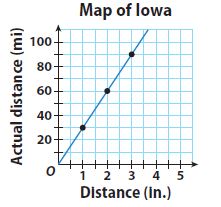
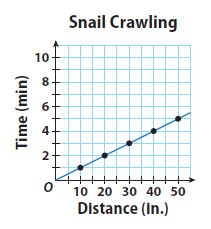
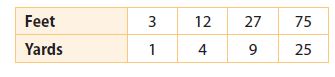
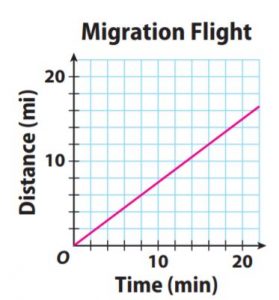
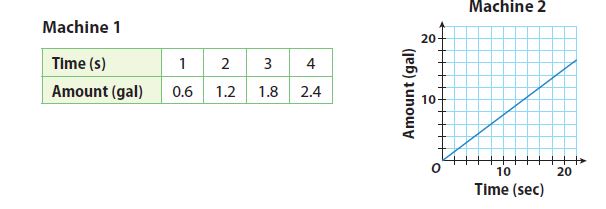
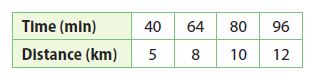
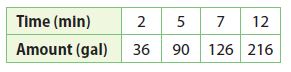
go-math-grade-8-chapter-6-functions-answer-key

Go Math Grade 8 Answer Key Chapter 6 Functions

The solutions of Go Math Grade 8 Answer Key Chapter 6 Functions are provided in the pdf format here. HMH Go Math Grade 8 Answer Key Chapter 6 Functions are presented by the professional math experts in an easy manner and with brief explanations. You can find different ways of solving the problems on this page. So, we suggest the students to refer to Go Math Grade 8 Answer Key Chapter 6 Functions now to begin your practice.

Go Math Grade 8 Chapter 6 Functions Answer Key

Test and improve your knowledge by using Go Math Grade 8 Chapter 6 Functions Solution Key. The Go Math Grade 8 Chapter 6 Functions Answer Key consists of the topics like Identifying and representing functions, describing functions, analyzing graphs, etc. Use HMH Go Math Grade 8 Answer Key for the best practice of maths. After completion of your preparation test yourself by solving the problems given in the model quiz.

Lesson 1: Identifying and Representing Functions 

Lesson 2: Describing Functions

Lesson 3: Comparing Functions 

Lesson 4: Analyzing Graphs

Model Quiz 

Mixed Review 

Guided Practice – Identifying and Representing Functions – Page No. 158

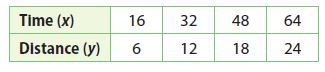
Complete each table. In the row with x as the input, write a rule as an algebraic expression for the output. Then complete the last row of the table using the rule.

Question 1.
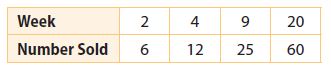
Go Math Grade 8 Answer Key Chapter 6 Functions Lesson 1: Identifying and Representing Functions img 1
Type below:
_______________

Answer:
Grade 8 Chapter 6 image 1

Explanation:
Unit Cost of ticket = 40/2 = 20
Total cost = 20x where x is the number of tickets.
x = 20x
10 = 20(100) = 200

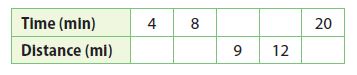
Question 2.
Go Math Grade 8 Answer Key Chapter 6 Functions Lesson 1: Identifying and Representing Functions img 2
Type below:
_______________

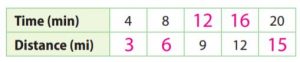
Answer:
Grade 8 Chapter 6 image 2

Explanation:
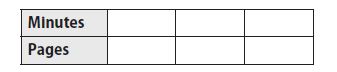
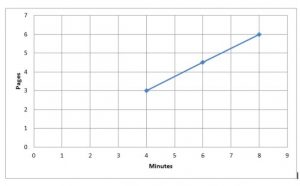
Number of pages per minute = 1/2 = 0.5
Total cost = 0.5x where x is the number of minutes.
x = 0.5x
30 = 0.5(30) = 15

Question 3.
Go Math Grade 8 Answer Key Chapter 6 Functions Lesson 1: Identifying and Representing Functions img 3
Type below:
_______________

Answer:
Grade 8 Chapter 6 image 3

Explanation:
Units cost of Muffins = 2.25/1 = 2.25
Total cost = 2.25x where x is the number of muffins
x = 2.25x
12 = 2.25(12) = 27

Determine whether each relationship is a function.

Question 4.
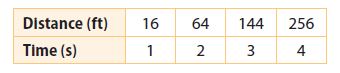
Go Math Grade 8 Answer Key Chapter 6 Functions Lesson 1: Identifying and Representing Functions img 4
_______________

Answer:
Function

Explanation:
Each input is assigned to exactly one output.

Question 5.
Go Math Grade 8 Answer Key Chapter 6 Functions Lesson 1: Identifying and Representing Functions img 5
_______________

Answer:
Not a function

Explanation:
The input value is 4 is paired with two outputs 25 and 35

Question 6.
The graph shows the relationship between the weights of 5 packages and the shipping charge for each package. Is the relationship represented by the graph a function? Explain.
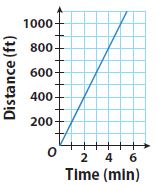
Go Math Grade 8 Answer Key Chapter 6 Functions Lesson 1: Identifying and Representing Functions img 6
_______________

Answer:
Function

Explanation:
Each input is assigned to exactly one output.

Essential Question Check-In

Question 7.
What are four different ways of representing functions? How can you tell if a relationship is a function?
Type below:
_______________

Answer:
The function can be represented by an equation, table, graph, and Venn diagram.
If a relationship is a function, each input is paired with exactly one output.

Independent Practice – Identifying and Representing Functions – Page No. 159

Determine whether each relationship represented by the ordered pairs is a function. Explain.

Question 8.
(2, 2), (3, 1), (5, 7), (8, 0), (9, 1)
_______________

Answer:
Function

Explanation:
Each input value is paired with exactly one output value.

Question 9.
(0, 4), (5, 1), (2, 8), (6, 3), (5, 9)
_______________

Answer:
Not a function

Explanation:
The input value is 5 is paired with two outputs 1 and 9

Question 10.
Draw Conclusions
Joaquin receives $0.40 per pound for 1 to 99 pounds of aluminum cans he recycles. He receives $0.50 per pound if he recycles more than 100 pounds. Is the amount of money Joaquin receives a function of the weight of the cans he recycles? Explain your reasoning.
_______________

Answer:
Yes

Explanation:
The amount of money increases with the weight of the cans. No weight will result in the same amount of money earned.

Question 11.
A biologist tracked the growth of a strain of bacteria, as shown in the graph.
Go Math Grade 8 Answer Key Chapter 6 Functions Lesson 1: Identifying and Representing Functions img 7
a. Explain why the relationship represented by the graph is a function.
Type below:
_______________

Answer:
The relationship is a function as each input has been assigned exactly one output. There is only one number of bacteria for each number of hours.

Question 11.
b. What If?
Suppose there was the same number of bacteria for two consecutive hours. Would the graph still represent a function? Explain.
Type below:
_______________

Answer:
Yes. If the number of bacteria for two consecutive hours is the same, one input will still be paired with one output, hence the relationship is still a function.

Question 12.
Multiple Representations
Give an example of a function in everyday life, and represent it as a graph, a table, and a set of ordered pairs. Describe how you know it is a function.
Go Math Grade 8 Answer Key Chapter 6 Functions Lesson 1: Identifying and Representing Functions img 8
Type below:
_______________

Answer:
The cost of a bouquet of flowers and the number of flowers in the bouquet is a function. The unit cost of flowers = $0.85 and x the number of flowers. Hence, C= 0.85x
Grade 8 Chapter 6 image 4
Grade 8 Chapter 6 image 5
(2, 1.7), (4, 3.4), (6, 5.1), (8, 6.8), (10, 8.5)
Each value of the input is paired with exactly one output.

Identifying and Representing Functions – Page No. 160

The graph shows the relationship between the weights of six wedges of cheese and the price of each wedge.
Go Math Grade 8 Answer Key Chapter 6 Functions Lesson 1: Identifying and Representing Functions img 9

Question 13.
Is the relationship represented by the graph a function? Justify your reasoning. Use the words “input” and “output” in your explanation, and connect them to the context represented by the graph.
_______________

Answer:
Yes, the relationship represented by the graph is a function.
Each input (weight) in the graph is paired with exactly one output(price).

Question 14.
Analyze Relationships
Suppose the weights and prices of additional wedges of cheese were plotted on the graph. Might that change your answer to question 13? Explain your reasoning.
Type below:
_______________

Answer:
No. As the weight of the cheese will increase, the cost of wedges of cheese will increase as well. Hence, for each input (weight), there would be exactly one output (price).

H.O.T.

Focus on Higher Order Thinking

Question 15.
Justify Reasoning
A mapping diagram represents a relationship that contains three different input values and four different output values. Is the relationship a function? Explain your reasoning.
_______________

Answer:
No. Since there are three inputs and four outputs, one of the inputs will have more than one output, hence the relationship cannot be a function.

Question 16.
Communicate Mathematical Ideas
An onion farmer is hiring workers to help harvest the onions. He knows that the number of days it will take to harvest the onions is a function of the number of workers he hires. Explain the use of the word “function” in this context.
Type below:
_______________

Answer:
Number of days = f(number of workers)

Explanation:
We know that the more the number of workers will be involved in the harvesting of onion, the lesser days it will take to complete.
Thus the number of workers becomes the independent variable and the number of days becomes the dependent variable.
Here the word function is used to describe that the number of days is dependent on the number of workers.
Number of days = f(number of workers)

Guided Practice – Describing Functions – Page No. 164

Plot the ordered pairs from the table. Then graph the function represented by the ordered pairs and tell whether the function is linear or nonlinear.

Question 1.
y = 5 − 2x
Go Math Grade 8 Answer Key Chapter 6 Functions Lesson 2: Describing Functions img 10
_______________

Answer:
Grade 8 Chapter 6 image 6
Grade 8 Chapter 6 image 7
Graph of a linear function is a straight line
Linear relationship

Explanation:
Given y = 5 – 2x
y = 5 – 2(-1) = 5 + 2 = 7
y = 5 – 2(1) = 5 – 2 = 3
y = 5 – 2(3) = 5 – 6 = -1
y = 5 – 2(5) = 5 – 10 = -5

Question 2.
y = 2 − x2
Go Math Grade 8 Answer Key Chapter 6 Functions Lesson 2: Describing Functions img 11
_______________

Answer:
y = 2 − x2
Grade 8 Chapter 6 image 8
Graph the ordered pairs. Then draw a line through the points to represent the solution.
Grade 8 Chapter 6 image 9
Graph of a linear function is not a straight line
Non-linear relationship

Explanation:
y = 2 − x2
y = 2 – 4 = -2
y = 2 – 1 = 1
y = 2 – 0 = 2
y = 2 – 1 = 1
y = 2 – 4 = -2

Explain whether each equation is a linear equation.

Question 3.
y = x2 – 1
_______________

Answer:
The equation is not in the form of a linear equation, hence is not a linear equation.

Explanation:
Compare the equation with the general linear equation y = mx + b.
The equation is not in the form of a linear equation, hence is not a linear equation.

Question 4.
y = 1 – x
_______________

Answer:
The equation is in the form of a linear equation, hence is a linear equation.

Explanation:
Compare the equation with the general linear equation y = mx + b.
The equation is in the form of a linear equation, hence is a linear equation.

Essential Question Check-In

Question 5.
Explain how you can use a table of values, an equation, and a graph to determine whether a function represents a proportional relationship.
Type below:
_______________

Answer:
From a table, determine the ratio y/x. If it is constant the relationship is proportional.
From a graph, note if the graph passes through the origin. The graph of a proportional relationship must pass through the origin (0, 0).
From an equation, compare with general linear form of equation, y = mx + b. If b = 0, the relationship is proportional.

Independent Practice – Describing Functions – Page No. 165

Question 6.
State whether the relationship between x and y in y = 4x – 5 is proportional or nonproportional. Then graph the function.
Go Math Grade 8 Answer Key Chapter 6 Functions Lesson 2: Describing Functions img 12
_______________

Answer:
Grade 8 Chapter 6 image 10

Explanation:
First, we compare the equation with the general linear equation y = mx + b. y = 4x – 5 is in the form of y = mx + b, with m = 4 and b = -5. Therefore, the equation is a linear equation. Since b is not equal to 0, the relationship is non-proportional.
Then, we choose several values for the input x. We substitute these values of x in the equation to find the output y.
y = 4x – 5
If x = 0; y = 4(0) – 5 = -5; (0, -5)
If x = 2; y = 4(2) – 5 = 3; (2, 3)
If x = 4; y = 4(4) – 5 = 11; (4, 11)
If x = 6; y = 4(6) – 5 = 19; (6, 19)
We graph the ordered pairs and we draw a line through the points to represent the solutions of the function.

Question 7.
The Fortaleza telescope in Brazil is a radio telescope. Its shape can be approximated with the equation y = 0.013x2. Is the relationship between x and y linear? Is it proportional? Explain.
____________
____________

Answer:
Compare the equation with the general linear equation y = mx + b.
The equation is not in the form of a linear equation, hence it is not a linear equation. Since x is squared, it is not proportional.

Question 8.
Kiley spent $20 on rides and snacks at the state fair. If x is the amount she spent on rides, and y is the amount she spent on snacks, the total amount she spent can be represented by the equation x + y = 20. Is the relationship between x and y linear? Is it proportional? Explain.
____________
____________

Answer:
x + y = 20
Rewriting the equation
y = 20 – x
Compare the equation with the general linear equation y = mx + b.
It is linear
Since b is not equal to 0, the relationship is not proportional.

Question 9.
Represent Real-World Problems
The drill team is buying new uniforms. The table shows y, the total cost in dollars, and x, the number of uniforms purchased.
Go Math Grade 8 Answer Key Chapter 6 Functions Lesson 2: Describing Functions img 13
a. Use the data to draw a graph. Is the relationship between x and y linear? Explain.
____________

Answer:
Grade 8 Chapter 6 image 10
The graph of a linear relationship is a straight line.
x and y are linear.

Question 9.
b. Use your graph to predict the cost of purchasing 12 uniforms.
$ ________

Answer:
$720

Explanation:
Grade 8 Chapter 6 image 10
The cost of 12 uniforms is $720

Question 10.
Marta, a whale calf in an aquarium, is fed a special milk formula. Her handler uses a graph to track the number of gallons of formula y the calf drinks in x hours. Is the relationship between x and y linear? Is it proportional? Explain.
Go Math Grade 8 Answer Key Chapter 6 Functions Lesson 2: Describing Functions img 14
____________
____________

Answer:
The relationship is linear
The relationship is proportional

Explanation:
As the data lies on a straight line, the relationship is linear
As the graph passes through the origin, the relationship is proportional

Describing Functions – Page No. 166

Question 11.
Critique Reasoning
A student claims that the equation y = 7 is not a linear equation because it does not have the form y=mx + b. Do you agree or disagree? Why?
Go Math Grade 8 Answer Key Chapter 6 Functions Lesson 2: Describing Functions img 15
____________

Answer:
Disagree; The equation can be written in the form y = mx + b Where m is 0. The graph of the solutions is a horizontal line.

Question 12.
Make a Prediction
Let x represent the number of hours you read a book and y represent the total number of pages you have read. You have already read 70 pages and can read 30 pages per hour. Write an equation relating x hours and y pages you read. Then predict the total number of pages you will have read after another 3 hours.
_______ pages

Answer:
160 pages

Explanation:
Let x represent the number of hours you read a book and y represents the total number of pages you have read. You have already read 70 pages and can read 30 pages per hour.
m = 30; b = 70 pages
y = 30x + 70
x = 3 hrs
y = 30(3) + 70 = 160

H.O.T.

Focus on Higher Order Thinking

Question 13.
Draw Conclusions
Rebecca draws a graph of a real-world relationship that turns out to be a set of unconnected points. Can the relationship be linear? Can it be proportional? Explain your reasoning.
Type below:
______________

Answer:
The relationship is linear if all the points lie on the same line. If the relationship is linear and passes through the origin, it is proportional.

Question 14.
Communicate Mathematical Ideas
Write a real-world problem involving a proportional relationship. Explain how you know the relationship is proportional.
Type below:
______________

Answer:
The amount of money earned at a car wash is a proportional relationship. When there are 0 cars washed, $0 are earned. The amount of money earned increases by the unit cost of a car wash.

Question 15.
Justify Reasoning
Show that the equation y + 3 = 3(2x + 1) is linear and that it represents a proportional relationship between x and y.
Type below:
______________

Answer:
y + 3 = 3(2x + 1)
y +3 = 6x + 3
y = 6x
As b = 0, it is a Proportional Relationship.

Guided Practice – Comparing Functions – Page No. 170

Doctors have two methods of calculating maximum heart rate. With the first method, maximum heart rate, y, in beats per minute is y = 220 − x, where x is the person’s age. Maximum heart rate with the second method is shown in the table.
Go Math Grade 8 Answer Key Chapter 6 Functions Lesson 3: Comparing Functions img 16

Question 1.
Which method gives the greater maximum heart rate for a 70-year-old?
____________ method

Answer:
Second

Explanation:
y = 220 – x
y = 220 – 70 = 150
Find the slope using two points from the grapgh by
Slope m = (y2 -y1)/(x2 – x1) where (x1, y1) = (20, 194) and (x2, y2) = (30, 187)
Slope m = (y2 -y1)/(x2 – x1) = (187 – 194)/(30 – 20) = -7/10 = -0.7
197 = -0.7(20) + b
y-intercept b = 208
Substituting the value of the slope m and y-intercept in the slope-intercept form. y = mx + b where, m = -0.7 and b = 208.
y = -0.7x +208
x = 70yrs
y = -0.7(70) + 208 = 159
150 < 159
Second method gives the greater maximum heart rate for a 70 year ols.

Question 2.
Are heart rate and age proportional or nonproportional for each method?
____________

Answer:
For method 1, the relationship is non-propotional.
For method 2, the relationship is non-propotional.

Explanation:
Compare the equation with the general linear equation y = mx + b.
It is linear
Since b is not equal to 0, the relationship is not proportional.

Aisha runs a tutoring business. With Plan 1, students may choose to pay $15 per hour. With Plan 2, they may follow the plan shown on the graph.
Go Math Grade 8 Answer Key Chapter 6 Functions Lesson 3: Comparing Functions img 17

Question 3.
Describe the plan shown on the graph.
Type below:
______________

Answer:
Choose two points on the graph to find the slope.
Find the slope
m = (y2 -y1)/(x2 – x1)
m = (60 – 40)/(4 – 0) = 20/4 = 5
Read the y-intercept from the graph: b = 40
Use your slope and y-intercept values to write an equation in slope-intercept
form.
y = 5x + 40
Plan 2 has an intial cost of $40 and a rate of $5 per hour.

Question 4.
Sketch a graph showing the $15 per hour option.
Type below:
______________

Answer:
Grade 8 Chapter 6 image 11

Question 5.
What does the intersection of the two graphs mean?
Type below:
______________

Answer:
The intersection of the two graphs represents the number of hours for which both plans will cost the same,

Question 6.
Which plan is cheaper for 10 hours of tutoring?
______________

Answer:
Plan 1
y = 15x
x = 10 hrs
y = 15(10) = $150
Plan 2
y = 5x + 40
y = 5(10) + 40 = $90
$150 > $90
Plane 2 is cheaper

Question 7.
Are cost and time proportional or nonproportional for each plan?
Type below:
______________

Answer:
Comparing with the general linear form of equation y = mx + b. Since b = 0, the relationship is proportional
The cost and time are proportional for Plan 1
Comparing with the general linear form of equation y = mx + b. Since b is not equal to 0, the relationship is proportional
The cost and time are not proportional for Plan 2

Essential Question Check-In

Question 8.
When using tables, graphs, and equations to compare functions, why do you find the equations for tables and graphs?
Type below:
______________

Answer:
The tables and graphs represent a part of the solution of the function. By writing the equation, any value can be a substitute to evaluate the function and compared it with the equations.

Independent Practice – Comparing Functions – Page No. 171

The table and graph show the miles driven and gas used for two scooters.
Go Math Grade 8 Answer Key Chapter 6 Functions Lesson 3: Comparing Functions img 18

Question 9.
Which scooter uses fewer gallons of gas when 1350 miles are driven?
______________

Answer:
Scooter B uses fewer gallons of gas when 1350 miles are driven

Explanation:
The equation for Scooter A Slope m = m = (y2 -y1)/(x2 – x1) where (x1, y1) = (150, 2) and (x2, y2) = (300, 4)
Slope m = (y2 -y1)/(x2 – x1) = (4 – 2)/(300 – 150) = 2/150 = 1/75
2 = 1/75(150) + b
y-intercept b = 0
Substituting the value of the slope m and y-intercept in the slope-intercept form. y = mx + b where, m = 1/75 and b = 0.
y = 1/75x
x = 1350 miles
y = 1/75(1,350)
y = 18gal
The equation for Scooter B Slope m = m = (y2 -y1)/(x2 – x1) where (x1, y1) = (0, 0) and (x2, y2) = (90, 1)
Slope m = (y2 -y1)/(x2 – x1) = (1 – 0)/(90 – 0) = 1/90
2 = 1/90(90) + b
y-intercept b = 0
Substituting the value of the slope m and y-intercept in the slope-intercept form. y = mx + b where, m = 1/90 and b = 0.
y = 1/90x
x = 1350 miles
y = 1/90(1,350)
y = 15gal
Compare the gallons of gas to drive 1,350 miles
18 > 15
Scooter B uses fewer gallons of gas when 1,350 miles are driven.

Question 10.
Are gas used and miles proportional or nonproportional for each scooter?
______________

Answer:
The gas used and miles are proportional to both scooters.

Explanation:
Compare with general linear form of an equation, y = mx + b. If b = 0, the relationship is proportional.
The gas used and miles are proportional to both scooters.

A cell phone company offers two texting plans to its customers. The monthly cost, y dollars, of one plan is y = 0.10x + 5, where x is the number of texts. The cost of the other plan is shown in the table.
Go Math Grade 8 Answer Key Chapter 6 Functions Lesson 3: Comparing Functions img 19

Question 11.
Which plan is cheaper for under 200 texts?
______________

Answer:
Plane 1 is cheaper

Explanation:
Plan 1
y = 0.10x + 5
Subsitute x = 199
y = 0.10(199) + 5 = $24.90
Find the slope using two points from the graph by m = (y2 -y1)/(x2 – x1) where (x1, y1) = (100, 20), (x2, y2) =(200, 25)
Substitute the value of m and (x1, y1) = (100, 20), (x2, y2) =(200, 25)
Slope m = (y2 -y1)/(x2 – x1) = (25 – 20)/(200 – 100) = 5/100 = 0.05
20 = 0.05(100) + b
y-intercept b = 15
Substituting the value of slope (m) and (x, y) in the slope intercept form to find y intercept (b):
y = 0.05x + 15
x = 199
y = 0.05(199) + 15 = $24.95
Compare the cost for two plans for text < 200
$24.90 < $24.95
Plane 1 is cheaper

Question 12.
The graph of the first plan does not pass through the origin. What does this indicate?
Type below:
______________

Answer:
Plan 1
y = 0.10x + 5
The graph that does not pass through the origin indicates that there is a base price of $5 for the plan.

Question 13.
Brianna wants to buy a digital camera for a photography class. One store offers the camera for $50 down and a payment plan of $20 per month. The payment plan for a second store is described by y = 15x + 80, where y is the total cost in dollars and x is the number of months. Which camera is cheaper when the camera is paid off in 12 months? Explain.
______________

Answer:
For first store, the slope interecept form y = mx + b where m = 20 dollars per month and b = 50 dollar.
y = 20x + 50
x = 12 months
y = 20(12) + 50 = $290
Second store
y = 15x + 80
x = 12 months
y = 15(12) + 80 = $260
Compare the cost of camera if it paid off in 12 months $290 > $260
Camera is cheaper at second store

Comparing Functions – Page No. 172

Question 14.
The French club and soccer team are washing cars to earn money. The amount earned, y dollars, for washing x cars is a linear function. Which group makes the most money per car? Explain.
Go Math Grade 8 Answer Key Chapter 6 Functions Lesson 3: Comparing Functions img 20
______________

Answer:

Explanation:
Find the slope using two points from the grapgh by
Slope m = (y2 -y1)/(x2 – x1) where (x1, y1) = (2, 10) and (x2, y2) = (4, 20)
Slope m = (y2 -y1)/(x2 – x1) = (20 – 10)/(4 – 2) = 10/2 = 5
French Club makes $5 per car.
Find the slope using two points from the grapgh by
Slope m = (y2 -y1)/(x2 – x1) where (x1, y1) = (0, 0) and (x2, y2) = (2, 16)
Slope m = (y2 -y1)/(x2 – x1) = (16 – 0)/(2 – 0) = 16/2 = 8
Soccer Club makes $8 per car.
Compare the money earned for washing one car $5 < $8
Soccer club makes the most money per car

H.O.T.

Focus on Higher Order Thinking

Question 15.
Draw Conclusions
Gym A charges $60 a month plus $5 per visit. The monthly cost at Gym B is represented by y = 5x + 40, where x is the number of visits per month. What conclusion can you draw about the monthly costs of the gyms?
__________ is more expensive

Answer:
Gym A is more expensive

Explanation:
Since the rate per visit is the same, the monthly cost of Gyn A is always more than Gym B.

Question 16.
Justify Reasoning
Why will the value of y for the function y = 5x + 1 always be greater than that for the function y = 4x + 2 when x > 1?
Type below:
______________

Answer:
y1 = 5x + 1 and y2 = 4x + 2 Subtracting y2 from y1
y1 – y2 = 5x + 1 – (4x + 2)
y1 – y2 = x -1
For x>= 1 we get x – 1 >= 0
So y1 – y2 >= 0 or y1 >= y2

Question 17.
Analyze Relationships
The equations of two functions are y = −21x + 9 and y = −24x + 8. Which function is changing more quickly? Explain.
______________

Answer:
y = -21x + 9
y = -24x + 8
y = -24x + 8 is changing more quickly as the absolute value of -24 is greater than the absolute value of -21.

Guided Practice – Analyzing Graphs – Page No. 176

In a lab environment, colonies of bacteria follow a predictable pattern of growth. The graph shows this growth over time.
Go Math Grade 8 Answer Key Chapter 6 Functions Lesson 4: Analyzing Graphs img 21

Question 1.
What is happening to the population during Phase 2?
______________

Answer:
For Phase 2, the graph is increasing quickly. This shows a period of rapid growth.

Question 2.
What is happening to the population during Phase 4?
______________

Answer:
In Phase 4, the graph is decreasing, hence the number of bacterias is decreasing.

The graphs give the speeds of three people who are riding snowmobiles. Tell which graph corresponds to each situation.
Go Math Grade 8 Answer Key Chapter 6 Functions Lesson 4: Analyzing Graphs img 22

Question 3.
Chip begins his ride slowly but then stops to talk with some friends. After a few minutes, he continues his ride, gradually increasing his speed.
______________

Answer:
Graph 2

Explanation:
The slope of the graph is increasing, then it becomes constant and starts increasing again.
Graph 2

Question 4.
Linda steadily increases her speed through most of her ride. Then she slows down as she nears some trees.
______________

Answer:
Graph 3

Explanation:
The slope of the graph is increasing and then decreasing.
Graph 3

Question 5.
Paulo stood at the top of a diving board. He walked to the end of the board, and then dove forward into the water. He plunged down below the surface, then swam straight forward while underwater. Finally, he swam forward and upward to the surface of the water. Draw a graph to represent Paulo’s elevation at different distances from the edge of the pool.
Go Math Grade 8 Answer Key Chapter 6 Functions Lesson 4: Analyzing Graphs img 23
Type below:
______________

Answer:
Grade 8 Chapter 6 image 12

Independent Practice – Analyzing Graphs – Page No. 177

Tell which graph corresponds to each situation below.
Go Math Grade 8 Answer Key Chapter 6 Functions Lesson 4: Analyzing Graphs img 24

Question 6.
Arnold started from home and walked to a friend’s house. He stayed with his friend for a while and then walked to another friend’s house farther from home.
______________

Answer:
Graph 3

Explanation:
The graph increases (as Arnold walks from home to friend’s house), then becomes constant (when he stayed with his friend) and then increases again (when he walk to another friend’s house farther away).
Graph 3

Question 7.
Francisco started from home and walked to the store. After shopping, he walked back home.
______________

Answer:
Graph 1

Explanation:
The graph increases (as Francisco walked from home to store), becomes constant (when he shops), and then decreases (as he walked back home)
Graph 1

Question 8.
Celia walks to the library at a steady pace without stopping.
______________

Answer:
Graph 2

Explanation:
The graph increases at a constant rate (as Celia walks to library without any stops)
Graph 2

Regina rented a motor scooter. The graph shows how far away she is from the rental site after each half hour of riding.
Go Math Grade 8 Answer Key Chapter 6 Functions Lesson 4: Analyzing Graphs img 25

Question 9.
Represent Real-World Problems
Use the graph to describe Regina’s trip. You can start the description like this: “Regina left the rental shop and rode for an hour…”
Type below:
______________

Answer:
Regina left the rental shop and rode for an hour. She rested for half an hour and then started back. After half an hour, she changed her mind and rode for another half an hour. She rest for half an hour. Then she started back and ranched the rental site in 2 hours.

Question 10.
Analyze Relationships
Determine during which half hour Regina covered the greatest distance.
Type below:
______________

Answer:
Regina covered the greatest distance between 0.5 to 1hr of the journey. She covered 12 miles.

Analyzing Graphs – Page No. 178

The data in the table shows the speed of a ride at an amusement park at different times one afternoon.
Go Math Grade 8 Answer Key Chapter 6 Functions Lesson 4: Analyzing Graphs img 26

Question 11.
Sketch a graph that shows the speed of the ride over time.
Type below:
______________

Answer:
Grade 8 Chapter 6 image 13

Question 12.
Between which times is the ride’s speed increasing the fastest?
Type below:
______________

Answer:
The speed is increasing the fastest during the 3: 21 and 3: 22

Question 13.
Between which times is the ride’s speed decreasing the fastest?
Type below:
______________

Answer:
The speed is decreasing the fastest during the 3: 23 and 3: 24

H.O.T.

Focus on Higher Order Thinking
Go Math Grade 8 Answer Key Chapter 6 Functions Lesson 4: Analyzing Graphs img 27

Question 14.
Justify Reasoning
What is happening to the fox population before time t? Explain your reasoning.
Go Math Grade 8 Answer Key Chapter 6 Functions Lesson 4: Analyzing Graphs img 28
Type below:
______________

Answer:
The population decreases and then increases before time t

Question 15.
What If?
Suppose at time t, a conservation organization moves a large group of foxes to the island. Sketch a graph to show how this action might affect the population on the island after time t.
Go Math Grade 8 Answer Key Chapter 6 Functions Lesson 4: Analyzing Graphs img 29
Type below:
______________

Answer:
Grade 8 Chapter 6 image 14

Explanation:
Population is decreasing at first, then it is increasing rapidly.

Question 16.
Make a Prediction
At some point after time t, a forest fire destroys part of the woodland area on the island. Describe how your graph from problem 15 might change.
Type below:
______________

Answer:
The population would dramatically decrease if there was a fire due to lack of food supply and good land.

6.1 Identifying and Representing Functions – Model Quiz – Page No. 179

Determine whether each relationship is a function.

Question 1.
Go Math Grade 8 Answer Key Chapter 6 Functions Model Quiz img 30
__________

Answer:
Not a function

Explanation:
A relationship is a function when each input is paired with exactly one output. The input 5 has more than one output.
Not a function

Question 2.
Go Math Grade 8 Answer Key Chapter 6 Functions Model Quiz img 31
__________

Answer:
Function

Explanation:
A relationship is a function when each input is paired with exactly one output.
Each input is paired with only one output.
Function

Question 3.
(2, 5), (7, 2), (−3, 4), (2, 9), (1, 1)
__________

Answer:
Not a function

Explanation:
A relationship is a function when each input is paired with exactly one output. Input 2 has more than one output.
Not a function

6.2 Describing Functions

Determine whether each situation is linear or nonlinear, and proportional or nonproportional.

Question 4.
Joanna is paid $14 per hour.
__________
__________

Answer:
Linear
Proportional

Explanation:
Writing the situation as an equation, where x is the number of hours.
y = 14x
Compare with general linear equation y = mx + b
Linear
Since b = 0, the relationship is proportional.
Proportional

Question 5.
Alberto started out bench pressing 50 pounds. He then added 5 pounds every week.
__________
__________

Answer:
Linear
Non-proportional

Explanation:
Writing the situation as an equation, where x is the number of hours.
y = 5x + 50
Compare with general linear equation y = mx + b
Linear
Since b is not equal to 0, the relationship is non-proportional.
Non-proportional

6.3 Comparing Functions

Question 6.
Which function is changing more quickly? Explain.
Go Math Grade 8 Answer Key Chapter 6 Functions Model Quiz img 32
__________

Answer:
Function 2 is changing more quickly.

Explanation:
Find the rate of change for function 1
Rate of Change = (20 – 0)/(0 – 5) = -4
Find the rate of change for function 1
Rate of Change = (6.5 – 11)/(3 – 2) = -4.5
Althogh -4.5 < -4, the absolute value of -4.5 s greater than -4.
Function 2 is changing more quickly.

6.4 Analyzing Graphs

Question 7.
Describe a graph that shows Sam running at a constant rate.
Type below:
______________

Answer:
The graph would be a straight line

Explanation:
Since Sam is running at a constant rate, distance covered per unit of time remains the same and the relationship is linear and proportional.
The graph would be a straight line

Essential Question

Question 8.
How can you use functions to solve real-world problems?
Type below:
______________

Answer:
If in the equation the power of x is 1 then it is linear otherwise nonlinear.
In a graph, if the points form a line it is linear if they form a curve it is a nonlinear function.

Selected Response – Mixed Review – Page No. 180

Question 1.
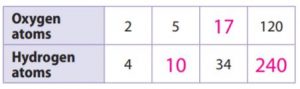
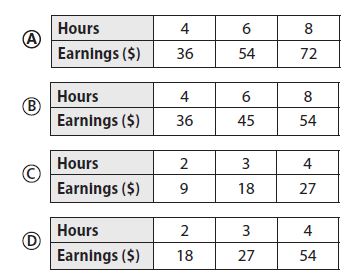
Which table shows a proportional function?
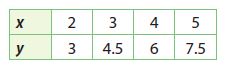
Go Math Grade 8 Answer Key Chapter 6 Functions Mixed Review img 33
Options:
a. A
b. B
c. C
d. D

Answer:
c. C

Explanation:
It contains the ordered pair of the origin (0, 0)
Option C represents a proportional relationship.

Question 2.
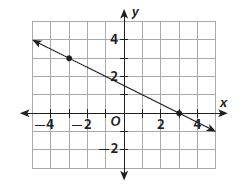
What is the slope and y-intercept of the function shown in the table?
Go Math Grade 8 Answer Key Chapter 6 Functions Mixed Review img 34
Options:
a. m = -2; b = -4
b. m = -2; b = 4
c. m = 2; b = 4
d. m = 4; b = 2

Answer:
c. m = 2; b = 4

Explanation:
Find the slope using two points from the grapgh by
Slope m = (y2 -y1)/(x2 – x1) where (x1, y1) = (1, 6) and (x2, y2) = (4, 12)
Slope m = (y2 -y1)/(x2 – x1) = (12 – 6)/(4 – 1) = 6/3 = 2
Substituting the value of the slope m and (x, y) to find the slope-intercept form.
12 = 4(2) + b
y-intercept b = 4

Question 3.
The table below shows some input and output values of a function.
Go Math Grade 8 Answer Key Chapter 6 Functions Mixed Review img 35
What is the missing output value?
Options:
a. 20
b. 21
c. 22
d. 23

Answer:
b. 21

Explanation:
Find the rate of change = (17.5 – 14)/(5 – 4) = 3.5
Since the missing output is corresponding to x = 6 and 3.5 to 17.5 (for x = 5)
Output = 17.5 + 3.5 = 21

Question 4.
Tom walked to school at a steady pace, met his sister, and they walked home at a steady pace. Describe this graph.
Options:
a. V-shaped
b. upside down V-shaped
c. Straight line sloping up
d. Straight line sloping down

Answer:
b. upside-down V-shaped

Explanation:
The graph would increase at a constant rate and would decrease at a constant rate.
The graph would be the upside-down V-shaped

Mini-Task

Question 5.
Linear functions can be used to find the price of a building based on its floor area.Below are two of these functions.
y = 40x + 15,000
Go Math Grade 8 Answer Key Chapter 6 Functions Mixed Review img 36
a. Find and compare the slopes.
Type below:
____________

Answer:
Compare the slopes
The slope for the first function is less than the slope of the second function.
y = 40x + 15000
Compare with slope intercept form y = mx + b where m is the slope m = 40
Second function find the slope using given points by Slope m = (y2 -y1)/(x2 – x1) where (x1, y1) = (7, 3) and (x2, y2) = (6, 4)
Slope m = (y2 -y1)/(x2 – x1) = (56000 – 32000)/(700 – 400) = 24000/300 = 80
m = 80

Question 5.
b. Find and compare the y-intercepts.
Type below:
____________

Answer:
y = 40x + 15,000
Compare with slope-intercept form y = mx + b where m is the slope b = 15000
The second function find the slope using given points by Slope m and (x, y) in the slope-intercept form to fins y-intercept b
y = mx + b where (x, y) = (700, 56000) and m = 80
56000 = 80(700) + b
b = 0
Compare y intercepts
The y-intercept of the first function is greater than the y-intercept of the second function

Question 5.
c. Describe each function as proportional or nonproportional.
Type below:
____________

Answer:
Comparable to slope interecept form y = mx + b
First function: y = 40x + 15000
Second function: y = 80x
Since b is not equal to 0
First function is non-proportional
Since b = 0
The second function is proportional.

Conclusion:

we wish the detailed prevailed in HMH Go Math 8th Grade Chapter 6 Functions are helpful for you to score the best in the exams. Download our Go Math Grade 8 Solution Key Chapter 6 Functions PDF for free of cost. Keep in touch with us to get the fastest updates about the Go Math Grade 8 Chapter 6 Functions Answer Key. For any queries, you can post your comments in the below comment section.
go-math-grade-8-chapter-5-writing-linear-equations-answer-key

Go Math Grade 8 Answer Key Chapter 5 Writing Linear Equations

It is essential for the students to have the best material to study for the exams. Go Math Grade 8 Answer Key Chapter 5 Writing Linear Equations recommend to every student who wants to succeed in math. Fall in love with math by practicing the problems from Go Math 8th Grade Chapter 5 Writing Linear Equations Solution Key. We have provided the step by step explanation for each and every question in CCSS Math Answers. Quick & smart learning is possible with the Go Math Grade 8 Answer Key Chapter 5 Writing Linear EquationsPDF.

Go Math Grade 8 Chapter 5 Writing Linear Equations Answer Key

The students who are willing to become masters in maths are suggested to follow our Go Math 8th Grade Chapter 5 Writing Linear Equations Solution Key. You can get free access for Go Math Grade 8 Answer Key Chapter 5 Writing Linear equations topicwise here. Check out the topics of Writing Linear equations from the below section.
Lesson 1: Writing Linear Equations from Situations and Graphs 

Lesson 2: Writing Linear Equations from a Table

Lesson 3: Linear Relationships and Bivariate Data

Model Quiz

Mixed Review

Guided Practice – Writing Linear Equations from Situations and Graphs – Page No. 130

Question 1.
Li is making beaded necklaces. For each necklace, she uses 27 spacers, plus 5 beads per inch of necklace length. Write an equation to find how many beads Li needs for each necklace.
a. input variable:
____________

Answer:
The length of the necklace in inches

Question 1.
b. output variable:
____________

Answer:
The total number of beads in the necklace

Question 1.
c. equation:
Type below:
____________

Answer:
y = 5x

Question 2.
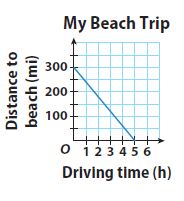
Kate is planning a trip to the beach. She estimates her average speed to graph her expected progress on the trip. Write an equation in slope-intercept form that represents the situation.
Go Math Grade 8 Answer Key Chapter 5 Writing Linear Equations Lesson 1: Writing Linear Equations from Situations and Graphs img 1
Type below:
____________

Answer:
y = -60x + 300

Explanation:
Choose two points on the graph to find the slope.
Find the slope
m = (y2 -y1)/(x2 – x1)
m = -300/5 = -60
Read the y-intercept from the graph: b = 300
Use your slope and y-intercept values to write an equation in slope-intercept
form.
y = -60x + 300

Question 3.
At 59 °F, crickets chirp at a rate of 76 times per minute, and at 65 °F, they chirp 100 times per minute. Write an equation in slope-intercept form that represents the situation.
Type below:
____________

Answer:
y = 4x – 160

Explanation:
Input variable: Temperature
Output variable: Number of chirps per minute
Slope:
m = (y2 -y1)/(x2 – x1) = (100 – 76)/(65 – 59) = 24/6 = 4
100 = 4(65) + b
y-intercept:
b = -160
Substituting the value of the slope m and y-intercept in the slope-intercept form. y = mx + b where, m = 4 and b = -160.
y = 4x – 160

Essential Question Check-In

Question 4.
Explain what m and b in the equation y = mx + b tell you about the graph of the line with that equation.
Type below:
____________

Answer:
The equation of any straight line, called a linear equation, can be written as: y = mx + b, where m is the slope of the line and b is the y-intercept.
m = change in y-value/change in x-value
The y-intercept of this line is the value of y at the point where the line crosses the y-axis.

Independent Practice – Writing Linear Equations from Situations and Graphs – Page No. 131

Question 5.
A dragonfly can beat its wings 30 times per second. Write an equation in slope-intercept form that shows the relationship between flying time in seconds and the number of times the dragonfly beats its wings
Type below:
____________

Answer:
y = 30x

Explanation:
The linear equation is y = mx + b where m is the slope and b is the y-intercept.
y variable will be the number of times the dragonfly has beat its wings and the x variable will be the time.
A dragonfly can beat its wings 30 times per second.
To find b, let’s consider how many times the dragonfly has beat its wings at time 0s.
So, the equation of the line is y = 30x

Question 6.
A balloon is released from the top of a platform that is 50 meters tall. The balloon rises at the rate of 4 meters per second. Write an equation in slope-intercept form that tells the height of the balloon above the ground after a given number of seconds.
Type below:
____________

Answer:
y = 4x + 50

Explanation:
Input variable: Number of seconds
Output variable: Height of the balloon
The balloon rises at a rate of 4 meters per second. m = 4;
A balloon is released from the top of a platform that is 50 meters tall. b = 50.
y = 4x + 50

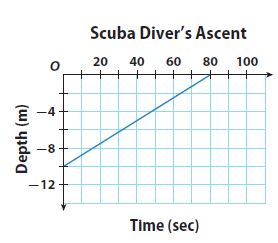
The graph shows a scuba diver’s ascent over time.
Go Math Grade 8 Answer Key Chapter 5 Writing Linear Equations Lesson 1: Writing Linear Equations from Situations and Graphs img 2

Question 7.
Use the graph to find the slope of the line. Tell what the slope means in this context.
Slope = _______ meters per second

Answer:
Slope = 1/8 or 0.125 meters per second

Explanation:
10m/80sec = 1/8
The scuba diver’s ascent gives up 1 meter per 16 seconds.

Question 8.
Identify the y-intercept. Tell what the y-intercept means in this context.
y-intercept = _______ meters

Answer:
y-intercept = -10 meters

Explanation:
The scuba divers start 10 meters below the water surface

Question 9.
Write an equation in slope-intercept form that represents the diver’s depth over time.
Type below:
____________

Answer:
y = 1/8 x – 10

Question 10.
The formula for converting Celsius temperatures to Fahrenheit temperatures is a linear equation. Water freezes at 0°C, or 32°F, and it boils at 100°C, or 212°F. Find the slope and y-intercept for a graph that gives degrees Celsius on the horizontal axis and degrees Fahrenheit on the vertical axis. Then write an equation in slope-intercept form that converts degrees Celsius into degrees Fahrenheit.
Type below:
____________

Answer:
Input variable: Celsius
Output variable: Fahrenheit
(0, 32) (100, 212)
m = (y2 -y1)/(x2 – x1) = (212 – 32)/(100 – 0) = 180/100 = 1.8
y intercepts = 32 when x = 0
F = 1.8C + 32

Question 11.
The cost of renting a sailboat at a lake is $20 per hour plus $12 for lifejackets. Write an equation in slope-intercept form that can be used to calculate the total amount you would pay for using this sailboat.
Type below:
____________

Answer:
y = 20x + 12

Explanation:
Input variable: Number of hours sailboat is rented
Output variable: Total cost
The cost of renting a sailboat at a lake is $20 per hour plus $12 for lifejackets.
Slope m = 20; y-intercept b = 12
Substituting the value of the slope m and y-intercept in the slope-intercept form. y = mx + b where, m = 20 and b = 12.
y = 20x + 12

Writing Linear Equations from Situations and Graphs – Page No. 132

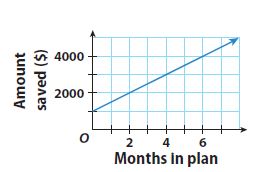
The graph shows the activity in a savings account.
Go Math Grade 8 Answer Key Chapter 5 Writing Linear Equations Lesson 1: Writing Linear Equations from Situations and Graphs img 3

Question 12.
What was the amount of the initial deposit that started this savings account?
$ _______

Answer:
$1000

Explanation:
The amount of the initial deposit that started this savings account is $1000

Question 13.
Find the slope and y-intercept of the graphed line.
Type below:
____________

Answer:
slope = 500
y-intercept = 1000

Explanation:
slope m = (y2 -y1)/(x2 – x1) = (2000 – 1500)/(2 – 1) = 500/1 = 500
y-intercept = 1000

Question 14.
Write an equation in slope-intercept form for the activity in this savings account.
Type below:
____________

Answer:
y = 500x + 1000

Explanation:
Substituting the value of the slope m and y-intercept in the slope-intercept form. y = mx + b where, m = 500 and b = 1000.
y = 500x + 1000

Question 15.
Explain the meaning of the slope in this graph.
Type below:
____________

Answer:
The slope represents the amount of money saved in dollars per month in the plan.

H.O.T.

Focus on Higher Order Thinking

Question 16.
Communicate Mathematical Ideas
Explain how you decide which part of a problem will be represented by the variable x, and which part will be represented by the variable y in a graph of the situation.
Type below:
____________

Answer:
y=mx+b
M-slope
B-Y intercept
and
(x,y)- would be any point on the graph and if you were to plug those points in for x and y the equation would solve if done properly

Question 17.
Represent Real-World Problems
Describe what would be true about the rate of change in a situation that could not be represented by a graphed line and an equation in the form y = mx + b.
Type below:
____________

Answer:
The rate of change would not be constant. Using different pairs of points in the slope formula would give different results.

Question 18.
Draw Conclusions
Must m, in the equation y = mx + b, always be a positive number? Explain.
Type below:
____________

Answer:
No; The slope m can be negative or positive. If the slope of the number is positive (the graph goes upward from left to right), then m will be positive, but if the slope is negative (the graph goes down from left to right), then m is negative.

Guided Practice – Writing Linear Equations from a Table – Page No. 136

Question 1.
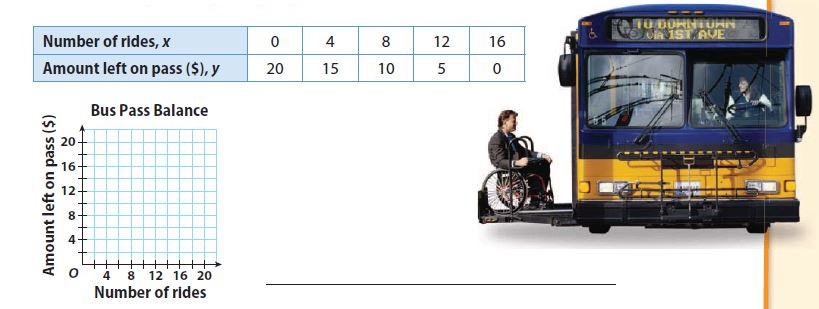
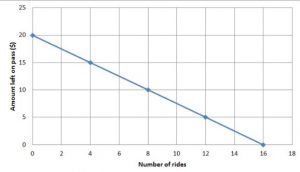
Jaime purchased a $20 bus pass. Each time he rides the bus, a certain amount is deducted from the pass. The table shows the amount, y, left on his pass after x rides. Graph the data, and find the slope and y-intercept from the graph or from the table. Then write the equation for the graph in slope-intercept form.
Go Math Grade 8 Answer Key Chapter 5 Writing Linear Equations Lesson 2: Writing Linear Equations from a Table img 4
Type below:
____________

Answer:
Grade 8 Chapter 5 image 1
y = -5/4 x + 20

Explanation:
Slope = -20/16 = -5/4 = -1.25
y- intercepts = 20
Substituting the value of the slope m and y-intercept in the slope-intercept form. y = mx + b where, m = -1.25 and b = 20.
y = -5/4 x + 20

The table shows the temperature (y) at different altitudes (x). This is a linear relationship.
Go Math Grade 8 Answer Key Chapter 5 Writing Linear Equations Lesson 2: Writing Linear Equations from a Table img 5

Question 2.
Find the slope for this relationship.
_______

Answer:
Slope m = (y2 -y1)/(x2 – x1) = (51 – 59)/(2000 – 0) = -8/2000 = -0.004

Explanation:
(x1, y1) = (0, 59), (x2, y2) = (2000, 51)
Slope m = (y2 -y1)/(x2 – x1) = (51 – 59)/(2000 – 0) = -8/2000 = -0.004

Question 3.
Find the y-intercept for this relationship.
y-intercept = _______

Answer:
b = 50

Explanation:
y-intercept = 59 when x = 0

Question 4.
Write an equation in slope-intercept form that represents this relationship.
Type below:
____________

Answer:
y = -0.004x + 59

Explanation:
Substituting the value of the slope m and y-intercept in the slope-intercept form. y = mx + b where, m = -0.004 and b = 59.

Question 5.
Use your equation to determine the temperature at an altitude of 5000 feet.
_______ °F

Answer:
39°F

Explanation:
y = -0.004x + 59
y = -0.004(5000) + 59 = -20 + 59 = 39
The temperature is 39°F at the altitude of 5000 feet.

Essential Question Check-In

Question 6.
Describe how you can use the information in a table showing a linear relationship to find the slope and y-intercept for the equation.
Type below:
____________

Answer:
Use any two points from the table to fins teh slope.
Slope m = (y2 -y1)/(x2 – x1)
If the value of y-intercept, when x=0 is not given in the table, use the slope and any ordered pair from the table and substitute in slope-intercept from y=mx + b to find b.

Independent Practice – Writing Linear Equations from a Table – Page No. 137

Question 7.
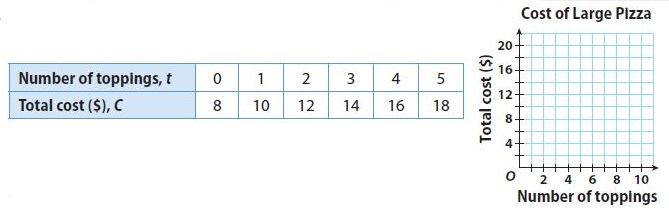
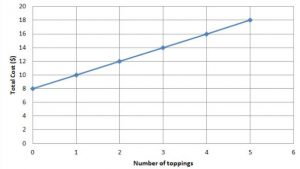
The table shows the costs of a large cheese pizza with toppings at a local pizzeria. Graph the data, and find the slope and y-intercept from the graph. Then write the equation for the graph in slope-intercept form.
Go Math Grade 8 Answer Key Chapter 5 Writing Linear Equations Lesson 2: Writing Linear Equations from a Table img 6
Type below:
____________

Answer:
Grade 8 Chapter 5 image 2

Slope m = (y2 -y1)/(x2 – x1) = (10 – 8)/(1 – 0) = 2/1 = 2
y-intercept b = 8
Substituting the value of the slope m and y-intercept in the slope-intercept form. y = mx + b where, m = 2 and b = 8.
y = 2x + 8

Question 8.
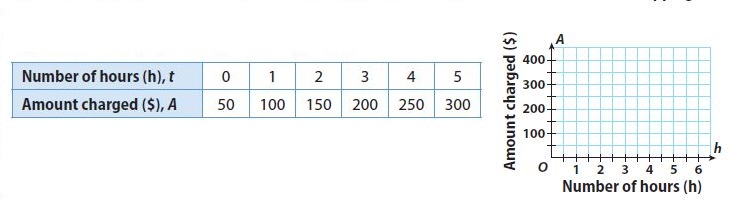
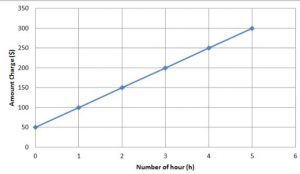
The table shows how much an air-conditioning repair company charges for different numbers of hours of work. Graph the data, and find the slope and y-intercept from the graph. Then write the equation for the graph in slope-intercept form.
Go Math Grade 8 Answer Key Chapter 5 Writing Linear Equations Lesson 2: Writing Linear Equations from a Table img 7
Type below:
____________

Answer:
Grade 8 Chapter 5 image 3

Slope m = (y2 -y1)/(x2 – x1) = (100 – 50)/(1 – 0) = 50/1 = 50
y-intercept b = 50
Substituting the value of the slope m and y-intercept in the slope-intercept form. y = mx + b where, m = 50 and b = 50.
y = 50x + 50

Question 9.
A friend gave Ms. Morris a gift card for a local car wash. The table shows the linear relationship of how the value left on the card relates to the number of car washes.
a. Write an equation that shows the number of dollars left on the card.
Go Math Grade 8 Answer Key Chapter 5 Writing Linear Equations Lesson 2: Writing Linear Equations from a Table img 8
Type below:
____________

Answer:
y = -1.50x + 30

Explanation:
Slope m = (y2 -y1)/(x2 – x1) = (18 – 30)/(8 – 0) = -12/8 = -1.5
y-intercept b = 30
Substituting the value of the slope m and y-intercept in the slope-intercept form. y = mx + b where, m = -1.50 and b = 30.
y = -1.50x + 30

Question 9.
b. Explain the meaning of the negative slope in this situation.
Type below:
____________

Answer:
The negative slope means that the amount on the card decreased by $1.5 per car wash

Question 9.
c. What is the maximum value of x that makes sense in this context? Explain.
x = _______

Answer:
x = 20

Explanation:
0 = -1.50x + 30
1.5x = 30
x = 30/1.5 = 20
the maximum value of x = 20

The tables show linear relationships between x and y. Write an equation in slope-intercept form for each relationship.

Question 10.
Go Math Grade 8 Answer Key Chapter 5 Writing Linear Equations Lesson 2: Writing Linear Equations from a Table img 9
Type below:
____________

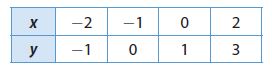
Answer:
Slope m = (y2 -y1)/(x2 – x1) = (3 – 1)/(2 – 0) =  2/2 = 1
y-intercept b = 1
Substituting the value of the slope m and y-intercept in the slope-intercept form. y = mx + b where, m = 1 and b = 1.
y =  x + 1

Question 11.
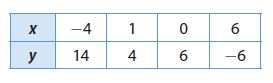
Go Math Grade 8 Answer Key Chapter 5 Writing Linear Equations Lesson 2: Writing Linear Equations from a Table img 10
Type below:
____________

Answer:
Slope m = (y2 -y1)/(x2 – x1) = (6 – 4)/(0 – 1) =  -2/1 = -2
y-intercept b = 6
Substituting the value of the slope m and y-intercept in the slope-intercept form. y = mx + b where, m = -2 and b = 6.
y = -2x + 6

Writing Linear Equations from a Table – Page No. 138

Question 12.
Finance
Desiree starts a savings account with $125.00. Every month, she deposits $53.50.
a. Complete the table to model the situation.
Go Math Grade 8 Answer Key Chapter 5 Writing Linear Equations Lesson 2: Writing Linear Equations from a Table img 11
Type below:
____________

Answer:
Grade 8 Chapter 5 image 4

Question 12.
b. Write an equation in slope-intercept form that shows how much money Desiree has in her savings account after x months.
Type below:
____________

Answer:
y = 53.5x + 125

Explanation:
Desiree starts a savings account with $125.00. Every month, she deposits $53.50.
Substituting the value of the slope m and y-intercept in the slope-intercept form. y = mx + b where, m = 53.5 and b = 125.
y = 53.5x + 125

Question 12.
c. Use the equation to find how much money Desiree will have in savings after 11 months.
$ ________

Answer:
$713.5

Explanation:
y = 53.5x + 125
The value of x is 11
y = 53.5 (11) + 125 = 588.5 + 125 = 713.5
Desiree will have $713.5 in savings after 11 months.

Question 13.
Monty documented the amount of rain his farm received on a monthly basis, as shown in the table.
Go Math Grade 8 Answer Key Chapter 5 Writing Linear Equations Lesson 2: Writing Linear Equations from a Table img 12
a. Is the relationship linear? Why or why not?
Type below:
____________

Answer:
No

Explanation:
The change in the months is constant but the change in rainfall is not constant.

Question 13.
b. Can an equation be written to describe the amount of rain? Explain.
Type below:
____________

Answer:
No

Explanation:
There is no apparent pattern in the given data.

H.O.T.

Focus on Higher Order Thinking

Question 14.
Analyze Relationships
If you have a table that shows a linear relationship, when can you read the value for b, in y = mx + b, directly from the table without drawing a graph or doing any calculations? Explain.
Type below:
____________

Answer:
You can read the value of b directly from the table whrn the table contains the input value of 0 and its corresponding output values (value of y when x = 0)

Question 15.
What If?
Jaíme graphed linear data given in the form (cost, number). The y-intercept was 0. Jayla graphed the same data given in the form (number, cost). What was the y-intercept of her graph? Explain.
Type below:
____________

Answer:
Jaíme graphed linear data given in the form (cost, number). The y-intercept was 0. Jayla graphed the same data given in the form (number, cost).
Jaíme’s graph contained (0, 0). Since Jayal’s data were the same y-intercept is 0 but x and y are switched.

Guided Practice – Linear Relationships and Bivariate Data – Page No. 144

Use the following graphs to find the equation of the linear relationship.

Question 1.
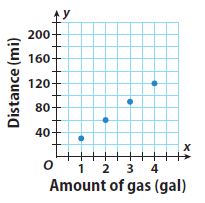
Go Math Grade 8 Answer Key Chapter 5 Writing Linear Equations Lesson 3: Linear Relationships and Bivariate Data img 13
Type below:
____________

Answer:
y = 30x

Explanation:
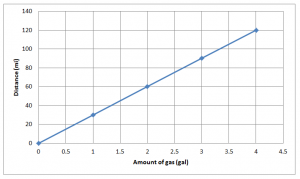
Grade 8 Chapter 5 image 5
Find the slope using two points from the grapgh by
Slope m = (y2 -y1)/(x2 – x1) where (x1, y1) = (1, 30) and (x2, y2) = (2, 60)
Slope m = (y2 -y1)/(x2 – x1) = (60 – 30)/(2 – 1) = 30/1 = 30
y-intercept b = 0
Substituting the value of the slope m and y-intercept in the slope-intercept form. y = mx + b where, m = 30 and b = 0.
y = 30x

Question 2.
Go Math Grade 8 Answer Key Chapter 5 Writing Linear Equations Lesson 3: Linear Relationships and Bivariate Data img 14
Type below:
____________

Answer:
y = 2.5x + 2

Explanation:
Grade 8 Chapter 5 image 6
Find the slope using two points from the grapgh by
Slope m = (y2 -y1)/(x2 – x1) where (x1, y1) = (2, 7) and (x2, y2) = (4, 12)
Slope m = (y2 -y1)/(x2 – x1) = (12 – 7)/(4 – 2) = 5/2 = 2.5
y-intercept b = 2
Substituting the value of the slope m and y-intercept in the slope-intercept form. y = mx + b where, m = 2.5 and b = 2.
y = 2.5x + 2

Question 3.
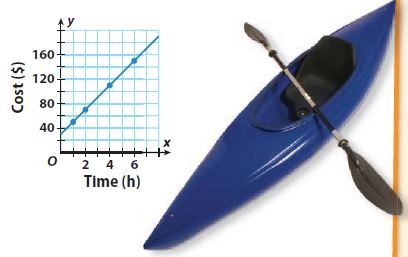
The graph shows the relationship between the number of hours a kayak is rented and the total cost of the rental. Write an equation of the relationship. Then use the equation to predict the cost of a rental that lasts 5.5 hours.
Go Math Grade 8 Answer Key Chapter 5 Writing Linear Equations Lesson 3: Linear Relationships and Bivariate Data img 15
Type below:
____________

Answer:
y = 20x + 30
The cost of a rental that lasts 5.5 hours is $140

Explanation:
Find the slope using two points from the grapgh by
Slope m = (y2 -y1)/(x2 – x1) where (x1, y1) = (2, 70) and (x2, y2) = (4, 110)
Slope m = (y2 -y1)/(x2 – x1) = (110 – 70)/(4 – 2) = 40/2 = 20
y-intercept b = 30
Substituting the value of the slope m and y-intercept in the slope-intercept form. y = mx + b where, m = 20 and b = 30.
y = 20x + 30
Substitue the value of x is 5.5 hrs
y = 20 (5.5) + 30
y = 110 + 30 = 140
The cost of a rental that lasts 5.5 hours is $140

Does each of the following graphs represent a linear relationship? Why or why not?

Question 4.
Go Math Grade 8 Answer Key Chapter 5 Writing Linear Equations Lesson 3: Linear Relationships and Bivariate Data img 16
____________

Answer:
Yes; The graph has a constant rate of change

Explanation:
Find the slope using two points from the grapgh by
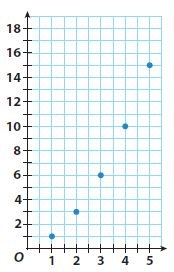
Slope m = (y2 -y1)/(x2 – x1) where (x1, y1) = (2, 6) and (x2, y2) = (5, 15)
Slope m = (y2 -y1)/(x2 – x1) = (15 – 6)/(5 – 2) = 9/3 = 3
y-intercept b = 6
Substituting the value of the slope m and y-intercept in the slope-intercept form. y = mx + b where, m = 3 and b = 6.
y = 3x + 6
The values changing according to the constant change in the x values.

Question 5.
Go Math Grade 8 Answer Key Chapter 5 Writing Linear Equations Lesson 3: Linear Relationships and Bivariate Data img 17
____________

Answer:
No; The graph does not have a constant rate of change

Essential Question Check-In

Question 6.
How can you tell if a set of bivariate data shows a linear relationship?
Type below:
____________

Answer:
It is a linear relationship if the rate of change is constant or the graph is a straight line.

Independent Practice – Linear Relationships and Bivariate Data – Page No. 145

Does each of the following tables represent a linear relationship? Why or why not?

Question 7.
Go Math Grade 8 Answer Key Chapter 5 Writing Linear Equations Lesson 3: Linear Relationships and Bivariate Data img 18
____________

Answer:
Linear Relationship

Explanation:
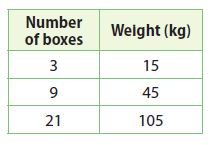
Find Rate of Change using Slope m = (y2 -y1)/(x2 – x1)
Rate of Change = (45 – 15)/(9 – 3) = 30/6 = 5
Rate of Change = (105 – 45)/(21 – 9) = 60/12 = 5
It is a Linear Relationship as the rate of the change is constant.

Question 8.
Go Math Grade 8 Answer Key Chapter 5 Writing Linear Equations Lesson 3: Linear Relationships and Bivariate Data img 19
____________

Answer:
not a Linear Relationship

Explanation:
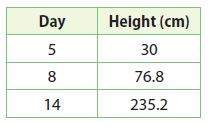
Find Rate of Change using Slope m = (y2 -y1)/(x2 – x1)
Rate of Change = (76.8 – 30)/(8 – 5) = 46./3 = 15.6
Rate of Change = (235.2 – 76.8)/(14 – 8) = 158.4/6 = 26.4
It is not a Linear Relationship as the rate of the change is varies.

Explain whether or not you think each relationship is linear.

Question 9.
the cost of equal-priced DVDs and the number purchased
____________

Answer:
y = cx

Explanation:
The relation between the cost of equal-priced DVDs and the number purchased is linear because the change rate is constant. If we denote with c the cost of a DVD, with x the number of purchased DVDs and with y the total cost of the purchased DVDs, we get an equation of the form:
y = cx

Question 10.
the height of a person and the person’s age
____________

Answer:
Non – Linear relationship

Explanation:
The height of a person does not increase at a constant rate with a person’s age

Question 11.
the area of a square quilt and its side length
____________

Answer:
Non – Linear relationship

Explanation:
The rate of change in the area of a square quilt increase as the side length increases.

Question 12.
the number of miles to the next service station and the number of kilometers
____________

Answer:
Linear relationship

Explanation:
The number of miles increases at a constant rate with the number of kilometers.

Question 13.
Multistep
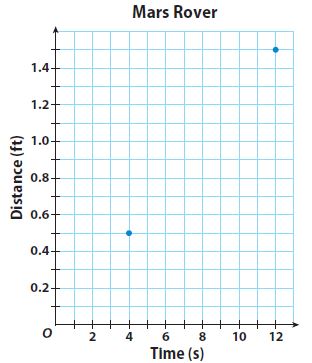
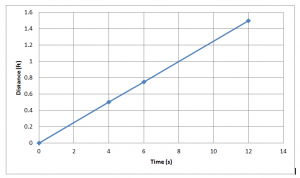
The Mars Rover travels 0.75 feet in 6 seconds. Add the point to the graph. Then determine whether the relationship between distance and time is linear, and if so, predict the distance that the Mars Rover would travel in 1 minute.
Go Math Grade 8 Answer Key Chapter 5 Writing Linear Equations Lesson 3: Linear Relationships and Bivariate Data img 20
Distance traveled in 1 min.: _______ ft.

Answer:
Relationship is linear
Distance traveled in 1 min.: 7.5 ft.

Explanation:
Grade 8 Chapter 5 image 7
The graph is a straight line. So, the Relationship is linear
The equation representing the relationship between distance and time.
y = 0.125x
The value of x is 1 min = 60 sec
y = 0.125 (60) = 7.5 ft
Distance traveled in 1 min.: 7.5 ft.

Linear Relationships and Bivariate Data – Page No. 146

Question 14.
Make a Conjecture
Zefram analyzed a linear relationship, found that the slope-intercept equation was y=3.5x+16, and made a prediction for the value of y for a given value of x. He realized that he made an error calculating the y-intercept and that it was actually 12. Can he just subtract 4 from his prediction if he knows that the slope is correct? Explain.
____________

Answer:
Yes

Explanation:
The value of y is calculated using y = 3.5x+ 16. Since the slope of the point remains the same, 4 can be subtracted from the predicted answer as the value of y would be: y = 3.5x+ 16 – 4

H.O.T.

Focus on Higher Order Thinking

Question 15.
Communicate Mathematical Ideas
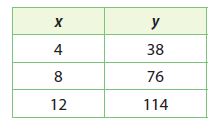
The table shows a linear relationship. How can you predict the value of y when x = 6 without finding the equation of the relationship?
Go Math Grade 8 Answer Key Chapter 5 Writing Linear Equations Lesson 3: Linear Relationships and Bivariate Data img 21
Type below:
____________

Answer:
57

Explanation:
Find Rate of Change using Slope m = (y2 -y1)/(x2 – x1)
Rate of Change = (76 – 38)/(8 – 4) = 38/4 = 9.5
Since the difference between 8 and S is 2, subtract twice the value of the rate of change from 76
y = 76 – (9.5 × 2) =57

Question 16.
Critique Reasoning
Louis says that if the differences between the values of x are constant between all the points on a graph, then the relationship is linear. Do you agree? Explain.
____________

Answer:
No

Explanation:
The difference between y should be constant for a constant interval of x.

Question 17.
Make a Conjecture
Suppose you know the slope of a linear relationship and one of the points that its graph passes through. How could you predict another point that falls on the graph of the line?
Type below:
____________

Answer:
Find the equation of the linear relationship using the slope and given point. The insert any x-value to find a y value on the graph of the line.

Question 18.
Explain the Error
Thomas used (7, 17.5) and (18, 45) from a graph to find the equation of a linear relationship as shown. What was his mistake?
m = \(\frac{45-7}{18-17.5}=\frac{38}{0.5}\) = 79
y = 79x + b =
49 = 79 × 18 + b
45 = 1422 + b, so b = −1337
The equation is y = 79x − 1377
Type below:
____________

Answer:
He subtracted the x value of the first point from the y of the second point and the y value of the second point from the x value of the first point.
Hence, the slope is incorrect and the equation is incorrect as well. The correct slope is
(45 – 17.5)/(18 – 7) = 27.5/11 = 2.5

5.1 Writing Linear Equations from Situations and Graphs – Model Quiz – Page No. 147

Write the equation of each line in slope-intercept form.

Question 1.
Go Math Grade 8 Answer Key Chapter 5 Writing Linear Equations Model Quiz img 22
Type below:
____________

Answer:
y = 30x + 20

Explanation:
Find the slope using two points from the graph by m = (y2 -y1)/(x2 – x1) where (x1, y1) = (0, 20), (x2, y2) = (2, 80)
Substitute the value of m and (x1, y1) = (0, 20), (x2, y2) = (2, 80)
Slope m = (y2 -y1)/(x2 – x1) = (80 – 20)/(2 – 0) = 60/2 = 30
Substituting the value of slope (m) and (x, y) in the slope intercept form to find y intercept (b):
80 = 30(2) + b
y-intercept b = 20
Substituting the value of the slope m and y-intercept in the slope-intercept form. y = mx + b where, m = 30 and b = 20.
y = 30x + 20

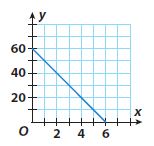
Question 2.
Go Math Grade 8 Answer Key Chapter 5 Writing Linear Equations Model Quiz img 23
Type below:
____________

Answer:
y = -10x + 60

Explanation:
Find the slope using two points from the graph by m = (y2 -y1)/(x2 – x1) where (x1, y1) = (6, 0), (x2, y2) = (0, 60)
Substitute the value of m and (x1, y1) = (6, 0), (x2, y2) = (0, 60)
Slope m = (y2 -y1)/(x2 – x1) = (60 – 0)/(0 – 6) = -60/6 = -10
Substituting the value of slope (m) and (x, y) in the slope intercept form to find y intercept (b):
60 = -10(0) + b
y-intercept b = 60
Substituting the value of the slope m and y-intercept in the slope-intercept form. y = mx + b where, m = -10 and b = 60.
y = -10x + 60

5.2 Writing Linear Equations from a Table

Write the equation of each linear relationship in slope-intercept form.

Question 3.
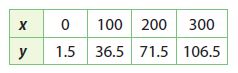
Go Math Grade 8 Answer Key Chapter 5 Writing Linear Equations Model Quiz img 24
Type below:
____________

Answer:
y = 0.35x + 1.5

Explanation:
Find the slope using two points from the graph by m = (y2 -y1)/(x2 – x1) where (x1, y1) = (0, 1.5), (x2, y2) = (100, 36.5)
Substitute the value of m and (x1, y1) = (0, 1.5), (x2, y2) = (100, 36.5)
Slope m = (y2 -y1)/(x2 – x1) = (36.5 – 1.5)/(100 – 0) = 35/100 = 0.35
Substituting the value of slope (m) and (x, y) in the slope intercept form to find y intercept (b):
1.5 =0.35(0) + b
y-intercept b = 1.5
Substituting the value of the slope m and y-intercept in the slope-intercept form. y = mx + b where, m = 0.35 and b = 1.5.
y = 0.35x + 1.5

Question 4.
Go Math Grade 8 Answer Key Chapter 5 Writing Linear Equations Model Quiz img 25
Type below:
____________

Answer:
y = -0.6x + 109

Explanation:
Find the slope using two points from the graph by m = (y2 -y1)/(x2 – x1) where (x1, y1) = (25, 94), (x2, y2) = (35, 88)
Substitute the value of m and (x1, y1) = (25, 94), (x2, y2) = (35, 88)
Slope m = (y2 -y1)/(x2 – x1) = (88 – 94)/(35 – 25) = -6/10 = -0.6
Substituting the value of slope (m) and (x, y) in the slope intercept form to find y intercept (b):
88 = -0.6(35) + b
y-intercept b = 109
Substituting the value of the slope m and y-intercept in the slope-intercept form. y = mx + b where, m = -0.6 and b = 109.
y = -0.6x + 109

5.3 Linear Relationships and Bivariate Data

Write the equation of the line that connects each set of data points.

Question 5.
Go Math Grade 8 Answer Key Chapter 5 Writing Linear Equations Model Quiz img 26
Type below:
____________

Answer:
y = 2/3x + 26 2/3

Explanation:
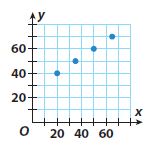
Grade 8 Chapter 5 image 8
Find the slope using two points from the graph by m = (y2 -y1)/(x2 – x1) where (x1, y1) = (20, 40), (x2, y2) = (50, 60)
Substitute the value of m and (x1, y1) = (20, 40), (x2, y2) = (50, 60)
Slope m = (y2 -y1)/(x2 – x1) = (60 – 40)/(50 – 20) = 20/30 = 2/3
Substituting the value of slope (m) and (x, y) in the slope intercept form to find y intercept (b):
40 = 2/3(20) + b
y-intercept b = 26 2/3
Substituting the value of the slope m and y-intercept in the slope-intercept form. y = mx + b where, m = 2/3 and b = 26 2/3.
y = 2/3x + 26 2/3

Question 6.
Go Math Grade 8 Answer Key Chapter 5 Writing Linear Equations Model Quiz img 27
Type below:
____________

Answer:
y = -3x + 140

Explanation:
Grade 8 Chapter 5 image 9
Find the slope using two points from the graph by m = (y2 -y1)/(x2 – x1) where (x1, y1) = (25, 65), (x2, y2) = (30, 50)
Substitute the value of m and (x1, y1) = (25, 65), (x2, y2) = (30, 50)
Slope m = (y2 -y1)/(x2 – x1) = (50 – 65)/(30 – 25) = -15/5 = -3
Substituting the value of slope (m) and (x, y) in the slope intercept form to find y intercept (b):
50 = -3(30) + b
y-intercept b = 140
Substituting the value of the slope m and y-intercept in the slope-intercept form. y = mx + b where, m = -3 and b = 140.
y = -3x + 140

Essential Question

Question 7.
Write a real-world situation that can be represented by a linear relationship.
Type below:
____________

Answer:
There is an hourly fee of $15 for renting the ski gears per hour and an entry fee of $10 for the ski lodge.

Selected Response – Mixed Review – Page No. 148

Question 1.
An hourglass is turned over with the top part filled with sand. After 3 minutes, there are 855 mL of sand in the top half. After 10 minutes, there are 750 mL of sand in the top half. Which equation represents this situation?
Options:
a. y = 285x
b. y = −10.5x + 900
c. y = −15x + 900
d. y = 75x

Answer:
c. y = −15x + 900

Explanation:
Identify the input and output variable
Input: Number of minutes
Output: Quantity of sand in the hourglass
Write the given information as ordered pair (3, 855), (10, 750)
Find the slope using two points from the graph by m = (y2 -y1)/(x2 – x1) where (x1, y1) = (10, 750), (x2, y2) =(3, 855)
Substitute the value of m and (x1, y1) = (10, 750), (x2, y2) =(3, 855)
Slope m = (y2 -y1)/(x2 – x1) = (855 – 750)/(3 – 10) = -105/7 = -15
Substituting the value of slope (m) and (x, y) in the slope intercept form to find y intercept (b):
750 = -15(10) + b
y-intercept b = 900
Substituting the value of the slope m and y-intercept in the slope-intercept form. y = mx + b where, m = -15 and b = 900.
y = -15x + 900

Question 2.
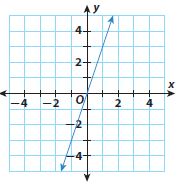
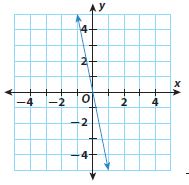
Which graph shows a linear relationship?
Go Math Grade 8 Answer Key Chapter 5 Writing Linear Equations Mixed Review img 28
Options:
a. A
b. B
c. C
d. D

Answer:
b. B

Explanation:
Graph B represents the linear relationship
The data appears to lie on a straight line

Question 3.
What are the slope and y-intercept of the relationship shown in the table?
Go Math Grade 8 Answer Key Chapter 5 Writing Linear Equations Mixed Review img 29
Options:
a. slope = 0.05, y-intercept = 1,500
b. slope = 0.5, y-intercept = 1,500
c. slope = 0.05, y-intercept = 2,000
d. slope = 0.5, y-intercept = 2,000

Answer:
c. slope = 0.05, y-intercept = 2,000

Explanation:
Find the slope using two points from the graph by m = (y2 -y1)/(x2 – x1) where (x1, y1) = (10,000, 2,500), (x2, y2) =(20,000, 3,000)
Substitute the value of m and (x1, y1) = (10,000, 2,500), (x2, y2) =(20,000, 3,000)
Slope m = (y2 -y1)/(x2 – x1) = (3,000 – 2,500)/(20,000 – 10,000) = 500/10,000 = 0.05
Substituting the value of slope (m) and (x, y) in the slope intercept form to find y intercept (b):
3,000 = 0.05(20,000) + b
y-intercept b = 2,000

Question 4.
Which is the sum of 3.15 × 10⁷ + 9.3 × 10⁶? Write your answer in scientific notation.
Options:
a. 4.08 × 10⁷
b. 4.08 × 10⁶
c. 0.408 × 10⁸
d. 40.8 × 10⁶

Answer:
a. 4.08 × 10⁷

Explanation:
Given 3.15 × 10⁷ + 9.3 × 10⁶?
(3.15 + 0.93) × 107
4.08 × 10⁷

Mini-Task

Question 5.
Franklin’s faucet was leaking, so he put a bucket underneath to catch the water. After a while, Franklin started keeping track of how much water was in the bucket. His data is in the table below.
Go Math Grade 8 Answer Key Chapter 5 Writing Linear Equations Mixed Review img 30
a. Is the relationship linear or nonlinear?
_____________

Answer:
The relationship linear

Explanation:
Find the rate of change by Difference in Quarts/Hours
(6.5 – 5)/(3 – 2) = 1.5
(8 – 6.5)/(4 – 3) = 1.5
(9.5 – 8)/(5 – 4) = 1.5
Since the rate of change is constant, the relationship is linear.

Question 5.
b. Write the equation for the relationship.
Type below:
_____________

Answer:
Rate of change is the slope of the linear equation
m = 1.5

Question 5.
c. Predict how much water will be in the bucket after 14 hours if Franklin doesn’t stop the leak.
_______ quarts

Answer:
23 quarts

Explanation:
Substituting the value of slope (m) and (x, y) in the slope intercept form to find y-intercept (b)
y = mx + b
5 = 1.5(2) + b
y-intercept b = 2
Substituting the value of the slope m and y-intercept in the slope-intercept form. y = mx + b where, m = 1.5 and b = 2.
y = 1.5x + 2
The x value is 2
y = 1.5(2) + 2 = 23
There will be 23 quarts after 14 hrs.

Conclusion:

Every expert’s choice is utilizing Go math Grade 8 Chapter 5 Writing Linear Equations Answer Key PDF. Practice the question from our Go Math 8th Grade Chapter 5 Writing Linear Equations Answers to score the highest marks in the exams. Compare the questions with the real-time problems and solve the problems with the help of Go Math Grade 8 Chapter 5 Answer Key Chapter 5 Writing Linear Equations. Stay tuned to our eurekamathanswerkeys.com to get the all Go Math Grade 8 Answer Key Chapterwise pdfs.

go-math-grade-8-chapter-4-nonproportional-relationships-answer-key

Go Math Grade 8 Answer Key Chapter 4 Nonproportional Relationships

Are you searching for Go Math 8th Grade Answer Key Chapter 4 Nonproportional Relationships? If yes, then download Go Math Grade 8 Answer Key pdf from here in this article. It helps the students to score good marks in the exams. All the solutions are prepared by the math experts according to the latest edition. Get free access for all topics on Go Math Grade 8 Chapter 4 Nonproportional Relationships from here.

Go Math Grade 8 Answer Key Chapter 4 Nonproportional Relationships

Check the list of the exercises contained in Go Math Grade 8 Answer Key Chapter 4 Nonproportional Relationships. With the help of this Go Math Grade 8 Chapter 4 Nonproportional Relationships Solution Key students can improve their performance in the tests or assignments. Refer to HMH Go Math Grade 8 Chapter 4 Answer Key to complete your homework in time.

Lesson 1: Representing Linear Nonproportional Relationships

Lesson 2: Determining Slope and y-intercept

Lesson 3: Graphing Linear Nonproportional Relationships Using Slope and y-intercept

Lesson 4: Proportional and Nonproportional Situations 

Lesson 5: Representing Linear Nonproportional Relationships – Model Quiz

Mixed Review 

Guided Practice – Representing Linear Nonproportional Relationships – Page No. 98

Make a table of values for each equation.

Question 1.
y = 2x + 5
Go Math Grade 8 Answer Key Chapter 4 Nonproportional Relationships Lesson 1: Representing Linear Nonproportional Relationships img 1
Type below:
____________

Answer:
grade 8 chapter 4 image 13

Explanation:
y = 2x + 5
Choose several values for x and substitute in the equation to find y.
x = 2(-2) + 5 = 1
x = 2(-1) + 5 = 3
x = 2(0) + 5 = 5
x = 2(1) + 5 = 7
x = 2(2) + 5 = 9

Question 2.
y = \(\frac{3}{8}\)x − 5
Go Math Grade 8 Answer Key Chapter 4 Nonproportional Relationships Lesson 1: Representing Linear Nonproportional Relationships img 2
Type below:
____________

Answer:
grade 8 chapter 4 image 14

Explanation:
y = \(\frac{3}{8}\)x − 5
Choose several values for x and substitute in the equation to find y.
x = 3/8(-8) – 5 = -8
x = 3/8(0) – 5 = -5
x = 3/8(8) – 5 = -2
x = 3/8(16) – 5 = 1
x = 3/8(24) – 5 = 4

Explain why each relationship is not proportional.

Question 3.
Go Math Grade 8 Answer Key Chapter 4 Nonproportional Relationships Lesson 1: Representing Linear Nonproportional Relationships img 3
First calculate \(\frac{y}{x}\) for the values in the table.
____________

Answer:
The relationship is not proportional

Explanation:
Find y/x
3/0 = undefined
7/2 = 3.5
11/4 = 2.75
15/6 = 2.5
19/8 = 2.375
The ratio is not constant, hence relationship is not proportional.

Question 4.
Go Math Grade 8 Answer Key Chapter 4 Nonproportional Relationships Lesson 1: Representing Linear Nonproportional Relationships img 4
__________________

Answer:
The graph is a straight line but does not pass through the origin. So, the relationship is not proportional.

Complete the table for the equation. Then use the table to graph the equation.

Question 5.
y = x − 1
Go Math Grade 8 Answer Key Chapter 4 Nonproportional Relationships Lesson 1: Representing Linear Nonproportional Relationships img 5
Go Math Grade 8 Answer Key Chapter 4 Nonproportional Relationships Lesson 1: Representing Linear Nonproportional Relationships img 6
Type below:
____________

Answer:
grade 8 chapter 4 image 15

grade 8 chapter 4 image 16

Explanation:
y = x – 1
Choose several values of x and substitute in the equation to find y to draw a table.
x = -2; y = -2 – 1 = -2
x = -1; y = -1 -1 = -2
x = 0; y = 0 -1 = -1
x = 1; y = 1 – 1 = 0
x = 2; y = 2 -1 = 1
Also, Plot the ordered pairs from the table. Then draw a line connecting the points to represent all the possible solutions

Essential Question Check-In

Question 6.
How can you choose values for x when making a table of values representing a real world situation?
Type below:
____________

Answer:
When choosing values for x in a real-world situation, you choose positive values with an appropriate interval to represent the array of data.

Independent Practice – Representing Linear Nonproportional Relationships – Page No. 99

State whether the graph of each linear relationship is a solid line or a set of unconnected points. Explain your reasoning.

Question 7.
The relationship between the number of $4 lunches you buy with a $100 school lunch card and the money remaining on the card
____________

Answer:
Set of unconnected points.

Explanation:
You cannot buy a fractional part of a lunch.
Set of unconnected points.

Question 8.
The relationship between time and the distance remaining on a 3-mile walk for someone walking at a steady rate of 2 miles per hour.
____________

Answer:
A solid line

Explanation:
The relationship between time and the distance remaining on a 3-mile walk for someone walking at a steady rate of 2 miles per hour. The distance remaining can be a fraction. The time can be in a fraction as well.
A solid line

Question 9.
Analyze Relationships
Simone paid $12 for an initial year’s subscription to a magazine. The renewal rate is $8 per year. This situation can be represented by the equation y = 8x + 12, where x represents the number of years the subscription is renewed and y represents the total cost.
a. Make a table of values for this situation.
Go Math Grade 8 Answer Key Chapter 4 Nonproportional Relationships Lesson 1: Representing Linear Nonproportional Relationships img 7
Type below:
____________

Answer:
grade 8 chapter 4 image 17

Explanation:
y = 8x + 12
Choose several values for x and substitute in the equation to find y.

Question 9.
b. Draw a graph to represent the situation. Include a title and axis labels.
Type below:
____________

Answer:
grade 8 chapter 4 image 18

Explanation:
Plot the ordered pairs from the table. Then draw a line connecting the points to represent all the possible solutions

Question 9.
c. Explain why this relationship is not proportional.
Go Math Grade 8 Answer Key Chapter 4 Nonproportional Relationships Lesson 1: Representing Linear Nonproportional Relationships img 8
Type below:
____________

Answer:
It is not proportional as the graph does not pass through the origin

Explanation:
When a relationship is proportional, the graph of the equation passes through the origin.
It is not proportional as the graph does not pass through the origin

Question 9.
d. Does it make sense to connect the points on the graph with a solid line? Explain.
Type below:
____________

Answer:
No

Explanation:
No; The subscription is rewened for the entire year and cannot be done for a fraction of the year. The number of years must be a whole numb, so the total cost goes up in $8 increments.

Representing Linear Nonproportional Relationships – Page No. 100

Question 10.
Analyze Relationships
A proportional relationship is a linear relationship because the rate of change is constant (and equal to the constant of proportionality). What is required of a proportional relationship that is not required of a general linear relationship?
Type below:
____________

Answer:
The ratio between one quantity to the other quantity should be constant for a proportional linear relationship. The graph should be a straight line that passes through the origin.

Question 11.
Communicate Mathematical Ideas
Explain how you can identify a linear non-proportional relationship from a table, a graph, and an equation.
Type below:
____________

Answer:
In a table, the ratios y/x will not be equal. A graph will not pass through the origin. An equation will be in the form y = mx + b where b is not equal to 0.

Focus on Higher Order Thinking

Question 12.
Critique Reasoning
George observes that for every increase of 1 in the value of x, there is an increase of 60 in the corresponding value of y. He claims that the relationship represented by the table is proportional. Critique George’s reasoning.
Go Math Grade 8 Answer Key Chapter 4 Nonproportional Relationships Lesson 1: Representing Linear Nonproportional Relationships img 9
Type below:
____________

Answer:
The ratio is not constant, hence the relationship cannot be proportional.

Explanation:
Find y/x
90/1 = 90
150/2 = 75
210/3 = 70
270/4 = 67.5
330/5 = 66
The ratio is not constant, hence the relationship cannot be proportional.

Question 13.
Make a Conjecture
Two parallel lines are graphed on a coordinate plane. How many of the lines could represent proportional relationships? Explain.
Type below:
____________

Answer:
Maximum one

Explanation:
When there are two parallel lines, only one can pass through the origin and a line representing a proportional relationship must pass through the origin.
Maximum one

Guided Practice – Determining Slope and y-intercept – Page No. 104

Find the slope and y-intercept of the line in each graph.

Question 1.
Go Math Grade 8 Answer Key Chapter 4 Nonproportional Relationships Lesson 2: Determining Slope and y-intercept img 10
slope m = _____ y-intercept b = _____
m = ____________
b = ____________

Answer:
slope m = -2 y-intercept b = 1
m = -2
b = 1

Explanation:
Find the slope using two points from the grapgh by
Slope m = (y2 -y1)/(x2 – x1) where (x1, y1) = (0, 1) and (x2, y2) = (2, -3)
Slope m = (y2 -y1)/(x2 – x1) = (-3 – 1)/(2 – 0) = -4/2 = -2
From the graph when x = 0
y-intercept (b) = 1

Question 2.
Go Math Grade 8 Answer Key Chapter 4 Nonproportional Relationships Lesson 2: Determining Slope and y-intercept img 11
slope m = _____ y-intercept b = _____
m = ____________
b = ____________

Answer:
slope m = 5 y-intercept b = -15
m = 5
b = -15

Explanation:
Find the slope using two points from the grapgh by
Slope m = (y2 -y1)/(x2 – x1) where (x1, y1) = (3, 0) and (x2, y2) = (0, -15)
Slope m = (y2 -y1)/(x2 – x1) = (-15 – 0)/(0 – 3) = 15/3 = 5
From the graph when x = 0
y-intercept (b) = -15

Question 3.
Go Math Grade 8 Answer Key Chapter 4 Nonproportional Relationships Lesson 2: Determining Slope and y-intercept img 12
slope m = _____ y-intercept b = _____
Type below:
____________

Answer:
slope m = 3/2 y-intercept b = -2
m = 3/2
b = -2

Explanation:
Find the slope using two points from the grapgh by
Slope m = (y2 -y1)/(x2 – x1) where (x1, y1) = (0, -2) and (x2, y2) = (2, 1)
Slope m = (y2 -y1)/(x2 – x1) = (1 – (-2))/(2 – 0) = 3/2
From the graph when x = 0
y-intercept (b) = -2

Question 4.
Go Math Grade 8 Answer Key Chapter 4 Nonproportional Relationships Lesson 2: Determining Slope and y-intercept img 13
slope m = _____ y-intercept b = _____
m = ____________
b = ____________

Answer:
slope m = -3 y-intercept b = 9
m = -3
b = 9

Explanation:
Find the slope using two points from the grapgh by
Slope m = (y2 -y1)/(x2 – x1) where (x1, y1) = (3, 0) and (x2, y2) = (0, 9)
Slope m = (y2 -y1)/(x2 – x1) = (9 – 0))/(0 – 3) = -9/3 = -3
From the graph when x = 0
y-intercept (b) = 9

Find the slope and y-intercept of the line represented by each table.

Question 5.
Go Math Grade 8 Answer Key Chapter 4 Nonproportional Relationships Lesson 2: Determining Slope and y-intercept img 14
slope m = _____ y-intercept b = _____
m = ____________
b = ____________

Answer:
slope m = 3 y-intercept b = 1
m = 3
b = 1

Explanation:
Find the slope using two points from the grapgh by
Slope m = (y2 -y1)/(x2 – x1) where (x1, y1) = (8, 25) and (x2, y2) = (6, 19)
Slope m = (y2 -y1)/(x2 – x1) = (19 – 25)/(6 – 8) = 6/2 = 3
From the graph when x = 0
y-intercept (b) = 1

Question 6.
Go Math Grade 8 Answer Key Chapter 4 Nonproportional Relationships Lesson 2: Determining Slope and y-intercept img 15
slope m = _____ y-intercept b = _____
m = ____________
b = ____________

Answer:
slope m = -4 y-intercept b = 140
m = -4
b = 140

Explanation:
Find the slope using two points from the grapgh by
Slope m = (y2 -y1)/(x2 – x1) where (x1, y1) = (5, 120) and (x2, y2) = (15, 80)
Slope m = (y2 -y1)/(x2 – x1) = (80 – 120)/(15 – 5) = -40/10 = -4
From the graph when x = 0
y-intercept (b) = 140

Essential Question Check-In

Question 7.
How can you determine the slope and the y-intercept of a line from a graph?
Type below:
____________

Answer:
Choose any two points on the line from the graph and use it to find the slope. Determine the point where the line crosses the y-axis to find the y-intercept.

Independent Pratice – Determining Slope and y-intercept – Page No. 105

Question 8.
Some carpet cleaning costs are shown in the table. The relationship is linear. Find and interpret the rate of change and the initial value for this situation.
Go Math Grade 8 Answer Key Chapter 4 Nonproportional Relationships Lesson 2: Determining Slope and y-intercept img 16
Type below:
_____________

Answer:
Find the slope using two points
Slope m = (y2 -y1)/(x2 – x1) where (x1, y1) = (1, 125) and (x2, y2) = (3, 225)
Slope m = (y2 -y1)/(x2 – x1) = (225 – 125)/(3 – 1) = 100/2 = 50
Find the initial value when the value of x is 0
Work backward from x = 1 to x = 0
(175 – 125)/(2 – 1) = 50/1 = 50
Subtract the difference of x and y from the first point.
x = 1 – 1 = 0
y = 125 – 50 = 75
y intercept (b) = 75
The slope/rate of change represents the increase in the cost of cleaning the rooms for a unit increase in the number of rooms. The y-intercept shows the initial cost of carpet cleaning.

Question 9.
Make Predictions
The total cost to pay for parking at a state park for the day and rent a paddleboat are shown.
Go Math Grade 8 Answer Key Chapter 4 Nonproportional Relationships Lesson 2: Determining Slope and y-intercept img 17
a. Find the cost to park for a day and the hourly rate to rent a paddleboat.
Type below:
_____________

Answer:
$5

Explanation:
Find the slope using two points
Slope m = (y2 -y1)/(x2 – x1) where (x1, y1) = (1, 17) and (x2, y2) = (2, 29)
Slope m = (y2 -y1)/(x2 – x1) = (29 – 17)/(2 – 1) = 12/1 = 12
Find the initial value when the value of x is 0
Work backward from x = 1 to x = 0
(29 – 17)/(2 – 1) = 12/1 = 12
Subtract the difference of x and y from the first point.
x = 1 – 1 = 0
y = 17 – 12 = 5
The cost to park for a day is $5.

Question 9.
b. What will Lin pay if she rents a paddleboat for 3.5 hours and splits the total cost with a friend? Explain.
$ _____________

Answer:
$23.5

Explanation:
When Lin paddles for 3.5hr
Total Cost = 3.5(12) + 5 = 47
Lin’s cost = 47/2 = 23.5

Question 10.
Multi-Step
Raymond’s parents will pay for him to take sailboard lessons during the summer. He can take half-hour group lessons or half-hour private lessons. The relationship between cost and number of lessons is linear.
Go Math Grade 8 Answer Key Chapter 4 Nonproportional Relationships Lesson 2: Determining Slope and y-intercept img 18
a. Find the rate of change and the initial value for the group lessons.
Type below:
____________

Answer:
$25

Explanation:
Find the slope using two points
Slope m = (y2 -y1)/(x2 – x1) where (x1, y1) = (1, 55) and (x2, y2) = (2, 85)
Slope m = (y2 -y1)/(x2 – x1) = (85 – 55)/(2 – 1) = 30/1 = 30
Rate of change is $30 for per lesson
Find the initial value when the value of x is 0
Work backward from x = 1 to x = 0
(85 – 55)/(2 – 1) = 30/1 = 30
Subtract the difference of x and y from the first point.
x = 1 – 1 = 0
y = 55 – 30 = 25
The initial value of the group lesson is $25.

Question 10.
b. Find the rate of change and the initial value for the private lessons.
Type below:
_____________

Answer:
$25

Explanation:
Find the slope using two points
Slope m = (y2 -y1)/(x2 – x1) where (x1, y1) = (1, 75) and (x2, y2) = (2, 125)
Slope m = (y2 -y1)/(x2 – x1) = (125 – 75)/(2 – 1) = 50/1 = 50
Rate of change is $50 for per lesson
Find the initial value when the value of x is 0
Work backward from x = 1 to x = 0
(125 – 75)/(2 – 1) = 50/1 = 50
Subtract the difference of x and y from the first point.
x = 1 – 1 = 0
y = 75 – 50 = 25
The initial value of the private lesson is $25.

Question 10.
c. Compare and contrast the rates of change and the initial values.
Type below:
_____________

Answer:
The initial value for both types of lessons is the same. The rate of change is higher for private lessons then group lesson

Explanation:
Compare the results of a and b
The initial value for both types of lessons is the same. The rate of change is higher for private lessons then group lesson

Vocabulary – Determining Slope and y-intercept – Page No. 106

Explain why each relationship is not linear.

Question 11.
Go Math Grade 8 Answer Key Chapter 4 Nonproportional Relationships Lesson 2: Determining Slope and y-intercept img 19
Type below:
_____________

Answer:
The rate of change is not constant, hence the relationship is not linear

Explanation:
Find the rate of change using two points Slope m = (y2 -y1)/(x2 – x1)
(6.5 – 4.5)/(2 – 1) = 2
(8.5 – 6.5)/(3 – 2) = 2
(11.5 – 8.5)/(4 – 3) = 3
The rate of change is not constant, hence the relationship is not linear

Question 12.
Go Math Grade 8 Answer Key Chapter 4 Nonproportional Relationships Lesson 2: Determining Slope and y-intercept img 20
Type below:
_____________

Answer:
The rate of change is not constant, hence the relationship is not linear

Explanation:
Find the rate of change using two points Slope m = (y2 -y1)/(x2 – x1)
(126 – 140)/(5 – 3) = -7
(110 – 126)/(7 – 5) = -8
(92 – 110)/(9 – 7) = -9
The rate of change is not constant, hence the relationship is not linear

Question 13.
Communicate Mathematical Ideas
Describe the procedure you performed to derive the slope-intercept form of a linear equation.
Type below:
_____________

Answer:
Express the slope m between a random point (x, y) on the line and the point (0, b) where the line crosses the y-axis. Then solve the equation for y.

H.O.T.

Focus on Higher Order Thinking

Question 14.
Critique Reasoning
Your teacher asked your class to describe a realworld situation in which a y-intercept is 100 and the slope is 5. Your partner gave the following description: My younger brother originally had 100 small building blocks, but he has lost 5 of them every month since.
a. What mistake did your partner make?
Type below:
_____________

Answer:
If the brother loses 5 blocks every month, the slope would be -5 and not 5.

Explanation:
When the initial value is decreasing, the slope is negative.
If the brother loses 5 blocks every month, the slope would be -5 and not 5.

Question 14.
b. Describe a real-world situation that does match the situation.
Type below:
_____________

Answer:
I bought a 100 card pack and buy 5 additional cards every month.

Explanation:
Real world situation
I bought a 100 card pack and buy 5 additional cards every month.

Question 15.
Justify Reasoning
John has a job parking cars. He earns a fixed weekly salary of $300 plus a fee of $5 for each car he parks. His potential earnings for a week are shown in the graph. At what point does John begin to earn more from fees than his fixed salary? Justify your answer.
Go Math Grade 8 Answer Key Chapter 4 Nonproportional Relationships Lesson 2: Determining Slope and y-intercept img 21
Type below:
_____________

Answer:
After parking 60 cars, John’s earning become $600 double of his initial base salary of $300.
Hence, after parking 61 cars, his earning from the fee becomes more than his fixed salary.

Explanation:
He earns the same in fees as his fixed salary for perking 300/5 = 60
After parking 60 cars, John’s earning become $600 double of his initial base salary of $300.
Hence, after parking 61 cars, his earning from the fee becomes more than his fixed salary.

Guided Practice – Graphing Linear Nonproportional Relationships Using Slope and y-intercept – Page No. 110

Graph each equation using the slope and the y-intercept.

Question 1.
y = \(\frac{1}{2}\)x − 3
slope = _____ y-intercept = _____
Go Math Grade 8 Answer Key Chapter 4 Nonproportional Relationships Lesson 3: Graphing Linear Nonproportional Relationships Using Slope and y-intercept img 22
Type below:
_____________

Answer:
slope = 1/2 y-intercept = -3
Grade 8 Chapter 4 image 1

Explanation:
y = 1/2 x – 3
The y-intercept is b = -3. Plot the point that contains the y-intercept (0, -3)
The slope m = 1/2. Use the slope to find a second point. From (0, -3) count 1 unit up and 2 unit right. The new point is (2, -2)
Draw a line through the points

Question 2.
y = −3x + 2
slope = _____ y-intercept = _____
Go Math Grade 8 Answer Key Chapter 4 Nonproportional Relationships Lesson 3: Graphing Linear Nonproportional Relationships Using Slope and y-intercept img 23
Type below:
_____________

Answer:
slope = -3 y-intercept = 2
Grade 8 Chapter 4 image 2

Explanation:
y = -3x + 2
The y-intercept is b = 2. Plot the point that contains the y-intercept (0, 2)
The slope m = -3/1. Use the slope to find a second point. From (0, 2) count 3 unit down and 1 unit right. The new point is (1, -1)
Draw a line through the points

Question 3.
A friend gives you two baseball cards for your birthday. Afterward, you begin collecting them. You buy the same number of cards once each week. The equation y = 4x + 2 describes the number of cards, y, you have after x weeks.
a. Find and interpret the slope and the y-intercept of the line that represents this situation. Graph y = 4x + 2. Include axis labels.
Go Math Grade 8 Answer Key Chapter 4 Nonproportional Relationships Lesson 3: Graphing Linear Nonproportional Relationships Using Slope and y-intercept img 24
Type below:
_____________

Answer:
Grade 8 Chapter 4 image 3

Explanation:
y = 4x + 2
The y-intercept is b = 2. Plot the point that contains the y-intercept (0, 2)
The slope m = 4. Use the slope to find a second point. From (0, 2) count 4 unit up and 1 unit right. The new point is (1, 6)
Draw a line through the points

Question 3.
b. Discuss which points on the line do not make sense in this situation. Then plot three more points on the line that do make sense.
Type below:
_____________

Answer:
Grade 8 Chapter 4 image 4

Explanation:
The points with a negative value of x or y do not make sense as the number of cards or weeks cannot be negative.

Essential Question Check-In

Question 4.
Why might someone choose to use the y-intercept and the slope to graph a line?
Type below:
_____________

Answer:
When the relationship is given in the form y = mx + b, the y-intercept (b) and the slope (m) are easily accessible and easily calculable. Therefore, it is a good practice to use them to graph the line.

Independent Practice – Graphing Linear Nonproportional Relationships Using Slope and y-intercept – Page No. 111

Question 5.
Science
A spring stretches in relation to the weight hanging from it according to the equation y = 0.75x + 0.25 where x is the weight in pounds and y is the length of the spring in inches.
a. Graph the equation. Include axis labels.
Type below:
_____________

Answer:
grade 8 chapter 4 image 7

Explanation:
y = 0.75x + 0.25
Slope m = 0.75 and y-intercept = 0.25
Plot the point that contains the y-intercept (0, 0.25)
The slope is m = 0.75/1. Use the slope to find a second point. From (0,0.25) count 0.75 unit up and 1 unit right. The new point is (1, 1)

Question 5.
b. Interpret the slope and the y-intercept of the line.
Type below:
_____________

Answer:
The slope represents the increase in the length of spring in inches for each increase of pound of weight. y-intercept represents the unstretched length of the spring When there is no weight attached.

Question 5.
c. How long will the spring be if a 2-pound weight is hung on it? Will the length double if you double the weight? Explain
Type below:
_____________

Answer:
When there is a 2-pound weight hung, the length of the spring would be 1.75 inches. No, When there is a 4-pound weight hung, the length of the spring would be 3.25 inches and not 3.5 inches.

Look for a Pattern

Identify the coordinates of four points on the line with each given slope and y-intercept.

Question 6.
slope = 5, y-intercept = -1
Type below:
_____________

Answer:
(2, 9)
(3, 14)

Explanation:
slope = 5, y-intercept = -1
Plot the point that contains the y-intercept (0, -1)
The slope is m = 5/1. Use the slope to find a second point. From (0, -1) count 5 unit up and 1 unit right. The new point is (1, 4)
Follow the same procedure to find the remaining three points.
(2, 9)
(3, 14)

Question 7.
slope = -1, y-intercept = 8
Type below:
_____________

Answer:
(2, 6)
(3, 5)

Explanation:
slope = -1, y-intercept = 8
Plot the point that contains the y-intercept (0, 8)
The slope is m = -1/1. Use the slope to find a second point. From (0, 8) count 1 unit down and 1 unit right. The new point is (1, 7)
Follow the same procedure to find the remaining three points.
(2, 6)
(3, 5)

Question 8.
slope = 0.2, y-intercept = 0.3
Type below:
_____________

Answer:
(2, 0.7)
(3, 0.9)

Explanation:
slope = 0.2, y-intercept = 0.3
Plot the point that contains the y-intercept (0, 0.3)
The slope is m = 0.2/1. Use the slope to find a second point. From (0, 0.3) count 0.2 unit up and 1 unit right. The new point is (1, 0.5)
Follow the same procedure to find the remaining three points.
(2, 0.7)
(3, 0.9)

Question 9.
slope = 1.5, y-intercept = -3
Type below:
_____________

Answer:
(2, 0)
(3, 1.5)

Explanation:
slope = 1.5, y-intercept = -3
Plot the point that contains the y-intercept (0, -3)
The slope is m = 1.5/1. Use the slope to find a second point. From (0, -3) count 1.5 unit up and 1 unit right. The new point is (1, -1.5)
Follow the same procedure to find the remaining three points.
(2, 0)
(3, 1.5)

Question 10.
slope = −\(\frac{1}{2}\), y-intercept = 4
Type below:
_____________

Answer:
(4, 2)
(6, 1)

Explanation:
slope = −\(\frac{1}{2}\), y-intercept = 4
Plot the point that contains the y-intercept (0, 4)
The slope is m = −\(\frac{1}{2}\)/1. Use the slope to find a second point. From (0, 4) count 1 unit down and 2 unit right. The new point is (2, 3)
Follow the same procedure to find the remaining three points.
(4, 2)
(6, 1)

Question 11.
slope = \(\frac{2}{3}\), y-intercept = -5
Type below:
_____________

Answer:
(6, -1)
(9, 1)

Explanation:
slope = \(\frac{2}{3}\), y-intercept = -5
Plot the point that contains the y-intercept (0, -5)
The slope is m = \(\frac{2}{3}\). Use the slope to find a second point. From (0, -5) count 2 unit up and 3 unit right. The new point is (3, -3)
Follow the same procedure to find the remaining three points.
(6, -1)
(9, 1)

Question 12.
A music school charges a registration fee in addition to a fee per lesson. Music lessons last 0.5 hour. The equation y = 40x + 30 represents the total cost y of x lessons. Find and interpret the slope and y-intercept of the line that represents this situation. Then find four points on the line.
Type below:
_____________

Answer:
y = 40x + 30
Slope = 40
y-intercept = 30
The slope represents the fee of the classes per lesson and y-intercept represents the registration fee.
Plot the point that contains the y-intercept (0, 30)
The slope is m = 40/1. Use the slope to find a second point. From (0, 30) count 40 unit up and 1 unit right. The new point is (1, 70)
Follow the same procedure to find the remaining three points.
(2, 110)
(3, 150)

Graphing Linear Nonproportional Relationships Using Slope and y-intercept – Page No. 112

Question 13.
A public pool charges a membership fee and a fee for each visit. The equation y = 3x + 50 represents the cost y for x visits.
a. After locating the y-intercept on the coordinate plane shown, can you move up three gridlines and right one gridline to find a second point? Explain.
Go Math Grade 8 Answer Key Chapter 4 Nonproportional Relationships Lesson 3: Graphing Linear Nonproportional Relationships Using Slope and y-intercept img 25
Type below:
_____________

Answer:
Yes

Explanation:
Yes; Since the horizontal and vertical gridlines each represents 25 units, hence moving up 3 gridlines and right 1 gridline represent a slope a 75/25 or 3

Question 13.
b. Graph the equation y = 3x + 50. Include axis labels. Then interpret the slope and y-intercept.
Type below:
_____________

Answer:
grade 8 chapter 4 image 8
The slope represents the fee per visit and the y-intercept represents the membership fee.

Explanation:
Slope = 3
y-intercept = 50
The slope represents the fee of the classes per lesson and the y-intercept represents the registration fee.
Plot the point that contains the y-intercept (0, 50)
The slope is m = 3/1. Use the slope to find a second point. From (0, 50) count 3 unit up and 1 unit right. The new point is (1, 53)

Question 13.
c. How many visits to the pool can a member get for $200?
______ visits

Answer:
50 visits

Explanation:
You would get 50 visits for $200
grade 8 chapter 4 image 9

H.O.T.

Focus on Higher Order Thinking

Question 14.
Explain the Error
A student says that the slope of the line for the equation y = 20 − 15x is 20 and the y-intercept is 15. Find and correct the error.
Type below:
_____________

Answer:
The slope is -15 as it represents the change in y per unit change in x. The y-intercept is 20, when x = 0.

Explanation:
y = 20 − 15x
The slope is -15 as it represents the change in y per unit change in x. The y-intercept is 20, when x = 0.

Question 15.
Critical Thinking
Suppose you know the slope of a linear relationship and a point that its graph passes through. Can you graph the line even if the point provided does not represent the y-intercept? Explain.
Type below:
_____________

Answer:
Yes. You can plot the given point and use the slope to find a second point. Connect the points by drawing a line.

Question 16.
Make a Conjecture
Graph the lines y = 3x, y = 3x − 3, and y = 3x + 3. What do you notice about the lines? Make a conjecture based on your observation.
Go Math Grade 8 Answer Key Chapter 4 Nonproportional Relationships Lesson 3: Graphing Linear Nonproportional Relationships Using Slope and y-intercept img 26
Type below:
_____________

Answer:
grade 8 chapter 4 image 10

Explanation:
let’s tale the example
y = 3x
y = 3x – 3
y = 3x + 3
We notice that the lines are parallel to each other: the slopes of the lines are equal but the y-intersection point differs.

Guided Practice – Proportional and Nonproportional Situations – Page No. 117

Determine if each relationship is a proportional or nonproportional situation. Explain your reasoning.

Question 1.
Go Math Grade 8 Answer Key Chapter 4 Nonproportional Relationships Lesson 4: Proportional and Nonproportional Situations img 27
Look at the origin.
_____________

Answer:
Proportional relationship

Explanation:
Proportional relationship
The graph passes through the origin. Graph of a proportional relationship must pass through the origin

Question 2.
Go Math Grade 8 Answer Key Chapter 4 Nonproportional Relationships Lesson 4: Proportional and Nonproportional Situations img 28
_____________

Answer:
Non-proportional relationship

Explanation:
The graph does not pass through the origin. Graph of a proportional relationship must pass through the origin
Non-proportional relationship

Question 3.
q = 2p + \(\frac{1}{2}\)
Compare the equation with y = mx + b.
_____________

Answer:
q = 2p + \(\frac{1}{2}\)
The equation is in the form y = mx + b, with p being used es the variable instead of x and q instead of y. The value of m is 2, and the value b is 1/2. Since b is not 0, the relationship presented through the above equation is non-proportional.

Question 4.
v = \(\frac{1}{10}\)u
_____________

Answer:
Proportional relationship

Explanation:
v = \(\frac{1}{10}\)u
Compare with the form of equation y = mx + b. The equation represent proportional relationship if b = 0
Proportional relationship

Proportional and Nonproportional Situations – Page No. 118

The tables represent linear relationships. Determine if each relationship is a proportional or nonproportional situation.

Question 5.
Go Math Grade 8 Answer Key Chapter 4 Nonproportional Relationships Lesson 4: Proportional and Nonproportional Situations img 29
Find the quotient of y and x.
_____________

Answer:
proportional relationship

Explanation:
Find the ratio y/x
12/3 = 4
36/9 = 4
84/21 = 4
Since the ratio is constant, the relationship is proportional.

Question 6.
Go Math Grade 8 Answer Key Chapter 4 Nonproportional Relationships Lesson 4: Proportional and Nonproportional Situations img 30
_____________

Answer:
non-proportional

Explanation:
Find the ratio y/x
4/22 = 2/11
8/46 = 4/23
10/58 = 5/29
Since the ratio is not constant, the relationship is non-proportional.

Question 7.
The values in the table represent the numbers of households that watched three TV shows and the ratings of the shows. The relationship is linear. Describe the relationship in other ways.
Go Math Grade 8 Answer Key Chapter 4 Nonproportional Relationships Lesson 4: Proportional and Nonproportional Situations img 31
Type below:
_____________

Answer:
proportional relationship

Explanation:
Find the ratio y/x
12/15,000,000 = 0.0000008
16/20,000,000 = 0.0000008
20/25,000,000 = 0.0000008
Since the ratio is constant, the relationship is proportional.

Essential Question Check-In

Question 8.
How are using graphs, equations, and tables similar when distinguishing between proportional and nonproportional linear relationships?
Type below:
_____________

Answer:
The ratio between y to x is constant when the relationship is proportional. Graphs, tables, and equations all can be used to find the ratio. The ratio is not constant when the relationship is non-proportional.

Independent Practice – Proportional and Nonproportional Situations – Page No. 119

Question 9.
The graph shows the weight of a cross-country team’s beverage cooler based on how much sports drink it contains.
Go Math Grade 8 Answer Key Chapter 4 Nonproportional Relationships Lesson 4: Proportional and Nonproportional Situations img 32
a. Is the relationship proportional or nonproportional? Explain.
_____________

Answer:
Non-proportional

Explanation:
The graph does not pass through the origin. Graph of a proportional relationship must pass through the origin
Non-proportional

Question 9.
b. Identify and interpret the slope and the y-intercept.
Type below:
_____________

Answer:
Slope m = (y2 -y1)/(x2 – x1) = (12 – 10)/(4 – 0) = 0.5
y-intercept is the weight of the empty cooler, which is 10 lbs.

Explanation:
Find the slope using two points from the grapgh by
Slope m = (y2 -y1)/(x2 – x1) where (x1, y1) = (0, 10) and (x2, y2) = (4, 12)
Slope m = (y2 -y1)/(x2 – x1) = (12 – 10)/(4 – 0) = 0.5
From the graph when x = 0
y-intercept (b) = 10
y-intercept is the weight of the empty cooler, which is 10 lbs.

In 10–11, tell if the relationship between a rider’s height above the first floor and the time since the rider stepped on the elevator or escalator is proportional or nonproportional. Explain your reasoning.

Question 10.
The elevator paused for 10 seconds after you stepped on before beginning to rise at a constant rate of 8 feet per second.
Go Math Grade 8 Answer Key Chapter 4 Nonproportional Relationships Lesson 4: Proportional and Nonproportional Situations img 33
_____________

Answer:
Non-proportional

Explanation:
As there is a pause of 10 seconds, it would be the y-intercept of the graph (when x = 0)
Non-proportional

Question 11.
Your height, h, in feet above the first floor on the escalator is given by h = 0.75t, where t is the time in seconds.
_____________

Answer:
Proportional

Explanation:
Comparing with y = mx + b, where b = 0
Proportional

Analyze Relationships

Compare and contrast the two graphs.

Question 12.
Graph A       Graph B
y = \(\frac{1}{3}\) x        y = \(\sqrt { x } \)
Go Math Grade 8 Answer Key Chapter 4 Nonproportional Relationships Lesson 4: Proportional and Nonproportional Situations img 34
Go Math Grade 8 Answer Key Chapter 4 Nonproportional Relationships Lesson 4: Proportional and Nonproportional Situations img 35
Type below:
_____________

Answer:
Graph A represents a linear relationship while Graph B represents an exponential relationship. They both pass through the origin and the value of y increases with an increase in x.

Proportional and Nonproportional Situations – Page No. 120

Question 13.
Represent Real-World Problems
Describe a real-world situation where the relationship is linear and nonproportional.
Type below:
_____________

Answer:
The entrance fee to the amusement park is $8 and there is a fee of $2 per ride.

H.O.T.

Focus on Higher Order Thinking

Question 14.
Mathematical Reasoning
Suppose you know the slope of a linear relationship and one of the points that its graph passes through. How can you determine if the relationship is proportional or nonproportional?
Type below:
_____________

Answer:
Use the graph and the given point to determine the second point. Connect the two points by a straight line. If the graph passes through the origin, the relationship is proportional and if the graph does not pass through the origin, the relationship is non-proportional.

Question 15.
Multiple Representations
An entrant at a science fair has included information about temperature conversion in various forms, as shown. The variables F, C, and K represent temperatures in degrees Fahrenheit, degrees Celsius, and kelvin, respectively.
Go Math Grade 8 Answer Key Chapter 4 Nonproportional Relationships Lesson 4: Proportional and Nonproportional Situations img 36
a. Is the relationship between kelvins and degrees Celsius proportional? Justify your answer in two different ways.
_____________

Answer:
No, the relationship is not proportional.

Explanation:
Compare the equation B to the form: y = mx + b. Since b is not equal to 0, the relationship is non-proportional.
Find the ratio between the Kelvin and Degrees Celsius. Since the ration is not constant, the relationship is non-proportional.
281.15/8 = 35.14
288.15/15 = 19.21
309.15/36 = 8.59
No, the relationship is not proportional.

Question 15.
b. Is the relationship between degrees Celsius and degrees Fahrenheit proportional? Why or why not?
_____________

Answer:
No, the relationship is not proportional.

Explanation:
Compare the equation A to the form: y = mx + b. Since b is not equal to 0, the relationship is non-proportional.
No, the relationship is not proportional.

4.1 Representing Linear Nonproportional Relationships – Model Quiz – Page No. 121

Question 1.
Complete the table using the equation y = 3x + 2.
Go Math Grade 8 Answer Key Chapter 4 Nonproportional Relationships Model Quiz img 37
Type below:
_____________

Answer:
grade 8 chapter 4 image 11

Explanation:
Given y = 3x + 2
grade 8 chapter 4 image 11
x = -1; y = 3(-1) + 2 = -3 + 2 = -1
x = 0; y = 3(0) +2 = 2
x = 1; y = 3(1) + 2 = 3 + 2 = 5
x = 2; y = 3(2) + 2 = 6 + 2 = 8
x = 3: y = 3(3) + 2 = 9 + 2 = 11

4.2 Determining Slope and y-intercept

Question 2.
Find the slope and y-intercept of the line in the graph.
Go Math Grade 8 Answer Key Chapter 4 Nonproportional Relationships Model Quiz img 38
Type below:
_____________

Answer:
Slope = 3
y-intercept (b) = 1

Explanation:
Find the slope using two points from the grapgh by
Slope m = (y2 -y1)/(x2 – x1) where (x1, y1) = (0, 1) and (x2, y2) = (1, 4)
Slope m = (y2 -y1)/(x2 – x1) = (4 – 1)/(1 – 0) = 3/1
From the graph when x = 0
y-intercept (b) = 1

4.3 Graphing Linear Nonproportional Relationships

Question 3.
Graph the equation y = 2x − 3 using slope and y-intercept.
Go Math Grade 8 Answer Key Chapter 4 Nonproportional Relationships Model Quiz img 39
Type below:
_____________

Answer:
grade 8 chapter 4 image 12

Explanation:
Slope = 2
y-intercept = -3
Plot the point that contains the y-intercept (0, -3)
The slope is m = 2/1. Use the slope to find a second point. From (0, -3) count 2 unit up and 1 unit right. The new point is (1, -1)
Draw a line through the points

4.4 Proportional and Nonproportional Situations

Question 4.
Does the table represent a proportional or a nonproportional linear relationship?
Go Math Grade 8 Answer Key Chapter 4 Nonproportional Relationships Model Quiz img 40
_____________

Answer:
Since the ratio is constant, the table represents a proportional linear relationship.

Explanation:
Find the ratio y/x
4/1 = 4
8/2 = 4
12/3 = 4
16/4 = 4
20/5 = 4
Since the ratio is constant, the table represents a proportional linear relationship.

Question 5.
Does the graph in Exercise 2 represent a proportional or a nonproportional linear relationship?
_____________

Answer:
It represents a non-proportional linear relationship

Explanation:
The line of the graph does not pass through the origin. The graph of a proportional relationship must pass through the origin.
It represents a non-proportional linear relationship

Question 6.
Does the graph in Exercise 3 represent a proportional or a nonproportional relationship?
_____________

Answer:
It represents a non-proportional linear relationship

Explanation:
The line of the graph does not pass through the origin. The graph of a proportional relationship must pass through the origin
It represents a non-proportional linear relationship

Essential Question

Question 7.
How can you identify a linear nonproportional relationship from a table, a graph, and an equation?
Type below:
_____________

Answer:
In a table, the ratio of y/x is not constant for non-proportional relationship.
In a graph, the line of the graph does not pass through the origin for non-proportional relationship.
In an equation, the b is not equal to for y = mx +b for non-proportional relationship.

Selected Response – Mixed Review – Page No. 122

Question 1.
The table below represents which equation?
Go Math Grade 8 Answer Key Chapter 4 Nonproportional Relationships Mixed Review img 41
Options:
a. y = −x − 10
b. y = −6x
c. y = −4x − 6
d. y = −4x + 2

Answer:
c. y = −4x − 6

Explanation:
From the table, you can see that the y-intercept (when x = 0) is b = -6. Comparable to y = mx + b
The table is represented by Option C y = -4x – 6

Question 2.
The graph of which equation is shown below?
Go Math Grade 8 Answer Key Chapter 4 Nonproportional Relationships Mixed Review img 42
Options:
a. y = −2x + 3
b. y = −2x + 1.5
c. y = 2x + 3
d. y = 2x + 1.5

Answer:
a. y = −2x + 3

Explanation:
From the table, you can see that the y-intercept (when x = 0) is b = 3. Comparable to y = mx + b
The Option B and D are rejected.
Since the graph is slanting downwards, the slope is negative.
Option C is rejected
The graph represents y = -2x + 3

Question 3.
The table below represents a linear relationship.
Go Math Grade 8 Answer Key Chapter 4 Nonproportional Relationships Mixed Review img 43
What is the y-intercept?
Options:
a. -4
b. -2
c. 2
d. 3

Answer:
b. -2

Explanation:
Find the rate of change
(7 – 4)/(3 – 2) = (10 – 7)/(4 – 3) = 3
Find the value of y for x = 0
Works backward from x = 2 to x = 1
x = 2 – 1 = 1
y = 4 – 3 = 1
x = 1 – 1 = 0
y = 1 – 3 = -2
y intercept = -2

Question 4.
Which equation represents a nonproportional relationship?
Options:
a. y = 3x + 0
b. y = −3x
c. y = 3x + 5
d. y = \(\frac{1}{3}\)x

Answer:
c. y = 3x + 5

Explanation:
For a non-proportional relationship, the equation is y = mx + b and b is not equal to 0.
Option C represents a non-proportional relationship y = 3x + 5

Question 5.
The table shows a proportional relationship. What is the missing y-value?
Go Math Grade 8 Answer Key Chapter 4 Nonproportional Relationships Mixed Review img 44
Options:
a. 16
b. 20
c. 18
d. 24

Answer:
c. 18

Explanation:
Find the ratio y/x
6/4 = 3/2
Since the relationship is proportional, the ratio is constant.
Using the ratio to fins missing y
3/2 = y/12
y = 3/2 × 12 = 18

Question 6.
What is 0.00000598 written in scientific notation?
Options:
a. 5.98 × 10⁻⁶
b. 5.98 × 10⁻⁵
c. 59.8 × 10⁻⁶
d. 59.8 × 10⁻⁷

Answer:
c. 59.8 × 10⁻⁶

Explanation:
0.00000598
Move the decimal 6 points
59.8 × 10⁻⁶

Mini-Task

Question 7.
The graph shows a linear relationship.
Go Math Grade 8 Answer Key Chapter 4 Nonproportional Relationships Mixed Review img 45
a. Is the relationship proportional or nonproportional?
____________

Answer:
It represents a non-proportional linear relationship

Explanation:
The line of the graph does not pass through the origin. The graph of a proportional relationship must pass through the origin.
It represents a non-proportional linear relationship

Question 7.
b. What is the slope of the line?
_______

Answer:
Slope m = -2

Explanation:
Find the slope using two points from the grapgh by
Slope m = (y2 -y1)/(x2 – x1) where (x1, y1) = (0, -2) and (x2, y2) = (2, 1)
Slope m = (y2 -y1)/(x2 – x1) = (-3 -1)/(0 + 2) = -4/2 = -2

Question 7.
c. What is the y-intercept of the line?
_______

Answer:
y-intercept (b) = -3

Explanation:
From the graph when x = 0
y-intercept (b) = -3

Question 7.
d. What is the equation of the line?
Type below:
____________

Answer:
y = -2x – 3

Explanation:
Substitute m and b in the form: y = mx + b
y = -2x – 3

Conclusion:

I believe that our Go Math Grade 8 Answer Key Chapter 4 Nonproportional Relationships pdf brought a smile to your face. All the beginners can easily start their practice with our step by step explanations. Bookmark our eurekamathanswerkeys.com to get the latest information about the solutions.

go-math-grade-8-chapter-3-proportional-relationships-answer-key

Go Math Grade 8 Answer Key Chapter 3 Proportional Relationships

Who doesn’t love the best learning? HMH Grade 8 Go Math Answer Key Chapter 3 Proportional Relationships is the perfect guide for students who love maths. Pupils can habituate practice maths if they start their practice with Go Math 8th Grade Chapter 3 Proportional Relationships Solution Key. The Go Math Grade 8 Answer Key includes an explanation for all the questions where students can easily understand the methods in an easy manner.

Go Math Grade 8 Chapter 3 Proportional Relationships Answer Key

Go Math Grade 8 Answer Key Chapter 3 Proportional Relationships offers the best way to practice math with simple techniques. The students can download and practice the questions from Go Math Grade 8 Text Book for free. The HMH Go Math Grade 8 Answer Key is provided will help the students to score the highest marks in the exams.

Lesson 1: Representing Proportional Relationships

Lesson 2: Rate of Change and Slope

Lesson 3: Interpreting the Unit As Slope

Lesson 4: Representing Proportional Relationships – Model Quiz

Mixed Review

Guided Practice – Representing Proportional Relationships – Page No. 74

Question 1.
Vocabulary
A proportional relationship is a relationship between two quantities in which the ratio of one quantity to the other quantity is/is not constant.
______ constant

Answer:
is constant

Explanation:
The rent would be proportional so therefore it is.

Question 2.
Vocabulary
When writing an equation of a proportional relationship in the form y = kx, k represents the __________________________.
______________

Answer:
constant of proportionality

Explanation:
When writing an equation of a proportional relationship in the form y = kx, k represents the constant of proportionality.

Question 3.
Write an equation that describes the proportional relationship between the number of days and the number of weeks in a given length of time.
a. Complete the table.
Go Math Grade 8 Answer Key Chapter 3 Proportional Relationships Lesson 1: Representing Proportional Relationships img 1
Type below:
______________

Answer:
Grade 8 Chapter 3 image 1

Question 3.
b. Let x represent _____.
Let y represent _____.
The equation that describes the relationship is _____.
Type below:
______________

Answer:
Let x represent the time in weeks.
Let y represent the time in days.
The equation that describes the relationship is y = 7x.

Each table or graph represents a proportional relationship. Write an equation that describes the relationship.

Question 4.
Physical Science
The relationship between the numbers of oxygen atoms and hydrogen atoms in water.
Go Math Grade 8 Answer Key Chapter 3 Proportional Relationships Lesson 1: Representing Proportional Relationships img 2
Type below:
______________

Answer:
y = 2x
Grade 8 Chapter 3 image 2

Explanation:
x represents the Oxygen atoms
y represents the Hydrogen atoms
For every point of the x-axis, the y-axis is varying with 2x times.
y = 2x

Question 5.
Go Math Grade 8 Answer Key Chapter 3 Proportional Relationships Lesson 1: Representing Proportional Relationships img 3
Type below:
______________

Answer:
y = 30x

Explanation:
x represents the Distance in inches
y represents the Actual Distance in miles
For every point of the x-axis, the y-axis is varying with 30x times.
y = 30x

Essential Question Check-In

Question 6.
If you know the equation of a proportional relationship, how can you draw the graph of the equation?
Type below:
______________

Answer:
Use the equation to make a table with x-values and y-values. Then graph the points (x, y) and draw a line through the points.

Independent Practice – Representing Proportional Relationships – Page No. 75

The table shows the relationship between temperatures measured on the Celsius and Fahrenheit scales.
Go Math Grade 8 Answer Key Chapter 3 Proportional Relationships Lesson 1: Representing Proportional Relationships img 4

Question 7.
Is the relationship between the temperature scales proportional? Why or why not?
______________

Answer:
No. The ratios of the numbers in each column are not equal.

Explanation:
Fahrenheit Temperature/Celsius Temperature = 50/10 = 5
86/30 = 2.87
122/50 = 2.44
The relationship is not propotional as the ratio is not constant.

Question 8.
Describe the graph of the Celsius-Fahrenheit relationship.
Type below:
______________

Answer:
A line starting at (0, 32) and slanting upward to the right.

Explanation:
The graph is a straight line with a y-intercept of 32.

Question 9.
Analyze Relationships
Ralph opened a savings account with a deposit of $100. Every month after that, he deposited $20 more.
a. Why is the relationship described not proportional?
Type below:
______________

Answer:
The account had a balance of $100, to begin with.

Question 9.
b. How could the situation be changed to make the situation proportional?
Type below:
______________

Answer:
Have Ralph open the account with no money, to begin with, and then put $20 every month.

Question 10.
Represent Real-World Problems
Describe a real-world situation that can be modeled by the equation y = \(\frac{1}{20}\)x. Be sure to describe what each variable represents.
Type below:
______________

Answer:
If x is the number of nickels you have, y = \(\frac{1}{20}\)x is the amount of money you have in dollars.

Look for a Pattern

The variables x and y are related proportionally.

Question 11.
When x = 8, y = 20. Find y when x = 42.
_______

Answer:
y = 105

Explanation:
x = 8, y = 20
y/x = 20/8
y = 20x/8
when x = 42
y = (20 × 42)/8
y = 105

Question 12.
When x = 12, y = 8. Find x when y = 12.
_______

Answer:
x = 18

Explanation:
x/y = 12/8
x = 12y/8
when y = 12
x = (12 × 12)/8
x = 18

Representing Proportional Relationships – Page No. 76

Question 13.
The graph shows the relationship between the distance that a snail crawls and the time that it crawls.
a. Use the points on the graph to make a table.
Go Math Grade 8 Answer Key Chapter 3 Proportional Relationships Lesson 1: Representing Proportional Relationships img 5
Go Math Grade 8 Answer Key Chapter 3 Proportional Relationships Lesson 1: Representing Proportional Relationships img 6
Type below:
______________

Answer:
Grade 8 Chapter 3 image 10

Question 13.
b. Write the equation for the relationship and tell what each variable represents.
Type below:
______________

Answer:
y = 1/10 x, where y is the time in minutes and x is the distance in inches

Question 13.
c. How long does it take the snail to crawl 85 inches?
_______ minutes

Answer:
8.5 minutes

H.O.T.

Focus on Higher Order Thinking

Question 14.
Communicate Mathematical Ideas
Explain why all of the graphs in this lesson show the first quadrant but omit the other three quadrants.
Type below:
______________

Answer:
All of the graphs represent real-world data for which both x and y take on only nonnegative values, which graph in the first quadrant or on the axes. If either x or y or both could be negative, then other quadrants would be needed.

Question 15.
Analyze Relationships
Complete the table.
Go Math Grade 8 Answer Key Chapter 3 Proportional Relationships Lesson 1: Representing Proportional Relationships img 7

Grade 8 Chapter 3 image 10
a. Are the length of a side of a square and the perimeter of the square related proportionally? Why or why not?
______________

Answer:
Yes. The ratio of the perimeter of a square to its side length is always 4.

Question 15.
b. Are the length of a side of a square and the area of the square related proportionally? Why or why not?
______________

Answer:
No. The ratio of the area of a square to its side length is not constant

Question 16.
Make a Conjecture
A table shows a proportional relationship where k is the constant of proportionality. The rows are then switched. How does the new constant of proportionality relate to the original one?
Type below:
______________

Answer:
It is the reciprocal of the original constant of proportionality

Guided Practice – Rate of Change and Slope – Page No. 80

Tell whether the rates of change are constant or variable.

Question 1.
building measurements _____
Go Math Grade 8 Answer Key Chapter 3 Proportional Relationships Lesson 2: Rate of Change and Slope img 8
______________

Answer:
constant

Explanation:
Input variable: Feet
Output variable: Yard
For every point of the Yard, the Feet is increasing 3 times.
So, the answer is constant.

Question 2.
computers sold _____
Go Math Grade 8 Answer Key Chapter 3 Proportional Relationships Lesson 2: Rate of Change and Slope img 9
______________

Answer:
variable

Explanation:
Identify the input and output variables
Input variable: Week
Output variable: The number sold
x-axis and y-axis points are not varying constantly. So, the answer is variable.

Question 3.
distance an object falls _____
Go Math Grade 8 Answer Key Chapter 3 Proportional Relationships Lesson 2: Rate of Change and Slope img 10
______________

Answer:
variable

Explanation:
Identify the input and output variables
Input variable: Time
Output variable: Distance
x-axis and y-axis points are not varying constantly. So, the answer is variable.

Question 4.
cost of sweaters _____
Go Math Grade 8 Answer Key Chapter 3 Proportional Relationships Lesson 2: Rate of Change and Slope img 11
______________

Answer:
constant

Explanation:
Identify the input and output variables
Input variable: Number
Output variable: Cost
x-axis and y-axis points are varying constantly. So, the answer is constant.

Erica walks to her friend Philip’s house. The graph shows Erica’s distance from home over time.

Question 5.
Find the rate of change from 1 minute to 2 minutes.
Go Math Grade 8 Answer Key Chapter 3 Proportional Relationships Lesson 2: Rate of Change and Slope img 12
\(\frac{\text { change in distance }}{\text { change in time }}=\frac{400-?}{2-?}=\frac{?}{?}=?\) ft per min
________ feet per minute

Answer:
200 feet per minute

Explanation:
(400 – 200)/(2 – 1)
200/1
200 feet per minute

Question 6 (request help)
Find the rate of change from 1 minute to 4 minutes.
______ feet per minute

Answer:
200 ft per min

Explanation:
change in distance/change in time
(800 – 200)/(4 – 1)
600/3 = 200 ft per min

Find the slope of each line.

Question 7.
Go Math Grade 8 Answer Key Chapter 3 Proportional Relationships Lesson 2: Rate of Change and Slope img 13
slope = _____
________

Answer:
slope = -2

Explanation:
From the given image, the x-axis is separated with 1 unit.
the y-axis is separated with 1 unit.
For every 1 unit of the x-axis, the slope is taken -2 units on the y-axis
The slope of the line is -2

Question 8.
Go Math Grade 8 Answer Key Chapter 3 Proportional Relationships Lesson 2: Rate of Change and Slope img 14
slope = _____
\(\frac{□}{□}\)

Answer:
\(\frac{3}{2}\)

Explanation:
From the given image, the slope is 3/2

Essential Question Check-In

Question 9.
If you know two points on a line, how can you find the rate of change of the variables being graphed?
Type below:
_____________

Answer:
Find the coordinates of two points on the line. Then divide the change in y-values from one point to the next by the change in x-values.

Independent Practice – Rate of Change and Slope – Page No. 81

Question 10.
Rectangle EFGH is graphed on a coordinate plane with vertices at E(-3, 5), F(6, 2), G(4, -4), and H(-5, -1).
a. Find the slopes of each side.
Type below:
_____________

Answer:
Slope EF = 1/3
slope FG = 3
slope GH = -1/3
slope HE =3

Question 10.
b. What do you notice about the slopes of opposite sides?
Type below:
_____________

Answer:
They are the same.

Question 10.
c. What do you notice about the slopes of adjacent sides?
Type below:
_____________

Answer:
They are negative reciprocals of one another.

Question 11.
A bicyclist started riding at 8:00 A.M. The diagram below shows the distance the bicyclist had traveled at different times. What was the bicyclist’s average rate of speed in miles per hour?
Go Math Grade 8 Answer Key Chapter 3 Proportional Relationships Lesson 2: Rate of Change and Slope img 15
_______ miles per hour

Answer:
15 miles per hour

Explanation:
Total distance traveled by bicyclist = 4.5 mile + 7.5 mile = 12 mile
Total time taken by bicyclist = (8:48 A.M – 8:00 A.M) = 48 min = 0.8 hr
conversion used : ( 1 hour = 60 minute)
Average rate of speed = total distance/total time = 15 mile/hr

Question 12.
Multistep
A line passes through (6, 3), (8, 4), and (n, -2). Find the value of n.
_______

Answer:
n = -4

Explanation:
A line passes through (6, 3), (8, 4), and (n, -2).
From the given information, for every 2 points on x-axis, the y-values are changing one point.
(4, 2), (2, 1), (0, 0), (-2, -1), (-4, -2)

Question 13.
A large container holds 5 gallons of water. It begins leaking at a constant rate. After 10 minutes, the container has 3 gallons of water left.
a. At what rate is the water leaking?
_______ gallons per minute

Answer:
1 gallon every 5 minutes, or 0.2 gal/min

Explanation:
Rate = (5 – 3)/(0 – 10)
= 2/-10
= -0.2
The rate of water leaking is 1 gallon every 5 minutes, or 0.2 gal/min

Question 13.
b. After how many minutes will the container be empty?
_______ minutes

Answer:
25 minutes

Explanation:
Number of minutes = 5/0.2 = 25
It will take 25 minutes for the container to be empty.

Question 14.
Critique Reasoning
Billy found the slope of the line through the points (2, 5) and (-2, -5) using the equation \(\frac{2-(-2)}{5-(-5)}=\frac{2}{5}\). What mistake did he make?
Type below:
_____________

Answer:
He used the change in x over the change in y instead of the change in y over the change in x.

Rate of Change and Slope – Page No. 82

Question 15.
Multiple Representations
Graph parallelogram ABCD on a coordinate plane with vertices at A(3, 4), B(6, 1), C(0, -2), and D(-3, 1).
a. Find the slope of each side.
Go Math Grade 8 Answer Key Chapter 3 Proportional Relationships Lesson 2: Rate of Change and Slope img 16
Type below:
_____________

Answer:
slope AB = -1;
slope BC = 1/2
slope CD = -1;
slope DA = 1/2

Explanation:
Grade 8 Chapter 3 image 5

Question 15.
b. What do you notice about the slopes?
Type below:
_____________

Answer:
The slopes of the opposite sides are the same.

Question 15.
c. Draw another parallelogram on the coordinate plane. Do the slopes have the same characteristics?
Type below:
_____________

Answer:
Yes; opposite sides still have the same slope.

H.O.T.

Focus on Higher Order Thinking

Question 16.
Communicate Mathematical Ideas
Ben and Phoebe are finding the slope of a line. Ben chose two points on the line and used them to find the slope. Phoebe used two different points to find the slope. Did they get the same answer? Explain.
_____________

Answer:
Yes. The slope of a line is constant. Therefore, the slope that you calculate will be the same no matter which two points you choose.

Question 17.
Analyze Relationships
Two lines pass through the origin. The lines have slopes that are opposites. Compare and contrast the lines.
Type below:
_____________

Answer:
One line has a positive slope and one has a negative slope. The lines are equally steep, but one slants upward left to right while the other slants downward left to right. The lines cross at the origin.

Question 18.
Reason Abstractly
What is the slope of the x-axis? Explain.
_____________

Answer:
Zero. The rise along the x-axis is zero, while the run along the x-axis is not zero. The slope zero/run or zero.

Guided Practice – Interpreting the Unit As Slope – Page No. 86

Give the slope of the graph and the unit rate.

Question 1.
Jorge: 5 miles every 6 hours
Go Math Grade 8 Answer Key Chapter 3 Proportional Relationships Lesson 3: Interpreting the Unit As Slope img 17
\(\frac{□}{□}\) miles per hour

Answer:
\(\frac{5}{6}\) miles per hour

Explanation:
Grade 8 Chapter 3 image 11
Slope = rise/run = 5/6
The unit rate a the distance traveled and the slope a the graph of the relationship is equal, 5/6 miles per hour
Calculate miles PER hour
5/6

Question 2.
Akiko
Go Math Grade 8 Answer Key Chapter 3 Proportional Relationships Lesson 3: Interpreting the Unit As Slope img 18
\(\frac{□}{□}\) miles per hour

Answer:
\(\frac{5}{4}\) miles per hour

Explanation:
Calculate miles PER hour
5 miles/4hours = 5/4 miles per hour

Question 3.
The equation y = 0.5x represents the distance Henry hikes, in miles, over time, in hours. The graph represents the rate that Clark hikes. Determine which hiker is faster. Explain.
Go Math Grade 8 Answer Key Chapter 3 Proportional Relationships Lesson 3: Interpreting the Unit As Slope img 19
___________

Answer:
Clark is faster.

Explanation:
From the equation, Henry’s rate is equal to 0.5, or 1/2 mile per hour. Clark’s rate is the slope of the line, which is 3/2 or 1.5 miles per hour.

Write an equation relating the variables in each table.

Question 4.
Go Math Grade 8 Answer Key Chapter 3 Proportional Relationships Lesson 3: Interpreting the Unit As Slope img 20
Type below:
___________

Answer:
y = 15x

Explanation:
y/x = 15/1
y = 15x
Multiply 15 with the x values to get the y values.
y = 15x

Question 5.
Go Math Grade 8 Answer Key Chapter 3 Proportional Relationships Lesson 3: Interpreting the Unit As Slope img 21
Type below:
___________

Answer:
y = 3/8 x

Explanation:
y/x = 6/16
y/x = 3/8
y = 3/8 x

Essential Question Check-In

Question 6.
Describe methods you can use to show a proportional relationship between two variables, x and y. For each method, explain how you can find the unit rate and the slope.
Type below:
___________

Answer:
The ratio of y to x gives the unit rate and slope.

Explanation:
If the equation can be written as y = mx, then m is the unit rate and the slope. Graph: When the line passes through the origin, then the value of r at the point (1, r) is the unit rate and the slope.

Independent Practice – Interpreting the Unit As Slope – Page No. 87

Question 7.
A Canadian goose migrated at a steady rate of 3 miles every 4 minutes.
a. Fill in the table to describe the relationship.
Go Math Grade 8 Answer Key Chapter 3 Proportional Relationships Lesson 3: Interpreting the Unit As Slope img 22
Type below:
___________

Answer:
Grade 8 Chapter 3 image 6

Explanation:
Canadian goose migrated at a steady rate of 3 miles every 4 minutes
y/x = 3/4; x/y = 4/3
y = 3/4 x; x = 4/3 y
If x = 8, y = 3/4 × 8 = 6
If y = 9, x = 4/3 × 9 = 12
If y = 12, x = 4/3 × 12 = 16
If x = 20, y = 3/4 × 20 = 15

Question 7.
b. Graph the relationship.
Go Math Grade 8 Answer Key Chapter 3 Proportional Relationships Lesson 3: Interpreting the Unit As Slope img 23
Type below:
___________

Answer:
Grade 8 Chapter 3 image 7

Explanation:
The points are (4, 3), (8, 6), (12, 9), (16, 12), (20, 15)

Question 7.
c. Find the slope of the graph and describe what it means in the context of this problem.
Slope: \(\frac{□}{□}\) miles per minute

Answer:
Slope: \(\frac{3}{4}\) miles per minute

Explanation:
The unit rate of migration of the goose and the slope of the graph both equal 3/4 mi/min

Question 8.
Vocabulary
A unit rate is a rate in which the first quantity / second quantity in the comparison is one unit.
___________

Answer:
second quantity

Explanation:
A unit rate is a rate in which the “second quantity” in the comparison is one unit

Question 9.
The table and the graph represent the rate at which two machines are bottling milk in gallons per second.
Go Math Grade 8 Answer Key Chapter 3 Proportional Relationships Lesson 3: Interpreting the Unit As Slope img 24
a. Determine the slope and unit rate of each machine.
Type below:
___________

Answer:
Machine 1: slope = unit rate = 0.6/1 = 0.6 gal/s
Machine 2: slope = unit rate = 3/4 = 0.75 gal/s

Question 9.
b. Determine which machine is working at a faster rate.
___________

Answer:
Machine 2 is working at a faster rate since 0.75 > 0.6

Interpreting the Unit As Slope – Page No. 88

Question 10.
Cycling
The equation y = \(\frac{1}{9}\) x represents the distance y, in kilometers, that Patrick traveled in x minutes while training for the cycling portion of a triathlon. The table shows the distance y Jennifer traveled in x minutes in her training. Who has the faster training rate?
Go Math Grade 8 Answer Key Chapter 3 Proportional Relationships Lesson 3: Interpreting the Unit As Slope img 25
___________

Answer:
Jennifer has a faster training rate

Explanation:
Patrick’s rate is 1/9 kilometer per minute. Jennifer’s rate is 1/8 kilometer per minute. 1/9 < 1/8. So, Jennifer has a faster training rate.

H.O.T.

Focus on Higher Order Thinking

Question 11.
Analyze Relationships
There is a proportional relationship between minutes and dollars per minute, shown on a graph of printing expenses. The graph passes through the point (1, 4.75). What is the slope of the graph? What is the unit rate? Explain.
______ dollars per minute

Answer:
$4.75/min

Explanation:
slope = unit rate = 4.75.
If the graph of a proportional relationship passes through the point (1, r), then r equals the slope and the unit rate, which is $4.75/min.

Question 12.
Draw Conclusions
Two cars start at the same time and travel at different constant rates. A graph for Car A passes through the point (0.5, 27.5), and a graph for Car B passes through (4, 240). Both graphs show distance in miles and time in hours. Which car is traveling faster? Explain.
___________

Answer:
Car B

Explanation:
The slope and unit rate of speed of Car A is (27.5 – 0)/(0.5 – 0) = 27.5/0.5 = 55 mi/h.
The slope and unit rate of speed of Car B is (240 – 0)/(4 – 0) = 240/4 = 60 mi/h.
60 > 55, so Car B is traveling faster.

Question 13.
Critical Thinking
The table shows the rate at which water is being pumped into a swimming pool. Use the unit rate and the amount of water pumped after 12 minutes to find how much water will have been pumped into the pool after 13 \(\frac{1}{2}\) minutes. Explain your reasoning.
Go Math Grade 8 Answer Key Chapter 3 Proportional Relationships Lesson 3: Interpreting the Unit As Slope img 26
______ gallons

Answer:
243 gallons

Explanation:
The unit rate is 36/2 = 18gal/min.
So, 1 1/2 minutes after 12 minutes, an additional 18 × 1 1/2 = = 27 gallons will be pumped in.
So, the total is 216 + 27 = 243 gal.

3.1 Representing Proportional Relationships – Model Quiz – Page No. 89

Question 1.
Find the constant of proportionality for the table of values.
Go Math Grade 8 Answer Key Chapter 3 Proportional Relationships Model Quiz img 27
______

Answer:
1.5

Explanation:
constant of proportionality
k = y/x = 3/2 = 1.5
k = y/x = 4.5/3 = 1.5
k = y/x = 6/4 = 1.5
k = y/x = 7.5/5 = 1.5

Question 2.
Phil is riding his bike. He rides 25 miles in 2 hours, 37.5 miles in 3 hours, and 50 miles in 4 hours. Find the constant of proportionality and write an equation to describe the situation.
Type below:
___________

Answer:
The constant of proportionality is 12.5 miles per hour.

Explanation:
The equation is d = 12.5 × t
25 miles ÷ 2 hours = 12.5 miles/hour
A direct proportionality d = 12.5 × t

3.2 Rate of Change and Slope

Find the slope of each line.

Question 3.
Go Math Grade 8 Answer Key Chapter 3 Proportional Relationships Model Quiz img 28
______

Answer:
Slope = 3

Question 4.
Go Math Grade 8 Answer Key Chapter 3 Proportional Relationships Model Quiz img 29
______

Answer:
Slope = -5

3.3 Interpreting the Unit Rate as Slope

Question 5.
The distance Train A travels is represented by d = 70t, where d is the distance in kilometers and t is the time in hours. The distance Train B travels at various times is shown in the table. What is the unit rate of each train? Which train is going faster?
Go Math Grade 8 Answer Key Chapter 3 Proportional Relationships Model Quiz img 30
____________

Answer:
Train A: 70 km per hour; Train B: 75 km per hour; Train B is faster.

Explanation:
The distance Train A travels is represented by d = 70t
where d is the distance in kilometers and t is the time in hours
The speed of train A is 70 kilometer per hour
To find the speed of train B use the table
Slope = (300 – 150)/(4 – 2) = 75
The speed of train B is 75 km per hour
The speed of train B is more

Essential Question

Question 6.
What is the relationship among proportional relationships, lines, rates of change, and slope?
Type below:
____________

Answer:
The relationship between the x-axis and y-axis of any graph is a proportional Relationship which is defined by slope i.e. calculating the rate of change of the plotted line.
1) Here proportional change and rate of change are algebraic quantities which specify how one quantity changes with respect to another.
2) Line and Slope are geometric quantities which describe the graph of any equation.

Selected Response – Mixed Review – Page No. 90

Question 1.
Which of the following is equivalent to 5-1?
Options:
a. 4
b. \(\frac{1}{5}\)
c. −\(\frac{1}{5}\)
d. -5

Answer:
b. \(\frac{1}{5}\)

Explanation:
5-1
1/5

Question 2.
Prasert earns $9 an hour. Which table represents this proportional relationship?
Go Math Grade 8 Answer Key Chapter 3 Proportional Relationships Mixed Review img 31
Options:
a. A
b. B
c. C
d. D

Answer:
a. A

Explanation:
a. 36/4 = 9; 54/6 = 9; 72/8 = 9
b. 36/4 = 9; 45/6 = 7.5; 54/8 = 6.75
c. 9/2 = 4.5
d. 18/2 = 9; 27/3 = 9; 54/4 = 13.5

Question 3.
A factory produces widgets at a constant rate. After 4 hours, 3,120 widgets have been produced. At what rate are the widgets being produced?
Options:
a. 630 widgets per hour
b. 708 widgets per hour
c. 780 widgets per hour
d. 1,365 widgets per hour

Answer:
c. 780 widgets per hour

Explanation:
A factory produces widgets at a constant rate. After 4 hours, 3,120 widgets have been produced.
3,120/4 = 780 widgets per hour

Question 4.
A full lake begins dropping at a constant rate. After 4 weeks it has dropped 3 feet. What is the unit rate of change in the lake’s level compared to its full level?
Options:
a. 0.75 feet per week
b. 1.33 feet per week
c. -0.75 feet per week
d. -1.33 feet per week

Answer:
c. -0.75 feet per week

Explanation:
A full lake begins dropping at a constant rate. After 4 weeks it has dropped 3 feet.
(-3 ft)/(4 weeks) = -3/4 ft/wk = -0.75 ft/wk

Question 5.
What is the slope of the line below?
Go Math Grade 8 Answer Key Chapter 3 Proportional Relationships Mixed Review img 32
Options:
a. -2
b. −\(\frac{1}{2}\)
c. \(\frac{1}{2}\)
d. 2

Answer:
c. \(\frac{1}{2}\)

Explanation:
(-1.5, 1.5) & (1.5, 0)
(0 – 1..5)/(1.5 – (-1.5))
1.5/3
= 1/2

Question 6.
Jim earns $41.25 in 5 hours. Susan earns $30.00 in 4 hours. Pierre’s hourly rate is less than Jim’s, but more than Susan’s. What is his hourly rate?
Options:
a. $6.50
b. $7.75
c. $7.35
d. $8.25

Answer:
b. $7.75

Explanation:
Jim earns $41.25 in 5 hours.
$41.25/5 = 8.25
Jim’s unit rate is $8.25 per hour
30/4 = 7.5
Pierre’s hourly rate is is less than $8.25 but more than $7.50
$7.75

Mini-Task

Question 7.
Joelle can read 3 pages in 4 minutes, 4.5 pages in 6 minutes, and 6 pages in 8 minutes.
a. Make a table of the data.
Go Math Grade 8 Answer Key Chapter 3 Proportional Relationships Mixed Review img 33
Type below:
______________

Answer:
Grade 8 Chapter 3 image 8

Explanation:
Joelle can read 3 pages in 4 minutes,
y/x = 3/4
y = 3/4 x
If x = 6, y = 3/4 × 6 = 4.5
If x = 8, y = 3/4 × 8 = 6

Question 7.
b. Use the values in the table to find the unit rate.
_______ pages per minute

Answer:
0.75 pages per minute

Explanation:
3/4 = 0.75
4.5/6 = 0.75
6/8 = 0.75
The unit rate is 0.75 pages per minute

Question 7.
c. Graph the relationship between minutes and pages read.
Type below:
______________

Answer:
Grade 8 Chapter 3 image 9

Conclusion:

I wish the info prevailed regarding the Go Math Grade 8 Answer Key Chapter 3 Proportional Relationships PDF is beneficial for you. Share this pdf with your besties in order to help them to overcome the difficulties in maths. Students can definitely score good marks in the exam with the help of the Go Math 8th Grade Ch 3 Proportional Relationships Solution Key.All the Best!!!

go-math-grade-8-chapter-2-exponents-and-scientific-notation-answer-key

Go Math Grade 8 Answer Key Chapter 2 Exponents and Scientific Notation

Get Free Access to Download Go Math Grade 8 Answer Key Chapter 2 Exponents and Scientific Notation PDF from here. Start your preparation with the help of Go Math Grade 8 Answer Key. It is essential for all the students to learn the concepts of this chapter in-depth. So, make use of the Go Math Grade 8 Chapter 2 Exponents and Scientific Notation Solution Key links and go through the solutions.

Go Math Grade 8 Chapter 2 Exponents and Scientific Notation Answer Key

Check out the list of the topics before you start your preparation. You can step by step explanation for all the questions in HMH Go Math Grade 8 Answer Key Chapter 2 Exponents and Scientific Notation for free of cost. Quickly download Go Math Grade 8 Chapter 2 Answer Key PDF and fix the timetable to prepare.

Lesson 1: Integer Exponents

Lesson 2: Scientific Notation with Positive Powers of 10

Lesson 3: Scientific Notation with Negative Powers of 10

Lesson 4: Operations with Scientific Notation

Model Quiz

Mixed Review

Guided Practice – Integer Exponents – Page No. 36

Find the value of each power.

Question 1.
8−1 =
\(\frac{□}{□}\)

Answer:
\(\frac{1}{8}\)

Explanation:
Base = 8
Exponent = 1
8−1 = (1/8)1 = 1/8

Question 2.
6−2 =
\(\frac{□}{□}\)

Answer:
\(\frac{1}{36}\)

Explanation:
Base = 6
Exponent = 2
6−2 = (1/6)2 = 1/36

Question 3.
2560 =
______

Answer:
1

Explanation:
2560
Base = 256
Exponent = 0
Anything raised to the zeroth power is 1.
2560 = 1

Question 4.
102 =
______

Answer:
100

Explanation:
Base = 10
Exponent = 2
102 = 10 × 10 = 100

Question 5.
54 =
______

Answer:
625

Explanation:
Base = 5
Exponent = 4
54 = 5 × 5 × 5 × 5 = 625

Question 6.
2−5 =
\(\frac{□}{□}\)

Answer:
\(\frac{1}{32}\)

Explanation:
Base = 2
Exponent = 5
2−5 = (1/2)5 = (1/2) × (1/2) × (1/2) × (1/2) × (1/2) = 1/32

Question 7.
4−5 =
\(\frac{□}{□}\)

Answer:
\(\frac{1}{1,024}\)

Explanation:
Base = 4
Exponent = 5
4−5 = (1/4)5 = (1/4) × (1/4) × (1/4) × (1/4) × (1/4) = 1/1,024

Question 8.
890 =
______

Answer:
1

Explanation:
890
Base = 89
Exponent = 0
Anything raised to the zeroth power is 1.
890 = 1

Question 9.
11−3 =
\(\frac{□}{□}\)

Answer:
\(\frac{1}{1,331}\)

Explanation:
Base = 11
Exponent = 3
11−3 = (1/11)3 = (1/11) × (1/11) × (1/11) = 1/1,331

Use properties of exponents to write an equivalent expression.

Question 10.
4 ⋅ 4 ⋅ 4 = 4?
Type below:
_____________

Answer:
43

Explanation:
The same number 4 is multiplying 3 times.
The number of times a term is multiplied called the exponent.
So the base is 4 and the exponent is 3
4 ⋅ 4 ⋅ 4 = 43

Question 11.
(2 ⋅ 2) ⋅ (2 ⋅ 2 ⋅ 2) = 2? ⋅ 2? = 2?
Type below:
_____________

Answer:
25

Explanation:
The same number 2 is multiplying 5 times.
The number of times a term is multiplied called the exponent.
So the base is 2 and the exponent is 5
(2 ⋅ 2) ⋅ (2 ⋅ 2 ⋅ 2) = 22 ⋅ 23 = 25

Question 12.
\(\frac { { 6 }^{ 7 } }{ { 6 }^{ 5 } } \) = \(\frac{6⋅6⋅6⋅6⋅6⋅6⋅6}{6⋅6⋅6⋅6⋅6}\) = 6?
Type below:
_____________

Answer:
62

Explanation:
\(\frac { { 6 }^{ 7 } }{ { 6 }^{ 5 } } \) = \(\frac{6⋅6⋅6⋅6⋅6⋅6⋅6}{6⋅6⋅6⋅6⋅6}\)
Cancel the common factors
6.6
Base = 6
Exponent = 2
62

Question 13.
\(\frac { { 8 }^{ 12 } }{ { 8 }^{ 9 } } \) = 8?-? = 8?
Type below:
_____________

Answer:
83

Explanation:
\(\frac { { 8 }^{ 12 } }{ { 8 }^{ 9 } } \)
Bases are common. So, the exponents are subtracted
812-9 = 83

Question 14.
510 ⋅ 5 ⋅ 5 = 5?
Type below:
_____________

Answer:
512

Explanation:
Bases are common and multiplied. So, the exponents are added
Base = 5
Exponents = 10 + 1 + 1 = 12
512

Question 15.
78 ⋅ 75 = 7?
Type below:
_____________

Answer:
713

Explanation:
Bases are common and multiplied. So, the exponents are added
Base = 7
Exponents = 8 + 5 = 13
713

Question 16.
(62)4 = (6 ⋅ 6)? = (6 ⋅ 6) ⋅ (6 ⋅ 6) ⋅ (? ⋅ ?) ⋅ ? = 6?
Type below:
_____________

Answer:
68

Explanation:
(62)4 = (6 ⋅ 6)4 = (6 ⋅ 6) ⋅ (6 ⋅ 6) ⋅ (6 ⋅ 6) ⋅ (6 ⋅ 6) = 62 ⋅ 62 . 62 ⋅ 62
Bases are common and multiplied. So, the exponents are added
= 62+2+2+2
68

Question 17.
(33)3 = (3 ⋅ 3 ⋅ 3)3 = (3 ⋅ 3 ⋅ 3) ⋅ (? ⋅ ? ⋅ ?) ⋅ ? = 3?
Type below:
______________

Answer:
39

Explanation:
(3 ⋅ 3 ⋅ 3) ⋅ (3 ⋅ 3 ⋅ 3) ⋅ (3 ⋅ 3 ⋅ 3) = 33 ⋅ 33 ⋅ 33
Bases are common and multiplied. So, the exponents are added
33 + 3 + 3
39

Simplify each expression.

Question 18.
(10 − 6)3⋅42 + (10 + 2)2
______

Answer:
1,168

Explanation:
4³. 4² + (12)² = 45 + (12)² = 45 + (12 . 12)²
45 + (144) = 1,024 + 144 = 1,168

Question 19.
\(\frac { { (12-5) }^{ 7 } }{ { [(3+4)^{ 2 }] }^{ 2 } } \)
________

Answer:
343

Explanation:
77 ÷ (7²)² = 77 ÷ 74
77-4
7³
7 . 7 . 7 = 343

ESSENTIAL QUESTION CHECK-IN

Question 20.
Summarize the rules for multiplying powers with the same base, dividing powers with the same base, and raising a power to a power.
Type below:
______________

Answer:
The exponent “product rule” tells us that, when multiplying two powers that have the same base, you can add the exponents.
The quotient rule tells us that we can divide two powers with the same base by subtracting the exponents.
The “power rule” tells us that to raise a power to a power, just multiply the exponents.

Independent Practice – Integer Exponents – Page No. 37

Question 21.
Explain why the exponents cannot be added in the product 123 ⋅ 113.
Type below:
______________

Answer:
The exponent “product rule” tells us that, when multiplying two powers that have the same base, you can add the exponents.
The bases are not the same in the given problem.
=> (12)³ x (11)³
If we solve this equation following the rule of exponent will get the correct answer:
=> (12 x 12 x 12) x (11 x 11 x 11)
=> 1728 X 1331
=> the answer is 2 299 968
But if we add the exponent, the answer would be wrong
=> (12)³ x (11)³
=> 132^6
=> 5289852801024 which is wrong.

Question 22.
List three ways to express 35 as a product of powers.
Type below:
______________

Answer:
3¹ . 34
3² . 33
3³ . 32

Question 23.
Astronomy
The distance from Earth to the moon is about 224 miles. The distance from Earth to Neptune is about 227 miles. Which distance is the greater distance and about how many times greater is it?
_______ times

Answer:
(22)³ or 10,648 times

Explanation:
The distance from Earth to the moon is about 224 miles. The distance from Earth to Neptune is about 227 miles.
227 – 224  = (22)³
The greatest distance is from Earth to Neptune
The distance from Earth to Neptune is greater by (22)³ or 10,648 miles

Question 24.
Critique Reasoning
A student claims that 83 ⋅ 8-5 is greater than 1. Explain whether the student is correct or not.
______________

Answer:
83 ⋅ 8-5 is = 8-2
(1/8)²
(1/8) . (1/8) = 1/64 = 0.015
The student is not correct.

Find the missing exponent.

Question 25.
(b2)? = b-6
_______

Answer:
(b2)-8

Explanation:
(b2)? = b-6
(b-6) = b2-8
(b2-8) = b2 . b-8
(b2)-8 = b-6

Question 26.
x? ⋅ x6 = x9
_______

Answer:
x³

Explanation:
x? ⋅ x6 = x9
x9 = x3 + 6
x³ x6

Question 27.
\(\frac { { y }^{ 25 } }{ { y }^{ ? } } \) = y6
_______

Answer:
y25 ÷ y16

Explanation:
\(\frac { { y }^{ 25 } }{ { y }^{ ? } } \) = y6 
y6 = y25 – 16
y25 ÷ y16

Question 28.
Communicate Mathematical Ideas
Why do you subtract exponents when dividing powers with the same base?
Type below:
______________

Answer:
To divide exponents (or powers) with the same base, subtract the exponents. The division is the opposite of multiplication, so it makes sense that because you add exponents when multiplying numbers with the same base, you subtract the exponents when dividing numbers with the same base.

Question 29.
Astronomy
The mass of the Sun is about 2 × 1027 metric tons, or 2 × 1030 kilograms. How many kilograms are in one metric ton?
________ kgs in one metric ton

Answer:
1,000 kgs in one metric ton

Explanation:
The mass of the Sun is about 2 × 1027 metric tons, or 2 × 1030 kilograms.
2 × 1027 metric tons = 2 × 1030 ki
1 metric ton = 2 × 1030 ki ÷ 2 × 1027 = (10)³ = 1,000 kgs in one metric ton

Question 30.
Represent Real-World Problems
In computer technology, a kilobyte is 210 bytes in size. A gigabyte is 230 bytes in size. The size of a terabyte is the product of the size of a kilobyte and the size of a gigabyte. What is the size of a terabyte?
Type below:
______________

Answer:
240 bytes

Explanation:
In computer technology, a kilobyte is 210 bytes in size. A gigabyte is 230 bytes in size. The size of a terabyte is the product of the size of a kilobyte and the size of a gigabyte.
terabyte = 210 bytes × 230 bytes = 210+30 bytes = 240 bytes

Integer Exponents – Page No. 38

Question 31.
Write equivalent expressions for x7 ⋅ x-2 and \(\frac { { x }^{ 7 } }{ { x }^{ 2 } } \). What do you notice? Explain how your results relate to the properties of integer exponents.
Type below:
______________

Answer:
x^a * x^b = x^(a+b)
and
x^-a = 1/x^a
Therefore, x^7 * x^-2 = x^7/x^2 = x^5
or
x^7 * x^-2 = x^(7-2) = x^5
x^7 / x^2 = x^7 * x^-2

A toy store is creating a large window display of different colored cubes stacked in a triangle shape. The table shows the number of cubes in each row of the triangle, starting with the top row.
Go Math Grade 8 Answer Key Chapter 2 Exponents and Scientific Notation Lesson 1: Integer Exponents img 1

Question 32.
Look for a Pattern
Describe any pattern you see in the table.
Type below:
______________

Answer:
As the number of rows increased, the number of cubes in each row by multiple of 3.

Question 33.
Using exponents, how many cubes will be in Row 6? How many times as many cubes will be in Row 6 than in Row 3?
_______ times more cubes

Answer:
(33) times more cubes

Explanation:
For row 6, the number of cubes in each row = (36)
(36) ÷ (33) = (36-3) = (33)
(33) times more cubes

Question 34.
Justify Reasoning
If there are 6 rows in the triangle, what is the total number of cubes in the triangle? Explain how you found your answer.
______ cubes

Answer:
1,092 cubes

Explanation:
(31) + (32) + (33) + (34) + (35) + (36)
3 + 9 + 27 + 81 + 243 + 729 = 1,092

H.O.T.

Focus on Higher Order Thinking

Question 35.
Critique Reasoning
A student simplified the expression \(\frac { { 6 }^{ 2 } }{ { 36 }^{ 2 } } \) as \(\frac{1}{3}\). Do you agree with this student? Explain why or why not.
______________

Answer:
\(\frac { { 6 }^{ 2 } }{ { 36 }^{ 2 } } \)
(62) ÷ (62)²
(62) ÷ (64)
(62 – 4)
(6-2) = 1/36
I don’t agree with the student

Question 36.
Draw Conclusions
Evaluate –an when a = 3 and n = 2, 3, 4, and 5. Now evaluate (–a)n when a = 3 and n = 2, 3, 4, and 5. Based on this sample, does it appear that –an = (–a)n? If not, state the relationships, if any, between –an and (–a)n.
Type below:
______________

Answer:
–an when a = 3 and n = 2, 3, 4, and 5.
-3n
-(32 )= -9
(–a)n = -3 . -3 = 9
–an = (–a)n are not equal.

Question 37.
Persevere in Problem Solving
A number to the 12th power divided by the same number to the 9th power equals 125. What is the number?
_______

Answer:
Let’s call our number a.
(a12 ) ÷ (a9 )
(a12-9 ) = (a3 )
(a3 ) = 125
a = (125)1/3
a = 5

Guided Practice – Scientific Notation with Positive Powers of 10 – Page No. 42

Write each number in scientific notation.

Question 1.
58,927
(Hint: Move the decimal left 4 places)
Type below:
______________

Answer:
5.8927 × (10)4

Explanation:
58,927
Move the decimal left 4 places
5.8927 × (10)4

Question 2.
1,304,000,000
(Hint: Move the decimal left 9 places.)
Type below:
______________

Answer:
1.304 × (10)9

Explanation:
1,304,000,000
Move the decimal left 9 places
1.304 × (10)9

Question 3.
6,730,000
Type below:
______________

Answer:

Explanation:
6,730,000
Move the decimal left 6 places
6.73 × (10)6

Question 4.
13,300
Type below:
______________

Answer:

Explanation:
13,300
Move the decimal left 4 places
1.33 × (10)4

Question 5.
An ordinary quarter contains about 97,700,000,000,000,000,000,000 atoms.
Type below:
______________

Answer:

Explanation:
97,700,000,000,000,000,000,000
Move the decimal left 22 places
9.77 × (10)22

Question 6.
The distance from Earth to the Moon is about 384,000 kilometers.
Type below:
______________

Answer:
3.84 × (10)6

Explanation:
384,000
Move the decimal left 6 places
3.84 × (10)6

Write each number in standard notation.

Question 7.
4 × 10⁵
(Hint: Move the decimal right 5 places.)
Type below:
______________

Answer:
400,000

Explanation:
4 × 10⁵
Move the decimal right 5 places
400,000

Question 8.
1.8499 × 10⁹
(Hint: Move the decimal right 9 places.)
Type below:
______________

Answer:
1849900000

Explanation:
1.8499 × 10⁹
Move the decimal right 9 places
1849900000

Question 9.
6.41 × 10³
Type below:
______________

Answer:
6410

Explanation:
6.41 × 10³
Move the decimal right 3 places
6410

Question 10.
8.456 × 10⁷
Type below:
______________

Answer:
84560000

Explanation:
8.456 × 10⁷
Move the decimal right 7 places
84560000

Question 11.
8 × 10⁵
Type below:
______________

Answer:
800,000

Explanation:
8 × 10⁵
Move the decimal right 5 places
800,000

Question 12.
9 × 10¹⁰
Type below:
______________

Answer:
90000000000

Explanation:
9 × 10¹⁰
Move the decimal right 10 places
90000000000

Question 13.
Diana calculated that she spent about 5.4 × 10⁴ seconds doing her math homework during October. Write this time in standard notation.
Type below:
______________

Answer:
5400

Explanation:
Diana calculated that she spent about 5.4 × 10⁴ seconds doing her math homework during October.
5.4 × 10⁴
Move the decimal right 4 places

5400

Question 14.
The town recycled 7.6 × 10⁶ cans this year. Write the number of cans in standard notation
Type below:
______________

Answer:
7600000

Explanation:
The town recycled 7.6 × 10⁶ cans this year.
7.6 × 10⁶
Move the decimal right 10 places
7600000

ESSENTIAL QUESTION CHECK-IN

Question 15.
Describe how to write 3,482,000,000 in scientific notation.
Type below:
______________

Answer:
3.482 × (10)9

Explanation:
3,482,000,000
Move the decimal left 9 places
3.482 × (10)9

Independent Practice – Scientific Notation with Positive Powers of 10 – Page No. 43

Paleontology

Use the table for problems 16–21. Write the estimated weight of each dinosaur in scientific notation.
Go Math Grade 8 Answer Key Chapter 2 Exponents and Scientific Notation Lesson 2: Scientific Notation with Positive Powers of 10 img 2

Question 16.
Apatosaurus ______________
Type below:
______________

Answer:
6.6 × (10)4

Explanation:
66,000
Move the decimal left 4 places
6.6 × (10)4

Question 17.
Argentinosaurus ___________
Type below:
______________

Answer:
2.2 × (10)5

Explanation:
220,000
Move the decimal left 5 places
2.2 × (10)5

Question 18.
Brachiosaurus ______________
Type below:
______________

Answer:
1 × (10)5

Explanation:
100,000
Move the decimal left 5 places
1 × (10)5

Question 19.
Camarasaurus ______________
Type below:
______________

Answer:
4 × (10)4

Explanation:
40,000
Move the decimal left 4 places
4 × (10)4

Question 20.
Cetiosauriscus ____________
Type below:
______________

Answer:
1.985 × (10)4

Explanation:
19,850
Move the decimal left 4 places
1.985 × (10)4

Question 21.
Diplodocus _____________
Type below:
______________

Answer:
5 × (10)4

Explanation:
50,000
Move the decimal left 4 places
5 × (10)4

Question 22.
A single little brown bat can eat up to 1,000 mosquitoes in a single hour. Express in scientific notation how many mosquitoes a little brown bat might eat in 10.5 hours.
Type below:
______________

Answer:
1.05 × (10)4

Explanation:
(1000 x 10.5) = 10500.
The little brown bat can eat 10500 mosquitoes in 10.5 hours.
1.05 × (10)4

Question 23.
Multistep
Samuel can type nearly 40 words per minute. Use this information to find the number of hours it would take him to type 2.6 × 10⁵ words.
Type below:
______________

Answer:
Samuel can type 40 words per minute.
Then how many hours will it take for him to type 2.6 words times 10 to the power of five words
2.6 words time 10 to the power of 5
2.6 × (10)4
2.6 x 100 000 = 260 000 words in all.
Now, we need to find the number of words Samuel can type in an hour
40 words/minutes, in 1 hour there are 60 minutes
40 x 60
2,400 words /hour
Now, let’s divide the total of words he needs to type to the number of words he can type in an hour
260 000 / 2 400
108.33 hours.

Question 24.
Entomology
A tropical species of mite named Archegozetes longisetosus is the record holder for the strongest insect in the world. It can lift up to 1.182 × 10³ times its own weight.
a. If you were as strong as this insect, explain how you could find how many pounds you could lift.
Type below:
______________

Answer:
Number of pounds you can lift by 1.182 × 10³ by your weight

Question 24.
b. Complete the calculation to find how much you could lift, in pounds, if you were as strong as an Archegozetes longisetosus mite. Express your answer in both scientific notation and standard notation.
Type below:
______________

Answer:
scientific notation: 1.182 × 10⁵
standard notation: 118200

Explanation:
1.182 × 103 × 102
1.182 × 10⁵
118200

Question 25.
During a discussion in science class, Sharon learns that at birth an elephant weighs around 230 pounds. In four herds of elephants tracked by conservationists, about 20 calves were born during the summer. In scientific notation, express approximately how much the calves weighed all together.
Type below:
______________

Answer:
4.6 × 10³

Explanation:
During a discussion in science class, Sharon learns that at birth an elephant weighs around 230 pounds. In four herds of elephants tracked by conservationists, about 20 calves were born during the summer.
Total weight of the claves = 230 × 20 = 4600
Move the decimal left 3 places
4.6 × 10³

Question 26.
Classifying Numbers
Which of the following numbers are written in scientific notation?
0.641 × 10³          9.999 × 10⁴
2 × 101                 4.38 × 510
Type below:
______________

Answer:
0.641 × 10³
4.38 × 510

Scientific Notation with Positive Powers of 10 – Page No. 44

Question 27.
Explain the Error
Polly’s parents’ car weighs about 3500 pounds. Samantha, Esther, and Polly each wrote the weight of the car in scientific notation. Polly wrote 35.0 × 10², Samantha wrote 0.35 × 10⁴, and Esther wrote 3.5 × 10⁴.
a. Which of these girls, if any, is correct?
______________

Answer:
None of the girls is correct

Question 27.
b. Explain the mistakes of those who got the question wrong.
Type below:
______________

Answer:
Polly did not express the number such first part is greater than or equal to 1 and less than 10
Samantha did not express the number such first part is greater than or equal to 1 and less than 10
Esther did not express the exponent of 10 correctly

Question 28.
Justify Reasoning
If you were a biologist counting very large numbers of cells as part of your research, give several reasons why you might prefer to record your cell counts in scientific notation instead of standard notation.
Type below:
______________

Answer:
It is easier to comprehend the magnitude of large numbers when in scientific notation as multiple zeros in the number are removed and express as an exponent of 10.
It is easier to compare large numbers when in scientific notation as numbers are be expressed as a product of a number greater than or equal to 1 and less than 10
It is easier to multiply the numbers in scientific notation.

H.O.T.

Focus on Higher Order Thinking

Question 29.
Draw Conclusions
Which measurement would be least likely to be written in scientific notation: number of stars in a galaxy, number of grains of sand on a beach, speed of a car, or population of a country? Explain your reasoning.
Type below:
______________

Answer:
speed of a car

Explanation:
As we know scientific notation is used to express measurements that are extremely large or extremely small.
The first two are extremely large, then, they could be expressed in scientific notation.
If we compare the speed of a car and the population of a country, it is clear that the larger will be the population of a country.
Therefore, it is more likely to express that in scientific notation, so the answer is the speed of a car.

Question 30.
Analyze Relationships
Compare the two numbers to find which is greater. Explain how you can compare them without writing them in standard notation first.
4.5 × 10⁶              2.1 × 10⁸
Type below:
______________

Answer:
2.1 × 10⁸

Explanation:
2.1 × 10⁸ is greater because the power of 10 is greater in  2.1 × 10⁸

Question 31.
Communicate Mathematical Ideas
To determine whether a number is written in scientific notation, what test can you apply to the first factor, and what test can you apply to the second factor?
Type below:
______________

Answer:
The first term must have one number before the decimal point
the second term (factor) must be 10 having some power.

Guided Practice – Scientific Notation with Negative Powers of 10 – Page No. 48

Write each number in scientific notation.

Question 1.
0.000487
Hint: Move the decimal right 4 places.
Type below:
______________

Answer:
4.87 × 10⁻⁴

Explanation:
0.000487
Move the decimal right 4 places
4.87 × 10⁻⁴

Question 2.
0.000028
Hint: Move the decimal right 5 places
Type below:
______________

Answer:
2.8 × 10⁻⁵

Explanation:
0.000028
Move the decimal right 5 places
2.8 × 10⁻⁵

Question 3.
0.000059
Type below:
______________

Answer:
5.9 × 10⁻⁵

Explanation:
0.000059
Move the decimal right 5 places
5.9 × 10⁻⁵

Question 4.
0.0417
Type below:
______________

Answer:
4.17 × 10⁻²

Explanation:
0.0417
Move the decimal right 2 places
4.17 × 10⁻²

Question 5.
Picoplankton can be as small as 0.00002 centimeters.
Type below:
______________

Answer:
2 × 10⁻⁵

Explanation:
0.00002
Move the decimal right 5 places
2 × 10⁻⁵

Question 6.
The average mass of a grain of sand on a beach is about 0.000015 gram.
Type below:
______________

Answer:
1.5 × 10⁻⁵

Explanation:
0.000015
Move the decimal right 5 places
1.5 × 10⁻⁵

Write each number in standard notation.

Question 7.
2 × 10⁻⁵
Hint: Move the decimal left 5 places.
Type below:
______________

Answer:
0.00002

Explanation:
2 × 10⁻⁵
Move the decimal left 5 places
0.00002

Question 8.
3.582 × 10⁻⁶
Hint: Move the decimal left 6 places.
Type below:
______________

Answer:
0.000003582

Explanation:
3.582 × 10⁻⁶
Move the decimal left 6 places
0.000003582

Question 9.
8.3 × 10⁻⁴
Type below:
______________

Answer:
0.00083

Explanation:
8.3 × 10⁻⁴
Move the decimal left 4 places
0.00083

Question 10.
2.97 × 10⁻²
Type below:
______________

Answer:
0.0297

Explanation:
2.97 × 10⁻²
Move the decimal left 2 places
0.0297

Question 11.
9.06 × 10⁻⁵
Type below:
______________

Answer:
0.0000906

Explanation:
9.06 × 10⁻⁵
Move the decimal left 5 places
0.0000906

Question 12.
4 × 10⁻⁵
Type below:
______________

Answer:
0.00004

Explanation:
4 × 10⁻⁵
Move the decimal left 5 places
0.00004

Question 13.
The average length of a dust mite is approximately 0.0001 meters. Write this number in scientific notation.
Type below:
______________

Answer:
1 × 10⁻⁴

Explanation:
The average length of a dust mite is approximately 0.0001 meters.
0.0001
Move the decimal right 4 places
1 × 10⁻⁴

Question 14.
The mass of a proton is about 1.7 × 10⁻²⁴ grams. Write this number in standard notation.
Type below:
______________

Answer:
0.000000000000000000000017

Explanation:
The mass of a proton is about 1.7 × 10⁻²⁴ grams.
1.7 × 10⁻²⁴
Move the decimal left 24 places
0.000000000000000000000017

ESSENTIAL QUESTION CHECK-IN

Question 15.
Describe how to write 0.0000672 in scientific notation.
Type below:
______________

Answer:
6.72 × 10⁻⁵

Explanation:
0.0000672
Move the decimal right 5 places
6.72 × 10⁻⁵

Independent Practice – Scientific Notation with Negative Powers of 10 – Page No. 49

Use the table for problems 16–21. Write the diameter of the fibers in scientific notation.
Go Math Grade 8 Answer Key Chapter 2 Exponents and Scientific Notation Lesson 3: Scientific Notation with Negative Powers of 10 img 3

Question 16.
Alpaca _______
Type below:
______________

Answer:
2.77 × 10⁻³

Explanation:
0.00277
Move the decimal right 3 places
2.77 × 10⁻³

Question 17.
Angora rabbit _____________
Type below:
______________

Answer:
1.3 × 10⁻³

Explanation:
0.0013
Move the decimal right 3 places
1.3 × 10⁻³

Question 18.
Llama ____________
Type below:
______________

Answer:
3.5 × 10⁻³

Explanation:
0.0035
Move the decimal right 3 places
3.5 × 10⁻³

Question 19.
Angora goat ____________
Type below:
______________

Answer:
4.5 × 10⁻³

Explanation:
0.0045
Move the decimal right 3 places
4.5 × 10⁻³

Question 20.
Orb web spider ___________
Type below:
______________

Answer:
1.5 × 10⁻²

Explanation:
0.015
Move the decimal right 2 places
1.5 × 10⁻²

Question 21.
Vicuña __________
Type below:
______________

Answer:
8 × 10⁻⁴

Explanation:
0.0008
Move the decimal right 4 places
8 × 10⁻⁴

Question 22.
Make a Conjecture
Which measurement would be least likely to be written in scientific notation: the thickness of a dog hair, the radius of a period on this page, the ounces in a cup of milk? Explain your reasoning.
Type below:
______________

Answer:
The ounces in a cup of milk would be least likely to be written in scientific notation. The ounces in a cup of milk is correct.
Scientific notation is used for either very large or extremely small numbers.
The thickness of dog hair is very small as the hair is thin. Hence can be converted to scientific notation.
The radius of a period on this page is also pretty small. Hence can be converted to scientific notation.
The ounces in a cup of milk. There are 8 ounces in a cup, so this is least likely to be written in scientific notation.

Question 23.
Multiple Representations
Convert the length 7 centimeters to meters. Compare the numerical values when both numbers are written in scientific notation
Type below:
______________

Answer:
7 centimeters convert to meters
In every 1 meter, there are 100 centimeters = 7/100 = 0.07
Therefore, in 7 centimeters there are 0.07 meters.
7 cm is a whole number while 0.07 m is a decimal number
Scientific Notation of each number
7 cm = 7 x 10°
7 m = 1 x 10¯²
Scientific notation, by the way, is an expression used by the scientist to make a large number of very small number easy to handle.

Question 24.
Draw Conclusions
A graphing calculator displays 1.89 × 10¹² as 1.89E12. How do you think it would display 1.89 × 10⁻¹²? What does the E stand for?
Type below:
______________

Answer:
1.89E-12. E= Exponent

Explanation:

Question 25.
Communicate Mathematical Ideas
When a number is written in scientific notation, how can you tell right away whether or not it is greater than or equal to 1?
Type below:
______________

Answer:
A number written in scientific notation is of the form
a × 10-n where 1 ≤ a < 10 and n is an integer
The number is greater than or equal to one if n ≥ 0.

Question 26.
The volume of a drop of a certain liquid is 0.000047 liter. Write the volume of the drop of liquid in scientific notation.
Type below:
______________

Answer:
4.7 × 10⁻⁵

Explanation:
The volume of a drop of a certain liquid is 0.000047 liter.
Move the decimal right 5 places
4.7 × 10⁻⁵

Question 27.
Justify Reasoning
If you were asked to express the weight in ounces of a ladybug in scientific notation, would the exponent of the 10 be positive or negative? Justify your response.
______________

Answer:
Negative

Explanation:
Scientific notation is used to express very small or very large numbers.
Very small numbers are written in scientific notation using negative exponents.
Very large numbers are written in scientific notation using positive exponents.
Since a ladybug is very small, we would use the very small scientific notation, which uses negative exponents.

Physical Science – Scientific Notation with Negative Powers of 10 – Page No. 50

The table shows the length of the radii of several very small or very large items. Complete the table.
Go Math Grade 8 Answer Key Chapter 2 Exponents and Scientific Notation Lesson 3: Scientific Notation with Negative Powers of 10 img 4

Question 28.
Type below:
______________

Answer:
1.74 × (10)6

Explanation:
The moon = 1,740,000
Move the decimal left 6 places
1.74 × (10)6

Question 29.
Type below:
______________

Answer:
1.25e-10

Explanation:
1.25 × (10)-10
Move the decimal left 10 places
1.25e-10

Question 30.
Type below:
______________

Answer:
2.8 × (10)3

Explanation:
0.0028
Move the decimal left 3 places
2.8 × (10)3

Question 31.
Type below:
______________

Answer:
71490000

Explanation:
7.149 × (10)7
Move the decimal left 7 places
71490000
Question 32.
Type below:
______________

Answer:
1.82 × (10)-10

Explanation:
0.000000000182
Move the decimal right 10 places
1.82 × (10)-10

Question 33.
Type below:
______________

Answer:
3397000

Explanation:
3.397 × (10)6
Move the decimal left 6 places
3397000

Question 34.
List the items in the table in order from the smallest to the largest.
Type below:
______________

Answer:
1.82 × (10)-10
1.25 × (10)-10
2.8 × (10)3
1.74 × (10)6
3.397 × (10)6
7.149 × (10)7

H.O.T.

Focus on Higher Order Thinking

Question 35.
Analyze Relationships
Write the following diameters from least to greatest. 1.5 × 10⁻²m ; 1.2 × 10² m ; 5.85 × 10⁻³ m ; 2.3 × 10⁻² m ; 9.6 × 10⁻¹ m.
Type below:
______________

Answer:
5.85 × 10⁻³ m, 1.5 × 10⁻²m, 2.3 × 10⁻² m, 9.6 × 10⁻¹ m, 1.2 × 10² m

Explanation:
1.5 × 10⁻²m = 0.015
1.2 × 10² m = 120
5.85 × 10⁻³ m = 0.00585
2.3 × 10⁻² m = 0.023
9.6 × 10⁻¹ m = 0.96
0.00585, 0.015, 0.023, 0.96, 120

Question 36.
Critique Reasoning
Jerod’s friend Al had the following homework problem:
Express 5.6 × 10⁻⁷ in standard form.
Al wrote 56,000,000. How can Jerod explain Al’s error and how to correct it?
Type below:
______________

Answer:

Explanation:
5.6 × 10⁻⁷ in
0.000000056
Al wrote 56,000,000. AI wrote the zeroes to the right side of the 56 which is not correct. As the exponent of 10 is negative zero’s need to add to the left of the number.

Question 37.
Make a Conjecture
Two numbers are written in scientific notation. The number with a positive exponent is divided by the number with a negative exponent. Describe the result. Explain your answer.
Type below:
______________

Answer:
When the division is performed, the denominator exponent is subtracted from the numerator exponent. Subtracting a negative value from the numerator exponent will increase its value.

Guided Practice – Operations with Scientific Notation – Page No. 54

Add or subtract. Write your answer in scientific notation.

Question 1.
4.2 × 10⁶ + 2.25 × 10⁵ + 2.8 × 10⁶
4.2 × 10⁶ + ? × 10 ? + 2.8 × 10⁶
4.2 + ? + ?
? × 10?
Type below:
______________

Answer:
4.2 × 10⁶ + 0.225 × 10 × 105 + 2.8 × 10⁶
Rewrite 2.25 = 0.225 × 10
(4.2 + 0.225 + 2.8) × 106
7.225 × 10⁶

Question 2.
8.5 × 10³ − 5.3 × 10³ − 1.0 × 10²
8.5 × 10³ − 5.3 × 10³ − ? × 10?
? − ? − ?
? × 10?
Type below:
______________

Answer:
8.5 × 10³ − 5.3 × 10³ − 0.1 × 10³
(8.5 − 5.3 − 0.1) × 103
(3.1) × 103

Question 3.
1.25 × 10² + 0.50 × 10² + 3.25 × 10²
Type below:
______________

Answer:
1.25 × 10² + 0.50 × 10² + 3.25 × 10²
(1.25 + 0.50 + 3.25) × 102
5 × 10²

Question 4.
6.2 × 10⁵ − 2.6 × 10⁴ − 1.9 × 10²
Type below:
______________

Answer:
6.2 × 10⁵ − 2.6 × 10⁴ − 1.9 × 10²
6.2 × 10⁵ − 0.26 × 10⁵ − 0.0019 × 10⁵
(6.2 – 0.26 – 0.0019) × 105
5.9381 × 10⁵

Multiply or divide. Write your answer in scientific notation.

Question 5.
(1.8 × 10⁹)(6.7 × 10¹²)
Type below:
______________

Answer:
12.06 × 10²¹

Explanation:
(1.8 × 10⁹)(6.7 × 10¹²)
1.8 × 6.7 = 12.06
109+12 = 1021
12.06 × 10²¹

Question 6.
\(\frac { { 3.46×10 }^{ 17 } }{ { 2×10 }^{ 9 } } \)
Type below:
______________

Answer:
1.73 × 10⁸

Explanation:
3.46/2 = 1.73
1017/109 = 1017-9 = 108
1.73 × 10⁸

Question 7.
(5 × 10¹²)(3.38 × 10⁶)
Type below:
______________

Answer:
16.9 × 10¹⁸

Explanation:
(5 × 10¹²)(3.38 × 10⁶)
5 × 3.38 = 16.9
106+12 = 1018
16.9 × 10¹⁸

Question 8.
\(\frac { { 8.4×10 }^{ 21 } }{ { 4.2×10 }^{ 14 } } \)
Type below:
______________

Answer:
2 × 10⁷

Explanation:
8.4/4.2 = 2
1021/1014 = 1021-14 = 107
2 × 10⁷

Write each number using calculator notation.

Question 9.
3.6 × 10¹¹
Type below:
______________

Answer:
3.6e11

Question 10.
7.25 × 10⁻⁵
Type below:
______________

Answer:
7.25e-5

Question 11.
8 × 10⁻¹
Type below:
______________

Answer:
8e-1

Write each number using scientific notation.

Question 12.
7.6E − 4
Type below:
______________

Answer:
7.6 × 10⁻⁴

Question 13.
1.2E16
Type below:
______________

Answer:
1.2 × 10¹⁶

Question 14.
9E1
Type below:
______________

Answer:
9 × 101

ESSENTIAL QUESTION CHECK-IN

Question 15.
How do you add, subtract, multiply, and divide numbers written in scientific notation?
Type below:
______________

Answer:
Numbers with exponents can be added and subtracted only when they have the same base and exponent.
To multiply two numbers in scientific notation, multiply their coefficients and add their exponents.
To divide two numbers in scientific notation, divide their coefficients, and subtract their exponents.

Independent Practice – Operations with Scientific Notation – Page No. 55

Question 16.
An adult blue whale can eat 4.0 × 10⁷ krill in a day. At that rate, how many krill can an adult blue whale eat in 3.65 × 10² days?
Type below:
______________

Answer:
14.6 × 10⁹

Explanation:
(4.0 × 10⁷ )(3.65 × 10² )
4.0 × 3.65 = 14.6
107+2  =  109
14.6 × 10⁹

Question 17.
A newborn baby has about 26,000,000,000 cells. An adult has about 4.94 × 10¹³ cells. How many times as many cells does an adult have than a newborn? Write your answer in scientific notation.
Type below:
______________

Answer:
1.9 × 10³

Explanation:
26,000,000,000 = 2.6 × 10¹⁰
4.94 × 10¹³
(4.94 × 10¹³ )/(2.6 × 1010 )
1.9 × 10³

Represent Real-World Problems

The table shows the number of tons of waste generated and recovered (recycled) in 2010.
Go Math Grade 8 Answer Key Chapter 2 Exponents and Scientific Notation Lesson 4: Operations with Scientific Notation img 5

Question 18.
What is the total amount of paper, glass, and plastic waste generated?
Type below:
______________

Answer:
11.388 × 10⁷

Explanation:
7.131 × 10⁷ + 1.153 × 10⁷ + 3.104 × 10⁷
11.388 × 10⁷

Question 19.
What is the total amount of paper, glass, and plastic waste recovered?
Type below:
______________

Answer:
5.025 × 10⁷

Explanation:
4.457 × 10⁷  + 0.313 × 10⁷  + 0.255 × 10⁷
5.025 × 10⁷

Question 20.
What is the total amount of paper, glass, and plastic waste not recovered?
Type below:
______________

Answer:
6.363 × 10⁷

Explanation:
(11.388 × 10⁷ )  – (5.025 × 10⁷)
6.363 × 10⁷

Question 21.
Which type of waste has the lowest recovery ratio?
Type below:
______________

Answer:
Plastics

Explanation:
7.131 × 10⁷  – 4.457 × 107 = 2.674 × 10⁷
1.153 × 10⁷  – 0.313 × 107 = 0.84 × 10⁷
3.104 × 10⁷  – 0.255 × 107 = 2.849 × 10⁷
Plastics has the lowest recovery ratio

Social Studies

The table shows the approximate populations of three countries.
Go Math Grade 8 Answer Key Chapter 2 Exponents and Scientific Notation Lesson 4: Operations with Scientific Notation img 6

Question 22.
How many more people live in France than in Australia?
Type below:
______________

Answer:
4.33 × 10⁷

Explanation:
(6.48 × 10⁷ )  – (2.15× 10⁷)
4.33 × 10⁷

Question 23.
The area of Australia is 2.95 × 10⁶ square miles. What is the approximate average number of people per square mile in Australia?
Type below:
______________

Answer:
About 7 people per square mile

Explanation:
2.95 × 10⁶ square miles = (2.15× 10⁷)
1 square mile = (2.15× 10⁷)/(2.95 × 106) = 7.288

Question 24.
How many times greater is the population of China than the population of France? Write your answer in standard notation.
Type below:
______________

Answer:
20.52; there are about 20 people in china for every 1 person in France.

Question 25.
Mia is 7.01568 × 10⁶ minutes old. Convert her age to more appropriate units using years, months, and days. Assume each month to have 30.5 days.
Type below:
______________

Answer:
13 years 3 months 22.5 days

Explanation:
7.01568 × 10⁶ minutes
(7.01568 × 10⁶ minutes) ÷ (6 × 101)(2.4 × 101)(1.2 × 101)(3.05 × 101)
= (1.331 × 101)
= 13 years 3 months 22.5 days

Operations with Scientific Notation – Page No. 56

Question 26.
Courtney takes 2.4 × 10⁴ steps during her a long-distance run. Each step covers an average of 810 mm. What total distance (in mm) did Courtney cover during her run? Write your answer in scientific notation. Then convert the distance to the more appropriate unit kilometers. Write that answer in standard form.
______ km

Answer:
19.4 km

Explanation:
Courtney takes 2.4 × 10⁴ steps during her a long-distance run. Each step covers an average of 810 mm.
(2.4 × 10⁴ steps) × 810mm
(2.4 × 10⁴ ) × (8.1 × 10² )
The total distance covered = (19.44 × 10⁶ )
Convert to unit kilometers:
(19.44 × 10⁶ ) × (1 × 10⁻⁶ )
(1.94 × 101 )
19.4 km

Question 27.
Social Studies
The U.S. public debt as of October 2010 was $9.06 × 10¹². What was the average U.S. public debt per American if the population in 2010 was 3.08 × 10⁸ people?
$ _______

Answer:
$29,400 per American

Explanation:
($9.06 × 10¹².)/(3.08 × 108 )
($2.94 × 10⁴.) = $29,400 per American

H.O.T.

Focus on Higher Order Thinking

Question 28.
Communicate Mathematical Ideas
How is multiplying and dividing numbers in scientific notation different from adding and subtracting numbers in scientific notation?
Type below:
______________

Answer:
When you multiply or divide in scientific notation, you just add or subtract the exponents. When you add or subtract in scientific notation, you have to make the exponents the same before you can do anything else.

Question 29.
Explain the Error
A student found the product of 8 × 10⁶ and 5 × 10⁹ to be 4 × 10¹⁵. What is the error? What is the correct product?
Type below:
______________

Answer:
The error student makes is he multiply the terms instead of addition.

Explanation:
product of 8 × 10⁶ and 5 × 10⁹
40 × 1015
4 × 10¹⁶
The student missed the 10 while multiplying the product of 8 × 10⁶ and 5 × 10⁹

Question 30.
Communicate Mathematical Ideas
Describe a procedure that can be used to simplify \(\frac { { (4.87×10 }^{ 12 }) – { (7×10 }^{ 10 }) }{ { (3×10 }^{ 7 })-{ (6.1×10 }^{ 8 }) } \). Write the expression in scientific notation in simplified form.
Type below:
______________

Answer:
\(\frac { { (4.87×10 }^{ 12 }) – { (7×10 }^{ 10 }) }{ { (3×10 }^{ 7 })-{ (6.1×10 }^{ 8 }) } \)
\(\frac { { (487×10 }^{ 10 }) – { (7×10 }^{ 10 }) }{ { (3×10 }^{ 7 })-{ (61×10 }^{ 7 }) } \)
(480 × 1010 )/(64 × 107 )
7.50 × 10³

2.1 Integer Exponents – Model Quiz – Page No. 57

Find the value of each power.

Question 1.
3-4
\(\frac{□}{□}\)

Answer:
\(\frac{1}{81}\)

Explanation:
Base = 3
Exponent = 4
3-4 = (1/3)4 = 1/81

Question 2.
350
______

Answer:
1

Explanation:
350
Base = 35
Exponent = 0
Anything raised to the zeroth power is 1.
350 = 1

Question 3.
44
______

Answer:
256

Explanation:
Base = 4
Exponent = 4
44 = 4 . 4 . 4 . 4 = 2561

Use the properties of exponents to write an equivalent expression.

Question 4.
83 ⋅ 87
Type below:
____________

Answer:
810

Explanation:
83 ⋅ 87
83+7
810

Question 5.
\(\frac { 12^{ 6 } }{ 12^{ 2 } } \)
Type below:
____________

Answer:
124

Explanation:
126 ÷ 122
126-2
124

Question 6.
(103)5
Type below:
____________

Answer:
108

Explanation:
(103)5
(103+5)
(108)

2.2 Scientific Notation with Positive Powers of 10

Convert each number to scientific notation or standard notation.

Question 7.
2,000
Type below:
____________

Answer:
2 × (103)

Explanation:
2 × 1,000
Move the decimal left 3 places
2 × (103)

Question 8.
91,007,500
Type below:
____________

Answer:
9.10075 × (107)

Explanation:
91,007,500
Move the decimal left 7 places
9.10075 × (107)

Question 9.
1.0395 × 10⁹
Type below:
____________

Answer:
1039500000

Explanation:
1.0395 × 10⁹
Move the decimal right 9 places
1039500000

Question 10.
4 × 10²
Type below:
____________

Answer:
400

Explanation:
4 × 10²
Move the decimal right 2 places
400

2.3 Scientific Notation with Negative Powers of 10

Convert each number to scientific notation or standard notation.

Question 11.
0.02
Type below:
____________

Answer:
2 × 10⁻²

Explanation:
0.02
Move the decimal right 2 places
2 × 10⁻²

Question 12.
0.000701
Type below:
____________

Answer:
7.01 × 10⁻⁴

Explanation:
0.000701
Move the decimal right 4 places
7.01 × 10⁻⁴

Question 13.
8.9 × 10⁻⁵
Type below:
____________

Answer:
0.000089

Explanation:
8.9 × 10⁻⁵
Move the decimal left 5 places
0.000089

Question 14.
4.41 × 10⁻²
Type below:
____________

Answer:
0.0441

Explanation:
4.41 × 10⁻²
Move the decimal left 2 places
0.0441

2.4 Operations with Scientific Notation

Perform the operation. Write your answer in scientific notation.

Question 15.
7 × 10⁶ − 5.3 × 10⁶
Type below:
____________

Answer:
1.7 × 10⁶

Explanation:
7 × 10⁶ − 5.3 × 10⁶
(7 – 5.3) × 106
1.7 × 10⁶

Question 16.
3.4 × 10⁴ + 7.1 × 10⁵
Type below:
____________

Answer:
7.44 × 10⁴

Explanation:
3.4 × 10⁴ + 7.1 × 10⁵
0.34 × 10⁵ + 7.1 × 10⁵
(0.34 + 7.1) × 105
7.44 × 10⁵

Question 17.
(2 × 10⁴)(5.4 × 10⁶)
Type below:
____________

Answer:
10.8 × 10¹⁰

Explanation:
(2 × 10⁴)(5.4 × 10⁶)
(2 × 5.4)(104 × 106)
10.8 × 10¹⁰

Question 18.
\(\frac { 7.86×10^{ 9 } }{ 3×10^{ 4 } } \)
Type below:
____________

Answer:
2.62 × 10⁵

Explanation:
7.86/3 = 2.62
109/104 = 105
2.62 × 10⁵

Question 19.
Neptune’s average distance from the Sun is 4.503×10⁹ km. Mercury’s average distance from the Sun is 5.791 × 10⁷ km. About how many times farther from the Sun is Neptune than Mercury? Write your answer in scientific notation.
Type below:
____________

Answer:
(0.7776 × 10² km) = 77.76 times

Explanation:
As Neptune’s average distance from the sun is 4.503×10⁹ km and Mercury is 5.791 × 10⁷ km
(4.503×10⁹ km)/(5.791 × 107 km)
(0.7776 × 10⁹-7 km)
(0.7776 × 10² km)
77.76 times

Essential Question

Question 20.
How is scientific notation used in the real world?
Type below:
____________

Answer:
Scientific notation is used to write very large or very small numbers using less digits.

Selected Response – Mixed Review – Page No. 58

Question 1.
Which of the following is equivalent to 6-3?
Options:
a. 216
b. \(\frac{1}{216}\)
c. −\(\frac{1}{216}\)
d. -216

Answer:
b. \(\frac{1}{216}\)

Explanation:
Base = 6
Exponent = 3
63 = (1/6)3 = 1/216

Question 2.
About 786,700,000 passengers traveled by plane in the United States in 2010. What is this number written in scientific notation?
Options:
a. 7,867 × 105 passengers
b. 7.867 × 10² passengers
c. 7.867 × 10⁸ passengers
d. 7.867 × 10⁹ passengers

Answer:
c. 7.867 × 10⁸ passengers

Explanation:
786,700,000
Move the decimal left 8 places
7.867 × 10⁸ passengers

Question 3.
In 2011, the population of Mali was about 1.584 × 10⁷ people. What is this number written in standard notation?
Options:
a. 1.584 people
b. 1,584 people
c. 15,840,000 people
d. 158,400,000 people

Answer:
c. 15,840,000 people

Explanation:
1.584 × 10⁷
Move the decimal right 7 places
15,840,000 people

Question 4.
The square root of a number is between 7 and 8. Which could be the number?
Options:
a. 72
b. 83
c. 51
d. 66

Answer:
c. 51

Explanation:
7²= 49
8²=64
(49+64)/2
56.5

Question 5.
Each entry-level account executive in a large company makes an annual salary of $3.48 × 10⁴. If there are 5.2 × 10² account executives in the company, how much do they make in all?
Options:
a. $6.69 × 101
b. $3.428 × 10⁴
c. $3.532 × 10⁴
d. $1.8096 × 10⁷

Answer:
d. $1.8096 × 10⁷

Explanation:
Each entry-level account executive in a large company makes an annual salary of $3.48 × 10⁴. If there are 5.2 × 10² account executives in the company,
($3.48 × 10⁴)( 5.2 × 10²)
$1.8096 × 10⁷

Question 6.
Place the numbers in order from least to greatest.
0.24,4 × 10-2, 0.042, 2 × 10⁻⁴, 0.004
Options:
a. 2 × 10⁻⁴, 4 × 10⁻², 0.004, 0.042, 0.24
b. 0.004, 2 × 10⁻⁴, 0.042, 4 × 10⁻², 0.24
c. 0.004, 2 × 10⁻⁴, 4 × 10⁻², 0.042, 0.24
d. 2 × 10⁻⁴, 0.004, 4 × 10⁻², 0.042, 0.24

Answer:
d. 2 × 10⁻⁴, 0.004, 4 × 10⁻², 0.042, 0.24

Explanation:
2 × 10-4 = 0.0002
4 × 10-2 = 0.04

Question 7.
Guillermo is 5 \(\frac{5}{6}\) feet tall. What is this number of feet written as a decimal?
Options:
a. 5.7 feet
b. 5.\(\bar{7}\) feet
c. 5.83 feet
d. 5.8\(\bar{3}\) feet

Answer:
c. 5.83 feet

Question 8.
A human hair has a width of about 6.5 × 10⁻⁵ meters. What is this width written in standard notation?
Options:
a. 0.00000065 meter
b. 0.0000065 meter
c. 0.000065 meter
d. 0.00065 meter

Answer:
c. 0.000065 meter

Explanation:
6.5 × 10⁻⁵ meter = 0.000065

Mini-Task

Question 9.
Consider the following numbers: 7000, 700, 70, 0.7, 0.07, 0.007
a. Write the numbers in scientific notation.
Type below:
_____________

Answer:
7000 = 7 × 10³
700 = 7 × 10²
70 = 7 × 10¹
0.7 = 7 × 10¯¹
0.07 = 7 × 10¯²
0.007 = 7 × 10¯³

Question 9.
b. Look for a pattern in the given list and the list in scientific notation. Which numbers are missing from the lists?
Type below:
_____________

Answer:
In the given list the decimal is moving to the left by one place. From the scientific notation, numbers are decreasing by 10. The number missing is 7

Question 9.
c. Make a conjecture about the missing numbers.
Type below:
_____________

Answer:
The numbers will continue to decrease by 10 in the given list.

Conclusion:

We wish the information provided in the Go Math Grade 8 Answer Key Chapter 2 Exponents and Scientific Notation for all the students. Go through the solved examples to have a complete grip on the subject and also on the way of solving each problem. Go Math Grade 8 Chapter 2 Exponents and Scientific Notation Key will help the students to score the highest marks in the exam.

go-math-grade-8-chapter-1-real-numbers-answer-key

Go Math Grade 8 Answer Key Chapter 1 Real Numbers

The Solutions for Go Math Grade 8 Answer Key Chapter 1 Real Numbers are given in detail here. Get the step by step explanations for all the question in Go Math Grade 8 Chapter 1 Real Numbers Answer Key and start your practice today. You can find the best ways to learn maths by using Go Math Grade 8 Answer Key. So, Download Go Math Grade 8 Chapter 1 Real Numbers Solution Key and make use of the given resources.

Go Math Grade 8 Chapter 1 Real Numbers Answer Key

It is essential for the students to choose the best material to practice the questions. Because by practicing only you can score the highest marks in the exams. Download HMH Go Math Grade 8 Answer Key Chapter 1 Real Numbers PDF for free. Quick learning is possible with our Go Math Grade 8 Chapter 1 Real Numbers Answer Key. Find a better way to make your learning simple by clicking on the below-provided links.

Lesson 1: Rational and Irrational Numbers

Lesson 2: Sets of real Numbers

Lesson 3: Ordering Real Numbers

Model Quiz

Mixed Review

Guided Practice – Rational and Irrational Numbers – Page No. 12

Write each fraction or mixed number as a decimal.

Question 1.
\(\frac{2}{5}\) =

Answer:
0.4

Explanation:
\(\frac{2}{5}\) = \(\frac{2 × 2}{5 × 2}\) = \(\frac{4}{10}\) = 0.4

Question 2.
\(\frac{8}{9}\) =

Answer:
0.88

Explanation:
\(\frac{8}{9}\) = \(\frac{8 × 10}{9 × 10}\) = \(\frac{80}{9 × 10}\) = \(\frac{8.88}{10}\) = 0.88

Question 3.
3 \(\frac{3}{4}\) =

Answer:
3.75

Explanation:
3 \(\frac{3}{4}\) =\(\frac{15}{4}\) = 3.75

Question 4.
\(\frac{7}{10}\) =

Answer:
0.7

Explanation:
\(\frac{7}{10}\) = 0.7

Question 5.
2 \(\frac{3}{8}\) =

Answer:
2.375

Explanation:
2 \(\frac{3}{8}\) = \(\frac{19}{8}\) = 2.375

Question 6.
\(\frac{5}{6}\) =

Answer:
0.833

Explanation:
\(\frac{5}{6}\) = \(\frac{5 × 10}{6 × 10}\) = \(\frac{50}{6 × 10}\) = \(\frac{8.33}{10}\) = 0.833

Write each decimal as a fraction or mixed number in simplest form

Question 7.
0.675
\(\frac{□}{□}\)

Answer:
\(\frac{27}{40}\)

Explanation:
\(\frac{0.675 × 1000}{1 × 1000}\) = \(\frac{675}{1000}\) = \(\frac{675/25}{1000/25}\) = \(\frac{27}{40}\)

Question 8.
5.6
______ \(\frac{□}{□}\)

Answer:
5 \(\frac{3}{5}\)

Explanation:
\(\frac{5.6 × 10}{10}\) = \(\frac{56}{10}\) = 5 \(\frac{6}{10}\) = 5 \(\frac{6/2}{10/2}\) = 5 \(\frac{3}{5}\)

Question 9.
0.44
\(\frac{□}{□}\)

Answer:
\(\frac{11}{25}\)

Explanation:
\(\frac{0.44 × 100}{1 × 100}\) = \(\frac{44}{100}\) = \(\frac{44/4}{100/4}\) = \(\frac{11}{25}\)

Question 10.
0.\(\bar{4}\)
\(\frac{□}{□}\)

Answer:
\(\frac{4}{9}\)

Explanation:
Let x = 0.\(\bar{4}\)
Now, 10x = 4.\(\bar{4}\)
10x – x = 4.\(\bar{4}\) – 0.\(\bar{4}\)
9x = 4
x = \(\frac{4}{9}\)

Question 11.
0.\(\overline { 26 } \)
\(\frac{□}{□}\)

Answer:
\(\frac{26}{99}\)

Explanation:
Let x = 0.\(\overline {26}\)
Now, 100x = 26.\(\overline{26}\)
100x – x = 26.\(\overline{26}\) – 0.\(\overline {26}\)
99x = 26
x = \(\frac{26}{99}\)

Question 12.
0.\(\overline { 325 } \)
\(\frac{□}{□}\)

Answer:
\(\frac{325}{999}\)

Explanation:
Let x = 0.\(\overline {325}\)
Now, 1000x = 325.\(\overline{325}\)
1000x – x = 325.\(\overline{325}\) – 0.\(\overline {325}\)
999x = 325
x = \(\frac{325}{999}\)

Solve each equation for x

Question 13.
x2 = 144
± ______

Answer:
x=±12

Explanation:
x2 = 144
Taking square roots on both the sides
√x2=±√144
x = ±12

Question 14.
x2 = \(\frac{25}{289}\)
± \(\frac{□}{□}\)

Answer:
x = ±\(\frac{5}{17}\)

Explanation:
x2 = \(\frac{25}{289}\)
Taking square roots on both the sides
√x2=±√\(\frac{25}{289}\)
x = ±\(\frac{5}{17}\)

Question 15.
x3 = 216
______

Answer:
x = 6

Explanation:
x3 = 216
Taking cube roots on both the sides
3√x3= 3√216
x = 6

Approximate each irrational number to two decimal places without a calculator.

Question 16.
\(\sqrt { 5 } \) ≈ ______

Answer:
2.236

Explanation:
x = \(\sqrt { 5 } \)
The 5 is in between 4 and 6
Take square root of each year
√4 < √5 < √6
2 < √5 < 3
√5 = 2.2
(2.2)² = 4.84
(2.25)² = 5.06
(2.5)³ = 5.29
A good estimate for √5 is 2.25

Question 17.
\(\sqrt { 3 } \) ≈ ______

Answer:
1.75

Explanation:
\(\sqrt { 3 } \)
1 < 3 < 4
√1 < √3 < √4
1 < √3 < 2
√3 = 1.6
(1.65)² = 2.72
(1.7)² = 2.89
(1.75)² = 3.06
A good estimate for √3 is 1.75

Question 18.
\(\sqrt { 10 } \) ≈ ______

Answer:
3.15

Explanation:
\(\sqrt { 10 } \)
9 < 10 < 16
√9 < √10 < √16
3 < √10 < 4
√10 = 3.1
(3.1)² = 9.61
(3.15)² = 9.92
(3.2)² = 10.24
A good estimate for √10 is 3.15

Question 19.
What is the difference between rational and irrational numbers?
Type below:
_____________

Answer:

Rational number can be expressed as a ration of two integers such as 5/2
Irrational number cannot be expressed as a ratio of two integers such as √13

Explanation:
A rational number is a number that can be express as the ratio of two integers. A number that cannot be expressed that way is irrational.

1.1 Independent Practice – Rational and Irrational Numbers – Page No. 13

Question 20.
A \(\frac{7}{16}\)-inch-long bolt is used in a machine. What is the length of the bolt written as a decimal?
______ -inch-long

Answer:
0.4375 inch

Explanation:
The length of the bolt is \(\frac{7}{16}\)-inch
Let, x = \(\frac{7}{16}\)
Multiplying by 125 on both nominator and denominator
x = \(\frac{7×125}{16×125}\) = \(\frac{875}{2000}\) =\(\frac{437.5}{1000}\) = 0.4375

Question 21.
The weight of an object on the moon is \(\frac{1}{6}\) its weight on Earth. Write \(\frac{1}{6}\) as a decimal.
______

Answer:
0.1666

Explanation:
The weight of the object on the moon is \(\frac{1}{6}\)
Let, x = \(\frac{1}{6}\)
Multiplying by 100 on both nominator and denominator
x = \(\frac{1×100}{6×100}\) = \(\frac{16.6}{100}\) =0.166

Question 22.
The distance to the nearest gas station is 2 \(\frac{4}{5}\) kilometers. What is this distance written as a decimal?
______

Answer:
2.8

Explanation:
The distance of the nearest gas station is 2 \(\frac{4}{5}\)
Let, x = 2 \(\frac{4}{5}\)
Multiplying by 100 on both nominator and denominator
x = 2 \(\frac{4×100}{5×100}\) = \(\frac{80}{100}\) =0.8

Question 23.
A baseball pitcher has pitched 98 \(\frac{2}{3}\) innings. What is the number of innings written as a decimal?
______

Answer:
98.6

Explanation:
A baseball pitcher has pitched 98 \(\frac{2}{3}\) innings.
98 \(\frac{2}{3}\) = 98 + 2/3
= (294/3) + (2/3)
296/3
98.6

Question 24.
A heartbeat takes 0.8 second. How many seconds is this written as a fraction?
\(\frac{□}{□}\)

Answer:
\(\frac{4}{5}\)

Explanation:
A heartbeat takes 0.8 seconds.
0.8
There are 8 tenths.
8/10 = 4/5

Question 25.
There are 26.2 miles in a marathon. Write the number of miles using a fraction.
\(\frac{□}{□}\)

Answer:
26\(\frac{1}{5}\)

Explanation:
There are 26.2 miles in a marathon.
26.2 miles
262/10
131/5
26 1/5 miles

Question 26.
The average score on a biology test was 72.\(\bar{1}\). Write the average score using a fraction.
\(\frac{□}{□}\)

Answer:
80 \(\frac{1}{9}\)

Explanation:
The average score on a biology test was 72.\(\bar{1}\).
72.\(\bar{1}\)
Let x = 72.\(\bar{1}\)
10x = 10(72.\(\bar{1}\))
10x = 721.1
-x = -0.1
9x = 721
x = 721/9
x = 80 1/9

Question 27.
The metal in a penny is worth about 0.505 cent. How many cents is this written as a fraction?
\(\frac{□}{□}\)

Answer:
\(\frac{101}{200}\)

Explanation:
The metal in a penny is worth about 0.505 cent.
0.505 cent
505 thousandths
505/1000
101/200 cents

Question 28.
Multistep An artist wants to frame a square painting with an area of 400 square inches. She wants to know the length of the wood trim that is needed to go around the painting.
Go Math Grade 8 Answer Key Chapter 1 Real Numbers Lesson 1: Rational and Irrational Numbers img 1
a. If x is the length of one side of the painting, what equation can you set up to find the length of a side?
x2 = ______

Answer:
x² = 400

Explanation:
The area of a square is the square of its equal side, x
x² = 400

Question 28.
b. Solve the equation you wrote in part a. How many solutions does the equation have?
x = ± ______

Answer:
x = ± 20

Explanation:
Take the square root on both sides. Solve
x = ± 20

Question 28.
c. Do all of the solutions that you found in part b make sense in the context of the problem? Explain.
Type below:
_____________

Answer:
No. Both values of x do not make sense.

Explanation:
The length cannot be negative, hence negative value does not make sense.
No. Both values of x do not make sense.

Question 28.
d. What is the length of the wood trim needed to go around the painting?
P = ______ inches

Answer:
Length P = 20 + 2y

Rational and Irrational Numbers – Page No. 14

Question 29.
Analyze Relationships To find \(\sqrt { 15 } \), Beau found 32 = 9 and 42 = 16. He said that since 15 is between 9 and 16, \(\sqrt { 15 } \) must be between 3 and 4. He thinks a good estimate for \(\sqrt { 15 } \) is \(\frac { 3+4 }{ 2 } \) = 3.5. Is Beau’s estimate high, low, or correct? Explain.
_____________

Answer:
3.85

Explanation:
15 is closer to 16
√15 is closer to √16
Beau’s estimate is low.
(3.8)² = 14.44
(3.85)² = 14.82
(3.9)² = 15.21
√15 is 3.85

Question 30.
Justify Reasoning What is a good estimate for the solution to the equation x3 = 95? How did you come up with your estimate?
x ≈ ______

Answer:
x ≈  4.55

Explanation:
3√x = 95
x = 3√95
64 < 95 < 125
Take the cube root of each number
3√64 < 3√95  < 3√125
4 < 3√95 < 5
3√95 = 4.6
(4.5)³ = 91.125
(4.55)³ = 94.20
(4.6)³ = 97.336
3√95 = 4.55

Question 31.
The volume of a sphere is 36π ft3. What is the radius of the sphere? Use the formula V = \(\frac { 4 }{ 3 } \)πr3 to find your answer.
Go Math Grade 8 Answer Key Chapter 1 Real Numbers Lesson 1: Rational and Irrational Numbers img 2
r = ______

Answer:
r = 3

Explanation:
V = 4/3 πr³
36π = 4/3 πr³
r³ = 36π/π . 3/4
r³ = 27
r = 3√27
r = 3

FOCUS ON HIGHER ORDER THINKING

Question 32.
Draw Conclusions Can you find the cube root of a negative number? If so, is it positive or negative? Explain your reasoning.
_____________

Answer:
Yes

Explanation:
Yes. The cube root of a negative number would be negative. Because the product of three negative signs is always negative.

Question 33.
Make a Conjecture Evaluate and compare the following expressions.
\(\sqrt { \frac { 4 }{ 25 } } \) and \(\frac { \sqrt { 4 } }{ \sqrt { 25 } } \) \(\sqrt { \frac { 16 }{ 81 } } \) and \(\frac { \sqrt { 16 } }{ \sqrt { 81 } } \) \(\sqrt { \frac { 36 }{ 49 } } \) and\(\frac { \sqrt { 36 } }{ \sqrt { 49 } } \)
Use your results to make a conjecture about a division rule for square roots. Since division is multiplication by the reciprocal, make a conjecture about a multiplication rule for square roots.
Expressions are: _____________

Answer:
Evaluating and comparing
√4/25 = 2/5
√16/81 = 4/9
√36/49 = 6/7
Conjecture about a division rule for square roots
√a/√b = √(a/b)
Conjecture about a multiplication rule for square roots
√a × √b

Question 34.
Persevere in Problem Solving
The difference between the solutions to the equation x2 = a is 30. What is a? Show that your answer is correct.
_____

Answer:
30

Explanation:
x2 = a
x = ±√a
√a – (-√a) = 30
√a + √a = 30
2√a = 30
√a = 15
a = 225
x2 = 225
x = ±225
x = ±15
15 – (-15) = 15 + 15 = 30

Guided Practice – Sets of real Numbers – Page No. 18

Write all names that apply to each number.

Question 1.
\(\frac{7}{8}\)
Options:
a. Real Numbers
b. Rational Numbers
c. Integers
d. Whole Numbers
e. Irrational Numbers

Answer:
a. Real Numbers
b. Rational Numbers

Question 2.
\(\sqrt { 36 } \)
Options:
a. Real Numbers
b. Rational Numbers
c. Integers
d. Whole Numbers
e. Irrational Numbers

Answer:
a. Real Numbers
b. Rational Numbers
c. Integers
d. Whole Numbers

Explanation:
\(\sqrt { 36 } \) = 6

Question 3.
\(\sqrt { 24 } \)
Options:
a. Real Numbers
b. Rational Numbers
c. Integers
d. Whole Numbers
e. Irrational Numbers

Answer:
a. Real Numbers
e. Irrational Numbers

Question 4.
0.75
Options:
a. Real Numbers
b. Rational Numbers
c. Integers
d. Whole Numbers
e. Irrational Numbers

Answer:
a. Real Numbers
b. Rational Numbers

Question 5.
0
Options:
a. Real Numbers
b. Rational Numbers
c. Integers
d. Whole Numbers
e. Irrational Numbers

Answer:
a. Real Numbers
b. Rational Numbers
c. Integers
d. Whole Numbers

Question 6.
−\(\sqrt { 100 } \)
Options:
a. Real Numbers
b. Rational Numbers
c. Integers
d. Whole Numbers
e. Irrational Numbers

Answer:
a. Real Numbers
b. Rational Numbers
c. Integers

Explanation:
−\(\sqrt { 100 } \) = – 10

Question 7.
5.\(\overline { 45 } \)
Options:
a. Real Numbers
b. Rational Numbers
c. Integers
d. Whole Numbers
e. Irrational Numbers

Answer:
a. Real Numbers
b. Rational Numbers

Question 8.
−\(\frac{18}{6}\)
Options:
a. Real Numbers
b. Rational Numbers
c. Integers
d. Whole Numbers
e. Irrational Numbers

Answer:
a. Real Numbers
b. Rational Numbers
c. Integers

Explanation:
−\(\frac{18}{6}\) = -3

Tell whether the given statement is true or false. Explain your choice.

Question 9.
All whole numbers are rational numbers.
i. True
ii. False

Answer:
i. True

Explanation:
All whole numbers are rational numbers.
Whole numbers are a subset of the set of rational numbers and can be written as ratio of the whole number to 1.

Question 10.
No irrational numbers are whole numbers.
i. True
ii. False

Answer:
i. True

Explanation:
True. Whole numbers are ration numbers.

Identify the set of numbers that best describes each situation. Explain your choice.

Question 11.
the change in the value of an account when given to the nearest dollar
Options:
a. Real Numbers
b. Rational Numbers
c. Integer Numbers
d. Whole Numbers
e. Irrational Numbers

Answer:
c. Integer Numbers

Explanation:
The change can be a whole dollar amount and can be positive, negative or zero.

Question 12.
the markings on a standard ruler
Go Math Grade 8 Answer Key Chapter 1 Real Numbers Lesson 2: Sets of real Numbers img 3
Options:
a. Real Numbers
b. Rational Numbers
c. Integer Numbers
d. Whole Numbers
e. Irrational Numbers

Answer:
b. Rational Numbers

Explanation:
The ruler is marked every 1/16t inch.

ESSENTIAL QUESTION CHECK-IN

Question 13.
What are some ways to describe the relationships between sets of numbers?

Answer:
There are two ways that we have been using until now to describe the relationships between sets of numbers

  • Using a scheme or a diagram as the one on page 15.
  • Verbal description, for example, “All irrational numbers are real numbers.”

1.2 Independent Practice – Sets of real Numbers – Page No. 19

Write all names that apply to each number. Then place the numbers in the correct location on the Venn diagram.
Go Math Grade 8 Answer Key Chapter 1 Real Numbers Lesson 2: Sets of real Numbers img 4

Question 14.
\(\sqrt { 9 } \)
Options:
a. Real Numbers
b. Rational Numbers
c. Integer Numbers
d. Whole Numbers
e. Irrational Numbers

Answer:
a. Real Numbers
b. Rational Numbers
c. Integer Numbers
d. Whole Numbers

Explanation:
\(\sqrt { 9 } \) = 3

Question 15.
257
Options:
a. Real Numbers
b. Rational Numbers
c. Integer Numbers
d. Whole Numbers
e. Irrational Numbers

Answer:
a. Real Numbers
b. Rational Numbers
c. Integer Numbers
d. Whole Numbers

Question 16.
\(\sqrt { 50 } \)
Options:
a. Real Numbers
b. Rational Numbers
c. Integer Numbers
d. Whole Numbers
e. Irrational Numbers

Answer:
a. Real Numbers
e. Irrational Numbers

Question 17.
8 \(\frac{1}{2}\)
Options:
a. Real Numbers
b. Rational Numbers
c. Integer Numbers
d. Whole Numbers
e. Irrational Numbers

Answer:
a. Real Numbers
b. Rational Numbers

Question 18.
16.6
Options:
a. Real Numbers
b. Rational Numbers
c. Integer Numbers
d. Whole Numbers
e. Irrational Numbers

Answer:
a. Real Numbers
b. Rational Numbers

Question 19.
\(\sqrt { 16 } \)
Options:
a. Real Numbers
b. Rational Numbers
c. Integer Numbers
d. Whole Numbers
e. Irrational Numbers

Answer:
a. Real Numbers
b. Rational Numbers
c. Integer Numbers
d. Whole Numbers

Explanation:
\(\sqrt { 16 } \) = 4

Identify the set of numbers that best describes each situation. Explain your choice.

Question 20.
the height of an airplane as it descends to an airport runway
Options:
a. Real Numbers
b. Rational Numbers
c. Integer Numbers
d. Whole Numbers
e. Irrational Numbers

Answer:
d. Whole Numbers

Explanation:
Whole. The height of an airplane as it descents to an airport runway is a whole number greater than 0

Question 21.
the score with respect to par of several golfers: 2, – 3, 5, 0, – 1
Options:
a. Real Numbers
b. Rational Numbers
c. Integer Numbers
d. Whole Numbers
e. Irrational Numbers

Answer:
c. Integer Numbers

Explanation:
Integers. The scores are counting numbers, their opposites, and zero.

Question 22.
Critique Reasoning Ronald states that the number \(\frac{1}{11}\) is not rational because, when converted into a decimal, it does not terminate. Nathaniel says it is rational because it is a fraction. Which boy is correct? Explain.
i. Ronald
ii. Nathaniel

Answer:
ii. Nathaniel

Explanation:
Nathaniel is correct.
A fraction is a rational real number, even if it is not a terminating decimal.

Sets of real Numbers – Page No. 20

Question 23.
Critique Reasoning The circumference of a circular region is shown. What type of number best describes the diameter of the circle? Explain your answer.
Go Math Grade 8 Answer Key Chapter 1 Real Numbers Lesson 2: Sets of real Numbers img 5
Options:
a. Real Numbers
b. Rational Numbers
c. Irrational Numbers
d. Integers
e. Whole Numbers

Answer:
e. Whole Numbers

Explanation:
Circumference of the circle
A = 2πr
π = 2πr
Diameter is twice the radius
2r = 1
Whole

Question 24.
Critical Thinking A number is not an integer. What type of number can it be?
Options:
a. Real Numbers
b. Rational Numbers
c. Integers
d. Whole Numbers
e. Irrational Numbers

Answer:
b. Rational Numbers
e. Irrational Numbers

Question 25.
A grocery store has a shelf with half-gallon containers of milk. What type of number best represents the total number of gallons?
Options:
a. Real Numbers
b. Rational Numbers
c. Integers
d. Whole Numbers
e. Irrational Numbers

Answer:
b. Rational Numbers

FOCUS ON HIGHER ORDER THINKING

Question 26.
Explain the Error Katie said, “Negative numbers are integers.” What was her error?
Type below:
_______________

Answer:
Her error is that she stated that all negative numbers are integers. Some negative numbers are integers such as -4 but some are not such an -0.8

Question 27.
Justify Reasoning Can you ever use a calculator to determine if a number is rational or irrational? Explain.
Type below:
_______________

Answer:
Not always.

Explanation:
Not always.
If the calculator shows a terminating decimal, the number is rational but otherwise, it is not possible as you can only see a few digits.

Question 28.
Draw Conclusions The decimal 0.\(\bar{3}\) represents \(\frac{1}{3}\). What type of number best describes 0.\(\bar{9}\) , which is 3 × 0.\(\bar{3}\)? Explain.
Type below:
_______________

Answer:
1

Explanation:
let x = 0.9999999
10x = 9.99999999
10x = 9 + 0.999999999
10x = 9 + x
9x = 9
x=1.

Question 29.
Communicate Mathematical Ideas Irrational numbers can never be precisely represented in decimal form. Why is this?

Answer:
Because irrational numbers are nonrepeating, otherwise they could be represented as a fraction. Although a potential counter-example to this claim is that some irrational numbers can only be represented in decimal form, for example, 0.1234567891011121314151617…, 0.24681012141618202224…, 0.101101110111101111101111110… are all irrational numbers.

Guided Practice – Ordering Real Numbers – Page No. 24

Compare. Write <, >, or =.

Question 1.
\(\sqrt { 3 } \) + 2 ________ \(\sqrt { 3 } \) + 3

Answer:
\(\sqrt { 3 } \) + 2 < \(\sqrt { 3 } \) + 3

Explanation:
\(\sqrt { 3 } \) is between 1 and 2
\(\sqrt { 3 } \) + 2 is between 3 and 4
\(\sqrt { 3 } \) + 3 is between 4 and 5
\(\sqrt { 3 } \) + 2 < \(\sqrt { 3 } \) + 3

Question 2.
\(\sqrt { 11 } \) + 15 _______ \(\sqrt { 8 } \) + 15

Answer:
\(\sqrt { 11 } \) + 15 > \(\sqrt { 8 } \) + 15

Explanation:
\(\sqrt { 11 } \) is between 3 and 4
\(\sqrt { 8 } \) is between 2 and 3
\(\sqrt { 11 } \) + 15 is between 18 and 19
\(\sqrt { 8 } \) + 15 is between 17 and 18
\(\sqrt { 11 } \) + 15 > \(\sqrt { 8 } \) + 15

Question 3.
\(\sqrt { 6 } \) + 5 _______ 6 + \(\sqrt { 5 } \)

Answer:
\(\sqrt { 6 } \) + 5 < 6 + \(\sqrt { 5 } \)

Explanation:
\(\sqrt { 6 } \) is between 2 and 3
\(\sqrt { 5 } \) is between 2 and 3
\(\sqrt { 6 } \) is between 7 and 8
\(\sqrt { 5 } \) is between 8 and 9
\(\sqrt { 6 } \) + 5 < 6 + \(\sqrt { 5 } \)

Question 4.
\(\sqrt { 9 } \) + 3 _______ 9 + \(\sqrt { 3 } \)

Answer:
\(\sqrt { 9 } \) + 3 < 9 + \(\sqrt { 3 } \)

Explanation:
\(\sqrt { 9 } \) + 3
9 + \(\sqrt { 3 } \)
\(\sqrt { 3 } \) is between 1 and 2
\(\sqrt { 9 } \) + 3 = 3 + 3 = 6
9 + \(\sqrt { 3 } \) is between 10 and 11
\(\sqrt { 9 } \) + 3 < 9 + \(\sqrt { 3 } \)

Question 5.
\(\sqrt { 17 } \) – 3 _______ -2 + \(\sqrt { 5 } \)

Answer:
\(\sqrt { 17 } \) – 3 > -2 + \(\sqrt { 5 } \)

Explanation:
\(\sqrt { 17 } \) is between 4 and 5
\(\sqrt { 5 } \) is between 2 and 3
\(\sqrt { 17 } \) – 3 is between 1 and 2
-2 + \(\sqrt { 5 } \) is between 0 and 1
\(\sqrt { 17 } \) – 3 > -2 + \(\sqrt { 5 } \)

Question 6.
10 – \(\sqrt { 8 } \) _______ 12 – \(\sqrt { 2 } \)

Answer:
10 – \(\sqrt { 8 } \) < 12 – \(\sqrt { 2 } \)

Explanation:
\(\sqrt { 8 } \) is between 2 and 3
\(\sqrt { 2 } \) is between 1 and 2
10 – \(\sqrt { 8 } \) is between 8 and 7
12 – \(\sqrt { 2 } \) is between 11 and 10
10 – \(\sqrt { 8 } \) < 12 – \(\sqrt { 2 } \)

Question 7.
\(\sqrt { 7 } \) + 2 _______ \(\sqrt { 10 } \) – 1

Answer:
\(\sqrt { 7 } \) + 2 > \(\sqrt { 10 } \) – 1

Explanation:
\(\sqrt { 7 } \) is between 2 and 3
\(\sqrt { 10 } \) is between 3 and 4
\(\sqrt { 7 } \) + 2 is between 4 and 5
\(\sqrt { 10 } \) – 1 is between 2 and 3
\(\sqrt { 7 } \) + 2 > \(\sqrt { 10 } \) – 1

Question 8.
\(\sqrt { 17 } \) + 3 _______ 3 + \(\sqrt { 11 } \)

Answer:
\(\sqrt { 17 } \) + 3 > 3 + \(\sqrt { 11 } \)

Explanation:
\(\sqrt { 17 } \) is between 4 and 5
\(\sqrt { 11 } \) is between 3 and 4
\(\sqrt { 17 } \) + 3 is between 7 and 8
3 + \(\sqrt { 11 } \) is between 6 and 7
\(\sqrt { 17 } \) + 3 > 3 + \(\sqrt { 11 } \)

Question 9.
Order \(\sqrt { 3 } \), 2 π, and 1.5 from least to greatest. Then graph them on the number line.
\(\sqrt { 3 } \) is between _________ and _____________ , so \(\sqrt { 3 } \) ≈ ____________.
π ≈ 3.14, so 2 π ≈ _______________.
Go Math Grade 8 Answer Key Chapter 1 Real Numbers Lesson 3: Ordering Real Numbers img 6
From least to greatest, the numbers are ______________, _____________________ ,_________________.
Type below:
___________

Answer:
1.5, \(\sqrt { 3 } \), 2 π

Explanation:
\(\sqrt { 3 } \) is between 1.7 and 1.75
π = 3.14; 2 π = 6.28
grade 8 chapter 1 image 1
1.5, \(\sqrt { 3 } \), 2 π

Question 10.
Four people have found the perimeter of a forest using different methods. Their results are given in the table. Order their calculations from greatest to least.
Go Math Grade 8 Answer Key Chapter 1 Real Numbers Lesson 3: Ordering Real Numbers img 7
Type below:
___________

Answer:
\(\sqrt { 17 } \) – 2, 1+ π/2, 2.5, 12/5

Explanation:
\(\sqrt { 17 } \) – 2
\(\sqrt { 17 } \) is between 4 and 5
Since, 17 is closer to 16, the estimated value is 4.1
1+ π/2
1 + (3.14/2) = 2.57
12/5 = 2.4
2.5
\(\sqrt { 17 } \) – 2, 1+ π/2, 2.5, 12/5

ESSENTIAL QUESTION CHECK-IN

Question 11.
Explain how to order a set of real numbers.
Type below:
___________

Answer:
Evaluate the given numbers and write in decimal form. Plot on number line and arrange the numbers accordingly.

Independent Practice – Ordering Real Numbers – Page No. 25

Order the numbers from least to greatest.

Question 12.
\(\sqrt { 7 } \), 2, \(\frac { \sqrt { 8 } }{ 2 } \)
Type below:
____________

Answer:
\(\frac { \sqrt { 8 } }{ 2 } \), 2, \(\sqrt { 7 } \)

Explanation:
\(\sqrt { 7 } \), 2, \(\frac { \sqrt { 8 } }{ 2 } \)
\(\sqrt { 7 } \) is between 2 and 3
Since 7 is closer to 9, (2.65)² = 7.02, hence the estimated value is 2.65
\(\frac { \sqrt { 8 } }{ 2 } \)
\(\sqrt { 8 } \) is between 2 and 3
Since 8 is closer to 9, (2.85)² = 8.12, hence the estimated value is 2.85
2.85/2 = 1.43
grade 8 chapter 1 image 3
\(\frac { \sqrt { 8 } }{ 2 } \), 2, \(\sqrt { 7 } \)

Question 13.
\(\sqrt { 10 } \), π, 3.5
Type below:
____________

Answer:
π, \(\sqrt { 10 } \), 3.5

Explanation:
\(\sqrt { 10 } \), π, 3.5
\(\sqrt { 10 } \) is between 3 and 4
Since, 10 is closer to 9, (3.15)² = 9.92, hence the estimated value is 3.15
π = 3.14
3.5
grade 8 chapter 1 image 4
π, \(\sqrt { 10 } \), 3.5

Question 14.
\(\sqrt { 220 } \), −10, \(\sqrt { 100 } \), 11.5
Type below:
____________

Answer:
-10, √100, 11.5, √220

Explanation:
\(\sqrt { 220 } \), −10, \(\sqrt { 100 } \), 11.5
196 < 220 < 225
√196 < √220 < √225
14 < √220 < 15
√220 = 14.5
√100 = 10
grade 8 chapter 1 image 5
-10, √100, 11.5, √220

Question 15.
\(\sqrt { 8 } \), −3.75, 3, \(\frac{9}{4}\)
Type below:
____________

Answer:
−3.75, \(\frac{9}{4}\), \(\sqrt { 8 } \)

Explanation:
\(\sqrt { 8 } \), −3.75, 3, \(\frac{9}{4}\)
\(\sqrt { 8 } \) is between 2 and 3
Since, 8 is closer to 9, (2.85)² = 8.12, hence the estimated value is 2.85
-3.75 = 3
9/4 = 2.25
grade 8 chapter 1 image 6
−3.75, \(\frac{9}{4}\), \(\sqrt { 8 } \)

Question 16.
Your sister is considering two different shapes for her garden. One is a square with side lengths of 3.5 meters, and the other is a circle with a diameter of 4 meters.
a. Find the area of the square.
_______ m2

Answer:
(3.5)² = 12.25

Explanation:
Area of the square = x²
Area = (3.5)² = 12.25

Question 16.
b. Find the area of the circle.
_______ m2

Answer:
π(2)² = 12.56

Explanation:
Area of the circle = πr² where r = d/2 = 4/2 = 2
Area = π(2)² = 12.56

Question 16.
c. Compare your answers from parts a and b. Which garden would give your sister the most space to plant?
___________

Answer:
12.25 < 12.56
The circle will give more space

Question 17.
Winnie measured the length of her father’s ranch four times and got four different distances. Her measurements are shown in the table.
a. To estimate the actual length, Winnie first approximated each distance to the nearest hundredth. Then she averaged the four numbers. Using a calculator, find Winnie’s estimate.
Go Math Grade 8 Answer Key Chapter 1 Real Numbers Lesson 3: Ordering Real Numbers img 8
______

Answer:
7.4815

Explanation:
\(\sqrt { 60 } \) = 7.75
58/8 = 7.25
7.3333
7 3/5 = 7.60
Average = (7.75 + 7.25 + 7.33 + 7.60)/4 = 7.4815

Question 17.
b. Winnie’s father estimated the distance across his ranch to be \(\sqrt { 56 } \) km. How does this distance compare to Winnie’s estimate?
____________

Answer:
They are nearly identical

Explanation:
\(\sqrt { 56 } \) = 7.4833
They are nearly identical

Give an example of each type of number.

Question 18.
a real number between \(\sqrt { 13 } \) and \(\sqrt { 14 } \)
Type below:
____________

Answer:
A real number between \(\sqrt { 13 } \) and \(\sqrt { 14 } \)
Example: 3.7

Explanation:
\(\sqrt { 13 } \) = 3.61
\(\sqrt { 13 } \) = 3.74
A real number between \(\sqrt { 13 } \) and \(\sqrt { 14 } \)
Example: 3.7

Question 19.
an irrational number between 5 and 7
Type below:
____________

Answer:
An irrational number between 5 and 7
Example: \(\sqrt { 29 } \)

Explanation:
5² = 25 and 7² = 49
An irrational number between 5 and 7
Example: \(\sqrt { 29 } \)

Ordering Real Numbers – Page No. 26

Question 20.
A teacher asks his students to write the numbers shown in order from least to greatest. Paul thinks the numbers are already in order. Sandra thinks the order should be reversed. Who is right?
Go Math Grade 8 Answer Key Chapter 1 Real Numbers Lesson 3: Ordering Real Numbers img 9
_____________

Answer:
Neither are correct

Explanation:
\(\sqrt { 115 } \), 115/11, 10.5624
\(\sqrt { 115 } \) is between 10 and 11
Since, 115 is closer to 121, (10.7)² = 114.5, hence the estimated value is 10.7
115/11 = 10.4545
10.5624
Neither are correct

Question 21.
Math History
There is a famous irrational number called Euler’s number, symbolized with an e. Like π, its decimal form never ends or repeats. The first few digits of e are 2.7182818284.
a. Between which two square roots of integers could you find this number?
Type below:
_____________

Answer:
The square of e lies between 7 and 8
2.718281828
(2.72)² = 7.3984
Hence, it lies between \(\sqrt { 7 } \) = 2.65 and \(\sqrt { 8 } \) = 2.82

Question 21.
b. Between which two square roots of integers can you find π?
Type below:
_____________

Answer:
3.142
(3.14)² = 9.8596
Hence. it lies between \(\sqrt { 9 } \) = 3 and \(\sqrt { 10 } \) = 3.16

H.O.T.

FOCUS ON HIGHER ORDER THINKING

Question 22.
Analyze Relationships
There are several approximations used for π, including 3.14 and \(\frac{22}{7}\). π is approximately 3.14159265358979 . . .
a. Label π and the two approximations on the number line.
Go Math Grade 8 Answer Key Chapter 1 Real Numbers Lesson 3: Ordering Real Numbers img 10
Type below:
_____________

Answer:
grade 8 chapter 1 image 7

Question 22.
b. Which of the two approximations is a better estimate for π? Explain.
Type below:
_____________

Answer:
As we can see from the number line, 22/7 is closer to π, so we can conclude that 22/7 is a better estimation for π.

Question 22.
c. Find a whole number x so that the ratio \(\frac{x}{113}\) is a better estimate for π than the two given approximations.
Type below:
_____________

Answer:
355/113 is a better estimation for π, because 355/113 = 3.14159292035 = 3.14159265358979 = π

Question 23.
Communicate Mathematical Ideas
What is the fewest number of distinct points that must be graphed on a number line, in order to represent natural numbers, whole numbers, integers, rational numbers, irrational numbers, and real numbers? Explain.
_______ points

Answer:
2 points

Explanation:
There need to be plotting of at least 2 points because a rational number can never be equal to an irrational number. So let’s say 5 points are the same among six but the 6th will be different as there both rational numbers and irrational numbers included.

Question 24.
Critique Reasoning
Jill says that 12.\(\bar{6}\) is less than 12.63. Explain her error.
Type below:
_____________

Answer:
12.\(\bar{6}\) = 12.666
12.\(\bar{6}\) > 12.63

1.1 Rational and Irrational Numbers – Model Quiz – Page No. 27

Write each fraction as a decimal or each decimal as a fraction.

Question 1.
\(\frac{7}{20}\)
_______

Answer:
0.35

Explanation:
\(\frac{7}{20}\) = 0.35

Question 2.
1.\(\overline { 27} \)
______ \(\frac{□}{□}\)

Answer:
1\(\frac{28}{99}\)

Explanation:
1.\(\overline { 27} \)
x = 1.\(\overline { 27} \)
100x = 100(1.\(\overline { 27} \))
100x = 127(\(\overline { 27} \))
x = .\(\overline { 27} \)
99x = 127
x = 127/99
x = 1 28/99

Question 3.
1 \(\frac{7}{8}\)
______

Answer:
1.875

Explanation:
1 \(\frac{7}{8}\)
1 + 7/8
8/8 + 7/8
15/8 = 1.875

Solve each equation for x.

Question 4.
x2 = 81
± ______

Answer:
± 9

Explanation:
x2 = 81
x = ± 81
x = ± 9

Question 5.
x3 = 343
______

Answer:
x = 7

Explanation:
x3 = 343
x = 7

Question 6.
x2 = \(\frac{1}{100}\)
± \(\frac{□}{□}\)

Answer:
± \(\frac{1}{10}\)

Explanation:
x2 = \(\frac{1}{100}\)
x = ± \(\frac{1}{10}\)

Question 7.
A square patio has an area of 200 square feet. How long is each side of the patio to the nearest 0.05?
______ feet

Answer:
14.15 feet

Explanation:
The area of a square is found by multiplying the side of the square by itself. Therefore, to find the side of the square, we have to take the square root of the area.
Let’s denote with A the area of the patio and with s each side of the square.
We have:
A = 200
A = s.s
s = \(\sqrt { A } \) = \(\sqrt { 200 } \)
Following the steps as in “Explore Activity” on page 9, we can make an estimation for the irrational number:
196 < 200 < 225
\(\sqrt { 196 } \) < \(\sqrt { 200 } \) < \(\sqrt { 225 } \)
14 < \(\sqrt { 200 } \) < 15
We see that 200 is much closer to 196 than to 225, therefore the square root of it should be between 14 and 14.5. To make a better estimation, we pick some numbers between 14 and 14.5 and calculate their squares:
(14.1)² = 198.81
(14.2)² = 201.64
14.1 < \(\sqrt { 200 } \) < 14.2
\(\sqrt { 200 } \) = 14.15
We see that 200 is much closer to 14.1 than to 14.2, therefore the square root of it should be between 14.1 and 14.15. If we round to the nearest 0.05, we have:
s = 14.15

1.2 Sets of Real Numbers

Write all names that apply to each number.

Question 8.
\(\frac { 121 }{ \sqrt { 121 } }\)
Type below:
___________

Answer:
Rational, whole, integer, real numbers

Explanation:
\(\frac { 121 }{ \sqrt { 121 } }\)
121/11 = 11

Question 9.
\(\frac{π}{2}\)
Type below:
___________

Answer:
Irrational, real numbers

Question 10.
Tell whether the statement “All integers are rational numbers” is true or false. Explain your choice.
___________

Answer:
True

Explanation:
“All integers are rational numbers” is true, because every integer can be expressed as a fraction with a denominator equal to 1. The set of integer A a subset of rational numbers.

1.3 Ordering Real Numbers

Compare. Write <, >, or =.

Question 11.
\(\sqrt { 8 }\) + 3 _______ 8 + \(\sqrt { 3 }\)

Answer:
\(\sqrt { 8 }\) + 3 < 8 + \(\sqrt { 3 }\)

Explanation:
4 < 8 < 9
\(\sqrt { 4 }\) < \(\sqrt { 8 }\) < \(\sqrt { 9 }\)
2 < \(\sqrt { 8 }\) < 3
1 < 3 < 4
\(\sqrt { 1 }\) < \(\sqrt { 3 }\) < \(\sqrt { 4 }\)
1 < \(\sqrt { 3 }\) < 2
\(\sqrt { 8 }\) + 3 is between 5 and 6
8 + \(\sqrt { 3 }\) is between 9 and 10
\(\sqrt { 8 }\) + 3 < 8 + \(\sqrt { 3 }\)

Question 12.
\(\sqrt { 5 }\) + 11 _______ 5 + \(\sqrt { 11 }\)

Answer:
\(\sqrt { 5 }\) + 11 > 5 + \(\sqrt { 11 }\)

Explanation:
\(\sqrt { 5 }\) lies in between 2 and 3
\(\sqrt { 11 }\) lies in between 3 and 4
\(\sqrt { 5 }\) + 11 lies in between 13 and 14
5 + \(\sqrt { 11 }\) lies in between 8 and 9
\(\sqrt { 5 }\) + 11 > 5 + \(\sqrt { 11 }\)

Order the numbers from least to greatest.

Question 13.
\(\sqrt { 99 }\), π2, 9.\(\bar { 8 }\)
Type below:
_______________

Answer:
π2, 9.\(\bar { 8 }\), \(\sqrt { 99 }\)

Explanation:
\(\sqrt { 99 }\), π2, 9.\(\bar { 8 }\)
99 lies between 9² and 10²
99 is closer to 100, hence \(\sqrt { 99 }\) is closer to 10
(9.9)² = 98.01
(9.95)² = 99.0025
(10)² = 100
\(\sqrt { 99 }\) = 9.95
π² = 9.86
9.88888 = 9.89
grade 8 chapter 1 image 8
π2, 9.\(\bar { 8 }\), \(\sqrt { 99 }\)

Question 14.
\(\sqrt { \frac { 1 }{ 25 } } \), \(\frac{1}{4}\), 0.\(\bar { 2 }\)
Type below:
____________

Answer:
\(\sqrt { \frac { 1 }{ 25 } } \), 0.\(\bar { 2 }\), \(\frac{1}{4}\)

Explanation:
\(\sqrt { \frac { 1 }{ 25 } } \), \(\frac{1}{4}\), 0.\(\bar { 2 }\)
\(\sqrt { \frac { 1 }{ 25 } } \) = 1/5 = 0.2
1/4 = 0.25
0.\(\bar { 2 }\) = 0.222 = 0.22
grade 8 chapter 1 image 9
\(\sqrt { \frac { 1 }{ 25 } } \), 0.\(\bar { 2 }\), \(\frac{1}{4}\)

Essential Question

Question 15.
How are real numbers used to describe real-world situations?
Type below:
_______________

Answer:
In real-world situations, we use real numbers to count or make measurements. They can be seen as a convention for us to quantify things around, for example, the distance, the temperature, the height, etc.

Selected Response – Mixed Review – Page No. 28

Question 1.
The square root of a number is 9. What is the other square root?
Options:
a. -9
b. -3
c. 3
d. 81

Answer:
a. -9

Explanation:
We know that every positive number has two square roots, one positive and one negative. We are given the principal square root (9), so the other square root would be its negative (-9). To prove that, we square both numbers and we compare the results:
9 • 9 = 81
(-9). (-9)= 81

Question 2.
A square acre of land is 4,840 square yards. Between which two integers is the length of one side?
Options:
a. between 24 and 25 yards
b. between 69 and 70 yards
c. between 242 and 243 yards
d. between 695 and 696 yards

Answer:
b. between 69 and 70 yards

Explanation:
The area of a square is found by multiplying the side of the square by itself. Therefore, to Bud the side of the square, we have to take the square root of the area.
Let’s denote with A the area of the land and with each side of the square. We have:
A = 4840
A = s . s
A = s²
s = √A = √4840
Following the steps as in °Explore Activity on page 9, we can make an estimation for the irrational number:
4761 < 4840 < 4900
\(\sqrt { 4761 }\) < \(\sqrt { 4840 }\) < \(\sqrt { 4900 }\)
69 < \(\sqrt { 4840 }\) < 70
Each side of the land is between 69 and 70 yards.

Question 3.
Which of the following is an integer but not a whole number?
Options:
a. -9.6
b. -4
c. 0
d. 3.7

Answer:
b. -4

Explanation:
Whole numbers are not negative
-4 is an integer but not a whole number

Question 4.
Which statement is false?
Options:
a. No integers are irrational numbers.
b. All whole numbers are integers.
c. No real numbers are irrational numbers.
d. All integers greater than 0 are whole numbers.

Answer:
c. No real numbers are irrational numbers.

Explanation:
Rational and irrational numbers are real numbers.

Question 5.
Which set of numbers best describes the displayed weights on a digital scale that shows each weight to the nearest half pound?
Options:
a. whole numbers
b. rational numbers
c. real numbers
d. integers

Answer:
b. rational numbers

Explanation:
The scale weighs nearest to 1/2 pound.

Question 6.
Which of the following is not true?
Options:
a. π2 < 2π + 4
b. 3π > 9
c. \(\sqrt { 27 }\) + 3 > 172
d. 5 – \(\sqrt { 24 }\) < 1

Answer:
c. \(\sqrt { 27 }\) + 3 > 172

Explanation:
a. π2 < 2π + 4
(3.14)² < 2(3.14) + 4
9.86 < 10.28
True
b. 3π > 9
9.42 > 9
True
c. \(\sqrt { 27 }\) + 3 > 172
5.2 + 3 > 8.5
8.2 > 8.5
False
d. 5 – \(\sqrt { 24 }\) < 1
5 – 4.90 < 1
0.1 < 1
True

Question 7.
Which number is between \(\sqrt { 21 }\) and \(\frac{3π}{2}\) ?
Options:
a. \(\frac{14}{3}\)
b. 2 \(\sqrt { 6 }\)
c. 5
d. π + 1

Answer:

Explanation:
a. \(\sqrt { 21 }\) and \(\frac{3π}{2}\)
\(\sqrt { 21 }\) = 4.58
\(\frac{3π}{2}\) = 4.71
14/3 = 4.67
b. 2\(\sqrt { 6 }\) = 4.90
c. 5
d. π + 1 = 3.14 + 1 = 4.14

Question 8.
What number is shown on the graph?
Go Math Grade 8 Answer Key Chapter 1 Real Numbers Mixed Review img 11
Options:
a. π+3
b. \(\sqrt { 4 }\) + 2.5
c. \(\sqrt { 20 }\) + 2
d. 6.\(\overline { 14 } \)

Answer:
c. \(\sqrt { 20 }\) + 2

Explanation:
6.48
a. π+3 = 3.14 + 3 = 6.14
b. \(\sqrt { 4 }\) + 2.5 = 2 + 2.5 = 4.5
c. \(\sqrt { 20 }\) + 2 = 4.47 + 2 = 6.47
d. 6.\(\overline { 14 } \) = 6.1414

Question 9.
Which is in order from least to greatest?
Options:
a. 3.3, \(\frac{10}{3}\), π, \(\frac{11}{4}\)
b. \(\frac{10}{3}\), 3.3, \(\frac{11}{4}\), π
c. π, \(\frac{10}{3}\), \(\frac{11}{4}\), 3.3
d. \(\frac{11}{4}\), π, 3.3, \(\frac{10}{3}\)

Answer:
d. \(\frac{11}{4}\), π, 3.3, \(\frac{10}{3}\)

Explanation:
10/3 = 3.3333333
11/4 = 2.75
grade 8 chapter 1 image 10

Mini-Task

Question 10.
The volume of a cube is given by V = x3, where x is the length of an edge of the cube. The area of a square is given by A = x2, where x is the length of a side of the square. A given cube has a volume of 1728 cubic inches.
a. Find the length of an edge.
______ inches

Answer:
12 inches

Explanation:
V = x3
A = x2
1728 = x3
x = 12
The length of an edge = 12 in

Question 10.
b. Find the area of one side of the cube.
______ in2

Answer:
144 in2

Explanation:
A = (12)² = 144
Area of the side of the cube = 144 in2

Question 10.
c. Find the surface area of the cube.
______ in2

Answer:
864 in2

Explanation:
SA = 6 (12)² = 864
The surface area of the cube = 864 in2

Question 10.
d. What is the surface area in square feet?
______ ft2

Answer:
6 ft2

Explanation:
SA = 864/144 = 6
The surface area of the cube = 6 ft2

Conclusion:

We hope the details prevailed in this Grade 8 Go Math Answer Key Chapter 1 Real Numbers is helpful for you guys. Make use of the above links and try to solve all the problems. This HMH Go Math Grade 8 Answer Key also helps to complete the homework within the time without any mistakes. Stick to our eurekamathanswerkeys.com site to get the pdf links of all the chapters. Feel free to post your comments in the below box. We will try to clarify your doubts as early as possible. All the Best Guys!!!

go-math-grade-3-chapter-4-multiplication-facts-and-strategies-answer-key

Go Math Grade 3 Answer Key Chapter 4 Multiplication Facts and Strategies Extra Practice

Go Math Grade 3 Answer Key Chapter 4 Multiplication Facts and Strategies Extra Practice helps you to improve on the concepts in it. The Extra practice of Go Math Grade 3 Chapter 4 Multiplication Facts and Strategies Answer Key provides you with an elaborate explanation making it easier for you to understand. If you have any doubts or stuck at some point you can always look up to HMH Go Math Grade 3 Multiplication Facts and Strategies Answer Key to seek assistance.

Go Math Grade 3 Chapter 4 Multiplication Facts and Strategies Extra Practice Answer Key

Go Math Grade 3 Chapter 4 Extra Practice includes all the lessons in one place. Learn the easy tricks to solve problems from 3rd Grade Go Math Chapter 4 Multiplication Facts and Strategies Extra Practice. We will not just provide you with the Answers to Go Math Grade 3 Chapter 4 Extra Practice but also the detailed description needed to understand the topic.

Common Core – Page No. 87000

Lessons 4.1–4.2

Find the product.

Question 1.
4 × 2 = ______

Answer:
4 × 2 = 8.

Explanation:
Double 2×2 to get 4×2.
2 x 2 = 4.
Double: 4 + 4 = 8.
4 x 2 = 8.

Question 2.
8 × 5 = ______

Answer:
8 x 5 = 40

Explanation:
Factor 8 is an even number. 4+ 4
5 x 4 = 20.
20 doubled is 40.
8 x 5 = 40.

Question 3.
10 × 7 = ______

Answer:
10 × 7 = 70

Explanation:
A multiple of 10 is any product that has 10 as one of its factors. So, the multiplication of any number with 10 is 10’s of that particular number. The answer is 10 × 7 = 70.

Question 4.
2 × 9 = ______

Answer:
2 x 9 = 18

Explanation:
Double the given number 6 to get the final answer. The answer is 9 + 9 = 18.
2 x 9 = 18.

Question 5.
6
× 1 0
——-
______

Answer:
6 x 10 = 60

Explanation:
Using doubles, we can find a 6 x 10 value. First, multiply the factor with half of 6. So, now we can do 3 x 10 = 30. Now, we can double the value of 3 x 10. That is 30 + 30 = 60. So, the answer for 6 x 10 = 60.

Question 6.
5
× 7
——-
______

Answer:
5 x 7 = 35.

Explanation:

Skip count by 5’s until you say 7 numbers. 5, 10, 15, 20, 25, 30, 35. Now, the count of the number is 7. So, the answer for 5 x 7 is 35.

Question 7.
2
× 1 0
——-
______

Answer:
2 x 10 = 20.

Explanation:
Double 10 to get the answer of 2 x 10.
10 + 10 = 20.
2 x 10 = 20.

Question 8.
4
× 5
——-
______

Answer:
4 x 5 =20

Explanation:
Multiply 2×5 to get the answer for 4×5. Double the answer of 2×5 to get the final answer.
2 x 5 =10.
Double: 10 + 10 = 20.
4 x 5 =20.

Lessons 4.3–4.5

Find the product.

Question 9.
6
× 2
——-
______

Answer:
6 x 2 = 12.

Explanation:
Use doubles to find the answer of 6 x 2.
Multiply 3 x 2 = 6.
Double: 6 + 6 = 12.
The answer for 6 x 2 is 12.

Question 10.
3
× 9
——-
______

Answer:
3 x 9 = 27.

Explanation:

Skip count by 3’s until you say 9 numbers. Write like 3, 6, 9, 12, 15, 18, 21, 24, 27. The answer for 3 x 9 is 27.

Question 11.
7
× 3
——-
______

Answer:
7 x 3 = 21

Explanation:
Write 7 x 3 as 3 x 7 according to the Commutative Law of Multiplication.
Skip count by 3’s until you say 7 numbers. Write like 3, 6, 9, 12, 15, 18, 21. The answer for 3 x 7 is 21. So, 7 x 3 = 21.

Question 12.
8
× 6
——-
______

Answer:
8 × 6 = 48

Explanation:
8 × 6 = (2 x 4) x 6
Use the Associative Property.
8 × 6 = 2 x (4 x 6)
Multiply. 4 × 6
8 × 6 = 2 x 24
Double the product.
8 × 6 = 24 + 24
8 × 6 = 48.

Write one way to break apart the array. Then find the product.

Question 13.
Go Math Grade 3 Answer Key Chapter 4 Multiplication Facts and Strategies Extra Practice Common Core img 1
Type below:
__________

Answer:
36

Explanation:
Draw a line to seperate the columns. Divide the columns with 4 and 5 factors.
The array is 4 x 9 = 4 x (5 + 4)
(4 x 5) + (4 x 4) = 20 + 16 = 36.

Find the product.

Question 14.
5 × 7 = ______

Answer:
5 x 7 = 35

Explanation:
Skip count by 5’s until you say 7 numbers. 5, 10, 15, 20, 25, 30, 35. Now, the count of the number is 7. So, the answer for 5 x 7 is 35.

Question 15.
2 × 6 = ______

Answer:
2 x 6 = 12

Explanation:
Double 6 to get the answer. 6 + 6 = 12.
2 x 6 = 12.

Question 16.
4 × 7 = ______

Answer:
Double 2 x 7 to find 4 x 7.
2 x 7 = 14.
Double: 14 + 14 = 28.
4 x 7 = 28.

Explanation:

Question 17.
8 × 3 = ______

Answer:
8 × 3 = 24

Explanation:
8 × 3 = (2 x 4) x 3
Use the Associative Property.
8 × 3 = 2 x (4 x 3)
Multiply. 4 × 3
8 × 3 = 2 x 12
Double the product.
8 × 3 = 12 + 12
8 × 3 = 24.

Question 18.
Abby has 5 stacks of cards with 7 cards in each stack. How many cards does she have in all?
______ cards

Answer:
35 cards

Explanation:
5 x 7 = 35.
Abby has 35 cards.

Question 18.
Noah has 3 sisters. He gave 6 balloons to each sister. How many balloons did Noah give away in all?
______ balloons

Answer:
18 balloons

Explanation:
3 x 6 = 18.
Noah gave 18 balloons to his sisters.

Common Core – Page No. 88000

Lesson 4.6

Write another way to group the factors. Then find the product.

Question 1.
(3 × 2) × 5 = ______
Explain:
__________

Answer:
3 × (2 × 5)
30

Explanation:
Using Associative Property of Multiplication, we can write (3 × 2) × 5 = 3 × (2 × 5).
Find (3 × 2) × 5. Multiply 3 x 2 = 6. Then, multiply 6 x 5 = 30.
Find 3 x (2 x 5). Multiply 2 x 5 = 10. Then, multiply 3 x 10 = 30.
So, (3 × 2) × 5 = 3 × (2 × 5). The product value is 30.

Question 2.
2 × (5 × 3) = ______
Explain:
__________

Answer:
(2 x 5) x 3
30

Explanation:
Using the Associative Property of Multiplication, we can write 2 × (5 × 3) = (2 x 5) x 3.
Find 2 × (5 × 3). Multiply 5 x 3 = 15. Then, multiply 2 x 15 = 30.
Find (2 x 5) x 3. Multiply 2 x 5 = 10. Then, multiply 10 x 3 = 30.
So, 2 × (5 × 3) = (2 x 5) x 3. The product value is 30.

Question 3.
(1 × 4) × 2 = ______
Explain:
__________

Answer:
1 x (4 x 2)

Explanation:
Using the Associative Property of Multiplication, we can write (1 × 4) × 2 = 1 x (4 x 2).
Find 1 × (4 × 2). Multiply 4 x 2 = 8. Then, multiply 1 x 8 = 8.
Find (1 x 4) x 2. Multiply 1 x 4 = 4. Then, multiply 4 x 2 = 8.
So, (1 × 4) × 2 = 1 x (4 x 2). The product value is 8.

Lesson 4.7

Is the product even or odd?
Write even or odd.
Go Math Grade 3 Answer Key Chapter 4 Multiplication Facts and Strategies Extra Practice Common Core img 2

Question 4.
6 × 6
______

Answer:
Even

Explanation:
6 x 6 = 36. The numbers end with 0, 2, 4, 6, 8 are even numbers. So, 36 is even number. The 6 x 6 is an even number.

Question 5.
2 × 3
______

Answer:
even

Explanation:
Products with 2 as a factor are even.

Question 6.
3 × 9
______

Answer:
odd

Explanation:
The product of two odd numbers is an odd number. The answer is odd. So, 3 x 9 = 27.

Lessons 4.8–4.9

Find the product.

Question 7.
8 × 2 = ______

Answer:
16

Explanation:
Factor 8 is an even number. 4+ 4
2 x 4 = 8.
8 doubled is 16.
8 x 2 = 16.

Question 8.
5 × 9 = ______

Answer:
5 × 9 = 45

Explanation:
The multiplication of 5 × 9 is calculated as Skip-count by 5’s 9 times. You can write as 5, 10, 15, 20, 25, 30, 35, 40, 45. The final answer for 5 × 9 is 45.

Question 9.
______ = 3 × 9

Answer:
27 = 3 x 9

Explanation:
Skip count by 3’s until you say 9 numbers. Write like 3, 6, 9, 12, 15, 18, 21, 24, 27. The answer for 3 x 9 is 27.

Question 10.
4 × 8 = ______

Answer:
2 × 5 = 10

Explanation:
Double 2×8 to get 4×8.
2 x 8 = 16.
16 + 16 = 32.
4 x 8 = 32.

Question 11.
______ = 9 × 4

Answer:
36

Explanation:
9 = 3 + 6
9 × 4 = (3 + 6) x 4
Multiply each addend by 4.
9 × 4 = (3 x 4) + (6 x 4)
Add the products.
9 × 4 = 12 + 24
9 × 4 = 36.

Question 12.
6 × 8 = ______

Answer:
48

Explanation:
Use doubles to find the answer of 6 x 8. Firstly, multiply 3 x 8 = 24. Then, double the value of 3 x 8. 24 + 24 = 48. The answer for 6 x 8 is 48.

Lesson 4.10

Question 13.
Leo has a total of 45¢. He has some dimes and pennies. How many different combinations of dimes and pennies could Leo have? Make a table to solve.
Leo could have ______ combinations of 45¢.

Answer:
Leo could have 4 combinations of 45¢.

Explanation:
1 dime 35 pennies
2 dimes 25 pennies
3 dimes 15 pennies
4 dimes 5 pennies.

Question 13.

Number of Dimes____1__________2_______3___________4____
Number of Pennies____35__________25_______15____________5___
Total Value45¢45¢45¢45¢

Conclusion

Above listed are the Comprehensive Solutions for Grade 3 Chapter 4 Multiplication Facts and Strategies. Go Math Grade 3 Answer Key Chapter 4 Multiplication Facts and Strategies Extra Practice is a reliable source to improve on the fundamentals. Make your learning way effective taking help from this page and stand out from the crowd.

go-math-grade-3-chapter-4-multiplication-facts-and-strategies-answer-key

Go Math Grade 3 Answer Key Chapter 4 Multiplication Facts and Strategies

Go Math Grade 3 Answer Key Chapter 4 Multiplication Facts and Strategies helps both Students and Teachers out there to get all the concepts underlying. HMH Go Math Grade 3 Answer Key will familiarize you with different models of Multiplication Facts and Strategies Questions in Exercises.  Understand the logic behind each of the concepts taking the help of HMH Go Math Solution Key Grade 3. Go Math Answer Key Grade 3 Chapter 4 Multiplication Facts and Strategies will give you problem-solving skills rather than giving you simple answers.

Go Math Grade 3 Chapter 4 Multiplication Facts and Strategies Answer Key

Learning the basics of earlier grade chapters is quite necessary to lay a stronger foundation for higher grades. Practice using the Go Math Grade 3 Answer Key Chapter 4 Multiplication Facts and Strategies as much as possible and clear the assessments or homework with utmost confidence. Prepare which ever concept you wish to learn through the direct links available and make your learning effective.

Lesson 1: Multiply with 2 and 4

Lesson 2: Multiply with 5 and 10

Lesson 3: Multiply with 3 and 6

Lesson 4: Algebra • Distributive Property

Lesson 5: Multiply with 7

Mid-Chapter Checkpoint

Lesson 6: Algebra • Associative Property of Multiplication

Lesson 7: Algebra • Patterns on the Multiplication Table

Lesson 8: Multiply with 8

Lesson 9: Multiply with 9

Lesson 10: Problem Solving • Multiplication

Chapter 4 Review/Test

Multiply with 2 and 4 Page No 195

Write a multiplication sentence for the model.

Question 1.
Go Math Grade 3 Answer Key Chapter 4 Multiplication Facts and Strategies Multiply with 2 and 4 img 1
Think: There are 2 groups of
5 counters.

Answer:
2 × 5 = 10

Explanation:
Draw 2 counters. Place 5 Objectives in 2 counters. Count the total number of objectives and them. Add 5 + 5 to get the answer. Finally, you get 10.

Question 2.
Go Math Grade 3 Answer Key Chapter 4 Multiplication Facts and Strategies Multiply with 2 and 4 img 2
______ × ______ = ______

Find the product.

Answer:
4×3 = 12

Explanation:
Look at the above figure. You can see 4 Counters and 3 objectives on each counter. So, you have to multiply 4×3. When you multiply with 4, you can first multiply with 2 and then double the product. Multiply 3 with 2. You will get 2×3 is 6. Now, double the number 6. The final answer is 12.

Question 3.
2
× 6
——–
________

Answer:
2×6 = 12

Explanation:
When there is a multiplication requires with 2, you can double the given number 6 to get the final answer. The answer is 6+6 = 12.

Question 4.
4
× 8
———
________

Answer:
4×8 = 32

Explanation:
You can double 2×8 to get 4×8. Multiply 8 with 2. You will get 16. Then, double the product to get the answer to 4×8. You will get 16+16 = 32. So, you get the final answer as 32.

Question 5.
2
× 3
——–
________

Answer:
2×3 = 6

Explanation:
Draw two counters. Place three objectives in two counters. Now, add the objectives in two counters. The final answer is 3+3 = 6. So, 2×3=6 is the answer.

Question 6.
4
× 6
———
_________

Answer:
4×6 = 24

Explanation:
You can double 2×6 to get 4×6. Multiply 6 with 2. You will get 12. Then, double the product to get the answer to 4×6. You will get 12+12 = 24. So, you get the final answer as 24.

Question 7.
4
× 4
———
_________

Answer:
4×4 = 16

Explanation:
Multiply 4 with 2. 2×4 = 8. Now, double the number 8. 8+8 = 16. The answer for 4×4 is 16

Question 8.
2
× 7
——–
_________

Answer:
2×7 = 14

Explanation:
The given multiplication is 2×7. The answer to any number multiplies with 2 is double of that number. So, the 2×7 can find by doing 7+7. The answer is 7+7 = 14. So, the final answer is 2×7 = 14.

Question 9.
4
× 5
———
_________

Answer:
4×5 = 20

Explanation:
Firstly, multiply 2×5 to get the answer for 4×5. Then, double the answer of 2×5 to get the final answer. So, do 2×5 = 10. Double the number 10 to get the 4×5 Answer. The double of 10 is 10+10 = 20. The answer to 4×5 is 20.

Question 10.
2
× 4
——–
_________

Answer:
2×4 = 8

Explanation:
The multiplication begins with 2. So, you can double 4 to get the answer of 2×4. The double of 4 is 4+4 = 8. The answer for 2×4 is 8.

Problem Solving

Question 11.
On Monday, Steven read 9 pages of his new book. To finish the first chapter on Tuesday, he needs to read double the number of pages he read on Monday. How many pages does he need to read on Tuesday?
__________ pages

Answer:
18

Explanation:
Steven read 9 pages of his new book on Monday. He wants to finish his first chapter on Tuesday. To finish the chapter, he needs to double the number of pages he read on Monday.

Double of pages read on Monday = 9 x 2 =18.

Steven needs to read 18 pages on Tuesday.

Question 12.
Courtney’s school is having a family game night. Each table has 4 players. There are 7 tables in all. How many players are at the game night?
__________ players

Answer:
28

Explanation:
From the given information Courtney’s school is having a family game night. Each table has 4 players. There are 7 tables in all. So, every table has 4 players. To know the total number of players at the game night, we need to multiply 7 with 4.

Total Number of players at the game night = 7 x 4 = 28.

Multiply with 2 and 4 Lesson Check Page No 196

Lesson Check

Question 1.
Which multiplication sentence matches the model?
Go Math Grade 3 Answer Key Chapter 4 Multiplication Facts and Strategies Multiply with 2 and 4 img 3
Options:
a. 3 × 2 = 6
b. 4 × 2 = 8
c. 4 × 4 = 16
d. 4 × 8 = 32

Answer:
b

Explanation:
The above figure consists of 4 counters. Also, each counter has two objectives in it. So, we need to multiply the number of counters with a number of objectives. The answer is 4×2 = 8.

Question 2.
Find the product.
2
× 8
——-
________
Options:
a. 10
b. 14
c. 16
d. 18

Answer:
c

Explanation:
To solve the 2×8, double the number 8. The answer for 2×8 is 8+8. So, the final answer is 2×8 = 16.

Question 3.
Sean made a picture graph to show his friends’ favorite colors. This is the key for the graph.
Each Ο = 2 friends.
How many friends does Ο Ο Ο Ο stand for?
Options:
a. 4
b. 8
c. 20
d. 40

Answer:
b

Explanation:
Sean made 4 picture graphs to show his friends’ favorite colors. Each Ο represents 2 friends. So, to find the final answer, we need to add all the colors. As there are 4 picture graphs you need to do 2+2+2+2 = 8. There are 8 friends available.

Question 4.
The table shows the lengths of some walking trails.
Go Math Grade 3 Answer Key Chapter 4 Multiplication Facts and Strategies Multiply with 2 and 4 img 4
How many feet longer is Mountain Trail than Harmony Trail?
Options:
a. 216 feet
b. 264 feet
c. 316 feet
d. 528 feet

Answer:
c

Explanation:
In the above table, we can see three different walking trails lengths of three persons. The walking trail length of the Mountain is 844feets. The walking trail length of Lake is 792 feet. Also, the Harmony walking trail length is 528 feet. To get How many feet longer is Mountain Trail than Harmony Trail, we need to subtract Harmony walking trail length from Mountain Trail length. So, now we have to do 844-528 which is equal to 316 feet. So, Mountain Trail walked 316 feet than Harmony trail.

Question 5.
Find the sum.
5 2 7
+ 1 5 4
———-
Options:
a. 373
b. 581
c. 671
d. 681

Answer:
c

Explanation:
Break apart the addends from the given values. Start with the hundreds. Then, add each place value.
Let’s write 527 as 500+20+7 and 154 as 100+50+4.
Sum up the above two values. Then you get 600+70+11. Add the ones and then add the 10’s and 100’s. The final answer is 681.

Question 6.
A bar graph shows that sports books received 9 votes. If the scale is 0 to 20 by twos, where should the bar end for the sports books?
Options:
a. between 8 and 10
b. on 10
c. on 8
d. between 6 and 8

Answer:
c

Explanation:
As per the given data, the sports books received 9 votes. If we take a bar graph with a scale of 0 to 20 by twos, the graph is 0, 2, 4, 6, 8, 10, 12, 14, 16, 18, 20. So, the number 9 will lies between numbers 8 to 10. Therefore, the answer is between 8 and 10.

Multiply with 5 and 10 Page No 201

Find the product.

Question 1.
5 × 7 = 35

Answer:
35

Explanation:
Skip count by 5’s until you say 7 numbers. 5, 10, 15, 20, 25, 30, 35. Now, the count of the number is 7. So, the answer for 5 x 7 is 35.

Question 2.
5 × 1 = _______

Answer:
5

Explanation:
Any number multiplied by 1 is the same number. So, the answer is 5.

Question 3.
2 × 10 = _______

Answer:
20

Explanation:
A multiple of 10 is any product that has 10 as one of its factors. So, the multiplication of any number with 10 is 10’s of that particular number. The answer is 20.

Question 4.
________ = 8 × 5

Answer:
40

Explanation:
From Commutative Law of Multiplication, you can write 8 x 5 = 5 x 8. So, to find the multiplication of 5 x 8, Skip count by 5’s until you say 8 numbers. 5, 10, 15, 20, 25, 30, 35, 40. Now, the count of the number is 8. So, the answer for 5 x 8 is 40. Therefore, the answer for 8 x 5 is 40.

Question 5.
1 × 10 = ________

Answer:
10

Explanation:
Multiplication of any number with 1 is the same number. So, 1 x 10 = 10.

Question 6.
_______ = 4 × 5

Answer:
20

Explanation:
Using the Commutative Law of Multiplication, you can write 4 x 5 = 5 x 4. Now, Skip count by 5’s until you say 4 numbers. 5, 10, 15, 20. Therefore, the answer for 5 x 4 is 20.

Question 7.
5 × 10 = _______

Answer:
50

Explanation:
Skip-count by 5’s 10 times. You can write as 5, 10, 15, 20, 25, 30, 35, 40, 45, 50. The answer for 5 x 10 is 50.

Question 8.
7 × 5 = ________

Answer:
35

Explanation:
Write 7 x 5 as 5 x 7 according to the Commutative Law of Multiplication. Now do multiply for 5 x 7. skip-count by 5’s seven times. Now, you can write as 5, 10, 15, 20, 25, 30, 35. The answer for 5 x 7 is 35. So, the answer for 7 x 5 also 35.

Question 9.
_______ = 5 × 5

Answer:
25

Explanation:
Skip-count by 5’s 5 times. You can get 5, 10, 15, 20, 25. The answer for 5 x 5 is 25.

Question 10.
5 × 8 = _________

Answer:
40

Explanation:
You can Skip-count by 5’s 8 times. Write like 5, 10, 15, 20, 25, 30, 35, 40. So, the answer for 5 x 8 is 40.

Question 11.
______ = 5 × 9

Answer:
45

Explanation:
The multiplication of 5 × 9 is calculated as Skip-count by 5’s 9 times. You can write as 5, 10, 15, 20, 25, 30, 35, 40, 45. The final answer for 5 × 9 is 45.

Question 12.
10 × 0 = _________

Answer:
0

Explanation:
Multiplication of any number with 0 is 0. So, the answer for 10 x 0 is 0.

Question 13.
5
× 6
——–
________

Answer:
30

Explanation:
Skip count by 5’s until you say 6 numbers. 5, 10, 15, 20, 25, 30. So, the answer for 5 x 6 is 35.

Question 14.
10
× 7
———
________

Answer:
70

Explanation:
Add 10’s until you say 7 numbers. Now, you can write as 10 + 10 + 10 + 10 + 10 + 10 + 10. Now, add the 10’s to get the final answer. There are seven 10’s available. So, the answer is 70.

Question 15.
5
× 3
——–
________

Answer:
15

Explanation:
Skip count by 5’s until you say 3 numbers. Write like 5, 10, 15. The answer for 5 x 3 is 15.

Question 16.
10
× 4
——–
_________

Answer:
40

Explanation:
Add 10’s until you say 4 numbers. Then, write like 10 + 10 + 10 + 10 to get the answer. The answer for 10 x 4 is 40.

Question 17.
5
× 0
——-
_________

Answer:
0

Explanation:
Multiplication of any number with 0 is 0. So, the answer for 5 x 0 is 0.

Question 18.
10
× 8
——-
__________

Answer:
80

Explanation:
You have to add 10’s until you say 8 numbers. Write as 10 + 10 + 10 + 10 + 10 + 10 + 10 + 10. Now, add the 10’s to get the final answer. There are eight 10’s available. So, the answer for 10 x 8 is 80.

Question 19.
5
× 2
——-
__________

Answer:
10

Explanation:
Skip count by 5’s until you say 2 numbers. Write like 5, 10. The answer for 5 x 2 is 10.

Question 20.
10
× 6
——–
_________

Answer:
60

Explanation:
Add 10’s until you say 6 numbers. Write as 10 + 10 + 10 + 10 + 10 + 10. Now, add the 10’s to get the final answer. So, the answer for 10 x 6 is 60.

Problem Solving

Question 21.
Ginger takes 10 nickels to buy some pencils at the school store. How many cents does Ginger have to spend?
________ cents

Answer:
50

Explanation:
From the given data, Ginger takes 10 nickels to buy some pencils at the school store. One nickel can be treated as 5 cents. So, 10 nickels value is 10 nickels x 5 cents = 50 cents.

Ginger has to spend 50 cents to buy some pencils at the school store.

Question 22.
The gym at Evergreen School has three basketball courts. There are 5 players on each of the courts. How many players are there in all?
__________ players

Answer:
15

Explanation:
As per the given data, the gym at Evergreen School has three basketball courts. There are 5 players on each of the courts. The number of players in there in all = 3 basketball courts x 5 players = 15 players.

15 players are available in total.

Multiply with 5 and 10 Lesson Check Page No 202

Question 1.
Mrs. Hinely grows roses. There are 6 roses on each of her 10 rose bushes. How many roses in all are on Mrs. Hinely’s rose bushes?
Options:
a. 16
b. 54
c. 60
d. 66

Answer:
60

Explanation:
There are 10 rose bushes available. In each rose bush, Mrs. Hinely growing 6 roses. So, to find the number of roses, you need to multiply 10 x 6. The multiplication of 10 x 6 is 60. The number of roses in all are on Mrs. Hinely’s rose bushes are 60.

Question 2.
Find the product.
5
× 8
——-
Options:
a. 8
b. 16
c. 35
d. 40

Answer:
40

Explanation:
Skip-count by 5’s 8 times. Write like 5, 10, 15, 20, 25, 30, 35, 40. So, the answer for 5 x 8 is 40.

Spiral Review

Question 3.
Mr. Miller’s class voted on where to go for a field trip. Use the picture graph to find which choice had the most votes.
Go Math Grade 3 Answer Key Chapter 4 Multiplication Facts and Strategies Multiply with 5 and 10 img 5
Options:
a. Science Center
b. Aquarium
c. Zoo
d. Museum

Answer:
c. Zoo

Explanation:
From the given figure, Mr. Miller’s class voted for a field trip. From the table, every start represents 2 votes. It is mentioned that for the Science Center, Mr. Miller’s given two starts. As one star represents 2 votes, he gave 4 votes for Science Center. Similarly, Aquarium = 3 and a half stars. The half star represents one vote. So, the number of votes given for the Aquarium is 7. For Zoo, he has given 4 stars. So, every start means 2 votes. The total number of votes is 8. Finally, the number of starts for the Museum is 2. So, the total number of votes is 4.

Mr. Miller’s class is given a high number of votes for Zoo. So, Mr. Miller’s class wishes to go for Zoo.

Question 4.
Zack made this table for his survey.
Go Math Grade 3 Answer Key Chapter 4 Multiplication Facts and Strategies Multiply with 5 and 10 img 6
How many students were surveyed in all?
Options:
a. 38
b. 43
c. 47
d. 49

Answer:
c. 47

Explanation:
Zack prepared a table of flavors and votes. So, every vote represents one person. By adding the total number of votes, we can get the total number of students participated in ina survey.
Add 16 + 10 + 9 + 12 = 47. 47 students were surveyed in all to vote for their favorite juice.

Question 5.
Which of the following numbers is even?
25, 28, 31, 37
Options:
a. 25
b. 28
c. 31
d. 37

Answer:
b. 28

Explanation:
Even numbers are divided by 2. Also, even numbers end with a digit of 0, 2, 4, 6, or 8. So, the given number out of the given numbers is 28. It is ended with 8 and also it can divide by 2.

Question 6.
Estimate the sum.
4 7 9
+ 8 9
———
Options:
a. 568
b. 400
c. 500
d. 600

Answer:
a. 568

Explanation:
Add the ones. Regroup the ones as tens and ones. So, 9 + 9 = 18. Remain the 8 same and add the 1 to the tens. Add the tens. Regroup the tens as hundreds and tens. Now, add 7 + 8 + 1 = 16. place the 6 in the tens place and move the 1 to hundreds. Add the hundreds now. 4 + 1 = 5. So, now place the numbers in order. The final answer is 568.

Note:The option is modified for the above question. There is no correct answer available in the given options. So, option a is changed to the correct answer. The answer is explained with the place value to add two addends method.

Multiply with 3 and 6 Page No 207

Find the product.

Question 1.
6 × 4 = 24
Think: You can use doubles.
3 × 4 = 12
12 + 12 = 24

Answer:
24

Explanation:
By using doubles, we can find a 6 x 4 value. First, multiply the factor with half of 6. So, now we can do 3 x 4 = 12. Now, we can double the value of 3 x 4. That is 12 + 12 = 24. So, the answer for 6 x 4 = 24.

Question 2.
3 × 7 = _______

Answer:
21

Explanation:
Skip count by 3’s until you say 7 numbers. 3, 6, 9, 12, 15, 18, 21. So, the answer for 3 x 7 is 21.

Question 3.
________ = 2 × 6

Answer:
12

Explanation:
With the Commutative Law of Multiplication, you can write 2 x 6 as 6 x 2. Multiply the factor 2 with 5 and then add the factor to it to get the final answer. First, multiply the factor with 5. That is 5 x 2 = 10. Now, add the factor with the answer of 5 x 2. 10 +2 = 12. The answer for 6 x 2 is 12. So, the answer for 2 x 6 is 12.

Question 4.
________ = 3 × 5

Answer:
15

Explanation:
You can skip count by 3’s until you say 5 numbers. 3, 6, 9, 12, 15. So, the final answer for 3 x 5 is 15.

Question 5.
1 × 3 = ________

Answer:
3

Explanation:
Multiplication of any number with 1 is the same number. So, 1 x 3 = 3.

Question 6.
________ = 6 × 8

Answer:
48

Explanation:
Use doubles to find the answer of 6 x 8. Firstly, multiply 3 x 8 = 24. Then, double the value of 3 x 8. 24 + 24 = 48. The answer for 6 x 8 is 48.

Question 7.
3 × 9 = ________

Answer:
27

Explanation:
Skip count by 3’s until you say 9 numbers. Write like 3, 6, 9, 12, 15, 18, 21, 24, 27. The answer for 3 x 9 is 27.

Question 8.
_______ = 6 × 6

Answer:
36

Explanation:
Use doubles to find the answer of 6 x 6. Firstly, multiply 3 x 6 = 18. Then, double the value of 3 x 6. 18 + 18 = 36. The answer for 6 x 6 is 36.

Question 9.
4
× 3
——
________

Answer:
12

Explanation:
Write 4 x 3 as 3 x 4 according to the Commutative Law of Multiplication. Now do multiplication for 3 x 4. skip-count by 3’s four times. Now, you can write as 3, 6, 9, 12. The answer for 3 x 4 is 12. So, the answer for 4 x 3 also 12.

Question 10.
6
× 5
——
_________

Answer:
30

Explanation:
Multiply the given factor 5 with 5. Then, add 5 to the answer to get the answer for 6 x 5. Firstly, multiply 5 x 5 = 25. Add 5 to 25. 5 + 25 = 30. So, the answer for 6 x 5 is 30.

Question 11.
2
× 3
——
_________

Answer:
6

Explanation:
Using the Commutative Law of Multiplication, you can write 2 x 3 = 3 x 2. Now, Skip count by 3’s until you say 2 numbers. 3, 6. Therefore, the answer to 3x 2 is 6. The answer for 2 x 3 is 6.

Question 12.
6
× 3
——–
_________

Answer:
18

Explanation:
Double the value of 3 x 3 to get the answer for 6 x 3. The answer for 3 x 3 = 9. Now, double the value of 9. The answer for 6 x 3 is 9 + 9 = 18.

Question 13.
10
× 6
——-
_________

Answer:
60

Explanation:
Using the Commutative Law of Multiplication, you can write as 10 x 6 = 6 x 10. Now, multiply the 10 with 5. The answer is 5 x 10 = 50. Now, add the 10 to 50 to get the answer. The answer for 6 x 10 is 10 + 50 = 60. So, the answer for 10 x 6 is 60.

Question 14.
3
× 6
——-
__________

Answer:
18

Explanation:
Skip-count by 3’s 6 times. You can write as 3, 6, 9, 12, 15, 18. The answer for 3 x 6 is 18.

Question 15.
7
× 6
——-
__________

Answer:
42

Explanation:
With the help of the Commutative Law of Multiplication, you can change 7 x 6 to 6 x 7. Double the value of 3 x 7 to get 6 x 7. Now, do 3 x 7 = 21. Double the 21. 21 + 21 = 42. The answer for 6 x 7 = 42. So, the answer for 7 x 6 is 42.

Question 16.
3
× 0
——-
_________

Answer:
0

Explanation:
Multiplication of any number with 0 is 0. So, the answer for 3 x 0 is 0.

Question 17.
9
× 6
——-
__________

Answer:
54

Explanation:
Write 9 x 6 as 6 x 9 using the Commutative Law of Multiplication. Multiply the 9 with 5. 5 x 9 = 45. Now add the 45 to the 9. So, the answer for 6 x 9 is 45 + 9 = 54. Therefore, the answer for 9 x 6 is 54.

Question 18.
3
× 3
——-
__________

Answer:
9

Explanation:
Skip count by 3’s until you say 3 numbers. 3, 6, 9. So, the answer for 3 x 3 is 9.

Question 19.
10
× 3
——–
___________

Answer:
30

Explanation:
Use Commutative Law of Multiplication to write 10 x 3 to 3 x 10. Now, skip count by 3’s until you say 10 numbers. 3, 6, 9, 12, 15, 18, 21, 24, 27, 30. So, the answer for 3 x 10 is 30. Therefore, the answer for 10 x 3 is 30.

Question 20.
1
× 6
——–
________

Answer:
6

Explanation:
Multiplication of any number with 1 is the same number. So, 1 x 6 = 6.

Problem Solving

Question 21.
James got 3 hits in each of his baseball games. He has played 4 baseball games. How many hits has he had in all?
_________ hits

Answer:
12 hits

Explanation:
As per the given data, James got 3 hits in each of his baseball games. He has played 4 baseball games. To find the number of hits has he had in all, we need to multiply, 3 hits x 4 baseball games. So, the answer is 3 x 4 = 12 hits.

Question 22.
Mrs. Burns is buying muffins. There are 6 muffins in each box. If she buys 5 boxes, how many muffins will she buy?
__________ muffins

Answer:
30 muffins

Explanation:
From the provided information, Mrs. Burns is buying muffins. She is going to buy 5 boxes each has 6 muffins in it. So, to find the total number of muffins, we need to multiply, number of boxes and number of muffins in it. The total number of muffins = 6 x 5 = 30. She is going to buy 30 muffins.

Multiply with 3 and 6 Lesson Check Page No 208

Question 1.
Paco buys a carton of eggs. The carton has 2 rows of eggs. There are 6 eggs in each row. How many eggs are in the carton?
Options:
a. 8
b. 12
c. 14
d. 24

Answer:
b. 12

Explanation:
From the given data, Paco buys a carton of eggs. The carton has 2 rows in it. Every row has 6 eggs. To find the number of eggs, we need to multiply the number of rows and the number of eggs for each row. Therefore, the number of eggs in the carton are 2 x 6 = 12. 12 eggs are available in the carton.

Question 2.
Find the product.
9
× 3
——
Options:
a. 18
b. 24
c. 27
d. 36

Answer:
c. 27

Explanation:
Use Commutative Law of Multiplication to write 9 x 3 to 3 x 9. Now, skip count by 3’s until you say 9 numbers. 3, 6, 9, 12, 15, 18, 21, 24, 27. So, the answer for 3 x 9 is 27. Therefore, the answer for 9 x 3 is 27.

Spiral Review

Question 3.
Find the difference.
5 6 8
– 2 8 3
———
Options:
a. 285
b. 325
c. 385
d. 851

Answer:
a. 285

Explanation:
Subtract the ones. 8 – 3 = 5. Then, Subtract the tens. 6 < 8. So, regroup 5 hundreds 6 tens equal to 4 hundreds 8 tens. 16 – 8 = 8. Subtract the hundreds and add them to check the answer. 4 – 2 = 2. The final answer is 285.

Question 4.
Dwight made double the number of baskets in the second half of the basketball game than in the first half. He made 5 baskets in the first half. How many baskets did he make in the second half?
Options:
a. 7
b. 9
c. 10
d. 20

Answer:
c. 10

Explanation:
Given that Dwight made double the number of baskets in the second half of the basketball game than in the first half. He made 5 baskets in the first half. So, to find the second half baskets, we need to double the baskets in the first half. Baskets in the second half = 5 x 2 = 10.

Question 5.
In Jane’s picture graph, the ???? smile symbol represents two students. One row in the picture graph has 8 symbols. How many students does that represent?
Options:
a. 40
b. 32
c. 24
d. 16

Answer:
d. 16

Explanation:
From Jane’s picture graph, the ???? smile symbol represents 2 students. The one row in the picture graph has 8 symbols. To find the total number of students, we need to multiply the number of smiles and the number of students for each smile. The number of students for a row is 8 x 2 = 16.

Question 6.
What multiplication sentence does this array show?
Go Math Grade 3 Answer Key Chapter 4 Multiplication Facts and Strategies Multiply with 3 and 6 img 7
Options:
a. 5 × 6 = 30
b. 6 × 6 = 36
c. 5 × 5 = 25
d. 1 × 6 = 6

Answer:
a. 5 × 6 = 30

Explanation:
The given array shows that it has 6 boxes for a row and 5 boxes for a column. So, by multiplying the number of rows x number of columns the correct answer is 6 x 5 = 30. By using the Commutative Law of Multiplication, we can write 6 x 5 = 5 x 6. So, the answer from the given options is 5 × 6 = 30.

Distributive Property Page No 213

Write one way to break apart the array.
Then find the product.

Question 1.
Go Math Grade 3 Answer Key Chapter 4 Multiplication Facts and Strategies Distributive Property img 8
(3 × 7) + (3 × 7)
42

Answer:
42

Explanation:
The given array is 6 x 7. Use the Distributive Property to get the final answer. Break the array rows to make two smaller arrays with the facts 3 and 3. Now, you can write the given array as (3 + 3) x 7. Then, multiply each addend with 7. The equation becomes (3 x 7) +(3 x 7). Now simplify and add them to get the final answer. 21 + 21 = 42.

Question 2.
Go Math Grade 3 Answer Key Chapter 4 Multiplication Facts and Strategies Distributive Property img 9
_________

Answer:
32

Explanation:
The given array has 8 columns and 4 rows. Simplify the answer using Distributive Property. Now, break the array rows to make two smaller arrays with the facts 2 and 2. To get the answer, we have to write 4 x 8. By doing smaller arrays, you can write it as (2 + 2) x 8. Multiply each addend with 8. The equation becomes (2 x 8) +(2 x 8). Now simplify and add them to get the final answer. 16 + 16 = 32.

Question 3.
Go Math Grade 3 Answer Key Chapter 4 Multiplication Facts and Strategies Distributive Property img 10
___________

Answer:
54

Explanation:
The given figure has 9 columns and 6 rows. Use Distributive Property to get the answer of a given array. Let’s break the array rows with two smaller arrays with the facts 3 and 3. Now, write the equation as 6 x 9 = (3 + 3) x 9. Multiply each 3 with 9. 27 + 27. The final answer is 54.

Question 4.
Go Math Grade 3 Answer Key Chapter 4 Multiplication Facts and Strategies Distributive Property img 11
_________

Answer:
56

Explanation:
The given array has 8 columns and 7 rows. With the help of Distributive Property, you can solve the given array. Break the array columns with two smaller arrays with the facts 4 and 4. Write the equation as (7 x 4) + (7 x 4) = 28 + 28 = 56.

Problem Solving

Question 5.
There are 2 rows of 8 chairs set up in the library for a puppet show. How many chairs are there in all? Use the Distributive Property to solve.
____________ chairs

Answer:
16

Explanation:
From the given information, there are 2 rows of 8 chairs set up in the library for a puppet show. So, in the array, there are 2 rows and 8 columns. To find the answer, we have to multiply 2 x 8. Using Distributive Property, we can solve 2 x 8. Sum the number 2 with facts 1 and 1. So, we can write as (1 + 1) x 8. Simplify the answer by multiplying each addend to 8. (1 x 8) + (1 x 8) = 8 + 8 = 16. There are 16 chairs available in 2 rows.

Question 6.
A marching band has 4 rows of trumpeters with 10 trumpeters in each row. How many trumpeters are in the marching band? Use the Distributive Property to solve.
___________ trumpeters

Answer:
40

Explanation:
From the given information, a marching band has 4 rows of trumpeters with 10 trumpeters in each row. To know the number of trumpeters, we have to calculate 4 x 10. With the help of Distributive Property, you can separate the one number with its sums. Now write the 4 with its sums 2 and 2. (2 + 2) x 10. Now, you can multiply each addend with 10. (2 x 10) + (2 x 10) = 20 + 20 = 40. 40 trumpeters are in the marching band.

Distributive Property Lesson Check Page No 214

Question 1.
Which number sentence is an example of the Distributive Property?
Options:
a. 7 × 6 = 6 × 7
b. 7 × (2 × 3) = (7 × 2) × 3
c. 7 × 6 = (7 × 3) + (7 × 3)
d. 7 + 6 = 7 + 3 + 3

Answer:
c. 7 × 6 = (7 × 3) + (7 × 3)

Explanation:
Distributive Property: The Distributive Property states that multiplying a sum by a number is the same as multiplying each addend by the number and then adding the products. So, from the given options, c. 7 × 6 = (7 × 3) + (7 × 3) is the correct answer.

Question 2.
What is one way to break apart the array?
Go Math Grade 3 Answer Key Chapter 4 Multiplication Facts and Strategies Distributive Property img 12
Options:
a. (2 × 6) + (2 × 6)
b. (4 × 2) + (4 × 2)
c. (4 × 4) + (4 × 4)
d. (6 × 3) + (6 × 3)

Answer:
a. (2 × 6) + (2 × 6)

Explanation:
The given figure has 6 columns and 4 rows. By using Distributive Property, you can find the answer easily. Let’s break the array rows with two smaller arrays with the facts 2 and 2. Now, write the equation as 4 x 6 = (2 + 2) x 6. Multiply each 2 with 6. the equation can be written as (2 x 6) + (2 x 6).

Spiral Review

Question 3.
The school auditorium has 448 chairs set out for the third grade performance. What is 448 rounded to the nearest ten?
Options:
a. 500
b. 440
c. 450
d. 400

Answer:
c. 450

Explanation:
Given that the school auditorium has 448 chairs set out for the third-grade performance. The 448 number lies between 440 and 450. 448 is closer to 450 than it is to 440. So, 448 rounds to 450.

Question 4.
Find the difference.
4 0 0
– 2 9 6
———-
Options:
a. 104
b. 114
c. 204
d. 296

Answer:
a. 104

Explanation:
Subtract the ones. 0<6. so regroup 0 tens 0 ones = 1 tens 4 ones. Now, do 10 – 6 = 4. Then, Subtract the tens. 9 = 9. So, so regroup. 4 hundred 9 tens = 3 hundred 4 tens. 9 – 9 = 0. Subtract the hundreds and add them to check the answer. 3 – 2 = 1. The final answer is 104.

Question 5.
There are 622 fruit snacks in one crate and 186 in another crate. How many fruit snacks are there in all?
6 2 2
+ 1 8 6
———-
Options:
a. 436
b. 708
c. 768
d. 808

Answer:
d. 808

Explanation:
Break apart the addends from the given values. Start with the hundreds. Then, add each place value. Let’s write 622 as 600 + 20 + 2 and 186 as 100 + 80 + 6.
Sum up the above two values. Then you get 700 + 100 + 8. Add the ones and then add the 10’s and 100’s. The final answer is 808.

Question 6.
Which sport do 6 students play?
Go Math Grade 3 Answer Key Chapter 4 Multiplication Facts and Strategies Distributive Property img 13
a. Football
b. Baseball
c. Basketball
d. Soccer

Answer:
a. Football

Explanation:
From the given picture, it is mentioned that the sports students play and the number of students for that game. As mentioned, Football needs 6 students. Baseball needs 12 students. Basketball needs 10 students. Also, Soccer needs 16 students. So, the answer is Football sport required 6 students to play.

Multiply with 7 Page No 219

Find the product.

Question 1.
6 × 7 = 42

Answer:
42

Explanation:
By using doubles, we can find a 6 x 7 value. First, multiply the factor with half of 6. So, now we can do 3 x 7 = 21. Now, we can double the value of 3 x 7. That is 21 + 21 = 42. So, the answer for 6 x 7 = 42.

Question 2.
________ = 7 × 9

Answer:
63

Explanation:
Use the Distributive Property to find the value of 7 x 9. If we take 7 rows and 9 columns of an array, then we can break the array into two smaller arrays with the facts of 9. Now, write the 7 x 9 as 7 x (6 + 3). Multiply the facts with the 7. Then, you get (7 x 6) + (7 x 3). Therefore, you get the answer as 42 + 21 = 63.

Question 3.
_______ = 1 × 7

Answer:
7

Explanation:
Multiplication of any number with 1 is the same number. So, 1 x 7 = 7.

Question 4.
3 × 7 = _______

Answer:
21

Explanation:
Skip count by 3’s until you say 7 numbers. 3, 6, 9, 12, 15, 18, 21. So, the answer for 3 x 7 is 21.

Question 5.
7 × 7 = ________

Answer:
49

Explanation:
Let us take the array has 7 columns and 7 rows. Simplify the answer using Distributive Property. Now, break the array rows to make two smaller arrays with the facts 4 and 3. To get the answer, we have to write 7 x 7. By doing smaller arrays, you can write it as (4 + 3) x 7. Multiply each addend with 7. The equation becomes (4 x 7) +(3 x 7). Now simplify and add them to get the final answer. 28 + 21 = 49.

Question 6.
_______ = 2 × 7

Answer:
14

Explanation:
Draw two counters. Place seven objectives in two counters. Now, add the objectives in two counters. The final answer is 7 + 7 = 14. So, 2×7 = 14 is the answer.

Question 7.
7 × 8 = _________

Answer:
56

Explanation:
Distributive Property: The Distributive Property states that multiplying a sum by a number is the same as multiplying each addend by the number and then adding the products. So, from the given options, c. 7 × 8 = (7 × 4) + (7 × 4) = 28 + 28 = 56.

Question 8.
______ = 4 × 7

Answer:
28

Explanation:
Firstly, multiply 2×7 to get the answer for 4×7. Then, double the answer of 2×7 to get the final answer. So, do 2×7 = 14. Double the number 14 to get the 4×7 Answer. The double of 14 is 14 +14 = 28. The answer to 4×7 is 28.

Question 9.
7
× 5
——-
__________

Answer:
35

Explanation:
From Commutative Law of Multiplication, you can write 7 x 5 = 5 x 7. So, to find the multiplication of 5 x 7, skip count by 5’s until you say 7 numbers. 5, 10, 15, 20, 25, 30, 35. Now, the count of the number is 7. So, the answer for 5 x 7 is 35. Therefore, the answer for 7 x 5 is 35.

Question 10.
7
× 1
——-
_________

Answer:
7

Explanation:
Using the Commutative Law of Multiplication, you can write 7 x 1 = 1 x 7. Multiplication of any number with 1 is the same number. So, 1 x 7 = 7.

Question 11.
6
× 7
——-
__________

Answer:
42

Explanation:
Use doubles to find the answer of 6 x 7. Firstly, multiply 3 x 7 = 21. Then, double the value of 3 x 7. 21 + 21 = 42. The answer for 6 x 7 is 42.

Question 12.
7
× 4
——-
__________

Answer:
28

Explanation:
Write 7 x 4 as 4 x 7 according to the Commutative Law of Multiplication. Now, do multiplication for 4 x 7. You can double 2×7 to get 4×7. Multiply 7 with 2. You will get 14. Then, double the product to get the answer to 4×7. You will get 14 +14 = 28. So, you get the final answer as 28.

Question 13.
2
× 7
——-
___________

Answer:
14

Explanation:
The given multiplication is 2×7. The answer to any number multiplies with 2 is double of that number. So, the 2×7 can find by doing 7+7. The answer is 7+7 = 14. So, the final answer is 2×7 = 14.

Question 14.
10
× 7
——
____________

Answer:
70

Explanation:
A multiple of 10 is any product that has 10 as one of its factors. So, the multiplication of any number with 10 is 10’s of that particular number. The answer is 70.

Question 15.
3
× 7
——-
____________

Answer:
21

Explanation:
Skip count by 3’s until you say 7 numbers. Write like 3, 6, 9, 12, 15, 18, 21. The answer for 3 x 7 is 21.

Question 16.
7
× 9
——
___________

Answer:
63

Explanation:
Use the Distributive Property to find the value of 7 x 9. If we take 7 rows and 9 columns of an array, then we can break the array into two smaller arrays with the facts of 9. Now, write the 7 x 9 as 7 x (6 + 3). Multiply the facts with the 7. Then, you get (7 x 6) + (7 x 3). Therefore, you get the answer as 42 + 21 = 63.

Question 17.
8
× 7
——-
__________

Answer:
56

Explanation:
Distributive Property: The Distributive Property states that multiplying a sum by a number is the same as multiplying each addend by the number and then adding the products. So, from the given options, c. 8 x 7 = (4 + 4) x 7 = (4 x 7) + (4 x 7) = 28 + 28 = 56 is the correct answer.

Question 18.
7
× 0
——
__________

Answer:
0

Explanation:
Multiplication of any number with 0 is 0. So, the answer for 7 x 0 is 0.

Problem Solving

Question 19.
Julie buys a pair of earrings for $7. Now she would like to buy the same earrings for 2 of her friends. How much will she spend for all 3 pairs of earrings?
$ __________

Answer:
$21

Explanation:
From the given information, Julie buys a pair of earrings for $7. She also wants to buy 2 more pairs of earrings for her 2 friends. So, a total she needs to but 3 pairs of earrings. To know the total amount she is going to spend on earrings, we need to multiply the total number of earrings pair with a cost for each earring. So, we can do 3 x $7 = $21. Julie needs to spend $21 to buy 3 pairs of earrings.

Question 20.
Owen and his family will go camping in 8 weeks. There are 7 days in 1 week. How many days are in 8 weeks?
_________ days

Answer:
56 days

Explanation:
Given that Owen and his family will go camping in 8 weeks. There are 7 days in 1 week. So, to calculate the total number of days in 8 weeks, multiply 8 x 7 = 56. There are 56 days in 8 weeks.

Multiply with 7 Lesson Check Page No 220

Question 1.
Find the product.
7
× 8
——
Options:
a. 54
b. 56
c. 64
d. 66

Answer:
b. 56

Explanation:
Distributive Property: The Distributive Property states that multiplying a sum by a number is the same as multiplying each addend by the number and then adding the products. So, from the given options, c. 7 × 8 = (7 × 4) + (7 × 4) = 28 + 28 = 56.

Question 2.
What product does the array show?
Go Math Grade 3 Answer Key Chapter 4 Multiplication Facts and Strategies Multiply with 7 img 14
Options:
a. 14
b. 17
c. 21
d. 24

Answer:
c. 21

Explanation:
The given array has 7 columns and 3 rows. Simplify the answer using Distributive Property. Now, break the array rows to make two smaller arrays with the facts 1 and 2. To get the answer, we have to write 3 x 7. By doing smaller arrays, you can write it as (1 + 2) x 7. Multiply each addend with 8. The equation becomes (1 x 7) +(2 x 7). Now simplify and add them to get the final answer. 7 + 14 = 21.

Spiral Review

Question 3.
Which statement is true about the numbers below?
6, 12, 18, 24, 30
Options:
a. All of the numbers are odd.
b. Some of the numbers are odd.
c. All of the numbers are even.
d. Some of the numbers are even.

Answer:
c. 21

Explanation:
All the given numbers are divided by 2. So, the answer is All of the numbers are even

Question 4.
How many more people chose retriever than poodle?
Go Math Grade 3 Answer Key Chapter 4 Multiplication Facts and Strategies Multiply with 7 img 15
Options:
a. 31
b. 39
c. 41
d. 49

Answer:
b. 39

Explanation:
To know more people chose retriever than poodle, we have to do subtraction from retriever to poodle. So, 65 – 26 = 39. 39 more people chose retriever than poodle.

Question 5.
What is 94 rounded to the nearest ten?
Options:
a. 90
b. 94
c. 95
d. 100

Answer:
a. 90

Explanation:

94 is between 90 and 100. 94 is closer to 90 than is to 100. 94 rounded to the nearest ten is 90.

Question 6.
Jack has 5 craft sticks. He needs 4 times that number for a project. How many craft sticks does Jack need altogether?
Options:
a. 9
b. 16
c. 20
d. 24

Answer:
c. 20

Explanation:
Jack has 5 craft sticks. He needs 4 times that number for a project. To find the total number of craft sticks does Jack needs altogether are 5 x 4 = 20. 20 craft sticks need to Jack.

Mid-Chapter Checkpoint Page No 221

Vocabulary

Choose the best term from the box to complete the sentence.
Go Math Grade 3 Answer Key Chapter 4 Multiplication Facts and Strategies Mid -Chapter Checkpoint img 16

Question 1.
A __________ of 4 is any product that has 4 as one of its factors.
_________

Answer:
Commutative Property of Multiplication

Question 2.
This is an example of the ______________ .
3 × 8 = (3 × 6) + (3 × 2)
This property states that multiplying a sum by a number is the same as multiplying each addend by the number and then adding the products.
__________

Answer:
Distributive Property of Multiplication

Concepts and Skills

Write one way to break apart the array.
Then find the product.

Question 3.
Go Math Grade 3 Answer Key Chapter 4 Multiplication Facts and Strategies Mid -Chapter Checkpoint img 17
__________

Answer:
7 x 5 = 35

Explanation:

The provided array has 7 columns and 5 rows. Let’s simplify the answer by using Distributive Property. Now, break the array rows to make two smaller arrays with the facts 2 and 3. Now, do 7 x 5. By doing smaller arrays, you can write it as 7 x (2 + 3). Multiply 7 with 2 and 7 with 3. Write (7 x 2) + (7 x 3). Now add them to get the final answer. 14 + 21 = 35.

Question 4.
Go Math Grade 3 Answer Key Chapter 4 Multiplication Facts and Strategies Mid -Chapter Checkpoint img 18
__________

Answer:
9 x 4 = 36

Explanation:
The given array has 9 columns and 4 rows. Now, do 9 x 4. Using Distributive Property break the array rows to make two smaller arrays with the 4 facts 2 and 2. Now, add 9 x (2 + 2). Multiply 9 with 2 and 9 with 2. Write (9 x 2) + (9 x 2). Now add them to get the final answer. 18 + 18 = 36.

Find the product.

Question 5.
3 × 1 = __________

Answer:
3

Explanation:
Using Commutative Law of Multiplication, Write 3 x 1 = 1 x 3. Multiplication of any number with 1 is the same number. So, 1 x 3 = 3.

Question 6.
5 × 6 = _________

Answer:
30

Explanation:
Skip-count by 5’s 6 times. You can write as 5, 10, 15, 20, 25, 30. The answer for 5 x 6 is 30.

Question 7.
________ = 7 × 7

Answer:
49

Explanation:
Use Distributive Property, to get the answer. Given 7 x 7. Write the facts for 7. 7 = 4 + 3. Now, write 7 x 7 = 7 x (4 + 3). Multiply 7 with 4 and 7 with 3. (7 x 4) + (7 x 3) = 28 + 21 = 49.

Question 8.
2 × 10 = _________

Answer:
20

Explanation:
Double the 10 to get the answer for 2 x 10. So, now write 10 + 10 = 20. The answer for 2 x 10 = 20.

Question 9.
2
× 1
——–
_________

Answer:
2

Explanation:
Add 1 + 1 to get 2 x 1. 1 + 1 = 2. The answer for 2 x 1 = 2.

Question 10.
6
× 6
——–
_________

Answer:
36

Explanation:
Use doubles to get of 6 x 6. First, multiply 3 x 6 = 18. Then, double the value of 3 x 6. 18 + 18 = 36. The answer for 6 x 6 is 36.

Question 11.
8
× 7
——-
__________

Answer:
56

Explanation:
Use Distributive Property to find 8 x 7 = (4 + 4) x 7 = (4 x 7) + (4 x 7) = 28 + 28 = 56 is the correct answer.

Question 12.
6
× 0
——
___________

Answer:
0

Explanation:

Multiplication of any number with 0 is 0. So, the answer for 10 x 0 is 0.

Question 13.
3
× 8
——-
__________

Answer:
24

Explanation:
Skip-count by 3’s 8 times. You can write as 3, 6, 9, 12, 15, 18, 21, 24. The answer for 3 x 8 is 24.

Mid-Chapter Checkpoint Page No 222

Question 14.
Lori saw 6 lightning bugs. They each had 6 legs. How many legs did the lightning bugs have in all?
__________ legs

Answer:
36

Explanation:
Given that Lori saw 6 lightning bugs. Each lightning bugs had 6 legs. To find the total number of legs, do 6 x 6 = 36. The lightning bugs have 36 in all.

Question 15.
Zach walked his dog twice a day, for 7 days. Moira walked her dog three times a day for 5 days. Whose dog was walked more times? How many more?
Type below:
_________

Answer:
Moira’s dog walked more than Zach’s dog. It walked one time more than Zach’s dog.

Explanation:
Zach walked his dog twice a day, for 7 days. So, Zach dog walked 7 x 2 = 14 times in total. Moira walked her dog three times a day for 5 days. Moira dog walked 3 x 5 = 15 days. So, Moira’s dog walked more times than Zach dog. It walked one time more than Zach’s dog.

Question 16.
Annette buys 4 boxes of pencils. There are 8 pencils in each box. Jordan buys 3 boxes of pencils with 10 pencils in each box. Who buys more pencils? How many more?
Type below:
__________

Answer:
Annette has more pencils than Jordan. He has 2 pencils more than Jordan.

Explanation:
Annette buys 4 boxes of pencils. Each box has 8 pencils in it. So, Annette has 4 x 8 = 32 pencils. Jordan buys 3 boxes of pencils with 10 pencils in each box. So, he has 3 x 10 = 30 pencils. Annette has 2 pencils more than Jordan.

Question 17.
Shelly can paint 4 pictures in a day. How many pictures can she paint in 7 days?
_________ pictures

Answer:
28

Explanation:
Shelly can paint 4 pictures in a day. In 7 days, she can paint 7 x 4 = 28 pictures.

Associative Property of Multiplication Page No 227

Write another way to group the factors.
Then find the product.

Question 1.
(3 × 2) × 5
3 × (2 × 5)
30

Answer:
30

Explanation:
Using Associative Property of Multiplication, we can write (3 × 2) × 5 = 3 × (2 × 5).
Find (3 × 2) × 5. Multiply 3 x 2 = 6. Then, multiply 6 x 5 = 30.
Find 3 x (2 x 5). Multiply 2 x 5 = 10. Then, multiply 3 x 10 = 30.
So, (3 × 2) × 5 = 3 × (2 × 5). The product value is 30.

Question 2.
(4 × 3) × 2 =
________

Answer:
(4 × 3) × 2 = 4 x (3 x 2)
24

Explanation:
Use Associative Property of Multiplication to write other group the factors. (4 × 3) × 2 = 4 x (3 x 2). Now, multiply 4 x 3 = 12. Then, multiply 12 x 2 = 24. So, (4 × 3) × 2 = 24.

Question 3.
2 × (2 × 8) =
________

Answer:
2 × (2 × 8) = (2 x 2) x 8
32

Explanation:
With Associative Property of Multiplication, 2 × (2 × 8) = (2 x 2) x 8. Now, multiply 2 x 8 = 16. Then, multiply 16 x 2 = 32. So, 2 × (2 × 8) = 32.

Question 4.
9 × (2 × 1) =
________

Answer:
9 × (2 × 1) = (9 × 2) × 1
18

Explanation:
Using Associative Property of Multiplication, we can write 9 × (2 × 1) = (9 × 2) × 1. Now, multiply 2 x 1 = 2. Then, multiply 2 x 9 = 18. So, 9 × (2 × 1) = 18.

Question 5.
2 × (3 × 6) =
________

Answer:
2 × (3 × 6) = (2 x 3) x 6
36

Explanation:
With the help of Associative Property of Multiplication, we can write 2 × (3 × 6) = (2 x 3) x 6. Now, multiply 2 x 3 = 6. Then, multiply 6 x 6 = 36. So, 2 × (3 × 6) = 36.

Question 6.
(4 × 2) × 5 =
________

Answer:
(4 × 2) × 5 = 4 x (2 x 5)
40

Explanation:
Use Associative Property of Multiplication, to write (4 × 2) × 5 = 4 x (2 x 5). Now, multiply 2 x 5 = 10. Then, multiply 4 x 10 = 40. So, (4 × 2) × 5 = 40.

Use parentheses and multiplication properties.
Then, find the product.

Question 7.
9 × 1 × 5
( 9 × 1 ) × 5 = ________

Answer:
( 9 × 1 ) × 5 = 9 x (1 x 5)
45

Explanation:
Use Associative Property of Multiplication. ( 9 × 1 ) × 5 = 9 x (1 x 5). Now, multiply 9 x 1 = 9. Then, multiply 9 x 5 = 45. So, ( 9 × 1 ) × 5 = 45.

Question 8.
3 × 3 × 2
( 3 × 3 ) × 2 = _________

Answer:
( 3 × 3 ) × 2 =
18

Explanation:
Use Associative Property of Multiplication. ( 3 × 3 ) × 2 = 3 x (3 x 2). Now, multiply 3 x 3 = 9. Then, multiply 9 x 2 = 18. So, ( 3 × 3 ) × 2 = 18.

Question 9.
2 × 4 × 3
( 2 × 4 ) × 3 = _________

Answer:
( 2 × 4 ) × 3 = 2 x (4 x 3)
24

Explanation:
Now use Associative Property of Multiplication. ( 2 × 4 ) × 3 = 2 x (4 x 3). Now, multiply 2 x 4 = 8. Then, multiply 8 x 3 = 24. So, ( 2 × 4 ) × 3 = 24.

Question 10.
5 × 2 × 3
( 5 × 2 ) × 3 = _________

Answer:
( 5 × 2 ) × 3 = 5 x (2 x 3)
30

Explanation:
Use Associative Property of Multiplication. ( 5 × 2 ) × 3 = 5 x (2 x 3). Now, multiply 5 x 2 = 10. Then, multiply 10 x 3 = 30. So, ( 5 × 2 ) × 3 = 30.

Question 11.
7 × 1 × 5
( 7 × 1 ) × 5 = ________

Answer:
( 7 × 1 ) × 5 = 7 x (1 x 5)
35

Explanation:
Use Associative Property of Multiplication. ( 7 × 1 ) × 5 = 7 x (1 x 5). Now, multiply 7 x 1 = 7. Then, multiply 7 x 5 = 35. So, ( 7 × 1 ) × 5 = 35.

Question 12.
8 × 2 × 3
( 8 × 2 ) × 3 = _________

Answer:
( 8 × 2 ) × 3 = 8 x (2 x 3)
48

Explanation:
Use Associative Property of Multiplication. ( 8 × 2 ) × 3 = 8 x (2 x 3). Now, multiply 8 x 2 = 16. Then, multiply 16 x 3 = 48. So, ( 8 × 2 ) × 3 = 48.

Question 13.
7 × 2 × 3
( 7 × 2 ) × 3 = ________

Answer:
( 7 × 2 ) × 3 = 7 x (2 x 3)
42

Explanation:
Use Associative Property of Multiplication. ( 7 × 2 ) × 3 = 7 x (2 x 3). Now, multiply 2 x 3 = 6. Then, multiply 7 x 6 = 42. So, ( 7 × 2 ) × 3 = 42.

Question 14.
4 × 1 × 3
( 4 × 1 ) × 3 = ________

Answer:
12

Explanation:
Use Associative Property of Multiplication. ( 4 × 1 ) × 3 = 4 x (1 x 3). Now, multiply 4 x 1 = 4. Then, multiply 4 x 3 = 12. So, ( 4 × 1 ) × 3 = 12.

Question 15.
10 × 2 × 4
( 10 × 2 ) × 4 = ________

Answer:
80

Explanation:
Use Associative Property of Multiplication. ( 10 × 2 ) × 4 = 10 x (2 x 4). Now, multiply 2 x 4 = 8. Then, multiply 10 x 8 = 80. So, ( 10 × 2 ) × 4 = 80.

Problem Solving

Question 16.
Beth and Maria are going to the county fair. Admission costs $4 per person for each day. They plan to go for 3 days. How much will the girls pay in all?
$ _________

Answer:
$24

Explanation:
From the given information, County fair admission costs $4 per person for each day. To go for 3 days, it costs, 3 x $4 = $12. Beth and Maria are going to the county fair. So, 2 members are going to the county fair. The total amount is 2 X $12 = $24.

Question 17.
Randy’s garden has 3 rows of carrots with 3 plants in each row. Next year he plans to plant 4 times the number of rows of 3 plants. How many plants will he have next year?
_________ plants

Answer:
36

Explanation:
From the given information, Randy’s garden has 3 rows of carrots with 3 plants in each row. So, 3 x 3 = 9. To plant 4 times the number of rows of 3 plants, 9 x 4 = 36. 36 plants will have to plant by Randy’s garden next year.

Associative Property of Multiplication Lesson Check Page No 228

Question 1.
There are 2 benches in each car of a train ride. Two people ride on each bench. If a train has 5 cars, how many people in all can be on a train?
Options:
a. 4
b. 9
c. 10
d. 20

Answer:
d. 20

Explanation:
Given that there are 2 benches in each car of a train ride. If a train has 5 cars in total, the number of benches = 5 x 2 = 10. From the given information, two people ride on each bench. So, 10 x 2 = 20 people will travel on a train if the train has 5 cars.

Question 2.
Crystal has 2 CDs in each box. She has 3 boxes on each of her 6 shelves. How many CDs does Crystal have in all?
Options:
a. 6
b. 12
c. 18
d. 36

Answer:
d. 36

Explanation:
The crystal has 3 boxes on each of her 6 shelves. So, she has 3 x 6 = 18 boxes with her. Each box has 2 CDs in it. So, 2 x 18 = 36 CDs available at crystal.

Spiral Review

Question 3.
Find the sum.
4 7 2
+ 1 8 6
——–
Options:
a. 658
b. 648
c. 558
d. 286

Answer:
30

Explanation:

Add the ones. Add 2 + 6 =8. Then, Add the tens. Regroup hundreds and tens. Add 7 + 8 = 15. Remember to carry over. Add the hundreds. Add 4 + 1 + 1 = 6. Place the one’s, ten’s and hundreds to get the sum. The sum is 658.

Question 4.
Trevor made a picture graph to show how many minutes each student biked last week. This is his key.
Each Go Math Grade 3 Answer Key Chapter 4 Multiplication Facts and Strategies Associative Property of Multiplication img 19 = 10 minutes.
What Go Math Grade 3 Answer Key Chapter 4 Multiplication Facts and Strategies Associative Property of Multiplication img 20 does stand for?
Options:
a. 2 minutes
b. 10 minutes
c. 20 minutes
d. 25 minutes

Answer:
d. 25 minutes

Explanation:
Given Go Math Grade 3 Answer Key Chapter 4 Multiplication Facts and Strategies Associative Property of Multiplication img 19 = 10 minutes. So, half time symbol = 5 minutes.  Therefore, Go Math Grade 3 Answer Key Chapter 4 Multiplication Facts and Strategies Associative Property of Multiplication img 20 = 10 + 10 + 5 = 25 minutes.

Question 5.
Madison has 142 stickers in her collection. What is 142 rounded to the nearest ten?
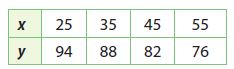
Options:
a. 40
b. 140
c. 150
d. 200

Answer:
b. 140

Explanation:
The 142 lies between 140 and 150. But the 142 is closer to 140 than it is to 150. So, 142 is rounded to the 140.

Question 6.
There are 5 pages of photos. Each page has 6 photos. How many photos are there in all?
Options:
a. 12
b. 20
c. 24
d. 30

Answer:
d. 30

Explanation:
Given that there are 5 pages of photos. And, each page has 6 photos. Total photos = 5 x 6 = 30.

Patterns on the Multiplication Table Page No 233

Is the product even or odd? Write even or odd.

Question 1.
2 × 7 = even
Think: Products with 2 as a factor are even.

Answer:
even

Explanation:
Products with 2 as a factor are even.

Question 2.
4 × 6 = ________

Answer:
even

Explanation:
The numbers end with 0, 2, 4, 6, 8 are even numbers. So, 24 is even number. The 4 × 6 an even number.

Question 3.
8 × 3 = ________

Answer:
even

Explanation:
8 is an even number. 3 is an odd number. The product of an odd number and an even number is even. The answer is even.

Question 4.
2 × 3 = _________

Answer:
even

Explanation:
Products with 2 as a factor are even.

Question 5.
9 × 9 = ________

Answer:
odd

Explanation:
9 is an odd number. The product of two odd numbers is an odd number. The answer is odd.

Question 6.
5 × 7 = _________

Answer:
odd

Explanation:
The numbers end with 1,3, 5, 7, 9 are odd numbers. So, 35 is an odd number. The 5 × 7 an odd number.

Question 7.
6 × 3 = ________

Answer:
even

Explanation:
6 is an even number. 3 is an odd number. The product of an odd number and an even number is even. The answer is even.

Use the multiplication table. Describe a pattern you see.

Go Math Grade 3 Answer Key Chapter 4 Multiplication Facts and Strategies Patterns on the Multiplication Table img 21

Question 8.
in the column for 5
_________

Answer:
The one’s digits repeat 0 and 5. Each number is 5 more than the number above it.

Explanation:
Each number is added with 5. One’s digit is repeated with 0 and 5.

Question 9.
in the row for 10
________

Answer:
Add 10. All the products are even. The one’s digit is always 0.

Explanation:
All the products are even. Also, the one’s digit is always 0. Add 10 for every product to get the next number to it.

Question 10.
in the rows for 3 and 6
Type below:
_________

Answer:
The products of 6 are the products of 3 doubled.

Explanation:
Add 3 for row 3. The products of 6 are the products of 3 doubled.

Question 11.
Carl shades a row in the multiplication table. The products in the row are all even. The ones digits in the products repeat 0, 4, 8, 2, 6. What row does Carl shade?
Carl shaded row for _________

Answer:
The row for 4.

Explanation:
From the given data, the answer is row 4.

Question 12.
Jenna says that no row or column contains products with only odd numbers. Do you agree? Explain.
_________

Answer:
Yes, Either the products are all even, or there is an even and odd number pattern.

Explanation:
Jenna said correctly. Either the products are all even, or there is an even and odd number pattern.

Patterns on the Multiplication Table Lesson Check Page No 234

Question 1.
Which has an even product?
Options:
a. 1 × 9
b. 3 × 3
c. 5 × 7
d. 4 × 9

Answer:
d. 4 × 9

Explanation:
The product of an odd number and an even number is even. The answer is 4 × 9.

Question 2.
Which describes this pattern?
10, 15, 20, 25, 30
Options:
a. Even and then odd
b. Add 10.
c. Subtract 5.
d. Multiply by 5.

Answer:
a. Even and then odd

Explanation:
The given pattern is the combination of even and add.

Spiral Review

Question 3.
Lexi has 2 cans of tennis balls. There are 3 tennis balls in each can. She buys 2 more cans. How many tennis balls does she now have in all?
Options:
a. 12
b. 9
c. 7
d. 6

Answer:
a. 12

Explanation:
Lexi has 2 cans of tennis balls. There are 3 tennis balls in each can. So, she has 2 x 3 = 6 balls. She buys 2 more cans. So, again 2 cans with 3 tennis balls = 2 x 3 =6. Total = 6 + 6 = 12. 12 tennis balls she is going to have with her.

Question 4.
Use the picture graph.
Go Math Grade 3 Answer Key Chapter 4 Multiplication Facts and Strategies Patterns on the Multiplication Table img 22
How many students have green eyes?
Options:
a. 4
b. 8
c. 12
d. 16

Answer:
d. 16

Explanation:
From the given picture, Green eyes have 4 circles. Each circle =4. 4 x 4 = 16. 16 students have green eyes.

Question 5.
Sasha bought 3 boxes of pencils. If each box has 6 pencils, how many pencils did Sasha buy in all?
Options:
a. 9
b. 12
c. 18
d. 24

Answer:
b. 12

Explanation:
Sasha bought 3 boxes of pencils. If each box has 6 pencils, 3 x 6 = 12 pencils Sasha can buy in all.

Question 6.
Find the sum.
2 1 9
+ 7 6 3
———–
Options:
a. 992
b. 982
c. 976
d. 972

Answer:
b. 982

Explanation:
Break apart the addends from the given values. Start with the hundreds. Then, add each place value.
Let’s write 219 as 200+10+9 and 763 as 700+60+3.
Sum up the above two values. Then you get 900+70+12. Add the ones and then add the 10’s and 100’s. The final answer is 982.

Multiply with 8 Page No 239

Find the product.

Question 1.
8 × 10 = 80

Answer:
80

Explanation:
8 × 10 = (2 x 4) x 10
Use the Associative Property.
8 × 10 = 2 x (4 x 10)
Multiply. 4 × 10
8 × 10 = 2 x 40
Double the product.
8 × 10 = 40 + 40
8 × 10 = 80

Question 2.
8 × 8 = ________

Answer:
64

Explanation:
Factor 8 is an even number. 4+ 4
8 x 4 = 32.
32 doubled is 64.
8 x 8 = 64.

Question 3.
8 × 5 = ________

Answer:
40

Explanation:
8 × 5 = (2 x 4) x 5
Use the Associative Property.
8 × 5 = 2 x (4 x 5)
Multiply. 4 × 5
8 × 5 = 2 x 20
Double the product.
8 × 5 = 20 + 20
8 × 5 = 40

Question 4.
3 × 8 = ________

Answer:
24

Explanation:
Factor 8 is an even number. 4+ 4
3 x 4 = 12.
12 doubled is 24.
3 x 8 = 24.

Question 5.
_______ = 4 × 8

Answer:
32

Explanation:
Factor 8 is an even number. 4+ 4
4 x 4 = 16.
16 doubled is 32.
4 x 8 = 32.

Question 6.
8 × 7 = ________

Answer:
56

Explanation:
8 × 7 = (2 x 4) x 7
Use the Associative Property.
8 × 7 = 2 x (4 x 7)
Multiply. 4 × 7
8 × 7 = 2 x 28
Double the product.
8 × 7 = 28 + 28
8 × 7 = 56.

Question 7.
6 × 8 = ________

Answer:
48

Explanation:
Factor 8 is an even number. 4+ 4
6 x 4 = 24.
24 doubled is 48.
6 x 8 = 48.

Question 8.
_______ = 9 × 8

Answer:
72

Explanation:
Factor 8 is an even number. 4+ 4
9 x 4 = 36.
36 doubled is 72.
9 x 8 = 72.

Question 9.
8
× 2
——
________

Answer:
16

Explanation:
Using the Commutative Law of Multiplication, 2 x 8 = 8 x 2.
Factor 8 is an even number. 4+ 4
2 x 4 = 8.
8 doubled is 16.
2 x 8 = 16.
So, 8 x 2 =16.

Question 10.
6
× 8
——-
________

Answer:
48

Explanation:
Factor 8 is an even number. 4+ 4
6 x 4 = 24.
24 doubled is 48.
6 x 8 = 48.

Question 11.
8
× 7
——
_________

Answer:
56

Explanation:
Using the Commutative Law of Multiplication, 8 x 7 = 7 x 8.
Factor 8 is an even number. 4+ 4
7 x 4 = 28.
28 doubled is 56.
7 x 8 = 56.

Question 12.
0
× 8
——-
____________

Answer:
0

Explanation:

Multiplication of any number with 0 is 0. So, the answer for 0 x 8 is 0.

Question 13.
8
× 5
——
___________

Answer:
40

Explanation:
8 × 5 = (2 x 4) x 5
Use the Associative Property.
8 × 5 = 2 x (4 x 5)
Multiply. 4 × 5
8 × 5 = 2 x 20
Double the product.
8 × 5 = 20 + 20
8 × 5 = 40.

Question 14.
8
× 8
——–
___________

Answer:
64

Explanation:
Factor 8 is an even number. 4+ 4
8 x 4 = 32.
32 doubled is 64.
8 x 8 = 64.

Question 15.
9
× 8
——-
___________

Answer:
72

Explanation:
Factor 8 is an even number. 4+ 4
9 x 4 = 36.
36 doubled is 72.
9 x 8 = 72.

Question 16.
8
× 3
——
___________

Answer:
24

Explanation:
8 × 3 = (2 x 4) x 3
Use the Associative Property.
8 × 3 = 2 x (4 x 3)
Multiply. 4 × 3
8 × 3 = 2 x 12
Double the product.
8 × 3 = 12 + 12
8 × 3 = 24.

Question 17.
8
× 1
——
___________

Answer:
8

Explanation:

Multiplication of any number with 1 is the same number. So, 1 x 8 = 8.

Question 18.
4
× 8
——
___________

Answer:
32

Explanation:
Factor 8 is an even number. 4+ 4
4 x 4 = 16.
16 doubled is 32.
4 x 8 = 32.

Problem Solving

Question 19.
There are 6 teams in the basketball league. Each team has 8 players. How many players are there in all?
____________ players

Answer:
48

Explanation:
Multiply 6 x 8 to get the total number of players. 6 x 8 = 48 players are in the basketball league.

Question 20.
Lynn has 4 stacks of quarters. There are 8 quarters in each stack. How many quarters does Lynn have in all?
___________ quarters

Answer:
32

Explanation:
Multiply 4 x 8 to find quarters in stacks. Lynn has 4 x 8 = 32 quarters in total.

Question 21.
Tomas is packing 7 baskets for a fair. He is placing 8 apples in each basket. How many apples are there in all?
___________ apples

Answer:
56

Explanation:
Multiply 7 x 8 to get the total number of apples. Tomas have 7 x 8 = 56 apples.

Question 22.
There are 10 pencils in each box. If Jenna buys 8 boxes, how many pencils will she buy?
_____________ pencils

Answer:
80

Explanation:
To get total pencils, if Jenna buys 8 boxes, multiply 10 x 8. So, Jenna buys 10 x 8 = 80 pencils.

Multiply with 8 Lesson Check Page No 240

Question 1.
Find the product.
5 × 8 = ■
Options:
a. 30
b. 32
c. 42
d. 40

Answer:
d. 40

Explanation:
Using Commutative Property of Multiplication, write 5 x 8 = 8 x 5
8 × 5 = (2 x 4) x 5
Use the Associative Property.
8 × 5 = 2 x (4 x 5)
Multiply. 4 × 5
8 × 5 = 2 x 20
Double the product.
8 × 5 = 20 + 20
8 × 5 = 40

Question 2.
There are 7 tarantulas in the spider exhibit at the zoo. Each tarantula has 8 legs. How many legs do the 7 tarantulas have in all?
Options:
a. 15
b. 49
c. 56
d. 63

Answer:
c. 56

Explanation:
Multiply 7 x 8 to find the 7 tarantulas legs. 7 tarantulas have 7 x 8 = 56 legs.

Spiral Review

Question 3.
Find the difference.
6 5 2
– 9 9
———
Options:
a. 99
b. 552
c. 553
d. 653

Answer:
c. 553

Explanation:
Subtract the ones. 2<9. so regroup 5 tens 2 ones = 4 tens 3 ones. Now, do 12 – 9 = 3. Then, Subtract the tens. 4 < 9. So, regroup 6 hundred 5 tens = 5 hundred 5 tens. 14 – 9 = 5. Subtract the hundreds and add them to check the answer. 5 – 0 = 5. The final answer is 553.

Question 4.
The school library received an order of 232 new books. What is 232 rounded to the nearest ten?
Options:
a. 200
b. 230
c. 240
d. 300

Answer:
b. 230

Explanation:
The 232 lies between 230 and 240. But the 232 is closer to 230 than it is to 240. So, 232 is rounded to the 230.

Question 5.
Sam’s picture graph shows that 8 students chose pizza as their favorite lunch. This is the key for the graph.
Each ☺ smile = 2 students.
How many ☺ smile should be next to pizza on Sam’s graph?
Options:
a. 2
b. 4
c. 6
d. 8

Answer:
b. 4

Explanation:
Given 1 smile = 2 students.
2 smiles = 4 students
3 smiles = 6 students
4 smiles = 8 students
4 smiles required for Sam for her next pizza on the graph.

Question 6.
Tashia buys 5 packages of oranges. Each package has 4 oranges. How many oranges in all does Tashia buy?
Options:
a. 1
b. 9
c. 20
d. 25

Answer:
d. 25

Explanation:
To know the total number of oranges, multiply 5 x 5. Tashia buys 5 x 5 = 25 oranges.

Multiply with 9 Page No 245

Find the product.

Question 1.
10 × 9 = 90

Answer:
90

Explanation:
The tens digit is 1 less than the factor that is multiplied by 9. So, ten’s digit number is 10 – 1 = 9. The sum of the digits in the product is always 9. So, to multiply 10 × 9, think the tens digit is 9 and the one’s digit is 0. The product is 90.

Question 2.
2 × 9 = ________

Answer:
18

Explanation:
9 = 3 + 6
2 × 9 = 2 x (3 + 6)
Multiply each addend by 2.
2 × 9 = (2 × 3) + (2 × 6)
Add the products.
2 × 9 = 6 + 12
2 × 9 = 18.

Question 3.
9 × 4 = ________

Answer:
36

Explanation:
9 = 3 + 6
9 × 4 = (3 + 6) x 4
Multiply each addend by 4.
9 × 4 = (3 x 4) + (6 x 4)
Add the products.
9 × 4 = 12 + 24
9 × 4 = 36.

Question 4.
0 × 9 = ________

Answer:
0

Explanation:

Multiplication of any number with 0 is 0. So, the answer for 0 x 9 is 0.

Question 5.
1 × 9 = ________

Answer:
9

Explanation:

Multiplication of any number with 1 is the same number. So, 1 x 9 = 9.

Question 6.
8 × 9 = ________

Answer:
72

Explanation:
9 = 3 + 6
8 × 9 = 8 x (3 + 6)
Multiply each addend by 8.
8 × 9 = (8 × 3) + (8 × 6)
Add the products.
8 × 9 = 24 + 48
8 × 9 = 72.

Question 7.
9 × 5 = ________

Answer:
45

Explanation:
9 = 3 + 6
9 × 5 = (3 + 6) x 5
Multiply each addend by 5.
9 × 5 = (3 x 5) + (6 x 5)
Add the products.
9 × 5 = 15 + 30
9 × 5 = 45.

Question 8.
6 × 9 = ________

Answer:
54

Explanation:
9 = 3 + 6
6 × 9 = 6 x (3 + 6)
Multiply each addend by 6.
6 × 9 = (6 × 3) + (6 × 6)
Add the products.
6 × 9 = 18 + 36
6 × 9 = 54.

Question 9.
9
× 4
——–
________

Answer:
36

Explanation:
9 = 3 + 6
9 × 4 = (3 + 6) x 4
Multiply each addend by 4.
9 × 4 = (3 x 4) + (6 x 4)
Add the products.
9 × 4 = 12 + 24
9 × 4 = 36.

Question 10.
5
× 9
——–
________

Answer:
45

Explanation:
9 = 3 + 6
5 × 9 = 5 x (3 + 6)
Multiply each addend by 5.
5 × 9 = (5 × 3) + (5 × 6)
Add the products.
5 × 9 = 15 + 30
5 × 9 = 45.

Question 11.
9
× 7
——–
________

Answer:
63

Explanation:
9 = 3 + 6
9 × 7 = (3 + 6) x 7
Multiply each addend by 7.
9 × 7 = (3 x 7) + (6 x 7)
Add the products.
9 × 7 = 21 + 42
9 × 7 = 63.

Question 12.
2
× 9
——–
________

Answer:
18

Explanation:
9 = 3 + 6
2 × 9 = 2 x (3 + 6)
Multiply each addend by 2.
2 × 9 = (2 × 3) + (2 × 6)
Add the products.
2 × 9 = 6 + 12
2 × 9 = 18.

Question 13.
9
× 9
——–
________

Answer:
81

Explanation:
The tens digit is 1 less than the factor that is multiplied by 9. So, ten’s digit number is 9 – 1 = 8. The sum of the digits in the product is always 9. So, add 1 to 8 to get one’s digit 1 + 8 = 9. The product is 81.

Question 14.
10
× 9
——–
________

Answer:
90

Explanation:
The tens digit is 1 less than the factor that is multiplied by 9. So, ten’s digit number is 10 – 1 = 9. The sum of the digits in the product is always 9. So, to multiply 10 × 9, think the tens digit is 9 and the one’s digit is 0. The product is 90.

Question 15.
3
× 9
——–
________

Answer:
27

Explanation:
9 = 3 + 6
3 × 9 = 3 x (3 + 6)
Multiply each addend by 3.
3 × 9 = (3 × 3) + (3 × 6)
Add the products.
3 × 9 = 9 + 18
3 × 9 = 27.

Question 16.
9
× 8
——–
________

Answer:
72

Explanation:
9 = 3 + 6
8 × 9 = 8 x (3 + 6)
Multiply each addend by 8.
8 × 9 = (8 × 3) + (8 × 6)
Add the products.
8 × 9 = 24 + 48
8 × 9 = 72.

Question 17.
6
× 9
——–
________

Answer:
54

Explanation:
9 = 3 + 6
6 × 9 = 6 x (3 + 6)
Multiply each addend by 6.
6 × 9 = (6 × 3) + (6 × 6)
Add the products.
6 × 9 = 18 + 36
6 × 9 = 54.

Question 18.
9
× 1
——–
________

Answer:
9

Explanation:
Multiplication of any number with 1 is the same number. So, 1 x 9 = 9.

Problem Solving

Question 19.
There are 9 positions on the softball team. Three people are trying out for each position. How many people in all are trying out?
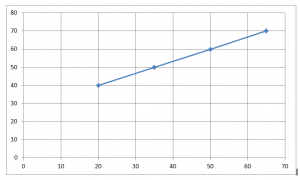
___________ people

Answer:
27

Explanation:
To find the total number of people trying for a position on the softball team, multiply 9 x 3. 9 x 3 = 27 people are trying for a softball team position.
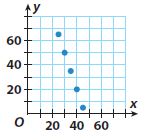
Question 20.
Carlos bought a book for $9. Now he would like to buy 4 other books for the same price. How much will he have to pay in all for the other 4 books?
$ _____________

Answer:
$36

Explanation:
Carlos bought a book for $9. Now he would like to buy 4 other books for the same price. So, to get them all 4 books, he needs to pay 4 x $9 = $36.

Multiply with 9 Lesson Check Page No 246

Question 1.
Find the product.
7 × 9 = ■
Options:
a. 63
b. 56
c. 45
d. 36

Answer:
a. 63

Explanation:
9 = 3 + 6
9 × 7 = (3 + 6) x 7
Multiply each addend by 7.
9 × 7 = (3 x 7) + (6 x 7)
Add the products.
9 × 7 = 21 + 42
9 × 7 = 63.

Question 2.
Clare buys 5 tickets for the high school musical. Each ticket costs $9. How much do the tickets cost in all?
Options:
a. $36
b. $40
c. $45
d. $52

Answer:
c. $45

Explanation:
Multiply 5 with $9 to get the total number of tickets. Clare buys 5 tickets for 5 x $9 = $45.

Spiral Review

Question 3.
The table shows the hair color of girls in Kim’s class. How many girls have brown hair?
Go Math Grade 3 Answer Key Chapter 4 Multiplication Facts and Strategies Multiply with 9 img 23
Options:
a. 1
b. 3
c. 4
d. 6

Answer:
d. 6

Explanation:
From the given figure, there are 6 bars available in the Number of Girls for Brown. So, the answer is 6.

Question 4.
Miles picked up 9 shirts from the dry cleaners. It costs $4 to clean each shirt. How much did Miles spend to have all the shirts cleaned?
Options:
a. $13
b. $22
c. $36
d. $45

Answer:
c. $36

Explanation:
Miles spend 9 x $4 = $36 to have all the shirts cleaned.

Question 5.
In a picture graph, each picture of a baseball is equal to 5 games won by a team. The row for the Falcons has 7 baseballs. How many games have the Falcons won?
Options:
a. 40
b. 35
c. 12
d. 7

Answer:
a. 63

Explanation:
From given data, 1 baseball = 5 games. The row for the Falcons has 7 baseballs. So, Falcons won 7 x 5 = 35 games.

Question 6.
An array has 8 rows with 4 circles in each row. How many circles are in the array?
Options:
a. 12
b. 24
c. 32
d. 36

Answer:
a. 63

Explanation:
8 x 4 = 32 circles are in the array.

Multiplication Page No 251

Solve.

Question 1.
Henry has a new album for his baseball cards. He uses pages that hold 6 cards and pages that hold 3 cards. If Henry has 36 cards, how many different ways can he put them in his album?
Henry can put the cards in his album 5 ways.
Go Math Grade 3 Answer Key Chapter 4 Multiplication Facts and Strategies Multiplication img 24

Answer:
5 ways

Explanation:
Henry can put the cards in 5 ways. They are
1. (1 x 6 cards pages) x (10 x 3 cards pages) = 6 cards + 30 cards = 36 cards.
2. (2 x 6 cards pages) x (8 x 3 cards pages) = 12 cards + 24 cards = 36 cards.
3. (3 x 6 cards pages) x (6 x 3 cards pages) = 18 cards + 18 cards = 36 cards.
4. (4 x 6 cards pages) x (4 x 3 cards pages) = 24 cards + 12 cards = 36 cards.
5. (5 x 6 cards pages) x (2 x 3 cards pages) = 30 cards + 6 cards = 36 cards.

Question 2.
Ms. Hernandez has 17 tomato plants that she wants to plant in rows. She will put 2 plants in some rows and 1 plant in the others. How many different ways can she plant the tomato plants? Make a table to solve.

Rows With 2 Plants___8_____7_______6_____5_____4________3_______2______1_
Rows With 1 Plants____1_____3______5______7______9_______11_____13_______15__
Total Plants____17_____17_____17______17_______17______17_______17______17__
Ms. Hernandez can plant the tomato plants___8___Ways.

Answer:
8 ways

Explanation:
Ms. Hernandez wants to grow 2 tomoto plants in one row and 1 in other row. The total number of plants should be 17. So,
1. (8 rows x 2 plants) x (1 row x 1plant) = 16 plants + 1 plant = 17 plants.
2. (7 rows x 2 plants) x (3 rows x 1plant) = 14 plants + 3 plant = 17 plantst.
3. (6 rows x 2 plants) x (5 rows x 1plant) = 12 plants + 5 plant = 17 plants.
4. (5 rows x 2 plants) x (7 rows x 1plant) = 10 plants + 7 plant = 17 plants.
5. (4 rows x 2 plants) x (9 rows x 1plant) = 8 plants + 9 plant = 17 plants.
6. (3 rows x 2 plants) x (11 rows x 1plant) = 6 plants + 11 plant = 17 plants.
7. (2 rows x 2 plants) x (13 rows x 1plant) = 4 plants + 13 plant = 17 plants.
8. (1 rows x 2 plants) x (15 rows x 1plant) = 2 plants + 15 plant = 17 plants.

Question 3.
Bianca has a total of 25¢. She has some nickels and pennies. How many different combinations of nickels and pennies could Bianca have? Make a table to solve.

Number of Nickels___1______2_______3______4__
Number of Pennies___20______15______10_______5__
Total Value___25¢______25¢______25¢______25¢___
Bianca could have___4___Combination of 25 ¢.

Answer:
4 ways

Explanation:
1 Nickel = 5 pennies.
Bianca can have combinations of nickels and pennies to get 25¢ are
1. 1 Nickel + 20 Pennies = 5 Pennies + 20 Pennies = 25 Pennies = 25¢
2. 2 Nickels + 15 Pennies = 10 Pennies + 15 Pennies = 25 Pennies = 25¢
3. 3 Nickels + 10 Pennies = 15 Pennies + 10 Pennies = 25 Pennies = 25¢
4. 4 Nickels + 5 Pennies = 20 Pennies + 5 Pennies = 25 Pennies = 25¢

Multiplication Lesson Check Page No 252

Question 1.
The table shows different ways that Cameron can display his 12 model cars on shelves. How many shelves will display 2 cars if 8 of the shelves each display 1 car?
Options:
a. 1
b. 2
c. 3
d. 4

Question 1.
Go Math Grade 3 Answer Key Chapter 4 Multiplication Facts and Strategies Multiplication img 25

Answer:
b. 2

Explanation:
1. (Shelves with 1 car x 2) + (Shelves with 2 cars x 5) = 2 Cars + 10 Cars = 12 Cars
2. (Shelves with 1 car x 4) + (Shelves with 2 cars x 4) = 4 Cars + 8 Cars = 12 Cars
3. (Shelves with 1 car x 6) + (Shelves with 2 cars x 3) = 6 Cars + 6 Cars = 12 Cars
4. (Shelves with 1 car x 8) + (Shelves with 2 cars x 2) = 8 Cars + 4 Cars = 12 Cars
5. (Shelves with 1 car x 10) + (Shelves with 2 cars x 1) = 10 Cars + 2 Cars = 12 Cars
Therefore, 2 shelves will display 2 cars if 8 of the shelves each display 1 car.

Spiral Review

Question 2.
Find the sum.
3 1 7
+ 1 5 1
——–
Options:
a. 166
b. 268
c. 468
d. 568

Answer:
c. 468

Explanation:
Add the ones. Add 7 + 1 =8. Then, Add the tens. Add 1 + 5 = 6. Add the hundreds. Add 3 + 1 = 4. Place the one’s, ten’s and hundreds to get the sum. The sum is 468.

Question 3.
The school cafeteria has an order for 238 hot lunches. What is 238 rounded to the nearest ten?
Options:
a. 300
b. 240
c. 230
d. 200

Answer:
b. 240

Explanation:
The 238 lies between 230 and 240. But the 238 is closer to 240 than it is to 230. So, 238 is rounded to the 240.

Question 4.
Tyler made a picture graph to show students’ favorite colors. This is the key for his graph.
Each Go Math Grade 3 Answer Key Chapter 4 Multiplication Facts and Strategies Multiplication img 26 = 3 votes.
If 12 students voted for green, how many Go Math Grade 3 Answer Key Chapter 4 Multiplication Facts and Strategies Multiplication img 27 should there be in the green row of the graph?
Options:
a. 3
b. 4
c. 9
d. 12

Answer:
b. 4

Explanation:
Each circle = 3 votes. If 12 students voted for green, total votes = 12. Write 12 = 3 + 3 + 3 +3. So, 4 circles represent 12 votes.

Question 5.
There are 5 bikes in each bike rack at the school. There are 6 bike racks. How many bikes in all are in the bike racks?
Options:
a. 11
b. 24
c. 25
d. 30

Answer:
d. 30

Explanation:
To find the total bikes in the bike rack at the school, multiply 5 bikes x 6 bike racks. 5 x 6 = 30 bikes are available in bike racks.

Review/Test Page No 253

Question 1.
Mrs. Ruiz sorted spools of thread into 4 boxes. Each box holds 5 spools. How many spools of thread does Mrs. Ruiz have? Draw circles to model the problem. Then solve.
________ spools

Answer:
20 spools

Explanation:
4 boxes of spools x 5 spools = 20 spools. Mrs. Ruiz has 20 spools of thread.

Question 2.
For numbers 2a–2d, select True or False for each multiplication sentence.
a. 2 × 8 = 16
i. True
ii. False

Answer:
i. True

Explanation:
Double 8.
8 + 8 = 16.
So, 2 x 8 = 16.

Question 2.
b. 5 × 8 = 40
i. True
ii. False

Answer:
i. True

Explanation:
Skip-count by 5’s 8 times. Write like 5, 10, 15, 20, 25, 30, 35, 40. So, the answer for 5 x 8 is 40.

Question 2.
c. 6 × 8 = 56
i. True
ii. False

Answer:
ii. False

Explanation:

Use doubles to find the answer of 6 x 8. Firstly, multiply 3 x 8 = 24. Then, double the value of 3 x 8. 24 + 24 = 48. The answer for 6 x 8 is 48. So, 6 × 8 = 56 is false.

Question 2.
d. 8 × 8 = 64
i. True
ii. False

Answer:
i. True

Explanation:
Factor 8 is an even number. 4+ 4
8 x 4 = 32.
32 doubled is 64.
8 x 8 = 64.

Question 3.
Bella is planning to write in a journal. Some pages will have one journal entry on them, and other pages will have two journal entries on them. If Bella wants to make 10 entries, how many different ways can she write them in her journal?
________ different ways

Answer:
4 ways

Explanation:
1. (1 journal entry x 2) + (2 journal entries x 4) = 2 journals + 8 journals = 10 journals.
2. (1 journal entry x 4) + (2 journal entries x 3) = 4 journals + 6 journals = 10 journals.
3. (1 journal entry x 6) + (2 journal entries x 2) = 6 journals + 4 journals = 10 journals.
4. (1 journal entry x 8) + (2 journal entries x 1) = 8 journals + 2 journals = 10 journals.

Bella can use 4 ways to write journals.

Question 4.
There are 7 days in 1 week. How many days are there in 4 weeks?
_______ days

Answer:
28 days

Explanation:
1 week = 1 x 7 = 7 days.
4 weeks = 4 x 7 = 28 days.

Review/Test Page No 254

Question 5.
Circle groups to show 3 × (2 × 3).
Go Math Grade 3 Answer Key Chapter 4 Multiplication Facts and Strategies Review/Test img 28
Type below:
__________

Answer:
18

Explanation:

3 × (2 × 3) = 3 x 6 = 18.

Question 6.
Dale keeps all of his pairs of shoes in his closet. Select the number of shoes that Dale could have in his closet. Mark all that apply.
Options:
a. 3
b. 4
c. 6
d. 7
e. 8

Answer:
b. 4
c. 6
e. 8

Explanation:
Pair of shoes have 2 in number. So, the possible ways are always even. Dale could have 4, 6, 8 in his closet.

Question 7.
Lisa completed the table to describe the product of a mystery one-digit factor and each number.
Go Math Grade 3 Answer Key Chapter 4 Multiplication Facts and Strategies Review/Test img 29
Part A
Give all of the possible numbers that could be Lisa’s mystery one-digit factor.
Type below:
__________

Answer:
0, 2, 4, 6, 8

Question 7.
Part B
Explain how you know that you have selected all of the correct possibilities.
Type below:
__________

Answer:
Given that the product numbers are even. The product of an even number with another number is even. So, we should take the mystery factor as an even number.

Review/Test Page No 255

Question 8.
Kate drew 7 octagons. An octagon has 8 sides. How many sides did Kate draw?
Go Math Grade 3 Answer Key Chapter 4 Multiplication Facts and Strategies Review/Test img 30
_________ sides

Answer:
56

Explanation:
Kate drew 7 octagons. An octagon has 8 sides. Kate draw 8 x 7 = 56 sides.

Question 9.
José buys 6 bags of flour. Each bag weighs 5 pounds. How many pounds of flour did José buy?
_________ pounds

Answer:
30 pounds

Explanation:
6 x 5 = 30. José spends 30 pounds to buy flours.

Question 10.
Break apart the array to show 8 × 6 = (4 × 6) + (4 × 6).
Go Math Grade 3 Answer Key Chapter 4 Multiplication Facts and Strategies Review/Test img 31

Answer:


Explanation:
Break the array of 4 columns and 6 rows to get the answer.

Question 11.
Circle the symbol that makes the multiplication sentence true.
9 × 6Go Math Grade 3 Answer Key Chapter 4 Multiplication Facts and Strategies Review/Test img 32 3 × (3 × 9)
_________

Answer:
<

Explanation:
9 x 6 = 54
3 x 27 = 81
54 < 81.
So, 9 x 6 < 3 x (3 x 9)

Question 12.
Roberto wants to make $2.00 using dollars, half dollar, and quarters. How many different ways can he make $2.00?
__________ different ways

Answer:
18

Explanation:
0.25  – 8 |6 |4 |4 |2 |2 |0 |0 |0
0.50 – 0 |1 |2 |0 |3 |1 |2 |4 |0
1        -0 |0 |0 |1 |0 |1 |1 |0 |2

Review/Test Page No 256

Question 13.
A carpenter builds stools that have 3 legs each. How many legs does the carpenter use to build 5 stools? Use the array to explain how you know your answer is correct.
_________ legs

Answer:
15 legs

Explanation:
Each stool has 3 legs. To build 5 stools, 5 x 3 = 15 legs. 15 legs need to build 5 stools.

Question 14.
Etta buys some ribbon and cuts it into 7 pieces that are the same length. Each piece is 9 inches long. How long was the ribbon that Etta bought?
_________ inches

Answer:
63 inches

Explanation:
The length of the ribbon is 7 x 9 inches = 63 inches.

Question 15.
Antoine and 3 friends divide some pennies evenly among themselves. Each friend separates his pennies into 3 equal stacks with 5 pennies in each stack.
Write a multiplication sentence that shows the total number of pennies.
Type below:
_________

Answer:
4 x (5 x 3)

Explanation:
5 pennies into 3 equal stacks = 5 x 3 = 15.
15 stacks shared between 4 friends = 4 x 15 = 4 x (5 x 3).

Question 16.
Luke is making 4 first-aid kits. He wants to put 3 large and 4 small bandages in each kit. How many bandages does he need for the kits? Show your work.
_________ bandages

Answer:
28 bandages

Explanation:
Luke wants to put 3 large and 4 small bandages in each kit. So, total = 3 + 4 = 7 bandages.
He is making 4 first-aid kits. So, 4 x 7 bandages = 28 bandages.

Review/Test Page No 257

Question 17.
For numbers 17a–17d, select True or False for each equation.
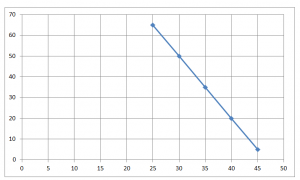
a. 3 × 7 = 21
i. True
ii. False

Answer:
i. True

Explanation:

Skip count by 3’s until you say 7 numbers. 3, 6, 9, 12, 15, 18, 21. So, the answer for 3 x 7 is 21. The answer is true.

Question 17.
b. 5 × 7 = 28
i. True
ii. False

Answer:
ii. False

Explanation:

Skip count by 5’s until you say 7 numbers. 5, 10, 15, 20, 25, 30, 35. Now, the count of the number is 7. So, the answer for 5 x 7 is 35. The answer is False.

Question 17.
c. 8 × 7 = 49
i. True
ii. False

Answer:
ii. False

Explanation:

Use Distributive Property to find 8 x 7 = (4 + 4) x 7 = (4 x 7) + (4 x 7) = 28 + 28 = 56 is the correct answer. The answer is False.

Question 17.
d. 9 × 7 = 63
i. True
ii. False

Answer:
i. True

Explanation:
9 = 3 + 6
9 × 7 = (3 + 6) x 7
Multiply each addend by 7.
9 × 7 = (3 x 7) + (6 x 7)
Add the products.
9 × 7 = 21 + 42
9 × 7 = 63.
The answer is true.

Question 18.
Circle the number that makes the multiplication sentence true.
10 × Go Math Grade 3 Answer Key Chapter 4 Multiplication Facts and Strategies Review/Test img 33 = 40

Answer:
4

Explanation:
The value of 10 x4 = 40. So, the answer is 4.

Question 19.
For numbers 19a–19d, select Yes or No to indicate whether the number sentence has the same value as 8 × 6.
a. 8 + (4 × 2) = ■
i. yes
ii. no

Answer:
ii. no

Explanation:
8 x 6 = 48.
8 + (4 x 2) = 8 + 8 =16. The answer is no.

Question 19.
b. (8 × 4) + (8 × 2) = ■
i. yes
ii. no

Answer:
i. yes

Explanation:
8 x 6 = 48.
(8 x 4) + (8 x 2) = 32 + 16 = 48. The answer is yes.

Question 19.
c. (6 × 4) + (6 × 2) = ■
i. yes
ii. no

Answer:
ii. no

Explanation:
8 x 6 = 48.
(6 × 4) + (6 × 2) = 24 + 12 = 36. The answer is no.

Question 19.
d. 6 × (4 + 4) = ■
i. yes
ii. no

Answer:
i. yes

Explanation:
8 x 6 = 48.
6 × (4 + 4) = 6 x 8 = 48. The answer is yes.

Question 20.
Chloe bought 4 movie tickets. Each ticket cost $6. What was the total cost of the movie tickets?
$ _________

Answer:
$24

Explanation:
The total cost of the movie tickets = 4 x $6 = $24.

Question 21.
Write a multiplication sentence using the following numbers and symbols.
Go Math Grade 3 Answer Key Chapter 4 Multiplication Facts and Strategies Review/Test img 34
Type below:
__________

Answer:
6 x (5 x 2) = 60

Explanation:
We can write as 6 x (5 x 2) = 60.

Review/Test Page No 258

Question 22.
Louis started a table showing a multiplication pattern.
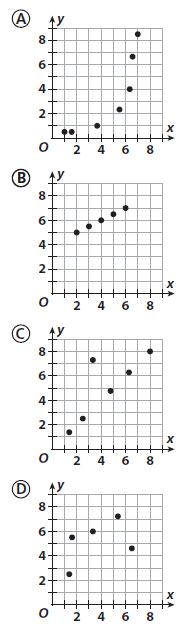
Part A
Complete the table. Describe a pattern you see in the products.
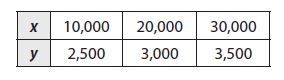
Go Math Grade 3 Answer Key Chapter 4 Multiplication Facts and Strategies Review/Test img 35
Type below:
__________

Answer:
12, 15, 18, 21, 24, 27, 30. Add 3 to the product to get the next product.

Explanation:
Add 3 to the product to get the next product.
9+3 = 12.
12 + 3 = 15.
15 + 3 = 18.
18 + 3 = 21.
21 + 3 = 24.
24 + 3 = 27.
27 + 3 = 30.

Question 22.
Part B
If you multiplied 3 × 37, would the product be an even number or an odd number? Use the table to explain your reasoning.
__________

Answer:
When an even number is multiplied by 3 (an odd number), the product is even. When an odd number is multiplied by 3, the product is odd, so the product of 3 × 37 would be odd.

Question 23.
Use the number line to show the product of 4 × 8.
Go Math Grade 3 Answer Key Chapter 4 Multiplication Facts and Strategies Review/Test img 36
4 × 8 = _______

Answer:
32

Explanation:
Skip 2 numbers to get the product of 4 multiples. If you skip 2 numbers until you count 8, you can get 32. The answer is 32.

Conclusion

Go Math Grade 3 Answer Key Chapter 4 Multiplication Facts and Strategies include a clear-cut explanation for all the questions in it. We tried our best to help you understand the concept better by taking enough images, graphs. Firstly solve the problems on your own and tally your answers with the Go Math 3rd Grade Answer Key Ch 4 Multiplication Facts and Strategies.

In order to provide you a smooth learning experience, we have compiled all the Questions in Grade 3 Chapter 4 Multiplication Facts and Strategies in a comprehensive manner. Grab the opportunity and learn from Go Math Grade 3 Answer Key Chapter 4 Multiplication Facts and Strategies Extra Practice PDF too to make your learning fun.

go-math-grade-3-chapter-4-multiplication-facts-and-strategies-extra-practice-answer-key

Go Math Grade 3 Answer Key Chapter 3 Understand Multiplication Extra Practice

Avail the handy resource available for your needs Go Math Grade 3 Answer Key Chapter 3 Understand Multiplication Extra Practice. Check out worked out solutions for all the problems and have an indepth knowledge of the concepts in Go Math Grade 3 Chapter 3. Get acquainted with the kind of questions using the 3rd Grade Go Math Solutions Key Ch 3 Understand Multiplication Extra Practice. Elaborate Explanation is provided in the Go Math Grade 3 Answer Key making it easier for you to understand the concepts underlying.

Go Math Grade 3 Chapter 3 Understand Multiplication Extra Practice Answer Key

The Series of Math Problems provided will help you attain great grades in your exams. Refer our Go Math Grade 3 Answer Key Chapter 3 Understand Multiplication Extra Practice and solve different questions. Practice as many times as possible so that you can attempt the exam with confidence and clear the tests with flying colors.

Common Core – Page No. 63000

Lesson 3.1

Draw equal groups. Skip count to find how many.

Question 1.
2 groups of 4 ______

Answer:
8

Explanation:
Draw 4 counters in each group.
There are 2 equal groups.
skip count by 4 until you say 2 numbers.
There are 2 equal groups with 4 counters in each group.
So, there are 8 counters in all.

Question 2.
4 groups of 3 ______

Answer:
12

Explanation:
Draw 3 counters in each group.
There are 4 equal groups.
skip count by 3 until you say 4 numbers.
There are 4 equal groups with 3 counters in each group.
So, there are 12 counters in all.

Lesson 3.2

Draw a quick picture to show the equal groups. Then write related addition and multiplication sentences.

Question 3.
2 groups of 5
______ + ______ = ______
______ × ______ = ______

Answer:
5 + 5 = 10
2 x 5 = 10

Explanation:
Addition Sentence
Draw 5 counters in each group.
There are a total of 2 groups.
Now, the addition sentence is 5 + 5 = 10.

Multiplication sentence
Draw 5 counters in each circle or group.
Since there is the same number of counters in each group, multiply counters and groups to find how many there are altogether.
2 x 5 = 10.
factor x factor = product

Question 4.
3 groups of 2
______ + ______ + ______ = ______
______ × ______ = ______

Answer:
2 + 2 + 2 = 6
3 x 2 = 6

Explanation:
Addition Sentence
Draw 2 counters in each group.
There are a total of 3 groups.
Now, the addition sentence is 2 + 2 + 2 = 6

Multiplication sentence
Draw 2 counters in each circle or group.
Since there is the same number of counters in each group, multiply groups and counters to find how many there are altogether.
3 x 2 = 6.
factor x factor = product

Lesson 3.3

1. Draw jumps on the number line to show 3 groups of 6.
Find the product.

Question 5.
Go Math Grade 3 Answer Key Chapter 3 Understand Multiplication Extra Practice Common Core img 1
3 × 6 = ______

Answer:
Chapter 12 Common Core image 1 63000
Explanation:
3 x 6 = 18

Write the multiplication sentence the number line shows.

Question 6.
Go Math Grade 3 Answer Key Chapter 3 Understand Multiplication Extra Practice Common Core img 2
______ × ______ = ______

Answer:
4 x 3 = 12

Explanation:
1 jump on the number is considered as 1 group.
There are 3 jumps on a number line. So, there are 3 groups.
The length of each jump is 4.
Begin at 0. Skip count by 3’s.
Multiply 4 x 3 = 12.

Common Core – Page No. 64000

Lesson 3.4

Question 1.
Destiny placed her hair ribbons in 3 groups of 5 on her dresser. How many hair ribbons in all does Destiny have? Draw a diagram to solve.
______ hair ribbons

Answer:
15 hair ribbons

Explanation:
3 groups of 5
Draw 3 counters (hair ribbons) in each group.
There are 5 equal groups (dresser).
We skip count by 3’s until you say 5 numbers (3,6,9,12,15)
There are 15 hair ribbons in all.

Lesson 3.5

Draw an array to find the product.

Question 2.
2 × 7 = ______

Answer:
2 x 7 = 14

Explanation:
Chapter 12 Common Core image 2 64000
2 x 7 = 14

Question 3.
2 × 6 = ______

Answer:
2 x 6 = 12

Explanation:
Chapter 12 Common Core image 4 64000
2 x 6 = 12

Lesson 3.6

Write a multiplication sentence for the model. Then use the Commutative Property of Multiplication to write a related multiplication sentence.

Question 4.
□□□□□
□□□□□
□□□□□
□□□□□
______ × ______ = ______
______ × ______ = ______

Answer:
4 x 5 = 20
5 x 4 = 20

Explanation:
The given image has 4 rows and 5 columns of square boxes. So, multiplication = 4 x 5. Using Commutative Property of Multiplication 4 x 5 = 5 x 4.

Question 5.
______ × ______ = ______
______ × ______ = ______

Answer:

Explanation:

Lesson 3.7

Find the product.

Question 6.
6 × 0 = ______

Answer:
0

Explanation:
The Zero Property of Multiplication states that the product of zero and any number is zero. So, 6 x 0 = 0.

Question 7.
5 × 1 = ______

Answer:
5

Explanation:
Use Commutative Property of Multiplication: 5 x 1 = 1 x 5.
The Identity Property of Multiplication states that the product of any number and 1 is that number. 5 x 1 = 5.

Question 8.
0 × 9 = ______

Answer:
0

Explanation:
The Zero Property of Multiplication states that the product of zero and any number is zero. So, 0 x 9 = 0.

Question 9.
1 × 8 = ______

Answer:
8

Explanation:
The Identity Property of Multiplication states that the product of any number and 1 is that number. 1 x 8 = 8.

Question 10.
1 × 4 = ______

Answer:
4

Explanation:
The Identity Property of Multiplication states that the product of any number and 1 is that number. 1 x 4 = 4.

Question 11.
9 × 1 = ______

Answer:
9

Explanation:
Use Commutative Property of Multiplication: 9 x 1 = 1 x 9.
The Identity Property of Multiplication states that the product of any number and 1 is that number. 9 x 1 = 9.

Question 12.
1 × 0 = ______

Answer:
0

Explanation:
The Zero Property of Multiplication states that the product of zero and any number is zero.
So, 1 x 0 = 0.

Question 13.
7 × 0 = ______

Answer:
0

Explanation:
The Zero Property of Multiplication states that the product of zero and any number is zero.
So, 7 x 0 = 0.

Conclusion

Go Math Grade 3 Answer Key Chapter 3 Understand Multiplication Extra Practice is intended to help the students to increase their solving ability. It is a great opportunity for students to learn the best way to solve questions. Go Math Grade 3 Chapter 3 Understand Multiplication Extra Practice Answer Key is the first priority who wants to achieve their top grades. Download HMH Go Math Grade 3 Answer Key for free.