To Measure the Length of a Line Segment

To Measure the Length of a Line Segment – Methods, Examples | How do you find the Length of a Line Segment?

A line can be named either using two points on the line or simply by a letter. There is a lot of difference between the line and line segments. We can measure the length of the line segment but not a line. The instruments used to measure the length of a Line-segment are scale and divider. This article helps you to know how to measure the length of a line segment using a ruler scale and divider. Practice the questions given at the end of this page to enhance your skills.

Do Refer:

Line Segment – Definition

If you Mark two points A and B on a straight line is called the line segment. This line segment has two endpoints A and B whose length is fixed. The length of a line segment is the distance between two endpoints. The length of a line segment can be measured by millimeters, centimeters, meters, and feet or inches.

How to Measure the Length of a Line Segment?

We can measure the length of the line segment by using two methods:
i. With the help of scale or ruler only.
ii. With the help of a pair of dividers and scale or ruler.

How to Measure Line Segments with a Ruler?

Step 1: pick up a scale to measure the length of a line segment. Generally smaller line segments are measured using a centimeter scale.
To measure the length of a line segment img_1
Step 2: Identify the line segment that you want to measure.
Step 3: Place the tip of the ruler at the starting point of the line segment.
Step 4: Read a number on the scale where the line segment ends in this case, it is 7 so the length of the given line segment is 7 cm.
To measure the length of a line segment img_2

How to Measure the Length of a Line Segment with a Divider?

We can measure the length of a line segment with scale and divider.
i. First open the pair of dividers carefully and place the pointed ends of the pair of dividers on both ends of the line segments.
ii. Next we lift the divider without disturbing the arms.
iii. And then place its one end on the zero mark of the scale.
To measure the length of a line segment img_3

Measuring Length of a Line Segment Examples

Example 1.
How to draw the line segment of a given length is 6 cm?
Solution:
First, Pick up a scale to measure the length of a line segment.
Identify the line segment that you want to measure. We have to measure the length 6 cm on the scale.
Place the tip of the ruler at the starting point of the line segment.
Read a number on the scale where the line segment ends in this case, it is 6cm so the length of the given line segment is 6 cm.
To measure the length of a line segment img_4

Example 2.
How to draw the line segment of the given length is 4 cm?
Solution:
i. First open the pair of dividers carefully and place the pointed ends of the pair of dividers on both ends of the line segments i.e., from 0 to 4.
ii. Next we lift the divider without disturbing the line.
iii. And then place its one end on the zero mark of the scale.
To measure the length of a line segment img_8

Example 3.
How to draw the line segment of the given length is 12 cm?
Solution:
First, Pick up a scale to measure the length of a line segment.
Identify the line segment that you want to measure. We have to measure the length 6 cm on the scale.
Place the tip of the ruler at the starting point of the line segment.
Read a number on the scale where the line segment ends in this case, it is 12 cm so the length of the given line segment is 12 cm.
To measure the length of a line segment img_5

Example 4.
How to draw the line segment of the given length is 3 cm?
Solution:
First, Pick up a scale to measure the length of a line segment.
Identify the line segment that you want to measure. We have to measure the length 6 cm on the scale.
Place the tip of the ruler at the starting point of the line segment.
Read a number on the scale where the line segment ends in this case, it is 3 cm so the length of the given line segment is 3 cm. To measure the length of a line segment img_6

Example 5.
How to draw the line segment of the given length is 16 cm?
Solution:
First, Pick up a scale to measure the length of a line segment.
Identify the line segment that you want to measure. We have to measure the length 6 cm on the scale.
Place the tip of the ruler at the starting point of the line segment.
Read a number on the scale where the line segment ends in this case, it is 16 cm so the length of the given line segment is 16 cm.
To measure the length of a line segment img_7

FAQs on How to Draw & Measure Line Segments

1. How do you find the length of the line segment?

The length of a line segment can be measured by measuring the distance between the two endpoints.

2. What is used to measure line segments of length?

We can measure a line segment with the help of a ruler scale or divider.

3. Which instrument is used to measure a line segment?

The instrument used to compare two line segments is a divider.

Multiplier by 10, 100, 1000, 10000

Multiplier by 10, 100, 1000, 10000 | How do you Multiply by Multiples of 10 100 1000 and 10000?

In maths, multiplication is denoted by ‘×’ to find the product of two or more values. The first number is called multiplicand and the second number is called the multiplier. The multiplier will increase the value of the number. The increase in a number depends on the multiplier. It is the repeated addition of the number with respect to one another.

Multiplication is one of the fundamental topics in maths. Here we will learn about the multiplier with different numbers. Get the examples on Multiplier by 10, 100, 1000, 10000 with step by step explanation. Also, the students can know in detail about the properties of multiplication.

Do Refer:

How to Multiply by 10, 100, 1000, 10000?

In this concept, we multiply the multiplicand by the non-zero digit of the multiplier. Then we add the same number of zero to the extreme right of the product as the multiplier.
We can understand this concept by following the below steps.
Step 1: We count the zeros first.
Step 2: We multiply the non-zero numbers.
Step 3: We place the same number of zero to the extreme right of the product.

Properties of Multiplication

1. Commutative Property
2. Associative Property
3. Distributive Property
4. Identity Property
5. Zero Property

1. Commutative Property: The commutative property of multiplication, if A and B are any two integers then,
a × b = b × a
Example: 2 × 3 = 3 × 2

2. Associative Property: As per the associative property of multiplication, if a, b, c are three integers then,
a × (b × c) = (a × b) × c
Example: 2 × (3 × 5) = (2 × 3) × 5

3. Distributive Property: According to the distributive property of multiplication, if a, b and c are three integers then,
a × (b + c) = (a × b) + (a × c)
Example: 2 × (3 + 5) = (2 × 3) + (2 × 5)

4. Identity Property: As per the identity property of multiplication, if we multiply any integer by 1, then its value remains unchanged, such that,
a × 1 = 1 × a
Example: 2 × 1 = 1 × 2

5. Zero Property: Zero property of multiplication states that any number multiplied by 0 is always 0.
a × 0 = 0
Example: 5 × 0 = 0

Examples on Multiplying by Multiples of 10 100 1000 and 10000

Let us see some examples of multiply by 10, 100, 1000, 10000 with explanations.

Example 1.
Find the product of the following
i. 12 × 10
ii. 24 × 20
Solution:
i. 12 × 10
Follow the steps to find the product of the given numbers.
Step 1: We count the zeros first.
There is one zero
Step 2: We multiply the non-zero numbers.
12 × 1 = 12
Step 3: We place the same number of zero to the extreme right of the product.
Now add zero to the extreme right.
Thus it becomes 120.
So, 12 × 10 = 120
ii. 24 × 20
Follow the steps to find the product of the given numbers.
Step 1: We count the zeros first.
There is one zero
Step 2: We multiply the non-zero numbers.
24 × 2 = 48
Step 3: We place the same number of zero to the extreme right of the product.
Now add zero to the extreme right.
Thus it becomes 480.
So, 24 × 20 = 480

Example 2.
Find the product of the following
i. 34 × 100
ii. 12 × 200
Solution:
i. 34 × 100
Step 1: We count the zeros first.
There are two zeros.
Step 2: We multiply the non-zero numbers.
34 × 1 = 34
Step 3: We place the same number of zero to the extreme right of the product.
Now add zero to the extreme right.
Thus it becomes 3400.
So, 34 × 100 = 3400
ii. 12 × 200
Step 1: We count the zeros first.
There are two zeros.
Step 2: We multiply the non-zero numbers.
12 × 2 = 24
Step 3: We place the same number of zero to the extreme right of the product.
Now add zero to the extreme right.
Thus it becomes 2400.
So, 12 × 200 = 2400

Example 3.
Find the product of the following
i. 2 × 1000
ii. 5 × 3000
Solution:
i. 2 × 1000
Step 1: We count the zeros first.
There are three zeros.
Step 2: We multiply the non-zero numbers.
2 × 1 = 2
Step 3: We place the same number of zero to the extreme right of the product.
Now add zero to the extreme right.
Thus it becomes 2000.
So, 2 × 1000 = 2000
ii. 5 × 3000
Step 1: We count the zeros first.
There are three zeros.
Step 2: We multiply the non-zero numbers.
5 × 3 = 15
Step 3: We place the same number of zero to the extreme right of the product.
Now add zero to the extreme right.
Thus it becomes 15000.
So, 5 × 3000 = 15000

Example 4.
Find the product of the following
i. 6 × 10000
ii. 15 × 50000
Solution:
i. 6 × 10000
Step 1: We count the zeros first.
There are four zeros.
Step 2: We multiply the non-zero numbers.
6 × 1 = 6
Step 3: We place the same number of zero to the extreme right of the product.
Now add zero to the extreme right.
Thus it becomes 60000.
So, 6 × 10000 = 60000
ii. 15 × 50000
Step 1: We count the zeros first.
There are four zeros.
Step 2: We multiply the non-zero numbers.
15 × 5 = 75
Step 3: We place the same number of zero to the extreme right of the product.
Now add zero to the extreme right.
Thus it becomes 750000.
So, 15 × 50000 = 750000

Example 5.
Jai earns $24 per hour. What are his earnings for 10 hours?
Solution:
Given that,
Jai earns $24 per hour.
We have to find his income for 10 hours.
24 × 10 = $240
Thus Jai earns $240 for 10 hours.

Multiplicand and Multiplier

Multiplicand and Multiplier – Definition, Facts, Examples | Properties of Multiplication

I know all the students are familiar with the arithmetic operations like addition, subtraction, multiplication, and division. In this article, we will discuss briefly multiplication. Most of the students might be confused about the multiplier and multiplicand in the numbers. By reading this page you can clarify all your doubts regarding Multiplicand and Multiplier, properties of multiplication with examples.

Do Refer:

What is Multiplicand in Math?

Multiplicand: The Multiplicand is the number taken or multiplied. The number to be multiplied is called multiplicand. Usually, the multiplicand is placed first or top. So, the first number is called multiplicand.

Multiplier – Definition

Multiplier: The number with which we are multiplying is called the multiplier. A multiplier is a simple factor that increases the value. Sometimes the first factor will be a multiplier and the second number becomes a multiplicand. The multiplier is placed second or bottom number.

What is Multiplication?

The multiplication is written using the ‘×’ symbol or the ‘.’ sign in an arithmetic operation. The numbers to be multiplied are called ‘factors’. Multiplication is repeated addition. It is the product of multiplier and multiplicand. The result of the multiplication is called product. For better understanding let us see one example of multiplication.
Multiplicand ×  Multiplier = Product or Multiplication
Example: 
5 × 6 = 30
Here 5 is the multiplier
6 is multiplicand
and 30 is the product.

Properties of Multiplication

Let us recall the properties of multiplication to solve the problems. Here we have provided the properties of multiplication with examples.
1. Commutative property of multiplication:
The product of the numbers does not change if we change the order of the numbers.
Example:
2 × 3 = 6, 3 × 2 = 6
So, 2 × 3 = 3 × 2
Hence it is proved that the product does not change if we change the order of two numbers.
2. Associative Property of Multiplication:
The product of three or more numbers will not be changed if we change the grouping of the given numbers.
Example:
(6 × 2) × 5 = 12 × 5 = 60 or,
(2 × 6) × 5 = 12 × 5 = 60 or,
(2 × 5) × 6 = 10 × 6 = 60
3. One property of multiplication:
The product of any number and 1 is the number itself.
Example:
2 × 1 = 2
12 × 1 = 12
4. Zero property of multiplication:
The product of any number and zero is zero.
Example:
Let us multiply the number and zero you get the product as 0.
12 × 0 = 0
43 × 0 = 0
43531 × 0 = 0
5. Distributive Property of Multiplication:
The product of the number and the sum of two numbers is always the same as the sum of the product of the numbers.
Example:
6 × (2 + 5) = 6 × 7 = 42
6 × 2 + 6 × 5 = 12 + 30 = 42
Therefore, 6 × (2 + 5) = 6 × 2 + 6 × 5 = 42
Also, check the product with the difference of two numbers is always the same as the difference in the numbers’ product.
Example:
6 × (5 – 2) = 6 × 3 = 18
(6 × 5) – (6 × 2) = 30 – 12 = 18
So, 6 × (5 – 2) = (6 × 5) – (6 × 2)

Multiplicand and Multiplier Examples

Check out the problems given below to know the facts of multiplicand and multiplier. Practice the problems given below and improve your knowledge.

Example 1.
What is the product of the two-digit numbers 78 and 12?
Solution:
First arrange the given numbers in the columns.
The first number 78 becomes multiplicand.
The second number 12 becomes a multiplier.
Multiplier and Multiplicand img_4
The product of the two-digit numbers 78 and 12 is 936.

Example 2.
What is the product of the three-digit numbers 138 and 100?
Solution:
First arrange the given numbers in the columns.
The first number 138 becomes multiplicand.
The second number 100 becomes a multiplier.
Multiplier and Multiplicand img_3
Thus the product of the three-digit numbers 138 and 100 is 13800.

Example 3.
Multiply 9 and 3.
Solution:
We have to find the product of 9 and 3.
9 is the multiplicand and 3 is the multiplier.
9 × 3 = 27
Multiplicand × Multiplier = Multiplication

Example 4.
Multiply 468 and 16.
Solution:
First arrange the given numbers in the columns.
The first number 468 becomes multiplicand.
The second number 16 becomes a multiplier.
Multiplier and Multiplicand img_2
Thus the product of 468 and 16 is 7488.

Example 5.
Sid earns $15,000 per month. What is his income for 12 months?
Solution:
Given,
Sid earns $15,000 per month.
Income for 1 month = $15,000
Income for 12 months = ?
Multplier and Multiplicand img_1
$15,000 × 12 = $180000

FAQs on Multiplicand and Multiplier

1. Which is meant by multiplier and multiplicand?

The number to be multiplied is called the multiplicand. The number with which we multiply is called the multiplier. Thus the result obtained is known as the product.

2. What comes first multiplier or multiplicand?

The number to be multiplied is the multiplicand, and the number by which it is multiplied is called the “multiplier”. Usually, the multiplier is placed first and the multiplicand is placed second. However, sometimes the first factor is the multiplicand and the second the multiplier.

3. What is called Multiplicand?

The multiplicand is the name given to a number being multiplied by another number. Another name for multiplicand is a factor.

Minuend and Subtrahend

Minuend and Subtrahend – Definition, Formula, Properties, Examples | How do you find Minuend & Subtrahend?

Subtraction is an arithmetic operation that the primary level students have to learn firstly. It is the operation of removing numbers from the collection. There are three sections in a subtraction equation they are minuend, subtrahend, and the gap. Minuend has been taken from the Latin word “minuendus” which means a value has to lessen. The meaning of subtrahend is the portion of the minuend that is removed. In this article, we will learn what is minuend and subtrahend with related examples.

Do Refer:

Minuend – Definition

The first number in subtraction is called minuend. In other words, The number from which another number is subtracted is known as minuend.
Minuend – Subtrahend = difference

Subtrahend – Definition

The number which we subtract from another number in a subtraction sentence is known as a subtrahend. That means the second number is subtrahend.
Minuend – subtrahend = difference or subtraction

Subtraction Notation

Subtraction is usually written as ‘-‘ (minus sign).
For example, let us subtract 8 and 5.
8 – 5 = 3 this will be pronounced as eight minus five equal to three
Here 8 is minuend, 5 is subtrahend, and 3 is the difference.

Properties of Subtraction

Property 1:
If a and b are two whole numbers such that a > b or a = b, then a – b is a whole number. If a < b then subtraction a -b is not possible in whole numbers.
Example : 8 – 5 = 3
Property 2:
The subtraction of whole numbers is not commutative, that is if a and b are two whole numbers, then in general a – b not equal to (b – a).
Example: 3 – 2 ≠ 2 – 3
Property 3:
If a is any whole number other than zero, then a – 0 = 0 and 0 – a is not defined.
Example: 2 – 0 ≠ 0 – 2

Minuend and Subtrahend Example Questions

Example 1.
Subtract 4563 from 6764.
Solution:
Arrange the digits of the minuend and subtrahend in columns and subtract as usual.
6764 → minuend
-4563 → subtrahend
2301 → difference
Thus the difference of 4563 from 6764 is 2301.

Example 2.
Subtract 134 from 367
Solution:
Arrange the digits of the minuend and subtrahend in columns and subtract as usual.
367 → minuend
-134 → subtrahend
233 → difference
Thus the difference of 134 from 367 is 233.

Example 3.
Subtract 14523 from 26734
Solution:
Arrange the digits of the minuend and subtrahend in columns and subtract as usual.
26734 → minuend
-14523 → subtrahend
12211 → difference
Thus the difference of 14523 from 26734 is 12211.

Example 4.
Subtract 3482 from 4593
Solution:
4593 → minuend
-3482 → subtrahend
1111 → difference
Thus the difference of 3482 from 4593 is 1111.

Example 5.
Subtract 364 from 879.
Solution:
879 → minuend
-364 → subtrahend
515 → difference
Thus the difference of 364 from 879 is 515.

Points to be remembered:
1. Any number – 0 = The number itself
2. Minuend – Difference = Subtrahend
3. Subtrahend + Difference = Minuend
4. When Minuend = Subtrahend then Difference = 0

FAQs on Minuend and Subtrahend

1. What is the formula to find out Minuend?

Difference + Subtrahend = Minuend.

2. How do you solve a Subtrahend and a Minuend?

We solve subtrahend and minuend by arranging the digits in columns.

3. What is the first number in subtraction called?

When you subtract one number from another, the result is called the difference. The first number in subtraction or difference is the minuend.

Addendum

Addendum – Definition, Facts, Examples | Properties of Addition

The addition is one of the important arithmetic operations which is mandatory for the students to learn at the primary level. Addition plays an important role in solving the problems. There are different parts in addition such as addenda, addendum, sum. The plural form of addend is called the addendum.

Addendums are seen when we add three or more numbers to find the sum. Here the students can learn deeply about addendum, properties of addition, and the question and answers related to the addition. So, we suggest the students who want to make their basics strong read the article thoroughly and solve the given problems.

Do Refer:

What is the Meaning of Addendum?

Addendum can be defined as the numbers or terms added to the other number to form the sum.
Example: Add 2 and 3.
2 + 3 = 5
Here 2 and 3 are addendums and 3 is the sum.

Missing Addends | How to find Missing Addend in an Addition Sentence?

As the name itself tells that we have to find the missing number from the given sum and addendum (mathematical equation). You will be given an addendum and one missing term and sum. With the help of the sum and addend, you have to find the missing addend.
Let us discuss the concept with an example.
3 + _ = 9
Let the missing number be x
3 + x = 9
x = 9 – 3
x = 6
Thus the missing addend is 6.

Properties of Addition

1. Order property of addition:
We can add two numbers in any order. The sum remains the same irrespective of the order. This property is known as commutative property.
Example: 3 + 2 or 2 + 3 = 5
2. Additive property of zero:
If zero is added to a number, the sum is the number itself. The sum will not be changed. This is called the additive property of zero or additive identity.
Example: 5 + 0 = 5
See in the above example the sum of 5 and 0 is 5.

Worked Out Addendum Examples

Use the above-discussed properties of addition to add the numbers.

Example 1.
Find the sum of 4361 and 1462
Solution:
Addendum img_1
Here 4361 and 1462 are the addendums and the result is the sum of two addends.
Thus the sum of 4361 and 1462 is 5823.

Example 2.
Find the sum of 412 and 0.
Solution:
Here we use an additive property of zero to find the sum of 412 and 0.
412 + 0 = 412
Here 412 and 0 are the addendums and the result is the sum of two addends.
Thus the sum of 412 and 0 is 412.

Example 3.
John earns $15256 per month and Kiara earns $12536 per month. How much do they earn per month together?
Solution:
Given,
John earns $15256 per month and
Kiara earns $12536 per month
Addendum img_2
The total amount earned by both per month is $27,792.

Example 4.
Sandy has $2353 in her savings account and Mike has $2435 in his account. How much do they earn together?
Solution:
Given,
Sandy has $2353 in her savings account and
Mike has $2435 in his account.
Addendum img_3
Thus the amount saved by Sandy and Mike is $4788.

Example 5.
What is the sum of 2643 and 8345?
Solution:
Addendum img_4
Here 2643 and 8345 are the addendums and the result is the sum of two addends.
Thus the sum of 2643 and 8345 is 10988.

Frequently Asked Questions on Addendums

1. What is an addendum in addition?

In general, an addendum is an addition required to make the sum of two or more numbers.

2. What is an Addendum equation?

In an addition equation, addendums are the numbers that are added together to give a sum.
addendum + addendum = sum

3. What is Addended?

A number to be added to another is called addended or addendum.

Skip Counting Numbers

Skip Counting Numbers – Definition, Facts, Types, Examples | How do we Skip Count?

What is meant by Skip Counting? Skip counting deals with counting numbers other than 1, such as skip counting by 2, skip counting by 5, skip counting, 10, and so on. Skip count is possible for any number. It helps in counting the numbers quickly. There are two types of skip counting forward skip counting and backward skip counting.

Let us learn in-depth about forward and backward skip counting numbers. For better understanding, we are providing examples of skip counting numbers. So, test yourself by solving the questions given in the below section. This article will help you to score good marks in the exams.

Do Refer:

What is Skip Counting?

The way of counting the numbers in a different way by counting the numbers by missing the numbers which come next to the previous number in a series. Skip counting numbers is similar to multiplication tables. The skip counting numbers is actually fun and quick learning to the students where they can memorize the tables easily.

Types of Skip Counting Numbers

There are two types of skip counting numbers. They are as follows,
1. Forward Skip Counting
2. Backward Skip Counting

1. Forward Skip Counting:
In forward skip counting, we count the numbers in the forward direction. It means that we skip count for positive integers. If we skip count them by a big number such as 10 or 20 then we quickly count them.
Examples:
Skip counting by 2s
Here we add 2 for each counting, which is a multiple of 2.
2, 4, 6, 8, 10, 12,….

2. Backward Skip Counting:
Backward Skip counting is nothing but counting the numbers backward i.e., negative numbers. For example, we want to skip count by 3 backward. Mathematically it is possible but in real life, it is not possible to count back the negative numbers.
Example: -3, -6, -9, -12, -15, -18 and so on.

Skip Counting Table | Skip Counting Number Chart

Skip counting is counting by a number that is not 1. The below Skip Counter Number Chart will help to learn the concept of skip count.

Skip Counting Numbers img_1

Skip Counting Examples

Let us discuss the concept of skip counting numbers with some examples. Check out the examples given below and practice the problems on your own and improve your skills.
Example 1.
Write the four numbers after 1000 by skipping 10?
Solution:
Here we have skip count by 10s
1000 + 10 = 1010, 1010 + 10 = 1020, 1020 + 10 = 1030, 1030 + 10 = 1040
Thus the four numbers after 1000 by skipping 10 are 1000, 1010, 1020, 1030, 1040.

Example 2.
Write six numbers before 100 by skipping?
Solution:
Here we have to skip counting backward by 5s.
100 – 5 = 95, 95 – 5 = 90, 90 – 5 = 85,  85 – 5 = 80, 80 – 5 = 75, 75 – 5 = 70
Thus six numbers before 100 by skipping are 100, 95, 90, 85, 80, 75, 70

Example 3.
Observe the following numbers and continue the series with 2 numbers
2, 4, 6,
Solution:
Numbers in the given series are skipping by 2
Skip count by 2s
0 + 2 = 2
2 + 2 = 4
4 + 2 = 6
6 + 2 = 8
8 + 2 = 10
10 + 2 = 12
12 + 2 = 14
14 + 2 = 16 and so on
The series is 2, 4, 6, 8, 10, 12, 14, 16, and so on

Example 4.
Write the three numbers after 2000 by skipping 100?
Solution:
We have skip count by 100s from 2000.
2000 + 100 = 2100
2100 + 100 = 2200
2200 + 100 = 2300
Thus the three numbers after 2000 by skipping 100 are 2000, 2100, 2200, 2300.

Example 5.
Observe the following numbers and continue the series with 4 numbers 10, 20, 30, 40,
Solution:
Numbers in the given series are skipping by 10s
40 + 10 = 50, 50 + 10 = 60, 60 + 10 = 70, 70 + 10 = 80
The series is 10, 20, 30, 40, 50, 60, 70, 80.

FAQs on Skip Counting Numbers

1. How do you solve skip counting?

To skip the counting you have to add the same number over and over. For example you want skip count by 2 then you have add to the number and the next number 2, 2 + 2 = 4, 4 + 2 = 6, 6 + 2 = 8, 8 + 2 = 10 and so on.

2. Why do we use skip counting?

Skip counting is important in the development of fluency in calculation, number sense and as the basis of multiplication and division. This helps the students to count numbers fluently forward and backward.

3. How to skip count by 10?

Skip count by 10 gives a multiplication table of 10 if we start counting from 10. Hence we get,
0 + 10 = 10
10 + 10 = 20
20 + 10 = 30
30 + 10 = 40
40 + 10 = 50
50 + 10 = 60
60 + 10 = 70
70 + 10 = 80
80 + 10 = 90
90 + 100 = 100 and so on

Expressing Place Value and Face Value

Expressing Place Value and Face Value – Definition, Facts, Examples | Difference Between Place Value and Face Value

Most of the students might get confused about place value and face value. In this article, students can gain complete knowledge on expressing place value and face value. Before we proceed to place value and face value let us recall the concept of the expanded form of a number. Also, we will learn about expressing place value and face value of a digit in any number system i.e, Indian number system and International System. In fact, you can refer to Examples on Finding Place Value and Face Value of Digits in a Number explained clearly for your reference.

Do Refer:

What is Place Value?

Place Value is defined as the value of each digit in a number. It describes the position of the number in the number system. Place Value is the Digit according to its position such as ones place, tens place, hundreds place, thousands place, and so on.
For example, let us consider a four-digit number 3456.
6 represents ones place.
5 represents tens place i.e., 50.
4 represents hundreds place i.e., 400
3 represents thousands place i.e, 3000
So, 3456 is Three thousand, Four Hundred, Fifty, Six.

What is Face Value?

The face value of a digit in any number is the value of the digit itself. The face value of a digit remains the same irrespective of the position where it is located.
For Example, let us consider four-digit number 3456.
The face value of 3 is 3 itself
The face value of 4 is 4 itself
The face value of 5 is 5 itself
The face value of 6 is 6 itself

Difference Between Place Value and Face Value

Place value describes the position of the digit in the given number. And the face value describes the value of the digit.

Place ValueFace Value
It is defined as the position that a digit occupies in a number.Face value is the actual value of a digit.
To get the place value of a number, we have to multiply the digit value with the value.The face value of a digit is the number itself.
The place value depends upon the position of the digit in the number.The face value is independent of the position of the digit in the number.
The place value of the digit in ones place is always single digit, tens place is double digit and it increases by one more digit and so on.The face value of a number is always a single digit.

Expressing place value and face value

Expressing Place Value and Face Value in Expanded Form

Let us understand the difference between place value and face value by expressing them in the expanded form of a number.
The expanded form of 3456 is 3000 + 400 + 50 + 6
In the above example, the place value of 3 is 3000 since it is in the thousands place, the place value of 4 is 400 since it is in the hundreds place, the place value of 5 is 50, since it is in the tens place, the place value of 6 is 6 since it is ones place.
When it comes to face value, the face value of 3 is 3, the face value of 4 is 4, the face value of 5 is 5, the face value of 6 is 6.

Place Value and Face Value Questions |

Example 1.
Find the place value of digits 2 and 6 in the 52469.
Solution:
Given,
52469
We have to find the place value of 2 and 6.
Let us start from the left.
6 is in tens place. So, the value is 60.
2 is in thousands place. So, the value is 2000.

Example 2.
Find the place value of the number 15368 (Indian Number System).
Solution:
Given,
We have to find the place value 15368.
Let us start from the left.
8 is in the ones place. So, the value is 8.
6 is in the tens place. So, the value is 60.
3 is in the hundreds place. So, the value is 300.
5 is in the thousands place. So, the value is 5000.
1 is in the ten thousands place. So, the value is 10,000.
Therefore the place value of 15368 is ten thousand, five thousand, three hundred, sixty, eight.

Example 3.
Find the face value of the number 15366.
Solution:
The face value of the digit is the number itself.
The face value of 1 is 1.
The face value of 5 is 5.
The face value of 3 is 3.
The face value of 6 is 6.

Example 4.
Find the place value of the number 96435 in the expanded form.
Solution:
Let us find the place value of the number using expanded form.
96435 can be written as 90000 + 6000 + 400 + 30 + 5
The place value of 9 is 90000 since it is in ten thousands place.
The place value of 6 is 6000 since it is in the thousands place.
The place value of 4 is 400 since it is in the hundreds place.
The place value of 3 is 30 since it is in the tens place.
The place value of 5 is 5, since it is in ones place.

Example 5.
Express the given number in place value and face value 43642 in the expanded form.
Solution:
Let us find the place value and face value of the number using expanded form.
43642 can be written as 40000 + 3000 + 600 + 40 + 2
The place value of 4 is 40000 since it is in ten thousands place.
The place value of 3 is 3000 since it is in the thousands place.
The place value of 6 is 600 since it is in the hundreds place.
The place value of 4 is 40 since it is in the tens place.
The place value of 2 is 2, since it is in ones place.
In the same way, write the face value for the given five digit number the face value of 4 is 4, the face value of 3 is 3, the face value of 6 is 6, the face value of 4 is 4, the face value of 2 is 2.

FAQs on Expressing Face Value and Place Value

1. How do you explain place value and face value?

A Place value describes the position or place of a digit in a given number. The face value of a digit describes the value of the digit itself.

2. What is the face value of 5 in 656?

The face value of 5 in 656 is 5.

3. Is place value and face value the same?

Place value and face value are always equal at ones place. The face value of a number is the value of the digit or numeral itself.

Composite Number

Composite Number – Definition, Types, Properties, Examples | Composite Numbers List from 1 to 100

Are you confused about the difference between the composite number and prime number? Don’t worry this article will help you to know about the difference between a composite number and a prime number. A natural number is classified into two types prime number and composite number. Here we will learn in-depth about composite numbers. Scroll down this page to gather the information on composite numbers such as definition, types, how to determine the composite numbers, list of composite numbers, the difference between composite and prime number, etc.

Also Read:

Composite Number – Definition

A composite number is a positive integer that can be formed by multiplying two small positive integers. In maths, composite numbers are the type of natural numbers that have more than three factors. The natural numbers that are not prime numbers are called composite numbers.
Example: 4, 6, 8, 9 are the composite numbers.

Types of Composite Numbers

There are two types of composite numbers. They are as follows,
1. Even composite number
2. Odd composite number

1. Even composite number: All even numbers that are not prime are called even composite numbers.
4, 6, 8, 10, 12, 14 are examples of composite even numbers.
2. Odd composite number: All odd numbers that are not prime are called even composite numbers.
9, 15, 21 are examples of composite odd numbers.

Smallest Composite Numbers

1 is not a composite number because it has only one divisor 1. 2 and 3 have only two factors one and itself. In the case of 4, there are more than two factors. The factors of 4 are 1, 2, 4. So, the smallest composite number is 4.
The smallest prime number is 2.
The smallest odd composite number is 9.
The two-digit smallest composite number is 12.
Three digits smallest composite number is 100.

How to Determine if a Number is Composite or Not?

The procedure to find whether the given number is a composite number is given below,
1. Find all the factors of the positive integer.
2. A number is said to be a prime, if and is the given number has only two factors i.e, 1 and itself.
3. If the number has more than two factors then it is a composite number.
Example: Find if 21 is a composite number.
Solution:
Let us find the factors of 21.
21 ÷ 1 = 21
21 ÷ 3 = 7
21 ÷ 7 = 3
21 ÷ 21 = 1
Thus the factors of 21 are 1, 3, 7 and 21.
So, the number 21 is a composite number.

Composite Numbers List from 1 to 100

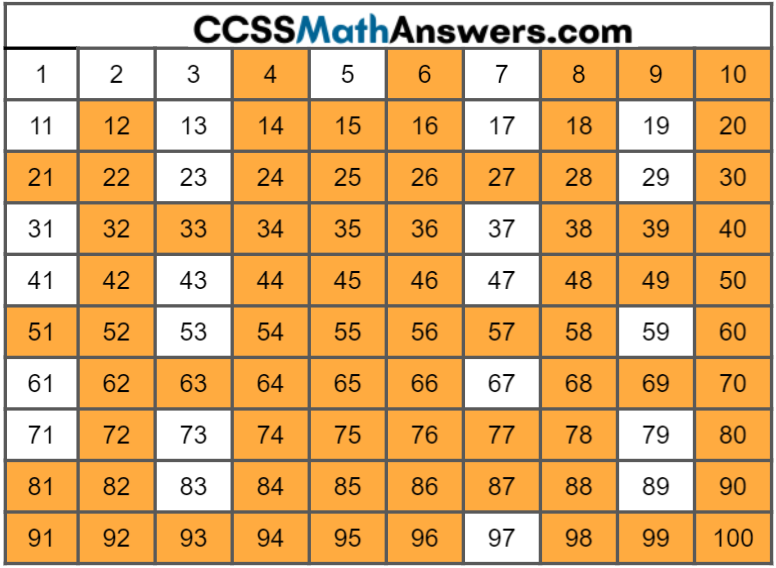
Here we enlisted the composite numbers from 1 to 100. We suggest the students go through the list of composite numbers from 1 to 100 and try to write the composite numbers beyond them for practice.
Composite Number img_1

Difference between Composite Numbers and Prime Numbers

Go through the below table to know the difference between the composite number and prime number.

Composite Number

Prime Number

1.      Composite Numbers are natural numbers that have more than two factors.1.      Prime numbers are the positive integers that have only two factors i.e, one and itself.
2.      Composite numbers can be divided by any other number including 1 and itself.2.Prime numbers can be divided by one and itself.
3.      Example: 4, 6, 8, 9 are examples of composite numbers.3. 2, 3, 5, 7 are examples of prime numbers.

Properties of Composite Numbers

Go through the properties of Composite numbers to understand the concept in detail.
1. The composite numbers are the set of natural numbers which has 3 or more factors.
2. The number 4 is the smallest composite number.
3. Every composite number can be written as the product of two or more prime numbers.
4. A composite number with three different factors is known as sphenic numbers.
5. The number ‘1’ will not be considered as a composite number.
6. All even numbers except ‘2’ are composite numbers.

Prime Factorization of Composite Numbers

The list of composite numbers from 1 to 20 is given here with their prime factorization. Go through the below table to see the prime factorization of the composite numbers.

Composite NumberPrime Factorization
42 × 2
62 × 3
82 × 2 × 2
93 × 3
102 × 5
122 × 2 × 3
142 × 7
153 × 5
162 × 2 × 2 × 2
182 × 3 × 3
202 × 2 × 5

Composite Numbers Examples

Let us see some examples of composite numbers for better understanding.
Example 1.
What are the composite numbers from 1 to 10?
Solution:
Composite numbers from 1 to 10 are 4, 6, 8, 9

Example 2.
Write any two even composite numbers?
Solution:
4 and 6 are the two even composite numbers.

Example 3.
Write the smallest odd composite number?
Solution:
9 is the smallest odd composite number. Because 9 has more than 1 factor.

Example 4.
Determine whether 24 is a composite number or not?
Solution:
Yes, it is a composite number because it is divided by more than one number like 2, 3, 4, 6, 8, 12, and 24 so it is a composite number.

Example 5.
Write any two odd composite numbers?
Solution:
9 and 15 are the two odd composite numbers

FAQs on Composite Numbers

1. What is a composite number?

A composite number is a positive integer that has more than 1 factor.

2. What is the smallest composite number?

4 is the smallest composite number.

3. Is 1 a composite number?

No, because 1 does not have more than two factors. Hence 1 is neither composite nor a prime number.

Even and Odd Numbers Properties

Parity Properties of Even and Odd Numbers – Definition, Facts, Examples

Numbers play an important role in our day-to-day life. A number is a value that is used to express the quantity, calculations, reading numbers, counting, etc. Real numbers are classified as even numbers and odd numbers. A number that is divisible by 2 and leaves remainder as ‘0’ is known as an even number. A number that is divisible by 2 and leaves remainder as ‘1’ is known as an odd number.

Even numbers are those numbers that can be divided into two equal groups. Whereas odd numbers are the numbers that cannot be divided into two equal groups. In this article, we will discuss in detail the even and odd numbers, properties of even and odd numbers here. So, the students can gain more knowledge on even and odd numbers properties and can solve various kinds of problems easily.

Do Refer:

Properties of Even and Odd Numbers

Let us have a look at the properties of even and odd numbers before you start solving the problems.

Even+Even

  • An Even number is divisible by 2 and leaves the remainder ‘0’.
  • An odd number is not completely divisible by 2 and leaves the remainder ‘1’.
  • An even number ends with 0, 2, 4, 6, and 8.
  • An odd number ends with 1, 3, 5, 7, and 9.
  • The sum of two even numbers is an even number.
  • The sum of two odd numbers is an even number.
  • The sum of even and an odd number is an odd number.
  • The product of two even numbers is an even number.
  • The product of an even and odd number is an even number.

Parity Properties of Even and Odd Numbers

Properties of Even and Odd Numbers

Even and Odd Numbers Examples

Let us check the properties of even and odd numbers with some examples.
Example 1.
Add two odd numbers 3 and 5

Solution:
Two odd numbers 3 + 5 = 8
8 is an even number
Adding two odd numbers is an even number.

Example 2.
Add any two even numbers to prove the property “The sum of two even numbers is an even number.”

Solution:
Any two even number 2 + 4 = 6
6 is an even number
Adding two even numbers is an even number.

Example 3.
Addition of one even number and one odd number.

Solution:
One even number is 24
One odd number is 25
24 + 25 = 49
Adding of one even number and one odd number is an odd number.

Example 4.
Addition of any two odd numbers.

Solution:
Any two odd numbers is 35 + 37 = 72
72 is an even number
Adding of the odd numbers is an even number.

Example 5.
What is the sum of 5 and 16?

Solution:
5 + 16 = 21
21 is an odd number
Addition of one even number and one odd number is an odd number.

FAQs on Even and Odd Numbers

1. Why zero is an even number?

Zero is an even number because it is an integer multiple of 2.

2. Write an example to show that sum of two even numbers is an even number?

Let us consider 2 and 6.
2 + 6 = 8
8 is an even number.
Thus we can say that the sum of two even numbers is an even number.

3. Show that the sum of an even number and an odd number is an odd number.

Let us consider 2 and 5
2 + 5 = 7
7 is an odd number.
By this, we can prove that the sum of an even number and an odd number is an odd number.

Examples on Units for Measurement of Capacity

Examples on Measurement of Capacity | Capacity Examples in Math

Capacity is how much quantity a container can hold. The units used to measure the liquid is called a measurement of capacity. The basic units for measurement of capacity are liters, milliliters, gallons, quarts, pints, cups, etc. So, the students who want to know the concept of capacity measurement units can refer to this article. In order to help you guys, we have provided Examples on Measurement of Capacity. Practice the questions on Measuring Capacity from here and improve your math skills.

Do Refer:

Capacity Measurement Examples

Example 1.
A jar has a capacity of 45 liters. The capacity in milliliters is?
Solution:
Given that,
A jar has a capacity of 45 liters.
We know that,
1 liter = 1000 millilitres
45 litres = 1000 × 45 = 45000 millilitres.
Thus the capacity of a jar in milliliters is 45,000ml.

Example 2.
5 liters 2 milliliters equal to how many milliliters?
Solution:
We have to convert from liters to milliliters.
1 litre = 1000 milliliters
5 litre = 5000 milliliters
5 litre 2 milliliters= 5002 milliliters

Example 3.
8 liters equal to how many milliliters?
Solution:
We have to convert from liters to milliliters.
1 litre = 1000 milliliters
8 litres = 8 × 1000 milliliters = 8000 milliliters

Example 4.
A petrol tank has a capacity of 35 liters. The capacity in milliliters is?
Solution:
Given,
A petrol tank has a capacity of 35 liters.
The petrol tank has a capacity = 35 liters
Here we have to convert from liters to milliliters by using the measuring chart.
1 litre = 1000 milliliters
35 litres = 35 × 1000 = 35000 milliliters
Thus the capacity of a petrol tank in milliliters is 35,000.

Example 5.
Somu used 4000 milliliters of milk to prepare a sweet the milk used in liters is?
Solution:
Somu used milk to prepare a sweet = 4000 milliliters
Here we have to convert from liters to milliliters by using the measuring chart.
1 litre = 1000 millilitres
4000 millilitres = 4 litres
Thus the conversion of 4000 milliliters to liters is 4.

Example 6.
Divya has 1800 milliliters of a water bottle the capacity in liters is?
Solution:
Given,
Divya has a water bottle = 1800 milliliters
Here we have to convert from liters to milliliters by using the measuring chart.
1 litre = 1000 millilitres
1800 milliliters = 1 liter 800 milliliters.

Example 7.
Raju has 2 containers with 1 liter and 4 liters. How many liters that the Raju had and convert them to milliliters?
Solution:
Given,
Raju has 2 containers with 1 liter and 4 liters.
Raju has a 2 containers = 1 + 4 = 5 litres
Raju has a total of 5 liters
Here we have to convert from liters to milliliters by using the measuring chart.
1 liter = 1000 milliliters
5 litres = 5000 millilitres

Example 8.
Ramya has 2 liters of juice convert it into milliliters.
Solution:
Given,
Ramya has 2 liters of juice
We have to convert from liters to milliliters.
1 liter = 1000 ml
2 litres = 2 × 1000 = 2000 millilitres

Example 9.
Convert 10000 milliliters to liters?
Solution:
Here we have to convert from liters to milliliters by using the measuring chart.
1 litres = 1000 milliliters
10000 milliliters= 10 litres

Example 10.
Convert 4 liters into milliliters?
Solution:
Here we have to convert from liters to milliliters by using the measuring chart.
1 litre = 1000 milliliters
4 litres = 4000 milliliters

Example 11.
Convert 4 quarts = ___ pints
Solution:
By using the measuring capacity chart we know that
1 quart = 2 pints
4 quarts = 4 × 2 pints = 8 pints
Therefore 4 quarts = 8 pints

Example 12.
4 pints = ___ cups
Solution:
By using the measuring capacity chart we know that
1 pint = 2 cups
4 pints = 4 × 2 cups = 8 cups
Therefore 4 pints = 8 cups.