Adding Doubles

Adding Doubles | What is Doubles Addition? | How Adding Doubles is same as Multiplying by Two?

If you are strong in the concept of addition you can memorize the specific addition facts quite easily. Learning about Adding Doubles makes it easy for you to perform calculations in a speedy manner. To get a Double of a Number we will simply add the number to itself.

This Activity of Doubles Addition will enhance the math skills of Addition. Use our Adding Doubles Worksheets to have ample practice and learn the concept as well.  Learn How Adding Doubles is the Same as Multiplying by Two in the further modules. Solve the Examples provided here and work on the double addends. Solving the Doubles Addition Problems can help your kid build fluency in addition to creating equivalent or known sums.

Also, Check:

Adding Doubles Table Chart for Numbers 1-25

1+1 = 26+6 = 1211 + 11 = 2216 + 16 = 3221 + 21 = 42
2+2 = 47 +7 = 1412 + 12 = 2417 + 17 = 3422 + 22 = 44
3+3 =68 + 8 = 1613 + 13 = 2618 + 18 = 3623 + 23 = 46
4+4 = 89 + 9 = 1814 + 14 = 2819 + 19 = 3824 + 24 = 48
5+5 = 1010 +10 = 2015 + 15 = 3020 + 20 = 4025 + 25 = 50

Take a printout of the Doubles Addition of Numbers up to 25 for free and use them to solve addition problems. Stick the Table on your walls and remember the addition facts on doubles.

How Adding Doubles is same as Multiplying by Two?

When we multiply a number by 2 we are just doubling the number. These two actions are similar and we can prove the same by having a glance at the below modules.
Double the Numbers and Multiply by 2 from 0-10

0+0 = 0 or 0*2 =0
1+1 = 2 or 1*2 = 2
2+2 = 4 or 2*2 = 4
3+3 = 6 or 3*2 = 6
4+4 = 8 or 4*2 = 8
5+5 = 10 or 5*2 = 10
6+6 = 12 or 6*2 = 12
7+7 = 14 or 7 *2 = 14
8+8 = 16 or 8 *2 = 16
9+9 = 18 or 9*2 = 18
10+10= 20 or 10*2 = 20

Double the Numbers and Multiply by 2 from 11-20

11+11 = 22 or 11*2 = 22
12+12 = 24 or 12*2 = 24
13+13 = 26 or 13*2 = 6
14+14 = 28 or14*2 = 8
15+15 = 30 or 15*2 = 30
16+16 = 32 or 16*2 = 32
17+17 = 34 or 17 *2 = 34
18+18 = 36 or 18 *2 = 36
19+19 = 38 or 19*2 = 38
20+20= 40 or 20*2 = 40

Double the Numbers and Multiply by 2 from 21-25

21+21 = 42 or 21*2 = 42
22+22 = 44 or 22*2= 44
23+23 = 46 or 23*2 = 46
24+24 = 48 or 24*2 = 48
25+25 = 50 or 25*2 = 50

Enhance your math skills and learn to add problems orally and score better grades in mental math. You can use Adding Doubles Plus 1 or Minus 1 concept if you are to find the sum of consecutive numbers.

Examples on Addition of Doubles

Example 1.

Mary has 4 balls and James has double the balls mary has. Find How many Marbles does James have?
Solution:
No. of balls Mary has = 4
James has double the balls mary has i.e. 4+4 or 4*2 = 8
Therefore, James has 8 Marbles in total.

Example 2.
Add 3+4 using doubles?
Solution:
The Number 4 is more than 3 and we can write 4 as 3+1
As we know the double of 3 is 6.
Therefore, the sum of 3+4 would be one more than the double i.e. 6+1=7
Thus, the sum of 3+4 is 7

Example 3.
Find the Sum of 6+5 using doubles?
Solution:
The Number 5 is one less than 6 and we can write 5 as 6-1
As we know the double of 6 is 12.
Thus, the sum of 6+5 would be one less than the double i.e. 12-1
Thus, the sum of 6+5 is 11

Example 4.
What is 4+4 =?
Solution:
We know 4+4 or 4*2= 8
Thus, the Double of 4 is 8

Adding with Zero

Adding with Zero | 0 Property of Addition | What Happens on Adding Zero to a Number?

Number 0 is in wide usage and can be used as a number on its own or as a placeholder in equations. Number 0 is used to denote an absence of a number. The addition of 0 will always result in the same number. Adding Zero means Adding nothing to a number. We have presented facts on zero addition tables and learn how to add numbers with 0. Help your child improve their mental math addition skills by asking them to practice the questions on zero addition.

When we add a number to 0 the result is equal to the number itself. By referring to the solved examples you can learn how to solve addition problems in which one of the addends is zero, another addend is a number. Refer to the Solved Examples on Adding with Zero for a better understanding of the addition facts of 0.

See More: Addition

Adding with Zero Tables up to 25

0+1=10+6=60+11=110+16=160+21=21
0+2=20+7=70+12=120+17=170+22=22
0+3=30+8=80+13=130+18=180+23=23
0+4=40+9=90+14=140+19=190+24=24
0+5=50+10=100+15=150+20=200+25=25

When Two Addends are Added Together, If we interchange the addends the sum would be the same. Check if the sum varies or not after interchanging the addends in the below table.

1+0=16+0=611+0=1116+0=1621+0=21
2+0=27+0=712+0=1217+0=1722+0=22
3+0=38+0=813+0=1318+0=1823+0=23
4+0=49+0=914+0=1419+0=1924+0=24
5+0=510+0=1015+0=1520+0=2025+0=25

Zero Representation

Zero is halfway between -1 and +1 on the Number Line. Zero is neither a positive number nor a negative number.

Zero is a Special Number

Adding with 0 Examples

Example 1.
What is the related addition fact for 7+0 =7 among the following?
(a) 0 + 3 = 3
(b) 5 + 0 = 5
(c) 0 + 7 = 7
(d) 2 + 0 = 2
Solution:
We can add numbers in any order. We will get the same sum irrespective of the order of addends.
The related addition fact for 7+0=7 is 0+7 = 7
On interchanging the addends too the sum remains the same.
Example 2.
Which is the related addition fact for 0+23=23?
(a) 23 + 0 = 23
(b) 15 + 0 = 15
(c) 0 + 0 = 0
(d) 13 + 0 = 13
Solution:
We know we can add the numbers in any order and the sum is the same.
The related addition fact for 0+23=23 is 23+0=23
Even after the interchanging, the sum is the same.

Missing Addend Sums with 1-Digit Number

Missing Addend Sums with 1-Digit Number | How to find Missing Addend in 1 Digit Numbers?

Calculate Missing Addend in Sums with1-Digit Numbers easily by using this procedure. You might feel it difficult to solve the problems on Missing Addend if you aren’t aware of the concept. We have provided various questions for finding the missing addend in One-Digit Numbers. Go through them and learn the approach used to solve related problems in your exams. Worksheet on Missing Addend sums with 1-digit number enhances the math skills generally.
Do Read:

How to find the Missing Addend Sums with 1-Digit Number?

Go through the simple steps provided below to determine the missing addend in sums with 1- digit numbers. They are as such

  • Firstly, list out the addend given and the total.
  • In order to obtain the missing addend, all you have to do is simply subtract the given addend from the total to get the missing digit.

Missing Number in Addition Examples

Example 1.
Find the Missing Addend 7 + ? = 9
Solution:
Since the missing number is after the + sign we use the counting method. Check how many more added to 7 makes the sum 9.
7+2=9
Therefore, 7 added to 2 produces the sum 9.

Example 2.
Find the Missing Addend in the equation ? + 6 = 6
Solution:
Here the missing digit is at the beginning of the sentence we will subtract the number next to the + sign from the total value.
6-6=0
Thus, 6 when added with 0 produces 6.

Example 3.
Find the Missing Addend in the Sentence 5+?=8
Solution: 
Here the missing digit is after the + sign we will use the counting method. Check how many more added to 5 produces the sum of 8.
5+3 = 8
Therefore, the Missing Addend in Statement 5+?=8 is 3

Example 4.
How many more added to 3 make 5?
Solution:
?+3=5
As the missing digit is at the beginning of the sentence we will subtract the number next to the + sign from the total.
5-3=2
Therefore, 2 more added to 3 make 5.

Example 5.
How many more added to 1 makes 4?
Solution:
1+? =4
Since the Missing Number is after the + sign we use the counting method. Check how many more added to 1 results in 4.
1+3=4
Therefore, 3 more added to 1 results in 4.

Example 6.
Find the Missing Addend in the Sum 6 + ? = 8
Solution:
6+? = 8
Here the missing digit is next to the + sign we will use the counting method. See how many more added to 6 results in 8.
6+2=8
Therefore, 2 added to 6 results in the sum of 8.

Missing Number in Addition

Missing Number in Addition | How to Find the Missing Number in Addition?

Missing Number in the Addition concept will lay a foundation of Basic Addition Facts and helps you to understand the relation of addition with subtraction. While Solving Addition Problems your child will learn to find the missing addend in a sentence. Go through the entire article to be well versed with the details like How to Find the Missing Number in Addition and Solved Examples on the same.
Also, See:

How to Find Missing Numbers in Addition Sentence?

Go through the below steps and learn how to solve missing numbers in addition problems. Let us learn how to find the missing number in addition having an + sign and = sign.
There are different scenarios in the missing number addition

4+5 =……
Here, the missing number is simply the addition of two numbers before the equal sign.
4+…..=7
If the Missing Number is before the equal sign we will use the counting method to check how many more added to addend makes the resultant.
…..+3 =6
If the Missing Number is at the beginning of the sentence we can subtract the other number next to the plus sign from the total.

Cases in Missing Number Addition

There are three different cases in finding the missing number in addition. They are along the lines

  • If the Missing Number is at the end of the missing number sentence. In this case, you can simply add the number together to obtain the missing number.
  • If the Missing Number is alone after the + sign. You can use the counting method to check how many more added can result in the value after the equal sign.
  • The Other Case is if the Missing Number is at the beginning of the sentence Subtract the other number next to the addition sign from the total.

This guide might help you while dealing with the Missing Number Subtraction Problems. If you want to know how these works refer to the solved examples provided below.

Finding Missing Digits in Addition Examples

Example 1.
Find the Missing Addend in the Sum 4 + ? = 8
Solution:
Since the missing number is alone after the + sign we will use the counting method. Thus, see how many more added to 4 makes the sum 8.
4+4=8
Therefore, 4 added to 4 makes the sum of 8 i.e. 4+4=8

Example 2.
Find How many more make 5 when 3 is added to it i.e.? +3 =5?
Solution:
Given ?+3 =5
Here the missing digit is at the beginning of the Addition Sentence so we will subtract the number next to the + sign from the sum value.
5-3=2
Therefore, 2 when added to 3 produces the total 5.

Example 3.
Find the Sum of 6+3=?
Solution:
Given 6+3=?
Here the Missing Number is at the end of the sentence. So, we simply add the numbers together to obtain the sum.
6+3=9
Therefore, the sum of 6+3 is 9.

Example 4.
What must be added to 6 to make it 9?
Solution:
6+?=9
Here the missing digit is next to the + sign so we will use the counting method. Check how many more added to 6 makes 9
6+3=9
Therefore, 3 must be added to 6 to make it 9.

Addition Word Problems 1-Digit Numbers

Addition Word Problems 1-Digit Numbers | Single Digit Addition Word Problems

Addition Word Problems present here include the addition of 1-digit numbers. Our extensive and well-researched Worksheets include real-life scenarios that include One-Digit Addition. These Free Worksheets on Addition of 1-Digit Numbers are provided so that students can have ample practice. In fact, we have provided different models of questions asked in addition so that you will have an idea of the kind of questions being asked in exams. Make the most out of these handy preparation materials and score better grades in exams.

Also, Read:

1-Digit Numbers Addition Word Problems

Example 1.
A Man Plucked 5 mangoes from one tree, 2 mangoes from the second tree, and 1 mango from the third tree. Find the total number of mangoes he plucked from the trees?
Solution:
No. of Mangoes the man plucked from first tree  = 5
No. of Mangoes the man plucked from the second tree = 2
No. of Mangoes he plucked from the third tree = 1
Total No. of mangoes plucked by him from all three trees = 5+2+1
5
2
(+) 1
——–
8
——–

Therefore, the no. of mangoes man plucked from three trees = 8.
Example 2.
There are 6 bags of wheat, 4 bags of rice, and 1 bag of a gram in a store. Find the total number of bags in the store?
Solution:
No. of bags of wheat = 6
No. of bags of rice = 4
No. of bags of gram = 1
Total Number of Bags in Store = No. of Bags of Wheat + No. of Bags of Rice + No. of Bags of Gram
= 6+4+1
6
4
(+) 1
———-
11
———-
Example 3.
Seethal bought 8 toys in January, 4 in February, and 2 toys in March. How many toys were bought by seethal in the above-mentioned months in total?
Solution:
No. of toys Seethal Bought in January = 8
No. of toys Seethal Bought in February = 4
No. of toys Seethal Bought in March = 2
Total Toys Seethal Bought in Total = 8+4+2
8
4
(+) 2
———-
14
———-
Example 4.
There are 6 red rubber bands and 2 green rubber bands. How many rubber bands are there in all?
Solution:
No. of Red Rubber Bands = 6
No. of Green Rubber Bands = 2
Total Number of Rubber Bands = 6+2
6
(+)2
——-
8
——-
Example 5.
On Monday evening Kishen completed 2 pages in Maths homework and 4 pages in English homework. How many total pages did he complete his homework altogether?
Solution:
No. of Pages Kishen completed in Maths Homework = 2
No. of Pages Kishen completed in English Homework = 4
Total No. of Pages Kishen complete in total = 2+4
2
(+)4
——–
6
——–
Example 6.
A pet-lover has 1 dog and 3 cats in his house. How many animals are there in the house in total?
Solution:
No. of dogs the pet lover has =1
No. of cats pet lover has = 3
Total No. of Animals in total = 1+3
1
(+)3
——–
4
——–

Vertical Addition

Vertical Addition With and Without Regrouping | How to Add Numbers Vertically?

You might need to add numbers even after your math class. In this article of ours, we have explained what is Vertical Addition and How it’s done in detail. In Vertical Addition, we place one number over the other as per their places such as ones, tens, hundreds, and so on. Vertical Adding involves two steps namely setting up the numbers we are about to add and then adding them together in real. Check out the Problems on Vertical Addition with Regrouping and Without Regrouping, etc. to become familiar with the problems asked on the concept.

Do Check:

What is Vertical Addition?

Vertical Addition is a method of adding numbers lined up in columns according to their place values. Always begin addition in the one’s column or the column on the right.

There are two scenarios in the Vertical Addition namely

  • Vertical Addition with Regrouping
  • Vertical Addition without Regrouping

Vertical Addition With Regrouping: Addition requires regrouping if the sum of the digits makes more than ten. We usually will not place more than 9 in a column. For instance 5+9 =14 here 4 will be in one’s column and one is carry forwarded to the tens column.

Vertical Addition Without Regrouping: When two numbers are added if the sum of the digits is less than 10  then no regrouping is needed and the sum is placed in the column as it is.

How to do Vertical Addition?

In order to perform addition make sure you set the numbers correctly. Line the Number Columns up Properly. Place 1’s column under 1’s one’s column, tens column under tens column, hundreds column under hundreds column, etc.

Begin adding numbers that fall in the same column. Start with one’s column and move on to the left. If the sum in the one’s column is more than 10 we do regrouping i.e. place the carry above the tens column. Continue the same procedure for different place values such as hundreds, thousands, and so on. i.e. move the carry over to the next place in case of a sum of more than 10.

Examples of Vertical Addition with Pictures

Example 1.
Find the sum of 42+7?
Solution:
Let us arrange the numbers 42 and 7 lined up in columns. Start with the one’s column and move on to the left.

Vertical Addition Example 1

Here the sum of numbers 2 and 7 is 9 so there is no need for regrouping. As the tens-place number is 0 in the 2nd number the 10s place number remains the same. Therefore, the sum of 42 and 7 is 49.

What if the sum of numbers in one’s column is more than 10. Then you can’t write the number directly in the one’s column. You have to write the carry in the next place value.

Example 2.
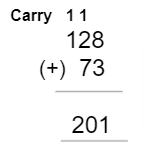
Add the Numbers 128 and 73 Vertically and show the procedure?
Solution:
Arrange the numbers 128 and 73 lined up in columns. Begin with the one’s column and continue to the left.

Vertical Addition Example 2

The Sum of One’s Column 8+3 = 11 i.e. is more than 10 so we will carry forward to the tens column. Adding Tens Column we have 1+2+7 = 10 we will carry forward it to the hundreds column.

Therefore, the sum of 128 and 73 is 201.

Example 3.

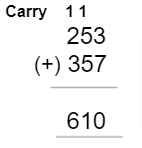
Add Numbers 253 and 357 Vertically?
Solution:
Arrange numbers 253 and 357 lined up in columns. Start from one’s place and continue to left.

Vertical Addition Example 3

Sum of One’s Column 3+7 = 10 write down the answer in one’s column and keep the carry on the top of the tens column. The Sum in the Tens Column is 1+5+5 =11 place 1 in the tens column and keep the carry in the hundreds column. The sum in the hundreds column is 1+2+3 = 6

Therefore, the sum of 253 and 357 is 610.

Number Games

Number Games for Kids | Fun Math Games and Number Activities for Preschoolers

Develop a love for maths in children from a young age using the Number Games Activities. Kindergarten is the time you start making friends with numbers. Children begin counting objects, representing numbers, tell one more, one less, etc. We have provided colorful activities and are sure that your little one will learn math in a fun and engaging way.  Develop Spatial Awareness by counting objects in different arrangements.

Number Games for Kids focuses on basic number recognition and are designed to build critical thinking skills. Math Number Games develop an understanding of math in a fun way. They apply this knowledge to solve problems by comparing numbers, counting objects, etc. These Fun Activities will develop counting skills, number sense in Kindergarten.

Do Read:

Number Games for Kindergarten

Read the following number table of 1-100 numbers and answer the questions framed on it.
(a) above 55   45                               (m) left of 60   ____

(b) left of 33   ____                            (n) below 54   ____

(c) right of 62   ____                          (o) right of 43   ____

(d) below 42  ____                            (p) above 77   ____

(e) above 80   ____                            (q) above 80   ____

(f) right of 72   ____                           (r) left of 58   ____

(g) below 55   ____                             (s) right of 73   ____

(h) left of 47   ____                            (t) left of 53   ____

(i) below 39   ____                              (u) below 26   ____

(j) right of 49   ____                            (v) above 44   ____

(k) below 36   ____                              (w) below 85   ____

(l) right of 75   ____                             (x) right of 98   ____

Number Chart
Solution:

(a) above 55   45                               (m) below 10   __20__

(b) left of 33   __34__                            (n) below 54   __64__

(c) right of 62   __63__                          (o) right of 43   _44___

(d) below 42  __52__                            (p) above 77   _67___

(e) above 80   __81__                            (q) above 80   __70__

(f) right of 72   __73__                           (r) left of 58   __59__

(g) below 55   _65___                             (s) right of 73   _74___

(h) left of 47   _46___                            (t) left of 53   ___54_

(i) below 39   __49__                              (u) below 26   _36___

(j) right of 49   _50___                            (v) above 44   _34___

(k) below 36   _46___                              (w) below 85   __95__

(l) right of 75   _76___                             (x) right of 98   __99__

2. Count the Objects and Make a Match with the Numbers accordingly in the following figure.

Make a Match Worksheet

3. The below figure includes several objects followed by numbers. Simply count the numbers and circle or mark the number of objects among the numbers given. This activity can help you develop both counting skills and number awareness as well. If you want take a printout of it for free and practice whenever you want.

Number Awareness Worksheet

4. Fill in the Missing Numbers in the Grid of Numbers 1-50 Shown Below and write the numbers in a sequence.

Filling the Missing Numbers Worksheet
5. Each player will be given a piece of paper having 25 empty grids. All of them are asked to fill out the numbers of their choice between 1-25. You can start the game by picking a number and saying it aloud. If the Number called out exists in the grid strikeout. Do so, until one of the players continues and strikes all 25 on their grid. In the BINGO Number Game of 1-25 fill the free space so that all the numbers are present.

1-25 Number Game

Solution: The Free Space Grid will have 13 in it as it is the only number missing of all the 25 numbers.

Greater than Less than and Equal to

Greater than Less than and Equal to Symbols | How to Remember Greater, Less than, Equal to Signs?

In the Comparison of Numbers, we use symbols like Greater than, Less than, or Equal to. Greater than, Less than Symbols helps us to determine how one number is different from the other. These symbols denote if a number is greater than the other, or less than the other or else equal. Symbols for greater than is >, for less than, is <, and for equal to is = sign. Go through the further modules and fill in the blanks with relevant signs in the problems stated.

Once you get grip on the concepts of Comparison of Numbers start practicing using the Greater or Less than and Equal to Worksheets available. Take a Printout of these Greater, Less than, Equal to Activity Worksheets for free and access them offline too.

Read More:

Greater, Less than, and Equal to Signs

Important Signs used for the Identification of Bigger, Smaller, and Equal to Numbers are as follows

=If two values are equal
then we use the sign equals to
Example: 3+3 = 6
≠If two values are not equal
we use the not equal to sign
Example: 4+3 ≠ 9
<If one value is smaller than the other
we use the less-than sign
Example: 2 < 6
>If one value is bigger than the other
we use the “greater than” symbol
Example: 8 > 4

Applications of Greater than, Less than or Equal to Signs

There are numerous applications of the greater than, less than, or equal to signs in mathematics. During the Comparison of Numbers, we will not always end up with an equality sign. At times, there arise scenarios of inequality and we end up using symbols greater than, less than. The statement can be expressed as a mathematical expression.

While dealing with the inequalities pay attention to the inequalities direction. Few tricks that don’t affect the inequalities direction in a problem is as follows

  • Multiplying or Dividing the Inequalities on both sides with the same positive number.
  • Adding or Subtracting with the same number on both sides of an inequality expression.

Examples of Greater than, Less than, or Equal to

Example 1.
Write the Correct Comparison Symbol >, <, = in the blanks
1. 140 …….. 142
2. 155 ……. 152
3. 16 …….19
4. 18 ………18
5. 34 …….38
6. 71 …….74
7. 89…….88
8. 98……95
Solution:
1. 140 …<….. 142, 140 is less than 142
2. 155 …>…. 152, 155 is greater than 152
3. 16 ..<…..19, 16 is less than 19
4. 18 …..=….18, 18 is equal to 18
5. 34 …<….38, 34 is less than 38
6. 71 …<….74, 71 is less than 74
7. 89…<….88, 89 is greater than 88
8. 98…>….95,98 is greater than 95

Example 2.
Compare the numbers given and Place a sign in the below set.
Practice Worksheet on Comparison of NumbersExample 3:
Fill in the Boxes using>, <, or = sign. Take a Printout of the handy Worksheet on Greater than Less than or Equal to for free and begin your practice.
Greater than Less than Equal to Worksheets

Number that Comes Between | Middle Number | Learn What Number Comes In Between a Number?

Learn What Number Comes in Between Two Numbers easily by referring to this page. Worksheet on Number Comes In Between helps you to count the numbers in order and then write the middle. You need to check the numbers before and after and then fill the missing number that comes in between easily. Practice using these Between Numbers Activity Sheets and enhance your counting skills. Take a Print out of these Middle Number Worksheets and practice more with fun.

These Middle Number Worksheets give additional practice in sequencing numbers. Students are shown various numbers and asked which number comes between the two numbers. Make use of these examples on what number comes in between for practice purposes and test your number sense.

Do Refer:

Middle Numbers Worksheet

Example 1.
Write down the between numbers for the given sets and learn to count the numbers in order. Check the before and after numbers and write down the middle numbers. Take a printout of these What Number Comes In Between Activities for free.

Middle Numbers Worksheet

Example 2.
Fill in the Blanks and Identify What Comes in Between?

(i) 12 ……. 14
(ii) 22………24
(iii)38………40
(iv)54…..56
(v)61…….63
(vi)78…..80
Solution:

(i) 12 …13…. 14
(ii) 22….23…..24
(iii)38…39……40
(iv)54…55..56
(v)61…62….63
(vi)78…79..80

Example 3:
What Comes In Between the given numbers?
What Comes in Between 45 and 47
Solution:
Between Number in 45 and 47
Example 4:
Write the Numbers that come in between the following sets?
Numbers in Between

Solution:
4 and 6 …5……
18 and 20 ….19….
45 and 47 …46…..
53 and 55 ….54….
78 and 80 ..79……
91 and 93 ….92….
84 and 86 …85…..
101 and 103 ….102….
Example 5:
Write the Middle Number in the below examples

19 __ 21
45 __ 47
65 __ 67
71 __ 73
92 __ 94
Solution:
19 _20_ 21
45 _46_ 47
65 _66_ 67
71 _72_ 73
92 _93_ 94

Before and After Number

Before and After Number Activities for Kindergarten | How to Learn Before and After Numbers?

Before and After Number Activities existing here help kids to understand how good they are at Numbers. This Math Activity on Before and After Numbers will make sure you learn to count the numbers in order and have an idea of what number comes before and after a particular number. Practicing the numerous questions available in the Before and After Numbers Worksheets helps your kid to learn math skills quite efficiently.

Kids will sharpen their skills and knowledge of counting numbers by solving the questions on before and after numbers. With the Before and After Number Games your kids will identify various numbers, count numbers loudly, and finish the order. Number Counting is an essential skill to have strong fundamentals in Maths.

Do Check:

1. Tick (✔) the correct sentence and cross (×) the wrong sentence

(i)43 is before 44 _____       (vi) 21 is after 20 _____

(ii) 31 is before 32 _____       (vii) 85 is after 86 _____

(iii) 97 is before 88 _____       (viii) 42 is after 40 _____

(iv) 96 is before 97 _____      (ix) 65 is after 64 _____

(v) 73 is before 72 _____       (x) 86 is after 85 _____
Solution:

(i) 43 is before 44 __✔___      (vi) 21 is after 20 __✔___

(ii) 31 is before 32 ___✔__      (vii) 85 is after 86 __×___

(iii) 97 is before 88 ___×__      (viii) 42 is after 40 ___×__

(iv) 96 is before 97 __✔___      (ix) 65 is after 64 ___✔__

(v) 73 is before 72 ___×__      (x) 86 is after 85 __✔___

2. Fill in the Blanks

(i) 56 is before _____     (vi) 47 is after _____

(ii) 43 is before _____    (vii) _____ is after 52

(iii) _____ is before 68   (viii) 73 is after _____

(iv) _____ is before 95   (ix) _____ is after 84

(v) 19 is before _____    (x) 38 is after _____

Solution:

(i) 56 is before __57___ (vi) 47 is after __46___

(ii) 43 is before _44____ (vii) __53___ is after 52

(iii) ___67__ is before 68 (viii) 73 is after 74_____

(iv) __94___ is before 95 (ix) ___83__ is after 84

(v) 19 is before __20___ (x) 38 is after ___37__

3. What Comes Before?
(i) ……. ← 15
(ii) ……← 23
(iii) ……← 81
(iv) ……. ← 70
(v) …….← 65
(vi) ……. ← 99
(vii) ……. ← 68
(viii) …….← 43
(ix) …….← 56
(x)………← 37

Solution:
(i) ….14…. ← 15
(ii) ….22….← 23
(iii) ….80….← 81
(iv) …69…… ← 70
(v) …64….← 65
(vi) …98…. ← 99
(vii) ..67….. ← 68
(viii) ..42…..← 43
(ix) ..55…..← 56
(x)…..36….← 37

4. What Comes After?
(i) 15 → ……..
(ii) 23 → ……..
(iii) 81 → ……..
(iv)70 → ……..
(v) 87 → ……..
(vi)61 → ……..
(vii) 48 → ……..
(viii) 73→ ……..
(ix)19→ ……..
(x)25→ ……..
Solution:
(i) 15 → ….16….
(ii) 23 → …24…..
(iii) 81 → ….82….
(iv)70 → ….71….
(v) 87 → …88…..
(vi)61 → …..62..
(vii) 48 → …..49…
(viii) 73→ …74…..
(ix)19→ …20…..
(x)25→ …26…..