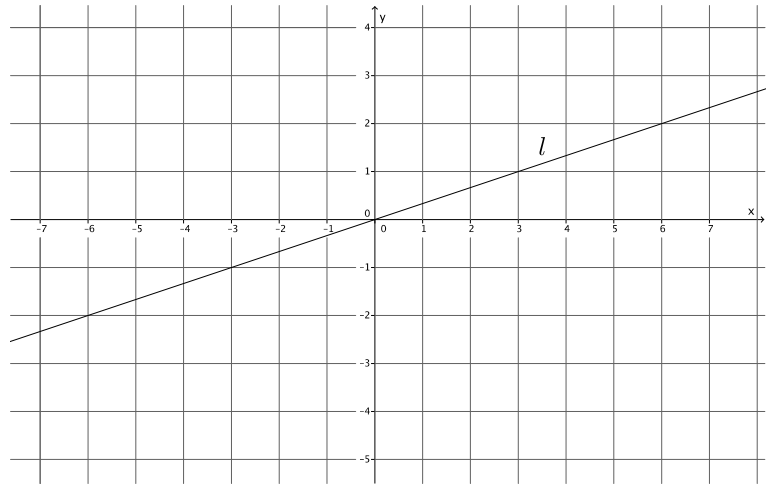
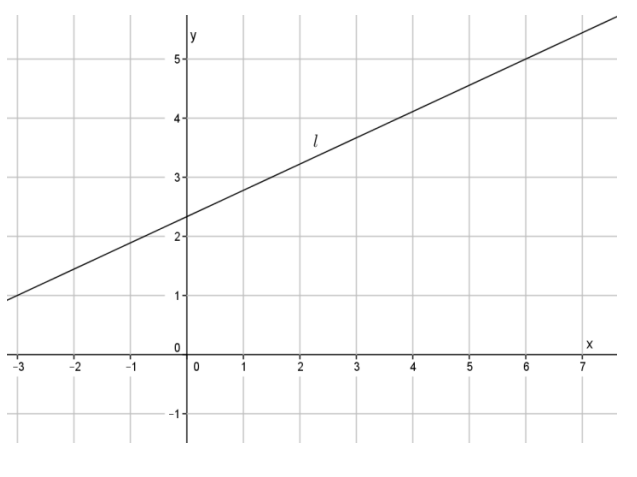
Eureka Math Grade 8 Module 4 Lesson 8 Answer Key

Engage NY Eureka Math 8th Grade Module 4 Lesson 8 Answer Key

Eureka Math Grade 8 Module 4 Lesson 8 Example Answer Key

Example 1.
→ Given a linear equation in disguise, we will try to solve it. To do so, we must first assume that the following equation is true for some number x.
\(\frac{x-1}{2}\) = \(\frac{x+\frac{1}{3}}{4}\)
We want to make this equation look like the linear equations we are used to. For that reason, we will multiply both sides of the equation by 2 and 4, as we normally do with proportions:
2(x+\(\frac{1}{3}\))=4(x-1).
→ Is this a linear equation? How do you know?
→ Yes, this is a linear equation because the expressions on the left and right of the equal sign are linear expressions.
→ Notice that the expressions that contained more than one term were put in parentheses. We do that so we do not make a mistake and forget to use the distributive property.
→ Now that we have a linear equation, we will use the distributive property and solve as usual.
2(x+\(\frac{1}{3}\))=4(x-1)
2x+\(\frac{2}{3}\)=4x-4
2x-2x+\(\frac{2}{3}\)=4x-2x-4
\(\frac{2}{3}\)=2x-4
\(\frac{2}{3}\)+4=2x-4+4
\(\frac{14}{3}\)=2x
\(\frac{1}{2}\)∙\(\frac{14}{3}\)=\(\frac{1}{2}\)∙2x
\(\frac{7}{3}\)=x
→ How can we verify that \(\frac{7}{3}\) is the solution to the equation?
→ We can replace x with \(\frac{7}{3}\) in the original equation.
Engage NY Math 8th Grade Module 4 Lesson 8 Example Answer Key 1
Since \(\frac{7}{3}\) made the equation true, we know it is a solution to the equation.

Example 2.
→ Can we solve the following equation? Explain.
\(\frac{\frac{1}{5}-x}{7}\) = \(\frac{2 x+9}{3}\)
→ We need to multiply each numerator with the other fraction’s denominator.
→ So,
\(\frac{\frac{1}{5}-x}{7}\) = \(\frac{2 x+9}{3}\)
7(2x+9)=3(\(\frac{1}{5}\)-x).
→ What would be the next step?
→ Use the distributive property.
→ Now we have
7(2x+9)=3(\(\frac{1}{5}\)-x)
14x+63=\(\frac{3}{5}\)-3x
14x+3x+63=\(\frac{3}{5}\)-3x+3x
17x+63=\(\frac{3}{5}\)
17x+63-63=\(\frac{3}{5}\)-63
17x=\(\frac{3}{5}\)–\(\frac{315}{5}\)
17x=-\(\frac{312}{5}\)
\(\frac{1}{17}\) (17x)=(-\(\frac{312}{5}\))\(\frac{1}{17}\)
x=-\(\frac{312}{85}\).
→ Is this a linear equation? How do you know?
→ Yes, this is a linear equation because the left and right side are linear expressions.

Example 3.
Can this equation be solved?
\(\frac{6+x}{7 x+\frac{2}{3}}\)=\(\frac{3}{8}\)
Give students a few minutes to work. Provide support to students as needed.
→ Yes, we can solve the equation because we can multiply each numerator with the other fraction’s denominator and then use the distributive property to begin solving it.
Answer:
\(\frac{6+x}{7 x+\frac{2}{3}}\)=\(\frac{3}{8}\)
(6+x)8=(7x+\(\frac{2}{3}\))3
48+8x=21x+2
48+8x-8x=21x-8x+2
48=13x+2
48-2=13x+2-2
46=13x
\(\frac{46}{13}\)=x

Example 4.
Can this equation be solved?
\(\frac{7}{3 x+9}\)=\(\frac{1}{8}\)
Give students a few minutes to work. Provide support to students as needed.
→ Yes, we can solve the equation because we can multiply each numerator with the other fraction’s denominator and then use the distributive property to begin solving it.
Answer:
\(\frac{7}{3 x+9}\)=\(\frac{1}{8}\)
7(8)=(3x+9)1
56=3x+9
56-9=3x+9-9
47=3x
\(\frac{47}{3}\)=x

Example 5.
In the diagram below, △ABC~ △A’ B’ C’. Using what we know about similar triangles, we can determine the value of x.
Engage NY Math 8th Grade Module 4 Lesson 8 Example Answer Key 20
→ Begin by writing the ratios that represent the corresponding sides.
Answer:
\(\frac{x-2}{9.5}\) = \(\frac{x+2}{12}\)

It is possible to write several different proportions in this case. If time, discuss this fact with students.
→ Now that we have the ratios, solve for x and find the lengths of \(\overline{A B}\) and \(\overline{A C}\).
Answer:
\(\frac{x-2}{9.5}\) = \(\frac{x+2}{12}\)
(x-2)12=9.5(x+2)
12x-24=9.5x+19
12x-24+24=9.5x+19+24
12x=9.5x+43
12x-9.5x=9.5x-9.5x+43
2.5x=43
x=\(\frac{43}{2.5}\)
x=17.2
|AB|=15.2 cm, and |AC|=19.2 cm.

Eureka Math Grade 8 Module 4 Lesson 8 Exercise Answer Key

Solve the following equations of rational expressions, if possible.

Question 1.
\(\frac{2 x+1}{9}\)=\(\frac{1-x}{6}\)
Answer:
\(\frac{2 x+1}{9}\)=\(\frac{1-x}{6}\)
9(1-x)=(2x+1)6
9-9x=12x+6
9-9x+9x=12x+9x+6
9=21x+6
9-6=21x+6-6
3=21x
\(\frac{3}{21}\)=\(\frac{21}{2}\)1 x
\(\frac{1}{7}\)=x

Question 2.
\(\frac{5+2 x}{3 x-1}\)=\(\frac{6}{7}\)
Answer:
\(\frac{5+2 x}{3 x-1}\)=\(\frac{6}{7}\)
(5+2x)7=(3x-1)6
35+14x=18x-6
35-35+14x=18x-6-35
14x=18x-41
14x-18x=18x-18x-41
-4x=-41
\(\frac{-4}{-4}\) x=\(\frac{-41}{-4}\)
x=\(\frac{41}{4}\)

Question 3.
\(\frac{x+9}{12}\)=\(\frac{-2 x-\frac{1}{2}}{3}\)
Answer:
\(\frac{x+9}{12}\)=\(\frac{-2 x-\frac{1}{2}}{3}\)
12(-2x-\(\frac{1}{2}\))=(x+9)3
-24x-6=3x+27
-24x+24x-6=3x+24x+27
-6=27x+27
-6-27=27x+27-27
-33=27x
\(\frac{-33}{27}\)=\(\frac{27}{27}\) x
–\(\frac{11}{9}\)=x

Question 8.
\(\frac{8}{3-4 x}\) = \(\frac{5}{2 x+\frac{1}{4}}\)
Answer:
\(\frac{8}{3-4 x}\) = \(\frac{5}{2 x+\frac{1}{4}}\)
8(2x+\(\frac{1}{4}\))=(3-4x)5
16x+2=15-20x
16x+2-2=15-2-20x
16x=13-20x
16x+20x=13-20x+20x
36x=13
\(\frac{36}{36}\) x=\(\frac{13}{36}\)
x=\(\frac{13}{36}\)

Eureka Math Grade 8 Module 4 Lesson 8 Problem Set Answer Key

Students practice solving equations with rational expressions, if a solution is possible.

Solve the following equations of rational expressions, if possible. If an equation cannot be solved, explain why.

Question 1.
\(\frac{5}{6 x-2}\) = \(\frac{-1}{x+1}\)
Answer:
\(\frac{5}{6 x-2}\) = \(\frac{-1}{x+1}\)
5(x+1)=-1(6x-2)
5x+5=-6x+2
5x+5-5=-6x+2-5
5x=-6x-3
5x+6x=-6x+6x-3
11x=-3
x=-\(\frac{3}{11}\)

Question 2.
\(\frac{4-x}{8}\) = \(\frac{7 x-1}{3}\)
Answer:
\(\frac{4-x}{8}\) = \(\frac{7 x-1}{3}\)
8(7x-1)=(4-x)3
56x-8=12-3x
56x-8+8=12+8-3x
56x=20-3x
56x+3x=20-3x+3x
59x=20
\(\frac{59}{59}\) x=\(\frac{20}{59}\)
x=\(\frac{20}{59}\)

Question 3.
\(\frac{3 x}{x+2}\) = \(\frac{5}{9}\)
Answer:
\(\frac{3 x}{x+2}\) = \(\frac{5}{9}\)
9(3x)=(x+2)5
27x=5x+10
27x-5x=5x-5x+10
22x=10
\(\frac{22}{22}\) x=\(\frac{10}{22}\)
x=\(\frac{5}{11}\)

Question 4.
\(\frac{\frac{1}{2} x+6}{3}\) = \(\frac{x-3}{2}\)
Answer:
\(\frac{\frac{1}{2} x+6}{3}\) = \(\frac{x-3}{2}\)
3(x-3)=2(\(\frac{1}{2}\) x+6)
3x-9=x+12
3x-9+9=x+12+9
3x=x+21
3x-x=x-x+21
2x=21
x=\(\frac{21}{2}\)

Question 5.
\(\frac{7-2 x}{6}\) = \(\frac{x-5}{1}\)
Answer:
\(\frac{7-2 x}{6}\) = \(\frac{x-5}{1}\)
6(x-5)=(7-2x)1
6x-30=7-2x
6x-30+30=7+30-2x
6x=37-2x
6x+2x=37-2x+2x
8x=37
\(\frac{8}{8}\) x=\(\frac{37}{8}\)
x=\(\frac{37}{8}\)

Question 6.
\(\frac{2 x+5}{2}\) = \(\frac{3 x-2}{6}\)
Answer:
\(\frac{2 x+5}{2}\) = \(\frac{3 x-2}{6}\)
2(3x-2)=6(2x+5)
6x-4=12x+30
6x-4+4=12x+30+4
6x=12x+34
6x-12x=12x-12x+34
-6x=34
x=-\(\frac{34}{6}\)
x=-\(\frac{17}{3}\)

Question 7.
\(\frac{6 x+1}{3}\) = \(\frac{9-x}{7}\)
Answer:
\(\frac{6 x+1}{3}\) = \(\frac{9-x}{7}\)
(6x+1)7=3(9-x)
42x+7=27-3x
42x+7-7=27-7-3x
42x=20-3x
42x+3x=20-3x+3x
45x=20
\(\frac{45}{45}\)x=\(\frac{20}{45}\)
x=\(\frac{4}{9}\)

Question 8.
\(\frac{\frac{1}{3} x-8}{12}\) = \(\frac{-2-x}{15}\)
Answer:
\(\frac{\frac{1}{3} x-8}{12}\) = \(\frac{-2-x}{15}\)
12(-2-x)=(\(\frac{1}{3}\) x-8)15
-24-12x=5x-120
-24-12x+12x=5x+12x-120
-24=17x-120
-24+120=17x-120+120
96=17x
\(\frac{96}{17}\)=\(\frac{17}{17}\) x
\(\frac{96}{17}\)=x

Question 9.
\(\frac{3-x}{1-x}\)=\(\frac{3}{2}\)
Answer:
\(\frac{3-x}{1-x}\)=\(\frac{3}{2}\)
(3-x)2=(1-x)3
6-2x=3-3x
6-2x+2x=3-3x+2x
6=3-x
6-3=3-3-x
3=-x
-3=x

Question 10.
In the diagram below, △ABC~ △A’ B’ C’. Determine the lengths of \(\overline{A C}\) and \(\overline{B C}\).
Eureka Math Grade 8 Module 4 Lesson 8 Problem Set Answer Key 21
Answer:
\(\frac{x+4}{4.5}\) = \(\frac{3 x-2}{9}\)
9(x+4)=4.5(3x-2)
9x+36=13.5x-9
9x+36+9=13.5x-9+9
9x+45=13.5x
9x-9x+45=13.5x-9x
45=4.5x
10=x
|AC|=14 cm, and |BC|=28 cm.

Eureka Math Grade 8 Module 4 Lesson 8 Exit Ticket Answer Key

Solve the following equations for x.

Question 1.
\(\frac{5 x-8}{3}\) = \(\frac{11 x-9}{5}\)
Answer:
\(\frac{5 x-8}{3}\) = \(\frac{11 x-9}{5}\)
5(5x-8)=3(11x-9)
25x-40=33x-27
25x-25x-40=33x-25x-27
-40=8x-27
-40+27=8x-27+27
-13=8x
–\(\frac{13}{8}\)=x

Question 2.
\(\frac{x+11}{7}\)=\(\frac{2 x+1}{-8}\)
Answer:
\(\frac{x+11}{7}\)=\(\frac{2 x+1}{-8}\)
7(2x+1)=-8(x+11)
14x+7=-8x-88
14x+7-7=-8x-88-7
14x=-8x-95
14x+8x=-8x+8x-95
22x=-95
x=-\(\frac{95}{22}\)

Question 3.
\(\frac{-x-2}{-4}\) = \(\frac{3 x+6}{2}\)
Answer:
\(\frac{-x-2}{-4}\) = \(\frac{3 x+6}{2}\)
-4(3x+6)=2(-x-2)
-12x-24=-2x-4
-12x-24+24=-2x-4+24
-12x=-2x+20
-12x+2x=-2x+2x+20
-10x=20
x=-2
Eureka Math Grade 8 Module 4 Mid Module Assessment Answer Key

Engage NY Eureka Math 8th Grade Module 4 Mid Module Assessment Answer Key

Eureka Math Grade 8 Module 4 Mid Module Assessment Task Answer Key

Question 1.
Write and solve each of the following linear equations.
a. Ofelia has a certain amount of money. If she spends $12, then she has \(\frac{1}{5}\) of the original amount left. How much money did Ofelia have originally?
Answer:
Let x be the amount of money ofelia had
x – 12 = \(\frac{1}{5}\)
x – \(\frac{1}{5}\)x – 12 + 12 = \(\frac{1}{5}\) x – \(\frac{1}{5}\) x +12
\(\frac{4}{5}\) x = 12
x= 12 ∙ \(\frac{5}{4}\) = \(\frac{60}{4}\)
Ofelia had $15.00 originally.

b. Three consecutive integers have a sum of 234. What are the three integers?
Answer:
Let x be the first integer
x + x + 1 + x + 2 = 234
3x + 3 = 234
3x = 234 – 3
3x = 231
x = 77
The integers are 77, 78, and 79

c. Gil is reading a book that has 276 pages. He already read some of it last week. He plans to read 20 pages tomorrow. By then, he will be \(\frac{2}{3}\)of the way through the book. How many pages did Gil read last week?
Answer:
Let x be the number of pages gil read last week.
x + 20 = \(\frac{2}{3}\)(276)
x + 20 = 184
x + 20 – 20 = 184 – 20
x = 164
Gil read 164 pages last week

Question 2.
a. Without solving, identify whether each of the following equations has a unique solution, no solution,
or infinitely many solutions.
i. 3x + 5 = – 2
Answer:
Unique

ii. 6(x – 11) = 15 – 4x
Answer:
Unique

iii. 12x + 9 = 8x + 1 + 4x
Answer:
No solution

iv. 2(x – 3) = 10x – 6 – 8x
Answer:
Infinitely many solutions

v. 5x + 6 = 5x – 4
Answer:
No solution

b. Solve the following equation for a number x. Verify that your solution is correct.
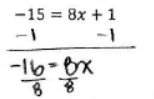
– 15 = 8x + 1
Answer:
Engage NY Math 8th Grade Module 4 End of Module Assessment Answer Key 3
-2 = x
-15 = 8(-2) + 1
-15 = -16 + 1
-15 = -15

c. Solve the following equation for a number x. Verify that your solution is correct.
7(2x + 5) = 4x – 9 – x
Answer:
7(2x + 5) = 4x – 9 – x
14x + 35 = 4x – 9 – x
14x + 35 = 3x – 9
14x – 3x + 35 = 3x – 3x – 9
11x + 35 = -9
11x + 35 – 35 = -9 – 35
11x = -44
x = -4

7(2(-4) + 5) = 4(-4) – 9 – (-4)
7(-8 + 5) = -16 – 9 + 4
7(-3) = -25 + 4
-21 = -21

Question 3.
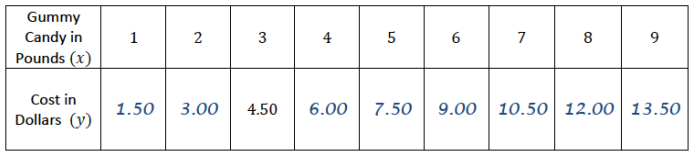
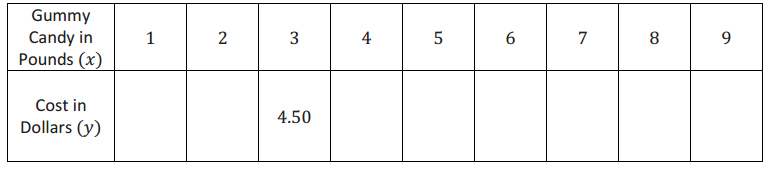
a. Parker paid $4.50 for three pounds of gummy candy. Assuming each pound of gummy candy costs the same amount, complete the table of values representing the cost of gummy candy in pounds.
Engage NY Math 8th Grade Module 4 End of Module Assessment Answer Key 1
Answer:
Engage NY Math 8th Grade Module 4 End of Module Assessment Answer Key 4

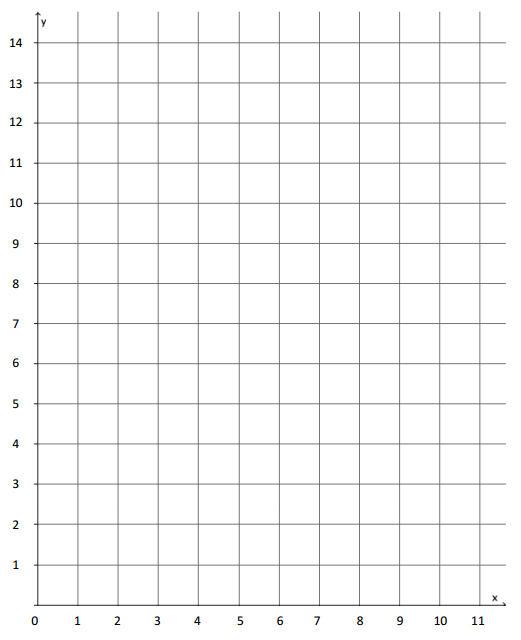
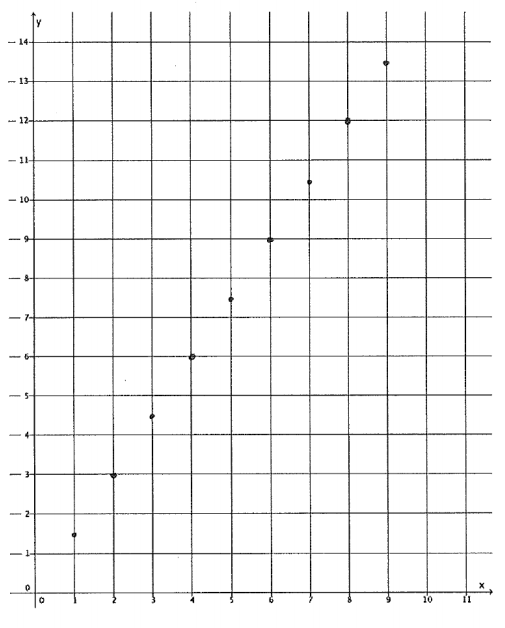
b. Graph the data on the coordinate plane.
Engage NY Math 8th Grade Module 4 End of Module Assessment Answer Key 2
Answer:
Engage NY Math 8th Grade Module 4 End of Module Assessment Answer Key 5

c. On the same day, Parker’s friend, Peggy, was charged $5 for 1 \(\frac{1}{2}\) lb. of gummy candy. Explain in terms of the graph why this must be a mistake.
Answer:
Even though 1\(\frac{1}{2}\) pounds of candy isn’t a point on the graph, it is reasonable to believe it will fall in line with the other points. The cost of 1\(\frac{1}{2}\) pounds of candy does not fit the pattern.

Eureka Math Grade 8 Module 4 Lesson 19 Answer Key

Engage NY Eureka Math 8th Grade Module 4 Lesson 19 Answer Key

Eureka Math Grade 8 Module 4 Lesson 19 Exercise Answer Key

Exercises 1 – 11
THEOREM: The graph of a linear equation y = mx + b is a non – vertical line with slope m and passing through (0, b), where b is a constant.

Exercise 1.
Prove the theorem by completing parts (a)–(c). Given two distinct points, P and Q, on the graph of y = mx + b, and let l be the line passing through P and Q. You must show the following:
(1) Any point on the graph of y = mx + b is on line l, and
(2) Any point on the line l is on the graph of y = mx + b.
a. Proof of (1): Let R be any point on the graph of y = mx + b. Show that R is on l. Begin by assuming it is not. Assume the graph looks like the diagram below where R is on l’.
Engage NY Math Grade 8 Module 4 Lesson 19 Exercise Answer Key 1

What is the slope of line l?
Answer:
Since the points P and Q are on the graph of y = mx + b, then we know that the slope of the line passing through those points must have slope m. Therefore, line l has slope m.

What is the slope of line l’?
Answer:
We know that point R is on the graph of y = mx + b. Then the coordinates of point R are (r1, mr1 + b) because R is a solution to y = mx + b, and r2 = mr1 + b. Similarly, the coordinates of P are (p1, mp1 + b).
Answer:
Engage NY Math Grade 8 Module 4 Lesson 19 Exercise Answer Key 2

What can you conclude about lines l and l’? Explain.
Answer:
Lines l and l’are the same line. Both lines go through point P and have slope m. There can be only one line with a given slope going through a given point; therefore, line l is the same as l’.

b. Proof of (2): Let S be any point on line l, as shown.
Engage NY Math Grade 8 Module 4 Lesson 19 Exercise Answer Key 3
Show that S is a solution to y = mx + b. Hint: Use the point (0, b).
Answer:
Point S is on line l. Let S = (s1, s2).
slope of l = \(\frac{s_{2} – b}{s_{1} – 0}\)
We know the slope of l is m.
m = \(\frac{s_{2} – b}{s_{1} – 0}\)
m(s1 – 0) = s2 – b
ms1 = s2 – b
ms1 + b = s2 – b + b
ms1 + b = s2
s2 = ms1 + b,
which shows S is a solution to y = mx + b.

c. Now that you have shown that any point on the graph of y = mx + b is on line l in part (a), and any point on line l is on the graph of y = mx + b in part (b), what can you conclude about the graphs of linear equations?
Answer:
The graph of a linear equation is a line.

Exercise 2.
Use x = 4 and x = – 4 to find two solutions to the equation x + 2y = 6. Plot the solutions as points on the coordinate plane, and connect the points to make a line.
Answer:
The solutions are (4, 1) and ( – 4, 5).
Engage NY Math Grade 8 Module 4 Lesson 19 Exercise Answer Key 4

a. Identify two other points on the line with integer coordinates. Verify that they are solutions to the equation x + 2y = 6.
Answer:
The choice of points and verifications will vary. Several possibilities are noted in the graph above.

b. When x = 1, what is the value of y? Does this solution appear to be a point on the line?
Answer:
1 + 2y = 6
2y = 5
y = \(\frac{5}{2}\)
Yes, (1, \(\frac{5}{2}\)) does appear to be a point on the line.

c. When x = – 3, what is the value of y? Does this solution appear to be a point on the line?
Answer:
– 3 + 2y = 6
2y = 9
y = \(\frac{9}{2}\)
Yes, ( – 3, \(\frac{9}{2}\)) does appear to be a point on the line.

d. Is the point (3, 2) on the line?
Answer:
No, (3, 2) is not a point on the line.

e. Is the point (3, 2) a solution to the linear equation x + 2y = 6?
Answer:
No, (3, 2) is not a solution to x + 2y = 6.
3 + 2(2) = 6
3 + 4 = 6
7≠6

Exercise 3.
Use x = 4 and x = 1 to find two solutions to the equation 3x – y = 9. Plot the solutions as points on the coordinate plane, and connect the points to make a line.
Answer:
The solutions are (4, 3) and (1, – 6).
Engage NY Math Grade 8 Module 4 Lesson 19 Exercise Answer Key 5

a. Identify two other points on the line with integer coordinates. Verify that they are solutions to the equation 3x – y = 9.
Answer:
The choice of points and verifications will vary. Several possibilities are noted in the graph above.

b. When x = 4.5, what is the value of y? Does this solution appear to be a point on the line?
Answer:
3(4.5) – y = 9
13.5 – y = 9
– y = – 4.5
y = 4.5
Yes, (4.5, 4.5) does appear to be a point on the line.

c. When x = \(\frac{1}{2}\), what is the value of y? Does this solution appear to be a point on the line?
Answer:
3(\(\frac{1}{2}\)) – y = 9
\(\frac{3}{2}\) – y = 9
– y = \(\frac{15}{2}\)
y = – \(\frac{15}{2}\)
Yes, (\(\frac{1}{2}\), – \(\frac{15}{2}\)) does appear to be a point on the line.

d. Is the point (2, 4) on the line?
Answer:
No, (2, 4) is not a point on the line.

e. Is the point (2, 4) a solution to the linear equation 3x – y = 9?
Answer:
No, (2, 4) is not a solution to 3x – y = 9.
3(2) – 4 = 9
6 – 4 = 9
2≠9

Exercise 4.
Use x = 3 and x = – 3 to find two solutions to the equation 2x + 3y = 12. Plot the solutions as points on the coordinate plane, and connect the points to make a line.
Answer:
The solutions are ( – 3, 6) and (3, 2).
Engage NY Math Grade 8 Module 4 Lesson 19 Exercise Answer Key 6

a. Identify two other points on the line with integer coordinates. Verify that they are solutions to the equation 2x + 3y = 12.
Answer:
The choice of points and verifications will vary. Several possibilities are noted in the graph above.

b. When x = 2, what is the value of y? Does this solution appear to be a point on the line?
Answer:
2(2) + 3y = 12
4 + 3y = 12
3y = 8
y = \(\frac{8}{3}\)
Yes, (2, \(\frac{8}{3}\)) does appear to be a point on the line.

c. When x = – 2, what is the value of y? Does this solution appear to be a point on the line?
Answer:
2( – 2) + 3y = 12
– 4 + 3y = 12
3y = 16
y = \(\frac{16}{3}\)
Yes, ( – 2, \(\frac{16}{3}\)) does appear to be a point on the line.

d. Is the point (8, – 3) on the line?
Answer:
No, (8, – 3) is not a point on the line.

e. Is the point (8, – 3) a solution to the linear equation 2x + 3y = 12?
Answer:
No, (8, – 3) is not a solution to 2x + 3y = 12.
2(8) + 3( – 3) = 12
16 – 9 = 12
7≠12

Exercise 5.
Use x = 4 and x = – 4 to find two solutions to the equation x – 2y = 8. Plot the solutions as points on the coordinate plane, and connect the points to make a line.
Answer:
The solutions are (4, – 2) and ( – 4, – 6).
Engage NY Math Grade 8 Module 4 Lesson 19 Exercise Answer Key 7

a. Identify two other points on the line with integer coordinates. Verify that they are solutions to the equation x – 2y = 8.
Answer:
The choice of points and verifications will vary. Several possibilities are noted in the graph above.

b. When x = 7, what is the value of y? Does this solution appear to be a point on the line?
Answer:
7 – 2y = 8
– 2y = 1
y = – \(\frac{1}{2}\)
Yes, (7, – \(\frac{1}{2}\)) does appear to be a point on the line.

c. When x = – 3, what is the value of y? Does this solution appear to be a point on the line?
Answer:
– 3 – 2y = 8
– 2y = 11
y = – \(\frac{11}{2}\)
Yes, ( – 3, – \(\frac{11}{2}\)) does appear to be a point on the line.

d. Is the point ( – 2, – 3) on the line?
Answer:
No, ( – 2, – 3) is not a point on the line.

e. Is the point ( – 2, – 3) a solution to the linear equation x – 2y = 8?
Answer:
No, ( – 2, – 3) is not a solution to x – 2y = 8.
– 2 – 2( – 3) = 8
– 2 + 6 = 8
4≠8

Exercise 6.
Based on your work in Exercises 2–5, what conclusions can you draw about the points on a line and solutions to a linear equation?
Answer:
It appears that all points on the line represent a solution to the equation. In other words, any point identified on the line is a solution to the linear equation.

Exercise 7.
Based on your work in Exercises 2–5, will a point that is not a solution to a linear equation be a point on the graph of a linear equation? Explain.
Answer:
No. Each time we were given a point off the line in part (d), we verified that it was not a solution to the equation in part (e). For that reason, I would expect that all points not on the line would not be a solution to the equation.

Exercise 8.
Based on your work in Exercises 2–5, what conclusions can you draw about the graph of a linear equation?
Answer:
The graph of a linear equation is a line.

Exercise 9.
Graph the equation – 3x + 8y = 24 using intercepts.
Answer:
– 3x + 8y = 24
– 3(0) + 8y = 24
8y = 24
y = 3
The y – intercept point is (0, 3).
– 3x + 8y = 24
– 3x + 8(0) = 24
– 3x = 24
x = – 8
The x – intercept point is ( – 8, 0).
Engage NY Math Grade 8 Module 4 Lesson 19 Exercise Answer Key 8

Exercise 10.
Graph the equation x – 6y = 15 using intercepts.
Answer:
x – 6y = 15
0 – 6y = 15
– 6y = 15
y = – \(\frac{15}{6}\)
y = – \(\frac{5}{2}\)
The y – intercept point is (0, – \(\frac{5}{2}\)).
x – 6y = 15
x – 6(0) = 15
x = 15
The x – intercept point is (15, 0).
Engage NY Math Grade 8 Module 4 Lesson 19 Exercise Answer Key 9

Exercise 11.
Graph the equation 4x + 3y = 21 using intercepts.
Answer:
4x + 3y = 21
4(0) + 3y = 21
3y = 21
y = 7
The y – intercept point is (0, 7).
4x + 3y = 21
4x + 3(0) = 21
4x = 21
x = 21/4
The x – intercept point is (21/4, 0).
Engage NY Math Grade 8 Module 4 Lesson 19 Exercise Answer Key 10

Eureka Math Grade 8 Module 4 Lesson 19 Problem Set Answer Key

Question 1.
Graph the equation: y = – 6x + 12.
Answer:
Eureka Math 8th Grade Module 4 Lesson 19 Problem Set Answer Key 1

Question 2.
Graph the equation: 9x + 3y = 18.
Answer:
9(0) + 3y = 18
3y = 18
y = 6
The y – intercept point is (0, 6).
9x + 3(0) = 18
9x = 18
x = 2
The x – intercept point is (2, 0).
Eureka Math 8th Grade Module 4 Lesson 19 Problem Set Answer Key 2

Question 3.
Graph the equation: y = 4x + 2.
Answer:
Eureka Math 8th Grade Module 4 Lesson 19 Problem Set Answer Key 3

Question 4.
Graph the equation: y = – \(\frac{5}{7}\) x + 4.
Answer:
Eureka Math 8th Grade Module 4 Lesson 19 Problem Set Answer Key 4

Question 5.
Graph the equation: \(\frac{3}{4}\) x + y = 8.
Answer:
\(\frac{3}{4}\) (0) + y = 8
y = 8
The y – intercept point is (0, 8).
\(\frac{3}{4}\) x + 0 = 8
\(\frac{3}{4}\) x = 8
x = \(\frac{32}{3}\)
The x – intercept point is (\(\frac{32}{3}\), 0).
Eureka Math 8th Grade Module 4 Lesson 19 Problem Set Answer Key 5

Question 6.
Graph the equation: 2x – 4y = 12.
Answer:
2(0) – 4y = 12
– 4y = 12
y = – 3
The y – intercept point is (0, – 3).
2x – 4(0) = 12
2x = 12
x = 6
The x – intercept point is (6, 0).
Eureka Math 8th Grade Module 4 Lesson 19 Problem Set Answer Key 6

Question 7.
Graph the equation: y = 3. What is the slope of the graph of this line?
Answer:
The slope of this line is zero.
Eureka Math 8th Grade Module 4 Lesson 19 Problem Set Answer Key 7

Question 8.
Graph the equation: x = – 4. What is the slope of the graph of this line?
Answer:
The slope of this line is undefined.
Eureka Math 8th Grade Module 4 Lesson 19 Problem Set Answer Key 8

Question 9.
Is the graph of 4x + 5y = \(\frac{3}{7}\) a line? Explain.
Answer:
Yes, the graph of 4x + 5y = \(\frac{3}{7}\) is a line because it is a linear equation comprising linear expressions on both sides of the equal sign.

Question 10.
Is the graph of 6x2 – 2y = 7 a line? Explain.
Answer:
Maybe. The equation 6x2 – 2y = 7 is not a linear equation because the expression on the left side of the equal sign is not a linear expression. If this were a linear equation, then I would be sure that it graphs as a line, but because it is not, I am not sure what the graph of this equation would look like.

Eureka Math Grade 8 Module 4 Lesson 19 Exit Ticket Answer Key

Question 1.
Graph the equation y = \(\frac{5}{4}\) x – 10 using the y – intercept point and slope.
Eureka Math Grade 8 Module 4 Lesson 19 Exit Ticket Answer Key 1
Answer:
Eureka Math Grade 8 Module 4 Lesson 19 Exit Ticket Answer Key 3

Question 2.
Graph the equation 5x – 4y = 40 using intercepts.
Eureka Math Grade 8 Module 4 Lesson 19 Exit Ticket Answer Key 2
Answer:
Eureka Math Grade 8 Module 4 Lesson 19 Exit Ticket Answer Key 4

Question 3.
What can you conclude about the equations y = \(\frac{5}{4}\) x – 10 and 5x – 4y = 40?
Answer:
Since the points (0, – 10), (4, – 5), and (8, 0) are common to both graphs, then the lines must be the same. There is only one line that can pass through two points. If you transform the equation y = \(\frac{5}{4}\) x – 10 so that it is in standard form, it is the equation 5x – 4y = 40.

Eureka Math Grade 8 Module 4 End of Module Assessment Answer Key

Engage NY Eureka Math 8th Grade Module 4 End of Module Assessment Answer Key

Eureka Math Grade 8 Module 4 End of Module Assessment Task Answer Key

Question 1.
Use the graph below to answer parts (a)–(c).
Engage NY Math 8th Grade Module 4 End of Module Assessment Answer Key 1
a. Use any pair of points to calculate the slope of the line.
Answer:
m = \(\frac{6-3}{0-2}=\frac{3}{-2}\) = –\(\frac{3}{2}\)

b. Use a different pair of points to calculate the slope of the line.
Answer:
m = \(\frac{6-0}{0-4}=\frac{6}{-4}\) = –\(\frac{3}{2}\)

c. Explain why the slopes you calculated in parts (a) and (b) are equal.
Answer:
The slopes are equal because the slope triangle are similar, ∆ABC ~ ∆AB’C’. Each triangle has 90° angle at ∠ABC & ∠AB’C’, respectively. They are 90° because they are at intersection of the grid lines. Both triangles share ∠BAC. By the AA criterion ∆ABC ~ ∆AB’C’, which means their corresponding sides are equal in ratio.
\(\frac{\left|B^{\prime} C^{\prime}\right|}{|B C|}=\frac{\left|A B^{\prime}\right|}{|A B|}\) which is the same as \(\frac{\left|B^{\prime} C^{\prime}\right|}{\left|A B^{\prime}\right|}=\frac{|B C|}{|A B|}\) where –\(\frac{\left|B^{\prime} C^{\prime}\right|}{\left|A B^{\prime}\right|}\) is the slope in (b) and –\(\frac{|B C|}{|A B|}\) is the slope in (a).

Question 2.
Jeremy rides his bike at a rate of 12 miles per hour. Below is a table that represents the number of hours and miles Kevin rides. Assume both bikers ride at a constant rate.
Engage NY Math 8th Grade Module 4 End of Module Assessment Answer Key 2
a. Which biker rides at a greater speed? Explain your reasoning.
Answer:
Let Y be the distance triangled and X be the number of hours,
Then for jeremy, \(\frac{y}{x}\) = \(\frac{12}{1}\) ⇒ 12x
For kevin, \(\frac{46-23}{4-2}\) = \(\frac{23}{2}\) = 11.5, then y = 11.5x
When you compare their rates, 12 > 11.5, therefore jeremy rides at a greater speed.
Graphically:
Engage NY Math 8th Grade Module 4 End of Module Assessment Answer Key 6

b. Write an equation for a third biker, Lauren, who rides twice as fast as Kevin. Use y to represent the number of miles Lauren travels in x hours. Explain your reasoning.
Answer:
“Twice as Fast” means lauren goes twice the distance in the same time. Then in 2 hours she rides 46 miles and in 4 hours, 92 miles. If y is the total distance in x hours, y = \(\frac{46}{2}\) x
y = 23x

c. Create a graph of the equation in part (b).
Engage NY Math 8th Grade Module 4 End of Module Assessment Answer Key 3
Answer:
Engage NY Math 8th Grade Module 4 End of Module Assessment Answer Key 7

d. Calculate the slope of the line in part (c), and interpret its meaning in this situation.
Answer:
m = \(\frac{46-23}{2-1}\) = \(\frac{23}{1}\)
The slope is the rate that lauren rides, 23 miles per hour.

Question 3.
The cost of five protractors is $14.95 at Store A. The graph below compares the cost of protractors at Store A with the cost at Store B.
Engage NY Math 8th Grade Module 4 End of Module Assessment Answer Key 4
Estimate the cost of one protractor at Store B. Use evidence from the graph to justify your answer.
Answer:
The cost of protractors at store B is probably about $2.99 per protractor and it looks like the slope for store B is about half of the slope for store A.
Engage NY Math 8th Grade Module 4 End of Module Assessment Answer Key 8

Question 4.
Given the equation 3x+9y=-8, write a second linear equation to create a system that:
a. Has exactly one solution. Explain your reasoning.
Answer:
4x + 9y = -10
This equation has a slope different from 3x + 9y = -8. So the graphs of the equations will intersect.

b. Has no solution. Explain your reasoning.
Answer:
x + 3y = 10
This equation has the same slopes as 3x + 9y = -8, And no common points (solutions) Therefore the graphs of the equation are parallel lines.

c. Has infinitely many solutions. Explain your reasoning.
Answer:
6x + 18y = -16
This equation defines the same line as 3x + 9y = -8 and the graphs of the equations will coincide.

d. Interpret the meaning of the solution, if it exists, in the context of the graph of the following system of equations.
-5x+2y=10
10x-4y=-20
Answer:
-5x+2y=10 m = \(\frac{5}{2}\) (0, 5)
10x-4y=-20 m = \(\frac{5}{2}\) (0, 5)
This system will have infinitely many solutions because the graphs of these linear equations are the same line. Each equation has a slope of m = \(\frac{5}{2}\) and a y-intercept at (0, 5). There exists only one line through a point and a given slope. Therefore this system graphs as the same line and has infinitely many solutions.

Question 5.
Students sold 275 tickets for a fundraiser at school. Some tickets are for children and cost $3, while the rest are adult tickets that cost $5. If the total value of all tickets sold was $1,025, how many of each type of ticket was sold?
Answer:
Let X be the # of kids tickets
Let Y be the # of adults tickets
x + y = 275
3x + 5y = 1025
Engage NY Math 8th Grade Module 4 End of Module Assessment Answer Key 9
y = 100
x + 100 = 275
x = 175
(175, 100)
175 children’s tickets and 100 adults tickets were sold.

Question 6.
a. Determine the equation of the line connecting the points (0,-1) and (2,3).
Answer:
m = \(\frac{3-(-1)}{2 – 0}\) = \(\frac{4}{2}\) = 2
y = 2x – 1

b. Will the line described by the equation in part (a) intersect the line passing through the points (-2,4) and (-3,3)? Explain why or why not.
Answer:
m = \(\frac{4-3}{-2-(3)}\) = \(\frac{1}{1}\)
Yes, The lines will intersect because they have different slopes they will eventually intersect.

Question 7.
Line l1 and line l2 are shown on the graph below. Use the graph to answer parts (a)–(f).
Engage NY Math 8th Grade Module 4 End of Module Assessment Answer Key 5
a. What is the y-intercept of l1?
Answer:
(0, 4)

b. What is the y-intercept of l2?
Answer:
(0, 2)

c. Write a system of linear equations representing lines l1 and l2.
Answer:
l1 : y = \(\frac{1}{2}\)x + 4
l2 : y = x + 2

d. Use the graph to estimate the solution to the system.
Answer:
(1.2, 3.3)

e. Solve the system of linear equations algebraically.
Answer:
y = \(\frac{1}{2}\)x + 4
y = x + 2
–\(\frac{1}{2}\) x + 4 = x + 2
4 = \(\frac{3}{2}\) x + 2
2 = \(\frac{3}{2}\) x
\(\frac{4}{3}\) = x

y = \(\frac{4}{3}\) + 2
= \(\frac{10}{3}\)
(\(\frac{4}{3}\), \(\frac{10}{3}\))

f. Show that your solution from part (e) satisfies both equations.
Answer:
\(\frac{10}{3}\) = –\(\frac{1}{2}\)(\(\frac{4}{3}\)) + 4
\(\frac{10}{3}\) = –\(\frac{2}{3}\) + 4
\(\frac{10}{3}\) = \(\frac{10}{3}\)

\(\frac{10}{3}\) = \(\frac{4}{3}\) + 2
\(\frac{10}{3}\) = \(\frac{10}{3}\)

Eureka Math Grade 8 Module 4 Lesson 21 Answer Key

Engage NY Eureka Math 8th Grade Module 4 Lesson 21 Answer Key

Eureka Math Grade 8 Module 4 Lesson 21 Example Answer Key

Example 1.
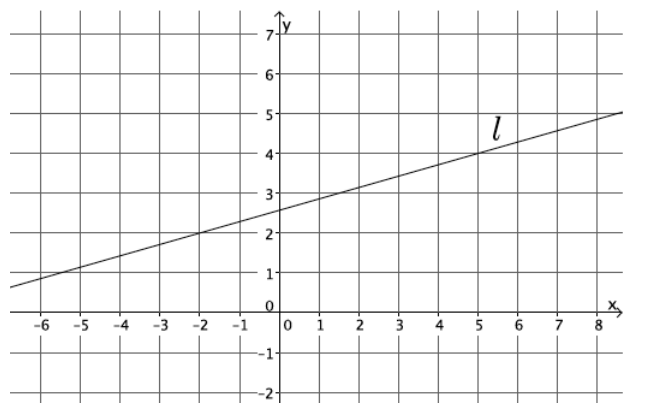
Let a line l be given in the coordinate plane. What linear equation is the graph of line l?
Engage NY Math 8th Grade Module 4 Lesson 21 Example Answer Key 1
Answer:
We can pick two points to determine the slope, but the precise location of the y – intercept point cannot be determined from the graph.
Calculate the slope of the line.
Using points ( – 2, 2) and (5, 4), the slope of the line is
m = \(\frac{2 – 4}{ – 2 – 5}\)
= \(\frac{ – 2}{ – 7}\)
= \(\frac{2}{7}\)
→ Now we need to determine the y – intercept point of the line. We know that it is a point with coordinates (0, b), and we know that the line goes through points ( – 2, 2) and (5, 4) and has slope m = \(\frac{2}{7}\). Using this information, we can determine the coordinates of the y – intercept point and the value of b that we need in order to write the equation of the line.

→ Recall what it means for a point to be on a line; the point is a solution to the equation. In the equation y = mx + b, (x, y) is a solution, and m is the slope. Can we find the value of b? Explain.
Yes. We can substitute one of the points and the slope into the equation and solve for b.

→ Do you think it matters which point we choose to substitute into the equation? That is, will we get a different equation if we use the point ( – 2, 2) compared to (5, 4)?
No, because there can be only one line with a given slope that goes through a point.

→ Verify this claim by using m = \(\frac{2}{7}\) and ( – 2, 2) to find the equation of the line and then by using m = \(\frac{2}{7}\) and (5, 4) to see if the result is the same equation.
Sample student work:
2 = \(\frac{2}{7}\) ( – 2) + b
2 = – \(\frac{4}{7}\) + b
2 + \(\frac{4}{7}\) = – \(\frac{4}{7}\) + \(\frac{4}{7}\) + b
\(\frac{18}{7}\) = b

4 = \(\frac{2}{7}\) (5) + b
4 = \(\frac{10}{7}\) + b
4 – \(\frac{10}{7}\) = \(\frac{10}{7}\) – \(\frac{10}{7}\) + b
\(\frac{18}{7}\) = b
The y – intercept point is at (0, \(\frac{18}{7}\)), and the equation of the line is y = \(\frac{2}{7}\) x + \(\frac{18}{7}\).

→ The equation of the line is
y = \(\frac{2}{7}\) x + \(\frac{18}{7}\).
→ Write it in standard form.
Sample student work:
(y = \(\frac{2}{7}\) x + \(\frac{18}{7}\))7
7y = 2x + 18
– 2x + 7y = 2x – 2x + 18
– 2x + 7y = 18
– 1( – 2x + 7y = 18)
2x – 7y = – 18

Example 2.
Let a line l be given in the coordinate plane. What linear equation is the graph of line l?
Engage NY Math 8th Grade Module 4 Lesson 21 Example Answer Key 2
Answer:
Determine the slope of the line.
Using points ( – 1, 4) and (4, 1), the slope of the line is
m = \(\frac{4 – 1}{ – 1 – 4}\)
= \(\frac{3}{ – 5}\)
= – \(\frac{3}{5}\).

Determine the y – intercept point of the line.
Sample student work:
4 = ( – \(\frac{3}{5}\))( – 1) + b
4 = \(\frac{3}{5}\) + b
4 – \(\frac{3}{5}\) = \(\frac{3}{5}\) – \(\frac{3}{5}\) + b
\(\frac{17}{5}\) = b
The y – intercept point is at (0, \(\frac{17}{5}\)).

→ Now that we know the slope, m = – \(\frac{3}{5}\), and the y – intercept point, (0, \(\frac{17}{5}\)), write the equation of the line l in slope – intercept form.
y = – \(\frac{3}{5}\) x + \(\frac{17}{5}\)
→ Transform the equation so that it is written in standard form.
Sample student work:
y = – \(\frac{3}{5}\) x + \(\frac{17}{5}\)
(y = – \(\frac{3}{5}\) x + \(\frac{17}{5}\))5
5y = – 3x + 17
3x + 5y = – 3x + 3x + 17
3x + 5y = 17

Example 3.
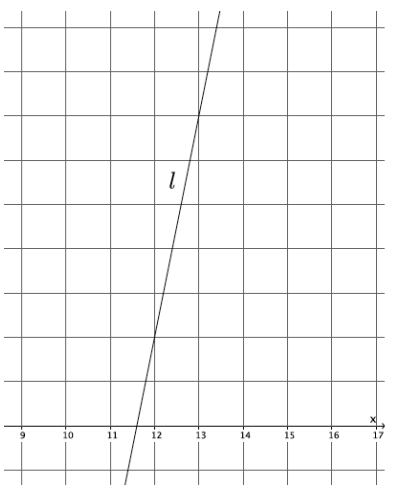
Let a line l be given in the coordinate plane. What linear equation is the graph of line l?
Engage NY Math 8th Grade Module 4 Lesson 21 Example Answer Key 3
Answer:
→ Using points (12, 2) and (13, 7), the slope of the line is
m = \(\frac{2 – 7}{12 – 13}\)
= \(\frac{ – 5}{ – 1}\)
= 5.

→ Now, determine the y – intercept point of the line, and write the equation of the line in slope – intercept form.
Sample student work:
2 = 5(12) + b
2 = 60 + b
b = – 58
The y – intercept point is at (0, – 58), and the equation of the line is y = 5x – 58.

Now that we know the slope, m = 5, and the y – intercept point, (0, – 58), write the equation of the line l in standard form.
Sample student work:
y = 5x – 58
– 5x + y = 5x – 5x – 58
– 5x + y = – 58
– 1( – 5x + y = – 58)
5x – y = 58

Example 4.
Let a line l be given in the coordinate plane. What linear equation is the graph of line l?
Engage NY Math 8th Grade Module 4 Lesson 21 Example Answer Key 4
Answer:
Using points (3, 1) and ( – 3, – 1), the slope of the line is
m = \(\frac{ – 1 – 1}{ – 3 – 3}\)
= \(\frac{ – 2}{ – 6}\)
= \(\frac{1}{3}\)
The y – intercept point is at (0, 0), and the equation of the line is y = \(\frac{1}{3}\) x.

Eureka Math Grade 8 Module 4 Lesson 21 Exercise Answer Key

Exercises

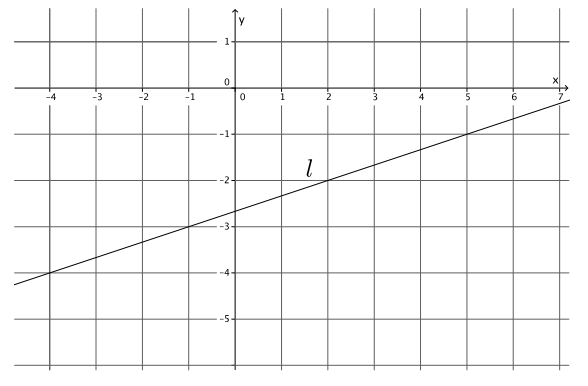
Exercise 1.
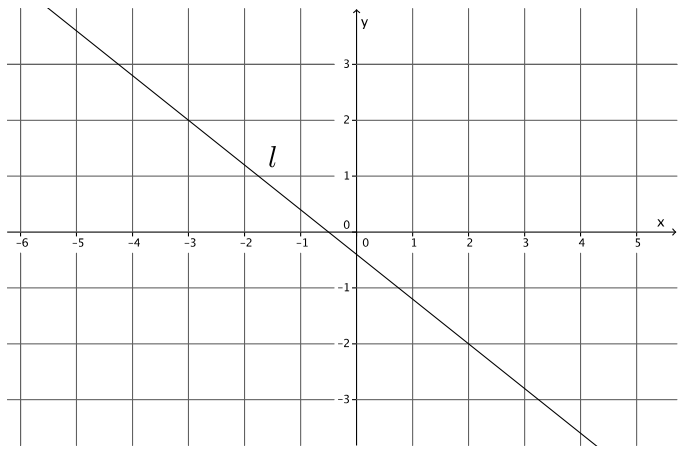
Write the equation for the line l shown in the figure.
Engage NY Math Grade 8 Module 4 Lesson 21 Exercise Answer Key 1
Answer:
Using the points ( – 1, – 3) and (2, – 2), the slope of the line is
m = \(\frac{ – 3 – ( – 2)}{ – 1 – 2}\)
= \(\frac{ – 1}{ – 3}\)
= \(\frac{1}{3}\) .
– 2 = \(\frac{1}{3}\) (2) + b
– 2 = \(\frac{2}{3}\) + b
– 2 – \(\frac{2}{3}\) = \(\frac{2}{3}\) – \(\frac{2}{3}\) + b
– \(\frac{8}{3}\) = b
The equation of the line is y = \(\frac{1}{3}\) x – \(\frac{8}{3}\).

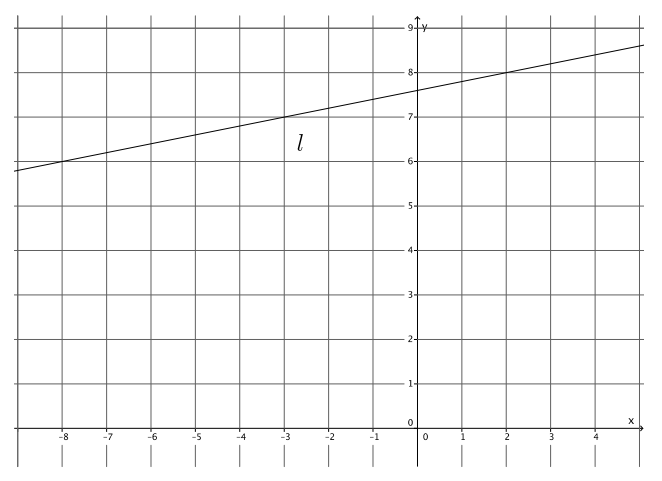
Exercise 2.
Write the equation for the line l shown in the figure.
Engage NY Math Grade 8 Module 4 Lesson 21 Exercise Answer Key 2
Answer:
Using the points ( – 3, 7) and (2, 8), the slope of the line is
m = \(\frac{7 – 8}{ – 3 – 2}\)
= \(\frac{ – 1}{ – 5}\)
= \(\frac{1}{5}\).
8 = \(\frac{1}{5}\) (2) + b
8 = \(\frac{2}{5}\) + b
8 – \(\frac{2}{5}\) = \(\frac{2}{5}\) – \(\frac{2}{5}\) + b
\(\frac{38}{5}\) = b
The equation of the line is y = \(\frac{1}{5}\) x + \(\frac{38}{5}\).

Exercise 3.
Determine the equation of the line that goes through points ( – 4, 5) and (2, 3).
Answer:
The slope of the line is
m = \(\frac{5 – 3}{ – 4 – 2}\)
= \(\frac{2}{ – 6}\)
= – \(\frac{1}{3}\)
The y – intercept point of the line is
3 = – \(\frac{1}{3}\) (2) + b
3 = – \(\frac{2}{3}\) + b
\(\frac{11}{3}\) = b.
The equation of the line is y = – \(\frac{1}{3}\) x + \(\frac{11}{3}\).

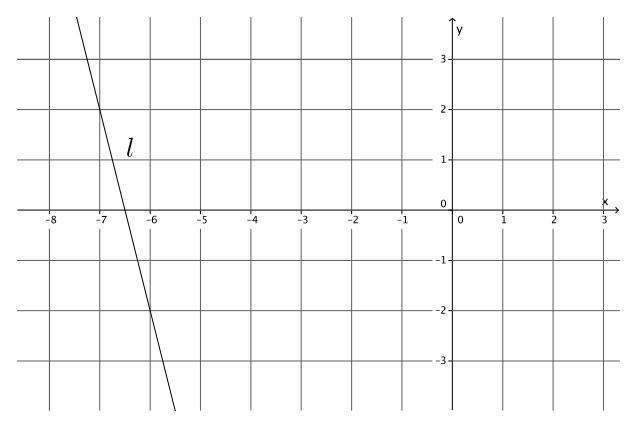
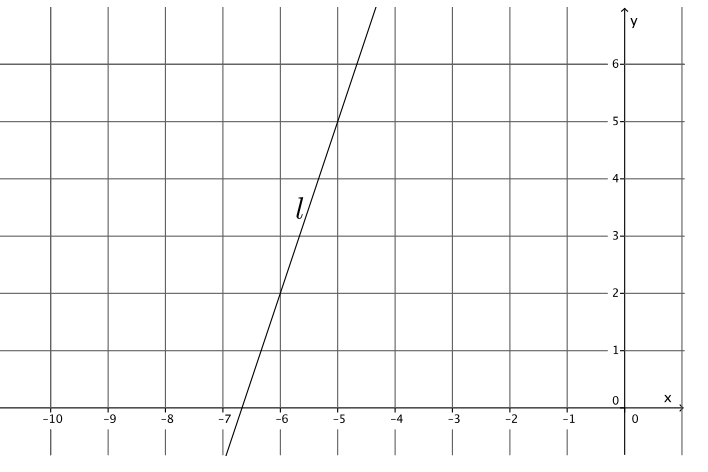
Exercise 4.
Write the equation for the line l shown in the figure.
Engage NY Math Grade 8 Module 4 Lesson 21 Exercise Answer Key 3
Answer:
Using the points ( – 7, 2) and ( – 6, – 2), the slope of the line is
m = \(\frac{2 – ( – 2)}{ – 7 – ( – 6)}\)
= \(\frac{4}{ – 1}\)
= – 4.
– 2 = – 4( – 6) + b
– 2 = 24 + b
– 26 = b
The equation of the line is y = – 4x – 26.

Exercise 5.
A line goes through the point (8, 3) and has slope m = 4. Write the equation that represents the line.
Answer:
3 = 4(8) + b
3 = 32 + b
– 29 = b
The equation of the line is y = 4x – 29.

Eureka Math Grade 8 Module 4 Lesson 21 Problem Set Answer Key

Question 1.
Write the equation for the line l shown in the figure.
Eureka Math 8th Grade Module 4 Lesson 21 Problem Set Answer Key 1
Answer:
Using the points ( – 3, 2) and (2, – 2), the slope of the line is
m = \(\frac{2 – ( – 2)}{ – 3 – 2}\)
= \(\frac{4}{ – 5}\)
= – \(\frac{4}{5}\)
2 = ( – \(\frac{4}{5}\))( – 3) + b
2 = \(\frac{12}{5}\) + b
2 – \(\frac{12}{5}\) = \(\frac{12}{5}\) – \(\frac{12}{5}\) + b
– \(\frac{2}{5}\) = b
The equation of the line is y = – \(\frac{4}{5}\) x – \(\frac{2}{5}\).

Question 2.
Write the equation for the line l shown in the figure.
Eureka Math 8th Grade Module 4 Lesson 21 Problem Set Answer Key 2
Answer:
Using the points ( – 6, 2) and ( – 5, 5), the slope of the line is
m = \(\frac{2 – 5}{ – 6 – ( – 5)}\)
= \(\frac{ – 3}{ – 1}\)
= 3.
5 = 3( – 5) + b
5 = – 15 + b
20 = b
The equation of the line is y = 3x + 20.

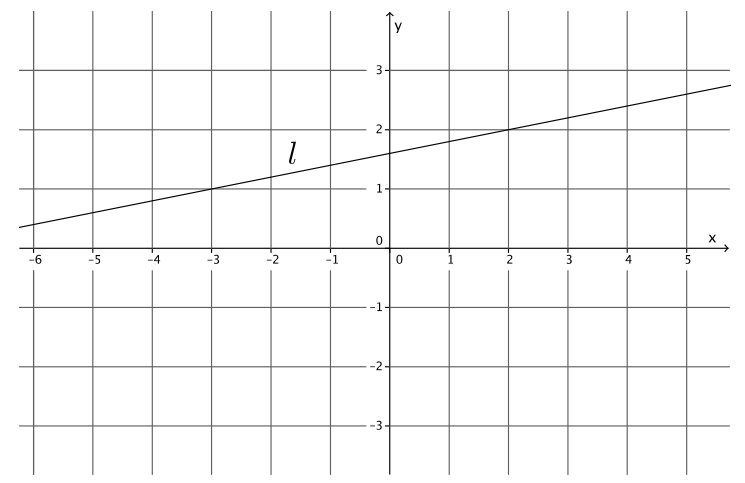
Question 3.
Write the equation for the line l shown in the figure.
Eureka Math 8th Grade Module 4 Lesson 21 Problem Set Answer Key 3
Answer:
Using the points ( – 3, 1) and (2, 2), the slope of the line is
m = \(\frac{1 – 2}{ – 3 – 2}\)
= \(\frac{ – 1}{ – 5}\)
= \(\frac{1}{5}\)
2 = \(\frac{1}{5}\) (2) + b
2 = \(\frac{2}{5}\) + b
2 – \(\frac{2}{5}\) = \(\frac{2}{5}\) – \(\frac{2}{5}\) + b
\(\frac{8}{5}\) = b
The equation of the line is y = \(\frac{1}{5}\) x + \(\frac{8}{5}\).

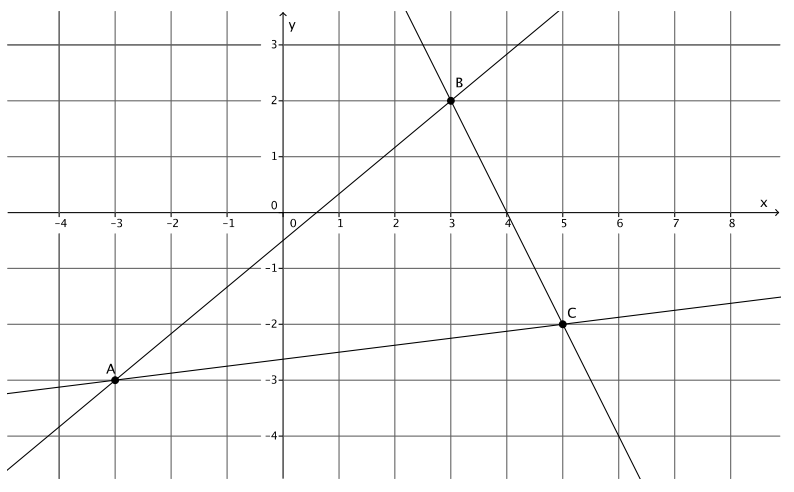
Question 4.
Triangle ABC is made up of line segments formed from the intersection of lines LAB, LBC, and LAC. Write the equations that represent the lines that make up the triangle.
Eureka Math 8th Grade Module 4 Lesson 21 Problem Set Answer Key 4
Answer:
A( – 3, – 3), B(3, 2), C(5, – 2)
The slope of LAB:
m = \(\frac{ – 3 – 2}{ – 3 – 3}\)
= \(\frac{ – 5}{ – 6}\)
= \(\frac{5}{6}\)
2 = \(\frac{5}{6}\) (3) + b
2 = \(\frac{5}{2}\) + b
2 – \(\frac{5}{2}\) = \(\frac{5}{2}\) – \(\frac{5}{2}\) + b
– \(\frac{1}{2}\) = b
The equation of LAB is y = \(\frac{5}{6}\) x – \(\frac{1}{2}\).

The slope of LBC:
m = \( = \frac{2 – ( – 2)}{3 – 5}\)
= \(\frac{4}{ – 2}\)
= – 2
2 = – 2(3) + b
2 = – 6 + b
8 = b
The equation of LBC is y = – 2x + 8.

The slope of LAC:
m = \(\frac{ – 3 – ( – 2)}{ – 3 – 5}\)
= \(\frac{ – 1}{ – 8}\)
= \(\frac{1}{8}\)
– 2 = \(\frac{1}{8}\) (5) + b
– 2 = \(\frac{5}{8}\) + b
– 2 – \(\frac{5}{8}\) = \(\frac{5}{8}\) – \(\frac{5}{8}\) + b
– 2\(\frac{1}{8}\) = b
The equation of LAC is y = \(\frac{1}{8}\) x – 2\(\frac{1}{8}\).

Question 5.
Write the equation for the line that goes through point ( – 10, 8) with slope m = 6.
Answer:
8 = 6( – 10) + b
8 = – 60 + b
68 = b
The equation of the line is y = 6x + 68.

Question 6.
Write the equation for the line that goes through point (12, 15) with slope m = – 2.
Answer:
15 = – 2(12) + b
15 = – 24 + b
39 = b
The equation of the line is y = – 2x + 39.

Question 7.
Write the equation for the line that goes through point (1, 1) with slope m = – 9.
Answer:
1 = – 9(1) + b
1 = – 9 + b
10 = b
The equation of the line is y = – 9x + 10.

Question 8.
Determine the equation of the line that goes through points (1, 1) and (3, 7).
Answer:
The slope of the line is
m = \(\frac{1 – 7}{1 – 3}\)
= \(\frac{ – 6}{ – 2}\)
= 3.
The y – intercept point of the line is
7 = 3(3) + b
7 = 9 + b
– 2 = b.
The equation of the line is y = 3x – 2.

Eureka Math Grade 8 Module 4 Lesson 21 Exit Ticket Answer Key

Question 1.
Write the equation for the line l shown in the figure below.
Eureka Math Grade 8 Module 4 Lesson 21 Exit Ticket Answer Key 1
Answer:
Using the points ( – 3, 1) and (6, 5), the slope of the line is
m = \(\frac{5 – 1}{6 – ( – 3)}\)
m = \(\frac{4}{9}\)
5 = \(\frac{4}{9}\) (6) + b
5 = \(\frac{8}{3}\) + b
5 – \(\frac{8}{3}\) = \(\frac{8}{3}\) – \(\frac{8}{3}\) + b
\(\frac{7}{3}\) = b
The equation of the line is y = \(\frac{4}{9}\) x + \(\frac{7}{3}\).

Question 2.
A line goes through the point (5, – 7) and has slope m = – 3. Write the equation that represents the line.
Answer:
– 7 = – 3(5) + b
– 7 = – 15 + b
8 = b
The equation of the line is y = – 3x + 8.

Eureka Math Grade 8 Module 4 Lesson 20 Answer Key

Engage NY Eureka Math 8th Grade Module 4 Lesson 20 Answer Key

Eureka Math Grade 8 Module 4 Lesson 20 Exercise Answer Key

Opening Exercise
Figure 1
Engage NY Math Grade 8 Module 4 Lesson 20 Exercise Answer Key 1
Answer:
The equation for the line in Figure 1 is y = \(\frac{2}{3}\) x – 3.

Figure 2
Engage NY Math Grade 8 Module 4 Lesson 20 Exercise Answer Key 2
Answer:
The equation for the line in Figure 2 is y = – \(\frac{1}{4}\) x + 2.

Exercises

Exercise 1.
Write the equation that represents the line shown.
Engage NY Math Grade 8 Module 4 Lesson 20 Exercise Answer Key 3
Answer:
y = 3x + 2

Use the properties of equality to change the equation from slope – intercept form, y = mx + b, to standard form, ax + by = c, where a, b, and c are integers, and a is not negative.
Answer:
y = 3x + 2
– 3x + y = 3x – 3x + 2
– 3x + y = 2
– 1( – 3x + y = 2)
3x – y = – 2

Exercise 2.
Write the equation that represents the line shown.
Engage NY Math Grade 8 Module 4 Lesson 20 Exercise Answer Key 4
Answer:
y = – \(\frac{2}{3}\) x – 1

Use the properties of equality to change the equation from slope – intercept form, y = mx + b, to standard form, ax + by = c, where a, b, and c are integers, and 𝒂 is not negative.
Answer:
y = – \(\frac{2}{3}\) x – 1
(y = – \(\frac{2}{3}\) x – 1)3
3y = – 2x – 3
2x + 3y = – 2x + 2x – 3
2x + 3y = – 3

Exercise 3.
Write the equation that represents the line shown.
Engage NY Math Grade 8 Module 4 Lesson 20 Exercise Answer Key 5
Answer:
y = – \(\frac{1}{5}\) x – 4

Use the properties of equality to change the equation from slope – intercept form, y = mx + b, to standard form, ax + by = c, where a, b, and c are integers, and a is not negative.
Answer:
y = – \(\frac{1}{5}\) x – 4
(y = – \(\frac{1}{5}\) x – 4) 5
5y = – x – 20
x + 5y = – x + x – 20
x + 5y = – 20
x + 5

Exercise 4.
Write the equation that represents the line shown.
Engage NY Math Grade 8 Module 4 Lesson 20 Exercise Answer Key 6
Answer:
y = x

Use the properties of equality to change the equation from slope – intercept form, y = mx + b, to standard form, ax + by = c, where a, b, and c are integers, and a is not negative.
Answer:
y = x
– x + y = x – x
– x + y = 0
– 1( – x + y = 0)
x – y = 0

Exercise 5.
Write the equation that represents the line shown.
Engage NY Math Grade 8 Module 4 Lesson 20 Exercise Answer Key 7
Answer:
y = \(\frac{1}{4}\) x + 5

Use the properties of equality to change the equation from slope – intercept form, y = mx + b, to standard form, ax + by = c, where a, b, and c are integers, and a is not negative.
Answer:
y = \(\frac{1}{4}\) x + 5
(y = \(\frac{1}{4}\) x + 5)4
4y = x + 20
– x + 4y = x – x + 20
– x + 4y = 20
– 1( – x + 4y = 20)
x – 4y = – 20

Exercise 6.
Write the equation that represents the line shown.
Engage NY Math Grade 8 Module 4 Lesson 20 Exercise Answer Key 8
Answer:
y = – \(\frac{8}{5}\) x – 7

Use the properties of equality to change the equation from slope – intercept form, y = mx + b, to standard form, ax + by = c, where a, b, and c are integers, and a is not negative.
Answer:
y = – \(\frac{8}{5}\) x – 7
(y = – \(\frac{8}{5}\) x – 7)5
5y = – 8x – 35
8x + 5y = – 8x + 8x – 35
8x + 5y = – 35

Eureka Math Grade 8 Module 4 Lesson 20 Problem Set Answer Key

Question 1.
Write the equation that represents the line shown.
Eureka Math 8th Grade Module 4 Lesson 20 Problem Set Answer Key 1
Answer:
y = – \(\frac{2}{3}\) x – 4

Use the properties of equality to change the equation from slope – intercept form, y = mx + b, to standard form, ax + by = c, where a, b, and c are integers, and a is not negative.
Answer:
y = – \(\frac{2}{3}\) x – 4
(y = – \(\frac{2}{3}\) x – 4)3
3y = – 2x – 12
2x + 3y = – 2x + 2x – 12
2x + 3y = – 12

Question 2.
Write the equation that represents the line shown.
Eureka Math 8th Grade Module 4 Lesson 20 Problem Set Answer Key 2
Answer:
y = 8x + 1

Use the properties of equality to change the equation from slope – intercept form, y = mx + b, to standard form, ax + by = c, where a, b, and c are integers, and a is not negative.
Answer:
y = 8x + 1
– 8x + y = 8x – 8x + 1
– 8x + y = 1
– 1( – 8x + y = 1)
8x – y = – 1

Question 3.
Write the equation that represents the line shown.
Eureka Math 8th Grade Module 4 Lesson 20 Problem Set Answer Key 3
Answer:
y = \(\frac{1}{2}\) x – 4

Use the properties of equality to change the equation from slope – intercept form, y = mx + b, to standard form, ax + by = c, where a, b, and c are integers, and a is not negative.
Answer:
y = \(\frac{1}{2}\) x – 4
(y = \(\frac{1}{2}\) x – 4)2
2y = x – 8
– x + 2y = x – x – 8
– x + 2y = – 8
– 1( – x + 2y = – 8)
x – 2y = 8

Question 4.
Write the equation that represents the line shown.
Eureka Math 8th Grade Module 4 Lesson 20 Problem Set Answer Key 4
Answer:
y = – 9x – 8

Use the properties of equality to change the equation from slope – intercept form, y = mx + b, to standard form, ax + by = c, where a, b, and c are integers, and a is not negative.
Answer:
y = – 9x – 8
9x + y = – 9x + 9x – 8
9x + y = – 8

Question 5.
Write the equation that represents the line shown.
Eureka Math 8th Grade Module 4 Lesson 20 Problem Set Answer Key 5
Answer:
y = 2x – 14

Use the properties of equality to change the equation from slope – intercept form, y = mx + b, to standard form, ax + by = c, where a, b, and c are integers, and a is not negative.
Answer:
y = 2x – 14
– 2x + y = 2x – 2x – 14
– 2x + y = – 14
– 1( – 2x + y = – 14)
2x – y = 14

Question 6.
Write the equation that represents the line shown.
Eureka Math 8th Grade Module 4 Lesson 20 Problem Set Answer Key 6
Answer:
y = – 5x + 45

Use the properties of equality to change the equation from slope – intercept form, y = mx + b, to standard form, ax + by = c, where a, b, and c are integers, and a is not negative.
Answer:
y = – 5x + 45
5x + y = – 5x + 5x + 45
5x + y = 45

Eureka Math Grade 8 Module 4 Lesson 20 Exit Ticket Answer Key

Question 1.
Write an equation in slope – intercept form that represents the line shown.
Eureka Math Grade 8 Module 4 Lesson 20 Exit Ticket Answer Key 1
Answer:
y = – \(\frac{1}{3}\) x + 1

Question 2.
Use the properties of equality to change the equation you wrote for Problem 1 from slope – intercept form, y = mx + b, to standard form, ax + by = c, where a, b, and c are integers, and a is not negative.
Answer:
y = – \(\frac{1}{3}\) x + 1
(y = – \(\frac{1}{3}\) x + 1)3
3y = – x + 3
x + 3y = – x + x + 3
x + 3y = 3

Question 3.
Write an equation in slope – intercept form that represents the line shown.
Eureka Math Grade 8 Module 4 Lesson 20 Exit Ticket Answer Key 2
Answer:
y = \(\frac{3}{2}\) x + 2

Question 4.
Use the properties of equality to change the equation you wrote for Problem 3 from slope – intercept form, y = mx + b, to standard form, ax + by = c, where a, b, and c are integers, and a is not negative.
Answer:
y = \(\frac{3}{2}\) x + 2
(y = \(\frac{3}{2}\) x + 2)2
2y = 3x + 4
– 3x + 2y = 3x – 3x + 4
– 3x + 2y = 4
– 1( – 3x + 2y = 4)
3x – 2y = – 4

Eureka Math Grade 8 Module 4 Lesson 22 Answer Key

Engage NY Eureka Math 8th Grade Module 4 Lesson 22 Answer Key

Eureka Math Grade 8 Module 4 Lesson 22 Exercise Answer Key

Exercises

Exercise 1.
Peter paints a wall at a constant rate of 2 square feet per minute. Assume he paints an area y, in square feet, after x minutes.
a. Express this situation as a linear equation in two variables.
Answer:
\(\frac{y}{x}\) = \(\frac{2}{1}\)
y = 2x

b. Sketch the graph of the linear equation.
Engage NY Math Grade 8 Module 4 Lesson 22 Exercise Answer Key 1
Answer:
Engage NY Math Grade 8 Module 4 Lesson 22 Exercise Answer Key 2

c. Using the graph or the equation, determine the total area he paints after 8 minutes, 1 \(\frac{1}{2}\) hours, and 2 hours. Note that the units are in minutes and hours.
Answer:
In 8 minutes, he paints 16 square feet.
y = 2(90)
= 180

In 1 \(\frac{1}{2}\) hours, he paints 180 square feet.
y = 2(120)
= 240

In 2 hours, he paints 240 square feet.

Exercise 2.
The figure below represents Nathan’s constant rate of walking.
Engage NY Math Grade 8 Module 4 Lesson 22 Exercise Answer Key 3
a. Nicole just finished a 5-mile walkathon. It took her 1.4 hours. Assume she walks at a constant rate. Let y represent the distance Nicole walks in x hours. Describe Nicole’s walking at a constant rate as a linear equation in two variables.
Answer:
\(\frac{y}{x}\) = \(\frac{5}{1.4}\)
y = \(\frac{25}{7}\) x

b. Who walks at a greater speed? Explain.
Answer:
Nathan walks at a greater speed. The slope of the graph for Nathan is 4, and the slope or rate for Nicole is \(\frac{25}{7}\). When you compare the slopes, you see that 4 > \(\frac{25}{7}\).

Exercise 3.
a. Susan can type 4 pages of text in 10 minutes. Assuming she types at a constant rate, write the linear equation that represents the situation.
Answer:
Let y represent the total number of pages Susan can type in x minutes. We can write \(\frac{y}{x}\) = \(\frac{4}{10}\) and y = \(\frac{2}{5}\) x.

b. The table of values below represents the number of pages that Anne can type, y, in a few selected x minutes. Assume she types at a constant rate.
Engage NY Math Grade 8 Module 4 Lesson 22 Exercise Answer Key 4
Answer:
Anne types faster. Using the table, we can determine that the slope that represents Anne’s constant rate of typing is \(\frac{2}{3}\). The slope or rate for Nicole is \(\frac{2}{5}\). When you compare the slopes, you see that \(\frac{2}{3}\) > \(\frac{2}{5}\).

Exercise 4.
a. Phil can build 3 birdhouses in 5 days. Assuming he builds birdhouses at a constant rate, write the linear equation that represents the situation.
Answer:
Let y represent the total number of birdhouses Phil can build in x days. We can write \(\frac{y}{x}\) = \(\frac{3}{5}\) and y = \(\frac{3}{5}\) x.

b. The figure represents Karl’s constant rate of building the same kind of birdhouses.
Engage NY Math Grade 8 Module 4 Lesson 22 Exercise Answer Key 5
Who builds birdhouses faster? Explain.
Answer:
Karl can build birdhouses faster. The slope of the graph for Karl is \(\frac{3}{4}\), and the slope or rate of change for Phil is \(\frac{3}{5}\). When you compare the slopes, \(\frac{3}{4}\) > \(\frac{3}{5}\).

Exercise 5.
Explain your general strategy for comparing proportional relationships.
Answer:
When comparing proportional relationships, we look specifically at the rate of change for each situation. The relationship with the greater rate of change will end up producing more, painting a greater area, or walking faster when compared to the same amount of time with the other proportional relationship.

Eureka Math Grade 8 Module 4 Lesson 22 Problem Set Answer Key

Question 1.
a. Train A can travel a distance of 500 miles in 8 hours. Assuming the train travels at a constant rate, write the linear equation that represents the situation.
Answer:
Let y represent the total number of miles Train A travels in x minutes. We can write \(\frac{y}{x}\) = \(\frac{500}{8}\) and y = \(\frac{125}{2}\) x.

b. The figure represents the constant rate of travel for Train B.
Eureka Math 8th Grade Module 4 Lesson 22 Problem Set Answer Key 1
Which train is faster? Explain.
Answer:
Train B is faster than Train A. The slope or rate for Train A is \(\frac{125}{2}\), and the slope of the line for Train B is \(\frac{200}{3}\). When you compare the slopes, you see that \(\frac{200}{3}\) > \(\frac{125}{2}\).

Question 2.
a. Natalie can paint 40 square feet in 9 minutes. Assuming she paints at a constant rate, write the linear equation that represents the situation.
Answer:
Let y represent the total square feet Natalie can paint in x minutes. We can write \(\frac{y}{x}\) = \(\frac{40}{9}\), and y = \(\frac{40}{9}\) x.

b. The table of values below represents the area painted by Steven for a few selected time intervals. Assume Steven is painting at a constant rate.
Eureka Math 8th Grade Module 4 Lesson 22 Problem Set Answer Key 2
Answer:
Who paints faster? Explain.
Natalie paints faster. Using the table of values, I can find the slope that represents Steven’s constant rate of painting: \(\frac{10}{3}\). The slope or rate for Natalie is \(\frac{40}{9}\). When you compare the slopes, you see that \(\frac{40}{9}\) > \(\frac{10}{3}\).

Question 3.
a. Bianca can run 5 miles in 41 minutes. Assuming she runs at a constant rate, write the linear equation that represents the situation.
Answer:
Let y represent the total number of miles Bianca can run in x minutes. We can write \(\frac{y}{x}\) = \(\frac{5}{41}\), and y = \(\frac{5}{41}\) x.

b. The figure below represents Cynthia’s constant rate of running.
Eureka Math 8th Grade Module 4 Lesson 22 Problem Set Answer Key 3
Who runs faster? Explain.
Answer:
Cynthia runs faster. The slope of the graph for Cynthia is \(\frac{1}{7}\), and the slope or rate for Nicole is \(\frac{5}{41}\). When you compare the slopes, you see that \(\frac{1}{7}\) > \(\frac{5}{41}\).

Question 4.
a. Geoff can mow an entire lawn of 450 square feet in 30 minutes. Assuming he mows at a constant rate, write the linear equation that represents the situation.
Answer:
Let y represent the total number of square feet Geoff can mow in x minutes. We can write \(\frac{y}{x}\) = \(\frac{450}{30}\), and y = 15x.

b. The figure represents Mark’s constant rate of mowing a lawn.
Eureka Math 8th Grade Module 4 Lesson 22 Problem Set Answer Key 4
Who mows faster? Explain.
Answer:
Geoff mows faster. The slope of the graph for Mark is \(\frac{14}{2}\) = 7, and the slope or rate for Geoff is \(\frac{450}{30}\) = 15. When you compare the slopes, you see that 15 > 7.

Question 5.
a. Juan can walk to school, a distance of 0.75 mile, in 8 minutes. Assuming he walks at a constant rate, write the linear equation that represents the situation.
Answer:
Let y represent the total distance in miles that Juan can walk in x minutes. We can write \(\frac{y}{x}\) = \(\frac{0.75}{8}\), and y = \(\frac{3}{32}\) x.

b. The figure below represents Lena’s constant rate of walking.
Eureka Math 8th Grade Module 4 Lesson 22 Problem Set Answer Key 5
Who walks faster? Explain.
Answer:
Lena walks faster. The slope of the graph for Lena is \(\frac{1}{9}\), and the slope of the equation for Juan is \(\frac{0.75}{8}\), or \(\frac{3}{32}\). When you compare the slopes, you see that \(\frac{1}{9}\) > \(\frac{3}{32}\).

Eureka Math Grade 8 Module 4 Lesson 22 Exit Ticket Answer Key

Question 1.
Water flows out of Pipe A at a constant rate. Pipe A can fill 3 buckets of the same size in 14 minutes. Write a linear equation that represents the situation.
Answer:
Let y represent the total number of buckets that Pipe A can fill in x minutes. We can write \(\frac{y}{x}\) = \(\frac{3}{14}\) and y = \(\frac{3}{14}\) x.

Question 2.
The figure below represents the rate at which Pipe B can fill the same-sized buckets.
Eureka Math Grade 8 Module 4 Lesson 22 Exit Ticket Answer Key 1
Which pipe fills buckets faster? Explain.
Answer:
Pipe A fills the same-sized buckets faster than Pipe B. The slope of the graph for Pipe B is \(\frac{1}{5}\), and the slope or rate for Pipe A is \(\frac{3}{14}\). When you compare the slopes, you see that \(\frac{3}{14}\) > \(\frac{1}{5}\).

Eureka Math Grade 8 Module 4 Lesson 23 Answer Key

Engage NY Eureka Math 8th Grade Module 4 Lesson 23 Answer Key

Eureka Math Grade 8 Module 4 Lesson 23 Exercise Answer Key

Exploratory Challenge/Exercises 1–3

Exercise 1.
Sketch the graph of the equation 9x + 3y = 18 using intercepts. Then, answer parts (a)–(f) that follow.
Answer:
9(0) + 3y = 18
3y = 18
y = 6
The y – intercept point is (0,6).
9x + 3(0) = 18
9x = 18
x = 2
The x – intercept point is (2,0).

a. Sketch the graph of the equation y = – 3x + 6 on the same coordinate plane.
Answer:
Engage NY Math Grade 8 Module 4 Lesson 23 Exercise Answer Key 1

b. What do you notice about the graphs of 9x + 3y = 18 and y = – 3x + 6? Why do you think this is so?
Answer:
The graphs of the equations produce the same line. Both equations go through the same two points, so they are the same line.

c. Rewrite y = – 3x + 6 in standard form.
Answer:
y = – 3x + 6
3x + y = 6

d. Identify the constants a, b, and c of the equation in standard form from part (c).
Answer:
a = 3, b = 1, and c = 6

e. Identify the constants of the equation 9x + 3y = 18. Note them as a’, b’, and c’.
Answer:
a’ = 9, b’ = 3, and c’ = 18

f. What do you notice about \(\frac{a^{\prime}}{a}\), \(\frac{b^{\prime}}{b}\), and \(\frac{c^{\prime}}{c}\)?
Answer:
\(\frac{a^{\prime}}{a}\) = \(\frac{9}{3}\) = 3, \(\frac{b^{\prime}}{b}\) = \(\frac{3}{1}\) = 3, and \(\frac{c^{\prime}}{c}\) = \(\frac{18}{6}\) = 3
Each fraction is equal to the number 3.

Exercise 2.
Sketch the graph of the equation y = \(\frac{1}{2}\) x + 3 using the 𝒚y – intercept point and the slope. Then, answer parts (a)–(f) that follow.
a. Sketch the graph of the equation 4x – 8y = – 24 using intercepts on the same coordinate plane.
Answer:
4(0) – 8y = – 24
– 8y = – 24
y = 3
The y – intercept point is (0,3).
4x – 8(0) = – 24
4x = – 24
x = – 6
The x – intercept point is ( – 6,0).
Engage NY Math Grade 8 Module 4 Lesson 23 Exercise Answer Key 2

b. What do you notice about the graphs of y = \(\frac{1}{2}\) x + 3 and 4x – 8y = – 24? Why do you think this is so?
Answer:
The graphs of the equations produce the same line. Both equations go through the same two points, so they are the same line.

c. Rewrite y = \(\frac{1}{2}\) x + 3 in standard form.
Answer:
y = \(\frac{1}{2}\) x + 3
(y = \(\frac{1}{2}\) x + 3)2
2y = x + 6
– x + 2y = 6
– 1( – x + 2y = 6)
x – 2y = – 6

d. Identify the constants a, b, and c of the equation in standard form from part (c).
Answer:
a = 1, b = – 2, and c = – 6

e. Identify the constants of the equation 4x – 8y = – 24. Note them as a’, b’, and c’.
Answer:
a’ = 4, b’ = – 8, and c’ = – 24

f. What do you notice about \(\frac{a^{\prime}}{a}\), \(\frac{b^{\prime}}{b}\), and \(\frac{c^{\prime}}{c}\)?
Answer:
\(\frac{a^{\prime}}{a}\) = \(\frac{4}{1}\) = 4, \(\frac{b^{\prime}}{b}\) = \(\frac{ – 8}{ – 2}\) = 4, and \(\frac{c^{\prime}}{c}\) = \(\frac{ – 24}{ – 6}\) = 4
Each fraction is equal to the number 4.

Exercise 3.
The graphs of the equations y = \(\frac{2}{3}\) x – 4 and 6x – 9y = 36 are the same line.
a. Rewrite y = \(\frac{2}{3}\) x – 4 in standard form.
Answer:
y = \(\frac{2}{3}\) x – 4
(y = \(\frac{2}{3}\) x – 4)3
3y = 2x – 12
– 2x + 3y = – 12
– 1( – 2x + 3y = – 12)
2x – 3y = 12

b. Identify the constants a, b, and c of the equation in standard form from part (a).
Answer:
a = 2, b = – 3, and c = 12

c. Identify the constants of the equation 6x – 9y = 36. Note them as a’, b’, and c’.
Answer:
a’ = 6, b’ = – 9, and c’ = 36

d. What do you notice about \(\frac{a^{\prime}}{a}\), \(\frac{b^{\prime}}{b}\), and \(\frac{c^{\prime}}{c}\)?
Answer:
\(\frac{a^{\prime}}{a}\) = \(\frac{6}{2}\) = 3, \(\frac{b^{\prime}}{b}\) = \(\frac{ – 9}{ – 3}\) = 3, and \(\frac{c^{\prime}}{c}\) = \(\frac{36}{12}\) = 3
Each fraction is equal to the number 3.

e. You should have noticed that each fraction was equal to the same constant. Multiply that constant by the standard form of the equation from part (a). What do you notice?
Answer:
2x – 3y = 12
3(2x – 3y = 12)
6x – 9y = 36
After multiplying the equation from part (a) by 3, I noticed that it is the exact same equation that was given.

Exercises 4–8
Exercise 4.
Write three equations whose graphs are the same line as the equation 3x + 2y = 7.
Answer:
Answers will vary. Verify that students have multiplied a, b, and c by the same constant when they write the new equation.

Exercise 5.
Write three equations whose graphs are the same line as the equation x – 9y = \(\frac{3}{4}\).
Answer:
Answers will vary. Verify that students have multiplied a, b, and c by the same constant when they write the new equation.

Exercise 6.
Write three equations whose graphs are the same line as the equation – 9x + 5y = – 4.
Answer:
Answers will vary. Verify that students have multiplied a, b, and c by the same constant when they write the new equation.

Exercise 7.
Write at least two equations in the form ax + by = c whose graphs are the line shown below.
Engage NY Math Grade 8 Module 4 Lesson 23 Exercise Answer Key 3
Answer:
Answers will vary. Verify that students have the equation – x + 4y = – 3 in some form.

Exercise 8.
Write at least two equations in the form ax + by = c whose graphs are the line shown below.
Engage NY Math Grade 8 Module 4 Lesson 23 Exercise Answer Key 4
Answer:
Answers will vary. Verify that students have the equation 4x + 3y = 2 in some form.

Eureka Math Grade 8 Module 4 Lesson 23 Problem Set Answer Key

Question 1.
Do the equations x + y = – 2 and 3x + 3y = – 6 define the same line? Explain.
Yes, these equations define the same line. When you compare the constants from each equation, you get
Answer:
\(\frac{a^{\prime}}{a}\) = \(\frac{3}{1}\) = 3, \(\frac{b^{\prime}}{b}\) = \(\frac{3}{1}\) = 3, and \(\frac{c^{\prime}}{c}\) = \(\frac{ – 6}{ – 2}\) = 3
When I multiply the first equation by 3, I get the second equation.
(x + y = – 2)3
3x + 3y = – 6
Therefore, these equations define the same line.

Question 2.
Do the equations y = – \(\frac{5}{4}\) x + 2 and 10x + 8y = 16 define the same line? Explain.
Answer:
Yes, these equations define the same line. When you rewrite the first equation in standard form, you get
y = – \(\frac{5}{4}\) x + 2
(y = – \(\frac{5}{4}\) x + 2)4
4y = – 5x + 8
5x + 4y = 8″.”
When you compare the constants from each equation, you get
\(\frac{a^{\prime}}{a}\) = \(\frac{10}{5}\) = 2, \(\frac{b^{\prime}}{b}\) = \(\frac{8}{4}\) = 2, and \(\frac{c^{\prime}}{c}\) = \(\frac{16}{8}\) = 2.
When I multiply the first equation by 2, I get the second equation.
(5x + 4y = 8)2
10x + 8y = 16
Therefore, these equations define the same line.

Question 3.
Write an equation that would define the same line as 7x – 2y = 5.
Answer:
Answers will vary. Verify that students have written an equation that defines the same line by showing that the fractions \(\frac{a^{\prime}}{a}\) = \(\frac{b^{\prime}}{b}\) = \(\frac{c^{\prime}}{c}\) = s, where s is some constant.

Question 4.
Challenge: Show that if the two lines given by ax + by = c and a’x + b’y = c’ are the same when b = 0 (vertical lines), then there exists a nonzero number s so that a’ = sa, b’ = sb, and c’ = sc.
Answer:
When b = 0, then the equations are ax = c and a’x = c’. We can rewrite the equations as x = \(\frac{c}{a}\) and x = \(\frac{c^{\prime}}{a^{\prime}}\). Because the equations graph as the same line, then we know that
\(\frac{c}{a} = \frac{c^{\prime}}{a^{\prime}}\)
and we can rewrite those fractions as
\(\frac{a^{\prime}}{a} = \frac{c^{\prime}}{c}\)
These fractions are equal to the same number. Let that number be s. Then \(\frac{a^{\prime}}{a}\) = s and \(\frac{c^{\prime}}{c}\) = s. Therefore, a’ = sa and c’ = sc.

Question 5.
Challenge: Show that if the two lines given by ax + by = c and a’x + b’y = c’ are the same when a = 0 (horizontal lines), then there exists a nonzero number s so that a’ = sa, b’ = sb, and c’ = sc.
Answer:
When a = 0, then the equations are by = c and b’y = c’. We can rewrite the equations as y = \(\frac{c}{b}\) and y = \(\frac{c^{\prime}}{b^{\prime}}\). Because the equations graph as the same line, then we know that their slopes are the same.
\(\frac{c}{b} = \frac{c^{\prime}}{b^{\prime}}\)
We can rewrite the proportion.
\(\frac{b^{\prime}}{b} = \frac{c^{\prime}}{c}\)
These fractions are equal to the same number. Let that number be s. Then \(\frac{b^{\prime}}{b}\) = s and \(\frac{c^{\prime}}{c}\) = s. Therefore, b’ = sb and c’ = sc.

Eureka Math Grade 8 Module 4 Lesson 23 Exit Ticket Answer Key

Question 1.
Do the graphs of the equations – 16x + 12y = 33 and – 4x + 3y = 8 graph as the same line? Why or why not?
Answer:
No. In the first equation, a = – 16, b = 12, and c = 33, and in the second equation, a’ = – 4, b’ = 3, and c’ = 8. Then,
\(\frac{a^{\prime}}{a}\) = \(\frac{ – 4}{ – 16}\) = \(\frac{1}{4}\), \(\frac{b^{\prime}}{b}\) = \(\frac{3}{12}\) = \(\frac{1}{4}\), and \(\frac{c^{\prime}}{c}\) = \(\frac{8}{33}\) = \(\frac{8}{33}\)
Since each fraction does not equal the same number, then they do not have the same graph.

Question 2.
Given the equation 3x – y = 11, write another equation that will have the same graph. Explain why.
Answer:
Answers will vary. Verify that students have written an equation that defines the same line by showing that the fractions \(\frac{a^{\prime}}{a}\) = \(\frac{b^{\prime}}{b}\) = \(\frac{c^{\prime}}{c}\) = s, where s is some constant.

Eureka Math Grade 8 Module 4 Lesson 25 Answer Key

Engage NY Eureka Math 8th Grade Module 4 Lesson 25 Answer Key

Eureka Math Grade 8 Module 4 Lesson 25 Exercise Answer Key

Exploratory Challenge/Exercises 1–5

Exercise 1.
Sketch the graphs of the linear system on a coordinate plane: Engage NY Math Grade 8 Module 4 Lesson 25 Exercise Answer Key 1
Engage NY Math Grade 8 Module 4 Lesson 25 Exercise Answer Key 2
Answer:
For the equation 2y + x = 12:
2y + 0 = 12
2y = 12
y = 6
The y – intercept point is (0, 6).
2(0) + x = 12
x = 12
The x – intercept point is (12, 0).
For the equation y = \(\frac{5}{6}\) x – 2:
The slope is \(\frac{5}{6}\), and the y – intercept point is (0, – 2).
Engage NY Math Grade 8 Module 4 Lesson 25 Exercise Answer Key 3

a. Name the ordered pair where the graphs of the two linear equations intersect.
Answer:
(6, 3)

b. Verify that the ordered pair named in part (a) is a solution to 2y + x = 12.
Answer:
2(3) + 6 = 12
6 + 6 = 12
12 = 12
The left and right sides of the equation are equal.

c. Verify that the ordered pair named in part (a) is a solution to y = \(\frac{5}{6}\) x – 2.
Answer:
3 = \(\frac{5}{6}\) (6) – 2
3 = 5 – 2
3 = 3
The left and right sides of the equation are equal.

d. Could the point (4, 4) be a solution to the system of linear equations? That is, would (4, 4) make both equations true? Why or why not?
Answer:
No. The graphs of the equations represent all of the possible solutions to the given equations. The point (4, 4) is a solution to the equation 2y + x = 12 because it is on the graph of that equation. However, the point (4, 4) is not on the graph of the equation y = \(\frac{5}{6}\) x – 2. Therefore, (4, 4) cannot be a solution to the system of equations.

Exercise 2.
Sketch the graphs of the linear system on a coordinate plane:
x + y = – 2
y = 4x + 3
Engage NY Math Grade 8 Module 4 Lesson 25 Exercise Answer Key 4
Answer:
For the equation x + y = – 2:
0 + y = – 2
y = – 2
The y – intercept point is (0, – 2).
x + 0 = – 2
x = – 2
The x – intercept point is ( – 2, 0).
For the equation y = 4x + 3:
The slope is \(\frac{4}{1}\), and the y – intercept point is (0, 3).
Engage NY Math Grade 8 Module 4 Lesson 25 Exercise Answer Key 5

a. Name the ordered pair where the graphs of the two linear equations intersect.
Answer:
( – 1, – 1)

b. Verify that the ordered pair named in part (a) is a solution to x + y = – 2.
Answer:
– 1 + ( – 1) = – 2
– 2 = – 2
The left and right sides of the equation are equal.

c. Verify that the ordered pair named in part (a) is a solution to y = 4x + 3.
Answer:
– 1 = 4( – 1) + 3
– 1 = – 4 + 3
– 1 = – 1
The left and right sides of the equation are equal.

d. Could the point ( – 4, 2) be a solution to the system of linear equations? That is, would ( – 4, 2) make both equations true? Why or why not?
Answer:
No. The graphs of the equations represent all of the possible solutions to the given equations. The point ( – 4, 2) is a solution to the equation x + y = – 2 because it is on the graph of that equation. However, the point ( – 4, 2) is not on the graph of the equation y = 4x + 3. Therefore, ( – 4, 2) cannot be a solution to the system of equations.

Exercise 3.
Sketch the graphs of the linear system on a coordinate plane:
3x + y = – 3
– 2x + y = 2
Engage NY Math Grade 8 Module 4 Lesson 25 Exercise Answer Key 6
Answer:
For the equation 3x + y = – 3:
3(0) + y = – 3
y = – 3
The y – intercept point is (0, – 3).
3x + 0 = – 3
3x = – 3
x = – 1
The x – intercept point is ( – 1, 0).
For the equation – 2x + y = 2:
– 2(0) + y = 2
y = 2
The y – intercept point is (0, 2).
– 2x + 0 = 2
– 2x = 2
x = – 1
The x – intercept point is ( – 1, 0).
Engage NY Math Grade 8 Module 4 Lesson 25 Exercise Answer Key 7

a. Name the ordered pair where the graphs of the two linear equations intersect.
Answer:
( – 1, 0)

b. Verify that the ordered pair named in part (a) is a solution to 3x + y = – 3.
Answer:
3( – 1) + 0 = – 3
– 3 = – 3
The left and right sides of the equation are equal.

c. Verify that the ordered pair named in part (a) is a solution to – 2x + y = 2.
Answer:
– 2( – 1) + 0 = 2
2 = 2
The left and right sides of the equation are equal.

d. Could the point (1, 4) be a solution to the system of linear equations? That is, would (1, 4) make both equations true? Why or why not?
Answer:
No. The graphs of the equations represent all of the possible solutions to the given equations. The point (1, 4) is a solution to the equation – 2x + y = 2 because it is on the graph of that equation. However, the point (1, 4) is not on the graph of the equation 3x + y = – 3. Therefore, (1, 4) cannot be a solution to the system of equations.

Exercise 4.
Sketch the graphs of the linear system on a coordinate plane:
2x – 3y = 18
2x + y = 2
Engage NY Math Grade 8 Module 4 Lesson 25 Exercise Answer Key 8
Answer:
For the equation 2x – 3y = 18:
2(0) – 3y = 18
– 3y = 18
y = – 6
The y – intercept point is (0, – 6).
2x – 3(0) = 18
2x = 18
x = 9
The x – intercept point is (9, 0).
For the equation 2x + y = 2:
2(0) + y = 2
y = 2
The y – intercept point is (0, 2).
2x + 0 = 2
2x = 2
x = 1
The x – intercept point is (1, 0).
Engage NY Math Grade 8 Module 4 Lesson 25 Exercise Answer Key 9

a. Name the ordered pair where the graphs of the two linear equations intersect.
Answer:
(3, – 4)

b. Verify that the ordered pair named in part (a) is a solution to 2x – 3y = 18.
Answer:
2(3) – 3( – 4) = 18
6 + 12 = 18
18 = 18
The left and right sides of the equation are equal.

c. Verify that the ordered pair named in part (a) is a solution to 2x + y = 2.
Answer:
2(3) + ( – 4) = 2
6 – 4 = 2
2 = 2
The left and right sides of the equation are equal.

d. Could the point (3, – 1) be a solution to the system of linear equations? That is, would (3, – 1) make both equations true? Why or why not?
Answer:
No. The graphs of the equations represent all of the possible solutions to the given equations. The point (3, – 1) is not on the graph of either line; therefore, it is not a solution to the system of linear equations.

Exercise 5.
Sketch the graphs of the linear system on a coordinate plane:
y – x = 3
y = – 4x – 2
Engage NY Math Grade 8 Module 4 Lesson 25 Exercise Answer Key 10
Answer:
For the equation y – x = 3:
y – 0 = 3
y = 3
The y – intercept point is (0, 3).
0 – x = 3
– x = 3
x = – 3
The x – intercept point is ( – 3, 0).
For the equation y = – 4x – 2:
The slope is – \(\frac{4}{1}\), and the y – intercept point is (0, – 2).
Engage NY Math Grade 8 Module 4 Lesson 25 Exercise Answer Key 11

a. Name the ordered pair where the graphs of the two linear equations intersect.
Answer:
( – 1, 2)

b. Verify that the ordered pair named in part (a) is a solution to y – x = 3.
Answer:
2 – ( – 1) = 3
3 = 3
The left and right sides of the equation are equal.

c. Verify that the ordered pair named in part (a) is a solution to y = – 4x – 2.
Answer:
2 = – 4( – 1) – 2
2 = 4 – 2
2 = 2
The left and right sides of the equation are equal.

d. Could the point ( – 2, 6) be a solution to the system of linear equations? That is, would ( – 2, 6) make both equations true? Why or why not?
Answer:
No. The graphs of the equations represent all of the possible solutions to the given equations. The point ( – 2, 6) is a solution to the equation y = – 4x – 2 because it is on the graph of that equation. However, the point ( – 2, 6) is not on the graph of the equation y – x = 3. Therefore, ( – 2, 6) cannot be a solution to the system of equations.

Exercise 6.
Write two different systems of equations with (1, – 2) as the solution.
Answer:
Answers will vary. Two sample solutions are provided:
Engage NY Math Grade 8 Module 4 Lesson 25 Exercise Answer Key 12

Eureka Math Grade 8 Module 4 Lesson 25 Problem Set Answer Key

Question 1.
Sketch the graphs of the linear system on a coordinate plane:
y = \(\frac{1}{3}\) x + 1
y = – 3x + 11
Answer:
For the equation y = \(\frac{1}{3}\) x + 1:
The slope is \(\frac{1}{3}\), and the y – intercept point is (0, 1).
For the equation y = – 3x + 11:
The slope is – \(\frac{3}{1}\), and the y – intercept point is (0, 11).
Eureka Math 8th Grade Module 4 Lesson 25 Problem Set Answer Key 1

a. Name the ordered pair where the graphs of the two linear equations intersect.
Answer:
(3, 2)

b. Verify that the ordered pair named in part (a) is a solution to y = \(\frac{3}{1}\) x + 1.
Answer:
2 = \(\frac{3}{1}\) (3) + 1
2 = 1 + 1
2 = 2
The left and right sides of the equation are equal.

c. Verify that the ordered pair named in part (a) is a solution to y = – 3x + 11.
Answer:
2 = – 3(3) + 11
2 = – 9 + 11
2 = 2
The left and right sides of the equation are equal.

Question 2.
Sketch the graphs of the linear system on a coordinate plane:
y = \(\frac{1}{2}\) x + 4
x + 4y = 4
Answer:
For the equation y = \(\frac{1}{2}\) x + 4:
The slope is \(\frac{1}{2}\), and the y – intercept point is(0, 4).
For the equation x + 4y = 4:
0 + 4y = 4
4y = 4
y = 1
The y – intercept point is (0, 1).
x + 4(0) = 4
x = 4
The x – intercept point is (4, 0).
Eureka Math 8th Grade Module 4 Lesson 25 Problem Set Answer Key 2

a. Name the ordered pair where the graphs of the two linear equations intersect.
Answer:
( – 4, 2)

b. Verify that the ordered pair named in part (a) is a solution to y = \(\frac{1}{2}\) x + 4.
Answer:
2 = \(\frac{1}{2}\) ( – 4) + 4
2 = – 2 + 4
2 = 2
The left and right sides of the equation are equal.

c. Verify that the ordered pair named in part (a) is a solution to x + 4y = 4.
Answer:
– 4 + 4(2) = 4
– 4 + 8 = 4
4 = 4
The left and right sides of the equation are equal.

Question 3.
Sketch the graphs of the linear system on a coordinate plane:
y = 2
x + 2y = 10
Answer:
For the equation x + 2y = 10:
0 + 2y = 10
2y = 10
y = 5
The y – intercept point is (0, 5).
x + 2(0) = 10
x = 10
The x – intercept point is (10, 0).
Eureka Math 8th Grade Module 4 Lesson 25 Problem Set Answer Key 3

a. Name the ordered pair where the graphs of the two linear equations intersect.
Answer:
(6, 2)

b. Verify that the ordered pair named in part (a) is a solution to y = 2.
Answer:
2 = 2
The left and right sides of the equation are equal.

c. Verify that the ordered pair named in part (a) is a solution to x + 2y = 10.
Answer:
6 + 2(2) = 10
6 + 4 = 10
10 = 10
The left and right sides of the equation are equal.

Question 4.
Sketch the graphs of the linear system on a coordinate plane:
– 2x + 3y = 18
2x + 3y = 6
Answer:
For the equation – 2x + 3y = 18:
– 2(0) + 3y = 18
3y = 18
y = 6
The y – intercept point is (0, 6).
– 2x + 3(0) = 18
– 2x = 18
x = – 9
The x – intercept point is ( – 9, 0).

For the equation 2x + 3y = 6:
2(0) + 3y = 6
3y = 6
y = 2
The y – intercept point is (0, 2).
2x + 3(0) = 6
2x = 6
x = 3
The x – intercept point is (3, 0).
Eureka Math 8th Grade Module 4 Lesson 25 Problem Set Answer Key 4

a. Name the ordered pair where the graphs of the two linear equations intersect.
Answer:
( – 3, 4)

b. Verify that the ordered pair named in part (a) is a solution to – 2x + 3y = 18.
Answer:
– 2( – 3) + 3(4) = 18
6 + 12 = 18
18 = 18
The left and right sides of the equation are equal.

c. Verify that the ordered pair named in part (a) is a solution to 2x + 3y = 6.
Answer:
2( – 3) + 3(4) = 6
– 6 + 12 = 6
6 = 6
The left and right sides of the equation are equal.

Question 5.
Sketch the graphs of the linear system on a coordinate plane:
x + 2y = 2
y = \(\frac{2}{3}\) x – 6
Answer:
For the equation x + 2y = 2:
0 + 2y = 2
2y = 2
y = 1
The y – intercept point is (0, 1).
x + 2(0) = 2
x = 2
The x – intercept point is (2, 0).
For the equation y = \(\frac{2}{3}\) x – 6:
The slope is \(\frac{2}{3}\), and the y – intercept point is (0, – 6).
Eureka Math 8th Grade Module 4 Lesson 25 Problem Set Answer Key 5

a. Name the ordered pair where the graphs of the two linear equations intersect.
Answer:
(6, – 2)

b. Verify that the ordered pair named in part (a) is a solution to x + 2y = 2.
Answer:
6 + 2( – 2) = 2
6 – 4 = 2
2 = 2
The left and right sides of the equation are equal.

c. Verify that the ordered pair named in part (a) is a solution to y = \(\frac{2}{3}\) x – 6.
Answer:
– 2 = \(\frac{2}{3}\) (6) – 6
– 2 = 4 – 6
– 2 = – 2
The left and right sides of the equation are equal.

Question 6.
Without sketching the graph, name the ordered pair where the graphs of the two linear equations intersect.
x = 2
y = – 3
Answer:
(2, – 3)

Eureka Math Grade 8 Module 4 Lesson 25 Exit Ticket Answer Key

Question 1.
Sketch the graphs of the linear system on a coordinate plane:
2x – y = – 1
y = 5x – 5
Eureka Math Grade 8 Module 4 Lesson 25 Exit Ticket Answer Key 1
Answer:
Eureka Math Grade 8 Module 4 Lesson 25 Exit Ticket Answer Key 2

a. Name the ordered pair where the graphs of the two linear equations intersect.
Answer:
(2, 5)

b. Verify that the ordered pair named in part (a) is a solution to 2x – y = – 1.
Answer:
2(2) – 5 = – 1
4 – 5 = – 1
– 1 = – 1
The left and right sides of the equation are equal.

c. Verify that the ordered pair named in part (a) is a solution to y = 5x – 5.
Answer:
5 = 5(2) – 5
5 = 10 – 5
5 = 5
The left and right sides of the equation are equal.

Eureka Math Grade 8 Module 4 Lesson 24 Answer Key

Engage NY Eureka Math 8th Grade Module 4 Lesson 24 Answer Key

Eureka Math Grade 8 Module 4 Lesson 24 Exercise Answer Key

Exercises

Exercise 1.
Derek scored 30 points in the basketball game he played, and not once did he go to the free throw line. That means that Derek scored two-point shots and three-point shots. List as many combinations of two- and three-pointers as you can that would total 30 points.
Engage NY Math Grade 8 Module 4 Lesson 24 Exercise Answer Key 1
Answer:
Engage NY Math Grade 8 Module 4 Lesson 24 Exercise Answer Key 2

Write an equation to describe the data.
Answer:
Let x represent the number of 2-pointers and y represent the number of 3-pointers.
30 = 2x + 3y

Exercise 2.
Derek tells you that the number of two-point shots that he made is five more than the number of three-point shots. How many combinations can you come up with that fit this scenario? (Don’t worry about the total number of points.)
Engage NY Math Grade 8 Module 4 Lesson 24 Exercise Answer Key 3
Answer:
Engage NY Math Grade 8 Module 4 Lesson 24 Exercise Answer Key 4

Write an equation to describe the data.
Answer:
Let x represent the number of two-pointers and y represent the number of three-pointers.
x = 5 + y

Exercise 3.
Which pair of numbers from your table in Exercise 2 would show Derek’s actual score of 30 points?
Answer:
The pair 9 and 4 would show Derek’s actual score of 30 points.

Exercise 4.
Efrain and Fernie are on a road trip. Each of them drives at a constant speed. Efrain is a safe driver and travels 45 miles per hour for the entire trip. Fernie is not such a safe driver. He drives 70 miles per hour throughout the trip. Fernie and Efrain left from the same location, but Efrain left at 8:00 a.m., and Fernie left at 11:00 a.m. Assuming they take the same route, will Fernie ever catch up to Efrain? If so, approximately when?
a. Write the linear equation that represents Efrain’s constant speed. Make sure to include in your equation the extra time that Efrain was able to travel.
Answer:
Efrain’s rate is \(\frac{45}{1}\) miles per hour, which is the same as 45 miles per hour. If he drives y miles in x hours at that constant rate, then y = 45x. To account for his additional 3 hours of driving time that Efrain gets, we write the equation y = 45(x + 3).
y = 45x + 135

b. Write the linear equation that represents Fernie’s constant speed.
Answer:
Fernie’s rate is \(\frac{70}{1}\) miles per hour, which is the same as 70 miles per hour. If he drives y miles in x hours at that constant rate, then y = 70x.

c. Write the system of linear equations that represents this situation.
Answer:
y = 45x + 135
y = 70x

d. Sketch the graphs of the two linear equations.
Engage NY Math Grade 8 Module 4 Lesson 24 Exercise Answer Key 5
Answer:
Engage NY Math Grade 8 Module 4 Lesson 24 Exercise Answer Key 6

e. Will Fernie ever catch up to Efrain? If so, approximately when?
Answer:
Yes, Fernie will catch up to Efrain after about 4 \(\frac{1}{2}\) hours of driving or after traveling about 325 miles.

f. At approximately what point do the graphs of the lines intersect?
Answer:
The lines intersect at approximately (4.5, 325).

Exercise 5.
Jessica and Karl run at constant speeds. Jessica can run 3 miles in 24 minutes. Karl can run 2 miles in 14 minutes. They decide to race each other. As soon as the race begins, Karl trips and takes 2 minutes to recover.
a. Write the linear equation that represents Jessica’s constant speed. Make sure to include in your equation the extra time that Jessica was able to run.
Answer:
Jessica’s rate is \(\frac{3}{24}\) miles per minute, which is equivalent to \(\frac{1}{8}\) miles per minute. If Jessica runs y miles x minutes at that constant speed, then y = \(\frac{1}{8}\) x. To account for her additional 2 minute of running that Jessica gets, we write the equation
y = \(\frac{1}{8}\) (x + 2)
y = \(\frac{1}{8}\) x + \(\frac{1}{4}\)

b. Write the linear equation that represents Karl’s constant speed.
Answer:
Karl’s rate is \(\frac{2}{14}\) miles per minute, which is the same as \(\frac{1}{7}\) miles per minute. If Karl runs y miles in x minutes at that constant speed, then y = \(\frac{1}{7}\) x.

c. Write the system of linear equations that represents this situation.
Answer:
y = \(\frac{1}{8}\) x + \(\frac{1}{8}\)
y = \(\frac{1}{7}\) x

d. Sketch the graphs of the two linear equations.
Engage NY Math Grade 8 Module 4 Lesson 24 Exercise Answer Key 7
Answer:
Engage NY Math Grade 8 Module 4 Lesson 24 Exercise Answer Key 8

e. Use the graph to answer the questions below.
i. If Jessica and Karl raced for 3 miles, who would win? Explain.
Answer:
If the race were 3 miles, then Karl would win. It only takes Karl 21 minutes to run 3 miles, but it takes Jessica 24 minutes to run the distance of 3 miles.

ii. At approximately what point would Jessica and Karl be tied? Explain.
Answer:
Jessica and Karl would be tied after about 4 minutes or a distance of 1 mile. That is where the graphs of the lines intersect.

Eureka Math Grade 8 Module 4 Lesson 24 Problem Set Answer Key

Question 1.
Jeremy and Gerardo run at constant speeds. Jeremy can run 1 mile in 8 minutes, and Gerardo can run 3 miles in 33 minutes. Jeremy started running 10 minutes after Gerardo. Assuming they run the same path, when will Jeremy catch up to Gerardo?
a. Write the linear equation that represents Jeremy’s constant speed.
Answer:
Jeremy’s rate is \(\frac{1}{8}\) miles per minute. If he runs y miles in x minutes, then y = \(\frac{1}{8}\) x.

b. Write the linear equation that represents Gerardo’s constant speed. Make sure to include in your equation the extra time that Gerardo was able to run.
Answer:
Gerardo’s rate is \(\frac{3}{33}\) miles per minute, which is the same as \(\frac{1}{11}\) miles per minute. If he runs y miles in x minutes, then y = \(\frac{1}{11}\) x. To account for the extra time that Gerardo gets to run, we write the equation
y = \(\frac{1}{11}\) (x + 10)
y = \(\frac{1}{11}\) x + \(\frac{10}{11}\)

c. Write the system of linear equations that represents this situation.
Answer:
y = \(\frac{1}{8}\) x
y = \(\frac{1}{11}\) x + \(\frac{10}{11}\)

d. Sketch the graphs of the two equations.
Eureka Math 8th Grade Module 4 Lesson 24 Problem Set Answer Key 1
Answer:
Eureka Math 8th Grade Module 4 Lesson 24 Problem Set Answer Key 2

e. Will Jeremy ever catch up to Gerardo? If so, approximately when?
Answer:
Yes, Jeremy will catch up to Gerardo after about 24 minutes or about 3 miles.

f. At approximately what point do the graphs of the lines intersect?
Answer:
The lines intersect at approximately (24, 3).

Question 2.
Two cars drive from town A to town B at constant speeds. The blue car travels 25 miles per hour, and the red car travels 60 miles per hour. The blue car leaves at 9:30 a.m., and the red car leaves at noon. The distance between the two towns is 150 miles.
a. Who will get there first? Write and graph the system of linear equations that represents this situation.
Eureka Math 8th Grade Module 4 Lesson 24 Problem Set Answer Key 3
Answer:
The linear equation that represents the distance traveled by the blue car is y = 25(x + 2.5), which is the same as y = 25x + 62.5. The linear equation that represents the distance traveled by the red car is
y = 60x. The system of linear equations that represents this situation is
y = 25x + 62.5
y = 60x
Eureka Math 8th Grade Module 4 Lesson 24 Problem Set Answer Key 4
The red car will get to town B first.

b. At approximately what point do the graphs of the lines intersect?
Answer:
The lines intersect at approximately (1.8, 110).

Eureka Math Grade 8 Module 4 Lesson 24 Exit Ticket Answer Key

Question 1.
Darnell and Hector ride their bikes at constant speeds. Darnell leaves Hector’s house to bike home. He can bike the 8 miles in 32 minutes. Five minutes after Darnell leaves, Hector realizes that Darnell left his phone. Hector rides to catch up. He can ride to Darnell’s house in 24 minutes. Assuming they bike the same path, will Hector catch up to Darnell before he gets home?
a. Write the linear equation that represents Darnell’s constant speed.
Answer:
Darnell’s rate is \(\frac{1}{4}\) miles per minute. If he bikes y miles in x minutes at that constant speed, then y = \(\frac{1}{4}\) x.

b. Write the linear equation that represents Hector’s constant speed. Make sure to take into account that Hector left after Darnell.
Answer:
Hector’s rate is \(\frac{1}{3}\) miles per minute. If he bikes y miles in x minutes, then y = \(\frac{1}{3}\) x. To account for the extra time Darnell has to bike, we write the equation
y = \(\frac{1}{3}\) (x – 5)
y = \(\frac{1}{3}\) x-\(\frac{5}{3}\)

c. Write the system of linear equations that represents this situation.
Answer:
y = \(\frac{1}{4}\) x
y = \(\frac{1}{3}\) x-\(\frac{5}{3}\)

d. Sketch the graphs of the two equations.
Eureka Math Grade 8 Module 4 Lesson 24 Exit Ticket Answer Key 1
Answer:
Eureka Math Grade 8 Module 4 Lesson 24 Exit Ticket Answer Key 2

e. Will Hector catch up to Darnell before he gets home? If so, approximately when?
Answer:
Hector will catch up 20 minutes after Darnell left his house (or 15 minutes of biking by Hector) or approximately 5 miles.

f. At approximately what point do the graphs of the lines intersect?
Answer:
The lines intersect at approximately (20, 5).