Eureka Math Grade 6 Module 5 Lesson 12 Answer Key

Engage NY Eureka Math Grade 6 Module 5 Lesson 12 Answer Key

Eureka Math Grade 6 Module 5 Lesson 12 Example Answer Key

Example 1

Eureka Math Grade 6 Module 5 Lesson 12 Example Answer Key 1

a. Write a numerical expression for the volume of each of the rectangular prisms above.
Answer:
(15 in,) (1\(\frac{1}{2}\) in.) (3 in.)
(15 in.) (1 \(\frac{1}{2}\) in.) (6 in.)
(15 in.) (1\(\frac{1}{2}\) in.) (9 in.)

b. What do all of these expressions have in common? What do they represent?
Answer:
All of the expressions have (15 in.) (1\(\frac{1}{2}\) in.). This is the area of the base.

c. Rewrite the numerical expressions to show what they have in common.
Answer:
(22\(\frac{1}{2}\) in2)(3 in.) (22\(\frac{1}{2}\) in2) (6 in.) (22\(\frac{1}{2}\) in2) (9 in.)

d. If we know volume for a rectangular prism as length times width times height, what is another formula for volume that we could use based on these examples?
Answer:
We could use (area of the base) (height), or area of the base times height.

e. What is the area of the base for all of the rectangular prisms?
Answer:
(15 in.) (1\(\frac{1}{2}\) in.) = 22 \(\frac{1}{2}\) in2

f. Determine the volume of each rectangular prism using either method.
Answer:
(15 in.)(1\(\frac{1}{2}\) in.)(3 in.) = 67\(\frac{1}{2}\) in3 or (22\(\frac{1}{4}\) in2) (3 in.) = 67\(\frac{1}{2}\) in3

(15 in.)(1\(\frac{1}{2}\) in.)(6 in.) = 135 in3 or (22\(\frac{1}{2}\) in2)(6 in.)= 135 in3

(15 in.)(1\(\frac{1}{2}\) in.)(9 in.) = 202\(\frac{1}{2}\) in3 or (22\(\frac{1}{2}\) in2)(9 in.) = 204\(\frac{1}{2}\) in3

g. How do the volumes of the first and second rectangular prisms compare? The volumes of the first and third?
Answer:
135 in3 = 67 in3 × 2
202\(\frac{1}{2}\) in3 = 67\(\frac{1}{2}\) in3 × 3

The volume of the second prism is twice that of the first because the height is doubled. The volume of the third prism is three times as much as the first because the height is triple the first prism’s height.

Example 2:
The base of a rectangular prism has an area of 3\(\frac{1}{4}\) in2. The height of the prism is 2\(\frac{1}{2}\) in. Determine the volume of the rectangular prism.
Answer:
V = Area of base × height
V = (3\(\frac{1}{4}\) in2) (2\(\frac{1}{2}\) in.)
V = (\(\frac{13}{4}\) in2) (\(\frac{5}{2}\)in.)
V = \(\frac{65}{8}\) in3

Extension:

Question 1.
A company is creating a rectangular prism that must have a volume of 6 ft3. The company also knows that the area of the base must be 2\(\frac{1}{2}\) ft2. How can you use what you learned today about volume to determine the height of the rectangular prism?
Answer:
I know that the volume can be calculated by multiplying the area of the base times the height. So, if I needed the height instead, I would do the opposite. I would divide the volume by the area of the base to determine the height.
V = Area of base × height
6ft3 = (2\(\frac{1}{2}\) ft2)h
6 ft3 ÷ 2\(\frac{1}{2}\) ft2 = h
2\(\frac{2}{5}\) ft. = h

Eureka Math Grade 6 Module 5 Lesson 12 Exercise Answer Key

Eureka Math Grade 6 Module 5 Lesson 12 Exercise Answer Key 9

Eureka Math Grade 6 Module 5 Lesson 12 Exercise Answer Key 10

Eureka Math Grade 6 Module 5 Lesson 12 Problem Set Answer Key

Question 1.
Determine the volume of the rectangular prism.
Eureka Math Grade 6 Module 5 Lesson 12 Problem Set Answer Key 2
Answer:
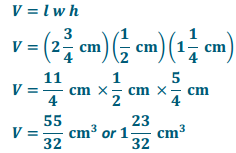
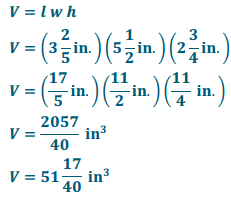
V = l w h
V = (1\(\frac{1}{2}\) m) (\(\frac{1}{2}\) m) (\(\frac{7}{8}\) m)
V = \(\frac{21}{32}\) m3

Question 2.
The area of the base of a rectangular prism is 4ft2, and the height is 2 ft. Determine the volume of the rectangular prism.
Answer:
Eureka Math Grade 6 Module 5 Lesson 12 Problem Set Answer Key 3

Question 3.
The length of a rectangular prism is 3\(\frac{1}{2}\) times as long as the width. The height is \(\frac{1}{4}\) of the width. The width is 3 cm. Determine the volume.
Answer:
Width = 3cm
Length = 3 cm × 3\(\frac{1}{2}\) = \(\frac{21}{2}\) cm
Height = 3 cm × \(\frac{1}{4}\) = \(\frac{3}{4}\) cm
V = l w h
V = (\(\frac{21}{2}\) cm) (3 cm) (\(\frac{3}{4}\) cm)
V = \(\frac{189}{8}\) cm3

Question 4.
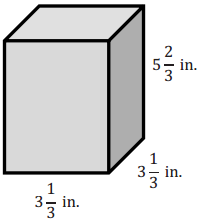
Eureka Math Grade 6 Module 5 Lesson 12 Problem Set Answer Key 4

a. Write numerical expressions to represent the volume in two different ways, and explain what each reveals.
Answer:
(10\(\frac{1}{2}\) in.) (1\(\frac{2}{3}\) in.) (6 in.) represents the product of three edge lengths. (\(\frac{35}{2}\) in2) (6 in.) represents the product of the base area times the height. Answers will vary.

b. Determine the volume of the rectangular prism.
Answer:
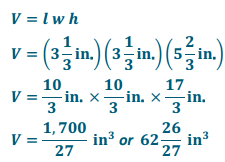
(10\(\frac{1}{2}\) in.)(1\(\frac{2}{3}\) in.)(6 in.)= 105 in3 or
(\(\frac{35}{2}\) in2) (6 in.)= 105 in3

Question 5.
An aquarium in the shape of a rectangular prism has the following dimensions: length = 50 cm, width = 25\(\frac{1}{2}\) cm, and height = 30 cm.

a. Write numerical expressions to represent the volume in two different ways, and explain what each reveals.
Answer:
(50 cm) (25\(\frac{1}{2}\) cm) (30\(\frac{1}{2}\) cm) represents the product of the three edge lengths. (1,275 cm2) (30\(\frac{1}{2}\) cm) represents the base area times the height.

b. Determine the volume of the rectangular prism.
Answer:
(1.275 cm2) (30\(\frac{1}{2}\) cm) = 38,887\(\frac{1}{2}\) cm3

Question 6.
The area of the base in this rectangular prism is fixed at 36 cm2. As the height of the rectangular prism changes, the volume will also change as a result.

a. Complete the table of values to determine the various heights and volumes.
Eureka Math Grade 6 Module 5 Lesson 12 Problem Set Answer Key 6

Eureka Math Grade 6 Module 5 Lesson 12 Problem Set Answer Key 5
Answer:
Eureka Math Grade 6 Module 5 Lesson 12 Problem Set Answer Key 7

b. Write an equation to represent the relationship in the table. Be sure to define the variables used In the equation.
Answer:
Let X be the height of the rectangular prism in centimeters.
Let y be the volume of the rectangular prism in cubic centimeters.
36x = y

c. What is the unit rate for this proportional relationship? What does it mean in this situation?
Answer:
The unit rate is 36.
For every centimeter of height, the volume increases by 36 cm3 because the area of the base is 36 cm2. In order to determine the volume, multiply the height by 36.

Question 7.
The volume of a rectangular prism is 16.328 cm3. The height is 3. 14 cm.

a. Let B represent the area of the base of the rectangular prism. Write an equation that relates the volume, the area of the base, and the height.
Answer:
16.328 = 3.14B

b. Solve the equation for B.
Answer:
\(\frac{16.328}{3.14}=\frac{3.14 B}{3.14}\)
B = 5.2
The area of the base is 5.2 cm2.

Eureka Math Grade 6 Module 5 Lesson 12 Exit Ticket Answer Key

Question 1.
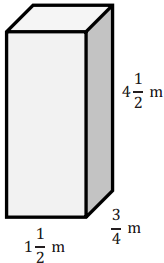
Determine the volume of the rectangular prism in two different ways.
Eureka Math Grade 6 Module 5 Lesson 12 Exit Ticket Answer Key 8
Answer:
V = l. w. h
V = (\(\frac{3}{4}\) ft.) (\(\frac{3}{8}\) ft.) (\(\frac{3}{4}\) ft.)
V = \(\frac{27}{128}\) ft3

V = Area of base. height
V = (\(\frac{9}{32}\) ft2) . (\(\frac{3}{4}\) ft2.)
V = \(\frac{27}{128}\) ft3

Question 2.
The area of the base of a rectangular prism is 12 cm2, and the height is 3 cm. Determine the volume of the rectangular prism.
Answer:
V = Area of base. height
V = (12 cm2) (3\(\frac{1}{3}\) cm)
V = \(\frac{120}{3}\) cm3
V = 40 cm3
Eureka Math Grade 6 Module 5 Lesson 11 Answer Key

Engage NY Eureka Math Grade 6 Module 5 Lesson 11 Answer Key

Eureka Math Grade 6 Module 5 Lesson 11 Example Answer Key

Example 1.
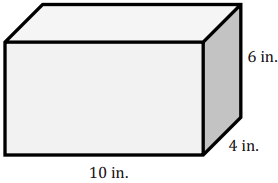
A box with the same dimensions as the prism in the Opening Exercise is used to ship miniature dice whose side lengths have been cut in half. The dice are \(\frac{1}{2}\) in. × \(\frac{1}{2}\) in. × \(\frac{1}{2}\) in. cubes. How many dice of this size can fit in the box?
Eureka Math Grade 6 Module 5 Lesson 11 Example Answer Key 2
Answer:

→ How many cubes could we fit across the length? The width? The height?
Two cubes would fit across a 1-inch length. So, I would need to double the lengths to get the number of cubes. Twenty cubes will fit across the 10-inch length, 8 cubes will fit across the 4 -inch width and 12 cubes will fit across the 6-inch height.

→ How can you use this information to determine the number of \(\frac{1}{2}\) in. × \(\frac{1}{2}\) in. × \(\frac{1}{2}\) in. cubes it takes to fill the box?
I can multiply the number of cubes in length, width, and height.
20 × 8 × 12 = 1,920, so 1,920 of the smaller cubes will fill the box.

→ How many of these smaller cubes can fit into the 1 in. × 1 in. × 1 in. cube?
Two confits across the length, two across the width, and two for the height. 2 × 2 × 2 = 8. Eight smaller cubes confit in the larger cube.

→ How does the number of cubes in this example compare to the number of cubes that would be needed in the
Opening Exercise?
\(\frac{\text { new }}{\text { old }}=\frac{1,920}{240}=\frac{8}{1}\)
If I fill the same box with cubes that are half the length, I need 8 times as many.

→ How is the volume of the box related to the number of cubes that will fit in it?
The volume of the box is of the number of cubes that will fit in it.

→ What is the volume of 1 cube?
V= \(\frac{1}{2}\) in. × \(\frac{1}{2}\) in. × \(\frac{1}{2}\) in.

→ What is the product of the number of cubes and the volume of the cubes? What does this product represent?
1920 × \(\frac{1}{8}\) = 240
The product represents the volume of the original box.

Example 2.
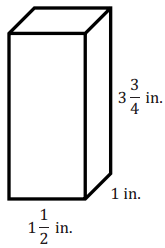
A \(\frac{1}{5}\) in. cube is used to fill the prism. How many in. cubes does it take to fill the prism? What is the volume of the prism? How is the number of cubes related to the volume?
Eureka Math Grade 6 Module 5 Lesson 11 Example Answer Key 3
Answer:

→ How would you determine, or find, the number of cubes that fill the prism?
One method would be to determine the number of cubes that will fit across the length, width, and height. Then, I would multiply. 6 will fit across the length, 4 across the width, and 15 across the height. 6 × 4 × 15 = 360, so 360 cubes will fill the prism.

→ How is the number of cubes and the volume related?
The volume is equal to the number of cubes times the volume of one cube.
The volume of one cube is \(\frac{1}{4}\) in. × \(\frac{1}{4}\) in. × \(\frac{1}{4}\) in. = \(\frac{1}{64}\) in3.

360 cubes × \(\frac{1}{64}\) in3 = \(\frac{360}{64}\) in3 = \(\frac{540}{64}\) in3 =5 \(\frac{5}{8}\)in3

→ What other method can be used to determine the volume?
V = l w h
V = (1 \(\frac{1}{2}\) in.) (1 in.) (3 \(\frac{3}{4}\) in.)
V = \(\frac{3}{2}\) in. × \(\frac{1}{1}\) in. × \(\frac{15}{4}\) in.
V = \(\frac{45}{8}\) in3 = 5 \(\frac{5}{8}\) in3

→ Would any other size cubes fit perfectly inside the prism with no space left over?
We would not be able to use cubes with side lengths of \(\frac{1}{2}\) in., \(\frac{1}{3}\) in., or \(\frac{2}{3}\) in. because there would be spaces left over. However, we could use a cube with a side length of \(\frac{1}{8}\) in. without having spaces left over.

Eureka Math Grade 6 Module 5 Lesson 11 Exercise Answer Key

Opening Exercise:

Exercise 1.
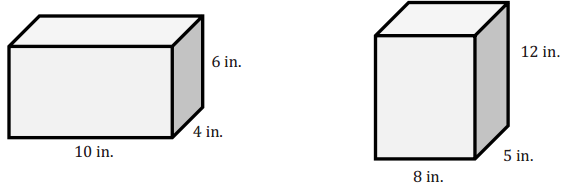
Which prism holds more 1 in. × 1 in. × 1 in. cubes? How many more cubes does the prism hold?
Eureka Math Grade 6 Module 5 Lesson 11 Exercise Answer Key 1
Answer:
Students discuss their solutions with a partner.

→ How many 1 in. × 1 in. × 1 in. cubes can fit across the bottom of the first rectangular prism?
Answer:
40 cubes can fit across the bottom.

→ How did you determine this number?
Answer:
Answers will vary. I determined how many cubes could fill the bottom layer of the prism and then decided how many layers were needed.

Students who are English language learners may need a model of what “layers” means in this context.

→ How many layers of 1 in. × 1 in. × 1 in. cubes can fit inside the rectangular prism?
There are 6 inches in the height; therefore, 6 layers of cubes can fit inside.

→ How many 1 in. × 1 in. × 1 in. cubes can fit across the bottom of the second rectangular prism?
40 cubes can fit across the bottom.

→ How many layers do you need?
I need 12 layers because the prism is 12 in. tall.

→ Which rectangular prism can hold more cubes?
The second rectangular prism can holds more cubes.

→ How did you determine this?
Both rectangular prisms hold the same number of cubes in one layer, but the second rectangular prism has more layers.

→ How many more layers does the second rectangular prism hold?
It holds 6 more layers.

→ How many more cubes does the second rectangular prism hold?
The second rectangular prism has 6 more layers than the first, with 40 cubes in each layer.
6 × 40 = 240, so the second rectangular prism holds 240 more cubes than the first.

> What other ways can you determine the volume of a rectangular prism?
We can also use the formula V = l. w . h.

Exercises:

Exercise 1.
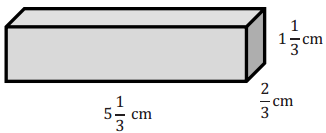
Use the prism to answer the following questions.
Eureka Math Grade 6 Module 5 Lesson 11 Exercise Answer Key 4

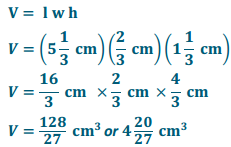
a. Calculate the volume.
Answer:
Eureka Math Grade 6 Module 5 Lesson 11 Exercise Answer Key 5

b. If you have to fill the prism with cubes whose side lengths are less than 1 cm, what size would be best?
Answer:
The best choice would be a cube with side lengths of \(\frac{1}{3}\) cm.

c. How many of the cubes would fit in the prism?
Answer:
16 × 2 × 4 = 128, so 128 cubes will fit in the prism.

d. Use the relationship between the number of cubes and the volume to prove that your volume calculation Is correct.
Answer:
The volume of one cube would be \(\frac{1}{3}\) cm × \(\frac{1}{3}\)cm × \(\frac{1}{3}\) cm = \(\frac{1}{27}\) cm3
Since there are 128 cubes, the volume would be 128 × \(\frac{1}{27}\) cm3 = \(\frac{128}{27}\) cm3 or 4\(\frac{20}{27}\) cm3.
Exercise 2.
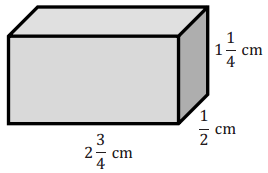
Calculate the volume of the following rectangular prisms.

a. Eureka Math Grade 6 Module 5 Lesson 11 Exercise Answer Key 6
Answer:
Eureka Math Grade 6 Module 5 Lesson 11 Exercise Answer Key 7

b. Eureka Math Grade 6 Module 5 Lesson 11 Exercise Answer Key 8
Answer:
Eureka Math Grade 6 Module 5 Lesson 11 Exercise Answer Key 9

Exercise 3.
A toy company is packaging its toys to be shipped. Each small toy is placed inside a cube-shaped box with side lengths of \(\frac{1}{2}\) in. These smaller boxes are then placed into a larger box with dimensions of 12 in. × 4\(\frac{1}{2}\) in. × 3\(\frac{1}{2}\) in.

a. What is the greatest number of small toy boxes that can be packed into the larger box for shipping?
Answer:
24 × 9 × 7 = 1,512, so 1,512 toys can be packed into the larger box.

b. Use the number of small toy boxes that can be shipped in the larger box to help determine the volume of the shipping box.
Answer:
One small box would have a volume of \(\frac{1}{2}\) in. × \(\frac{1}{2}\) in. × \(\frac{1}{2}\) in. = \(\frac{1}{8}\) in3.
Now, I multiply the number of cubes by the volume of the cube.
1,512 × \(\frac{1}{8}\) in3 = \(\frac{1512}{8}\) in3 = 189 in3
Exercise 4.
A rectangular prism with a volume of 8 cubic units is filled with cubes twice: once with cubes with side lengths of \(\frac{1}{2}\) unit and once with cubes with side lengths of \(\frac{1}{3}\) unit.

a. How many more of the cubes with \(\frac{1}{3}\) unit side lengths than cubes with \(\frac{1}{2}\) unit side lengths are needed to fill the prism?
Answer:
There are 8 cubes with \(\frac{1}{2}\) unit side lengths in 1 cubic unit because the volume of one cube is \(\frac{1}{8}\) cubic unit. Since we have 8 cubic units, we would have 64 total cubes with \(\frac{1}{2}\) unit side lengths because 8 × 8 = 64.

There are 27 cubes with \(\frac{1}{3}\) unit side lengths in 1 cubic unit because the volume of one cube is \(\frac{1}{27}\) cubic units. Since we have 8 cubic units, we would have 216 total cubes with \(\frac{1}{3}\) unit side lengths because 8 × 27 = 216. 216 – 64 = 152, so 152 more cubes with \(\frac{1}{3}\) unit side lengths are needed to fill the prism.

b. Why does it take more cubes with \(\frac{1}{3}\) unit side lengths to fill the prism than it does with cubes with \(\frac{1}{2}\) unit side lengths?
Answer:
\(\frac{1}{3}\) < \(\frac{1}{2}\). The side length is shorter for the cube with a \(\frac{1}{3}\) unit side length, so it takes more to fill the rectangular prism.

Exercise 5.
Calculate the volume of the rectangular prism. Show two different methods for determining the volume.
Eureka Math Grade 6 Module 5 Lesson 11 Exercise Answer Key 10
Answer:
Method 1:
Eureka Math Grade 6 Module 5 Lesson 11 Exercise Answer Key 11

Method 2:
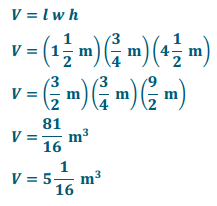
Fill the rectangular prism with cubes that are \(\frac{1}{4}\) m × \(\frac{1}{4}\) m × \(\frac{1}{4}\) m.
The volume of each cube is \(\frac{1}{64}\) m3.
We would have 6 cubes across the length, 3 cubes across the width, and 18 cubes across the height.
6 × 3 × 18 = 324, so the rectangular prism could be filled with 324 cubes with \(\frac{1}{4}\) m side lengths.
324 × \(\frac{1}{64}\) m3 = 5 \(\frac{1}{16}\) m3.

Eureka Math Grade 6 Module 5 Lesson 11 Problem Set Answer Key

Question 1.
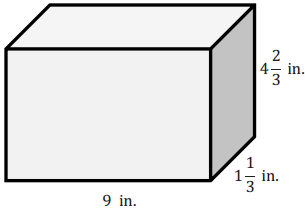
Answer the following questions using this rectangular prism:
Eureka Math Grade 6 Module 5 Lesson 11 Problem Set Answer Key 12

a. What is the volume of the prism?
Answer:
V = l w h
V = (9 in.) (1 \(\frac{1}{3}\) in.) (4 \(\frac{2}{3}\)in.)
V = ( \(\frac{9}{1}\) in.) (\(\frac{4}{3}\) in.) (\(\frac{14}{3}\) in.)
V = \(\frac{504}{9}\) in3
V = 56 in3.

b. Linda fills the rectangular prism with cubes that have side lengths of \(\frac{1}{3}\) in. How many cubes does she need to fill the rectangular prism?
Answer:
She needs 27 across by 4 wide and 14 high.
Number of cubes = 27 × 4 × 14 = 1,512.
Linda needs 512 cubes with \(\frac{1}{3}\) in. side lengths to fill the rectangular prism.

c. How is the number of cubes related to the volume?
Answer:
56 × 27 = 1,512
The number of cubes needed is 27 times larger than the volume.

d. Why is the number of cubes needed different from the volume?
Answer:
Because the cubes are not each 1 in., the volume is different from the number of cubes. However, I could multiply the number of cubes by the volume of one cube and still get the original volume.

e. Should Linda try to fill this rectangular prism with cubes that are \(\frac{1}{2}\) in. long on each side? Why or why not?
Answer:
Because some of the lengths are \(\frac{1}{3}\) in. and some are \(\frac{2}{3}\) in., it would not be possible to use side lengths of \(\frac{1}{2}\) in. to fill the prism.

Question 2.
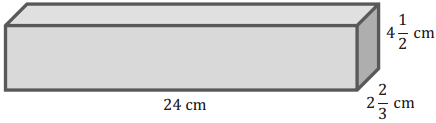
Calculate the volume of the following prisms.

a. Eureka Math Grade 6 Module 5 Lesson 11 Problem Set Answer Key 13
Answer:
V = l w h
V = (24 cm) (2\(\frac{2}{3}\) cm) (4\(\frac{1}{2}\) cm)
V = (24cm) (\(\frac{8}{3}\) cm) (\(\frac{9}{2}\) cm)
V = \(\frac{1728}{6}\) cm3
V = 288 cm3

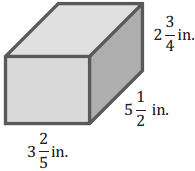
b. Eureka Math Grade 6 Module 5 Lesson 11 Problem Set Answer Key 14
Answer:
Eureka Math Grade 6 Module 5 Lesson 11 Problem Set Answer Key 15

Question 3.
A rectangular prism with a volume of 12 cubic units is filled with cubes twice: once with cubes with \(\frac{1}{2}\) unit side lengths and once with cubes with \(\frac{1}{3}\)-unit side lengths.

a. How many more of the cubes with \(\frac{1}{3}\)-unit side lengths than cubes with \(\frac{1}{2}\)-unit side lengths are needed to fill the prism?
Answer:
There are 8 cubes with \(\frac{1}{2}\)-unit side lengths in 1 cubic unit because the volume of one cube is \(\frac{1}{8}\) cubic unit. Since we have 12 cubic units, we would have 96 total cubes with \(\frac{1}{2}\)-unit side lengths because 12 × 8 = 96.

There are 27 cubes with \(\frac{1}{3}\)-unit side lengths in 1 cubic unit because the volume of one cube is \(\frac{1}{27}\) cubic unit. Since we have 12 cubic units, we would have 324 total cubes with \(\frac{1}{3}\)-unit side lengths because 12 × 27 = 324.

324 – 96 = 228, so there are 228 more cubes with \(\frac{1}{3}\)-unit side lengths needed than there are cubes with \(\frac{1}{2}\)-unit side lengths needed.

b. Finally, the prism is filled with cubes whose side lengths are \(\frac{1}{4}\) unit. How many \(\frac{1}{4}\) unit cubes would it take to fill the prism?
Answer:
There are 64 cubes with \(\frac{1}{4}\)-unit side lengths in 1 cubic unit because the volume of one cube is \(\frac{1}{64}\) cubic unit.
Since there are 12 cubic units, we would have 768 total cubes with side lengths of \(\frac{1}{4}\) unit because 12 × 64 = 768.

Question 4.
A toy company is packaging its toys to be shipped. Each toy is placed inside a cube-shaped box with side lengths of 3\(\frac{1}{2}\) in. These smaller boxes are then packed into a larger box with dimensions of 14 in. × 7 in. × 3\(\frac{1}{2}\) in.

a. What is the greatest number of toy boxes that can be packed into the larger box for shipping?
Answer:
4 × 2 × 1 = 8, so 8 toy boxes can be packed into the larger box for shipping.

b. Use the number of toy boxes that can be shipped in the large box to determine the volume of the shipping box.
Answer:
One small box would haveavolume of 3\(\frac{1}{2}\) in. × 3\(\frac{1}{2}\) in. × 3\(\frac{1}{2}\) in. = 42\(\frac{7}{8}\) in3.
Now, I will multiply the number of cubes by the volume of the cube. 8 × 42\(\frac{7}{8}\) in3 = 343 in3

Question 5.
A rectangular prism has a volume of 34.224 cubic meters. The height of the box is 3. 1 meters, and the length is 2.4 meters.

a. Write an equation that relates the volume to the length, width, and height. Let w represent the width, in meters.
Ans;
34.224 = (3.1) (2. 4)w

b. Solve the equation.
Answer:
34.224 = 7.44 w
w = 4.6
The width is 4.6 m.

Eureka Math Grade 6 Module 5 Lesson 11 Exit Ticket Answer Key

Question 1.
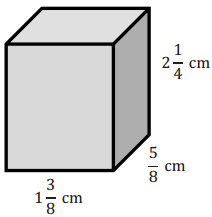
Calculate the volume of the rectangular prism using two different methods. Label your solutions Method 1 and Method 2.
Eureka Math Grade 6 Module 5 Lesson 11 Exit Ticket Answer Key 16
Answer:
Method 1:
V = l w h
V = (1\(\frac{3}{8}\) cm) (\(\frac{5}{8}\) cm) (2\(\frac{1}{4}\) cm)

V = \(\frac{11}{8}\) cm × \(\frac{5}{8}\) cm × \(\frac{9}{4}\) cm

V = \(\frac{495}{256}\) cm3

Method 2:
Fill shape with \(\frac{1}{8}\) cm cubes.
11 × 5 × 18 = 990, so 990 cubes could be used to fill the prism.
Each cube has a volume of \(\frac{1}{8}\) cm × \(\frac{1}{8}\) cm × \(\frac{1}{8}\) cm = \(\frac{1}{512}\) cm3

V = 990 × \(\frac{1}{512}\) cm3 = \(\frac{990}{512}\) cm3 = \(\frac{495}{256}\) cm3

Eureka Math Grade 6 Module 5 Lesson 11 Multiplication of Fractions II Answer Key

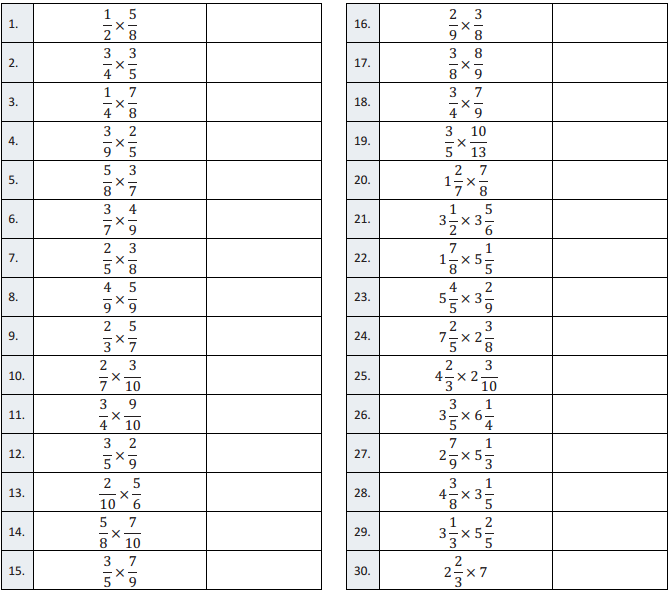
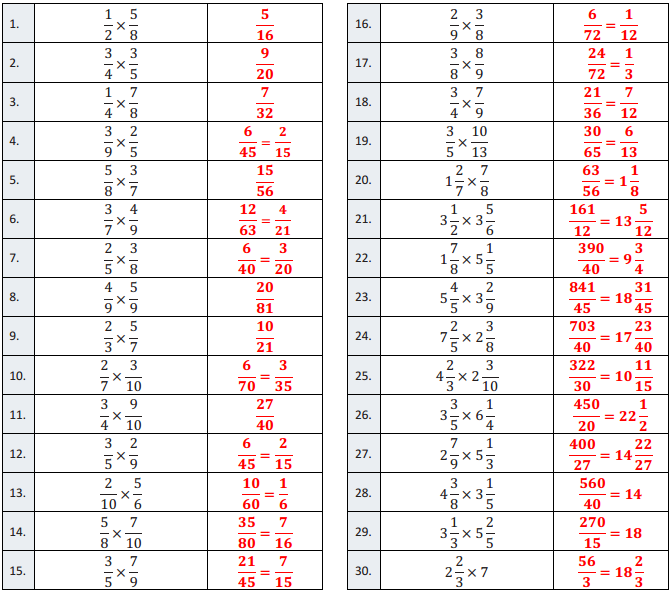
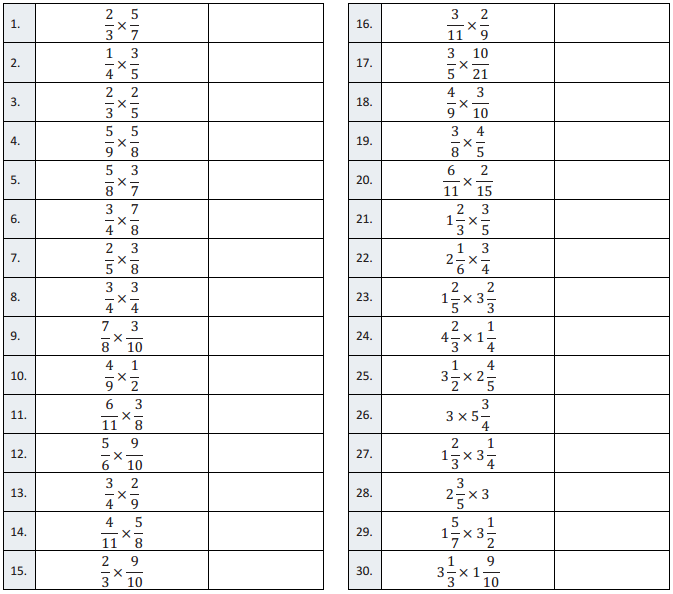
Multiplication of Fractions II – Round 1:

Directions: Determine the product of the fractions and simplify.
Eureka Math Grade 6 Module 5 Lesson 11 Multiplication of Fractions II Answer Key 17

Eureka Math Grade 6 Module 5 Lesson 11 Multiplication of Fractions II Answer Key 18

Question 1.
\(\frac{1}{2}\) × \(\frac{5}{8}\)
Answer:
\(\frac{5}{16}\)

Question 2.
\(\frac{3}{4}\) × \(\frac{3}{5}\)
Answer:
\(\frac{9}{20}\)

Question 3.
\(\frac{1}{4}\) × \(\frac{7}{8}\)
Answer:
\(\frac{7}{32}\)

Question 4.
\(\frac{3}{9}\) × \(\frac{2}{5}\)
Answer:
\(\frac{6}{45}\) = \(\frac{2}{15}\)

Question 5.
\(\frac{5}{8}\) × \(\frac{3}{7}\)
Answer:
\(\frac{15}{56}\)

Question 6.
\(\frac{3}{7}\) × \(\frac{4}{9}\)
Answer:
\(\frac{12}{63}\) = \(\frac{4}{21}\)

Question 7.
\(\frac{2}{5}\) × \(\frac{3}{8}\)
Answer:
\(\frac{6}{40}\) = \(\frac{3}{20}\)

Question 8.
\(\frac{4}{9}\) × \(\frac{5}{9}\)
Answer:
\(\frac{20}{81}\)

Question 9.
\(\frac{2}{3}\) × \(\frac{5}{7}\)
Answer:
\(\frac{10}{21}\)

Question 10.
\(\frac{2}{7}\) × \(\frac{3}{10}\)
Answer:
\(\frac{6}{70}\) = \(\frac{3}{35}\)

Question 11.
\(\frac{3}{4}\) × \(\frac{9}{10}\)
Answer:
\(\frac{27}{40}\)

Question 12.
\(\frac{3}{5}\) × \(\frac{2}{9}\)
Answer:
\(\frac{6}{45}\) = \(\frac{2}{15}\)

Question 13.
\(\frac{2}{10}\) × \(\frac{5}{6}\)
Answer:
\(\frac{10}{60}\) = \(\frac{1}{6}\)

Question 14.
\(\frac{5}{8}\) × \(\frac{7}{10}\)
Answer:
\(\frac{35}{80}\) = \(\frac{7}{16}\)

Question 15.
\(\frac{3}{5}\) × \(\frac{7}{9}\)
Answer:
\(\frac{21}{45}\) = \(\frac{7}{15}\)

Question 16.
\(\frac{2}{9}\) × \(\frac{3}{8}\)
Answer:
\(\frac{6}{72}\) = \(\frac{1}{12}\)

Question 17.
\(\frac{3}{8}\) × \(\frac{8}{9}\)
Answer:
\(\frac{24}{72}\) = \(\frac{1}{3}\)

Question 18.
\(\frac{3}{4}\) × \(\frac{7}{9}\)
Answer:
\(\frac{21}{36}\) = \(\frac{7}{12}\)

Question 19.
\(\frac{3}{5}\) × \(\frac{10}{13}\)
Answer:
\(\frac{30}{65}\) = \(\frac{6}{13}\)

Question 20.
1 \(\frac{2}{7}\) × \(\frac{7}{8}\)
Answer:
\(\frac{63}{56}\) = 1 \(\frac{1}{8}\)

Question 21.
3 \(\frac{1}{2}\) × 3 \(\frac{5}{6}\)
Answer:
\(\frac{161}{12}\) = 13 \(\frac{5}{12}\)

Question 22.
\(\frac{1}{4}\) × \(\frac{1}{4}\)
Answer:
\(\frac{1}{4}\)

Question 23.
1 \(\frac{7}{8}\) × 5 \(\frac{1}{5}\)
Answer:
\(\frac{390}{40}\) = 9 \(\frac{3}{4}\)

Question 24.
7 \(\frac{2}{5}\) × 2 \(\frac{3}{8}\)
Answer:
\(\frac{703}{40}\) = 17 \(\frac{23}{40}\)

Question 25.
4 \(\frac{2}{3}\) × 2 \(\frac{3}{10}\)
Answer:
\(\frac{322}{30}\) = 10 \(\frac{11}{15}\)

Question 26.
3 \(\frac{3}{5}\) × 6 \(\frac{1}{4}\)
Answer:
\(\frac{450}{20}\) = 22 \(\frac{1}{2}\)

Question 27.
2 \(\frac{7}{9}\) × 5 \(\frac{1}{3}\)
Answer:
\(\frac{400}{27}\) = 14 \(\frac{22}{27}\)

Question 28.
4 \(\frac{3}{8}\) × 3 \(\frac{1}{5}\)
Answer:
\(\frac{560}{40}\) = 4

Question 29.
3 \(\frac{1}{3}\) × 5 \(\frac{2}{5}\)
Answer:
\(\frac{270}{15}\) = 18 \(\frac{2}{3}\)

Question 30.
2 \(\frac{2}{3}\) × 7
Answer:
\(\frac{56}{3}\) = 18 \(\frac{2}{3}\)

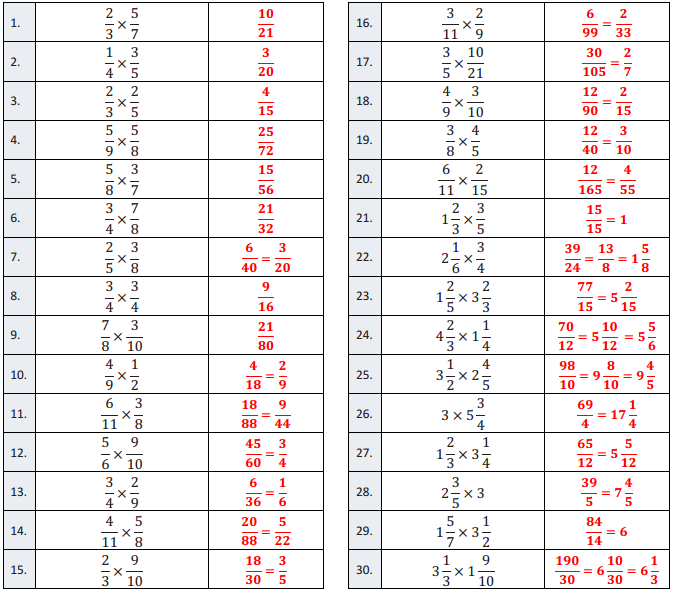
Multiplication of Fractions II – Round 2:

Directions: Determine the product of the fractions and simplify.

Eureka Math Grade 6 Module 5 Lesson 11 Multiplication of Fractions II Answer Key 19

Eureka Math Grade 6 Module 5 Lesson 11 Multiplication of Fractions II Answer Key 20

Question 1.
\(\frac{2}{3}\) × \(\frac{5}{7}\)
Answer:
\(\frac{10}{21}\)

Question 2.
\(\frac{1}{4}\) × \(\frac{3}{5}\)
Answer:
\(\frac{3}{20}\)

Question 3.
\(\frac{2}{3}\) × \(\frac{2}{5}\)
Answer:
\(\frac{4}{15}\)

Question 4.
\(\frac{5}{9}\) × \(\frac{5}{8}\)
Answer:
\(\frac{25}{72}\)

Question 5.
\(\frac{5}{8}\) × \(\frac{3}{7}\)
Answer:
\(\frac{15}{56}\)

Question 6.
\(\frac{3}{4}\) × \(\frac{7}{8}\)
Answer:
\(\frac{21}{32}\)

Question 7.
\(\frac{2}{5}\) × \(\frac{3}{8}\)
Answer:
\(\frac{6}{40}\) = \(\frac{3}{20}\)

Question 8.
\(\frac{3}{4}\) × \(\frac{3}{4}\)
Answer:
\(\frac{9}{16}\)

Question 9.
\(\frac{7}{8}\) × \(\frac{3}{10}\)
Answer:
\(\frac{21}{80}\)

Question 10.
\(\frac{4}{9}\) × \(\frac{1}{2}\)
Answer:
\(\frac{4}{18}\) = \(\frac{2}{9}\)

Question 11.
\(\frac{6}{11}\) × \(\frac{3}{8}\)
Answer:
\(\frac{18}{88}\) = \(\frac{9}{44}\)

Question 12.
\(\frac{5}{6}\) × \(\frac{9}{10}\)
Answer:
\(\frac{45}{60}\) = \(\frac{3}{4}\)

Question 13.
\(\frac{3}{4}\) × \(\frac{2}{9}\)
Answer:
\(\frac{6}{36}\) = \(\frac{1}{6}\)

Question 14.
\(\frac{4}{11}\) × \(\frac{5}{8}\)
Answer:
\(\frac{20}{88}\) = \(\frac{5}{22}\)

Question 15.
\(\frac{2}{3}\) × \(\frac{9}{10}\)
Answer:
\(\frac{18}{30}\) = \(\frac{3}{5}\)

Question 16.
\(\frac{3}{11}\) × \(\frac{2}{9}\)
Answer:
\(\frac{6}{99}\) = \(\frac{2}{33}\)

Question 17.
\(\frac{3}{5}\) × \(\frac{10}{21}\)
Answer:
\(\frac{30}{105}\) = \(\frac{2}{7}\)

Question 18.
\(\frac{4}{9}\) × \(\frac{3}{10}\)
Answer:
\(\frac{12}{90}\) = \(\frac{2}{15}\)

Question 19.
\(\frac{3}{8}\) × \(\frac{4}{5}\)
Answer:
\(\frac{12}{40}\) = \(\frac{3}{10}\)

Question 20.
\(\frac{6}{11}\) × \(\frac{2}{15}\)
Answer:
\(\frac{12}{165}\) = \(\frac{4}{55}\)

Question 21.
1 \(\frac{2}{3}\) × \(\frac{3}{5}\)
Answer:
\(\frac{15}{15}\) = 1

Question 22.
2 \(\frac{1}{6}\) × \(\frac{3}{4}\)
Answer:
\(\frac{39}{24}\) = \(\frac{13}{8}\) = 1 \(\frac{5}{8}\)

Question 23.
1 \(\frac{2}{5}\) × 3 \(\frac{2}{3}\)
Answer:
\(\frac{77}{15}\) = 5 \(\frac{2}{15}\)

Question 24.
4 \(\frac{2}{3}\) × 1 \(\frac{1}{4}\)
Answer:
\(\frac{70}{12}\) = 5 \(\frac{10}{12}\) = 5 \(\frac{5}{6}\)

Question 25.
3 \(\frac{1}{2}\) × 2 \(\frac{4}{5}\)
Answer:
\(\frac{98}{10}\) = 9 \(\frac{8}{10}\) = 9 \(\frac{4}{5}\)

Question 26.
3 × 5 \(\frac{3}{4}\)
Answer:
\(\frac{69}{4}\) = 17 \(\frac{1}{4}\)

Question 27.
1 \(\frac{2}{3}\) × 3 \(\frac{1}{4}\)
Answer:
\(\frac{65}{12}\) = 5 \(\frac{5}{12}\)

Question 28.
2 \(\frac{3}{5}\) × 3
Answer:
\(\frac{39}{5}\) = 7 \(\frac{4}{5}\)

Question 29.
1 \(\frac{5}{7}\) × 3 \(\frac{1}{2}\)
Answer:
\(\frac{84}{14}\) = 6

Question 30.
3 \(\frac{1}{3}\) × 1 \(\frac{9}{10}\)
Answer:
\(\frac{190}{30}\) = 6 \(\frac{10}{30}\) = 6 \(\frac{1}{3}\)

Eureka Math Grade 6 Module 5 Lesson 10 Answer Key

Engage NY Eureka Math Grade 6 Module 5 Lesson 10 Answer Key

Eureka Math Grade 6 Module 5 Lesson 10 Exercise Answer Key

Opening Exercise:

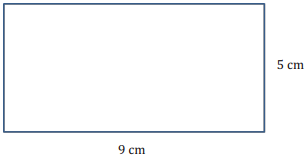
Question a.
Find the area and perimeter of this rectangle:
Eureka Math Grade 6 Module 5 Lesson 10 Exercise Answer Key 1
Answer:
A = bh = 9 cm × 5 cm = 45 cm2
P = 9 cm + 9 cm + 5 cm + 5 cm = 28 cm

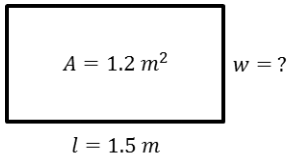
Question b.
Find the width of this rectangle. The area is 1.2 m2, and the length is 1.5 m.
Eureka Math Grade 6 Module 5 Lesson 10 Exercise Answer Key 2
Answer:
A = l × w
1.2 m2 = 1.5 m × w
\(\frac{1.2 m^{2}}{1.5 m}\) = \(\frac{1.5 \mathrm{~m} \times \mathrm{w}}{1.5 \mathrm{~m}}\)
0.8 m = w

Eureka Math Grade 6 Module 5 Lesson 10 Example Answer Key

Example: Student Desks or Tables

Question 1.
Measure the dimensions of the top of your desk.
Answer:

Question 2.
How do you find the area of the top of your desk?
Answer:

Question 3.
How do you find the perimeter?
Answer:

Question 4.
Record these on your paper in the appropriate column.
Answer:

Exploratory Challenge:

Question 1.
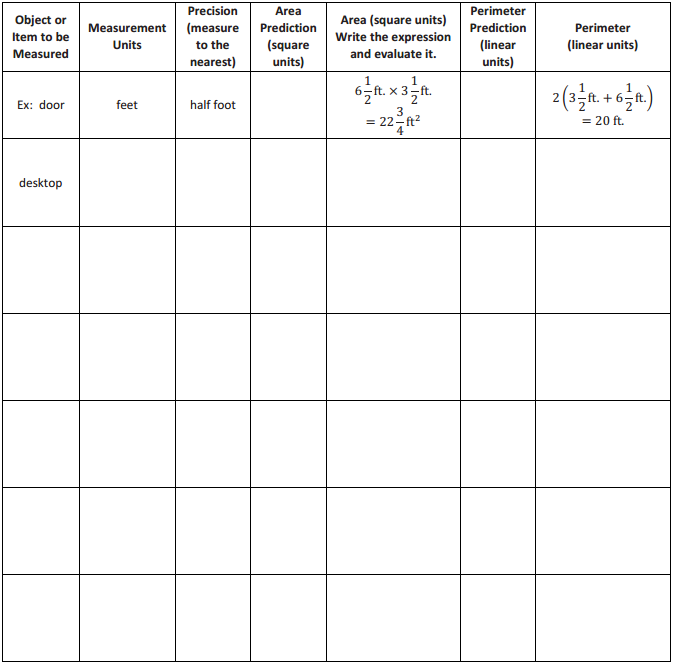
Estimate and predict the area and perimeter of each object. Then measure each object, and calculate both the area and perimeter of each.
Eureka Math Grade 6 Module 5 Lesson 10 Example Answer Key 3
Answer:

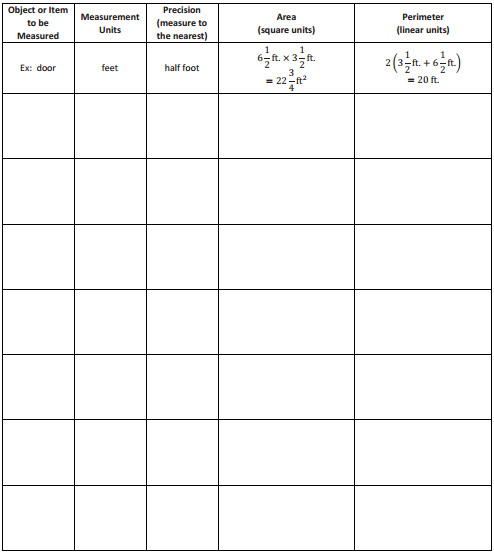
Optional Challenge:
Eureka Math Grade 6 Module 5 Lesson 10 Example Answer Key 4
Answer:

Eureka Math Grade 6 Module 5 Lesson 10 Problem Set Answer Key

Question 1.
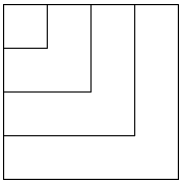
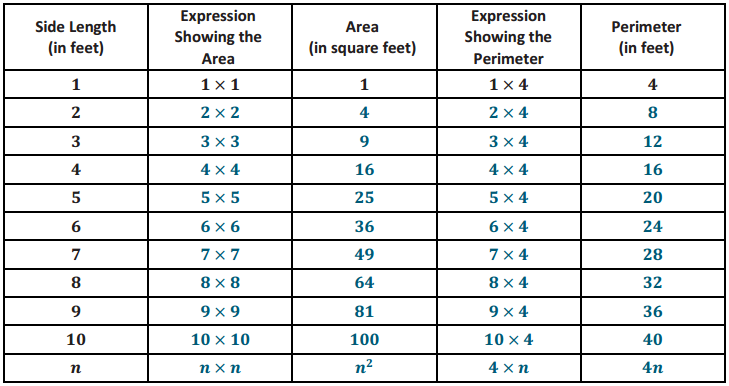
How is the length of the side of a square related to its area and perimeter? The diagram below shows the first four squares stacked on top of each other with their upper left-hand corners lined up. The length of one side of the smallest square is 1 foot.
Eureka Math Grade 6 Module 5 Lesson 10 Problem Set Answer Key 5

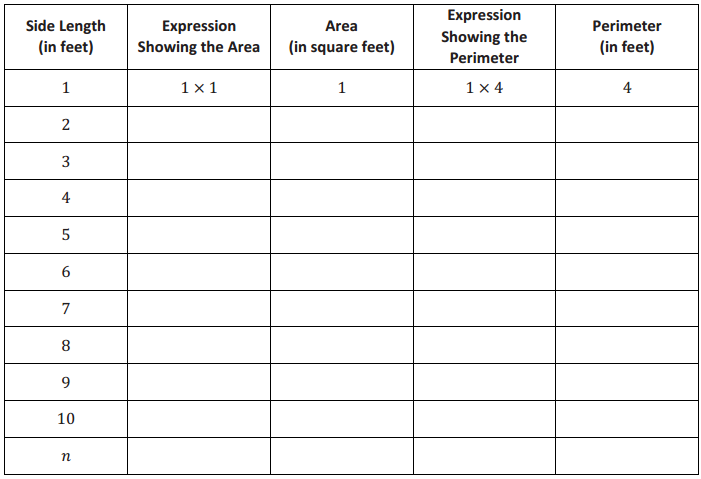
a. Complete this chart calculating area and perimeter for each square.
Eureka Math Grade 6 Module 5 Lesson 10 Problem Set Answer Key 6
Answer:
Eureka Math Grade 6 Module 5 Lesson 10 Problem Set Answer Key 7

b. In a square, which numerical value is greater, the area or the perimeter?
Answer:
It depends. For side length less than 4 feet, perimeter is greater; however, for side length greater than 4 feet, area is greater.

c. When is the numerical value of a square’s area (in square units) equal to Its perimeter (in units)?
Answer:
When the side length is exactly 4 feet.

d. Why is this true?
Answer:
n2 = 4n is only true when n = 4.

Question 2.
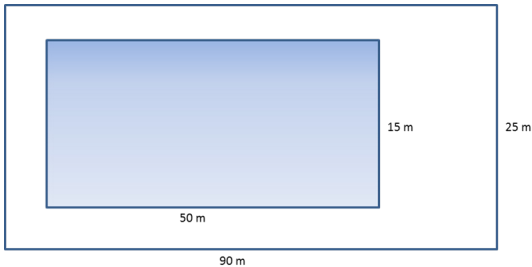
This drawing shows a school pool. The walkway around the pool needs special non skid strips installed but only at the edge of the pool and the outer edges of the walkway.
Eureka Math Grade 6 Module 5 Lesson 10 Problem Set Answer Key 8

a. Find the length of nonskid strips that is needed for the job.
Answer:
50 m+ 50 m + 15 m + 15 m + 90 m + 90 m + 25 m + 25 m = 360 m

b. The nonskid strips are sold only in rolls of 50 m. How many rolls need to be purchased for the job?
Answer:
360 m ÷ 50 \(\frac{\mathrm{m}}{\text { roll }}\) = 7.2 rolls
Therefore, 8 rolls need to be purchased.

Question 3.
A homeowner called in a painter to paint the walls and ceiling of one bedroom. His bedroom is 18 ft. long, 12 ft. wide, and 8 ft. high. The room has two doors, each 3 ft. by 7 ft., and three windows each 3 ft. by 5 ft. The doors and windows will not be painted. A gallon of paint can cover 300 ft2. A hired painter claims he needs a minimum of 4 gallons. Show that his estimate is too high.
Answer:
Area of 2 long walls:        2(18 ft. × 8 ft.) = 288 ft2
Area of 2 short walls:       2(12 ft. × 8 ft.) = 192 ft2
Area of ceiling:                18 ft. × 12 ft. = 216 ft2
Area of2 doors:                2(3 ft. × 7 ft.) 42 ft2
Area of 3 windows:          3(3 ft. × 5 ft.) = 45 ft2
Area to be painted:          (288 ft2 + 192 ft2 + 216 ft2) – (42 ft2 + 45 ft22) = 609 ft2
Gallons of point needed:  609 + 300 = 2.03

The painter will need a little more than 2 gallons. The pointer’s estimate for how much paint Is necessary was too high.

Question 4.
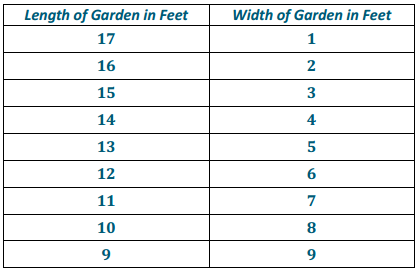
Theresa won a gardening contest and was awarded a roll of deer-proof fencing. The fencing is 36 feet long. She and her husband, John, discuss how to best use the fencing to make a rectangular garden. They agree that they should only use whole numbers of feet for the length and width of the garden.

a. What are all of the possible dimensions of the garden?
Answer:
Eureka Math Grade 6 Module 5 Lesson 10 Problem Set Answer Key 9

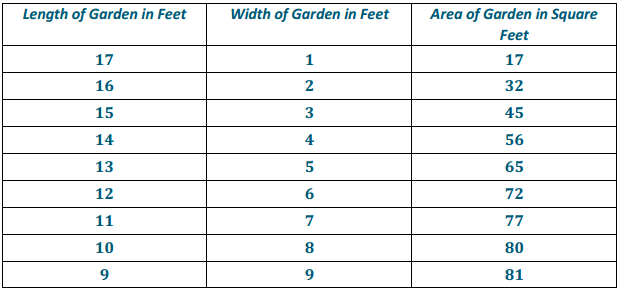
b. Which plan yields the maximum area for the garden? Which plan yields the minimum area?
Answer:
Eureka Math Grade 6 Module 5 Lesson 10 Problem Set Answer Key 10
The 9 ft. by 9 ft. garden would have the maximum area (81 ft2), while the 17 ft. by 1 ft. garden would have only 17 ft2 of garden space.

Question 5.
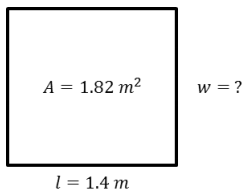
Write and then solve the equation to find the missing value below.
Eureka Math Grade 6 Module 5 Lesson 10 Problem Set Answer Key 11
Answer:
A = l × w
182 m2 = 1.4m × w
\(\frac{1.82 \mathrm{~m}^{2}}{1.4 \mathrm{~m}}\) = w
1.3 m = w

Question 6.
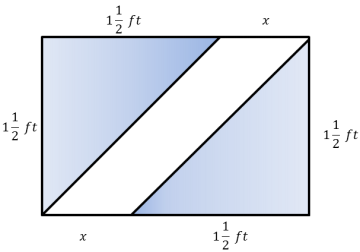
Challenge: This is a drawing of the flag of the Republic of the Congo. The area of this flag is 3\(\frac{3}{4}\) ft2.
Eureka Math Grade 6 Module 5 Lesson 10 Problem Set Answer Key 12

a. Using the area formula, tell how you would determine the value of the base. This figure is not drawn to scale.
Answer:
A = bh
A ÷ h = b
3\(\frac{3}{4}\) ft2 ÷ 1\(\frac{1}{2}\)ft. = b
2\(\frac{1}{2}\) ft. = b

b. Using what you found in part (a), determine the missing value of the base.
Ans:
2\(\frac{1}{2}\) ft. = 1\(\frac{1}{2}\) ft. + x
1 ft. = x

Eureka Math Grade 6 Module 5 Lesson 10 Exit Ticket Answer Key

Question 1.
The local school is building a new playground. This plan shows the part of the playground that needs to be framed with wood for the swing set. The unit of measure is feet. Determine the number of feet of wood needed to frame the area.
Eureka Math Grade 6 Module 5 Lesson 10 Exit Ticket Answer Key 13
Answer:
Perimeter: 10 ft. + 6 ft. + 6 ft. + 3 ft. + 3 ft. + 8 ft. + 8 ft. + 4 ft. = 48 ft.

Question 2.
The school wants to fill the area enclosed with wood with mulch for safety. Determine the number of square feet that needs to be covered by the mulch.
Answer:
Eureka Math Grade 6 Module 5 Lesson 10 Exercise Answer Key 1
Area of Left Rectangle = bh = (6 ft. x 10 ft.) = 60 ft2
Area of Right Rectangle = bh = (8 ft. X 4 ft.) = 32 ft2
Total Area = 60 ft2 + 32 ft2 = 92 ft2

Eureka Math Grade 6 Module 5 Lesson 9 Answer Key

Engage NY Eureka Math Grade 6 Module 5 Lesson 9 Answer Key

Eureka Math Grade 6 Module 5 Lesson 9 Example Answer Key

Example 1
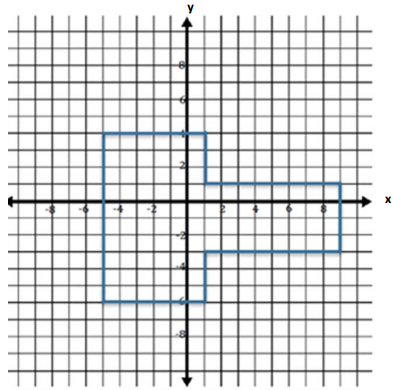
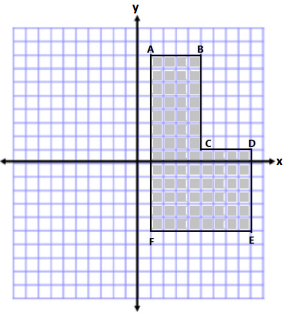
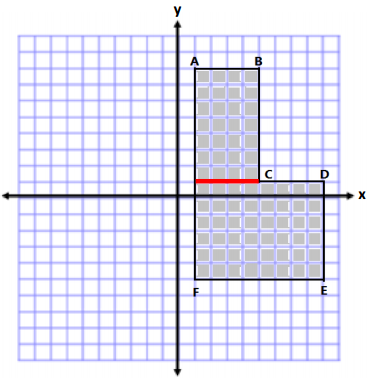
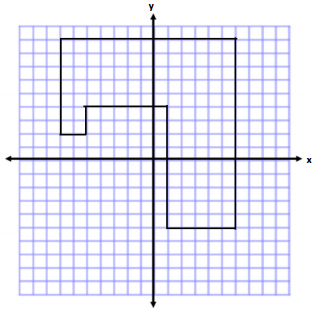
Jasjeet has made a scale drawing of a vegetable garden she plans to make in her backyard. She needs to determine the perimeter and area to know how much fencing and dirt to purchase. Determine both the perimeter and area.
Eureka Math Grade 6 Module 5 Lesson 9 Example Answer Key 1
Answer:
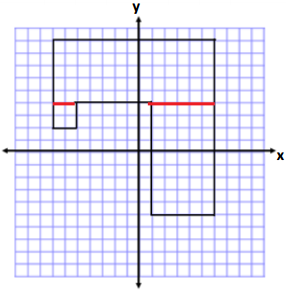
Eureka Math Grade 6 Module 5 LessonEureka Math Grade 6 Module 5 Lesson 9 Example Answer Key 2

AB = 4 units BC = 7 units CD = 4 units
DE = 6 units EF = 8 units AF = 13 units

Perimeter = 4 units + 7 units + 4 units + 6 units + 8 units + 13 units
Perimeter = 42 units

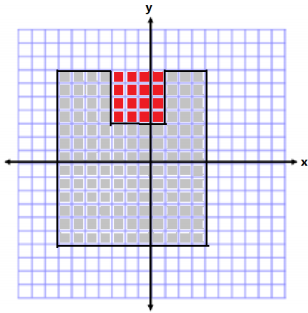
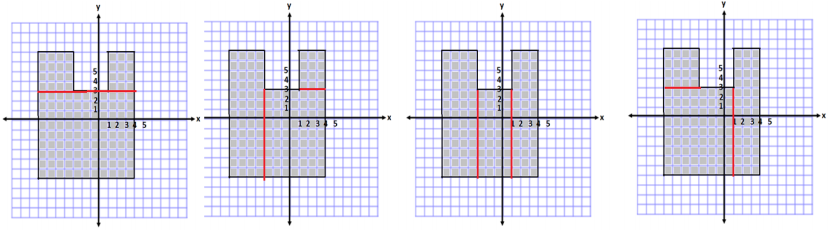
The area is determined by making a horizontal cut from (1, 1) to point C.
Area of Top
A = lw
A = (4 units)(7 units)
A = 28 units2

Area of Bottom
A = lw
A = (8 units) (6 units)
A = 48 units2

Total Area = 28 units2 + 48 units2
Total Area = 76 units2

Example 2:

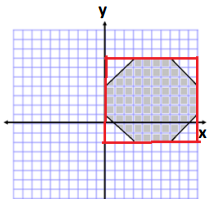
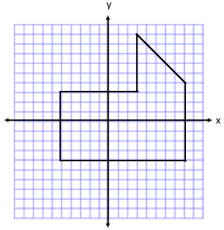
Calculate the area of the polygon using two different methods. Write two expressions to represent the two methods, and compare the structure of the expressions.
Eureka Math Grade 6 Module 5 Lesson 9 Example Answer Key 3
Answer:
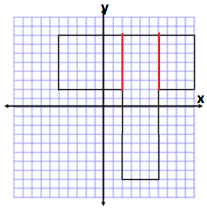
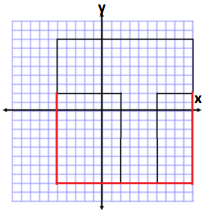
Answers will vary. The following are two possible methods. However, students could also break the shape into two
triangles and a rectangle or use another correct method.

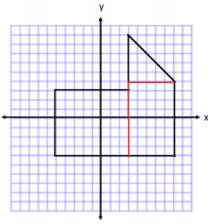
Method one:
Eureka Math Grade 6 Module 5 Lesson 9 Example Answer Key 4

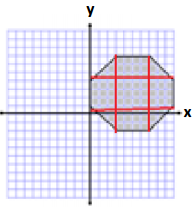
Method Two:
Eureka Math Grade 6 Module 5 Lesson 9 Example Answer Key 5

Area of Triangle 1 and 4
A = \(\frac{1}{2}\) bh
A = \(\frac{1}{2}\) (4 units)(3 units)
A = \(\frac{1}{2}\) (12 units2)
A = 6 units2
Since there are 2, we have a total area of 12 units2.

Area of Triangle 2 and 3
A = \(\frac{1}{2}\) bh
A = \(\frac{1}{2}\) (8 units)(3 units)
A = \(\frac{1}{2}\) (24 units2)
A = 12 units2
Since there are 2, we have a total area of 24 units2.

A = lw
A = (8 units) (6 units)
A = 48 units2

A = \(\frac{1}{2}\) bh
A = \(\frac{1}{2}\) (2 units)(3 units)
A = 3 units2

There are 4 triangles of equivalent base and height.
4(3 units2) = 12 units2

Total Area = 48 units2 – 12 units2
Total area = 36 units2

Total Area = 12 units2 + 24 units2 = 36 units2
Total area = 36 units2

Expressions:
2(\(\frac{1}{2}\)(4)(3)) + 2(\(\frac{1}{2}\)(8)(3)) or (8)(6) – 4(\(\frac{1}{2}\)(2)(3))

The first expression shows terms being added together because I separated the hexagon into smaller pieces and had to add their areas back together.
The second expression shows terms being subtracted because I made a larger outside shape and then had to take away the extra pieces.

Eureka Math Grade 6 Module 5 Lesson 9 Exercise Answer Key

Question 1.
Determine the area of the following shapes.

a. Eureka Math Grade 6 Module 5 Lesson 9 Exercise Answer Key 6
Answer:
Eureka Math Grade 6 Module 5 Lesson 9 Exercise Answer Key 7
Area of rectangle = lw
A = (10 units) (9 units)
A = 90 units 2

Area of Triangle
A = \(\frac{1}{2}\) bh
A = \(\frac{1}{2}\) (3 units) (3 units)
A = 4.5 units 2

4 triangles with equivalent base and height
4 (4.5 units 2) = 18 units2

Area = 90 units2 – 18 units2
Area = 72 units2

Please note the students may also choose to solve by decomposing. Here is another option.

Eureka Math Grade 6 Module 5 Lesson 9 Exercise Answer Key 8

b. Eureka Math Grade 6 Module 5 Lesson 9 Exercise Answer Key 9
Answer:
Eureka Math Grade 6 Module 5 Lesson 9 Exercise Answer Key 10

Area of Triangle 1
A = \(\frac{1}{2}\) bh
A = \(\frac{1}{2}\) (8 units)(3 units)
A = (4 units)(3 units)
A = 12 units2

Area of Triangles 2 and 4
A = \(\frac{1}{2}\) bh
A = \(\frac{1}{2}\) (5 units)(3 units)
A = \(\frac{1}{2}\) (15 units2)
A = 7.5 units2

Since triangles 2 and 4 have the same base and height measurements, the combined area is 15 units.

Area of Rectangle 3
A = bh
A = (5 units)(2 units)
A = 10 units2

Total Area = 12 units2 + 15 units2 + 10 units2
Total Area = 37 units2

Another correct solution might start with the following diagram:

Eureka Math Grade 6 Module 5 Lesson 9 Exercise Answer Key 11

Question 2.
Determine the area and perimeter of the following shapes.

a. Eureka Math Grade 6 Module 5 Lesson 9 Exercise Answer Key 12
Answer:
Eureka Math Grade 6 Module 5 Lesson 9 Exercise Answer Key 13

Area of Large Square

A = s2
A = (10 units)2
A = 100units2

Removed Piece
A = bh
A = (6 units)(4 units)
A = 24 units2

Area = 100 units2 – 24 units2
Area = 76 units2

Perimeter = 10 units + 6 units + 6 units + 4 units + 4 units + 10 units
Perimeter = 40 units

Other correct solutions might start with the following diagrams:

Eureka Math Grade 6 Module 5 Lesson 9 Exercise Answer Key 14

Eureka Math Grade 6 Module 5 Lesson 9 Exercise Answer Key 15

b. Eureka Math Grade 6 Module 5 Lesson 9 Exercise Answer Key 16
Answer:
Eureka Math Grade 6 Module 5 Lesson 9 Exercise Answer Key 17

Area:

Horizontal Area
A = bh
A = (15 units) (6 units)
A = 90 units2

Vertical Area
A = bh
A = (10 units) (4 units)
A = 40 units2

Total Area = 90 units2 + 40 units2
Total Area = 130 units2

Perimeter = 15 units + 6 units + 4 units + 10 units + 4 units + 10 units + 7 units + 6 units
Perimeter = 62 units

Other correct solutions might start with the following diagrams:

Eureka Math Grade 6 Module 5 Lesson 9 Exercise Answer Key 18

Eureka Math Grade 6 Module 5 Lesson 9 Exercise Answer Key 19

Eureka Math Grade 6 Module 5 Lesson 9 Problem Set Answer Key

Question 1.
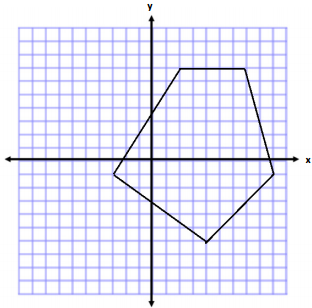
Determine the area of polygon.
Eureka Math Grade 6 Module 5 Lesson 9 Problem Set Answer Key 20
Answer:
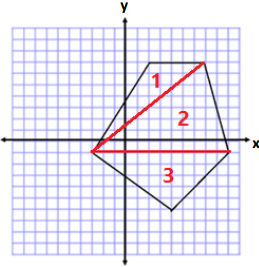
Eureka Math Grade 6 Module 5 Lesson 9 Problem Set Answer Key 21

Area of Triange 1
A = \(\frac{1}{2}\) bh
A = \(\frac{1}{2}\) (5 units)(8 units)
A = \(\frac{1}{2}\) (40 units2)
A = 20 units2

Area of Triangle 2
A = \(\frac{1}{2}\) bh
A = \(\frac{1}{2}\) (12 units)(8 units)
A = \(\frac{1}{2}\) (96 units2)
A = 48 units2

Area of Tnangle 3
A = \(\frac{1}{2}\) bh
A = \(\frac{1}{2}\) (12 units)( 5 units)
A = \(\frac{1}{2}\) (60 units2)
A = 30 units2

Total Area = 20 units2 + 48 units2 + 30 units2
Total Area = 98 units2

Question 2.
Determine the area and perimeter of the polygon.
Eureka Math Grade 6 Module 5 Lesson 9 Problem Set Answer Key 22
Answer:
Eureka Math Grade 6 Module 5 Lesson 9 Problem Set Answer Key 23

Area:

Horizontal Rectangle
A = bh
A = (13 units) (5 units)
A = 65 units2

Vertical Rectangle
A = bh
A = (5 units) (9 units)
A = 45 units2

Square
A = S2
A = (2 units)2
A = 4 units2

Total Area = 65 units2 + 45 units2 +4 units2
Total Area = 114 units2

Perimeter:

Perimeter = 2 units + 2 units + 7 units + 13 units + 14 units + 5 units + 9 units + 6 units
Perimeter = 58 units

Question 3.
Determine the area of the polygon. Then, write an expression that could be used to determine the area.
Eureka Math Grade 6 Module 5 Lesson 9 Problem Set Answer Key 27
Answer:
Eureka Math Grade 6 Module 5 Lesson 9 Problem Set Answer Key 28

Area of Rectangle on Left
A = lw
A = (8 units) (7 units)
A = 56 units2

Area of Rectangle on Right
A = lw
A = (5 units) (8 units)
A = 40 units2

Area of Triangle on Top
A = \(\frac{1}{2}\) bh
A = \(\frac{1}{2}\) (5 units)(5 units)
A = 12.5 units2

Total Area = 56 units2 + 40 units2 + 12.5 units2 = 108.5 units2
Expression: (8)(7) + (5)(8) + \(\frac{1}{2}\) (5)(5)

Question 4.
If the length of each square was worth 2 instead of 1, how would the area in Problem 3 change? How would your expression change to represent this area?
Answer:
If each length is twice as long, when they are multiplied, 2l × 2w = 41w. Therefore, the area will be four times larger when the side lengths are doubled.

I could multiply my entire expression by 4 to make it 4 times as big. 4 [(8)(7) + (5)(8) + \(\frac{1}{2}\) (5)(5)]

Question 5.
Determine the area of the polygon. Then, write an expression that represents the area.
Eureka Math Grade 6 Module 5 Lesson 9 Problem Set Answer Key 29
Answer:
Eureka Math Grade 6 Module 5 Lesson 9 Problem Set Answer Key 30

Area of Outside Rectangle
A = lw
A = (9 units) (16 units)
A = 144 units2

Area of Rectangle on Left
A = lw
A = (4 units) (8 units)
A = 32 units2

Area of Rectangle on Right
A = lw
A = (4 units) (3 units)
A = 12 units2

Total Area = 144 units2 – 32 units2 – 12 units2
Total Area = 100 units2
Expression: (9)(16) – (4)(8) – (4)(3)

Question 6.
Describe another method you could use to find the area of the polygon in Problem 5. Then, state how the expression for the area would be different than the expression you wrote.
Answer:
I could have broken up the large shape into many smaller rectangles. Then I would need to add all the areas of these rectangles together to determine the total area.

My expression showed subtraction because I created o rectangle that was larger than the original polygon, and then I had to subtract the extra oreos. If I break the shape into pieces, I would need to add the terms together instead of subtracting them to get the total area.

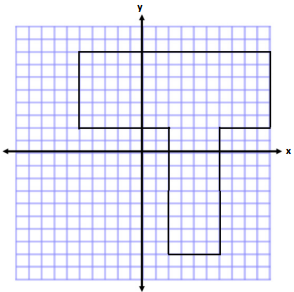
Question 7.
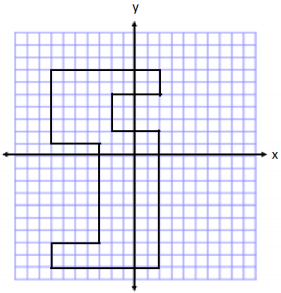
Write one of the letters from your name using rectangles on the coordinate plane. Then, determine the area and perimeter. (For help see Exercise 2(b). This irregular polygon looks sort of like a T.)
Answer:
Eureka Math Grade 6 Module 5 Lesson 9 Problem Set Answer Key 31
Answers will vary.

Eureka Math Grade 6 Module 5 Lesson 9 Exit Ticket Answer Key

Question 1.
Determine the area and perimeter of the figure below. Note that each square unit is 1 unit in length.
Eureka Math Grade 6 Module 5 Lesson 9 Exit Ticket Answer Key 24
Answer:
Eureka Math Grade 6 Module 5 Lesson 9 Exit Ticket Answer Key 25

Area:

Area of Large Rectangle
A = bh
A = (11 units)(13 units)
A = 143 units2

Area of Small Square
A = s2
A = (4units)2
A = 16 units2

Area of Irregular Shape
A = 143 units2 – 16 units2
A = 127 units2

Perimeter = 13 units + 4 units + 4 units + 4 units + 4 units + 3 units + 13 units + 11 units
Perimeter = 56 units

Other correct solutions might start with the following diagrams:

Eureka Math Grade 6 Module 5 Lesson 9 Exit Ticket Answer Key 26

Eureka Math Grade 6 Module 5 Lesson 9 Addition and Subtraction Equations Answer Key

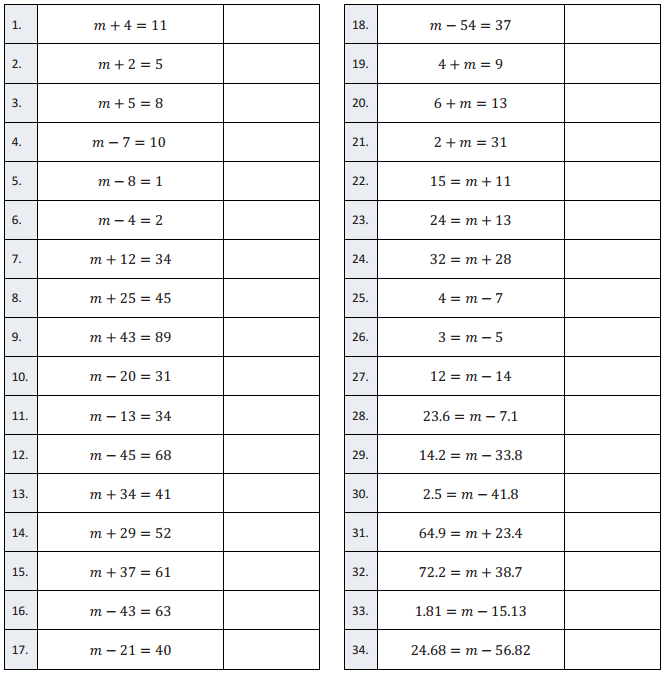
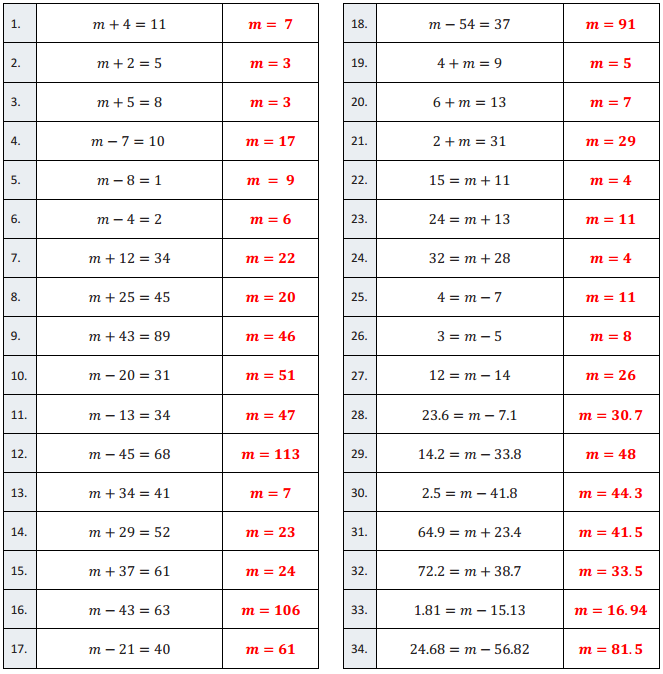
Addition and Subtraction Equations – Round 1:

Directions: Find the value of m in each equation.

Eureka Math Grade 6 Module 5 Lesson 9 Addition and Subtraction Equations Answer Key 32

Eureka Math Grade 6 Module 5 Lesson 9 Addition and Subtraction Equations Answer Key 33

Question 1.
m + 4 = 11
Answer:
m = 7

Question 2.
m + 2 = 5
Answer:
m = 3

Question 3.
m + 5 = 8
Answer:
m = 3

Question 4.
m – 7 = 10
Answer:
m = 17

Question 5.
m – 8 = 1
Answer:
m = 9

Question 6.
m – 4 = 2
Answer:
m = 6

Question 7.
m + 12 = 34
Answer:
m = 22

Question 8.
m + 25 = 45
Answer:
m = 20

Question 9.
m + 43 = 89
Answer:
m = 46

Question 10.
m – 20 = 31
Answer:
m = 51

Question 11.
m – 13 = 34
Answer:
m = 47

Question 12.
m – 45 = 68
Answer:
m = 113

Question 13.
m + 34 = 41
Answer:
m = 7

Question 14.
m + 29 = 52
Answer:
m = 23

Question 15.
m + 37 = 61
Answer:
m = 24

Question 16.
m – 43 = 63
Answer:
m = 106

Question 17.
m – 21 = 40
Answer:
m = 61

Question 18.
m – 54 = 37
Answer:
m = 91

Question 19.
4 + m = 9
Answer:
m = 5

Question 20.
6 + m = 13
Answer:
m = 7

Question 21.
2 + m = 31
Answer:
m = 29

Question 22.
15 = m + 11
Answer:
m = 4

Question 23.
24 = m + 13
Answer:
m = 11

Question 24.
32 = m + 28
Answer:
m = 4

Question 25.
4 = m – 7
Answer:
m = 11

Question 26.
3 = m – 5
Answer:
m = 8

Question 27.
12 = m – 14
Answer:
m = 26

Question 28.
23.6 = m – 7.1
Answer:
m = 30.7

Question 29.
14.2 = m – 33.8
Answer:
m = 48

Question 30.
2.5 = m – 41.8
Answer:
m = 44.3

Question 31.
64.9 = m + 23.4
Answer:
m = 41.5

Question 32.
72.2 = m + 38.7
Answer:
m = 33.5

Question 33.
1.81 = m – 15.13
Answer:
m = 16.94

Question 34.
24.68 = m – 56.82
Answer:
m = 81.5

Addition and Subtraction Equations – Round 1:

Directions: Find the value of m in each equation.

Eureka Math Grade 6 Module 5 Lesson 9 Addition and Subtraction Equations Answer Key 34

Eureka Math Grade 6 Module 5 Lesson 9 Addition and Subtraction Equations Answer Key 35

Question 1.
m + 2 = 7
Answer:
m = 5

Question 2.
m + 4 = 10
Answer:
m = 6

Question 3.
m + 8 = 15
Answer:
m = 7

Question 4.
m + 7 = 23
Answer:
m = 16

Question 5.
m + 12 = 16
Answer:
m = 4

Question 6.
m – 5 = 2
Answer:
m = 7

Question 7.
m – 3 = 8
Answer:
m = 11

Question 8.
m – 4 = 12
Answer:
m = 16

Question 9.
m – 14 = 45
Answer:
m = 59

Question 10.
m + 23 = 40
Answer:
m = 17

Question 11.
m + 13 = 31
Answer:
m = 18

Question 12.
m + 23 = 48
Answer: 25
m =

Question 13.
m + 38 = 52
Answer:
m = 14

Question 14.
m – 14 = 27
Answer:
m = 13

Question 15.
m – 23 = 35
Answer:
m = 12

Question 16.
m – 17 = 18
Answer:
m = 35

Question 17.
m – 64 = 1
Answer:
m = 65

Question 18.
6 = m + 3
Answer:
m = 3

Question 19.
12 = m + 7
Answer:
m = 5

Question 20.
24 = m + 16
Answer:
m = 8

Question 21.
13 = m + 9
Answer:
m = 4

Question 21.
32 = m – 3
Answer:
m = 35

Question 23.
22 = m – 12
Answer:
m = 34

Question 24.
34 = m – 10
Answer:
m = 44

Question 25.
48 = m + 29
Answer: 19

Question 26.
21 = m + 17
Answer:
m = 4

Question 27.
52 = m + 37
Answer:
m = 15

Question 28.
\(\frac{6}{7}\) = m + \(\frac{4}{7}\)
Answer:
m = \(\frac{2}{7}\)

Question 29.
\(\frac{2}{3}\) = m – \(\frac{5}{3}\)
Answer:
m = \(\frac{7}{3}\)

Question 30.
\(\frac{1}{4}\) = m – \(\frac{8}{3}\)
Answer:
m = \(\frac{35}{12}\)

Question 31.
\(\frac{5}{6}\) = m – \(\frac{7}{12}\)
Answer:
m = \(\frac{17}{12}\)

Question 32.
\(\frac{7}{8}\) = m – \(\frac{5}{12}\)
Answer:
m = \(\frac{31}{24}\)

Question 33.
\(\frac{7}{6}\) + m = \(\frac{16}{3}\)
Answer:
m = \(\frac{25}{6}\)

Question 34.
\(\frac{1}{3}\) + m = \(\frac{13}{15}\)
Answer:
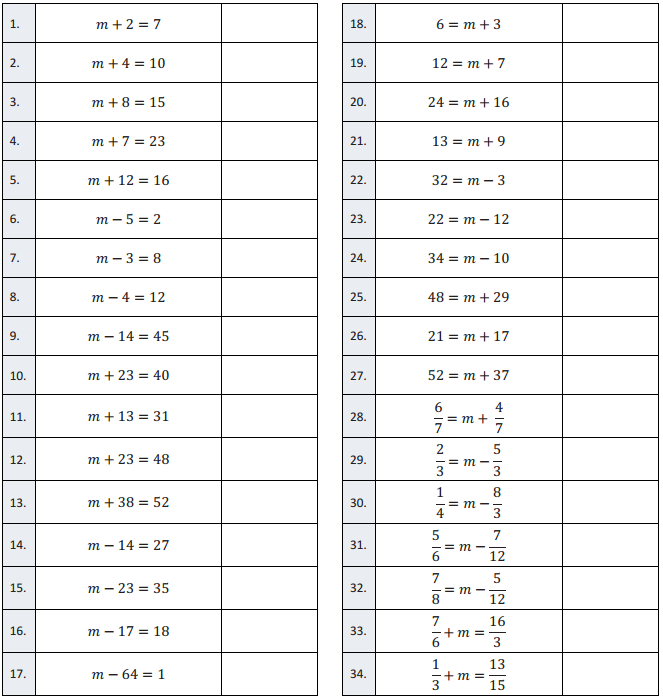
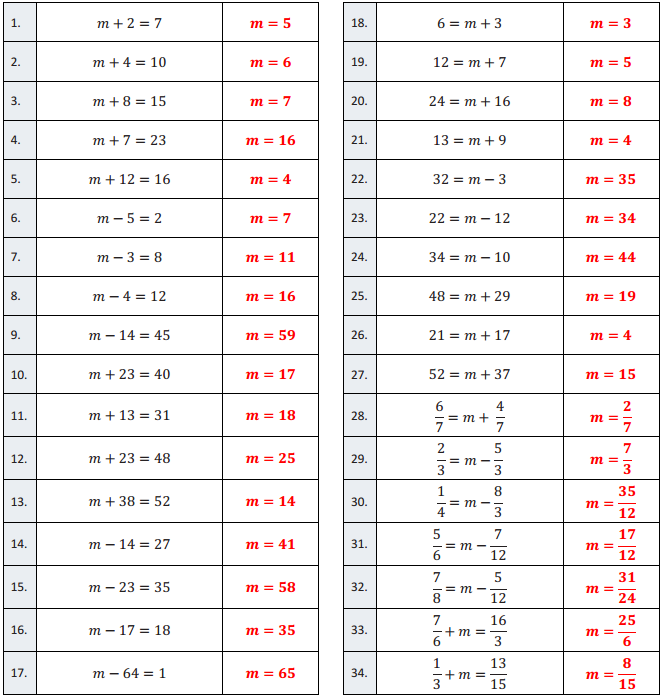
m = \(\frac{8}{15}\)