Everyday Math Grade 5 Answers Unit 6 Investigations in Measurement; Decimal Multiplication and Division

Everyday Mathematics 5th Grade Answer Key Unit 6 Investigations in Measurement; Decimal Multiplication and Division

Everyday Mathematics Grade 5 Home Link 6.1 Answers

Multiplying and Dividing by Powers of 10

Use the ideas below to help you solve Problems 1–9
To multiply by a power of 10, move the decimal point to the right of the number of places indicated by the exponent. For example, to multiply by 103, move the decimal point to the right 3 places. This works because the exponent tells the number of times a start number is multiplied by 10. Each time a number is multiplied by 10, the digits shift 1 place to the left, which moves the decimal point 1 place to the right.
Example: 4.3 × 103 = 4.3 × 10 × 10 × 10 = 4,300

To divide by a power of 10, move the decimal point to the left of the number of places indicated by the exponent. For example, to divide by 103, move the decimal point to the left in 3 places. This works because dividing by 10 is the same as multiplying by \(\frac{1}{10}\). Each time a number is multiplied by \(\frac{1}{10}\), the digits shift from 1 place to the right, which moves the decimal point from 1 place to the left.
Example: 4.3 ÷ 103 = 4.3 ÷ (10 × 10 × 10) = 4.3 ÷ 1,000 = 0.0043

Question 1.
6.8 × 102 = _________
Answer:

6.8 x (10 × 10) = 6.8×100 = 680

Question 2.
43.9 ÷ 102 = _________
Answer:

43.9 ÷ (10 × 10) = 43.9 ÷ 100 =0.439

Question 3.
237.5 ÷ 102 = _________
Answer:

237.5 ÷ (10 × 10) = 237.5 ÷ 100 = 2.375

Question 4.
5.29 × 104 = _________
Answer:

5.29 x (10 x 10 x 10 x 10) = 5.29 x 10000 = 52900

Question 5.
13.2 ÷ 103 = __________
Answer:

13.2 ÷ (10 × 10 × 10) = 13.2 ÷ 1,000 = 0.0132

Question 6.
71.8 × 103 = _________
Answer:

71.8 x (10 x 10 x 10) = 71.8 x 1000 = 71800

Question 7.
9.4 × 105 = _______
Answer:

9.4 x (10 x 10 x 10 x 10 x 10) = 9.4 x 100000 = 940000

Question 8.
3.6 ÷ 104 = _________
Answer:

3.6 ÷ (10 × 10 × 10 x 10) = 3.6 ÷ 10000 = 0.00036

Question 9.
Explain how you moved the decimal point in Problem 2 and why. Use clear mathematical language.
Answer:

In problem 2, there is division. In the case of division, we should move the decimal point to the left side in the numerator concerning the number of zeroes in the denominator. There are two zeroes in problem 2, so we have to move two decimal points left side.

Practice
Question 10.
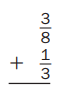
Everyday Mathematics Grade 5 Home Link 6.1 Answers 1
Answer:

Question 11.
Everyday Mathematics Grade 5 Home Link 6.1 Answers 2
Answer:


Everyday Math Grade 5 Home Link 6.2 Answer Key

Playing Exponent Ball

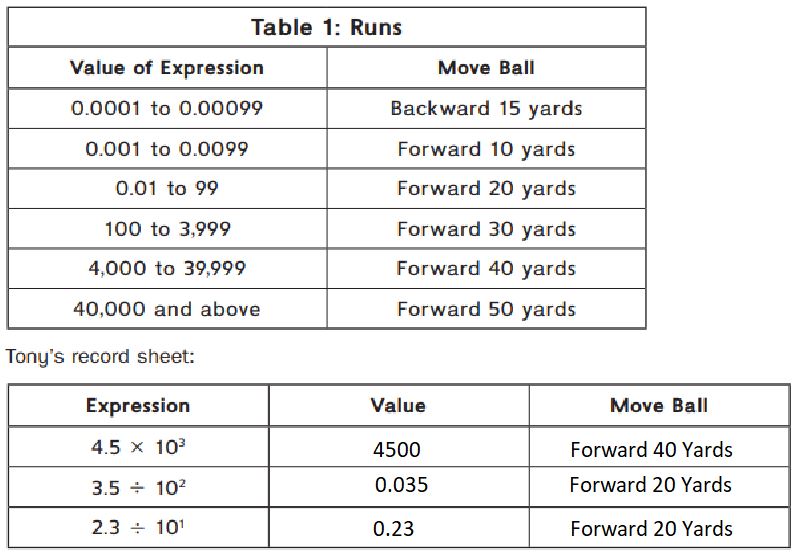
Tony is playing Exponent Ball. He wrote down each of his expressions but wasn’t sure how far to move the ball on each play.
Question 1.
Complete Tony’s record sheet. Use Table 1 to determine the number of yards to move the ball.
Everyday Math Grade 5 Home Link 6.2 Answer Key 1
Answer:


Question 2.
Choose one of the expressions. Explain how you found the value and determined how far to move the ball.
Answer:

In the first expression, there is multiplication. So, we have to move the decimal to the right side. Hence, there are 3 zeroes, decimal is moved to right up to three values. And also with the help of the above table, 4500 lies between 4000 to 39,999. So, the ball should be Forwarded 40 Yards.

Practice
Question 3.
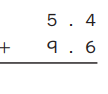
Everyday Math Grade 5 Home Link 6.2 Answer Key 2
Answer:

Question 4.
Everyday Math Grade 5 Home Link 6.2 Answer Key 3
Answer:

Question 5.
Everyday Math Grade 5 Home Link 6.2 Answer Key 4
Answer:

Everyday Mathematics Grade 5 Home Link 6.3 Answers

Solving Conversion Problems

Question 1.
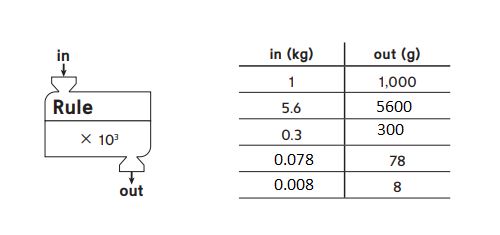
Convert between kilograms (kg) and grams (g) to complete the table below.
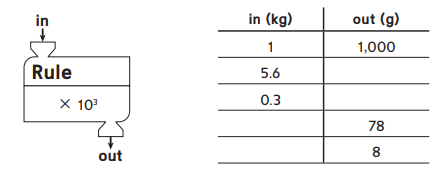
Everyday Mathematics Grade 5 Home Link 6.3 Answers 1
Answer:

Question 2.
What rule could you use to convert from grams to kilograms? Hint: How can you find them in number if you know the outnumber? Use exponential notation.
Answer: 1000 grams is equal to 1kg i.e., (1 Kg = 103 ).

Use the rules from Problems 1 and 2 to help you solve the number stories below. Show your work. Label the units for each step.
Question 3.
Micah has a cat and a parrot. Her cat weighs 2.3 kg and her parrot weighs 65 g. How many more kilograms does the cat weigh than the parrot?
The cat weighs _________ kg more than the parrot.
Answer:

The cat weighs 2.235 kg more than the parrot.

Question 4.
Jasmine’s dog weighs 15 kg. The dog’s collar weighs 200 g. How many grams does the dog weigh when it is wearing its collar?
The dog weighs _______ g with its collar.
Answer:

The dog weighs 14,800 g with its collar

Practice
Solve.
Question 5.
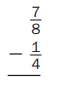
Everyday Mathematics Grade 5 Home Link 6.3 Answers 2
Answer:

Question 6.
Everyday Mathematics Grade 5 Home Link 6.3 Answers 3
Answer:


Everyday Math Grade 5 Home Link 6.4 Answer Key

Using Line Plots to Analyze Growth

Sammy and Marla are keeping track of how much they grow each month.
Question 1.
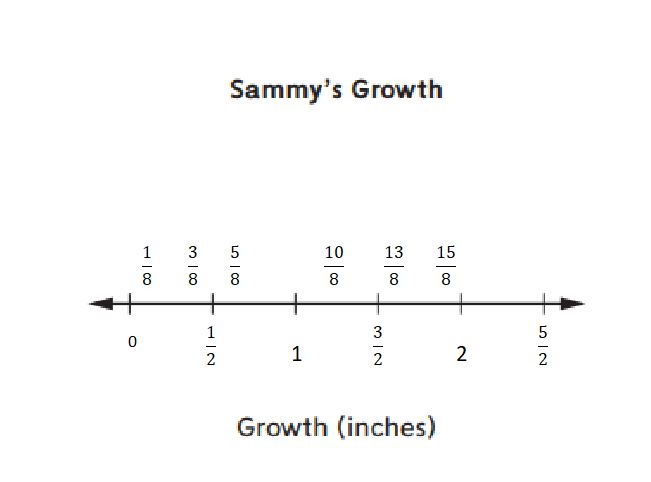
a. Use the information in the table to make a line plot to show Sammy’s growth.
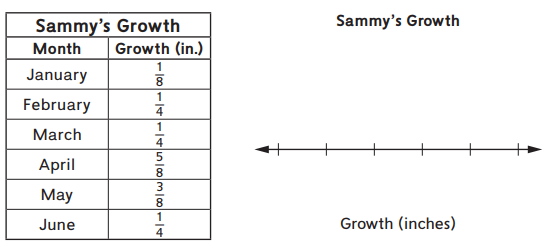
Everyday Math Grade 5 Home Link 6.4 Answer Key 1
Answer:


b. How much did Sammy grow in 6 months? ________ inches
Answer:

15/8 inches. 

Question 2.

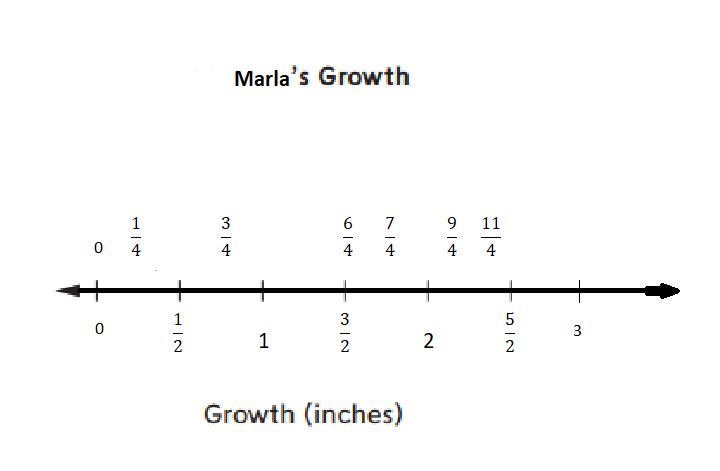
a. Use the information in the table to make a line plot to show Marla’s growth.
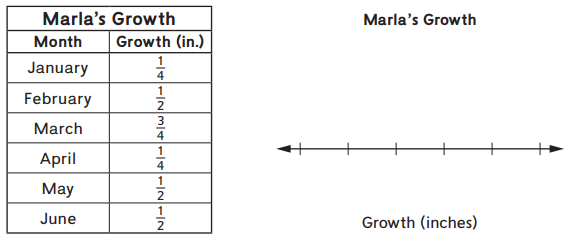
Everyday Math Grade 5 Home Link 6.4 Answer Key 2
Answer:

b. How much did Marla grow in 6 months? ________ inches
Answer:

11/4 inches

Question 3.
a. Who grew more in 6 months, Sammy or Marla?
b. How much more?
c. Write a number model to show how you solved Part b.
Answer:

a. Marla grew more in 6 months.

b. 7/8 inches more than Sammy

c. Marla’s Height = 11/4 = 22/8

Sammy’s Height = 15/8

Therefore, 22/8-15/8 = 7/8.

Everyday Mathematics Grade 5 Home Link 6.5 Answers

A Milkshake Problem

Rachel is having a slumber party with 7 friends. Her mom made a big batch of milkshakes. Rachel’s little brother tried to help by pouring the milkshakes in glasses, but he had trouble pouring the same amount into each glass

Everyday Mathematics Grade 5 Home Link 6.5 Answers 1
Question 1.
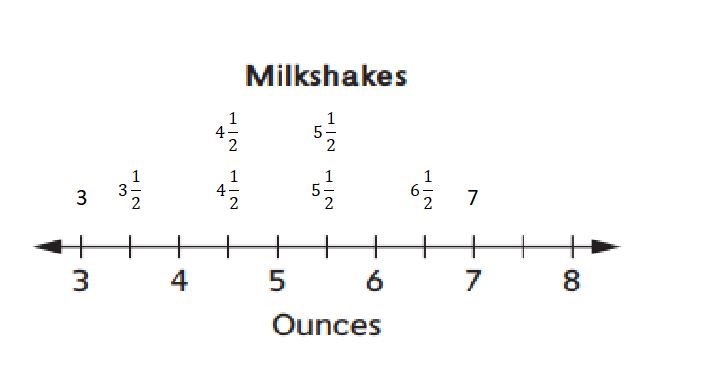
Plot the amount of milkshake in each glass on the line plot below.
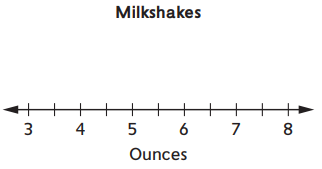
Everyday Mathematics Grade 5 Home Link 6.5 Answers 2
Answer:

Rachel wants to even out the servings so that everyone will get the same amount of milkshakes. Answer the questions to help you figure out how many ounces Rachel should pour into each glass.

Remember: To even out data, add all the numbers in the data set, and then divide by the number of data points.
Question 2.
a. How many total ounces of milkshake did Rachel’s mom make? __________ ounces

Answer:

40 ounces of milkshakes
b. How many glasses of milkshake are needed? __________ glasses

Answer:

8 glasses are needed because there are a total of 8 members (1+7)

c. Write a number model that represents dividing the milkshake evenly among all the glasses. __________

Answer:

To divide the milkshake evenly among all the glasses,

Number of  ounces of milkshake / total members

i.e., 40 ounces / 8 members = 5

therefore, 5 ounces of milkshake should be poured into each glass for evenly distribution.

d. How many ounces of milkshake will each friend get? __________ ounces
Answer:

5 ounces of milkshake will each friend get

Practice
Solve.
Question 3.
7.6 × 102 = __________
Answer:

7.6 x (10 x 10) = 760

Question 4.
18.2 ÷ 102 = __________
Answer:

18.2 ÷ (10 x 10) = 0.182

Question 5.
779.5 ÷ 104 = __________
Answer:

779.5 ÷ (10 x 10 x 10 x 10) = 0.7795

Question 6.
81.23 × 104 = __________
Answer:

81.23 × (10 x 10 x 10 x 10) = 0.008123

Everyday Math Grade 5 Home Link 6.6 Answer Key

Using Volume Formulas

Formulas for Volume of a Rectangular Prism
V = l ∗ w ∗ h
V = B ∗ h

Use either of the volume formulas to help you solve the problems below. Write a number model to show how you found the volume. You may use a calculator.
Question 1.
The Aon Center in Chicago is a tall square tower. Its base covers an area of about 37,636 square feet. The building is about 1,136 feet tall. What is the volume of the Aon Center?
Volume: about _____________ cubic feet
Number model: _________________
Answer:

Volume: about 42,754,496 cubic feet
Number model:

37,636*1,136 = 42,754,496

Question 2.
The Great Wall of China is about 20 feet high and about 15 feet wide. What is the volume of a 1-mile section of the wall? (The whole wall is more than 5,000 miles long!)
Hint: 1 mile = 5,280 feet
Volume: about _____________ cubic feet
Number model: _____________
Answer:

Volume: about 1,584,000 cubic feet
Number model:  5,280*20*15 = 1,584,000

Question 3.
The Cathedral of Notre Dame in Paris, France covers an area of 4,800 square meters. The roof is about 43 meters high. What is the volume of the interior of the cathedral?
Volume: about _____________ cubic meters
Number model: _____________
Answer:

Volume: about 206,400 cubic meters
Number model:  4,800*43 =206,400

Practice
Multiply. Show your work.
Question 4.
\(\frac{2}{3}\) ∗ 34 = ________
Answer:

= 2/3 x 34

= 68/3

Question 5.
72 ∗ \(\frac{1}{7}\) = _________
Answer:

= 72 x 1/7

= 72/7

Everyday Mathematics Grade 5 Home Link 6.7 Answers

Volume in Milliliters and Cubic Centimeters

Solve the problems below. Use V = l × w × h and V = B × h to help you solve. Record the volumes in cubic centimeters and milliliters. Remember: 1 cm3 = 1 mL
Question 1.
The area of the base of a pencil case is 100 square centimeters. The pencil case is 5 centimeters tall. What is the volume of the pencil case?
_____________ cm3
_____________ mL
Answer:

The volume of the pencil case is 500 cm3

The volume of the pencil case is 500 mL

Question 2.
A small aquarium is 20 centimeters long and 25 centimeters wide. The water in the aquarium is 20 centimeters high. What is the volume of the water in the aquarium?
_____________ cm3
_____________ mL
Answer:

The volume of the water in the aquarium is 10,000 cm3

The volume of the water in the aquarium is 10,000 mL

Question 3.
Alex has a calibrated bottle. The water level is at the 0 mL mark. When Alex places a baseball under the water, the water level rises to the 200 mL mark. What is the volume of the baseball?
_____________ cm3
_____________ mL
Answer:

The volume of the baseball is 200 cm3

The volume of the baseball is 200 mL

Question 4.
For each problem above, which unit of volume makes more sense? Explain your answers.
a. Problem 1:
Answer:

Units of values vary but the value remained constant. Hence, both units of volumes are the same in expressing the value.

b. Problem 2:
Answer:

Units of values vary but the value remained constant. Hence, both units of volumes are the same in expressing the value.

c. Problem 3:
Answer:

Units of values vary but the value remained constant. Hence, both units of volumes are the same in expressing the value.

Practice
Multiply.
Question 5.
\(\frac{7}{8}\) ∗ \(\frac{1}{2}\) = _________
Answer:

= 7/8 x 1/2

= 7×1 / 8×2

= 7/16

Question 6.
\(\frac{5}{9}\) ∗ \(\frac{5}{6}\) = __________
Answer:

= 5/9 x 5/6

= 5×5 / 9×6

= 25/54

Everyday Math Grade 5 Home Link 6.8 Answer Key

Estimating Decimal Products and Quotients

Kyle and Emma came up with different answers to their homework. For each problem, make an estimate. Write a number sentence to show how you estimated. Then circle the student who has the correct answer.
Question 1.
8.82 ÷ 1.4 = ? Estimate: ___________
Kyle: 63
Emma: 6.3
Answer:

The estimated value is 6.3.

Because 1.4 x 6.3 nearly equals 8.82

Emma has the correct answer


Question 2.
17.6 ∗ 8.5 = ? Estimate: ___________
Kyle: 149.6
Emma: 14.96
Answer:

Estimated value is 149.6

Because when 17.6 x 8.5 equals to 149.6

Kyle has the correct answer

Question 3.
2,812.95 ÷ 89.3 = ? Estimate: ___________
Kyle: 31.5
Emma: 315.0
Answer:

Estimated value  is 31.5

Because, when 2,812.95 ÷ 89.3 equals to 31.5

Kyle has the correct answer

Question 4.
65.2 ∗ 112.5 = ? Estimate: ___________
Kyle: 733.5
Emma: 7,335
Answer:

Estimated value is 7,335

Because, when 65.2 x 112.5 equals 7,335

Emma has the correct answer


Question 5.
209.1 ÷ 24.6 = ? Estimate: ___________
Kyle: 8.5
Emma: 85.0
Answer:

Estimated value is 8.5

Because, When 24.6 x 8.5 equals 209.1

Kyle has the answer

Question 6.
3.6 ∗ 0.25 = ? Estimate: ___________
Kyle: 9.0
Emma: 0.9
Answer:

Estimated value is  0.9

Because, When 3.6 x 0.25  equals 0.9

Emma has the answer.

Practice
Make an estimate. Then solve.
Question 7.
526 ÷ 17 =?
Everyday Math Grade 5 Home Link 6.8 Answer Key 1
Answer:

Question 8.
\(\frac{1963}{88}\) = ?
Everyday Math Grade 5 Home Link 6.8 Answer Key 1
Answer:

Everyday Mathematics Grade 5 Home Link 6.9 Answers

Multiplying Decimals

Today you learned two different strategies for multiplying decimals. Try to use each decimal multiplication strategy at least once to solve Problems 1–4. Show your work on the back of this page.

Estimation Strategy
Make an estimate.
Multiply as if the factors were whole numbers.
Use your estimate to insert a decimal point in the product.
Example: 70.4 ∗ 18.6 = ?
Think: 70 ∗ 20 is about 1,400.
704 ∗ 186 = 130,944
The product should be close to 1,400, so it must be 1,309.44.

Shifting the Decimal Point Strategy
Multiply each factor by a power of 10 to get whole numbers.
Multiply the whole-number factors.
“Undo” the multiplication by powers of 10. Think about how dividing by the same powers of 10 would shift the decimal point in the answer.
Example: 70.4 ∗ 18.6 = ?
70.4 ∗ 101 = 704 18.6 ∗ 101 = 186
704 ∗ 186 = 130,944
Think: Dividing by 101 will shift the decimal point from 1 place to the left, and dividing by the other 101 will shift the decimal point to another place to the left.
I need to shift it to two places in all. So
70.4 ∗ 18.6 = 1,309.44.

Question 1.
81.3 ∗ 47.5 = ________
Answer:

= (81.3 x 10) * (47.5 x 10)

= (813) * (475)

= 3,86175

by move two decimal points to left side,

Therefore, 81.3 ∗ 47.5 = 3,861.75

Question 2.
7.8 ∗ 215.6 = __________
Answer:

Estimated value is 1,720

(7.8*10) * (215.6*10)

78 x 2156

168,168

Shifting the two decimal points to left side,

= 1681.68

The product should be close to 1,720, so it must be 1681.68

Question 3.
0.57 ∗ 3.0 = ________
Answer:

Estimated value is 1.5

(0.57*100) * (3*100)

57 x 300

17,100

Shifting the four decimal points to left side,

= 1.71

The product should be close to 1.5, so it must be 1.71

1.71

Question 4.
1,094.25 ∗ 22.6 = ___________
Answer:

Estimated value is 25,162

(1,094.25*100) * (22.6*100)

109425 *2260

247300500

Shifting the four decimal points to left side,

= 24730.05

The product should be close to 25,162 , so it must be 24,730.

Practice
Solve. Show your work on the back of this page.
Question 5.
\(\frac{1}{9}\) ÷ 5 = _______
Answer:

= 1/9 ÷ 5

= 1/ (9 x 5)

= 1/45

Question 6.
\(\frac{1}{2}\) ÷ 12 = _______
Answer:

= 1/2 ÷ 12

= 1/ (2 x 12)

= 1/24

Everyday Math Grade 5 Home Link 6.10 Answer Key

Checking Whether My Answer Makes Sense

Question 1.
Pizza by the Pan sold 4 dozen pizzas in the afternoon. That night, they sold 2.5 times as many pizzas as they did during the afternoon. How many pizzas did they sell in all that day? Show your work and check whether your answer makes sense. Show how you can tell that your answer makes sense.
Answer:

Number of pizzas sold in the afternoon = 4 dozens = 4 x 12 = 48

Number of pizzas sold in the night = 2.5 times the pizzas sold in the afternoon = 2.5 x 48 = 120

Therefore, Total number of pizzas sold in a day is 48 + 120 =168.

Practice
Divide. Show your work on the back of this page.
Question 2.
6 ÷ \(\frac{1}{3}\) = _________
Answer:

= 6 ÷ 1/3

= (6 x 3) /1

= 18

Question 3.
10 ÷ \(\frac{1}{4}\) = __________
Answer:

= 10 ÷ 1/4

= (10 x 4) /1

= 40

Everyday Mathematics Grade 5 Home Link 6.11 Answers

Dividing Decimals by Whole Numbers

For Problems 1 and 2:

  • Make an estimate. Write a number sentence to record your estimate.
  • Divide as if the dividend were a whole number. Show your work on the computation grid.
  • Use your estimate to place the decimal point. Record your answer.

Question 1.
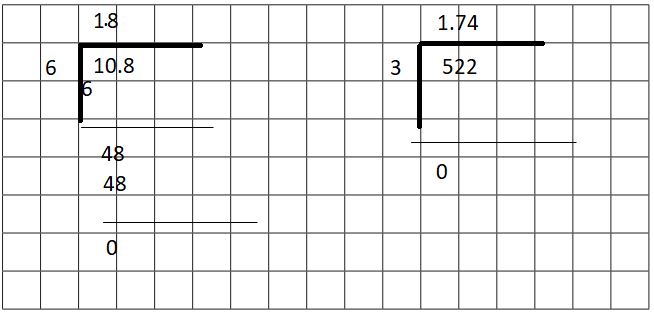
\(\frac{10.8}{6}\) = ?
Estimate: _________

\(\frac{10.8}{6}\) = _________
Answer:

Estimate : 1.67

= (10.8*10) / (6)

108/6

18.0

By shifting the one decimal point to the left side, it is 1.8

It is very close to 1.67. Then it must be 1.8

Question 2.
\(\frac{5.22}{3}\) = ?
Estimate: _________

\(\frac{5.22}{3}\) = _________
Answer:

Estimate : 1.66

= (5.22*100) / (3)

522/3

174.0

By shifting the two decimal points to the left side, it is 1.74

It is very close to 1.66. Then it must be 1.74
Everyday Mathematics Grade 5 Home Link 6.11 Answers 1

Answer:

Practice
Multiply. Show your work.
Question 3.
\(\frac{2}{5}\) ∗ 30 = _______
Answer:

= 2/5 * 30

= 2*30 /5

= 60/5 =12

Question 4.
16 ∗ \(\frac{1}{3}\) = ________
Answer:

= 16*1 /3

= 16/3

Everyday Math Grade 5 Home Link 6.12 Answer Key

Dividing by Decimals

For Problems 1–3:

  • Rewrite the problem as an equivalent problem that has a whole-number divisor. Be sure to multiply the dividend and divisor by the same number.
  • Solve the equivalent problem using any method you wish. If you don’t solve the problem mentally, show your work.
  • Record your answer to the equivalent problem and the original problem.

One example is done for you.

Example: 2.8 ÷ 0.4 = ?
Think: Multiplying 0.4 by 10 will give me a whole number, so I should also multiply 2.8 by 10 to make an equivalent problem.
(2.8 ∗ 10) ÷ (0.4 ∗ 10) = 28 ÷ 4
Equivalent problem: 28 ÷ 4 = ?
Answer to equivalent problem: 7
2.8 ÷ 0.4 = 7

Question 1.
7.2 ÷ 0.6 = ?
Equivalent problem: ___________
Answer to equivalent problem: ___________
7.2 ÷ 0.6 = ___________
Answer:

(7.2 * 10) ÷ (0.6 ∗ 10) = 72 ÷ 6

Equivalent problem:  72 ÷ 6

Answer to equivalent problem: 12

7.2 ÷ 0.6 = 12

Question 2.
44 ÷ 0.5 = ?
Equivalent problem: ___________
Answer to equivalent problem: ___________
44 ÷ 0.5 = ___________
Answer:

(44 * 10) ÷ (5) = 440÷5

Equivalent problem:  440 ÷ 5

Answer to equivalent problem: 88

44 ÷ 0.5 = 88

Question 3.
1.92 ÷ 0.16 = ?
Equivalent problem: ___________
Answer to equivalent problem: ___________
1.92 ÷ 0.16 = ___________
Answer:

(1.92 * 100) ÷ (0.16 * 100) = 192÷16

Equivalent problem:  192 ÷ 16

Answer to equivalent problem: 12

1.92 ÷ 0.16 = 12


Practice
Add. Show your work on the back of this page.
Question 4.
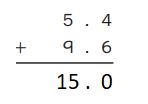
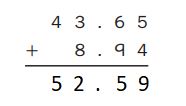
6.48 + 9.34 = ___________
Estimate: ___________
Answer:

Estimate = 15.8

Answer = 15.82

Question 5.
15.71 + 12.2 = ___________
Estimate: ___________
Answer:

Estimate = 28

Answer = 27.91

Everyday Mathematics Grade 5 Home Link 6.13 Answers

Interpreting Reaction-Time Data

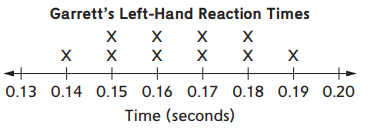
Garrett tried the Grab-It Gauge experiment with his left hand. He recorded his results on the line plot below. Use the data to answer the questions.
Everyday Mathematics Grade 5 Home Link 6.13 Answers 1
Question 1.
Which time(s) came up most often for Garrett? ___________ sec
Answer:

0.15,0.16,0.17,0.18 (each two times) came up most often for Garrett

Question 2.
Write Garrett’s reaction times in order from fastest to slowest.
Answer:

0.19, 0.18, 0.18, 0.17, 0.17, 0.16, 0.16, 0.15, 0.15, 0.14  are reaction times from fastest to lowest.

Question 3.
What is the difference between Garrett’s fastest time and his slowest time?
___________ sec
Answer:

Fastest time = 0.19 secs

Slowest time = 0.14 secs

Difference = 0.19-0.14 = 0.05

Therefore, the difference between Garrett’s fastest time and his slowest time is 0.05 secs.

Question 4.
What is Garrett’s evened-out reaction time? Record your calculations.
Expression: ___________
Evened-out reaction time: ___________ sec
Answer:

Question 5.
What would you say is a typical reaction time for Garrett’s left hand? Why?
Answer:

0.165 is is a typical reaction time for Garrett’s left hand because it is mean for the given reaction times.

Practice
Subtract. Show your work on the back of this page.
Question 6.
5.63 – 2.19 = ___________
Estimate: ___________
Answer:

Estimate = 3.5

Answer = 3.44

Question 7.
44.12 – 3.85 = ___________
Estimate: ___________
Answer:

Eestimate = 40

Answer = 40.27


Everyday Math Grade 5 Answers Unit 5 Operations with Fractions

Everyday Mathematics 5th Grade Answer Key Unit 5 Operations with Fractions

Everyday Mathematics Grade 5 Home Link 5.1 Answers

Using Equivalent Fractions to Solve Problems

Question 1.
Fill in the equivalent fractions in the table below.
Everyday Mathematics Grade 5 Home Link 5.1 Answers 1
Answer:
Everyday Math Grade 5 Answers Unit 5 Operations with Fractions-1
Estimation:
Filled in the equivalent fractions in the table above as
\(\frac{1}{2}\) X 2 = \(\frac{3}{6}\),
\(\frac{1}{2}\) X 5 = \(\frac{5}{10}\),
\(\frac{2}{3}\) X 2 = \(\frac{4}{6}\),
\(\frac{2}{3}\) X 4 = \(\frac{8}{12}\),
\(\frac{2}{3}\) X 6 = \(\frac{12}{18}\),
\(\frac{3}{4}\) X 3 = \(\frac{9}{12}\),
\(\frac{3}{4}\) X 5 = \(\frac{15}{20}\).

Estimate. Then solve by finding fractions with a common denominator. Write a number sentence to show which fractions you used.
Example: \(\frac{1}{3}\) + \(\frac{7}{12}\) = ?
Estimate: close to 1, because \(\frac{1}{3}\) is less than \(\frac{1}{2}\), and \(\frac{7}{12}\) is a little more than \(\frac{1}{2}\).
Common denominator: 12
Number sentence: \(\frac{4}{12}\) + \(\frac{7}{12}\) = ?
Answer:
\(\frac{11}{12}\),

Explanation:
Given to find \(\frac{1}{3}\) + \(\frac{7}{12}\) = ,
As both denominators are different first we need to
make common denominators means we need to multiply
numerator and denominator by 4 as
\(\frac{1}{3}\) X 4 = \(\frac{1 X 4}{3 X 4}\) =
\(\frac{4}{12}\) now we add as
\(\frac{4}{12}\) + \(\frac{7}{12}\) as
denominators are common as 12 we add numerators as
\(\frac{4 + 7}{12}\) = \(\frac{11}{12}\),
therefore common denominator is 12 and
Number sentence: \(\frac{4}{12}\) + \(\frac{7}{12}\) =
\(\frac{11}{12}\).

Question 2.
\(\frac{6}{8}\) – \(\frac{1}{2}\) = ?
Everyday Mathematics Grade 5 Home Link 5.1 Answers 2
Common denominator: _____8_____
Number sentence: _____\(\frac{6}{8}\) – \(\frac{1}{2}\) = \(\frac{2}{8}\),
Answer:
Common denominator: 8,
Number sentence: \(\frac{6}{8}\) – \(\frac{1}{2}\) = \(\frac{2}{8}\),

Explanation:
Given to find \(\frac{6}{8}\) – \(\frac{1}{2}\) = ,
As both denominators are different first we need to
make common denominators means we need to multiply
numerator and denominator by 4 as
\(\frac{1}{2}\) X 4 = \(\frac{1 X 4}{2 X 4}\) =
\(\frac{4}{8}\) now we subtract as
\(\frac{6}{8}\) – \(\frac{4}{8}\) as
denominators are common as 8 we subtract numerators as
\(\frac{6 – 4}{8}\) = \(\frac{2}{8}\),
therefore common denominator is 8 and
Number sentence: \(\frac{6}{8}\) – \(\frac{4}{8}\) =
\(\frac{2}{8}\).

Question 3.
\(\frac{1}{6}\) + \(\frac{2}{3}\) = ?
Everyday Mathematics Grade 5 Home Link 5.1 Answers 2
Common denominator: ____6______
Number sentence: ____\(\frac{1}{6}\) + \(\frac{2}{3}\) = \(\frac{5}{6}\)_____
Answer:
Common denominator: 6
Number sentence: \(\frac{1}{6}\) + \(\frac{2}{3}\) = \(\frac{5}{6}\),

Explanation:
Given to find \(\frac{1}{6}\) + \(\frac{2}{3}\) = ,
As both denominators are different first we need to
make common denominators means we need to multiply
numerator and denominator by 2 as
\(\frac{2}{3}\) X 2 = \(\frac{2 X 2}{3 X 2}\) =
\(\frac{4}{6}\) now we add as
\(\frac{1}{6}\) + \(\frac{4}{6}\) as
denominators are common as 6 we add numerators as
\(\frac{1 + 4}{6}\) = \(\frac{5}{6}\),
therefore common denominator is 6 and
Number sentence: \(\frac{1}{6}\) + \(\frac{4}{6}\) =
\(\frac{5}{6}\).

Practice
Estimate. Then solve using U.S. traditional multiplication.
Show your work on the back of this page.
Question 4.
723 ∗ 89 = __64,347________
Estimate: ___723 X 89 = 64,347_______
Answer:
723 X 89 = 64,347,
Estimate : 723 X 89 =64,347,

Explanation:
Estimate : 723 X 89 = 64,347,
So 723 X 89 =
723
X 89
   6507
57840
64,347

Question 5.
1,20 7 ∗ 54 = ___65,178_______
Estimate: ___1,20 7 ∗ 54 = 65,178_______
Answer:
1,207 X 54 = 65,178,
Estimate: 1,20 7 ∗ 54 = 65,178,

Explanation:
Estimate : 1,207 X 54 =65,178,
So 723 X 89 =
1,207
X 54
 4828
60350
65,178

Everyday Math Grade 5 Home Link 5.2 Answer Key

Using a Common Denominator

Question 1.
For each pair of fractions in the table, find a common denominator. Then rewrite the two fractions as equivalent fractions with a common denominator. Write > or < in the space provided to create a true number sentence.
Remember the three strategies you have learned:

  • List equivalent fractions.
  • Check to see if one denominator is a multiple of the other denominator.
  • Multiply denominators to get a quick common denominator.
    Everyday Math Grade 5 Home Link 5.2 Answer Key 1

Answer:
Everyday Math Grade 5 Answers Unit 5 Operations with Fractions-2

Explanation:
For each pair of fractions in the table, found a common denominator.
Then rewrote the two fractions as equivalent fractions with a common denominator. Wrote > or < in the space provided to create a true number sentence as shown above as
a. Given \(\frac{4}{7}\) , \(\frac{3}{5}\)
As both denominators are different first we need to
make common denominators 35 means we need to multiply
numerator and denominator by 5 for \(\frac{4}{7}\) and
by 7 for \(\frac{3}{5}\) we get \(\frac{20}{35}\) and
\(\frac{21}{35}\), Now if we compare we get
\(\frac{20}{35}\) < \(\frac{21}{35}\), so
\(\frac{4}{7}\) < \(\frac{3}{5}\).

b. Given \(\frac{5}{9}\) , \(\frac{2}{3}\)
As both denominators are different first we need to
make common denominators 9 means we need to multiply
numerator and denominator by 3 for \(\frac{2}{3}\) we get \(\frac{6}{9}\),Now if we compare we get
\(\frac{5}{9}\) < \(\frac{6}{9}\),
\(\frac{5}{9}\) < \(\frac{2}{3}\).

c. Given \(\frac{1}{4}\) , \(\frac{2}{10}\)
As both denominators are different first we need to
make common denominators 20 means we need to multiply
numerator and denominator by 5 for \(\frac{1}{4}\) and
by 2 for \(\frac{2}{10}\) we get \(\frac{5}{20}\) and
\(\frac{4}{20}\), Now if we compare we get
\(\frac{5}{20}\) > \(\frac{4}{20}\), so
\(\frac{1}{4}\) < \(\frac{2}{10}\).

d. Given \(\frac{7}{9}\) , \(\frac{5}{6}\)
As both denominators are different first we need to
make common denominators 18 means we need to multiply
numerator and denominator by 2 for \(\frac{7}{9}\) and
by 3 for \(\frac{5}{6}\) we get \(\frac{14}{18}\) and
\(\frac{15}{18}\), Now if we compare we get
\(\frac{14}{18}\) < \(\frac{15}{18}\), so
\(\frac{7}{9}\) < \(\frac{5}{6}\).

e. Given \(\frac{5}{12}\) , \(\frac{3}{8}\)
As both denominators are different first we need to
make common denominators 24 means we need to multiply
numerator and denominator by 2 for \(\frac{5}{12}\) and
by 3 for \(\frac{3}{8}\) we get \(\frac{10}{24}\) and
\(\frac{9}{24}\), Now if we compare we get
\(\frac{10}{24}\) > \(\frac{9}{24}\), so
\(\frac{5}{12}\) > \(\frac{3}{8}\).

Use the table to help you rewrite the problems with
common denominators. Then solve.
Question 2.
\(\frac{3}{5}\) – \(\frac{4}{7}\) = _________ – ________ = __________
Answer:
\(\frac{3}{5}\) – \(\frac{4}{7}\) =\(\frac{21}{35}\) – \(\frac{20}{35}\) =\(\frac{1}{35}\),

Explanation:
Used the table to help me to rewrite the problems with
common denominators as given
\(\frac{3}{5}\) – \(\frac{4}{7}\) =
As both denominators are different first we need to
make common denominators 35 means we need to multiply
numerator and denominator by 7 for \(\frac{3}{5}\)
and by 5 for \(\frac{4}{7}\) we get \(\frac{21}{35}\) and
\(\frac{20}{35}\), Now we subtract we get
\(\frac{21}{35}\) – \(\frac{20}{35}\), as we have
common denominators we subtract denominators as
\(\frac{21-20}{35}\) =\(\frac{1}{35}\).

Question 3.
\(\frac{1}{4}\) + \(\frac{2}{10}\) = _________ – ________ = __________
Answer:
\(\frac{1}{4}\) + \(\frac{2}{10}\) =
\(\frac{5}{20}\) + \(\frac{4}{20}\) =\(\frac{9}{20}\),

Explanation:
Used the table to help me to rewrite the problems with
common denominators as given
\(\frac{1}{4}\) +\(\frac{2}{10}\) =
As both denominators are different first we need to
make common denominators 20 means we need to multiply
numerator and denominator by 5 for \(\frac{1}{4}\) and
by 2 for \(\frac{2}{10}\) we get \(\frac{5}{20}\) and
\(\frac{4}{20}\), Now we add numerators as we have common
denominators we get \(\frac{5 + 4}{20}\) = \(\frac{9}{20}\).

Question 4.
\(\frac{5}{9}\) + \(\frac{2}{3}\) = _________ – ________ = __________
Answer:
\(\frac{5}{9}\) + \(\frac{2}{3}\) =
\(\frac{5}{9}\) + \(\frac{6}{9}\) =
\(\frac{11}{9}\) or 1\(\frac{2}{9}\),

Explanation:
Used the table to help me to rewrite the problems with
common denominators as given
\(\frac{5}{9}\) +\(\frac{2}{3}\) =
As both denominators are different first we need to
make common denominators 9 means we need to multiply
numerator and denominator by 3 for \(\frac{2}{3}\)
we get \(\frac{6}{9}\), Now we add numerators as we have common denominators as \(\frac{5 + 6}{9}\) = \(\frac{11}{9}\) as numerator is greater than denominator
we write in mixed fraction as (1 X 9 + 2 by 9), So
\(\frac{5}{9}\) + \(\frac{2}{3}\) =
\(\frac{5}{9}\) + \(\frac{6}{9}\) =
\(\frac{11}{9}\) or 1\(\frac{2}{9}\).

Practice
Solve. Show your work on the back of the page.
Question 5.
8,170 ÷ 75 → ___108 R70______
Answer:
8,170 ÷ 75 = 108 R70,

Explanation:
Given to solve 8,170 ÷ 75 =
     108
75)8,170(
     750
     670
    600
      70
Therefore, 8,170 ÷ 75 = 108 R70.

Question 6.
298 ÷ 17 → ___17R9______
Answer:
298 ÷ 17 = 17 R9,

Explanation:
Given to solve 298 ÷ 17 =
     17
17)298(
     17
    128
    119
       9
Therefore, 298 ÷ 17 = 17 R9.

Everyday Mathematics Grade 5 Home Link 5.3 Answers

Adding Fractions and Mixed Numbers

Estimate and then solve. Show your work.
Use your estimates to check your answers.
Remember: Before adding fractions and mixed numbers
with different denominators, you must rename one or
both fractions so both fractions have a common denominator.

Example: 2\(\frac{3}{5}\) + 4 \(\frac{2}{3}\) = ?

  • Find a common denominator for the fraction parts.
    The quick common denominator for \(\frac{3}{5}\) and \(\frac{2}{3}\) is the product of the
    denominators, 5 ∗ 3, or 15.
  • Use the multiplication rule for equivalent fractions to rename each fraction so both fractions have the common denominator.
  • Add.
    Everyday Mathematics Grade 5 Home Link 5.3 Answers 1
  • Rename the sum. 6\(\frac{19}{15}\) = 6 + \(\frac{15}{15}\) + \(\frac{4}{15}\) = 6 + 1 \(\frac{4}{15}\) = 7 + \(\frac{4}{15}\) = 7\(\frac{4}{15}\)

Question 1.
Estimate: ___5\(\frac{5}{6}\) ______
3\(\frac{4}{6}\) + 2\(\frac{1}{6}\) = __________
Answer:
3\(\frac{4}{6}\) + 2\(\frac{1}{6}\) = 5\(\frac{5}{6}\),

Explanation:
Given to solve 3\(\frac{4}{6}\) + 2\(\frac{1}{6}\) =
both have common denominators as 6, So
3\(\frac{4}{6}\) = \(\frac{18 + 4}{6}\) =
\(\frac{22}{6}\) and 2\(\frac{1}{6}\) =
\(\frac{12 + 1}{6}\) = \(\frac{13}{6}\),
now we add \(\frac{22}{6}\) + \(\frac{13}{6}\) =
as both have common denominators 6 we add numerators as
\(\frac{22 + 13}{6}\) = \(\frac{35}{6}\) as
numerator is greater than denominator we write in
mixed fraction as (5 X 6 + 5 by 6) = 5\(\frac{5}{6}\),
therefore, 3\(\frac{4}{6}\) + 2\(\frac{1}{6}\) = 5\(\frac{5}{6}\).

Question 2.
Estimate: _________
6\(\frac{1}{3}\) + 2\(\frac{1}{6}\) = __________
Answer:
6\(\frac{1}{3}\) + 2\(\frac{1}{6}\) =
\(\frac{19}{3}\) + \(\frac{13}{6}\) =
\(\frac{38}{6}\) + \(\frac{13}{6}\) =
\(\frac{51}{6}\) = 8\(\frac{3}{6}\),

Explanation:
Given to solve 6\(\frac{1}{3}\) + 2\(\frac{1}{6}\) =
first we write mixed fraction into fraction as
6\(\frac{1}{3}\) = \(\frac{18 + 1}{3}\) =
\(\frac{19}{3}\) and 2\(\frac{1}{6}\) =
\(\frac{12 + 1}{6}\) = \(\frac{13}{6}\),
Now we need to make both common denominators as 6 so
we need to multiply numerator and denominator by 2 for
\(\frac{19}{3}\) we get \(\frac{19}{3}\) X 2 =
\(\frac{38}{6}\) , now we add \(\frac{38}{6}\) + \(\frac{13}{6}\) as both have common denominators 6
we add numerators as \(\frac{38 + 13}{6}\) = \(\frac{51}{6}\) as numerator is greater than denominator we write in
mixed fraction as (8 X 6 + 3 by 6) = 8\(\frac{3}{6}\),
therefore, 6\(\frac{1}{3}\) + 2\(\frac{1}{6}\) =
\(\frac{51}{6}\) = 8\(\frac{3}{6}\).

Question 3.
Estimate: ___________
\(\frac{3}{4}\) + \(\frac{7}{12}\) = ____________
Answer:
\(\frac{3}{4}\) + \(\frac{7}{12}\) =
\(\frac{16}{12}\) = 1\(\frac{4}{12}\),

Explanation:
Given to solve \(\frac{3}{4}\) + \(\frac{7}{12}\),
Now we need to make both common denominators as 12 so
we need to multiply numerator and denominator by 3 for
\(\frac{3}{4}\) we get \(\frac{3}{4}\) X 3 =
\(\frac{9}{12}\) , now we add \(\frac{9}{12}\) + \(\frac{7}{12}\) as both have common denominators 12
we add numerators as \(\frac{9 + 7}{12}\) = \(\frac{16}{12}\) as numerator is greater than denominator we write in
mixed fraction as (1 X 12 + 4 by 12) = 1\(\frac{4}{12}\),
therefore, \(\frac{3}{4}\) + \(\frac{7}{12}\) =
\(\frac{16}{12}\) = 1\(\frac{4}{12}\).

Question 4.
Estimate: ____________
15\(\frac{1}{2}\) + 12\(\frac{2}{5}\) = _________
Answer:
15\(\frac{1}{2}\) + 12\(\frac{2}{5}\) =
\(\frac{31}{2}\) + \(\frac{62}{5}\) =
\(\frac{155}{10}\) + \(\frac{124}{10}\) =
\(\frac{279}{10}\) = 27\(\frac{9}{10}\),

Explanation:
Given to solve 15\(\frac{1}{2}\) + 12\(\frac{2}{5}\) =
first we write mixed fraction into fraction as
15\(\frac{1}{2}\) = \(\frac{30 + 1}{2}\) =
\(\frac{31}{2}\) and 12\(\frac{2}{5}\) =
\(\frac{60 + 2}{5}\) = \(\frac{62}{5}\),
Now we need to make both common denominators as 10 so
we need to multiply numerator and denominator by 5 for
\(\frac{31}{2}\) we get \(\frac{31}{2}\) X 5 =
\(\frac{155}{10}\)  and  \(\frac{62}{5}\) by 2 we get
\(\frac{124}{10}\) now we add \(\frac{155}{10}\) + \(\frac{124}{10}\) as both have common denominators 10
we add numerators as \(\frac{155 + 124}{10}\) = \(\frac{279}{10}\) as numerator is greater than denominator we write in
mixed fraction as (27 X 10 + 9 by 10) = 27\(\frac{9}{10}\),
therefore, 15\(\frac{1}{2}\) + 12\(\frac{2}{5}\) =
\(\frac{31}{2}\) + \(\frac{62}{5}\) =
\(\frac{155}{10}\) + \(\frac{124}{10}\) =
\(\frac{279}{10}\) = 27\(\frac{9}{10}\).

Practice
Write each decimal using numerals.
Question 5.
three and six hundred twenty-four thousandths ___3.624____
Answer:
three and six hundred twenty-four thousandths = 3.624,

Explanation:
Given to write three and six hundred twenty-four thousandths
using numerals, So three and six hundred twenty-four thousandths =
3 + 6 X  \(\frac{1}{100}\) + 24 X \(\frac{1}{1,000}\) =
3 + 0.6 + 0.024 = 3.624, therefore, three and
six hundred twenty-four thousandths = 3.624.

Question 6.
fourteen and twelve thousandths ____14.012________
Answer:
fourteen and twelve thousandths = 14.012,

Explanation:
Given to write fourteen and twelve thousandths
using numerals, So fourteen and twelve thousandths =
14 + 12 X \(\frac{1}{1,000}\) =
14 + 0.012 = 14.012, therefore, fourteen and
twelve thousandths = 14.012.

Write each decimal using words.
Question 7
1.46 ____________
Answer:
1.46 = one and forty-six hundredths,

Explanation:
Given to write 1.46 decimal in words as 1 is at
units place,4 is at tenths place and 6 at hundredths place,
therefore, 1.46 in words isone and forty-six hundredths.

Question 8.
4.309 ____________
Answer:
4.309 = four and three hundred and nine thousandths,

Explanation:
Given to write 4.309 decimal in words as 4 is at
units place and 309 is at hundred and thousandths place,
therefore, 4.309 = four and three hundred and nine thousandths.

Everyday Math Grade 5 Home Link 5.4 Answer Key

Marathon Training

Katie is training to run a marathon.
She keeps track of how many miles she runs each day.
Use the information in the table to answer the questions.
Everyday Math Grade 5 Home Link 5.4 Answer Key 1
Question 1.
How many more miles did Katie run on Day 1 than on Day 2?
Number model: ____________
Estimate: ____________
Show your work: ____________
____________ miles
Answer:
Number model : 8\(\frac{1}{8}\) – 4\(\frac{3}{8}\),
Estimate : 8\(\frac{1}{8}\) – 4\(\frac{3}{8}\) =
\(\frac{65}{8}\) – \(\frac{35}{8}\) =
\(\frac{30}{8}\)miles or 3\(\frac{6}{8}\) miles
more miles did Katie ran on Day 1 than on Day 2,

Explanation:
Katie ran on Day 1 is 8\(\frac{1}{8}\) and
on Day 2 is 4\(\frac{3}{8}\), So miles did Katie run
on Day 1 than on Day 2 is 8\(\frac{1}{8}\) – 4\(\frac{3}{8}\), first we write mixed fractions in fractions as
8\(\frac{1}{8}\) = \(\frac{64 + 1}{8}\) = \(\frac{65}{8}\) and 4\(\frac{3}{8}\) = \(\frac{32 + 3}{8}\) =
\(\frac{35}{8}\), Now we subtract numerators as we
have common denominators as 8 so \(\frac{65}{8}\) – \(\frac{35}{8}\) = \(\frac{65 – 35}{8}\)miles =
\(\frac{30}{8}\)miles as numerator is greater than denomintor
we write in mixed fraction as (3 X 8 + 6 by 8) =
3\(\frac{6}{8}\) miles, therefore more miles did
Katie ran on Day 1 than on Day 2 is \(\frac{30}{8}\)miles or 3\(\frac{6}{8}\) miles.

Question 2.
How many miles did Katie run on Day 3 and Day 4 combined?
Number model: __12\(\frac{3}{4}\)miles +5\(\frac{1}{3}\) miles________
Estimate: ____________
Show your work: ____________
____________ miles
Answer:
Number model:
12\(\frac{3}{4}\)miles + 5\(\frac{1}{3}\) miles,
Estimate :
12\(\frac{3}{4}\)miles + 5\(\frac{1}{3}\) miles =
\(\frac{51}{4}\)miles + \(\frac{16}{3}\) miles =
\(\frac{217}{12}\)miles or 18\(\frac{1}{12}\) miles
did Katie run on Day 3 and Day 4 combinedly,

Explanation:
Katie ran on Day 3 is 12\(\frac{3}{4}\) and
on Day 4 is 5\(\frac{1}{3}\), So miles did Katie ran
on Day 3 and Day 4 combinedly is 12\(\frac{3}{4}\) +
5\(\frac{1}{3}\), first we write mixed fractions in fractions as
12\(\frac{3}{4}\) = \(\frac{48 + 3}{4}\) = \(\frac{51}{4}\) and 5\(\frac{1}{3}\) = \(\frac{15 + 1}{3}\) =
\(\frac{16}{3}\), Now we add them as
\(\frac{51}{4}\) + \(\frac{16}{3}\) =
\(\frac{51 X 3 + 16 X 4}{12}\)miles = \(\frac{153 + 64}{12}\) = \(\frac{217}{12}\)miles as numerator is greater than denomintor we write in mixed fraction as (18 X 12 + 1 by 12) =
18\(\frac{1}{12}\) miles, therefore more miles did
Katie ran on Day 3 and on Day 4 combinedly is \(\frac{217}{12}\)miles or 18\(\frac{1}{12}\) miles.

Question 3.
Katie set a goal to run 4 \(\frac{1}{2}\) miles on Day 5.
How much farther than her goal did she run?
Number model: ____________
Estimate: ____________
Show your work: ____________
____________ miles
Answer:
Number model : 9\(\frac{1}{8}\) – 4\(\frac{1}{2}\),
Estimate : 9\(\frac{1}{8}\) – 4\(\frac{1}{2}\) =
\(\frac{73}{8}\) – \(\frac{9}{2}\) =
\(\frac{37}{8}\)miles or 4\(\frac{5}{8}\) miles
farther more miles did Katie ran on Day 5,

Explanation:
Katie ran on Day 5 is 9\(\frac{1}{8}\) and
Katie set a goal to run 4 \(\frac{1}{2}\) miles on Day 5
So farther more miles did Katie ran on Day 5 is
9\(\frac{1}{8}\) – 4\(\frac{1}{2}\), first we write mixed fractions in fractions as 9\(\frac{1}{8}\) = \(\frac{72 + 1}{8}\) = \(\frac{73}{8}\) and 4\(\frac{1}{2}\) = \(\frac{8 + 1}{2}\) = \(\frac{9}{2}\),
Now we subtract as \(\frac{73}{8}\) – \(\frac{9}{2}\) = \(\frac{73 – 36}{8}\)miles = \(\frac{37}{8}\)miles as numerator is greater than denomintor we write
in mixed fraction as (4 X 8 + 5 by 8) = 4\(\frac{5}{8}\) miles, therefore more miles did Katie ran on Day 5 than
her setted goal is \(\frac{37}{8}\)miles or 4\(\frac{5}{8}\) miles.

Practice
Everyday Math Grade 5 Home Link 5.4 Answer Key 2
Choose from the list above. Write the number that has:
Question 4.
a 7 in the hundredths place.
Answer:
128.174

Explanation:
Choosing from the list the number that has
a 7 in the hundredths place is in 128.174.

Question 5.
a 5 in the thousandths place.
Answer:
1,737.405,

Explanation:
Choosing from the list the number that has
a 5 in the thousandths place is in 1,737.405.

Question 6.
a 2 that is worth 0.2.
Answer:
8.25,

Explanation:
Choosing from the list the number that has
a 2 that is worth 0.2 is 8.25.

Everyday Mathematics Grade 5 Home Link 5.5 Answers

Fraction-Of Problems

Solve each fraction-of problem. Include a unit in your answer.
Then write a multiplication number model for each problem.
Question 1.
Suri made 6 gallons of lemonade to sell at her lemonade stand.
In one day she sold \(\frac{2}{3}\) of the lemonade.
How much lemonade did she sell?
Number model: _________
Answer:
Suri sells 4 gallons of lemonade,
Number model : \(\frac{2}{3}\) X 6 =4,

Explanation:
Given Suri made 6 gallons of lemonade to sell
at her lemonade stand.
In one day she sold \(\frac{2}{3}\) of the lemonade.
So lemonade did Suri sell is \(\frac{2}{3}\) X 6 =
\(\frac{2 X 6}{3}\) = \(\frac{12}{3}\) = 4 gallons,
therefore, Suri sells 4 gallons of lemonade and
Number model : \(\frac{2}{3}\) X 6 = 4.

Question 2.
Antonio planned to read 15 books over the summer
for the library’s summer reading challenge.
At the end of July he had read \(\frac{4}{5}\) of the books.
How many books had he read?
Number model: _________
Answer:
Antonio read 12 books,
Number model : \(\frac{4}{5}\) X 15 = 12,

Explanation:
Given Antonio planned to read 15 books over the summer
for the library’s summer reading challenge.
At the end of July he had read \(\frac{4}{5}\) of the books.
So number of many books had he read is
\(\frac{4}{5}\) X 15 = \(\frac{4 X 15}{5}\) =
\(\frac{60}{5}\) = 12, therefore Antonio read 12 books,
Number model : \(\frac{4}{5}\) X 15 = 12.

Question 3.
Elliot is riding in a 100-mile bike race to raise money for a charity.
So far he has completed \(\frac{7}{10}\) of the race.
How far has Elliot biked?
Number model: _________
Answer:
Elliot has biked 70 miles,
Number model : \(\frac{7}{10}\) X 100 = 70,

Explanation:
Given Elliot is riding in a 100-mile bike race to raise money for a charity.
So far he has completed \(\frac{7}{10}\) of the race.
So far has Elliot biked is \(\frac{7}{10}\) X 100 =
\(\frac{7 X 100}{10}\) = \(\frac{700}{10}\) = 70,
therefore, Elliot has biked 70 miles,
Number model : \(\frac{7}{10}\) X 100 = 70.

Question 4.
Erica’s garden has an area of 24 square feet.
She will use \(\frac{3}{4}\) of the space for
vegetables and \(\frac{1}{4}\) of the space for flowers.
How much space will she use for vegetables?
Number model: _________
Answer:
Erica’s used space for vegetables is 18 square feet,
Number model : \(\frac{3}{4}\) X 24 = 18,

Explanation:
Given Erica’s garden has an area of 24 square feet.
She will use \(\frac{3}{4}\) of the space for
vegetables and \(\frac{1}{4}\) of the space for flowers.
So space will she use for vegetables is \(\frac{3}{4}\) X 24 =
\(\frac{3 X 24}{4}\) = \(\frac{72}{4}\) =18 square feet,
therefore, Erica’s used space for vegetables is 18 square feet,
Number model : \(\frac{3}{4}\) X 24 = 18.

Practice
Write <, >, or = to make true number sentences.
Question 5.
0.3 ____<_____ 0.32
Answer:
0.3 < 0.32,

Explanation:
Given 0.3 and 0.32,
True number sentence: 0.3 < 0.32.

Question 6.
0.428 ____<_____ 0.43
Answer:
0.428 < 0.43,

Explanation:
Given 0.428 and 0.43,
True number sentence: 0.428 < 0.43.

Question 7.
1.68 ____=_____ 1.680
Answer:
1.68 = 1.680,

Explanation:
Given 1.68 and 1.680,
True number sentence: 1.68 = 1.680.

Question 8.
2.988 ___>____ 1.989
Answer:
2.988 > 1.989,

Explanation:
Given 2.988 and 1.989,
True number sentence: 2.988 > 1.989.

Question 9.
0.06 ____>_____ 0.006
Answer:
0.06 > 0.006,

Explanation:
Given 0.06 and 0.006,
True number sentence: 0.06 < 0.006.

Question 10.
5.64 ____>_____ 5.46
Answer:
5.64 > 5.46,

Explanation:
Given 5.64 and 5.46,
True number sentence: 5.64 > 5.46.

Everyday Math Grade 5 Home Link 5.6 Answer Key

Multiplying Whole Numbers and Fractions

Question 1.
a. What is 199–200 \(\frac{1}{6}\) of 18? _________
b. What is \(\frac{4}{6}\) of 18? _________
c. Fill in the blank to make a true number sentence.
18 ∗ \(\frac{4}{6}\) = _________
Answer:
a. 3,
b. 12,
c.12,

Explanation:
Given to find thw values of
a. (199 – 200) \(\frac{1}{6}\) of 18 =
(199 – 200)\(\frac{1}{6}\) X 18 =
1 X \(\frac{1 X 18}{6}\) =
1 X \(\frac{18}{6}\) =1 X 3 = 3.

b. \(\frac{4}{6}\) of 18 =
\(\frac{4}{6}\) X 18 =
\(\frac{4 X 18}{6}\) =
\(\frac{72}{6}\) =12.

c. 18 ∗ \(\frac{4}{6}\) =
\(\frac{18 X 4}{6}\) =
\(\frac{72}{6}\) = 12.

Question 2.
a. What is 15 ∗ 3? ____45_____
b. What is 45 ÷ 8? ___5 R5______
c. What is 15 ∗ 3 ÷ 8? ___5 R5______
d. Fill in the blank to make a true number sentence.
15 ∗ \(\frac{3}{8}\) = ___5 R5______
Answer:
a. 15 X 3 = 45,
b. 45 ÷ 8 = 5 R5,
c. 15 X 3 ÷ 8 = 5 R5,
d. 15 ∗ \(\frac{3}{8}\) = 5 R5,

Explanation:
a. Given to find 15 X 3 = 45,
so multiplying 15 by 3 we get 45.

b. 45 ÷ 8 =
   5 R5
8)45(
   40
5 _
Therfore, 45 ÷ 8 = 5 R5.

c. 15 X 3 ÷ 8 =
45 ÷ 8 =
   5 R5
8)45(
40
5 _
Therfore, 15 X 3 ÷ 8 = 5 R5.

d. 15 ∗ \(\frac{3}{8}\) =
\(\frac{15 X 3}{8}\) =
\(\frac{45}{8}\) =
 5 R5
8)45(
40
5 _
Therfore, 15 ∗ \(\frac{3}{8}\) = 5 R5.

Question 3.
The art teacher has 7 bottles of glue that are each \(\frac{2}{5}\) full. He combines them so he will have fewer bottles.
How many bottles of glue does he have after he combines them?
Number model: _7 X \(\frac{2}{5}\)________
__ \(\frac{14}{5}\) or 2\(\frac{4}{5}\)_______ bottles
Answer:
Number model: 7 X \(\frac{2}{5}\),
\(\frac{14}{5}\) or 2\(\frac{4}{5}\) bottles
of glue he have after he combines them,

Explanation:
Given the art teacher has 7 bottles of glue that are each \(\frac{2}{5}\) full. He combines them so he will have fewer bottles.
2So number of bottles of glue does he have after
he combines themis 7 X \(\frac{2}{5}\) =
\(\frac{7 X 2}{5}\) = \(\frac{14}{5}\) as
numerator is greater than denominator we write in mixed fraction
as (2 X 5 + 4 by 5) =2\(\frac{4}{5}\),
Therefore, Number model: 7 X \(\frac{2}{5}\),
\(\frac{14}{5}\) or 2\(\frac{4}{5}\) bottles
of glue he have after he combines them.

Question 4.
The librarian needs to return 24 books to the shelf.
In one hour she finished \(\frac{3}{4}\) of the job.
How many books has she returned to the shelf so far?
Number model: ____24 X \(\frac{3}{4}\),_____
______18____ books
Answer:
24 X \(\frac{3}{4}\),
18 books she has returned to the shell so far,

Explanation:
Given the librarian needs to return 24 books to the shelf.
In one hour she finished \(\frac{3}{4}\) of the job.
Number of books has she returned to the shelf so far are
24 X \(\frac{3}{4}\) = \(\frac{24 X 3}{4}\) =
\(\frac{72}{4}\) = 18, therefore 18 books she
has returned to the shell so far.

Practice
For Problems 5–7, round each decimal to the nearest tenth.
Question 5.
0.93 ___0.9____
Answer:
0.93 the nearest tenth is 0.9,

Explanation:
Rounded the decimal 0.93 to the nearest tenth is 0.9.

Question 6.
0.417 ___0.4____
Answer:
0.417 the nearest tenth is 0.4,

Explanation:
Rounded the decimal 0.417 to the nearest tenth is 0.4.

Question 7.
7.06 ___7.1_____
Answer:
7.06 the nearest tenth is 7.1,

Explanation:
Rounded the decimal 7.06 to the nearest tenth is 7.1.

For Problems 8–10, round each decimal to the nearest hundredth.
Question 8.
1.482 __1.48_____
Answer:
1.482 the nearest hundredth is 1.48,

Explanation:
Rounded the decimal 1.482 the nearest hundredth is 1.48.

Question 9.
5.715 ____5.72_____
Answer:
5.715 the nearest hundredth is 5.72,

Explanation:
Rounded the decimal 5.715 the nearest hundredth is 5.72.

Question 10.
2.996 ___3.00_____
Answer:
2.996 the nearest hundredth is 3.00,

Explanation:
Rounded the decimal 2.996 the nearest hundredth is 3.00.

Everyday Mathematics Grade 5 Home Link 5.7 Answers

Finding Fractions of Fractions

Follow the directions to solve the problems.
You will need two pieces of paper.
Question 1.
What is \(\frac{1}{3}\) of \(\frac{2}{4}\)?
a. Fold the paper into fourths. Unfold it and shade two of the fourths.
b. Fold the paper into thirds the other way, with the new folds crossing your folds from Part a. Unfold the paper and double-shade one -third of the shaded part.
c. Record what your paper looks like.
d. How much of the paper is double-shaded ? ____ \(\frac{2}{12}\)____
e. Fill in the blank: \(\frac{1}{3}\) of \(\frac{2}{4}\) is __ \(\frac{2}{12}\)_____.
Answer:
a.
Everyday Math Grade 5 Answers Unit 5 Operations with Fractions-3
Folded the paper into fourths, shaded two of the fourths,
b.
Everyday Math Grade 5 Answers Unit 5 Operations with Fractions-4
Folded the paper into thirds, doubled-shaded
one -third of the shaded part,
c. Recorded how it looks like on the paper,
d. \(\frac{2}{12}\),
e. \(\frac{2}{12}\),

Explanation:
Given to solve \(\frac{1}{3}\) of \(\frac{2}{4}\) =
\(\frac{2}{4}\) X \(\frac{1}{3}\) = \(\frac{2 X 1}{4 X 3}\) = \(\frac{2}{12}\),
a. Folded the paper into fourths.
Unfolded it and shaded two of the fourths as shown above,

b. Folded the paper into thirds the other way,
with the new folds crossing your folds from Part a.
Unfolded the paper and double-shaded one -third
of the shaded part as shown above.

c. Recorded how it looks like on the paper,

d. The amount of paper that is double-shaded
\(\frac{1}{3}\) of \(\frac{2}{4}\) =
\(\frac{2}{4}\) X \(\frac{1}{3}\) = \(\frac{2 X 1}{4 X 3}\) = \(\frac{2}{12}\).

e. \(\frac{1}{3}\) of \(\frac{2}{4}\) is
\(\frac{2}{4}\) X \(\frac{1}{3}\) = \(\frac{2 X 1}{4 X 3}\) = \(\frac{2}{12}\).

Question 2.
What is \(\frac{3}{4}\) of \(\frac{2}{3}\)?
a. Fold the paper into thirds. Unfold it and shade two of the thirds.
b. Fold the paper into fourths the other way, with the new folds crossing your folds from Part a. Unfold the paper and double-shade three-fourths of the shaded part.
c. Record what your paper looks like.
d. How much of the paper is double-shaded? ________
e. Fill in the blank: \(\frac{3}{4}\) of \(\frac{2}{3}\) is ________.
Answer:
a.
Everyday Math Grade 5 Answers Unit 5 Operations with Fractions-5
Folded the paper into thirds, shaded two of the thirds,
b.
Everyday Math Grade 5 Answers Unit 5 Operations with Fractions-6
Folded the paper into fourths, double-shaded
three-fourths of the shaded part,
c. Recorded how it looks like on the paper,
d. \(\frac{6}{12}\),
e. \(\frac{6}{12}\),

Explanation:
Given to solve \(\frac{3}{4}\) of \(\frac{2}{3}\) =
\(\frac{3}{4}\) X \(\frac{2}{3}\) = \(\frac{3 X 2}{4 X 3}\) = \(\frac{6}{12}\),
a. Folded the paper into thirds.
Unfolded it and shaded two of the thirds as shown above,

b. Folded the paper into fourths the other way,
with the new folds crossing your folds from Part a.
Unfolded the paper and double-shaded three-fourths of
the shaded part as shown above.

c. Recorded how it looks like on the paper,

d. The amount of paper that is double-shaded
\(\frac{3}{4}\) of \(\frac{2}{3}\) =
\(\frac{3}{4}\) X \(\frac{2}{3}\) =
\(\frac{3 X 2}{4 X 3}\) = \(\frac{6}{12}\).

e. \(\frac{3}{4}\) of \(\frac{2}{3}\) is
\(\frac{3}{4}\) X \(\frac{2}{3}\) =
\(\frac{3 X 2}{4 X 3}\) = \(\frac{6}{12}\).

Practice
Make an estimate. Then solve.
Use your estimate to check whether your answer makes sense.
Question 3.
Everyday Mathematics Grade 5 Home Link 5.7 Answers 1
Answer:
Everyday Math Grade 5 Answers Unit 5 Operations with Fractions-7
Explanation:
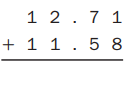
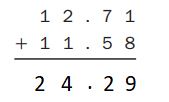
Estimate : 1.42 + 3. 37 = 4.79,
Used my estimate to check whether my answer is true
as 1.42
+3.37
4.79,
which is true.

Question 4.
Everyday Mathematics Grade 5 Home Link 5.7 Answers 2
Answer:
Everyday Math Grade 5 Answers Unit 5 Operations with Fractions-8
Explanation:
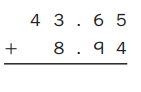
Estimate : 6.76 + 2.91 = 9.67,
Used my estimate to check whether my answer is true
as 6.76
+2.91
9.67,
which is true.

Question 5.
Everyday Mathematics Grade 5 Home Link 5.7 Answers 3
Answer:
Everyday Math Grade 5 Answers Unit 5 Operations with Fractions-9
Explanation:
Estimate : 5.9 + 4.14 = 10.04,
Used my estimate to check whether my answer is true
as 5.9
+4.14
10.04,
which is true.

Everyday Math Grade 5 Home Link 5.8 Answer Key

Using Area Models to Multiply Fractions

Label the blank tick marks on the number lines.

  • Use the number lines to write the length and width of the shaded rectangle.
  • Find the area of the shaded rectangle.
    (The area of the big square is 1 square unit.)
    Think: Into how many equal parts is the big square divided?
    How many parts are shaded?
  • Write a multiplication number sentence for the area
    of the shaded rectangle.

Question 1.
Everyday Math Grade 5 Home Link 5.8 Answer Key 1
Length of shaded rectangle: __3/4______unit
Width of shaded rectangle: ___1/2_____unit
Area of shaded rectangle: ___3/8_____square unit
Number sentence: ____3/4____ × ___1/2_____ = ___3/8_____
Answer:
Length of shaded rectangle: 3/4 unit
Width of shaded rectangle: 1/2 unit
Area of shaded rectangle: 3/8 square unit
Number sentence: 3/4 × 1/2 = 3/8,

Explanation:
* Used the number lines to write the length and width of
the shaded rectangle as
Length of shaded rectangle: 3/4 unit
Width of shaded rectangle: 1/2 unit
* Founded  the area of the shaded rectangle as
(The area of the big square is 1 square unit.)
Thinking: Into how many equal parts is the big square divided and
How many parts are shaded as
\(\frac{3}{4}\) X \(\frac{1}{2}\) =
\(\frac{3 X 1}{4 X 2}\) = \(\frac{3}{8}\),
* Wrote a multiplication number sentence for the area of the shaded rectangle as \(\frac{3}{4}\) X \(\frac{1}{2}\) =
\(\frac{3}{8}\) respectively.

Question 2.
Everyday Math Grade 5 Home Link 5.8 Answer Key 2
Length of shaded rectangle: ___1/3_____unit
Width of shaded rectangle: ___2/3_____unit
Area of shaded rectangle: ___2/9_____square unit
Number sentence: ___1/3_____ × ___2/3_____ = ___2/9_____
Answer:
Length of shaded rectangle: 1/3 unit
Width of shaded rectangle: 2/3 unit
Area of shaded rectangle: 2/9 square unit
Number sentence: 1/3 × 2/3 = 2/9,

Explanation:
* Used the number lines to write the length and width of
the shaded rectangle as
Length of shaded rectangle: 1/3 unit
Width of shaded rectangle: 2/3 unit
* Founded  the area of the shaded rectangle as
(The area of the big square is 1 square unit.)
Thinking: Into how many equal parts is the big square divided and
How many parts are shaded as
\(\frac{1}{3}\) X \(\frac{2}{3}\) =
\(\frac{1 X 2}{3 X 3}\) = \(\frac{2}{9}\),
* Wrote a multiplication number sentence for the area of the shaded rectangle as \(\frac{1}{3}\) X \(\frac{2}{3}\) =
\(\frac{2}{9}\) respectively.

Practice
Make an estimate. Then solve. Use your estimate
to check whether your answer makes sense.
Question 3.
Everyday Math Grade 5 Home Link 5.8 Answer Key 3
Answer:
Everyday Math Grade 5 Answers Unit 5 Operations with Fractions-10
Explanation:
Estimate : 6.75 – 2.44 = 4.31,
Used my estimate to check whether my answer is true
as 6.75
– 2.44
4.31,
which is true.

Question 4.
Everyday Math Grade 5 Home Link 5.8 Answer Key 4
Answer:
Everyday Math Grade 5 Answers Unit 5 Operations with Fractions-11
Explanation:
Estimate : 5.32 – 2.37 = 2.95,
Used my estimate to check whether my answer is true
as 5.32
– 2.37
2.95,
which is true.

Question 5.
Everyday Math Grade 5 Home Link 5.8 Answer Key 5
Answer:
Everyday Math Grade 5 Answers Unit 5 Operations with Fractions-12
Explanation:
Estimate : 8.6 – 6.27 = 2.33,
Used my estimate to check whether my answer is true
as 8.6
– 6.27
2.33,
which is true.

Everyday Mathematics Grade 5 Home Link 5.9 Answers

Using an Algorithm to Multiply Fractions

A Fraction Multiplication Algorithm To multiply two fractions, multiply the numerators and multiply the denominators.
For example: \(\frac{2}{3} * \frac{3}{8}=\frac{(2 * 3)}{(3 * 8)}=\frac{6}{24}\)

For Problems 1–6, use the algorithm to multiply the fractions.
Question 1.
\(\frac{1}{3}\) * \(\frac{1}{2}\) = ___1/6______
Answer:
\(\frac{1}{3}\) * \(\frac{1}{2}\) = \(\frac{1}{3}\),

Explanation:
Multiplying the fractions \(\frac{1}{3}\) * \(\frac{1}{2}\) by multiplying the numerators and multiplying the denominators as
\(\frac{1 X 1}{3 X 2}\) = \(\frac{1}{6}\).

Question 2.
\(\frac{2}{4}\) * \(\frac{2}{3}\) = ____4/12_______
Answer:
\(\frac{2}{4}\) * \(\frac{2}{3}\) = \(\frac{4}{12}\),

Explanation:
Multiplying the fractions \(\frac{2}{4}\) * \(\frac{2}{3}\) by multiplying the numerators and multiplying the denominators as
\(\frac{2 X 2}{4 X 3}\) = \(\frac{4}{12}\).

Question 3.
\(\frac{4}{5}\) * \(\frac{2}{5}\) = ____8/25______
Answer:
\(\frac{2}{4}\) * \(\frac{2}{3}\) = \(\frac{4}{12}\),

Explanation:
Multiplying the fractions \(\frac{2}{4}\) * \(\frac{2}{3}\) by multiplying the numerators and multiplying the denominators as
\(\frac{2 X 2}{4 X 3}\) = \(\frac{4}{12}\).

Question 4.
\(\frac{2}{10}\) * \(\frac{2}{3}\) = _____4/30_____
Answer:
\(\frac{2}{10}\) * \(\frac{2}{3}\) = \(\frac{4}{30}\),

Explanation:
Multiplying the fractions \(\frac{2}{10}\) * \(\frac{2}{3}\) by multiplying the numerators and multiplying the denominators as
\(\frac{2 X 2}{10 X 3}\) = \(\frac{4}{30}\).

Question 5.
\(\frac{2}{8}\) * \(\frac{5}{6}\) = _____10/48______
Answer:
\(\frac{2}{8}\) * \(\frac{5}{6}\) = \(\frac{10}{48}\),

Explanation:
Multiplying the fractions \(\frac{2}{8}\) * \(\frac{5}{6}\) by multiplying the numerators and multiplying the denominators as
\(\frac{2 X 5}{8 X 6}\) = \(\frac{10}{48}\).

Question 6.
\(\frac{5}{12}\) * \(\frac{2}{7}\) = ____10/84_______
Answer:
\(\frac{5}{12}\) * \(\frac{2}{7}\) = \(\frac{10}{84}\),

Explanation:
Multiplying the fractions \(\frac{5}{12}\) * \(\frac{2}{7}\) by multiplying the numerators and multiplying the denominators as
\(\frac{5 X 2}{12 X 7}\) = \(\frac{10}{84}\).

Question 7.
If you multiply \(\frac{2}{3}\) ∗ \(\frac{6}{10}\), will the product be more than \(\frac{2}{3}\) or less than \(\frac{2}{3}\)? How do you know?
Answer:
Less than \(\frac{2}{3}\) by checking,

Explanation:
First we multiply \(\frac{2}{3}\) X \(\frac{6}{10}\) =
\(\frac{2 X 6}{3 X 10}\) = \(\frac{12}{30}\), Now
\(\frac{12}{30}\) = 0.4 and \(\frac{2}{3}\) = 0.66,
as 0.4 < 0.66, So \(\frac{12}{30}\) < \(\frac{2}{3}\).

Question 8.
If you multiply \(\frac{2}{3}\) ∗ \(\frac{6}{10}\), will the product be more than \(\frac{6}{10}\) or less than \(\frac{6}{10}\)? How do you know?
Answer:
Less than \(\frac{6}{10}\) by checking,

Explanation:
First we multiply \(\frac{2}{3}\) X \(\frac{6}{10}\) =
\(\frac{2 X 6}{3 X 10}\) = \(\frac{12}{30}\), Now
\(\frac{12}{30}\) = 0.4 and \(\frac{6}{10}\) = 0.6,
as 0.4 < 0.6, So \(\frac{12}{30}\) < \(\frac{6}{10}\).

In Problems 9–12, write true or false. Do not multiply.
Question 9.
\(\frac{3}{4}\) ∗ \(\frac{7}{10}\) is less than \(\frac{3}{4}\).
Answer:
True,

Explanation:
First we multiply \(\frac{3}{4}\) X \(\frac{7}{10}\) =
\(\frac{3 X 7}{4 X 10}\) = \(\frac{21}{40}\), Now
\(\frac{21}{40}\) = 0.525 and \(\frac{3}{4}\) = 0.75,
So true \(\frac{3}{4}\) ∗ \(\frac{7}{10}\) is less than \(\frac{3}{4}\).

Question 10.
\(\frac{7}{9}\) ∗ \(\frac{11}{12}\) is greater than \(\frac{11}{12}\).
Answer:
False,

Explanation:
First we multiply \(\frac{7}{9}\) X \(\frac{11}{12}\) =
\(\frac{7 X 11}{9 X 12}\) = \(\frac{77}{108}\), Now
\(\frac{77}{108}\) = 0.712 and \(\frac{11}{12}\) = 0.916,
So false as \(\frac{7}{9}\) ∗ \(\frac{11}{12}\) is not greater than \(\frac{11}{12}\).

Question 11.
\(\frac{4}{5}\) ∗ \(\frac{2}{8}\) is greater than\(\frac{2}{8}\) but less than \(\frac{4}{5}\).
Answer:
False,

Explanation:
First we multiply \(\frac{4}{5}\) X \(\frac{2}{8}\) =
\(\frac{4 X 2}{5 X 8}\) = \(\frac{8}{40}\), Now
\(\frac{8}{40}\) = 0.2, \(\frac{2}{8}\) = 0.25 and
\(\frac{4}{5}\) = 0.8,
So false as \(\frac{4}{5}\) ∗ \(\frac{2}{8}\) is not greater than \(\frac{2}{8}\) but less than \(\frac{4}{5}\).

Question 12.
\(\frac{6}{7}\) ∗ \(\frac{1}{4}\) is less than \(\frac{6}{7}\) and less than \(\frac{1}{4}\).
Answer:
True,

Explanation:
First we multiply \(\frac{6}{7}\) X \(\frac{1}{4}\) =
\(\frac{6 X 1}{7 X 4}\) = \(\frac{6}{28}\), Now
\(\frac{6}{28}\) = 0.214, \(\frac{6}{7}\) = 0. 857 and
\(\frac{1}{4}\) = 0.250,
So true as \(\frac{6}{7}\) ∗ \(\frac{1}{4}\) is less than \(\frac{6}{7}\) and also less than \(\frac{1}{4}\).

Practice
Question 13.
\(\frac{2}{3}\) + \(\frac{1}{6}\) = ___5/6_____
Answer:
\(\frac{2}{3}\) + \(\frac{1}{6}\) = \(\frac{5}{6}\),

Explanation:
Given \(\frac{2}{3}\) + \(\frac{1}{6}\) before
adding as both denominators need to be same so we multiply
\(\frac{2}{3}\) by 2 before adding as \(\frac{2 x 2}{3 x 6}\) = \(\frac{4}{6}\), now denominators are same 6 so we add
numerators as \(\frac{4}{6}\)  + \(\frac{1}{6}\) =
\(\frac{4 + 1}{6}\) = \(\frac{5}{6}\),
Therefore, \(\frac{2}{3}\) + \(\frac{1}{6}\) = \(\frac{5}{6}\).

Question 14.
\(\frac{3}{4}\) + \(\frac{3}{8}\) = ___9/8 or 1_1/8_____
Answer:
\(\frac{3}{4}\) + \(\frac{3}{8}\) = \(\frac{9}{8}\) or 1\(\frac{1}{8}\),

Explanation:
Given \(\frac{3}{4}\) + \(\frac{3}{8}\) before
adding as both denominators need to be same so we multiply
\(\frac{3}{4}\) by 2 before adding as \(\frac{3 x 2}{4 x 2}\) = \(\frac{6}{8}\), now denominators are same 8 so we add
numerators as \(\frac{6}{8}\)  + \(\frac{3}{8}\) =
\(\frac{6 + 3}{8}\) = \(\frac{9}{8}\),
as numerator is greater we can write in mixed fraction as
(1 X 8 + 1 by 8) = 1\(\frac{1}{8}\),
Therefore, \(\frac{3}{4}\) + \(\frac{3}{8}\) = \(\frac{9}{8}\) or 1\(\frac{1}{8}\).

Question 15.
\(\frac{2}{5}\) + \(\frac{1}{4}\) = ___13/20_____
Answer:
\(\frac{2}{5}\) + \(\frac{1}{4}\) = \(\frac{13}{20}\),

Explanation:
Given \(\frac{2}{5}\) + \(\frac{1}{4}\) before
adding as both denominators need to be same so we
multiply numerator and denominator by 4 to\(\frac{2}{5}\) before adding as \(\frac{2 x 4}{5 x 4}\) = \(\frac{8}{20}\) and \(\frac{1}{4}\) by 5 before adding as \(\frac{1 x 5}{4 x 5}\) = \(\frac{5}{20}\) now denominators are same 20 so we add numerators as \(\frac{8}{20}\)  + \(\frac{5}{20}\) =
\(\frac{8 + 5}{20}\) = \(\frac{13}{20}\),
Therefore, \(\frac{2}{5}\) + \(\frac{1}{4}\) = \(\frac{13}{20}\).

Everyday Math Grade 5 Home Link 5.10 Answer Key

Mystery Models

Write a multiplication number sentence that represents the
amount of shaded space in the pictures below.
Add to the picture or create a new drawing to represent
your number sentence.
Question 1.
Everyday Math Grade 5 Home Link 5.10 Answer Key 1
Answer:
\(\frac{1}{3}\) x \(\frac{2}{4}\) = \(\frac{2}{12}\) or
\(\frac{2}{4}\) x \(\frac{1}{3}\) = \(\frac{2}{12}\)
Everyday Math Grade 5 Answers Unit 5 Operations with Fractions-13
Explanation:
Wrote a multiplication number sentence that represents the
amount of shaded space in the picture as
\(\frac{1}{3}\) x \(\frac{2}{4}\) = \(\frac{1 X 2}{3 X 4}\) = \(\frac{2}{12}\),
Added to the picture to create a new drawing to represent
my number sentence as shown above.

Question 2.
Everyday Math Grade 5 Home Link 5.10 Answer Key 2
Answer:
\(\frac{3}{4}\) x \(\frac{2}{5}\) = \(\frac{6}{20}\),
\(\frac{2}{5}\) x \(\frac{3}{4}\) = \(\frac{6}{20}\),
Everyday Math Grade 5 Answers Unit 5 Operations with Fractions-14
Explanation:
Wrote a multiplication number sentence that represents the
amount of shaded space in the picture as
\(\frac{3}{4}\) X \(\frac{2}{5}\) = \(\frac{3 X 2}{4 X 5}\) = \(\frac{6}{20}\),
Added to the picture to create a new drawing to represent
my number sentence as shown above.

Practice
Solve.
Question 3.
1\(\frac{1}{2}\) + 2\(\frac{2}{8}\) = __________
Answer:
1\(\frac{1}{2}\) + 2\(\frac{2}{8}\) = \(\frac{30}{8}\) or 3\(\frac{6}{8}\),

Explanation:
Given 1\(\frac{1}{2}\) + 2\(\frac{2}{8}\),
First we will write mixed fractions into  fractions as 1\(\frac{1}{2}\) = (1 X 2 + 1 by 2) = \(\frac{3}{2}\) and 2\(\frac{2}{8}\) =
(2 x 8 + 2 by 8) = \(\frac{18}{8}\), before
adding as both denominators need to be same so we
multiply numerator and denominator by 4 to \(\frac{3}{2}\)
before adding as \(\frac{3 x 4}{2 x 4}\) = \(\frac{12}{8}\) now denominators are same 8 so we add numerators as \(\frac{12}{8}\)  + \(\frac{18}{8}\) =
\(\frac{12 + 18}{8}\) = \(\frac{30}{8}\),
as numerator is greater than denominator we write in
mixed fraction as (3 X 8 + 6 by 8) = 3\(\frac{6}{8}\),
Therefore, 1\(\frac{1}{2}\) + 2\(\frac{2}{8}\) = \(\frac{30}{8}\) or 3\(\frac{6}{8}\).

Question 4.
6 – 3\(\frac{1}{3}\) = ___2 2/3______
Answer:
6 – 3\(\frac{1}{3}\) = \(\frac{8}{3}\) or 2\(\frac{2}{3}\),

Explanation:
Given 6 – 3\(\frac{1}{3}\),
First we will write mixed fraction into fractions as 3\(\frac{1}{3}\) =
(3 X 3 + 1 by 3) = \(\frac{10}{3}\) before
subtracting as both denominators need to be same so we
multiply numerator and denominator by 3 to \(\frac{6}{1}\)
before adding as \(\frac{6 x 3}{1 x 3}\) = \(\frac{18}{3}\) now denominators are same 3 so we subtract numerators as \(\frac{18}{3}\)  – \(\frac{10}{3}\) =
\(\frac{18 – 10}{3}\) = \(\frac{8}{3}\),
as numerator is greater than denominator we write in
mixed fraction as (2 X 3 + 2 by 3) = 2\(\frac{2}{3}\),
Therefore, 6 – 3\(\frac{1}{3}\) = \(\frac{8}{3}\) or 2\(\frac{2}{3}\),

Question 5.
1\(\frac{4}{9}\) + 5\(\frac{2}{3}\) = _________
Answer:
1\(\frac{4}{9}\) + 5\(\frac{2}{3}\) =
\(\frac{64}{9}\) or 7\(\frac{1}{9}\),

Explanation:
Given 1\(\frac{4}{9}\) + 5\(\frac{2}{3}\),
First we will write mixed fractions into  fractions as 1\(\frac{4}{9}\) = (1 X 9 + 4 by 9) = \(\frac{13}{9}\) and 5\(\frac{2}{3}\) =
(5 x 3 + 2 by 3) = \(\frac{17}{3}\), before
adding as both denominators need to be same so we
multiply numerator and denominator by 3 to \(\frac{17}{3}\)  before adding as \(\frac{17 x 3}{3 x 3}\) = \(\frac{51}{9}\) now denominators are same 9 so we add numerators as \(\frac{13}{9}\)  + \(\frac{51}{9}\) =
\(\frac{13 + 51}{9}\) = \(\frac{64}{9}\),
as numerator is greater than denominator we write in
mixed fraction as (7 X 9 + 1 by 9) = 7\(\frac{1}{9}\),
Therefore, 1\(\frac{4}{9}\) + 5\(\frac{2}{3}\) =
\(\frac{64}{9}\) or 7\(\frac{1}{9}\).

Question 6.
8\(\frac{1}{3}\) – 3\(\frac{3}{4}\) = ___4 7/12_______
Answer:
8\(\frac{1}{3}\) – 3\(\frac{3}{4}\) =
\(\frac{55}{12}\) or 4\(\frac{7}{12}\),

Explanation:
Given 8\(\frac{1}{3}\) – 3\(\frac{3}{4}\),
First we will write mixed fractions into  fractions as 8\(\frac{1}{3}\) = (8 X 3 + 1 by 3) = \(\frac{25}{3}\) and 3\(\frac{3}{4}\) =
(3 x 4 + 3 by 4) = \(\frac{15}{4}\), before
subtracting as both denominators need to be same so we
multiply numerator and denominator by 4 to \(\frac{25}{3}\)  before subtracting as \(\frac{25 x 4}{3 x 4}\) = \(\frac{100}{12}\) and multiply numerator and denominator by 3 to \(\frac{15}{4}\) as \(\frac{15 X 3}{4 X 3}\) = \(\frac{45}{12}\) now denominators are same 12 so we subtract numerators as \(\frac{100}{12}\) – \(\frac{45}{12}\) =
\(\frac{100 – 45}{12}\) = \(\frac{55}{12}\),
as numerator is greater than denominator we write in
mixed fraction as (4 X 12 + 7 by 12) = 4\(\frac{7}{12}\),
Therefore, 8\(\frac{1}{3}\) – 3\(\frac{3}{4}\) =
\(\frac{55}{12}\) or 4\(\frac{7}{12}\).

Everyday Mathematics Grade 5 Home Link 5.11 Answers

Finding Equivalent Fractions

Question 1.
a. List three fractions that are equivalent to 1.
___2/2____, ___3/3____, ____5/5___
b. Use the fractions you wrote in Part a to find three
fractions equivalent to \(\frac{6}{7}\).
Example: Everyday Mathematics Grade 5 Home Link 5.11 Answers 1 _______, _______, _______
Answer:
a. \(\frac{2}{2}\), \(\frac{3}{3}\), \(\frac{5}{5}\),
b. \(\frac{24}{28}\), \(\frac{54}{63}\) and
\(\frac{150}{175}\),

Explanation:
a. Three fractions that are equivalent to 1 are
\(\frac{2}{2}\), \(\frac{3}{3}\), \(\frac{5}{5}\),

b. Using the fractions I wrote in Part a to find three
fractions equivalent to \(\frac{6}{7}\) are
\(\frac{24}{28}\), \(\frac{54}{63}\), \(\frac{150}{175}\) because as \(\frac{2}{2}\) X \(\frac{12}{14}\) = \(\frac{24}{28}\) = \(\frac{6}{7}\),
\(\frac{3}{3}\) X \(\frac{18}{21}\) = \(\frac{54}{63}\) = \(\frac{6}{7}\),
\(\frac{5}{5}\) X \(\frac{30}{35}\) = \(\frac{150}{175}\) =\(\frac{6}{7}\) respectively.

Question 2.
You are solving fraction addition problems.
Use the information to find equivalent fractions.
a. Original fraction: \(\frac{4}{5}\)
Denominator needed: 20
Multiply by: ____4/4______
Equivalent fraction: ____16/20_______
Answer:
Denominator needed: 20
Multiply by: \(\frac{4}{4}\)
Equivalent fraction: \(\frac{16}{20}\),

Explanation:
Given \(\frac{4}{5}\) the equivalent fraction is
as numerator is 4 so we multiply numerator and
denominator by 4 as \(\frac{4}{5}\) X \(\frac{4}{4}\) =
\(\frac{4 X 4}{5 X 4}\) = \(\frac{16}{20}\),
therefore denominator needed is 20,
Multiply by: \(\frac{4}{4}\) and
Equivalent fraction: \(\frac{16}{20}\).

b. Original fraction: \(\frac{1}{3}\)
Denominator needed: 18
Multiply by: ____6/6______
Equivalent fraction: ____6/18______
Answer:
Denominator needed: 18
Multiply by: \(\frac{6}{6}\)
Equivalent fraction: \(\frac{6}{18}\),

Explanation:
Given \(\frac{1}{3}\) the equivalent fraction is
as numerator is 6 so we multiply numerator and
denominator by 6 as \(\frac{1}{3}\) X \(\frac{6}{6}\) =
\(\frac{1 X 6}{3 X 6}\) = \(\frac{6}{18}\),
therefore denominator needed is 18,
Multiply by: \(\frac{6}{6}\) and
Equivalent fraction: \(\frac{6}{18}\).

Question 3.
Addison wanted to find a fraction equivalent to \(\frac{3}{8}\) with 16 in the denominator. He thought: “8 ∗ 2 = 16, so I need to multiply \(\frac{3}{8}\) by 2.” He got an answer of \(\frac{3}{16}\).
a. Is \(\frac{3}{16}\) equivalent to \(\frac{3}{8}\)? How do you know?
Answer:
No,
\(\frac{3}{16}\) ≠ \(\frac{3}{8}\),

Explanation:
Given Addison wanted to find a fraction equivalent to \(\frac{3}{8}\) with 16 in the denominator. He thought: “8 ∗ 2 = 16, so I need to multiply \(\frac{3}{8}\) by 2.” He got an answer of \(\frac{3}{16}\) but Addison is incorrect as \(\frac{3}{16}\)
is not equivalent to \(\frac{3}{8}\).

b. What mistake did Addison make?
Answer:
Addison multiplyed only denominator by 2 not numerator,

Explanation:
Given Addison wanted to find a fraction equivalent to \(\frac{3}{8}\) with 16 in the denominator. He thought: “8 ∗ 2 = 16, so I need to multiply \(\frac{3}{8}\) by 2.” He got an answer of \(\frac{3}{16}\) but Addison is incorrect as \(\frac{3}{16}\)
is not equivalent to \(\frac{3}{8}\) as he multipled
only denominator by 2 not numerator.

Practice
Solve.
Question 4.
What is \(\frac{2}{3}\) of 9?
Answer:
\(\frac{2}{3}\) of 9 is 6,

Explanation:
Given to solve \(\frac{2}{3}\) of 9,
So \(\frac{2}{3}\) X 9 = \(\frac{2 X 9}{3}\) =
\(\frac{18}{3}\) = 6.

Question 5.
What is \(\frac{3}{5}\) of 20?
Answer:
\(\frac{3}{5}\) of 20 is 12,

Explanation:
Given to solve \(\frac{3}{5}\) of 20,
So \(\frac{3}{5}\) X 20 = \(\frac{3 X 20}{5}\) =
\(\frac{60}{5}\) = 12.

Question 6.
Explain how you found your answer for Problem 5.
Answer:
Solving and multiplying \(\frac{3}{5}\) X 20,

Explanation:
By solving \(\frac{3}{5}\) X 20 \(\frac{3 X 20}{5}\) =
\(\frac{60}{5}\) = 12 I found the answer for Problem 5.

Everyday Math Grade 5 Home Link 5.12 Answer Key

Writing Fraction Multiplication Stories

Solve each multiplication problem. Then write a number
story that matches the number sentence and representation.
Example:
Everyday Math Grade 5 Home Link 5.12 Answer Key 1
Number Story: Mr. Danielson had a tray of pumpkin bread that was \(\frac{5}{6}\) full. After sharing his bread with students, \(\frac{1}{4}\) of what he had brought was left.
What fraction of the whole tray was left?

Question 1.
4 ∗ \(\frac{2}{3}\) = _____8/3_ or 2 2/3____
Everyday Math Grade 5 Home Link 5.12 Answer Key 2
Number Story: __________
Answer:
4 ∗ \(\frac{2}{3}\) = \(\frac{8}{3}\) or 2\(\frac{2}{3}\),
Number Story :
Our class has 4 groups each group have 10 children who can play
cricket, in that \(\frac{2}{3}\) of children participated
in the competition, So how many groups of children
participated in all?,

Explanation:
Given 4 ∗ \(\frac{2}{3}\) = \(\frac{4 X 2}{3}\) =
\(\frac{8}{3}\) or 2\(\frac{2}{3}\),
Number Story :
Our class has 4 groups each group have 10 children who can play
cricket, in that \(\frac{2}{3}\) of children participated
in the competition, So how many groups of children
participated in all? Wrote number story above.

Question 2.
\(\frac{1}{2}\) ∗ 16 = ___8______
Everyday Math Grade 5 Home Link 5.12 Answer Key 3
Number Story: __________
Answer:
\(\frac{1}{2}\) X 16 = 8,
Number Story :
There are 16 books in library out which \(\frac{1}{2}\) of books
are moral stories, Therefore how many books are moral stories
in library?,

Explanation:
Given \(\frac{1}{2}\) X 16 = 8,
Number Story :
There are 16 books in library out which \(\frac{1}{2}\) of books
are moral stories, Therefore how many books are moral stories
in library?, Wrote number story above.

Practice
Make an estimate. Then add or subtract. Show your work on
the back of this page.
Question 3
4.79 + 2.03 = ?
Estimate: ____6.82______
4.79 + 2.03 = ___6.82_______
Answer:
Estimate: 6.82,
4.79 + 2.03 = 6.82,

Explanation:
My estimate is 6.82,
4.79
+2.03
6.82.

Question 4.
8.25 – 3.91 = ?
Estimate: ____4.34______
8.25 – 3.91 = __4.34________
Answer:
Estimate : 4.34,
8.25 – 3.91 = 4.34,

Explanation:
My estimate is 4.34,
8.25
-3.91
4.34.

Everyday Mathematics Grade 5 Home Link 5.13 Answers

Solving Fraction Division Problems

Write a number model using a letter for the unknown.
Solve, showing your solution strategy with representations or drawings. Summarize your work with a division number model.
Check your answer using multiplication and
write a number sentence to show how you checked.
Question 1.
Ben has \(\frac{1}{2}\) of a loaf of bread.
If he and his 3 friends share the \(\frac{1}{2}\) loaf equally,
how much of the whole loaf will each person get?
Number model: _____1/2 X 1/4 = 1/8_______
Each person will get __1/2_____ loaf of bread.
Everyday Mathematics Grade 5 Home Link 5.13 Answers 1
Answer:
Number model:
\(\frac{1}{2}\) ÷ 4 = \(\frac{1}{2}\) X \(\frac{1}{4}\) = \(\frac{1}{8}\),
Each person will get \(\frac{1}{2}\) loaf of bread,

Explanation:
Given Ben has \(\frac{1}{2}\) of a loaf of bread.
If he and his 3 friends share the \(\frac{1}{2}\) loaf equally,
Part of the whole loaf will each person get is
Number model:
\(\frac{1}{2}\) ÷ 4 = \(\frac{1}{2}\) X \(\frac{1}{4}\) = \(\frac{1}{8}\),
Each person will get \(\frac{1}{8}\) X 4 = [/latex] = \(\frac{4}{8}\) = \(\frac{1}{2}\)  loaf of bread.

Question 2.
Amanda has a piece of ribbon that is \(\frac{1}{4}\) yard long.
She wants to share the ribbon with 2 friends so that they can each wear a ribbon for Breast Cancer Awareness Month.
If each of the 3 friends gets the same amount, how much
ribbon will each person get?
Number model: ____1/4 X 1/3 = 1/12______
Each person will get ___1/4_______ yard of ribbon. Everyday Mathematics Grade 5 Home Link 5.13 Answers 2
Everyday Mathematics Grade 5 Home Link 5.13 Answers 3
Answer:
Number model:
\(\frac{1}{4}\) ÷ 3 = \(\frac{1}{4}\) X \(\frac{1}{3}\) = \(\frac{1}{12}\),
Each person will get \(\frac{1}{4}\) yard of ribbon,

Explanation:
Given Amanda has a piece of ribbon that is \(\frac{1}{4}\) yard long. She wants to share the ribbon with 2 friends so that they can each wear a ribbon for Breast Cancer Awareness Month.
If each of the 3 friends gets the same amount,
Number model:
\(\frac{1}{4}\) ÷ 3 = \(\frac{1}{4}\) X \(\frac{1}{3}\) = \(\frac{1}{12}\),
Each person will get ribbon is \(\frac{1}{12}\) X 3 =
\(\frac{3}{12}\) = \(\frac{1}{4}\).

Practice
Make an estimate. Then use U.S. traditional multiplication to solve.
Show your work on the back of this page.
Question 3.
Estimate: ___22,113_____
Everyday Mathematics Grade 5 Home Link 5.13 Answers 4
Answer:
Everyday Math Grade 5 Answers Unit 5 Operations with Fractions-15
Explanation:
Given 567 X 39 =
Estimate = 567 X 39 =22,113 which is reasonable as shown above.

Question 4.
Estimate: ___71,568_____
Everyday Mathematics Grade 5 Home Link 5.13 Answers 5
Answer:
Everyday Math Grade 5 Answers Unit 5 Operations with Fractions-16

Explanation:
Given 3,408 X 21 =
Estimate = 3,408 X 21 =71,568 which is reasonable as shown above.

Everyday Math Grade 5 Home Link 5.14 Answer Key

More Fraction Division Problems

For Problems 1 and 2, write a number model using a
letter for the unknown. Solve, showing your solution strategy.
Summarize your work with a division number model.
Check your answer using multiplication, and
write a number sentence to show how you checked.
Question 1.
Charity is packing a 2-pound container of trail mix into
bags for a camping trip.
Each bag holds \(\frac{1}{8}\) pound of trail mix.
If Charity uses all 2 pounds of trail mix,
how many \(\frac{1}{8}\) pound bags will she have?
Number model: __2 ÷ 1/8 =16_______
Charity will have _____16 ,___ \(\frac{1}{8}\) pound bags.
Everyday Math Grade 5 Home Link 5.14 Answer Key 1
Answer:
Number model: __2 ÷ \(\frac{1}{8}\) =16_______
Charity will have _____16 ,___ \(\frac{1}{8}\) pound bags,

Explanation:
Given Charity is packing a 2-pound container of trail mix into
bags for a camping trip.
Each bag holds \(\frac{1}{8}\) pound of trail mix.
If Charity uses all 2 pounds of trail mix then
Number model = 2 ÷\(\frac{1}{8}\) = 2 X 8 = 16,
Charity will have 16, \(\frac{1}{8}\) pound bags she will have.

Question 2.
Davis has a thin box that is 5 inches wide.
He wants to use the box to store markers that
are \(\frac{1}{2}\) inch wide. If he lines up
the markers side by side and uses the entire width of the box,
how many markers can Davis fit in the box?
Number model: __5 ÷ 1/2 =10________
Davis will be able to fit _____5_____ markers in the box. Everyday Math Grade 5 Home Link 5.14 Answer Key 2
Everyday Math Grade 5 Home Link 5.14 Answer Key 3
Answer:
Number model: 5 ÷ \(\frac{1}{2}\) = 10,
Davis will be able to fit 5 markers in the box,

Explanation:
Given Davis has a thin box that is 5 inches wide.
He wants to use the box to store markers that
are \(\frac{1}{2}\) inch wide. If he lines up
the markers side by side and uses the entire width of the box,
number of markers can Davis fit in the box are
5 ÷ \(\frac{1}{2}\) = 5 X 2 = 10,
So 10 X \(\frac{1}{2}\) = 5 markers in the box.

Practice
Make an estimate. Then solve. Show your work on the back of this page
Question 3.
623 ÷ 8 → ____77R7_______
Estimate: ___77R7_____
Answer:
623 ÷ 8 = 77 remainder 7,
Estimate: 77R7,

Explanation:
Given 623 ÷ 8 =
77 R 7
8)623(
   56
     63
56
7
So, 623 ÷ 8 = 77 remainder 7 and
estimate is also reasonable.

Question 4.
4,495 ÷ 50 → ___89R45________
Estimate: ___89R45________
Answer:
4,495 ÷ 50 = 89 remainder 45,
Estimate: 89R45,

Explanation:
Given 4,495 ÷ 50 =
89 R 45
50)4,495(
      4,450
45
So, 4,495 ÷ 50 = 89 remainder 45 and
estimate is also reasonable.

Everyday Math Grade 5 Answers Unit 3 Fraction Concepts, Addition, and Subtraction

Everyday Mathematics 5th Grade Answer Key Unit 3 Fraction Concepts, Addition, and Subtraction

Everyday Mathematics Grade 5 Home Link 3.1 Answers

Modeling and Solving Fair Share Number Stories

Use a drawing to model each number story. Then solve.
Question 1.
You are sharing 2 loaves of bread with 5 friends. You want each person to get a fair share. How much bread will each person get?
Solution: __________
Model:
Answer:

Question 2.
Betsy and 3 of her friends are splitting a whole watermelon. There are 6 circular slices of watermelon. How many slices of watermelon will each person get?
Solution: __________
Model:
Answer:

Question 3.
Darius and Matthew have 3 fruit bars. They are both hungry after playing football and decide to split the fruit bars evenly. How much fruit bar will each boy get?
Solution: __________
Model:
Answer:

Practice
Make an estimate and solve. Show your work on the back of this page .
Question 4.
Everyday Mathematics Grade 5 Home Link 3.1 Answers 1
Estimate: ___________
Answer:

Question 5.
Everyday Mathematics Grade 5 Home Link 3.1 Answers 2
Estimate: ___________
Answer:

Everyday Math Grade 5 Home Link 3.2 Answer Key

Fair Share Problems with Number Models

Solve each number story. Draw a picture and write a number model to show how you solved each problem.
Question 1.
Mr. Chu is slicing 4 cantaloupes for his class. There are 24 students in the class. If Mr. Chu cuts the cantaloupes to make an equal portion for each student, how much of a whole cantaloupe will each student get?
___________ cantaloupe
Number model: __________
Answer:

Question 2.
Two classrooms are sharing 7 packages of unit cubes. If the packages are split evenly, how many packages will each classroom receive?
___________ packages
Number model: ___________
Answer:

Question 3.
Jane, Max, and Greg are splitting a 10-ounce bag of popcorn. If they share the popcorn equally, how many ounces of popcorn will each person get?
___________ ounces
Number model: ___________
Answer:

Practice
Question 4.
a. 540 ÷ 9 = ___________
b. 540 ÷ 90 = ___________
c. 5,400 ÷ 90 = ___________
Answer:

Question 5.
a. 320 ÷ 80 = ___________
b. 3,200 ÷ 8 = ___________
c. 32,000 ÷ 800 = ___________
Answer:

Everyday Mathematics Grade 5 Home Link 3.3 Answers

Division Number Stories with Remainders

For each number story, write a number model with a letter for the unknown. Then solve. You may draw a picture to help. Explain what you did with the remainder.
Question 1.
Ms. Davis’s class is having a picnic. There are 27 students in her class. If each picnic table seats 6 people, how many picnic tables will the class need so that all of the students and Ms. Davis have a seat?
Number model: ___________
Quotient: ___________ Remainder: ___________
Answer: They will need ___________ tables.
Circle what you did with the remainder.
Ignored it Reported it as a fraction Rounded the quotient up Why?
Answer:

Question 2.
Nolan brought 2 boxes of fruit bars to share
with his football team. There are 12 bars in
each box and 16 people on the team. If the
bars are shared equally, how many fruit bars
will each person get?
Number model: ___________
Quotient: ___________ Remainder: ___________
Answer: ___________
Circle what you did with the remainder.
Ignored it Reported it as a fraction Rounded the quotient up Why?
Answer:

Practice
Evaluate each expression.
Question 3.
8 + (6 ∗ 3) ___________
Answer:

Question 4.
(6 + 2) ∗ (9 – 5) ___________
Answer:

Question 5.
12 ÷ [3 ∗ (10 ÷ 5)] ___________
Answer:

Question 6.
{20 ÷ [7 + (6 ÷ 2)]} ∗ 5 ___________
Answer:

Everyday Math Grade 5 Home Link 3.4 Answer Key

Fractions on a Number Line

Question 1.
Divide this number line to show halves. Label each tick mark with a fraction.
Everyday Math Grade 5 Home Link 3.4 Answer Key 1
Answer:

Question 2.
Divide this number line to show fourths. Label each tick mark with a fraction.
Everyday Math Grade 5 Home Link 3.4 Answer Key 2
Answer:

Question 3.
Divide this number line to show eighths. Label each tick mark with a fraction.
Everyday Math Grade 5 Home Link 3.4 Answer Key 3
Answer:

Use the number lines above or the Fraction Number Lines Poster to solve Problems 4–6.
Question 4.
Which number is greater? Circle the greater number in each pair.
a. \(\frac{3}{8}\) or \(\frac{1}{4}\)
b. \(\frac{2}{2}\) or \(\frac{5}{4}\)
c. 1\(\frac{5}{8}\) or \(\frac{3}{2}\)
Answer:

Question 5.
Rename each fraction as a mixed number.
a. \(\frac{6}{4}\) = _________
b. \(\frac{3}{2}\) = ___________
c. \(\frac{13}{8}\) = __________
Answer:

Question 6.
Rename each mixed number as a fraction.
a. 1\(\frac{2}{2}\) = ___________
b. 1\(\frac{6}{8}\) = ___________
c. 1\(\frac{1}{4}\) = ___________
Answer:

Practice
Question 7.
Write each number in standard notation.
a. 3 ∗ 102 = ___________
b. 5 ∗ 103 = ___________
c. 8 ∗ 104 =___________
Answer:

Question 8.
Write each number as a product, using exponential notation.
a. 900 = ___________
b. 6,000 = ___________
c. 70,000 = ___________
Answer:

Everyday Mathematics Grade 5 Home Link 3.5 Answers

More Fraction Top-It

Eddie and his friend are playing another version of Fraction Top-It. Each player turns over 4 number cards and places them as the digits on the gameboard. The player with the larger quotient wins the round.
Eddie’s cards are 2, 6, 3, and 4.
Question 1.
If you were Eddie, how would you place your cards? What is the quotient?
Everyday Mathematics Grade 5 Home Link 3.5 Answers 1
Answer:

Question 2.
What rule can Eddie use to create the largest possible fraction? Explain why this rule works.
Answer:

Practice
Question 3.
Write the value of the 3 in each of the following numbers.
a. 1,322,072 ___________
b. 8,236,914 ___________
c. 5,703,000 ___________
d. 4,091,316 ___________
e. 8,192,038 ___________
f. 7,025,943 ___________
Answer:

Everyday Math Grade 5 Home Link 3.6 Answer Key

Fractions and Number Sense

Question 1.
Josie calculated \(\frac{1}{5}\) + \(\frac{1}{2}\) and said the answer was \(\frac{2}{7}\). Explain how you know that Josie’s answer does not make sense.
Did you need to calculate an exact answer to know that Josie’s answer doesn’t make sense? Tell someone at home why you did or didn’t need to calculate an exact answer.
Answer:

Question 2.
Renee calculated \(\frac{3}{6}\) + \(\frac{2}{4}\) and said the answer was \(\frac{5}{10}\). Josie solved the same problem and said the answer was 1. Whose answer is more reasonable? Explain how you know.
Answer:

Question 3.
Two students are playing Build-It. To win, all 5 cards must be in order from smallest to largest. Circle the winning set of cards.
Everyday Math Grade 5 Home Link 3.6 Answer Key 1
Answer:

Practice
Insert grouping symbols to make true number sentences.
Question 4.
6 × 4 + 1 = 30
Answer:

Question 5.
12 ÷ 3 × 2 – 1 = 1
Answer:

Question 6.
48 ÷ 6 + 5 × 3 = 39
Answer:

Question 7.
\(\frac{50}{10}\) + \(\frac{10}{2}\) = 5
Answer:

Everyday Mathematics Grade 5 Home Link 3.7 Answers

Estimating with Fractions

For Problems 1 and 2, circle the best estimate. Explain your estimation strategies to someone at home.
Question 1.
The sum of \(\frac{3}{4}\) and \(\frac{18}{19}\)is closest to _________.
0
1
2
Answer:

Question 2.
2\(\frac{3}{8}\) – \(\frac{3}{4}\) is _________
less than 2
greater than 2
Answer:

For Problems 3–5, refer to the number line below.
Everyday Mathematics Grade 5 Home Link 3.7 Answers 1
Question 3.
Henry ran 1\(\frac{5}{8}\) miles in the morning and \(\frac{9}{10}\) mile in the afternoon. About how many miles did he run in all? Place an X on the number line to show your estimate.
Answer:

Question 4.
Tia ran 2\(\frac{7}{8}\) miles. George ran 1\(\frac{1}{10}\) miles. About how many more miles did Tia run than George? Place a star on the number line to show your estimate.
Answer:

Question 5.
Explain how you estimated the difference in Problem 4.
Answer:

Practice
Use V = B × h or V = l × w × h to solve.
Question 6.
What is the volume of a box that is 14 inches long, 7 inches wide, and 10 inches high?
The volume of the box is ____________ cubic inches.
Number model: ________
Answer:

Question 7.
The floor of Raj’s classroom has an area of 525 feet. The ceiling is 12 feet high. What is the volume of Raj’s classroom?
The volume of the classroom is ____________ ft3.
Number model: ________
Answer:

Everyday Math Grade 5 Home Link 3.8 Answer Key

Renaming Fractions

You can make trades to find new names for mixed numbers and fractions greater than 1.
Example 1:
Everyday Math Grade 5 Home Link 3.8 Answer Key 1
Start with 2\(\frac{1}{3}\).
Trade 1 whole for \(\frac{3}{3}\).
Now you have 1 whole and 4 thirds, or 1 \(\frac{4}{3}\).
Another name for 2 \(\frac{1}{3}\) is 1 \(\frac{4}{3}\)

Example 2:
Everyday Math Grade 5 Home Link 3.8 Answer Key 2
Start with \(\frac{7}{4}\)
Trade \(\frac{4}{4}\) for 1 whole.
Now you have 1 whole and 3 fourths, or 1 \(\frac{3}{4}\).
Another name for \(\frac{7}{4}\) is 1 \(\frac{3}{4}\)

In Problems 1 and 2, find at least one more name for each fraction or mixed number. Do not change the denominator. Check that your trades were fair and record the trades you made. You can use the pictures to help you think about making trades.
Question 1.
3 \(\frac{1}{2}\)
Everyday Math Grade 5 Home Link 3.8 Answer Key 3
Name: _____________
Trade: _____________
Answer:

Question 2.
1 \(\frac{7}{6}\)
Everyday Math Grade 5 Home Link 3.8 Answer Key 4
Name: _____________
Trade: _____________
Answer:

In Problems 3 and 4, cross out the fraction or mixed number that does not name the same number as the others in the group. You can draw pictures to help you.
Question 3.
4\(\frac{1}{8}\), \(\frac{33}{8}\), 3\(\frac{5}{8}\)
Answer:

Question 4.
3\(\frac{6}{4}\), 1\(\frac{10}{4}\), 4\(\frac{2}{4}\)
Answer:

Practice
Make an estimate and solve. Use the back of the paper if you need more space.
Question 5.
Estimate: __________
Everyday Math Grade 5 Home Link 3.8 Answer Key 5
Answer:

Question 6.
Estimate: __________
Everyday Math Grade 5 Home Link 3.8 Answer Key 6
Answer:

Everyday Mathematics Grade 5 Home Link 3.9 Answers

Solving More Mixed-Number Stories

For each story:

  • Write a number model with a letter for the unknown.
  • Make an estimate.
  • Solve. You can use a drawing or number line to help.
  • Use your estimate to check whether your answer makes sense.

Question 1.
To make purple paint, Stephen mixed 1 \(\frac{1}{4}\) gallons of red paint with 1 \(\frac{3}{4}\) gallons of blue paint. How many gallons of purple paint did he make?
Number model: __________
Estimate: _________
__________ gallons
Answer:

Question 2.
Ethel had 4 feet of ribbon. She used 1 \(\frac{1}{4}\) feet for a craft project. How many feet of ribbon does she have left?
Number model: __________
Estimate: _________
__________ feet
Answer:

Question 3.
A macaroni and cheese recipe calls for 1\(\frac{2}{3}\) cups of shredded cheddar cheese and 1 \(\frac{2}{3}\) cups of shredded mozzarella cheese. How many cups of cheese are used in the recipe?
Number model: _________
Estimate: _________
_________ cups
Answer:

Practice
Divide. Show your work on the back of the page.
Question 4.
6,125 ÷ 44 = ?
Estimate: _________
Answer:

Question 5.
2,967 ÷ 21 = ?
Estimate: ___________
Answer:

Everyday Math Grade 5 Home Link 3.10 Answer Key

Fraction Addition with Circle Pieces
Question 1.
a. These fraction circle pieces show \(\frac{1}{3}\) + \(\frac{1}{6}\). Draw a line to show how you could use fraction circle pieces to change the problem to \(\frac{2}{6}\) + \(\frac{1}{6}\).
Everyday Math Grade 5 Home Link 3.10 Answer Key 1
Answer:

b. Complete the number sentences.
\(\frac{2}{6}\) + \(\frac{1}{6}\) = __________
\(\frac{1}{3}\) + \(\frac{1}{6}\) = ____________
Answer:

Question 2.
a. What fraction addition problem do these fraction circles show? _________
Everyday Math Grade 5 Home Link 3.10 Answer Key 2
Answer:

b. Draw a line to show how you could use the fraction circle pieces above to change the problem so that both fractions have the same denominator.
Answer:

c. Complete the number sentences.
Everyday Math Grade 5 Home Link 3.10 Answer Key 3
Answer:

Question 3.
Explain why it is easier to add fractions when they have the same denominator.
Answer:

Practice
Write an expression to model each situation.
Question 4.
Sandra picked 10 blue flowers and 16 red flowers. Then she divided the flowers equally into 2 bouquets. ____________
Answer:

Question 5.
A recipe called for \(\frac{2}{3}\) cup flour. Kyle doubled the recipe. Then he added \(\frac{1}{4}\) cup more flour to make the dough less sticky. ___________
Answer:

Everyday Mathematics Grade 5 Home Link 3.11 Answers

Playing Fraction Capture

Question 1.
Cole was playing Fraction Capture. He recorded his addition expressions, but he forgot to write down the fractions he formed with his dice rolls.
Fill in the fraction column of Cole’s record sheet with fractions he might have formed.
Everyday Mathematics Grade 5 Home Link 3.11 Answers 1
Answer:

Question 2.
Mackenzie was playing Fraction Capture and rolled a 6 and a 2.
a. Write an addition expression to show fractions she could have captured if she used her dice rolls to form \(\frac{2}{6}\).
Answer:

b. Write an addition expression to show fractions she could have captured if she used her dice rolls to form \(\frac{6}{2}\).
Answer:

Practice
Write each of the fractions below as a division expression. Then write each fraction as a whole number or a mixed number.
Question 3.
\(\frac{5}{4}\)
Division expression: _________
Mixed or whole number: _________
Answer:

Question 4.
\(\frac{16}{8}\)
Division expression: _________
Mixed or whole number: _________
Answer:

Question 5.
\(\frac{14}{3}\)
Division expression: _________
Mixed or whole number: _________
Answer:

Question 6.
\(\frac{17}{12}\)
Division expression: _________
Mixed or whole number: _________
Answer:

Everyday Math Grade 5 Home Link 3.12 Answer Key

Solving Fraction Number Stories

Solve each number story. Show your work and make sure your answer is clear.
Question 1.
Anton is training for a cross-country race. He ran 2 \(\frac{2}{4}\)miles on Saturday and 3 \(\frac{1}{4}\) miles on Sunday. How much farther did Anton run on Sunday? How do you know?
Answer:

Question 2.
Nina had 9 apples to share with 5 of her friends. If all 6 people get an equal share, how many apples will each person get? How do you know?
Answer:

Question 3.
Anna and Daniel are playing Fraction Capture. Anna is trying to find sections that add up to \(\frac{3}{4}\). She knows that \(\frac{1}{4}+\frac{1}{4}+\frac{1}{4}=\frac{3}{4}\), but she wants to earn an extra point for using a fraction with a different denominator. Write another number sentence Anna could use to show a sum of \(\frac{3}{4}\).
Answer:

Practice
Find the volume of each figure below.
Question 4.
Everyday Math Grade 5 Home Link 3.12 Answer Key 1
Volume = __________
Answer:

Question 5.
Everyday Math Grade 5 Home Link 3.12 Answer Key 2
Volume = __________
Answer:

Everyday Math Grade 5 Home Link 3.13 Answer Key

Solving Fraction-Of Problems

Question 1.
What is \(\frac{1}{2}\) of 24?
Answer:

Question 2.
What is \(\frac{1}{3}\) of 24?
Answer:

Question 3.
What is \(\frac{1}{4}\) of 24?
Answer:

Question 4.
An animal shelter has 36 pets available for adoption. \(\frac{1}{4}\) of them are puppies. How many are puppies?
______________ of the pets are puppies.
Answer:

Question 5.
A teacher had 20 ounces of water in her water bottle. She drank \(\frac{1}{5}\) of the water. How many ounces did she drink?
She drank __________ ounces.
Answer:

Practice
Make an estimate. Then divide. Write your remainder as a fraction. Use your estimate to check the reasonableness of your answer.
Question 6.
7,002 ÷ 53 = ?
Estimate: ___________
Answer:

Question 7.
2,956 ÷ 67 = ?
Estimate: ___________
Answer:

Everyday Mathematics Grade 5 Home Link 3.14 Answers

Solving More Fraction-Of Problems

In today’s lesson you used drawings to solve fraction-of problems that do not have whole number answers. For example, you could find \(\frac{1}{2}\) of 7 by drawing:
Everyday Mathematics Grade 5 Home Link 3.14 Answers 1
Today you used drawings to solve fraction-of problems that do not have whole number answers. For example, you could find \(\frac{1}{2}\) of 7 by making a drawing like the one at the right.
Question 1.
What is \(\frac{1}{2}\) of 7?
Answer:

Question 2.
What is \(\frac{1}{3}\) of 7?
Answer:

Question 3.
What is \(\frac{1}{4}\) of 7?
Answer:

Question 4.
Kai had 15 yards of kite string. He had to cut off \(\frac{1}{4}\) of it when his kite got stuck in a tree. How much string did he cut off?
He cut off ________ yards of string.
Answer:

Question 5.
Joan made 3 quarts of soup. She ate \(\frac{1}{7}\) of the soup each day for a week. How much soup did she eat each day?
She ate ________ quart of soup.
Answer:

Practice
Make an estimate. Then multiply. Use U.S. traditional multiplication for at least one problem. Use your estimate to check the reasonableness of your answer. Show your work on the back.
Question 6.
35 ∗ 49 = ?
Estimate: ____________
Answer:

Question 7.
209 ∗ 63 = ?
Estimate: ____________
Answer:

Everyday Math Grade 5 Answers Unit 2 Whole Number Place Value and Operations

Everyday Mathematics 5th Grade Answer Key Unit 2 Whole Number Place Value and Operations

Everyday Mathematics Grade 5 Home Link 2.1 Answers

Solving Place-Value Riddles
Solve the number riddles.
Question 1.
I have 5 digits. My 5 is worth 50,000. My 8 is worth 8,000. One of my 6s is worth 60. The other is worth 10 times as much. My other digit is a 0.
What number am I?
Answer:
The number is 58,660
Explanation:
Here I have 5 digits number.
My 5 is worth 50,000 ; Ten thousand place.
My 8 is worth 8,000 ; Thousands place.
One of my 6s worth is 60. The number is written as 66; Tens place.
My other digit is 0. 0 is in ones place.
By adding the above numbers we got the 5 digit number. The number is 58,660.

Question 2.
I have 5 digits. My 9 is worth 9 ∗ 10,000. My 2 is worth 2 thousand. One of my 7s is worth 70. The other is worth 10 times as much. My other digit is a 6.
What number am I?
Answer:
The number is 92,776
Explanation:
Here I have 5 digits number.
My 9 is worth 9 ∗ 10,000 = 90,000; Ten thousand place.
My 2 is worth 2,000; Thousands place.
One of my 7s worth is 70. The number is written as 77; Tens place.
My other digit is 6. 6 is in ones place.
By adding the above numbers we got the 5 digit number. The number is 92,776.

Question 3.
I have 4 digits. My 7 is worth 7 ∗ 1,000. My 2 is worth 200. One of my 4s is worth 40. The other is worth \(\frac{1}{10}\) as much.
What number am I?
Answer:
The number is 7,244
Explanation:
I have 4 digits number.
My 7 is worth 7 ∗ 1,000 = 7,000; Thousands place.
My 2 is worth 200. Hundreds place.
One of my 4s is worth 40. The number is written as 44; tens place.
By adding the above numbers we got the 4 digit number. The number is 7,244.

Question 4.
I have 6 digits. One of my 3s is worth 300,000. The other is worth \(\frac{1}{10}\) as much. My 6 is worth 600. The rest of my digits are zeros.
What number am I?
Answer:
The number is 330,600
Explanation:
I have 6 digits number.
My 3s is worth 300,000; The number is written as 330,000.
My 6 is worth 600; Hundreds place.
The rest of my digits are zeroes.
By adding the above numbers we got the 6 digit number. The number is 330,600.

Question 5.
I have 5 digits. My 4s are worth 4 [10,000s] and 4 ∗ 10. One of my 3s is worth 3,000. The other is worth \(\frac{1}{10}\) as much. My other digit is a 2.
What number am I?
Answer:
The number is 43,342
Explanation:
I have 5 digits number.
My 4s is worth 4[10,000s]=40,000; and 4 ∗ 10= 40.
My 3s is worth 3,000. The number is written as 3,300.
The other digit is 2. keep 2 in ones place.
By adding the above numbers we got the 5 digit number. The number is 43,342.

Question 6.
I am the largest 7-digit number you can write with the digits 3, 6, 9, 4, 0, 8, and 2.
What number am I?
Answer:
The largest 7-digit number with the above digits is 9,864,320
Explanation:
We can write the largest seven digits number with the above digits. Write the above numbers in descending order. The largest seven digit number is 9,864,320.

Practice
Solve.
Question 7.
4 ∗ (3 + 2) = _______
Answer:
4 ∗(3 + 2) = 20
4 ∗ (5) = 20
Explanation:
In the above expression we can observe two arithmetic operations. One is multiplication and other one is addition. First we have to perform addition operation and then multiplication operation.
An addition sentence is a mathematical expression that shows two or more values added together. First add three and two then we got five.
Multiplication of two numbers is the repeated addition of one number to the number of times equal to the other number. Then multiply four and five then we got 20.

Question 8.
100 – [(\(\frac{25}{5}\)) ∗ 10] = ________
Answer:
100 – [(25/5) ∗ 10] = 50
100 – [(5) ∗ 10] = 50
100 -[50] = 50
Explanation:
In the above expression we can observe three arithmetic operations. One is subtraction, division, and multiplication. First we have to perform division operation and then we have to perform multiplication operation and then subtraction operation.
The division is a method of distributing a group of things into equal parts. It is one of the four basic operations of arithmetic, which gives a fair result of sharing. The division is an operation inverse of multiplication. First divide 25/5 which is equal to the five.
Multiplication of two numbers is the repeated addition of one number to the number of times equal to the other number. Second multiply 5 with 10 then we got 50.
Subtraction is an arithmetic operation that represents the operation of removing objects from a collection. Third Subtract the result 50 from 100 then we got 50.

Question 9.
{(\(\frac{24}{6}\)) + (\(\frac{36}{6}\))} + 2 = ________
Answer:
{(24/6) + (36/6)} + 2 = 12
{(4) + (6)} + 2 = 12
{10} + 2 = 12
Explanation:
In the above expression we can observe two arithmetic operations. One is division, and other is addition. First we have to perform division operation and then addition operation.
The division is a method of distributing a group of things into equal parts. It is one of the four basic operations of arithmetic, which gives a fair result of sharing. The division is an operation inverse of multiplication. First divide 24/6 then we got four; and also divide 36/6 which is equal to the six.
An addition sentence is a mathematical expression that shows two or more values added together. After completion of division operation perform addition operation. First add four and six then we got ten. Then add ten with two which results twelve.

Question 10.
(3 ∗ 5) – (2 ∗ 5) = _________
Answer:
(3 ∗ 5) – (2 ∗ 5)= 5
(15) – (10) = 5
Explanation:
In the above expression we can observe two arithmetic operations. One is Multiplication, and other is Subtraction. First we have to perform multiplication operation and then subtraction operation.
Multiplication of two numbers is the repeated addition of one number to the number of times equal to the other number. First multiply these two numbers 3 and 5 then we got 15. Second multiply these two numbers 2 and 5 then we got 10.
Subtraction is an arithmetic operation that represents the operation of removing objects from a collection. The result of a subtraction is called a difference. Subtract 10 from 15 then we got 5.

Question 11.
(3 ∗ 7) + (2 ∗ 5) = _______
Answer:
(3 ∗ 7) + (2 ∗ 5) =31
(21) + (10) = 31
Explanation:
In the above expression we can observe two arithmetic operations. One is Multiplication, and other is addition. First we have to perform multiplication operation and then addition operation.
Multiplication of two numbers is the repeated addition of one number to the number of times equal to the other number. First multiply these two numbers 3 and 7 then we got 21. Second multiply these two numbers 2 and 5 then we got 10.
An addition sentence is a mathematical expression that shows two or more values added together. ADD the two numbers 21 and 10 then we got 31.

Question 12.
(\(\frac{56}{7}\)) ∗ (\(\frac{42}{7}\)) = _________
Answer:
([56/7] ∗ ([42/7]) = 48
([8] ∗ ([6]) = 48
Explanation:
In the above expression we can observe two arithmetic operations. One is division, and other is multiplication. First we have to perform division operation and then we have to perform multiplication operation.
The division is a method of distributing a group of things into equal parts. It is one of the four basic operations of arithmetic, which gives a fair result of sharing. The division is an operation inverse of multiplication. First divide 56/7 which is equal to the 8. Second divide 42/7 then we got 6.
Multiplication of two numbers is the repeated addition of one number to the number of times equal to the other number. Multiply these two numbers 8 and 6 then we got 48.

Everyday Math Grade 5 Home Link 2.2 Answer Key

Evaluating Expressions with Exponential Notation
Write each number in standard notation.
Question 1.
106 _________
Answer:
101 =10
102 = 100
103 = 1,000
104 = 10,000
105= 1,00,000
106 = 1,000,000
Explanation:
Standard notation is also known as scientific notation where a large number is written in the form of power of 10. The number 1,000,000 is written as 106.

Question 2.
3 ∗ 106 __________
Answer:
3 ∗ 106= 3,000,000
3 ∗ 1,000,000 = 3,000,000
Explanation:
Standard notation is also known as scientific notation where a large number is written in the form of power of 10. The number 1,000,000 is written as 106. Multiplication of two numbers is the repeated addition of one number to the number of times equal to the other number. Multiply 3 with 1,000,000 then we got 3,000,000.

Question 3.
103 __________
Answer:
103= 1,000
Explanation:
Standard notation is also known as scientific notation where a large number is written in the form of power of 10. The number 1,000 is written as 103.

Question 4.
24 ∗ 103 __________
Answer:
24 ∗ 103= 24,000
Explanation:
Standard notation is also known as scientific notation where a large number is written in the form of power of 10. The number 1,000 is written as 103. Multiplication of two numbers is the repeated addition of one number to the number of times equal to the other number. Multiply 24 with 1,000 then we got 24,000.

Explain to someone at home how you solved Problems 1–4.
Write each number in standard notation. Then compare them by writing >, <, or = in the box.
Everyday Math Grade 5 Home Link 2.2 Answer Key 1
Answer:
Everyday-Math-Grade-5-Home-Link-2.2-Answer-Key-1
Explanation:
In the above image we can observe some standard notations with numbers.
In the sample 5 we can observe 3 ∗ 102 and 3 ∗ 103. Multiplication of two numbers is the repeated addition of one number to the number of times equal to the other number. Multiply 3 with 100 then we got 300. Multiply 2 with 1000 then we got 2,000. By comparing these two numbers 300 and 2,000; 2,000 is greater number than 300.
In the sample 6 we can observe 15 ∗ 107 and 2 ∗ 108. Multiplication of two numbers is the repeated addition of one number to the number of times equal to the other number. Multiply 15 with 107 then we got 150,000,000. Multiply 2 with 108 then we got 200,000,000. By comparing these two numbers 150,000,000 and 200,000,000; 200,000,000 is greater number than 150,000,000.
In the sample 7 we can observe  27 ∗ 108 and 9 ∗ 107. Multiplication of two numbers is the repeated addition of one number to the number of times equal to the other number. Multiply 27 with 108 then we got 2,700,000,000. Multiply 9 with 107 then we got 90,000,000. By comparing these two numbers 2,700,000,000 and 90,000,000; 2,700,000,000 is greater number than 90,000,000.
Practice
Jackie wants to ship a box of hockey sticks to a sports camp. She is using the box shown below.
Everyday Math Grade 5 Home Link 2.2 Answer Key 2
Question 8.
What is the volume of the box? About ________ cubic feet
Answer:
Volume of the box is = 16 cubic feet
Explanation:
Volume of the shipping box can be calculated by dividing the shipping box in to 2 parts.
First part having dimensions = 1 feet x 2 feet x 6 feet.
And second part having dimensions = 1 feet x 2 feet x 2 feet.
Volume of the first part = 1 x 2 x 6 = 12 feet3.
Volume of the second part = 1 x 2 x 2 = 4 feet3.
Now total volume = 12 + 4 = 16 cubic feet.

Question 9.
How much will Jackie pay for shipping? $ __________
Answer:
Charges to ship the box of hockey is $26.
Explanation:
Charges to ship a box having volume = $20 up to 10 cubic feet.
Since this box has the volume = 16 Cubic feet.
So charges to 10 cubic feet will be $20.
Remaining volume of the box = 16 – 10 = 6 cubic feet.
Now charges for rest volume = $1 x 6 =$6.
Total charges= $20 +$6 = $26.
Therefore charges to ship the box of hockey is $26.

Everyday Mathematics Grade 5 Home Link 2.3 Answers

Solving Problems Using Powers of 10

Use estimation to solve.
Renee is in charge of the school carnival for 380 students. She has 47 boxes of prizes. Each box has 22 prizes. She wants to make sure she has enough prizes for each student to win 2 prizes.
Question 1.
Does Renee have enough prizes?
Explain how you solved the problem.
Answer:
Yes Renee have enough prizes for each student to win 2 prizes.
Explanation:
To estimate the number of prizes Renee has, I rounded 47 boxes of prizes to 50 and 22 prizes to 20. I multiplied 50 and 20 to get 1,000. If each student wins 2 prizes, that is 380 x 2. I can round 380 students to 400 students. Multiply 400 x 2 = 800. Here Renee needs only 800 prizes. So she has enough prizes for each student to win 2 prizes.

Question 2.
Does Renee have enough prizes for each student to win 3 prizes? Explain.
Answer:
No, Renee doesn’t have enough prizes for each student to win 3 prizes.
Explanation:
If each student wins 3 prizes, Renee needs 380 x 3 prizes. If i rounded 380 to 400, then 400 x 3 = 1,200 prizes. Renee only has about 1,000 prizes. So she doesn’t have enough prizes for each student to win 3 prizes.

Practice
Write each number in standard notation.
Question 3.
42 ∗ 106 _________
Answer:
42 ∗ 106
42 ∗ 1,000,000
42,000,000
Explanation:
Standard notation is also known as scientific notation where a large number is written in the form of power of 10. The number 1,000,000 is written as 103. Multiplication of two numbers is the repeated addition of one number to the number of times equal to the other number. Multiply these two numbers 42 ∗ 1,000,000 then we got 42,000,000.

Question 4.
8 ∗ 101 ___________
Answer:
8 ∗ 101
8 ∗ 10
80
Explanation:
Standard notation is also known as scientific notation where a large number is written in the form of power of 10. The number 10 is written as 101. Multiplication of two numbers is the repeated addition of one number to the number of times equal to the other number. Multiply these two numbers 8 ∗ 10 then we got 80.

Write each number in exponential notation.
Question 5.
30,000 _________
Answer:
30,000 = 3 ∗ 104
Explanation:
Standard notation is also known as scientific notation where a large number is written in the form of power of 10. The number 10,000 is written as 104. Multiplication of two numbers is the repeated addition of one number to the number of times equal to the other number. Multiply these two numbers 3 ∗ 10,000 then we got 30,000.

Question 6.
70,000,000 ________
Answer:
70,000,000 = 7 ∗ 107
Explanation:
Standard notation is also known as scientific notation where a large number is written in the form of power of 10. The number 10,000,000 is written as 107. Multiplication of two numbers is the repeated addition of one number to the number of times equal to the other number. Multiply these two numbers 7 ∗ 10,000,000 then we got 70,000,000.

Everyday Math Grade 5 Home Link 2.4 Answer Key

U.S. Traditional Multiplication
Family Note Today your child began learning a multiplication strategy called U.S. traditional multiplication. This strategy may be familiar to you, as it is the multiplication strategy that many adults learned when they were in school. Your child will be learning to use U.S. traditional multiplication with larger and larger numbers over the next week or two.
U.S. traditional multiplication is often challenging for students to learn. Do not expect your child to use it easily right away. There will be plenty of opportunities for practice throughout the school year.
As your child uses U.S. traditional multiplication to solve the problems below, encourage him or her to check the answers by solving the problems in another way or using an estimate.

Solve each problem using U.S. traditional multiplication. Show your work.
Example:
Everyday Math Grade 5 Home Link 2.4 Answer Key 1
Multiply the ones: 8 ∗ 3 ones = 24. Write 4 below the line and 2 above the 10s column.
Then multiply the tens: 8 ∗ 7 tens = 56 tens.
Add the 2 tens from the first step: 56 tens + 2 tens = 58 tens, or 5 hundreds and 8 tens.
Write 8 below the line in the 10s column and 5 below the line in the 100s column.

Question 1.
Everyday Math Grade 5 Home Link 2.4 Answer Key 2
Answer:
Everyday-Math-Grade-5-Home-Link-2.4-Answer-Key-2
Explanation:
The process of adding a number to itself a certain number of times is called as multiplication.
Multiply the ones 6 ∗ 6 ones = 36. Write 6 below the line and 3 above the 10s column.
Then multiply the tens 6 ∗ 5 tens = 30 tens.
Add the 3 tens from the first step 30 tens + 3 tens = 33 tens, or 3 hundreds and 3 tens.
Write 3 below the line in the 10s column and 3 below the line in the 100s column.

Question 2.
Everyday Math Grade 5 Home Link 2.4 Answer Key 3
Answer:
Everyday-Math-Grade-5-Home-Link-2.4-Answer-Key-3
Explanation:
The process of adding a number to itself a certain number of times is called as multiplication.
Multiply the ones 4 ∗ 6 ones = 24. Write 4 below the line and 2 above the 10s column.
Then multiply the tens 4 ∗ 9 tens = 36 tens.
Add the 2 tens from the first step 36 tens + 2 tens = 38 tens, or 3 hundreds and 8 tens.
Write 8 below the line in the 10s column and 3 below the line in the 100s column.

Practice
Write each number in expanded form.
Question 3.
397 _____________
Answer:
The expanded form of 397 = 300 + 90 + 7
Explanation:
The expanded form of the numbers helps to determine the place value of each digit in the given number. It means that the expansion of numbers is based on the place value. The expanded form splits the number, and it represents the number in units, tens, hundreds and thousands form. The Expanded form of 397 = 300 + 90 + 7.

Question 4.
1,268 ____________
Answer:
The expanded form of 1,268 = 1 ∗ 1000 + 2 ∗ 100 + 6 ∗ 10 + 8 ∗ 1
Explanation:
The expanded form of the numbers helps to determine the place value of each digit in the given number. It means that the expansion of numbers is based on the place value. The expanded form splits the number, and it represents the number in units, tens, hundreds and thousands form. The Expanded form of 1,268 = 1 ∗ 1000 + 2 ∗ 100 + 6 ∗ 10 + 8 ∗ 1.

Question 5.
4,082 ____________
Answer:
The expanded form of 4,082 = 4000 + 80 + 2
Explanation:
The expanded form of the numbers helps to determine the place value of each digit in the given number. It means that the expansion of numbers is based on the place value. The expanded form splits the number, and it represents the number in units, tens, hundreds and thousands form. The Expanded form of 4,082 = 4000 + 80 + 2.

Question 6.
29,141 __________
Answer:
The expanded form of 29,141 = (2 ∗104 ) + (9 ∗ 103) +(1 ∗ 102) + (4 ∗ 101) + (1 ∗ 100)
Explanation:
The expanded form of the numbers helps to determine the place value of each digit in the given number. It means that the expansion of numbers is based on the place value. The expanded form splits the number, and it represents the number in units, tens, hundreds and thousands form. The Expanded form of 29,141 = (2 ∗104 ) + (9 ∗ 103) +(1 ∗ 102) + (4 ∗ 101) + (1 ∗ 100).

Everyday Mathematics Grade 5 Home Link 2.5 Answers

Multiplication Top-It: Larger Numbers
Make a set of number cards by writing the numbers 0–9on slips of paper or index cards. Make four of each number card. You can also use the 2–9 cards and the aces from a deck of regular playing cards.
Explain the rules of Multiplication Top-It: Larger Numbers to someone at home.

Multiplication Top-It: Larger Numbers
1. Each player draws 4 cards. Use 3 of the cards to make a 3-digit number. Use the other card to make a 1-digit number.
2. Multiply the numbers. Compare your product to the other player’s product. The player with the larger product takes all the cards.
3. Keep playing until you run out of cards. The player with more cards wins the game.
To play by yourself: Keep the cards if your product is more than 1,000. Discard the cards if your product is less than 1,000. If you have more than 20 cards at the end of the game, you win.

Use your number cards to play the game with a partner or by yourself. Record two rounds of the game below. Show how you multiplied. Use U.S. traditional multiplication to multiply in at least one round.
Question 1.
Answer:
Player 1: 586 ∗ 3 = 1,758
Everyday-Math-Grade-5-Home-Link-2.5-Answer-Key-1
Explanation:
First player draws 4 cards. We have to use 3 of the cards to make a 3-digit number. Then use the other card to make a 1-digit number. In the above image we can observe a three digits number is 586 and one digit number is 3. Multiply three digit number with one digit number.
Multiplication of two numbers is the repeated addition of one number to the number of times equal to the other number.
Multiply the ones 3 ∗ 6 ones = 18 ones. Write 8 below the line and 1 above the 10s column.
Then multiply the tens 3 ∗ 8 tens = 24 tens.
Add the 1 tens from the first step 24 tens + 1 tens = 25 tens, Write 5 below the line and 2 above the 100s column.
Then multiply the hundreds 3 ∗ 5 hundreds= 15 hundreds.
Add the 2 hundreds from the second step 15 hundreds + 2 hundreds = 17 hundreds, or 1 thousand and 7 hundreds.
Write 7 below the line in the 100s column and 1 below the line in the 1000s column.
By multiplying 586 with 3 results 1,758.
Question 2.
Answer:
Player 2: 377 ∗ 4 = 1,508
Everyday-Math-Grade-5-Home-Link-2.5-Answer-Key-2
Explanation:
1. Second player draws 4 cards. We have to use 3 of the cards to make a 3-digit number. Then use the other card to make a 1-digit number. In the above image we can observe a three digits number is 377 and one digit number is 4. Multiply three digit number with one digit number.
2. The process of adding a number to itself a certain number of times is called as multiplication.
Multiply the ones 4 ∗ 7 ones = 28. Write 8 below the line and 2 above the 10s column.
Then multiply the tens 4 ∗ 7 tens = 28 tens.
Add the 2 tens from the first step 28 tens + 2 tens = 30 tens, Write 0 below the line and 3 above the 100s column.
Then multiply the hundreds 4 ∗ 3 hundreds= 12 hundreds.
Add the 3 hundreds from the second step 12 hundreds + 3 hundreds = 15 hundreds, or 1 thousands and 5 hundreds.
Write 5 below the line in the 100s column and 1 below the line in the 1000s column.
By multiplying 377 with 4 results 1,508. Compare first player product to the second player product. The player with the larger product takes all the cards. First player product is larger than second player product. So first player takes all the cards from second player. First player won the game.

Practice
Write each power of 10 using exponential notation.
Question 3.
100 = __________
Answer:
100 = 102
Explanation:
It is the shortest way of expressing a large number. It is also known as the Scientific Notation. The number 100 can be written as power of 10. The exponential notation of 100 is 102.

Question 4.
10,000 = __________
Answer:
10,000 = 104
Explanation:
It is the shortest way of expressing a large number. It is also known as the Scientific Notation. The number 10,000 can be written as power of 10. The exponential notation of 10,000 is 104.

Question 5.
100,000,000 = __________
Answer:
100,000,000 = 108
Explanation:
It is the shortest way of expressing a large number. It is also known as the Scientific Notation. The number 100,000,000 can be written as power of 10. The exponential notation of 100,000,000 = 108.

Question 6.
1,000 = __________
Answer:
1,000 = 103
Explanation:
It is the shortest way of expressing a large number. It is also known as the Scientific Notation. The number 1,000 can be written as power of 10. The exponential notation of 1,000 = 103.

Everyday Math Grade 5 Home Link 2.6 Answer Key

Converting Units
Ask someone at home to help you find the following:

  • a 1-cup measuring cup or a coffee mug
  • a large bowl
  • a stopwatch or clock
  • a 12-inch ruler or tape measure
  • a food package with a weight given in pounds

Use these things to help you answer the questions below.
Everyday Math Grade 5 Home Link 2.6 Answer Key 1
Question 1.
a. Pour cups of water into the large bowl. (A coffee mug holds about 1 cup of water.) How many cups of water does it take to fill the bowl?
________ cups
Answer:
It takes 3 cups of water to fill the bowl.
Explanation:
First take one large bowl and take some water. Take one coffee mug. Coffee mug holds about 1 cup of water. The large bowl is filled with 3 cups of water.

b. Convert your measurement to fluid ounces. _________ fluid ounces
Answer:
1 cup = 8 fluid ounces.
3 cups = 24 fluid ounces.
Explanation:
In the above image we can observe 1 cup = 8 fluid ounces. The larger bowl takes 3 cups of water to fill the bowl. The process of adding a number to itself a certain number of times is called as multiplication. Multiply 1 x 3 = 3 cups; which is equal to 24 fluid ounces.

Question 2.
a. Time or estimate how long it takes you to walk around your block in minutes.
_________ minutes
Answer:
It takes 15 minutes to walk around my block.
Explanation:
To walk around my block it takes 15 minutes to complete one round.

b. Convert your measurement to seconds. _________ seconds
Answer:
1 minute = 60 seconds
15 minutes = 900 seconds
Explanation:
It takes 15 minutes to walk around our block. we have to convert minutes into seconds. 1 minute = 60 seconds. The process of adding a number to itself a certain number of times is called as multiplication. Multiply 1 x 15 = 15 minutes; which is equal to 900 seconds.

Question 3.
a. Measure the length of your bed to the nearest foot. _________ feet
Answer:
The length of my bed is 3 feet.
Explanation:
Measuring the length of my bed is 3 feet long.

b. Convert your measurement to inches. _________ inches
Answer:
1 foot = 12 inches.
3 foot = 36 inches.
Explanation:
Measuring the length of my bed is 3 feet long. Convert the measurement into inches. The process of adding a number to itself a certain number of times is called as multiplication. Multiply 1 x 3 = 3 foot; which is equal to 36 inches.

Question 4.
a. Record the weight on the food package in pounds. _________ pounds
Answer:
The weight on the food package is 5 pounds.
Explanation:
Measuring the weight on the food package is 5 pounds.

b. Convert the weight to ounces. _________ ounces
Answer:
1 pound = 16 ounces.
5 pounds = 80 ounces.
Explanation:
The weight on the food package is 5 pounds. The process of adding a number to itself a certain number of times is called as multiplication. Multiply 1 x 5 = 5 pounds; which is equal to 80 ounces.

Practice
Make an estimate. Then solve using U.S. traditional multiplication. Show your work. Use your estimate to check that your answer makes sense.
Question 5.
358 ∗ 8 = ?
Estimate: ___________
Everyday Math Grade 5 Home Link 2.6 Answer Key 2
Answer:
Estimate: 360 ∗ 8 = 2,880
Everyday-Math-Grade-5-Home-Link-2.6-Answer-Key-2
Explanation:
The process of adding a number to itself a certain number of times is called as multiplication.
Multiply the ones 8 ∗ 8 ones = 64. Write 4 below the line and 6 above the 10s column.
Then multiply the tens 8 ∗ 5 tens = 40 tens.
Add the 6 tens from the first step 40 tens + 6 tens = 46 tens, Write 6 below the line and 4 above the 100s column.
Then multiply the hundreds 8 ∗ 3 hundreds= 24 hundreds.
Add the 4 hundreds from the second step 24 hundreds + 4 hundreds = 28 hundreds, or 2 thousands and 8 hundreds.
Write 8 below the line in the 100s column and 2 below the line in the 1000s column.

Question 6.
377 ∗ 4 = ?
Estimate: __________
Everyday Math Grade 5 Home Link 2.6 Answer Key 3
Answer:
Estimate: 380 ∗ 4  = 1520
Everyday-Math-Grade-5-Home-Link-2.6-Answer-Key-3
Explanation:
The process of adding a number to itself a certain number of times is called as multiplication.
Multiply the ones 4 ∗ 7 ones = 28. Write 8 below the line and 2 above the 10s column.
Then multiply the tens 4 ∗ 7 tens = 28 tens.
Add the 2 tens from the first step 28 tens + 2 tens = 30 tens, Write 0 below the line and 3 above the 100s column.
Then multiply the hundreds 4 ∗ 3 hundreds= 12 hundreds.
Add the 3 hundreds from the second step 12 hundreds + 3 hundreds = 15 hundreds, or 1 thousands and 5 hundreds.
Write 5 below the line in the 100s column and 1 below the line in the 1000s column.

Everyday Mathematics Grade 5 Home Link 2.7 Answers

Estimating and Multiplying
Make an estimate for each multiplication problem. Write a number sentence to show how you estimated.
Then solve ONLY the problems that have answers that are more than 1,000. Use your estimates to help you decide which problems to solve.

Use U.S. traditional multiplication to solve at least one of the problems. Show your work.
Question 1.
23 ∗ 41 = ?
Everyday Mathematics Grade 5 Home Link 2.7 Answers 1
Answer:
Estimate: 20 ∗ 40 = 800
Explanation:
In the above multiplication problem the estimated answer is not more than 1,000. Then no need to solve the problem.

Question 2.
72 ∗ 56 = ?
Everyday Mathematics Grade 5 Home Link 2.7 Answers 2
Answer:
Everyday-Mathematics-Grade-5-Home-Link-2.7-Answers-2
72 ∗ 56 = 4032
Explanation:
The process of adding a number to itself a certain number of times is called as multiplication.
Multiply the ones 6 ∗ 2 ones = 12. Write 2 below the line and 1 above the 10s column.
Then multiply the tens 6 ∗ 7 tens = 42 tens.
Add the 1 ten from the first step 42 tens + 1 ten = 43 tens, or 4 hundreds and 3 tens.
Multiply the ones 5 ∗ 2 ones = 10 ones. Write 0 in tens place below the 3 and 1 above the 10s column.
Then multiply the tens 5 ∗ 7 = 35 tens.
ADD the 1 ten from second step 35 tens + 1 ten = 36 tens, or 3 thousands and 6 hundreds. Keep the 6 below the four in hundreds place and 3 in thousands place.
By Multiplying the above numbers we got 4032.
Question 3.
32 ∗ 15 = ?
Everyday Mathematics Grade 5 Home Link 2.7 Answers 3
Answer:
Everyday-Mathematics-Grade-5-Home-Link-2.7-Answers-3
Explanation:
Estimate: 30 ∗ 15 = 450
In the above multiplication problem the estimated answer is not more than 1,000. Then no need to solve the problem.

Question 4.
82 ∗ 11 = ?
Everyday Mathematics Grade 5 Home Link 2.7 Answers 4
Answer:
Everyday-Mathematics-Grade-5-Home-Link-2.7-Answers-4
Explanation:
Estimate: 80 ∗ 10 = 800
In the above multiplication problem the estimated answer is not more than 1,000. Then no need to solve the problem.

Question 5.
63 ∗ 39 = ?
Everyday Mathematics Grade 5 Home Link 2.7 Answers 5
Answer:
Everyday-Mathematics-Grade-5-Home-Link-2.7-Answers-5
63 ∗ 39 = 2457
Explanation:
The process of adding a number to itself a certain number of times is called as multiplication.
Multiply the ones 9 ∗ 3 ones = 27. Write 7 below the line and 2 above the 10s column.
Then multiply the tens 9 ∗ 6 tens = 54 tens.
Add the 2 ten from the first step 54 tens + 2 tens = 56 tens, or 5 hundreds and 6 tens.
Multiply the ones 3 ∗ 3 ones = 9 ones. Write 9 in tens place below the 6.
Then multiply the tens 3 ∗ 6 = 18 tens or 1 thousand and 8 hundreds. Keep the 8 below the 5 in hundreds place and 1 in thousands place.
By Multiplying the above numbers we got 2457.

Question 6.
91 ∗ 46 = ?
Everyday Mathematics Grade 5 Home Link 2.7 Answers 6
Answer:
Everyday-Mathematics-Grade-5-Home-Link-2.7-Answers-6
91 ∗ 45 = 4186
Explanation:
The process of adding a number to itself a certain number of times is called as multiplication.
Multiply the ones 6 ∗ 1 ones = 6. Write 6 below the line.
Then multiply the tens 6 ∗ 9 tens = 54 tens, or 5 hundreds and 4 tens.
Multiply the ones 4 ∗ 1 ones = 4 ones. Write 4 in tens place below the 4.
Then multiply the tens 4 ∗ 9 = 36 tens or 3 thousand and 6 hundreds. Keep the 6 below the 5 in hundreds place and 3 in thousands place.
By Multiplying the above numbers we got 4186.

Practice
Solve.
Question 7.
a. 7 ∗ 10,000 = ________
b. 7 ∗ 104 = ________
Answer:
a. 7 ∗ 10,000 = 70,000
b. 7 ∗ 104 = 70,000
Explanation:
Multiplication of two numbers is the repeated addition of one number to the number of times equal to the other number. Multiplication is one of the basic arithmetic operations.
a.  By multiplying these two numbers we got 7 ∗ 10,000 = 70,000.
b. By multiplying these two numbers we got 7 ∗ 104 = 70,000.

Question 8.
a. 2 ∗ 400 = ________
b. 2 ∗ 4 ∗ 102 = ________
Answer:
a. 2 ∗ 400 = 800
b. 2 ∗ 4 ∗ 102 = 8 ∗ 102 = 800
Explanation:
Multiplication of two numbers is the repeated addition of one number to the number of times equal to the other number. Multiplication is one of the basic arithmetic operations.
a. By multiplying these two numbers we got 2 ∗ 400 = 800.
b. By multiplying these three numbers we got 2 ∗ 4 ∗ 102 = 8 ∗ 102 = 800.

Question 9.
a. 6,000 ∗ 300 = ________
b. 6 ∗ 103 ∗ 3 ∗ 102 = ________
Answer:
a. 6,000 ∗ 300 =1,800,000
b. 6 ∗ 103 ∗ 3 ∗ 102 = 18 ∗ 105 = 1,800,000
Explanation:
Multiplication of two numbers is the repeated addition of one number to the number of times equal to the other number. Multiplication is one of the basic arithmetic operations.
a. By multiplying these two numbers we got 6,000 ∗ 300 =1,800,000.
b. By multiplying these four numbers we got 6 ∗ 103 ∗ 3 ∗ 102 = 18 ∗ 105 = 1,800,000.

Everyday Math Grade 5 Home Link 2.8 Answer Key

Choosing Multiplication Strategies

Choose one problem to solve using U.S. traditional multiplication. Solve the other problems using any strategy. Try to choose strategies that are accurate and efficient. Show your work.
Question 1.
198 ∗ 25 = ?
Everyday Math Grade 5 Home Link 2.8 Answer Key 1
198 ∗ 25 = _________
Answer:
Everyday-Math-Grade-5-Home-Link-2.8-Answer-Key-1
198 ∗ 25 = 4950
Explanation:
The process of adding a number to itself a certain number of times is called as multiplication.
1. Multiply the ones 5 ∗ 8 ones = 40 ones. Write 0 below the line and 4 above the 10s column.
Then multiply the tens 5 ∗ 9 tens = 45 tens. Add the 4 tens from the first step 45 tens + 4 tens = 49 tens, Write 9 below the line and 4 above the 100s column.
Multiply the hundreds 5 ∗ 1 hundred = 5 hundreds.
Add the 4 hundreds from the second step 5 hundreds + 4 hundreds = 9 hundreds.
2. Multiply the ones 2 ∗ 8 ones = 16 ones. Write 6 in tens place below the 9 and 1 above the 10s column.
Then multiply the tens 2 ∗ 9 = 18 tens. ADD the 1 ten from first step 18 tens + 1 ten = 19 tens. Keep the 9 below the 9 in hundreds place and 1 in 100s column.
Multiply the hundreds 2 ∗ 1hundred = 2 hundreds.
Add the 1 hundred from the second step 2 hundreds + 1 hundred = 3 hundreds. Keep the 3 in thousands place.
By Multiplying the above numbers we got 4950.

Question 2.
642 ∗ 207 = ?
Everyday Math Grade 5 Home Link 2.8 Answer Key 1
642 ∗ 207 = _______
Answer:
Everyday-Math-Grade-5-Home-Link-2.8-Answer-Key-1 (1)
642 ∗ 207 = 132,894
Explanation:
The process of adding a number to itself a certain number of times is called as multiplication.
1. Multiply the ones 7 ∗ 2 ones = 14 ones. Write 4 below the line and 1 above the 10s column.
Then multiply the tens 7 ∗ 4 tens = 28 tens. Add the 1 ten from the first step 28 tens + 1 ten = 29 tens, Write 9 below the line and   two above the 100s column.
Multiply the hundreds 7 ∗ 6 hundred = 42 hundreds. Add the 2 hundreds from the second step 42 hundreds + 2 hundreds = 44   hundreds, or 4 thousands and 4 hundreds.
2. Multiply the ones 0 ∗ 2 ones = 0 ones. Write 0 in tens place below the 9.
Then multiply the tens 0 ∗ 4 = 0 tens. Write 0 in hundreds place below the 4.
Multiply the hundreds 0 ∗ 6 hundreds = 0 hundreds. Write 0 in thousands place below the 4.
3. Multiply the ones 2 ∗ 2 ones = 4 ones. Write 4 in hundreds place below the 0.
Then multiply the tens 2 ∗ 4 = 8 tens. Write 8 in thousands place below the 0.
Multiply the hundreds 2 ∗ 6 hundreds = 12 hundreds, or 1 lakh and 2 ten thousands.
By Multiplying the above numbers we got 132,894.

Question 3.
420 ∗ 41 = ?
Everyday Math Grade 5 Home Link 2.8 Answer Key 1
420 ∗ 41 = _________
Answer:
Everyday-Math-Grade-5-Home-Link-2.8-Answer-Key-1 (2)
420 ∗ 41 = 17,220.
Explanation:
The process of adding a number to itself a certain number of times is called as multiplication.
1. Multiply the ones 1 ∗ 0 ones = 0 ones. Write 0 below the line.
Then multiply the tens 1 ∗ 2 tens = 2 tens. Write 2 below the line
Multiply the hundreds 1 ∗ 4 hundred = 4 hundreds. Write the 4 below the line.
2. Multiply the ones 4 ∗ 0 ones = 0 ones. Write 0 in tens place below the 2.
Then multiply the tens 4 ∗ 2 = 8 tens. Write 8 in hundreds place below the 4.
Multiply the hundreds 4 ∗ 4 hundred = 16 hundreds. 1 ten thousand and 6 thousands.
By Multiplying the above numbers we got 17,220.

Question 4.
The distance from Chicago, Illinois, to Boston , Massachusetts, by plane is 851 miles. A pilot flew from Chicago to Boston 37 times in one year. How many miles was that?
Estimate: ___________
Answer: ________ miles
Answer:
Estimate : 850 ∗ 40 = 34,000
The distance for Chicago to Boston = 851 miles.
A pilot flew from Chicago to Boston 37 times in one year.
So, 851 ∗ 37 = 31,487 miles
Explanation:
The distance from Chicago, Illinois, to Boston , Massachusetts, by plane is 851 miles. A pilot flew from Chicago to Boston 37 times in one year. So we have to multiply 851 miles with 37 times in one year. Multiplication of two numbers is the repeated addition of one number to the number of times equal to the other number. So, 851 ∗ 37 = 31,487 miles.

Question 5.
It takes 246 floor tiles to cover the floor of a classroom. There are 31 same-size classrooms in the school. How many floor tiles does it take to cover all the classroom floors?
Estimate: ___________
Answer: ________ miles
Answer:
Estimate : 250 ∗ 30 = 7,500
The floor of a classroom covers 246 floor tiles.
There are 31 same-size classrooms in the school.
So, 246 ∗ 31 = 7,626
Explanation:
The floor of a classroom covers 246 floor tiles. There are 31 same-size classrooms in the school. So we have to multiply 246 floor tiles with 31 same size classroom in the school. Multiplication of two numbers is the repeated addition of one number to the number of times equal to the other number. So, 246 ∗ 31 = 7,626.
Question 6.
Explain to someone at home which strategy you used to solve each problem and why.
Answer:
Here I used U.S traditional multiplication Strategy to solve the problems.

Practice
Solve.
Question 7.
a. 5 ∗ 300,000 = ________
b. 5 ∗ 3 ∗ 105 =____________
Answer:
a. 5 ∗ 300,000 = 1,500,000
b. 5 ∗ 3 ∗ 105 = 15 ∗ 105 = 1,500,000
Explanation:
Multiplication of two numbers is the repeated addition of one number to the number of times equal to the other number. Multiplication is one of the basic arithmetic operations.
a. By multiplying these two numbers we got 5 ∗ 300,000 = 1,500,000.
b. By multiplying these three numbers we got 5 ∗ 3 ∗ 105 = 15 ∗ 105 = 1,500,000.

Question 8.
a. 40 ∗ 6,000 = _________
b. 4 ∗ 10 ∗ 6 ∗ 103 = _________
Answer:
a. 40 ∗ 6,000 = 240,000
b. 4 ∗ 10 ∗ 6 ∗ 103 = 24 ∗ 104 = 240,000
Explanation:
Multiplication of two numbers is the repeated addition of one number to the number of times equal to the other number. Multiplication is one of the basic arithmetic operations.
a. By multiplying these two numbers we got 40 ∗ 6,000 = 240,000.
b. By multiplying these four numbers we got 4 ∗ 10 ∗ 6 ∗ 103 = 24 ∗ 104 = 240,000.

Question 9.
a. 20,000 ∗ 700 = _________
b. 2 ∗104  ∗ 7 ∗ 102 = __________
Answer:
a. 20,000 ∗ 700 = 14,000,000
b. 2 ∗ 104 ∗ 7 ∗ 102 = 14 ∗ 106 = 14,000,000
Explanation:
Multiplication of two numbers is the repeated addition of one number to the number of times equal to the other number. Multiplication is one of the basic arithmetic operations.
a. By multiplying these two numbers we got 20,000 ∗ 700 = 14,000,000.
b. By multiplying these four numbers we got 2 ∗ 104 ∗ 7 ∗ 102 = 14 ∗ 106 = 14,000,000.

Everyday Mathematics Grade 5 Home Link 2.9 Answers

Using Multiples of 10 to Estimate
Question 1.
Estimate about how many meters Martin swims in June if he swims about 200 meters per day. There are 30 days in June. Show how you made your estimate.
About ________ meters
Answer:
He swims about 200 meters per day. There are 30 days in June. So 200 ∗ 30 = 6,000 meters.
About 6,000 meters.
Explanation:
Martin swims about 200 meters per day. There are 30 days in June. So multiply 200 meters and 30 days. Multiplication of two numbers is the repeated addition of one number to the number of times equal to the other number. Multiplication is one of the basic arithmetic operations. So 200 ∗ 30 = 6,000 meters.

Question 2.
Estimate how many days it would take Martin to swim 60,000 meters. Show how you made your estimate.
About ________ days
Answer:
Martin swim 60,000 meters. We have to calculate the days. If he swim 200 meters per day. Then 200 ∗ 300 = 60,000 meters.
About 300 days.
Explanation:
Martin swim 60,000 meters. We have to calculate the days. If he swim 200 meters per day. Then 200 ∗ 300 = 60,000 meters. Martin takes about 300 days to swim 60,000 meters.

Practice
Make an estimate and solve.
Question 3.
107 ∗ 19 = ? 4
Estimate: ________
Everyday Mathematics Grade 5 Home Link 2.9 Answers 1
Answer:
Estimate : 110 ∗ 20 = 2,200
Everyday-Mathematics-Grade-5-Home-Link-2.9-Answers-1
107 ∗ 19 = 2,033
Explanation:
The process of adding a number to itself a certain number of times is called as multiplication.
1. Multiply the ones 9 ∗ 7 ones = 63 ones. Write 3 below the line and 6 above the 10s column.
Then multiply the tens 9 ∗ 0 tens = 0 tens. Add the 6 tens from the first step 0 tens + 6 tens = 6 tens, Write 6 below the line.
Multiply the hundreds 9 ∗ 1 hundred = 9 hundreds.
2. Multiply the ones 1 ∗ 7 ones = 7 ones. Write 7 in tens place below the 6.
Then multiply the tens 1 ∗ 0 = 0 tens. Write the 0 in hundreds place below the 9.
Multiply the hundreds 1 ∗ 1 hundred = 1 hundred. Keep the 1 in thousands place.
By multiplying the above numbers we got 2,033.
Question 4.
86 ∗ 975 = ?
Estimate: ________
Everyday Mathematics Grade 5 Home Link 2.9 Answers 2
Answer:
Estimate : 975 ∗ 85 = 82,875
Everyday-Mathematics-Grade-5-Home-Link-2.9-Answers-2
975 ∗ 86 = 83,850
Explanation:
The process of adding a number to itself a certain number of times is called as multiplication.
1. Multiply the ones 6 ∗ 5 ones = 30 ones. Write 0 below the line and 3 above the 10s column.
Then multiply the tens 6 ∗ 7 tens = 42 tens. Add the 3 tens from the first step 42 tens + 3 tens = 45 tens, Write 5 below the line and 4 above the 100s column.
Multiply the hundreds 6 ∗ 9 hundred = 54 hundreds.
Add the 4 hundreds from the second step 54 hundreds + 4 hundreds = 58 hundreds, or 5 thousand and 8 hundreds.
2. Multiply the ones 8 ∗ 5 ones = 40 ones. Write 0 in tens place below the 5 and 4 above the 10s column.
Then multiply the tens 8 ∗ 7 = 56 tens. ADD the 4 tens from first step 56 tens + 4 tens = 60 tens. Keep the 0 below the 8 in hundreds place and 6 in 100s column.
Multiply the hundreds 8 ∗ 9 hundreds = 72 hundreds.
Add the 6 hundreds from the second step 72 hundreds + 6 hundreds = 78 hundreds. Keep the 8 in thousands place below the 5 and 7 in ten thousands place.
By Multiplying the above numbers we got 83,850.

Everyday Math Grade 5 Home Link 2.10 Answer Key

Mental Division Practice
Use multiplication and division facts to solve the following problems mentally. Remember: Write an equivalent name for the dividend by breaking it into smaller parts that are easier to divide.
Example: 72 divided by 4

  • Write some multiples of 4: 4, 8, 12, 16, 20, 24, 28, 32, 36, 40
  • Write an equivalent name by breaking 72 into smaller numbers that are multiples of 4.
    Equivalent name for 72: 40 + 32
  • Use the equivalent name to divide mentally.
    Ask yourself: How many 4s are in 40? (10) How many 4s are in 32? (8)
    Think: How many total 4s are in 72? (10 [4s] + 8 [4s] = 18 [4s], so 72 ÷ 4 = 18)

Question 1.
57 ÷ 3 → ?
Multiples of 3: __________
Equivalent name for 57: __________
57 ÷ 3 → __________
Answer:
Multiples of 3: 3, 6, 9, 12, 15, 18, 21, 24, 27, 30
Equivalent name for 57: 30 + 27
57 ÷ 3 → 19
Explanation:
1. First write some multiples of 3: 3, 6, 9, 12, 15, 18, 21, 24, 27, 30
2. Then write an equivalent name by breaking 57 into smaller numbers that are multiples of 3.
3. Equivalent name for 57: 30 + 27
4. Use the equivalent name to divide mentally. First we have to check how many 3s are in 30 and how many 3s are in 27. There are (10) 3s in 30 and (9) 3s in 27.
5. Then check how many total 3s are in 57. There are 10[3s] +9[3s] = 19[3s]. So 57 ÷ 3 = 19.

Question 2.
96 ÷ 8 → ?
Multiples of 8: __________
Equivalent name for 96: __________
96 ÷ 8 → __________
Answer:
Multiples of 8: 8, 16, 24, 32, 40, 48, 56, 64, 72, 80
Equivalent name for 96: 80 + 16
96 ÷ 8 → 12
Explanation:
1. First write some multiples of 8: 8, 16, 24, 32, 40, 48, 56, 64, 72, 80
2. Then write an equivalent name by breaking 96 into smaller numbers that are multiples of 8.
3. Equivalent name for 96: 80 + 16
4. Use the equivalent name to divide mentally. First we have to check how many 8s are in 80 and how many 8s are in 16. There are (10) 8s in 80 and (2) 8s in 16.
5. Then check how many total 8s are in 96. There are 10[8s] +2[8s] = 12[3s]. So 96 ÷ 8 = 12.

Practice
Make an estimate and solve.
Question 3.
68 ∗ 23
Estimate: __________
Everyday Math Grade 5 Home Link 2.10 Answer Key 1
Answer:
Estimate: 70 ∗ 20 = 1,400
Everyday-Math-Grade-5-Home-Link-2.10-Answer-Key-1
68 ∗ 23 = 1,564
Explanation:
The process of adding a number to itself a certain number of times is called as multiplication.
1. Multiply the ones 3 ∗ 8 ones = 24 ones. Write 4 below the line and 2 above the 10s column.
Then multiply the tens 3 ∗ 6 tens = 18 tens. Add the 2 tens from the first step 18 tens + 2 tens = 20 tens, or 2 hundreds and 0 tens.
2. Multiply the ones 2 ∗ 8 ones = 16 ones. Write 6 in tens place below the 0 and 1 above the 10s column.
Then multiply the tens 2 ∗ 6 = 12 tens. ADD the 1 ten from first step 12 tens + 1 ten = 13 tens. Keep the 3 below the 2 in hundreds place and 1 in thousands place.
By Multiplying the above numbers we got 68 ∗ 23 = 1,564.

Question 4.
278 ∗ 15
Estimate: __________
Everyday Math Grade 5 Home Link 2.10 Answer Key 2
Answer:
Estimate: 280 ∗ 15 = 4200
Everyday-Math-Grade-5-Home-Link-2.10-Answer-Key-2
278 ∗ 15 = 4,170
Explanation:
The process of adding a number to itself a certain number of times is called as multiplication.
1. Multiply the ones 5 ∗ 8 ones = 40 ones. Write 0 below the line and 4 above the 10s column.
Then multiply the tens 5 ∗ 7 tens = 35 tens. Add the 4 tens from the first step 35 tens + 4 tens = 39 tens, Write 9 below the line and 3 above the 100s column.
Multiply the hundreds 5 ∗ 2 hundreds = 10 hundreds.
Add the 3 hundreds from the second step 10 hundreds + 3 hundreds = 13 hundreds, or 1 thousand and 3 hundreds.
2. Multiply the ones1 ∗ 8 ones = 8 ones. Write 8 in tens place below the 9.
Then multiply the tens 1 ∗ 7 = 7 tens. Keep the 7 below the 3 in hundreds place.
Multiply the hundreds 1 ∗ 2 hundreds = 2 hundreds. Keep the 2 below the 1 in thousands place.
By Multiplying the above numbers we got 278 ∗ 15= 4,170.

Everyday Mathematics Grade 5 Home Link 2.11 Answers

Division
Read the example of how to use partial-quotients division with multiples of the divisor.
Everyday Mathematics Grade 5 Home Link 2.11 Answers 1
Think: How many 11s are in 237? You know 20 ∗ 11 is 220, so there are at least 20 [11s]. Write 20 as your first partial quotient and 220 below 237.
Subtract. 17 is left to divide.
Think: How many 11s are in 17? 1, so 1 is the next partial quotient. Write 11 below 17.
Subtract. 6 is left to divide. 6 is less than 11, so we are done dividing.
Add the partial quotients. 20 + 1 = 21
Answer: 21 R6

Question 1.
You could have started solving the example problem by taking away 110 from 237. If this was your first step, what would have been the first partial quotient, and why?
Answer:
10 is the first partial quotient, because there are 10 [11s] in 110.
Explanation:
The division is a method of distributing a group of things into equal parts. It is one of the four basic operations of arithmetic. In the example problem, if we are taking away 110 from 237 then 10 is the first partial quotient, because there are 10 [11s] in 110.

In Problems 2 and 3, make an estimate. Then divide using partial-quotients division.
Question 2.
Estimate: _________
Everyday Mathematics Grade 5 Home Link 2.11 Answers 2
Answer:
Estimate: 485/15 = 32
Everyday-Mathematics-Grade-5-Home-Link-2.11-Answers-2
32 R5
Explanation:
1. First we have to check how many 15s are in 485. We know that 32 ∗ 15 = 480. So there are at least 32[15s]. Write 32 as our first quotient and write 480 below 485.
2. Perform subtraction operation. Subtract 480 from 485 then we got 5. 5 is left to divide. 5 is less than 15, so we are done dividing.
3. Partial quotient is 32 and Remainder is 5. It can be written as 32 R5.

Question 3.
Estimate: _________
Everyday Mathematics Grade 5 Home Link 2.11 Answers 3
Answer:
Estimate: 410/ 17 = 24
Everyday-Mathematics-Grade-5-Home-Link-2.11-Answers-3
24 R0
Explanation:
1. First we have to check how many 17s are in 408. We know that 24 ∗ 17 = 408. So there are at least 24[17s]. Write 24 as our first quotient and write 408 below 408.
2. Perform subtraction operation. Subtract 408 from 408 then we got 0. 0 is left to divide. 0 is less than 17, so we are done dividing.
3. Partial quotient is 24 and Remainder is 0. It can be written as 24 R0.

Practice
Multiply using U.S. traditional multiplication. Show your work on the back of this page.
Question 4.
751 ∗ 3 = ?
Estimate: _________
Answer: _________
Answer:
Estimate: 750 ∗ 3 = 2,250
Answer: 751 ∗ 3 = 2,253
Everyday-Mathematics-Grade-5-Home-Link-2.11-Answers-4
751 ∗ 3 = 2,253
Explanation:
The process of adding a number to itself a certain number of times is called as multiplication.
Multiply the ones 3 ∗ 1 ones = 3 ones. Write 3 below the line.
Then multiply the tens 3 ∗ 5 tens = 15 tens. Write 5 below the line and 1 above the 100s column.
Then multiply the hundreds 3 ∗ 7 hundreds= 21 hundreds.
Add the 1 hundred from the second step 21 hundreds + 1 hundred = 22 hundreds, or 2 thousands and 2 hundreds.
Write 2 below the line in the 100s column and 2 below the line in the 1000s column.

Question 5.
86 ∗ 94 = ?
Estimate: _________
Answer: _________
Answer:
Estimate: 85 ∗ 95 = 8,075
Answer: 86 ∗ 94 = 8,084
Everyday-Mathematics-Grade-5-Home-Link-2.11-Answers-5
86 ∗ 94 = 8,084
Explanation:
The process of adding a number to itself a certain number of times is called as multiplication.
Multiply the ones 4 ∗ 6 ones = 24 ones. Write 4 below the line and 2 above the 10s column.
Then multiply the tens 4 ∗ 8 tens = 32 tens.
Add the 2 ten from the first step 32 tens + 2 tens = 34 tens, or 3 hundreds and 4 tens.
Multiply the ones 9 ∗ 6 ones = 54 ones. Write 4 in tens place below the 4 and 5 above the 10s column.
Then multiply the tens 9 ∗ 8 = 72 tens.
Add the 5 tens from the first step  72 tens + 5 tens = 77 tens, or 7 thousand and 7 hundreds. Keep the 7 below the 3 in hundreds place and 7 in thousands place.
By Multiplying the above numbers we got 86 ∗ 94 = 8,084.

Everyday Math Grade 5 Home Link 2.12 Answer Key

Division with Multiples
Here is how to use partial-quotients division with a list of multiples to solve \(\frac{2106}{19}\).
First, list some multiples of 19:
100 ∗ 19 = 1,900
50 ∗ 19 = 950
20 ∗ 19 = 380
10 ∗ 19 = 190
5 ∗ 19 = 95

Next, use the multiples to help you choose partial quotients
Everyday Math Grade 5 Home Link 2.12 Answer Key 1
Think: Are there at least 100 [19s] in 2,106? Yes, 100 ∗ 19 = 1,900. Use 100 as your first partial quotient.
Subtract. 206 is left to divide.
Think: Are there at least 10 [19s] in 206?
Yes, 10 ∗ 19 = 190. Are there at least 20 [19s] in 206? No, 20 ∗ 19 = 380. So use 10 as the next partial quotient.
Subtract. 16 is left. 16 is less than 19, so you are done dividing. Add the partial quotients: 100 + 10 = 110
Answer: 110 R16

Complete the list of multiples below. Then use it to help you solve \(\frac{1954}{18}\).
Question 1.
100 ∗ __________ = ___________
50 ∗ __________ = __________
20 ∗ __________ = __________
10 ∗ __________ = __________
5 ∗ __________ = __________
2 ∗ __________ = __________
Answer:
100 ∗ 18 = 1,800
50 ∗ 18 = 900
20 ∗ 18 = 360
10 ∗ 18 = 180
5 ∗ 18 = 90
2 ∗ 18 = 36
Explanation:
A multiple of a number is a number that is the product of a given number and some other natural number. Multiples can be observed in a multiplication table. Multiples of 18 are 100 ∗ 18 = 1,800, 50 ∗ 18 = 900, 20 ∗ 18 = 360, 10 ∗ 18 = 180,5 ∗ 18 = 90,
2 ∗ 18 = 36

Question 2.
\(\frac{1954}{18}\) → ?
Estimate: ___________
Everyday Math Grade 5 Home Link 2.12 Answer Key 2
Answer:
Estimate: 1800/18 = 100
Everyday-Math-Grade-5-Home-Link-2.12-Answer-Key-2
108 R10
Explanation:
1. First we have to think about there are at least 100 [18s] in 1,954. Yes, 100 ∗ 18 = 1,800. Then use 100 as your first partial quotient.
2. Perform subtraction operation. Subtract 1,800 from 1,954 then we got 154. Here 154 is left to divide.
3. Next we have to think are there at least 10 [18s] in 154. No ,10 ∗ 18 = 180, which is larger than 154.
4. We have to think about there are at least 5 [18s] in 154. Yes, 5 ∗ 18 = 90. So use 5 as the next quotient.
5. Perform subtraction operation. Subtract 90 from 154 then we got 64. Here 64 is left to divide.
6. Next We have to think about there are at least 2 [18s] in 64. Yes, 2 ∗ 18 = 36. So use 2 as the next quotient.
7. Perform subtraction operation. Subtract 36 from 64 then we got 28. Here 28 is left to divide.
8. We have to think about there are at least 1 [18s] in 28. Yes, 1 ∗ 18 = 18. So use 1 as the next quotient.
9. Subtract 18 from 28 then we got 10. Here 10 is left to divide. 10 is less than 18, So we are done dividing.
10. Add the partial quotients: 100 + 5 + 2 + 1 = 108. Remainder is 10. It can be written as 108 R10.

Practice
Divide using partial-quotients division. Show your work
on the back of this page.
Question 3.
\(\frac{931}{12}\) → ?
Estimate: ___________
Answer:
The list of multiple are
100 ∗ 12 = 1200
50 ∗ 12 = 600
20 ∗ 12 = 240
10 ∗ 12 = 120
5 ∗ 12 = 60
2 ∗ 12 = 24
Estimate: 600/12 = 50
Everyday-Math-Grade-5-Home-Link-2.12-Answer-Key-3
77 R7
Explanation:
1. First we have to think about there are at least 50 [12s] in 931. Yes, 50 ∗ 12 = 600. Then use 50 as your first partial quotient.
2. Perform subtraction operation. Subtract 600 from 931 then we got 331. Here 331 is left to divide.
3. Next we have to think about there are at least 20 [12s] in 331. Yes, 20 ∗ 12 = 240. So use 20 as the next quotient.
4. Perform subtraction operation. Subtract 240 from 331 then we got 91. Here 91 is left to divide.
5. Next We have to think about there are at least 5 [12s] in 91. Yes, 5 ∗ 12 = 60. So use 5 as the next quotient.
6. Perform subtraction operation. Subtract 60 from 91 then we got 31. Here 31 is left to divide.
7. We have to think about there are at least 2 [12s] in 31. Yes, 2 ∗ 12 = 24. So use 2 as the next quotient.
8. Subtract 24 from 31 then we got 7. Here 7 is left to divide. 7 is less than 12, So we are done dividing.
9. Add the partial quotients: 50 + 20 + 5 + 2 = 77. Remainder is 7. It can be written as 77 R7.

Question 4.
\(\frac{716}{21}\) → ?
Estimate: ___________
Answer:
100 ∗ 21 = 2100
50 ∗  21 = 1050
20 ∗  21 = 420
10 ∗  21 = 210
5 ∗  21 = 105
2 ∗  21 = 42
Estimate: 420/21 = 20
Everyday-Math-Grade-5-Home-Link-2.12-Answer-Key-4
34 R2
Explanation:
1. First we have to think about there are at least 20 [21s] in 716. Yes, 20 ∗ 21 = 420. Then use 20 as your first partial quotient.
2. Perform subtraction operation. Subtract 420 from 716 then we got 296. Here 296 is left to divide.
3. Next we have to think about there are at least 10 [21s] in 296. Yes, 10 ∗ 21 = 210. So use 10 as the next quotient.
4. Perform subtraction operation. Subtract 210 from 296 then we got 86. Here 86 is left to divide.
5. Next We have to think about there are at least 2 [21s] in 86. Yes, 2 ∗ 21 = 42. So use 2 as the next quotient.
6. Perform subtraction operation. Subtract 42 from 86 then we got 44. Here 44 is left to divide.
7. We have to think about there are at least 2 [21s] in 44. Yes, 2 ∗ 21 = 42. So use 2 as the next quotient.
8. Subtract 42 from 44 then we got 2. Here 2 is left to divide. 2 is less than 21, So we are done dividing.
9. Add the partial quotients: 20 + 10 + 2 + 2 = 34. Remainder is 2. It can be written as 34 R2.

Everyday Mathematics Grade 5 Home Link 2.13 Answers

Division Number Stories with Remainders
Create a mathematical model for each problem. Solve the problem and show your work. Explain what you did with the remainder.
Question 1.
Pizzas cost $14 dollars each. How many pizzas can you buy with $60?
Quotient: ___________ Remainder: ___________
Answer: I can buy ___________ pizzas.
Circle what you did with the remainder.
Ignored it Rounded the quotient up Why?
Mathematical model:
Answer:
Everyday-Math-Grade-5-Home-Link-2.13-Answer-Key-1
4 R4
I can buy 4 pizzas. Ignored it; The $4 left over won’t buy another pizza.
Explanation:
The division is a method of distributing a group of things into equal parts. Pizza costs $14 dollars each. I have $60. With this money I can buy 4 pizzas. In the above image we can observe division operation. In that remainder is 4 and Quotient is 4. I have $4 left with me. The $4 left over won’t buy another pizza. Here I ignored the quotient.

Question 2.
Your classroom received 150 books. You are placing them in bins. Each bin holds 20 books. How many bins do you need?
Quotient: ___________ Remainder: ___________
Answer: I need ___________ bins.
Circle what you did with the remainder.
Ignored it Rounded the quotient up Why?
Mathematical model:
Answer:
Everyday-Math-Grade-5-Home-Link-2.13-Answer-Key-2
7 R10
I need 8 bins. Rounded the quotient up.
7 bins will hold 140 books. So one more bin is needed for the 10 books left over.
Explanation:
The division is a method of distributing a group of things into equal parts. Our classroom received 150 books. We are placing them in bins. Each bin holds 20 books. I need 8 bins to hold the books. Here I rounded the quotient up, because only 7 bins will hold 140 books. So one more bin is needed for the 10 books left over.

Practice
Divide using partial quotients. Then make an estimate to check whether your answer makes sense. Show your work on the back of this page.
Question 3.
190 ÷ 15 →
Estimate: _________
Answer:
The list of multiples are
100 ∗ 15 = 1,500
50 ∗ 15 = 750
20 ∗ 15 = 300
10 ∗15 = 150
5 ∗ 15 = 75
2 ∗ 15 = 30
Estimate: 150/15 = 10
Everyday-Math-Grade-5-Home-Link-2.13-Answer-Key-3
12 R10
Explanation:
1. First we have to think about there are at least 10 [15s] in 190. Yes, 10 ∗ 15 = 150. Then use 10 as your first partial quotient.
2. Perform subtraction operation. Subtract 150 from 190 then we got 40. Here 40 is left to divide.
3. Next we have to think about there are at least 2 [15s] in 40. Yes, 2 ∗ 15 = 30. So use 2 as the next quotient.
4. Perform subtraction operation. Subtract 30 from 40 then we got 10. Here 10 is left to divide. 10 is less than 15, So we are done dividing.
5. Add the partial quotients: 10 + 2 = 12. Remainder is 10. It can be written as 12 R10.

Question 4.
427 ÷ 30 →
Estimate: _________
Answer:
100 ∗ 30 = 3,000
50 ∗ 30 = 1,500
20 ∗ 30 = 600
10 ∗ 30 = 300
5 ∗ 30 = 150
2 ∗ 30 = 60
Estimate: 300/30 = 10
Everyday-Math-Grade-5-Home-Link-2.13-Answer-Key-4
14 R7
Explanation:
1. First we have to think about there are at least 10 [30s] in 427. Yes, 10 ∗ 30 = 300. Then use 10 as your first partial quotient.
2. Perform subtraction operation. Subtract 300 from 427 then we got 127. Here 127 is left to divide.
3. Next we have to think about there are at least 2 [30s] in 127. Yes, 2 ∗ 30 = 60. So use 2 as the next quotient.
4. Perform subtraction operation. Subtract 60 from 127 then we got 67. Here 67 is left to divide.
5. Next We have to think about there are at least 2 [30s] in 67. Yes, 2 ∗ 30 = 60. So use 2 as the next quotient.
6. Perform subtraction operation. Subtract 60 from 67 then we got 7. Here 7 is left to divide. 7 is less than 30, So we are done dividing.
7. Add the partial quotients: 10 + 2 + 2 = 14. Remainder is 7. It can be written as 14 R7.

Everyday Math Grade 5 Answers Unit 1 Area and Volume

Everyday Mathematics 5th Grade Answer Key Unit 1 Area and Volume

Everyday Mathematics Grade 5 Home Link 1.2 Answers

Strategies for Finding Area
Here are two strategies you can use to find the area of a rectangle.
Everyday Mathematics Grade 5 Home Link 1.2 Answers 1
Find the area of each rectangle.
Question 1.
Everyday Mathematics Grade 5 Home Link 1.2 Answers 2
Area = _________ square units
Answer:
There are 2(1/5) squares in each column and 4 columns.
2(1/5) +2(1/5) +2(1/5) +2(1/5) = 8(4/5) squares in all.
Area = 8(4/5) square units
Explanation:
In the above image, we can observe a rectangle. A rectangle is divided into unit squares. There are 2(1/5) squares in each column. There are 4 columns. An addition sentence is a mathematical expression that shows two or more values added together. Add 2(1/5) squares four times because here 4 columns are there. By adding the squares results in 8(4/5). The area of the rectangle is equal to 8(4/5) square units.

Question 2.
Everyday Mathematics Grade 5 Home Link 1.2 Answers 3
Area = _________ square units
Answer:
There are 4(1/3) squares in each row and 3 rows.
4(1/3) + 4(1/3) + 4(1/3) = 13 squares in all.
Area = 13 square units
Explanation:
In the above image, we can observe a rectangle. A rectangle is divided into unit squares. There are 4(1/3) squares in each row. There are 3 rows. An addition sentence is a mathematical expression that shows two or more values added together. Add 4(1/3) squares as three times because here 3 rows are there. By adding the squares results in 13. The Area of the rectangle is equal to the 13 square units.

Practice
Solve.
Question 3.
14 – (9 + 2) = _________
Answer:
14 – (9 + 2) = 3
14 – (11) = 3
Explanation:
In the above expression, we can observe two arithmetic operations. One is subtraction and the other is addition.
An addition sentence is a mathematical expression that shows two or more values added together. First, we have to perform the additional operations. By adding these two numbers 9 and 2 we got 11.
Subtraction is an arithmetic operation that represents the operation of removing objects from a collection. After performing addition, subtract 11 from 14 then we got 3.

Question 4.
(14 – 9) + 2 = _________
Answer:
(14 – 9) + 2 = 7
(5) + 2 = 7
Explanation:
In the above expression, we can observe two arithmetic operations. One is subtraction and the other is addition.
Subtraction is an arithmetic operation that represents the operation of removing objects from a collection. First, we have to perform a subtraction operation. Subtract 9 from 14 then we got 5.
An addition sentence is a mathematical expression that shows two or more values added together. After performing subtraction perform an addition operation. By adding these two numbers 5 and 2 we got 7.

Question 5.
8 + (\(\frac{6}{2}\)) – 1 = _________
Answer:
8 + (6/2) – 1 = 10
8 + 3 – 1 = 10
8 + 2 = 10
Explanation:
In the above expression, we can observe three arithmetic operations. One is addition, division, and subtraction.
The division is a method of distributing a group of things into equal parts. It is one of the four basic operations of arithmetic. First divide (6/2) then we got 3.
Subtraction is an arithmetic operation that represents the operation of removing objects from a collection. After performing division perform subtraction operation. Subtract 1 from 3 then we got 2.
An addition sentence is a mathematical expression that shows two or more values added together. After performing subtraction perform an addition operation. By adding these two numbers 8 and 2 we got 10.

Question 6.
\(\frac{(8+6)}{2}\) – 1 =_________
Answer:
[(8 + 6)/2] – 1 = 6
[(14)/2] – 1 = 6
[7] – 1 = 6
Explanation:
In the above expression, we can observe three arithmetic operations. One is addition, division, and subtraction.
An addition sentence is a mathematical expression that shows two or more values added together. First, perform an addition operation. By adding these two numbers 8 and 6 we got 14.
The division is a method of distributing a group of things into equal parts. It is one of the four basic operations of arithmetic. After performing the addition operations perform division. Divide (14/2) then we got 7.
Subtraction is an arithmetic operation that represents the operation of removing objects from a collection. After performing division perform subtraction operation. Subtract 1 from 7 then we got 6.

Everyday Math Grade 5 Home Link 1.3 Answer Key

Finding the Area of Rectangles
Find the area of the rectangles below. Write a number sentence for each problem and explain how you found the area.
Everyday Math Grade 5 Home Link 1.3 Answer Key 1
Question 1.
Everyday Math Grade 5 Home Link 1.3 Answer Key 2
Area = ________
Number sentence: _________
Answer:
There are 1(1/2) squares in each row and 2 rows.
1(1/2) + 1(1/2) = 3 squares in all.
Area = 3 square centimeters.
Number sentence: 1(1/2) + 1(1/2) = 3
Explanation:
In the above image, we can observe a rectangle. A rectangle is divided into unit squares. There are 1(1/2) squares in each row. There are 2 rows. An addition sentence is a mathematical expression that shows two or more values added together. Add 1(1/2) squares as two times because here 2 rows are there. By adding the squares results in 3. The area of the rectangle is equal to the 3 square centimeters.

Question 2.
Everyday Math Grade 5 Home Link 1.3 Answer Key 3
Area = ________
Number sentence: _________
Answer:
There are 2(1/2) squares in each column and 3 columns.
2(1/2) + 2(1/2) + 2(1/2) = (2 + 2 +2)(1/2 +1/2 +1/2) = 7(1/2) squares in all.
Area = 7(1/2) square centimeters.
Number sentence: 2(1/2) + 2(1/2) + 2(1/2) = 7(1/2)
Explanation:
In the above image, we can observe a rectangle. A rectangle is divided into unit squares. There are 2(1/2) squares in each column. There are 3 columns. An addition sentence is a mathematical expression that shows two or more values added together. Add 2(1/2) squares as three times because here 3 rows are there. By adding the squares results in 7(1/2). The area of the rectangle is equal to the 7(1/2) square centimeters.

Practice
Solve.
Question 3.
36 inches = ________ feet
Answer:
1 feet = 12 inches
2 feet = 24 inches
3 feet = 36 inches
36 inches = 3 feet
Explanation:
1 foot is equal to 12 inches. Here we have to find out 36 inches in feet. An addition sentence is a mathematical expression that shows two or more values added together. By adding 12 inches as three times. We got 36 inches. Then 36 inches is equal to 3 feet.

Question 4.
________ inches = 5 feet
Answer:
1 feet = 12 inches
2 feet = 24 inches
3 feet = 36 inches
4 feet = 48 inches
5 feet = 60 inches
60 inches = 5 feet
Explanation:
1 foot is equal to 12 inches. Here we have to find out 5 feet in inches. An addition sentence is a mathematical expression that shows two or more values added together. By adding 12 inches as 5 times. We got 60 inches. Then 60 inches is equal to 5 feet.

Question 5.
18 inches = ________ feet
Answer:
1 feet = 12 inches
1/2 feet = 6 inches
18 inches = 1 1/2 feet
Explanation:
1 foot is equal to 12 inches and 1/2 feet is equal to 6 inches. Here we have to find out 18 inches in feet. An addition sentence is a mathematical expression that shows two or more values added together. Adding 12 inches and 6 inches results in 1(1/2) feet. Then 18 inches is equal to 1(1/2) feet.

Question 6.
\(\frac{1}{2}\) foot = ________ inches
Answer:
1 foot = 12 inches
[1/2] foot = 6 inches
Explanation:
We know that 1 foot is equal to 12 inches. Then 1/2 foot is equal to 6 inches.

Everyday Mathematics Grade 5 Home Link 1.4 Answers

How Many Fields?
A farmer has one square mile of land.
Question 1.
If he divides his land into square fields that are \(\frac{1}{2}\) mile long and \(\frac{1}{2}\) mile wide, how many fields will he have?
________ fields
Everyday Mathematics Grade 5 Home Link 1.4 Answers 1
Answer:
In the above image, we can observe four equal square fields.
Explanation:
In the above image, we can observe one square field represents one mile. There are 4 square boxes total. He has 4 fields.

Question 2.
If he divides his land into square fields that are \(\frac{1}{3}\) mile long and \(\frac{1}{3}\) mile wide, how many fields will he have?
___________ fields
Everyday Mathematics Grade 5 Home Link 1.4 Answers 2
Answer:
He divides his land into square fields that are 1/3 mile long and 1/3 mile wide. In the above image, we can observe 1 mile long and 1 mile wide. [(1/3) + (1/3) + (1/3)] = 1 mile. Here 3(1/3) miles is equal to 1 mile.
Here we have 3 rows and 3 columns. In the 1st row, we have 3 squares. In the 2nd row, we have 3 squares. In the 3rd row, we have 3 squares.
Total number of fields are 3 + 3 + 3 = 9.
Explanation:
In the above image, we can observe 1/3 mile long and 1/3 mile wide. Here we have 3 rows and 3 columns.
First row first column represents [(1/3) +(1/3)] = 2/3.
First row second column represents [(1/3) +(1/3)] = 2/3.
First row third column represents [(1/3) +(1/3)] = 2/3.
In first row we have (2/3) + (2/3) +(2/3) = 6/3 = 3 squares.
In second row we have (2/3) + (2/3) +(2/3) = 6/3 = 3 squares.
In third row we have (2/3) + (2/3) +(2/3) = 6/3 = 3 squares.
Total number of fields are 3 + 3 + 3 = 9 fields.

Question 3.
If he divides his land into square fields that are \(\frac{1}{4}\) mile long and \(\frac{1}{4}\) mile wide, how many fields will he have?
_________ fields
Everyday Mathematics Grade 5 Home Link 1.4 Answers 3
Answer:
He divides his land into square fields that are 1/4 mile long and 1/4 mile wide. In the above image, we can observe 1 mile long and 1 mile wide. [(1/4) + (1/4) + (1/4) + (1/4)] = 1 mile. Here 4(1/4) miles is equal to 1 mile.
Here we have 4 rows and 4 columns. In the 1st row, we have 4 squares. In the 2nd row, we have 4 squares. In the 3rd row, we have 4 squares. In the 4th row, we have 4 squares.
Total number of fields are 4 + 4 + 4 + 4 = 16 Fields.
Explanation:
In the above image, we can observe 1/4 mile long and 1/4 mile wide. Here we have 4 rows and 4 columns. In the 1st row, we have 4 squares. In the 2nd row, we have 4 squares. In the 3rd row, we have 4 squares. In the 4th row, we have 4 squares.
Total number of fields are 4 + 4 + 4 + 4 = 16.

Question 4.
a. Suppose the farmer buys another \(\frac{1}{2}\) square mile of land and divides all his land into square fields \(\frac{1}{4}\) mile long and \(\frac{1}{4}\) mile wide. How many fields will he have?
_______ fields
Everyday Mathematics Grade 5 Home Link 1.4 Answers 4
Answer:
Total area of land = 1 + 1/2 = 3/2 square miles.
Area of square fields = 1/4 x 1/4 = 1/16 square miles.
Number of fields = (3/2)/(1/16) = 24 fields.
Explanation:
The farmer buys another 1/2 square mile of land and divides all his land into square fields 1/4 mile long and 1/4 mile wide. The area of square fields is equal to 1/4 x 1/4 = 1/16 square miles. Total area of land = 1 + 1/2 = 3/2 square miles. The number of fields is equal to 24.

b. What is the total area of his land in square miles?
__________ square miles
Answer:
The total area of his land is 1(1/2) square miles or it can also be written as 3/2 square miles.

Practice
Question 5.
a. _______ min = 1hr
b. 180 min = _______ hr
Answer:
a. 1 min = 60 sec
60 min = 1hr
b. 1 min = 60 sec
60 min = 1hr
120 min = 2hrs
180 min = 3hrs

Explanation:
a. We know that 1 min is equal to 60 sec. 1hr is equal to 60 min.
b. we know that 60 min = 1hr. Then 180 min = 3hrs.

Question 6.
a. 1,000 g = _______ kg
b. _______ g = 4 kg
Answer:
a. 1000 g = 1 kg
b. 1000 g = 1 kg
2000 g = 2 kg
3000 g = 3 kg
4000 g = 4 kg
Explanation:
a. We know that 1,000 g = 1kg.
b. Multiply 1,000 g into 4 times then we got 4,000 g. 4kg is equal to 4,000 g.

Everyday Math Grade 5 Home Link 1.5 Answer Key

Comparing Volumes of Everyday Objects
Find these (or similar) items in your house:
a cereal bowl
a drinking glass
a coffee mug
Question 1.
Which item has the greatest volume? __________
Answer:
When we compare the surface areas of the cereal bowl, drinking class, and a coffee mug,
The order is as follows:
Coffee mug > Cereal bowl > Drinking glass
Hence, from the above,
We can conclude that the Coffee mug has the greatest volume

Question 2.
Which item has the smallest volume? ____________
Answer:
When we compare the surface areas of the cereal bowl, drinking class, and a coffee mug,
The order is as follows:
Coffee mug > Cereal bowl > Drinking glass
Hence, from the above,
We can conclude that the Drinking glass has the smallest volume

Question 3.
Explain your answers to Problems 1 and 2.
Answer:
When we compare the surface areas of the cereal bowl, drinking class, and a coffee mug,
The order is as follows:
Coffee mug > Cereal bowl > Drinking glass

Practice
Find the area of each rectangle.
Question 4.
Everyday Math Grade 5 Home Link 1.5 Answer Key 1
Area = _________ square inches
Answer:
There are 3(1/2) squares in each column and 8 columns.
3(1/2) + 3(1/2) + 3(1/2) + 3(1/2) + 3(1/2) + 3(1/2) + 3(1/2) + 3(1/2) = 24 + 4 = 28 squares in all.
Area = 28 square inches.
Explanation:
In the above image, we can observe a rectangle. A rectangle is divided into square inches. There are 3(1/2) squares in each column. There are 8 columns. An addition sentence is a mathematical expression that shows two or more values added together. Add 3(1/2) squares as 8 times because here 8 columns are there. By adding the squares results in 28. The area of the rectangle is equal to 28 square inches.

Question 5.
Everyday Math Grade 5 Home Link 1.5 Answer Key 1
Area = _________ in.2
Answer:
The given figure is:
Everyday Math Grade 5 Home Link 1.5 Answer Key 1
We know that,
The area of the rectangle = Length × Width
So,
The area of the rectangle = 8 × 3\(\frac{1}{2}\)
We know that,
3\(\frac{1}{2}\) = \(\frac{7}{2}\)
So,
The area of the rectangle = 8 × \(\frac{7}{2}\)
= \(\frac{8 × 7}{2}\)
= 28 in²
Hence, from the above,
We can conclude that the area of the rectangle is: 28 in²

Everyday Mathematics Grade 5 Home Link 1.6 Answers

Volume Measurement
Volume is the measure of the amount of space a 3-dimensional object takes up. When we talk about the volume of a container (for example, a vase, a can, a glass, a bowl, a bucket, a box), we are talking about the amount the container can hold.

Only 3-dimensional objects take up space and have volume. Two-dimensional shapes have other attributes that we can measure, such as length and area. But 2-dimensional shapes do not have volume.
Question 1.
Circle each item below that has volume.
Everyday Mathematics Grade 5 Home Link 1.6 Answers 1
Answer:
Everyday-Mathematics-Grade-5-Home-Link-1.6-Answers-1
Explanation:
Volume is the measure of the amount of space a 3-dimensional object takes up. The objects that are having volume are a bar of soap, a baseball, an empty crayon box, a bucket, a swimming pool, a cereal box, the kitchen sink.

Question 2.
Choose one of the items you circled. Describe one way you could measure the volume of that item. Be sure to tell what unit you would use and why.
Answer:
From the circled items,
The item that can be chosen is: A swimming pool
We know that,
The swimming pool is like a shape of a cuboid with the dimensions as follows:
Length of the swimming pool, Width of the swimming pool, and depth or height of the swimming pool
So,
The volume f the swimming pool can be given as:
Volume = Length × Width × Height

Practice
Solve.
Question 3.
(30 + 40) × 5 = ________
Answer:
(30 + 40) × 5 = 350
(70) × 5 = 350
Explanation:
In the above expression, we can observe two arithmetic operations. One is addition and multiplication.
An addition sentence is a mathematical expression that shows two or more values added together. First perform addition operation. By adding these two numbers 30 and 40 we got 70.
Multiplication of two numbers is the repeated addition of one number to the number of times equal to the other number. After performing the addition operations perform multiplication. Multiply 70 and 5 then we got 350.

Question 4.
30 + (40 × 5) = _________
Answer:
30 + (40 × 5) = 230
30 + (200) = 230
Explanation:
In the above expression, we can observe two arithmetic operations. One is addition and multiplication.
Multiplication of two numbers is the repeated addition of one number to the number of times equal to the other number. First, perform a multiplication operation. Multiply 40 and 5 then we got 200.
An addition sentence is a mathematical expression that shows two or more values added together. After performing multiplication operation perform addition operation. By adding these two numbers 30 and 200 we got 230.

Question 5.
(694 – 95) + (2 + 3) = __________
Answer:
(694 – 95) + (2 + 3) = 604
(599) + (5) = 604
Explanation:
In the above expression, we can observe two arithmetic operations. One is addition and subtraction.
Subtraction is an arithmetic operation that represents the operation of removing objects from a collection. First, perform subtraction operations. Subtract 95 from 694 then we got 599.
An addition sentence is a mathematical expression that shows two or more values added together. After performing subtraction operation perform addition operation. By adding these two numbers 2 and 3 we got 5. Then add 599 and 5 results 604.

Question 6.
________ = 15 – (12 + 6 – 3)
Answer:
0 = 15 – (12 + 6 – 3)
0 = 15 – (18 – 3)
0 = 15 – (15)
Explanation:
In the above expression, we can observe two arithmetic operations. One is addition and subtraction.
An addition sentence is a mathematical expression that shows two or more values added together. First, perform an addition operation. By adding these two numbers 12 and 6 we got 18.
Subtraction is an arithmetic operation that represents the operation of removing objects from a collection. After performing the addition operation perform the subtraction operation. First, subtract 3 from 18 then we got 15. Subtract 15 from 15 then we got 0.

Everyday Math Grade 5 Home Link 1.7 Answer Key

More Cube-Stacking Problems
The cubes in each rectangular prism are the same size. Each prism has at least one stack of cubes that goes up to the top. Find the total number of cubes needed to completely fill each prism. Then find the volume of each prism.
Question 1.
Everyday Math Grade 5 Home Link 1.7 Answer Key 1
Cubes needed to fill Prism A:
_______ cubes
Volume of Prism A: _______ units3
Answer:
Everyday-Math-Grade-5-Home-Link-1.7-Answer-Key-1
Cubes needed to fill Prism A are 140 cubes.
Volume of Prism A = length x width x height.
Volume of Prism A = 4 x 5 x 7 units3
The volume of Prism A is 140 units3
Explanation:
The cubes in rectangular prism A are the same size. Prism A has one stack of cubes that goes up to the top. The total number of cubes needed to fill prism A is 140 cubes. The volume of prism A contains length, width, height.
The length of prism A is equal to 4 units.
The width of prism A is equal to 5 units.
The height of prism A is equal to 7 units.
Volume of Prism A = length x width x height.
Volume of Prism A = 4 x 5 x 7 units3
The volume of Prism A is 140 units3

Question 2.
Everyday Math Grade 5 Home Link 1.7 Answer Key 2
Cubes needed to fill Prism B:
_______ cubes
Volume of Prism B: _______ cubic units
Answer:
Everyday-Math-Grade-5-Home-Link-1.7-Answer-Key-2
1 layer = 36 cubes.
36 x 6 = 216 cubes.
Cubes needed to fill Prism B is 216 cubes.
Volume of Prism B = length x width x height.
Volume of Prism B = 6 x 6 x 6 units3
The volume of Prism B is 216 units3

Explanation:
The cubes in rectangular prism B are the same size. The prism B has one stack of cubes that goes up to the top. The total number of cubes needed to fill the prism B is 216 cubes. The volume of prism B contains length, width, height.
Length of the prism B is equal to 6 units.
The width of prism B is equal to 6 units.
The height of prism B is equal to 6 units.
Volume of Prism B = length x width x height.
Volume of Prism B = 6 x 6 x 6 units3
The volume of Prism B is 216 units3

Question 3.
Everyday Math Grade 5 Home Link 1.7 Answer Key 3
Cubes needed to fill Prism C:
_______ cubes
Volume of Prism C: _______ cubic units
Answer:
Everyday-Math-Grade-5-Home-Link-1.7-Answer-Key-3

Cubes needed to fill Prism C is 120 cubes.
Volume of Prism C = length x width x height
Volume of Prism C = 8 x 3 x 5 units3
The volume of Prism C is 120 units3
Explanation:
The cubes in rectangular prism C are the same size. The prism C has one stack of cubes that goes up to the top. The total number of cubes needed to fill the prism C is 120 cubes. The volume of prism C contains length, width, height.
The length of the prism C is equal to 6 units.
The width of the prism C is equal to 6 units.
The height of the prism C is equal to 6 units.
Volume of Prism C = length x width x height
Volume of Prism C = 8 x 3 x 5 units3
Volume of Prism C is 120 units3

Practice
Solve.
Question 4.
(14 + 30) × 2 = _______
Answer:
(14 + 30) × 2 = 88
(44) × 2 = 88
Explanation:
In the above expression, we can observe two arithmetic operations. One is addition and multiplication.
An addition sentence is a mathematical expression that shows two or more values added together. First, perform an addition operation. By adding these two numbers 14 and 30 we got 44.
Multiplication of two numbers is the repeated addition of one number to the number of times equal to the other number. After performing the addition operations perform multiplication. Multiply 44 and 2 then we got 88.

Question 5.
14 + (30 × 2) = _______
Answer:
14 + (30 × 2) = 74
14 + (60) = 74
Explanation:
In the above expression, we can observe two arithmetic operations. One is addition and multiplication.
Multiplication of two numbers is the repeated addition of one number to the number of times equal to the other number. First, perform a multiplication operation. Multiply 30 and 2 then we got 60.
An addition sentence is a mathematical expression that shows two or more values added together. After performing multiplication operation perform addition operation. By adding these two numbers 14 and 60 we got 74.

Question 6.
_______ = (68 – 58) × (8 + 8 + 8)
Answer:
240 = (68 – 58) × (8 + 8 + 8)
240 = (10) × (24)
Explanation:
In the above expression, we can observe three arithmetic operations. One is addition, subtraction, and multiplication.
Subtraction is an arithmetic operation that represents the operation of removing objects from a collection. First, perform subtraction operations. Subtract 58 from 68 then we got 10.
An addition sentence is a mathematical expression that shows two or more values added together. After performing subtraction operation perform addition operation. By adding these three numbers 8, 8, and 60 we got 24.
Multiplication of two numbers is the repeated addition of one number to the number of times equal to the other number. After performing addition and subtraction operations perform multiplication. Multiply these two numbers 10 and 24 then we got 240.

Question 7.
(15 – 10) + (4 × 5) = _______ + 5
Answer:
(15 – 10) + (4 × 5) = 20 + 5
(5) + (20)= 20 + 5
Explanation:
In the above expression, we can observe three arithmetic operations. One is addition, subtraction, and multiplication.
Subtraction is an arithmetic operation that represents the operation of removing objects from a collection. First, perform subtraction operations. Subtract 10 from 15 then we got 5.
Multiplication of two numbers is the repeated addition of one number to the number of times equal to the other number. After performing the subtraction operations perform multiplication. Multiply these two numbers 4 and 5 then we got 20.
An addition sentence is a mathematical expression that shows two or more values added together. After performing subtraction and multiplication operations perform addition operations. By adding these two numbers 5 and 20 we got 25.

Everyday Mathematics Grade 5 Home Link 1.8 Answers

Packing Boxes
A fifth-grade class raised money to buy math tools to send to other schools. Tom, Ed, and Anu are in charge of packing unit cubes. They want each student to receive a box with at least 100 unit cubes.

Tom, Ed, and Anu started packing the boxes. They wonder if each box is big enough to hold at least 100 cubes.
Everyday Mathematics Grade 5 Home Link 1.8 Answers 1
Question 1.
a. How many cubes can Tom’s box hold?
_________ cubes
b. Is Tom’s box big enough? __________
Answer:
Everyday-Mathematics-Grade-5-Home-Link-1.8-Answers-1
a. Volume = length x width x height = 4 x 6 x 4 = 96 cubes. Tom’s box hold 96 cubes.
b. No, because the Tom’s box doesn’t have 100 cubes.
Explanation:
In the above image, we can observe Tom’s box. The box contains length, width, and height.
The length of the box is 4.
The width of the box is 6.
The height of the box is 4.
Volume = length x width x height = 4 x 6 x 4 = 96 cubes.
Tom’s box holds 96 cubes. They want each student to receive a box with at least 100 unit cubes.
Tom’s box is not big enough. Because Tom’s box doesn’t have 100 cubes.

Everyday Mathematics Grade 5 Home Link 1.8 Answers 2
Question 2.
a. How many cubes can Ed’s box hold?
_________ cubes
b. Is Ed’s box big enough? _________
Answer:
Everyday-Mathematics-Grade-5-Home-Link-1.8-Answers-2
a. Volume = length x width x height = 6 x 6 x 3 = 108 cubes. Ed’s box hold 108 cubes.
b. Yes, because the Ed’s box have at least 100 cubes.
Explanation:
In the above image, we can observe Ed’s box. The box contains length, width, and height.
The length of the box is 6.
The width of the box is 6.
The height of the box is 3.
Volume = length x width x height = 6 x 6 x 3 = 108 cubes.
Ed’s box holds 108 cubes. They want each student to receive a box with at least 100 unit cubes.
Ed’s box is big enough. Because Ed’s box has at least 100 cubes.

Everyday Mathematics Grade 5 Home Link 1.8 Answers 3
Question 3.
a. How many cubes can Anu’s box hold?
_________ cubes
b. Is Anu’s box big enough? _________
Answer:
Everyday-Mathematics-Grade-5-Home-Link-1.8-Answers-3
a. Volume = length x width x height = 5 x 3 x 7 = 105 cubes. Anu’s box hold 105 cubes.
b. Yes, because the Anu’s box have at least 100 cubes.
Explanation:
In the above image, we can observe Anu’s box. The box contains length, width, and height.
The length of the box is 5.
The width of the box is 3.
The height of the box is 7.
Volume = length x width x height = 5 x 3 x 7 = 105 cubes.
Anu’s box holds 105 cubes. They want each student to receive a box with at least 100 unit cubes.
Anu’s box is big enough. Because Anu’s box has at least 100 cubes.

Practice
Insert parentheses to make each equation true.
Question 4.
14 + 2 = 6 + 2 × 3 + 2
Answer:
14 + 2 = 6 + 2 × (3 + 2)
16 = 6 + 2 × (5)
16 = 6 + 10
16 = 16
Explanation:
In the above expression, we have to insert parentheses to make each equation true. Here we have to insert parentheses after the multiplication symbol. The numbers that we have to keep parentheses are 3 and 2. Then the equation is true.

Question 5.
16 – 5 × 4 = 22 × 2
Answer:
(16 – 5) × 4 = 22 × 2
(11) × 4 = 44
44 = 44
Explanation:
In the above expression, we have to insert parentheses to make each equation true. Here we have to insert parentheses before the multiplication symbol. The numbers that we have to keep parentheses are 16 and 5. Then the equation is true.

Question 6.
16 × 10 = 100 + 220 ÷ 2
Answer:
16 x 10 = (100 + 220) ÷ 2
160 = (320) ÷ 2
160 = 160
Explanation:
In the above expression, we have to insert parentheses to make each equation true. Here we have to insert parentheses before the division symbol. The numbers that we have to keep parentheses are 100 and 220. Then the equation is true.

Question 7.
3 × 56 – 4 = 128 + 28
Answer:
3 ∗ (56 – 4) = 128 +28
3 ∗ (52) = 156
156 = 156
Explanation:
In the above expression, we have to insert parentheses to make each equation true. Here we have to insert parentheses after the multiplication symbol. The numbers that we have to keep parentheses are 56 and 4. Then the equation is true.

Everyday Math Grade 5 Home Link 1.9 Answer Key

Comparing Volumes
Today you learned two different formulas to find the volume of a rectangular prism:
V = l × w × h (volume = length × width × height)
V = B × h (volume = area of the base × height)
Use the formulas to find the volume of each prism. Be sure to include a unit. Cross out the prism in each set that has a volume different than the other prisms.
Question 1.
Set 1
Everyday Math Grade 5 Home Link 1.9 Answer Key 1
Answer:
Everyday-Math-Grade-5-Home-Link-1.9-Answer-Key-1
Explanation:
In the above image, we can observe three different types of prisms. For the above three prisms, we have to find the volume.
V = l × w × h (volume = length × width × height)
V = B × h (volume = area of the base × height)
1. The first prism contains length, width, and height. Length = 2 units, width = 2 units, height = 10 units.
The volume of a rectangular prism = length x width x height.
Volume = 2 x 2 x 10
Volume = 40 cubic units.

2. The second prism contains an area of the base and height. Area of the base = 8 square units, height = 5 units.
The volume of a rectangular prism = Area of the base × Height
Volume = 8 x 5
Volume = 40 cubic units.

3. The third prism contains length, width, and height. Length = 6 units, width = 2 units, height = 3 units.
The volume of a rectangular prism = length x width x height.
Volume = 6 x 2 x 3
Volume = 36 cubic units.
Cross out the third prism because the third prism volume is different from other prisms volume.

Question 2.
Set 2
Everyday Math Grade 5 Home Link 1.9 Answer Key 2
Answer:
Everyday-Math-Grade-5-Home-Link-1.9-Answer-Key-2
Explanation:
In the above image, we can observe three different types of prisms. For the above three prisms, we have to find the volume.
V = l × w × h (volume = length × width × height)
V = B × h (volume = area of the base × height)

1. The first prism contains length, width, and height. Length = 2 cm, width = 2 cm, height = 4 cm.
The volume of a rectangular prism = length x width x height.
Volume = 2 x 2 x 4
Volume = 16 cubic centimeter.

2. The second prism contains the area of the base and height. Area of the base = 9 square centimeter, height = 2 centimeter.
The volume of a rectangular prism = Area of the base × Height
Volume = 9 x 2
Volume = 18 cubic centimeter.

3. The third prism contains length, width, and height. Length = 9 centimeter, width = 2 centimeter, height = 1 centimeter.
The volume of a rectangular prism = length x width x height.
Volume = 9 x 2 x 1
Volume = 18 cubic centimeter.
Cross out the first prism because the first prism volume is different from other prisms volume.

Practice
Find the area of each rectangle.
Question 3.
Everyday Math Grade 5 Home Link 1.9 Answer Key 3
Area = _________
Answer:
There are 4(1/2) squares in each row and 2 rows.
4(1/2) + 4(1/2) = 8 + [(1/2) +(1/2)] = 9 squares in all.
Area = 9 square centimeters.
Explanation:
In the above image, we can observe a rectangle. A rectangle is divided into unit squares. There are 4(1/2) squares in each row. There are 2 rows. An addition sentence is a mathematical expression that shows two or more values added together. Add 4(1/2) squares as two times, because here 2 rows are there. By adding the squares results in 9. The area of the rectangle is equal to 9 square centimeters.

Question 4.
Everyday Math Grade 5 Home Link 1.9 Answer Key 4
Area = __________
Answer:
There are 3(1/2) squares in each column and 5 columns.
3(1/2) + 3(1/2) + 3(1/2) + 3(1/2) + 3(1/2) = 15 + [(1/2) +(1/2) +(1/2) + (1/2) + (1/2)] = 17(1/2) squares in all.
Area = 17(1/2) square inches.
Explanation:
In the above image, we can observe a rectangle. A rectangle is divided into unit squares. There are 3(1/2) squares in each column. There are 5 columns. An addition sentence is a mathematical expression that shows two or more values added together. Add 3(1/2) squares as five times, because here 5 columns are there. By adding the squares results in 17(1/2). The area of the rectangle is equal to 17(1/2) square inches.

Everyday Mathematics Grade 5 Home Link 1.10 Answers

Comparing Volume Units
Circle the volume unit that is larger.
Question 1.
cubic centimeters cubic meters
Answer:
Everyday-Mathematics-Grade-5-Home-Link-1.10-Answers-1
Explanation:
We know that,
1 cubic meter = 10 6 centimeters
1 cubic centimeter = 10 -6 meters
So,
“Cubic meters” is larger

Question 2.
cubic millimeters cubic inches
Answer:
Everyday-Mathematics-Grade-5-Home-Link-1.10-Answers-2

Question 3.
cubic miles cubic decimeters
Answer:
Everyday-Mathematics-Grade-5-Home-Link-1.10-Answers-3

Question 4.
cubic meters cubic feet
Answer:
Everyday-Mathematics-Grade-5-Home-Link-1.10-Answers-4

Question 5.
Explain how you knew which volume unit was larger in Problems 1–4.
Answer:
The unit that is the longer length is the larger volume unit. Because the volume unit is a cube that has the length, width, and height of that length unit.

Find an object around your home that you might measure with the given unit.
Question 6.
cubic inches
Answer:
The object around your home that you might measure with cubic inches is: High-pressure bottles

Question 7.
cubic meters
Answer:
The object around your home that you might measure with cubic meters is: Bathtub

Question 8.
cubic feet
Answer:
The object around your home that you might measure with cubic feet is: Any room in a house

Practice
Find the volume of a rectangular prism with the given dimensions.
Question 9.
length = 8 meters
height = 5 meters
width = 2 meters
________ meters3
Answer:
The volume of the rectangular prism (v) = length x width x height
v = 8meters x 2 meters x 5 meters
v = 80 meters3

Question 10.
area of the base = 25 inches3
height = 4 inches
________ inches3
Answer:
The volume of the rectangular prism (v) = Area of the base x height
v= 25 inches3x 4 inches
v = 100 inches3

Everyday Math Grade 5 Home Link 1.11 Answer Key

Finding Volumes
Find the volume of each figure below. Then name at least one real-world object that the figure could model. For example, the figure in Problem 1 could model a flashlight.
Question 1.
Everyday Math Grade 5 Home Link 1.11 Answer Key 1
Volume = _________ cubic units
This figure could model …
Answer:
The given figure is:
Everyday Math Grade 5 Home Link 1.11 Answer Key 1
From the given figure,
We can observe that the figure is made up of two 3-d objects i.e., two cuboids
So,
To find the volume of the total figure,
We have to add the volume of two cuboids
We know that,
The volume of cuboid = Length × Width × Height
So,
The volume of the figure = (7 ×2 × 2) + (5 × 5 × 4)
= 28 + 100
= 128 cubic units
Hence, from the above figure,
We can conclude that the given figure could model a: Flashlight or a microphone

Question 2.
Everyday Math Grade 5 Home Link 1.11 Answer Key 2
Volume = _________ cubic units
This figure could model …
Answer:
The given figure is:
Everyday Math Grade 5 Home Link 1.11 Answer Key 2
From the given figure,
We can observe that the given figure is made up of three 3-d figures i.e., 2 cuboids and 1 cuboid like shape
We know that,
The volume of cuboid = Length × Width × Height
The volume of cuboid like figure = Width × Length × Height
So,
the volume of the cuboid figure = (3 × 3 × 10) + (3 × 3 × 10) + (3 × 3 × 10)
= 270 cubic units
Hence, from the above figure,
We can conclude that the given figure could model a couch or stairs

Question 3.
Everyday Math Grade 5 Home Link 1.11 Answer Key 3
Volume = _________ cubic units
This figure could model …
Answer:
The given figure is:
Everyday Math Grade 5 Home Link 1.11 Answer Key 3
From the given figure,
We can observe that the given figure is made up of three 3-d figures i.e., cuboids
We know that,
The volume of cuboid = Length × Width × Height
So,
The total volume of the given figure = (6 × 6 × 2) + (4 × 4 × 2) + (3 × 3 × 2)
= 72 + 32 + 18
= 122 cubic units
Hence, from the above figure,
We can conclude that the given figure could model a cup or a vase

Everyday Math Grade 5 Home Link 1.12 Answer Key

Playing Prism Pile-Up
Three rounds of Prism Pile-Up are shown below. For each round:

  • Find the volume of each figure.
  • Circle the winning card (the card with the figure that has a greater volume).
  • Write one or more number sentences for the winning card.

Round 1
Everyday Math Grade 5 Home Link 1.12 Answer Key 1
Number sentence(s): ____________
Answer:

Round 2
Everyday Math Grade 5 Home Link 1.12 Answer Key 2
Number sentence(s): ____________
Answer:
We know that,
The volume of the prism = Base Area × Height
= Length × Width × Height
The number of cubes in a prism indicates the volume of the prism
So,
For Fig 8,
The volume of the prism = 7 × 3 × 2 = 42 cm³
For Fig 9,
The volume of the prism = 3 × 3 × 4 = 36 cm³
Hence, from the above,
We can conclude that the volume of Fig 8 is greater

Round 3
Everyday Math Grade 5 Home Link 1.12 Answer Key 3
Number sentence(s): ____________
Answer:
We know that,
The volume of prism = Base Area × Height
= Length × Width × Height
So,
For Fig 11,
The volume of prism = 6 ×4 × 2 = 48 cm³
For Fig 15,
The volume of prism = 20 × 2 = 40 cm³
Hence, from the above,
We can conclude that the volume of fig 11 is greater

Everyday Math Grade 6 Answers Unit 7 Variables and Algebraic Relationships

Everyday Mathematics 6th Grade Answer Key Unit 7 Variables and Algebraic Relationships

Everyday Mathematics Grade 6 Home Link 7.1 Answers

Mystery Numbers
Question 1.
Gabe and Aurelia play Number Squeeze.
Gabe represents his mystery number with the variable f.
a. Represent each of the two Number Squeeze clues with an inequality. Describe the solution sets to the inequalities.
Everyday Mathematics Grade 6 Home Link Unit 7 Answers 1
Answer:
The given clues are:
a) Subtract 5 from f and the answer is greater than 7
So,
The representation of inequality and the solution set for the given clue is:
Inequality:
f – 5 > 7
Solution set:
Add 5 on both sides
f – 5 + 5 > 7 + 5
f > 12
So,
The solution set is: {All the numbers greater than 12}
b) The number f is less than 13
So,
The representation of inequality and the solution set for the given clue is:
Inequality:
f < 13
Solution set:
The solution set is: {All the numbers less than 13}
Hence, from the above,
The completed table is:

b. Graph the solution set that makes both inequalities true.
Everyday Mathematics Grade 6 Home Link Unit 7 Answers 2
Answer:
From part (a),
The inequalities are:
f > 12 and f < 13
Hence,
The graph of the  solution set that makes both inequalities true is:


c. List three numbers that could be the mystery number.
Check that they are in the solution sets for both inequalities.
Possible numbers f could be: ____________
Answer:
From part (b),
We know that,
When we observe the graph of both the inequalities, the mystery numbers for both lie between 12 and 13 only
Hence, from the above,
We can conclude that
The possible numbers of f could be 12.1, 12.2,……………… 12.9

Question 2.
a. Write two inequalities that could be clues for the following graph:
Everyday Mathematics Grade 6 Home Link Unit 7 Answers 3
Inequality A: ____________
Inequality B: ____________
Answer:“
The given graph is:
Everyday Mathematics Grade 6 Home Link Unit 7 Answers 3
From the given graph,
We can observe that the numbers are between 3 and 7 with both  and 7 excluded
So,
The inequalities must be:
x > 3 and x < 7
Hence, from the above,
We can conclude that
Inequality A: x > 3
Inequality B: x < 7

b. Write a different set of inequalities that could also represent the graph in Problem 2a.
Inequality C: ____________
Inequality D: ____________
Answer:
From part (a),
Inequality A: x > 3
Inequality B: x < 7
So,
The representation of inequality A and B in a different set of inequalities are:
Inequality C: Different set inequality of Inequality A
Inequality D: Different set Inequality of Inequality B
So,
Inequality C: x + 5 > 8
Inequality D: x – 4 < 3

Practice Evaluate.
Question 3.
|-4| = ________
Answer:
We know that,
| x| = x for x > 0
| x| = -x for x < 0
Hence, from the above,
We can conclude that
| -4| = 4 or -4

Question 4.
|-0.5| = _____
Answer:
We know that,
| x| = x for x > 0
| x| = -x for x < 0
Hence, from the above,
We can conclude that
| -0.5| = 0.5 or -0.5

Question 5.
|z| = 6; z = ______
Answer:
The given expression is:
| z | = 6
We know that,
| x| = x for x > 0
| x| = -x for x < 0
Hence, from the above,
We can conclude that
z = 6 or -6

Everyday Math Grade 6 Home Link 7.2 Answer Key

Solving Problems with Inequalities
Fast and Healthy sells bags of trail mix. Customers choose the ingredients to put in their trail mix. The bag is weighed at the checkout counter to determine the cost.
Fast and Healthy charges $5 per pound. They also sell granola bars for $1.50 each.
Question 1.
Li has $9 to spend on trail mix. How many pounds of trail mix can she buy?
Let y be the number of pounds of trail mix.
a. Inequality for the situation: ___________
Answer:
It is given that
Fast and Healthy charges $5 per pound and they also sell granola bars for $1.50 each
It is also given that
Li has $9 to spend on trail mix
Now,
Let y be the number of pounds of trail mix
So,
The total money charged by Fast and Healthy is: $5y pounds
But,
Li can only buy the trail mix that is less than or equal to $9
Hence, from the above,
We can conclude that the inequality for the above situation is:
5y ≤ 9

b. Solution set for y using set notation: ____________
Answer:
From part (a),
The inequality for the given situation is:
5y ≤ 9
y ≤ \(\frac{9}{5}\)
y ≤ 1.8
We know that,
The money will not be negative
Hence, from the above,
We can conclude that the solution set for the given inequality is:
{All numbers should be greater than 0 and less than or equal to 1.8}

c. Inequalities for the values of y: _____________
Answer:
From part (b),
The inequality for the given situation is:
y ≤ 1.8
We know that,
The money will not be negative
Hence, from the above,
We can conclude that the inequalities for the value of y are:
y > 0 and y ≤ 1.8

d. Graph the solution set for y that makes both inequalities true.
Everyday Mathematics Grade 6 Home Link Unit 7 Answers 4
Answer:
From part (c),
The set of inequalities for the values of y are:
y > 0 and y ≤ 1.8
Hence, from the above,
We can conclude that the graph for the solution set for the given values of y is:

Question 2.
The price for a plain smoothie is $2.00. Each additional ingredient costs $0.75. Li has $5. Let m be the number of ingredients.
How many ingredients can Li add to a plain smoothie?
a. Inequality for the situation: __________
Answer:
It is given that the price for a plain smoothie is $2 and each additional ingredient costs $0.75
It is also given that Li has only $5
Now,
Let m be the number of additional ingredients
So,
The total cost of additional ingredients is: $0.75m
So,
The number of ingredients that Li can add to a plain smoothie is: 2 + 0.75m
But,
We know that Li can only spend $5
So,
2 + 0.75m ≤ 5
Subtract with 2 on both sides
2 + 0.75m – 2 ≤ 5 – 2
0.75m ≤ 3
Hence, from the above,
We can conclude that
The inequality for the given situation is:
0.75m ≤ 3

b. Solution set for ‘m’ using set notation: __________
Answer:
From part (a),
The inequality for the given situation is:
0.75m ≤ 3
m ≤ \(\frac{3}{0.75}\)
m ≤ 4
We know that,
The number of ingredients will not be negative
Hence, from the above,
We can conclude that
The solution set for the given inequality is:
{All numbers greater than or equal to 0 and less than or equal to 4}

c. Inequalities for the whole number values of m: __________
Answer:
From part (b),
The inequality for the given situation is:
m ≤ 4
We know that,
The “Whole numbers” are the numbers that start from 0
Hence, from the above,
We can conclude that
The whole number set for the inequality in the given situation is:
{0, 1, 2, 3, 4}

d. Graph the solution set for ‘m’ that makes both inequalities true.
Everyday Mathematics Grade 6 Home Link Unit 7 Answers 5
Answer:
From part (c),
The inequality for the given situation is:
m ≤ 4
Hence, from the above,
We can conclude that the graph for the solution set for ‘m’ that makes both inequalities true is:

Question 3.
Describe how the graph in Problem 2d represents the solution to the problem.
Answer:
We know that,
The ingredients will not be the decimal numbers like 1.5, 2.5, etc
So,
Only the whole numbers will be the solution set for the problem 2d
Hence, from the graph present in problem 2d,
The solution set of the problem 2d is: {0, 1, 2, 3, 4}

Practice
Solve.
Question 4.
\(\frac{2}{3}\) × _____ = 1
Answer:
Let the missing number be x
So,
\(\frac{2}{3}\) × x = 1
Multiply by \(\frac{3}{2}\) on both sides
So,
\(\frac{2}{3}\) × \(\frac{3}{2}\) × x = 1 × \(\frac{3}{2}\)
x = \(\frac{3}{2}\)
Hence, from the above,
We can conclude that the value of x from the given expression is: \(\frac{3}{2}\)

Question 5.
______ × 5 = 1
Answer:
Let the missing number be x
So,
x × 5 = 1
Divide by 5 on both sides
So,
x × \(\frac{5}{5}\) = \(\frac{1}{5}\)
x = \(\frac{1}{5}\)
Hence, from the above,
We can conclude that the value of x from the given expression is: \(\frac{1}{5}\)

Question 6.
3 \(\frac{3}{4}\) × ______ = 1
Answer:
Let the missing number be x
So,
3\(\frac{3}{4}\) × x = 1
We know that,
3\(\frac{3}{4}\) = \(\frac{15}{4}\)
So,
\(\frac{15}{4}\) × x = 1
Multiply by \(\frac{4}{15}\) on both sides
So,
\(\frac{15}{4}\) × \(\frac{4}{15}\) × x = 1 × \(\frac{4}{15}\)
x = \(\frac{4}{15}\)
Hence, from the above,
We can conclude that the value of x from the given expression is: \(\frac{4}{15}\)

Everyday Mathematics Grade 6 Home Link 7.3 Answers

Using Spreadsheets
Question 1.
Complete the spreadsheet on the right. If you have a spreadsheet program at home, write formulas and use the “fill down” feature to do the calculations. If not, do the calculations yourself with a calculator.
Everyday Mathematics Grade 6 Home Link Unit 7.3 Answers 6
Answer:
The completed spreadsheet is:

Question 2.
Use the data in the spreadsheet to graph the number pairs for x and 2x on the first grid. Then graph the number pairs for x and 24 ⁄ x on the second grid. Connect the plotted points.
Everyday Mathematics Grade 6 Home Link Unit 7.3 Answers 7
Answer:
From part (a),
The completed spreadsheet is:

So,
For the 1st graph,
The ordered pairs (x, 2x) are:
(1, 2), (2, 4), (3, 6), (4, 8), (6, 12), (8, 16), (12, 24), (1.2, 2.4), (3.2, 6.4), (5, 10)
For the 2nd graph,
The ordered pairs (x, \(\frac{24}{x}\)) are:
(1, 12), (2, 6), (3,4), (4, 3), (6, 2), (8, 1.5), (12, 1), (1.2, 10), (3.2, 3.75), (5, 2.4)
Hence from the above,
We can conclude that the graphs are:

Question 4.
Describe two differences between the two graphs in Problem 2.
Answer:
In Problem 2,
From the 1st graph,
We can observe that the graph is a straight line that increases as x increases
From the 2nd graph,
We can observe that the graph is a curve that is decreasing as x decreases

Practice
Find the GCF.
Question 4.
GCF (34, 42) = _______
Answer:
We know that,
“GCF” is defined as the greatest common factor of the 2 numbers
So,
Factors of 42 and 34 are:
42 = 7 × 2 × 3
34 = 2 × 17
Hence, from the above,
We can conclude that
GCF (34, 42) = 2

Question 5.
GCF (49, 560) = ________
Answer:
We know that,
“GCF” is defined as the greatest common factor of the 2 numbers
So,
Factors of 49 and 560 are:
49 = 7 × 7
560 = 7 × 5 × 4 × 4
Hence, from the above,
We can conclude that
GCF (49, 560) = 7

Question 6.
GCF (30, 75) = _______
Answer:
We know that,
“GCF” is defined as the greatest common factor of the 2 numbers
So,
Factors of 30 and 75 are:
30 = 15 × 2
75 = 15 × 5
Hence, from the above,
We can conclude that
GCF (30, 75) = 15

Everyday Math Grade 6 Home Link 7.4 Answer Key

Using a Spreadsheet
Use a spreadsheet program or your calculator to complete the page.
Question 1.
Jenna has a large jar full of pennies, nickels, and dimes. She has 100 coins. She has 20 more nickels than pennies and half as many dimes as nickels. Enter formulas in the spreadsheet to calculate the number of coins and their value.
Everyday Math Grade 6 Home Link 7.4 Answer Key 1
a. Coins: _________
b. Value of coins: _________
Answer:
a)
It is given that Jenna has a large jar full of pennies, nickels, and dimes.
It is given that
The total number of coins that Jenna possessed = 100
So,
pennies + nickels + dimes = 100
It is also given that
She has 20 more nickels than pennies
So,
nickels – pennies = 20
It is also given that
Half as many dimes as nickels
So,
dimes = \(\frac{nickels}{2}\)
Now,
Let the number of dimes be: x
So,
2 dimes + dimes + 2 dimes – 20 = 100
5 dimes – 20 = 100
5 dimes = 100 + 20
5 dimes = 120
1 dime = \(\frac{120}{5}\)
1 dime = 24
We know that,
nickels = 2 (dimes)
= 2 (24)
= 48
pennies = nickels – 20
= 48 – 20
= 28
Hence, from the above,
We can conclude that
The number of coins are:
Nickels: 48
Dimes: 24
Pennies: 28
b)
We know that,
1 nickel = $0.05
1 dime = $0.10
1 penny = $0.01
So,
The total value of the coins = 48 (0.05) + 24 (0.10) + 28 (0.01)
= $5.08
Hence, from the above,
We can conclude that the total value of the coins is: $5.08

Question 2.
To solve Problem 1a, why might you start with an even number of pennies?
Answer:
To solve problem 1a,
We might have to start with an even number of pennies because you will divide by 2 for the number of dimes, which only come in whole quantities

Question 3.
What formula would you use to find the total value of the coins?
Answer:
The formula used to find the total number of coins is:
The total number of coins = $0.05 (Number of nickels) + $0.10 (Number of dimes) + $0.01 (Number of pennies)

Question 4.
Use formulas to find the greatest four consecutive numbers whose sum is less than 1,000.
Everyday Math Grade 6 Home Link 7.4 Answer Key 2
Answer:

Practice
Divide.
Question 5.
\(\frac{7}{8}\) ÷ \(\frac{1}{8}\) = ______
Answer:
The given expression is:
\(\frac{7}{8}\) ÷ \(\frac{1}{8}\)
So,
\(\frac{7}{8}\) ÷ \(\frac{1}{8}\)
= \(\frac{7}{8}\) × \(\frac{8}{1}\)
= \(\frac{7 × 8}{8 × 1}\)
= \(\frac{7}{1}\)
= 7
Hence, from the above,
We can conclude that the value of the given expression is: 7

Question 6.
2 \(\frac{1}{4}\) ÷ \(\frac{7}{8}\) = ______
Answer:
The given expression is:
2 \(\frac{1}{4}\) ÷ \(\frac{7}{8}\)
We know that,
2\(\frac{1}{4}\) = \(\frac{9}{4}\)
So,
\(\frac{9}{4}\) ÷ \(\frac{7}{8}\)
=  \(\frac{9}{4}\) × \(\frac{8}{7}\)
= \(\frac{9 × 8}{4 × 7}\)
= \(\frac{18}{7}\)
Hence, from the above,
We can conclude that the value of the given expression is: \(\frac{18}{7}\)

Question 7.
_____ = 1 \(\frac{2}{3}\) ÷ 3
Answer:
The given expression is:
1 \(\frac{2}{3}\) ÷ 3
We know that,
1\(\frac{2}{3}\) = \(\frac{5}{3}\)
So,
\(\frac{5}{3}\) ÷ 3
=  \(\frac{5}{3}\) × \(\frac{1}{3}\)
= \(\frac{5 × 1}{3 × 3}\)
= \(\frac{5}{9}\)
Hence, from the above,
We can conclude that the value of the given expression is: \(\frac{5}{9}\)

Everyday Mathematics Grade 6 Home Link 7.5 Answers

Which Activity Burns the Most Calories?
Question 1.
The amount of energy food will produce when it is digested by the body is measured in a unit called the calorie.
The table shows the number of calories used per minute and per hour by the average sixth-grader in Oakwood Junior High for various everyday activities. Complete the table. Use the information for Problems 2–3.
Everyday Mathematics Grade 6 Home Link Unit 7.5 Answers 1
Answer:
We know that,
1 hour = 60 minutes
So,
Calories/ Hour = (Calories / Minute) × 60
Calories / Minute = \(\frac{Calories / Hour}{60}\)
Hence,
The completed table for calorie usage by the sixth-grader is:

Question 2.
Kori spent 2 hours and 25 minutes doing one of the listed activities. He burned 145 calories. Which activity was he doing?
Answer:

It is given that Kori spent 2 hours and 25 minutes doing one of the listed activities from the above table
So,
Now,
2 hours 25 minutes = 2 hours + 25 minutes
= 2 (60 minutes) + 25 minutes
= 120 minutes + 25 minutes
= 145 minutes
Now,
Divide 145 minutes by using the Calories / Minute values in the above table
The value for which we will get the whole number when we divide 145 by Calories / Minute, will be the activity
Hence, from the above,
We can conclude that the activity doing by Kori is: Watching TV

Question 3.
Kori sleeps about 8 \(\frac{1}{2}\) hours per night and spends about 7 hours each school day eating, talking, and sitting. Does he burn more calories sleeping or at school? Explain.
Answer:

It is given that,
Kori sleeps about 8\(\frac{1}{2}\) hours per night and spends about 7 hours each school day eating
Now,
We know that,
8\(\frac{1}{2}\) = \(\frac{17}{2}\) hours
Now,
Calories / Hour obtained for sleeping for \(\frac{17}{2}\) hours = \(\frac{17}{2}\) × 42
= 357 Calories / Hour
Calories / Hour obtained for eating in school each day for 7 hours = 7 × 72
= 504 Calories / Hour
Hence, from the above,
We can conclude that Kori spends more calories at school

Question 4.
On Monday Edgar ran for 29 minutes and burned 270 calories. On Wednesday he biked for 25 minutes and burned 207 calories. On Friday he played soccer for 13 minutes and burned 124 calories. Which activity burns the most calories per minute? Explain how you know.
Answer:
It is given that
On Monday Edgar ran for 29 minutes and burned 270 calories. On Wednesday he biked for 25 minutes and burned 207 calories. On Friday he played soccer for 13 minutes and burned 124 calories.
So,
The Calories / Minute burn by Edgar on Monday = \(\frac{Number of calories}{Number of Minutes}\)
= \(\frac{270}{29}\)
= 9.31 Calories / Minute
The Calories / Minute burn by Edgar on Wednesday = \(\frac{Number of calories}{Number of Minutes}\)
= \(\frac{207}{25}\)
= 8.28 Calories / Minute
The Calories / Minute burn by Edgar on Friday = \(\frac{Number of calories}{Number of Minutes}\)
= \(\frac{124}{13}\)
= 9.53 Calories / Minute
Hence, from the above,
We can conclude that soccer activity burns the most Calorie / Minute

Practice
Find the LCM.
Question 5.
LCM (12, 48) = _______
Answer:
We know that,
“LCM” is the lowest common divisor of the 2 numbers that are evenly divisible by  both the numbers
Now,
The multiples of 12 are:
12 = 12, 24, 36, 48, 60
The multiples of 48 are:
48 = 48, 128, 144, 192, 240
Hence, from the above,
We can conclude that
LCM (12, 48) = 48

Question 6.
LCM (14, 21) = _________
Answer:
We know that,
“LCM” is the lowest common divisor of the 2 numbers that are evenly divisible by  both the numbers
Now,
The multiples of 14 are:
14 = 14, 28, 42, 56, 70
The multiples of 21 are:
21 = 21, 42, 63, 84, 105
Hence, from the above,
We can conclude that
LCM (14, 21) = 42

Question 7.
LCM (8, 25) = _______
Answer:
We know that,
“LCM” is the lowest common divisor of the 2 numbers that are evenly divisible by  both the numbers
Now,
The multiples of 8 are:
8 = 8, 16, 24, 32 …………. 200
The multiples of 25 are:
25 = 25, 50, 75, 100 …….. 200
Hence, from the above,
We can conclude that
LCM (8, 25) = 200

Everyday Math Grade 6 Home Link 7.6 Answer Key

Marathon Mathematics
In 2006, Deena Kastpor set the U.S. women’s record for both the half marathon (13.1 miles) and the full marathon (26.2 miles). Her time for the half marathon was 1 hour 7 minutes 34 seconds. Her time for the full marathon was 2 hours 19 minutes 36 seconds.
Question 1.
Compare her rates (seconds per mile) for the two races.
a. Which rate was faster?
Answer:
It is given that
Deena Kastpor set the U.S. women’s record for both the half marathon (13.1 miles) and the full marathon (26.2 miles). Her time for the half marathon was 1 hour 7 minutes 34 seconds. Her time for the full marathon was 2 hours 19 minutes 36 seconds.
Now,
We have to convert the given time into seconds
We know that,
1 hour = 3600 seconds
1 minute = 60 seconds
So,
1 hour 7 minutes and 34 seconds = 1 (3600 seconds) + 7 (60 seconds) + 34 seconds
= 3600 seconds + 420 seconds + 34 seconds
= 4,054 seconds
2 hours 19 minutes and 36 seconds = 2 (3600 seconds) + 19 (60 seconds) + 36 seconds
= 7,200 seconds + 1140 seconds + 36 seconds
= 8,376 seconds
The rate at which half marathon completed (Seconds per Mile) = \(\frac{The time taken to complete half marathon in seconds}{The distance record for half marathon in miles}\)
= \(\frac{4,054}{13.1}\)
= 309 miles per second
The rate at which full marathon completed (Seconds per Mile) = \(\frac{The time taken to complete a full marathon in seconds}{The distance record for a full marathon in miles}\)
= \(\frac{8,376}{26.2}\)
= 319 miles per second
Hence, from the above,
We can conclude that the rate is faster for the “half marathon”

b. How much faster is her rate for that race?
Answer:
From part (a),
The rate at which the half marathon completed is: 309 miles per second
The rate at which the full marathon completed is: 319 miles per second
So,
The amount of faster rate = 319 – 309
= 10 seconds per mile
Hence, from the above,
We can conclude that she ran about 10 seconds per mile faster in the half marathon

Question 2.
If Deena could run a full marathon at her half-marathon pace, how long would it take her to run the full marathon?
Answer:

Question 3.
Which record do you think would be easier to break: half marathon or full marathon? Explain.
Answer:
The half marathon record would be easier to break because it is more likely that you could increase speed for a short distance

Practice
Find the value of x that makes each number sentence true.
Question 4.
6x = 54 _______
Answer:
The given expression is:
6x = 54
Divide by 6 on both sides
So,
\(\frac{6x}{6}\) = \(\frac{54}{6}\)
x = 9
Hence, from the above,
We can conclude that the value of x for the given expresion is: 9

Question 5.
x – 14 = 152 _____
Answer:
The given expression is:
x – 14 = 152
Add with 14 on both sides
So,
x – 14 + 14 = 152 + 14
x = 166
Hence, from the above,
We can conclude that the value of x for the given expression is: 166

Question 6.
300 = x + 199 ________
Answer:
The given expression is:
300 = x + 199
Subtract with 199 on both sides
So,
300 – 199 = x + 199 – 199
x = 101
Hnece, from the above,
We can conclude that the value of x for the given expression is: 101

Everyday Mathematics Grade 6 Home Link 7.7 Answers

Doing the Dishes
Question 1.
Ronald’s family washes dishes by hand. Hand washing the dinner dishes takes about 10 minutes, and the faucet is running the whole time. The kitchen faucet runs at about 2.2 gallons per minute.
a. In one evening, about how much water does Ronald’s family use to wash dinner dishes?
Answer:
It is given that
Ronald’s family washes dishes by hand. Hand washing the dinner dishes takes about 10 minutes, and the faucet is running the whole time. The kitchen faucet runs at about 2.2 gallons per minute.
So,
In one evening,
The dinner dishes washing only takes about 10 minutes
So,
The amount of water Ronald’s family used to wash dishes in one evening = (The time taken for hand washing the dishes by Ronald’s family) × ( The rate at which the kitchen faucet runs)
= 10 minutes × 2.2 gallons per minute
= 22 gallons
Hence, from the above,
We can conclude that
The amount of water used by Ronald’s family to wash dishes in one evening is: 22 gallons

b. In seven evenings, how much water does the family use to wash dishes?
Answer:
From part (a),
We know that,
The amount of water used by Ronald’s family to wash dishes in 1 evening is: 22 gallons
So,
The amount of water used by Ronald’s family to wash dishes in seven evenings) = ( The amount of water used by Ronald’s family to wash dishes in 1 evening) × 7
= 22 × 7
= 154 gallons
Hence, from the above,
We can conclude that
The amount of water used by Ronald’s family to wash dishes in seven evenings is: 154 gallons

Question 2.
A high-efficiency faucet runs at about 1.5 gallons per minute.
a. About how much water would the family save each time they wash their dinner dishes if they replace their old faucet with a high-efficiency faucet?
Answer:
The amount of water Ronald’s family used to wash dishes in one evening by using a high-efficiency faucet = (The time taken for hand washing the dishes by Ronald’s family) × ( The rate at which the  high-efficiency kitchen faucet runs)
= 10 minutes × 1.5 gallons per minute
= 15 gallons
Now,
The amount of water Ronald’s family used to wash dishes in one evening = (The time taken for hand washing the dishes by Ronald’s family) × ( The rate at which the kitchen faucet runs)
= 10 minutes × 2.2 gallons per minute
= 22 gallons
So,
The amount of water the family would save each time they wash their dinner dishes = 22 – 15
= 7 gallons
Hence, from the above,
We can conclude that
The amount of water the family would save each time they wash their dishes is: 7 gallons

b. About how much water would they save washing dinner dishes in a year (365 days)?
Answer:
From part (a),
We know that,
The amount of water the family would save each time they wash their dishes is: 7 gallons
So,
The amount of water saved by the family they wash their dishes in 365 days
= 365 × 7
= 2.555 gallons
Hence, from the above,
We can conclude that
The amount of water saved by the family they wash their dishes in 365 days is: 2,555 gallons

Question 3.
A high-efficiency dishwasher uses about 4 gallons of water per load. The family would run the dishwasher 4 times per week to do their dinner dishes. Should they install a high-efficiency faucet (see Problem 2) or use the dishwasher to save water? Explain.
Answer:
The amount of water Ronald’s family used to wash dishes in 7 days by using a high-efficiency faucet = (The time taken for hand washing the dishes by Ronald’s family) × ( The rate at which the  high-efficiency kitchen faucet runs)
= 10 minutes × 1.5 gallons per minute × 7
= 15 gallons × 7
= 105 gallons
The amount of water used by a high-efficiency dishwasher = (The amount of water used per load by a high-efficiency dishwasher) × ( The number of times the family would run dishwasher per week)
= 4 × 4
= 16 gallons
Hence, from the above,
We can conclude that we will use the dishwasher to save the water

Try This
Question 4.
A typical circular pool that is 18 feet across and 4 feet deep requires about 3,800 gallons of water. Ronald’s parents agree to get this pool if they cut their water usage enough to fill the pool. If they use the dishwasher, can Ronald’s family save enough water during the year to justify getting the pool? Explain.
Answer:

Practice
Write whether each number sentence is true or false.
Question 5.
4 × 7 > 6 × 3 + 4 ______
Answer:
The given sentence is:
4 × 7 > 6 × 3 + 4
28 > 18 + 4
28 > 22
Hence, from the above,
We can conclude that the given sentence is: True

Question 6.
15 + 9 ≤ 6 × 4 _______
Answer:
The given sentence is:
15 + 9 ≤ 6 × 4
24 ≤ 24
Hence, from the above,
We can conclude that the given sentence is: True

Everyday Math Grade 6 Home Link 7.8 Answer Key

Representing Patterns Home Link 7-8 in Different Ways
Use the pattern below to answer the questions.
Hint: The perimeter of one trapezoid is 5, not 4.
Everyday Math Grade 6 Home Link 7.8 Answer Key 1
Question 1.
In the space below, sketch and label Step 4 and Step 5 of the sequence
Answer:
The given sequence is:
Everyday Math Grade 6 Home Link 7.8 Answer Key 1
Hence,
Step – 4 and step – 5 of the given sequence is:

Question 2.
Complete the table, and record an equation to represent the rule for finding the perimeter.
Rule: __________
Everyday Math Grade 6 Home Link 7.8 Answer Key 2
Answer:
Rule:
The perimeter can be found by using:
The perimeter of Stepn  = Step n – 1 × The step number
We know that,
The perimeter of a trapezium = The sum of all of the sides of a trapezium
So,
The perimeter of a trapezium in Step 1 = 1 + 1 + 1 + 2
= 5 units
The perimeter of the trapezium in step 2 = (The perimeter of the trapezium in step 1) × (The step number)
= 5 units × 2
= 10 units
Hence,
The completed table of the perimeter of the trapezium is:

Question 3.
Use the values in the table from Problem 2 as the x- and y-coordinates for points. Graph the points on the coordinate grid.
Everyday Math Grade 6 Home Link 7.8 Answer Key 3
Answer:
From problem 2,

Now,
The ordered pairs for the graph o the coordinate grid are:
(1, 5), (2, 10), (3, 15), (4, 20), (5, 25), (10, 50)
Hence,
The graph of the ordered pairs in the coordinate grid is:

Practice
Evaluate.
Question 4.
15% of 80 = ______
Answer:
The given expression is:
15% of 80
So,
15% of 80
= \(\frac{15}{100}\) × 80
= 0.15 × 80
= 12
Hence, from the above,
We can conclude that the value of the given expression is: 12

Question 5.
45% of 200 = _______
Answer:
The given expression is:
45% of 200
So,
45% of 200
= \(\frac{45}{100}\) × 200
= 90
Hence, from the above,
We can conclude that the value of the given expression is: 90

Question 6.
85% of 2,200 = ________
Answer:
The given expression is:
85% of 2,200
So,
85% of 2,200
= \(\frac{85}{100}\) × 2,200
= 0.85 × 2,200
= 1,870
Hence, from the above,
We can conclude that the value of the given expression is: 1,870

Everyday Mathematics Grade 6 Home Link 7.9 Answers

Maximum Heart Rate
One way you can tell whether you are exercising too much, too little, or just the right amount is to check your heart rate. Calculate the number of beats per minute. The ideal average maximum heart rate is calculated by subtracting your age from 220.
Everyday Mathematics Grade 6 Home Link Unit 7.9 Answers 1
Question 1.
Write an equation that represents the rule for calculating your ideal maximum heart rate. Rule: _____________
Answer:
It is given that
The ideal average maximum heart rate is calculated by subtracting your age from 220
Now,
Let the age be x
Let the ideal maximum heart rate be y
So,
y = 220 – x
Hence, from the above,
We can conclude that the equation that represents the rule for calculating your ideal maximum heart rate is:
y = 220 – x

Question 2.
Use your rule to complete the table at the right with the beats per minute.

Answer:
From Question 1,
The equation that represents the rule for calculating your ideal maximum heart rate is:
y = 220 – x
Hence,
The completed table is:

Question 3.
Explain how you know which variable is independent and which is dependent.
Answer:
From Question 1,
The equation that represents the rule for calculating your ideal maximum heart rate is:
y = 220 – x
So,
From the equation,
We can observe that the maximum ideal heart rate is dependent on age and the age is independent
Hence, from the above,
We can conclude that
Independent variable: Age (x)
Dependent variable: Maximum ideal heart rate (y)

Question 4.
Graph the values in the table from Problem 2 as the x- and y-coordinates for points.
Everyday Mathematics Grade 6 Home Link Unit 7.9 Answers 2
Answer:
From problem 2,
The completed table is:

So,
The ordered pairs for the graph is:
(5, 215), (12, 208), (20, 200), (45, 175), (60, 160)
Hence,
The representation of the ordered pairs in the graph is:

Practice
Evaluate.
Question 5.
-(4) = _______
Answer:
We know that,
– * + = –
+ * + = +
+ * – = –
– * – = +
So,
-(4) = – (+4)
= -4

Question 6.
-(-9) = ______
Answer:
We know that,
– * + = –
+ * + = +
+ * – = –
– * – = +
So,
– (-9) = +9
= 9

Question 7.
-(-1.5) = ______
Answer:
We know that,
– * + = –
+ * + = +
+ * – = –
– * – = +
So,
– (-1.5) = +1.5
= 1.5

Everyday Math Grade 6 Home Link 7.10 Answer Key

Comparing Tables Home Link 7-10 and Graphs
Question 1.
Complete the tables for squares with the given side lengths
Everyday Math Grade 6 Home Link 7.10 Answer Key 1
Answer:
We know that,
The perimeter of the square = 4 × Side Length
The area of the square = Side²
Hence,
The completed tables of perimeters and areas for squares with the given side lengths is:

Question 2.
Use the values in the tables in Problem 1 to make graphs for perimeter and area.
Everyday Math Grade 6 Home Link 7.10 Answer Key 2
Answer:
From problem 1,
The completed table of the perimeter and area for the squares with the given side lengths is:

Now,
For the graph of the perimeter of the square,
The ordered pairs are:
(1, 4), (2, 8), (3, 12), (4, 16), (5, 20)
For the graph of the area of the square,
The ordered pairs are:
(1, 1), (2, 4), (3, 9), (4, 16), (5, 25)
Hence,
The graphs for the perimeter and area of the square are:
The perimeter of the square:

The area of the square:

Question 3.
Explain why the graphs look different.
Answer:
The area grows faster when compared to the perimeter
The change in perimeter remains constant whereas the change in the area changes every time
Hence,
The graphs of the perimeter and the area look different

Practice
Find each number based on the given percents.
Question 4.
10% of n is 4; n = ________
Answer:
It is given that
10% of n is 4
So,
10% of n = 4
We know that,
1% = 0.01
So,
10% = 0.10
So,
0.10 of n = 4
0.10 × n = 4
Divide by 0.10 on both sides
So,
\(\frac{0.10}{0.10}\) × n = \(\frac{4}{0.10}\)
n = 4 ×10
n = 40
Hence, from the above,
We can conclude that the value of n is: 40

Question 5.
30% of n is 18; n = __________
Answer:
It is given that
30% of n is 18
So,
30% of n = 18
We know that,
1% = 0.01
So,
30% = 0.30
So,
0.30 of n = 18
0.30 × n = 18
Divide by 0.30 on both sides
So,
\(\frac{0.30}{0.30}\) × n = \(\frac{18}{0.30}\)
n = 6 ×10
n = 60
Hence, from the above,
We can conclude that the value of n is: 60

Everyday Mathematics Grade 6 Home Link 7.11 Answers

Mystery Graphs
Question 1.
Create a mystery graph on the grid below. Be sure to label the horizontal and vertical axes. Describe the situation that goes with your graph on the lines provided.
Everyday Mathematics Grade 6 Home Link Unit 7.11 Answers 1
Answer:
For the mystery graph,
Let the horizontal axis be: x
Let the vertical axis be: y
Let the ordered pairs for the mystery graph be:
(1, 2), (2, 5), (3, 7), (4, 9), (5, 12), (6, 15), (7, 18), (8, 22), (9, 25), (10, 30)
Hence,
The representation of the mystery graph with the above-ordered pairs is:

Now,
From the above graph,
The situation is:
When the value of x increases, the value of y also increases and the rate of change is not constant
So,
The shape of the mystery graph looks like a curve

Practice
Compute. Use the back of the page to do the computation.
Question 2.
432 ÷ 3
Answer:
The given expression is:
432 ÷ 3
So,

Hence, from the above,
We can conclude that
432 ÷ 3 = 144

Question 3.
2,412 ÷ 2
Answer:
The given expression is:
2,412 ÷ 2
So,

Hence, from the above,
We can conclude that
2,412 ÷ 2 = 201

Question 4.
1,325 ÷ 5
Answer:
The given expression is:
1,325 ÷ 5
So,

Hence, from the above,
We can conclude that
1,325 ÷ 5 = 265

Everyday Math Grade 4 Answers Unit 4 Multidigit Multiplication

Everyday Mathematics 4th Grade Answer Key Unit 4 Multidigit Multiplication

Everyday Math Grade 4 Home Link 4.1 Answer Key

Multiplication Puzzles

Solve the multiplication puzzles mentally. Fill in the blank boxes.

Examples:

Everyday Math Grade 4 Home Link 4.1 Answer Key 1

Question 1.
Everyday Math Grade 4 Home Link 4.1 Answer Key 2
Answer:

Explanation:
First multiply 8 with 70 and 400 and write in boxes in the first row and multiply 9 with 70 and 400 and write in boxes in the second row.

Question 2.
Everyday Math Grade 4 Home Link 4.1 Answer Key 3
Answer:

Explanation:
First multiply 80 with 5 and 7 and write in boxes in the first row and multiply 600 with 5 and 7 and write in boxes in the second row.

Question 3.
Everyday Math Grade 4 Home Link 4.1 Answer Key 4
Answer:

Explanation:
First multiply 50 with 9 and 4 and write in boxes in the first row and multiply 7000 with 9 and 4 and write in boxes in the second row.

Question 4.
Everyday Math Grade 4 Home Link 4.1 Answer Key 5
Answer:

Explanation:
First multiply 7 with 500 and 600 and write in boxes in the first row and multiply 4 with 500 and 600 and write in boxes in the second row.

Question 5.
Everyday Math Grade 4 Home Link 4.1 Answer Key 6
Answer:

Explanation:
First multiply 30 with 9 and 8 and write in boxes in the first row and multiply 700 with 9 and 8 and write in boxes in the second row.

Question 6.
Everyday Math Grade 4 Home Link 4.1 Answer Key 7
Answer:

Explanation:
First multiply 9 with 400 and 500 and write in boxes in the first row and multiply 20 with 400 and 500 and write in boxes in the second row.

Make up and solve some puzzles of your own.

Question 7.
Everyday Math Grade 4 Home Link 4.1 Answer Key 8
Answer:

Explanation:
First multiply 5 with 20 and 30 and write in boxes in the first row and multiply 7 with 20 and 30 and write in boxes in the second row.

Question 8.
Everyday Math Grade 4 Home Link 4.1 Answer Key 9
Answer:

Explanation:
First multiply 200 with 8 and 9 and write in boxes in the first row and multiply 400 with 8 and 9 and write in boxes in the second row.

Practice

Solve using U.S. traditional addition or subtraction.

Question 9.
321 + 869 = ___
Answer:

Explanation:
The sum of 321 and 869 is 1190.

Question 10.
5,401 – 752 = ___
Answer:

Explanation:
The difference of 5401 and 752 is 4649.

Question 11.
4,568 + 8,735 = ___
Answer:

Explanation:
The sum of 4568 and 8735 is 13303.

Question 12.
9,156 – 4,584 = ___
Answer:

Explanation:
The difference of 9156 and 4584 is 4572.

Everyday Math Grade 4 Home Link 4.2 Answer Key

Finding Estimates and Evaluating Answers

Write an estimate and show your thinking. Solve using a calculator. Check to see that your answer is reasonable.

Question 1.
Alice sleeps an average of 9 hours per night. A cat can sleep up to 20 hours per day. About how many more hours does a cat sleep in 1 month than Alice? ___________
Estimate: _________
Answer: About _____ more hours per month
Is your answer reasonable? ______ How do you know? ________
Answer: Cat sleeps 420 hours than Alice in a month

Explanation:
Given:
Number of hours Alice sleeps per night = 9 hours
Number of hours Cat sleeps per night = 20 hours
Let
The total number of hours for which Alice Sleeps in one month be x
The total number of hours for which Cat sleeps in one month be y
Number of hours for which Alice Sleeps in one month
X = number of days in a month × Number of hours Alice sleeps per night
X = 30 × 9
X = 180 Hours
Number of hours for which Cat Sleeps in one month
y= number of days in a month × Number of hours cat sleeps per night
y = 30 × 20
y = 600 Hours
Now,
= y – x
=600 – 180
=420 hours

Question 2.
Koalas sleep about 22 hours a day. Pandas sleep about 10 hours a day. About how many more hours does a typical koala sleep in 1 year than a typical panda?
Estimate: ______
Answer: ____ About more hours per year
Is your answer reasonable? ___ How do you know? ____
Answer:
Given,
Koalas sleep about 22 hours a day. Pandas sleep about 10 hours a day.
Estimate: (20 × 400) – (10 × 400) = 8000 – 4000 = 4000
Answer:
(22 × 365) – (10 × 365) = 8030- 3650= 4380 more hours per year

Question 3.
There are 30 Major League Baseball (MLB) teams and 32 National Football League (NFL) teams. The expanded roster for MLB teams is 40 players and it is 53 for NFL teams. How many more players are in the NFL than in the MLB?
Estimate: ______
Answer: _____ more players
Is your answer reasonable? _____ How do you know? _____
Answer:
Given that,
There are 30 Major League Baseball (MLB) teams and 32 National Football League (NFL) teams.
The expanded roster for MLB teams is 40 players and it is 53 for NFL teams.
30 × 50 = 1500
30 × 40 = 1200
1500 – 1200 = 300
32 × 53 = 1696 – 1200 = 496 more players

Practice

Round to the nearest thousand.

Question 4.
45,493 ________
Answer:
45,000

Explanation:
Compare the last 3 digits.493 is less than 500.So, 45,493 is rounded to the previous thousand that is 45,000.

Question 5.
1,409,836 ________
Answer:
1,410,000

Explanation:
Compare the last 3 digits.836 is more than 500. So, 1,409,836 is rounded to the next thousand that is 1,410,000.

Everyday Math Grade 4 Home Link 4.3 Answer Key

Partitioning Rectangles

Solve the multiplication problems by partitioning a rectangle. Then add each part of the rectangle to get the product.
Everyday Math Grade 4 Home Link 4.3 Answer Key 30.1

Question 1.
4 ∗ 35 = ___
Answer:

Explanation:
I solved the multiplication problems by partitioning a rectangle. Then adding each part of the rectangle to get the product.

Question 2.
6 ∗ 83 = ___
Answer:

Explanation:
I solved the multiplication problems by partitioning a rectangle. Then adding each part of the rectangle to get the product.

Question 3.
9 ∗ 49 = ___
Answer:

Explanation:
I solved the multiplication problems by partitioning a rectangle. Then adding each part of the rectangle to get the product.

Practice

Solve using U.S. traditional addition or subtraction.

Question 4.
9,289 + 1,476 = ___
Answer:

Explanation:
The sum of 9289 and 1476 is 10765.

Question 5.
6,503 – 3,547 = ___
Answer:

Explanation:
The difference of 6503 and 3547 is 2956.

Question 6.
5,619 + 5,999 = ____
Answer:

Explanation:
The sum of 5619 and 5999 is 11618.

Question 7.
5,005 – 2,446 = _____
Answer:

Explanation:
The difference of 5005 and 2446 is 2559.

Everyday Math Grade 4 Home Link 4.4 Answer Key

Converting Liquid Measures

Complete the table.

Question 1.
Everyday Math Grade 4 Home Link 4.4 Answer Key 300
Answer:

Explanation:
As we know 1 liter is equal to 1000 milliliters so 8l is 8000ml, 15l is 15000ml, 20l is 20000ml and 25l is 25000ml.

Question 2.
Mrs. Wong’s students kept track of how much water they used to water the classroom plants. The first week they used 24 liters, and the second week they used 17 liters. How many more milliliters did they use the first week than the second?
Answer: ___ mL
Answer: 7000ml

Explanation:
Mrs. Wong’s students kept track of how much water they used to water the classroom plants.
The first week they used 24 liters, and the second week they used 17 liters.
24 – 17 = 7 liters
Now convert from liters to milliliters
1 liter = 1000 ml
7 liters = 7 × 1000 = 7000ml

Question 3.
My fish tank holds 64 liters of water. My neighbor’s tank holds 58 liters of water. How many milliliters is that combined?
Answer: __ mL
Answer: 122,000 ml

Explanation:
Given,
My fish tank holds 64 liters of water. My neighbor’s tank holds 58 liters of water.
64 + 58 = 122 liters
Now convert from liters to milliliters
1 liter = 1000 ml
122 liters = 122 × 1000 = 122000ml

Question 4.
Mrs. Reyes filled her kiddie pool with 83 liters of water. Her children added 2,000 mL of water to the pool. How many liters of water are in the pool now?
Answer: ___ L
Answer: 85L

Explanation:
Given,
Mrs. Reyes filled her kiddie pool with 83 liters of water.
Her children added 2,000 mL of water to the pool.
Now convert from liters to milliliters
1 liter = 1000 ml
2 liters = 2 × 1000 = 2000ml
83 + 2 = 85 liters
Thus there are 85 liters of water are in the pool now.

Practice

Solve using U.S. traditional addition or subtraction.

Question 5.
4,638 + 9,807 = ___
Answer:

Explanation:
The sum of 4638 and 9807 is 14445.

Question 6.
7,322 – 3,741 = ____
Answer:

Explanation:
The difference of 7322 and 3741 is 3581.

Question 7.
55,812 + 6,529 = ___
Answer:

Explanation:
The sum of 55812 and 6529 is 62341.

Question 8.
98,001 – 7,443 = ____
Answer:

Explanation:
The difference of 98001 and 7443 is 90558.

Everyday Math Grade 4 Home Link 4.5 Answer Key

Using Multiplication

Ms. Patel wants to keep her classroom calculators in a box that is 25 centimeters long, 15 centimeters wide, and 5 centimeters tall. The calculators measure 12 centimeters long, 7 centimeters wide, and 1 centimeter tall. How many calculators can Ms. Patel fit in the box?
Everyday Math Grade 4 Home Link 4.5 Answer Key 10.6

Question 1.
Solve this problem. Show or explain how you solved the problem.
Answer:
Everyday Mathematics 4th Grade Answer Key Unit 4 Multidigit Multiplication img_1
Four calculators fit in a layer.
The box is 5 cm tall, so there are 5 layers of calculators.
The box fits 4 containers × 5 = 20 calculators in all

Question 2.
Show or explain how you know your answer makes sense.
Answer:
I drew a picture of the bottom layer. I made sure that all of the numbers in the problem and the parts of the picture were labelled to show what is meant in the problem
The height of the box is 5 cm and there are 4 stacks
4 × 5 = 20
So, my answer make sense..

Practice

Sketch a rectangle or use partial products to solve.

Question 3.
27 ∗ 4 = ____
Answer:

Explanation:
The product of 27 and 4 is 108.

Question 4.
48 ∗ 9 = ____
Answer:

Explanation:
The product of 48 and 9 is 432.

Question 5.
43 ∗ 3 = ___
Answer:

Explanation:
The product of 43 and 3 is 129.

Question 6.
81 ∗ 5 = ___
Answer:

Explanation:
The product of 81 and 5 is 405.

Everyday Math Grade 4 Home Link 4.6 Answer Key

Multiplying in Parts

In the example, a rectangle was drawn to represent the problem. Then partial-products multiplication was used to record the work in a simpler way. Use partial-products multiplication to solve Problems 1 and 2.

Example:
Everyday Math Grade 4 Home Link 4.6 Answer Key 40.6

Question 1.
Everyday Math Grade 4 Home Link 4.6 Answer Key 40.7
Answer:

Explanation:
The product of 48 and 3 is 144.

Question 2.
Everyday Math Grade 4 Home Link 4.6 Answer Key 40.8
Answer:

Explanation:
The product of 653 and 8 is 5224.

Practice

Write the numbers in expanded form.

Question 3.
905,603 _____________
Answer:
9(100,000s)+5(1000s)+6(100s)+3(1s).

Explanation:
I wrote the expanded form of the above number 905,603.

Question 4.
589,043 _________
Answer:
5(100,000s)+8(10,000s)+9(1000s)+4(10s)+3(1s).

Explanation:
I wrote the expanded form of the above number 589,043.

Question 5.
2,599,002 ________
Answer:
2(1,000,000s)+5(100,000s)+9(10,000s)+9(1,000s)+2(1s).

Explanation:
I wrote the expanded form of the above number 2,599,002.

Question 6.
8,003,952 _________
Answer:
8(1,000,000s)+3(1,000s)+9(100s)+5(10s)+2(1s).

Explanation:
I wrote the expanded form of the above number 8,003,952.

Everyday Math Grade 4 Home Link 4.7 Answer Key

Using a Measurement Scale

Question 1.
Fill in the blanks on the measurement scale.
Everyday Math Grade 4 Home Link 4.7 Answer Key 50.6

Complete the two-column tables.

Answer:

Explanation:
I filled the blanks on the measurement scale in kilograms and grams.
25kg is equals to 25000g, 50kg is 50000g, 75kg is 75000g and 100kg is 100000g.

Question 2.
Everyday Math Grade 4 Home Link 4.7 Answer Key 50.7
Answer:

Explanation:
I filled the blanks in the above table with their equal amounts of grams and kilograms.
k kg is 6000g, 14kg is 14000g, 27kg is 27000g and 101kg is 101000g.

Question 3.
Everyday Math Grade 4 Home Link 4.7 Answer Key 50.8
Answer:

Explanation:
I filled the blanks in the above table with their equal amounts of grams and kilograms.
237kg is 237000g, 98kg is 98000g, 485kg is 485000g and 920kg is 920000g.

Question 4.
Find three items in your home that have the mass listed in grams or kilograms. Be sure to tell whether the mass is kilograms or grams.
Everyday Math Grade 4 Home Link 4.7 Answer Key 50.9
Answer:

Explanation:
I selected three items which i see in my house they are sugar, bread and butter and i filled the table with the names of the items and their weights in grams and kilograms.

Question 5.
Among other foods, a giraffe in a zoo eats 4 kg of plant pellets and 5 kg of hay each day. How many grams of these foods does a giraffe eat in one week?
Answer: 63,00 grams

Explanation:
The giraffe in zoo eats 4 kg of plant pellets and 5 kg of hay each day.
1 kg is equal to 1000g.
It means 4000g of plant pellets and 5000g of hay in a day so multiply the number of grams with 7 that is number of days in a week.
4000×7=28000, 5000×7=35000
Add the products 28000 and 35000 = 63000
Therefore 63000 grams of these foods a giraffe eat in one week.

Practice

Question 6.
52 ∗ 7 = ___
Answer:

Explanation:
The product of 52 and 7 is 364.

Question 7.
99 ∗ 4 = ___
Answer:

Explanation:
The product of 99 and 4 is 396.

Question 8.
61 ∗ 8 = ___
Answer:

Explanation:
The product of 61 and 8 is 488.

Question 9.
49 ∗ 6 = ____
Answer:

Explanation:
The product of 49 and 6 is 294.

Everyday Math Grade 4 Home Link 4.8 Answer Key

Money Number Stories

Family Note Today your child solved multistep number stories involving multiplication, addition, and subtraction of money amounts. Have your child explain a plan for solving each of the following problems and then solve it.

Mr. Russo is buying equipment for his baseball team. Use the table to the right to answer questions about his purchases.

Question 1.
Mr. Russo needs 9 helmets and 8 gloves. How much will they cost in all?
Answer: $ ____
Answer:

Everyday Math Grade 4 Home Link 4.8 Answer Key 60.3

Question 2.
Mr. Russo wants to buy 6 bats for his team. How much more would it cost for him to buy 6 metal bats than 6 wooden bats?
Answer:
Mr. Russo wants to buy 6 bats for his team.
The cost of wooden bat is $49
The cost of metal bat is $74
49 × 6 = 294
74 × 6 = 444
444 – 294 = 150
It would cost $150 for him to buy 6 metal bats than 6 wooden bats.

Question 3.
Mr. Russo buys 5 wooden bats and gives the cashier $300. How much change does he get?
Answer: $55

Explanation:
The cost of wooden bat is $49
49 × 5 = 245
300 – 245 = 55

Question 4.
If the cashier only has $10 and $1 bills, what are two ways he could make Mr. Russo’s change?
Answer: 5 $10 and 5 $1 or he can give $60 and take $5 from Russo.

Practice

List the factors for the following numbers:

Question 5.
21 ___ ___ __ ___
Answer:
1,3,7,21 are the factors of 21.

Question 6.
40 __ ___ __ ___
Answer:
1,2,4,5,8,10,20,40 are the factors of 40.

Question 7.
36 __ __ __ ___
Answer:
1,2.3,4,6,9,12,18,36 are the factors of 36.

Question 8.
45 __ __ __ __
Answer:
1,5,9,45 are the factors of 45.

Everyday Math Grade 4 Home Link 4.9 Answer Key

Practicing Partial-Products Multiplication

Solve using partial-products multiplication.

Question 1.
46 ∗ 38 = ____
Answer:

Explanation:
The product of 46 and 38 is 1748.

Question 2.
Everyday Math Grade 4 Home Link 4.9 Answer Key 60.4
Answer:

Explanation:
The product of 65 and 32 is 2080.

Question 3.
Donnie and Raj went apple picking at an orchard that had 65 rows of trees. Each row had 22 trees in it. How many trees were in the orchard?
Number model with unknown: _____
Answer: 1430 trees

Explanation:
Donnie and Raj went apple picking at an orchard that had 65 rows of trees. Each row had 22 trees in it, Multiply 65 and 22 to find the number of tress.
The product of 65 and 22 is 1430.
There are 1430 trees in the orchard.

Question 4.
A new apartment building has 33 floors, with 24 apartments on each floor. How many apartments are in the building?
Number model with unknown:
Answer: 792 apartments

Explanation:
A new apartment building has 33 floors, with 24 apartments on each floor, Multiply 33 and 24 to find the number of apartments in the buliding.
The product of 33 and 24 is 792.
There are 792 apartments in the building.

Practice

Question 5.
37 ∗ 5 = ___
Answer:

Explanation:
The product of 37 and 5 is 185.

Question 6.
27 ∗ 6 = ___
Answer:

Explanation:
The product of 27 and 6 is 162.

Question 7.
332 ∗ 6 = ____
Answer:

Explanation:
The product of 332 and 6 is 1992.

Question 8.
2,958 ∗ 7 = ____
Answer:

Explanation:
The product of 2958 and 7 is 20706.

Everyday Math Grade 4 Home Link 4.10 Answer Key

Extended Multiplication Facts

Solve mentally.

Question 1.
6 ∗ 7 = ___
Answer:
6 * 7 = 42

Explanation:
The product of 6 and 7 is 42.

6 ∗ 70 = ___
Answer:
6 * 70 = 420

Explanation:
The product of 6 and 70 is 420.

60 ∗ 7 = ___
Answer:
60 * 7 = 420

Explanation:
The product of 60 and 7 is 420.

60 ∗ 70 = ___
Answer:
60 * 70 = 4200

Explanation:
The product of 60 and 70 is 4200.

600 ∗ 7 = ___
Answer:
600 * 7 = 4200

Explanation:
The product of 600 and 7 is 4200.

60 ∗ 700 = ___
Answer:
60 * 700 = 42000

Explanation:
The product of 60 and 700 is 42000.

Question 2.
5 ∗ 6 = ___
Answer:
5 * 6 = 30

Explanation:
The product of 5 and 6 is 30.

5 ∗ 60 = ___
Answer:
5 * 60 = 300

Explanation:
The product of 5 and 60 is 300.

50 ∗ 6 = ___
Answer:
50 * 6 = 300

Explanation:
The product of 50 and 6 is 300.

50 ∗ 60 = ___
Answer:
50 * 60 = 3000

Explanation:
The product of 50 and 60 is 3000.

500 ∗ 6 = ___
Answer:
500 * 6 = 3000

Explanation:
The product of 500 and 6 is 3000.

50 ∗ 600 = ___
Answer:
50 * 600 = 30000

Explanation:
The product of 50 and 600 is 30000.

Question 3.
4 ∗ 8 = ___
Answer:
4 * 8 = 32

Explanation:
The product of 4 and 8 is 32.

4 ∗ 80 = ___
Answer:
4 * 80 = 320

Explanation:
The product of 4 and 80 is 320.

40 ∗ 8 = ___
Answer:
40 * 8 = 32

Explanation:
The product of 40 and 8 is 320.

40 ∗ 80 = ___
Answer:
40 * 80 = 3200

Explanation:
The product of 40 and 80 is 3200.

400 ∗ 8 = ___
Answer:
400 * 8 = 3200

Explanation:
The product of 400 and 8 is 3200.

40 ∗ 800 = ___
Answer:
40 * 800 = 32000

Explanation:
The product of 40 and 800 is 32000.

Question 4.
5 ∗ ___ = 15
Answer:
5 * 3 = 15

Explanation:
The product of 5 and 3 is 15.

30 ∗ ___ = 150
Answer:
30 * 5 = 150

Explanation:
The product of 30 and 5 is 150.

30 ∗ ___ = 1,500
Answer:
30 * 50 = 1500

Explanation:
The product of 30 and 50 is 1500.

___ ∗ 50 = 150
Answer:
3 * 50 = 150

Explanation:
The product of 3 and 50 is 150.

___ ∗ 500 = 1,500
Answer:
3 * 500 = 1500

Explanation:
The product of 3 and 500 is 1500.

30 ∗ ___ = 15,000
Answer:
30 * 500 = 15000

Explanation:
The product of 30 and 500 is 15000.

Question 5.
54 ___ is times as many as 9.
Answer:
6

Explanation:
54 is 6 times as many as 9.

540 is ___ times as many as 90.
Answer:
6

Explanation:
540 is 6 times as many as 90.

5,400 is ___ times as many as 90.
Answer:
60

Explanation:
5400 is 60 times as many as 90.

540 is 60 times as many as ___.
Answer:
9

Explanation:
540 is 60 times as many as 9.

5,400 is 6 times as many as ___.
Answer:
900

Explanation:
5400 is 6 times as many as 900.

54,000 is 6 times as many as ___.
Answer:
9000

Explanation:
54000 is 6 times as many as 9000.

Practice

Solve using U.S. traditional addition or subtraction.

Question 6.
6,419 + 7,809 = ___
Answer:

Explanation:
The sum of 6419 and 7809 is 14228.

Question 7.
8,045 – 5,906 = ____
Answer:

Explanation:
The difference of 8045 and 5906 is 2139.

Question 8.
76,543 + 84,086 = ___
Answer:

Explanation:
The sum of 76543 and 84086 is 160629.

Question 9.
65,409 – 32,777 = ___
Answer:

Explanation:
The difference of 65409 and 32777 is 32632.

Everyday Math Grade 4 Home Link 4.11 Answer Key

Finding the Area

Question 1.
Find the area.
Equation: _____
Answer: ____ square units
Everyday Math Grade 4 Home Link 4.11 Answer Key 80.1
Answer:

Explanation:
Multiply 27 and 18 to find the area of the given rectangle
Equation:27 * 18 = 486
Answer:486 square units

Question 2.
A tool bench is 35 inches long and 19 inches wide. How many square inches of the basement floor does it cover?
Equation: ___
Answer: ___ square inches
Answer:

Explanation:
Multiply 35 and 19 to find the number of square inches that the basement floor covers
Equation:35 * 19 = 665
Answer:665 square inches

Question 3.
Find the area.
Everyday Math Grade 4 Home Link 4.11 Answer Key 80.2
Equations: _________
Answer: ___ square inches
Answer:

Explanation:
Multiply 30 and 100, 20 and 20 and both the products found to know the area of the given shape.
Equations:30 * 100 = 3000, 20 * 20 = 400, 3000+400=3400.
Answer:3400 square inches

Practice

List all of the factors for the numbers below.

Question 4.
48 ________
Answer:
1,2,4,6,8,12,24,48 are the factors of 48.

Question 5.
62 _________
Answer:
1,2,31,62 are the factors of 62.

Question 6.
63 ______
Answer:
1,7,9,63 are the factors of 63.

Question 7.
55 ______
Answer:
1,5,11,55 are the factors of 55.

Everyday Math Grade 4 Home Link 4.12 Answer Key

Multistep Multiplication Number Stories

Write estimates and number models for each problem. Then solve.

Question 1.
Rosalie is collecting stickers for a scrapbook. She collected 8 stickers per day for 2 weeks and then collected 5 stickers per day for 2 weeks.
How many stickers has Rosalie collected?
Estimate: _____
Number models with unknowns:
Answer: ___ stickers

Estimate:
(10 × 7) × 2 = 140
(5 × 7) × 2 = 70
140 + 70 = 210 stickers
Answer:
(8 × 7) × 2 = x
(5 × 7) × 2 = y
112 + 70 = s
s = 182

Question 2.
Rashaad’s sister gives him 2 packs of baseball cards per month. Each pack has 11 cards. She gives him 3 extra packs for his birthday. How many cards does Rashaad get in a year?
Estimate: ______
Number models with unknowns:
Answer: ___ cards
Does your answer make sense? Explain. _____
Answer:

Estimate:
2 × 10 × 12 = 240
3 × 10 = 30
240 + 30 = 270 cards

Answers:
2 × 11 × 12 = a
3 × 11 = b
264 + 33 = c
c = 297 cards

Answer: Yes, my estimate is less than my actual answer because I rounded down from 11 to 10 cards.

Practice

Name all the factor pairs.

Question 3.
50 ______
Answer:
1 and 50, 2 and 25, 50 and 10 are the pair factors of 50.

Question 4.
72 ______
Answer:
1 and 72, 2 and 36, 3 and 24, 4 and 18, 6 and 12, 8 and 9 are the pair factors of 72.

Question 5.
85 _____
Answer:
1 and 85, 5 and 17 are the pair factors of 85.

Question 6.
90 ______
Answer:
1 and 90, 2 and 45, 3 and 30, 5 and 18, 6 and 15, 9 and 10 are the pair factors of 90.

Everyday Math Grade 4 Home Link 4.13 Answer Key

Lattice Multiplication

Use the lattice method to find the products.

Everyday Math Grade 4 Home Link 4.13 Answer Key 70.3


Question 1.
8 ∗ 67 = ___
Everyday Math Grade 4 Home Link 4.13 Answer Key 70.4
Answer:

Explanation:
The product of 5 and 67 is 536.

Question 2.
7 ∗ 836 = __
Everyday Math Grade 4 Home Link 4.13 Answer Key 70.5
Answer:

Explanation:
The product of 836 and 7 is 5852.

Question 3.
6 ∗ 531 = __
Everyday Math Grade 4 Home Link 4.13 Answer Key 70.6
Answer:

Explanation:
The product of 531 and 6 is 3186.

Question 4.
44 ∗ 58 = ___
Everyday Math Grade 4 Home Link 4.13 Answer Key 70.7
Answer:

Explanation:
The product of 44 and 58 is 2552.

Question 5.
84 ∗ 78 = __
Everyday Math Grade 4 Home Link 4.13 Answer Key 70.8
Answer:

Explanation:
The product of 84 and 78 is 6552.

Practice

Question 6.
77 ∗ 8 = __
Answer:

Explanation:
The product of 77 and 8 is 66.

Question 7.1
49 ∗ 2 = __
Answer:

Explanation:
The product of 49 and 2 is 98.

Question 8.
89 ∗ 4 = __
Answer:

Explanation:
The product of 89 and 4 is 356.

Question 9.
183 ∗ 5 = ____
Answer:

Explanation:
The product of 183 and 5 is 915.

Everyday Math Grade 4 Answers Unit 3 Fractions and Decimals

Everyday Mathematics 4th Grade Answer Key Unit 3 Fractions and Decimals

Everyday Math Grade 4 Home Link 3.1 Answer Key

Sharing Equally

Use drawings to help you solve the problems. Solve each problem in more than one way. Show your work.

Question 1.
Four friends shared 5 pizzas equally. How much pizza did each friend get?
____ pizzas
One way:

Another way:
Answer:
Everyday-Mathematics-4th-Grade-Answer-Key-Unit-3-Fractions-and-Decimals-Everyday-Math-Grade-4-Home-Link-3.1-Answer-Key-Sharing-Equally-Question-1-a
Explanation :
First Way :
Number of Pizzas = 5
Number of people = 4
Each Person take a pizza, number of pizzas taken = 4 pizzas
Number of pizzas left = 1
Fraction of pizza each person get = \(\frac{1}{4}\).
Fraction of pizza each person get = 1 + \(\frac{1}{4}\) = \(\frac{5}{4}\) .

Second Way :
Number of Pizzas = 5
Number of people = 4
Each pizza is divided into 4 parts .
Each person takes 1 pizza slice .
Fraction of each pizza slice = \(\frac{1}{4}\)
Total Fraction of 5 pizza slices = 5 × \(\frac{1}{4}\) = \(\frac{5}{4}\)
Therefore , Each person gets \(\frac{5}{4}\) fraction of pizza that means each person gets 1 slice from 5 pizzas .
it is represented in above figure with different colors .

Question 2.
Five kittens are sharing 6 cups of milk equally. How much milk does each kitten get?
____ cups of milk
One way:

Another way:
Answer:
One Way :
Number of Kittens = 5
Number of cups of milk = 6
Each kittens gets 1 cup that means 5 cups of milk is given to 5 kittens .
1 cup of milk is left which is shared by 5 kittens .
Fraction of milk given to each kitten in 1 cup = number of cups  ÷ number of kittens = 1 ÷ 5 =
Total cups of milk given each kitten = 1 + \(\frac{1}{5}\) = \(\frac{5}{5}\) + \(\frac{1}{5}\) = \(\frac{6}{5}\) cups .
Another Way :
Number of Kittens = 5
Number of cups of milk = 6
Each cup of milk is divided into 5 parts .
Each kitten is given \(\frac{1}{5}\)  cup of milk
As there are 6 cups Each kitten gets 6 × \(\frac{1}{5}\)  cup of milk = \(\frac{6}{5}\) cups of milk .
Therefore each kitten gets \(\frac{6}{5}\) cups of milk .

Practice

Question 3.
Name the next 4 multiples of 7. 7, ___, ___, ___, ___
Answer:
The next 4 multiples of 7 are :
7, 14, 21, 28 .

Question 4.
List all the factors of 18. ____
Answer:
All factors of 18 are : 1, 2, 3, 6, 9 , 18 .

Question 5.
List all the factors of 18 that are prime.
Answer:
All factors of 18 are : 1, 2, 3, 6, 9 , 18 .
All factors of 18 that are prime  : 1, 2, 3 .
Explanation :
A number that is divisible only by itself and 1 (e.g. 2, 3, 5, 7, 11).

Question 6.
List all the factor pairs of 40.
___ and ___; ___ and ; ___
Answer:
The  pair factors of 40 are (1, 40), (2, 20), (4, 10), and (5, 8).

Everyday Math Grade 4 Home Link 3.2 Answer Key

Fraction Circles

Question 1.
Divide into 4 equal parts. Shade \(\frac{1}{4}\).
Everyday Math Grade 4 Home Link 3.2 Answer Key 10.1
Answer:
Everyday-Mathematics-4th-Grade-Answer-Key-Unit-3-Fractions-and-Decimals-Everyday-Math-Grade-4-Home-Link-3.2-Answer-Key-Fraction-Circles-Question-1
Explanation :
Circle is divided into 4 parts . Each part is a fraction of \(\frac{1}{4}\) and and 1 part is shaded .

Question 2.
Divide into 8 equal parts. Shade \(\frac{2}{8}\).
Everyday Math Grade 4 Home Link 3.2 Answer Key 20.2
Answer:
Everyday-Mathematics-4th-Grade-Answer-Key-Unit-3-Fractions-and-Decimals-Everyday-Math-Grade-4-Home-Link-3.2-Answer-Key-Fraction-Circles-Question-2
Explanation :
Circle is divided into 8 parts . Each part is a fraction of \(\frac{1}{8}\) and and 2 parts are shaded .

Question 3.
Divide into 12 equal parts. Shade \(\frac{3}{12}\).
Everyday Math Grade 4 Home Link 3.2 Answer Key 20.3
Answer:
Everyday-Mathematics-4th-Grade-Answer-Key-Unit-3-Fractions-and-Decimals-Everyday-Math-Grade-4-Home-Link-3.2-Answer-Key-Fraction-Circles-Question-3
Explanation :
Circle is divided into 12 parts . Each part is a fraction of \(\frac{1}{12}\) and and 3 parts are shaded .

Question 4.
Create your own. Divide into equal parts and shade a portion. Record the amount you shaded.
Everyday Math Grade 4 Home Link 3.2 Answer Key 20.4
Answer:
Everyday-Mathematics-4th-Grade-Answer-Key-Unit-3-Fractions-and-Decimals-Everyday-Math-Grade-4-Home-Link-3.2-Answer-Key-Fraction-Circles-Question-4
Explanation :
Circle is divided into 2 parts . Each part is a fraction of \(\frac{1}{2}\) and 1 part is shaded which is a fraction of \(\frac{1}{2}\)  .

Question 5.
What patterns do you notice in Problems 1 through 3?
Answer:
The pattern we notice in problem 1 through 3 is equivalent fraction .
\(\frac{1}{4}\) = \(\frac{2}{8}\) = \(\frac{3}{12}\) .

Practice

Question 6.
List the next 4 multiples of 5. 20, __, ___, ___, ___
Answer:
4 multiples of 5 are from 20 , 25, 30, 35, 40 .

Question 7.
List all the factors of 48. __________
Answer:
All Factors of 48 are : 1, 2, 3, 4, 6, 8, 12, 16, 24 and 48.

Question 8.
List the factors of 48 that are composite. __________
Answer:
All Factors of 48 are : 1, 2, 3, 4, 6, 8, 12, 16, 24 and 48.
composite numbers are :  4, 6, 8, 12, 16, 24 and 48.
Explanation :
A composite number is a natural number or a positive integer which has more than two factors. For example, 15 has factors 1, 3, 5 .

Everyday Math Grade 4 Home Link 3.3 Answer Key

Finding Equivalent Fractions

Use the number lines to help you answer the following questions

1 . Fill in the blank with = or ≠ .
a. \(\frac{2}{3}\) __ \(\frac{1}{3}\)
Answer:
\(\frac{2}{3}\) > \(\frac{1}{3}\)
Everyday-Mathematics-4th-Grade-Answer-Key-Unit-3-Fractions-and-Decimals-Everyday-Math-Grade-4-Home-Link-3.3-Answer-Key-Finding-Equivalent-Fractions-Circles-Question-1-a
Explanation :
1. A fraction is larger if it’s farther from 0 on the number line.
2. A fraction is smaller if it’s closer to 0 on the number line.
\(\frac{2}{3}\) is farther from 0 so, it is greater number .
Therefore, \(\frac{2}{3}\) > \(\frac{1}{3}\) .

b. \(\frac{2}{6}\) ____ \(\frac{1}{3}\)
Answer:
\(\frac{2}{6}\) =  \(\frac{1}{3}\)
Everyday-Mathematics-4th-Grade-Answer-Key-Unit-3-Fractions-and-Decimals-Everyday-Math-Grade-4-Home-Link-3.3-Answer-Key-Finding-Equivalent-Fractions-Circles-Question-1-b
Explanation :
\(\frac{2}{6}\) = \(\frac{1}{3}\) as both locate at the same point as shown in above figure .

c. \(\frac{2}{6}\) __ \(\frac{2}{5}\)
Answer:
\(\frac{2}{5}\) > \(\frac{2}{6}\)
Everyday-Mathematics-4th-Grade-Answer-Key-Unit-3-Fractions-and-Decimals-Everyday-Math-Grade-4-Home-Link-3.3-Answer-Key-Finding-Equivalent-Fractions-Circles-Question-1-c
Explanation :
1. A fraction is larger if it’s farther from 0 on the number line.
2. A fraction is smaller if it’s closer to 0 on the number line.
\(\frac{2}{5}\) is farther from 0 than \(\frac{2}{6}\) so, it is a greater number
Therefore, \(\frac{2}{5}\) > \(\frac{2}{6}\) .

d. \(\frac{1}{5}\) ___ \(\frac{2}{10}\)
Answer:
Everyday-Mathematics-4th-Grade-Answer-Key-Unit-3-Fractions-and-Decimals-Everyday-Math-Grade-4-Home-Link-3.3-Answer-Key-Finding-Equivalent-Fractions-Circles-Question-1-d
Explanation :
\(\frac{2}{6}\) = \(\frac{1}{3}\) as both locate at the same point as shown in above figure .

Everyday Math Grade 4 Home Link 3.3 Answer Key 10.2

Question 2.
Fill in the missing numbers.
a. Everyday Math Grade 4 Home Link 3.3 Answer Key 10.3
Answer:
\(\frac{1}{5}\) = \(\frac{2}{10}\)
Explanation :
The fraction \(\frac{1}{5}\) can be renamed as an infinite number of equivalent fractions.
When you multiply the numerator 1 by 2, the result is 2. When you multiply the denominator 5 by 2, the result is 10.
\(\frac{1 \times 2}{5 \times 2}\) = \(\frac{2}{10}\)
This results in the number sentence \(\frac{1}{5}\) = \(\frac{2}{10}\).

b. Everyday Math Grade 4 Home Link 3.3 Answer Key 10.4
Answer:
\(\frac{4}{12}\) = \(\frac{1}{3}\)
Explanation :
The fraction \(\frac{4}{12}\) can be renamed as an infinite number of equivalent fractions.
When you divide the numerator 4 by 4, the result is 1. When you divide the denominator 12 by 4, the result is 3.
\(\frac{4  ÷ 4 }{12 ÷ 4 }\)= \(\frac{1}{3}\)
This results in the number sentence \(\frac{4}{12}\) = \(\frac{1}{3}\).

c. Everyday Math Grade 4 Home Link 3.3 Answer Key 10.5
Answer:
\(\frac{5}{10}\) = \(\frac{1}{2}\)
Explanation :
The fraction \(\frac{5}{10}\) can be renamed as an infinite number of equivalent fractions.
When you divide the numerator 5 by 5, the result is 1. When you divide the denominator 10 by 5, the result is 2.
\(\frac{5  ÷ 5 }{10 ÷ 5 }\)= \(\frac{1}{2}\)
This results in the number sentence \(\frac{5}{10}\) = \(\frac{1}{2}\).

d. Everyday Math Grade 4 Home Link 3.3 Answer Key 10.6
Answer:
\(\frac{3}{6}\) = \(\frac{6}{12}\)
Explanation :
The fraction \(\frac{3}{6}\) can be renamed as an infinite number of equivalent fractions.
When you multiply the numerator 3 by 2, the result is 6. When you multiply the denominator 6 by 2, the result is 12.
\(\frac{3 \times 2}{6 \times 2}\) = \(\frac{6}{12}\)
This results in the number sentence \(\frac{3}{6}\) = \(\frac{6}{12}\).

e. Everyday Math Grade 4 Home Link 3.3 Answer Key 10.7
Answer:
\(\frac{4}{6}\) = \(\frac{2}{3}\)
Explanation :
The fraction \(\frac{4}{6}\) can be renamed as an infinite number of equivalent fractions.
When you divide the numerator 4 by 2, the result is 2. When you divide the denominator 6 by 2, the result is 3.
\(\frac{4  ÷ 2 }{6 ÷ 2 }\)= \(\frac{2}{3}\)
This results in the number sentence \(\frac{4}{6}\) = \(\frac{2}{3}\).

Question 3.
Circle the number sentences that are NOT true.
a. \(\frac{3}{12}\) = \(\frac{1}{4}\)
Answer:
Yes, it is true
\(\frac{3}{12}\) = \(\frac{1}{4}\)
Explanation :
The fraction \(\frac{3}{12}\) can be renamed as an infinite number of equivalent fractions.
When you divide the numerator 3 by 3, the result is 1. When you divide the denominator 12 by 3, the result is 4.
\(\frac{3  ÷ 3 }{12 ÷ 3 }\)= \(\frac{1}{4}\)
This results in the number sentence \(\frac{3}{12}\) = \(\frac{1}{4}\).

b. \(\frac{1}{2}\) = \(\frac{5}{10}\)
Answer:
Yes, it is true
\(\frac{1}{2}\) = \(\frac{5}{10}\)
Explanation :
The fraction \(\frac{1}{2}\) can be renamed as an infinite number of equivalent fractions.
When you multiply the numerator 1 by 5, the result is 5. When you multiply the denominator 2 by 5, the result is 10.
\(\frac{1 \times 5}{2 \times 5}\) = \(\frac{5}{10}\)
This results in the number sentence \(\frac{1}{2}\) = \(\frac{5}{10}\).

c. \(\frac{2}{6}\) = \(\frac{2}{5}\)
Answer:
No it is not true \(\frac{2}{6}\) can’t be equal to  \(\frac{2}{5}\)

d. \(\frac{7}{10}\) = \(\frac{4}{6}\)
Answer:
No it is not true \(\frac{7}{10}\) can’t be equal to  \(\frac{4}{6}\)

e. \(\frac{9}{10}\) = \(\frac{11}{12}\)
Answer:
No it is not true \(\frac{9}{10}\) can’t be equal to  \(\frac{11}{12}\)

Practice

Solve using U.S. traditional addition or subtraction.

Question 4.
____ = 989 + 657
Answer:
1646 = 989 + 657
Everyday-Mathematics-4th-Grade-Answer-Key-Unit-3-Fractions-and-Decimals-Everyday-Math-Grade-4-Home-Link-3.3-Answer-Key-Finding-Practice-Question-4
Explanation :

Step 1
Add the 1s: 9 + 7 = 16.
16 ones = 1 ten and 6 ones
Write 1 in the 6s place below the line.
Write 1 above the digits in the 10s place.

Step 2
Add the 10s: 8 + 5 + 1 = 14
14 tens = 1 hundred + 4 tens
Write 4 in the 10s place below the line.
Write 1 above the digits in the 100s place.

Step 3
Add the 100s: 9 + 6 + 1 = 16
16 hundreds = 1 thousand + 6 hundred
Write 6 in the 100s place below the line.
Write 1 above the digits in the 1000s place.
No values to add in the thousand’s place so write 1 below the line in 1000s place .

Question 5.
3,314 + 4,719 = ____
Answer:
3,314 + 4,719 = 8033
Everyday-Mathematics-4th-Grade-Answer-Key-Unit-3-Fractions-and-Decimals-Everyday-Math-Grade-4-Home-Link-3.3-Answer-Key-Finding-Practice-Question-5
Explanation :

Step 1
Add the 1s: 4 + 9 = 13.
13 ones = 1 ten and 3 ones
Write 3 in the 1s place below the line.
Write 1 above the digits in the 10s place.

Step 2
Add the 10s: 1 + 1 + 1 = 3
Write 3 in the 10s place below the line.

Step 3
Add the 100s: 3 + 7  = 10
10 hundreds = 1 thousand + 0 hundred
Write 0 in the 100s place below the line.
Write 1 above the digits in the 1000s place.

Step 4
Add the 1000s: 3 + 4 + 1 = 8
Write 8 in the 1000s place below the line.

Question 6.
5,887 – 3,598 = ___
Answer:
5,887 – 3,598 = 2289
Everyday-Mathematics-4th-Grade-Answer-Key-Unit-3-Fractions-and-Decimals-Everyday-Math-Grade-4-Home-Link-3.3-Answer-Key-Finding-Practice-Question-6

Question 7.
____ = 2,004 – 1,716
Answer:
288= 2,004 – 1,716

Everyday-Mathematics-4th-Grade-Answer-Key-Unit-3-Fractions-and-Decimals-Everyday-Math-Grade-4-Home-Link-3.3-Answer-Key-Finding-Practice-Question-7

Everyday Math Grade 4 Home Link 3.4 Answer Key

Finding Equivalent Fractions

Family Note Today students learned about an Equivalent Fractions Rule, which can be used to rename any fraction as an equivalent fraction. The rule for multiplication states that if the numerator and denominator are multiplied by the same nonzero number, the result is a fraction that is equivalent to the original fraction.
For example, the fraction \(\frac{1}{2}\) can be renamed as an infinite number of equivalent fractions.
When you multiply the numerator 1 by 5, the result is 5. When you multiply the denominator 2 by 5, the result is 10.
\(\frac{1 \times 5}{2 \times 5}\) = \(\frac{5}{10}\)
This results in the number sentence \(\frac{1}{2}\) = \(\frac{5}{10}\). If you multiplied both the numerator and denominator in \(\frac{1}{2}\) by 3, the result would be \(\frac{3}{6}\), which is also equal to \(\frac{1}{2}\).

Fill in the boxes to complete the equivalent fractions.

Example: Everyday Math Grade 4 Home Link 3.4 Answer Key 20.1

Question 1.
Everyday Math Grade 4 Home Link 3.4 Answer Key 20.2
Answer:
\(\frac{1}{2}\) = \(\frac{6}{12}\)
Explanation :
The fraction \(\frac{1}{2}\) can be renamed as an infinite number of equivalent fractions.
When you multiply the numerator 1 by 6, the result is 6. When you multiply the denominator 2 by 6, the result is 12.
\(\frac{1 \times 6}{2 \times 6}\) = \(\frac{6}{12}\)
This results in the number sentence \(\frac{1}{2}\) = \(\frac{6}{12}\).

Question 2.
Everyday Math Grade 4 Home Link 3.4 Answer Key 20.3
Answer:
\(\frac{1}{4}\) = \(\frac{3}{12}\)
Explanation :
The fraction \(\frac{1}{4}\) can be renamed as an infinite number of equivalent fractions.
When you multiply the numerator 1 by 3, the result is 3. When you multiply the denominator 4 by 3, the result is 12.
\(\frac{1 \times 3}{4 \times 3}\) = \(\frac{3}{12}\)
This results in the number sentence \(\frac{1}{4}\) = \(\frac{3}{12}\).

Question 3.
Everyday Math Grade 4 Home Link 3.4 Answer Key 20.4
Answer:
\(\frac{1}{3}\) = \(\frac{2}{6}\)
Explanation :
The fraction \(\frac{1}{3}\) can be renamed as an infinite number of equivalent fractions.
When you multiply the numerator 1 by 2, the result is 2. When you multiply the denominator 3 by 2, the result is 6.
\(\frac{1 \times 2}{3 \times 2}\) = \(\frac{2}{6}\)
This results in the number sentence \(\frac{1}{3}\) = \(\frac{2}{6}\).

Question 4.
Everyday Math Grade 4 Home Link 3.4 Answer Key 20.5
Answer:
\(\frac{2}{3}\) = \(\frac{8}{12}\)
Explanation :
The fraction \(\frac{2}{3}\) can be renamed as an infinite number of equivalent fractions.
When you multiply the numerator 2 by 4, the result is 8. When you multiply the denominator 3 by 4, the result is 12.
\(\frac{2 \times 4}{3 \times 4}\) = \(\frac{8}{12}\)
This results in the number sentence \(\frac{2}{3}\) = \(\frac{8}{12}\).

Question 5.
Everyday Math Grade 4 Home Link 3.4 Answer Key 20.6
Answer:
\(\frac{1}{5}\) = \(\frac{2}{10}\)
Explanation :
The fraction \(\frac{1}{5}\) can be renamed as an infinite number of equivalent fractions.
When you multiply the numerator 1 by 2, the result is 2. When you multiply the denominator 5 by 2, the result is 10.
\(\frac{1 \times 2}{5 \times 2}\) = \(\frac{2}{10}\)
This results in the number sentence \(\frac{1}{5}\) = \(\frac{2}{10}\).

Question 6.
Everyday Math Grade 4 Home Link 3.4 Answer Key 20.7
Answer:
\(\frac{2}{5}\) = \(\frac{4}{10}\)
Explanation :
The fraction \(\frac{2}{5}\) can be renamed as an infinite number of equivalent fractions.
When you multiply the numerator 2 by 2, the result is 4. When you multiply the denominator 5 by 2, the result is 10.
\(\frac{2 \times 2}{5 \times 2}\) = \(\frac{4}{10}\)
This results in the number sentence \(\frac{2}{5}\) = \(\frac{4}{10}\).

Question 7.
Everyday Math Grade 4 Home Link 3.4 Answer Key 20.8
Answer:
\(\frac{3}{4}\) = \(\frac{9}{12}\)
Explanation :
The fraction \(\frac{3}{4}\) can be renamed as an infinite number of equivalent fractions.
When you multiply the numerator 3 by 3, the result is 9. When you multiply the denominator 4 by 3, the result is 12.
\(\frac{3 \times 3}{4 \times 3}\) = \(\frac{9}{12}\)
This results in the number sentence \(\frac{3}{4}\) = \(\frac{9}{12}\).

Question 8.
Everyday Math Grade 4 Home Link 3.4 Answer Key 20.9
Answer:
\(\frac{5}{6}\) = \(\frac{10}{12}\)
Explanation :
The fraction \(\frac{5}{6}\) can be renamed as an infinite number of equivalent fractions.
When you multiply the numerator 5 by 2, the result is 10. When you multiply the denominator 6 by 2, the result is 12.
\(\frac{5 \times 2}{6 \times 2}\) = \(\frac{10}{12}\)
This results in the number sentence \(\frac{5}{6}\) = \(\frac{10}{12}\).

Question 9.
Everyday Math Grade 4 Home Link 3.4 Answer Key 20.10
Answer:
\(\frac{6}{9}\) = \(\frac{2}{3}\)
Explanation :
The fraction \(\frac{6}{9}\) can be renamed as an infinite number of equivalent fractions.
When you divide the numerator 6 by 3, the result is 2. When you divide the denominator 9 by 3, the result is 3.
\(\frac{6  ÷ 3 }{9 ÷ 3 }\)= \(\frac{2}{3}\)
This results in the number sentence \(\frac{2}{3}\) = \(\frac{6}{9}\).

Question 10.
Everyday Math Grade 4 Home Link 3.4 Answer Key 20.11
Answer:
\(\frac{4}{6}\) = \(\frac{8}{12}\)
Explanation :
The fraction \(\frac{8}{12}\) can be renamed as an infinite number of equivalent fractions.
When you divide the numerator 8 by 2, the result is 4. When you divide the denominator 12 by 2, the result is 6.
\(\frac{8  ÷ 2 }{12 ÷ 2 }\)= \(\frac{4}{6}\)
This results in the number sentence \(\frac{4}{6}\) = \(\frac{8}{12}\).

Question 11.
Name 3 equivalent fractions for \(\frac{1}{2}\). ___
Answer:
The fraction \(\frac{8}{12}\) can be renamed as an infinite number of equivalent fractions.
The 3 equivalent fractions for \(\frac{1}{2}\) = \(\frac{2}{4}\) = \(\frac{3}{6}\) = \(\frac{4}{8}\) .

Practice

Question 12.
List all the factors of 56.
Answer:
Factors of 56: 1, 2, 4, 7, 8, 14, 28 and 56

Question 13.
Write the factor pairs for 30.
___ and ___, ____ and ___, ___ and, ___.
___ and ____
Answer:
The factor pairs for 30 are 2 and 15, 3 and 10, 5 and 6 , 1 and 30 .

Question 14.
Is 30 prime or composite? ____
Answer:
30 is a Composite .
Explanation :
A composite number is a number that can be divided evenly by more numbers than 1 and itself. It is the opposite of a prime number. The number 30 can be evenly divided by 1 2 3 5 6 10 15 and 30, with no remainder. Since 30 cannot be divided by just 1 and 30, it is a composite number.

Everyday Math Grade 4 Home Link 3.5 Answer Key

Sharing Veggie Pizza

Question 1.
Karen and her 3 friends want to share 3 small veggie pizzas equally. Karen tried to figure out how much pizza each of the 4 children would get. She drew this picture and wrote two answers.
a. Which of Karen’s answers is correct? ___
b. Draw on Karen’s diagram to make it clear how the pizza should be distributed among the 4 children.
Everyday Math Grade 4 Home Link 3.5 Answer Key 20.12
Answer:
a. \(\frac{3}{4}\) is the correct answer .
b.
Number of children = 4
Number of pizzas = 3
Each Pizza is divided into 4 parts. Each children get \(\frac{1}{4}\) part of pizza .
Fraction of pizza received by each children from 3 pizzas= 3 × \(\frac{1}{4}\) part of pizza . = \(\frac{3}{4}\)
Each children get respective number written on pizzas as shown in below diagram .

Everyday-Mathematics-4th-Grade-Answer-Key-Unit-3-Fractions-and-Decimals-Everyday-Math-Grade-4-Home-Link-3.5-Answer-Key-Finding-Sharing-Veggie-Pizza-Question-1-b

Question 2.
Erin and her 7 friends want to share 6 small veggie pizzas equally. How much pizza will each of the 8 children get ? ___
Answer:
Erin and here 7 friends are sharing pizza
⇒8 people are sharing pizza.
6 pizzas divided among 8 people:
Fraction of pizza each children get = \(\frac{6 pizzas }{8 people}\) = \(\frac{6}{8}\) = \(\frac{3}{4}\) .
That means 4 children share 3 pizzas .
Each Pizza is divided into 4 parts. Each children get \(\frac{1}{4}\) part of pizza .
Fraction of pizza received by each children from 3 pizzas= 3 × \(\frac{1}{4}\) part of pizza . = \(\frac{3}{4}\)
Each children get respective number written on pizzas as shown in below diagram .
Everyday-Mathematics-4th-Grade-Answer-Key-Unit-3-Fractions-and-Decimals-Everyday-Math-Grade-4-Home-Link-3.5-Answer-Key-Finding-Sharing-Veggie-Pizza-Question-1-b

Question 3.
Who will get more pizza, Karen or Erin? ____ Explain or show how you know.
Answer :
Both Karen and Erin gets same amount of Pizza that is \(\frac{3}{4}\) of the pizza .

Practice

Question 4.
List all the factors of 50. __________
Answer:
Factors of 50 : 1, 2, 5, 10 and 50 .

Question 5.
Is 50 prime or composite? __________
Answer:
50 is a composite number .
Explanation :
A composite number is a number that can be divided evenly by more numbers than 1 and itself. … The number 50 can be evenly divided by 1, 2, 5, 10, 25 and 50, with no remainder. Since 50 cannot be divided by just 1 and 50, it is a composite number

Question 6.
Write the factor pairs for 75.
___ and ___
___ and ___
___ and ___
Answer :
The factor pairs for 75 are
3 and 25.
5 and 15.
1 and 75 .

Everyday Math Grade 4 Home Link 3.6 Answer Key

Solving Fraction Comparison Number Stories

Solve the problems below.

Question 1.
Tenisha and Christa were each reading the same book. Tenisha said she was \(\frac{3}{4}\) of the way done with it, and Christa said she was \(\frac{6}{8}\) of the way finished. Who has read more, or have they read the same amount? Ho w do you know?
Answer:
Fraction of book read by Tenisha = \(\frac{3}{4}\)
Fraction of book read by christa = \(\frac{6}{8}\) = \(\frac{3}{4}\) .
\(\frac{3}{4}\) = \(\frac{6}{8}\)
Explanation :
The fraction \(\frac{6}{9}\) can be renamed as an infinite number of equivalent fractions.
When you divide the numerator 6 by 2, the result is 3. When you divide the denominator 8 by 2, the result is 4.
\(\frac{6  ÷ 2 }{8 ÷ 2 }\)= \(\frac{3}{4}\)
This results in the number sentence \(\frac{3}{4}\) = \(\frac{6}{8}\).

Question 2.
Heather and Jerry each bought an ice cream bar. Although the bars were the same size, they were different flavors. Heather ate \(\frac{5}{8}\) of her ice cream bar, and Jerry ate \(\frac{5}{10}\) of his.
Who ate more, or did they eat the same amount? ___
Write a number sentence to show this. ___
Answer :
Everyday-Mathematics-4th-Grade-Answer-Key-Unit-3-Fractions-and-Decimals-Everyday-Math-Grade-4-Home-Link-3.6-Answer-Key-Finding-Sharing-Veggie-Pizza-Question-2
Explanation :
Fraction of ice cream ate by Heather = \(\frac{5}{8}\)
Fraction of ice cream ate by Jerry = \(\frac{5}{10}\)
Both the ice creams bar are represented in the above figure .
from the above figure we notice that \(\frac{5}{8}\) > \(\frac{5}{10}\) that means Jerry ate more ice cream bar than Heather .

Question 3.
Howard’s baseball team won \(\frac{7}{10}\) of its games. Jermaine’s team won \(\frac{2}{5}\) of its games. They both played the same number of games.
Whose team won more games, or did they win the same amount? ___
How do you know? __________
Answer:
Everyday-Mathematics-4th-Grade-Answer-Key-Unit-3-Fractions-and-Decimals-Everyday-Math-Grade-4-Home-Link-3.6-Answer-Key-Finding-Sharing-Veggie-Pizza-Question-3Everyday-Mathematics-4th-Grade-Answer-Key-Unit-3-Fractions-and-Decimals-Everyday-Math-Grade-4-Home-Link-3.6-Answer-Key-Finding-Sharing-Veggie-Pizza-Question-3
Fraction of games won by Howard’s = \(\frac{7}{10}\)
Fraction of games won by Jermaine’s = \(\frac{2}{5}\)
\(\frac{7}{10}\)  >\(\frac{2}{5}\)  that means Howard won more games than Jermaine as it shown in the above figure .

Question 4.
Write your own fraction number story. Ask someone at home to solve it.
Answer:
Cristine had 4/5 m of cloth. She used 3/4 of it to make handkerchiefs. How much cloth had she left?
Explanation :
Fraction of total cloth with Cristine = \(\frac{4}{5}\) m
Fraction of cloth used = \(\frac{3}{4}\) m
Fraction of cloth left = \(\frac{4}{5}\)  – \(\frac{3}{4}\) m = \(\frac{16}{20}\)  – \(\frac{15}{20}\) = \(\frac{1}{20}\) m .
Therefore, Fraction of cloth left = \(\frac{1}{20}\) m .

Practice

Write T for true or F for false.

Question 5.
1,286 + 2,286 = 3,752 ___
Answer:
1,286 + 2,286 = 3,752 is not true as
Explanation :
1,286 + 2,286 = 3,572
Everyday-Mathematics-4th-Grade-Answer-Key-Unit-3-Fractions-and-Decimals-Everyday-Math-Grade-4-Home-Link-3.6-Answer-Key-Finding-Practice-Question-5

Question 6.
9,907 – 9,709 = 200 ___
Answer:
9,907 – 9,709 = 200 is not true as 9,907 – 9,709 = 198 .
Explanation :
Everyday-Mathematics-4th-Grade-Answer-Key-Unit-3-Fractions-and-Decimals-Everyday-Math-Grade-4-Home-Link-3.6-Answer-Key-Finding-Practice-Question-6

Question 7.
2,641 + 4,359 = 2,359 + 4,641 ___
Answer:
2,641 + 4,359 = 2,359 + 4,641 yes, it is true .
Explanation :
Everyday-Mathematics-4th-Grade-Answer-Key-Unit-3-Fractions-and-Decimals-Everyday-Math-Grade-4-Home-Link-3.6-Answer-Key-Finding-Practice-Question-7

Question 8.
2,345 – 198 = 2,969 – 822 ____
Answer:
2,345 – 198 = 2,969 – 822 Yes, it is true .
Explanation :
Everyday-Mathematics-4th-Grade-Answer-Key-Unit-3-Fractions-and-Decimals-Everyday-Math-Grade-4-Home-Link-3.6-Answer-Key-Finding-Practice-Question-8

Everyday Math Grade 4 Home Link 3.7 Answer Key

Comparing and Ordering Fractions

Write the fractions from smallest to largest, and then justify your conclusions by placing the numbers in the correct places on the number lines.

Question 1.
Everyday Math Grade 4 Home Link 3.7 Answer Key 60.1
Answer:
Everyday-Mathematics-4th-Grade-Answer-Key-Unit-3-Fractions-and-Decimals-Everyday-Math-Grade-4-Home-Link-3.7-Answer-Key-Finding-Comparing-and-Ordering Fractions-Question-1
Explanation :
1. A fraction is larger if it’s farther from 0 on the number line.
2. A fraction is smaller if it’s closer to 0 on the number line.
\(\frac{5}{6}\) is farther from 0 so, it is greater number .
\(\frac{2}{6}\) is closer to 0 so, it is smaller number .
Therefore, \(\frac{2}{6}\) < \(\frac{4}{6}\)  < \(\frac{5}{6}\) .

Question 2.
Everyday Math Grade 4 Home Link 3.7 Answer Key 60.2

Answer:
Everyday-Mathematics-4th-Grade-Answer-Key-Unit-3-Fractions-and-Decimals-Everyday-Math-Grade-4-Home-Link-3.7-Answer-Key-Finding-Comparing-and-Ordering Fractions-Question-2
Explanation :
1. A fraction is larger if it’s farther from 0 on the number line.
2. A fraction is smaller if it’s closer to 0 on the number line.
\(\frac{9}{10}\) is farther from 0 so, it is greater number .
\(\frac{1}{4}\) is closer to 0 so, it is smaller number .
Therefore, \(\frac{1}{4}\) < \(\frac{5}{12}\)  < \(\frac{3}{5}\) < \(\frac{9}{10}\) .

Question 3.
Everyday Math Grade 4 Home Link 3.7 Answer Key 60.3
Answer:
Everyday-Mathematics-4th-Grade-Answer-Key-Unit-3-Fractions-and-Decimals-Everyday-Math-Grade-4-Home-Link-3.7-Answer-Key-Finding-Comparing-and-Ordering Fractions-Question-3
Explanation :
1. A fraction is larger if it’s farther from 0 on the number line.
2. A fraction is smaller if it’s closer to 0 on the number line.
\(\frac{2}{3}\) is farther from 0 so, it is greater number .
\(\frac{1}{6}\) is closer to 0 so, it is smaller number .
Therefore, \(\frac{1}{6}\) < \(\frac{4}{10}\)  < \(\frac{1}{2}\) < \(\frac{7}{12}\) < \(\frac{2}{3}\) .

Practice

Question 4.
___ = 5,494 + 3,769
Answer:
9263 = 5,494 + 3,769
Explanation :
Everyday-Mathematics-4th-Grade-Answer-Key-Unit-3-Fractions-and-Decimals-Everyday-Math-Grade-4-Home-Link-3.7-Answer-Key-Finding-Practice-Question-4

Question 5.
5,853 + 4,268 = ___
Answer:
5,853 + 4,268 = 10,121
Explanation :
Everyday-Mathematics-4th-Grade-Answer-Key-Unit-3-Fractions-and-Decimals-Everyday-Math-Grade-4-Home-Link-3.7-Answer-Key-Finding-Practice-Question-5

Question 6.
__ = 8,210 – 6,654
Answer:
1556 = 8,210 – 6,654
Explanation :
Everyday-Mathematics-4th-Grade-Answer-Key-Unit-3-Fractions-and-Decimals-Everyday-Math-Grade-4-Home-Link-3.7-Answer-Key-Finding-Practice-Question-6

Question 7.
7,235 – 5,906 = ___
Answer:
7,235 – 5,906 = 1329
Explanation :
Everyday-Mathematics-4th-Grade-Answer-Key-Unit-3-Fractions-and-Decimals-Everyday-Math-Grade-4-Home-Link-3.7-Answer-Key-Finding-Practice-Question-7

Everyday Math Grade 4 Home Link 3.8 Answer Key

Names for Fractions and Decimals

Question 1.
Fill in the blanks in the table below.
Everyday Math Grade 4 Home Link 3.8 Answer Key 30.1
Answer:
Everyday-Mathematics-4th-Grade-Answer-Key-Unit-3-Fractions-and-Decimals-Everyday-Math-Grade-4-Home-Link-3.8-Answer-Key-Names-for-Fractions-and-Decimals-Question-1

Question 2.
Name two ways you might see decimals used outside of school.
Everyday Math Grade 4 Home Link 3.8 Answer Key 30.2
Answer:
The Two ways we see decimals used outside of school are Money and to represent Weight .

Question 3.
What decimal is represented by the tick mark labeled M?
Answer:
Everyday-Mathematics-4th-Grade-Answer-Key-Unit-3-Fractions-and-Decimals-Everyday-Math-Grade-4-Home-Link-3.8-Answer-Key-Names-for-Fractions-and-Decimals-Question-2
The M and P are marked as per given table which in the fractions of 10 .
The fraction of tick Mark labeled M =  \(\frac{5}{10}\)  = 0.5

Question 4.
What fraction is represented by the tick mark labeled M?
Answer:
The fraction of tick Mark labeled M =  \(\frac{5}{10}\)

Question 5.
What decimal is represented by the tick mark labeled P?
Answer:
The M and P are marked as per given table which in the fractions of 10 .
The fraction of tick Mark labeled P =  \(\frac{9}{10}\)  = 0.9

Question 6.
What fraction is represented by the tick mark labeled P?
Answer:
The fraction of tick Mark labeled P =  \(\frac{9}{10}\)

Practice

Question 7.
List all the factors of 100.
Answer:
The Factors of 100 : 1, 2, 4, 5, 10, 20, 25, 50, and 100

Question 8.
List the factors of 100 that are prime.
Answer:
The Factors of 100 : 1, 2, 4, 5, 10, 20, 25, 50, and 100
where 2 and 5 are the prime numbers.
Explanation :
Prime numbers are special numbers, greater than 1, that have exactly two factors, themselves and 1.

Question 9.
Write the factor pairs for 42.
___ and ___ ___and ___
Answer :
The factor pairs for 42 are
2 and 21.
3 and 14 .
6 and 7 .

Everyday Math Grade 4 Home Link 3.9 Answer Key

Representing Fractions and Decimals

If the grid is the whole, then what part of each grid is shaded?
Write a fraction and a decimal below each grid.

Question 1.
Everyday Math Grade 4 Home Link 3.9 Answer Key 40.1
fraction: __________
decimal: __________
Answer:
Total Number of boxes = 100
Number of boxes shaded = 30 .
Fraction = Number of boxes shaded by Total Number of boxes in a grid .
fraction: \(\frac{30}{100}\)
decimal: 0.30
Explanation :
Division by 10, 100 ,1000, etc. Shift the decimal point to the left by as many digits as there are zeroes in the divisor.

Question 2.
Everyday Math Grade 4 Home Link 3.9 Answer Key 40.2
fraction: __________
decimal: __________
Answer:
Total Number of boxes = 100
Number of boxes shaded = 9 .
Fraction = Number of boxes shaded by Total Number of boxes in a grid .
fraction: \(\frac{9}{100}\)
decimal: 0.09
Explanation :
Division by 10, 100 ,1000, etc. Shift the decimal point to the left by as many digits as there are zeroes in the divisor.

Question 3.
Everyday Math Grade 4 Home Link 3.9 Answer Key 40.3
fraction: __________
decimal: __________
Answer:
Total Number of boxes = 100
Number of boxes shaded = 65 .
Fraction = Number of boxes shaded by Total Number of boxes in a grid .
fraction: \(\frac{65}{100}\)
decimal: 0.65
Explanation :
Division by 10, 100 ,1000, etc. Shift the decimal point to the left by as many digits as there are zeroes in the divisor.

Question 4.
Color 0.8 of the grid.
Everyday Math Grade 4 Home Link 3.9 Answer Key 40.4
Answer:
Everyday-Mathematics-4th-Grade-Answer-Key-Unit-3-Fractions-and-Decimals-Everyday-Math-Grade-4-Home-Link-3.9-Answer-Key-Finding-Practice-Question-4
Explanation :
decimal: 0.8
Multiplying by 100 to numerator and denominator we get fraction as \(\frac{80}{100}\)
Total Number of boxes = 100
Number of boxes shaded = 80 .
Fraction = Number of boxes shaded by Total Number of boxes in a grid .
fraction: \(\frac{80}{100}\)

Question 5.
Color 0.04 of the grid.
Everyday Math Grade 4 Home Link 3.9 Answer Key 40.5
Answer:
Everyday-Mathematics-4th-Grade-Answer-Key-Unit-3-Fractions-and-Decimals-Everyday-Math-Grade-4-Home-Link-3.9-Answer-Key-Finding-Practice-Question-5
Explanation :
0.04
Multiplying by 100 to numerator and denominator we get fraction as \(\frac{80}{100}\)
Total Number of boxes = 100
Number of boxes shaded = 4 .
Fraction = Number of boxes shaded by Total Number of boxes in a grid .
fraction: \(\frac{4}{100}\)

Question 6.
Color 0.53 of the grid.
Everyday Math Grade 4 Home Link 3.9 Answer Key 40.6
Answer:
Everyday-Mathematics-4th-Grade-Answer-Key-Unit-3-Fractions-and-Decimals-Everyday-Math-Grade-4-Home-Link-3.9-Answer-Key-Finding-Practice-Question-6
Explanation :
decimal: 0.53
Multiplying by 100 to numerator and denominator we get fraction as \(\frac{80}{100}\)
Total Number of boxes = 100
Number of boxes shaded = 53 .
Fraction = Number of boxes shaded by Total Number of boxes in a grid .
fraction: \(\frac{53}{100}\)

Practice

Question 7.
The numbers 81, 27, and 45 are all multiples of 1, ___, and ___.
Answer:
The numbers 81, 27, and 45 are all multiples of 1, 3, and 9 .

Question 8.
List the first ten multiples of 6.
___, ___, ___, ___, ___, ___, ___, ___, ___, ___.
Answer :
The first ten multiples of 6 are 6, 12, 18, 24, 30, 36, 42, 48, 54, 60 , 66 .

Everyday Math Grade 4 Home Link 3.10 Answer Key

Tenths and Hundredths

Family Note Your child continues to work with decimals. Encourage him or her to think about ways to write money amounts. This is called dollars-and-cents notation. For example, $0.07 (7 cents), $0.09 (9 cents), and so on.

Write the decimal numbers that represent the shaded part in each diagram .

Question 1.
Everyday Math Grade 4 Home Link 3.10 Answer Key 50.1
__ hundredths
__ tenths __ hundredths
Answer:
Total Number of boxes = 100
Number of boxes shaded = 57 .
Fraction = Number of boxes shaded by Total Number of boxes in a grid .
fraction: \(\frac{57}{100}\)
decimal = 0.53 .
5 tenths 7 hundredths.
57 hundredths
Explanation :
To the right of the decimal point are the tenths and hundredths, where you put digits that represent numbers that are fractional parts of one, numbers that are more than zero and less than one

Question 2.
Everyday Math Grade 4 Home Link 3.10 Answer Key 50.2
__ hundredths
__ tenths __ hundredths
Answer:
Total Number of boxes = 100
Number of boxes shaded = 70 .
Fraction = Number of boxes shaded by Total Number of boxes in a grid .
fraction: \(\frac{70}{100}\)
decimal = 0.70 .
7 tenths 0 hundredths.
0 hundredths
Explanation :
To the right of the decimal point are the tenths and hundredths, where you put digits that represent numbers that are fractional parts of one, numbers that are more than zero and less than one

Question 3.
Everyday Math Grade 4 Home Link 3.10 Answer Key 50.3
__ hundredths
__ tenths __ hundredths
Answer:
Total Number of boxes = 100
Number of boxes shaded = 4 .
Fraction = Number of boxes shaded by Total Number of boxes in a grid .
fraction: \(\frac{4}{100}\)
decimal = 0.04 .
0 tenths 4 hundredths.
4 hundredths .
Explanation :
To the right of the decimal point are the tenths and hundredths, where you put digits that represent numbers that are fractional parts of one, numbers that are more than zero and less than one

Write the words as decimal numbers.

Question 4.
twenty-three hundredths ___
Answer:
twenty-three hundredths = 0.23
Explanation :
23 hundredths would be written as . 23 as a decimal. 23 hundredths is the same as the fraction 23/100, or 23 out of 100 parts.

Question 5.
eight and four-tenths
______
Answer:
eight and four-tenths = 8.4

Question 6.
thirty and twenty-hundredths
____
Answer:
thirty and twenty-hundredths = 30.20

Question 7.
five-hundredths
______
Answer :
five-hundredths = 0.05

Continue each pattern.

Question 8.
0.1, 0.2, 0.3, ____, ___, ___, ___, ____, ___
Answer:
0.1, 0.2, 0.3, 0.4, 0.5, 0.6, 0.7, 0.8, 0.9

Question 9.
0.01, 0.02, 0.03, ____, ___, ___, ___, ____, ___
Answer:
0.01, 0.02, 0.03, 0.04, 0.05, 0.06, 0.07, 0.08, 0.09

Practice

Question 10.
Round 7,604 to the nearest thousand. ______
Answer:
7,604 to the nearest thousand is 8000 .

Question 11.
Round 46,099 to the nearest thousand. ____
Answer:
46,099 to the nearest thousand is 46,000

Question 12.
Round 8,500,976 three ways: nearest thousand, hundred-thousand, and million.
_____ ____ ____
Answer:
8,500,976 three ways: nearest
thousand = 8,501,000
hundred-thousand = 8,500,000
million = 9,000,000

Everyday Math Grade 4 Home Link 3.11 Answer Key

Practice with Decimals

Fill in the missing numbers.

Question 1.
Everyday Math Grade 4 Home Link 3.11 Answer Key 60.1
Answer:
Everyday-Mathematics-4th-Grade-Answer-Key-Unit-3-Fractions-and-Decimals-Everyday-Math-Grade-4-Home-Link-3.11-Answer-Key-Practice-with-Decimals-Question-1

Question 2.
Everyday Math Grade 4 Home Link 3.11 Answer Key 60.2
Answer:
Everyday-Mathematics-4th-Grade-Answer-Key-Unit-3-Fractions-and-Decimals-Everyday-Math-Grade-4-Home-Link-3.11-Answer-Key-Practice-with-Decimals-Question-2

Follow these directions on the ruler below.

Question 3.
Make a dot at 7 cm and label it with the letter A.
Answer:
Everyday-Mathematics-4th-Grade-Answer-Key-Unit-3-Fractions-and-Decimals-Everyday-Math-Grade-4-Home-Link-3.11-Answer-Key-Practice-with-Decimals-Question-3

Question 4.
Make a dot at 90 mm and label it with the letter B.
Answer:
Everyday-Mathematics-4th-Grade-Answer-Key-Unit-3-Fractions-and-Decimals-Everyday-Math-Grade-4-Home-Link-3.11-Answer-Key-Practice-with-Decimals-Question-4
Explanation :
1cm = 10mm
9 cm = 90 mm

Question 5.
Make a dot at 0.13 m and label it with the letter C.
Answer:
Everyday-Mathematics-4th-Grade-Answer-Key-Unit-3-Fractions-and-Decimals-Everyday-Math-Grade-4-Home-Link-3.11-Answer-Key-Practice-with-Decimals-Question-5
Explanation :
1m = 100 cm
0.13 m = 13 cm

Question 6.
Make a dot at 0.06 m and label it with the letter D.
Everyday Math Grade 4 Home Link 3.11 Answer Key 60.3
Answer:
Everyday-Mathematics-4th-Grade-Answer-Key-Unit-3-Fractions-and-Decimals-Everyday-Math-Grade-4-Home-Link-3.11-Answer-Key-Practice-with-Decimals-Question-5
Explanation :
1m = 100 cm
0.06 m = 6 cm

Question 7.
Write <, >, or =.
a. 1.2 ___ 0.12
Answer:
1.2 > 0.12
Explanation :
when decimals are compared start with tenths place and then hundredths place, etc. If one decimal has a higher number in the tenths place then it is larger than a decimal with fewer tenths. If the tenths are equal compare the hundredths, then the thousandths etc. until one decimal is larger or there are no more places to compare. If each decimal place value is the same then the decimals are equal.

b. 0.3 __ 0.38
Answer:
0.3 < 0.38
Explanation :
when decimals are compared start with tenths place and then hundredths place, etc. If one decimal has a higher number in the tenths place then it is larger than a decimal with fewer tenths. If the tenths are equal compare the hundredths, then the thousandths etc. until one decimal is larger or there are no more places to compare. If each decimal place value is the same then the decimals are equal.

c. 0.80 __ 0.08
Answer:
0.80 >  0.08
Explanation :
when decimals are compared start with tenths place and then hundredths place, etc. If one decimal has a higher number in the tenths place then it is larger than a decimal with fewer tenths. If the tenths are equal compare the hundredths, then the thousandths etc. until one decimal is larger or there are no more places to compare. If each decimal place value is the same then the decimals are equal.

Question 8.
Complete.
Everyday Math Grade 4 Home Link 3.11 Answer Key 60.4
Answer :
Everyday-Mathematics-4th-Grade-Answer-Key-Unit-3-Fractions-and-Decimals-Everyday-Math-Grade-4-Home-Link-3.11-Answer-Key-Practice-Question-8

Practice

Question 9.
6,366 + 7,565 = ____
Answer:
6,366 + 7,565 = 13,931
Everyday-Mathematics-4th-Grade-Answer-Key-Unit-3-Fractions-and-Decimals-Everyday-Math-Grade-4-Home-Link-3.11-Answer-Key-Practice-Question-9

Question 10.
3,238 + 29,784 = ___
Answer:
3,238 + 29,784 = 33022
Everyday-Mathematics-4th-Grade-Answer-Key-Unit-3-Fractions-and-Decimals-Everyday-Math-Grade-4-Home-Link-3.11-Answer-Key-Practice-Question-10

Question 11.
9,325 – 7,756 = ___
Answer:
9,325 – 7,756 = 1569
Explanation :
Everyday-Mathematics-4th-Grade-Answer-Key-Unit-3-Fractions-and-Decimals-Everyday-Math-Grade-4-Home-Link-3.11-Answer-Key-Practice-Question-11

Question 12.
14,805 – 2,927 = ___
Answer:
14,805 – 2,927 = 11878
Everyday-Mathematics-4th-Grade-Answer-Key-Unit-3-Fractions-and-Decimals-Everyday-Math-Grade-4-Home-Link-3.11-Answer-Key-Practice-Question-12

Everyday Math Grade 4 Home Link 3.12 Answer Key

Measuring Centimeters and Millimeters

Question 1.
Find 6 objects in your home to measure. Use the ruler from the bottom of the page to measure them, first in centimeters and then in millimeters. Record your objects and their measurements.
Everyday Math Grade 4 Home Link 3.12 Answer Key 70.3
Answer :
Everyday-Mathematics-4th-Grade-Answer-Key-Unit-3-Fractions-and-Decimals-Everyday-Math-Grade-4-Home-Link-3.12-Answer-Key-Measuring-Centimeters-and-Millimeters-Question-1

Fill in the tables.

Question 2.
Everyday Math Grade 4 Home Link 3.12 Answer Key 70.4
Answer:
Everyday-Mathematics-4th-Grade-Answer-Key-Unit-3-Fractions-and-Decimals-Everyday-Math-Grade-4-Home-Link-3.12-Answer-Key-Measuring-Centimeters-and-Millimeters-Question-2
Explanation :
1 cm is 10 mm
multiply the given cm value with 10 to get the value in mm .
Respective given values are converted into mm and written in the above tabular column .

Question 3.
Everyday Math Grade 4 Home Link 3.12 Answer Key 70.5
Answer:
Everyday-Mathematics-4th-Grade-Answer-Key-Unit-3-Fractions-and-Decimals-Everyday-Math-Grade-4-Home-Link-3.12-Answer-Key-Measuring-Centimeters-and-Millimeters-Question-3
Explanation :
1 cm is 10 mm
multiply the given cm value with 10 to get the value in mm .
divide the given mm value with 10 to get the value in cm .
Respective given values are converted into mm and cm , written in the above tabular column .

Practice

Question 4.
List the factors for 63. ________
Answer:
The factors of 63 are 1, 3, 7, 9, 21 and 63

Question 5.
Write the factor pairs for 60.
Everyday Math Grade 4 Home Link 3.12 Answer Key 70.6
Answer:
The factor pairs for 60 are
1 and 60
2 and 30
3 and 20
4 and 15
5 and 12
6 and 10

Everyday Math Grade 4 Home Link 3.13 Answer Key

Comparing Decimals

Family Note Ask your child to read the decimal numerals aloud. Encourage your child to use the following method:

  1. Read the whole-number part.
  2. Say and for the decimal point.
  3. Read the digits after the decimal point as though they form their own number.
  4. Say tenths or hundredths, depending on the placement of the right-hand digit. Encourage your child to exaggerate the -ths sound. For example, 2.37 is read as “two and thirty-seven hundredths.”

Write >, <, or =.

Question 1.
2.35 ___ 2.57
Answer:
2.35 < 2.57
Explanation :
when decimals are compared start with tenths place and then hundredths place, etc. If one decimal has a higher number in the tenths place then it is larger than a decimal with fewer tenths. If the tenths are equal compare the hundredths, then the thousandths etc. until one decimal is larger or there are no more places to compare. If each decimal place value is the same then the decimals are equal.

Question 2.
1.08 __ 1.8
Answer:
1.08 < 1.8
Explanation :
when decimals are compared start with tenths place and then hundredths place, etc. If one decimal has a higher number in the tenths place then it is larger than a decimal with fewer tenths. If the tenths are equal compare the hundredths, then the thousandths etc. until one decimal is larger or there are no more places to compare. If each decimal place value is the same then the decimals are equal.

Question 3.
0.64 __ 0.46
Answer:
0.64 > 0.46
Explanation :
when decimals are compared start with tenths place and then hundredths place, etc. If one decimal has a higher number in the tenths place then it is larger than a decimal with fewer tenths. If the tenths are equal compare the hundredths, then the thousandths etc. until one decimal is larger or there are no more places to compare. If each decimal place value is the same then the decimals are equal.

Question 4.
0.90 ___ 0.9
Answer:
0.90 = 0.9
Explanation :
when decimals are compared start with tenths place and then hundredths place, etc. If one decimal has a higher number in the tenths place then it is larger than a decimal with fewer tenths. If the tenths are equal compare the hundredths, then the thousandths etc. until one decimal is larger or there are no more places to compare. If each decimal place value is the same then the decimals are equal.

Question 5.
42.1 ___ 42.09
Answer:
42.1 > 42.09
Explanation :
when decimals are compared start with tenths place and then hundredths place, etc. If one decimal has a higher number in the tenths place then it is larger than a decimal with fewer tenths. If the tenths are equal compare the hundredths, then the thousandths etc. until one decimal is larger or there are no more places to compare. If each decimal place value is the same then the decimals are equal.

Question 6.
7.09 __ 7.54
Answer:
7.09 < 7.54
Explanation :
when decimals are compared start with tenths place and then hundredths place, etc. If one decimal has a higher number in the tenths place then it is larger than a decimal with fewer tenths. If the tenths are equal compare the hundredths, then the thousandths etc. until one decimal is larger or there are no more places to compare. If each decimal place value is the same then the decimals are equal.

Question 7.
0.4 __ 0.40
Answer:
0.4 = 0.40
Explanation :
when decimals are compared start with tenths place and then hundredths place, etc. If one decimal has a higher number in the tenths place then it is larger than a decimal with fewer tenths. If the tenths are equal compare the hundredths, then the thousandths etc. until one decimal is larger or there are no more places to compare. If each decimal place value is the same then the decimals are equal.

Question 8.
0.26 __ 0.21
Answer:
0.26 > 0.21
Explanation :
when decimals are compared start with tenths place and then hundredths place, etc. If one decimal has a higher number in the tenths place then it is larger than a decimal with fewer tenths. If the tenths are equal compare the hundredths, then the thousandths etc. until one decimal is larger or there are no more places to compare. If each decimal place value is the same then the decimals are equal.

Everyday Math Grade 4 Home Link 3.13 Answer Key 90.1

Question 9.
The 9 in 4.59 stands for 9 ___ or ____.
Answer:
The 9 in 4.59 stands for 9 Hundredths or 0.09 .

Question 10.
The 3 in 3.62 stands for 3 ___ or ___.
Answer :
The 3 in 3.62 stands for 3  Ones or 3 .

Continue each number pattern.

Question 11.
6.56, 6.57, 6.58, ___, ___, ___
Answer:
6.56, 6.57, 6.58, 6.59, 6.60, 6.61
Explanation :
0.01 more

Question 12.
0.73, 0.83, 0.93, __, ___, ___
Answer :
0.73, 0.83, 0.93, 1.03, 1.13, 1.23
Explanation :
0.10 more

Write the number that is 0.1 more.

Question 13.
4.3 ___
Answer:
4.3 + 0.1 = 4.4

Question 14.
4.07 ___
Answer:
4.07 + 0.1 = 4.17

Write the number that is 0.1 less.

Question 15.
8.2 ___
Answer:
8.2 – 0.1 = 8.1

Question 16.
5.63 ___
Answer :
5.63 – 0.1 =5.53

Practice

Question 17.
43,589 + 12,641 = ____
Answer:
43,589 + 12,641 = 56230
Explanation :
Everyday-Mathematics-4th-Grade-Answer-Key-Unit-3-Fractions-and-Decimals-Everyday-Math-Grade-4-Home-Link-3.13-Answer-Key-Practice-Question-17

Question 18.
63,274 + 97,047 = ____
Answer:
63,274 + 97,047 = 1,60,321
Explanation :
Everyday-Mathematics-4th-Grade-Answer-Key-Unit-3-Fractions-and-Decimals-Everyday-Math-Grade-4-Home-Link-3.13-Answer-Key-Practice-Question-18

Question 19.
41,805 – 26,426 = ____
Answer:
41,805 – 26,426 = 15379
Explanation :
Everyday-Mathematics-4th-Grade-Answer-Key-Unit-3-Fractions-and-Decimals-Everyday-Math-Grade-4-Home-Link-3.13-Answer-Key-Practice-Question-19

Question 20.
82,004 – 11,534 = ___
Answer:
82,004 – 11,534 = 70,470
Explanation :
Everyday-Mathematics-4th-Grade-Answer-Key-Unit-3-Fractions-and-Decimals-Everyday-Math-Grade-4-Home-Link-3.13-Answer-Key-Practice-Question-20

Everyday Math Grade 3 Answers Unit 8 Multiplication and Division

Everyday Mathematics 3rd Grade Answer Key Unit 8 Multiplication and Division

Everyday Mathematics Grade 3 Home Link 8.1 Answers

Measuring Fingers

Family Note Today your child measured objects to the nearest \(\frac{1}{4}\) inch by using \(\frac{1}{8}\) -inch markings on a ruler to determine which \(\frac{1}{4}\) -inch mark was closer to the end of the object. When measuring an item, if one end is lined up with the 0 mark and the other end is to the right of the \(\frac{1}{8}\) -inch mark, the measure is rounded to the next larger \(\frac{1}{4}\) inch. If the end of the item is to the left of the \(\frac{1}{8}\) -inch mark, the measure is rounded to the next smaller \(\frac{1}{4}\) inch. Help your child trace his or her hand and use the \(\frac{1}{8}\) -inch marks on the ruler to measure finger lengths to the nearest \(\frac{1}{4}\) inch.

Question 1.
Cut out the ruler below. Carefully trace around one of your hands in the space below. Measure the length of each traced finger to the nearest \(\frac{1}{4}\) inch. Write the measurement on each finger. Remember to record the unit.

Answer:

Question 2.
Have someone at home trace his or her hand on the back of this page. Measure the lengths of the traced fingers to the nearest \(\frac{1}{4}\) inch. Write the measurements above each finger.
Everyday Mathematics Grade 3 Home Link 8.1 Answers 1
Answer:

Everyday Math Grade 3 Home Link 8.2 Answer Key

Extended Facts: Multiplication and Division

Family Note Today your child learned to use basic multiplication facts, such as 4 × 6 = 24, to solve extended multiplication facts, such as 4 × 60, by thinking of groups of ten. For example, 4 × 60 can be thought of as 4 × 6 [10s]. If you know that 4 × 6 = 24, then you also know that 4 × 6 [10s] = 24 [10s] or 240. The same approach works for extended division facts like 120 ÷ 3 = 40. If you know that 12 ÷ 3 = 4, then you also know that 12 [10s] ÷ 3 = 4 [10s] or 40. The extended Fact Triangles below work the same way as the basic Fact Triangles.

Fill in the extended Fact Triangles. Write the extended fact families .
Question 1.
Everyday Math Grade 3 Home Link 8.2 Answer Key 1
________ × ________ = ________
________ × ________ = ________
________ ÷ ________ = ________
________ ÷ ________ = ________

Answer:
20 x 8 = 160.
8 x 20 = 160.
160 ÷ 8 = 20.
160 ÷  80 = 2.

Explanation:
In the above-given question,
given that,
160 and 8.
I used basic multiplication facts to solve extended multiplication facts.
20 x 8 = 160.
8 x 20 = 160.
160 ÷ 8 = 20.
160 ÷  80 = 2.
 Everyday-Mathematics-Grade-3-Answer-Key-Chapter-8-Multiplication and Division-2

Question 2.
Everyday Math Grade 3 Home Link 8.2 Answer Key 2
________ × ________ = ________
________ × ________ = ________
________ ÷ ________ = ________
________ ÷ ________ = ________

Answer:
9 x 30 = 270.
30 x 9 = 270.
270 ÷ 9 = 30.
270 ÷  30 = 9.

Explanation:
In the above-given question,
given that,
30 and 9.
I used basic multiplication facts to solve extended multiplication facts.
9 x 30 = 270.
30 x 9 = 270.
270 ÷ 9 = 30.
270 ÷  30 = 9.
 Everyday-Mathematics-Grade-3-Answer-Key-Chapter-8-Multiplication and Division-3

Question 3.
Everyday Math Grade 3 Home Link 8.2 Answer Key 3
________ × ________ = ________
________ × ________ = ________
________ ÷ ________ = ________
________ ÷ ________ = ________

Answer:
6 x 40 = 240.
40 x 6 = 240.
240 ÷ 6 = 40.
240/40 = 6.

Explanation:
In the above-given question,
given that,
240 and 6.
I used basic multiplication facts to solve extended multiplication facts.
6 x 40 = 240.
40 x 6 = 240.
240 ÷ 6 = 40.
240/40 = 6.
 Everyday-Mathematics-Grade-3-Answer-Key-Chapter-8-Multiplication and Division-4

Question 4.
Write your own.
Everyday Math Grade 3 Home Link 8.2 Answer Key 4
________ × ________ = ________
________ × ________ = ________
________ ÷ ________ = ________
________ ÷ ________ = ________

Answer:
9 x 30 = 270.
30 x 9 = 270.
270 ÷ 9 = 30.
270 ÷  30 = 9.

Explanation:
In the above-given question,
given that,
30 and 9.
I used basic multiplication facts to solve extended multiplication facts.
9 x 30 = 270.
30 x 9 = 270.
270 ÷ 9 = 30.
270 ÷  30 = 9.
 Everyday-Mathematics-Grade-3-Answer-Key-Chapter-8-Multiplication and Division-3

Everyday Mathematics Grade 3 Home Link 8.3 Answers

Factor Pairs

Family Note Today your child found factor pairs for numbers by using basic facts, pictures, and arrays. For example, 2 and 8 are a factor pair for 16 because 2 × 8 = 16.

Use facts, counters, or drawings to help you solve the problems.
Question 1.
The third-grade class is putting on a play. They have 18 chairs for the audience. Jayla and Kevin are in charge of arranging the chairs in equal rows with no chairs left over.
Describe ways that Jayla and Kevin can arrange the chairs.
___________________________
Listtwo factor pairs for 18:
________ × ________ = 18
________ × ________ = 18
How does knowing ways to arrange 18 chairs in equal rows help you find factors of 18?

Answer:
3 x 6 = 18.
6 x 3 = 18.

Explanation:
In the above-given question,
given that,
The third-grade class is putting on a play.
They have 18 chairs for the audience.
6 rows and 3 columns.
6 x 3 = 18.
3 rows and 6 columns.
3 x 6 = 18.
The factors of 18 = 1, 2, 9, 3, 6, 18.

Question 2.
40 = ________ × ________
40 = ________ × ________

Answer:
5 x 8 = 40.
8 x 5 = 40.
2 x 20 = 40.
20 x 2 = 40.

Explanation:
In the above-given question,
given that,
the number is 40.
so i used basic multiplication facts to solve the extended multiplication facts.
5 x 8 = 40.
8 x 5 = 40.
2 x 20 = 40.
20 x 2 = 40.

Question 3.
72 = ________ × ________
72 = ________ × ________

Answer:
1 x 72 = 72.
72 x 1 = 72.
8 x 9 = 72.
9 x 8 = 72.

Explanation:
In the above-given question,
given that,
the number is 72.
so i used basic multiplication facts to solve the extended multiplication facts.
1 x 72 = 72.
72 x 1 = 72.
8 x 9 = 72.
9 x 8 = 72.

Try This
Question 4.
150 = ________ × ________
150 = ________ × ________

Answer:
3 x 50 = 150.
50 x 3 = 150.
150 x 1 = 150.
1 x 150 = 150.

Explanation:
In the above-given question,
given that,
the number is 150.
so i used basic multiplication facts to solve the extended multiplication facts.
3 x 50 = 150.
50 x 3 = 150.
150 x 1 = 150.
1 x 150 = 150.

Everyday Math Grade 3 Home Link 8.4 Answer Key

Making Conjectures and Arguments

Family Note Today your child learned how conjectures and arguments are related. In mathematics, a conjecture is a statement that is thought to be true, and an argument is the mathematical reasoning used to show whether a conjecture is true or false. In the problem below, children are asked to find two different ways band members can be arranged for marching. Then they are asked to choose which arrangement they think is better. When children are asked to explain the reasoning for their choice, they are being asked to make an argument. Encourage your child to show the mathematical reasoning he or she used in the explanation for which arrangement is better.

Question 1.
There are 24 members in the school band. The band director wants them to march in rows with the same number of band members in each row. Find two different ways that the band members can be arranged. Draw a sketch that shows each arrangement.

Answer:
The two different ways are 6 x 4 = 24.
4 x 6 = 24.

Explanation:
In the above-given question,
given that,
There are 24 members in the school band.
The band director wants them to march in rows with the same number of band members in each row.
so the two different ways are 6 x 4 = 24.
4 x 6 = 24.
 Everyday-Mathematics-Grade-3-Answer-Key-Chapter-8-Multiplication and Division-5

Question 2.
Which way do you think is better? Explain your reasoning.

Answer:
I think the two ways are better.

Explanation:
In the above-given question,
given that,
There are 24 members in the school band.
The band director wants them to march in rows with the same number of band members in each row.
so the two different ways are 6 x 4 = 24.
4 x 6 = 24.

Everyday Mathematics Grade 3 Home Link 8.5 Answers

Factor Bingo

Family Note Today your child learned to play Factor Bingo to practice identifying factors of products. When the circled products on the game mat form a row, column, or diagonal, your child can call Bingo!

Look for a product for each factor in the table below on the Factor Bingo game mat. Circle the product on the game mat and record it next to the factor in the table. You can only use each product on the game mat one time. Explain to someone at home how you chose that product. For example, 2 is a factor of 6 because 2 × 3 equals 6. Call out Bingo! if you get five products in a row, column, or diagonal.
Question 1.
Everyday Mathematics Grade 3 Home Link 8.5 Answers 1

Answer:
Factors of 5 = 10, 3 = 9, 10 = 60, 4 = 8, 7 = 21, 3 = 12, 2 = 16, 9 = 18, 5 = 15, 4 = 20, 8 = 24.

Explanation:
In the above-given question,
given that,
2 is a factor of 6.
2 x 3 = 6.
5 x 2 = 10.
3 x 3 = 9.
10 x 6 = 60.
4 x 2 = 8.
7 x 3 = 21.
3 x 4 = 12.
2 x 8 = 16.
9 x 2 = 18.
5 x 3 = 15.
4 x 5 = 20.
8 x 3 = 24.
Everyday-Mathematics-Grade-3-Answer-Key-Chapter-8-Multiplication and and Division-6

Everyday Math Grade 3 Home Link 8.6 Answer Key

Sharing Money with Friends

Family Note Today your child modeled equal sharing by distributing money amounts into equal groups. Equal sharing is one way to think about division. Work with more formal division algorithms will begin in Fourth Grade Everyday Mathematics. In the meantime, encourage your child to solve the following problems in his or her own way and to explain the strategy to you. Have your child model these problems with play money or with slips of paper labeled $10 and $1.

Question 1.
Four friends share $76. They have seven $10 bills and six $1 bills. They can go to the bank to get smaller bills .
The letter ___________ represents ___________
Everyday Math Grade 3 Home Link 8.6 Answer Key 1
Use numbers or pictures to show how you solved the problem:
Each friend gets a total of $ ___________.

Answer:
The number of dollars each friend gets = $19.

Explanation:
In the above-given question,
given that,
Four friends share $76.
They have seven $10 bills and six $1 bills.
76 / 4 = 19.
so the number of dollars each friend gets = $19.

Model each sharing problem below. Record your answer.
Question 2.
$48 ÷ 3 = $ _________

Answer:
$48 / 3 = $16.

Explanation:
In the above-given question,
given that,
divide.
48 / 3 = $16.

Question 3.
$56 ÷ 4 = $ __________

Answer:
$56 / 4 = $14.

Explanation:
In the above-given question,
given that,
divide.
56 / 4 = $14.

Try This
Question 4.
Without calculating, explain how you know that $90 ÷ 5 would be larger than $90 ÷ 6.

Answer:
Yes, $90/5 is larger than $90/6.

Explanation:
In the above-given question,
given that,
divide.
90 / 5 = $18.
90/6 = $15.

Everyday Mathematics Grade 3 Home Link 8.7 Answers

Locating Fractions

Family Note Today your child located and plotted fractions on a number line. To plot fractions accurately, children applied their understanding of fraction locations as a distance from 0 to an end point. They also made comparisons to 0, \(\frac{1}{2}\), and 1 and used equivalence to place fractions. Ask your child to explain how he or she placed the fractions below on the number line.

Question 1.
Fill in the missing fractions on the number line. Choose from the fractions in the box below.
Everyday Mathematics Grade 3 Home Link 8.7 Answers 1

Answer:
The missing fractions are 1/4 and 7/8.

Explanation:
In the above-given question,
given that,
the fractions in the box below.
the missing fractions are 1/4 and 7/8.
they are in order.
The distance from each and every fraction is the same.
 Everyday-Mathematics-Grade-3-Answer-Key-Chapter-8-Multiplication and Division-7

Question 2.
Explain how you placed fraction A on the number line.

Answer:
The distance from the fraction is the same.

Explanation:
In the above-given question,
given that,
the distance from fraction A to 1 was about the same distance as 0 to 1/8.
so I knew fraction A was 7/8.
I know that 3/4 is equivalent to 6/8.
so the next point is 7/8.

Practice
Question 3.
4 × 7 = _______

Answer:
4 x 7 = 28.

Explanation:
In the above-given question,
given that,
multiply.
4 x 7 = 28.

Question 4.
________ = 6 × 8

Answer:
6 x 8 = 48.

Explanation:
In the above-given question,
given that,
multiply.
6 x 8 = 48.

Question 5.
49 ÷ 7 = ________

Answer:
49 ÷ 7 = 7.

Explanation:
In the above-given question,
given that,
Divide.
49 ÷ 7 = 7.

Question 6.
________ = 56 ÷ 7

Answer:
56 ÷ 7 = 8.

Explanation:
In the above-given question,
given that,
Divide.
56 ÷ 7 = 8.

Everyday Math Grade 3 Home Link 8.8 Answer Key

Making a Prism

Family Note Today your child explored attributes of prisms. The pattern on this page can be used to make a prism. Prisms are named for the shape of their bases.

Cut on the dashed lines. Fold on the dotted lines. Tape or paste each TAB inside or outside the shape.
Discuss the following questions with someone at home.
Question 1.
What shapes are the bases?

Answer:
The bases are triangles.

Explanation:
In the above-given question,
given that,
cut on the dashed lines.
Fold on the dotted lines.
Tape or paste each tab inside or outside the shape.
so the shape formed on bases is triangles.

Question 2.
What shapes are the other faces?

Answer:

The other faces are Rectangles.

Explanation:
In the above-given question,
given that,
cut on the dashed lines.
Fold on the dotted lines.
Tape or paste each tab inside or outside the shape.
so the shape formed on faces is rectangles.

Question 3.
How many faces are there that are not bases?

Answer:
The faces that are not bases = 3.

The bases are triangles.

Explanation:
In the above-given question,
given that,
cut on the dashed lines.
Fold on the dotted lines.
Tape or paste each tab inside or outside the shape.
there are 3 faces that are not forming the bases.

Question 4.
What is this 3-dimensional shape called? Remember that prisms are named for the shape of their bases. ___________
Everyday Math Grade 3 Home Link 8.8 Answer Key 1

Answer:
The 3-dimensional shape is called a triangular prism.

Explanation:
In the above-given question,
given that,
cut on the dashed lines.
Fold on the dotted lines.
Tape or paste each tab inside or outside the shape.
The 3-dimensional shape is called a triangular prism.

Everyday Math Grade 3 Answers Unit 9 Multidigit Operations

Everyday Mathematics 3rd Grade Answer Key Unit 9 Multidigit Operations

Everyday Mathematics Grade 3 Home Link 9.1 Answers

Comparing Products

Family Note Today your child learned a game that involves finding a multiplication product greater than the one just played. The activity below provides practice with this skill. Have your child start at the picture of the Minotaur and use a pencil so that he or she can erase wrong turns.

Question 1.
According to Greek mythology, there was a monster called the Minotaur that was half bull and half human. The king had a special mazelike dwelling built, from which the Minotaur could not escape. The dwelling, called a labyrinth (la buh rinth), had many rooms and passageways that formed a puzzle. No one who went in could find their way out without help. One day, a Greek hero named Theseus decided to slay the monster. To find his way out of the labyrinth, Theseus’s friend Ariadne gave him a very, very long ball of string to unwind as he walked through the passageways. After Theseus slew the Minotaur, he followed the string to escape.
Everyday Mathematics Grade 3 Home Link 9.1 Answers 1
Pretend you are Theseus. To find your way out of the maze, each room you enter must have a product greater than the product in the room you are leaving. Start at the Minotaur’s chambers in the middle and draw a path to the exit.
Answer:

Explanation:
Route I.
2 x 4 = 8
2 x 8 = 16
9 x 6 = 54
7 x 8 = 56
7 x 9 = 63
8 x 8 = 64
9 x 8 = 72
9 x 9 = 81
10 x 10 = 100

Route II.
2 x 4 = 8
2 x 8 = 16
2 x 9 = 18
7 x 4 = 28
4 x 8 = 32
4 x 9 = 36
5 x 8 = 40
6 x 7 = 42
9 x 5 = 45
7 x 7 = 49
9 x 6 = 54
7 x 8 = 56
7 x 9 = 63
8 x 8 = 64
9 x 8 = 72
9 x 9 = 81
10 x 10 = 100

Route III.
2 x 4 = 8
5 x 2 = 10
4 x 4 = 16
5 x 4 = 20
8 x 3 = 24
4 x 7 = 28
6 x 6 = 36
8 x 5 = 40
7 x 6 = 42
5 x 9 = 45
8 x 6 = 48
8 x 7 = 56
9 x 8 = 72
9 x 9 = 81
10 x 10 = 100

The products of the numbers in the rooms must be in an increasing order

Everyday Math Grade 3 Home Link 9.2 Answer Key

Multiplication and Division Number Stories

Family Note Today your child solved number stories involving multiples of 10. The class examined a map displaying the masses of adult North American birds to make sense of the stories and used multiplication/division diagrams to organize information. For the problems below, encourage your child to use a known basic fact to help solve the number models with extended facts involving multiples of 10.

Write a number model. Then solve each number story. You may draw a picture or use the multiplication/division diagram.
Question 1.
One American flamingo has a mass of about 2 kg. What is the mass of 40 American flamingos that each have a mass of about 2 kg?
Everyday Math Grade 3 Home Link 9.2 Answer Key 1
Everyday Math Grade 3 Home Link 9.2 Answer Key 2
Answer:

Explanation:
No. of flamingos : 40
Mass of  flamingo : 2 kg
Total mass of flamingos in kg : 40 x 20 = 80 kg

Question 2.
There are 9 bluebirds that each have about the same mass. Together they have a mass of about 270 g. What is the mass of one bluebird?
Everyday Math Grade 3 Home Link 9.2 Answer Key 1
Everyday Math Grade 3 Home Link 9.2 Answer Key 3
One bluebird has a mass of about _________ g.
Answer:

Explanation:
No. of blue birds : 9
total mass of blue birds in kg : 270
mass of 1 blue bird : ?
total mass of blue bird : No. of blue birds x mass of 1 blue bird
9 x ? = 270
taking 9 to the right side of the equation, we get :
270 ÷ 9 = 30
dividing 270 with 9 we get 30

Question 3.
Explain to someone at home how you can use a basic fact to help you solve Problem 2.
Answer:
I though 9 x what number is 270
as 9 x 3 = 27
9 x 30 = 270
by using simple facts i could knw that :
9 x 30 = 270

Everyday Mathematics Grade 3 Home Link 9.3 Answers

Using Mental Math to Multiply

Family Note Today your child practiced applying efficient fact strategies to solve multiplication problems with larger factors. Your child broke apart factors into easier numbers to mentally solve problems involving masses of North American birds.

Solve each problem in your head. Use number models and words to show your thinking.
Question 1.
The mass of one California condor is 9 kilograms. What is the mass of twelve 9-kilogram California condors?
My thinking:
Everyday Mathematics Grade 3 Home Link 9.3 Answers 1
Answer:
108 kg
Explanation :
I know 12 = 6 + 6
So 6 x 9 = 54
We get 12 x 9 = 54 + 54 = 108
So 12 x 9 = 108

Question 2.
The mass of one mountain bluebird is 25 grams. What is the mass of seven 25-gram bluebirds?
My thinking:
Everyday Mathematics Grade 3 Home Link 9.3 Answers 1
Answer:
175 grams
Explanation :
I broke apart 7 into 4 and 3
I know 25 x 4 = 100
25 x 3 = 75
so 7 x 25 = 200 + 75 = 175
I used the break apart strategy and thought :
25 x 7 = 20 x 7 + 5 x 7
= 140 + 35
= 175
so 25 x 7 = 175
= 175 grams

Question 3.
Explain to someone at home how you can use the break-apart and doubling strategies to solve problems with larger factors.
Answer:

Everyday Math Grade 3 Home Link 9.4 Answer Key

Measuring the Lengths of Activities

Family Note Today your child practiced measuring time intervals by planning a schedule for a field trip. After completing Problem 1, have your child explain how he or she figured out the length of each activity.

Question 1.
Isabella wants to know how long each camp activity lasts. Use the table below to find the length of each activity. You may use open number lines, clocks, or another strategy.
Everyday Math Grade 3 Home Link 9.4 Answer Key 1
Answer:

Explanation:

Practice
Solve.
Question 2.
4 × 60 = ________
Answer:
4 x 60 = 240
Explanation:
we know 6 x 4 = 24
this helps us know 4 x 60
4 x 60 = 240

Question 3.
70 × 3 = __________
Answer:
70 x 3 = 210
Explanation:
we know that 7 x 3 = 21
this helps us know 3 x 70
3 x 70 = 210

Question 4.
________ = 60 × 8
Answer:
480 = 60 x 8
Explanation:
we know that 6 x 8 = 48
this helps us know 60 x 8
60 x 8 = 480

Question 5.
_________ = 80 × 9
Answer:
80 x 9 = 720
Explanation:
we know that 8 x 9 = 72
this helps us know 80 x 9
80 x 9 = 720

Everyday Mathematics Grade 3 Home Link 9.5 Answers

Multidigit Multiplication

Family Note Today your child multiplied 2-digit numbers by 1-digit numbers using area models. Children drew a rectangle to represent the multiplication problem and then broke apart the larger factor into smaller, easier-to-multiply numbers.

Use the break-apart strategy to solve the multiplication problems. Draw and partition a rectangle. Then record number sentences to show how you broke apart the factor.

Example:
3 × 28 = 84
Everyday Mathematics Grade 3 Home Link 9.5 Answers 1
Two ways to break apart 28 to help solve 3 × 28.

Question 1.
5 × 42 = _________
Answer:
5 x 42 = 210
Explanation:

we broke 42 apart into 40 and 2 for easier multiplication
5 x 40 = 200
5 x 2 = 10
200 + 10 = 210
so we know that 5 x 42 = 210

Question 2.
6 × 54 = _________
Answer:
6 x 54 = 324
Explanation:

we broke apart 54 into 50 and 4
50 x 6 = 300
4 x 6 = 24
300 + 24 = 324
so we know that 54 x 6 = 324

Question 3.
Explain to someone at home how you broke apart the larger factors.
Answer:
I broke apart the larger factors into the nearest 10’s and the remaining number
Explanation:
Ex: 67
67 is divided into its nearest 10’s : 60
the remaining number is 67 – 60 = 7
so we divided 67 into 60 and 7

Everyday Math Grade 3 Home Link 9.6 Answer Key

Using Tools Effectively

Family Note Today your child pretended to use a calculator with a broken division key to solve a number story. In the problem below, your child is asked to solve a similar problem with a broken calculator. Ask your child to explain why both strategies work and how they are different.

Ask someone at home for a calculator you can use to solve this problem.

A third-grade class is planning to buy eggs for the school’s pancake breakfast. They need 180 eggs for the breakfast. The teacher reminded the class that eggs come in cartons of 12 and asked them to figure out how many cartons they need. Lucy wants to use her calculator to solve the problem, but the Everyday Math Grade 3 Home Link 9.6 Answer Key 1 and Everyday Math Grade 3 Home Link 9.6 Answer Key 2 keys are both broken. Help Lucy find a way to use her broken calculator to solve the problem.
Question 1.
Show or tell how to use Lucy’s broken calculator to find the number of cartons of eggs the class needs to buy.
The class needs to buy _________ cartons of eggs.
Answer:
15 cartoons
Explanation:
I knew that the number of cartoons had to be more than 10
because 10 x 12 = 120 and the class needed 180 eggs
so I tried 12 x 12 on the calculator but it was only 144
so I tried 12 x 13, 12 x 14 and 12 x 15
12 x 15 = 180
so 15 is the number of cartoons needed for the class

Question 2.
Show or tell another way for Lucy to use her broken calculator to solve the problem.
Answer:
as we know that only – and x keys are working we can
180 – 12 = 168
if we do it over and over again after subtracting 12 15 times the answer will become 0
180 – 12 = 168       (1)
168 – 12 = 156       (2)
156 – 12 = 144       (3)
144 – 12 = 132       (4)
132 – 12 = 121       (5)
120 – 12 = 108       (6)
108 – 12 = 96         (7)
96   – 12 = 84         (8)
84   – 12 = 72         (9)
72   – 12 = 60         (10)
60   – 12 = 48         (11)
48   – 12 = 36         (12)
36   – 12 = 24         (13)
24   – 12 = 12         (14)
12   – 12 = 0           (15)

by subtracting 12 from 180 over and over again after subtracting 15 times the answer will become 0

Everyday Mathematics Grade 3 Home Link 9.7 Answers

Calculating Elapsed Time

Family Note Throughout the year, your child has practiced calculating the length of day (hours of sunlight) using sunrise and sunset data. Children have used clocks and open number lines to figure out the total minutes and hours that pass from a start time to an end time. Today children analyzed graphs showing the length-of-day data for our location and for other locations around the world.

Question 1.
On the map below, look at the sunrise and sunset times for December 21, 2016. On the back of this page, calculate the length of day for all three cities. Record the times next to each city on the map.
Everyday Mathematics Grade 3 Home Link 9.7 Answers 1
Answer:

Explanation:
San Francisco :

9 hours 33 minutes
Minneapolis :

8 hours 46 minutes
Miami :

10 hours 32 minutes

Question 2.
Which city has the most hours of sunlight?
Answer:
Miami
Explanation :
Miami has day light for 10 hours 32 minutes

Question 3.
Which city has the least hours of sunlight?
Answer:
Minneapolis
Explanation :
Minneapolis has day light for 8 hours 46 minutes