Eureka Math Grade 6 Module 1 Lesson 1 Answer Key

Engage NY Eureka Math 6th Grade Module 1 Lesson 1 Answer Key

Eureka Math Grade 6 Module 1 Lesson 1 Example Answer Key

Example 1.
The coed soccer team has four times as many boys on it as it has girls. We say the ratio of the number of boys to the number of girls on the team is 4: 1. We read this as four to one.
Answer:
→ Let’s create a table to show how many boys and how many girls could be on the team.
Create a table like the one shown below to show possibilities of the number of boys and girls on the soccer team. Have students copy the table into their student materials.

# of Boys# of GirlsTotal # of Players
415

→ So, we would have four boys and one girl on the team for a total of five players. Is this big enough for a team?
→ Adult teams require 11 players, but youth teams may have fewer. There is no right or wrong answer;
just encourage reflection on the question, thereby having students connect their math work back to the
context.
→ What are some other ratios that show four times as many boys as girls, or a ratio of boys to girls of 4 to 1?
→ Have students add each ratio to their table.

# of Boys# of GirlsTotal # of Players
415
8210
12315

→ From the table, we can see that there are four boys for every one girl on the team.

Suppose the ratio of the number of boys to the number of girls on the team is 3: 2.
Answer:
Create a table like the one shown below to show possibilities of the number of boys and girls on the soccer team. Have students copy the table into their student materials.

# of Boys# of GirlsTotal # of Players
325

→ What are some other team compositions where there are three boys for every two girls on the team?

# of Boys# of GirlsTotal # of Players
325
6410
9615

→ I can’t say there are 3 times as many boys as girls. What would my multiplicative value have to be? There are ________ as many boys as girls.
Encourage students to articulate their thoughts, guiding them to say there are \(\frac{3}{2}\) as many boys as girls.
→ Can you visualize \(\frac{3}{2}\) as many boys as girls?
→ Can we make a tape diagram (or bar model) that shows that there \(\frac{3}{2}\) are as many boys as girls?
Boys Eureka Math Grade 6 Module 1 Lesson 1 Example Answer Key 1
Girls Eureka Math Grade 6 Module 1 Lesson 1 Example Answer Key 2
→ Which description makes the relationship easier to visualize: saying the ratio is 3 to 2 or saying there are 3
halves as many boys as girls?

Example 2.
Write the ratio of the number of boys to the number of girls in our class.
Answer:
Record a ratio for each of the examples the teacher provides.

  1. Answers will vary. One example is 12: 10.
  2. Answers will vary. One example is 10: 12.
  3. Answers will vary. One example is 7: 15.
  4. Answers will vary. One example is 15: 7.
  5. Answers will vary. One example is 11: 11.
  6. Answers will vary. One example is 11: 11.

Write the ratio of the number of girls to the number of boys in our class.
Answer:
Record a ratio for each of the examples the teacher provides.

  1. Answers will vary. One example is 12: 10.
  2. Answers will vary. One example is 10: 12.
  3. Answers will vary. One example is 7: 15.
  4. Answers will vary. One example is 15: 7.
  5. Answers will vary. One example is 11: 11.
  6. Answers will vary. One example is 11: 11.

Eureka Math Grade 6 Module 1 Lesson 1 Exercise Answer Key

Exercise 1.
My own ratio compares __________________ to __________________.
My ratio is __________________.
Answer:
My own ratio compares the number of students wearing jeans to the number of students not wearing jeans.
My ratio is 16: 6.

Exercise 2.
Using words, describe a ratio that represents each ratio below.
a. 1 to 12
Answer:
For every one year, there ore twelve months.

b. 12: 1
Answer:
For every twelve months, there is one year.

c. 2 to 5
Answer:
For every two non-school days in a week, there are five school days.

d. 5 to 2
Answer:
For every five female teachers I have, there are two male teachers.

e. 10: 2
Answer:
For every ten toes, there are two feet.

f. 2: 10
Answer:
For every two problems I can finish, there are ten minutes that pass.

Eureka Math Grade 6 Module 1 Lesson 1 Problem Set Answer Key

Question 1.
At the sixth grade school dance, there are 132 boys, 89 girls, and 14 adults.
a. Write the ratio of the number of boys to the number of girls.
Answer:
132: 89 or 132 to 89

b. Write the same ratio using another form (A: B vs. A to B).
Answer:
132 to 89 or 132: 89

c. Write the ratio of the number of boys to the number of adults.
Answer:
132: 14 or 132 to 14

d. Write the same ratio using another form.
Answer:
132 to 14 or 132: 14

Question 2.
In the cafeteria, loo milk cartons were put out for breakfast. At the end of breakfast, 27 remained.
a. What is the ratio of the number of milk cartons taken to the total number of milk cartons?
Answer:
73: 100 or 73 to 100

b. What is the ratio of the number of milk cartons remaining to the number of milk cartons taken
Answer:
27: 73 or 27 to 73

Question 3.
Choose a situation that could be described by the following ratios, and write a sentence to describe the ratio In the context of the situation you chose.
For example:
3: 2. When making pink paint, the art teacher uses the ratio 3: 2. For every 3 cups of white paint she uses in the
mixture, she needs to use 2 cups of red paint.
a. 1 to 2
Answer:
For every one nose, there are two eyes (answers will vary).

b. 29 to 30
Answer:
For every 29 girls in the cafeteria, there are 30 boys (answers will vary).

c. 52: 12
Answer:
For every 52 weeks in the year, there are 12 months (answers will vary).

Eureka Math Grade 6 Module 1 Lesson 1 Exit Ticket Answer Key

Question 1.
Write a ratio for the following description: Kaleel made three times as many baskets as John during basketball
Answer:
A ratio of 3: 1 or 3 to 1 can be used.

Question 2.
Describe a situation that could be modeled with the ratio 4: 1.
Answer:
Answers will vary but could include the following: For every four teaspoons of cream in a cup of tea, there is one teaspoon of honey.

Question 3.
Write a ratio for the following description: For every 6 cups of flour in a bread recipe, there are 2 cups of milk.
Answer:
A ratio of 6: 2 or 6 to 2 can be used, or students might recognize and suggest the equivalent ratio of 3: 1.

Eureka Math Grade 7 Module 2 Lesson 9 Answer Key

Engage NY Eureka Math 7th Grade Module 2 Lesson 9 Answer Key

Eureka Math Grade 7 Module 2 Lesson 9 Example Answer Key

Represent each of the following expressions as one rational number. Show and explain your steps.

Example 1.
4\(\frac{4}{7}\) – (4\(\frac{4}{7}\) – 10)
= 4\(\frac{4}{7}\) – (4\(\frac{4}{7}\) + (- 10)) Subtracting a number is the same as adding its inverse.
= 4\(\frac{4}{7}\) + (- 4\(\frac{4}{7}\) + 10) The opposite of a sum is the sum of its opposites.
= (4\(\frac{4}{7}\) + (- 4\(\frac{4}{7}\))) + 10 The associative property of addition
= 0 + 10 A number plus its opposite equals zero.
= 10

Example 2.
5 + (- 4\(\frac{4}{7}\))
= 5 + (- (4 +\(\frac{4}{7}\))) The mixed number 4\(\frac{4}{7}\) is equivalent to 4 +\(\frac{4}{7}\).
= 5 + (- 4 + (-\(\frac{4}{7}\))) The opposite of a sum is the sum of its opposites.
= (5 + (- 4)) + (-\(\frac{4}{7}\)) Associative property of addition
= 1 + (-\(\frac{4}{7}\)) 5 + (- 4) = 1
=\(\frac{7}{7}\) + (-\(\frac{4}{7}\))\(\frac{7}{7}\) =1
=\(\frac{3}{7}\)

Eureka Math Grade 7 Module 2 Lesson 9 Exercise Answer Key

Exercise 1
Unscramble the cards, and show the steps in the correct order to arrive at the solution to 5\(\frac{2}{9}\) – (8.1 + 5\(\frac{2}{9}\)) .
Eureka Math Grade 7 Module 2 Lesson 9 Exercise Answer Key 1
Answer:
5\(\frac{2}{9}\) + (- 8.1 + (- 5\(\frac{2}{9}\)) ) The opposite of a sum is the sum of its opposites.
5\(\frac{2}{9}\) + (- 5\(\frac{2}{9}\) + (- 8.1)) Apply the commutative property of addition.
(5\(\frac{2}{9}\) + (- 5\(\frac{2}{9}\)) ) + (- 8.1) Apply the associative property of addition.
0 + (- 8.1) A number plus its opposite equals zero.
– 8.1 Apply the additive identity property.

Exercise 2.
Team Work!
a. – 5.2 – (-3.1) + 5.2
Answer:
= – 5.2 + 3.1 + 5.2
= – 5.2 + 5.2 + 3.1
= 0 + 3.1
= 3.1

b. 32 + (- 12\(\frac{7}{8}\))
Answer:
= 32 + (- 12 + (-\(\frac{7}{8}\)) )
= (32 + (- 12)) + (-\(\frac{7}{8}\))
= 20 + (-\(\frac{7}{8}\))
= 19\(\frac{1}{8}\)

c. 3\(\frac{1}{6}\) + 20.3 – (- 5\(\frac{5}{6}\))
= 3\(\frac{1}{6}\) + 20.3 + 5\(\frac{5}{6}\)
= 3\(\frac{1}{6}\) + 5\(\frac{5}{6}\) + 20.3
= 8\(\frac{6}{6}\) + 20.3
= 9 + 20.3
= 29.3

d.\(\frac{16}{20}\) – (- 1.8) –\(\frac{4}{5}\)
=\(\frac{16}{20}\) + 1.8 –\(\frac{4}{5}\)
=\(\frac{16}{20}\) + 1.8 + (-\(\frac{4}{5}\))
=\(\frac{16}{20}\) + (-\(\frac{4}{5}\)) + 1.8
=\(\frac{16}{20}\) + (-\(\frac{16}{20}\)) + 1.8
= 0 + 1.8
= 1.8

Exercise 3.
Explain, step by step, how to arrive at a single rational number to represent the following expression. Show both a written explanation and the related math work for each step.
– 24 – (-\(\frac{1}{2}\)) – 12.5
Answer:
Subtracting (-\(\frac{1}{2}\)) is the same as adding its inverse\(\frac{1}{2}\): = – 24 +\(\frac{1}{2}\) + (- 12.5)
Next, I used the commutative property of addition to rewrite the expression: = – 24 + (- 12.5) +\(\frac{1}{2}\)
Next, I added both negative numbers: = – 36.5 +\(\frac{1}{2}\)
Next, I wrote\(\frac{1}{2}\) in its decimal form: = – 36.5 + 0.5
Lastly, I added – 36.5 + 0.5: = – 36

Eureka Math Grade 7 Module 2 Lesson 9 Problem Set Answer Key

Show all steps taken to rewrite each of the following as a single rational number.

Question 1.
80 + (- 22\(\frac{4}{15}\))
= 80 + (-22 + (-\(\frac{4}{15}\)))
= (80 + (-22)) + (-\(\frac{4}{15}\))
= 58 + (-\(\frac{4}{15}\))
= 57\(\frac{11}{15}\)

Question 2.
10 + (- 3\(\frac{3}{8}\))
Answer:
= 10 + (- 3 + (-\(\frac{3}{8}\)))
= (10 + (- 3)) + (-\(\frac{3}{8}\))
= 7 + (-\(\frac{3}{8}\))
= 6\(\frac{5}{8}\)

Question 3.
\(\frac{1}{5}\) + 20.3 – (-5\(\frac{3}{5}\))
= \(\frac{1}{5}\) + 20.3 + 5\(\frac{3}{5}\)
= \(\frac{1}{5}\) + 5\(\frac{3}{5}\) + 20.3
= 5\(\frac{4}{5}\) + 20.3
= 5\(\frac{4}{5}\) + 20\(\frac{3}{10}\)
= 5\(\frac{8}{10}\) + 20\(\frac{3}{10}\)
= 25\(\frac{11}{10}\)
= 26\(\frac{1}{10}\)

Question 4.
(\(\frac{11}{12}\)) – (- 10) – \(\frac{5}{6}\)
Answer:
= (\(\frac{11}{12}\)) + 10 + (-\(\frac{5}{6}\))
= (\(\frac{11}{12}\)) + (-\(\frac{5}{6}\)) + 10
= (\(\frac{11}{12}\)) + (- \(\frac{10}{12}\)) + 10
= (\(\frac{1}{12}\)) + 10
= 10 (\(\frac{1}{12}\))

Question 5.
Explain, step by step, how to arrive at a single rational number to represent the following expression. Show both a written explanation and the related math work for each step.
1 – \(\frac{3}{4}\) + (- 12\(\frac{1}{4}\))
Answer:
First, I rewrote the subtraction of \(\frac{3}{4}\) as the addition of its inverse – \(\frac{3}{4}\):
= 1 + (- \(\frac{3}{4}\)) + (- 12\(\frac{1}{4}\))
Next, I used the associative property of addition to regroup the addend:
= 1 + ((- \(\frac{3}{4}\)) + (- 12\(\frac{1}{4}\)))
Next, I separated – 12\(\frac{1}{4}\) into the sum of – 12 and –\(\frac{1}{4}\):
= 1 + ((-\(\frac{3}{4}\)) + (- 12) + (-\(\frac{1}{4}\)))
Next, I used the commutative property of addition:
= 1 + ((- \(\frac{3}{4}\)) + (-\(\frac{1}{4}\)) + (- 12))
Next, I found the sum of – \(\frac{3}{4}\) and –\(\frac{1}{4}\):
= 1 + ((- 1) + (- 12))
Next, I found the sum of – 1 and – 12:
= 1 + (- 13)
Lastly, since the absolute value of 13 is greater than the absolute value
of 1, and it is a negative 13, the answer will be a negative number.
The absolute value of 13 minus the absolute value of 1 equals 12,
so the answer is – 12.
= – 12

Eureka Math Grade 7 Module 2 Lesson 9 Integer Subtraction Round 1 Answer Key

Directions: Determine the difference of the integers, and write it in the column to the right.
Eureka Math Grade 7 Module 2 Lesson 9 Integer Subtraction Round 1 Answer Key 15
Answer:
Eureka Math Grade 7 Module 2 Lesson 9 Integer Subtraction Round 1 Answer Key 16

Question 1.
4 – 2
Answer:
2

Question 2.
4 – 3
Answer:
1

Question 3.
4 – 4
Answer:
0

Question 4.
4 – 5
– 1

Question 5.
4 – 6
Answer:
– 2

Question 6.
4 – 9
Answer:
– 5

Question 7.
4 – 10
Answer:
– 6

Question 8.
4 – 20
Answer:
– 16

Question 9.
4 – 80
Answer:
– 76

Question 10.
4 – 100
Answer:
– 96

Question 11.
4 – (- 1)
Answer:
5

Question 12.
4 – (- 2)
Answer:
6

Question 13.
4 – (- 3)
Answer:
7

Question 14.
4 – (- 7)
Answer:
11

Question 15.
4 – (- 17)
Answer:
21

Question 16.
4 – (- 27)
Answer:
31

Question 17.
4 – (- 127)
Answer:
131

Question 18.
14 – (- 6)
Answer:
20

Question 19.
23 – (- 8)
Answer:
31

Question 20.
8 – (- 23)
Answer:
31

Question 21.
51 – (- 3)
Answer:
54

Question 22.
48 – (- 5)
Answer:
53

Question 23.
(- 6) – 5
Answer:
– 11

Question 24.
(- 6) – 7
– 13

Question 25.
(- 6) – 9
Answer:
– 15

Question 26.
(- 14) – 9
Answer:
– 23

Question 27.
(- 25) – 9
Answer:
– 34

Question 28.
(- 12) – 12
Answer:
– 24

Question 29.
(- 26) – 26
Answer:
– 52

Question 30.
(- 13) – 21
Answer:
– 34

Question 31.
(- 25) – 75
Answer:
– 100

Question 32.
(- 411) – 811
Answer:
– 1,222

Question 33.
(- 234) – 543
Answer:
– 777

Question 34.
(- 3) – (- 1)
Answer:
– 2

Question 35.
(- 3) – (- 2)
Answer:
– 1

Question 36.
(- 3) – (- 3)
Answer:
0

Question 37.
(- 3) – (- 4)
Answer:
1

Question 38.
(- 3) – (- 8)
Answer:
5

Question 39.
(- 30) – (- 45)
Answer:
15

Question 40.
(- 27) – (- 13)
Answer:
– 14

Question 41.
(- 13) – (- 27)
Answer:
14

Question 42.
(- 4) – (- 3)
Answer:
– 1

Question 43.
(- 3) – (- 4)
Answer:
1

Question 44.
(- 1,066) – (- 34)
Answer:
– 1,032

Eureka Math Grade 7 Module 2 Lesson 9 Integer Subtraction Round 2 Answer Key

Directions: Determine the difference of the integers, and write it in the column to the right.

Eureka Math Grade 7 Module 2 Lesson 9 Integer Subtraction Round 2 Answer Key 17
Answer:
Eureka Math Grade 7 Module 2 Lesson 9 Integer Subtraction Round 2 Answer Key 18

Question 1.
3 – 2
Answer:
1

Question 2.
3 – 3
Answer:
0

Question 3.
3 – 4
Answer:
– 1

Question 4.
3 – 5
Answer:
– 2

Question 5.
3 – 6
Answer:
– 3

Question 6.
3 – 9
Answer:
– 6

Question 7.
3 – 10
Answer:
– 7

Question 8.
3 – 20
Answer:
– 17

Question 9.
3 – 80
Answer:
– 77

Question 10.
3 – 100
Answer:
– 97

Question 11.
3 – (- 1)
Answer:
4

Question 12.
3 – (- 2)
Answer:
5

Question 13.
3 – (- 3)
Answer:
6

Question 14.
3 – (- 7)
Answer:
10

Question 15.
3 – (- 17)
Answer:
20

Question 16.
3 – (- 27)
Answer:
30

Question 17.
3 – (- 127)
Answer:
130

Question 18.
13 – (- 6)
Answer:
19

Question 19.
24 – (- 8)
Answer:
32

Question 20.
5 – (- 23)
Answer:
28

Question 31.
61 – (- 3)
Answer:
64

Question 32.
58 – (- 5)
Answer:
63

Question 33.
(- 8) – 5
Answer:
– 13

Question 34.
(- 8) – 7
Answer:
– 15

Question 35.
(- 8) – 9
Answer:
– 17

Question 36.
(- 15) – 9
Answer:
– 24

Question 37.
(- 35) – 9
Answer:
– 44

Question 38.
(- 22) – 22
Answer:
– 44

Question 39.
(- 27) – 27
Answer:
– 54

Question 40.
(- 14) – 21
Answer:
– 35

Question 41.
(- 22) – 72
Answer:
– 94

Question 42.
(- 311) – 611
Answer:
– 922

Question 43.
(- 345) – 654
Answer:
– 999

Question 44.
(- 2) – (- 1)
Answer:
– 1

Question 45.
(- 2) – (- 2)
Answer:
0

Question 46.
(- 2) – (- 3)
Answer:
1

Question 47.
(- 2) – (- 4)
Answer:
2

Question 48.
(- 2) – (- 8)
Answer:
6

Question 49.
(- 20) – (- 45)
Answer:
25

Question 41.
(- 24) – (- 13)
Answer:
– 11

Question 42.
(- 13) – (- 24)
Answer:
11

Question 43.
(- 5) – (- 3)
Answer:
– 2

Question 44.
(- 3) – (- 5)
Answer:
2

Question 45.
(- 1,034) – (- 31)
Answer:
– 1,003

Eureka Math Grade 7 Module 2 Lesson 9 Exit Ticket Answer Key

Question 1.
Jamie was working on his math homework with his friend, Kent. Jamie looked at the following problem.
-9.5 – (-8) – 6.5
He told Kent that he did not know how to subtract negative numbers. Kent said that he knew how to solve the problem using only addition. What did Kent mean by that? Explain. Then, show your work, and represent the answer as a single rational number.
Answer:
Kent meant that since any subtraction problem can be written as an addition problem by adding the opposite of the number you are subtracting, Jamie can solve the problem by using only addition.
Work Space:
-9.5 – (-8) – 6.5
= -9.5 + 8 + (-6.5)
= -9.5 + (-6.5) + 8
= -16 + 8
= -8
Answer:
-8

Question 2.
Use one rational number to represent the following expression. Show your work.
3 + (- 0.2) – 15\(\frac{1}{4}\)
Answer:
= 3 + (-0.2) + (-15 + (-\(\frac{1}{4}\)))
= 3 + (-0.2 + (-15) + (- 0.25))
= 3 + (-15.45)
= -12.45

Eureka Math Grade 7 Module 2 Lesson 14 Answer Key

Engage NY Eureka Math 7th Grade Module 2 Lesson 14 Answer Key

Eureka Math Grade 7 Module 2 Lesson 14 Example Answer Key

Example 1.
Can All Rational Numbers Be Written as Decimals?
a. Using the division button on your calculator, explore various quotients of integers 1 through 11. Record your fraction representations and their corresponding decimal representations in the space below.
Answer:
Fractions will vary. Examples:
Eureka Math Grade 7 Module 2 Lesson 14 Example Answer Key 1

b. What two types of decimals do you see?
Answer:
Some of the decimals stop, and some fill up the calculator screen (or keep going).

→ Did you find any quotients of integers that do not have decimal representations?
→ No. Dividing by zero is not allowed. All quotients have decimal representations, but some do not terminate (end).
→ All rational numbers can be represented in the form of a decimal. We have seen already that fractions with powers of ten in their denominators (and their equivalent fractions) can be represented as terminating decimals. Therefore, other fractions must be represented by decimals that do not terminate.

Example 2.
Decimal Representations of Rational Numbers
In the chart below, organize the fractions and their corresponding decimal representation listed in Example 1 according to their type of decimal.
Eureka Math Grade 7 Module 2 Lesson 14 Example Answer Key 2
Answer:
Eureka Math Grade 7 Module 2 Lesson 14 Example Answer Key 3

Example 3.
Converting Rational Numbers to Decimals Using Long Division
Use the long division algorithm to find the decimal value of –\(\frac{3}{4}\).
Answer:
The fraction is a negative value, so its decimal representation will be as well.
–\(\frac{3}{4}\) = -0.75
Eureka Math Grade 7 Module 2 Lesson 14 Example Answer Key 4
We know that -(-\(\frac{3}{4}\))= —\(\frac{3}{4}\) = \(\frac{3}{-4}\), so we use our rules for dividing integers. Dividing 3 by 4 gives us 0.75, but we know the value must be negative.
Answer: -0.75

Example 4.
Converting Rational Numbers to Decimals Using Long Division
Use long division to find the decimal representation of \(\frac{1}{3}\) .
Answer:
The remainders repeat, yielding the same dividend remainder in each step. This repeating remainder causes the numbers in the quotient to repeat as well. Because of this pattern, the decimal will go on forever, so we cannot write the exact quotient.
Eureka Math Grade 7 Module 2 Lesson 14 Example Answer Key 7

Example 5.
Fractions Represent Terminating or Repeating Decimals
How do we determine whether the decimal representation of a quotient of two integers, with the divisor not equal to zero, will terminate or repeat?
Answer:
In the division algorithm, if the remainder is zero, then the algorithm terminates, resulting in a terminating decimal.
If the value of the remainder is not zero, then it is limited to whole numbers 1, 2, 3, … , (d-1), where d is the divisor. This means that the value of the remainder must repeat within (d-1) steps. (For example, given a divisor of 9, the nonzero remainders are limited to whole numbers 1 through 8, so the remainder must repeat within 8 steps.) When the remainder repeats, the calculations that follow will also repeat in a cyclical pattern causing a repeating decimal.

Example 6.
Using Rational Number Conversions in Problem Solving
a. Eric and four of his friends are taking a trip across the New York State Thruway. They decide to split the cost of tolls equally. If the total cost of tolls is $8, how much will each person have to pay?
Answer:
There are five people taking the trip. The friends will each be responsible for $1.60 of the tolls due.
Eureka Math Grade 7 Module 2 Lesson 14 Example Answer Key 14

b. Just before leaving on the trip, two of Eric’s friends have a family emergency and cannot go. What is each person’s share of the $8 tolls now?
Answer:
There are now three people taking the trip. The resulting quotient is a repeating decimal because the remainders repeat
as 2s. The resulting quotient is \(\frac{8}{3}\) = 2.66666…= \(\text { 2. } \overline{6} \text { . }\) If each friend pays $2.66, they will be $0.02 shy of $8, so the amount must be rounded up to $2.67 per person.
Eureka Math Grade 7 Module 2 Lesson 14 Example Answer Key 15

Eureka Math Grade 7 Module 2 Lesson 14 Exercise Answer Key

Exercise 1.
Convert each rational number to its decimal form using long division.

a. –\(\frac{7}{8}\) =
Answer:
Eureka Math Grade 7 Module 2 Lesson 14 Exercise Answer Key 5

b. \(\frac{3}{16}\) =
Answer:
\(\frac{3}{16}\) = 0.1875
Eureka Math Grade 7 Module 2 Lesson 14 Exercise Answer Key 6

Students notice that since the remainders repeat, the quotient takes on a repeating pattern of 3s.
→ We cannot possibly write the exact value of the decimal because it has an infinite number of decimal places. Instead, we indicate that the decimal has a repeating pattern by placing a bar over the shortest sequence of repeating digits (called the repetend).
→ 0.333… = \(0 . \overline{3}\)
→ What part of your calculations causes the decimal to repeat?
→ When a remainder repeats, the calculations that follow must also repeat in a cyclical pattern, causing the digits in the quotient to also repeat in a cyclical pattern.
→ Circle the repeating remainders.
Refer to the graphic above.

Exercise 2.
Calculate the decimal values of the fraction below using long division. Express your answers using bars over the shortest sequence of repeating digits.
a. –\(\frac{4}{9}\)
Answer:
–\(\frac{4}{9}\) = -0.4444…= –\(0 . \overline{4}\)
Eureka Math Grade 7 Module 2 Lesson 14 Exercise Answer Key 10

b. –\(\frac{1}{11}\)
Answer:
–\(\frac{1}{11}\) = -0.090909…= –\(0 . \overline{09}\)
Eureka Math Grade 7 Module 2 Lesson 14 Exercise Answer Key 11

c. \(\frac{1}{7}\)
Answer:
\(\frac{1}{7}\) = 0.142857148…= \(0 . \overline{142857}\)
Eureka Math Grade 7 Module 2 Lesson 14 Exercise Answer Key 12

d. –\(\frac{5}{6}\)
Answer:
–\(\frac{5}{6}\) = -0.33333…= –\(0 . \overline{83}\)
Eureka Math Grade 7 Module 2 Lesson 14 Exercise Answer Key 13

Eureka Math Grade 7 Module 2 Lesson 14 Problem Set Answer Key

Question 1.
Convert each rational number into its decimal form.
Eureka Math Grade 7 Module 2 Lesson 14 Problem Set Answer Key 20
Answer:
Eureka Math Grade 7 Module 2 Lesson 14 Problem Set Answer Key 21

One of these decimal representations is not like the others. Why?
Answer:
\(\frac{3}{6}\) in its simplest form is \(\frac{1}{2}\) (the common factor of 3 divides out, leaving a denominator of 2, which in decimal form will terminate.

Enrichment:

Question 2.
Chandler tells Aubrey that the decimal value of –\(\frac{1}{17}\) is not a repeating decimal. Should Aubrey believe him? Explain.
No, Aubrey should not believe Chandler. The divisor 17 is a prime number containing no factors of 2 or 5, and therefore, cannot be written as a terminating decimal. By long division, –\(\frac{1}{17}\) = \(-0 . \overline{0588235294117647}\). The decimal appears as though it is not going to take on a repeating pattern because all 16 possible nonzero remainders appear before the remainder repeats. The seventeenth step produces a repeat remainder causing a cyclical decimal pattern.

Question 3.
Complete the quotients below without using a calculator, and answer the questions that follow.
a. Convert each rational number in the table to its decimal equivalent.
Eureka Math Grade 7 Module 2 Lesson 14 Problem Set Answer Key 22
Answer:
Eureka Math Grade 7 Module 2 Lesson 14 Problem Set Answer Key 22.1

Do you see a pattern? Explain.
Answer:
The two digits that repeat in each case have a sum of nine. As the numerator increases by one, the first of the two digits increases by one as the second of the digits decreases by one.

b. Convert each rational number in the table to its decimal equivalent.
Eureka Math Grade 7 Module 2 Lesson 14 Problem Set Answer Key 24
Answer:
Eureka Math Grade 7 Module 2 Lesson 14 Problem Set Answer Key 25

Do you see a pattern? Explain.
Answer:
The 2-digit numerator in each fraction is the repeating pattern in the decimal form.

c. Can you find other rational numbers that follow similar patterns?
Answer:
Answers will vary.

Eureka Math Grade 7 Module 2 Lesson 14 Exit Ticket Answer Key

Question 1.
What is the decimal value of \(\frac{4}{11}\) ?
Answer:
\(\frac{4}{11}\) = \(0 . \overline{36}\)

Question 2.
How do you know that \(\frac{4}{11}\) is a repeating decimal?
Answer:
The prime factor in the denominator is 11. Fractions that correspond with terminating decimals have only factors 2 and 5 in the denominator in simplest form.

Question 3.
What causes a repeating decimal in the long division algorithm?
Answer:
When a remainder repeats, the division algorithm takes on a cyclic pattern causing a repeating decimal.

Eureka Math Grade 7 Module 2 Lesson 16 Answer Key

Engage NY Eureka Math 7th Grade Module 2 Lesson 16 Answer Key

Eureka Math Grade 7 Module 2 Lesson 16 Example Answer Key

Example 1.
Using the Commutative and Associative Properties to Efficiently Multiply Rational Numbers
a. Evaluate the expression below.
-6 × 2 × (-2) × (-5) × (-3)
Answer:
Engage NY Math 7th Grade Module 2 Lesson 16 Example Answer Key 1

b. What types of strategies were used to evaluate the expressions?
Answer:
The strategies used were order of operations, rearranging the terms using the commutative property, and multiplying the terms in various orders using the associative property.

c. Can you identify the benefits of choosing one strategy versus another?
Answer:
Multiplying the terms allowed me to combine factors in more manageable ways, such as multiplying
(-2) × (-5) to get 10. Multiplying other numbers by 10 is very easy.

d. What is the sign of the product, and how was the sign determined?
Answer:
The product is a positive value. When calculating the product of the first two factors, the answer will be negative because when the factors have opposite signs, the result is a negative product. Two negative values multiplied together yield a positive product. When a negative value is multiplied by a positive product, the sign of the product again changes to a negative value. When this negative product is multiplied by the last (fourth) negative value, the sign of the product again changes to a positive value.

Example 2.
Using the Distributive Property to Multiply Rational Numbers
Rewrite the mixed number as a sum; then, multiply using the distributive property.
-6 × (5 \(\frac{1}{3}\))
Answer:
-6 × (5+\(\frac{1}{3}\))
Engage NY Math 7th Grade Module 2 Lesson 16 Example Answer Key 6

→ Did the distributive property make this problem easier to evaluate? How so?
→ Answers will vary, but most students will think that distributive property did make the problem easier to solve.

Example 3.
Using the Distributive Property to Multiply Rational Numbers
Evaluate using the distributive property.
16 × (-\(\frac{3}{8}\)) + 16 × \(\frac{1}{4}\)
16(-\(\frac{3}{8}\) + \(\frac{1}{4}\)) Distributive property
16(-\(\frac{3}{8}\) + \(\frac{2}{8}\)) Equivalent fractions
16(-\(\frac{1}{8}\))
-2

Example 4.
Using the Multiplicative Inverse to Rewrite Division as Multiplication
Rewrite the expression as only multiplication and evaluate.
1 ÷ \(\frac{2}{3}\) × (-8) × 3 ÷ (-\(\frac{1}{2}\))
Answer:
1 ÷ \(\frac{2}{3}\) × (-8) × 3 ÷ (-\(\frac{1}{2}\))
Engage NY Math 7th Grade Module 2 Lesson 16 Example Answer Key 20

Eureka Math Grade 7 Module 2 Lesson 16 Exercise Answer Key

Exercise 1.
Find an efficient strategy to evaluate the expression and complete the necessary work.
-1 × (-3) × 10 × (-2) × 2
Answer:
Methods will vary.
Eureka Math Grade 7 Module 2 Lesson 16 Exercise Answer Key 21

Exercise 2.
Find an efficient strategy to evaluate the expression and complete the necessary work.
Methods will vary.
4 × \(\frac{1}{3}\) × (-8) × 9 × (-\(\frac{1}{2}\))
Answer:
Eureka Math Grade 7 Module 2 Lesson 16 Exercise Answer Key 3

Exercise 3.
What terms did you combine first and why?
Answer:
I multiplied the –\(\frac{1}{2}\) × -8 and \(\frac{1}{3}\) × 9 because their products are integers; this eliminated the fractions.

Exercise 4.
Refer to the example and exercises. Do you see an easy way to determine the sign of the product first?
Answer:
The product of two negative integers yields a positive product. If there is an even number of negative factors, then each negative value can be paired with another negative value yielding a positive product. This means that all factors become positive values and, therefore, have a positive product.
Eureka Math Grade 7 Module 2 Lesson 16 Exercise Answer Key 4
If there are an odd number of negative factors, then all except one can be paired with another negative. This leaves us with a product of a positive value and a negative value, which is negative.
Eureka Math Grade 7 Module 2 Lesson 16 Exercise Answer Key 5

Exercise 5.
Multiply the expression using the distributive property.
9 × (-3 \(\frac{1}{2}\))
Answer:
Eureka Math Grade 7 Module 2 Lesson 16 Exercise Answer Key 7

Exercise 6.
4.2 × (-\(\frac{1}{3}\))÷\(\frac{1}{6}\) × (-10)
Answer:
4.2 × (-\(\frac{1}{3}\))÷\(\frac{1}{6}\) × (-10)
Eureka Math Grade 7 Module 2 Lesson 16 Exercise Answer Key 7.1

Eureka Math Grade 7 Module 2 Lesson 16 Problem Set Answer Key

Question 1.
Evaluate the expression -2.2 × (-2)÷(-\(\frac{1}{4}\)) × 5
a. Using the order of operations only.
Answer:
4.4 ÷ (-\(\frac{1}{4}\)) × 5
-17.6 × 5
-88

b. Using the properties and methods used in Lesson 16.
Answer:
-2.2 × (-2) × (-4) × 5
-2.2 × (-2) × 5 × (-4)
-2.2 × (-10) × (-4)
22 × (-4)
-88

c. If you were asked to evaluate another expression, which method would you use, (a) or (b), and why?
Answer:
Answers will vary; however, most students should have found method (b) to be more efficient.

Question 2.
Evaluate the expressions using the distributive property.
a. (2 \(\frac{1}{4}\)) × (-8)
Answer:
2 × (-8)+\(\frac{1}{4}\) × (-8)
-16 + (-2)
-18

b. \(\frac{2}{3}\)(-7)+\(\frac{2}{3}\)(-5)
Answer:
\(\frac{2}{3}\) (-7+(-5))
\(\frac{2}{3}\) (-12)
-8

Question 3.
Mia evaluated the expression below but got an incorrect answer. Find Mia’s error(s), find the correct value of the expression, and explain how Mia could have avoided her error(s).
0.38 × 3÷(-\(\frac{1}{2}\)0) × 5÷(-8)
0.38 × 5 × (\(\frac{1}{2}\)0) × 3 × (-8)
0.38 × (\(\frac{1}{4}\)) × 3 × (-8)
0.38 × (\(\frac{1}{4}\)) × (-24)
0.38 × (-6)
-2.28
Answer:
Mia made two mistakes in the second line; first, she dropped the negative symbol from –\(\frac{1}{20}\) when she changed division to multiplication. The correct term should be (-20) because dividing a number is equivalent to multiplying its multiplicative inverse (or reciprocal). Mia’s second error occurred when she changed division to multiplication at the end of the expression; she changed only the operation, not the number. The term should be (-\(\frac{1}{8}\)). The correct value of the expressions is 14 \(\frac{1}{4}\), or 14.25.
Mia could have avoided part of her error if she had determined the sign of the product first. There are two negative values being multiplied, so her answer should have been a positive value.

Eureka Math Grade 7 Module 2 Lesson 15 Integer Multiplication Round 1 Answer Key

Directions: Determine the quotient of the integers, and write it in the column to the right.
Eureka Math Grade 7 Module 2 Lesson 15 Integer Multiplication Round 1 Answer Key 50
Answer:
Eureka Math Grade 7 Module 2 Lesson 15 Integer Multiplication Round 1 Answer Key 51

Eureka Math Grade 7 Module 2 Lesson 15 Integer Multiplication Round 2 Answer Key

Eureka Math Grade 7 Module 2 Lesson 15 Integer Multiplication Round 2 Answer Key 53
Answer:
Eureka Math Grade 7 Module 2 Lesson 15 Integer Multiplication Round 2 Answer Key 54

Eureka Math Grade 7 Module 2 Lesson 16 Exit Ticket Answer Key

Question 1.
Evaluate the expression below using the properties of operations.
18÷(-\(\frac{2}{3}\)) × 4÷(-7) × (-3)÷(\(\frac{1}{4}\))
Answer:
18 × (-\(\frac{3}{2}\)) × 4 × (-\(\frac{1}{7}\)) × (-3) × (\(\frac{4}{1}\))
-27 × 4 × (-\(\frac{1}{7}\)) × (-3) × (\(\frac{4}{1}\))
–\(\frac{1296}{7}\)
Answer: -185 \(\frac{1}{7}\) or –\(-185 . \overline{142857}\)

Question 2.
a. Given the expression below, what will the sign of the product be? Justify your answer.
-4 × (-\(\frac{8}{9}\)) × 2.78 × (1 \(\frac{1}{3}\)) × (-\(\frac{2}{5}\)) × (-6.2) × (-0.2873) × (3\(\frac{1}{11}\)) × A
Answer:
There are five negative values in the expression. Because the product of two numbers with the same sign yield a positive product, pairs of negative factors have positive products. Given an odd number of negative factors, all but one can be paired into positive products. The remaining negative factor causes the product of the terms without A to be a negative value. If the value of A is negative, then the pair of negative factors forms a positive product. If the value of A is positive, the product of the two factors with opposite signs yields a negative product.

b. Give a value for A that would result in a positive value for the expression.
Answer:
Answers will vary, but the answer must be negative. -2

c. Give a value for A that would result in a negative value for the expression.
Answer:
Answers will vary, but the answer must be positive. 3.6

Eureka Math Grade 7 Module 2 Lesson 12 Answer Key

Engage NY Eureka Math 7th Grade Module 2 Lesson 12 Answer Key

Eureka Math Grade 7 Module 2 Lesson 12 Example Answer Key

Example 1.
Transitioning from Integer Multiplication Rules to Integer Division Rules
Students make an integer multiplication facts bubble by expanding upon the four related math facts they wrote down.
Step 1: Students construct three similar integer multiplication problems, two problems using one negative number as a factor and one with both negative numbers as factors. Students may use the commutative property to extend their three equations to six.

Record your group’s number sentences in the space on the left below.
Engage NY Math 7th Grade Module 2 Lesson 12 Example Answer Key 1
Answer:
Engage NY Math 7th Grade Module 2 Lesson 12 Example Answer Key 2

Step 2: Students use the integer multiplication facts in their integer bubble to create six related integer division facts. Group members should discuss the inverse relationship and the resulting division fact that must be true based on each multiplication equation.
Engage NY Math 7th Grade Module 2 Lesson 12 Example Answer Key 3

Step 3: Students use the equations in their integer bubble and the patterns they observed to answer the following questions.

a. List examples of division problems that produced a quotient that is a negative number.
Answer:
-24 ÷ 4 = -6 ; -24 ÷ 6 = -4 ; 24 ÷ (-4) = -6 ; 24 ÷ (-6) = -4

b. If the quotient is a negative number, what must be true about the signs of the dividend and divisor?
Answer:
The quotient is a negative number when the signs of the dividend and divisor are not the same; one is positive, and one is negative.

c. List your examples of division problems that produced a quotient that is a positive number.
Answer:
-24 ÷ (-4) = 6 ; -24 ÷ (-6) = 4 ; 24 ÷ 4 = 6 ; 24 ÷ 6 = 4

d. If the quotient is a positive number, what must be true about the signs of the dividend and divisor?
Answer:
The quotient is a positive number when the signs of the dividend and the divisor are the same in each case.

Step 4: Whole-group discussion. Students share answers from Step 3 with the class. The class comes to a consensus and realizes that since multiplication and division are related* (inverse operations), the integer rules for these operations are related. Students summarize the rules for division, which are stated in the Lesson Summary of the student materials. (*Reminder: The rules apply to all situations except dividing by zero.)

Rules for Dividing Two Integers:
→ A quotient is negative if the divisor and the dividend have __ signs.
Answer:
opposite

→ A quotient is positive if the divisor and the dividend have __ signs.
Answer:
the same

Eureka Math Grade 7 Module 2 Lesson 12 Exercise Answer Key

Exercise 2.
Is the Quotient of Two Integers Always an Integer?
Is the quotient of two integers always an integer? Use the work space below to create quotients of integers. Answer the question, and use examples or a counterexample to support your claim.

Work Space:

Answer:
-24 ÷ 6 = -4 Example of an integer quotient
6 ÷ (-24) = \(\frac{6}{-24}\) = \(\frac{1}{-4}\) = –\(\frac{1}{4}\) Counterexample: has a non-integer quotient
Answer:
No, quotients of integers are not always integers. In my first example above, -24 ÷ 6 yields an integer quotient -4. However, when I switched the divisor and dividend, that quotient divides a number with a smaller absolute value by a number with a greater absolute value, making the quotient a rational number between -1 and 1. In dividing 6 ÷ (-24), the quotient is \(\frac{6}{-24}\) = \(\frac{1}{-4}\). Of course, –\(\frac{1}{4}\) is not an integer but is the opposite value of the fraction \(\frac{1}{4}\). This counterexample shows that quotients of integers are not always integers.

Conclusion: Every quotient of two integers is always a rational number but not always an integer.
Once students have disproved the statement with a counterexample (where the quotient is a decimal or fraction), ask students to determine what must be true of two integers if their quotient is an integer. Students may need some time to study the examples where the quotient is an integer to determine that the quotient of two integers, \(\frac{A}{B}[/latex, B≠0, is an integer when either B = 1 or A = kB for any integer k.

Exercise 3.
Different Representation of the Same Quotient
Are the answers to the three quotients below the same or different? Why or why not?
a. -14 ÷ 7
Answer:
-14 ÷ 7 = -2

b. 14 ÷ (-7)
Answer:
14 ÷ (-7) = -2

c. -(14 ÷ 7)
Answer:
-(14 ÷ 7) = -(2) = -2

The answers to the problems are the same: -2. In part (c), the negative in front of the parentheses changes the value inside the parentheses to its opposite. The value in the parentheses is 2, and the opposite of 2 is -2.

Eureka Math Grade 7 Module 2 Lesson 12 Problem Set Answer Key

Question 1.
Find the missing values in each column.
Eureka Math Grade 7 Module 2 Lesson 12 Problem Set Answer Key 20
Answer:
Eureka Math Grade 7 Module 2 Lesson 12 Problem Set Answer Key 21

Question 2.
Describe the pattern you see in each column’s answers in Problem 1, relating it to the problems’ divisors and dividends. Why is this so?
Answer:
The pattern in the columns’ answers is the same two positive values followed by the same two negative values. This is so for the first two problems because the divisor and the dividend have the same signs and absolute values, which yields a positive quotient. This is so for the second two problems because the divisor and dividend have different signs but the same absolute values, which yields a negative quotient.

Question 3.
Describe the pattern you see between the answers for Columns A and B in Problem 1 (e.g., compare the first answer in Column A to the first answer in Column B; compare the second answer in Column A to the second answer in Column B). Why is this so?
Answer:
The answers in Column B are each one-half of the corresponding answers in Column A. That is because the dividend of 48 in Column A is divided by 4, and the dividend of 24 in Column B is divided by 4 (and so on with the same order and same absolute values but different signs). Since 24 is half of 48, the quotient (answer) in Column B will be one-half of the quotient in Column A.

Question 4.
Describe the pattern you see between the answers for Columns C and D in Problem 1. Why is this so?
Answer:
The answers in Column D are each one-third of the corresponding answers in Column C. That is because the dividend of 63 in Column C is divided by 7, and the dividend of 21 in Column D is divided by 7 (and so on with the same order and same absolute values but different signs). Since 21 is one-third of 63, the quotient (answer) in Column D will be one-third of the quotient in Column C.

Eureka Math Grade 7 Module 2 Lesson 12 Fluency Exercise: Integer Division Answer Key

Eureka Math Grade 7 Module 2 Lesson 12 Fluency Exercise Integer Division Answer Key 50
Answer:
Eureka Math Grade 7 Module 2 Lesson 12 Fluency Exercise Integer Division Answer Key 51

Question 1.
-56 ÷ (-7) =
Answer:
8

Question 2.
-56 ÷ (-8) =
Answer:
7

Question 3.
56 ÷ (-8) =
Answer:
-7

Question 4.
-56 ÷ 7 =
Answer:
-8

Question 5.
-40 ÷ (-5) =
Answer:
8

Question 6.
-40 ÷ (-4) =
Answer:
10

Question 7.
40 ÷ (-4) =
Answer:
-10

Question 8.
-40 ÷ 5 =
Answer:
-8

Question 9.
-16 ÷ (-4) =
Answer:
4

Question 11.
-16 ÷ (-2) =
Answer:
8

Question 12.
16 ÷ (-2) =
Answer:
-8

Question 13.
-16 ÷ 4 =
Answer:
-4

Question 14.
-3 ÷ (-4) =
Answer:
0.75

Question 15.
-3 ÷ 4 =
Answer:
-0.75

Question 16.
-28 ÷ (-7) =
Answer:
4

Question 17.
-28 ÷ (-4) =
Answer:
7

Question 18.
28 ÷ 4 =
Answer:
7

Question 19.
-28 ÷ 7 =
Answer:
-4

Question 20.
-20 ÷ (-5) =
Answer:
4

Question 21.
-20 ÷ (-4) =
Answer:
5

Question 22.
20 ÷ (-4) =
Answer:
-5

Question 23.
-20 ÷ 5 =
Answer:
-4

Question 34.
-8 ÷ (-4) =
Answer:
2

Question 35.
-8 ÷ (-2) =
Answer:
4

Question 36.
8 ÷ (-2) =
Answer:
-4

Question 37.
-8 ÷ 4 =
Answer:
-2

Question 38.
4 ÷ (-8)=
Answer:
-0.5

Question 39.
-4 ÷ 8 =
Answer:
-0.5

Question 40.
-14 ÷ (-7) =
Answer:
2

Question 41.
-14 ÷ (-2) =
Answer:
7

Question 42.
14 ÷ (-2)=
Answer:
-7

Question 43.
-14 ÷ 7 =
Answer:
-2

Question 44.
-10 ÷ (-5) =
Answer:
2

Question 45.
-10 ÷ (-2) =
Answer:
5

Question 46.
10 ÷ (-2)=
Answer:
-5

Question 47.
-10 ÷ 5 =
Answer:
-2

Question 48.
-4 ÷ (-4) =
Answer:
1

Question 49.
-4 ÷ (-1) =
Answer:
4

Question 50.
4 ÷ (-1) =
Answer:
-4

Question 51.
-4 ÷ 1 =
Answer:
-4

Question 52.
1 ÷ (-4)=
Answer:
-0.25

Question 53.
-1 ÷ 4 =
Answer:
-0.25

Eureka Math Grade 7 Module 2 Lesson 12 Exit Ticket Answer Key

Question 1.
Mrs. McIntire, a seventh-grade math teacher, is grading papers. Three students gave the following responses to the same math problem:
Student one: [latex]\frac{1}{-2}\)
Student two: -(\(\frac{1}{2}\))
Student three: –\(\frac{1}{2}\)
On Mrs. McIntire’s answer key for the assignment, the correct answer is -0.5. Which student answer(s) is (are) correct? Explain.
Answer:
All student answers are correct since they are all equivalent to -0.5.
For student one: \(\frac{1}{-2}\) means 1 divided by -2. When dividing a positive 1 by a negative 2, the answer will be negative five-tenths or -0.5.
For student two: -(\(\frac{1}{2}\)) means the opposite of \(\frac{1}{2}\). One-half is equivalent to five-tenths, and the opposite is negative five-tenths or -0.5.
For student three: –\(\frac{1}{2}\) means -1 divided by 2. When dividing a negative 1 by a positive 2, the answer will be negative five-tenths or -0.5.

Question 2.
Complete the table below. Provide an answer for each integer division problem, and write a related equation using integer multiplication.
Eureka Math Grade 7 Module 2 Lesson 12 Exit Ticket Answer Key 53
Answer:
Eureka Math Grade 7 Module 2 Lesson 12 Exit Ticket Answer Key 54

Eureka Math Grade 7 Module 2 Lesson 8 Answer Key

Engage NY Eureka Math 7th Grade Module 2 Lesson 8 Answer Key

Eureka Math Grade 7 Module 2 Lesson 8 Example Answer Key

Example 1.
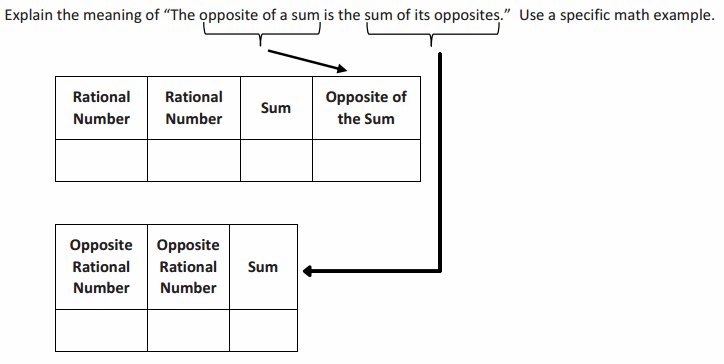
Eureka Math Grade 7 Module 2 Lesson 8 Example Answer Key 1
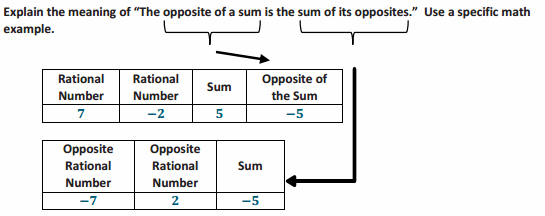
Answer:
Eureka Math Grade 7 Module 2 Lesson 8 Example Answer Key 1.1
It means that if you have a sum and want to take the opposite, for instance, -(7 + (-2)), you can rewrite it as the sum of each addend’s opposite, -7 + 2.

Example 2.
A Mixed Number Is a Sum
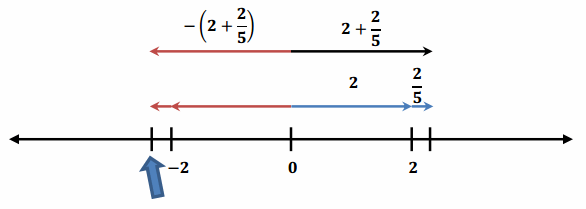
Use the number line model shown below to explain and write the opposite of 2\(\frac{2}{5}\) as a sum of two rational numbers.
Eureka Math Grade 7 Module 2 Lesson 8 Example Answer Key 2
The opposite of a sum (top single arrow pointing left) and the sum of the opposites correspond to the same point on the number line.
Answer:
The opposite of 2\(\frac{2}{5}\) is -2 \(\frac{2}{5}\) .
-2 \(\frac{2}{5}\) written as the sum of two rational numbers is -2 + (-\(\frac{2}{5}\)).

Eureka Math Grade 7 Module 2 Lesson 8 Exercise Answer Key

Exercise 1.
Represent the following expression with a single rational number.
-2\(\frac{2}{5}\) + \(\frac{1}{4}\) – \(\frac{3}{5}\)
Answer:
Two Possible Methods:
-2\(\frac{8}{20}\) + 3\(\frac{5}{20}\) – \(\frac{12}{20}\)
–\(\frac{48}{20}\) + \(\frac{65}{20}\) – \(\frac{12}{20}\)
\(\frac{17}{20}\) – \(\frac{12}{20}\)
\(\frac{5}{20}\) or \(\frac{1}{4}\)

OR

-2\(\frac{2}{5}\) + 3\(\frac{1}{4}\) + (-\(\frac{3}{5}\))
-2\(\frac{2}{5}\) + (-\(\frac{3}{5}\)) + 3\(\frac{1}{4}\) commutative property
-2\(\frac{5}{5}\) + 3\(\frac{1}{4}\)
-3 + 3\(\frac{1}{4}\)
\(\frac{1}{4}\)

Exercise 2.
Rewrite each mixed number as the sum of two signed numbers.
a. -9\(\frac{5}{8}\)
Answer:
-9 + (-\(\frac{5}{8}\) )

b. -2\(\frac{1}{2}\)
Answer:
-2 + (-\(\frac{1}{2}\) )

c. 8\(\frac{11}{12}\)
8 + \(\frac{11}{12}\)

Exercise 3.
Represent each sum as a mixed number.
a. -1 + (-\(\frac{5}{12}\))
Answer:
-1 \(\frac{5}{12}\)

b. 30 + \(\frac{1}{8}\)
Answer:
30\(\frac{1}{8}\)

c. -17 + (-\(\frac{1}{9}\) )
-17 \(\frac{1}{9}\)

Note: Exercises 3 and 4 are designed to provide students with an opportunity to practice writing mixed numbers as sums so they can do so as the need arises in more complicated problems.

Exercise 4.
Mr. Mitchell lost 10 pounds over the summer by jogging each week. By winter, he had gained 5 \(\frac{1}{8}\) pounds. Represent this situation with an expression involving signed numbers. What is the overall change in Mr. Mitchell’s weight?
Answer:
-10 + 5 \(\frac{1}{8}\)
= -10 + 5 + \(\frac{1}{8}\)
=(-10 + 5) + \(\frac{1}{8}\)
=(-5) + \(\frac{1}{8}\)
= -4\(\frac{7}{8}\)
Mr. Mitchell’s weight dropped by 4 \(\frac{7}{8}\) pounds.

Exercise 5.
Jamal is completing a math problem and represents the expression -5\(\frac{5}{7}\) + 8 – 3\(\frac{2}{7}\) with a single rational number as shown in the steps below. Justify each of Jamal’s steps. Then, show another way to solve the problem.
= -5 \(\frac{5}{7}\) + 8 + (-3 \(\frac{2}{7}\) )
= -5 \(\frac{5}{7}\) + (-3 \(\frac{2}{7}\) ) + 8
= -5 + (-\(\frac{5}{7}\) ) + (-3) + (-\(\frac{2}{7}\) ) + 8
= -5 + (-\(\frac{5}{7}\) ) + (-\(\frac{2}{7}\) ) + (-3) + 8
= -5 + (-1) + (-3) + 8
= -6 + (-3) + 8
= (-9) + 8
= -1
Answer:
Step 1: Subtracting a number is the same as adding its inverse.
Step 2: Apply the commutative property of addition.
Step 3: The opposite of a sum is the sum of its opposites.
Step 4: Apply the commutative property of addition.
Step 5: Apply the associative property of addition.
(-\(\frac{5}{7}\)) + (-\(\frac{2}{7}\) ) = (-\(\frac{7}{7}\) )= -1
Step 6: -5 + (-1) = -6
Step 7: -6 + -3 = -9
Step 8: -9 + 8= -1
Answers will vary for other methods of reaching a single rational number. Students may choose to add -5 \(\frac{5}{7}\) and 8 together first, but a common mistake is to represent their sum as 3 \(\frac{5}{7}\) , rather than 2 \(\frac{2}{7}\) .

Eureka Math Grade 7 Module 2 Lesson 8 Problem Set Answer Key

Question 1.
Represent each sum as a single rational number.
a. -14 + (-\(\frac{8}{9}\) )
Answer:
-14 \(\frac{8}{9}\)

b. 7 + \(\frac{1}{9}\)
Answer:
7 \(\frac{1}{9}\)

c. -3 + (-\(\frac{1}{6}\) )
Answer:
-3 \(\frac{1}{6}\)

Rewrite each of the following to show that the opposite of a sum is the sum of the opposites. Problem 2 has been completed as an example.

Question 2.
-(9 + 8) = -9 + (-8)
-17 = -17
Answer:
Answer provided in student materials.

Question 3.
-(\(\frac{1}{4}\) + 6) = –\(\frac{1}{4}\) + (-6)
Answer:
-6 \(\frac{1}{4}\) = -6 \(\frac{1}{4}\)

Question 4.
-(10 + (-6)) = -10 + 6
Answer:
– 4 = -4

Question 5.
-((-55) + \(\frac{1}{2}\)) = 55 + (-\(\frac{1}{2}\) )
Answer:
54\(\frac{1}{2}\) = 54\(\frac{1}{2}\)

Use your knowledge of rational numbers to answer the following questions.

Question 6.
Meghan said the opposite of the sum of -12 and 4 is 8. Do you agree? Why or why not?
Answer:
Yes, I agree. The sum of -12 and 4 is -8, and the opposite of -8 is 8.

Question 7.
Jolene lost her wallet at the mall. It had $10 in it. When she got home, her brother felt sorry for her and gave her $5.75. Represent this situation with an expression involving rational numbers. What is the overall change in the amount of money Jolene has?
Answer:
-10 + 5.75 = -4.25. The overall change in the amount of money Jolene has is -4.25 dollars.

Question 8.
Isaiah is completing a math problem and is at the last step: 25 – 28\(\frac{1}{5}\). What is the answer? Show your work.
Answer:
25 – 28 \(\frac{1}{5}\) = 25 + (-28 + (-\(\frac{1}{5}\))) = (25 + -28) + (-\(\frac{1}{5}\)) = -3\(\frac{1}{5}\)

Question 9.
A number added to its opposite equals zero. What do you suppose is true about a sum added to its opposite? Use the following examples to reach a conclusion. Express the answer to each example as a single rational number.
Answer:
A sum added to its opposite is zero.
a. (3 + 4) + (-3 + -4)
Answer:
(3 + 4) + (-3 + -4) = 7 + (-7) = 0

b. (-8 + 1) + (8 + (- 1))
Answer:
(-8 + 1) + (8 + (- 1)) = (-7) + 7 = 0

c. (-\(\frac{1}{2}\) + (-\(\frac{1}{4}\) )) + (\(\frac{1}{2}\) + \(\frac{1}{4}\) )
Answer:
(-\(\frac{1}{2}\) + (-\(\frac{1}{4}\) )) + (\(\frac{1}{2}\) + \(\frac{1}{4}\) ) = (-\(\frac{3}{4}\) ) + \(\frac{3}{4}\) =0

Eureka Math Grade 7 Module 2 Lesson 8 Integer Addition—Round 1 Answer Key

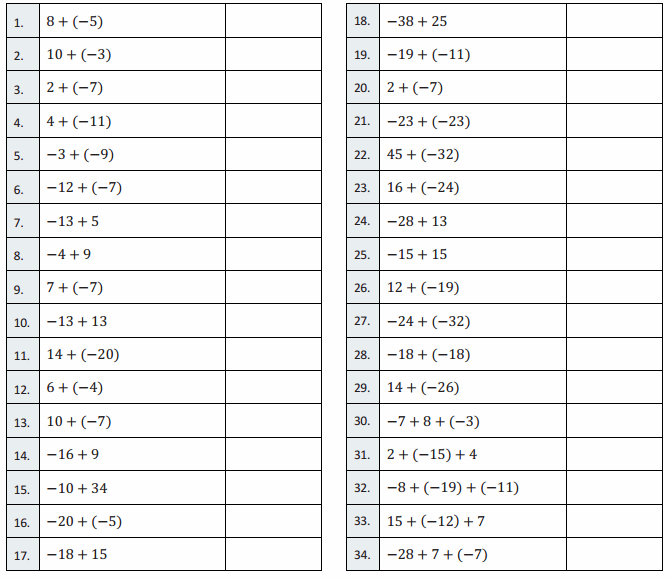
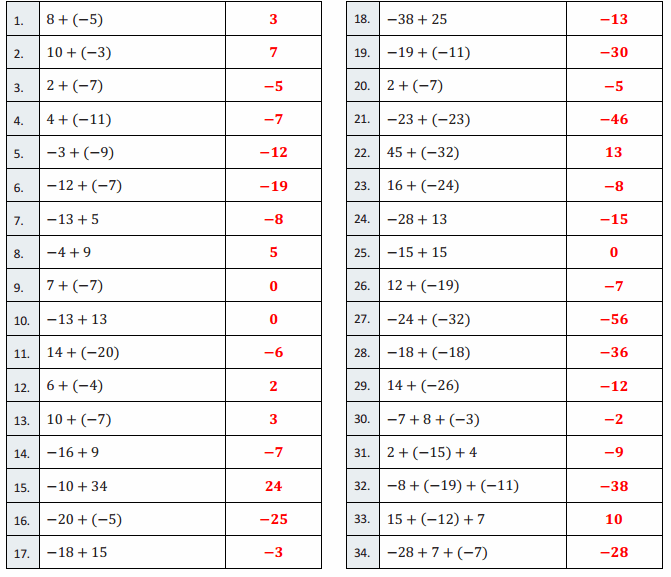
Directions: Determine the sum of the integers, and write it in the column to the right.
Eureka Math Grade 7 Module 2 Lesson 8 Integer Addition—Round 1 Answer Key 20
Answer:
Eureka Math Grade 7 Module 2 Lesson 8 Integer Addition—Round 1 Answer Key 20.1

Question 1.
8 + (-5)
Answer:
3

Question 2.
10 + (-3)
Answer:
7

Question 3.
2 + (-7)
Answer:
-5

Question 4.
4 + (-11)
Answer:
-7

Question 5.
-3 + (-9)
Answer:
-12

Question 6.
-12 + (-7)
Answer:
-19

Question 7.
-13 + 5
Answer:
0

Question 8.
-4 + 9
Answer:
5

Question 9.
7 + (-7)
Answer:
0

Question 10.
-13 + 13
Answer:
0

Question 11.
14 + (-20)
Answer:
-6

Question 12.
6 + (-4)
Answer:
2

Question 13.
10 + (-7)
Answer:
3

Question 14.
-16 + 9
Answer:
-7

Question 15.
-10 + 34
Answer:
24

Question 16.
-20 + (-5)
Answer:
-25

Question 17.
-18 + 15
Answer:
-3

Question 18.
-38 + 25
Answer:
-13

Question 19.
-19 + (-11)
Answer:
-30

Question 20.
2 + (-7)
Answer:
-5

Question 21.
-23 + (-23)
Answer:
-46

Question 22.
45 + (-32)
Answer:
13

Question 23.
16 + (-24)
Answer:
-8

Question 24.
-28 + 13
Answer:
-15

Question 25.
-15 + 15
Answer:
0

Question 26.
12 + (-19)
Answer:
-7

Question 27.
-24 + (-32)
Answer:
-56

Question 28.
-18 + (-18)
Answer:
-36

Question 29.
14 + (-26)
Answer:
-12

Question 30.
-7 + 8 + (-3)
Answer:
-2

Question 31.
2 + (-15) + 4
Answer:
-9

Question 32.
-8 + (-19) + (-11)
Answer:
-38

Question 33.
15 + (-12) + 7
Answer:
10

Question 34.
-28 + 7 + (-7)
Answer:
-28

Eureka Math Grade 7 Module 2 Lesson 8 Integer Addition—Round 2 Answer Key

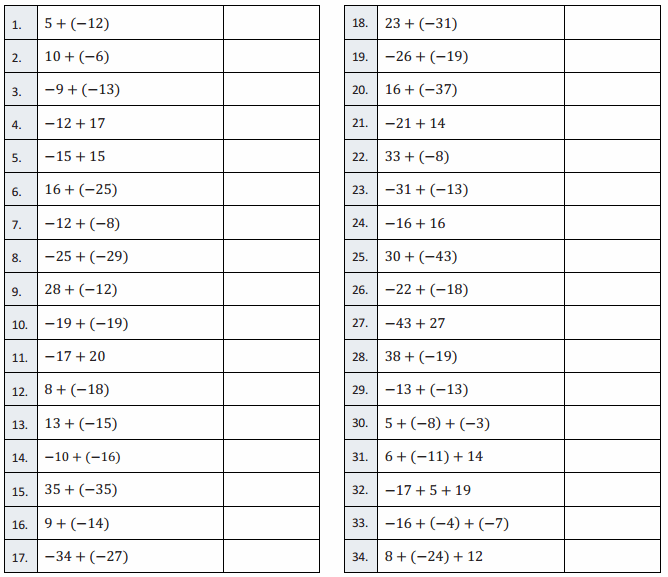
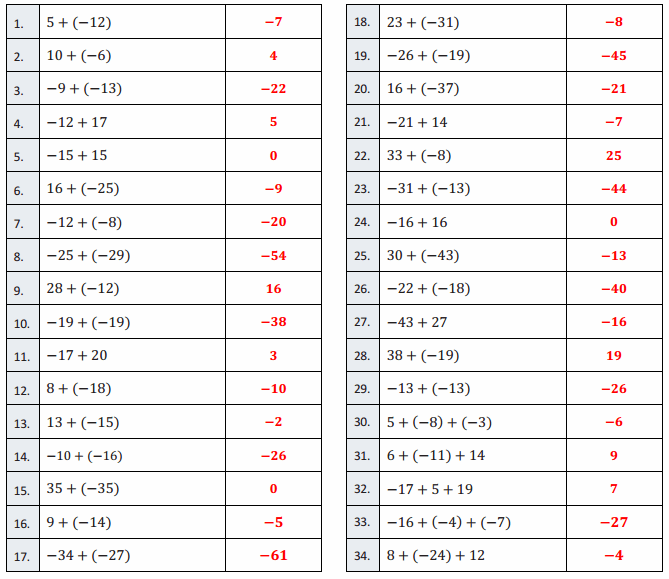
Eureka Math Grade 7 Module 2 Lesson 8 Integer Addition—Round 2 Answer Key 21
Answer:
Eureka Math Grade 7 Module 2 Lesson 8 Integer Addition—Round 2 Answer Key 21.1

Question 1.
5 + (-12)
Answer:
-7

Question 2.
10 + (-6)
Answer:
4

Question 3.
-9 + (-13)
Answer:
-22

Question 4.
-12 + 17
Answer:
5

Question 5.
-15 + 15
Answer:
0

Question 6.
16 + (-25)
Answer:
-9

Question 7.
-12 + (-8)
Answer:
-20

Question 8.
-25 + (-29)
Answer:
-54

Question 9.
28 + (-12)
Answer:
16

Question 10.
-19 + (-19)
Answer:
-38

Question 11.
-17 + 20
Answer:
3

Question 12.
8 + (-18)
Answer:
-10

Question 13.
13 + (-15)
Answer:
-2

Question 14.
-10 + (-16)
Answer:
-26

Question 15.
35 + (-35)
Answer:
0

Question 16.
9 + (-14)
Answer:
-5

Question 17.
-34 + (-27)
Answer:
-61

Question 18.
23 + (-31)
Answer:
-8

Question 19.
-26 + (-19)
Answer:
-45

Question 20.
16 + (-37)
Answer:
-21

Question 21.
-21 + 14
Answer:
-7

Question 22.
33 + (-8)
Answer:
25

Question 23.
-31 + (-13)
Answer:
-44

Question 24.
-16 + 16
Answer:
0

Question 25.
30 + (-43)
Answer:
-13

Question 26.
-22 + (-18)
Answer:
-40

Question 27.
-43 + 27
Answer:
-16

Question 28.
38 + (-19)
Answer:
19

Question 29.
-13 + (-13)
Answer:
-26

Question 30.
5 + (-8) + (-3)
Answer:
-6

Question 31.
6 + (-11) + 14
Answer:
9

Question 32.
-17 + 5 + 19
Answer:
7

Question 33.
-16 + (-4) + (-7)
Answer:
-27

Question 34.
8 + (-24) + 12
Answer:
-4

Eureka Math Grade 7 Module 2 Lesson 8 Exit Ticket Answer Key

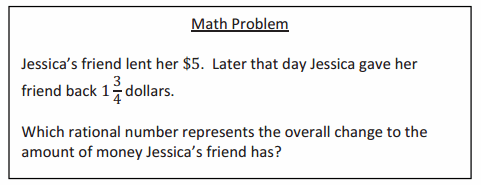
Mariah and Shane both started to work on a math problem and were comparing their work in math class. Are both of their representations correct? Explain, and finish the math problem correctly to arrive at the correct answer.
Eureka Math Grade 7 Module 2 Lesson 8 Exit Ticket Answer Key 10
Mariah started the problem as follows:
-5 – (-1\(\frac{3}{4}\) )
= -5 + 1 – \(\frac{3}{4}\)
Shane started the problem as follows:
-5 – (-1\(\frac{3}{4}\) )
= -5 + (1 \(\frac{3}{4}\))
= -5 + (1 + \(\frac{3}{4}\))
Answer:
Shane’s method is correct. In Mariah’s math work, she only dealt with part of the mixed number. The fractional part should have been positive too because the opposite of -1 \(\frac{3}{4}\) is 1 \(\frac{3}{4}\) , which contains both a positive 1 and a positive \(\frac{3}{4}\) .
The correct work would be
-5 – (-1\(\frac{3}{4}\)) = -5 + (1 \(\frac{3}{4}\)) = -5 + (1 + \(\frac{3}{4}\)) = (-5 + 1) + \(\frac{3}{4}\) = -4 + \(\frac{3}{4}\) = -3\(\frac{1}{4}\) .
The rational number would be -3 \(\frac{1}{4}\) , which means Jessica’s friend gave away 3 \(\frac{1}{4}\) dollars, or $3.25.

Eureka Math Grade 7 Module 2 Lesson 7 Answer Key

Engage NY Eureka Math 7th Grade Module 2 Lesson 7 Answer Key

Eureka Math Grade 7 Module 2 Lesson 7 Example Answer Key

Example 1.
Representing Sums of Rational Numbers on a Number Line
a. Place the tail of the arrow on 12.
b. The length of the arrow is the absolute value of -3\(\frac{1}{2}\) , |-3 \(\frac{1}{2}\) | = 3 \(\frac{1}{2}\) .
c. The direction of the arrow is to the left since you are adding a negative number to 12.
Draw the number line model in the space below.
Engage NY Math 7th Grade Module 2 Lesson 7 Example Answer Key 1.4
Answer:
Engage NY Math 7th Grade Module 2 Lesson 7 Example Answer Key 1.5
12 + ( -3\(\frac{1}{2}\) ) = 8\(\frac{1}{2}\) or 12 – 3\(\frac{1}{2}\) = 8\(\frac{1}{2}\)

Example 2.
Representing Differences of Rational Numbers on a Number Line
Find the following difference, and represent it on a number line: 1 – 2\(\frac{1}{4}\) .
a.
Answer:
Rewrite the difference 1 – 2\(\frac{1}{4}\) as a sum: 1 + (-2 \(\frac{1}{4}\)).
Now follow the steps to represent the sum:
b.
Answer:
Place the tail of the arrow on 1.

c.
Answer:
The length of the arrow is the absolute value of -2 \(\frac{1}{4}\) ; | -2 \(\frac{1}{4}\) |= 2\(\frac{1}{4}\) .

d.
Answer:
The direction of the arrow is to the left since you are adding a negative number to 1.

Draw the number line model in the space below.
Engage NY Math 7th Grade Module 2 Lesson 7 Example Answer Key 60
Answer:
Engage NY Math 7th Grade Module 2 Lesson 7 Example Answer Key 61

Eureka Math Grade 7 Module 2 Lesson 7 Exercise Answer Key

Exercise 1.
Real-World Connection to Adding and Subtracting Rational Numbers
Suppose a seventh grader’s birthday is today, and she is 12 years old. How old was she 3\(\frac{1}{2}\) years ago? Write an equation, and use a number line to model your answer.
Answer:
12 + ( -3\(\frac{1}{2}\)) = 8\(\frac{1}{2}\) or 12 – 3\(\frac{1}{2}\) = 8\(\frac{1}{2}\)
Eureka Math Grade 7 Module 2 Lesson 7 Exercise Answer Key 1

Exercise 2.
Find the following sum using a number line diagram: -2\(\frac{1}{2}\) + 5.
Answer:
Eureka Math Grade 7 Module 2 Lesson 7 Exercise Answer Key 2
(-2\(\frac{1}{2}\)) + 5 = 2\(\frac{1}{2}\)

Exercise 3.
Find the following difference, and represent it on a number line: -5\(\frac{1}{2}\) – (-8).
Eureka Math Grade 7 Module 2 Lesson 7 Exercise Answer Key 3
Answer:
Eureka Math Grade 7 Module 2 Lesson 7 Exercise Answer Key 4
(-5\(\frac{1}{2}\) ) + 8 = 2 \(\frac{1}{2}\)

Exercise 4.
Find the following sums and differences using a number line model.

a. -6 + 5\(\frac{1}{4}\)
Answer:
Eureka Math Grade 7 Module 2 Lesson 7 Exercise Answer Key 20
-6 + 5 \(\frac{1}{4}\) = –\(\frac{3}{4}\)

b. 7-(-0.9)
Answer:
Eureka Math Grade 7 Module 2 Lesson 7 Exercise Answer Key 21
7 + (0.9) = 7.9

c. 2.5 + (-\(\frac{1}{2}\) )
Answer:
Eureka Math Grade 7 Module 2 Lesson 7 Exercise Answer Key 22
2.5 + (-0.5) = 2

d. –\(\frac{1}{4}\) + 4
Answer:
Eureka Math Grade 7 Module 2 Lesson 7 Exercise Answer Key 23
–\(\frac{1}{4}\) + 4 = 3\(\frac{3}{4}\)

e. –\(\frac{1}{2}\) – (-3)
Answer:
Eureka Math Grade 7 Module 2 Lesson 7 Exercise Answer Key 24
\(\frac{1}{2}\) + 3 = 3 \(\frac{1}{2}\)

Exercise 5.
Create an equation and number line diagram to model each answer.
a. Samantha owes her father $7. She just got paid $5.50 for babysitting. If she gives that money to her dad, how much will she still owe him?
Answer:
-7 + 5.50 = -1.50. She still owes him $1.50.
Eureka Math Grade 7 Module 2 Lesson 7 Exercise Answer Key 25

b. At the start of a trip, a car’s gas tank contains 12 gallons of gasoline. During the trip, the car consumes 10\(\frac{1}{8}\) gallons of gasoline. How much gasoline is left in the tank?
Answer:
12 + (-10\(\frac{1}{8}\) ) = 1\(\frac{7}{8}\) or 12-10\(\frac{1}{8}\) =1 \(\frac{7}{8}\) ,There are 1\(\frac{7}{8}\) gallons of gas left in the tank.
Eureka Math Grade 7 Module 2 Lesson 7 Exercise Answer Key 26

c. A fish was swimming 3\(\frac{1}{2}\) feet below the water’s surface at 7:00 a.m. Four hours later, the fish was at a depth that is 5\(\frac{1}{4}\) feet below where it was at 7:00 a.m. What rational number represents the position of the fish with respect to the water’s surface at 11:00 a.m.?
Answer:
-3\(\frac{1}{2}\) +(-5\(\frac{1}{4}\) )= -8\(\frac{3}{4}\) . The fish is 8\(\frac{3}{4}\) feet below the water’s surface.
Eureka Math Grade 7 Module 2 Lesson 7 Exercise Answer Key 27

Eureka Math Grade 7 Module 2 Lesson 7 Problem Set Answer Key

Represent each of the following problems using both a number line diagram and an equation.

Question 1.
A bird that was perched atop a 15\(\frac{1}{2}\) -foot tree dives down six feet to a branch below. How far above the ground is the bird’s new location?
Answer:
15\(\frac{1}{2}\) + (-6) = 9\(\frac{1}{2}\)
The bird is 9\(\frac{1}{2}\) feet above the ground.
Eureka Math Grade 7 Module 2 Lesson 7 Problem Set Answer Key 28

Question 2.
Mariah owed her grandfather $2.25 but was recently able to pay him back $1.50. How much does Mariah currently owe her grandfather?
Answer:
-2.25 + 1.50 = -0.75
Mariah owes her grandfather 75 cents.
Eureka Math Grade 7 Module 2 Lesson 7 Problem Set Answer Key 29

Question 3.
Jake is hiking a trail that leads to the top of a canyon. The trail is 4.2 miles long, and Jake plans to stop for lunch after he completes 1.6 miles. How far from the top of the canyon will Jake be when he stops for lunch?
Answer:
4.2 – 1.6 = 2.6
Jake will be 2.6 miles from the top of the canyon.
Eureka Math Grade 7 Module 2 Lesson 7 Problem Set Answer Key 40

Question 4.
Sonji and her friend Rachel are competing in a running race. When Sonji is 0.4 miles from the finish line, she notices that her friend Rachel has fallen. If Sonji runs one-tenth of a mile back to help her friend, how far will she be from the finish line?
Answer:
-0.4 + (-0.1) = -0.5 or -0.4 – 0.1 = -0.5
Sonji will be 0.5 miles from the finish line.
Eureka Math Grade 7 Module 2 Lesson 7 Problem Set Answer Key 41

Question 5.
Mr. Henderson did not realize his checking account had a balance of $200 when he used his debit card for a $317.25 purchase. What is his checking account balance after the purchase?
Answer:
200 + (-317.25) = -117.25 or 200 – 317.25 = -117.25
Mr. Henderson’s checking account balance will be -$117.25.
Eureka Math Grade 7 Module 2 Lesson 7 Problem Set Answer Key 42

Question 6.
If the temperature is -3°F at 10:00 p.m., and the temperature falls four degrees overnight, what is the resulting temperature?
Answer:
-3 – 4 = -3 + (-4) = -7
The resulting temperature is -7°F.
Eureka Math Grade 7 Module 2 Lesson 7 Problem Set Answer Key 43

Eureka Math Grade 7 Module 2 Lesson 7 Exit Ticket Answer Key

At the beginning of the summer, the water level of a pond is 2 feet below its normal level. After an unusually dry summer, the water level of the pond dropped another 1\(\frac{1}{3}\) feet.

Question 1.
Use a number line diagram to model the pond’s current water level in relation to its normal water level.
Answer:
Move 1\(\frac{1}{3}\) units to the left of -2. -3\(\frac{1}{3}\)
Engage NY Math 7th Grade Module 2 Lesson 7 Exit Ticket Answer Key 30

Question 2.
Write an equation to show how far above or below the normal water level the pond is at the end of the summer.
Answer:
-2 – 1\(\frac{1}{3}\) = -3\(\frac{1}{3}\) or -2 + (-1\(\frac{1}{3}\)) = -3\(\frac{1}{3}\)

Eureka Math Grade 7 Module 2 Lesson 4 Answer Key

Engage NY Eureka Math 7th Grade Module 2 Lesson 4 Answer Key

Eureka Math Grade 7 Module 2 Lesson 4 Example Answer Key

Example 1:
Rule for Adding Integers with Same Signs
a. Represent the sum of 3+5 using arrows on the number line.
Engage NY Math 7th Grade Module 2 Lesson 4 Example Answer Key 1
Answer:
Engage NY Math 7th Grade Module 2 Lesson 4 Example Answer Key 2
3 + 5 = 8

i. How long is the arrow that represents 3?
Answer:
3 units

b. What direction does it point?
Answer:
Right/up

iii. How long is the arrow that represents 5?
Answer:
5 units

iv. What direction does it point?
Answer:
Right/up

v. What is the sum?
Answer:
8

vi. If you were to represent the sum using an arrow, how long would the arrow be, and what direction would it point?
Answer:
The arrow would be 8 units long and point to the right (or up on a vertical number line).

vii. What is the relationship between the arrow representing the number on the number line and the absolute value of the number?
Answer:
The length of an arrow representing a number is equal to the absolute value of the number.

vii. Do you think that adding two positive numbers will always give you a greater positive number? Why?
Answer:
Yes, because the absolute values are positive, so the sum will be a greater positive. On a number line, adding them would move you farther away from 0 (to the right or above) on a number line.

From part (a), use the same questions to elicit feedback.
→ In the Integer Game, I would combine -3 and -5 to give me -8.

b. Represent the sum of -3 + (-5) using arrows that represent -3 and -5 on the number line.
Engage NY Math 7th Grade Module 2 Lesson 4 Example Answer Key 5
Answer:
Engage NY Math 7th Grade Module 2 Lesson 4 Example Answer Key 6
-3 + (-5) = -8

i. How long is the arrow that represents -3?
Answer:
3 units

ii. What direction does it point?
Answer:
Left/down

iii. How long is the arrow that represents -5?
Answer:
5 units

iv. What direction does it point?
Answer:
Left/down

iv. What is the sum?
Answer:
-8

vi. If you were to represent the sum using an arrow, how long would the arrow be, and what direction would it point?
Answer:
The arrow would be 8 units long and point to the left (or down on a vertical number line).

vii. Do you think that adding two negative numbers will always give you a smaller negative number? Why?
Answer:
Yes, because the absolute values of negative numbers are positive, so the sum will be a greater positive. However, the opposite of a greater positive is a smaller negative. On a number line, adding two negative numbers would move you farther away from 0 (to the left or below) on a number line.

c. What do both examples have in common?
Answer:
The length of the arrow representing the sum of two numbers with the same sign is the same as the sum of the absolute values of both numbers.

The teacher writes the rule for adding integers with the same sign.

RULE: Add rational numbers with the same sign by adding the absolute values and using the common sign.

Example 2.
Rule for Adding Opposite Signs
a. Represent 5 + (-3) using arrows on the number line.
Engage NY Math 7th Grade Module 2 Lesson 4 Example Answer Key 9.1
Answer:
5 + (-3) = 2
Engage NY Math 7th Grade Module 2 Lesson 4 Example Answer Key 10

i. How long is the arrow that represents 5?
Answer:
5 units

ii. What direction does it point?
Answer:
Right/up

iii. How long is the arrow that represents -3?
Answer:
3 units

iv. What direction does it point?
Answer:
Left/down

v. Which arrow is longer?
Answer:
The arrow that is five units long, or the first arrow.

vi. What is the sum? If you were to represent the sum using an arrow, how long would the arrow be, and what direction would it point?
Answer:
5 + (-3) = 2
The arrow would be 2 units long and point right/up.

b. Represent the 4 + (-7) using arrows on the number line.
Engage NY Math 7th Grade Module 2 Lesson 4 Example Answer Key 10.2
Answer:
4 + (-7) = -3
Engage NY Math 7th Grade Module 2 Lesson 4 Example Answer Key 11

i. In the two examples above, what is the relationship between the length of the arrow representing the sum and the lengths of the arrows representing the two addends?
Answer:
The length of the arrow representing the sum is equal to the difference of the absolute values of the lengths of both arrows representing the two addends.

ii. What is the relationship between the direction of the arrow representing the sum and the direction of the arrows representing the two addends?
Answer:
The direction of the arrow representing the sum has the same direction as the arrow of the addend with the greater absolute value.

iii. Write a rule that will give the length and direction of the arrow representing the sum of two values that have opposite signs.
Answer:
The length of the arrow of the sum is the difference of the absolute values of the two addends. The direction of the arrow of the sum is the same as the direction of the longer arrow.

The teacher writes the rule for adding integers with opposite signs.

RULE: Add rational numbers with opposite signs by subtracting the absolute values and using the sign of the integer with the greater absolute value

Example 3.
Applying Integer Addition Rules to Rational Numbers
Find the sum of 6 + (-2\(\frac{1}{4}\)). The addition of rational numbers follows the same rules of addition for integers.
a. Find the absolute values of the numbers.
Answer:
|6| = 6
|-2\(\frac{1}{4}\)| = 2 \(\frac{1}{4}\)

b. Subtract the absolute values.
6 – 2\(\frac{1}{4}\) = 6 – \(\frac{9}{4}\) = \(\frac{24}{4}\) – \(\frac{9}{4}\) = \(\frac{15}{4}\) = 3\(\frac{3}{4}\)
Answer:
Engage NY Math 7th Grade Module 2 Lesson 4 Example Answer Key 25

c. The answer will take the sign of the number that has the greater absolute value.
Answer:
Since 6 has the greater absolute value (arrow length), my answer will be positive 3 \(\frac{3}{4}\) .

Eureka Math Grade 7 Module 2 Lesson 3 Exercise Answer Key

Exercise 2.
a. Decide whether the sum will be positive or negative without actually calculating the sum.
i. -4 + (-2) ___
Answer:
Negative

ii. 5 + 9 ___
Answer:
Positive

iii. -6 + (-3) ____
Answer:
Negative

iv. -1 + (-11) ___
Answer:
Negative

v. 3 + 5 + 7 ___
Answer:
Positive

vi. -20 + (-15) __
Answer:
Negative

b. Find the sum.

i. 15 + 7
Answer:
22

ii. -4 + (-16)
Answer:
-20

iii. -18 + (-64)
Answer:
-82

iv. -205 + (-123)
Answer:
-328

Exercise 3.
Circle the integer with the greater absolute value. Decide whether the sum will be positive or negative without actually calculating the sum.

i. -1 + 2
Answer:
Eureka Math Grade 7 Module 2 Lesson 4 Exercise Answer Key 25.1

ii. 5 + (-9)
Answer:
Eureka Math Grade 7 Module 2 Lesson 4 Exercise Answer Key 26

iii. -6 + 3
Answer:
Eureka Math Grade 7 Module 2 Lesson 4 Exercise Answer Key 27

iv. -11 + 1
Answer:
Eureka Math Grade 7 Module 2 Lesson 4 Exercise Answer Key 28

b. Find the sum.

i. -10 + 7
Answer:
-3

ii. 8 + (-16)
Answer:
-8

iii. -12 + (65)
Answer:
53

iv. 105 + (-126)
Answer:
-21

Exercise 4.
Solve the following problems. Show your work.
a. Find the sum of Eureka Math Grade 7 Module 2 Lesson 4 Exercise Answer Key 60
Answer:
|-18| = 18
|7| = 7
18 – 7 = 11
-11

b. If the temperature outside was 73 degrees at 5:00 p.m., but it fell 19 degrees by 10:00 p.m., what is the temperature at 10:00 p.m.? Write an equation and solve.
Answer:
Eureka Math Grade 7 Module 2 Lesson 4 Exercise Answer Key 65

c. Write an addition sentence, and find the sum using the diagram below.
Eureka Math Grade 7 Module 2 Lesson 4 Exercise Answer Key 65.1
Answer:
Eureka Math Grade 7 Module 2 Lesson 4 Exercise Answer Key 66

Eureka Math Grade 7 Module 2 Lesson 3 Exit Ticket Answer Key

Question 1.
Write an addition problem that has a sum of -4 \(\frac{4}{5}\) and
a. The two addends have the same sign.
Answer:
Answers will vary. -1 \(\frac{4}{5}\) + (-3) = -4 \(\frac{4}{5}\) .

b. The two addends have different signs.
Answer:
Answers will vary. 1.8 + (-6.6) = -4.8.

Question 2.
In the Integer Game, what card would you need to draw to get a score of 0 if you have a -16, -35, and 18 in your hand?
Answer:
-16 + (-35) + 18 = -33, so I would need to draw a 33 because 33 is the additive inverse of -33.
-33 + 33 = 0.

Eureka Math Grade 7 Module 2 Lesson 3 Problem Set Answer Key

Question 1.
Find the sum. Show your work to justify your answer.
a. 4 + 17
Answer:
4 + 17 = 21

b. -6 + (-12)
Answer:
-6 + (-12) = -18

c. 2.2 + (-3.7)
Answer:
2.2 + (-3.7) = -1.5

d. -3 + (-5) + 8
Answer:
-3 + (-5) + 8 = -8 + 8 = 0

e. \(\frac{1}{3}\) +(-2 \(\frac{1}{4}\))
Answer:
\(\frac{1}{3}\) +(-2 \(\frac{1}{4}\)) = \(\frac{1}{3}\) + (-\(\frac{9}{4}\) ) = \(\frac{4}{12}\) + (-\(\frac{27}{12}\) )= – \(\frac{23}{12}\) = -1\(\frac{11}{12}\)

Question 2.
Which of these story problems describes the sum 19+(-12)? Check all that apply. Show your work to justify your answer.
___ Jared’s dad paid him $19 for raking the leaves from the yard on Wednesday. Jared spent $12 at the movie theater on Friday. How much money does Jared have left?
Answer:
X

___ Jared owed his brother $19 for raking the leaves while Jared was sick. Jared’s dad gave him $12 for doing his chores for the week. How much money does Jared have now?

___ Jared’s grandmother gave him $19 for his birthday. He bought $8 worth of candy and spent another $4 on a new comic book. How much money does Jared have left over?
Answer:
X

Question 3.
Use the diagram below to complete each part.
Eureka Math Grade 7 Module 2 Lesson 4 Problem Set Answer Key 70
Answer:
Eureka Math Grade 7 Module 2 Lesson 4 Problem Set Answer Key 70.1
a. Label each arrow with the number the arrow represents.

b. How long is each arrow? What direction does each arrow point?
Eureka Math Grade 7 Module 2 Lesson 4 Problem Set Answer Key 72
Answer:
Eureka Math Grade 7 Module 2 Lesson 4 Problem Set Answer Key 73

c. Write an equation that represents the sum of the numbers. Find the sum.
Answer:
5 + (-3) + (-7) = -5

Question 4.
Jennifer and Katie were playing the Integer Game in class. Their hands are represented below.
Eureka Math Grade 7 Module 2 Lesson 4 Problem Set Answer Key 74
a. What is the value of each of their hands? Show your work to support your answer.
Answer:
Jennifer’s hand has a value of -3 because 5 + (-8) = -3. Katie’s hand has a value of -2 because
-9 + 7 = -2.

b. If Jennifer drew two more cards, is it possible for the value of her hand not to change? Explain why or why not.
Answer:
It is possible for her hand not to change. Jennifer could get any two cards that are the exact opposites such as (-2) and 2. Numbers that are exact opposites are called additive inverses, and they sum to 0. Adding the number 0 to anything will not change the value.

c. If Katie wanted to win the game by getting a score of 0, what card would she need? Explain.
Answer:
Katie would need to draw a 2 because the additive inverse of -2 is 2. -2 + 2 = 0.

d. If Jennifer drew -1 and -2, what would be her new score? Show your work to support your answer.
Answer:
Jennifer’s new score would be -6 because -3 + (-1) + (-2) = -6.

Eureka Math Grade 7 Module 2 Lesson 5 Answer Key

Engage NY Eureka Math 7th Grade Module 2 Lesson 5 Answer Key

Eureka Math Grade 7 Module 2 Lesson 5 Example Answer Key

Example 1.
Exploring Subtraction with the Integer Game
Play the Integer Game in your group. Start Round 1 by selecting four cards. Follow the steps for each round of play.
Write the value of your hand in the Total column.
Then, record what card values you select in the Action 1 column and discard from your hand in the Action 2 column.
After each action, calculate your new total, and record it under the appropriate Results column.
Based on the results, describe what happens to the value of your hand under the appropriate Descriptions column. For example, “Score increased by 3.”
Engage NY Math 7th Grade Module 2 Lesson 5 Example Answer Key 1
Answer:
sample student work
Engage NY Math 7th Grade Module 2 Lesson 5 Example Answer Key 2

Discussion: Making Connections to Integer Subtraction

Question 1.
How did selecting positive value cards change the value of your hand?
Answer:
It increased my score by the value of the card.

Question 2.
How did selecting negative value cards change the value of your hand?
Answer:
It decreased my score by the absolute value of the card.

Question 3.
How did discarding positive value cards change the value of your hand?
Answer:
It decreased my score by the value of the card.

Question 4.
How did discarding negative value cards change the value of your hand?
Answer:
It increased my score by the absolute value of the card.

Question 5.
What operation reflects selecting a card?
Answer:
Addition

Question 6.
What operation reflects discarding or removing a card?
Answer:
Subtraction

Question 7.
Based on the game, can you make a prediction about what happens to the result when

a. Subtracting a positive integer?
Answer:
The result of the hand will decrease by the value of the integer.

b. Subtracting a negative integer?
Answer:
The result of the hand will increase by the absolute value of the negative integer.

At the end of the lesson, the class reviews its predictions.

Example 2:
Subtracting a Positive Number
Follow along with your teacher to complete the diagrams below.
Engage NY Math 7th Grade Module 2 Lesson 5 Example Answer Key 10
Answer:
If I had these two cards, the sum would be 6.
Engage NY Math 7th Grade Module 2 Lesson 5 Example Answer Key 11

Show that discarding (subtracting) a positive card, which is the same as subtracting a positive number, decreases the value of the hand.
Engage NY Math 7th Grade Module 2 Lesson 5 Example Answer Key 12
Answer:
Engage NY Math 7th Grade Module 2 Lesson 5 Example Answer Key 13
If I discarded or removed the 2, my score would decrease by 2 because I would still have a 4 left in my hand.
4 + 2 – 2 = 4. Taking away, or subtracting, 2 causes my score to decrease by 2.

Removing ___ a positive card changes the score in the same way as ___ adding a card whose value is the ___ ___ (or opposite). In this case, adding the corresponding ____
Answer:
Removing (subtracting) a positive card changes the score in the same way as adding a card whose value is the
additive inverse (or opposite). In this case, adding the corresponding negative such that 4 – 2 = 4 + (-2).
Subtracting a positive q-value is represented on the number line as moving to the left on a number line.

Example 3.
Subtracting a Negative Number
Follow along with your teacher to complete the diagrams below.
Engage NY Math 7th Grade Module 2 Lesson 5 Example Answer Key 14
How does removing a negative card change the score, or value, of the hand?
Answer:
Engage NY Math 7th Grade Module 2 Lesson 5 Example Answer Key 15
If I discarded, or removed, the -2, my score would increase by 2 because I would still have a 4 left in my hand.
4 + (-2) – (-2) = 4. Taking away, or subtracting, -2 causes my score to increase by 2.

Engage NY Math 7th Grade Module 2 Lesson 5 Example Answer Key 16
Answer:
Engage NY Math 7th Grade Module 2 Lesson 5 Example Answer Key 17

Removing (___) a negative card changes the score in the same way as ___ a card whose value is the ___ (or opposite). In this case, adding the corresponding ____
Answer:
Removing (subtracting) a negative card changes the score in the same way as adding a card whose value is the
additive inverse (or opposite). In this case, adding the corresponding positive such that 4 – (-2) = 4 + 2.
Subtracting a negative q-value is represented on the number line as moving to the right on a number line because it is the opposite of subtracting a positive q-value (move to the left).

THE RULE OF SUBTRACTION: Subtracting a number is the same as adding its additive inverse (or opposite).

Eureka Math Grade 7 Module 2 Lesson 5 Exercise Answer Key

Question 1.
Using the rule of subtraction, rewrite the following subtraction sentences as addition sentences and solve. Use the number line below if needed.
a. 8 – 2
Answer:
Eureka Math Grade 7 Module 2 Lesson 5 Exercise Answer Key 18

b. 4 – 9
Answer:
Eureka Math Grade 7 Module 2 Lesson 5 Exercise Answer Key 19

c. -3 – 7
Answer:
-3 + (-7) = -10

d. – 9 – (-2)
Answer:
Eureka Math Grade 7 Module 2 Lesson 5 Exercise Answer Key 20

Exercise 2.
Find the differences.
a. -2 – (-5)
Answer:
Eureka Math Grade 7 Module 2 Lesson 5 Exercise Answer Key 20.1

b. 11 – (-8)
Answer:
11 + 8 = 19

c. -10 – (-4)
Answer:
Eureka Math Grade 7 Module 2 Lesson 5 Exercise Answer Key 20.2

Question 3.
Write two equivalent expressions that represent the situation. What is the difference in their elevations? An airplane flies at an altitude of 25,000 feet. A submarine dives to a depth of 600 feet below sea level.
Answer:
25,000 – (-600) and 25,000 + 600
The difference in their elevation is 25,600 feet.

Eureka Math Grade 7 Module 2 Lesson 5 Problem Set Answer Key

Question 1.
On a number line, find the difference of each number and 4. Complete the table to support your answers. The first example is provided.
Eureka Math Grade 7 Module 2 Lesson 5 Problem Set Answer Key 30
Answer:
Eureka Math Grade 7 Module 2 Lesson 5 Problem Set Answer Key 31

Question 2.
You and your partner were playing the Integer Game in class. Here are the cards in both hands.
Eureka Math Grade 7 Module 2 Lesson 5 Problem Set Answer Key 33
a. Find the value of each hand. Who would win based on the current scores? (The score closest to 0 wins.)
Answer:
My hand: -8 + 6 + 1 + (-2) = -3
Partner’s hand: 9 + (-5) + 2 + (-7) = -1
My partner would win because -1 is closer to 0. It is 1 unit to the left of 0.

b. Find the value of each hand if you discarded the -2 and selected a 5, and your partner discarded the -5 and selected a 5. Show your work to support your answer.
Answer:
My hand: Discard the -2, -3 – (-2) = -1; Select a 5: -1 + 5 = 4.
Partner’s hand: Discard the -5, -1 – (-5) = 4; Select a 5: 4 + 5 = 9.

c. Use your score values from part (b) to determine who would win the game now.
Answer:
I would win now because 4 is closer to zero.

Question 3.
Write the following expressions as a single integer.
a. -2+16
Answer:
14

b. -2 – (-16)
Answer:
14

c. 18 – 26
Answer:
-8

d. -14 – 23
Answer:
-37

e. 30 – (-45)
Answer:
75

Question 4.
Explain what is meant by the following, and illustrate with an example:
“For any real numbers, p and q, p – q = p + (-q).”
Answer:
Subtracting a number is the same as adding its additive inverse. Examples will vary. A sample response is shown below.
p = 4, q = 6, 4 – 6 is the same as 4 + (-6) because -6 is the opposite of 6.
4 – 6 = -2
4 + (-6) = -2
So, 4 – 6 = 4 + (-6) because they both equal -2.

Question 5.
Choose an integer between -1 and -5 on the number line, and label it point P. Locate and label the following points on the number line. Show your work.
Answer:
Answers will vary. A sample response is shown below given that the student chose -3 for P.
Eureka Math Grade 7 Module 2 Lesson 5 Problem Set Answer Key 65

a. Point A: P – 5
Answer:
Point A: -3 – 5 = -8

b. Point B: (P-4)+4
Answer:
Point B: (-3 – 4) + 4 = -3 (same as P)

c. Point C: -P-(-7)
Answer:
Point C: -(-3) – (-7) = 3 + 7 = 10

Eureka Math Grade 7 Module 2 Lesson 5 Exit Ticket Answer Key

Question 1.
If a player had the following cards, what is the value of his hand?
Answer:
The current value of the hand is -2. 1 + (-7) + 4 = -2.
Engage NY Math 7th Grade Module 2 Lesson 5 Exit Ticket Answer Key 25

a. Identify two different ways the player could get to a score of 5 by adding or removing only one card. Explain.
Answer:
He could remove the -7 or add 7. If he removes the -7, the value of the hand will be 5, which is 7 larger than -2. He could also get a sum of 5 by adding 7 to the hand. Therefore, removing the -7 gives him the same result as adding 7.

b. Write two equations for part (a), one for each of the methods you came up with for arriving at a score of 5.
Answer:
-2 – (-7) = 5 and -2 + 7 = 5

Question 2.
Using the rule of subtraction, rewrite the following subtraction expressions as addition expressions, and find the sums.
a. 5 – 9
Answer:
5 + (-9) = -4

b. -14 – (-2)
Answer:
-14 + 2 = -12

Eureka Math Grade 7 Module 2 Lesson 5 Challenge Problem Answer Key

Question 6.
Write two equivalent expressions that represent the situation. What is the difference in their elevations?
An airplane flies at an altitude of 26,000 feet. A submarine dives to a depth of 700 feet below sea level.
Answer:
Two equivalent expressions are 26,000 – (-700) and 26,000 + 700. The difference in their elevations is 26,700 feet.

Eureka Math Grade 7 Module 2 Lesson 15 Answer Key

Engage NY Eureka Math 7th Grade Module 2 Lesson 15 Answer Key

Eureka Math Grade 7 Module 2 Lesson 15 Exercise Answer Key

Exercise 1.
a. In the space below, create a word problem that involves integer multiplication. Write an equation to model the situation.
Answer:
Answers will vary.
Both times we went to the fair, I borrowed $3 from my older brother. -$3 × 2 = -$6

b. Now change the word problem by replacing the integers with non-integer rational numbers (fractions or decimals), and write the new equation.
Answer:
Answers will vary.
Both times we went to the fair, I borrowed $3.50 from my older brother. -$3.50×2=-$7.00

c. Was the process used to solve the second problem different from the process used to solve the first? Explain.
Answer:
No, the process was the same. Both times I had a positive number multiplied by a negative number, so the product is a negative number. The process, multiplication, is represented as repeated addition:
-$3.50+(-$3.50)= -$7.00.

→ Was the process for solving the second problem different from the process you used to solve the problem when it contained only integers?
→ No
Students record the rules in Exercise 1, part (d) of their student materials.

d. The Rules for Multiplying Rational Numbers are the same as the Rules for Multiplying Integers:
Answer:
1. Multiply the absolute values of the two rational numbers.
2. If the two numbers (factors) have the same sign, their product is positive.
3. If the two numbers (factors) have opposite signs, their product is negative.

Exercise 2.
a. In one year, Melinda’s parents spend $2,640.90 on cable and internet service. If they spend the same amount each month, what is the resulting monthly change in the family’s income?
Answer:
-2,640.90 ÷ 12 = -220.08
The average monthly change to their income is about -$220.08.
Eureka Math Grade 7 Module 2 Lesson 15 Exercise Answer Key 20

→ Are the rules for dividing rational numbers the same as the rules for dividing integers?
→ Yes

Students record the rules in Exercise 2, part (b) of their student materials.

b. The Rules for Dividing Rational Numbers are the same as the Rules for Dividing Integers:
1. Divide the absolute values of the two rational numbers.
2. If the two numbers (dividend and divisor) have the same sign, their quotient is positive.
3. If the two numbers (dividend and divisor) have opposite signs, their quotient is negative.

Exercise 3.
Use the fundraiser chart to help answer the questions that follow.
Eureka Math Grade 7 Module 2 Lesson 15 Exercise Answer Key 20.1
Answer:
Eureka Math Grade 7 Module 2 Lesson 15 Exercise Answer Key 21

Jeremy is selling plants for the school’s fundraiser, and listed above is a chart from his fundraiser order form. Use the information in the chart to answer the following questions. Show your work, and represent the answer as a rational number; then, explain your answer in the context of the situation.
a. If Tamara Jones writes a check to pay for the plants, what is the resulting change in her checking account balance?
Answer:
-4.25 × 2 = -8.50
Numerical Answer:
Answer:
-8.50
Explanation:
Answer:
Tamara Jones will need to deduct $8.50 from her checking account balance.

b. Mr. Clark wants to pay for his order with a $20 bill, but Jeremy does not have change. Jeremy tells Mr. Clark he will give him the change later. How will this affect the total amount of money Jeremy collects? Explain. What rational number represents the change that must be made to the money Jeremy collects?
Answer:
2.25 × 5 = 11.25 20.00 – 11.25 = 8.75
Numerical Answer:
Answer:
-8.75
Explanation:
Answer:
Jeremy collects too much money. He owes Mr. Clark $8.75. The adjustment Jeremy needs to make is -$8.75.

c. Jeremy’s sister, Susie, borrowed the money from their mom to pay for her order. Their mother has agreed to deduct an equal amount of money from Susie’s allowance each week for the next five weeks to repay the loan. What is the weekly change in Susie’s allowance?
Answer:
-2.50 ÷ 5 = – 0.50
Numerical Answer:
Answer:
-0.50
Explanation:
Answer:
Susie will lose $0.50 of her allowance each week.

d. Jeremy’s grandparents want to change their order. They want to order three daisies and one geranium, instead of four daisies. How does this change affect the amount of their order? Explain how you arrived at your answer.
Answer:
Original Order: 3.75 × 4 = 15.00
New Order: 3.75 × 3 + 2.25 = 11.25 + 2.25 = 13.50
15.00-13.50=1.50
Numerical Answer: 1.50
Explanation: Jeremy’s grandparents will get back $1.50 since the change in their order made it cheaper.
I got my answer by first calculating the cost of the original order. Second, I calculated the cost of the new order. Finally, I subtracted the two order totals to determine the difference in cost.

e. Jeremy approaches three people who do not want to buy any plants; however, they wish to donate some money for the fundraiser when Jeremy delivers the plants one week later. If the people promise to donate a total of $14.40, what will be the average cash donation?
Answer:
14.40 ÷ 3 = 4.80
Numerical Answer: 4.80
Explanation: The average cash donation will be $4.80 per person.

f. Jeremy spends one week collecting orders. If 22 people purchase plants totaling $270, what is the average amount of Jeremy’s sale?
Answer:
270 ÷ 22 ≈ 12.272
Numerical Answer: 12.27
Explanation: The average sale is about $12.27.
Eureka Math Grade 7 Module 2 Lesson 15 Exercise Answer Key 25

Eureka Math Grade 7 Module 2 Lesson 15 Problem Set Answer Key

Question 1.
At lunch time, Benjamin often borrows money from his friends to buy snacks in the school cafeteria. Benjamin borrowed $0.75 from his friend Clyde five days last week to buy ice cream bars. Represent the amount Benjamin borrowed as the product of two rational numbers; then, determine how much Benjamin owed his friend last week.
Answer:
5 (-0.75)=-3.75
Benjamin owed Clyde $3.75.

Question 2.
Monica regularly records her favorite television show. Each episode of the show requires 3.5% of the total capacity of her video recorder. Her recorder currently has 62% of its total memory free. If Monica records all five episodes this week, how much space will be left on her video recorder?
Answer:
62 + 5(-3.5) = 62 + (-17.5) = 44.5
Monica’s recorder will have 44.5% of its total memory free.

For Problems 3–5, find at least two possible sets of values that will work for each problem.

Question 3.
Fill in the blanks with two rational numbers (other than 1 and -1). ____ × (-\(\frac{1}{2}\)) × ____ = -20
What must be true about the relationship between the two numbers you chose?
Answer:
Answers may vary. Two possible solutions are 10 and 4 or -10 and -4. The two numbers must be factors of 40, and they must both have the same sign.

Question 4.
Fill in the blanks with two rational numbers (other than 1 and -1). -5.6 × 100÷ 80 × ____ × ____ =700
What must be true about the relationship between the two numbers you chose?
Answer:
Answers may vary. Two possible solutions are -50 and 2 or 25 and -4. The two numbers must be factors of -100, and they must have opposite signs.

Question 5.
Fill in the blanks with two rational numbers. ____ × ____ = -0.75
What must be true about the relationship between the two numbers you chose?
Answer:
Answers may vary. Two possible solutions are -3 and 0.25 or 0.5 and -1.5. The two numbers must be factors of -0.75, and they must have opposite signs.

For Problems 6–8, create word problems that can be represented by each expression, and then represent each product or quotient as a single rational number.

Question 6.
8×(-0.25)
Answer:
Answers may vary.
Example: Stacey borrowed a quarter from her mother every time she went to the grocery store so that she could buy a gumball from the gumball machine. Over the summer, Stacey went to the grocery store with her mom eight times. What rational number represents the dollar amount change in her mother’s money due to the purchase of gumballs?
Answer: -2

Question 7.
-6÷(1\(\frac{1}{3}\))
Answer:
Answers may vary.
Example: There was a loss of $6 on my investment over one-and-a-third months. Based on this, what was the investment’s average dollar amount change per month?
Answer: -4.50

Question 8.
–\(\frac{1}{2}\) × 12
Answer:
Answers may vary.
Example: I discarded exactly half of my card-point total in the Integer Game. If my card-point total was 12 before I discarded, which rational number represents the change to my hand’s total card-point total?
Answer: -6

Eureka Math Grade 7 Module 2 Lesson 15 Exit Ticket Answer Key

Harrison made up a game for his math project. It is similar to the Integer Game; however, in addition to integers, there are cards that contain other rational numbers such as -0.5 and -0.25. Write a multiplication or division equation to represent each problem below. Show all related work.

Question 1.
Harrison discards three -0.25 cards from his hand. How does this affect the overall point value of his hand? Write an equation to model this situation.
Answer:
-3 (-0.25) = 0.75
The point value of Harrison’s hand will increase by 0.75 points.

Question 2.
Ezra and Benji are playing the game with Harrison. After Ezra doubles his hand’s value, he has a total of -14.5 points. What was his hand’s value before he doubled it?
Answer:
-14.5 ÷ 2 = -7.25
Before Ezra doubled his hand, his hand had a point value of -7.25.

Question 3.
Benji has four -0.5 cards. What is his total score?
Answer:
4 × (-0.5) = -2.0
Benji’s total score is -2.0 points.

Eureka Math Grade 7 Module 2 Lesson 15 Integer Multiplication Round 1 Answer Key

Directions: Determine the product of the integers, and write it in the column to the right.
Eureka Math Grade 7 Module 2 Lesson 15 Integer Multiplication Round 1 Answer Key 60
Answer:
Eureka Math Grade 7 Module 2 Lesson 15 Integer Multiplication Round 1 Answer Key 61

Eureka Math Grade 7 Module 2 Lesson 15 Integer Multiplication Round 2 Answer Key

Eureka Math Grade 7 Module 2 Lesson 15 Integer Multiplication Round 2 Answer Key 62
Answer:
Eureka Math Grade 7 Module 2 Lesson 15 Integer Multiplication Round 2 Answer Key 63