Eureka Math Geometry Module 2 End of Module Assessment Answer Key

Engage NY Eureka Math Geometry Module 2 End of Module Assessment Answer Key

Eureka Math Geometry Module 2 End of Module Assessment Answer Key

Question 1.
In the figure below, rotate ∆EAB about E by 180° to get ∆E\(A^{\prime} B^{\prime}\). If \(\overline{A^{\prime} B^{\prime}} \| \overline{C D}\), prove that ∆EAB – ∆EDC.
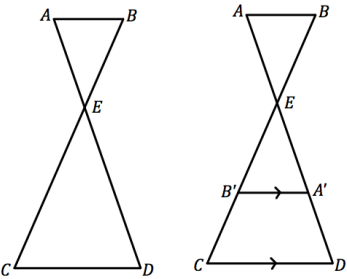
Eureka Math Geometry Module 2 End of Module Assessment Answer Key 1

Answer:
Triangles EAB and E\(A^{\prime} B^{\prime}\). are congruent since a 180° rotation is a rigid motion. Since \(\overline{A^{\prime} B^{\prime}} \| \overline{C D}\), m∠E\(B^{\prime} A^{\prime}\) = m∠ECD, and m∠\(B^{\prime}\)E\(A^{\prime}\) = m∠CED. So, △E\(A^{\prime} B^{\prime}\) ~ △EDC by AA similarity criteria, and △EAB ~ △EDC by the transitive property of similarity

Question 2.
Answer the following questions based on the diagram below.
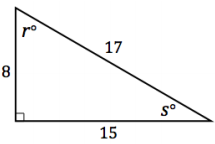
Eureka Math Geometry Module 2 End of Module Assessment Answer Key 2

a. Find the sine and cosine values of angles r and s. Leave the answers as fractions.
sin r°=
sin s°=
cos r°=
cos s°=
tan r°=
tan s°=
Answer:
sin r°= \(\frac{15}{17}\)
sin s°= \(\frac{8}{17}\)
cos r°= \(\frac{8}{17}\)
cos s°= \(\frac{15}{17}\)
tan r°= \(\frac{15}{8}\)
tan s°= \(\frac{8}{15}\)

b. Why is the sine of an acute angle the same value as the cosine of its complement?
Answer:
By definition, sine is the ratio of the opposite side: hypotenuse and cosine is the ratio of the adjacent side: hypotenuse; since the opposite side of an angle is the adjacent side of its complement, sinθ = cos(90 – θ).

c. Determine the measures of the angles to the nearest tenth of a degree in the right triangles below.

i. Determine the measure of ∠a.
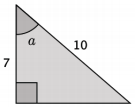
 of Module Assessment Answer Key 3

Answer:
m∠a ≈ 45.6°

ii. Determine the measure of ∠b.
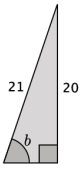
Eureka Math Geometry Module 2 End of Module Assessment Answer Key 4

Answer:
m∠b ≈ 72.2°

iii. Explain how you were able to determine the measure of the unknown angle in part (i) or part (ii).
Answer:
For part (i), students should state that they had to use arccos to determine the unknown angle because the information given about the side lengths included the side adjacent to the unknown angle and the hypotenuse.

For part (ii), students should state that they had to use arcsin to determine the unknown angle because the information given about the side lengths included the side opposite to the unknown angle and the hypotenuse.

d. A ball is dropped from the top of a 45 ft. building. Once the ball is released, a strong gust of wind blew the ball off course, and it dropped 4 ft. from the base of the building.

i. Sketch a diagram of the situation.
Answer:
Sample sketch shown below.
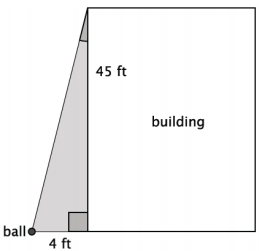
Eureka Math Geometry Module 2 End of Module Assessment Answer Key 7

ii. By approximately how many degrees was the ball blown off course? Round your answer to the nearest whole degree.
Answer:
The wind blew the ball about 5˚ off course.

Question 3.
A radio tower is anchored by long cables called guy wires, such as \(\overline{A B}\) in the figure below. Point A is 250 m from the base of the tower, and m∠BAC = 59°.
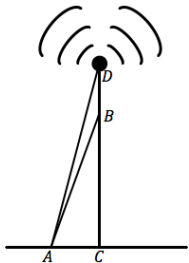
Eureka Math Geometry Module 2 End of Module Assessment Answer Key 5

a. How long is the guy wire? Round to the nearest tenth.
Answer:
cos 59 = \(\frac{250}{A B}\)
AB = \(\frac{250}{\cos 59}\)
AB ≈ 485.4
The guy wire is approximately 485.4 meters.

b. How far above the ground is it fastened to the tower?
Answer:
tan 59 = \(\frac{B C}{250}\)
BC = 250 tan 59
BC ≈ 416.1
It is fastened approximately 416.1 meters above the ground.

c. How tall is the tower, \(\overline{D C}\), if m∠DAC = 71°?
Answer:
tan 71 = \(\frac{D C}{250}\)
DC = 250 tan 71
DC ≈ 726.1
The tower is approximately 726.1 meters tall.

Question 4.
The following problem is modeled after a surveying question developed by a Chinese mathematician during the Tang dynasty in the seventh century C.E.

A building sits on the edge of a river. A man views the building from the opposite side of the river. He measures the angle of elevation with a handheld tool and finds the angle measure to be 45°. He moves 50 feet away from the river and remeasures the angle of elevation to be 30°.

What is the height of the building? From his original location, how far away is the viewer from the top of the building? Round to the nearest whole foot.
Answer:
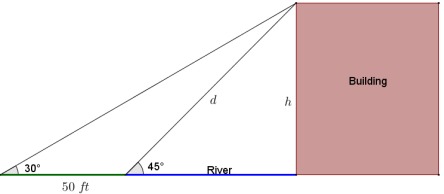
Eureka Math Geometry Module 2 End of Module Assessment Answer Key 8

The angle of depression from the top of the building to the man’s original spot is also 45°, and the angle of depression to his final position is 60°, so the difference of the angles is 15°. Let d represent the distance from the man’s position at the edge of the river to the top of the building, and let h represent the height of the building in feet.

Using the law of sines:
\(\frac{\sin 30}{d}=\frac{\sin 15}{50}\)
d = \(\frac{50 \sin 30}{\sin 15}\) ≈ 96.6
The distance d is approximately 96.6 feet.
By the Pythagorean theorem, the distance d = h√2.
50 \(\frac{\sin 30}{\sin 15}\) = h√2
\(\frac{25}{\sin 15(\sqrt{2})}\) = h
h ≈ 68.3
The distance from the viewer to the top of the building is approximately 97 ft., and the height of the building is approximately 68 ft.

Question 5.
Prove the Pythagorean theorem using similar triangles. Provide a well-labeled diagram to support your justification.
Answer:
A right triangle ABC has side lengths a, b, and c. An altitude is drawn from C to the opposite side, dividing c into lengths x and c – x. Since the altitude from C divides the triangle into smaller similar right triangles by the AA criterion, then:
\(\frac{a}{x}=\frac{c}{a}\)
a2 = cx
\(\frac{b}{c-x}=\frac{c}{b}\)
b2 = c(c – x)
a2 + b2 = cx + c(c – x) = c2
a2 + b2 = c2

Question 6.
In right triangle ABC with ∠B a right angle, a line segment \(B^{\prime} C^{\prime}\) connects side \(\overline{A B}\) with the hypotenuse so that ∠A\(B^{\prime} C^{\prime}\) is a right angle as shown. Use facts about similar triangles to show why cos \(C^{\prime}\) = cos C.
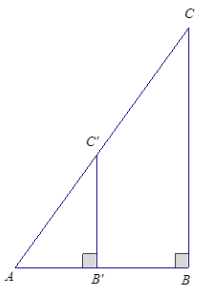
Eureka Math Geometry Module 2 End of Module Assessment Answer Key 6

Answer:
By the AA criterion, △ABC ~ △A\(B^{\prime} C^{\prime}\). Let r be the scale factor of the similarity
transformation. Then, \(B^{\prime} C^{\prime}\) = r . BC, and A\(C^{\prime}\) = r . AC. Thus,
cos \(C^{\prime}\) = \(\frac{B^{\prime} C^{\prime}}{A C^{\prime}}=\frac{r \cdot B C}{r \cdot A C}=\frac{B C}{A C}\) = cos C
cos \(C^{\prime}\) = cos C

Question 7.
Terry said, “I will define the zine of an angle x as follows. Build an isosceles triangle in which the sides of equal length meet at angle x. The zine of x will be the ratio of the length of the base of that triangle to the length of one of the equal sides.” Molly said, “Won’t the zine of x depend on how you build the isosceles triangle?”

a. What can Terry say to convince Molly that she need not worry about this? Explain your answer.
Answer:
Isosceles triangles with vertex angle x are similar to each other; therefore, the value of zine x, the ratio of the length of the base of that triangle to the length of one of the equal sides, is the same for all such triangles.

b. Describe a relationship between zine and sin.
Answer:
zine x = 2 sin \(\frac{1}{2}\)x

Eureka Math Precalculus Module 2 End of Module Assessment Answer Key

Engage NY Eureka Math Precalculus Module 2 End of Module Assessment Answer Key

Eureka Math Precalculus Module 2 End of Module Assessment Answer Key

Question 1.

a. Find values for a, b, c, d, and e so that the following matrix product equals the 3 × 3 identity matrix. Explain how you obtained these values.
\(\left[\begin{array}{ccc}
a & -3 & 5 \\
c & c & 1 \\
5 & b & -4
\end{array}\right]\left[\begin{array}{ccc}
1 & b & d \\
1 & c & e \\
2 & b & b
\end{array}\right]\)
Answer:
The row 1, column 1 entry of the product is a – 3 + 10. This should equal 1, so a = -6.
The row 2, column 1 entry of the product is c + c + 2. This should equal zero, so c = -1.
The row 3, column 1 entry of the product is 5 + b – 8. This should equal zero, so b = 3.
The row 1, column 3 entry of the product is ad – 3e + 5b = -6d – 3e + 15, and this should equal zero. So, we should have 6d + 3e = 15.
The row 2, column 3 entry of the product is cd + ce + b = -d – e + 3, and this should equal zero. So, we need d + e = 3.
Solving the two linear equations d and e gives d = 2 and e = 1.
So, in summary, we have a = -6, b = 3, c = -1, d = 2, and e = 1.

b. Represent the following system of linear equations as a single matrix equation of the form Ax = b, where A is a 3 × 3 matrix, and x and b are 3 × 1 column matrices.
x + 3y + 2z = 8
x – y + z = -2
2x + 3y + 3z = 7
Answer:
We have Ax = b with A = \(\left[\begin{array}{ccc}
1 & 3 & 2 \\
1 & -1 & 1 \\
2 & 3 & 3
\end{array}\right]\) and x = \(\left[\begin{array}{l}
x \\
y \\
z
\end{array}\right]\) and b = \(\left[\begin{array}{c}
8 \\
-2 \\
7
\end{array}\right]\).

c. Solve the system of three linear equations given in part (b).
Answer:
The solution is given by x = A-1b, if the matrix inverse exists. But part (a) shows that if we set
B = \(\left[\begin{array}{ccc}
-6 & -3 & 5 \\
-1 & -1 & 1 \\
5 & 3 & -4
\end{array}\right]\),
then we have BA = 1. We could check that AB = 1, as well (in which case B is the matrix inverse of A), but even without knowing this, from
Eureka Math Precalculus Module 2 End of Module Assessment Answer Key 5

Question 2.
The following diagram shows two two-dimensional vectors v and w in the place positioned to each have an endpoint at point P.

Eureka Math Precalculus Module 2 End of Module Assessment Answer Key 1

Eureka Math Precalculus Module 2 End of Module Assessment Answer Key 6

a. On the diagram, make reasonably accurate sketches of the following vectors, again each with an endpoint at P. Be sure to label your vectors on the diagram.
i. 2v
ii. -w
iii. v + 3w
iv. w – 2v
v. \(\frac{1}{2}\)v
Answer:
Vector v has magnitude 5 units, w has magnitude 3, and the acute angle between them is 45°.

b. What is the magnitude of the scalar multiple -5v?
Answer:
We have ||-5v|| = 5||v|| = 5 × 5 = 25

c. What is the measure of the smallest angle between -5v and 3w if these two vectors are placed to have a common endpoint?
Answer:
Eureka Math Precalculus Module 2 End of Module Assessment Answer Key 7

The two vectors in question have an angle of smallest measure 135° between them.

Question 3.
Consider the two-dimensional vectors v = (2, 3) and w = (-2, -1).

a. What are the components of each of the vectors y + w and y – w?
Answer:
v + w = (2 + (-2) , 3 + (-1))= (0, 2) and v – w = (2- (-2) , 3 – (-1)) = (4, 4)

b. On the following diagram, draw representatives of each of the vectors v, w, and v + w, each with an endpoint at the origin.

Eureka Math Precalculus Module 2 End of Module Assessment Answer Key 2

Answer:

Eureka Math Precalculus Module 2 End of Module Assessment Answer Key 8

c. The representatives for the vectors v and w you drew form two sides of a parallelogram, with the vector v + w corresponding to one diagonal of the parallelogram. What vector, directed from the third quadrant to the first quadrant, is represented by the other diagonal of the parallelogram? Express your answer solely in terms of v and w, and also give the coordinates of this vector.
Answer:
Label the points A and B as shown. The vector we seek is \(\overrightarrow{A B} .\). To move from A to B we need to follow -w and then v. Thus, the vector we seek is -w + v, which is the same as v – w.

Also, we see that to move from A to B we need to move 4 units to the right and 4 units upward. This is consistent with v – w = (2 – (-2) , 3 – (-1)) = (4, 4).

d. Show that the magnitude of the vector v + w does not equal the sum of the magnitudes of v and of w.
Answer:
We have ||v|| = \(\sqrt{2^{2}+3^{2}}=\sqrt{13}\) and ||w|| = \(\sqrt{(-2)^{2}+(-1)^{2}}=\sqrt{5}\), so ||v|| + ||w|| = √13 + √5. Now, ||v + w|| = \(\sqrt{0^{2}+2^{2}}\) = 2. This does not equal √13 + √5.

e. Give an example of a non-zero vector u such that ||v + u|| does equal ||v|| + ||u||.
Answer:
Choosing u to be the vector v works.
||v + u|| = ||v + v|| = ||2v|| = 2||v|| = ||v|| + ||v||
(In fact, u = kv for any positive real number k words.)

(f Fact, u kv For aij positive real r.uivber k works.)

f. Which of the following three vectors has the greatest magnitude: v + (-w), w – v, or (-v) – (-w)?
Answer:
(-v) – (-w) = -v + w = w – v and
v + (-w) = v – w = -(w – v).
So, each of these vectors is either w – v or the scalar multiple (-1)(w – v), which is the same vector but with opposite direction. They all have the same magnitude.

g. Give the components of a vector one-quarter the magnitude of vector v and with direction opposite the direction of v.
Answer:
\(-\frac{1}{4}\)V = –\(\frac{1}{4}[/latex(2, 3) = (-[latex]\frac{1}{2}\), –\(\frac{3}{4}\))

Question 4.
Vector a points true north and has magnitude 7 units. Vector b points 30° east of true north. What should the magnitude of b be so that b – a points directly east?

Eureka Math Precalculus Module 2 End of Module Assessment Answer Key 9

a. State the magnitude and direction of b – a.
Answer:
We hope to have the following vector diagram incorporating a right triangle.

we have ||a|| = 7, and for this 30 – 60 – 90 triangle we need ||b|| = 2||b – a|| and 7 = ||a|| = √3||b – a||. This shows the magnitude b should be ||b|| = \(\frac{14}{\sqrt{3}}\).

The vector b – a points east and has magnitude \(\frac{7}{\sqrt{3}}\)

b. Write b – a magnitude and direction form.
Answer:
(\(\frac{7}{\sqrt{3}}\), 0°); b – a points east and has magnitude of \(\frac{7}{\sqrt{3}}\) and a direction of 0° measured from the horizontal.

Question 5.
Consider the three points A = (10, -3, 5), B = (0, 2, 4), and C = (2, 1, 0) in three-dimensional space. Let M be the midpoint of \(\overline{A B}\) and N be the midpoint of \(\overline{A C}\).

a. Write down the components of the three vectors \(\overrightarrow{A B}\), \(\overrightarrow{B C}\), and \(\overrightarrow{C A}\), and verify through arithmetic that their sum is zero. Also, explain why geometrically we expect this to be the case.
Answer:

Eureka Math Precalculus Module 2 End of Module Assessment Answer Key 10

We have the following:
\(\overrightarrow{A B}\) = (-10, 5, 1)
\(\overrightarrow{B C}\) = (2, -1, -4)
\(\overrightarrow{C A}\) = (8, -4, 5)

Their sum is (-10 + 2 + 8, 5 – 1 – 4, -1 – 4 + 5) = (0, 0, 0).

This is to be expected as the three points A, B, and C are vertices of a triangle (even in three-dimensional space), and the vectors \(\overrightarrow{A B}\), \(\overrightarrow{B C}\), and \(\overrightarrow{C A}\), when added geometrically, traverse the sides of the triangle and have the sum effect of “returning to start.” That is, the cumulative effect of the three vectors is no vectorial shift at all.

b. Write down the components of the vector \(\overrightarrow{M N}\). Show that it is parallel to the vector \(\overrightarrow{B C}\) and half its magnitude.
Answer:
We have M = (5, –\(\frac{1}{2}\), –\(\frac{9}{2}\)) and N = (6, -1, \(\frac{5}{2}\)). Thus \(\overrightarrow{M N}\) = (1, –\(\frac{1}{2}\), -2).

We see that \(\overrightarrow{M N}\) = \(\frac{1}{2}\) \(\overrightarrow{B C}\), which shows that \(\overrightarrow{M N}\) has the same direction as \(\overrightarrow{B C}\) (and hence is parallel to it) and half the magnitude.

Let G = (4, 0, 3).

c. What is the value of the ratio \(\frac{\|\overrightarrow{M G}\|}{\|\overrightarrow{M C}\|}\)?
Answer:
\(\overrightarrow{M G}\) = (-1, \(\frac{1}{2}\), –\(\frac{3}{2}\)) and \(\overrightarrow{M C}\) = (-3, \(\frac{3}{2}\), –\(\frac{9}{2}\)) = 3\(\overrightarrow{M G}\). Thus \(\frac{\|\overrightarrow{M G}\|}{\|\overrightarrow{M C}\|}=\frac{\|\overline{M G}\|}{3\|\overrightarrow{M C}\|}=\frac{1}{3}\)

d. Show that the point G lies on the line connecting M and C. Show that G also lies on the line connecting N and B.
Answer:
That \(\overrightarrow{M G}\) = \(\frac{1}{3}\)\(\overrightarrow{M C}\) means that the point G lies a third of the way along \(\overrightarrow{M C}\).
Check:
\(\overrightarrow{N G}\) = (-2, 1, \(\frac{1}{2}\)) = \(\frac{1}{3}\)(-6, 3, \(\frac{3}{2}\)) = \(\frac{1}{3}\)\(\overrightarrow{N B}\)
So, G also lies on \(\overrightarrow{N B}\) (and one-third of the way along, too).

Question 6.
A section of a river, with parallel banks 95 ft. apart, runs true north with a current of 2 ft/sec. Lashana, an expert swimmer, wishes to swim from point A on the west bank to the point B directly opposite it. In still water, she swims at an average speed of 3 ft/sec.

Eureka Math Precalculus Module 2 End of Module Assessment Answer Key 3

The diagram to the right illustrates the situation. To counteract the current, Lashana realizes that she is to swim at some angle θ to the east/west direction as shown.

With the simplifying assumptions that Lashana’s swimming speed will be a constant 3 ft/sec and that the current of the water is a uniform 2 ft/sec flow northward throughout all regions of the river (e.g., we ignore the effects of drag at the river banks,), at what angle θ to east/west direction should Lashana swim in order to reach the opposite bank precisely at point B? How long will her swim take?

a. What is the shape of Lashana’s swimming path according to an observer standing on the bank watching her swim? Explain your answer in terms of vectors.
Answer:

Eureka Math Precalculus Module 2 End of Module Assessment Answer Key 11

Lashana’s velocity vector v has magnitude 3 and resolves into two components as shown, a component in the east direction vE and a component in the south direction vS.

We see

||vS|| = ||v||sin(θ) = 3sin(θ).

Lashana needs this component of her velocity vector to counteract the northward current of the water. This will ensure that Lashana will swim directly toward point B with no sideways deviation.

Since the current is 2ft/sec, we need 3sinθ = 2, showing that θ = sin-1(\(\frac{2}{3}\)) ≈ 41.8°.

Lashana will then swim at a speed of ||vE|| = 3cosθ ft/sec towards the opposite bank.
Since sin(θ) = \(\frac{2}{3}\), θ is part of a 2 – √5 – 3 right triangle, so cos(θ) = \(\frac{\sqrt{5}}{3}\). Thus ||vE|| = √5 ft/sec.

She needs to swim an east/west distance of 95 ft. at this speed. It will take her \(\frac{95 \mathrm{ft}}{\sqrt{5} \mathrm{ft} / \mathrm{sec}}\) = 19√5 seconds ≈ 42 seconds to do this.

b. If the current near the banks of the river is significantly less than 2 ft/sec, and Lashana swims at a constant speed of 3 ft/sec at the constant angle θ to the east/west direction as calculated in part (a), will Lashana reach a point different from B on the opposite bank? If so, will she land just north or just south of B? Explain your answer.
Answer:
As noted in the previous solution, Lashana will have no sideways motion in her swim. She will swim a straight-line path from A to B.

If the current is slower than 2 ft/sec at any region of the river surface, Lashana’s velocity vector component vs, which has magnitude 2 ft/sec, will be larger in magnitude than the magnitude of the current. Thus, she will swim slightly southward during these periods. Consequently, she will land at a point on the opposite bank south of B

Question 7.
A 5 kg ball experiences a force due to gravity \(\vec{F}\) of magnitude 49 newtons directed vertically downward. If this ball is placed on a ramp tilted at an angle of 45°, what is the magnitude of the component of this force, in newtons, on the ball directed 45° toward the bottom of the ramp? (Assume the ball has a radius small enough that all forces are acting at the point of contact of the ball with the ramp.)

Eureka Math Precalculus Module 2 End of Module Assessment Answer Key 4

Answer:

Eureka Math Precalculus Module 2 End of Module Assessment Answer Key 12

The force vector can be resolved into two components as shown: Framp and Fperp.
We are interested in the component Framp.
We see a 45- 90 – 45 triangle in this diagram, with hypotenuse of magnitude 49 N. This means that the magnitude of Framp is \(\frac{49 \mathrm{~N}}{\sqrt{2}}\) ≈ 35 N.

Question 8.
Let A be the point (1, 1, -3) and B be the point (-2, 1, -1) in three-dimensional space.

A particle moves along the straight line through A and B at uniform speed in such a way that at time t = 0 seconds the particle is at A, and at t = 1 second the particle is at B. Let P(t) be the location of the particle at time t (so, P(0) = A and P(1) = B).

a. Find the coordinates of the point P(t) each in terms of t.
Answer:
We will write the coordinates of points as 3 × 1 column matrices, as is consistent for work with matrix notation.
The velocity vector of the particle is \(\overrightarrow{A B}\) = (-3, 0, 2). So, its position at time t is
P(t) = A + t\(\overrightarrow{A B}\) = \(\left[\begin{array}{l}
1 \\
1 \\
-3
\end{array}\right]\) + t\(\left[\begin{array}{c}
-3 \\
0 \\
2
\end{array}\right]\) = \(\left[\begin{array}{c}
1-3 t \\
1 \\
-3+2 t
\end{array}\right]\)

b. Give a geometric interpretation of the point P(0.5).
Answer:
Since P(0) = A and P(1) = B, P(0.5) is the midpoint of \(\overline{A B}\).

Let L be the linear transformation represented by the 3 × 3 matrix \(\left[\begin{array}{lll}
2 & 0 & 1 \\
1 & 3 & 0 \\
0 & 1 & 1
\end{array}\right]\), and let \(A^{\prime}\) = LA and \(B^{\prime}\) = LB be the images of the points A and B, respectively, under L.

c. Find the coordinates of \(A^{\prime}\) and \(B^{\prime}\).
Answer:
\(A^{\prime}\) = \(\left[\begin{array}{lll}
2 & 0 & 1 \\
1 & 3 & 0 \\
0 & 1 & 1
\end{array}\right]\left[\begin{array}{c}
1 \\
1 \\
-3
\end{array}\right]=\left[\begin{array}{c}
-1 \\
4 \\
-2
\end{array}\right]\) and
\(B^{\prime}\) = \(\left[\begin{array}{lll}
2 & 0 & 1 \\
1 & 3 & 0 \\
0 & 1 & 1
\end{array}\right]\left[\begin{array}{c}
-2 \\
1 \\
-1
\end{array}\right]=\left[\begin{array}{c}
-5 \\
1 \\
0
\end{array}\right]\)

A second particle moves through three-dimensional space. Its position at time t is given by L(P(t)), the image of the location of the first particle under the transformation L.

d. Where is the second particle at times t = 0 and t = 1? Briefly explain your reasoning.
Answer:
We see L(P(0)) = L(A) = \(A^{\prime}\) and L(P(1)) = L(B) = \(B^{\prime}\). Since the position of the particle at time t is given by L(P(t)), to find the location at t = 0 and t = 1, evaluate L(P(0)) and L(P(1)).

e. Prove that the second particle is also moving along a straight-line path at uniform speed.
Answer:
At time t the location of the second particle is
L(P(t)) = \(\left[\begin{array}{ccc}
2 & 0 & 1 \\
1 & 3 & 0 \\
0 & 1 & 1
\end{array}\right]\left[\begin{array}{c}
1-3 t \\
1 \\
-3+2 t
\end{array}\right]=\left[\begin{array}{c}
-1-4 t \\
4-3 t \\
-2+2 t
\end{array}\right]=\left[\begin{array}{c}
-1 \\
4 \\
-2
\end{array}\right]+t\left[\begin{array}{c}
-4 \\
-3 \\
2
\end{array}\right]\)

We recognize this as
L(P(t)) = \(A^{\prime}\)+ t \(\overline{\mathrm{A}^{\prime} B^{\prime}}\).
Thus, the second particle is moving along the straight line through \(A^{\prime}\) and \(A^{\prime}\) at a uniform velocity given by the vector \(\overline{\mathrm{A}^{\prime} B^{\prime}}\) = (-4, -3, 2).

Eureka Math Precalculus Module 2 Lesson 18 Answer Key

Engage NY Eureka Math Precalculus Module 2 Lesson 18 Answer Key

Eureka Math Precalculus Module 2 Lesson 18 Opening Exercise Answer Key

Opening Exercise:

Write each vector described below in component form and find its magnitude. Draw an arrow originating from (0, 0) to represent each vector’s magnitude and direction.

Eureka Math Precalculus Module 2 Lesson 18 Opening Exercise Answer Key 1

Answer:

Eureka Math Precalculus Module 2 Lesson 18 Opening Exercise Answer Key 2

a. Translate 3 units right and 4 units down.
Answer:
u = (3, -4), ||u|| = 5

b. Translate 6 units left.
Answer:
v = (-6, 0), ||v|| = 6

c. Translate 2 units left and 2 units up.
Answer:
w = (-2, 2), ||w||= 2√2

d. Translate 5 units right and 7 units up.
Answer:
t = (5, 7), ||t|| = \(\sqrt{25+49}\) = √74

Eureka Math Precalculus Module 2 Lesson 18 Exercise Answer Key

Exercises 1 – 3:

Exercise 1.
Write a translation map defined by each vector from the opening.
Consider the vector v = (-2, 5) and its associated translation map:
Tv\(\left(\left[\begin{array}{l}
x \\
y
\end{array}\right]\right)=\left(\begin{array}{l}
x-2 \\
y+5
\end{array}\right)\)
Answer:

Eureka Math Precalculus Module 2 Lesson 18 Exercise Answer Key 3

Exercise 2.
Suppose we apply the translation map Tv to each point on the circle (x + 4)2 + (y – 3)2 = 25.

a. What is the radius and center of the original circle?
Answer:
The radius is 5 and the center is (-4, 3).

b. Show that the image points satisfy the equation of another circle.
Answer:
Suppose that Tv\(\left(\left[\begin{array}{l}
x \\
y
\end{array}\right]\right)=\left[\begin{array}{l}
x^{\prime} \\
y^{\prime}
\end{array}\right]\). Then x = x – 2 and y = y + 5, so x = x’ + 2 and y = y’ – 5.
Since (x + 4)2 + (y – 3)2 = 25, we have
(x + 4)2 + (y – 3)2 = 25
((x’ + 2) +4)2+((y’ – 5) – 3)2 = 25
(x’ + 6)2 + (y’ – 8)2 = 25
So, the image points \(\left[\begin{array}{l}
x^{\prime} \\
y^{\prime}
\end{array}\right]\) lie on a circle.

so the image points \(\left[\begin{array}{l}
x^{\prime} \\
y^{\prime}
\end{array}\right]\) lie on a circle.

c. What are the center and radius of this image circle?
Answer:

Eureka Math Precalculus Module 2 Lesson 18 Exercise Answer Key 4

The radius of 5 remains unchanged. The new center is (-6, 8).

Exercise 3.
Suppose we apply the translation map Tv, to each point on the line 2x – 3y = 10.

a. What are the slope and y-intercept of the original line?
Answer:
The slope is \(\frac{2}{3}\) and the y-intercept is (0, –\(\frac{10}{3}\)).

b. Show that the image points satisfy the equation of another line.
Answer:
Suppose that Tv\(\left(\left[\begin{array}{l}
x \\
y
\end{array}\right]\right)=\left[\begin{array}{l}
x^{\prime} \\
y^{\prime}
\end{array}\right]]\). Then \(x^{\prime}\) = x – 2 and \(y^{\prime}\) = y + 5. so x = \(x^{\prime}\) + 2 and y = \(y^{\prime}\) – 5.
Since 2x – 3y = 10, we have
2(\(x^{\prime}\) + 2) – 3(\(y^{\prime}\) – 5) = 10
2\(x^{\prime}\) + 4 – 3\(y^{\prime}\) + 15 = 10
2\(x^{\prime}\) – 3\(y^{\prime}\) = -9

c. What are the slope and y-intercept of this image line?
Answer:

Eureka Math Precalculus Module 2 Lesson 18 Exercise Answer Key 5

The slope is \(\frac{2}{3}\) and the y-intercept is (0, 3)

Example 1: Vectors and Translation Maps in R3

Translate by the vector v = (1, 3, 5) by applying the translation map Tv to the following objects in R3. A sketch of the original object and the vector is shown. Sketch the image.

\(T_{\mathrm{v}}\left(\left[\begin{array}{l}
x \\
y \\
z
\end{array}\right]\right)=\left[\begin{array}{l}
x+1 \\
y+3 \\
z+5
\end{array}\right]\)

a. The point A(2, -2, 4)

Eureka Math Precalculus Module 2 Lesson 18 Exercise Answer Key 6

Answer:

Eureka Math Precalculus Module 2 Lesson 18 Exercise Answer Key 7

The new point will be (2 + 1, -2 + 3, 4 + 5) or (3, 1, 9).

b. The plane 2x + 3y – z = 0

Eureka Math Precalculus Module 2 Lesson 18 Exercise Answer Key 8

Answer:

Eureka Math Precalculus Module 2 Lesson 18 Exercise Answer Key 9

The new plane will be 2(x – 1) + 3(y – 3) – (z – 5) = 0, which ius equivalent to 2x + 3y – z = 6.

c. The sphere (x – 1)2 + (y – 3)2 + z2 = 9.

Eureka Math Precalculus Module 2 Lesson 18 Exercise Answer Key 10

Answer:

Eureka Math Precalculus Module 2 Lesson 18 Exercise Answer Key 11

Exercise 4:
Given the sphere (x + 3)2 + (y – 1)2 + (z – 3)2 = 10.

a. What are its center and radius?
Answer:
The center is (-3, 1, 3), and the radius is √10.

b. Write a vector and its associated translation map that would take this sphere to its image centered at the origin.
Answer:
We need to translate the center from the point (-3, 1, 3) to the point (0, 0, 0). This represents a translation of 3 units in the x direction, -1 unit in the y direction, and -3 units in the z direction. The vector is v = (3, -1, -3), and the translation map would be

Tv\(\left(\left[\begin{array}{l}
x \\
y \\
z
\end{array}\right]\right)=\left[\begin{array}{l}
x+3 \\
y-1 \\
z-3
\end{array}\right]\).

Example 2: What is the Magnitude of a Vector in R3?

Eureka Math Precalculus Module 2 Lesson 18 Exercise Answer Key 12

a. Find a general formula for ||v||2.
Answer:
||v||2 = x2 + y2 + z2

b. Solve this equation for lvii to find the magnitude of the vector.
Answer:
||v|| = \(\sqrt{x^{2}+y^{2}+z^{2}}\)

Exercises 5 – 8:

Exercise 5.
Which vector has greater magnitude, y = (0, 5, -4) or u (3, -4, 4)? Show work to support your answer.
Answer:
||v|| = \(\sqrt{0^{2}+5^{2}+(-4)^{2}}=\sqrt{41}\)
||u|| = \(\sqrt{3^{2}+(-4)^{2}+4^{2}}=\sqrt{41}\)
These vectors have equal magnitude.

Exercise 6.
Explain why vectors can have equal magnitude but not be the same vector.
Answer:
A vector has both a magnitude and a direction. If you graphed the vectors from Exercise 5, you can see the point in different directions so they cannot be the same even though they have equal magnitude.

Exercise 7.
Vector arithmetic in R3 is analogous to vector arithmetic in R2. Complete the graphic organizer to illustrate these ideas.

Eureka Math Precalculus Module 2 Lesson 18 Exercise Answer Key 13

Answer:

Eureka Math Precalculus Module 2 Lesson 18 Exercise Answer Key 14

Exercise 8.
Given y = (2 ,0, -4) and u = (-1, 5, 3).

a. Calculate the following.

i. v + u
Answer:
v + u = (2 + (-1), 0 + 5, -4 + 3) = (1, 5,-1)

ii. 2v – u
Answer:
2v – u = (2 . 2 -(-1), 2 . 0 – 5, 2 (-4) – 3) = (5, -5, -11)

iii. ||u||
Answer:
||u|| = \(\sqrt{(-1)^{2}+5^{2}+3^{2}}=\sqrt{35}\)

b. Suppose the point (1, 3, 5) is translated by y and then by u. Determine a vector w that would return the point back to its original location (1, 3, 5).
Answer:
From part (a), we have v + u = (1, 5, -1). The point will be translated from (1, 3, 5) to (2, 8, 4) since 1 + 1 = 2, 5 + 3 = 8, and 5 – 1 = 4. The vector that will return this point to its original location will be the opposite of v + u.

-(v + u) = (-1,-5, 1)
And this vector will translate (2, 8, 4) back to (1, 3, 5) because 2 – 1 = 1, 8 – 5 = 3, and 4 + 1 = 5.

Eureka Math Precalculus Module 2 Lesson 18 Problem Set Answer Key

Question 1.
Myishia says that when applying the translation map Tv,\(\left(\left[\begin{array}{l}
x \\
y
\end{array}\right]\right)=\left[\begin{array}{l}
x+1 \\
y-2
\end{array}\right]\) to a set of points given by an equation relating x and y, we should replace every x that is in the equation by x + 1, and y by y – 2. For example, the equation of the parabola y = x2 would become y – 2 = (x + 1)2. Is she correct? Explain your answer.
Answer:
No, she is not correct. What she did translates the points on the parabola y = x2 in the opposite direction – one unit to the left and 2 units upward, which is not the geometric effect of Tv \(\left(\left[\begin{array}{l}
x \\
y
\end{array}\right]\right)=\left[\begin{array}{l}
x+1 \\
y-2
\end{array}\right]\). In order to have the correct translation based on Tv\(\left(\left[\begin{array}{l}
x \\
y
\end{array}\right]\right)=\left[\begin{array}{l}
x+1 \\
y-2
\end{array}\right]\), we need to set \(\boldsymbol{x}^{\prime}\) = x + 1 and \(\boldsymbol{y}^{\prime}\) = y – 2, which is equivalent to x = \(\boldsymbol{x}^{\prime}\) – 1 and y = \(\boldsymbol{y}^{\prime}\) + 2.
This process gives the transformed equation \(\boldsymbol{y}^{\prime}\) + 2 = (\(\boldsymbol{x}^{\prime}\) – 1)2, which we write as y + 2 (x – 1)2.

Question 2.
Given the vector y = (-1, 3), find the image of the line x + y = 1 under the translation map Tv. Graph the original line and its image, and explain the geometric effect of the map T, on the line.
Answer:

Eureka Math Precalculus Module 2 Lesson 18 Problem Set Answer Key 15

Tv\(\left(\left[\begin{array}{l}
x \\
y
\end{array}\right]\right)=\left[\begin{array}{l}
x-1 \\
y+3
\end{array}\right]\), x – (-1)) + (y – (3)) = 1, x + 1 + y – 3 = 1, x + y = 3
Every point on the line is shifted one unit left and three units upward. The slopes of the lines remain -1.

Question 3.
Given the vector v = (2, 1), find the image of the parabola y – 1 = x2 under the translation map Tv. Draw a graph of the original parabola and its image, and explain the geometric effect of the map Tv on the parabola. Find the vertex and x-intercepts of the graph of the image.
Answer:
Eureka Math Precalculus Module 2 Lesson 18 Problem Set Answer Key 16

Tv\(\left(\left[\begin{array}{l}
x \\
y
\end{array}\right]\right)=\left[\begin{array}{l}
x+2 \\
y+1
\end{array}\right]\), y – 2 = (x – 2)2

Every point on the parabola is shifted two units to the right and one unit upward. The vertex is (2, 2), and there are no x-intercepts.

Question 4.
Given the vector y = (3, 2), find the image of the graph of y + 1 = (x + 1)3 under the translation map Tv. Draw the original graph and its image, and explain the geometric effect of the map Tv, on the graph. Find the x-intercepts of the graph of the image.
Answer:

Eureka Math Precalculus Module 2 Lesson 18 Problem Set Answer Key 17

Tv\(\left(\left[\begin{array}{l}
x \\
y
\end{array}\right]\right)=\left[\begin{array}{l}
x+3 \\
y+2
\end{array}\right]\), y – 1 = (x – 2)3
Every point on the curve is shifted three units to the right and two units upward. The x-intercept is 1.𝟏

Question 5.
Given the vector y = (3, -3), find the image of the graph of y + 2 = \(\sqrt{x+1}\) under the translation map Tv. Draw the original graph and its image, and explain the geometric effect of the map Tv, on the graph. Find the x-intercepts of the graph of the image.
Answer:

Eureka Math Precalculus Module 2 Lesson 18 Problem Set Answer Key 18

Tv\(\left(\left[\begin{array}{l}
x \\
y
\end{array}\right]\right)=\left[\begin{array}{l}
x+3 \\
y-3
\end{array}\right]\), y + 5 = \(\sqrt{x-2}\)
Every point on the curve is shifted three units to the right and three units downward. The x-intercept is 27.

Question 6.
Given the vector y = (-1, -2), find the image of the graph of y = \(\sqrt{9-x^{2}}\) under the translation map Tv. Draw the original graph and its image, and explain the geometric effect of the map Tv, on the graph. Find the x-intercepts of the graph of the image.
Answer:
Eureka Math Precalculus Module 2 Lesson 18 Problem Set Answer Key 19

Tv\(\left(\left[\begin{array}{l}
x \\
y
\end{array}\right]\right)=\left[\begin{array}{l}
x-1 \\
y-2
\end{array}\right]\), y + 2 = \(\sqrt{9-(x+1)^{2}}\)
Every point on the semicircle is shifted one unit to the left and two units downward.
x-intercepts: -1 + √5 and -1 – √5.

Question 7.
Given the vector y = (1, 3), find the image of the graph of y = \(\frac{1}{x+2}\) + 1 under the translation map Tv. Draw the original graph and its image, and explain the geometric effect of the map Tv, on the graph. Find the equations of the asymptotes of the graph of the image.
Answer:
Eureka Math Precalculus Module 2 Lesson 18 Problem Set Answer Key 20

Tv\(\left(\left[\begin{array}{l}
x \\
y
\end{array}\right]\right)=\left[\begin{array}{l}
x+1 \\
y+3
\end{array}\right]\), y = \(\frac{1}{x+1}\) + 4.
Every point on the curve is shifted one unit to the right and three units upward. The new vertical asymptote is x = -1, the new horizontal asymptote is y = 4.

Question 8.
Given the vector y = (-1, 2), find the image of the graph of y = |x + 2| + 1 under the translation map Tv. Draw the original graph and its image, and explain the geometric effect of the map Tv, on the graph. Find the x-intercepts of the graph of the image.
Answer:
Eureka Math Precalculus Module 2 Lesson 18 Problem Set Answer Key 21

Tv\(\left(\left[\begin{array}{l}
x \\
y
\end{array}\right]\right)=\left[\begin{array}{l}
x-1 \\
y+2
\end{array}\right]\)
Every point on the graph is shifted one unit to the left and two units upward. There are no x-intercepts.

Question 9.
Given the vector y = (1, -2), find the image of the graph of y = 2’ under the translation map Tv. Draw the original graph and its image, and explain the geometric effect of the map Tv, on the graph. Find the x-intercepts of the graph of the image.
Answer:
Eureka Math Precalculus Module 2 Lesson 18 Problem Set Answer Key 22

Tv\(\left(\left[\begin{array}{l}
x \\
y
\end{array}\right]\right)=\left[\begin{array}{l}
x+1 \\
y-2
\end{array}\right]\), y = 2x – 1 – 2
Every point on the curve is shifted one unit to the right and two units downward. x-intercept is 2.

Question 10.
Given the vector y = (-1, 3), find the image of the graph of y = log2x, under the translation map Tv. Draw the original graph and its image, and explain the geometric effect of the map Tv, on the graph. Find the x-intercepts of the graph of the image.
Answer:
Eureka Math Precalculus Module 2 Lesson 18 Problem Set Answer Key 23

Tv\(\left(\left[\begin{array}{l}
x \\
y
\end{array}\right]\right)=\left[\begin{array}{l}
x-1 \\
y+3
\end{array}\right]\), y = log2(x + 1) + 3

Every point on the curve is shifted one unit to the left and three units upward. x-intercept: –\(\frac{7}{8}\)

Question 11.
Given the vector v =(2, -3), find the image of the graph of \(\frac{x^{2}}{4}+\frac{y^{2}}{16}\) = 1 under the transiatlon map T,. Draw the original graph and its image, and explain the geometric effect of the map Tv on the graph. Find the new center, major and minor axis of the graph of the image.
Answer:

Eureka Math Precalculus Module 2 Lesson 18 Problem Set Answer Key 24

Tv\(\left(\left[\begin{array}{l}
x \\
y
\end{array}\right]\right)=\left[\begin{array}{l}
x+2 \\
y-3
\end{array}\right]\), \(\frac{(x-2)^{2}}{4}+\frac{(y+3)^{2}}{16}\) = 1

Every point on the ellipse is shifted two units to the right and three units downward. The new center is (2, -3), the major axis is 4, and the minor axis is 2.

Question 12.
Given the vector v, find the image of the given point P under the translation map Tv. Graph P and its image.

a. v = (3, 2, 1), P = \(\left[\begin{array}{l}
1 \\
2 \\
3
\end{array}\right]\)
Answer:
Tv\(\left(\left[\begin{array}{l}
x \\
y \\
z
\end{array}\right]\right)=\left[\begin{array}{l}
x+3 \\
y+2 \\
z+1
\end{array}\right]\), the new image: \(\left[\begin{array}{l}
4 \\
4 \\
4
\end{array}\right]\)

Eureka Math Precalculus Module 2 Lesson 18 Problem Set Answer Key 25

b. v = (-2, 1, -1), P = \(\left[\begin{array}{c}
2 \\
-1 \\
-4
\end{array}\right]\)
Answer:
Tv\(\left(\left[\begin{array}{l}
x \\
y \\
z
\end{array}\right]\right)=\left[\begin{array}{l}
x-2 \\
y+1 \\
z-1
\end{array}\right]\), the new image: \(\left[\begin{array}{c}
0 \\
0 \\
-5
\end{array}\right]\)

Eureka Math Precalculus Module 2 Lesson 18 Problem Set Answer Key 26

Question 13.
Given the vector v find the image of the given plane under the translation map Tv. Sketch the original vector and its image.

a. v = (2, -1, 3), 3x – 2y – z = 0
Answer:
Tv\(\left(\left[\begin{array}{l}
x \\
y \\
z
\end{array}\right]\right)=\left[\begin{array}{l}
x+2 \\
y-1 \\
z+3
\end{array}\right]\), 3x – 2y – z = 5

Eureka Math Precalculus Module 2 Lesson 18 Problem Set Answer Key 27

b. v = (-1, 2, -1), 2x – y + z = 1
Answer:
Tv\(\left(\left[\begin{array}{l}
x \\
y \\
z
\end{array}\right]\right)=\left[\begin{array}{l}
x-1 \\
y+2 \\
z-1
\end{array}\right]\), 2x – y + z = -4

Eureka Math Precalculus Module 2 Lesson 18 Problem Set Answer Key 28

Question 14.
Given the vector v find the knage of the given sphere under the translation map Tv. Sketch the original sphere and its image.

a. v = (-1, 2, 3), x2 + y2 + z2 = 1
Answer:
Tv\(\left(\left[\begin{array}{l}
x \\
y \\
z
\end{array}\right]\right)=\left[\begin{array}{l}
x-1 \\
y+2 \\
z+3
\end{array}\right]\), (x + 1)2 + (y – 2)2 + (z – 3)2 = 1

Eureka Math Precalculus Module 2 Lesson 18 Problem Set Answer Key 29

b. v = (-3, -2, 1), (x + 2)2 + (y – 3)2 + (z + 1)2 = 1
Answer:
Tv\(\left(\left[\begin{array}{l}
x \\
y \\
z
\end{array}\right]\right)=\left[\begin{array}{l}
x-3 \\
y-2 \\
z+1
\end{array}\right]\), (x + 5)2 + (y – 1)2 + (z)2 = 1

Eureka Math Precalculus Module 2 Lesson 18 Problem Set Answer Key 30

Question 15.
Find a vector v and translation map Tv that will translate the line x – y = 1 to the line x – y = -3. Sketch the original vector and its image.
Answer:
Answers vary. For example, v = \(\left[\begin{array}{l}
0 \\
4
\end{array}\right]\) and Tv\(\left(\left[\begin{array}{l}
x \\
y
\end{array}\right]\right)=\left[\begin{array}{l}
x+0 \\
y+4
\end{array}\right]\).

Eureka Math Precalculus Module 2 Lesson 18 Problem Set Answer Key 31

Question 16.
Find a vector y and translation map T that will translate the parabola y = x2 + 4x + 1 to the parabola y = x2
Answer:
Because y = x2 + 4x + 1 can be written as y + 3 = (x + 2)2, v = \(\left[\begin{array}{l}
2 \\
3
\end{array}\right]\) and Tv\(\left(\left[\begin{array}{l}
x \\
y
\end{array}\right]\right)=\left[\begin{array}{l}
x+2 \\
y+3
\end{array}\right]\).

Question 17.
Find a vector v and translation map Tv that will translate the circle with equation x2 + y2 – 4x + 2y – 4 = 0 to the circle with equation (x + 3)2 + (y – 4)2 = g
Answer:
Because x2 – 4x + y2 + 2y = 4 can be written as (x – 2)2 + (y + 1)2 = 9, v = \(\left[\begin{array}{c}
-5 \\
5
\end{array}\right]\) and Tv\(\left(\left[\begin{array}{l}
x \\
y
\end{array}\right]\right)=\left[\begin{array}{l}
x-5 \\
y+5
\end{array}\right]\)

Question 18.
Find a vector v and translation map Tv, that will translate the graph of y = \(\sqrt{x-3}\) + 2 to the graph of y = \(\sqrt{x+2}\) – 3.
Answer:
v = \(\left[\begin{array}{l}
-5 \\
-5
\end{array}\right]\) and Tv\(\left(\left[\begin{array}{l}
x \\
y
\end{array}\right]\right)=\left[\begin{array}{l}
x-5 \\
y-5
\end{array}\right]\)

Question 19.
Find a vector y and translation map Tv that will translate the sphere (x + 2)2 + (y – 3)2 + (z + 1)2 = 1 to the sphere (x – 3)2 + (y + 1)2 + (z + 2)2 = 1
Answer:
v = \(\left[\begin{array}{c}
5 \\
-4 \\
-1
\end{array}\right]\) and Tv\(\left(\left[\begin{array}{l}
x \\
y \\
z
\end{array}\right]\right)=\left[\begin{array}{l}
x+5 \\
y-4 \\
z-1
\end{array}\right]\)

20.
Given vectors u = (2, -1, 3), v = (2, 0, -2), and w = (-3, 6, 0), find the following.

a. 3u + v + w
Answer:
(5, 3, 7)

b. w – 2v – u
Answer:
(-9, 7, 1)

c. 3(2u – \(\frac{1}{2}\)v) – \(\frac{1}{3}\)w
Answer:
(10, -8, 21)

d. -2u – 3(5v – 3w)
Answer:
(-61, 56, 24)

e. ||u||, ||v||, and ||w||
Answer:
||u|| = √14, ||v|| = 2√2, ||w|| = √45

f. Show that 2||v|| = ||2v||
Answer:
2||v|| = 2(2√2) = 4√2, ||2v|| = ||(4, 0, -4)|| = √32 = 4√2

g. Show that |u + v|| ≠ ||u|| + ||v||
Answer:
||u + v|| = ||(4, -1, 1)|| = √18, ||u|| + ||v|| = √14 + 2√2

h. Show that ||v – w|| ≠ ||v|| – ||w||.
Answer:
||v – w|| = ||(5, -6, -2)|| = √65, ||v|| – ||w|| = 2√2 – √45

i. \(\frac{\mathbf{1}}{\|\mathbf{u}\|}\)u and \(\left\|\frac{\mathbf{1}}{\|\mathbf{u}\|} \mathbf{u}\right\|\)
Answer:
Eureka Math Precalculus Module 2 Lesson 18 Problem Set Answer Key 32

Eureka Math Precalculus Module 2 Lesson 18 Exit Ticket Answer Key

Question 1.
Given the vector v = (-2, 1), find the image of the line 3x – 2y = 2 under the translation map Tv. Graph the original line and its image, and explain the geometric effect of the map Tv.

Eureka Math Precalculus Module 2 Lesson 18 Exit Ticket Answer Key 33

Answer:
Tv\(\left(\left[\begin{array}{l}
x \\
y
\end{array}\right]\right)=\left(\begin{array}{l}
x-2 \\
y+1
\end{array}\right)\); image of the original line: 3(x + 2) – 2(y – 1) = 2.
3x + 6 – 2y + 2 = 2, 3x – 2y = -6
Every point on the line is shifted 2 units to the left and 1 unit upward.

Question 2.
Given the vector v = (-1, 2), find the image of the circle (x – 2)2 + (y ÷ 1)2 = 4 under the translation map Tv. Graph the original circle and its image, and explain the geometric effect of the map Tv.
Answer:

Eureka Math Precalculus Module 2 Lesson 18 Exit Ticket Answer Key 34

Tv\(\left(\left[\begin{array}{l}
x \\
y
\end{array}\right]\right)=\left(\begin{array}{l}
x-1 \\
y+2
\end{array}\right)\); image of original circle: (x – 1)2 + (y – 1)2 = 4.
Every point on the circle is shifted one unit to the left and two units upward. The new center is(1, 1) and the radius r = 2 stays the same.

Eureka Math Geometry Module 2 Lesson 33 Answer Key

Engage NY Eureka Math Geometry Module 2 Lesson 33 Answer Key

Eureka Math Geometry Module 2 Lesson 33 Opening Exercise Answer Key

Opening Exercise:

For each triangle shown below, identify the method (Pythagorean theorem, law of sines, law of cosines) you would use to find each length x.

Eureka Math Geometry Module 2 Lesson 33 Opening Exercise Answer Key 3

Eureka Math Geometry Module 2 Lesson 33 Opening Exercise Answer Key 4

Answer:

Eureka Math Geometry Module 2 Lesson 33 Opening Exercise Answer Key 1 law of sines

Eureka Math Geometry Module 2 Lesson 33 Opening Exercise Answer Key 2

Eureka Math Geometry Module 2 Lesson 33 Example Answer Key

Example 1:

Find the missing length in ∆ABC.

Eureka Math Geometry Module 2 Lesson 33 Example Answer Key 5

Answer:
→ Which method should we use to find length AB in the triangle shown below? Explain.
Provide a minute for students to discuss in pairs.

Yes. The law of sines can be used because we are given information about two of the angles and one side. We can use the triangle sum theorem to find the measure of ∠C, and then we can use that information about the value of the pair of ratios \(\frac{\sin A}{a}=\frac{\sin C}{c}\). Since the values are equivalent, we can solve to find the missing length.

→ Why can’t we use the Pythagorean theorem with this problem?
We can only use the Pythagorean theorem with right triangles. The triangle in this problem is not a right triangle.

→ Why can’t we use the law of cosines with this problem?
The law of cosines requires that we know the lengths of two sides of the triangle. We are only given information about the length of one side.

→ Write the equation that allows us to find the length of \(\overline{A B}\).
Let x represent the length of \(\overline{A B}\).

\(\frac{\sin 75}{2.93}=\frac{\sin 23}{x}\)
cx = \(\frac{2.93 \sin 23}{\sin 75}\)

→ We want to perform one calculation to determine the answer so that it is most accurate and rounding errors are avoided. In other words, we do not want to make approximations at each step. Perform the calculation, and round the length to the tenths place.

The length of \(\overline{A B}\) is approximately 1.2.

Example 2:

Find the missing length in ∆ABC.

Eureka Math Geometry Module 2 Lesson 33 Example Answer Key 6

Answer:
→ Which method should we use to find side \(\overline{A C}\) in the triangle shown below? Explain.
Provide a minute for students to discuss in pairs.

We do not have enough information to use the law of sines because we do not have enough information to write any of the ratios related to the law of sines. However, we can use
b2 = a2 + c2 – 2ac cos B because we are given the lengths of sides a and c and we know the angle measure for ∠B.

→ Write the equation that can be used to find the length of \(\overline{A C}\), and determine the length using one calculation. Round your answer to the tenths place.

x2 = 5.812 + 5.952 – 2(5.81)(5.95)cos 16
x = \(\sqrt{5.81^{2}+5.95^{2}-2(5.81)(5.95) \cos 16}\)
x ≈ 1.6

Eureka Math Geometry Module 2 Lesson 33 Exercise Answer Key

Exercises 1 – 6:

Use the laws of sines and cosines to find all missing side lengths for each of the triangles in the exercises below. Round your answers to the tenths place.

Exercise 1.
Use the triangle to the right to complete this exercise.

a. Identify the method (Pythagorean theorem, law of sines, law of cosines) you would use to find each of the missing lengths of the triangle. Explain why the other methods cannot be used.

Eureka Math Geometry Module 2 Lesson 33 Exercise Answer Key 7

Answer:
Law of sines
The Pythagorean theorem requires a right angle, which is not applicable to this problem. The law of cosines requires information about two side lengths, which is not given. Applying the law of sines requires knowing the measure of two angles and the length of one side.

b. Find the lengths of \(\overline{A C}\) and \(\overline{A B}\).
Answer:
By the triangle sum theorem, m∠A = 54°
Let b represent the length of side \(\overline{A C}\).
\(\frac{\sin 54}{3.31}=\frac{\sin 74}{b}\)
b = \(\frac{3.31 \sin 74}{\sin 54}\)
b ≈ 3.9

Let C represent the length of side \(\overline{A B}\)
\(\frac{\sin 54}{3.31}=\frac{\sin 52}{c}\)
c = \(\frac{3.31 \sin 52}{\sin 54}\)
c ≈ 3.2

Exercise 2.
Your school is challenging classes to compete in a triathlon. The race begins with a swim along the shore and then continues with a bike ride for 4 miles. School officials want the race to end at the place it began, so after the 4-mile bike ride, racers must turn 30° and run 3.5 miles directly back to the starting point. What is the total length of the race? Round your answer to the tenths place.

Eureka Math Geometry Module 2 Lesson 33 Exercise Answer Key 8

a. Identify the method (Pythagorean theorem, law of sines, law of cosines) you would use to find the total length of the race. Explain why the other methods cannot be used.
Answer:
Law of cosines
The Pythagorean theorem requires a right angle, which is not applicable to this problem because we do not know if we have a right triangle. The law of sines requires information about two angle measures, which is not given. Applying the law of cosines requires knowing the measure of two sides and the included angle measure.

b. Determine the total length of the race. Round your answer to the tenths place.
Answer:
Let a represent the length of the swim portion of the tri at halon.
a2 = 42 + 3.52 – 2(4)(3.5)cos30
a = \(\sqrt{4^{2}+3.5^{2}-2(4)(3.5) \cos 30}\)
a = 2.000322148 …
a ≈ 2
Total length of the race: 4 + 3.5 + (2) ≈ 9.5
The total length of the race is approximately 9.5 miles.

Exercise 3.
Two lighthouses are 30 miles apart on each side of shorelines running north and south, as shown. Each lighthouse keeper spots a boat in the distance. One lighthouse keeper notes the location of the boat as 40° east of south, and the other lighthouse keeper marks the boat as 32° west of south. What is the distance from the boat to each of the lighthouses at the time it was spotted? Round your answers to the nearest mile.

Eureka Math Geometry Module 2 Lesson 33 Exercise Answer Key 9

Answer:
Let x be the distance from the southern lighthouse to the boat.
\(\frac{\sin 72}{30}=\frac{\sin 50}{x}\)
x = \(\frac{30 \sin 50}{\sin 72}\)
x = 24.16400382…
The southern lighthouse is approximately 24 mi. from the boat.

Let y be the distance from the northern lighthouse to the boat.
\(\frac{\sin 72}{30}=\frac{\sin 50}{x}\)
y = \(\frac{30 \sin 58}{\sin 72}\)
y = 26.750716 12…
The northern lighthouse is approximately 27 mi.from the boat.
Let a be the distance from the northern lighthouse to the boat.
a2 = 302 + 242 – 2(30)(24) . cos58
a = \(\sqrt{30^{2}+24^{2}-2(30)(24) \cdot \cos 58}\)
a = 26.700491 75…
The northern lighthouse is approximately 27 mi. from the boat.

Exercise 4.
A pendulum 18 in. in length swings 72° from right to left. What is the difference between the highest and lowest point of the pendulum? Round your answer to the hundredths place, and explain how you found it.

Eureka Math Geometry Module 2 Lesson 33 Exercise Answer Key 10

Answer:

Eureka Math Geometry Module 2 Lesson 33 Exercise Answer Key 11

At the bottom of a swing, the pendulum is perpendicular to the ground, and it bisects the 72° angle; therefore, the pendulum currently forms an angle of 36° with the vertical. By the triangle sum theorem, the angle formed by the pendulum and the horizontal is 54°. The sin 54 will give us the length from the top of the pendulum to where the horizontal and vertical lines intersect, x, which happens to be the highest point of the pendulum.
sin 54 = \(\frac{x}{18}\)
18 sin 54 = x
14.5623059… = x
The lowest point would be when the pendulum is perpendicular to the ground, which would be exactly 18 in. Then, the difference between those two points is approximately 3.44 in.

Exercise 5.
What appears to be the minimum amount of information about a triangle that must be given in order to use the law of sines to find an unknown length?
Answer:
To use the law of sines, you must know the measures of two angles and at least the length of one side.

Exercise 6.
What appears to be the minimum amount of information about a triangle that must be given in order to use the law of cosines to find an unknown length?
Answer:
To use the law of cosines, you must know at least the lengths of two sides and the angle measure of the included angle.

Eureka Math Geometry Module 2 Lesson 33 Problem Set Answer Key

Question 1.
Given triangle EFG, FG = 15, angIe E has a measure of 38°, and angle F has a measure of 72°, find the measures of the remaining sides and angle to the nearest tenth. Justify your method.

Eureka Math Geometry Module 2 Lesson 33 Problem Set Answer Key 12

Answer:
Using the angle sum of a triangle, the remaining angle G has a measure of 70°. The given triangle provides two angles and one side opposite a given angle, so it is appropriate to apply the law of sines.

\(\frac{\sin 38}{15}=\frac{\sin 72}{E G}=\frac{\sin 70}{E F}\)
\(\frac{\sin 38}{15}=\frac{\sin 70}{E F}\)
EF = \(\frac{15 \sin 70}{\sin 38}\)
EF ≈ 22.9

\(\frac{\sin 38}{15}=\frac{\sin 72}{E G}\)
EG = \(\frac{15 \sin 72}{\sin 38}\)
EG ≈ 23.2

Question 2.
Given triangle ABC, angle A has a measure of 75°, AC = 15.2, and AB = 24, find BC to the nearest tenth. Justify your method.

Eureka Math Geometry Module 2 Lesson 33 Problem Set Answer Key 13

Answer:
The given information provides the lengths of the sides of the triangle and an included angle, so it is appropriate to use the law of cosines.

BC2 = 242 + 15.22 – 2(24)(15.2)(cos 75)
BC2 = 576 + 231.04 – 729.6 cos 75
BC2 = 807.04 – 729.6 cos 75
BC = \(\sqrt{807.04-729.6 \cos 75}\)
BC ≈ 24.9

Question 3.
James flies his plane from point A at a bearing of 32° east of north, averaging a speed of 143 miles per hour for 3 hours, to get to an airfield at point B. He next flies 69° west of north at an average speed of 129 miles per hour for 4.5 hours to a different airfield at point C.

Eureka Math Geometry Module 2 Lesson 33 Problem Set Answer Key 14

a. Find the distance from A to B.
Answer:
distance = rate . time
d = 143 . 3
d = 429
The distance from A to B is 429 mi.

b. Find the distance from B to C.
Answer:
distance = rate . time
d = 129 . 4.5
d = 580.5
The distance from B to C is 580.5 mi.

c. Find the measure of angle ABC.
Answer:
All lines pointing to the north/south are parallel; therefore, by alternate interior ∠’s, the return path from B to A is 32° west of south. Using angles on a line, this mentioned angle, the measure of the angle formed by the path from B to C with north (69°) and m∠ABC sum to 180; thus, m∠ABC = 79°.

d. Find the distance from C to A.
Answer:

Eureka Math Geometry Module 2 Lesson 33 Problem Set Answer Key 15

The triangle shown provides two sides and the included angle, so using the law of cosines,
b2 = a2 + c2 – 2ac(cos B)
b2 = (580.5)2 + (429)2 – 2(580.5)(429)(cos 79)
b2 = 336980.25 + 184041 – 498069(cos 79)
b2 = 521021.25 – 498069(cos 79)
b = \(\sqrt{521021.25-498069(\cos 79)}\)
b ≈ 652.7
The distance from C to A is approximately 652.7 mi.

e. What length of time can James expect the return trip from C to A to take?
Answer:
distance = rate . time
652.7 = 129 t1
5.1 ≈ t1

distance = rate . time
652.7 = 143t2
4.6 ≈ t2
James can expect the trip from C to A to take between 4.6 and 5. 1 hours.

Question 4.
Mark is deciding on the best way to get from point A to point B as shown on the map of Crooked Creek to go fishing. He sees that if he stays on the north side of the creek, he would have to walk around a triangular piece of private property (bounded by \(\overline{A C}\) and \(\overline{B C}\)).

His other option is to cross the creek at A and take a straight path to B, which he knows to be a distance of 1.2 mi. The second option requires crossing the water, which is too deep for his boots and very cold. Find the difference in distances to help Mark decide which path is his better choice.

Eureka Math Geometry Module 2 Lesson 33 Problem Set Answer Key 16

Answer:
\(\overline{A B}\) is 4.82° north of east, and \(\overline{A C}\) is 24.39° east of north. The directions north and east are perpendicular, so the angles at point A form a right angle. Therefore, m∠CAB = 60.79°.

By the angle sum of a triangle, m∠PCA = 103.68°.
∠PCA and ∠BCA are angles on a line with a sum of 180°, s0 m∠BCA = 76.32°.
Also, by the angle sum of a triangle,
m∠ABC = 42.89°.
Using the law of sines:
\(\frac{\sin A}{a}=\frac{\sin B}{b}=\frac{\sin C}{c}\)
\(\frac{\sin 60.79}{a}=\frac{\sin 42.89}{b}=\frac{\sin 76.32}{1.2}\)
b ≈ 0.8406
a ≈ 1.0780

Let d represent the distance from point A to B through point C in miles.
d = AC + BC
d ≈ 0.8406 + 1.0780
d ≈ 1.9
The distance from point A to B through point C is approximately 1.9 mi. This distance is approximately 0.7 mi. longer than walking a straight line from A to B.

Question 5.
If you are given triangle ABC and the measures of two of its angles and two of its sides, would it be appropriate to apply the law of sines or the law of cosines to find the remaining side? Explain.
Answer:
Case 1:
Given two angles and two sides, one of the angles being an included angle, it is appropriate to use either the law of sines or the law of cosines.

Eureka Math Geometry Module 2 Lesson 33 Problem Set Answer Key 17

Case 2:
Given two angles and the sides opposite those angles, the law of sines can be applied as the remaining anglecan be calculated using the angle sum of a triangle. The law of cosines then can also be applied as the previous calculation provides an included angle.

Eureka Math Geometry Module 2 Lesson 33 Problem Set Answer Key 18

Eureka Math Geometry Module 2 Lesson 33 Exit Ticket Answer Key

Question 1.
Given triangle MLK, KL = 8, KM = 7, and m∠K = 75°, find the length of the unknown side to the nearest tenth.
Justify your method.

Eureka Math Geometry Module 2 Lesson 33 Exit Ticket Answer Key 19

Answer:
The triangle provides the lengths of two sides and their included angles,
so using the law of cosines:
k2 = 82 + 72 – 2(8)(7)(cos 75)
k2 = 64 + 49 – 112(cos 75)
k2 = 113 – 112(cos 75)
k = \(\sqrt{113-112(\cos 75)}\)
k ≈ 9.2

Question 2.
Given triangle ABC, m∠A = 36°, ∠B = 79°, and AC = 9, find the lengths of the unknown sides to the nearest tenth.

Eureka Math Geometry Module 2 Lesson 33 Exit Ticket Answer Key 20

Answer:
By the angle sum of a triangle, m∠C = 65°.
Using the law of sines:
\(\frac{\sin A}{a}=\frac{\sin B}{b}=\frac{\sin C}{c}\)
\(\frac{\sin 36}{a}=\frac{\sin 79}{9}=\frac{\sin 65}{c}\)
a = \(\frac{9 \sin 36}{\sin 79}\)
a ≈ 5.4

c = \(\frac{9 \sin 65}{\sin 79}\)
c ≈ 8.3

AB ≈ 8.3 and BC ≈ 5.4

Eureka Math Geometry Module 2 Lesson 34 Answer Key

Engage NY Eureka Math Geometry Module 2 Lesson 34 Answer Key

Eureka Math Geometry Module 2 Lesson 34 Opening Exercise Answer Key

Opening Exercise:

a. Dan was walking through a forest when he came upon a sizable tree. Dan estimated he was about 40 meters away from the tree when he measured the angle of elevation between the horizontal and the top of the tree to be 35 degrees. If Dan is about 2 meters tall, about how tall is the tree?


Eureka Math Geometry Module 2 Lesson 34 Opening Exercise Answer Key 1
Answer:
Let x represent the vertical distance from Dan’s eye level to the top of the tree.
tan 35 = \(\frac{x}{40}\)
40 tan 35 = x
28 ≈ x
The height of the tree is approximately 30 m.

b.
Dan was pretty impressed with this tree until he turned around and saw a bigger one, also 40 meters away in the other direction. “Wow,” he said. “I bet that tree is at least 50 meters tall!” Then, he thought a moment. “Hmm … if it is 50 meters tall, I wonder what angle of elevation I would measure from my eye level to the top of the tree?” What angle will Dan find if the tree is 50 meters tall? Explain your reasoning.

Eureka Math Geometry Module 2 Lesson 34 Opening Exercise Answer Key 2

Answer:
Let x represent the angle measure from the horizontal to the top of the tree.
tan x = \(\frac{50}{40}\)
tan x = \(\frac{5}{4}\)
tan x = 1.25

Eureka Math Geometry Module 2 Lesson 34 Exercise Answer Key

Exercises 1 – 5:

Exercise 1.
Find the measure of angles a through d to the nearest degree.

a. Eureka Math Geometry Module 2 Lesson 34 Exercise Answer Key 3
Answer:
arccos(\(\frac{13}{20}\)) ≈ 49 m∠a

b. Eureka Math Geometry Module 2 Lesson 34 Exercise Answer Key 4
Answer:
arcsin (\(\frac{40}{42}\)) ≈ 72 m∠b

c. Eureka Math Geometry Module 2 Lesson 34 Exercise Answer Key 5
Answer:
arctan (\(\frac{14}{29}\)) ≈ 26° m∠c

d. Eureka Math Geometry Module 2 Lesson 34 Exercise Answer Key 6
Answer:
Several solutions are acceptable. One is shown below.
arccos (\(\frac{51}{85}\)) ≈ 53, m∠d = 53°

Exercise 2.
Shelves are being built in a classroom to hold textbooks and other supplies. The shelves will extend 10 in. from the wall. Support braces will need to be installed to secure the shelves. The braces will be attached to the end of the shelf and secured 6 in. below the shelf on the wall. What angle measure will the brace and the shelf make?

Eureka Math Geometry Module 2 Lesson 34 Exercise Answer Key 7

Answer:
arctan(\(\frac{6}{10}\)) ≈ 31
The angle measure between the brace and the shelf is 31°.

Exercise 3.
A 16 ft. ladder leans against a wall. The foot of the ladder is 7 ft. from the wall.

a. Find the vertical distance from the ground to the point where the top of the ladder touches the wall.
Answer:
Let x represent the distance from the ground to the point where the top of the ladder touches the wall.
162 = 72 + x2
162 – 72 = x2
207 = x2
14 ≈ x
The top of the ladder is 14 ft. above the ground.

b. Determine the measure of the angle formed by the ladder and the ground.
Answer:
arccos (\(\frac{7}{16}\)) ≈ 64
The angle formed by the ladder and the ground is approximately 64°.

Exercise 4.
A group of friends have hiked to the top of the Mile High Mountain. When they look down, they can see their campsite, which they know is approximately 3 miles from the base of the mountain.

a. Sketch a drawing of the situation.
Answer:
Eureka Math Geometry Module 2 Lesson 34 Exercise Answer Key 7

b. What is the angle of depression?
Answer:
arctan (\(\frac{3}{1}\)) ≈ 72
The angle of depression is approximately 18°.

Exercise 5.
A roller coaster travels 80 ft. of track from the loading zone before reaching its peak. The horizontal distance between the loading zone and the base of the peak is 50 ft.

a. Model the situation using a right triangle.
Answer:

Eureka Math Geometry Module 2 Lesson 34 Exercise Answer Key 8

b. At what angle is the roller coaster rising according to the model?
Answer:
arccos (\(\frac{50}{80}\)) ≈ 51
The roller coaster is rising at approximately 51°.

Eureka Math Geometry Module 2 Lesson 34 Problem Set Answer Key

Question 1.
For each triangle shown, use the given information to find the indicated angle to the nearest degree.

a. Eureka Math Geometry Module 2 Lesson 34 Problem Set Answer Key 10
Answer:
tan θ = (\(\frac{6}{7}\))
arctan (\(\frac{6}{7}\)) = θ
θ ≈ 41°

b. Eureka Math Geometry Module 2 Problem Set Lesson 34 Problem Set Answer Key 25
Answer:
cos θ = \(\frac{3.6}{9.4}\)
arccos((\(\frac{6}{7}\)) = θ
θ ≈ 67°

c. Eureka Math Geometry Module 2 Lesson 34 Problem Set Answer Key 11
Answer:
sin θ = \(\frac{3}{11.4}\)
arcsin (\(\frac{3}{11.4}\)) = θ
θ ≈ 15°

Question 2.
Solving a right triangle means using given information to find all the angles and side lengths of the triangle. Use arcsin and arccos, along with the given information, to solve right triangle ABC if leg AC = 12 and hypotenuse AB = 15.
Answer:

Eureka Math Geometry Module 2 Lesson 34 Problem Set Answer Key 12

By the Pythagorean theorem, BC = 9.
sin B = \(\frac{12}{15}\)
arcsin(\(\frac{12}{15}\)) = m∠B
m∠B ≈ 53°

cos A = \(\frac{12}{15}\)
arccos(\(\frac{12}{15}\)) = m∠A
m∠A ≈ 37°

b. Once you have found the measure of one of the acute angles in the right triangle, can you find the measure of the other acute angle using a different method than those used in this lesson? Explain.
Answer:
Yes. We could use the angle sum of a triangle after finding the measure of one acute angle.

Question 3.
A pendulum consists of a spherical weight suspended at the end of a string whose other end is anchored at a pivot point P. The distance from P to the center of the pendulum’s sphere, B, is 6 inches. The weight is held so that the string is taut and horizontal, as shown to the right, and then dropped.

Eureka Math Geometry Module 2 Lesson 34 Problem Set Answer Key 13

a. What type of path does the pendulum’s weight take as it swings?
Answer:
Since the string is a constant length, the path of the weight is circular.

b. Danni thinks that for every vertical drop of 1 inch that the pendulum’s weight makes, the degree of rotation is 15°. Do you agree or disagree with Danni? As part of your explanation, calculate the degree of rotation for every vertical drop of 1 inch from 1 inch to 6 inches.
Answer:
Disagree A right triangle can model the pendulum and its vertical drops as shown in the diagrams.

Eureka Math Geometry Module 2 Lesson 34 Problem Set Answer Key 14
The angle of rotation about P for a vertical drop of 1 inch is equal to the arcsin (\(\frac{1}{6}\)), which is approximately 10°.

Eureka Math Geometry Module 2 Lesson 34 Problem Set Answer Key 15
The angle of rotation about P for a vertical drop of 2 inches is equal to the arcsin (\(\frac{2}{6}\)), which is approximately 20°.

Eureka Math Geometry Module 2 Lesson 34 Problem Set Answer Key 16
The angle of rotation about P for a vertical drop of 3 inches is equal to the arcs in (\(\frac{3}{6}\)), which is 30°.

Eureka Math Geometry Module 2 Lesson 34 Problem Set Answer Key 17
The angle of rotation about P for a vertical drop of 4 inches is equal to the arcsin (\(\frac{4}{6}\)), which is approximately 42°.

Eureka Math Geometry Module 2 Lesson 34 Problem Set Answer Key 18
The angle of rotation about P for a vertical drop of 5 inches is equal to the arcsin (\(\frac{5}{6}\)), which is approximately 56°.

Eureka Math Geometry Module 2 Lesson 34 Problem Set Answer Key 19
The pendulum’s weight will be at its maximum distance below the pivot point, which means that the weight must be directly below the pivot point. This means that the string would be perpendicular to the horizontal starting position; therefore, the degree of rotation would be 90°.

Question 4.
A stone tower was built on unstable ground, and the soil beneath It settled under its weight, causing the tower to lean. The cylindrical tower has a diameter of 17 meters. The height of the tower on the low side measured 46. 3 meters and on the high side measured 47. 1 meters. To the nearest tenth of a degree, find the angle that the tower has leaned from its original vertical position.

Eureka Math Geometry Module 2 Lesson 34 Problem Set Answer Key 20

Answer:
The difference in, heights from one side of the tower to the other is 47.1 m – 46.3 m = 0.8m.
Model the difference in heights and the diameter of the tower using a right trlangla (The right triangle shown below is not drawn to scale).

Eureka Math Geometry Module 2 Lesson 34 Problem Set Answer Key 21

The unknown value θ represents the degree measure that the tower has leaned.
sin θ = \(\frac{0.8}{17}\)
θ = arcsin(\(\frac{0.8}{17}\))
θ ≈ 3
The tower has leaned approximately 3° from its vertical position.

Question 5.
Doug is installing a surveillance camera inside a convenience store. He mounts the camera 8 ft. above the ground and 15 ft. horizontally from the store’s entrance. The camera is meant to monitor every customer who enters and exits the store. At what angle of depression should Doug set the camera to capture the faces of all customers?
Note: This is a modeling problem and therefore will have various reasonable answers.
Answer:
The solution below represents only one of many possible reasonable solutions.
Most adults are between 4\(\frac{1}{2}\) ft. and 6\(\frac{1}{2}\) ft. tall, so the camera should be aimed to capture images within the range of 1\(\frac{1}{2}\) ft. to 3\(\frac{1}{2}\) ft. below its mounted height. Cameras capture a range of images, so Doug should mount the camera so that it points at a location in the doorway 2\(\frac{1}{2}\) ft. below its mounted height.

Eureka Math Geometry Module 2 Problem Set Answer Key 22

The angle of depression is equal to the arctan \(\left(\frac{2 \frac{1}{2}}{15}\right)\) which is approximately 10°.

Eureka Math Geometry Module 2 Lesson 34 Exit Ticket Answer Key

Question 1.
Explain the meaning of the statement “arcsin(\(\frac{1}{2}\)) = 30°.” Draw a diagram to support your explanation.
Answer:

Eureka Math Geometry Module 2 Exit Ticket Answer Key 23

This means that the measure of the angle that has a sine ratio equal to \(\frac{1}{2}\) is 30°.

Question 2.
Gwen has built and raised a wall of her new house. To keep the wall standing upright while she builds the next wall, she supports the wall with a brace, as shown in the diagram below. What is the value of p, the measure of the angle formed by the brace and the wall?

Eureka Math Geometry Module 2 Exit Ticket Answer Key 24

Answer:
arctan \(\frac{5.5}{3}\) = p
61 ≈ p
The measure of the angle formed by the brace and the wall is approximately 61°.

Eureka Math Geometry Module 2 Mid Module Assessment Answer Key

Eureka Math Geometry Module 2 Mid Module Assessment Answer Key

Eureka Math Geometry Module 2 Mid Module Assessment Answer Key

Question 1.
The coordinates of ∆ABC are shown on the coordinate plane below. ∆ABC is dilated from the origin by scale factor r = 2.

Eureka Math Geometry Module 2 Mid Module Assessment Answer Key 1

a. Identify the coordinates of the dilated ∆\(A^{\prime} B^{\prime} C^{\prime}\).
Answer:
Point A = (3, 2), then \(A^{\prime}\) = (2×(3), 2×(2)) = (6, 4)
Point B = (0, -1), then \(B^{\prime}\) = (2×(0), 2×(–1)) = (0, -2)
Point 𝐠= (-3, 1), then \(C^{\prime}\) = (2×(–3), 2×(1)) = (-6, 2)

b. Is a ∆\(A^{\prime} B^{\prime} C^{\prime}\) – ∆ABC? Explain.
Answer:
Yes. The side lengths of ∆\(A^{\prime} B^{\prime} C^{\prime}\) are each two times the length of the sides of ∆ABC, and corresponding sides are proportional in length. Also, the corresponding angles are equal in measurement because dilations preserve the measurements of angles.

Question 2.
Points A, B, and C are not collinear, forming ∠BAC. Extend \(\overrightarrow{A B}\) to point P. Line l passes through P and is parallel to segment BC. It meets \(\overrightarrow{A B}\) at point Q.

a. Draw a diagram to represent the situation described.
Answer:

Eureka Math Geometry Module 2 Mid Module Assessment Answer Key 12

b. Is \(\overline{P Q}\) longer or shorter than \(\overline{B C}\)?
Answer:

\(\overline{P Q}\) is longer than\(\overline{B C}\).

c. Prove that ∆ABC ~ ∆APQ.
Answer:
\(\overline{P Q} \| \overline{B C}\). Since corresponding angles are equal in measure, then m∠ABC = m∠APQ. Additionally, m∠A = m∠A. Then ∆ABC ~ ∆APQ by AA similarity criterion.

d. What other pairs of segments in this figure have the same ratio of lengths that \(\overline{P Q}\) has to \(\overline{B C}\)?
Answer:
PA : BA, QA : CA

Question 3.
There is a triangular floor space ∆ABC in a restaurant. Currently, a square portion DEFG is covered with tile. The owner wants to remove the existing tile and then tile the largest square possible within ABC, keeping one edge of the square on \(\overline{A C}\).

a. Describe a construction that uses a dilation with center A that can be used to determine the maximum square \(D^{\prime} E^{\prime} F^{\prime} G^{\prime}\) within ∆ABC with one edge on \(\overline{A C}\).

Eureka Math Geometry Module 2 Mid Module Assessment Answer Key 2

Answer:

  1. Use A as a center of dilation.
  2. Draw \(\overrightarrow{A F}\) through BC.
  3. Label the intersection of \(\overrightarrow{A F}\) and BC as \(F^{\prime}\).
  4. Construct \(\overline{E^{\prime} F^{\prime}}\) parallel to EF, where \(E^{\prime}\) is the intersection of AB and the parallel line.
  5. Construct \(\overline{F^{\prime} G^{\prime}}\) parallel to FG, where \(G^{\prime}\) is the intersection of AC and the parallel line.
  6. Construct \(\overline{E^{\prime} D^{\prime}}\) parallel to ED, where \(D^{\prime}\) is the intersection of AC and the parallel line.
  7. Connect \(D^{\prime}\), \(E^{\prime}\), \(F^{\prime}\), \(G^{\prime}\).

b. What is the scale factor of \(\overline{F G}\) to \(\overline{F^{\prime} G^{\prime}}\) in terms of the distances \(\overline{A F}\) and \(\overline{A F^{\prime}}\)?
Answer:
\(\frac{A F^{\prime}}{A F}\)

c. The owner uses the construction in part (a) to mark off where the square would be located. He measures AE to be 15 feet and E\(E^{\prime}\) to be 5 feet. If the original square is 144 square feet, how many square feet of tile does he need for \(D^{\prime} E^{\prime} F^{\prime} G^{\prime}\)?
Answer:
The distance A\(E^{\prime}\) = 20 ft, so the scale factor from DEFG to \(D^{\prime} E^{\prime} F^{\prime} G^{\prime}\) is \(\frac{20}{15}=\frac{4}{3}\).

Area (\(D^{\prime} E^{\prime} F^{\prime} G^{\prime}\)) = \(\left(\frac{4}{3}\right)^{2}\) Area (DEFG)

Area (\(D^{\prime} E^{\prime} F^{\prime} G^{\prime}\)) = \(\frac{16}{9}\)(144)

Area (\(D^{\prime} E^{\prime} F^{\prime} G^{\prime}\)) = 256
The owner needs 256 square feet of tile for \(D^{\prime} E^{\prime} F^{\prime} G^{\prime}\).

Question 4.
ABCD is a parallelogram, with the vertices listed counterclockwise around the figure. Points M, N, O, and P are the midpoints of sides \(\overline{A B}\), \(\overline{B C}\), \(\overline{C D}\), and \(\overline{D A}\), respectively. The segments MO and NP cut the parallelogram into four smaller parallelograms, with the point W in the center of ABCD as a common vertex.

Eureka Math Geometry Module 2 Mid Module Assessment Answer Key 13

a. Exhibit a sequence of similarity transformations that takes ∆AMW to ∆CDA. Be specific in describing the parameter of each transformation; for example, if describing a reflection, state the line of reflection.
Answer:
Answers will vary (e.g., 180˚ rotation about W; dilation with center of dilation C).

b. Given the correspondence in ∆AMW similar to ∆CDA, list all corresponding pairs of angles and corresponding pairs of sides. What is the ratio of the corresponding pairs of angles? What is the ratio of the corresponding pairs of sides?
Answer:
∠MAW corresponds to ∠DCA; ∠AMW corresponds to ∠CDA; ∠AWM corresponds to ∠CAD. \(\overline{A M}\) corresponds to \(\overline{C D}\); \(\overline{M W}\) corresponds to \(\overline{D A}\); \(\overline{W A}\) corresponds to \(\overline{A C}\).
The ratio of corresponding pairs of angles is 1 : 1.
The ratio of corresponding pairs of sides is 1 : 2.

Question 5.
Given two triangles, ∆ABC and ∆DEF, m∠CAB = m∠FDE, and m∠CBA = m∠FED. Points A, B, D, and E lie on line l as shown. Describe a sequence of rigid motions and/or dilations to show that ∆ABC ~ ∆DEF, and sketch an image of the triangles after each transformation.

Eureka Math Geometry Module 2 Mid Module Assessment Answer Key 3

Answer:
Reflect ΔDEF over the perpendicular bisector of \(\overline{B E}\). The reflection takes E to B and D to a
point on line AB. Since angle measures are preserved in rigid motions, F must map to a point on \(\overline{B C}\).

Eureka Math Geometry Module 2 Mid Module Assessment Answer Key 14

→ By the hypothesis, m∠A = m∠D; therefore, \(\overline{D^{\prime} F^{\prime}} \| \overline{A C}\) since corresponding angles are equal in measure.
→ Since dilations map a segment to a parallel line segment, dilate ∆\(D^{\prime} E^{\prime} F^{\prime}\) about \(E^{\prime}\) and by scale factor r = \(\frac{B A}{B D^{\prime}}\) and that sends \(D^{\prime}\) to A.
→ By the dilation theorem, \(F^{\prime}\) goes to C.

Question 6.
∆JKL is a right triangle; \(\overline{N P}\) ⊥\(\overline{K L}\), \(\overline{N O}\) ⊥ \(\overline{J K}\), \(\overline{M N}\) || \(\overline{O P}\)

a. List all sets of similar triangles. Explain how you know.

Eureka Math Geometry Module 2 Mid Module Assessment Answer Key 4

Answer:
Set 1

  • ∆MNO
  • ∆PON
  • ∆OPK

Set 2

  • ∆JON
  • ∆JKL
  • ∆NPL
    The triangles are similar because of the AA criterion.

b. Select any two similar triangles, and show why they are similar.
Answer:
Eureka Math Geometry Module 2 Mid Module Assessment Answer Key 15

Possible response:

  1. ∆MNO ~ ∆PON by the AA criterion.
  2. ∠K is a right angle since ∆JKL is a right triangle.
  3. ∠MON is a right angle since \(\overline{\mathrm{NO}} \perp \overline{\mathrm{JK}}\)
    m∠NMO = m∠POK since \(\overline{M N} \| \overline{O P}\)̅, and \(\overline{J K}\) is a transversal that intersects \(\overline{M N}\) and \(\overline{O P}\); corresponding ∠’s are equal in measure.
  4. Therefore, by the AA criterion, ∆MNO ~ ∆PON.

Question 7.

a. The line PQ contains point O. What happens to \(\overleftrightarrow{P Q}\) with a dilation about O and scale factor of r = 2? Explain your answer.

Eureka Math Geometry Module 2 Mid Module Assessment Answer Key 5

Answer:

  • Since the points P and Q are collinear with the center O, then by definition of a dilation, both P’ and Q’ will also be collinear with the center O.
  • The line PQ maps to itself.

b. The line PQ contains point O. What happens to \(\overleftrightarrow{P Q}\) with a dilation about O and scale factor of r = 2? Explain your answer.

Eureka Math Geometry Module 2 Mid Module Assessment Answer Key 6

Answer:
The line PQ maps to a parallel line \(P^{\prime} Q^{\prime}\).

Question 8.
Use the diagram below to answer the following questions.

a. State the pair of similar triangles. Which similarity criterion guarantees their similarity?
Answer:
∆DEF ~ ∆FGH
SAS

b. Calculate DE to the hundredths place.

Eureka Math Geometry Module 2 Mid Module Assessment Answer Key 7

Answer:
\(\frac{D E}{F G}=\frac{D F}{F H}\)
\(\frac{D E}{6}=\frac{17}{8}\)
8 DE = 102
DE ≈ 12.75

Question 9.
In ∆ABC, m∠A is 40°, m∠B is 60°, and m∠C is 80°. The triangle is dilated by a factor of 2 about point P to form ∆\(A^{\prime} B^{\prime} C^{\prime}\). It is also dilated by a factor of 3 about point Q to form ∆\(A^{\prime \prime} B^{\prime \prime} C^{\prime \prime}\) What is the measure of the angle formed by line \(A^{\prime} B^{\prime}\) and line \(B^{\prime \prime} C^{\prime \prime}\) ? Explain how you know.

Eureka Math Geometry Module 2 Mid Module Assessment Answer Key 8

Answer:

Eureka Math Geometry Module 2 Mid Module Assessment Answer Key 17

60˚. \(\overline{B^{\prime} C^{\prime}}\) and \(\overline{A^{\prime} B^{\prime}}\) meet to form a 60˚ angle. Since dilations map segments to parallel segments, \(\overline{B^{\prime} C^{\prime}} \| \overline{B^{\prime \prime} C^{\prime \prime}}\). Then the angle formed by lines \(A^{\prime} B^{\prime}\) and \(\mathrm{B}^{\prime \prime} \mathrm{C}^{\prime \prime}\) is a corresponding angle to ∠B and has a measure of 60˚.

Question 10.
In the diagram, |AC| = |CE| = |EG|, and ∠BAC, ∠DCE, and ∠FEG are right. The two lines meet at a point to the right. Are the triangles similar? Why or why not?

Eureka Math Geometry Module 2 Mid Module Assessment Answer Key 9

Answer:
The triangles are not similar.
If they were similar, then there would have to be a similarity transformation taking A to C, B to D, and C to E. But then the dilation factor for this transformation would have to be 1, since AC = CE.

But since the dilation factor is 1 and \(\overline{C D}\) is the image of \(\overline{A B}\), then it must be true that AB = CD. Additionally, we know that \(\overline{A B}\) is parallel to \(\overline{C D}\), and since ∠BAC and ∠DCE are right, this implies ACDB is a rectangle. This implies that \(\overline{B D}\) is parallel to \(\overline{A C}\), but this is contrary to the given.

Question 11.
The side lengths of the following right triangle are 16, 30, and 34. An altitude of a right triangle from the right angle splits the hypotenuse into line segments of length x and y.

Eureka Math Geometry Module 2 Mid Module Assessment Answer Key 10

a. What is the relationship between the large triangle and the two sub-triangles? Why?
Answer:
An altitude drawn from the vertex of the right angle of a right triangle to the hypotenuse divides the right triangle into two sub-triangles that are similar to the original triangle by the AA criterion.

b. Solve for h, x, and y.
Answer:
\(\frac{h}{30}=\frac{16}{34}\)
h = \(\frac{240}{17}\)

\(\frac{x}{16}=\frac{16}{34}\)
x = \(\frac{128}{17}\)

\(\frac{y}{30}=\frac{30}{34}\)
y = \(\frac{450}{17}\)

c. Extension: Find an expression that gives h in terms of x and y.
Answer:
The large triangle is similar to both sub-triangles, and both sub-triangles are, therefore, similar. Then,
\(\frac{x}{h}=\frac{h}{y}\)
h2 = xy
h = \(\sqrt{x y}\)

Question 12.
The sentence below, as shown, is being printed on a large banner for a birthday party. The height of the banner is 18 inches. There must be a minimum 1-inch margin on all sides of the banner. Use the dimensions in the image below to answer each question.

Eureka Math Geometry Module 2 Mid Module Assessment Answer Key 11

a. Describe a reasonable figure in the plane to model the printed image.
Answer:
The sentence can be modeled as a rectangle with dimensions 4.78″ × 0.44″.

b. Find the scale factor that maximizes the size of the characters within the given constraints.
Answer:
The scaled height of the rectangle cannot exceed 16″ to allow for 1″ margins above and below on the banner.
16 = k(0.44), where k represents the scale factor of the banner;
k = \(\frac{16}{0.44}\) = \(\frac{400}{11}\) = 36\(\frac{4}{11}\)

c. Wnat is the total length ot tne banner asea on your answer to part (a)?
Answer:
Using the scale factor from part (a),
y = (\(\frac{400}{11}\)) . (4.78)
y = 173\(\frac{9}{11}\)
The total length of the image in the banner is 173\(\frac{9}{11}\) inches; however, the banner must
have a minimum 1″ margin on all sides of the image, so the banner must be at least 2″ longer. The total length of the banner must be at least 175\(\frac{9}{11}\) inches.

Eureka Math Grade 2 Module 8 Lesson 6 Answer Key

Engage NY Eureka Math 2nd Grade Module 8 Lesson 6 Answer Key

Eureka Math Grade 2 Module 8 Lesson 6 Sprint Answer Key

A.
Addition and Subtraction Patterns
Eureka Math Grade 2 Module 8 Lesson 6 Sprint Answer Key 1

Question 1.
8 + 3 =
Answer: 11
By adding 8 and 3 we get 11

Question 2.
11 – 3 =
Answer: 8
The difference of 11 and 3 is 8

Question 3.
9 + 2 =
Answer: 11
By adding 9 and 2 we get 11

Question 4.
11 – 2 =
Answer: 9
The difference of 11 and 2 is 9

Question 5.
6 + 5 =
Answer: 11
By adding 6 and 5 we get 11

Question 6.
11 – 6 =
Answer: 5
The difference of 11 and 6 is 5

Question 7.
7 + 4 =
Answer: 11
By adding 7 and 4 we get 11

Question 8.
11 – 7 =
Answer: 4
The difference of 11 and 7 is 4

Question 9.
8 + 4 =
Answer: 12
By adding 8 and 4 we get 12

Question 10.
12 – 4 =
Answer: 8
The difference of 12 and 4 is 8

Question 11.
9 + 3 =
Answer: 12
By adding 9 and 3 we get 12

Question 12.
12 – 3 =
Answer: 9
The difference of 12 and 3 is 9

Question 13.
7 + 5 =
Answer: 12
By adding 7 and 5 we get 12

Question 14.
12 – 7 =
Answer: 5
The difference of 12 and 7 is 5

Question 15.
6 + 6 =
Answer: 12
By adding 6 and 6 we get 12

Question 16.
12 – 6 =
Answer: 6
The difference of 12 and 6 is 6

Question 17.
8 + 6 =
Answer: 14
By adding 8 and 3 we get 14

Question 18.
14 – 8 =
Answer: 6
The difference of 14 and 8 is 6

Question 19.
9 + 4 =
Answer: 13
By adding 9 and 4 we get 13

Question 20.
13 – 9 =
Answer: 4
The difference of 13 and 9 is 4

Question 21.
8 + 7 =
Answer: 15
By adding 8 and 7 we get 15

Question 22.
15 – 8 =
Answer: 7
The difference of 15 and 8 is 7

Question 23.
8 + 8 =
Answer: 16
By adding 8 and 8 we get 16

Question 24.
16 – 8 =
Answer: 8
The difference of 16 and 8 is 8

Question 25.
9 + 6 =
Answer: 15
By adding 9 and 6 we get 15

Question 26.
15 – 9 =
Answer: 6
The difference of 15 and 9 is 6

Question 27.
9 + 9 =
Answer: 18
By adding 9 and 9 we get 18

Question 28.
18 – 9 =
Answer: 9
The difference of 18 and 9 is 9

Question 29.
7 + 7 =
Answer: 14
By adding 7 and 7 we get 14

Question 30.
14 – 7 =
Answer: 7
The difference of 14 and 7 is 7

Question 31.
8 + 9 =
Answer: 17
By adding 8 and 9 we get 17

Question 32.
17 – 8 =
Answer: 9
The difference of 17 and 8 is 9

Question 33.
7 + 9 =
Answer: 16
By adding 7 and 9 we get 16

Question 34.
16 – 7 =
Answer: 9
The difference of 16 and 7 is 9

Question 35.
19 – 6 =
Answer: 13
The difference of 19 and 6 is 13

Question 36.
6 + 7 =
Answer: 13
By adding 6 and 7 we get 13

Question 37.
17 – 6 =
Answer: 11
The difference of 17 and 6 is 11

Question 38.
11 – 7 =
Answer: 4
The difference of 11 and 7 is 4

Question 39.
7 + 6 =
Answer: 13
By adding 7 and 6 we get 13

Question 40.
13 – 7 =
Answer: 6
The difference of 13 and 7 is 6

Question 41.
19 – 7 =
Answer: 12
The difference of 19 and 7 is 12

Question 42.
3 + 8 =
Answer: 11
By adding 3 and 8 we get 11

Question 43.
5 + 8 =
Answer: 13
By adding 5 and 8 we get 13

Question 44.
18 – 5 =
Answer: 13
The difference of 18 and 5 is 13

B.
Addition and Subtraction Patterns
Eureka Math Grade 2 Module 8 Lesson 6 Sprint Answer Key 2

Question 1.
9 + 2 =
Answer: 11
By adding 9 and 2 we get 11

Question 2.
11 – 2 =
Answer: 9
The difference of 11 and 2 is 9

Question 3.
8 + 3 = 11
Answer:
By adding 8 and 3 we get 11

Question 4.
11 – 3 =
Answer: 8
The difference of 11 and 3 is 8

Question 5.
7 + 4 =
Answer: 11
By adding 7 and 4 we get 11

Question 6.
11 – 7 =
Answer: 4
The difference of 11 and 7 is 4

Question 7.
6 + 5 = 11
Answer:
By adding 6 and 5 we get 11

Question 8.
11 – 6 =
Answer: 5
The difference of 11 and 6 is 5

Question 9.
9 + 3 =
Answer: 12
By adding 9 and 3 we get 12

Question 10.
12 – 3 =
Answer: 9
The difference of 12 and 3 is 9

Question 11.
8 + 4 =
Answer: 12
By adding 8 and 4 we get 12

Question 12.
12 – 4 =
Answer: 8
The difference of 12 and 4 is 8

Question 13.
7 + 5 =
Answer: 12
By adding 7 and 5 we get 12

Question 14.
12 – 5 =
Answer: 7
The difference of 12 and 5 is 7

Question 15.
6 + 6 =
Answer: 12
By adding 6 and 6 we get 12

Question 16.
12 – 6 =
Answer: 6
The difference of 12 and 6 is 6

Question 17.
9 + 4 =
Answer: 13
By adding 9 and 4 we get 13

Question 18.
13 – 4 =
Answer: 9
The difference of 13 and 4 is 9

Question 19.
8 + 6 =
Answer: 14
By adding 8 and 6 we get 14

Question 20.
14 – 8 =
Answer: 6
The difference of 14 and 8 is 6

Question 21.
7 + 8 =
Answer: 15
By adding 7 and 8 we get 15

Question 22.
15 – 7 =
Answer: 8
The difference of 15 and 7 is 8

Question 23.
9 + 6 =
Answer: 15
By adding 9 and 6 we get 15

Question 24.
15 – 9 =
Answer: 6
The difference of 15 and 9 is 6

Question 25.
8 + 8 =
Answer: 16
By adding 8 and 8 we get 16

Question 26.
16 – 8 =
Answer: 8
The difference of 16 and 8 is 8

Question 27.
7 + 7 =
Answer: 14
By adding 7 and 7 we get 14

Question 28.
14 – 7 =
Answer: 7
The difference of 14 and 7 is 7

Question 29.
9 + 9 =
Answer: 18
By adding 9 and 9 we get 18

Question 30.
18 – 9 =
Answer: 9
The difference of 18 and 9 is 9

Question 31.
7 + 9 =
Answer: 16
By adding 7 and 9 we get 16

Question 32.
16 – 9 =
Answer: 7
The difference of 16 and 9 is 7

Question 33.
8 + 9 =
Answer: 17
By adding 8 and 9 we get 17

Question 34.
17 – 9 =
Answer: 8
The difference of 17 and 9 is 8

Question 35.
19 – 7 =
Answer: 12
The difference of 19 and 7 is 12

Question 36.
5 + 8 =
Answer: 13
By adding 5 and 8 we get 13

Question 37.
18 – 5 =
Answer: 13
The difference of 18 and 5 is 13

Question 38.
13 – 8 =
Answer: 5
The difference of 13 and 8 is 5

Question 39.
6 + 7 =
Answer: 13
By adding 6 and 7 we get 13

Question 40.
13 – 6 =
Answer: 7
The difference of 13 and 6 is 7

Question 41.
19 – 6 =
Answer: 13
The difference of 19 and 6 is 13

Question 42.
3 + 9 =
Answer: 12
By adding 9 and 3 we get 12

Question 43.
6 + 9 =
Answer: 15
By adding 6 and 9 we get 15

Question 44.
18 – 6 =
Answer: 12
The difference of 18 and 6 is 12

Eureka Math Grade 2 Module 8 Lesson 6 Problem Set Answer Key

Question 1.
Identify each polygon labeled in the tangram as precisely as possible in the space below.
Eureka Math Grade 2 Module 8 Lesson 6 Problem Set Answer Key 3
a. ______
b. ______
c. ______
Answer:
a. triangle
b. parallelogram
c. rhombus

Question 2.
Use the square and the two smallest triangles of your tangram pieces to make the following polygons. Draw them in the space provided.

a.
A quadrilateral with 1 pair of parallel sides.
Answer:
Eureka Math Grade 2 Module 8 Lesson 6 Answer Key img_4

b.
A quadrilateral with no square corners.
Answer: trapezium
Eureka Math Grade 2 Module 8 Lesson 6 Answer Key img_3

c.
A quadrilateral with 4 square corners.
Answer: square
Eureka Math Grade 2 Module 8 Lesson 6 Answer Key img_2

d.
A triangle with 1 square corner.
Answer:
A triangle with 1 square corner is a right triangle.
Engage NY Eureka Math 2nd Grade Module 8 Lesson 6 Answer Key img_1

Question 3.
Use the parallelogram and the two smallest triangles of your tangram pieces to make the following polygons. Draw them in the space provided.

a.
A quadrilateral with 1 pair of parallel sides.
Answer:
Eureka Math Grade 2 Module 8 Lesson 6 Answer Key img_5

b.
A quadrilateral with no square corners.
Answer:
Eureka Math Grade 2 Module 8 Lesson 6 Answer Key img_6

c.
A quadrilateral with 4 square corners.
Answer:
Eureka Math Grade 2 Module 8 Lesson 6 Answer Key img_7

d.
A triangle with 1 square corner.
Answer:
Eureka Math Grade 2 Module 8 Lesson 6 Answer Key img_8

Question 4.
Rearrange the parallelogram and the two smallest triangles to make a hexagon. Draw the new shape below.
Answer:
Eureka Math Grade 2 Module 8 Lesson 6 Answer Key img_9

Question 5.
Rearrange your tangram pieces to make other polygons! Identify them as you work.
Answer:

Eureka Math Grade 2 Module 8 Lesson 6 Exit Ticket Answer Key

Question 1.
Use your tangram pieces to make two new polygons. Draw a picture of each new polygon, and name them.
Answer:
i. Eureka Math Grade 2 Module 8 Lesson 6 Answer Key img_8
Right triangle
ii. Eureka Math Grade 2 Module 8 Lesson 6 Answer Key img_5
Trapezoid

Eureka Math Grade 2 Module 8 Lesson 6 Homework Answer Key

Question 1.
Identify each polygon labeled in the tangram as precisely as possible in the space below.
Eureka Math Grade 2 Module 8 Lesson 6 Homework Answer Key 4
a. _______
b. _______
c. _______
Answer:
a. parallelogram
b. triangle
c. square

Question 2.
Use the square and the two smallest triangles of your tangram pieces to make the following polygons. Draw them in the space provided.

a.
A triangle with 1 square corner.
Answer:
Eureka Math Grade 2 Module 8 Lesson 6 Answer Key img_8

b.
A quadrilateral with 4 square corners.
Answer:
Eureka Math Grade 2 Module 8 Lesson 6 Answer Key img_7

c.
A quadrilateral with no square corners.
Answer:
Eureka Math Grade 2 Module 8 Lesson 6 Answer Key img_6

d.
A quadrilateral with only 1 pair of parallel sides.
Answer:
Eureka Math Grade 2 Module 8 Lesson 6 Answer Key img_6

Question 3.
Rearrange the parallelogram and the two smallest triangles of your tangram pieces to make a hexagon. Draw the new shape below.
Answer:

Question 4.
Rearrange your tangram pieces to make at least 6 other polygons! Draw and name them below.
Answer:

Eureka Math Grade 2 Module 8 Lesson 14 Answer Key

Engage NY Eureka Math 2nd Grade Module 8 Lesson 14 Answer Key

Eureka Math Grade 2 Module 8 Lesson 14 Sprint Answer Key

A.
Adding and Subtracting by 5.
Eureka Math Grade 2 Module 8 Lesson 14 Sprint Answer Key 1

1.
0 + 5 =
Answer: 5
By adding 0 and 5,
we get 5

2.
5 + 5 =
Answer: 10
By adding 5 and 5 we get the sum as 10

3.
10 + 5 =
Answer: 15
By adding 10 and 5 we get the sum as 15

4.
15 + 5 =
Answer: 20
By adding 15 and 5 we get the sum as 20

5.
20 + 5 =
Answer: 25
By adding 20 and 5 we get the sum as 25

6.
25 + 5 =
Answer: 30
By adding 25 and 5 we get the sum as 30

7.
30 + 5 =
Answer: 35
By adding 30 and 5 we get the sum as 35

8.
35 + 5 =
Answer: 40
By adding 35 and 5 we get the sum as 40

9.
40 + 5 =
Answer: 45
By adding 40 and 5 we get the sum as 45

10.
45 + 5 =
Answer: 50
By adding 45 and 5 we get the sum as 50

11.
50 – 5 =
Answer: 45
By subtracting 50 and 5 we get the difference as 45

12.
45 – 5 =
Answer: 40
By subtracting 45 and 5 we get the difference as 40

13.
40 – 5 =
Answer: 35
By subtracting 40 and 5 we get the difference as 35

14.
35 – 5 =
Answer: 30
By subtracting 35 and 5 we get the difference as 30

15.
30 – 5 =
Answer: 25
By subtracting 30 and 5 we get the difference as 25

16.
25 – 5 =
Answer: 20
By subtracting 25 and 5 we get the difference as 20

17.
20 – 5 =
Answer: 15
By subtracting 20 and 5 we get the difference as 15

18.
15 – 5 =
Answer: 10
By subtracting 15 and 5 we get the difference as 10

19.
10 – 5 =
Answer: 5
By subtracting 10 and 5 we get the difference as 5

20.
5 – 5 =
Answer: 0
By subtracting 5 and 5 we get the difference as 0

21.
5 + 0 =
Answer: 5
By adding 5 and 0 we get the sum as 5

22.
5 + 5 =
Answer: 10
By adding 5 and 5 we get the sum as 10

23.
10 + 5 =
Answer: 15
By adding 10 and 5 we get the sum as 15

24.
15 + 5 =
Answer: 20
By adding 15 and 5 we get the sum as 20

25.
20 + 5 =
Answer: 25
By adding 20 and 5 we get the sum as 25

26.
25 + 5 =
Answer: 30
By adding 25 and 5 we get the sum as 30

27.
30 + 5 =
Answer: 35
By adding 30 and 5 we get the sum as 35

28.
35 + 5 =
Answer: 40
By adding 35 and 5 we get the sum as 40

29.
40 + 5 =
Answer: 45
By adding 40 and 5 we get the sum as 45

30.
45 + 5 =
Answer: 50
By adding 45 and 5 we get the sum as 50

31.
0 + 50 =
Answer: 50
By adding 0 and 50 we get the sum as 50

32.
50 + 50 =
Answer: 100
By adding 50 and 50 we get the sum as 100

33.
50 + 5 =
Answer: 55
By adding 50 and 5 we get the sum as 55

34.
55 + 5 =
Answer: 60
By adding 55 and 5 we get the sum as 60

35.
60 – 5 =
Answer: 55
By subtracting 60 and 5 we get the difference as 55

36.
55 – 5 =
Answer: 50
By subtracting 55 and 5 we get the difference as 50

37.
60 + 5 =
Answer: 65
By adding 60 and 5 we get the sum as 65

38.
65 + 5 =
Answer: 70
By adding 65 and 5 we get the sum as 70

39.
70 – 5 =
Answer: 65
By subtracting 70 and 5 we get the difference as 65

40.
65 – 5 =
Answer: 60
By subtracting 65 and 5 we get the difference as 60

41.
100 + 50 =
Answer: 150
By adding 100 and 50 we get the sum as 150

42.
150 + 50 =
Answer: 200
By adding 150 and 50 we get the sum as 200

43.
200 – 50 =
Answer: 150
By subtracting 200 and 50 we get the difference as 150

44.
150 – 50 =
Answer: 100
By subtracting 150 and 50 we get the difference as 100

B.
Adding and Subtracting by 5.
Eureka Math Grade 2 Module 8 Lesson 14 Sprint Answer Key 2

Question 1.
5 + 0 =
Answer: 5
By adding 5 and 0 we get the sum as 5

Question 2.
5 + 5 =
Answer: 10
By adding 5 and 5 we get the sum as 10

Question 3.
5 + 10 =
Answer: 15
By adding 5 and 10 we get the sum as 15

Question 4.
5 + 15 =
Answer: 20
By adding 5 and 15 we get the sum as 20

Question 5.
5 + 20 =
Answer: 25
By adding 5 and 20 we get the sum as 25

Question 6.
5 + 25 =
Answer: 30
By adding 5 and 25 we get the sum as 30

Question 7.
5 + 30 =
Answer: 35
By adding 5 and 30 we get the sum as 35

Question 8.
5 + 35 =
Answer: 40
By adding 5 and 35 we get the sum as 40

Question 9.
5 + 40 =
Answer: 45
By adding 5 and 40 we get the sum as 45

Question 10.
5 + 45 =
Answer: 50
By adding 5 and 45 we get the sum as 50

Question 11.
50 – 5 =
Answer: 45
By subtracting 50 and 5 we get the difference as 45

Question 12.
45 – 5 =
Answer: 40
By subtracting 45 and 5 we get the difference as 40

Question 13.
40 – 5 =
Answer: 35
By subtracting 40 and 5 we get the difference as 35

Question 14.
35 – 5 =
Answer: 30
By subtracting 35 and 5 we get the difference as 30

Question 15.
30 – 5 =
Answer: 25
By subtracting 30 and 5 we get the difference as 25

Question 16.
25 – 5 =
Answer: 20
By subtracting 25 and 5 we get the difference as 20

Question 17.
20 – 5 =
Answer: 15
By subtracting 20 and 5 we get the difference as 15

Question 18.
15 – 5 =
Answer: 10
By subtracting 15 and 5 we get the difference as 10

Question 19.
10 – 5 =
Answer: 5
By subtracting 10 and 5 we get the difference as 5

Question 20.
5 – 5 =
Answer: 0
By subtracting 5 and 5 we get the difference as 0

Question 21.
0 + 5 =
Answer: 5
By adding 0 and 5,
we get 5

Question 22.
5 + 5 =
Answer: 10
By adding 5 and 5 we get the sum as 10

Question 23.
10 + 5 =
Answer: 15
By adding 10 and 5 we get the sum as 15

Question 24.
15 + 5 =
Answer: 20
By adding 15 and 5 we get the sum as 20

Question 25.
20 + 5 =
Answer: 25
By adding 20 and 5 we get the sum as 25

Question 26.
25 + 5 =
Answer: 30
By adding 25 and 5 we get the sum as 30

Question 27.
30 + 5 =
Answer: 35
By adding 30 and 5 we get the sum as 35

Question 28.
35 + 5 =
Answer: 40
By adding 35 and 5 we get the sum as 40

Question 29.
40 + 5 =
Answer: 45
By adding 40 and 5 we get the sum as 45

Question 30.
45 + 5 =
Answer: 50
By adding 45 and 5 we get the sum as 50

Question 31.
50 + 0 =
Answer: 50
By adding 50 and 0 we get the sum as 50

Question 32.
50 + 50 =
Answer: 100
By adding 50 and 50 we get the sum as 100

Question 33.
5 + 50 =
Answer: 55
By adding 5 and 50 we get the sum as 55

Question 34.
5 + 55 =
Answer: 60
By adding 5 and 55 we get the sum as 60

Question 35.
60 – 5 =
Answer: 55
By subtracting 60 and 5 we get the difference as 55

Question 36.
55 – 5 =
Answer: 50
By subtracting 55 and 5 we get the difference as 50

Question 37.
5 + 60 =
Answer: 65
By adding 5 and 60 we get the sum as 65

Question 38.
5 + 65 =
Answer: 70
By adding 5 and 65 we get the sum as 70

Question 39.
70 – 5 =
Answer: 65
By subtracting 70 and 5 we get the difference as 65

Question 40.
65 – 5 =
Answer: 60
By subtracting 65 and 5 we get the difference as 60

Question 41.
50 + 100 =
Answer: 150
By adding 50 and 100 we get the sum as 150

Question 42.
50 + 150 =
Answer: 200
By adding 50 and 150 we get the sum as 200

Question 43.
200 – 50 =
Answer: 150
By subtracting 200 and 50 we get the difference as 150

Question 44.
150 – 50 =
Answer: 100
By subtracting 150 and 50 we get the difference as 100

Eureka Math Grade 2 Module 8 Lesson 14 Problem Set Answer Key

Question 1.
Fill in the missing numbers.
60, 55, 50, ____, 40, ____, _____, _____, 20, ____, _____, _____, ____
Answer:
The above numbers are the multiples of 5 so the missing numbers are 45, 35, 30, 25, 15, 10, 5, 0

Question 2.
Fill in the missing numbers on the face of the clock to show the minutes.
Eureka Math Grade 2 Module 8 Lesson 14 Problem Set Answer Key 3
Answer: The numbers on the face of the analog clock is given below
Eureka-Math-Grade-2-Module-8-Lesson-14-Problem-Set-Answer-Key-3

Question 3.
Draw the hour and minute hands on the clocks to match the correct time.
Eureka Math Grade 2 Module 8 Lesson 14 Problem Set Answer Key 4
Answer:
Eureka-Math-Grade-2-Module-8-Lesson-14-Problem-Set-Answer-Key-4

Question 4.
What time is it?
Answer:

Eureka Math Grade 2 Module 8 Lesson 14 Exit Ticket Answer Key

Question 1.
Draw the hour and minute hands on the clocks to match the correct time.
Eureka Math Grade 2 Module 8 Lesson 14 Exit Ticket Answer Key 5
Answer:
Eureka-Math-Grade-2-Module-8-Lesson-14-Exit-Ticket-Answer-Key-5

Eureka Math Grade 2 Module 8 Lesson 14 Homework Answer Key

Question 1.
Fill in the missing numbers.
0, 5, 10, _____, _____, _____, _____, 35, _____, _____, _____, _____, ____

____, _____, _____, 45, 40, _____, _____, _____, 20, 15, _____, ____, ____
Answer: The above list is multiples of 5 from 5 to 60.
Thus the missing numbers are 15, 20, 25, 30, 40, 45, 50, 55, 60.
60, 55, 50, 35, 30, 25, 10, 5, 0

Question 2.
Fill in the missing minutes on the face of the clock.
Eureka Math Grade 2 Module 8 Lesson 14 Homework Answer Key 6
Answer:
Eureka-Math-Grade-2-Module-8-Lesson-14-Homework-Answer-Key-6

Question 3.
Draw the minute hands on the clocks to match the correct time.
Eureka Math Grade 2 Module 8 Lesson 14 Homework Answer Key 7
Answer:
Eureka-Math-Grade-2-Module-8-Lesson-14-Homework-Answer-Key-7

Question 4.
Draw the hour hands on the clocks to match the correct time.
Eureka Math Grade 2 Module 8 Lesson 14 Homework Answer Key 8
Answer:
Eureka-Math-Grade-2-Module-8-Lesson-14-Homework-Answer-Key-8

Question 5.
Draw the hour and minute hands on the clocks to match the correct time.
Eureka Math Grade 2 Module 8 Lesson 14 Homework Answer Key 9
Answer:
Eureka-Math-Grade-2-Module-8-Lesson-14-Homework-Answer-Key-9

Question 6.
What time is it?
Eureka Math Grade 2 Module 8 Lesson 14 Homework Answer Key 10
Answer:
Eureka-Math-Grade-2-Module-8-Lesson-14-Homework-Answer-Key-10

Eureka Math Grade 2 Module 8 Lesson 15 Answer Key

Engage NY Eureka Math 2nd Grade Module 8 Lesson 15 Answer Key

Eureka Math Grade 2 Module 8 Lesson 15 Problem Set Answer Key

Question 1.
Decide whether the activity below would happen in the a.m. or the p.m. Circle your answer.

a. Waking up for school a.m. / p.m.
Answer: Waking up for school will happen in the a.m.
So, the answer is a.m.

b. Eating dinner a.m. / p.m.
Answer:
We eat dinner at night. So, Eating dinner will happen at the p.m.
So, the answer is p.m.

c. Reading a bedtime story a.m. / p.m.
Answer: We go to bed at night. So, reading a bedtime story will happen at the p.m.
So, the answer is p.m.

d. Making breakfast a.m. / p.m.
Answer:
We eat breakfast in the morning. So, Making breakfast will happen in the a.m.
So, the answer is a.m.

e. Having a play date after school a.m. / p.m.
Answer: Having a play date after school p.m.

f. Going to bed a.m. / p.m.
Answer: We go to bed at night. So, the answer is p.m.

g. Eating a piece of cake a.m. / p.m.
Answer: Eating a piece of cake p.m.

h. Eating lunch a.m. / p.m.
Answer: We eat lunch the afternoon. So, the answer is p.m.

Question 2.
Draw the hands on the analog clock to match the time on the digital clock. Then, circle a.m. or p.m. based on the description given.

a. Brushing your teeth after you wake up
Eureka Math Grade 2 Module 8 Lesson 15 Problem Set Answer Key 1            Eureka Math Grade 2 Module 8 Lesson 15 Problem Set Answer Key 2
Answer: 7:10 a.m.
Eureka-Math-Grade-2-Module-8-Lesson-15-Problem-Set-Answer-Key-2

b. Finishing homework
Eureka Math Grade 2 Module 8 Lesson 15 Problem Set Answer Key 3                  Eureka Math Grade 2 Module 8 Lesson 15 Problem Set Answer Key 2
Answer: 5:55 p.m
Eureka-Math-Grade-2-Module-8-Lesson-15-Problem-Set-Answer-Key-2 (1)

Question 3.
Write what you might be doing if it were a.m. or p.m.
Eureka Math Grade 2 Module 8 Lesson 15 Problem Set Answer Key 4
a. a.m. _____
Answer: Waking up at 7: 00 a.m.

b. p.m. _____
Answer: Reading at 7: 00 p.m.

Question 4.
What time does the clock show?
Eureka Math Grade 2 Module 8 Lesson 15 Problem Set Answer Key 5
_____ : _____
Answer: 03: 55
The above clock shows the time 3:55

Eureka Math Grade 2 Module 8 Lesson 15 Exit Ticket Answer Key

Question 1.
Draw the hands on the analog clock to match the time on the digital clock. Then, circle a.m. or p.m. based on the description given.

1. The sun is rising.
Eureka Math Grade 2 Module 8 Lesson 15 Exit Ticket Answer Key 6        Eureka Math Grade 2 Module 8 Lesson 15 Exit Ticket Answer Key 7
Answer: Sun rises in the morning 6:10 a.m.
Eureka-Math-Grade-2-Module-8-Lesson-15-Problem-Set-Answer-Key-3

2. Walking the dog
Eureka Math Grade 2 Module 8 Lesson 15 Exit Ticket Answer Key 8              Eureka Math Grade 2 Module 8 Lesson 15 Exit Ticket Answer Key 7
Answer: 3:40 p.m.
Eureka-Math-Grade-2-Module-8-Lesson-15-Problem-Set-Answer-Key-4

Eureka Math Grade 2 Module 8 Lesson 15 Homework Answer Key

Question 1.
Decide whether the activity below would happen in the a.m. or the p.m. Circle your answer.
Eureka Math Grade 2 Module 8 Lesson 15 Homework Answer Key 9
Answer:
Eureka-Math-Grade-2-Module-8-Lesson-15-Homework-Answer-Key-9

Question 2.
Write the time displayed on the clock. Then, choose whether the activity below would happen in the a.m. or the p.m.
Eureka Math Grade 2 Module 8 Lesson 15 Homework Answer Key 10
Answer:
Eureka-Math-Grade-2-Module-8-Lesson-15-Homework-Answer-Key-10

Question 3.
Draw the hands on the analog clock to match the time on the digital clock. Then, circle a.m. or p.m. based on the description given.

a. Brushing your teeth before bedtime.
Eureka Math Grade 2 Module 8 Lesson 15 Homework Answer Key 11              Eureka Math Grade 2 Module 8 Lesson 15 Homework Answer Key 12
Answer: 8:15 p.m
Eureka-Math-Grade-2-Module-8-Lesson-15-Homework-Answer-Key-12

b. Recess after lunch

Eureka Math Grade 2 Module 8 Lesson 15 Homework Answer Key 13            Eureka Math Grade 2 Module 8 Lesson 15 Homework Answer Key 12
Answer: 12:30 p.m.
Eureka-Math-Grade-2-Module-8-Lesson-15-Homework-Answer-Key-13

Question 4.
Write what you might be doing if it were a.m. or p.m.
Eureka Math Grade 2 Module 8 Lesson 15 Homework Answer Key 14
a. a.m. _____

b. p.m. _____
Answer:

a. a.m. Waking up

b. p.m. Playing with my friends

Eureka Math Grade 2 Module 8 Lesson 15 Homework Answer Key 15
c. a.m. _____

d. p.m. _____
Answer:

c. a.m. – I will be sleeping

d. p.m. – I will go to tuition

Eureka Math Grade 2 Module 8 Mid Module Assessment Answer Key

Engage NY Eureka Math 2nd Grade Module 8 Mid Module Assessment Answer Key

Eureka Math Grade 2 Module 8 Mid Module Assessment Answer Key

Question :
Complete the chart. Use the word bank below to identify the name of each shape. Not all of the names will be used.
Eureka Math Grade 2 Module 8 Mid Module Assessment Answer Key 1
Eureka Math Grade 2 Module 8 Mid Module Assessment Answer Key 2
Answer:
Eureka-Math-Grade-2-Module-8-Mid-Module-Assessment-Answer-Key-1

e. Sarah and Henry were asked to draw a hexagon. Sarah believes that only her drawing is correct. Explain why both shapes are hexagons.
Eureka Math Grade 2 Module 8 Mid Module Assessment Answer Key 3              Eureka Math Grade 2 Module 8 Mid Module Assessment Answer Key 4
Answer: Both Sarah and Henry drawings are correct because the hexagon contains 6 sides.

Question 1.
a. Draw a shape with three sides. Make one of the angles of the shape a square corner. Which shape in Problem 1 has the same number of angles?
Answer:
Eureka Math Grade 2 Module 8 Mid Module Assessment Answer Key img_3
The triangle with one of the angles of the shape a square corner is a right triangle.

b. Draw a shape with 4 square corners. Which shape in Problem 1 has the same number of angles?
Answer:
Eureka Math Grade 2 Module 8 Mid Module Assessment Answer Key img_4

Question 2.
Solve the following problems.
a. Draw the shape that is one face of a cube.
Answer:
Eureka Math Grade 2 Module 8 Mid Module Assessment Answer Key img_1

b. How many faces are on a cube?
Answer: There are 6 faces on a cube

c. How many corners are on a cube?
Answer: There are 8 corners on a cube

d. How many edges are on a cube?
Answer: There are 12 edges on a cube.

Question 3.
Complete each statement by circling the correct answer based on the figure below.
Eureka Math Grade 2 Module 8 Mid Module Assessment Answer Key 5
a. One small triangle is what portion of the figure?
A) 1 fourth
B) 1 half
C) 1 third
Answer: 1 fourth

Explanation:
The above rectangle is partitioned into 4 parts.
The fraction of one small triangle is 1 fourth
The correct answer is option A.

b. One square is what portion of the figure?
A) 1 fourth
B) 1 half
C) 1 whole
Answer: 1 half

Explanation:
The above rectangle is partitioned into 2 squares.
The fraction of one square is 1 half
The correct answer is option B

c. One rectangle that is not a square is what portion of the figure?
A) 1 half
B)1 fourth
C) 1 whole
Answer: 1 whole

Explanation:
The rectangle that is not a square is 1 whole
The correct answer is option C.