Constants and Variables

Constants and Variables Definitions | Difference Between Constants and Variables with Examples

Constants and Variables are the popular terms used in algebra. Every expression or equation will be implemented with a combination of constants and variables. Constant is a fixed value in every expression and the variables are not fixed values. Learn different problems on Constants and Variables and get a grip on the complete concept.
Example:
x^2 + 2xy + 6 is an algebraic equation.
Here, 6 cannot be changed and it is the constant number in the equation, and x^2, 2xy values are varied depends on the values. So, x^2 and 2xy are variables in the equation.

Constant & Variables – Definitions

Constant: A Constant is defined as a fixed value in algebraic expressions or equations. Constant will not change with time and has a fixed value. For instance, Shoe Size will not vary at any point.

In an algebraic expression, x+y = 5, 5 is a constant value, and will not be changed.

Variables: Variables are terms that can change or differ over time. It will not have a fixed value unlike a constant. For example, the Height and Weight of a Person will not remain constant and will vary with time.

In an algebraic expression, x+y = 5, x and y are the variables and can be varied. Go through the below modules to know more about the key differences between Constants and Variables.

Difference Between Constants and Variables

See the main differences between Constants and Variables here. ?They are along the lines

  • The main difference between the constants and variables, constant is a fixed value and a variable is not a fixed value.
  • Constants are indicated by the numerical values and the variables are indicated by any alphabetical values like a, b, c, d, ………..z.

Examples of Constants and Variables

Find the Constants and Variables of Given Expressions.

1. x + y + 2 =0.

Solution:
The given expression is x + y + 2 = 0.
Here, x and y are variables.
2 is a constant number.

2. x^2 + y^2 + 20 = 0.

Solution:
The given expression is x^2 + y^2 + 20 = 0.
Here, x^2 and y^2 are variables.
20 is a constant number.

3. xy + x^2 + 15 = 0.

Solution:
The given expression is xy + x^2 + 15 = 0.
Here, xy and x^2 are variables.
15 is a constant number.

4. 2xy + 6 = x^2y.

Solution:
The given expression is 2xy + 6 = x^2y.
Here, 2xy and x^2y are variables.
6 is a constant number.

5. x^3 + y^3 = 2xy + 8.

Solution:
The given expression is x^3 + y^3 = 2xy + 8.
Here, x^3, y^3, and 2xy are variables.
8 is a constant number.

6. Find out the constants and variables in the below questions

(i) In 5m, 5 is a constant and m is a variable.
(ii) In -3ab, -3 is a constant and a and b are variables.
(iii) In 4b, 4 is constant and b is variable but together 4b is a variable.
(iv) If 2 is a constant and a is a variable, then 2 + a, 2 – a, 2/a, 2a, a/2, etc., are also variables.

FAQs on Constants and Variables

1. What is the main difference between variables and constant?
The major difference between variables and constants is variable is a varying quantity, and a constant is a fixed value.

2. What are the variables?
The variables are the terms in an algebraic equation that can be changed or that are not fixed. Example: a + b = 8, where a and b are the variables, and 8 is a constant.

3. What are constants? 
The constants are the value in an algebraic expression that cannot be modified or changed. For example, in an equation x + y = 9, 9 is the constant value.

4. What is an algebraic expression?
The algebraic expression is a combination of constants, variables, integers, and mathematical operations.

Cube of the Sum of Two Binomials

Cube of the Sum of Two Binomials Examples | How to find the Sum of Two Binomials?

In this article, we are going to introduce a new concept that is Cube of the Sum of Two Binomials terms. We are providing the different problems with a clear explanation on this topic. Follow our page and get full of knowledge on it. Firstly, to find the cube of the sum of two binomials, we need to multiply the binomials term three times. Refer to Solved Examples on Cube of Sum of Two Binomials provided along with Solutions for better understanding of the concept.

How to find the Cube of Sum of Two Binomials?

For example, (x + y) ^3 = (x + y) (x + y)^2 is the example of a binomial expression.

Here, we have an equation in an algebra like (a + b)^2 = a^2 + 2ab + b^2.
By using the above equation, we can expand the cube term.
(x + y) (x + y)^2 = (x + y) (x^2 + 2xy + y^2).
Multiply the terms (x + y) and (x^2 + 2xy + y^2). Then we get
(x + y) (x^2 + 2xy + y^2) = x (x^2 + 2xy + y^2) + y (x^2 + 2xy + y^2).
= x^3 + 2x^2y + xy^2 + yx^2 + 2xy^2 + y^3.
= x^3 + 3x^2y + 3xy^2 + y^3.
= x^3 +y^3 + 3xy(x + y).

Also, Read: Cube of a Binomial

Cube of Sum of Two Binomials Examples

1. Determine the expansion of (x + 2y)^3.

Solution:
The given expression is (x + 2y)^3.
We have an equation on cubes like (x + y)^3 = x^3 + y^3 + 3xy(x + y).
By comparing the above expression with the (x + y)^3
Here, x = x and y = 2y
Substitute the terms in the equation (x + y)^3
That is, (x + 2y)^3 = x^3 + (2y)^3 + 3x(2y)(x + 2y).
= x^3 + 8y^3 + 6xy(x + 2y).
= x^3 + 8y^3 + 6x^2y + 12xy^2.

Therefore, (x + 2y)^3 is equal to x^3 + 8y^3 + 6x^2y + 12xy^2.

2. Evaluate (55)^3.

Solution:
The given one is (55)^3.
We can write it as (50 + 5)^3.
(x + y)^3 = x^3 + y^3 + 3xy(x + y).
By comparing the (50 + 5)^3 with the above expression.
x = 50 and y = 5.
Substitute the values in the expression.
(50 + 5)^3 = (50)^3 + (5)^3 + 3(50)(5)(50 + 5).
= 1,25,000 + 125 + 750(55).
= 1,25,000 + 125 + 41,250.
= 1,66,375.

Therefore, (55)^3 is equal to 1,66,375.

3. Find the value of 64x^3 + y^3 if 4x + y = 6 and xy = 5.

Solution:
The given expression is 64x^3 + y^3.
4x + y = 6.
Cube the terms on both sides. Then, we will get
(4x + y)^3 = (6)^3.
We have an equation (x + y)^3 = x^3 + y^3 + 3xy(x + y).
Here, x = 4x and y = y.
Substitute the values in the equation. Then,
(4x)^3 + y^3 + 3(4x)(y)(4x + y) = 216.
64x^3 + y^3 + 12xy(4x + y) = 216.
But 4x + y = 6 and xy = 5.
So, 64x^3 + y^3 + 12(5)(6) = 216.
64x^3 + y^3 + 360 = 216.
64x^3 + y^3 = -144.

Therefore, 64x^3 + y^3 is equal to -144.

4. If a + 1/a = 3, find the values of a^3 – 1/a^3.

Solution:
The given term is a + 1/a = 3
Cube the terms on both sides. Then, we will get
(a + 1/a)^3 = (3)^3.
We have an equation (x + y)^3 = x^3 + y^3 + 3xy(x + y).
By comparing the given terms with the equation.
Here, x = a and y = 1/a.
By substituting the terms in the given equation. We will get
(a + 1/a)^3 = a^3 + (1/a)^3 + 3a(1/a)(a + 1/a) = 27.
= a^3 + 1/a^3 +3(a + 1/a) = 27.
We have (a + 1/a) = 3. By substituting this value in the above expression.
a^3 + 1/a^3 + 3(a + 1/a) =27.
a^3 + 1/a^3 + 3(3) = 27.
a^3 + 1/a^3 +9 = 27.
a^3 + 1/a^3 = 27 – 9 = 18.

Therefore, a^3 + 1/a^3 is equal to 18.

5. Expand the term (2x + y)^3.

Solution:
The given expression is (2x + y)^3.
we have an equation (x + y)^3 = x^3 + y^3 + 3xy(x + y).
by comparing the (2x + y)^3 with the above equation.
Here, x = 2x and y = y.
(2x + y)^3 = (2x)^3 + (y)^3 +3(2x)(y)(2x + y).
= 8x^3 + y^3 + 6xy(2x + y).
= 8x^3 + y^3 + 12x^2y + 6xy^2.

The final answer is 8x^3 + y^3 + 12x^2y + 6xy^2.

Rational Numbers in Terminating and Non-Terminating Decimals

Rational Numbers in Terminating and Non-Terminating Decimals | How to find if a Number is Terminating or Non-Terminating?

A Rational Number is represented as a fraction. For example, x / y is a rational number. Here, the upper term of the fraction is called a numerator that is ‘x’, and the lower term of the fraction is called a denominator that is ‘y’. Both terms numerator (x) and denominator (y) must be integers. Integer numbers are both positive and negative numbers like -4, -3, -2, -1, 1, 2, 3, 4…etc… The most important thing in the rational numbers is the denominator of the rational number cannot be equal to zero.

Rational Numbers are 2/3, 4/5, 6/7, 8/9, 10/15, 20/4, 125/100, ….etc… Check out the complete concept of Rational Numbers in Terminating and Non-Terminating Decimals below.

Rational Numbers in Decimal Fractions

By simplifying the rational numbers, we will get the result in the form of decimal fractions. We have two types of decimal fractions. They are

  • Terminating Numbers
  • Non – Terminating Numbers

When we converted the rational numbers into a decimal fraction, we will get either finite numbers of digits or infinite numbers of digits after the decimal point. If we get the decimal fraction with the finite number of digits, then it is called Terminating Numbers. If we get the decimal fraction with the infinite number of digits after the decimal point, then it is called Non – Terminating Numbers.

Terminating Number

Example for Terminating Numbers are 1.25, 0.68, 1.234, 2.456, 3. 4567, 5.687, 6.24, 8. 46, ….etc….The below examples are in the form of rational numbers and we need to convert that numbers into the form of decimal numbers.
(1) x / y = 100 / 25 = 0.4
(2) x / y = 644 / 8 = 8.5
(3) x / y = 5 / 4 = 1.25

Non – Terminating Number

Example for Non – Terminating Numbers are 1.23333, 2.566666, 5.8678888, 3.467777, 4.6899999,…..etc… The below-mentioned x / y fraction indicates the rational numbers and by simplifying it, we will get the decimal numbers.
(1) x / y = 256 / 6 =42.66666…
(2) x / y = 10 / 3 = 3.33333…
(3) x / y = 20 / 9 = 2.222222…

Note: If a rational number (≠ integer) can be expressed in the form p/(2^n × 5^m) where p ∈ Z, n ∈ W, and m ∈ W then the rational number will become a terminating decimal. If not, the rational number becomes the Non – Terminating Numbers.

Examples of Repeating and Non-Repeating Decimals

1. Find out the conversion of rational numbers to terminating decimal fractions?

(i) 1/4 is a rational fraction of form p/q. When this rational fraction is converted to decimal it becomes 0.25, which is a terminating decimal fraction.

(ii) 1/8 is a rational fraction of form p/q. When this rational fraction is converted to decimal fraction it becomes 0.125, which is also an example of a terminating decimal fraction.

(iii) 4/40 is a rational fraction of form p/q. When this rational fraction is converted to decimal fraction it becomes 0.1, which is an example of a terminating decimal fraction.

2. Find out the conversion of rational numbers to nonterminating decimal fractions.

(i) 1/11 is a rational fraction of form p/q. When we convert this rational fraction into a decimal, it becomes 0.090909… which is a non-terminating decimal.

(ii) 1/13 is a rational fraction of form p/q. When we convert this rational fraction into a decimal, it becomes 0.0769230769230… which is a non-terminating decimal.

(iii) 2/3 is a rational fraction of form p/q. When this is converted to a decimal number it becomes 0.66666667… which is a non-terminating decimal fraction.

Irrational Numbers

You may see different types of numbers such as real numbers, whole numbers, rational numbers, etc. Now, let us check out the irrational numbers. Irrational numbers are also real numbers that are represented as a simple fraction. There is no repeating or no terminate pattern available in Irrational Numbers. the numbers which do not consist of exact square roots of integers treats as Irrational Numbers. Also, the Irrational Number is pi and that is equal to the value of 3.14.

Solved Problems on Rational and Irrational Numbers

Addition

Add the two rational numbers. For example x / y = 1 / 2 and p / q = 2 / 6
To add the two rational numbers, we need to find out the LCM of the denominators.
That is, LCM of 2 and 6 is 6.
x / y + p / q = 1 / 2 + 2 / 6 = (3 + 2) / 6 = 5 / 6.

Multiplication

Multiply the two rational numbers such as 2 / 3 and 5 / 6.
x / y = 2 / 3 and p / q = 5 / 6
x / y X p / q = 2 / 3 x 5 / 6
(xX p) / (y X q) = (2 x 5) / 3 x 6)
px / yq = 10 / 18 = 5 / 9.

Subtraction

Subtract the two rational numbers. Here, 5 / 8 and 12 / 5 are rational numbers.
x / y = 5 / 8 and p / q = 12 / 5
x / y – p / q = 5 / 8 – 12 / 5
For subtraction, we need to find out the LCM of denominator values.
LCM of 8 and 5 is 40.
5 / 8 – 12 / 5 = [(5 x 5) – (12 x 8)] / 40 = (25 – 96) / 40 = -71 / 40.

Division

To divide the two rational numbers, we need to cross multiply the terms. For example, x / y and p / q are two rational numbers.
(x / y) ÷( p / q) = (2 / 5) ÷ ( 3 / 7)
Cross Multiply the first fraction numerator with second fraction denominator and vice versa.
xq / py = (2 x 7) / (5 x 3 )
xq / py= 14 / 15.

Months and Days

Months and Days | How Many Days in a Year? | Months of a Year | How many Days in Each Month?

Everyone must know the number of Months and Days in a year. One complete year has 365 days or 366 days. Here, a leap year contains 366 days which comes once every four years. One year whether it is a leap year or a normal year contains 12 months. Now, months are divided into days that is 28, 29, 30, or 31 days.

Every year starts with the month of January and ends with the month of December. In between these two months, we have February, March, April, May, June, July, August, September, October, and November. In the below table, you can see the number of months in a year, the name of the month, the number of days in every month, and the short-form of every month.

List of Months and Days

Below is the list of Months and Days in a year. Learn the number of months and days along with their short-form whenever you need them. They are along the lines

S. NoName of the monthNumber of Days in a monthShortform
1.January31Jan
2.February28 or 29 (leap year)Feb
3.March31Mar
4.April30Apr
5.May31May
6.June30Jun
7.July31Jul
8.August31Aug
9.September30Sep
10.October31Oct
11.November30Nov
12.December31Dec

Months and Days Examples

Now, calculate the number of days in a year based on the number of days in every month. That is, Count starts from the month of January
= (31 + 28 + 31 + 30 + 31 + 30 + 31 + 31 + 30 + 31 + 30 + 31)
= 365 days for a common year.

Now, calculate the number of days for a leap year. That is,
= (31 + 29 + 31 + 30 + 31 + 30 + 31 + 31 + 30 + 31 + 30 + 31)
= 366 days for a leap year.

Seven days are equal to 1 week. We need to divide the total number of days in a year by seven. That is,
365 / 7 = 52 weeks and 1 day.
And, for leap year
366 / 7 = 52 weeks and 2 days.
Every leap year is divided by four.

For example, 2000, 2004, 2008, 2012, 2016, 2020, 2024, and etc… are leap years. The remaining years, which are not divided by four are common years.

We have different seasons for every three months. That means December, January, and February comes under the winter season. March, April, and May considered as Spring Season. Next, the Summer season covers June, July, and August months. Finally, September, October, and November come under the autumn season. Totally four seasons in a year.

Lines of Symmetry

Lines of Symmetry Definition, Types, Examples | How to find the Line of Symmetry?

The line of symmetry is the axis or imaginary line that passes through the center of an object and divides it into identical halves. If we cut an equilateral triangle into two halves, then it forms two right-angled triangles. Similarly, rectangle, square, circle are examples of a line of symmetry. The line of symmetry is also called an axis of symmetry. Also, it is named a mirror line where it forms two reflections of an image. A basic definition of a line of symmetry is it divides an object into two halves.

Types of Lines of Symmetry

There are mainly two types considered in Lines of Symmetry concepts. They are
1. Vertical Line of Symmetry
2. Horizontal Line of Symmetry

Vertical Line of Symmetry:  If the axis of the shape cuts it into two equal halves vertically then it is called a Vertical Line of Symmetry. The mirror image of the one half appears in a vertical or straight standing position. Examples for vertical Line of Symmetry are H, M, A, U, O, W, V, Y, T.
Horizontal Line of Symmetry: If the axis of the shape cuts it into two equal halves horizontally, then it is called as Horizontal Line of Symmetry. The mirror image of the one half appears as the other similar half. Examples of Horizontal Line of Symmetry are C, B, H, E.
Three Lines of Symmetry: An equilateral triangle is an example of three lines of symmetry. This is symmetrical along its three medians.
Four Lines of Symmetry: A square is an example of Four Lines of Symmetry. The symmetrical lines are two along the diagonals and two along with the midpoints of the opposite sides.
Five Lines of Symmetry: A regular pentagon is an example of Five Lines of Symmetry. The symmetrical lines are joining a vertex to the mid-point of the opposite side.
Six Lines of Symmetry: A regular hexagon is an example of Six Lines of Symmetry. The symmetrical lines are 3 joining the opposite vertices and 3 joining the mid-points of the opposite sides.
Infinite Lines of Symmetry: A circle is an example of Infinite Lines of Symmetry. It has infinite or no lines of symmetry. It is symmetrical along all its diameters.

Line of Symmetry Examples

Check out some of the examples of Line of Symmetry and learn completely with clear details.

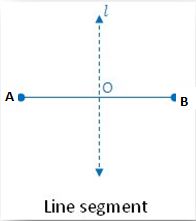
1. Line segment:
line segment AB

From the figure, there is one line of symmetry. line of symmetry of a Line segment passes through its center. There may infinite line passes through the line segment and forms different angles. But we only consider a line as a line of symmetry that cuts the line segment into two equal halves. The Line segment AB is symmetric along the perpendicular bisector l.

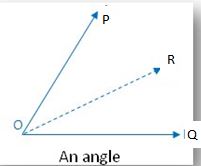
2. An angle:
Angle Symmetry

From the figure, there is one line of symmetry. An angle measures the amount of ‘turning’ between two straight lines that meet at a point. The figure is symmetric along the angle bisector OC.

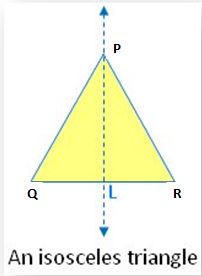
3. An isosceles triangle:
isosceles triangle

From the figure, there is one line of symmetry. The isosceles triangle figure is symmetric along the bisector of the vertical angle. The Median PL. If the isosceles triangle is also an equilateral triangle, then it has three lines of symmetry. An isosceles triangle has exactly two sides of equal length. Therefore, it has only 1 line of symmetry that passes from the vertex between the two sides of equal length to the midpoint of the side opposite that vertex.

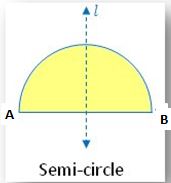
4. Semi-circle:
Semi-circle

From the figure, there is one line of symmetry. The Semi-circle figure is symmetric along the perpendicular bisector l. of the diameter AB. A semi-circle does not have any rotational symmetry.

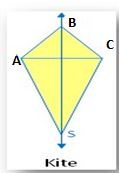
5. Kite:
Kite

From the figure, there is one line of symmetry. The Kite is symmetric along with the diagonal BS. A kite is a quadrilateral with two different pairs of adjacent sides that are equal in length and also have only one line of symmetry.

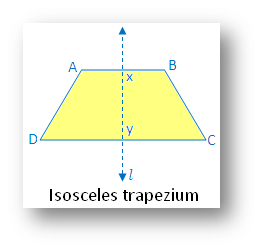
6. Isosceles trapezium:
Isosceles trapezium

From the figure, there is one line of symmetry. The Isosceles trapezium figure is symmetric along the line l joining the midpoints of two parallel sides AB and DC. The isosceles trapezium is a convex quadrilateral consists a pair of non-parallel sides that are equal and another pair of sides is parallel but not equal.

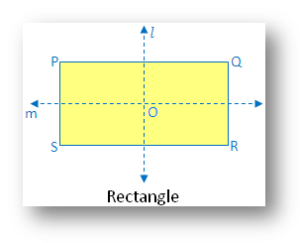
7. Rectangle:
Rectangle

From the figure, there are two lines of symmetry. The Rectangle figure is symmetric along the lines l and m joining the midpoints of opposite sides. There are 2 symmetry lines of a rectangle which are from its length and breadth. They cut the rectangle into two equal halves. They appear mirror to each other.

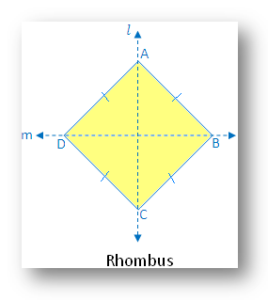
8. Rhombus:
Rhombus

From the figure, there are two lines of symmetry. The Rhombus figure is symmetric along the diagonals AC and BD of the figure. Both the lines of symmetry in a rhombus are from its diagonals. So, it can also say the rhombus lines of symmetry are both diagonals.

Lines of Symmetry in Alphabets

Have a look at the letters that have the line of symmetry.
One Line of symmetry: The letters consist of One line of symmetry are A B C D E K M T U V W Y.
Vertical Line of symmetry: The letters consist of a Vertical line of symmetry is A M T U V W Y.
Horizontal Line of symmetry: The letters consist of a Horizontal line of symmetry is B C D E K.
Two Lines of Symmetry: The letters consist of Two lines of symmetry are H I X. These are having both horizontal and vertical lines of symmetry.
No Lines of Symmetry: The letters consist of No lines of symmetry are F G J L N P Q R S Z. These have neither horizontal nor vertical lines of symmetry.
Infinite Lines of Symmetry: The letter having Infinite lines of symmetry is O.

Go Math Grade 2 Answer Key

Go Math Grade 2 Answer Key | Download Primary School Second Grade HMH Go Math Answers

Go Math Grade 2 Solution Key keeps your kid on the right track and offers you a seamless learning experience. Use the learning aids over here to score better grades in your exams. Have deeper insight into the concepts of Primary School Second Grade and stand out from the crowd. Avail the Chapterwise HMH Go Math Answer Key for Grade 2 via quick links available and take your preparation to the next level.

HMH Go Math Second Grade Answers provided are given by subject experts and meets the Common Core State Standards 2019 Curriculum. Primary School Go Math 2nd Grade Answer Key includes Questions from Exercises, Chapter Tests, Assessments, Review Tests, Cumulative Practice, etc. Make the most out of the quick resources and grasp the fundamentals of maths that might be useful for you in the mere future.

Primary School Go Math Grade 2 Answer Key for all Chapters

Learn the concepts of 2nd Grade Math in a fun and engaging way. HMH Go Math Grade 2 Answer Key is curated by subject experts keeping in mind students’ level of understanding. Keep your kid on the right track and help them become proficient in maths. Access the Chapterwise Go Math Second Grade Answer Key in PDF Format via quick links available. Just click on the respective chapter you feel like preparing and improve on the areas you feel difficult.

Features of Common Core Go Math Grade 2 Solution Key

Learn the importance of the HMH Go Math Second Grade Answers by referring to the below-listed steps. They are along the following lines

  • Go Math Grade 2 Solutions are free to download and we don’t charge a single penny from you.
  • All the Go Math Second Grade Answers are aligned as per the Go Math Grade 2 Textbooks.
  • Step by Step Solutions provided for all the concepts of Go Math Grade 2 make it easy for you to understand the concepts in a better way.
  • HMH Go Math Second Grade Answer Key is given by subject experts adhering to the Common Core State Standards.
  • Primary School Grade 2 Go Math Solution Key provided here inculcates higher-order thinking skills among you.

FAQs on Primary School Go Math 2nd Grade Answer Key

1. Is there any portal that provides the Go Math Grade 2 Answer Key for free?

eurekamathanswerkeys.com is a trusted portal that provides the Go Math Grade 2 Answer Key for free of cost.

2. How to access the HMH Go Math Grade 2 Answers?

You can access the HMH Go Math Grade 2 Answers via quick links available. Simply click on the direct links available to avail the respective chapter.

3. Where do I get the Chapterwise Go Math Second Grade Answer Key?

You can get the Chapterwise Go Math Second Grade Answer Key organized efficiently on our page.

Download Go Math Answer Key for Grades K-8 | HMH Go Math Solution Key for Grades Kindergarten, 1, 2, 3, 4, 5, 6, 7, 8

Go Math Answer Key: HMH Go Math Solutions Key provided helps students to have learning targets and achieve success at chapter and lesson level and makes learning visible. Give your kid the right amount of knowledge he needs as a part of your preparation by taking the help of our HMH Go Math Answer Key for Grades K-8. Resolve all your queries and assess your preparation standard using the Common Core Go Math Solution Key.

All the Concepts in the CCSS Go Math Answer Key for Grades Kindergarten, 1, 2, 3, 4, 5, 6, 7, 8 are given with straightforward and detailed descriptions. Practicing from the Go Math Answer Key for Grades K to 8 will provide a grade by grade roadmap and prepares students for College Readiness. Gradewise HMH Go Math Answer Key provided will develop problem-solving skills among students thereby helping them to Think, Explore and Grow. The Diverse Opportunities provided helps Kids to master the content with engaging activities.

Free Download Go Math Answer Key from Kindergarten to 8th Grade

Students can find Go Math Answer Keys right from  Primary School to High School all in one place. You just need to tap on the quick links available in order to access them and learn all the Chapters in each grade. Once you tap on the quick link you will be directed to the respective Grade Solutions Key wherein you can access the complete information. You can find Solutions for all the Go Math Textbook Questions free of cost and we don’t charge any amount.

Characteristics of Go Math Answer Key for Grades K to 8

Go through the below-listed features of referring to the HMH Go Math Anwer Key for Grades K to 8. They are outlined as follows

  • All the Go Math Answer Key for Grades K to 8 are easy to download and we don’t charge any penny from you.
  • Step by Step Solutions provided in the HMH Go Math Practice Key is aligned as per the College and Career Expectations.
  • Solving from the Math 101 Practice Key helps you inculcate Higher Order Thinking Skills and you can answer any Question from your Homework, Assessment, or Review Test.
  • More Rigorous Content made available meets the Common Core State Standards Initiative.
  • You can gain a deeper knowledge of mathematical concepts and find solutions to all the Questions from Go Math Textbooks for Grades K, 1, 2, 3, 4, 5, 6, 7, 8

FAQs on Common Core HMH Go Math Answer Key

1. When Can I use the Go Math Answer Key for Grades K-8?

You can use the HMH Go Math Answer Key for Grades K to 8 while practicing the Go Math Textbook Questions as a part of your Homework or Assessment and make the most out of them.

2. Is there any site that provides the Common Core Go Math Solutions Key for Grades K, 1, 2, 3, 4, 5, 6, 7, 8?

Yes, you can find Go Math Answer Key for Grades K, 1, 2, 3, 4, 5, 6, 7, 8 all in one place i.e. eurekamathanswerkeys.com a trusted and reliable portal.

3. Can I download HMH Go Math Answer Key PDF for free?

Yes, you can download the HMH Math 101 Practice Key for free on our page via quick links available and we don’t charge any amount for it.

Go Math Grade 1 Answer Key

Go Math Grade 1 Answer Key | HMH Go Math First Grade Solutions PDF Free Download

Teach your kid the basic math skills he might need using the Go Math Grade 1 Answer Key. Create an Impact on their Regular Thinking and help them improve their problem-solving skills and subject knowledge. Look no further and begin your preparation right away to score higher grades in exams. HMH Go Math Answer Key for Grade 1 provided is given after extensive research and is sequenced as per the Go Math 1st Grade Textbooks.

Primary School First Grade Go Math Solution Key PDF format is given for a better learning experience. Solutions provided in the Go Math 1st Grade Answers Key cover questions from all the Exercises, Chapter Tests, Review Tests, Cumulative Practice, etc.  You can download the Chapterwise Go Math Grade 1 Answers in PDF Format and we don’t charge a single penny from you.

Download Chapterwise Go Math First Grade Answer Key

Avail the Primary School Go Math Answer PDF through the quick links provided below. All you have to do is simply click on the respective chapter you wish to prepare and allot time accordingly. Bridge the Knowledge Gap taking the help of the Go Math Grade 1 Solution Key. Kick start your preparation using these resources and clear the exams with flying colors.

Advantages of Referring to Go Math Grade 1 Answers

Students who are in need of Go Math Grade 1 Homework or Assignments help can access the Grade 1 Go Math Answer Key to resolve their queries. The major benefits of referring to HMH Go Math 1st Grade Answers are as follows

  • HMH Go Math Grade 1 Answers provided boost your confidence while attempting the final exams.
  • Go Math Grade 1 Answer Key provided includes Questions from Chapter Tests, Assessment Tests, Review Tests, Practice Tests, etc.
  • Step by Step Solutions provided for all the Go Math Textbook Questions helps you to gain deeper level knowledge on all the concepts.
  • Solving the Primary School Go Math First Grade Answer Key on a regular basis enhances your speed and accuracy in the actual exams.
  • First Grade Go Math Solution Key is prepared by subject experts and meets the Common Core State Standards Initiative.

FAQs on Primary School Go Math 1st Grade Solution Key

1. Where do I get Primary School Go Math Grade 1 Answers Chapterwise?

You can get Primary School Go Math 1st Grade Answers Chapterwise arranged in an efficient manner.

2. Does practicing from HMH Go Math First Grade Answer Key help you score better marks?

Yes, Practicing from HMH Go Math Grade 1 Answer Key help you score better marks as all the concepts are explained in detail.

3. How to download Common Core Go Math Grade 1 Answers PDF for free? 

You can download the Common Core Go Math Grade 1 Answers PDF for free of cost via quick links. Simply, tap on them and prepare offline too to get a grip on all the concepts.

Go Math Grade K Answer Key

Go Math Grade K Answer Key | Download HMH Go Math Kindergarten Solution Key

Achieve your learning targets easily taking the help of the Go Math Grade K Answer Key. Practice using the Go Math Kindergarten Solution Key and reach better grades in the exams. Resolve all your queries taking the help of Go Math Grade K Solution Key and kick start your preparation. Solving the Questions from Kindergarten Go Math Answers enhances your speed and accuracy in the actual exams.

You need not worry about the accuracy of the Primary School HMH Go Math Answer Key for Grade K as all of them are given by subject experts. In fact, you can access the Chapterwise Go Math Kindergarten Answers via quick links available. Go Math Grade K Solutions prepared meets the Common Core State Standards Curriculum and are up to date.

Download Chapterwise Grade K Go Math Answer Key

Access the Primary School Go Math Grade K Answer Key for all the Chapters via quick links. Simply click on the chapter you wish to prepare and learn all the related concepts in no time. The Solutions provided in the Go Math Grade K Solution Key include Questions from Chapter Tests, Review Tests, Practice Tests, Cumulative Practice, etc. For the sake of a better searching experience, the Kindergarten Go Math Answers sequenced as per the Go Math Grade K Textbooks.

Characteristics of Kindergarten Go Math Answer Key

Refer to the below-listed features of the Go Math Grade K Answer Key and learn the importance of it. They are along the lines

  • Solving the Go Math Kindergarten Answer Key regularly improves your higher-order thinking skills.
  • You can answer questions from your Homework, Assignments, or Review Tests easily.
  • Step by Step Solutions for Go Math Grade K Textbook Questions meets the Common Core State Standards 2019 Initiative.
  • Gain Deeper Insights into the mathematical concepts of HMH Go Math Grade K.
  • Tests your preparation levels and you can bridge the knowledge gap and allot time to the areas you are facing difficulty with.

FAQs on Common Core Go Math Grade K Answer Key

1. Where do I get the Go Math Answer Key for Grade K?

You can get Go Math Grade K Answer Key for free of cost on our page.

2. Is there any site that provides the Chapterwise Kindergarten Go Math Answer Key?

Yes, eurekamathanswerkeys.com is a trusted portal that provides the Chapterwise Go Math Grade K Answer Key.

3. How to download the HMH Go Math Grade K Solution Key?

You can download the HMH Go Math Grade K Solution Key via quick links available on our page. Simply tap on them to access the HMH Go Math Grade K Answers for all Chapters.

how to read a watch or a clock

Read a Watch or a Clock | How to Read A Time Shown in Analogue Clock or Digital Clock?

Read a Watch or Clock: Reading a clock or watch is an ability to master easily in a short time and with less effort. There are various types of clocks like Analogue clock, Digital clock, electronic word clock, musical clock, etc. Analogue clocks are distributed over a circle and move the hour hand and minute hand individually. This helps people to read a time from a clock or watch.

Whereas in the digital type of clock, you can easily read the hour and minutes. Well, reading a watch or clock can be confused when it comes to Roman numerals and military time. With a bit of hard work and smart work, you guys can read a clock or watch with ease. So, practice more by viewing the below modules regarding How to Read a Watch or a Clock.

How to Read a Watch or a Clock?

There are two methods to read a watch or clock. The first method is reading an Analogue clock and the second method is reading a Digital clock. Let’s start the process of the first method and learn the concept to read a watch or clock easily.

Method 1: Reading an Analogue Clock

  • In step 1, we will discuss learning how a clock is divided. A clock is split into 12 sections. At the top, you will see the number ’12’. On the right-hand side, you will see a ‘1’ followed by 2, 3, 4, 5, ..so on up to 11 in a clockwise direction.
  • Here the numbers labelling each section are the hours.
  • The sections between the two numbers are divided into 5 divisions/segments.
  • Above we have seen the numbers arranged in the clock.
  • In a clock, there are 2 hands. A little hand indicated the hours and a big hand indicates minutes. For instance, if the little hand is showing ‘1’, then we have to read the time like this 1 o’clock.
  • Now, use the big hand and read the minutes. To read the minutes, first, take the indicated number and multiply it by 5 to get the minutes.
    • If the big hand is pointing to “3,” you’ll know that it is 15 minutes past the hour.
    • If the big hand is between “1” and “2,” note what dash it is pointing to. For example, if it is on the 3rd dash after the “1,” it is 8 minutes past the hour. (1 x 5 + the number of dashes).
  • After learning how to read hour and minutes, you can tell time easily. For instance,
    • If the little hand is pointing to “2” and the big hand is pointing to “12,” it is “two o’clock.”
    • If the little hand is pointing to “3” and the big hand is pointing to “2,” it is “3 hours 10 minutes” or “ten minutes past three.”
  • To tell AM or PM, first, we have to know the time of day. From midnight to noon the next day, the time is in AM. From noon to midnight, the time is in PM.

Method 2: Reading a Digital Clock

  • The digital clock is the opposite of the analogue clock. It displays only two numbers separated by a colon.
  • The first number on a digital clock indicates the hours. If the first number reads “7”, then it is read as 7 o’clock hour.
  • Now, come to the second number on a digital clock or watch, which is found after the colon, tells the minutes into the hour. For instance, if it displays 12, then it is read as 12 minutes into the hour.
  • Finally, put them together to read the exact time. For example, if the clock displays ‘7:12’ then it means 7 hours 12 minutes, or seven-twelve, or twelve past seven.
  • Also, to identify whether its AM or PM, some digital clocks show AM or PM directly on the clock.

Solved Examples on How to Tell Time in English?

1. Read the time shown in the given clock?

reading analogue clock or watch to tell time

Solution:

In the given figure, the hour hand is showing the number 10 then 10 hours and the minute hand is showing the number 12 then 0 minutes. So, we can read it as a 10 o’clock.

2. Read the time shown in the below clock image?

how to read a clock or watch example image

Solution:

From the given clock image, the hour hand is indicating between 4 and 5. It is almost near to 5 but for now, we will read as a 4 hour or 4 o’clock.

The minute hand is indicating 7 then 7 x 5 is 40. So, we read as 40 minutes.

By joining both together, we read it as 4 hours 40 minutes or 40 minutes past 4.